Category: United Kingdom

  • MIL-OSI United Kingdom: Expert offers free personal safety sessions for women

    Source: City of Wolverhampton

    The sessions are designed to encourage women to believe they are entitled to defend themselves, to help women feel safer by having strategies which make them more able to deal with threatening and intimidating situations, and to build women’s confidence in their own skills and resources.

    There are 2 sessions taking place on Tuesday 25 March, 2025 – one at the Bob Jones Community Hub in Blakenhall from 10am to 12pm, and a second at Pendeford Community Hub from 2pm to 4pm. They are open to all women and places are free, but booking is essential – please email charlotte.woodcock2@wolverhampton.gov.uk or call 01902 552025.

    Amanda, who was formerly a tutor with Adult Education Wolverhampton, has over 20 years’ experience as a Women’s Self Defence Trainer and was a member of the National Women’s Self Defence Association. She has supported Wolverhampton Domestic Violence Forum by delivering training and has also been a key worker for Women’s Aid. Most recently, she has been working as a Child and Adolescent Mental Health Service Therapeutic Practitioner for the NHS.

    Councillor Obaida Ahmed, Cabinet Member for Digital and Community, said: “We are delighted to be working with Amanda to deliver these important sessions to mark International Women’s Day. She is passionate about bringing skills and strategies for personal safety to women of all backgrounds, and I would encourage women to book their places today.”

    International Women’s Day takes place this Saturday (8 March) and is a global day celebrating the social, economic, cultural, and political achievements of women. The day also marks a call to action for accelerating women’s equality. For more information, please visit International Women’s Day.

    MIL OSI United Kingdom

  • MIL-OSI United Kingdom: Investigators help ensure jail time for former Brookside actor

    Source: City of York

    A total of 23 years in prison for a former Brookside actor and his associates has been awarded this afternoon.

    Former Brookside actor Philip Foster and 8 associates have today (28 February 2025) been sentenced for their part in a £13.6 million fraud that ran for over 8 years.

    The sentences handed down at Sheffield Crown Court today are the result of an over 6-year investigation by National Trading Standards, whose work uncovered an extensive network of sham modelling agencies that cruelly exploited the dreams of aspiring young models and their parents.

    Foster was the ringleader of the operation. He orchestrated the fraud from Spain, using a network of associates based in England who operated a string of sham modelling agencies and photography studios in cities across the country, including London, Manchester, Leeds, Bristol, Coventry, and Nottingham.

    More than 6,000 victims were deceived by the group – mainly young people and mothers – who ended up parting with substantial amounts of money under the false promise of securing paid modelling work.

    The fraud worked by setting up a photographic studio in the area and running a social media advertising campaign. People who responded were given the false impression that a model agency was interested in them, with emails telling them they had potential. Victims were then invited to a ‘free’ test shoot at the photographic studio, which turned out to be a ruse to try to extort money out of them.

    At the test shoot, victims were given a studio experience, handed glossy brochures and told how successful other people had been. They would then be told that they passed their studio test and that modelling agencies were interested, but they needed to purchase their portfolio photographs from the studio in order to join an agency and become an agency model.

    Victims were duped by the group who, between them, gave a good impression of running successful model businesses and lied to them about their potential. Millions of pounds were taken from aspiring models, with some coerced into financing the upfront payment through credit deals arranged by the fraudsters or taking out expensive payday loans.

    Instead, victims received poor quality digital photographs that stood no real chance of landing them professional jobs. Virtually none of the victims received any paid modelling work.

    The sham agencies were often dissolved after short periods, rebranded repeatedly to avoid detection, and paid no tax. Money from the scam was laundered through UK bank accounts before being transferred to Spain or carried in cash on commercial flights by co-conspirators.

    The investigation traced substantial sums to Foster, who lived in luxury abroad and purchased high-end watches and cars with the proceeds of the fraud. The investigation heard how many victims, left financially and emotionally devastated, described feeling humiliated and betrayed. Some experienced lasting distress that affected their confidence, wellbeing and their ability to trust others.

    The sentences, which were handed down today in the absence of Philip Foster, who is currently living in Spain, are as follows:

    • Philip Foster, aged 49, Edificio Marina Mariola, Marbella, Spain, sentenced to 8.5 years for conspiracies to defraud
    • Michael Foster, aged 27, Snowdon Lane, Liverpool, sentenced to 3.5 years for conspiracy to defraud
    • Paul Evans, aged 39, no known address, sentenced to 3.5 years for offences related to money laundering
    • Jamie Peters, aged 52, Pentland Place, Warrington, sentenced to 24 months, suspended for 2 years, for conspiracy to defraud
    • Lisa Foster, aged 42, Manchester Road, Astley, sentenced to 18 months, suspended for 12 months, for conspiracy to defraud
    • Emily Newall, aged 29, Bolton Road, Kearsley, Greater Manchester, sentenced to 10 months, suspended for 12 months, for conspiracy to defraud
    • Atif Qadar, aged 44, Larkswood Drive, Crowthorne, sentenced to 12 months, suspended for 12 months, for conspiracy to defraud
    • Paul Fleury, aged 57, Manchester Road, Swinton, Manchester, sentenced to 18 months, suspended for 12 months, for conspiracy to defraud
    • Aslihan Foster aged 39, Tredington Road, Coventry, sentenced to 18 months, suspended for 12 months, for an offence related to money laundering

    Today’s sentencing follows over 6 years of investigative work by the National Trading Standards eCrime Team, hosted by North Yorkshire Council and City of York Council, including forensic analysis of financial transactions, thousands of consumer complaints, and witness testimony from victims. The team was supported by the National Trading Standards South West Regional Investigations Team, hosted by Bristol City Council.

    Judge Dixon, said: 

    The business worked on the basis of greed taking what they could where they could. Some people were so convinced by the level of deception that they took out payday loans, which gives a clear indication as to how manipulative and cynical the fraud was. It was horrible, despicable, dishonest behaviour and every single one of you deserves to go to prison. 

    “The officers have carried out an exceptional job to bring these defendants to justice. It was not straightforward or easy. This investigation was conducted with particular skill.  A commendation should be made on the basis of the skill deployed.”

    Lord Bichard, Chair of the National Trading Standards, said:

    Foster’s cruel exploits left thousands of victims in serious debt, causing lasting emotional distress and significant financial pressures.

    “Today’s sentences are an important reminder to would-be criminals that Trading Standards officers across the country are determined to clamp down on fraud, protecting victims and bringing criminals to justice.

    “I would encourage anyone who has been a victim of similar scams to report it to the Citizens Advice Consumer Service on 0808 223 1133.”

    Councillor Jenny Kent, Executive Member with responsibility for Trading Standards at City of York Council, said:

    Today’s sentencing follows years of highly effective trading standards investigative work. Mr Foster and his associates made millions by exploiting the hopes of young people, leaving a trail of broken dreams and financial hardship. I urge everyone to question any modelling contract which demands money up front, and hope that the young people and families affected can now move on to a brighter future, whichever path they choose.”

    North Yorkshire Council’s executive member Councillor Greg White, whose responsibilities include Trading Standards, said:

    Foster and his fellow scammers cruelly exploited young hopefuls trying to break into one of the most competitive industries. In some cases, parents borrowed money or sacrificed savings, believing they were investing in their children’s futures.

    “I urge anyone searching online for modelling opportunities to remember that legitimate agencies don’t ask for money upfront, it’s often only scam agencies who push expensive photoshoots as a pre-requisite to getting work.”

    MIL OSI United Kingdom

  • MIL-OSI United Kingdom: Potentially life-saving bleed kits installed in the Coalfield Area

    Source: City of Sunderland

    Ten new potentially lifesaving bleed kits have been installed across Copt Hill, Hetton, Houghton and Shiney Row

    Sunderland City Council’s Coalfield Area Committee has funded the bleed kits in partnership with the Connor Brown Trust set up by the parents of 18-year-old Connor Brown following his tragic death in 2019.

    Tanya and Simon Brown are actively supporting the community to prevent knife crime and raising awareness of its impact. The kits were installed six years on from the fatal knife attack on Connor Brown in the city. 

    The Coalfield Area Committee allocated £5,400 from its neighbourhood fund budget towards the kits.

    Bleed kits could be used to give vital care and attention to a patient in those first few minutes before the emergency services arrive, potentially saving their life. These kits are part of the wider fight against knife crime across the city with over 50 installed so far by the Connor Brown Trust.

    Councillor Mel Speding, Chair of Sunderland City Council’s Coalfield Area Committee, said: “As a group, the Coalfield Committee aims to support and improve our communities in Houghton, Hetton, Shiney Row and Copt Hill. We were keen to provide funding for these kits which could make a big difference in an emergency.

    “We appreciated the opportunity to partner with the Connor Brown Trust which does such fantastic work across Sunderland. While we hope these kits are never needed, it is reassuring to know that they are there for our residents. We are taking the necessary steps to keep our communities safe.”

    The Coalfield Area Committee is one of five area committees across Sunderland. Made up of local councillors, area committees provide residents with a greater say by working closely with their communities and drawing on local knowledge to identify priorities for their area. They also create Area Plans to support the City Plan, focusing on local needs. These plans help fund and deliver projects in partnership with local voluntary and community sector organisations.

    This is one of 11 grants awarded by the Coalfield Area Committee since April 2024 to support community groups and voluntary organisations with various projects. These include social inclusion and wellbeing activities, Clean It, Green It, and holiday activities for children and young people. 

    Tanya Brown from The Connor Brown Trust said: “If there is an incident, doing nothing means a patient has less chance of survival, but using the kit gives anyone a better chance, before paramedics get to the scene. It’s important to have these bleed kits in as many places as possible simply because they could save lives.

    “The kits have been designed so that little to no training is needed and they can be used by the public or a first responder to any accident where there is a catastrophic bleed. The cabinets contain easy to read instructions and illustrations for each part of equipment showing where and how to use it.”

    In the event of the bleed kits being needed, the 999 operators will direct the caller to the nearest mobile kit or fixed unit and give them the combination code to unlock the unit. The kits are designed for catastrophic bleeding and the caller will be guided on how to use the equipment.

    The kits are now registered and ready to use if needed at:

    • Colliery Inn, Hetton, DH5 9JQ
    • Easington Lane Workmens Club, DH5 0JR
    • Houghton Sports and Wellness Centre, DH4 5AF
    • New Herrington Bowling Club, DH4 4UG
    • Penshaw Community Centre, DH4 7HU
    • Queensway Pharmacy, Houghton, DH5 8EL
    • Shiney Resource and Advice Centre (ShARP), Shiney Row, DH4 4QW
    • Springboard Adventure, Hetton Lyons Country Park, DH5 0RH
    • St John’s Methodist Church, Fencehouses, DH4 6HN
    • St Matthews Youth and Community Centre, Newbottle, DH5 8EL

    For more information about other kits across the city, visit: Connor Brown Trust

    MIL OSI United Kingdom

  • MIL-OSI United Kingdom: Passengers to enjoy greener air travel as UK backs sustainable fuel production

    Source: United Kingdom – Executive Government & Departments 2

    Press release

    Passengers to enjoy greener air travel as UK backs sustainable fuel production

    Have your say on how the sustainable aviation fuel (SAF) revenue certainty mechanism could be funded.

    • air travel to become greener as government introduces industry-led price guarantee to boost sustainable aviation fuel supply while keeping ticket fares down
    • investment in low carbon fuels could support up to 15,000 new jobs and £5 billion for the UK economy by 2050 – delivering economic growth as part of the government’s Plan for Change
    • plans will turbocharge investment in UK SAF, bolster expansion plans and cut carbon emissions while minimising the impact on industry and passengers

    Passengers will enjoy greener plane journeys thanks to new support for the sustainable aviation fuel (SAF) industry helping to tackle emissions, establish Britain as a clean energy superpower and allow the UK to go further and faster with expansion plans.   

    The government has today (3 March 2025) published a consultation setting out how it intends to support the green fuels sector and provide certainty for SAF producers, in the latest step in the government’s plan to support the aviation sector to kickstart economic growth.

    The SAF industry is crucial for the future of aviation, offering a sustainable alternative to traditional jet fuels. By reducing greenhouse gas emissions by up to 70% compared to fossil fuels, SAF will play a vital role in delivering our clean energy mission as part of our Plan for Change and allow the UK to back airport expansion in line with climate commitments.

    Backing investment in the low carbon sector also has huge potential for driving economic growth, as it’s expected to support up to 15,000 new jobs and deliver £5 billion to the UK economy by 2050.

    As this is still a new and emerging industry, today’s proposals will tackle the current uncertainty in the sector by introducing an industry funded price guarantee – known as the revenue certainty mechanism (RCM) – to ensure a steady income flow for producers, even if the price of SAF fluctuates, helping to keep down costs for airlines and holidaymakers.   

    The proposals will help to reduce risk, give investors the confidence they need to invest in UK SAF plants and help the sector secure the supply it needs to bolster the SAF industry in the UK. The mechanism is also designed to limit costs and protect holidaymakers and working people against significant cost increases, with any rises expected to be in line with the usual variation of ticket prices.

    The revenue certainty comes alongside the introduction of the SAF Mandate in January 2025, which requires a growing percentage of aviation fuel to come from sustainable sources to support the industry by securing demand and driving production in the UK. The mandate was one of the first in the world to be put into law, once again putting the UK at the forefront of decarbonising air travel.

    The revenue certainty mechanism combined with the mandate will contribute to our net zero goals, enabling the aviation sector to continue to grow, including through airport expansion. This is also expected to drive significant investment into the SAF sector, creating green jobs, fostering innovation and driving growth as part of our Plan for Change.

    Aviation Minister, Mike Kane, said:    

    We are committed to building the technology and fuel supply that will see greener flying become a reality in a way that protects consumers.    

    As part of our Plan for Change, these proposals will power up SAF production in the UK, support thousands of green jobs and bolster expansion plans.

    Tim Alderslade, Chief Executive of Airlines UK, said:

    UK airlines support the RCM as a means of driving production in SAF and ensuring the industry can comply with the mandate.

    We look forward to working with government on its design with a particular focus on encouraging a competitive market and supporting FOAK plants. The goal must be the production of as much SAF at the cheapest possible price for consumers, to help the industry get to net zero, support growth in UK aviation whilst minimising the impact on passengers.

    Karen Dee, Chief Executive of AirportsUK, said: 

    SAF will play a key role in decarbonising aviation and a revenue certainty mechanism will not only ensure the UK can access enough supply but also that we can benefit from thousands of jobs and billions in investment.

    Airports will work with government as part of the aviation sector to develop the right solution that will give the market the confidence it needs to bring investment forward, enabling a new UK industry producing homegrown SAF to emerge.

    This, in turn, will allow the UK’s global air connectivity to expand sustainably within our net zero targets and play an increasing role in growing our economy, something the government is prioritising to drive up the prosperity of the whole country.

    Gaynor Hartnell, Chief Executive of the Renewable Transport Fuel Association, said: 

    The RCM is essential if SAF is to be manufactured here in the UK rather than imported. Home produced SAF leads to more jobs and improved fuel security, plus it’s a better way of dealing with household and commercial waste than burning it for electricity generation.

    The consultation will run from 3 March to 31 March, with the Sustainable Aviation Fuel (Revenue Support Mechanism) Bill being laid in Parliament in the spring. This support will build on the £63 million recently announced by the Chancellor in her growth speech to boost production of alternative fuels in the UK.

    Last month, the Chancellor also invited Heathrow Airport to bring forward expansion plans for consideration by the summer. The government will then review the Airports National Policy Statement (ANPS) to ensure that any scheme is delivered in line with our legal, environmental and climate obligations.

    In September last year, the department announced a refreshed and rejuvenated Jet Zero taskforce, which is serving as the driving force to transform how people fly – aligning with the government’s missions to make the UK a clean energy superpower and kickstart the economy.

    In a further boost for sustainable aviation, the UK led the charge for new carbon limits on aircrafts at the International Civil Aviation Organization (ICAO), which will see all new aircraft types become 10% more efficient from 2031. This will help cut emissions and fuel costs, benefitting passengers as well as the planet. Regulations on aircraft noise will also be strengthened from 2029 to make planes quieter when taking off and landing.

    The RCM will help deliver certainty in the green fuels market, supporting stable production of the SAF needed for aviation decarbonisation. The scheme is similar to that used in the UK’s world-leading renewables sector and could now boost domestic sustainable fuel production, driving investment in the UK SAF industry and boosting the economy through more green jobs. 

    This is a temporary measure, while SAF market prices are uncertain, to help scale early technologies while supporting a competitive market for SAF production. The government will monitor its impacts and can manage liabilities by capping the support to a pre-agreed volume of SAF, as well as agreeing the strike price within contracts.

    Aviation, Europe and technology media enquiries

    Media enquiries 0300 7777 878

    Switchboard 0300 330 3000

    Updates to this page

    Published 3 March 2025

    MIL OSI United Kingdom

  • MIL-OSI United Kingdom: Beginning of the end for the ‘feudal’ leasehold system

    Source: United Kingdom – Executive Government & Departments

    Press release

    Beginning of the end for the ‘feudal’ leasehold system

    The government has published the Commonhold White Paper today.

    • Commonhold, a radical improvement on leasehold ownership, will be reinvigorated under major reforms
    • New leasehold flats to be banned as the government takes steps to honour its manifesto commitment to ensure commonhold becomes the default tenure
    • Major change will give homeowners a stake in the ownership of their buildings and will hand them more power, control and security over their homes.
    • Change will ensure flat owners are not second-class homeowners and that the unfair feudal leasehold system is brought to an end, building on the Plan for Change ambition to drive up living standards

    Homeowners will have a stake in the ownership of their buildings from day one, not have to pay ground rent, and will gain control over how their buildings are run under major plans to bring the feudal leasehold system to an end. 

    Plans to reinvigorate commonhold and make it the default tenure have been announced today. Unlike leasehold ownership where third-party landlords own buildings and make decisions on behalf of homeowners, these changes will empower hard working homeowners to have an ownership stake in their buildings from the outset and will give them greater control over how their home is managed and the bills they pay. 

    Supporting delivery of a manifesto commitment – these reforms mark the beginning of the end for the feudal leasehold system. The changes complement the Plan for Change milestone to build 1.5 million homes, combatting the acute and entrenched housing crisis by making homeownership fit for the future, by putting people in control of the money they spend on their home. 

    Commonhold-type models are used all over the world. The autonomy and control that it provides for are taken for granted in many other countries. It can and does work and the government is determined, through both new commonhold developments and by making conversion to commonhold easier, to see it take root – so millions of existing leaseholders can also benefit from this step change in rights and security.

    Housing and Planning Minister Matthew Pennycook said:

    “This government promised not only to provide immediate relief to leaseholders suffering now but to do what is necessary to bring the feudal leasehold system to an end – and that is precisely what we are doing. 

    “By taking decisive steps to reinvigorate commonhold and make it the default tenure, we will ensure that it is homeowners, not third-party landlords, who will own the buildings they live in and have a greater say in how their home is managed and the bills they pay.

    “These reforms mark the beginning of the end for a system that has seen millions of homeowners subject to unfair practices and unreasonable costs at the hands of their landlords and build on our Plan for Change commitments to drive up living standards and create a housing system fit for the twenty-first century.”

    Following the introduction of a comprehensive new legal framework for commonhold, new leasehold flats will be banned, and in the meantime the government will continue to implement reforms to help millions of leaseholders who are currently suffering from unfair and unreasonable practices at the hands of unscrupulous freeholders and managing agents.  

    The government has already empowered leaseholders with more rights and security – enabling them to buy their freehold or extend their lease without having to wait two years from the point they purchased their property, and overhauling the right to manage – putting more leaseholders in the driving seat of the management of their property and service charges. 

    Progress will be made as quickly as possible to make it cheaper and easier for leaseholders to buy their freehold or extend their lease, and to make it easier for leaseholders to challenge unreasonable service charge increases.

    Changes set out in the Commonhold White paper include:

    • New rules that will enable commonhold to work for all types of developments, including mixed-use buildings and allowing shared ownership homes within a commonhold.   
    • Greater flexibility over development rights, helping developers build with confidence and maintaining safeguards for the consumer.   
    • Giving mortgage lenders greater assurance with new measures to protect their stake in buildings and protect the solvency of commonholds – such as mandatory public liability insurance and reserve funds and greater oversight by commonhold unit owners to keep costs affordable.   
    • Strengthening the management of commonholds, with new rules around appointing directors, clear standards for repairs, and mandating use of reserve funds; and  
    • Providing an enhanced offer for homeowners – including requiring greater opportunities for democracy in agreeing the annual budget, clarifying how owners may change “local rules” over how a building is run and new protections for when things go wrong.

    A new Code of Practice will set out how costs should be apportioned in commonhold, aimed at providing consumers with transparency and clarity, and the Government is committed to strengthening regulation of managing agents. The government will also launch a consultation to ban new leasehold flats later this year to explore the best way forward. 

    An ambitious draft Leasehold and Commonhold Reform Bill will be published later this year setting out the legal framework for how reformed commonhold will work.

    Further information

    Under the current system, leasehold ownership hands the homeowner the right to occupy land or a property for a set period which reverts back to the freeholder once this expires. It means leaseholders don’t own their property outright, are forced to pay potentially escalating ground rent costs in some cases, and have a landlord who determines how the building is run and determines service charges the leaseholder must pay.  

    Commonhold ownership allows people to fully own their property outright, with no expiring term or need to save to extend a lease. They can have a say in managing their building, and have the benefit of not needing to pay ground rent or have a third party landlord. There are no leases, with the rights, responsibilities and rules for all property owners set out in the Commonhold Community Statement (CCS). This “rulebook” establishes how the shared areas and facilities will be managed, maintained and funded, as well as the obligations for each person. It establishes a democratic system of decision-making and helps prevent disputes.  

    Each property owner will become part of a commonhold association upon buying their home, which oversees both the governance and management of the building unless it decides to bring in a managing agent – which will be accountable to the commonholders, not to a landlord, including the power to hire and fire them.   

    Through the commonhold association, homeowners will have a vote on the annual budget, which is for upkeep and for maintenance of the building, and on the charges they have to pay – equivalent to what service charges are used for under the current leasehold system. Homeowners will also be able to effectively plan for longer-term repairs or maintenance under commonhold, and vote on issues that affect them including adopting ‘local rules’ – specific to how they and their neighbours in the same block of flats want to live.   

    The government is pushing forward the majority of the Law Commission’s recommendations due to the benefits of this tenure over leasehold.  Initially introduced in England and Wales in 2002, commonhold has struggled to take off due to flaws in its legal framework, despite its success in Europe, New Zealand, Australia, the US and other parts of the world.

    Key differences between commonhold and leasehold:

    • Commonhold offers full freehold ownership – real homeownership – unlike leasehold, whereby a property is leased out for a set amount of time before reverting back to the landlord and homeowners have a lack of control over their building.  
    • Commonhold allows homeowners a say on the annual budget for their building – including how their charges for upkeep and maintenance are spent – unlike leasehold, where a bill is usually imposed on leaseholders by landlords often even after the money has been spent.  
    • There is no ground rent in a commonhold property, compared to older leasehold properties. The ground rent requirement for newer properties was removed in 2022 (2023 for retirement properties) through the Leasehold Reform (Ground Rent) Act 2022.   
    • Forfeiture is not possible under commonhold, meaning a unit owner cannot be threatened with losing their home and equity as they can in leasehold. The government will also address the disproportionate and draconian threat of forfeiture as a means of compliance with a lease agreement.    
    • Commonholders have the power to hire or fire a managing agent who works in their interests, unlike in leasehold where one is appointed by the landlord.

    Updates to this page

    Published 3 March 2025

    MIL OSI United Kingdom

  • MIL-OSI United Kingdom: World Book Day celebration comes to city library

    Source: City of Wolverhampton

    Key Stage 1 pupils from Dunstall Hill Primary, West Park Primary and SS Peter and Paul Primary came along to choose their books, hear a talk from author Nadia Shireen and take part in an illustration workshop run by Vivian Trogg, the illustrator for this year’s World Book Day campaign.

    They also enjoyed a craft session and met Postman Bear from the Julia Donaldson book, all courtesy of the World Book Day charity. The children were joined by local MPs Sureena Backenridge and Warinder Juss and World Book Day CEO Cassie Chadderton, and the event was compered by Kenny Baraka.

    Councillor Obaida Ahmed, the City of Wolverhampton Council’s Cabinet Member for Digital and Community, said: “Getting into reading at an early age instils a life long love of books, and we were pleased to be one of 6 library services across the country to be able to welcome representatives of the World Book Day charity to an exciting event ahead of World Book Day here in Wolverhampton.

    “If you are inspired to read this World Book Day, why not become a member of Wolverhampton’s libraries? It’s free to join and will give you access to a huge range of books, including eBooks and eAudiobooks.”

    Cassie added: “World Book Day is all about unlocking the fun of reading for all children. Through events like this brilliant one at Whitmore Reans Library, we’re encouraging children to see reading as an exciting and enjoyable hobby.

    “Libraries provide children with a community to explore books, share recommendations, and experience reading as a joyful, judgment free activity beyond the classroom. Bhttps://www.wolverhampton.gov.uk/librariesy letting go of pressure and embracing choice, we can help more children find the fun in reading and unlock the incredible benefits it brings.”

    World Book Day, which this year will take place on Thursday (6 March), is celebrated annually by 100 countries around the world, with children being given tokens to exchange for free books from a selection chosen by the World Book Day charity. To find out more, please visit World Book Day
                                   
    For more information about Wolverhampton’s libraries, and to join, please visit Libraries.

    MIL OSI United Kingdom

  • MIL-OSI United Kingdom: Q&A with the Deputy Mayor for Environment and Energy

    Source: Mayor of London

    In his election campaign ahead of the May 2024 elections, the Mayor’s manifesto committed to ‘Making London Greener’, including to:

    • Help schools in London reach net zero.
    • Introduce a new Green Roots Fund for community green spaces.
    • Develop a bold plan for swimmable rivers within 10 years.[1]

    Tomorrow, the London Assembly Environment Committee will meet with the Deputy Mayor for Environment and Energy for a question and answer session, exploring the progress made in achieving the Mayor’s manifesto priorities, as well as wider progress on areas in the London Environmental Strategy and London’s 2030 net zero target.
     
    Other topics will include noise pollution, the expansion of Heathrow Airport, green roots fund, and swimmable rivers.

    The guests are:

    • Mete Coban MBE, Deputy Mayor of London for Environment and Energy
    • Megan Life, Assistant Director for Environment and Energy, Greater London Authority (GLA)
    • Pete Daw, Head of Climate Change, GLA

    The meeting will take place on Tuesday 4 March 2025 from 10am in the Chamber at City Hall, Kamal Chunchie Way, E16 1ZE.

    Media and members of the public are invited to attend. 

    The meeting can also be viewed LIVE or later via webcast or YouTube.
     
    Follow us @LondonAssembly.
     

    MIL OSI United Kingdom

  • MIL-OSI United Kingdom: Foreign criminals to be deported quicker

    Source: United Kingdom – Executive Government & Departments

    Press release

    Foreign criminals to be deported quicker

    Foreign national offenders (FNOs) will be deported quicker thanks to a new £5 million government investment in prisons across England and Wales.

    • Immigration crack squad deployed to prisons to speed up removal of foreign national offenders
    • Deportation drive will save taxpayers’ money and help ease jail capacity crisis
    • Part of government’s Plan for Change to create safer streets

    Foreign national offenders (FNOs) will be deported quicker thanks to a new £5 million government investment in prisons across England and Wales.

    The money will fund the deployment of specialist frontline staff to 80 jails with one clear mission – speeding up the removal of prisoners who have no right to be in this country.

    The new crack squad will also support the Home Office to identify and manage those going through the immigration process, ensuring cases are progressed as quickly as possible.

    FNOs make up around 12 percent of the total prison population and deporting them sooner will help save taxpayers’ millions while easing the capacity crisis inherited by the new government.

    The move is expected to further bolster efforts which have seen 23 per cent more FNOs removed since July 2024 compared to the same period in 2023.

    Minister for Prisons, Probation and Reducing Reoffending, James Timpson, said: 

    It cannot be right for British taxpayers to foot the bill for jailing foreign criminals who have brought misery to our communities.

    Under this Government removals are up by nearly a quarter. We’re now taking action to ensure this is done swifter, easing pressure on overcrowded prisons and on the public purse.

    This is part of our Plan for Change – fixing the broken prison system we inherited and keeping our streets safe.

    The investment will create 82 specialist roles to oversee removals from jails. They will be in post and fully operational by 1 April.

    Further information

    • HM Prison and Probation Service work with the Home Office to remove thousands of FNOs via the Early Removal Scheme (where they can be deported up to 18 months before the end of their custodial sentence) and via transferring FNOs to serve their sentences in their home country
    • Since July 2024, we have removed 2,580 foreign criminals, a 23 per cent increase on the same period 12 months prior

    Updates to this page

    Published 3 March 2025

    MIL OSI United Kingdom

  • MIL-OSI United Kingdom: UN Human Rights Council 58: UK Statement at the Interactive Dialogue on the High Commissioner’s Report on Myanmar

    Source: United Kingdom – Government Statements

    Speech

    UN Human Rights Council 58: UK Statement at the Interactive Dialogue on the High Commissioner’s Report on Myanmar

    UK Statement at the 58 Human Rights Council during the Interactive Dialogue on on the High Commissioner’s Report on Myanmar. Delivered by UK Ambassador for Human Rights to the UN, Eleanor Sanders.

    Thank you High Commissioner for your update.

    We are now in the fourth year since the coup and the crisis in Myanmar is only deepening. The military continues to intensify its violent and repressive onslaught. Schools and hospitals have been targeted. Indiscriminate airstrikes on civilians have increased. There is no justification for such abhorrent attacks on innocent civilians.

    The UK is alarmed by the escalating violence, human rights violations and gender-based violence. All actors, especially the Myanmar Military, must prioritise the protection of civilians. We call on the Military to stop the violence – especially the airstrikes – and release all those arbitrarily detained.

    The humanitarian situation is critical, with almost 20 million people in need of assistance. We call on all actors, especially the military, to allow safe and unimpeded humanitarian access. The UK is providing more than £66 million in assistance this year.

    Accountability is vital. We must break the cycle of impunity. This is why the UK supports the work of the International Investigative Mechanism for Myanmar. And this is why we announced our nineteenth round of sanctions in November last year targeting the military regime’s access to arms, aviation fuel and dual-use equipment.

    Updates to this page

    Published 3 March 2025

    MIL OSI United Kingdom

  • MIL-OSI United Kingdom: Opportunities for people looking to take action locally

    Source: Scotland – City of Aberdeen

    An online ‘toolkit’ to support anyone to make positive changes in their community has been launched by Community Planning Aberdeen on Friday 28 February.

    The Community Empowerment Toolkit provides tips and information for anyone looking to improve their community, and for anyone looking to undertake effective community engagement.

    Councillor Christian Allard, Co-Leader of Aberdeen City Council and Chair of Community Planning Aberdeen, said: “We appreciate, understand and value the vital role that communities must play in improving outcomes for Aberdeen.

    “This online toolkit gives individuals and groups access to information that can help to them to influence and action improvements that will benefit their local community, which in turn will be good for the city.

    “We want all people living in Aberdeen, regardless of their background and circumstances, to be empowered and pro-active in their community. Our ambition is for all communities to become equal community planning partners.”

    The online toolkit has been developed through engagement with community members and organisations across Aberdeen, and the Grampian Engagement Network. It is also being supported NHS Grampian’s Putting People First programme.

    Anyone who lives in Aberdeen is a member of their local community and as a community member can find a wide range of information including how to contact their local Community Council, where to get help with funding a project, useful data to support projects, and how to connect with existing groups and organisations.  

    For organisations that are keen to undertake community engagement, the toolkit provides a step-by-step guide, with lots of useful resources to help support effective community engagement.

    Community Planning Aberdeen is the name for the local partnership of public, private and third sector organisations and communities working together to improve people’s lives across Aberdeen through the Local Outcome Improvement Plan (LOIP). An easy-to-read version of the LOIP for children and young people is also available.

    The Local Outcome Improvement Plan sets out Community Planning Aberdeen’s priorities for improving the city – there are 16 for how it proposes to do this, which cover four themes: Economy, People, Place and Community Empowerment.

    Community Planning Aberdeen members are Aberdeen City Council, ACVO (Aberdeen Council for Voluntary Organisations), Aberdeen City Health and Social Care Partnership, NHS Grampian, North East Scotland College, Police Scotland, Skills Development Scotland, Scottish Enterprise, NESTRANS, Scottish Fire & Rescue Service, Robert Gordon University, and the University of Aberdeen.

    MIL OSI United Kingdom

  • MIL-OSI United Kingdom: Increased percentage of children in Leicester get their first choice of secondary school

    Source: City of Leicester

    THOUSANDS of children across the city will be offered places at secondary schools today (Monday 3 March) – with an increase in the percentage being offered their first choice.

    Today is National Offer Day, when children up and down the country learn which secondary school they will attend for the 2025/26 academic year.

    In Leicester, 4,657 city residents applied for a secondary school place. Of those, 3,830 (82.3%) gained a place at their first-choice school. A further 505 (10.8%) got their second preference, 117 (2.5%) their third preference and 15 (0.3%) their fourth preference.

    In total, 95.9% were offered a place at one of their top four preferred schools, with the remaining 4.1% offered alternative places. Every applicant who applied on time was offered a place at a school.

    Cllr Elaine Pantling, assistant city mayor for education, said: “I’m really pleased to see that the vast majority of applicants – 95.9% – gained a place at one of their preferred schools, with an increase in the percentage getting their first choice.

    “We know starting secondary school can be an anxious time for families, and we do all we can to make the applications process is as straightforward as possible. We have made sure that, once again, no-one who applies on time is without a place.”

    Of all who applied, 94% made an online application, meaning they can view their results online on offer day, rather than having to wait for a letter to be posted out to them.

    MIL OSI United Kingdom

  • MIL-OSI United Kingdom: New measures to boost small businesses benefitting from UK’s defence investment

    Source: United Kingdom – Executive Government & Departments

    News story

    New measures to boost small businesses benefitting from UK’s defence investment

    Government announces major support for small and medium enterprises (SMEs) following historic commitment to increase spending on defence.

    • New SME spending targets for defence will boost access to UK defence investment.
    • A new support hub will provide guidance to small businesses on accessing the defence supply chain, unlocking new jobs and putting more money in people’s pockets.
    • Move will ensure more money is spent directly with British small businesses and boost the economy of small towns and suburbs in every region of the UK as part of the Government’s new Defence Industrial Strategy.

    Thousands of small businesses in the UK will receive new government support to ensure they benefit from the historic decision to increase defence spending to 2.5% of GDP. This investment will protect UK citizens from threats at home, but also create a secure and stable environment in which businesses can thrive, supporting the Government’s number one mission to deliver economic growth.

    The government has today announced its plans to launch a new hub to provide small and medium enterprises (SMEs) with better access to the defence supply chain and committed to set direct SME spending targets for the Ministry of Defence by June this year. This is a chance for small, often family-owned, firms to bring their innovations, their agility and their expert workforce to the task of strengthening Britain’s defences. It will help create new jobs, boosting the economy of small towns and suburbs in the UK.

    It follows the Government’s historic uplift in defence spending to 2.5% of GDP by April 2027, with a commitment to hit 3% in the next Parliament. This investment in defence will deliver the stability that underpins economic growth, and will unlock prosperity through new jobs, improving the lives of people in every corner of the UK.

    The new hub and investment targets announced today will ensure this increased spending directly benefits SMEs as much as possible – supporting jobs, growth and innovation. This is a vote of confidence in the prospects of up to 12,000 SMEs, supporting them to raise finance and train workers with confidence. It marks further progress to deliver the government’s Plan for Change, putting more money in people’s pockets and rebuilding Britain.

    The move is designed to boost the resilience of the UK’s defence industrial base and to seize the full power of rapid technological change as part of the Government’s forthcoming Defence Industrial Strategy.

    Nearly 70% of defence spending goes to businesses outside London and the South East, bolstering local economies from Scotland to the North West. However, only 4% of this spending went to SMEs in 2023-2024, which is why the Government is stepping up to provide more support to SMEs and help them get their foot in the door in the defence supply chain. 

    Prime Minister Keir Starmer said:

    The UK’s defence industry is a source of national pride. It supports hundreds of thousands of good jobs up and down the country and represents British manufacturing at its best.

    Increasing our investment in defence is not only bolstering our national security, it is an opportunity to put more money into working people’s pockets and boost economic growth.

    By helping smaller businesses to access this money, we’re making communities across the UK better off and opening up more opportunities to train for good, skilled, productive jobs.

    Defence Secretary John Healey MP said:

    This Government’s historic increase in defence spending to 2.5% of GDP by April 2027 will boost national security and make defence an engine for economic growth throughout the UK.

    For too long small businesses felt locked out of defence, but we’ve listened and we’re acting. Today’s announcement will ensure that smaller firms benefit from increased defence spending, attracting new suppliers and fast-tracking the technologies of the future into the hands of our Armed Forces. 

    This a new era for defence and we will ensure it plays the fullest part in our national economic growth.

    The new Hub will work with suppliers across the nations and regions of the UK to ensure that it fully meets their needs. This will strengthen defence procurement through increased choice and faster access to innovation. It will keep the UK at the forefront of defence technology, improving the capabilities available to our Armed Forces, the competitiveness of UK industry and growing potential exports benefits.

    Defence is an engine for jobs and growth in every nation and region of the UK. In 2023-24, defence spending by the Government supported over 430,000 jobs across the UK, the equivalent to one in every 60. In the same year, the Ministry of Defence spent a total of £28.8 billion with UK industry, with spending in the East Midlands increasing by 30%, equivalent to £328 million, on the previous year. Northern Ireland also saw a rise of 20%, with other increases in Yorkshire and the Humber and the North West, up 19% and 18% respectively. With increased support for SMEs and the upcoming Defence Industrial Strategy, the Government plans to increase this further.

    Updates to this page

    Published 3 March 2025

    MIL OSI United Kingdom

  • MIL-OSI United Kingdom: UK concludes presidency of the International Holocaust Remembrance Alliance

    Source: United Kingdom – Executive Government & Departments

    News story

    UK concludes presidency of the International Holocaust Remembrance Alliance

    After a successful year as Chair of the International Holocaust Remembrance Alliance, the UK hands over the presidency to Israel on 3 March 2025.

    The UK has concluded its presidency of the International Holocaust Remembrance Alliance (IHRA), which ran from March 2024 to February 2025.  The presidency’s theme, “In Plain Sight”, drew attention to the fact that the Holocaust did not happen in a dark corner.  This highlighted the nature of society that allowed the murder of 6 million Jewish men, women and children, and shone a spotlight on all those who had a part to play.

    Our presidency focused on safeguarding remembrance of the Holocaust and securing the narrative for the future. This included tackling Holocaust distortion, and exploring the role of artificial intelligence as a force for both good and bad in Holocaust education and distortion.

    During our presidency, we delivered our ‘My Hometown’ project, supporting young people across the IHRA membership in learning about their local Holocaust history.  Fifty six schools from across 15 countries took part.  A gallery of all the projects can be found on our implementing partner’s website.

    We also published the 80 Objects-80 Lives digital exhibition, delivered in partnership with the Association of Jewish Refugees. In the exhibition, Holocaust survivors shared personal stories connected to their possessions in a series of eighty short videos. 

    We were also pleased to work with the Association of Jewish Refugees to launch their new UK testimony portal. This brings together UK testimony on one platform for the first time.

    The UK hosted 2 plenary meetings, bringing together around 300 IHRA delegates in Glasgow in June and London in December, to discuss efforts to strengthen Holocaust remembrance, education and research. 

    We made progress in a range of areas, including the launch of the Archival Access Forum, to facilitate the sharing of best practice in accessing and preserving Holocaust-related archive materials. 

    We launched guidance on the implementation of the IHRA definition of antisemitism for sporting institutions. We also hosted a successful Roma conference attended by representatives of the Roma community from across Europe, and launched IHRA’s recommendations for Teaching and Learning about the Roma.

    Our presidency also explored the role of emerging technologies in Holocaust education and distortion. We co-hosted an event with the OSCE in Romania. This considered how artificial intelligence could be used as a force for good in Holocaust education and in identifying and tackling instances of antisemitism and Holocaust distortion online. It also explored its more negative uses in facilitating Holocaust distortion. We continued these discussions in the margins of the London plenary, during a follow up conference on the role of artificial intelligence

    Domestically, we published the outcome of a review establishing the facts around the number of prisoners who died on Alderney during the Nazi occupation. This review played an important role in bringing to an end conspiracies and misinformation surrounding this crucial period of history.

    Finally, we marked the 80th anniversary of the liberation of Auschwitz-Birkenau and the 25th anniversary of the Stockholm Declaration on Holocaust Remembrance. In February, we brought together IHRA delegates alongside key figures who have played a role in strengthening international action on Holocaust commemoration over the past 25 years. Together we reflected on our achievements and look ahead to the future of remembrance.

    The Holocaust will sadly soon move from our living memory into the history books, and we will no longer be able to hear survivors tell their stories first-hand. It is therefore essential that we continue to do all we can to safeguard Holocaust sites, encourage greater transparency of Holocaust-related archives, and promote testimony and the stories of Holocaust-related objects.

    Updates to this page

    Published 3 March 2025

    MIL OSI United Kingdom

  • MIL-Evening Report: Melting Antarctic ice will slow the world’s strongest ocean current – and the global consequences are profound

    Source: The Conversation (Au and NZ) – By Taimoor Sohail, Postdoctoral Researcher, School of Geography, Earth and Atmospheric Sciences, The University of Melbourne

    Mongkolchon Akesin, Shutterstock

    Flowing clockwise around Antarctica, the Antarctic Circumpolar Current is the strongest ocean current on the planet. It’s five times stronger than the Gulf Stream and more than 100 times stronger than the Amazon River.

    It forms part of the global ocean “conveyor belt” connecting the Pacific, Atlantic, and Indian oceans. The system regulates Earth’s climate and pumps water, heat and nutrients around the globe.

    But fresh, cool water from melting Antarctic ice is diluting the salty water of the ocean, potentially disrupting the vital ocean current.

    Our new research suggests the Antarctic Circumpolar Current will be 20% slower by 2050 as the world warms, with far-reaching consequences for life on Earth.

    The Antarctic Circumpolar Current keeps Antarctica isolated from the rest of the global ocean, and connects the Atlantic, Pacific and Indian oceans.
    Sohail, T., et al (2025), Environmental Research Letters., CC BY

    Why should we care?

    The Antarctic Circumpolar Current is like a moat around the icy continent.

    The current helps to keep warm water at bay, protecting vulnerable ice sheets. It also acts as a barrier to invasive species such as southern bull kelp and any animals hitching a ride on these rafts, spreading them out as they drift towards the continent. It also plays a big part in regulating Earth’s climate.

    Unlike better known ocean currents – such as the Gulf Stream along the United States East Coast, the Kuroshio Current near Japan, and the Agulhas Current off the coast of South Africa – the Antarctic Circumpolar Current is not as well understood. This is partly due to its remote location, which makes obtaining direct measurements especially difficult.

    Understanding the influence of climate change

    Ocean currents respond to changes in temperature, salt levels, wind patterns and sea-ice extent. So the global ocean conveyor belt is vulnerable to climate change on multiple fronts.

    Previous research suggested one vital part of this conveyor belt could be headed for a catastrophic collapse.

    Theoretically, warming water around Antarctica should speed up the current. This is because density changes and winds around Antarctica dictate the strength of the current. Warm water is less dense (or heavy) and this should be enough to speed up the current. But observations to date indicate the strength of the current has remained relatively stable over recent decades.

    This stability persists despite melting of surrounding ice, a phenomenon that had not been fully explored in scientific discussions in the past.

    What we did

    Advances in ocean modelling allow a more thorough investigation of the potential future changes.

    We used Australia’s fastest supercomputer and climate simulator in Canberra to study the Antarctic Circumpolar Current. The underlying model, ACCESS-OM2-01, has been developed by Australian researchers from various universities as part of the Consortium for Ocean-Sea Ice Modelling in Australia.

    The model captures features others often miss, such as eddies. So it’s a far more accurate way to assess how the current’s strength and behaviour will change as the world warms. It picks up the intricate interactions between ice melting and ocean circulation.

    In this future projection, cold, fresh melt water from Antarctica migrates north, filling the deep ocean as it goes. This causes major changes to the density structure of the ocean. It counteracts the influence of ocean warming, leading to an overall slowdown in the current of as much as 20% by 2050.

    Far-reaching consequences

    The consequences of a weaker Antarctic Circumpolar Current are profound and far-reaching.

    As the main current that circulates nutrient-rich waters around Antarctica, it plays a crucial role in the Antarctic ecosystem.

    Weakening of the current could reduce biodiversity and decrease the productivity of fisheries that many coastal communities rely on. It could also aid the entry of invasive species such as southern bull kelp to Antarctica, disrupting local ecosystems and food webs.

    A weaker current may also allow more warm water to penetrate southwards, exacerbating the melting of Antarctic ice shelves and contributing to global sea-level rise. Faster ice melting could then lead to further weakening of the current, commencing a vicious spiral of current slowdown.

    This disruption could extend to global climate patterns, reducing the ocean’s ability to regulate climate change by absorbing excess heat and carbon in the atmosphere.

    Ocean currents around the world (NASA)

    Need to reduce emissions

    While our findings present a bleak prognosis for the Antarctic Circumpolar Current, the future is not predetermined. Concerted efforts to reduce greenhouse gas emissions could still limit melting around Antarctica.

    Establishing long-term studies in the Southern Ocean will be crucial for monitoring these changes accurately.

    With proactive and coordinated international actions, we have a chance to address and potentially avert the effects of climate change on our oceans.

    The authors thank Polar Climate Senior Researcher Dr Andreas Klocker, from the NORCE Norwegian Research Centre and Bjerknes Centre for Climate Research, for his contribution to this research, and Professor Matthew England from the University of New South Wales, who provided the outputs from the model simulation for this analysis.

    Taimoor Sohail receives funding from the Australian Research Council.

    Bishakhdatta Gayen receives funding from Australian Research Council (ARC). He works at University of Melbourne as ARC Future Fellow and Associate Professor. He is also A/Prof. at CAOS, Indian Institute of Science.

    ref. Melting Antarctic ice will slow the world’s strongest ocean current – and the global consequences are profound – https://theconversation.com/melting-antarctic-ice-will-slow-the-worlds-strongest-ocean-current-and-the-global-consequences-are-profound-251053

    MIL OSI AnalysisEveningReport.nz

  • MIL-OSI Global: Lack of justice in Indonesia’s climate plan may backfire, harming people and environment

    Source: The Conversation – Indonesia – By Wira A. Swadana, Climate Action Senior Lead, World Resources Institute

    Indonesia has developed several climate documents as pathways to curb climate change and adapt to its impacts. These impacts influence many elements of life, including displacement, the spread of infectious diseases, and even fatalities.

    Some of these documents include Enhanced Nationally Determined Contributions, Long-Term Strategy for Low Carbon and Climate Resilience 2050 (LTS-LCCR), and Low Carbon Development Indonesia (LCDI).

    As a scholar in social development and environmental policy, I conducted a descriptive analysis of more than five Indonesia’s climate documents to learn how the concept of a just transition is being integrated into Indonesia’s climate policies. My analisis reveals that the current narrative in those documents is limited to the outcomes of climate-related approaches.

    I found that these climate documents have failed to adequately address the social and environmental aspects that are fundamental to a ‘just transition’ — a global effort to combat climate change and shift towards a sustainable economy while improving the condition of people and the environment.

    Indonesia’s climate action is important because the country is home to vast tropical forests and extensive peatlands, which act as important carbon sinks. Yet, it remains one of the world’s largest emitters.

    Indonesia’s just transition is essential as it supports global efforts to mitigate climate change while ensuring that the shift is more sustainable and inclusive. Neglecting these factors in the transition can risk equity, justice, and inclusion for affected communities and ecosystems in Indonesia’s climate actions.

    The risks it posed

    So far, Indonesia’s just transition narrative concentrates mainly on the energy sector. For instance, the government’s white paper on just transition, released in September last year, centres solely on the energy aspect.

    Additionally, the use of the word just in the Just Energy Transition Partnership (JETP) — an international partnership aiming at speeding Indonesia’s renewable energy development and coal phase-out — has helped popularise the notion.

    A just transition should include broader efforts to limit and adapt to climate change, given these changes directly impact communities. Despite its increasing recognition in the energy sector, just transition remains a long way from being completely integrated into Indonesia’s climate initiatives.

    In the forestry sector, Indonesia’s strategy to apply Sustainable Forest Management (SFM) practices, which includes selective logging practices to minimise damage, may lead to the prohibition of traditional slash-and-burn farming in some areas. This threatens local communities that have long practised controlled burning as a sustainable land management method.

    Similarly, under FOLU Net Sink 2030 — Indonesia’s plan to reduce emissions from forestry and land-use — the government has introduced community forestry initiatives to improve livelihood. However, the strategy does not yet address the potential consequences for people who rely on forests for their livelihoods and cultural heritage, which could be jeopardised by by SFM practices.

    Moreover, Indonesia’s climate resilience strategies for coastal communities overlook the socio-cultural importance of fishing as a key source of income. For example, the government plans to provide business development training to assist fishing families in diversifying their income in response to extreme weather conditions. However, without acknowledging the deep cultural and economic ties these communities have to fishing, such initiatives risk being ineffective.

    The cost we bear

    The lack of justice in Indonesia’s transition agenda has backfired, with negative consequences for both people and the environment.

    For example, the energy shift demands Indonesia to exploit more of its abundant nickel resources for EV batteries, particularly in central and eastern Indonesia. To assist nickel mining and processing, the government has implemented several policies.

    While the nickel boom has helped resource-rich provinces like North Maluku and Central Sulawesi boost their economic growth, it has also had serious impacts. Indonesia’s greenhouse gas emissions climbed by 20% between 2022 and 2023, owing to the dependency on coal for nickel processing facilities.

    Beyond emissions, nickel mining has also led to deforestation and pollution, affecting local communities who rely on natural resources for their livelihoods and cultural preservation, while also harming biodiversity in mining areas.

    The expense of the nickel rush demonstrates how an unjust energy transition can exacerbate challenges faced by vulnerable communities and further degrade the environment.

    Next steps

    To integrate just transition principles effectively, Indonesia must first redefine the term ‘just transition’ within its own context. Currently, the term has not been properly incorporated into any of Indonesia’s climate-related documents.

    A clear and context-specific definition will allow Indonesia to pursue a transition that is both equitable and inclusive.

    To accomplish this, the government must engage a wide range of stakeholders in defining and planning the transition to all climate-related initiatives. This encompasses, but is not limited to, all sectors. The goal is to secure broad participation — not only from the public and private sectors, but also from local communities, vulnerable groups including women and Indigenous peoples, as well as other key actors.

    A more defined concept and well-structured plan will make it easier to implement, monitor, and evaluate the change. Simultaneously, this inclusive strategy should ensure a fair and equitable distribution of both benefits and burdens. All actors must be able to participate in decision-making and take action prior to and during the transition process.

    Indonesia must also have a robust monitoring and evaluation mechanism in place to support its climate actions. The country can learn from Scotland, which has developed a just transition framework with clear outcomes and measurable indicators while ensuring participation and continuous learning from all stakeholders.

    Drawing on insights from existing literature and reports will help Indonesia develop a framework that is well-suited to its unique context.

    Wira A. Swadana tidak bekerja, menjadi konsultan, memiliki saham, atau menerima dana dari perusahaan atau organisasi mana pun yang akan mengambil untung dari artikel ini, dan telah mengungkapkan bahwa ia tidak memiliki afiliasi selain yang telah disebut di atas.

    ref. Lack of justice in Indonesia’s climate plan may backfire, harming people and environment – https://theconversation.com/lack-of-justice-in-indonesias-climate-plan-may-backfire-harming-people-and-environment-249246

    MIL OSI – Global Reports

  • MIL-Evening Report: Cyclone Alfred is expected to hit southeast Queensland – the first in 50 years to strike so far south

    Source: The Conversation (Au and NZ) – By Steve Turton, Adjunct Professor of Environmental Geography, CQUniversity Australia

    If you’re in southeast Queensland, brace yourself.

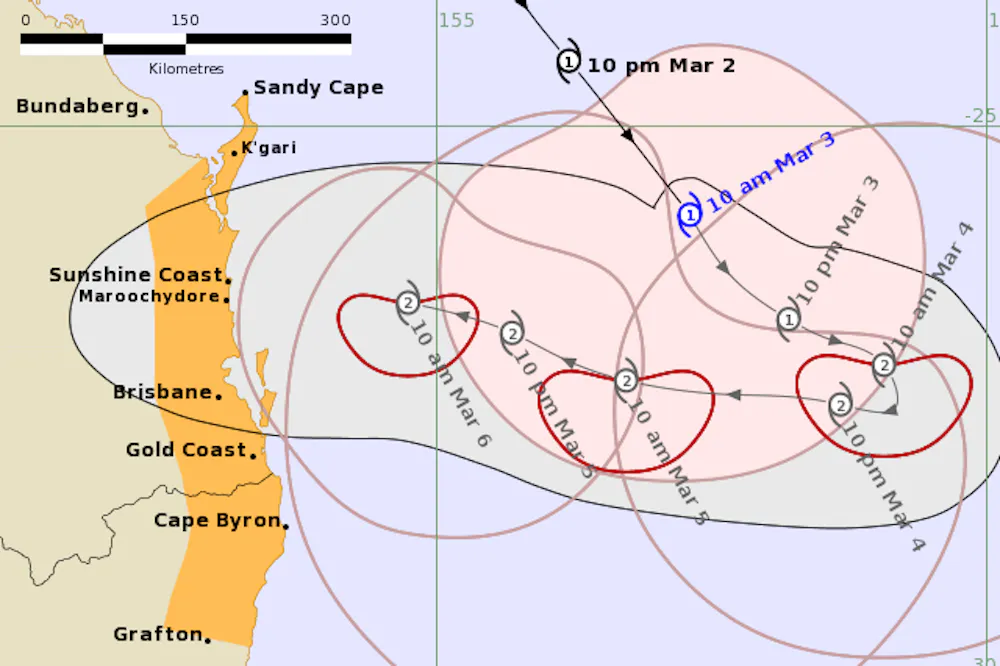
    Tropical Cyclone Alfred is expected to cross the southeast Queensland coast late this Thursday as a Category 2 storm. The last tropical cyclone to make landfall in the region was ex-Tropical Cyclone Zoe in 1974, half a century ago.

    Category 2 cyclones produce winds at levels considered damaging at best, destructive at worst – typically gusting as high as 164 kilometres per hour. It can cause minor damage to houses and significant damage to signs, trees and caravans. Power failures are common, while small boats can break moorings. Significant beach erosion is likely on the Sunshine Coast and Gold Coast.

    Cyclone Alfred formed nine days ago in the Coral Sea, 900 kilometres north east of Cairns, then headed out to sea. Then it tracked south, reaching severe Category 4 status east of Mackay. In recent days, the storm weakened further as it meandered into the cooler waters of the southern Coral Sea. The cyclone seemed set to peter out, far offshore.

    No longer. The latest forecasts show the storm sharply changing direction and making a beeline for heavily populated areas of southeast Queensland.

    Its erratic path is not unexpected. Cyclones forming over the Coral Sea have the most unpredictable paths in the world, frustrating coastal Queensland residents, fishers, tourist operators and meteorologists themselves.

    Alfred is a typically unpredictable Coral Sea cyclone. But unusually, it has maintained its cyclonic structure and intensity much further south, into subtropical latitudes.

    Issued Monday March 3rd, this map shows the forecast path of Cyclone Alfred this week.
    Bureau of Meteorology, CC BY-NC-ND

    Cyclones, typhoons and hurricanes explained

    Cyclones, hurricanes and typhoons are different names for the same intense, horizontally rotating tropical storms. They occur in seven tropical ocean basins, above and below the equator.

    These storms need atmospheric heat. They only form over seas warmer than 27°C, where evaporation rates are high. They don’t occur in the cooler South Atlantic basin, and only rarely in the southeast Pacific, during strong El Niño events when sea surface temperatures are warmer.

    The northwest Pacific – off eastern Asia and the Philippines – experiences the most frequent and intense tropical storms (known there as typhoons).

    Australia averages about 13 cyclones a year. Most won’t make landfall and only a few are severe. The world’s hardest hit nation is China, where six cyclones make landfall annually.

    This map shows the aggregated paths of the world’s tropical cyclone over the 150 years to 2006. Note: this map uses the Saffir-Simpson scale in measuring wind speeds, which differs slightly to the Australian scale.
    NASA, CC BY-NC-ND

    In the north Pacific and north Atlantic, cyclones typically follow predictable tracks. They move westwards, steered by sub-tropical high pressure sytems to their north.

    Cyclone paths are also fairly predictable off the northwest coast of Australia. They typically form over the Timor Sea and drift southwest before shifting south and crossing the coast. Some are severe, as we saw with Category 5 Cyclone Zelia last month.

    By contrast, Coral Sea cyclones such as Alfred are much harder to predict.

    In the southern hemisphere, cyclones spin clockwise. This figure shows how cyclones form around a low pressure system over warm seawater. Depending on their intensity, tropical cyclones are steered by dominant winds in the lower, middle and upper layers of the atmosphere.
    Metservice New Zealand, CC BY-NC-ND

    How cyclones are steered

    Strong winds are the main force steering cyclones, determining direction and forward speed.

    Severe tropical cyclones (categories 3–5) are characterised by deep convection currents, which form the famous eye at the centre of the storm, as well as feeder rainbands converging into their centre. Severe systems are generally steered by winds in the middle to upper levels.

    By contrast, weaker cyclones (categories 1–2) are much shallower and often have little or no convection around their centre. They tend to be steered by winds in the lower to middle levels. At present, Cyclone Alfred looks to remain relatively weak.

    Wind speed and direction can differ markedly in different levels of the atmosphere. Winds can also change direction at the same level. These competing influences are what lies behind the erratic paths of our cyclones.

    Cyclones forming in the Coral Sea are more likely to be pushed in different directions by different winds and weather systems than their equivalents in other ocean basins. This is what makes them so hard to predict.

    In our region, cyclones are largely steered by two high pressure systems.

    The first pushes cyclones east, and the second steers them west. If both are present and roughly equal in strength, they can hold a cyclone near-stationary. We saw this with Cyclone Alfred for most of the last week.

    Slow-moving tropical cyclones such as Alfred are more likely to wander, while faster-moving cyclones such as Severe Cyclone Yasi follow a stronger steering pattern and more predictable paths.

    Quite often, cyclones travel south and east out to sea. There, they quietly die in a large area of ocean colloquially known as the cyclone graveyard, southeast of Brisbane. These cyclones are steered by different weather systems – upper troughs, cold masses of air from the Southern Ocean.

    Cyclone Alfred was initially steered east by a near equatorial ridge to its northeast, then became stuck between this high pressure ridge and a sub-tropical ridge to its southwest. This is why it meandered very slowly south and built up strength to become severe.

    An upper trough then pushed it southeast over the weekend. This week, it’s likely to turn sharply westward towards land, propelled by a high pressure ridge to the south.

    Landfall – but where?

    After meandering around the Coral Sea for more than a week, Cyclone Alfred’s forecast track now seems more certain.

    The system is expected to intensify from a Category 1 to 2 tomorrow as it moves over warmer waters and draws in more moisture-laden air. This should see it maintain near Category 2 status until landfall. After it hits, it should rapidly weaken to a tropical low over southern Queensland into the weekend.

    Alfred will bring a lot of rain, making flooded rivers and flash flooding likely. The Bureau of Meteorology has issued a flood watch for catchments all the way from Maryborough to the Northern Rivers area of New South Wales. These communities should prepare now.

    Cyclone Alfred has a large area of gales, so will affect a wide swathe of coastline from K’gari (Fraser Island) to Byron Bay. Storm-force winds will cover a 100km wide area, mostly concentrated on its southern flank as it approaches and crosses the coast.

    In the longer term, Alfred’s remnants will likely be captured by an approaching upper trough and taken back offshore, where it will die in the cyclone graveyard – gone, but not likely to be forgotten.

    Steve Turton has previously received funding from the Australian Government.

    ref. Cyclone Alfred is expected to hit southeast Queensland – the first in 50 years to strike so far south – https://theconversation.com/cyclone-alfred-is-expected-to-hit-southeast-queensland-the-first-in-50-years-to-strike-so-far-south-251241

    MIL OSI AnalysisEveningReport.nz

  • MIL-Evening Report: I’m a medical forensic examiner. Here’s what people can expect from a health response after a sexual assault

    Source: The Conversation (Au and NZ) – By Mary Louise Stewart, Senior Career Medical Officer, Northern Sydney Local Health District; PhD Candidate, University of Sydney

    fizkes/Shutterstock

    An estimated one in five women and one in 16 men in Australia have experienced sexual violence.

    After such a traumatic experience, it’s understandable many are unsure if they want to report it to the police. In fact, less than 10% of Australian women who experience sexual assault ever make a police report.

    In Australia there is no time limit on reporting sexual assault to police. However, there are tight time frames for collecting forensic evidence, which can sometimes be an important part of the police investigation, whether it’s commenced at the time or later.

    This means the decision of whether or not to undergo a medical forensic examination needs to be made quite quickly after an assault.

    I work as a medical forensic examiner. Here’s what you can expect if you present for a medical forensic examination after a sexual assault.

    A team of specialists

    There are about 100 sexual assault services throughout Australia providing 24-hour care. As with other areas of health care, there are extra challenges in regional and rural areas, where there are often further distances to travel and staff shortages.

    Sexual assault services in Australia are free regardless of Medicare status. To find your nearest service you can call 1800 RESPECT (1800 737 732) or Full Stop Australia (1800 385 578) who can also provide immediate telephone counselling support.

    It’s important to call the local sexual assault service before turning up. They can provide the victim-survivor with information and advice to prevent delays and make the process as helpful as possible.

    The consultation usually occurs in a hospital emergency department which has a designated forensic suite, or in a specialised forensic service.

    The victim-survivor is seen by a doctor or nurse trained in medical and forensic care. There’s a sexual assault counsellor, crisis worker or social worker present to support the patient and offer counselling advice. This is called an “integrated response” with medical and psychosocial staff working together.

    In most cases the victim-survivor can have their own support person present too.

    Depending on what the victim-survivor wants, the doctor or nurse will take a history of the assault to guide any medical care which may be needed (such as emergency contraception) and to guide the examination.

    Sexual assault services are always very aware of giving victim-survivors a choice about having a medical forensic examination. If a person presents to a sexual assault service, they can receive counselling and medical care without undergoing a forensic examination if they do not wish to.

    Sexual assault services are inclusive of all genders.

    Collecting forensic samples

    Samples collected during a medical forensic examination can sometimes identify the perpetrator’s DNA or intoxicating substances (alcohol or drugs that might be relevant to the investigation). The window of opportunity to collect these samples can be as short as 12 hours, or up to 5–7 days, depending on the nature of the sexual assault.

    In most of Australia, an adult who has experienced a recent sexual assault can be offered a medical forensic examination without making a report to police.

    Depending on the state or territory, the forensic samples can usually be stored for 3 to 12 months (up to 100 years in Tasmania). This allows the victim-survivor time to decide if they want to release them to police for processing.

    The doctor or nurse will collect the samples using a sexual assault investigation kit, or a “rape kit”.

    Collecting these samples might involve taking swabs to try to detect DNA from external and internal genital areas and anywhere there may have been DNA transfer. This can be from skin cells, where the perpetrator touched the victim-survivor, or from bodily fluids including semen or saliva.

    The doctor or nurse carrying out the examination do their best to minimise re-traumatisation, by providing the victim-survivor information, choices and control at every step of the process.

    The victim-survivor can usually have a support person with them.
    Monkey Business Images/Shutterstock

    How about STIs and pregnancy?

    During the consultation, the doctor or nurse will address any concerns about sexually transmitted infections (STIs) and pregnancy, if applicable.

    In most cases the risk of STIs is small. But follow-up testing at 1–2 weeks for infections such as chlamydia and gonorrhoea, and at 6–12 weeks for infections such as syphilis and HIV, is usually recommended.

    Emergency contraception (sometimes called the “morning after pill”) can be provided to prevent pregnancy. It can be taken up to five days after sexual assault (but the sooner the better) with follow-up pregnancy testing recommended at 2–3 weeks.

    Things have improved over time

    When I was a junior doctor in the late 90s, taking forensic swabs was usually the responsibility of the busy obstetrics and gynaecology trainee in the emergency department, who was often managing multiple patients and had little training in forensics. There was also usually no supportive counsellor.

    Anecdotally, both the doctor and the patient were traumatised by this experience. Research shows that when specialised, integrated services are not provided, victim-survivors’ feelings of powerlessness are magnified.

    But the way we carry out medical forensic examinations after sexual assault in Australia has improved over the years.

    With patient-centred practices, and designated forensic and counselling staff, the experience for the patient is thought to be empowering rather than re-traumatising.

    Our research

    In new research published in the Australian Journal of General Practice, my colleagues and I explored the experience of the medical forensic examination from the victim-survivor’s perspective.

    We surveyed 291 patients presenting to a sexual assault service in New South Wales (where I work) over four years.

    Some 75% of patients reported the examination was reassuring and another 20% reported it was OK. Only 2% reported that it was traumatising. The majority (98%) said they would recommend a friend present to a sexual assault service if they were in a similar situation.

    While patients spoke positively about the care they received, many commented that the sexual assault service was not visible enough. They didn’t know how to find it or even that it existed.

    We know many victim-survivors don’t present to a sexual assault service or undergo a medical forensic examination after a sexual assault. So we need to do more to increase the visibility of these services.

    The National Sexual Assault, Family and Domestic Violence Counselling Line – 1800 RESPECT (1800 737 732) – is available 24 hours a day, seven days a week for any Australian who has experienced, or is at risk of, family and domestic violence and/or sexual assault.

    Mary Louise Stewart receives funding from the Ramsay Research and Education Grant and from the University of Sydney via the Postgraduate Research Support Scheme. Mary Louise Stewart works as a medical forensic examiner where her research is being undertaken.

    ref. I’m a medical forensic examiner. Here’s what people can expect from a health response after a sexual assault – https://theconversation.com/im-a-medical-forensic-examiner-heres-what-people-can-expect-from-a-health-response-after-a-sexual-assault-244404

    MIL OSI AnalysisEveningReport.nz

  • MIL-OSI Australia: North Coast cattle treated for tick fever

    Source: New South Wales Department of Primary Industries

    3 Mar 2025

    NSW Department of Primary Industries and Regional Development (DPIRD) and Local Land Services (LLS) have reminded producers to be alert following the confirmation of tick fever on two North Coast cattle properties.

    North Coast LLS district veterinarian, Phillip Carter, said the cattle were treated for tick fever,  Babesiosis, once confirmed by DPIRD Elizabeth Macarthur Agricultural Institute laboratory tests.

    “If treatment is delayed tick fever can kill susceptible animals and producers should contact a vet immediately if cattle show signs of tick fever,” Dr Carter said.

    “These two positive cases of tick fever are the first new confirmed cases in NSW this year and we saw signs of cattle tick infestation during our inspection of the animals.

    “We advise producers to monitor herds for cattle tick and cattle tick fever as other animals may be infected and are yet to show signs.

    “Unexplained death can be the first sign of tick fever. Other signs producers should look out for in their cattle include lethargy, depression, salivation, red urine, elevated temperature, jaundice and anaemia.

    “Tick fever is spread by cattle tick, which thrive in warm, humid conditions and we urge producers to practice good farm biosecurity to prevent more tick fever cases in these seasonal conditions.

    “Producers should regularly check cattle for ticks, especially when cattle are yarded in preparation for autumn sales.”

    NSW DPIRD Cattle Tick Operations leader, Larry Falls, said producers should immediately report signs of cattle tick on their animals by calling the NSW Biosecurity Helpline, 1800 680 244.

    “Early intervention is key to minimising the spread and impact of cattle tick and tick fever,” Mr Falls said.

    “The NSW record of movement for cattle tick lists the mandatory biosecurity requirements which must be followed when bringing cattle from cattle tick infested areas into NSW and moving from cattle tick restricted properties in NSW.
    “Following these biosecurity requirements helps prevent the introduction and spread of cattle tick and minimises costs and losses to your enterprise and livestock industries.”

    Tick fever and cattle tick are notifiable under NSW biosecurity legislation, supporting the efforts of industry, producers and government who work together to keep NSW tick-free.

    Cattle tick and tick fever pose significant economic impact on cattle production in northern Australia due to potential large losses of animals, production losses, restrictions on trade and treatment costs.

    If you find sick or dead cattle or suspect tick fever, immediately contact your LLS DV or call the Emergency Animal Disease Hotline, 1800 675 888.

    Information about cattle tick and tick fever is available from the NSW DPIRD website.

    Media contact: pi.media@dpird.nsw.gov.au

    MIL OSI News

  • MIL-OSI New Zealand: Name release: Fatal crash, Martinborough

    Source: New Zealand Police (National News)

    Police are now in a position to release the name of the person who died after a car collided with a shared cycle in Martinborough on 13 February.

    She was 48-year-old Alison Robyn Korny, from Cheshire, England.

    Our thoughts remain with her friends and family at this incredibly difficult time.

    Enquiries into the circumstances of the crash remain ongoing.

    ENDS

    Issued by Police Media Centre

    MIL OSI New Zealand News

  • MIL-Evening Report: How to prepare for a cyclone, according to an expert

    Source: The Conversation (Au and NZ) – By Yetta Gurtner, Adjunct senior lecturer, Centre for Disaster Studies, James Cook University

    Tropical Cyclone Alfred is predicted to make landfall anywhere between Bundaberg and northern New South Wales this week. The Australian Bureau of Meteorology has warned it may bring severe hazards and “dangerous and life-threatening flash flooding”.

    So, how do you prepare for a cyclone – and what do you do if it’s too late to leave?

    How to prepare

    Your starting point is to consider the risk to yourself and everyone in your household (including pets). Consider ensuring you have:

    • non-perishable food that everyone in the family will eat (enough for five to seven days)
    • water for drinking and cleaning (three litres per person per day)
    • medication (two weeks worth)
    • toiletries and first aid kit
    • pet food/supplies
    • torches
    • batteries
    • a back up battery for your phone
    • baby formula and nappies if needed
    • protective clothing and closed-in shoes
    • cash in small denominations
    • valuable documents such as passports, title deeds, ID, insurance details, photos (these can be photographed or packed in weather-proof container or envelope)
    • kids’ books, card games, board games, headphones
    • anything else you may need or really value (and isn’t too heavy to carry).

    Make sure you have a grab-and-go kit that you can carry by yourself if authorities suddenly tell you to evacuate immediately.

    Conventional wisdom used to be to prepare enough supplies for three days of disruption. Now, experts recommend having enough for five to seven days. After the initial disaster there may be road blockages or supply chain problems.

    Ensure you have enough medication for a week or two, because pharmacies may take days or weeks to re-open. And remember that many medications, such as insulin, need to be refrigerated, so consider how you’d keep them cool if the power went out.

    Fill containers with water and stick them in your freezer now; they can keep your freezer cool if you lose power. They can also become drinking water in future.

    Talk to your neighbours. Do they have a generator or a camping fridge you can use? This is a great opportunity to get to know your community and pool your resources.

    Ask yourself if you have friends with whom you or a pet can stay. One of the main reasons people don’t evacuate is because they can’t bring their pets (not all evacuation shelters allow them, so check in advance).

    Consider what you can do now to prepare your house. One of the most common call-outs the SES receives is about blocked drains and gutters, so check if there’s time to clean your gutters now. You won’t be able to do it during the storm.

    Stay informed – and don’t rely on hearsay

    Have a plan for getting truthful information before, during and after the cyclone.

    Rely on the information provided by official sources, as they will tell you when it’s too late to evacuate or when it’s safe to come out. This is highly context-specific and will depend on where you are located.

    Get advice where possible from your local council’s disaster dashboard (most councils have one).

    It should provide information such as where to get sandbags, which roads are closed (which can affect your evacuation plan) and evacuation centre openings and locations.

    Anyone who monitors social media will see how many amateur meteorologists and maps are out there, but these are often not the best source. Always rely on official sources rather than hearsay, trending footage or amateur “experts”.

    Always have an battery-operated AM-FM radio. If power goes out, relying on your phone to track information will drain your phone battery very quickly.

    You may be able to charge it via your car or laptop, but telecommunications networks may not be active.

    So having a battery-operated radio on hand – and plenty of batteries – is crucial.

    What if the cyclone hits while you’re at home?

    If it’s too late to evacuate, have a plan for sheltering in place.

    Find the smallest room in your house with the least windows (which can shatter in a storm). This is often the bathroom, but it could be under the stairs. It is usually on the lowest level of the house.

    Bring your food, water, radio, blankets and supplies there. Avoid walking around the house during the cyclone to fetch things; there could be glass on the floor or debris flying around.

    It’s hard to predict how long you will need to shelter there, but it’s important not to leave until official sources say it is safe to do so.

    Cyclones come in stages. They arrive from one direction, then comes an eerie calm as the “eye of the storm” passes over. Next, the other half of the cyclone arrives. Don’t go outside during the eye of the storm, because it’s not over.

    Outside the house, there may be powerlines down, broken glass and other hazards. Don’t venture out until you get official clearance from the disaster dashboard or official sources on the radio saying it is safe.

    For non-life threatening emergencies – such as a tree on your roof, or water running through your house – call the SES on 132 500 or register on the SES Assistance app (if you’re in Queensland). They will not come during the event itself but will come later.

    If it’s a life threatening emergency, always call triple 0.

    After the storm

    After the storm, consider how to make your house more cyclone-ready in future. Many houses in North Queensland are designed for cyclone zones, but not as many further south will be.

    Climate change means cyclones are likely to be more severe in future. These days, be cyclone-ready 365 days a year.

    Yetta Gurtner has received funding in the past from the Bureau of Meteorology. She is a community engagement officer with the Queensland State Emergency Services.

    ref. How to prepare for a cyclone, according to an expert – https://theconversation.com/how-to-prepare-for-a-cyclone-according-to-an-expert-251251

    MIL OSI AnalysisEveningReport.nz

  • MIL-OSI United Kingdom: Financial support for student carers

    Source: Scottish Government

    Carers in education urged not to miss out on extra money.   

    This National Student Money Week (3 – 7 March 2025), unpaid carers in education are being encouraged to check if they are entitled to financial help from Social Security Scotland. 

    It is estimated that there are around 35,000 unpaid carers attending college or university in Scotland. The type of help they provide includes emotional, mental or physical support for a family member, friend or neighbour. But many don’t recognise themselves as a carer, which could mean they are missing out on extra money. 

    There are three payments delivered by Social Security Scotland that could help student carers during their studies.  

    Carer Support Payment replaces Carer’s Allowance in Scotland. Unlike Carer’s Allowance, it is available to more carers in education.  

    Young Carer Grant and Carer’s Allowance Supplement are only available in Scotland.  

    Louise Reid, Student Support Adviser at the University of the West of Scotland (UWS) and Financial Capability Champion on the National Association of Student Money Advisors (NASMA) Board, explains the importance of this type of help. 

    “Students, alongside wider society, are consistently pushed to the limit financially from sources outside their control. The cost of housing, energy and food have all been consistently high and this hits student carers particularly hard.  

    “As caring responsibilities can limit or completely reduce any capacity for part time work to top up existing student funding, additional financial resources are vital.  

    “Carer Support Payment is an invaluable financial resource that can make the difference between continuing with studies or not. Being able to claim this benefit, whilst studying really makes such a difference to students who provide care.”  

    To find out more about all Social Security Scotland payments for carers, visit mygov.scot/carers or call free on 0800 182 2222.   

    Background: 

    • Carer Support Payment is a payment of £81.90 a week and is available to carers who are aged 16 or over and who provide unpaid care for 35 hours or more a week to someone who receives a qualifying disability benefit.  They need to earn £151 a week or less after tax, National Insurance and expenses.
      Carers in education who may be eligible includes:     
    • Part time students – those who spend less than 21 hours a week in class or doing coursework for any course    
    • Students aged 20 and over and who study full time for any course    
    • Students aged 16-19, who study full time in advanced education at university or for a college course such as a Higher National Certificate and Higher National Diploma   
    • There are also some circumstances where students aged 16-19 studying over 21 hours a week in non-advanced education, such as studying for National Certificates and Scottish Highers, who may also be eligible if they meet certain criteria. Find out more at   If you study – mygov.scot 
    • Carer’s Allowance Supplement is an extra payment for eligible unpaid carers who are getting Carer Support Payment or Carer’s Allowance on the qualifying date. The payment is made twice a year and is unique to Scotland. Each payment of Carer’s Allowance Supplement is currently £288.60.  It is paid automatically without the need to apply.   
    • Young Carer Grant is available for carers aged 16, 17 or 18 who provide support for an average of 16 hours a week to someone receiving a qualifying disability benefit. It is a yearly payment of £383.75 and the money can be spent on whatever the young person wants.   
    • If you are an organisation that supports student carers in Scotland, there are shareable resources, many of which are available in different languages, via our resources pages on our website:  

    Social Security Scotland – Carer Support Payment Resources  
    Social Security Scotland – Young Carer Grant Resources  

    MIL OSI United Kingdom

  • MIL-OSI United Kingdom: UK Government boosts digital collection of world’s oldest English language daily newspaper

    Source: United Kingdom – Executive Government & Departments

    News story

    UK Government boosts digital collection of world’s oldest English language daily newspaper

    Belfast News Letter editions from 18th-20th centuries to be digitised as UK Government project promotes Northern Ireland’s cultural heritage.

    Historic editions of the world’s oldest English language daily newspaper still in circulation are to be digitised by the UK Government, delivering on commitments made in the Safeguarding the Union command paper. 

    The News Letter, first published in September 1737, will this year mark its 288th anniversary as the oldest continuously published English language daily paper.  To strengthen understanding of Northern Ireland’s cultural traditions around the world, the Northern Ireland Office is working in partnership with the British Library and FindMyPast to expand the online collection of the historic publication in the British Newspaper Archive. Building on previous preservation and scanning initiatives, the digitisation of these copies from three centuries of the historic Belfast title means that all known surviving copies of the News Letter will become accessible online for the first time.

    Announcing the start of the project, Secretary of State Hilary Benn visited Belfast’s Linen Hall Library to view historic copies of the News Letter. While historic copies of the publication are available in physical and microfilm format in libraries across Northern Ireland, this project will ensure a worldwide audience will be able to observe the newspaper’s unique insight into the political situation in Ireland from the late 18th century to the early 19th and 20th centuries. 

    Key historical events, such as the Irish Parliament winning legislative independence from Britain in 1782, the formation of the Orange Order in 1795, the 1798 rebellion of the United Irishmen, and the 1801 implementation of the Act of Union are covered by the newly digitised pages.

    Originals of the News Letter are being provided in microfilm and newspaper format by the British Library, to be digitised by the online platform Findmypast, which has spent nearly 15 years working on a collaborative project to digitise the British Library’s vast newspaper collection. 

    The archive is then made available online through the British Newspaper Archive and on Findmypast, where it can be viewed freely at the British Library sites in London and Yorkshire, as well as at any library or by any private individual  around the world with a subscription.

    Speaking after his visit to The Linen Hall Library, Secretary of State Hilary Benn said: 

    “The News Letter’s status as the longest-running continuously published English language daily newspaper in the world is an important part of Northern Ireland’s unique cultural heritage.

    “As set out in the Safeguarding the Union command paper, the UK Government is committed to digitising these historical archives to promote the richness of Northern Ireland’s traditions around the world, including in nations with historic ties, such as the United States.

    “This will also ensure that these precious historical records are preserved and accessible for generations to come.”

    Sarah Bush, Managing Director of Findmypast and the British Newspaper Archive, said: 

    “As the trusted partner of many iconic British and Irish institutions, we work to digitise millions of records from our nation’s history and make them accessible to the public online. 

    “Alongside the British Library, we’re delighted to make this unique and culturally important title available to be searched and viewed on Findmypast and the British Newspaper Archive, offering a fascinating window into centuries of Northern Ireland’s history as it happened.

    Beth Gaskell, Lead Curator of News and Moving Image at the British Library, said: 

    “The British Library cares for one of the world’s greatest news archives with over 60 million issues of British and overseas newspapers dating back to the 1600s, as well as ever expanding collections of radio, television, and web news. 

    “We are thrilled to be collaborating with Findmypast and the UK government to build on the existing collection of the News Letter available through the British Newspaper Archive to make all known surviving copies of the historic Belfast title accessible for the first time.”

    New Letter’s David Montgomery, Executive Chairman of the News Letter’s owners, National World plc, said:

    “For four centuries The News Letter has been in the frontline of local and global

    news and opinion – it was already in its fortieth year when it covered the U.S.

    Declaration of Independence. In the 1990s it and other Northern Ireland papers helped pave the pathway to peace. 

    “Today The News Letter is often a solitary and essential promoter of its community’s rich heritage.  The digital archive is an eternal reminder of that crucial, continuing role of reliable independent journalism.”

    The UK Government continues to make progress on the delivery of the commitments made in the Safeguarding the Union command paper, which formed the basis upon which the Northern Ireland Executive was restored last year.

    The digitisation project will see Findmypast digitise pages of the Belfast News Letter using specialist microfilm scanners, which scan thousands of newspaper pages every day, in its state-of-the-art studio at the British Library’s facility in Boston Spa. This ensures the faithful reproduction of the newspaper as it once appeared, and enables online searching of the newspaper by name, keyword, date, or specific location.

    The digitisation process will be completed this Spring. Once online, individuals will be able to access the editions free of charge by visiting libraries with a subscription to Findmypast, includingthe British Library’s sites in St Pancras, London and Boston Spa, Yorkshire. They will also be accessible to people around the world with a subscription to the Findmypast or British Newspaper Archive websites.

    ENDS

    Notes to editors

    • To subscribe to the FMP or British Newspaper Archive, visit https://www.britishnewspaperarchive.co.uk or https://www.findmypast.co.uk
    • The editions of the News Letter being digitised are from 1738-1750, 1752-1770, 1772, 1775-1780, 1782, 1784-1785, 1787-1800, 1802-1803, 1806, 1816-1825, 1827, 1959 (Mar-Dec), 1960, 1961 (Jan-Jun)

    Updates to this page

    Published 3 March 2025

    MIL OSI United Kingdom

  • MIL-OSI United Kingdom: Young people urged to ‘Think Fraud’ over rent offers

    Source: United Kingdom – Executive Government & Departments

    News story

    Young people urged to ‘Think Fraud’ over rent offers

    New data shows 18 to 39 year olds account for almost 3 quarters of rental fraud reports as phase 2 of nationwide ‘Stop! Think Fraud’ campaign launches.

    Young people aged between 18 and 39 account for almost three quarters of cases of rental fraud, according to exclusive National Fraud Intelligence Bureau (NFIB) data released by the Home Office today.

    Rental fraudsters typically target their victims by offering access to properties that do not exist, or which are not theirs to rent, often using fake details and photos, and usually offering prices at well below market rate. To secure the property or even arrange a viewing, they will usually demand a deposit or the first month’s rent, and many individuals desperate to find a home will make the upfront payment to avoid missing out.

    According to the NFIB data, the resulting fraud losses amounted to nearly £9 million across around 5,000 reported cases last year. The 18 to 29 age group accounted for 48% of all reported rental fraud cases in England, Wales, and Northern Ireland last year, with the 30 to 39 age group accounting for 25%.

    With many students and young workers using the spring months to search for new rented accommodation, Home Office ministers are urging renters to avoid rushing into a quick decision or paying over any money for a property before they have viewed it in person.

    And with rental fraud often taking place through properties advertised on social media websites, the government is also renewing its calls for tech companies to go further and faster to tackle fraud on their platforms ahead of convening the next Joint Fraud Taskforce meeting later this month.

    Fraud Minister Lord Hanson said:  

    Rental fraud is an utterly shameful crime, and this new data should serve as a stark reminder that anyone can be a victim. It doesn’t matter how streetwise and tech-savvy you are, fraudsters will get to anyone who doesn’t stop and think before handing over their money.

    That’s why I am determined to root out fraud from our society, crack down on the callous criminals behind it, and ensure that stronger protections are put in place by the tech companies on whose platforms much of this fraud takes place.

    The Home Office will be making progress on all of those issues through the next phase of our Stop! Think Fraud campaign, and the new, expanded fraud strategy we are developing this year as part of this government’s Plan for Change.

    Oliver Shaw, Commander for Fraud and Cybercrime, City of London Police, said:

    Young people are disproportionally targeted by criminals whilst they look for new accommodation or housing opportunities. This can result not only in a devastating financial loss but can also lead to a negative impact on their mental health. The data from the National Fraud Intelligence Bureau highlights clearly how much of a critical issue this is in affecting 18 to 29 year olds.

    That’s why we, as the national lead force for fraud, continue to support the Stop! Think Fraud campaign’s ongoing efforts to raise awareness of this vital issue. And we continue to work to highlight emerging cybercrime and fraud types that could be a threat, understanding the importance of reporting, and advocating ways the public can prevent themselves from becoming victims of fraud.

    The new figures are published on the same day as the National Cyber Security Centre (NCSC) – part of GCHQ – launches the second phase of a nationwide campaign encouraging individuals and small businesses to set-up 2-step verification (2SV) on their most important accounts.

    2SV adds an extra layer of security, making it much harder for attackers to access your accounts even if your password is compromised.

    NCSC Chief Operating Officer Felicity Oswald said: 

     Online fraudsters are constantly finding new ways to trick you into sharing personal information or money, but thankfully, there are ways to protect yourself. 

    Today, we’re launching a nationwide campaign urging everyone to strengthen their security by enabling 2SV, which adds an extra layer of protection to keep your accounts safe. 

    Toughen up your online security by enabling 2SV today – usually found in the security settings of your accounts – and keep the fraudsters out.

    Updates to this page

    Published 3 March 2025

    MIL OSI United Kingdom

  • MIL-OSI Australia: Automated Milking Systems delivers comparable performance to conventional systems in Australian dairy farms

    Source: New South Wales Department of Primary Industries

    3 Mar 2025

    The NSW Department of Primary Industries and Regional Development (DPIRD) has released a comprehensive report from the Milking Edge Project, offering valuable insights for Australian dairy farmers considering Automatic Milking Systems (AMS) technology.

    The research revealed that while on average, AMS-equipped farms in Australia achieve comparable economic and physical results to conventional milking systems, AMS is beneficial for freeing up labour for other key tasks such as pasture management, boosting overall farm productivity.

    NSW DPIRD Development Officer Juan Gargiulo said that by analysing the economic and operational performance of AMS in the Australian dairy industry, the report provides clear guidance for farmers exploring this innovative approach to milking, while supporting them to more effectively adopt and operate AMS.

    Key findings from the report include:

    • Australian AMS farms typically milk between 150 and 240 cows and operate between three and four robotic units.
    • Average daily milk production per cow typically ranged from 19.3 to 26.3 kilograms.
    • Cows are milked on average 2.17 times per day, with each robot harvesting approximately 1,200 kg of milk daily.

    The study also identified key drivers of profitability, including robot efficiency (milk harvested per robot), labour efficiency, and pasture utilisation per hectare. These factors are crucial in determining the success and financial viability of AMS technology on Australian farms.

    “The findings from this report provide valuable benchmarks for AMS profitability and efficiency in the Australian dairy industry, helping farmers and stakeholders make informed decisions about technology investments and operational strategies,” Mr Gargiulo said.

    “While AMS performance varied across different operations, the research highlights key opportunities for improving productivity and profitability, such as the ability of AMS farmers to reallocate labour from milking to other tasks like farm business management, herd health, and pasture management, enhancing overall farm efficiency and sustainability.”

    Since its global introduction in 1992, AMS is reported to have transformed dairy farming, with over 50,000 systems now in use worldwide.

    In Australia, AMS is currently implemented on around 1.5% of dairy farms, with growing interest as farmers assess its benefits.

    Importantly, researchers debunked a common perception in the Australian dairy industry that adopting AMS technology often leads to more frequent milking and increased milk production.

    “While this is largely true in European and North American dairy systems, where cows are housed in barns with closer access to AMS units, the report found that in Australia’s pasture-based systems, milking frequency and production levels were similar to those in conventional systems,” Mr Gargiulo said.

    “This is partly due to the greater distance between paddocks and milking stations, requiring cattle to walk further compared to barn-housed cattle.”

    Another key finding was that for a majority of pasture-based AMS farms in Australia, the key to improving profitability was not increasing milking frequency, but rather maximising the number of cows milked per robot.

    This report was designed to provide valuable insights into the performance of AMS systems for dairy farmers, industry advisors, consultants, and researchers involved in AMS adoption or performance analysis.

    The NSW Government encourages the dairy sector to review the report before investing in AMS technology to determine whether it is the right fit for their operation.

    The Milking Edge Project was a five-year initiative led by NSW DPIRD in collaboration with Dairy Australia and DeLaval, with the AMS report available on the DPIRD website.

    Media contact: pi.media@dpird.nsw.gov.au

    MIL OSI News

  • MIL-OSI Australia: Next stage of clean-up set to start at former Truegain site

    Source: New South Wales Government 2

    Headline: Next stage of clean-up set to start at former Truegain site

    Published: 3 March 2025

    Released by: Minister for Lands and Property, Minister for Regional Transport and Roads


    The Minns Labor Government is set to launch the next stage of a major project to clean up the former Truegain industrial site in the Lower Hunter region.

    Ford Civil has been appointed by Property and Development NSW (PDNSW) on a $5.3 million project to remediate contaminated soil across almost 1.2 hectares of the former oil refinery at Rutherford near Maitland.

    The second stage of work will be guided by a Remediation Action Plan, developed by Property and Development NSW and environmental consultant Ramboll. The remedial works will involve the removal of concrete slabs, excavation of contaminated soil and subsurface infrastructure, backfilling the excavation with clean soil and revegetating or resealing the area. The proposed works have been reviewed and endorsed by a NSW EPA accredited site auditor.

    The first stage of the project was completed in 2023 and involved the removal of more than 11,000 tonnes of industrial liquid waste, sludge and above ground infrastructure including storage tanks from the site.

    The Truegain site was abandoned in 2016 after the company lost its trade waste permit, had its environment protection licence suspended and entered into liquidation.

    In 2021, the NSW Environment Protection Authority (EPA) brought proceedings against Truegain director and former owner Robert Pullinger to recover the cost of cleaning up the site. The Land and Environment Court of NSW ordered Mr Pullinger to pay $1.2 million towards the EPA’s costs.

    Stage 2 work is expected to start in the coming weeks and be completed by the end of the year.

    For more information on remediation of the former Truegain site, visit the Truegain site remediation webpage

    Minister for Lands and Property Steve Kamper said:

    “I understand the local community has been waiting for this site to be cleaned up for over a decade.

    “Since coming into Government, we have worked to clean up this site so it can be remediated for future use.

    “PDNSW’s Environmental Management Group has done great work across multiple former industrial sites to clean them up and allow them to be re-used safely by local communities. Sites include the former Waratah Gasworks in Newcastle and former Hunters Hill radium hill refinery in Sydney.”

    Member for Maitland, Jenny Aitchison said:

    “The former Truegain site has been a difficult contamination issue for our community over many years. This next stage of remediation work brings us another step closer to finally putting this matter behind us.

    “I am grateful to the NSW Labor government for continuing to invest in the site for the benefit of everyone in Maitland.

    “Once Stage 2 works are completed, we will explore options to return this site for future community industrial use.”

    Property and Development NSW Environmental Management Group Executive Director, Peter Graham said:

    “We are delighted to appoint Ford Civil to lead this important remediation work that will return the former waste oil processing site for future safe industrial use.

    “The Environmental Management Group will work closely with Ford Civil and the NSW EPA Auditor to ensure this legacy contamination is safely remediated and the risk to human health or the surrounding environment is removed.”

    Ford Civil Chief Executive Officer Alan Gordon said:

    “Ford Civil Contracting are proud to be selected to undertake the remediation works at the former Truegain industrial site. The strategy will include the mitigation and removal of environmental contaminants onsite making it safe for future re-development.

    “Ford Civil has extensive experience in the delivery of complex design and construct civil engineering and remediation contracting activities. This includes the recently completed 7.4-hectare former Newcastle gasworks remediation site at Hamilton North.”

    MIL OSI News

  • MIL-Evening Report: Labor gains in Redbridge poll of marginal seats and seizes lead in a Morgan poll

    Source: The Conversation (Au and NZ) – By Adrian Beaumont, Election Analyst (Psephologist) at The Conversation; and Honorary Associate, School of Mathematics and Statistics, The University of Melbourne

    A poll of 20 marginal seats by Redbridge and Accent Research was conducted for the News Ltd tabloids on February 20–25, from a sample presumably over 1,000. The Coalition led by 50.5–49.5, a 1.5-point gain for Labor since the February 4–11 marginals poll.

    Labor won the 2022 election by 52–48 and won the marginal seats polled by 51–49, implying a 1.5-point swing to the Coalition across these seats since the last election. If this poll were applied nationally, it suggests a Labor lead of 50.5–49.5.

    Primary votes were 41% Coalition (down two), 34% Labor (up one), 12% Greens (steady) and 13% for all Others (up one). Anthony Albanese’s net favourability was up five points to -11 while Peter Dutton’s was down two to -13. By 50–33, voters thought things were headed in the wrong direction (55–27 previously).

    While Labor improved overall in this poll, their position in the Victorian seats polled was dire, with an 8.4% two-party swing to the Coalition across the first two waves of this poll. State Labor is dragging down federal Labor.

    Labor gains lead in Morgan poll

    A national Morgan poll, conducted February 17–23 from a sample of 1,666, gave Labor a 51–49 lead by headline respondent preferences, a 2.5-point gain for Labor since the February 10–16 poll. This poll contrasted with the Resolve poll taken February 18–23 that gave the Coalition a 55–45 lead.

    Primary votes were 36.5% Coalition (down three), 31.5% Labor (up 3.5), 13.5% Greens (up one), 5% One Nation (down 0.5), 10% independents (steady) and 3.5% others (down one). By 2022 election preference flows, Labor led by 53–47, a four-point gain for Labor.

    By 49.5–34.5, voters said the country was going in the wrong direction (52.5–32.5 previously). The 15-point lead for wrong was the lowest since January 2024. Morgan’s consumer confidence measure jumped 4.7 points to 89.8.

    The Morgan poll and the Redbridge marginal seats poll both suggest movement to Labor since the Reserve Bank reduced interest rates on February 18. While the Coalition retained a narrow lead in YouGov, the primary votes implied a little movement to Labor.

    The graph below shows Labor’s two-party estimated vote in national polls, so the Redbridge marginals poll is excluded.

    Labor has not recovered the lead in a polling average, but the latest polls are far better for them than the Resolve poll last week.

    Coalition narrowly ahead in YouGov poll

    A national YouGov poll, conducted February 21–27 from a sample of 1,501, gave the Coalition a 51–49 lead by preference flows from YouGov’s MRP polls, in which Greens and One Nation preferences are both weaker for Labor than at the 2022 election. There was no change from YouGov’s last MRP poll, conducted from late January to mid-February.

    Primary votes were 37% Coalition (steady since the MRP poll), 28% Labor (down one), 14% Greens (up one), 8% One Nation (down one), 1% for Clive Palmer’s Trumpet of Patriots, 10% independents (up one) and 2% others (down one). By 2022 election preference flows, Labor would lead by about 50.5–49.5, a 0.5-point gain for Labor.

    Albanese’s net approval was up three points since YouGov’s last non-MRP poll in January to -12, with 52% dissatisfied and 40% satisfied. Dutton’s net approval was up four points to -2. Albanese led Dutton as better PM by 42–40 (44–40 previously).

    By 60–8, voters supported the government operating the Whyalla steelworks through a publicly owned company if no suitable private investor was found.

    Additional Resolve questions and seat polls

    The Resolve poll for Nine newspapers asked whether Donald Trump’s policies should be applied to Australia. Question wording has an impact: for example, “cutting waste from the public service” is a pro-Trump framing. A question that asked whether Australians approved or disapproved of Trump’s performance as US president would be preferable.

    In past elections, seat polls have been unreliable. The Poll Bludger reported last Wednesday that three polls of Western Australian federal seats had been conducted by JWS Research for Australian Energy Producers from a combined sample of 2,529.

    In Curtin, held by teal independent Kate Chaney, the Liberals held a huge primary vote lead of 56–28 over Chaney. In Bullwinkel, a new federal WA seat that is notionally Labor, Labnr’s primary vote had slumped 21 points to 15%, putting them in third place behind the Nationals and Liberals. However, there were only modest primary vote swings in Tangney, with Labor looking competitive to hold.

    There were also two uComms NSW federal seat polls. In Wentworth, held by teal independent Allegra Spender, Spender held a 57.2–42.8 lead over the Liberals. This poll was taken for Climate 200 on February 12 from a sample of 1,068. In Labor-held Gilmore, the Liberals led by 52.8–47.2. This poll was taken for the Australian Forest Products Association February 17–20 from a sample of 684.

    NSW Resolve poll: Labor’s primary vote slumps

    A New South Wales state Resolve poll for The Sydney Morning Herald, conducted with the federal January and February Resolve polls from a sample of over 1,000, gave the Coalition 38% of the primary vote (up one since December), Labor 29% (down four), the Greens 14% (up three), independents 11% (down two) and others 8% (up one).

    No two-party estimate was reported, but The Poll Bludger estimated a Coalition lead of about 51–49 from these primary votes. Labor incumbent Chris Minns led Liberal Mark Speakman by 35–14 as preferred premier (35–17 in December).

    On the rail dispute between the NSW government and the train union, 43% wanted the government to negotiate a better deal with the union, 26% wanted the government to refuse the union’s demands and 16% thought they should agree to the union’s demands in full.

    EMRS Tasmanian poll has little change

    An EMRS Tasmanian state poll, conducted February 11–18 from a sample of 1,000, gave the Liberals 34% of the vote (down one since November), Labor 30% (down one), the Greens 13% (down one), the Jacqui Lambie Network 8% (up two), independents 12% (up one) and others 3% (steady). Tasmania uses a proportional system, so a two-party estimate is inapplicable.

    Liberal Premier Jeremy Rockliff’s net favourability dropped five points to +10, while Labor leader Dean Winter was down eight to +6. Rockliff led Winter by 44–34 as preferred premier (43–37 in November).

    Adrian Beaumont does not work for, consult, own shares in or receive funding from any company or organisation that would benefit from this article, and has disclosed no relevant affiliations beyond their academic appointment.

    ref. Labor gains in Redbridge poll of marginal seats and seizes lead in a Morgan poll – https://theconversation.com/labor-gains-in-redbridge-poll-of-marginal-seats-and-seizes-lead-in-a-morgan-poll-250614

    MIL OSI AnalysisEveningReport.nz

  • MIL-OSI Australia: New expert taskforce to help address silica related health risks for workers in tunnelling projects

    Source: New South Wales Government 2

    Headline: New expert taskforce to help address silica related health risks for workers in tunnelling projects

    The Taskforce, made up of government, medical, industry and union representatives, will provide expert guidance to prevent and manage silica and other dust related disease associated with tunnelling projects in NSW.

    Major tunnelling projects present heightened risks for silica-related lung disease.

    Tunnelling is vital to the transformation of the States civil infrastructure, which includes road and rail networks, to ensure New South Wales is a modern and globally competitive place to live, work and do business.

    Four broad areas of action have been identified to help focus and guide the work of the Taskforce including:

    Better use of data with more transparent access

    Under the program, project persons conducting a business or undertaking (PCBU) must ensure worker access to workplace air monitoring data with SafeWork NSW to make exceedance notification date publicly available and use the data to guide regulatory reform. SafeWork NSW will also partner with the Dust Diseases Board to establish data-driven research.

    Improved health monitoring

    Improved health monitoring will help to protect worker’s long-term health and safety. It will also play a key role in informing a continual improvement process for businesses and regulators in dealing with silica dust work health and safety risks. The Government’s commitment to the silica worker register is a key initiative to support improved health monitoring for workers.

    Best practice Work Health and Safety controls

    SafeWork NSW will review and revise the Tunnels Under Construction Code of Practice to guide industry and workers on best practice control measures. Major tunnelling PCBU will regularly meet to share information and experience, and to establish a consistent best practice benchmark across the industry.

    Enhanced compliance

    SafeWork NSW will maintain and reinforce dedicated resources to monitor tunnelling and silica respirable crystalline silica dust results to enable optimal work health and safety.

    It will also develop a tunnelling project silica compliance assessment to establish a clear set of criteria on which to assess the safety performance of projects to assist strengthened application of suitable controls to manage risk.

    SafeWork NSW has surged additional staff into the Silica Task Force (STF) team, which is undertaking compliance activities in all tunnels under construction in NSW. Eight inspectors from the STF are undertaking these regular visits.

    On January 1, 2025, the Minns Labor government welcomed the ban on the importation of engineered stone products to protect the future health and safety of workers.

    The national import ban covers engineered stone benchtops, slabs and panels with silica content of more than one percent.

    This follows the world-first domestic ban on the use, supply and manufacture of engineered stone products in Australia that started on 1 July last year.

    The ban prohibits the manufacture, supply, processing and installation of engineered stone benchtops, panels and slabs containing at least 1% silica.

    The Minns Labor Government led the campaign for the national ban, vowing it was prepared to act unilaterally, ahead of an agreement being reached across the Commonwealth.

    The NSW government is funding a team of dedicated silica safety inspectors to ensure businesses are complying with the strengthened laws. 

    Since September, the $2.5 million investment has seen a Silica Compliance Team conduct 140 inspections, handing out three fines totalling almost $10,000 for non-compliance. More than 125 improvement notices have been issued and seven prohibition notices in workplaces.

    The moves aim to safeguard workers from silicosis, a lung disease caused by respirable crystalline silica, which tragically has led to several deaths.

    Silicosis is caused by items with a high silica content such as engineered stone. Engineered stone is a common item used in kitchen benchtops.

    The Minns Labor government has pledged $5 million in critical funding for silicosis research and a patient support program for individuals and their families navigating the health risks associated with exposure to silica dust.

    The grant funding, administered collaboratively by icare and the Dust Diseases Board, will be provided over three years to the Asbestos and Dust Diseases Research Institute (ADDRI).

    In addition, the icare Lung mobile lung clinic provides specialised lung health assessments to current and retired workers who are at risk of developing a workplace dust disease, such as mesothelioma, asbestosis or silicosis.

    In 2025, the Lung Bus will travel right around the state, including stops in Taree, Tuncurry, Lake Macquarie, Coffs Harbour, Tweed Heads, Wollongong, Shellharbour, Nowra, Bathurst, Dubbo, Griffith, Newcastle and Tamworth.

    More information on the full list of Lung Bus destinations can be found here.

    https://www.icare.nsw.gov.au/injured-or-ill-people/work-related-dust-disease/services-and-support/lung-screening-service/workers-mobile-clinic-lung-bus-bookings-for-workers

    More information on crystalline silica and the new safety requirements can be found here:

    www.safework.nsw.gov.au/hazards-a-z/hazardous-chemical/priority-chemicals/crystalline-silica#new-safety-requirements

    Minister for Work Health and Safety Sophie Cotsis said:

    “The Minns Labor Government is committed to addressing silica dust work health and safety risks to protect workers. The Taskforce will give the community confidence that we have the right experience and expertise in the same room to guide the response to this risk.

    “I welcome the important work of the expert taskforce to protect the health and safety of workers. We have identified areas which will be addressed in a co-ordinated, transparent process which will help create safer workplaces.”

    SafeWork NSW Acting Deputy Secretary Trent Curtin said:

    “SafeWork NSW is committed to maintaining leading practices to protect the workers of this State and is looking forward to working together with experts across Government, industry, unions and health to address this issue.

    “SafeWork NSW will continue to work with industry to ensure compliance with existing safety standards and that workers are being protected against any potential exposure to silica dust.”

    MIL OSI News

  • MIL-OSI Australia: Schoolyard safety first: NSW and SA unite to curb bullying with landmark agreement

    Source: New South Wales Ministerial News

    Published: 2 March 2025

    Released by: Deputy Premier, Minister for Education and Early Learning


    The NSW and South Australia state governments are continuing their collaboration on initiatives to help improve the wellbeing of our schoolkids with an agreement to work on measures to combat bullying.

    Deputy Premier and NSW Education Minister Prue Car and her South Australian education counterpart Blair Boyer signed a joint agreement to tackle the scourge of bullying.

    The joint effort follows the success of last year’s groundbreaking Social Media Summit, organised jointly by the NSW and SA Premiers, to explore and address the impacts of social media on children and young people.

    The MOU binds the two states to “undertake a coordinated approach to information sharing and collaboration to minimise the impacts of bullying in schools and support positive school environments”.

    Work will commence immediately on the sharing of best practice prevention strategies that are already working in NSW and SA schools, curriculum materials and tools for educators to combat bullying, including cyberbullying, in our schools.

    Last year NSW Premier Chris Minns and Deputy Premier Car announced they would lead the development of a statewide bullying framework for all NSW schools. 

    The regulator of schools, the NSW Education Standards Authority (NESA), has already convened its first meeting with the school sectors to progress the work on the anti-bullying framework.

    The MOU is just part of a suite of measures the Minns Labor Government has initiated to deal with challenges facing our schools.

    • Banned mobile phones in all NSW Public schools, with a recent survey showing that 86% of principals believing socialising has improved since this came into effect.
    • Implemented a new, stronger behaviour policy which provides teachers and principals with the authority they need to appropriately manage student behaviour.
    • Introduced a revised school curriculum which includes lessons on bullying, respectful relationships and consent education.
    • Hosted a Social Media Summit alongside the South Australian Government, and supported the Federal Government’s decision to raise the minimum age for social media to 16.
    • Recruited 92 new school counsellors and psychologists since the beginning of this year.
    • Launched the Spotlight on Cyberbullying Website which provides free and easily accessibly cyberbullying resources for parents, carers, teachers and schools.

    NSW Deputy Premier and Minister for Education and Early Learning Prue Car said:

    “Bullying is a scourge that impacts children across all school sectors, states and territories, and we all have a crucial role to play in stamping it out.

    “NSW is leading the way nationally to address bullying and cyberbullying so children at all schools feel safe and supported to focus on their learning.

    “I am proud to work with South Australia in progressing this issue. There is much that we can share with each other to come up with the best approaches to prevention.

    “We all want the same outcome – which is to keep our kids safe and happy so that they can get the best out of their education.

    “As we progress this work in NSW, we look forward to working with our state and federal counterparts on a consistent national approach.”

    SA Minister for Education, Training and Skills Blair Boyer said:

    “Preventing bullying before it starts is the best action we can take to make sure every child can get the education they deserve.

    “That’s why we’ve focused our efforts on training teachers to better respond to bullying and bolstering the respectful relationships curriculum.

    “Prue Car and I have made tackling bullying a priority and our new partnership will give staff more tools to act and support students.

    “This action builds on South Australia’s nation-leading mobile phone ban, the rollout of explicit teaching of behaviour in schools, and 100FTE mental health and learning specialists in schools.

    “Bullying impacts all schools in all sectors. That’s why we’re sharing resources and training across all sectors to take action across all schools.”   

    MIL OSI News

  • MIL-OSI Australia: Minns Labor Government to bring Parklea Correctional Centre back into public hands

    Source: New South Wales Ministerial News

    Published: 2 March 2025

    Released by: The Premier, Minister for Corrections, Minister for Industrial Relations


    The Minns Labor Government will bring the management of Parklea Correctional Centre back into public hands in one of the largest de-privatisation moves in NSW history, further delivering on its commitment to publicly-owned assets, and to providing secure jobs and long-term career opportunities for working people.

    The decision to return the management of this vital service to the public sector will secure over 400 well-paid public sector jobs for workers in Western Sydney.

    The 1,576-bed facility at Parklea is Sydney’s second-largest remand centre and has been managed by MTC Australia (previously MTC Broadspectrum) since 2018, with its existing contract expiring in March 2026.

    The contract will be extended by six months, to allow sufficient time for the transition to occur in October 2026.

    Parklea will become the second NSW prison to return to public ownership after Corrective Services NSW takes over the management of Junee Correctional Centre on 1 April 2025, following a 16-month transition.

    The NSW public sector is currently responsible for around 10,000 inmates across 31 prisons.

    Corrective Services NSW and Justice Health will work with MTC, current employees, the Public Service Association of NSW, as well as the local community, as part of the transition.

    A Corrective Services NSW transition team will be established to provide timely updates and additional support to current staff throughout the transition period.

    Quotes attributable to NSW Premier Chris Minns:

    “We began bringing Junee Correctional Centre back into public hands in 2023, and today, we take the first step in making Parklea public again.

    “Frontline staff who work at Parklea Correctional Centre today will have a job at Parklea – regardless of the changes.

    “We told voters at the last election that we opposed privatisation, and we are again delivering on that promise today.

    “This is a win for hundreds of essential workers in Western Sydney as we rebuild essential services for NSW.”

    Quotes attributable to Minister for Corrections Anoulack Chanthivong:

    “The Minns Labor Government was elected with a clear mandate to ensure publicly owned assets remain in public hands, and returning Parklea to the public sector is a clear response to this mandate.

    “Unlike private management, the Corrective Services NSW’s operating model is not based on a profit motive, it’s based on the objective to reduce reoffending following release from prison, which focuses on rehabilitation, education, and safe reintegration into the community.

    “Due to the hard work Corrective Services NSW has done to bring the Junee Correctional Centre back into public ownership, we now have a blueprint for success that we’ll follow closely to ensure a smooth transition for Parklea Correctional Centre to transition back into the public sector.

    “By bringing Junee and Parklea Correctional Centres back into public hands, we’re delivering better value for NSW taxpayers and improving outcomes for workers, inmates, and the community.”

    Quotes attributable to Minister for Industrial Relations Sophie Cotsis:

    “This decision has been a long time coming and I welcome the Parklea Correctional Centre’s move back into public hands.

    “We will work to support a smooth transition of staff employment arrangements into the public operated facility.”

    Quotes attributable to Corrective Services NSW Acting Commissioner Leon Taylor:

    “Corrective Services NSW will work with MTC and other stakeholders through this period of change with as minimal impact on day-to-day operations as possible.

    “We look forward to Parklea Correctional Centre being safely back in public hands, which will provide secure jobs and career opportunities for our hardworking frontline Corrective Services NSW staff.”

    MIL OSI News

  • MIL-OSI Australia: Sydney to host global superannuation summit

    Source: New South Wales Ministerial News

    Published: 3 March 2025

    Released by: Treasurer


    Treasurer Daniel Mookhey will host global superannuation leaders in Sydney in the second half of this year, following the success of an inaugural gathering of the Australian sector in the US last week.

    The Sydney Superannuation Summit will build on the NSW capital’s steadily growing position as the financial hub of the Asia Pacific.

    Last week’s landmark Australian Superannuation International Summit, hosted by US Ambassador Kevin Rudd in Washington and New York, brought together Australia’s biggest funds to showcase their potential on the world stage.

    Together the Australian funds invest $631.6 billion into the US economy.

    Financial leaders addressing the summit included US Treasury Secretary Scott Bessent and Australian Treasurer Jim Chalmers.

    NSW Treasury Corp chief executive David Deverall told the gathering how Sydney’s status as the financial services hub of the Asia Pacific had evolved.

    Mr Deverall said Sydney’s economic strength was underpinned by a strong investment pipeline, a large skilled workforce and advanced digital infrastructure.

    He said that Sydney is home to the country’s biggest banks, and that it dominates Australia’s venture capital and private equity activity in Australia.

    Nearly 60 per cent of Australian venture capital is in NSW. Mr Deverall told the summit Sydney’s advanced digital infrastructure and willingness to embrace innovation had made it an attractive place for businesses to start and grow.

    Sydney produces half of Australia’s business “unicorns”, or those valued above USD$1 billion, and almost three quarters of those on the way to reaching that threshold. 

    It is a world leader in research output per capita, a strength which plays into its financial and tech workforce and is reflected in a steady supply of qualified graduates from its universities.

    It is ranked fourth in the world as the most popular investment destination for foreign investors, after Dubai, London and Singapore, according to Investment Monitor.

    Australian superannuation funds manage a total $4 trillion in assets.

    Treasurer Daniel Mookhey said:

    “The Sydney Superannuation Summit will leverage our strength as the financial hub of the Asia Pacific.

    “Half of Australia’s businesses unicorns were born right here in NSW.  They’ve been able to grow because of the high value we place on innovation and technological development.

    “Sydney ranks in the top five of the most popular investment destinations around the world.  Our Summit is an opportunity to harness that momentum.”

    MIL OSI News