Source: People’s Republic of China – State Council News
China begins gradual rollout of free preschool education, lifting burden on young families
BEIJING, July 26 — China is taking concrete steps to introduce free preschool education, as part of broader efforts to ease rising child care costs for young families amid mounting demographic challenges facing the country.
The move follows a commitment China made during its annual legislative session earlier this year to gradually implement free preschool education nationwide.
In its latest directive, which was issued on Friday, the central government has urged local governments to draw detailed implementation plans swiftly, and to allocate necessary subsidies.
It has also emphasized the need to expand preschool infrastructure, raise the salaries and welfare of kindergarten teachers, and improve support for children’s physical and mental well-being.
The prospect of free preschool has drawn praise from parents. Ms. Tan, a working mother in Beijing whose 3-year-old daughter is set to enter kindergarten this fall, described the policy as a timely “gift.” If fully implemented, she said, it could save her family at least 9,000 yuan (1,260 U.S. dollars) a year.
Kindergarten costs in China vary widely by region and type. In Beijing, public preschools typically charge less than 10,000 yuan a year, though competition for places can be fierce. Tuition at private kindergartens ranges from a few hundred to several thousand U.S. dollars per month.
China currently provides nine years of compulsory education, covering primary and middle school. This system, which has been in place since 1986, ensures that all school-age children receive basic education. The ongoing push to make preschool education free is seen as a meaningful step to extend that guarantee to younger children.
“The policy would reduce the financial burden of childrearing and education further, potentially encouraging more families to have children,” said Song Jian, deputy director of the Population Development Studies Center at Renmin University of China.
Beyond easing the financial burden on families, education experts said the policy could help bridge disparities in early childhood education between urban and rural areas, and among children from different socioeconomic backgrounds.
“It gives every child a fairer start in life, laying a stronger foundation for future academic and personal development,” said Gao Bingcheng, an associate researcher at the China National Academy of Educational Sciences.
According to the latest data from China’s Ministry of Education, there were 253,000 kindergartens nationwide in 2024, at which a total of 35.8 million children were enrolled.
While kindergarten typically begins at the age of 3 in China, authorities are now also turning their attention to infants and toddlers, who have traditionally been cared for at home.
As part of a broader effort to support families, the government is ramping up nursery care services for children under 3, aiming to relieve the pressures on working parents and improve early childhood development.
According to guidelines released in early July which focus on expanding affordable child care, China plans to offer 4.5 child care places per 1,000 people by the end of 2025, adding 660,000 new subsidized places.
For parents like Tan, the availability of affordable day care for children under 3 is a decisive factor in family planning. “It’s a key consideration in whether or not I have a second child,” she said.
Thanks to increased government investment, more subsidized nursery spaces and programs are now available, offering families like Tan’s greater access and affordability.
For most of the past decade, forecasters have been able to use satellites to track these smoke plumes, but the view was only two-dimensional: The satellites couldn’t determine how close the smoke was to Earth’s surface.
The altitude of the smoke matters.
If a plume is high in the atmosphere, it won’t affect the air people breathe – it simply floats by far overhead.
But when smoke plumes are close to the surface, people are breathing in wildfire chemicals and tiny particles. Those particles, known as PM2.5, can get deep into the lungs and exacerbate asthma and other respiratory and cardiac problems.
An animation on May 30, 2025, shows a thick smoke plume from Canada moving over Minnesota, but the air quality monitors on the ground detected minimal risk, suggesting it was a high-level smoke plume. NOAA NESDIS Center for Satellite Applications and Research
The Environmental Protection Agency uses a network of ground-based air quality monitors to issue air quality alerts, but the monitors are few and far between, meaning forecasts have been broad estimates in much of the country.
Now, a new satellite-based method that I and colleagues at universities and federal agencies have been working on for the past two years is able to give scientists and air quality managers a 3D picture of the smoke plumes, providing detailed data of the risks down to the neighborhood level for urban and rural areas alike.
Data from the TEMPO satellite shows the height of the smoke plume, measured in kilometers. Light blue areas are closest to the ground, suggesting the worst air quality. Pink areas suggest the smoke is more than 2 miles (3.2 kilometers) above the ground, where it poses little risk to human health. The data aligns with air monitor readings taken on the ground at the same time. NOAA NESDIS Center for Satellite Applications and Research
TEMPO makes it possible to determine a smoke plume’s height by providing data on how much the oxygen molecules absorb sunlight at the 688 nanometer wavelength. Smoke plumes that are high in the atmosphere reflect more solar radiation at this wavelength back to space, while those lower in the atmosphere, where there is more oxygen to absorb the light, reflect less.
Understanding the physics allowed scientists to develop algorithms that use TEMPO’s data to infer the smoke plume’s altitude and map its 3D movement in nearly real time.
Aerosol particles in high smoke plumes reflect more light back into space. Closer to Earth’s surface, there is more oxygen to absorb light at the 688 nanometer wavelength, so less light is reflected. Satellites can detect the difference, and that can be used to determine the height of the smoke plume. Adapted from Xu et al, 2019, CC BY
By combining TEMPO’s data with measurements of particles in the atmosphere, taken by the Advanced Baseline Imager on the NOAA’s GOES-R satellites, forecasters can better assess the health risk from smoke plumes in almost real time, provided clouds aren’t in the way.
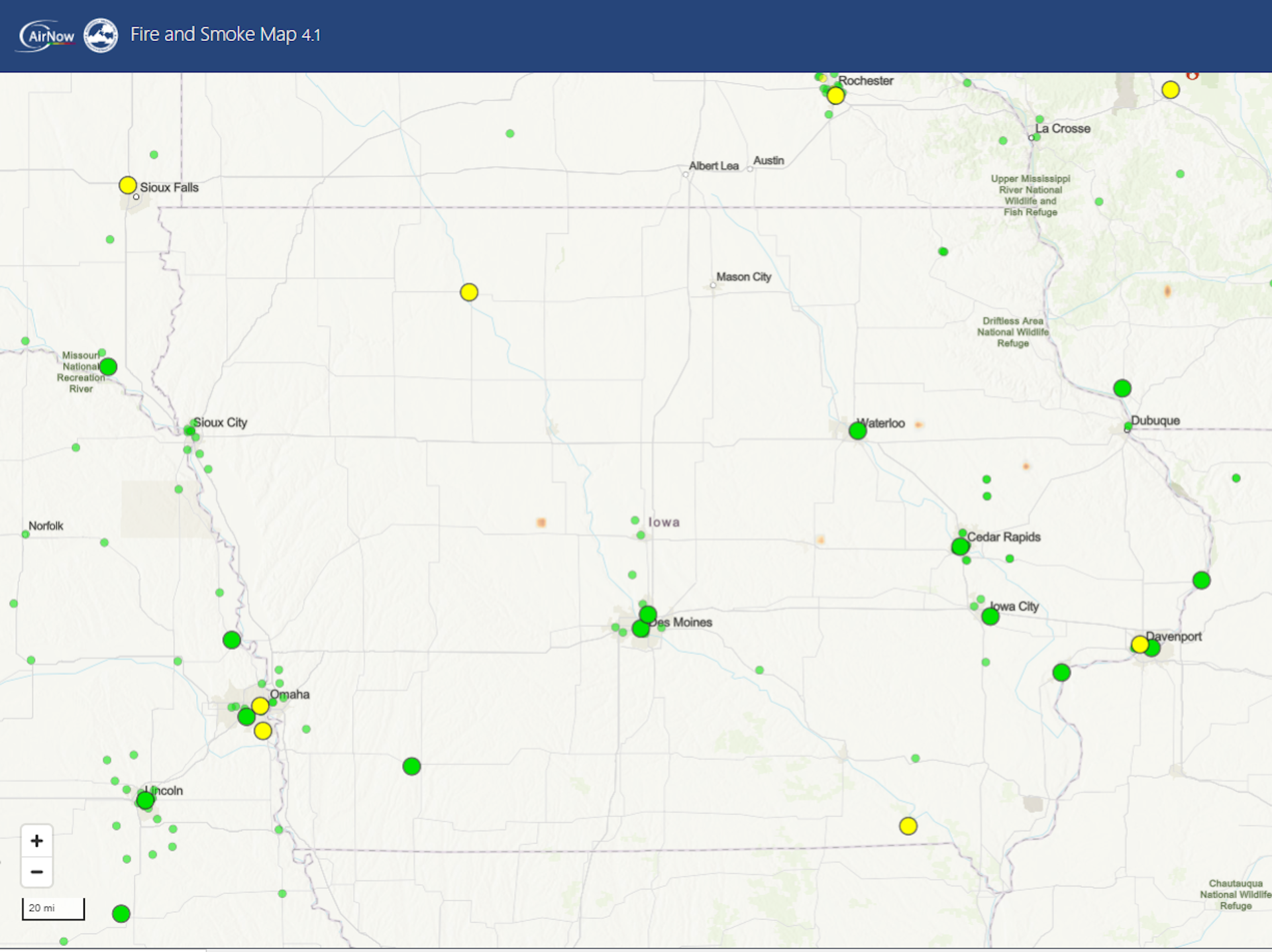
That’s a big jump from relying on ground-based air quality monitors, which may be hundreds of miles apart. Iowa, for example, had about 50 air quality monitors reporting data on a recent day for a state that covers 56,273 square miles. Most of those monitors were clustered around its largest cities.
NOAA’s AerosolWatch tool currently provides a near-real-time stream of wildfire smoke images from its GOES-R satellites, and the agency plans to incorporate TEMPO’s height data. A prototype of this system from my team’s NASA-supported research project on fire and air quality, called FireAQ, shows how users can zoom in to the neighborhood level to see how high the smoke plume is, however the prototype is currently only updated once a day, so the data is delayed, and it isn’t able to provide smoke height data where clouds are also overhead.
While air quality in most of the U.S. improved between 2000 and 2020, thanks to stricter emissions regulations on vehicles and power plants, wildfires have reversed that trend in parts of the western U.S. Research has found that wildfire smoke has effectively erased nearly two decades of air quality progress there.
Our advances in smoke monitoring mark a new era in air quality forecasting, offering more accurate and timely information to better protect public health in the face of these escalating wildfire threats.
Prof. Wang’s group have been supported from NOAA, NASA, and Naval ONR to develop research algorithm to retrieve aerosol layer height. The compute codes of the research algorithm were shared with colleagues in NOAA.
Source: United Kingdom – Executive Government & Departments
Press release
Revolutionary city-scanning satellite from UK-France partnership set to transform climate monitoring
Millions of people worldwide are set to benefit from more accurate climate data as the groundbreaking MicroCarb satellite begins its journey to space.
MicroCarb launched from Europe’s Spaceport in French Guiana. Launch photo: ESA-CNES-ARIANESPACE/Optique vidéo du CSG–P. Piron
The MicroCarb mission, developed in partnership with France’s space agency CNES, will become Europe’s first dedicated carbon dioxide monitoring satellite, marking a major milestone in the global fight against climate change.
Successfully launched aboard a Vega-C rocket from Kourou, French Guiana this morning, MicroCarb will join the international greenhouse gas (GHG) virtual constellation of satellites, significantly enhancing global climate monitoring capabilities.
Backed by a £15 million investment from the UK Space Agency, the mission strengthens Britain’s position as a global leader in both climate science and space technology. MicroCarb will orbit 650km above Earth, using revolutionary city-scanning technology to map CO₂ emissions across urban areas at an unprecedented 2km x 2km resolution—a level of detail never before achieved from space. This capability is vital for understanding emissions from cities, which are responsible for over 70% of global CO₂ output.
UK Minister for Space, Sir Chris Bryant, said:
This groundbreaking mission is proof of what can be achieved when we harness the strength of Britain’s burgeoning space industry, together with our deep scientific expertise. Bolstered with £15 million UK Government backing, the MicroCarb satellite will overhaul our ability to track carbon emissions – supporting the clean energy mission that’s key to this Government’s Plan for Change.
It’s also further evidence of the value of our deep and unique relationship with France: a partnership which the Prime Minister reinforced, with President Macron, at the UK-France Summit earlier this month.
The satellite’s precise measurements will help verify climate targets and guide net zero strategies, providing governments with the data needed to track progress toward the Paris Agreement and develop effective carbon reduction policies.
Dr Paul Bate, Chief Executive of the UK Space Agency, said:
Satellites like MicroCarb are our eyes in the sky. Over half of the critical data we use to understand climate change comes from space, and MicroCarb’s successful launch is a major leap forward in our ability to track carbon emissions and absorption with unprecedented accuracy, from the world’s cities to its forests and oceans.
Backed by UK and French investment and expertise, it’s a proud moment for both our space sectors and a powerful example of international collaboration in action.
In addition to urban emissions, MicroCarb will monitor natural carbon sinks such as forests and oceans, enhancing scientific understanding of how much carbon is absorbed by the planet and where. This data will be essential for improving national carbon inventories and identifying new opportunities for carbon capture and storage (CCS).
MicroCarb will measure Solar Induced Fluorescence (SIF), a faint glow plants give off during photosynthesis. This helps scientists track how much carbon plants absorb, offering valuable insights into the carbon cycle, and supporting direct measurements of CO₂ in the atmosphere by helping to differentiate plant from anthropogenic CO₂ emissions.
UK scientists and industry have played a central role in the development and delivery of the MicroCarb mission. The National Physical Laboratory (NPL) provided the SI-traceable ground calibration facility to test the satellite’s performance before launch. NPL’s Paul Green is also working with the MicroCarb team to develop algorithms and quality metrics to ensure the accuracy of the data.
Thales Alenia Space in the UK were responsible for preparing Microcarb for launch and completed the satellite’s assembly, integration, and test activities at the Science and Technology Facilities Council’s RAL Space in Harwell. RAL Space also developed the pointing and calibration system that enables MicroCarb to take precise measurements at specific locations.
GMV UK, in collaboration with France’s Capgemini, is designing, implementing, and quality-assuring algorithms and operational processors for several of MicroCarb’s CO₂ data products, ensuring robust and reliable data delivery.
Working on the fairing for Vega-C flight VV27. Credit: ESA-CNES-ARIANESPACE/Optique vidéo du CSG–S. Martin
Professor Paul Palmer, from The National Centre for Earth Observation (NCEO) and the University of Edinburgh, is the UK lead for MicroCarb. He will translate the satellite’s CO₂ observations into detailed maps showing carbon absorption and emissions. Dr Rob Parker, also part of the NCEO team, is delivering the mission’s SIF retrieval algorithm, drawing on expertise from the University of Leicester.
Paul Palmer, UK lead for Microcarb said:
Currently, we are witnessing rapid and unprecedented changes in the global carbon cycle. MicroCarb will deliver SIF and atmospheric CO₂ data that are crucial for understanding those changes. It will also reinvigorate an aging virtual satellite constellation, providing high quality data to inform the next Global Stocktake of the Paris Agreement.
More broadly, MicroCarb exemplifies the world-class capabilities of UK science and engineering, working closely with our French colleagues.
UK scientists have worked closely with their French counterparts as key members of the Mission Advisory Group (MAG), playing a vital role in preparing for the mission and continuing their involvement during the Calibration-Validation phases after launch.
MicroCarb is part of a bilateral agreement signed in 2014, and renewed in 2021, between France and the UK, showcasing a strong collaboration in space programmes. The UK and France recently deepened their strategic partnership across space and security technologies, including with specific announcements in satellite communications and PNT.
As the world races to limit global warming to 1.5°C, MicroCarb represents a critical step forward in delivering the transparent, verifiable data needed to hold nations accountable and accelerate the transition to a low-carbon future. The first MicroCarb data products are expected to be released in roughly 1 year, offering insights into major urban emitters and the performance of natural carbon sinks. These findings will feed into international climate assessments and future satellite missions under the UK’s Earth observation roadmap.
Source: People’s Republic of China – State Council News
Liao Pinyi (2nd R)/Zhang Lejian (1st R) shake hands with Mael Cattoen (2nd L)/Lucas Renoir after the men’s doubles quarterfinal match of the badminton between Liao Pinyi/Zhang Lejian of China and Mael Cattoen/Lucas Renoir of France at the Rhine-Ruhr 2025 FISU World University Games in Muelheim, Germany, July 25, 2025. [Photo by Zhang Fan/Xinhua]
Source: People’s Republic of China – State Council News
Gold medalists Liu Yanxiu (2nd L, up) and Wang Yan (2nd R, up) of China, silver medalists Sonoda Waka (1st L, up)/ Funahashi Yuya (L, down) of Japan, and Nam Suhyeon (1st R, up)/Seo Mingi (R, down) of South Korea attend the awarding ceremony of the mixed recurve team gold medal match of archery between China and Japan at the Rhine-Ruhr 2025 FISU World University Games in Essen, Germany, July 25, 2025. [Xinhua/Lian Yi]
Source: People’s Republic of China in Russian – People’s Republic of China in Russian –
An important disclaimer is at the bottom of this article.
Source: People’s Republic of China – State Council News
ZHENGZHOU, July 26 (Xinhua) — Young people in the Shanghai Cooperation Organization (SCO) member states are becoming a key driver for the organization’s development, contributing to strengthening mutual understanding, promoting innovation and shaping the region’s common future.
During the SCO Media and Think Tank Summit in Zhengzhou, capital of Henan Province, central China, guests and youth from SCO member states with different cultural backgrounds gathered to discuss the role of youth in advancing the development of the SCO, and to contribute new ideas and solutions to promote harmonious coexistence and common development among various civilizations.
On July 24, the main campus of Zhengzhou University hosted a youth salon as part of the SCO Media and Think Tank Summit. About a hundred guests, teachers and young students from China and abroad gathered under the theme “SCO Youth – Youth Power and Exchanges among Civilizations” to conduct an in-depth dialogue and jointly paint a new picture of exchange and cooperation.
At the beginning of the event, participants were introduced to Chinese intangible cultural heritage including calligraphy, lacquer fans and printmaking, experiencing the unique charm of traditional Chinese culture.
Speaking at the opening ceremony of the youth salon, Yang Guang, an official from the Henan Provincial Education Department, expressed the hope that young friends from the SCO countries will become storytellers who enhance mutual understanding among peoples, practitioners of mutual learning, and explorers of innovative cooperation. He called on them to seize the opportunities of digital economy development, jointly plan the prospects of innovative cooperation, and transform the creative energy of SCO youth into a powerful driving force for regional development.
Leading researcher of the International Institute of Central Asia in Uzbekistan Shavkat Alimbekov in his speech highlighted the topic of cooperation of SCO youth in the field of innovation in the digital era. He noted that this topic not only reflects the desire of SCO member countries to deepen cooperation in the scientific and technical sphere, but also emphasizes the key role of the younger generation in shaping a sustainable and prosperous future for the region.
According to him, digitalization and the introduction of advanced technologies create unique opportunities for sustainable development, solving socio-economic problems and strengthening ties between the SCO countries. Young people, as the main driver of progress, have the necessary knowledge, creative thinking and ambitions to implement innovative projects that can change for the better both individual communities and the entire SCO space.
During the dialogue at the salon, participants discussed the topics: “How can media and think tanks help young people tell their countries’ stories”, “Education and career in an intercultural perspective” and “Innovative cooperation of SCO youth in the digital era”. Media representatives, foreign and Chinese students shared ideas and practical experiences in the field of intercultural communication, application of digital technologies and innovative cooperation, demonstrating the wisdom, energy and responsibility of SCO youth.
The event created a platform for exchanging views and strengthening friendship among SCO youth, exploring practical ways of exchange between civilizations from a youth perspective and bringing powerful “youth energy” to regional cooperation.
On the sidelines of the SCO Media and Think Tank Summit, participants also placed high hopes on the role of youth in advancing the development of the SCO.
Deputy Editor-in-Chief of the media group “Russia Today” Dmitry Gornostaev emphasized that it is necessary to hold separate events during each media summit and invite young journalists, political scientists, and students to them.
Pavel Negoitsa, CEO of Rossiyskaya Gazeta, noted that digital technologies are an area of new competition. Russia and China are actively developing their own information platforms, creating sovereign Internet environments and digital identification mechanisms. Young people are ahead of everyone here. That is why it is necessary to develop youth media initiatives within the SCO, involve students, bloggers and young journalists in joint projects. This will allow us to form a new generation of leaders in digital technologies and public opinion, aimed at creation, not conflict. -0-
Please note: This information is raw content obtained directly from the source of the information. It is an accurate report of what the source claims and does not necessarily reflect the position of MIL-OSI or its clients.
The PHD Chamber of Commerce and Industry (PHDCCI) hosted its 14th International Heritage Tourism Conclave on July 25, at the majestic Lukshmi Villas Palace in Vadodara, in collaboration with the Ministry of Tourism, Government of India, Gujarat Tourism, Delhi Tourism, IndiGo, and IRCTC. Themed “Cherishing Heritage”, the event served as a dynamic platform for dialogue and advocacy to advance heritage-led tourism in India.
The conclave brought together policymakers, royal dignitaries, diplomats, conservation architects, tourism professionals, food historians, and cultural custodians to explore how India’s rich heritage can drive economic revitalization, community development, and cultural preservation. Rajender Kumar, Secretary of Tourism, Civil Aviation, Devasthanam Management & Pilgrimage, Government of Gujarat, inaugurated the event, highlighting Gujarat’s vision for inclusive heritage tourism. “We are not only restoring monuments but also ensuring direct benefits to local communities through jobs, infrastructure, and cultural pride,” he stated.
His Highness Samarjitsinh Gaekwad, Maharaja of Baroda, emphasized the need for heritage to remain relevant for future generations, saying, “Heritage must live on through connection with future generations, not just nostalgia.” Mohamed Farouk, Regional Director of India Tourism Mumbai, underscored the Ministry of Tourism’s commitment through initiatives like Swadesh Darshan 2.0 and PRASHAD, which connect destinations through cuisine, folklore, crafts, and festivals.
Rajan Sehgal, Co-Chair of PHDCCI’s Tourism Committee, delivered the theme address, stating, “Heritage tourism is about identity, economy, and empowerment. Our aim is to catalyze policy innovation and foster public-private partnerships.” The event commenced with a ceremonial Saraswati Vandana performed by students of Maharaja Sayajirao University, setting a cultural tone, followed by the launch of the PHDCCI-KPMG Heritage Tourism Report, which emphasized the role of public-private partnerships in revitalizing heritage assets.
Discussions covered a range of topics, including Gujarat’s community-centric model, which focuses on artisan engagement and adaptive reuse of built heritage. The Shekhawati legacy session addressed challenges and incentives for private heritage owners, while a culinary tourism segment, featuring Prof. Pushpesh Pant and renowned chefs, highlighted food as a cultural and tourism asset. A traditional Gujarati lunch, “Bapor nu Bhojan,” curated by Chef Pritesh Raut, showcased Gujarat’s culinary heritage.
A case study on Champaner-Pavagadh, presented by Dr. Amita Sinha, focused on community tourism and repositioning UNESCO sites. The role of women as cultural custodians was emphasized by HH Radhikaraje Gaekwad and HH Kadambaridevi Jadeja, who called for support for women-led tourism ventures. Sessions on architecture and storytelling advocated for the use of technology and inclusive narratives to engage younger audiences, while heritage transport discussions highlighted vintage mobility as a unique tourism experience, urging restoration grants.
The conclave facilitated over 25 B2B meetings, connecting tourism boards, hospitality leaders, and cultural entrepreneurs to foster cross-sector collaborations. A curated contemporary art showcase and a guided heritage walk of Lukshmi Villas Palace provided immersive experiences for attendees.
Source: People’s Republic of China – State Council News
He Xiang of China competes on the parallel bars during the men’s all-around final of artistic gymnastics at the Rhine-Ruhr 2025 FISU World University Games in Essen, Germany, July 25, 2025. [Xinhua/Hu Xingyu]
The Australian Government has appointed Professor Wesley Enoch AM as Chair of the Australia Council Board of Creative Australia for a 4-year term.
The Australia Council Board provides leadership to Creative Australia – the Government’s principal arts investment and advisory body, championing creativity to benefit all Australians.
Professor Enoch has been Deputy Chair since August 2023 and has led the Board as Acting Chair since Robert Morgan’s retirement in May.
As well as being the first practising artist, he’s also the first First Nations person to hold the position.
Minister for the Arts, Tony Burke, said Professor Enoch’s appointment would ensure Creative Australia can deliver for our arts sector.
“Wesley has been instrumental during the transformation of Creative Australia and delivering on Creative Australia’s commitments under the National Cultural Policy –Revive.
His wealth of experience as an industry leader and his knowledge of Australia’s creative sector will provide the Board with valuable leadership.”
“I’d also like to again thank Robert for his years of service to the Board and dedication to championing the arts.”
Professor Wesley Enoch is a proud Quandamooka man from Minjerribah, an internationally acclaimed playwright and artistic director.
Professor Enoch has written and directed iconic Indigenous productions includingThe 7 Stages of Grieving, Black Medea andThe Story of The Miracles at Cookie’s Table. He has also directed productions ofThe Sapphires, Black Diggers, I am Eora, The Man From Mukinupin, Yibiyung, Parramatta Girls andBlack Cockatoo.
Professor Enoch has been Professor of Indigenous Practice, Creative Industries at Queensland University of Technology since 2021. He leads the national conversation on the place of Indigenous Australia within the creative industries through his unique First Nations perspective on learning, teaching and research, fostering career pathways and opportunities for students and professionals. He was also the Artistic Director of the Sydney Festival from 2017 to 2020 and was previously the Artistic Director at Kooemba Jdarra Indigenous Performing Arts and the Ilbijerri Aboriginal Torres Strait Islander Theatre Co-operative.
Source: Australian Civil Aviation Safety Authority
The Albanese Government has refreshed the membership of the Northern Australia Indigenous Reference Group (IRG), which is a key advisory body on boosting economic and social prosperity for First Nations people across the north.
Deputy Vice-Chancellor of James Cook University, Professor Martin Nakata, has been appointed the new IRG chair. Professor Nakata has more than 30 years of experience in Indigenous education, research and community engagement.
Other new appointments are:
Mr Damien Djerrkura (NT), CEO of the North East Arnhem Land Aboriginal Corporation
Ms Alinta McGuire (NT), Director of Impact & Innovation at Impact North
They will serve on the IRG alongside returning members:
Mr Troy Fraser (Qld), CEO of Doomadgee Aboriginal Corporation
Ms Nini Mills (WA), CEO of Nyamba Buru Yawuru
Ms Flora Warrior (Qld), Principal Consultant of Saltwater Blue Consultancy Services
The IRG reports directly to the Minister for Northern Australia Madeleine King and Minister for Indigenous Australians Senator Malarndirri McCarthy and provides practical advice to support the Government’s refreshed northern Australia agenda.
Minister King said she looked forward to working with the new IRG to help achieve tangible outcomes for First Nations Australians.
“The IRG is crucial to delivering on our commitments to closing the gap, as well as the Northern Australia Action Plan,” Minister King said.
“The IRG brings together a diverse group of skilled professionals from across the north with expertise in higher education, health, finance, economic community development, banking, mining, training and development, agriculture and the not-for-profit sectors.”
Minister McCarthy said the IRG is part of the Albanese Government’s commitment to First Nations economic empowerment, in partnership with First Nations people and communities.
“The Northern Australia Indigenous Reference Group provides practical knowledge and advice to build the economic wellbeing of First Nations Australians, reflecting the ambitions and priorities of our communities,” Minister McCarthy said.
“I look forward to working with the Northern Australia Indigenous Reference Group to strengthen the economic and social prosperity of First Nations people in northern Australia.”
The Albanese Government thanks departing chair Mr Colin Saltmere, and outgoing members Mr Peter Jeffries, Ms Gillian Mailman, Mr Jerome Cubillo and Ms Tara Craigie and thanks them for their contribution.
Source: People’s Republic of China – State Council News
Every time Hu Jiansheng watched people stop beneath the towering wind turbines, marveling at their massive size, pride surged through him. He was one of the builders of the Oumatingga wind power farm, one of the highest in the world with an average altitude of 4,600 meters, in southwest China’s Xizang Autonomous Region, the roof of the world.
As deputy general manager of the Xizang branch of CHN Energy Investment Group, Hu dedicated three years to this project in the city of Nagqu.
The Oumatingga wind power project, comprising 25 turbines with a total installed capacity of 100 megawatts, stands as a landmark achievement that demonstrates the region’s strong commitment to renewable energy development, particularly in photovoltaic and wind power.
“The project generates 227 million kWh of electricity annually, saving around 70,000 tonnes of standard coal and reducing carbon dioxide emissions by 120,000 tonnes, making a significant contribution to local energy supply,” the 47-year-old said.
“During the bitter winter months, we constantly struggled with electricity shortages that frequently led to power outages,” recalled Ngawang Jampa, 31, a resident from Nagqu’s Seni District. His family often resorted to burning cow dung for heating in the middle of the night.
However, since the wind power station commenced operations in January 2024, such hardships have become a thing of the past.
Today, every household in Seni District enjoys reliable electric heating, and power interruptions — even in winter — are now exceptionally rare.
The construction of this wind power project, however, was fraught with challenges.
“It was an extraordinarily difficult mission,” he said, explaining that altitude sickness and severe weather made the project seem nearly impossible at times.
Locals often joke that Nagqu has only two seasons: winter and “almost winter.”
“We’ve seen snowfall as late as May. This limited our construction window to just five months,” Hu explained.
One particularly harrowing incident occurred during turbine installation. “The hailstones striking my face felt like rocks, and it hurt so much,” Hu recalled.
“Then the snow began falling, and I became completely numb from the cold.” Amid these brutal conditions, the wind turbine nacelle hung precariously in the air, with only several workers struggling to secure the swaying machinery by tightening ropes against the howling gale.
“After a while, company workers, local villagers, and township government staff all came together to help fasten the ropes,” said Hu, with tears in his eyes, adding that when the hailstorm finally passed, he saw everyone was covered in snow, resembling a team of snowmen standing together on the vast grassland.
During the grid connection ceremony, while everyone gathered in the control center, Hu chose to stand alone at the wind farm. “Watching the turbines turn and hearing the blades spin felt amazing. I could finally allow myself to relax at that moment,” he said.
Wind power has injected vitality into Xizang’s clean energy development, serving as a vital complement during low-output periods of photovoltaic and hydropower generation, according to Shi Lei, a professor at the School of Ecology and Environment, Renmin University of China.
Official statistics showed that, by the end of 2024, more than 99 percent of Xizang’s power generation came from clean energy sources, the highest rate among all Chinese regions. Xizang now has a comprehensive energy system with hydropower as the main source, complemented by geothermal, wind and solar energy, among others.
ER Report: Here is a summary of significant articles published on EveningReport.nz on July 26, 2025.
Gaza: Global community must act amid reports of starvation of journalists, says IPI By Jamie Wiseman The International Press Institute (IPI) has joined calls for urgent action to halt the unfolding humanitarian crisis in Gaza as global news organisations warn that their journalists there are experiencing starvation. Israel must immediately allow life-saving food aid to reach journalists and other civilians in Gaza, IPI said in a statement today.
Caitlin Johnstone: It’s a genocide, but it’s also so much more than that Report by Dr David Robie – Café Pacific. – COMMENTARY: By Caitlin Johnstone The mass atrocity in Gaza is a genocide, obviously, and is an undisguised ethnic cleansing operation. But it’s also a lot more than that. It’s an experiment — to see what kinds of abuses the public will accept without causing significant disruption
Leaked document reveals proposed law revisions in NZ, as Western defence of Zionist genocide threatens Pacific SPECIAL REPORT: By Mick Hall A leaked document has revealed secretive plans to revise terror laws in New Zealand so that people can be charged over statements deemed to constitute material support for a proscribed organisation. It shows the government also wants to widen the criteria for proscribing organisations to include groups that are judged
Ceasefire talks collapse – what does that mean for the humanitarian catastrophe in Gaza? Source: The Conversation (Au and NZ) – By Ali Mamouri, Research Fellow, Middle East Studies, Deakin University Efforts to end the relentless siege of Gaza have been set back by the abrupt end to peace talks in Qatar. Both the United States and Israel have withdrawn their negotiating teams, accusing Hamas of a “lack of
As oceans warm, tropical fish are moving south. New friendships may be helping them survive Source: The Conversation (Au and NZ) – By Angus Mitchell, Postdoctoral Researcher in Marine Ecology, University of Adelaide Angus Mitchell When you think about climate change in our oceans, you may picture coral bleaching, melting sea ice, or extreme weather events. But beneath the ocean’s surface, another quiet shift is underway. Australia’s tropical fish are
As oceans warm, tropical fish are moving south. New friendships may be helping them survive Source: The Conversation (Au and NZ) – By Angus Mitchell, Postdoctoral Researcher in Marine Ecology, University of Adelaide Angus Mitchell When you think about climate change in our oceans, you may picture coral bleaching, melting sea ice, or extreme weather events. But beneath the ocean’s surface, another quiet shift is underway. Australia’s tropical fish are
What is chikungunya virus, and should we be worried about it in Australia? Source: The Conversation (Au and NZ) – By Jacqueline Stephens, Associate Professor in Public Health, Flinders University Noppharat05081977/Getty Images This week, the World Health Organization (WHO) raised concerns about a surge in the number of cases of a mosquito-borne viral infection called chikungunya. Diana Rojas Alvarez, a medical officer at the WHO, highlighted an outbreak
What makes a song ‘Australian’? Triple J’s Hottest 100 reignites a bigger question of national identity Source: The Conversation (Au and NZ) – By Catherine Strong, Associate Professor, Music Industry, RMIT University On July 26, Triple J will broadcast the Hottest 100 Australian Songs, as voted by the public. While predictions for winners and even preemptive complaining about the shortlist are taking up column space and social media posts, there is
ER Report: Here is a summary of significant articles published on EveningReport.nz on July 26, 2025.
Gaza: Global community must act amid reports of starvation of journalists, says IPI By Jamie Wiseman The International Press Institute (IPI) has joined calls for urgent action to halt the unfolding humanitarian crisis in Gaza as global news organisations warn that their journalists there are experiencing starvation. Israel must immediately allow life-saving food aid to reach journalists and other civilians in Gaza, IPI said in a statement today.
Caitlin Johnstone: It’s a genocide, but it’s also so much more than that Report by Dr David Robie – Café Pacific. – COMMENTARY: By Caitlin Johnstone The mass atrocity in Gaza is a genocide, obviously, and is an undisguised ethnic cleansing operation. But it’s also a lot more than that. It’s an experiment — to see what kinds of abuses the public will accept without causing significant disruption
Leaked document reveals proposed law revisions in NZ, as Western defence of Zionist genocide threatens Pacific SPECIAL REPORT: By Mick Hall A leaked document has revealed secretive plans to revise terror laws in New Zealand so that people can be charged over statements deemed to constitute material support for a proscribed organisation. It shows the government also wants to widen the criteria for proscribing organisations to include groups that are judged
Ceasefire talks collapse – what does that mean for the humanitarian catastrophe in Gaza? Source: The Conversation (Au and NZ) – By Ali Mamouri, Research Fellow, Middle East Studies, Deakin University Efforts to end the relentless siege of Gaza have been set back by the abrupt end to peace talks in Qatar. Both the United States and Israel have withdrawn their negotiating teams, accusing Hamas of a “lack of
As oceans warm, tropical fish are moving south. New friendships may be helping them survive Source: The Conversation (Au and NZ) – By Angus Mitchell, Postdoctoral Researcher in Marine Ecology, University of Adelaide Angus Mitchell When you think about climate change in our oceans, you may picture coral bleaching, melting sea ice, or extreme weather events. But beneath the ocean’s surface, another quiet shift is underway. Australia’s tropical fish are
As oceans warm, tropical fish are moving south. New friendships may be helping them survive Source: The Conversation (Au and NZ) – By Angus Mitchell, Postdoctoral Researcher in Marine Ecology, University of Adelaide Angus Mitchell When you think about climate change in our oceans, you may picture coral bleaching, melting sea ice, or extreme weather events. But beneath the ocean’s surface, another quiet shift is underway. Australia’s tropical fish are
What is chikungunya virus, and should we be worried about it in Australia? Source: The Conversation (Au and NZ) – By Jacqueline Stephens, Associate Professor in Public Health, Flinders University Noppharat05081977/Getty Images This week, the World Health Organization (WHO) raised concerns about a surge in the number of cases of a mosquito-borne viral infection called chikungunya. Diana Rojas Alvarez, a medical officer at the WHO, highlighted an outbreak
What makes a song ‘Australian’? Triple J’s Hottest 100 reignites a bigger question of national identity Source: The Conversation (Au and NZ) – By Catherine Strong, Associate Professor, Music Industry, RMIT University On July 26, Triple J will broadcast the Hottest 100 Australian Songs, as voted by the public. While predictions for winners and even preemptive complaining about the shortlist are taking up column space and social media posts, there is
Source: People’s Republic of China – State Council News
The Shanghai Cooperation Organization (SCO) Media and Think Tank Summit held its plenary session in Zhengzhou on Friday, emphasizing the importance of upholding the Shanghai Spirit and uniting the media and academia to advance exchange and cooperation within the SCO framework.
The ongoing SCO Media and Think Tank Summit, co-hosted by Xinhua, the Chinese Academy of Social Sciences (CASS) and the Henan provincial government under the guidance of the State Council Information Office, is taking place in the capital of central China’s Henan Province, beginning on Wednesday and ending on Sunday.
Themed “Upholding the Shanghai Spirit to Build a More Beautiful Home,” the event gathered more than 400 representatives of nearly 200 media outlets, think tanks and government agencies from SCO member states, observer states and dialogue partners, as well as international and regional organizations.
Addressing the plenary session, Mo Gaoyi, deputy head of the Publicity Department of the Communist Party of China Central Committee and director of the State Council Information Office, called on all parties to actively promote the Shanghai Spirit.
As the SCO Summit in Tianjin approaches, the gathering of media and think tank representatives is of great significance to building a closer SCO community with a shared future, Mo said.
Fu Hua, president of Xinhua News Agency, expressed the readiness to fully leverage the advantages of media and think tanks to work with all parties in alignment with the SCO’s common aspiration for joint development.
By highlighting areas of shared interest and common concern, presenting a panoramic and multidimensional narrative of how SCO countries are joining forces in the new era, Xinhua aims to contribute wisdom and strength to building a closer SCO community with a shared future, he said.
This photo taken on July 25, 2025 shows a scene at the plenary session of the Shanghai Cooperation Organization (SCO) Media and Think Tank Summit in Zhengzhou, capital of central China’s Henan Province. (Xinhua/Zhu Xiang)
Guided By Shanghai Spirit
The Shanghai Spirit — the spirit of mutual trust, mutual benefits, equality, consultation, respect for the diversity of civilizations, and the pursuit of common development — has served as the guiding principle for SCO countries, and is seen as a core value driving the organization’s evolution into a model platform for multilateral cooperation grounded in mutual trust and equality.
Li Yonghui, a senior research fellow at the Institute of Russia, Eastern European and Central Asian Studies at the CASS, noted that Shanghai Spirit is the basis for political mutual trust, which is the SCO’s core competitive strength.
“By reshaping values, embedding institutional mechanisms, and promoting the sharing of outcomes, the Shanghai Spirit has transformed gaps in trust caused by historical, cultural, and systemic differences into dividends of cooperation,” Li said, adding that this serves as the driving force behind the SCO’s growing vitality and appeal.
Marina Dmitrieva, deputy director of the Institute of Asian Studies for Science and Innovation at Far Eastern Federal University, believes the Shanghai Spirit reveals itself in trust — beyond words.
“We are used to hearing that the 21st century is a century of clashes, but the example of the SCO proves the opposite: Where there is respect, there is no clash of civilizations; Where there is space to listen and be heard, we see differences as a resource, not a threat,” she said.
Such concepts have united SCO member states, and continue to attract new partners to the organization in pursuit of cooperation based on mutual respect, equality and shared creation, Dmitrieva said.
Indira Rana, deputy speaker of the House of Representatives of the Federal Parliament of Nepal, said that guided by the Shanghai Spirit, the SCO stands as a beacon of cooperation, friendship and regional integration.
“We believe that safeguarding peace today requires addressing contemporary, multifaceted challenges,” she said. “Only through dialogue, partnership and collective solutions can we ensure our common security and prosperity.”
A participant (R) of the Shanghai Cooperation Organization (SCO) Media and Think Tank Summit tries traditional Chinese attire at the venue of the summit in Zhengzhou, central China’s Henan Province, July 25, 2025. (Xinhua/Bai Xueqi)
Vital Role of Media, Think Tanks
Under the Shanghai Spirit, think tanks and the media play crucial roles and offer strong potential in promoting exchange and unity within the SCO, participants agreed and stressed repeatedly at the summit.
The SCO Media and Think Tank Summit Zhengzhou Consensus, released at the summit on Friday, highlighted the roles of SCO media and think tanks as a bridge and link between countries, contributing wisdom and strength toward advancing peace, stability, prosperity and development both regionally and globally.
In the consensus, the representatives also called for joint efforts to gather wisdom and strength of multiple entities such as governments, businesses, academic institutions and the civil society to advance inclusive coexistence of different civilizations and deepen mutual understanding and affinity among people of all countries.
“By facilitating open dialogue, promoting cultural understanding and presenting diverse perspectives, we can counteract misinformation and build stronger bonds between our nations,” said Ros Thansan, secretary of state for the Ministry of Information of Cambodia.
Muhammad Akmal Khan, president of Internews Pakistan, believes that the role of the media — especially in SCO countries — is to transform the potential of people-to-people exchange in building empathy and revealing shared aspirations across nations into a tangible reality.
He therefore suggested measures to support regular exchanges between young content creators across SCO countries, as well as the co-production of documentaries about SCO countries’ cultures, and the translation of media content into different languages from those countries.
Dmitry Gornostaev, deputy editor-in-chief of Russia’s Rossiya Segodnya Media Group, noted the significance of the participation of young journalists and scholars in cooperation under the SCO framework.
He suggested the establishment of dedicated platforms that young people in the media and academia sectors of SCO countries can use to join in discussions and engage in decision-making.
“Separate youth forums could be held where young participants discuss pressing issues, and even work together to draft documents,” he added.
“We fully understand that, as journalists, we shape the information agenda,” said Iryna Akulovich, director general of the Belarusian Telegraph Agency. She emphasized the importance of “changing the narrative” to place increased focus on stories from SCO countries.
“This is where think tanks and the media can truly make a difference,” she said. “When we meet and interact, we are the ones building the future of our nations.”
Source: People’s Republic of China – State Council News
China defeated the United States 81-69 in the women’s basketball final on Friday at the FISU World University Games.
China delivered a well-rounded performance, with four players scoring in double digits. Small forward Chen Yujie shot eight of 15 from the field to score 19 points while power forward Tang Ziting buried four 3-pointers out of six attempts to add 16 points.
“We told the players to play as they like and not to have any burden mentally,” said Chinese coach Zhao Xuetong.
“We had already achieved what we expected before the Games, so I just told the players to enjoy the final and that they had nothing to lose,” added Zhao.
For the United States, power forward Deyona Gaston had a game-high 21 points and point guard Sidney Love notched 15 points.
“China was very good. In the first half we had the upper hand, and I thought we got them out of their defense pretty well,” said U.S. coach Krista Lea Gerlich. “In the second half, they increased their pressure on the zone, and they were mixing it up, and it was really confusing to our kids.”
China also claimed another gold medal in archery, as Liu Yanxiu and Wang Yan defeated Japan’s Waka Sonoda and Yuya Funahashi 6-2 in the recurve mixed team final.
Three gold medals were decided in the track and field. Finland captured its first gold in the meet from the women’s 100m hurdles as Saara Keskitalo finished first in 12.88 seconds, followed by Hungary’s Anna Toth (12.88), who was just a tiny 0.005s behind. Poland’s Alicja Sielska (12.95) came third.
Belgium also secured its first gold in the Games as Elien Vekemans overcame a height of 4.60 meters in women’s pole vault. Norway’s Kitty Augusta Friele Faye was 10 centimeters lower than the winner and Canada’s Rachel Grenke recorded a personal best of 4.35m in third.
Simon Wieland of Switzerland tossed his season best of 79.33 meters to win the men’s javeline throw, followed by Germany’s Nick Thumm (78.47) and Finland’s Topias Yki Eerik Laine (75.96).
Team USA continues to lead the medal table after Day 9 of competition with 28 gold, 22 silver, and 26 bronze medals. China remains second with 23 gold, 21 silver, and 13 bronze and Japan is third with 22 gold, 13 silver, and 20 bronze.
Source: People’s Republic of China in Russian – People’s Republic of China in Russian –
An important disclaimer is at the bottom of this article.
Source: People’s Republic of China – State Council News
HOUSTON, July 25 (Xinhua) — The gunman who shot and killed one person and wounded another at a dormitory at the University of New Mexico (UNM) in the U.S. city of Albuquerque early Friday is still at large, authorities said.
Police warned that the shooter may still be on campus.
It is currently unclear whether the victims were students at the university.
Following the shooting, UNM said on social media that its main campus was closed “out of an abundance of caution,” urging students to remain indoors.
UNM, which is a state educational institution, has about 22 thousand students. –0–
Please note: This information is raw content obtained directly from the source of the information. It is an accurate report of what the source claims and does not necessarily reflect the position of MIL-OSI or its clients.
overnor Kathy Hochul today announced $10 million to support the Ralph C. Wilson, Jr. Centennial Park’s Coastal Shoreline Project in the City of Buffalo. The funding from the $4.2 billion Clean Water, Clean Air and Green Jobs Environmental Bond Act is part of a $65 million initiative to enhance the resiliency of the Lake Erie shoreline by replacing an aging 100-year-old seawall and naturalizing the shoreline along the park property.
“Enhancing the Ralph Wilson Park is just the type of project New York voters envisioned when they overwhelmingly supported the $4.2 billion Environmental Bond Act in 2022,” Governor Hochul said. “This park restoration project enhances accessible recreational opportunities just steps away from downtown Buffalo while advancing a more sustainable and resilient future for the Lake Erie shoreline. By bolstering and naturalizing the urban shoreline, we’re helping protect this special area from high water, reducing flooding from extreme weather events driven by climate change and enhancing valuable shoreline fish and wildlife habitat.”
Governor Hochul first announced the transformation of the Ralph C. Wilson, Jr. Centennial Park property in 2022. The waterfront location on the east end of Lake Erie at its confluence with the Niagara River provides desirable lake access but is also subject to frequent and damaging wind, ice, and waves. The U.S. Army Corps of Engineers’ condition assessment of the seawall in June 2011 showed significant deterioration requiring repairs to structural failures along this stretch of shoreline.
In 2018, the Ralph C. Wilson, Jr. Foundation committed $50 million to support the City of Buffalo and surrounding community to transform the former LaSalle Park into a world-class destination. The Wilson Foundation provided additional funding to launch the Imagine LaSalleinitiative, a multi-year, community-driven effort to explore and develop a community vision for the park as it undergoes a $110 million transformation. The park’s name honors the legacy of the late Buffalo Bills owner, American veteran, entrepreneur and philanthropist, Ralph C. Wilson, Jr.
The City of Buffalo, University at Buffalo Regional Institute, and community engagement group Imagine LaSalle conducted outreach and created a redevelopment plan for Ralph Wilson Park that includes replacement of part of the degraded sea wall with a resilient softened shoreline that will dissipate damaging wave energy, reduce flood risk, and create recreational waterfront access.
New York State is contributing $10 million in funding from the Environmental Bond Act, administered by the Department of Environmental Conservation (DEC) to support Phase II of the shoreline redevelopment, including the Blueway, at Ralph Wilson Park to rehabilitate a segment of the Lake Erie shoreline, replace the deteriorating seawall with a more resilient, graded revetment-based shoreline that reduces flooding of City infrastructure, provide waterfront access to car-top watercraft, and contribute to the larger efforts of the U.S. Environmental Protection Agency’s Great Lakes Restoration Initiative. This new resilient shoreline includes an armored natural slope that will restore habitat while protecting a revamped community gem. The park is a world class destination that serves neighborhoods, residents from Western New York, and beyond. The park features a new signature pedestrian bridge that spans I-90 and connects neighbors with a regional destination. The park builds on existing high value amenities such as the swimming pool, splash pad, skate park, and dog park and by adding new and revamped community assets which include: an active-imaginative play garden, soccer fields, baseball and softball diamonds, tennis courts, playground areas with custom equipment, picnic shelters and concession stands, and miles of pedestrian and bike paths.
New York State Department of Environmental Conservation Commissioner Amanda Lefton said, “As climate change and extreme weather continue to impact our shorelines, the $4.2 billion Clean Water, Clean Air and Green Jobs Environmental Bond Act is one of the most critical tools we have to support projects like the shoreline restoration at Ralph Wilson Park in Buffalo. This investment is helping New York State safeguard communities from extreme weather, protect natural resources and drinking water, and ensure people have places to explore nature and public recreation. Under Governor Hochul’s sustained leadership and generational investments, New York State is committed to building a healthier, more sustainable, and resilient future for every New Yorker.”
Empire State Development President, CEO and Commissioner Hope Knight said,“Empire State Development is pleased to support the Ralph C. Wilson Centennial Park project through the Buffalo Niagara Waterkeeper by funding paddlesport launches to provide safe access to the water. The excitement for this project is building as we work to create a thriving waterfront that attracts visitors, boosts tourism, and generates economic activity.”
Environmental Facilities Corporation President and CEO Maureen A. Coleman said, “We applaud this latest investment in the Ralph C. Wilson, Jr. Centennial Park shoreline project, which builds on EFC’s earlier support of nearly $2.5 million through our Green Innovation Grant Program. This transformational project is a model for how Environmental Bond Act funding can strengthen shoreline resiliency, improve water quality, and reconnect communities to their natural waterfronts. We’re proud of the continued partnership on projects like this that deliver long-lasting benefits for Buffalo and the region.”
In addition to the U.S. Army Corps of Engineers, the Ralph C. Wilson, Jr. Foundation, Buffalo Niagara Waterkeeper, and Empire State Development are supporting the current phase of shoreline restoration. Other contributing partners to previous phases of the project include the Great Lakes Commission, National Oceanic and Atmospheric Administration, New York State Environmental Facilities Corporation, Dormitory of the State of New York, City of Buffalo, National Fish and Wildlife Foundation, and the Western New York Land Conservancy.
State Senator Ryan said, “When New Yorkers voted to pass the Environmental Bond Act, we took a massive step forward to promote climate resiliency, insulate communities across the state from the impacts of climate change, and invest in the future of parks and green spaces across New York. This project is a natural fit for the bond act’s shoreline restoration funding. This funding will help protect the park and the pumping station for decades to come, which is essential for the future of the City of Buffalo. I thank Governor Hochul and the DEC for recognizing this critical need.”
Assembly Majority Leader Crystal Peoples-Stokes said, “I applaud Governor Hochul and DEC for their $10 million investment in Niagara River shoreline restoration with the seawall replacement. This investment will protect and complement the continued redevelopment of Ralph C. Wilson Centennial Park, the shoreline aquatic habitat, and recreational water access. Both investments will be appreciated by generations of Buffalonians to come.”
Assemblymember Jonathan Rivera said, “This investment and commitment to the Coastal Shoreline Project at Ralph C. Wilson Jr. Centennial Park will ensure that this treasured community space is both environmentally resilient and accessible for generations to come. This project strengthens our shoreline, restores natural habitats, and enhances a beloved public destination that connects Buffalo’s neighborhoods both to its waterfront and to each other. This is a win for sustainability, recreation, and regional pride, and I’m proud to continue building on New York State’s commitment to our region’s greatest natural assets.”
City of Buffalo Mayor Christopher P. Scanlon said, “Ralph Wilson Park represents a once-in-a-generation transformative investment in the future of Buffalo’s waterfront and in the quality of life for our residents. This $10 million investment through the Environmental Bond Act helps us build a more sustainable future by safeguarding critical infrastructure, enhancing natural ecosystems, and strengthening the long-term resiliency of our Lake Erie shoreline — all while honoring the community’s vision for a park that is inclusive, accessible, and connected to surrounding neighborhoods. I want to thank Governor Hochul, the New York State Department of Environmental Conservation, and the Ralph C. Wilson, Jr. Foundation for their partnership and shared commitment to making Buffalo a greener, stronger, and more connected city.”
Ralph C. Wilson, Jr. Foundation President & CEO David Egner said, “Throughout the Imagine LaSalle community engagement process, thousands of residents shared their hopes and concerns for the future of the park. As the Foundation joins with the City of Buffalo, State of New York and dozens of public and private partners to invest in the incredible transformation of Ralph Wilson Park into the community’s vision, it’s critical that we also address the safety and resiliency needs along the shoreline so the park can be enjoyed today, tomorrow and long into the future.”
Ralph Wilson Park Conservancy Executive Director Katie Campos said, “This funding shores up one of the most vital pieces of infrastructure in our city—and unlocks the next phase of a once-in-a-generation investment in Ralph Wilson Park. Thanks to Governor Hochul’s leadership and the support of the Environmental Bond Act, we are delivering on the community’s bold vision for a world-class, resilient, and welcoming waterfront park. This shoreline not only protects the park and our drinking water system—it makes the entire transformation possible.”
Buffalo Niagara Waterkeeper Executive Director Jill Jedlicka said, “Buffalo Niagara Waterkeeper has guided efforts in the region for decades in order to create living shorelines and a healthier environment, and we couldn’t be happier with the results and progress that has been made by all of the partners working on this project at Ralph Wilson Park. The vision has always been to create a more resilient waterfront in the face of climate change, to endure relentless Lake Erie seiche impacts, and to rehabilitate habitat for the fish and wildlife that can once again thrive here. Through collaboration and creativity, that vision is becoming a reality. Thank you to the Ralph Wilson Park Conservancy, the Ralph C. Wilson, Jr. Foundation, and state and federal partners including the National Oceanic and Atmospheric Administration and the New York State Department of Conservation, for collaborating on the transformation of this invaluable Great Lakes shoreline and community space.”
On Nov. 8, 2022, New Yorkers overwhelmingly approved the Environmental Bond Act ballot proposition to make $4.2 billion available for environmental and community projects. The Environmental Bond Act supports new and expanded projects across the state to safeguard drinking water sources, reduce pollution, and protect communities and natural resources from climate change. State agencies, local governments, and partners can access this historic funding to protect water quality, help communities adapt to climate change, improve resiliency, and create green jobs.
This investment is the latest step in Bond Act investments to enhance shoreline resiliency, encourage economic development, revitalize neighborhoods, and bolster recreational opportunities. In April, the Governor announced $60 million in Environmental Bond Act funding for the next round of Green Resiliency Grants to support vital stormwater management and resilient infrastructure projects in flood-prone communities across New York State. Applications for this program are due by Aug. 15, 2025. To learn more about resources available for resilient Bond Act-supported projects, visit environmentalbondact.ny.gov.
New York’s Commitment to Water Quality
New York State continues to increase its nation-leading investments in water infrastructure. With an additional $500 million for clean water infrastructure in the 2025-2026 enacted State Budget announced by Governor Hochul, New York will have invested a total of $6 billion in water infrastructure since 2017. The budget also maintains a strong commitment to environmental conservation with a $425 million Environmental Protection Fund (EPF). This funding bolsters a wide array of vital programs, including land acquisition for habitat and open space preservation, climate change mitigation and adaptation initiatives, and water quality improvement projects.
Source: United States Senator for Illinois Dick Durbin
July 25, 2025
The Senate Appropriations Committee passed Interior, Environment, & Related Agencies; and Transportation, Housing, & Urban Development, & Related Agencies government funding bills
SPRINGFIELD – U.S. Senate Democratic Whip Dick Durbin (D-IL), a member of the Senate Appropriations Committee, and U.S. Senator Tammy Duckworth (D-IL) announced that the Senate Appropriations Committee advanced a funding bill for Interior, Environment, and Related Agencies, as well as for Transportation, Housing and Urban Development, and Related Agencies for Fiscal Year 2026 (FY26). Durbin and Duckworth worked to secure various priorities for Illinois in the appropriations bills, both through Congressionally Directed Spending requests and through the programmatic appropriations process.
“It is the responsibility of Congress to fund our government programs and agencies through the appropriations process. Rather than rely on continuing resolutions, I hope that we can prioritize a true bipartisan process to pass these funding bills through the Senate in a timely process,” said Durbin. “While the Trump Administration continues to drain resources from critical programs, I will fight for the funding and support for the programs Illinoisans rely on.”
“Our state and our nation are stronger when we invest in our communities and families—and that’s what these bipartisan funding bills do,” Duckworth said. “Appropriating federal funding is the primary role of Congress, and it’s critical this responsibility remains in the legislative branch. I’m proud I was able to help secure critical support for projects throughout Illinois that help modernize our state’s infrastructure, clean up our water, improve accessibility and more.”
The two funding bills include the following Illinois priorities secured by Congressionally Directed Spending requests:
Interior, Environment, and Related Agencies
· City of Chester, Chester, Illinois. $1.2 million to the City of Chester to help fund the Route 150 water main replacement.
· City of Markham, Markham, Illinois. $1.5 million to the City of Markham to help fund water system infrastructure improvements.
· Infrastructure Improvements, Lockport, Illinois. $250,000 to the Bonnie Brae Forest Manor Sanitary District to fund water main infrastructure improvement projects.
· Lead Service Line Replacements, Chicago, Illinois. $2 million to the City of Chicago to replace more than 200 lead service lines. Chicago has more lead service lines than any other municipality in the country and the majority of properties in Chicago receive their water from lead service lines.
· Lead Service Line Replacements, Macomb, Illinois. $1 million to the City of Macomb to replace lead drinking water service lines in various locations throughout the City.
· PFAS Remediation, Rockford, Illinois: $1 million to Winnebago County to help fund water infrastructure upgrades to address PFAS contamination in Rockford.
· Stormwater and Flooding Mitigation Project, Carbondale, Illinois. $1.5 million for the City of Carbondale to replace storm sewer piping. The failing pipes cause frequent flooding during significant rain events and is also causing pavement failures on an arterial street that is heavily traveled.
· Wastewater Improvements, Paris, Illinois. $500,000 to the City of Paris to help fund wastewater treatment plant upgrades.
· Water Main Extension, Winnebago County, Illinois. $600,000 to Winnebago County to extend a water main to provide water to additional areas of the County.
· Water Main Improvements, Park Forest, Illinois. $1.45 million to the Village of Park Forest to replace the highest priority water main.
· Water Main Replacement, Springfield, Illinois. $900,000 to the City of Springfield to replace a water main on South Seventh Street in downtown Springfield. The water main was installed in 1931 and has had 27 breaks and is need of replacement. The main serves the historic downtown Springfield area, including Lincoln’s Home National Historic Site Visitor Center, the Illinois State Police Memorial Park, Springfield Clinic, and the Elijah Iles House.
· Well Reconstruction and Water Treatment, Machesney Park and Roscoe, Illinois. $1 million to North Park Public Water District for the reconstruction of Roscoe and Machesney Park’s well to accommodate PFAS treatment. This funding will ensure continued access to a reliable source of safe, plentiful, and affordable drinking water for the communities of Machesney Park and Roscoe in Winnebago County, Illinois.
Transportation, Housing and Urban Development, and Related Agencies
· Accessibility Upgrades, Chicago, Illinois. $750,000 to Boys & Girls Clubs of Chicago to help fund accessibility upgrades at the Boys and Girls Club True Value in Little Village.
· Affordable Housing, Edwardsville, Illinois. $1 million to Home First Housing to help expand affordable housing units in Edwardsville.
· Affordable Housing, Joliet, Illinois: $1 million to Volunteers of America Illinois to help fund the expansion of Hope Manor Village Joliet’s housing development initiative.
· Capital Improvements, Chicago, Illinois. $500,000 to Boys & Girls Clubs of Chicago to make capital improvements at the Bartlett J. McCartin Boys & Girls Club in the Bridgeport neighborhood of Chicago.
· City of Marseilles, Marseilles, Illinois. $1.5 million to the City of Marseilles to help fund the Sycamore Street Bridge rehabilitation.
· Construction of the National Institute for Advanced Manufacturing, Chicago, Illinois. $2.5 million to Illinois Institute of Technology to fund construction of a facility to serve as the National Institute for Advanced Manufacturing (NIAM). The NIAM on IIT’s Bronzeville Campus will train more than 4,000 students in advanced manufacturing fields through in-person instruction and online curricula.
· Economic Hub Project, Carbondale, Illinois. $693,000 to Carbondale Community Arts, Inc. (d.b.a. Artspace 304) to make facility improvements for an economic hub.
· Equipment Upgrades, Chicago, Illinois. $722,000 to Navy Pier Inc. to upgrade the Pier’s surveillance apparatus to ensure the safety of the Pier’s guests and businesses.
· Environmental Justice Institute, Chicago, Illinois. $900,000 to People for Community Recovery to help fund the development of the Hazel M. Johnson Institute for Sustainability and Environmental Justice.
· Facilities Improvements and Technology Upgrades, Carbondale, Illinois. $500,000 to Southern Illinois University’s (SIU) Center for Teaching Excellence to revitalize learning spaces at the SIU campus and community colleges throughout Southern Illinois.
· Facility Improvements, Springfield, Illinois. $450,000 to the Lincoln Presidential Foundation for facility improvements at the Visitor Center at the Lincoln Home National Historic Site.
· Fire Truck, North Chicago, Illinois. $861,000 to the City of North Chicago to purchase a new fire truck, as the City’s current fire truck has exceeded its useful life by nearly 10 years.
· Food Security Project, Hamilton, Illinois. $2.5 million to the City of Hamilton to establish a rural health village, in partnership with Memorial Hospital, to address food insecurities in the region by offering meal subscription/prescription programming, home-delivered meals, and more.
· Infrastructure Developments, Chicago, Illinois: $1.6 million to North Lawndale Catalyst Impact Initiative, Inc. to help fund infrastructure developments in Chicago’s North Lawndale community.
· Infrastructure Updates, Mascoutah, Illinois. $4 million to MidAmerica St. Louis Airport to help fund infrastructure upgrades at airport.
· Land Remediation, Will County, Illinois. $3 million to the State of Illinois, in coordination with the State of Michigan, to remediate 3.6 acres of land on the bank of the channel of the Des Plaines River needed for construction of the Brandon Road Lock and Dam Interbasin Project.
· Station Improvements, Macomb, Illinois. $134,000 to the Illinois Department of Transportation to make improvements to Macomb’s Amtrak Station, including HVAC upgrades, electrical work, and painting.
· Supportive Housing Development, Arlington Heights, Illinois. $750,000 to Full Circle Communities for construction of a housing development to support veterans and people with disabilities.
· Track Reconstruction Design, Chicago, Illinois. $2 million to the Chicago Transit Authority (CTA) to fund design of track reconstruction of CTA’s Blue Line Forest Park Branch from Western Avenue to Lathrop Avenue, a roughly 6.5-mile section of the line. This reconstruction is needed in order to improve safety and on-time performance of the Forest Park Branch.
· Trail Extension, Normal, Illinois. $1.9 million to the Town of Normal to fund engineering and construction of a trail connection. This will close a gap in pedestrian and bicycle accommodations between the existing Constitution Trail network and major employers located in west Normal, and promote safe multimodal travel by separating pedestrians and cyclists from motor vehicles.
· Transit Improvements; Vermilion County, Williamson County, and Jackson County; Illinois. $3.711 million to the Illinois Department of Transportation to fulfill ongoing transit needs, including vehicle and equipment purchases, maintenance, and other improvements for transit agencies serving Carbondale, Marion, and Danville.
· Transitional Shelter, Chicago, Illinois. $650,000 to BEDS Plus, Inc. to help fund the expansion of transitional shelter services at BEDS Plus Inc.
· Transportation Center Pedestrian Access Improvements, Normal, Illinois. $1.6 million to Connect Transit to improve pedestrian access to the City of Bloomington’s Downtown Transportation Center.
· Unhoused Population Support, Carbondale, Illinois: $2 million to the City of Carbondale to help fund the development of a new homeless center facility in Carbondale.
· Workforce Accelerator Program, Chicago, Illinois. $1 million to the North Lawndale Employment Network to transform a vacant lot across the street from its workforce development campus to offer an agricultural and environmental workforce accelerator program.
· Youth Mentoring, Springfield, Illinois. $1 million to The Outlet Mentoring Program to help fund the development of a youth mentoring center in Springfield.
The two funding bills include additional Illinois priorities secured through the programmatic appropriations process:
Interior, Environment, and Related Agencies
Department of Interior
Bureau of Land Management (BLM)
Plant Conservation Activities. $20.6 million for conservation activities and includes language supporting BLM’s continued support of the Seed Strategy, the interagency Native Plant Materials Development Program, the Seeds of Success program, the Plant Conservation Alliance, and regional native plant materials development programs.
o Urban and Community Forestry (Chicago Region Trees Initiative). Includes language prioritizing multi-organizational collaborations to support conservation and offset climate change for urban and community forestry grants.
o Migratory Bird Management Program, Incidental Take. Includes language supporting an incidental take authorization program for the Migratory Bird Treaty Act, which will help bird species that are experiencing population decline.
National Park Service
New Philadelphia National Historic Site. Includes language directing the National Park Service to ensure park operation begins in a reasonable timeframe for the newly established New Philadelphia site.
Springfield Race Riot Site. Includes language directing the National Park Service to work with the community to complete the Foundation Document for the Springfield 1908 Race Riot National Monument and provide for park planning.
Land and Water Conservation Fund
Hackmatack National Wildlife Refuge. Includes language supporting federal land acquisition by the National Fish and Wildlife Service for the Hackmatack National Wildlife Refuge
Environmental Health Program. $30.5 million for the program and includes language that sets aside $1 million for addressing PFAS contamination in the Great Lakes.
Environmental Protection Agency
Clean Water State Revolving Funds (CWSRF). $1.6 billion to provide critical investments that create jobs, repair crumbling wastewater infrastructure, and protect public health and environmental quality. Ten percent of CWSRF may be used as grants to address lead exposure.
Drinking Water State Revolving Funds (SRF). $1.13 billion to help water systems and states to ensure clean and safe drinking water is reliably delivered to communities. Fourteen percent of DWSRF may be used as grants to address lead exposure.
EPA Compliance. $97.7 million to enable EPA and co-regulators to undertake inspections and other monitoring activities to determine if regulated entities are complying with environmental statutes as well as applicable regulations and permit conditions.
EPA Enforcement. $284.9 million to ensure consistent and fair enforcement of all major environmental statutes and numerous regulations implementing each of those statutes. Includes report language supporting EPA in addressing PFAS contamination through National Enforcement and Compliance Initiatives and incorporating Supplemental Environmental Projects (SEPs) in settlements.
Bubbly Creek. Includes report language on the inclusion of the restoration Bubbly Creek in EPA’s Lakewide Management Plan (LAMP) and directs EPA to maximize its partnerships and resources to ensure no further delays.
Great Lakes Restoration Initiative (GLRI). $368 million for GLRI and includes report language to allow funds from the program to be used for projects in the Chicago River Watershed. Congress established the GLRI to provide funding to states, tribes, local governments, and federal agencies to protect the Great Lakes. The program has provided $4 billion since 2010 to fund projects that restore habitat, fight invasive species, clean up toxic pollution, and reduce pollution runoff.
Lake Explorer II Support Vessel Decommission. Includes language regarding the importance of EPA replacing the Great Lakes research vessel Lake Explorer II so the agency may continue uninterrupted water quality and biological monitoring of the Great Lakes.
Coal Combustion Residual Permit Program. Includes language requesting $9 million for federal and state permitting programs for coal combustion residuals (CCR, coal ash).
Transportation, Housing, and Urban Development
Department of Transportation
Capital Investment Grants (CIG). $1.95 billion for grants to fund the extension and improvements of existing transit systems. This amount would fully fund the Chicago Transit Authority’s Red Line Extension Project for FY26.
Protections for the Chicago Transit Authority’s Red Line Extension Project. Includes language protecting Chicago’s FY26 allocation of $350 million and requiring disbursement within 120 days of enactment.
Amtrak. $2.43 billion in nationwide funding to support Amtrak operations, with $1.57 billion for the National Network.
BUILD (formerly RAISE) Grants. $250 million to fund innovative transportation projects that will create jobs and have a significant impact on the nation, a region, or a metropolitan area.
Passenger Rail Grant Programs. The two rail grant programs were reauthorized in the Infrastructure Investment and Jobs Act (IIJA) and address gaps in supporting and growing our nation’s rail infrastructure:
Consolidated Rail Infrastructure and Safety Improvements (CRISI) Grants. $151.52 million for the CRISI program.
Federal-State Partnerships for Intercity Passenger Rail Grant (FSP) Program. $75 million for FSP grants for capital improvement projects that expand or establish intercity passenger rail service.
Midwest Rail Commission Study. Includes report language directing GAO to examine the establishment of a federally authorized commission for the purposes of developing a long-term delivery strategy for Midwest rail. The study would identify lessons learned from the establishment of the Northeast Corridor Commission that could be applied to a Midwest Rail Commission, it also would examine any Federal resources necessary to establishment of the commission.
FRA Rail Research & Development Center of Excellence (COE). Supports the FRA’s intent to use no less than $2.5 million of its and development funding for the FRA COE, which Durbin established in IIJA and secured funding for in FY22, FY23, and FY24 (FY25’s full-year CR did not have a report, so the COE was not funded in the CR). The University of Illinois Urbana-Champaign was competitively selected to host the COE.
Blocked Crossings Causes & Solutions Identification. Includes report language directing the FRA to include in its annual report potential solutions and best practices to improve safety, mobility, and emergency response capabilities at highway-rail crossings. This would require the FRA to consider technology’s potential role in detecting the highest risk areas and to explore what role train length plays in blocked crossings, among other measures.
Emergency Response Blocked Crossing Reports. Includes report language urging the FRA to require states receiving track inspection funding to require first responders to report verified blocked crossing incidents to the FRA’s blocked crossings portal, which you established through previous appropriations legislation. It also directs the FRA to continue working with stakeholders to identify root causes of blocked crossings and identify meaningful solutions.
Federal Aviation Administration (FAA). $22.4 billion for the FAA. This includes $13.8 billion for FAA operations and $4 billion for facilities and equipment. This funding will allow the FAA to hire 2,500 additional air traffic controllers; improve air traffic control facilities, equipment, and systems; improve the aircraft certification process; improve hazardous materials transport oversight, and more.
Airport Improvement Program. More than $4 billion for airport improvement grants for capital improvements at the nation’s airports, including investments that emphasize capacity development, safety improvements, and security needs.
Digital Alert Technologies. Includes report language urging National Highway Traffic Safety Administration (NHTSA) to deploy digital alert technologies, with local law enforcement, that can provide up-to-date information about dynamic road conditions to drivers.
NHTSA Rulemakings. Includes language directing NHTSA to continue to provide quarterly briefings on the status of all major rulemakings to the House and Senate Committees on Appropriations. In 2023, DOT implemented a key provision of Durbin and Duckworth’s Protecting Roadside First Responders Act by proposing a rule to require automatic emergency braking (AEB) on all new cars and light trucks, and finalizing this rule in April 2024. The provision, which was passed in the bipartisan Infrastructure Investment and Jobs Act, aims to reduce the number of traffic fatalities and injuries. According to NHTSA, the rule could save more than 360 lives and prevent more than 24,000 injuries each year. The Trump Administration has delayed the effective date of this rule.
Automated Track Inspections. Includes no less than $21.6 million to support the FRA’s fleet of advanced inspection vehicles that accompany its field inspectors to validate the railroads’ inspection programs and advance research priorities, with a special emphasis on routes transporting passengers and hazardous materials.
Department of Housing and Urban Development
HEAL Initiative Pilot Program. Includes $5 million to support efforts underway between HUD and HHS to provide direct technical assistance to communities leveraging programs like Medicaid to cover and provide housing-related supportive services and behavioral healthcare. Includes report language acknowledging that several studies have demonstrated that interventions based on social determinants of health can help support housing permanency.
Lead Hazard Control and Healthy Homes. $295.6 million to provide funding to state and local governments to develop cost-effective ways to reduce lead-based paint hazards.
Housing Opportunities for Persons with AIDS (HOPWA). $529 million to help cities and states address the housing crisis facing people living with HIV/AIDS.
Homeless Assistance Grants. $4.5 billion to provide funding to state and local governments for emergency shelters, rapid re-housing, permanent supportive housing, and other crisis response programs.
Housing Counseling. $57.5 million to enable housing counseling organizations to provide foreclosure prevention counseling, mortgage counseling before and after purchase, rental counseling, homelessness prevention counseling, and fair housing education.
Fair Housing and Equal Opportunity (FHEO). $86.36 million to provide resources to nonprofit fair housing organizations that tackle discrimination and predatory lending and ensure that our nation’s fair housing laws are enforced.
Community Development Block Grant (CDBG). $3.1 billion to provide states and localities with resources to meet the needs of low-income communities, including housing rehabilitation, supportive services, public improvements, and economic development projects.
Home Investment Partnerships Program (HOME). $1.25 billion to provide state and local governments the funding necessary to provide affordable housing in low-income communities.
Public Housing Capital and Operating Funds. $3.2 billion for Capital Funds and $4.87 billion for Operating Funds. This includes $30 million for emergency capital needs; $10 million for safety and security measures, with report language supporting safety and security improvements to protect tenants; and $65 million for lead remediation grants.
Section 8 Tenant-Based Rental Assistance. $37.35 billion for Section 8 Tenant-Based rental assistance. This includes $429 million for new Tenant Protection Vouchers, $15 million to expand the HUD-VASH program, and $30 million for new Family Unification Program vouchers.
Self-Help Homeownership Opportunity Program (SHOP) and Rural Capacity Building Program (RCB). $13 million for SHOP and $5 million for RCB. Both programs support affordable housing in rural communities.
Section 4 Capacity Building Program. $49 million for Section 4 Capacity Building Program. This program allows HUD to partner with national nonprofit community development organizations to provide education, training, and financial support to local community development corporations (CDCs) across the country.
Choice Neighborhoods Program. $40 million to provide funding for the transformation, rehabilitation, and replacement of distressed public and HUD-assisted housing, as well as support for communities working to revitalize neighborhoods of concentrated poverty.
Family Self-Sufficiency (FSS) Program. $156.4 million to provide funding for an asset-building program to serve more households, both within already-established Public Housing and Housing Choice Voucher FSS Programs
Neighborhood Reinvestment Corporation (NeighborWorks). $158 million to create opportunities for Americans to live in affordable and safe homes by providing community development organizations in all fifty states with financial resources and counseling services.
-30-
Source: United States Senator for Illinois Dick Durbin
July 25, 2025
SPRINGFIELD – U.S. Senate Democratic Whip Dick Durbin (D-IL) today joined educators and health care professionals at Southern Illinois University School of Medicine to discuss the Trump Administration’s cuts to Medicaid and medical research, and the impact recent caps to student loans will have on medical students.
“Earlier this month, President Trump and Republicans in Congress slashed health care to provide tax breaks for the wealthiest Americans in our nation,” said Durbin. “The so-called One Big Beautiful Bill Act will also make it more difficult for medical students to pay for their education at a time when we need more doctors, especially in rural communities and downstate Illinois.Students, providers, and patients here at SIU and across our state are already seeing the impacts of this disastrous bill. We cannot give up, and I’ll continue to fight for access to health care and education for all Illinoisans.”
“Capping graduate loans for future doctors while slashing safety-net funding is a one-two punch to rural health in America,” said Dr. Haneme Idrizi, SIU Pediatrician and Associate Dean for Student Affairs. “Cutting loan access now will shrink the physician pipeline at a time when many rural counties already face serious shortages in primary care, psychiatry, and pediatrics. Senator Durbin’s consistent support for rural pipeline programs and loan forgiveness initiatives shows he gets it—our rural future depends on today’s students being able to afford the path to medicine.”
The One Big Beautiful Bill Act will slash $1 trillion in funding from Medicaid and more than $300 billion from the Affordable Care Act over the next decade. As a result, up to 500,000 Illinoisans could lose their health care coverage. Federal Medicaid spending in Illinois also will be reduced by a projected 19%, leading to 30,000 lost health jobs, rural hospital closures, and nursing home closures.
The One Big Beautiful Bill Act also will cap graduate student loans at $20,500 per year with a lifetime borrowing limit of $100,000, and cap professional student loans, like medical school loans, at $50,000 per year with a $200,000 lifetime borrowing limit. Loan limits could force students to turn to the private loan market or discourage low- and middle-income students from pursuing a medical degree.
Today, Durbin and U.S. Senator Tammy Duckworth (D-IL) sent letters to every hospital in Illinois to gather information about how they anticipate this Republican-passed law will impact their services and workforce.
-30-
Black soldier fly maggots can feed on decomposing animals. Melanie M. Beasley
Scientists long thought that Neanderthals were avid meat eaters. Based on chemical analysis of Neanderthal remains, it seemed like they’d been feasting on as much meat as apex predators such as lions and hyenas. But as a group, hominins – that’s Neanderthals, our species and other extinct close relatives – aren’t specialized flesh eaters. Rather, they’re more omnivorous, eating plenty of plant foods, too.
It is possible for humans to subsist on a very carnivorous diet. In fact, many traditional northern hunter–gatherers such as the Inuit subsisted mostly on animal foods. But hominins simply cannot tolerate consuming the high levels of protein that large predators can. If humans eat as much protein as hypercarnivores do over long periods without consuming enough other nutrients, it can lead to protein poisoning – a debilitating, even lethal condition historically known as “rabbit starvation.”
So, what could explain the chemical signatures found in Neanderthal bones that seem to suggest they were healthily eating tons of meat?
I am an anthropologist who uses elements such as nitrogen to study the diets of our very ancient ancestors. New researchmycolleagues and I conducted suggests a secret ingredient in the Neanderthal diet that might explain what was going on: maggots.
The ratios of various elements in the bones of animals can provide insights into what they ate while alive. Isotopes are alternate forms of the same element that have slightly different masses. Nitrogen has two stable isotopes: nitrogen-14, the more abundant form, and nitrogen-15, the heavier, less common form. Scientists denote the ratio of nitrogen-15 to nitrogen-14 as δ¹⁵N and measure it in a unit called permil.
As you go higher up the food chain, organisms have relatively more of the isotope nitrogen-15. Grass, for example, has a very low δ¹⁵N value. An herbivore accumulates the nitrogen-15 that it consumes eating grass, so its own body has a slightly higher δ¹⁵N value. Meat-eating animals have the highest nitrogen ratio in a food web; the nitrogen-15 from their prey concentrates in their bodies.
By analyzing stable nitrogen isotope ratios, we can reconstruct the diets of Neanderthals and early Homo sapiens during the late Pleistocene, which ran from 11,700 to 129,000 years ago. Fossils from various sites tell the same story – these hominins have high δ¹⁵N values. High δ¹⁵N values would typically place them at the top of the food web, together with hypercarnivores such as cave lions and hyenas, whose diet is more than 70% meat.
But maybe something else about their diet was inflating Neanderthals’ δ¹⁵N values.
Uncovering the Neanderthal menu
We suspected that maggots could have been a different potential source of enriched nitrogen-15 in the Neanderthal diet. Maggots, which are fly larvae, can be a fat-rich source of food. They are unavoidable after you kill another animal, easily collectible in large numbers and nutritionally beneficial.
To investigate this possibility, we used a dataset that was originally created for a very different purpose: a forensic anthropology project focused on how nitrogen might help estimate time since death.
I had originally collected modern muscle tissue samples and associated maggots at the Forensic Anthropology Center at University of Tennessee, Knoxville, to understand how nitrogen values change during decomposition after death.
While the data can assist modern forensic death investigations, in our current study we repurposed it to test a very different hypothesis. We found that stable nitrogen isotope values increase modestly as muscle tissue decomposes, ranging from -0.6 permil to 7.7 permil.
This increase is more dramatic in maggots feeding on decomposing tissue: from 5.4 permil to 43.2 permil. To put the maggot values in perspective, scientists estimate δ¹⁵N values for Pleistocene herbivores to range between 0.9 permil to 11.2 permil. Maggots are measuring up to almost four times higher.
Our research suggests that the high δ¹⁵N values observed in Late Pleistocene hominins may be inflated by year-round consumption of ¹⁵N-enriched maggots found in dried, frozen or cached animal foods.
Cultural practices shape diet
In 2017, my collaborator John Speth proposed that the high δ¹⁵N values in Neanderthals were due to the consumption of putrid or rotting meat, based on historical and cultural evidence of diets in northern Arctic foragers.
Traditionally, Indigenous peoples almost universally viewed thoroughly putrefied, maggot-infested animal foods as highly desirable fare, not starvation rations. In fact, many such peoples routinely and often intentionally allowed animal foods to decompose to the point where they were crawling with maggots, in some cases even beginning to liquefy.
This rotting food would inevitably emit a stench so overpowering that early European explorers, fur trappers and missionaries were sickened by it. Yet Indigenous peoples viewed such foods as good to eat, even a delicacy. When asked how they could tolerate the nauseating stench, they simply responded, “We don’t eat the smell.”
Neanderthals’ cultural practices, similar to those of Indigenous peoples, might be the answer to the mystery of their high δ¹⁵N values. Ancient hominins were butchering, storing, preserving, cooking and cultivating a variety of items. All these practices enriched their paleo menu with foods in forms that nonhominin carnivores do not consume. Research shows that δ¹⁵N values are higher for cooked foods, putrid muscle tissue from terrestrial and aquatic species, and, with our study, for fly larvae feeding on decaying tissue.
The high δ¹⁵N values of maggots associated with putrid animal foods help explain how Neanderthals could have included plenty of other nutritious foods beyond only meat while still registering δ¹⁵N values we’re used to seeing in hypercarnivores.
We suspect the high δ¹⁵N values seen in Neanderthals reflect routine consumption of fatty animal tissues and fermented stomach contents, much of it in a semi-putrid or putrid state, together with the inevitable bonus of both living and dead ¹⁵N-enriched maggots.
What still isn’t known
Fly larvae are a fat-rich, nutrient-dense, ubiquitous and easily procured insect resource, and both Neanderthals and early Homo sapiens, much like recent foragers, would have benefited from taking full advantage of them. But we cannot say that maggots alone explain why Neanderthals have such high δ¹⁵N values in their remains.
Several questions about this ancient diet remain unanswered. How many maggots would someone need to consume to account for an increase in δ¹⁵N values above the expected values due to meat eating alone? How do the nutritional benefits of consuming maggots change the longer a food item is stored? More experimental studies on changes in δ¹⁵N values of foods processed, stored and cooked following Indigenous traditional practices can help us better understand the dietary practices of our ancient relatives.
Melanie Beasley received funding from the Haslam Foundation for this research.
Source: United States Senator for Michigan Gary Peters
WASHINGTON,DC?– U.S. Senator Gary Peters (MI) helped the Senate Appropriations Committee pass the Fiscal Year 2026 Interior, Environment, and Related Agencies Appropriations Act. The bipartisan legislation would provide funding for Michigan priorities and high-impact local projects to strengthen water infrastructure, protect our wildlife and environment, and improve access to clean drinking water for Michiganders. As Co-Chair of the Great Lakes Task Force, Peters also advocated and secured funding for the Great Lakes Restoration Initiative, which plays a critical role in protecting and restoring Great Lakes waterways and habitats. The bill now advances to the full Senate.
“Protecting our Great Lakes and Michiganders’ access to clean drinking water have been some of my top priorities,” said Senator Peters, Co-Chair of the Senate Great Lakes Task Force.“This bipartisan legislation helps us accomplish those things by investing in our state’s water infrastructure, removing dangerous lead pipes, and working to protect folks from exposure to toxic PFAS contamination. The bill also makes sure the Great Lakes Restoration Initiative, a historic program that keeps our Great Lakes healthy and vibrant, continues to receive funding to carry out essential cleanup projects in our state.”
The bill includes numerous measures led and supported by Peters, including:
Protecting our Great Lakes, Fisheries, and Environment
Funding for the Great Lakes Restoration Initiative: Peters fought and secured continued funding for the Great Lakes Restoration Initiative (GLRI). The GLRI is the largest investment in the Great Lakes’ health, ecosystem, and water quality. Since the program’s inception in 2010, $4 billion has been used to fund over 8,000 projects to combat the greatest threats to the Great Lakes, including invasive species, harmful algal blooms, and loss of fish and wildlife habitats. During his time in the Senate, Peters has championed the GLRI, and earlier this year led the effort to introduce the?Great Lakes Restoration Act of 2025,?which would reauthorize the program and increase its annual authorized funding levels.
Keeping Invasive Carp Out of the Great Lakes: Invasive carp pose a grave risk to the lasting health of our Great Lakes. That’s why this bill provides funding for the Fish and Wildlife Service’s Aquatic Invasive Species program, which supports Great Lakes Basin-wide efforts to combat aquatic invasive species, including invasive carp. This work helps assess the threats posed by invasive carp to the Great Lakes and supports efforts to detect and respond to new invasive species. The bill also provides funding for the U.S. Geological Survey’s Biological Threats and Invasive Species Research Program which produces essential research, detection methods, and tools to help keep invasive carp out of the Great Lakes. Finally, the bill also provides funding for efforts to monitor, detect, and respond to aquatic nuisance species within the Great Lakes and Lake Champlain Systems.
Great Lakes Fish and Wildlife Restoration: The bill protects funding for The Great Lakes Fish and Wildlife Restoration Act, which helps fund critical fish and wildlife projects in the Great Lakes Basin. Funding from this program has helped establish ecosystem management tools, restored wetlands and aquatic habitat, and advanced fish and wildlife monitoring and modeling.
Great Lakes Science Center: Peters secured funding in the bill to support the Great Lakes Science Center, which works to enhance our understanding of the Great Lakes’ complex ecosystem through studies and collaboration with a wide range of partners.
Forest Service: The bill provides robust funding for the Forest Service. These resources will help ensure adequate staffing levels and improve forest restoration and fire risk reduction efforts.
Land and Water Conservation Fund (LWCF): The bill allocates funding for federal land acquisition and financial assistance to states through the?Great American Outdoors Act. This program is critical for improving recreational access to our federal lands, protecting iconic landscapes, delivering grants to states and local governments to create and protect urban parks and open spaces. It also provides farmers and ranchers with easements to allow them to continue to steward their private lands in the face of development pressures.
Addressing Wildfires: As catastrophic wildfires grow in size and frequency, it is essential that support for, and investments in, the federal firefighting workforce keep pace. As such, this bill fully funds essential wildfire preparedness and suppression efforts by providing $4.25 billion for wildfire suppression, of which $2.85 billion is for the Wildfire Suppression Operations Reserve Fund. The Reserve Fund provides the Forest Service and the Department of the Interior with an assured amount of funding to be used when major fire activity requires expenditures exceeding regular base suppression operations funding. This bill also provides much-needed funding to help prevent a devastating pay cut for the federal firefighting workforce.
Strengthening Michigan’s Water Infrastructure & Ensuring Clean Drinking Water
Addressing PFAS: Michigan communities and residents continue to face severe challenges with toxic PFAS contamination. Michigan is home to a number of military installations where PFAS contamination has been detected, including Camp Grayling and the former Wurtsmith Air Force Base in Oscoda. The bill provides much needed funding for PFAS research and remediation efforts. Peters has led and championed numerous efforts in the Senate to address PFAS. Peters convened the first-ever hearing on PFAS contamination in the Senate, then convened a field summit in Grand Rapids in November 2018 to shine a light on how local, state and federal governments are coordinating responses to address PFAS contamination. Peters introduced and advanced bipartisan legislation to reduce the spread of PFAS chemicals at commercial airports. Peters’ Preventing PFAS Runoff at Airports Act, which was signed into law in 2022, is working to deploy more existing Federal Aviation Administration (FAA) funding for commercial airports to purchase devices to test their firefighting equipment without discharging toxic PFAS chemicals. In 2022, Peters’ bill to help protect firefighters and emergency responders from PFAS exposure in the line of duty was also signed into law.
Bolstering Lead Abatement Programs: Lead poisoning continues to be a public health challenge in areas with aging infrastructure, causing life-long health impacts particularly among children. Peters helped secure funding for critical programs that support communities seeking to clean up lead contaminated waste sites, replace toxic lead pipes, and minimize exposure in surrounding areas. The bill includes funding for the Lead Testing in Schools Program and Reducing Lead in Drinking Water Program.
Drinking Water and Clean Water State Revolving Funds: The bill restores funding for both the Drinking Water and the Clean Water State Revolving Funds, which the Trump Administration had proposed slashing by nearly 90 percent. The Clean Water and Drinking Water State Revolving Funds are vital to protecting Michigan’s water resources and rebuilding critical water infrastructure. These projects provide Michigan residents with significant benefits, ranging from reduced exposure to pollution to lead-free drinking water. While the primary focus of the state revolving funds is offering financing solutions for water infrastructure for wastewater, storm water, and drinking water systems, the funds also reduce energy waste and decrease water system rates, improving affordability.
Mitigate PFAS Contamination, Provide Safe Drinking Water for Residents of Grayling Township: The bill provides $3,000,000 to deliver clean, safe drinking through a new municipal water system to residents whose water wells have been contaminated from PFAS migrating off the Grayling Army Airfield and Camp Grayling.
Improve Water Reliability in Grand Blanc: The bill provides $1,000,000 to modernize critical water infrastructure throughout Grand Blanc, reducing inefficiencies and water loss and improving water reliability for residents and businesses.
Strengthen St. Ignace’s Water and Wastewater System: The bill provides $36,000 for St. Ignace to update its system that controls the alarms and communication between water wastewater plants as well as other facility operations.
Upgrade the Aging Freud & Conners Creek Pump Stations: The bill provides $1,000,000 to make improvements to the aging Freud and Conner Creek pump stations.
Improve Wastewater Management in Oakwood: The bill provides $1,000,000 to improve wastewater management in Oakwood, Michigan.
Upgrade Marquette County K.I. Sawyer Wastewater Treatment Plant: The bill provides $1,370,000 to upgrade the disinfection system at the K.I. Sawyer Wastewater Treatment Plant.
Pontiac Drinking Water System Improvements: The bill provides $1,000,000 to improve drinking water quality and reliability for Pontiac residents.
Lead Service Lines Replacement in Redford Charter Township: The bill provides $1,000,000 to replace lead service lines in Redford Charter Township.
Supporting New Drinking Water Well for Village of Bellevue: The bill provides $144,000 to help build a new drinking water well in the Village of Bellevue to ensure continued safe drinking water for the residents and surrounding community.
Protecting and Preserving Public Lands and Cultural Resources
Preservation of the Historic Freer House at Wayne State University: The bill provides $550,000 for Wayne State University to repair and replace damaged and deteriorating parts of the historic Charles Lang Freer House, which is an important part of Detroit’s cultural heritage.
Funding for the National Park Service: The bill includes nearly $3 billion to support National Park Service (NPS) operations. This funding will allow NPS to more effectively manage its 433 national parks, monuments, historical sites and other recreational areas that encompass nearly 84 million acres of land across the United States. Michigan is proud to be home to five National Parks, which draw more than 2.5 million visitors to the state annually.
Supporting the National Heritage Areas Program: Peters helped secure funding for the National Park Service’s Heritage Partnership Program. National Heritage Areas (NHAs) across the country commemorate, conserve, and promote important natural, scenic, historic, and cultural resources, delivering recreational and educational opportunities to visitors, residents, and entire regions. NHAs are key for economic development in their communities. Michigan’s MotorCities NHA alone creates an economic impact every year of nearly $490 million including?5,343 jobs and $40 million in tax revenues.
Protecting Tribal Nations
Tribal Programs: In total, the bill provides $12 billion for Tribal programs across the Department of the Interior and the Indian Health Service, rejecting President Trump’s proposed cuts of nearly $1 billion from Tribal programs.
Indian Health Service (IHS):The bill provides $8 billion in total resources for IHS to maintain critically important health care services and maintain current staffing for doctors, nurses, and health services staff.
Supporting Tribal Self-Governance and Essential Services: The bill provides $1.91 billion, an increase in funding, for the Bureau of Indian Affairs’ operations of Indian programs. This funds essential government services in critical areas like roads and infrastructure, housing improvement, natural resources protection, Tribal courts, economic development, and social services. This funding is essential for Tribal governments exercising self-determination and crucial to upholding the federal government’s trust responsibility.
Source: United States House of Representatives – Representative Mark Alford (Missouri 4th District)
Today, Congressman Mark Alford (MO-04) announced the schedule for his August 2025 Town Hall Tour. All events listed below are open to the Fourth District residents and the media.
“We made a commitment to be the most accessible Member of Congress,”said Congressman Alford.“With more than 100 public events and counting, we’re keeping our word. August 25-29, we will embark on one big, beautiful town hall tour—hitting 15 stops in 15 counties to hear directly from our constituents. I can’t promise we will always agree, but I will always show up to listen. We look forward to answering the questions Fourth District residents.”
Find dates, times, and locations below:
Monday, August 25th Counties:Cass, Bates, Vernon, Dade, Polk
8:30 – 9:30 am: Sapp Bros – Apple Barrel Restaurant 27603 SW Outer Rd, Harrisonville, MO
10:30 – 11:30 AM Veterans Visit American Legion Post 67 520 E Walnut St, Rich Hill, MO
12:00 – 1:15 pm: Lunch 54 Café 540 N Subway Blvd, Nevada, MO
2:30 – 3:15 pm: Ice Cream Social That Place 315 W Water St, Greenfield, MO 65661
7:00 pm: Evening Town Hall Southwest Baptist University – Meyer Center 1600 University Avenue, Bolivar, MO
Tuesday, August 26th Counties:Hickory, Camden, Laclede, Pulaski
8:30 – 9:45 am: Hickamo Cafe 18718 US-54, Wheatland, MO
10:30 – 11:10 am: The Funky Buffalo 498 W. US Highway 54, Camdenton, MO
2:30 – 3:30 pm: Afternoon Town Hall Cowen Civic Center 500 E Elm St, Lebanon, MO
7:00 pm: Evening Town Hall St Roberts Community Center 114 JH Williamson Jr Dr, Saint Robert, MO
Wednesday, August 27th Counties:Morgan, Benton, Boone
8:30 – 9:30 am: Bean Depot 520 N Main St, Laurie, MO
12:00 – 1:30 pm: Afternoon Town Hall “Bring Your Lunch” Warsaw Community Building 181 W Harrison St, Warsaw, MO
7:00 pm: Evening Town Hall: Harrisburg Lions Club 120 E Sexton St, Harrisburg, MO
Thursday, August 28th Counties:Howard, Saline, Lafayette
8:30 – 9:00 am: LaFayette on the Square 104 N Church St, Fayette, MO
Jefferson City — Today, Governor Mike Kehoe announced three appointments to various boards and one commission.
Edward C. Clausen, of Centertown, was appointed to the Conservation Commission.
Mr. Clausen is a partner at Newman, Comley and Ruth P.C., specializing in defending medical malpractice claims. Clausen is an active member of several organizations, including the Conservation Federation of Missouri, the Association of Defense Trial Attorneys, and Sigma Phi Epsilon fraternity. He previously served on the board of directors for the Friends of the Eleven Point River. Clausen earned his Juris Doctor from the University of Missouri School of Law.
Belinda Farrington, of Saint Charles, was appointed to the Lincoln University Board of Curators.
Ms. Farrington is currently a human resources leader at Friendly Temple Church in St. Louis. For over 30 years, Farrington has helped establish comprehensive learning and development programs within St. Louis County departments and divisions. She sits on several boards, including Friendly Village Senior Housing, Robert Fulton Development Corporation, and the Lincoln University Alumni Association. Farrington earned her master’s degree in human resources development from Webster University.
Colonel Mark McCarter, of Wardsville, was reappointed to the Child Abuse and Neglect Review Board.
Colonel McCarter is a retired U.S. Army veteran and currently works as a consequence management consultant for M2 Solutions. With almost 30 years of military service, McCarter served in several leadership positions, most recently as the director of plans, operations, training, and readiness before retiring from the Missouri National Guard. McCarter volunteers as a Court Appointed Special Advocate (CASA) in Jefferson City and is a member of the Jefferson City Kiwanis Club. McCarter earned a master’s degree in national security from the National War College in Washington, D.C.
Lyle Rosburg, CPA, of Lohman, was appointed to the Missouri Health Facilities Review Board.
Mr. Rosburg is the chief financial officer for Williams-Keepers, LLC. He previously served in the same position at Jefferson City Medical Group. Rosburg volunteers for and is an active member of several organizations, including the Mizzou Alumni Association, Jefferson City Host Lions Club, and the Cole County Sheriff’s Department. Rosburg earned a master’s degree in business administration from William Woods University.
The Republic of Korea has developed a comprehensive and multi-tiered approach to managing extreme heat, integrating national policies, institutional frameworks, local government initiatives, and community-based actions.
National frameworks such as the Climate Change Adaptation Plan and the Basic Plan for the Promotion of Climate Change Response guide efforts to address extreme heat as part of broader climate resilience strategies.
The Korea Meteorological Administration (KMA) plays a key role by issuing heatwave warnings and impact-based heatwave forecasts , using an updated alert system based on Daily Maximum Perceived Temperature, which takes humidity into account to better reflect health impacts.
Additionally, the Korean Disease Control and Prevention Agency (KDCA), alongside the KMA, published the first ClimateHealth Impact Assessment Report in March 2022. In this report, published every five years, heat-related deaths and illnesses are identified as key health indicators to be monitored.
Collaboration among key institutions enables a coordinated response to heat risks across sectors-including health, industry, livestock, agriculture, and aquaculture-each managed by distinct governmental bodies, and consolidated guidelines have been given. Healthcare preparedness has been strengthened with the publication of the Climate Health Impact Assessment Report, which monitors heat-related illnesses and deaths. Hospitals and healthcare centres, particularly those with emergency services, have improved their capacity to manage heat-related conditions. Additionally, the Ministry of the Interior and Safety, Republic of Korea, has called for meetings with other governmental institutions across different sectors.
Local governments, especially in urban areas like Seoul, lead heat mitigation efforts through urban cooling strategies, public awareness campaigns, and the expansion of green spaces.
Initiatives include installing green roofs, promoting public transportation through the Climate Card programme, and constructing cooling stations in public areas to offer relief from heat.
Public-private partnerships have been instrumental in enhancing the country’s resilience to extreme heat. The Seoul Metropolitan Government collaborates with private real estate developers to implement green rooftops across the city, while telecommunications company SK Telecom partners with KMA to send real-time heatwave alerts to millions of subscribers.
Currently, emergency information about heatwaves is being provided through the cell broadcast service in Korea. Hyundai Motor Company collaborates with local governments in urban cooling projects, such as installing cooling stations in public areas. These stations provide cool air and water, offering relief to residents and visitors during heatwaves. LG Electronics partners with Seoul National University Hospital to develop and distribute advanced cooling technologies for healthcare facilities, ensuring hospitals are equipped with energy-efficient air conditioning systems that improve patient care during extreme heat periods. These examples demonstrate the impact of leveraging resources and expertise to enhance resilience to extreme heat.
On the international stage, the Republic of Korea partners with organizations such as the World Health Organization (WHO) Asia-Pacific Centre for Environment and Health, the Green Climate Fund, and the International Vaccine Institute-all located in the country-to advance knowledge and technical capacity for climate resilience. These collaborations contribute to their leadership in responding to extreme heat.
Through its coordinated approach involving national agencies, local governments, public-private partnerships, and international collaboration, the Republic of Korea has strengthened its ability to manage extreme heat. Key achievements include the updated heatwave alert system, localized urban cooling projects, and strengthened healthcare preparedness, positioning the country as a regional leader in climate adaptation.
Source: United States Senator for Washington Maria Cantwell
07.25.25
Cantwell, Colleagues Call For Investigations Into Deaths of Americans in Gaza
Lawmakers seeking accountability for the July 11 death of Saifulla Kamel Musallet, as well as updates into the deaths of 6 other Americans
WASHINGTON, D.C. – Yesterday, U.S. Senator Maria Cantwell (D-WA) joined 28 of her Democratic colleagues in the Senate in sending a letter to Secretary of State Marco Rubio and Attorney General Pam Bondi calling for an investigation into the death of Palestinian-American Saifullah Kamel Musallet in the West Bank earlier this month, as well as updates into the investigations of other deaths in Gaza, including 26-year-old Aysenur Ezgi Eygi from Washington state.
“The Netanyahu government has failed to hold anyone accountable for any of these seven killings of Americans and the United States government has failed in its responsibility to protect American citizens overseas and demand justice for their deaths. These failures have made it more likely that more Americans and other civilians will be killed in the West Bank by Israeli security forces or violent settlers who can act with impunity,” the senators wrote.
“Following the Trump Administration’s sudden revocation of all U.S. sanctions against extremist settlers in the West Bank, the first five months of 2025 have seen the highest rate of settler attacks in years and the killing of another American. We urge you to pursue a different approach.”
Saifullah Kamel Musallet, a 20-year-old Palestinian American from Florida, was visiting family near the West Bank town of Sinjil on July 11 when he was beaten to death by extremist Israeli settlers. He is the seventh American killed in the region since Jan. 1, 2022 – a list that also includes University of Washington student Aysenur Ezgi Eygi, who was shot and killed by Israeli military during a peaceful protest against illegal settlements in September.
Following Aysenur Ezgi Eygi’s death, Sen. Cantwell sent a solo letter to President Joe Biden and Secretary of State Antony Blinken calling for a full and independent investigation.
“The killings of these Americans in the West Bank have been met by a lack of accountability from the Netanyahu government and a pattern of indifference by the U.S. government. These failures have contributed to an unacceptable culture of impunity when it comes to killing of civilians in the West Bank, including Americans,” the senators wrote yesterday. “It is long past time for the U.S. government to demand accountability in these killings of Americans.”
The letter was led by Senator Chris Van Hollen (D-MD) and is cosigned by Senators Patty Murray (D-WA), Jon Ossoff (D-GA), Elizabeth Warren (D-MA), Tina Smith (D-MN), Bernie Sanders (D-VT), Tim Kaine (D-VA), Dick Durbin (D-IL), Andy Kim (D-NJ), Peter Welch (D-VT), Brian Schatz (D-HI), Martin Heinrich (D-NM), Tammy Duckworth (D-IL), Tammy Baldwin (D-WI), Ed Markey (D-MA), Raphael Warnock (D-GA), Ben Ray Lujan (D-NM), Jeff Merkley (D-OR), Jack Reed (D-RI), Amy Klobuchar (D-MN), Sheldon Whitehouse (D-RI), Lisa Blunt Rochester (D-DE), Jeanne Shaheen (D-NH), Cory Booker (D-NJ), Angela Alsobrooks (D-MD), Mazie Hirono (D-HI), Mark Warner (D-VA), and Chris Murphy (D-CN).
Full text of the letter is HERE and below.
Dear Secretary Rubio and Attorney General Bondi,
We write with grave concern regarding the brutal killing of a Palestinian-American, Saifullah Kamel Musallet, near the West Bank town of Sinjil, on July 11, 2025. The U.S. government must conduct a credible and independent investigation into his beating death and hold all perpetrators accountable. Protecting and supporting U.S. citizens abroad is one of the foremost responsibilities of the U.S. government. The Biden Administration failed to secure accountability for the killing of respected Palestinian American journalist Shireen Abu Akleh, or any of the other four American citizens – Omar Assad, Tawfic Abdel Jabbar, Mohammad Ahmed Mohammad Khdour, and Aysenur Ezgi Eygi – killed in the West Bank while they were in office.[1] Following the Trump Administration’s sudden revocation of all U.S. sanctions against extremist settlers in the West Bank, the first five months of 2025 have seen the highest rate of settler attacks in years and the killing of another American. We urge you to pursue a different approach.
Saifullah Kamal Musallet is the seventh American citizen killed in the West Bank since January 2022 — and the fifth in just the last nineteen months. The killings of these Americans in the West Bank have been met by a lack of accountability from the Netanyahu government and a pattern of indifference by the U.S. government. These failures have contributed to an unacceptable culture of impunity when it comes to killing of civilians in the West Bank, including Americans.
Saifullah Kamel Musallet, a 20-year-old U.S. citizen from Florida, was visiting family in the West Bank when he was beaten to death by extremist Israeli settlers during a settler attack on the town of Sinjil. Reports indicate that ambulances could not reach the injured for more than two hours because settlers were blocking the area and the Israeli military refused to allow ambulances to pass.[2] In April of this year, a 14-year-old boy from New Jersey, Amer Mohammad Saada Rabee, was also killed in the West Bank. Amer was reportedly shot at the entrance to Turmus Ayya and the Israeli army pronounced him dead after detaining him. Reports suggest that Amer was shot a total of 11 times and two other Americans were also shot in the incident.[3]
Last year, three other U.S. citizens were killed in the West Bank, including two teenagers. Tawfic Abdel Jabbar and Mohammad Ahmed Mohammad Khdour were both 17-year-old U.S. citizens visiting their families in the West Bank when they were shot and killed in separate incidents. In both cases they were shot in the head while they were traveling in vehicles.[4] The third U.S. citizen gunned down in the West Bank last year was Aysenur Ezgi Eygi, a 26-year-old American citizen raised in Seattle who was shot in the head by an Israeli soldier from a distance of 200 meters.[5]
The Netanyahu government has failed to hold anyone accountable for any of these seven killings of Americans and the United States government has failed in its responsibility to protect American citizens overseas and demand justice for their deaths. These failures have made it more likely that more Americans and other civilians will be killed in the West Bank by Israeli security forces or violent settlers who can act with impunity.
It is long past time for the U.S. government to demand accountability in these killings of Americans. To that end, we urge you to immediately launch an independent investigation into the brutal killing of Saifullah Kamel Musallet, including the circumstances that blocked ambulances from reaching him. We also ask that you provide us with an update on the status of any investigations into the killings of the six other Americans who have been killed since January 2022, and provide us with a briefing on actions you are taking to ensure accountability for their deaths and to prevent future killings of Americans in the West Bank.
We respectfully ask for a response within two weeks.
[1] Lucas, Ryan. “DOJ Silent as Families of Americans Killed in West Bank, Gaza Demand It Investigate.” NPR, 10 Oct. 2024, www.npr.org/2024/10/10/nx-s1-5106059/west-bank-gaza-israel-justice-department/.
[2] Levine, Heidi, et al. “Palestinian American from Florida Killed in the West Bank, Family Says.” The Washington Post, 12 July 2025, www.washingtonpost.com/nation/2025/07/11/palestinian-american-west-bank-death-tampa/.
[3]Ott, Haley. “American Teen Fatally Shot in Israeli-Occupied West Bank as Netanyahu Visits Trump.” Cbsnews.com, CBS News, 7 Apr. 2025, www.cbsnews.com/news/israel-west-bank-palestinian-american-amir-mohammed-rabee-killed/.
[4] Yahya Abou-Ghazala, and Alex Marquardt. “Families of Killed Palestinian-Americans Demand Answers of US, Israel.” CNN, 23 Feb. 2024, www.cnn.com/2024/02/23/world/palestinian-americans-demand-answers-invs.
[5] Hubbard, Ben, and Gulsin Harman. “At Funeral in Turkey, Family Mourns American Activist Aysenur Eygi.” The New York Times, 14 Sept. 2024, www.nytimes.com/2024/09/14/world/middleeast/turkey-us-activist-killed-israel-west-bank.html.
Home Newsroom Labrador Letter: Standing With the Moscow Community After the Kohberger Sentencing
Dear Friends, This week, Bryan Kohberger received four consecutive life sentences for the November 2022 murders of University of Idaho students Madison Mogen, Kaylee Goncalves, Xana Kernodle, and Ethan Chapin. Under Idaho law, these fixed sentences mean Kohberger will never be eligible for parole and will die in prison. With this sentencing, a painful chapter closes in one of the darkest moments in our state’s history. Four young lives full of promise were stolen from us far too soon—from their families, classmates, friends, and all of us who came to know their names and stories. Their loss is immeasurable, and their absence is felt every day. There is no sentence that can bring true justice for this kind of evil. Nothing can undo the heartache or fill the empty chairs at family tables. But this outcome ensures that Bryan Kohberger will never harm another innocent life. For more than two years, my office worked side by side with Latah County prosecutors. While Prosecutor Thompson retained full authority over the case, including all plea negotiations, my Criminal Division provided crucial support by handling the complex legal challenges that could have derailed the entire prosecution. Criminal Division Chief Jeff Nye led my team alongside Deputy Attorneys General Ingrid Batey and Madison Gourley. Together, they fought off more than a dozen motions challenging the death penalty. They defended law enforcement’s use of investigative genetic genealogy—the first time this technique had been used in Idaho. When defense lawyers tried to throw out the entire case, my team protected the grand jury indictment. Each challenge they defeated kept this case moving forward. The genetic genealogy work that first identified Kohberger became crucial evidence. Their successful defense of this investigative tool will help Idaho law enforcement solve future cases. Most importantly, their focus on key legal briefing and arguments gave Latah County prosecutors the ability to concentrate on discovery and prepare for trial. Kohberger will spend the rest of his life behind bars at the Idaho Maximum Security Institution in Kuna, where he belongs. I know that no matter the outcome this week, no words, legal ruling, or sentence from a judge can heal what these families have endured. My sincere wish is that they have not carried this burden alone and that Idaho never forget the names and memories of Madison, Kaylee, Xana, and Ethan. Please continue to keep these families in your prayers—not just today, but in the days and years to come. Their grief does not end with a sentence, and neither should our care for them. As Attorney General, I’ll never stop fighting to protect Idaho families. I stand with our prosecutors, law enforcement community, and our citizens to ensure justice is done. Best regards,
Home Newsroom Labrador Letter: Standing With the Moscow Community After the Kohberger Sentencing
Dear Friends, This week, Bryan Kohberger received four consecutive life sentences for the November 2022 murders of University of Idaho students Madison Mogen, Kaylee Goncalves, Xana Kernodle, and Ethan Chapin. Under Idaho law, these fixed sentences mean Kohberger will never be eligible for parole and will die in prison. With this sentencing, a painful chapter closes in one of the darkest moments in our state’s history. Four young lives full of promise were stolen from us far too soon—from their families, classmates, friends, and all of us who came to know their names and stories. Their loss is immeasurable, and their absence is felt every day. There is no sentence that can bring true justice for this kind of evil. Nothing can undo the heartache or fill the empty chairs at family tables. But this outcome ensures that Bryan Kohberger will never harm another innocent life. For more than two years, my office worked side by side with Latah County prosecutors. While Prosecutor Thompson retained full authority over the case, including all plea negotiations, my Criminal Division provided crucial support by handling the complex legal challenges that could have derailed the entire prosecution. Criminal Division Chief Jeff Nye led my team alongside Deputy Attorneys General Ingrid Batey and Madison Gourley. Together, they fought off more than a dozen motions challenging the death penalty. They defended law enforcement’s use of investigative genetic genealogy—the first time this technique had been used in Idaho. When defense lawyers tried to throw out the entire case, my team protected the grand jury indictment. Each challenge they defeated kept this case moving forward. The genetic genealogy work that first identified Kohberger became crucial evidence. Their successful defense of this investigative tool will help Idaho law enforcement solve future cases. Most importantly, their focus on key legal briefing and arguments gave Latah County prosecutors the ability to concentrate on discovery and prepare for trial. Kohberger will spend the rest of his life behind bars at the Idaho Maximum Security Institution in Kuna, where he belongs. I know that no matter the outcome this week, no words, legal ruling, or sentence from a judge can heal what these families have endured. My sincere wish is that they have not carried this burden alone and that Idaho never forget the names and memories of Madison, Kaylee, Xana, and Ethan. Please continue to keep these families in your prayers—not just today, but in the days and years to come. Their grief does not end with a sentence, and neither should our care for them. As Attorney General, I’ll never stop fighting to protect Idaho families. I stand with our prosecutors, law enforcement community, and our citizens to ensure justice is done. Best regards,
During his campaign, President Donald J. Trump repeatedlypledged to end the irreversible chemical and surgical mutilation of our children: “We are not going to allow child sexual mutilation.”
For years, politicians have promised to end the barbaric, pseudoscientific practice — but President Trump is the only one who has actually delivered.
This week, Yale New Haven Health and Connecticut Children’s Medical Center announced they are ending their so-called “gender-affirming care services.” They join a growing list of health systems across the country following President Trump’s executive action.
Phoenix Children’s Hospital stopped providing puberty blockers and hormone therapy to minors.
Stanford Medicine ended sex-change surgeries for minors.
Children’s Hospital Los Angeles closed its “Center for Transyouth Health and Development and Gender-Affirming Care.”
Denver Health suspended sex change surgeries for patients under 19.
UCHealth ended so-called “gender-affirming services” for patients under 19.
Lurie Children’s Hospital of Chicago stopped sex-change surgeries for patients under 19.
UChicago suspended so-called “gender-affirming care” for minors.
Northwestern Memorial Hospital stopped sex-change surgeries for minors.
Rush Medical Center halted gender-affirming care for new patients under 18.
In New York City, Mount Sinai and New York-Presbyterian both curbed so-called “gender-affirming care” for minors.
The Hospital of Richmond at VCU Health halted so-called “gender-affirming care” for new patients under 19.
Children’s Hospital of The King’s Daughters suspended hormone therapy and puberty blockers for gender-affirming care in children under 19.
Seattle Children’s Hospital stopped providing so-called “gender-affirming surgery” to patients under 19.
In Washington, D.C., Children’s National Hospital “paused” prescribing puberty blockers and hormone therapies for minors, while Northwest Washington Hospital did the same.
Kaiser Permanente paused sex-change surgeries for patients under 19 across all its hospitals and surgical centers.
School’s out for summer! As uniforms are folded away and school shoes tucked neatly into the cupboard, parents across Plymouth are beginning to wonder what will the next six weeks look like?
If you are looking for inspiration for things to keep the kids occupied and entertained over the holidays, we can help. We’ve pulled together a list of activities to keep children of all ages and interests entertained all summer long. From bouncy castles for the younger kids, to e-sports for teens, there’s something for everyone to enjoy.
Here’s what on this week:
Plymouth Libraries
Saturday 26 July – Children’s author visit
Central Library – 10.30am to midday – Free
Central Library will be welcoming former Plymouth Laureate, Thom Boulton to deliver an interactive session based on his exciting new book, Wild Children – a magical adventure about finding the courage to confront our fears and throwing off the masks we wear.
Suitable for children 7 years and over and their families. No booking required.
Monday 28 July – Story Garden: Craft activity
Crownhill Library – 11am to midday – Free
Efford Library – 11.30am to 12.30pm – Free
Join in every Monday for garden themed craft activities. Suitable to children aged 5 to 11 years and their families. This session is part of a series of activities supporting this year’s Summer Reading Challenge.
Wednesday 30 July – Story Garden: Bird mosaic hangers
Central library – 2pm to 3pm – Free
Garden themed craft activity – create a colourful bird mosaic hanger! Suitable to children aged 5 years and over and their families This session is part of a series of activities supporting this year’s Summer Reading Challenge.
Friday 1 August – Story Garden: Lego, craft and colouring
Estover library – 11.30am to 4pm – Free
Lego, craft activities and colouring every Friday in August at Estover Library. Suitable for children 5 years and over and their families. This session is part of a series of activities supporting this year’s Summer Reading Challenge.
Libraries across Plymouth host regular activities for children, including Lego clubs, Rhymetime and storytelling sessions.
Tinside say: We’ve joined forces with Community Alcohol Partnerships for one unforgettable evening: CAPFEST. Created by young people, for young people, CAPFEST is a free event for 11–17 year olds packed with summer vibes – think music, swimming, mocktails and a BBQ, all by the sea. There’ll be live music, a DJ set, food and drinks (non-alcoholic, of course), and full access to the lido – all completely free.
Every Monday during the school holidays – Tech club
9:30 to 3:30pm – £24 per day
Is your child a tech enthusiast? Our Tech Club provides young minds with esports gaming, augmented reality HADO, and hands-on STEM challenges using Sphero robots.
Tuesday to Friday – Football roadshow
9.30am to 3.30pm – £24 per day
Our Football Roadshows bring high-energy training, games, and match play to young boys and girls of all abilities – right on your doorstep. Our roadshows teach skills, drills, and teamwork led by qualified Argyle coaches. 5 to 15 years.
Tuesday to Friday – Multi-Activity Clubs
9.30am to 3.30pm – £24 per day
For young people who love variety, a lively mix of sports, gaming, and soft play to keep children active, entertained, and socialising. From active games and soft play, to console time and sports – all in one place.
Tuesday 29 July to Thursday 31 July – Craft sessions
10:30am to 12.30pm and 1:30pm to 3:30pm (Last entries at 12.15pm and 3.15pm) – Free
Try the drop-in craft sessions, ideal for children aged 4 to 11 years old and their adults.
Wednesday 30 July – Bugs at The Box
The Box/ Tavistock Place – 12.45pm to 1.30pm – Free
You can see a 6m high biomechanical insect sculpture on Tavistock Place with a special performance with a live soundtrack from 12.45-1.30pm – plus, they’ll have live big bug handing with the University of Plymouth. Come and see stick insects, giant snails, giant cockroaches, katydid, beetles, spiders!
Friday 1 August – Tell me a story – Free
Join The Box Plymouth every Friday morning for half an hour of storytelling – perfect for under 5s and their grownups.
Why not look around the exhibitions whilst you’re there and see Mildred the woolly mammoth? The Box is free to visit with lots of amazing artwork and fascinating objects to explore, so there’s something for the whole family. It’s open 10am to 5pm, Tuesday to Sunday and there’s no need to book.
Poole Farm
Wednesday 30 July – Animal hour at Poole Farm
9.30am to 10.30am – Free
Looking for a fun family activity this summer? Come and join us for Animal Hour at Poole Farm – every Wednesday during the summer holidays, starting this week (excluding the week of Wild & Well). Meet at: The Derriford Community Park sign near the cow field. Meet our friendly farm animals – say hello to our cheeky chickens and come and see our beautiful cows up close! Please wear sensible shoes – it can get a little muddy on the farmyard.
Community fun day
Wednesday 30 July -The Barn Family Hub
11am to 3pm – Free
Enjoy a bouncy castle, football, hockey, karate, pizza making, arts & crafts, and our popular Bike Space – Doctor Bike. That’s just the start – there’s plenty more to discover! We’ll have refreshments, community group stalls, and information stands, so you can connect, learn, and enjoy a great day out with your neighbours.
“Game on, Together!” is a dynamic family workshop designed to build teamwork, communication, and trust through high-energy cooperative games and creative challenges. This is aimed at Parents and Children aged 6+ up to 18. Parents/carers can bring a maximum of 2 children with them to each class.
Thursday 31 July – Family poetry workshop
1pm to 3pm
Unleash creativity and explore the joy of poetry together in this engaging 2-hour workshop suitable for all ages and backgrounds. This is aimed at Parents and Children aged 6+ up to 18. Parents/carers can bring a maximum of 2 children with them to each class.
Thursday 31 July and Friday 1 August – Crafting sessions
11am to 3pm
Get your craft on this summer and take home a beautiful piece of art inspired by the movies at Saltram.
Saturday 19 July to Sunday 31 August – Summer of play at Saltram
Saltram say ‘This summer, join us for our Summer of Play – Saltram on screen family trail and activities. Saltram’s garden will be transformed into a playful celebration of all things performance, imagination and adventure – perfect for young creatives, budding films stars or movie makers, and families ready to make magical memories in the summer sunshine.’
YMCA said: Enjoy a range of free, inclusive activities for children and young people with SEND, aged 0–16 at YMCA Plymouth. Sessions are led by trained, friendly staff in a safe and supportive environment, offering fun, sensory, and creative experiences for all abilities.
This area right on Plymouth’s doorstep have some fantastic activities all summer long! Here’s what’s in store:
Swimming Sessions: Try Swim Safe and Safe and Sound sessions at Tinside Lido.
Rockpool Safaris: Join expert guides as you explore the hidden world of rockpools.
Shark Month: Head to Royal William Yard during July for a month packed with shark-themed fun.
Water Sports: Fancy kayaking or paddleboarding? The Mount Batten Centre have sessions for beginners and pros alike, all set against the stunning backdrop of Plymouth Sound.
Walks, Talks and Art: Tag along for history walks and talks around Royal William Yard, for a foraging workshop around Ernesettle Creek/Devil’s Point.
Mount Wise Swimming Pools are a great place to spend a summer day swimming, sunbathing and enjoying fantastic views. The best things is, it’s free entry!
Over the past several months, I have spoken with a variety of audiences about the recent and ongoing work of the Congressional Budget Office.
The conversations have allowed me to share insights about CBO’s role in the legislative process—including the reconciliation process—while reiterating the agency’s commitment to providing objective, nonpartisan, and transparent analysis.
From March through July 2025, I participated in the following events:
March 3: Discussed the U.S. macroeconomic and fiscal outlook during the 41st Annual Economic Policy Conference of the National Association for Business Economics.
March 5: Spoke at the Milken Institute’s 2025 Finance Forum about the state of the U.S. budget and economy.
March 27: Took part in a “fireside chat” at the ERISA Industry Committee’s (ERIC’s) Spring Policy Conference, where I discussed CBO’s role and ongoing work.
April 8: Met virtually with a class at the University of North Carolina’s Kenan-Flagler Business School to talk about the outlook for the U.S. budget.
April 16: Joined the Hoover Institution’s Jon Hartley for a podcast in which we discussed, among other things, CBO’s role and the value that the agency places on accuracy and transparency.
April 22: Participated in a discussion about the fiscal impact of the Trump Administration’s policies during a J.P. Morgan investor seminar.
May 5: Engaged in a panel discussion at the Milken Institute’s 2025 Global Conference in Los Angeles about the federal budget and national debt.
June 11: Delivered remarks and answered questions during the Committee for Economic Development’s Biannual Trustee Policy Summit.
July 15: Participated in a discussion about the fiscal implications of the 2025 reconciliation act (Public Law 119-21) during a J.P. Morgan investor roundtable.
July 15: Delivered remarks and participated in a Q&A session at the 22nd Annual Economic Measurement Seminar of the National Association for Business Economics.
I have also discussed CBO’s role in the legislative process more generally and emphasized our commitment to transparency and analytical rigor in recent interviews. (Those interviews appeared in the Wall Street Journal, on Bloomberg’s Big Take podcast, and on Bloomberg TV’s Wall Street Week.) As part of those discussions, I outlined the distinctions between CBO and the Joint Committee on Taxation, explaining how the two agencies differ and how we often work collaboratively to support the Congress.
I look forward to engaging with other audiences and topics in the months ahead.