Category: Universities

  • MIL-OSI Global: Why some towns lose local news − and others don’t

    Source: The Conversation – USA – By Abby Youran Qin, Ph.D. candidate at School of Journalism & Mass Communication, University of Wisconsin-Madison

    Five elements determine which towns lose their papers and which ones beat the odds. Hans Henning Wenk/Getty Images

    Why did your hometown newspaper vanish while the next town over kept theirs?

    This isn’t bad luck − it’s a systemic pattern. Since 2005, the United States has lost over one-third of its local newspapers, creating “news deserts” where corruption is more likely to spread and communities may become politically polarized.

    My research, published in Journalism & Mass Communication Quarterly, analyzes the factors behind the decline of local newspapers between 2004 and 2018. It identifies five key drivers − ranging from racial disparity to market forces − that determine which towns lose their papers and which ones beat the odds.

    1. Newspapers follow the money, not community needs

    You might expect news media to gravitate toward areas where their work is needed most − communities experiencing population growth or facing systemic challenges. But in reality, newspapers, like any business, tend to thrive where the financial resources are greatest.

    My analyses suggest that local newspapers survive where affluent subscribers and deep-pocketed advertisers cluster. That means wealthy white suburbs keep their watchdogs, while low-income and diverse communities lose theirs.

    When police brutality spikes, when welfare offices deny claims, when local officials divert funds − these are the moments when communities need their journalists the most.

    Bertram de Souza works on a story for The Vindicator newspaper in Youngstown, Ohio, on Aug. 7, 2019. The 150-year-old paper shut down later that month because of financial struggles.
    Tony Dejak, AP Photos

    Poor and racially diverse communities often face the harshest policing and interact more with street-level bureaucrats than wealthier citizens. That makes them more vulnerable to government corruption and misconduct. Yet, these same communities are the first to lose their newspapers, because there are no luxury real estate agencies buying ads, and few residents can afford the monthly subscriptions.

    Without journalistic scrutiny, scholars find that mismanagement flourishes, corruption costs balloon, and the communities most vulnerable to abuse receive the least accountability. This is how news deserts exacerbate inequality.

    2. Newspapers don’t adequately serve diverse communities

    Picture this: A newsroom sends its reporters, most of whom are white, to a Black neighborhood − but only after reports of gunshots or building fires. Residents, still in shock, don’t want to talk. So journalists call the same three community leaders they always quote, run the tragic story and disappear until the next crisis. This approach, often referred to as “parachute journalism,” results in shallow coverage that paints the community in a negative light while overlooking its complexities.

    Year after year, the pattern repeats. The only time residents see their neighborhood in the paper is when something terrible happens. No feature story of the family-owned restaurant celebrating its 20-year anniversary, no reporter at the town hall when the new police chief gets grilled about stop-and-frisk − just the constant drumbeat of crime and crisis.

    Is it any wonder racially diverse communities stop trusting and paying for that paper? Not when many working-class families of color can barely afford to add a newspaper subscription to their bills.

    Diverse neighborhoods get hit twice. First, their local papers inadequately represent them. Then, when people understandably turn away, subscriptions drop, advertisers pull back and the outlets shut down, leaving whole communities without a voice.

    Only in recent years have more media outlets begun to make a concerted effort to engage with and reflect the communities they serve. However, such efforts are often led by newer media organizations with fresh ideologies, while many long-standing media outlets remain stuck in traditional reporting practices, as illustrated in Jacob Nelson’s “Imagined Audiences.” Although my analyses of local newspaper decline from 2004 to 2018 paints a frustrating picture, the emerging trend of community-oriented journalism holds promise for positive changes in diverse communities.

    3. Population growth doesn’t always save newspapers

    It’s easy to assume that more people = more readers = healthier news organizations. But my research tells a different story: Counties with larger population growth actually saw greater declines in local newspapers.

    The catch lies in who is moving in: Population growth saves papers only when it comes with wealth. Affluent newcomers bring subscriptions and advertisers’ attention. But growth driven by high birth rates, typically seen in less developed areas with more racial and ethnic minorities, doesn’t translate to revenue. In short, growth alone isn’t enough − it’s the type of growth, and the economic power behind it, that matters.

    This highlights the fragility of market-dependent journalism. The news gap experienced by fast-growing communities may persist where local journalism depends primarily on traditional advertising and subscription revenues rather than diversified revenue sources such as grants and philanthropic donations. The latter, which often focus on community needs rather than profit potential, are more likely to help sustain journalism in areas with significant population growth.

    Local news sources help residents hold their elected officials accountable.
    Jim Mone/AP Photos

    4. Neighbors’ newspapers can save yours

    You’d think that competition between newspapers would be a cutthroat affair. But in an era of decline, my analyses reveal a counterintuitive truth: Your town’s paper actually has better odds when nearby communities keep theirs.

    Rather than competing, neighboring papers often become allies, sharing breaking news, splitting investigative costs and attracting advertisers who want regional reach. While this collaboration can sometimes cause papers to lose their local identity, having some local journalism is still better than none. It ensures some level of accountability, even if the news isn’t as focused on each town’s unique needs.

    Resilient local journalism clusters together. When one paper invests in original reporting, its neighbors often benefit too. When regional businesses support multiple outlets, the entire news ecosystem becomes more sustainable.

    5. Left or right? Local papers die either way

    In this highly polarized era, it turns out that there’s no significant link between a county’s partisan makeup and its ability to keep newspapers.

    Urban hubs such as Chicago keep robust media thanks to dense populations and corporate advertisers, not because they vote for Democrats. Meanwhile, newspapers in conservative rural areas can survive by cultivating loyal readerships within their communities.

    In contrast, communities with lower income and a diverse population lose outlets no matter whether they are red, blue or purple.

    Partisan battles might dominate national headlines, but local journalism’s survival hinges on practical factors such as money and market size. Saving local news isn’t a left vs. right debate − it’s a community issue that requires nonpartisan solutions.

    Abby Youran Qin does not work for, consult, own shares in or receive funding from any company or organization that would benefit from this article, and has disclosed no relevant affiliations beyond their academic appointment.

    ref. Why some towns lose local news − and others don’t – https://theconversation.com/why-some-towns-lose-local-news-and-others-dont-252155

    MIL OSI – Global Reports

  • MIL-OSI Global: Mountain chickadee chatter: Scientists are decoding the songbird’s complex calls

    Source: The Conversation – USA – By Sofia Marie Haley, Ph.D. Student in Cognitive Ecology, University of Nevada, Reno

    Mountain chickadees are unusual in having more complex calls than songs. Vladimir Pravosudov

    I approach a flock of mountain chickadees feasting on pine nuts. A cacophony of sounds, coming from the many different bird species that rely on the Sierra Nevada’s diverse pine cone crop, fill the crisp mountain air.

    The strong “chick-a-dee” call sticks out among the bird vocalizations. The chickadees are communicating to each other about food sources – and my approach.

    Mountain chickadees are a member of the family Paridae, which is known for its complex vocal communication systems and cognitive abilities. Along with my advisers, behavioral ecologists Vladimir Pravosudov and Carrie Branch, I’m studying mountain chickadees at our study site in Sagehen Experimental Forest, outside of Truckee, California, for my doctoral research. I am focusing on how these birds convey a variety of information with their calls.

    The chilly autumn air on top of the mountain reminds me that it will soon be winter. It is time for the mountain chickadees to leave the socially monogamous partnerships they had while raising their chicks to form larger flocks. Forming social groups is not always simple; young chickadees are joining new flocks, and social dynamics need to be established before the winter storms arrive.

    I can hear them working this out vocally. There’s an unusual variety of complex calls, with melodic “gargle calls” at the forefront, coming from individuals announcing their dominance over other flock members.

    Examining and decoding bird calls is becoming an increasingly popular field of study, as scientists like me are discovering that many birds – including mountain chickadees – follow systematic rules to share important information, stringing together syllables like words in a sentence.

    Sofia Haley describes how she records chickadee vocalizations in the forest.

    Songs vs. calls

    For social animals, communication is a crucial part of everyday life. Communication can come in the form of visual, chemical, tactile, electrical or vocal signals.

    Birds are highly vocal, often relying on vocal communication to effectively interact with their environments and flock members. Temperate songbirds, including cardinals, bluebirds, wrens and blackbirds, have two main categories of vocalizations: songs and calls.

    Songs are vocalizations that are used primarily in the spring, during breeding season. Males in temperate regions sing to attract females and defend territories.

    Calls are basically any vocalization that is not a song. This category includes a limitless variety of vocalizations that communicate all sorts of essential information.

    Most songbird species have complex songs and fairly simple calls. This is why vocalizations sound most melodic during the spring, when birds are attracting mates and breeding.

    Members of the Pravosudov lab catch and release resident chickadees to attach identifying bands that allow the researchers to track individual birds.
    Sofia Haley

    However, chickadees are unusual in that they sing very simple songs relative to the complexity of their calls. Research suggests this is largely due to their social structure and complex environments. Living in flocks for the majority of the year means they need an elaborate communication system year-round. This is in contrast to many other songbird species that are more solitary during the nonbreeding season.

    Scientists know quite a lot about birdsong: It is highly organized and composed of multiple units that are strung together into “phrases,” like how musical notes are strung together in a song.

    Some species manipulate their song to sound more impressive, by incorporating new elements or performing impressive acoustic feats through note modification – imagine a trill or an impressive high note.

    Some songbirds must learn their songs from their parents and other adult males during a sensitive period in the first several months of their lives. It’s similar to how human children must learn how to speak from adults during a similar early sensitive period.

    In contrast, we know relatively little about the structure and organization of complex calls. Scientists have often regarded calls as unexciting and simple compared with birdsong. However, calls are arguably the most important type of vocalization, at least for highly social bird species.

    Translating mountain chickadee calls

    A focal microphone allows researchers to record the call of one bird at a time.
    Sofia Haley

    I spend my days out at our field site in the beautiful Sierra Nevada, following and recording chickadees as they communicate with each other. I have taken numerous focal recordings, where I stand in the forest with a directional microphone, identifying vocalizations and behaviors in real time.

    I also have hundreds of hours of recordings taken by automated recording devices called AudioMoths. These allow me to record vocalizations in the absence of people.

    The extensive vocal repertoire of mountain chickadees has yet to be fully documented. There are five basic categories of call types:

    • Contact calls: communicate identity, sort of like a name, and location.
    • “Chick-a-dee” calls: coordinate flock movement and communicate a variety of complex information about the environment, from food availability to predator presence and type.
    • Alarm calls: alert others of the presence of a predator.
    • Begging calls: used by chicks or females to elicit feeding behavior from males.
    • Gargle calls: advertise dominance over other individuals in a flock, primarily used by males.

    “Chick-a-dee” calls contain several elements resembling the basic elements of human grammar. Essentially, the various sounds a chickadee utters mean different things, similar to words in human languages. And the way that a chickadee combines these sounds changes the meaning. Word order matters, just like grammar matters in human language. If a chickadee were to phrase its calls in the wrong note order, the call would no longer convey the same meaning, even if composed of the same elements.

    The “chick-a-dee” call of the mountain chickadee contains six elements, known as notes or syllables, that can be combined in hundreds of unique combinations to say many different things. These elements are labeled A, A/B, B, C, D and Dh.

    Although scientists don’t fully know the meaning of each note in different contexts, it is generally believed that A notes typically contain identifying information about how important the topic seems to the caller, while A/B and B notes tend to further inform the listener of the topic of conversation. C notes contain information about the subject of the call, often a food source, and D notes convey information about the excitement and urgency of the message, including level of threat of a spotted predator or size of a food source. The D notes basically function like exclamation points at the end of a sentence, while the other notes convey more specific information.

    Mountain chickadees can use their “chick-a-dee” calls to convey hundreds of different phrases that are relevant to navigating their habitats and social environments. As a hypothetical example, a mountain chickadee call might have the following syntax: A-A-A/B-B-D-D, which could roughly translate to something like, “Listen to me carefully (A-A): there is a predator (A/B) close by (B) and a medium threat level (DD).”

    If the note order switched to D-A-B-D-A/B-A, the sentence would look more like: “Noteworthy listen close by noteworthy predator listen to me.” Although all the same elements are there, this sentence is now much more difficult to comprehend. Notes that are out of order can confuse chickadees, preventing them from grasping the correct meaning of the call.

    This “translation” is an example based on what we have learned from playback experiments, but the exact meaning will depend on the specific population and surrounding environment.

    Analyzing the ‘chick-a-dee’ calls

    Back in the lab, I parse through the endless hours of recordings using a deep-learning algorithm that I have modified to identify the specific calls of our chickadee population.

    A spectrogram visualizes a chickadee call, with frequency on the vertical axis and time on the horizontal axis.
    Sofia Haley

    I then use Raven Pro software, developed by the Cornell Lab of Ornithology, to visually inspect and analyze these calls on a spectrogram: a visual representation of sound, with frequency on the vertical axis, and time on the horizontal axis. This visualization allows me to study the structure of calls in great detail.

    Studying spectrograms can get me only so far. The next step is to experimentally test different “chick-a-dee” calls out in the wild. Using audio editing software, I manipulate the syntax of calls to either follow grammatical rules or violate them. Then, I broadcast these manipulated recordings out in the forest and observe how our chickadees react to grammatically incorrect calls, which would sound like gibberish to them.

    Audio editing software allows researchers to mix up the order of a chickadee’s call in order to see how birds react to the garbled message.
    Sofia Haley

    My hope is that this combination of experimental testing of calls and careful visual analysis will provide a step toward understanding the subtle complexities of chickadee communication. I’m trying to home in on the meaning of different syllables and syntax, the grammatical rules.

    Back in the forest with my directional microphone, watching the chickadees flit about, I hear different versions of the “chick-a-dee” calls. Some feature more D notes, which would indicate a higher level of excitement. Others feature more A, B or C notes, communicating more specific, identifying information. I am also surrounded by melodic gargle calls, harsh scolding calls and barely audible soft calls.

    Next time you find yourself out in the forest, stop and listen to the chickadees as they talk to each other. Maybe you’ll be able to hear the variation in their calls and know that they are talking about different things − and that grammar matters.

    Sofia Marie Haley does not work for, consult, own shares in or receive funding from any company or organization that would benefit from this article, and has disclosed no relevant affiliations beyond their academic appointment.

    ref. Mountain chickadee chatter: Scientists are decoding the songbird’s complex calls – https://theconversation.com/mountain-chickadee-chatter-scientists-are-decoding-the-songbirds-complex-calls-247091

    MIL OSI – Global Reports

  • MIL-OSI Russia: Achievements of future lawyers: speech at the St. Petersburg International Legal Forum and gratitude from a State Duma deputy

    Translation. Region: Russian Federal

    Source: State University of Management – Official website of the State –

    Students of the Institute of Public Administration and Law of the State University of Management have developed legislative initiatives that have received high praise from industry experts.

    Thus, a 4th-year student majoring in Jurisprudence, Karina Meshcheryakova, presented the draft law “Law: Lessons of the Past for the World of the Future” at the XII St. Petersburg International Legal Forum as part of the Youth International Legal Forum “Justice of the Future”.

    Earlier, the girl, as part of the State University of Education “AzBukiVedi” team, became the winner of the Eighth Federal Scientific and Educational Competition among young lawyers “Leaders of Law”.

    The award ceremony for the winners of the All-Russian competition for the best legislative initiative to improve judicial and extra-judicial forms of dispute resolution, organized by the Association of Lawyers of Russia, took place in Moscow.

    Fourth-year students of ISUIP majoring in Jurisprudence, Karina Meshcheryakova and Daria Shaporova, took second place in the competition and were awarded Letters of Gratitude from the Association of Lawyers of Russia and State Duma Deputy Biysultan Khamzaev.

    We congratulate our students and wish them new victories.

    Please note: This information is raw content directly from the source of the information. It is exactly what the source states and does not reflect the position of MIL-OSI or its clients.

    MIL OSI Russia News

  • MIL-OSI Global: Why Alberta’s push for independence pales in comparison to Scotland’s in 2014

    Source: The Conversation – Canada – By Piers Eaton, PhD Candidate in Political Science, L’Université d’Ottawa/University of Ottawa

    One day after the Liberal Party secured their fourth consecutive federal election victory, Alberta Premier Danielle Smith tabled legislation to change the signature threshold needed to put citizen-proposed constitutional questions on the ballot. She lowered it from the current 600,000 signatures to 177,000.

    Since the pro-independence Alberta Prosperity Project already claims to have 240,000 pledges in support of an Albertan sovereignty referendum, the change clears a path to a separation referendum.

    In 2014, Scottish voters went to the polls on a similar question to the one proposed by the Alberta Prosperity Project, but asking voters whether they wanted to regain their independence from Britain. Although the Scottish “Yes” campaign was defeated, it garnered 45 per cent of the vote, far exceeding what most thought was possible at the start of the campaign.

    The 2014 Scottish referendum injected a huge amount of enthusiasm into the Scottish separatist parties, with the largest, the Scottish National Party (SNP) — which led the fight for the Yes side — soaring from 20,000 members in 2013 to more than 100,000 months after the referendum.

    While the Yes campaign did not achieve its goals and the Scottish historical context is very different from Alberta’s, there are still important lessons about how people can be won over to the cause of independence. Albertan separatists don’t seem to be heading down the same path.

    Timeline

    Smith has suggested that if the necessary signatures were collected, that she would aim to hold a referendum in 2026. But the Alberta Prosperity Project’s Jeffrey Rath suggested the group would push Smith to allow a referendum before the end of 2025, giving the referendum a maximum of seven months of official campaigning.

    The broad ground rules of the Scottish referendum were established in the Edinburgh Agreement in October 2012. On March 2013, the SNP-led Scottish government announced the date of the independence referendum — Sept. 18, 2014. The long campaign period allowed a wide variety of grassroots campaign groups to organize in favour of independence.

    While Alberta separatism is less likely to be buoyed by artist collectives and Green Party activists like Scottish independence was, a longer independence campaign would allow a variety of members of Albertan society to make the case for independence.

    Dennis Modry, a co-leader of the Alberta Prosperity Project, recently told CBC News that the initial signature threshold of 600,000 was not all bad, as it would “get (us) closer to the referendum plurality as well.” That remark suggested Modry sees value having more time to campaign before a referendum is held.

    In this regard, he and Rath seem to be sounding different notes.

    Leadership

    Hints that the Alberta Prosperity Project is already divided raises broader questions of leadership. In 2014, the Scottish Yes side had a clear and undisputed leader — First Minister Alex Salmond, head of the SNP.

    The late Salmond led the SNP to back-to-back electoral victories in Scotland, including the only outright majority ever won in the history of the Scottish parliament in 2011.

    Salmond was able to speak in favour of independence in debates and to answer, with democratic legitimacy, specific questions about what the initial policy of an independent Scotland would be.

    The SNP government published a report, Scotland’s Future, that systematically sought to assuage skeptics. Its “frequently asked questions” (FAQ) section answered 650 potential questions about independence. The Alberta Prosperity Project, on the other hand, only answers 74 questions in its FAQ.

    Whereas Salmon’s rise to the leadership of the Scottish independence movement was done in full public view and according to party rules, the Alberta Prosperity Project’s leadership structure is far murkier.

    The organization claims there “is no prima facie leader of the APP, but there (is) a management team which is featured on the website https://albertaprosperityproject.com/about-us/.” Follow that link, however, and no names or management structures are listed.

    Clarity and democracy

    While independence always involves some unknowns, clear leadership can provide answers about where a newly independent nation might find stability. The Yes Scotland campaign promised independence within Europe, meaning Scotland would retain access to the European Union’s common market.

    By contrast, the Alberta Prosperity Project isn’t clear on the fundamental question of whether a sovereign Alberta should remain independent or attempt to join the United States as its 51st state.

    Despite the claim on its website that “the objective of the Alberta Prosperity Project is for Alberta to become a sovereign nation, not the 51st state of the USA,” the organization backed Rath’s recent trip to Washington, D.C. to gauge support for Albertan integration into the U.S.

    Rath has also said that becoming a U.S. territory is “probably the best way to go.”

    Rath in an interview with Rachel Parker, an Alberta-based independent journalist. (Rachel Parker’s YouTube channel)

    The 2014 referendum in Scotland was called a “festival of democracy”, and even anti-independence forces agreed the referendum had been good for democracy.

    It took time and leadership to put forward a positive case for independence, one that voters could decide upon with confidence.

    Alberta could learn from Scotland and strengthen its democracy by holding a referendum based on legitimate leadership, reasonable timelines, diverse voices and clear aims. Or it could lurch into a rushed campaign, with divided leaders of dubious legitimacy, arguing for unclear outcomes — and end up, no matter which side wins, weakening its democracy in the process.

    Piers Eaton does not work for, consult, own shares in or receive funding from any company or organisation that would benefit from this article, and has disclosed no relevant affiliations beyond their academic appointment.

    ref. Why Alberta’s push for independence pales in comparison to Scotland’s in 2014 – https://theconversation.com/why-albertas-push-for-independence-pales-in-comparison-to-scotlands-in-2014-256838

    MIL OSI – Global Reports

  • MIL-OSI Global: For opioid addiction, treatment underdosing can lead to fentanyl overdosing – a physician explains

    Source: The Conversation – USA – By Lucinda Grande, Clinical Associate Professor of Family Medicine, University of Washington

    Buprenorphine is most effective when doctors and patients find the right dose together. AP Photo/Ted S. Warren

    Imagine a patient named Rosa tells you she wakes up night after night in a drenching sweat after having very realistic dreams of smoking fentanyl.

    The dreams seem crazy to her. Three months ago, newly pregnant, Rosa began visualizing being a good parent. She realized it was finally time to give up her self-destructive use of street fentanyl. With tremendous effort, she started treatment with buprenorphine for her opioid use disorder.

    As hoped, she was intensely relieved to be free from the distressing withdrawal symptoms – restless legs, anxiety, bone pain, nausea and chills – and from the guilt, shame and hardship of living with addiction. But even so, Rosa found herself musing throughout the day about the rewarding rush of fentanyl, which seemed ever more appealing. And she couldn’t escape those dreams at night.

    Rosa asks you, her doctor, for a higher dose of buprenorphine. You consider her request carefully. Your clinic follows the Food and Drug Administration prescribing guideline that has changed very little in over 20 years. It recommends her current prescription – 16 milligrams – as the “target” dose. You are aware of the prevailing view among medical providers that most patients don’t need a dose higher than that. Many believe that patients or others would use the extra pills to get high.

    But after many visits, you feel that you know Rosa well. You believe in her sincerity. She is a responsible 25-year-old with a full-time job who never misses appointments. She now has stable housing with her parents after years of couch surfing. You reluctantly agree and raise her daily dose by one additional 8-milligram pill, totaling 24 milligrams.

    At her next visit, Rosa tells you that the higher dose solved her daytime fentanyl craving, but the nightmares have continued. She would like to try an even higher dose.

    How should you respond? The FDA guideline clearly states there is no evidence to support any benefit above her new dose. You begin to doubt Rosa’s sincerity and your own judgment.

    Harms of low doses

    This hypothetical scenario has played out countless times in the U.S. since 2002, when buprenorphine was first approved as a treatment for opioid use disorder. As a family physician specializing in addiction medicine, I have frequently encountered patients who still experience withdrawal symptoms at the “target dose” and even at the suggested maximum dose of 24 milligrams.

    People like Rosa, plagued by uncontrolled fentanyl craving – either awake or in dreams – are at high risk of leaving treatment and returning to addiction. Yet from 2019 to 2020, only 2% of buprenorphine prescriptions were written for over 24 milligrams.

    Withdrawal symptoms and cravings make staying in recovery difficult.
    iStock/Getty Images Plus

    I was able to help some of those people in my work as co-founder and medical director of a low-barrier clinic, which is a clinic that makes it easier for people to get started with buprenorphine. I asked our clinicians to offer a higher dose when they believed the current one wasn’t meeting the patient’s needs.

    The dose choice may be a life-or-death decision. Increasing it by one more pill – to 32 milligrams – often makes the difference between a patient staying in or leaving treatment. The risk of leaving treatment is particularly significant for the patients we typically see at low-barrier clinics, many of whom face severe life challenges. While patients do sometimes give away or sell extra pills, research consistently shows that illegally obtained pills are most commonly used for self-treatment – to control withdrawal and help quit opioids when treatment is unavailable.

    Medicaid in my state of Washington began paying for prescriptions up to 32 milligrams in 2019. But clinicians may still encounter constraints from other health insurers and at pharmacies. Some states, such as Tennessee, Kentucky and Ohio, have dose restrictions cemented in law.

    Finding the right dose

    The challenge of finding the right treatment dose became more acute for clinicians and patients as fentanyl swept across the country starting in 2013. Fentanyl now dominates the unregulated opioid supply. Fifty times stronger than heroin, fentanyl overwhelms the ability of low doses of buprenorphine to counter its effects.

    Buprenorphine – also known by the brand name Suboxone, which contains a mix of buprenorphine and naloxone – is an opioid medication with the quirk of both activating the brain’s opioid receptors and partially blocking them. It provides just enough opioid effects to prevent withdrawal symptoms and craving while also blocking the reward of euphoria. It relieves pain like other opioids but doesn’t cause breathing to stop. It can dramatically reduce the risk of overdose death by as much as 70%.

    In medicine, there is a general concern that too high a dose may have toxic effects. However, as many clinicians and researchers have observed, using too low a dose of some treatments can also lead to harm, including death from patients going back to fentanyl.

    After observing so many patients responding well to higher doses, my colleagues and I looked in the medical literature for more information. We discovered over a dozen reports as far back as 1999 providing evidence that buprenorphine’s benefits steadily increase up to at least 32 milligrams.

    At higher doses, patients stay on treatment longer, use illicit opioids less often, have fewer complications such as hepatitis C, have fewer emergency room visits and hospitalizations, and suffer less from chronic pain. Brain scans show that buprenorphine at 32 milligrams occupies more opioid receptors – over 90% of receptors in some brain regions – compared with lower doses. One study even showed that a high enough dose of buprenorphine can directly prevent fentanyl overdose.

    As illicit opioids become more potent, addiction becomes more deadly – and more urgent to treat.

    Patients with some health conditions may especially benefit from higher doses. During pregnancy, as in Rosa’s case, withdrawal symptoms can grow more intense because of metabolism changes that reduce the blood concentration of most medications. A higher dose may be needed to maintain the level of effects they had before pregnancy. Additionally, I found that the patients in my clinic with chronic pain, post-traumatic stress disorder or longtime opioid use were most likely to find relief at a dose above 24 milligrams.

    The American Society of Addiction Medicine recommends
    four goals of treatment: suppressing opioid withdrawal, blocking the effects of illicit opioids, stopping opioid cravings and reducing the use of illicit opioids, and promoting recovery-oriented activities.

    Similarly, patients seek a comfortable and effective dose – that is, one that avoids withdrawal symptoms and craving, and allows them to avoid illicit drug use and the associated worry and stress. Many patients also yearn to feel trusted, accepted and understood by their clinician. Achieving that goal requires shared decision-making.

    A clinician can never be sure a patient is meeting all the goals of treatment. But a patient who reports positive life changes – such as stable housing and improved relationships – and reports low or no craving while awake or dreaming will likely be satisfied with the current dose. For a patient who does not make progress with a dose increase to 32 milligrams, the clinician might consider a different treatment plan, such as a 30-day buprenorphine injection, which can provide an even higher dose, or transition to methadone, the other highly effective FDA-approved medication for opioid use disorder.

    The FDA guideline change

    In August 2022, a team of addiction physicians attempted to move the FDA to change dosing guidelines for buprenorphine. They submitted a petition asking for a modernized guideline that based dosing on how a patient responds to buprenorphine – including symptom relief and reduced illicit drug use – rather than a fixed “target” dose. They asked to remove language that incorrectly denied evidence that patients benefited from doses above 24 milligrams.

    The FDA listened. In December 2023, it convened a public meeting with leading addiction clinicians, researchers and policymakers to review the evidence on buprenorphine dosing. The group came to an overwhelming consensus that there was extensive research showing benefit at doses above 24 milligrams. Moreover, they doubted whether the guideline’s dosing conclusions, made before fentanyl infiltrated the drug supply, applied today.

    Treatment is most effective when patients feel their needs are understood.
    Spencer Platt/Getty Images

    Then, the FDA responded. In December 2024, it announced a new buprenorphine recommendation that would not mention a target dose and would not deny the existence of evidence of benefits above 24 milligrams. Only time will tell whether and when the FDA’s new guideline will meaningfully alter prescribing patterns, insurance and pharmacy restrictions, and state laws.

    To maintain the national trend toward lower overdose deaths, the best possible use of each effective treatment is critical. Yet the Trump administration’s proposed cuts to Medicaid – which covers nearly half of all buprenorphine prescriptions – put access seriously at risk. Most people with untreated addiction would be blocked from accessing treatment altogether, let alone at an effective dose or with the behavioral health, social work and recovery support services needed for the best outcomes. Research shows that a sharp reduction in buprenorphine prescriptions occurred following 2023 Medicaid coverage restrictions.

    Opioid use disorder is treatable. Buprenorphine works well and saves lives when given at the right dose. An inadequate dose can directly harm patients who are simply trying to survive and improve their lives.

    Lucinda Grande is a physician and partner at Pioneer Family Practice in Lacey, Washington.

    ref. For opioid addiction, treatment underdosing can lead to fentanyl overdosing – a physician explains – https://theconversation.com/for-opioid-addiction-treatment-underdosing-can-lead-to-fentanyl-overdosing-a-physician-explains-250588

    MIL OSI – Global Reports

  • MIL-OSI: NANO Nuclear Energy Announces Pricing of $105 Million Private Placement of Common Stock

    Source: GlobeNewswire (MIL-OSI)

    The offering includes primary participation from fundamental institutional investors, including a leading long-only mutual fund and a preeminent global investment manager

    Company total cash position expected to be over $200 million following closing

    New York, N.Y., May 27, 2025 (GLOBE NEWSWIRE) — NANO Nuclear Energy Inc. (NASDAQ: NNE) (“NANO Nuclear” or “the Company”), a leading advanced nuclear energy and technology company, today announced that it has entered into a definitive securities purchase agreement with institutional investors for the purchase and sale of 3,888,889 shares of common stock in a private placement at a purchase price of $27.00 per share, for total gross proceeds of $105 million.

    Participants in the private placement include several fundamental institutional investors, including a leading long-only mutual fund and a preeminent global investment manager.

    The closing of the offering is expected to occur on or about May 28, 2025, subject to the satisfaction of customary closing conditions.

    With the anticipated net proceeds from the private placement, NANO Nuclear would have over $200 million in cash on hand, which it expects to use to more readily advance its cutting-edge micro nuclear reactors and auxiliary nuclear energy-related businesses, as well as to seek complimentary acquisitions and drive growth towards initial revenue generation.

    Titan Partners Group, a division of American Capital Partners, is acting as the sole placement agent for the offering.

    The securities issued in the private placement described above have not been registered under the Securities Act of 1933, as amended, and may not be offered or sold in the United States absent registration or an applicable exemption from registration requirements. NANO Nuclear has agreed to file a resale registration statement with the SEC for purposes of registering the resale of the shares of common stock issued in connection with the private placement.

    This press release shall not constitute an offer to sell or the solicitation of an offer to buy nor shall there be any sale of these securities in any state or jurisdiction in which such offer, solicitation, or sale would be unlawful prior to registration or qualification under the securities laws of any such state or jurisdiction.

    For more corporate information please visit: https://NanoNuclearEnergy.com/

    About NANO Nuclear Energy, Inc.

    NANO Nuclear Energy Inc. (NASDAQ: NNE) is an advanced technology-driven nuclear energy company seeking to become a commercially focused, diversified, and vertically integrated company across five business lines: (i) cutting edge portable and other microreactor technologies, (ii) nuclear fuel fabrication, (iii) nuclear fuel transportation, (iv) nuclear applications for space and (v) nuclear industry consulting services. NANO Nuclear believes it is the first portable nuclear microreactor company to be listed publicly in the U.S.

    Led by a world-class nuclear engineering team, NANO Nuclear’s reactor products in development include patented KRONOS MMR™ Energy System, a stationary high-temperature gas-cooled reactor that is in construction permit pre-application engagement U.S. Nuclear Regulatory Commission (NRC) in collaboration with University of Illinois Urbana-Champaign (U. of I.), “ZEUS”, a solid core battery reactor, and “ODIN”, a low-pressure coolant reactor, and the space focused, portable LOKI MMR, each representing advanced developments in clean energy solutions that are portable, on-demand capable, advanced nuclear microreactors.

    Advanced Fuel Transportation Inc. (AFT), a NANO Nuclear subsidiary, is led by former executives from the largest transportation company in the world aiming to build a North American transportation company that will provide commercial quantities of HALEU fuel to small modular reactors, microreactor companies, national laboratories, military, and DOE programs. Through NANO Nuclear, AFT is the exclusive licensee of a patented high-capacity HALEU fuel transportation basket developed by three major U.S. national nuclear laboratories and funded by the Department of Energy. Assuming development and commercialization, AFT is expected to form part of the only vertically integrated nuclear fuel business of its kind in North America.

    HALEU Energy Fuel Inc. (HEF), a NANO Nuclear subsidiary, is focusing on the future development of a domestic source for a High-Assay, Low-Enriched Uranium (HALEU) fuel fabrication pipeline for NANO Nuclear’s own microreactors as well as the broader advanced nuclear reactor industry.

    NANO Nuclear Space Inc. (NNS), a NANO Nuclear subsidiary, is exploring the potential commercial applications of NANO Nuclear’s developing micronuclear reactor technology in space. NNS is focusing on applications such as the LOKI MMR system and other power systems for extraterrestrial projects and human sustaining environments, and potentially propulsion technology for long haul space missions. NNS’ initial focus will be on cis-lunar applications, referring to uses in the space region extending from Earth to the area surrounding the Moon’s surface.

    For more corporate information please visit: https://NanoNuclearEnergy.com/

    For further information, please contact:

    Email: IR@NANONuclearEnergy.com
    Business Tel: (212) 634-9206

    PLEASE FOLLOW OUR SOCIAL MEDIA PAGES HERE:

    NANO Nuclear Energy LINKEDIN
    NANO Nuclear Energy YOUTUBE
    NANO Nuclear Energy TWITTER

    Cautionary Note Regarding Forward Looking Statements

    This news release and statements of NANO Nuclear’s management in connection with this news release or related events contain or may contain “forward-looking statements” within the meaning of Section 21E of the Securities Exchange Act of 1934, as amended, and the Private Securities Litigation Reform Act of 1995. In this context, forward-looking statements mean statements (including statements related to the closing, and the anticipated benefits to the Company, of the private placement described herein) related to future events, which may impact our expected future business and financial performance, and often contain words such as “expects”, “anticipates”, “intends”, “plans”, “believes”, “potential”, “will”, “should”, “could”, “would” or “may” and other words of similar meaning. These forward-looking statements are based on information available to us as of the date of this news release and represent management’s current views and assumptions. Forward-looking statements are not guarantees of future performance, events or results and involve significant known and unknown risks, uncertainties and other factors, which may be beyond our control. For NANO Nuclear, particular risks and uncertainties that could cause our actual future results to differ materially from those expressed in our forward-looking statements include but are not limited to the following: (i) risks related to our U.S. Department of Energy (“DOE”) or related state or non-U.S. nuclear fuel licensing submissions, (ii) risks related the development of new or advanced technology and the acquisition of complimentary technology or businesses, including difficulties with design and testing, cost overruns, regulatory delays, integration issues and the development of competitive technology, (iii) our ability to obtain contracts and funding to be able to continue operations, (iv) risks related to uncertainty regarding our ability to technologically develop, gain registered intellectual property protection for, and commercially deploy a competitive advanced nuclear reactor or other technology in the timelines we anticipate, if ever, (v) risks related to the impact of U.S. and non-U.S. government regulation, policies and licensing requirements, including by the DOE and the U.S. Nuclear Regulatory Commission, including those associated with the recently enacted ADVANCE Act, and (vi) similar risks and uncertainties associated with the operating an early stage business a highly regulated and rapidly evolving industry. Readers are cautioned not to place undue reliance on these forward-looking statements, which apply only as of the date of this news release. These factors may not constitute all factors that could cause actual results to differ from those discussed in any forward-looking statement, and NANO Nuclear therefore encourages investors to review other factors that may affect future results in its filings with the SEC, which are available for review at www.sec.gov and at https://ir.nanonuclearenergy.com/financial-information/sec-filings. Accordingly, forward-looking statements should not be relied upon as a predictor of actual results. We do not undertake to update our forward-looking statements to reflect events or circumstances that may arise after the date of this news release, except as required by law.

    The MIL Network

  • MIL-OSI USA: EIA counts U.S. electricity generation in different ways

    Source: US Energy Information Administration

    Filter by article type:

    In-brief analysis

    May 27, 2025

    Data source: U.S. Energy Information Administration, Hourly Electric Grid Monitor


    At EIA, we publish U.S. electricity net generation from two different perspectives:

    Read More ›

    In-brief analysis

    May 22, 2025

    Data source: U.S. Energy Information Administration, Gasoline and Diesel Fuel Update, and the U.S. Bureau of Labor Statistics
    Note: Real prices are adjusted to May 2025 dollars.

    The retail price for regular-grade gasoline in the United States on May 19, the Monday before Memorial Day weekend, averaged $3.17 per gallon (gal), 11% (or 41 cents/gal) lower than the price a year ago. After adjusting for inflation (real terms), average U.S. retail gasoline prices going into Memorial Day weekend are 14% lower than last year, largely because crude oil prices have fallen.

    Read More ›

    In-brief analysis

    May 21, 2025

    Data source: United Nations Statistics Division, UN Comtrade
    Note: Excludes trade within regions.

    China has a major role at each stage of the global battery supply chain and dominates interregional trade of minerals. China imported almost 12 million short tons of raw and processed battery minerals, accounting for 44% of interregional trade, and exported almost 11 million short tons of battery materials, packs, and components, or 58% of interregional trade in 2023, according to regional UN Comtrade data.

    Read More ›

    In-depth analysis

    May 20, 2025


    Colorado State University’s hurricane forecast estimates the 2025 hurricane season will exceed the 1991–2020 average, with an estimate of 17 named storms, compared with a historical average of 14 storms. Meteorologists expect 13–18 named storms, including 3–6 storms with direct impacts on the United States, during this year’s Atlantic hurricane season, according to reports from AccuWeather in April.

    Read More ›

    In-brief analysis

    May 19, 2025


    We expect U.S. hydropower generation will increase by 7.5% in 2025 but will remain 2.4% below the 10-year average in our May Short-Term Energy Outlook (STEO). Hydropower generation in 2024 fell to 241 billion kilowatthours (BkWh), the lowest since at least 2010; in 2025, we expect generation will be 259.1 BkWh. This amount of generation would represent 6% of the electricity generation in the country.

    Read More ›

    In-brief analysis

    May 15, 2025

    Data source: U.S. Energy Information Administration, Short-Term Energy Outlook (STEO), May 2025, and Oxford Economics
    Note: Excludes 2020 and 2021 as outlier years because of the COVID-19 pandemic.

    We forecast consumption growth of crude oil and other liquid fuels will slow over the next two years, driven by a slowdown in economic growth, particularly in Asia, in our May Short-Term Energy Outlook (STEO).

    Read More ›

    In-depth analysis

    May 14, 2025


    Retail electricity prices have increased faster than the rate of inflation since 2022, and we expect them to continue increasing through 2026, based on forecasts in our Short-Term Energy Outlook. Parts of the country with relatively high electricity prices may experience greater price increases than those with relatively low electricity prices.

    Read More ›

    In-brief analysis

    May 13, 2025


    In our latest Short-Term Energy Outlook, we forecast U.S. annual electricity consumption will increase in 2025 and 2026, surpassing the all-time high reached in 2024. This growth contrasts with the trend of relatively flat electricity demand between the mid-2000s and early 2020s. Much of the recent and forecasted growth in electricity consumption is coming from the commercial sector, which includes data centers, and the industrial sector, which includes manufacturing establishments.

    Read More ›

    In-brief analysis

    May 12, 2025


    The average electric monthly bill for U.S. residential customers was $144 in 2024, but average costs for customers in some states were much higher or lower. Customers in states such as Hawaii and Connecticut, where retail electricity prices are relatively high, paid more than $200 per month for electricity, or more than twice as much as customers in states such as New Mexico and Utah.

    Read More ›

    In-brief analysis

    May 7, 2025

    Data source: FracFocus
    Note: To calculate the number of wells completed per location, we grouped wells within a 50-foot radius into single locations. We then identified wells completed by their completion start and end dates, counting concurrent completions when their completion periods overlapped.

    We estimate that the average number of wells completed simultaneously at the same location in the Lower 48 states has more than doubled, increasing from 1.5 wells in December 2014 to more than 3.0 wells in June 2024. By completing multiple wells at once rather than sequentially, operators can accelerate their production timeline and reduce their cost per well. The increasing number of simultaneous completions reflects significant technological advances in hydraulic fracturing operations, particularly in equipment capabilities and operational strategies.

    Read More ›

    In-brief analysis

    May 6, 2025

    Data source: U.S. Energy Information Administration, Petroleum Supply Monthly; company announcements and trade press
    Note: Other Biofuels includes sustainable aviation fuel (SAF), renewable heating oil, renewable naphtha, renewable propane, renewable gasoline, and other emerging biofuels that are in various stages of development and commercialization. SAF production capacity is an estimate based on company announcements and trade press and only includes hydroprocessed esters and fatty acids (HEFA) SAF. We do not publish SAF production capacity data.

    Sustainable aviation fuel (SAF) production is growing in the United States as new capacity comes online. U.S. production of Other Biofuels, the category we use to capture SAF in our Petroleum Supply Monthly, approximately doubled from December 2024 to February 2025.

    Read More ›

    In-brief analysis

    May 5, 2025

    Data source: AAA

    Retail prices for regular grade gasoline in California are consistently higher than in any other state in the continental United States, often exceeding the national average by more than a dollar per gallon. Several factors contribute to this high price, including state taxes and fees, environmental requirements, special fuel requirements, and isolated petroleum markets.

    Read More ›

    In-brief analysis

    May 1, 2025

    Data source: CME Group, Bloomberg L.P.
    Note: Refinery margin is calculated as the 3-2-1 crack spread on the U.S. Atlantic Coast, which represents two barrels of gasoline and one barrel of distillate fuel oil minus three barrels of Brent crude oil. 1Q25=first quarter of 2025


    During the first quarter of 2025 (1Q25), crude oil prices generally decreased while U.S. refinery margins initially increased before decreasing in the final month of the quarter. In this quarterly update, we review petroleum markets price developments in 1Q25, covering crude oil prices, refinery margins, biofuel compliance credit prices, and natural gas plant liquids prices.

    Read More ›

    In-brief analysis

    Apr 30, 2025

    Data source: Evaluate Energy
    Note: Production expenses include costs of goods sold, operating expenses, and production taxes from company income statements. Interest expenses are in 2024 dollars and deflated using the Consumer Price Index.


    Higher oil prices, increased drilling efficiency, and structurally lower debt needs have contributed to lower interest expenses for some publicly traded U.S. oil companies over the past decade, despite the level of interest rates across the economy being relatively high.

    Read More ›

    In-brief analysis

    Apr 29, 2025


    U.S. imports of petroleum products decreased by 210,000 barrels per day (b/d) in 2024 to average 1.8 million b/d. Imports of all major transportation fuels, such as motor gasoline, diesel, and jet fuel, as well as other products, such as unfinished oils, decreased.

    Read More ›

    MIL OSI USA News

  • MIL-Evening Report: Could a bold anti-poverty experiment from the 1960s inspire a new era in housing justice?

    Source: The Conversation (Au and NZ) – By Deyanira Nevárez Martínez, Assistant Professor of Urban and Regional Planning, Michigan State University

    Model Cities staff in front of a Baltimore field office in 1971. Robert Breck Chapman Collection, Langsdale Library Special Collections, University of Baltimore, CC BY-NC-ND

    In cities across the U.S., the housing crisis has reached a breaking point. Rents are skyrocketing, homelessness is rising and working-class neighborhoods are threatened by displacement.

    These challenges might feel unprecedented. But they echo a moment more than half a century ago.

    In the 1950s and 1960s, housing and urban inequality were at the center of national politics. American cities were grappling with rapid urban decline, segregated and substandard housing, and the fallout of highway construction and urban renewal projects that displaced hundreds of thousands of disproportionately low-income and Black residents.

    The federal government decided to try to do something about it.

    President Lyndon B. Johnson launched one of the most ambitious experiments in urban policy: the Model Cities Program.

    As a scholar of housing justice and urban planning, I’ve studied how this short-lived initiative aimed to move beyond patchwork fixes to poverty and instead tackle its structural causes by empowering communities to shape their own futures.

    Building a great society

    The Model Cities Program emerged in 1966 as part of Johnson’s Great Society agenda, a sweeping effort to eliminate poverty, reduce racial injustice and expand social welfare programs in the United States.

    Earlier urban renewal programs had been roundly criticized for displacing communities of color. Much of this displacement occurred through federally funded highway and slum clearance projects that demolished entire neighborhoods and often left residents without decent options for new housing.

    So the Johnson administration sought a more holistic approach. The Demonstration Cities and Metropolitan Development Act established a federal framework for cities to coordinate housing, education, employment, health care and social services at the neighborhood level.

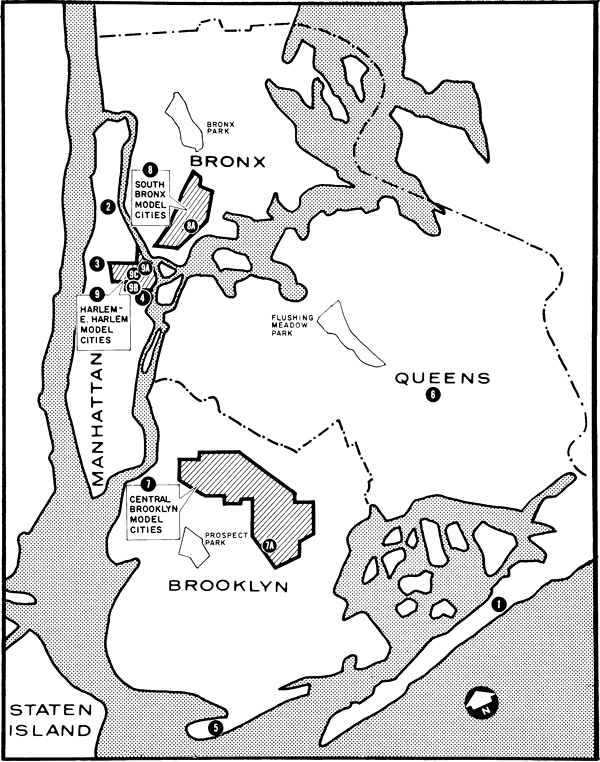
    New York City neighborhoods designated for revitalization with funding from the Model Cities Program.
    The City of New York, Community Development Program: A Progress Report, December 1968.

    To qualify for the program, cities had to apply for planning grants by submitting a detailed proposal that included an analysis of neighborhood conditions, long-term goals and strategies for addressing problems.

    Federal funds went directly to city governments, which then distributed them to local agencies and community organizations through contracts. These funds were relatively flexible but had to be tied to locally tailored plans. For example, Kansas City, Missouri, used Model Cities funding to support a loan program that expanded access to capital for local small businesses, helping them secure financing that might otherwise have been out of reach.

    Unlike previous programs, Model Cities emphasized what Johnson described as “comprehensive” and “concentrated” efforts. It wasn’t just about rebuilding streets or erecting public housing. It was about creating new ways for government to work in partnership with the people most affected by poverty and racism.

    A revolutionary approach to poverty

    What made Model Cities unique wasn’t just its scale but its philosophy. At the heart of the program was an insistence on “widespread citizen participation,” which required cities that received funding to include residents in the planning and oversight of local programs.

    The program also drew inspiration from civil rights leaders. One of its early architects, Whitney M. Young Jr., had called for a “Domestic Marshall Plan” – a reference to the federal government’s efforts to rebuild Europe after World War II – to redress centuries of racial inequality.

    Civil rights activist Whitney M. Young Jr. helped shape the vision of the Model Cities Program.
    Bettmann/Getty Images

    Young’s vision helped shape the Model Cities framework, which proposed targeted systemic investments in housing, health, education, employment and civic leadership in minority communities. In Atlanta, for example, the Model Cities Program helped fund neighborhood health clinics and job training programs. But the program also funded leadership councils that for the first time gave local low-income residents a direct voice in how city funds were spent.

    In other words, neighborhood residents weren’t just beneficiaries. They were planners, advisers and, in some cases, staffers.

    This commitment to community participation gave rise to a new kind of public servant – what sociologists Martin and Carolyn Needleman famously called “guerrillas in the bureaucracy.”

    A Model Cities staffer discusses the program to a group of students gathered at Denver’s Metropolitan Youth Education Center in 1970.
    Bill Wunsch/The Denver Post via Getty Images

    These were radical planners – often young, idealistic and deeply embedded in the neighborhoods they served. Many were recruited and hired through new Model Cities funding that allowed local governments to expand their staff with community workers aligned with the program’s goals.

    Working from within city agencies, these new planners used their positions to challenge top-down decision-making and push for community-driven planning.

    Their work was revolutionary not because they dismantled institutions but because they reimagined how institutions could function, prioritizing the voices of residents long excluded from power.

    Strengthening community ties

    In cities across the country, planners fought to redirect public resources toward locally defined priorities.

    A mobile dentist office in Baltimore.
    Robert Breck Chapman Collection, Langsdale Library Special Collections, University of Baltimore, CC BY-NC-ND

    In some cities, such as Tucson, the program funded education initiatives such as bilingual cultural programming and college scholarships for local students. In Baltimore, it funded mobile health services and youth sports programs.

    In New York City, the program supported new kinds of housing projects called vest-pocket developments, which got their name from their smaller scale: midsize buildings or complexes built on vacant lots or underutilized land. New housing such as the Betances Houses in the South Bronx were designed to add density without major redevelopment taking place – a direct response to midcentury urban renewal projects, which had destroyed and displaced entire neighborhoods populated by the city’s poorest residents. Meanwhile, cities such as Seattle used the funds to renovate older apartment buildings instead of tearing them down, which helped preserve the character of local neighborhoods.

    The goal was to create affordable housing while keeping communities intact.

    An Atlanta neighborhood identified as a candidate for street paving and home rehabilitation as part of the Model Cities Program.
    Georgia State University Special Collections

    What went wrong?

    Despite its ambitious vision, Model Cities faced resistance almost from the start. The program was underfunded and politically fragile. While some officials had hoped for US$2 billion in annual funding, the actual allocation was closer to $500 million to $600 million, spread across more than 60 cities.

    Then the political winds shifted. Though designed during the optimism of the mid-1960s, the program started being implemented under President Richard Nixon in 1969. His administration pivoted away from “people programs” and toward capital investment and physical development. Requirements for resident participation were weakened, and local officials often maintained control over the process, effectively marginalizing the everyday citizens the program was meant to empower.

    In cities such as San Francisco and Chicago, residents clashed with bureaucrats over control, transparency and decision-making. In some places, participation was reduced to token advisory roles. In others, internal conflict and political pressure made sustained community governance nearly impossible.

    Critics, including Black community workers and civil rights activists, warned that the program risked becoming a new form of “neocolonialism,” one that used the language of empowerment while concentrating control in the hands of white elected officials and federal administrators.

    A legacy worth revisiting

    Although the program was phased out by 1974, its legacy lived on.

    In cities across the country, Model Cities trained a generation of Black and brown civic leaders in what community development leaders and policy advocates John A. Sasso and Priscilla Foley called “a little noticed revolution.” In their book of the same name, they describe how those involved in the program went on to serve in local government, start nonprofits and advocate for community development.

    It also left an imprint on later policies. Efforts such as participatory budgeting, community land trusts and neighborhood planning initiatives owe a debt to Model Cities’ insistence that residents should help shape the future of their communities. And even as some criticized the program for failing to meet its lofty goals, others saw its value in creating space for democratic experimentation.

    A housing meeting takes place at a local Model Cities field office in Baltimore in 1972.
    Robert Breck Chapman Collection, Langsdale Library Special Collections, University of Baltimore, CC BY-NC-ND

    Today’s housing crisis demands structural solutions to structural problems. The affordable housing crisis is deeply connected to other intersecting crises, such as climate change, environmental injustice and health disparities, creating compounding risks for the most vulnerable communities. Addressing these issues through a fragmented social safety net – whether through housing vouchers or narrowly targeted benefit programs – has proven ineffective.

    Today, as policymakers once again debate how to respond to deepening inequality and a lack of affordable housing, the lost promise of Model Cities offers vital lessons.

    Model Cities was far from perfect. But it offered a vision of how democratic, local planning could promote health, security and community.

    Deyanira Nevárez Martínez is a trustee of the Lansing School District Board of Education and is currently a candidate for the Lansing City Council Ward 2.

    ref. Could a bold anti-poverty experiment from the 1960s inspire a new era in housing justice? – https://theconversation.com/could-a-bold-anti-poverty-experiment-from-the-1960s-inspire-a-new-era-in-housing-justice-253706

    MIL OSI AnalysisEveningReport.nz

  • MIL-OSI USA: UConn Has Record-Breaking Cohort for Gilman Scholars

    Source: US State of Connecticut

    A record-breaking 31 UConn students have been awarded a Gilman Scholarship in the latest cohort of the prestigious academic award. The award is congressionally funded through the Bureau of Education and Cultural Affairs at the State Department.

    The funding supports expanding student participation in study abroad programs and encourages travel to diverse locations around the globe, along with intensive language study and internship experiences.

    The 31 UConn students, who will study in 14 different countries, will receive a total of nearly $94,000 in scholarship funds through the Gilman program. A total of 40 UConn students have earned Gilman awards in the last two cohorts, this one and October 2024, for a total of more than $121,500 in scholarship funding.

    Students applying for Gilman Scholarships work with advisors in UConn’s Office of National Scholarships & Fellowships (ONSF) and Experiential Global Learning (EGL). Rachel Gleicher, an advisor in EGL, and Michael Cunningham, assistant director of ONSF and UConn’s Fulbright program advisor, are UConn’s two Gilman certifying advisors.

    “We are very excited that the Gilman program has selected so many UConn students this cycle,” says Cunningham. “It’s a testament to the quality of our students and to the hard work that they put into their applications.”

    Upon their return from studying abroad, each Gilman Scholar is required to complete a service project in their campus or home community with the goal of sharing the value of participation in study abroad and promoting the scholarship to prospective students. Applications are reviewed with consideration for the proposed follow-up service project.

    “We are so proud of these students for staying determined and focused on their study abroad goals,” says Gleicher. “Amid uncertain times, with federal funding freezes and broader uncertainty, they remained committed to their aspirations. Now more than ever, it is crucial to ensure students are aware of the funding opportunities available to them.”

    Eligibility for the Gilman Scholarship requires undergraduate students to be Pell Grant-eligible United States citizens who plan to study abroad for academic credit through a program approved by their home institution. Supporting students with high financial need provides access to students who are historically underrepresented in study abroad, including first-generation college students, STEM majors, ethnic and racial minority students, students with disabilities, LGBTQ+ students, and others who experience barriers to participation.

    Students from underrepresented areas of the U.S. are also considered during the application process and this year there are recipients from all 50 states.

    The following UConn students were selected as Gilman Scholars in this cycle, and they are listed with the location of where they will study as part of the program:

    Carina Adams-Szabo ’27 (CLAS), a psychology and political science major from Greenwich, who will be studying neuroscience this summer in Salamanca, Spain.

    Ashley Barragan ’27 (NUR), a nursing major who will be studying at the University of Dublin Summer Applied Research for Nursing Practice in Dublin, Ireland.

    Rhys Brauer ’27 (CLAS), a psychological sciences major, who will be studying neuroscience this summer in Salamanca.

    Brooke Catellier ’26 (CAHNR), an allied health major, who will be studying the Mediterranean diet and Tuscan cuisine in Florence, Italy, this summer.

    Kylene Chino ’26 (CLAS), a human rights and political science major, who will be studying in the fall at the Pusan National University in Shanghai, China.

    Jaiyliah Cochran ’25 (CLAS), a microbiology major, who will be studying field ecology this summer in Limpopo Province, South Africa.

    Mia Dansby ’26 (BUS), a management major, who will be studying this summer at ISI in Florence.

    Andrea D’Oleo ’27 (NUR), a nursing major from East Hartford, who will be studying in the Dublin Summer Applied Research Program for Nursing Practice in Ireland.

    Danyelix Echevarria Figueroa ’28 (ACES), a pre-teaching major from New Britain, who will study next spring at the University of Grenda in Grenda, Spain.

    Dahiana Fernandez-Ramirez ’26 (CLAS), a psychological sciences major, who will be studying this fall at ISI Florence.

    Adiriana Garcia Vazquez ’25 (CLAS), a cognitive science major from Bridgeport, who will be studying this fall at the Interdisciplinary Ethnography Field School in Mauritius.

    Hannah Ginste ’26 (CLAS), a communications major, who will be doing a summer internship in London.

    Jessica Glowacki ’25 (CLAS), a biological sciences major who will be studying field ecology this summer in Limpopo Province, South Africa.

    Emma Hazard ’27 (CAHNR), a diagnostic genetic sciences major, who will be studying the Mediterranean diet and Tuscan cuisine in Florence this summer.

    Danecia Henry ’28 (BUS), a management major from New Haven, will be studying in the summer at Camino de Santiago in Spain.

    Ty’Laisha Huff ’27 (NUR), a nursing major from Hartford, will be studying at the Dublin Summer Applied Research Program for Nursing Practice in Ireland.

    Layan Jahaf ’28 (CLAS), a political science and Arabic and Islam civics major, who will be studying this fall in London.

    Dee Jerome ’26 (CAHNR), an allied health sciences major from Bridgeport, who will be studying this summer in Accra, Ghana.

    Evelyn Pazan ’27 (CLAS), a finance and German major, who will be studying during the 2025-26 academic year at the University of Mannheim in Germany.

    Danielle Phillips ’27 (CLAS), an individualized major in industrial and labor relations from Bridgeport, who will be studying this summer at the Intercultural Leadership Program in Strasbourg, France.

    Jocelyn Ramirez ’26 (BUS), a management major from New Haven, who will be studying this summer at ISI.

    Jamie Ross ’27 (CLAS), a physiology and neurobiology major, who will be studying next winter in Barcelona, Spain.

    Ellie Sanders ’27 (CAHNR), a nutritional sciences major from West Cornwall, who will be studying the Mediterranean diet and Tuscan cuisine in Florence this summer.

    Fabio Silveira ’26 (CLAS), a pathobiology major, who will be studying neuroscience this summer in Salamanca, Spain.

    Amber Szymanski ’26 (CLAS), a political science and human rights major, who will be studying this fall at the Pusan National University in Busan, South Korea.

    Angel Uchupailla ’26 (CAHNR), an allied health major from Stamford, who will be studying this winter in Rome.

    Lyric Vargas ’27 (CLAS), a political science and psychological science major, who will be studying this fall at the University of Lisbon in Portugal.

    Erica Wong ’26 (CLAS), a political science and urban and community studies major, who will be studying this fall at Fudan University in Shanghai, China.

    Morgan Xu ’26 (ENG), a materials science and engineering major from Chesire, who will be studying this fall at the National University of Singapore.

    Ada Yeung ’27 (CLAS), an individualized major, who will be studying next spring at Fudan University.

    Maggie Zheng ’27 (BUS), an accounting major, who will be studying next spring at Fudan University.

    MIL OSI USA News

  • MIL-OSI USA: Rudd Center Celebrates 10th Anniversary at UConn

    Source: US State of Connecticut

    In the fall of 2014, researchers, advocates, and community members gathered in the garden at an East Hartford elementary school for an exciting announcement from President Susan Herbst: The Rudd Center was moving to UConn.  

    Founded in 2005 by Kelly Brownell, the Rudd Center enjoyed 10 successful years at Yale University before officially joining UConn’s Institute for Collaboration on Health, Intervention, and Policy (InCHIP) in 2015. Now, as it celebrates its 10th anniversary at UConn, members of the Rudd Center team are reflecting on the past decade and looking forward to what comes next for the Center. 

    Marlene Schwartz, director of the Rudd Center, speaks at an event announcing the move of the Rudd Center to UConn. (Peter Morenus/UConn Photo)

    “UConn’s commitment to multidisciplinary research has made it the perfect home for the Rudd Center,” says Marlene Schwartz, director of the Rudd Center and a professor in the Department of Human Development and Family Sciences. “Connecting with research partners across the University has been a crucial part of our work for the past 10 years, and we look forward to continuing to foster these collaborations.” 

    At the heart of the Rudd Center’s mission is the belief that everyone deserves the opportunity to eat healthfully. While the Center’s areas of research have evolved over the years, its work centers around five core domains:  

    • Charitable food system research led by Caitlin Caspi from the Department of Allied Health Sciences, Maria Gombi-Vaca, and Schwartz
    • Economics of food assistance programs and fiscal policy research led by Tatiana Andreyeva from the Department of Agricultural and Resource Economics
    • Food marketing research led by Fran Fleming-Milici
    • Healthy school environments (including school meals) research led by Schwartz
    • Weight bias research led by Rebecca Puhl from the Department of Human Development and Family Sciences

    “To help further our mission, we focus on translating research into action,” says Puhl, deputy director of the Rudd Center. “This ranges from testifying about legislation at the state and federal levels, sharing our research findings with the media, and creating evidence-based resources to help diverse audiences.” 

    Among the popular tools developed by the Rudd Center are an online assessment to help school districts around the country assess their wellness policies and practices, a training course to help clinicians reduce weight stigma in health care, a cultural food guide to help the charitable food system meet the needs of their neighbors, an image gallery to help content creators find respectful imagery of people in larger bodies, and a calculator to help policymakers assess the potential impact of sugary drink taxes.  

    “As we look back on the past 10 years, I’m so grateful that the Rudd Center has been given the opportunity to grow and thrive at UConn,” says Schwartz. “The many researchers, staff, students, and affiliates who have been a part of our journey are what makes the Rudd Center so special.” 

    For more information about the Rudd Center’s work, visit its website, subscribe to its monthly newsletter, and connect with the Center on LinkedIn and Bluesky.  

    MIL OSI USA News

  • MIL-OSI: LIS Technologies Inc. Appoints Leading Regulatory Expert Julie Olivier as its Regulatory Affairs and Licensing Director

    Source: GlobeNewswire (MIL-OSI)

    Oak Ridge, Tennessee, May 27, 2025 (GLOBE NEWSWIRE) — LIS Technologies Inc. (“LIST” or “the Company”), a proprietary developer of advanced laser technology and the only USA-origin and patented laser uranium enrichment company, today announced that it has appointed Julie Olivier as its Regulatory Affairs and Licensing Director.

    Julie Olivier brings more than twenty‑five years of experience across the commercial energy sector, with primary focus on the nuclear fuel cycle and ash management at coal sites. Her expertise covers environmental protection, facility siting, decommissioning, waste management, risk assessment, security, material control and accountability, quality assurance, performance improvement, emergency preparedness, and chemical safety.

    “This is a really exciting time for the nuclear industry and the US government’s commitment to build back nuclear, including a robust domestic fuel supply chain, suggests that it is only the beginning,” said Julie Olivier, Director of Regulatory Affairs and Licensing of LIS Technologies Inc. “I am delighted to join LIST at this pivotal moment for the Company amidst the nation’s nuclear renaissance. The future of this technology is bright, and I am very excited to help steer it through the licensing process and toward commercialization.”

    Figure 1 – LIS Technologies Inc. Appoints Julie Olivier as its Director of Regulatory Affairs and Licensing.

    Ms. Olivier began her career as a Safety Analyst at the DOE’s West Valley Demonstration Project before spending nine years at the Nuclear Regulatory Commission in Fuel Cycle Safety and Safeguards, New Nuclear Licensing, and the Chairman’s Office. She later became the Regulatory Affairs Manager for Global Laser Enrichment, then Nuclear Fleet Licensing Manager at Duke Energy, where she was promoted to Director within the Coal Combustion Products team. Most recently, she consulted on advanced‑nuclear facility siting and licensing for the Tennessee Valley Authority.

    As Regulatory Affairs Manager, Ms. Olivier secured the NRC’s first license for a uranium laser‑enrichment technology. She holds a Six Sigma Lean Green Belt, a B.S. in Chemistry from the University of New Orleans, and an M.S. in Environmental Engineering from Virginia Tech.

    “We are very pleased to welcome Julie to this critical role in the future of LIST,” said Christo Liebenberg, CEO and Co-Founder of LIS Technologies Inc. “Her depth of experience will be essential as we strengthen our engagement with government, regulatory stakeholders and to help move our CRISLA technology to the next stage of development, while also preparing for commercial deployment. I look forward to working with her as we advance our leadership in U.S. domestic uranium enrichment.”

    About LIS Technologies Inc.

    LIS Technologies Inc. (LIST) is a USA based, proprietary developer of a patented advanced laser technology, making use of infrared lasers to selectively excite the molecules of desired isotopes to separate them from other isotopes. The Laser Isotope Separation Technology (L.I.S.T) has a huge range of applications, including being the only USA-origin (and patented) laser uranium enrichment company, and several major advantages over traditional methods such as gas diffusion, centrifuges, and prior art laser enrichment. The LIST proprietary laser-based process is more energy-efficient and has the potential to be deployed with highly competitive capital and operational costs. L.I.S.T is optimized for LEU (Low Enriched Uranium) for existing civilian nuclear power plants, High-Assay LEU (HALEU) for the next generation of Small Modular Reactors (SMR) and Microreactors, the production of radioisotopes isotopes for medical and scientific research, and the production of stable isotopes with applications in quantum computing manufacturing for semiconductor technologies. The Company employs a world class nuclear technical team working alongside leading nuclear entrepreneurs and industry professionals, possessing strong relationships with government and private nuclear industries.

    In Dec 2024, LIS Technologies Inc. was selected as one of six domestic companies to participate in the Low-Enriched Uranium (LEU) Enrichment Acquisition Program. This initiative allocates up to $3.4 billion overall, with contracts lasting for up to 10 years. Each awardee is slated to receive a minimum contract of $2 million.

    For more information please visit: LaserIsTech.com

    For further information, please contact:
    Email: info@laseristech.com
    Telephone: 800-388-5492
    Follow us on X Platform
    Follow us on LinkedIn

    Forward Looking Statements

    This news release contains “forward-looking statements” within the meaning of Section 21E of the Securities Exchange Act of 1934, as amended, and the Private Securities Litigation Reform Act of 1995. In this context, forward-looking statements mean statements related to future events, which may impact our expected future business and financial performance, and often contain words such as “expects”, “anticipates”, “intends”, “plans”, “believes”, “will”, “should”, “could”, “would” or “may” and other words of similar meaning. These forward-looking statements are based on information available to us as of the date of this news release and represent management’s current views and assumptions. Forward-looking statements are not guarantees of future performance, events or results and involve known and unknown risks, uncertainties and other factors, which may be beyond our control. For LIS Technologies Inc., particular risks and uncertainties that could cause our actual future results to differ materially from those expressed in our forward-looking statements include but are not limited to the following which are, and will be, exacerbated by any worsening of global business and economic environment: (i) risks related to the development of new or advanced technology, including difficulties with design and testing, cost overruns, development of competitive technology, loss of key individuals and uncertainty of success of patent filing, (ii) our ability to obtain contracts and funding to be able to continue operations and (iii) risks related to uncertainty regarding our ability to commercially deploy a competitive laser enrichment technology, (iv) risks related to the impact of government regulation and policies including by the DOE and the U.S. Nuclear Regulatory Commission; and other risks and uncertainties discussed in this and our other filings with the SEC. Only after successful completion of our Phase 2 Pilot Plant demonstration will LIS Technologies be able to make realistic economic predictions for a Commercial Facility. Readers are cautioned not to place undue reliance on these forward-looking statements, which apply only as of the date of this news release. These factors may not constitute all factors that could cause actual results to differ from those discussed in any forward-looking statement. Accordingly, forward-looking statements should not be relied upon as a predictor of actual results. We do not undertake to update our forward-looking statements to reflect events or circumstances that may arise after the date of this news release, except as required by law.

    Attachment

    The MIL Network

  • MIL-OSI: authID Announces its 2025 Board of Directors Nominees Ahead of Annual Meeting

    Source: GlobeNewswire (MIL-OSI)

    Highly Qualified New Board Nominees Will Strengthen authID’s mission to Drive Growth and Value Creation for Shareholders

    2025 Annual Meeting to be Held on June 26, 2025

    DENVER, May 27, 2025 (GLOBE NEWSWIRE) — authID® (Nasdaq: AUID)(“authID” or the “Company”), a leading provider of biometric identity verification and authentication solutions, is nominating four highly qualified executives to the Board of Directors (the “Board”), in addition to the nomination of existing directors, included within the 2025 Proxy Statement filed on May 16, 2025. The 2025 Annual Meeting will be held virtually on June 26, 2025, at 10.00 a.m. EDT. 

    The following new Board nominees will be up for election at the Company’s 2025 Annual Meeting:

    Further information about each nominee is included at the end of this release.

    “authID is fortunate to nominate these talented business leaders to our Board,” said Rhon Daguro, authID’s Chief Executive Officer. “Their willingness to serve demonstrates their belief in our mission to deliver market-leading biometric identity authentication solutions in an increasingly AI-driven world. We look forward to benefitting from their leadership as we continue to focus on driving growth and creating value for shareholders.”

    “With AI evolving rapidly and cybersecurity more critical than ever, biometrics will play a foundational role in shaping our digital future,” said Krish Venkataraman, former President of Dataiku, Co-President/Board member of KnowBe4 (prior ticker: KNBE), and CFO of Socure. “authID has taken a truly differentiated approach to biometrics—one that is well-suited for rapid adoption by large enterprises. I’m deeply impressed by what this talented team of identity and fraud prevention experts has achieved in such a short time, and I’m excited to support their continued growth by joining the Board.”

    “I’ve been fortunate to partner with forward-looking tech companies over the years, and I believe that authID can surpass my expectations for innovation and vision,” said Ram Menghani, Past President of NEC Enterprise Communication Technologies. “They can not only compete but transcend other players in bringing biometric assurance to public and private sector organizations and be a truly great global partner for companies like mine who need the confidence of knowing who is behind each and every device. I look forward to helping authID grow and flourish in its next stage of development by joining the Board.”

    “Like the leadership team at authID, I have worked for decades in cybersecurity, so we share the same vision for safeguarding the enterprise, while protecting user privacy,” said Nick Shevelyov, Founder of vCSO.ai. “I am excited to join the Board as I feel they are the right organization at the right time to provide the best of biometric identity security to a market that absolutely requires security and compliance as the cloud continues to expand not only enterprise opportunities but also enterprise risks.”

    “I have placed my confidence in authID’s technology for many years and now we see that authID is expanding its global presence,” said Stephen J. Garchik, President of SJM Partners. “authID’s biometric identity platform is helping an increasing number of organizations securely manage identities across borders and verticals, while maintaining compliance with international laws. I am delighted for the opportunity to join the Board and help the Company in the next phase of its journey.”

    At the meeting, proposals will be submitted to elect directors, ratify the appointment of auditors and ratify an increase in the shares allocated to the 2024 Equity Incentive Plan.

    In addition to recommending the new Board nominees, authID is proposing the election of six of the current directors. Thomas Szoke, Founder and Chief Technology Officer (CTO), will step down as a director at the meeting, in order to focus on his role as CTO to continue enhancing the Company’s technology.

    “On behalf of the Board, I want to thank Tom for his significant contributions to authID as a board director,” added Daguro. “Fortunately, authID will continue to benefit from Tom’s visionary direction and strategic contributions in his continuing critical role as authID’s CTO.”

    Annual Meeting

    The Company has filed its Proxy Statement with the SEC, which explains all the proposals and provides other information about the Company, and is mailing the Notice of Meeting, the Proxy Statement and additional materials related to the Annual Meeting to stockholders. Stockholders who hold their shares through brokerage accounts will receive the materials via their brokers, either through the mail, or electronically depending on their communication preferences.

    The meeting will be held via a webcast. To join the webcast, investors must register in advance here: authID 2025 Annual Meeting Registration. Participants are advised to pre-register with a validated email address. Registrants will receive a confirmation email and calendar notice to add the meeting to your calendar. During the call, attendees will be invited to ask questions through the Q&A option in the Meeting webcast portal.

    Stockholders will be able to view the materials electronically at the Company’s Investor Relations site at 2024 Annual Reports or at www.investorvote.com/AUID.

    Stockholders will also be able to vote electronically, in accordance with the instructions provided in the materials each will receive. Stockholders are encouraged to vote by proxy ahead of the meeting, whether or not they plan to attend the meeting, to ensure their votes are counted.

    Director Nominee Biographies

    Stephen J. Garchik

    Mr. Garchik has been associated with authID for approximately 10 years as a major investor and supporter and now holder of 10% of the outstanding common stock. Since 1997, Mr. Garchik has been President of SJM Partners, a real estate development, design and construction, leasing and management company. SJM Partners owns over 40 retail, commercial and residential properties. Mr. Garchik has over 40 years of management and business experience and serves on the board of several non-profit institutions. He holds a Bachelor of Science and M.B.A. degree from the Wharton School at the University of Pennsylvania. Mr. Garchik’s extensive experience provides authID’s Board with a valuable perspective regarding business management, operations and strategy, in addition to a broad range of business connections.

    Ram Menghani

    Mr. Menghani has been Past President of NEC Enterprise Communications from 2020 to 2025 and is executive advisor to NEC, having joined NEC Corporation of America in 2001, serving in various roles in product management and development. He has over 30 years of global leadership experience in unified communications, product innovation, and digital transformation. Mr. Menghani’s track record includes forging partnerships with major tech players like Microsoft and Oracle, modernizing legacy systems into cloud-based models, and guiding startups to successful exits. Mr. Menghani has deep expertise in product strategy, global markets, and digital innovation and brings his global high tech business partnerships and scaling expertise to the Board.

    Nicholas “Nick” Shevelyov

    Mr. Shevelyov is a cybersecurity executive with 30 years of experience who served as Chief Security and Privacy Officer and later as Chief Information Officer at Silicon Valley Bank from 2007 to 2021. He led key initiatives in cybersecurity strategy, cloud transformation, and modern software delivery there. Mr. Shevelyov was an early design partner to industry leaders like Palo Alto Networks, Zscaler, and FireEye. In 2021, he published “Cyber War…and Peace” and founded and serves as CEO of vCSO.ai, a cybersecurity advisory firm supporting organizations such as Group 42, the Audubon Society, and multiple cybersecurity product companies. He also serves on the Bay Area CSO Council and Cofense boards. Mr. Shevelyov has a bachelor’s degree in Economics from San Francisco State University and an MBA from University of San Francisco School of Management. Mr. Shevelyov’s CSO experience and expertise will provide authID with invaluable insight and experience in relation to its core activities as well as connections in the cybersecurity industry.

    Shrikrishna “Krish” Venkataraman

    Mr. Venkataraman is a seasoned technology and Wall Street executive with a strong track record of leading IPOs, strategic sales, and large-scale corporate transformations. He represents a new generation of multi-disciplinary executives, having served in roles including President, CFO, COO, CAO, and public/private board member. Beyond traditional finance responsibilities — treasury, controllership, M&A, and investor relations — he has led sales, HR, IT, legal, and operations teams with a strong focus on IT and cybersecurity governance. Mr. Venkataraman served as President of Daitaku a leading AI firm, from 2023 to April 2025. Prior to that from 2022 to 2023 he was the Chief Financial Officer of Socure Inc. Mr. Venkataraman served as Co-President and Chief Financial Officer of KnowBe4 Inc. (Formerly Nasdaq: KNBE) a global security platform offering human risk management, from 2018 to 2022 and for a subsequent year as a Board member. Earlier in his career, he held leadership roles at Dealogic Lehman Brothers, NYSE Euronext, American Express, and Deloitte Consulting. Krish holds a B.S. from Carnegie Mellon University and an MBA from Cornell University’s Johnson Graduate School of Management. He brings his high-tech finance expertise to help authID with strategic deals, strategic capital, and generally in matters of corporate finance. 

    About authID Inc.

    authID (Nasdaq: AUID) ensures enterprises “Know Who’s Behind the Device™” for every customer or employee login and transaction through its easy-to-integrate, patented biometric identity platform. authID powers biometric identity proofing in 700ms, biometric authentication in 25ms, and account recovery with a fast, accurate, user-friendly experience. With our ground-breaking PrivacyKey™ solution, authID provides a 1-to-1-billion false match rate, while storing no biometric data. authID stops fraud at onboarding, blocks deepfakes, prevents account takeover, and eliminates password risks and costs, through the fastest, most frictionless, and most accurate user identity experience demanded by today’s digital ecosystem.

    For further information please visit authid.ai

    Investor Relations Contacts
    authID Investor Relations
    investor-relations@authID.ai

    Media Contacts
    Walter Fowler
    1-631-334-3864
    wfowler@nexttechcomms.com

    The MIL Network

  • MIL-OSI United Kingdom: New sculpture in Cruickshank Garden – a beautiful spot for reflection, chat or moment of peace As the weather starts to get better, a stunning new addition to the University of Aberdeen’s Cruickshank Botanic Garden is set to offer visitors an additional peaceful place to gather their thoughts.

    Source: University of Aberdeen

    As the weather starts to get better, a stunning new addition to the University of Aberdeen’s Cruickshank Botanic Garden is set to offer visitors an additional peaceful place to gather their thoughts.
    Now in place on the ‘Beech Lawn’, on the south-west corner towards the Rose Garden, is a striking new bench, which has been carved from fallen timber by world-renowned sculptor, Nigel Ross.
    Adorned with the words ‘memories’, ‘play’, ‘forever’, ‘outdoors’ and ‘learn’; as a living memorial, the bench has been thoughtfully designed to honour a special person, to whom it is dedicated.
    Curator of the Cruickshank Botanic Garden, Mark Paterson, said: “I was approached by a family who wanted to further enhance CBG and at the same time provide a memorial to someone they loved and who loved the garden. Their idea was to commission Nigel Ross to design and make a bench in such a way that it would be appealing to children as well as being a commemorative, visual delight in CBG.
    “Of course I was absolutely thrilled at the offer and have continued to be overwhelmed by the beauty of the bench, and what it symbolises. The words carved into the oak have been carefully chosen. I hope for all who sit on the bench, the location and words, combined, will conjure up different emotions and memories, leaving them feeling better for having been there.”

    The bench, quite simply, looks phenomenal and it will do so all year round and indeed, in perpetuity.” Mark Paterson

    Having been commissioned, Nigel set about creating and sculpting the bench from an oak tree that was blown down along the shore of Loch of Clunie in a winter 2023 storm. Appropriately, due to its shape, Mark and others have started referring to the bench as the ‘Viking Ship’.
    Nigel commented: “Part of the remit for the bench was for it be attractive to children and it was carved with this in mind. I thought perhaps a viking boat would be perfect. I also wanted to capture the spirt of the oak tree and show off the grain the knots and exploit the tactile character of the oak.
    “I had set aside the unusual curved limb from the Clunie Oak and was just waiting for the right opportunity to arise – the living memorial bench at the Cruickshank Botanic Gardens was absolutely the perfect commission for it. Oak is a durable timber and and the bench should stand the test of time and will even get polished with use.”
    Mark added: “The bench, quite simply, looks phenomenal and it will do so all year round and indeed, in perpetuity. Whether set against the long shadows of wintertime or highlighted by dappled sunlight shining through the seasonal foliage of the surrounding trees. In addition to being a lovely piece of artistic work, the bench is practical and has become my favourite new meeting place – instead of an online Teams chat, I’ll see you at the Viking Ship!”
    For more information about Nigel Ross and his work, visit http://www.nigelross-sculpture.com/

    Related Content

    MIL OSI United Kingdom

  • Bharat, the Sutradhar

    Source: Government of India

    Source: Government of India (4)

    At the WAVES Summit earlier this month, the icons of an industry that once framed itself as the voice of India stood still for a moment, not on a set, not in a scene, but in real time. Khans and Kapoors, studio heads and screenwriters, streaming moguls and old-guard directors — all of them under one roof, hosted not by a production house, but by a government they had, not long ago, considered creatively toxic. The man whose rise to power had been declared the death of free speech in India was now sharing the stage with them, gently inviting creators to tell the story of Bharat to the world — and in doing so, nudging them to first listen to Bharat themselves.

    But WAVES is not the story. It is only the stage.

    The real story lies in what led up to this moment: a quiet, sometimes uncomfortable, but wholly inevitable civilisational shift. A rewriting of the grammar of Indian storytelling. For decades, a small coterie dictated what stories would be told about India — often from the vantage point of metro privilege, Western awards circuits, or elite anxieties. The India that reached our screens was often broken, mocked, exoticised, or aestheticised. The India of slums, scams, and spiritual contradictions. Tradition was treated as burden, faith as fanaticism, and the village as either comic relief or backwardness. For years, audiences were fed a single narrative: that they had no choice but to accept what was being offered — that they were too unsophisticated to expect more.

    But Bharat — patient, poetic Bharat — was listening. Watching. And then it chose.

    It began, as all awakenings do, not with fireworks, but with quiet exits. Audiences stopped showing up. The Friday buzz started fading. And then, the economy of choice — powered by the democratisation of platform thanks to social media — transformed the whole content consumption experience. Viewers discovered that they were no longer bound to whatever landed in the multiplex. They had access to stories that hadn’t passed through the old gatekeepers. Stories that didn’t need to beg for distribution or approval. Stories that simply spoke — in dialects they understood, with values they recognised, and emotions they had lived.

    Narrative Reimagining: From India to Bharat, there has been a change in the stories we tell, the heroes we celebrate, and the India we portray.

    The Stories We Tell. The Heroes We Celebrate. The India We Portray. In the last decade, something subtle yet seismic has shifted in Indian cinema. We are no longer merely telling stories about India. We are beginning to speak as Bharat.

    For too long, the global gaze shaped our storytelling — a cinematic self-consciousness that chased validation from Western film festivals or mimicked Western narrative forms. The India that appeared on screens abroad was either exotic and spiritual or broken and begging for sympathy — poverty porn, partition pain, or palace love stories.

    But today, there’s a slow, confident move from India-as-imagined-by-others to Bharat-as-felt-by-itself. We are witnessing a shift from victimhood to valour — where the once-forgotten warriors of our soil, from Rani Durgavati to Veer Savarkar, are being reclaimed as cinematic protagonists.

    There is a visible shift –
    From metro gaze to mandir towns, where stories now unfold in Ayodhya, Kashi, Bastar, and Bhuj, without apology.
    From mimicry to myth-making, where homegrown philosophies, epics, and aesthetics are stepping forward as source material, not backdrop.

    Cinema is slowly catching up — from mytho-scientific films to historical epics, from women-led entrepreneurship stories to narratives anchored in Kashi, Kedarnath, and Kanyakumari. This is not nostalgia. It is civilisational reclaim. And through cinema — our most powerful export — we are reimagining ourselves and inviting the world to see a new Bharat: rooted, radiant, and ready.

    We stopped exporting sympathy. We started inviting the world to witness a civilisation coming into consciousness — not as a wounded past, but as a living, luminous future. Shrinking the colonial-leftist gaze that showcased India as land of suffering, spiritual detachment, and economic decay, we have slowly and steadily decided to chose civilisational pride over postcolonial pity, and replace cinematic self-pity with cinematic self-respect.

    We have now begun to see ourselves not as a country waiting to be explained, but as a civilisation finally choosing how to be shown.

    And that is how and why the old guard began to flounder. The industry that had once dictated taste — with its boy-meets-girl montages and designer depression — has found itself gasping. Friday releases have dried up. Cinemas play reruns. Star-studded films have crashed at the box office. Bollywood, as we knew it, is experiencing an identity crisis. And which is why the presence of erstwhile ‘Lords’ of the industry at the recently concluded WAVES summit in Mumbai is a story in itself.

    In 2015, Aamir Khan remarked that his wife no longer felt safe in India — a moment that revealed not just his personal fears, but a deeper cultural disconnect. It wasn’t just about intolerance. It was about entitlement. The idea that cultural authority could be claimed, not earned.

    Fast forward to WAVES 2025, and Aamir is back on stage — praising government support, urging for theatres in every corner of India. Not because he changed. But because Bharat did. And he knows it.

    The stars are no longer in the sky. They are on the ground. Because their castles have crashed. They now stand at the shore, waiting — not just for a comeback, but for newer waves. Pun very much intended.

    WAVES 2025, in that sense, wasn’t just a summit. It was a reckoning. The very actors, studios, and production houses that once scoffed at tradition were now attending a government-backed cultural platform with folded hands. And the irony was not lost on anyone. But this wasn’t revenge. It was realignment.

    Prime Minister Modi’s address didn’t speak of censorship or surveillance. He spoke of story. He invoked the Natyashastra. He reminded us that even our gods sing and dance. He urged creators to dream big, to tell the one billion untold stories of Bharat to the world.

    No diktats. Just direction. A gentle, civilisational nudge. Because Bharat, long silenced, is now narrating. It is no longer the subject of someone else’s script. It is the sutradhar — the narrator, the conscience, the cultural compass. It is not waiting to be validated. It is speaking in its own rhythm, its own language, its own light.

    The world doesn’t need a rebranded India. It needs to meet Bharat — as it has always been, and as it is now willing to show itself. The script is being rewritten, many many frames at a time.


    (Harsha Bhat is a versatile writer, journalist, and content strategist with over a decade of experience in storytelling, editing, and campaign curation. Currently working as a freelance writer and content strategist, Harsha has a proven track record of delivering impactful content for diverse platforms, including political campaigns, cultural heritage initiatives, and reputed publications like Swarajya Magazine and South First. Her editorial expertise spans conceptualizing special editions, managing newsroom operations, and mentoring aspiring writers. Notable accomplishments include spearheading acclaimed editorial campaigns like the Kashi and Ayodhya urban rejuvenation stories and publishing the transformative biography From Manjunath to Manjamma (HarperCollins, 2023).

    She holds M.A. in Linguistics from University of Mumbai and a graduate in Journalism (BMM) from St. Xavier’s College, Harsha blends creativity with analytical depth to craft compelling narratives. Beyond writing, Harsha is a sought-after speaker and panelist at literary events and a passionate advocate for linguistic and cultural diversity. As a skilled journalist and cultural chronicler, Harsha’s work delves into heritage, politics, and community-driven stories. Harsha Bhat continues to inspire through stories that bridge tradition and modernity, championing meaningful narratives that leave a lasting impact.)

  • MIL-OSI Russia: Fifty years later: 1975 road workers graduates meet at SPbGASU

    Translation. Region: Russian Federal

    Source: Saint Petersburg State University of Architecture and Civil Engineering – Saint Petersburg State University of Architecture and Civil Engineering – LISI Graduates of 1975

    A meeting of graduates of the road construction faculty of the Leningrad Civil Engineering Institute (LISI, as our university was then called) of 1975 in the specialty “Motorways” was held at SPbGASU.

    The main organizer of the anniversary meeting was the former head of the group, and now professor of the Department of Transport Systems and Road and Bridge Construction of our university, Alexander Solodkiy.

    “Many of my classmates have achieved great professional success: they worked in leading construction and design organizations in the road industry and in executive authorities managing the road sector, became founders and heads of companies, were awarded the title of “Honorary Road Builder of Russia” and other awards. Thus, Vladimir Valentinovich Kalinin heads the ABZ-1 group of companies, Igor Anatolyevich Pichugov heads the Dorservis group of enterprises. I headed the Department of Transport Systems at SPbGASU for nine years, and I have a Doctor of Science degree. Another Doctor of Science was Evgeny Nikolaevich Barinov, who worked at the Department of Highways at LISI. Unfortunately, he is no longer with us,” said Alexander Solodkiy.

    Aleksandr Ivanovich emphasized that graduates do not lose touch with their alma mater. Thus, Vladimir Kalinin has been the chairman of the state examination commission for the training profile “Motorways” for many years. The small innovative enterprise OOO “SPbGASU-Dorservis” is successfully operating.

    The graduates were happy to see their home university and communicate with each other. The meeting began with a photo session on the balustrade and continued in the board of trustees’ meeting room, where the guests were greeted on behalf of the management by the Vice-Rector for Youth Policy Marina Malyutina. Marina Viktorovna spoke about the modern development vectors of SPbGASU. In order to instill an entrepreneurial spirit in young people, the university is implementing the Startup as a Diploma project. To increase practical orientation, it is planned to launch an elective next year, within the framework of which students will work on project tasks together with professionals. Marina Viktorovna noted that the university expects tasks for project-based learning from industry practitioners, and called on graduates to convey this information to enterprises.

    The guests viewed the exposition of the university history museum. LISI graduate Lyudmila Nikolaevna Yakovleva presented the museum with the newspaper “For Construction Personnel” from March 17, 1971. The conversation continued at the Automobile and Road Engineering Faculty.

    We asked graduates to tell us about their professional paths.

    “I consider myself a professionally accomplished person”

    In 1970, Nadezhda Fedosova entered the Leningrad Civil Engineering Institute, Faculty of Mechanical Engineering and Highways, to study in the specialty of “Motorways”. She completed her studies at the Faculty of Road Construction, which was created as a result of the reform of education. Five years of study alternated with industrial practices in Leningrad and trips to student construction teams. In 1972, the student summer was spent in a construction team in the Komi ASSR in the city of Mikun, on the route of the Siyanie Severa gas pipeline, and in 1973 – at the All-Union shock construction site of the Phosphorit nitrogen-phosphorus fertilizer plant. During the time spent in student construction teams and during practice, we had to do all types of road work. In addition, everyone worked on clean-up days during the major repairs of the main building of the institute.

    After graduation, Nadezhda Vasilyevna worked at the Vsevolozhsk DRSU “Lenavtodor”, which she is very happy about, because there she received professional skills in both construction issues and road maintenance.

    Since 2001, Nadezhda Vasilyevna has been working at JSC VAD as an expert in design and estimate documentation and has been assisting students of SPbGASU who come for practical training in preparing their diploma theses. Nadezhda Fedosova has been awarded certificates of honor, the medal “In Memory of the 300th Anniversary of St. Petersburg”, and the title of “Honorary Road Builder of Russia”.

    “I am grateful to fate that I did not make a mistake in choosing my profession. I am proud of it, I consider myself a professionally accomplished person thanks to our teachers, whose lecture notes I looked at even after my studies,” said Nadezhda Vasilyevna.

    “The knowledge I gained at the institute helped me to realize myself as an engineer”

    Evgeny Medres entered LISI following in the footsteps of his older brother, who worked fruitfully at Lenavtodor and advised him to enter here. Evgeny Petrovich never regretted following this advice for a minute in his life. His student life was active: Evgeny Medres played in a basketball team and a musical ensemble. He remembered his work in construction teams: in 1972, at the construction of the Siyanie Severa gas pipeline, and in 1973, at the construction site of the Phosphorit nitrogen-phosphorus fertilizer plant. After graduating from LISI, Evgeny Medres worked as a foreman in Construction Department No. 5 of the Lendorstroy trust. He was a foreman, site manager, and built street and road network facilities. From 1979 to 1993, he worked at the Leningrad branch of GiprodorNII. Since 1993 – First Deputy General Director and Chief Engineer of JSC Petersburg-Dorservice.

    Under his leadership, projects for the construction, reconstruction and major repairs of more than 700 transport infrastructure facilities in various regions of Russia were developed, including the St. Petersburg ring road, the M-11 “Neva” Moscow – St. Petersburg highway, and the Kurortny Prospekt understudy in Sochi. Evgeny Petrovich was awarded the titles of “Honored Worker of Transport of Russia”, “Honored Road Builder of Russia”, and was awarded the medal of the Order “For Merit to the Fatherland” of the 2nd degree.

    Together with SPbGASU, Evgeny Petrovich is actively involved in research work, is the chairman of the State Examination Commission in the direction of “Ground Transport and Technological Means”, and heads the basic department of the automobile and road faculty at JSC “Petersburg-Dorservis”. “The knowledge I received at the institute helped me realize myself as an engineer,” he is sure.

    “Loyalty to the cause”

    Aleksandr Petrov was involved in road cycling in his senior years. “I saw and felt the condition of the roads. I thought that studying at LISI on the “roads” was an opportunity to change the situation for the better. Our coach also graduated from LISI and supported my choice. There were about five of us cyclists who applied in 1970. We could have put together a full-fledged sports team, but I was the only one who got in,” Aleksandr Vasilyevich said.

    Alexander Vasilyevich remembered the following internships: geodetic at the base in Peterhof, hydrological in Daimishche, geological in the Sablinsky caves, as well as competition evenings of faculties, a construction team in Kingisepp at Phosphorite.

    After graduating from the institute, Aleksandr Petrov worked as a foreman at DSU-6 of the Lenavtodor association for the reconstruction and major repairs of highways, rising from a foreman to the director of the Russian-American enterprise. Then he worked at the Leningrad Region Road Committee, where he rose to the rank of department head. He was awarded the titles of Honorary Transport Worker and Honorary Road Builder of Russia.

    “I am proud of my classmates who, from their first working days until their well-deserved rest (but many continue to work!), dedicated themselves to the profession they received at LISI. Deep knowledge, an excellent faculty, and a kind attitude towards students instilled in us loyalty to the cause we dedicated ourselves to in our youth. Over 50 years in the road industry, we can trace the positive changes in this area that have occurred thanks to our activities and education,” noted Alexander Vasilyevich.

    Please note: This information is raw content directly from the source of the information. It is exactly what the source states and does not reflect the position of MIL-OSI or its clients.

    MIL OSI Russia News

  • MIL-OSI Russia: From a Science Festival to Film Tours: What Moscow’s Cultural Venues Have Prepared for International Children’s Day

    Translation. Region: Russian Federal

    Source: Moscow Government – Government of Moscow –

    The capital’s cultural venues have prepared a large-scale program in honor of International Children’s Day, which is celebrated on June 1. The first events will begin in May, Natalia Sergunina, Deputy Mayor of Moscow.

    “Concerts, master classes, quests, performances and musical performances will be organized for young residents and guests of Moscow – more than 300 events in total. For example, a large scientific festival will be held in Zaryadye Park, and new film tours will appear at the Gorky Film Studio,” said Natalia Sergunina.

    One of the main events will be the children’s arts festival “Nebo”, which will be held on May 31 and June 1 in the Muzeon Arts Park. It will bring together creative groups from Moscow, St. Petersburg, Nizhny Novgorod, Perm, Voronezh, Krasnoyarsk, Tobolsk and Kaliningrad. 600 participants will perform for the audience, including theater actors, circus performers, musicians and dancers.

    During these days, the Moscow Festival of Animation and Children’s Cinema will be held in the Moskino Cinema Park. The program includes presentations of student animation works, screenings of fairy-tale plays, and a quest dedicated to the 100th anniversary of Korney Chukovsky’s Barmaley.

    On the central square, children will be able to take part in creative workshops: voice over animated films, draw their favorite character or create a 3D figurine of him. In the “Cowboy Town” decoration, there will be a staged filming of the movie “Aibolit-66”. Those who wish will be offered to dress up as the characters in the film and act in one of the scenes. Entrance by tickets to the cinema park.

    The theme will be continued at the Gorky Film Studio. On June 1, the list of excursions at the institution will be expanded with three new walks: “Cinema in Motion” for young children, “The Hero of Your Cinema,” and “Film Poster Workshop” for teenagers and adults. The focus will be on the biographies of famous actors and directors who worked here, as well as the stories behind the creation of fairy tale films, such as the film “Morozko.” Admission is paid, tickets can be purchased aton the institution’s website.

    On June 1, from 12:00 to 22:00, young visitors to Zaryadye Park are invited to the Sciencefest festival. They will enjoy talks with researchers, educational shows, practical classes, intellectual games, an interactive exhibition, and a large quest created jointly with scientists from Lomonosov Moscow State University.

    The festival at the Kolomenskoye Museum-Reserve will be dedicated to the 50th anniversary of the Soviet film The Adventures of Buratino, based on the fairy tale by Alexei Tolstoy. The culmination of the event will be carnival processions featuring characters from popular cartoons and films.

    A number of events have been prepared by the venues of the Moscow Exhibition Halls association. Thus, on May 30 at 19:00, the Khodynka Gallery will host a lecture entitled “How to Talk to Children about Art.” The expert will speak in plain language about the trends and directions of painting in the last century and teach how to analyze works using specific examples. To attend, you need pre-registration.

    On May 31, the Belyaevo Gallery will host a talk called “Antique Toys and Games.” The audience will be presented with a unique collection of toys from leading centers of folk art and crafts: clay toys from Dymkovo, Abashevskaya, Filimonovskaya, Khludnevskaya, Kargopolskaya, wooden toys from Bogorodskaya, and many others. The start is at 12:00, admission is byonline registration.

    Thematic meetings will continue in the capital’s libraries until June 5. Young readers will be able to demonstrate their knowledge of literature, make bookmarks, create collages, listen to music, and take part in competitions of dexterity and ingenuity.

    The Vatutinki Cultural Center invites children and adults to share photos of their favorite toys and stories about them. Photos with stories should be sent from June 1 to June 8 to the email address: dkvatutinki@culture.mos.ru with the subject line “World of Childhood.” They will become part of a thematic photo exhibition that will open on June 9.


    Please note: This information is raw content directly from the source of the information. It is exactly what the source states and does not reflect the position of MIL-OSI or its clients.

    Please Note; This Information is Raw Content Directly from the Information Source. It is access to What the Source Is Stating and Does Not Reflect

    https: //vv.mos.ru/nevs/ite/154358073/

    MIL OSI Russia News

  • MIL-OSI Africa: South Africa’s Independent Power Producers (IPP) Office backs Youth Energy Summit

    Source: Africa Press Organisation – English (2) – Report:

    CAPE TOWN, South Africa, May 27, 2025/APO Group/ —

    We are proud to welcome the Independent Power Producers Office (IPP) as the overall Summit Sponsor of the 2025 Youth Energy Summit (YES!). The event, happening from 18-20 June in Cape Town, will unite more than 3,000 graduates, emerging professionals, and young entrepreneurs in tackling Africa’s most pressing 21st-century energy challenges.

    For a full programme and to join the debate, visit: https://apo-opa.co/4jkJTZq

    With more than 50% of Africa still lacking access to electricity, and a vast untapped potential in renewable energy, the continent has the opportunity to create up to 100 million green jobs by 2050. But how can we meet this demand? How do we bridge the skills gap? And how can youth voices be integrated into energy decision-making at the highest levels? These are just a few of the critical questions that will be explored at YES!, the world’s largest gathering of youth in the energy sector.

    Enabling South Africa’s energy sector through youth and community development has always been at the heart of the IPP office’s activities. This investment into Africa’s youth is testament to the importance the IPP Office places on youth and community engagement throughout the deals and work they are tasked to do by the government.

    Joining the IPP Office to open the Youth Energy Summit on Wednesday 18th June will be Andry Rajoelina, the President of Madagascar, African Development Bank nominee for President, Amadou Hott, and African Union Commissioner for Energy and Infrastructure, His Excellency Lerato D. Mataboge.

    Dzunani Makgopa, IPP’s chief financial officer, says: “Renewable energy is the way to go, not just nationally, but globally. YES! is a great platform to introduce young professionals to the sector. This is the place to be, and we need to empower a lot of youth to the opportunities that exist within the energy sector.’

    Simon Gosling, EnergyNet Managing Director, adds: “It’s an exciting time for young people looking to take a more productive role in energy. The IPP Office puts community engagement and job creation at the heart of its mission. This commitment to sponsor the Youth Energy Summit is an extension of its policies and aims to expose thousands of young people to the many vast and varied opportunities within the South African IPP and energy universe.”

    Established in 2023, YES! is dedicated to empowering African youth and institutions by providing resources, training, and networking opportunities within the energy sector. The summit brings together thousands of entrepreneurs, early-career professionals, educators, and students from across the continent. With the goal of building a network of 100 million young energy leaders by 2035, YES! is accelerating the transition to a sustainable energy future.

    This year’s summit will feature dynamic sessions on energy careers, skill development, and opportunities within the sector, as well as insights from recruiters, energy entrepreneurs, and industry experts. YES! also partners with top academic institutions, including the University of Cape Town, the University of the Western Cape, Eduvos, Kenyatta University, and Harambee.

    QUOTES

    “DBSA’s mission is to build Africa’s prosperity, and we’re delighted to be working with YES! to help ensure the Youth take part in and benefit from the Energy Transition. Empowering the next generation is one of the most valuable actions anyone can take.”

    Foundation sponsor Development Bank of Southern Africa (DBSA)

    “The Youth Energy Summit is more than a gathering – it’s a movement. Africa has the youngest population in the world, and the youth is our greatest asset in the drive towards a more sustainable, inclusive energy future.”

    Anél Bosman, Group Managing Executive, Nedbank CIB

    “Siemens Energy is at the YES Summit because we believe the bold dreams of the next generation of energy leaders can ignite a global energy revolution with real-world impact.”

    Neveen Hussein, Sustainability Leader, Middle East & Africa | Siemens Energy

    “At Pele Energy Group, we believe the true power behind the energy transition isn’t just in technology or infrastructure – it’s in people. That’s why partnering with YES! felt like more than a decision; it felt like a calling.

    Melissa Wilkinson, Chief People Person, Pele Energy Group

    “I said yes to the YES! Summit, not because of panels or speeches, but because it calls for ownership. The future of this country will not be built by someone else. It’s us, the youth, who must roll up our sleeves, lean into the discomfort, and change South Africa ourselves.”

    Layton Nenzinane, Chief Financial Officer, Seriti Green

    “EWSETA says YES to YES! because the Summit aligns with our strategic mandate to empower youth, graduates, and entrepreneurs with future-focused skills for the energy and water sectors. It offers a powerful platform to amplify our training programmes, bursaries, and impact on over 4,000 young professionals across Africa.”

    The Energy and Water Sector Education Training Authority (EWSETA)

    MIL OSI Africa

  • MIL-OSI Asia-Pac: President Lai meets delegation from European Parliament

    Source: Republic of China Taiwan

    Details
    2025-05-20
    President Lai hosts state banquet for President Surangel Whipps Jr. of Republic of Palau
    On the evening of May 20, President Lai Ching-te, accompanied by Vice President Bi-khim Hsiao, hosted a state banquet at the Presidential Office in honor of President Surangel Whipps Jr. of the Republic of Palau and his wife. In remarks, President Lai said that he looks forward to working closely with President Whipps to promote tourism exchanges and sports cooperation so that Taiwan and Palau shine brightly together on the international stage. A translation of President Lai’s remarks follows: It is a pleasure to host this banquet tonight at the Presidential Office for President Whipps, First Lady Valerie Whipps, and the esteemed members of their delegation. Welcome to Taiwan. During my trips to Palau in 2022 and last year, President and First Lady Whipps received me with great hospitality. Wearing my island shirt, I enjoyed a very friendly reception from the people of Palau. It felt warm and friendly, just like being welcomed back home. The first time I visited Palau, President Whipps and I piloted a boat to the Milky Way lagoon. We both tried volcanic mud facial masks. We also fished together and enjoyed the breeze as we walked on the beach. Last year, on my second visit to Palau, I was honored to be invited to address the National Congress. I also observed the results of the close bilateral cooperation between our two nations. Due to its world-famous ocean scenery, Palau is sometimes referred to as “God’s aquarium.” And it is even possible to snorkel with sharks. It leaves a deep impression. Nothing compares to seeing Palau firsthand. During the COVID-19 pandemic, Taiwan and Palau launched a travel bubble that created a safe means of travel. Now, with the pandemic behind us, I hope that even more Taiwanese can tour Palau and gain a greater understanding of our diplomatic ally. In addition to tourism exchanges, I mentioned on my visit to Palau last year that I hoped Taiwan and Palau could promote sports cooperation by providing training away from home. Next month, Palau will be holding the Pacific Mini Games. And right now, Palau’s national baseball and table tennis teams are holding training sessions here in Taiwan. We will do our utmost to support Palau’s national players and we hope they stand out and achieve outstanding results in the events. I look forward to working closely with President Whipps so that Taiwan and Palau shine brightly together on the international stage. Thank you! Mesulang! President Whipps then delivered remarks, saying that it is truly an honor to be here once again one year after President Lai’s inauguration. Mentioning that this is his first state visit after being reelected to a second term, he said that it is important to be here among friends, and that we are more than friends, we are family. He thanked President Lai for the generous words and, most importantly, Taiwan’s enduring support. He remarked that our relationship continues to get stronger in each passing year. President Whipps said that President Lai’s diplomacy initiative, leadership, and vision deeply resonate with them. Diplomacy must be rooted in our shared values, he said, and an unwavering support for our allies and a commitment to a sustainable, inclusive development are all deeply appreciated by their people. President Whipps emphasized that, as we look into the future and the challenges that we face, from security to climate change, it is so important that we are united. He added that it is important for the world, and especially important for them in Palau, that they stand up for Taiwan, so that Taiwan can participate on international fora that address climate change, security, and health, because they know the world is better when Taiwan has a seat at the table. Mentioning that Palau will host the Pacific Islands Forum next year, President Whipps said that Palau remains committed to working closely with Taiwan to ensure a successful event, and that they will continue to speak up for Taiwan’s indispensable contributions as we stand together against any efforts to silence or isolate democratic partners. President Whipps said that our nations have navigated challenges and emerged stronger, bound by a partnership that is built on trust, respect, and hope for a better world. Whether it is in clean energy, education, smart medicine, or tourism, our shared journey is just beginning, he said, and we are stronger together.  Also in attendance at the banquet were Palauan Minister of State Gustav Aitaro, Minister of Public Infrastructure and Industries Charles Obichang, Minister of Human Resources, Culture, Tourism and Development Ngiraibelas Tmetuchl, Senate Floor Leader Kerai Mariur, House of Delegates Floor Leader Warren Umetaro, High Chief of Ngiwal State Elliot Udui, Governor of Peleliu State Emais Roberts, and Governor of Koror State Eyos Rudimch.

    Details
    2025-05-20
    President Lai and President Surangel S. Whipps, Jr. of Palau hold bilateral talks and witness signing of cooperation agreements  
    On the afternoon of May 20, following a welcome ceremony with military honors for President Surangel S. Whipps, Jr. of the Republic of Palau and his wife, President Lai Ching-te, accompanied by Vice President Bi-khim Hsiao, held bilateral talks with President Whipps at the Presidential Office. The two leaders also jointly witnessed the signing of a technical cooperation agreement and an agreement on diplomatic staff training cooperation. In remarks, President Lai thanked Palau for standing firm in its backing of Taiwan’s international participation as geopolitical tensions continue to increase in the Pacific region. He added that he looks forward to the cooperative ties between Taiwan and Palau continuing to expand into even broader areas, allowing our economies and societies to further progress as we jointly advance peace, stability, and prosperity in the Indo-Pacific region. A translation of President Lai’s remarks follows: I welcome our guests to Taiwan once again. Last year on May 20, President Whipps led a delegation to attend the inauguration ceremony for myself and Vice President Hsiao. I am delighted, on the anniversary of my first year in office, to meet with old friends of Taiwan again, as President Whipps returns for this visit. Taiwan-Palau relations have grown even closer in recent years thanks to the strong support of President Whipps. In 2022, during my term as vice president, I led a delegation to Palau as a demonstration of how our nations were together boosting tourism development as we jointly faced the challenges of the COVID-19 pandemic. Every time I visit Palau, and every time I meet with President Whipps, I feel very deeply that Taiwan and Palau are like family. We are both maritime nations and share a common Austronesian heritage and culture. We are also staunch partners in upholding such values as freedom, democracy, and respect for human rights. Last December, when I went on my first overseas trip since taking office, one of the nations I visited was Palau. We celebrated the 30th anniversary of Palau’s independence and 25 years of diplomatic relations, underscoring our friendly ties. Taiwan and Palau enjoy close exchanges and cooperation in a range of areas, including climate change, education, agriculture and fisheries, healthcare, humanitarian assistance, sports, and culture. After this meeting, President Whipps and I will witness the signing of a technical cooperation agreement and an agreement on diplomatic staff training cooperation, demonstrating once again our diverse collaboration and strong friendship. I believe that by working together, Taiwan and Palau can contribute to each other’s development and overcome the regional and global challenges we currently face. In particular, as geopolitical tensions continue to increase in the Pacific region, Palau has wisely and courageously upheld democratic values and stood firm in its backing of Taiwan’s international participation. Palau has never stopped voicing support for Taiwan, including at the United Nations General Assembly, the World Health Organization, the UN Framework Convention on Climate Change Conference of the Parties, and the UN Ocean Conference. We have been deeply moved by this support. I thank President Whipps again for his high regard and support for Taiwan. I look forward to the cooperative ties between our nations continuing to expand into even broader areas. This will allow our economies and societies to further progress as we jointly advance peace, stability, and prosperity in the Indo-Pacific region. President Whipps then delivered remarks, saying that it is a great honor for him to be here, standing in this historic place – a symbol of strength, resilience, and the democratic spirit of the Taiwanese people. On behalf of the government of Palau, President Whipps extended heartfelt gratitude to President Lai and the people of Taiwan for the warm welcome and gracious hospitality toward him and his delegation. President Whipps then extended sincere thanks for President Lai’s visit to Palau in December – his second visit to Palau – and for having Minister of Foreign Affairs Lin Chia-lung (林佳龍) attend his inauguration as a special envoy. He added that this also marks his third visit to Taiwan since President Lai took office, saying that this demonstrates the strength of our growing relationship. President Whipps indicated that the increased engagements and numerous entrepreneurs that President Lai has brought from Taiwan to Palau have resulted in fruitful visits, and that President Lai’s leadership represents hope, unity, and continued advancement of democracy and freedom, not only for Taiwan, but for the broader Indo-Pacific region. President Whipps went on to say that this visit to Taiwan reaffirms our deep friendship and shared values between our two nations. He emphasized that Palau and Taiwan are bound not by proximity, but by purpose, in that both are island nations and believe in human dignity, the rule of law, and the right of our people to determine their own futures. President Whipps stated that although we are celebrating 26 years of diplomatic relations, Taiwan has been a steadfast partner of Palau for decades, and that one of the MOUs they are signing further extends the relationship that began in December of 1984. From healthcare and medical missions, to education, agriculture, renewable energy, infrastructure, the private sector, tourism development, and climate resilience, he said, our cooperation has improved lives and strengthened our communities. The president also indicated that during the COVID-19 pandemic, Taiwan stood with Palau, noting that both sides began the tourism bubble, and that President Lai came to Palau to reopen the two weekly direct flights that have now been increased to four. That solidarity will never be forgotten, he said. As the world faces growing uncertainty and complex challenges from climate change to global tensions, President Whipps said, this friendship becomes even more vital. The president concluded his remarks by expressing hope that both nations continue to stand together, work together, and advocate together for peace, prosperity, and for the right of small nations to be seen, heard, and respected. After the bilateral talks, President Lai and President Whipps witnessed the signing of the technical cooperation agreement and the agreement on diplomatic staff training cooperation by Minister Lin and Palauan Minister of State Gustav Aitaro. The delegation also included Palauan Minister of Public Infrastructure and Industries Charles Obichang, Minister of Human Resources, Culture, Tourism and Development Ngiraibelas Tmetuchl, Senate Floor Leader Kerai Mariur, House of Delegates Floor Leader Warren Umetaro, High Chief of Ngiwal State Elliot Udui, Governor of Peleliu State Emais Roberts, and Governor of Koror State Eyos Rudimch.  

    Details
    2025-05-20
    President Lai interviewed by Nippon Television and Yomiuri TV
    In a recent interview on Nippon Television’s news zero program, President Lai Ching-te responded to questions from host Mr. Sakurai Sho and Yomiuri TV Shanghai Bureau Chief Watanabe Masayo on topics including reflections on his first year in office, cross-strait relations, China’s military threats, Taiwan-United States relations, and Taiwan-Japan relations. The interview was broadcast on the evening of May 19. During the interview, President Lai stated that China intends to change the world’s rules-based international order, and that if Taiwan were invaded, global supply chains would be disrupted. Therefore, he said, Taiwan will strengthen its national defense, prevent war by preparing for war, and achieve the goal of peace. The president also noted that Taiwan’s purpose for developing drones is based on national security and industrial needs, and that Taiwan hopes to collaborate with Japan. He then reiterated that China’s threats are an international problem, and expressed hope to work together with the US, Japan, and others in the global democratic community to prevent China from starting a war. Following is the text of the questions and the president’s responses: Q: How do you feel as you are about to round out your first year in office? President Lai: When I was young, I was determined to practice medicine and save lives. When I left medicine to go into politics, I was determined to transform Taiwan. And when I was sworn in as president on May 20 last year, I was determined to strengthen the nation. Time flies, and it has already been a year. Although the process has been very challenging, I am deeply honored to be a part of it. I am also profoundly grateful to our citizens for allowing me the opportunity to give back to our country. The future will certainly be full of more challenges, but I will do everything I can to unite the people and continue strengthening the nation. That is how I am feeling now. Q: We are now coming up on the 80th anniversary of the end of World War II, and over this period, we have often heard that conflict between Taiwan and the mainland is imminent. Do you personally believe that a cross-strait conflict could happen? President Lai: The international community is very much aware that China intends to replace the US and change the world’s rules-based international order, and annexing Taiwan is just the first step. So, as China’s military power grows stronger, some members of the international community are naturally on edge about whether a cross-strait conflict will break out. The international community must certainly do everything in its power to avoid a conflict in the Taiwan Strait; there is too great a cost. Besides causing direct disasters to both Taiwan and China, the impact on the global economy would be even greater, with estimated losses of US$10 trillion from war alone – that is roughly 10 percent of the global GDP. Additionally, 20 percent of global shipping passes through the Taiwan Strait and surrounding waters, so if a conflict breaks out in the strait, other countries including Japan and Korea would suffer a grave impact. For Japan and Korea, a quarter of external transit passes through the Taiwan Strait and surrounding waters, and a third of the various energy resources and minerals shipped back from other countries pass through said areas. If Taiwan were invaded, global supply chains would be disrupted, and therefore conflict in the Taiwan Strait must be avoided. Such a conflict is indeed avoidable. I am very thankful to Prime Minister of Japan Ishiba Shigeru and former Prime Ministers Abe Shinzo, Suga Yoshihide, and Kishida Fumio, as well as US President Donald Trump and former President Joe Biden, and the other G7 leaders, for continuing to emphasize at international venues that peace and stability across the Taiwan Strait are essential components for global security and prosperity. When everyone in the global democratic community works together, stacking up enough strength to make China’s objectives unattainable or to make the cost of invading Taiwan too high for it to bear, a conflict in the strait can naturally be avoided. Q: As you said, President Lai, maintaining peace and stability across the Taiwan Strait is also very important for other countries. How can war be avoided? What sort of countermeasures is Taiwan prepared to take to prevent war? President Lai: As Mr. Sakurai mentioned earlier, we are coming up on the 80th anniversary of the end of WWII. There are many lessons we can take from that war. First is that peace is priceless, and war has no winners. From the tragedies of WWII, there are lessons that humanity should learn. We must pursue peace, and not start wars blindly, as that would be a major disaster for humanity. In other words, we must be determined to safeguard peace. The second lesson is that we cannot be complacent toward authoritarian powers. If you give them an inch, they will take a mile. They will keep growing, and eventually, not only will peace be unattainable, but war will be inevitable. The third lesson is why WWII ended: It ended because different groups joined together in solidarity. Taiwan, Japan, and the Indo-Pacific region are all directly subjected to China’s threats, so we hope to be able to join together in cooperation. This is why we proposed the Four Pillars of Peace action plan. First, we will strengthen our national defense. Second, we will strengthen economic resilience. Third is standing shoulder to shoulder with the democratic community to demonstrate the strength of deterrence. Fourth is that as long as China treats Taiwan with parity and dignity, Taiwan is willing to conduct exchanges and cooperate with China, and seek peace and mutual prosperity. These four pillars can help us avoid war and achieve peace. That is to say, Taiwan hopes to achieve peace through strength, prevent war by preparing for war, keeping war from happening and pursuing the goal of peace. Q: Regarding drones, everyone knows that recently, Taiwan has been actively researching, developing, and introducing drones. Why do you need to actively research, develop, and introduce new drones at this time? President Lai: This is for two purposes. The first is to meet national security needs. The second is to meet industrial development needs. Because Taiwan, Japan, and the Philippines are all part of the first island chain, and we are all democratic nations, we cannot be like an authoritarian country like China, which has an unlimited national defense budget. In this kind of situation, island nations such as Taiwan, Japan, and the Philippines should leverage their own technologies to develop national defense methods that are asymmetric and utilize unmanned vehicles. In particular, from the Russo-Ukrainian War, we see that Ukraine has successfully utilized unmanned vehicles to protect itself and prevent Russia from unlimited invasion. In other words, the Russo-Ukrainian War has already proven the importance of drones. Therefore, the first purpose of developing drones is based on national security needs. Second, the world has already entered the era of smart technology. Whether generative, agentic, or physical, AI will continue to develop. In the future, cars and ships will also evolve into unmanned vehicles and unmanned boats, and there will be unmanned factories. Drones will even be able to assist with postal deliveries, or services like Uber, Uber Eats, and foodpanda, or agricultural irrigation and pesticide spraying. Therefore, in the future era of comprehensive smart technology, developing unmanned vehicles is a necessity. Taiwan, based on industrial needs, is actively planning the development of drones and unmanned vehicles. I would like to take this opportunity to express Taiwan’s hope to collaborate with Japan in the unmanned vehicle industry. Just as we do in the semiconductor industry, where Japan has raw materials, equipment, and technology, and Taiwan has wafer manufacturing, our two countries can cooperate. Japan is a technological power, and Taiwan also has significant technological strengths. If Taiwan and Japan work together, we will not only be able to safeguard peace and stability in the Taiwan Strait and security in the Indo-Pacific region, but it will also be very helpful for the industrial development of both countries. Q: The drones you just described probably include examples from the Russo-Ukrainian War. Taiwan and China are separated by the Taiwan Strait. Do our drones need to have cross-sea flight capabilities? President Lai: Taiwan does not intend to counterattack the mainland, and does not intend to invade any country. Taiwan’s drones are meant to protect our own nation and territory. Q: Former President Biden previously stated that US forces would assist Taiwan’s defense in the event of an attack. President Trump, however, has yet to clearly state that the US would help defend Taiwan. Do you think that in such an event, the US would help defend Taiwan? Or is Taiwan now trying to persuade the US? President Lai: Former President Biden and President Trump have answered questions from reporters. Although their responses were different, strong cooperation with Taiwan under the Biden administration has continued under the Trump administration; there has been no change. During President Trump’s first term, cooperation with Taiwan was broader and deeper compared to former President Barack Obama’s terms. After former President Biden took office, cooperation with Taiwan increased compared to President Trump’s first term. Now, during President Trump’s second term, cooperation with Taiwan is even greater than under former President Biden. Taiwan-US cooperation continues to grow stronger, and has not changed just because President Trump and former President Biden gave different responses to reporters. Furthermore, the Trump administration publicly stated that in the future, the US will shift its strategic focus from Europe to the Indo-Pacific. The US secretary of defense even publicly stated that the primary mission of the US is to prevent China from invading Taiwan, maintain stability in the Indo-Pacific, and thus maintain world peace. There is a saying in Taiwan that goes, “Help comes most to those who help themselves.” Before asking friends and allies for assistance in facing threats from China, Taiwan must first be determined and prepared to defend itself. This is Taiwan’s principle, and we are working in this direction, making all the necessary preparations to safeguard the nation. Q: I would like to ask you a question about Taiwan-Japan relations. After the Great East Japan Earthquake in 2011, you made an appeal to give Japan a great deal of assistance and care. In particular, you visited Sendai to offer condolences. Later, you also expressed condolences and concern after the earthquakes in Aomori and Kumamoto. What are your expectations for future Taiwan-Japan exchanges and development? President Lai: I come from Tainan, and my constituency is in Tainan. Tainan has very deep ties with Japan, and of course, Taiwan also has deep ties with Japan. However, among Taiwan’s 22 counties and cities, Tainan has the deepest relationship with Japan. I sincerely hope that both of you and your teams will have an opportunity to visit Tainan. I will introduce Tainan’s scenery, including architecture from the era of Japanese rule, Tainan’s cuisine, and unique aspects of Tainan society, and you can also see lifestyles and culture from the Showa era.  The Wushantou Reservoir in Tainan was completed by engineer Mr. Hatta Yoichi from Kanazawa, Japan and the team he led to Tainan after he graduated from then-Tokyo Imperial University. It has nearly a century of history and is still in use today. This reservoir, along with the 16,000-km-long Chianan Canal, transformed the 150,000-hectare Chianan Plain into Taiwan’s premier rice-growing area. It was that foundation in agriculture that enabled Taiwan to develop industry and the technology sector of today. The reservoir continues to supply water to Tainan Science Park. It is used by residents of Tainan, the agricultural sector, and industry, and even the technology sector in Xinshi Industrial Park, as well as Taiwan Semiconductor Manufacturing Company. Because of this, the people of Tainan are deeply grateful for Mr. Hatta and very friendly toward the people of Japan. A major earthquake, the largest in 50 years, struck Tainan on February 6, 2016, resulting in significant casualties. As mayor of Tainan at the time, I was extremely grateful to then-Prime Minister Abe, who sent five Japanese officials to the disaster site in Tainan the day after the earthquake. They were very thoughtful and asked what kind of assistance we needed from the Japanese government. They offered to provide help based on what we needed. I was deeply moved, as former Prime Minister Abe showed such care, going beyond the formality of just sending supplies that we may or may not have actually needed. Instead, the officials asked what we needed and then provided assistance based on those needs, which really moved me. Similarly, when the Great East Japan Earthquake of 2011 or the later Kumamoto earthquakes struck, the people of Tainan, under my leadership, naturally and dutifully expressed their support. Even earlier, when central Taiwan was hit by a major earthquake in 1999, Japan was the first country to deploy a rescue team to the disaster area. On February 6, 2018, after a major earthquake in Hualien, former Prime Minister Abe appeared in a video holding up a message of encouragement he had written in calligraphy saying “Remain strong, Taiwan.” All of Taiwan was deeply moved. Over the years, Taiwan and Japan have supported each other when earthquakes struck, and have forged bonds that are family-like, not just neighborly. This is truly valuable. In the future, I hope Taiwan and Japan can be like brothers, and that the peoples of Taiwan and Japan can treat one another like family. If Taiwan has a problem, then Japan has a problem; if Japan has a problem, then Taiwan has a problem. By caring for and helping each other, we can face various challenges and difficulties, and pursue a brighter future. Q: President Lai, you just used the phrase “If Taiwan has a problem, then Japan has a problem.” In the event that China attempts to invade Taiwan by force, what kind of response measures would you hope the US military and Japan’s Self-Defense Forces take? President Lai: As I just mentioned, annexing Taiwan is only China’s first step. Its ultimate objective is to change the rules-based international order. That being the case, China’s threats are an international problem. So, I would very much hope to work together with the US, Japan, and others in the global democratic community to prevent China from starting a war – prevention, after all, is more important than cure.

    Details
    2025-05-13
    President Lai interviewed by Japan’s Nikkei  
    In a recent interview with Japan’s Nikkei, President Lai Ching-te responded to questions regarding Taiwan-Japan and Taiwan-United States relations, cross-strait relations, the semiconductor industry, and the international economic and trade landscape. The interview was published by Nikkei on May 13. President Lai indicated that Nikkei, Inc. is a global news organization that has received significant recognition both domestically and internationally, and that he is deeply honored to be interviewed by Nikkei and grateful for their invitation. The president said that he would like to take this rare opportunity to thank Japan’s government, National Diet, society, and public for their longstanding support for Taiwan. Noting that current Prime Minister Ishiba Shigeru and former Prime Ministers Abe Shinzo, Suga Yoshihide, and Kishida Fumio have all strongly supported Taiwan, he said that the peoples of Taiwan and Japan also have a deep mutual affection, and that through the interview, he hopes to enhance the bilateral relationship between Taiwan and Japan, deepen the affection between our peoples, and foster more future cooperation to promote prosperity and development in both countries. In response to questions raised on the free trade system and the recent tariff war, President Lai indicated that over the past few decades, the free economy headed by the Western world and led by the US has brought economic prosperity and political stability to Taiwan and Japan. At the same time, he said, we have also learned or followed many Western values. The president said he believes that Taiwan and Japan are exemplary students, but some countries are not. Therefore, he said, the biggest crisis right now is China, which exploits the free trade system to engage in plagiarism and counterfeiting, infringe on intellectual property rights, and even provide massive government subsidies that facilitate the dumping of low-priced goods worldwide, which has a major impact on many countries including Japan and Taiwan. If this kind of unfair trade is not resolved, he said, the stable societies and economic prosperity we have painstakingly built over decades, as well as some of the values we pursue, could be destroyed. Therefore, President Lai said he thinks it is worthwhile for us to observe the recent willingness of the US to address unfair trade, and if necessary, offer assistance. President Lai emphasized that the national strategic plan for Taiwanese industries is for them to be rooted in Taiwan while expanding their global presence and marketing worldwide. Therefore, he said, while the 32 percent tariff increase imposed by the US on Taiwan is indeed a major challenge, we are willing to address it seriously and find opportunities within that challenge, making Taiwan’s strategic plan for industry even more comprehensive. When asked about Taiwan’s trade arrangements, President Lai indicated that in 2010 China accounted for 83.8 percent of Taiwan’s outbound investment, but last year it accounted for only 7.5 percent. In 2020, he went on, 43.9 percent of Taiwan’s exports went to China, but that figure dropped to 31.7 percent in 2024. The president said that we have systematically transferred investments from Taiwanese enterprises to Japan, Southeast Asia, Europe, and the US. Therefore, he said, last year Taiwan’s largest outbound investment was in the US, accounting for roughly 40 percent of the total. Nevertheless, only 23.4 percent of Taiwanese products were sold to the US, with 76.6 percent sold to places other than the US, he said.  The president emphasized that we don’t want to put all our eggs in one basket, and hope to establish a global presence. Under these circumstances, he said, Taiwan is very eager to cooperate with Japan. President Lai stated that at this moment, the Indo-Pacific and international community really need Japan’s leadership, especially to make the Comprehensive and Progressive Agreement for Trans-Pacific Partnership (CPTPP) excel in its functions, and also requested Japan to support Taiwan’s CPTPP accession. The president said that Taiwan hopes to sign an Economic Partnership Agreement (EPA) with Japan to build closer ties in economic trade and promote further investment, and that we also hope to strengthen relations with the European Union, and even other regions. Currently, he said, we are proposing an initiative on global semiconductor supply chain partnerships for democracies, because the semiconductor industry is an ecosystem. The president raised the example that Japan has materials, equipment, and technology; the US has IC design and marketing; Taiwan has production and manufacturing; and the Netherlands excels in equipment, saying we therefore hope to leverage Taiwan’s advantages in production and manufacturing to connect the democratic community and establish a global non-red supply chain for semiconductors, ensuring further world prosperity and development in the future, and ensuring that free trade can continue to function without being affected by dumping, which would undermine future prosperity and development. The president stated that as we want industries to expand their global presence and market internationally while staying rooted here in Taiwan, having industries rooted in Taiwan involves promoting pay raises for employees, tax cuts, and deregulation, as well as promoting enterprise investment tax credits. He said that we have also proposed Three Major Programs for Investing in Taiwan for Taiwanese enterprises and are actively resolving issues regarding access to water, electricity, land, human resources, and professional talent so that the business community can return to Taiwan to invest, or enterprises in Taiwan can increase their investments. He went on to say that we are also actively signing bilateral investment agreements with friends and allies so that when our companies invest and expand their presence abroad, their rights and interests as investors are ensured.  President Lai mentioned that Taiwan hopes to sign an EPA with Japan, similar to the Taiwan-US Initiative on 21st-Century Trade and the Economic Prosperity Partnership Dialogue, or the Enhanced Trade Partnership arrangement with the United Kingdom, or similar agreements or memorandums of understanding with Canada and Australia that allow Taiwanese products to be marketed worldwide, concluding that those are our overall arrangements. Looking at the history of Taiwan’s industrial development, President Lai indicated, of course it began in Taiwan, and then moved west to China and south to Southeast Asia. He said that we hope to take this opportunity to strengthen cooperation with Japan to the north, across the Pacific Ocean to the east, and develop the North American market, making Taiwan’s industries even stronger. In other words, he said, while Taiwan sees the current reciprocal tariffs imposed by the US as a kind of challenge, it also views these changes positively. On the topic of pressure from China affecting Taiwan’s participation in international frameworks such as the CPTPP or its signing of an EPA with Japan, President Lai responded that the key point is what kind of attitude we should adopt in viewing China’s acts of oppression. If we act based on our belief in free trade, he said, or on the universal values we pursue – democracy, freedom, and respect for human rights – and also on the understanding that a bilateral trade agreement between Taiwan and Japan would contribute to the economic prosperity and development of both countries, or that Taiwan’s accession to the CPTPP would benefit progress and prosperity in the Indo-Pacific region, then he hopes that friends and allies will strongly support us. On the Trump administration’s intentions regarding the reciprocal tariff policy and the possibility of taxing semiconductors, as well as how Taiwan plans to respond, President Lai said that since President Trump took office, he has paid close attention to interviews with both him and his staff. The president said that several of President Trump’s main intentions are: First, he wants to address the US fiscal situation. For example, President Lai said, while the US GDP is about US$29 trillion annually, its national debt stands at US$36 trillion, which is roughly 124 percent of GDP. Second, he went on, annual government spending exceeds US$6.5 trillion, but revenues are only around US$4.5 trillion, resulting in a nearly US$2 trillion deficit each year, about 7 percent of GDP. Third, he said, the US pays nearly US$1.2 trillion in interest annually, which exceeds the US$1 trillion defense budget and accounts for more than 3 percent of GDP. Fourth, President Trump still wants to implement tax cuts, aiming to reduce taxes for 85 percent of Americans, he said, noting that this would cost between US$500 billion and US$1 trillion. These points, President Lai said, illustrate his first goal: solving the fiscal problem. President Lai went on to say that second, the US feels the threat of China and believes that reindustrialization is essential; without reindustrialization, the US risks a growing gap in industrial capacity compared to China. Third, he said, in this era of global smart technology, President Trump wants to lead the nation to become a world center of AI. Fourth, he aims to ensure world peace and prevent future wars, President Lai said. In regard to what the US seeks to achieve, he said he believes these four areas form the core of the Trump administration’s intentions, and that is why President Trump has raised tariffs, demanded that trading partners purchase more American goods, and encouraged friendly and allied nations to invest in the US, all in order to achieve these goals. President Lai indicated that the 32 percent reciprocal tariff poses a critical challenge for Taiwan, and we must treat it seriously. He said that our approach is not confrontation, but negotiation to reduce tariffs, and that we have also agreed to measures such as procurement, investment, resolving non-tariff trade barriers, and addressing origin washing in order to effectively reduce the trade deficit between Taiwan and the US. Of course, he said, through this negotiation process, we also hope to turn challenges into opportunities. The president said that first, we aim to start negotiations from the proposal of zero tariffs and seek to establish a bilateral trade agreement with the US. Second, he went on, we hope to support US reindustrialization and its aim to become a world AI hub through investment, while simultaneously upgrading and transforming Taiwan’s industries, which would help further integrate Taiwan’s industries into the US economic structure, ensuring Taiwan’s long-term development.  President Lai emphasized again that Taiwan’s national industrial strategy is for industries to stay firmly rooted in Taiwan while expanding their global presence and marketing worldwide. He repeated that we have gone from moving westward across the Taiwan Strait, to shifting southbound, to working closer northward with Japan, and now the time is ripe for us to expand eastward by investing in North America. In other words, he said, while we take this challenge seriously to protect national interests and ensure that no industry is sacrificed, we also hope these negotiations will lead to deeper Taiwan-US trade relations through Taiwanese investment in the US, concluding that these are our expectations. The president stated that naturally, the reciprocal tariffs imposed by the US will have an impact on Taiwanese industries, so in response, the Taiwanese government has already proposed support measures for affected industries totaling NT$93 billion. In addition, he said, we have outlined broader needs for Taiwan’s long-term development, which will be covered by a special budget proposal of NT$410 billion, noting that this has already been approved by the Executive Yuan and will be submitted to the Legislative Yuan for review. He said that this special budget proposal addresses four main areas: supporting industries, stabilizing employment, protecting people’s livelihoods, and enhancing resilience. As for tariffs on semiconductors, President Lai said, Taiwan Semiconductor Manufacturing Company (TSMC) has committed to investing in the US at the request of its customers. He said he believes that TSMC’s industry chain will follow suit, and that these are concrete actions that are unrelated to tariffs. However, he said, if the US were to invoke Section 232 and impose tariffs on semiconductors or related industries, it would discourage Taiwanese semiconductor and ICT investments in the US, and that we will make this position clear to the US going forward. President Lai indicated that among Taiwan’s exports to the US, there are two main categories: ICT products and electronic components, which together account for 65.4 percent. These are essential to the US, he said, unlike final goods such as cups, tables, or mattresses. He went on to say that what Taiwan sells to the US are the technological products required by AI designers like NVIDIA, AMD, Amazon, Google, and Apple, and that therefore, we will make sure the US understands clearly that we are not exporting end products, but the high-tech components necessary for the US to reindustrialize and become a global AI center. Furthermore, the president said, Taiwan is also willing to increase its defense budget and military procurement. He stated that Taiwan is committed to defending itself and is strongly willing to cooperate with friends and allies to ensure regional peace and stability, and that this is also something President Trump hopes to see. Asked whether TSMC’s fabs overseas could weaken Taiwan’s strategic position as a key hub for semiconductor manufacturing, and whether that could then give other countries fewer incentives to protect Taiwan, President Lai responded by saying that political leaders around the world including Japan’s Prime Minister Ishiba and former Prime Ministers Abe, Suga, and Kishida have emphasized, at the G7 and other major international fora, that peace and stability in the Taiwan Strait are essential for global security and prosperity. In other words, he explained, the international community cares about Taiwan and supports peace and stability in the Taiwan Strait because Taiwan is located in the first island chain in the Indo-Pacific, directly facing China. He pointed out that if Taiwan is not protected, China’s expansionist ambitions will certainly grow, which would impact the current rules-based international order. Thus, he said, the international community willingly cares about Taiwan and supports stability in the Taiwan Strait – that is the reason, and it has no direct connection with TSMC. He noted that after all, TSMC has not made investments in that many countries, stressing that, on that point, it is clear. President Lai said that TSMC’s investments in Japan, Europe, and the US are all natural, normal economic and investment activities. He said that Taiwan is a democratic country whose society is based on the rule of law, so when Taiwanese companies need to invest around the world for business needs, the government will support those investments in principle so long as they do not harm national interests. President Lai said that after TSMC Chairman C.C. Wei (魏哲家) held a press conference with President Trump to announce the investment in the US, Chairman Wei returned to Taiwan to hold a press conference with him at the Presidential Office, where the chairman explained to the Taiwanese public that TSMC’s R&D center will remain in Taiwan and that the facilities it has already committed to investing in here will not change and will not be affected. So, the president explained, to put it another way, TSMC will not be weakened by its investment in the US. He further emphasized that Taiwan has strengths in semiconductor manufacturing and is very willing to work alongside other democratic countries to promote the next stage of global prosperity and development. A question was raised about which side should be chosen between the US and China, under the current perception of a return to the Cold War, with East and West facing off as two opposing blocs. President Lai responded by saying that some experts and scholars describe the current situation as entering a new Cold War era between democratic and authoritarian camps; others assert that the war has already begun, including information warfare, economic and trade wars, and the ongoing wars in Europe – the Russo-Ukrainian War – and the Middle East, and the Israel-Hamas conflict. The president said that these are all matters experts have cautioned about, noting that he is not a historian and so will not attempt to define today’s political situation from an academic standpoint. However, he said, he believes that every country has a choice, which is to say, Taiwan, Japan, or any other nation does not necessarily have to choose between the US and China. What we are deciding, he said, is whether our country will maintain a democratic constitutional system or regress into an authoritarian regime, and this is essentially a choice of values – not merely a choice between two major powers. President Lai said that Taiwan’s situation is different from other countries because we face a direct threat from China. He pointed out that we have experienced military conflicts such as the August 23 Artillery Battle and the Battle of Guningtou – actual wars between the Republic of China and the People’s Republic of China. He said that China’s ambition to annex Taiwan has never wavered, and that today, China’s political and military intimidation, as well as internal united front infiltration, are growing increasingly intense. Therefore, he underlined, to defend democracy and sovereignty, protect our free and democratic system, and ensure the safety of our people’s lives and property, Taiwan’s choice is clear. President Lai said that China’s military exercises are not limited to the Taiwan Strait, and include the East China Sea, South China Sea, and even the Sea of Japan, as well as areas around Korea and Australia. Emphasizing that Taiwan, Japan, Australia, and the Philippines are all democratic nations, the president said that Taiwan’s choice is clear, and that he believes Japan also has no other choice. We are all democratic countries, he said, whose people have long pursued the universal values of democracy, freedom, and respect for human rights, and that is what is most important. Regarding the intensifying tensions between the US and China, the president was asked what roles Taiwan and Japan can play. President Lai responded that in his view, Japan is a powerful nation, and he sincerely hopes that Japan can take a leading role amid these changes in the international landscape. He said he believes that countries in the Indo-Pacific region are also willing to respond. He suggested several areas where we can work together: first, democracy and peace; second, innovation and prosperity; and third, justice and sustainability. President Lai stated that in the face of authoritarian threats, we should let peace be our beacon and democracy our compass as we respond to the challenges posed by authoritarian states. Second, he added, as the world enters an era characterized by the comprehensive adoption of smart technologies, Japan and Taiwan should collaborate in the field of innovation to further drive regional prosperity and development. Third, he continued, is justice and sustainability. He explained that because international society still has many issues that need to be resolved, Taiwan and Japan can cooperate for the public good, helping countries in need around the world, and cooperating to address climate change and achieve net-zero transition by 2050. Asked whether he hopes that the US will continue to be a leader in the liberal democratic system, President Lai responded by saying that although the US severed diplomatic ties with the Republic of China, for the past few decades it has assisted Taiwan in various areas such as national defense, security, and countering threats from China, based on the Taiwan Relations Act and the Six Assurances. He pointed out that Taiwan has also benefited, directly and indirectly, in terms of politics, democracy, and economic prosperity thanks to the US, and so Taiwan naturally hopes that the US remains strong and continues to lead the world. President Lai said that when the US encounters difficulties, whether financial difficulties, reindustrialization issues, or becoming a global center for AI, and hopes to receive support from its friends and allies to jointly safeguard regional peace and stability, Taiwan is willing to stand together for a common cause. If the US remains strong, he said, that helps Taiwan, the Indo-Pacific region, and the world as a whole. Noting that while the vital role of the US on the global stage has not changed, the president said that after decades of shouldering global responsibilities, it has encountered some issues. Now, it has to make adjustments, he said, stating his firm belief that it will do so swiftly, and quickly resume its leadership role in the world. Asked to comment on remarks he made during his election campaign that he would like to invite China’s President Xi Jinping for bubble tea, President Lai responded that Taiwan is a peace-loving country, and Taiwanese society is inherently kind, and therefore we hope to get along peacefully with China, living in peace and mutual prosperity. So, during his term as vice president, he said, he was expressing the goodwill of Taiwanese society. Noting that while he of course understands that China’s President Xi would have certain difficulties in accepting this, he emphasized that the goodwill of Taiwanese society has always existed. If China reflects on the past two or three decades, he said, it will see that its economy was able to develop with Taiwan as its largest foreign investor. The president explained that every year, 1 to 2 million Taiwanese were starting businesses or investing in China, creating numerous job opportunities and stabilizing Chinese society. While many Taiwanese businesses have profited, he said, Chinese society has benefited even more. He added that every time a natural disaster occurs, if China is in need, Taiwanese always offer donations. Therefore, the president said, he hopes that China can face the reality of the Republic of China’s existence and understand that the people of Taiwan hope to continue living free and democratic lives with respect for human rights. He also expressed hope that China can pay attention to the goodwill of Taiwanese society. He underlined that we have not abandoned the notion that as long as there is parity, dignity, exchange, and cooperation, the goodwill of choosing dialogue over confrontation and exchange over containment will always exist. Asked for his view on the national security reforms in response to China’s espionage activities and infiltration attempts, President Lai said that China’s united front infiltration activities in Taiwan are indeed very serious. He said that China’s ambitions to annex Taiwan rely not only on the use of political and military intimidation, but also on its long-term united front and infiltration activities in Taiwanese society. Recently, he pointed out, the Taiwan High Prosecutors Office of the Ministry of Justice prosecuted 64 spies, which is three times the number in 2021, and in addition to active-duty military personnel, many retired military personnel were also indicted. Moreover, he added, Taiwan also has the Chinese Unification Promotion Party, which has a background in organized crime, Rehabilitation Alliance Party, which was established by retired military personnel, and Republic of China Taiwan Military Government, which is also composed of retired generals. He explained that these are all China’s front organizations, and they plan one day to engage in collaboration within Taiwan, which shows the seriousness of China’s infiltration in Taiwan. Therefore, the president said, in the recent past he convened a high-level national security meeting and proposed 17 response strategies across five areas. He then enumerated the five areas: first, to address China’s threat to Taiwan’s sovereignty; second, to respond to the threat of China’s obscuring the Taiwanese people’s sense of national identity; third, to respond to the threat of China’s infiltrating and recruiting members of the ROC Armed Forces as spies; fourth, to respond to the threat of China’s infiltration of Taiwanese society through societal exchanges and united front work; and fifth, to respond to the threat of China using “integration plans” to draw Taiwan’s young people and Taiwanese businesses into its united front activities. In response to these five major threats, he said, he has proposed 17 response strategies, one of which being to restore the military trial system. He explained that if active-duty military personnel commit military crimes, they must be subject to military trials, and said that this expresses the Taiwanese government’s determination to respond to China’s united front infiltration and the subversion of Taiwan. Responding to the question of which actions Taiwan can take to guard against China’s threats to regional security, President Lai said that many people are worried that the increasingly tense situation may lead to accidental conflict and the outbreak of war. He stated his own view that Taiwan is committed to facing China’s various threats with caution. Taiwan is never the source of these problems, he emphasized, and if there is an accidental conflict and it turns into a full-scale war, it will certainly be a deliberate act by China using an accidental conflict as a pretext. He said that when China expanded its military presence in the East China Sea and South China Sea, the international community did not stop it; when China conducted exercises in the Taiwan Strait, the international community did not take strong measures to prevent this from happening. Now, he continued, China is conducting gray-zone exercises, which are aggressions against not only the Taiwan Strait, the South China Sea, and the East China Sea, but also extending to the Sea of Japan and waters near South Korea. He said that at this moment, Taiwan, the Philippines, Japan, and even the US should face these developments candidly and seriously, and we must exhibit unity and cooperation to prevent China’s gray-zone aggression from continuing to expand and prevent China from shifting from a military exercise to combat. If no action is taken now, the president said, the situation may become increasingly serious. Asked about the view of some US analysts who point out that China will have the ability to invade Taiwan around 2027, President Lai responded that Taiwan, as the country on the receiving end of threats and aggression, must plan for the worst and make the best preparations. He recalled a famous saying from the armed forces: “Do not count on the enemy not showing up; count on being ready should it strike.” This is why, he said, he proposed the Four Pillars of Peace action plan. First, he said, we must strengthen our national defense. Second, he added, we must strengthen economic resilience, adding that not only must our economy remain strong, but it must also be resilient, and that we cannot put all our eggs in the same basket, in China, as we have done in the past. Third, he continued, we must stand shoulder to shoulder with friends and allies such as Japan and the US, as well as the democratic community, and we must demonstrate the strength of deterrence to prevent China from making the wrong judgment. Fourth, he emphasized, as long as China treats Taiwan with parity and dignity, Taiwan is willing to conduct exchanges and cooperate with China and seek cross-strait peace and mutual prosperity through exchanges and cooperation. Regarding intensifying US-China confrontation, the president was asked in which areas he thinks Taiwan and Japan should strengthen cooperation; with Japan’s Ishiba administration also being a minority government, the president was asked for his expectations for the Ishiba administration. President Lai said that in the face of rapid and tremendous changes in the political situation, every government faces considerable challenges, especially for minority governments, but the Japanese government led by Prime Minister Ishiba has quite adequately responded with various strategies. Furthermore, he said, Japan is different from Taiwan, explaining that although Japan’s ruling party lacks a majority, political parties in Japan engage in competition domestically while exhibiting unity externally. He said that Taiwan’s situation is more challenging, because the ruling and opposition parties hold different views on the direction of the country, due to differences in national identity. The president expressed his hope that in the future Taiwan and Japan will enjoy even more comprehensive cooperation. He stated that he has always believed that deep historical bonds connect Taiwan and Japan. Over the past several decades, he said, when encountering natural disasters and tragedies, our two nations have assisted each other with mutual care and support. He said that the affection between the people of Taiwan and Japan is like that of a family. Pointing out that both countries face the threat of authoritarianism, he said that we share a mission to safeguard universal values such as democracy, freedom, and respect for human rights. The president said that our two countries should be more open to cooperation in various areas to maintain regional peace and stability as well as to strengthen cooperation in economic and industrial development, such as for semiconductor industry chains and everyday applications of AI, including robots and drones, adding that we can also cooperate on climate change response, such as in hydrogen energy and other strategies. He said our two countries should also continue to strengthen people-to-people exchanges. He then took the opportunity to once again invite our good friends from Japan to visit Taiwan for tourism and learn more about Taiwan, saying that the Taiwanese people wholeheartedly welcome our Japanese friends.  

    Details
    2025-05-09
    President Lai extends congratulations on election of His Holiness Pope Leo XIV  
    Following the successful election of the 267th pope of the Roman Catholic Church, His Holiness Pope Leo XIV, on May 8, President Lai Ching-te extended sincere congratulations on behalf of the people and government of Taiwan, including its Catholic community. The president stated that he looks forward to working with Pope Leo XIV to continue deepening cooperation in the area of humanitarian aid and jointly defend the universal value of religious freedom, expanding and strengthening the alliance between Taiwan and the Vatican. Upon learning of the election results, President Lai directed the Republic of China (Taiwan) Embassy to the Holy See to convey a message of congratulations. In the message, President Lai extended sincere congratulations to Pope Leo XIV on behalf of the people and government of Taiwan, including its Catholic community, expressing confidence that His Holiness will lead the Catholic Church and its 1.4 billion followers worldwide with profound wisdom. President Lai also emphasized that Taiwan looks forward to continuing to work alongside the Holy See in the shared pursuit of peace, justice, religious freedom, solidarity, friendship, and human dignity. This year marks the 83rd anniversary of the establishment of diplomatic ties between Taiwan and the Vatican. Enjoying a strong alliance, Taiwan and the Vatican share such universal values as freedom of religion, respect for human rights, peace, and benevolence, and conduct close exchanges. Taiwan will continue to engage in exchanges and cooperation with the Holy See, further strengthen bilateral relations, and work alongside the Holy See to contribute even more to the world.  

    Details
    2025-05-20
    President Lai interviewed by Nippon Television and Yomiuri TV
    In a recent interview on Nippon Television’s news zero program, President Lai Ching-te responded to questions from host Mr. Sakurai Sho and Yomiuri TV Shanghai Bureau Chief Watanabe Masayo on topics including reflections on his first year in office, cross-strait relations, China’s military threats, Taiwan-United States relations, and Taiwan-Japan relations. The interview was broadcast on the evening of May 19. During the interview, President Lai stated that China intends to change the world’s rules-based international order, and that if Taiwan were invaded, global supply chains would be disrupted. Therefore, he said, Taiwan will strengthen its national defense, prevent war by preparing for war, and achieve the goal of peace. The president also noted that Taiwan’s purpose for developing drones is based on national security and industrial needs, and that Taiwan hopes to collaborate with Japan. He then reiterated that China’s threats are an international problem, and expressed hope to work together with the US, Japan, and others in the global democratic community to prevent China from starting a war. Following is the text of the questions and the president’s responses: Q: How do you feel as you are about to round out your first year in office? President Lai: When I was young, I was determined to practice medicine and save lives. When I left medicine to go into politics, I was determined to transform Taiwan. And when I was sworn in as president on May 20 last year, I was determined to strengthen the nation. Time flies, and it has already been a year. Although the process has been very challenging, I am deeply honored to be a part of it. I am also profoundly grateful to our citizens for allowing me the opportunity to give back to our country. The future will certainly be full of more challenges, but I will do everything I can to unite the people and continue strengthening the nation. That is how I am feeling now. Q: We are now coming up on the 80th anniversary of the end of World War II, and over this period, we have often heard that conflict between Taiwan and the mainland is imminent. Do you personally believe that a cross-strait conflict could happen? President Lai: The international community is very much aware that China intends to replace the US and change the world’s rules-based international order, and annexing Taiwan is just the first step. So, as China’s military power grows stronger, some members of the international community are naturally on edge about whether a cross-strait conflict will break out. The international community must certainly do everything in its power to avoid a conflict in the Taiwan Strait; there is too great a cost. Besides causing direct disasters to both Taiwan and China, the impact on the global economy would be even greater, with estimated losses of US$10 trillion from war alone – that is roughly 10 percent of the global GDP. Additionally, 20 percent of global shipping passes through the Taiwan Strait and surrounding waters, so if a conflict breaks out in the strait, other countries including Japan and Korea would suffer a grave impact. For Japan and Korea, a quarter of external transit passes through the Taiwan Strait and surrounding waters, and a third of the various energy resources and minerals shipped back from other countries pass through said areas. If Taiwan were invaded, global supply chains would be disrupted, and therefore conflict in the Taiwan Strait must be avoided. Such a conflict is indeed avoidable. I am very thankful to Prime Minister of Japan Ishiba Shigeru and former Prime Ministers Abe Shinzo, Suga Yoshihide, and Kishida Fumio, as well as US President Donald Trump and former President Joe Biden, and the other G7 leaders, for continuing to emphasize at international venues that peace and stability across the Taiwan Strait are essential components for global security and prosperity. When everyone in the global democratic community works together, stacking up enough strength to make China’s objectives unattainable or to make the cost of invading Taiwan too high for it to bear, a conflict in the strait can naturally be avoided. Q: As you said, President Lai, maintaining peace and stability across the Taiwan Strait is also very important for other countries. How can war be avoided? What sort of countermeasures is Taiwan prepared to take to prevent war? President Lai: As Mr. Sakurai mentioned earlier, we are coming up on the 80th anniversary of the end of WWII. There are many lessons we can take from that war. First is that peace is priceless, and war has no winners. From the tragedies of WWII, there are lessons that humanity should learn. We must pursue peace, and not start wars blindly, as that would be a major disaster for humanity. In other words, we must be determined to safeguard peace. The second lesson is that we cannot be complacent toward authoritarian powers. If you give them an inch, they will take a mile. They will keep growing, and eventually, not only will peace be unattainable, but war will be inevitable. The third lesson is why WWII ended: It ended because different groups joined together in solidarity. Taiwan, Japan, and the Indo-Pacific region are all directly subjected to China’s threats, so we hope to be able to join together in cooperation. This is why we proposed the Four Pillars of Peace action plan. First, we will strengthen our national defense. Second, we will strengthen economic resilience. Third is standing shoulder to shoulder with the democratic community to demonstrate the strength of deterrence. Fourth is that as long as China treats Taiwan with parity and dignity, Taiwan is willing to conduct exchanges and cooperate with China, and seek peace and mutual prosperity. These four pillars can help us avoid war and achieve peace. That is to say, Taiwan hopes to achieve peace through strength, prevent war by preparing for war, keeping war from happening and pursuing the goal of peace. Q: Regarding drones, everyone knows that recently, Taiwan has been actively researching, developing, and introducing drones. Why do you need to actively research, develop, and introduce new drones at this time? President Lai: This is for two purposes. The first is to meet national security needs. The second is to meet industrial development needs. Because Taiwan, Japan, and the Philippines are all part of the first island chain, and we are all democratic nations, we cannot be like an authoritarian country like China, which has an unlimited national defense budget. In this kind of situation, island nations such as Taiwan, Japan, and the Philippines should leverage their own technologies to develop national defense methods that are asymmetric and utilize unmanned vehicles. In particular, from the Russo-Ukrainian War, we see that Ukraine has successfully utilized unmanned vehicles to protect itself and prevent Russia from unlimited invasion. In other words, the Russo-Ukrainian War has already proven the importance of drones. Therefore, the first purpose of developing drones is based on national security needs. Second, the world has already entered the era of smart technology. Whether generative, agentic, or physical, AI will continue to develop. In the future, cars and ships will also evolve into unmanned vehicles and unmanned boats, and there will be unmanned factories. Drones will even be able to assist with postal deliveries, or services like Uber, Uber Eats, and foodpanda, or agricultural irrigation and pesticide spraying. Therefore, in the future era of comprehensive smart technology, developing unmanned vehicles is a necessity. Taiwan, based on industrial needs, is actively planning the development of drones and unmanned vehicles. I would like to take this opportunity to express Taiwan’s hope to collaborate with Japan in the unmanned vehicle industry. Just as we do in the semiconductor industry, where Japan has raw materials, equipment, and technology, and Taiwan has wafer manufacturing, our two countries can cooperate. Japan is a technological power, and Taiwan also has significant technological strengths. If Taiwan and Japan work together, we will not only be able to safeguard peace and stability in the Taiwan Strait and security in the Indo-Pacific region, but it will also be very helpful for the industrial development of both countries. Q: The drones you just described probably include examples from the Russo-Ukrainian War. Taiwan and China are separated by the Taiwan Strait. Do our drones need to have cross-sea flight capabilities? President Lai: Taiwan does not intend to counterattack the mainland, and does not intend to invade any country. Taiwan’s drones are meant to protect our own nation and territory. Q: Former President Biden previously stated that US forces would assist Taiwan’s defense in the event of an attack. President Trump, however, has yet to clearly state that the US would help defend Taiwan. Do you think that in such an event, the US would help defend Taiwan? Or is Taiwan now trying to persuade the US? President Lai: Former President Biden and President Trump have answered questions from reporters. Although their responses were different, strong cooperation with Taiwan under the Biden administration has continued under the Trump administration; there has been no change. During President Trump’s first term, cooperation with Taiwan was broader and deeper compared to former President Barack Obama’s terms. After former President Biden took office, cooperation with Taiwan increased compared to President Trump’s first term. Now, during President Trump’s second term, cooperation with Taiwan is even greater than under former President Biden. Taiwan-US cooperation continues to grow stronger, and has not changed just because President Trump and former President Biden gave different responses to reporters. Furthermore, the Trump administration publicly stated that in the future, the US will shift its strategic focus from Europe to the Indo-Pacific. The US secretary of defense even publicly stated that the primary mission of the US is to prevent China from invading Taiwan, maintain stability in the Indo-Pacific, and thus maintain world peace. There is a saying in Taiwan that goes, “Help comes most to those who help themselves.” Before asking friends and allies for assistance in facing threats from China, Taiwan must first be determined and prepared to defend itself. This is Taiwan’s principle, and we are working in this direction, making all the necessary preparations to safeguard the nation. Q: I would like to ask you a question about Taiwan-Japan relations. After the Great East Japan Earthquake in 2011, you made an appeal to give Japan a great deal of assistance and care. In particular, you visited Sendai to offer condolences. Later, you also expressed condolences and concern after the earthquakes in Aomori and Kumamoto. What are your expectations for future Taiwan-Japan exchanges and development? President Lai: I come from Tainan, and my constituency is in Tainan. Tainan has very deep ties with Japan, and of course, Taiwan also has deep ties with Japan. However, among Taiwan’s 22 counties and cities, Tainan has the deepest relationship with Japan. I sincerely hope that both of you and your teams will have an opportunity to visit Tainan. I will introduce Tainan’s scenery, including architecture from the era of Japanese rule, Tainan’s cuisine, and unique aspects of Tainan society, and you can also see lifestyles and culture from the Showa era.  The Wushantou Reservoir in Tainan was completed by engineer Mr. Hatta Yoichi from Kanazawa, Japan and the team he led to Tainan after he graduated from then-Tokyo Imperial University. It has nearly a century of history and is still in use today. This reservoir, along with the 16,000-km-long Chianan Canal, transformed the 150,000-hectare Chianan Plain into Taiwan’s premier rice-growing area. It was that foundation in agriculture that enabled Taiwan to develop industry and the technology sector of today. The reservoir continues to supply water to Tainan Science Park. It is used by residents of Tainan, the agricultural sector, and industry, and even the technology sector in Xinshi Industrial Park, as well as Taiwan Semiconductor Manufacturing Company. Because of this, the people of Tainan are deeply grateful for Mr. Hatta and very friendly toward the people of Japan. A major earthquake, the largest in 50 years, struck Tainan on February 6, 2016, resulting in significant casualties. As mayor of Tainan at the time, I was extremely grateful to then-Prime Minister Abe, who sent five Japanese officials to the disaster site in Tainan the day after the earthquake. They were very thoughtful and asked what kind of assistance we needed from the Japanese government. They offered to provide help based on what we needed. I was deeply moved, as former Prime Minister Abe showed such care, going beyond the formality of just sending supplies that we may or may not have actually needed. Instead, the officials asked what we needed and then provided assistance based on those needs, which really moved me. Similarly, when the Great East Japan Earthquake of 2011 or the later Kumamoto earthquakes struck, the people of Tainan, under my leadership, naturally and dutifully expressed their support. Even earlier, when central Taiwan was hit by a major earthquake in 1999, Japan was the first country to deploy a rescue team to the disaster area. On February 6, 2018, after a major earthquake in Hualien, former Prime Minister Abe appeared in a video holding up a message of encouragement he had written in calligraphy saying “Remain strong, Taiwan.” All of Taiwan was deeply moved. Over the years, Taiwan and Japan have supported each other when earthquakes struck, and have forged bonds that are family-like, not just neighborly. This is truly valuable. In the future, I hope Taiwan and Japan can be like brothers, and that the peoples of Taiwan and Japan can treat one another like family. If Taiwan has a problem, then Japan has a problem; if Japan has a problem, then Taiwan has a problem. By caring for and helping each other, we can face various challenges and difficulties, and pursue a brighter future. Q: President Lai, you just used the phrase “If Taiwan has a problem, then Japan has a problem.” In the event that China attempts to invade Taiwan by force, what kind of response measures would you hope the US military and Japan’s Self-Defense Forces take? President Lai: As I just mentioned, annexing Taiwan is only China’s first step. Its ultimate objective is to change the rules-based international order. That being the case, China’s threats are an international problem. So, I would very much hope to work together with the US, Japan, and others in the global democratic community to prevent China from starting a war – prevention, after all, is more important than cure.

    MIL OSI Asia Pacific News

  • MIL-OSI Europe: OSCE launches Regional Task Force on Education for Just and Inclusive Energy Transition in Central Asia

    Source: Organization for Security and Co-operation in Europe – OSCE

    Headline: OSCE launches Regional Task Force on Education for Just and Inclusive Energy Transition in Central Asia

    As the renewable energy sector in Central Asia grows, so does the need for a skilled and inclusive workforce to support it. In response, the OSCE and the Regional Environmental Centre for Central Asia (CAREC) officially launched the OSCE Regional Task Force on Education for Just and Inclusive Energy Transition (RTEET) in Central Asia with a kick-off meeting in Almaty, Kazakhstan, on 22 and 23 May.
    The RTEET initiative brings together key stakeholders from across Kazakhstan, Kyrgyzstan, Tajikistan, Turkmenistan and Uzbekistan, including representatives from ministries of energy and education, universities, technical colleges, private sector actors and development partners. Its main goals are to develop pilot curricula in renewable energy and foster long-term collaboration between the education and energy sectors.
    “Education plays a critical role in accelerating the energy transition — but it must be inclusive and adaptable” said Giulia Manconi, Senior Energy Security Adviser at the OSCE. “The OSCE is committed to supporting countries in building the human capital needed for a green and just future. This includes helping to align education systems with evolving energy demands, and empowering women and young professionals in the renewable energy sector”,
    At the two-day meeting, government officials, academic leaders, energy experts, and international partners discussed how renewable energy education can be better aligned with labor market needs, while advancing gender equality and inclusivity within the energy transition.
    Participants also reviewed the preliminary findings of a regional needs assessment conducted by the OSCE, which identified key skill gaps, institutional challenges, and priorities for curriculum development across the five Central Asian countries. The event also included site visits to the scientific laboratories of Kazakh-British Technical University and Satbayev University, where cutting-edge energy technologies were showcased.
    The RTEET initiative will run from March 2025 to May 2026. Major milestones include the development of a regional renewable energy course, pilot implementation in selected institutions, and policy consultations to help mainstream renewable energy education throughout the region.
    The initiative is part of the OSCE extrabudgetary project “Promoting Women’s Economic Empowerment in the Energy Sector in Central Asia”, funded by Austria, France, Germany, Italy, Norway and Poland.
    Further resources, materials, and updates about RTEET will be posted here.

    MIL OSI Europe News

  • MIL-OSI Russia: Professor of the State University of Management spoke at the International scientific and practical conference on combating illegal migration

    Translation. Region: Russian Federal

    Source: State University of Management – Official website of the State –

    A professor of the State University of Management spoke at the International Scientific and Practical Conference “Cooperation between Law Enforcement Agencies of Foreign States and the Russian Federation in Combating Illegal Migration”, which was held at the Moscow University of the Ministry of Internal Affairs of Russia named after V. Ya. Kikot using videoconferencing.

    The conference was opened by the head of the Moscow University of the Ministry of Internal Affairs of Russia, Lieutenant General of Police Igor Kalinichenko, who gave the floor to the deputy of the State Duma of the Federal Assembly of the Russian Federation Anastasia Udaltsova.

    The event was attended by leading scientists from educational and scientific organizations of the Russian Federation and foreign countries, representatives of practical units of law enforcement agencies, and public associations.

    Professor of the Department of Public Administration and Political Technologies of the State University of Management, member of the Council under the President of the Russian Federation for Interethnic Relations and the Public Council under the Ministry of Internal Affairs of Russia Vladimir Volokh gave a report on the topic “Development of the system of managing migration processes in the Russian Federation: new approaches and mechanisms”. He noted that Russia faces a number of serious challenges in the field of migration, requiring the development of adequate and effective response measures. Solving migration problems that affect security requires a systemic approach, considered and balanced measures, as well as coordination of efforts of all public authorities.

    The professor emphasized the need to improve the system of managing migration processes in modern Russia, which is confirmed by the creation of a new migration structure – the Service for Citizenship and Registration of Foreign Citizens.

    Vladimir Volokh noted that government bodies and law enforcement agencies, together with civil society institutions, have carried out significant work to implement the Concept of the State Migration Policy of the Russian Federation for 2019–2025. This is regularly reported on the official website of the Public Council under the Ministry of Internal Affairs of Russia: 4,646 news reports have been published in 2024.

    According to the professor, there is a pressing need to develop and approve by the Head of State a new Strategy for the State Migration Policy of the Russian Federation, which should replace the current Concept.

    In addition, Vladimir Volokh presented the university with his recently published trilogy – SELECTED in 3 volumes. Volume 1. Monographs. Volume 2: Textbooks and teaching aids. Volume 3: Voice of an expert: scientific articles and speeches at key venues.

    The conference participants also discussed a wide range of current theoretical and practical issues: improving legal mechanisms to combat illegal migration, state strategies in Russia and foreign countries.

    Please note: This information is raw content directly from the source of the information. It is exactly what the source states and does not reflect the position of MIL-OSI or its clients.

    MIL OSI Russia News

  • Why Grassroot Leadership is Important for India and the Modi Government’s Vision in Facilitating the same.

    Source: Government of India

    Source: Government of India (4)

    Grassroots leadership refers to the vision, action and success that emerges from the local levels, often in communities or organizations, rather than from top-tier or centralized authorities. It involves ordinary people stepping up to address issues that directly affect their lives, using their unique insights and experiences to drive a significant change – which impacts not only their immediate surroundings but the people at large. This type of leadership invents new systems from ground zero, because adversities are many and resources are scanty.

    Grassroots leadership is crucial for a country because it fosters solutions that are more personalized and customized with reference to the sensitivities of the people, having acknowledged the first-hand experiences of dealing with the problems. The policies and decisions under such leadership are more in sync with the needs and priorities of the target users, rather than being formulated by distant, detached bosses. This kind of leadership promotes self-sufficiency where people are empowered to identify and resolve their own problems, while raising a network group dedicated to the cause. It also improves social equity by giving marginalized or underrepresented groups a voice and a platform. Grassroots leaders build trust and solidarity within their communities, creating a more resilient society. When communities learn to lead change from within, it involves people directly in the shaping of their future.

    Grassroots leadership in India has evolved significantly from ancient times to the present day, reflecting the country’s changing social, political, and economic landscape. In ancient India, village councils, or panchayats, played a crucial role in self-governance, with elders and community leaders making collective decisions. These decentralized governance systems were deeply rooted in local traditions and ensured community participation. During the colonial period, grassroots leadership took on a resistance role, as leaders like Mahatma Gandhi mobilized people through movements such as Satyagraha and Swadeshi, emphasizing self-reliance and local empowerment. Post-independence, India institutionalized grassroots leadership through the 73rd and 74th Constitutional Amendments in 1992, which strengthened Panchayati Raj institutions and urban local bodies, giving power to local representatives, including women and marginalized groups. 

    Women have been at the forefront of grassroots leadership, often playing pivotal roles in community-building and social change. Their contributions however, frequently go unnoticed and undervalued. Women’s presence as grassroot visionaries are powerfully reflected in the ancient culture and history of India. Both the Ramayana and the Mahabharata introduce female characters playing pivotal roles in shaping events, often through resilience, wisdom, and influence at the community or familial level. In the Ramayana, Sita expresses agrarian expertise and herbal knowledge while she was in exile. Shabari, a tribal woman, demonstrates unwavering faith and service, engaged in gathering fruits and berries. Damayanti and Draupadi, in the Mahabharata, became servants at other’s kingdoms demonstrating their adaptations to economic hardships or adverse conditions. While Hidimbi and Satyabhama were war-trained agro experts, Gargi, Maitreyi and Sulabha took up the roles of teachers and scholars. Kunti, Gandhari and Draupadi guided their men through political and existential dilemmas, questioning injustice and lawlessness, ultimately influencing the course of history. 

    Given that we are the descendants of such a strong and able society, it is only obvious that women’s grassroots leadership in India would be powerfully rooted in empathy, inclusivity, and long-term sustainability. Other than the women-led businesses that contribute to the GDP directly, women are often the driving force behind social movements focused on justice, peace, and human rights which cleanse a society and raise better individuals, thus multiplying the number of capable contributors who can make direct contributions to the GDP. Examples are Jumde Yomgam Gamlin fighting against substance abuse in Arunachal Pradesh, Bharatanatyam artist Dr. Narthaki Nataraj spreading the message for gender equality, Moirangthem Muktamani Devi from Manipur initiating a knitted shoe-start up, uplifting knitting from its women’s hobby status and simultaneously making her way out of poverty, and many others. By recognizing and supporting the leadership of women at the grassroots level, who have made their way up battling systemic barriers and unequal access to opportunities, societies can unlock tremendous potential for social and political transformation.

    India was always a land of great leaders operating from the grassroots. What had been lacking over a long period of time was their recognition. Right from the beginning of its tenure in 2014, the Modi government had focussed on rerouting towards its roots because the world is standing at the threshold where every moment would usher a gigantic change. The model was clear. In order for the top leadership of the country to face larger storms before taming and integrating new policies and regulations into the Indian business scenario, the support of the grassroot leaders would be very essential in maintaining a healthy social and economic movement for the citizens!

    Today, grassroots leadership in India has expanded beyond governance into social activism, environmental movements, and digital advocacy, with local leaders addressing issues like climate change, gender equality, and rural development. The rise of social entrepreneurship and technology-driven initiatives has further amplified grassroots leadership, making it more inclusive and dynamic. This is increasingly vital for sustainability in the present and future, especially as rapid technological advancements and climate change are expected to disrupt the traditional ways of life. With global automation and artificial intelligence revolutionizing industries, many conventional jobs, particularly in agriculture, manufacturing, and services, will increasingly face obsolescence. This shift threatens the livelihoods of millions, especially in rural and semi-urban areas, making localized leadership essential for retraining, skill development, and economic adaptation. Grassroots leaders play a key role in preparing communities for this transformation by challenging stagnation of the masses and promoting new dreams through embracing digital literacy, fostering entrepreneurship, and encouraging sustainable employment opportunities that align with emerging industries.

    At this juncture, the world along with India is facing severe climate challenges, including unpredictable monsoons, rising temperatures, and extreme weather events that threaten agriculture, water security, and infrastructure. Grassroots leadership is critical here in mobilizing communities for climate adaptation, implementing sustainable practices, promoting water conservation, and developing disaster-resilient infrastructure. Local leaders, often deeply connected with their environments, can drive impactful change by integrating indigenous knowledge with modern solutions. India being a huge country with diverse culture, it would be difficult for a centralized system to address the exponentially growing concerns of the vast population. Growth of grassroots leaders ensures decentralized, community-driven, innovative and people-centric governance – stabilizing the effects of automation and ecological uncertainties. 

    The Modi government has undertaken numerous schemes and development initiatives to empower grassroots leadership across India, fostering local governance, entrepreneurship, and community-driven progress. Recognizing that true development stems from the empowerment of people at the ground level, these initiatives aim to equip individuals with the necessary skills, resources, and platforms to lead change in their communities, both in remote rural areas and urban centers. One of the most significant steps in this direction has been the Deendayal Antyodaya Yojana – National Rural Livelihoods Mission (DAY-NRLM), which focuses on mobilizing rural women into self-help groups (SHGs) to enhance their economic participation. By providing financial assistance, skill training, and market linkages, this initiative has empowered millions of women to emerge as local leaders in micro-entrepreneurship. The government has also promoted StartUp India and StandUp India, encouraging young entrepreneurs, including women and marginalized communities, to establish innovative businesses, ensuring a culture of self-reliance and leadership at the grassroots level. In governance, the Gram Panchayat Development Plan (GPDP) and the Panchayati Raj System Digitization aim to strengthen local self-governance by integrating digital tools, transparency, and community-driven decision-making. The 73rd Constitutional Amendment has been further reinforced with increased financial grants and capacity-building programs, ensuring that local leaders can effectively plan and implement development projects. Additionally, the Rashtriya Gram Swaraj Abhiyan (RGSA) has been instrumental in enhancing the capabilities of panchayat leaders through leadership training and technological integration, fostering accountable and efficient governance. Recognizing the importance of urban grassroots leadership, initiatives like the Smart Cities Mission and AMRUT (Atal Mission for Rejuvenation and Urban Transformation) encourage local urban bodies to take an active role in planning sustainable and technologically advanced cities. These programs prioritize participatory governance, where local communities and leaders contribute to urban planning, infrastructure development, and environmental sustainability. Another major initiative strengthening grassroots leadership is the PM Kisan Samman Nidhi, which provides direct income support to farmers, ensuring economic stability and empowering them to adopt innovative agricultural practices. Complementing this is the Fasal Bima Yojana, which secures farmers against climate uncertainties, allowing them to take calculated risks and lead agricultural advancements. Similarly, the Jal Jeevan Mission empowers village-level committees to oversee water supply management, ensuring sustainable water access in remote areas through decentralized governance.

    Women’s leadership at the grassroots level has been specifically encouraged through the Beti Bachao Beti Padhao scheme, which not only promotes female education but also fosters leadership among young girls. Likewise, the Mahila E-Haat initiative provides a digital marketplace for women entrepreneurs, strengthening their financial independence and influence within their communities. Programs like Digital India and Skill India have further enabled grassroots leaders to integrate modern technology into local governance, small businesses, and educational initiatives. The PM SVANidhi Yojana, supporting street vendors with easy credit access, has also uplifted informal sector entrepreneurs, making them active contributors to urban economies.

    The Modi government achieved 100% electrification of India through initiatives like Saubhagya Yojana, bringing power to even the remotest villages. This milestone has transformed lives by boosting education, healthcare, and businesses, ensuring energy access for all, fostering economic growth, and enhancing India’s global standing in sustainable development and infrastructure advancement. The Digital India initiative by the Modi government has revolutionized governance, economy, and daily life through increased internet penetration, digital payments (UPI), e-governance, and Aadhaar-linked services. It has empowered citizens, boosted startups, enhanced transparency, and made services more accessible, driving India toward a digitally inclusive and self-reliant future. The financial push offered through UPI, Jan Dhan Yojana, and MSME digital lending has empowered small businesses by ensuring easy transactions, financial inclusion, and quick credit access. This has reduced dependency on cash, increased transparency, and boosted economic growth, making India a global leader in fintech innovation.

    Through these initiatives and more, the Modi government is creating an environment where grassroots leaders—whether in villages, towns, or metropolitan areas—are equipped with resources and skills to drive change. This holistic approach ensures that leadership is not concentrated at the top but flourishes at every level, securing a resilient and innovative future for India. The call for action at local and individual levels has also been topped with fair recognition systems to celebrate the front-runners and inspire others to follow suit. The transformation of the Padma Awards into a “People’s Award,” where citizens can nominate deserving individuals through a democratic process, plays a significant role in that vision. Traditionally perceived as honors reserved for elites, bureaucrats, or celebrities, the Modi government has repositioned these awards to recognize the contributions of unsung heroes—ordinary individuals making extraordinary impacts in their communities. This shift not only elevates grassroots leaders but also creates a ripple effect, inspiring millions to take initiative in their own spheres.

    By celebrating success stories of farmers innovating in agriculture, social workers uplifting marginalized communities, artisans preserving cultural heritage, and environmentalists leading conservation efforts, the Padma Awards highlight real-life examples of leadership that emerges from the urban, rural and remote geographies. These stories showcase how dedication, resilience, and ingenuity can drive meaningful change, regardless of formal authority or social status. When local leaders, who often work in anonymity, receive national recognition, it reinforces the idea that transformative contributions are valued and acknowledged by the nation. Also, making the nomination process open to the public allows citizens to identify and elevate role models from their own communities, fostering a sense of collective responsibility toward nation-building. By honoring individuals from remote villages, tribal communities, and lesser-known professions, the awards challenge traditional notions of success, promoting a broader, more inclusive definition of leadership. In the era of remarkable changes, it is only obvious for the citizens of the country to participate and take ownership of change, instead of staying detached, ensuring the spirit of nation-building is a shared emotion across every corner of the country.

    (Koral Dasgupta is an accomplished author and content curator with over 20 years of experience. Her diverse work spans academic non-fiction to relationship dramas, focusing on gender narratives and complex human emotions. Koral founded Tell Me Your Story, a platform that uses literature to inspire social engagement and drive behavioral change for inclusion and diversity. She designs and executes learning programs, conducts writing workshops, and curates content for events focused on gender and mythology. Koral has been an advisory member of the Central Board for Film Certification.

    She holds an MBA in Marketing and a BA in Economics. With her qualifications, she continues to explore the journeys of mythological women further through the lenses of spirituality, leadership, and sexuality, and her Sati Series is widely acclaimed across the circles. Her notable achievements include being shortlisted for the Sahitya Academy Awards in 2023, securing a five-book contract with Pan Macmillan, and cataloging her books in prestigious libraries such as Harvard and Columbia University. Her works have earned her recognition as an Innovator25 Asia Pacific in 2019 and a spot in Outlook Business’ Women of Wonder list. Koral continues to weave narratives that empower voices, inspire change, and reshape perspectives on gender and human connection.)

  • MIL-OSI Russia: HSE Linguists Find Out How Bilinguals Use Numeral Constructions in Russian

    Translation. Region: Russian Federal

    Source: State University Higher School of Economics – State University Higher School of Economics –

    HSE researchers identified more than 4,000 examples of oral Russian speech by bilinguals from seven regions of Russia and found that most non-standard forms in constructions with numerals are associated not only with their native language, but also with how often the expression occurs in everyday speech. For example, the phrases “two hours” or “five kilometers” almost always match the literary version, but less familiar expressions, especially with numerals from two to four, as well as with collective forms like “two” or “three,” often sound different. Study published in the International Journal of Bilingualism.

    Russian numerals confuse not only foreigners, but also native speakers. Difficulties also arise for bilinguals – people who speak two or more languages fluently. Some research show that the grammar of the first language, such as Nanai or Ulchi, influences the subsequent acquisition of Russian. However, scientists believe that the influence of the native language is only one of the factors.

    Researchers from International Language Convergence Laboratory HSE University analyzed how bilinguals from different regions of Russia use numerals in oral speech in Russian. To do this, they processed seven collections of interviews recorded in Dagestan, Bashkiria, Chuvashia, Mari El, Karelia and other regions. The sample included stories of more than 180 people speaking 21 languages. Each collection contained recordings of live conversations in which participants answered researchers’ questions and shared stories about themselves, their families, and life in the village. From more than 7,000 phrases with numerals, the researchers selected about 4,000 suitable for analysis, excluding constructions with ordinal numerals and indirect cases.

    The results showed that it is not only the native language that influences the frequency of errors. Other factors are also important: level of education, age, but above all, how often the expression occurs in speech. The more familiar the phrase, for example, “two hours” or “five kilometers,” the less likely it is to encounter a non-standard form. This confirms the hypothesis that language structures are learned not through rules, but through regular use.

    “It cannot be said that when bilinguals use Russian, they simply project the grammar of their native language onto it. Even if a native speaker grew up in an environment where numerals work differently than in Russian, this does not mean that in their Russian speech they will systematically copy the structures of their native language,” explains one of the authors of the article, a research fellow at the International Laboratory of Language Convergence, associate professor Faculty of Humanities HSE University Chiara Naccarato.

    Numerals from two to four, as well as collective forms like “two” and “three,” turned out to be especially difficult for survey participants—they were noticeably more often used in non-standard form.

    The data obtained is important not only for linguists, but also for teachers: it allows us to understand which areas of grammar require more attention. In the future, the authors plan to study other areas in which the native language can (or cannot) influence the acquisition of Russian.

    Please note: This information is raw content directly from the source of the information. It is exactly what the source states and does not reflect the position of MIL-OSI or its clients.

    MIL OSI Russia News

  • MIL-OSI Economics: Lisa D Cook: A view on financial stability

    Source: Bank for International Settlements

    Thank you, Alessandra, for organizing us today, and thanks to you, Veronica Guerrieri, and Marina Azzimonti for initiating this effort seven years ago. I am honored to be with so many friends in macroeconomics at the 2025 Women in Macro Conference. I still read, recommend, and cite your work and am grateful to New York University and the University of Chicago for supporting this conference and this research.

    How has the arc of mainstream macroeconomic research become more closely integrated with issues related to financial stability? This question is what I would like to discuss today. I applaud the advances in incorporating financial stability into macroeconomic models, which have significantly enhanced our understanding of financial market functioning and its effect on the economy. It is a topic that holds special importance to me as a macroeconomist who has worked at the intersection of macroeconomics and finance since my dissertation and as the chair of the Federal Reserve Board’s Committee on Financial Stability. I would like to then offer my assessment of the stability of the U.S. financial system.

    Financial stability supports the objectives assigned to the Federal Reserve, including full employment and stable prices, a safe and sound banking system, and an efficient payments system. A financial system is considered stable when banks, other lenders, and financial markets are able to provide households, communities, and businesses with the financing they need to invest, grow, and participate in a well-functioning economy – and can do so even when hit by adverse events, or “shocks.” Financial instability, by contrast, arises when vulnerabilities – such as asset bubbles, excessive leverage, liquidity mismatches, or interconnected exposures – can build up to such an extent that they can amplify different shocks and threaten the core functions of the system and the functioning of the broader economy.

    MIL OSI Economics

  • MIL-OSI Russia: The training of forensic experts and the production of forensic examinations were discussed at SPbGASU

    Translation. Region: Russian Federal

    Source: Saint Petersburg State University of Architecture and Civil Engineering – Saint Petersburg State University of Architecture and Civil Engineering – Dmitry Ivanov (behind the podium), Andrey Kokin, Oksana Dyakonova and Petr Kozin

    The National (All-Russian) scientific and practical conference “Improving the training of forensic experts and the production of forensic examinations in modern conditions” was held at SPbGASU. Current issues of professional training of forensic experts, modern technical and scientific-methodological support for the production of forensic examinations, as well as issues of legal, informational, financial and organizational support for forensic activities were discussed at a plenary session, two sections and at the podium of young scientists. In total, about 90 specialists and students from different regions of the country spoke.

    Opening the plenary session, Dmitry Ivanov, Chairman of the Organizing and Scientific Committees of the conference, Dean of the Faculty of Forensic Expertise and Law in Construction and Transport at SPbGASU, noted that the scientific community and the industry need to gather at one site, exchange experiences, discuss current problems and consider their possible solutions. He read out an address from the Rector of SPbGASU Evgeny Rybnov, who emphasized the importance of the presence at the conference of representatives of both the professional community, leading scientists, and students, whose ideas and initiatives will contribute to expanding the potential of the conference and successfully solving its tasks. “The conference is intended to become an effective platform for constructive dialogue on issues, including improving the quality of education,” the address said.

    So that there is no subjective opinion

    In his speech, Professor of the Department of Weapons Science and Trace Science of the Educational and Scientific Complex of Forensic Examinations of the Moscow University of the Ministry of Internal Affairs of Russia named after V. Ya. Kikot, Chief State Forensic Expert of the Department of Trace and Ballistic Examinations of the Federal State Budgetary Institution “Russian Federal State Center of Forensic Examinations named after Professor A. R. Shlyakhov under the Ministry of Justice of Russia” Andrey Kokin emphasized the factors of subjectivity in forensic examination.

    “Prejudice, that is, a biased or negative attitude, personal opinion or assessment based on stereotypes rather than specific experience or knowledge, has its own reasons in forensic examination. Among them are providing the expert with case materials that are not necessary, violation of the sequence of methodological actions, subordination of forensic units to law enforcement agencies. At the same time, there are ways to minimize the influence of subjectivity on forensic examination. The first is to increase the transparency of all stages of a detailed study, without ignoring points that seem insignificant at first glance. The second involves analyzing the expert’s conclusion by specialists with experience in a specific examination. This analysis must comply with certain principles: the specialist must record the entire course of the study and document his comments in one form or another, for example, in diagrams, graphs, displaying the most important and critical points on the basis of which conclusions can be drawn. In general, the conclusion must be understandable to all participants in the proceedings,” explained Andrey Kokin.

    Professor of the Department of Legal Regulation of Urban Development and Transport at SPbGASU Ivan Ivanov recalled that, according to statistics, 334 people were convicted of false expert opinions under various articles in 2023, and 317 in 2024.

    “Forensic and investigative practice with enviable consistency identifies and examines cases of false expert opinions, prepared intentionally. The scientific community believes that the responsibility of experts for knowingly false opinions is clearly insufficient and needs to be improved. Foreign criminal legislation is much stricter. For example, in France, for a knowingly false expert opinion, they sentence to five years in prison with a fine of 500 thousand euros. We propose introducing into the legislation a punishment in the form of a ban on holding a position and engaging in expert activity for up to three years. I think that in this case, all current legislative measures will be strengthened,” concluded Ivan Ivanov.

    How to improve the quality of education

    Oksana Dyakonova, professor of the forensic examination department at the Moscow State Law University named after O. E. Kutafin, voiced proposals for improving the quality of education in the specialty “Forensic examination”.

    “Firstly, it is necessary to increase the number of hours for fundamental disciplines – forensic science and forensic expertology, while introducing a reasonable combination of lectures and practical classes in different forms: laboratory work, field practical classes at forensic organizations. Secondly, it is necessary to exclude from the educational program disciplines that are not aimed at developing the much-needed competence of a future forensic expert, but are generalized and duplicate the main legal disciplines in content. Thirdly, it is necessary to increase students’ interest in participating in research projects, including under the joint supervision of a university teacher and a practicing expert,” Oksana Dyakonova believes.

    She also proposed to expand the training of forensic experts in master’s programs and programs of additional professional education in certain types and kinds of forensic examinations for persons with basic legal education. The expert doubted that graduates of a bachelor’s degree with a specialized education far removed from expertise would be able to become highly professional experts after completing a master’s degree.

    Professor, senior expert of RMS-OTSENKA LLC Petr Kozin refuted this opinion with his own example: by basic education he is a civil engineer, and he underwent retraining in expert activity. His colleague is a graduate of LISI (now SPbGASU), also an engineer Dmitry Kuznetsov. Based on extensive experience in conducting forensic examinations, the company’s representatives developed a draft of methodological recommendations for forensic cost (appraisal) examination.

    “In our methodology, we defined the type and kind of cost and appraisal expertise, which has not yet been done at the legislative level. Accordingly, there are no methodological recommendations, although in practice, disputes about cost arise most often. However, if conducting a forensic examination is prescribed by law, then conducting an appraisal study is not. Due to the absence of any legal acts, during the research we rely on information from various reference books. In addition, for this reason, we cannot examine a number of objects. Our methodology streamlines this process and assumes a broader approach that the appraiser uses. At the same time, it does not contradict the current legislation,” explained Petr Kozin.

    He proposed a number of recommendations included in the methodology. Thus, in the case of a lack of information for a comparative approach, analogs of relations or properties should be used, including from the practice of past years.

    Neural networks and drones

    In addition to knowledge of forensic expertise itself, a modern specialist needs knowledge in the field of digital technologies, noted Oksana Dyakonova. She recalled that already now in many examinations objects are presented in digital form.

    Professor of the Department of Forensic Science at SPbGASU Valery Kharchenko spoke about the department’s scientific research, which helps to teach students advanced digital competencies, and also allows the use of high-tech research methods in engineering and technical forensic science. Based on experience, the professor explained that, for example, the use of neural networks speeds up the research period, increases their accuracy and accessibility so much that they can be carried out using a regular phone. Professor of the Department of Forensic Technology of the Educational and Scientific Complex of Forensic Science and Research at the Volgograd Academy of the Ministry of Internal Affairs of Russia Olga Dronova told how an unmanned technical vehicle became a tool for technical and forensic support and an object of expert research. The efficiency is similar: accuracy, accessibility, speed.

    Legal Gaps

    Irina Vishnevskaya, Director of the State Autonomous Healthcare Institution “Republican Bureau of Forensic Medical Examination of the Ministry of Health of the Republic of Tatarstan”, touched upon the problems of legal regulation of forensic medical activities and ways to solve them in Tatarstan.

    Vadim Epshteyn, Director of Development of the ChEU “City Institution of Forensic Expertise” (St. Petersburg), explained current issues of collecting funds for forensic examinations conducted in civil proceedings.

    “Today, one of the significant problems has become the colossal debts for completed examinations in civil proceedings. For many years, legislative norms were simply ignored, and the problem acquired unimaginable proportions: by the end of 2023, the debt for such examinations to the expert system of the Ministry of Justice reached about 750 million rubles. Obviously, the debt to experts of the non-governmental sector, taking into account their number, is even greater. In 2023, the Constitutional Court identified the existing problem and ordered the legislative authorities to develop recommendations for their elimination. In 2024, amendments were made to the Civil Procedure Code, where a number of norms that contributed to the emergence of these debts were eliminated. For example, now the code clearly states: payment for the examination is made based on the results of the meeting at which the examination was considered,” said Vadim Epshtein.

    Despite all the positive expectations, the problem is getting worse, the expert added. And it is due to the specifics of the work of the courts and the judicial department: in many cases, the parties who are responsible for paying for the examination initially deposit a minimum amount into the account. When it will be possible to receive the remaining amount is a question, since the courts take into account the very fact of depositing funds. There are only a few courts that are engaged in further adjustment of amounts, since the legislation does not oblige them to do so, and therefore the remaining payment is delayed for a long time.

    Tribune of young scientists

    The “Young Scientists’ Tribune” section attracted the largest number of speakers. The fifth-year student of SPbGASU Yulia Sedykh was interested in the conference due to the large amount of information on modern technologies of engineering and technical expertise, and current problems of the industry. The topic of her speech concerned the logical foundations of expert research from the point of view of algorithmization.

    “My work is dedicated to the creation and implementation of algorithms that work with the help of modern technologies, such as CAD – construction design systems, unmanned aerial vehicles with built-in machine vision, neural networks, into traditional methods of expert examination. I offer mechanisms and specific software products for writing modern methods of certain types of forensic examinations,” Yulia explained.

    Third-year student of SPbGASU Anastasia Savintseva in her research examined complex ethical issues – the lack of specificity regarding the essence of expert ethics and its proper consolidation. “I propose to solve this problem by expanding the list of principles presented in Federal Law No. 73, adding such as responsibility, integrity, organization, incorruptibility. Another option is to form such a general principle as the ethics of the activities of a forensic expert. It would allow us to unite all the moral principles that forensic experts should be guided by,” Anastasia said.

    Anastasia noted that the conference allowed her to broaden her horizons both in expertology and in related disciplines, to understand that each study is unique, and to pay attention to some aspects of expert activity that she had not thought about before.

    Please note: This information is raw content directly from the source of the information. It is exactly what the source states and does not reflect the position of MIL-OSI or its clients.

    MIL OSI Russia News

  • MIL-OSI Russia: Happy City Day, Saint Petersburg!

    Translation. Region: Russian Federal

    Source: Saint Petersburg State University of Architecture and Civil Engineering – Saint Petersburg State University of Architecture and Civil Engineering –

    Today marks 322 years since the founding of our beautiful city of St. Petersburg.

    Petersburg is not just a point on the map: it is a symbol of Russia’s greatness, a city of rich culture and science, a source of inspiration for many generations. SPbGASU is proud to be a part of its history and a part of its new achievements.

    Our university played an important role in the development of the city: in different historical periods, talented engineers, scientists and architects studied and worked here, leaving a bright mark on the appearance of the Northern capital. Many famous buildings of the city on the Neva were created by students of the oldest technical university in Russia. The St. Petersburg State University of Architecture and Civil Engineering continues to work for the benefit of the city today, preserving its historical heritage, constructing new buildings, improving the city infrastructure.

    We wish our city prosperity and well-being, and its residents health, happiness and success in all endeavors!

    Please note: This information is raw content directly from the source of the information. It is exactly what the source states and does not reflect the position of MIL-OSI or its clients.

    MIL OSI Russia News

  • MIL-OSI Russia: Students of the State University of Management are laureates of the All-Russian competition for the best scientific article

    Translation. Region: Russian Federal

    Source: State University of Management – Official website of the State –

    As part of the annual All-Russian scientific conference of young researchers with international participation “Economy Today: Current State and Development Prospects (Vector-2025)”, an All-Russian competition for the best scientific article was held.

    Students from 85 universities in Russia, Belarus, China and Vietnam applied to participate in the conference this year. Young scientists presented their research papers, in which they examined current issues in the industry, regional and global economy, management and marketing, financial management and the labor market.

    Students of the State University of Management Victoria Kostikova and Yulia Popova became laureates of the All-Russian competition for the best scientific article. Their work on the topic “The Impact of Sanctions on BRICS and Countermeasures: New Models of Economic Interaction”, written under the supervision of Associate Professor of the Department of World Economy and International Economic Relations of the State University of Management Ekaterina Karelina, was highly appreciated by the expert committee.

    Young scientists analyzed the impact of sanctions on the BRICS countries, examined emerging models of economic interaction in response to the West’s sanctions policy, and described possible scenarios for economic partnership based on the principles of multipolarity, technological sovereignty, and mutually beneficial long-term cooperation.

    We congratulate our students and wish them further success in the scientific field!

    Please note: This information is raw content directly from the source of the information. It is exactly what the source states and does not reflect the position of MIL-OSI or its clients.

    MIL OSI Russia News

  • MIL-OSI Global: How vitamin B12 deficiency may disrupt pregnant women’s bodies

    Source: The Conversation – UK – By Adaikala Antonysunil, Senior Lecturer in Biochemistry, School of Science and Technology, Nottingham Trent University

    Just Life/Shutterstock

    Despite living in an age of dietary abundance, vitamin B12 deficiency is on the rise.

    One major culprit? Our growing reliance on ultra-processed foods (UPFs) – those convenient, calorie-dense and nutrient-poor products that dominate supermarket shelves. While they might fill us up, they’re fuelling a global epidemic of “hidden hunger”.

    This refers to a lack of essential micronutrients including B12, folate, iron and zinc, even when people consume enough (or too many) calories. It’s often invisible but can have long-term consequences, particularly for vulnerable groups like pregnant women, children and the elderly.

    B12 deficiency in pregnancy, especially in the context of a diet high in ultra-processed foods, can disturb how fat is processed and increase systemic inflammation. This raises the risk of long-term health problems for both mother and baby.


    Get your news from actual experts, straight to your inbox. Sign up to our daily newsletter to receive all The Conversation UK’s latest coverage of news and research, from politics and business to the arts and sciences.


    A recent study shed light on how B12 deficiency during pregnancy may disrupt two critical systems in the body: fat metabolism and inflammation – both of which are closely linked to chronic diseases like heart disease and type 2 diabetes.

    Researchers studied fat tissue from 115 pregnant women with low B12 levels, focusing on two types of abdominal fat: subcutaneous (under the skin) and omental or visceral (around the organs). They also examined lab-grown fat cells exposed to different B12 levels and collected samples from women of different body weights.

    The results were striking. Women with low B12 had higher body weight and lower levels of HDL (the “good” form of cholesterol). Their fat cells showed increased fat storage, reduced fat breakdown, and impaired mitochondrial function – the energy engines inside our cells.

    Most concerning, these women’s fat tissue released higher levels of inflammatory molecules, suggesting that B12 deficiency might place the body into a constant state of low-grade stress.

    Ancient molecule

    What sets B12 apart from other vitamins is that it’s made exclusively by bacteria and archaea (tiny single-celled organisms similar to bacteria but with important genetic and biochemical differences). Neither plants, animals nor humans can produce B12.

    Some scientists even speculate that B12 may have formed prebiotically, before life itself began. It shares part of its structure, known as a tetrapyrrole ring, with several other of life’s most vital compounds including chlorophyll (for photosynthesis) and heme (for carrying oxygen in our blood).

    Although heme has typically been seen as the elder of all these molecules, recent evidence suggests B12 might have come first. Its core structure – a tetrapyrrole known as the corrin ring – has been found in bacteria that don’t produce heme at all, hinting at even deeper evolutionary roots.

    Because humans can’t make B12, we depend on our diet to get it. Ruminant animals like cows and sheep are able to host B12-producing bacteria in their stomachs and absorb the nutrient directly. We, however, must obtain it from animal-based foods – or from supplements and fortified products.

    Since plants neither produce nor store B12, vegetarians and vegans are at higher risk of this deficiency unless they supplement regularly. As diets become more processed and less diverse, B12 intake and absorption drops, leading to problems in brain function, metabolism and fetal development. Often, the deficiency isn’t spotted until symptoms become serious or irreversible.

    The takeaway is that we need to pay more attention to micronutrients, not just calories. Ensuring adequate B12 levels, particularly before and during pregnancy, is crucial. That means prioritising whole foods, fruits, vegetables and quality sources of protein, while limiting ultra-processed products.

    From the primordial soup to the modern dinner plate, vitamin B12 is more than a nutrient – it’s a molecular link between our evolutionary past and our future health. Recognising its importance might just be one of the most powerful steps we can take toward a healthier, more informed life.

    Adaikala Antonysunil receives funding from DRWF, BBSRC, Rosetrees Trust and Society of Endocrinology.

    ref. How vitamin B12 deficiency may disrupt pregnant women’s bodies – https://theconversation.com/how-vitamin-b12-deficiency-may-disrupt-pregnant-womens-bodies-256244

    MIL OSI – Global Reports

  • MIL-OSI Global: What the hidden rhythms of orangutan calls can tell us about language – new research

    Source: The Conversation – UK – By Chiara De Gregorio, Post Doctoral Research Fellow, University of Warwick

    Don Mammoser/Shutterstock

    In the dense forests of Indonesia, you can hear strange and haunting sounds. At first, these calls may seem like a random collection of noises – but my rhythmic analyses reveal a different story.

    Those noises are the calls of Sumatran orangutans (Pongo abelii), used to warn others about the presence of predators. Orangutans belong to our animal family – we’re both great apes. That means we share a common ancestor – a species that lived millions of years ago, from which we both evolved.

    Like us, orangutans have hands that can grasp, they use tools and can learn new things. We share about 97% of our DNA with orangutans, which means many parts of our bodies and brains work in similar ways.

    That’s why studying orangutans can also help us understand more about how humans evolved, especially when it comes to things like communication, intelligence and the roots of language and rhythm.

    Research on orangutan communication conducted by evolutionary psychologist Adriano Lameira and colleagues in 2024 focused on a different species of orangutan, the wild Bornean orangutan (Pongo pygmaeus wurmbii). They looked at a type of vocalisation made only by males, known as the long call, and found that long calls are organised into two levels of rhythmic hierarchy.

    This was a groundbreaking discovery, showing that orangutan rhythms are structured in a recursive way. Human language is deeply recursive.

    Recursion is when something is built from smaller parts that follow the same pattern. For example, in language, a sentence can contain another sentence inside it. In music, a rhythm can be made of smaller rhythms nested within each other. It’s a way of organising information in layers, where the same structure repeats at different levels.

    So, when the two-level rhythmic pattern was discovered in the long calls of male Bornean orangutans, my team wanted to know whether this kind of rhythm was unique to those particular calls, or revealed a deeper part of how orangutans communicate. To find out, we studied the alarm calls of wild female Sumatran orangutans and found something surprising.

    Instead of two levels, as had been seen in the Bornean males, this time we found three. This is an even more sophisticated pattern than we expected.

    The shared roots of language

    Returning to those alarm calls echoing through the Indonesian forest, we can now hear them with new ears. With the help of statistical tools, what sounded like random noise now takes on a clear structure – a rhythmic pattern of calls grouped into regular bouts and repeated in sequences.

    Each layer follows a steady rhythm, like the ticking of a metronome.

    Until recently, many scientists believed only humans could build layered vocal structures. This belief helped reinforce the idea of a divide between us and other animals.

    But our discovery adds to a growing body of research showing this divide may not be so clear-cut. Studies on great apes and other animals such as lemurs, whales and dolphins have revealed they are capable of rhythmic structuring, vocal learning, combining signals and sounds to make new ones, and even using vowels and consonants. These findings suggest the roots of language may lie in shared evolutionary mechanisms.

    Human language is unique in many ways. But it probably did not appear suddenly. Even the most striking traits in life evolve by reshaping what already exists, through the slow work of variation and natural selection. Our work suggests the brain systems needed to build recursive patterns were present in our ancestors millions of years ago.

    The evolution of language

    We wanted to take our investigation a step further and ask why recursive patterns evolved. So, we designed an experiment in which wild orangutans were exposed to different predator models, some posing a more realistic threat than others.

    This involved a person walking on all fours under different-coloured blankets. One had tiger stripes (tigers are orangutan predators). The other blankets were blue, white or multi-coloured.

    We found that more structured, regular and faster orangutan alarm sequences were made in response to tiger stripes. When the predator seemed less convincing, the vocalisations lost that regularity and slowed down. So, rhythm may help listeners gauge the seriousness of a situation.

    These patterns in orangutan calls give us some important hints about how language might have started. But it’s possible that other animals have similar ways of communicating that we haven’t discovered yet. To really understand how things like evolution, social life and the environment shape these interesting communication skills, we need to keep studying many different animals.

    Perhaps the most surprising lesson is this: complexity doesn’t always need words. The rhythms, patterns and structures we have uncovered in orangutan alarms remind us that meaningful communication can emerge in many forms – and that the roots of our language may lie not just in what is said, but how it is expressed.

    Chiara De Gregorio does not work for, consult, own shares in or receive funding from any company or organisation that would benefit from this article, and has disclosed no relevant affiliations beyond their academic appointment.

    ref. What the hidden rhythms of orangutan calls can tell us about language – new research – https://theconversation.com/what-the-hidden-rhythms-of-orangutan-calls-can-tell-us-about-language-new-research-257400

    MIL OSI – Global Reports

  • MIL-OSI Russia: Alpha Chance: Polytechnicians Receive Grants of 300,000 Rubles

    Translation. Region: Russian Federal

    Source: Peter the Great St Petersburg Polytechnic University – Peter the Great St Petersburg Polytechnic University –

    Students of the Saint Petersburg Polytechnic University received grants in the Alfa-Chance project. This is a grant program initiated and financed by Alfa-Bank. The competition is aimed at identifying talented young people, creating the necessary conditions for their intellectual development, assisting in choosing a profession and increasing motivation in achieving career goals.

    Having studied the resumes and motivation letters, the expert committee, which included company representatives and employees of the career development department, identified the top 100 student winners. They received personal grants in the amount of 300,000 rubles. A total of 300 educational institutions participated.

    The winners included SPbPU PISh student Stepan Akimov and IMMIT student Artemy Bazeltsev.

    The awards were presented to the winners by Svetlana Tonofa, Head of the HR Department of the St. Petersburg branch of Alfa-Bank. The guys received cash certificates and gifts from the company. The ceremony took place at the fair of student projects and initiatives “Idea v Delo”, held jointly with the course Fundamentals of Project Activities. The winners will be able to use the grant funds to implement their own initiative projects.

    Last year, I participated in the Alfa-Bank ambassador program, where I learned about the grant competition. I wanted to set myself an interesting goal and see if I could achieve it. In the end, I managed to win by betting on the most important criterion – the creativity of the motivation letter, – said Stepan Akimov.

    Stepan shared that he intends to spend the grant on creating a music rehearsal base on the territory of SPbPU. Artemy plans to use the grant to implement the cargo module of the agricultural platform.

    The project is a small-sized tracked platform to which various modules can be attached — tools for working on a country plot. The modular agricultural platform can be useful for many people living in rural areas, as it will facilitate the work process, — noted Artemy Bazeltsev.

    Please note: This information is raw content directly from the source of the information. It is exactly what the source states and does not reflect the position of MIL-OSI or its clients.

    MIL OSI Russia News

  • MIL-OSI Russia: Marat Khusnullin: The N.A. Rimsky-Korsakov Conservatory in St. Petersburg has received permission to start operation

    Translation. Region: Russian Federal

    Source: Government of the Russian Federation – An important disclaimer is at the bottom of this article.

    N.A. Rimsky-Korsakov Conservatory in St. Petersburg

    The historic building of the St. Petersburg State Conservatory named after N.A. Rimsky-Korsakov has received permission to put it into operation. One of the most beautiful buildings in St. Petersburg will reopen its doors to students on September 1. At the same time, it is ready to resume its work as a concert venue this summer, Deputy Prime Minister Marat Khusnullin reported.

    “The reconstruction of the N.A. Rimsky-Korsakov Conservatory began back in 2015, but due to the change of several contractors, the building ended up in a state of disrepair. If it were not for the direct order of the President to intervene in this matter, we could simply lose this beautiful historical building. In 2021, the implementation of the project was transferred to the company “Single Customer in the Sphere of Construction”. A team of builders, restorers, and acousticians was able to complete a very large and complex project for the restoration of a cultural heritage site in three years – significantly ahead of the deadlines established by the contract. As of today, permission for commissioning has already been received. The facades and interiors of the building have been returned to their historical appearance. After the reconstruction, the historical building of the first music university in the country is equipped with the most modern technologies for teaching music,” said Marat Khusnullin.

    The reconstruction and restoration of the N.A. Rimsky-Korsakov Conservatory was carried out within the framework of the comprehensive state program “Construction”.

    “The building of the St. Petersburg Conservatory has a rich history. Here in 1783, Antonio Rinaldi erected the first Stone Theatre in Russia. Fragments of the walls and foundation of the theatre were used by the architect Vladimir Nikolay to build the conservatory building, which was opened in 1896. At different times, such architects as A. Cavos, T. Bardt and Thomas de Thomon worked here. The result of a large-scale restoration was the return of the facades to their historical light beige colour, as a result of the scientific restoration of the house church, the paintings by famous artists of the late 19th century Andrei Ryabushkin and Vasily Belyaev, lost in Soviet times, were returned. Thanks to the construction of new domes made of glass and aircraft-grade aluminium, the usable area of the conservatory increased by 700 sq. m – to 31,864 sq. m,” said Minister of Construction and Housing and Public Utilities Irek Fayzullin.

    In the summer of 2025, after the finishing works are fully completed, the staff of the N.A. Rimsky-Korsakov Conservatory will finish preparing the premises for the resumption of the educational process for students, and will finish tuning the historical musical instruments that were returned to the building from the restoration workshops. The mechanism of the German organ from the late 19th century in the Glazunov Small Hall will also be tuned.

    “The reconstruction and restoration of the St. Petersburg Conservatory is a unique, incredibly complex project, where we carefully combined the past and the future, strictly following the principles of the Venice Charter – specialists tried to use materials and technologies from the time of the building’s construction as much as possible. We managed to completely restore the sound of instruments that are rare today – harmoniums, which will sound like new again. In total, there are about 1,000 unique exhibits – from grand pianos and paintings by the founders of the conservatory to furniture. All stages of design, construction work and restoration were coordinated with the Committee for the Protection of Monuments of St. Petersburg, in agreement with the Academic Council of the University, the historical decoration in the style of the Renaissance was returned to the interiors of the Great Hall of the Conservatory,” emphasized Karen Oganesyan, General Director of the Unified Customer in Construction.

    Rector of the St. Petersburg State Conservatory named after N.A. Rimsky-Korsakov Alexey Vasiliev noted that the renovated building is equipped with first-class technologies that improve the educational process. “The Rubinstein Great Hall for 1,100 people is equipped with variable acoustics technologies, which will allow performing not only opera and symphonic music, but also works of a wide variety of genres, such as jazz, musicals, rock. 40 classrooms of the conservatory are equipped with the latest equipment for recording and playing music, which enables the faculty to actively use digital technologies and modern teaching standards,” he said.

    Please note: This information is raw content directly from the source of the information. It is exactly what the source states and does not reflect the position of MIL-OSI or its clients.

    MIL OSI Russia News