Category: Universities

  • MIL-OSI United Kingdom: Appointment of Cabinet Office Board Lead Non-Executive Board Member

    Source: United Kingdom – Executive Government & Departments

    News story

    Appointment of Cabinet Office Board Lead Non-Executive Board Member

    New appointment to the Cabinet Office Board

    John Fallon has been appointed as the new Cabinet Office Lead Non-Executive Board Member (NEBM) for a period of three years, concluding in April 2028.

    John is an executive and academic currently holding positions as a Professor of Practice and senior adviser at Northeastern University, an Executive Fellow at London Business School, and Chair of WarChild UK and Blackpool Pride of Place. He served as CEO from 2013 to 2020 at Pearson Plc. John has also held senior roles at PowerGen plc, Centro, and the House of Commons. 

    The Cabinet Office Board provides strategic leadership for the department, comprising Cabinet Office ministers, senior executives, and non-executives from outside government. Its purpose is to advise on strategy, monitor performance, and assess significant risks.

    The role of the Cabinet Office Lead NEBM is to provide strategic oversight and leadership for the department’s team of Non-Executives. The Lead NEBM supports ministers and officials by providing expert advice and challenge on delivery and performance. As well as their formal role on the Board and its sub-committees, the Lead NEBM also maintains close working relationships with the Permanent Secretary and the Chancellor of the Duchy of Lancaster to support the delivery of their priorities. 

    The Lead NEBM works with the department to ensure the NEBMs are assigned to work on issues where they will have the most impact and can best support the delivery of the department’s strategic priorities.

    Chief Operating Officer for the Civil Service and Permanent Secretary of the Cabinet Office, Cat Little said:

    Lead Non-Executive Board Members provide vital scrutiny and challenge to departmental boards, guiding our work and helping us deliver for people across the country.

    John Fallon will bring a wealth of experience in systems and transformation leadership within complex organisations. I look forward to working with him to deliver the Cabinet Office’s priorities.

    Updates to this page

    Published 26 May 2025

    MIL OSI United Kingdom

  • MIL-OSI New Zealand: Advice seen by Minister

    Source: Tertiary Education Commission

    Date
    Reference Number
    Title

    19 December 2019
    AM/19/01484
    Aide-Memoir: Discussion paper: establishing a CoVE specialising in Secondary Tertiary Programmes, Multiple Pathways and Transitions (PDF 1.4 MB) 

    5 December 2019
    B/19/01460
    Funding Agreement between the Crown and Lincoln University (PDF 1.3 MB) 

    3 December 2019
    1210568
    Education Report: High-level decisions on the unified funding system for discussion at the strategy session on 12 December (PDF 7.8 MB)

    22 November 2019
    B/19/01385
    Tertiary Education Commission 2019/20 Quarter One Performance Report

    20 November 2019
    B/19/01340
    Tertiary Education Report: August 2019 Fees-Free Enrolment Update (PDF 658 KB) 

    20 November 2019
    B/19/01339
    Tertiary Education Report: August 2019 Enrolment Update (PDF 590 KB) 

    15 November 2019
    AM/19/01341
    Expenditure accrual adjustment to Vote Tertiary Education

    13 November 2019
    AM/19/01357
    Overview of standard operating procedures and/or code of practices for TEI accommodation services

    11 November 2019
    Cabinet paper
    Confirmation of Crown capital investment to support the rebuild of Lincoln University’s science facilities (PDF 1.2 MB)

    7 November 2019
    AM/19/01351
    Tertiary Education Institution Accommodation Overview

    1 November 2019
    AM/19/01338
    No recoveries for exceeding prior achievement limit in 2019 for YG and SAC 1-2

    29 October 2019
    B/19/01328
    Tertiary Education Commission Annual Report for the year ended 30 June 2019

    25 October 2019
    AM/19/01337
    Reform of Vocational Education Programme Governance – Update

    24 October 2019
    E/19/01252
    Ako Aotearoa 2019 Tertiary Teaching Excellence Awards Evening – 30 October 2019

    23 October 2019
    B/19/01284
    Crown support for Whitireia Community Polytechnic

    15 October 2019
    E/19/01277
    Launch of Drawing the Future event on 18 October at Porirua East School

    14 October 2019
    B/19/01260
    Report to Ministers from the University of Canterbury Futures Governance Oversight Group

    14 October 2019
    B/19/01275
    ITP constitutions for two councils

    9 October 2019
    AM/19/01258
    AgResearch business case for a new building at Lincoln University

    4 October 2019
    E/19/01256
    Opening the 15th New Zealand Vocational Education and Training Research Forum on Tuesday 15 October 2019

    25 September 2019
    B/19/01192
    Update on Careers System Strategy Engagement Process (PDF 500 KB) 

    20 September 2019
    B/19/01175
    Tertiary Education Commission draft Annual Report for the year ended 30 June 2019 (PDF 276 KB) 

    19 September 2019
    B/19/01211
    Tertiary Education Report: Draft Cabinet paper on supporting the rebuild of Lincoln University’s science facilities and reallocation of funding to Tai Poutini Polytechnic (PDF 159 KB) 

    17 September 2019
    B/19/01023
    Review of the appointment of the Commissioner of Whitireia and WelTec (PDF 250 KB) 

    13 September 2019
    B/19/01210
    Establishing a Stakeholder Advisory Group for Reform of Vocational Education

    13 September 2019
    B/19/01209
    Workforce Development Council and ITO Workstream: Progress update (PDF 861 KB) 

    13 September 2019
    1204429
    Briefing Note: Unified Funding Work Programme: Progress update (PDF 3.6 MB)

    10 September 2019
    E/19/01176
    Ministerial visit to the University of Auckland on Tuesday, 10 September 2019

    9 September 2019
    E/19/01176
    Ministerial visit to the University of Auckland on Tuesday, 10 September 2019 (PDF 871 KB) 

    9 September 2019
    E/19/01169
    Meeting with Greg Wallace, Chief Executive of Master Plumbers on Thursday 12 September 2019

    6 September 2019
    B/19/01141
    ITP constitutions for seven councils (PDF 297 KB) 

    2 September 2019
    E/19/01158
    Ministerial visit to Unitec Institute of Technology on Tuesday, 3 September 2019 (PDF 3.2 MB) 

    27 August 2019
    B/19/01065
    Tertiary Education Report: Lincoln University Programme Business Case: Moving Forward (PDF 487 KB) 

    27 August 2019
    B/19/01086
    Tertiary Education Report: April 2019 Fees-Free Enrolment Update (PDF 640 KB) 

    21 August 2019
    B/19/01085
    Tertiary Education Report: April 2019 Enrolment Update (PDF 826 KB)

    19 August 2019
    E/19/01093
    Minister of Education Opening the Primary ITO Symposium on Tuesday 20 August 2019

    8 August 2019
    AM/19/00929
    Fees-free monitoring and addressing non-complying TEOs

    26 July 2019
    E/19/00868
    Ōritetanga Learner Success Conference (PDF 240 KB) 

    26 July 2019
    AM/19/00971
    Talking Points for Cabinet on 29 July 2019 – NZIST Establishment Board Appointment

    25 July 2019
    B/19/00928
    Lincoln University and the University of Canterbury Partnership Proposal (PDF 1.5 MB) 

    24 July 2019
    B/19/00882
    Crown support for Tai Poutini Polytechnic (PDF 670 KB)

    20 July 2019
    AM/19/00790
    WAIKATO INSTITUTE OF TECHNOLOGY 2018 Annual Report (PDF 459 KB) 

    19 July 2019
    AM/19/00959
    Southern Institute of Technology’s proposal for Telfrod – Talking point for Cabinet

    19 July 2019
    AM/19/00954
    Annotated Agenda – NZ Institute of Skills and Technology Establishment

    17 July 2019
    B/19/00773
    Update on Careers System Strategy and Career Action Plan (PDF 275 KB) 

    17 July 2019
    B/19/00867
    Southern Institute of Technology’s proposal for operating Telford in 2020 and 2021 (PDF 486 KB) 

    15 July 2019
    AM/19/00800
    Assurance findings for the Reform of Vocational Education Programme

    15 July 2019
    B/19/00763
    2020 Investment Round Update: Indicative Allocations

    11 July 2019
    E/19/00879
    Minister to visit Otago University on 12 July 2019 (PDF 465 KB) 

    10 July 2019
    B/19/00819
    Manukau Institute of Technology– council constitution (PDF 402 KB) 

    10 July 2019
    AM/19/00880
    Compliance monitoring of fees-free tertiary education and prosecution for false statutory declarations

    4 July 2019
    B/19/00785
    TEC 2018/19 Quarter Three Performance Report (PDF 355 KB) 

    3 July 2019
    B/19/00861
    Review of the appointment of the Commissioner of Unitec (PDF 289 KB) 

    1 July 2019
    B/19/00840
    2018 Educational Performance Indicators (PDF 1.1 MB) 

    1 July 2019
    AM/19/00820
    Te Whare Wānanga o Awanuiārangi 2018 Annual Report (PDF 506 KB) 

    1 July 2019
    B/19/00708
    Publication of the Tertiary Education Commission’s Statement of Intent 2019/20–2022/23 and Statement of Performance Expectations 2019/20 (PDF 274 KB) 

    1 July 2019
    AM/19/00827
    Aide-Memoire: Lincoln University Programme Business Case: Moving Forward (PDF 303 KB) 

    1 July 2019
    B/19/00840
    2018 Educational Performance Indicators

    28 June 2019
    E/19/00835
    Meeting with Service Skills Institute Incorporated on Monday 1 July 2019

    25 June 2019
    AM/19/00821
    Talking Points for APH on 26 June 2019 – Appointment to the council of Te Whare Wānanga o Awanuiārangi (PDF 219 KB)

    20 June 2019
    AM/19/00790
    WAIKATO INSTITUTE OF TECHNOLOGY 2018 Annual Report

    19 June 2019
    AM/19/00797
    Growing the Food and Fibres Sector – Recommendations for the TEC

    17 June 2019
    E/19/00776
    University of Canterbury – Opening of the Rehua Building on 25 June 2019 (PDF 326 KB) 

    12 June 2019
    E/19/00690
    Meeting with the Commissioner of WelTec and Whitireia (PDF 346 KB) 

    12 June 2019
    AM/19/00749
    Update on Whitireia Community Polytechnic and the Wellington Institute of Technology

    10 June 2019
    AM/19/00739
    Update on the current situation of funding training and education of carers

    7 June 2019
    B/19/00702
    Recognition of Skills Active Aotearoa Limited as an industry training organisation (PDF 1.1 MB) 

    31 May 2019
    B/19/00709
    Waikato Institute of Technology Council Constitution (PDF 441 KB) 

    31 May 2019
    AM/19/00704
    Unitec Institute of Technology 2018 Annual Report (PDF 408 KB)

    31 May 2019
    B/19/00706
    2018 final full-year enrolments at tertiary education organisations

    31 May 2019
    AM/19/00707
    Update on the financial position of ITPs

    30 May 2019
    B/19/00703
    Recognition of the Funeral Service Training Trust of New Zealand as an industry training organisation (PDF 479 KB) 

    30 May 2019
    B/19/00701
    Recognition of Primary Industry Training Organisation as an industry training organisation (PDF 897 KB) 

    30 May 2019
    E/19/00705
    Meeting with UCOL on 5 June 2019  (PDF 2.6 MB)

    27 May 2019
    AM/19/00648
    Advice on options to support the University of Canterbury following the Christchurch mosque attacks

    24 May 2019
    B/19/00650
    Ministerial appointment to Te Whare Wananga o Awanuiarangi

    17 May 2019
    B/19/00706
    2018 Final Full-Year Enrolments at Tertiary Education Organisations (PDF 1.1 MB) 

    17 May 2019
    B/19/00640
    Tai Poutini Polytechnic Capital Injection – Final Milestone (PDF 386 KB) Tai Poutini Polytechnic Capital Injection Appendix A (PDF 1.6 MB) 

    16 May 2019
    AM/19/00651
    Western Institute of Technology at Taranaki 2018 Annual Report (PDF 516 KB) 

    10 May 2019
    E/19/00555
    Meeting with Professor Jan Thomas from Massey University on 22 May 2019 (PDF 682 KB) 

    10 May 2019
    E/19/00644
    Meeting with Southland Federated Farmers

    9 May 2019
    B/19/00613
    Letters for Ministerial appointments to two tertiary education councils (PDF 286 KB) 

    8 May 2019
    E/19/00509
    Minister to speak at the Open Polytechnic Graduation on Thursday, 23 May 2019 (PDF 3.2 MB).

    3 May 2019 
    AM/19/00611
    Lincoln University 2018 financial results (PDF 247 KB) 

    3 May 2019
    AM/19/00615
    Ministerial Appointment to the council of Te Whare Wānanga o Awanuiārangi

    23 April 2019
    B/19/00527
    Release of the 2018 PBRF Quality Evaluation Results 

    10 April 2019
    E/19/00512
    Meeting with Primary Industry Training Organisation on Thursday 11 April 2019 

    9 April 2019
    E/19/00473
    Meeting with WITT to discuss RoVE on 11 April 2019 

    8 April 2019
    E/19/00482
    Meeting with Andrew Robb from Tai Poutini Polytechnic on 11 April 2019 

    3 April 2019
    B/19/00451
    Salvation Army foundation education delivery consultation outcomes 

    3 April 2019
    B/19/00469
    Inspiring Futures – Response 

    2 April 2019
    E/19/00465
    Ministerial visit to open new Tech Park Campus development at Manukau Institute of Technology on 5 April 2019 

    28 March 2019
    E/19/00446
    BusinessNZ Major Companies Group – Chief Executive Forum on Friday 5 April 2019 

    27 March 2019
    B/19/00448
    Letters for Ministerial appointments to eight tertiary education institution councils 

    27 March 2019
    B/19/00442
    Toi Ohomai Institute of Technology – council constitution 

    25 March 2019
    B/19/00360
    2018 Interim Full-Year Enrolments at Tertiary Education Organisations 

    18 March 2019
    AM/19/00414
    Talking Points for APH on appointments to eight ITP councils 

    14 March 2019
    B/19/00161
    TEC 2018/2019 Quarter Two Performance Report 

    12 March 2019
    E/19/00396
    Meeting with The Skills Organisation 14 March 2019 

    12 March 2019
    E/19/00398
    Meeting with Careerforce Thursday 14 March 2019 

    12 March 2019
    B/19/00381
    Letters for Ministerial appointments to two university councils 

    7 March 2019
    B/19/00158
    Careers System Strategy Workstream Implementation Update 

    5 March 2019
    AM/19/00330
    Talking Points for APH on appointments to two TEI Councils 

    1 March 2019
    E/19/00166
    Meeting with Competenz Chair and Chief Executive Thursday 7 March 

    1 March 2019
    E/19/00234
    Local Government New Zealand Rural and Provincial Meeting 

    27 February 2019
    E/19/00165
    Visit to Telford (PDF 326 KB) 

    26 February 2019
    E/19/00150
    Meeting with primary industry leaders to discuss your vision on Reform of Vocational Education (PDF 269 KB) 

    25 February 2019
    E/19/00246
    Meeting with the Tertiary Education Union (TEU) at Waikato Institute of Technology (Wintec) (PDF 2 MB) 

    15 February 2019
    B/19/00082
    Lincoln University and the University of Canterbury Partnership Proposal: next steps (PDF 2.3 MB) 

    11 February 2019
    AM/19/0060
    World Economic Forum OECD Release of Envisioning the Future of Education and Jobs: Trends, Data and Drawings report (PDF 159 KB) 

    7 February 2019
    AM/19/00083
    2018 full-year enrolment reporting timeline (PDF 397 KB) 

    1 February 2019
    B/19/00081
    Southern Institute of Technology’s proposal for operating Telford in 2019 (PDF 393 KB) 

    February 2019
    Cabinet paper
    Council Appointments for Ara Institute of Canterbury, Eastern Institute of Technology, Manukau Institute of Technology, NorthTec, Otago Polytechnic, Tai Poutini Polytechnic, Toi Ohomai Institute of Technology, UCOL and the Western Institute of Technology at Taranaki (PDF 320 KB) 

    30 January 2019
    B/19/00055
    Appointment of an advisory committee to support the Commissioner of Whitireia and WelTec (PDF 202 KB) 

    29 January 2019
    AM/19/00064
    Computer in Homes Tender (PDF 824 KB) 

    28 January 2019
    AM/19/00063
    Meeting with the Chancellor and Vice-Chancellor of the University of Canterbury (PDF 1.2 MB) 

    21 January 2019
    E/19/00010
    Ara Institute of Canterbury – Manawa and Outpatients facility opening on Thursday 31 January 2019 (PDF 1.2 MB) 

    11 January 2019
    B/19/00028
    Update World Economic Forum: Launch of Envisioning the Future of Education and Jobs (PDF 554 KB) 

    8 January 2019
    B/19/00007
    University of Auckland – amendment to council constitution (PDF 303 KB) 

    MIL OSI New Zealand News

  • MIL-OSI Russia: Vitaly Lazutkin: “We need to build quickly, efficiently, and intellectually capaciously”

    Translation. Region: Russian Federal

    Source: Saint Petersburg State University of Architecture and Civil Engineering – Saint Petersburg State University of Architecture and Civil Engineering – Speech by Vitaly Lazutkin

    The Chairman of the Leningrad Region Construction Committee Vitaly Lazutkin addressed the students of SPbGASU. The event was organized by the Center for Student Entrepreneurship and Career of our university.

    Vitaly Vitalyevich emphasized the importance of professionalism in the construction industry: “The level of tasks to be solved by a government customer is significantly higher than in a commercial organization. We need to build quickly, efficiently, and intellectually capaciously.”

    He noted that working in government bodies opens up great opportunities for ambitious and responsible young professionals: “The Leningrad Region Construction Committee is a serious professional start and a fundamentally new outlook on the industry and profession.”

    Much attention was paid to the industry’s prospects and requirements for young personnel: “Today, the construction industry is growing rapidly and places high demands on specialists. Modern construction is a complex industry that will continue to develop.”

    Students learned about the possibilities of practical training and internships in the committee, career paths in the civil service, and salary levels. In addition, the topic of targeted training as an effective mechanism for training specialists for state needs was touched upon. Students were told about the possibility of concluding a targeted contract, its advantages, and future employment prospects.

    Director of the Center for Student Entrepreneurship and Career Ekaterina Abolina emphasized the importance of such events: “Meetings like these help students better navigate professional opportunities and take the first step toward an informed career choice.”

    Please note: This information is raw content directly from the source of the information. It is exactly what the source states and does not reflect the position of MIL-OSI or its clients.

    MIL OSI Russia News

  • MIL-OSI Russia: D. Trump demands Harvard to provide data on foreign students

    Translation. Region: Russian Federal

    Source: People’s Republic of China in Russian – People’s Republic of China in Russian –

    Source: People’s Republic of China – State Council News

    SAN FRANCISCO, May 26 (Xinhua) — U.S. President Donald Trump said Sunday that he wants to know the “names and countries” of the international students studying at Harvard University.

    The request comes just days after a federal judge blocked President Donald Trump’s administration from stripping Harvard University of its right to accept international students.

    “We want to know who these students are, which is a natural question since we fund Harvard with billions of dollars and Harvard is not very forthcoming,” he wrote on Thruth Social. “We want to know names and countries.”

    “Why doesn’t Harvard tell us that 31% of their students are foreigners, some of whom are not exactly friendly to the United States. And yet they don’t pay anything, and they don’t plan to,” Trump wrote on Sunday. “Nobody tells us this.”

    On Thursday, the Department of Homeland Security ordered the school to terminate its Student and Exchange Visitor Program (SEP) certification, effectively barring it from accepting foreign students. All international students must transfer from Harvard to other schools or lose their legal status in the United States.

    The university promptly filed a federal lawsuit against the administration. A federal judge in Massachusetts ordered a stay of the administration’s decision.

    Harvard data shows that international students made up more than 27 percent of the total student body as of the fall 2023 semester. The university currently has about 6,800 international students from more than 140 countries and regions.

    International student education is a significant source of revenue for U.S. universities. –0–

    MIL OSI Russia News

  • MIL-OSI Russia: “Family History. Immortal Memory”: When We Find Out the Names of the Winners

    Translation. Region: Russian Federal

    Source: State University of Management – Official website of the State –

    The application period for the competition “Family History. Immortal Memory” has ended. The initiative for holding the competition belongs to the State University of Management.

    A total of 745 applications were received from participants from all federal districts of the Russian Federation and the Republic of Belarus. Moscow and the Sverdlovsk Region were especially active.

    574 works were received in the Literature category and 171 applications in the Video category.

    It is worth noting that advertising on banners was launched throughout Moscow, which played an important role in informing citizens about the opportunity to participate in the competition.

    The stage of evaluating the works is now beginning. You will be able to learn the names of the winners on June 24 at the award ceremony.

    The official VK community will help you stay up to date with the latest news and important information about the Competition.

    The competition was organized by the State University of Management and the Moscow City Branch of the Russian Military Historical Society with the support of the Ministry of Science and Higher Education of the Russian Federation under the auspices of the activities of the Association of Student Patriotic Clubs “I am proud”.

    Please note: This information is raw content directly from the source of the information. It is exactly what the source states and does not reflect the position of MIL-OSI or its clients.

    MIL OSI Russia News

  • MIL-OSI New Zealand: Changes to the vocational education and training (VET) system

    Source: Tertiary Education Commission

    Last updated 21 May 2025
    Last updated 21 May 2025

    Print

    Share

    In December 2023, the Government announced its intention to disestablish Te Pūkenga | New Zealand Institute of Skills and Technology and Workforce Development Councils (WDCs).
    In December 2023, the Government announced its intention to disestablish Te Pūkenga | New Zealand Institute of Skills and Technology and Workforce Development Councils (WDCs).

    The Government plans to establish Industry Skills Boards (ISBs) to manage standards-setting and associated functions and will re-establish institutes of technology and polytechnics (ITPs) as either stand-alone or federated entities.
    In December 2024, the Government agreed to introduce legislation that would:

    disestablish Te Pūkenga
    enable the establishment of ITPs as either stand-alone or federated entities
    establish ISBs to manage standards-setting and associated functions.

    Government decisions to be made in 2025 include:

    details on the legislation to enable the changes
    the future model for work-based learning
    funding frameworks to support the new entities and delivery models
    which ITPs will be stand-alone or federated entities
    the number and coverage of ISBs.

    More information
    New work-based learning model
    Consultation on Industry Skills Boards’ coverage (now closed)
    Help establish Industry Skills Boards
    Redesign of Vocational Education and Training System – Ministry of Education

    MIL OSI New Zealand News

  • MIL-OSI New Zealand: New work-based learning model

    Source: Tertiary Education Commission

    Last updated 21 May 2025
    Last updated 21 May 2025

    Print

    Share

    The Minister for Vocational Education has announced the government’s decision to introduce an industry-led independent work-based learning model.
    The Minister for Vocational Education has announced the government’s decision to introduce an industry-led independent work-based learning model.

    The two key components of the independent model are:

    Work-based learning is able to be offered by any provider that meets the government’s quality and funding requirements: institutes of technology and polytechnics (ITPs), private training establishments (PTEs) and wānanga. Providers will manage all aspects of an apprenticeship or traineeship, including the pastoral care for learners.
    Industry Skills Boards will be established on 1 January 2026 to ensure the qualifications needed by employers across the country are available to all providers. 

    Industry Skills Boards will be statutory standard-setting bodies, with majority industry governance. They will be responsible for developing qualifications, endorsing programmes and moderating assessments over key industry sectors. They will also have a workforce analysis function for their sectors, and provide investment advice to the Tertiary Education Commission (TEC).
    The industry-led independent model was consulted on earlier this year, but has a modified transition phase, designed to give industry a greater role in the future of the work-based learning system. 
    To enable the transition to this new model, Te Pūkenga’s work-based learning divisions, including their existing apprentices and trainees, will transfer to an Industry Skills Board for up to two years.  It is expected that during this period industry-led private training enterprises will be established to take over delivery from the work-based learning divisions, and ITPs and wānanga will also establish new work-based learning programmes.
    Employers, apprentices and trainees will be able to continue to work with and enrol the same people they currently work with. Although there will be changes to the reporting lines for the work-based learning divisions in Te Pūkenga, courses and qualifications will continue to be delivered, and every effort will be made to ensure that training is not disrupted.
    See more on Minister Simmonds’ work-based learning announcement.

    MIL OSI New Zealand News

  • MIL-OSI Europe: Looking Back on King Willem-Alexander’s Visit to Expo 2025 Osaka

    Source: Government of the Netherlands

    On Wednesday, 21 May, and Thursday, 22 May, King Willem-Alexander of the Netherlands visited the World Expo in Osaka as part of his journey to Japan. Between 13 April and 13 October 2025, Expo 2025 Osaka, Kansai, Japan is expected to welcome no less than 28 million visitors. The Netherlands has its own pavilion at the Expo, which has already received many thousands of guests in its first month. The King’s visit marked the highlight of the Netherlands’ National Day at the Expo. He was accompanied by Minister Klever for Foreign Trade and Development and Minister Beljaarts of Economic Affairs, who are in Japan for an economic working visit and a trade mission focusing on high tech and digitalization.

    Enlarge image
    King Willem-Alexander and Minister Klever arrive at the Netherlands pavilion on 21 May

    National Day Celebrations

    National Day at the Expo is a special occasion hosted by each participating country. On 21 May, it was the Netherlands’ turn, and the King traveled to Osaka for the event. After signing the guestbook and attending an official ceremony—featuring the Dutch national anthem and flag-raising—King Willem-Alexander delivered a welcome address. In his speech, he emphasized the long-standing relationship between Japan and the Netherlands. In addition to Expo, 2025 also marks 425 years of Dutch–Japanese relations.

    Dance and Design on Display

    To mark National Day, the King attended a dance performance in the National Day Hall on the Expo grounds. Dutch ensemble Introdans collaborated with the Japanese group LAND FES for the occasion. Choreographers Adriaan Luteijn and Dai Matsuoka are pioneers in inclusive dance, creating performances where professional dancers share the stage with dancers with disabilities. The King also visited the temporary exhibition Arts & Crafts on Common Ground, where Dutch designers and Japanese artisans collaborated to create works that fuse contemporary and traditional techniques.

    Strengthening Economic Ties

    As part of the economic mission, a roundtable was held at the Netherlands Pavilion with CEOs from Dutch and Japanese companies. The meeting was attended by the King and co-hosted by the Kansai Economic Federation and the Confederation of Netherlands Industry and Employers (VNO-NCW). The goal: to encourage economic cooperation between the Netherlands and the Kansai region in western Japan—particularly in the fields of natural sciences, healthcare, and chemistry.

    Enlarge image
    Architect Thomas Rau, Ries Straver of Tellart design studio and Minister Beljaarts, among others, posing in front of the Netherlands pavilion

    Circular Pavilion

    The King concluded the day with a visit to the rest of the Netherlands Pavilion. A day earlier (20 May), AND BV, the design and construction consortium behind the pavilion, reached an agreement with the Japanese multinational Pasona Group to purchase and repurpose the pavilion after the Expo. This was always the intention: the Dutch pavilion is a model of circular construction—each part is registered and can be dismantled and reused elsewhere without loss. The day also included visits to the Japanese and Czech pavilions.

    Enlarge image
    At the exhibition on 425 years of Japanese-Dutch exchange in Osaka Castle, Consul-General Marc Kuipers tells the King about the earliest history between our two countries

    425 Years of Shared History

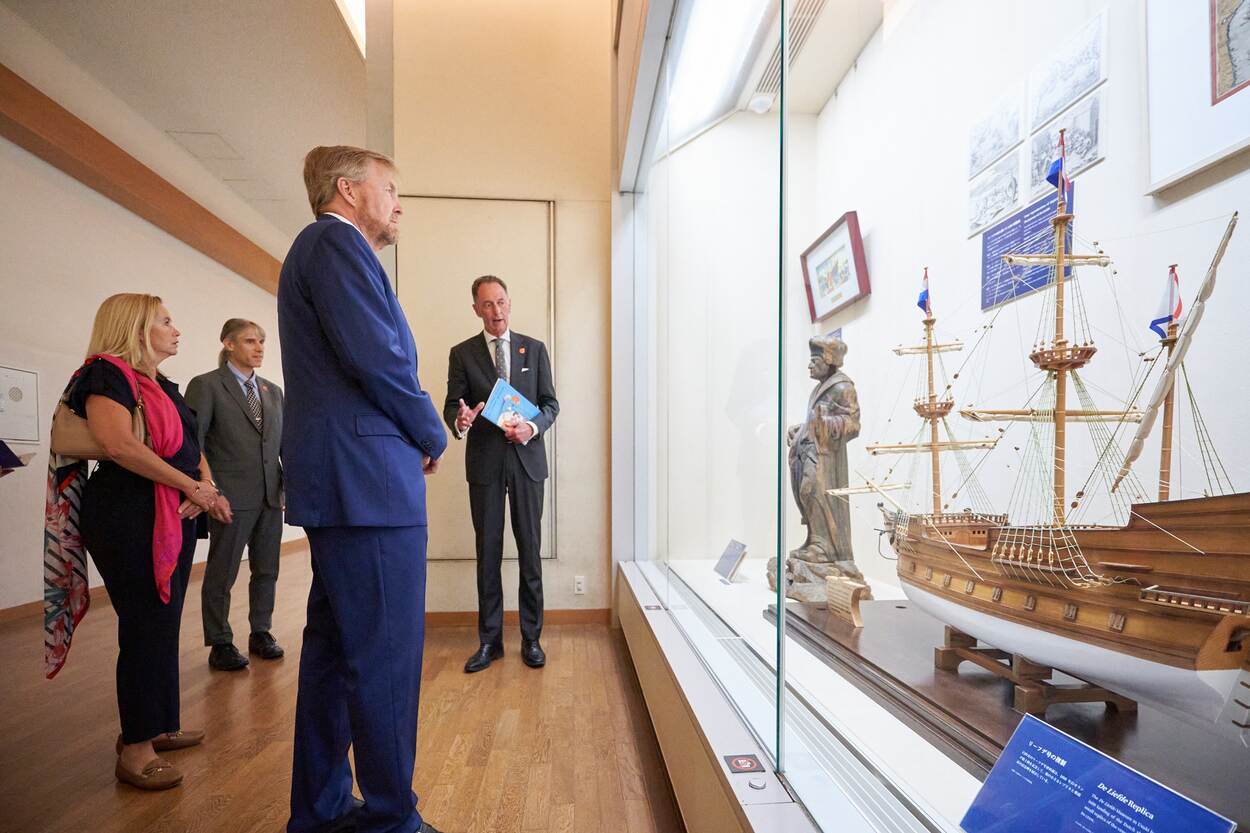
    Throughout May, Osaka Castle is spotlighting the long-standing relationship between Japan and the Netherlands. The exhibition A New Dawn on Common Ground: 425 Years of Exchange between Japan and the Netherlands features objects dating back to the year 1600. That year, the Dutch ship De Liefde arrived in Japan, carrying the first Dutchmen to make contact with the country. This meeting eventually led to an exclusive trading relationship that lasted more than 200 years. On the second day of his visit, the King visited this exhibition, which was organized by the Dutch Consulate in Osaka and features items from both Dutch and Japanese collections.

    Enlarge image
    At Tekijuku, the old Dutch school of Osaka, the King was welcomed by Osaka University students

    The Legacy of Rangaku

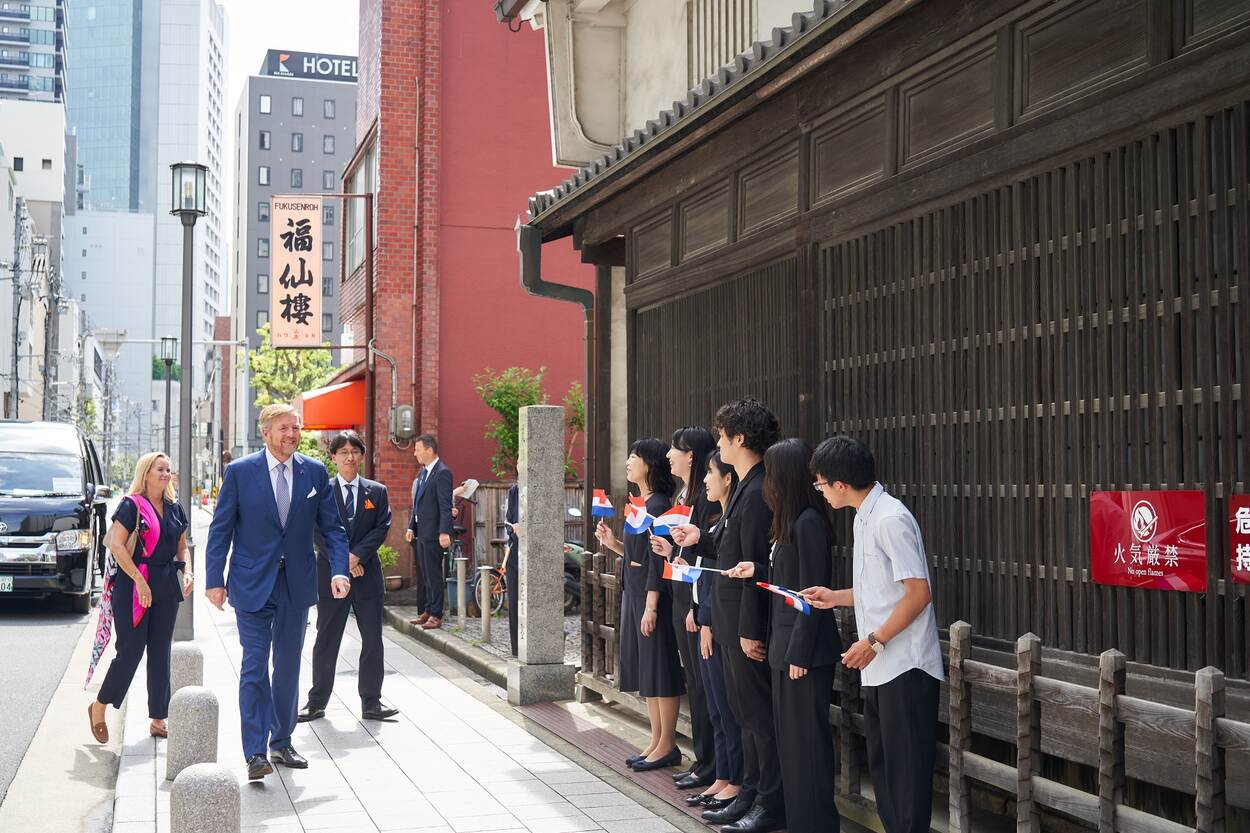
    Later that day, 22 May, the royal delegation visited Tekijuku, one of the most important Dutch-language schools in Japan. Until well into the 19th century, Japanese students studied Dutch there to access Western books. The presence of the Dutch in Japan offered a rare window to the rest of the world. Through Rangaku (Dutch Studies), the latest knowledge in fields such as medicine was introduced to Japan. Today, Tekijuku is part of Osaka University, where last year a new medical cooperation agreement was signed between Japan and the Netherlands. The King also visited Nakanoshima Qross, a new hub for research into the future of healthcare.

    Enlarge image
    At the Pasona pavilion, King Willem-Alexander and Minister Klever were introduced to the latest technology is regenerative medicine

    Innovation and Future Collaboration

    In the afternoon, King Willem-Alexander and Minister Klever joined the economic mission on high tech and digitalization, led by Minister Beljaarts. Around 70 Dutch companies were introduced to approximately 170 Japanese guests. Multiple partnership agreements were signed to promote cooperation in areas such as semiconductors, quantum computing, and 6G telecommunications. The day concluded with an Innovation Parade, where 19 Dutch and Japanese organizations presented their work to the King.

    MIL OSI Europe News

  • MIL-OSI Russia: HSE scientists find out how continuing a career at alma mater affects young researchers

    Translation. Region: Russian Federal

    Source: State University Higher School of Economics – State University Higher School of Economics –

    Many young scientists in Russia continue their academic careers at the same university where they studied. This path is called inbreeding. Institute of Education HSE University analyzed the impact of inbreeding on publication activity in the natural and exact sciences. It turned out that it is ambiguous and depends on a combination of factors: the university’s geographical location, its financial resources, and the state of the regional academic labor market. An article with the results of the work was published inResearch Policy.

    In Russia, almost every second PhD candidate continues to work at the same university where he or she received their education. This career trajectory is called academic inbreeding. It is believed that such a practice can contribute to the isolation of the scientific environment and a decrease in innovative potential. However, the impact of inbreeding on the productivity of young scientists has not yet been sufficiently studied.

    Junior Research Fellowproject-training laboratory “University Development” HSE University Victoria Slepikh studied the careers of 1,132 Russian scientists who defended their PhD theses in 2012 in the fields of physics, biology, chemistry, and mathematics. To assess scientific productivity, the author used publications in international journals, their citation rate, and the presence of publications in journals in the first quartile (Q1).

    The analysis was conducted at two levels. First, the author looked at all PhD candidates (1,132 researchers) who remained in the academy during the first eight years after defending their dissertation. Among them, the level of academic inbreeding was 61%. It turned out that graduates who changed universities after receiving their degree were, on average, more likely to publish, get into prestigious journals, and have a higher citation rate compared to those who remained working at their alma mater.

    The most pronounced negative effect of inbreeding is observed in universities that do not have a special status, i.e., are not federal, national research universities or participants in state programs to support science. Young specialists from such universities published on average 34% fewer articles indexed by Scopus, and the probability that they will have at least one publication in a prestigious journal was almost half that of mobile scientists.

    According to the author, if a young researcher remains in a university that is weakly involved in scientific activity and has limited resources, he continues to reproduce low-level academic standards. Moreover, monotonous professional experience reduces his competitiveness compared to colleagues who have changed organizations.

    “In prestigious and scientifically oriented institutes, academic inbreeding, as a rule, does not have a noticeable impact on productivity. This is explained by a rich professional environment: the presence of a strong scientific team, modern equipment, stable connections with other organizations and participation in large projects,” explains Victoria Slepikh.

    The author then identified a subgroup of the most productive scientists — 417 people whose number of publications exceeded the median values (from 4 to 6 publications in the first eight years of their academic career). In this sample, the proportion of inbreds was 56%. At the same time, the influence of academic inbreeding on productivity in this subgroup turned out to be minimal and was manifested only in individual cases — among graduates who defended their theses in regions with a saturated academic labor market.

    In regions with a large number of scientific institutions, graduates are more likely to have the opportunity to change jobs. If, in such conditions, continuing a career at an alma mater occurs not by choice but by inertia, this may deprive young researchers of the chance to realize themselves in a more suitable professional environment. In less developed regions, academic inbreeding is usually due to a lack of alternatives. The results of the study confirm the hypothesis: where young scientists have more employment options, working at their home university may negatively affect their scientific results.

    In addition, the study showed differences in the behavior of representatives of different scientific disciplines. For example, mathematicians more often chose mobile trajectories and less often stayed at the universities where they defended their dissertations, while physicists and chemists demonstrated a more pronounced tendency toward inbreeding. The author associates these differences with the nature of the research infrastructure and traditions of publication activity in different fields of science.

    “Inbreeding itself is not a problem. However, its consequences can negatively affect scientific activity, especially in universities without special status or with limited resources. To compensate for the risks of isolation, it is necessary to stimulate academic mobility and expansion of external relations. This could be internships, scientific exchanges, development of partnerships with leading research centers. Such steps will increase not only productivity, but also the quality of the academic environment as a whole,” says Victoria Slepykh.

    Please note: This information is raw content directly from the source of the information. It is exactly what the source states and does not reflect the position of MIL-OSI or its clients.

    MIL OSI Russia News

  • MIL-OSI Russia: Open Days of the Master’s Degree Program at the State University of Management: Schedule by Institute

    Translation. Region: Russian Federal

    Source: State University of Management – Official website of the State –

    The State University of Management has prepared a number of introductory events for master’s degree programs. We invite you to review the list and register.

    Institute of Public Administration and Law (IGUiP)

    May 27, 13:00 Location: Atrium of the Information Technology Center Registration link: https://forms.yandex.ru/u/68298dc290fa7b2bf53656f1/

    Institute of Correspondence Education (IZO)

    May 29, 16:00 Online Connection link: https://my.mts-link.ru/j/36659217/1620421363

    June 5, 16:00 Online Connection link: https://my.mts-link.ru/j/36659217/2015436346

    June 19, 16:00 Online Connection link: https://my.mts-link.ru/j/36659217/1910124495

    June 21, 11:00 Location: LK-211 Registration link: https://forms.yandex.ru/u/67e14897068ff01863f70591/

    Institute of Information Systems (IIS)

    May 27, 17:00 Online Connection link: https://my.mts-link.ru/j/22120514/274063255 Registration link: https://forms.yandex.ru/u/682ae6d1e010db46ec544867/

    Institute of Marketing (IM)

    June 10, 16:00 Online Connection link: https://my.mts-link.ru/j/81529577/1742823199

    Institute of Industrial Management (IOM)

    June 5, 11:00 Location: PA-203 Registration link: https://forms.yandex.ru/u/6825b837d0468857d7a81f79/

    Institute of Economics and Finance (IEF)

    June 6, 16:00 Location: Information Technology Center, office 209 Connection link: https://my.mts-link.ru/j/22725512/1872657009

    Institute of Personnel Management, Social and Business Communications (IUPSiBK)

    June 5, 12:00 Location: PA-121 Registration link: https://priem.guu.ru/sample-page/dod-reg/

    We look forward to seeing everyone at events of interest.

    Please note: This information is raw content directly from the source of the information. It is exactly what the source states and does not reflect the position of MIL-OSI or its clients.

    MIL OSI Russia News

  • PM Modi: Gujarat emerging as a global hub for high-tech manufacturing and tribal development

    Source: Government of India

    Source: Government of India (4)

    Prime Minister Narendra Modi today underlined Gujarat’s rising stature as a global hub for high-tech engineering and manufacturing, while also reaffirming the government’s deep commitment to tribal welfare and inclusive development.
     
    Addressing a large gathering in Dahod, the Prime Minister said that Gujarat has made remarkable progress in diverse sectors such as education, IT, semiconductors, and tourism. He informed that a major semiconductor plant is being established in the state with an investment of thousands of crores, further strengthening India’s footprint in the global semiconductor industry and creating employment opportunities for lakhs of youth.
     
    The Prime Minister highlighted that Dahod, Vadodara, Godhra, Kalol, and Halol have together formed a robust high-tech engineering and manufacturing corridor. He said, “Vadodara is rapidly advancing in aircraft manufacturing, with the Airbus assembly line inaugurated recently. The city is also home to India’s first Gati Shakti University. Savli has a major rail coach manufacturing facility, and now Dahod is manufacturing India’s most powerful 9,000-horsepower locomotives. These developments mark a proud moment for the nation.”
     
    He added that small and medium-scale industries across Godhra, Kalol, and Halol are also playing a vital role in Gujarat’s industrial growth. Envisioning the future of the region, he said, “From bicycles and motorcycles to railway engines and aircraft, this corridor will produce it all. Such a high-tech corridor is rare even on the global stage.”
     
    Reaffirming his government’s commitment to tribal welfare, the Prime Minister said that the development of tribal regions is essential for building a developed India. He noted that significant work has been carried out in the last 11 years to uplift tribal communities across the country.
     
    PM Modi said, “I have had the privilege of working extensively in Gujarat’s tribal areas, and that experience has shaped many national-level initiatives. There was a time when tribal children couldn’t even dream of studying science. Today, the tribal belt has access to quality education through ITIs, medical colleges, and two dedicated tribal universities.”
     
    He stated that the network of Eklavya Model Schools has been strengthened over the past decade to ensure better educational opportunities for tribal students, including several such schools now operating in Dahod.
     
    Referring to the ‘Dhartii Aaba Janjati Gram Utkarsh Abhiyan’, he said this is a historic initiative launched for the first time in independent India. He informed that the Central Government is investing nearly ₹80,000 crore in the program, aimed at transforming over 60,000 tribal villages by providing electricity, water, roads, schools, hospitals, and pucca houses.
     
    PM Modi said, “Our government is working for those who were long neglected. The PM Janman Yojana has been introduced to support particularly vulnerable tribal groups who have been deprived for decades. New infrastructure and job opportunities are being created to ensure inclusive development.”
     
    The Prime Minister also highlighted the launch of a national mission to eliminate sickle cell anemia in tribal communities, under which millions have already been screened.
     
    Speaking on regional transformation, PM Modi said that Dahod, once classified as a backward district, is now progressing rapidly as an Aspirational District. He remarked, “South Dahod once faced severe water scarcity. Today, thanks to hundreds of kilometers of new pipelines, Narmada water is reaching every home. Over the years, 11 lakh acres of land from Umargam to Ambaji have been brought under irrigation, easing the burden on tribal farmers.”
  • MIL-OSI Russia: With the support of Rosneft, MSU hosted Biologist Day

    Translation. Region: Russian Federal

    Source: Rosneft – Rosneft – An important disclaimer is at the bottom of this article.

    With the support of Rosneft, Lomonosov Moscow State University celebrated Biologist Day. The event was attended by about 6,000 people, including students and graduates of the educational institution, scientists, as well as schoolchildren and applicants interested in current issues of biology.

    MSU has been a key partner university of Rosneft since 2006. The main areas of cooperation include training and retraining of personnel and scientific research activities. The company takes part in the implementation of innovative educational projects of the University Gymnasium, which hosts lectures for students of Rosneft classes.

    As part of the Biologist’s Day, guests were presented with the latest biological research and developments in the field of neurobiology, paleontology and many other areas. Specialists from the Arctic Scientific Center of the Company told visitors about Rosneft’s research projects in the northern seas. Among them is a large-scale joint environmental project with Innopraktika and Moscow State University in the White Sea. As part of the expeditions, scientists repeated the route of the famous Soviet hydrobiologist Konstantin Deryugin, which he completed more than 100 years ago. Specialists plan to obtain data on the current state of the White Sea biota and assess the changes in the region’s ecosystems that have occurred over the past 100 years.

    In addition, everyone could take part in intellectual games, quests, and try themselves in the role of a real scientist at biology master classes. A musical concert was organized for guests on the street stage.

    Rosneft pays special attention to environmental issues and biodiversity conservation. Environmental care is an integral part of the Company’s corporate culture and social responsibility. Rosneft and its subsidiaries implement numerous grant programs to support scientific and applied projects aimed at studying and protecting rare species of animals and plants.

    Last year, Rosneft launched a new biodiversity conservation program called Tamura. Its goal is to update information on the state of key animal species in the region, including its bioindicators. By 2027, research will be conducted on the Taimyr Peninsula on reindeer, polar bears, valuable bird species, and fish in the mouth of the Yenisei River. A total of 10 expeditions will be conducted over 4 years. This year, Rosneft has already conducted two scientific expeditions to study the populations of polar bears and marine mammals in the Kara Sea. The main goal of the research in the north of Krasnoyarsk Krai and on the Yamal Peninsula is a full-scale census, assessment of the distribution of polar bears using instrumental (photo and infrared aerial photography) and aerial visual methods.

    Reference:

    In order to attract young specialists to its enterprises, Rosneft annually holds career guidance events for MSU students, organizes industrial internships, and encourages promising teachers with corporate grants and pays scholarships to the best students. The company also organizes internships for MSU students and teachers in leading Russian educational and scientific organizations. The Rosneft Scientific and Educational Center for Digital Technologies in the Oil and Gas Industry was created on the basis of the Department of Geology and Geochemistry of Fossil Fuels of the Geological Faculty of MSU, where the specialized master’s program “Digitalization in the Field of Geology of Fossil Fuels” is being implemented.

    Rosneft cooperates with 203 educational partner organizations, including 75 Russian universities. Work with educational institutions is carried out within the framework of the corporate system of continuous education “School – College/University – Enterprise”, which has been in operation since 2005 and ensures a constant influx of young specialists with a high level of training to the Company.

    Department of Information and Advertising of PJSC NK Rosneft May 26, 2025

    Please note: This information is raw content directly from the source of the information. It is exactly what the source states and does not reflect the position of MIL-OSI or its clients.

    MIL OSI Russia News

  • MIL-Evening Report: Fiji can’t compete with Australia and NZ on teacher salaries, says deputy PM

    By Lydia Lewis, RNZ Pacific presenter/bulletin editor

    Fiji cannot compete with Australia and New Zealand to retain its teachers, the man in charge of the country’s finances says.

    The Fijian education system is facing major challenges as the Sitiveni Rabuka-led coalition struggles to address a teacher shortage.

    While the education sector receives a significant chunk of the budget (about NZ$587 million), it has not been sufficient, as global demand for skilled teachers is pulling qualified Fijian educators toward greener pastures.

    Deputy Prime Minister and Finance Minister Biman Prasad said that the government was training more teachers.

    “The government has put in measures, we are training enough teachers, but we are also losing teachers to Australia and New Zealand,” he told RNZ Pacific Waves on the sidelines of the University of the South Pacific Council meeting in Auckland last week.

    “We are happy that Australia and New Zealand gain those skills, particularly in the area of maths and science, where you have a shortage. And obviously, Fiji cannot match the salaries that teachers get in Australia and New Zealand.

    USP vice-chancellor Professor Pal Ahluwalia, Fiji’s Finance Minister Professor Biman Prasad and Education Minister Aseri Radrodro at the opening of the 99th USP Council Meeting at Auckland University last week. Image: RNZ Pacific/Lydia Lewis

    According to the Education Ministry’s Strategic Development Plan (2023-2026), the shortage of teachers is one of the key challenges, alongside limited resources and inadequate infrastructure, particularly for primary schools.

    Hundreds of vacancies
    Reports in local media in August last year said there were hundreds of teacher vacancies that needed to be filled.

    However, Professor Prasad said there were a lot of teachers who were staying in Fiji as the government was taking steps to keep teachers in the country.

    “We are training more teachers. We are putting additional funding, in terms of making sure that we provide the right environment, right support to our teachers,” he said.

    “In the last two years, we have increased the salaries of the civil service right across the board, and those salaries and wages range from between 10 to 20 percent.

    “We are again going to look at how we can rationalise some of the positions within the Education Ministry, right from preschool up to high school.”

    Meanwhile, the Fiji government is currently undertaking a review of the Education Act 1966.

    Education Minister Aseri Radrodro said in Parliament last month that a draft bill was expected to be submitted to Cabinet in July.

    “The Education Act 1966, the foundational law for pre-tertiary education in Fiji, has only been amended a few times since its promulgation, and has not undergone a comprehensive review,” he said.

    “It is imperative that this legislation be updated to reflect modern standards and address current issues within the education system.”

    This article is republished under a community partnership agreement with RNZ.

    MIL OSI AnalysisEveningReport.nz

  • MIL-OSI USA: Governor Newsom announces appointments 5.23.25

    Source: US State of California 2

    May 23, 2025

    SACRAMENTO – Governor Gavin Newsom today announced the following appointments:

    Andrew “Tristan” Peery, of Sacramento, has been appointed Senior Product Manager at the Office of Data and Innovation. Peery has been Director of Web and Interactive Communications at University of California, Davis since 2020, where he was previously Web Applications Development/Web Designer from 2014 to 2020. He held multiple positions at Oregon State University from 2006 to 2013, including Researcher/Web Applications Developer and Graduate Research Assistant. Peery was a Staff Scientist at Woods Hole Group from 2001 to 2005. He earned a Master of Science degree in Physical Oceanography from Oregon State University and a Bachelor of Science degree in Marine Science from Texas A&M University at Galveston. This position does not require Senate confirmation, and the compensation is $150,348. Peery is registered without party preference. 

    Ramank Bharti, of Napa, has been appointed Director of Risk Management and Project Controls at the California High Speed Rail Authority. Bharti held multiple positions at ALSTOM Inc from 2004 to 2025, including Project Director, United States West Coast Services, Site Controller, Services North America, Region Controller, Controller, Budgeting and Reporting, and Work Package Controller. He was a Program Director at Transportation and Transit Associates from 2003 to 2004. Bharti was an MBA Intern at the New Orleans Regional Transit Authority from 2002 to 2003. He was a Deputy Chief Mechanical Engineer at the North Eastern Railway from 1996 to 2001. Bharti was a Manager, Industrial Engineering at Diesel Component Works from 1992 to 1996. He was a Mechanical Engineer at Northern Railway from 1990 to 1992. Bharti earned a Master of Business Administration degree in Finance from Tulane University and a Bachelor of Engineering degree in Mechanical Engineering from the Indian Railway Institute of Mechanical and Electrical Engineering. This position does not require Senate confirmation, and the compensation is $225,000. Bharti is a Democrat.

    Kevin Parzych, of San Luis Obispo, has been appointed Chief of Primary Care Services at Atascadero State Hospital. Parzych has been Chief Medical Officer at Wilshire Health and Community Services since 2013 and Owner of Wilshire Connected Care and K Parzych a Medical Corp since 2017. He was Medical Director of Hospice at Good Shepard Homecare and Hospice from 2004 to 2013. Parzych was Owner of Parzych Family Practice from 2002 to 2013. Parzych earned a Doctor of Medicine degree from Albany Medical College and a Bachelor of Arts degree in Psychology from the University of Connecticut. This position does not require Senate confirmation, and the compensation is $374,400. Parzych is registered with no party preference.

    Madelynn McClain, of Sacramento, has been appointed Director of the Division of Administrative Services at the California Department of Corrections and Rehabilitation. McClain has been Assistant Deputy Director of the Division of Adult Institutions at the California Department of Corrections and Rehabilitation since 2024. McClain held several positions at the Department of General Services from 2023 to 2024, including Deputy Director of the Real Estate Services Division and Chief Financial Officer. She held several positions at the California Department of Corrections and Rehabilitation from 2020 to 2023, including Deputy Director at the Office of Fiscal Services and Associate Director of the Budget Management Branch. McClain was a Principal Program Budget Analyst at the California Department of Finance from 2017 to 2020. She was a Judicial Fiscal Supervisor at the Judicial Council of California from 2015 to 2017. McClain was a Finance Budget Analyst at the Department of Finance from 2003 to 2015. This position requires Senate confirmation, and the compensation is $208,440. McClain is a Democrat.

    Raul Morales, of Visalia, has been appointed Warden at Substance Abuse Treatment Facility and State Prison. Morales has been Acting Warden at Substance Treatment Facility and State Prison since 2024. He was Acting Warden at Valley State Prison in 2024. He held several positions at Substance Abuse Treatment Facility and State Prison from 2001 to 2024, including Chief Deputy Warden, Associate Warden, Captain, Correctional Lieutenant, Correctional Sergeant, and Correctional Officer. This position does not require Senate confirmation, and the compensation is $193,524. Morales is registered without party preference. 

    Press releases, Recent news

    Recent news

    News What you need to know: The City of Tustin received a new water treatment system filtering “forever chemicals,” or PFAS, from local drinking water. TUSTIN – As the federal government announces plans to weaken regulation of “forever chemicals” in drinking water,…

    News What you need to know: California is providing $56 million in grants to help counties provide services for young adults at risk of homelessness. SACRAMENTO – Continuing California’s success in reducing homelessness in youth, Governor Gavin Newsom and the…

    News What you need to know: Six canine officers joined the force to fight back against crime and drug trafficking — the first class trained from day one to detect fentanyl. Sacramento, California – After months of specialized and intensive training, six K-9 teams…

    MIL OSI USA News

  • MIL-OSI Asia-Pac: Hospital Authority and National Conference of University Hospital General Managers of France sign declaration of intent (with photo)

    Source: Hong Kong Government special administrative region

    The following is issued on behalf of the Hospital Authority:

    The Hospital Authority (HA) and the National Conference of University Hospital General Managers of France signed a three-year declaration of intent today (May 26) to strengthen collaboration and exchanges between the two parties in various areas of hospital management and development, including promoting green hospital initiatives and the development of smart hospital, coping with an ageing population, and research and innovation.
     
    The signing ceremony was held during the HA Convention 2025. The Special Envoy of the President of the National Conference of University Hospital General Managers, Mr Frédéric Rimattei, and the HA Chief Executive, Dr Tony Ko, signed the three-year (2025-2028) declaration of intent, witnessed by the Consul General of France in Hong Kong and Macau, Mrs Christile Drulhe; the Counsellor for Health, Social Affairs and Labor from the Embassy of France in China, Mr Romain Jacquet; the Secretary for Health, Professor Lo Chung-mau; and the HA Chairman, Mr Henry Fan.
     
    The National Conference of University Hospital General Managers is composed of 32 university hospital centres in France, covering about 40 per cent of the public healthcare services in the country, and is responsible for promoting the development of medical education and clinical research. Mr Fan said that there is ample room for collaboration between the two parties in various healthcare-related areas. The signing of the declaration of intent has laid the foundation for various collaborative initiatives in the future.
     
    Mr Fan said, “The French public healthcare system is highly acclaimed internationally, and we have much to learn from each other. I look forward to deepening our collaboration in the future, particularly in the areas of sustainable development of the healthcare system, application of smart technologies, talent exchange and training, as well as research and innovation to jointly enhance the quality and standards of healthcare services.”
     
    The President of the National Conference of University Hospital General Managers, Mr Philippe El Saïr, said, “We are delighted to embark on an extensive collaboration with the HA. I believe that both parties will leverage their respective strengths, share experiences and expertise in various aspects of hospital management and development, and promote in-depth exchanges among healthcare professionals in the two places, as well as explore opportunities for clinical research collaboration in different areas.”
     
    Going forward, the HA and the National Conference of University Hospital General Managers will organise regular meetings to plan various collaborative initiatives in detail, and actively arrange reciprocal visits and exchange activities to jointly foster the development of healthcare services in both places.

    MIL OSI Asia Pacific News

  • MIL-OSI Russia: Opening of the Polytech-Tangshan Center

    Translation. Region: Russian Federal

    Source: Peter the Great St Petersburg Polytechnic University – Peter the Great St Petersburg Polytechnic University –

    A delegation from the Saint Petersburg Polytechnic University took part in the opening ceremony of the Polytechnic-Tangshan preparatory center, which took place on May 13 in the Chinese city of Tangshan.

    The project, the agreement for which was signed in March 2022, has finally acquired official status, overcoming a three-year pause caused by the pandemic. Despite the forced delay, the center has already proven its effectiveness: graduates from Tangshan are successfully entering the Polytechnic.

    The official ceremony was held at Yongping Secondary School with the participation of key partners. Welcoming speeches were given by the head of Tangshan East Education Corporation Zhang Guofu, the head of the Friendship Bridge company Dmitry Rogozin, and assistant to the vice-rector of SPbPU Pavel Nedelko. The Polytechnic delegation was also represented by the director of the Humanities Institute Natalia Chicherina, her deputy Tatyana Nam and senior lecturer of the Higher School of Linguistics and Pedagogy Andrey Koshkin.

    The program of the visit included not only official events, but also active interaction with future applicants. Over the course of three days, the delegation visited Tangshan East School, an experimental school, and State Secondary School No. 1, where they held presentations of SPbPU educational programs. Of particular interest was the quiz about our university and St. Petersburg: the most erudite schoolchildren received memorable souvenirs.

    The opening of the Polytech-Tangshan center was a symbolic step in strengthening Russian-Chinese educational ties.

    Please note: This information is raw content directly from the source of the information. It is exactly what the source states and does not reflect the position of MIL-OSI or its clients.

    MIL OSI Russia News

  • MIL-OSI Russia: Students of SPbGASU won prizes at the All-Russian competition of final qualification works “Motorways. Transport infrastructure facilities”

    Translation. Region: Russian Federal

    Source: Saint Petersburg State University of Architecture and Civil Engineering – Saint Petersburg State University of Architecture and Civil Engineering – Associate Professor of the Department of Transport Systems and Road and Bridge Construction of SPbGASU Maria Klekovkina, Head of the Department of Highways of the Don State Technical University Denis Nikolenko and Senior Lecturer of the Department of Transport Systems and Road and Bridge Construction Anna Simonova

    From 19 to 24 May, the 3rd All-Russian round of the competition of final qualifying works “Motorways. Transport infrastructure facilities” was held at SPbGASU. The competition was held in the following areas of training: 08.03.01, 08.04.01 Construction, training profiles “Motorways and airfields”, “Road bridges and tunnels”; in the specialty 08.05.01 Construction of unique buildings and structures, specialization “Construction of highways, airfields and special structures”; and in the specialty 08.05.02 Construction, operation, restoration and technical cover of motorways, bridges and tunnels, specialization “Construction (reconstruction), operation and technical cover of motorways”.

    The competition involved final qualification works of 204 students from construction universities from Moscow, St. Petersburg, Kazan, Vologda, Krasnoyarsk, Belgorod, Ivanovo, Rostov-on-Don, Penza, Tomsk, Ryazan, Yaroslavl, Novosibirsk, Volgograd and other Russian cities, selected as the best in the nomination based on the results of the II (regional) rounds in the base universities.

    The competition was held in 20 nominations. Each graduation work was reviewed by the jury members and assessed using a point system. Points were awarded for the achievements of the contestants in approving the results of their work, such as publications of articles, educational and methodological literature, participation in exhibitions, competitions, olympiads, reports at conferences, the presence of patents for inventions and utility models.

    In each nomination, the three works that scored the highest number of points took prize places, and their authors were awarded diplomas.

    Students of our university received five diplomas, one of which was for first place.

    Darya Rumyantseva (supervised by senior lecturer Anna Simonova). took first place in the nomination “Road Activity Management” in the training area 08.03.01 Construction, profile “Motor Roads”. The work was completed at the request of the Committee for the Development of Transport Infrastructure of St. Petersburg.

    In her work “Current Problems of Road Construction and Ways to Solve Them”, Darya Rumyantseva proposed an approach consisting of automating processes with the mandatory use of digital technologies. Proposals have been developed for the use of digital systems in the road industry to improve the efficiency and quality of road construction, reduce the time of work, design and construction costs, and ensure the safety, reliability and durability of road infrastructure facilities.

    Dmitry Ivanov (supervised by PhD in Engineering, Associate Professor Evgeny Kornylyev) took second place in the nomination “Maintenance, repair, major repairs and reconstruction of city streets and roads” in the specialty 08.05.02 Construction, operation, restoration and technical cover of highways, bridges and tunnels, specialization “Construction (reconstruction), operation and technical cover of highways”.

    Also, second place was taken by Denis Koshkin (supervisor – Anna Simonova) in the nomination “Organization of work during construction, reconstruction, major repairs, repair and maintenance of highways” in the specialty 08.05.02 Construction, operation, restoration and technical cover of highways, bridges and tunnels, specialization “Construction (reconstruction), operation and technical cover of highways”.

    The third place went to Nikita Pekin (supervised by Candidate of Engineering Sciences, Associate Professor Maria Klekovkina) in the nomination “Design of Highways” in the field of study 08.04.01 Construction, profile “Highways”; and Ivan Myshov (supervised by Candidate of Engineering Sciences Nikolay Kozak) in the nomination “City Streets and Roads” in the specialty 08.05.02 Construction, Operation, Restoration and Technical Cover of Highways, Bridges and Tunnels, specialization “Construction (Reconstruction), Operation and Technical Cover of Highways”.

    Please note: This information is raw content directly from the source of the information. It is exactly what the source states and does not reflect the position of MIL-OSI or its clients.

    MIL OSI Russia News

  • MIL-OSI Russia: The GUU Student Theatre became a laureate of the Moscow Student Spring festival

    Translation. Region: Russian Federal

    Source: State University of Management – Official website of the State –

    Recently, the capital hosted a long-awaited gala concert, where the results of the 10th anniversary open festival “Moscow Student Spring” 2025 were announced, where the Student Theater of the State University of Management “Phoenix” became a laureate of the 3rd degree in the direction “Theatre”, in the nomination “Theatre of small forms”, sub-nomination “Drama theater”.

    The GUU Theatre performed a fascinating production of “The House of Bernarda Alba”.

    This competition was a truly exciting event that united creative youth from all over the capital. Our theater put a lot of effort into preparing for the competition: long rehearsals, master classes with experienced directors and actors, each participant made their contribution to this result.

    We sincerely congratulate the Phoenix Theatre and wish them not to stop there. Let us develop further, set new goals and conquer new heights!

    Please note: This information is raw content directly from the source of the information. It is exactly what the source states and does not reflect the position of MIL-OSI or its clients.

    MIL OSI Russia News

  • Govt convenes stakeholders’ meet to curb ‘dark patterns’ on e-commerce platforms

    Source: Government of India

    Source: Government of India (4)

    Union Minister for Consumer Affairs, Food and Public Distribution, Pralhad Joshi will chair a high-level stakeholders’ meeting on Wednesday to address growing concerns over “dark patterns”—deceptive design practices that manipulate consumer behavior on e-commerce platforms.

    Dark patterns refer to misleading user interface designs that trick consumers into making unintended decisions. These tactics undermine consumer trust, disrupt fair market practices, and pose a serious threat to the integrity of digital commerce.

    The Department of Consumer Affairs has identified 13 major types of dark patterns prevalent across e-commerce platforms. These include False Urgency, Basket Sneaking, Confirm Shaming, Forced action, Subscription trap, Interface interference, Bait and Switch, Drip Pricing, Disguised advertisement, Nagging, Trick question, Saas Billing, and Rogue Malwares.

    The meeting which also aims to explore more effective solutions to tackle the issue will witness participation from major e-commerce players across various sectors, including food (BigBasket, Swiggy, Zomato), travel (MakeMyTrip, Paytm, Ola, Yatra, Uber, EaseMyTrip, Clear Trip), cosmetics, pharmacy (1mg.com, Netmeds, Medika Bazaar), retail (Reliance Retail Limited), clothing, and electronics (Amazon, Flipkart, Apple). Other significant participants include Meta, IndiaMart, IndiGo Airlines, xigo, JUSTDIAL, ONDC, Thomas Cook, and WhatsApp.

    “Key industry organisations, as well as Voluntary Consumer Organisations (VCOs) and leading National Law Universities (NLUs) will also be active participants in this meeting. Their insights, research, and regulatory perspectives will provide valuable input into shaping robust and enforceable solutions,” the ministry said in a statement.

    The Department of Consumer Affairs emphasises that this extensive industry participation is crucial for advancing consumer rights and ensuring a transparent and trustworthy marketplace.
    Additionally, the Ministry is proactively working to curb these unfair trade practices, which erode consumer trust and distort fair market dynamics.

    In November 2023, the department issued comprehensive guidelines identifying 13 prominent dark patterns, such as False Urgency, Basket Sneaking, and Subscription Traps.

    Furthermore, the Department launched the Dark Patterns Buster Hackathon in 2023, leading to the development of three consumer protection apps in collaboration with IIT (BHU). The department has also been actively monitoring e-commerce platforms and conducting consumer awareness campaigns.

    The Ministry underscored that consumer protection and ease of doing business are complementary goals.

    This upcoming stakeholder meeting exemplifies the government’s participatory approach to governance, aiming to strengthen the regulatory ecosystem while promoting a level playing field for businesses. The focus remains on fostering a digital marketplace governed by fairness, transparency, and accountability, where consumer safety is paramount.

  • MIL-OSI Asia-Pac: Secretary for Health attends various events at Hospital Authority Convention highlighting Hong Kong’s role as “super connector” (with photos)

    Source: Hong Kong Government special administrative region

    Secretary for Health attends various events at Hospital Authority Convention highlighting Hong Kong’s role as “super connector”  
         Professor Lo said, “Hong Kong enjoys the distinctive advantages of having strong support from the motherland and close connection with the world under ‘one country, two systems’. The HA Convention fully capitalises on Hong Kong’s international and professional advantages in the healthcare field in providing a broad platform for participants from the Mainland and overseas to exchange and share experiences in hospital management and healthcare services, and facilitate communication and networking between industry players from different parts of the world, demonstrating Hong Kong’s important role as a ‘super connector’.”
     
         At the opening ceremony, Professor Lo also witnessed the successful national accreditation of the Chest Pain Centre of Queen Mary Hospital, making it the first chest pain centre in Hong Kong established in accordance with the national accreditation standards while demonstrating national healthcare service standards to the international community. He said, “The establishment of a chest pain centre can improve the efficiency of diagnosis of acute chest pain and speed up the time for patients to receive cardiac surgery, thereby improving patient care, including lowering the death rate, shortening the length of hospitalisation and reducing the rate of hospital readmission. The adoption of the national accreditation standards by the Hong Kong Special Administrative Region will also facilitate integration into the overall national development by fully utilising Hong Kong’s advantage of having strong support from the motherland and close connection with the world, with a view to demonstrating the excellence of the national healthcare standards to the international community, and helping promote the development of the national accreditation standards of chest pain centre into an internationally recognised standard.”
     
         Over the course of the Convention, Professor Lo met with multiple delegations from the Mainland and overseas and attended various events, taking the opportunity to promote medical co-operation and exchanges between Hong Kong and other regions.
     
         Professor Lo subsequently met with the Director-General of the Health Commission of Guangdong Province, Mr Liu Liqun, and his delegation to explore the exchange of healthcare talent between the two places, and to exchange views on healthcare collaboration projects, such as the Elderly Health Care Voucher Greater Bay Area Pilot Scheme and the cross-boundary use of electronic health records.
     
         After the meeting, both sides attended the welcoming ceremony for the Mainland Healthcare Talents Visiting Programmes. Professor Lo is pleased to note that since the launch of the visiting programmes in 2022, 80 outstanding doctors and two batches of a total of about 170 nurses from the Mainland have come to the HA on exchange, while more than 25 specialists in organ transplantation, cardiology, orthopaedics, neurology, rare diseases and pathology have also been arranged by the HA to conduct exchanges at public hospitals in Beijing, Shanghai and Guangdong. He said, “The Mainland Healthcare Talents Visiting Programmes have effectively facilitated bilateral on-site clinical training and exchanges between healthcare professionals of the two places and broadened their horizons through mutual learning, thereby complementing each other’s strengths in terms of healthcare personnel and clinical services, and enhancing the quality of healthcare services of both places.”
     
         Afterwards, Professor Lo and the Consul General of France in Hong Kong and Macau, Mrs Christile Drulhe, jointly witnessed the signing of the Declaration of Intent between the HA and the National Conference of University Hospital General Managers (CNDG) of France, which formally establishes a strategic collaborative partnership between the two organisations in deepening mutual exchanges, promoting the joint development of hospital services and exchange of medical expertise. As a vital component of the French public healthcare system, the CNDG is covering 40 per cent of the public healthcare services in France. Its delegation shared the cutting-edge experience in green hospitals and hospital innovation at the HA Convention.
     
         Professor Lo will continue to meet with multiple delegations coming to Hong Kong to attend the HA Convention tomorrow.
    Issued at HKT 19:48

    NNNN

    MIL OSI Asia Pacific News

  • Dharmendra Pradhan hands over Letter of Intent to University of Liverpool for Bengaluru campus

    Source: Government of India

    Source: Government of India (4)

    Union Minister for Education, Dharmendra Pradhan, presided over the handover of a Letter of Intent (LoI) to the University of Liverpool in New Delhi on Monday. This marks the second foreign university to receive such an LoI under the University Grants Commission (UGC) Regulations, 2023, which facilitate the establishment of foreign higher educational institutions’ campuses in India.

    In his address, Pradhan emphasized that this development underscores India’s growing role as a trusted partner in global higher education. He said the initiative aligns with the transformative vision of the National Education Policy (NEP) 2020, which aims to create rooted, futuristic, and globally oriented education systems and to produce global citizens.

    Reiterating Prime Minister Narendra Modi’s vision of a ‘Viksit Bharat’ by 2047, Pradhan said that implementation of NEP 2020 is key to achieving this goal. He also stressed the importance of R&D and innovation, noting that the University of Liverpool’s focus on STEM research in India will be mutually beneficial for both academia and society.

    The University of Liverpool has received formal approval from the UGC to open its first foreign university campus in Bengaluru. It is expected to begin operations in August 2026 with undergraduate and postgraduate programmes in Business Management, Accounting and Finance, Computer Science, and Biomedical Sciences. Notably, it will also introduce a Game Design programme—a first for a UK university campus in India.

    The Bengaluru campus is envisioned as a research-intensive environment that will focus on addressing global and local challenges through fundamental, applied, and industry-oriented research. It will also offer global mobility opportunities, enabling Indian and UK-based students to benefit from international exposure and academic exchange.

    During the event, three Memoranda of Understanding (MoUs) were signed with the Royal College of Obstetricians and Gynaecologists (RCOG), AstraZeneca Pharma India Limited, YouWeCan, and Dream11 to explore collaborative initiatives.

    Dr. Vineet Joshi, in his remarks, described the LoI as more than symbolic, representing India’s broader transformation in higher education through strategic reforms, international partnerships, and policy innovation. He reiterated that NEP 2020 prioritizes internationalization and institutional flexibility to ensure India remains globally competitive in education.

  • MIL-OSI Russia: Xi Jinping congratulates Fudan University on its 120th founding anniversary /detailed version-1/

    Translation. Region: Russian Federal

    Source: People’s Republic of China in Russian – People’s Republic of China in Russian –

    Source: People’s Republic of China – State Council News

    BEIJING, May 26 (Xinhua) — Chinese President Xi Jinping on Monday sent a congratulatory letter to Fudan University in Shanghai on the occasion of its 120th founding anniversary.

    Xi Jinping, also general secretary of the Communist Party of China Central Committee and chairman of the Central Military Commission, expressed congratulations to the university’s faculty, students, staff and graduates.

    In the letter, Xi Jinping said that over the past 120 years, Fudan University has kept pace with the times, carried forward the glorious tradition of patriotism and fine university style, nurtured many outstanding talents and made many original achievements, thus playing a positive role in state building and national progress.

    Xi Jinping expressed the hope that from the new starting point, Fudan University will continue to firmly and tirelessly apply the Thought on Socialism with Chinese Characteristics for a New Era to cultivate spiritual values and nurture talents.

    Xi Jinping stressed that the university should deepen reform and scientific research in education, promote the beneficial interaction between independent scientific and technological innovation and independent talent training, and stimulate innovation in philosophy and social sciences.

    He also called on the university to continuously enhance its ability to serve major national strategies and regional socio-economic development, thereby making continuous new contributions to the comprehensive advancement of the great cause of building a powerful country and national rejuvenation through Chinese modernization.

    Founded in 1905 and located in the metropolis of Shanghai in eastern China, Fudan University is a research-oriented, multidisciplinary university. -0-

    MIL OSI Russia News

  • MIL-OSI Russia: The Educational Center for Digital Competencies of SPbGASU has developed a program for automating the verification of information models of buildings and structures

    Translation. Region: Russian Federal

    Source: Saint Petersburg State University of Architecture and Civil Engineering – Saint Petersburg State University of Architecture and Civil Engineering –

    One of the key aspects of working with information models of buildings and structures (TIM models) is filling them with various information. Information about placement levels, fire safety indicators, dimensions and many other characteristics are a significant part of the information model. From the point of view of automating the processing of TIM models, even a minor typo or the presence of invisible characters (for example, extra spaces) can lead to the information model not meeting the requirements of the examination.

    On April 23, 2025, representatives of the Educational Center of Digital Competencies (EDCC) of the St. Petersburg State University of Architecture and Civil Engineering received a certificate of state registration of the computer program No. 2025660311: “TIMTest – software for validating the attribute content of information models of buildings and structures.” Software developers – Yuri Zgoda (category II specialist), Inna Sukhanova (Director of the EDCC, Associate Professor) and Denis Nizhegorodtsev (Deputy Director of the EDCC, Senior Lecturer).

    TIMTest allows you to describe the requirements for the attribute content of the model (the presence of parameter groups, their information content, the correctness of the data type) in a readable format, and then, in a fully automatic mode, check any TIM model provided in the open IFC format for errors. Such checks can be used for a preliminary assessment of the compliance of the provided model with the requirements of the examination.

    Before registration, the developed software demonstrated its high efficiency within the framework of the main stage of the All-Russian TIM-Championship of SPbGASU, which was held from October 28 to November 27, 2024. Now the updated version of this program (adjusted in accordance with the innovations of the technical specifications) will be used to evaluate the work of TIM coordinators within the framework of the still ongoing selection stage of the All-Russian TIM-Championship of SPbGASU 2025.

    Information modeling opens up many new opportunities for specialists in the architectural and construction industry, but at the same time it creates new requirements for the documentation provided to them (including digital). This development is designed to minimize the number of typical errors in model preparation and thus allow specialists to concentrate on solving other, more creative tasks, entrusting the verification of information content to automation tools.

    Please note: This information is raw content directly from the source of the information. It is exactly what the source states and does not reflect the position of MIL-OSI or its clients.

    MIL OSI Russia News

  • MIL-OSI New Zealand: Stevedoring company investing in training and research following enforceable undertaking

    Source: Maritime New Zealand

    An enforceable undertaking between Maritime NZ and stevedoring company SSA, is set to benefit a range of groups including port workers, emergency responders and health researchers.

    In December 2021 a Maritime NZ investigation commenced after an SSA stevedore, who was working at height and guiding containers into position on a container ship, was pinned between a swinging container and another one behind him.

    Maritime NZ’s investigation found that the worker was wearing a harness to work at height without a safety line and relied on clipping himself to lashing bars using a single lanyard/clip.

    This meant the stevedore was unable to move away from the swinging container, and into a safer position.

    “We know working at height is a critical risk area for causing harm at ports. We agreed to the enforceable undertaking as it proposed a range of benefits for a variety of different groups,” Maritime NZ’s General Manager Investigations, Pete Dwen says.

    An enforceable undertaking is an agreement between Maritime NZ and a duty holder (operator) made under the Health and Safety at Work Act 2015 (HSWA). It is entered into voluntarily by the duty holder following a breach (including an alleged breach) of HSWA and, once in place, is legally binding. It is generally used as an alternative to prosecution. It must include appropriate amends to victims, and commitments that would promote health and safety at that work place, the wider industry and the community.

    The $285,000 undertaking will see SSA develop courses to improve safety of those working at heights, implement changes to reduce risks on mobile plants, and improve training for first responders attending incidents at ports.

    “A key part of the undertaking will be to improve sector training through the development of a working-at-heights training programme.”  

    “Education is a critical part of improving safety, and we are glad to see SSA proactively working to promote safer practices and reduce instances of harm,” Mr Dwen says.

    Responders from Fire and Emergency will benefit too, with funding set aside to develop a port response training course.

    “Fire and Emergency personnel are often called upon to respond to incidents at ports, and it is important they understand how ports work and the risks at them,” Pete Dwen says.

    As well as the industry and port-focused initiatives, SSA will fund a Massey University study targeting soft tissue injuries.

    MIL OSI New Zealand News

  • MIL-OSI Africa: Do you live near a dam holding mine waste? 6 questions to ask

    Source: The Conversation – Africa – By Charles MacRobert, Associate Professor, Stellenbosch University

    Mining is essential to modern lifestyles. Copper, iron and other mined products are vital to the products many people take for granted, like electronic devices. Being able to buy these goods quite easily may give a person a false sense of how difficult it is to extract the elements they’re made of.

    Mining involves the removal of mineral-rich rock from the ground and processing it to extract the high-value minerals. Depending on the mineral, this quantity can be as low as a few grams in a tonne of rock.

    For example, removing a tiny quantity of platinum from rock requires finely grinding the rock. The fine material that remains once the platinum is removed is known as tailings.

    Every mining operation produces tailings. This can be coarse, like instant coffee granules, or fine, like cocoa powder. Tailings are typically mixed with water to form a liquid slurry that can be pumped and transported easily.

    Slurry is kept in specially designed tailings dams. The designs are unique and depend on what is being mined and the local area.

    Unfortunately, the history of mining is stained with examples of poorly managed dams that collapse, spilling the slurry, which is sometimes toxic. This can cause serious environmental, social and economic damage.

    Kafue River before contamination by copper mine waste. De Agostini/Getty Images

    One such mine disaster happened in February 2025 in Zambia at the Sino-Metals Leach Zambia copper mine. Over 50 million litres of toxic waste flowed over the dam’s wall into the Mwambashi River. From there it flowed into one of the largest and longest Zambian rivers, the Kafue.

    The pollution travelled further than 100km from the dam, contaminating the river, and killing fish and livestock on nearby farms. The Zambian government had to shut down municipal water to the city of Kitwe to protect residents from consuming the polluted water.

    This should not have happened, because steps have been taken to ensure proactive management of dams. In 2020, the Global Industry Standard on Tailings Management introduced a new set of safety measures and standards.

    Many mines are proactively embracing these standards. This enhances community trust in tailings dams. But other mines are not engaging with communities that might be affected by dams. Or communities may feel unsure what to ask the mines.

    We are geotechnical engineers who have studied tailings dam collapses. Here, we outline six questions people living near mines should ask mine management to ensure they understand the key hazards and risks in their communities.

    1. How far will the slurry flow?

    Each tailings dam has a zone of influence. This is determined by analysing what would happen if the slurry breached the dam walls and started to flow out. It is an estimate of the area which would be swamped by tailings if the dam failed.

    Generally, tailings disasters have caused significant damage up to a distance of 5km from the dam. If the tailings slurry gets into a river, it can flow hundreds of kilometres downstream.


    Read more: Burst mining dam in South Africa: what must be done to prevent another disaster


    Zones of influence are often determined for extreme events, like once in a lifetime storms or large earthquakes. But zones of influence could also include places affected by dust or water pollution from the mine.

    If you can see a tailings dam from where you live or work you should consider yourself within the zone of influence.

    2. Who is responsible for the dam?

    Clearly defined roles and responsibilities for day-to-day operation should be in place in every mine. There should be suitably qualified engineers appointed to carry out monitoring and maintenance of the dam. There need to be enough qualified people to cope with the size of the dam.

    The management structure should set out how day-to-day issues related to the tailings dam are discussed between workers on the ground in mines and top management, and how solutions are found. Mines should also keep audit and inspection reports on their tailings dams, and records should be kept over the long term (because tailings dams are often operational for several decades).

    3. What about the environment?

    Mines should have plans to reduce the impact that tailings dams have on the environment. These would have been informed by public participation. The plans must state what monitoring is in place to measure the impacts of dust and water (groundwater and surface water).

    The true extent of impacts only becomes apparent once the mine starts operating. So, the public should hold mines accountable for commitments made. Mines should satisfy communities that monitoring is continuing to identify and track the dam’s environmental impacts.

    Closure plans should also be continuously communicated to mining-affected communities. This will assure the community that when the miners leave, they won’t be left with a dangerous dam near their homes, with no one to look after it.

    4. Will the tailings dam be safe when it rains?

    A common way that tailings dams fail is when water or slurry washes over the dam sidewalls. This washes away the support. It is known as overtopping, and can happen in storms or if too much tailing is pumped into the dam.

    Overtopping is best managed by keeping the water a certain distance below the dam wall. Mine management must measure this regularly and control how much tailing they pump to the dam. Their task is to make sure that even in a severe storm the level will stay well below the top of the dam wall.

    5. Has the dam always behaved as expected?

    Small failure incidents such as sloughs, slides and bulges where dam walls move but no slurry is released can occur. Mines should investigate and report these, detailing likely causes and mitigation measures implemented.

    Publicly available satellite imagery can easily show where mine tailings dams are becoming unstable. Mines should be transparent and provide explanations for these to avoid any speculation over whether the dam is stable or not.

    6. What alterations have been made?

    Sometimes dams must be changed to accommodate changes in mining or the extraction process. These changes could include how fast the dam is being built, moving the position of the dam wall, or placing material at the base of the wall to stabilise it.

    The unexpected consequences of alterations to a tailings dam could be water seeping out and creating damp spots, leading to dam walls sagging or cracking. If left unchecked this can lead to structural failure.

    When substantial changes are made to a dam’s design, mines need to demonstrate that sufficient consideration has gone into making these changes.

    – Do you live near a dam holding mine waste? 6 questions to ask
    – https://theconversation.com/do-you-live-near-a-dam-holding-mine-waste-6-questions-to-ask-256517

    MIL OSI Africa

  • MIL-OSI Global: Rock art and tomb discoveries in Morocco reveal ancient connections to the wider world

    Source: The Conversation – Africa – By Hamza Benattia, Prehistory, Universitat de Barcelona

    When people think of ancient burials in North Africa, they often picture Egypt’s pyramids and monuments. But new discoveries show that north-western Africa also has a deep and fascinating prehistoric past.

    Morocco’s Tangier Peninsula is particularly interesting. The peninsula sits at Africa’s north-western edge, where the Mediterranean Sea meets the Atlantic Ocean. At just 14 kilometres from Europe across the Strait of Gibraltar, this area has long been a natural crossroads between continents and cultures.

    I’m an archaeologist and PhD student who specialises in north Africa’s later prehistoric periods, between 3800 BC and 500 BC. My research explores how ancient communities responded to environmental changes, and how they moved and connected with other communities across regions.

    The assumption to date has been that the Tangier Peninsula was uninhabited and isolated in late prehistoric times. As part of my PhD research I wanted to explore whether this was true, or whether the area had simply been overlooked by previous archaeological work.

    Through the Kach Kouch and Tahadart Archaeological Projects, we studied both the Atlantic and Mediterranean zones of the peninsula.

    Our goal was to revisit the region using modern archaeological methods and technologies, including radiocarbon dating. To understand how this region may have been connected to the wider world in prehistoric times, we used Geographic Information System software to model possible ancient communication routes and surveyed the landscape through satellite and drone imagery. At a later stage, alongside a team of early career Moroccan archaeologists from the National Institute of Archaeology and Heritage, we carried out field surveys and excavations.

    What we discovered exceeded all expectations. Far from being empty and isolated, the Tangier Peninsula is filled with evidence that people lived, died and held ceremonies there over thousands of years.

    Our hope is that our findings will reframe north-western Africa as a cultural crossroads that has connected regions for thousands of years. This region could reshape our understanding of later prehistory across the Atlantic and Mediterranean worlds.

    A prehistoric ritual and funerary landscape

    Our study, published in African Archaeological Review, presents the discovery of dozens of new archaeological sites, including prehistoric burials, rock art sites and standing stones.

    Until now, research on rock art and burials in north Africa focused on areas like the Nile Valley, the Sahara or the Atlas Mountains. Our discoveries reveal that Morocco’s north-western coast was a major cultural hub in the Bronze Age, over 4,000 years ago.

    The diversity of burial practices, ritual sites, symbolic rock art and unique megalithic monuments reflect a rich prehistoric heritage that transcends modern geographic, political and cultural boundaries. It also highlights the longstanding exchanges and contacts of this region with the Mediterranean, the Atlantic and the Sahara.

    One of the most remarkable sites we excavated is at Daroua Zaydan, near modern-day Tangier. There we uncovered a cist burial, a small stone chamber made from four upright stone slabs covered by a larger stone slab. A crescent-shaped arrangement of stones likely marked the access to the burial chamber.

    Although the grave had been looted in the past, we recovered several human bones outside the cist. One of them was radiocarbon dated to 2118–1890 BC. This date aligns with similar burial traditions across the Strait of Gibraltar in Iberia, and with Early Bronze Age settlement activity at Kach Kouch, about 65km south-east of Daroua Zaydan.

    Cist cemeteries had been documented in the region before, but most were excavated during the early to mid-20th century. At the time, archaeologists didn’t have the methods that can now shed light on important details such as how they were built and when they were used. Daroua Zaydan marks the first radiocarbon-dated cist burial in north-west Africa.

    Monuments, ritual deposits and Atlantic connections

    Our findings suggest the existence of a complex prehistoric ritual landscape at the Tangier Peninsula. This landscape was likely connected to other areas of the Atlantic and Mediterranean through a shared ritual and symbolic “language”.

    One clue is a Bronze Age sword found in the 1920s in the Loukkos river. It was likely made in Britain or Ireland and may have arrived in Africa through Atlantic exchange networks. The sword was likely deliberately thrown to the river — a ritual practice documented along rivers in Atlantic Europe. This suggests that communities in northern Morocco were part of a broader cultural and symbolic world that connected the late prehistoric Atlantic.

    Another example is the stone circle at Mzoura, made up of 176 standing stones. This site, excavated in the 1930s, is unique in north Africa. But it closely resembles other stone circles in Atlantic Europe like Stonehenge. During our fieldwork we also discovered new standing stones and rock art, located along prehistoric communication routes. This suggests they may have been used as territorial markers or ritual sites.

    Before our research, a single painted rock shelter, that of Magara Sanar, was known in north-western Morocco. We have now documented 17 painted and 5 engraved rock shelters.

    The variety of symbols and scenes includes dotted patterns, geometric lines and human-shaped figures. They suggest strong links to Iberian, Atlantic and Saharan prehistoric art.

    Why this matters

    Our research does more than just fill a blank spot on the archaeological map. It opens up new avenues for archaeological exploration in the region. The Tangier Peninsula is home to a rich and largely undocumented late prehistoric heritage. It deserves more attention from researchers, policymakers and the wider public.

    Further protection measures are necessary as the region is undergoing rapid urban development. Tourism is growing and there’s been extensive looting. We hope our work will lead to more archaeological investigations, including new excavations and radiocarbon dating of key sites.

    Hamza Benattia, director of the Tahadart Archaeological Project, received funding from the National Institute of Archaeology and Heritage of Morocco (INSAP), the Prehistoric Society Research Fund, the Stevan B. Dana Grant of the American Society of Overseas Research, the Mediterranean Archaeological Trust Grant, the Barakat Trust Early Career Award, the Centre Jacques Berque Research Grant, the Institute of Ceutan Studies Research Fund and the University of Castilla La Mancha.

    ref. Rock art and tomb discoveries in Morocco reveal ancient connections to the wider world – https://theconversation.com/rock-art-and-tomb-discoveries-in-morocco-reveal-ancient-connections-to-the-wider-world-256931

    MIL OSI – Global Reports

  • MIL-OSI Global: Do you live near a dam holding mine waste? 6 questions to ask

    Source: The Conversation – Africa – By Charles MacRobert, Associate Professor, Stellenbosch University

    Mining is essential to modern lifestyles. Copper, iron and other mined products are vital to the products many people take for granted, like electronic devices. Being able to buy these goods quite easily may give a person a false sense of how difficult it is to extract the elements they’re made of.

    Mining involves the removal of mineral-rich rock from the ground and processing it to extract the high-value minerals. Depending on the mineral, this quantity can be as low as a few grams in a tonne of rock.

    For example, removing a tiny quantity of platinum from rock requires finely grinding the rock. The fine material that remains once the platinum is removed is known as tailings.

    Every mining operation produces tailings. This can be coarse, like instant coffee granules, or fine, like cocoa powder. Tailings are typically mixed with water to form a liquid slurry that can be pumped and transported easily.

    Slurry is kept in specially designed tailings dams. The designs are unique and depend on what is being mined and the local area.

    Unfortunately, the history of mining is stained with examples of poorly managed dams that collapse, spilling the slurry, which is sometimes toxic. This can cause serious environmental, social and economic damage.

    One such mine disaster happened in February 2025 in Zambia at the Sino-Metals Leach Zambia copper mine. Over 50 million litres of toxic waste flowed over the dam’s wall into the Mwambashi River. From there it flowed into one of the largest and longest Zambian rivers, the Kafue.

    The pollution travelled further than 100km from the dam, contaminating the river, and killing fish and livestock on nearby farms. The Zambian government had to shut down municipal water to the city of Kitwe to protect residents from consuming the polluted water.

    This should not have happened, because steps have been taken to ensure proactive management of dams. In 2020, the Global Industry Standard on Tailings Management introduced a new set of safety measures and standards.

    Many mines are proactively embracing these standards. This enhances community trust in tailings dams. But other mines are not engaging with communities that might be affected by dams. Or communities may feel unsure what to ask the mines.

    We are geotechnical engineers who have studied tailings dam collapses. Here, we outline six questions people living near mines should ask mine management to ensure they understand the key hazards and risks in their communities.

    1. How far will the slurry flow?

    Each tailings dam has a zone of influence. This is determined by analysing what would happen if the slurry breached the dam walls and started to flow out. It is an estimate of the area which would be swamped by tailings if the dam failed.

    Generally, tailings disasters have caused significant damage up to a distance of 5km from the dam. If the tailings slurry gets into a river, it can flow hundreds of kilometres downstream.


    Read more:
    Burst mining dam in South Africa: what must be done to prevent another disaster


    Zones of influence are often determined for extreme events, like once in a lifetime storms or large earthquakes. But zones of influence could also include places affected by dust or water pollution from the mine.

    If you can see a tailings dam from where you live or work you should consider yourself within the zone of influence.

    2. Who is responsible for the dam?

    Clearly defined roles and responsibilities for day-to-day operation should be in place in every mine. There should be suitably qualified engineers appointed to carry out monitoring and maintenance of the dam. There need to be enough qualified people to cope with the size of the dam.

    The management structure should set out how day-to-day issues related to the tailings dam are discussed between workers on the ground in mines and top management, and how solutions are found. Mines should also keep audit and inspection reports on their tailings dams, and records should be kept over the long term (because tailings dams are often operational for several decades).

    3. What about the environment?

    Mines should have plans to reduce the impact that tailings dams have on the environment. These would have been informed by public participation. The plans must state what monitoring is in place to measure the impacts of dust and water (groundwater and surface water).

    The true extent of impacts only becomes apparent once the mine starts operating. So, the public should hold mines accountable for commitments made. Mines should satisfy communities that monitoring is continuing to identify and track the dam’s environmental impacts.

    Closure plans should also be continuously communicated to mining-affected communities. This will assure the community that when the miners leave, they won’t be left with a dangerous dam near their homes, with no one to look after it.

    4. Will the tailings dam be safe when it rains?

    A common way that tailings dams fail is when water or slurry washes over the dam sidewalls. This washes away the support. It is known as overtopping, and can happen in storms or if too much tailing is pumped into the dam.

    Overtopping is best managed by keeping the water a certain distance below the dam wall. Mine management must measure this regularly and control how much tailing they pump to the dam. Their task is to make sure that even in a severe storm the level will stay well below the top of the dam wall.

    5. Has the dam always behaved as expected?

    Small failure incidents such as sloughs, slides and bulges where dam walls move but no slurry is released can occur. Mines should investigate and report these, detailing likely causes and mitigation measures implemented.

    Publicly available satellite imagery can easily show where mine tailings dams are becoming unstable. Mines should be transparent and provide explanations for these to avoid any speculation over whether the dam is stable or not.

    6. What alterations have been made?

    Sometimes dams must be changed to accommodate changes in mining or the extraction process. These changes could include how fast the dam is being built, moving the position of the dam wall, or placing material at the base of the wall to stabilise it.

    The unexpected consequences of alterations to a tailings dam could be water seeping out and creating damp spots, leading to dam walls sagging or cracking. If left unchecked this can lead to structural failure.

    When substantial changes are made to a dam’s design, mines need to demonstrate that sufficient consideration has gone into making these changes.

    The authors do not work for, consult, own shares in or receive funding from any company or organisation that would benefit from this article, and have disclosed no relevant affiliations beyond their academic appointment.

    ref. Do you live near a dam holding mine waste? 6 questions to ask – https://theconversation.com/do-you-live-near-a-dam-holding-mine-waste-6-questions-to-ask-256517

    MIL OSI – Global Reports

  • MIL-OSI United Nations: Education on Standardization meeting

    Source: United Nations Economic Commission for Europe

    Background

    The START-Ed Initiative was established by the decision of the Working Party 6 in November 2012. The START-Ed Initiative has the following two major tasks:

    (1) Promotion of standards-awareness in the educational establishments with the elaboration of the 15-module programme on standardization developed in 2012

    (2) Assisting in sharing best practices in teaching standards to different audiences.

    Expected attendance: WP.6 Bureau, members and observers, and secretariat 


    Draft agenda

    Item

    Subject

    Timing

    1a

    Roll call

    0

    1b

    Reminder of WP.6 procedures

    5

    1c

    Approval of the agenda

    5

    2

    Guest speaker: Prof. Kayo Ito (Chubu University, Japan) [Bio & PPT] – 30 minutes (15 minutes presentation followed by discussion / QA) on “Student Oriented Education about Standardization.”

    30

    3

    Future activities of the initiative

    25

    4

    Update from the secretariat

    10

    5

    Any other business

    15

    Next meeting: 11 November 2025 hybrid, Geneva

    MIL OSI United Nations News

  • MIL-OSI United Nations: Education on Standardization Initiative meeting

    Source: United Nations Economic Commission for Europe

    Background

    The START-Ed Initiative was established by the decision of the Working Party 6 in November 2012. The START-Ed Initiative has the following two major tasks:

    (1) Promotion of standards-awareness in the educational establishments with the elaboration of the 15-module programme on standardization developed in 2012

    (2) Assisting in sharing best practices in teaching standards to different audiences.

    Expected attendance: WP.6 Bureau, members and observers, and secretariat 


    Draft agenda

    Item

    Subject

    Timing

    1a

    Roll call

    0

    1b

    Reminder of WP.6 procedures

    5

    1c

    Approval of the agenda

    5

    2

    Guest speaker: Prof. Kayo Ito (Chubu University, Japan) [Bio & PPT] – 30 minutes (15 minutes presentation followed by discussion / QA) on “Student Oriented Education about Standardization.”

    30

    3

    Future activities of the initiative

    25

    4

    Update from the secretariat

    10

    5

    Any other business

    15

    Next meeting: 11 November 2025 hybrid, Geneva

    MIL OSI United Nations News

  • MIL-OSI Asia-Pac: Health chief attends HA convention

    Source: Hong Kong Information Services

    Secretary for Health Prof Lo Chung-mau today attended the opening ceremony of the Hospital Authority (HA) Convention 2025 and met multiple high-level delegations from the Mainland and overseas for in-depth exchanges on healthcare co-operation and development.

    At the opening ceremony, Prof Lo witnessed the successful national accreditation of the Queen Mary Hospital Chest Pain Centre, making it the first chest pain centre in Hong Kong established in accordance with the national accreditation standards.

    He said the establishment of a chest pain centre can improve the efficiency of acute chest pain diagnosis and speed up the time for patients to receive cardiac surgery, thereby lowering the death rate, shortening the hospitalisation period and reducing the hospital readmission rate.

    The health chief also noted that the adoption of the national accreditation standards by the Hong Kong Special Administrative Region will also facilitate integration into the overall national development by fully utilising Hong Kong’s advantage of having the motherland’s  strong support and close connection with the world, with a view to demonstrating the excellence of the national healthcare standards to the international community, and helping promote the development of the national accreditation standards of chest pain centres into an internationally recognised standard.

    Over the course of the convention, Prof Lo met multiple delegations from the Mainland and overseas and attended various events, taking the opportunity to promote medical co-operation and exchanges.

    Among others, Prof Lo met Guangdong Health Commission Director-General Liu Liqun and his delegation to explore the exchange of healthcare talent between the two places, and to discuss healthcare collaboration projects, such as the Elderly Health Care Voucher Greater Bay Area Pilot Scheme and the cross-boundary use of electronic health records.

    After the meeting, both sides attended the welcoming ceremony for the Mainland Healthcare Talents Visiting Programmes.

    Prof Lo was pleased to note that since the 2022 launch of the visiting programmes, 80 outstanding doctors and two batches of about 170 nurses in total from the Mainland have come to the HA on exchange, while more than 25 specialists have also been arranged by the authority to conduct exchanges at public hospitals in Beijing, Shanghai and Guangdong.

    Afterwards, Prof Lo and the Consul General of France in Hong Kong & Macau Christile Drulhe jointly witnessed the signing of the Declaration of Intent between the HA and the National Conference of University Hospital General Managers of France.

    The signing of the declaration formally establishes a strategic collaborative partnership between the two organisations in deepening mutual exchanges, promoting the joint development of hospital services and exchange of medical expertise.

    MIL OSI Asia Pacific News