Category: Universities

  • MIL-OSI Russia: Designing Dumplings: Food Engineering Competition Held at Polytechnic University

    Translartion. Region: Russians Fedetion –

    Source: Peter the Great St Petersburg Polytechnic University – Peter the Great St Petersburg Polytechnic University –

    The Higher School of Biotechnology and Food Production of the Institute of Biomedical Systems and Biotechnology of SPbPU held the competition “Food Engineering”. Students from schools and colleges from St. Petersburg, Leningrad Region, Penza and Podolsk took part in it.

    The competition program consisted of online and offline events, which included theoretical interactive sessions and practical cases for students.

    This year the educational intensive was dedicated to school nutrition.

    In a remote format, the competition participants listened to lectures on the topic “Tasty Science: How Nutrition Shapes the Future” (Associate Professor Svetlana Eliseeva) and “Meat Quality Control from Farm to Plate” (Associate Professor Alexander Moskvichev).

    After that, the in-person stage began — solving cases. Students in grades 9–11 completed tasks on the topic of “Designing Dumplings.” They learned about the types of dumplings, the beneficial properties of raw materials, the range and quality indicators of products, mastered the technology of preparation and the rules of serving.

    College students solved the case “Designing a healthy burger”. The guys mastered the technology of cooking healthy burgers, acquired skills in working in a food quality control laboratory, where they determined the organoleptic and physicochemical indicators of product quality.

    The final stage was the presentation of the results of all completed tasks.

    In the “Designing Pelmeni” case, the winners were Sofia Badanova and Natalie Karapetyan from Gymnasium No. 587.

    The top three were determined among college students.

    First place — Irina Murtazina and Ivan Voronin (Institute of Secondary Vocational Education SPbPU). Second place — Maria Dubrovina and Sofia Basova (College of Business and Technology). Third place — Angelina Ermoolenkova and Evelina Royanova (College of Culinary Arts).

    First-year student of the St. Petersburg State Budgetary Professional Educational Institution “College of Culinary Arts” Angelina Ermoolenkova participated in such a competition for the first time, so she was very pleased with the third place: We will take into account the mistakes and next time we will definitely do everything for the maximum points. I really liked the work in the laboratory, the teachers and student volunteers helped and supported! I was very impressed by the Polytechnic University, I am seriously thinking about entering your university.

    First of all, I want to say thank you for the opportunity to participate in such an event. There was nothing complicated in the preparation, the process was exciting. Thanks to the competition, I learned not to be afraid to combine different textures, tastes and ingredients with each other, – said first-year student of the RANEPA SPb Sofia Balabanova.

    The Food Engineering competition is very popular among schoolchildren and college students. Its goal is career guidance and attracting talented applicants to the Polytechnic University. Participants acquire scientific skills in the food quality control laboratory, design healthy food products and implement their project in the Food Technologies laboratory. Many contestants eventually become Polytechnicians, – noted Associate Professor of the Higher School of Business and Food Engineering Valeria Bychenkova.

    Based on the results of testing, all competition participants received personalized electronic certificates.

    Please note: This information is raw content directly from the source of the information. It is exactly what the source states and does not reflect the position of MIL-OSI or its clients.

    MIL OSI Russia News

  • MIL-OSI Russia: The first festival for college and technical school students was held at the Polytechnic

    Translartion. Region: Russians Fedetion –

    Source: Peter the Great St Petersburg Polytechnic University – Peter the Great St Petersburg Polytechnic University –

    The Polytechnic University hosted the College Fest, which brought together more than a hundred students from colleges in St. Petersburg and other regions. The participants completed assignments from teachers and received recommendations on admission and exam preparation. The event became a platform for self-expression and a source of inspiration.

    The festival participants were greeted by the Vice-Rector for Pre-University and Further Education of SPbPU Dmitry Tikhonov, the Director of the Civil Engineering Institute Marina Petrochenko, the Acting Director of the Higher School of Public Administration Olga Nadezhina and the Director of the Higher School of Engineering and Economics Dmitry Rodionov.

    Over the past few years, the number of applicants who want to enroll with us after receiving secondary vocational education has increased several times. “College Fest” was the first attempt to unite those who strive for knowledge with our university, which is ready to offer educational opportunities. Interesting and useful events await you ahead, which will inspire you and help in your further professional growth, – noted Dmitry Vladimirovich.

    Vitaly Drobchik, the responsible secretary of the admissions committee of SPbPU, spoke about the trajectory of admission after college. Artem Egupov, the director of the Center for work with applicants, shared the secrets of preparing for entrance examinations.

    The guys solved case tasks from the Polytechnic University teachers. The participants of the case from the Civil Engineering Institute designed an energy-efficient private house for one family. They had to develop the architectural design of the building, calculate the required number of solar panels to ensure energy consumption, draw up an estimate for construction and prepare a visualization of the project. Another task was to create a concept for a video game, its script and the visual component of the game space.

    Students who chose the case from the Institute of Mechanical Engineering, Materials and Transport were preparing production for the manufacture of a new product. They analyzed various methods of creating a product, chose the best option taking into account the materials used, cost and logistics aspects, and also planned personnel training.

    Participants in the case “First Steps in Business” from the Institute of Industrial Management, Economics and Trade were asked to develop and present their own business ideas. Students selected and defended an idea taking into account the market situation, and developed a detailed business plan for its implementation.

    The Institute of Electronics and Telecommunications prepared a case in which it was necessary to design a line-of-sight optical communication system for transmitting music from a device with an analog output. To do this, the guys selected suitable materials for optoelectronic devices and created optical pairs for “smart” interacting systems.

    The most “delicious” task was a project from the Institute of Biomedical Systems and Biotechnology to create a healthy burger. Participants developed a recipe that should meet the criteria of healthy eating, described the cooking technology, cost price and suggested possible serving options.

    The event became an important stage in the formation of a professional community among students of secondary vocational educational institutions. The students exchanged experiences, established useful contacts and learned about the opportunities of the Polytechnic University.

    The best teams received diplomas and memorable prizes. The winners of the College Fest were students from the ISPO SPbPU, Malo-Okhtinsky College, the Academy of Transport Technologies, the Volgograd Construction College, Okhtinsky College, the College of Industrial Automation, the College of Information Technologies, the College of SPbGMTU and the St. Petersburg College of Telecommunications.

    “College Fest” showed that college and technical school students are actively interested in participating in the university’s career guidance programs. The students’ creative approach to completing various tasks is especially admirable. We are looking forward to meeting all the kids at the next events,” shared Georgy Shkolnik, Acting Director of the Center for Work with Educational Organizations.

    Please note: This information is raw content directly from the source of the information. It is exactly what the source states and does not reflect the position of MIL-OSI or its clients.

    MIL OSI Russia News

  • MIL-Evening Report: Can the UK prime minister make liberal democracies great again?

    Source: The Conversation (Au and NZ) – By Ben Wellings, Associate Professor in Politics and International Relations, Monash University

    There’s been some “great television” this past week for those who like to watch the end of the West.

    The US president and vice-president effectively sided with Russia in an attempt to bring the war in Ukraine to an end in a way that benefits a) the United States, b) the US president’s vanity, and c) Vladimir Putin.

    Starmer and post-Brexit Britain

    But every crisis also provides an opportunity. The UK prime minister, Keir Starmer, grasped the chance to slough off his uninspiring domestic image as he sought to keep the US engaged in negotiations and preserve a semblance of Ukrainian sovereignty.

    In truth, Starmer’s diplomacy continues the policy of the previous government, which made Ukraine the crucible for Britain’s post-Brexit reintegration into European diplomacy.

    Since the Russian invasion of 2022, Britain distinguished itself as one of Ukraine’s most vociferous backers. It provided strident rhetorical support alongside around £13 billion in aid since the conflict began.

    Like his predecessors, Starmer’s support for Ukraine has offered respite from domestic challenges. His recent advocacy has led to a three-month high in the polls, albeit with a still dismal net approval rating of -28.

    But we shouldn’t be overly cynical. His government has provided us with a framework to understand its approach. According to the doctrine of Progressive Realism, the UK government’s foreign policy reflects a “tough-minded” assessment of Britain’s position within the balance of power as it pursues enlightened ends.

    The initial fit is evident: throughout his advocacy, Starmer’s continued appeals for a US backstop indicate awareness of British limitations while championing Ukrainian self-determination.

    However, increasing Britain’s military budget to counter Russia at the expense of the country’s overseas aid budget is hardly progressive, as both Starmer and UK Foreign Secretary David Lammy have previously noted. Most recently, in Lammy’s case, this concerned Trump’s cuts to USAID last month.

    To his credit, Starmer has recognised that Britain cannot deter Russia alone, and is assembling a “coalition of the willing”. However, even with France and smaller players such as the Scandinavians, Canadians and Australians, this may well be insufficient. Hence the ongoing appeals to the US for security guarantees that it is clearly unwilling to provide.

    If we accept Einstein’s famous definition of insanity as doing the same thing and expecting different results, how should we interpret Starmer’s plans?

    Continuities and change

    Amid all the crisis diplomacy and commentary suggesting this might be the end of the trans-Atlantic alliance, continuity as well as change can be observed.

    One of the most striking examples is the extent to which Starmer emphasises Britain’s longstanding self-perception as a “bridge” between the US and Europe. While recent turmoil has prompted Germany’s new Chancellor Friedrich Merz to declare the need for strategic independence from the US, Starmer continues to depict the US as the “indispensable” ally with whom Britain must strengthen ties.

    Considered alongside Britain’s deep integration in the US’s defence and intelligence architecture, including through AUKUS – with which Trump seemed unfamiliar – it is unlikely Britain will break with America. In fact, it may even strengthen its relationship if Trump’s remarks about a UK-US trade agreement are to be believed.

    For some, these structural explanations suffice when considering Britain’s commitment to the “special relationship” and its identity as the transatlantic bridge. However, psychological factors are also worth considering. Britain’s relationship with the US has been a crucial element of Britain’s pretensions to global leadership since the second world war.

    The uncomfortable truth about bridges is that they get walked over, as was evident when Starmer was blindsided by the US decision to suspend military aid to Ukraine.

    Europe between the US and Russia

    With regard to Europe, it is another case of “plus ça change”. As in 1945, Europe again finds itself caught in the middle between Russia and the US. Critics might say the Europeans should have seen this coming.

    Following the 2022 invasion, Germany, Europe’s most significant economy, proclaimed the moment as one of Zeitenwende, or a “turning point”. However, it subsequently failed to fully substantiate the claim.

    Recently, President of the European Commission and former German Defence Minister Ursula von der Leyen has proposed a “Rearm Europe Plan” that could see up to €800 billion (A$1.36 trillion) allocated to European defence. Whether this materialises remains to be seen.

    France has sought to assume its traditional leading role in advocating for Europe’s strategic autonomy from the US. President Emmanuel Macron has been a prominent figure, but his plan for a partial one-month truce has garnered only lukewarm support.

    However, Putin and Trump do have their admirers in Europe. What is perhaps surprising is that some of this has been too much even for the radical right to stomach – Nigel Farage, for example, leaped to Britain’s defence after Vance’s disparaging remarks. This only underscores the differences in attitudes towards Ukraine between MAGA Americans and Europeans.

    Starmer has undoubtedly secured diplomatic plaudits. However, the structural forces at play suggest that his “coalition of the willing”, if it sticks to outdated ideas, will struggle to make liberal democracy great again, much as that is needed.

    The authors do not work for, consult, own shares in or receive funding from any company or organisation that would benefit from this article, and have disclosed no relevant affiliations beyond their academic appointment.

    ref. Can the UK prime minister make liberal democracies great again? – https://theconversation.com/can-the-uk-prime-minister-make-liberal-democracies-great-again-251360

    MIL OSI AnalysisEveningReport.nz

  • MIL-Evening Report: Bell Shakespeare brings vitality and cracking pace to Henry 5

    Source: The Conversation (Au and NZ) – By Kirk Dodd, Lecturer in English and Writing, University of Sydney

    Brett Boardman/Bell Shakespeare

    Shakespeare’s Henry V (stylised by Bell Shakespeare as Henry 5) is famous for many things. Henry’s rousing speeches. Its chorus directly addressing the audience. Its critical treatment of war. Its comic characters like Fluellen. And the comic exchanges between the French Princess and her maid Alice, trying to speak English.

    For theatre directors, these each serve as different tracks in a mixing deck that can be dialled up or down to temper the treatment of the play.

    Director Marion Potts is a master of this art, bringing vitality and a cracking pace to a big play delivered in less than two hours.

    A world at war

    The play extends the life of Prince Hal from the Henry IV plays. He has forsaken the Boar’s Head Tavern and rejected his friendship with Falstaff, emerging as a politically astute King Henry V: a valiant monarch who will ultimately lead his depleted army to victory over the French at Azincourt.

    This play begins with Henry (JK Kazzi) seeking rightful justifications for his plans to invade France from the Archbishop of Canterbury (Jo Turner). This involves a lengthy speech by Canterbury about detailed legalities; Turner transforms this into a comic tour de force.

    The archbishop could justify just about anything. This brings early and unexpected laughter, but allows the spirit of Shakespeare to shine too, who seems to be showing us the absurdities of war: how quickly politics can be moulded to subjective aims.

    Our world, and the world of our children, continues to be at war. Shakespeare’s canon offers cathartic ways of reflecting on troubled times within the safety of the theatre.

    No specific war is directly paralleled – although the pluck of Zelensky might be echoed in Henry’s costume.
    Brett Boardman/Bell Shakespeare

    Thankfully, no specific war is directly paralleled – although the pluck of Volodymyr Zelensky might be echoed in Henry’s costume (t-shirts, sports jacket, cargo pants). Zelensky’s ethos seems to share some of the youth and people’s touch possessed by King Henry. And Zelensky was recently required to defend his dress code as a leader who remains at war, stating: “I will wear [a] costume after this war will finish”.

    Costumes by Anna Tregloan distribute similar tones across the English and French soldiers, refreshingly devoid of khaki garb. These emphasise the youth of the armies, dressed in streetwear with guerilla flair, sporting boxing boots.

    The prominence of body training throughout serves as an expression of youth and a perpetual readying for conflict.

    Potts states in the program:

    the world of our production carries the vestiges of wars past and the seeds of those to come. A world either in perpetual ‘training’ for wars or delivering on its brutal promise.

    Exposing vulnerabilities

    Nothing is lost in the clarity of the performances, which bring a vocal muscle to Shakespeare’s lines.

    Kazzi is charismatic as the leading man, using fervency and understatement. His first set-piece, urging his troops with “Once more unto the breach, dear friends, once more!” stays low, to use a term from cricket, and could be pitched higher in its emphatic urgings, but Kazzi finds excellent range thereafter.

    Kazzi, as Henry, finds excellent range in his performance.
    Brett Boardman/Bell Shakespeare

    The neat set ploy of using a chair and microphone at which various characters sit to deliver the chorus sections works very well with Jethro Woodward’s sound design.

    Perhaps emulating a battleground tribunal, the microphone connected us intimately with individual characters. Westmoreland (Alex Kirwan), the King’s dutiful mate, opens the show with “O for a muse of fire!”, quite articulately from a soldier unaccustomed to public speaking.

    Exeter (Ella Prince) is a warrior amused by all the fuss. English soldiers (Rishab Kern and Harrison Mills) show sensitivity and convey the vulnerabilities of war. And the duo of French Princess Katherine (Ava Madon) and her warm and vibrant attendant, Alice (Odile Le Clezio), hit perfect moments of comic relief as two French women rehearsing the English language.

    Political rhetoric

    The play is otherwise stripped of several comic characters (you won’t see the Welshman Fluellen, or Bardolph, or Pistol on stage), permitting its speedy run with a relentless focus on the war. This breach is filled by the comic subplot of Alice and Princess Katherine, preparing for the outcome of the conflict.

    The movable scaffold of the main set (Tregloan) proves surprisingly versatile, especially with atmospheric lighting and blackouts (Verity Hampson).

    Potts’ use of a screen for subtitles allows her to daringly translate Shakespeare’s lines, so French characters speak mostly French. The musicality of the French language adds ardour and humour, while emphasising the cultural divide of the two warring nations.

    Henry V is a play renowned for showing King Henry as a shrewd leader who must achieve great victories for his country, even by committing war crimes.

    Henry V shows King Henry as a shrewd leader who must achieve great victories, even by committing war crimes.
    Brett Boardman/Bell Shakespeare

    While Henry’s threats of the worst kinds of violence against women and children can be framed as political rhetoric (using harsh words to bring about peaceful ends), he strategically commands the slaying of prisoners when outnumbered by the French.

    While war crimes were beginning to be codified in Shakespeare’s day, he seems to suggest true war heroes are rare, while innocent victims are common.

    Potts’ re-construal of the final scene, often a clumsy betrothal between Henry and Katherine, is made more uncomfortable as Henry flippantly repeats his relentless design to marry her, despite her protestations. While royal weddings were often political instruments at the time, it all seems to be a hollow victory for Henry, who seems suddenly too shell-shocked to care anymore for the rich realm he fought to posses.

    Henry 5, from Bell Shakespeare, is at the Sydney Opera House until April 5, then touring to Wollongong, Canberra and Melbourne.

    Kirk Dodd does not work for, consult, own shares in or receive funding from any company or organisation that would benefit from this article, and has disclosed no relevant affiliations beyond their academic appointment.

    ref. Bell Shakespeare brings vitality and cracking pace to Henry 5 – https://theconversation.com/bell-shakespeare-brings-vitality-and-cracking-pace-to-henry-5-249152

    MIL OSI AnalysisEveningReport.nz

  • MIL-Evening Report: The morning after: here’s what to do once Cyclone Alfred has passed

    Source: The Conversation (Au and NZ) – By Yetta Gurtner, Adjunct Senior Lecturer, Centre for Disaster Studies, James Cook University

    Cyclone Alfred is due to cross the coast of southeast Queensland and northern New South Wales late on Friday night or early Saturday morning. Millions of people may wake to a giant mess, if they get any sleep at all.

    So how do you stay safe while you begin the clean up and recovery? It can be helpful to have a plan of action ready, before the time comes.

    First, be prepared to stay inside for a day or so, even after the wild weather has passed. You may have to manage without essential services for a while. And there are several important steps to take before venturing outside.

    I have 20 years’ experience in disaster studies, including how communities can recover. Here’s what you need to know about surviving the morning after Cyclone Alfred.

    Before you leave your safe room

    Say you’ve chosen to “shelter in place”, in the safest room in the house. That’s the smallest room with the fewest windows – usually a bathroom, in a hall or a room under the stairs.

    Do not leave this room until you have been told it’s safe to do so by authorities. Even after the storm has passed, the wind gusts can be very unpredictable. Depending on your location, floodwater may still be a threat.

    If you still have access to the internet, check the digital disaster dashboard online. In Queensland, every council has their own disaster dashboard. New South Wales has the Hazards Near Me app.

    Tune into your local ABC radio station for official emergency updates, warnings and advice. Make sure you have
    spare batteries and even a backup AM-FM radio. Try to minimise use of your mobile phone to conserve battery power and network capacity. SMS/text messages are more likely to get through than phone calls.

    While you wait for normal services to resume

    After the cyclone there may be no power, internet, mobile telephone reception or water supply to your home. This may persist for some time.

    Ahead of the cyclone, try to store enough drinking water to provide three litres per person for several days (don’t forget water for your pets). Store water in bottles in the freezer – it keeps it cool if the power goes out and can be drinking water when it melts. You also need extra water for hygiene, cleaning up and toileting. Fill your bathtub or top-loading washing machine with water before the storm approaches.

    During a flood, sewage may come up through the toilet and the drains of dwellings on the ground level. Before the cyclone, cover your drains with plastic sheeting with a sandbag on top for weight. Place a plastic bag full of sand inside the toilet to form a plug and close the seat. Consider a bucket as a short-term option for toileting.

    Wait for flood waters to recede before unsealing the toilet. When the storm has passed, check local council advice on whether the sewage system is functioning before attempting to flush the toilet again.

    If the power has been out your fridge can remain cool, however food inside may no longer be safe to eat. If items in your freezer have started to defrost, either cook immediately or dispose of them. Some medicines requiring refrigeration will also have to be thrown out.

    Don’t use electric appliances if they are wet and check for any potential gas leaks from gas appliances before use.

    Severe Weather Update 6 March 2025: Tropical Cyclone Alfred moving more slowly towards the coast.

    Contact your insurance provider immediately

    If you are likely to make an insurance claim, contact your insurer straight away for advice.

    The insurance company will probably ask for your policy number. Try to have it (and other important documents) on hand – perhaps in a waterproof wallet, or as photos on your phone.

    Don’t go straight into clean up and recovery mode until you have checked their requirements. Ripping up wet carpets and throwing out your belongings may not be consistent with your insurance policy. Disposing of proof of damage may cause your claim to be rejected.

    Approaches vary between insurance companies. They may require photographs or a written inventory of damaged items. For instance, floodwater will often leave a high-water mark on the walls. Take a photo with a ruler or bottle for reference. The more you can document, the less the insurance company can dispute.

    Before you head outside

    Don’t leave your house until officials say it is safe to do so.

    If you have it, put on protective clothing and equipment including fully covered shoes, gloves, glasses, and an N95 mask. Wear a hat, long pants and long sleeves.

    Keep your children and pets secure inside for as long as you can, until you know the area is safe and clear.

    Switch off your electricity, gas and solar system prior to severe weather. Before switching everything back on, check your house and appliances for any obvious damage. Then check with your utility service provider that all is in order.

    Even if your house is without power, downed power lines may be live. Do not touch them, even if only wanting to move them. Call 000 if it is life threatening, or contact your local energy provider.

    Check for obvious structural damage to the house such as broken windows, water leaks or damaged roofs (such as missing tiles or screws). Beware of fallen or windswept debris and broken glass.

    Look out for wildlife and pests, including venomous snakes and spiders. Don’t poke anything to check if it’s alive.

    Before you start cleaning up

    Wear protective gear when dealing with water-damaged goods and mud. Don’t touch your face at all and if you can, wear a protective N95 mask.

    The mud and dirty water may be contaminated, so be sure to disinfect and wash your hands thoroughly.

    If you have cuts and scrapes, disinfect and cover them immediately, because there’s a high chance of infection.

    Following floods in Northern Queensland this year, 16 people died after being infected with melioidosis, a bacterium found in mud. The bug is more prevalent after heavy rainfall. If you feel unwell, seeking medical advice.

    Mould is another big issue after heavy rain and flooding. Open your windows to ventilate.

    Before you venture further afield

    Resist the urge to go sightseeing. Check on your neighbours and vulnerable community members neighbours instead.

    Talk to friends, family, neighbours and contacts about how you’re feeling. Be honest. It’s perfectly normal to feel anxious and upset after a disaster event.

    If you need extra assistance, seek help. Community recovery hubs will be set up and they will have a list of telephone numbers for support. Use the services available.

    Check your local disaster dashboard or app for up-to-date information on road closures, evacuation centres, and other emergency details.

    Yetta Gurtner has received funding in the past from the Bureau of Meteorology. She is a community engagement officer with the Queensland State Emergency Services.

    ref. The morning after: here’s what to do once Cyclone Alfred has passed – https://theconversation.com/the-morning-after-heres-what-to-do-once-cyclone-alfred-has-passed-251602

    MIL OSI AnalysisEveningReport.nz

  • MIL-OSI China: Bayer doubles down on commitment to China pharmacare

    Source: China State Council Information Office

    Germany-based life sciences giant Bayer unveiled Bayer E-Town Open Innovation Center in Beijing on Monday, adding another tier to the company’s long-term commitment to Chinese healthcare.

    “This is another significant milestone for Bayer Pharmaceuticals in China and further strengthens our strategic presence in Beijing,” said Sebastian Guth, chief operating officer of Bayer Pharmaceuticals.

    The center, which broke ground in 2023 in the Beijing Economic-Technological Development Area — aka Beijing E-Town — is the first of its kind in China. Its aim is to foster collaboration among industry, academia and research to expedite advancements in cutting-edge sectors of the biopharmaceutical industry.

    “We’ve been in China for 143 years and in the E-Town for 30 years. With the opening of our Bayer E-Town Open Innovation Center, we’ve established what we describe as ‘dual innovation engines’ in China, aiming to drive innovation at every stage of our biopharmaceutical value chain,” Guth said.

    Bayer Co. Lab, which was put into operation in China in 2024, has become an innovation force focusing on fostering early innovation and biotech startups in life sciences. As for the newly opened center, Guth noted its “unique focus on open innovation with an emphasis on medicines that are in clinical development and digital innovation to facilitate the commercial success of products that we bring to the Chinese market.”

    The COO underscored that the establishment of the innovation center and Co. Lab represents Bayer’s commitment to “doubling down on local innovation”, saying that “local innovation partnerships will play a key role in our development in China”.

    Featuring artificial intelligence-powered and data-driven operation models, the innovation center will also be used to improve healthcare providers’ engagement on the ground. “The innovation center gives us a platform for showcasing local commercial innovation, for example with our women’s health campus and digital clinical service center,” said Guth. “We already have strong pharmaceutical commercial operation capabilities in China, and this center helps us to take it to the next level. We’re excited to co-develop this with Chinese partners right here in Beijing.”

    Long-term dedication

    As one of the first multinational enterprises to enter the Chinese market, Bayer stands out as the only foreign pharmaceutical company to establish both a product supply center and a research and development center in Beijing. In 1995, the company built the first pharmaceutical production and packaging site in Beijing E-Town and expanded it following a capital expenditure of approximately 100 million euros ($104.83 million) in 2016. The facility is now Bayer’s largest pharmaceutical packaging site.

    “The biopharmaceutical industry in China is undergoing a remarkable transformation. Ten, 20 or 30 years ago, we saw ‘me-too’ products that were developed in China but today we are seeing the emergence of first-in-class innovative medicines originating here,” Guth said, adding that the country is the second most important innovation hub in the global biopharmaceutical industry.

    As China develops new quality productive forces as innovative engines that drive high-quality development, Guth said: “We appreciate China’s commitment to innovation, as it ultimately benefits patients. This new strategy is set to further strengthen the life sciences industry as a vibrant engine, especially in cutting-edge technologies. It mirrors our own commitment to innovation as a pharma company.”

    In a vision of “Treat the untreatable. Cure disease. Offer hope to patients”, Bayer has been committed to practicing its dedication to innovation and excellence in healthcare. According to the company, it has brought more than 30 innovative drugs and new indications to China over the past five years.

    “China has become a rising innovation hub with rapidly growing innovative drug approvals. We’re looking at the country as one of the world’s largest contributors to medical advancements and drug pipelines, with a leading position in cutting-edge technologies and modalities like cell and gene therapies,” said Guth. “We want to leverage the vibrant innovation ecosystem to bring innovative medicines to the many patients in China.”

    In 2009, Bayer established its global prescription medicine R&D center in Beijing, and 19 innovative drugs and 36 new drugs or new indications have since been approved in China. Earlier this year, the company filed two new indications, which are expected to be approved soon.

    To advance fundamental scientific research in drug development, Bayer has fostered communication and collaboration with local academic institutions. In 2009 and 2014, the company established long-term research partnerships with Tsinghua University and Peking University, respectively. So far, they have conducted over 100 joint research projects in various areas, including new target discovery, disease mechanism studies, drug screening, and innovative chemical synthesis, setting a benchmark for integrated development and innovation in China’s pharmaceutical sector.

    “We’re proud to be a trusted partner for innovators and industry leaders in the local innovation ecosystem across the country. There are still many unmet medical needs in China, and we continue to bring innovative products to the market to meet the needs of Chinese patients,” said Guth.

    Increasing prospect

    Last month, China issued an action plan on stabilizing foreign investment in 2025, highlighting expanding pilot openings in sectors such as telecommunications, healthcare and education. It calls for facilitating the orderly opening of the biopharmaceutical sector, supporting eligible foreign enterprises in participating in pilot programs for segmented production of biologics, accelerating the process of bringing innovative drugs to market, optimizing volume-based drug procurement and enhancing the predictability of medical device product procurement.

    “It’s heartening to see China’s commitment to openness, and these policies create favorable conditions for foreign companies to innovate, invest and grow,” said Guth.

    “For global pharmaceutical companies like Bayer, this creates positive market expectations and will further accelerate innovative drugs coming to market for Chinese patients.

    “These policies encourage local collaboration, and facilitate domestic and foreign companies working together to expand the innovation ecosystem. More Chinese patients will benefit as a result,” he added.

    MIL OSI China News

  • MIL-Evening Report: Cyclone Alfred is slowing – and that could make it more destructive. Here’s how climate change might have influenced it

    Source: The Conversation (Au and NZ) – By Liz Ritchie-Tyo, Professor of Atmospheric Sciences, Monash University

    Cyclone Alfred has now been delayed, as the slow-moving system stalls in warm seas off southeast Queensland. Unfortunately, the expected slow pace of the cyclone will bring even more rain to affected communities.

    This is because it will linger for longer over the same location, dumping more rain before it moves on. Alfred’s slowing means the huge waves triggered by the cyclone will last longer too, likely making coastal erosion and flooding worse.

    Cyclone Alfred is unusual – the first cyclone in half a century to come this far south and make expected landfall.

    When unusual disasters strike, people naturally want to know what role climate change played – a process known as “climate attribution”. Unfortunately, this process takes time if you want details on a specific event.

    We can’t yet say if Alfred’s unusual path and slow speed are linked to climate change. But climate change is driving very clear trends which can load the dice for more intense cyclones arriving in subtropical regions. These include the warm waters which fuel cyclones spreading further south, and cyclones dumping more rain than they used to.

    So, let’s unpick what’s driving Cyclone Alfred’s behaviour – including the potential role of climate change.


    Read more:
    Cyclone Alfred is bearing down. Here’s how it grew so fierce – and where it’s expected to hit


    A Bureau of Meteorology update on Cyclone Alfred dated Thursday, March 6.

    Not necessarily climate linked: Alfred’s southerly path

    Many cyclones make it as far south as Brisbane – but they’re nearly all far out at sea. Weather patterns mean most cyclones heading south are diverted to the east, where remnants can hit New Zealand as large extratropical storms.

    The fact that Alfred is set to make landfall is very unusual. But we can’t yet definitively say this is due to climate change. Cyclones are steered by winds and weather patterns, and the Coral Sea’s complex weather makes cyclone paths here very hard to predict.

    Alfred’s abrupt westward shift is due to a large region of high pressure to its south, which has pushed it directly towards heavily populated areas of southeast Queensland and northern New South Wales. These steering winds are not very strong, which is why Alfred is moving slowly.

    In 2014, researchers showed cyclones are reaching their maximum intensity in areas further south in the southern hemisphere and north in the northern hemisphere than they used to. In 2021, researchers also found cyclones were reaching their maximum intensity closer to coasts, moving about 30 km closer per decade.

    Climate link: Warmer seas

    Cyclones typically need water temperatures of 26.5°C or more to form.

    More than 90% of all extra heat trapped by greenhouse gas emissions is stored in the seas. The oceans are the hottest on record, and records keep falling. But normal seasonal variability and shifting ocean currents are still at work too, and we can get unusually warm waters without climate change as a cause.

    What we do know is that ocean temperatures around much of Australia have been unusually warm.

    The northeastern Coral Sea, where Cyclone Alfred formed, experienced the fourth-hottest temperatures on record for February and the hottest on record for January.

    In the Coral Sea, sea surface temperatures were the fourth highest on record in February 2025 and the highest on record in January 2025. This figure shows the trend over time for February.
    Bureau of Meteorology, CC BY-NC-ND

    We also know Australia’s southern waters are warming up too.

    The energy available to power tropical cyclones in subtropical regions has also increased in recent decades, due largely to rising ocean temperatures.

    Average sea surface temperatures in central and southern Queensland on Thursday March 6th. Point Danger is on the Gold Coast.
    Bureau of Meteorology, CC BY-NC-ND

    Climate link: Fewer cyclones but more likely to be intense

    In the northern hemisphere, researchers have found a trend towards fewer cyclones over time. But of those which do form, a higher proportion are more intense.

    It’s not fully clear if the same trend exists in the southern hemisphere, though we are seeing fewer cyclones forming over time.

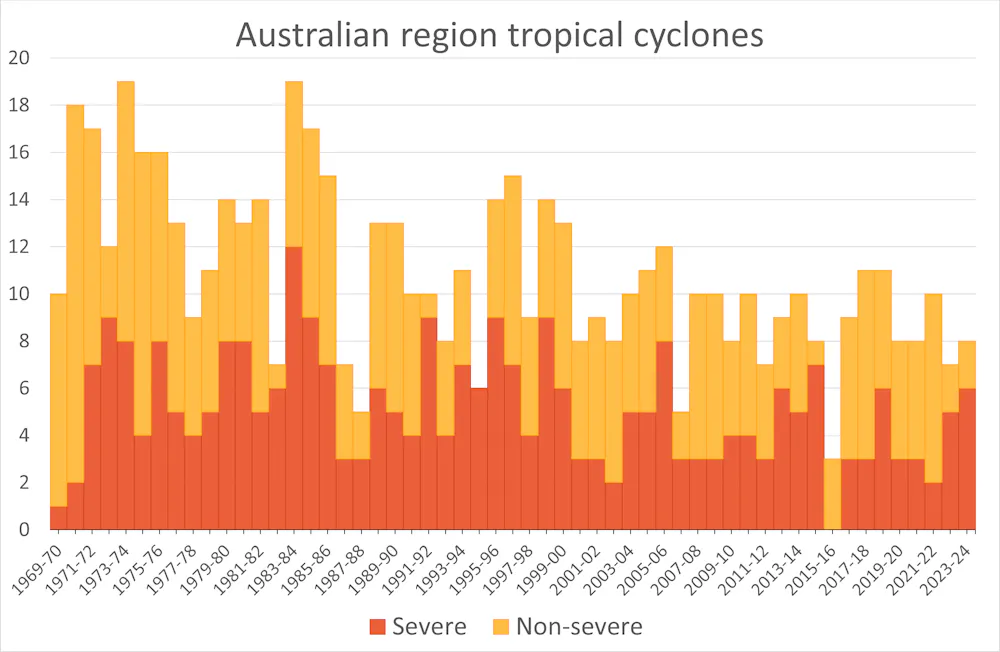
    This summer, eight tropical cyclones have formed in Australian waters. Six were classified as severe (category 3 and up). Historically, Australia has experienced a higher proportion of category 1 and 2 cyclones, which bring weaker wind speeds.

    On average, we see about 11 cyclones form and 4-5 make landfall. There has been a downward trend in the number of cyclones forming in the Australian region in recent decades.

    Fewer cyclones, but more likely to be intense: this figure shows the number of severe (Category 3 and up) and non-severe tropical cyclones (Category 1 and 2) since 1970/71.
    Bureau of Meteorology, CC BY-NC-ND

    Climate link: Cyclones dumping more rain

    The intensity of a cyclone refers to the speed of the wind and size of the wind-affected area.

    But a cyclone’s rain field is also important. This refers to the area of heavy rain produced by storms when they’re at cyclone intensity and afterwards as they decay into tropical lows.

    The rate of rainfall brought by cyclones in Australia isn’t necessarily increasing, but more cyclones are moving slowly, such as Alfred. This means more rain per cyclone, on average.

    Rising ocean temperatures mean more water evaporates off the sea surface, meaning forming cyclones can absorb more moisture and dump more rain when it reaches land.

    Why are cyclones slowing down? This is likely because air current circulation in the tropics has weakened. This has a clear link to climate change. Wind speeds have fallen 5 to 15% in the tropics, depending on where you are in the world. It’s hard to pinpoint the change clearly in our region, because the historic record of cyclone tracks isn’t very long.

    For every degree (°C) of warming, rainfall intensity increases 7%. This is well established. But newer research is showing the rate may actually be double this or even higher, as the process of condensation releases heat which can trigger more rain.

    Clear climate link: Bigger storm surges due to sea level rise

    Sea levels are on average about 20 centimetres higher than they were before 1880.

    When a cyclone is about to make landfall, its intense winds push up a body of seawater ahead of it – the storm surge. In low lying areas, this can spill out and flood streets.

    Because climate change is causing baseline sea levels to rise, storm surges can reach further inland. Sea-level rise will also make coastal erosion more destructive.

    What should we take from this?

    We can’t say definitively that climate change is behind Cyclone Alfred’s unusual track.

    But factors such as rising sea levels, slower cyclones and warmer oceans are changing how cyclones behave and the damage they can do.

    Over time, we can expect to see cyclones arriving in regions not historically affected – and carrying more rain when they arrive.

    Liz Ritchie-Tyo receives funding from The Australian Research Council and the U.S. Office of Naval Research

    Andrew Dowdy receives funding from University of Melbourne as well as supported through the Australian Research Council.

    Hamish Ramsay receives funding from the Australian Climate Service.

    ref. Cyclone Alfred is slowing – and that could make it more destructive. Here’s how climate change might have influenced it – https://theconversation.com/cyclone-alfred-is-slowing-and-that-could-make-it-more-destructive-heres-how-climate-change-might-have-influenced-it-251594

    MIL OSI AnalysisEveningReport.nz

  • MIL-Evening Report: How are scientists tracking Cyclone Alfred?

    Source: The Conversation (Au and NZ) – By Sanjeev Kumar Srivastava, Associate Professor of Geospatial Analysis, University of the Sunshine Coast

    Tropical Cyclone Alfred is now expected to make landfall early on Saturday morning – later than initial estimates that suggested it would strike southeast Queensland and northern New South Wales on Friday.

    So, how do scientists track cyclones and make predictions about when and where they will hit?

    I’m a geospatial analyst who uses satellites and other remote-sensing technology for natural resources management. I study data about storms, wildfires and vegetation regrowth around the world.

    Remote-sensing satellites travel through space collecting data about Earth’s surface and atmosphere.

    When it comes to cyclones, information these satellites collect about clouds, temperatures, wind speeds and other variables is crucial. It helps scientists make accurate weather predictions – enabling communities to prepare and protect themselves.

    Geostationary satellites

    Remote sensing refers to technology that gathers information from a distance.

    Remote-sensing satellites move with the Earth. They observe the same hemisphere constantly and send real-time images back to scientists on the ground. The main ones we use in Australia are called Himawari-8 and -9, and they were launched by the Japan Meteorological Agency.

    As reported by the ABC, Himawari-9 captured images showing how Cyclone Alfred travelled down the coast of Queensland earlier this week and then headed toward Brisbane.

    Himawari satellites images show how Cyclone Alfred has moved along its path.

    Geostationary remote sensing satellites are excellent at helping us detect:

    • the centres of tropical cyclones over the ocean
    • developing thunderstorms
    • volcanic material in the atmosphere and
    • how clouds are moving.

    Himawari collects images and information from the visible and infrared spectrum. This can give us cloud temperature, which can provide more precise information about where the eye of a cyclone is (the eye tends to have a higher temperature).

    Polar-orbiting satellites

    Polar-orbiting satellites move across the Earth north to south, and pass close to the poles.

    They collect information at various intervals and send it back to Earth. Well-known polar orbiting satellites include Landsat 8-9 (run by the US Geological Survey), and the National Oceanic and Atmospheric Administration (NOAA) Joint Polar Satellite System.

    The polar-orbiting satellites give us clear images but not very often. They are just snapshots. They are more useful for providing post-cyclone damage assessments than they are for predicting the path of cyclones.

    Valuable images, and data in the visible, infrared, and microwave range

    Both geostationary and polar orbiting satellites collect data in the visible and infrared regions. There are polar satellites collecting data in the microwave range.

    This means we can look at Earth through the cloud, get cloud temperature information and wind direction.

    In addition to these satellites, the Bureau of Meteorology have their own weather watch radar sensors on the ground. These ground-based radar are set up at various locations and can detect moisture very easily, which helps us work out how moisture is moving into and through clouds.

    Cyclone Alfred is currently shaping up to be a category two cyclone. This means once it makes landfall, it would have an average wind speed of between 89 and 117 kilometres an hour, and gusts between 125 and 164 kilometres an hour.

    Wind speed is predicted using complex algorithms.

    Why do predictions sometimes change?

    Meteorology is a very complex area of science and predictions are based on many, many different data points.

    Sometimes a cyclone’s path will deviate from initial projections, but this is very normal. It’s really hard to predict the future track of a cyclone!

    This is particularly true when cyclones form over the Coral Sea, as in the case of Alfred. There, cyclones paths are among the most unpredictable in the world.

    Sometimes unexpected factors may arise. For example, a recently arrived low pressure system in the west is currently slowing down the arrival of Cyclone Alfred.

    Despite cyclone predictions being difficult, the Bureau of Meteorology is the most reliable and up-to-date source of information on Cyclone Alfred.

    Sanjeev Kumar Srivastava has received funding in the past from the Asia Pacific Network for Global Change Research, various local councils and several cooperative research centres. He is a member of Earth Observation Australia.

    ref. How are scientists tracking Cyclone Alfred? – https://theconversation.com/how-are-scientists-tracking-cyclone-alfred-251611

    MIL OSI AnalysisEveningReport.nz

  • MIL-OSI Economics: Panasonic’s nanoe(TM) (hydroxyl radicals contained in water) technology achieves 99% inactivation of alcohol- and heat-resistant toxins

    Source: Panasonic

    Headline: Panasonic’s nanoe(TM) (hydroxyl radicals contained in water) technology achieves 99% inactivation of alcohol- and heat-resistant toxins

    Osaka, Japan, March 6, 2025 – Panasonic Corporation (Panasonic) (https://holdings.panasonic/global/) today announced that it has demonstrated the inactivating effect of nanoe (hydroxyl radicals contained in water) technology on endotoxin, which causes aggravation of allergy-like symptoms such as asthma and rhinitis, under the supervision of Masafumi Mukamoto, Professor Emeritus of Osaka Metropolitan University and Visiting Researcher at the University of Hyogo.
    According to the 2023 Patient Survey published by the Ministry of Health, Labour and Welfare, the total number of asthma patients in Japan is approximately 1.85 million.*1 A wide variety of factors are also known to contribute to exacerbation of asthma. Of these, academic studies suggest that endotoxin is one of contributing factors to the aggravation of allergy-like symptoms such as asthma and rhinitis,*2, *3 and its presence in house dust*4 and in air pollutants such as PM 2.5 and Asian sand dust*5, *6 has been confirmed. Endotoxin is also known they derive from gram-negative bacteria such as Escherichia coli and are resistant to alcohol and heat, rendering inactivation by general disinfection methods more difficult.
    Panasonic has demonstrated the inhibitory effect of nanoe (hydroxyl radicals contained in water) technology on 20 types of bacteria, and has also partially identified its inhibitory mechanism on bacteria.*7 In this study, in order to verify its effectiveness against bacterial toxins, Panasonic has newly verified its effects against endotoxin, which is resistant to alcohol and heat. The results demonstrated that exposure to nanoe (hydroxyl radicals contained in water) had an inactivation rate of 99% or higher. Note that this verification was conducted under test conditions and does not attest to effectiveness in actual usage spaces. Also, the test was conducted to verify effectiveness on chemical substances that contribute to the worsening of symptoms, and not on the worsening of the symptoms themselves.
    Panasonic is committed to further advancing nanoe (hydroxyl radicals contained in water) technology and pursuing its possibilities in order to help society by providing safe, secure spaces.

    ■Key points of this test

    According to academic research, endotoxin, which is derived from E. coli and is resistant to alcohol and heat, is a substance that should be carefully monitored because it is contained in Asian sand dust, PM 2.5, and house dust, and is suggested to exacerbate allergy-like symptoms such as asthma and rhinitis.
    The results of irradiating endotoxin with nanoe (hydroxyl radicals contained in water) and comparing it against alcohol and heat treatment confirm that nanoe (hydroxyl radicals contained in water) technology alone is more than 99% effective in inactivating endotoxin. (Test (1))
    The results of endotoxin activity measured by irradiating E. coli with nanoe (hydroxyl radicals contained in water) confirmed an inactivation effect of 99% or higher. (Test (2))

    Test (1)

    Figure 1: Test Overview

    Testing organization: Panasonic Corporation*8
    Test sample: Standard endotoxin
    Test device: nanoe (hydroxyl radicals contained in water) generator
    Test method: A petri dish containing standard endotoxin dissolved in solvent was placed in a 45-liter chamber and exposed to nanoe (hydroxyl radicals contained in water) at a position 5 cm from the petri dish for a predetermined length of time.Endotoxin activity was measured on the samples after exposure.*9Samples with and without exposure to nanoe (hydroxyl radicals contained in water) were compared, and the residual endotoxin activity rate was calculated.*10In order to compare against exposure to nanoe (hydroxyl radicals contained in water), treatment under the conditions in which bacteria are sterilized (heating at 90°C, 10-minute treatment, and ethanol 80 vol%, 5-minute treatment) were performed respectively, and the residual rate of endotoxin activity was calculated.*10

    Test (2)

    Figure 2: Test Overview

    Testing organization: Panasonic Corporation
    Test sample: E. coli
    Test device: nanoe (hydroxyl radicals contained in water) generator
    Test method: A petri dish containing E. coli dissolved in solvent was placed in a 45-liter chamber and exposed to nanoe (hydroxyl radicals contained in water) at a position 5 cm from the petri dish.Endotoxin activity was measured on the samples after exposure.*9Samples with and without exposure to nanoe (hydroxyl radicals contained in water) were compared, and the residual endotoxin activity rate was calculated.*10

    ■Test results

    Test results (1)

    Below are the results of confirming the residual endotoxin activity rate*10 for standard endotoxin exposed to nanoe (hydroxyl radicals contained in water) for 48 hours, treated with alcohol, and treated with heat, respectively. Only nanoe (hydroxyl radicals contained in water) technology showed an inactivation effect of 99% or more.

    Test results (2)

    The results of confirming the residual endotoxin activity rate*10 using E. coli exposed to nanoe (hydroxyl radicals contained in water) for 48 hours are described below. nanoe (hydroxyl radicals contained in water) technology showed an inactivation effect of 99% or more.

    ■Comments from Masafumi Mukamoto, Professor Emeritus, Osaka Metropolitan University and Visiting Researcher, University of Hyogo*

    Endotoxin is a toxin that exists on the surface of gram-negative bacteria such as E. coli. It has various biological activity, and has been suggested to aggravate allergy-like symptoms such as asthma and rhinitis. Endotoxin has been reported as present in air pollutants such as PM 2.5 and Asian sand dust, as well as house dust. Particular attention should be paid to Asian sand dust, as the number of days it is observed increases during spring. In addition, endotoxin is known to be resistant to alcohol and heat, so even if bacterial sterilization is performed, it may not be possible to inactivate endotoxin. Thus, I think it is significant that inactivation of endotoxin by nanoe (hydroxyl radicals contained in water) technology was demonstrated in this test.
    *Edited from comments received at the request of Panasonic.

    ■Principle of nanoe (hydroxyl radicals contained in water) generation

    The atomizing electrode is cooled by a Peltier element, which condenses moisture in the air to create water. Afterwards, a high voltage is applied across the atomizing electrode and the opposite electrode to generate nanoe (hydroxyl radicals contained in water) contained in water that contain hydroxyl radicals of approximately 5 to 20 nanometers in size. (Figure 5)

    Notes:*1: Reference: “2023 Patient Survey” Ministry of Health, Labour and Welfare. https://www.mhlw.go.jp/toukei/saikin/hw/kanja/23/index.html*2: Reference: M. Berger et al. “Lipopolysaccharide amplifies eosinophilic inflammation after segmental challenge with house dust mite in asthmatics,” Allergy, vol. 70, No. 3, pp. 257-264, 2014.*3: Reference: Braga CR et al. “Nasal provocation test (NPT) with isolated and associated dermatophagoides pteronyssinus (Dp) and endotoxin lipopolysaccharide (LPS) in children with allergic rhinitis (AR) and nonallergic controls,” J Investig Allergol Clin Immunol., vol. 14, No. 2, pp. 142-8, 2004.*4: Reference: Peter S. Thorne et al. “Endotoxin Exposure Is a Risk Factor for Asthma The National Survey of Endotoxin in United States Housing,” American Journal of Respiratory and Critical Care Medicine, vol. 172, No. 11, pp. 1371-1377, 2005.*5: Reference: Takamichi Ichinose, “Progress of the research on air pollution (PM 2.5, Asian sand dust, etc.) and allergy,” Japanese Journal of Allergology, vol. 63, No. 8, pp. 1085-1094, 2014.*6: Reference: Yahao Ren et al. “Enhancement of OVA-induced murine lung eosinophilia by co-exposure to contamination levels of LPS in Asian sand dust and heated dust,” Allergy Asthma Clin Immunol., vol. 10, No. 1, pp. 30, 2014.*7: [Press Release] Visual Imaging of Bacterial Inhibition Mechanism by Hydroxyl Radicals Contained in Water in Collaboration with Harvard University (March 29, 2012)*8: Endotoxin testing and data acquisition were conducted in cooperation with FUJIFILM Wako Bio Solutions Corporation.*9: Endotoxin testing was conducted in accordance with the “General Rules” and “General Testing Methods” of the Revised Japanese Pharmacopoeia, 18th Edition.*10: Panasonic’s own calculation of residual endotoxin activity rate = (activity after treatment/untreated activity) x 100

    ◆A summary of this press release can be found here:https://www.panasonic.com/global/consumer/nanoe/ja/topics/250306.html
    ◆Results of research into nanoe (hydroxyl radicals contained in water) technology to date can be found here:https://www.panasonic.com/global/consumer/nanoe/ja.html

    Media Contact:

    Living Appliances and Solutions Company, Panasonic CorporationPublic Relations, Corporate Policy Department, Corporate Planning CenterEmail: las-pr@gg.jp.panasonic.com

    Inquiries:

    Living Appliances and Solutions Company, Panasonic CorporationDevices Products Business Unit, Beauty and Personal Care Business DivisionTelephone: +81-(0)749-27-0485 (available 9:30 a.m. to 5:00 p.m. excluding Saturdays, Sundays, and public holidays)

    About Panasonic Corporation
    Panasonic Corporation offers products and services for a variety of living environments, ranging from homes to stores to offices and cities. There are five businesses at the core of Panasonic Corporation: Living Appliances and Solutions Company, Heating & Ventilation A/C Company, Cold Chain Solutions Company, Electric Works Company and China and Northeast Asia Company. The operating company reported consolidated net sales of 3,494.4 billion yen for the year ended March 31, 2024. Panasonic Corporation is committed to fulfilling the mission of Life Tech & Ideas: For the wellbeing of people, society and the planet, and embraces the vision of becoming the best partner of your life with human-centric technology and innovation. Learn more about Panasonic: https://www.panasonic.com/global/about/

    MIL OSI Economics

  • MIL-Evening Report: How Trump is weaponising the Department of Justice, and the ‘dark’ tactic he’s using to get away with it

    Source: The Conversation (Au and NZ) – By Stephen Harrington, Associate Professor, School of Communication, Queensland University of Technology

    It’s hard to keep track of US President Donald Trump’s many notable acts since returning to the White House. His recent pro-Russia stance on the war in Ukraine has, rightly, received a lot of attention.

    But for every big moment, there are others that fly under the radar. One such issue is the politicisation of the Department of Justice (DoJ).

    Although there is longstanding precedent that the DoJ remains politically neutral in its operations, recent events have indicated a dramatic break from that tradition.

    And, importantly, Trump has been laying the groundwork to justify this for nearly two years, using a propaganda tactic that’s been employed by authoritarian governments throughout history.

    Strategic sidelining

    The current administration has attempted to fire or sideline anyone at the DoJ who was involved with prior investigations and prosecutions of the now-president.

    This includes special counsel Jack Smith’s investigations into several aspects of Trump’s wrongdoing, which have since ended. Several lawyers have been fired, ostensibly because “the Acting Attorney-General does not trust these officials to assist in faithfully implementing the President’s agenda”.

    This action is not only vindictive, but likely designed to intimidate would-be investigators and make them think twice before further examining any wrongdoing by Trump or his associates.

    Equally noteworthy has been the department’s attempts to drop corruption charges against New York mayor Eric Adams.
    The official reason is that pursuing the charges might “interfere” with Adams’ reelection campaign.

    In reality, however, Adams has been accused of cutting a deal with the administration: he agrees to assist with Trump’s immigration crackdown in return for having the charges against him withdrawn (although not dropped entirely).

    Adams denies the existence of a quid pro quo, but he did joke about it on national television with Tom Homan, Trump’s “Border Czar”.

    So deeply problematic was all this that two US attorneys for the Southern District of New York opted to resign in protest, rather than be party to what they saw as a nakedly corrupt act.

    The whole scenario is eerily reminiscent of 1973’s “Saturday Night Massacre”, when President Richard Nixon ordered his Attorney-General Elliot Richardson to fire the special prosecutor investigating the Watergate scandal.

    Nixon eventually had his way, but not before refusals and resignations from both Richardson, and the Deputy Attorney-General William Ruckleshaus.

    But, where Nixon’s move dramatically hastened his own downfall, Trump’s actions have barely raised an eyebrow. Why?

    The propaganda play

    The answer lies in a propaganda technique known as “accusation in a mirror”, which entails accusing one’s opponents of the very wrongdoing one plans to commit.

    As one legal scholar explains, it’s:

    a rhetorical practice in which one falsely accuses one’s enemies of conducting, plotting, or desiring to commit precisely the same transgressions that one plans to commit against them.

    Accusation in a mirror has been used in the past, including in the Rwandan genocide. There, trusted voices claimed the Tutsi wanted to “exterminate” the Hutu. Tragically, it helped bring about the exact opposite circumstance.

    Similarly, in February 2022 Russian President Vladimir Putin accused the Ukrainian government of committing genocide against Russian-speaking populations in the Donbas region. This baseless accusation provided a justification for invading Ukraine, which mirrored Russia’s own indiscriminate shelling of Ukrainian civilians.

    We suggest Trump has been using this technique since he was first criminally indicted, in early 2023, on 34 felony charges related to the falsification of business records. He and his supporters have insisted the department, under President Joe Biden, was “weaponised” against him.

    Trump repeatedly claimed those charges – and subsequent indictments – were a politically motivated “witch hunt”. He reiterated these claims in his first speech to Congress.

    Many elected Republicans have also supported and amplified that narrative.

    These claims of victimhood have helped prime Trump’s base to appraise any subsequent legal scrutiny of him as purely partisan, and therefore invalid.

    In reality, the facts were straightforward. Prosecutors were sure there was enough proof to proceed with the case, including evidence Trump illegally kept classified documents at his Mar-a-Lago residence, and obstructed attempts to retrieve them.

    In a functioning legal system, nobody is “above the law”. This means even former presidents can be prosecuted if there’s enough evidence.

    Yet Trump’s accusations of a partisan DoJ completely reframed legitimate investigations into alleged political vendettas. In doing so, it effectively justified his subsequent decisions.

    A self-fulfilling prophecy

    The idea that “if they did it to me, I’m entitled to do it back” was made explicit by Trump in late 2023.

    When asked if he would use the DoJ to go after his political rivals, Trump argued he would only be levelling the playing field, stating:

    they’ve already done it, but if they want to follow through on this, yeah, it could certainly happen in reverse.

    In short, Trump’s false claim of being victimised by a politicised DoJ served as moral cover for his own politicisation of it.

    This is a textbook example of how accusation in a mirror can help manufacture the reality it pretends to condemn.

    Addressing the problem

    This tactic has long been a play by totalitarian and authoritarian leaders.

    Foundational propaganda scholars such as Hannah Arendt and Jacques Ellul highlighted how authoritarian rulers often repeat falsehoods – flipping the aggressor and victim – until the masses become desensitised, alienated and confused.

    Once enough people believe the system is already corrupt and untrustworthy, they are less likely to be shocked by an actual purge (such as firing DoJ officials).

    The implications of such tactics extend internationally, not just to the US.

    History cries out to us about the risks of this sort of public discourse. It erodes trust in institutions and liberal democratic processes, paving the road for leaders to undermine them further, corrupting the system in the name of rooting out corruption.

    Ultimately, one of the best antidotes is awareness. By exposing these tactics, we can better safeguard against disinformation, protect the rule of law and hold leaders accountable.

    Stephen Harrington receives funding from the Australian Research Council, for the Discovery Project ‘Understanding and Combatting “Dark Political Communication”‘.

    Timothy Graham receives funding from the Australian Research Council (ARC) for his Discovery Early Career Researcher Award, ‘Combatting Coordinated Inauthentic Behaviour on Social Media’. He also receives ARC funding for the Discovery Project, ‘Understanding and Combatting “Dark Political Communication”‘.

    ref. How Trump is weaponising the Department of Justice, and the ‘dark’ tactic he’s using to get away with it – https://theconversation.com/how-trump-is-weaponising-the-department-of-justice-and-the-dark-tactic-hes-using-to-get-away-with-it-250760

    MIL OSI AnalysisEveningReport.nz

  • MIL-Evening Report: Cyclone Alfred is slowing down – and that could make it more destructive. Here’s how climate change might have influenced it

    Source: The Conversation (Au and NZ) – By Liz Ritchie-Tyo, Professor of Atmospheric Sciences, Monash University

    Cyclone Alfred has now been delayed, as the slow-moving system stalls in warm seas off southeast Queensland. Unfortunately, the expected slow pace of the cyclone will bring even more rain to affected communities.

    This is because it will linger for longer over the same location, dumping more rain before it moves on. Alfred’s slowing means the huge waves triggered by the cyclone will last longer too, likely making coastal erosion and flooding worse.

    Cyclone Alfred is unusual – the first cyclone in half a century to come this far south and make expected landfall.

    When unusual disasters strike, people naturally want to know what role climate change played – a process known as “climate attribution”. Unfortunately, this process takes time if you want details on a specific event.

    We can’t yet say if Alfred’s unusual path and slow speed are linked to climate change. But climate change is driving very clear trends which can load the dice for more intense cyclones arriving in subtropical regions. These include the warm waters which fuel cyclones spreading further south, and cyclones dumping more rain than they used to.

    So, let’s unpick what’s driving Cyclone Alfred’s behaviour – including the potential role of climate change.

    A Bureau of Meteorology update on Cyclone Alfred dated Thursday, March 6.

    Not necessarily climate linked: Alfred’s southerly path

    Many cyclones make it as far south as Brisbane – but they’re nearly all far out at sea. Weather patterns mean most cyclones heading south are diverted to the east, where remnants can hit New Zealand as large extratropical storms.

    The fact that Alfred is set to make landfall is very unusual. But we can’t yet definitively say this is due to climate change. Cyclones are steered by winds and weather patterns, and the Coral Sea’s complex weather makes cyclone paths here very hard to predict.

    Alfred’s abrupt westward shift is due to a large region of high pressure to its south, which has pushed it directly towards heavily populated areas of southeast Queensland and northern New South Wales. These steering winds are not very strong, which is why Alfred is moving slowly.

    In 2014, researchers showed cyclones are reaching their maximum intensity in areas further south in the southern hemisphere and north in the northern hemisphere than they used to. In 2021, researchers also found cyclones were reaching their maximum intensity closer to coasts, moving about 30 km closer per decade.

    Climate link: Warmer seas

    Cyclones typically need water temperatures of 26.5°C or more to form.

    More than 90% of all extra heat trapped by greenhouse gas emissions is stored in the seas. The oceans are the hottest on record, and records keep falling. But normal seasonal variability and shifting ocean currents are still at work too, and we can get unusually warm waters without climate change as a cause.

    What we do know is that ocean temperatures around much of Australia have been unusually warm.

    The northeastern Coral Sea, where Cyclone Alfred formed, experienced the fourth-hottest temperatures on record for February and the hottest on record for January.

    In the Coral Sea, sea surface temperatures were the fourth highest on record in February 2025 and the highest on record in January 2025. This figure shows the trend over time for February.
    Bureau of Meteorology, CC BY-NC-ND

    We also know Australia’s southern waters are warming up too.

    The energy available to power tropical cyclones in subtropical regions has also increased in recent decades, due largely to rising ocean temperatures.

    Average sea surface temperatures in central and southern Queensland on Thursday March 6th. Point Danger is on the Gold Coast.
    Bureau of Meteorology, CC BY-NC-ND

    Climate link: Fewer cyclones but more likely to be intense

    In the northern hemisphere, researchers have found a trend towards fewer cyclones over time. But of those which do form, a higher proportion are more intense.

    It’s not fully clear if the same trend exists in the southern hemisphere, though we are seeing fewer cyclones forming over time.

    This summer, eight tropical cyclones have formed in Australian waters. Six were classified as severe (category 3 and up). Historically, Australia has experienced a higher proportion of category 1 and 2 cyclones, which bring weaker wind speeds.

    On average, we see about 11 cyclones form and 4-5 make landfall. There has been a downward trend in the number of cyclones forming in the Australian region in recent decades.

    Fewer cyclones, but more likely to be intense: this figure shows the number of severe (Category 3 and up) and non-severe tropical cyclones (Category 1 and 2) since 1970/71.
    Bureau of Meteorology, CC BY-NC-ND

    Climate link: Cyclones dumping more rain

    The intensity of a cyclone refers to the speed of the wind and size of the wind-affected area.

    But a cyclone’s rain field is also important. This refers to the area of heavy rain produced by storms when they’re at cyclone intensity and afterwards as they decay into tropical lows.

    The rate of rainfall brought by cyclones in Australia isn’t necessarily increasing, but more cyclones are moving slowly, such as Alfred. This means more rain per cyclone, on average.

    Rising ocean temperatures mean more water evaporates off the sea surface, meaning forming cyclones can absorb more moisture and dump more rain when it reaches land.

    Why are cyclones slowing down? This is likely because air current circulation in the tropics has weakened. This has a clear link to climate change. Wind speeds have fallen 5 to 15% in the tropics, depending on where you are in the world. It’s hard to pinpoint the change clearly in our region, because the historic record of cyclone tracks isn’t very long.

    For every degree (°C) of warming, rainfall intensity increases 7%. This is well established. But newer research is showing the rate may actually be double this or even higher, as the process of condensation releases heat which can trigger more rain.

    Clear climate link: Bigger storm surges due to sea level rise

    Sea levels are on average about 20 centimetres higher than they were before 1880.

    When a cyclone is about to make landfall, its intense winds push up a body of seawater ahead of it – the storm surge. In low lying areas, this can spill out and flood streets.

    Because climate change is causing baseline sea levels to rise, storm surges can reach further inland. Sea-level rise will also make coastal erosion more destructive.

    What should we take from this?

    We can’t say definitively that climate change is behind Cyclone Alfred’s unusual track.

    But factors such as rising sea levels, slower cyclones and warmer oceans are changing how cyclones behave and the damage they can do.

    Over time, we can expect to see cyclones arriving in regions not historically affected – and carrying more rain when they arrive.

    Liz Ritchie-Tyo receives funding from The Australian Research Council and the U.S. Office of Naval Research

    Andrew Dowdy receives funding from University of Melbourne as well as supported through the Australian Research Council.

    Hamish Ramsay receives funding from the Australian Climate Service.

    ref. Cyclone Alfred is slowing down – and that could make it more destructive. Here’s how climate change might have influenced it – https://theconversation.com/cyclone-alfred-is-slowing-down-and-that-could-make-it-more-destructive-heres-how-climate-change-might-have-influenced-it-251594

    MIL OSI AnalysisEveningReport.nz

  • MIL-Evening Report: HILDA data shows income inequality is at a 20-year high

    Source: The Conversation (Au and NZ) – By Ferdi Botha, Senior Research Fellow, Melbourne Institute: Applied Economic & Social Research, The University of Melbourne

    ArliftAtoz2205/Shutterstock

    The 19th annual report from the Household, Income and Labour Dynamics in Australia (HILDA) Survey was released today.

    The HILDA Survey has been following the same people every year since 2001, which makes it possible to examine how the lives of Australians have changed across several aspects.

    With data from 2001 to 2022, in this year’s report we looked at issues including income inequality, household chores, and the impact of natural disasters on Australian households.

    Income inequality is the highest since 2001

    Funded by the Australian government and managed by the Melbourne Institute, the survey is one of Australia’s most valuable social research tools.

    HILDA examined the lives of 14,000 Australians in 2001 and has kept coming back each year to discover what has changed over the course of their lifetimes. It now covers 17,000 Australians, due to the expansion of participants’ families.

    The survey shows that since COVID-era financial support ended, income inequality has risen substantially.

    The increase in inequality stems from growth in higher incomes as compared to middle incomes, as well as a fall in the growth of lower incomes relative to middle incomes.

    This means, relative to the median earner, Australians already earning a high income have seen the growth in their incomes rise. In contrast, Australians with low incomes have seen a decrease in the rate of growth in their incomes.

    Between 2021 and 2022, 51.2% of respondents reported their real incomes have declined. This is up from about 41% in preceding years, suggesting a decrease in people’s purchasing power.

    A technical measure called the Gini coefficient was 0.32 in 2022, the highest since we started the survey in 2001. The measure ranges from 0 to 1 and is an index that measures overall inequality, with higher scores suggesting greater income inequality.

    Older Australians are getting richer too

    Over the same period, household wealth has continued to grow.

    However, there are large and growing age differences in the growth in household wealth. For young people aged between 18 and 34, net wealth rose by 72.4% to $238,942 over the 20 years to 2022.

    But for older Australians aged 65 to 74, net household wealth jumped by 125% to about $1.26 million.

    These age disparities in household wealth are partly explained by rates of home ownership, which are much higher among older Australians.

    Home ownership is also the most important asset component in terms of total wealth. In 2022, almost 65% of households owned their home, and just over 20% of households held investment properties and holiday homes.

    As a proportion of total wealth, the family home accounts for 44.5% and investment properties account for 14.9%.

    Women are still doing most of the housework

    Australian women still undertake the majority of housework, whereas men’s share of housework has remained constant over 20 years.

    Men’s time spent on housework has not changed in 20 years.
    Diego Cervo/Shutterstock

    Women’s time spent on housework (such as cleaning, cooking, running errands) has fallen slightly from 23.8 hours per week in 2002 to 18.4 hours per week in 2022.

    Men spent 12.8 hours per week on housework, precisely the same amount they did 20 years earlier. Thus, women are still doing close to 50% more housework than men are.

    Men have increased the time they spend on caring responsibilities (such as playing with their children, helping with homework, caring for an elderly relative), from 5 hours per week in 2002 to 5.5 hours per week in 2022. The time women spend on care has risen from 10.1 hours per week to 10.7 hours per week over the same period. In 2022, women spent almost double the time on care duties than men.

    Among couples, men are generally more satisfied than women are with the current division of unpaid work. Most women feel they do more than their fair share at home. Men tend to believe they share the housework and care fairly with their partner.

    Surge in home damage due to weather-related disasters

    Respondents were asked if a weather-related disaster (such as floods, bushfires or cyclone) had damaged or destroyed their home in the past 12 months. In 2022, 4.5% reported experiencing such an event.

    This is a substantial increase from the year before, when only 1.3% of Australians reported weather-related home damage, and exceeding the previous peak of 2.7% in 2011.

    There are also regional differences, closely corresponding with the timing of specific floods or bushfires in the states and territories. In 2022, 9% of New South Wales residents and 6% of Queensland reported home damage, consistent with major floods experienced in these regions in the months prior to the survey.

    Among all Australians who in 2022 reported home damage due to a weather-related disaster, 62.5% were in NSW and 27.3% were in Queensland.

    With the current cyclone Alfred forecast to hit Queensland and northern NSW on Friday, we expect a further significant increase in reported home damage.

    Ferdi Botha is affiliated with the ARC Centre of Excellence for Children and Families over the Life Course.

    ref. HILDA data shows income inequality is at a 20-year high – https://theconversation.com/hilda-data-shows-income-inequality-is-at-a-20-year-high-251596

    MIL OSI AnalysisEveningReport.nz

  • MIL-Evening Report: Robert F. Kennedy Jr says vitamin A protects you from deadly measles. Here’s what the study he cites actually says

    Source: The Conversation (Au and NZ) – By Evangeline Mantzioris, Program Director of Nutrition and Food Sciences, Accredited Practising Dietitian, University of South Australia

    RobsPhoto/Shutterstock

    Robert F. Kennedy Jr, who oversees the health of more than 340 million Americans, says vitamin A can prevent the worst effects of measles rather than urging more people to get vaccinated.

    In an opinion piece for Fox News, the US health secretary said he was “deeply concerned” about the current measles outbreak in Texas. However, he said the decision to vaccinate was a “personal one” and something for parents to discuss with their health-care provider.

    Kennedy mentioned updated advice from the Centers for Disease Control (CDC) to treat measles with vitamin A. He also cited a study he said shows vitamin A can reduce the risk of dying from measles.

    Here’s what the vitamin A study actually says and why public health officials are so concerned about Kennedy’s latest statement.

    Why is a measles outbreak so worrying?

    Measles is a highly contagious disease caused by a virus. It spreads easily including when an infected person breathes, coughs or sneezes.

    Measles initially infects the respiratory tract and then the virus spreads throughout the body. Symptoms include a high fever, cough, red eyes, runny nose and a rash all over the body.

    Measles can also be severe, can cause complications including blindness and swelling of the brain, and can be fatal. Measles can affect anyone but is most common in children.

    The Texan health department has confirmed 150-plus cases of measles and one death of an unvaccinated child during the current outbreak. While this is by far the largest measles outbreak in the US in 2025, the CDC has reported smaller outbreaks in several other states so far this year.

    Why vitamin A?

    Vitamin A is essential for our overall health. It has many roles in the body, from supporting our growth and reproduction, to making sure we have healthy vision, skin and immune function.

    Foods rich in vitamin A or related molecules include orange, yellow and red coloured fruits and vegetables, green leafy vegetables, as well as dairy, egg, fish and meat. You can take it as a supplement.

    Vitamin A can also be used therapeutically. In other words, doctors may prescribe vitamin A to treat a deficiency. Vitamin A deficiency has long been associated with more severe cases of infectious disease, including measles. Vitamin A boosts immune cells and strengthens the respiratory tract lining, which is the body’s first defence against infections.

    Because of this, the CDC has recently said vitamin A can also be prescribed as part of treatment for children with severe measles – such as those in hospital – under doctor supervision.

    One key message from the CDC’s advice is that people are already sick enough with measles to be in hospital. They’re not taking vitamin A to prevent catching measles in the first place.

    The other key message is vitamin A is taken under medical supervision, under specific circumstances, where patients can be closely monitored to prevent toxicity from high doses.

    Vitamin A toxicity can cause birth defects and increase the risk of fractures in elderly people. Vitamin A and beta-carotene (which the body turns into vitamin A) from supplements may also increase your risk of cancer, especially if you smoke.

    Taking too much vitamin A can lead to toxicity and cause birth defects.
    ChameleonsEye/Shutterstock

    How about the study Kennedy cites?

    Kennedy cites and links to a 2010 study, a type known as a systematic review and meta-analysis. Researchers reviewed and analysed existing studies, which included ones that looked at the effectiveness of vitamin A in preventing measles deaths.

    They found three studies that looked at vitamin A treatment by specific dose. There were different doses depending on the age of the children, measured in IU (international units). Having two doses of vitamin A (200,000IU for children over one year of age or 100,000IU for infants below one year) reduced mortality by 62% compared to children who did not have vitamin A.

    The 2010 study did not show vitamin A reduced your risk of getting measles from another infected person. To my knowledge no study has shown this.

    To be fair, Kennedy did not say that vitamin A stops you from catching measles from another infected person. Instead, he used the following vague statement:

    Studies have found that vitamin A can dramatically reduce measles mortality.

    It’s easy to see how a reader could misinterpret this as “take vitamin A if you want to avoid dying from measles”.

    We know what works – vaccines

    The World Health Organization recommends all children receive two doses of measles vaccine.

    The CDC states two doses of the measles vaccine (measles-mumps-rubella or MMR vaccine) is 97% effective against getting measles. This means out of every 100 people who are vaccinated only three will get it, and this will be a milder form.

    But these facts were missing from Kennedy’s statement. Should we be surprised? Kennedy is well known for his vaccine sceptism and for undermining vaccination efforts, including for the measles vaccine.

    As Sue Kressly, president of the American Academy of Pediatrics, told the Washington Post:

    relying on vitamin A instead of the vaccine is not only dangerous and ineffective […] it puts children at serious risk.

    Evangeline Mantzioris is affiliated with Alliance for Research in Nutrition, Exercise and Activity (ARENA) at the University of South Australia. Evangeline Mantzioris has received funding from the National Health and Medical Research Council, and has been appointed to the National Health and Medical Research Council Dietary Guideline Expert Committee.

    ref. Robert F. Kennedy Jr says vitamin A protects you from deadly measles. Here’s what the study he cites actually says – https://theconversation.com/robert-f-kennedy-jr-says-vitamin-a-protects-you-from-deadly-measles-heres-what-the-study-he-cites-actually-says-251465

    MIL OSI AnalysisEveningReport.nz

  • MIL-Evening Report: Woolly mice are cute and impressive – but they won’t bring back mammoths or save endangered species

    Source: The Conversation (Au and NZ) – By Emily Roycroft, Research Group Leader & ARC DECRA Fellow, Monash University

    Colossal Biosciences

    US company Colossal Biosciences has announced the creation of a “woolly mouse” — a laboratory mouse with a series of genetic modifications that lead to a woolly coat. The company claims this is the first step toward “de-extincting” the woolly mammoth.

    The successful genetic modification of a laboratory mouse is a testament to the progress science has made in understanding gene function, developmental biology and genome editing. But does a woolly mouse really teach us anything about the woolly mammoth?

    What has been genetically modified?

    Woolly mammoths were cold-adapted members of the elephant family, which disappeared from mainland Siberia at the end of the last Ice Age around 10,000 years ago. The last surviving population, on Wrangel Island in the Arctic Ocean, went extinct about 4,000 years ago.

    The house mouse (Mus musculus) is a far more familiar creature, which most of us know as a kitchen pest. It is also one of the most studied organisms in biology and medical research. We know more about this laboratory mouse than perhaps any other mammal besides humans.

    Colossal details its new research in a pre-print paper, which has not yet been peer-reviewed. According to the paper, the researchers disrupted the normal function of seven different genes in laboratory mice via gene editing.

    By tinkering with different genes, researchers produced mice with different kinds of fur.
    Colossal Biosciences

    Six of these genes were targeted because a large body of existing research on the mouse model had already demonstrated their roles in hair-related traits, such as coat colour, texture and thickness.

    The modifications in a seventh gene — FABP2 — was based on evidence from the woolly mammoth genome. The gene is involved in the transport of fats in the body.

    Woolly mammoths had a slightly shorter version of the gene, which the researchers believe may have contributed to its adaptation to life in cold climates. However, the “woolly mice” with the mammoth-style variant of FABP2 did not show significant differences in body mass compared to regular lab mice.

    What would it mean to de-extinct a species?

    This work shows the promise of targeted editing of genes of known function in mice. After further testing, this technology may have a future place in conservation efforts. But it’s a long way from holding promise for de-extinction.

    Colossal Biosciences claims it is on track to produce a genetically modified “mammoth-like” elephant by 2028, but what makes a mammoth unique is more than skin-deep.

    De-extinction would need to go beyond modifying an existing species to show superficial traits from an extinct relative. Many aspects of an extinct species’ biology remain unknown. A woolly coat is one thing. Recreating the entire suite of adaptations, including genetic, epigenetic and behavioural traits that allowed mammoths to thrive in ice age environments, is another.

    Prehistoric drawings of an ibex (left) and a mammoth (right) found at Rouffignac cave in France.
    Cave Painter / Wikimedia

    Unlike the thylacine (or Tasmanian tiger) — another species Colossal aims to resurrect — the mammoth has a close living relative in the modern Asian elephant. The closer connections between the genomes of these two species may make mammoth de-extinction more technically feasible than that of the thylacine.

    But whether or not a woolly mouse brings us any closer to that prospect, this story forces us to consider some important ethical questions. Even if we could bring back the woolly mammoth, should we? Is the motivation behind this effort conservation, or entertainment? Is it ethical to bring a species back into an environment that may no longer sustain it?

    Focus on conserving what remains

    In Australia alone, we’ve lost at least 100 species to extinction since European colonisation in 1788, largely due the introduction of feral predators and land clearing.

    The idea of reversing extinction is understandably appealing. We might like to think we could undo the past.

    According to Colossal’s website,

    Extinction is a colossal problem facing the world. And Colossal is the company that’s going to fix it.

    It’s hard to argue with the first part of that. But focusing on bringing back extinct species distracts from a more urgent reality: species are going extinct right now, and we are not doing enough to save them.

    We should first focus on promises to save surviving species, rather than promises to bring back the dead.

    With more investment in threatened species monitoring, new pest control methods, and conservation genetic management, we can turn the tide of extinction and secure the future for species that remain.

    There’s a long list of threatened species that are still alive now. With the right funding and conservation attention, we can do something to save them before it’s too late.

    Emily Roycroft receives funding from the Australian Research Council, the L’Oréal-UNESCO For Women in Science Programme, and the Australian Academy of Science.

    ref. Woolly mice are cute and impressive – but they won’t bring back mammoths or save endangered species – https://theconversation.com/woolly-mice-are-cute-and-impressive-but-they-wont-bring-back-mammoths-or-save-endangered-species-251595

    MIL OSI AnalysisEveningReport.nz

  • MIL-OSI United Kingdom: expert reaction to Copernicus data reporting that global sea ice cover at a record low and February 2025 was third warmest on record

    Source: United Kingdom – Executive Government & Departments

    Scientists comment on Copernicus data reporting global sea ice cover is at a record low, and that February was the third warmest on record. 

    Professor Simon Josey, Professor of Oceanography at the UK’s National Oceanography Centre, said:

    “The current record low global sea ice extent revealed by the Copernicus analysis is of serious concern as it reflects major changes in both the Arctic and Antarctic. Warm ocean and atmospheric temperatures will prove critical for Antarctic sea-ice in the coming months as they may lead to an extensive failure of the ice to regrow in southern hemisphere winter. A recent study (Josey et al., 2024) has shown that this can lead to increasingly stormy conditions in the Southern Ocean and altered ocean properties with potential impacts for the wider ocean and atmospheric circulation.”

    Josey, S. A., A. J. S. Meijers, A. T. Blaker, J. P. Grist, J. Mecking and H. C. Ayres, 2024: Record-low Antarctic sea ice in 2023 increased ocean heat loss and storms, Nature, https://doi.org/10.1038/s41586-024-08368-y.


    Dr Robert Larter, Marine Geophysicist, British Antarctic Survey (BAS), said:

    “The results from C3S showing that global sea ice extent reached a new all-time minimum in February highlight the substantial effects climate change is having in polar regions and are a cause for serious concern. These results are consistent with independent analysis from the National Snow and Ice Data Center in the US. Sea ice has an important climate feedback effect because of its high “albedo”, reflecting a large proportion of incident solar radiation back into space. It also plays an important role in the ecology of the polar oceans and helps protect floating ice shelves in Antarctica, which buttress the ice sheet, by suppressing ocean swell. Furthermore, brine rejection during seasonal formation of sea ice is a key process in the formation of dense water masses that sink to the depths of the ocean and are critical to driving the global overturning thermohaline circulation.

    “The near-record low in Antarctic sea-ice extent follows on from extents in the previous two years that were the lowest in the period over which satellite records have been available, and extends the run of years with low minimum sea ice extents that started with a steep decline in 2016. Antarctic sea-ice extent has usually started to grow again before the end of February as the days get shorter in the Southern Ocean, but this year several days into March the data show no sign of significant new sea ice formation.”

    Prof Richard Allan, Professor of Climate Science, University of Reading, said:

    “February 2025 saw the lowest recorded coverage of sea ice globally as the Arctic reached a record low maximum extent of around 14 million square kilometres and sea ice at the fringes of Antarctica stayed near the record low minimum extent of around 2 million square kilometres, which has been reached every February since 2022. Every successive February, the Arctic has been losing on average 42 thousand square kilometres of sea ice, twice the area of Wales. Parts of the high Arctic have been up to 12 degrees Celsius above average while on the other hand the USA and Canada froze, showing that heat can temporarily shift from one place to another. But averaging over all regions, the global warming trend is clear with February 2025 more than 1.5 degrees Celsius above pre-industrial conditions, repeating a level of excess warmth experienced in all but 1 of the past 20 months, despite a weak cooling influence of La Niña conditions in the Pacific. The long term prognosis for Arctic sea ice is grim as the region continues to rapidly heat up and can only be saved with rapid and massive cuts to greenhouse gas emissions that will also limit the growing severity of weather extremes and long term sea level rise across the world.”

    Declared interests

    Dr Robert Larter: No conflicts.

    Professor Richard Allan: no conflicting interests

    For all other experts, no response to our request for DOIs was received.

    MIL OSI United Kingdom

  • MIL-OSI Russia: NSU Graduates Create a “Smart Mirror”

    Translartion. Region: Russians Fedetion –

    Source: Novosibirsk State University – Novosibirsk State University –

    The Telegram bot “Smart Mirror” appeared a month ago. The application is available to any user of this messenger. The author of the product is a specialist of the NSU Startup Studio and deputy director of the company “Save Technologies” Ksenia Ivanova. Now students of the Institute of Intelligent Robotics of NSU have joined the development as part of their course on project activities.

    This TG application can also be used as a regular mirror if you don’t have one at hand, but need to fix your hair or refresh your makeup. However, its capabilities are not limited to this, because this is not a simple mirror, but a “smart” one.

    So far, the Telegram bot can identify several skin conditions. It estimates the percentage of how healthy your skin is and can recognize signs of several problems. Such as acne, psoriasis, eczema, warts, ringworm. If it determines the skin is healthy, it will advise you to continue your current care and use sunscreen. If the Smart Mirror suspects any abnormalities in your skin condition, it will advise you to see a specialist for a more detailed diagnosis or problem determination, and then for treatment.

    — During the joint work of the NSU Startup Studio with a company producing non-medical skin care products on another project, we came up with the idea of such an application, but we did not intend to sell it, since the problem solved by the mirror has great social significance. We are developing it for two reasons: we see a serious problem in the market, when women cannot decide which products to use, which of them are effective and whether they help over time.

    We found a suitable dataset and models of skin conditions in the public domain, on the basis of which we trained our application to recognize skin conditions. We used the open model yolo8 as a basis for recognition and mediapipe as an auxiliary library. It is important that the model is trained on a dataset of diseases, for us this is a good social start, but then we will enrich it with those problems that everyone may have, – said Ksenia Ivanova.

    The “Smart Mirror” works simply: the user opens the application in Telegram, grants it access to the camera of their smartphone, slowly turns their face in front of the display, on which the answer appears after a few minutes. You can also use the application via a computer, but due to the quality of the camera, a smartphone is still preferable. It is important that there is sufficient lighting, it is best to sit opposite the light source.

    The developers recommend using the Smart Mirror in the morning – after using your daily skin care products, but before applying makeup – through it, the Smart Mirror will not see the real state of your skin and can determine it as healthy with a high degree of probability, without noticing any problematic conditions, if they exist, but are hidden under a layer of foundation and powder.

    The Smart Mirror launched a month ago, but its creators have already received a lot of positive feedback about their application. Many found it interesting and useful. But the developers are not going to stop there.

    — So far, we have presented the beta version of our application to users so that they can get to know it and learn how it works. We want our Smart Mirror to be in demand, so we have developed a plan for the further development of our project and want to teach our application a lot more. For example, to remind about the need to remove makeup before skin monitoring. We will also expand the list of unhealthy skin conditions that the Smart Mirror will be able to recognize, for example, we will definitely include such a skin problem as rosacea. We will also introduce recommendations for skin care – both healthy and problematic. Since we are not going to commercialize our project, our chatbot will not recommend any specific brands of skin care products, but will indicate the active ingredients that should be paid attention to when choosing a cream or lotion. We also plan to teach the Smart Mirror to offer users instructions for self-massage of the face and exercises for the elasticity of the skin and facial muscles, — said Ksenia Ivanova.

    According to the developers, the “Smart Mirror” should become a faithful assistant for its users and a guide on the path to maintaining the beauty and health of the skin. To do this, they plan to teach the application to make a high-quality analysis of its condition so that users can evaluate how effective their actions were aimed at skin care and overcoming existing problems.

    — Many women are concerned about such a problem as bags under the eyes. We want to teach our “Smart Mirror” to help solve this problem. The user looks into it in the morning, the application measures the volume of bags under the eyes and gives its recommendations regarding the drinking regime, duration of sleep and other important points in this case. If they are followed, the user can return to the application in the evening, as well as after a few days, to find out whether changes have occurred and how noticeable they were, — explained Ksenia Ivanova.

    The TG application “Smart Mirror” is available at the link: HTTPS: //t. TA/ARMIRRORBOT

    Please note: This information is raw content directly from the source of the information. It is exactly what the source states and does not reflect the position of MIL-OSI or its clients.

    MIL OSI Russia News

  • MIL-OSI China: Shanxi’s millennium-old porcelain gets modern makeover

    Source: China State Council Information Office 3

    A millennium-old porcelain craft in north China’s Shanxi Province has been pulled back from the brink of extinction and is now poised for a modern renaissance.

    The techniques for making Honglyucai (Red and Green Color) Porcelain of the Bayi kiln, one of China’s earliest producers of the distinctive porcelain, was listed as a national intangible cultural heritage in 2021. The kiln is located in Bayi township, Shangdang district, Changzhi city of Shanxi.

    Archaeological excavations reveal that during the Song Dynasty (960–1279) over 1,000 years ago, the kiln was the largest porcelain production hub in southeastern Shanxi. Porcelain from the kiln became the gold standard of Honglyucai porcelain in China.

    Today, visitors to Honglyucai village, 2 kilometers from the Bayi kiln, can explore a Honglyucai porcelain museum housing over 600 ancient porcelain treasures from the kiln and over 10,000 modern pieces of Honglyucai porcelain.

    Honglyucai porcelain features a signature white base and is adorned with vibrant red, green, and yellow designs depicting auspicious flowers, birds, and figures, according to Li Yamin, a municipal-level representative inheritor of the techniques for making Honglyucai porcelain of the Bayi kiln.

    Li Yamin said more than 100 ancient kiln sites were unearthed in Shangdang district, which is nestled in the Taihang Mountains and characterized by rolling ridges and deep ravines, confirming that Bayi township was a thriving commercial hub as early as the Song Dynasty. The region boasts abundant high-quality kaolin, coal, and water resources essential for porcelain production.

    “Red is one of the most iconic colors in Chinese culture, yet achieving a vibrant red glaze on porcelain was a significant challenge. It wasn’t until the Song Dynasty when the Bayi kiln pioneered the use of iron-red pigment that Honglyucai porcelain products were successfully produced,” Li Yamin noted.

    But the road to revival wasn’t exactly a cakewalk. The Honglyucai porcelain industry was in decline over the past decades due to high production costs and complex craftsmanship.

    Li Yamin’s father Li Jianping grew up hearing stories about Honglyucai porcelain. His grandfather was a kiln worker at the Bayi kiln, and from a young age, Li Jianping learned pottery and painting techniques. After high school, he worked as a farmer and miner, but always dreamed of reviving Bayi kiln porcelain.

    In 2012, as part of an industrial transformation initiative, the local government launched a cultural heritage project for the Bayi kiln. Seeing an opportunity, Li Jianping decided to reignite the kiln fires and restore Honglyucai porcelain production.

    To make a Honglyucai porcelain item, 72 procedures must be followed, including a twice-firing technique.

    The procedures are so complicated that the techniques were lost for decades. Many people told Li Jianping not to waste his time, but he couldn’t bear to see this ancient craft disappear.

    Li Jianping collaborated with Honglyucai village to establish a company and construct a cultural expo center, the Honglyucai porcelain museum, and a production base of Honglyucai porcelain. Meanwhile, he visited local elderly artisans and technical experts to rebuild lost knowledge.

    After years of trial and error, the techniques for making Honglyucai porcelain were recovered by Li Jianping, who became a provincial-level representative inheritor of the craft.

    The father-son duo have adopted a strategy of integrating tradition with innovation to promote the development of Honglyucai porcelain. In recent years, they’ve inked partnerships with prestigious institutions like the Central Academy of Fine Arts and the Academy of Arts & Design under Tsinghua University to tackle everything from material research and color matching to painting skills and product design.

    After years of dedicated efforts, the issues of rough bodies and dull colors of Honglyucai porcelain items were overcome. As a result, these items have gained greater popularity in the market.

    “Thanks to our independently developed new materials that withstand temperatures above 1,300 degrees Celsius without warping, our everyday-use porcelain items are thinner, lighter and more lustrous than traditional ones and are easy to clean,” said Li Yamin.

    In recent years, local rural tourism has thrived thanks to measures including the establishment of organizations aiming at passing on the intangible cultural heritage. The Honglyucai porcelain museum receives over 10,000 tourist visits annually.

    So far, the company has developed over 300 kinds of Honglyucai porcelain products, which have caught the eye of porcelain enthusiasts both at home and abroad, Li Yamin said.

    MIL OSI China News

  • MIL-OSI China: Pritzker winner celebrates ordinary people’s lives

    Source: China State Council Information Office 3

    Architect Liu Jiakun was awarded the 2025 Pritzker Architecture Prize on Tuesday, making him the second winner from China to earn the highest honor in the field of architecture after Wang Shu in 2012.

    Living in Chengdu, the capital of southwestern China’s Sichuan province, Liu’s career spans four decades and over 30 projects. He established Jiakun Architects in 1999 and is devoted to creating an expansive portfolio ranging from small, beautiful museums and monuments and vast commercial buildings to master plans for cities.

    “The purpose of architecture is to create a beautiful, just and dignified living environment. People’s real lives, happiness and dignity are what we strive for,” says Liu.

    The prize’s jury statement says that “intertwining seeming antipodes such as utopia versus everyday existence, history versus modernity, and collectivism versus individuality, Liu offers affirming architecture that celebrates the lives of ordinary citizens”.

    Wang, the 2012 Pritzker recipient, tells China Daily that Liu’s winning is encouraging: “His works are very local, yet modern, directly addressing the challenges facing the transformation of contemporary Chinese cities.”

    Wang says both he and Liu pursue contemporary architecture rooted in tradition. Many architects around the world attempt to do the same, yet their style has never become mainstream. “I believe Liu’s winning holds great significance and will resonate with those architects,” he adds.

    Liu’s focus on ordinary people is reflected in his largest project West Village, a five-story urban complex completed in 2015 in Chengdu. The complex includes a football field, a perimeter of paths for cyclists and pedestrians, and a market. The block has become a popular public space and a destination for the city’s residents to spend leisure time.

    Hearing the news that Liu won the Pritzker Prize, many netizens who have visited the West Village and the museums he designed expressed that his architecture embodies a precious sense of relaxation, much like the vibrant city of Chengdu itself, which is known for its giant pandas, hotpot and leisurely pace.

    Liu was born in Chengdu in 1956 and has lived and worked in Sichuan ever since. He consistently refuses to join the crowds working in cities like Beijing and Shanghai, choosing instead to remain rooted in Chengdu.

    After graduating with Bachelor of Engineering in architecture in 1982 from the then Institute of Architecture and Engineering in Chongqing (now Chongqing University), he gave up architecture and began writing novels. A decade later, he attended a friend’s architectural exhibition and decided to resume his old passion and continue practicing design.

    Liu’s friends often joke that he is the best architect among novelists and the best novelist among architects. This poetic narrative style has also been integrated into his designs, such as the Luyeyuan Stone Sculpture Art Museum in Chengdu, which balances water and ancient stones to reflect the natural landscape.

    Liu was also praised by the jury for his integration of traditional Chinese philosophy into his works. He thinks that for thousands of years, the concept of traditional Chinese philosophy is not to conquer nature but to adapt to and coexist with it.

    Alejandro Aravena, chair of the jury and 2016 Pritzker laureate from Chile, says: “In a world that tends to create endless dull peripheries, he has found a way to build places that are a building, infrastructure, landscape and public space at the same time. His work may offer impactful clues on how to confront the challenges of urbanization in an era of rapidly growing cities.”

    As the 54th laureate of the Pritzker prize, Liu will be honored at a celebration in Abu Dhabi, United Arab Emirates, later this spring.

    MIL OSI China News

  • MIL-OSI New Zealand: Recycling Sector – Widespread support to start a Container Return Scheme in NZ

    Source: Zero Waste Network


    A coalition of 84 companies, councils and not for profit organisations have written to the NZ Government asking them to modernise how we handle waste and litter in New Zealand by starting a Container Return Scheme.

    Organisations as diverse and significant as Woolworths, Foodstuffs NZ, Coca Cola, BP, The Warehouse, The University of Auckland, the NZ Beverage Council, the Zero Waste Network and 24 councils, spanning from the Far North to Dunedin, have signed the request and offered to help the Government set up a successful scheme.

    “It is great to see retailers, drink producers, councils, recyclers and community organisations coming together to ask the government to start a Container Return Scheme in New Zealand.” said Zero Waste Network Spokesperson Sue Coutts. “We have a common interest in increasing recycling rates and reducing litter and pollution.”

    The 84 signatories are asking the Government to prioritise a Container Return Scheme because they are proven to increase recycling rates, create new jobs, and provide fundraising mechanisms for community groups, and the charity sector. A Container Return Scheme lines up with the government’s waste objectives and climate goals, as well as being supported by more than 80% of New Zealanders. (Reloop 2022; Kantar, 2023)

    “A 2023 survey showed that 89% New Zealanders like the idea of a Container Return Scheme. Paying a deposit when you buy a drink and getting it back when you drop off the empty bottle or can makes sense to people.” said Sue Coutts. “Communities, clubs and charities could use the scheme to raise funds for sports gear, local projects, school trips and other activities. I know a lot of organisations who would love to be able to do that.”

    2.6 billion drink bottles, cans and cartons get sold in New Zealand each year. Less than half of these are collected for recycling, but overseas Container Return Schemes achieve 90% recycling rates.

    “We know from the international evidence that Container Return Schemes work. A well-designed scheme would double the return rate for drink bottles and cans from 45% to 90%. These schemes are working well in 57 countries and states around the world from Canada to Europe. It’s time for New Zealand to start a Container Return Scheme so we can create good jobs in the recycling industry and in our regions, and feel proud of our clean green reputation.”


    A copy of the full letter to the Minister can be found herehttps://44104809.fs1.hubspotusercontent-na1.net/hubfs/44104809/Documents/Advocacy%20documents/2422025%20CRS%20-%20Broad%20Advocacy%20Letter_FINAL.pdf?utm_medium=email&_hsmi=350289176&utm_content=350289176&utm_source=hs_email

    MIL OSI New Zealand News

  • MIL-OSI Economics: [MWC 2025] Samsung’s Mobile Technology Leadership Shines Through Camera and AI Innovations

    Source: Samsung

    At Mobile World Congress (MWC) 2025 in Barcelona, Samsung Electronics led in-depth discussions on the innovative camera capabilities and human-centric AI experiences of the Galaxy S25 series.
     
    Samsung Newsroom attended the S25 Camera Briefing and the Galaxy AI Tech Forum to learn how Samsung remains at the forefront of mobile technology.
     
     
    S25 Camera Briefing: Pushing the Boundaries of Mobile Photography to the Next Level
    As MWC 2025 kicked off, Samsung hosted the S25 Camera Briefing on March 3. The session showcased the powerful camera capabilities and AI-powered editing features of the Galaxy S25 series that enable users to capture perfect photos anytime, anywhere.
     
    “The Galaxy S25 series will redefine the paradigm of mobile photography,” said Joshua Cho, Executive Vice President and Head of Visual Solution Team, Mobile eXperience (MX) Business at Samsung Electronics. “By integrating AI-powered image processing technology with the latest camera advancements, anyone can effortlessly create high-quality visual content.”
     
    ▲ Joshua Cho from Samsung Electronics
     
    The Galaxy S25 Ultra features a 50MP ultra-wide camera sensor and AI remosaic technology, allowing users to capture high-resolution photos from any distance. AI-based multi-frame processing (MFP) automatically optimizes image quality based on the shooting environment and distance while precisely distinguishing between moving and static subjects — delivering a more dynamic and detailed photography experience. Additionally, AI filters and generative editing tools make it easy to create high-quality, visually striking content.
     
    ▲ S25 Camera Briefing
     
     
    Galaxy AI Tech Forum: The Future of Human-Centric AI
    On March 4, panelists explored the future of mobile AI during a Galaxy AI Tech Forum session titled “Human-Centric AI for a True AI Companion: Overcoming Barriers and What’s Next.”
     
    Patrick Chomet, Executive Vice President at Samsung Electronics; Christopher Patrick, Senior Vice President and General Manager of Mobile Handsets at Qualcomm; Dr. Chris Brauer, Director of Innovation in the Institute of Management Studies at Goldsmiths, University of London, and Chief Innovation Officer at Symmetry; and moderator Ben Wood, Chief Analyst and Chief Marketing Officer at CCS Insight, discussed human-centric AI, the role of mobile technology in shaping consumers’ daily lives and key barriers to AI adoption.
     
    ▲ Galaxy AI Tech Forum
     
    “Millions of users are already experiencing Galaxy AI on their devices,” said Wood, opening the conversation on consumer sentiment toward AI evolution and the industry’s efforts to deliver meaningful experiences. “The launch of the Galaxy S25 series introduced even more ways to integrate AI into daily life.”
     
    ▲ Ben Wood from CCS Insight
     
    The Galaxy S25 series harnesses multimodal AI-based agent experiences to elevate personalization to new heights. However, there is still work to be done to understand what consumers need from AI to make it a truly meaningful part of their everyday lives.
     
    “While AI technology becomes faster, more powerful and more capable, we’re evolving too — as people and as consumers,” said Chomet. “Neither exists in a vacuum, and our role is to ensure that Galaxy AI evolves alongside our users to empower them without overwhelming or leaving them behind.”
     
    ▲ Patrick Chomet from Samsung Electronics
     
    The panelists shared personal anecdotes about how Galaxy AI and the Galaxy S25 series are redefining everyday life before shifting focus to the barriers to AI adoption. “Despite the rise in AI adoption, we identified three key global barriers — lack of confidence in using AI, privacy concerns and doubts about its practical benefits,” explained Dr. Brauer, citing findings from a global study conducted in partnership with Samsung and Symmetry.
     
    While barriers to AI adoption undeniably exist, there are also clear drivers motivating those who use or are willing to use AI. Nearly half of users cite productivity as a key factor, recognizing AI’s potential to streamline tasks and boost efficiency. Additionally, 40% are drawn to AI for creative pursuits, while about a quarter of users believe it will foster new social connections. Building trust and confidence in these benefits will be essential to helping users view AI as a tool for empowerment.
     
    ▲ Dr. Chris Brauer from Goldsmiths, University of London, and Symmetry
     
    “AI experiences developed in collaboration with Samsung allow for more powerful, seamless interactions,” said Patrick, emphasizing Qualcomm’s close collaboration with Samsung. “This is how we continue to introduce AI in a way that feels accessible to consumers who may be more hesitant.”
     
    “From my perspective, on-device AI and powerful performance — driven by partnership between Samsung and Qualcomm — are central to truly optimized AI,” he continued. “Data privacy remains a top priority in our ongoing collaboration with Samsung, and we’ve made significant advancements in enabling advanced AI processing entirely on the device.”
     
    ▲ Christopher Patrick from Qualcomm
     
    The discussion concluded with insights into the development of the Galaxy S25 series and the future of mobile AI.
     
    “Human-centric AI is the cornerstone of Galaxy AI. At the center of every new feature or experience is one thing — the user,” said Chomet, reaffirming Samsung’s commitment to a user-centric approach. “Our goal is to create an experience that feels second nature to users. They shouldn’t need to be technical experts to access all Galaxy AI has to offer.”
     
    ▲ (From left to right) Dr. Chris Brauer, Christopher Patrick, Patrick Chomet and Ben Wood
     
    The S25 Camera Briefing and Galaxy AI Tech Forum at MWC 2025 provided a glimpse into the next-generation mobile experiences powered by the Galaxy S25 series. Samsung is shaping a future where mobile devices transcend functionality, becoming intelligent companions that enhance how users create, connect and engage with the world.

    MIL OSI Economics

  • MIL-Evening Report: Why rating your pain out of 10 is tricky

    Source: The Conversation (Au and NZ) – By Joshua Pate, Senior Lecturer in Physiotherapy, University of Technology Sydney

    altanaka/Shutterstock

    “It’s really sore,” my (Josh’s) five-year-old daughter said, cradling her broken arm in the emergency department.

    “But on a scale of zero to ten, how do you rate your pain?” asked the nurse.

    My daughter’s tear-streaked face creased with confusion.

    “What does ten mean?”

    “Ten is the worst pain you can imagine.” She looked even more puzzled.

    As both a parent and a pain scientist, I witnessed firsthand how our seemingly simple, well-intentioned pain rating systems can fall flat.

    What are pain scales for?

    The most common scale has been around for 50 years. It asks people to rate their pain from zero (no pain) to ten (typically “the worst pain imaginable”).

    This focuses on just one aspect of pain – its intensity – to try and rapidly understand the patient’s whole experience.

    How much does it hurt? Is it getting worse? Is treatment making it better?

    Rating scales can be useful for tracking pain intensity over time. If pain goes from eight to four, that probably means you’re feeling better – even if someone else’s four is different to yours.

    Research suggests a two-point (or 30%) reduction in chronic pain severity usually reflects a change that makes a difference in day-to-day life.

    But that common upper anchor in rating scales – “worst pain imaginable” – is a problem.

    People usually refer to their previous experiences when rating pain.
    sasirin pamai/Shutterstock

    A narrow tool for a complex experience

    Consider my daughter’s dilemma. How can anyone imagine the worst possible pain? Does everyone imagine the same thing? Research suggests they don’t. Even kids think very individually about that word “pain”.

    People typically – and understandably – anchor their pain ratings to their own life experiences.

    This creates dramatic variation. For example, a patient who has never had a serious injury may be more willing to give high ratings than one who has previously had severe burns.

    “No pain” can also be problematic. A patient whose pain has receded but who remains uncomfortable may feel stuck: there’s no number on the zero-to-ten scale that can capture their physical experience.

    Increasingly, pain scientists recognise a simple number cannot capture the complex, highly individual and multifaceted experience that is pain.

    Who we are affects our pain

    In reality, pain ratings are influenced by how much pain interferes with a person’s daily activities, how upsetting they find it, their mood, fatigue and how it compares to their usual pain.

    Other factors also play a role, including a patient’s age, sex, cultural and language background, literacy and numeracy skills and neurodivergence.

    For example, if a clinician and patient speak different languages, there may be extra challenges communicating about pain and care.

    Some neurodivergent people may interpret language more literally or process sensory information differently to others. Interpreting what people communicate about pain requires a more individualised approach.

    Impossible ratings

    Still, we work with the tools available. There is evidence people do use the zero-to-ten pain scale to try and communicate much more than only pain’s “intensity”.

    So when a patient says “it’s eleven out of ten”, this “impossible” rating is likely communicating more than severity.

    They may be wondering, “Does she believe me? What number will get me help?” A lot of information is crammed into that single number. This patient is most likely saying, “This is serious – please help me.”

    In everyday life, we use a range of other communication strategies. We might grimace, groan, move less or differently, use richly descriptive words or metaphors.

    Collecting and evaluating this kind of complex and subjective information about pain may not always be feasible, as it is hard to standardise.

    As a result, many pain scientists continue to rely heavily on rating scales because they are simple, efficient and have been shown to be reliable and valid in relatively controlled situations.

    But clinicians can also use this other, more subjective information to build a fuller picture of the person’s pain.

    How can we communicate better about pain?

    There are strategies to address language or cultural differences in how people express pain.

    Visual scales are one tool. For example, the “Faces Pain Scale-Revised” asks patients to choose a facial expression to communicate their pain. This can be particularly useful for children or people who aren’t comfortable with numeracy and literacy, either at all, or in the language used in the health-care setting.

    A vertical “visual analogue scale” asks the person to mark their pain on a vertical line, a bit like imagining “filling up” with pain.

    Modified visual scales are sometimes used to try to overcome communication challenges.
    Nenadmil/Shutterstock

    What can we do?

    Health professionals

    Take time to explain the pain scale consistently, remembering that the way you phrase the anchors matters.

    Listen for the story behind the number, because the same number means different things to different people.

    Use the rating as a launchpad for a more personalised conversation. Consider cultural and individual differences. Ask for descriptive words. Confirm your interpretation with the patient, to make sure you’re both on the same page.

    Patients

    To better describe pain, use the number scale, but add context.

    Try describing the quality of your pain (burning? throbbing? stabbing?) and compare it to previous experiences.

    Explain the impact the pain is having on you – both emotionally and how it affects your daily activities.

    Parents

    Ask the clinician to use a child-suitable pain scale. There are special tools developed for different ages such as the “Faces Pain Scale-Revised”.

    Paediatric health professionals are trained to use age-appropriate vocabulary, because children develop their understanding of numbers and pain differently as they grow.

    A starting point

    In reality, scales will never be perfect measures of pain. Let’s see them as conversation starters to help people communicate about a deeply personal experience.

    That’s what my daughter did — she found her own way to describe her pain: “It feels like when I fell off the monkey bars, but in my arm instead of my knee, and it doesn’t get better when I stay still.”

    From there, we moved towards effective pain treatment. Sometimes words work better than numbers.

    Joshua Pate has received speaker fees for presentations on pain and physiotherapy. He receives royalties for children’s books.

    Dale Langford has received honoraria and research support from the Analgesic, Anesthetic, and Addiction Clinical Trials, Translations, Innovations, and Opportunities Network (ACTTION), a public-private partnership with the United States (US) Food & Drug Administration. She has also been supported by the US National Institutes of Health.

    Tory Madden works for the University of Cape Town, where she directs the African Pain Research Initiative. She receives funding from the US National Institutes of Health. She is affiliated with the University of South Australia, KU Leuven, and the Train Pain Academy not-for-profit organisation.

    ref. Why rating your pain out of 10 is tricky – https://theconversation.com/why-rating-your-pain-out-of-10-is-tricky-246140

    MIL OSI AnalysisEveningReport.nz

  • MIL-Evening Report: Creative Australia’s decisions should be peer reviewed and at arm’s length. Where did things go wrong?

    Source: The Conversation (Au and NZ) – By Jo Caust, Associate Professor and Principal Fellow (Hon), School of Culture and Communication, The University of Melbourne

    For the past three weeks the arts have been dominated by a recent decision made by the board of Creative Australia. On February 7 it was announced Khaled Sabsabi and Michael Dagostino had been chosen as the artistic team to represent Australia at the Venice Biennale in 2026.

    One week later, the board announced Sabsabi and Dagostino would no longer be representing the country because their selection would cause “a prolonged and divisive debate”.

    This about-turn represents a low point in the relationship between artists and their funding body, Creative Australia.

    Creative Australia (known as the Australia Council until 2023) has historically endured many attacks from the public, the media and political parties. This past weekend, for example, The Weekend Australian published three different stories critiquing Creative Australia and its arts funding processes.

    While the amount of money Creative Australia receives is minuscule in relation to overall government spending (in 2023–24 it received A$258 million), the arts themselves enjoy a profile much greater than their monetary value.

    So how does Creative Australia operate? And what does this decision on Sabsabi mean for its relationship with artists?

    What is the peer review system?

    Funding decisions at Creative Australia are based on two key principles: peer review, and arm’s length funding.

    Peer review means decisions on who is funded are made by artists and arts workers with a deep understanding of the artform at hand.

    Arm’s length funding means that, while the government funds Creative Australia, artists are supported free from direct political intervention.

    The Australia Council, established in 1975, was originally structured around several artform boards, made up of peers from each of the artform sectors. These peers were given the task of overseeing their artforms and making funding decisions. Peers were selected by the government, usually after nomination by the Australia Council, and served terms of between two to five years.

    Membership of an artform board was seen as an honour as well as a duty by those selected: a way of influencing funding decisions, but also a way of giving back to the sector.

    As a result of an internal review in 2012, the process of peer decision making changed dramatically. The Australia Council in 2013 removed the artform boards (with a couple of exceptions) and introduced an ad hoc peer system where individuals were asked to self-nominate if they wanted to be part of the selection process. Staff then chose individuals, from a large pool of peers, to sit on a panel for each funding round.

    As a result of the 2013 reforms the relationship with the minister for the arts was also changed. Up till then, the minister only had the power to appoint the members of the Australia Council board and the members of the various artform boards. In 2013 the act was changed so the minister could also give policy direction to the Australia Council.

    In 2019, another category of selector was introduced. Industry advisors advise on multi-year funded applications, with the final decision made by Creative Australia staff.

    The changing make-up of decision makers

    The membership of the Australia Council’s governing board was historically more politicised, but its members were also often leading figures in the field.

    The chair position was usually a leading figure from the arts and cultural field, including writers Donald Horne, Rodney Hall and Hilary McPhee, and music specialist Margaret Seares.

    In the 2000s this changed under the Howard government, with the re-framing of the arts as businesses. This led to the appointment of business-people onto the board, particularly as chairs. Chairs this century have included business leaders David Gonski, James Strong, Rupert Myer and now Robert Morgan.

    This meant priorities other than artform quality were introduced into the overall decision making.

    The Venice Biennale process

    Australia has been participating in the Venice Biennale since 1954.

    Until 2019 there was a commissioner responsible for the selection of the Australian artist. The role was occupied by notable individuals in the arts world, such as philanthropist and art collector Simon Mordant. Artists would be individually invited by the commissioner to be the Venice representative.

    In 2019 the Australia Council took over the role, and the process changed to an application system where artists were assessed by a panel of experts, before the final representatives (such as Sabsabi and Dagostino for 2026) were selected from a shortlist of six.

    While all of the details of what happened in the lead up to rescinding Sabsabi’s invitation are unknown, some facts have been laid out: The Australian published an article criticising his selection; Coalition arts spokesperson Claire Chandler asked about his selection in Question Time; and Arts Minister Tony Burke phoned Creative Australia CEO Adrian Collette.

    That night, Collette and the board decided Sabsabi’s invitation would be rescinded.

    Who gets a say in the arts?

    It seems now the funding model that Australia has created for the arts may no longer be serving the artists. The board’s decision following Burke’s phone call to Collette calls into question the principles of peer review and arm’s length funding.

    The structure and decision-making processes of Creative Australia should now be reviewed as a matter of urgency. The peer system works remarkably well if structured appropriately. At present it would seem it is not.

    Artists deserve a body that defends their rights, so they are not sacrificed for political needs.

    Jo Caust has previously received funding from the Australia Council. She is a member of NAVA and the Arts Industry Council(SA). She also worked at the Australia Council in the 1980s.

    ref. Creative Australia’s decisions should be peer reviewed and at arm’s length. Where did things go wrong? – https://theconversation.com/creative-australias-decisions-should-be-peer-reviewed-and-at-arms-length-where-did-things-go-wrong-251153

    MIL OSI AnalysisEveningReport.nz

  • MIL-OSI China: China unveils resilient growth target with strong policy support

    Source: China State Council Information Office 2

    China has set an economic growth target of around 5 percent for 2025, reflecting a sound economic outlook despite increasing global uncertainties, as policymakers are determined to secure steady recovery through decisive and effective measures.
    Premier Li Qiang on Wednesday announced the goal when delivering the government work report to the annual session of the National People’s Congress for deliberation. The report outlines an array of other key development goals for this year, including a surveyed urban unemployment rate of around 5.5 percent, over 12 million new urban jobs, and an around 2 percent increase in the consumer price index.

    This photo shows the booth of Contemporary Amperex Technology Co., Limited at the 22nd Guangzhou International Automobile Exhibition at the China Import and Export Fair Complex in Guangzhou, south China’s Guangdong Province, Nov. 15, 2024. (Xinhua/Deng Hua)
    The country achieved economic growth of 5 percent in 2024 as an impactful policy package, along with other pro-growth measures, helped fuel strong economic momentum.
    As 2025 marks the final year of China’s 14th Five-Year Plan (2021-2025) period and is crucial for crafting the next five-year blueprint, observers believe that the government policies will not only drive sustained growth this year but also lay the groundwork for the country’s modernization drive in the long run.
    REASONABLE, ACHIEVABLE GOAL
    Why has the Chinese government maintained the growth target at around 5 percent?
    The premier explained that the goal, backed by growth potential and favorable conditions, meets the need to stabilize employment, prevent risks and improve the people’s wellbeing, while also being well aligned with the country’s mid- and long-term objectives.

    An aerial drone photo taken on Jan. 6, 2025 shows a view of the Shichengzi photovoltaic power station in Hami City, northwest China’s Xinjiang Uygur Autonomous Region. (Photo by Feng Yang/Xinhua)
    Huang Qunhui, a national political advisor from the Institute of Economics of the Chinese Academy of Social Sciences, described this year’s economic growth target as scientifically grounded and realistic.
    “In the face of a challenging global environment, the proactive and resilient goal suggests that China is braving uncertainties with a clear, determined approach to growth,” he said.
    On a global scale, an around 5-percent growth rate places China among the world’s fastest-growing major economies, with the economic increment equating to the annual output of a mid-sized nation.
    “Achieving this year’s targets will not be easy, and we must make arduous efforts to meet them,” the premier said, citing challenges from an increasingly complex and severe external environment, including rising unilateralism and protectionism, and domestic difficulties, such as insufficient effective demand.
    The premier called for facing difficulties head-on with stronger confidence in development.
    According to the report, China will adopt a more proactive fiscal policy and a moderately loose monetary policy.

    This photo taken on Nov. 13, 2024 shows exhibits related to low-altitude economy at Airshow China in Zhuhai, south China’s Guangdong Province. (Xinhua/Liang Xu)
    Specific measures include a new government debt increase to enable a notably higher level of spending, with 5.66 trillion yuan (about 790 billion U.S. dollars) of government deficit, up 1.6 trillion yuan from a year ago, and the issuance of 4.4 trillion yuan of local government special-purpose bonds, an increase of 500 billion yuan over last year.
    The monetary policy will ensure adequate liquidity by making timely cuts to required reserve ratios and interest rates, and offering more support for innovation, green development, consumption, private businesses and small firms, as well as the real estate and stock markets.
    The policy mix will play a crucial role in ensuring that the strong economic momentum seen in the fourth quarter of 2024 will be sustained this year, said Tian Xuan, a national lawmaker and president of the National Institute of Financial Research of Tsinghua University.
    Recently, the International Monetary Fund, Nomura, and other global institutions raised their growth forecasts for China.   

    A person uses DeepSeek app on a mobile phone on Feb. 17, 2025. (Xinhua/Huang Zongzhi)
    Lu Ting, chief China economist at Nomura, said the forecast upgrade was due to the better-than-expected economic performance in the fourth quarter of 2024, growing investment in emerging sectors from AI to cloud computing, a stock market rally, and the improving real estate market.
    China’s mid-March economic data will show a solid start for 2025, a Citi Research report said, highlighting a rebound in consumer confidence.
    MORE DYNAMIC, SUSTAINABLE
    Fostering high-quality development is a key focus on this year’s government agenda, with priorities ranging from stimulating domestic demand to developing new quality productive forces.
    “We will take a people-centered approach and place a stronger economic policy focus on improving living standards and boosting consumer spending,” the premier said.

    Consumers learn about relevant policies during a consumer goods trade-in event in Qingdao City, east China’s Shandong Province, May 17, 2024. (Xinhua/Li Ziheng)
    Domestic demand will be made the main engine and anchor of economic growth, the report said. Ultra-long special treasury bonds totaling 300 billion yuan will be issued to support consumer goods trade-in programs.
    New quality productive forces will be nurtured in line with local conditions, according to the report. China aims to foster emerging and future industries, such as quantum technology and the low-altitude economy, accelerate the upgrading of traditional industries, and combine digital technologies such as AI with manufacturing and market strengths.
    The pursuit of new momentum has led to renewed vitality in the Chinese economy since the start of the year, with a vibrant consumer market mirrored by Chinese animated blockbuster “Ne Zha 2” and major breakthroughs in cutting-edge technology, including the rise of DeepSeek.
    Analysts highlighted the resilience of China’s tech industry amid a complex international landscape and the vast potential of the domestic market.

    People watch “Ne Zha 2” in 4D at a cinema in Dongcheng District in Beijing, capital of China, Feb. 16, 2025. (Xinhua/Chen Yehua)
    The new economic trend is also creating fresh opportunities for foreign investors and businesses.
    Reaffirming China’s commitment to opening up, the report laid out a series of initiatives, including expanding trials to open telecom, medical services, and education, supporting foreign enterprises in joining industrial chain collaboration, and ensuring national treatment in fields such as government procurement.
    Foreign-funded businesses actively embraced these measures.
    The report sent a strong signal that the country will continue to expand opening up and improve its business environment, said Nancy Liu, president of luxury travel retailer DFS China.
    China’s opening up has created enormous opportunities for the company, which has made its largest single investment in 60 years in the country’s southern Hainan Province, Liu said. “We are fully confident in the long-term development of the Chinese market.”

    MIL OSI China News

  • MIL-Evening Report: Politics with Michelle Grattan: James Curran on Trump, Ukraine, shifting tectonic plates, and a bigger Australian defence bill

    Source: The Conversation (Au and NZ) – By Michelle Grattan, Professorial Fellow, University of Canberra

    The Trump presidency is turning much of the world order on its head. Tne United States president is arm-twisting Ukraine, playing nice with Russia, and using protection as an economic and political weapon.

    The Australian government is pessimistic about escaping American tariffs on aluminium and steel when a decision is announced next week. Meanwhile, the message from the US is clear: we need to boost defence spending.

    To discuss Trump Mark 2 on the world stage and what that means for Australia, we’re joined by James Curran, professor of modern history at the University of Sydney.

    Curran says,

    One gets the sense that we are looking at the kind of tectonic plates of world politics shifting before our very eyes.

    Trump is about might is right. He does have an expansionary view of American power in the western hemisphere if we are to judge him by his statements on the Panama Canal and Greenland. But I think more broadly, his interpretation of American power is to simply “get out of America’s way”.

    In terms of economic implications, [it’s] a confirmation that we are looking at the permanence of protectionism in the United States. This administration, along with the Biden administration and the first Trump administration, have been putting a wrecking ball through the multilateral trading system and the WTO. And that is certainly a not a good thing for free trade and for countries like Australia.

    Curran explains what America’s expectation that countries need to spend more on defence would mean for Australia,

    This has been the great concern, if you like, over a number of years – that Australia has got defence on the cheap, that it’s put so much of its national wealth into the middle class and welfare and infrastructure and developing the nation that it’s been able to rely on the American blanket of protection while it pursues its prosperity.

    So if [defence spending] is to rise to 3% [of GDP], then that’s going to mean, firstly, a concentration on what are the lower cost alternatives to defend this continent? And secondly, where will the trade offs come? What will be sacrificed from the national budget? And what political leader in this country will front the Australian people and squarely and honestly and earnestly have a conversation about these dramatic strategic circumstances and why greater sacrifice is required from Australians to enable a higher defence expenditure.

    Is the Trump world the new normal, or will this be over when Trump eventually leaves the White House?

    I’m a little bit sceptical about this idea that we grit our teeth and close our eyes and hope that the nightmare is over in four years time. There is a really big question mark over how America can snap back in terms of its institutional robustness. The pressure that the courts, the media and the Congress are under. Does this all just snap back in four years time? Do we really think that either a Republican or a Democrat successor to Trump will ride into Washington, down Pennsylvania Avenue in a glittering chariot of liberal internationalism? To say everyone shouldn’t worry because the liberal international order is back and it’s gleaming and it’s working.

    I really think this is up to America’s allies, both in Europe and in East Asia, to continue to protect as many of those rules and those institutions that have worked so well for so many of us, as much as they possibly can.

    Michelle Grattan does not work for, consult, own shares in or receive funding from any company or organisation that would benefit from this article, and has disclosed no relevant affiliations beyond their academic appointment.

    ref. Politics with Michelle Grattan: James Curran on Trump, Ukraine, shifting tectonic plates, and a bigger Australian defence bill – https://theconversation.com/politics-with-michelle-grattan-james-curran-on-trump-ukraine-shifting-tectonic-plates-and-a-bigger-australian-defence-bill-251486

    MIL OSI AnalysisEveningReport.nz

  • MIL-OSI USA: ICYMI: Capitol Hill Highlights Key Pillars of President Trump’s Joint Address to Congress in Op-Ed Blitz

    US Senate News:

    Source: The White House
    America Is Back. President’s Joint Address Will Celebrate ItU.S. Senator Tommy Tuberville (R-AL)
    The last four years were a dumpster fire—a total disaster. “Sleepy Joe” was worn slap out as soon as he got up in the morning. Thinking back on it now, I really don’t know how our country survived. It’s a miracle that we made it through those dark days. One thing is for sure: President Trump’s address will be nothing like the clown show we endured the last four years.
    But today, America is ready to usher in its golden age under President Donald J. Trump. We’re only a month and a half in, and President Trump is well on his way to renewing the American dream by reversing some of the Democrats’ most destructive policies. Most importantly, President Trump is keeping his promises to the 77 million Americans who voted for him and his “America First” agenda. A recent poll showed 70 percent of Americans believe President Trump is doing what he said he would do.
    Read full op-ed here.
    It’s Time To Take Trump’s Win On Women’s Sports To The Next LevelU.S. Senator Roger Marshall (R-KS)
    Democrat politicians and extreme woke ideologues have shrugged their shoulders at the humiliation and disenfranchisement of millions of young women and girls, even though 80% of Americans agree with President Trump’s view that biological boys should not compete in girls’ sports.
    I believe America’s women and girls deserve to know that someone is fighting to protect the integrity and fairness of their competitive sports and standing up for their right to safe and protected spaces like bathrooms and locker rooms.
    Thankfully, President Trump has taken up the mantle. Last month, he signed an executive order protecting women’s and girls’ sports.
    Read full op-ed here.
    Renewing the American Dream for the American WorkerU.S. Senator Jim Banks (R-IN)
    President Trump is renewing the hope of the American Dream from the ashes of an historic low point. Our nation has emerged stronger with a leader and an administration whose defining feature is their commitment to working families.
    Despite the downturn in prosperity and security America faced over the last four years, the American Dream is not an outdated ambition.
    Under President Trump, the possibility of achieving the American Dream is back and within the grasp of every hard-working American.
    Already, President Trump has made good on a range of his promises, reinvigorating American society across the board—an achievement that’s unheard of for a president only 44 days into his term.
    Read full op-ed here.
    President Donald Trump is keeping his promise to Jewish studentsHouse Committee on Education and Workforce Chairman, U.S. Congressman Tim Walberg (MI-05)
    Columbia [University] leaders have made public and private promises to Jewish students, faculty, and Members of Congress that the university would take the steps necessary to combat the rampant antisemitism on its campus. Columbia has failed to uphold its commitments. But that is coming to an end. Now, the Committee and Jewish students and faculty have a strong ally in the White House. During the campaign Trump promised his administration would combat antisemitism on American campuses.
    On day one, the Trump administration signed an executive order to combat antisemitism. As part of the executive order, the Department of Education has launched investigations into five universities for tolerating “widespread antisemitic harassment” in violation of Title VI.
    The disease of antisemitism must be rooted out before it spreads to the next generation. President Trump’s firm hand on this issue is the remedy we need. We owe it to our youth to ensure they never face harassment, threats, or violence because of their faith. This is a promise we should always honor because it goes hand in hand with the promise of the American Dream. Thankfully, President Trump is delivering on this promise.
    Read full op-ed here.
    America is backU.S. Congressman Richard Hudson (NC-09)Since his inauguration on Jan. 20, President Donald J. Trump has worked tirelessly to restore border security, enforce our nation’s laws and make clear that your constitutional rights shall not be infringed. Following four years of chaos, Trump has sent a clear message: America is back, and he’s just getting started.
    After just one month back in office, Trump reestablished the successful “Remain in Mexico” policy, restarted construction of the border wall, ramped up deportation flights of criminal illegals, and ended the dangerous Biden-era “catch-and-release” policy. These are just a few of the actions Trump has taken to regain control of our border and crack down on illegal immigration.
    Trump’s efforts to secure the border have been nothing less than historic, including sharply reducing illegal border crossings in just his first 11 days back in office. This is the “Trump Effect” in action, and it’s only just the beginning.
    Read full op-ed here.
    Under President Trump, America’s Borders Are Secure AgainU.S. Congressman Andy Biggs (AZ-05)
    In a few weeks, Donald Trump has done what his prevaricating predecessor declared to be impossible: he has brought the border under control.
    The policies of Joe Biden and Alejandro Mayorkas will forever be a stain on America. The border is now almost completely controlled by America, not Mexican drug and human trafficking cartels. That only has happened because President Trump has the will and leadership skills to allow our law enforcement to actually enforce the law. Trump said he would do it. He is doing it.
    America is safer now. Our borders are better now. Trump is delivering on one of his signature campaign promises. While the Left in America is face-melting, the majority of us recognize the success on the border of President Trump.
    Read full op-ed here.
    Trump Gives America A Much-Needed Shot Of OptimismU.S. Congressman Ralph Norman (SC-05)
    We’re now 44 days into President Donald Trump’s second term, and a renewed sense of optimism is sweeping across America, reminiscent of the enduring promise of the American Dream. Central to this resurgence is the administration’s policies aimed at reigniting prosperity for small businesses, particularly evident in South Carolina’s 5th Congressional District.
    President Trump has been keen on drawing back the red tape in the federal bureaucracy and reminding everyone in the swamp that our government is supposed to serve the American worker, not the other way around.
    Last night the president made it clear: ‘We have accomplished more in 43 days than most administrations accomplished in 4 years…and we are just getting started!’
    Read full op-ed here.
    Trump is Reviving the American Dream and Common SenseU.S. Congresswoman Diana Harshbarger (TN-01)
    Tuesday night, President Donald Trump did what he does best — he told it like it is. He reviewed his administration’s impressive accomplishments, laid out his action plan to put our economy back on track, urged Congress to deliver additional funding for the United States Border Patrol, and shared his bold vision to bring peace and stability around the world.
    Only weeks ago, the president signed an executive order keeping men out of women’s sports. I attended the signing, and it was a sight to see — the president with dozens of female athletes and young women who would now have a level playing field because of Republicans’ commitment to this cause — Trump’s commitment to this cause.
    The president reiterated this commitment Tuesday night when he spoke on this issue, highlighting the story of Payton McNabb, saying, “When her girls’ volleyball match was invaded by a male, he smashed the ball so hard in Payton’s face, causing traumatic brain injury … ending her athletic career.
    This story has become all too common. When Trump told Payton’s story, not a single Democrat stood in solidarity.
    Read full op-ed here.
    Ending Biden’s disgraceful erosion of American deterrence U.S. Congressman August Pfluger (TX-01) andU.S. Congressman Zach Nunn (IA-03)
    With Trump back in the White House, alongside Secretary of Defense Pete Hegseth, Secretary of State Marco Rubio, and national security adviser Mike Waltz, we’re setting a clear path forward for the U.S.: rebuild the military, restore our warrior ethos, and reestablish American deterrence.
    Unlike his predecessors, who viewed the military through the lens of social experimentation, Hegseth recognizes that the Department of Defense has one primary mission: to produce the most lethal fighting force on Earth. Under his leadership, we’re already seeing a renewed focus on combat training, eliminating wasteful programs, and stripping away ideological distractions.
    Read full op-ed here.
    Congress Must Act to Solidify Trump’s Border WinsU.S. Congressman Mark Harris (NC-08)
    For the past four years, the most powerful nation in the history of the world has been under attack. Deadly cartels, gangs, human smugglers, and other criminal aliens flooded American communities and harmed our citizens. This chaos was an orchestrated attack led by the last administration not only on our nation, but on the American dream.
    But on January 20th, a new era of leadership began. After being sworn into office, President Trump wasted no time taking action to take back our country and set our nation back on course.
    Last night, President Trump said, “The media and our friends in the Democrat Party kept saying we needed new legislation to secure the border. But it turned out that all we really needed was a new president.” And he is exactly right.
    President Trump’s decisive action and bold leadership has drastically changed the state of our border for the better.
    Read full op-ed here.

    MIL OSI USA News

  • MIL-OSI USA: Senator Marshall to NIH Director Nominee Dr. Bhattacharya: We Need to Get to the Bottom of the Chronic Disease Epidemic

    US Senate News:

    Source: United States Senator for Kansas Roger Marshall
    Washington – U.S. Senator Roger Marshall, M.D. (R-Kansas) today participated in the confirmation hearing for President Donald Trump’s National Institutes of Health (NIH) Director nominee, Dr. Jay Bhattacharya, in the U.S. Senate Committee on Health, Education, Labor, and Pensions (HELP).
    Dr. Bhattacharya, M.D., PhD, is a professor of health policy at Stanford University, where he directs the Center for Demography and Economics of Health and Aging. Having published 135 articles in top peer-reviewed scientific journals, Dr. Bhattacharya’s research has focused on the health and well-being of vulnerable populations with a particular emphasis on the role of government programs, biomedical innovation, and economics. Most recently, Dr. Bhattacharya focused on the epidemiology of COVID-19 and evaluated policy responses to the epidemic, advocating for focused protection over widespread lockdowns.
    Senator Marshall questioned Dr. Bhattacharya on scientific progress, the concept of ‘Food is Medicine,’ and his strategy to tackle the chronic disease epidemic America is facing.
    You may click HERE to watch Senator Marshall’s full remarks. 
    Highlights from Dr. Bhattacharya’s confirmation hearing include: 
    On humility as the key to scientific progress:
    Senator Marshall: “As I listen to the conversation today, I’m reminded that we all should doubt our own infallibility, and we should doubt the infallibility of the NIH as well. I’m flabbergasted as I listen to this conversation of people that really have never been involved in the scientific process and that they don’t understand infallibility.”
    Dr. Bhattacharya: “I agree with you about humility. That’s the key to scientific progress. We have to as scientists say we might be wrong, because when we meet data that disagrees with us, where we have ideas that we disagree with, maybe that other idea is right, and we’re the one that’s wrong. It’s only if I’m confirmed as NIH Director, I want to make sure that all the range of hypotheses are supported. That’s how you make progress. One of the reasons I think that we have not made progress in Alzheimer’s as much as we ought to have is because the NIH has not supported a sufficiently wide range of hypotheses.”
    On the chronic disease epidemic and the concept of ‘Food is Medicine’:
    Senator Marshall: “Let’s talk about chronic disease just for a second. The NIH has spent a disproportionate amount of money on research on diseases that impact a very small, minuscule amount of Americans. Meanwhile, 60% of Americans have a chronic disease. Speak a little bit about your vision of researching for figuring out the causes and treatments of chronic disease, specifically how food is medicine might be intertwined in your in your vision.”
    Dr. Bhattacharya: “Senator, I think the chronic disease problem is something that the NIH ought to have done a better job in the last several decades. The mission of the NIH is to address the health needs the American people have, and to expand life expectancy of the American people and we have not achieved that. It’s flat-lined.”
    “I think we should expand the set of ideas to address a problem that we don’t know how to address. The chronic disease problems in the United States are so broad. We need to have a lot more tolerance that the top scientists who control the ideas in their fields may be wrong. We need to allow other scientists who have other ideas, and food as medicine might be one of them, to have support.”
    Senator Marshall: “Are you committed to helping us figure out the causes of these chronic diseases?”
    Dr. Bhattacharya: “I absolutely am, Senator…That is the heart and soul of the Make America Healthy Again movement, and millions and millions of Americans have been looking to us to do that. If I’m confirmed, I absolutely commit to you.”

    MIL OSI USA News

  • MIL-OSI USA: Senator Collins Announces that Department of Commerce has Agreed to Renegotiate Maine Sea Grant

    US Senate News:

    Source: United States Senator for Maine Susan Collins

    Washington, D.C. – U.S. Senator Susan Collins today announced that the Department of Commerce has agreed to renegotiate funding for Maine Sea Grant. At the urging of Senator Collins, Secretary Lutnick is directing NOAA to renegotiate the terms and conditions of the work to be performed by Maine Sea Grant to ensure that it focuses on advancing Maine’s coastal economies, working waterfronts and sustainable fisheries. The announcement comes following a conversation Tuesday between Secretary Lutnick and Senator Collins in which Senator Collins explained all that is at stake for Maine’s coastal communities with the loss of Sea Grant funding.

    “I appreciate the Secretary’s willingness to work together to ensure that Maine Sea Grant can continue to conduct research, support a robust pipeline of skilled labor, and ensure that our coastal economies remain profitable hubs for fishermen, lobstermen, and hospitality workers. It is important that Maine Sea Grant can continue to provide valuable services for communities across the state for years to come,” said Senator Collins.

    In a memo from the Department of Commerce, Vice Admiral Nancy Hann said, “After productive conversations with Senator Susan Collins and her staff, the Department of Commerce is committed to engaging in bilateral negotiations to modify the Year 2 award requirements and related funding of the Maine Sea Grant Omnibus Award.

                “Through these bilateral negotiations, the Department will ensure that the American people, including hardworking Mainers like lobstermen and fishermen, receive the benefit of the bargain consistent with the Administration’s priorities and continued relevance to program objectives.”

    Read the full memo here.

    “I am so grateful for Senator Collins’ unwavering dedication to sustaining our fisheries, working waterfronts, and local communities,” said Gayle Zydlewski, Director, Maine Sea Grant.

    “We deeply appreciate Senator Collins, the U.S. Department of Commerce, and NOAA for restoring funding to Maine Sea Grant. This investment ensures continued collaboration between scientists and fishermen, supporting sustainable fisheries and Maine’s coastal communities. UMaine remains committed to advancing research that strengthens our blue economy and marine industries,” said University of Maine President Joan Ferrini-Mundy.

    Maine Sea Grant is a direct investment in Maine’s coastal communities, driving economic growth, creating jobs, and supporting fisheries and the seafood industry, including local businesses like Ready Seafood:

    “Maine Sea Grant has been supporting Ready Seafood since we started as a small lobster company on Hobson’s Pier in Portland in 2004, and helped propel our business to become the largest lobster processing company in the world,” said Curt Brown, lobsterman and marine biologist for Ready Seafood. “Senator Collins’ tireless leadership has once again delivered a huge victory for Maine’s coastal communities. From Kittery to Cutler, Maine’s coastal economy is stronger today, thanks to her efforts!” 

    Senator Collins has been in contact with the Trump Administration and University of Maine leadership since the news broke Friday evening that the program was being defunded. Tuesday, Senator Collins met with the Director of Maine Sea Grant and other program advocates in her office. She spoke with Commerce Secretary Lutnick later that day.

    Facts about Maine Sea Grant:

    • Maine Sea Grant contributed to $23.5 million in documented economic benefits in 2023 alone. For every $1 of funding, there’s a $15 return.
    • Sea Grant has more than 700 established partnerships with businesses, researchers, community organizations, and local and county governments.
    • In 2023, Sea Grant created or supported 332 businesses and 565 jobs.
    • Sea Grant supports American Seafood Competitiveness by enhancing the sustainability and profitability of Maine’s $600 million lobster industry and growing aquaculture sector, helping maintain American leadership in global seafood markets.

    MIL OSI USA News

  • MIL-OSI USA: Senator Collins Questions NIH Director Nominee on Cap on Indirect Research Costs

    US Senate News:

    Source: United States Senator for Maine Susan Collins

    Click here to watch and here to download video of Senator Collins’ questioning.

    Washington, D.C. – At a Senate Health, Education, Labor, and Pensions Committee hearing on the nomination of Dr. Jay Bhattacharya to serve as Director of the National Institutes of Health (NIH), U.S. Senator Susan Collins questioned Dr. Bhattacharya on the Trump Administration’s decision to impose a cap on indirect costs for certain NIH funded research. Senator Collins, Chair of the Senate Appropriations Committee, released a statement in February opposing the decision, which could halt critical biomedical research like that taking place in Maine at the Jackson Laboratory, the University of Maine, Maine Medical Center Research Institute, the University of New England, and MDI Biological Laboratory. Senator Collins has also been in direct contact with Secretary of Health and Human Services (HHS) Robert F. Kennedy, Jr., who committed to her that he would reexamine this directive.

    Today, a federal judge issued a nationwide preliminary injunction, blocking the implementation of this cap.

    Below is the transcript of their exchange:

    Senator Collins:

    I am strongly opposed to the Administration’s ill-conceived and completely arbitrary proposal to impose a 15% cap on indirect costs for NIH grants. Research labs and universities across the State of Maine have contacted me to describe the devastating impact that this cap would have on lifesaving and life-enhancing biomedical research, on ongoing clinical trials, and on Maine’s research-related jobs.

    In 2023, NIH supported 1,470 jobs in this field in the State of Maine alone. I think it’s important that we all acknowledge that a one-size-fits-all approach makes absolutely no sense, and that is why NIH negotiates with the individual grant recipient what the indirect cost cap should be. And it’s legitimate to say that we should take another look at that. Are we doing the right amount for Stanford versus Jackson Laboratories or the University of Maine? Those are legitimate questions. But to impose this arbitrary cap makes no sense at all.

    Furthermore, and I really want to stress this, this is against the law. Since 2018, we have had language in the Labor-HHS appropriations bill that specifically prohibits the indirect cost formula from being changed. And yet, that is what has been done without congressional intent, or agreement, or consent. And the language has been carried every single year, including in the continuing resolution that we’re now operating under. So, I’m not surprised that a judge has stayed the order.

    So, if confirmed, will you work immediately to rectify and reverse course on having a one-size-fits-all 15% cap on indirect costs?

    Dr. Bhattacharya:

    Senator, if confirmed, I absolutely commit to following the law, to addressing this issue very directly. I think that this is one of these issues—to me, it’s an indicator of distrust that some have of universities and of the scientific process. And so, I want to make sure that we address those concerns as well, but I absolutely commit to following the law. And I’ll consult with agency counsel immediately and work with you, Senator, as we spoke of in our meeting, to make sure that your concerns are addressed as well.

    MIL OSI USA News

  • MIL-OSI USA: WATCH: Baldwin Presses Trump Nominee for NIH on Stalled Cancer, Alzheimer’s Research

    US Senate News:

    Source: United States Senator for Wisconsin Tammy Baldwin

    WASHINGTON, D.C. – Today, U.S. Senator Tammy Baldwin (D-WI) questioned President Donald Trump’s nominee to lead the National Institutes of Health (NIH), Dr. Jay Bhattacharya, on this Administration’s continued efforts to stop funding for research into cures for cancer and Alzheimer’s disease. The halt on funding for this research comes as the NIH continues to cancel necessary meetings to approve funding, cut grant specialists, and fire doctors, scientists, and nurses who support clinical trials for patients.

    “Donald Trump and Elon Musk are slashing research for Alzheimer’s disease, diabetes, and cancer so billionaires don’t have to pay their fair share,” said Senator Baldwin. “The NIH does truly lifesaving work, and the world’s premier biomedical research agency needs a leader who will help keep people healthy and find the cures for diseases – not one who will take away families’ hopes and dreams of having a cure for diseases that take their loved ones too soon.”

    On Monday, Senator Baldwin called out the Trump Administration for stopping $65 million in funding for Alzheimer’s disease research at 14 research institutions across the country. 14 of the 35 Alzheimer’s Disease Research Centers (ADRCs) have had their funding halted by the NIH because the Trump Administration continues to cancel NIH Advisory Council meetings, which are the final required step in the grant approval process. She also slammed the Trump Administration for halting all grant funding through NIH for ten days last month, despite two court orders directing the Trump Administration to end its unlawful efforts to freeze all federal grants.

    In addition to frozen funding for critical research, Senator Baldwin also has raised alarms on staffing cuts to 1,200 research scientists, nurses, pharmacists, ethics specialists, police officers, data scientists, budget analysts, and patient care technicians at the agency, including critical patient care specialists at the NIH Clinical Center. The NIH Clinical Center is the nation’s largest hospital devoted entirely to clinical research, treating about 10,000 patients with rare and severe diseases every year. Mass firings of Clinical Center staff threaten patient safety and may shut down ongoing clinical trials, cutting off access to treatments and cures for patients who have nowhere else to go.

    These impacts are being directly felt in Wisconsin, where research institutions and patients are dealing with the fallout from this administration arbitrarily capping indirect cost rates at 15%, which will slash funding that helps research institutions, like the University of Wisconsin, conduct research, operate their facilities and labs, pay staff, and buy equipment needed for groundbreaking work to find cures for diseases and treatments for patients.

    A full recording of Senator Baldwin’s questions is available here.

    MIL OSI USA News

  • MIL-OSI USA: AI pioneers Andrew Barto and Richard Sutton win 2025 Turing Award for groundbreaking contributions to reinforcement learning

    Source: US Government research organizations

    NSF funded Barto’s research journey from basic science to pioneering breakthroughs in artificial intelligence

    The computing world is celebrating a major milestone as Andrew Barto, professor emeritus at the University of Massachusetts Amherst, and Richard Sutton, professor of computer science at the University of Alberta, Canada, have been awarded the 2024 Association for Computing Machinery A.M. Turing Award — often called the “Nobel Prize of computing” — for “developing the conceptual and algorithmic foundations of reinforcement learning.”

    The legacy in reinforcement learning

    Barto and Sutton are widely recognized as pioneers of the modern computational reinforcement learning (RL), a field that addresses the challenge of learning how to act based on evaluative feedback. Their work has laid the conceptual and algorithmic foundations of RL, shaping the future of artificial intelligence and decision-making systems.

    The influence of RL extends across multiple disciplines, including computer science (machine learning), engineering (optimal control), mathematics (operations research), neuroscience (optimal decision-making), psychology (classical and operant conditioning) and economics (rational choice theory). Researchers in these fields continue to be profoundly shaped by the contributions of Sutton and Barto.

    From NSF Grants to AI Breakthroughs

    Barto’s contributions were made possible through a series of U.S. National Science Foundation-funded projects that sustained AI research long before its recent boom. His research was supported through grants from NSF programs including the National Robotics Initiative, Robust Intelligence, Collaborative Research in Computation Neuroscience, Human-Centered Computing, Biological Information Technology and Systems, Artificial Intelligence and Cognitive Science, which have driven the long-term, fundamental advances in machine learning that we see today.

    “Barto’s research exemplifies the power of foundational computational research that has not only advanced state-of-the-art decision-making machines and intelligent systems but has also provided critical insights into understanding intelligence itself,” said Greg Hager, NSF assistant director for Computer and Information Science and Engineering.

    “Andy Barto’s work laid the foundation for modern reinforcement learning, influencing generations of researchers, including myself. His insights with Rich Sutton into how agents can learn and adapt in complex environments form the backbone of how automated behavior is generated in the field of artificial intelligence. Without his pioneering research, many of today’s — and tomorrow’s — AI breakthroughs wouldn’t be possible,” said Michael Littman, director for the NSF Division of Information and Intelligent Systems.

    The impact of Barto and Sutton’s work

    For decades, NSF has supported fundamental research in AI, with Barto’s work being among the most influential. Barto and Sutton formalized RL concepts through decades of research, beginning with Sutton’s time as Barto’s first doctoral student. Their collaboration continued as Sutton later joined Barto at the UMass Amherst as a senior research scientist from 1995 to 1998 and beyond, producing many of the foundational RL approaches that remain in use today.

    Reinforcement learning methods built on Sutton and Barto’s work today underpin:

    • Chatbots: Conversational AI agents learn to answer questions helpfully and accurately with the help of a technique called reinforcement learning from human feedback, as deployed in ChatGPT and other leading bots.
    • Games: From Jeopardy to Go to video games, RL algorithms have made it possible for computer players to achieve world-class performance and have even influenced the strategies of the best human players.
    • Robot motor skill learning: RL enables robots to learn autonomously through trial and error how to carry out intricate tasks.
    • Microprocessor layout and circuit design: RL systems make decisions for composing components that make up computer chips
    • Personalized recommendations: Online services like Netflix and YouTube rely on RL techniques to tailor recommendations.
    • Autonomous vehicles: RL models help self-driving cars learn how to navigate complex traffic environments.
    • Supply chain optimization: RL-enabled systems learn what items need to be stored where so that customers can receive goods quickly and cheaply.
    • Algorithm design: Researchers have broken new ground and solved long-standing problems with the help of RL systems.

    Breakthroughs in RL have fueled a multibillion-dollar industry, with major companies like DeepMind and OpenAI relying on RL as a core technology. Additionally, many major tech firms now have dedicated RL research teams. It is also recognized as a core topic of study. For example, RL was added to the Computer Science Standards of Learning for Virginia Public Schools earlier this year.

    Bridging AI and neuroscience

    The influence of Barto and Sutton’s work extends far beyond computer science and AI, forging crucial connections between RL and brain sciences, including cognitive science, psychology and neuroscience. Their research has provided groundbreaking insights into how learning can occur, both in machines and in the human brain.

    One of their earliest breakthroughs came in 1981 when they showed that temporal difference (TD) learning could explain certain learning behaviors that the existing Rescorla-Wagner model couldn’t. This discovery opened the door to a new way of understanding how learning happens. Building on this idea, a 1995 study found a connection between the TD algorithm and how dopamine neurons in the brain behave. This insight laid the groundwork for later experiments that confirmed that TD learning accurately describes how dopamine influences reward-based learning.

    With the 2025 A.M. Turing Award recognizing Barto and Sutton’s lifetime achievements, their legacy underscores the importance of sustained federal investment in basic research — the kind of support that has fueled AI’s breakthroughs over the last four decades.

    For more details on this year’s award, please visit https://amturing.acm.org/

    MIL OSI USA News