Category: Vehicles

  • MIL-OSI USA: Former Gambian solider convicted on torture charges in unprecedented US trial, following ICE investigation

    Source: US Immigration and Customs Enforcement

    DENVER — A former member of the Gambian military was convicted April 15 on torture charges, following his involvement in crimes committed while the West African country’s then-President, Yahya Jammeh, was still in power.

    Michael Sang Correa, 46, was indicted in 2020 and is the first non-United States citizen to be convicted under the U.S. criminal torture law. He was found guilty of inflicting torture on specific individuals as well as conspiring to commit torture against suspected opponents of Jammeh’s while serving in a military unit within the Gambia Armed Forces known as the “Junglers.”

    “Correa’s crimes caught up with him today,” said U.S. Immigration and Customs Enforcement Homeland Security Investigations Denver Special Agent in Charge Steve Cagen, who also oversees Colorado, Montana and Wyoming. “Correa chose the wrong country to try to escape from justice. HSI actively investigates and apprehends human rights violators who run from their criminal pasts and come here. We have a zero-tolerance policy for human rights violators.”

    “Michael Sang Correa tried to evade responsibility for his crimes in The Gambia by coming to the United States and hiding his past,” said Matthew R. Galeotti, Head of the Justice Department’s Criminal Division. “But we found him, we investigated him, and we prosecuted him. The lesson is: if you commit violent crimes — let alone torture or other human rights violations — do not come to the United States. If you do, the Department of Justice, together with its law enforcement partners, will leave no stone unturned to see that your crimes are exposed and justice is served. I thank the jurors for their service and the witnesses for the courage to relive the horror they experienced at Correa’s hands.”

    “The torture inflicted by Michael Sang Correa and his co-conspirators is abhorrent,” said acting U.S. Attorney J. Bishop Grewell for the District of Colorado. “Today’s verdict shows you can’t get away with coming to Colorado to hide from your past crimes. The jurors are to be commended for their service throughout this trial and the witnesses for traveling so far to serve the interests of justice.”

    Evidence presented at trial proved that in March 2006, shortly after a failed coup attempt, Correa and his co-conspirators transported the victims to Gambia’s main prison, known as Mile 2 Prison, where they subjected the victims to severe physical and mental abuses.

    For the rest of the month of March and well into April 2006, Correa and his co-conspirators beat, stabbed, burned and electrocuted the victims, among other horrific acts. One victim testified that he had his thigh burned by hot, molten plastic; the Junglers also placed the victim in a large bag, suspended him in the air, and dropped him to the ground. Another victim testified that Correa and his co-conspirators suffocated him with a plastic bag and put the barrel of a pistol in his mouth. In addition to suffocation from plastic bags, another victim testified that Correa and his co-conspirators electrocuted him on his body, including his genitals; hanged him upside down and beat him in that position; and stabbed him in the shoulder. A fourth victim endured electrocution and was hit in the head with a pistol. A fifth victim testified that he had cigarettes extinguished into his skin, experienced electrocution, and that he was struck in the face with a hammer.

    Correa came to the U.S. in December 2016, eventually settling in Denver. Having overstayed his visa, ICE arrested Correa in 2019 and subsequently placed him in removal proceedings.

    Correa faces a maximum penalty of 20 years in prison for each of the five torture counts and the count of conspiracy to commit torture. He will remain in U.S. custody pending his sentencing.

    ICE HSI Denver investigated this case, with support from HSI agents in Dakar, Senegal, as well as personnel at the U.S. Embassy in Banjul and the FBI Legal Attaché in Dakar. The Human Rights Violators and War Crimes Center also provided significant support. Established in 2009, the HRVWCC leverages the expertise of criminal investigators, attorneys, historians, intelligence analysts and federal partners to provide a whole of government approach to prevent the U.S. from becoming a haven for individuals who commit war crimes, genocide, torture and other human rights abuses around the globe.

    Currently, ICE has more than 180 active investigations into suspected human rights violators and is pursuing more than 1,945 leads and removals cases involving suspected human rights violators from 95 different countries. The center has issued more than 79,000 lookouts since 2003, for potential perpetrators of human rights abuses and stopped over 390 human rights violators and war crimes suspects from entering the U.S.

    Members of the public who have information about foreign nationals suspected of engaging in human rights abuses or war crimes are urged to call the ICE Tip Line at 1-866-DHS-2-ICE (1-866-347-2423) or internationally at 001-1802-872-6199. You can also email HRV.ICE@ice.dhs.gov or complete the online tip form.
    MIL OSI USA News

  • MIL-OSI Security: Mississippi Firm to Pay $1,207,600 to Resolve Disaster Recovery Claims

    Source: Office of United States Attorneys

    CHARLESTON, W.Va. – Acting United States Attorney Lisa G. Johnston announced today that Horne LLP, of Ridgeland, Mississippi, has agreed to pay the United States $1,207,600 to resolve civil allegations that it received improper payments from federal disaster recovery grant funds in connection with disaster recovery services it provided in 2017 and 2018 in West Virginia.

    On June 23, 2016, portions of the Southern District of West Virginia experienced extreme levels of rainfall, resulting in historic flooding over a vast swath of the region. Flood waters rushing across West Virginia’s mountainous landscape damaged or swept away thousands of homes, businesses, bridges and other infrastructure, leaving thousands of West Virginia residents homeless and at least 23 dead. Following a presidential disaster declaration issued in response to the flooding, Congress appropriated funds for disaster recovery in West Virginia to be administered by the U.S. Department of Housing and Urban Development (HUD) in the form of Community Development Block Grant – Disaster Recovery (CDBG-DR) funds. These funds were made available to fund an array of recovery needs in West Virginia including housing rehabilitation and replacement for low income homeowners.

    Soon after CDBG-DR funds were appropriated, Horne was selected by the West Virginia Development Office (WVDO) to develop the state’s Action Plan for use of the disaster recovery grant funds. Horne is an accounting and professional services firm specializing in administering state and federal disaster recovery programs across the United States. Horne’s contract with the State of West Virginia included task orders requiring Horne to assist the WVDO in developing a CDBG-DR Action Plan which were to be used to secure additional project funding and to provide program guidance, design and development services. The contract which provided for total compensation of $900,000 was approved by the West Virginia Department of Administration Purchasing Division (WVDAPD). 

    Although the contract provided for total compensation of $900,000, additional “task orders” were added to the contract that inflated the cost of the contract to more than $18,000,000. As a result of these additions, Horne was awarded responsibility for the housing rehabilitation program, which was later re-branded as “Rise West Virginia Housing Restoration Program” (WV-HRP or “RISE”).

    The RISE program came under scrutiny in late 2017 when Horne’s contract was reviewed by the West Virginia Department of Administration Purchasing Division. During the review, it was discovered that Horne’s original contract price had ballooned from $900,000 to more than $18,000,000 without competitive bidding, review, or approval by the WVDAPD or the West Virginia Attorney General’s Office.

    The administration of then-Gov. Jim Justice declared the additional work orders to be illegal, and that Horne could not be paid for any services competed under them. This prompted Horne to seek to sell the data it had generated through its operations in West Virginia to the government at a price intended to reflect the value of its prior services. Horne submitted an invoice totaling $6,739,575, and the invoice was paid on November 6, 2018, from the federal CDBG-DR funds.

    After Horne transmitted its project data to state officials, investigators discovered that many of the services sold to the sate were problematic. In particular, investigators discovered that many of the “personal consultations,” included on Horne’s invoice at $950 each, were for cold calls that resulted in a finding of “no unmet need.” Despite a quick call confirming the homeowner had no need of Horne’s services, Horne created an applicant file for each person, complete with fictitious birthdates, social security numbers, and fake signatures on legal documents. Investigators also found that in some cases these personal consultations were actually performed by staff for Voluntary Organizations Active in Disaster (VOAD), not Horne. Investigators found that approximately 48 of the physical property inspections, costing the government $1,850 each, were for vacant lots where an inspection was not required. Similarly, Horne billed $1,650 for each of 72 repair estimates where there was nothing to repair.

    The Settlement Agreement announced today requires Horne to pay $1,207,600 to resolve the government’s claims.

    “Thousands of West Virginians remained in need after historic flooding damaged or destroyed their homes, and the Horne firm took advantage of the situation,” said Acting United States Attorney Lisa G. Johnston. “This settlement agreement is a result of the excellent work by HUD-OIG and the West Virginia Commission on Special Investigations, our office’s Affirmative Civil Enforcement and Health Care Fraud Investigative Specialist Tyler E. Japhet, and Assistant United States Attorney Gregory P. Neil.”

    “The alleged actions of Horne, LLP undermine the mission of HUD’s disaster recovery efforts and takes critical resources away from those who need them the most,” said Special Agent-in-Charge Shawn Rice with the U.S. Department of Housing and Urban Development (HUD), Office of Inspector General (OIG). “HUD OIG is committed to partnering with the U.S. Attorney’s Office to pursue accountability for those who seek to exploit federal programs.”

    “The Commission on Special Investigations began investigating the handling of flood related disaster assistance in December of 2018,” said West Virginia Commission on Special Investigations Director Rick Eplin. “Investigators conducted interviews and documented conditions throughout 12 counties in West Virginia touched by the flooding. Investigators documented tragic stories from the families whose homes were destroyed by flood waters. They were struck by the resiliency of the citizens and their commitment to their communities. In the course of the investigation, it was determined that data collected by Horne did not accurately reflect the conditions and circumstances observed by CSI investigators. In partnership with the HUD Office of Inspector General and the United States Attorney’s Office for the Southern District of West Virginia a positive resolution was achieved.”

    A copy of this press release is located on the website of the U.S. Attorney’s Office for the Southern District of West Virginia.

    ###


    MIL Security OSI

  • MIL-OSI Global: How single-stream recycling works − your choices can make it better

    Source: The Conversation – USA – By Alex Jordan, Associate Professor of Plastics Engineering, University of Wisconsin-Stout

    Successful recycling requires some care. Alejandra Villa Loarca/Newsday RM via Getty Images

    Every week, millions of Americans toss their recyclables into a single bin, trusting that their plastic bottles, aluminum cans and cardboard boxes will be given a new life.

    But what really happens after the truck picks them up?

    Single-stream recycling makes participating in recycling easy, but behind the scenes, complex sorting systems and contamination mean a large percentage of that material never gets a second life. Reports in recent years have found 15% to 25% of all the materials picked up from recycle bins ends up in landfills instead.

    Plastics are among the biggest challenges. Only about 9% of the plastic generated in the U.S. actually gets recycled, according to the Environmental Protection Agency. Some plastic is incinerated to produce energy, but most of the rest ends up in landfills instead.

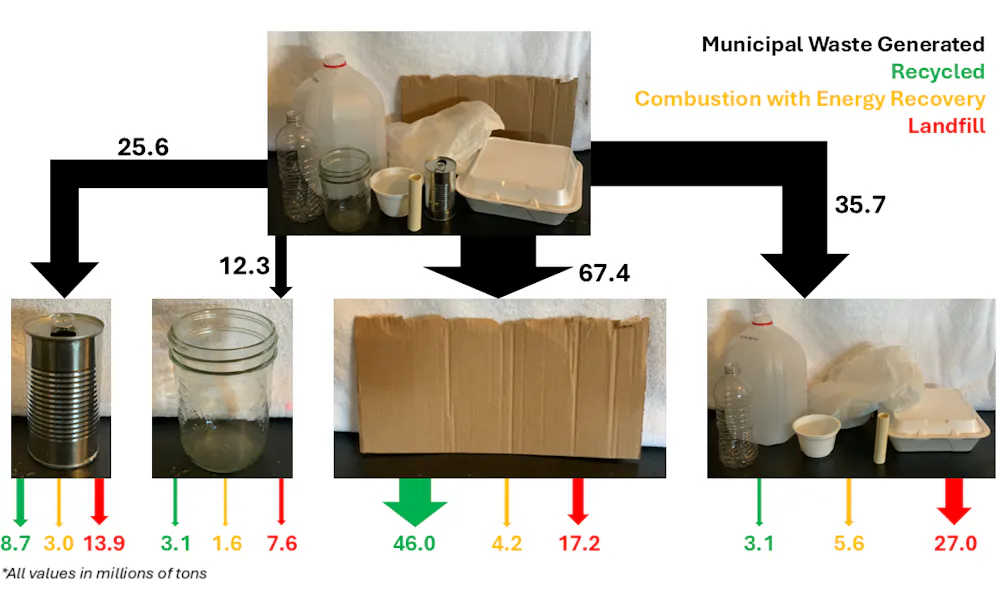
    A breakdown of U.S. recycling by millions of tons shows about two-thirds of all paper and cardboard gets a second life, but only about a third of metal, a quarter of glass and less than 10% of plastics do.
    Alex Jordan/University of Wisconsin-Stout

    So, what makes plastic recycling so difficult? As an engineer whose work focuses on reprocessing plastics, I have been exploring potential solutions.

    How does single-stream recycling work?

    In cities that use single-stream recycling, consumers put all of their recyclable materials − paper, cardboard, plastic, glass and metal − into a single bin. Once collected, the mixed recyclables are taken to a materials recovery facility, where they are sorted.

    First, the mixed recyclables are shredded and crushed into smaller fragments, enabling more effective separation. The mixed fragments pass over rotating screens that remove cardboard and paper, allowing heavier materials, including plastics, metals and glass, to continue along the sorting line.

    The basics of a single-stream recycling system in Pennsylvania. Source: Van Dyk Recycling Solutions.

    Magnets are used to pick out ferrous metals, such as steel. A magnetic field that produces an electrical current with eddies sends nonferrous metals, such as aluminum, into a separate stream, leaving behind plastics and glass.

    The glass fragments are removed from the remaining mix using gravity or vibrating screens.

    That leaves plastics as the primary remaining material.

    While single-stream recycling is convenient, it has downsides. Contamination, such as food residue, plastic bags and items that can’t be recycled, can degrade the quality of the remaining material, making it more difficult to reuse. That lowers its value.

    Having to remove that contamination raises processing costs and can force recovery centers to reject entire batches.

    Plastic bags, food residue and items that can’t be recycled can contaminate a recycling stream.
    City of Greenville, N.C./Flickr

    Which plastics typically can’t be recycled?

    Each recycling program has rules for which items it will and won’t take. You can check which items can and cannot be recycled for your specific program on your municipal page. Often, that means checking the recycling code stamped on the plastic next to the recycling icon.

    These are the toughest plastics to recycle and most likely to be excluded in your local recycling program:

    • Symbol 3 – Polyvinyl chloride, or PVC, found in pipes, shower curtains and some food packaging. It may contain harmful additives such as phthalates and heavy metals. PVC also degrades easily, and melting can release toxic fumes during recycling, contaminating other materials and making it unsafe to process in standard recycling facilities.

    • Symbol 4 – Low-density polyethylene, or LDPE, is often used in plastic bags and shrink-wrap. Because it’s flexible and lightweight, it’s prone to getting tangled in sorting machinery at recycling plants.

    • Symbol 6 – Polystyrene, often used in foam cups, takeout containers and packing peanuts. Because it’s lightweight and brittle, it’s difficult to collect and process and easily contaminates recycling streams.

    Which plastics to include

    That leaves three plastics that can be recycled in many facilities:

    However, these aren’t accepted in some facilities for reasons I’ll explain.

    Taking apart plastics, bead by bead

    Some plastics can be chemically recycled or ground up for reprocessing, but not all plastics play well together.

    Simple separation methods, such as placing ground-up plastics in water, can easily remove your soda bottle plastic (PET) from the mixture. The ground-up PET sinks in water due to the plastic’s density. However, HDPE, used in milk jugs, and PP, found in yogurt cups, both float, and they can’t be recycled together. So, more advanced and expensive technology, such as infrared spectroscopy, is often required to separate those two materials.

    Once separated, the plastic from your soda bottle can be chemically recycled through a process called solvolysis.

    It works like this: Plastic materials are formed from polymers. A polymer is a molecule with many repeating units, called monomers. Picture a pearl necklace. The individual pearls are the repeating monomer units. The string that runs through the pearls is the chemical bond that joins the monomer units together. The entire necklace can then be thought of as a single molecule.

    During solvolysis, chemists break down that necklace by cutting the string holding the pearls together until they are individual pearls. Then, they string those pearls together again to create new necklaces.

    Other chemical recycling methods, such as pyrolysis and gasification, have drawn environmental and health concerns because the plastic is heated, which can release toxic fumes. But chemical recycling also holds the potential to reduce both plastic waste and the need for new plastics, while generating energy.

    The problem of yogurt cups and milk jugs

    The other two common types of recycled plastics − items such as yogurt cups (PP) and milk jugs (HDPE) − are like oil and water: Each can be recycled through reprocessing, but they don’t mix.

    If polyethylene and polypropylene aren’t completely separated during recycling, the resulting mix can be brittle and generally unusable for creating new products.

    Chemists are working on solutions that could increase the quality of recycled plastics through mechanical reprocessing, typically done at separate facilities.

    One promising mechanical method for recycling mixed plastics is to incorporate a chemical called a compatibilizer. Compatibilizers contain the chemical structure of multiple different polymers in the same molecule. It’s like how lecithin, commonly found in egg yolks, can help mix oil and water to make mayonnaise − part of the lecithin molecule is in the oil phase and part is in the water phase.

    In the case of yogurt cups and milk jugs, recently developed block copolymers are able to produce recycled plastic materials with the flexibility of polyethylene and the strength of polypropylene.

    Improving recycling

    Research like this can make recycled materials more versatile and valuable and move products closer to a goal of a circular economy without waste.

    However, improving recycling also requires better recycling habits.

    You can help the recycling process by taking a few minutes to wash off food waste, avoiding putting plastic bags in your recycling bin and, importantly, paying attention to what can and cannot be recycled in your area.

    Alex Jordan received funding in in the past from TotalEnergies. He has worked on projects to create PP-PE block copolymers.

    ref. How single-stream recycling works − your choices can make it better – https://theconversation.com/how-single-stream-recycling-works-your-choices-can-make-it-better-250017

    MIL OSI – Global Reports

  • MIL-OSI USA: News release on CRB treatments in Kona

    Source: US State of Hawaii

    News release on CRB treatments in Kona

    Posted on Apr 16, 2025 in Latest Department News, Newsroom


    STATE OF HAWAIʻI

    KA MOKU ʻĀINA O HAWAIʻI


    DEPARTMENT OF AGRICULTURE

    ʻOIHANA MAHIʻAI


    JOSH GREEN, M.D.
    GOVERNOR

    KE KIAʻĀINA

    SHARON HURD
    CHAIRPERSON

    HAWAIʻI BOARD OF AGRICULTURE


    DEAN M. MATSUKAWA
    DEPUTY TO THE CHAIRPERSON

    HAWAIʻI BOARD OF AGRICULTURE


    HDOA CONTINUES COCONUT RHINOCEROS BEETLE TREATMENTS
    IN KONA

    FOR IMMEDIATE RELEASE                                                       

    NR25-08

    April 15, 2025


    HONOLULU – The Hawai‘i Department of Agriculture (HDOA), with the assistance of the County of Hawai‘i Public Works Department, have been working collaboratively since January 2025 to combat the coconut rhinoceros beetle (CRB) after detections in the Kona area. The HDOA and Hawai‘i County crews completed the latest round of treatments on palm trees last week at Ellison Onizuka Kona International Airport in the continuing effort to protect the island from CRB infestations.

    “The staff of the Department of Agriculture remains dedicated to stopping the further spread of the coconut rhinoceros beetle, with emphasis in areas that are not known to be infested,” said Sharon Hurd, chairperson of the Hawai‘i Board of Agriculture. “We truly appreciate the concern and assistance of Mayor Kimo Alameda and the county’s public works crew in providing the resources to prevent CRB from taking hold on Hawai‘i Island. We also appreciate all the various agencies and organizations that work tirelessly in the fight against invasive species.”

    Mayor Alameda emphasized the importance of the state and county working collaboratively to protect the island from the invasive species. “The introduction of the coconut rhinoceros beetle is a major concern, and we are committed to doing everything we can—alongside HDOA and our other partners—to stop its spread,” he said.


    In September 2024, HDOA Plant Pest Control (PPC) personnel found a single CRB in a trap during routine monitoring in Waikoloa. This was the first detection of CRB on the island since October 2023 when a Waikoloa resident found six grubs (larvae) in a decaying palm tree stump. Increased surveillance continued throughout the island and more intensely on the Kona side.

    In January 2025, Mayor Alameda and the County of Hawai‘i offered their resources and assistance to HDOA, including the use of their 75-foot boom truck to treat the crowns of palm trees. On January 14, the team treated a total of 38 trees in the Waikoloa area via crown treatments and 24 trees were treated via an injection system which provides systemic protection against CRB. HDOA’s Pesticides Branch was also at the site to assist. So far, there have been no further detections of CRB in Waikoloa.

    On March 3, 2025, the Big Island Invasive Species Committee (BIISC) reported one adult CRB in a detection trap along the boundary of the Ellison Onizuka Kona International Airport. A day later, two more adult CRBs were found in traps at the Natural Energy Laboratory of Hawai‘i (NELHA).

    After the detections, HDOA, county crews and airport staff targeted treatments at the airport over a period of three days in March. The county provided the use of two boom trucks and the team treated 128 trees on the airport grounds and injected 12 more trees that were inaccessible to the boom trucks. So far, there have been no further detections at the airport.

    Last week, on April 7 and 8, crews began work at NELHA and treated 58 trees via crown treatments with about 14 trees treated via injections due to their close proximity to water.

    All palms that were treated were tagged and surrounded with yellow tape to indicate treatment. Coconuts from treated trees should not be consumed. Questions regarding pesticide use may be addressed to HDOA’s Pesticides Branch at 808-973-9402.

    Surveillance for CRB continues around Hawai‘i Island by HDOA, BIISC, University of Hawai‘i, the County of Hawai‘i and the state Department of Health Vector Control Branch. 

    Residents on all islands are asked to be vigilant when purchasing mulch, compost and soil products, and to inspect bags for evidence of entry holes. CRB grubs breed in decomposing plant and animal waste. An adult beetle is about 2-inches long, all black and has a single horn on its head.

    Residents may go to the CRB Response website at:  https://www.crbhawaii.org/  to learn more about how to detect the signs of CRB damage and how to identify CRB life stages. Reports of possible CRB infestation may also be made to the state’s toll-free Pest Hotline at 808-643-PEST (7378).

    # # #

    Attachments: Photos:
    Waikoloa treatment – boom truck
    Waikoloa injection
    Waikoloa treatment ground (treated trees marked with yellow tape and tagged)
    CRB crown treatment – Kona Airport (Ellison Onizuka Kona International Airport)
    CRB crown treatment Kona Airport2 (Ellison Onizuka Kona International Airport)
    CRB injection – Kona Airport (Ellison Onizuka Kona International Airport)
    Treated trees

    Media Contact:
    Janelle Saneishi
    Public Information Officer
    Hawaiʻi Department of Agriculture
    Phone: 808-973-9560
    Cell: 808-341-5528
    Email:
    [email protected]
    Website:
    http://hdoa.hawaii.govAloha,

    Janelle Saneishi

    Public Information Officer

    Hawai‘i Department of Agriculture
    ph: (808) 973-9560
    email: [email protected]

    Website: https://hdoa.hawaii.gov/

    Confidentiality Notice:  This e-mail message, including any attachments, is for the sole use of the intended recipient(s) and may contain confidential and/or privileged information.  Any review, use, disclosure, or distribution by unintended recipients is prohibited.  If you are not the intended recipient(s), please contact the sender by reply e-mail and destroy all copies of the original message.

    MIL OSI USA News

  • MIL-OSI USA: Governor Newsom files lawsuit to end President Trump’s tariffs

    Source: US State of California 2

    Apr 16, 2025

    What you need to know: California today filed a lawsuit challenging President Trump’s authority to unilaterally enact tariffs, which have created economic chaos, driven up prices, and harmed the state, families, and businesses.

    SACRAMENTO – Governor Gavin Newsom and California Attorney General Rob Bonta today filed a lawsuit in federal court challenging President Trump’s use of emergency powers to enact broad-sweeping tariffs that hurt states, consumers, and businesses. The lawsuit argues that President Trump lacks the authority to unilaterally impose tariffs through the International Economic Emergency Powers Act, creating immediate and irreparable harm to California, the largest economy, manufacturing, and agriculture state in the nation. 

    These tariffs have disrupted supply chains, inflated costs for the state and Californians, and inflicted billions in damages on California’s economy, the fifth largest in the world.

    “President Trump’s unlawful tariffs are wreaking chaos on California families, businesses, and our economy — driving up prices and threatening jobs. We’re standing up for American families who can’t afford to let the chaos continue.”

    Governor Gavin Newsom

    “The President’s chaotic and haphazard implementation of tariffs is not only deeply troubling, it’s illegal. As the fifth largest economy in the world, California understands global trade policy is not just a game. Californians are bracing for fallout from the impact of the President’s choices — from farmers in the Central Valley, to small businesses in Sacramento, and worried families at the kitchen table — this game the President is playing has very real consequences for Californians across our state. I am proud to go to bat alongside Governor Newsom to fight for California’s vibrant economy, businesses, and residents.”

    Attorney General Rob Bonta

    The lawsuit, filed in the United States District Court for the Northern District of California, requests the court to declare the tariffs imposed by President Trump void and enjoin their implementation. 
     

    The President lacks authority to enact unilateral tariffs

    The lawsuit argues that President Trump lacks the authority to unilaterally impose tariffs against Mexico, China, and Canada or create an across-the-board 10% tariff. The President’s use of the International Economic Emergency Powers Act (IEEPA) to enact tariffs is unlawful and unprecedented. 
     

    The IEEPA gives the President authority to take certain actions if he declares a national emergency in response to a foreign national security, foreign policy, or economic threat.  The law, which was enacted by Congress in 1977, specifies many different actions the President can take, but tariffs aren’t one of them. In fact, this is the first time a president has attempted to rely on this law to impose tariffs. 
     

    Supreme Court precedent

    The lawsuit invokes the U.S. Supreme Court’s major questions doctrine, which holds that in novel matters of vast economic and political significance, federal agencies and the executive branch must have clear and specific authorization from Congress. In recent years, the Court has applied this standard to strike down major initiatives, including President Obama’s Clean Power Plan and President Biden’s student loan forgiveness program, ruling that novel executive actions with broad impacts on the national economy cannot rest on vague statutory authority. 

    It is difficult to imagine a more economically significant set of actions than the one Trump is taking on tariffs, which have inflicted hundreds of billions of dollars in economic losses on a whim, using a statute that doesn’t mention tariffs. The Court, applying this doctrine even-handedly, will find that such expansive action absent congressional approval is a clear violation of the law. 

    California is the backbone of the nation’s economy 

    California’s gross domestic product was $3.9 trillion in 2023, making it 50% bigger than the GDP of the nation’s next-largest state, Texas. The state drives national economic growth and also sends over $83 billion more to the federal government than it receives in federal funding. California is the leading agricultural producer in the country and is also the center for manufacturing output in the United States, with over 36,000 manufacturing firms employing over 1.1 million Californians. The Golden State’s manufacturing firms have created new industries and supplied the world with manufactured goods spanning aerospace, computers and electronics, and, most recently, zero-emission vehicles.

    The Golden State is global leader in two-way trade

    California engaged in nearly $675 billion in two-way trade in 2024, supporting millions of jobs throughout the state. California’s economy and workers rely heavily on this trade activity, particularly with Mexico, Canada, and China – our top 3 trade partners. Over 40% of California imports come from these countries, totaling $203 billion of the more than $491 billion in goods imported by California in 2024. These countries are also our top three export destinations, buying nearly $67 billion in California exports, which was over one-third of the state’s $183 billion in exported goods in 2024. 

    Tariffs irreparably harm California businesses and consumers

    As the largest economy in the nation, the largest agriculture state in the nation, and the largest U.S. trading partner, the harm of the tariffs on the state of California is immense. President Trump’s policies have already inflicted hundreds of billions of dollars in economic losses. 

    Tariffs have an outsized impact on California businesses, including its more than 60,000 small business exporters. 

    Standing up for California families and businesses 

    Governor Newsom has responded quickly to help reduce negative impacts from the Trump tariffs on California’s economy and maintain California’s strong partnerships worldwide. Today’s lawsuit follows the Governor’s recent announcement of California’s goal to create new strategic trade relationships with international partners aimed at strengthening shared economic resilience and protecting California’s manufacturers, workers, farmers, businesses, and supply chains.  The Governor has also announced a new international campaign to help maintain the strong tourism partnership between California and Canada.

    More opposition to President Trump’s tariffs

    U.S. Senator Ted Cruz (R-Texas): “Listen, I love President Trump, I’m his strongest supporter, and I think he’s doing incredible things as president. But here’s one thing to understand, a tariff is a tax.”

    U.S. Senator Rand Paul (R-Kentucky): “Every dollar collected in tariff revenue comes straight out of the pockets of American consumers.”

    U.S. Senator Lisa Murkowski (R-Alaska): “And if the global implications of these tariffs have shown us nothing else, it’s that measures that are as important as these should be considered by the 535 elected individuals that are in tune with the American people, rather than vesting that with just one individual acting unilaterally.”

    Ben Shapiro, political commentator: “The idea that this is inherently good and makes the American economy strong is wrongheaded; it is untrue…”

    U.S. Chamber of Commerce: “What we have heard from business of all sizes, across all industries, from around the country is that these broad tariffs are a tax increase that will raise prices for American consumers and hurt the economy.”

    National Retail Federation: “American consumers could lose between $46 billion and $78 billion in spending power each year if new tariffs on imports to the United States are implemented.”

    The Wall Street Journal Editorial Board: “The dumbest trade war in history.”

    Recent news

    News What you need to know: The passage of Proposition 1 by California voters adds rocket fuel to Governor Gavin Newsom’s transformational overhaul of the state’s behavioral health system. These reforms refocus existing funds to prioritize Californians with the most…

    News What you need to know: The First Partner released the final report of a working group tasked with developing recommendations for policymakers, healthcare providers, law enforcement, and the judicial system in order to better support survivors of sexual assault….

    News What you need to know: Preliminary data suggests property and violent crimes in California were down in 2024. Sacramento, California – As the state continues to invest in the safety and security of California communities, new data suggests violent and property…

    MIL OSI USA News

  • MIL-OSI Europe: Written question – The situation of truck drivers in Europe who come from countries outside the EU – E-001423/2025

    Source: European Parliament

    Question for written answer  E-001423/2025
    to the Commission
    Rule 144
    Marit Maij (S&D), Gabriele Bischoff (S&D), Marc Angel (S&D), Estelle Ceulemans (S&D), Marianne Vind (S&D), Johan Danielsson (S&D)

    Truck drivers from countries outside the EU are still exploited on a large scale in the EU. In the Netherlands, several truck drivers are now on strike because they have the courage to stand up for their rights that are not respected: healthy working conditions, a fair salary and decent working hours and days. In the EU, there are around three million truck drivers, of whom 10 % come from outside the EU.

    Such illegal and exploitative practices shed a particularly bad light on the conditions of the EU labour market for non-EU nationals.

    In light of this:

    • 1.How is the Commission planning to ensure that compliance with existing legislation, such as Regulation (EC) No 561/2006[1] on road transport and Regulation (EU) No 165/2014[2] on recording equipment in road transport is better enforced?
    • 2.Will the Commission propose an extension of the mandate of the European Labour Authority to include non-EU nationals?
    • 3.What is the Commission planning to do in order to stop the exploitation of non-EU nationals, in particular, in the EU labour market, and will the Commission propose legislation to prevent this, such as limiting the opportunities for temporary work and subcontracting?

    Submitted: 8.4.2025

    • [1] OJ L 102, 11.4.2006, p. 1, ELI: http://data.europa.eu/eli/reg/2006/561/oj.
    • [2] OJ L 60, 28.2.2014, p. 1, ELI: http://data.europa.eu/eli/reg/2014/165/oj.
    Last updated: 16 April 2025

    MIL OSI Europe News

  • MIL-OSI Security: Great Falls woman sentenced to 20 years in prison on meth charges

    Source: Office of United States Attorneys

    GREAT FALLS – A Great Falls woman who conspired to distribute significant amounts of methamphetamine was sentenced yesterday to 20 years in prison to be followed by five years of supervised release, U.S. Attorney Kurt Alme said. The government also forfeited nearly $75,000 in cash, a gun, a BMW, and a motorhome.

    Melissa Ann Barone, 55, pleaded guilty in December 2024 to conspiracy to possess with intent to distribute methamphetamine.

    Chief U.S. District Judge Brian Morris presided.

    The government alleged in court documents that in 2020, law enforcement discovered Melissa Barone and her co-defendant were involved in distributing pounds of methamphetamine in and around Great Falls. Between 2020 and 2024, numerous drug associates advised law enforcement

    of the pair’s drug distribution activities and travels to Colorado, Washington and Arizona to obtain methamphetamine to redistribute in Montana. Sources identified purchasing one-pound quantities of methamphetamine totaling over six to eight pounds within a 10-month period from 2020 to 2021.

    In 2022 and 2023, sources reported Barone was trafficking half or full eightballs of methamphetamine for her co-defendant. It was discovered her codefendant was purchasing 50 to 100 pounds of methamphetamine at a time and spending over $100,000 delivered in bulk amounts. Barone and her co-defendant were purchasing vehicles and RVs at auto auctions for cash.

    In February 2023, law enforcement conducted a traffic stop on a vehicle operated by the defendants as they were traveling back to Montana from Texas. A K-9 detection dog alerted on the vehicle, and $17,000 in United States currency was found rubber banded to a seatbelt inside the vehicle.

    On May 5, 2024, law enforcement executed a warrant and arrested Barone in Great Falls. A search of her purse revealed approximately 444.4 grams of methamphetamine, a scale, and paraphernalia. Her vehicle contained $7,911 in United States currency, 46.3 grams of methamphetamine, and drug paraphernalia. During the seizure of a BMW owned by her co-defendant, law enforcement located $5,000 in United States currency in a vacuum-sealed bag concealed under the back seat.

    The U.S. Attorney’s Office prosecuted the case and the investigation was conducted by the Russell Country Drug Task Force.

    The case was investigated under the Organized Crime Drug Enforcement Task Forces (OCDETF). OCDETF identifies, disrupts, and dismantles the highest-level criminal organizations that threaten the United States using a prosecutor-led, intelligence-driven, multi-agency approach. For more information about Organized Crime Drug Enforcement Task Forces, please visit Justice.gov/OCDETF.

    XXX

    MIL Security OSI

  • MIL-OSI USA: Chairmen Babin and Cruz Lead Texas Delegation in Support of Relocating NASA Headquarters to Houston

    Source: United States House of Representatives – Representative Brian Babin (R-TX)

    WASHINGTON, D.C. – Today,  U.S. House Science, Space, and Technology Committee Chairman Brian Babin (TX-36) and Chairman Ted Cruz (R-TX) led a bicameral coalition of federal lawmakers representing Texas communities in sending a letter to President Trump urging his administration to move the headquarters for the National Aeronautics and Space Administration (NASA) from Washington, D.C. to the Lyndon B. Johnson Space Center (JSC) in Houston, Texas. The lease for NASA’s current D.C. office expires in 2028.

    In the letter, the lawmakers argue that NASA is disconnected from the day-to-day work of its centers and hindered by bureaucratic micromanagement in Washington, D.C. Houston is well suited for NASA’s headquarters because of JSC’s substantial involvement in nearly everything that makes America a leader in space exploration. JSC maintains the largest NASA workforce, accommodates extensive research and development partnerships, and houses Mission Control, the NASA astronaut corps, and the Lunar Sample Laboratory Facility.

    Additionally, Texas boasts a strong business environment, low government regulation, a robust commercial space sector, and a cost of living that is less than half of the Washington, D.C. area. Moving the NASA headquarters to Texas will create more jobs, save taxpayer dollars, and reinvigorate America’s space agency.

    Joining Sen. Cruz and Rep. Babin in sending the letter are Sen. John Cornyn and Reps. Jodey Arrington, John Carter, Michael Cloud, Dan Crenshaw, Monica De La Cruz, Jake Ellzey, Pat Fallon, Brandon Gill, Craig Goldman, Tony Gonzales, Lance Gooden, Wesley Hunt, Ronny Jackson, Morgan Luttrell, Michael McCaul, Nathaniel Moran, Troy E. Nehls, August Pfluger, Chip Roy, Keith Self, Pete Sessions, Beth Van Duyne, Randy Weber, and Roger Williams.

    As the lawmakers wrote:

    “From its founding in 1958, the National Aeronautics and Space Administration (NASA) has a storied history of exploring new frontiers, making transformational discoveries, and reaching far into the great beyond. However, as NASA’s leadership has languished in our nation’s capital, the core missions of this critical agency are more divided than ever before. This seismic disconnect between NASA’s headquarters and its missions has opened the door to bureaucratic micromanagement and an erosion of centers’ interdependence. For NASA to return to its core mission of excellence in exploration, its headquarters should be located at a place where NASA’s most critical missions are and where transformational leadership from the ground up can be provided. In 2028 the lease for NASA’s current headquarters building in Washington, D.C. expires. We write to urge you to use this opportunity to reinvigorate our national space agency and move NASA’s headquarters from Washington, D.C. to the Lyndon B. Johnson Space Center (JSC) in Houston, Texas.

    “Perhaps no city is more closely linked to America’s space program than ‘Space City.’ Some of the first words spoken on the surface of the moon called out to Houston which is home to numerous aerospace businesses. JSC in particular is the largest home of the NASA workforce, with more than 12,000 employees across its 1,620-acre facility and supporting more than 52,000 public and private jobs. As the pinnacle of human spaceflight development, Houston is home to Mission Control, the NASA astronaut corps, the Lunar Sample Laboratory Facility, commercial space agreements, and extensive research and development partnerships. JSC plays a role in nearly everything that makes America a leader in space exploration.

    “Houston is particularly well suited for NASA’s headquarters due in part to the unique strengths of the city and the state. Texas is the eighth largest economy in the world, with low government regulation and a strong business environment. Houston boasts a cost of living that is less than half that of the Washington, D.C. area ; three ‘R1: Doctoral Universities’ producing the high caliber professionals necessary for human spaceflight; and two major commercial service airports for easy connectivity around the country. In contrast, NASA’s current headquarters in Washington, D.C. is disconnected from the NASA centers across the country and thus much of the day-to-day work. Consolidating greater and greater levels of work and authority in Washington, D.C. has been a decades-long trend, resulting in decision making funneled up to bureaucrats at headquarters rather than empowering scientists and astronauts across the centers. This strategy has separated decision makers from the actual workforce and stands antithetical to NASA’s core function.

    “Relatedly, for the United States to reach the surface of Mars, NASA must rely on a robust commercial space sector. Towards that end, no state offers greater economic and geographic benefits than Texas. The Lone Star State is home to more than 2,000 aerospace, aviation, and defense-related companies, with 18 of the 20 largest aerospace companies based in Texas. Notably, SpaceX relocated their entire company to Texas, establishing the town of Starbase, Texas, to develop, test, and launch SpaceX vehicles. Similarly, Blue Origin develops engines and rockets in West Texas, leading a new generation of spaceflight, and conducts its commercial sub-orbital flights there. Firefly Aerospace, in Cedar Park, recently sent photos of Earth from its Blue Ghost lunar lander on its voyage to explore the surface of the moon. Axiom Space, based in Houston, is building the next generation spacesuit for NASA and a commercial space station to succeed the International Space Station. In addition, the State of Texas recently stood up the Texas Space Commission to promote innovation in space operations and commercial aerospace and to attract commercial space ventures to the state. These are just a few of the ways Texas aerospace companies, projects, and institutions are transforming our nation’s leadership in the space economy.

    “A central location among NASA’s centers and the geographical center of the United States, Houston offers the ideal location for NASA to return to its core mission of space exploration and to do so at a substantially lower operating cost than in Washington, D.C. Therefore, we strongly encourage you to stand shoulder-to-shoulder with the great servants of NASA — who are focused on recommitting America’s space agency to its roots and exploring the final frontier — by relocating NASA’s headquarters from Washington, D.C. to the Johnson Space Center.”

    Read the full text of the letter HERE.

    MIL OSI USA News

  • MIL-OSI Asia-Pac: India poised to become a trusted bridge of global connectivity through India-Middle East-Europe Economic Corridor (IMEC): Shri Piyush Goyal

    Source: Government of India

     India poised to become a trusted bridge of global connectivity through India-Middle East-Europe Economic Corridor (IMEC): Shri Piyush Goyal

    IMEC to reduce logistics costs by up to 30% and transportation time by 40%, boosting global trade: Shri Goyal

    Union Minister of Commerce and Industry Piyush Goyal addresses High-Level Roundtable on IMEC

    Posted On: 16 APR 2025 10:52PM by PIB Delhi

    Union Minister of Commerce and Industry, Shri Piyush Goyal addressed the India-Middle East-Europe Economic Corridor (IMEC) High-Level Roundtable on Connectivity and Economic Growth in New Delhi today.

    Shri Goyal said that the IMEC is a powerful endorsement of the leadership and partnership of India and Middle East and East Europe a very forward and visionary concept that has caught the fancy of the world, he noted.

    The Minister stated that IMEC is not merely a trade route, but a modern-day Silk Route — a partnership of equals — that fosters synergy, connectivity, and inclusive prosperity. “It will bring down logistics costs by up to 30%, reduce transportation time by 40%, and create seamless trade linkages across continents,” he said. “We will not only be linking trade; we will be linking civilizations and cultures — from Southeast Asia to the Gulf, from the Middle East to Central Europe.”

    Highlighting its potential reach, Shri Goyal added that IMEC could even enhance connectivity to Africa through the Middle East. The corridor would include railways, roadways, energy pipelines, and clean energy infrastructure, including undersea cables. “India is already in discussions with Singapore on clean energy transmission. We are also engaged in dialogue with Saudi Arabia and the UAE,” he shared.

    Shri Goyal underscored the corridor’s emphasis on sustainability and digital connectivity. “This initiative respects sovereignty and territorial integrity. It is not about dominance or creating economic unions. It is a partnership built on mutual trust, inclusivity and sustainability,” he said.

    He further outlined five key suggestions as a way forward for the IMEC initiative. First, Shri Goyal stressed the importance of viewing IMEC through the lens of a Public-Private Partnership (PPP). He emphasized that leaving the initiative solely to the government would limit its efficiency and financial viability. Instead, he called for a collaborative model where the private sector leads, bringing to the table its real-world expertise, needs, and innovative capabilities. This approach, he noted, would ensure smarter and more cost-effective planning, as the private sector can propose solutions that reflect practical utility. It would also allow policymakers to think systematically while the private sector introduces flexibility and innovation, ensuring the corridor remains viable, efficient, and sustainable in its execution.

    Second, he highlighted the need to focus on Regulatory Connectivity, going beyond just physical infrastructure. Shri Goyal advocated for greater alignment in trade processes, customs procedures, and paperwork among participating nations. He cited India’s ongoing regulatory collaboration with the UAE as an example and pointed out that successful implementation of the corridor would require seamless cross-border movement without excessive checkpoints. Interoperable systems, digitization, electric vehicle charging ecosystems, and synchronized regulations would be key to unlocking economies of scale. He suggested that common digital payment systems, such as India’s Unified Payments Interface (UPI), could serve as a model for enabling seamless financial transactions. With periodic settlement in globally accepted reserve currencies, such mechanisms could reduce transactional friction and banking costs. He proposed that such innovations, combined with virtual trade corridor frameworks like the India-UAE initiative, could be extended through IMEC. These would support broader agreements such as FTAs with GCC and EU countries and bolster joint work in green hydrogen, renewable energy, and supply chain resilience.

    Third, Shri Goyal underlined the need for Innovative Financing Models to support both the development of the corridor and the trade it will generate. He called for active involvement of multilateral financial agencies and suggested exploring instruments like green bonds and the creation of long-term “IMEC Bonds”, to fund this transcontinental infrastructure in a sustainable and future-proof manner.

    Fourth, he recommended active engagement with industry bodies and trade associations, asserting that their insights are essential for designing a corridor that aligns with the real needs of businesses. Such collaboration would help identify existing bottlenecks, promote best practices, and better integrate economies by removing trade frictions.

    Lastly, Shri Goyal proposed bringing in Think Tanks and Academia to the visioning and design process. These institutions, he noted, bring creativity, research strength, and long-term thinking. Their involvement would support policy advocacy, contribute to out-of-the-box solutions, and assist in capacity-building efforts along the corridor. He called this a well-rounded package of five initiatives that could help IMEC evolve into a robust, viable, and inclusive project. Reiterating India’s clear and committed vision, he said the country is ready to act as a trusted, reliable bridge connecting regions and catalyzing global cooperation, under the guiding spirit of Vasudhaiva Kutumbakam — the world is one family.

    ***

    Abhishek Dayal/ Nihi Sharma/ Ishita Biswas

    (Release ID: 2122299) Visitor Counter : 52

    MIL OSI Asia Pacific News

  • MIL-OSI Security: Jury Convicts Fitchburg Man of Illegally Possessing Firearm

    Source: Office of United States Attorneys

    MADISON, WIS. – After a two-day jury trial, Malcolm Whiteside, 30, Fitchburg, Wisconsin, was found guilty yesterday of illegally possessing a firearm as a felon. The jury reached a verdict after just over 30 minutes of deliberation. The guilty verdict is announced by Timothy M. O’Shea, United States Attorney for the Western District of Wisconsin.

    On August 12, 2024, Whiteside led police on a dangerous high-speed chase on a Madison highway and ultimately crashed the car he was driving into a semi-truck. From there, Whiteside fled on foot to the parking lot of a home improvement store, where a police officer found him hiding in a garden shed. Officers at the crash scene searched the vehicle Whiteside was driving and found a loaded firearm underneath the driver’s floormat. Later, an analyst from the Wisconsin State Crime Lab found Whiteside’s DNA on multiple locations on the firearm. Whiteside was previously convicted of illegally possessing a firearm as a felon in 2019.

    Chief U.S. District Judge James D. Peterson scheduled sentencing for June 25. Whiteside faces a maximum penalty of 15 years in federal prison.

    The case was investigated by the City of Monona Police Department, Madison Police Department, Wisconsin State Patrol, and the ATF Madison Crime Gun Task Force. The ATF Madison Crime Gun Task Force consists of federal agents from ATF and Task Force Officers from state and local agencies throughout the Western District of Wisconsin. The prosecution is being handled by Assistant U.S. Attorneys Chadwick M. Elgersma and Collen Lennon. 

    MIL Security OSI

  • MIL-OSI Security: Bridgeport Gang Member Sentenced to 20 Years in Federal Prison

    Source: Office of United States Attorneys

    LUIS GARCIA, also known as “Ebk Lou,” 27, of Bridgeport, was sentenced today by U.S. District Judge Kari A. Dooley in Bridgeport to 240 months of imprisonment, followed by three years of supervised release, for his participation in a violent Bridgeport street gang.

    Today’s announcement was made by Marc H. Silverman, Acting United States Attorney for the District of Connecticut; Joseph T. Corradino, State’s Attorney for the Fairfield Judicial District; Bridgeport Police Chief Roderick Porter; Anish Shukla, Acting Special Agent in Charge of the New Haven Division of the Federal Bureau of Investigation; James Ferguson, Special Agent in Charge, ATF Boston Field Division; Stephen Belleau, Acting Special Agent in Charge of the Drug Enforcement Administration for New England, and Acting U.S. Marshal Lawrence Bobnick.

    According to court documents and statements made in court, the FBI, ATF, DEA, U.S. Marshals Service, Connecticut State Police and Bridgeport Police have been investigating multiple Bridgeport-based gangs whose members are involved in narcotics trafficking, murder, and other acts of violence.  Garcia was a member of the Original North End (“O.N.E.”), a gang based in the Trumbull Gardens area of Bridgeport that committed acts of violence against rival gangs, including the East End gang, the East Side gang, and the PT Barnum gang.  O.N.E. members also robbed drug dealers, customers, and others, sold narcotics, and stole cars from inside and outside Connecticut, often using the cars to commit crimes.  They frequently used social media to promote and coordinate their criminal activities.

    Text messages and social media posts reviewed during the investigation confirmed that Garcia possessed and sold narcotics and firearms, stole vehicles, and was involved in related violent criminal activity alongside other O.N.E. members and associates.

    On August 9, 2018, O.N.E. members stole a Jeep Grand Cherokee in Newburgh, New York, and drove it back to Bridgeport.  In the following days, O.N.E. members conspired to use the car to kill East End gang members and their allies who they had learned through social media were at a deli on Stratford Avenue in Bridgeport.  Although that plan fell through, in the early morning hours of August 13, 2018, Garcia, Ta’Ron Pharr, and Lorenzo Carter drove the stolen Jeep to Stratford and Union Avenues in Bridgeport where they shot and killed Len Smith, 25, who they mistook for a rival East End group member, and shot and seriously wounded Smith’s female companion, both of whom were seated in a parked car.  After the shooting, O.N.E. members transported the Jeep to Indian Wells State Park in Shelton where they burned the vehicle in an effort to destroy evidence of the murder.

    O.N.E. members committed other violent crimes, including murder.

    Garcia has been detained since his arrest on September 8, 2021.  On September 6, 2023, he pleaded guilty to conspiring to engage in a pattern of racketeering activity.

    Approximately 47 members and associates of multiple Bridgeport-based gangs have been convicted of federal offenses stemming from this investigation, which has solved eight murders and approximately 20 attempted murders.

    Pharr pleaded guilty and, on August 30, 2022, was sentenced to 18 years of imprisonment.  On November 21, 2023, a jury found Carter guilty of racketeering conspiracy.  He awaits sentencing.

    This investigation has been conducted by the FBI’s Safe Streets and Violent Crimes Task Forces, ATF, DEA, U.S. Marshals Service, Bridgeport Police Department, Connecticut State Police, and the Bridgeport State’s Attorney’s Office, with the assistance of the U.S. Postal Inspection Service, Connecticut Forensic Science Laboratory, Waterbury Police Department, and Naugatuck Police Department.  The case is being prosecuted by Assistant U.S. Attorneys Karen L. Peck, Jocelyn C. Kaoutzanis, Stephanie T. Levick, and Rahul Kale.

    This prosecution is a part of the Justice’s Department’s Project Safe Neighborhoods (PSN), Project Longevity and Organized Crime Drug Enforcement Task Forces (OCDETF) programs.

    PSN is the centerpiece of the Department of Justice’s violent crime reduction efforts.  PSN is an evidence-based program proven to be effective at reducing violent crime. 

    Project Longevity is a comprehensive initiative to reduce gun violence in Connecticut’s major cities.  Through Project Longevity, community members and law enforcement directly engage with members of groups that are prone to commit violence and deliver a community message against violence, a law enforcement message about the consequences of further violence and an offer of help for those who want it.  If a group member elects to engage in gun violence, the focused attention of federal, state and local law enforcement will be directed at that entire group.

    OCDETF identifies, disrupts, and dismantles drug traffickers, money launderers, gangs, and transnational criminal organizations through a prosecutor-led and intelligence-driven approach that leverages the strengths of federal, state, and local law enforcement agencies.  Additional information about the OCDETF Program can be found at https://www.justice.gov/OCDETF.

    MIL Security OSI

  • MIL-OSI United Kingdom: Controlling the risk of Bridge Strikes

    Source: United Kingdom – Government Statements

    Press release

    Controlling the risk of Bridge Strikes

    Following a recent public inquiry, Carey London Ltd had regulatory action taken against their Operator’s Licence by the Traffic Commissioner for the East of England, Richard Turfitt. Additionally, the vocational entitlement of the driver was suspended for a period of two months.

    In a recent public inquiry, Traffic Commissioner for the East of England Richard Turfitt took regulatory action against Carey London Ltd, a construction and transport operator based in St Albans. A collision with a bridge resulted in the load, an 8-tonne excavator, being knocked off the trailer bed of the vehicle and onto the adjacent footpath, which exposed multiple breaches of safety and compliance obligations after.

    Driver Contra drove the excavator onto the load bed and then secured it with the arm of the excavator facing the headboard. He then apparently measured the height of the load using a tape measure (not a measuring stick) before moving to another area of the site where the road plates were collected and secured with ratchet straps. The height of the load was measured to be 15’4”. The arm of the excavator was not re-stowed after the excavator was moved to allow the loading of the plates. There were four chains available, but these were not used to secure the excavator. The risk assessment at that time was not sufficient and consequently control measures such as written instructions were not present.

    The vehicle passed under a first bridge without difficulty, but he then struck the second bridge. The operator stated that Mr Contra had seen the bridge height of 15’ but proceeded to attempt to pass under the bridge, at speed. 

    The driver also failed to adhere to tachograph regulations, and this raised concerns about the operator’s oversight of driver compliance and training. The company was found to have failed in its legal undertakings to ensure that vehicles were fit and serviceable, to employ an effective written driver defect reporting system, and to comply with laws on drivers’ hours and tachograph regulations.

    Commissioner Turfitt said “A professional driver is not expected to allow lapses of attention as they are in charge of vehicles which are by their very nature and size, dangerous. The decision to drive in that state presents an unacceptable risk and the decision making is not indicative of a professional driver…..

    Whilst safety management is often miscategorised as an antidote to common-sense, all operators need to appreciate that risk assessment is not simply a matter of waiting for a danger to materialise, to then take action after the event. The outcome of this incident could have been truly catastrophic. Effective control measures should prevent an incident from occurring, protecting others from injury, drivers from the lasting impact, the reputation of the business and its liabilities. Compliance should make good business sense to any reputable operator.”

    The vocational entitlement of Driver Contra was suspended for a period of two months and the operator had their licence curtailed by half and warned that any further failures would be treated more severely.

    The full written decision containing the can be found here.

    For any further details or enquiries, please contact:

    Email: pressoffice@otc.gov.uk

    Updates to this page

    Published 16 April 2025

    MIL OSI United Kingdom

  • MIL-OSI Security: Europol supports strike-down on criminal organisation smuggling tens of thousands of hazardous salvage cars from the US

    Source: Europol

    The investigation, code-named ‘Nimmersatt’ (‘Insatiable’ in German), extended from the US to Russia, with links to Canada, Hungary, Ireland and the United Kingdom (UK), as well as 11 EU countries. Investigative measures were conducted today and yesterday in Bulgaria, Estonia, Germany, Hungary, Latvia, Lithuania, the Netherlands, Portugal, Romania and Spain.Wrecked cars, fake import papers, cosmetic repairs and tax fraudCriminal organisations…

    MIL Security OSI

  • MIL-OSI: RTI to Exhibit and Speak at DeviceTalks Boston 2025

    Source: GlobeNewswire (MIL-OSI)

    SUNNYVALE, Calif., April 16, 2025 (GLOBE NEWSWIRE) — Real-Time Innovations (RTI), the infrastructure software company for smart-world systems, will exhibit at DeviceTalks Boston 2025, taking place April 30–May 1 at the Boston Convention Center. At booth #700, RTI will demonstrate how its Connext® software enables intelligent connectivity across complex, distributed medical systems—from remote robotic surgery to next-generation monitoring, imaging, and beyond.

    On day one of the event, RTI CEO Stan Schneider will join NVIDIA’s Senior Director of Business Development for Healthcare, David Niewolny, for a discussion on how next-generation, edge-AI systems operate. NVIDIA provides the AI brain, while RTI delivers the connectivity nervous system for intelligent physical systems. Attendees will learn how AI is being integrated into today’s most advanced systems and what it takes to make them work in real time.

    RTI will also co-present with MedAcuity at the co-located Robotics Summit on “Advancing Remote Surgery: Tackling Latency, Precision, and Security Issues.”

    At booth #700, RTI will demonstrate remote teleoperation technology in collaboration with MedAcuity. The demo will highlight how Connext® software enables real-time control of an off-site robotic arm, showcasing the potential of low-latency connectivity in remote surgery applications.

    With its proven track record among leading healthcare innovators, Connext provides the data backbone that accelerates development and unlocks the potential of intelligent, distributed systems.

    Event Details

    What: RTI at DeviceTalks 2025, Booth #700
    When: April 30 – May 1, 2025
    Where: Boston Convention Center, 415 Summer St, Boston, MA 02210

    Speaking Session Details
    What: Advancing Remote Surgery: Tackling Latency, Precision, and Security Issues
    When: April 30, 2025, from 1:45 PM – 2:30 PM (EDT)
    Where: Room 260, Robotics Summit (co-located with DeviceTalks Boston)
    Who: Darren Porras, Market Development Manager at RTI, and Tom Amlicke, Technical Director, Robotics at MedAcuity

    What: Inside the Machine: How AI Operates in MedTech
    When: April 30, 2025, from 2:30 PM – 3:15 PM (EDT)
    Where: Room 162A, DeviceTalks Boston
    Who: Stan Schneider, CEO at RTI, and David Niewolny, Senior Director of Business Development for Healthcare at NVIDIA

    For more information about RTI at DeviceTalks or to meet with one of our experts, please visit this link.

    About RTI

    Real-Time Innovations (RTI) is the infrastructure software company for smart-world systems. RTI Connext® is the world’s leading software framework for intelligent distributed systems. Uniquely, Connext users can build systems that combine advanced sensing, fast control, and AI algorithms.

    With 2,000 customer designs, RTI excels at getting customers to production. RTI software runs over 300 autonomous vehicle programs, supports dozens of automotive ADAS and software-defined architectures, controls the largest power plants in North America, integrates over 500 major defense programs, drives a new generation of MedTech systems and robotics, and underlies Canada’s air traffic control and NASA’s launch control systems.

    RTI runs a smarter world.

    RTI is the market leader in products compliant with the Data Distribution Service (DDS™) standard. RTI is privately held and headquartered in Silicon Valley with regional offices in Colorado, Spain, and Singapore.

    Download a free trial of the latest, fully-functional Connext software today: www.rti.com/downloads

    The MIL Network

  • MIL-OSI Africa: Authorities to monitor major routes ahead of cold front

    Source: South Africa News Agency

    Wednesday, April 16, 2025

    KwaZulu-Natal MEC for Transport and Human Settlements, Siboniso Duma, has encouraged travellers to monitor weather warnings issued by the South African Weather Service (SAWS) as snow and a cold front have been predicted for over the Easter weekend.

    Road traffic volumes are expected to increase with travellers driving to various religious and holiday destinations from Friday, 18 April to Monday, 21 April 2025.

    “We are in receipt of a weather report from the SAWS informing us of a cold front that will result in the dropping of temperatures, heavy rainfall and possible snowfall.

    “While the SAWS has not suggested the province will be blanketed in a wave of snow, we request motorists to monitor weather reports and exercise caution. Our highly efficient team from the Road Traffic Inspectorate has been activated to monitor traffic closely.

    “Drawing from our past experience, we are fully aware of hazards and the havoc associated with the snow. Not long ago, we experienced an extreme heat index of 30 degrees Celsius, but we are now bracing ourselves for possible snowfall and heavy rainfall. These are the realities of erratic weather patterns caused by climate change,” the MEC said on Tuesday.

    Duma highlighted the following planned interventions:

    • The Road Safety and Traffic Inspectorate team will coordinate possible road closures and observation of major routes in consultation with N3 Toll Concession. The focus will be on the N3 Harrismith, the Tugela Toll Plaza, the R617 between Kokstad and Underberg, the N2 Ingeli and N3 Mooi-River, among others.
    • The team will also be responsible for escorting trucks and vehicles to ensure that there is no congestion on the road.
    • Drivers of motor graders have been sharpened to respond with a sense of urgency to remove any snow before it accumulates on the road. More than 10 graders will be stationed on identified routes to ensure that responses are faster.
    • A roving team from Human Settlements has been activated to liaise with the national Department of Human Settlements’ Emergency Housing and Mitigation Unit should there be an urgent need to assist destitute families as a result of flooding or when houses are covered in snow.
    • The province, working with the Minister of Human Settlements Thembi Simelane, will ensure that displaced families are relocated to ensure their safety.
    • The deployment of Temporary Residential Units will be sped up to accommodate affected families.SAnews.gov.za

    MIL OSI Africa

  • MIL-OSI Russia: Yuri Trutnev: It is necessary to ensure the safety of people during the fire-hazardous season and the flood-hazardous period

    Translartion. Region: Russians Fedetion –

    Source: Government of the Russian Federation – An important disclaimer is at the bottom of this article.

    As part of a working visit to the Magadan Region, Deputy Prime Minister and Presidential Plenipotentiary Representative in the Far Eastern Federal District Yuri Trutnev held a meeting on the readiness of the regions of the Far Eastern Federal District for the fire-hazardous season and flood-hazardous period, visited the Talaya sanatorium in the village of the same name in the Khasynsky Municipal District, and inspected the new terminal of the airport complex of the Magadan (Sokol) International Airport named after V.S. Vysotsky, which was included in the master plan for the development of the regional capital.

    “Today’s meeting is traditional. We always meet with the heads of regions at the beginning of the flood and fire-hazardous period and figure out the state of readiness of the territories to counteract natural hazards. I cannot help but note that there is another important reason: several days ago, the President of the Russian Federation Vladimir Vladimirovich Putin held a meeting with members of the Russian Government, at which they discussed preparations for the fire-hazardous season and issues of extinguishing fires. It was noted that the situation with forest fires in Transbaikalia requires special attention. The heads of all regions must pay attention to issues of passing the fire-hazardous season. We must figure out where this poses a danger to people and construction sites,” Yuri Trutnev opened the meeting.

    Since the beginning of the year, the Russian Emergencies Ministry has registered 483 wildfires in the Far Eastern Federal District. About 63% of fires are extinguished within the first day of detection. The cause of 69% of wildfires is the population’s violation of fire safety rules in forests.

    The fire season has begun in six regions: the Republic of Buryatia, Zabaikalsky, Primorsky and Khabarovsk Krais, Amur Oblast, and the Jewish Autonomous Oblast. A special fire prevention regime has been established in 84 municipal districts. A state of emergency has been introduced in regional forests in Zabaikalsky Krai and a state of emergency in municipal forests in the Republic of Buryatia and the Jewish Autonomous Oblast.

    To combat fires, the number of parachute firefighting personnel has been increased in the Republic of Sakha (Yakutia), Zabaykalsky Krai, Khabarovsk Krai and Magadan Oblast. In general, in the Far Eastern Federal District, compared to 2024, the parachute firefighting service has been increased by 352 staff units and now totals 2,227 people. The Far Eastern Federal District Forestry Department continues to check the regions’ readiness for the fire season. The total number of forest firefighting personnel in the district is 4,158 staff units. The overall percentage of forest firefighting equipment readiness in the district’s constituent entities is 98%, including tractor and bulldozer equipment – 98.9%, automobile equipment – 97.9%, and all-terrain vehicles – 98.7%.

    The issues of passing the flood-hazardous period were discussed. In the Far Eastern Federal District, 545 hydroposts are planned to be involved in permanent operational monitoring. During the flood period, it is planned to additionally open 83 temporary posts. Preventive measures are being carried out in preparation for the accident-free passage of spring floods and summer floods, including dredging and bank protection works, clearing and straightening river beds.

    Roshydromet and Rosvodresursy have assessed the readiness of the main large reservoirs to receive flood waters and ensure the safe passage of spring floods.

    In March, the Russian Emergencies Ministry conducted an inspection of the readiness of the management bodies, forces and means of the functional and territorial subsystems of the unified state system for the prevention and elimination of emergency situations in the subjects of the Far Eastern Federal District for actions as intended during the flood-hazardous period of 2025. Based on the results of the inspection, seven subjects (Kamchatka, Primorsky, Khabarovsk Krais, Amur, Magadan, Sakhalin Oblasts, Chukotka Autonomous Okrug) were recognized as ready for the safe passage of flood waters.

    “We hold a meeting every year on the issue of the readiness of the regions of the Far Eastern Federal District for the fire-hazardous season and the flood-hazardous period. Dangerous natural phenomena in the Far East require special attention. Currently, a rather dangerous fire situation has developed in the Zabaikalsky Krai. We proceed from the fact that fires closer than five kilometers from populated areas are unacceptable. There are 19 such fires in Zabaikalsky Krai. It is necessary to ensure the safety of people. The creation of fire-fighting mineralized strips was discussed at the meeting. The prospects for unmanned aviation were considered. In general, there is a lot of work to be done. The heads of the regions understand their responsibility, everyone has experience in this work. We will make every effort to ensure that people in the Far East are safe from fires and floods,” Yuri Trutnev summed up.

    On the same day, Yuri Trutnev visited the Talaya sanatorium in the village of the same name in the Khasynsky municipal district and held a meeting on the progress of the construction of the power transmission line in the village of Talaya.

    The Talaya sanatorium is included in the List of Russian resorts with justification for their uniqueness in terms of natural healing factors, approved by the Russian Ministry of Health. The resort is known for its thermal mineral spring and therapeutic mud, the use of which allows for the treatment of many diseases. The construction, equipment of the treatment base and room stock, as well as the improvement of the sanatorium itself have already been fully completed.

    The launch of the resort is entirely dependent on the construction of a high-voltage power line that will connect Talaya to the region’s energy system.

    “We discussed the progress of the construction of the power transmission line to the village of Talaya. I suggested that colleagues reach an agreement on when the construction of the power transmission line will be completed, and determine the final deadline for the completion of the work. The deadline was postponed three times. This cannot be left unpunished. If a person takes on a job, then he must complete it,” Yuri Trutnev summed up and instructed Magadan Region Governor Sergei Nosov not to lose control over the situation.

    Yuri Trutnev also inspected the new terminal of the airport complex of the Magadan International Airport (Sokol) named after V.S. Vysotsky, which was included in the master plan for the development of Magadan. The area of the new terminal is 14 thousand square meters. The capacity of the new terminal is 800 passengers per hour (the old terminal can handle 600 passengers per hour).

    “The main thing is that people feel comfortable. We looked at the terminal today – people are already using the airport, everything is clean and comfortable there. This is another transport hub that will help develop the Far East, help flights between cities. Therefore, it is good that this work has been done,” said Yuri Trutnev.

    Please note: This information is raw content directly from the source of the information. It is exactly what the source states and does not reflect the position of MIL-OSI or its clients.

    MIL OSI Russia News

  • MIL-OSI Security: Tampa Man Sentenced For Armed Robbery Of A U.S. Postal Service Mail Carrier

    Source: Office of United States Attorneys

    Tampa, FL – Senior U.S. District Judge Charlene Honeywell has sentenced Darine Underwood (20, Tampa), a/k/a “Droc,” to 10 years and 5 months in federal prison for armed robbery of a postal mail carrier and brandishing a firearm in relation to that crime. The court also ordered Underwood to pay $1,531.99 in restitution to the mail carrier.

    According to court documents, on September 5, 2023, a United States Postal Service mail carrier was delivering mail at an apartment complex in the Tampa area when he was approached by Underwood and Jordan Murray who were wearing masks and gloves. Murray and Underwood forcefully took the mail carrier’s postal keys while brandishing a firearm. Murray and Underwood then fled to a vehicle, driven by Jordan Brown, to leave the crime scene. The investigation revealed that Brown was going to be paid to drive Murray and Underwood to and from the robbery and Murray and Underwood were planning to sell the postal keys. 

    Jordan Murray (20, Tampa) and Jordan Brown (21, Tampa) previously pleaded guilty to their roles in this case. Murray was sentenced to nine years and six months in federal prison for armed robbery of a postal mail carrier and brandishing a firearm in relation to that crime. Brown was sentenced to two years and six months in federal prison for aiding and abetting the theft of a postal key and that a firearm was used during that crime.

    This case was investigated by the U.S. Postal Inspection Service and the Hillsborough County Sheriff Office. It was prosecuted by Assistant United States Attorney Ilyssa M. Spergel. 

    MIL Security OSI

  • MIL-OSI Security: Red Deer — Red Deer RCMP execute multiple warrants

    Source: Royal Canadian Mounted Police

    On Apr. 1, 2025, Red Deer RCMP executed multiple search warrants resulting in the arrest of multiple individuals.

    Red Deer RCMP were notified that an individual wanted on outstanding warrants was believed to be in the Red Deer area. Officers from the Red Deer RCMP General Investigations Unit (GIS) located the individual’s vehicle at a hotel located in north Red Deer. The Red Deer RCMP Crime Reduction Team (CRT) obtained a Feeney warrant to arrest the suspect.

    A 41-year old resident of Patricia, Alta, was arrested for outstanding warrants based out of Brooks, Alta., these warrants include:

    • Possession of weapon for a dangerous purpose
    • Uttering threats
    • Fail to comply

    While officers were on scene, a stolen vehicle was observed in the parking lot. A separate warrant was obtained and as a result, a 50-year-old resident of Leduc County, Alta., has been charged with the following offences:

    • Possession of a controlled substance
    • Possession of property obtained by crime over $5000
    • Possession of property obtained by crime under $5000
    • Breach Release Order

    The 50-year-old individual was released on an Undertaking, with conditions, and is scheduled to appear in court on May 28, 2025, at the Alberta Court of Justice in Red Deer.

    Thank you to Brooks GIS, Red Deer GIS, Red Deer CRT, Police Dog Services, Air Services, the Emergency Response Team and Red Deer RCMP General Duty officers for helping to bring this matter to a safe and successful conclusion

    MIL Security OSI

  • MIL-OSI United Kingdom: Public Health initiative aims to improve the health and safety of Salford taxi and private hire drivers and passengers

    Source: City of Salford

    • Salford Licensing Service has joined up with Salford Public Health to promote good physical and mental health
    • Funded Mental Health First Aid training and Cardiovascular Disease (CVD) health checks
    • Public Health initiative part of Salford City Council’s commitment to creating a fairer, greener, healthier and more inclusive city for all.

    To support Salford City Council’s priority to create healthy lives and quality care for all, Salford Licensing Service has joined up with Salford Public Health to offer the opportunity to taxi and private hire licensed drivers, vehicle owners and operators licensed with the Authority, funded Mental Health First Aid training and Cardiovascular Disease (CVD) health checks.

    This Public Health initiative aims to improve the health and safety of both taxi and private hire drivers and passengers by providing training that can help to improve mental health awareness, confidence in having mental health and wellbeing conversations and how to support others and signpost to available support and services.

    The CVD health checks are designed to detect early signs of heart disease and provide people with the information they need to reduce their risk of stroke, kidney disease, heart disease, type 2 diabetes or dementia while helping to prevent the onset of serious and long-term health conditions. This initiative also supports people to stay well in work.

    The NHS Health Check programme is a cardiovascular disease programme and after the service was successfully relaunched in Salford in April 2023, 13,232 NHS Health Checks were delivered across the city, equating to 20.3% of the total eligible population by April 2024. This resulted in an increase of Salford’s rank to fourth highest performing local authorities (LA) in England, as well as and the top performing LA in Greater Manchester and the North West.

    Councillor Mishal Saeed, Executive Support Member for Social Care and Mental Health at Salford City Council said: “As a City Council, we are fully invested in the health and wellbeing of everyone in Salford. That’s why it’s important that we support more people to live healthy lives for longer by promoting good physical and mental health.

    “Taxi and private hire licensees deliver important transport services in our communities, to residents and visitors to the city, and supporting school transport. We look forward to positively engaging with licensees, providing health checks and mental health training opportunities, helping to support them in the management of their own health as well as being able to support members of the public, thereby fostering a positive and supportive environment.”

    Share this


    Date published
    Wednesday 16 April 2025

    Press and media enquiries

    MIL OSI United Kingdom

  • MIL-OSI United Kingdom: City centre shopping streets formally traffic free

    Source: City of Plymouth

    Old Town Street and New George Street will formally become a pedestrian area, bringing it in line with the rest of the city centre.

    From Monday 28 April a traffic regulation order will come into effect that means traffic restrictions apply to this redeveloped public space, which has been transformed and updated as part of a multi-million investment in the city centre.

    Councillor Mark Lowry, city centre champion said: “This is a major shopping street. More and more people want to sit and eat in some of the new businesses that have opened as well as enjoy the transformation of this area. The place has been packed in recent weekends, with music sessions and a food market. We want more of this.

    “People have always enjoyed strolling around here but the service yard created potential conflict between vehicles and pedestrians.

    “This order makes it clear that the safety of pedestrians and shoppers are the top priority. This is essentially legal paperwork which clarifies what delivery drivers should and should not be doing.”

     Steve Hughes, chief executive of the Plymouth City Centre Company, said: “These changes will make the city centre more welcoming for visitors and enable us to use the fully pedestrianised spaces for events and other street entertainment during the day and at night.

    “It will help us to make the city centre livelier and develop the evening and night-time economy, so will be good news for our businesses.”

    The order means:

    • Deliveries will only be permitted between 4am and 8am seven days a week on Old Town Street and New George Street (up to the service yard next to Tesco’s) – permits for those times are no longer needed.
    • Vehicles will only be allowed between 8am and 6pm (8pm on Thursdays) if the driver has a permit, issued by the Council. This has been introduced to keep pedestrians safe from vehicle movements but recognises many businesses, such as coffee shops open long before 9.30am.
    • The entire city centre pedestrian area including Old Town Street and New George Street is covered by a no loading and no waiting (no parking) restriction.

    Deliveries for businesses in Old Town Street and New George Street have already been restricted to accessing the service yards between 4am and 8am for months, while work to improve the public realm progressed. The order means this will be a permanent fixture.

    Restricting deliveries to this quieter period enables the new areas of public space to be prioritised for pedestrians during the day and evening, particularly with more events being held in the Old Town Square.

    The Council has been in discussions with businesses about concerns they have and has written to all businesses outlining details of the order as well as asking them to ensure their delivery drivers are aware of the access times as well as permit requirements.

    The conditions apply to any vehicle with a licence plate, including vans, mopeds and motorbikes. The Council is also asking businesses who use delivery riders to ensure that the riders comply with the law around electric cycles and cycle responsibly through the pedestrian areas. 

    As the traffic order is an experimental order, there is an open 18-month consultation period, which means the Council can tweak the arrangements where necessary.

    MIL OSI United Kingdom

  • MIL-OSI United Kingdom: Keel Square gets ready to host a street party for Sunderland’s shared celebrations for the 80th Anniversary of VE Day

    Source: City of Sunderland

    Residents are being invited to join in a moment of celebration when Sunderland marks the 80th anniversary of VE Day on Thursday 8 May.

    A day of celebration to mark 80 years since the end of World War 2 in Europe is being held in Keel Square from 11am that day with everyone invited.

    VE Day bunting, World War 2 vehicles with uniformed staff, and a vintage double decker bus will all add to the VE Day spirit in Keel Square, along with deck chairs and picnic tables for people to sit and soak up the atmosphere.

    There’ll also be the chance to enjoy one of the nation’s favourite dishes of fish and chips from a vintage style van on Keel Square. During the war years, many of the ingredients that make up this dish were left unrationed, helping solidify the dish into British cuisine.

    The WI will also be holding a charitable cake sale in the Pavilion beneath the EXPO screen from 11am as well as hosting a tombola, craft demonstrations and a display showcasing the WI during the war to now.

    The street party itself gets underway from 4pm, with a packed programme of performers to enjoy, including singers, dance troupes, a Punch and Judy show, face painters and stilt walkers.

    Residents are also being encouraged to submit any photos that they may have from VE day for display on the EXPO screen on the day alongside archived photos and videos of the 1940s celebrations. These can be sent to: events@sunderland.gov.uk

    Councillor Beth Jones, Cabinet Member for Communities, Culture and Tourism at Sunderland City Council, said: “Street parties are a traditional way of celebrating VE day by bringing communities together. It will be fantastic to see Sunderland residents and communities coming together on Keel Square to join in this shared moment of celebration.

    “There are so many brilliant things to see and do on the day. Even though it’s a normal working day for residents, I’d like to encourage everyone to come down and join in with Sunderland VE Day celebrations.”

    The celebrations on Keel Square are part of the wider programme of organised events happening across Sunderland.

    Following on from the street party, there’ll be a chance to enjoy the ringing of the Sunderland Minster Church Bells between 5pm and 5:45pm.

    Then, from 7pm, residents can attend a special VE Day concert at the Fire Station. This will include performances from vintage singers, dancers, a big band and a choir. This will be hosted by former breakfast show host, Alfie Joey.

    Tickets for the concert cost £5 and are on sale now. Any residents wishing to purchase tickets can do so on this link: VE Day 80th Anniversary Concert | The Fire Station – Live Music, Theatre & Performance Venue

    The celebrations will end on Keel Square with Lighting Lamplights of Peace, followed by the singing of ‘I vow to thee my country’.

    Further celebrations are taking place throughout the city with schools, care homes and community groups registering to join in. This includes their own flag raisings, VE Day crafts and street parties.

    You can find out more about VE Day celebrations happening across Sunderland by visiting VE Day Celebrations – MySunderland or register your own event be emailing events@sunderland.gov.uk

    Share your celebration photos and videos on social media by using the #SunderlandVEDay80 

    MIL OSI United Kingdom

  • MIL-OSI Security: Wetaskiwin — Wetaskiwin RCMP seized drugs and firearms during a traffic stop

    Source: Royal Canadian Mounted Police

    On March 2, 2025, at approximately 9:50 a.m., the Wetaskiwin RCMP Crime Reduction Unit (CRU) stopped a black Ram 1500 on 53 Street in Wetaskiwin. During the traffic stop, officers developed grounds to arrest the driver and the three passengers under the Controlled Drugs and Substances Act.

    A search of the occupants and the vehicle resulted in the seizure of:

    • 110 grams of fentanyl;

    • 65.7 grams of methamphetamine;

    • A loaded .22 caliber handgun;

    • A loaded sawed off .22 rifle;

    • A shotgun.

    A 47-years-old individual, a resident of Wetaskiwin, was charged with the following offences:

    • Possession a controlled substance for the purpose of trafficking (x2);

    • Firearm related offences (x11);

    • Fail to comply with a release order (x3);

    • Being part of a criminal organization for trafficking.

    A 34-years-old individual, a resident of Wetaskiwin, was charged with the following offences:

    • Possession of a controlled substance for the purpose of trafficking (x2);

    • Firearm related offences (x10);

    • Being part of a criminal organization for trafficking.

    A 38-years-old individual, a resident of Wetaskiwin, was charged with the following offences:

    • Possession a controlled substance for the purpose of trafficking (x2);

    • Firearm related offences (x11);

    • Being part of a criminal organization for trafficking.

    A 40-years-old individual, a resident of Wetaskiwin, was charged with the following offences:

    • Possession a controlled substance for the purpose of trafficking;

    • Firearm related offences (x10);

    • Being part of a criminal organization for trafficking.

    All individuals were all taken before a justice of the peace and remanded in custody with their next court date set for March 4, 2025, to appear at the Alberta Court of Justice in Wetaskiwin.

    Wetaskiwin RCMP is seeking the public’s assistance in identifying the location of, or sightings of criminal activity in your neighbourhood, including trafficking of drugs. Anyone with information in relation to this or other incidents is asked to contact the Wetaskiwin RCMP at 780-312-7200 or your local police. If you wish to remain anonymous, you can contact Crime Stoppers at 1-800-222-8377 (TIPS), online at www.P3Tips.com or by using the “P3 Tips” app available through the Apple App or Google Play Store.

    MIL Security OSI

  • MIL-OSI United Kingdom: Fatal accident at Ickenham station

    Source: United Kingdom – Executive Government & Departments

    News story

    Fatal accident at Ickenham station

    Investigation into a fatal injury to a passenger at Ickenham London Underground station, 28 March 2025.

    Ickenham Underground station.

    At around 22:30 on 28 March 2025, a passenger fell from a platform and on to the track at Ickenham station, which serves the London Underground’s Metropolitan and Piccadilly lines.

    The passenger remained on the track and was struck by a train before being discovered by London Underground station staff. The accident resulted in fatal injuries being sustained by the passenger.

    Our investigation will seek to identify the sequence of events that led to the accident. It will also consider:

    • the actions of those involved and anything which may have influenced them
    • the management of the staff involved in the accident, including their training and competence
    • the arrangements in place to manage and control the risks of such accidents
    • any underlying management factors.

    Our investigation is independent of any investigation by the railway industry or by the industry’s regulator, the Office of Rail and Road.

    We will publish our findings, including any recommendations to improve safety, at the conclusion of our investigation. This report will be available on our website.

    You can subscribe to automated emails notifying you when we publish our reports.

    Updates to this page

    Published 16 April 2025

    MIL OSI United Kingdom

  • MIL-OSI: Lotlinx Q1 Quarterly Vincensus Report Reveals Market Volatility Amid Economic Uncertainty and Inventory Shifts

    Source: GlobeNewswire (MIL-OSI)

    DETROIT, April 16, 2025 (GLOBE NEWSWIRE) — Lotlinx, the auto industry’s leading VIN-specific data company for dealership inventory management, announced today its Q1 2025 Quarterly Vincensus Report, the most comprehensive monthly/quarterly inventory report in the industry. The report offers accurate, unparalleled insights into the current state of the automotive retail market for both new and used vehicles, inventory risk, vehicle sales, consumer preferences, and markdown/pricing strategies. Click here to access the full Q1 Quarterly Vincensus Report.

    Market Outlook:

    The automotive industry entered 2025 with mixed signals and mounting consumer concerns. While new vehicle sales declined slightly at the start of the quarter, March rebounded with a 19% sales surge, largely attributed to consumers accelerating purchases amidst the new tariffs. Used vehicle sales rose steadily throughout the quarter, increasing 10% quarter-over-quarter (QoQ) as demand remained resilient.

    However, both new and used inventories experienced growth in carryover units, and aged inventory continues to challenge profitability. With shifting price trends and slower EV adoption, dealers must adopt precise inventory and pricing strategies to remain competitive.

    Key Findings

    Inventory and Pricing Trends

    • New vehicle day supply dropped by 3 days QoQ to 77 days but rose 19 days year-over-year (YoY).
    • Used vehicle day supply declined by 3 days QoQ to 42 days.
    • New vehicle carryover inventory increased by 8%, while used carryover rose by 5%.
    • Average list prices for used vehicles declined 3% QoQ and 4% YoY.

    EV, Hybrid, and ICE Performance

    • EV sales declined 3x more than ICE and hybrid vehicles.
    • EV day supply dropped by 7 days YoY, indicating improved turnover.
    • EV prices decreased 6% YoY; hybrid prices dropped 4%, while ICE vehicle prices rose 2%.

    Brand-Specific Insights

    • BMW saw EV momentum from the i4, while ICE vehicles dropped below 20% of its sales mix.
    • Cadillac’s EV growth came from Escalade IQ and Optiq, but LYRIQ sales dropped 41% QoQ.
    • Chevrolet’s Equinox sales rose 17% QoQ; Traverse redesign led to a 67% YoY decrease in aged inventory.
    • Ford’s Expedition Max had 91% of sold units marked down, leading all models in markdown activity.

    Lotlinx Customer Performance

    Despite market pressures, Lotlinx customers continued to outperform industry averages. On average, Lotlinx dealers carried 5% less aged inventory for new vehicles and 7% less for used vehicles compared to non-Lotlinx dealers. Additionally, 74% of new vehicle brands and 93% of used vehicle brands outperformed the market with Lotlinx-powered strategies.

    “As dealers navigate economic headwinds and evolving buyer behaviors, data precision has never been more important,” said Len Short, Executive Chairman of Lotlinx. “The Q1 Vincensus Report shows that Lotlinx dealers—empowered by AI and VIN-specific insights—are achieving faster turn, more strategic pricing, and stronger gross profit potential.”

    Click here to download the Q1 Quarterly Vincensus Report.

    About Lotlinx

    Founded in 2012 and based out in Peterborough, New Hampshire, Lotlinx is the automotive industry leader in VIN-specific data solutions for inventory risk management. The Lotlinx platform provides automobile dealers and manufacturers with enhanced operational control over their retail business. Leveraging state-of-the-art real-time data and machine learning technology, Lotlinx provides a precision retailing solution that enables dealers to automatically adapt to market dynamics, mitigating inventory risk through VIN-specific strategies. To learn more about Lotlinx, please visit www.lotlinx.com

    The MIL Network

  • MIL-OSI Security: Joint press statement

    Source: NATO

    (As delivered)

    President Zelenskyy, Dear Volodymyr,
    It is important for me to be standing next to you today in Odesa, a city that has been under constant attack throughout Russia’s war against Ukraine. 

    Only this weekend, Russia attacked residential buildings and a hospital here with kamikaze drones. Today we both visited a hospital where I talked with some of the people injured in the war.

    Just two days ago, in Sumy on Palm Sunday –the holiest day in the Christian calendar –  two Russian ballistic missiles killed over 30 civilians – men, women, children. 
    Over 100 were injured – many seriously.
    This is simply outrageous. It’s part of a terrible pattern of Russia attacking civilian targets and infrastructure across Ukraine. Even hundreds of hospitals and medical workers have been targeted over the last years.

    I am here today because I believe Ukraine’s people deserve real peace – real safety and security in their country. In their homes.
    My heart goes out to the people of Ukraine. 
    Those who lost loved ones in these recent strikes. And so many over the years. 
    Those who have been injured. Or lost their homes. Or had their dreams shattered by this unjust and unlawful war. 

    So I am here with you today, dear Volodymyr, 
    To affirm to you and the Ukrainian people this simple message: 
    NATO stands with Ukraine. 

    You and I know that this has been true all along.
    I also know that some have called NATO’s support into question in the last couple of months. 
    But let there be no doubt. 
    Our support is unwavering. 

    NATO continues to provide political and practical support for Ukraine by delivering security assistance and training through our command in Wiesbaden. And we work closely together in Kyiv and in Brussels. 

    What’s more, just in the first three months of 2025, NATO Allies have already pledged more than 20 billion euros in security assistance for Ukraine this year. 
    Our commitment is clear – and concrete.
    We saw further contributions as you rightly said from Allies during the latest Ramstein meeting that was held in Brussels on Friday

    Our support to Ukraine is designed to ensure that your country is strong and sovereign. Able to defend today and to deter any future aggression. 
    All of this to underpin the efforts towards a just and lasting peace. 

    Indeed, today we again spoke about the important talks that President Trump is leading with Ukraine as well as with Russia to try to end the war and secure a durable peace. 
    These discussions are not easy – not least in the wake of this horrific violence –  but we all support President Trump’s push for peace. 

    Other Allies – including through efforts led by France and the United Kingdom – are ready, willing and able to shoulder more responsibility in helping to secure a peace when the time comes.

    So let me say again – to the people of Ukraine.
    We stand with you. 
    And look forward to a day that the brave men and women of this incredible country can enjoy freedom without fear. 
    So dear Volodymyr, thank you for inviting me here today. I am grateful for your leadership, for our friendship, and for our continued cooperation. 

    Slava Ukraini.

    Question: I have one question for both of you but in different forms. First of all today Mr. Witkoff said that the peace agreement that is being discussed as we understand with Russia includes some five territories , there is no NATO, there is no five article. That is why I have a different question to you. Mr General Secretary do you understand what Russia and America discussed about NATO without you and what it means for NATO, for Ukraine and for all the world? (continues in Ukrainian)

    Mark Rutte, NATO Secretary General: Let me first say that I want to commend President Trump for breaking the deadlock and starting these talks about peace in Ukraine. I think this is important because we have seen so many people die, we have seen so many cities being destroyed, the infrastructure having been targeted by the Russians so I think this is an important effort. And I have decided not to comment on all the intermediate stages of this whole process because I do not want to interfere with the peace process. Whatever we do when it comes to helping here we do as discreetly as possible and I cannot comment on this in the press. I am sorry.

    Question: Mr Secretary General thank you for being here. The first question to you is, is there any information you could disclose on the update of the naval deployment of the coalition of the willing for securing of the Black Sea security situation? (Continues in Ukrainian)

    Mark Rutte, NATO Secretary General: NATO is involved in a couple of these talks. We are of course following closely with our American friends, the initiatives by President Trump to bring Ukraine and Russia to a ceasefire and we support those efforts. Then through our command in Wiesbaden, so-called NSATU, we are working with Ukraine. And you had a visit last week of the French and the British senior officers here in Ukraine to discuss, going forward, what will be the best format to organise the Ukrainian armed forces for the future. Of course it will also help now with the fight against the Russians but also for the long term future. Because that will, in any case, be the first line of deterrence  to make sure that whenever a peace deal is struck/a ceasefire is agreed, that the Ukrainian armed forces are, as the first line of deterrence, capable and able long term to defend the country. And there are initiatives ongoing, and I think you are particularly now referring to what the French and the Brits are working on through the Coalition of the Willing. And we are also very much, of course, part of those talks and trying to advise wherever we can these discussions in the right direction. And I am very happy that the French and the Brits took this initiative to make sure that when, as a first line of defence, you have the Ukrainian armed forces, post a peace deal/ceasefire, that there might be more necessary to make sure that Putin will never ever ever ever try this again. Because nobody wants to get back to a situation of Minsk 2014, where you think you have a sort of peace deal but basically it is not strong enough, it is not holding and Putin tries this again. And whenever we come to a conclusion of this terrible war, it has to be clear to Vladimir Vladimirovich Putin that he can never ever try again to capture one square kilometre or one square mile of Ukraine. So that is why the French, the Brits and others are discussing what we need more, on top of Ukrainian armed forces going forward, to make sure that that guarantee is there. This is all still being debated. It will also depend, it is my absolute conviction, on the exact outcome of a peace deal/a ceasefire and hopefully a strong combination of the two. What exactly will be that format and how it will work and who will do what, etc. These talks are ongoing. As we are preparing for that hopeful soon-to-be-achieved eventuality, I hope of course that NATO tries to steer that in the direction we think will be advisory.

    (response from President Zelenskyy in Ukrainian)

    Mark Rutte, NATO Secretary General: maybe I can add one sentence that Türkiye has in 2022 already successfully agreed a ceasefire on the grain deal, they agreed to a grain deal in 2022, so let’s be positive about the fact that Türkiye again tries to bring together all relevant parties and let’s hope they are successful.

    Question: in Ukrainian

    Mark Rutte, NATO Secretary General: Yes they are the aggressor. Let me be very clear. Russia is the aggressor. Russia started this war and there is no doubt.

    MIL Security OSI

  • MIL-OSI Europe: Record number of alerts in 2024 for dangerous non-food products in the EU

    Source: European Union 2

    The European rapid alert system for dangerous non-food products recorded more than 4000 alerts in 2024. Cosmetics (36%) remain the most frequently reported products posing health risks, followed by toys (15%), electrical appliances (10%), motor vehicles (9%) and chemical products (6%).

    MIL OSI Europe News

  • MIL-OSI United Kingdom: Temporary duties imposed on engine oils and hydraulic fluids

    Source: United Kingdom – Government Statements

    News story

    Temporary duties imposed on engine oils and hydraulic fluids

    The Government  has accepted the TRA’s recommendation to impose provisional duties on imports of engine oils and hydraulic fluids from Lithuania and the UAE.

    The Secretary of State for Business and Trade has today (16/04/2025) accepted the Trade Remedies Authority (TRA)’s recommendation to impose provisional anti-dumping duties on imports of engine oils and hydraulic fluids from Lithuania and the United Arab Emirates (UAE), following evidence of dumping that has caused injury to UK industry. These measures will be in effect for a period of up to six months. 

    A Provisional Affirmative Determination (PAD) allows temporary duties to be imposed while a full investigation is completed.  

    The investigation, which was initiated in June 2024, found on a preliminary basis that UK producers were being undercut by an average of 37% of UK sales prices, causing material injury to domestic industry. The TRA’s investigation followed an application from UK manufacturer Aztec Oils Ltd.  

    The investigation covers certain engine oils and hydraulic fluids, including passenger car motor oils, heavy-duty commercial vehicle oils, and hydraulic oils.  

    In its Provisional Affirmative Determination, the TRA has recommended provisional duties ranging from 11.60% to 24.95% for individual participating companies and countrywide rates of 49.59% for Lithuania and 59.40% for the UAE.  

    UK producers are expected to benefit from these measures by between £5 million and £55 million, depending on their ability to adjust prices in response to the duties.  

    The TRA will continue its full investigation while these provisional measures are in place.  

    Note to editors:  

    • The Trade Remedies Authority is the independent UK body that investigates whether new trade remedy measures are needed to counter unfair import practices and unforeseen surges of imports.   

    • The TRA is an arm’s length body of the Department for Business and Trade.   

    • Anti-dumping duties allow a country or union to act against goods which are being sold at less than their normal value – this is defined as the price for ‘like goods’ sold in the exporter’s home market.  

    • The period of investigation is from 1 April 2023 to 21 March 2024.

    Updates to this page

    Published 16 April 2025

    MIL OSI United Kingdom

  • MIL-OSI Security: Nashville Felon on Probation for Homicide Now Federally Charged with Firearm and Drug Crimes

    Source: United States Bureau of Alcohol Tobacco Firearms and Explosives (ATF)

    NASHVILLE – Dejuan Bell, 33, of Nashville, has been charged by criminal complaint with being a felon in possession of a firearm, possession with intent to distribute oxycodone and cocaine, and possession of a firearm during a drug trafficking crime, announced Acting United States Attorney Robert E. McGuire for the Middle District of Tennessee.

    “Our efforts in Operation Bond Watch are designed to keep those with violent histories from possessing firearms and putting our community at risk,” said Acting United States Attorney Robert E. McGuire. “A person previously and recently convicted of killing someone should not have a handgun – period.”

    According to court documents, on the afternoon of March 18, 2025, Metropolitan Nashville Police Department detectives monitoring Metropolitan Development and Housing Agency (MDHA) cameras saw Bell arrive at the James Cayce Homes. The detectives were familiar with Bell because of his involvement in a 2018 homicide in Nashville. They saw Bell get out of the driver’s seat of a Nissan Altima and walk up to several people who were on porches. Bell was on the MDHA “No Trespassing” list, and he had a suspended driver’s license.

    On the MDHA cameras, the detectives saw Bell approach the driver’s side door of a black truck that was stopped on South Sixth Street. Bell and the truck’s driver exchanged pills and a plastic bag, then Bell put the pills and plastic bag in his pant pockets and walked back to the James Cayce Homes porches. Bell went back to the Nissan Altima several times. When the detectives attempted to make contact with Bell, he fled on foot. While running from detectives, Bell threw away a firearm that had been in his pants waistband. The firearm, a Glock 23 Gen5, .40 caliber pistol, was recovered, and a search of the firearm’s history revealed that it had been reported stolen. Detectives caught Bell, and during a search incident to his arrest, detectives discovered $2,180 cash and 4.2 grams of suspected oxycodone pills in a plastic bag in Bell’s pants pockets.

    The Nissan Altima smelled of marijuana and detectives conducted a probable cause search of the car and discovered individual plastic bags of a green leafy substance suspected to be marijuana, a plastic bag containing 4.5 grams of a white/grey powdery substance that field-tested positive for cocaine, and a digital scale in the car’s console.

    After being read his Miranda rights, Bell agreed to answer questions. Bell admitted he had a manslaughter conviction for which he was on probation. Bell told detectives he had marijuana and cocaine for sale. Bell admitted to purchasing the firearm in the Cayce area approximately two weeks earlier, and that he ran from the detectives because he had the firearm on him.

    Bell has three prior felony convictions in Davidson County Criminal Court: for Reckless Aggravated Assault, for which he received a two-year sentence; Evading Arrest by Motor Vehicle, for which he received a one-year sentence; and Voluntary Manslaughter, for which he received a six-year sentence, and was placed on probation October 27, 2023.

    If convicted, Bell faces a maximum of 15 years in federal prison and a $250,000 fine on the possession of a firearm by a convicted felon charge, up to 20 years in federal prison and a $1 million fine on the drug charge, and 5 years to life in prison and a $250,000 fine on the possession of a firearm during a drug trafficking crime charge.

    This case is being investigated by the Bureau of Alcohol, Tobacco, Firearms and Explosives, and the Metropolitan Nashville Police Department. Assistant U.S. Attorney Rachel M. Stephens is prosecuting the case.

    This case is part of Project Safe Neighborhoods (PSN), a program bringing together all levels of law enforcement and the communities they serve to reduce violent crime and gun violence, and to make our neighborhoods safer for everyone. On May 26, 2021, the department launched a violent crime reduction strategy strengthening PSN based on these core principles: fostering trust and legitimacy in our communities, supporting community-based organizations that help prevent violence from occurring in the first place, setting focused and strategic enforcement priorities, and measuring the results.

    A complaint is merely an allegation. The defendant is presumed innocent until proven guilty beyond a reasonable doubt in a court of law.

    # # # # #

    MIL Security OSI

  • MIL-OSI NGOs: Gaza has become a mass grave for Palestinians and those helping them

    Source: Médecins Sans Frontières –

    Jerusalem – As Israeli forces resume and expand their military offensive by air, ground and sea on the Gaza Strip, Palestine, forcibly displacing people and deliberately blocking essential aid, Palestinian lives are once again being systematically destroyed, warns Médecins Sans Frontières (MSF). A series of deadly attacks by Israeli forces have shown a blatant disregard for the safety of humanitarian and medical workers in Gaza.

    We call on Israeli authorities to immediately lift the inhumane and deadly siege on Gaza, protect the lives of Palestinians, humanitarian and medical personnel, and for all parties to restore and sustain the ceasefire.

    “Gaza has been turned into a mass grave of Palestinians and those coming to their assistance. We are witnessing in real time the destruction and forced displacement of the entire population in Gaza,” says Amande Bazerolle, MSF emergency coordinator in Gaza. “With nowhere safe for Palestinians or those trying to help them, the humanitarian response is severely struggling under the weight of insecurity and critical supply shortages, leaving people with few, if any, options for accessing care.”

    Over 50,000 people have been killed since October 2023, nearly a third of whom are children, according to the Ministry of Health. Since the resumption of hostilities on 18 March, more than 1,500 people have been killed, according to local authorities.

    According to the United Nations, at least 409 aid workers, most of whom were UNWRA staff, the main provider of humanitarian aid in Gaza, have been killed since October 2023. Eleven MSF colleagues, some while on duty, have been killed since the start of the war, including two in just the past two weeks.

    In the latest instance of a ruthless attack by Israeli forces on aid workers, the bodies of 15 emergency responders and the ambulances they were traveling in were found in a mass grave on 30 March in Rafah, southern Gaza. The group was killed by Israeli forces while trying to assist civilians caught in shelling on 23 March. Recent publicly shared evidence has shown that the workers and their vehicles were clearly marked and identifiable, challenging the initial claims given by Israeli authorities.

    “This horrific killing of aid workers is yet another example of the complete disregard shown by Israeli forces for the protection of humanitarian and medical workers. The silence and unconditional support of Israel’s closest allies further emboldens these actions,” says Claire Magone, General Director of MSF France. 

    MSF considers that only international and independent investigations can bring to light the circumstances of, and the responsibilities for, these attacks on aid workers.

    Although the situation has already been catastrophic for over 18 months, over the past three weeks, MSF has witnessed several incidents involving the killing of humanitarian and medical workers. The coordination of humanitarian movements with Israeli authorities, known as the Humanitarian Notification System, an already imperfect mechanism, has become more unreliable and is now barely affording any protection guarantees.

    Notified locations, in which humanitarians have informed Israel of their presence, such as health facilities where we work, compounds of humanitarian stakeholders, and MSF offices and guesthouses have been hit by shells or bullets. Areas near healthcare facilities have been subjected to strikes, fighting and evacuation orders.

    Medical facilities are not exempt from attacks and evacuation orders by Israeli forces. MSF teams have had to leave many facilities, while others continue operating with staff and patients trapped inside, unable to leave safely for hours at a time.

    On 7 April, MSF teams and patients found themselves trapped in the MSF field hospital in Deir Al-Balah, central Gaza. Rockets were launched by Hamas in close proximity to our field hospitals in Deir Al-Balah endangering both patients and staff and leading to an evacuation order of the area by Israeli forces, who also carried out strikes near the compounds of Al-Aqsa and Nasser hospitals. We strongly denounce these actions by the warring parties and call on them to respect and protect healthcare facilities, patients and medical staff.

    Since 18 March, MSF has not been able to return to Indonesian hospital in northern Gaza where our teams were set to begin paediatric care but had to flee the field hospital, which was set up right next to the compound. MSF mobile clinics in north Gaza were suspended, and in the south, teams have been unable to return to Al-Shaboura clinic in Rafah.

    The full siege on Gaza has depleted food, fuel and medical stocks. MSF is especially facing shortages in medications for pain management and chronic illnesses, antibiotics and critical surgical materials. The lack of fuel replenishment across the Strip will lead to the inevitable suspension of activities as hospitals rely on generators for electricity to keep critical patients alive and conduct lifesaving operations.

    “Israeli authorities have deliberately blocked all aid from entering Gaza for over a month. Humanitarians have been forced to watch people suffer and die while carrying the impossible burden of providing relief with depleted supplies, all while facing the same life-threatening conditions themselves,” says Bazerolle. “There is no way they can carry out their mission under such circumstances. This is not a humanitarian failure — it is a political choice, and a deliberate assault on a people’s ability to survive, carried out with impunity.”

    Israeli authorities must end their collective punishment of Palestinians.

    We urge Israel’s allies to end their complicity and stop enabling the destruction of Palestinian lives.

    MIL OSI NGO

  • MIL-OSI NGOs: The Beginning and End of Summer Make Me Anxious

    Source: Greenpeace Statement –

    Time to bolster ourselves for another year of climate crisis and action

    FILE PHOTO (2024): A thermal image (inset) shows surface temperatures reaching as high as 61.1℃ along Plaza Miranda and Quiapo Church. The Philippines has been experiencing severe El Niño, aggravated by the climate crisis. © Greenpeace

    I used to enjoy Holy Week—the Visita Iglesia in the day, candlelit nights, the circulating bands of door-to-door prayer squads greeted by every household with whispers and reverence. This was the 90s, the height of the long summer blackouts. Even if your family had AC, you wouldn’t have enjoyed it most nights. I remember playing in the streets. It was very hot, but not intolerable. Patintero under the moon, taguan under stars.

    This is obviously a whole lot of children’s-book nostalgia, but there must be some truth to the feeling. I bring it up because I don’t look forward to summer anymore. Now, all I can think of when the days start getting warmer is the inevitable heat stroke I’ve gotten every year since 2020, more record-breaking temperatures, the bloated Meralco bills. I don’t remember daytime ever being so white hot and skin searing that every moment outdoors in the hours around noon feels like an assault. And while we know relief will come in a few months–it will be in the form of torrential rains capable of submerging all the cars in my neighborhood.

    In other words, the beginning and end of summer gives me, an adult in my 40s, anxiety. Right now is the end of the short season of reprieve: after the storms but before the high heat–which will be lifted by a new round of typhoons and supertyphoons.

    FILE PHOTO (2020): A man rests on debris following the onslaught of Typhoon Ulysses, international name ‘Vamco’ in Rodriguez town in Rizal province east of Manila, Philippines. Typhoon Ulysses battered the northern Philippines with heavy rains and strong winds knocking out power in several provinces including areas in Metro Manila and leaving thousands homeless and damaged or destroyed establishments along its path as it blew west. © Basilio Sepe / Greenpeace

    It is not lost on me that I am privileged: I live in a relatively sheltered, less flood-prone area of the capital. Millions of Filipinos live in impoverished communities hit hard and often by extreme weather that causes sickness, destruction, loss of livelihood and life. For many, this relentless cycle could be interpreted as a Sisyphean ordeal—endure one disaster after another and try to rebuild, only to be met with new threats and new loss. The reality of climate change looms large, with anxiety hanging thick in the air, never far from mind.

    Do you remember Frank Nicol Melgar Marba, the teacher and public servant from Dinagat Islands? He made headlines joining a transnational climate lawsuit against a French fossil fuel company. In 2021, Super Typhoon Odette, one of the strongest recorded storms on Earth, destroyed Frank’s family home, and left them traumatized. He once told the press: “Whenever there’s news of a typhoon coming our way, my grandmother still shakes in fear.”

    Polls and studies stretching back a decade tell us this is increasingly becoming the norm. The majority of the nation is worried about the climate crisis. Many Filipinos, especially the young, are burdened by climate anxiety.

    In 2013, Typhoon Yolanda (Haiyan) killed thousands and displaced millions in Eastern Visayas. A year later, a study found that an estimated 800,000 people in affected areas were reported to be suffering from anxiety, depression, and post-traumatic stress disorder.

    Many may still be feeling the effects to this day. Social Weather Stations (SWS) conducted a poll in 2023 which determined that 8 in 10 Filipinos believe climate change poses dangers to physical and mental health. 87% say they have personally experienced climate impacts in the past three years. 81% consider climate change a threat to their mental well-being.

    It does not help that much needed climate action by world governments is sluggish and lackluster. Majority of governments are missing deadlines for crucial greenhouse gas emissions cuts. Almost half of corporations around the world abandoned pledged climate targets and got away with it scott free. Fossil fuel consumption is on the rise, which is heating the planet. The heating planet is driving more energy consumption which then prompts the release of more emissions. It feels like being alive today–facing the notion of this escalation of climate change and its consequences–comes in two flavors: 1) aware and in despair or 2) blissfully ignorant, possibly in denial.

    Despite all of this, though, the kids seem to be alright–to a degree. True to the trope (and no, please don’t bring the resilience thing into this) Filipinos, especially the youth, are powering through even the worst circumstances. Climate anxiety is translating to climate awareness, which, in the best of cases, translates to motivation to act.

    The same cadre of local and international pollsters have found that Filipino youth are some of the most eager to do their part in addressing climate change. The 2023 SWS, for instance, says 74% of respondents agree with the statement: “People like me can do something to reduce climate risks.” Another survey from 2023 said 81% of Filipino young people are aware their actions could make a positive change in improving climate policies in the country.

    FILE PHOTO (2020): Children wearing protective masks stay inside a modular tent at the Rosauro Almario Elementary School in Tondo, Manila evacuation center. About 22 families living in flood-prone areas in San Juan were forced to evacuate due to super typhoon Rolly, international name Goni. © Basilio Sepe / Greenpeace

    I wonder if today’s young people ever got to experience childhood summers like mine. Or were they, armed early with access to all the world’s information, too addled by early onset awareness of what we’ve done to the environment? Give them a platform, place, and opportunity to channel anxiety into something. Give them support, encouragement, solidarity. Join them. Action, especially collective action, bodes well for the planet, and can ease a little panic.

    Holy Week is for rest and fortification–mental, emotional, or spiritual–for the year ahead. It’s an opportunity to decide, in the quiet of our own company, or in the company of family and friends, on who to vote for in the coming elections, on what we can do to contribute; if it is in us to be brave, for ourselves and for others, in the midst of a crisis larger than any of our fears.

    You might want to check out Greenpeace Philippines’ petition called Courage for Climate, a drive in support of real policy and legal solutions in the pursuit of climate justice.

    Courage for Climate

    The climate crisis may seem hopeless, but now is the time for courage, not despair. Join Filipino communities taking bold action for our planet.

    Make an Act of Courage Today!


    Pocholo Goitia is a writer and environmental advocate from Quezon City.

    MIL OSI NGO