Category: Vehicles

  • MIL-OSI United Kingdom: More funding to combat rural and wildlife crime

    Source: United Kingdom – Executive Government & Departments

    News story

    More funding to combat rural and wildlife crime

    Funding boost for specialist rural and wildlife crime units.

    Rural communities will be better protected from the scourge of crimes such as equipment theft, livestock theft and hare coursing which can devastate countryside communities, farming and wildlife, through a funding boost to dedicated police units.

    The National Rural Crime Unit and National Wildlife Crime Unit will receive over £800,000 to continue their work tackling rural and wildlife crime, which can pose unique challenges for policing given the scale and isolation of rural areas.

    Funding to the National Rural Crime Unit will enable the unit to continue to increase collaboration across police forces, harnessing the latest technology and data to target the serious organised crime groups involved in crimes like equipment theft from farms.

    The National Wildlife Crime Unit will strengthen its ability to disrupt criminal networks exploiting endangered species both in the UK and internationally. Enhanced data analysis and financial investigation will help the unit track illegal wildlife profits and ensure offenders face justice.

    The funding comes as the government works with the National Police Chiefs’ Council to deliver the new Rural and Wildlife Crime Strategy, to ensure the entire weight of government is put behind tackling rural crime.

    Minister for Crime and Policing Dame Diana Johnson said:

    When you report a crime, it should be properly investigated, with victims having faith that justice will be delivered and criminals punished.

    But too often victims of crime in rural communities have been left feeling undervalued and isolated, whether it be famers having equipment or livestock stolen, or villages targeted by car thieves and county lines gangs. 

    This new funding, alongside the forthcoming Rural and Wildlife Crime Strategy and our Neighbourhood Policing Guarantee, will help deliver the change rural communities deserve, ensuring no matter where you live your streets are safe and police responsive to your local needs as we continue to deliver on our Plan for Change.

    The government is determined to ensure its Safer Streets Mission applies to all communities no matter where they live with rural communities set to benefit from more visible local policing through the Neighbourhood Policing Guarantee.

    This will deliver 13,000 more neighbourhood police officers and police community support officers by the end of the Parliament as part of the Prime Minister’s Plan for Change.

    Secretary of State for the Environment, Food and Rural Affairs Steve Reed said:

    For too long, rural crime has gone unpunished. Organised crime, fly-tipping and farm theft blight our countryside.

    This government will crackdown on these criminals and bring them to justice with specialist rural policing units to protect farmers and our rural communities.

    The new funding follows the government’s flagship Crime and Policing Bill, which gives police and local authorities new powers to tackle crime, including crimes that do real damage to rural communities.

    This includes new statutory guidance for local authorities to support them to make full and proper use of their fly-tipping enforcement powers.

    New warrantless powers of entry for police to enter premises identified by electronic mapping will give officers a valuable tool to tackle equipment and machinery stolen from farms and agricultural businesses. 

    The government is committed to implementing the Equipment Theft (Prevention) Act 2023 which will make it harder for criminals to sell stolen agricultural equipment. Secondary legislation is due to be introduced later this year.

    Superintendent Andrew Huddleston, Head of National Rural Crime Unit said:

    This funding is critical and will enable information sharing and joint operations to continue across the UK facilitated by the National Rural Crime Co-Ordinator.

    The contribution to the replacement of the operational team vehicles is equally important as it will allow the continued support of forces on the ground and recovery of stolen equipment which since the inception of the team in 2023 stands at over £22 million.

    Chief Inspector Kevin Lacks-Kelly, Head of UK Wildlife Crime said:

    This funding is a significant step forward in the fight against wildlife crime. By enhancing our intelligence capabilities and strengthening enforcement, we will be better equipped to protect endangered species and disrupt the criminals who exploit them.

    The UK is seen as a centre of excellence in tackling this global issue, working closely with international partners to ensure a safer future for our planet’s wildlife.

    The funding for the National Wildlife Crime Unit will reinforce the UK’s leadership in global wildlife crime prevention, through the unit’s work with INTERPOL and global enforcement agencies to combat the illegal wildlife trade on a worldwide scale.

    Wildlife crime not only threatens biodiversity but also fuels organised crime and corruption.

    Country Land and Business Association (CLA) President Victoria Vyvyan said:

    Rural crime blights the countryside, so we welcome the news of more funding as well as the upcoming launch of the new national strategy.

    Farmers and communities – many already struggling with isolation – have had enough of criminals and violent organised gangs targeting them. They deserve to feel safe and protected.

    As recent CLA analysis found, some police forces lack dedicated rural officers and basic kit. This new funding is a step in the right direction in the fight against rural crime, and must be used to equip more officers as well as improve training for call handlers.

    Updates to this page

    Published 25 March 2025

    MIL OSI United Kingdom

  • MIL-OSI Economics: Dimitar Radev: Bulgaria currently fulfils unconditionally all nominal convergence criteria

    Source: Bank for International Settlements

    Dear colleagues and guests,

    Thank you for inviting me to open today’s conference. It is taking place at a particularly dynamic and challenging moment for both the global and the Bulgarian economy. Such forums are extremely useful for the exchange of analyses, opinions and ideas at a time when the need to adapt economic processes to new realities is becoming increasingly clear.

    Let’s start with the geopolitical context. In my opinion, at least for the last 35 years, it has not been as important for the economic and financial, but also for the political development of Bulgaria, as it is now.

    The key words for today’s geopolitical context are uncertainty and unpredictability about what lies ahead or, as the President of the ECB very well put it these days, quoting Paul Valéry: “The trouble with our times is that the future is not what it used to be.”

    The obvious question is, what to do in such an environment? Politicians are facing it, but not only them. It is not my job to give advice on what should be done on the political front, at least not in my capacity. I shall therefore confine myself to one sentence: Active participation in strengthening and developing the European project in today’s geopolitical context is the surest guarantee for Bulgaria’s good prospects.

    I will focus more on the economic and financial aspects.

    Developments in Ukraine and the Middle East, the increasing trade conflicts between leading economies and the process of geopolitical fragmentation, as well as the boom in digital technology development are triggering significant structural transformations in global supply chains with uncertain duration, depth and consequences.

    These developments are already having a tangible impact on international trade, leading to increased volatility in commodity prices and forcing a number of countries to adapt their economic and, in particular, industrial policies to rising protectionism worldwide. In pursuit of economic security, many economies are reviewing their dependence on external suppliers and taking measures to localise critical industries, restructuring their production chains.

    These developments are likely to have an increasing impact on Europe, which remains one of the most vulnerable economies in the context of global geopolitical uncertainties, especially with regard to energy resources. For us, this vulnerability is an even more serious risk factor, given that our country remains one of the most energy-intensive economies in Europe. Breaking long-standing energy dependencies, soaring gas and electricity prices and the need for accelerated energy transformation pose serious challenges to European economies. Energy costs continue to be significantly higher than in the US and some Asian economies, creating serious structural challenges for the competitiveness of European industry.

    In this complex global environment, Bulgaria’s starting macroeconomic position is actually not at all bad. In 2024, the country’s real GDP grew by 2.8%, i.e. above expectations, and according to the latest BNB forecast, economic growth will remain stable on positive territory, standing at 2.5% this year and 3.0% in 2026. Growth will be supported primarily by domestic demand in a context of historically very low unemployment and the absence of macroeconomic imbalances.

    The performance of our banking sector remains robust, with capital buffers, liquidity coverage and profitability above the EU average.

    Despite the deterioration of fiscal indicators in recent years, our country still has manoeuvrability, both in terms of the fiscal space available and in terms of the opportunities to restore the fiscal buffers exhausted by the recent budgets.

    Last but not least, our country currently fulfils unconditionally all nominal convergence criteria, including the price stability criterion, with which we have had problems in recent years.

    For a small and open economy like ours, which is highly integrated into global supply chains, geopolitical developments also pose a number of risks, mostly related to:

    • a continued decline in foreign demand for Bulgarian goods and services, especially in view of the deepening structural challenges faced by some of our main euro area trading partners; and
    • increased fluctuations in the prices of key energy and non-energy raw materials, which affect business production costs and household disposable income.

    In an environment of such risks, it is essential that the economy is well prepared for unexpected shocks affecting the aggregate supply of goods and services. Macroeconomic preparations mainly consist of maintaining sufficient buffers in the banking and fiscal sectors. On the one hand, the existence of such buffers would contribute to cushioning the effect of materialisation of risks and, on the other hand, to adapting to and potentially benefiting from changes in the global economy, such as the restructuring of global production chains. A good example in this regard in recent years is the relatively smooth transition of the Bulgarian economy through the COVID crisis. The high levels of fiscal reserve and bank capitalisation maintained at that time allowed our country to recover relatively quickly from the crisis and without the need for external financial support.

    In such an environment, it is extremely important to break the momentum of quantitative and structural deterioration of our fiscal position and restore fiscal buffers. I will give the following example. By the end of 2024, the fiscal reserve reached its historical low, both as a percentage of GDP (4.7%) and as a percentage of total budgetary expenditure under the Consolidated Fiscal Programme (12.3%). For comparison, the average values of these indicators for the last two decades amounted to 8.8% and 24.4%, respectively. The consolidation of the fiscal stance will remain a serious medium-term challenge against the objective need for higher public investment and military expenditure.

    Let me also say a few words about the role of the BNB. In this uncertain environment, the BNB will continue to apply conservative supervisory and regulatory policies, introducing preventive measures to ensure the resilience of the banking system. The consistency and predictability of the policies we pursue are key to the confidence of the banking sector, businesses and investors.

    Our approach will continue to include:

    • maintaining high capital and liquidity buffers that ensure the resilience of the banking system;
    • strict supervision of lending to avoid the accumulation of excessive risks on banks’ balance sheets; and
    • policy flexibility so that we can respond adequately to new challenges, including in terms of anticipatory economic growth objectives.

    In other words, we not only want to ensure stability, but also to create a predictable environment in which economic actors can plan and invest with greater confidence.

    Finally, of course, I will also touch on the subject of the country’s accession to the euro area.

    This topic unites more strongly than before the current issues we are discussing from geopolitics to economics and finance.

    We have, indeed, one final step left. I am convinced that we are able to do it with dignity and self-confidence. It is not by chance that I emphasised that at the moment our country meets all the convergence criteria.

    As a central bank, we are focused both on the successful implementation of this final step and on our full readiness to work in the context of the shared monetary sovereignty of the euro area. This includes two main groups of tasks.

    The first relates to the operationalisation of the existing capacity to operate in the euro area, including the performance of functions that we cannot perform in a currency board environment. These functions relate both to the participation in defining the Eurosystem’s monetary policy, which required the building of strong analytical capacity, and to the implementation of the common monetary policy at national level through its main instruments, including the conduct of open market operations, the preparation of conditions for participation and the technical provision of access for Bulgarian banks to the ECB’s standing facilities. In addition to our participation in the process of creating and distributing the money supply, the BNB will also act as a lender of last resort, providing extraordinary liquidity support to Bulgarian banks in case of need.

    The second task is related to logistics and technical preparation of the process of exchange and functioning of the banking system in the context of the euro area. What has been done so far is truly unprecedented for the bank and the country in terms of scale and technical complexity. It includes construction and renting of areas; supply of machinery, equipment and materials; providing in practice a new fleet of armoured and security vehicles; creation of a qualitatively new payment and IT infrastructure; development and approval of transport schemes and security systems; full readiness to mint Bulgarian euro coins and deliver the necessary euro banknotes; obtaining the necessary licences and certificates; carrying out a large number of public procurements. I am making this incomplete enumeration to underline two things: first that we have been working hard on this topic and not since yesterday or today; and second, that the BNB and the banking sector are very ready to join and operate within a euro area context.

    Allow me to finish with a few conclusions:

    • First, geopolitical uncertainty is one of the main risks to the country’s economy and finances and requires the maintenance of buffers in the banking and fiscal spheres and readiness to implement adaptive policies;
    • Second, the banking sector is well prepared to face the risks stemming from the external macroeconomic environment and can play an important role in the materialisation of potential development opportunities for key sectors of the economy by channelling credit resources to them;
    • Third, unlike the banking sector, public finances need to restore fiscal buffers in the medium term while preserving the long-term sustainability of government debt; and
    • Fourth, joining the euro area has enormous potential to become a catalyst for the country to navigate successfully in the face of global uncertainty. And this potential needs to be exploited.

    Thank you for your attention and I wish you interesting and fruitful discussions!

    MIL OSI Economics

  • MIL-OSI Europe: New deal struck on EU driving licence rules

    Source: European Union 2

    Parliament and Council negotiators agreed new driving licence rules, introducing a mobile licence, a probation period for new drivers, and “accompanied” driving.

    The agreement on an update of EU driving licence directive reached on early Tuesday morning is intended to improve road safety in Europe, with almost 20,000 lives lost on EU roads annually.

    Training on phone usage and driving in dangerous conditions

    MEPs managed to insert new requirements so that drivers are better prepared for real driving situations and develop sufficient risk awareness of pedestrians, children, cyclists and other vulnerable road users. To qualify for a licence, a driver will have to learn about safe phone usage while driving, blind spot risks, driver-assistance systems, the safe opening of doors, and driving in snow and slippery conditions.

    Mobile driving licence

    A digital driving licence, available on a smartphone with EU-wide digital wallet technology, will become the main format in the EU, under the new rules. Member states will have five years and six month following the entry into force of the new rules to implement this. However, MEPs made sure drivers will continue to have the right to request a physical driver’s licence.

    Two-year probation for new drivers, alcohol limit

    For the first time, EU rules will set a probationary period of at least two years for new drivers. Novice drivers will be subject to stricter rules and sanctions for driving under the influence of alcohol and driving while not using safety belts or child-restraint systems. MEPs secured an encouragement in the text for EU countries to pursue a zero tolerance policy on alcohol and drugs, that would ban consumption for all drivers.

    Lowering the eligibility age for professional licences, introduction of accompanying drivers

    To mitigate a shortage of professional drivers, the minimum age whereby a driver can obtain a truck licence will be lowered from 21 to 18, and for a bus driving licence from 24 to 21, provided the applicant holds a certificate of professional competence. EU countries may allow 17-years-old to drive a truck or van on their territory only, if accompanied by an experienced driver. This system of accompanied drivers will apply more widely across the EU for car drivers.

    Validity and health checks

    Negotiators agreed that driving licences should be valid for 15 years for motorcycles and cars. EU countries may reduce this period to 10 years if the licence can be used as a national ID, while truck and bus licences will have to be renewed every five years. EU countries can shorten the validity of driving licences of older drivers (65 years and older).

    Before they are issued with first licence, a driver should pass a medical check, including of their eyesight and cardiovascular condition. However, for car drivers or motorcycle riders EU countries may opt to substitute the medical check by self-assessment forms or, in case of driving licence renewal, other alternative measures. At the initiative of MEPs, national authorities will be encouraged to enhance the public awareness of minimum standards of physical and mental fitness for driving.

    Quote

    EP rapporteur Jutta Paulus (Greens, DE) said: The new driving license directive makes people’s lives easier – more digital, more flexible, and with less bureaucracy. At the same time, we are sending a clear signal for greater road safety in line with Vision Zero: fewer accidents, fewer injuries, and fewer fatalities on our roads.

    Additionally, we introduce uniform standards across Europe and make it easier for young people to enter the driving profession. On top, we strengthen our volunteer civil protection services and tackle the shortage of skilled workers in the transport sector. Finally, we ensure that no one’s right to drive is restricted due to long processing times.”

    Next steps

    The preliminary deal still needs to be approved by Council and Parliament. EU countries will have four years to transpose new provisions into national law and prepare for its implementation.

    Background

    Revised EU driving licence rules are part of a road safety package presented by the Commission in March 2023, which aims to improve safety for all road users and to move as close as possible to zero fatalities in EU road transport by 2050 (“Vision Zero“). The same package also contains driving disqualification rules on which Parliament and Council negotiators are working to find an agreement.

    MIL OSI Europe News

  • MIL-OSI United Kingdom: Inspection report published: An inspection of the Border Force operation to deter and detect clandestine entrants to the UK August 2024 – November 2024

    Source: United Kingdom – Executive Government & Departments

    News story

    Inspection report published: An inspection of the Border Force operation to deter and detect clandestine entrants to the UK August 2024 – November 2024

    This inspection examined the Border Force operation to deter and detect clandestine entrants at the juxtaposed controls in northern France (Calais, Coquelles, and Dunkerque), focusing on how efficiently and effectively staff resources and detection techniques are used and on Border Force’s engagement with security contractors, port and transport operators, and the French authorities.

    Over the course of the last decade, the UK government has contributed hundreds of millions of pounds towards the strengthening of security measures in northern France with the aim of preventing migrants from entering the UK illegally. Since 2020, spending has been focused on combating ‘small boat’ crossings. Prior to that, the emphasis had been on improving the physical security measures at the juxtaposed ports, including through the installation of many miles of fencing on the approach roads. This has made incursions into the ports and clandestine entry by concealment in vehicles much more difficult, which many argue is the reason why the small boat crossings began.   

    It is clear that the numbers of clandestine entrants detected at Calais, Coquelles, and Dunkerque have fallen substantially. In 2016, there were over 56,000. In 2024, there were around 5,000. However, the relationship between small boats and clandestine entry through the juxtaposed ports is not well understood. This needs more attention, not least to get ahead of any displacement effect if new measures to reduce small boat crossings begin to work.   

    Meanwhile, this inspection has shown that the threat of clandestine entry at the juxtaposed ports remains high and is unrelenting, both from organised facilitations and from opportunistic ‘jump-ups’. Border Force resources and capabilities are stretched, and its operations and those of its security contractors are closely monitored by migrants and by smuggling gangs to identify and be ready to exploit any weaknesses. It is therefore vital that Border Force continues to invest in staff, detection equipment and IT systems at the juxtaposed ports. To do so with confidence that it is investing in the right places, it needs to record and analyse what is working and where the gaps are much more systematically than is currently the case.        

    One of the measures employed to deter clandestine entry is a penalty scheme that enables Border Force to levy fines on anyone found to have a clandestine entrant in their vehicle. When I looked at this scheme in 2018, I found that no penalties had been imposed since July 2016. My report described the system as “broken” and in need of urgent attention. I recommended that the Home Office should fix the scheme so that penalties were issued wherever appropriate, and payment was pursued promptly. This recommendation was accepted. In 2019, I found that significant headway had been made with the backlog of referrals, but some cases had been waiting almost three years for a penalty notice to be imposed, calling into question the deterrent value of any eventual penalty. There was a problem with the resourcing of the team managing the scheme, and it did not have the IT it needed. At the time, Border Force indicated that it was aware of these issues and was already taking action to address them.   

    Given this history, it was all the more disappointing to find in this latest inspection that the team is still not staffed appropriately and does not have the systems required to run the scheme efficiently and effectively. This is despite the fact that the scope of the scheme was extended in 2023 to take in hauliers and lorry drivers who are found not to have secured their vehicles. At the same time, the penalties were substantially increased.     

    Even if income-generation is not its primary purpose, and the monies recovered are not wholly retained by the Home Office, it is hard to excuse the perennial under-investment in this area when the scheme has recovered over £10 million since the beginning of 2022, with another £26 million still to be recovered, albeit that some of this is uncollectible. If the Home Office is unwilling or unable to resource the scheme so that it works efficiently and effectively, ensuring that penalties are demonstrably consistent and fair, it should give serious consideration to reforming the scheme in line with the resources it is prepared to invest in it.  

    My report contains seven recommendations, covering: ‘ownership’ of clandestine entry and responsibility for ensuring that recommended improvements are implemented and embedded; an improved range of analyses, assessments and intelligence products to support decision-making about resources, investments and operational deployments; the provision of training to frontline Border Force officers to enable them to be used more flexibly; the installation of an integrated Automatic Number Plate Recognition (ANPR) system linking the juxtaposed controls at Calais, Coquelles, and Dunkerque; a ‘root and branch’ review of the working practices and processes of the civil penalties team; production and publication of an ‘engagement plan’ for industry stakeholders; and publication of an annual report on how the scheme is working.  

    In its formal response, the Home Office has accepted two recommendations and partially accepted four. While I had hoped that the department might have shown more ambition in some areas, including in its timescales for implementing improvements, it has set out its thinking and what it intends to deliver in a way that will enable the ICIBI and others to measure its progress. Meanwhile, it has rejected my recommendation regarding an integrated ANPR system on grounds of cost versus likely benefits, which I understand, but which reinforces my view that it needs to become better at analysing what is working in order to inform investment decisions.    

    My report was sent to the Home Secretary on 4 February 2025, so its publication today is well within the target of eight weeks, which is encouraging. The published report contains a number of redacted passages. These redactions were made by the Home Secretary in line with the UK Borders Act 2007 which empowers her to omit material if she thinks its publication is undesirable for reasons of national security. In my view, the redactions do not affect understanding of the key findings and recommendations. 

    My principal concern going forward is that whatever improvements Border Force makes to its processes and practices as a result of this inspection these are banked and become ‘business as usual’, so that when the ICIBI comes to look at this area again it is not having to repeat the same points.

    David Bolt, Independent Chief Inspector of Borders and Immigration

    25 March 2025

    Updates to this page

    Published 25 March 2025

    MIL OSI United Kingdom

  • MIL-OSI Russia: The capital’s municipal vehicles have been switched to summer operating mode

    Translartion. Region: Russians Fedetion –

    Source: Moscow Government – Government of Moscow –

    Specialists from the city services complex have switched road cleaning equipment to summer mode. This was reported by the Deputy Mayor of Moscow for Housing and Public Utilities and Improvement Petr Biryukov.

    “Due to the established positive average daily air temperature, the entire fleet of municipal vehicles has been switched to summer maintenance mode. To ensure daily cleaning of the city, watering equipment has been installed on the vehicles,” noted Petr Biryukov.

    The main part of municipal equipment works all year round thanks to attachments, which are changed depending on the specifics of seasonal work. Now brushes, plows, rotors, anti-icing material distributors have been removed from road cleaning machines. After that, diagnostics and scheduled maintenance were carried out. Equipment that was not used in winter was de-preserved and brought into readiness.

    Containers with emergency supplies of anti-icing materials were taken to temporary storage warehouses and installed at dangerous sections of roads, near transport, social and commercial facilities.

    Please note: This information is raw content directly from the source of the information. It is exactly what the source states and does not reflect the position of MIL-OSI or its clients.

    Please Note; This Information is Raw Content Directly from the Information Source. It is access to What the Source Is Stating and Does Not Reflect

    https: //vv.mos.ru/nevs/ite/151774073/

    MIL OSI Russia News

  • MIL-OSI Security: Driver of Second Human Smuggling Vehicle Involved in 2021 Del Rio Incident Sentenced to 10 Years in Federal Prison

    Source: Office of United States Attorneys

    DEL RIO, Texas – A Salvadoran national was sentenced in a federal court in Del Rio to 120 months in prison for his role in a deadly human smuggling operation that occurred in 2021.

    According to court documents, Juan Alonso Barrientos-Quintanilla, 23, was apprehended and identified as one of 12 illegal aliens who fled from one of two vehicles involved in a failed human smuggling operation on Highway 277, March 15, 2021. The other vehicle, driven by Sebastian Tovar, crashed, killing eight of its nine illegal alien passengers.

    Following the crash, U.S. Border Patrol agents encountered the second smuggling vehicle, leading to the attempted traffic stop and, subsequently, Barrientos-Quintanilla and the other illegal aliens fleeing on foot. All 12 illegal aliens were apprehended. Barrientos-Quintanilla initially claimed to be one of the aliens being smuggled, however, he later admitted to being the load driver of the vehicle. He pleaded guilty July 23, 2023 to one count of aiding and abetting illegal alien transportation resulting in death.

    Acting U.S. Attorney Margaret Leachman for the Western District of Texas made the announcement.

    Homeland Security Investigations, USBP and the Texas Department of Public Safety investigated the case.

    Assistant U.S. Attorney Joshua Banister prosecuted the case.

    These cases are part of Operation Take Back America, a nationwide initiative that marshals the full resources of the Department of Justice to repel the invasion of illegal immigration, achieve the total elimination of cartels and transnational criminal organizations (TCOs), and protect our communities from the perpetrators of violent crime. Operation Take Back America streamlines efforts and resources from the Department’s Organized Crime Drug Enforcement Task Forces (OCDETFs) and Project Safe Neighborhood (PSN).

    ###

    MIL Security OSI

  • MIL-OSI: Point Predictive Releases 2025 Auto Lending Fraud Trends Report Revealing $9.2 Billion Industry Risk

    Source: GlobeNewswire (MIL-OSI)

    SAN DIEGO, March 25, 2025 (GLOBE NEWSWIRE) — Point Predictive, the leader in artificial intelligence solutions for consumer lending, today released its comprehensive 2025 Auto Lending Fraud Trends Report. Drawing from an unprecedented dataset of over 250 million historical applications and billions in reported fraud and defaults, the report reveals that auto lenders face an estimated $9.2 billion in fraud loss exposure for 2025 – the highest ever measured.

    The comprehensive report analyzing fraud patterns on $4 trillion of submitted loan applications reveals that first-party fraud—where borrowers or dealerships misrepresent information to lenders—accounts for 69% of the $9.2 billion fraud risk exposure that the auto lending industry faced in 2024.

    “While dramatic cases of organized crime ring stealing identities make headlines, our data reveals that the true story behind most auto lending fraud is an array of misrepresentations,” said Frank McKenna, Chief Innovation Officer of Point Predictive. “Borrowers using their own names who inflate their income, misrepresent their employment, utilize credit washing techniques, or create new credit profiles with Credit Profile Numbers (CPNs) account for the overwhelming majority of fraud risk, yet these patterns often go undetected.”

    Some of the revealing statistics include the following:

    • First-party fraud and misrepresentations dominate the landscape, with income and employment misrepresentation accounting for 43% of total fraud risk ($3.9 billion).
    • Rising Default Risk: Point Predictive’s Early Payment Default Risk Index has increased 25% in the last 24 months.
    • Bust-out fraud has grown by over 26% in the last 24 months as the economy softens and more people resort to monetizing cars.
    • Systematic Dealer Risk, such as repeatedly inflating car values and using fake employment for borrowers, increases lenders’ default risk for those dealers by as much as 500%.

    The report also explores emerging threats, including the explosive growth of AI-powered fraud tools and their potential impact on lenders in 2025 and beyond. An analysis of criminal Telegram channels revealed a 644% increase in conversations about AI and deepfakes used for fraud between 2023 and 2024, featuring sophisticated schemes such as synthetic identity generators, deepfake videos aimed at bypassing identity verification, and AI-generated counterfeit identification documents.

    “This year’s report represents our largest analysis of auto lending loan data to date,” said Tim Grace, CEO of Point Predictive. “The extensive scale of our consortium and proprietary risk data provides us unparalleled visibility into fraud patterns that lenders’ own data simply cannot reveal. This data enables us to provide solutions that assist lenders in funding loans that do not contain fraud and misrepresentation while avoiding the losses associated with the array of hidden schemes that can lead to defaulted loans.”

    Point Predictive actively assists lenders and dealers in combating these evolving fraud threats with its comprehensive suite of solutions. The company’s AutoPass™ product uncovers hidden default patterns using sophisticated fraud and early payment default scores complemented with more than 120 risk alerts. It allows lenders to securely automate up to 80% of lending decisions while preventing 40-60% of early payment defaults.

    For dealerships, BorrowerCheck™ protects against both first and third-party fraud, helping prevent costly buybacks from lenders and providing faster and easier responses from lenders. This allows dealers to sell more cars faster and safely.

    Additionally, IEValidate™ is helping lenders and dealers safely validate income and employment to avoid fake employers, forged paystubs, and document fraud. Compared to other solutions, IEValidate is much more affordable and provides higher response rates and better accuracy.

    The 2025 Auto Lending Fraud Trends Report is available now via the link https://landing.pointpredictive.com/auto-lending-fraud-report-2025

    For more information, contact info@pointpredictive.com.

    About Point Predictive

    Point Predictive powers a new level of lending confidence and speed through the unique combination of artificial and natural intelligence using decades of risk management expertise. The company’s data and technology solutions quickly and accurately identify truthful and untruthful disclosures on loan applications. As a result, lenders can fund most loans without requiring onerous documentation such as paystubs, utility bills, or bank statements, improving funding rates by up to 50% while reducing overall early payment default losses by more than 30%. Subsequently, borrowers get loans faster, and lenders realize a more profitable bottom line.

    Media Contact: Jill Robb jrobb@pointpredictive.com

    The MIL Network

  • MIL-OSI: Triumph Financial Announces New Leadership Appointments

    Source: GlobeNewswire (MIL-OSI)

    DALLAS, March 25, 2025 (GLOBE NEWSWIRE) — Triumph Financial, Inc. (Nasdaq: TFIN) today announced a series of key leadership appointments designed to strengthen its organizational structure and position the company for long-term growth and innovation in the transportation and financial services industry.

    Kim Fisk has been named president, factoring. She joined Triumph in 2012 and has served in key leadership roles within the factoring segment’s credit, underwriting and operations. Fisk has a proven track record of driving business performance and operational excellence in the transportation industry. She succeeds Tim Valdez, who will transition to the role of chairman of the factoring segment. In this new capacity, Valdez will provide strategic oversight and guidance to ensure the continued success of the factoring segment.

    Todd Ritterbusch has taken on an expanded role as president, payments and banking. He joined Triumph in 2019, initially serving as TBK Bank’s chief lending officer until 2022, when he was appointed president of the bank. With over 25 years of banking experience, his comprehensive understanding of the company’s operations and strategic vision will be instrumental in leading Triumph’s banking and payments segments.

    David Vielehr has been named president of LoadPay, Triumph Financial’s digital banking platform for the trucking industry. Vielehr joined Triumph in 2024 to assist in bringing LoadPay to market. With extensive experience in financial technology and product development, he is well-positioned to lead the next phase of growth and innovation for the LoadPay product.

    “These leadership appointments reflect our commitment to building a strong, focused structure that positions Triumph to achieve our ambitious goals,” said Aaron P. Graft, founder, vice chairman and chief executive officer of Triumph Financial. “Kim, Todd and David are experienced leaders with the expertise and vision needed to drive innovation and deliver value to our customers and shareholders.”

    These leadership changes illustrate Triumph Financial’s commitment to aligning its business segments to drive operational excellence and strategic growth. By fortifying its leadership structure, the company is better positioned to enhance customer value, accelerate innovation, and provide impactful solutions to the transportation industry.

    About Triumph Financial
    Triumph Financial, Inc. (Nasdaq: TFIN) is a financial holding company focused on payments, factoring, intelligence and banking. Headquartered in Dallas, Texas, its diversified portfolio of brands includes TriumphPay, Triumph, TBK Bank and LoadPay.

    Forward-Looking Statements
    This press release contains forward-looking statements within the meaning of the federal securities laws. Investors are cautioned that such statements are predictions and that actual events or results may differ materially. Triumph Financial’s expected financial results or other plans are subject to a number of risks and uncertainties. For a discussion of such risks and uncertainties, which could cause actual results to differ from those contained in the forward-looking statements, see “Risk Factors” and the forward-looking statement disclosure contained in the Company’s Annual Report on Form 10-K, filed with the Securities and Exchange Commission on February 11, 2025. Forward-looking statements speak only as of the date made and Triumph Financial undertakes no duty to update the information.

    Source: Triumph Financial, Inc.

    Triumph Investor Relations Contact
    Luke Wyse
    Senior Vice President, Head of Investor Relations
    lwyse@tfin.com | 214-365-6936

    Triumph Media Contact
    Amanda Tavackoli
    Senior Vice President, Director of Corporate Communication
    atavackoli@tfin.com | 214-365-6930

    Photos accompanying this announcement are available at

    https://www.globenewswire.com/NewsRoom/AttachmentNg/c244bec5-8915-448b-b9bf-b763af095a27

    https://www.globenewswire.com/NewsRoom/AttachmentNg/454bd04e-f88a-4c61-93c2-71fddce0b8fc

    https://www.globenewswire.com/NewsRoom/AttachmentNg/882e91fe-0f00-47a5-a586-0e727d246a41

    The MIL Network

  • MIL-OSI: POET to Demonstrate Cutting-Edge Light Source and Industry-leading 1.6T Optical Engines for AI Applications at OFC Conference

    Source: GlobeNewswire (MIL-OSI)

    TORONTO, March 25, 2025 (GLOBE NEWSWIRE) — POET Technologies Inc. (“POET” or the “Company“) (TSX Venture: PTK; NASDAQ: POET), a leader in the design and implementation of highly-integrated optical engines and light sources for artificial intelligence networks, today announced it plans to demonstrate its latest technology innovations and products at the Optical Fiber Communications (OFC) Conference, which will be held in San Francisco, California from April 1st to April 3rd, 2025. POET’s executive management team and engineers will be meeting customers and industry analysts at the Company’s booth No. 5315 during the Exhibition.

    POET Blazar™ Demo (Invitation Only): Senior technical and executive management of select technology companies will have the opportunity to observe the highly anticipated POET Blazar prototype in private meetings with POET management. Built on the POET Optical Interposer™ platform, Blazar is a ground-breaking light source solution to power both co-packaged optics (CPO) and high-bandwidth, chip-to-chip, light-based data communications links. Named after an extremely bright galactic object, Blazar utilizes POET’s wafer-level chip-scale packaging technology to create a high-power, multi-channel light source as an alternative to traditional DFB laser-based solutions. Wafer-level chip-scale technology significantly lowers the cost of the light source, provides larger scale and better reliability, and promises to increase the effective supply of Indium Phosphide, a rare and limited compound semiconductor material commonly used as the light-producing element in lasers. 

    “Given the vast potential of our ELS (external light source) solution and the sensitive nature of the technology, we have opted to limit its exposure, which is why we are selecting a number of senior technologists and executives to an invitation-only viewing,” POET Chairman and CEO Dr. Suresh Venkatesan said. “The Blazar can transform the economies of scale for AI connectivity with an architecture that reduces costs and increases scale and manufacturing efficiency. With the massive amount of compute power that AI demands, we believe that the Blazar offers an economically superior solution to achieving next-generation performance. It is a crucial component to getting to 3.2T in pluggable optical modules and achieving the higher speeds, bandwidth and low-latency needed for chip-to-chip data communication links.”

    POET Teralight™ 1.6T Optical Engine (Live Public Demo): In partnership with Mitsubishi Electric, POET will unveil its Teralight product line of 1.6T highly integrated transmit and receive optical engines offering a complete optical system-on-chip architecture that reduces cost and simplifies module design. The 1.6T transmit engine includes only four externally modulated laser chips, rather than the standard eight lasers for 1.6T transceivers, due to Mitsubishi Electric’s unique 2x200G EML laser design, a cost reduction in the most expensive transmit component. Built-in high-speed drivers, monitor photo diodes, a thermistor and optical multiplexers (for FR4 applications) make this the most highly integrated system-on-chip available on the market. The receive engine includes photo diodes, trans-impedance amplifiers (TIAs) and demultiplexers (for FR4 applications). The POET Optical Interposer design eliminates the use of wire bonds between devices, which reduces the RF crosstalk to achieve industry-leading performance at the highest speeds available on the market. The system-on-chip architecture allows customers to use the same board design for 1.6T DR8 and 2xFR4 pluggable modules, a feature unique to POET that eliminates the need for separate DR and FR engineering teams, which has been a standard development approach within the industry.

    Leading Module Customers Incorporating POET Optical Engines: Among the leading suppliers offering modules based on POET’s optical engines, LuxshareTech will be demonstrating 400G and 800G DR and FR modules at OFC (Booth #4905) and Adtran (formerly ADVA) will demo a highly integrated Quattro 100G LR4 in their private demo room. Quattro LR4 integrates four instances of 100G LR4 into a single QSFP-DD form factor, quadrupling the density of 100G ports in 400G switch and routing platforms. This module has gained intense interest from both hyperscalers and telecom network providers for its performance and cost-effectiveness.

    Product Showcase: POET will also have a product showcase of its current portfolio suite of optical engines and light sources at its booth. Some of those products have been designed into customer solutions that will be demonstrated at the POET booth as market-ready applications.

    Lightwave Award: In addition, Company representatives will collect the recently announced Elite Score award at the Lightwave+BTR Innovations Reviews Reception, which is scheduled to be held at the Moscone Center in Rooms 307/308 on March 31, 2025 at 5:00 PM PST.

    About POET Technologies Inc.
    POET is a design and development company offering high-speed optical modules, optical engines and light source products to the artificial intelligence systems market and to hyperscale data centers. POET’s photonic integration solutions are based on the POET Optical Interposer™, a novel, patented platform that allows the seamless integration of electronic and photonic devices into a single chip using advanced wafer-level semiconductor manufacturing techniques. POET’s Optical Interposer-based products are lower cost, consume less power than comparable products, are smaller in size and are readily scalable to high production volumes. In addition to providing high-speed (800G, 1.6T and above) optical engines and optical modules for AI clusters and hyperscale data centers, POET has designed and produced novel light source products for chip-to-chip data communication within and between AI servers, the next frontier for solving bandwidth and latency problems in AI systems. POET’s Optical Interposer platform also solves device integration challenges in 5G networks, machine-to-machine communication, self-contained “Edge” computing applications and sensing applications, such as LIDAR systems for autonomous vehicles. POET is headquartered in Toronto, Canada, with operations in Allentown, PA, Shenzhen, China, and Singapore. More information about POET is available on our website at www.poet-technologies.com.

    Forward-Looking Statements
    This news release contains “forward-looking information” (within the meaning of applicable Canadian securities laws) and “forward-looking statements” (within the meaning of the U.S. Private Securities Litigation Reform Act of 1995). Such statements or information are identified with words such as “anticipate”, “believe”, “expect”, “plan”, “intend”, “potential”, “estimate”, “propose”, “project”, “outlook”, “foresee” or similar words suggesting future outcomes or statements regarding any potential outcome. Such statements include the Company’s expectations with respect to the success of the Company’s product development efforts, the performance of its products, operations, meeting revenue targets, and the expectation of continued success in the financing efforts, the capability, functionality, performance and cost of the Company’s technology as well as the market acceptance, inclusion and timing of the Company’s technology in current and future products, including with the Blazar light source and 1.6T optical engines featured in today’s announcement, and expectations regarding its successful development of high speed transceiver solutions and its penetration of the Artificial Intelligence hardware markets.

    Such forward-looking information or statements are based on a number of risks, uncertainties and assumptions which may cause actual results or other expectations to differ materially from those anticipated and which may prove to be incorrect. Assumptions have been made regarding, among other things, the completion of its development efforts with its customers, the ability to build working prototypes to the customer’s specifications, and the size, future growth and needs of Artificial Intelligence network suppliers. Actual results could differ materially due to a number of factors, including, without limitation, the failure to demonstrate the Blazar light source a 1.6T optical engines at the upcoming OFC Conference, failure to produce optical engines on time and within budget, the failure of Artificial Intelligence networks to continue to grow as expected, the failure of the Company’s products to meet performance requirements for AI and datacom networks, operational risks in the completion of the Company’s projects, the ability of the Company to generate sales for its products, including those in today’s announcement, and the ability of its customers to deploy systems that incorporate the Company’s products. Although the Company believes that the expectations reflected in the forward-looking information or statements are reasonable, prospective investors in the Company’s securities should not place undue reliance on forward-looking statements because the Company can provide no assurance that such expectations will prove to be correct. Forward-looking information and statements contained in this news release are as of the date of this news release and the Company assumes no obligation to update or revise this forward-looking information and statements except as required by law.

    Neither TSX Venture Exchange nor its Regulation Services Provider (as that term is defined in the policies of the TSX Venture Exchange) accepts responsibility for the adequacy or accuracy of this release.
    120 Eglinton Avenue, East, Suite 1107, Toronto, ON, M4P 1E2- Tel: 416-368-9411 – Fax: 416-322-5075

    A photo accompanying this announcement is available at https://www.globenewswire.com/NewsRoom/AttachmentNg/7d68dcbe-ead9-40e0-82ba-ddc1a655791c

    The MIL Network

  • MIL-OSI Global: Deep-sea mining threatens sea life in a way no one is thinking about − by dumping debris into the thriving midwater zone

    Source: The Conversation – USA – By Alexus Cazares-Nuesser, Ph.D. Candidate in Biological Oceanography, University of Hawaii

    A cnidarian is attached to a dead sponge stalk on a manganese nodule in the Clarion-Clipperton Zone. Diva Amon and Craig Smith, University of Hawaii at Mānoa

    Picture an ocean world so deep and dark it feels like another planet – where creatures glow and life survives under crushing pressure.

    This is the midwater zone, a hidden ecosystem that begins 650 feet (200 meters) below the ocean surface and sustains life across our planet. It includes the twilight zone and the midnight zone, where strange and delicate animals thrive in the near absence of sunlight. Whales and commercially valuable fish such as tuna rely on animals in this zone for food. But this unique ecosystem faces an unprecedented threat.

    As the demand for electric car batteries and smartphones grows, mining companies are turning their attention to the deep sea, where precious metals such as nickel and cobalt can be found in potato-size nodules sitting on the ocean floor.

    Images of marine life spotted in the midwater zone.
    Bucklin, et al., Marine Biology, 2021. Photos by R.R. Hopcroft and C. Clarke (University of Alaska Fairbanks) and L.P. Madin (Woods Hole Oceanographic Institution), CC BY, CC BY

    Deep-sea mining research and experiments over the past 40 years have shown how the removal of nodules can put seafloor creatures at risk by disrupting their habitats. However, the process can also pose a danger to what lives above it, in the midwater ecosystem. If future deep-sea mining operations release sediment plumes into the water column, as proposed, the debris could interfere with animals’ feeding, disrupt food webs and alter animals’ behaviors.

    As an oceanographer studying marine life in an area of the Pacific rich in these nodules, I believe that before countries and companies rush to mine, we need to understand the risks. Is humanity willing to risk collapsing parts of an ecosystem we barely understand for resources that are important for our future?

    Mining the Clarion-Clipperton Zone

    Beneath the Pacific Ocean southeast of Hawaii, a hidden treasure trove of polymetallic nodules can be found scattered across the seafloor. These nodules form as metals in seawater or sediment collect around a nucleus, such as a piece of shell or shark’s tooth. They grow at an incredibly slow rate of a few millimeters per million years. The nodules are rich in metals such as nickel, cobalt and manganese – key ingredients for batteries, smartphones, wind turbines and military hardware.

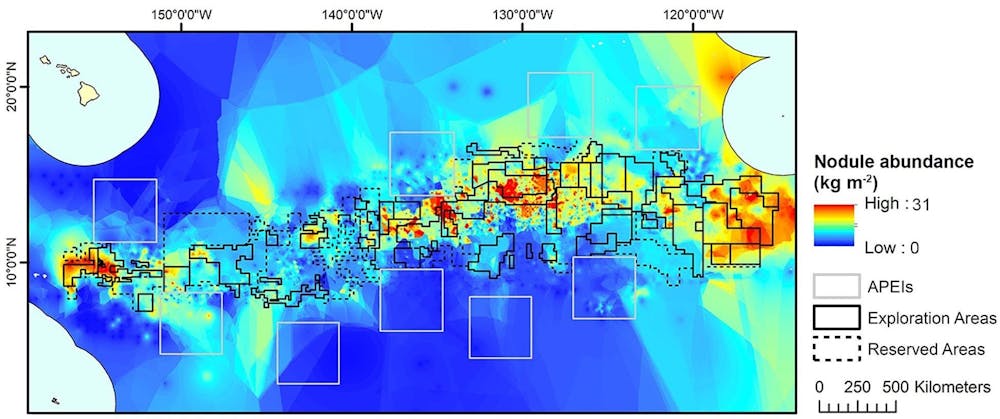
    As demand for these technologies increases, mining companies are targeting this remote area, known as the Clarion-Clipperton Zone, as well as a few other zones with similar nodules around the world.

    A map shows mining targets in the Clarion-Clipperton Zone, southeast of Hawaii, upper left. APEIs are protected areas.
    McQuaid KA, Attrill MJ, Clark MR, Cobley A, Glover AG, Smith CR and Howell KL, 2020, CC BY

    So far, only test mining has been carried out. However, plans for full-scale commercial mining are rapidly advancing.

    Exploratory deep-sea mining began in the 1970s, and the International Seabed Authority was established in 1994 under the United Nations Convention on the Law of the Sea to regulate it. But it was not until 2022 that The Metals Company and Nauru Ocean Resources Inc. fully tested the first integrated nodule collection system in the Clarion-Clipperton Zone.

    The companies are now planning full-scale mining operations in the region and expect to submit their application to the ISA by June 27, 2025. The ISA will convene in July 2025 to discuss critical issues such as mining regulations, guidelines and benefit-sharing mechanisms.

    A visualization of a deep-sea mining operation shows two sediment plumes. Source: MIT Mechanical Engineering.

    The proposed mining process is invasive. Collector vehicles scrape along the ocean floor as they scoop up nodules and stir up sediments. This removes habitats used by marine organisms and threatens biodiversity, potentially causing irreversible damage to seafloor ecosystems. Once collected, the nodules are brought up with seawater and sediments through a pipe to a ship, where they’re separated from the waste.

    The leftover slurry of water, sediment and crushed nodules is then dumped back into the middle of the water column, creating plumes. While the discharge depth is still under discussion, some mining operators propose releasing the waste at midwater depths, around 4,000 feet (1,200 meters).

    However, there is a critical unknown: The ocean is dynamic, constantly shifting with currents, and scientists don’t fully understand how these mining plumes will behave once released into the midwater zone.

    These clouds of debris could disperse over large areas, potentially harming marine life and disrupting ecosystems. Picture a volcanic eruption – not of lava, but of fine, murky sediments expanding throughout the water column, affecting everything in its path.

    The midwater ecosystem at risk

    As an oceanographer studying zooplankton in the Clarion-Clipperton Zone, I am concerned about the impact of deep-sea mining on this ecologically important midwater zone. This ecosystem is home to zooplankton – tiny animals that drift with ocean currents – and micronekton, which includes small fish, squid and crustaceans that rely on zooplankton for food.

    Sediment plumes in the water column could harm these animals. Fine sediments could clog respiratory structures in fish and feeding structures of filter feeders. For animals that feed on suspended particles, the plumes could dilute food resources with nutritionally poor material. Additionally, by blocking light, plumes might interfere with visual cues essential for bioluminescent organisms and visual predators.

    Manganese nodules can also be found on the seafloor off the southeastern United States.
    NOAA Office of Ocean Exploration and Research, 2019 Southeastern U.S. Deep-Sea Exploration

    For delicate creatures such as jellyfish and siphonophores – gelatinous animals that can grow over 100 feet long – sediment accumulation can interfere with buoyancy and survival. A recent study found that jellies exposed to sediments increased their mucous production, a common stress response that is energetically expensive, and their expression of genes related to wound repair.

    Additionally, noise pollution from machinery can interfere with how species communicate and navigate.

    Disturbances like these have the potential to disrupt ecosystems, extending far beyond the discharge depth. Declines in zooplankton populations can harm fish and other marine animal populations that rely on them for food.

    Life in the deep sea has other values. Source: The Economist

    The midwater zone also plays a vital role in regulating Earth’s climate. Phytoplankton at the ocean’s surface capture atmospheric carbon, which zooplankton consume and transfer through the food chain. When zooplankton and fish respire, excrete waste, or sink after death, they contribute to carbon export to the deep ocean, where it can be sequestered for centuries. The process naturally removes planet-warming carbon dioxide from the atmosphere.

    More research is needed

    Despite growing interest in deep-sea mining, much of the deep ocean, particularly the midwater zone, remains poorly understood. A 2023 study in the Clarion-Clipperton Zone found that 88% to 92% of species in the region are new to science.

    Current mining regulations focus primarily on the seafloor, overlooking broader ecosystem impacts. The International Seabed Authority is preparing to make key decisions on future seabed mining in July 2025, including rules and guidelines relating to mining waste, discharge depths and environmental protection.

    A map shows areas with nodules being considered for exploration and mining. Source: International Seabed Authority

    These decisions could set the framework for large-scale commercial mining in ecologically important areas such as the Clarion-Clipperton Zone. Yet the consequences for marine life are not clear. Without comprehensive studies on the impact of seafloor mining techniques, the world risks making irreversible choices that could harm these fragile ecosystems.

    Alexus Cazares-Nuesser receives funding from the National Science Foundation Graduate Research Fellowship Program. Past research received funding from The Metals Company Inc. through its subsidiary Nauru Ocean Resources Inc.

    ref. Deep-sea mining threatens sea life in a way no one is thinking about − by dumping debris into the thriving midwater zone – https://theconversation.com/deep-sea-mining-threatens-sea-life-in-a-way-no-one-is-thinking-about-by-dumping-debris-into-the-thriving-midwater-zone-247690

    MIL OSI – Global Reports

  • MIL-OSI Europe: REPORT on general guidelines for the preparation of the 2026 budget, Section III – Commission – A10-0042/2025

    Source: European Parliament 2

    MOTION FOR A EUROPEAN PARLIAMENT RESOLUTION

    on general guidelines for the preparation of the 2026 budget, Section III – Commission

    (2024/2110(BUI))

    The European Parliament,

     having regard to Article 314 of the Treaty on the Functioning of the European Union (TFEU),

     having regard to Article 106a of the Treaty establishing the European Atomic Energy Community,

     having regard to Council Regulation (EU, Euratom) 2020/2093 of 17 December 2020 laying down the multiannual financial framework for the years 2021-2027[1] and to the joint declaration agreed between Parliament, the Council and the Commission in this context[2] and the related unilateral declarations[3],

     having regard to Council Regulation (EU, Euratom) 2022/2496 of 15 December 2022 amending Regulation (EU, Euratom) 2020/2093 laying down the multiannual financial framework for the years 2021 to 2027[4],

     having regard to the Council Regulation (EU, Euratom) 2024/765 amending Regulation (EU, Euratom) 2020/2093 laying down the multiannual financial framework for the years 2021 to 2027[5] (MFF Revision),

     having regard to its position of 16 December 2020 on the draft Council regulation laying down the multiannual financial framework for the years 2021 to 2027[6],

     having regard to its resolution of 15 December 2022 on upscaling the 2021-2027 multiannual financial framework: a resilient EU budget fit for new challenges[7],

     having regard to its resolution of 3 October 2023 on the proposal for a mid-term revision of the multiannual financial framework 2021-2027[8],

     having regard to its resolution of 27 February 2024 on the draft Council regulation amending Regulation (EU, Euratom) 2020/2093 laying down the multiannual financial framework for the years 2021 to 2027[9],

     having regard to Council Decision (EU, Euratom) 2020/2053 of 14 December 2020 on the system of own resources of the European Union and repealing Decision 2014/335/EU, Euratom[10],

     having regard to the Commission proposal of 22 December 2021 for a Council decision amending Decision (EU, Euratom) 2020/2053 on the system of own resources of the European Union (COM(2021)0570) and its position of 23 November 2022 on the proposal[11],

     having regard to Regulation (EU, Euratom) 2024/2509 of the European Parliament and of the Council of 23 September 2024 on the financial rules applicable to the general budget of the Union (recast)[12] (the Financial Regulation),

     having regard to Regulation (EU) 2021/1119 of the European Parliament and of the Council of 30 June 2021 establishing the framework for achieving climate neutrality and amending Regulations (EC) No 401/2009 and (EU) 2018/1999 (‘European Climate Law’)[13],

     having regard to the EU’s obligations under the Paris Agreement and its commitments under the Kunming-Montreal Global Biodiversity Framework,

     having regard to the EU gender equality strategy 2020-2025,

     having regard to its resolution of 10 May 2023 on the impact on the 2024 EU budget of increasing European Union Recovery Instrument borrowing costs[14],

     having regard to Regulation (EU, Euratom) 2020/2092 of the European Parliament and of the Council of 16 December 2020 on a general regime of conditionality for the protection of the Union budget[15],

     having regard to the Interinstitutional Agreement of 16 December 2020 between the European Parliament, the Council of the European Union and the European Commission on budgetary discipline, on cooperation in budgetary matters and on sound financial management, as well as on new own resources, including a roadmap towards the introduction of new own resources[16],

     having regard to the Interinstitutional Proclamation on the European Pillar of Social Rights[17] of 13 December 2017,

     having regard to the general budget of the European Union for the financial year 2025[18] and the joint statements agreed between Parliament, the Council and the Commission annexed hereto,

     having regard to Enrico Letta’s report entitled ‘Much more than a market’, presented in the European Parliament on 21 October 2024,

     having regard to Mario Draghi’s report entitled ‘The future of European competitiveness’, presented in the European Parliament on 17 September 2024,

     having regard to Sauli Niinistö’s report entitled ‘Safer together – Strengthening Europe’s civilian and military preparedness and readiness’, presented in the European Parliament on 14 November 2024,

     having regard to the presentation of the EU Competitiveness Compass by Commission President Ursula von der Leyen on 29 January 2025,

     having regard to the joint white paper of 19 March 2025 for European Defence Readiness providing a framework for the ReArm Europe plan (JOIN(2025)0120),

     having regard to the Commission communication of 26 February 2025 entitled ‘The Clean Industrial Deal: A joint roadmap for competitiveness and decarbonisation’ (COM(2025)0085),

     having regard to the proposal of the European Parliament and of the Council of 26 February 2025 amending Regulations (EU) 2015/1017, (EU) 2021/523, (EU) 2021/695 and (EU) 2021/1153 as regards increasing the efficiency of the EU guarantee under Regulation (EU) 2021/523 and simplifying reporting requirements (COM(2025)0084),

     having regard to the Council conclusions of 18 February 2025 on the budget guidelines for 2026,

     having regard to Rule 95 of its Rules of Procedure,

     having regard to the opinions of the Committee on Foreign Affairs, the Committee on Transport and Tourism, the Committee on Regional Development and the Committee on Agriculture and Rural Development,

     having regard to the letters from the Committee on Budgetary Control, the Committee on the Environment, Climate and Food Safety, the Committee on Industry, Research and Energy, the Committee on Culture and Education and the Committee on Constitutional Affairs,

     having regard to the report of the Committee on Budgets (A10-0042/2025),

    Budget 2026: building a resilient, sustainable and prosperous future for Europe

    1. Highlights the anticipated economic growth projected for 2025 and 2026 within the EU[19], accompanied by an easing of inflation; notes nonetheless the uncertainties stemming from Russia’s war of aggression against Ukraine, which directly threatens the security of the EU, and the worsening effects of climate change and the biodiversity crisis, also manifested in the increasing frequency and intensity of natural disasters, which are compounded by new significant geopolitical changes and a deteriorating international rules-based order, heightened security threats and a rise in global protectionism; emphasises that, in such an increasingly volatile landscape, it is imperative for the EU to enhance its defence and security capabilities, social, economic and territorial cohesion and political and strategic autonomy, decrease its dependence, increase its competitiveness and ensure a prosperous future for the continent and its people, who are currently facing an increasingly high cost of living;

    2. Is determined to ensure that the 2026 budget, by focusing on strategic preparedness and security, economic competitiveness and resilience, sustainability, climate, as well as strengthening the single market, provides the people in the EU with a robust ecosystem and delivers on their priorities, thus reinforcing a socially just and prosperous Europe; underlines the need for additional investment in security and defence, research, innovation, small and medium-sized enterprises (SMEs), health, energy, migration, as well as land and maritime border protection, inclusive digital and green transitions, job creation, and the provision of opportunities for young people; insists that this be accompanied by administrative simplification, as indicated in the Competitiveness Compass; insists that the EU budget is the largest investment instrument with leverage effect, complementing national budgets and therefore enabling the EU to navigate the complexities of a rapidly changing world while ensuring prosperity, social cohesion and stability for its people; is strongly of the opinion that the EU should use this leverage effect to the maximum degree to boost the Union’s objectives and policymaking, as well as private investment;

    Investing in a solid, sustainable and resilient economy

    3. Is adamant that sound economic resilience and sustainability can be achieved in the EU by boosting public and private investment, increasing innovation and supporting competitiveness, including by addressing the skills gap and fostering more industrial production in Europe as a source for robust economic growth and quality jobs, and thereby guaranteeing the Union’s strategic autonomy, ensuring that the EU remains agile and self-reliant in the face of global challenges, disruptions and volatility; highlights the need to promote innovation, prioritise education, reduce costs and the administrative burden, and strengthen the single market, particularly as regards services;

    4. Reaffirms, in this regard, that research and innovation remain crucial for the EU’s success in cutting-edge industries and new clean and sustainable technologies; recalls the long-standing goal of increasing research and innovation investment to 3 % of gross domestic product (GDP); calls, therefore, for increased funding to be provided under Horizon Europe to fund at least 50 % of all excellent proposals in all scientific disciplines, enable researchers as well as companies, especially SMEs, to bring new developments to the market, and to scale up, ensure solid economic growth and boost the Union’s competitiveness in the global economy, thereby preventing actors from leaving for competing regions while also ensuring that Europe has the knowledge base it needs to pursue the Green Deal commitments;

    5. Highlights the importance of targeted support in encouraging public-private partnerships and accessible and increased financing to support SMEs as the backbone of the European economy and a vector for pioneering innovation, emphasising the role of the European Innovation Council, InvestEU and the SME component of the single market programme in empowering start-ups and scale-ups of innovative companies, supporting them in their growth and contributing to a greater role for the EU economy on the global stage; expresses its concern that, according to the interim evaluation of InvestEU, envelopes for many financial products may run out by the end of 2025 without budgetary reinforcements; takes note of the Commission proposal in this regard; underlines, furthermore, the importance of the single market programme to leverage the full potential of the EU’s cross-border dimension;

    6. Stresses that the modernisation of the economy will require blending public and private investment; emphasises, in this regard, the necessity of private investments to maximise the leverage effect of public spending; recalls that these efforts should lead to simplification and reduce the financial burden for the EU’s SMEs while maintaining EU standards;

    7. Underscores the urgency of further accelerating the digital and green transitions as catalysts for a future-oriented and resource-efficient economy that remains attractive for innovative businesses and that is based on market-driven investments providing quality jobs and leaving no one behind; advocates substantial investment in forward-looking digital infrastructure, underpinned by well-regulated, human-centred and trustworthy artificial intelligence and cybersecurity; stresses the need to improve citizens’ basic digital skills to match the needs of companies and to equip citizens to counter disinformation; stresses, further, the need to increase the resilience of the Union’s democracy in fighting malign foreign interference;

    8. Recognises the strategic value of the Trans-European Transport Network (TEN-T) and the Connecting Europe Facility (CEF) for contributing to the economic, social and climate goals of the EU’s cross-border transport infrastructure; calls for network extensions, particularly towards candidate countries and the EU’s strategic partners, as regards the EU’s sustainable and smart mobility strategy and the complementarities between the TEN-T and the Trans-European Networks for Energy (TEN-E);

    A better-prepared Union, capable of effectively responding to crises

    9. Underlines the need to enhance EU security and defence capabilities to create a genuine defence union and to better prepare for and respond to unprecedented geopolitical challenges and new hybrid security threats; stresses the essential role of common investment, research, production and procurement mechanisms, including in new disruptive technologies supporting an independent EU defence industry; considers that there is an EU added value in security and defence cooperation that not only makes Europe and its people safer but also leads to greater efficiency, potential savings, quality job creation and enhanced strategic autonomy; calls therefore for immediate upscaling and much better coordination of defence spending by Member States; stresses in particular the need to provide adequate resources to innovate and enhance Member States’ military capabilities, as well as their interoperability; takes note, in line with the Commission’s ‘ReArm Europe’ plan, of its call for the European Investment Bank (EIB) and other international financial institutions and private banks in Europe to invest more actively in the European defence industry while safeguarding their operations and financing capacity; recalls the importance of investing in and developing dual-use equipment and, particularly, of strengthening EU military mobility as regards funding dual-use transport infrastructure along priority axes; calls on the Commission to assess the possibility of using calls for this purpose under the CEF transport programme, in the light of the military mobility funding gap; underlines the urgent need to strengthen the EU’s cybersecurity capabilities to fight hybrid warfare;

    10. Recalls the role of the EU’s space programme in enhancing the strategic security of the Union through a variety of civil and military applications; underlines that a strong European space sector is fundamental for European security, open strategic autonomy, secure connectivity, the protection of critical infrastructure and advancing the twin green and digital transitions, and therefore requires sufficient resources;

    11. Highlights, in the face of new challenges in internal and external security, the importance of ensuring proper implementation of the Asylum and Migration Pact, in full compliance with international human rights law, and of respecting the principles of solidarity and the fair sharing of responsibility; stresses that effective management and protection of the EU’s external borders, both land and maritime, are essential for maintaining the freedoms of the Schengen area and crucial for the security of the EU and its citizens; emphasises the need to better protect people from trafficking and enhance support to strengthen cross-border cooperation between the Member States and the Union in combating criminal networks, particularly those involved in migrant smuggling and human trafficking, so as to reinforce law enforcement and the judicial response to these criminal networks, as well as to support Member States facing hybrid threats, in particular the instrumentalisation of migrants as defined in the Crisis Regulation[20];

    12. Recalls the vital role that the Integrated Border Management Fund, the Border Management and Visa Instrument (BMVI) and the Asylum, Migration and Integration Fund play in protecting external borders; calls, in addition, for appropriate funding for border protection capabilities, including physical infrastructure, buildings, equipment, systems and services required at border crossing points, as provided for in Annex III to the BMVI Regulation[21], and for the requirements to be met in terms of reception conditions, integration, return and readmission procedure; reaffirms that cooperation agreements with non-EU countries in full respect of international law can help to prevent irregular migration and strengthen border security;

    13. Acknowledges the common agricultural policy (CAP) as a key strategic European policy for food security and greater EU autonomy in affordable and high-quality food production; stresses the crucial role of the CAP in ensuring a decent income for EU farmers as well as a productive, competitive and sustainable European agriculture; regrets that direct payments have significantly decreased in real terms due to inflation, while the administrative burden on farmers has increased due to the accumulation of bureaucracy; urges the Commission to reduce the administrative burden while maintaining high production standards and the requirement to implement EU legislation; calls for adequate resources and for direct payments to be protected to help farmers cope with the impact of inflation, fuel costs, changes in the global food and trade market and adverse climate events, affecting agricultural production and threatening food security, including in the outermost regions; highlights, in this regard, the role of the agricultural reserve; emphasises the need to help small and medium-sized farms and new and young farmers by supporting generational renewal and ensuring continued support for the promotion of EU agricultural products; underlines the need for appropriate support for research and innovation to make the agricultural sector more sustainable, including water management, in particular through the Horizon Europe programme, without reducing European agricultural production and while preventing European farmers from facing unfair competition from imported products that do not meet our standards; welcomes the Commission’s preparation of a second simplification package; underscores that food security is an essential component for geopolitical stability;

    14. Stresses the strategic role of fisheries and aquaculture and the need for them to be adequately supported financially; acknowledges that the common fisheries policy ensures a stable income and long-term future for fishers by contributing to protecting sustainable marine ecosystems, which are key to the sector’s competitiveness; insists that special attention must be devoted to the EU’s fishing fleet in order to improve safety and security, including by combating illegal fishery actions and improving working conditions, energy efficiency and sustainability, as well as by renewing the fleet; reaffirms that the European Maritime, Fisheries and Aquaculture Fund should support a human resources policy capable of addressing future challenges, in order to promote an inclusive, diversified and sustainable blue economy; expresses its concern about the effect of the end of the Brexit transition period in June 2026 on the fishing and aquaculture sectors;

    15. Stresses that enhancing energy security and independence remains fundamental for the EU; highlights the EU’s role in ensuring security of energy supply, assisting households, farmers and businesses in mitigating price volatility and managing price gaps in comparison to the rest of the world; calls, therefore, for additional investment in critical infrastructure and connectivity, including large-scale cross-border electricity grids and hydrogen infrastructure for hard-to-abate sectors, which are an essential prerequisite to the decarbonisation of European industry, in low-carbon and renewable energy sources and connectivity, in particular by properly funding the CEF, as well as in energy efficiency; highlights the need to adapt European infrastructure to meet future energy demands as part of the transition to a clean and modern economy; underlines the importance of investing in new, expanding and modernising interconnector capacity for electricity trading, in particular cross-border capacity, for a fully integrated EU energy market that enhances Europe’s diversified supply security and resilience to energy market disruptions, reducing external dependencies and ultimately ensuring affordable and sustainable energy for EU citizens and businesses; stresses, in this regard, the need to strengthen cooperation with Africa;

    16. Recalls, in this context, the current housing crisis in Europe, including the lack of decent and affordable housing; calls, therefore, for swift additional investments through a combination of funding sources, including the EIB and national promotional banks, in areas with a positive impact on reducing the cost of living for households, improving the energy efficiency of buildings and deploying renewable energy sources; calls for a coordinated approach at EU level that respects the principle of subsidiarity, encourages best practices and effectively uses all relevant funding mechanisms in addressing this pressing challenge;

    17. Is highly concerned by the strong impacts of climate change and the biodiversity crisis both in Europe and globally and by the fact that the year 2024 was assessed to be the planet’s warmest year on record; calls for sufficient funding for the LIFE programme to finance climate and environment-related projects, including in the area of climate change mitigation and adaptation, and for increased budgetary flexibility to adequately respond to natural disasters in the EU; regrets that increasing numbers of natural disasters have led to a high number of victims, as well as to long-term devastating effects on citizens, farmers and businesses based and working in the regions concerned, as well as in the ecosystems impacted; calls for increased funding for the EU Solidarity Fund, RESTORE (Regional Emergency Support to Reconstruction) and the EU Civil Protection Mechanism, including for increasing rescEU capacities, which allow for more cost-efficient capacity building, in order to support Member States quickly and effectively in overwhelming crisis situations; recognises the EU’s role as a hub for coordinating and improving Member States’ preparedness and capacities to respond immediately to large-scale, high-impact emergencies, and its added value both for Member States and citizens; stresses, in this regard, that the EU Civil Protection Mechanism is a tangible expression of European solidarity, reinforcing the EU’s role as a crisis responder; acknowledges that the European Union Solidarity Fund or any other fund alone cannot fully compensate for the extreme weather events of increased frequency and severity caused by climate change today and in the future; stresses the need to invest in and prioritise preparedness, prevention, and adaptation measures, prioritising nature-based solutions; stresses that it is crucial to ensure that Union spending contributes to climate mitigation, adaptation efforts and water resilience infrastructure; emphasises that these investments are far lower than the cost of climate inaction;

    Enhancing citizens’ opportunities in a vibrant society

    18. Insists that continued investment in EU4Health and Cluster Health in Horizon Europe are key to improving health and preparedness for future health crises, thereby improving the health status of EU citizens; stresses the need for health investments for maximum impact; highlights its support for a holistic regulatory and funding approach to Europe’s life sciences and biotech ecosystem, including the creation of cutting-edge European clusters of excellence, as a central pillar of a stronger European health union, to which a European plan for cardiovascular diseases and lifestyles should be added, focusing on primary and secondary prevention as key objectives to increase life expectancy in the EU; highlights the need to create a more supportive care system to respond to demographic challenges and the ageing population; reiterates its support for Europe’s Beating Cancer Plan, as well as the importance of European investment in tackling childhood diseases, rare diseases and antimicrobial resistance; reiterates the importance of the gender aspect of health, including sexual and reproductive health and access to services; is highly concerned by the current mental health crisis in Europe, affecting in particular the young generation, exacerbated by recent global events, which requires immediate action to be taken; underlines the need to prevent shortages of critical medicines, medical countermeasures and healthcare workers faced by some Member States; calls, in this respect, for better coordination at EU level and joint procurement of medicines in order to reduce costs;

    19. Stresses the importance of investing in young generations and their skills, as major agents of change and progress, by ensuring access to quality education; considers it essential that all students, without discrimination and in every EU Member State, should have full access to the Erasmus+ programme and underlines the essential role of Erasmus+ in facilitating cultural exchange, strengthening European identity and promoting peace through mutual understanding and cooperation, making it a cornerstone of European integration and unity; recalls the need to tackle the skills deficit, the brain drain and the correlation between market needs and skills; considers that for the EU workforce to remain competitive in the future, establishing key areas for training and reskilling is needed; stresses that further investment is required in modernising the Union’s education systems, by equipping them for the digital and green transitions, creating talent booster schemes and incentivising young entrepreneurs; points, in this respect, to the relevance of sufficient financial resources for EU programmes such as the European Social Fund Plus, Erasmus+ and the EU Solidarity Corps, which have proven highly effective in helping to achieve high employment levels and fair social protection, in broadening education and training across the Union, as well as in promoting new job opportunities and fostering skills, youth participation and equal opportunities for all; calls on the Commission to do its utmost so that all university students remain eligible to participate in the Erasmus+ programme, including in Hungary;

    20. Recalls the role of the EU budget in contributing to the objectives of the European Pillar of Social Rights; highlights the role of the EU budget in contributing to initiatives that reinforce social dialogue and facilitate labour mobility, including in the form of training, networking and capacity building;

    21. Highlights the ever-increasing threats and dangers of organised and targeted disinformation campaigns against the EU by foreign stakeholders undermining European democracy; calls for the mobilisation of all relevant Union programmes, including Creative Europe, to fund actions in 2026 that promote inclusive digital and media literacy, in particular for young people, combating disinformation, countering online hate speech and extremist content, while encouraging the active participation of citizens in democratic processes and safeguarding media freedom and pluralism for good cultural resilience, all of which are fundamental to a thriving democracy;

    22. Calls on the Commission to increase EU funding for protecting citizens, religious communities and public spaces against terrorist threats, combating radicalisation and terrorist content online, as well as countering hate speech and rising antisemitism, anti-Muslim hatred and racism;

    23. Calls on the Commission to ensure the swift, full and proper implementation and robust enforcement of the Digital Services Act[22], the Digital Market Act[23] and the Artificial Intelligence Act[24], also by allocating sufficient human resources; stresses the importance of tackling foreign interference, addressing the dangers of biased algorithms, and safeguarding transparency, accountability and the integrity of the digital public space;

    24. Underlines the added value of funding programmes in the areas of democracy, rights and values; recalls the important role that the EU budget plays in the promotion of the European values enshrined in Article 2 of the Treaty on European Union and in supporting the key principles of democracy, the rule of law, solidarity, inclusiveness, justice, non-discrimination and equality, including gender equality; reaffirms, furthermore, the essential role of the Citizens, Equality, Rights and Values programme in promoting European values and citizens’ rights, in particular its Union Values strand, as well as gender equality, thereby sustaining and further developing an open, rights-based, democratic, equal and inclusive society based on the rule of law; stresses the need for targeted measures to address gender disparities and promote equal opportunities through EU funding allocations; stresses that supporting investigative journalism with sufficient resources is a strategic investment in democracy, transparency and social justice; reiterates the importance of the Daphne and Equality and Rights programmes, and stresses that necessary resources should be devoted to combating discrimination in all its forms, as well as tackling forms of violence;

    25. Emphasises the valuable work carried out under the Union Values strand, which provides, among other things, direct funding to civil society organisations as key actors in vibrant democracies; stresses that citizens and civil society organisations, promoting the will and interest of citizens, represent the core of European democracy; underlines, in this regard, the importance of all EU programmes and increased funding in supporting the genuine engagement of civil society, particularly in the context of the impact of reduced funding for civil society by the EU’s international partners;

    26. Considers it essential for the Union’s stability and progress and its citizens’ trust to ensure the proper use of Union funds and to take all steps towards protecting the Union’s financial interests, in particular by applying the rule of law conditionality; underscores the undeniable connection between respect for the rule of law and efficient implementation of the Union’s budget in accordance with the principles of sound financial management under the Financial Regulation; reiterates that under the Rule of Law Conditionality Regulation[25], the imposition of appropriate measures must not affect the obligations of governments to implement the programme or fund affected by the measure, and in particular the obligations they have towards final recipients; insists, therefore, that in cases of breaches of the rule of law by national governments, the Commission should explore alternative ways to implement the budget, including by assessing the possibility of diverting sources to directly and indirectly managed programmes, in order to ensure that local and regional authorities, civil society and other beneficiaries can continue to benefit from Union funding, without weakening the application of the regulation; highlights the role of the European Court of Auditors and its constant activity in defence of transparency, accountability and strict compliance with the regulations on all of the funds and programmes;

    A strong Union in a changing world

    27. Observes that the need for the EU to maintain and augment its presence on the global stage is increasingly crucial amid escalating global conflicts, geopolitical shifts and foreign influence efforts worldwide, particularly considering developments with other major global providers of aid; stresses that in order to achieve this, the Union requires sufficient funding and resources to act, including to respond to major crises in its neighbourhood and throughout the world, in particular in the light of the sudden decrease in international funding; stresses the importance of the humanitarian aid programme and regrets that resources are not increasing in line with record-high needs; underscores the need to strengthen the EU’s role as a leading humanitarian actor while effectively addressing emerging crises, particularly in regions facing protracted conflict, displacement, food insecurity and natural disasters; emphasises that the Union also requires sufficient resources for long-term investments in building global partnerships, and points out the importance of the participation of non-EU countries in Union programmes, where appropriate;

    28. Underlines that the EU’s security environment has changed dramatically following Russia’s illegal, unprovoked and unjustified war of aggression against Ukraine and unpredictable changes in the policies of its main allies; recalls the importance of enhancing citizens’ safety and of achieving efficiency in the area of defence and strategic autonomy, through a comprehensive approach to security that covers military and civilian capabilities, external relations and internal security; stresses the importance of the Internal Security Fund to ensure funding to tackle increased levels of serious organised crime with a cross-border dimension and cybercrime; recognises the pressure which increased defence spending represents for Member Sates’ national budgets; stresses the importance of Member States stepping up their efforts and increasing funding for their defence capabilities, in a consistent and complementary manner in line with the NATO guideline;

    29. Stresses that, beyond the enormous sacrifices of the people of Ukraine in withstanding Russia’s war of aggression for our common European security, this war has also had substantial economic and social consequences for people throughout Europe; recalls that certain Member States, in particular those with a land border with Russia and/or Belarus in the Baltic region, and frontline Member States, as well as vulnerable sectors of the economy, remain particularly exposed to the consequences of the war and deserve support in areas such as agriculture, infrastructure and military mobility, in the spirit of EU solidarity;

    30. Firmly reiterates its unconditional and full support for Ukraine in its fight for its freedom and democracy against Russian aggression, as the war on its soil has passed the three-year mark; underlines the ongoing need for high levels of funding, including in humanitarian aid and for repairs to critical infrastructure, and for improved capacity along the EU-Ukraine Solidarity Lanes; welcomes the renewed and reinforced intention of the Commission and Member States to work in a united way to address Ukraine’s pressing defence needs and to further support the Ukrainian economy by providing regular and predictable financial support and facilitating investment opportunities; welcomes the agreement with the Council on macro-financial assistance for Ukraine of up to EUR 35 billion, making use of the proceeds of frozen Russian assets through the new Ukraine Loan Cooperation Mechanism, in order to support Ukraine’s recovery, reconstruction and modernisation, as well as to foster Ukraine’s progress on its path to EU accession; stresses the importance of ensuring accountability regarding core international crimes;

    31. Insists on the benefits of pre-accession funds, both for the enlargement countries and for the EU itself, as the funding creates more stability in the region; welcomes the implementation of the Growth Plan for the Western Balkans to further support the economic convergence of Western Balkan countries with the EU’s single market through investment and growth in the region; insists on the need to deploy the necessary funds to support Moldova’s accession process, in line with the EU’s commitment to enlargement and regional stability; underlines the role of the Reform and Growth Facility for the Republic of Moldova and highlights the necessity of securing sufficient financial resources for its full implementation; underlines the importance of sustained support for candidate countries in implementing the necessary accession-related reforms, in particular regarding the rule of law, anti-corruption and democracy and in enhancing their resilience and preventing and countering hybrid threats; calls on the Commission to allocate additional funding to support civil society, independent media organisations and journalists;

    32. Underlines, furthermore, that EU neighbourhood policy, namely its Eastern and Southern Partnerships, contributes to the overall goal of increasing the stability, prosperity and resilience of the EU’s neighbours and thereby of increasing the security of our continent; stresses, therefore, the importance of reinforcing the Southern and Eastern Neighbourhood budget lines in order to support political, economic and social reforms in the regions, facilitate peace processes and reconstruction and provide assistance to refugees, in particular through continuous, reinforced and predictable funding and continuous implementation on the ground; recalls that the EU must continue to alleviate other crises and assist the most vulnerable populations around the world through its humanitarian aid programme, as well as by maintaining its global positioning with the Neighbourhood, Development and International Cooperation Instrument for supporting global challenges and promoting human rights, freedoms and democracy, as well as for the capacity building of civil society organisations and for delivering on the Union’s international climate and biodiversity commitments, within a comprehensive monitoring and control system;

    Cross-cutting issues in the 2026 budget

    33. Underlines that the repayment of the European Union Recovery Instrument (EURI) borrowing costs is a legal obligation for the EU and therefore non-discretionary; notes that borrowing costs depend on the pace of disbursements under the Recovery and Resilience Facility (RRF) as well as on market fluctuations in bond yields and are therefore inherently partly unpredictable and volatile; insists, therefore, on the need for the Commission to provide reliable, timely and accurate information on NextGenerationEU (NGEU) borrowing costs and on expected RRF disbursements throughout the budgetary procedure as well as on available decommitments; expects the Commission to update the decommitments forecast when it presents the draft budget; recalls that the three institutions agreed that expenditures covering the financing costs of NGEU must aim at not reducing EU programmes and funds;

    34. Recalls its support for the amended Commission proposals for the introduction of new own resources; is highly concerned by the complete lack of progress on the new own resources in the Council, in particular in view of increasing investment and unforeseen needs; considers that the introduction of new own resources, in line with the roadmap in the interinstitutional agreement of 2020, is essential to cover NGEU borrowing costs while shielding the margins and flexibility mechanisms necessary to cater for these needs;

    35. Highlights again Parliament’s full support for the cohesion policy and its key role in delivering on the EU’s policy priorities and its general growth; reiterates that the cohesion policy’s optimal added value for citizens depends on its effective and timely implementation; in the same vein, urges the Member States and the Commission to accelerate the implementation of operational programmes under shared management funds as well as of the recovery and resilience plans so as to ensure swift budgetary execution and to avoid accumulated payment backlogs in the two last years of the MFF period, in particular through additional capacity building and technical assistance for Member States; reaffirms the imperative of a robust and transparent mechanism for accurately monitoring disbursements to beneficiaries;

    36. Notes that particular attention must be paid to rural and remote areas, areas affected by industrial transition and regions which suffer from severe and permanent natural or demographic handicaps, such as islands and outermost, cross-border and mountain regions and all those affected by natural disasters; stresses that these regions should benefit from adequate funding to offset the special characteristics and constraints of their structural social and economic situation, as referred to in Article 349 TFEU; stresses the vital importance of the POSEI programme for maintaining agricultural activity in the outermost regions and bringing food to local markets; calls for the programme budget to be increased to reflect the real needs of farmers in these regions; notes that there has been no such increase since 2013, despite the fact that farmers in these regions face higher production costs due to inflation and climate change; stresses also that the Overseas Countries and Territories associated with the EU, as referred to in Articles 198-204 TFEU, should benefit from adequate funding for their sustainable economic and social development, in the light of their geopolitical importance for global maritime trade routes and key partnerships such as those on sustainable raw materials value chains;

    37. Reiterates that EU programmes, policies and activities, where relevant, should be implemented in such a way that promotes gender equality in the delivery of their objectives; welcomes the Commission’s work on developing gender mainstreaming in order to meaningfully measure the gender impact of Union spending, as set out in the interinstitutional agreement;

    38. Takes note that the climate mainstreaming target of 30 % is projected to be met by 33.5 % in 2025, while the biodiversity target will be below 8.5 % in 2025, and unless dedicated action is undertaken the 10 % target will not be met in 2026; stresses the need for continuous efforts towards the achievement of the climate and biodiversity mainstreaming targets laid down in the interinstitutional agreement in the Union budget and the EURI expenditures;

    39. Stresses that the 2026 Union budget should be aligned with the Union’s ambitions of making the Union climate neutral by 2050 at the latest, as well as the Union’s international commitments, in particular under the Paris Agreement and the Kunming-Montreal Agreement, and should significantly contribute to the implementation of the European Green Deal and the 2030 biodiversity strategy;

    40. Recalls that effective programme implementation is achievable only with the backing of a committed administration; emphasises the essential work carried out by bodies and decentralised agencies and asserts that they must be properly staffed and sufficiently resourced, while taking into account inflation, so that they can fulfil their responsibilities effectively and contribute to the achievement of the Union political priorities, also when given new tasks and mandates;

    41. Recalls that, in accordance with the Financial Regulation, when implementing the budget, Member States and the Commission must ensure compliance with the Charter of Fundamental Rights and respect the Union’s values enshrined in Article 2 TEU; underlines in particular Articles 137, 138 and 158 of the Financial Regulation and recalls the Commission and the Member States’ obligation to exclude from Union funds any persons or entities found guilty by a final judgment of terrorist offences, as well as by final judgments of terrorist activities, inciting, aiding, abetting or attempting to commit such offences, and corruption or other serious offences; highlights the need to leverage efforts in tackling fraud both at Union and Member State level and to this end ensure appropriate financial and human resources covering the Union’s full anti-fraud architecture; recalls the importance of providing the Union Anti-Fraud Programme with sufficient financial resources;

    42. Underlines the importance of effective communication and the visibility of EU policies and programmes in raising awareness of the added value that the EU brings to citizens, businesses and partners;

    °

    ° °

    43. Instructs its President to forward this resolution to the Council, the Commission and the Court of Auditors.

    ANNEX: ENTITIES OR PERSONS FROM WHOM THE RAPPORTEUR HAS RECEIVED INPUT

    The rapporteur declares under his exclusive responsibility that he did not receive input from any entity or person to be mentioned in this Annex pursuant to Article 8 of Annex I to the Rules of Procedure.


    OPINION OF THE COMMITTEE ON FOREIGN AFFAIRS (20.2.2025)

    for the Committee on Budgets

    on guidelines for the 2026 budget – Section III

    (2024/2110(BUI))

    Rapporteur for opinion: Michael Gahler


    OPINION

    The Committee on Foreign Affairs calls on the Committee on Budgets, as the committee responsible, to incorporate the following into its motion for a resolution:

    1. Welcomes the fact that the multiannual financial framework (MFF) revision in 2024 provided for additional funding under Heading 6 and for the EUR 50 billion Ukraine Facility; deplores, however, the fact that the MFF revision fell short of the needs identified by Parliament; reiterates the urgent need to increase funding, particularly in crisis-affected regions where the needs are greatest, and to address the various challenges in the neighbourhood, invest in partnerships and strengthen the geopolitical position of the EU; underlines in particular the need for continued efforts to finance Ukraine’s immediate funding needs; emphasises that the EU should without any delay intensify its efforts to enable frozen and immobilised Russian assets to be used for Ukraine’s reconstruction, reparations and budgetary needs, in full compliance with EU and international law; underlines that the Neighbourhood, Development and International Cooperation Instrument – Global Europe (NDICI – Global Europe) and the Global Gateway are crucial instruments within the Union’s external action toolbox; stresses the importance of the EU’s humanitarian aid policies and instruments; calls in general for a more strategic and impactful approach to EU funding abroad while advancing open strategic autonomy;

    2. Reiterates that an increased level of funding should be allocated for the Southern Neighbourhood in 2025 to support political, economic and social reforms in the region; highlights in particular the pressing need to contribute significantly to the reconstruction of Gaza and to provide additional humanitarian aid in Gaza, Lebanon and Syria; recalls that the United Nations Relief and Works Agency for Palestine Refugees in the Near East (UNWRA) has up to now been the principal humanitarian assistance structure in Gaza and the West Bank as well as an essential service provider in the region; recalls the need to continue supporting key regional partners such as Jordan in order to foster peace in the region;

    3. Welcomes the new Reform and Growth Facility for the Western Balkans and the proposed Facility for Moldova, as well as the role of the Instrument for Pre-accession Assistance (IPA) III in financing actions in the region; underlines that the Reform Agendas, which beneficiaries need to develop, are a promising instrument to speed up transformation and compliance with EU norms; calls on the Commission, in the interests of a successful accession process, to strictly apply the conditionalities enshrined in the two facilities; calls furthermore on the Commission to accompany all 10 enlargement countries on their path to European integration and to provide tailored assistance to address their respective challenges; calls on the Commission to allocate additional funding to support civil society and independent media organisations and journalists; calls on the Commission to ensure that it retains the possibility to withhold funds, either temporarily or indefinitely, if those funds would contribute to the budgets of governments – whether at the national or sub-national level – whose actions are significantly undermining the stability of the country or its neighbours, or the country’s progress towards European integration, particularly regarding democracy, the rule of law and the protection of human rights and fundamental freedoms; calls, furthermore, on the Commission to present a proposal for an instrument for pre-accession assistance for the next MFF that incorporates the facilities to avoid overlaps and covers all 10 enlargement countries and which should ensure strong institutional and economic preparedness for EU membership; calls also on the Commission to speed up the integration of all candidate countries in the EU roaming area;

    4. Highlights the importance of the EU’s ensuring that EU funds do not go towards financing educational literature that romanticises martyrdom, violence or terrorism;

    5. Underlines the need for the Directorate-General for Enlargement and the Eastern Neighbourhood (DG ENEST), the Directorate-General for the Middle East, North Africa and the Gulf (DG MENA) and the European External Action Service (EEAS) to be provided with sufficient financial and human resources to promote peace, prosperity, security and EU values and interests in both the European neighbourhood and across the globe; underlines the need to provide adequate resources to both the EEAS and the Commission for strategic communication and to counter disinformation; highlights the need to maintain the current structure of the network of EU delegations around the world and to provide financing that is commensurate with the role that the Union expects all delegations to play on the ground; notes, furthermore, that the EEAS, with 145 delegations around the globe, cannot be measured according to the same logic as that applied to European institutions in Brussels and Luxembourg; calls, therefore, on the Commission and the Council not to apply the 2 % logic to the EEAS; insists on a budgetary increase for common foreign and security policy (CFSP) actions and common security and defence policy (CSDP) missions, as well as other appropriate peace, conflict and crisis response instruments; stresses the need to improve IT and security protocols within EEAS headquarters, EU Delegations and in Commission directorates-general with responsibilities in EU External Action; stresses the importance of investing in European security and defence by bolstering the Union’s strategic autonomy and collective defence capabilities;

    6. Welcomes the establishment of the EU Partnership Mission in Moldova (EUPM Moldova); highlights the essential role of the EUPM Moldova and calls on the EU and its Member States to extend the mission’s mandate beyond May 2025, while increasing resources to enhance its effectiveness;

    7. Reiterates the EU’s commitment to promoting gender equality and the empowerment of women globally, as enshrined in the EU Gender Action Plan III (2021–2025); calls for increased resources to support women’s rights, including efforts to eliminate gender-based violence, strengthen women’s participation in decision-making processes and promote economic empowerment; emphasises the importance of gender mainstreaming across all budgetary and policy initiatives to ensure equal opportunities and inclusivity; stresses that gender equality is not only a fundamental right but also a crucial driver of social and economic development;

    8. Calls on the Commission to collaborate with the EPLO office in Washington, D.C., and the EU delegation in the United States to identify, fund and implement initiatives aimed at strengthening the transatlantic relationship, including exchange programmes for professionals working in public institutions in both the EU and the United States;

    9. Underlines that any disbursements from the European budget must depend on the beneficiary country’s respect for the rule of law, human rights and compliance with international obligations, and with respect for international agreements;

    10. Considers that more EU funds need to be allocated to joint cyber defence in order to counter the digital threats from Russia, the People’s Republic of China and others; considers that the Commission needs to secure the necessary funding for a future cyber army that can help EU institutions and Member States to defend themselves against cyberattacks from hostile states;

    11. Stresses the need for the visibility and communication of EU aid, particularly in candidate countries, but also in other partner countries;

    12. Stresses the urgent need for the EU to invest in research and development concerning low-cost drones, not only in order to support Ukraine in its efforts to defend itself against Russia, but also to strengthen European defence; considers that the EU should cooperate with Ukraine on the development of a drone system following their successful use of drones.

    ANNEX: ENTITIES OR PERSONS
    FROM WHOM THE RAPPORTEUR HAS RECEIVED INPUT

    The rapporteur for the opinion declares under his exclusive responsibility that he did not receive input from any entity or person to be mentioned in this Annex pursuant to Article 8 of Annex I to the Rules of Procedure.


    INFORMATION ON ADOPTION BY COMMITTEE ASKED FOR OPINION

    Date adopted

    19.2.2025


    Result of final vote

    +:

    –:

    0:

    40

    13

    8

    Members present for the final vote

    Mika Aaltola, Petras Auštrevičius, Dan Barna, Wouter Beke, Robert Biedroń, Ľuboš Blaha, Ioan-Rareş Bogdan, Marc Botenga, Helmut Brandstätter, Sebastião Bugalho, Tobias Cremer, Danilo Della Valle, Loucas Fourlas, Alberico Gambino, Giorgos Georgiou, Christophe Gomart, Rima Hassan, Rasa Juknevičienė, Sandra Kalniete, Łukasz Kohut, Ondřej Kolář, Rihards Kols, Andrey Kovatchev, Reinhold Lopatka, Antonio López-Istúriz White, Marion Maréchal, David McAllister, Vangelis Meimarakis, Sven Mikser, Francisco José Millán Mon, Hannah Neumann, Urmas Paet, Kostas Papadakis, Tonino Picula, Thijs Reuten, Nacho Sánchez Amor, Mounir Satouri, Andreas Schieder, Alexander Sell, Villy Søvndal, Davor Ivo Stier, Marie-Agnes Strack-Zimmermann, Cristian Terheş, Riho Terras, Pierre-Romain Thionnet, Reinier Van Lanschot, Nicola Zingaretti, Željana Zovko

    Substitutes present for the final vote

    Krzysztof Brejza, Jaroslav Bžoch, Engin Eroglu, Tomasz Froelich, Ilhan Kyuchyuk, Ana Catarina Mendes, Alessandra Moretti, Ana Miguel Pedro, Chloé Ridel, Şerban Dimitrie Sturdza, Marco Tarquinio

    Members under Rule 216(7) present for the final vote

    Anna Bryłka, Mélissa Camara, Alexander Jungbluth, Erik Marquardt, Leire Pajín, Kristian Vigenin


    FINAL VOTE BY ROLL CALL IN COMMITTEE ASKED FOR OPINION

    40

    +

    ECR

    Cristian Terheş

    PPE

    Mika Aaltola, Wouter Beke, Ioan-Rareş Bogdan, Krzysztof Brejza, Sebastião Bugalho, Loucas Fourlas, Rasa Juknevičienė, Sandra Kalniete, Łukasz Kohut, Ondřej Kolář, Andrey Kovatchev, Reinhold Lopatka, Antonio López-Istúriz White, David McAllister, Vangelis Meimarakis, Francisco José Millán Mon, Davor Ivo Stier, Riho Terras, Željana Zovko

    Renew

    Petras Auštrevičius, Dan Barna, Helmut Brandstätter, Engin Eroglu, Ilhan Kyuchyuk, Urmas Paet, Marie-Agnes Strack-Zimmermann

    S&D

    Robert Biedroń, Tobias Cremer, Ana Catarina Mendes, Sven Mikser, Alessandra Moretti, Tonino Picula, Thijs Reuten, Chloé Ridel, Nacho Sánchez Amor, Andreas Schieder, Marco Tarquinio, Kristian Vigenin, Nicola Zingaretti


    13

    ECR

    Rihards Kols, Marion Maréchal

    ESN

    Tomasz Froelich, Alexander Jungbluth, Alexander Sell

    NI

    Ľuboš Blaha, Kostas Papadakis

    PfE

    Jaroslav Bžoch, Pierre-Romain Thionnet

    The Left

    Marc Botenga, Danilo Della Valle, Giorgos Georgiou, Rima Hassan


    8

    0

    ECR

    Alberico Gambino, Şerban Dimitrie Sturdza

    Verts/ALE

    Mélissa Camara, Erik Marquardt, Hannah Neumann, Mounir Satouri, Villy Søvndal, Reinier Van Lanschot


    Key to symbols:

    + : in favour

     : against

    0 : abstention


    OPINION OF THE COMMITTEE ON TRANSPORT AND TOURISM (19.2.2025)

    for the Committee on Budgets

    on general guidelines for the preparation of the 2026 budget, Section III – Commission

    (2024/2110(BUI))

    Rapporteur for opinion: Gheorghe Falcă


    OPINION

    The Committee on Transport and Tourism calls on the Committee on Budgets, as the committee responsible, to incorporate the following into its motion for a resolution:

    A. whereas the Connecting Europe Facility for Transport (CEF-T) has been a highly successful EU instrument for strategic investment in the development of the Trans-European Transport Network (TEN-T), aimed at transforming the EU’s roads, railways, ports, inland waterways and airways into a connected, safe, efficient, sustainable and competitive transport system; whereas the completion deadlines of 2030 for the core network, 2040 for the extended core network and 2050 for the comprehensive network are binding on the Member States and often require massive and sustained infrastructure investments; whereas the CEF-T should remain an important transport funding instrument in the 2028-2034 multiannual financial framework (MFF);

    B. whereas modern, interconnected and multimodal transport infrastructure within a single European transport area is central to creating growth and jobs in the EU, completing the European single market and ensuring territorial cohesion, including for the benefit of peripheral, rural, mountainous, island and outermost regions and other geographically disadvantaged areas; whereas the Draghi and Letta reports call on the EU to step up its efforts to develop a competitive industrial strategy in the face of global competition; whereas successful decarbonisation that safeguards the global competitiveness of European industries requires significant investment in renewable-energy-based transport networks and alternative fuel infrastructure for sustainable transport; whereas digitalisation across all transport sectors can yield significant efficiency gains, which often have the potential to exceed the initial investments; whereas sufficient investment is required to achieve this and other technological solutions to enhance interoperability between digital, energy and transport networks and to maximise network benefits; whereas increased investment in road safety is necessary to achieve the goals of the EU’s Vision Zero strategy and ensure the safety of roads and road users; whereas the transport sector faces labour and skills shortages, combined with sometimes poor working conditions;

    C. whereas the efficient use of EU funds is paramount to achieving strategic objectives within limited financial envelopes, particularly in the light of inflationary pressures that have led to significant increases in construction, energy and raw material costs, threatening the financial feasibility of key infrastructure projects of common European interest; whereas resilient and coordinated EU funding mechanisms are vital for maintaining project momentum despite economic volatility; whereas the imperative of maximising the impact of EU spending requires inflation-adjusted budgetary provisions, the reallocation of underutilised funds, as well as clear monitoring and improved reporting frameworks;

    D. whereas delays in planning, permitting and procurement processes also hinder the timely implementation of transport and infrastructure projects, jeopardising EU transport and infrastructure development; whereas establishing optimised approval procedures is crucial to accelerating project timelines and ensuring budget absorption;

    E. whereas, as envisaged under the Omnibus simplification package outlined by the Commission in its Competitiveness Compass, reducing regulatory and administrative burdens and simplifying implementation are key to ensuring equal access to funding for small and medium-sized enterprises (SMEs), regional authorities and disadvantaged regions; whereas the simplification of EU regulatory and administrative processes at all levels, coupled with streamlined access to funding, are essential for achieving the timely and efficient implementation of projects under CEF-T and tourism programmes, particularly for SMEs and regional authorities;

    F. whereas the action plan on military mobility 2.0 outlines ambitious EU-level initiatives; whereas, however, inadequate funding remains a significant obstacle to their effective implementation;

    G. whereas Russia’s war of aggression against Ukraine, like the COVID-19 pandemic, has underscored the vulnerability of the EU’s transport and tourism sectors to external shocks; whereas it is more necessary now than ever before to strengthen transport connections with Ukraine and Moldova; whereas the EU-Ukraine road transport agreement, which facilitates road freight transport and transit by setting up solidarity corridors, has been extended until 30 June 2025, with the possibility of tacit renewal for a further six months; whereas the European transport network is critical infrastructure facing increasing digital and/or physical security risks and needs to be protected from external threats to maintain the societal functions for which it is vital;

    H. whereas tourism, a major economic activity accounting for almost 10 % of the EU’s GDP and identified in the Commission’s 2021 industrial strategy as a critical ecosystem for the EU’s economy and for employment, continues to face economic, environmental, employment-related and digital challenges;

    1. Calls for a significant increase in the CEF-T budget to secure adequate funding for ongoing and planned TEN-T projects, focusing on cross-border infrastructure with the highest added value for the EU and on the elimination of bottlenecks and missing links, including within Member States, in order to enhance passenger and freight flow throughout Europe; underlines, furthermore, the value of smaller-scale projects in improving cross-border connectivity and their eligibility for EU funding;

    2. Welcomes the Commission’s announcement that it will develop an EU industrial action plan for the automotive sector, as proposed in the Draghi report, and calls for swift progress in the ongoing strategic dialogue;

    3. Welcomes the Commission’s announcement that it will develop a new maritime industrial strategy to enhance the competitiveness, sustainability and resilience of the European maritime manufacturing sector; appreciates the Commission’s announcement that it would present a European port strategy to limit the risks of economic dependence, espionage and sabotage linked to the economic presence and operational involvement of entities from non-EU countries in EU ports;

    4. Calls, further, for a strategic action plan for the EU aviation sector to identify potential reductions in administrative burdens and to assess financial needs for maintaining the sector’s competitiveness in the face of decarbonisation pressures and the associated risks, including an uneven playing field and carbon leakage, and geopolitical challenges, and with regard to a cross-country analysis of working conditions as a determinant in attracting and retaining skilled workers and boosting productivity;

    5. Welcomes the commitment to put forward a plan to develop an ambitious European high-speed rail network to help connect EU capitals, including through night trains, and to accelerate rail freight, as well as to set up a single digital ticketing and booking system for railways as soon as possible, as already outlined in the revised TEN-T guidelines; underlines the need for ambitious support for the deployment of the European Rail Traffic Management System (ERTMS);

    6. Advocates a comprehensive strategy on hyperloop, with clear timelines, detailed investment frameworks and support for research, development and deployment;

    7. Welcomes, in this respect, the Commission’s announcement under the Competitiveness Compass presenting a sustainable transport investment plan and calls on the Commission to define financing measures for the above-mentioned strategies and action plans, including by de-risking the investment needed to swiftly ramp up charging infrastructure as well as for the production and distribution of renewable and low-carbon transport fuels, without jeopardising existing market choices;

    8. Underlines again the role of the Social Climate Fund in supporting investment for an inclusive transition towards more sustainable mobility and calls on the Member States to address transport poverty with specific policies and financing measures in their national Social Climate Plans;

    9. Highlights the need to address the shortage of qualified labour, women’s employment and an ageing workforce in the transport sector; calls, in this regard, for sufficient support for the safety and good working conditions of transport workers as well as for the funding of safe and secure truck parking areas across the EU;

    10. Calls for the digitalisation of transport through intelligent solutions and digital booking platforms to facilitate seamless cross-border travel; calls for the systematic reduction of EU regulatory burdens across all transport modes to free up resources, including EU budgetary means, for increased investment in transport infrastructure; underlines the strong need for prior impact assessments of all new legislative initiatives with respect to their budgetary implications but also the regulatory or administrative burdens that the proposals would create or resolve;

    11. Calls on the Commission to address inflationary pressures and resource scarcity by incorporating inflation adjustments into the budget; notes that the inclusion of realistic price adjustments is essential to safeguarding the viability of transport and infrastructure projects against the impact of inflation-induced cost increases; supports the reallocation of unused funds to strategic clusters, such as transport infrastructure, sustainable transport solutions and innovation; calls strongly for the integration of inflation-resilient frameworks and adaptive budget mechanisms within the MFF to avoid financing challenges in upcoming cycles;

    12. Emphasises the importance of bolstering co-financing mechanisms, particularly for large-scale projects such as the Clean Aviation, Single European Sky ATM Research (SESAR) and Europe’s Rail Joint Undertakings, to ensure their timely implementation despite economic constraints; insists on the leveraging of public-private partnerships (PPPs) to mobilise additional resources;

    13. Advocates innovative financing models, in particular the facilitation of PPPs by providing guarantees or implementing risk-sharing mechanisms, in order to attract private investment in transport and tourism infrastructure, including for a faster transition to alternative fuels; stresses that these PPPs can also contribute to knowledge-sharing, innovation and support for SMEs and start-ups;

    14. Stresses the need to reinforce the budgets of transport agencies, in particular the EU Aviation Safety Agency, the European Maritime Safety Agency, and the EU Agency for Railways, so that they can fulfil the additional tasks assigned to them by the co-legislators in recently adopted EU legislation, as well as in order to support critical safety, sustainability, interoperability, competitiveness, innovation and modernisation initiatives;

    15. Calls resolutely for the streamlining of application and reporting procedures in relation to EU funds in line with Directive 2021/1187[26]; insists on transparent and fair allocation of EU transport funding using digital platforms in order to simplify access for SMEs and regional stakeholders; calls for the establishment of expedited review processes for critical transport and infrastructure projects in order to reduce delays; proposes the implementation of the ‘once-only’ principle for administrative processes, allowing applicants to provide information once and reuse it across EU programmes, thus reducing redundancy and delays, including for the increased blending of EU funds;

    16. Insists on the restoration of the military mobility budget to the originally proposed EUR 6.5 billion over seven years; reiterates that the drastic cut of 75 % to military mobility funding within the transport pillar considerably weakens this policy; highlights the critical role of that funding in adapting parts of the TEN-T infrastructure for dual use along priority axes, in order to facilitate the short-notice, large-scale movement of military equipment and humanitarian aid across the continent, enabling a joint response to military threats to the EU Member States and their allied nations; calls for military mobility to be included in the white paper on the future of European defence;

    17. Reiterates that, to help Ukraine withstand Russia’s war of aggression and to accelerate its post-war recovery and integration into the EU market, alongside the upcoming decisions on the renewal of the EU-Ukraine road transport agreement, it is imperative to pursue projects to improve the capacity along the EU-Ukraine Solidarity Lanes, encompassing railway upgrades, improved border crossings and the crucial step of integrating relevant lines of Ukraine’s rail system into the EU’s standard gauge to facilitate the uninterrupted movement of goods and services; considers that the 2026 budget should also help alleviate the economic and social hardship faced by the people of the EU’s eastern border regions, especially the Baltic states, Finland, Poland and Romania, who have been particularly affected by economic losses and the suspension of cross-border mobility as a consequence of Russia’s war of aggression against Ukraine; calls for the financing of further EU measures against the Russian shadow fleet;

    18. Reiterates its repeated request to create a specific EU programme and a dedicated budget line for tourism in the current MFF and beyond, increasing the sector’s resistance to economic shocks and contributing to further growth and jobs across the value chain, bringing significant benefits and long-term well-being to local people and their businesses; highlights the need to reduce administrative burdens for SMEs operating in the tourism sector by simplifying rules, minimising data collection requirements, where appropriate, and providing tailored financial support; notes that the tourism sector stands to benefit greatly from digital innovations, such as smart tourism platforms and integrated digital ticketing systems for attractions and services, which enhance visitor experiences while driving significant economic growth for local communities; stresses that the further development of sustainable tourism, including through the promotion of regional products to strengthen local value chains or the management of tourist flows, could foster economic growth in less popular, more remote and peripheral areas, improve urban-rural connectivity and bolster the climate resilience of EU territories.


    ANNEX: ENTITIES OR PERSONS
    FROM WHOM THE RAPPORTEUR HAS RECEIVED INPUT

    The rapporteur for the opinion declares under his exclusive responsibility that he did not receive input from any entity or person to be mentioned in this Annex pursuant to Article 8 of Annex I to the Rules of Procedure.

    INFORMATION ON ADOPTION BY THE COMMITTEE ASKED FOR OPINION

    Date adopted

    19.2.2025


    Result of final vote

    +:

    –:

    0:

    36

    6

    0

    Members present for the final vote

    Oihane Agirregoitia Martínez, Daniel Attard, Tom Berendsen, Nina Carberry, Benoit Cassart, Carlo Ciccioli, Vivien Costanzo, Johan Danielsson, Valérie Devaux, Siegbert Frank Droese, Gheorghe Falcă, Jens Gieseke, Sérgio Humberto, François Kalfon, Elena Kountoura, Merja Kyllönen, Luis-Vicențiu Lazarus, Vicent Marzà Ibáñez, Milan Mazurek, Alexandra Mehnert, Ştefan Muşoiu, Jan-Christoph Oetjen, Philippe Olivier, Matteo Ricci, Arash Saeidi, Marjan Šarec, Rosa Serrano Sierra, Virginijus Sinkevičius, Kai Tegethoff, Elissavet Vozemberg-Vrionidi, Kosma Złotowski

    Substitutes present for the final vote

    Arno Bausemer, Ondřej Krutílek, Elżbieta Katarzyna Łukacijewska, Elena Nevado del Campo, Luděk Niedermayer, Andrey Novakov, Beata Szydło, Flavio Tosi, Kathleen Van Brempt

    Members under Rule 216(7) present for the final vote

    Marie Dauchy, Elisabeth Grossmann


    FINAL VOTE BY ROLL CALL
    BY THE COMMITTEE ASKED FOR OPINION

    36

    +

    ECR

    Carlo Ciccioli, Ondřej Krutílek, Beata Szydło, Kosma Złotowski

    PPE

    Tom Berendsen, Nina Carberry, Gheorghe Falcă, Jens Gieseke, Sérgio Humberto, Elżbieta Katarzyna Łukacijewska, Alexandra Mehnert, Elena Nevado del Campo, Luděk Niedermayer, Andrey Novakov, Flavio Tosi, Elissavet Vozemberg-Vrionidi

    Renew

    Oihane Agirregoitia Martínez, Benoit Cassart, Valérie Devaux, Jan-Christoph Oetjen, Marjan Šarec

    S&D

    Daniel Attard, Vivien Costanzo, Johan Danielsson, Elisabeth Grossmann, François Kalfon, Ştefan Muşoiu, Matteo Ricci, Rosa Serrano Sierra, Kathleen Van Brempt

    The Left

    Elena Kountoura, Merja Kyllönen, Arash Saeidi

    Verts/ALE

    Vicent Marzà Ibáñez, Virginijus Sinkevičius, Kai Tegethoff


    6

    ESN

    Arno Bausemer, Siegbert Frank Droese, Milan Mazurek

    NI

    Luis-Vicențiu Lazarus

    PfE

    Marie Dauchy, Philippe Olivier


    Key to symbols:

    + : in favour

     : against

    0 : abstention


    OPINION OF THE COMMITTEE ON REGIONAL DEVELOPMENT (19.2.2025)

    for the Committee on Budgets

    on general guidelines for the preparation of the 2026 budget – Section III – Commission

    (2024/2110(BUI))

    Rapporteur for opinion: Gabriella Gerzsenyi


    OPINION

    The Committee on Regional Development calls on the Committee on Budgets, as the committee responsible, to incorporate the following into its motion for a resolution:

    A. whereas pursuant to Article 174 of the Treaty on the Functioning of the European Union (TFEU), ‘in order to promote its overall harmonious development, the Union shall develop and pursue its actions leading to the strengthening of its economic, social and territorial cohesion. In particular, the Union shall aim at reducing disparities between the levels of development of the various regions and the backwardness of the least-favoured regions’;

    B. whereas cohesion policy is a key instrument for reducing disparities between the levels of development of the various regions within the Union and for addressing the fact that the least-favoured regions lag behind, playing a vital role in promoting sustainable development and also addressing environmental challenges, complementing national budgets and enhancing the EU’s ability to navigate global complexities;

    C. whereas among the regions concerned, particular attention must be paid to rural areas, areas affected by the industrial and automotive transitions, less-developed areas inside the so-called developed regions, eastern EU regions bordering on Russia, Belarus or Ukraine, regions which suffer from severe and permanent natural or demographic handicaps, as well as outermost regions, islands and Mediterranean regions facing environmental and economic vulnerabilities;

    D. whereas the absorption rate of cohesion policy funds remains very low partly owing to delays to the start of programmes and the high level of bureaucracy and complexity required in cohesion-funded projects, which can lead to unforced errors;

    E. whereas among the beneficiaries concerned, particular attention should be paid to vulnerable people, such as persons with disabilities;

    1. Considers that, as the EU’s main long-term investment instrument, cohesion policy is based on solidarity, creates sustainable growth and jobs across the Union and contributes to key Union objectives and priorities, including its climate, energy and biodiversity targets, competitiveness, as well as sustainable and socially inclusive economic growth, to tackle demographic challenges and ensure equitable access to affordable housing;

    2. Recalls that cohesion policy has proven to be a helpful tool in tackling challenges in various crises, such as the Russian war of aggression against Ukraine and its effects on the energy supply, the high cost of living, inflation, and the needs of refugees and displaced persons, as well as natural disasters; underlines, however, that the resulting legislative amendments to cohesion policy have repeatedly brought unexpected changes to its objectives and resources, while cohesion policy should, when needed, complement rather than replace other financial instruments designed for emergency response;

    3. Reiterates the need for coordination at budgetary level between all the financial instruments supporting cohesion policy; believes that, to make the most of NextGenerationEU funds, these should support and complement cohesion policy measures;

    4. Emphasises the need to ensure that the ‘do no harm to cohesion’ principle is observed across the EU budget; stresses, in this regard, that cohesion policy should not undergo any fundamental changes which could jeopardise the structural and investment funds’ ability to deliver on their goals; stresses that the setting of new priorities should entail new resources and underlines that the long-term investment objectives of cohesion policy are to reduce regional disparities and enhance competitiveness;

    5. Is concerned about the state of implementation of cohesion policy programmes for 2021-2027; urges the Commission to step up monitoring efforts, ensuring respect for the rule of law, a transparent, fair and responsible use of EU resources, as well as their sound financial management; urges the Commission to strengthen its cooperation with the Member State authorities at all levels in order to reduce bureaucracy to make cohesion funds more accessible to local and regional authorities, among others, and to avoid decommitments, unfinished projects and any political manipulation of fund allocation; stresses, therefore, the need to introduce a ‘smart conditionality’ mechanism;

    6. Notes that the Just Transition Fund needs adequate financial resources and a long-term perspective to ensure its effectiveness in supporting regions’ transition towards climate neutrality, while ensuring that the most vulnerable regions are properly supported in the transition process; emphasises the need for a realistic and balanced approach to the just transition, ensuring economic, social and environmental sustainability, with the meaningful participation of local and regional authorities, as well as economic and social partners;

    7. Calls for further simplification of cohesion policy to reduce the growing administrative burden, enhance fund accessibility and ensure investments tailored to the specific needs of regions while enabling the effective management of funds in line with the needs of final beneficiaries; highlights, in this context, the importance of the newly-created EU Councillors network, which is jointly run by the European Committee of the Regions and the European Commission, as a key tool for strengthening the ability to gather evidence of how the Union operates at local level;

    8. Underlines that rural areas are a core part of Europe’s identity and economic potential; welcomes cohesion policy measures that recognise the contribution of more prosperous and resilient rural areas to Europe’s overall resilience; calls for adequate funding to enhance their role in environmental protection, food production, tourism and ensuring ‘the right to stay’; calls for increased public investment to tackle demographic challenges and support young people by improving services and infrastructure, expanding access to digital education, technologies and innovations, so as to raise living standards, increase the stock of affordable housing and foster equal access for citizens and families to culture and high quality education, essential social services and other public services, while making more efficient use of resources, reducing the impact on the environment and creating new opportunities for rural SMEs;

    9. Notes that the European Regional Development Fund (ERDF) and the Cohesion Fund support investments in sustainable urban development, underlining its importance as a key component of integrated territorial development, with at least 8 % of ERDF resources at the national level being allocated to urban areas through the relevant mechanisms; further notes that this should include special attention to the sustainable development of functional urban and metropolitan areas, facilitating the digital, green and industrial transitions;

    10. Calls for increased investment in digitalisation and innovation to enhance the competitiveness of SMEs in less-developed regions, including rural and peripheral areas, in order to bridge the digital divide and foster inclusive economic growth;

    11. Underlines that sustainable development is directly linked to having a highly skilled work force; insists, therefore, on the need for increased efforts to ensure an adequate degree of upskilling and reskilling of all relevant working age individuals, as well as initiatives to increase citizens’ acceptance of the economic, industrial and energy transitions;

    12. Recalls the importance of mechanisms and strategies adapted to the diversity of the EU’s territories, and therefore calls for a full use of Article 349 TFEU to adapt cohesion policy to the specificities of the outermost regions; reiterates that the outermost regions should receive specific additional allocations to offset the extra costs incurred as a result of permanent constraints on their development; calls for an Islands Pact to be considered by the EU institutions with the participation of the principal stakeholders, along the lines of the Urban Pact and the future Rural Pact;

    13. Reaffirms the need for close cooperation between national, regional, local and other authorities as well as their dialogue with civil society organisations and all relevant stakeholders, including economic and social partners, universities and innovation centres; recognises the importance of research and innovation policy in driving economic growth and enhancing competitiveness in order to fulfil cohesion policy objectives; highlights the need to support the commercialisation and scaling up of interregional innovation projects, underlining the importance of developing value chains, particularly in less-developed regions;

    14. Reiterates the need to strengthen the administrative capabilities and capacity of local, regional and national authorities, which are key components in the effective planning and implementation of initiatives and projects at the local level; highlights the importance of stronger ownership, responsibility, partnership and decentralisation; strongly considers that increased financial resources dedicated to technical assistance are key to effective project implementation;

    15. Emphasises that the implementation of cohesion policy must respect horizontal principles, including its place-based nature, multilevel governance, sustainability, the partnership principle, gender equality and non-discrimination, ensuring that all projects contribute to a more equitable and inclusive Union;

    16. Stresses the need to strengthen awareness-raising among European citizens about cohesion policy achievements and calls for further information measures promoting it such as accessible data platforms, as cohesion policy is a particularly effective means of promoting strong and balanced European regions.


    ANNEX: ENTITIES OR PERSONS
    FROM WHOM THE RAPPORTEUR HAS RECEIVED INPUT

    The rapporteur for the opinion declares under her exclusive responsibility that she did not receive input from any entity or person to be mentioned in this Annex pursuant to Article 8 of Annex I to the Rules of Procedure.


    INFORMATION ON ADOPTION BY COMMITTEE ASKED FOR OPINION

    Date adopted

    19.2.2025


    Result of final vote

    +:

    –:

    0:

    29

    0

    1

    Members present for the final vote

    Adrian-Dragoş Benea, Gordan Bosanac, Irmhild Boßdorf, Daniel Buda, Klára Dobrev, Klara Dostalova, Raquel García Hermida-Van Der Walle, Gabriella Gerzsenyi, Krzysztof Hetman, Ľubica Karvašová, Elsi Katainen, Isabelle Le Callennec, Elena Nevado del Campo, Andrey Novakov, Valentina Palmisano, Vladimir Prebilič, Sabrina Repp, Marcos Ros Sempere, André Rougé, Antonella Sberna, Mārtiņš Staķis, Şerban Dimitrie Sturdza, Rody Tolassy, Francesco Ventola, Marta Wcisło

    Substitutes present for the final vote

    Dan Barna, Sofie Eriksson, Denis Nesci, Jacek Protas

    Members under Rule 216(7) present for the final vote

    Francisco Assis


    FINAL VOTE BY ROLL CALL IN COMMITTEE ASKED FOR OPINION

    29

    +

    ECR

    Denis Nesci, Antonella Sberna, Şerban Dimitrie Sturdza, Francesco Ventola

    PPE

    Daniel Buda, Gabriella Gerzsenyi, Krzysztof Hetman, Isabelle Le Callennec, Elena Nevado del Campo, Andrey Novakov, Jacek Protas, Marta Wcisło

    PfE

    Klara Dostalova, André Rougé, Rody Tolassy

    Renew

    Dan Barna, Raquel García Hermida-Van Der Walle, Ľubica Karvašová, Elsi Katainen

    S&D

    Francisco Assis, Adrian-Dragoş Benea, Klára Dobrev, Sofie Eriksson, Sabrina Repp, Marcos Ros Sempere

    The Left

    Valentina Palmisano

    Verts/ALE

    Gordan Bosanac, Vladimir Prebilič, Mārtiņš Staķis


    1

    0

    ESN

    Irmhild Boßdorf


    Key to symbols:

    + : in favour

     : against

    0 : abstention


    OPINION OF THE COMMITTEE ON AGRICULTURE AND RURAL DEVELOPMENT (19.2.2025)

    for the Committee on Budgets

    on guidelines for the 2026 budget – Section III

    (2024/2110(BUI))

    Rapporteur for opinion: Dario Nardella


    OPINION

    The Committee on Agriculture and Rural Development calls on the Committee on Budgets, as the committee responsible, to incorporate the following into its motion for a resolution:

    1. Highlights the crucial role of agricultural and rural development policies, particularly the common agricultural policy (CAP), in achieving the Union’s objectives under Article 39 of the Treaty on the Functioning of the European Union; highlights the fact that these policies are tools for farmers to provide safe, healthy, affordable and sustainable food of high quality, while ensuring fair and viable incomes for all farmers, in particular active, small-scale and young farmers, including targeting to prevent land abandonment and promoting short food supply chains; underlines that these policies aim to foster sustainable food systems and secure the long-term viability, profitability, sustainability and safety of EU agricultural production, the development of rural areas and the Union’s food sovereignty, while taking into consideration animal welfare standards, climate protection, mitigation and biodiversity measures; recalls, in this regard, that the strong and simplified EU financial support for a competitive and sustainable farming sector should be increased in the 2026 CAP budget allocation to better reflect the growing challenges in rural areas, including depopulation, and keep rural areas alive; underlines that, according to the latest Eurobarometer survey, support for the CAP has reached an all-time high, with over 70 % of respondents agreeing that the CAP fulfils its role in providing safe, healthy and sustainable food of high quality;

    2. Notes that spending under the CAP significantly exceeds the climate and biodiversity mainstreaming targets and requests that this surplus be used to allocate funds that directly contribute to achieving the primary objectives of the CAP;

    3. Calls on the Commission to secure additional funding for further nature objectives rather than relying on the CAP, which must above all remain a fund that ensures food security and a viable income for our farmers;

    4. Upholds the promotion of EU agricultural products as a cornerstone of agricultural policy, with the aim of strengthening the competitiveness and relevance of all production sectors, especially that of wine and high-quality products, which need to have better access to both internal and external markets so as to promote diversification and internationalisation; recalls the success achieved by such promotion programmes in the opening up and consolidation of new markets; stresses the need to ensure an adequate promotion-policy budget in the coming financial years;

    5. Stresses the need for a stronger, better equipped, flexible and more reactive agricultural reserve, with adequate funding to cope with market imbalances or unpredictable external factors, such as extreme and recurring weather events, animal diseases, water stress or an evolving geopolitical context, which are having an increasing impact on agricultural production and markets, farmers’ incomes, farm continuity and food security; calls on the Commission to make use of the crisis reserve in the most efficient, expeditious and transparent way; stresses the need to simplify administrative procedures in order to guarantee the swift disbursement of that aid; points out that an increase in the agricultural reserve must not affect direct payments; calls on the Commission to develop a comprehensive crisis management strategy for each major agricultural sector, ensuring the rapid and effective deployment of the crisis reserve, while considering the establishment of new crisis and risk management instruments; acknowledges though that the agricultural reserve alone cannot fully compensate for the increasing frequency and severity of extreme weather events caused by climate change; stresses the need to fund preventive mitigation and adaptation measures that enhance the resilience, including climate resilience, of rural areas and food production systems;

    6. Strongly opposes any proposals to reduce the level of pre-allocated funds from the CAP in the future budget; points out that those funds should be increased by at least the equivalent of cumulative inflation since the start of the current budget period in order to avoid hidden reductions in CAP funding; stresses that farmers need the continuity and predictability of the CAP and that emerging new priorities cannot lead to cuts to the CAP budget; advocates for transparency and accountability in the allocation of CAP funds and encourages Member States and the Commission to enhance cooperation and strengthen anti-fraud measures; stresses the need for a fair distribution of CAP support between and within Member States; calls on the Commission to mobilise funds outside the CAP, given the challenges facing EU agriculture and to simplify the administrative procedures for farmers who receive aid; insists that any revenue accruing to the Union budget from assigned revenue or repayments of irregularities relating to agriculture should remain under the agriculture component of Heading 3 of the multiannual financial framework (MFF);

    7. Underlines that CAP simplification measures adopted in 2024 must be the starting point for the next CAP reform;

    8. Recalls that innovation can play a key role in enhancing the productivity, competitiveness, resilience and adaptability of agriculture; underlines, in this regard, the importance of increasing funding for research, thereby avoiding additional bureaucracy, both in the future budget allocations in the framework of the Horizon Europe research programme, as well as in the CAP, while creating funding mechanisms that ensure the continuity of existing and successful agri-food projects, established and funded through the NextGenerationEU instrument; calls therefore for adequate funding for climate change mitigation, precision agriculture, circular economy projects, renewable energy production in rural areas, development and technology-neutral innovation, including for projects promoting animal and plant health and the efficient use of resources, such as water, in agriculture; notes that production efficiency may also be an aim in itself, and that such funding should, in addition to improving the competitiveness of the agricultural sector, increase its resilience to challenges such as climate change and the spread of animal diseases; stresses the importance of ensuring adequate resources for training and knowledge exchange through European instruments, such as the Agricultural Knowledge and Innovation Systems;

    9. Highlights the fact that digitalisation is a crucial tool in the development and enhancement of the value of rural areas, including inner areas, and plays a key role in addressing depopulation and attracting young people to these areas; welcomes the digital transformation in agriculture and rural areas, including its use in irrigation, to improve the efficiency, environmental, social and economic sustainability, traceability and precision of agricultural systems, ensuring more effective use of the EU’s budgetary resources and promoting entrepreneurship in rural areas, thus making them more attractive to people and businesses; calls on the Commission and the Member States, in this context, to strengthen the technological and communications infrastructure in rural areas, including broadband internet coverage, and encourages them to leverage technologies to enhance access to critical information and digitalise administrative processes for CAP support so as to reduce the bureaucratic burden and enable more efficient access to support and services; recalls that the uptake of innovative digital technologies requires sufficient funding, as well as targeted training, education and support programmes for farmers, particularly for small-scale and older farmers, to ensure equitable and affordable access to digital tools;

    10. Notes with concern the continuing loss of farms and farmers, which has a significant socio-economic impact on rural areas; urges, therefore, the EU institutions and Member States to address labour and skills shortages by stepping up their efforts to promote generational renewal in the agricultural sector and rural areas, including in outermost regions and inner areas; highlights the importance of improving the profitability of the agricultural sector by enhancing fiscal and support measures that make farming activities more attractive and by improving access to land, financing and insurance, particularly for women, families involved in small-scale farming, marginalised groups and first-time farmers, such as young people; underlines that young farmers have the potential to be a driving force in sustainable and climate-friendly farming and highlights the need to empower them, including through the use of Union funds and adapted advisory and training tools; underlines that building and modernising rural infrastructure improves the quality of life in rural areas, which is essential for generational renewal; proposes, in this context, the inclusion of a specific indicator in future policies to monitor the rate of generational renewal and the level of services and infrastructure in rural areas;

    11. Calls for EU programmes to prioritise projects that safeguard existing jobs in the agricultural sector and promote the creation of quality employment; stresses that all jobs in the agricultural sector must respect workers’ rights, provide stable and regulated pay, and ensure good working conditions; emphasises the importance of effectively combating poverty and social exclusion in rural areas;

    12. Recalls the challenges that the agri-food sector has faced and is facing, such as the COVID-19 crisis, the harmful effects of the Russian invasion of Ukraine, natural disasters and rising input costs; regrets that direct payments and CAP subsidies have decreased significantly in real terms due to inflation, resulting in difficulties in implementing rural development measures, while the administrative burden on farmers has increased due to the accumulation of bureaucracy; calls on the Commission to allocate adequate resources to help farmers cope with those inflationary effects, including fuel costs, and underscores that the 2 % deflator of the current MFF does not compensate for the loss of value resulting from inflation; asks the Commission to provide a more flexible deflator in the next MFF and, furthermore, to work closely with the Member States to implement best practices at national and European levels to help farmers cope with inflation and record costs;

    13. Requests that, following the repeated economic crises and extreme weather events caused by climate change that have affected agricultural companies, the unspent resources of the 2014-2022 rural development plans be spent by 31 December 2026 as a derogation from the N+3 rules laid down in Article 38 of Regulation (EU) No 1306/2013[27];

    14. Welcomes the decision of the European Investment Bank to identify agriculture and the bio-economy as key priorities in its 2024-2027 Strategic Roadmap;

    15. Expresses its concern about the adverse effects on the European agri-food sector of political instability in certain Member States and at global level, as well as of geopolitical tensions related to trade or international crises; underlines that the signing of the Mercosur Agreement in December 2024 will have implications for Union farmers and producers; invites the Commission to improve trade agreements to protect EU farmers, to ensure fair competition and a level playing field, and to allocate sufficient funds to mitigate the negative effects of trade agreements on the agricultural sector; recalls that European farmers may face unfair competition from third country producers who do not meet the same production standards as those in the EU and calls therefore for a proper level of reciprocity; reiterates the negative cascade effects of Russia’s war of aggression against Ukraine on global food security and farmers’ livelihoods; highlights the need to make sure that the reform of the Association Agreement between the EU and Ukraine provides stability and protection for EU farmers; highlights the need to start better preparation for an enlargement of the Union, taking account of European farmers’ interests, especially with regard to the adoption of balanced and enhanced measures to safeguard the European agricultural sector, while also ensuring support for Ukraine;

    16. Calls on the Commission to encourage Member States to revise their national strategic plans, including the rapid use of funds from the European Agricultural Fund for Rural Development, and to provide funding to strengthen the relative negotiating positions of farmers in value chains, and for the Commission to swiftly approve these modifications;

    17. Stresses the vital importance of the programme of options specifically relating to remoteness and insularity (POSEI) for maintaining agricultural activity in the outermost regions of Europe, for the provision of food and agricultural products there and for the food sovereignty of the EU as a whole; calls for the budget of the scheme, which has not been increased since 2013, to be increased to reflect the real needs of farmers in the outermost regions, as farmers in those areas are facing higher production costs; calls therefore on the Commission to apply without delay a 2 % deflator to the POSEI financial envelopes in order to mitigate the substantial losses for producers in real terms and ensure fairer support for all farmers;

    18. Urges the Commission to ensure adequate resources for the implementation of an EU water management strategy and to continue developing water collection, storage and distribution activities, while preserving the status of water bodies, in order to render the use of water reserves more efficient in agriculture, both in crop irrigation and livestock farming, given that droughts are becoming increasingly severe across the Union.


    ANNEX: ENTITIES OR PERSONS
    FROM WHOM THE RAPPORTEUR HAS RECEIVED INPUT

    The rapporteur for the opinion declares under his exclusive responsibility that he did not receive input from any entity or person to be mentioned in this Annex pursuant to Article 8 of Annex I to the Rules of Procedure.


    INFORMATION ON ADOPTION BY THE COMMITTEE ASKED FOR OPINION

    Date adopted

    18.2.2025


    Result of final vote

    +:

    –:

    0:

    34

    2

    8

    Members present for the final vote

    Sergio Berlato, Stefano Bonaccini, Mireia Borrás Pabón, Daniel Buda, Waldemar Buda, Gheorghe Cârciu, Asger Christensen, Barry Cowen, Carmen Crespo Díaz, Ivan David, Valérie Deloge, Paulo Do Nascimento Cabral, Herbert Dorfmann, Carlo Fidanza, Luke Ming Flanagan, Maria Grapini, Cristina Guarda, Martin Häusling, Krzysztof Hetman, Céline Imart, Elsi Katainen, Stefan Köhler, Norbert Lins, Cristina Maestre, Dario Nardella, Maria Noichl, Gilles Pennelle, André Rodrigues, Katarína Roth Neveďalová, Bert-Jan Ruissen, Eric Sargiacomo, Christine Singer, Raffaele Stancanelli, Anna Strolenberg, Pekka Toveri, Jessika Van Leeuwen, Veronika Vrecionová, Thomas Waitz, Maria Walsh

    Substitutes present for the final vote

    Peter Agius, Benoit Cassart, Ton Diepeveen, Elisabetta Gualmini, Esther Herranz García


    FINAL VOTE BY ROLL CALL BY THE COMMITTEE ASKED FOR OPINION

    34

    +

    ECR

    Sergio Berlato, Waldemar Buda, Carlo Fidanza, Bert-Jan Ruissen, Veronika Vrecionová

    NI

    Katarína Roth Neveďalová

    PPE

    Peter Agius, Daniel Buda, Carmen Crespo Díaz, Paulo Do Nascimento Cabral, Herbert Dorfmann, Esther Herranz García, Krzysztof Hetman, Céline Imart, Stefan Köhler, Norbert Lins, Pekka Toveri, Jessika Van Leeuwen, Maria Walsh

    PfE

    Raffaele Stancanelli

    Renew

    Benoit Cassart, Asger Christensen, Barry Cowen, Elsi Katainen, Christine Singer

    S&D

    Stefano Bonaccini, Gheorghe Cârciu, Maria Grapini, Elisabetta Gualmini, Cristina Maestre, Dario Nardella, Maria Noichl, André Rodrigues, Eric Sargiacomo


    2

    PfE

    Ton Diepeveen

    The Left

    Luke Ming Flanagan


    8

    0

    ESN

    Ivan David

    PfE

    Mireia Borrás Pabón, Valérie Deloge, Gilles Pennelle

    Verts/ALE

    Cristina Guarda, Martin Häusling, Anna Strolenberg, Thomas Waitz


    Key to symbols:

    + : in favour

     : against

    0 : abstention


    LETTER OF THE COMMITTEE ON BUDGETARY CONTROL (18.2.2025)

    Mr Johan Van Overtveldt

    Chair

    Committee on Budgets

    BRUSSELS

    Subject: Opinion on Guidelines for the 2026 Budget – Section III (2024/2110(BUI))

    Dear Mr Van Overtveldt,

    Under the procedure referred to above, the Committee on Budgetary Control has been asked to submit an opinion to your committee. At its meeting of 18 February 2025, the committee decided to send the opinion in the form of a letter.

    Yours sincerely,

    Niclas Herbst


    CONT Chair

    Rapporteur for the Commission Discharge

    OPINION

    1. Recalls its strong commitment to the fundamental principles and values enshrined in the Treaty on European Union (TEU) and the Treaty on the Functioning of the European Union (TFEU);

    2. Stresses the fundamental importance of respect for the rule of law to protect the financial interests of the Union in the implementation of EU funds; recalls the improvements needed in the application of the Rule of law Conditionality Regulation and a swifter follow-up by the Commission on breaches of the rule of law principles that affect or risk affecting the EU financial interests, including the Single Market dimension, as for example procurement and state aid;

    3. Stresses that the sound and timely implementation of the budget contributes to addressing more efficiently and effectively the needs and challenges faced by the Union and its citizens in different policy areas; warns that the implementation of the budget under time pressure may lead to an increase in errors and irregularities;

    4. Recalls that for the last years all available flexibility measures in the EU Budget were used; reiterates the need for flexibility in the EU Budget to address potential new circumstances where EU action is necessary; notes that increasingly the headroom in the EU Budget is used to provide funding to respond to crises; notes in addition, that exposure of the EU Budget to guarantees and contingent liabilities is projected to rise in the coming years, putting additional strain on the headroom in the Budget which further limits the flexibility of the EU Budget, as are the increased interest payments for NGEU related borrowing; urges the Commission to work on a more stringent risk assessment framework to define the exposure more accurately to prevent over-burdening of the EU Budget;

    5. Stresses the need to protect the EU Budget from any misuse, particularly fraud and corruption, and calls on the Commission to continue to be vigilant and proactive in the current and future cases when the lack of respect for Union values and the Rule of Law affect or threaten to affect the Union’s financial interests;

    6. Stresses the importance of the EU anti-fraud architecture and the need to provide increased resources and to strengthen the role of the European anti-fraud office (OLAF), the European Public Prosecutor’s Office (EPPO), the European Union Agency for Criminal Justice Cooperation (Eurojust) and the European Union Agency for Law Enforcement Cooperation (Europol) in the fight against fraud and corruption; stresses the need for a comprehensive cooperation between all these institutions;

    7. Notes that while the digital transformation is indispensable to increase the efficiency, control and transparency of the EU Budget, this shift has also heightened its exposure to cyber fraud affecting the financial interests of the Union; calls on the Commission to allocate sufficient funds to strengthen EU digital infrastructure, research and development while ensuring that investments in cybersecurity are impactful and contribute to the overall protection of the Union’s financial interests;

    8. Is concerned that total outstanding commitments are reaching record levels for several years now; notes that the Commission projects outstanding commitments to decrease after 2024, when NGEU draws to a close; considers that until the projected decrease of the RAL, the risk of decommitments, and a related reduction of EU added value for the EU Budget, remains high; calls on the Commission to enact a more strategic, transparent, and proactive approach to managing decommitments, also considering the use of decommitments in the cascade mechanism;

    9. Is concerned that the Union’s debt continues to rise, with a large share of this increase attributed to the temporary recovery instrument NGEU; is concerned that the increased debt and the associated higher interest costs will have long-term consequences on the EU’s fiscal stability, potentially leading to greater financial strain and a reduced capacity to respond to future challenges or invest in key strategic areas; encourages the Commission to explore options to reduce the overall debt burden, such as optimising the timing and structure of debt issuance, and consider alternative financing mechanisms that could reduce reliance on high-interest debt; stresses that introducing new own resources is also necessary to prevent future generations from bearing the burden for past debts;

    10. Expresses regret that the overall error rate estimated by the Court has been increasing since the 2020 financial year, reaching 5,6 % for the 2023 financial year; notes significant variations in error rates across different budget headings, with some areas reporting error rates below the materiality threshold of 2 %, while cohesion policy has an error rate as high as 9,3 %; notes in particular the conclusion that errors found in 100 % EU-funded priorities contributed 5,0 % to the total estimated level of error of 9,3 %; is concerned that increasing flexibilities without at the same time either decreasing requirements or increasing ex ante checks and controls contributed to the high error rate; calls on the Commission to take careful consideration of the lessons learned from the implementation of EU crisis response tools, such as increased flexibility;

    11. Notes that the Court issued a qualified opinion on the legality and regularity of the RRF expenditure in 2023; expresses concern that the Court found 7 out of 23 RRF payments made in 2023 were impacted by quantitative issues, with 6 of these payments being affected by material errors; notes in addition that absorption of RRF funds was delayed in 2023, and that Member States may not be able to complete all measures at the end of the RRF’s implementation period; notes further that the second half of the RRF’s implementation period (post 2023) is more challenging with an increase in number of milestones and targets to be implemented, a shift from reforms to investments, and a high proportion of measures to be completed in the last year; calls on the Commission to support the Member States’ authorities in the implementation of funds, in particular where additional administrative capacity is needed, to stimulate absorption and reduce the occurrence of errors; calls on the Commission to transparently inform the Parliament about the progress of implementation and absorption of funds and to timely propose solutions where bottlenecks in the implementation are observed;

    12. Recalls the importance of protecting the Union’s own resources from any fraudulent irregularity and, to that end, stimulate the cooperation between anti-fraud services and customs agencies to detect, prevent and correct fraud affecting Union revenue; recalls its position on the amended Commission proposals endorsing the introduction of new own resources.


    ANNEX: ENTITIES OR PERSONS
    FROM WHOM THE RAPPORTEUR FOR OPINION HAS RECEIVED INPUT

    The Chair in his capacity as rapporteur for opinion declares under his exclusive responsibility that he did not receive input from any entity or person to be mentioned in this Annex pursuant to Article 8 of Annex I to the Rules of Procedure.


    LETTER OF THE COMMITTEE ON THE ENVIRONMENT, CLIMATE AND FOOD SAFETY (18.2.2025)


    Mr Johan Van Overtveldt

    Chair

    Committee on Budgets

    BRUSSELS


    Subject: Opinion on Guidelines for the 2026 Budget – Section III (2024/2110(BUI))

    Dear Mr Chair,

    The Coordinators of the Committee on the Environment, Climate and Food Safety (ENVI) decided on 16 December 2024 that ENVI would provide an opinion on the Guidelines for the 2026 budget – Section III (2024/2110(BUI)) in the form of a letter. Therefore, as both ENVI Chair and Standing Rapporteur for the Budget, let me provide you with ENVI’s contribution in the form of resolution paragraphs, which was adopted by ENVI at its meeting[28] of 18 February 2025 and which I kindly request will be taken into account by your committee:

    1. Highlights that the current serious geopolitical context requires the Union to allocate sufficient resources for accelerating the green transition to transform the EU into a modern, resource-efficient and competitive economy; calls on the Commission and Member States to ensure the full execution of the REPowerEU Plan to accelerate the deployment of renewable energy sources and of energy efficiency technologies to speed up the green transition and end dependency on fossil fuels

    2. Stresses the importance of the Paris Agreement’s goal of keeping the global average temperature increase below 1,5°C compared to pre-industrial times; recalls the Union’s obligations to deliver the financial commitments made for international climate financing; considers that the Union should continue leading the efforts towards decarbonisation at global level;

    3. Stresses that the Union’s budget for 2026 should be aligned with the realisation of the European Union’s objectives to reduce pollution and enhance biodiversity, as well as the long-term vision for a prosperous, modern, competitive and climate-neutral economy, the legally enshrined objective to reach climate neutrality by 2050 and the Union’s intermediate climate targets for 2030 and 2040, as laid down in the European Climate Law;

    4. Points out that the European Green Deal is a growth strategy, whose effective implementation with adequate funding  is fundamentally connected to the Union’s strength and competitiveness; believes that the future Clean Industrial Deal and Circular Economy Act should further increase the Union’s competitiveness capacity and sustainability and resource-efficiency to achieve the European Green Deal objectives and ensure a just and inclusive transition;

    5. Reminds that the EU’s long-term budget for 2021-2027, together with NextGenerationEU, is aimed at implementing the EU’s long-term priorities in various areas, including climate and the environment; emphasizes, specifically, that 30 % of total EU expenditures under the MFF have to be allocated to climate-related projects, including clean-tech and innovation projects; stresses that the future Multi-Financial Framework post-2027 should maintain the level of ambition on climate and environment protection;

    6. Considers it unacceptable that the Union did not reach its objective of allocating at least 7.5 % of annual expenditure to biodiversity in 2024;  calls on the Member States and Commission to take the necessary measures to ensure that the 10 % objective will be reached in both 2026 and 2027 in order to achieve concrete outcomes, including the objectives set in the Kunming-Montreal Agreement, whilst ensuring cost-effectiveness and long-term sustainability; notes the importance of the Common Agriculture Policy (CAP) to reach biodiversity objectives;

    7. Emphasises the need to allocate sufficient funding for each individual budget line that contributes to the achievement of the green transition, with a particular focus on sustainability, climate change, innovation, competitiveness, resource-efficiency and biodiversity conservation, such as attention to bees and pollinators’ protection and their role as indicators for healthy ecosystems; emphasizes the importance of the Social Climate Fund (SCF), established to support vulnerable groups in the Union’s green transition;

    8. Highlights the importance of improving disaster prevention and preparedness by implementing climate adaptation measures, allowing the Union to better prevent and respond to emergencies like recent climate change events; emphasizes the ongoing need to ensure sufficient funding for the Union’s civil protection mechanism;

    9. Notes the relevance of the reports adopted by the European Court of Auditors (ECA) in relation to the management of EU funds linked to climate and environment; urges the Commission and the Member States to implement the recommendations of the reports, in particular report 15/2024 on climate adaptation[29] regarding the need to ensure that all relevant EU-funded projects are adapted to the current and future climate conditions; recalls the importance of the ECA recommendations in its special report 14/2024[30], emphasising the need for the Commission to better estimate climate spending under future funding instruments, to ensure their adequate design, and to enhance the performance of green transition measures; 

    10. Emphasises the need for more ambitious funding allocations for programs like LIFE to support climate and environment-related projects, as well as for the Just Transition Fund to assist the most vulnerable carbon-intensive regions in addressing the economic and social impacts of the climate transition to leave no one behind; emphasises that the funding under LIFE is crucial for the protection of nature and biodiversity, the transition towards an energy efficient, circular, climate neutral, competitive and climate resilient economy and for democratic participation in decision-making processes;  notes that efficient and result-driven climate and biodiversity financing should be integrated into programming activities, while remaining flexible enough to address the diverse needs of different regions and sectors;

    11. Reminds that a stronger European Health Union requires adequate funding with health-related expenditure that follows the ‘One Health’ and ‘Health in all policies’ approaches, securing the proper implementation of, inter alia, the European Health Data Space and of the Europe’s Beating Cancer Plan;

    12. Strongly reiterates its regrets over the redeployment from the EU4Health programme of 1 billion EUR over the 2025-2027 period; considers that this funding shortfall threatens the programme’s ability to achieve its critical objectives; renews its call for the Commission, Member States, and other stakeholders to identify practical solutions to offset this cut, ensuring that the programme’s objective of building stronger, more resilient, and more accessible health systems is achieved; calls as well for increased amounts allocated to Cluster Health in Horizon Europe; recognises that stronger health systems directly contribute to economic stability and productivity by reducing health-related workforce disruptions and increasing the resilience of the labour market;

    13. Highlights the importance of effectively allocating sufficient human and financial resources to all relevant DGs for the implementation of the adopted legislation related to climate environment, chemicals and health as well as to the relevant European agencies, including the European Environment Agency (EEA), the European Chemicals Agency (ECHA) and the European Food Safety Authority (EFSA), the European Centre for Disease Prevention and Control (ECDC) and the European Medicines Agency (EMA);

    14. Highlights the need for a strengthened EU own resources system that can address current challenges while supporting the Union’s environmental, climate and health objectives; stresses the importance of implementing the Carbon Border Adjustment Mechanism effectively, enabling the Commission to take compensatory measures to address any shortfalls in meeting the EU budget’s overall climate spending target.

    I have sent a similar letter to Mr Andrzej Halicki, general rapporteur for the 2026 budget.

    Yours sincerely,

    Antonio Decaro


    ANNEX: ENTITIES OR PERSONS
    FROM WHOM THE RAPPORTEUR HAS RECEIVED INPUT

    The Chair in his capacity as rapporteur for the opinion declares under his exclusive responsibility that he did not receive input from any entity or person to be mentioned in this Annex pursuant to Article 8 of Annex I to the Rules of Procedure.


    LETTER OF THE COMMITTEE ON INDUSTRY, RESEARCH AND ENERGY (19.2.2025)

    Mr Johan VAN OVERTVELDT

    Chair

    Committee on Budgets


    BRUSSELS

    Subject: Opinion in the form of a letter on the Guidelines for the 2026 budget – Section III (2024/2110(BUI))

    Dear Mr Chair,

    Under the procedure referred to above, the Committee on Industry, Research and Energy has been asked to submit an opinion to your committee. On 19 February 2024, the committee adopted an opinion in the form of letter during its regular meeting.

    The Committee on Industry, Research and Energy calls on the Committee on Budgets, as the committee responsible, to incorporate the following suggestions into its motion for a resolution.

    Yours sincerely,

    Borys BUDKA  

    ITRE Chair


    SUGGESTIONS

    1.  Recalls that the Union Budget for 2026 should concretely reflect the political priorities of the new legislative term, considering also the various pledges made by Commissioners during their confirmation hearings in Parliament in November 2024; insists that the 2026 budget needs to fully implement all programmes agreed under the current Multiannual Financial Framework (MFF), as well as set  in motion and finance new strategic EU initiatives, such as the Clean Industrial Deal for competitive industries and quality jobs; underscores that the 2026 budget must be aligned with the Union’s objectives and international commitments;

    2.  Notes that multiple challenges facing Europe require greater investment and coordination at European level, as well as more concrete action by Member States; calls on the Commission to propose a Union Budget for 2026 that reflects the urgent nature of these challenges; among others, the ongoing Russian invasion of Ukraine and hybrid attacks on Member States and their energy and digital infrastructure; maintains this requires multiple forms of EU and national level investments and preparedness, including improving the resilience of digital and energy infrastructure, direct support for Ukraine, accelerated investment in Europe’s defence industry, and support for the EU’s Eastern border regions most directly impacted by the war and Russian hybrid operations; the need to strengthen Europe’s economic competitiveness and industrial base in a volatile environment where global competitors benefit from extensive state support, leading to unfair competition for European companies; the urgent necessity to improve Europe’s research and innovation capabilities, including greater support for SMEs, start-ups and scale-ups; the digital revolution, including the acceleration of artificial intelligence and growing concerns about cybersecurity; and the need to achieve a just climate transition, as we adapt our economy to the Union’s long-term energy goals and climate neutrality by 2050, by accelerating the decarbonisation in Europe’s energy markets, implementing European Green Deal legislation and achieving a circular economy;

    3.  Notes that EU companies face considerably higher electricity and gas prices compared with the USA, China and other global actors, which presents a significant competitiveness disadvantage, especially but not only for Europe’s energy intensive industries; emphasises the need to  tackle energy poverty and limit the damaging effects of high energy prices on European consumers, many of whom are already struggling with a high cost of living; stresses the importance of reducing EU dependence on fossil-fuels and improving energy efficiency; underlines that security of supply concerns remain paramount and should be addressed in the 2026 budget, given  that energy supplies are easily weaponised by state actors; insists on the need to improve energy interconnections, modernise energy grids, integrate a higher share of renewables while ensuring sufficient clean baseload energy and system flexibilities, therefore calls for significantly increased funding for the Connecting Europe Facility – Energy, which is the flagship EU programme in this field but currently has limited resources to credibly advance Europe towards an interconnected, resilient and decarbonised energy system, able to deliver affordable prices; calls for urgently ending any remaining EU import dependencies on Russia:

    4.   Recalls the need to strengthen the resilience of the EU economy and the competitiveness of Union industries, with ambitious EU industrial policies that can create quality jobs and contribute significantly towards achieving the EU’s social, digital and green objectives, whilst preserving a level playing field in the Single Market; therefore believes that the Union Budget for 2026 should mark the start of the investment boost recommended in the Draghi report by investing strongly in industrial competitiveness, open strategic autonomy and creating pathways towards decarbonisation, while securing EU supply chains for strategic sectors and technologies and improving access to critical raw materials; insists that the 2026 budget must continue strengthening the Union’s competitiveness with increased support for SMEs, midcaps and start-ups, including greater support for scale up to compete globally, in particular through the European Innovation Council;

    5.  Recalls that the 2026 budget for Horizon Europe will be the first after the mid-term review of this strategic EU programme, and therefore needs to offer sufficient investment in fundamental and applied research, foster collaborative research and facilitate the scale-up and commercialisation of research results to ensure Europe can retain and further develop the necessary knowledge base to confront the scientific and economic challenges of the coming decades; regrets that the existing level of Horizon Europe funding is ultimately insufficient to develop the ideas and technologies necessary for the twin green and digital transitions, or to fully deliver on the stated EU goals of sustainable growth and open strategic autonomy; calls for an increase in the 2026 budget for Horizon Europe, including through the reuse of all available decommitments allowing each sub-programme to fund at least 50% of all excellent proposals, given that presently a majority of excellent proposals remain unfunded; calls for maintaining stable and sufficient funding of the ITER project;

    6.  Stresses that significant investments are necessary to address Europe’s connectivity gap and other Digital Decade 2030 targets; recalls that the European Commission estimates that achieving the full gigabit target could exceed €200 billion; calls therefore for adequate resources to be allocated to provide high speed connectivity including gigabit and 5G services, in addition to investments in next generation digital infrastructures and emerging technologies; calls for further investments that foster the development of European digital sovereignty and an EU-based digital sector in order to catch up in crucial areas such as quantum computing and Artificial Intelligence; calls on the Commission to allocate sufficient resources to ensure the full implementation and robust enforcement of the Digital Services Act and the Digital Markets Act; stresses the importance of tackling foreign interference, addressing the dangers of biased algorithms, and safeguarding transparency, accountability, and the integrity of the digital public space.

    7.  Underlines that a strong and sustainable European space sector is fundamental for European security, open strategic autonomy, secure connectivity, protection of critical infrastructure and advancing the twin green and digital transitions; regrets that EU and its Member States funding for space programmes is highly fragmented and only a fraction of the level in the US, while other global actors including China are rapidly increasing investments; calls on the Commission and Member States to ensure sufficient funding for the European space industry, which includes fostering investments from the private sector; calls furthermore for a sufficient level of  EU investments supporting R&I in the field of space;

    8.  Calls for adequate funding and staffing for all agencies and Union bodies in the policy areas of industry, research, energy, space and cybersecurity, in order to cope with increased workload and new regulatory obligations; 


    ANNEX: ENTITIES OR PERSONS
    FROM WHOM THE RAPPORTEUR HAS RECEIVED INPUT

    The rapporteur for the opinion declares under his exclusive responsibility that he did not receive input from any entity or person to be mentioned in this Annex pursuant to Article 8 of Annex I to the Rules of Procedure.


    LETTER OF THE COMMITTEE ON CULTURE AND EDUCATION (19.2.2025)

    Mr Johan Van Overtveldt

    Chair

    Committee on Budgets

    BRUSSELS

    Subject: Opinion on Guidelines for the 2026 Budget –Section III 2024/2110(BUI)

    Dear Mr Van Overtveldt,

    to above, the Committee on Culture and Education has been asked to submit an opinion to your committee. At its meeting of 3 December 2024, the committee decided to send the opinion in the form of a letter. It considered the matter at its meeting of 19 February 2025 and adopted the opinion at that meeting[31].

    The Committee on Culture and Education:

    1. Insists that funding for the most successful EU and crucial programmes like Erasmus+, the European Solidarity Corps (ESC), Creative Europe and the Citizens, Equality, Rights and Values (CERV) programme has to be excluded from debt repayment needs for the European Union Recovery Instrument (EURI) over the whole remaining MFF period; stresses that the ‘EURI cascade mechanism’ has to be implemented effectively, protecting important programme initiatives that directly benefit citizens;

    2. Welcomes further simplification in line with EP calls, e.g. through the use of lump sums in Erasmus+ , for the programmes that are close to the citizens and need to be accessible also for organisations with limited administrative capacities, and calls for further efforts to achieve that end; underlines that attention should be given to peripheral, mountainous and rural areas that experience more difficulties in accessing EU funds; calls on the Commission to continue to share regularly with Parliament, including the Committee on Culture and Education, updated indicators and statistics on the absorption of funds in these programmes;

    3. Welcomes that mobility grants under Erasmus+ were increased to offset rising living costs, upon Parliament’s insistence on an increase to the programme’s budget, to ensure that the programme remains accessible and inclusive;

    4. Stresses necessary efforts to widen participation and to meet inclusivity targets in order to widen the participation of the most vulnerable youth groups and people with disabilities;

    5. Strongly warns against any cuts, and calls for an increase of the funding for the programme, taking into account the high implementation rates and absorption capacities of the programme; calls in particular to preserve funding to initiatives that support teacher development, such as the European Universities and the Erasmus+ Teacher Academies; highlights the growing number of applicants – e.g. a 94% increase  in school education mobility applications from 2022 to 2023 ; regrets, however, the consequence of  lower success rates, notably for school accreditations, which underscores the need for a substantial funding increase to meet the growing demand;

    6. Insists that all funding initially allocated to the programme will be used for investing in the future of young people;

    7. Emphasises the need to support sport under Erasmus+ to promote its role in improving physical and mental health and social inclusion, and to fight discrimination;

    8. Deplores the additional, unanticipated costs for the media strand of Creative Europe, including the implementation of not only the AVMSD, but also of EMFA, including the secretariat of the European Board for Media Services, an additional expenditure that was not taken into account when the current MFF was set up; insists that new initiatives should always be financed from fresh money;

    9. Stresses that the budget for the Creative Europe programme is insufficient to meet the high demand for projects across all its strands, with alarmingly low success rates (e.g. 17% in 2023 under the culture strand); calls for an increase of its funding and highlights the need for synergies between Creative Europe and other EU funds.

    10. Calls for an increase in funding for the ESC programme, given the modest year-on-year increases of about 2% of its budget under the MFF, which is not sufficient to offset inflation rates, and the fact that it is heavily over-subscribed, resulting in a high rejection rate and, therefore, in many cases, disappointment for the young applicants; welcomes the fact that the number of participants with fewer opportunities in the programme (38%)  is the highest of any EU programme and should be maintained;

    11. Stresses the importance of the CERV programme for building bridges between European citizens from different Member States and promoting their engagement and participation in the democratic life of the Union, while also contributing to preserving social cohesion and helping to prevent democratic backsliding, particularly in the current challenging political situation; insists, therefore, on an increase for its budget;

    12. Points out that pilot projects and preparatory actions (PPs and PAs) serve as testbeds for new policy initiatives and need adequate funding to properly fulfil that function; deplores any attempts to thwart potentially successful proposals for PPs and PAs already at the selection stage and calls for better cooperation between the Commission and the European Parliament on the selection and implementation of PPs and PAs.

    Yours sincerely,

    Nela Riehl


    ANNEX: ENTITIES OR PERSONS
    FROM WHOM THE RAPPORTEUR HAS RECEIVED INPUT

    The rapporteur for the opinion declares under his exclusive responsibility that he did not receive input from any entity or person to be mentioned in this Annex pursuant to Article 8 of Annex I to the Rules of Procedure.

    LETTER OF THE COMMITTEE ON CONSTITUTIONAL AFFAIRS (18.2.2025)

    Mr Johan Van Overtveldt

    Chair

    Committee on Budgets

    BRUSSELS

    Subject: Opinion on Guidelines for the 2026 Budget – Section III (2024/2110(BUI))

    Dear Mr Van Overtveldt,

    Under the procedure referred to above, the Committee on Constitutional Affairs has been asked to submit an opinion to your committee. At its meeting of 29 January 2025, the committee decided to send the opinion in the form of a letter.

    The Committee on Constitutional Affairs considered the matter at its meeting of 18 February 2025. At that meeting[32], it decided to submit the opinion set out below to the Committee on Budgets, as the committee responsible.

    Yours sincerely,

    Sven Simon


    OPINION

    1. Points out that future substantial EU enlargement cannot be met without a larger EU budget and sufficient new own resources; calls for the necessary budgetary and institutional reforms to be agreed and adopted before substantial enlargement takes place;

    2. Reminds of the need to secure proper financing for the structures within the EU institutions that are responsible for communication with citizens and countering disinformation such as the Commission Representations and European Parliament Liaison Offices, in order to enable them to effectively fulfil their tasks;

    3. Recommends that the Authority for European Political Parties and European Political Foundations receives adequate resources, in particular for staffing purposes in view of the significant enlargement of its tasks as foreseen by the Commission proposal for the recast of Regulation (EU, Euratom) 1141/2014;

    4. Urges the Committee on Budgets to incorporate the above mentioned budget lines augmentations in its position, as they serve the purpose of delivering concrete results and quality communication to citizens.


    ANNEX: ENTITIES OR PERSONS
    FROM WHOM THE RAPPORTEUR HAS RECEIVED INPUT

    The Chair declares under his exclusive responsibility that he did not receive input from any entity or person to be mentioned in this Annex pursuant to Article 8 of Annex I to the Rules of Procedure.


    INFORMATION ON ADOPTION IN COMMITTEE RESPONSIBLE

    Date adopted

    20.3.2025


    Result of final vote

    +:

    –:

    0:

    27

    8

    0

    Members present for the final vote

    Georgios Aftias, Rasmus Andresen, Isabel Benjumea Benjumea, Olivier Chastel, Tamás Deutsch, Angéline Furet, Thomas Geisel, Andrzej Halicki, Monika Hohlmeier, Alexander Jungbluth, Fabienne Keller, Ondřej Kovařík, Janusz Lewandowski, Victor Negrescu, Danuše Nerudová, João Oliveira, Karlo Ressler, Bogdan Rzońca, Julien Sanchez, Hélder Sousa Silva, Nicolae Ştefănuță, Carla Tavares, Nils Ušakovs, Lucia Yar, Auke Zijlstra

    Substitutes present for the final vote

    Stine Bosse, Mohammed Chahim, Rasmus Nordqvist

    Members under Rule 216(7) present for the final vote

    Sakis Arnaoutoglou, Łukasz Kohut, Marit Maij, Arkadiusz Mularczyk, Mirosława Nykiel, Leire Pajín, Krzysztof Śmiszek


    FINAL VOTE BY ROLL CALL BY THE COMMITTEE RESPONSIBLE

    27

    +

    ECR

    Arkadiusz Mularczyk, Bogdan Rzońca

    PPE

    Georgios Aftias, Isabel Benjumea Benjumea, Andrzej Halicki, Monika Hohlmeier, Łukasz Kohut, Janusz Lewandowski, Danuše Nerudová, Mirosława Nykiel, Karlo Ressler, Hélder Sousa Silva

    Renew

    Stine Bosse, Olivier Chastel, Fabienne Keller, Lucia Yar

    S&D

    Sakis Arnaoutoglou, Mohammed Chahim, Marit Maij, Victor Negrescu, Leire Pajín, Krzysztof Śmiszek, Carla Tavares, Nils Ušakovs

    Verts/ALE

    Rasmus Andresen, Rasmus Nordqvist, Nicolae Ştefănuță


    8

    ESN

    Alexander Jungbluth

    NI

    Thomas Geisel

    PfE

    Tamás Deutsch, Angéline Furet, Ondřej Kovařík, Julien Sanchez, Auke Zijlstra

    The Left

    João Oliveira


    Key to symbols:

    + : in favour

     : against

    0 : abstention


    MIL OSI Europe News

  • MIL-OSI: RTI Secures $1.25M U.S. Air Force Contract to Enhance Next-Generation Data and Networking Systems

    Source: GlobeNewswire (MIL-OSI)

    SUNNYVALE, Calif., March 25, 2025 (GLOBE NEWSWIRE) — Real-Time Innovations (RTI), the infrastructure software company for smart-world systems, today announced that it has been awarded a $1.25M Small Business Innovation Research (SBIR) Phase II contract. The company will leverage its RTI Connext® platform to accelerate the integration and performance of real-time communication systems. This funding will advance the integration and support of the IEEE Time-Sensitive Networking (TSN) protocol, enabling enhanced configurability, reliability, and efficiency for mission-critical applications across USAF programs.

    Connext, built on the Data Distribution Service (DDS) standard, was chosen for its maturity, security, performance, and ability to streamline interoperability between diverse systems, ensuring seamless data flow across technologies. This data-centric approach allows the Air Force to retain control over how systems communicate and interact, allowing primes to handle the actual building and execution of systems. By using a modular and flexible framework, the U.S. Air Force can rapidly upgrade and replace individual components without a full system overhaul, reducing long-term risks and costs, while accelerating the fielding of enhanced capabilities to meet evolving needs. RTI is the world’s largest DDS supplier and the most trusted software framework for mission-critical systems, delivering nonstop availability with no single point of failure.

    “With Connext, we’re providing a next-generation solution that ensures seamless, reliable communication while meeting stringent latency and determinism requirements,” said Dr. Paul Pazandak, Director of Research at RTI. “By extending our application modeling tools to support TSN, we empower developers to streamline the deployment of mission-critical systems.”

    IEEE TSN (802.1) is a set of specifications designed to enhance Ethernet by providing real-time, high-performance capabilities. By ensuring precise time synchronization and guaranteed Quality of Service (QoS), TSN provides optimized network bandwidth and streamlined system management. The advanced scheduling capabilities streamline the development of synchronized control systems, offering superior network convergence, performance, and cost-efficiency.

    Connext is field-proven across many industries to communicate real-time data with exceptional reliability. Offering advanced capabilities and backed by global engineering and support teams, Connext has brought technical success to more than 2,000 systems. Uniquely, Connext allows applications to
    work together as one and users can build applications that combine advanced sensing, fast control, and AI algorithms.

    To learn more about RTI’s advanced research activities, please visit the RTI Research page.

    About RTI

    Real-Time Innovations (RTI) is the infrastructure software company for smart-world systems. RTI Connext® is the world’s leading software framework for intelligent distributed systems. Uniquely, Connext users can build systems that combine advanced sensing, fast control, and AI algorithms.

    With 2,000 customer designs, RTI excels at getting customers to production. RTI software runs over 300 autonomous vehicle programs, supports dozens of automotive ADAS and software-defined architectures, controls the largest power plants in North America, integrates over 500 major defense programs, drives a new generation of MedTech systems and robotics, and underlies Canada’s air traffic control and NASA’s launch control systems.

    RTI runs a smarter world.

    RTI is the market leader in products compliant with the Data Distribution Service (DDS™) standard. RTI is privately held and headquartered in Silicon Valley with regional offices in Colorado, Spain, and Singapore.

    Download a free trial of the latest, fully-functional Connext software today: www.rti.com/downloads

    The MIL Network

  • MIL-OSI USA: Linking Indigenous Knowledge with Decision Making

    Source: US State of Connecticut

    Alaska Native peoples have been hunting, fishing, and gathering wild resources for as long as people have been in Alaska, says Dillon Patterson ’24 Ph.D., but after the United States took control of Alaska, laws were passed that challenges their access to these resources and traditional lifeways. Patterson, first as a graduate researcher and now an anthropologist for the Alaska Subsistence Program in the United States National Park Service, is collaborating with Indigenous communities to work toward the goal of restoring subsistence access for Alaska’s original residents.

    Patterson embarked on his studies in the midst of the COVID-19 pandemic in the Fall of 2020, but he benefited from the unique situation in a way that propelled his dissertation field research. When he saw a posting for a student position with the National Park Service (NPS) in Alaska, it caught his attention. At the time, he had not yet settled on a research topic, but Patterson was interested in the position’s focus on subsistence issues, and since all but one of his classes were online, he thought it was something he could make work. After clearing the idea with his advisor, Department of Anthropology Assistant Professor Elle Ouimet, he applied and was offered the job.

    Patterson says it is not uncommon for anthropology students to travel far for their research, so he seized the opportunity and moved 3,000 miles to Alaska and got started on his project in the Katmai National Park and Preserve, which benefited from the longer-term fieldwork and collaboration he was able to incorporate into his study.

    The History

    Knowing the history of Alaska’s national parks is important to understand the challenges the Indigenous population faces. Patterson says the laws the United States passed after taking control of the territory focused on land settlement and resource rights issues and are primarily aimed at stripping Alaska Native land claims and presenting opportunities for nonrenewable resource development, and as a result, they have greatly limited Indigenous subsistence ways of life.

    The most important law regarding subsistence was passed and signed by President Jimmy Carter in 1980 called the Alaska National Interest Lands Conservation Act (ANILCA), Patterson explains. It created most national park lands in Alaska and nearly doubled the number of national park lands in the U.S., where most of the designated NPS units were also authorized for the continuation of subsistence use.

    “A lot of folks wanted there to be an Alaska Native priority for subsistence, a priority over all other consumptive uses, to ensure Alaska Native subsistence rights were protected,” Patterson says. “Ultimately, the Act didn’t distinguish between Alaska Natives and non-natives and the subsistence priority was given to rural Alaska residents.”

    This presents an issue since much of Alaska’s population of 700,000 lives in cities, with half of the population in Anchorage alone. This means Alaska Natives who live in Anchorage or Juneau are not qualified subsistence users, and that happens a lot, says Patterson, because people move to pursue education or to accept jobs in the city.

    Examples like this demonstrate how rigid bureaucratic constraints can challenge Indigenous ways of life, and Patterson is trying to help address this.

    Learning from Knowledge Holders

    Over the years, Patterson says caribou population numbers have fluctuated dramatically due to climate and human development as well as natural boom and bust cycles characteristic of the species. Patterson’s work focuses primarily on the Mulchatna Caribou Herd, which is one of many large barren ground caribou herds in Alaska and the largest herd in the southwest region of the state. The population peaked in the 1990s at around 200,000 caribou and has reduced in number to around 14,000 today. The hunt was closed in 2019 for all caribou in the Mulchatna Herd range in hopes the population would rebound.

    Dillon Patterson ’24 Ph.D. seized a unique opportunity to work as a graduate researcher for the National Park Service in Alaska for his dissertation research. Here he is posing by the welcome sign for Igiugig, one of the villages where his Indigenous collaborators live. (Contributed photo)

    Patterson’s research started by focusing on a small population of caribou in the Katmai National Preserve that supported two villages, Kokhanok and Igiugig, which are approximately 15 miles north of the northern boundary of the Katmai Preserve.

    The villagers asserted the smaller Katmai Herd is distinct from the Mulchatna Herd. Before the hunt was closed in 2019, the Katmai Herd supported local needs without jeopardizing the Mulchatna Herd’s numbers.

    “When the Mulchatna Herd was healthy and large in number, it didn’t matter if this small population in Katmai was managed as part of the Mulchatna Herd. Now it’s a problem because you’ve closed hunting due to conservation concerns for the Mulchatna Herd, which shouldn’t apply to this small population.”

    Patterson started working with knowledge holders from the villages, where he applied an activist research approach to collaborate and document the vast knowledge from the local and Indigenous populations about the caribou. Since Alaska Native peoples have lived and hunted the region’s animals for millennia, Patterson says that these knowledge holders have a far deeper understanding of the caribou population than the limited research done by Western science thus far and are also the most invested in the survival of the caribou population.

    While gathering supporting evidence to make the case for differentiating the herds, Patterson also learned about the long history of problems with access, including some confusion within the NPS about how to process formal requests for off-road vehicle access for subsistence hunters. By identifying these hurdles, Patterson worked with the communities navigate the bureaucracy and submit a formal request to perhaps get decision-makers to adapt the policy to account for changing circumstances.

     ‘The subsistence way of life will always find a way to persist’

    Hunting caribou requires traveling, sometimes as many as 40 miles into the sprawling 308,000 acres of Katmai Preserve. If the hunt is successful, trekking back with hundreds of pounds of harvest is an arduous task without the right equipment, especially since there are no roads in the area.

    From a preservation perspective, the tundra landscape is easily damaged, and movement across the landscape, especially by motorized vehicles can lead to damage so the subject of whether or not to allow all-terrain vehicle (ATV) access is tricky.

    While some parks and preserves allow access via ATVs like four-wheelers for subsistence purposes, when Katmai was created in 1980 Patterson explains ATV access was not permitted. Snowmachines (also known as snowmobiles) are allowed if there are at least six inches of snow on the ground to prevent damage to the landscape; however, with the changing climate, snow cover is no longer guaranteed in the colder months. Snow comes later, and Patterson says that even in January of this year, there was less than an inch on the ground, and by the end of February, there was no snow on the ground at all, so access is greatly impacted by the climate, and expanding what vehicles are allowed could help, especially, as noted by a local knowledge holder, they haven’t had much winter lately.

    “The Alaska National Interest Lands Conservation Act uses the language that other types of motorized vehicles could only be used for subsistence access where traditionally employed, but it doesn’t define what ‘traditionally employed’ means,” Patterson says. “Historically, the Park Service has interpreted that to mean that there was more than one generation of use prior to 1980, and so the issue of access with four-wheelers has been a frustrating problem for locals, but it’s become more of an issue today.”

    Patterson’s project then took on two parts – one with a focus on access to caribou for subsistence purposes, and the second to document the history of access technology used by the local Indigenous population.

    Patterson wanted to emphasize that people in the region have been adapting and using whatever technology they have available while also using the same trails for thousands of years. For example, people have long used dog sleds in the area and, more recently, reindeer sleds after reindeer herding was introduced by government officials in the 20th century.

    “Over time, the type of technology they use to access different places changed, and typically that change is driven by adaptation to socioeconomic changes and climate changes. The climate has been changing in Alaska for a long time just like the socio cultural and economic situation has been changing dramatically in Alaska for a long time.”

    With all of this in mind, Patterson asks, what is considered “traditional”?

    “If we’re going to use that word about Alaska Native cultures, we need to acknowledge that they’re highly adaptable to these new stressors, and the subsistence way of life will always find a way to persist.”

    “Everything in bureaucracy moves slowly”

    Through the course of his studies and fieldwork, Patterson documented evidence that detailed how successive generations have used ATVs for access to Katmai Preserve prior to 1980. With the knowledge he gathered, he developed presentations and briefing documents for decision-makers. With this information, the park superintendent signed a memorandum acknowledging that history and that it likely met the criteria for what ANILCA calls traditionally employed use of motorized surface transportation, says Patterson.

    “However, the Park Service can’t just make that decision and then all of a sudden, allow all-terrain vehicle use. Everything in bureaucracy moves slowly,” says Patterson.

    This work builds upon work that previous Park Service anthropologists conducted, including oral histories about the use of off-road vehicles in the 1990s, and the process resulting in the signing of a memorandum took a lot of work and patience on behalf of many people. Though changes have not been made yet, it is an important step in the right direction.

    Patterson collaborated with community members from two villages, Igiugig (photographed here) and Kokhanok, which are located about 15 miles north of Katmai. (Contributed photo)

    “Meanwhile, the decision maker for caribou hunting is not the National Park Service; it is the Federal Subsistence Board, but those regulations can change much faster because there’s a bi-annual cycle for hunting and fishing regulatory change.”

    Therefore, this aspect of his project saw a result more quickly. In 2023, the Igiugig village tribal council submitted a proposal to the Federal Subsistence Board to open the caribou hunt for local residents, acknowledging that the smaller herd is separate from the Mulchatna Herd.

    “The first caribou hunt in Katmai in six years is now occurring. Despite the lack of snow, the first caribou was caught in late February and shared throughout the communities. The hunt will go into the end of March.”

    Ouimet adds that Patterson’s work carefully navigating the complexities between federal offices and local communities, has been extremely effective at changing regulation that has been stalled for decades.

    In addition to his successes in aiding in the changing of regulation, Patterson successfully defended his dissertation in the Fall of 2024 and has since transitioned into a permanent role as a Cultural Anthropologist with the Park Service. He views his job as one that links the complex laws and regulations with serving the subsistence needs of the local Indigenous population.

    Patterson appreciates that his position allows him to work more closely with decision-makers than he may otherwise have as an anthropologist, and this has allowed him to gain greater insight throughout the process, including appreciating the pressure they operate under.

    “For example, another park in Alaska right now that authorized off-road vehicles for subsistence use in the 80s was later sued by environmentalist groups for damage done to the landscape by off-road vehicles. I just say that to acknowledge the people who make decisions are under a lot of pressure from all sides, so I think my job is to help them make the best-informed decision.”

    Patterson’s approach also centers on activist methods to gain deeper insights into the context and needs of his Indigenous collaborators, and he says in his day-to-day work, if someone asks why an anthropologist works for the park service, he pushes back,

    “No one questions why a biologist would work for the National Park Service so I feel defensive when people challenge the notion that an anthropologist would be advocating on behalf of local Alaska Native communities. I feel like my job is to, as best I can, understand the local perspective and bring it back to the internal management conversations at the Park Service.”

    MIL OSI USA News

  • MIL-OSI Asia-Pac: Speech by FS at 2025 Hong Kong Climate Forum (English only) (with photo/video)

    Source: Hong Kong Government special administrative region

    Following is the speech by the Financial Secretary, Mr Paul Chan, at the 2025 Hong Kong Climate Forum today (March 25):

    Professor Gong Peng (Vice-President and Pro-Vice-Chancellor (Academic Development) of the University of Hong Kong), Dr Dai (Director of the California-China Climate Institute, Dr Dai Fan), Duncan (Legislative Council Member, Mr Duncan Chiu), distinguished guests, ladies and gentlemen,

    It is a pleasure to join you all again at the Hong Kong Climate Forum. Let me begin by extending my heartfelt thanks to the University of Hong Kong and the Institute for Climate and Carbon Neutrality for convening this second edition of a truly meaningful initiative. 

    Building on the strong foundation of last year’s inaugural gathering, this year’s forum deepens our collective focus – from scientific understanding and green investment to youth leadership, health resilience, and the transformative power of technology. The breadth and depth of today’s agenda are both inspiring and necessary. It reminds us that climate change is not a siloed issue; it touches every corner of our economy, society and daily life.

    Climate challenges and collective responsibility

    Last year, we gathered here against the backdrop of a record-breaking year of heat. Sadly, 2024 has only reaffirmed the urgency, and became the new record. The impacts are increasingly clearer: more frequent extreme weather, rising sea levels, threats to biodiversity and stress on public health.

    Climate change is no longer a future risk; it is a clear and present danger. The cost of inaction is unbearable – environmentally, economically and socially.

    It is therefore disappointing to learn that elsewhere in the world, there was still a blatant denial of climate change, followed by withdrawal from climate commitments.

    But we must not succumb to pessimism. Around the world, support for green transition remains the mainstream. Energy systems are shifting, technologies are advancing, and people – especially the younger generation – are demanding bold and collaborative responses.

    Our country, China, has placed green development at the heart of her national development strategy, with concrete steps taken. They include not only launching green projects, but also establishing mechanisms for carbon auditing, footprint management and carbon certification. China is also actively participating in global climate governance. In the China Development Forum held last Sunday, Premier Li Qiang reiterated the importance of green transition as a driver of economic growth.

    So are we here in Hong Kong. We are firmly committed to reaching carbon neutrality by 2050 with four key areas of focus: net-zero electricity generation, green transport, green buildings and waste reduction.

    We do not view combating climate change as a burden that will hurt business. Of course, it entails necessary changes to our lifestyles, production methods and business practices. However, climate goals are creating new opportunities for business as well. That cannot be better encapsulated than in President Xi’s famous words: “Lucid waters and lush mountains are invaluable assets”, or “ç¶ æ°´é�’山就是金山銀山”.  Through the many changes to our ways of life, new business cases are emerging. The most obvious examples are the Mainland’s stellar industries of the New Three – electric vehicles (EVs), solar panels and lithium batteries.

    Hong Kong’s green progress

    For us, it is clear that Hong Kong, and the Greater Bay Area, will be able to ride this new wave of change with commitment and leadership.

    A recurrent topic in combating climate change is the significant funding gap for green transition, measured in trillions of US dollars. In other words, there is a need to mobilise capital to support green projects on a massive scale. Hong Kong, as an international financial centre adhering to the best green finance standards, excels at matching quality green projects with funding. To enable broader participation in funding green projects, Hong Kong has recently rolled out innovative financing arrangements, such as tokenised green bonds and securitised infrastructure loans.

    Moreover, Hong Kong is progressing into the new space of transition finance to help high-emitting sectors invest in clean technologies and decarbonise. The Hong Kong Monetary Authority is working to include transition activities in the Hong Kong Taxonomy for Sustainable Finance. 

    Then there is green tech. We are home to many green tech start-ups, all sharing the mission to develop practical technological solutions. In our Science Park and Cyberport, there are approximately 300 green start-ups specialising in energy-efficient materials, carbon capture, EV infrastructure, and much more.

    In this year’s Budget, we announced the establishment of a GreenTech Hub, which would house around 200 green enterprises and bring together innovators in the green industry, forming a nexus for fostering fresh ideas, transformative solutions and business partnerships. The hub was opened earlier this month. 

    Going forward, our green tech sector will benefit from the technological prowess of the Greater Bay Area as well.

    Speaking of green tech, it would be remiss of me not to address an important subject, which is also a theme for discussion at the forum this morning: how AI (artificial intelligence) will drive and benefit the green transition. Allow me to share a few thoughts on their intersection. 

    AI and green: a strategic alliance

    To begin with, AI is a game changer. It is fundamentally altering production, business and consumption models, redefining the competitiveness of economies. When considering AI’s relationship with green development, a broader perspective should be taken. It is not only empowering specific green technologies but also acting as a catalyst for driving behavioural change. 

    Clearly, AI has vast potential in optimising energy production and consumption. The World Economic Forum, for example, has indicated that AI’s benefits in these areas are especially impactful in emerging markets with significant infrastructure gaps, as they have enormous potential to leapfrog to cleaner systems.

    AI can also accelerate the invention of new materials. It can improve climate modelling and forecasting, enhancing our preparedness in the face of natural disasters. 

    The many applications of AI can permeate into our daily life and transform various sectors and businesses across the community, culminating in significant climate change mitigation. From energy saving tech for home appliances and vehicles to smarter traffic management, these innovations are spreading across our country and the world at large. 

    Even simply taking environmentally friendly driving routes recommended by AI could significantly reduce emissions. 

    In green finance, AI helps identify green opportunities with strong climate impact potential and sustainable returns, thereby optimising the allocation of capital across clean energy projects.  

    In ESG (environmental, social and governance) analysis and sustainability reporting, AI improves transparency. It can monitor and cross-check corporate disclosures, strengthening accountability and increasing market confidence in green-labelled financial products. In risk management, AI-powered climate analytics can help us assess exposure to physical risks, such as flooding or wildfires, as well as transition risks, including changes in regulation, market preferences and technology disruption.

    Above all, the application of AI for the green movement presents opportunities everywhere. What we need is a whole-of-community approach.

    Hong Kong’s vision

    That’s why in Hong Kong, we have envisioned AI as a core industry. We are driving this development on five fronts: supercomputing capabilities, algorithms, data, capital and talent. We have positioned Hong Kong as an international exchange and co-operation hub for the AI sector. This year, we will host events of global significance, including the inaugural International Young Scientist Forum on Artificial Intelligence and the International Conference on Embodied AI Robots. We believe these platforms will be ideal occasions to discuss how AI could reinforce our efforts in combating climate change. 

    Ladies and gentlemen, we need not just action but also thought leadership. That’s what makes fora like today’s highly meaningful and productive. 

    Hong Kong will continue to host various climate platforms. For example, the second edition of Hong Kong Green Week will be held this September. Anchored by the Climate Business Forum co-hosted with the International Finance Corporation of the World Bank, the event will offer a platform for dialogue, deal-making and partnership. 

    All of these efforts reflect our belief and commitment that Hong Kong can – and must – play a meaningful role in the global climate response. 

    Let us act together – with courage and a sense of urgency – for our planet, our community and future generations.

    I wish you all a most successful forum. Thank you very much.

    MIL OSI Asia Pacific News

  • MIL-OSI Banking: Nissan’s advertising strategy showcases innovation, sustainability, and human connection, reveals GlobalData

    Source: GlobalData

    Nissan’s advertising strategy showcases innovation, sustainability, and human connection, reveals GlobalData

    Posted in Business Fundamentals

    Nissan Motor Co Ltd’s (Nissan) YouTube advertising campaigns from September 2024 to February 2025 engaged a wide audience by showcasing its technological advancements, celebrating its legacy of craftsmanship, and highlighting community-focused initiatives to forge emotional connections with viewers. This multifaceted strategy underscores Nissan’s appeal to car enthusiasts, eco-conscious consumers, and socially aware individuals who value quality and purpose, reveals Global Ads Platform of GlobalData, a leading data and analytics company.

    Satya Prasad Nayak, Ads Analyst at GlobalData, comments: “Nissan’s advertisements blend cutting-edge technology, like the e-POWER system and Vehicle-to-Grid capabilities, with a deep respect for its motorsport heritage and skilled workforce. By featuring diverse employees learning sign language and supporting causes like animal welfare and hunger relief, Nissan reinforces its dedication to inclusivity and community impact. Additionally, by focusing on the people behind the brand and their dedication to creating quality vehicles, Nissan fosters a sense of trust and connection with consumers.”

    GlobalData’s Global Ads Platform reveals the key focus areas of Nissan’s advertisements below:

    Innovation and Technology: Nissan’s ads spotlight advanced technologies such as the e-POWER system, which delivers EV-like responsiveness without charging, and Vehicle-to-Grid (V2G) capabilities that enable energy cost savings. The reimagined R32 EV exemplifies this focus, blending electric power with manual shift simulation, appealing to those who value cutting-edge automotive solutions and a progressive brand ethos.

    Performance: Campaigns like the X-Trail e-POWER and NISMO 40th anniversary ads emphasize thrilling driving experiences and high-performance engineering. By showcasing drifting capabilities and motorsport heritage, Nissan targets adventure seekers and car enthusiasts who prioritize agility, power, and the passion of racing in their vehicles.

    Sustainability and Responsibility: Nissan promotes eco-friendly practices through its e-POWER technology, V2G systems, and electric vehicles like the Ariya. These efforts highlight fuel efficiency, reduced fossil fuel reliance, and grid stability, resonating with environmentally conscious consumers who seek sustainable transportation options aligned with a cleaner future.

    Mentorship and Training: Nissan celebrates the importance of passing down knowledge and skills to the next generation, highlighting Nissan’s investment in training and development. This emphasis on mentorship adds a human element to the brand’s narrative, showing that Nissan values not only its current workforce but also the future of automotive craftsmanship, ensuring the continued quality and innovation of its vehicles.

    Community Engagement: Nissan’s initiatives, such as employees learning sign language, fostering rescue dogs with the Ariya, and supporting hunger relief via Onigiri Action, underscore its commitment to inclusivity and social good. These efforts appeal to audiences who appreciate brands that prioritize diversity, compassion, and cultural contributions.

    MIL OSI Global Banks

  • MIL-OSI: Descartes Acquires 3GTMS

    Source: GlobeNewswire (MIL-OSI)

    Strengthens Transportation Management Capabilities for Shippers and Logistics Services Providers

    WATERLOO, Ontario and ATLANTA, March 25, 2025 (GLOBE NEWSWIRE) — Descartes Systems Group (TSX: DSG) (Nasdaq: DSGX), the global leader in uniting logistics-intensive businesses in commerce, announced that it has acquired 3GTMS (3G), a leading provider of transportation management solutions.

    Based in the US, 3G’s transportation management solutions combine modern cloud architecture, an expansive carrier network, and planning-driven automation to help customers improve costs, customer satisfaction, and efficiency. Shippers, third-party logistics providers and freight brokers leverage 3G’s platform to optimize domestic over-the-road shipments with tools for planning, rating, consolidation, and routing that cover the entire shipment lifecycle.

    “3G’s solution footprint for freight in North America is highly complementary, bringing strong domestic transportation management functionality for truckload, less-than-truckload (LTL), and parcel modes,” said Andrew Roszko, Chief Commercial Officer at Descartes. “The acquisition also expands our carrier reach in North America, including the addition of a network of API-integrated LTL carriers. When combined with Descartes’ existing transportation management tools and our Global Logistics Network, we see a tremendous opportunity to deliver even more value to our combined customer base.”

    “Much like Descartes, 3G has been successfully building solutions that connect shippers, carriers and logistics services providers to efficiently digitize and manage the lifecycle of shipments,” said Edward J. Ryan, Descartes’ CEO. “We look forward to working with 3G’s team of deep domain experts to bring our products together and we’re thrilled to welcome 3G’s partners and customers into the Descartes family.”

    3G is headquartered in Columbus, Ohio. Descartes acquired 3G for approximately US $115 million, satisfied from cash on hand. Gibson, Dunn & Crutcher LLP served as legal counsel and Lincoln International LLC served as financial advisor to 3G, while Morgan, Lewis & Bockius LLP served as legal counsel and Centerview Partners LLC served as financial advisor to Descartes.

    About Descartes Systems Group           
    Descartes is the global leader in providing on-demand, software-as-a-service solutions focused on improving the productivity, security, and sustainability of logistics-intensive businesses. Customers use our modular, software-as-a-service solutions to route, track and help improve the safety, performance and compliance of delivery resources; plan, allocate and execute shipments; rate, audit and pay transportation invoices; access global trade data; file customs and security documents for imports and exports; and complete numerous other logistics processes by participating in the world’s largest, collaborative multimodal logistics community. Our headquarters are in Waterloo, Ontario, Canada and we have offices and partners around the world. Learn more at www.descartes.com, and connect with us on LinkedIn and X (Twitter).

    Descartes Investor Contact         
    Laurie McCauley
    (519) 746-2969
    investor@descartes.com

    Cautionary Statement Regarding Forward-Looking Statements

    This release contains forward-looking information within the meaning of applicable securities laws (“forward-looking statements”) that relate to Descartes’ acquisition of 3G and its solution offerings; the potential to provide customers with transportation management solutions; other potential benefits derived from the acquisition and 3G’s solution offerings; and other matters. Such forward-looking statements involve known and unknown risks, uncertainties, assumptions and other factors that may cause the actual results, performance or achievements to differ materially from the anticipated results, performance or achievements or developments expressed or implied by such forward-looking statements. Such factors include, but are not limited to, the expected future performance of the 3G business based on its historical and projected performance as well as the factors and assumptions discussed in the section entitled, “Certain Factors That May Affect Future Results” in documents filed with the Securities and Exchange Commission, the Ontario Securities Commission and other securities commissions across Canada including Descartes’ most recently filed management’s discussion and analysis. If any such risks actually occur, they could materially adversely affect our business, financial condition or results of operations. In that case, the trading price of our common shares could decline, perhaps materially. Readers are cautioned not to place undue reliance upon any such forward-looking statements, which speak only as of the date made. Forward-looking statements are provided for the purposes of providing information about management’s current expectations and plans relating to the future. Readers are cautioned that such information may not be appropriate for other purposes. We do not undertake or accept any obligation or undertaking to release publicly any updates or revisions to any forward-looking statements to reflect any change in our expectations or any change in events, conditions or circumstances on which any such statement is based, except as required by law.

    The MIL Network

  • MIL-OSI Australia: Call for information – Stolen motor vehicle – Katherine

    Source: Northern Territory Police and Fire Services

    The Northern Territory Police Force is calling for information after a stolen motor vehicle and dangerous driving incident in Katherine this morning.

    Around 1:40am, the Joint Emergency Services Communication Centre received reports of a white Toyota Hilux Utility driving dangerously throughout Katherine.

    It is alleged that there were seven occupants inside the vehicle and two riding in the tray at the time, with the vehicle swerving toward St John Ambulance on two occasions.

    At around 3:30am, police successfully deployed a tyre deflation device along the Stuart Highway and the stolen vehicle came to a stop near the Katherine Bridge.

    Two youths aged 11 and 14 respectively were arrested at the scene and several remaining youths were seen jumping off the bridge and into the Katherine River to evade apprehension.

    An immediate search was commenced with the assistance of a NT Emergency Services vessel.

    A 15-year-old female alleged offender was located nearby on the Victoria Highway with a suspected broken arm.

    She was conveyed to Katherine District Hospital for treatment.

    The remaining 7 youths, aged between 12 and 16, have now been located and are assisting police with enquiries.

    Investigations remain ongoing.

    Police urge anyone who has information about this incident to make contact on 131 444. Please quote reference number P25081469.

    Anonymous reports can be made through Crime Stoppers on 1800 333 000.

    MIL OSI News

  • MIL-OSI Australia: Vehicle fire – Katherine

    Source: Northern Territory Police and Fire Services

    Northern Territory Fire and Rescue Service (NTFRS) responded to a vehicle fire on Katherine Terrace in Katherine on Sunday night.

    NTFRS received a report of road train on fire in the Katherine CBD at about 12:10am yesterday. The driver of the vehicle alerted authorities after noticing a carriage of his road train was alight.

    NTFRS crews immediately attended and worked to bring the fire under control, preventing nearby businesses from sustaining excessive damage.

    NT Police, and St John Ambulance also attended the scene. No injuries were reported during the incident.

    The fire was brought under control by about 1am and crews remain on the scene until approximately 3am as a precaution. One carriage of the road train sustained significant damage.

    The fire is not being treated as suspicious.

    Senior Station Officer Daniel Kenna applauded the truck driver and the attending crew for their swift action.

    “The quick action of our members also ensured that businesses and nearby structures only had minor damage sustained in the fire.”

    MIL OSI News

  • MIL-OSI Europe: Press release – Road safety: deal for modern EU driving licence rules

    Source: European Parliament

    Parliament and Council negotiators agreed new driving licence rules, introducing a mobile licence, a probation period for new drivers, and “accompanied” driving.

    The agreement on an update of EU driving licence directive reached on early Tuesday morning is intended to improve road safety in Europe, with almost 20,000 lives lost on EU roads annually.

    Training on phone usage and driving in dangerous conditions

    MEPs managed to insert new requirements so that drivers are better prepared for real driving situations and develop sufficient risk awareness of pedestrians, children, cyclists and other vulnerable road users. To qualify for a licence, a driver will have to learn about safe phone usage while driving, blind spot risks, driver-assistance systems, the safe opening of doors, and driving in snow and slippery conditions.

    Mobile driving licence

    A digital driving licence, available on a smartphone with EU-wide digital wallet technology, will become the main format in the EU, under the new rules. Member states will have five years and six month following the entry into force of the new rules to implement this. However, MEPs made sure drivers will continue to have the right to request a physical driver’s licence.

    Two-year probation for new drivers, alcohol limit

    For the first time, EU rules will set a probationary period of at least two years for new drivers. Novice drivers will be subject to stricter rules and sanctions for driving under the influence of alcohol and driving while not using safety belts or child-restraint systems. MEPs secured an encouragement in the text for EU countries to pursue a zero tolerance policy on alcohol and drugs, that would ban consumption for all drivers.

    Lowering the eligibility age for professional licences, introduction of accompanying drivers

    To mitigate a shortage of professional drivers, the minimum age whereby a driver can obtain a truck licence will be lowered from 21 to 18, and for a bus driving licence from 24 to 21, provided the applicant holds a certificate of professional competence. EU countries may allow 17-years-old to drive a truck or van on their territory only, if accompanied by an experienced driver. This system of accompanied drivers will apply more widely across the EU for car drivers.

    Validity and health checks

    Negotiators agreed that driving licences should be valid for 15 years for motorcycles and cars. EU countries may reduce this period to 10 years if the licence can be used as a national ID, while truck and bus licences will have to be renewed every five years. EU countries can shorten the validity of driving licences of older drivers (65 years and older).

    Before they are issued with first licence, a driver should pass a medical check, including of their eyesight and cardiovascular condition. However, for car drivers or motorcycle riders EU countries may opt to substitute the medical check by self-assessment forms or, in case of driving licence renewal, other alternative measures. At the initiative of MEPs, national authorities will be encouraged to enhance the public awareness of minimum standards of physical and mental fitness for driving.

    Quote

    EP rapporteur Jutta Paulus (Greens, DE) said: The new driving license directive makes people’s lives easier – more digital, more flexible, and with less bureaucracy. At the same time, we are sending a clear signal for greater road safety in line with Vision Zero: fewer accidents, fewer injuries, and fewer fatalities on our roads.

    Additionally, we introduce uniform standards across Europe and make it easier for young people to enter the driving profession. On top, we strengthen our volunteer civil protection services and tackle the shortage of skilled workers in the transport sector. Finally, we ensure that no one’s right to drive is restricted due to long processing times.”

    Next steps

    The preliminary deal still needs to be approved by Council and Parliament. EU countries will have four years to transpose new provisions into national law and prepare for its implementation.

    Background

    Revised EU driving licence rules are part of a road safety package presented by the Commission in March 2023, which aims to improve safety for all road users and to move as close as possible to zero fatalities in EU road transport by 2050 (“Vision Zero“). The same package also contains driving disqualification rules on which Parliament and Council negotiators are working to find an agreement.

    MIL OSI Europe News

  • MIL-OSI: Beam Global Enters Middle Eastern Market Through Partnership with Solvana

    Source: GlobeNewswire (MIL-OSI)

    SAN DIEGO, March 25, 2025 (GLOBE NEWSWIRE) — Beam Global, (Nasdaq: BEEM), a leading provider of innovative and sustainable infrastructure solutions for the electrification of transportation and energy security, today announced its strategic partnership with Solvana, a subsidiary of Greentech LLC, to expand Beam Global’s presence in the Middle East and North Africa (MENA) region. This partnership supports the region’s growing need for specialized renewable energy, storage, and water treatment solutions, with a focus on electrifying transportation and enhancing energy security.

    Solvana and Beam Global are currently working together to deliver the first BeamWell™ products into Jordan where they are intended to provide lifesaving assistance in Gaza. The BeamWell™ product generates solar-powered electricity for cooking and refrigeration; provides clean drinking water through an integrated desalination plant; and comes equipped with four highly ruggedized Benzina Zero Duo electric mopeds which will provide e-mobility for the delivery of food, water and medical supplies to people in need in the region.

    Solvana was established to meet the urgent regional demand for sustainable solutions, especially in response to crisis situations. Solvana’s vision is to become a leader in the MENA region for specialized solar-powered systems, including EV charging, water treatment, and other critical infrastructure. In addition to providing crisis response solutions, Solvana targets growth markets such as Saudi Arabia, Egypt, and Algeria with specialized solar-powered and EV charging products.

    Dr. Wissam Rabadi, former Minister of Jordan’s Ministry of Planning and International Cooperation, and Dr. Basim Saleh, CEO of Greentech LLC, lead Solvana. Their expertise and deep regional connections position Solvana as a pivotal partner for Beam Global’s entry into MENA markets.

    “We are honored to partner with Solvana and work alongside leaders like Dr. Wissam Rabadi and Dr. Basim Saleh,” said Desmond Wheatley, CEO of Beam Global. “The MENA region is experiencing significant growth in electrification, and we see a profound opportunity to grow Beam Global’s business in this region both through our lifesaving product, BeamWell™, and through the deployment of our portfolio of renewably energized products and smart cities solutions.”

    The MENA region is set to attract one trillion dollars of renewable energy investments by 2030 according to ZAWYA by the London Stock Exchange Group. The electric vehicle market in the Middle East and Africa is set for substantial growth. The region’s EV sector is projected to reach approximately $52.24 billion by 2030, with a compound annual growth rate (CAGR) of 39.7% from 2025 to 2030, driven by increasing government initiatives, sustainability goals, and rising consumer demand for clean transportation options.

    “Beam Global has a portfolio of products which are ideally suited to solve infrastructure challenges in our region,” said Dr. Basim Saleh, CEO of Solvana. “After almost 20 years of involvement in government and energy projects, our relationships span leadership across the region. We look forward to bringing Beam Global’s value to our existing and new relationships, and to providing robust and scalable solutions for the electrification of transportation, energy security, and smart cities solutions. Our first combined engagement, bringing BeamWell™ to the civilian population of Gaza, provides an excellent example of the profound change that these new technologies can deliver. We believe our timing is excellent, and we are delighted to sign this agreement with Beam Global.”

    Through this partnership, Beam Global and Solvana aim to take advantage of investment in off-grid infrastructure and the EV market across the MENA region. Beam Global’s solutions, proven successful in the U.S. and internationally, can be rapidly deployed to enhance energy security, reduce reliance on fossil fuels, and meet the unique needs of communities throughout the region.

    This strategic collaboration marks a significant step in Beam Global’s mission to grow its global presence in markets that constitute significant opportunities for growth.

    About Beam Global
    Beam Global is a clean technology innovator which develops and manufactures sustainable infrastructure products and technologies. We operate at the nexus of clean energy and transportation with a focus on sustainable energy infrastructure, rapidly deployed and scalable EV charging solutions, safe energy storage and vital energy security. With operations in the U.S. and Europe, Beam Global develops, patents, designs, engineers and manufactures unique and advanced clean technology solutions that power transportation, provide secure sources of electricity, save time and money and protect the environment. Beam Global is headquartered in San Diego, CA with facilities in Chicago, IL and Belgrade and Kraljevo, Serbia. Beam Global is listed on Nasdaq under the symbol BEEM. For more information visit BeamForAll.comLinkedInYouTube and X (formerly Twitter).

    About Solvana
    Solvana is a subsidiary of Greentech LLC, which was established to focus on providing specialized energy and water solutions for the MENA region, with a focus on humanitarian and innovative solutions for emerging industries. Established in 2008, Greentech LLC is a leading water-energy-food-environment nexus project developer and service provider. Greentech focuses on identifying synergies between renewable energy solutions, efficient water use, smart agriculture, and the importance of mitigation and adaptation to the survival of our species.

    Forward-Looking Statements
    This Beam Global Press Release may contain forward-looking statements. All statements in this Press Release other than statements of historical facts are forward-looking statements. Forward-looking statements are generally accompanied by terms or phrases such as “estimate,” “project,” “predict,” “believe,” “expect,” “anticipate,” “target,” “plan,” “intend,” “seek,” “goal,” “will,” “should,” “may,” or other words and similar expressions that convey the uncertainty of future events or results. These statements relate to future events or future results of operations. These statements are only predictions and involve known and unknown risks, uncertainties and other factors, which may cause Beam Global’s actual results to be materially different from these forward-looking statements. Except to the extent required by law, Beam Global expressly disclaims any obligation to update any forward-looking statements.

    Media Contact
    Andy Lovsted
    +1-858-335-8465
    Press@BeamForAll.com

    Investor Relations
    Luke Higgins
    +1-858-799-4583
    IR@BeamForAll.com

    The MIL Network

  • MIL-OSI United Kingdom: Derby named best area for bus satisfaction

    Source: City of Derby

    Bus passengers across England have said they are more satisfied with their journeys – with satisfaction up to 83 per cent in the second year of the Your Bus Journey survey, independent watchdog Transport Focus confirms.

    The results from the 2024 survey showed passenger satisfaction improving overall from its first-year level of 80 per cent – but there were still some wide differences across local authorities.

    Passengers in Derby City were the most satisfied with their journey at 92 per cent. Passengers in West Yorkshire were for the second year the least satisfied with 77 per cent. East Sussex and Warrington were two of the most improved areas in the survey, both up eight percentage points after some hard work following passenger feedback, and with East Sussex moving from 26th to 12th place in the survey.

    As the definitive, independent bus passenger satisfaction survey in England, Scotland and Wales, Your Bus Journey gives detailed passenger feedback on 48,000 journeys. It provides a benchmark of passenger satisfaction including on board the bus, punctuality of the service, value for money and journey times.

    Councillor Carmel Swan, Cabinet Member for Climate Change, Transport and Sustainability at Derby City Council said:

    I’m delighted with the results of the 2024 Your Bus Journey survey, putting Derby on the map as an accessible place to live, work and visit. The results of the survey show what we already know, which is that Derby has a thriving and expanding transport offer which is tailored to the needs of our residents.

    We’re more passionate than ever about transforming Derby into a sustainable city, championing public transport as a way to contribute to decarbonisation, air quality, and health improvements. Recently we have been investing significantly into our public transport and I’m very proud of what we’ve been able to achieve by working in collaboration with partners by putting passenger’s needs at the heart of what we do.

    Louise Collins, director at the independent watchdog Transport Focus said:

    The positive changes seen across bus services in England have boosted overall passenger satisfaction. The changes show how government funding, hard work from local authorities and operators, and listening to what passengers want can improve journeys.

    Buses play a vital role connecting communities across the country to work, education, leisure activities and vital appointments. The wide variation in scores at a local level in the survey shows that some passengers still aren’t getting the bus service they should. Government, bus operators and local authorities must continue to work together to deliver the promised improvement to bus service reliability and frequency.

    The results from areas like Derby City, Derbyshire, East Sussex and Warrington show what can be done when everyone is focussed on delivering for passengers. We’ll be using the results from the survey with local transport authorities and bus operators up and down the country to drive improvements and help make bus the first choice for more people.

    Local Transport Minister Simon Lightwood said:  

    I’d like to extend a big congratulations to Derby City Council for ranking highest for passenger satisfaction in this survey, which shows that councils are putting bus service funding to good use.

    Our Bus Services Bill will hand control back for local leaders to operate services, and it’s great to see areas like Nottingham where councils operate their own services, scoring higher than average satisfaction rates.

    Alongside nearly £1 billion to enhance service frequencies, improve bus stop infrastructure and boost the comfort and accessibility of services, we’re backing our buses like never before, and I’m excited to see how this will continue to grow customer satisfaction and make our bus services even more attractive. Roll on the 2025 survey.

    Graham Vidler, Chief Executive of Confederation of Passenger Transport said:

    It’s fantastic to see bus passenger satisfaction on the rise – a testament to the excellent partnerships between bus operators and local authorities in many parts of the country and the dedication of everyone working in the industry.

    We want every passenger to be satisfied with their journey and with significant changes ahead for the bus industry, including the Bus Services (No.2) Bill and the impact of government spending decisions, we urge policymakers to prioritise passengers, ensuring even greater satisfaction and better services in the year ahead.

    Key survey results:

    • Passenger satisfaction with value for money has seen significant improvement up six percentage points to 73 per cent. Passengers in Nottinghamshire were the most satisfied at 91 per cent, while 60 per cent of West of England and North Somerset passengers were satisfied with the value for money of their journey.
    • The top-ranked operator was High Peak in Derby City and Derbyshire, which had a passenger satisfaction score of 99 per cent. Arriva in West Yorkshire was the lowest rated bus operator with 69 per cent of passengers satisfied with their journeys.
    • Increased satisfaction with value for money reflects overall improvements to bus services and not just the impacts of the £2 bus fare cap that was in place throughout 2024.
    • Perception of punctuality is up five percentage points to 75 per cent. Passengers in Bournemouth Christchurch and Poole were the most satisfied at 80 per cent and least satisfied in Greater Manchester at 67 per cent.
    • Journey time satisfaction overall is 83 per cent. Derby City is the highest performing area for journey time, with 92 per cent of passengers satisfied. Stoke on Trent is the lowest rated area by passengers at 79 per cent.
    • Across England, passengers with disabilities were satisfied with 82 per cent of bus journeys, up from 79 per cent in 2023 reflecting the overall increase in bus satisfaction nationally. This remains lower than for non-disabled passengers at 85 per cent.
    • Passengers in rural and semi-rural areas reported increased satisfaction with the value for money of their service. Improvements in performance, punctuality and on-board environment and facilities have contributed to passengers’ perceptions of better value for money.
    • Urban areas have seen improvements to punctuality in particular with journey experience upgrades to bus stops and vehicles also being noticed. Metropolitan areas have also seen improved levels of satisfaction, but at a slower pace.

    Significant Government investment as part of Bus Service Improvement Plan funding in many areas and £2 bus fare cap, appears to be having an impact.

    More information can be found on the Transport Focus website, along with the full report from the 2024 survey. 

    MIL OSI United Kingdom

  • MIL-OSI Australia: New cost of living tax cuts under Labor

    Source: Australian Parliamentary Secretary to the Minister for Industry

    The Albanese Government will deliver two more tax cuts to every Australian taxpayer in 2026 and 2027, adding to the first round that Labor delivered in July last year.

    Every Australian taxpayer gets another tax cut from next year – all 14 million, not just some.

    This will give a top up to every taxpayer, right up and down the income scale.

    Labor’s new tax cuts are modest but they will make a difference.

    Combined with Labor’s first round of tax cuts, the average tax cut is expected to be around $43 per week or more than $2,200 in 2026–27, and around $50 per week or more than $2,500 in 2027–28.

    It’s a bit of extra help for every taxpayer and it tops up our tax cuts that started flowing on 1 July 2024.

    Labor’s new tax cuts will be phased in over two years, ensuring our fiscal settings are consistent with inflation remaining sustainably in the target band.

    Last year, we cut two rates and lifted two thresholds to deliver tax cuts for all Australian taxpayers, including around three million people who would have missed out completely under Scott Morrison’s policy from before the election.

    The Albanese Labor Government will cut income taxes further over two years:

    • From 1 July 2026, we will reduce the 16 per cent tax rate to 15 per cent (for income between $18,201 and $45,000).
    • From 1 July 2027, this tax rate will be reduced further to 14 per cent.

    As a result of these changes:

    • All 14 million Australian taxpayers will receive a tax cut, on top of our tax relief that’s already rolling out.
    • Every Australian taxpayer earning above $45,000 (around 80 per cent of taxpayers) will get an extra tax cut of $268 in 2026–27 and $536 from 2027–28, compared to 2024–25 settings.
    • A worker on average earnings ($79,000) will get an extra tax cut of $268 in 2026–27 and $536 per year from 2027–28.
    • Every Australian taxpayer earning between $18,201 and $45,000 will get an extra tax cut of up to $268 in 2026–27 and up to $536 from 2027–28, compared to 2024–25 settings.
    • A person earning $40,000 will get an extra tax cut of $218 in 2026–27 and $436 every year from 2027–28.

    Combined with Labor’s first round of tax cuts:

    • The average tax cut is expected to be around $43 per week or more than $2,200 in 2026–27, and around $50 per week or more than $2,500 in 2027–28, compared with 2023–24 settings.
    • An average earner will receive total tax relief of $1,922 in 2026–27 and $2,190 per year from 2027–28, compared to 2023–24 tax settings.
    • The average income earner will pay around $30,000 less in tax to 2035–36, compared to 2023–24 settings.

    The Government’s personal income tax reforms lower the first tax rate from 19 to 14 per cent, the second tax rate from 32.5 to 30 per cent, and lift two thresholds.

    Our changes to the bottom tax rate under the new tax cuts will bring this rate to its lowest level in over 50 years.

    In addition, the Government will increase the Medicare levy low‑income thresholds from 2024–25.

    This will benefit more than a million Australians, ensuring people on lower incomes continue to pay a reduced levy rate or are exempt from the Medicare levy.

    Labor’s tax cuts return bracket creep, increase the financial rewards from work and boost labour supply.

    Whether you’re a truckie, a teacher or a tradie, whether you’re in manufacturing, mining or the care economy, you will earn more and keep more of what you earn.

    Our new tax cuts for every Australian taxpayer come on top of our substantial and responsible cost of living relief including:

    • Cost of Living Tax Cuts from 1 July 2024;
    • Energy bill relief for every household and for small businesses;
    • Strengthening Medicare with more bulk billing;
    • Cheaper medicines, with a script to cost Australians no more than $25 under the Pharmaceutical Benefits Scheme;
    • Cheaper child care;
    • Cutting student debt and repayments;
    • Free TAFE;
    • Increased rent assistance and working age payments;
    • Building more homes;
    • Higher wages.

    The changes to the personal income tax system will cost $17.1 billion over the forward estimates.

    The increase to the Medicare levy low‑income thresholds will cost $648 million over the forward estimates.

    The Albanese Government’s responsible economic and fiscal management has allowed us to fund important priorities like this tax relief for every Australian taxpayer.

    Our economic plan is all about helping Australians earn more and keep more of what they earn and that’s what these tax cuts will help to achieve.

    To find out how much the Government’s tax cuts will benefit you, use the calculator on the Budget website.

    Table 1: New personal tax rates and thresholds
    Tax thresholds ($) Tax rates (%)
    2023–24 2024–25 and 2025–26 2026–27 2027–28
    0 – 18,200 Tax free Tax free Tax free Tax free
    18,201 – 45,000 19 16 15 14
    45,001 – 120,000 32.5 30 30 30
    120,001 – 135,000 37 30 30 30
    135,001 – 180,000 37 37 37 37
    180,001 – 190,000 45 37 37 37
    190,001 and above 45 45 45 45
    Table 2: Summary of tax benefits
    Taxable Income Current tax cut from 1 July 2024 compared to 2023–24 tax settings 2026–27 First new tax cut (from 16 to 15 per cent) compared to 2024–25 tax settings 2026–27 Total benefit from Labor’s tax cuts compared to 2023–24 tax settings 2027–28 onwards Second new tax cut (from 15 to 14 per cent) compared to 2026–27 tax settings 2027–28 onwards Total new tax cut compared to 2024–25 tax settings 2027–28 onwards Total benefit from Labor’s tax cuts compared to 2023–24 tax settings
    $40,000 $654 $218 $872 $218 $436 $1,090
    $47,627^ $870 $268 $1,138 $268 $536 $1,406
    $50,000 $929 $268 $1,197 $268 $536 $1,465
    $79,000* $1,654 $268 $1,922 $268 $536 $2,190
    $100,000 $2,179 $268 $2,447 $268 $536 $2,715
    $103,000** $2,254 $268 $2,522 $268 $536 $2,790
    $150,000 $3,729 $268 $3,997 $268 $536 $4,265
    $200,000 $4,529 $268 $4,797 $268 $536 $5,065

    ^ The national minimum wage is $47,627, set by the Fair Work Commission under the Fair Work Act as of 1 July 2024.
    * Annualised average weekly earnings is around $79,000, based on $1,510.90 per week in November 2024 (ABS data release), which captures average gross wages across all employees, including full‑ time and part‑time workers.
    ** Average ordinary full‑time earnings is $103,000, based on $1,975.80 per week in November 2024 (ABS data release), which captures average gross wage income across full‑time employees only, and excludes any income earned from overtime.

    MIL OSI News

  • MIL-OSI: PANASONIC TOUGHBOOK Introduces Mobile-IT As-A-Service

    Source: GlobeNewswire (MIL-OSI)


    Siemens Mobility UK&I chooses TOUGHBOOK MaaS to revolutionise how it manages mobile IT.

    Wiesbaden, DE. 25th March 2025 – Panasonic is set to revolutionise the way organisations manage their mobile IT with the introduction of its innovative TOUGHBOOK Mobile-IT As-A-Service (MaaS). This comprehensive solution offers businesses a customisable, end-to-end package that includes robust hardware, essential software and dedicated support – with no upfront costs and a highly flexible monthly subscription fee. It ensures today’s mobile workforces always have access to the latest technology and support to continuously enhance efficiency and productivity for field operatives.

    With the subscription-based, as-a-service economy set to grow at 18% a year and be worth €2.8 trillion by 20281, Panasonic’s TOUGHBOOK MaaS provides a seamless, reliable mobile solution that can adapt to specific business requirements. It ensures mobile workers have the most up-to-date equipment and service delivery without the burden of managing it. Removing risk with a predictable monthly OPEX cost, TOUGHBOOK MaaS provides flexibility and control, enabling customers to swiftly adapt solutions as needs change.

    At the end of the subscription period, customers can choose to seamlessly transition to new Panasonic TOUGHBOOK solutions and extend or tweak existing software and support services, based on their requirements. For all end-of-life equipment, TOUGHBOOK MaaS supports the circular economy by extending the lifecycle of devices through refurbishment and reuse.

    Recognising that no two businesses are alike, this service offers tailor-made packages encompassing:

    • Services: Comprehensive support tailored for hyper-mobile workers, ensuring uninterrupted productivity through monitoring of assets in the field, through to maintenance and integration services.
    • Software: Essential applications designed to empower mobile workers, enabling them to perform their tasks more effectively.
    • Hardware: Access to Panasonic’s TOUGHBOOK devices, known for their durability and reliability in challenging environments.
    • Device Ecosystem & Accessories: A range of supplementary tools and accessories that enhance the mobile working experience, from additional batteries to specialist devices and docking units.

    Leading technology company, Siemens Mobility UK&I, has chosen to adopt TOUGHBOOK MaaS at its UK Bogie and Wheelset Service Centre. Its engineers will use Panasonic TOUGHBOOK devices for component management, condition assessment recording, digital twin inspections, maintenance, work instructions, employee communication, and health and safety compliance.

    Rick Evans, Head of Site IT, at Siemens Mobility UK&I said: “This is another great example of our commitment to delivering the safest, most accessible rail network for Britain. With technology and business requirements changing at a faster pace than ever, TOUGHBOOK MaaS ensures our engineers always have access to the latest hardware, applications and support to deliver the very best transport solutions for Britain.”

    Timo Unger, Head of Business Planning for Panasonic TOUGHBOOK, added: “TOUGHBOOK Mobile-IT As-A-Service delivers business certainty in an uncertain world. With this comprehensive service, we remove the complexities associated with managing mobile IT infrastructure, allowing businesses to concentrate on delivering high-performance, reliable services whenever and wherever needed.”

    The subscription-based model offers businesses the flexibility to select the level of support that aligns with operational needs. With a standard 60-month contract period, pricing starts from just €33 per user, per month. Additional services, such as proactive maintenance plans and swift deployment options, including vehicle integration for devices, are available for a nominal uplift, ensuring that businesses can scale their solutions as their needs evolve.

    For more information about Panasonic TOUGHBOOK’s Mobile-IT As-A-Service, please visit: https://eu.connect.panasonic.com/gb/en/toughbook/Mobile-IT-As-A-Service

    Panasonic Press Contact
    Lisbeth Lashmana
    Head of Marketing Europe at Panasonic TOUGHBOOK
    lisbeth.lashmana@eu.panasonic.com 

    Panasonic Press Contact
    Jim Pople
    C8 Consulting
    jim@c8consulting.co.uk

    About the Panasonic Group
    Founded in 1918, and today a global leader in developing innovative technologies and solutions for wide-ranging applications in the consumer electronics, housing, automotive, industry, communications, and energy sectors worldwide, the Panasonic Group switched to an operating company system on April 1, 2022, with Panasonic Holdings Corporation serving as a holding company and eight companies positioned under its umbrella. The Group reported consolidated net sales of Euro 54.12 billion (8,496.4 billion yen) for the year ended March 31, 2024. To learn more about the Panasonic Group, please visit: https://holdings.panasonic/global/

    About Panasonic Connect Europe GmbH
    Panasonic Connect Europe began operations on October 1st, 2021, creating a new Business-to-Business focused and agile organisation. With more than 400 employees and led by CEO Shusuke Aoki, the business aims to contribute to the success of its customers with innovative products and integrated systems and services – all designed to deliver its vision to Change Work, Advance Society and Connect to Tomorrow.

    Panasonic Connect Europe is headquartered in Wiesbaden and consist of the following business units: 

    • The Mobile Solutions Business Division helping mobile workers improve productivity with its range of Toughbook rugged notebooks, business tablets and handhelds.
    • The Media Entertainment Business Division incorporating Visual System Solutions offering a range of high brightness and reliable projectors as well as high quality displays; and Broadcast & ProAV offering Smart Live Production solutions from an end-to-end portfolio consisting of PTZ and system cameras, camcorders, the Kairos IT/IP platform, switchers and robotic solutions that are widely used for live event capture, sports production, television, and xR studios.
    • Business and Industry Solutions delivering tailored technology solutions focused on Retail, Logistics and Manufacturing. Designed to increase operational efficiency and enhance customer experience, helping businesses to perform at their best, every day.
    • Panasonic Factory Solutions Europe selling a wide range of smart factory solutions including electronics manufacturing solutions, robot and welding systems and software solutions engineering.

    For more information please visit: https://eu.connect.panasonic.com

    Please visit Panasonic Connect Europe’s LinkedIn page: https://www.linkedin.com/company/panasonic-connect-europe/

    1 The Business Research Company

    Attachment

    The MIL Network

  • MIL-OSI Russia: Polytech and Legion signed a strategic partnership agreement

    Translartion. Region: Russians Fedetion –

    Source: Peter the Great St Petersburg Polytechnic University – Peter the Great St Petersburg Polytechnic University –

    On March 24, a strategic partnership agreement was signed between Peter the Great St. Petersburg Polytechnic University and the Legion company. The signatures were put by SPbPU Rector Andrey Rudskoy and Legion CEO Radik Shayakhmetov. The document envisages the development of cooperation in scientific, educational, industrial, socio-economic and innovative spheres.

    The agreement is aimed at cooperation between the Polytechnic University and Legion in various areas, such as professional training of personnel, conducting scientific research, including using innovations, creating organizational, scientific and innovative potential, developing and implementing joint projects and programs, etc.

    The company specializes in the development and production of unmanned aerial vehicles, including for the Navy. The meeting participants discussed the possibility of using the enterprise’s production facilities to implement the university’s developments. The event was also attended by Oleg Ipatov, Director of the Center for Scientific and Technological Partnership and Targeted Training. Radik Shayakhmetov noted that the company is in the process of relocating its production facilities from Ufa to St. Petersburg, and therefore there is interest in cooperation in the educational sphere to address the company’s personnel needs.

    At the university, Legion representatives met with Vice-Rector for Research Yuri Fomin, visited the Center for Technological Projects, and held a working meeting with its director Alexei Maistro.

    Photo archive

    Please note: This information is raw content directly from the source of the information. It is exactly what the source states and does not reflect the position of MIL-OSI or its clients.

    MIL OSI Russia News

  • MIL-OSI: ALE launches Private 5G solution powered by Celona to expand IoT connectivity

    Source: GlobeNewswire (MIL-OSI)

    New solution expands high quality connectivity in complex enterprise environments, large outdoor areas through seamless integration with ALE networking portfolio

    COLOMBES, France, and CAMPBELL, Calif., March 25, 2025 (GLOBE NEWSWIRE) —  Alcatel-Lucent Enterprise, a leader in secure Enterprise networking and communication solutions is proud to announce the launch of its innovative Private 5G solution powered by Celona. This new turnkey solution seamlessly integrates with ALE’s OmniVista, OmniSwitch and OmniAccess Stellar networking portfolio, enabling secure and high quality connectivity across complex enterprise environments including large outdoor spaces.

    This strategic partnership with Celona represents a significant leap in enterprise-grade connectivity, designed to empower critical operations with unparalleled reliability, performance and security in challenging environments worldwide.

    Transforming IoT Connectivity in Demanding Environments

    The cutting-edge technology in ALE’s Private 5G solution is engineered for ultra-reliable connectivity in complex industrial settings such as manufacturing, refineries, logistics warehouses, and ports including airport apron/ramp areas. The Private 5G solution offers large-area wireless coverage, secure and reliable high-speed mobility, supporting real-time, critical industrial applications, leading to enhanced IoT and Industry 4.0 integration.

    This technology enables connecting next-generation IoT devices and applications that demand ultra-low latency and deterministic performance in enterprises pioneering the use of state-of-the-art devices and technologies, including autonomous guided vehicles (AGVs), robotics, HD video analytics, augmented reality (AR), and virtual reality (VR) applications, all of which will benefit from robust wireless connectivity.

    Unmatched Enterprise Connectivity with ALE’s End-to-End Solution

    ALE is integrating Private 5G with its existing solutions, such as OmniVista Cirrus, OmniSwitch LAN, and OmniAccess Stellar WLAN, to deliver reliable augmented coverage across industrial sites, offices and campuses. This approach ensures end-to-end secure Zero Touch Network Access and high-performance connectivity for seamless operations and advanced applications.

    Private 5G powered by Celona delivers on the promise of strong security with robust SIM authentication and Celona’s patented MicroSlicing™ and Aerloc technologies, which ensure reliable service and application-level SLAs, policy enforcement, and zero trust security for business-critical applications.

    Stephan Robineau, EVP Network Business Division, Alcatel-Lucent Enterprise, comments:

    “This exciting partnership with Celona offers the best Private 5G wireless solution purpose-built for enterprise environments. The integration into our end-to-end portfolio further enhances our ability to provide enterprise-wide connectivity with unmatched reliability and performance.

    Furthermore, the advanced Private 5G technology aligns perfectly with our security-first approach and our vertical strategy, enabling us to meet the unique demands of industries like energy and utilities, transportation and the manufacturing industry.”

    Rajeev Shah, co-founder and CEO, Celona, said:

    “Our partnership with Alcatel-Lucent Enterprise is pivotal, and a testament to what can happen when two technology leaders come together. ALE has a rich history of innovation that resulted in world-class solutions. At Celona, after years of research and development with a focus on designing for the enterprise, our private 5G solution is best-in-class, highly secure, and easy to deploy and manage. It addresses wireless connectivity challenges in complex environments where some businesses still rely on pen and paper. To say this is a gamechanger is truly an understatement.”

    About Alcatel-Lucent Enterprise

    Alcatel-Lucent Enterprise provides secure networking and communication solutions which enable organizations and industries to accelerate their operational efficiencies and competitiveness. In the Cloud. On Premises. Hybrid.  

    All solutions have built-in security, limited environmental impact and are fully compliant with data protection requirements of organizations and individuals at a national sovereignty and international industry level.   

    Alcatel-Lucent Enterprise focus on providing sustainable technology solutions for the good of the environment, people, and business. 

    Over 100 years of innovation have made the company a trusted advisor to more than a million customers across the world. With headquarters in France and 3,400 business partners worldwide, Alcatel-Lucent Enterprise achieves an effective global reach with a local focus. 

    al-enterprise.com | LinkedIn | Facebook | Instagram

    About Celona

    Based in Silicon Valley, Celona is a pioneer and leading innovator of enterprise private wireless solutions. The company developed the industry’s first 5G LAN system, a turnkey private 5G solution that enables enterprises to address their growing needs for secure and reliable wireless connectivity for critical business applications. Celona 5G LAN has been deployed by a wide range of global customers across industries. To date, the company has raised over $135 million in venture funding from Lightspeed Venture Partners, Norwest Venture Partners, NTT Ventures, Cervin Ventures, DigitalBridge and Qualcomm Ventures. For more information, please visit celona.io.

    Media Contacts

    Carine Bowen, Global press Alcatel-Lucent Enterprise
    press@al-enterprise.com

    Janet Brumfield, IdealPR+ for Celona
    janet@idealprplus.com
    +1 614-582-9636

    A photo accompanying this announcement is available at https://www.globenewswire.com/NewsRoom/AttachmentNg/75ea0569-8ee5-404e-bf1b-d1d1e75744d2

    The MIL Network

  • MIL-OSI NGOs: Oxfam: Humanitarian operations in Gaza severely hampered; famine risks increasing

    Source: Oxfam –

    Restoring ceasefire deal vital as death toll hits 50,000 and continues to rise amid Israeli airstrikes, aid and power blockades and renewed mass forced displacements 

    Oxfam and partners’ operations have been severely hampered as Israel’s renewed military assault and ground offensive on Gaza continues into its 7th day. 

    Oxfam is calling for a renewed ceasefire and for Israel to lift its 23-day siege which is again blocking aid supplies and increasing famine risks for desperate civilians. Israel imposed a complete blockade 23 days ago and cut off electricity to Gaza a few days later. 

    Israeli authorities are denying entry to trucks loaded with 63,000 metric tons of food for 1.1 million people. Operations have been forced to stop in vital areas such as food security and livelihood, as well as hygiene promotion, and essential repair work to damaged water infrastructure. 

    “For the past 535 days, Israel has been systematically weaponizing life-saving aid, inflicting collective punishment upon the population of Gaza. The denial of food, water, fuel and electricity is a war crime and a crime against humanity. Many within the international community are enabling this by their silence, inaction and complicity.” 

    Bushra Khalidi, Policy Lead

    Oxfam Office in the Occupied Palestinian Territory and Israel

    Bushra Khalidi, Oxfam’s OPT Policy Lead, said: 

    “During the 42-day ceasefire families in Gaza could finally fall asleep knowing their loved ones would still be beside them when they woke up. Even though aid that entered was not enough—far from enough—it was something. The price of food stabilized. Supermarkets reopened. Bakeries began running again. Many people even went to their homes or what was left of it, and tried to repair and rebuild, however little they could.” 

    Humanitarian agencies were able to mount operations that saw an average of more than 4,000 trucks per week entering Gaza despite Israeli authorities initially only partially opening the crossings and denying much of the urgently needed reconstruction materials. Oxfam reached almost 200,000 people with essential relief. 

    Israel’s renewed bombardment of residential areas, including Jabalia and Khan Younis, has killed almost 700 people, including at least 200 children since March 18. Israeli authorities have issued new mass forced displacement orders, forcing around 120,000 Palestinians to flee across at least 37% of Gaza. These orders are causing panic and chaos in the absence of anywhere safe in Gaza.  

    Oxfam says humanitarian operations have been gravely hindered by the absence of guarantees of safety for aid workers moving around Gaza. 

    Oxfam and its partners say their storage facilities containing food parcels are severely depleted. Israeli authorities have denied access to Oxfam shipments of six desalination units and seven trucks of water and sanitation infrastructure, up to 85% of which has been destroyed by Israel’s bombing campaign. 

    “Oxfam, through its partners has been able to initiate emergency water trucking across the Gaza Strip, and are maintaining some other aid programs, such as multi-purpose cash transfers, despite the severe challenges that all humanitarian workers now face around lack of protection,” said Khalidi. 

    “For the past 535 days, Israel has been systematically weaponizing life-saving aid, inflicting collective punishment upon the population of Gaza. The denial of food, water, fuel and electricity is a war crime and a crime against humanity. Many within the international community are enabling this by their silence, inaction and complicity.” 

    Oxfam’s health partner in Gaza, Juzoor for Health and Social Development, had its center in Jabalia destroyed in an airstrike on March 18. It had been serving over 1,000 patients daily. Dr Umaiyeh Khammash, Director of Juzoor, said: “Every airstrike that hits, threatens the lives and safety of our dedicated staff and the patients they serve. This center is not just a building; it’s the heartbeat of healthcare for countless families here. Without it, many will lose access to crucial medical care.”  

    In another attack yesterday (March 23), three sewage operators from the Abasan Al Kabira municipality working with Oxfam’s partner Coastal Municipalities Water Utility (CMWU) were killed while performing their duties when their clearly- marked truck was destroyed in an attack by Israeli military. 

    A renewed ceasefire must be permanent and accompanied by the safe return of Israeli hostages and illegally detained Palestinian prisoners. Israel must provide unfettered aid at scale. Oxfam said governments must stop transferring arms, while the international community must enforce international law. We reiterate our call for justice and accountability for all those affected.   

    MIL OSI NGO

  • MIL-OSI: Updated Proposal of KH Group Plc’s Shareholders’ Nomination Board on the Composition of KH Group’s Board of Directorsp Plc:

    Source: GlobeNewswire (MIL-OSI)

    KH Group Plc
    Stock Exchange Release 25 March 2025 at 9:30 am EET

    Updated Proposal of KH Group Plc’s Shareholders’ Nomination Board on the Composition of KH Group’s Board of Directors

    KH Group Plc’s (“KH Group” or the “Company”) Shareholders’ Nomination Board updates its proposal to the Annual General Meeting published on 31 January 2025 with respect to the composition of the Company’s Board of Directors.

    In the updated proposal, the Nomination Board proposes to the Annual General Meeting that the number of members of the Board of Directors shall be six (6), that current Board members Juha Karttunen, Taru Narvanmaa and Jon Unnérus be re-elected, and that Christoffer Landtman, Jari Rautjärvi and Carl Haglund be elected as new members of the Board of Directors, for a term ending at the closing of the 2026 Annual General Meeting.

    All persons nominated as members of the Board of Directors have given their consent to the election. The Nomination Board considers all the nominees to be independent of the Company and of the significant shareholders of the Company. The Nomination Board makes its proposals unanimously.

    CVs, photographs and the evaluation regarding the independence of the current members of the Board of Directors are presented on the Company’s website at https://khgroup.com/en/investors/corporate-governance/board-of-directors/. Presentations of the new members proposed already earlier, Christoffer Landtman and Jari Rautjärvi, are attached to the stock exchange release regarding the matter published on 31 January 2025, and the presentation of Carl Haglund is attached to this release.

    The Nomination Board’s proposal published on 31 January 2025 remains unchanged with regard to the proposed remuneration of the Board members. KH Group’s Annual General Meeting is planned to be held on Tuesday, 6 May 2025. The Company will publish the notice to convene the Annual General Meeting at a later time.

    KH GROUP PLC

    Juha Karttunen
    Chairman of the Board of Directors

    FURTHER INFORMATION:
    Chairman of the Board of Directors Juha Karttunen, +358 40 555 4727

    DISTRIBUTION:
    Nasdaq Helsinki Ltd
    Main media
    www.khgroup.com

    KH Group Plc is a Nordic conglomerate operating in the business areas of KH-Koneet, Indoor Group and Nordic Rescue Group. We are a leading supplier of construction and earth-moving equipment, furniture and interior decoration retailer as well as rescue vehicle manufacturer. The objective of our strategy is to create an industrial group around the business of KH-Koneet. KH Group’s share is listed on Nasdaq Helsinki.

    Attachment

    The MIL Network

  • MIL-OSI: Middlefield Canadian Income PCC – Annual Financial Report

    Source: GlobeNewswire (MIL-OSI)

    Middlefield Canadian Income PCC (the “Company”)

    Including Middlefield Canadian Income – GBP PC (the “Fund”), a cell of the Company

    Registered No:  93546

    Legal Entity Identifier: 2138007ENW3JEJXC8658

    ANNUAL FINANCIAL REPORT

    The Company hereby announces the publication of its full unedited annual financial report for the year ended 31 December 2024 (the “AFR”).

    In accordance with Listing Rule 6.4.1, a copy of the AFR has been submitted to the National Storage Mechanism and it will shortly be available for inspection at https://data.fca.org.uk/#/nsm/nationalstoragemechanism.

    The AFR is also available from the ‘Trust Documents’ section of the Company’s website: https://middlefield.com/funds/uk-funds/middlefield-canadian-income-trust/

    Enquiries:

    Secretary

    JTC Fund Solutions (Jersey) Limited

    Tel.: 01534 700000

    Dean Orrico

    President

    Middlefield International Limited

    Tel.: 01203 7094016

    END OF ANNOUNCEMENT

    Middlefield Canadian Income Trust

    Annual Report and Accounts

    For the year ended 31 December 2024

    LON: MCT

    Focusing on high levels of stable and increasing income together with capital growth, this Fund invests in high quality, Canadian large capitalisation businesses. Middlefield Limited, the Fund’s investment manager, is a private and independent firm located in Toronto, Canada, and is regulated by the Ontario Securities Commission.

    Financial Highlights

    2024 DIVIDENDS PAID

    5.3p per share

    1.325p per share quarterly

    5.5p per share New Dividend Guidance for 20251

    YIELD

    4.6%

    SHARE PRICE

    116.00p

    NAV PER SHARE

    134.05p

    NET ASSETS

    £142.7m

    1. This is a target only and does not constitute, nor should it be interpreted as, a profit forecast.

    Why Middlefield Canadian Income PCC?

    Who is this fund for?

    This Fund is for long-term investors seeking dividends and capital appreciation from a diversified portfolio of stable, profitable businesses domiciled primarily in Canada.

    Reasons to buy

    Unique

    The UK’s only listed Canadian equity fund focused on high income – admitted to the FTSE UK All-Share Index in 2011.

    Proven

    Outperformance over the period since inception in 2006. The Fund’s total return for 2024 was 20.6 per cent versus the benchmark total return of 7.6 per cent.

    Diversification

    UK investors are underexposed to Canadian equities – Canada is one of the largest investable economies in the developed world.

    High Income

    Canadian equities offer a higher yield compared to other developed markets. MCT has consistently paid dividends in excess of 5p per share per annum since 2017 and increased its dividend in 2023, 2024 and 2025.

    Stability

    Canada is a member of the G7 and offers one of the most stable political and financial systems in the world.

    Governance

    Experienced Board of Directors with an independent majority, re-elected annually by shareholders to protect their interests.

    A member of the Association of Investment Companies

    Further details about the Company, including the latest annual and half yearly financial reports, fact sheets and stock exchange announcements, are available on the website at www.middlefield.co.uk/mcit.htm

    Contents

    Strategic Report

    Key Information                                                                                                                                            4

    Historical Performance                                                                                                                                 5

    Chairman’s Statement                                                                                                                                  6

    Investment Manager’s Report                                                                                                                     11

    Top Holdings                                                                                                                                                13

    ESG Policy                                                                                                                                                   16

    Business Model                                                                                                                                            22

    Biographies                                                                                                                                                   26

    Corporate Information                                                                                                                                   29

    Report of the Directors                                                                                                                                  36

    Corporate Report

    Statement of Directors’ Responsibilities                                                                                                        40

    Directors’ Remuneration Report                                                                                                                    41

    Corporate Governance Statement                                                                                                                43

    Report of the Audit Committee                                                                                                                      48

    General Shareholder Information                                                                                                                  51

    General Data Key Investor Document and Related Data                                                                             52

    Independent Auditor’s Report on the Fund                                                                                                   53

    Financial Statements

    Statement of Financial Position of the Fund                                                                                                  60

    Statement of Comprehensive Income of the Fund                                                                                        61

    Statement of Changes in Redeemable Participating Preference Shareholders’ Equity of the Fund             62

    Statement of Cash Flows of the Fund                                                                                                           63

    Notes to the Financial Statements of the Fund                                                                                             64

    Independent Auditor’s Report on the Company                                                                                            81

    Statement of Financial Position of the Company                                                                                          84

    Notes to the Financial Statements of the Company                                                                                     85

    Definitions                                                                                                                                                     86

    Alternative Performance Measures                                                                                                               87

    Key Information

    This Fund invests in larger capitalisation Canadian and U.S. high yield equities with a focus on companies that pay and grow dividends.

    Exposure to Key Canadian Themes & Industries

    Canadian companies are amongst the world leaders across the real estate, financial and energy and power sectors.

    Real Estate

    Canada has had the highest population growth rate in the developed world. Immigration tailwinds and a highly educated workforce are expected to support ongoing demand for real estate in Canada. Middlefield is one of the top real estate investors in Canada with over 40 years of experience and $450M+ in AUM across real estate strategies.

    Financials

    One of the world’s most sophisticated and well-capitalised banking systems, Canada’s banks are well-positioned to consistently grow their dividends over time. Canadian financials have historically demonstrated less volatility than peers during periods of market uncertainty.

    Energy and Power

    North American energy is expected to play a vital role in energy security and the energy transition over the coming decades. Its domestic power market benefits from an abundance of renewable energy sources and robust demand for electricity driven by immigration, growing corporate demand, and improving global accessibility.

    Key Data as at 31 Dec 2024

    Historical Performance

    As at 31 December 2024

    Performance Since Inception to 31 December 2024

    As at 31 December 2024

    Notes:

    1.        Net asset value total returns (in Sterling, net of applicable withholding taxes, fees, and including the reinvestment of dividends).

    2.         The Fund’s benchmark, the S&P/TSX Composite High Dividend Index (“Benchmark”), has been currency adjusted to reflect the Canadian Dollar (“CAD”) returns from inception to October 2011 (while the Fund was CAD hedged) and Sterling (“GBP”) returns thereafter.

    3.        Prior to 31 October 2024, the Fund’s Benchmark as well as the S&P/TSX Composite Index, were calculated gross of withholding tax. Beginning 31 October 2024, the Benchmark and the S&P/TSX Composite Index are calculated net of a 15% withholding tax and all period returns have been restated on this basis.

    Recent Performance 1 Mth 3 Mth 6 Mth YTD 1 Year
    Share Price -10.8% 3.6% 15.3% 20.6% 20.6%
    NAV -4.2% 2.6% 12.9% 15.1% 15.1%
    Benchmark -4.7% 1.1% 7.7% 7.6% 7.6%
    S&P/TSX Composite -4.5% 4.2% 9.9% 13.5% 13.5%
    Long-Term Performance 3 Year

    annualised

    5 year

    annualised

    7 Year

    annualised

    10 year

    annualised

    Since Inception annualised1
    Share Price 4.3% 8.2% 7.2% 6.7% 6.8%
    NAV 3.3% 7.2% 6.8% 7.4% 7.2%
    Benchmark 5.2% 7.9% 6.9% 7.1% 6.1%
    S&P/TSX Composite 6.4% 9.8% 8.3% 8.4% 6.4%
    Long-Term Performance 3 Year cumulative 5 year cumulative 7 Year cumulative 10 year cumulative Since Inception cumulative1
    Share Price 13.5% 48.3% 62.8% 90.8% 239.0%
    NAV 10.2% 41.9% 58.1% 104.1% 262.7%
    Benchmark 16.4% 46.3% 59.2% 97.6% 199.1%
    S&P/TSX Composite 20.5% 59.3% 74.6% 124.4% 215.0%

    Sources: Middlefield, Bloomberg. As at 31 December 2024.

    Past performance is not a guide to the future. The price of investments and the income from them may fall as well as rise and investors may not get back the full amount invested. All price information is indicative only.

    Total returns including the reinvestment of dividends for all returns. Fund returns are net of fees.

    Composite of monthly total returns for the S&P/TSX Income Trust Index from inception to 31 December 2010 and the S&P/TSX Composite High Dividend Index (formerly named the S&P TSX Equity Income Index).

    Currency adjusted to reflect CAD$ returns from inception of MCT to Oct 2011 and GBP returns thereafter since MCT was CAD$ hedged from inception to Oct 2011

    Prior to 31 October 2024, the Fund’s Benchmark, as well as the S&P/TSX Composite Index, were calculated gross of withholding tax. Beginning 31 October 2024, the Benchmark and the S&P/TSX Composite Index are calculated net of a 15% withholding tax and all period returns have been restated on this basis.

    Chairman’s Statement

    Michael Phair

    Chairman

    It is my pleasure to introduce the 2024 Annual Financial Report for Middlefield Canadian Income PCC (“MCT” or the “Company”) and its closed-ended cell known as Middlefield Canadian Income – GBP PC (the “Fund”). The Fund invests primarily in dividend-paying Canadian equities, with the objective of providing shareholders with a high level of dividend as well as capital growth over the longer term.

    Investment Performance

    The Fund delivered very good relative performance in 2024. MCT generated total returns of 20.6 per cent on its share price and 15.1 per cent on net assets, both of which were higher than the benchmark total return of 7.6 per cent. Financials, Energy, and Utilities were all positive contributors primarily due to sector allocation and stock selection gains. The Investment Manager believes that 2024 represented the early stages of a sustained outperformance following a period of challenging market conditions for the Fund’s core sectors. In January 2025, the Fund’s dividend was increased from 5.3p to 5.5p per share per annum.

    Over 2024, the discount to net asset value at which the Fund’s shares traded narrowed from -16.8 per cent at the start of the year to -13.5 per cent at the end. The discount moved to within -6 per cent at the beginning of December 2024 which coincided with the share price increasing to 131.25p, a high point for the year. This increase reflected the buying activity by Saba Capital Management L.P. (“Saba”) which first announced a notifiable holding in the Fund’s shares in April 2024, and which has announced further increases in its holding since such date. Saba’s current total interest in the Fund’s shares (comprising its direct and indirect exposure) is estimated to be 29 per cent. Recent developments regarding Saba are discussed below under “Engagement with Saba”.

    Investment Management

    The Board has regular contact with the Investment Manager, Middlefield Limited, to discuss portfolio strategy and review its investment approach, gearing and sector allocations. We remain satisfied that the Investment Manager is applying the strategy consistently and professionally and are confident that the Investment Manager’s outlook and the Fund’s corresponding positioning are capable of delivering good performance over time.

    Middlefield Limited, the Fund’s Investment Manager, has 45 years of investing experience. The Investment Manager uses an actively managed strategy, allowing it to take advantage of market dislocations across Canada and the U.S. In 2024, Canada was ahead of other developed countries in reducing their policy rates after sustained downward trends in inflation. Meanwhile, the U.S. Federal Reserve’s monetary policy remained restrictive for longer. In light of the high levels of cash flow and dividends that Canadian equities offer, and the valuation discounts at which they trade relative to U.S. companies, the Board remains supportive of the Investment Manager’s decision to be substantially invested in Canadian equities. In Q4 2024, against the backdrop of an improving outlook for the Canadian economy as well as a peaking of 10-year government bond yields in the U.S. and Canada, the Fund increased its exposure in Canadian energy from c. 19 per cent to c. 22 per cent which remains above the benchmark, while Real Estate remains the most overweight sector in the Fund relative to the benchmark.

    Shareholder Engagement

    Increasing investor interest in the Fund remains one of the Board’s highest priorities. The Board continues to promote the Company through the Investment Manager’s investor relations initiative, which is dedicated to keeping our shareholders well-informed, especially in times of market turmoil. The Investment Manager provides regular updates through commentaries and articles to get their perspectives directly. This content is accessible on the Investment Manager’s website, where it generates regular insights into the portfolio’s outlook and the decision-making process: Middlefield Canadian Income Trust Content. In addition, the Trust remains engaged with Kepler Partners. Kepler Partners continues to introduce the Investment Manager to new investors throughout London and its surrounding regions, while consistently producing research aimed at raising the profile of the Fund. Kepler Partner’ coverage of the Fund can be accessed at: Middlefield Canadian Income Research. The Board also works with Buchanan, a public relations firm tasked with enhancing the Fund’s reputation among retail investors. The Fund’s ongoing press engagements are featured on our website under “Featured Press”. Alternatively, prospective investors can subscribe to email updates on the Fund’s website to be updated regularly: Middlefield Canadian Income Trust | Middlefield Group.

    Fund Sector Weights Compared to Benchmark as at 31 December 2024

    Sector Allocation MCT Benchmark Over/Underweight
    Financials 27.3% 30.0% -2.7%
    Energy 22.4% 15.0% 7.4%
    Real Estate 18.5% 4.4% 14.1%
    Pipelines 16.9% 15.8% 1.1%
    Utilities 9.5% 13.8% -4.3%
    Materials 2.8% 5.4% -2.6%
    Communication Services 2.6% 10.4% -7.8%
    Consumer Discretionary 0.0% 3.0% -3.0%
    Industrials 0.0% 0.8% -0.8%
    Consumer Staples 0.0% 0.8% -0.8%
    Health Care 0.0% 0.7% -0.7%
    Information Technology 0.0% 0.0% 0.0%
    Total 100.0% 100.0%  

    Source: Middlefield, Bloomberg

    The background to the Fund’s performance is explained in depth by Mr Dean Orrico in the Investment Manager’s accompanying report.

    Engagement with Saba

    Since the Fund’s year end, on 10 February 2025 the Fund, together with three other UK-listed closed-end funds, received a requisition notice from Saba, marking the second phase of Saba’s recent activist campaign in the UK-listed closed-end fund sector. The first phase commenced on 18 December 2024 with Saba requisitioning general meetings at seven UK-listed closed-end funds, proposing resolutions (each of which later failed) to remove the current independent directors of those seven funds and replace them with Saba’s own appointees, with a view to also terminating the management contracts and, in due course, replacing the investment managers with Saba.

    The requisition notice received by the Fund on 10 February 2025 was for the approval by shareholders of the taking of all necessary steps to implement a scheme or process by which shareholders would become (or have the option to become) shareholders of a UK-listed open-ended investment company (or similar open-ended investment vehicle) implementing a substantially similar strategy to the Fund. Such scheme or process could entail shareholders rolling into an existing or newly established UK-listed open-ended investment company (or similar open-ended investment vehicle), in either case managed by the Fund’s existing investment manager or one of its affiliates.

    Following consultation with a number of the Fund’s largest shareholders including Saba, and following constructive discussions with Saba, on 21 February 2025 the Fund announced that Saba had agreed to withdraw its requisition notice for a period of 60 days to enable the Fund and its advisers to formulate proposals that are in the best interests of all shareholders.

    At the current time, the Board is in the process of considering a number of strategic options in the best interests of shareholders as a whole. A further announcement regarding future proposals which the Fund may put to shareholders will be made in due course.

    Gearing

    The Fund reports its gearing relative to net and total assets in its monthly fact sheet. Gearing relative to total assets was consistent throughout 2024. This compares to the Fund’s upper gearing limit of 25 per cent. of its total assets at the time of drawdown. Net gearing, which represents borrowings as a percentage of net assets, is the AIC standard measure of gearing. Net gearing at the start of the year was 17.2 per cent and ended the period on 31 December 2024 at 19.3 per cent.

    The cost of borrowing has come down in 2024 due to the Bank of Canada cutting rates by a total of 175 basis points throughout the year. We anticipate further declines in borrowing costs as the BoC is expected to continue its easing cycle in 2025. The Board continues to believe the use of gearing is warranted at prevailing interest rates due to an expected total return that exceeds total borrowing costs. The Board will continue to weigh the benefits of gearing against the costs and monitor the spread between interest expenses and the yield of the portfolio to ensure the use of leverage remains in the best interest of shareholders. On 3 April 2024, the credit facility was amended to replace Banker’s Acceptances with CORRA (Canadian Overnight Repo Rate Average administered and published by the Bank of Canada) loans.

    Earnings and Dividends

    In light of the excess revenue earnings generated by the Fund this year, together with the prospect of dividend growth from the underlying portfolio, the Board approved a 0.2p increase to the annual dividend target in early 2025 to 5.5p for 2025. This is a target only and should not constitute, nor should it be interpreted as a profit forecast.

    Quarterly interim dividends each of 1.325p per share were paid on 31 January 2024, 30 April 2024, 31 July 2024 and 31 October 2024 representing a 1.92 per cent. increase to quarterly payments made in 2023.

    Consistent dividend growth is a core consideration for the Fund’s security selection process and factored into the Board’s decision to increase the dividend. The Company’s revenue earnings per share totalled 5.61p for the current year, reflecting a dividend coverage ratio of 1.06. This compares to dividend coverage ratios of 1.07 in 2023 and 1.16 in 2022. The Board regularly reviews the Fund’s dividend coverage and, subject to market conditions as well as the Fund’s earnings, it will continue to consider whether further dividend increases are warranted in the future.

    Directors’ Remuneration

    For 2024, the directors’ remuneration remained at £36,000 per annum for the chairman of the Board, £32,000 per annum for the chairman of the audit committee and £29,000 per annum for all other directors bar Mr Orrico, who has waived his entitlement for remuneration for acting as a director. The last increase was on 1 July 2023.

    Related Party Transactions

    The Company’s related parties are its directors and the Investment Manager. There were no related party transactions (as defined in the Listing Rules) during the year under review, nor up to the date of this report. Details of the remuneration paid to the directors and the Investment Manager during the year under review are shown in note 13.

    Material Events

    Save for the Saba requisition and the Board’s ongoing consideration of future strategic options for the Company following engagement with Saba as referred to above, the Board is not aware of any significant event or transaction which has occurred between 1 January 2025 and the date of publication of this statement which could have a material impact on the financial position of the Fund.

    Company and Fund Annual General Meetings

    At each of the Company and Fund Annual General Meetings held on 13 June 2024, all resolutions, relating to both ordinary business and special business were duly passed.

    Board Composition and Succession Planning

    The Board frequently reviews its succession planning strategy and has taken multiple steps in recent years to refresh its composition. We are pleased with the significant progress made to ensure the highest standards of good corporate governance. These steps include the appointment of four new nonexecutive directors over the past five years: Mr Michael Phair (on 13 June 2019), Ms Kate Anderson (on 12 April 2021), Ms Janine Fraser (on 13 September 2022) and Mr Andrew Zychowski (on 30 June 2023).

    The Board currently comprises five nonexecutive directors, of whom four are independent and 40 per cent are female, including the senior independent director.

    Contact

    Shareholders can write to the Company at its registered office or by email to the Secretary at middlefield.cosec@ JTCGroup.com.

    Principal Risks and Uncertainties

    Trade policy uncertainty will remain a persistent overhang in the coming months, affecting business confidence, capital investment, and supply chain planning across North America. With the looming USMCA renegotiation deadline and ongoing discussions around tariffs, businesses face heightened risks when making strategic decisions. Companies reliant on cross-border trade may hesitate to expand operations, allocate capital, or engage in M&A, given the potential for new trade barriers and shifting regulatory frameworks. This uncertainty could lead to reduced investment and prolonged supply chain inefficiencies, ultimately weighing on economic growth and corporate earnings.

    Additionally, although discussions to date between the Board and Saba have been constructive, uncertainty remains over how the Company will proceed going forwards. The Board remains mindful of the need to act at all times in the best interests of shareholders as a whole and wishes to avoid future engagement in costly and time-consuming activist shareholder campaigns.

    Despite inflation moderating in 2024, the risk of an upside surprise in inflation remains a key concern. Stickier inflation could erode consumer purchasing power and increase the cost of borrowing, stifling economic activity. Persistently high inflation could delay further rate cuts from central banks, which could exacerbate financial stress, leading to higher delinquency rates and weaker household consumption.

    The combination of expanding fiscal policies and easing monetary conditions could further strain government balance sheets in 2025. Canada and the US continue to run large fiscal deficits, with rising debt levels fuelling concerns about long-term sustainability. Increased government borrowing costs, especially in a higher-for-longer rate environment, could lead to investors demanding higher risk premiums and increased volatility in bond markets and sovereign credit ratings.

    Geopolitical concerns in 2024 centred on the wars in Ukraine and the Middle East, trade policy between the US and its trading partners, and a change in leadership in Canada and U.S. Although there are efforts to reach a ceasefire in both Ukraine and Israel, these conflicts all have the potential to disrupt global trade routes, commodity prices, and investor sentiment. The risk of further escalation could lead to supply shocks in energy markets, driving up commodity prices and putting renewed pressure on inflation. In addition, strained US-China relations – particularly over trade, technology and Taiwan – could introduce market volatility, affecting global supply chains and investment flows.

    Managing Risks

    The Board places significant emphasis on the Company’s risk assessment and the management of substantial risks. The Board prioritises this aspect, guided by its evaluation of the risks inherent in the Company’s operations. It oversees the controls implemented by the Board, the Investment Manager and other service providers. These evaluations and oversight activities are documented in the Company’s business risk matrix assessment, which remains an effective instrument for identifying and tracking primary risks.

    The directors consider the principal risks of the Company to be those risks, or a combination thereof, that may materially threaten the Company’s ability to meet its investment objectives, its solvency, liquidity or viability. In assessing the principal risks, the directors consider the Company’s exposure to and likelihood of factors that they believe would result in significant erosion of value, such as the possibility of a recession, the ability of Canada to diversify its economy away from natural resources, ongoing geopolitical tensions, the impact of climate change risk on investee companies, foreign exchange rates and the impact of higher interest rates on the Company and investor sentiment.

    At the time of this report, trade policy uncertainty, interest rates, and geopolitical tensions continue to have an impact on markets at both macro and micro levels. Growing geopolitical tensions can increase the risk of supply chain shocks and spikes in commodity prices. While the long-term severity and the impact on the Company’s principal risks and viability cannot currently be predicted with any accuracy, it is expected that a prolonged war in the Middle East would have detrimental effects on market sentiment, which could affect the Company’s asset values.

    Outlook

    Canada is well-positioned for economic resilience and market outperformance, supported by a lower rate environment, strong corporate fundamentals, and favourable structural tailwinds across key sectors. 2024 served as a strong base for the Fund’s core sector exposures, and we expect to build on that momentum. Canadian equities continue to offer attractive valuations, robust earnings growth, and compelling risk-adjusted returns relative to global peers. MCT remains strategically positioned to capitalise on these trends, with its core exposure in financials, real estate, energy, pipelines, and utilities – sectors that are well insulated from external trade policy uncertainty and provide strong income generation, stability, and long-term growth potential. The Fund does not hold significant exposure to industries most vulnerable to tariffs, such as manufacturing, autos, and materials, reducing its reliance on unpredictable trade negotiations.

    Despite having similar expected earnings growth over the next two years, Canadian equities continue to trade at steep valuation discounts to US stocks. With a circa 4.5 per cent dividend yield, the Fund also provides a stable and growing stream of income to investors in the form of quarterly distributions. We believe the current valuation discount embedded in Canadian equities offers a compelling entry point into high-quality Canadian companies. We continue to advocate that UK investors seeking North American equity exposure should allocate capital to Canada.

    We look forward to an ongoing dialogue with shareholders in order to inform our decision making process going forward and to enable us to continue to act in the best interests of all shareholders.

    Michael Phair

    Chairman

    24 March 2025

    Middlefield Group is a private and independent asset manager focused on equity income investment strategies. Located in Toronto, Canada, the company oversees a suite of funds, many of which have been recognised for excellence in various investment categories. Middlefield specialises in managing diversified equity income strategies for UK and Canadian investors with a particular focus on delivering stable distributions and capital appreciation over the long term.

    Investment Manager’s Report

    Dean Orrico

    2024 was an exceptional year for MCT unitholders, as we look to build on the momentum for continued growth into 2025. Despite both the TSX Composite and S&P 500 closing near all-time highs, many areas of the market, such as dividend payers and small-caps, did not meaningfully participate in the 2024 market rally. Technology and communication services stocks led to the upside while cyclical and value sectors lagged. In British Pounds, shares in the Fund generated a total return of 20.6 per cent and a NAV total return of 15.1 per cent. In local currency, the S&P 500, NASDAQ Composite, and the TSX Composite returned 25 per cent, 30 per cent and 22 per cent, respectively. The TSX lagged the S&P 500 by 3 per cent in 2024, due to its lower exposure to technology stocks and greater weighting to cyclical and value sectors. The Fund’s benchmark is more concentrated in higher-yielding dividend stocks and returned 9.6 per cent, lagging the TSX by nearly 12 per cent. Price-to-earnings multiples remain depressed for the TSX, resulting in a 4x multiple discount relative to the S&P 500.

    We are encouraged by several trends that emerged in mid-2024. Firstly, the Bank of Canada (BoC) began its first rate-cutting cycle in 4 years through a series of rate cuts totalling 175 basis points. Meanwhile, 10-year bond yields fell by more than 100 basis points from their 2023 highs as inflation concerns abated. Second, market breadth improved as companies and sectors that lagged throughout 2023 and H1’2024 benefitted from a relief rally. We believe this market broadening could represent the early stages of a prolonged recovery in dividend-paying stocks that should continue throughout 2025.

    In British Pounds, the Fund’s net asset value generated a total return of 15.1 per cent. Stock selection within the energy sector was the biggest contributor to performance in 2024 following a difficult 2023 period, with Enbridge and TC Energy among the Top 5 biggest contributors to performance. Utilities were the next biggest contributor, with Capital Power generating a total return of 77.9 per cent due to its strategy to supply power for upcoming AI data centres in Canada. Capital Power remains a large overweight position relative to the benchmark and has been a consistent Top 10 holding in the Fund.

    President Trump’s second term has introduced significant trade policy uncertainty. Despite all the trade noise, Canada’s economy remains on sound footing and is compelling for investors seeking attractive valuations and higher levels of income. While the scale and scope of potential US tariffs remain unpredictable, the Fund is well-positioned due to its diversification across resilient, high-quality sectors. With a focus on Canadian financials, pipelines, and REITs, the Fund is largely insulated from more tariff-targeted manufacturing industries, such as steel, aluminium, autos, and lumber. Similar to President Trump’s first term, we believe rational economic interests will prevail and the USMCA trade agreement will ultimately be renegotiated with minimal impact on Canadian equities. The U.S. represents over 75 per cent of Canadian exports and is an extremely important end-market for these sectors. US, Canada, and Mexico share over $1.5 trillion in annual trade, supporting 17+ million jobs across the three economies. This trilateral trade flow is one of the largest in the world, underscoring the significance of the USMCA agreement in maintaining economic stability in North America. Given this deep integration, renegotiations will likely aim to preserve trade stability rather than disrupt it.

    The Canadian federal election which has been called for 28 April 2025, will be a key event to watch with potential positive implications for economic policy, trade, and capital markets. A Canada-first mentality is gaining traction, emphasizing deregulation, pro-business policies, and strengthening domestic industries. A more conservative, business-friendly government could lead to increased investment in key sectors such as energy infrastructure, along with streamlined regulatory processes to encourage economic growth. In addition, diversifying trade partnerships beyond the US could present significant opportunities for Canadian pipeline and energy companies. These developments could also lead to increased foreign investment in Canada, strengthening the Canadian dollar. However, trade policy negotiations will bring uncertainty in the markets, particularly if US protectionist policies weigh on exports.

    Our base assumption remains that Canadian inflation will continue trending lower throughout 2025, supported by slowing immigration, easing supply chain pressures, and a more accommodative monetary policy stance from central banks. Over the past year, both the BoC and the Fed have seen meaningful progress in reducing inflation which has prompted rate cuts. However, deregulation, increased fiscal spending, and tax relief in the US could reintroduce inflationary pressures by stimulating aggregate demand, business investment, and consumer spending. While these policies are beneficial for long-term growth, they could delay or slow the pace of rate cuts if inflation proves to be stickier than expected. The balance between continued disinflation and the potential for reaccelerating inflation will be a key theme for policymakers in the year ahead.

    We remain constructive on the Canadian real estate sector in 2025. Although there was a strong rally in REIT unit prices during Q3, we saw a reversal after 10-year yields began climbing again. Investor sentiment for the broader real estate sector is inflecting and we are now seeing foreign buyers of Canadian REITs after a prolonged disconnect between fundamentals and valuations. With bond yields declining and central banks cutting rates further, we believe certain REITs are extremely well-positioned to outperform. Canadian REITs continue trading at an approximate 25 per cent discount to NAV.

    We expect quality REITs that generate stable and growing cash flows to narrow this discount throughout 2025. For these reasons, real estate remains the Fund’s largest active sector weight relative to the Benchmark. The Fund’s core real estate exposure areas include necessity-based retail, apartments, industrial, and seniors housing.

    Energy was among the Fund’s biggest contributors to performance in 2024 and remains a high-conviction investment theme for 2025. Energy represents 22 per cent of the portfolio, which outweighs the benchmark by 7.4 per cent. As geopolitical tensions mount, energy security has become a paramount issue for many countries. Canada’s oil and natural gas reserves rank in the top five globally, positioning the Canadian energy sector for consistent growth for decades. The recently completed Trans Mountain Expansion project will help unlock this growth potential by increasing capacity for crude oil transportation by an additional 590,000 barrels per day. In addition, LNG Canada, the largest private infrastructure project in Canada’s history, will become operational later this year. With an export capacity of 1.8 Bcf/d, LNG Canada will provide Canadian gas producers with a material boost to production egress. These large infrastructure projects are expected to stimulate significant investments from energy producers as well as midstream companies that will need to add necessary processing and handling capabilities.

    Financials represented 28 per cent of the Fund and remained the largest sector exposure in 2024. The decision stemmed from our growing confidence in the economic landscape both in Canada and the U.S, increasing corporate and investor sentiment as well as a pickup in capital markets activity. As the Bank of Canada began cutting rates mid-2024, Canadian banks rallied in Q3 after posting solid earnings results and improved sentiment. The banks remain well capitalised above regulatory minimums and are now strategically deploying capital to support organic growth. Credit concerns have been abating as we are past the peak in provisions for credit losses. The banks have prudently been building their capital reserves to ensure they remain well-equipped in the event of widespread credit defaults. With bond yields having fallen approximately 80 basis points from their April 2024 peak, and strengthening underwriting standards, we have become less concerned by this risk but continue to monitor credit quality closely. The Fund has been diversifying its exposure to financials by adding insurance companies and asset managers to the portfolio. These positions will expose the Fund to different revenue streams and geographies. Our highest weighted names remain Bank of Montreal, Royal Bank of Canada, and CIBC, all of which have well-capitalised balance sheets and fully covered dividends.

    The Fund had 9.5 per cent of the portfolio allocated to utilities at the end of 2024, below the Benchmark weight of 13.8 per cent. This underweight positioning was additive to performance. Despite its traditionally defensive characteristics, the sector lagged the TSX last year by 9.6 percentage points, with a total return of 8.6 per cent (local currency). Independent power producers did most of the heavy lifting, while regulated utilities and renewables significantly lagged. We expect the rest of the sector to re-rate over time as interest rates decline. The surging demand for electricity to power new data centres is a positive trend and we remain bullish on the sector’s long-term growth prospects. Our preferred picks in the sector include AltaGas, Capital Power, and Brookfield Renewables.

    Top Holdings

    Top Holdings as at 31 December 2024

    Company Sector % of Equities
    Tourmaline Oil

    Tourmaline is Canada’s largest natural gas producer and one of North America’s top suppliers of low-cost energy. The company operates high quality assets in the Montney and Deep Basin formations, leveraging its scale and strong balance sheet to maintain industry leadership. Tourmaline has also built a solid track record of dividend growth while paying out frequent special dividends over the last few years driven by their strong cash flow generation and commitment to growing shareholder returns.

    Energy 4.8%
    Enbridge Inc.

    Enbridge is one of the largest energy infrastructure companies in North America with an extensive delivery network of crude oil, natural gas, natural gas liquids and renewable energy. The company also provides gas utility services in Ontario, Quebec, and New Brunswick. It is actively investing in low carbon technologies such as solar, wind and hydroelectric power generation facilities. Enbridge’s goal is to achieve net-zero emissions by 2050 and reduce its greenhouse gas emissions by 30% by 2025.

    Pipelines 4.7%
    Bank of Montreal

    Bank of Montreal, which was founded in 1817, has grown to be Canada’s fourth largest bank. For over two centuries, BMO has maintained a consistent record of dividend payments. It has a well-established commercial banking business that it plans to grow through new product offerings and superior customer experience. BMO conducts its business in the US through its subsidiary, BMO Harris Bank which has over 500 branches.

    Financials 3.9%
    Canadian Natural Resource Ltd.

    Canadian Natural Resource is one of the largest independent producers of oil and natural gas in Canada. The company is focused on maximising shareholder value through a combination of organic growth initiatives, dividend payments and share buybacks. It has grown its dividend by approximately 23% per annum over the past 5 years and has never cut its dividend.

    Energy 3.8%
    Royal Bank of Canada

    Established in 1864, RBC stands as Canada’s largest bank by market capitalization. With a robust presence globally, RBC excels in providing diverse financial products and services through branches, ATMs, and cutting-edge online platforms. Renowned for its customer-centric approach, RBC’s strategic focus on the Capital Markets division enhances its standing, making the bank a key player in international finance.

    Financials 3.7%
    TC Energy

    TC Energy is a leading North American energy infrastructure company, operating natural gas, liquids pipelines, and power generation assets. It owns and operates over 93,300 km of natural gas pipelines across Canada, the U.S, and Mexico, supplying ~25% of North America’s natural gas demand. In addition, it operates power generation assets, including nuclear and renewable energy, contributing to a diversified portfolio. The company generates revenue through long-term take-or-pay contracted agreements which provide stable cash flows with minimal commodity price exposure.

    Pipelines 3.5%

    CIBC

    CIBC is one of Canada’s Big Six banks, providing a range of personal, business, and institutional banking services. The bank operates across four key segments, including Personal Banking, Commercial Banking & Wealth Management, as well as Capital Markets. The bank boasts a significant presence in Canada and U.S banking, with a growing U.S commercial lending business.

    Financials 3.4%
    AGF Management

    AGF Management is a global asset management firm, providing investment solutions across mutual funds, ETFs, and alternative investments. In recent years, it has expanded into private credit and alternatives, positioning itself for higher-margin growth. As funds flow out of savings accounts and back into equity markets post-rate cutting cycle, the active asset management industry will face meaningful tailwinds.

    Financials 3.4%
    Manulife Financial

    Founded in 1887, Manulife Financial is a leading insurance provider in Canada’s financial sector. Offering a comprehensive range of financial solutions, the company operates through a widespread network and digital platforms. With a focus on insurance, wealth management, and investments, Manulife’s commitment to innovation and customer satisfaction cements its prominent position in the global financial landscape.

    Financials 3.4%
    Pembina Pipelines Corp.

    Pembina is a well-established and reputable transportation and midstream service provider with over 65 years of operational history. Its assets are diversified across the hydrocarbon value chain, including pipelines, gathering & processing, and NGL midstream operations in Canada and the US. The company is actively investing in low-carbon and sustainability solutions such as carbon capture and storage to offset greenhouse gas emissions.

    Pipelines 3.1%

    Outlook

    Global markets face heightened uncertainty, driven by elevated geopolitical risks, shifting monetary policy, and trade tensions. Despite these challenges, Canada remains well-positioned for outperformance in 2025, underpinned by attractive valuations, strong fundamentals, and structural tailwinds in key sectors, including energy, real estate, and financials. The TSX Composite continues to trade at a 7 turns discount to the S&P 500, representing an attractive entry point for investors seeking dividend growth, capital discipline and resilient earnings.

    While trade policies remain unpredictable, the Fund is well-diversified across resilient, high-quality, service-based sectors that are less exposed to tariffs. Canada is benefitting from deregulation, a more pro-business environment, and a shift in fund flows towards value and cyclical sectors as markets continue to broaden. The AI-driven expansion will require vast energy infrastructure to support data centre growth, creating significant opportunities for pipeline and utility companies – sectors where the Fund has substantial exposure.

    Canadian corporations continue to prioritize shareholder returns, with record dividend payouts and share buybacks, a trend that is expected to persist. The Fund remains focused on high-quality companies with strong free cash flow generation and ability to grow their dividends. MCT’s portfolio emphasises high dividend paying stocks which have a long track record of consistently increasing dividends. Over the past five years, dividends received by the Fund on its portfolio have increased by 8.2 per cent per annum, exceeding the 7.5 per cent per annum growth rate for the Benchmark.

    Middlefield Limited

    Date 24 March 2025

    ESG

    Environment, Social and Governance (“ESG”) Policy and Stewardship Principles: ESG Policy

    As Investment Manager, Middlefield Limited (“Middlefield”) has a duty to maximise investment returns for the shareholders of the Fund without undue risk of loss. Middlefield does this within the investment limits of the Fund’s investment mandate. Although the Fund is not an ESG-focused or sustainable fund, Middlefield incorporates ESG considerations into its investment process to aid decision making, identify potential risks and opportunities and to enhance long-term, risk-adjusted returns. Stephen Erlichman, one of the foremost experts on governance in Canada, serves as Chair, ESG for Middlefield to augment its ESG capabilities and processes.

    It is Middlefield’s responsibility to employ a disciplined investment process that seeks to identify attractive investment opportunities and evaluate material risks that could impact portfolio returns. Middlefield believes that ESG factors have become an important component of a thorough investment analysis and that the integration of ESG factors will result in a more comprehensive understanding of a company’s strategy, culture and sustainability. Consistent with these objectives, Middlefield integrates ESG considerations into its investment process and these considerations are significant factors in selecting portfolio companies for its ESG-focused mandates. Our current ESG integration process includes the following:

    1.        Middlefield incorporates ESG scores and other ESG data in its multi-disciplined investment process to evaluate investments. Its methodology includes a qualitative review and assignment of ESG scores to individual holdings. Each company is analysed on an absolute basis and measured relative to its peers. The ESG scores and other ESG data are not the sole factors that govern its investment decisions, however, but rather constitute part of the information it reviews and considers alongside its fundamental, quantitative and qualitative research.

    2.        The ESG scoring framework considers the average ESG scores from several reputable third-party data providers. In addition, it cross-references potential investments with the constituents of relevant ESG indices to assess their eligibility in ESG-focused mandates. The data providers it has chosen to incorporate into its ESG analysis currently are Sustainalytics, S&P, Bloomberg and Refinitiv.

    3.        ESG considerations also are integrated into our investment process by, among other things:

    •        reviewing companies’ public disclosure, including annual reports, proxy circulars, and, if available, sustainability or ESG reports;

    conducting research and analysis on companies’ ESG policies and practices;

    obtaining third party research on companies;

    engaging with companies, including from time to time having discussions with management teams (both before purchasing shares for the portfolios and while our portfolios own such shares) on topics such as what initiatives and strategies have been put in place by the companies to deal with ESG considerations material to such companies; and

    monitoring shareholder meetings and voting proxies.

    Middlefield’s approach to ESG integration may evolve over time as more ESG and sustainability research and data become available.

    In addition to Middlefield’s integration of ESG considerations into its investment process Middlefield has adopted Stewardship Principles and activities which are complementary to its ESG integration process.

    Middlefield’s Stewardship Principles

    Middlefield, as a Canadian asset manager, understands it has the responsibility to be an effective steward of the assets it manages for its clients in order to enhance the value of those assets for the benefit of its clients. The Canadian Coalition for Good Governance (“CCGG”) has published a set of seven stewardship principles which have become recognised as Canada’s stewardship code for institutional asset owners and asset managers.

    Middlefield believes that CCGG’s stewardship principles should be tailored for asset managers depending on various factors, such as the size of the asset manager and the type of assets managed. Set out below are CCGG’s seven stewardship principles and a description of how Middlefield, as an independent Canadian asset manager whose predominant assets are public and private investment funds that invest in Canadian and international equities, carries out or intends to carry out such principles.

    Principle 1.

    Develop an approach to stewardship: Institutional investors should develop, implement and disclose their approach to stewardship and how they meet their stewardship responsibilities.

    Middlefield integrates stewardship into its investment process. Such integration includes:

    a procedure for voting proxies (see Principle 3);

    monitoring companies (see Principle 2);

    engaging with companies (see Principle 4);

    •        outsourcing stewardship activities (by, inter alia, utilising a proxy advisory firm to assist in monitoring companies and voting proxies);

    reporting to its clients (as required by law); and

    managing potential conflicts of interest (via Middlefield’s Independent Review Committee mandated by National Instrument 81-107, as well as Middlefield’s Code of Conduct).

    Principle 2.

    Monitor companies: Institutional investors should monitor the companies in which they invest.

    Middlefield monitors the companies in which it invests, including as follows:

    it reviews companies’ public disclosures, including annual reports and proxy circulars;

    it conducts research and analysis on companies;

    it obtains third party research on companies;

    it engages with companies (see Principle 4); and

    it monitors formal shareholder meetings and, if there is a particularly important matter and it believes it is practical and appropriate to do so, it attends formal shareholder meetings.

    Principle 3.

    Report on voting activities: Institutional investors should adopt and publicly disclose their proxy voting guidelines and how they exercise voting rights.

    Middlefield exercises voting rights attached to the securities held by the funds it manages as follows:

    •        Middlefield uses the following proxy voting guidelines:

    proxies will be voted in a manner that seeks to enhance the long-term sustainable value of the funds it manages; and

    proxies will be voted in a manner consistent with leading Canadian and international corporate governance practices.

    •        on routine matters, Middlefield generally supports management and the board unless there are unusual circumstances; and

    Middlefield uses the services of a proxy advisory firm to assist in voting proxies. Middlefield assesses the voting recommendations of the proxy advisory firm but Middlefield also monitors leading Canadian and international corporate governance practices. Middlefield does not automatically follow the recommendations of the proxy advisory firm, but in most cases, it votes as recommended. Middlefield retains ultimate responsibility for all proxy voting decisions.

    In addition, the public funds managed by Middlefield follow the proxy voting requirements of Part 10 of National Instrument 81-106 in regard to establishing policies and procedures for proxy voting and in regard to preparing and disclosing their proxy voting records.

    Principle 4.

    Engage with companies: Institutional investors should engage with portfolio companies.

    Middlefield engages with portfolio companies as follows:

    Middlefield engages with management of portfolio companies regularly, both before shares are purchased for the funds it manages and also while its funds own shares of the portfolio companies; and

    When Middlefield believes it is warranted, it may escalate engagement activities by engaging with directors, by voting against or withholding votes from directors or by voting against companies’ “say on pay” resolutions.

    Principle 5.

    Collaborate with other institutional investors: Institutional investors should collaborate with other institutional investors where appropriate.

    Middlefield collaborates with other institutional investors through investor associations to which Middlefield belongs.

    Principle 6.

    Work with policy makers: Institutional investors should engage with regulators and other policy makers where appropriate.

    Middlefield’s professional advisors, such as the law firms and accounting firms it retains, assist to keep it up to date on developments that are material to it as an asset manager. It utilises its professional advisors, and it also relies on the organisations to which it belongs, to engage on its behalf with regulators and policy makers where appropriate.

    Principle 7.

    Focus on long-term sustainable value: Institutional investors should focus on promoting the creation of long-term sustainable value.

    Middlefield focuses on a portfolio company’s long-term success and sustainable value creation, including as follows:

    Middlefield focuses on a company’s management and strategy, as well as its risks (both company specific and systemic); and

    Middlefield considers environmental, social and governance factors that are relevant to a company and integrates such factors into its investment activities.

    ESG Case Studies

    Canadian Imperial Bank (3.41% of the portfolio as at 31 December 2024)

    Summary:

    Canadian Imperial Bank of Commerce (CIBC) is Canada’s 5th largest bank and serves retail, commercial, wealth management, and capital market clients. The company’s enterprise-wide regulatory program aims to enhance alignment with market practice and regulatory requirements. The company has received various accolades and recognition for its sustainability initiatives and commitment to sustainability.

    Highlights:

    •        Ranked #3 in North American Project Financial Renewables by IJ Global

    •        Built a leading renewables franchise focused on providing clients with expert guidance and access to the required capital

    •        CIBC Foundation continues to demonstrate purpose in action and supporting causes that are important to clients and communities

    Top ESG Issues:

    •        Strengthening cybersecurity and anti-money laundering standards remain a key issue for the financial services sector in North America

    •        Implementing the right policies and procedures to address current and emerging ESG priorities, including artificial intelligence, financed emissions, and sustainable finance

    ESG Ranking Relative to the Fund’s Benchmark:

    Sources: S&P, Sustainalytics, Bloomberg.

    Choice Properties REIT (2.22% of the portfolio as at 31 December 2024)

    Summary:

    Choice Properties REIT invests in necessity-based retail, commercial, industrial, mixed-use, and residential properties across Canada. The Choice Cares program aims to develop a strong culture of philanthropy, diversity, equity, and inclusion. Choice was also named one of Greater Toronto’s Top Employers (2023 and 2024) in recognition of their mentorship and benefit enhancement programs.

    Highlights:

    •        Achieved the first CAGBC Zero Carbon Building Design certification to be awarded to a retail property

    •        Maintained GRESB 4-star rating for second year (scored 82 on a 100-point scale), and continued to receive “low” Sustainalytics ESG risk rating

    •        Developed a Social Impact Framework that aligns with their core business and promotes local economic development and social cohesion at the neighbourhood level

    Top ESG Issues:

    •        Addressing affordability needs by developing mixed-use and community-driven projects

    •        Implementing green building standards as well as reducing energy and water consumption across its real estate portfolio

    ESG Ranking Relative to the Fund’s Benchmark:

    Sources: S&P, Sustainalytics, Bloomberg.

    Business Model

    The Company’s Status

    Middlefield Canadian Income – GBP PC is a protected cell of Middlefield Canadian Income PCC, a Jersey-incorporated protected cell company.

    The Fund is a closed-ended fund, whose shares have been admitted to the Official List of the FCA and to trading on the London Stock Exchange’s Main Market for listed securities. The Fund is regulated in Jersey by the Jersey Financial Services Commission (“JFSC”).

    JTC Fund Solutions (Jersey) Limited acts as the Company’s secretary and administrator. The Fund’s NAV is calculated using the bid prices of the securities held within its portfolio. The Company publishes the NAV of a share in the Fund on a daily basis.

    Investment Objective and Policy2

    The Fund seeks to provide shareholders with a high level of dividends as well as capital growth over the longer term. The Fund intends to pay dividends on a quarterly basis each year.

    Investment Portfolio

    The Fund seeks to achieve its investment objective by investing predominantly in the securities of companies and REITs domiciled in Canada and listed on a Canadian Stock Exchange that the Investment Manager believes will provide an attractive level of distributions, together with the prospect for capital growth. It is expected that the Fund’s portfolio will generally comprise between 35 and 70 investments.

    The Fund may also hold cash or cash equivalents.

    The Fund may utilise derivative instruments including index-linked notes, contracts for differences, covered options and other equity-related derivative instruments for the purposes of efficient portfolio management.

    The Fund will at all times invest and manage its assets in a manner which is consistent with the objective of spreading investment risk.

    Investment restrictions

    The Fund will not at the time of making an investment:

    have more than 10 per cent. of the value of its portfolio assets invested in the securities of any single issuer; or

    have more than 50 per cent. of the value of its portfolio assets comprised of its ten largest security investments by value; or

    have more than 40 per cent. of the value of its portfolio assets invested in securities listed on a recognised stock exchange outside Canada; or

    (d)        have more than 10 per cent. of the value of its portfolio assets invested in securities listed on a recognised stock exchange outside Canada and the United States; or

    (e)        have more than 10 per cent. of the value of its portfolio assets invested in unquoted securities; or

    (f)        purchase securities on margin or make short sales of securities or maintain short positions in excess of 10 per cent. of the Fund’s NAV.

    Hedging

    The Board reserves the right to employ currency hedging but, other than in exceptional circumstances, does not intend to hedge.

    Gearing

    The Fund has the power to borrow up to 25 per cent. of the value of its total assets at the time of drawdown. In the normal course of events, and subject to Board oversight, the Fund is expected to employ gearing in the range of 0 to 20 per cent. of the value of its total assets in order to enhance returns. Net gearing, which represents net borrowings as a percentage of net assets, is the AIC standard measure of gearing. At year end, the Fund’s net gearing was 19.3 per cent.

    Promoting the Company’s Success – Section 172 Statement

    The AIC Code requires that the Company should understand the views of the Company’s key stakeholders and describe in the annual report how their interests and the matters set out in section 172 of the UK’s Companies Act 2006 have been considered in Board discussions and decision-making.

    The Company has no employees and all of the directors are non-executive, so the Board considers that its key stakeholders are its shareholders, its service providers, society, the government, and regulators.

    The Board’s engagement with stakeholders is described in the section “Engagement with Stakeholders” below.

    The Board considers that the Company, as an externally-managed investment trust, with no employees, premises, nor manufacturing or other physical operations, therefore has no material, direct impact on the community and the environment. However, the Board considers social, community, environmental and human rights matters to be of significant importance and, in this respect, takes soundings from the Investment Manager as to how these matters are taken into consideration in respect of portfolio construction and its ongoing management. The Investment Manager is tasked with assessing how companies deal with and report on social and environmental risks and issues specific to the industry. It aims to incorporate ESG criteria into the Investment Manager’s processes when making stock selection decisions and promoting ESG disclosure.

    The Investment Manager is mindful of the impact which it can have upon shaping the consideration given to ESG matters by the Fund’s investee companies. In addition to considering ESG matters in portfolio construction decisions, the Investment Manager conducts ongoing investee company monitoring, and this engagement process may include voting and communication with management and company board members. Although the Company does not take a controlling stake in its investees, the Board also considers the interests of those stakeholders and oversees the activities of the Investment Manager, as explained in this Section 172 Statement. The Board ascribes to the highest standards of business conduct and has policies in place to ensure compliance with all applicable laws and regulations. In this respect, it also interacts with governmental organisations providing public services for society, and financial services regulators (such as the FCA and JFSC). In addition to monitoring the Company’s compliance with its own obligations, the Management Engagement Committee also monitors compliance by its service providers with their own obligations and; the work of the Management Engagement Committee during the year is explained in more detail later in this report on pages 46 and 47.

    The Company has an unlimited life and as described in detail in the Company’s viability statement, the Board considers the prospects of the Company for at least the next three years whenever it considers the Company’s long-term sustainability. All strategic decisions are therefore taken with the long-term success of the Company in mind and the Board takes external advice whenever it considers that such would be beneficial to its decision-making process, primarily from its retained service providers (including legal counsel), but also from other external consultants.

    The Board encourages openness and transparency and promotes proactive compliance with new regulations. The Company, through its Investment Manager and Administrator, files Jersey regulatory statistics on a quarterly basis and assists the Administrator in collecting data for provision to the JFSC to conduct a national risk assessment of money laundering and terrorist financing threats to Jersey.

    Engagement with Stakeholders

    As regards the Board’s engagement with shareholders, all shares in issue rank pari passu, all shareholders are treated equally. and no shareholder receives preferential treatment. When making decisions of relevance to shareholders, the Board considers first and foremost the likely consequences of its decisions in light of its duty to act in the best interests of the Company and shareholders as a whole.

    In addition to the regular reporting provided by key service providers, the Board’s primary formal engagement with its service providers is via the Management Engagement Committee, which issues questionnaires to all of its service providers and considers the detailed feedback received on an annual basis, reporting to the Board on its conclusions. The services provided by the key third-party service providers are critical to the ongoing operational performance of the Company. The Board believes that fostering constructive and collaborative relationships with the Company’s service providers will assist in their promotion of the success of the Company for the benefit of all shareholders.

    Management

    The Company is an Alternative Investment Fund (“AIF”) in accordance with the provisions of the AIFMD. For the purposes of the AIFMD, which was implemented into UK law with effect from 22 July 2013, the Company has been classified as a non-EU AIF managed by a non-EU AIFM. As such, the Company is not subject to the full scope of the AIFMD and therefore does not incur additional costs, such as those incurred in having to appoint a depositary, that would have been applicable had it been deemed to be managed by an EU AIFM.

    The Board is responsible for setting the Company’s Investment Objective and Investment Policy, subject to shareholders’ approval of any proposed material changes, and has a schedule of investment matters reserved for the directors’ resolution. The Board has contractually delegated to external agencies the management of the investment portfolio, the custodial services and the day-to-day accounting and secretarial requirements. Each of these contracts is only entered into after proper consideration by the Board of the quality of services being offered.

    The Board also receives and considers, together with representatives of the Investment Manager, reports in relation to the operational controls of the Investment Manager, Administrator, Custodian and Registrar. These reviews identified no issues of significance.

    The Board meets at least quarterly to review the overall business of the Company and to consider matters specifically reserved for its review. At these meetings, the Board monitors the investment performance of the Fund. The directors also review the Fund’s activities every quarter to ensure that it adheres to the Fund’s investment objective and policy or, if appropriate, to consider changes to that policy. Additional ad hoc reports are received as required and directors have access at all times to the advice and services of the Secretary, which is responsible for guiding the Board on procedures and applicable rules and regulations.

    Relationship with the Investment Manager and Performance

    The Company has no employees, premises, assets other than financial assets or operations. The Board engages reputable third-party suppliers with established track records to deliver day-to-day operations. The most important of these is the Investment Manager, which is responsible for the management of the Company’s assets in accordance with its investment objective and policy. The Board maintains a close working relationship with the Investment Manager and holds it to account for the smooth running of the Company’s day-to-day business. There is continuous engagement and dialogue between Board meetings, with communication channels remaining open and information, ideas and advice flowing freely between the Board and the Investment Manager.

    The Board retains responsibility for decisions over corporate strategy, corporate governance, risk and internal control assessment, determining the overall limits and restrictions of the portfolio and in respect of gearing and asset allocation, investment performance monitoring, dividend policy and setting marketing budgets.

    The Investment Manager and Investment Advisor promote the Company with the support of the Corporate Broker and the Board makes additional funds available to support marketing activities aimed at raising the profile of the Company among investors in the UK.

    As the Investment Manager holds the overall day-to-day relationship with the Company’s other third-party suppliers, the Board places reliance on the Investment Manager in this regard. The Board is confident that the Investment Manager has developed and maintains good working relationships with all of the Company’s third-party suppliers. To ensure the chosen service providers continue to deliver the expected level of service, the Board receives regular reports from them, evaluates the control environments in place at each service provider and formally assesses their appointment annually.

    By doing so, the Board seeks to ensure that the key service providers continue to be appropriately remunerated to deliver the level of service that it demands of them.

    The Company has appointed the Investment Manager as its AIFM. The Investment Manager is regulated by the Ontario Securities Commission. The Company has a formal schedule of the areas of decision making reserved for the Board and those over which the Investment Manager has discretion, and it is available for inspection on the Company’s website.

    A review of the Investment Manager’s performance is included in the Chairman’s Statement and the Investment Manager’s Report. The Board receives formal reports from the Investment Manager at each of its Board meetings, at which meetings representatives of the Investment Manager are present to answer the Board’s questions.

    Such reporting and the ensuing discussions cover all areas within the Investment Manager’s remit, including portfolio performance, portfolio risk, asset allocation and gearing, compliance with the Company’s investment objective and policy and investment restrictions and the outlook for the market and the Company’s prospects, as well as a comparison with the Company’s peer group provided by the Company’s corporate broker. In between meetings, the Investment Manager provides updates to the directors on any material events. The Investment Manager’s performance is assessed on an ongoing basis and includes the Fund’s performance relative to appropriate benchmarks and its peer groups.

    The Board and Investment Manager also discuss the marketing and investor relations work performed by the Investment Manager and Investment Advisor, which is an affiliate of the Investment Manager, in each quarterly Board meeting. The Investment Advisor and the Investment Manager are paid an additional fee for investor relations services totalling the lesser of 15 basis points of the market value of the Fund or £200,000 per annum, with the fee to be calculated daily based on the closing market value of the Fund and payable quarterly in arrears, and its performance is measured by reference to an agreed set of metrics.

    The Board has delegated voting on matters proposed to the Company by its investees and a report on the Investment Manager’s institutional voting policy for the Company is included in the Directors’ Report. The Board and the Investment Manager also consider social, community, environmental and human rights issues to be important and a report on the Investment Manager’s policies for the Company is also included in the Directors’ Report.

    As required by the Listing Rules and recommended by the AIC Code, the following additional information is provided:

    During the year under review and up to the date of this report, Middlefield Limited has acted as the Company’s discretionary investment manager. Middlefield International Limited (“the Investment Advisor”) provides investment advisory services to the Company and the Investment Manager. The Company pays an annual fee of 0.70 per cent. of NAV to the Investment Manager to cover its services and those provided to it by the Investment Advisor and the agreement can be terminated by either party on 90 days’ written notice. The Investment Manager and Investment Advisor are also paid an additional fee for investor relations services as previously mentioned and disclosed in note 2u.

    Having reviewed the investment management and advisory services provided by the Investment Manager and the Investment Advisor and having regard to the Fund’s investment performance since the Fund’s launch in May 2006, the directors are of the view that the portfolio should remain managed by the Investment Manager for the foreseeable future.

    Biographies

    As at 31 December 2024, the Board of Directors comprised five non-executive directors, four of whom were independent of the Investment Manager and its affiliates.

    Directors

    Michael Phair, Chair

    Mr. Phair has over 30 years’ investment banking experience at World Bank Group, Rothschild and UBS with a focus on privatisations, telecoms and media. He has lived and worked in Canada, Latin America, the United States, Europe and is a British citizen and resident in London since 1988. He is the Founder, former CEO and currently director of REG (UK) Ltd. which is a leading software solutions provider for counter-party risk management in the UK and global insurance market. He is the Chair of Children and Families Across Borders, a UK-based charity which is part of the International Social Services Network operating in over 130 countries worldwide. A successful private equity investor, Mr. Phair is the former Managing Member of Boston Capital Management (VP) LLC.

    Kate Anderson

    Ms Anderson, until 1st April 2025, is a managing partner of Voisin Law in Jersey. Ms Anderson intends to take up a new position in the legal profession in Jersey in due course. Her regulatory and funds practice specialises in the legal, regulatory and corporate governance aspects of investment funds, holding companies and managers. In recent years she has joined a number of working groups related to these areas, including the consultation group for the restatement of the Jersey Law of Contract, the working group tasked with updating the Limited Partnership (Jersey) Law to improve its functionality when used with funds and the Jersey Finance Community of Interest group on sustainable investment. Since 2008 Ms Anderson has sat on a number of collective investment fund and fund manager/ general partner boards.

    Janine Fraser

    Ms. Fraser, through her company, Harmony Business Partnering in Jersey, provides financial expertise and professional training. She is a member of the Institute of Directors and a Fellow of the Association of Chartered Certified Accountants. She also holds a Master’s Degree in E-Commerce from the University of Westminster.

    With over a decade of experience as a group financial controller at Triton Partners, an international investment firm, and extensive global experience in various sectors, including retail, merchant banking, travel, manufacturing, and oil, Ms. Fraser brings a wealth of industry knowledge to her role from her previous positions at RBS, Lloyds TSB, Hill Samuel, and British Airways.

    Dean Orrico

    Mr Orrico, President, Chief Executive Officer of Middlefield Limited and President of Middlefield International Limited, has been employed by the firm since 1996.

    Mr Orrico is currently responsible for overseeing the creation and ongoing management of all of Middlefield’s investment funds including mutual funds, Toronto and London Stock Exchange-listed funds and flow-through funds. He graduated with a Bachelor of Commerce degree from the Rotman School of Management (University of Toronto) and holds an MBA from the Schulich School of Business (York University). Mr Orrico is a registered Portfolio Manager.

    Mr Orrico has developed expertise in both equity and fixed income securities. Having spent many years managing equity portfolios and meeting with international companies and investors, Mr Orrico has overseen the diversification of Middlefield’s portfolios into global equity income securities.

    Andrew Zychowski

    Mr Zychowski has over 30 years’ investment banking experience, providing corporate advisory services to investment company boards. Until June 2019, he was the Head of the Investment Companies corporate department at Canaccord Genuity Limited. Prior to that he was the Head of the Investment Companies corporate department at Dresdner Kleinwort. Mr Zychowski is currently a non-executive director of The Ralph Veterinary Referral Centre Plc, a state of the art, multidisciplinary, small animal specialist referral veterinary hospital and Digital 9 Infrastructure plc which is traded on the London Stock Exchange and is in managed wind-down, with the objective to realise all existing assets in the company in an orderly manner. He is a qualified accountant and holds a BSc in Physics from Imperial College.

    Corporate Information

    Registered Office

    28 Esplanade

    St Helier

    Jersey JE2 3QA

    Directors

    Michael Phair (Chairman)

    Kate Anderson (SID)

    Janine Fraser

    Dean Orrico

    Andrew Zychowski

    Service Providers

    Administrator and Secretary

    JTC Fund Solutions (Jersey) Limited

    28 Esplanade

    St. Helier

    Jersey, JE2 3QA

    Investment Advisor

    Middlefield International Limited

    288 Bishopsgate

    London, EC2M 4QP

    Investment Manager

    Middlefield Limited

    Suite 3100

    8 Spadina Ave

    Toronto, Ontario

    Canada, M5V 0S8

    Legal Advisers

    In Jersey

    Carey Olsen Jersey LLP

    47 Esplanade

    St. Helier

    Jersey, JE1 0BD

    In Canada

    Fasken Martineau DuMoulin LLP

    Bay Adelaide Centre

    Box 20, Suite 2400

    333 Bay Street

    Toronto, Ontario

    Canada, M5H 2T6

    Broker and Corporate Advisor

    Investec Bank plc

    30 Gresham Street

    London, EC2V 7QP

    Custodian

    RBC Investor Services Trust

    155 Wellington Street West 2nd Floor

    Toronto, Ontario

    Canada, M5V 3L3

    Registrar

    MUFG Corporate Markets (Jersey) Limited

    12 Castle Street

    St. Helier

    Jersey, JE2 3RT

    CREST Agent, UK Paying Agent and Transfer Agent

    MUFG Corporate Markets

    Central Square

    29 Wellington Street

    Leeds, LS1 4DL

    Independent Auditor

    RSM Channel Islands (Audit) Limited

    13-14 Esplanade

    St Helier

    Jersey, JE4 9RJ

    Marketing Agent

    Kepler Partners LLP

    70 Conduit Street

    London

    W1S 2GF

    Financial Calendar

    Annual Results

    Announced March 2025

    Dividend Payment Dates

    Last Business Day of January, April, July and October

    Annual General Meetings

    19 June 2025

    Half-Yearly Results

    Announced September 2025

    Information Sources

    For more information about the Company and Fund, visit the website www.middlefield.co.uk

    Managing Risks

    The Company’s risk assessment and the way in which significant risks are managed is a key focus for the Board. It is guided by the Board’s assessment of the risks arising in the Company’s operations and identification and oversight of the controls exercised by the Board and its delegates, the Investment Manager and other service providers. This information is documented in the Company’s business risk matrix, a valuable tool for identifying and monitoring principal risks.

    The directors consider the primary risks facing the Company as those that could substantially jeopardise its capacity to achieve its investment objectives, maintain solvency, liquidity, or viability. In evaluating these key risks, the directors analyse the Company’s vulnerability to various factors that could lead to significant devaluation, such as potential recession, geopolitical instability, commodity price shocks, persistent inflation, supply chain interruptions, the effects of climate risk on investee firms, foreign exchange fluctuations, the consequences of restrictive monetary policies, and the influence of increased interest rates on both the Company and investor sentiment.

    At the time of this report, trade policy uncertainty and geopolitical tensions are having an impact at both macro and micro levels. While the long-term severity and the impact on the Company’s principal risks and viability cannot currently be predicted with any accuracy, it is expected that an escalation in ongoing geopolitical conflicts and severe trade restrictions would have detrimental effects.

    Strategy Risks

    Risk Mitigants Change from 2024
    Macroeconomic and political environment

    Unfavourable changes to the macro political and economic environment including global trade tensions, and climate risk pressures, causes the investment objective to become obsolete with reduced investor demand.

    The Board has established guidelines to ensure that the investment policy is pursued by the Investment Manager. The Board reviews the Investment Manager’s compliance with the agreed investment restrictions, investment performance and risk against investment objectives and strategy, the portfolio’s risk profile and appropriate strategies employed to mitigate any negative impact of substantial changes in markets. Trade policy uncertainty
    Inflation and Interest Rates

    Inflation has been trending lower but has the potential to re-accelerate. Central banks have been loosening monetary policy after obtaining evidence that inflation continues trending downwards.

    The Investment Manager monitors the portfolio daily and considers the portfolio’s sensitivity to interest rates. The Investment Manager also monitors the borrowing rates and weighs the benefits of gearing against its costs. Inflation outlook has improved

    Rates continue their downward trend

    Share price discount to NAV

    Continued trading of the Fund’s share price at a level below that of its NAV reflects a lack of liquidity and/or lack of investor interest in the Fund’s shares. A share price discount to NAV will prevent the Fund from growing via the issue of additional shares and may cause a persistent discount to widen further. The Fund’s level of discount has been significant for a prolonged period and a lack of demand for the Fund’s shares has provided the opportunity for an activist investor to acquire a significant stake in the Fund over a relatively short period of time.

    The Board, the Investment Manager and Broker monitor the share price and level of discount on a regular basis.

    During the year, the Board, the Investment Manager and Broker have spent considerable time engaging with existing and potential shareholders to understand investors’ needs and best interests and to help improve investor interest in the Fund’s shares. This included liaising directly with Saba, as the Fund’s largest shareholder, and holding constructive talks with Saba and existing shareholders to address investor concerns and adapt to shareholder needs.

    In assessing whether to conduct buybacks, the directors take into account market factors, the discounts of comparable funds and the size of the Fund and the shrinkage in its asset base which would necessarily result from the Fund repurchasing its own shares.

    Saba becoming the largest shareholder of the Fund.
    Gearing

    The utilisation of gearing increases the impacts of adverse movements in equity prices or interest rates and may require the Company to liquidate positions at inopportune times in order to maintain the correct levels of gearing.

    The Company maintains a prudent level of gearing and the loan to value ratio is monitored on a daily basis as part of the valuation process, so that in falling markets the Company will be able to take proactive steps to reduce gearing to avoid breaching its investment policy and any loan to value covenants. Unchanged
    Shareholder Activism

    A failure to adapt to changes in the market and investor demand might leave the Company exposed to the risk of further shareholder dissatisfaction, activism, and influence.

    The Board, Investment Manager and Broker engage directly with shareholders to understand investors’ needs and best interests.

    The Investment Manager and Broker regularly monitor movements in the Fund’s share register.

    Saba becoming the largest shareholder of the Fund

    Portfolio Risks

    Risk Mitigants Change from 2024  
    Regulatory & Legal Risks

    The Company is primarily focused on Canadian companies that may have operations in, or be exposed to, regulatory risks in many other countries. These have the potential of negatively impacting the efficiency and structure of the Company.

    The Investment Manager and the Board are kept abreast of changes to all relevant laws by the Company’s legal and tax advisers, secretary, Administrator and Auditor. Unchanged
    Income/Dividend

    The Company sets its target dividend at a rate it expects to earn from the dividends received from its underlying equity investments based upon robust modelling and assumptions.

    Failure by those investments to meet expectations due to, for example, decreased operating margins, changes in tax treatment of dividends, increased borrowing costs or poor underlying performance, may prevent the Company from being able to meet its target dividend.

    The Investment Manager’s allocation process seeks to select investments capable of producing strong reliable dividends and future capital growth across a diverse range of sectors. Day to day risk management techniques seek to diversify risk and monitor high levels of volatility. The Board monitors the income received on investments and available for distribution prior to the declaration of each dividend. Unchanged  

    Operational Risks

    Risk Mitigants Change from 2024
    Key man Risks

    The Company is reliant on key individuals of the Investment Manager to meet its investment objective and for growing the Company’s shareholder base.

    The Company’s portfolio is managed by a team of investment professionals led by Dean Orrico and Rob Lauzon. Unchanged
    Service provider performance

    The Company is reliant on the performance, safe custody of assets and data and internal controls of its service providers for its day-to-day activities. Poor performance or failure to meet their contractual obligations, including the absence of adequate business continuity plans and data and cyber security, could negatively impact the operations, reputation, governance and cost efficiency of the Company.

    Due diligence is carried out on all service providers prior to their appointment, with their level of service monitored continually and assessed formally by the Management Engagement Committee on an annual basis.

    The Board monitors the performance of the Investment Manager at every Board meeting and otherwise as appropriate.

    Unchanged

    Financial Risks

    Risk Mitigants Change from 2024
    Market Risks

    The Company may generate a loss on its investments at realisation due to adverse movements in their share prices, currency or interest rate movements.

    The directors monitor the Investment Manager’s compliance with the Company’s stated investment policy and review the investment performance. Unchanged
    Liquidity Risk

    The Company may hold positions, long or short, in securities that may not be able to be sold or bought quickly enough so as to prevent or minimise a loss.

    The Fund primarily invests in securities that are readily realisable, mainly issued by Canadian companies and REITS listed on a Canadian Stock Exchange and are actively traded. Unchanged

    Emerging Risks

    Tensions in the Middle East remain a key geopolitical risk, impacting global markets and supply chains. The events have led to regional instability, with concerns of a broader conflict involving the US, Iran, and other regional powers. Although there are current diplomatic efforts to reach a ceasefire in both Ukraine and Israel, these conflicts have the potential to disrupt global trade routes, commodity prices, and investor sentiment. The US has increased sanctions on Iranian-linked groups while also seeking to prevent direct conflict with Iran. As we’re currently witnessing, long-term stability will require diplomatic engagement, economic incentives, and security assurances to prevent further escalation. A resolution could help tame commodity price volatility, restore trade flows, and ease investor concerns over prolonged geopolitical uncertainty.

    In July 2024, the unwinding of the FX carry trade triggered a sharp selloff in global markets. Investors had been borrowing in low-yielding currencies, particularly the Japanese Yen, to fund investments in higher-yielding assets, taking advantage of Japan’s ultra-low-interest rate environment. However, speculation that the Bank of Japan (BOJ) would tighten monetary policy and allow interest rates to rise led to a sudden surge in the Yen. As a result, investors were forced to unwind their positions, causing widespread deleveraging and significant volatility across asset classes. The BOJ’s measured approach to adjust policies prevented further panic, but investors remain cautious of further FX-driven volatility.

    The 2024 election cycle was one of the most consequential in recent history and reshaped global trade policies, leadership dynamics, and economic strategies, driving market volatility. While some elections reinforced political continuity, others led to major shifts in international relations, trade agreements, and economic policies. In the US, Trump’s return to office signalled a shift toward protectionist trade policies, deregulation, and energy independence, with renewed emphasis on tariffs, border security, and reshoring manufacturing. His administration’s approach to China, Mexico, and Canada has already introduced trade policy uncertainty, including the temporary threat of 25% tariffs on Canadian and Mexican imports. Markets reacted with heightened volatility, particularly in trade-exposed sectors, as investors assessed the long-term impact of potential USMCA renegotiations and increased trade restrictions. Looking ahead, the 2025 Canadian federal election could reshape economic policies and business sentiment. A pro-business environment, conservative leadership shift could accelerate deregulation and foster a more investment-friendly environment. With rising protectionist rhetoric in the US, Canada’s focus may shift towards strengthening non-US trade relationships. As global political landscapes evolve, markets will continue to navigate shifting policies, impacting investment strategies in the year ahead.

    Emerging risks, along with all other risks the directors have identified the Company to be exposed to, are monitored via the Company’s risk register. During the year, as part of their regular review and assessment of risk, the directors have considered the ongoing discussions with Saba and the potential impact of the requisition on the Fund’s future structure. The fund is a closed-ended investment fund and thus is not required to comply with LR 6.6.1R(13) or LR 6.6.8R due to LR11.4.22R.

    Going Concern and Viability

    The performance of the investments held by the Fund over the reporting year is reflected in the Statement of Comprehensive Income and in notes 3 and 22 to the financial statements and the outlook for the future is described in the Chairman’s Report and the Investment Manager’s Report. The Company’s financial position, its cash flows and liquidity position are set out in the financial statements and the Company’s financial risk management objectives and policies, details of its financial instruments and its exposures to market price risk, credit risk, liquidity risk, interest rate risk, currency risk and country risk are set out at note 16 to the financial statements. The Company’s long-term viability and assessment of longer-term risks to which the Company is exposed are also reported upon in the Company’s long-term viability statement included below.

    The financial statements have been prepared on a going concern basis, supported by the directors’ current assessment of the Company’s position based on the following factors:

    •        ongoing shareholder interest in the continuation of the Fund;

    •        the Fund has sufficient liquidity in the form of cash assets to meet all on-going expenses;

    •        should the need arise, the directors have the option to reduce dividend payments in order to positively affect the Fund’s cash flows;

    •        the Fund’s investments in Canadian and U.S. securities are readily realisable to meet liquidity requirements, if necessary; and

    •        assuming the Fund’s trading in a security represented 30% of the average daily trading volume of that security, 100% of portfolio’s holdings can be liquidated in under 5 working days.

    Based on the above, in the opinion of the directors, there is a reasonable expectation that the Company has adequate resources to continue in operational existence for the foreseeable future.

    The directors have also considered the application of the SORP for Financial Statements of Investment Trust Companies and Venture Capital Trusts, whereby the going concern basis of preparation of the financial statements is considered appropriate until a vote is passed to discontinue the Fund or Company. There is no requirement under the Company’s and Fund’s articles of association to propose any continuation vote in respect of either the Company as a whole or the Fund itself and the directors have no intention of proposing any continuation vote in the foreseeable future, subject to unforeseen future events. For these reasons, the financial statements have been prepared using the going concern basis.

    The accompanying financial statements have been prepared on a going concern basis, which assumes the Company will continue to operate and meet its obligations as they fall due. However, the Company’s ability to continue as a going concern is subject to material uncertainty. Since the Company’s year end, on 10 February 2025 the Company, together with three other UK-listed closed-end funds, received a requisition notice from Saba, marking the second phase of Saba’s recent activist campaign in the UK-listed closed-end fund sector. The first phase commenced on 18 December 2024 with Saba requisitioning general meetings at seven UK-listed closed-end funds, proposing resolutions (each of which later failed) to remove the current independent directors of those seven funds and replace them with Saba’s own appointees, with a view to also terminating the management contracts and, in due course, replacing the investment managers with Saba. The requisition notice received by the Company on 10 February 2025 was for the approval by shareholders of the taking of all necessary steps to implement a scheme or process by which shareholders would become (or have the option to become) shareholders of a UK-listed open-ended investment company (or similar open-ended investment vehicle) implementing a substantially similar strategy to the Company. Such scheme or process could entail shareholders rolling into an existing or newly established UK-listed open-ended investment company (or similar open-ended investment vehicle), in either case managed by the Company’s existing investment manager or one of its affiliates. Following consultation with a number of the Company’s largest shareholders including Saba, and following constructive discussions with Saba, on 21 February 2025 the Company announced that Saba had agreed to withdraw its requisition notice for a period of 60 days to enable the Company and its advisers to formulate proposals that are in the best interests of all shareholders. At the current time, the Board is in the process of considering a number of strategic options in the best interests of shareholders as a whole. A further announcement regarding future proposals which the Company may put to shareholders will be made in due course. Although the Board is confident that the Company will have sufficient financial resources to meet its obligations due within twelve months from the date of approval of the financial statements, the uncertain future outcome of the Board’s deliberations indicates the existence of a material uncertainty that may cast significant doubt on the Company’s ability to continue as a going concern. Nevertheless, the Board believes that it is appropriate to continue to adopt the going concern basis in preparing the financial statements.

    Viability Statement

    Provision 36 of the AIC Code includes a recommendation that the directors publish a long-term viability statement and this statement is intended to meet that requirement.

    The Board of directors regularly assesses the viability of the Company for at least the three years following the date of that review. The Board believes that this three-year period remains the appropriate period over which to assess the Company’s viability because the Company’s shareholders and other stakeholders desire long-term certainty as to the Company’s viability. The Board does not consider it feasible to anticipate with any reasonable degree of certainty the viability of the Company for a period longer than three years. In considering the Company’s viability, the Board considers the Company’s current position and the principal and emerging risks to which it is exposed, as set out on pages 30 to 33, the viability of its investment objective and policy, market risks, the ongoing charges ratio, the liquidity of its investments, the ability to use hedging as a portfolio management tool, gearing and the reduction in reliance of the Canadian economy on energy as it diversifies into promising growth industries, such as healthcare and technology.

    The Board considers the impacts on the Company’s business plan and viability if severe principal and emerging risks are applied. Certain financial risks were considered under a scenario analysis that stress tests the portfolio against historic market shocks, including the 2008 Lehman Default, the 2011 Debt Ceiling Crisis and the 2015 Greece Financial Crisis. It is expected that the value of the Fund’s total investments as at 31 December 2024 would have experienced drawdowns of 22.7 per cent, 13.0 per cent and 1.5 per cent, respectively. Strategy, portfolio and market risks were also considered under a stress tested scenario where adverse movements in currency of 15 per cent are experienced, operating expenses increase by 20 per cent and gearing is reduced to zero due to higher interest rates. Under this scenario, the Fund’s revenue is expected to decline by approximately £1,629,698, its net profit is expected to decline by £1,161,351 and the dividend coverage of the Fund is expected to decline to 84 per cent. This analysis is relative to fiscal 2024 results and incorporates the dividend increase announced in January 2025.

    The directors have made a robust assessment of principal risks and, together with the Company’s Investment Manager, have adopted procedures and strategies to mitigate these risks. The Fund has an established Investment Policy, which has been approved and is monitored by the directors. The Investment Manager regularly updates the directors on the Company’s portfolio and the overall status of the market. The directors engage tax accountants to perform an investment trust test (for compliance with the requirement to distribute at least 85% of investment income received) on an annual basis). A solvency test is also undertaken (in compliance with Jersey company law) before any dividend is declared.

    Notwithstanding the ongoing uncertainty caused by geopolitical events, higher interest rates and inflation, if the Company’s income, expenses and dividends remain substantially unchanged in 2024 and 2025, the Company will hold sufficient cash to pay all of its expenses and the current rate of dividends for at least the next 12 months following the date of approval of this annual financial report. In addition, the Board reviews the liquidity of the Company’s investments on a quarterly basis and the Company’s investment portfolio remains extremely liquid. The Board is confident, based on its regular monitoring of liquidity, that additional cash can be raised very quickly if needed through sale of investments.

    The Fund has a credit facility agreement with RBC whereby RBC provides the credit facility, with a maximum principal amount of the lesser of CAD 75,000,000 and 25 per cent. of the total asset value of the Fund. Based on the Fund’s total assets of GBP 172,062,473 as at 31 December 2024, a decrease in total assets of GBP 56,481,233, or 32.83 per cent of assets, would be required for the principal amount to exceed 25 per cent of the total asset value of the fund.

    In 2024, the level of net gearing was kept relatively consistent at an average level of 15.9 per cent. At the year -end it stood at 16.2 percent on a gross basis and 19.3 per cent net.

    Following careful consideration and analysis of all material risk factors, the Board acknowledged the ongoing uncertainty as set out under the going concern and viability statement on page 33 and believes that the Company remains viable for the foreseeable future.

    Key Performance Indicators At each Board meeting, the Board considers several performance measures to assess the Company’s success in achieving its objectives. The key performance indicators (KPIs) used to measure the progress and performance of the Company, and which are comparable to other investment trusts, are set out below.

    In addition, the Board regularly reviews the performance of the portfolio from both a net asset value and share price perspective and compares this against various companies and indices. The Board also reviews the performance of the portfolio against its benchmark; the S&P TSX High Dividend Index. Information on the Company’s performance is given in the Chairman’s Statement and Investment Manager’s Report.

    Key performance indicator 2024

    Value

    2023

    Value

    NAV per share 134.05 pence 121.55 pence
    NAV total return performance for the year 15.1% (1.4%)
    Benchmark Index* 7.6% 3.9%
    Share price 116 pence 101.10 pence
    Discount to NAV (13.47%) (16.84%)
    Dividend paid in the year 5.3 pence 5.2 pence
    Ongoing charges** 1.30% 1.33%

    * S&P/TSX High Dividend Index, total return basis.

    ** refer to page 42.

    Borrowings

    At 31 December 2024, the amount drawn down under the credit facility was CAD 52 million (GBP equivalent at amortised cost of £28,884,872). For further details, please refer to Note 14. Loan Payable on page 71.

    Future Developments

    Details of the main trends and factors likely to affect the future development, performance and position of the Company’s business can be found in the Investment Manager’s Report on pages 11 to 15. Further details as to the risks affecting the Company are set out on pages 30 to 33.

    Environmental, Social and Governance Matters (‘ESG’)

    The Board and the Investment Manager believe that companies should operate in a socially responsible manner. Day-to-day decisions regarding the Company’s investment portfolio have been delegated to the Investment Manager. While MCT is not explicitly focused on ESG or sustainability, it acknowledges the increasing importance that non-financial factors including social and environmental issues can have on the share price, as well as the reputation of companies. Specialists at the Investment Manager are responsible for evaluating how companies address and report on social and environmental risks specific to their industries. Their goal is to integrate ESG criteria into the Investment Manager’s decision-making processes for stock selection and to promote ESG disclosure. The Investment Manager is mindful of its influence on the consideration of ESG matters by the Fund’s investee companies. Alongside portfolio construction decisions, the Investment Manager continuously monitors investee companies for ESG compliance. Company monitoring, including engagement processes such as voting and communication with management and Company board members, is part of the Investment Manager’s responsibilities. The Investment Manager’s ESG policy can be found on pages 16 to 18.

    Institutional Voting Policy

    The Company’s policy is that a decision on whether to vote on matters proposed by its investees is to be based on the nature of the matter being proposed. In the ordinary course of business, voting decisions have been delegated to the Investment Manager.

    The Investment Manager’s proxy voting policies are designed to be general in nature and the Investment Manager aims to exercise its proxy voting on all securities held. When exercising voting rights, the Investment Manager will generally vote with management of the issuer. For each proxy, the Investment Manager incorporates research and considers the recommendations provided by Glass Lewis, the Investment Manager’s proxy advisor, in exercising its voting rights. All proxy UK voting is conducted through Glass Lewis Viewpoint and /proxy voting is a key element of the Investment Manager’s stewardship of the assets it manages, which is adjunct to the integration of ESG factors into its investment process.

    On a monthly basis, the Investment Manager’s portfolio managers generate a list of issuers whose weightings represent more than 3% of the Fund’s net assets at the month-end preceding the voting date. For each of these issuers, the Investment Manager will record comments which support the rationale for the proxy decision made. For example, comments would be registered in Glass Lewis Viewpoint if the Investment Manager’s proxy voting decision differs from the recommendation from management or Jersey Glass Lewis. Copies of all proxy records are retained and available in Glass Lewis Viewpoint.

    Board Diversity and Experience

    The Company’s affairs are overseen by a Board comprised of five non-executive directors, two of whom are female. The directors’ biographies are included on pages 26 to 27 above, demonstrating the diversity of their experience including, but not limited to, investment management, corporate governance, corporate law, banking, accounting and audit and ESG matters.

    The directors regularly consider the leadership needs and specific skills required to manage the Company’s affairs in the best interests of its shareholders and other stakeholders and take account of diversity recommendations in their succession planning. The Board is cognisant of the requirements of listing rule 6.6.6R (9) and the tables below provide the relevant data required by listing rules 6.6.6R (9) to (11) and annex 1R to listing rule 6. The Board is not yet fully compliant with these rules, because none of the directors is from a minority ethnic background, but will continue to work towards compliance in a structured and orderly manner. The directors have decided that in future, in order to reach a broader range of diverse candidates, they will consider using one or more UK external search agents to assist with the search for new directors.

    The following table represents the gender identity of the Board as of the date of approval of this annual financial report and includes the information required by Listing Rule 6.6.6(9) and Annex 1 to Listing Rule 6, this data having been obtained by polling the directors:

      Number of Board Members Percentage of the Board Number of Senior Positions on the Board (CEO, CFO, SID and Chair) Number in Executive Management Percentage of Executive Management
    Men 3 60% 1 N/A – No executive Management N/A – No executive Management
    Women 2 40% 1 N/A – No executive Management N/A – No executive Management
    Not specified/prefer not to say 0 0% 0 N/A – No executive Management N/A – No executive Management

    The following table represents the ethnic background of the Board as of the date of approval of this annual financial report and includes the information required by Listing Rule 6.6.6(10) and Annex 1 to Listing Rule 6, this data having been obtained by polling the directors:

      Number of Board Members Percentage of the Board Number of Senior Positions on the Board (CEO, CFO, SID and Chair) Number in Executive Management Percentage of Executive Management
    White British or other White (including minority-white groups) 5 100% 2 N/A – No executive Management N/A – No executive Management
    Mixed/Multiple Ethnic Groups 0 0% 0 N/A – No executive Management N/A – No executive Management
    Asian/Asian British 0 0% 0 N/A – No executive Management N/A – No executive Management
    Black/African/
    Caribbean/ Black British
    0 0% 0 N/A – No executive Management N/A – No executive Management
    Other ethnic group, including Arab 0 0% 0 N/A – No executive Management N/A – No executive Management
    Not specified/prefer not to say 0 0% 0 N/A – No executive Management N/A – No executive Management

    REPORT OF DIRECTORS

    The Directors present their report and the audited financial statements of the Company for the year ended 31 December 2024.

    Results and Dividend Policy

    The results for the year are shown in the Statement of Comprehensive Income on page 61 and related notes on pages 64 to 80. Four interim dividends of 1.325 pence per share were declared and paid on account during the year ended 31 December 2024. In early 2025, a dividend of 1.375 pence per share was paid on 31 January 2025.

    The Board is aware of the current circumstances surrounding inflation, higher interest rates and the evolving geopolitical landscape and their significant impact on economies and financial markets. As a result, we will be keeping the future level of dividends under close review.

    Currently, we remain confident that our dividend can be paid based on the solvency and future viability of the Fund.

    In light of the excess revenue earnings generated by the Fund this year, together with the prospect of dividend growth from the underlying portfolio, the board approved a 0.2p increase to the total dividends payable in 2025. This results in a new dividend rate of 5.5 pence per share per annum payable in 2025 on a quarterly basis in equal instalments. These figures are targets only and do not constitute, nor should they be interpreted as, a profit forecast.

    In addition, this is a target only and should not be treated as an assurance or guarantee of performance. If the Company’s results permit it, the Board may consider further increases to the rate of dividends paid to shareholders at the appropriate time.

    The current dividend rate of 1.375 pence per share per quarter is expected to be supported by dividend and interest income earned by the Fund.

    Directors’ Conflicts of Interest

    A director must avoid a situation where he or she has or might have a direct or indirect interest that either conflicts with or has the potential to conflict with the Company’s interests. The Company’s and Fund’s Articles of Association give the directors authority to authorise potential conflicts of interest and there are safeguards in place which will apply whenever the directors decide that such are necessary or desirable. Firstly, only directors who have no interest in the matter being considered are able to vote upon the relevant decision, and secondly, in voting on the decision, the directors must act in a way they consider, in good faith, will be in the best interests of the Company. The directors can impose limits or conditions when giving authorisation if they consider this to be appropriate.

    The directors declare any potential conflicts of interest to the Board at each Board meeting. Any actual or potential conflicts of interest are entered into the Company’s register of such conflicts, which register is reviewed regularly by the Board. The register of conflicts of interest is kept at the Company’s registered office. The directors advise the Secretary as soon as they become aware of any new actual or potential conflicts of interest or any material changes to an existing conflict.

    Share Capital

    The Fund has the power to issue an unlimited number of shares of no par value which may be issued as redeemable participating preference shares or otherwise and which may be denominated in Sterling or any other currency.

    There are currently 2 Management Shares of no par value in the Company (issued on incorporation) and 124,682,250 Fund Shares in issue. As at 31 December 2024, 18,235,000 (2023: 18,195,000) Fund Shares were held in treasury. Since the financial year end and up to the date of this report, no Fund Shares had been sold out of or repurchased into treasury, and there remain 18,235,000 Fund Shares held in treasury, which may in future be sold out of treasury to satisfy market demand. Accordingly, the number of Fund Shares in issue and with voting rights attached is currently 106,447,250 (2023: 106,487,250) and this figure may be used by shareholders as the denominator for calculations by which they will determine if they are required to notify their interest in, or a change to their interest in, the Company under FCA’s Disclosure Guidance and Transparency Rules.

    Further issues and Repurchases of Fund Shares

    The Fund’s Articles of Association provide the Board of directors with authority to issue further Fund Shares without seeking shareholders’ approval, although, unless otherwise authorised by shareholders, such Fund Shares must be issued on a pre-emptive basis. However, at the Cell AGM held on 13 June 2024, the Fund’s shareholders authorised the issue or sale out of treasury of Fund Shares representing up to 10 per cent. of the Fund’s issued share capital as at the date of the Cell AGM on a non-pre-emptive basis. Such issues or sales will only be effected in the event of investor demand which cannot be met through the market and will only be conducted at a price equal to or above the prevailing NAV.

    The aforementioned authority expires on the earlier of 30 September 2025 or the conclusion of the next Cell AGM.

    The Fund’s Articles of Association also provide the Board of directors with authority to repurchase Fund Shares, provided that such repurchases are made with shareholders’ prior approval.

    At the Cell AGM held on 13 June 2024, the Fund’s shareholders authorised the Board to make market purchases of up to 15,962,438 Fund Shares (representing 14.99 per cent. of the Fund’s issued share capital as at the date of the Cell AGM), provided that no such purchases may be made at a price above the prevailing net asset value per Fund Share on the date of any such purchase.

    The aforementioned authority also expires on the earlier of 30 September 2025 or the conclusion of the next Cell AGM.

    At the next Cell AGM, the Board will be seeking renewal of its authority to issue or sell out of treasury additional Fund Shares and to make market acquisitions of Fund Shares. The Fund conducted two share buybacks during 2024, The Board believes that it is important to retain the authority to buyback where appropriate (which, in turn is likely to depend on, inter alia, the prevailing discount rating of the Fund Shares, the financial resources that the Company has at its disposal, liquidity levels in the Fund Shares and the size of the Company). Buybacks can confer several benefits on remaining shareholders: they are accretive to NAV and can provide additional useful liquidity.

    Holdings in the Company’s Shares

    As at the year end and as at 28 February 2025, being the most recent practicable date prior to the publication of this Annual Financial Report, the Company had received notification in accordance with the Financial Conduct Authority’s Disclosure and Transparency Rule 5 of the following interests in 5 per cent or more of the Fund’s issued share capital with voting rights attached, where the Board has been advised that the holder retains a holding in excess of 5 per cent.

    Name Redeemable Participating

    Preference Shares

    31 December 2024

    31

    31 December 2024

    Redeemable Participating

    Preference Shares

    31 December 2024

    Redeemable Participating

    Preference Shares

    28 February 2025

      Number of Shares % of Shares in issue Number of Shares
    Saba Capital Management, L.P.* 31,048,865 29.12% 31,048,865

    M&G PLC

    9,794,162

    9.20%

    9,794,162

    JP Morgan Chase & Co NIL NIL 5,479,118

    * Of the 29.1% holding disclosed by Saba Capital Management L.P. 17.6% interest is held via total return swaps and the counterparty to such swaps may be separately disclosed in the table and result in double disclosure of such shares

    Fund Shares are redeemable at the sole option of the directors and therefore classified as equity in the Statement of Financial Position.

    Reappointment of Auditor

    RSM Channel Islands (Audit) Limited has expressed its willingness to continue in office as auditor and a resolution to re-appoint it will be proposed at the Company’s and Fund’s forthcoming AGMs.

    Related Party Transactions

    The Company’s related parties are its directors and the Investment Manager. There were no related party transactions (as defined in the Listing Rules) during the year under review, nor up to the date of this report. Details of the remuneration paid to the directors and the Investment Manager during the year under review are shown in note 13.

    Annual General Meetings (‘AGMs’)

    This year’s AGMs will be held on 19 June 2025. Shareholders are welcome to attend the AGMs in person. The AGM Notices and details of the resolutions to be proposed are being sent to shareholders with this annual financial report. Shareholders can also write to the Company for further details at its registered office or by e-mail to the Secretary at Middlefield.Cosec@JTCGroup.com.

    Directors’ Statement as to Disclosure of Information to the Auditor

    Each of the persons who is a director at the date of approval of this annual financial report confirms that:

    •         so far as the director is aware, there is no relevant audit information of which the Company’s auditor is unaware; and

    •        the director has taken all steps that he should have taken as a director in order to make himself aware of any relevant audit information and to establish that the Company’s auditor is aware of that information.

    Approval

    This Strategic Report was approved by the Board on 24 March 2025 and is signed on their behalf by:

    Michael Phair        Andrew Zychowski

    Director        Director

    Corporate Governance

    Statement of Directors Responsibilities

    Directors’ Responsibility Statement

    The directors are responsible for preparing the annual financial report in accordance with applicable law and regulations. The Companies (Jersey) Law 1991, as amended (the “Companies Law”) requires the directors to prepare financial statements for each financial year which gives a true and fair view of the state of affairs of the Company and Fund as at the end of the financial year and of the profit or loss for that year. The directors have elected to prepare the financial statements under UK-adopted IFRS.

    International Accounting Standard 1 requires that financial statements present fairly for each financial period the Company’s and Fund’s financial position, financial performance and cash flows. This requires the faithful representation of the effects of transactions, other events and conditions in accordance with the definitions and recognition criteria for assets, liabilities, income and expenses set out in the International Accounting Standards Board’s ‘Framework for the preparation and presentation of financial statements’. In virtually all circumstances, a fair presentation will be achieved by compliance with all applicable IFRS. However, directors are also required to:

    •        properly select and apply accounting policies;

    •        present information, including accounting policies, in a manner that provides relevant, reliable, comparable and understandable information;

    •        provide additional disclosures when compliance with the specific requirements in IFRS are insufficient to enable users to understand the impact of particular transactions, other events and conditions on the Company’s and Fund’s financial position and performance; and

    •        make an assessment on the Company’s and Fund’s ability to continue as a going concern.

    The directors are responsible for keeping proper accounting records that disclose with reasonable accuracy at any time the financial position of the Company and enable them to ensure that the financial statements comply with the Companies Law. They are also responsible for safeguarding the assets of the Company and Fund, and hence for taking reasonable steps for the prevention and detection of fraud and other irregularities.

    The directors are responsible for the maintenance and integrity of the corporate and financial information included on the Company’s website www.middlefield.co.uk.

    Legislation in Jersey and the United Kingdom governing the preparation and dissemination of financial statements may differ from legislation in other jurisdictions. Having taken advice from the Audit Committee, the Board considers the report and accounts, taken as a whole, as fair, balanced and understandable and that it provides the information necessary for shareholders to assess the Company’s and Fund’s performance, business model and strategy.

    We confirm that to the best of our knowledge:

    1.        the financial statements, prepared in accordance with under UK-adopted IFRS, give a true and fair view of the assets, liabilities, financial position and profit or loss of the Company and Fund;

    2.        the Chairman’s Statement, Investment Manager’s Report and notes to the financial statements incorporated herein by reference include a fair review of the development, performance and position of the Company and Fund, together with a description of the principal risks and uncertainties that it faces; and

    3.        the annual report and financial statements, taken as a whole, are fair, balanced and understandable and provide the information necessary for shareholders to assess the Company’s and Fund’s position and performance, business model and strategy.

    By order of the Board:

    Michael Phair        Andrew Zychowski

    Director                Director

    Date: 24 March 2025

    Directors’ Remuneration Report

    Remuneration Report

    Remuneration policy

    The Company’s remuneration policy is designed to ensure that the remuneration of directors is set at a reasonable level commensurate with the duties and responsibilities of each director and the time commitment required to carry out their roles effectively. Remuneration will be such that the Company and Fund are able to attract and retain directors of appropriate experience and quality. The fees paid to directors will reflect the experience of the Board as a whole, will be fair, and will take account of the responsibilities attaching to each role given the nature of the Company’s interests, as well as the level of fees paid by comparable investment trusts and companies.

    Directors will be reimbursed for travel and subsistence expenses incurred in attending meetings or in carrying out any other duties incumbent upon them as directors of the Company or Fund. The level of directors’ fees paid will not exceed the limit set out in the Company’s and Fund’s Articles of Association.

    Directors’ Remuneration

    No director has a service contract with the Company or Fund and details of the directors’ fees are disclosed in note 13. The non-executive directors each earned the following fees in the 2024 and 2023 financial years:

    Director 2024 Fees 2023 Fees
    Philip Bisson (Resigned 1 June 2023) £10,440
    Dean Orrico
    Richard Hughes (Resigned 1 June 2023) £11,275
    Michael Phair £36,000 £33,500
    Kate Anderson £29,000 £27,000
    Janine Fraser £29,000 £27,000
    Andrew Zychowski (Appointed 30 June 2023) £32,000 £16,000

    Mr Orrico has waived his entitlement for remuneration for acting as a director, because of his employment by the Investment Manager. The directors receive no other remuneration or benefits from the Company other than the fees stated above. The directors are paid out of pocket expenses for attendance at Board meetings and for any other expenditure they incur when acting on the Company’s behalf.

    The remuneration of each director is determined by the Nomination and Remuneration Committee, with each director abstaining from discussion of and voting upon their own remuneration. When the directors’ remuneration is being considered, the Nomination and Remuneration Committee takes into account various factors including, but not limited to, the Company’s and individual directors’ performance, as well as each director’s time commitment to their role. To date, no external remuneration consultant has been appointed.

    For the year under review, the directors’ remuneration was set at £36,000 per annum for the chairman of the Board, £32,000 per annum for the chairman of the audit committee and £29,000 for all other directors bar Mr Orrico, who has waived his entitlement to remuneration for acting as a director.

    Shareholders’ Views

    The Board welcomes the opportunity to discuss matters of remuneration with shareholders at the Company’s and Fund’s AGMs or at any investor forum that may be held during the year.

    Letters of Appointment

    All directors are non-executive. Every director has a letter of appointment and the letters of appointment are available for inspection on the Company’s website.

    Directors’ Interests in Shares

    The interests as at 28 February 2025, 31 December 2024 and 2023 of the directors who served on the Board and their connected persons during the year were as follows:

      28 February 2025
    Fund Shares
    31 December 2024
    Fund Shares
    31 December 2023
    Fund Shares
    Dean Orrico 220,000 220,000 220,000
    Middlefield Limited (a company connected with Dean Orrico) 170,000 170,000
    Michael Phair (current Chairman) 70,000 70,000 70,000
    Andrew Zychowski (appointed 30 June 2023) 50,000 50,000 50,000
    Danuta Zychowska (a person connected to Andrew Zychowski) 83,000 83,000 83,000
    Kate Anderson
    Janine Fraser

    Directors’ dividends

    The following dividends were paid to Directors during the year as well as persons connected to the Directors.

      31 December 2024
    Dividend
    GBP
    31 December 2023
    Dividend
    GBP
    Philip Bisson (resigned 1 June 2023)
    Philean Trust Company Limited (a company connected with Philip Bisson until 1 June 2023) 11,731
    Probitas Trust Company Limited (a company connected with Philip Bisson until 1 June 2023) 3,900
    Beg Kaleh Services Limited (a company connected with Philip Bisson until 1 June 2023) 3,848
    Beg Kaleh Pension Limited (a company connected with Philip Bisson until 1 June 2023) 28,418
    Dean Orrico 11,660 11,440
    Middlefield Limited (A PCA of Mr Orrico and the Manager of the Company) 6,758
    Richard Hughes (resigned 1 June 2023) 2,637
    Cheng Sim Hughes (a person connected to Richard Hughes until 1 June 2023) 650
    Michael Phair (current Chairman) 3,710 3,640
    Andrew Zychowski (appointed 30 June 2023) 2,650 2,600
    Danuta Zychowska (a person connected to Andrew Zychowski) 4,399 4,316
    Kate Anderson
    Janine Fraser

    Ongoing Charges

    The below table shows the annualised ongoing charges that relate to the management of the Fund as a single percentage of the average NAV over the same year. In terms of the AIC’s methodology, ongoing charges are those expenses of a type which are likely to recur in the foreseeable future, whether charged to capital or revenue, and which relate to the operation of the Fund as a collective investment fund, excluding the costs of acquisition/disposal of investments, financing charges and gains/losses arising on investments.

      Ongoing
    charges (%)
    31 December 2024 1.30
    31 December 2023 1.33

    Applicable Corporate Governance Codes

    The Board is committed to achieving and demonstrating high standards of corporate governance. The Board is advised on all governance matters by the Secretary and has access to independent professional advice at the Company’s expense where it is judged necessary.

    As an overseas closed-ended investment fund which has been admitted to the Official List of the FCA and to trading on the London Stock Exchange’s Main Market for Listed Securities, the Company is required by listing rule 6.6.6R (5) and (6), as modified by listing rule 11.7.7R, to report how the Company has applied the Principles set out in the UK Corporate Governance Code (the “UK Code”) and whether the Company has complied throughout the accounting period with all relevant provisions of the UK Code and, if it has not complied with all provisions, those provisions with which it has not complied and its reasons for non-compliance.

    The AIC, of which the Company is a member, has published the AIC Code, which has been endorsed by the FRC and supported by the JFSC. The FRC has confirmed that, by following the AIC Code, investment company boards should fully meet their obligations in relation to the UK Code and paragraph LR 6.6.6 of the Listing Rules.

    The UK Code is available for download from the FRC’s web-site www.frc.org.uk and the AIC Code is available for download from the AIC’s website www.theaic.co.uk. Both of these documents can also be provided by the Secretary by e-mail upon request.

    Statement of Compliance

    The Board has considered the principles and recommendations of the AIC Code. The AIC Code addresses all the principles set out in the UK Code, as well as setting out additional principles and recommendations on issues that are of specific relevance to the Company. The Board considers that reporting against the principles and recommendations of the AIC Code provides better information to shareholders.

    The directors believe that the Company has complied with the provisions of the AIC Code, where appropriate, and that it has complied throughout the year with the provisions where the requirements are of a continuing nature.

    Responsibilities of the Board

    The Board is responsible for setting the Company’s Investment Objective and Investment Policy, subject to shareholders’ approval of any proposed material changes, and has a schedule of investment matters reserved for the directors’ resolution. The Board has contractually delegated to external agencies the management of the investment portfolio, the custodial services and the day-to-day accounting and secretarial requirements. Each of these contracts is only entered into after proper consideration by the Board of the quality of services being offered.

    Internal Controls

    The directors are responsible for overseeing the effectiveness of the Company’s risk management and internal control systems, which are designed to ensure that proper accounting records are maintained, that the financial information on which business decisions are made and which is issued for publication is reliable, and that the assets of the Company are safeguarded. However, such a system can only be designed to manage rather than eliminate the risk of failure to achieve business objectives and therefore can only provide reasonable and not absolute assurance against material misstatement or loss.

    Having reviewed the Company’s risk management and internal control systems and on the advice of the Audit Committee, the Board believes that they continue to be effective and that no changes thereto are necessary or desirable at this juncture. Because the Company delegates its day-to-day operations to third parties and has no employees, having reviewed the effectiveness of the internal control systems of the Administrator on a quarterly basis and having regard to the role of its external auditor, the Board does not consider that there is a need for the Company to establish its own internal audit function. The Administrator does however provide the Company’s compliance officer, who monitors the Company’s compliance with applicable laws and regulations and reports directly to the Board of directors on a quarterly basis.

    The Company receives reports from the Secretary and Administrator relating to its activities. Documented contractual arrangements are in place with the Secretary and Administrator, which define the areas where the Company has delegated authority to it. The Secretary ensures that the directors receive accurate, timely and clear information from all service providers.

    Directors

    Appointment, Retirement and Tenure

    As Mr Orrico is not independent of the Investment Manager, he is required by the FCA’s Listing Rules to submit himself for re-election annually. In addition, in accordance with the provisions of the AIC Code, and PIRC’s published guidance, all directors will continue to offer themselves for annual re-election for the foreseeable future.

    As the Company is a Jersey-regulated entity, the appointment of any new director is subject to the JFSC’s confirmation that they have no objection to such director’s appointment. It is also a regulatory requirement that the Company have at least two Jersey resident directors. Therefore, for so long as there are only two Jersey resident directors in office, any Jersey resident director who retires or whose re-election is not approved at a Company and Cell AGM will therefore remain in office until such time as a replacement Jersey-resident director acceptable to the JFSC has been appointed.

    The Board is of the view that length of service does not automatically compromise the independence or contribution of directors of an investment company, where continuity and experience can be a benefit to the Board. Furthermore, the Board agrees with the view expressed in the AIC Code that long-serving directors should not be prevented from forming part of an independent majority or from acting as Chairman. Consequently, no limit had previously been imposed on the directors’ overall length of service.

    However, the Board has noted that the AIC considers that directors who have served on the Board for more than nine years may not be independent and that certain corporate governance advisory bodies believe that directors should not serve more than nine years on an investment company’s Board. Therefore, in the spirit of best corporate governance, the Board has decided that any remunerated, independent director appointed in 2018 or thereafter shall only serve for a maximum of nine years before being required to retire from office.

    As stated in previous annual financial reports, the Board has recognised the merits of refreshing its composition as well as planning for future succession. The Board intends to continue evolving its composition on a periodic basis and has agreed a succession plan for the directors with over nine years of service. The Board’s advance planning for the retirement of directors ensures an orderly transition process that maintains an appropriate balance of skills and relevant experience. The Board has used open advertising in the past. The directors have decided that in future, in order to reach a broader range of diverse candidates, it will also consider using one or more UK external search agents to assist with the search for new directors.

    As required by the FCA’s Listing Rules, full biographical details of any additional directors appointed will be announced and he or she will stand for re-election at the next subsequent Company and Cell Meeting convened after their appointment and annually thereafter.

    Independence

    For the period 1 January 2024 to the date of this report, the Board consisted of five members, all of whom were non-executive. Mr Orrico is a director of Middlefield Limited, the Investment Manager and President of the Investment Advisor. All the directors, apart from Mr Orrico, are considered to be independent of the Investment Manager and free of any business or other relationship that could influence their ability to exercise independent judgement. The Board believes that Mr Orrico’s investment management experience as well as his first-hand knowledge of the Canadian economic and investment sector adds considerable value to the Company.

    The Board believes that Ms Anderson, Ms Fraser, Mr Phair and Mr Zychowski are independent in character and judgement and that their experience and knowledge of the specialised sector in which the Company operates adds significant strength to the Board. M Phair was also considered to be independent upon his appointment as Chairman. The directors believe that the Board has a balance of skills and experience which enable it to provide effective strategic leadership and proper governance of the Company. Information about the directors, including their relevant experience, can be found on pages 26 to 27.

    In accordance with the recommendations of the AIC Code, Ms Kate Anderson acted as Senior Independent Director. In-line with the AIC’s recommendation, Ms Anderson provides a sounding board for the chair and serves as an intermediary for the other directors and shareholders. She is responsible for coordinating a regular meeting, at least annually and on other occasions as necessary, of the non-executive directors (excluding the chair), to appraise the chair’s performance.

    Induction and Ongoing Training

    Although no formal training in corporate governance is given to directors, the directors are kept appraised of corporate governance issues through bulletins and training materials provided from time to time by the Secretary and the AIC.

    Directors’ Insurance

    The Company purchases directors’ and officers’ liability insurance cover at a level which is considered appropriate for the Company.

    Meeting Attendance

    The Board meets at least quarterly to review the overall business of the Company and to consider matters specifically reserved for its review. At these meetings, the Board monitors the investment performance of the Fund. The directors also review the Fund’s activities every quarter to ensure that it adheres to the Fund’s investment objective and policy or, if appropriate, to consider changes to that policy. Additional ad hoc reports are received as required and directors have access at all times to the advice and services of the Secretary, which is responsible for guiding the Board on procedures and applicable rules and regulations.

    The Board also receives and considers, together with representatives of the Investment Manager, reports in relation to the operational controls of the Investment Manager, Administrator, Custodian and Registrar. These reviews identified no issues of significance.

    The table below summarises the directors’ attendance at each type of meeting held during the year.

      Quarterly
    Board
    Ad hoc
    Board
    Audit
    Committee
    Nomination and
    Remuneration
    Committee
    Management
    Engagement
    Committee
    Dividend
    Committee**
    No. of meetings in the Year 4 2 4 2 1 4
    Dean Orrico* 4 2 4 2 1 0
    Janine Fraser*** 4 2 4 2 1 3
    Michael Phair 4 2 4 2 1 1
    Kate Anderson*** 4 2 4 2 1 0
    Andrew Zychowski 4 2 4 2 1 3

    *        Mr Orrico attended meetings of the Committees as an observer, not a member or participant.

    **        The quorum for a meeting of the Dividend Committee is one director physically present in the UK.

    ***        Ms Anderson and Ms Fraser attended as observers at the ad hoc Board meeting on 7 May 2024.

    The Board’s Committees

    Performance Evaluation

    The directors recognise the importance of the AIC Code in terms of evaluating the performance of the Board as a whole, its respective Committees and individual directors. After the year end, the performance of the Board, Committees of the Board and individual directors was assessed in terms of:

    •        attendance at Board and Committee Meetings;

    •        the independence of individual directors;

    •        the ability of individual directors to make an effective contribution to the Board and Committees of the Board, together with the diversity of skills and experience each director brings to meetings;

    •        the Board’s ability to effectively challenge the Investment Manager’s recommendations, suggest areas of debate and fix timetables for debates on the future strategy of the Company; and

    •        the Board’s diversity in terms of gender, social and ethnic backgrounds and cognitive and personal strengths and weaknesses.

    The directors concluded that the performance evaluation process had proven successful, with the Board, the Chairman, the Committees of the Board and the individual directors scoring well in all areas. The Board and the Committees of the Board continued to be effective, each director’s behaviour continued to be aligned to the Company’s purpose, values and strategy and the individual directors continued to demonstrate commitment to their respective roles and responsibilities. Although the Board did not procure an externally facilitated Board evaluation during the year under review, the directors will consider doing so at the appropriate time in the future.

    The Board also reviews its own policies and procedures on a periodic basis, as well as the terms of reference of its committees, to ensure that they serve to further the Company’s purpose and that they are aligned with the Company’s values and strategy. The Board with the support of the Secretary reviewed all of their policies, procedures and the terms of reference, all of which were updated (as applicable) to meet the recommendations of the AIC Code and concluded that they continued to be in a satisfactory form.

    Committees of the Board

    Audit Committee

    On 26 May 2010 an Audit Committee was established. The current members are Andrew Zychowski (Chairman), Michael Phair, Kate Anderson and Janine Fraser. Notwithstanding that Mr Phair is Chairman of the Board, he was independent on appointment and the Board considers that his experience and knowledge is of great value to the Audit Committee. A separate report from the Audit Committee is included at pages 48 to 50.

    Nomination and Remuneration Committee

    The Board has also established a Nomination and Remuneration Committee, which meets when necessary. At the present time, the current members are all the directors of the Company bar Mr Orrico, and their summary biographical details are set out on pages 26 to 27.

    The Chairman of the Nomination and Remuneration Committee is Andrew Zychowski or, failing him, any member of the Nomination and Remuneration Committee present within the United Kingdom other than the Chairman of the Company. The Board believes it is appropriate for all members of the Board (excluding Mr Orrico) to be on the Nomination and Remuneration Committee, because the directors work together collegiately, and each brings a different perspective to the Nomination and Remuneration Committee’s discussions.

    The key terms of reference of the Nomination and Remuneration Committee are set out below.

    •        The Committee oversees the process of identifying and nominating prospective directors.

    •        The Committee considers and monitors the level and structure of remuneration of the directors of the Company and the Fund.

    •        The Committee considers the need to appoint external remuneration consultants.

    •        The Committee is authorised, in consultation with the Secretary, where necessary to fulfil its duties, to obtain outside legal or other professional advice, including the advice of independent remuneration consultants, to secure the attendance of external advisors at its meetings, if it considers this necessary, and to obtain reliable up-to-date information about remuneration in other companies, all at the expense of the Fund.

    •        The Committee considers the overall levels of insurance cover for the Company, including directors’ and officers’ liability insurance.

    •        The Committee conducts a process annually to evaluate the performance of the Board and its individual directors.

    •        The Committee considers such other topics as directed by the Board.

    The Board believes that, subject to any exception explained in this report and the nature of the Company as an investment fund, it has complied with the applicable provisions of the AIC Code throughout the year. The Board has noted the recommendations of the AIC relating to Board diversity. Although the Board does not have a formal written policy on diversity and inclusion, the Board, advised by the Nomination and Remuneration Committee, considers diversity, including the balance of skills, knowledge, diversity (including gender) and experience amongst other factors when reviewing the composition of the Board and appointing new directors, but does not consider it appropriate to establish targets or quotas in this regard. Board diversity is carefully considered and will continue to be considered in the future.

    When considering the proposed appointment of new directors, the Nomination and Remuneration Committee receives full biographical information on all candidates and considers all matters which it considers relevant, including their experience and ability to devote sufficient time to the Company’s business. The process also takes into account numerous other factors including, but not limited to, each candidate’s experience, gender, social and ethnic background and personal strengths and weaknesses. Each director is interviewed by the Nomination and Remuneration Committee as part of the Board’s evaluation of prospective candidates. After their appointment, each director seeks the Board’s consent before taking on any other significant external appointments.

    Management Engagement Committee

    The Board established a Management Engagement Committee at its meeting held on 20 November 2013. In addition to regular reporting and engagement at Board meetings with its service providers, the Board formally reviews all service providers via the Management Engagement Committee. At the present time, the Management Engagement Committee’s members are all the directors of the Company bar Mr Orrico, who does not sit on the Management Engagement Committee because of the perceived conflict that his role as President of the Investment Advisor could present.

    The Chairman of the Management Engagement Committee is Andrew Zychowski or, failing him, any member of the Management Engagement Committee present within the United Kingdom other than the Chairman of the Company. For the purposes of transacting business, a quorum of the Management Engagement Committee is not less than two members of the Management Engagement Committee and all meetings must take place in the UK.

    The Board believes it is appropriate for all independent members of the Board to be on the Management Engagement Committee, because the directors work together collegiately and each brings a different perspective to the Management Engagement Committee’s discussions.

    Duties

    The Management Engagement Committee’s key duty is to review the performance by service providers of their duties and the terms of all agreements for the provision of services that the Company has entered into or will in future enter into.

    The Management Engagement Committee meets at least annually to specifically consider the ongoing management, administrative and secretarial and investment management requirements of the Company. The Management Engagement Committee receives self- evaluation questionnaires provided by all service providers, which include reporting on each service provider’s opinion of the quality of services provided by the Company’s other service providers, and the Board also receives detailed compliance reporting from the Company’s compliance officer, which the Management Engagement Committee takes into account when reviewing the services provided. The quality and timeliness of reports to the Board are also taken into account and the overall management of the Company’s affairs by the Investment Manager is considered. Based on its recent review of activities, and taking into account the performance of the portfolio, the other services provided by the key service providers, and the risk and governance environment in which the Company operates, the Board believes that the retention of the current key service providers on the current terms of their appointment remains in the best interests of the Company and its shareholders.

    The Board regularly reviews the performance of the services provided by these companies. A summary of the terms of the agreements with the Secretary, the Investment Manager and the Investment Advisor are set out in note 1 to the financial statements. After due consideration of the resources and reputations of those parties, the Board believes it is in the interests of shareholders to retain the services of all three providers for the foreseeable future.

    Terms of Reference of Committees

    The Terms of Reference of the Audit Committee, the Nomination and Remuneration Committee and the Management Engagement Committee are all available on the Company’s website and are also available for inspection at the Company’s registered office during normal business hours.

    Bribery Act 2010

    The Company has no employees. The Board has considered the Bribery Act 2010 and confirmed its zero tolerance of bribery and corruption in its business activities. It has received assurances from the Company’s main service providers that they will maintain adequate safeguards to protect against any form of bribery and corruption by their employees and agents.

    Criminal Finances Act 2017

    The Board has also considered the Criminal Finances Act 2017 and has received assurances from the Company’s main service providers that they will maintain adequate safeguards to protect against any form of illegal activities under this legislation, including the facilitation of tax evasion.

    Relations with Shareholders

    Shareholder relations are given a high priority by the Board, Investment Manager and Secretary. The primary medium through which the Company communicates with its shareholders is through the annual and half-yearly financial reports, which aim to provide shareholders with a full understanding of the Company’s activities and results. The information is supplemented by the daily publication of the NAV of the Fund Shares, monthly factsheets and information on the Company’s website operated by the Investment Manager. Shareholders have the opportunity to address questions to the Chairman and the Committees of the Board at the AGMs each year. Shareholders can also write to the Company at its registered office or by e-mail to the Secretary at Middlefield.Cosec@JTCGroup.com

    The Chairman is available and meets with major shareholders to discuss aspects of investment performance, governance and strategy and to listen to shareholders’ views, in order to help develop a balanced understanding of their issues and concerns. General presentations are given by the Investment Manager to both shareholders and analysts follow the publication of the annual financial results. In addition, the Investment Manager maintains a regular schedule of meetings throughout the year with major shareholders and keeps the Board updated with the outcome of such meetings.

    Report of the Audit Committee

    This report of the Audit Committee has been prepared with reference to the AIC Code. Established in 2010, the Audit Committee reports formally to the main Board at least twice each year. In accordance with written terms of reference, its delegated duties and responsibilities are reviewed and reapproved annually. The function of the Audit Committee is to ensure that the Company maintains high standards of integrity, financial reporting and internal controls.

    The members do not have any links with the Company’s Auditor. They are also independent of the management teams of the Investment Manager, the Administrator and all other service providers. The Audit Committee meets formally no less than twice a year in London and on an ad hoc basis if required.

    The Audit Committee considers the financial reporting by the Company and the Fund, the internal controls, and relations with the Company’s and the Fund’s Auditor. In addition, the Audit Committee reviews the independence and objectivity of the Auditor. The Committee meets at least twice a year to review the internal financial and non-financial controls, to approve the contents of the interim and annual reports and financial statements and to review accounting policies. Representatives of the Auditor attend the Committee meeting at which the draft Annual Financial Reports are reviewed and can speak to Committee members without the presence of representatives of the Investment Manager. The audit program and timetable are drawn up and agreed with the Auditor in advance of the financial year end. Items for audit focus are discussed, agreed and given particular attention during the audit process. The Auditor reports to the Committee on these items, among other matters. This report is considered by the Committee and discussed with the Auditor and the Investment Manager prior to approval and signature of the Annual Financial Report.

    The Audit Committee is authorised by the Board to investigate any activity within its terms of reference and to consult with outside legal or other independent professional advisers when deemed necessary in order to adequately discharge their duties and responsibilities, which include:

    •        Considering the appointment, resignation or dismissal of the Auditor and their independence and objectivity, particularly in circumstances where non-audit services have been provided.

    •        Reviewing the cost effectiveness of the external audit from time to time.

    •        Reviewing and challenging the half-yearly and Annual Financial Reports, focusing particularly on changes in accounting policies and practice, areas of accounting judgement and estimation, significant adjustments arising from audit or other review and the going concern assumption.

    •        Providing advice to the Board on whether the Annual Financial Report, taken as a whole, is fair balanced and understandable and provides the information necessary for shareholders to assess the company’s position and performance, business model and strategy.

    •        Reviewing compliance with accounting standards and law and regulations including the Companies (Jersey) Law 1991 and the FCA’s Listing and Disclosure Guidance and Transparency Rules.

    •        Completing regular risk management reviews of internal controls, which include the review of the Fund’s Risk Register.

    •        Reviewing the effectiveness of the Company’s system of internal controls, including financial, operating, compliance, fraud and risk management controls and making and reporting to the Board any recommendations that may arise.

    •        Considering the major findings of internal investigations and making recommendations to the Board on appropriate action.

    •        Ensuring that arrangements exist whereby service providers and management may raise concerns over irregularities in financial reporting or other matters in confidence and that such concerns are independently investigated and remediated with appropriate action.

    The Audit Committee, having reviewed the effectiveness of the internal control systems of the Administrator on a quarterly basis, and having regard to the role of the Auditor, does not consider that there is a need for the Company or Fund to establish its own internal audit function. The Administrator does however provide the Company’s compliance officer, who monitors the Company’s compliance with applicable laws and regulations and reports directly to the Board of directors on a quarterly basis.

    Some of the principal duties of the Audit Committee are to consider the appointment of the Auditor, to discuss and agree with the Auditor the nature and scope of the audit, to review the scope of and to discuss the results and the effectiveness of the audit and the independence and objectivity of the Auditor, to review the Auditor’s letter of engagement and management letter and to analyse the key procedures adopted by the Company’s outsourced service providers including the Administrator and Custodian. The Audit Committee is responsible for monitoring the financial reporting process and the effectiveness of the Company’s and its service provider’s internal control and risk management systems. The Company’s risk assessment focus and the way in which significant risks are managed is a key area for the Committee. Work here was driven by the Committee’s assessment of the risks arising in the Company’s operations and identification of the controls exercised by the Board and its delegates, the Investment Manager and other service providers. These are recorded in the Company’s business risk matrix which continues to serve as an effective tool to highlight and monitor the principal risks.

    The Board also received and considered, together with representatives of the Investment Manager, reports in relation to the operational controls of the Investment Manager, Administrator, Custodian and Registrar. These reviews identified no issues of significance. The risks relating to the Company (including the Fund) are discussed by the directors and documented in detail in the minutes of each meeting.

    The Audit Committee is also responsible for overseeing the Company’s relationship with the Auditor, including making recommendations to the Board on the appointment and re-appointment of the Auditor and its remuneration.

    Significant Matters

    The significant matters that were subject to specific consideration in 2024 by the Committee and consultation with the Auditor where necessary were as follows:

    Valuation and ownership of securities

    There is a risk that the securities are incorrectly valued due to factors including low volume traded securities and errors in third party prices.

    Valuation of securities – at each valuation point, a price tolerance check is run.

    The following exceptions require further investigation:

    •        Prices outside the stated tolerance levels: Price movements need to be justified to underlying support.

    •        Stale prices: These need to be traced and agreed to support to ensure prices are not stale. Stale prices are escalated as per the pricing policy after being static for more than 7 days.

    •        Zero prices: Prices for these securities need to be investigated and added if applicable.

    There is also the risk that the securities are not directly owned by the Fund, which may be caused by errors in the recording of trade transactions.

    Ownership of securities – at each valuation point a stock reconciliation is performed, which entails tracing and agreeing the stock holding at valuation point to the Custodian records.

    Any differences are investigated.

    All new trades are traced and agreed to the contract note.

    Allocation to Capital and Revenue

    The Directors have made the critical judgement to allocate a proportion of management fees and finance to capital. This has been allocated 60% to capital and 40% to revenue.

    This has been done in accordance with the Association of Investment Companies’ Statement of Recommended Practice for Investment Trusts Companies.

    The Audit Committee challenged the allocation of charges between capital and revenue by comparing it with the policies of other companies in the AIC North American sector who allocate charges to both capital and revenue. MCT has a somewhat higher allocation to revenue than the peer group. Since MCT is the highest yielding fund in the sector, the Audit Committee considered the allocation to be appropriate following this review and discussion of the separate analysis provided by the Investment Manager.

    Compliance with Regulatory Requirements

    JTC Fund Solutions (Jersey) Limited as administrator works with the Board of directors to ensure that the Fund complies with its obligations under all applicable laws and regulations including, but not limited to:

    •        The Companies (Jersey) Law 1991

    •        The FCA’s listing rules, prospectus and disclosure guidance and transparency rules

    •        The AIC Code of Corporate Governance and

    •        The JFSC’s Codes of Practice for Certified Funds

    •        The Jersey Listed Fund Guide

    Going Concern

    The financial statements are prepared using the going concern basis based on the directors’ assessment that:

    •        The investment portfolio consists of listed investments that are highly realizable

    •        The Fund has sufficient liquidity in cash to meet all on-going expenses and repayments of external borrowings

    •        The directors have the option to reduce dividend payments if the need arises

    The Investment Manager monitors the Fund’s investment portfolio daily and invests in listed securities that can be liquidated in a relatively short period of time. The Board monitors the Fund’s portfolio on a quarterly basis.

    Auditor and Audit

    The Auditor was first appointed on 1 October 2020 following a detailed tender process and the Auditor is subject to annual reappointment by shareholders at each Company AGM and Cell AGM. The Audit Committee considers the nature, scope and results of the Auditor’s work and monitors the independence of the Auditor. Formal reports are received at Board meetings from the Auditor on an interim and annual basis relating to the extent of their work. The work of the Auditor in respect of any significant audit issues and consideration of the adequacy of that work is discussed. The Audit Committee is pleased to report there have been no concerns regarding their performance or independence.

    The Audit Committee assesses the effectiveness of the audit process. The Audit Committee receives a report from the Auditor which covers the principal matters that have arisen from the audit.

    The Audit Committee meets with the Investment Manager and Administrator to discuss the extent of audit work completed to ensure all matters of risk are covered and assesses the quality of the draft financial statements prepared by the Administrator and examines the interaction between the Investment Manager and the Auditor to resolve any potential audit issues.

    The Audit Committee has an active involvement and oversight of the preparation of both half yearly and annual financial reports and recommends for the purposes of the production of these financial reports that valuations are prepared by the management team of the Administrator. These valuations are a critical element in the Company’s financial reporting and the Audit Committee questions them thoroughly.

    Ultimate responsibility for reviewing and approving the annual financial report remains with the Board.

    Andrew Zychowski

    Director

    Date: 24 March 2025

    General Shareholder Information

    AIFMD Disclosures

    In accordance with the AIFMD, the AIFM is required to disclose specific information in relation to the following aspects of the Company’s management:

    Leverage and borrowing

    Leverage is defined as any method by which the Company increases its exposure through borrowing or the use of derivatives. ‘Exposure’ is defined in two ways – ‘gross method’ and ‘commitment method’ – and the Company must not exceed maximum exposures under both methods. ‘Gross method’ exposure is calculated as the sum of all positions of the Company (both positive and negative), that is, all eligible assets, liabilities and derivatives, including derivatives held for risk reduction purposes. ‘Commitment method’ exposure is also calculated as the sum of all positions of the Company (both positive and negative), but after netting off derivative and security positions as specified by the Directive.

    For the gross method, the following has been excluded:

    •        the value of any cash and cash equivalents which are highly liquid investments held in the base currency of the AIF that are readily convertible to a known amount of cash, subject to an insignificant risk of changes in value;

    •        that remain in cash or cash equivalent as defined above and where the amounts of that payable are known. The total amount of leverage calculated as at 31 December 2024 is as follows:

    Gross method: 139.35% (31 December 2023: 130.13%)

    Commitment method: 139.35% (31 December 2023: 130.13%)

    Liquidity

    The Investment Manager’s policy is that the Company should normally be close to fully invested (i.e. with liquidity of 5% or less) but this is subject to the need to retain liquidity for the purpose of the efficient management of the Company in accordance with its objectives. There may therefore be occasions when there will be higher levels of liquidity, for example following the issue of shares or the realisation of investments. This policy has been applied consistently throughout the review period and as a result the Investment Manager has not introduced any new arrangements for managing the Company’s liquidity.

    Risk management policy note

    Please refer to note 16, Financial instruments, in the Notes to the financial statements on pages 72 to 76 for risk management policies, where the current risk profile of the Company and the risk management systems employed by the Investment Manager to manage those risks are set out.

    AIFM Remuneration

    A total of 8 staff employed by the AIFM are engaged in managing the Fund. The compensation paid to these beneficiaries during the year under review was £275,000, split roughly equally between fixed and variable compensation. The Fund has no agreement to pay any carried interest to the AIFM.

    General Data Key Investor

    åDocument and Related Data

    The Company has produced an EU Key Information Document (the “KID”), as required by the Packaged Retail and Insurance-Based Investment Products Regulations (the “PRIIPs Regulations”) and a UK KID under the UK’s amended version of the PRIIPs Regulations, together with a European PRIIPs Template and a European MiFID Template, all of which are available on the Company’s website.

    The PRIIPs Regulations require the preparation and publication of the KID. Investors should note that the methodology for calculating the risks, costs and potential returns cited in the KID are prescribed by the PRIIPs Regulations. However, the methodology is considered by many market participants, including the AIC, to be flawed and future risks and returns may not transpire to be as cited in the KID. The Board therefore recommends that investors not make any investment or divestment decision based on the information contained in the KID.

    Non-Mainstream Pooled Investment (‘NMPI’) Status

    The Company currently conducts its affairs to maintain its status as an “excluded security” for the purposes of the FCA’s rules on “non-mainstream pooled investments” and intends to continue to do so. The Fund Shares are therefore excluded from the FCA’s restrictions which apply to non-mainstream pooled investments.

    Performance Details/Share Price Information

    Details of the Company’s share price and the net asset value per Fund Share can be found on the London Stock Exchange’s website. The net asset value is calculated and published daily, on the basis of the bid price of securities at closing.

    Consumer Duty Value Assessment

    Middlefield International Limited (“MIL”), as advisor to Middlefield Canadian Income PCC (“MCT”), has prepared an assessment of fair value based on the FCA’s guidelines which includes consideration of the fund’s relative performance, investment process, costs and charges, quality of service, comparable market rates and economies of scale. Based on this assessment, MIL has concluded that MCT is providing value to its investors. The assessment of value can be found on the website under Other Reports and Filings www.middlefield.co.uk.

    Independent Auditor’s Report

    TO THE MEMBERS OF MIDDLEFIELD CANADIAN INCOME – GBP PC, A CELL OF MIDDLEFIELD CANADIAN INCOME PCC

    Opinion

    We have audited the financial statements of Middlefield Canadian Income – GBP PC (the “Fund”), which comprise the Statement of Financial Position as at 31 December 2024, and the Statement of Comprehensive Income, Statement of Changes in Redeemable Participating Preference Shareholder’s Equity and Statement of Cash Flows for the year then ended, and notes 1 to 22 to the financial statements, including a summary of significant accounting policies. The financial reporting framework that has been applied in their preparation is applicable law and UK-adopted International Financial Reporting Standards (‘IFRS’).

    In our opinion the financial statements of Middlefield Canadian Income – GBP PC, a cell of Middlefield Canadian Income PCC:

    give a true and fair view of the state of the Fund’s affairs as at 31 December 2024 and of its profit for the year then ended;

    have been properly prepared in accordance with UK-adopted IFRS; and

    have been prepared in accordance with the Companies (Jersey) Law 1991.

    Separate opinion in relation to IFRS as adopted by the European Union

    As explained in note 2a, in addition to complying with the Listing Rules obligation to apply UK-adopted IFRS, the Fund has also applied IFRSs as adopted by the European Union.

    In our opinion the financial statements give a true and fair view of the financial position of the Fund as at 31 December 2024 and of its financial performance and cash flows for the year then ended in accordance with IFRS as adopted by the European Union.

    Basis for opinion

    We conducted our audit in accordance with International Standards on Auditing (UK) (‘ISAs (UK)’) and applicable law. Our responsibilities under those standards are further described in the Auditor’s responsibilities for the audit of the financial statements section of our report. We are independent of the Fund in accordance with the ethical requirements that are relevant to our audit of the financial statements in Jersey, including the FRC’s Ethical Standard as applied to listed public interest entities, and we have fulfilled our other ethical responsibilities in accordance with these requirements. We believe that the audit evidence we have obtained is sufficient and appropriate to provide a basis for our opinion.

    Our approach to the audit

    Our audit was scoped by obtaining an understanding of the Fund and its environment, including internal control, and assessing the risks of material misstatement. Audit work to respond to the risks of material misstatement was performed directly by the audit engagement team.

    Our consideration of the control environment

    The Fund has appointed JTC Fund Solution (Jersey) Limited to provide the accounting function. The accounting function has been subcontracted to JTC Fund Solutions (RSA) Pty Ltd (“JTC SA”). We have obtained JTC SA’s ISAE 3402 controls assurance report for the period 1 April 2023 to 31 March 2024 which summarises the suitability of design and implementation and operating effectiveness of controls. We have reviewed the report and considered the controls relevant to the accounting functions undertaken by JTC SA for the Fund in order to rely on controls. As the reporting date of the Fund is 31 December 2024, we have obtained correspondence issued by JTC SA confirming that there have not been any material changes to the internal control environment nor any material deficiencies in the internal controls to this date.

    Key audit matters

    Key audit matters are those matters that, in our professional judgment, were of most significance in the audit of the financial statements and include the most significant assessed risks of material misstatement (whether or not due to fraud) identified by us, including those which had the greatest effect on: the overall audit strategy; the allocation of resources in the audit; and directing the efforts of the engagement team. These matters were addressed in the context of our audit of the financial statements as a whole, and in forming our opinion thereon, and we do not provide a separate opinion on these matters.

    In addition to the matter described in the ‘material uncertainty related to going concern’ below, in arriving at our audit opinion, the key audit matter was as follows:

    Key Audit Matter How our scope addressed this matter

    Ownership and valuation of Securities

    The Fund’s securities (see note 3 and the schedule of securities) are included at fair value of £169,952,944 (2023: £146,643,502). The portfolio is made up of securities actively traded on recognised markets which are measured at fair value based on market prices and other prices determined with reference to observable inputs.

    Although all of the securities are listed and have quoted market pricing data available which is used to value the securities, there is a risk of material misstatement that the securities may be incorrectly valued due to stale prices, low trading volumes or errors reported in third party prices. Where securities are not regularly traded there is a greater risk of material misstatement that the quoted price is not reflective of fair value and this should be taken into consideration in management’s assessment. Valuation has a significant impact on the net asset value of the Fund.

    There is a risk that securities, a record of which is maintained by a third-party custodian, are not directly owned by the Fund.

    Securities are held by the custodian. Ensuring that the custodian records all the securities correctly under the Fund’s name is critical since the investment portfolio represents the principal element of the financial statements, being the single largest asset on the Statement of Financial Position.

    Our procedures on the valuation of securities included:

    understanding the relevant controls around valuation;

    testing 100% of the valuations of securities by agreeing the prices directly to independent third-party sources;

    considering the trading history of securities to determine whether they have been frequently traded, and values at which they have been traded to consider whether the year-end prices are stale.

    Our procedures on ownership of securities included:

    obtaining an understanding of the relevant controls around custody of securities;

    agreeing the holdings to independent third-party confirmations provided by the Fund’s custodian;

    reviewing the ISAE 3402 controls assurance report of the custodian to consider the controls relevant to the custodial function.

    Key observations
    Based on the procedures, we concluded that the ownership and valuation of securities are appropriate.

    Our application of materiality

    We define materiality as the magnitude of misstatement in the financial statements that makes it probable that the economic decisions of a reasonably knowledgeable person would be changed or influenced. We use materiality both in planning the scope of our audit work and in evaluating the results of our work.

    Based on our professional judgement, we determined materiality for the financial statements as a whole as follows:

    Materiality £2,870,000 (2023: £2,470,000).

    Basis for determining materiality – Approximately 1.6% of the Fund’s total assets (2023: 1.6%).

    Rationale for the benchmark applied – The reason for using total assets is that the key users of the financial statements are primarily focused on the valuation of the Fund’s assets. This approach remains consistent with the prior year.

    Performance materiality

    We set performance materiality at a level lower than materiality to reduce the probability that, in aggregate, uncorrected and undetected misstatements exceed the materiality for the financial statements as a whole. Performance materiality was set at 75% of materiality for the 2024 audit (2023: 75%). In determining performance materiality, we considered our understanding of the entity, including our assessment of the overall control environment.

    Independent Auditor’s Report continued

    Our application of materiality (continued)

    Error reporting threshold

    We agreed with the Audit Committee that we would report to them all audit differences in excess of £140,000 (2023: £120,000), as well as differences below that threshold that, in our view, warranted reporting on qualitative grounds. We also report to the Audit Committee on disclosure matters that we identified when assessing the overall presentation of the financial statements.

    Material uncertainty relating to going concern

    We draw attention to note 2n to the financial statements which indicates that the Fund’s ability to continue as a going concern is dependent on the outcome of the directors review of a number of strategic options for the future of the Fund, as described in note 2n. As stated in note 2n, these events presented by the directors indicate that a material uncertainty exists that may cast significant doubt on the Fund’s ability to continue as a going concern. Our opinion is not qualified in respect of this matter.

    Given the material uncertainty identified by the directors, we considered going concern to be a key audit matter.

    In auditing the financial statements, we have concluded that the directors’ use of the going concern basis of accounting in the preparation of the financial statements is appropriate.

    Our evaluation of the directors’ assessment of the Fund’s ability to continue to adopt the going concern basis of accounting, and in response to the key audit matter, included:

    Considering the appropriateness of the directors’ conclusion in relation to the matters described in 2n and discussing this with the board;

    Review of the directors’ statement in note 2n and their identification of any material uncertainties to the Fund’s ability to continue over a period of at least twelve months from the date of approval of the financial statements;

    Consideration as part of our risk assessment of the nature of the Fund, its business model and related risks including where relevant the requirements of the applicable financial reporting framework and the system of internal control; and

    Evaluation of the directors’ assessment of the Fund’s ability to continue as a going concern, including challenging the underlying data and key assumptions used to make the assessment, and evaluation of the directors’ plans for future actions in relation to their going concern assessment.

    Other than the above, based on the work we have performed, we have not identified any material uncertainties, other than as disclosed in note 2n, relating to events or conditions that, individually or collectively, may cast significant doubt on the Fund’s ability to continue as a going concern for a period of at least twelve months from the date of approval of the financial statements.

    In relation to the Fund’s reporting on how it has applied Listing Rule 6.6.6R and Listing rule 11.7.7R, we have nothing material to add or draw attention to in relation to the director’ statement in the financial statements about whether the directors considered it appropriate to adopt the going concern basis of accounting.

    Our responsibilities and the responsibilities of the directors with respect to going concern are described in the relevant sections of this report.

    Other information

    The other information comprises the information included in the annual report, other than the financial statements and our auditor’s report thereon. The directors are responsible for the other information contained within the annual report. Our opinion on the financial statements does not cover the other information and, except to the extent otherwise explicitly stated in our report, we do not express any form of assurance conclusion thereon. Our responsibility is to read the other information and, in doing so, consider whether the other information is materially inconsistent with the financial statements or our knowledge obtained in the audit or otherwise appears to be materially misstated. If we identify such material inconsistencies or apparent material misstatements, we are required to determine whether there is a material misstatement in the financial statements or a material misstatement of the other information. If, based on the work we have performed, we conclude that there is a material misstatement of this other information, we are required to report that fact.

    We have nothing to report in respect of these matters.

    Independent Auditor’s Report continued

    Matters on which we are required to report by exception

    We have nothing to report in respect of the following matters where the Companies (Jersey) Law 1991 requires us to report to you if, in our opinion;

    adequate accounting records have not been kept; or

    the financial statements are not in agreement with the accounting records and returns; or

    proper returns adequate for our audit have not been received from branches not visited by us; or

    we have not received all the information and explanations we require for our audit.

    Corporate governance statement

    The Listing Rules require us to review the directors’ statement in relation to going concern, longer-term viability and that part of the Corporate Governance Statement relating to the Fund’s compliance with the provisions of the Listing Rule 6.6.6R specified for our review.

    Based on the work undertaken as part of our audit, we have concluded that each of the following elements of the Corporate Governance Statement and Corporate Information is materially consistent with the financial statements or our knowledge obtained during the audit:

    Directors’ statement with regards the appropriateness of adopting the going concern basis of accounting and any material uncertainties identified set out on pages 33 to 34;

    Directors’ explanation as to its assessment of the entity’s prospects, the period this assessment covers and why the period is appropriate set out on pages 33 to 34;

    Directors’ statement on fair, balanced and understandable set out on page 48;

    Board’s confirmation that it has carried out a robust assessment of the emerging and principal risks set out on pages 30 to 34;

    The section of the annual report that describes the review of effectiveness of risk management and internal control systems set out on page 48; and

    The section describing the work of the audit committee set out on pages 48 to 50.

    Responsibilities of directors

    As explained more fully in the directors’ responsibilities statement, the directors are responsible for the preparation of the financial statements and for being satisfied that they give a true and fair view, and for such internal control as the directors determine is necessary to enable the preparation of financial statements that are free from material misstatement, whether due to fraud or error.

    In preparing the financial statements, the directors are responsible for assessing the Fund’s ability to continue as a going concern, disclosing as applicable, matters related to going concern and using the going concern basis of accounting unless the directors either intend to liquidate the Fund or to cease operations, or have no realistic alternative but to do so.

    Auditor’s responsibilities for the audit of the financial statements

    Our objectives are to obtain reasonable assurance about whether the financial statements as a whole are free from material misstatement, whether due to fraud or error, and to issue an auditor’s report that includes our opinion. Reasonable assurance is a high level of assurance, but is not a guarantee that an audit conducted in accordance with ISAs (UK) will always detect a material misstatement when it exists. Misstatements can arise from fraud or error and are considered material if, individually or in the aggregate, they could reasonably be expected to influence the economic decisions of users taken on the basis of these financial statements.

    Independent Auditor’s Report continued

    Auditor’s responsibilities for the audit of the financial statements (continued)

    As part of an audit in accordance with ISAs (UK), we exercise professional judgement and maintain professional scepticism throughout the audit. We also:

    Identify and assess the risks of material misstatement of the financial statements, whether due to fraud or error, design and perform audit procedures responsive to those risks, and obtain audit evidence that is sufficient and appropriate to provide a basis for our opinion. The risk of not detecting a material misstatement resulting from fraud is higher than the one resulting from error, as fraud may involve collusion, forgery, intentional omissions, misrepresentations, or the override of internal control.

    Obtain an understanding of internal control relevant to the audit in order to design audit procedures that are appropriate in the circumstances, but not for the purpose of expressing an opinion on the effectiveness of the Fund’s internal control.

    Evaluate the appropriateness of accounting policies used and the reasonableness of accounting estimates and related disclosures made by the directors.

    Conclude on the appropriateness of the directors’ use of the going concern basis of accounting and, based on the audit evidence obtained, whether a material uncertainty exists related to events or conditions that may cast significant doubt on the Fund’s ability to continue as a going concern. If we conclude that a material uncertainty exists, we are required to draw attention in our auditors’ report to the related disclosures in the financial statements or, if such disclosures are inadequate, to modify our opinion. Our conclusions are based on the audit evidence obtained up to the date of our auditors’ report. However, future events or conditions may cause the Fund to cease to continue as a going concern.

    Evaluate the overall presentation, structure and content of the financial statements, including the disclosures, and whether the financial statements represent the underlying transactions and events in a manner that achieves fair presentation.

    We communicate with those charged with governance regarding, among other matters, the planned scope and timing of the audit and significant audit findings, including any significant deficiencies in internal control that we identify during our audit.

    The extent to which the audit was considered capable of detecting irregularities, including fraud

    Irregularities, including fraud, are instances of non-compliance with laws and regulations. We design procedures in line with our responsibilities, outlined above, to detect material misstatements in respect of irregularities, including fraud. The extent to which our procedures are capable of detecting irregularities, including fraud is explained below.

    The objectives of our audit are to obtain sufficient appropriate audit evidence regarding compliance with laws and regulations that have a direct effect on the determination of material amounts and disclosures in the financial statements, to perform audit procedures to help identify instances of non-compliance with other laws and regulations that may have a material effect on the financial statements, and to respond appropriately to identified or suspected non-compliance with laws and regulations identified during the audit.

    In relation to fraud, the objectives of our audit are to identify and assess the risk of material misstatement of the financial statements due to fraud, to obtain sufficient appropriate audit evidence regarding the assessed risks of material misstatement due to fraud through designing and implementing appropriate responses and to respond appropriately to fraud or suspected fraud identified during the audit.

    However, it is the primary responsibility of management, with the oversight of those charged with governance, to ensure that the entity’s operations are conducted in accordance with the provisions of laws and regulations and for the prevention and detection of fraud.

    In identifying and assessing risks of material misstatement in respect of irregularities, including fraud, we:

    obtained an understanding of the nature of the industry and sector, including the legal and regulatory frameworks that the Fund operates in and how the Fund is complying with the legal and regulatory frameworks;

    inquired of management, and those charged with governance, about their own identification and assessment of the risks of irregularities, including any known actual, suspected, or alleged instances of fraud;

    discussed matters about non-compliance with laws and regulations and how fraud might occur including assessment of how and where the financial statements may be susceptible to fraud having obtained an understanding of the effectiveness of the control environment; and

    reviewed minutes of the Board and other Committees.

    Independent Auditor’s Report continued

    The extent to which the audit was considered capable of detecting irregularities, including fraud (continued)

    We also obtained an understanding of the legal and regulatory frameworks that the Fund operates in, focusing on provisions of those laws and regulations that had a direct effect on the determination of material amounts and disclosures in the financial statements. The key laws and regulations we considered in this context included UK-adopted IFRS, Companies (Jersey) Law 1991, Codes of Practice for Certified Funds, Listing and Disclosure Transparency Rules and the AIC Code of Corporate Governance. The audit procedures performed included:

    a review of the financial statement disclosures and testing to supporting documentation;

    completion of disclosure checklists to identify areas of non-compliance; and

    review of the financial statement disclosures by a specialist in the Listing and Disclosure Transparency Rules.

    The area that we identified as being susceptible to material misstatement due to fraud was management override of controls. The audit procedures performed included:

    testing the appropriateness of journal entries and other adjustments;

    undertaking analytical procedures to identify unusual or unexpected relationships;

    assessing whether the judgements made in determining accounting estimates, in particular in respect of the fair value of securities and the split between capital and revenue, are indicative of a potential bias; and

    evaluation of the business rationale of any significant transactions that are unusual or outside the normal course of business.

    Owing to the inherent limitations of an audit there is an unavoidable risk that some material misstatement of the financial statements may not be detected, even though the audit is properly planned and performed in accordance with ISAs (UK). However, the principal responsibility for ensuring that the financial statements are free from material misstatement, whether caused by fraud or error, rests with the directors who should not rely on the audit to discharge those functions.

    In addition, as with any audit, there remains a higher risk of non-detection of fraud, as this may involve collusion, forgery, intentional omissions, misrepresentations, or the override of internal controls. Our audit procedures are designed to detect material misstatement. We are not responsible for preventing non-compliance or fraud and cannot be expected to detect non-compliance with all laws and regulations.

    Other matters which we are required to address

    Following the recommendation of the audit committee, we were appointed by the Board of directors on 1 October 2020 to audit the financial statements for the year ending 31 December 2020 and subsequent financial periods. The period of total uninterrupted engagement is 5 years, covering the years ended 31 December 2020 to 2024.

    No non-audit services have been provided to the Fund and we remain independent of the Fund in conducting our audit.

    Our audit opinion is consistent with our reporting to the audit committee we are required to provide in accordance with ISAs (UK).

    Use of our report

    This report is made solely to the Fund’s members, as a body, in accordance with Article 113A of the Companies (Jersey) Law 1991. Our audit work has been undertaken so that we might state to the Fund’s members those matters we are required to state to them in an auditor’s report and for no other purpose. To the fullest extent permitted by law, we do not accept or assume responsibility to anyone other than the Fund and the Fund’s members as a body, for our audit work, for this report, or for the opinions we have formed.

    Philip Crosby

    For & on behalf of

    RSM Channel Islands (Audit) Limited

    Chartered Accountants and Recognized Auditors

    Jersey, C.I.

    Date: 24 March 2025

    Financial Statements

    Statement of Financial Position of the Fund

    As at 31 December 2024

      Notes 2024
    GBP
    2023
    GBP
    Current assets      
    Securities (at fair value through profit or loss) 3 & 22 169,952,944 146,643,502
    Accrued dividend income   743,674 632,412
    Prepayments   20,324 21,787
    Cash and cash equivalents         4 1,345,531 4,433,118
        172,062,473 151,730,819
    Current liabilities      
    Other payables and accruals         5 (434,929) (388,493)
    Interest payable           (48,282) (71,270)
    Loan payable         14 (28,884,872) (21,831,966)
        (29,368,083) (22,291,729)
    Net assets   142,694,390 129,439,090
    Equity attributable to equity holders      
    Stated capital         6 49,661,314 49,704,414
    Retained earnings   93,033,076 79,734,676
    Total Shareholders’ equity           142,694,390 129,439,090
    Net asset value per redeemable participating preference share (pence) 7 134.05 121.55

    The financial statements and notes on pages 60 to 80 were approved by the directors on 24 March 2025 and signed on behalf of the Board by:

    Michael Phair        Andrew Zychowski

    Director        Director

    The accompanying notes on pages 64 to 80 form an integral part of these financial statements.

    Statement of Comprehensive Income of the Fund

    For the year ended 31 December 2024

      Notes Revenue
    GBP
    Capital
    GBP
    2024
    Total
    GBP
    2023
    Total
    GBP
    Revenue          
    Dividend income 8 9,017,257 9,017,257 9,004,249
    Interest income 8 85,246 85,246 91,389
    Net movement in the fair value of securities (at fair value through profit or loss) 9 12,852,158 12,852,158 (6,799,595)
    Net movement on foreign exchange   1,579,028 1,579,028 698,809
    Total revenue   9,102,503 14,431,186 23,533,689 2,994,852
    Expenditure          
    Investment management fees 2o 375,146 562,719 937,865 916,770
    Custodian fees 2l 16,316 16,316 15,323
    Corporate Broker’s fees 2m 67,175 67,175 65,483
    Directors’ fees and expenses   146,631 146,631 154,809
    Legal and professional fees   11,697 11,697 6,558
    Audit fees   39,000 39,000 39,000
    Tax fees           6,948 6,948 7,560
    Registrar’s fees   49,496 49,496 44,779
    Administration and secretarial fees 2k 133,981 133,981 130,967
    General expenses   160,156 160,156 190,771
    Investor relations fee 2u 173,211 173,211 170,748
    Operating expenses   1,179,757 562,719 1,742,476 1,742,768
    Net operating profit before finance costs   7,922,746 13,868,467 21,791,213 1,252,084
    Finance costs 2r (602,287) (903,431) (1,505,718) (1,570,018)
    Profit/(loss) before tax   7,320,459 12,965,036 20,285,495 (317,934)
    Withholding tax expense 12 (1,343,801) (1,343,801) (1,341,655)
    Net profit/(loss) after taxation   5,976,658 12,965,036 18,941,694 (1,659,589)
    Profit/(loss) per redeemable participating preference share – basic and diluted (pence)         10 5.61 12.18 17.79 (1.56)

    The total column of this statement represents the Fund’s Statement of Comprehensive Income, prepared in accordance with UK- adopted IFRS. There are no items of other comprehensive income, therefore net profit/(loss) after taxation is the total comprehensive income. The supplementary revenue and capital columns are both prepared in accordance with the Statement of Recommended Practice issued by the AIC as disclosed in note 2a. All items in the above statement derive from continuing operations. No operations were acquired or discontinued in the year.

    There are £nil (2023: £nil) earnings attributable to the management shares.

    The accompanying notes on pages 64 to 80 form an integral part of these financial statements.

    Statement of Changes in Redeemable Participating Preference Shareholders’ Equity of the Fund

    For the year ended 31 December 2024

      Notes Stated Capital
    Account
    GBP
    Retained
    Income
    GBP
    Total
    GBP
    At 1 January 2023   49,704,414 86,931,602 136,636,016
    Loss for the year   (1,659,589) (1,659,589)
    Dividends 11 (5,537,337) (5,537,337)
    At 31 December 2023   49,704,414 79,734,676 129,439,090
    Buyback of shares during year 6 (43,100) (43,100)
    Profit for the year   18,941,694 18,941,694
    Dividends 11 (5,643,294) (5,643,294)
    At 31 December 2024   49,661,314 93,033,076 142,694,390

    The accompanying notes on pages 64 to 80 form an integral part of these financial statements.

    Statement of Cash Flows of the Fund

    For the year ended 31 December 2024

               2024 2023
             Notes GBP GBP
    Cash flows from operating activities      
    Net profit/(loss) after taxation           18,941,694 (1,659,589)
    Adjustments for:      
    Net movement in the fair value of securities (at fair value through profit or loss)         9 (12,852,158) 6,799,595
    Realised gains on foreign exchange         2p (1,401,441) (1,345,395)
    Unrealised (gains)/losses on foreign exchange         2p (177,587) 646,586
    Payment for purchases of securities           (64,019,103) (46,058,637)
    Proceeds from sale of securities           53,561,820 55,587,931
    Operating cash flows before movements in working capital           (5,946,775) 13,970,491
    Increase in receivables           (109,799) (24,452)
    Increase/(decrease) in payables and accruals           23,448 (152,089)
    Net generated (used in)/from operating activities           (6,033,126) 13,793,950
    Cash flows generated used in financing activities      
    Repayments of borrowings                   (352,730,557) (236,205,147)
    Buyback of shares          6 (43,100)
    New bank loans raised           361,474,806 230,999,895
    Dividends paid         11 (5,643,294) (5,537,337)
    Net cash generated from/(used in) financing activities           3,057,855 (10,742,589)
    Net (decrease)/increase in cash and cash equivalents           (2,975,271) 3,051,361
    Cash and cash equivalents at the beginning of the year           4,433,118 1,523,392
    Effect of foreign exchange rate changes           (112,316) (141,635)
    Cash and cash equivalents at the end of the year           1,345,531 4,433,118
    Cash and cash equivalents made up of:      
    Cash at bank         4 1,345,531 4,433,118

    The accompanying notes on pages 64 to 80 form an integral part of these financial statements.

    Notes to the Financial Statements of the Fund

    For the year ended 31 December 2024

    1.        General Information

    The Company is a closed-ended investment company incorporated in Jersey on 24 May 2006 and is regulated for Financial Services Business by the JFSC. The Company has one closed-ended cell, Middlefield Canadian Income – GBP PC, also referred to as the “Fund”. The Fund seeks to provide shareholders with a high level of dividends as well as capital growth over the longer term. The Fund intends to pay dividends on a quarterly basis each year. The Fund seeks to achieve its investment objective by investing predominantly in the securities of companies and REITs domiciled in Canada and the U.S. that the Investment Manager believes will provide an attractive level of distributions, together with the prospect for capital growth. In 2015, shareholders also approved an amendment to the Investment Policy to increase the percentage of the value of portfolio assets which may be invested in securities listed on recognised stock exchanges outside Canada to up to 40 per cent.

    The address of the Company’s registered office is 28 Esplanade, St. Helier, Jersey JE2 3QA, Channel Islands.

    The Fund’s shares have been admitted to the Official List of the FCA and to trading on the London Stock Exchange’s Main Market for listed securities.

    The Company and Fund have no employees.

    The functional and presentational currency of the Company and the Fund is Pounds Sterling (‘GBP’) as the Fund is trading on the London Stock Exchange’s Main Market.

    2.        Summary of Material Accounting Policy Information

    a.        Basis of preparation

    The financial statements of the Fund have been prepared on the historical cost basis, except for the measurement at fair value of investments and derivatives, and in accordance with UK-adopted IFRS and interpretations issued by the IFRSIC. The preparation of the Financial Statements in conformity with IFRS requires the directors to make estimates and assumptions that affect the reported amounts of assets and liabilities and disclosures of contingent assets and liabilities at the date of the Financial Statements and the reported amounts of revenues and expenses during the reporting year. Although these estimates are based on management’s best knowledge of current events and actions, actual results may ultimately differ from those estimates.

    Where presentational guidance set out in the SORP Financial Statements of Investment Trust Companies and Venture Capital Trusts (July 2022) issued by the AIC is consistent with the requirements of IFRS, the directors have prepared the Financial Statements on a basis compliant with the recommendations of the SORP. The supplementary information which analyses the Statement of Comprehensive Income between items of a revenue and a capital nature is presented in accordance with the SORP.

    The financial statements are prepared in accordance with UK-adopted IFRS as required by the UK Listing and the Disclosure Guidance and Transparency Rules. Companies (Jersey) Law 1991 prescribes which generally accepted accounting principles are allowed to be adopted by Jersey market traded companies in the preparation of their annual financial statements.

    Critical accounting estimates and judgements

    The preparation of the Financial Statements in conformity with IFRS requires the use of certain critical accounting estimates. It also requires management to exercise its judgement in the process of applying the accounting policies.

    The following are the critical judgements that the directors have made in the process of applying the accounting policies that have the most significant effect on the amounts recognised in the financial statements.

    Expenses have been charged to the Statement of Comprehensive Income and shown in the revenue column. Management fees and finance costs have been allocated 60% to capital and 40% to revenue. This is in accordance with the Board’s expected long-term split of returns, in the form of capital gains and income respectively, from the investment portfolio.

    There were no judgements made in relation to the fair value of the investments, as all investments are quoted.

    Adoption of new standards and amendments

    The following amendments to existing standards that are effective for the first time for the financial period beginning 1 January 2024 that have had an immaterial impact on the Company and the Fund:

    Disclosure of Accounting Policies (Amendments to IAS 1 and IFRS Practice Statement 2)

    The Company has adopted the amendments to IAS 1 for the first time in the current period. The amendments change the requirements in IAS 1 regarding disclosure of accounting policies. The amendments replace all instances of the term ‘significant accounting policies’ with ‘material accounting policy information’. Accounting policy information is material if, when considered together with other information included in an entity’s financial statements, it can reasonably be expected to influence decisions that the primary users of general purpose financial statements make on the basis of those financial statements.

    The supporting paragraphs in IAS 1 are also amended to clarify that accounting policy information that relates to immaterial transactions, other events or conditions is immaterial and need not be disclosed. Accounting policy information may be material because of the nature of the related transactions, other events or conditions, even if the amounts are immaterial. However, not all accounting policy information relating to material transactions, other events or conditions is itself material.

    The IASB has also developed guidance and examples to explain and demonstrate the application of the ‘four-step materiality process’ described in IFRS Practice Statement 2.

    Amendments to IAS 1 Classification of Liabilities as Current or Non-current

    The group has adopted the amendments to IAS 1, published in January 2020, for the first time in the current year.

    The amendments affect only the presentation of liabilities as current or non-current in the statement of financial position and not the amount or timing of recognition of any asset, liability, income or expenses, or the information disclosed about those items.

    The amendments clarify that the classification of liabilities as current or non-current is based on rights that are in existence at the end of the reporting period, specify that classification is unaffected by expectations about whether an entity will exercise its right to defer settlement of a liability, explain that rights are in existence if covenants are complied with at the end of the reporting period, and introduce a definition of ‘settlement’ to make clear that settlement refers to the transfer to the counterparty of cash, equity instruments, other assets or services.

    Amendments to IAS 1 Presentation of Financial Statements Non-current Liabilities with Covenants

    The group has adopted the amendments to IAS 1, published in November 2022, for the first time in the current year. The amendments specify that only covenants that an entity is required to comply with on or before the end of the reporting period affect the entity’s right to defer settlement of a liability for at least twelve months after the reporting date (and therefore must be considered in assessing the classification of the liability as current or non-current). Such covenants affect whether the right exists at the end of the reporting period, even if compliance with the covenant is assessed only after the reporting date (e.g. a covenant based on the entity’s financial position at the reporting date that is assessed for compliance only after the reporting date). The IASB also specifies that the right to defer settlement of a liability for at least twelve months after the reporting date is not affected if an entity only has to comply with a covenant after the reporting period. However, if the entity’s right to defer settlement of a liability is subject to the entity complying with covenants within twelve months after the reporting period, an entity discloses information that enables users of financial statements to understand the risk of the liabilities becoming repayable within twelve months after the reporting period. This would include information about the covenants (including the nature of the covenants and when the entity is required to comply with them), the carrying amount of related liabilities and facts and circumstances, if any, that indicate that the entity may have difficulties complying with the covenants.

    The Company has adopted the amendments to IAS 8 for the first time in the current year. The amendments replace the definition of a change in accounting estimates with a definition of accounting estimates. Under the new definition, accounting estimates are “monetary amounts in financial statements that are subject to measurement uncertainty”. The definition of a change in accounting estimates was deleted.

    There are no other standards, interpretations or amendments to the existing standards that are not yet effective that would be expected to have a significant impact on the Company.

    New standards and interpretations not yet effective and have not been adopted early by the Company

    •        Amendments to IAS 21, ‘The Effects of Changes in Foreign Exchange Rates: Lack of exchangeability’. (effective periods commencing on or after 1 January 2025 for IFRS).

    •        Amendments to IFRS 9 and IFRS 7 ‘Amendments to the Classification and Measurement of Financial Instruments’. (effective periods commencing on or after 1 January 2026 for IFRS).

    •        IFRS 18 ‘Presentation and Disclosure in Financial Statements’. (effective periods commencing on or after 1 January 2027 for IFRS).

    There are no other standards, interpretations or amendments to existing standards that are not yet effective that would be expected to have a significant impact on the Company.

    b.        Financial instruments

    Financial instruments carried on the Statement of Financial Position include securities, accrued dividend income, cash at bank, loan payable, other payables and accruals. The particular recognition methods adopted are disclosed in the individual policy statements associated with each item.

    Disclosures about financial instruments to which the Fund is a party are provided in Note 16.

    c.        Securities

    Investments in listed securities have been classified as fair value through profit or loss securities and are those securities intended to be held for a short period of time but which may be sold in response to needs for liquidity or changes in interest rates. These are held at fair value through profit or loss, as they are managed and the performance evaluated on a fair value basis.

    Fair value through profit or loss securities are initially recognised as at fair value, which is taken to be the cost. The securities are subsequently re-measured at fair value based on quoted bid prices on the stock exchange at the reporting date. Gains and losses arising from changes in the fair value of these securities are recognised in profit or loss as they arise.

    All purchases and sales of investments and trading securities that require delivery within the time frame established by regulation or market convention (“regular way” purchases and sales) are recognised at the trade date, which is the date on which the Fund commits to purchase or sell the asset. In cases which are not within the time frame established by regulation or market convention, such transactions are recognised on the settlement date. Any change in fair value of the asset to be received is recognised between the trade date and the settlement date.

    d.        Receivables

    Trade and other receivables are recognised when the Fund becomes a party to the contractual provisions of the receivables. They are measured, at initial recognition, at fair value plus transaction costs, if any. They are subsequently measured at amortised cost. The amortised cost is the amount recognised on the receivable initially, minus principal repayments, plus cumulative amortisation (interest) using the effective interest method (except for short term receivables where the recognition of interest would be immaterial) of any difference between the initial amount and the maturity amount, adjusted for any loss allowance.

    e.        Cash and cash equivalents

    Cash includes amounts held in interest bearing accounts. Cash and cash equivalents comprise bank balances and cash held by the Fund. The carrying value of these assets approximates their fair value.

    f.        Prepayments

    Prepayments comprise amounts paid in advance including, but not limited to, payments for insurance, listing fees and AIC membership fees. Payments are expensed to the Statement of Comprehensive Income over the period for which the Fund is receiving the benefit of these expenditures.

    g.        Provisions

    A provision is recognised when the Fund has a legal or constructive obligation as a result of a past event, and it is probable that an outflow of economic benefits will be required to settle the obligations.

    h.        Share capital

    Redeemable participating preference shares are only redeemable at the sole option of the directors, participate in the net income of the Fund during its life and are classified as equity in line with IAS 32 Financial Instruments: Presentation (see Note 6). Buyback shares are measured at cost and deducted from equity. Transaction costs relating to buyback shares do not form part of cost of the buyback shares.

    i.        Net asset value per redeemable participating preference share

    The NAV per redeemable participating preference share is calculated by dividing the net assets attributable to redeemable participating preference shareholders included in the Statement of Financial Position by the number of redeemable participating preference shares in issue at the year end.

    j.        Issue costs

    The expenditure directly attributable to the launch of the Fund’s shares and all other costs incurred on the launch and subsequent issues of the Fund’s shares are written off immediately against proceeds raised.

    k.        Administration and secretarial fees

    Under the provisions of the Administration Agreement dated 18 August 2011 between the Fund and JTC Fund Solutions (Jersey) Limited as Administrator, the Administrator is entitled to a fee for administrative and secretarial services payable by the Fund quarterly in arrears at a rate of 0.10 per cent. per annum of the average NAV of the Fund calculated over the relevant quarterly period.

    l.        Custodian fees

    The Custodian was appointed as Custodian of the Fund’s assets on 6 October 2011. The Fund pays the Custodian 0.01 per cent. per annum of the Fund’s NAV, accrued for at each valuation date.

    m.        Corporate Broker’s fees

    The Fund pays the Corporate Broker quarterly in arrears at a rate of 0.05 per cent. per annum of the average NAV of the Fund calculated over the relevant period.

    n.        Going concern

    In the opinion of the directors, the Company and the Fund have adequate resources to continue in operational existence for the foreseeable future being at least the next twelve months from the approval of these financial statements. For this reason, the Financial Statements have been prepared using the going concern basis.

    The directors considered, inter alia, the following factors:

    •        ongoing shareholder interest in the continuation of the Fund;

    •        the Fund has sufficient liquidity in the form of cash assets to meet all on-going expenses;

    •        should the need arise, the directors have the option to reduce dividend payments in order to positively affect the Fund’s cash flows; and

    •        the Fund’s investments in Canadian and U.S. securities are readily realisable to meet liquidity requirements, if necessary.

    The directors appreciate the severity of the current economic environment and continue to assess, in conjunction with the Investment Manager and the Investment Advisor, the situation and how it may impact the Company in the short and long term. The directors consider the Company to be well placed to withstand any significant adverse shocks and assume the going concern basis to be appropriate.

    The accompanying financial statements have been prepared on a going concern basis, which assumes the Company will continue to operate and meet its obligations as they fall due. However, the Company’s ability to continue as a going concern is subject to material uncertainty.

    Since the Company’s year end, on 10 February 2025 the Company, together with three other UK-listed closed-end funds, received a requisition notice from Saba, marking the second phase of Saba’s recent activist campaign in the UK-listed closed-end fund sector. The first phase commenced on 18 December 2024 with Saba requisitioning general meetings at seven UK-listed closed-end funds, proposing resolutions (each of which later failed) to remove the current independent directors of those seven funds and replace them with Saba’s own appointees, with a view to also terminating the management contracts and, in due course, replacing the investment managers with Saba.

    The requisition notice received by the Company on 10 February 2025 was for the approval by shareholders of the taking of all necessary steps to implement a scheme or process by which shareholders would become (or have the option to become) shareholders of a UK-listed open-ended investment company (or similar open-ended investment vehicle) implementing a substantially similar strategy to the Company. Such scheme or process could entail shareholders rolling into an existing or newly established UK-listed open-ended investment company (or similar open-ended investment vehicle), in either case managed by the Company’s existing investment manager or one of its affiliates.

    Following consultation with a number of the Company’s largest shareholders including Saba, and following constructive discussions with Saba, on 21 February 2025 the Company announced that Saba had agreed to withdraw its requisition notice for a period of 60 days to enable the Company and its advisers to formulate proposals that are in the best interests of all shareholders.

    At the current time, the Board is in the process of considering a number of strategic options in the best interests of shareholders as a whole. A further announcement regarding future proposals which the Company may put to shareholders will be made in due course. Although the Board is confident that the Company will have sufficient financial resources to meet its obligations due within twelve months from the date of approval of the financial statements, the uncertain future outcome of the Board’s deliberations indicates the existence of a material uncertainty that may cast significant doubt on the Company’s ability to continue as a going concern. Nevertheless, the Board believes that it is appropriate to continue to adopt the going concern basis in preparing the financial statements.

    o.        Investment management fees

    The Investment Manager is entitled to a management fee payable by the Fund quarterly in arrears at a rate of 0.70 per cent. per annum of the average NAV of the Fund calculated over the relevant quarterly period.

    Investment management fees for the year ended 31 December 2024 total £937,865 (31 December 2023: £916,770). The fee is split between the Investment Manager and the Investment Advisor at a ratio of 0.60 per cent: 0.10 per cent of the 0.70 per cent fee.

    Investment management fees have been split 60% to capital and 40% to revenue (see note 2a for further details regarding the allocation of the management fees).

    p.        Foreign currency translation

    Monetary assets and liabilities denominated in foreign currencies are translated into Pound Sterling at exchange rates in effect at the reporting date. Realised and unrealised gains and losses on foreign currency transactions are charged or credited to the Statement of Comprehensive Income as foreign currency gains and losses. The cost of investments, and income and expenditure are translated into Pound Sterling based on exchange rates on the date of the transaction. Realised gains on foreign exchange currency transactions totalled £1,401,441 for the year (2023: gains of £1,309,333). Realised gains on forward exchange contracts totalled £ nil (2023: gains of £36,062). Unrealised gains on foreign currency translations totalled £177,587 (2023: losses of £646,586).

    q.        Revenue recognition

    Dividend income arises from equity investments held and is recognised on the date investments are marked ‘ex-dividend’. Where the Company elects to receive dividends in the form of additional shares rather than cash, the equivalent to the cash dividend is recognised as income in revenue and any excess in value of the shares received over this is recognised in capital. Dividend income is shown gross of withholding tax. Interest income arises from cash and cash equivalents and quoted bonds and is recognised in the Statement of Comprehensive Income using the effective interest method.

    Special dividends are reviewed on a case by case basis in determining whether the dividend is to be treated as revenue or capital. Amounts recognised as revenue will form part of the distributable revenue. Amounts recognised as capital are included in realised gains. The tax accounting treatment follows the treatment of the principal amount.

    r.        Loan payable and finance costs

    Loan payable is initially measured at fair value and is subsequently measured at amortised cost using the effective interest rate method. The effective interest rate method is a method of calculating the amortised cost of a financial liability and of allocating interest expense over the relevant period. The effective interest rate is the rate that exactly discounts estimated future cash payments through the expected life of the financial liability or, where appropriate, a shorter period, to the net carrying amount on initial recognition.

    s.        Related parties

    Related parties are individuals and companies who have the ability, directly or indirectly, to control the other party or exercise significant influence over the other party in making financial and operating decisions (see Note 13).

    t.        Business and geographical segments

    The directors are of the opinion that the Fund is engaged in a single segment of business investing predominantly in securities and REITs domiciled in Canada and the U.S. to which the Fund is solely exposed and therefore no segmental reporting is provided.

    u.        Investor relations fee

    The Investment Advisor and Investment Manager are paid an additional fee for investor relations services totalling as the lesser of 15 basis points of the market value of the Fund or £200,000 per annum, with the fee to be calculated daily based on the closing market value of the Fund and payable quarterly in arrears.

    Investor relations fee for the year ended 31 December 2024 total £173,211 (31 December 2023: £170,748).

    3.        Securities (at fair value through profit and loss)

      2024 2023
      GBP GBP
    Quoted/listed Equities 169,952,944 146,643,502

    Please refer to Note 22 for the Schedule of Investments.

    4.        Cash and cash equivalents

      2024 2023
      GBP GBP
    Cash at bank 1,345,531 4,433,118

    Cash and cash equivalents comprise cash held by the Fund and bank balances with an original maturity of three months or less. The carrying value of these assets approximates their fair value.

    5.        Other payables and accruals

      2024 2023
      GBP GBP
    Investment management fees (Note 13) 254,113 220,372
    Corporate Broker’s fees 18,151 15,741
    Audit fees 39,000 39,000
    Administration fees 36,302 31,481
    General expenses 17,970 22,334
    Registrar’s fees 10,286 9,466
    Tax service fees 6,894 6,840
    Custodian fees 3,560 3,148
    Investor relations fee (Note 13) 48,653 40,111
      434,929 388,493

    6.        Stated capital

    The authorised share capital of the Fund is split into two management shares of no par value and an unlimited number of redeemable participating preference shares of no par value, the latter of which are attributable solely to the Fund.

      No. of shares GBP
    Management shares issued    
    2 management shares of no par value issued at 100.00 pence each 2 2
    At 31 December 2024 and 2023 2 2
    Redeemable participating preference shares issued (excluding shares held in treasury)    
    At 31 December 2023 106,487,250 49,704,412
    28 August 2024, 20,000 shares of no par value repurchased at £ 1.075 each (20,000) (21,500)
    30 August 2024, 20,000 shares of no par value repurchased at £ 1.08 each (20,000) (21,600)
    At 31 December 2024 106,447,250 49,661,312
    Total   49,661,314

    The holders of redeemable participating preference shares are entitled to receive in proportion to their holdings, all of the revenue profits of the Fund (including accumulated revenue reserves).

    Each redeemable participating preference shareholder is entitled to one vote for each share held, provided all amounts payable in respect of that share have been paid.

    Management shares are non-redeemable, have no right in respect of the accrued entitlement, and have no right to participate in the assets of the Fund on a winding-up. In all other respects, the management shares have the same rights and restrictions as redeemable participating preference shares. Each management share entitles the holder to one vote for each share held.

    Redeemable participating preference shares are redeemed at the absolute discretion of the directors. Since redemption is at the discretion of the directors, in accordance with the provisions of IAS 32, the redeemable participating preference shares are classified as equity. The Fund will not give effect to redemption requests in respect of more than 25 per cent. of the shares then in issue, or such lesser percentage as the directors may decide.

    At the year end, there were 18,235,000 (31 December 2023: 18,195,000) treasury shares in issue. Treasury shares have no value and no voting rights.

    FCA regulation of ‘non-mainstream pooled investments’

    On 1 January 2014, the FCA introduced rules relating to the restrictions on the retail distribution of unregulated collective investment schemes and close substitutes (non-mainstream pooled investments). UK investment trusts are excluded from these restrictions, as are other “excluded securities” as defined by the FCA.

    As reported in last year’s annual report, the Board believes that the Company’s shares are “excluded securities” under the FCA’s definitions of such and, as a result, the FCA’s restrictions on retail distribution do not apply. This status is reviewed annually and the Board intends to conduct the Company’s affairs to retain such status for the foreseeable future.

    Retained Earnings

    This reserve records all net gains and losses and transactions with owners not recorded elsewhere. This reserve is available for distribution to the shareholders. Dividends paid to shareholders are recognised directly in this reserve.

    7.        Net asset value per redeemable participating preference share

    The NAV per share of 134.05p (31 December 2023: 121.55p) is based on the net assets at the year end of £142,694,390 (31 December 2023: £129,439,090) and on 106,447,250 redeemable participating preference shares, being the number of redeemable participating preference shares in issue at the year end (31 December 2023: 106,487,250 shares).

    8.        Dividend and interest income

          2024  
      Revenue Capital Total 2023
      GBP GBP GBP GBP
    Interest Income 85,246 85,246 91,389
    Dividend income 9,017,257 9,017,257 9,004,249
      9,102,503 9,102,503 9,095,638

    9.        Net movement in the fair value of securities

          2024  
      Revenue Capital Total 2023
      GBP GBP GBP GBP
    Gains on sale of securities 5,635,000 5,635,000 608,988
    Gains/(losses) on the revaluation of securities at year end 7,217,158 7,217,158 (7,408,583)
    Net movement in the fair value of securities (at fair value through profit or loss) 12,852,158 12,852,158 (6,799,595)

    10.        Profit/(loss) per redeemable participating preference share – basic and diluted

    Basic profit/(loss) per redeemable participating preference share is calculated by dividing the net profit attributable to redeemable participating preference shares of £18,941,694 (31 December 2023: £1,659,589 loss) by the weighted average number of redeemable participating preference shares outstanding during the year of 106,473,698 shares (31 December 2023: 106,487,250 shares). The allocation between revenue and capital can be found on the Statement of Comprehensive Income of the Fund on page 61.

    11.        Dividends

    Dividends of 1.325 pence per share were paid on a quarterly basis during the year in the months of January, April, July and October being 5.3 pence per share for the year and totalling £5,643,294 (31 December 2023: £5,537,337). On 31 January 2025 a dividend of £1,463,650 was paid of 1.375 pence per share. In accordance with the requirements of IFRS, as this was approved on 2 January 2025, being after the reporting date, no accrual was reflected in the 2024 Financial Statements for this amount of £1,463,650 (31 December 2023: £1,410,956).

    Dividends payable in respect of the financial year, which is the basis on which the requirements of Section 1158/1159 of the Corporation Tax Act 2010 are considered (see note 12) comprise the dividends paid in April, July and October of the financial year together with the dividend paid in January following the financial year end. For 2024 these dividends amounted to 5.35 pence per share (for 2023: 5.225 pence per share)

    12.        Taxation

    The Fund is subject to UK corporation tax at a rate of 25% (2023: 19% for three months and 25% for nine months of the year). The Company adopted UK tax residency on 11 October 2011. Since that date the Company has been managed in such a way as to be able to meet the conditions for approval as an investment trust under Section 1158 of the Corporation Tax Act 2010. As an investment trust, all capital gains are exempt from UK corporation tax. On 7 December 2012, the Company received approval from HM Revenue & Customs to be treated as an investment trust in accordance with Section 1158 of the Corporation Tax Act 2010 and will seek to remain so approved.

    The Fund incurred £1,343,801 (2023: £1,341,655) of withholding tax on foreign dividends during the year and this expense has been included in the Statement of Comprehensive Income.

    13.        Related party transactions

    The directors are regarded as related parties and key management personnel. Total directors’ fees earned during the year amounted to £126,000 of which £Nil was due at year end (2023: £125,215 of which £Nil was due at the year end). Each non-executive director, other than Mr. Orrico, earned a fee of £29,000 in respect of the financial year (2023: £29,000), the Chairman earned a fee of £36,000 (2023: £36,000) and the Chairman of the Audit Committee £32,000 (2023: £32,000). Mr Orrico waived any right to charge a fee in 2024 and 2023.

    The directors held an interest in shares and received dividends during the year. Their interest in shares and the dividends received during the year are disclosed within the Directors’ Remuneration Report.

    The Investment Advisor and Investment Manager are also regarded as a related party due to common ownership. Total management fees paid during the year amounted to £937,865 (2023: £916,770), of which £254,113 (2023: £220,372) was outstanding at 31 December 2024.

    The Investment Advisor and Investment Manager are also paid an additional fee for investor relations services. The fee for the year ended 31 December 2024 amounted to £173,211 (31 December 2023: £170,748), of which £48,653 (2023: £40,111) was outstanding at 31 December 2024.

    The fees for the above are all arm’s length transactions.

    14.        Loan payable

    The Fund has a credit facility agreement with RBC whereby RBC provides a credit facility, with a maximum principal amount of the lesser of CAD 75,000,000 and 25 per cent. of the total asset value of the Fund. The credit facility was amended on 3 April, 2024 to replace Banker’s Acceptances with CORRA (Canadian Overnight Repo Rate Average administered and published by the Bank of Canada) loans.

    At 31 December 2024, the amount drawn down under the credit facility was CAD 52,000,000 (GBP equivalent at amortised cost of £28,884,872) (31 December 2023: CAD 37,000,000 (GBP equivalent at amortised cost of £21,831,966)). The loan value of CAD 52,000,000 was made up of three loans as follows:

    Issue date Maturity date Loan amount
    12 December 2024 13 January 2025 CAD10,000,000
    16 December 2024 15 January 2025 CAD10,000,000
    18 December 2024 18 February 2025 CAD32,000,000

    As at 31 December 2024, the interest paid on the Banker’s Acceptance and Term CORRA loans totalled £1,458,822 (year ended 31 December 2023 [Banker’s Acceptance only]: £1,388,175) with £48,282 accrued at year end.

    Interest on Prime Loans is Prime Rate minus 0.35 per cent. In the case of Term CORRA loans, the Term CORRA rate plus 0.60 per cent. per annum is payable.

    15.        Security agreement

    In connection with entry into the credit facility agreement, the Fund has entered into a general security agreement with RBC, pursuant to which the Fund has granted RBC interests in respect of collateral, being all present and future personal property, including the securities portfolio, as security for the Fund’s obligations under the credit facility agreement.

    16.        Financial instruments

    Fair values

    The carrying amounts of the investments, accrued income, other receivables, cash and cash equivalents, loan payable and other payables approximate their fair values.

    Management of capital

    The Investment Manager manages the capital of the Fund in accordance with the Fund’s Investment Objectives and Policy.

    The capital structure of the Fund consists of proceeds from the issue of preference shares, loans and reserve accounts. The Investment Manager manages and adjusts its capital in response to general economic conditions, the risk characteristics of the underlying assets and working capital requirements. Generally speaking, the Fund will reduce leverage when investments are likely to decrease in value and will increase leverage when investment appreciation is anticipated. In order to maintain or adjust its capital structure, the Fund may borrow or repay debt under its Credit Facility or undertake other activities deemed appropriate under the specific circumstances. The Fund and the Company do not have any externally imposed capital requirements. However, the Fund is subject to bank covenants in respect of leverage and complied with those covenants for the whole of both 2024 and 2023.

    Investment and trading activities

    It is intended that the Fund will continue throughout its life to be primarily invested in a Canadian and U.S. equities portfolio. In 2015, the percentage of the value of portfolio assets which may be invested in securities listed on a recognised stock exchange outside Canada was increased to up to 40 per cent. At year end, 4.36% of the portfolio was invested in securities outside of Canada.

    The Fund’s investing activities expose it to various types of risk that are associated with the financial instruments and markets in which it invests. The most important types of financial risk to which the Fund is exposed are market price risk, interest rate risk and currency risk.

    Credit risk

    Credit risk is the risk that an issuer or counterparty may be unable or unwilling to meet a commitment that it has entered into with the Fund.

    The Fund’s principal financial assets are bank balances and cash, other receivables and investments as set out in the Statement of Financial Position which represents the Fund’s maximum exposure to credit risk in relation to the financial assets. The credit risk on bank balances is limited because the counterparties are banks with high credit ratings of A, A- and BBB+ assigned by Standard and Poor’s rating agency. All transactions in listed securities are settled upon delivery using approved brokers.

    The risk of default is considered minimal as delivery of securities sold is only made once the broker has received payment. Payment is made on a purchase once the securities have been received by the broker. The trade will fail if either party fails to meet its obligations. Where the Investment Manager makes an investment in debt or corporate securities, the credit rating of the issuer is taken into account to manage the Company’s exposure to risk of default. Investments in debt or corporate securities are across a variety of sectors and geographical markets, to avoid concentration of credit risk.

    The Fund’s maximum exposure to credit risk is the carrying value of the assets on the Statement of Financial Position.

    Market price risk

    Market price risk is the risk that the fair value or future cash flows of a financial instrument will fluctuate because of changes in market prices (other than those arising from interest rate risk or currency risk), whether those changes are caused by factors specific to the individual financial instrument or its issuer, or factors affecting similar financial instruments traded in the market. The Fund’s exposure to market price risk is comprised mainly of movements in the value of the Fund’s investments.

    It is the business of the Investment Manager to manage the portfolio and borrowings to achieve the best returns. The directors manage the risk inherent in the portfolio by monitoring, on a formal basis, the Investment Manager’s compliance with the Company’s stated Investment Policy and reviewing investment performance.

    Country risk

    On 17 January 2012, the FRC released “Responding to the increased country and currency risk in financial reports”. This update from the FRC included guidance on responding to the increased country and currency risk as a result of funding pressures on certain European countries, the curtailment of capital spending programs (austerity measures) and regime changes in the Middle East.

    The Fund invests primarily in Canadian and U.S. securities. The Investment Manager monitors the Company’s exposure to foreign currencies on a daily basis. The Board has reviewed the disclosures and believes that no additional disclosures are required because the Canadian and U.S. economies are stable.

    Fair value measurements

    IFRS 13 establishes a fair value hierarchy that prioritizes the inputs to valuation techniques used to measure fair value. The hierarchy gives the highest priority to unadjusted quoted prices in active markets for identical assets or liabilities (Level 1 measurements) and the lowest priority to unobservable inputs (Level 3 measurements). The three levels of the fair value hierarchy under IFRS 13 are as follows:

    •        Level 1 fair value measurements are those derived from quoted prices (unadjusted) in active markets for identical assets or liabilities; or

    •        Level 2 fair value measurements are those derived from inputs other than quoted prices included within Level 1 that are observable for the asset or liability, either directly (that is, as prices) or indirectly (that is, derived from prices); or

    •        Level 3 fair value measurements are those derived from valuation techniques that include inputs for the asset or liability that are not based on observable market data (that is, unobservable inputs).

    The level in the fair value hierarchy within which the fair value measurement is determined on the basis of the lowest level input that is significant to the fair value measurement in its entirety. For this purpose, the significance of an input is assessed against the fair value measurement in its entirety. If a fair value measurement uses observable inputs that require significant adjustment based on unobservable inputs, that measurement is a level 3 measurement. Assessing the significance of a particular input to the fair value measurement in its entirety requires judgment, considering factors specific to the asset or liability.

    The determination of what constitutes ‘observable’ requires significant judgment by the Directors. The Directors consider observable data to be that market data that is readily available, regularly distributed or updated, reliable and verifiable, not proprietary, and provided by independent sources that are actively involved in the relevant market.

    The following tables present the Fund’s financial instruments by level within the valuation hierarchy as of 31 December 2024 and 31 December 2023:

      Level 1 Level 2 Level 3 Total
    31 December 2024 GBP GBP GBP GBP
    Financial assets        
    Securities (at fair value through profit or loss) 169,952,944 169,952,944
             
      Level 1 Level 2 Level 3 Total
    31 December 2023 GBP GBP GBP GBP
    Financial assets        
    Securities (at fair value through profit or loss) 146,643,502 146,643,502

    The Fund holds securities that are traded in active markets. Such financial instruments are classified as Level 1 of the IFRS 13 fair value hierarchy. There were no transfers between Level 1, 2 and 3 in the year.

    Market Price sensitivity

    At 31 December 2024, if the market prices of the securities had been 30% higher with all other variables held constant, the increase in net assets attributable to holders of redeemable participating preference shares for the year would have been £50,985,883 (2023: £43,993,051) higher, arising due to the increase in the fair value of financial assets at fair value through profit or loss.

    At 31 December 2024, if the market prices of the securities had been 30% lower with all other variables held constant, the decrease in net assets attributable to holders of redeemable shares for the year would have been equal, but opposite, to the figures stated above.

    Interest rate risk

    Interest rate risk is the risk that the fair value or future cash flows of a financial instrument will fluctuate because of changes in market interest rates.

    The Fund’s interest rate sensitive assets and liabilities mainly comprise cash and cash equivalents, debt securities and loan payable. The cash and cash equivalents are subject to floating rates and are considered to be part of the investment strategy of the Fund. No other hedging is undertaken in respect of this interest rate risk.

    There were no fixed rate assets or liabilities at 31 December 2024 and 31 December 2023.

    The following table details the Fund’s exposure to interest rate risk at 31 December 2024 and 31 December 2023:

      Floating rate assets
      Weighted   Weighted  
      average interest 2024 average interest 2023
      at year end GBP at year end GBP
    Assets        
    Floating rate assets        
    Cash and cash equivalents * 1,345,531 * 4,433,118
        1,345,531   4,433,118

    *        Interest on bank balances is not material to the financial statements and are based on prevailing bank base rates.

      Floating rate liabilities
      2024 2023
      GBP GBP
    Liabilities    
    Floating rate liabilities    
    Loan payable (See Note 14) 28,884,872 21,831,966
      28,884,872 27,831,966

    The above analysis excludes short-term debtors and creditors as all material amounts are non-interest bearing.

    Interest rate sensitivity analysis

    At 31 December 2024, had interest rates been 50 basis points higher and all other variables were held constant, the Company’s net assets attributable to redeemable participating preference shares for the year would have decreased by £137,697 (31 December 2023: £86,994) due to an increase in interest payable on the loan and to a lesser extent an increase in interest earnings on cash and cash equivalents.

    Liquidity risk

    Liquidity risk is the risk that the Fund cannot meet its liabilities as they fall due. The Fund’s primary source of liquidity consists of cash and cash equivalents, securities at fair value through profit or loss and the credit facility.

    The Fund’s investments are considered to be readily realisable, predominantly issued by Canadian and U.S. companies and REITs listed on a Canadian Stock Exchange and actively traded.

    As at 31 December 2024, the Fund’s ability to manage liquidity risk was as follows:

      Less than   3 months to More than  
      1 month 1-3 months 1 year 1 year Total
      GBP GBP GBP GBP GBP
    Assets          
    Securities (at fair value through profit or loss) 169,952,944 169,952,944
    Accrued dividend income 719,453 24,221 743,674
    Cash and cash equivalents 1,345,531 1,345,531
      172,017,928 24,221 172,042,149
    Liabilities          
    Other payables and accruals (434,929) (434,929)
    Interest payable (21,788) (26,494) (48,282)
    Loan payable (11,109,566) (17,775,306) (28,884,872)
      (11,566,283) (17,801,800) (29,368,083)
      160,451,645 (17,777,579) 142,674,066

    As at 31 December 2023, the Fund’s ability to manage liquidity risk was as follows:

      Less than   3 months to More than  
      1 month 1-3 months 1 year 1 year Total
      GBP GBP GBP GBP GBP
    Assets          
    Securities (at fair value through profit or loss) 146,643,502 146,643,502
    Other receivables 557,895 74,517 632,412
    Cash and cash equivalents 4,433,118 4,433,118
      151,634,515 74,517 151,709,032
    Liabilities          
    Other payables and accruals (388,493) (388,493)
    Interest payable (71,270) (71,270)
    Loan payable (21,831,966) (21,831,966)
      (22,291,729) (22,291,729)
      129,342,786 74,517 129,417,303

    Currency risk

    The Fund is denominated in GBP, whereas the Fund’s principal investments are denominated in CAD and USD. Consequently, the Fund is exposed to currency risk. The Fund’s policy is therefore to actively monitor exposure to currency risk. The Board reserves the right to employ currency hedging but, other than in exceptional circumstances, does not intend to hedge. The Board considers that exposure was significant at the year end. The fund does not employ any derivative contracts to hedge against exposure to currency risk in line with the decision of the board of directors.

    The Fund’s net exposure to CAD currency at the year end was as follows:

      2024 2023
      GBP GBP
    Assets    
    Securities (at fair value through profit or loss) 169,952,944 146,643,502
    Cash and cash equivalents 757,724 4,193,885
    Accrued income 743,674 632,412
      171,454,342 151,469,799
      2024 2023
      GBP GBP
    Liabilities    
    Loan payable 28,884,872 21,831,966
    Interest payable 48,282 71,270
    General expenses
      28,933,154 21,903,236

    The Fund’s net exposure to USD currency at the year end was as follows:

      2024 2023
      GBP GBP
    Assets    
    Securities (at fair value through profit or loss)
    Cash and cash equivalents 101,771 82,692
      101,771 82,692

    Sensitivity analysis

    At 31 December 2024, had GBP strengthened against the CAD by 5%, with all other variables held constant, the decrease in net assets attributable to shareholders would amount to approximately £7,126,059 (31 December 2023: £6,478,328). Had GBP weakened against the CAD by 5%, this would amount to an increase in net assets attributable to shareholders of approximately £7,126,059 (31 December 2023: £6,478,328).

    At 31 December 2024, had GBP strengthened against the USD by 5%, with all other variables held constant, the decrease in net assets attributable to shareholders would amount to approximately £5,088 (31 December 2023: £4,135). Had GBP weakened against the USD by 5%, this would amount to an increase in net assets attributable to shareholders of approximately £5,088 (31 December 2023: £4,135).

    17.        Cash Flow statement reconciliation of financing activities

          Non-cash changes  
            Foreign    
      1 January     exchange Fair value 31 December
      2024 Cash flows Acquisition movements changes 2024
      GBP GBP GBP GBP GBP GBP
    Financial liabilities held at amortized cost 21,831,966 8,744,249 (1,691,343) 28,884,872
    Total 21,831,966 8,744,249 (1,691,343) 28,884,872
          Non-cash changes  
            Foreign    
      1 January     exchange Fair value 31 December
      2023 Cash flows Acquisition movements changes 2023
      GBP GBP GBP GBP GBP GBP
    Financial liabilities held at amortized cost 27,877,663 (5,205,252) (840,445) 21,831,966
    Total 27,877,663 (5,205,252) (840,444) 21,831,966

    18.        Post year end events

    On 2 January 2025, the Company declared a quarterly dividend of 1.375 pence per share. The ex-dividend date was 9 January 2025 and the record date was 10 January 2025. On 31 January 2025, the dividend of £1,463,650 was paid.

    No redeemable preference shares were purchased by the Company subsequent to year end.

    The loan of CAD 10,000,000 maturing on 13 January 2025, was renewed with a current maturity date of 14 April 2025.

    The loan of CAD 10,000,000 maturing on 15 January 2025, was renewed with a current maturity date of 14 April 2025.

    The loan of CAD 32,000,000 maturing on 18 February 2025, was renewed with a maturity date of 18 March 2025. On 18 March 2025, CAD 2,000,000 was paid down, and CAD 30,000,000 was renewed with a maturity date of 17 April 2025.

    These loans are expected to be renewed for another 30-60 days upon their respective maturities.

    Since the Company’s year end, on 10 February 2025 the Company, together with three other UK-listed closed-end funds, received a requisition notice from Saba, marking the second phase of Saba’s recent activist campaign in the UK-listed closed-end fund sector. The first phase commenced on 18 December 2024 with Saba requisitioning general meetings at seven UK-listed closed-end funds, proposing resolutions (each of which later failed) to remove the current independent directors of those seven funds and replace them with Saba’s own appointees, with a view to also terminating the management contracts and, in due course, replacing the investment managers with Saba. The requisition notice received by the Fund on 10 February 2025 was for the approval by shareholders of the taking of all necessary steps to implement a scheme or process by which shareholders would become (or have the option to become) shareholders of a UK-listed open-ended investment company (or similar open-ended investment vehicle) implementing a substantially similar strategy to the Company. Such scheme or process could entail shareholders rolling into an existing or newly established UK-listed open-ended investment company (or similar open-ended investment vehicle), in either case managed by the Company’s existing investment manager or one of its affiliates. Following consultation with a number of the Company’s largest shareholders including Saba, and following constructive discussions with Saba, on 21 February 2025 the Company announced that Saba had agreed to withdraw its requisition notice for a period of 60 days to enable the Company and its advisers to formulate proposals that are in the best interests of all shareholders. At the current time, the Board is in the process of considering a number of strategic options in the best interests of shareholders as a whole. A further announcement regarding future proposals which the Fund may put to shareholders will be made in due course.

    19.        Controlling party

    In the directors’ opinion there is no ultimate controlling party.

    20.        Contingent Liabilities

    At 31 December 2024 there were no contingent liabilities, guarantees or financial commitments (2023: £nil)

    21.        Going Concern and Material Uncertainty

    The accompanying financial statements have been prepared on a going concern basis, which assumes the Company will continue to operate and meet its obligations as they fall due. However, the Company’s ability to continue as a going concern is subject to material uncertainty.

    Since the Company’s year end, on 10 February 2025 the Company, together with three other UK-listed closed-end funds, received a requisition notice from Saba, marking the second phase of Saba’s recent activist campaign in the UK-listed closed-end fund sector. The first phase commenced on 18 December 2024 with Saba requisitioning general meetings at seven UK-listed closed-end funds, proposing resolutions (each of which later failed) to remove the current independent directors of those seven funds and replace them with Saba’s own appointees, with a view to also terminating the management contracts and, in due course, replacing the investment managers with Saba.

    The requisition notice received by the Company on 10 February 2025 was for the approval by shareholders of the taking of all necessary steps to implement a scheme or process by which shareholders would become (or have the option to become) shareholders of a UK-listed open-ended investment company (or similar open-ended investment vehicle) implementing a substantially similar strategy to the Company. Such scheme or process could entail shareholders rolling into an existing or newly established UK-listed open-ended investment company (or similar open-ended investment vehicle), in either case managed by the Company’s existing investment manager or one of its affiliates.

    Following consultation with a number of the Company’s largest shareholders including Saba, and following constructive discussions with Saba, on 21 February 2025 the Company announced that Saba had agreed to withdraw its requisition notice for a period of 60 days to enable the Company and its advisers to formulate proposals that are in the best interests of all shareholders.

    At the current time, the Board is in the process of considering a number of strategic options in the best interests of shareholders as a whole. A further announcement regarding future proposals which the Company may put to shareholders will be made in due course. Although the Board is confident that the Company will have sufficient financial resources to meet its obligations due within twelve months from the date of approval of the financial statements, the uncertain future outcome of the Board’s deliberations indicates the existence of a material uncertainty that may cast significant doubt on the Company’s ability to continue as a going concern. Nevertheless, the Board believes that it is appropriate to continue to adopt the going concern basis in preparing the financial statements.

    22.        Schedule of Investments – Securities (at fair value through profit or loss)

    As at 31 December 2024

          Bid-Market    
        Book Cost Value % of % of
    Description Shares/Units GBP GBP Net Assets Portfolio
    Equities          
    Bermuda – Quoted Investments 4.36%          
    (2023: 0%)          
    Utilities:          
    Brookfield Infrastructure          
    Partners L.P. 180,000 4,337,056 4,523,371 3.17% 2.66%
    Brookfield Renewable Partners L.P. 160,000 3,079,282 2,890,265 2.03% 1.70%
        7,416,338 7,413,636 5.20% 4.36%
    Canada – Quoted Investments 95.64%          
    (2023: 100%)          
    Materials:          
    Nutrien Ltd. 135,000 5,334,935 4,814,331 3.37% 2.83%
    Energy:          
    ARC Resources Ltd. 160,000 2,043,557 2,311,679 1.62% 1.36%
    Canadian Natural Resources Ltd. 265,000 3,505,545 6,521,038 4.57% 3.84%
    Cenovus Energy Inc. 140,000 1,724,436 1,694,542 1.19% 1.00%
    Paramount Resources Ltd. 160,000 2,419,480 2,812,942 1.97% 1.66%
    Parkland Corporation 120,000 2,301,990 2,164,366 1.52% 1.27%
    Peyto Exploration & Development Corp. 365,000 2,684,145 3,467,018 2.43% 2.04%
    Suncor Energy Inc. 100,000 2,432,647 2,844,049 1.99% 1.67%
    Topaz Energy Corp. 315,000 2,923,886 4,852,075 3.40% 2.85%
    Tourmaline Oil Corp. 220,000 8,765,732 8,103,429 5.68% 4.77%
    Whitecap Resources Inc. 575,000 3,149,422 3,251,492 2.28% 1.91%
        31,950,840 38,022,630 26.65% 22.37%
    Financials:          
    AGF Management Limited Class B 975,000 4,654,905 5,762,532 4.04% 3.39%
    Bank of Montreal 85,000 5,280,172 6,576,197 4.61% 3.87%
    Canadian Imperial Bank of Commerce 115,000 3,533,767 5,794,555 4.06% 3.41%
    Manulife Financial Corporation 235,000 3,183,396 5,759,310 4.04% 3.39%
    National Bank of Canada 45,000 2,113,561 3,269,295 2.29% 1.92%
    Power Corporation of Canada 155,000 3,483,393 3,852,936 2.70% 2.27%
    Royal Bank of Canada 65,000 4,915,407 6,256,102 4.38% 3.68%
    The Bank of Nova Scotia 105,000 4,189,715 4,499,791 3.15% 2.65%
    The Toronto-Dominion Bank 108,000 4,803,184 4,591,162 3.22% 2.70%
        36,157,500 46,361,880 32.49% 27.28%
    Pipelines:          
    Enbridge Inc. 235,000 6,421,061 7,956,255 5.58% 4.68%
    Gibson Energy Inc. 385,000 5,489,785 5,220,302 3.66% 3.07%
    Keyera Corp. 150,000 1,980,830 3,648,659 2.56% 2.15%
    Pembina Pipeline Corporation 180,000 3,827,050 5,310,262 3.72% 3.12%
    South Bow Corporation 35,000 516,704 658,492 0.46% 0.39%
    TC Energy Corporation 160,000 4,921,769 5,941,396 4.16% 3.50%
        23,157,199 28,735,366 20.14% 16.91%
    Power and Utilities:          
    Alta gas Ltd. 200,000 2,877,589 3,711,706 2.60% 2.18%
    Capital Power Corporation 140,000 2,463,033 4,943,646 3.46% 2.91%
        5,340,622 8,655,352 6.06% 5.09%
    Real Estate:          
    Allied Properties Real Estate Investment Trust 165,000 1,741,388 1,567,282 1.10% 0.92%
    Chartwell Retirement Residences 525,000 3,300,753 4,388,973 3.08% 2.58%
    Choice Properties Real Estate Investment Trust 510,000 3,933,239 3,767,809 2.64% 2.22%
    Dream Industrial Real Estate Investment Trust 480,000 3,416,733 3,143,563 2.20% 1.85%
    First Capital Real Estate Investment Trust 400,000 4,133,660 3,755,033 2.63% 2.21%
    Granite Real Estate Investment Trust 50,000 1,901,782 1,915,011 1.34% 1.13%
    Nexus Industrial Real Estate Investment Trust 510,000 2,422,787 2,175,697 1.52% 1.28%
    RioCan Real Estate Investment Trust 390,000 3,566,552 3,947,118 2.77% 2.32%
    Sienna Senior Living Inc. 360,000 3,065,893 3,119,566 2.19% 1.84%
    SmartCentres Real Estate Investment Trust 275,000 3,609,356 3,730,315 2.61% 2.19%
        31,092,143 31,510,367 22.08% 18.54%
    Telecommunications:          
    BCE Inc. 240,000 8,116,899 4,439,382 3.11% 2.62%
    Total Equities   148,566,476 169,952,944 119.10% 100.00%
    Total investments (2024)   148,566,473 169,952,944 119.10% 100.00%
    Total investments (2023)   132,440,939 146,643,502 113.28% 100.00%

    Independent Auditors’ Report

    To the Shareholders of Middlefield Canadian Income PCC (The “Company”)

    Opinion

    We have audited the financial statements of Middlefield Canadian Income PCC (the “Company”), which comprise the Statement of Financial Position as at 31 December 2024, and notes 1 to 4 to the financial statements, including a summary of significant accounting policies. The financial reporting framework that has been applied in their preparation is applicable law and UK-adopted International Financial Reporting Standards (‘IFRS’).

    In our opinion the financial statements:

    give a true and fair view of the state of affairs of the Company as at 31 December 2024 and of its results for the year then ended;

    have been properly prepared in accordance with UK-adopted IFRS; and

    have been prepared in accordance with the Companies (Jersey) Law 1991.

    Separate opinion in relation to IFRS as adopted by the European Union

    As explained in note 1, in addition to complying with the Listing Rules obligation to apply UK-adopted IFRS, the Fund has also applied IFRS as adopted by the European Union.

    In our opinion the financial statements give a true and fair view of the financial position of the Fund as at 31 December 2024 and of its financial performance and cash flows for the year then ended in accordance with IFRS as adopted by the European Union.

    Basis for opinion

    We conducted our audit in accordance with International Standards on Auditing (UK) (‘ISAs (UK)’) and applicable law. Our responsibilities under those standards are further described in the Auditor’s responsibilities for the audit of the financial statements section of this report. We are independent of the Company in accordance with the ethical requirements that are relevant to our audit of the financial statements in Jersey, including the FRC’s Ethical Standard, and we have fulfilled our other ethical responsibilities in accordance with these requirements. We believe that the audit evidence we have obtained is sufficient and appropriate to provide a basis for our opinion.

    Material uncertainty relating to going concern

    We draw attention to note 2n to the financial statements of the Fund which indicates that the Company’s ability to continue as a going concern is dependent on the outcome of the directors review of a number of strategic options for the future of the Fund and Company as described in note 2n. As stated in note 2n these events presented by the directors indicate that a material uncertainty exists that may cast significant doubt on the Company’s ability to continue as a going concern. Our opinion is not qualified in respect of this matter.

    In auditing the financial statements, we have concluded that the directors’ use of the going concern basis of accounting in the preparation of the financial statements is appropriate.

    Our evaluation of the directors’ assessment of the Company’s ability to continue to adopt the going concern basis of accounting, included:

    Considering the appropriateness of the directors’ conclusion in relation to the matters described in 2n and discussing this with the board;

    Review of the directors’ statement in note 2n and their identification of any material uncertainties to the Company’s ability to continue over a period of at least twelve months from the date of approval of the financial statements;

    Consideration as part of our risk assessment of the nature of the Company, its business model and related risks including where relevant the requirements of the applicable financial reporting framework and the system of internal control; and

    Evaluation of the directors’ assessment of the Company’s ability to continue as a going concern, including challenging the underlying data and key assumptions used to make the assessment, and evaluation of the directors’ plans for future actions in relation to their going concern assessment.

    Other than the above, based on the work we have performed, we have not identified any material uncertainties, other than as disclosed in note 2n to the financial statements of the Fund, relating to events or conditions that, individually or collectively, may cast significant doubt on the Company’s ability to continue as a going concern for a period of at least twelve months from the date of approval of the financial statements.

    Our responsibilities and the responsibilities of the directors with respect to going concern are described in the relevant sections of this report.

    Other information

    The directors are responsible for the other information. Our opinion on the financial statements does not cover the other information and we do not express any form of assurance conclusions thereon.

    In connection with our audit of the financial statements, our responsibility is to read the other information and, in doing so, consider whether the other information is materially inconsistent with the financial statements or our knowledge obtained in the audit or otherwise appears to be materially misstated. If we identify such material inconsistencies or apparent material misstatements of this other information, we are required to report that fact.

    Independent Auditors’ Report continued

    Other information (continued)

    We have nothing to report in this regard.

    Matters on which we are required to report by exception

    We have nothing to report in respect of the following matters where the Companies (Jersey) Law 1991 requires us to report to you if, in our opinion;

    adequate accounting records have not been kept; or

    the financial statements are not in agreement with the accounting records and returns; or

    proper returns adequate for our audit have not been received from branches not visited by us; or

    we have not received all the information and explanations we require for our audit.

    Responsibilities of directors

    As explained more fully in the Statement of Directors’ Responsibilities set out on page 40, the directors are responsible for the preparation of the financial statements in accordance with UK-adopted IFRS and for being satisfied that they give a true and fair view, and for such internal control as the directors determine is necessary to enable the preparation of financial statements that are free from material misstatement, whether due to fraud or error.

    In preparing the financial statements, the directors are responsible for assessing the Company’s ability to continue as a going concern, disclosing, as applicable, matters related to going concern and using the going concern basis of accounting unless the directors either intend to liquidate the Company or to cease operations, or have no realistic alternative but to do so.

    Auditor’s responsibilities for the audit of the financial statements

    Our objectives are to obtain reasonable assurance about whether the financial statements as a whole are free from material misstatement, whether due to fraud or error, and to issue an auditor’s report that includes our opinion. Reasonable assurance is a high level of assurance, but is not a guarantee that an audit conducted in accordance with ISAs (UK) will always detect a material misstatement when it exists. Misstatements can arise from fraud or error and are considered material if, individually or in the aggregate, they could reasonably be expected to influence the economic decisions of users taken on the basis of these financial statements.

    As part of an audit in accordance with ISAs (UK), we exercise professional judgement and maintain professional scepticism throughout the audit. We also:

    Identify and assess the risks of material misstatement of the financial statements, whether due to fraud or error, design and perform audit procedures responsive to those risks, and obtain audit evidence that is sufficient and appropriate to provide a basis for our opinion. The risk of not detecting a material misstatement resulting from fraud is higher than the one resulting from error, as fraud may involve collusion, forgery, intentional omissions, misrepresentations, or the override of internal control.

    Obtain an understanding of internal control relevant to the audit in order to design audit procedures that are appropriate in the circumstances, but not for the purpose of expressing an opinion on the effectiveness of the Company’s internal control.

    Evaluate the appropriateness of accounting policies used and the reasonableness of accounting estimates and related disclosures made by the directors.

    Conclude on the appropriateness of the directors’ use of the going concern basis of accounting and, based on the audit evidence obtained, whether a material uncertainty exists related to events or conditions that may cast significant doubt on the Company’s ability to continue as a going concern. If we conclude that a material uncertainty exists, we are required to draw attention in our auditors’ report to the related disclosures in the financial statements or, if such disclosures are inadequate, to modify our opinion. Our conclusions are based on the audit evidence obtained up to the date of our auditors’ report. However, future events or conditions may cause the Company to cease to continue as a going concern.

    Evaluate the overall presentation, structure and content of the financial statements, including the disclosures, and whether the financial statements represent the underlying transactions and events in a manner that achieves fair presentation.

    We communicate with those charged with governance regarding, among other matters, the planned scope and timing of the audit and significant audit findings, including any significant deficiencies in internal control that we identify during our audit.

    Independent Auditors’ Report continued

    To the Shareholders of Middlefield Canadian Income PCC (The “Company”)

    The extent to which the audit was considered capable of detecting irregularities, including fraud

    Irregularities, including fraud, are instances of non-compliance with laws and regulations. We design procedures in line with our responsibilities, outlined above, to detect material misstatements in respect of irregularities, including fraud. The extent to which our procedures are capable of detecting irregularities, including fraud is explained below.

    The objectives of our audit are to obtain sufficient appropriate audit evidence regarding compliance with laws and regulations that have a direct effect on the determination of material amounts and disclosures in the financial statements, to perform audit procedures to help identify instances of non-compliance with other laws and regulations that may have a material effect on the financial statements, and to respond appropriately to identified or suspected non-compliance with laws and regulations identified during the audit.

    In relation to fraud, the objectives of our audit are to identify and assess the risk of material misstatement of the financial statements due to fraud, to obtain sufficient appropriate audit evidence regarding the assessed risks of material misstatement due to fraud through designing and implementing appropriate responses and to respond appropriately to fraud or suspected fraud identified during the audit.

    However, it is the primary responsibility of the directors to ensure that the entity’s operations are conducted in accordance with the provisions of laws and regulations and for the prevention and detection of fraud.

    We obtained an understanding of the legal and regulatory frameworks that the entity operates in, focusing on provisions of those laws and regulations that had a direct effect on the determination of material amounts and disclosures in the financial statements. This included compliance with Companies (Jersey) Law 1991.

    Our testing included:

    enquiries of the directors regarding known or suspect instances of non-compliance with laws and regulations;

    enquiries of the directors regarding known or suspect instances of irregularities, including fraud;

    undertaking analytical procedures to identify unusual or unexpected relationships;

    review of minutes of meetings throughout the year;

    testing the appropriateness of journal entries and other adjustments; and

    agreement of the financial statement disclosures to underlying supporting documentation.

    Owing to the inherent limitations of an audit there is an unavoidable risk that some material misstatement of the financial statements may not be detected, even though the audit is properly planned and performed in accordance with ISAs (UK). However, the principal responsibility for ensuring that the financial statements are free from material misstatement, whether caused by fraud or error, rests with the directors who should not rely on the audit to discharge those functions.

    In addition, as with any audit, there remains a higher risk of non-detection of fraud, as this may involve collusion, forgery, intentional omissions, misrepresentations, or the override of internal controls. Our audit procedures are designed to detect material misstatement. We are not responsible for preventing non-compliance or fraud and cannot be expected to detect non-compliance with all laws and regulations.

    Use of our report

    This report is made solely to the Company’s shareholders as a body, in accordance with Article 113A of the Companies (Jersey) Law 1991. Our audit work has been undertaken so that we might state to the Company’s shareholders those matters we are required to state to them in an auditor’s report and for no other purpose. To the fullest extent permitted by law, we do not accept or assume responsibility to anyone other than the Company and the Company’s shareholders as a body, for our audit work, for this report, or for the opinions we have formed.

    Philip Crosby

    For & on behalf of

    RSM Channel Islands (Audit) Limited

    Chartered Accountants and Recognised Auditors

    Jersey, C.I.

    Date 24 March 2025

    Statement of Financial Position of the Company

    As at 31 December 2024

        2024 2023
      Notes GBP GBP
    Current assets      
    Other receivables   2 2
    Net assets   2 2
    Equity attributable to equity holders      
    Stated capital 2 2 2
    Total Shareholders’ equity   2 2

    The financial statements and notes on pages 84 to 85 were approved by the directors on 24 March 2025 and signed on behalf of the Board by:

    Michael Phair        Andrew Zychowski

    Director                Director

    Notes to the Financial Statements of the Company

    For the year ended 31 December 2024

    1.        Basis of accounting

    The separate financial statements of the Company have been prepared showing results of the Company only. They have been prepared in accordance with UK-adopted IFRS in accordance with the accounting policies set out in Note 2 to the financial statements of the Fund.

    The financial statements of the Fund have been prepared on the historical cost basis, except for the measurement at fair value of investments and derivatives, and in accordance with UK-adopted IFRS and interpretations issued by the IFRSIC.

    A separate Statement of Comprehensive Income, Statement of Changes in Equity and Cash Flow Statement have not been prepared as there have been no results or cash flows for the Company for this year or the preceding year.

    There are no standards and interpretations in issue but not effective that the directors believe would or might have a material impact on the financial statements of the Company.

    Judgements and estimates used by the directors

    The preparation of financial statements in compliance with IFRS requires the directors to make judgements, estimates and assumptions that affect the application of policies and reported amount of assets and liabilities, income and expenses. The estimates and associated liabilities are based on historical experience and various other factors that are believed to be reasonable under the circumstances, the results of which form the basis of making the judgements about carrying values of assets and liabilities that are not readily apparent. For the purposes of these financial statements, there were no specific areas in which judgement was exercised and no estimation was required by the directors.

    2.        The Company’s stated capital

    The authorised share capital of the Company is split into two management shares of no par value.

      No. of shares GBP
    Management shares issued    
    At 31 December 2024 and 2023 2 2

    3.        Taxation

    The Company adopted UK tax residency on 11 October 2011. Since that date, the Company has been managed in such a way as to be able to meet the conditions for approval as an investment trust under Section 1158 of the Corporation Tax Act 2010. Accordingly, no UK tax has been provided for. On 7 December 2012, the Company received approval from HM Revenue & Customs to be treated as an investment trust in accordance with Section 1158 of the Corporation Tax Act 2010 and will seek to remain so approved.

    4.        Ultimate holding company

    The ultimate holding company is Middlefield Limited.

    Definitions

    AGM                                        Annual General Meeting

    AIC                                          The Association of Investment Companies

    AIC Code                                The AIC Code of Corporate Governance published in February, 2019

    AIF                                          Alternative investment fund

    AIFM                                       Alternative investment fund manager

    AIFMD                                     Alternative Investment Fund Managers Directive

    Annual Financial Report          Annual report and financial statements

    Auditor                                     RSM Channel Islands (Audit) Limited

    Benchmark                              The S&P TSX Composite High Dividend Index

    CAD                                        Canadian Dollar

    Cell or Fund                            Middlefield Canadian Income – GBP PC

    Cell AGM                                 An annual general meeting of the holders of Fund Shares

    Company or MCT                   Middlefield Canadian Income PCC

    CORRA                                  Canadian Overnight Repo Rate Average administered and published by the Bank of Canada

    Credit Facility                         The on-demand credit facility with RBC

    ESG                                       Environmental, Social and Governance

    EU                                         European Union

    FCA                                       Financial Conduct Authority

    FRC                                       Financial Reporting Council

    Fund Shares                          The redeemable participating preference shares of no par value in the Fund

    GBP                                      Great British Pounds or Sterling

    IFRSIC                                  International Financial Reporting Standards Interpretations Committee

    IFRS                                      International Financial Reporting Standards

    JFSC                                     Jersey Financial Services Commission

    Listing Rules                         The listing rules made by the FCA under Part VI of the Financial Services and Market Authority

    NAV                                       Net Asset Value of the Company in GBP

    Prime Loan                           Loans to which the Prime Rate can be applied

    Prime Rate                            Annual interest rate set by Canada’s major banks and financial institutions

    RBC                                      Royal Bank of Canada

    REIT                                     Real estate investment trust

    SID                                       Senior Independent Director

    SORP                                   Statement of recommended practice

    Term CORRA loan                The amount drawn under the Credit Facility

    UK Code                                The 2019 UK Corporate Governance Code published by the FRC in July 2018

    USMCA                                  Free trade agreement between the United States, Mexico and Canada

    2        LR.11.2.6: No more than 10% of the Company’s total assets may be invested in other listed closed-ended investment companies unless such investment companies themselves have published investment policies to invest no more than 15% of their total assets in other closed-ended investment companies, in which case the limit is 15%.

    Alternative Performance Measures

    An APM is a measure of performance or financial position that is not defined in applicable accounting standards and cannot be directly derived from the financial statements. The Company’s APMs are set out below and are cross-referenced where relevant to the financial inputs used to derive them as contained in other sections of the Annual Report.

    Benchmark

    The Company’s Benchmark index, used for performance comparative purposes, is the S&P/TSX Composite High Dividend Index. Prior to 31 October 2024, the Benchmark was calculated gross of withholding tax. Beginning 31 October 2024, the Benchmark is calculated net of a 15% withholding tax in sterling terms with dividends reinvested.

    Discount or Premium

    Investment trust shares can frequently trade at a discount to NAV. This occurs when the share price (based on the mid-market share price) is less than the NAV and investors may therefore buy shares at less than the value attributable to them by reference to the underlying assets. The discount is the difference between the share price and the NAV, expressed as a percentage of the NAV.

    Net Asset Value (NAV) per Redeemable Participating Preference Share

    This is the value of the Company’s assets attributable to one redeemable participating preference share. It is calculated by dividing ‘equity shareholders’ funds’ by the total number of redeemable participating preference shares in issue (excluding treasury shares).

    Gearing/(Net Cash)

    Investment companies can borrow to purchase additional investments. This is called ‘gearing’. It allows investment companies to take advantage of a long-term view on a sector or to take advantage of a favourable situation or a particularly attractive stock without having to sell existing investments. Gearing works by magnifying a company’s performance. If a company ‘gears up’ and then markets rise and returns on the investments outstrip the costs of borrowing, the overall returns to investors will be even greater. But if markets fall and the performance of the assets in the portfolio is poor, then losses suffered by the investor will also be magnified. The Company may achieve gearing through borrowings or the effect of gearing through an appropriate balance of equity capital and borrowings.

    Ongoing Charges

    Ongoing charges are those expenses of a type which are likely to recur in the foreseeable future, whether charged to capital or revenue, and which relate to the operation of the investment company as a collective fund. Ongoing charges are based on costs incurred in the year as being the best estimate of future costs and include the annual management charge.

    Yield

    The yield is the amount of cash (in percentage terms) that is returned to the owners of the security, in the form of interest or dividends received from it. Normally, it does not include price variations, distinguishing it from performance (with dividends reinvested).

    LONDON, ENGLAND

    Middlefield International Limited

    288 Bishopsgate

    London, England

    EC2M 4QP

    Telephone +44 (0) 20 7814 6644

    Fax +44 (0) 20 7814 66 11

    TORONTO, CANADA

    Middlefield Group

    Suite 3100

    8 Spadina Ave

    Toronto, Ontario

    Canada M5V 0S8

    Telephone 001 (416) 362-0714

    www.middlefield.co.uk

    The MIL Network

  • MIL-OSI China: CDF speakers optimistic about China’s economy

    Source: China State Council Information Office

    Guest speakers at the Symposium on Macro Policies and Economic Growth at the China Development Forum (CDF) 2025 expressed optimism about China’s economy despite global uncertainties. 

    The Symposium on Macro Policies and Economic Growth at the CDF 2025 is held at the Diaoyutai State Guesthouse in Beijing, March 23, 2025. [Photo courtesy of China Development Forum 2025]

    The symposium held in Beijing on March 23 highlighted the significant transformations and uncertainties the world is undergoing, driven by shifting geopolitical dynamics, trade disruptions, financial instability and rapid technological advancements. 

    In light of increasing external uncertainties and instabilities, Han Wenxiu, executive deputy director of the General Office of the Central Commission for Financial and Economic Affairs, stated, “China will respond to external uncertainties with high-quality development, striving to provide a ‘stable anchor’ for global economic growth.” He also expressed confidence that China’s commitment to high-quality development will add stability and certainty to global prosperity and development. 

    Han Wenxiu, executive deputy director of the General Office of the Central Commission for Financial and Economic Affairs, speaks at the Symposium on Macro Policies and Economic Growth at the CDF 2025, Beijing, March 23, 2025. [Photo courtesy of China Development Forum 2025]

    Such optimism about China’s economic achievements and prospects was echoed by the foreign guest speakers attending the CDF.

    “Over the past four decades, China has achieved one of the most remarkable development transformations,” said Dilma Rousseff, president of the New Development Bank and former Brazilian president. 

    Masato Kanda, president of the Asian Development Bank, also praised China’s economic achievements over the past 40 years, noting the significant progress made in lifting hundreds of millions of people out of poverty and establishing globally competitive industries and vibrant cities .

    Innovation is another key focus at this year’s CDF, particularly in AI and green development sectors, both vital for tackling global economic challenges. 

    According to Joseph Stiglitz, a professor at Columbia University and the 2001 Nobel laureate in economics, China’s innovative achievements in solar panels, renewable energy and electric vehicles are crucial for the world’s efforts to address climate change. 

    “Technological innovation has long been at the core of China’s national strategy,” Rousseff noted. She praised the recent achievements of China’s AI pioneer DeepSeek for its role in transforming both high-tech and traditional industries.

    Looking ahead, opening up and international cooperation will be essential amid the uncertain international situation.

    “Regardless of the evolving international landscape, China will steadfastly promote high-level opening up, and steadily expand institutional openness,” Han said, calling for collaborative efforts that promote mutual benefits.

    Lan Fo’an, Chinese minister of finance, said, “We are confident in China’s future development and are willing to work together with countries around the world to create a better future.”

    Rousseff and Kanda reinforced this sentiment, emphasizing that China’s experience in economic development will provide valuable insights for the Global South, the Asia-Pacific region, as well as emerging markets and developing countries.

    The China Development Forum 2025, themed “Unleashing Development Momentum for Stable Growth of Global Economy,” was held in Beijing from March 23 to 24.

    Around 750 foreign representatives and 130 domestic attendees, including entrepreneurs, government officials, experts and representatives from international organizations, participated in the forum, which was co-hosted by the Development Research Center of the State Council and the China Development Research Foundation.

    Participants attend the Symposium on Macro Policies and Economic Growth at the CDF 2025 in Beijing, March 23, 2025. [Photo courtesy of China Development Forum 2025]

    MIL OSI China News

  • MIL-OSI Australia: Driver reported over Victor Harbor crash

    Source: New South Wales – News

    A driver has been reported following investigations into a crash at Victor Harbor in January.

    Just after 11am, Saturday 11 January emergency services were called to the intersection of Crozier Road and Lindsay Street following a collision between a Harley Davidson and a Toyota SUV.

    The rider of the motorbike a 65-year-old man from Victor Harbor was taken to hospital with life threatening injuries.

    The driver of the Toyota an 82-year-old man from Hindmarsh Island was not injured.

    Following an investigation by Hills Fleurieu Highway Patrol, the driver of the Toyota was reported for cause serious harm by careless use of a vehicle. The 82-year-old man will be summonsed to appear in court at a later date.

    MIL OSI News