NewzIntel.com

    • Checkout Page
    • Contact Us
    • Default Redirect Page
    • Frontpage
    • Home-2
    • Home-3
    • Lost Password
    • Member Login
    • Member LogOut
    • Member TOS Page
    • My Account
    • NewzIntel Alert Control-Panel
    • NewzIntel Latest Reports
    • Post Views Counter
    • Privacy Policy
    • Public Individual Page
    • Register
    • Subscription Plan
    • Thank You Page

Category: Vehicles

  • MIL-OSI NGOs: MSF vehicles shot during hospital evacuation amid escalating violence in Port-au-Prince Haiti

    Source: Médecins Sans Frontières –

    Port au Prince – Four Médecins Sans Frontières (MSF) vehicles were fired upon in Port-au-Prince, Haiti, as we were evacuating our staff from Turgeau emergency centre. We strongly condemn this intentional shooting, in which our staff suffered minor injuries. The evacuation from the centre was taken as a precautionary measure after brutal street fighting moved closer to the centre and we were forced to suspend our activities on 15 March. This MSF convoy was clearly identified, and we had coordinated the movement with authorities.

    “This attack serves as stark reminder that no one is safe amidst the ongoing violence between armed groups and law enforcement,” says Benoit Vasseur, head of mission for MSF in Haiti. “Despite our precautions, we have been targeted, and this is unacceptable. We urgently call on all parties for the respect of medical staff, facilities and patients at all times.”

    Since end of February, the situation in Turgeau, where MSF runs a referral and emergency centre, has sharply worsened. On 12 March alone, our emergency centre treated 27 victims of violence, including women and children, from the surrounding area. During the night of 14-15 March, the violence escalated further. Armed groups moved within metres of the hospital, threatening to turn it into a frontline.

    One of the four MSF vehicles shot while evacuating Turgeau emergency centre in Port-au-Prince, Haiti, March 2025.
    MSF

    “We had to make the painful decision to suspend activities at the MSF Turgeau emergency centre to protect our staff and patients. Currently, it is impossible to continue operations at the hospital, but we are committed to reopening our facility as soon as the situation allows us to do so safely,” says Benoit Vasseur.

    Before suspending activities, MSF successfully referred all patients from the emergency centre to other medical facilities. Between 24 February 24 and 2 March, our teams at the Turgeau emergency centre treated 314 patients. In February 2025 alone, our teams conducted over 2,500 medical consultations and more than 400 physiotherapy sessions at the Turgeau emergency centre.

    This is the second time in less than four months that MSF has been forced to suspend operations at the health facility. On 22 November 2024, MSF halted all activities in Port-au-Prince following multiple attacks and repeated threats against medical staff. After months of engagement with authorities and assurances from all parties regarding the protection of MSF’s medical mission, we partially resumed operations in January, reopening the Turgeau hospital on 20 January 2025.

    However, the resurgence of violence and the deliberate attack on our vehicles during this evacuation make it clear that these assurances and engagements with authorities have failed to translate into real safety for our staff and patients.

    Our MSF team has been providing emergency medical care in Turgeau since 2021. MSF maintains multiple medical programmes in other areas of Port au Prince and Haiti, notably for maternal and newborn care, severe burns, trauma and sexual violence. Continuing these vital medical services requires clear guarantees about the security of our movements.

    MSF is an international medical humanitarian organisation that delivers medical care to people in need, regardless of their origin, religion, or political affiliation. MSF has been working in Haiti for over 30 years, offering general healthcare, trauma care, burn wound care, maternity care, and care for victims and survivors of sexual violence.

    You could also be interested in


    Haiti

    In Haiti, escalating violence increases displacement and basic needs

    Project Update 6 Mar 2025


    Haiti

    Providing support to victims and survivors of sexual violence in Port-au-Prince

    Press Release 13 Jan 2025


    Ukraine

    Ongoing medical needs amid relentless attacks in Dobropillia, eastern Ukraine

    Project Update 14 Mar 2025

    MIL OSI NGO –

    March 18, 2025
  • MIL-OSI Economics: Automotive dealers need to adapt to technological advancements to remain competitive, says GlobalData

    Source: GlobalData

    Automotive dealers need to adapt to technological advancements to remain competitive, says GlobalData

    Posted in Automotive

    The automotive industry is on the brink of a significant transformation as digital technologies reshape the way vehicles are bought and sold. The rise of online car buying platforms is not merely a trend; it represents a fundamental shift in consumer behavior and expectations. This shift was further accelerated by the COVID-19 pandemic, which prompted lockdowns and disrupted global supply chains, leading to a sharp decline in physical car sales. As consumer expectations evolve and technology continues to advance, both dealers and manufacturers must adapt to remain competitive, says GlobalData, a leading data and analytics company.

    Madhuchhanda Palit, Automotive Analyst at GlobalData, comments: “The transition to online car buying has fundamentally altered consumer expectations. Today’s buyers demand a seamless, digital-first experience akin to what they encounter in other retail sectors. This shift compels traditional dealerships to enhance their online presence and digital sales capabilities.

    “As consumers grow accustomed to the convenience of browsing and purchasing vehicles from home, dealerships must innovate to meet these new standards for transparency and accessibility. The challenge lies in balancing the trust and personal touch of in-person interactions with the efficiency of online transactions. Those who can successfully integrate these elements will likely thrive in this evolving market.”

    Technological advancements are at the forefront of the digital transformation in the automotive industry. The emergence of virtual showrooms, augmented reality (AR), and artificial intelligence (AI) is revolutionizing the car-buying experience.

    Virtual showrooms allow consumers to explore vehicles in immersive 360-degree views, while AR applications enable potential buyers to visualize cars in their own environments. AI-driven tools enhance personalization, guiding consumers through the buying process with tailored recommendations. These technologies not only improve the user experience but also streamline operations for dealerships, making the sales process more efficient. As these innovations continue to evolve, they will play a crucial role in shaping the future of automotive commerce.

    Palit continues: “Looking ahead, the automotive market is poised for considerable growth driven by the ongoing digital transformation. The integration of advanced technologies is expected to redefine purchasing methods, with predictions of even more sophisticated AI applications and enhanced online experiences. Traditional dealerships have the opportunity to adopt hybrid models that blend online convenience with the benefits of in-person service. Collaborations, such as Hyundai’s recent partnership with Amazon to facilitate online vehicle sales, exemplify how traditional players can adapt to this new landscape. As the industry embraces these changes, it is essential for stakeholders to remain agile and responsive to evolving consumer preferences.”

    Palit concludes: “The digital transformation of the automotive industry is not just a passing phase; it is a significant shift that will shape the future of the market. As the industry adapts to this digital revolution, both consumers and dealerships must navigate a new landscape that promises unprecedented convenience and efficiency.

    “The path forward will require a commitment to innovation, a focus on enhancing the customer experience, and an openness to new business models. While the future remains uncertain, the potential for growth and transformation in the automotive sector is considerable, paving the way for a more connected and efficient marketplace.”

    MIL OSI Economics –

    March 18, 2025
  • MIL-OSI Security: Par Funding Enforcer Sentenced to 11½ Years in Prison for RICO Conspiracy, Obstruction of Justice, and Retaliation

    Source: Federal Bureau of Investigation (FBI) State Crime News

    James LaForte Brutally Assaulted Receivership Attorney, Threatened Government Witnesses, Extorted Merchants

    PHILADELPHIA – United States Attorney David Metcalf announced that James LaForte, 48, of New York, New York, was sentenced today by United States District Court Judge Mark A. Kearney to 137 months’ imprisonment, followed by three years of supervised release to include 12 months’ home confinement, for crimes committed as part of a criminal enterprise that ran a fraudulent investment vehicle[1] known as Complete Business Solutions Group, Inc., d/b/a Par Funding (“Par Funding”) for a number of years, before it was taken over by a court-appointed receivership pursuant to a lawsuit filed by the U.S. Securities and Exchange Commission. LaForte was also ordered to pay $2,488,645 in restitution, representing the portion of investor proceeds that he illegally diverted from Par Funding’s numerous investors for his own use through sham merchant contracts and other self-dealing conduct.

    In February 2024, the defendant, his brother Joseph LaForte, Par Funding’s president and CEO, and Joseph Cole Barleta, Par Funding’s chief financial officer, were charged in an amended second superseding indictment with racketeering conspiracy and related crimes.

    James LaForte pleaded guilty in September 2024 to racketeering conspiracy, securities fraud, and extortionate collection of debt, as well as obstruction of justice, for his violent assault on one of the Par Funding receivership’s Philadelphia attorneys, and retaliation, for threatening several government witnesses.

    “James LaForte served as one of his brother’s enforcers,” said U.S. Attorney Metcalf. “He not only used threats of violence to collect on Par Funding’s debt, but stalked and assaulted an attorney, in retaliation for that man’s efforts to hold the LaForte family responsible for one of the largest financial frauds in Philadelphia’s history. As today’s sentence shows, this brand of brazen and violent lawbreaking simply won’t be tolerated in the Eastern District of Pennsylvania.”

    “Since its earliest days, the FBI has been dedicated to investigating complex financial crimes,” said Wayne A. Jacobs, Special Agent in Charge of FBI Philadelphia. “James LaForte participated in a criminal enterprise driven by greed and sustained through threats and violence. The FBI is proud to stand with our partners in the pursuit of justice — disrupting these schemes and ensuring restitution for victims.”

    “The defendant in this case was brought to justice for his participation in a criminal enterprise that caused significant financial harm to numerous investors,” said Special Agent in Charge Patricia Tarasca of the Federal Deposit Insurance Corporation Office of Inspector General (FDIC OIG), New York Region. “The FDIC OIG will continue to work with our law enforcement partners to pursue those who commit such egregious crimes that threaten investors and the safety and soundness of our Nation’s financial institutions.”

    Joseph LaForte also pleaded guilty in September 2024 to racketeering conspiracy, securities fraud, and related crimes and is scheduled to be sentenced on March 26, 2025. Barleta pleaded guilty in October 2024 to one count of racketeering conspiracy and is scheduled to be sentenced on June 2, 2025.

    This case was investigated by the FBI, Internal Revenue Service – Criminal Investigation, and the Federal Deposit Insurance Corporation Office of Inspector General, and prosecuted by Assistant United States Attorneys Matthew Newcomer, Samuel Dalke, and Eric Gill.

    The SEC in Florida investigated and litigated the civil securities fraud charges, which formed the basis of a portion of the Par Funding criminal prosecution.


    [1] On January 21, 2025, the Court found the Par Funding fraud scheme caused an actual fraud loss of approximately $404,000,000, which it reduced to $288,395,088 after factoring in credit for collateral seized from Par Funding by federal authorities when the investigation became public in July 2020.

    MIL Security OSI –

    March 18, 2025
  • MIL-OSI Security: U.S. Attorney’s Office Charges Over 230 Individuals for Immigration-Related Criminal Conduct in Arizona This Week

    Source: United States Bureau of Alcohol Tobacco Firearms and Explosives (ATF)

    PHOENIX, Ariz. – During this week of enforcement operations from March 8, 2025, through March 14, 2025, the U.S. Attorney’s Office for the District of Arizona has brought immigration-related criminal charges against 232 defendants. Specifically, the United States filed 92 cases in which aliens illegally re-entered the United States, and the United States also charged 124 aliens for illegally entering the United States.  In its ongoing effort to deter unlawful immigration, the United States also filed 11 cases against 15 individuals responsible for smuggling illegal aliens into and within the District of Arizona. Protecting law enforcement officers is a key part of border vigilance, and federal prosecutors also charged one defendant for assaulting a Border Patrol agent.

    These cases were referred or supported by federal law enforcement partners, including Immigration and Customs Enforcement’s Enforcement and Removal Operations (ICE ERO), ICE Homeland Security Investigations (HSI), U.S. Border Patrol, the Drug Enforcement Administration (DEA), the Federal Bureau of Investigation (FBI), the U.S. Marshals Service (USMS), and the Bureau of Alcohol, Tobacco, Firearms and Explosives (ATF).

    Recent matters of interest include:

    United States v. Edwin Andres Valdez-Gutierrez: On March 12, 2025, a federal grand jury in Phoenix returned a two-count indictment against Edwin Andres Valdez-Gutierrez, an illegal alien and citizen of Mexico, for Assault on a Federal Officer and Reentry of Removed Alien. On February 10, 2025, federal officers from the United States Immigrations and Customs Enforcement (ICE) Special Response Team were investigating Valdez-Gutierrez’s unlawful presence in the United States. While ICE officers attempted to apprehend Valdez-Gutierrez, Valdez-Gutierrez reversed his vehicle into a vehicle occupied by ICE officers, causing significant damage. There were no injuries to the officers. Case No. CR-25-00392-PHX-DLR.

    United States v. Jorge Fontes-Garcia: On March 4, 2025, a federal grand jury in Phoenix returned a four-count superseding indictment against Jorge Fontes-Garcia, 25, an illegal alien from Sonora, Mexico, for Bringing an Illegal Alien to the United States Unlawfully Resulting in Death, Conspiracy to Bring Illegal Aliens to the United States Unlawfully, Bringing Illegal Aliens to the United States Unlawfully, and Reentry of Removed Alien. The superseding indictment alleges that on August 23, 2023, Fontes-Garcia acted as the foot guide, leading a group of eight aliens across the Mexico-United States border into southern Arizona. United States Border Patrol apprehended all but one of the illegal aliens in the open desert approximately 19 miles south of Tacna, Arizona. The remaining alien was found by Border Patrol agents shortly thereafter, already deceased due to excessive heat exposure. Case No. CR-23-01322-PHX-JAT.

    United States v. Carlos Rene Montes and Miguel Angel Sesma: Carlos Rene Montes, 32, a United States Citizen from Tucson, and Miguel Angel Sesma, 30, a legal permanent resident from Mexico living in Phoenix, were charged on Tuesday by federal criminal complaint with Conspiracy to Possess with the Intent to Distribute Fentanyl after agents seized a combined total of approximately 700,000 blue M30 pills from Sesma’s truck and Montes’ residence. According to the criminal complaint, on March 10, 2025, DEA Phoenix East Valley Drug Enforcement Task Force (EVDETF) investigators observed Montes drive a Jeep Grand Cherokee into a Phoenix store parking lot and park next to a white Ford F250 bearing Sonora license plates. After speaking briefly with Sesma, the driver of the Ford F250, Montes transferred factory-sealed packages of roofing shingles from his vehicle to the bed of the Ford F250. After Montes left the parking lot, EVDETF investigators conducted traffic stops on both the Jeep Cherokee and Ford F250. A Mesa Police Department Canine Detective conducted an open-air sniff of the Ford F250 and alerted to narcotics in the vicinity of the truck bed. Investigators searched Sesma’s truck and seized approximately 52 kilograms (114 pounds) of blue M30 pills laced with fentanyl, which were concealed in the roofing shingles. Sesma and Montes were subsequently placed under arrest. According to the criminal complaint, Montes advised investigators that he possessed more drugs at his residence in Tucson. During a consensual search of Montes’ residence, investigators seized approximately 14.68 kilograms of blue M30 pills (32 pounds) containing fentanyl. Case No. 25-MJ-6099-PHX-ASB.

    A criminal complaint and criminal indictment are simply methods by which a person is charged with criminal activity and raises no inference of guilt. An individual is presumed innocent until evidence is presented to a jury that establishes guilt beyond a reasonable doubt.

    CASE NUMBER:           CR-25-00392-PHX-DLR
                                          CR-23-01322-PHX-JAT
                                          25-MJ-6099-PHX-ASB           

    RELEASE NUMBER:    2025-036_March 14 Immigration Enforcement

    # # #

    For more information on the U.S. Attorney’s Office, District of Arizona, visit http://www.justice.gov/usao/az/
    Follow the U.S. Attorney’s Office, District of Arizona, on X @USAO_AZ for the latest news.


    MIL Security OSI –

    March 18, 2025
  • MIL-OSI Global: Thirty years ago Ukraine got rid of its nuclear arsenal – now the people regret that decision

    Source: The Conversation – UK – By Jennifer Mathers, Senior Lecturer in International Politics, Aberystwyth University

    Around 73% of Ukrainians now want their country to “restore” its nuclear weapons, according to a recent opinion poll. A majority of Ukrainians (58%) were in favour of Ukraine owning nuclear weapons, even if this meant losing western allies.

    This suggests an underlying regret that Ukraine agreed to relinquish the world’s third largest nuclear arsenal as part of the Budapest Memorandum around 30 years ago. This agreement, signed in December 1994, provided security guarantees for Ukraine from the US, the UK and Russia in return for giving up the weapons. Ukraine also agreed it would not acquire nuclear weapons in the future.

    The focus on nuclear weapons is intensifying all over Europe. This week the Polish president, Andrzej Duda, called on the US to station its nuclear weapons in his country to deter Russian attacks. He cited Moscow’s decision to deploy nuclear weapons just across the border in Belarus during 2023 as part of his reasoning.

    Trump’s apparent weakening commitment to Nato has also prompted the French president, Emmanuel Macron, to suggest that France could extend protection of its own nuclear weapons to its allies.

    It’s clear that some Ukrainians now believe that their country would have been less likely to have experienced a Russian invasion if it had held on to its nuclear capacity. Ukrainians now question how much they can rely on other states after the failure of security guarantees that were central to the 1994 agreement.

    The pledges by the US, UK and Russia to protect the sovereignty and independence of Ukraine were put to the test in 2014 when Russia invaded and then annexed Crimea and began providing financial and military backing for militia leaders in eastern Ukraine who claimed to lead pro-Russian separatist movements.


    Read more:
    Are Ukrainians ready for ceasefire and concessions? Here’s what the polls say


    The US and UK imposed economic sanctions against Russia and provided training, equipment and non-lethal weapons to the Ukrainian armed forces. But these measures fell well short of ensuring Ukraine’s sovereignty and were insufficient to help Ukraine retake its territory.

    Similarly, US and UK support for Ukraine since the start of Russia’s full-scale invasion in 2022, although valuable and much appreciated by the Ukrainians, has not been enough to allow Kyiv to completely expel Russian troops from Ukrainian territory.

    What was the Budapest Memorandum?

    What if Ukraine still had nuclear weapons?

    But what if Ukraine had never given up its nuclear weapons? The logic of deterrence suggests that Putin would have not have invaded and attacked a nuclear-armed Ukraine. But the argument that Ukraine should not have surrendered the Soviet nuclear weapons on its territory overlooks the specific circumstances. For while physical components of a nuclear weapons capability – delivery vehicles and nuclear warheads – were within Ukraine’s grasp, the launch codes remained in Moscow, and Russian leaders showed no willingness to relinquish them.

    So, Kyiv would have had no control over whether, when or against whom those weapons might have been used. The risk to Ukraine of becoming the target of another state’s nuclear strike would have been considerable, and the Kyiv government would have been unable to do anything to reduce that risk. Retaining nuclear weapons left over from the Soviet period would have probably made Ukrainians less rather than more secure.


    Read more:
    What is the value of US security guarantees? Here’s what history shows


    Ukraine also lacked the economic resources to maintain the nuclear weapons on its territory, or develop them into a credible deterrent force. In exchange for giving up nuclear weapons, Ukraine received much-needed economic assistance from the west.

    In the 1990s Ukrainian views were shaped by the 1986 accident at the Chernobyl nuclear power plant. This had a devastating and lasting impact on the land and the people in that part of Ukraine, highlighting the risks of the nuclear sector. In 1994, when the Budapest Memorandum was being negotiated, only 30% of Ukrainians were in favour of Ukraine possessing nuclear weapons.

    What now?

    Ukraine would face considerable technical challenges in developing nuclear weapons today, both in creating the necessary quantities of fissile material for warheads and manufacturing delivery vehicles.

    Kyiv would also need to pay for an expensive nuclear weapons development programme at a time when the Ukrainian economy is struggling to supply its soldiers with conventional weapons and meet the needs of civilians.

    And unless Ukraine’s international supporters were on board, Kyiv might face the withdrawal of economic and military aid at a crucial juncture. If Moscow detected any move on Ukraine’s part to develop nuclear weapons, there would be a strong motive for a preemptive Russian strike to put an end to that plan.

    But even though it may not be feasible for Ukraine to develop an independent nuclear deterrent in the short term, Kyiv may feel compelled to pursue a nuclear weapons programme unless Ukraine is provided with serious and reliable security guarantees. With the Trump administration apparently ruling out Nato membership for Ukraine, the onus is on the country’s international supporters to come up with an alternative unless they want to see further nuclear proliferation in Europe.

    Jennifer Mathers does not work for, consult, own shares in or receive funding from any company or organisation that would benefit from this article, and has disclosed no relevant affiliations beyond their academic appointment.

    – ref. Thirty years ago Ukraine got rid of its nuclear arsenal – now the people regret that decision – https://theconversation.com/thirty-years-ago-ukraine-got-rid-of-its-nuclear-arsenal-now-the-people-regret-that-decision-251733

    MIL OSI – Global Reports –

    March 18, 2025
  • MIL-OSI: Form 8.3 – AXA INVESTMENT MANAGERS: Life Science REIT plc

    Source: GlobeNewswire (MIL-OSI)

    FORM 8.3

    PUBLIC OPENING POSITION DISCLOSURE/DEALING DISCLOSURE BY
    A PERSON WITH INTERESTS IN RELEVANT SECURITIES REPRESENTING 1% OR MORE
    Rule 8.3 of the Takeover Code (the “Code”)

    1.        KEY INFORMATION

    (a)   Full name of discloser: AXA Investment Managers S.A.
    (b)   Owner or controller of interests and short positions disclosed, if different from 1(a):
            The naming of nominee or vehicle companies is insufficient. For a trust, the trustee(s), settlor and beneficiaries must be named.
     
    (c)   Name of offeror/offeree in relation to whose relevant securities this form relates:
            Use a separate form for each offeror/offeree
    Life Science REIT plc
    (d)   If an exempt fund manager connected with an offeror/offeree, state this and specify identity of offeror/offeree:  
    (e)   Date position held/dealing undertaken:
            For an opening position disclosure, state the latest practicable date prior to the disclosure
    14 March 2025
    (f)   In addition to the company in 1(c) above, is the discloser making disclosures in respect of any other party to the offer?
            If it is a cash offer or possible cash offer, state “N/A”
    NO

    2.        POSITIONS OF THE PERSON MAKING THE DISCLOSURE

    If there are positions or rights to subscribe to disclose in more than one class of relevant securities of the offeror or offeree named in 1(c), copy table 2(a) or (b) (as appropriate) for each additional class of relevant security.

    (a)      Interests and short positions in the relevant securities of the offeror or offeree to which the disclosure relates following the dealing (if any)

    Class of relevant security: 1p ordinary
      Interests Short positions
      Number % Number %
    (1)   Relevant securities owned and/or controlled: 3,762,872 1.08    
    (2)   Cash-settled derivatives:        
    (3)   Stock-settled derivatives (including options) and agreements to purchase/sell:        
    TOTAL: 3,762,872 1.08    

    All interests and all short positions should be disclosed.

    Details of any open stock-settled derivative positions (including traded options), or agreements to purchase or sell relevant securities, should be given on a Supplemental Form 8 (Open Positions).

    (b)      Rights to subscribe for new securities (including directors’ and other employee options)

    Class of relevant security in relation to which subscription right exists:  
    Details, including nature of the rights concerned and relevant percentages:  

    3.        DEALINGS (IF ANY) BY THE PERSON MAKING THE DISCLOSURE

    Where there have been dealings in more than one class of relevant securities of the offeror or offeree named in 1(c), copy table 3(a), (b), (c) or (d) (as appropriate) for each additional class of relevant security dealt in.

    The currency of all prices and other monetary amounts should be stated.

    (a)        Purchases and sales

    Class of relevant security Purchase/sale Number of securities Price per unit
           

    (b)        Cash-settled derivative transactions

    Class of relevant security Product description
    e.g. CFD
    Nature of dealing
    e.g. opening/closing a long/short position, increasing/reducing a long/short position
    Number of reference securities Price per unit
             

    (c)        Stock-settled derivative transactions (including options)

    (i)        Writing, selling, purchasing or varying

    Class of relevant security Product description e.g. call option Writing, purchasing, selling, varying etc. Number of securities to which option relates Exercise price per unit Type
    e.g. American, European etc.
    Expiry date Option money paid/ received per unit
                   

    (ii)        Exercise

    Class of relevant security Product description
    e.g. call option
    Exercising/ exercised against Number of securities Exercise price per unit
             

    (d)        Other dealings (including subscribing for new securities)

    Class of relevant security Nature of dealing
    e.g. subscription, conversion
    Details Price per unit (if applicable)
           

    4.        OTHER INFORMATION

    (a)        Indemnity and other dealing arrangements

    Details of any indemnity or option arrangement, or any agreement or understanding, formal or informal, relating to relevant securities which may be an inducement to deal or refrain from dealing entered into by the person making the disclosure and any party to the offer or any person acting in concert with a party to the offer:
    Irrevocable commitments and letters of intent should not be included. If there are no such agreements, arrangements or understandings, state “none”
    None

    (b)        Agreements, arrangements or understandings relating to options or derivatives

    Details of any agreement, arrangement or understanding, formal or informal, between the person making the disclosure and any other person relating to:
    (i)   the voting rights of any relevant securities under any option; or
    (ii)   the voting rights or future acquisition or disposal of any relevant securities to which any derivative is referenced:
    If there are no such agreements, arrangements or understandings, state “none”
    None

    (c)        Attachments

    Is a Supplemental Form 8 (Open Positions) attached? NO
    Date of disclosure: 17 March 2025
    Contact name: Sabrina AID
    Telephone number*: +33 1 44 45 58 79

    Public disclosures under Rule 8 of the Code must be made to a Regulatory Information Service.

    The Panel’s Market Surveillance Unit is available for consultation in relation to the Code’s disclosure requirements on +44 (0)20 7638 0129.

    *If the discloser is a natural person, a telephone number does not need to be included, provided contact information has been provided to the Panel’s Market Surveillance Unit.

    The Code can be viewed on the Panel’s website at www.thetakeoverpanel.org.uk.

    The MIL Network –

    March 18, 2025
  • MIL-OSI United Nations: 17 March 2025 Statement Third meeting of the International Health Regulations (2005) Emergency Committee regarding the upsurge of mpox 2024

    Source: World Health Organisation

    The Director-General of the World Health Organization (WHO) is hereby transmitting the report of the third meeting of the International Health Regulations (2005) (IHR) Emergency Committee (Committee) regarding the upsurge of mpox 2024, held on Tuesday, 25 February 2025, from 12:00 to 17:00 CET.

    Concurring with the advice unanimously expressed by the Committee during the meeting, the WHO Director-General determined that the upsurge of mpox 2024 continues to meet the criteria of a public health emergency of international concern (PHEIC) and, accordingly, on 27 February 2025, issued temporary recommendations to States Parties.

    The WHO Director-General expresses his most sincere gratitude to the Chair, Members, and Advisors of the Committee.

    Proceedings of the meeting

    Sixteen (16) Members of, and two Advisors to, the International Health Regulations (2005) (IHR) Emergency Committee (Committee) were convened by teleconference, via Zoom, on Tuesday, 25 February 2025, from 12:00 to 17:00 CET. Fourteen (14) of the 16 Committee Members, and one of the two Advisors to the Committee participated in the meeting.

    On behalf of the Director-General of the World Health Organization (WHO), the Deputy Director-General welcomed Members of and Advisors to the Committee, as well as Government Officials designated to present their views to the Committee on behalf of the ten invited States Parties – Burundi, Canada, China, the Democratic Republic of the Congo (DRC), Nepal, Nigeria, Rwanda, Sierra Leone, Uganda, United Arab Emirates and United Kingdom of Great Britain and Northern Ireland (United Kingdom).

    In his opening remarks, the WHO Deputy Director-General recalled that, on 14 August 2024, the upsurge of mpox was determined to constitute a public health emergency of international concern (PHEIC). He noted that, over the three years from 1 January 2022 through 31 January 2025, almost 130 000 confirmed cases of mpox, including over 280 deaths, were reported to WHO from 130 countries and territories in all six WHO Regions, including seven countries and territories that had reported their first mpox cases since the previous meeting of the Committee on 22 November 2024. The WHO African Region, where some States Parties are continuing to experience sustained community transmission, accounts for 61% of the cases and 72% of the deaths reported globally over the past 12 months.

    The WHO Deputy Director-General highlighted that, since the last meeting of the Committee, the epidemiological situation continues to be volatile. Despite observed improvements pertaining to several aspects of the response – emergency coordination, surveillance, laboratory diagnostics, empowerment of communities, furthering equitable access to medical countermeasures and tools – several critical challenges had emerged, including: (a) rising geopolitical instability in the DRC due to escalating conflict affecting mpox response operations resulting in temporary pauses in operation, relocation of staff and restricted access to affected populations; (b) concurrent health emergencies requiring States Parties and partners to respond (e.g. Sudan virus disease outbreak in Uganda); and (c) uncertainties related to the pause in financial support from the United States of America (United States) occurring in the broader landscape of declining foreign assistance. To date, globally, one-third of the funds supporting the response to mpox had been pledged by the United States. Without sufficient funds, the ability of States Parties, WHO and partners to maintain, sustain, and expand the response to mpox would be compromised.

    The Representative of the Office of Legal Counsel then briefed the Members and Advisors on their roles and responsibilities and identified the mandate of the Committee under the relevant articles of the IHR. The Ethics Officer from the Department of Compliance, Risk Management, and Ethics provided the Members and Advisors with an overview of the WHO Declaration of Interests process. The Members and Advisors were made aware of their individual responsibility to disclose to WHO, in a timely manner, any interests of a personal, professional, financial, intellectual or commercial nature that may give rise to a perceived or actual conflict of interest. They were additionally reminded of their duty to maintain the confidentiality of the meeting discussions and the work of the Committee. Each Member and Advisor was surveyed, with no conflicts of interest identified.

    The meeting was handed over to the Chair who introduced the objectives of the meeting, which were to provide views to the WHO Director-General on whether the event continues to constitute a PHEIC, and if so, to provide views on the potential proposed temporary recommendations.

    Session open to representatives of States Parties invited to present their views

    The WHO Secretariat presented an overview of the global epidemiological situation of mpox, including all circulating clades of monkeypox virus (MPXV). Outside the WHO African Region, cases of mpox reported to WHO are associated with the spread of MPXV clade IIb, with a decline in the number of cases reported in recent months. In the WHO African Region, amid the circulation of multiple MPXV clades, the still growing number of cases reported monthly is driven by the spread of MPXV clade Ib. Since the Committee last met, on 22 November 2024, exported travel-related cases of confirmed MPXV clade Ib infection have been detected in eight additional countries outside the WHO African Region.

    The WHO Secretariat then focused on the three countries reporting most cases of MPXV clade Ib since January 2024 – the DRC (over 15 000 cases, including cases in areas where MPXV clade Ia is circulating); Burundi (over 3000 cases, with a sustained decrease reported weekly and a geographic shift to the administrative capital Gitega since the Committee last met); and Uganda (nearly 3000 cases, with an exponential increase in and around the capital Kampala since the Committee last met). Notwithstanding changes in the case definition of mpox cases, uneven surveillance coverage (including due to the conflict in the eastern provinces of the country), and limited laboratory testing capacity in the DRC introducing some challenges in the interpretation of data , the number of mpox cases reported weekly is plateauing and the geographic distribution of cases, in all provinces in the country, remained very similar to the situation presented at the previous meeting of the Committee. Mathematical modelling work suggests that, since the PHEIC was determined in mid-August 2024 in the DRC, the transmission rate has decreased in certain health zones of the North Kivu and South Kivu Provinces, as well as in some health zones of the capital Kinshasa where vaccination efforts are underway.

    The spread of MPXV clade Ia and Ib, in North Kivu, South Kivu, and Kinshasa Provinces of the DRC, as well as in Burundi and Uganda, appears to have started among adults, including through sexual networks involving commercial sex workers and their clients, disproportionately affecting the 20–39 years age group. Since then, in North Kivu and South Kivu Provinces of the DRC, more age group became affected reflecting community transmission through close contact, including household, whereas, in the capital Kinshasa, the spread has remained within the adult population. In Burundi and Uganda, the age distribution of mpox cases shows a bimodal pattern, with high incidence observed among young adults and younger children. This pattern reflects both ongoing sexual transmission and close contact transmission in household settings. The strikingly high proportion of cases among younger children (0-9 age group) observed in Burundi is possibly attributable to transmission occurring within health care facilities settings.

    In addition to the three aforementioned countries, community transmission of MPXV clade Ib is also observed in Kenya, Rwanda, and Zambia, while travel-related imported cases have been reported both, by countries in the WHO African Region (Angola, Zimbabwe, with cases in Tanzania being under investigation), and by 14 countries in the five remaining WHO Regions. Most travel-related imported cases are male and, in instances where limited secondary transmission in the country of importation has occurred, a few children have been infected through household contact, including child-to-child transmission on one occasion. The five imported cases with sole travel history to the United Arab Emirates may signal wider mpox transmission in that country.

    Mortality associated with the different MPXV clades in the WHO African Region, and notwithstanding the limitation of surveillance and laboratory diagnostics in the DRC, clade Ia accounts for the majority of fatal cases (1345), corresponding to an average case fatality rate (CFR%) of 2.5-3%, being highest in children under 1 year of age (4–5%). The CFR attributed with clade Ib infection remains very low at around 0.2%, and similar to the that attributed to clade IIb, with recorded deaths associated with specific risk factors such as uncontrolled HIV and other comorbidities.

    The WHO Secretariat also noted an increase in mpox cases reported in West African countries since the PHEIC was determined in mid-August 2024, including the first cases of mpox, due to MPXV clade IIa, reported by Sierra Leone.

    The WHO Secretariat presented the assessed risk by MPXV clades and further expressed in terms of overall public health risk where any given clade/s is/are circulating, as: Clade Ib – high public health risk in the DRC and neighbouring countries; Clade Ia – moderate public health risk in the DRC; Clade II – moderate public health risk in Nigeria and countries of West and Central Africa where mpox is endemic; and lade IIb – moderate public health risk globally.

    The WHO Secretariat subsequently provided an update on response actions taken together with States Parties and partners since the Committee last met. In addition to the overview provided by the WHO Deputy Director-General, and in the epidemiological overview, the WHO Secretariat provided details on progress and challenges focusing on the aspects of the response outlined below.

    The coordination of emergency operations by the WHO Secretariat was readjusted – including based on action reviews and leveraging the comparative advantages of WHO, State Parties, and partners –prioritizing a flexible, agile, and delivery-focused response. However, while decentralized field operations have intensified, such shifts take time, particularly in specific settings in the DRC and amid changes in geopolitical partnerships. The operational decentralization continues to emphasize increased laboratory diagnostic support, increased dissemination of standards and guidance to deliver safe clinical care, and empowering communities to enhance their efforts to protect themselves from risks associated with mpox.

    Additionally, through the Access and Allocation Mechanism (AAM), WHO and partners (Africa Centres for Disease Control and Prevention (Africa CDC), the Coalition for Epidemic Preparedness Innovations (CEPI), Gavi, The Vaccine Alliance (Gavi), and the United Nations Children’s Fund (UNICEF)) are continuing coordinated and multifaceted efforts to prioritize access to and roll out mpox vaccines in an equitable manner.

    With the WHO Mpox global strategic preparedness and response plan, September 2024-February 2025 (SPRP) reaching the end of its initial timeframe, and considering the response strategy it outlines as still fit for purpose, the WHO Secretariat is planning to release an extension of the plan in the coming weeks.

    In September 2024, the WHO Secretariat launched an appeal for US$ 87.4 million to support mpox response efforts WHO appeal: mpox public health emergency 2024 with US$ 65.5 million raised by the time of this meeting. The contribution from the United States had accounted for 33% of the funds raised, of which US$ 7.5 million is currently inaccessible due to the freeze of funds from the United States. As part of planning for the extension of the SPRP, the WHO Secretariat is conducting a review of available resources to address priority needs and mitigate potential future gaps in the delivery of the response. While the above-mentioned freeze is expected to primarily impact operations in Burundi, the Central African Republic, the DRC, the Republic of the Congo, and Rwanda, broader challenges are anticipated for the second and third quarters of 2025. Given the evolving epidemiological situation and challenges noted above, the reduction in predictable and flexible funding throughout 2025 will put at risk the progress of the mpox response to date.

    Representatives of Burundi, the DRC, Nigeria, Sierra Leone, and Uganda updated the Committee on the mpox epidemiological situation in their countries and their current control and response efforts, needs and challenges, including those related to the freeze of the funds from the United States. The use of mpox vaccine is contemplated in the response plans of the DRC, Nigeria, Sierra Leone, and Uganda. In Burundi, following action review, community-based interventions that are being strengthened in areas experiencing high incident of mpox include risk communication and awareness raising.

    Members of, and the Advisor to, the Committee then engaged in questions and answers, revolving around the issues and challenges enumerated below, with the presenters from States Parties and the WHO Secretariat, as well as with representatives of States Parties invited to submit a written statement to the Committee ahead of the meeting – Canada, China, Nepal, the United Arab Emirates, and the United Kingdom.

    Funding – The Committee reiterated the importance of efforts to mobilize domestic financial resources to support mpox response activities. Burundi and the DRC indicated the funds allocated to the response by their respective Governments, also providing details of specific activities supported. The DRC indicated that, at present, the freeze of the funds from the United States is impacting the transportation of clinical specimens and laboratory diagnostics, with a decline in the testing rate, and that the Government is exploring solutions with other partners. The WHO Secretariat added that alternative funding sources are being explored with non-traditional donors.

    Age distribution of mpox cases – The WHO Secretariat indicated that (a) there are studies ongoing to determine the secondary attack rate by age group and type of exposure; (b) at least in Burundi, there is no evidence of large outbreaks in settings where children are congregating and, hence, supporting evidence of child-to-child transmission; and (c) in the South Kivu Proving of the DRC, it remains unknown the extent to which transmission to children is occurring beyond the household setting.

    Impact of vaccination on transmission – The DRC indicated that, at present, there is no information about whether the use of the limited amount of mpox vaccine available is being effective in interrupting mpox transmission.

    The DRC – The DRC indicated that, due to insecurity and to decrease in laboratory testing rate, any apparent decrease of the number of reported mpox cases may represent an artifact and should be interpreted with caution. The WHO Secretariat highlighted that, being mpox a relatively mild illness, the rate of underreporting is unknown and that the trends of mpox surveillance data are critical to monitor the evolution of the situation. With respect to detection of a new MPXV clade Ia lineage in Kinshasa, the WHO Secretariat indicated that the strain, similarly to clade Ib, has increased human-to-human transmission potential.

    Uganda – Uganda elaborated on the shift of the dynamics of mpox transmission from lower to higher income groups. The initial spread of MPXV clade Ib initiated long-distance truck drivers, it continued in fishing communities, and then within commercial sex networks in the capital Kampala. The fact that more affluent individuals are now affected poses a public health risk both, nationally and internationally. Therefore, the use of mpox vaccine is focused among sex workers in Kampala.

    Nigeria – Nigeria indicated that, in the context of the mpox response, the human health and animal health sectors are working very closely and that, despite the numerous research initiatives, to date, there is no evidence of animal involvement in sustaining the mpox outbreak in the human population. Nigeria, with a population of 200 million persons, indicated that 20 000 doses of mpox vaccine have been used in the country, targeting health care workers, female sex workers, and men who have sex with men.

    The United Arab Emirates – Considering that, in five instances, travel-related imported cases of MPXV clade Ib infection had sole travel history to the United Arab Emirates, the representative of the country (a) indicated that the National IHR Focal Point reported to WHO the first case of MPXV clade Ib infection; (b) briefly described the surveillance, laboratory diagnostic, case management, and risk communication approaches in place; (c) indicated that mpox vaccine is available to health care workers and as a post-exposure measure; and (d) recalled that the country is bilaterally supporting the response efforts of some African countries.

    The United Kingdom – The United Kingdom (a) described the detection, investigation, and clinical and public health management of the travel-related imported mpox cases; and (b) highlighted that the countries of origin of the imported cases are systematically informed about the occurrences.

    Deliberative session

    Following the session open to invited States Parties, the Committee reconvened in a closed session to examine the questions in relation to whether the event constitutes a PHEIC or not, and if so, to consider the temporary recommendations drafted by the WHO Secretariat in accordance with IHR provisions.

    The Chair reminded the Committee Members of their mandate and recalled that a PHEIC is defined in the IHR as an “extraordinary event, which constitutes a public health risk to other States through the international spread of disease, and potentially requires a coordinated international response”.

    The Committee was unanimous in expressing the views that the ongoing upsurge of mpox still meets the criteria of a PHEIC and that the Director-General be advised accordingly

    The overarching considerations underpinning the advice of the Committee are (a) the insecurity in the eastern provinces and in the capital of the DRC – the State Party epicenter of the MPXV clade Ib outbreak –, hampering mpox response field operations and with the potential to morph into a larger scale humanitarian response; (b) the freeze of funding by the United States both, of specific mpox response activities as well as of other, directly or indirectly related, aid interventions; and (c) the continuing detection of travel-related imported mpox cases in States Parties within and outside the WHO African Region.

    On that basis, the Committee considered that:

    The event is “extraordinary” because of (a) the persistent, if not increasing, challenges in gauging the actual magnitude and trend of the MPXV clade Ib outbreak, especially in the DRC. This is thwarting the ability to assess progress, if any, towards controlling the spread of mpox and to adjust response interventions. The Committee’s reading is that, overall, the epidemiological situation is worryingly similar to that observed in November 2024; (b) the unfolding dynamics of MPXV clade Ib transmission, resulting in the shift in age groups affected and, hence, posing challenges in timely targeting response interventions; (c) the co-circulation and the risk of mutations of MPXV clades in the context of sustained community transmission; and (d) the possibility of change in the severity of disease resulting from food insecurity and interruption in the delivery of HIV-related care due to the freeze of aid.

    The event “constitutes a public health risk to other States through the international spread of disease” because of (a) the doubling of the number of States Parties having detected travel-related imported cases of MPXV clade Ib infection since the Committee last met, both in the WHO African Region and in all five other WHO Regions; (b) the possible influx of refugees from the eastern provinces of the DRC into neighbouring countries.

    The event “requires a coordinated international response” because of the needs (a) to mobilize, and optimize the use, of financial and other resources to sustain response efforts, at the required level, in the medium term, following the freeze of funding by the United States; and (b) to continue facilitating and increasing equitable access to mpox vaccines and diagnostics.

    The Committee subsequently considered the draft of the temporary recommendations proposed by the WHO Secretariat

    Anticipating the possibility that the WHO Director-General may determine that the event continues to constitute a PHEIC, the Committee had received a proposed set of revised temporary recommendations ahead of the meeting. This reflected the proposal to extend most of the temporary recommendations issued on 27 November 2024. The Committee indicated that it would be giving them further consideration with a view to share its advice in that regard with the WHO Director-General as soon as possible. In such a way, should the WHO Director-General determine that the event continues to constitute a PHEIC, he could proceed, without delay, with issuing such communication together with a prospective revised set of temporary recommendations.

    The Committee agreed to finalize the report of its third meeting during the week of 3 March 2025.

    Conclusions

    The Committee reiterated its concern regarding the continuing spread of MPXV in and beyond Africa, considering global geopolitical developments, the humanitarian situation in the DRC, as well as the foreseeable options and opportunities to secure sustainable funding to support response efforts. The Committee considered that the determination by the WHO Director-General that the upsurge of mpox still constitutes a PHEIC would be warranted. However, the Committee cautioned about the possible unintended consequences of determining an event to constitute a PHEIC for extended periods of time, since this could undermine the global public health alert function intrinsic to such a determination and reduce the leverage of a PHEIC in boosting domestic and international response efforts for future events. To that effect, the Committee reiterated the need to elaborate on considerations, related to the three criteria defining a PHEIC, that would inform its future advice to the WHO Director-General as to the termination of this PHEIC.

    The Incident Manager for mpox at WHO headquarters, on behalf of the WHO Deputy Director-General, expressed his gratitude to the Committee’s Officers, its Members and Advisor and closed the meeting.

    MIL OSI United Nations News –

    March 18, 2025
  • MIL-OSI Global: The US military has cared about climate change since the dawn of the Cold War – for good reason

    Source: The Conversation – USA – By Paul Bierman, Fellow of the Gund Institute for Environment, Professor of Natural Resources and Environmental Science, University of Vermont

    Military engineers managing supply routes in Greenland in the 1950s paid attention to the weather and climate.
    US Army/Pictorial Parade/Archive Photos/Getty Images

    In 1957, Hollywood released “The Deadly Mantis,” a B-grade monster movie starring a praying mantis of nightmare proportions. Its premise: Melting Arctic ice has released a very hungry, million-year-old megabug, and scientists and the U.S. military will have to stop it.

    The rampaging insect menaces America’s Arctic military outposts, part of a critical line of national defense, before heading south and meeting its end in New York City.

    Yes, it’s over-the-top fiction, but the movie holds some truth about the U.S. military’s concerns then and now about the Arctic’s stability and its role in national security.

    A poster advertises ‘The Deadly Mantis,’ a movie released in 1957, a time when Americans worried about a Russian invasion. The film used military footage to promote the nation’s radar defenses along the Distant Early Warning line in the Arctic.
    LMPC via Getty Images

    In the late 1940s, Arctic temperatures were warming and the Cold War was heating up. The U.S. military had grown increasingly nervous about a Soviet invasion across the Arctic. It built bases and a line of radar stations. The movie used actual military footage of these polar outposts.

    But officials wondered: What if sodden snow and vanishing ice stalled American men and machines and weakened these northern defenses?

    In response to those concerns, the military created the Snow, Ice and Permafrost Research Establishment, a research center dedicated to the science and engineering of all things frozen: glacier runways, the behavior of ice, the physics of snow and the climates of the past.

    It was the beginning of the military’s understanding that climate change couldn’t be ignored.

    Army engineers test the properties of snow on Greenland’s ice sheet in 1955, a critical determinant of mobility on the ice and one that changes rapidly with temperature and climate.
    U.S. Army

    As I was writing “When the Ice is Gone,” my recent book about Greenland, climate science and the U.S. military, I read government documents from the 1950s and 1960s showing how the Pentagon poured support into climate and cold-region research to boost the national defense.

    Initially, military planners recognized threats to their own ability to protect the nation. Over time, the U.S. military would come to see climate change as both a threat in itself and a threat multiplier for national security.

    Ice roads, ice cores and bases inside the ice sheet

    The military’s snow and ice engineering in the 1950s made it possible for convoys of tracked vehicles to routinely cross Greenland’s ice sheet, while planes landed and took off from ice and snow runways.

    In 1953, the Army even built a pair of secret surveillance sites inside the ice sheet, both equipped with Air Force radar units looking 24/7 for Soviet missiles and aircraft, but also with weather stations to understand the Arctic climate system.

    The public reveal of U.S. military bases somewhere – that remained classified – inside Greenland’s ice sheet, in the February 1955 edition of REAL.
    Paul Bierman collection.

    The Army drilled the world’s first deep ice core from a base it built within the Greenland ice sheet, Camp Century. Its goal: to understand how climate had changed in the past so they would know how it might change in the future.

    The military wasn’t shy about its climate change research successes. The Army’s chief ice scientist, Dr. Henri Bader, spoke on the Voice of America. He promoted ice coring as a way to investigate climates of the past, provide a new understanding of weather, and understand past climatic patterns to gauge and predict the one we are living in today – all strategically important.

    Henri Bader describes drilling high on Greenland’s ice sheet in 1956 or 1957 in a Voice of America recording (National Archives), “The Snows of Yesteryear,” and a movie (U.S. Army). Created by Quincy Massey-Bierman.

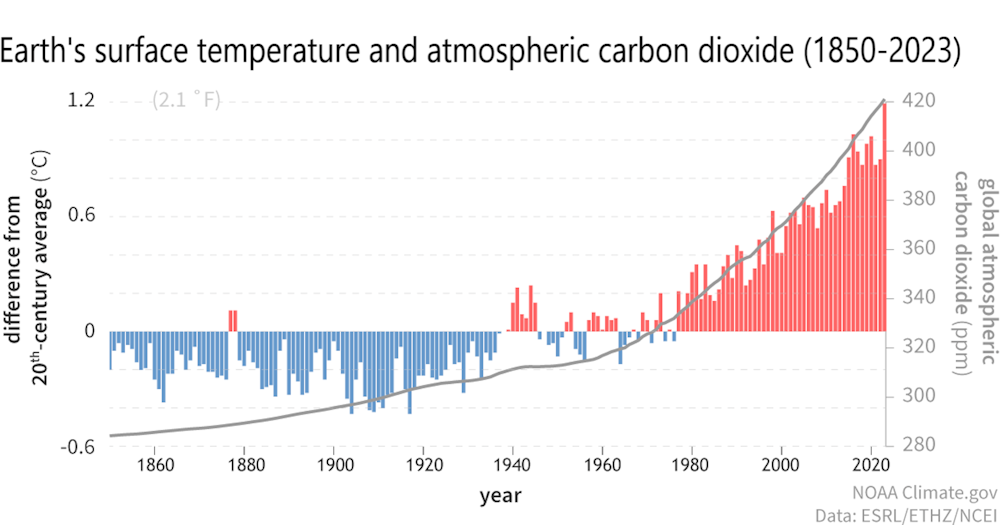
    In the 1970s, painstaking laboratory work on the Camp Century ice core extracted minuscule amounts of ancient air trapped in tiny bubbles in the ice. Analyses of that gas revealed that levels of carbon dioxide in the atmosphere were lower for tens of thousands of years before the industrial revolution. After 1850, carbon dioxide levels crept up slowly at first and then rapidly accelerated. It was direct evidence that people’s actions, including burning coal and oil, were changing the composition of the atmosphere.

    Since 1850, carbon dioxide levels in the atmosphere have spiked and global temperatures have warmed by more than 2.5 degrees Fahrenheit (1.3 Celsius). The past 10 years have been the hottest since recordkeeping began, with 2024 now holding the record. Climate change is now affecting the entire Earth – but most especially the Arctic, which is warming several times faster than the rest of the planet.

    Since 1850, global average temperature and carbon dioxide concentrations in the atmosphere have risen together, reflecting human emissions of greenhouse gases. Red bars indicate warmer years; blue bars indicate colder years.
    NOAA

    Seeing climate change as a threat multiplier

    For decades, military leaders have been discussing climate change as a threat and a threat multiplier that could worsen instability and mass migration in already fragile regions of the world.

    Climate change can fuel storms, wildfires and rising seas that threaten important military bases. It puts personnel at risk in rising heat and melts sea ice, creating new national security concerns in the Arctic. Climate change can also contribute to instability and conflict when water and food shortages trigger increasing competition for resources, internal and cross-border tensions, or mass migrations.

    The military understands that these threats can’t be ignored. As Secretary of the Navy Carlos Del Toro told a conference in September 2024: “Climate resilience is force resilience.”

    A view of aircraft carriers docked at the sprawling Naval Station Norfolk show how much of the region is within a few feet of sea level.
    Stocktrek Images via Getty Images

    Consider Naval Station Norfolk. It’s the largest military port facility in the world and sits just above sea level on Virginia’s Atlantic coast. Sea level there rose more than 1.5 feet in the last century, and it’s on track to rise that much again by 2050 as glaciers around the world melt and warming ocean water expands.

    High tides already cause delays in repair work, and major storms and their storm surges have damaged expensive equipment. The Navy has built sea walls and worked to restore coastal dunes and marshlands to protect its Virginia properties, but the risks continue to increase.

    Planning for the future, the Navy incorporates scientists’ projections of sea level rise and increasing hurricane strength to design more resilient facilities. By adapting to climate change, the U.S. Navy will avoid the fate of another famous marine power: the Norse, forced to abandon their flooded Greenland settlements when sea level there rose about 600 years ago.

    Norse ruins in Igaliku in southern Greenland, illustrated in the late 1800s while flooded at spring tide by sea level, which had risen since the settlement was abandoned around 1400.
    Steenstrup, K.J.V., and A. Kornerup. 1881. Expeditionen til Julianehaabs distrikt i 1876. MeddelelseromGrønland

    Climate change is costly to ignore

    As the impacts of climate change grow in both frequency and magnitude, the costs of inaction are increasing. Most economists agree that it’s cheaper to act now than deal with the consequences. Yet, in the past 20 years, the political discourse around addressing the cause and effects of climate change has become increasingly politicized and partisan, stymieing effective action.

    In my view, the military’s approach to problem-solving and threat reduction provides a model for civil society to address climate change in two ways: reducing carbon emissions and adapting to inevitable climate change impacts.

    The U.S. military emits more planet warming carbon than Sweden and spent more than US$2 billion on energy in 2021. It accounts for more than 70% of energy used by the federal government.

    In that context, its embrace of alternative energy, including solar generation, microgrids and wind power, makes economic and environmental sense. The U.S. military is moving away from fossil fuels, not because of any political agenda, but because of the cost-savings, increased reliability and energy independence the alternatives provide.

    Solar panels generate power on many U.S. military bases. This array at Joint Forces Training Base in Los Alamitos, Calif., generates enough power for more than 15,000 homes and has a backup battery system to provide power when the sun isn’t shining.
    Frederic J . Brown/AFP via Getty Images

    As sea ice melts and Arctic temperatures rise, the polar region has again become a strategic priority. Russia and China are expanding Arctic shipping routes and eyeing critical mineral deposits as they become accessible. The military knows climate change affects national security, which is why it continues to take steps to address the threats a changing climate presents.

    Paul Bierman receives funding from the US National Science Foundation, this work in part supported by grant EAR-2114629.

    – ref. The US military has cared about climate change since the dawn of the Cold War – for good reason – https://theconversation.com/the-us-military-has-cared-about-climate-change-since-the-dawn-of-the-cold-war-for-good-reason-246333

    MIL OSI – Global Reports –

    March 18, 2025
  • MIL-OSI: Green Rain Solar Partners with ChargeTronix for EV Expansion

    Source: GlobeNewswire (MIL-OSI)

    Key Overview:

    • Green Rain Solar Partners with ChargeTronix for EV Charging Expansion
      Green Rain Solar, a subsidiary of The Now Corporation (OTC: NWPN), has secured a reseller agreement with ChargeTronix to distribute state-of-the-art EV charging stations across North America, advancing sustainable energy solutions.
    • Strategic Growth in Hospitality: EV Charging at Hilton Locations
      Green Rain Solar has identified 13 Hilton locations for EV charging installations, supporting Hilton’s sustainability initiatives while expanding its presence in the hospitality sector and urban EV infrastructure.
    • White-Label EV Charging Solutions for Businesses
      The partnership allows Green Rain Solar to offer white-labeled EV charging stations, enabling businesses to integrate branded, clean energy solutions that drive EV adoption and sustainable growth.

    PASADENA, Calif., March 17, 2025 (GLOBE NEWSWIRE) — The Now Corporation’s (OTC: NWPN) wholly-owned subsidiary, Green Rain Solar Inc., has entered into a reseller agreement with ChargeTronix, Inc., a leading manufacturer and distributor of electric vehicle supply equipment (EVSE). This partnership positions Green Rain Solar to accelerate its impact in the renewable energy and electric vehicle (EV) sectors by providing advanced EV charging solutions under its white-label branding.

    This agreement allows Green Rain Solar to resell ChargeTronix’s state-of-the-art EV charging stations across North America. Through this collaboration, Green Rain Solar strengthens its commitment to sustainable energy solutions, contributing to the growing adoption of EVs while enhancing the EV infrastructure in urban markets.

    As part of this partnership, Green Rain Solar has already identified 13 Hilton locations as ideal candidates for EV charging station installations, further expanding its presence in the hospitality sector. These installations will play a key role in supporting Hilton’s sustainability initiatives and providing convenience for EV drivers.

    Alfredo Papadakis, CEO of The Now Corporation, commented: “This partnership with ChargeTronix aligns perfectly with our mission to transform urban energy infrastructure. By integrating EV charging into our renewable energy solutions, Green Rain Solar is setting a new standard for innovation and sustainability.”

    This agreement also enables Green Rain Solar to offer customized, white-labeled EV charging solutions, allowing businesses to showcase their own branding while promoting clean energy initiatives.

    With the addition of 13 new Hilton locations and the strategic capabilities offered by ChargeTronix’s advanced technology, Green Rain Solar is poised to revolutionize the EV charging landscape, further cementing its position as a leader in urban renewable energy solutions.

    About The Now Corporation (OTC: NWPN):

    The Now Corporation is a diversified holding company focused on acquiring and developing innovative technologies and sustainable solutions. Through its subsidiaries, the company is committed to driving positive change in industries such as renewable energy, electric mobility, and advanced manufacturing.

    About Green Rain Solar Inc.:

    Green Rain Solar Inc., a subsidiary of The Now Corporation, specializes in the design, installation, and maintenance of solar energy systems and EV charging infrastructure. With a focus on sustainability and innovation, Green Rain Solar is dedicated to helping businesses and communities transition to clean energy.

    For more information, visit: https://greenrainenergy.com/

    Forward-Looking Statements:

    This press release contains forward-looking statements under the meaning of Section 27A of the Securities Act of 1933 and Section 21E of the Securities Exchange Act of 1934. These statements may include expectations for future events, financial results, and growth prospects, subject to risks and uncertainties. The Now Corporation undertakes no obligation to publicly update any forward-looking statements except as required by applicable laws.

    Press Contact:

    Michael Cimino
    Email: Michael@pubcopr.com

    A photo accompanying this announcement is available at https://www.globenewswire.com/NewsRoom/AttachmentNg/bc3defb7-0439-49b8-a6f7-d19bb0176ca0

    The MIL Network –

    March 18, 2025
  • MIL-OSI: Dimensional Fund Advisors Ltd. : Form 8.3 – BAKKAVOR GROUP PLC – Ordinary Shares

    Source: GlobeNewswire (MIL-OSI)

    FORM 8.3

    PUBLIC OPENING POSITION DISCLOSURE/DEALING DISCLOSURE BY
    A PERSON WITH INTERESTS IN RELEVANT SECURITIES REPRESENTING 1% OR MORE
    Rule 8.3 of the Takeover Code (the “Code”)

    1. KEY INFORMATION  
       
    (a) Full name of discloser: Dimensional Fund Advisors Ltd. in its capacity as investment advisor and on behalf its affiliates who are also investment advisors (”Dimensional”). Dimensional expressly disclaims beneficial ownership of the shares described in this form 8.3.  
    (b) Owner or controller of interests and short positions disclosed, if different from 1(a):
    The naming of nominee or vehicle companies is insufficient. For a trust, the trustee(s), settlor and beneficiaries must be named.
       
    (c) Name of offeror/offeree in relation to whose relevant securities this form relates:
    Use a separate form for each offeror/offeree
    Bakkavor Group PLC  
    (d) If an exempt fund manager connected with an offeror/offeree, state this and specify identity of offeror/offeree:    
    (e) Date position held/dealing undertaken:
    For an opening position disclosure, state the latest practicable date prior to the disclosure
    14 March 2025  
    (f) In addition to the company in 1(c) above, is the discloser making disclosures in respect of any other party to the offer?
    If it is a cash offer or possible cash offer, state “N/A”
    YES
    Greencore Group PLC
     
       
    2. POSITIONS OF THE PERSON MAKING THE DISCLOSURE  
       
    If there are positions or rights to subscribe to disclose in more than one class of relevant securities of the offeror or offeree named in 1(c), copy table 2(a) or (b) (as appropriate) for each additional class of relevant security.  
    (a) Interests and short positions in the relevant securities of the offeror or offeree to which the disclosure relates following the dealing (if any)  
       
    Class of relevant security: 2p ordinary (GB00BF8J3Z99)  
      Interests Short Positions  
      Number % Number %  
    (1) Relevant securities owned and/or controlled: 6,478,463 1.12 %      
    (2) Cash-settled derivatives:          
    (3) Stock-settled derivatives (including options) and agreements to purchase/sell:          
      Total 6,478,463 * 1.12 %      
    * Dimensional Fund Advisors LP and/or its affiliates do not have discretion regarding voting decisions in respect of 23,963 shares that are included in the total above.  
       
    All interests and all short positions should be disclosed.

    Details of any open stock-settled derivative positions (including traded options), or agreements to purchase or sell relevant securities, should be given on a Supplemental Form 8 (Open Positions).


    (b) Rights to subscribe for new securities (including directors’ and other employee options)  
       
    Class of relevant security in relation to which subscription right exists:    
    Details, including nature of the rights concerned and relevant percentages:    
       
    3. DEALINGS (IF ANY) BY THE PERSON MAKING THE DISCLOSURE  
       
    Where there have been dealings in more than one class of relevant securities of the offeror or offeree named in 1(c), copy table 3(a), (b), (c) or (d) (as appropriate) for each additional class of relevant security dealt in.

    The currency of all prices and other monetary amounts should be stated.

     
    (a) Purchases and sales  
       
    Class of relevant security Purchase/sale Number of securities Price per unit  
             
       
    (b) Cash-settled derivative transactions  
       
    Class of relevant security Product description e.g. CFD Nature of dealing e.g. opening/closing a long/short position, increasing/reducing a long/short position Number of reference securities Price per unit  
               
       
    (c) Stock-settled derivative transactions (including options)
     
    (i) Writing, selling, purchasing or varying
     
    Class of relevant security Product description e.g. call option Writing, purchasing, selling, varying etc. Number of securities to which option relates Exercise price per unit Type e.g. American, European etc. Expiry date Option money paid/ received per unit
                   
       
    (ii) Exercise  
       
    Class of relevant security Product description e.g. call option Exercising/ exercised against Number of securities Exercise price per unit  
               
       
    (d) Other dealings (including subscribing for new securities)  
                 
    Class of relevant security Nature of dealing e.g. subscription, conversion Details Price per unit (if applicable)  
             
       
    4. OTHER INFORMATION  
       
    (a) Indemnity and other dealing arrangements  
       
    Details of any indemnity or option arrangement, or any agreement or understanding, formal or informal, relating to relevant securities which may be an inducement to deal or refrain from dealing entered into by the person making the disclosure and any party to the offer or any person acting in concert with a party to the offer:
    Irrevocable commitments and letters of intent should not be included. If there are no such agreements, arrangements or understandings, state “none”
     
    None  
       
    (b) Agreements, arrangements or understandings relating to options or derivatives  
       
    Details of any agreement, arrangement or understanding, formal or informal, between the person making the disclosure and any other person relating to:
    (i) the voting rights of any relevant securities under any option; or
    (ii) the voting rights or future acquisition or disposal of any relevant securities to which any derivative is referenced:
    If there are no such agreements, arrangements or understandings, state “none”
     
    None  
       
    (c) Attachments  
       
    Is a Supplemental Form 8 (Open Positions) attached? NO  
       
    Date of disclosure 17 March 2025  
    Contact name Thomas Hone  
    Telephone number +44 20 3033 3419  
       

    Public disclosures under Rule 8 of the Code must be made to a Regulatory Information Service.

    The Panel’s Market Surveillance Unit is available for consultation in relation to the Code’s disclosure requirements on +44 (0)20 7638 0129.

    The Code can be viewed on the Panel’s website at www.thetakeoverpanel.org.uk.

    The MIL Network –

    March 18, 2025
  • MIL-OSI: Dimensional Fund Advisors Ltd. : Form 8.3 – GREENCORE GROUP PLC – Ordinary Shares

    Source: GlobeNewswire (MIL-OSI)

    FORM 8.3

    PUBLIC OPENING POSITION DISCLOSURE/DEALING DISCLOSURE BY
    A PERSON WITH INTERESTS IN RELEVANT SECURITIES REPRESENTING 1% OR MORE
    Rule 8.3 of the Takeover Code (the “Code”)

    1. KEY INFORMATION  
       
    (a) Full name of discloser: Dimensional Fund Advisors Ltd. in its capacity as investment advisor and on behalf its affiliates who are also investment advisors (”Dimensional”). Dimensional expressly disclaims beneficial ownership of the shares described in this form 8.3.  
    (b) Owner or controller of interests and short positions disclosed, if different from 1(a):
    The naming of nominee or vehicle companies is insufficient. For a trust, the trustee(s), settlor and beneficiaries must be named.
       
    (c) Name of offeror/offeree in relation to whose relevant securities this form relates:
    Use a separate form for each offeror/offeree
    Greencore Group PLC  
    (d) If an exempt fund manager connected with an offeror/offeree, state this and specify identity of offeror/offeree:    
    (e) Date position held/dealing undertaken:
    For an opening position disclosure, state the latest practicable date prior to the disclosure
    14 March 2025  
    (f) In addition to the company in 1(c) above, is the discloser making disclosures in respect of any other party to the offer?
    If it is a cash offer or possible cash offer, state “N/A”
    YES
    Bakkavor Group PLC
     
       
    2. POSITIONS OF THE PERSON MAKING THE DISCLOSURE  
       
    If there are positions or rights to subscribe to disclose in more than one class of relevant securities of the offeror or offeree named in 1(c), copy table 2(a) or (b) (as appropriate) for each additional class of relevant security.  
    (a) Interests and short positions in the relevant securities of the offeror or offeree to which the disclosure relates following the dealing (if any)  
       
    Class of relevant security: 1p ordinary (IE0003864109)  
      Interests Short Positions  
      Number % Number %  
    (1) Relevant securities owned and/or controlled: 16,455,722 3.73 %      
    (2) Cash-settled derivatives:          
    (3) Stock-settled derivatives (including options) and agreements to purchase/sell:          
      Total 16,455,722 * 3.73 %      
    * Dimensional Fund Advisors LP and/or its affiliates do not have discretion regarding voting decisions in respect of 59,358 shares that are included in the total above.  
       
    All interests and all short positions should be disclosed.

    Details of any open stock-settled derivative positions (including traded options), or agreements to purchase or sell relevant securities, should be given on a Supplemental Form 8 (Open Positions).


    (b) Rights to subscribe for new securities (including directors’ and other employee options)  
       
    Class of relevant security in relation to which subscription right exists:    
    Details, including nature of the rights concerned and relevant percentages:    
       
    3. DEALINGS (IF ANY) BY THE PERSON MAKING THE DISCLOSURE  
       
    Where there have been dealings in more than one class of relevant securities of the offeror or offeree named in 1(c), copy table 3(a), (b), (c) or (d) (as appropriate) for each additional class of relevant security dealt in.

    The currency of all prices and other monetary amounts should be stated.

     
    (a) Purchases and sales  
       
    Class of relevant security Purchase/sale Number of securities Price per unit  
             
       
    (b) Cash-settled derivative transactions  
       
    Class of relevant security Product description e.g. CFD Nature of dealing e.g. opening/closing a long/short position, increasing/reducing a long/short position Number of reference securities Price per unit  
               
       
    (c) Stock-settled derivative transactions (including options)
     
    (i) Writing, selling, purchasing or varying
     
    Class of relevant security Product description e.g. call option Writing, purchasing, selling, varying etc. Number of securities to which option relates Exercise price per unit Type e.g. American, European etc. Expiry date Option money paid/ received per unit
                   
       
    (ii) Exercise  
       
    Class of relevant security Product description e.g. call option Exercising/ exercised against Number of securities Exercise price per unit  
               
       
    (d) Other dealings (including subscribing for new securities)  
                 
    Class of relevant security Nature of dealing e.g. subscription, conversion Details Price per unit (if applicable)  
             
       
    4. OTHER INFORMATION  
       
    (a) Indemnity and other dealing arrangements  
       
    Details of any indemnity or option arrangement, or any agreement or understanding, formal or informal, relating to relevant securities which may be an inducement to deal or refrain from dealing entered into by the person making the disclosure and any party to the offer or any person acting in concert with a party to the offer:
    Irrevocable commitments and letters of intent should not be included. If there are no such agreements, arrangements or understandings, state “none”
     
    None  
       
    (b) Agreements, arrangements or understandings relating to options or derivatives  
       
    Details of any agreement, arrangement or understanding, formal or informal, between the person making the disclosure and any other person relating to:
    (i) the voting rights of any relevant securities under any option; or
    (ii) the voting rights or future acquisition or disposal of any relevant securities to which any derivative is referenced:
    If there are no such agreements, arrangements or understandings, state “none”
     
    None  
       
    (c) Attachments  
       
    Is a Supplemental Form 8 (Open Positions) attached? NO  
       
    Date of disclosure 17 March 2025  
    Contact name Thomas Hone  
    Telephone number +44 20 3033 3419  
       

    Public disclosures under Rule 8 of the Code must be made to a Regulatory Information Service.

    The Panel’s Market Surveillance Unit is available for consultation in relation to the Code’s disclosure requirements on +44 (0)20 7638 0129.

    The Code can be viewed on the Panel’s website at www.thetakeoverpanel.org.uk.

    The MIL Network –

    March 18, 2025
  • MIL-OSI: Silynxcom Successfully Completes Field Testing of Enhancing Drone Sound Awareness Technology

    Source: GlobeNewswire (MIL-OSI)

    Strategic Collaboration with a Military Customer in Asia Demonstrates Disruptive Drone Detection Technology, Expanding Global Market Penetration for Silynxcom’s High-Growth Defense Innovation

    Netanya, Israel, March 17, 2025 (GLOBE NEWSWIRE) — Silynxcom Ltd. (NYSE American: SYNX) (“Silynxcom” or the “Company”), a manufacturer and developer of ruggedized tactical communication headset devices, today announced the successful completion of field trials for its innovative product, aimed at boosting situational awareness and safety for armored personnel carrier (“APC”) crews and other heavy military vehicles, with a military force in Asia and conducted in collaboration with a leading global defense contractor.

    The trials demonstrated the Company’s innovative solution that addresses a critical challenge on modern battlefields: detecting the distinct and potentially life-threatening drone humming while simultaneously maintaining hearing protection in high-noise environments. Unlike conventional Active Noise Reduction (ANR) technology that can inadvertently block crucial acoustic threats, Silynxcom’s advanced new APC headset selectively amplifies critical environmental sounds while still providing essential hearing protection.

    Military personnel operating APCs face the triple challenge of protecting their hearing from high-decibel engines and weapons noise, maintaining clear communication through intercom and radio systems, and detecting subtle but potentially lethal threats like approaching drones. We believe that Silynxcom’s technology effectively meets all these requirements during the trials.

    “These successful trials with a new military customer in Asia represent an important strategic expansion for our drone detection technology beyond our initial deployment,” said Nir Klein, Chief Executive Officer of Silynxcom. “Our advanced auditory technology allows for both comprehensive hearing protection and the selective amplification of critical battlefield sounds, giving military personnel the situational awareness they need to identify and respond to emerging threats.”

    The system’s compatibility with popular intercom and radio systems enables plug-and-play integration, allowing for seamless upgrading of existing equipment. This feature proved particularly valuable during these trials, where the technology was tested across different vehicle platforms and communication infrastructures.

    About Silynxcom Ltd.

    Silynxcom Ltd. develops, manufactures, markets, and sells ruggedized tactical communication headset devices as well as other communication accessories, all of which have been field-tested and combat-proven. The Company’s in-ear headset devices, or In-Ear Headsets, are used in combat, the battlefield, riot control, demonstrations, weapons training courses, and on the factory floor. The In-Ear Headsets seamlessly integrate with third party manufacturers of professional-grade ruggedized radios that are used by soldiers in combat or by police officers in leading military and law enforcements units. The Company’s In-Ear Headsets also fit tightly into the protective gear to enable users to speak and hear clearly and precisely while they are protected from the hazardous sounds of combat, riots or dangerous situations. The sleek, lightweight, In-Ear Headsets include active sound protection to eliminate unsafe sounds, while maintaining ambient environmental awareness, giving their customers 360° situational awareness. The Company works closely with its customers and seek to improve the functionality and quality of the Company’s products based on actual feedback from soldiers and police officers “in the field.” The Company sells its In-Ear Headsets and communication accessories directly to military forces, police and other law enforcement units. The Company also deals with specialized networks of local distributors in each locale in which it operates and has developed key strategic partnerships with radio equipment manufacturers.

    Capital Markets & IR Contact

    ARX | Capital Market Advisors
    North American Equities Desk
    ir@silynxcom.com

    The MIL Network –

    March 18, 2025
  • MIL-OSI Asia-Pac: Accelerating Modi govt’s march to build a drug-free Bharat, a massive consignment of Methamphetamine tablets worth ₹88 crore seized, and 4 members of international drug cartel arrested in Imphal and Guwahati zones of NCB

    Source: Government of India (2)

    Accelerating Modi govt’s march to build a drug-free Bharat, a massive consignment of Methamphetamine tablets worth ₹88 crore seized, and 4 members of international drug cartel arrested in Imphal and Guwahati zones of NCB

    No mercy for drug cartels, search for drugs continues in continuous operations

    Drug haul is a testament to the stellar performance of the bottom-to-top and top-to-bottom approach to investigation

    Union Home Minister and Minister of Cooperation Shri Amit Shah congratulates team NCB

    Under the leadership of Prime Minister Shri Narendra Modi and guidance of Home Minister Shri Amit Shah, NCB is combating the drug smuggling network with a ruthless approach across the country

    Posted On: 16 MAR 2025 12:02PM by PIB Delhi

    Union Home Minister and Minister of Cooperation, Shri Amit Shah, has said that there will be no mercy for drug cartels. Congratulating the Narcotics Control Bureau (NCB) for seizure of  a massive consignment of methamphetamine tablets worth ₹88 crore and arresting 4 members of the international drug cartel, Union Home Minister said in an X post that drug haul is a testament to the stellar performance of the bottom-to-top and top-to-bottom approach to investigation.

    In his post Union Home Minister and Minister of Cooperation Shri Amit Shah said, “No mercy for drug cartels. Accelerating the Modi govt’s march to build a drug-free Bharat, a massive consignment of methamphetamine tablets worth ₹88 crore is seized, and 4 members of the international drug cartel are arrested in Imphal and Guwahati zones. The drug haul is a testament to the stellar performance of the bottom-to-top and top-to-bottom approach to investigation. Our hunt for drugs continues. Heartfelt congratulations to team NCB.”

    No mercy for drug cartels.

    Accelerating the Modi govt’s march to build a drug-free Bharat, a massive consignment of methamphetamine tablets worth ₹88 crore is seized, and 4 members of the international drug cartel are arrested in Imphal and Guwahati zones. The drug haul is a…

    — Amit Shah (@AmitShah) March 16, 2025

    Details of operations

    In the 1stoperation, on 13.03.2025, based upon information, the Officers of NCB Imphal Zone intercepted a truck near Lilong area and after thorough reconnaissance of the vehicle, recovered 102.39 kg of Methamphetamine tablets from tool box/cabin in the rear section of the truck. 02 occupants of the truck were also apprehended. Without delay, the team immediately conducted a follow-up operation and apprehended the suspected receiver of the contraband from Lilong area. A four wheeler, used for drug trafficking was also recovered from him which was used for drug trafficking. All three were arrested later. The suspected source of the contraband is Moreh. Further investigation is underway to nab others involved in the case.

    In another operation, on the same day, based on information, Officers of NCB Guwahati Zone intercepted a SUV in the Assam –Mizoram border near Silchar and on thorough inspection of the same, recovered 7.48 Kgs of Methamphetamine Tablets concealed inside the spare tire of the vehicle and also apprehended the occupant of the vehicle, who was later arrested. The source of the contraband was Moreh, Manipur and suspected destination was Karimganj. Further investigation to nab others involved in the case is going on.  

    In another development. NCB is also taking over the investigation of a case from Mizoram State Excise Department wherein about 46 kgs of crystal Meth at Brigade Bawngkawn Aizawl on March 6 was seized. In this case 04 persons involved in the drug syndicate have been arrested. Investigation of the case is being taken over by NCB to probe the international and inter-state linkages of the drug trafficking network.

    The North Eastern Region has emerged as one of the most vulnerable areas of India from the point of view of drug trafficking owing to its geographic location. Identifying this vulnerability, the Ministry of Home Affairs (MHA) had augmented the strength of NCB in the year 2023 to further strengthen the war against drugs in the region. NCB, through its five Zonal Units and a Regional Headquarter in North East, has been continuously working against the drug traffickers operating in the region, particularly against those involved in trafficking of synthetic drugs such as Methamphetamine tablets, popularly known as YABA that has posed a threat to not only the young population of the region, but also to the security of the nation as a whole. 

    *****

    RK/VV/ASH/PR/PS

    (Release ID: 2111585) Visitor Counter : 34

    Read this release in: Hindi

    MIL OSI Asia Pacific News –

    March 18, 2025
  • MIL-OSI Security: San Francisco Tow Company Operator Indicted in Scheme to Burn Competitors’ Tow Trucks Throughout the Bay Area

    Source: Federal Bureau of Investigation (FBI) State Crime News

    Defendant Allegedly Conspired to Set Fire to Tow Trucks to Drive Business to His Towing Companies and to Retaliate Against Competitors

    SAN FRANCISCO – A federal grand jury has indicted Jose Vicente Badillo on one count of conspiracy to commit arson in connection with an alleged scheme to burn tow trucks throughout the San Francisco Bay Area in 2023.  Badillo made his initial appearance in federal district court this morning.

    According to the indictment unsealed earlier today, Badillo, 29, of San Francisco, conspired with others to set fire to at least six tow trucks on four occasions between April 2023 and October 2023.  Specifically, Badillo and his co-conspirators allegedly set fire to and damaged or destroyed (i) two tow trucks in San Francisco on April 4, 2023; (ii) one tow truck in San Francisco on April 29, 2023; (iii) one tow truck in East Palo Alto on July 25, 2023; and (iv) two tow trucks in San Francisco on Oct. 3, 2023.

    The indictment describes that the purpose of the conspiracy was, among other things, to drive more business to two Bay Area-based towing companies with which Badillo was associated—Auto Towing and Specialty Towing—by impeding the business prospects of competitor towing companies, and to retaliate against those same competitors for perceived wrongs.  Badillo allegedly orchestrated the conspiracy and then directed others to set fire to the targeted tow trucks.

    Badillo is next scheduled to appear in district court on March 20, 2025, at 10:30 a.m., before U.S. Magistrate Judge Sallie Kim for arraignment and identification of counsel.  Badillo is facing unrelated federal charges of money laundering and insurance fraud in two other pending cases.

    Acting United States Attorney Patrick D. Robbins, FBI Special Agent in Charge Sanjay Virmani, and IRS Criminal Investigation (IRS-CI) Special Agent in Charge of the Oakland Field Office Linda Nguyen made the announcement.

    An indictment merely alleges that a crime has been committed, and all defendants are presumed innocent until proven guilty beyond a reasonable doubt. If convicted, Badillo faces a maximum sentence of 20 years in prison and a fine of $250,000.  Any sentence following conviction would be imposed by the court only after consideration of the U.S. Sentencing Guidelines and the federal statute governing the imposition of a sentence, 18 U.S.C. § 3553.

    This prosecution is part of an Organized Crime Drug Enforcement Task Forces (OCDETF) investigation. OCDETF identifies, disrupts, and dismantles the highest-level drug traffickers, money launderers, gangs, and transnational criminal organizations that threaten the United States by using a prosecutor-led, intelligence-driven, multi-agency approach that leverages the strengths of federal, state, and local law enforcement agencies against criminal networks.

    Assistant U.S. Attorney Nicholas M. Parker is prosecuting the case with the assistance of Andy Ding and Laurie Worthen. The prosecution is the result of an investigation by the FBI and IRS-CI.  This investigation is assigned to the FBI SF Transnational Organized Crime Task Force, an interagency task force targeting sophisticated organized crime syndicates that engage in, among other offenses, violent crimes, extortion, fraud, arson, and drug trafficking.  The U.S. Attorney’s Office, the FBI, and IRS-CI thank the San Francisco Police Department for its substantial assistance and support in this investigation.

    Jose Vicente Badillo Indictment
     

    MIL Security OSI –

    March 18, 2025
  • MIL-OSI Security: Lewisporte — Man attends Lewisporte RCMP Detachment and is arrested for impaired operation

    Source: Royal Canadian Mounted Police

    A 53-year-old man who drove himself to Lewisporte RCMP Detachment yesterday afternoon was arrested for impaired operation.

    At approximately 1:45 p.m. on Thursday, a man who was observed driving in on the parking lot of the detachment, presented himself at the front counter to speak with an officer about an ongoing investigation. The officer observed signs of alcohol impairment. The man failed a roadside screening test and was arrested for impaired operation. He was transported inside the detachment and provided further breath samples that were above the legal limit.

    The driver was released from custody and is set to appear in court at a later date to answer to charges of impaired operation. The vehicle was seized and impounded and the man was issued a licence suspension.

    RCMP NL continues to fulfill its mandate to protect public safety, enforce the law, and ensure the delivery of priority policing services in Newfoundland and Labrador.

    MIL Security OSI –

    March 18, 2025
  • MIL-OSI Security: Gander and Holyrood — Information from public leads to arrest of two drivers by RCMP NL, breath demands refused

    Source: Royal Canadian Mounted Police

    Two drivers were arrested by RCMP NL yesterday for refusing to comply with breath demands that were issued at traffic stops in Glenwood and Chapel’s Cove.

    At approximately 10:00 a.m. on March 13, 2025, Gander RCMP responded to the report of a suspected impaired driver in Glenwood. The described vehicle was located a short time later entering onto the Trans-Canada Highway. A traffic stop was conducted and the driver, a 61-year-old man, refused to provide a roadside breath sample.

    Later that evening, shortly before 10:30 p.m. in Chapel’s Cove, Holyrood RCMP responded to the report of a suspicious parked vehicle. Police located the vehicle and spoke to the driver, a 32-year-old man, who refused a roadside breath test and resisted arrest.

    Both vehicles were seized and impounded, both drivers issued licence suspensions and each will face criminal charges of refusal.

    Refusing to comply with a demand issued as part of an impaired operation investigation is a criminal offence. If convicted, this offence carries the same penalties as does a charge of impaired operation.

    RCMP NL thanks the public for reporting suspected impaired drivers and suspicious activities.

    MIL Security OSI –

    March 18, 2025
  • MIL-OSI Security: Eskasoni — Eskasoni RCMP Detachment lays charges following execution of search warrants for illegal cannabis

    Source: Royal Canadian Mounted Police

    Eskasoni RCMP Detachment has arrested five men after executing search warrants in Eskasoni and in Howie Centre.

    On March 12, RCMP officers searched an illegal cannabis storefront on Shore Rd. in Eskasoni where they safely arrested two men, a 32-year-old and a 37-year-old, both of Eskasoni. Officers also searched a residence in Howie Centre where they arrested a 41-old-man, also from Eskasoni.

    At the two properties, police seized a large quantity of illegal cannabis, psilocybin and unstamped tobacco. A number of other items including a rifle, ammunition, cash and a vehicle were also seized.

    The three men are facing charges under the Cannabis Act related to the possession of cannabis for the purpose of distributing and selling. They’re also facing charges under the Excise Act. The 41-year old is additionally charged with Unlawful Possession of a Firearm and Careless Use of Firearm.

    As officers were searching the property on Shore Rd., a small group of protesters gathered roadside without incident. Then seven people from a nearby residence later attended and attempted to disrupt the scene.

    As officers were leaving the storefront, a 32-year-old man from Eskasoni, who was wielding a large piece of wood, blocked their way and resisted arrest, resulting in an officer using their conducted energy weapon. The man has been charged with Possession of a Weapon for a Dangerous Purpose; Uttering Threats; and Obstructing/Resisting a Peace Officer. Another man, a 32-year-old from Eskasoni, attempted to intervene during that arrest, and was charged with Obstructing/Resisting a Peace Officer.

    All five men were released on conditions and are scheduled to appear in Eskasoni Provincial Court on June 3.

    The investigation, led by the Eskasoni RCMP’s General Investigation Section, was assisted by Criminal Intelligence Services Nova Scotia, the Nova Scotia Integrated Proceeds of Crime team, the Inverness County District Street Crime Enforcement Unit, Northeast Traffic Services – Cape Breton, and Service Nova Scotia.

    The RCMP reminds residents that the only legal way to purchase cannabis in the province is at licensed locations. Nova Scotians are encouraged to contact their nearest RCMP detachment or local police to report crime, including the illegal sale of drugs, in their communities. Anonymous tips can be made by calling Nova Scotia Crime Stoppers, toll-free, at 1-800-222-TIPS (8477), submitting a secure web tip at www.crimestoppers.ns.ca, or using the P3 Tips app.

    MIL Security OSI –

    March 18, 2025
  • MIL-OSI Security: Great Falls businessman sentenced for tax and investment fraud

    Source: Office of United States Attorneys

    ALEXANDRIA, Va. – A Great Falls man was sentenced today to six years and six months in prison for tax crimes and his wire fraud scheme.

    According to court documents and statements made in court, Rick Tariq Rahim, 56, owned and operated several businesses, including laser tag facilities and an Amazon reseller. From 2015 to 2021, Rahim did not pay the IRS the taxes withheld from his employees’ paychecks or file the required quarterly employment tax returns reporting those withholdings.

    Between October 2010 and October 2012, Rahim filed two personal income tax returns on which he reported owing substantial taxes, but did not pay all the taxes due. When the IRS attempted to collect the unpaid taxes, Rahim submitted a false statement that omitted valuable assets he owned, including a helicopter, a Bentley, a Lamborghini, and real estate in Great Falls. Approximately two weeks later, Rahim transferred ownership of the Great Falls property to his wife. He also paid personal expenses from his business bank accounts, including more than $889,000 toward his mortgages and more than $669,000 to purchase or lease cars, including three different Lamborghinis. Rahim withdrew more than $1.1 million in cash in amounts less than $10,000 to avoid triggering currency transaction reports from the bank. Rahim has not filed a personal income tax return since 2012 despite earning more than $34 million in gross income.

    In total, Rahim caused a loss to the IRS of at least $4.4 million.

    Rahim also defrauded customers who invested using his automated trading bots and by “copying” Rahim’s supposed trading activities that he posted to Discord. He marketed his products on websites named BotsforWealth, TradeAutomation, ProChartSignals, OptionCopier, CopyAndWin, SnipeAlgo, and QQQtrade. Rahim charged customers a subscription fee to access his bots and other software, and to copy his supposed trades. Rahim also offered a “lifetime membership” through which customers received access to Rahim’s private Discord channel, some of his products, and his “in-office” trading days. Rahim personally traded stocks for at least two individuals, claiming “We’ll hit home runs and make $500k+ per day very very often.” Instead, Rahim lost over $300,000 of his clients’ funds in eight months.

    Rahim induced customers to subscribe to his products by using social media tools, including TikTok, YouTube, and Discord. He also sought to induce customers by claiming he was extremely wealthy, boasting about trading millions of dollars and posting about his large home, pool, and luxury cars, including his Lamborghini. He posted false information to his websites and to his social media accounts claiming to “beat the stock market every day” and promising extreme profit margins. His claim of regularly beating the market was exaggerated. In reality, he did not post his trades that lost money. In fact, Rahim realized over $500,000 in losses from February 2021 through December 2022, and did not earn millions in the market during this time as he had claimed. As part of his fraud scheme, Rahim also created at least 20 Discord user profiles where he posted emojis, likes, and symbols showing agreement and excitement regarding Rahim’s posts. Rahim earned at least $1,397,000 in subscription fees during his schemes.

    In addition to Rahim’s prison sentence, he agreed to forfeiture of over $1.3 million and must pay restitution to the IRS and to his investment fraud victims.

    Erik S. Siebert, U.S. Attorney for the Eastern District of Virginia, and Karen E. Kelly, Acting Deputy Assistant Attorney General of the Justice Department’s Tax Division, made the announcement.

    IRS Criminal Investigation investigated Rahim’s tax fraud and FBI investigated his investment fraud. The case was consolidated for sentencing.

    Assistant U.S. Attorney Kimberly Shartar for the Eastern District of Virginia and Trial Attorneys William Montague and Ashley Stein of the Tax Division prosecuted Rahim for his tax fraud. Assistant U.S. Attorney Shartar prosecuted Rahim for his investment fraud.

    A copy of this press release is located on the website of the U.S. Attorney’s Office for the Eastern District of Virginia. Related court documents and information are located on the website of the District Court for the Eastern District of Virginia or on PACER by searching for Case Nos. 1:23-cr-173 (Rahim’s Tax Fraud Case) and 1:24-cr-179 (Rahim’s Investment Fraud Case).

    MIL Security OSI –

    March 18, 2025
  • MIL-OSI Security: Federal Prosecutors Charge 16 Previously Removed Illegal Aliens – Including Convicted Felons – with Illegally Re-entering the U.S.

    Source: Office of United States Attorneys

    LOS ANGELES – Working with U.S. Immigration and Customs Enforcement and other federal law enforcement partners, federal prosecutors in the last two weeks filed charges against 16 defendants who allegedly illegally re-entered the United States after being removed, the Justice Department announced today.

    Many of the defendants charged were previously convicted of felony offenses before they were removed from the U.S., offenses that include sexual abuse of children. One of the defendants is charged in state court with a murder in Inglewood last month.

    The crime of being found in the United States following removal carries a base sentence of up to two years in federal prison, defendants who were removed after being convicted of a felony face a maximum 10-year sentence, and defendants removed after being convicted of an aggravated felony face a maximum of 20 years in federal prison.

    Some of the recently filed cases are summarized below with information contained in court documents.

    • United States v. Saravia-Sanchez

    Jose Cristian Saravia-Sanchez, 30, of El Salvador, was charged via a federal criminal complaint after he was arrested by Inglewood Police Department as a suspect in the February 25 murder of a man who tried to stop Saravia and another individual from stealing a neighbor’s catalytic converter.

    Following the arrest, federal law enforcement determined that Saravia was previously removed in 2013 and returned to the United States illegally. At the time of his arrest on March 6, officers found a firearm in the bathroom of the hotel room in which Saravia barricaded himself, resulting in an hours-long standoff with law enforcement.

    In the complaint, Saravia is charged with being an illegal alien found in the United States and an alien in possession of a firearm. His criminal history includes a felony conviction in Los Angeles Superior Court in May 2023 for taking a vehicle without the owner’s consent. Saravia is in state custody and has been booked for murder.

    The matter was investigated by the Homeland Security Investigations with assistance from the Bureau of Alcohol, Tobacco, Firearm and Explosives, and ICE’s Enforcement and Removal Operations.

    • United States v. Marquina-Sierra

    Francisco Marquina-Sierra, 32, of Mexico, was charged via a federal criminal complaint for being an illegal alien found in the United States after he was previously removed. An immigration judge ordered him removed in December 2013. Marquina’s criminal history includes convictions in Orange County Superior Court for second-degree robbery in 2012 and for child abuse with possible great bodily injury in 2023 for which he was incarcerated in California state prison. On March 12, a federal magistrate judge ordered Marquina jailed without bond. His arraignment is scheduled for April 14 in United States District Court in Santa Ana.

    • United States v. Barreto

    Luis Enrique Barreto, 38, of Mexico, a convicted sex offender, was charged this week in a two-count indictment for allegedly failing to register under the federal Sex Offender Registration and Notification Act (SORNA) and for illegally returning to the United States following removal.

    Barreto, who was found living across from a school when he was arrested, was convicted in 2012 in Orange County Superior Court of lascivious acts with a child 14 or 15 years of age and offender 10 or more years older than victim (lewd act upon a child). In September 2021, Barreto was removed to Mexico, but he returned to the United States by the following year and did not register as a sex offender.

    A federal magistrate judge ordered Barreto jailed without bond pending trial. His arraignment is scheduled for March 18 in United States District Court in downtown Los Angeles.

    Criminal complaints and indictments contain allegations. All defendants are presumed innocent until proven guilty beyond a reasonable doubt in a court of law.

    U.S. Immigration and Customs Enforcement and Homeland Security Investigations are investigating these matters. 

    The criminal cases are being prosecuted by Assistant United States Attorneys in the Domestic Security and Immigration Crimes Section and the General Crimes Section.

    MIL Security OSI –

    March 18, 2025
  • MIL-OSI: BigCommerce Transforms Commerce Beyond Order Capture with Pipe17 Partnership

    Source: GlobeNewswire (MIL-OSI)

    AUSTIN, Texas, March 17, 2025 (GLOBE NEWSWIRE) — BigCommerce (Nasdaq: BIGC), a leading provider of open, composable commerce solutions for B2C and B2B brands, retailers, manufacturers and distributors today announced a transformational partnership with Pipe17, a leading provider of AI-powered composable order operations. This partnership reimagines how modern merchants manage orders in an increasingly complex digital commerce ecosystem.

    BigCommerce empowers brands, retailers, manufacturers and distributors of all sizes to sell online and capture orders seamlessly. Feedonomics, BigCommerce’s AI-powered product data feed management and order orchestration solution, helps brands list, manage and optimize product, inventory, pricing and order data across third-party channels, from ads, to social commerce, to marketplaces. The next frontier of commerce lies in the back office—turning captured orders into packages on consumers’ doorsteps or trucks on businesses’ loading docks.

    Today’s customers expect to shop anywhere—through merchant-owned channels like their brand websites and mobile apps, marketplaces like Amazon and Walmart, social platforms like TikTok and Instagram, and increasingly AI agents. They also demand instant delivery and flawless order fulfillment, pushing brands to expand their fulfillment infrastructure with additional warehouses, third-party logistics (3PL) partnerships, generous returns policies and new technology.

    As selling channels proliferate and fulfillment infrastructure grows in both size and complexity, problems rapidly shift to the back office—specifically order management. Merchants struggle to route orders and ensure order-related data is perfectly synchronized between selling channels, 3PLs, warehouse management systems (WMSs), customer service and back-office systems of record such as an ERP, and any one of dozens or hundreds of systems that touch order and order-adjacent data.

    Pipe17’s order operations network transforms the way orders, inventory and data flow through the modern commerce landscape. Unlike outdated and monolithic order management systems (OMSs) that attempt to be the center of every integration, Pipe17 is built atop an AI-powered network composed of hundreds of endpoints. In partnership with BigCommerce, this dynamic, scalable, and composable approach gives merchants unmatched flexibility and control of their connectivity, product listings, order routing and order-related data flows.

    With this partnership, merchants on the BigCommerce platform, as well as Feedonomics customers on any platform, can leverage Pipe17’s connectivity network to extend their coverage across critical fulfillment endpoints.

    “Order Management is ripe for disruption, and Pipe17 delivers a game-changing solution with its innovative order operations platform,” said Travis Hess, CEO of BigCommerce. “BigCommerce has always made it easy for merchants to capture orders, and Feedonomics helps merchants sell everywhere their customers shop, and by partnering with Pipe17, we can now ensure those orders from both owned channels and third-party channels move smoothly through our customers’ fulfillment infrastructure and back-office setup, ensuring a seamless flow through the delivery process.”

    “Commerce is all about delivering great customer experiences,” said Mo Afshar, CEO of Pipe17. “We’re proud to partner with BigCommerce to help merchants unify their commerce operations and stay ahead of the evolving digital commerce landscape. Together, with BigCommerce’s world-class API-first open commerce platform, product data management and order capture solutions and Pipe17’s order operations network that delivers the order management capabilities merchants need without the bloated OMS they despise, we’re enabling sellers to create better, more intelligent and further reaching customer experiences.”

    “We saw during the height of the Covid pandemic, and beyond, the importance of accurately managing orders and fulfillment across multiple sales channels,” said James Grandefeld, Chief Operating Officer at Bona Fide Masks, “Our partnership with both of these great platforms lets us provide best in class service to our valued customers. We are excited about the partnership and what it means for us.”

    To learn more about BigCommerce’s partnership with Pipe17, visit the company’s booth (#1944) at Shoptalk, March 25-27, 2025.

    About BigCommerce
    BigCommerce (Nasdaq: BIGC) is a leading open SaaS and composable ecommerce platform that empowers brands, retailers, manufacturers and distributors of all sizes to build, innovate and grow their businesses online. BigCommerce provides its customers sophisticated professional-grade functionality, customization and performance with simplicity and ease-of-use. Tens of thousands of B2C and B2B companies across 150 countries and numerous industries rely on BigCommerce, including Coldwater Creek, Harvey Nichols, King Arthur Baking Co., MKM Building Supplies, United Aqua Group and Uplift Desk. For more information, please visit www.bigcommerce.com or follow us on X and LinkedIn.

    About Feedonomics
    Feedonomics is the leading data management platform powering omnichannel growth for the world’s top brands and retailers. With its flexible technology and full-service support team, Feedonomics facilitates a variety of data and order management use cases across industries such as ecommerce, automotive, employment, travel, real estate, and more. Feedonomics has thousands of active customers, integrations with hundreds of ecommerce platforms and channels, and strategic partnerships with industry leaders like Amazon, Meta, Google, Microsoft and TikTok. To learn more about Feedonomics, a platform-agnostic BigCommerce subsidiary, visit www.feedonomics.com. For more information, please visit www.feedonomics.com or follow us on Twitter, LinkedIn, Instagram and Facebook.

    About Pipe17
    Pipe17 Inc. provides AI-Powered Order Operations solutions for modern merchants and fulfillment service providers. Based in Seattle, Pipe17 is the fastest and easiest way to make omnichannel order flows touchless and cost-efficient, from order to inventory to fulfillment across DTC, B2B, and Retail. Pipe17 is the only ecommerce order operations solution that combines rapid deployment, seamless orders-to-anywhere automation, real-time visibility, and elastic scale. Learn more at https://Pipe17.com or follow us on LinkedIn.

    Media contacts:
    For BigCommerce and Feedonomics
    Brad Hem
    pr@bigcommerce.com

    For Pipe17,
    Jon Gettinger
    jon.gettinger@pipe17.com

    The MIL Network –

    March 18, 2025
  • MIL-OSI: Microchip Introduces Electric Two-Wheeler Ecosystem to Accelerate E-Mobility Innovation

    Source: GlobeNewswire (MIL-OSI)

    CHANDLER, Ariz., March 17, 2025 (GLOBE NEWSWIRE) — The electric two-wheeler market is transforming the transportation industry as consumers embrace e-scooters and e-bikes for both recreational use and daily commuting. Microchip Technology (Nasdaq: MCHP) today announces the launch of its Electric Two-Wheeler (E2W) ecosystem, a comprehensive suite of pre-validated reference designs that addresses key challenges in e-scooter and e-bike development, including power efficiency, system integration, safety and time-to-market. By offering automotive-grade, scalable solutions, Microchip enables manufacturers to streamline development and build reliable, feature-rich electric two-wheelers.

    Microchip’s automotive-grade components and modular reference designs provide a flexible, scalable platform that adapts to various power levels and feature requirements. Backed by comprehensive design files, schematics, Bill of Materials (BOM), and global technical support, developers can quickly bring next-generation e-scooters and e-bikes to market with optimized power, safety and intelligence.

    “Manufacturers often struggle with optimizing power efficiency, ensuring seamless system integration and meeting evolving safety standards,” said Joe Thomsen, corporate vice president of Microchip’s dsPIC business unit. “Microchip’s Electric Two-Wheeler Ecosystem directly addresses these design challenges with pre-validated, high-performance solutions that help accelerate product development and enhance vehicle reliability.”

    Key Solutions of Microchip’s E2W Ecosystem

    Optimized Power and Battery Efficiency

    • Advanced Battery Management System (BMS) with intelligent power conversion and sensing maximizes energy utilization to extend battery life and vehicle range, as well as increases safety.
    • 48V to 12V Power Conversion Reference Design ensures high-efficiency power distribution, improving overall system reliability.

    Fast and Flexible Charging Solutions

    • 7.4 kW Single-Phase AC EV Charger Reference Design offers reliable home charging with built-in protection features.
    • USB-PD Dual Charging Port is designed to provide fast, flexible charging for mobile devices to enhance user convenience.

    High-Performance Traction Motor Control

    • 350W to 10 kW traction motor control reference designs deliver smooth acceleration, improved energy efficiency and precise control.
    • Pre-integrated firmware and modular design simplify system development and reduces time-to-market.

    Seamless System Integration and Smart Vehicle Control

    • Vehicle Control Unit (VCU), Remote Keyless Entry (RKE), Hands-On/Off Detection and Acoustic Vehicle Alerting System (AVAS) work together to enhance the security and safety of the electric two-wheeler.
    • Integrated telematics and asset tracking provide real-time monitoring, theft prevention and fleet management capabilities.

    Intelligent Touch Display and Connected User Experience

    • 720×720 round LCD Instrument Cluster using Microchip’s SAM9X75 MPU with MIPI® DSI, dual GbE and NAND Flash offers real-time data visualization and smart connectivity.
    • maXTouch® ATMXT640UD and ATMXT641TD touchscreen controllers offers accurate touch performance in extreme weather and rain with thick gloves.
    • Cloud-enabled remote diagnostics and performance tracking enhance the rider experience and optimize fleet operations.

    Microchip’s Electric Two-Wheeler Ecosystem delivers pre-validated, high-performance solutions that help manufacturers reduce development time, optimize power efficiency and enhance safety in e-scooters and e-bikes. To learn more, visit Microchip’s Electric Two-Wheeler web page.

    Resources

    High-res images available through Flickr or editorial contact (feel free to publish):

    About Microchip Technology:
    Microchip Technology Inc. is a leading provider of smart, connected and secure embedded control and processing solutions. Its easy-to-use development tools and comprehensive product portfolio enable customers to create optimal designs which reduce risk while lowering total system cost and time to market. The company’s solutions serve over 100,000 customers across the industrial, automotive, consumer, aerospace and defense, communications and computing markets. Headquartered in Chandler, Arizona, Microchip offers outstanding technical support along with dependable delivery and quality. For more information, visit the Microchip website at www.microchip.com.

    Note: The Microchip name and logo, the Microchip logo are registered trademarks of Microchip Technology Incorporated in the U.S.A. and other countries. maXTouch is a registered trademark of Microchip Technology Incorporated in the U.S.A.  All other trademarks mentioned herein are the property of their respective companies.

    The MIL Network –

    March 18, 2025
  • MIL-OSI Russia: Yuri Trutnev: We will continue to develop technologies in the Patriotic TOR and help our fighters on the front lines

    Translartion. Region: Russians Fedetion –

    Source: Government of the Russian Federation – An important disclaimer is at the bottom of this article.

    March 17, 2025

    Products of Far Eastern enterprises – residents of the Patriotic Priority Development Area continue to be supplied to military personnel and volunteers in the special military operation zone. The next batch was handed over by Deputy Prime Minister – Plenipotentiary Representative of the President in the Far Eastern Federal District Yuri Trutnev to the front line commanders and military personnel of the Russian army, including those from the Far East.

    “We transferred equipment, first of all, to units of the Eastern Military District. It was received by representatives of evacuation units, because all the others were in combat. We talked to the guys about how things were going, how the equipment was performing, what else we needed to help with. It is too early for all of us to relax, the war continues. We must do everything possible to support our army. On this trip, we transferred more than 90 units of motor transport alone. And all of it was assembled at enterprises in the Far East. We are developing technologies, learning to make new products and, first of all, providing assistance to our soldiers. The work will continue. We have a Patriotic Priority Development Area, within the framework of this working structure, we will continue to do everything we can for the front. These are motorcycles, all-terrain vehicles, ATVs, thermal imaging sights and much more. I spoke with the commander of the Eastern Military District, he said that the Minister of Defense Andrei Removich Belousov compared our equipment with the equipment produced by other Russian enterprises, as well as with Chinese equipment, and said that our Far Eastern motorcycles are better. And I think so too,” said Yuri Trutnev.

    The units participating in the special military operation received weapons, uniforms, and vehicles, including units of the Eastern Military District, fighters from the 11th Separate Guards Airborne Assault Brigade from Ulan-Ude, the 83rd Separate Guards Airborne Assault Brigade from Ussuriysk, the 155th Separate Guards Marine Brigade of the Russian Pacific Fleet, and the 14th Separate Guards Special Purpose Brigade from Khabarovsk.

    The fighters received more than 150 Kharon thermal imaging sights manufactured in Primorye, 40 Sokol all-terrain vehicles manufactured by Yakt-Sokol and 40 Timir At electric motorcycles from Yakutia, more than 2,000 FPV drones from the Zabaikalsky Krai, and 10 Medoyed swamp vehicles from Buryatia. In addition, sniper systems, smooth-bore guns for combating enemy drones, surveillance and detection devices, UAVs, electronic warfare equipment, anti-fragmentation suits, and ammunition were transferred. It should be noted that the contribution of the enterprises to the victory was previously recognized with the Star of the Far East award. Yakt-Sokol and the enduro motorcycle manufacturer Timir At became the winners in the Everything for Victory nomination. Each resident supplied several hundred units of equipment to the Armed Forces of the Russian Federation in the SVO zone.

    Please note: This information is raw content directly from the source of the information. It is exactly what the source states and does not reflect the position of MIL-OSI or its clients.

    MIL OSI Russia News –

    March 18, 2025
  • MIL-OSI Europe: Briefing – International Agreements in Progress – EU-Mercosur Partnership Agreement: Trade pillar – 17-03-2025

    Source: European Parliament

    On 6 December 2024, the European Union (EU) and the four founding members of Mercosur – Argentina, Brazil, Paraguay and Uruguay – reached a political agreement on a free trade agreement that would form part of a wider Partnership Agreement including political dialogue and cooperation. The 2024 text of the trade pillar seeks to adjust an earlier political agreement of 28 June 2019 to EU demands for Mercosur to make stronger sustainability commitments, notably in respect to the Paris Agreement, and to Mercosur demands for the EU to grant greater policy space for Mercosur’s industrial development. Against the background of growing geo-economic uncertainty and geopolitical tension, the agreement would be a strong signal in favour of multilateralism and against power politics in trade. It would create a strategic alliance between like-minded partners for building sustainable and resilient supply chains, including for the green and digital transitions. It could also allow the EU to regain some economic ground lost to China in the past decade. However, the trade pillar faces strong headwinds, notably for its potential environmental, climate change and food safety impacts. While the agreement enjoys the support of EU industry associations and sub-sectors of EU agriculture with offensive interests, EU farmers’ associations with defensive interests have criticised it as an unfair ‘cars for cows’ deal. After the legal review and translation of the agreement, the Commission will submit to the Council proposals for Council decisions to sign and conclude the whole Agreement, revealing its ratification modalities. Second edition. The ‘International Agreements in Progress’ briefings are updated at key stages throughout the process, from initial discussions through to ratification.

    MIL OSI Europe News –

    March 18, 2025
  • MIL-OSI: RAAC Launches Testnet for $235m Gold-Backed RWA Platform

    Source: GlobeNewswire (MIL-OSI)

    ROAD TOWN, British Virgin Islands, March 17, 2025 (GLOBE NEWSWIRE) — RAAC, a decentralized Real World Asset (RWA) lending and borrowing ecosystem, is announcing the launch of its testnet today in the face of strong institutional demand. This has helped the project secure $235 million in gold-backed deposits at launch from one of the largest gold reserves in North America, while it also pursues opportunities in US rental property and more.

    Grounded in the $1.8 billion Curve ecosystem, RAAC is a member of the Chainlink Build program and has been incubated by The LLamas – a DeFi community that supports, builds, and promotes Curve ecosystem growth.

    Curve founder and RAAC advisor Michael Egorov says: “Most value in crypto is driven by DeFi and payments. However, as for DeFi, this value is currently derived mostly from crypto speculation. We need projects like RAAC to go beyond our crypto bubble, realize the true potential of programmable, decentralized money, and eventually have the global financial system naturally re-architected.”

    Initially, RAAC will develop protocols integrating gold-backed and real estate-backed tokens from asset owners through Instruxi – a leading institutional tokenization provider that serves both the digital and traditional asset space. These asset owners include Pretio DeFi Solutions, which, with its partners, has secured a contract with the North Terrace Mining Project in British Columbia to acquire 1 million troy ounces of proven gold reserves for tokenization.

    At the time of tokenization, these reserves are valued at approximately $400 million—20% of a discounted spot price of $2,000 per troy ounce. Over a 10 to 15-year production cycle, once the gold is extracted, refined, and securely stored, the tokenized asset’s total estimated value could reach up to $3 billion, depending on market conditions and future gold prices.

    RAAC founder Kevin Rusher says: “RAAC has been in the works for a long time. This is not something we wanted to rush. Our team believes passionately in increasing access to the world’s most stable assets in one of the world’s most volatile sectors. We will achieve all this and more with RAAC. We don’t want to bring the next billion users into decentralized finance, but the next $100 billion.”

    The tokenization process will transform these proven gold reserves into fractional digital assets, which will be deposited into the Pretio Foundation DAO. The DAO Treasury will manage a comprehensive digital ecosystem that leverages on-chain liquidity and advanced DeFi protocols from the RAAC ecosystem. 

    This ecosystem will operate via stablecoins minted by the Pretio Treasury, initially backed by the gold reserves—and later by additional precious metals. At RAAC’s launch, Pretio will contribute an initial $235 million in treasury assets, with further assets to be added to the ecosystem over time.

    Pier S. Bjorklund, manager of Pretio DeFi Solutions, remarks: “The North Terrace Mining Project exemplifies our commitment to innovation. Pretio DeFi and our partners are setting a new standard by seamlessly integrating traditional gold mining with state-of-the-art blockchain, decentralized finance technologies, and sustainable mining practices.”

    Mathew Harrowing, co-founder of Instruxi, adds: “One of the biggest issues RWA tokenization faced was on-chain liquidity. RAAC solves that elegantly while providing a vehicle for asset holders and traditional finance institutions to get credible exposure to the DeFi market with a stable and predictable yield. It’s truly game-changing.”

    RAAC’s testnet is available to non-US persons and will be followed by a closed beta. Currently, the Ethereum mainnet launch and Token Generation Event are scheduled for Q2.

    *RAAC is only available in a limited number of jurisdictions and is not available to US persons*

    About RAAC 
    RAAC is a decentralized lending and borrowing ecosystem that is widening participation in tokenized Real World Assets like real estate and gold. The platform allows users to borrow against their holdings at competitive rates, while also offering investors access to high-value arbitrage opportunities. Providing a bridge between traditional and decentralized finance, RAAC is modernizing the way investors can access and profit from the world’s most stable assets. 

    Profile Links:

    Contact

    CEO and Founder
    Rebecca Jones
    Block3 PR
    rebecca@block3.pr

    A photo accompanying this announcement is available at https://www.globenewswire.com/NewsRoom/AttachmentNg/1439670f-0439-46e4-b2c2-93bf24d79c64

    The MIL Network –

    March 18, 2025
  • MIL-OSI: SAIC Announces Fourth Quarter and Full Fiscal Year 2025 Results

    Source: GlobeNewswire (MIL-OSI)

    • Q4 FY25 revenues of $1.84 billion, 5.8% organic growth(1); FY25 revenues of $7.48 billion, 3.1% organic growth(1); organic growth adjusted for divestitures
    • Q4 FY25 net income of $98 million, adjusted EBITDA(1) of $177 million or 9.6% of revenue; FY25 net income of $362 million, adjusted EBITDA(1) of $710 million or 9.5% of revenue
    • Q4 FY25 diluted earnings per share of $2.00, adjusted diluted earnings per share(1) of $2.57; FY25 diluted earnings per share of $7.17, adjusted diluted earnings per share(1) of $9.13
    • Q4 FY25 cash flows provided by operating activities of $115 million, free cash flow(1) and transaction-adjusted free cash flow(1) of $236 million; FY25 cash flows provided by operating activities of $494 million, free cash flow(1) of $499 million, transaction-adjusted free cash flow(1) of $507 million
    • Q4 FY25 net bookings of $1.3 billion; book-to-bill ratio of 0.7; trailing twelve months book-to-bill ratio of 0.9
    • FY26 guidance introduced above prior targets for revenues, adjusted EBITDA(1), adjusted EBITDA margin(1), and adjusted diluted EPS(1)

    RESTON, Va., March 17, 2025 (GLOBE NEWSWIRE) — Science Applications International Corporation (NASDAQ: SAIC), a premier Fortune 500® technology integrator driving our nation’s digital transformation across the defense, space, civilian, and intelligence markets, today announced results for the fourth quarter and full fiscal year ended January 31, 2025.

    “I am proud of the results we delivered in the quarter with revenue, adjusted EBITDA, adjusted earnings per share, and free cash flow ahead of guidance,” said Toni Townes-Whitley, SAIC Chief Executive Officer. “Subsequent to quarter close, we received a $1.8 billion award for our largest recompete win in recent years, the System Software Lifecycle Engineering program. This important win along with a backlog of submitted bids valued at approximately $20 billion reflect the momentum we are building inside the company. I want to thank the team for a strong finish to the year and for their commitment and dedication to our customers’ mission during these uncertain times.”

    Fourth Quarter and Full Fiscal Year 2025: Summary Operating Results

      Three Months Ended   Year Ended
      January 31,
    2025

        Percent
    change
        February 2,
    2024
        January 31,
    2025

        Percent
    change
        February 2,
    2024
     
      (in millions, except per share amounts)
    Revenues $ 1,838     6  %   $ 1,737     $ 7,479     —  %   $ 7,444  
    Operating income   138     75  %     79       563     (24 )%     741  
    Operating income as a percentage of revenues   7.5 %   300 bps     4.5 %     7.5 %   -250 bps     10.0 %
    Adjusted operating income(1)   176     42  %     124       705     7  %     659  
    Adjusted operating income as a percentage of revenues   9.6 %   250 bps     7.1 %     9.4 %   50 bps     8.9 %
    Net income   98     151  %     39       362     (24 )%     477  
    EBITDA(1)   175     48  %     118       708     (21 )%     891  
    EBITDA as a percentage of revenues   9.5 %   270 bps     6.8 %     9.5 %   -250 bps     12.0 %
    Adjusted EBITDA(1)   177     39  %     127       710     6  %     668  
    Adjusted EBITDA as a percentage of revenues   9.6 %   230 bps     7.3 %     9.5 %   50 bps     9.0 %
    Diluted earnings per share $ 2.00     170  %   $ 0.74     $ 7.17     (19 )%   $ 8.88  
    Adjusted diluted earnings per share(1) $ 2.57     80  %   $ 1.43     $ 9.13     16  %   $ 7.88  
    Net cash provided by operating activities $ 115     83  %   $ 63     $ 494     25  %   $ 396  
    Free cash flow(1) $ 236     143  %   $ 97     $ 499     21  %   $ 414  
    Transaction-adjusted free cash flow(1) $ 236     98  %   $ 119     $ 507     4  %   $ 486  

    (1) Non-GAAP measure, see Schedule 6 for information about this measure.

    The Company utilizes a 52/53 week fiscal year ending on the Friday closest to January 31, with fiscal quarters typically consisting of 13 weeks. Fiscal years 2025 and 2024 both consisted of 52 weeks.

    Fourth Quarter Summary Results

    Revenues for the quarter increased $101 million compared to the prior year quarter primarily due to ramp up in volume on new and existing contracts, partially offset by contract completions.

    Operating income as a percentage of revenues increased to 7.5% for the quarter as compared to 4.5% in the comparable prior year period primarily due to improved profitability across our contract portfolio, lower incentive-based compensation expense, and lower stock-based compensation related to the restructuring and executive transition.

    Adjusted EBITDA(1) as a percentage of revenues for the quarter was 9.6%, compared to 7.3% for the prior year quarter primarily due to improved profitability across our contract portfolio, lower incentive-based compensation expense, and lower stock-based compensation related to the restructuring and executive transition.

    Diluted earnings per share for the quarter was $2.00 compared to $0.74 in the prior year quarter. Adjusted diluted earnings per share(1) was $2.57 for the quarter compared to $1.43 in the prior year quarter. The weighted-average diluted shares outstanding during the quarter decreased to 49.0 million shares from 52.7 million during the prior year quarter.

    (1) Non-GAAP measure, see Schedule 6 for information about this measure.

    Fiscal Year 2025 Summary Results

    Revenues for the fiscal year increased $35 million compared to the prior year primarily due to ramp up in volume in existing and new contracts. This was partially offset by the sale of the Supply Chain Business ($188 million) in the prior year, and contract completions. Adjusting for the impact of the divestiture, revenues grew approximately 3.1%.

    Operating income as a percentage of revenues for the fiscal year decreased compared to the prior year primarily due to a $233 million gain recognized from the sale of the Supply Chain Business and a $7 million gain recognized from the deconsolidation of FSA in the prior year. This was partially offset by improved profitability across our contract portfolio, the resolution of the Assault Amphibious Vehicle (“AAV”) contract termination, lower incentive-based compensation expense, and lower stock-based compensation related to the restructuring and executive transition.

    Adjusted EBITDA(1) as a percentage of revenues for the fiscal year increased compared to the prior year. The increase was driven by improved profitability across our contract portfolio, the resolution of the AAV contract termination, lower incentive-based compensation expense, and lower stock-based compensation related to the restructuring and executive transition.

    Diluted earnings per share for the year was $7.17 compared to $8.88 in the prior year. Adjusted diluted earnings per share(1) was $9.13 for the year compared to $7.88 in the prior year. The weighted-average diluted shares outstanding during the year decreased to 50.5 million shares from 53.7 million shares during the prior year.

    (1) Non-GAAP measure, see Schedule 6 for information about this measure.

    Cash Generation and Capital Deployment

    Total cash flows provided by operating activities for the fourth quarter were $115 million, an increase of $52 million compared to the prior year quarter, primarily due to lower tax payments in the current quarter, timing of vendor payments, and other changes in working capital, partially offset by higher cash outflows from the usage of the Master Accounts Receivable Purchase Agreement (“MARPA Facility”) with MUFG bank, LTD.

    Total cash flows provided by operating activities for the year were $494 million, an increase of $98 million from the prior year, primarily due to higher tax payments in fiscal 2024 from the sale of the Supply Chain Business and other changes in working capital, partially offset by higher incentive-based compensation payments in the current year.

    During the quarter, SAIC deployed $163 million of capital, consisting of $130 million of share repurchases in accordance with established repurchase plans, $18 million in cash dividends to shareholders, and $15 million of capital expenditures. For the year, SAIC deployed $638 million of capital, consisting of share repurchases of $527 million (approximately 4.2 million shares) in accordance with established repurchase plans, cash dividends of $75 million to shareholders, and $36 million of capital expenditures.

    Quarterly Dividend Declared

    As previously announced, subsequent to fiscal year-end, the Company’s Board of Directors (“Board of Directors”) declared a cash dividend of $0.37 per share of the Company’s common stock payable on April 25, 2025 to stockholders of record on April 11, 2025. SAIC intends to continue paying dividends on a quarterly basis, although the declaration of any future dividends will be determined by the Board of Directors each quarter and will depend on earnings, financial condition, capital requirements and other factors.

    Backlog and Contract Awards

    Net bookings for the quarter were approximately $1.3 billion, which reflects a book-to-bill ratio of approximately 0.7. Net bookings for the year were approximately $6.6 billion, which reflects a book-to-bill ratio of approximately 0.9.

    SAIC’s estimated backlog at the end of fiscal year 2025 was approximately $21.9 billion of which $3.4 billion was funded.

    SAIC was awarded the following contracts during the quarter:

    Notable New Awards:

    Department of Defense: During the quarter, SAIC was awarded the Defense Readiness Reporting System (“DRRS”) Sustainment task order under the recently awarded Personnel and Readiness Infrastructure Support Management (“PRISM”) Multiple Award Task Order Contract (“MATOC”) vehicle to support the Department of Defense (“DoD”) and its need to obtain critical services in a shorter time frame. The $187 million task order has a 3-year period of performance (one-year base, plus two, one-year options), tasking SAIC with modernizing DRRS to create a predictive, proactive readiness management tool for the DoD.

    Notable Recompete Awards:

    U.S. Space and Intelligence Community: During the quarter, SAIC was awarded approximately $480 million of contract awards by space and intelligence organizations. These awards represent a combination of new business and recompetes.

    Notable Awards Subsequent to Period End (not included in current quarter bookings):

    U.S. Army Combat Capabilities Development Command (CCDC) Aviation and Missile Center (AvMC): Subsequent to the end of the quarter, SAIC was awarded the System Software Lifecycle Engineering contract, a five-year (one year base, plus four, one-year option periods) $1.8 billion contract to continue mission engineering, integration, software development, and other life cycle support to CCDC-AvMC. Under the five-year award, SAIC will continue to develop and integrate advanced technologies throughout the software life cycle, including software development and maintenance.

    Fiscal Year 2026 Guidance

    The Company’s outlook for fiscal year 2026 is being provided. The table below summarizes fiscal year 2026 guidance and represents our views as of March 17, 2025. 

      CURRENT Fiscal Year PRIOR Fiscal Year
      2026 Guidance 2026 Targets
    Revenue $7.60B – $7.75B $7.55B – $7.75B
    Adjusted EBITDA(1) $715M – $735M ~$720M
    Adjusted EBITDA Margin %(1) 9.4% – 9.6% 9.3% – 9.5%
    Adjusted Diluted EPS(1) $9.10 – $9.30 $8.90 – $9.10
    Free Cash Flow(1) $510M – $530M $510M – $530M

    (1) Non-GAAP measure, see Schedule 6 for information about this measure.

    Webcast Information

    SAIC management will discuss operations and financial results in an earnings conference call beginning at 10 a.m. Eastern time on March 17, 2025. The conference call will be webcast simultaneously to the public through a link on the Investor Relations section of the SAIC website (investors.saic.com). We will be providing webcast access only – “dial-in” access is no longer available. Additionally, a supplemental presentation will be available to the public through links to the Investor Relations section of the SAIC website. After the call concludes, an on-demand audio replay of the webcast can be accessed on the Investor Relations website.

    About SAIC

    SAIC is a premier Fortune 500® technology integrator focused on advancing the power of technology and innovation to serve and protect our world. Our robust portfolio of offerings across the defense, space, civilian and intelligence markets includes secure high-end solutions in mission IT, enterprise IT, engineering services and professional services. We integrate emerging technology, rapidly and securely, into mission critical operations that modernize and enable critical national imperatives.

    We are approximately 24,000 strong; driven by mission, united by purpose, and inspired by opportunities. Headquartered in Reston, Virginia, SAIC has annual revenues of approximately $7.5 billion.​​​​ For more information, visit saic.com. For ongoing news, please visit our newsroom.

    Contacts

    Investor Relations: Joe DeNardi, joseph.w.denardi@saic.com 

    Media: Kara Ross, kara.g.ross@saic.com 

    GAAP to Non-GAAP Guidance Reconciliation

    The Company does not provide a reconciliation of forward-looking adjusted diluted EPS to GAAP diluted EPS or adjusted EBITDA margin to GAAP net income due to the inherent difficulty in forecasting and quantifying certain amounts that are necessary for such reconciliation. Because certain deductions for non-GAAP exclusions used to calculate net income may vary significantly based on actual events, the Company is not able to forecast GAAP diluted EPS or GAAP net income with reasonable certainty. The variability of the above charges may have an unpredictable and potentially significant impact on our future GAAP financial results.

    Forward-Looking Statements

    Certain statements in this release contain or are based on “forward-looking” information within the meaning of the Private Securities Litigation Reform Act of 1995. In some cases, you can identify forward-looking statements by words such as “expects,” “intends,” “plans,” “anticipates,” “believes,” “estimates,” “guidance,” and similar words or phrases. Forward-looking statements in this release may include, among others, estimates of future revenues, operating income, earnings, earnings per share, charges, total contract value, backlog, outstanding shares and cash flows, as well as statements about future dividends, share repurchases and other capital deployment plans. Such statements are not guarantees of future performance and involve risk, uncertainties and assumptions, and actual results may differ materially from the guidance and other forward-looking statements made in this release as a result of various factors. Risks, uncertainties and assumptions that could cause or contribute to these material differences include those discussed in the “Risk Factors,” “Management’s Discussion and Analysis of Financial Condition and Results of Operations” and “Legal Proceedings” sections of our Annual Report on Form 10-K, as updated in any subsequent Quarterly Reports on Form 10-Q and other filings with the SEC, which may be viewed or obtained through the Investor Relations section of our website at saic.com or on the SEC’s website at sec.gov. Due to such risks, uncertainties and assumptions you are cautioned not to place undue reliance on such forward-looking statements, which speak only as of the date hereof. SAIC expressly disclaims any duty to update any forward-looking statement provided in this release to reflect subsequent events, actual results or changes in SAIC’s expectations. SAIC also disclaims any duty to comment upon or correct information that may be contained in reports published by investment analysts or others.

    Schedule 1:

    SCIENCE APPLICATIONS INTERNATIONAL CORPORATION
    CONDENSED AND CONSOLIDATED STATEMENTS OF INCOME
    (Unaudited)
     
      Three Months Ended   Year Ended
      January 31,
    2025

        February 2,
    2024
        January 31,
    2025

        February 2,
    2024
     
      (in millions, except per share amounts)
    Revenues $       1,838     $ 1,737     $       7,479     $ 7,444  
    Cost of revenues           1,606       1,545               6,587       6,572  
    Selling, general and administrative expenses               94       114                 339       373  
    (Gain) loss on divestitures, net of transaction costs                —       —                    —       (240 )
    Other operating (income) expense                —       (1 )                (10 )     (2 )
    Operating income             138       79                 563       741  
    Interest expense, net               29       32                 126       120  
    Other (income) expense, net                 2       (1 )                   9       1  
    Income before income taxes             107       48                 428       620  
    Provision for income taxes                (9 )     (9 )                (66 )     (143 )
    Net income $           98     $ 39     $          362     $ 477  
                   
    Weighted-average number of shares outstanding:              
    Basic            48.6       52.0                50.1       53.1  
    Diluted            49.0       52.7                50.5       53.7  
    Earnings per share:              
    Basic $         2.02     $ 0.75     $         7.23     $ 8.98  
    Diluted $         2.00     $ 0.74     $         7.17     $ 8.88  

    Schedule 2:

    SCIENCE APPLICATIONS INTERNATIONAL CORPORATION
    CONDENSED AND CONSOLIDATED BALANCE SHEETS
    (Unaudited)
      January 31,
    2025

      February 2,
    2024
      (in millions)
    ASSETS      
    Current assets:      
    Cash and cash equivalents $              56   $ 94
    Receivables, net             1,000     914
    Prepaid expenses and other current assets                 98     123
    Total current assets             1,154     1,131
    Goodwill             2,851     2,851
    Intangible assets, net                779     894
    Property, plant, and equipment, net                104     91
    Operating lease right of use assets                164     152
    Other assets                194     195
    Total assets $         5,246   $ 5,314
           
    LIABILITIES AND EQUITY      
    Current liabilities:      
    Accounts payable and accrued liabilities $            744   $ 711
    Accrued payroll and employee benefits                339     370
    Debt, current portion                313     77
    Total current liabilities             1,396     1,158
    Debt, net of current portion             1,907     2,022
    Operating lease liabilities                173     147
    Deferred income taxes                 24     28
    Other long-term liabilities                169     174
    Equity:      
    Total stockholders’ equity             1,577     1,785
    Total liabilities and stockholders’ equity $         5,246   $ 5,314

    Schedule 3:

    SCIENCE APPLICATIONS INTERNATIONAL CORPORATION
    CONDENSED AND CONSOLIDATED STATEMENTS OF CASH FLOWS
    (Unaudited)
     
      Three Months Ended   Year Ended
      January 31,
    2025

        February 2,
    2024
        January 31,
    2025

        February 2,
    2024
     
      (in millions)
    Cash flows from operating activities:              
    Net income $            98     $ 39     $          362     $ 477  
    Adjustments to reconcile net income to net cash provided by operating activities:              
    Depreciation and amortization               36       36                  140       142  
    Deferred income taxes               12       16                    (3 )     (17 )
    Stock-based compensation expense               15       26                   53       68  
    Gain on divestitures                —       —                    —       (247 )
    Other                 2       (2 )                  (7 )     (6 )
    Increase (decrease) resulting from changes in operating assets and liabilities, net of the effect of the acquisitions and divestitures:              
    Receivables               22       96                  (86 )     (46 )
    Prepaid expenses and other current assets                (7 )     (56 )                 24       (43 )
    Other assets                (9 )     (19 )                   1       (14 )
    Accounts payable and accrued liabilities              (71 )     (128 )                 48       13  
    Accrued payroll and employee benefits               28       53                  (31 )     49  
    Operating lease assets and liabilities, net                 1       (1 )                  (6 )     (4 )
    Other long-term liabilities              (12 )     3                    (1 )     24  
    Net cash provided by operating activities   115       63                  494       396  
    Cash flows from investing activities:              
    Expenditures for property, plant, and equipment              (15 )     (11 )                (36 )     (27 )
    Purchases of marketable securities                (3 )     (2 )                (14 )     (8 )
    Sales of marketable securities                 2       1                   12       6  
    Proceeds from sale of equity method investments                —       —                   10       —  
    Proceeds from divestitures                —       —                    —       356  
    Cash divested upon deconsolidation of joint venture                —       —                    —       (8 )
    Other                (4 )     2                    (7 )     (5 )
    Net cash (used in) provided by investing activities              (20 )     (10 )                (35 )     314  
    Cash flows from financing activities:              
    Principal payments on borrowings            (325 )     (166 )           (1,381 )     (441 )
    Proceeds from borrowings              385       —               1,499       160  
    Stock repurchased and retired or withheld for taxes on equity awards            (133 )     (89 )              (558 )     (382 )
    Dividend payments to stockholders              (18 )     (19 )                (75 )     (79 )
    Issuances of stock                 6       4                   20       17  
    Other                —       —                    (3 )     —  
    Net cash used in financing activities              (85 )     (270 )              (498 )     (725 )
    Net increase (decrease) in cash, cash equivalents and restricted cash               10       (217 )                (39 )     (15 )
    Cash, cash equivalents and restricted cash at beginning of period               54       320                  103       118  
    Cash, cash equivalents and restricted cash at end of period $            64     $ 103     $            64     $ 103  

    Schedule 4:

    SCIENCE APPLICATIONS INTERNATIONAL CORPORATION
    SEGMENT OPERATING RESULTS
    (Unaudited)
     
      Three Months Ended   Year Ended
      January 31,
    2025
        February 2,
    2024
        January 31,
    2025
        February 2,
    2024
     
      (in millions)
    Revenues              
    Defense and Intelligence $ 1,360     $ 1,352     $ 5,726     $ 5,817  
    Civilian   478       385       1,753       1,627  
    Total revenues $ 1,838     $ 1,737     $ 7,479     $ 7,444  
                   
    Operating income (loss)              
    Defense and Intelligence $ 96     $ 100     $ 440     $ 436  
    Civilian   63       19       168       158  
    Corporate   (21 )     (40 )     (45 )     147  
    Total operating income $ 138     $ 79     $ 563     $ 741  
                   
    Operating margin              
    Defense and Intelligence   7.1 %     7.4 %     7.7 %     7.5 %
    Civilian   13.2 %     4.9 %     9.6 %     9.7 %
    Total operating margin   7.5 %     4.5 %     7.5 %     10.0 %
                   
    Adjusted operating income (loss)(1)              
    Defense and Intelligence $ 113     $ 117     $ 509     $ 504  
    Civilian   75       31       216       206  
    Corporate   (12 )     (24 )     (20 )     (51 )
    Total adjusted operating income(1) $ 176     $ 124     $ 705     $ 659  
                   
    Adjusted operating margin(1)              
    Defense and Intelligence   8.3 %     8.7 %     8.9 %     8.7 %
    Civilian   15.7 %     8.1 %     12.3 %     12.7 %
    Total adjusted operating margin(1)   9.6 %     7.1 %     9.4 %     8.9 %


    Defense and Intelligence Results

    Revenues in the fourth quarter increased $8 million or 0.6% compared to the same period in the prior year primarily due to ramp up in volume on existing and new contracts, partially offset by contract completions.

    Revenues in the fiscal year decreased $91 million or 2% compared to the prior year primarily due to the sale of the Supply Chain Business ($188 million) in the prior year, and contract completions. This was partially offset by ramp up in volume on existing and new contracts. Adjusting for the impact of the divestiture, revenues grew 1.7%.

    Operating income and adjusted operating income(1) as a percentage of revenues in the fourth quarter decreased compared to the same period in the prior year primarily due to timing and volume mix.

    Operating income and adjusted operating income(1) as a percentage of revenues in the fiscal year increased from the prior year primarily due to ramp up in volume on existing and new contracts, and the resolution of the AAV contract termination, partially offset by contract completions and the gain on sale of the Supply Chain Business in the prior year.

    Civilian Results

    Revenues in the fourth quarter increased $93 million or 24% compared to the same period in the prior year primarily due to ramp up in volume on existing contracts, partially offset by contract completions.

    Revenues in the fiscal year increased $126 million or 8% compared to the prior year primarily due to ramp up in volume on existing and new contracts, partially offset by contract completions.

    Operating income and adjusted operating income(1) as a percentage of revenues in the fourth quarter increased compared to the same period in the prior year primarily due to improved profitability across our contract portfolio.

    Operating income and adjusted operating income(1) as a percentage of revenues in the fiscal year decreased compared to the prior year primarily due to timing and volume mix.

    Corporate Results

    Operating loss and adjusted operating loss(1) in the fourth quarter decreased $19 million and $12 million, respectively, compared to the same period in the prior year primarily due to lower incentive-based compensation expense, including acceleration of stock-based compensation related to the reorganization and executive transition in the prior year.

    Operating loss in the fiscal year increased $192 million compared to the prior year primarily due to gain on the sale of the Supply Chain Business in the prior year ($233 million) and the gain recognized from the deconsolidation of FSA ($7 million) in the prior year, partially offset by lower incentive-based compensation expense, and lower stock-based compensation related to the restructuring and executive transition.

    Adjusted operating loss(1) in the fiscal year decreased $31 million compared to the prior year primarily due to lower incentive-based compensation expense, and lower stock-based compensation related to the restructuring and executive transition.

    (1) Non-GAAP measure, see Schedule 6 for information about this measure.

    Schedule 5:

    SCIENCE APPLICATIONS INTERNATIONAL CORPORATION
    BACKLOG
    (Unaudited)
     
    The estimated value of our total backlog as of the dates presented was:
     
      January 31, 2025   February 2, 2024
      Defense and
    Intelligence
    Civilian Total SAIC   Defense and
    Intelligence
    Civilian Total SAIC
      (in millions)
    Funded backlog $ 2,599 $          845 $ 3,444   $ 2,707 $ 832 $ 3,539
    Negotiated unfunded backlog   15,341           3,072   18,413     16,316   2,908   19,224
    Total backlog $ 17,940 $       3,917 $ 21,857   $ 19,023 $ 3,740 $ 22,763


    Backlog represents the estimated amount of future revenues to be recognized under negotiated contracts and task orders as work is performed and excludes contract awards which have been protested by competitors until the protest is resolved in our favor. SAIC segregates backlog into two categories, funded backlog and negotiated unfunded backlog. Funded backlog for contracts with government agencies primarily represents contracts for which funding is appropriated less revenues previously recognized on these contracts, and does not include the unfunded portion of contracts where funding is incrementally appropriated or authorized by the U.S. government and other customers even though the contract may call for performance over a number of years. Funded backlog for contracts with non-government agencies represents the estimated value of contracts which may cover multiple future years under which SAIC is obligated to perform, less revenues previously recognized on these contracts. Negotiated unfunded backlog represents the estimated future revenues to be earned from negotiated contracts for which funding has not been appropriated or authorized, and unexercised priced contract options. Negotiated unfunded backlog does not include any estimate of future potential task orders expected to be awarded under indefinite delivery, indefinite quantity (IDIQ), U.S. General Services Administration (GSA) schedules or other master agreement contract vehicles, with the exception of certain IDIQ contracts where task orders are not competitively awarded and separately priced but instead are used as a funding mechanism, and where there is a basis for estimating future revenues and funding on future anticipated task orders.

    Schedule 6:

    SCIENCE APPLICATIONS INTERNATIONAL CORPORATION
    NON-GAAP FINANCIAL MEASURES
    (Unaudited)

    This schedule describes the non-GAAP financial measures included in this earnings release. While we believe that these non-GAAP financial measures may be useful in evaluating our financial information, they should be considered as supplemental in nature and not as a substitute for financial information prepared in accordance with GAAP. Reconciliations, definitions, and how we believe these measures are useful to management and investors are provided below. Other companies may define similar measures differently.

    EBITDA and Adjusted EBITDA

      Three Months Ended   Year Ended
      January 31,
    2025

        February 2,
    2024
        January 31,
    2025

        February 2,
    2024
     
      (in millions)
    Revenues $ 1,838     $ 1,737     $ 7,479     $ 7,444  
    Net income   98       39       362       477  
    Interest expense, net and loss on sale of receivables   32       34       140       129  
    Provision for income taxes   9       9       66       143  
    Depreciation and amortization   36       36       140       142  
    EBITDA(1) $ 175     $ 118     $ 708     $ 891  
    EBITDA as a percentage of revenues   9.5 %     6.8 %     9.5 %     12.0 %
    Acquisition and integration costs   —       —       (2 )     1  
    Restructuring and impairment costs   4       15       8       23  
    Depreciation included in restructuring and impairment costs   (1 )     (1 )     (1 )     (1 )
    Recovery of acquisition and integration costs and restructuring and impairment costs   (1 )     (5 )     (3 )     (6 )
    Gain on divestitures, net of transaction costs   —       —       —       (240 )
    Adjusted EBITDA(1) $ 177     $ 127     $ 710     $ 668  
    Adjusted EBITDA as a percentage of revenues   9.6 %     7.3 %     9.5 %     9.0 %


    EBITDA is a performance measure that is calculated by taking net income and excluding interest and loss on sale of receivables, provision for income taxes, and depreciation and amortization. Adjusted EBITDA is a performance measure that excludes the impact
    of non-recurring transactions that we do not consider to be indicative of our ongoing operating performance. The acquisition and integration costs relate to the Company’s acquisitions. The restructuring and impairment costs represent the reorganization and facilities optimization costs or impairments of long-lived assets, along with associated depreciation included in those restructuring and impairment costs. The recovery of acquisition and integration costs and restructuring and impairment costs relate to costs recovered through the Company’s indirect rates in accordance with Cost Accounting Standards. The (gain) loss on divestitures includes gains associated with the deconsolidation of FSA and the sale of the logistics and supply chain management business, net of transaction costs. We believe that these performance measures provide management and investors with useful information in assessing trends in our ongoing operating performance and may provide greater visibility in understanding the long-term financial performance of the Company.

    (1) Non-GAAP measure, see above for definition.

    Schedule 6 (continued):

    SCIENCE APPLICATIONS INTERNATIONAL CORPORATION
    NON-GAAP FINANCIAL MEASURES
    (Unaudited)

    Adjusted Operating Income

      Three Months Ended January 31, 2025
      GAAP
    results

        Restructuring
    and
    impairment
    costs
      Depreciation
    included in
    restructuring and
    impairment costs
        Recovery of
    acquisition and
    integration costs
    and restructuring
    and impairment
    costs
        Depreciation of
    property, plant,
    and equipment
      Amortization
    of intangible
    assets
      Non-GAAP
    results(1)

        Non-GAAP
    operating
    margin(1)
     
      (in millions)
    Defense and Intelligence $          96     $ —   $ —     $ —     $ 1   $ 16   $ 113     8.3 %
    Civilian             63       —     —       —       —     12               75     15.7 %
    Corporate            (21 )     4     (1 )     (1 )     7     —              (12 )   NM
    Total $        138     $            4   $             (1 )   $               (1 )   $              8   $          28   $        176     9.6 %
      Three Months Ended February 2, 2024
      GAAP
    results

        Restructuring
    and
    impairment
    costs
      Depreciation
    included in
    restructuring and
    impairment
    costs
        Recovery of
    acquisition and
    integration costs
    and restructuring
    and impairment
    costs
        Depreciation of
    property, plant,
    and equipment
      Amortization
    of intangible
    assets
      Non-GAAP
    results(1)

        Non-GAAP
    operating
    margin(1)
     
      (in millions)
    Defense and Intelligence $        100     $ —   $ —     $ —     $ —   $ 17   $ 117     8.7 %
    Civilian             19       —     —       —       —     12               31     8.1 %
    Corporate            (40 )     15     (1 )     (5 )     7     —              (24 )   NM
    Total $          79     $          15   $              (1 )   $              (5 )   $              7   $          29   $        124     7.1 %


    Adjusted operating income is a performance measure that primarily excludes the impact of non-recurring transactions that we do not consider to be indicative of our ongoing operating performance. The acquisition and integration costs relate to the Company’s acquisitions. The restructuring and impairment costs represent the reorganization and facilities optimization costs or impairments of long-lived assets, along with associated depreciation included in those restructuring and impairment costs. The recovery of acquisition and integration costs and restructuring and impairment costs relate to costs recovered through the Company’s indirect rates in accordance with Cost Accounting Standards. Depreciation of property, plant, and equipment relates to property, plant, and equipment specifically identifiable for each segment. Adjusted operating income also excludes amortization of intangible assets because we do not have a history of significant acquisition activity, we do not acquire businesses on a predictable cycle, and the amount of an acquisition’s purchase price allocated to intangible assets and the related amortization term are unique to each acquisition. We believe that these performance measures provide management and investors with useful information in assessing trends in our ongoing operating performance and may provide greater visibility in understanding the long-term financial performance of the Company.

    (1) Non-GAAP measure, see above for definition.

    Schedule 6 (continued):

    SCIENCE APPLICATIONS INTERNATIONAL CORPORATION
    NON-GAAP FINANCIAL MEASURES
    (Unaudited)

    Adjusted Operating Income

      Year Ended January 31, 2025
      GAAP
    results

        Acquisition
    and
    integration
    costs
        Restructuring
    and
    impairment
    costs
      Depreciation
    included in
    restructuring
    and
    impairment
    costs
        Recovery of
    acquisition and
    integration
    costs and
    restructuring
    and impairment
    costs
        Depreciation of
    property, plant,
    and equipment
      Amortization
    of intangible
    assets
      Non-GAAP
    results(1)

        Non-GAAP
    operating
    margin(1)
     
      (in millions)
    Defense and Intelligence $     440     $          —     $          —   $         —     $              —     $             2   $          67   $        509     8.9 %
    Civilian         168                  —                 —               —                      —                   —                48             216     12.3 %
    Corporate         (45 )                (2 )                 8               (1 )                    (3 )                 23                —              (20 )   NM
    Total $     563     $          (2 )   $           8   $         (1 )   $              (3 )   $           25   $        115    $        705     9.4 %
      Year Ended February 2, 2024
      GAAP
    results
      Acquisition
    and
    integration
    costs
      Restructuring
    and
    impairment
    costs
      Depreciation
    included in
    restructuring
    and
    impairment
    costs
      Recovery of
    acquisition and
    integration
    costs and
    restructuring
    and impairment
    costs
      Depreciation of
    property, plant,
    and equipment
      Amortization
    of intangible
    assets
      Gain on
    divestitures,
    net of
    transaction
    costs
      Non-GAAP
    results(1)
      Non-GAAP
    operating
    margin(1)
      (in millions)
    Defense and Intelligence $   436   $       —   $          —   $         —     $            —     $          1   $        67   $          —     $    504     8.7 %
    Civilian       158             —               —               —                    —                 —              48               —            206     12.7 %
    Corporate       147              1               23               (1 )                  (6 )              25              —            (240 )          (51 )   NM
    Total $   741   $         1   $         23   $         (1 )   $            (6 )   $        26   $      115    $      (240 )   $    659     8.9 %


    Adjusted operating income is a performance measure that primarily excludes the impact of non-recurring transactions that we do not consider to be indicative of our ongoing operating performance. The acquisition and integration costs relate to the Company’s acquisitions. The restructuring and impairment costs represent the reorganization and facilities optimization costs or impairments of long-lived assets, along with associated depreciation included in those restructuring and impairment costs. The recovery of acquisition and integration costs and restructuring and impairment costs relate to costs recovered through the Company’s indirect rates in accordance with Cost Accounting Standards. Depreciation of property, plant, and equipment relates to property, plant, and equipment specifically identifiable for each segment. Adjusted operating income also excludes amortization of intangible assets because we do not have a history of significant acquisition activity, we do not acquire businesses on a predictable cycle, and the amount of an acquisition’s purchase price allocated to intangible assets and the related amortization term are unique to each acquisition. The (gain) loss on divestitures includes gains associated with the deconsolidation of FSA and the sale of the logistics and supply chain management business, net of transaction costs. We believe that these performance measures provide management and investors with useful information in assessing trends in our ongoing operating performance and may provide greater visibility in understanding the long-term financial performance of the Company.

    (1) Non-GAAP measure, see above for definition.

    Schedule 6 (continued):

    SCIENCE APPLICATIONS INTERNATIONAL CORPORATION
    NON-GAAP FINANCIAL MEASURES
    (Unaudited)

    Adjusted Diluted Earnings Per Share

      Three Months Ended January 31, 2025
      As Reported
        Restructuring
    and
    impairment
    costs
        Recovery of
    acquisition and
    integration costs
    and restructuring
    and impairment
    costs
        Amortization of
    intangible
    assets
        Non-GAAP
    results(1)

     
      (in millions, except per share amounts)
    Income before income taxes $                107     $ 4     $ (1 )   $ 28     $                138  
    Income tax expense                       (9 )     (1 )     —       (2 )                       (12 )
    Net income $                  98     $ 3     $ (1 )   $ 26     $                126  
                       
    Diluted EPS $               2.00     $ 0.06     $ (0.02 )   $ 0.53     $               2.57  
      Three Months Ended February 2, 2024
      As Reported
        Restructuring
    and
    impairment
    costs
        Recovery of
    acquisition and
    integration costs
    and restructuring
    and impairment
    costs
        Amortization of
    intangible
    assets
        Gain on
    divestitures,
    net of transaction
    costs
      Non-GAAP
    results(1)

     
      (in millions, except per share amounts)
    Income before income taxes $                  48     $ 15     $ (5 )   $ 29     $ —   $                  87  
    Income tax expense                       (9 )     (1 )     1       (5 )     2                       (12 )
    Net Income $                  39     $ 14     $ (4 )   $ 24     $ 2   $                  75  
                           
    Diluted EPS $               0.74     $ 0.27     $ (0.08 )   $ 0.46     $ 0.04   $               1.43  


    Adjusted diluted earnings per share is a performance measure that excludes the impact of non-recurring transactions that we do not consider to be indicative of our ongoing operating performance. The acquisition and integration costs relate to the Comp
    any’s acquisitions. The restructuring and impairment costs represent the reorganization and facilities optimization costs or impairments of long-lived assets. The recovery of acquisition and integration costs and restructuring and impairment costs relate to costs recovered through the Company’s indirect rates in accordance with Cost Accounting Standards. Adjusted diluted earnings per share also excludes amortization of intangible assets because we do not have a history of significant acquisition activity, we do not acquire businesses on a predictable cycle, and the amount of an acquisition’s purchase price allocated to intangible assets and the related amortization term are unique to each acquisition. The (gain) loss on divestitures includes gains associated with the sale of the logistics and supply chain management business, net of transaction costs. We believe that this performance measure provides management and investors with useful information in assessing trends in our ongoing operating performance and may provide greater visibility in understanding the long-term financial performance of the Company.

    (1) Non-GAAP measure, see above for definition.

    Schedule 6 (continued):

    SCIENCE APPLICATIONS INTERNATIONAL CORPORATION
    NON-GAAP FINANCIAL MEASURES
    (Unaudited)

    Adjusted Diluted Earnings Per Share

      Year Ended January 31, 2025
      As Reported
        Acquisition
    and
    integration
    costs
        Restructuring
    and
    impairment
    costs
        Recovery of
    acquisition and
    integration costs
    and restructuring
    and impairment
    costs
        Amortization of
    intangible
    assets
        Non-GAAP
    results(1)

     
      (in millions, except per share amounts)
    Income before income taxes $              428     $ (2 )   $ 8     $ (3 )   $ 115     $              546  
    Income tax expense                  (66 )     —       (1 )     —       (18 )                    (85 )
    Net income $              362     $ (2 )   $ 7     $ (3 )   $ 97     $              461  
                           
    Diluted EPS $            7.17     $ (0.04 )   $ 0.14     $ (0.06 )   $ 1.92     $            9.13  
      Year Ended February 2, 2024
      As
    Reported

        Acquisition
    and
    integration
    costs
      Restructuring
    and
    impairment
    costs
        Recovery of
    acquisition and
    integration costs
    and restructuring
    and impairment
    costs
        Amortization of
    intangible
    assets
        Gain on
    divestitures,
    net of
    transaction costs
        Non-GAAP
    results(1)

     
      (in millions, except per share amounts)
    Income before income taxes $          620     $ 1   $ 23     $ (6 )   $ 115     $ (240 )   $            513  
    Income tax expense            (143 )     —     (2 )     1       (21 )     75                    (90 )
    Net Income $          477     $ 1   $ 21     $ (5 )   $ 94     $ (165 )   $            423  
                               
    Diluted EPS $        8.88     $ 0.02   $ 0.39     $ (0.09 )   $ 1.75     $ (3.07 )   $          7.88  


    Adjusted diluted earnings per share is a performance measure that excludes the impact of non-recurring transactions that we do not consider to be indicative of our ongoing o
    perating performance. The acquisition and integration costs relate to the Company’s acquisitions. The restructuring and impairment costs represent the reorganization and facilities optimization costs or impairments of long-lived assets. The recovery of acquisition and integration costs and restructuring and impairment costs relate to costs recovered through the Company’s indirect rates in accordance with Cost Accounting Standards. Adjusted diluted earnings per share also excludes amortization of intangible assets because we do not have a history of significant acquisition activity, we do not acquire businesses on a predictable cycle, and the amount of an acquisition’s purchase price allocated to intangible assets and the related amortization term are unique to each acquisition. The (gain) loss on divestitures includes gains associated with the deconsolidation of FSA and the sale of the logistics and supply chain management business, net of transaction costs. We believe that this performance measure provides management and investors with useful information in assessing trends in our ongoing operating performance and may provide greater visibility in understanding the long-term financial performance of the Company.

    (1) Non-GAAP measure, see above for definition.

    Schedule 6 (continued):

    SCIENCE APPLICATIONS INTERNATIONAL CORPORATION
    NON-GAAP FINANCIAL MEASURES
    (Unaudited)

    Free Cash Flow

      Three Months Ended   Year Ended
      January 31,
    2025

        February 2,
    2024
        January 31,
    2025

        February 2,
    2024
     
      (in millions)
    Net cash provided by operating activities $ 115     $ 63     $          494     $ 396  
    Expenditures for property, plant, and equipment              (15 )     (11 )                (36 )     (27 )
    Cash used (provided) by MARPA Facility              136       45                   41       45  
    Free cash flow(1) $          236     $ 97     $          499     $ 414  
    L&SCM divestiture transaction fees                —       —                    —       7  
    L&SCM divestiture cash taxes                —       18                    —       74  
    L&SCM divestiture transition services                —       4                     8       (9 )
    Transaction-adjusted free cash flow(1) $          236     $ 119     $          507     $ 486  
      FY26 Guidance
      (in millions)
    Net cash provided by operating activities $545M to $565M
    Expenditures for property, plant, and equipment Approximately $35M
    Free cash flow(1) $510M to $530M


    Free cash flow is calculated by taking cash flows provided by operating activities less expenditures for property, plant, and equipment and less cash flows from our Master Accounts Receivable Purchasing Agreement (MARPA Facility) for the sale of certain designated eligible U.S. government receivables. Under the MARPA Facility, the Company can sell eligible receivables up to a maximum amount of $300 million. Transaction-adjusted free cash flow excludes cash taxes, transaction fees, and other costs related to the divestiture of the logistics and supply chain management business from free cash flow as previously defined. We believe that free cash flow and transaction-adjusted free cash flow provides management and investors with useful information in assessing trends in our cash flows and in comparing them to other peer companies, many of whom present similar non-GAAP liquidity measures. These measures should not be considered as a measure of residual cash flow available for discretionary purposes.

    (1)Non-GAAP measure, see above for definition.

    The MIL Network –

    March 18, 2025
  • MIL-OSI United Kingdom: How we protected the UK and space in February 2025

    Source: United Kingdom – Government Statements

    News story

    How we protected the UK and space in February 2025

    This report was issued in March 2025 and covers the time period 1 February 2025 to 28 February 2025 inclusive.

    February was a highly active month which saw uncontrolled re-entry alerts at their highest level since our records began. All NSpOC warning and protection services functioned as expected throughout the period.

    Re-entry Analysis

    February has seen an increase in the number of objects re-entering Earth’s atmosphere when compared to the previous month.  

    Chart showing number of re-entries monitored by month. March: 25, April: 22, May: 56, June: 48, July: 44, August: 89, September: 50, October: 35, November: 47, December: 83, January: 115, February: 129

    Of the 129 objects monitored for re-entry this month, 119 were satellites, 5 rocket bodies and 5 were classified as unknown objects, likely to be either a rocket body or a satellite

    In-Space Collision Avoidance

    Collision risks to UK-licenced satellites declined by 5% in January, but remained above the 12- month rolling average of 2,376.

    Chart showing number of collision risks to UK-licensed satellites monitored by month. March: 1,903, April: 1,899, May: 2,560, June: 1,881, July: 1,795, August: 2,137, September: 3,041, October: 3,181, November: 2,722, December: 2,142, January: 2,694, February: 2,567

    Number of Objects in Space

    There was an increase to the in-orbit population during January, with 380 newly catalogued objects added to the US Satellite Catalogue. 

    Chart showing number registered space objects by month. March: 28,478, April: 28,752, May: 28,850, June: 28,931, July: 28,917, August: 29,297, September: 29,678, October: 29,665, November: 29,826, December: 29,921, January: 29,985, February: 30,163

    110 newly catalogued objects were attributed to the SpaceX Transporter-12 mission, ranging from Earth imaging satellites to re-entry vehicles as well as a ‘selfie’ satellite.

    Fragmentation Analysis

    There were no new on-orbit fragmentations during February.

    Space weather

    Space weather was mostly minor to moderate throughout February, with some periods of increased activity. Key events this period included: 

    Early – Mid February:

    Frequent minor to moderate radio blackouts caused limited HF communication outages on the sunlit side of Earth. Isolated minor geomagnetic storms were triggered by fast solar winds but had limited impacts. Active high-energy electron fluence may have caused satellite charging. 

    23 February:

    A Strong (R3) radio blackout affected a wide area on the sunlit side, with possible minor disruptions to satellite navigation systems. 

    25 February: 

    A Minor (S1) radiation storm occurred, potentially causing occasional Single Event Upsets (SEUs). 

    Late February:

    Minor to moderate geomagnetic storms were recorded, likely causing minor satellite orientation issues.

    Comments

    The National Space Operations Centre combines and coordinates UK civil and military space domain awareness capabilities to enable operations, promote prosperity and protect UK interests in space and on Earth from space-related threats, risks and hazards

    Share this page

    The following links open in a new tab

    • Share on Facebook (opens in new tab)
    • Share on Twitter (opens in new tab)

    Updates to this page

    Published 17 March 2025

    MIL OSI United Kingdom –

    March 17, 2025
  • MIL-OSI Banking: Inflation increased to 2.7 percent in February 2025

    Source: Bank of Botswana

    Headline inflation increased from 2.5 percent in January to 2.7 percent in February 2025, remaining below the lower bound of the medium-term objective range of 3 – 6 percent, and was lower than the 3.9 percent recorded in February 2024. The increase in inflation between January and February 2025 was mainly on account of the acceleration in the rate of annual price changes of most categories of goods and services, including Food & Non-Alcoholic Beverages, Alcoholic Beverages & Tobacco and Transport. Inflation for domestic tradeables increased from 4.6 percent to 4.8 percent between January and February 2025, mainly on account of an increase in food prices. Similarly, inflation for imported tradeables increased from 1.6 percent to 1.9 percent over the same period, mainly due to an increase in vehicle prices. As a result, all tradeables inflation rose from 2.4 percent to 2.7 percent between January and February 2025. Meanwhile, inflation for non-tradeables rose marginally from 2.5 percent to 2.6 percent in the same period.

    Similarly, the 16 percent trimmed mean inflation and inflation excluding administered prices increased from 2.2 percent and 3.5 percent to 2.4 percent and 3.8 percent, respectively, between January and February 2025.

    MIL OSI Global Banks –

    March 17, 2025
  • MIL-OSI China: China’s industrial production maintains growth momentum on robust manufacturing

    Source: China State Council Information Office

    China’s industrial production saw steady growth in the first two months of this year, driven by robust manufacturing performance and the sustained effect of combined macro policies, official data showed on Monday.

    China’s value-added industrial output, an important economic indicator, went up 5.9 percent year on year during the January-February period, up 0.1 percentage points from the full-year growth rate of 2024, according to the National Bureau of Statistics (NBS).

    The overall industrial output expansion, fuelled by the robust performance of the equipment manufacturing sector, was achieved despite a high comparative base during the same period last year, NBS spokesperson Fu Linghui told a press conference.

    In terms of sectors, the value-added of mining increased by 4.3 percent, manufacturing by 6.9 percent, and the production and supply of electricity, thermal power, gas and water by 1.1 percent during the period, according to the data.

    The value-added output of the equipment manufacturing sector rose by 10.6 percent year on year, an increase of 2.9 percentage points from the full-year growth rate of last year, providing strong support for the stable growth of overall industrial production, the data showed.

    “Amid the accelerating integration of technological and industrial innovation, cutting-edge technologies such as information technology and artificial intelligence are increasingly driving industrial transformation, becoming new growth drivers for industrial development,” Fu said.

    The high-tech manufacturing sector saw a stellar performance, with its value-added output climbing 9.1 percent year on year. The production of industrial robots and integrated circuit wafers increased by 27 percent and 19.6 percent, respectively, according to Monday’s data.

    China’s new energy industries have experienced strong growth, with new energy vehicle production surging 47.7 percent year on year and lithium-ion power battery output for automobiles rising 37.5 percent from the previous year, according to Fu.

    The industrial output is used to measure the activity of large enterprises, each with an annual main business turnover of at least 20 million yuan (about 2.79 million U.S. dollars).

    Fu noted that more proactive and effective macro policies, coupled with breakthroughs in technologies such as artificial intelligence, have driven an improvement in corporate expectations. Last month, the purchasing managers’ index for the manufacturing sector came in at 50.2, up 1.1 percentage points from the previous month and surpassing the boom-or-bust line of 50.

    Despite steady industrial production growth, some enterprises are experiencing poor profitability due to structural imbalances in market supply and demand, Fu said, stressing the need to foster the integrated development of technological and industrial innovation and enhance corporate operations.

    MIL OSI China News –

    March 17, 2025
  • MIL-OSI Australia: Montrose bushfire contained after gallant effort from firefighters

    Source: Victoria Country Fire Authority

    The fire burned approximately 40 hectares

    Firefighters battled challenging conditions and difficult terrain to bring a fast-moving bushfire under control in Montrose over the weekend.

    The fire, which started next to the Dr Ken Leversha Reserve on Saturday afternoon, was fanned by unpredictable gusty winds overnight on Sunday, causing it to quickly spread to the Dr Ken Leversha Reserve and double in size, prompting an emergency warning to be issued for residents.

    The strong and sudden wind change, described as a downburst, resulted in an ember attack in multiple directions.

    CFA District 13 Assistant Chief Fire Officer Dave Renkin said strike teams faced very difficult conditions.

    “The area was inaccessible for vehicles, so we heavily relied on aircraft support.

    “At the height of the incident, over 40 firefighting resources were on scene.”

    “Fortunately, the winds died down enough for us to gain control on Sunday,” Dave said.

    “This aided with a welcome dose of heavy rainfall certainly assisted ground crews with suppression efforts.”

    At the height of the incident, over 100 firefighters from CFA, Forest Fire Management Victoria and Fire Rescue Victoria were on scene, alongside more than 40 firefighting vehicles, four helicopters and three dozers.

    “There’s no doubt that without the extraordinary efforts of strike teams, the losses would have been far greater.”

    “I want to thank all emergency responders for their efforts.

    Their swift and coordinated actions were pivotal in limiting the extent of losses,” Dave said.

    “It was a great effort all around to achieve a relatively successful outcome.”

    There is still a strong presence of emergency services workers at the fireground, performing hazardous tree removal works and monitoring conditions to ensure the safety of the area.

    Victoria Police confirmed one property was lost, another partially damaged, and one outbuilding destroyed.

    The cause of the fire remains under investigation.

    Submitted by CFA Media

    MIL OSI News –

    March 17, 2025
  • MIL-OSI New Zealand: Police target antisocial road users in Feilding following noted community concern

    Source: New Zealand Police (National News)

    The Feilding community has had enough of anti-social road users and so has Police, prompting a road policing operation in Manawatū over the weekend.

    As part of our continued focus in this area, Police from around Manawatū were out in force sending one clear message – if you break the law, you can expect enforcement action.

    Police issued more than 30 infringements, seized and ordered vehicles off the road, dished out demerits, and charged drivers.

    Inspector Ashley Gurney says the operation was supported by dog units, road policing staff – such as the Impairment Prevention Team – and prevention staff who set up checkpoints and stopped drivers.

    The infringements were issued for speeding, driving with excess breath alcohol, not wearing a seatbelt, failing to remain within their lane, driving without the correct licence, using a mobile phone while driving, and other offences.

    Those found driving outside the hours their licence allows, often with passengers, were not only issued infringements and demerits, but their parents or family members were called to collect them in the wee hours.

    “The community has made it clear – they’re fed up with the noise, the disruption, and the damage to our roads. We hear you, and we’re acting. We will not hesitate to continue utilising any enforcement action available to us,” Inspector Gurney says.

    “Our enforcement action isn’t limited to on the night – throughout these events we’re gathering information to continue our work, and take follow-up action over the coming weeks.

    “Don’t be surprised if we are knocking on your door the week, or even several weeks after the event.”

    Inspector Gurney says Police know these drivers are being supported by many people, including those who attend these events, but also, people or organisations supplying the used tyres with marginal tread, towing vehicles to or from the scene, or attempting to conceal a driver’s identity.

    “I recognise that many people who attend these events are not engaging in the skids or burnouts, and are generally good to deal with, however, your actions of going out, even to watch, is supporting and coaxing these drivers into continuing to disrupt the community.

    “Our message to you is simple, we will not stop at the driver’s involved, you too can expect enforcement action.

    “We want to keep Feilding and Manawatu safe and a nice place to live. This anti-social road user behaviour not only puts the drivers at risk, but the bystanders, and wider community. It needs to stop, and it needs to stop now.”

    If you see any unlawful driving, large convoys, or gatherings, please get in touch with us. Your information helps us target and track offenders.

    Call 111 if you see it happening now. The sooner we know, the faster we can act.

    By the numbers

    • 1 vehicle pink stickered.
    • 1 driver charged with aggravated failing to stop. (Driver of the white ute pictured in the middle of the intersection)
    • 1 charge for driving while disqualified. 
    • 2 charges of sustained loss of traction.
    • 3 infringements for driving with excess breath alcohol.
    • 30 infringements for licence and registration related offences, failing to give way for a Police vehicle, not wearing a seat belt, using a cell phone while driving, and failing to remain in their lane.
    • 1 vehicle impounded.
    • 1 vehicle pink stickered.

    ENDS 

    Issued by Police Media Centre

    MIL OSI New Zealand News –

    March 17, 2025
←Previous Page
1 … 335 336 337 338 339 … 532
Next Page→
NewzIntel.com

NewzIntel.com

MIL Open Source Intelligence

  • Blog
  • About
  • FAQs
  • Authors
  • Events
  • Shop
  • Patterns
  • Themes

Twenty Twenty-Five

Designed with WordPress