NewzIntel.com

    • Checkout Page
    • Contact Us
    • Default Redirect Page
    • Frontpage
    • Home-2
    • Home-3
    • Lost Password
    • Member Login
    • Member LogOut
    • Member TOS Page
    • My Account
    • NewzIntel Alert Control-Panel
    • NewzIntel Latest Reports
    • Post Views Counter
    • Privacy Policy
    • Public Individual Page
    • Register
    • Subscription Plan
    • Thank You Page

Category: Vehicles

  • MIL-OSI Security: Two Estonian Nationals Plead Guilty in $577 Million Cryptocurrency Fraud Scheme

    Source: Federal Bureau of Investigation (FBI) State Crime Alerts (c)

    Scheme Victimized Hundreds of Thousands of People in United States and Abroad 

    Two Estonian nationals pleaded guilty yesterday for their operation of a massive, multi-faceted cryptocurrency Ponzi scheme that victimized hundreds of thousands of people from across the world, including in the United States. As part of the defendants’ guilty pleas, they agreed to forfeit assets valued over $400 million obtained during the conspiracy.

    According to court documents, Sergei Potapenko and Ivan Turõgin, both 40, sold contracts to customers entitling them to a share of cryptocurrency mined by the defendants’ purported cryptocurrency mining service, HashFlare. Cryptocurrency mining is the process of using computers to generate cryptocurrency, such as Bitcoin, for profit.

    Between 2015 and 2019, Hashflare’s sales totaled more than $577 million, but HashFlare did not possess the requisite computing capacity to perform the vast majority of the mining the defendants told HashFlare customers it performed. HashFlare’s web-based dashboard, which purported to show customers their mining profits, instead reflected falsified data. Potapenko and Turõgin used the proceeds of the fraud conspiracy to purchase real estate and luxury vehicles and maintained investment and cryptocurrency accounts. Potapenko and Turõgin have agreed to forfeit assets worth, as of the date of the plea, more than $400 million. The forfeited assets will be available for a remission process to compensate victims of the crime. Details about the remission process will be announced at a later date.

    Potapenko and Turõgin each pleaded guilty to one count of conspiracy to commit wire fraud. They are scheduled to be sentenced on May 8 and each face a maximum penalty of 20 years in prison. A federal district court judge will determine any sentence after considering the U.S. Sentencing Guidelines and other statutory factors.

    The Justice Department thanks the Cybercrime Bureau of the Estonian Police and Border Guard for its support with this investigation. The Estonian Prosecutor General and Ministry of Justice and Digital Affairs provided substantial assistance with the extradition. The Justice Department’s Office of International Affairs provided extensive assistance to the investigation and the extradition of the defendants.

    Supervisory Official Antoinette T. Bacon of the Justice Department’s Criminal Division, Acting U.S. Attorney Teal Luthy Miller for the Western District of Washington, Assistant Director Chad Yarbrough of the FBI’s Criminal Investigative Division, and Special Agent in Charge W. Mike Herrington of the FBI Seattle Field Office made the announcement.

    The FBI Seattle Field Office investigated the case.

    Trial Attorneys Adrienne E. Rosen and David Ginensky of the Criminal Division’s Money Laundering and Asset Recovery Section and Assistant U.S. Attorneys Andrew Friedman and Sok Jiang for the Western District of Washington are prosecuting the case. Assistant U.S. Attorney Jehiel Baer for the Western District of Washington is handling asset forfeiture aspects of the case.

    Individuals who believe they may have been a victim in this case should visit www.fbi.gov/hashflare.

    MIL Security OSI –

    February 15, 2025
  • MIL-OSI: Hashdex Announces Launch of Hashdex Nasdaq Crypto Index US ETF (Ticker: NCIQ), Offering US Investors Exposure to Bitcoin and Ether Through a Single Product

    Source: GlobeNewswire (MIL-OSI)

    Product structured to provide crypto asset exposure by tracking the Nasdaq Crypto US™ Index (NCIUS™), a benchmark for institutional investment in certain market-leading crypto assets

    Hashdex and Nasdaq Global Indexes continue to be at the forefront of crypto index product innovation, offering investors and wealth managers access to the first multi-asset spot crypto ETP in the United States

    New York, February 14, 2025 – Hashdex Asset Management Ltd. (“Hashdex”), a leading global crypto-focused asset manager, and Nasdaq Global Indexes, which has been creating innovative, transparent indexes for more than 50 years, today announced the launch of the Hashdex Nasdaq Crypto Index US ETF (the “Product” or “NCIQ”) [Ticker: NCIQ], the first multi-asset spot crypto exchange traded product (“ETP”) available to U.S. investors. The Product, which is now trading on the Nasdaq Stock Market® under ticker NCIQ, currently offers exposure to both spot bitcoin (“BTC”) and ether (“ETH”). NCIQ’s management fee is contractually set at 0.25% per annum of the daily net asset value (“NAV”) of the Product through the end of 2025, and then 0.50% thereafter.

    The Hashdex Nasdaq Crypto Index US ETF provides U.S. investors with direct access to the two leading crypto assets by trading volume in the U.S., currently with a combined market capitalization of over $2.3 trillion,1 all through one tradeable product. NCIQ tracks the Nasdaq Crypto US™ Index (“NCIUS”), which was co-developed by Nasdaq Global Indexes and Hashdex to measure the performance of a material portion of the overall crypto asset market by investing in the index constituents. The NCIUS is based on strict criteria like liquidity, market capitalization, and regulatory compliance. Currently, only bitcoin and ether are eligible for inclusion in the NCIUS. The launch of NCIQ builds on Hashdex’s track record of innovation and global market leadership in crypto index-based products, with the firm currently managing the largest multi-asset crypto ETP in Europe2 and the largest ETF in Latin America.3

    “Since our founding, Hashdex has held the belief that a basket of crypto assets offers multiple benefits and is a great way for many investors to participate in the crypto ecosystem. Until today, U.S. investors have been forced to either purchase coins directly or invest in single-asset vehicles,” said Marcelo Sampaio, Co-Founder and CEO of Hashdex. “Now, with the launch of NCIQ, we are proud to deliver a familiar and readily tradeable U.S.-based product that provides seamless exposure to bitcoin and ether. Alongside our partners at Nasdaq Global Indexes, we are thrilled to take this exciting step in bringing our expertise in crypto index and crypto index-based products to U.S. investors, and we look forward to continuing to deliver innovative crypto index products as the industry and regulatory landscape further evolves.”

    The launch of NCIQ marks an important milestone in the U.S. crypto market and continues the long-term partnership between Hashdex and Nasdaq Global Indexes. Hashdex and Nasdaq Global Indexes have been among the pioneers in developing crypto index and index-based products since 2021.

    “Nasdaq Global Indexes and Hashdex share a mission of advancing crypto asset indexes and financial vehicles to meet the ever-growing demand from investors looking for access to the rapidly evolving crypto sector,” said Cameron Lilja, Vice President and Global Head of Index Product and Operations, Nasdaq Global Indexes. “Nasdaq Crypto™ Indexes offer a standardized approach to capturing the performance of a material portion of the overall crypto asset market, serving as a guidepost in the dynamic crypto asset landscape. Today’s announcement marks a significant step forward in bringing a rules-based methodology-driven benchmark to US investors, adding to comparable products in Europe and Latin America.”

    Hashdex serves as the sponsor for NCIQ. Paralel Distributors LLC serves as marketing agent, and Coinbase Custody and BitGo Trust serve as crypto asset custodians. Nasdaq serves as the index administrator and listing venue. The fund administrator is U.S. Bank Global Fund Services.

    “With interest in crypto asset ETFs continuing to grow, reaching over $120 billion in U.S. AUM alone4, we believe that what investors really need is an easy, passive way to invest in a product that is constantly evolving to capture the latest trends in the broader crypto market. With a structure similar to traditional index products, NCIQ offers investors a multi-asset investment approach that is proven, familiar, and readily tradeable,” said Samir Kerbage, CIO at Hashdex. “As the crypto market continues to develop, we expect there to be ongoing volatility with newer coins that disrupt the market share of bitcoin, ether and other dominant assets, and we expect index-based products will enable wealth managers and investors to benefit from the growth of the rapidly changing sector without needing to be actively managing single asset crypto exposure.”

    Hashdex has no role in maintaining, calculating or publishing NCIUS.

    A registration statement (including a prospectus) has been filed with the SEC for the offering to which this communication relates and can be found here: https://www.sec.gov/Archives/edgar/data/2031069/000121390025013738/ea0209567-10.htm. Before you invest, you should read the prospectus in that registration statement and other documents that have been filed with the SEC for more complete information about NCIQ and this offering. You may get these documents for free by visiting EDGAR on the SEC Web site at www.sec.gov. Alternatively, Hashdex will arrange to send you the prospectus, if you request it by calling toll-free 917-525-5635.

    About Hashdex
    Hashdex is a global pioneer in crypto asset management. The firm’s mission is to provide educational resources and best-in-class products that advance its efforts to help open the crypto ecosystem to investors around the world. Hashdex co-developed the Nasdaq Crypto™ Index (NCI™) with Nasdaq to provide global investors with a reliable benchmark for the crypto asset class. In 2021, Hashdex introduced the world’s first crypto ETF5 and other innovative products, enabling over 350,000 investors to simply and securely add crypto to their portfolios. Since 2018, Hashdex has established itself as a global leader in crypto index ETFs, helping to pave the way for crypto’s mainstream adoption across eight countries. Hashdex currently offers 4 index products tracking the global version of the NCI™, including the largest multi-asset crypto ETF in the world.6 Additionally, the Hashdex Nasdaq Crypto Index Europe ETP (“HASH”) is the largest multi-asset crypto ETP in Europe and recently won ETF Stream’s Digital Asset ETP of the year award.7 The firm’s total AUM across its range of products is more than $1.3 billion.8

    Hashdex Media Contacts:
    Kendal Till/Josh Gerth
    Dukas Linden Public Relations
    Hashdex@DLPR.com

    Legal Disclaimer

    Carefully consider the investment objectives, risks, charges and expenses before investing.

    Investing involves risk, including possible loss of principal. The Product, an exchange traded product, is not an investment company registered under the Investment Company Act of 1940 (“1940 Act”). Shares of the Product are not subject to the same regulations and protections as 1940 Act registered ETFs and mutual funds.

    Shares of the Product are bought and sold at a market price, not at net asset value. Brokerage commissions will reduce returns.

    This material expresses the opinion of Hashdex Group and its subsidiaries and affiliates (“Hashdex”) for informational purposes only and does not consider the investment objectives, financial situation or individual needs of any one investor or a particular group of investors. Certain opinions and viewpoints expressed may reflect personal views of the authors and not necessarily those of Hashdex. We recommend consulting specialized professionals for investment decisions. Investors are advised to carefully read the prospectus or regulations before investing in their products. The information and conclusions contained in this material may be changed at any time, without prior notice. Nothing contained herein constitutes an offer, solicitation or recommendation regarding any investment management product or service. This information is not directed at or intended for distribution to or use by any person or entity located in any jurisdiction where such distribution, publication, availability or use would be contrary to applicable law or regulation or which would subject Hashdex to any registration or licensing requirements within such jurisdiction.

    Important Risks

    Investment in any investment vehicle and cryptoassets is highly speculative and is not intended as a complete investment program. It is designed only for sophisticated persons who can bear the economic risk of the loss of their entire investment and who have limited need for liquidity in their investment. There can be no assurance that the investment vehicle will achieve its investment objective or return any capital. No guarantee or representation is made that Hashdex’s investment strategy, including, without limitation, its business and investment objectives, diversification strategies or risk monitoring goals, will be successful, and investment results may vary substantially over time. Nothing herein is intended to imply that the Hashdex investment methodology or that investing in any of the Product or crypto assets referenced herein may be considered “conservative,” “safe,” “risk free,” or “risk averse.”

    Certain information contained herein (including financial information) has been obtained from published and non-published sources. Such information has not been independently verified by Hashdex. Hashdex does not provide tax, accounting or legal advice. Certain information contained herein constitutes forward-looking statements, which can be identified by the use of terms such as “may,” “will,” “should,” “expect,” “anticipate,” “project,” “estimate,” “intend,” “continue” “believe” and “seek” (or the negatives thereof) or other variations thereof. Due to various risks and uncertainties, including those discussed above, actual events or results, the ultimate business or activities of Hashdex and its investment vehicles or the actual performance of Hashdex, its investment vehicles, or crypto assets may differ materially from those reflected or contemplated in such forward-looking statements. As a result, investors should not rely on such forward- looking statements in making their investment decisions. No governmental authority has opined on the merits of Hashdex’s investment vehicles or the adequacy of the information contained herein.

    This material is not an offer or solicitation of any kind to buy or sell any securities outside of the United States of America.

    Product Risks

    An investment in the Product involves significant risks and you could incur a partial or total loss of your investment in the Product.

    Crypto assets generally are volatile, and instruments whose underlying investments include crypto assets are not suitable for all investors. Crypto assets represent a new and rapidly evolving industry. The value of the Product depends on the acceptance of the crypto assets, the capabilities and development of blockchain technologies and the fundamental investment characteristics of the crypto assets. Crypto platforms may be largely unregulated or may be largely or entirely non-compliant with applicable regulation and may therefore be more exposed to fraud and failure. Crypto asset markets in the U.S. exist in a state of regulatory uncertainty, and adverse legislative or regulatory developments could significantly harm the Product.

    The market for crypto assets is still developing and may be subject to periods of illiquidity. During such times it may be difficult or impossible to buy or sell a position at the desired price. Possible illiquid markets may exacerbate losses or increase the variability between the Product’s NAV and its market price. The lack of active trading markets for the Product shares may result in losses on investors’ investments at the time of disposition of the Product’s shares.

    Both the Index and the Product are new with a limited operating history.

    Nasdaq® is a registered trademark of Nasdaq, Inc. Corporations make no representation or warranty, whether express or implied, to the owners of the fund(s) or any member of the public regarding the suitability of investing in securities in general or in the fund(s) in particular, or the ability of the Nasdaq Crypto US Index to track the performance of the market for crypto assets, or any portion thereof. The information contained above is provided for informational and educational purposes only, and nothing contained herein should be construed as investment advice, either on behalf of a particular digital asset or an overall investment strategy. Neither Nasdaq, Inc. nor any of its affiliates makes any recommendation to buy or sell any digital asset or any representation about the financial condition of a digital asset. Statements regarding Nasdaq proprietary indexes are not guarantees of future performance. Actual results may differ materially from those expressed or implied. Past performance is not indicative of future results. Investors should undertake their own due diligence and carefully evaluate assets before investing. ADVICE FROM A FINANCIAL PROFESSIONAL IS STRONGLY ADVISED.


    1 Bitcoin’s market cap was $1.92T and ether’s market cap was $387B, according to Messari.io data as of January 13, 2025
    2 The Hashdex Nasdaq Crypto Index Europe ETP (HASH) is the largest multi-asset crypto ETP in Europe according to Bloomberg fund asset data for the “Western Europe” region as of January 7, 2025
    3 The Hashdex Nasdaq Crypto Index Fundo de Indice (HASH11) is the largest multi-asset crypto ETF in Latin America according to Bloomberg fund asset data for the “Central & South America” region as of January 7, 2025
    4 Blockworks.co data on Bitcoin and Ethereum ETFs in the U.S. as of February 10, 2025.
    5 The Hashdex Nasdaq Crypto Index ETF began trading on the Bermuda Stock Exchange on February 9, 2021.
    6 The Hashdex Nasdaq Crypto Index Fundo de Indice (HASH11) is the largest multi-asset crypto ETF in the world according to Bloomberg fund asset data for all regions as of January 7, 2025
    7 https://www.etfstream.com/articles/etf-stream-reveals-winners-of-etf-awards-2024
    8 Hashdex AUM data as of February 10, 2025, https://hashdex.com/en-US

    The MIL Network –

    February 15, 2025
  • MIL-OSI: Invesco Ltd: Form 8.3 -Dowlais Group PLC; Public dealing disclosure

    Source: GlobeNewswire (MIL-OSI)

    FORM 8.3

    PUBLIC DEALING DISCLOSURE BY
    A PERSON WITH INTERESTS IN RELEVANT SECURITIES REPRESENTING 1% OR MORE
    Rule 8.3 of the Takeover Code (the “Code”)

    1. KEY INFORMATION  
       
    (a) Full name of discloser: Invesco Ltd.  
    (b) Owner or controller of interests and short positions disclosed, if different from 1(a):
    The naming of nominee or vehicle companies is insufficient. For a trust, the trustee(s), settlor and beneficiaries must be named.
       
    (c) Name of offeror/offeree in relation to whose relevant securities this form relates:
    Use a separate form for each offeror/offeree
    Dowlais Group plc  
    (d) If an exempt fund manager connected with an offeror/offeree, state this and specify identity of offeror/offeree:    
    (e) Date position held/dealing undertaken:
    For an opening position disclosure, state the latest practicable date prior to the disclosure
    13.02.2025  
    (f) In addition to the company in 1(c) above, is the discloser making disclosures in respect of any other party to the offer?
    If it is a cash offer or possible cash offer, state “N/A”
    Yes, American Axle & Manufacturing Holdings, Inc.  
       
    2. POSITIONS OF THE PERSON MAKING THE DISCLOSURE  
       
    If there are positions or rights to subscribe to disclose in more than one class of relevant securities of the offeror or offeree named in 1(c), copy table 2(a) or (b) (as appropriate) for each additional class of relevant security.  
    (a) Interests and short positions in the relevant securities of the offeror or offeree to which the disclosure relates following the dealing (if any)  
       
    Class of relevant security: 1p ordinary GB00BMWRZ071  
      Interests Short Positions  
      Number % Number %  
    (1) Relevant securities owned and/or controlled: 352,945 0.02      
    (2) Cash-settled derivatives:          
    (3) Stock-settled derivatives (including options) and agreements to purchase/sell:          
      Total 352,945 0.02      
       
       
    All interests and all short positions should be disclosed.

    Details of any open stock-settled derivative positions (including traded options), or agreements to purchase or sell relevant securities, should be given on a Supplemental Form 8 (Open Positions).


    (b) Rights to subscribe for new securities (including directors’ and other employee options)  
       
    Class of relevant security in relation to which subscription right exists:    
    Details, including nature of the rights concerned and relevant percentages:    
       
    3. DEALINGS (IF ANY) BY THE PERSON MAKING THE DISCLOSURE  
       
    Where there have been dealings in more than one class of relevant securities of the offeror or offeree named in 1(c), copy table 3(a), (b), (c) or (d) (as appropriate) for each additional class of relevant security dealt in.

    The currency of all prices and other monetary amounts should be stated.

     
    (a) Purchases and sales  
       
    Class of relevant security Purchase/sale Number of securities Price per unit  
    1p ordinary GB00BMWRZ071 Sale 7,607 0.67 GBP  
       
    (b) Cash-settled derivative transactions  
       
    Class of relevant security Product description e.g. CFD Nature of dealing e.g. opening/closing a long/short position, increasing/reducing a long/short position Number of reference securities Price per unit  
               
       
    (c) Stock-settled derivative transactions (including options)
     
    (i) Writing, selling, purchasing or varying
     
    Class of relevant security Product description e.g. call option Writing, purchasing, selling, varying etc. Number of securities to which option relates Exercise price per unit Type e.g. American, European etc. Expiry date Option money paid/ received per unit
                   
       
    (ii) Exercise  
       
    Class of relevant security Product description e.g. call option Exercising/ exercised against Number of securities Exercise price per unit  
               
       
    (d) Other dealings (including subscribing for new securities)  
                 
    Class of relevant security Nature of dealing e.g. subscription, conversion Details Price per unit (if applicable)  
             
       
    4. OTHER INFORMATION  
       
    (a) Indemnity and other dealing arrangements  
       
    Details of any indemnity or option arrangement, or any agreement or understanding, formal or informal, relating to relevant securities which may be an inducement to deal or refrain from dealing entered into by the person making the disclosure and any party to the offer or any person acting in concert with a party to the offer:
    Irrevocable commitments and letters of intent should not be included. If there are no such agreements, arrangements or understandings, state “none”
     
    None  
       
    (b) Agreements, arrangements, or understandings relating to options or derivatives  
       
    Details of any agreement, arrangement or understanding, formal or informal, between the person making the disclosure and any other person relating to:
    (i) the voting rights of any relevant securities under any option; or
    (ii) the voting rights or future acquisition or disposal of any relevant securities to which any derivative is referenced:
    If there are no such agreements, arrangements or understandings, state “none”
     
    None  
       
       
    Is a Supplemental Form 8 (Open Positions) attached? NO  
       
    Date of disclosure 14.02.2025  
    Contact name Philippa Holmes  
    Telephone number +441491417447  
       

    Public disclosures under Rule 8 of the Code must be made to a Regulatory Information Service.

    The Panel’s Market Surveillance Unit is available for consultation in relation to the Code’s disclosure requirements on +44 (0)20 7638 0129.

    The Code can be viewed on the Panel’s website at www.thetakeoverpanel.org.uk.

    The MIL Network –

    February 15, 2025
  • MIL-OSI Security: Gander — Gander RCMP responds to report of impaired driver, man arrested

    Source: Royal Canadian Mounted Police

    A 42-year-old man was arrested for impaired operation by Gander RCMP on February 13, 2025, after the report of a suspected impaired driver.

    Shortly after 10 a.m. yesterday, police received the report of a suspected impaired driver travelling through Gander. Police located the vehicle and conducted a traffic stop. The driver showed signs of impairment, failed a roadside breath test, and was subsequently arrested for impaired driving.

    At the detachment, the man provided breath samples that were over three times the legal limit. His driver’s licence was suspended and the vehicle was seized and impounded. The man was released from custody and is set to appear in court at a later date to answer to charges of impaired operation.

    RCMP NL thanks the public for continuing to report suspected incidents of impaired driving. Road safety is everyone’s responsibility. If you suspect a driver is impaired, please immediately call your local police or 911 and be prepared to provide the current location and description of the vehicle, including a licence plate, if possible.

    MIL Security OSI –

    February 15, 2025
  • MIL-OSI Security: Linwood — RCMP investigates fatal collision on Hwy. 104

    Source: Royal Canadian Mounted Police

    Antigonish County District RCMP is investigating a fatal collision that occurred on Hwy. 104 in Linwood.

    On February 13, at approximately 12:56 p.m., Antigonish County District RCMP, fire services, and EHS responded to a report of a two-vehicle collision on Hwy. 104 in Linwood. RCMP officers learned that a westbound Chevrolet Impala and an eastbound tractor trailer collided head on.

    The driver and sole occupant of the Impala, a 55-year-old man from Antigonish County, was pronounced deceased at the scene. The driver of the tractor trailer, a 59-year-old man from Baddeck, suffered minor injuries.

    An RCMP collision reconstructionist attended the scene and the investigation is ongoing. Hwy. 104 was closed for several hours but has since reopened.

    Our thoughts are with the victim’s loved ones at this difficult time.

    MIL Security OSI –

    February 15, 2025
  • MIL-OSI Security: Update 275 – IAEA Director General Statement on Situation in Ukraine

    Source: International Atomic Energy Agency – IAEA

    A drone attack early this morning caused a fire on the building confining the remains of the reactor destroyed in the 1986 Chornobyl accident, a deeply concerning incident that underlines the persistent risks to nuclear safety during the military conflict, Director General Rafael Mariano Grossi of the International Atomic Energy Agency (IAEA) said.

    The IAEA team based at the site – who heard the explosion at 01:50am local time followed by smoke and associated fire visible from their dormitory rooms – were informed by Ukraine that a drone had struck the New Safe Confinement (NSC), a large structure built to prevent any radioactive release from the damaged reactor unit 4 and to protect it from any external hazard.

    Fire safety personnel and vehicles arrived at the scene within minutes to extinguish the blaze, which still could be seen intermittently for several hours afterwards.

    The IAEA team could see a breach of the outer layer of the NSC that occurred following the detonation. Supplementary information from Ukraine’s regulatory body received this morning confirmed that the outer cladding of the NSC arch sustained damage, and investigations are ongoing to determine the status of the inner cladding.

    Radiation levels inside and outside the NSC building remain normal and stable, the IAEA team was informed. There were no reports of casualties.

    Coming soon after a recent increase in military activity near Ukraine’s Zaporizhzhya Nuclear Power Plant (ZNPP), Director General Grossi said it once again demonstrated that nuclear safety remains under constant threat for as long as the conflict continues.

    “There is no room for complacency, and the IAEA remains on high alert,” he said. “I once again call for maximum military restraint around Ukraine’s nuclear sites.”

    The IAEA will provide further updates about the situation at Chornobyl as relevant information becomes available.

    Following this week’s cancellation of a planned rotation of IAEA staff based at the ZNPP, Director General Grossi said he was in contact with both sides to ensure safe passage of the Agency teams as soon as possible. The IAEA has been present at the ZNPP since September 2022 to monitor and assess nuclear safety and security and help prevent an accident. 

    MIL Security OSI –

    February 15, 2025
  • MIL-OSI Global: One year on from Alexei Navalny’s death, what is his legacy for Russia?

    Source: The Conversation – UK – By Ben Noble, Associate Professor of Russian Politics, UCL

    A spontaneous memorial of flowers in St Petersburg, Russia, on the day of Alexei Navalny’s death, February 16 2024. Aleksey Dushutin/Shutterstock

    This is the best day of the past five months for me … This is my home … I am not afraid of anything and I urge you not to be afraid of anything either.

    These were Alexei Navalny’s words after landing at Moscow’s Sheremetyevo Airport on January 17 2021. Russia’s leading opposition figure had spent the past months recovering in Germany from an attempt on his life by the Russian Federal Security Service (FSB). Minutes after making his comments, Navalny was detained at border control. And he would remain behind bars until his death on February 16 2024, in the remote “Polar Wolf” penal colony within the Arctic Circle.

    “Why did he return to Russia?” That’s the question I’m asked about Navalny most frequently. Wasn’t it a mistake to return to certain imprisonment, when he could have maintained his opposition to Russia’s president, Vladimir Putin, from abroad?

    But Navalny’s decision to return didn’t surprise me. I’ve researched and written about him extensively, including co-authoring Navalny: Putin’s Nemesis, Russia’s Future?, the first English-language, book-length account of his life and political activities. Defying the Kremlin by returning was a signature move, reflecting both his obstinacy and bravery. He wanted to make sure his supporters and activists in Russia did not feel abandoned, risking their lives while he lived a cushy life in exile.


    The Insights section is committed to high-quality longform journalism. Our editors work with academics from many different backgrounds who are tackling a wide range of societal and scientific challenges.


    Besides, Navalny wasn’t returning to certain imprisonment. A close ally of his, Vladimir Ashurkov, told me in May 2022 that his “incarceration in Russia was not a certainty. It was a probability, a scenario – but it wasn’t like he was walking into a certain long-term prison term.”

    Also, Navalny hadn’t chosen to leave Russia in the first place. He was unconscious when taken by plane from Omsk to Berlin for treatment following his poisoning with the nerve agent Novichok in August 2020. Navalny had been consistent in saying he was a Russian politician who needed to remain in Russia to be effective.

    In a subsequent interview, conducted in a forest on the outskirts of the German capital as he slowly recovered, Navalny said: “In people’s minds, if you leave the country, that means you’ve surrendered.”

    Video: ACF.

    Outrage, detention and death

    Two days after Navalny’s final return to Russia, the Anti-Corruption Foundation (ACF) – the organisation he established in 2011 – published its biggest ever investigation. The YouTube video exploring “Putin’s palace” on the Black Sea coast achieved an extraordinary 100 million views within ten days. By the start of February 2021, polling suggested it had been watched by more than a quarter of all adults in Russia.

    Outrage at Navalny’s detention, combined with this Putin investigation, got people on to the streets. On January 23 2021, 160,000 people turned out across Russia in events that did not have prior approval from the authorities. More than 40% of the participants said they were taking part in a protest for the first time.

    But the Russian authorities were determined to also make it their last time. Law enforcement mounted an awesome display of strength, detaining protesters and sometimes beating them. The number of participants at protests on January 31 and February 2 declined sharply as a result.

    Between Navalny’s return to Russia in January 2021 and his death in February 2024, aged 47, he faced criminal case after criminal case, adding years and years to his time in prison and increasing the severity of his detention. By the time of his death, he was in the harshest type of prison in the Russian penitentiary system – a “special regime” colony – and was frequently sent to a punishment cell.

    The obvious intent was to demoralise Navalny, his team and supporters – making an example of him to spread fear among anyone else who might consider mounting a challenge to the Kremlin. But Navalny fought back, as described in his posthumously published memoir, Patriot. He made legal challenges against his jailers. He went on hunger strike. And he formed a union for his fellow prisoners.

    He also used his court appearances to make clear his political views, including following Russia’s full-scale invasion of Ukraine in February 2022, declaring: “I am against this war. I consider it immoral, fratricidal, and criminal.”

    Navalny’s final public appearance was via video link. He was in good spirits, with his trademark optimism and humour still on display. Tongue firmly in cheek, he asked the judge for financial help:

    Your Honour, I will send you my personal account number so that you can use your huge salary as a federal judge to ‘warm up’ my personal account, because I am running out of money.

    Navalny died the following day. According to the prison authorities, he collapsed after a short walk and lost consciousness. Although the Russian authorities claimed he had died of natural causes, documents published in September 2024 by The Insider – a Russia-focused, Latvia-based independent investigative website – suggest Navalny may have been poisoned.

    A mourner adds her tribute to Alexei Navalny’s grave in Moscow after his burial on March 1 2024.
    Aleksey Dushutin/Shutterstock

    Whether or not Putin directly ordered his death, Russia’s president bears responsibility – for leading a system that tried to assassinate Navalny in August 2020, and for allowing his imprisonment following Navalny’s return to Russia in conditions designed to crush him.

    Commenting in March 2024, Putin stated that, just days before Navalny’s death, he had agreed for his most vocal opponent to be included in a prisoner swap – on condition the opposition figure never returned to Russia. “But, unfortunately,” Putin added, “what happened, happened.”

    ‘No one will forget’

    Putin is afraid of Alexei, even after he killed him.

    Yulia Navalnaya, Navalny’s wife, wrote these words on January 10 2025 after reading a curious letter. His mother, Lyudmila Navalnaya, had written to Rosfinmonitoring – a Russian state body – with a request for her son’s name to be removed from their list of “extremists and terrorists” now he was no longer alive.

    The official response was straight from Kafka. Navalny’s name could not be removed as it had been added following the initiation of a criminal case against him. Even though he was dead, Rosfinmonitoring had not been informed about a termination of the case “in accordance with the procedure established by law”, so his name would have to remain.

    This appears to be yet another instance of the Russian state exercising cruelty behind the veil of bureaucratic legality – such as when the prison authorities initially refused to release Navalny’s body to his mother after his death.

    “Putin is doing this to scare you,” Yulia continued. “He wants you to be afraid to even mention Alexei, and gradually to forget his name. But no one will forget.”

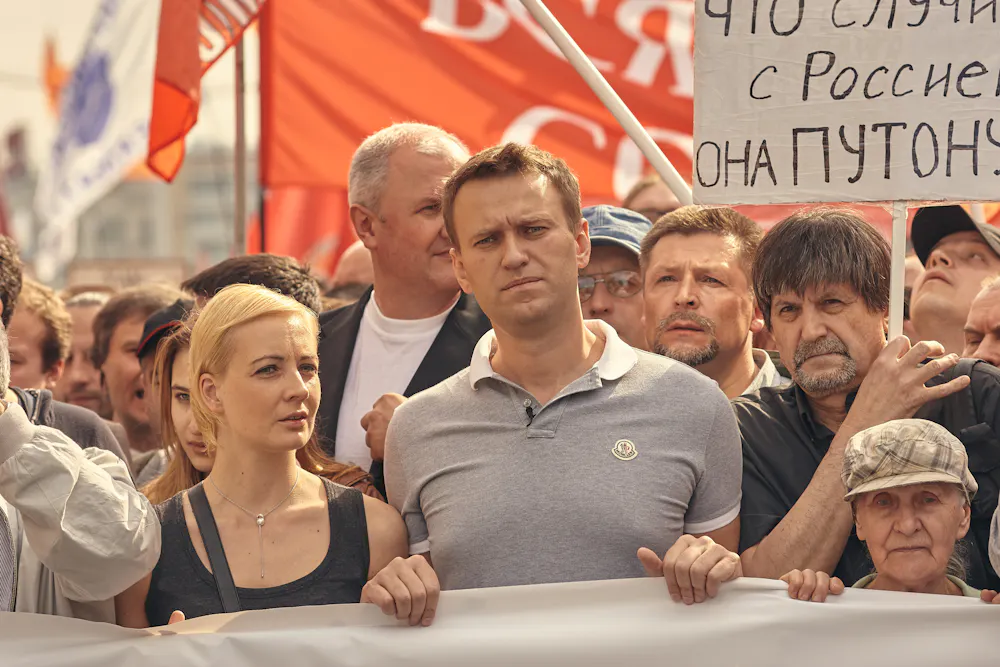
    Alexei Navalny and his wife, Yulia Navalnaya, at a protest rally in Moscow, May 2012.
    Dmitry Laudin/Shutterstock

    Today, Navalny’s family and team continue his work outside of Russia – and are fighting to keep his name alive back home. But the odds are against them. Polling suggests the share of Russians who say they know nothing about Navalny or his activities roughly doubled to 30% between his return in January 2021 and his death three years later.

    Navalny fought against an autocratic system – and paid the price with his life. Given the very real fears Russians may have of voicing support for a man still labelled an extremist by the Putin regime, it’s not easy to assess what people there really think of him and his legacy. But we will also never know how popular Navalny would have been in the “normal” political system he fought for.

    What made Navalny the force he was?

    Navalny didn’t mean for the humble yellow rubber duck to become such a potent symbol of resistance.

    In March 2017, the ACF published its latest investigation into elite corruption, this time focusing on then-prime minister (and former president), Dmitry Medvedev. Navalny’s team members had become masters of producing slick videos that enabled their message to reach a broad audience. A week after posting, the film had racked up over 7 million views on YouTube – an extraordinary number at that time.

    The film included shocking details of Medvedev’s alleged avarice, including yachts and luxury properties. In the centre of a large pond in one of these properties was a duck house, footage of which was captured by the ACF using a drone.

    Video: ACF.

    Such luxuries jarred with many people’s view of Medvedev as being a bit different to Putin and his cronies. As Navalny wrote in his memoir, Medvedev had previously seemed “harmless and incongruous”. (At the time, Medvedev’s spokeswoman said it was “pointless” to comment on the ACF investigation, suggesting the report was a “propaganda attack from an opposition figure and a convict”.)

    But people were angry, and the report triggered mass street protests across Russia. They carried yellow ducks and trainers, a second unintended symbol from the film given Medvedev’s penchant for them.

    Another reason why so many people came out to protest on March 26 2017 was the organising work carried out by Navalny’s movement.

    The previous December, Navalny had announced his intention to run in the 2018 presidential election. As part of the campaign, he and his team created a network of regional headquarters to bring together supporters and train activists across Russia. Although the authorities had rejected Navalny’s efforts to register an official political party, this regional network functioned in much the same way, gathering like-minded people in support of an electoral candidate. And this infrastructure helped get people out on the streets.

    The Kremlin saw this as a clear threat. According to a December 2020 investigation by Bellingcat, CNN, Der Spiegel and The Insider, the FSB assassination squad implicated in the Novichok poisoning of Navalny had started trailing him in January 2017 – one month after he announced his run for the presidency.

    Alexei Navalny on a Moscow street after having zelyonka dye thrown in his face, April 2017.
    Evgeny Feldman via Wikimedia, CC BY-NC-SA

    At the protests against Medvedev, the authorities’ growing intolerance of Navalny was also on display – he was detained, fined and sentenced to 15 days’ imprisonment.

    The Medvedev investigation was far from the beginning of Navalny’s story as a thorn in the Kremlin’s side. But this episode brings together all of the elements that made Navalny the force he was: anti-corruption activism, protest mobilisation, attempts to run as a “normal” politician in a system rigged against him, and savvy use of social media to raise his profile in all of these domains.

    Courting controversy

    In Patriot, Navalny writes that he always “felt sure a broad coalition was needed to fight Putin”. Yet over the years, his attempts to form that coalition led to some of the most controversial points of his political career.

    In a 2007 video, Navalny referred to himself as a “certified nationalist”, advocating for the deportation of illegal immigrants, albeit without using violence and distancing himself from neo-Nazism. In the video, he says: “We have the right to be Russians in Russia, and we’ll defend that right.”

    Although alienating some, Navalny was attempting to present a more acceptable face of nationalism, and he hoped to build a bridge between nationalists and liberals in taking on the Kremlin’s burgeoning authoritarianism.

    But the prominence of nationalism in Navalny’s political identity varied markedly over time, probably reflecting his shifting estimations of which platform could attract the largest support within Russia. By the time of his thwarted run in the 2018 presidential election, nationalist talking points were all but absent from his rhetoric.

    However, some of these former comments and positions continue to influence how people view him. For example, following Russia’s annexation of Crimea in 2014, Navalny tried to take a pragmatic stance. While acknowledging Russia’s flouting of international law, he said that Crimea was “now part of the Russian Federation” and would “never become part of Ukraine in the foreseeable future”.

    Many Ukrainians take this as clear evidence that Navalny was a Russian imperialist. Though he later revised his position, saying Crimea should be returned to Ukraine, some saw this as too little, too late. But others were willing to look past the more controversial parts of his biography, recognising that Navalny represented the most effective domestic challenge to Putin.

    Another key attempt to build a broad political coalition was Navalny’s Smart Voting initiative. This was a tactical voting project in which Navalny’s team encouraged voters to back the individual thought best-placed to defeat the ruling United Russia candidate, regardless of the challenger’s ideological position.

    The project wasn’t met with universal approval. Some opposition figures and voters baulked at, or flatly refused to consider, the idea of voting for people whose ideological positions they found repugnant – or whom they viewed as being “fake” opposition figures, entirely in bed with the authorities. (This makes clear that Navalny was never the leader of the political opposition in Russia; he was, rather, the leading figure of a fractious constellation of individuals and groups.)

    But others relished the opportunity to make rigged elections work in their favour. And there is evidence that Smart Voting did sometimes work, including in the September 2020 regional and local elections, for which Navalny had been campaigning when he was poisoned with Novichok.

    In an astonishing moment captured on film during his recovery in Germany, Navalny speaks to an alleged member of the FSB squad sent to kill him. Pretending to be the aide to a senior FSB official, Navalny finds out that the nerve agent had been placed in his underpants.

    How do Russians feel about Navalny now?

    It’s like a member of the family has died.

    This is what one Russian friend told me after hearing of Navalny’s death a year ago. Soon afterwards, the Levada Center – an independent Russian polling organisation – conducted a nationally representative survey to gauge the public’s reaction to the news.

    The poll found that Navalny’s death was the second-most mentioned event by Russian people that month, after the capture of the Ukrainian city of Avdiivka by Russian troops. But when asked how they felt about his death, 69% of respondents said they had “no particular feelings” either way – while only 17% said they felt “sympathy” or “pity”.

    And that broadly fits with Navalny’s approval ratings in Russia. After his poisoning in 2020, 20% of Russians said they approved of his activities – but this was down to 11% by February 2024.

    Video: BBC.

    Of course, these numbers must be taken for what they are: polling in an authoritarian state regarding a figure vilified and imprisoned by the regime, during a time of war and amid draconian restrictions on free speech. To what extent the drop in support for Navalny was real, rather than reflecting the increased fear people had in voicing their approval for an anti-regime figure, is hard to say with certainty.

    When asked why they liked Navalny, 31% of those who approved of his activities said he spoke “the truth”, “honestly” or “directly”. For those who did not approve of his activities, 22% said he was “paid by the west”, “represented” the west’s interests, that he was a “foreign agent”, a “traitor” or a “puppet”.

    The Kremlin had long tried to discredit Navalny as a western-backed traitor. After Navalny’s 2020 poisoning, Putin’s spokesman, Dmitry Peskov, said that “experts from the United States’ Central Intelligence Agency are working with him”. The Russian state claimed that, rather than a patriot exposing official malfeasance with a view to strengthening his country, Navalny was a CIA stooge intent on destroying Russia.

    Peskov provided no evidence to back up this claim – and the official propaganda wasn’t believed by all. Thousands of Russians defied the authorities by coming out to pay their respects at Navalny’s funeral on March 1 2024. Many, if not all, knew this was a significant risk. Police employed video footage to track down members of the funeral crowd, including by using facial recognition technology.

    The first person to be detained was a Muscovite the police claimed they heard shouting “Glory to the heroes!” – a traditional Ukrainian response to the declaration “Glory to Ukraine!”, but this time referencing Navalny. She spent a night in a police station before being fined for “displaying a banned symbol”.

    Putin always avoided mentioning Navalny’s name in public while he was alive – instead referring to him as “this gentleman”, “the character you mentioned”, or the “Berlin patient”. (The only recorded instance of Putin using Navalny’s name in public when he was alive was in 2013.)

    However, having been re-elected president in 2024 and with Navalny dead, Putin finally broke his long-held practice, saying: “As for Navalny, yes he passed away – this is always a sad event.” It was as if the death of his nemesis diminished the potency of his name – and the challenge that Navalny had long presented to Putin.

    Nobody can become another Navalny

    Someone else will rise up and take my place. I haven’t done anything unique or difficult. Anyone could do what I’ve done.

    So wrote Navalny in the memoir published after his death. But that hasn’t happened: no Navalny 2.0 has yet emerged. And it’s no real surprise. The Kremlin has taken clear steps to ensure nobody can become another Navalny within Russia.

    In 2021, the authorities made a clear decision to destroy Navalny’s organisations within Russia, including the ACF and his regional network. Without the organisational infrastructure and legal ability to function in Russia, no figure has been able to take his place directly.

    More broadly, the fate of Navalny and his movement has had a chilling effect on the opposition landscape. So too have other steps taken by the authorities.

    Russia has become markedly more repressive since the start of its war on Ukraine. The human rights NGO First Department looked into the number of cases relating to “treason”, “espionage” and “confidential cooperation with a foreign state” since Russia introduced the current version of its criminal code in 1997. Of the more than 1,000 cases, 792 – the vast majority – were initiated following Russia’s full-scale invasion of Ukraine in 2022.

    Russian law enforcement has also used nebulous anti-extremism and anti-terrorism legislation to crack down on dissenting voices. Three of Navalny’s lawyers were sentenced in January 2025 for participating in an “extremist organisation”, as the ACF was designated by a Moscow court in June 2021. The Russian legislature has also passed a barrage of legislation relating to so-called “foreign agents”, to tarnish the work of those the regime regards as foreign-backed “fifth columnists”.

    Mass street protests are largely a thing of the past in Russia. Restrictions were placed on public gatherings during the COVID pandemic – but these rules were applied selectively, with opposition individuals and groups being targeted. And opportunities for collective action were further reduced following the full-scale invasion of Ukraine.

    Freedom of speech has also come under assault. Article 29, point five of the Russian constitution states: “Censorship shall be prohibited.” But in September 2024, Kremlin spokesperson Peskov said: “In the state of war that we are in, restrictions are justified, and censorship is justified.”

    Legislation passed very soon after the 2022 invasion of Ukraine made it illegal to comment on the Russian military’s activities truthfully – and even to call the war a war.

    YouTube – the platform so central to Navalny’s ability to spread his message – has been targeted. Without banning it outright – perhaps afraid of the public backlash this might cause – the Russian state media regulator, Roskomnadzor, has slowed down internet traffic to the site within Russia. The result has been a move of users to other websites supporting video content, including VKontakte – a Russian social media platform.

    In short, conditions in Russia are very different now compared to when Navalny first emerged. The relative freedom of the 2000s and 2010s gave him the space to challenge the corruption and authoritarianism of an evolving system headed by Putin. But this space has shrunk over time, to the point where no room remains for a figure like him within Russia.

    In 2019, Navalny told Ivan Zhdanov, who is now director of the ACF: “We changed the regime, but not in the way we wanted.” So, did Navalny and his team push the Kremlin to become more authoritarian – making it not only intolerant of him but also any possible successor?

    There may be some truth in this. And yet, the drastic steps taken by the regime following the start of the war on Ukraine suggest there were other, even more significant factors that have laid bare the violent nature of Putin’s personal autocracy – and the president’s disdain for dissenters.

    Plenty for Russians to be angry about

    How can we win the war when dedushka [grandpa] is a moron?

    In June 2023, Evgeny Prigozhin – a long-time associate of Putin and head of the private military Wagner Group – staged an armed rebellion, marching his forces on the Russian capital. This was not a full-blown political movement against Putin. But the target of Prigozhin’s invective against Russia’s military leadership had become increasingly blurry, testing the taboo of direct criticism of the president – who is sometimes referred to, disparagingly, as “grandpa” in Russia.

    And Prigozhin paid the price. In August 2023, he was killed when the private jet he was flying in crashed after an explosion on board. Afterwards, Putin referred to Prigozhin as a “talented person” who “made serious mistakes in life”.

    In the west, opposition to the Kremlin is often associated with more liberal figures like Navalny. Yet the most consequential domestic challenge to Putin’s rule came from a very different part of the ideological spectrum – a figure in Prigozhin leading a segment of Russian society that wanted the Kremlin to prosecute its war on Ukraine even more aggressively.

    Video: BBC.

    Today, there is plenty for Russians to be angry about, and Putin knows it. He recently acknowledged an “overheating of the economy”. This has resulted in high inflation, in part due to all the resources being channelled into supporting the war effort. Such cost-of-living concerns weigh more heavily than the war on the minds of most Russians.

    A favourite talking point of the Kremlin is how Putin imposed order in Russia following the “wild 1990s” – characterised by economic turbulence and symbolised by then-president Boris Yeltsin’s public drunkenness. Many Russians attribute the stability and rise in living standards they experienced in the 2000s with Putin’s rule – and thank him for it by providing support for his continued leadership.

    The current economic problems are an acute worry for the Kremlin because they jeopardise this basic social contract struck with the Russian people. In fact, one way the Kremlin tried to discredit Navalny was by comparing him with Yeltsin, suggesting he posed the same threats as a failed reformer. In his memoir, Navalny concedes that “few things get under my skin more”.

    Although originally a fan of Yeltsin, Navalny became an ardent critic. His argument was that Yeltsin and those around him squandered the opportunity to make Russia a “normal” European country.

    Navalny also wanted Russians to feel entitled to more. Rather than be content with their relative living standards compared with the early post-Soviet period, he encouraged them to imagine the level of wealth citizens could enjoy based on Russia’s extraordinary resources – but with the rule of law, less corruption, and real democratic processes.

    ‘Think of other possible Russias’

    When looking at forms of criticism and dissent in Russia today, we need to distinguish between anti-war, anti-government, and anti-Putin activities.

    Despite the risk of harsh consequences, there are daily forms of anti-war resistance, including arson attacks on military enlistment offices. Some are orchestrated from Ukraine, with Russians blackmailed into acting. But other cases are likely to be forms of domestic resistance.

    Criticism of the government is still sometimes possible, largely because Russia has a “dual executive” system, consisting of a prime minister and presidency. This allows the much more powerful presidency to deflect blame to the government when things go wrong.

    There are nominal opposition parties in Russia – sometimes referred to as the “systemic opposition”, because they are loyal to the Kremlin and therefore tolerated by the system. Within the State Duma, these parties often criticise particular government ministries for apparent failings. But they rarely, if ever, now dare criticise Putin directly.

    Nothing anywhere close to the challenge presented by Navalny appears on the horizon in Russia – at either end of the political spectrum. But the presence of clear popular grievances, and the existence of organisations (albeit not Navalny’s) that could channel this anger should the Kremlin’s grip loosen, mean we cannot write off all opposition in Russia.

    Navalny’s wife, Yulia, has vowed to continue her husband’s work. And his team in exile maintain focus on elite corruption in Russia, now from their base in Vilnius, Lithuania. The ACF’s most recent investigation is on Igor Sechin, CEO of the oil company Rosneft.

    But some have argued this work is no longer as relevant as it was. Sam Greene, professor in Russian politics at King’s College London, captured this doubt in a recent Substack post:

    [T]here is a palpable sense that these sorts of investigations may not be relevant to as many people as they used to be, given everything that has transpired since the mid-2010s, when they were the bread and butter of the Anti-Corruption Foundation. Some … have gone as far as to suggest that they have become effectively meaningless … and thus that Team Navalny should move on.

    Navalny’s team are understandably irritated by suggestions they’re no longer as effective as they once were. But it’s important to note that this criticism has often been sharpest within Russia’s liberal opposition. The ACF has been rocked, for example, by recent accusations from Maxim Katz, one such liberal opposition figure, that the organisation helped “launder the reputations” of two former bank owners. In their response, posted on YouTube, the ACF referred to Katz’s accusations as “lies” – but this continued squabbling has left some Russians feeling “disillusioned and unrepresented”.

    So, what will Navalny’s long-term legacy be? Patriot includes a revealing section on Mikhail Gorbachev – the last leader of the Soviet Union, whom Navalny describes as “unpopular in Russia, and also in our family”. He continues:

    Usually, when you tell foreigners this, they are very surprised, because Gorbachev is thought of as the person who gave Eastern Europe back its freedom and thanks to whom Germany was reunited. Of course, that is true … but within Russia and the USSR he was not particularly liked.

    At the moment, there is a similar split in perceptions of Navalny. Internationally, he was nominated for the Nobel Peace Prize, awarded the Sakharov Prize by the European Parliament, and a documentary about him won an Oscar.

    But there are also those outside of Russia who remain critical: “Navalny’s life has brought no benefit to the Ukrainian victory; instead, he has caused considerable harm,” wrote one Ukrainian academic. “He fuelled the illusion in the west that democracy in Russia is possible.”

    Trailer for the Oscar-winning documentary Navalny.

    Inside Russia, according to Levada Center polling shortly after his death, 53% of Russians thought Navalny played “no special role” in the history of the country, while 19% said he played a “rather negative” role. Revealingly, when commenting on Navalny’s death, one man in Moscow told RFE/RL’s Russian Service: “I think that everyone who is against Russia is guilty, even if they are right.”

    But, for a small minority in Russia, Navalny will go down as a messiah-like figure who miraculously cheated death in 2020, then made the ultimate sacrifice in his battle of good and evil with the Kremlin. This view may have been reinforced by Navalny’s increasing openness about his Christian faith.

    Ultimately, Navalny’s long-term status in Russia will depend on the nature of the political system after Putin has gone. Since it seems likely that authoritarianism will outlast Putin, a more favourable official story about Navalny is unlikely to emerge any time soon. However, how any post-Putin regime tries to make sense of Navalny’s legacy will tell us a lot about that regime.

    While he was alive, Navalny stood for the freer Russia in which he had emerged as a leading opposition figure – and also what he called the “Beautiful Russia of the Future”. Perhaps, after his death, his lasting legacy in Russia remains the ability for some to think – if only in private – of other possible Russias.


    For you: more from our Insights series:

    • I investigated millions of tweets from the Kremlin’s ‘troll factory’ and discovered classic propaganda techniques reimagined for the social media age

    • How the world’s first open-source digital map of mass graves could help bring justice to victims in Ukraine and other war zones

    • The Trump revolution: where it came from and where it’s going

    To hear about new Insights articles, join the hundreds of thousands of people who value The Conversation’s evidence-based news. Subscribe to our newsletter.

    Ben Noble has previously received funding from the British Academy and the Leverhulme Trust. He is an Associate Fellow of Chatham House.

    – ref. One year on from Alexei Navalny’s death, what is his legacy for Russia? – https://theconversation.com/one-year-on-from-alexei-navalnys-death-what-is-his-legacy-for-russia-249692

    MIL OSI – Global Reports –

    February 15, 2025
  • MIL-OSI Security: Midland DTO Leader Sentenced to Life in Federal Prison

    Source: Office of United States Attorneys

    MIDLAND, Texas – A Mexican national unlawfully residing in Texas was sentenced Thursday to life in federal prison for his criminal actions as the leader of a drug trafficking organization tied to a Mexican cartel.

    According to court documents, Jose Ramon Castillo-Lopez aka “Pepo,” 30, of Namiquipa, Chihuahua, Mexico, supplied a co-conspirator with a firearm, along with methamphetamine, cocaine, heroin, and fentanyl “M30” pills for distribution purposes. Castillo-Lopez also utilized a garage in Midland to disassemble stolen vehicles as load vehicles used to transport illicit drugs and money.

    On Oct. 1, 2022, Drug Enforcement Administration (DEA) agents learned that Castillo-Lopez had been arrested and charged with attempted capital murder for allegedly shooting a Seminole, Texas police officer. Through a review of his phone calls in the Gaines County Jail, DEA agents confirmed that Castillo-Lopez was the leader of a United States-based DTO, working directly with his counterpart on the Mexican side of the organization. Additionally, Castillo-Lopez had instructed in detail two co-defendants, his girlfriend Myra Mendez and her brother Aaron Mendez, to take over the DTO operations in the United States.

    Castillo-Lopez was responsible for the distribution of 100-300 pounds of actual methamphetamine per month, more than 20 kgs of cocaine, and several hundred grams of fentanyl M-30 pills and heroin. Additionally, Castillo-Lopez was responsible for telling the Mexican side of the DTO how much and what types of narcotics were needed for distribution, the collection of narcotics proceeds, and he ensured distribution occurred in Midland/Odessa, San Antonio, Amarillo, San Angelo and throughout the state of Mississippi.

    Castillo-Lopez pleaded guilty on Sept. 23, 2024, to one count of conspiracy to possess with intent to distribute 50 grams or more of actual methamphetamine and 5 kgs or more of a mixture and substance containing a detectable amount of cocaine.

    “This federal life sentence is a significant victory for the United States in combatting the Mexican cartels and their drug trafficking organizations,” said U.S. Attorney Jaime Esparza for the Western District of Texas. “Castillo-Lopez was responsible for orchestrating the movement of massive amounts of dangerous narcotics into our country and through our communities. This case is a testament to the dedication and expertise of our federal, state and local law enforcement partners. Together, we prioritize the safety of Americans and will bring the full force of justice to criminal organizations.”

    “Mr. Castillo-Lopez now has a lifetime to contemplate the terrible choices he made,” said Towanda R. Thorne-James, Special Agent in Charge of the DEA’s El Paso Division. “He willingly put the lives of Texans and Mississippians at risk and now he’s facing the consequences. The men and women of the DEA will continue to bring other drug traffickers like him to their own day of reckoning.”

    The DEA investigated the case with valuable assistance from the Texas Department of Public Safety, Midland Sheriff’s Office, Odessa Police Department and the Midland Police Department.

    Assistant U.S. Attorney Patrick Sloane prosecuted the case.

    ###

    MIL Security OSI –

    February 15, 2025
  • MIL-OSI Global: ‘Emilia Pérez’ was nominated for 13 Oscars. Why do so many people hate it?

    Source: The Conversation – USA – By Alejandra Marquez Guajardo, Assistant Professor of Spanish, Michigan State University

    Going by recent media coverage, you wouldn’t be remiss for assuming it had been nominated for a slew of Golden Raspberries. Netflix

    French director Jacques Audiard’s “Emilia Pérez” first made waves among critics at the Cannes Film Festival in May 2024, when it won multiple awards. It went on to receive 10 Golden Globe nominations, winning four, including best musical or comedy.

    “It is so beautiful to see a movie that is cinema,” gushed Mexican director Guillermo del Toro. Another Mexican filmmaker, Issa López, who directed “True Detective: Night Country,” called it a “masterpiece,” adding that Audiard portrayed issues of gender and violence in Latin America “better than any Mexican facing this issue at this time.”

    The film is a musical about a Mexican drug lord named Manitas del Monte, played by trans actress Karla Sofía Gascón. Del Monte hires a lawyer to facilitate her long-awaited gender transition. After her surgery, she fakes her death with her lawyer’s help and sends her wife, Jessi, played by Selena Gómez, and their children to Switzerland. Four years later, Manitas – now known as Emilia Pérez – tries to reunite with her family by posing as Manitas’ distant cousin.

    So why is it bombing among Mexican moviegoers?

    Modest research into a ‘modest’ language

    As a scholar of gender and sexuality in Latin America, I study LGBTQ+ representation in media, particularly in Mexico. So it’s been interesting to follow the negative reaction to a film that critics claim has broken new ground in exploring themes of gender, sexuality and violence in Mexico.

    Many of the film’s perceived errors seem self-inflicted.

    Audiard admitted that he didn’t do much research on Mexico before and during the filming process. And even though he doesn’t speak Spanish, he chose to use a Spanish script and film the movie in Spanish.

    Jacques Audiard speaks during the Santa Barbara International Film Festival on Feb. 10, 2025.
    Tibrina Hobson/Getty Images for Santa Barbara International Film Festival

    The director told French media outlet Konbini that he chose to make the film in Spanish because it is a language “of modest countries, developing countries, of poor people and migrants.”

    Not surprisingly, an early critique of the film centered on its Spanish: It uses some Mexican slang words, but they’re spoken in ways that sound unnatural to native speakers. Then there’s the film’s overreliance on clichés that border on racism, perhaps most egregiously when Emilia’s child sings that she smells of “mezcal and guacamole.”

    Of course, an artist need not belong to a culture in order to depict or explore it in their work. Filmmakers like Sergei Eisenstein and Luis Buñuel became renowned figures in Mexican cinema despite being born in Latvia and Spain, respectively.

    When choosing to explore sensitive topics, however, it is important to take into account the perspective of those being portrayed, both for accuracy’s sake and as a form of respect. Take Martin Scorsese’s “Killers of the Flower Moon.” The director collaborated with members of the Osage nation to further the film’s historical and cultural accuracy.

    Glossing over the nuance

    “Emilia Pérez” centers on how violence stems from the corruption prevalent in Mexico. Multiple musical numbers denounce the collusion between authorities and criminals.

    This is certainly true. But to many Mexicans, it feels like an oversimplification of the issue.

    The film fails to acknowledge the confluence of factors behind the country’s violence, such as U.S. demand for illegal drugs stemming from its opioid crisis, or the role that American guns play in Mexico’s violence.

    Professor and journalist Oswaldo Zavala, who has written extensively about Mexican cartels, argues that the film perpetuates the idea that Latin American countries are solely to blame for the violence of drug trafficking. Furthermore, Zavala contends that this perspective reinforces the narrative that the U.S.-Mexico border needs to be militarized.

    The musical features few male characters; the ones who do appear are invariably violent, and this includes Manitas before undergoing their transition. The cruelty of Manitas contrasts with Emilia’s kindness: She helps the “madres buscadoras,” which are the Mexican collectives made up of mothers searching for missing loved ones presumed to be kidnapped or killed by organized crime. One of these collectives, Colectivo de Víctimas del 10 de Marzo, criticized the film for depicting groups like theirs as recipients of money from organized crime and beneficiaries of luxurious galas attended by politicians and celebrities.

    The group’s leader, Delia Quiroa, announced that the group would send a letter to the academy to express its condemnation of the film.

    Members of the Madres Buscadoras de Sonora search for the remains of missing persons on the outskirts of Hermosillo, a city in northwestern Mexico, in 2021.
    Alfred Estrella/AFP via Getty Images

    Backlash on multiple fronts

    These political and cultural blind spots have spurred a backlash among Mexican moviegoers.

    When the movie premiered in Mexico in January 2025, it bombed at the box office, with some viewers demanding refunds. Mexico’s Federal Consumer Protection Agency had to intervene after the movie chain Cinépolis refused to honor its satisfaction-guarantee policy.

    Mexican writer Jorge Volpi called the movie “one of the crudest and most deceitful films of the 21st century.”

    Trans content creator Camila Aurora playfully parodied “Emilia Pérez” in her short film “Johanne Sacrebleu.” In scenes filled with stereotypical French symbols such as croissants and berets, it tells the story of an heiress who falls in love with a member of her family’s business rivals.

    While some viewers have nonetheless praised “Emilia Pérez” for its nuanced portrayal of trans women and the casting of a trans actress, the LGBTQ advocacy group GLAAD described it as “a step backward for trans representation.”

    One point of contention is the musical number Emilia sings, “medio ella, medio él,” or “half she, half he,” which insinuates that trans people are stuck between two genders. The movie also seems to portray the character’s transition as a tool for deception.

    A social media viper pit

    Meanwhile, Gascón’s historic nominations as the first trans actress recognized by the Oscars and other awards have been overshadowed by her controversial statements.

    She made headlines when she accused associates of Brazilian actress Fernanda Torres of disparaging her work. Torres is also an Oscar nominee for best actress.

    Gascón’s historic nomination for best actress has been overshadowed by sniping on social media.
    Yamak Perea/ Pixelnews/Future Publishing via Getty Images

    The latest controversy began in late January 2025 when Gascón’s old social media posts resurfaced. The now-deleted messages included attacks on Muslims in Spain and a post calling co-star Selena Gómez a “rich rat,” which Gascón has denied writing.

    “Emilia Pérez” is limping into the Oscars. Netflix and Audiard have distanced themselves from Gascón to try to preserve the film’s prospects at the annual Academy Awards ceremony.

    It could be too little too late.

    Alejandra Marquez Guajardo does not work for, consult, own shares in or receive funding from any company or organization that would benefit from this article, and has disclosed no relevant affiliations beyond their academic appointment.

    – ref. ‘Emilia Pérez’ was nominated for 13 Oscars. Why do so many people hate it? – https://theconversation.com/emilia-perez-was-nominated-for-13-oscars-why-do-so-many-people-hate-it-248297

    MIL OSI – Global Reports –

    February 15, 2025
  • MIL-OSI United Kingdom: Drivers warned to keep hands on the wheel, eyes on the road

    Source: City of Liverpool

    An alarming increase in the number of young people distracted while driving has been reported by road campaigners.

    In a bid to combat the rising tide of mobile phone use behind the wheel, Liverpool City Council has launched a hard-hitting campaign aimed at young drivers.

    The message is clear: Driving demands 100 per cent focus, and any distraction, especially from mobile phones, can have devastating consequences.

    The campaign comes as alarming statistics reveal a surge in mobile phone use among young drivers. According to the RAC’s 2024 Report on Motoring, a staggering 43 per cent of young motorists admit to listening to voice notes while driving without hands-free technology, and 40 per cent confess to recording messages. These figures starkly contrast with the overall driving population, where the rates are just 14 per cent and 9 per cent, respectively.

    Merseyside Police enforced nearly 2,500 mobile phone offences across Merseyside in 2024 – up from just over 1,600 in 2023.

    The consequences of getting caught using a handheld phone while driving are severe: six penalty points on your license and a £200 fine. If you get six or more points within two years of passing your test, your licence will be revoked – which means you’ll also have to apply and pay for a new provisional licence and pass both theory and practical parts of the driving or riding test again to get a full licence.

    You can also be taken to court where you can:

    • be banned from driving or motor cycle riding.
    • get a maximum fine of £1,000.

    Liverpool City Council is committed to making the City’s roads safer for everyone. This campaign is just one step in ongoing efforts to educate drivers and enforce the law.

    Cllr Dan Barrington, Liverpool City Council Cabinet Member for Transport and Connectivity, said: “Driving is a responsibility, not a game.

    “When you’re behind the wheel, your only ‘screen time’ should be looking through the windscreen. A momentary glance at your phone can lead to a lifetime of regret.

    “It’s deeply concerning to see such a high proportion of young drivers putting themselves and others at risk,” Cllr Barrington added.

    “We need to change this culture of distraction and make it clear that using a mobile phone while driving is simply unacceptable.

    “We understand the temptation to check your phone, especially for young people who are constantly connected,” Cllr Barrington acknowledged. “But no message, no notification, no call is worth risking your life or the lives of others. Put your phone away, focus on the road, and arrive safely.”

    Inspector Gavin Dixon of Merseyside Police, Roads Policing Department, said: “As a Roads Policing Department we have to deal with the very real consequences of distracted driving.

    “Every year people are killed or serious injured by drivers not paying attention, whether that be mobile phone use or some other in car distraction. We use a number of tactics to catch drivers that wish to put their own convenience before other people’s safety.

    “In the last 12 months, we have deployed unmarked vehicles, unmarked motorcycles, AI camera detection equipment and arial CCTV resulting in more and more people getting caught.

    “Our message is simple, leave your phone alone or we might be speaking to you next. We can’t be everywhere, but we can be anywhere.”

    MIL OSI United Kingdom –

    February 15, 2025
  • MIL-OSI United Kingdom: International trade mission to Ukraine deepens industry ties and boosts growth

    Source: United Kingdom – Executive Government & Departments 3

    First-of-its-kind international defence trade mission to Kyiv deepens industry ties between Ukraine and its allies

    The UK and allies have deepened industry ties with Ukraine by leading a first-of-its-kind international defence trade mission to Kyiv this week.

    Led by the Minister for the Armed Forces, the trade delegation, which included Norway and The Netherlands, met with Ukrainian ministers, officials, and industry partners to strengthen strategic partnerships and enhance defence cooperation in support of Ukraine.  

    This was the fifth trade mission to Ukraine by Britain’s Task Force HIRST, but the first in conjunction with allies, setting a blueprint for future trade missions to be international as the norm.

    Following the visit, UK companies have agreed to work more closely with Ukrainian partners, agreeing to new commitments that will build on previous agreements and boost their capabilities.

    Despite a significant Russian airstrike targeting Kyiv on Wednesday morning this week, which killed one innocent civilian, the trade mission went ahead successfully, highlighting that the UK and our Allies will not be intimidated by Putin’s brutal tactics.

    With firms across the UK ramping up defence production to meet Ukraine’s requirements, support for Ukraine will directly boost the UK defence sector, create UK jobs, and deliver on this Government’s growth agenda and Plan for Change.

    Minister for the Armed Forces, Luke Pollard MP said:

    The UK is continuing to lead the way on global support for Ukraine. By strengthening defence industry ties with allies, we are providing Ukraine with the firepower it needs on the battlefield, whilst bolstering our own defence industrial base —creating jobs and driving investment.

    Our partnerships with The Netherlands, Norway, and Ukraine will help build resilient supply chains to ensure we put Ukraine in the strongest possible position to achieve a just and lasting peace through strength.

    We will stand with our allies to support Ukraine for as long as it takes.

    The Minister, along with officials from the Ministry of Defence and Department for Business and Trade, attended meetings focused on continuing to develop the industrial relationship with Ukraine, boosting their capabilities on the battlefield, whilst supporting growth back in the UK.

    The Ministry of Defence set up Task Force HIRST to drive increases in UK, Ukrainian and allies’ industrial capacity to support the Armed Forces of Ukraine, as well as national military resilience.

    Kevin Craven, CEO of ADS said:

    Our continued industrial partnership with the Ukraine will be pivotal if we are to strengthen our collective security. It is an honour for ADS and our members to work in such close collaboration with Ukraine.

    UK support to Ukraine has, at its heart, the knowledge that helping Ukraine is protecting our values and way of life.

    The visit coincided with the NATO meeting of defence ministers, where the Defence Secretary announced a new £150 million package of military aid to Ukraine. 

    The £150 million package includes thousands of drones, dozens of battle tanks and more than 50 armoured and protective vehicles to be deployed to Ukraine by the end of spring, building on the thousands of pieces of equipment the UK has already given to Ukraine. 

    In a boost to the UK’s economy, the package also includes a multi-million-pound contract with UK defence firm Babcock, who will train Ukrainian personnel to maintain and repair crucial equipment such as Challenger 2 tanks, self-propelled artillery, and combat reconnaissance vehicles inside Ukraine. Through this agreement, equipment can be serviced and returned to the frontline quicker. 

    This is part of the UK’s unprecedented £4.5 billion pledge for Ukraine this year, its highest-ever level.

    The Government is clear that the security of the UK starts in Ukraine and is therefore committed to Ukraine’s long-term security as a foundation for the government’s Plan for Change.

    Share this page

    The following links open in a new tab

    • Share on Facebook (opens in new tab)
    • Share on Twitter (opens in new tab)

    Updates to this page

    Published 14 February 2025

    MIL OSI United Kingdom –

    February 15, 2025
  • MIL-OSI: 180 Degree Capital Corp. Issues Q4 2024 Shareholder Letter

    Source: GlobeNewswire (MIL-OSI)

    Montclair, NJ, Feb. 14, 2025 (GLOBE NEWSWIRE) — 180 Degree Capital Corp. (NASDAQ:TURN) today issued the following Q4 2024 Shareholder Letter:

    Fellow Shareholders,

    We are incredibly proud of our recent announcement of the signing of a definitive agreement for 180 Degree Capital Corp. (“180 Degree Capital”) to enter into a business combination (the “Business Combination”) with Mount Logan Capital Inc. (“Mount Logan”). For those of you who have not had a chance to listen to our joint call with the team from Mount Logan or review the presentation deck that summarizes the proposed transaction, both can be found at https://ir.180degreecapital.com/ir-calendar/detail/2908/180-degree-capital-and-mount-logan-capital-proposed-merger. We expect to file a registration statement and joint proxy statement/prospectus with the Securities and Exchange Commission (the “SEC”) soon. This document will give us the opportunity to speak with our shareholders more extensively about the proposed Business Combination and the process that led to our Board’s unanimous approval of this strategically important transaction.

    This proposed transaction is not the end of 180 Degree Capital. We believe it is the logical next step in our evolution. It is also an opportunity that is not afforded commonly to closed-end funds, particularly since we believe most have limited differentiation. We believe there are clear reasons why 180 Degree Capital has this truly unique opportunity to combine with an asset manager and to transition to an operating company. We will get to those below, but first, I want to touch on why we believe Mount Logan is a proverbial “diamond in the rough.”

    Mount Logan has the following attributes that we believe will provide value to 180 Degree Capital shareholders:

    • Mount Logan has what we believe to be an outstanding management team comprised of its CEO, Ted Goldthorpe, its Co-Presidents, Matthias Ederer and Henry Wang, and its CFO, Nikita Klassen;
    • Mount Logan’s asset management platform has approximately $2.4+ billion of assets under management (as of September 30, 2024) that we believe generates predictable fee revenue that can be used to benefit the growth of the combined company and its shareholders;
    • Mount Logan has operational leverage and unique investment access through its association with BC Partners, a leading global private equity and credit firm;
    • Mount Logan is focused on what we believe is the fast-growing market of private credit;
    • We believe that Mount Logan remains undiscovered by the majority of investors due to it being listed on the Cboe Canada exchange rather than a US national exchange; and
    • We believe Mount Logan is significantly undervalued by public market investors.

    For 35 years, I have been a value investor attempting to uncover great companies that I believe are trading below their intrinsic value. As we spent more time with Ted and his colleagues over the past six months, it became abundantly clear to us that 1) we believe Mount Logan is one of these great undiscovered and undervalued companies and 2) the combination of our two companies has the potential to unlock substantial value for 180 Degree Capital shareholders by:

    1. Shifting the valuation of our business from one based on net asset value to a valuation based on operating metrics with a foundation of what we believe will be more predictable fee-related revenues attributed to earnings from the management of permanent and semi-permanent capital vehicles. Other similar businesses commonly trade based on multiples of operating metrics rather than discounts to net asset value.
    2. Changing to an asset-light operating company that leverages an association with BC Partners enables economies of scale that are not possible at 180 Degree Capital’s current size; and
    3. Substantially increasing the available capital for us to be able to leverage our relationships with small and microcapitalization public companies, to develop capital structure solutions that seek to unlock value and generate favorable risk-adjusted returns.

    I, as the largest individual shareholder of 180 Degree Capital, and Daniel as a top-ten shareholder, could not be more excited about the future of the combined entity. We believe the proposed Business Combination to be the best opportunity to build value for all shareholders of 180 Degree Capital. We believe strongly in 180 Degree Capital’s future under the leadership of Ted and his colleagues. I have been an investor in the public markets for 35 years, during which investors entrusted me with billions of dollars of capital. We are interested in building true value for shareholders over the short and long term. We believe this combination achieves both of these objectives.

    We are not the only ones who understand the potential for value creation from this Business Combination. Some of our largest shareholders have signed either voting agreements or non-binding indications of support, that when combined with ownership of management and the board, account for approximately 27% of our outstanding shares in the aggregate. We appreciate the time and consideration these shareholders spent to understand the merits of this proposed Business Combination and their support for it.

    While we work toward filing the registration statement and joint proxy statement/prospectus for the proposed Business Combination with the SEC, we thought this would be a good time to reflect on our successes since the start of 180 Degree Capital in 2017. We believe that these successes have enabled us to enter at this next phase of 180 Degree Capital’s evolution and value creation for our fellow shareholders. Here are some of the data points we are proud of and show our contributions since I joined 180 Degree Capital’s predecessor company board of directors in June 2016, when we started 180 Degree Capital at the end of 2016, and the end of last year:

      June 30, 2016 December 31, 2016 December 31, 2024 Change from December 31, 2016
    Day-to-Day Operating Expenses ~$6.0 million ~$6.3 million ~$3.5 million -44%
    % Private Investments 86% 92% <1% -91%
    % Public Investments 14% 8% >99% +91%
    % Cash + Public Securities of NAV 21%1 27% 102% +75%
    Insider Ownership 2.1%2 2.6%2 12.7% +10.1%

    1. Net of $5,000,000 in debt on balance sheet as of June 30, 2016.
    2. Excludes restricted stock subject to forfeiture provisions. The equity compensation program was terminated in March 2017 in conjunction with 180 Degree Capital’s transition from a business development company to a registered closed-end fund.

    We slashed expenses, in part by transitioning from a business development company to a registered closed-end fund structure. A collateral impact of this transition was the elimination of our ability to compensate employees through the issuance of options or restricted stock. We didn’t care. It was the right decision for our shareholders. We transitioned the balance sheet. We substantially increased insider ownership through solely open market purchases. As noted previously, no equity was given to the management team or other employees as compensation. No one has bought and held more stock in the open market than me during that time period.

    As the table below shows, we believe our shareholders have benefited from our ability to generate positive returns on our investments since we took over management of 180 Degree Capital. These returns were offset by material declines in the legacy private portfolio that we inherited.

    Public Portfolio
    Contribution to Change in NAV
    (2017-2024)
    Legacy Private Portfolio
    Contribution to Change in NAV
    (2017-2024)
    +$3.13/share -$2.41/share
      TURN Public Portfolio Gross Total (Excluding SMA Carried Interest) TURN Public Portfolio Gross Total (Including SMA Carried Interest) Change in NAV Change in Stock Price Russell Microcap Index Lipper Peer Group Average
    Inception to Date
    Q4 2016 – Q4 2024
    +185.7% +204.5% -33.9% -11.4% +68.5% +81.8%

    Math is math. Our public market investment strategy over the history of 180 Degree Capital outperformed our comparable peers and indices. It is fair to ask why our stock price has not followed. We believe it is largely because of the significant negative impact of the private portfolio that we inherited, and the discounts disproportionately applied to closed-end funds of our size. Hence, I come back to our proposed Business Combination with Mount Logan, and what we believe it can do to potentially unlock value for 180 Degree Capital shareholders when we are no longer constrained by the market dynamics ascribed to closed-end funds.

    We will let our upcoming registration statement and included joint proxy statement/prospectus provide the truth to our shareholders regarding how and why our Board unanimously approved this proposed Business Combination. In the meantime, our work over the prior eight years set up 180 Degree Capital for this next phase of what we believe will be long-term shareholder value creation. We realize our lack of scale has caused our expense ratio to be too high. We believe we have uncovered a unique solution for that and other growth-limiting issues with our proposed Business Combination. Our Board and management team firmly believe that this Business Combination is in the best interest of all of our shareholders. We could not be more excited about the potential for future value creation as a result of combining with Mount Logan, and we look forward to discussing this proposed combination with all of you and prospective future shareholders of the combined entity.

    All the best,

    Kevin M. Rendino
    Chairman and Chief Executive Officer

    About 180 Degree Capital Corp.

    180 Degree Capital Corp. is a publicly traded registered closed-end fund focused on investing in and providing value-added assistance through constructive activism to what we believe are substantially undervalued small, publicly traded companies that have potential for significant turnarounds. Our goal is that the result of our constructive activism leads to a reversal in direction for the share price of these investee companies, i.e., a 180-degree turn. Detailed information about 180 Degree Capital and its holdings can be found on its website at www.180degreecapital.com.

    Press Contact:
    Daniel B. Wolfe
    Robert E. Bigelow
    180 Degree Capital Corp.
    973-746-4500
    ir@180degreecapital.com

    Additional Information and Where to Find It

    In connection with the proposed Business Combination, 180 Degree Capital intends to file with the SEC and mail to its shareholders a proxy statement on Schedule 14A (the “Proxy Statement”), containing a form of WHITE proxy card. In addition, the surviving Delaware corporation, Mount Logan Capital Inc. (“New Mount Logan”) plans to file with the SEC a registration statement on Form S-4 (the “Registration Statement”) that will register the exchange of New Mount Logan shares in the Business Combination and include the Proxy Statement and a prospectus of New Mount Logan (the “Prospectus”). The Proxy Statement and the Registration Statement (including the Prospectus) will each contain important information about 180 Degree Capital, Mount Logan, New Mount Logan, the Business Combination and related matters. SHAREHOLDERS OF 180 DEGREE CAPITAL AND MOUNT LOGAN ARE URGED TO READ THE PROXY STATEMENT AND PROSPECTUS CONTAINED IN THE REGISTRATION STATEMENT AND OTHER DOCUMENTS THAT ARE FILED OR WILL BE FILED WITH THE APPLICABLE SECURITIES REGULATORY AUTHORITIES AS WELL AS ANY AMENDMENTS OR SUPPLEMENTS TO THESE DOCUMENTS CAREFULLY AND IN THEIR ENTIRETY WHEN THEY BECOME AVAILABLE BECAUSE THEY WILL CONTAIN IMPORTANT INFORMATION ABOUT 180 DEGREE CAPITAL, MOUNT LOGAN, NEW MOUNT LOGAN, THE BUSINESS COMBINATION AND RELATED MATTERS. Investors and security holders may obtain copies of these documents and other documents filed with the applicable securities regulatory authorities free of charge through the website maintained by the SEC at https://www.sec.gov and the website maintained by the Canadian securities regulators at www.sedarplus.ca. Copies of the documents filed by 180 Degree Capital are also available free of charge by accessing 180 Degree Capital’s investor relations website at https://ir.180degreecapital.com.

    Certain Information Concerning the Participants

    180 Degree Capital, its directors and executive officers and other members of management and employees may be deemed to be participants in the solicitation of proxies in connection with the Business Combination. Information about 180 Degree Capital’s executive officers and directors is available in 180 Degree Capital’s Annual Report filed on Form N-CSR for the year ended December 31, 2024, which was filed with the SEC on February 13, 2025, and in its proxy statement for the 2024 Annual Meeting of Shareholders (“2024 Annual Meeting”), which was filed with the SEC on March 1, 2024. To the extent holdings by the directors and executive officers of 180 Degree Capital securities reported in the proxy statement for the 2024 Annual Meeting have changed, such changes have been or will be reflected on Statements of Change in Ownership on Forms 3, 4 or 5 filed with the SEC. These documents are or will be available free of charge at the SEC’s website at https://www.sec.gov. Additional information regarding the persons who may, under the rules of the SEC, be considered participants in the solicitation of the 180 Degree Capital shareholders in connection with the Business Combination will be contained in the Proxy Statement when such document becomes available.

    Mount Logan, its directors and executive officers and other members of management and employees may be deemed to be participants in the solicitation of proxies from the shareholders of Mount Logan in favor of the approval of the Business Combination. Information about Mount Logan’s executive officers and directors is available in Mount Logan’s annual information form dated March 14, 2024, available on its website at https://mountlogancapital.ca/investor-relations and on SEDAR+ at https://sedarplus.ca. To the extent holdings by the directors and executive officers of Mount Logan securities reported in Mount Logan’s annual information form have changed, such changes have been or will be reflected on insider reports filed on SEDI at https://www.sedi.ca/sedi/. Additional information regarding the persons who may, under the rules of the SEC, be considered participants in the solicitation of the Mount Logan shareholders in connection with the Business Combination will be contained in the Prospectus included in the Registration Statement when such document becomes available.

    Non-Solicitation

    This letter and the materials accompanying it are not intended to be, and shall not constitute, an offer to buy or sell or the solicitation of an offer to buy or sell any securities, or a solicitation of any vote or approval, nor shall there be any sale of securities in any jurisdiction in which such offer, solicitation or sale would be unlawful prior to registration or qualification under the securities laws of any such jurisdiction. No offering of securities shall be made, except by means of a prospectus meeting the requirements of Section 10 of the U.S. Securities Act of 1933, as amended.

    Forward-Looking Statements

    This letter and the materials accompanying it, and oral statements made from time to time by representatives of 180 Degree Capital and Mount Logan, may contain statements of a forward-looking nature relating to future events within the meaning of federal securities laws. Forward-looking statements may be identified by words such as “anticipates,” “believes,” “could,” “continue,” “estimate,” “expects,” “intends,” “will,” “should,” “may,” “plan,” “predict,” “project,” “would,” “forecasts,” “seeks,” “future,” “proposes,” “target,” “goal,” “objective,” “outlook” and variations of these words or similar expressions (or the negative versions of such words or expressions). Forward-looking statements are not statements of historical fact and reflect Mount Logan’s and 180 Degree Capital’s current views about future events. Such forward-looking statements include, without limitation, statements about the benefits of the Business Combination involving Mount Logan and 180 Degree Capital, including future financial and operating results, Mount Logan’s and 180 Degree Capital’s plans, objectives, expectations and intentions, the expected timing and likelihood of completion of the Business Combination, and other statements that are not historical facts, including but not limited to future results of operations, projected cash flow and liquidity, business strategy, payment of dividends to shareholders of New Mount Logan, and other plans and objectives for future operations. No assurances can be given that the forward-looking statements contained in this press release will occur as projected, and actual results may differ materially from those projected. Forward-looking statements are based on current expectations, estimates and assumptions that involve a number of risks and uncertainties that could cause actual results to differ materially from those projected. These risks and uncertainties include, without limitation, the ability to obtain the requisite Mount Logan and 180 Degree Capital shareholder approvals; the risk that Mount Logan or 180 Degree Capital may be unable to obtain governmental and regulatory approvals required for the Business Combination (and the risk that such approvals may result in the imposition of conditions that could adversely affect New Mount Logan or the expected benefits of the Business Combination); the risk that an event, change or other circumstance could give rise to the termination of the Business Combination; the risk that a condition to closing of the Business Combination may not be satisfied; the risk of delays in completing the Business Combination; the risk that the businesses will not be integrated successfully; the risk that the cost savings and any other synergies from the Business Combination may not be fully realized or may take longer to realize than expected; the risk that any announcement relating to the Business Combination could have adverse effects on the market price of Mount Logan’s common stock or 180 Degree Capital’s common stock; unexpected costs resulting from the Business Combination; the possibility that competing offers or acquisition proposals will be made; the risk of litigation related to the Business Combination; the risk that the credit ratings of New Mount Logan or its subsidiaries may be different from what the companies expect; the diversion of management time from ongoing business operations and opportunities as a result of the Business Combination; the risk of adverse reactions or changes to business or employee relationships, including those resulting from the announcement or completion of the Business Combination; competition, government regulation or other actions; the ability of management to execute its plans to meet its goals; risks associated with the evolving legal, regulatory and tax regimes; changes in economic, financial, political and regulatory conditions; natural and man-made disasters; civil unrest, pandemics, and conditions that may result from legislative, regulatory, trade and policy changes; and other risks inherent in Mount Logan’s and 180 Degree Capital’s businesses. Forward-looking statements are based on the estimates and opinions of management at the time the statements are made. Readers should carefully review the statements set forth in the reports, which 180 Degree Capital has filed or will file from time to time with the SEC and Mount Logan has filed or will file from time to time on SEDAR+.

    Neither Mount Logan nor 180 Degree Capital undertakes any obligation, and expressly disclaims any obligation, to publicly update any forward-looking statement, whether as a result of new information, future events or otherwise, except as required by law. Any discussion of past performance is not an indication of future results. Investing in financial markets involves a substantial degree of risk. Investors must be able to withstand a total loss of their investment. The information herein is believed to be reliable and has been obtained from sources believed to be reliable, but no representation or warranty is made, expressed or implied, with respect to the fairness, correctness, accuracy, reasonableness or completeness of the information and opinions. The references and link to the website www.180degreecapital.com and mountlogancapital.ca have been provided as a convenience, and the information contained on such websites are not incorporated by reference into this press release. Neither 180 Degree Capital nor Mount Logan is responsible for the contents of third-party websites.

    The MIL Network –

    February 15, 2025
  • MIL-OSI United Kingdom: New car parks and improved drainage works to start at Herrington Country Park

    Source: City of Sunderland

    Car parking at one of Sunderland’s most popular parks is being boosted with new spaces for 90 more vehicles

    Works at Herrington Country Park, which at over 320 acres is also one of the city’s biggest park, are due to begin on Monday 17 February.

    The park has had a 20 year run of annual Green Flag awards from Keep Britain Tidy and alongside its lakes, paths, play areas and wildlife, is known for its views of Penshaw Monument. It is also a major events space and hosts a weekly 5k park run and the annual Kubix festivals. This year’s Kubix festival is due to be held on Saturday 12 July.

    New car parking is to help meet its growing popularity and prevent inconsiderate visitor parking which has damaged some grassed areas and verges. The car park project was agreed as part of Sunderland City Council’s ongoing investment budgets and maintenance programmes into the city and its infrastructure.

    The City Council’s Environment, Transport and Net Zero Portfolio Holder, Councillor Lindsey Leonard said: “We have unrivalled parks and green spaces in our city which are the envy of many. We all understand how important they are for the thousands of residents and visitors who access and enjoy them annually.

    “But when the car parks are full we do get some inconsiderate parking and this in turn damages grassed areas and verges and can make parts of the park look unsightly. Increasing the number of parking spaces will help prevent this as while a relatively small grassed area is lost, even more is protected because drivers will not be parking on it.”

    The current number of spaces at the café car park is 62 with 55 of those being standard spaces, five are disabled parking and two are electric vehicle charging bays, and there are nine standard bays at the skate park.

    The expanded car parking will see the existing car park close to the café expanded to a total capacity of 129 which includes five accessible bays, provision for seven future EV charging bays and four minibus bays. There will also be a new layout and improvements to footpaths, cycle and motorbike parking and landscaping. The skate park parking will increase to 33 standard bays with plans to create a wildflower meadow nearby.

    Existing drainage will be upgraded as part of the project to mitigate current flooding issues occurring in the main cafe car park and on the highway leading to the skate park.

    Cllr Leonard added: “We’re continuing our City Plan for a more dynamic, healthy and vibrant smart city, and city parks are an important part of this work so that everyone can enjoy our outdoor spaces.

    “We appreciate the patience of Herrington’s many visitors while we carry out these improvements at one of our most popular parks.”

    This development is estimated to take 15 weeks and will be completed by June 2025. The park and businesses will continue to be open throughout with minimal disruption.

    MIL OSI United Kingdom –

    February 15, 2025
  • MIL-OSI Security: U.S. Naval Hospital Okinawa is Providing the Lifesaving Training When Every Second Counts

    Source: United States Navy (Medical)

    Camp Foster, Okinawa, Japan February 13, 2025, staff from the U.S. Naval Hospital Okinawa (USNHO) Emergency Department are training the future EMTs charged with providing lifesaving critical care to those in need en route to the hospital. Okinawa is a small island stretching 70 miles from north to south, up to 7 miles wide at its widest and only 2 miles wide at the narrowest. This geography, along with streets not wide enough for two cars to pass and 95% of the population all in the middle of the island, makes Okinawa one of the most densely populated non-metropolitan areas in the world. This unique environment makes it a daily challenge for the EMT personnel who provide emergency first responder care to 6 branch clinics and the interfacility transfers of patients of USNHO.

    The two most northern branch clinics can take as long as two hours to navigate the densely populated narrow streets where the average posted speed limit is 30km/h or 19mph. The gravity of that kicks in when you are potentially the sole provider riding in the back of an ambulance with a patient suffering grievous injuries. CDR Pete Nyilas, the Director for Medical Services at USNHO, explained the importance of the hospital providing EMT training to our corpsmen and the incredible responsibility these, often very young sailors, are shouldering. The Naval Hospital is doubling down and conducting ongoing training to ensure enough EMTs are trained to fill the role. A class is testing out today, February 13, 2025, then there will be a refresher training in March, followed by another training class between April and May. This is the constant battle rhythm needed to keep a continuous roster of EMTs to mitigate burnout, accommodate time off, and manage the permanent change of station (PCS) moves that are constantly happening. The goal is to have at least two EMTs per ambulance rig and enough to cover the 24-hour duty they stand when on call.

    The EMT course at the Naval Hospital is “rigorous and tests our corpsmen to the top of their training,” CDR Nyilas said. He pointed out that this course and opportunity are unique to Okinawa because stateside emergency transport is done by civilian ambulances and emergency responders, not by the Medical Treatment Facility (MTF) personnel. Nyilas also pointed out the similarities in real-world trauma that the corpsmen might encounter on a battlefield.

    The EMT course is challenging, and after passing, the students must take the Nationally Recognized Emergency Medical Transport (NREMT) test and pass to receive a nationally recognized certification that is good for two years. The previously mentioned refresher course given every third month helps keep the certifications current. Time is the enemy of this program because the students are often first tour young Sailors who come on two-year unaccompanied orders. By the time they make it into a course, pass it, schedule to take the NREMT, and pass to finally make it onto the watch bill, it can be nearly a year, and they are halfway through their tour! The demands of the course and the testing make the success rate around 70%, and some find that they are incompatible with the call of this specialized service.

    Senior Chief Rachel Kerner, the Senior Enlisted Leader for the Directorate for Medical Services, explained how very important these newly trained EMTs are and their important role on the island. Kerner said, “The importance of having well-trained, well-prepared EMTs stationed strategically around the island means a couple of minutes, and those can be crucial to a positive outcome for our patients.” Senior Chief Kerner pointed out that the opportunity to serve as an EMT is not just for the Corpsmen assigned to the hospital, that there are currently EMT-trained staff with the Dental BN in the Laboratory and Family Medicine who can help cover shifts to maintain their skills and relieve other EMTs. She also stressed the unique opportunity to serve in this capacity overseas, and when she asks her EMTs before they PSC how they liked being an EMT, they usually say something very similar. “The hours were brutal, and the traumas were tough, but I would not have wanted to do anything else while I was here!”

    The training is conducted in the Naval hospital, and one of the instructors is HM3 Nessa Zazi. You might mistake her youthful appearance and braces for a lack of experience and be very mistaken. She commanded her role as instructor and evaluator with the confidence and poise of a well-seasoned veteran of the ambulance rig. She was testing out a student, HM3 Jason Veloz, serving with the 3D Marine Division, conducting a complete mockup scenario of a semi-responsive patient on a scene to which he was called. It wasn’t lost in the moment that these two young Corpsmen were preparing to be the sole provider when those minutes count to evaluate and prep a patient for emergency transport. Zazi provided feedback after the role-playing exercise, during which each of them remained in character and walked through a very plausible patient encounter. HM3 Zazi said, “You need to expedite your evaluation and initial contact with the hospital Emergency Department; short, sweet, and to the point; if you are taking too long, you are holding up traffic!” Zazi also let Veloz know that she liked how he examined the patient even though a neighbor had provided their recollection of how the patient went down. HM3 Zazi’s parting advice, “You just have to complete the reps and sets before you can gain more confidence.”

    LCDR Amanda Studer, an emergency medicine physician at USNHO, leads the Emergency Department (ED) in a modernization effort that affects the emergency care of all the beneficiaries of USNHO in Okinawa. While it is easy to navigate Okinawa as a foreigner, some of the simple things we have come to expect in the U.S. are not the same here; the first is 911. We teach kids to dial 911 in an emergency from a very young age. In Okinawa, it is still 911 on base, but off base it is 119. Like any complicated system, many caveats and exceptions can lead to confusion, especially in a stressful medical situation. Dr. Studer has worked tirelessly to make changes and upgrade the dispatch system, including overseeing the EMT training program. When talking about the Sailors who have stepped up to the call, Studer said, “These are our modern-day superheroes who show up for you during some of the worst days of your lives.” She explained how it builds confidence in our community to see the strives and improvements to the system. The upgrades are not just in the programs and phone numbers; Dr. Studer was instrumental in helping acquire additional ambulances from the Army in Korea. This massive undertaking involved the Marines, Airforce, Army, and the Navy to ship the vehicles here to Okinawa. Opening lines of communication with host nation EMS allows both services to learn from each other and share best practices for improving care for every patient on Okinawa. Under her watch, the program procured over $500,000 in critical lifesaving EMS equipment. She helped coordinate long overdue EMS site visits for both Navy/Marine Corps and Army services and has helped build the infrastructure for a modern, readily equipped EMS program.

    The collaboration between Marine Corps Installation Pacific Command (MCIPAC), the host nation, sister services, and USNHO has provided the resources to help maintain medical care for the residents here in Okinawa. Our beneficiaries can be confident that a new group of well-trained EMTs will test out next Tuesday, and these modern-day heroes will be on the streets providing emergency medical care to those in need.

    The U.S. Navy Medicine Readiness and Training Command Okinawa (USNMRTCO) supports the Defense Health Agency’s U.S. Naval Hospital, Okinawa (USNHO) as the largest OCONUS Navy Medicine medical treatment facility and stands at the ready to respond to contingency operations to support the INDOPACOM region. It is a critical regional asset for direct care delivery, regional referrals, and medical contingency operations. The staff of USNHO understands their vital role as pre-positioned, forward-deployed naval forces within the first island chain, aligned and in support of the joint military commands and operations.

    Trey Savitz, Public Affairs Officer
    U.S. Naval Hospital Okinawa, Japan
    Comm: 011-81-971-7024
    DSN: (315) 646-7024
    isaac.s.savitz.civ@health.mil

    MIL Security OSI –

    February 15, 2025
  • MIL-OSI Global: ‘Myrrh, conifer oil and … breakfast tea’: my sniffer team’s surprise findings on what mummified bodies smell like

    Source: The Conversation – UK – By Cecilia Bembibre, Lecturer in Sustainable Heritage, UCL

    Mum’s the word. Banu Sevim

    When we see objects in museum display cases, it often doesn’t tell their whole story. One thing that tends to get ignored or even lost in the conservation process is the smell. We lose a lot of valuable information as a result, such as how the object was produced or how it functioned.

    My field is called sensory heritage, which relates to how we engage with heritage objects with senses other than vision. As part of this, I develop methods to identify and preserve culturally significant smells.

    For example, I have worked with St Paul’s Cathedral to recreate the scent of its library, to ensure that it can be experienced by future generations. I was also part of an EU-funded project called Odeuropa, which worked with computer scientists and historians to tell the stories of smells from 300 years of European history.

    With help from some perfumers, we brought back smells such as 17th-century Amsterdam, with its canals and linden trees. As a result, for example, visitors to Museum Ulm in southern Germany can experience our olfactory interpretations for ten of the paintings on display.

    My latest project delves much further into the past. I was asked by the University of Ljubljana, in association with the University of Krakow and the Egyptian Museum in Cairo, to help with a study of mummified bodies. Ljubljana was studying a mummified body in the national museum in Slovenia, and had been invited to extend its research to some mummified bodies in Cairo.

    The strict guidelines about studying these bodies stipulate that researchers must use techniques that are not destructive. One way is to see what can be learned by smelling, which is why I joined the project, led by Professor Matija Strlič and PhD researcher Emma Paolin.

    Sarcophaguses on display in Cairo.
    Author provided, CC BY-SA

    We studied nine mummified bodies at the Egyptian Museum, four of which were on display and five in storage. They span different time periods, with the oldest being from 3,500 years ago. They were also conserved in different ways and stored in different places, so they give a decent representation of all the mummified bodies in different collections around the world.

    I put together a team of eight expert sniffers, of which I was one. Some are specialists who have worked with me on other projects, while some are colleagues from the Egyptian Museum who were given smell training in advance. We wanted them on the panel because they are so familiar with the smells in question.

    The research

    We began by doing chemical analysis to ensure the bodies were safe to smell, since in prior decades they were treated with synthetic pesticides to keep them preserved. Several bodies had high concentrations of these pesticides, which could potentially be carcinogenic, so these were removed from the study.

    With the remaining nine, we slightly opened their sarcophaguses to insert little pipes and extract quantities of air. A measured volume of this air went into special bags which we took into a room away from display areas, so I and the other sniffers could experience them “nose on”.

    More air was captured inside metal tubes containing a polymer that traps the volatile organic compounds, so they could be studied in a laboratory at the University of Ljubljana. This air was subjected to various chemical analyses to see which compounds were present, and also separated into its constituent parts using chromatography, so that we sniffers could experience and describe each smell individually.

    This was very hard work: we usually took turns to sit on the end of a special machine with an outlet known as an olfactory port. You spend 15 to 20 minutes experiencing one smell after another, having to quickly describe them and rate their intensity. It can be as much as one smell every second, which can be overwhelming – hence the taking of turns.

    Emma Paolin taking her turn at the olfactory port in Ljubljana.
    Author provided, CC BY-SA

    Our findings

    I was more excited at the prospect of discovering something new than nervous about what it would be like to smell these ancient bodies. However, you’d be forgiven for thinking these odours would not be agreeable. From the accounts of archaeologists to movies such as The Mummy (1999), mummified bodies are associated with foul smells.

    Yet surprisingly, the smells were quite pleasant. The sniff team’s descriptions included “woody”, “floral”, “sweet”, “spicy”, “stale” and “resin-like”. We were able to identify ancient embalming ingredients including conifer oils, frankincense, myrrh and cinnamon.

    Opening the sarcophagus.
    Author provided, CC BY-SA

    We also identified degraded animal fats used in the mummification process; the human remains themselves; and both synthetic pesticides and benign plant-based pest oils that had more recently been used by the museum for preservation.

    Bodies in display cases had a stronger scent than those in storage, but none was as strong as, say, a perfume. Surprisingly, one smelled distinctly of black tea: when you smell a body from millennia ago, you certainly don’t expect to be transported back to your kitchen. The other sniffers agreed about the tea smell, and we later established that the source was probably a chemical called caryophyllene.

    Future steps

    Next, we will reconstruct the smell of the mummified bodies so that visitors to the Egyptian Museum can experience them first-hand. We’ll make both a faithful chemical construction of what we smelled, plus an interpretation of how the body would have smelled when it was sealed off in its tomb.

    It will probably be 2026 before the public can experience these. In the meantime, we’re also being approached by other museums with ancient Egyptian collections who are interested in working with us to apply similar methods.

    Separately, I am working with other colleagues on developing a catalogue for smells of cultural significance to the UK, including vintage cars, traditional dishes and more libraries.

    Gotta love the smell of an old library.
    Author provided, CC BY-SA

    Hopefully, our work with mummified bodies is an example of how you can bring back another dimension of heritage. Experiencing smells helps to give visitors a more holistic appreciation and understanding of the subjects.

    And everyone is fascinated by mummified bodies. Soon, it will be possible to put yourself in the shoes of the archaeologists who originally discovered their tombs, and revealed their secrets to the modern world.

    Part of the research mentioned in this piece was funded by the Slovenian Research and Innovation Agency (grant P1-0447), and the Odeuropa research was funded by the European Union’s Horizon 2020 research and innovation programme under grant agreement No. 101004469.

    – ref. ‘Myrrh, conifer oil and … breakfast tea’: my sniffer team’s surprise findings on what mummified bodies smell like – https://theconversation.com/myrrh-conifer-oil-and-breakfast-tea-my-sniffer-teams-surprise-findings-on-what-mummified-bodies-smell-like-249904

    MIL OSI – Global Reports –

    February 15, 2025
  • MIL-OSI Global: Serbia is facing its largest-ever protest movement – why is Europe looking away?

    Source: The Conversation – UK – By Andi Hoxhaj, Lecturer in Law, King’s College London

    On November 1 2024, the roof of a newly €55 million renovated railway station in Novi Sad, Serbia’s second biggest city, collapsed and killed 15 people. The deaths sparked Serbia’s largest wave of student-led anti-government protests since Yugoslavia’s disintegration in 2000.

    The protests pose the most serious threat to Serbian president Aleksandar Vučić’s power since he became prime minister in 2014, and president in 2017. The protest movement has highlighted Vučić’s growing authoritarian rule and widespread corruption in Serbia.

    Serbians believe that the deadly roof collapse was caused by government corruption. The station was renovated by a Chinese-led consortium as part of China’s Belt and Road Initiative investments and growing political ties with Serbia. The Chinese consortium and Vučić refused to publish the railway station restoration procurement contract after protesters demanded it.

    The protesters have four demands: the publication of all procurement documents concerning the renovation of the station, a stop to the prosecution of students arrested during the protests, the prosecution of police and security forces involved in attacking students during the protests and a 20% increase in the budget for higher education.

    However, the Serbian government and media — most of which Vučić controls through a network of political patronage and cronyism – are downplaying the protests and threatening students.

    Vučić claims that foreign powers are behind the protests to topple him and destabilise Serbia. Russia and China have fully supported Vučić’s claims that Serbia is the target of a western plot to orchestrate the protesters and overthrow Vučić.

    Serbia’s history of corruption

    In the decade after former president Slobodan Milošević was overthrown, Serbia implemented a number of democratic and anti-corruption reforms. As a result, the country climbed to 72nd place out of 180 countries in Transparency International’s Corruption Perception Index in 2013. Serbia opened EU membership negotiations the following year.

    However, since Vučić took office, Serbia has become more authoritarian. Corruption is widespread, and the government has exploited tensions and instability with most of its western Balkans neighbours, primarily Kosovo, for political gain.

    Serbia was downgraded to partly free by Freedom House in 2019, and the V-Dem Institute (Varieties of Democracy) labelled it as as an “electoral autocracy”. Serbia dropped to 105th place in Transparency International’s Corruption Perception Index in 2024.

    Many international organisations monitoring anti-corruption, human rights and democracy have reported Vučić’s authoritarian tendencies and corruption in Serbia.

    A report from Amnesty International published in December 2024 describes Serbia as a “digital prison”. It has been reported that Serbian authorities are using surveillance technology to monitor and suppress the protesters and other political opponents.

    International response

    The EU has mostly stayed silent since the protests began. After receiving letters from NGOs and activists, EU Commissioner for Enlargement Marta Kos stated that the EU is following the protests in Serbia, and backed the rule of law and freedom of assembly.

    This is a far cry from the EU’s response to protests in Georgia last year. EU commission president Ursula von der Leyen said “the Georgian people are fighting for democracy” – yet has stayed silent on the protests in Serbia.

    Some argue this (lack of) response is because in August 2024, Vučić made a deal with the EU to provide lithium to the bloc – a boon to the EU’s electric vehicle production. There were also widespread protests against the lithium deal over its transparency and concerns that the mine would cause irreversible environmental destruction to Serbia’s Jadar Valley.

    The US has also stayed quiet. President Donald Trump’s associates were recently granted permission to build a Trump hotel in Belgrade. Further, Rod Blagojevich, the former governor of Illinois who served eight years in prison for corruption, is being considered as the new US ambassador to Serbia. Blagojevich, whose father is from Serbia, expressed support for Vučić and visited the country.

    What is next for Serbia?

    Serbia’s prime minister, Miloš Vučević, and Novi Sad’s mayor, Milan Đurić, both resigned in an effort to de-escalate the protests. Following the resignation of the PM, Vučić has said that he is open to the new government making the documents about the station collapse public.

    While this may be a sign that the protests are loosening Vučić’s grip, the movement has only intensified, spreading to more than 200 towns on February 1.

    Vučić has pledged to either form a new government within one month, or organise a new parliamentary election in the spring to address the protesters’ demands. However, this would barely paper over the cracks of systemic corruption in Serbia.

    The student movement has revealed how democracy and the rule of law have eroded since Vučić came to power in 2014.

    The protests have also exposed the international community’s complicity in supporting Vučić under the premise that he is a constructive partner for regional cooperation and stability in the western Balkans.

    But to have a lasting impact in Serbia, the protesters should also demand a transitional government to undertake anti-corruption and democratic reforms to strengthen the rule of law, and to organise the next elections.

    At the heart of these reforms must be constitutional changes, such as term limits on elected public office. Research shows stricter term limits can reduce the costs of corruption, abuse of power and attacks on the rule of law and democracy.

    Term limits would also prevent figures with authoritarian tendencies, like Vučić, from becoming the state themselves with unlimited and unaccountable power.

    The EU also has a role to play here. By not putting pressure on Vučić, the EU is empowering his authoritarian tendencies. Second, in EU membership negotiations, it should introduce electoral reform as a new requirement for all EU candidate countries.

    Other leaders in the western Balkans have adopted similar authoritarian government models and patronage systems as Serbia to maintain power. These would undermine and threaten the EU rule of law, if they were to join the bloc today.

    The EU must also publicly support student protesters who want Serbia to become more democratic and accountable. After all, the students are fighting for the very ideals on which the EU was founded.

    Andi Hoxhaj does not work for, consult, own shares in or receive funding from any company or organisation that would benefit from this article, and has disclosed no relevant affiliations beyond their academic appointment.

    – ref. Serbia is facing its largest-ever protest movement – why is Europe looking away? – https://theconversation.com/serbia-is-facing-its-largest-ever-protest-movement-why-is-europe-looking-away-249388

    MIL OSI – Global Reports –

    February 15, 2025
  • MIL-OSI United Kingdom: Westminster City Council is cracking down on graffiti as part of its work to tackle antisocial behaviour in the city. | Westminster City Council

    Source: City of Westminster

    The Council is increasing its presence and investing more money to further tackle antisocial behaviour in Westminster. This includes a new cleaning van with a generator and water tank to dedicated to cleaning graffiti and deep cleaning of pavements

    Graffiti and other forms of antisocial behaviour cause real problems for local residents and visitors, and the Council is committed to tackling it.

    The Council’s waste contractor, Veolia, runs three teams, seven days a week to tackle graffiti in the city.  Any offensive graffiti is always removed within 12 hours from the moment it’s reported, and other types of graffiti are cleaned within three days. Around 80-100 cleaning jobs are undertaken weekly, totalling around 400 every month.

    This form of antisocial behaviour has been on the rise across London in recent years. There were a reported 4,141 graffiti cases within Westminster, with the Soho, St James’s and the West End areas seeing the most cases.

    That is why the Council is investing £2 million in measures to tackle antisocial behaviour, which is at the heart of Westminster City Council’s proposed budget.

    This comes shortly after the Council announced a new front-line team to tackle antisocial behaviour. The six-person unit consists of officers with experience in city management and can be deployed wherever antisocial behaviour is reported.

    Cllr Max Sullivan, Westminster City Council Cabinet Member for Streets, said:

    “At Westminster Council we’re committed to keeping our streets clean and safe. Adding another deep cleaning vehicle to our arsenal means we’ll be able to remove graffiti even more quickly.

    “Help us by reporting graffiti on public property or street furniture to us , and we will make sure it’s gone within 3 days, or within 12 hours if its offensive.”

    Please report unsightly markings on public property or street furniture so it can be inspected and removed.

    MIL OSI United Kingdom –

    February 15, 2025
  • MIL-OSI United Kingdom: Boost of nearly £10m for Wolverhampton city highways improvements

    Source: City of Wolverhampton

    Investment from the highways capital programme for 2025/26 will be bolstered by an extra £500,000 City of Wolverhampton Council commitment, bringing the total to £9.7 million.

    Potholes are a priority for the council and over the past year more than 7,900 have been repaired. But with more than 740 kilometres of carriageway to manage, prevention work is key.

    That is why the council uses a data driven, informed strategy to identify where targeted surfacing works can extend the life of roads – reducing the need for reactive repairs.

    Surface dressing is completed quickly with little disruption to traffic and protects the road from water and frost – one of the key causes of potholes.

    Where required the council also carries out full road resurfacing projects.

    Over the past 5 years the council has treated more than 560 square kilometres of carriageway by resurfacing or surface dressing and repaired more than 58,000 defects in roads and footways – up to 44 per working day.

    A range of new surface dressing and full resurfacing works are included in the proposed highway improvements for 2025/26.

    Other planned improvements include road safety and traffic management work with upgrades to the council’s car park management systems.

    There will also be a completion of the streetlighting upgrade, with almost 30,000 streetlights now switched to energy and money saving LED, helping cut carbon emissions.

    Councillor Qaiser Azeem, City of Wolverhampton Council’s Cabinet Member for Transport and Green City, said: “By investing we can ensure an efficient, safe and smooth flowing network for all modes of transport that supports businesses and helps achieve our sustainable regeneration ambitions and climate change commitments.

    “We know potholes are an important issue for people, as they are up and down the country.

    “We have a clear data led, long term strategy to tackling this which strikes a safe and prudent balance of reactive and preventative maintenance as we move forward.”

    The council will carry out the 2025/26 work under the next phase of its Highway Capital Programme. Funding has come through external grants and council resources.

    The programme has delivered £37.5 million worth of improvements and development work since 2020.

    Completed improvements in 2024/25 include several road safety and Safer Routes to Schools projects and a raft of maintenance works to carriageways, footpaths and structures, alongside surface treatments.

    There has been an expansion of the CCTV network and smart technology systems and further rollout of electronic driver information signs, helping to manage car parks across the city.

    The Highway Capital Programme aligns with the ongoing work of the Black Country Transport and Wolverhampton Major Transport Investment Programme to deliver transport schemes across the city and wider region, developed mainly with external funding.

    Projects for delivery under this programme include the development of electric vehicle (EV) infrastructure across the region, active travel schemes and the ongoing development of the A4123, A449 and A454 corridors.

    The planned improvements are pending approval at City of Wolverhampton Council’s Cabinet meeting on 19 February. 

    MIL OSI United Kingdom –

    February 15, 2025
  • MIL-OSI United Kingdom: SS Mendi 108th anniversary commemoration service at Milton Cemetery

    Source: City of Portsmouth

    Residents are invited to Milton Cemetery on Friday 21 February, from 10.45am-11.15am, to mark the 108th anniversary of the sinking of SS Mendi, with a wreath-laying ceremony and short service.

    On 21 February 1917, the SS Mendi was headed for France carrying men of the 5th Battalion of the South African Native Labour Corps to support allied forces in France during World War 1.

    After midnight, thick fog covered the sea making it extremely difficult to navigate. 20km off the Isle of Wight the SS Darro suddenly struck the Mendi, cutting a massive hole. The SS Darro did not stop to pick up survivors.

    The SS Mendi sank within 25 minutes and 646 men, both crew and labour corps, lost their lives that day. Nine soldiers from the 5th Battalion of the South African Native Labour Corps, who died in this, one of the worst British maritime disasters, are buried in the cemetery.

    Lord Mayor of Portsmouth, Cllr J. Fazackarley said: “It’s important for Portsmouth, our maritime city, that we continue to tell the story of the SS Mendi and the 646 brave men who died in this tragic disaster. This great loss must never be forgotten, and I am honoured to attend and be a part of this service.”

    MIL OSI United Kingdom –

    February 15, 2025
  • MIL-OSI Asia-Pac: At the Conclusion of India Energy Week 2025, India Cements Position as Global Energy Leader

    Source: Government of India

    At the Conclusion of India Energy Week 2025, India Cements Position as Global Energy Leader

    “World’s second-largest energy conclave saw announcement of largest-ever exploration bid round, charted path for green energy transition while strengthening international partnerships”

    Posted On: 14 FEB 2025 2:42PM by PIB Delhi

    Shri Hardeep Singh Puri, Minister of Petroleum and Natural Gas, highlighted the measurable success of India Energy Week 2025 through its unprecedented participant and exhibitor numbers and technical paper submissions. The Minister noted that the event had exceeded expectations by encompassing a comprehensive range of sectors including petroleum, natural gas, green energy, biofuel, and CBG, showcasing remarkably innovative developments.

    Shri Puri emphasized that within the short span of three years, India Energy Week has established itself as the world’s second-largest energy platform, with its fourth edition scheduled to take place in Goa.

    The Minister emphasized that IEW 2025 distinguished itself from other global energy forums by facilitating actual business transactions rather than merely serving as a networking platform. Shri Hardeep Singh Puri specifically highlighted practical innovations such as the cost-effective conversion kit demonstrated at the HPCL stall, designed for enabling biofuel usage in two and three-wheelers. Additionally, the Minister also expressed satisfaction at the convergence of investors, manufacturers, and consumers, particularly evident in the display of flex fuel vehicles.

    Speaking on India-US energy cooperation, the Minister noted the substantial progress in bilateral relations, particularly in the natural gas sector. The Minister highlighted India’s stated goal of increasing natural gas consumption to 15% in its energy mix from about 6% currently, emphasizing the strategic importance of the relationship with the United States for Liquified Natural Gas (LNG) supplies.

    Addressing reforms in the Exploration and Production (E&P) sector, Shri Puri detailed the scale of Open Acreage Licensing Program (OALP) Round X covering about 200,000 square kilometers. The Minister explained that enhanced interest in this round has been driven by systematic reforms in the regulatory regime, transitioning from production to revenue sharing mechanisms, along with the proposed amendments to Oilfields (Regulation and Development) Act 1948.

    Additionally, Shri Puri announced that the new legislative framework, developed through extensive consultations, is set to be presented in the Lok Sabha. He particularly noted the collaboration of ONGC with BP, and Reliance in bidding for blocks in earlier rounds as a strong message of industry partnership.

    Outlining the Ministry’s priorities, the Minister emphasized focus on E&P, stressing the importance of expert collaboration and the proposed changes to regulatory framework that allows appropriate compensation for resource discovery to the stakeholders in the sector.

    The Minister highlighted the significance of the amendments, passed by the Rajya Sabha, in ensuring policy predictability, particularly regarding windfall tax implementation. He emphasized the removal of discretionary elements in policy implementation as a move toward more transparent governance in the energy sector.

    Discussing the global energy scenario, the Minister observed that the new US administration’s push for increased oil supply has created favorable conditions in global markets. He noted the emergence of new oil sources from the Western Hemisphere, including Brazil, Argentina, Suriname, Canada, US, and Guyana, as beneficial for major consuming nations like India. Shri Puri expressed complete confidence in India’s international investments in the Oil & Gas assets across Brazil, Venezuela, Russia, and Mozambique.

    Shri Hardeep Singh Puri described the biofuel program as a remarkable story, citing current capacity of 1,700 crore liters for ethanol blending, while discussing potential beyond the 20% blending target. Moreover, Shri Puri expressed particular excitement about green hydrogen, confirming confident progression toward the 5MMT annual production target for 2030, while also highlighting sustainable aviation fuel development.

    Secretary, Ministry of Petroleum and Natural Gas, Shri Pankaj Jain, detailed the business conducted during IEW 2025 across various domains. He categorized the agreements into distinct areas: supply arrangements for crude, LNG, and LPG across geographies; technology partnerships for digital refinery solutions; and exploration services.

    Shri Pankaj Jain also highlighted the unprecedented scale of OALP Round X, emphasizing the need for global expertise to exploit hydrocarbon resources in the country. Shri Jain also discussed the potential use of the Oil Industry Development Fund, established under the Oil Industry Development Act, for innovative financing needs in deep-water exploration projects.

    Felicitation to Startup Competition and Hackathon Winners:

    The prestigious Avinya’25 – Energy Startup Challenge awards, the flagship initiative of the Ministry of Petroleum and Natural Gas, were presented by Shri Hardeep Singh Puri and Shri Pankaj Jai. Avinya’25 recognized startups with pioneering solutions addressing key energy challenges.

    UrjanovaC Pvt Ltd emerged as the winner for its synthetic catalyst technology that enables scalable and cost-competitive CO₂ capture and conversion. The first runner-up, Breathe ESG Private Limited, developed a SaaS platform that automates ESG reporting, decarbonization strategies, and compliance.

    AgriVijay, the second runner-up, introduced India’s first curated marketplace for renewable energy solutions for farmers and rural households. Apeiro Energy, securing the third runner-up position, designed hybrid microgrids by integrating small wind turbines with solar panels. UGreen Technology, the fourth runner-up, developed a molecular-engineering approach that enhances CO₂ reactivity for efficient carbon capture.

    Additionally, the Ministry introduced Vasudha – Oil and Gas Startup Challenge, an exclusive competition for overseas startups revolutionizing the upstream oil and gas sector. Out of 17 entries from 13 countries, two visionary startups were recognized.

    Latin Energy Partners Inc., Paraguay, won the challenge, while Ultrasound Process Consultation LLC, USA, was named the runner-up. Their innovations in oil and gas exploration, AI-driven production management, ESG compliance, CCUS technologies, and geothermal exploration were highly commended.

    Promoting research and technological innovation, a Hackathon was organized among seven premier IITs, including IIT Delhi, Mumbai, Madras, Guwahati, Roorkee, Kharagpur, and ISM Dhanbad. The competition aimed to drive forward-thinking solutions in CCUS and renewable energy. IIT (ISM) Dhanbad secured the winner’s title, while IIT Guwahati emerged as the runner-up.

    About India Energy Week 2025

    India Energy Week was envisioned as more than just another industry conference—it was designed to be a dynamic platform redefining global energy dialogues. In just two years, this self-funded initiative has achieved precisely that, becoming the world’s second-largest energy event. The third edition, scheduled from February 11-14, 2025, at Yashobhoomi, New Delhi, represents a significant milestone in shaping the global energy narrative.

    ****

    MONIKA

    (Release ID: 2103188) Visitor Counter : 66

    MIL OSI Asia Pacific News –

    February 15, 2025
  • MIL-OSI Asia-Pac: India – U.S. Joint Statement during the visit of Prime Minister of India to US

    Source: Government of India (2)

    Posted On: 14 FEB 2025 9:07AM by PIB Delhi

    The President of the United States of America, The Honorable Donald J. Trump hosted the Prime Minister of India, Shri Narendra Modi for an Official Working Visit in Washington, DC on February 13, 2025.

    As the leaders of sovereign and vibrant democracies that value freedom, the rule of law, human rights, and pluralism, President Trump and Prime Minister Modi reaffirmed the strength of the India-U.S. Comprehensive Global Strategic Partnership, anchored in mutual trust, shared interests, goodwill and robust engagement of their citizens.

    Today, President Trump and Prime Minister Modi launched a new initiative – the “U.S.-India COMPACT (Catalyzing Opportunities for Military Partnership, Accelerated Commerce & Technology) for the 21st Century” – to drive transformative change across key pillars of cooperation. Under this initiative, they committed to a results-driven agenda with initial outcomes this year to demonstrate the level of trust for a mutually beneficial partnership.

    Defense

    Highlighting the deepening convergence of U.S.-India strategic interests, the leaders reaffirmed their unwavering commitment to a dynamic defense partnership spanning multiple domains. To advance defense ties further, the leaders announced plans to sign this year a new ten-year Framework for the U.S.-India Major Defense Partnership in the 21st Century.

    The leaders welcomed the significant integration of U.S.-origin defense items into India’s inventory to date, including C‑130J Super Hercules, C‑17 Globemaster III, P‑8I Poseidon aircraft; CH‑47F Chinooks, MH‑60R Seahawks, and AH‑64E Apaches; Harpoon anti-ship missiles; M777 howitzers; and MQ‑9Bs. The leaders determined that the U.S. would expand defense sales and co-production with India to strengthen interoperability and defense industrial cooperation. They announced plans to pursue this year new procurements and co-production arrangements for “Javelin” Anti-Tank Guided Missiles and “Stryker” Infantry Combat Vehicles in India to rapidly meet India’s defense requirements. They also expect completion of procurement for six additional P-8I Maritime Patrol aircraft to enhance India’s maritime surveillance reach in the Indian Ocean Region following agreement on sale terms.

    Recognizing that India is a Major Defense Partner with Strategic Trade Authorization-1 (STA‑1) authorization and a key Quad partner, the U.S. and India will review their respective arms transfer regulations, including International Traffic in Arms Regulations (ITAR), in order to streamline defense trade, technology exchange and maintenance, spare supplies and in-country repair and overhaul of U.S.-provided defense systems. The leaders also called for opening negotiations this year for a Reciprocal Defense Procurement (RDP) agreement to better align their procurement systems and enable the reciprocal supply of defense goods and services. The leaders pledged to accelerate defense technology cooperation across space, air defense, missile, maritime and undersea technologies, with the U.S. announcing a review of its policy on releasing fifth generation fighters and undersea systems to India.

    Building on the U.S.-India Roadmap for Defense Industrial Cooperation and recognizing the rising importance of autonomous systems, the leaders announced a new initiative – the Autonomous Systems Industry Alliance (ASIA) – to scale industry partnerships and production in the Indo-Pacific. The leaders welcomed a new partnership between Anduril Industries and Mahindra Group on advanced autonomous technologies to co-develop and co-produce state-of-the-art maritime systems and advanced AI-enabled counter Unmanned Aerial System (UAS) to strengthen regional security, and between L3 Harris and Bharat Electronics for co-development of active towed array systems.

    The leaders also pledged to elevate military cooperation across all domains – air, land, sea, space, and cyberspace – through enhanced training, exercises, and operations, incorporating the latest technologies. The leaders welcomed the forthcoming “Tiger Triumph” tri-service exercise (first inaugurated in 2019) with larger scale and complexity to be hosted in India.

    Finally, the leaders committed to break new ground to support and sustain the overseas deployments of the U.S. and Indian militaries in the Indo-Pacific, including enhanced logistics and intelligence sharing, as well as arrangements to improve force mobility for joint humanitarian and disaster relief operations along with other exchanges and security cooperation engagements.

    Trade and Investment

    The leaders resolved to expand trade and investment to make their citizens more prosperous, nations stronger, economies more innovative and supply chains more resilient. They resolved to deepen the U.S.-India trade relationship to promote growth that ensures fairness, national security and job creation. To this end, the leaders set a bold new goal for bilateral trade – “Mission 500” – aiming to more than double total bilateral trade to $500 billion by 2030.

    Recognizing that this level of ambition would require new, fair-trade terms, the leaders announced plans to negotiate the first tranche of a mutually beneficial, multi-sector Bilateral Trade Agreement (BTA) by fall of 2025. The leaders committed to designate senior representatives to advance these negotiations and to ensure that the trade relationship fully reflects the aspirations of the COMPACT. To advance this innovative, wide-ranging BTA, the U.S. and India will take an integrated approach to strengthen and deepen bilateral trade across the goods and services sector, and will work towards increasing market access, reducing tariff and non-tariff barriers, and deepening supply chain integration.

    The leaders welcomed early steps to demonstrate mutual commitment to address bilateral trade barriers. The United States welcomed India’s recent measures to lower tariffs on U.S. products of interest in the areas of bourbon, motorcycles, ICT products and metals, as well as measures to enhance market access for U.S. agricultural products, like alfalfa hay and duck meat, and medical devices. India also expressed appreciation for U.S. measures taken to enhance exports of Indian mangoes and pomegranates to the United States. Both sides also pledged to collaborate to enhance bilateral trade by increasing U.S. exports of industrial goods to India and Indian exports of labor-intensive manufactured products to the United States. The two sides will also work together to increase trade in agricultural goods.

    Finally, the leaders committed to drive opportunities for U.S. and Indian companies to make greenfield investments in high-value industries in each other’s countries. In this regard, the leaders welcomed ongoing investments by Indian companies worth approximately $7.35 billion, such as those by Hindalco’s Novelis in finished aluminum goods at their state-of-the art facilities in Alabama and Kentucky; JSW in steel manufacturing operations at Texas and Ohio; Epsilon Advanced Materials in the manufacture of critical battery materials in North Carolina; and Jubilant Pharma in the manufacture of injectables in Washington. These investments support over 3,000 high-quality jobs for local families.

    Energy Security

    The leaders agreed that energy security is fundamental to economic growth, social well-being and technical innovation in both countries. They underscored the importance of U.S.-India collaboration to ensure energy affordability, reliability, and availability and stable energy markets. Realizing the consequential role of the U.S. and India, as leading producers and consumers, in driving the global energy landscape, the leaders re-committed to the U.S.-India Energy Security Partnership, including in oil, gas, and civil nuclear energy.

    The leaders underscored the importance of enhancing the production of hydrocarbons to ensure better global energy prices and secure affordable and reliable energy access for their citizens. The leaders also underscored the value of strategic petroleum reserves to preserve economic stability during crises and resolved to work with key partners to expand strategic oil reserve arrangements. In this context, the U.S. side affirmed its firm support for India to join the International Energy Agency as a full member.

    The leaders reaffirmed their commitment to increase energy trade, as part of efforts to ensure energy security, and to establish the United States as a leading supplier of crude oil and petroleum products and liquified natural gas to India, in line with the growing needs and priorities of our dynamic economies. They underscored the tremendous scope and opportunity to increase trade in the hydrocarbon sector including natural gas, ethane and petroleum products as part of efforts to ensure supply diversification and energy security. The leaders committed to enhance investments, particularly in oil and gas infrastructure, and facilitate greater cooperation between the energy companies of the two countries.

    The leaders announced their commitment to fully realize the U.S.-India 123 Civil Nuclear Agreement by moving forward with plans to work together to build U.S.-designed nuclear reactors in India through large scale localization and possible technology transfer. Both sides welcomed the recent Budget announcement by Government of India to take up amendments to the Atomic Energy Act and the Civil Liability for Nuclear Damage Act (CLNDA) for nuclear reactors, and further decided to establish bilateral arrangements in accordance with CLNDA, that would address the issue of civil liability and facilitate the collaboration of Indian and U.S. industry in the production and deployment of nuclear reactors. This path forward will unlock plans to build large U.S.-designed reactors and enable collaboration to develop, deploy and scale up nuclear power generation with advanced small modular reactors.

    Technology and Innovation

    The leaders announced the launch of the U.S.-India TRUST (“Transforming the Relationship Utilizing Strategic Technology”) initiative, which will catalyze government-to-government, academia and private sector collaboration to promote application of critical and emerging technologies in areas like defense, artificial intelligence, semiconductors, quantum, biotechnology, energy and space, while encouraging the use of verified technology vendors and ensuring sensitive technologies are protected.

    As a central pillar of the “TRUST” initiative, the leaders committed to work with U.S. and Indian private industry to put forward a U.S.-India Roadmap on Accelerating AI Infrastructure by the end of the year, identifying constraints to financing, building, powering, and connecting large-scale U.S.-origin AI infrastructure in India with milestones and future actions. The U.S. and India will work together to enable industry partnerships and investments in next generation data centers, cooperation on development and access to compute and processors for AI, for innovations in AI models and building AI applications for solving societal challenges while addressing the protections and controls necessary to protect these technologies and reduce regulatory barriers.

    The leaders announced the launch of INDUS Innovation, a new innovation bridge modeled after the successful INDUS-X platform, that will advance U.S.-India industry and academic partnerships and foster investments in space, energy, and other emerging technologies to maintain U.S. and India leadership in innovation and to meet the needs of the 21st century. The leaders also reinforced their commitment to the INDUS-X initiative, which facilities partnerships between U.S. and Indian defense companies, investors and universities to produce critical capability for our militaries, and welcomed the next summit in 2025.

    The leaders also committed, as part of the TRUST initiative, to build trusted and resilient supply chains, including for semiconductors, critical minerals, advanced materials and pharmaceuticals. As part of this effort, the leaders plan to encourage public and private investments to expand Indian manufacturing capacity, including in the U.S., for active pharmaceutical ingredients for critical medicines. These investments will create good jobs, diversify vital supply chains, and reduce the risk of life-saving drug shortages in both the United States and India.

    Recognizing the strategic importance of critical minerals for emerging technologies and advanced manufacturing, India and the United States will accelerate collaboration in research and development and promote investment across the entire critical mineral value chain, as well as through the Mineral Security Partnership, of which both the United States and India are members. Both countries have committed to intensifying efforts to deepen cooperation in the exploration, beneficiation, and processing as well as recycling technologies of critical minerals. To this end, the leaders announced the launch of the Strategic Mineral Recovery initiative, a new U.S.-India program to recover and process critical minerals (including lithium, cobalt, and rare earths) from heavy industries like aluminum, coal mining and oil and gas.

    The leaders hailed 2025 as a pioneering year for U.S.-India civil space cooperation, with plans for a NASA-ISRO effort through AXIOM to bring the first Indian astronaut to the International Space Station (ISS), and early launch of the joint “NISAR” mission, the first of its kind to systematically map changes to the Earth’s surface using dual radars. The leaders called for more collaboration in space exploration, including on long duration human spaceflight missions, spaceflight safety and sharing of expertise and professional exchanges in emerging areas, including planetary protection. The leaders committed to further commercial space collaboration through industry engagements in conventional and emerging areas, such as connectivity, advanced spaceflight, satellite and space launch systems, space sustainability, space tourism and advanced space manufacturing.

    The leaders underscored the value of deepening ties between the U.S. and Indian scientific research communities, announcing a new partnership between the U.S. National Science Foundation and the Indian Anusandhan National Research Foundation in researching critical and emerging technologies. This partnership builds on ongoing collaboration between the U.S. National Science Foundation and several Indian science agencies to enable joint research in the areas of semiconductors, connected vehicles, machine learning, next-generation telecommunications, intelligent transportation systems, and future biomanufacturing.

    The leaders determined that their governments redouble efforts to address export controls, enhance high technology commerce, and reduce barriers to technology transfer between our two countries, while addressing technology security. The leaders also resolved to work together to counter the common challenge of unfair practices in export controls by third parties seeking to exploit overconcentration of critical supply chains.

    Multilateral Cooperation

    The leaders reaffirmed that a close partnership between the U.S. and India is central to a free, open, peaceful and prosperous Indo-Pacific region. As Quad partners, the leaders reiterated that this partnership is underpinned by the recognition of ASEAN centrality; adherence to international law and good governance; support for safety and freedom of navigation, overflight and other lawful uses of the seas; and unimpeded lawful commerce; and advocacy for peaceful resolution of maritime disputes in accordance with international law.

    Prime Minister Modi looks forward to hosting President Trump in New Delhi for the Quad leaders’ Summit, ahead of which the leaders will activate new Quad initiatives on shared airlift capacity to support civilian response to natural disasters and maritime patrols to improve interoperability.

    The leaders resolved to increase cooperation, enhance diplomatic consultations, and increase tangible collaboration with partners in the Middle East. They highlighted the importance of investing in critical infrastructure and economic corridors to advancing peace and security in the region. The leaders plan to convene partners from the India-Middle East-Europe Corridor and the I2U2 Group within the next six months in order to announce new initiatives in 2025.

    The US appreciates India’s role as a developmental, humanitarian assistance and net security provider in the Indian Ocean Region. In this context, the leaders committed to deepen bilateral dialogue and cooperation across the vast Indian Ocean region and launched the Indian Ocean Strategic Venture, a new bilateral, whole-of-government forum to advance coordinated investments in economic connectivity and commerce. Supporting greater Indian Ocean connectivity, the leaders also welcomed Meta’s announcement of a multi-billion, multi-year investment in an undersea cable project that will begin work this year and ultimately stretch over 50,000 km to connect five continents and strengthen global digital highways in the Indian Ocean region and beyond. India intends to invest in maintenance, repair and financing of undersea cables in the Indian Ocean, using trusted vendors.

    The leaders recognized the need to build new plurilateral anchor partnerships in the Western Indian Ocean, Middle East, and Indo-Pacific to grow relationships, commerce and cooperation across defense, technology, energy and critical minerals. The leaders expect to announce new partnership initiatives across these sub-regions by fall of 2025.

    The leaders also resolved to advance military cooperation in multinational settings to advance global peace and security. The leaders applauded India’s decision to take on a future leadership role in the Combined Maritime Forces naval task force to help secure sea lanes in the Arabian Sea.

    The leaders reaffirmed that the global scourge of terrorism must be fought and terrorist safe havens eliminated from every corner of the world. They committed to strengthen cooperation against terrorist threats from groups, including Al-Qa’ida, ISIS, Jaish-e Mohammad, and Lashkar-e-Tayyiba in order to prevent heinous acts like the attacks in Mumbai on 26/11 and the Abbey Gate bombing in Afghanistan on August 26, 2021. Recognizing a shared desire to bring to justice those who would harm our citizens, the U.S. announced that the extradition to India of Tahawwur Rana has been approved. The leaders further called on Pakistan to expeditiously bring to justice the perpetrators of the 26/11 Mumbai, and Pathankot attacks and ensure that its territory is not used to carry out cross-border terrorist attacks. The leaders also pledged to work together to prevent proliferation of weapons of mass destruction and their delivery systems and to deny access to such weapons by terrorists and non-state actors.

    People to People Cooperation

    President Trump and Prime Minister Modi noted the importance of advancing the people-to-people ties between the two countries. In this context, they noted that the more than 300,000 strong Indian student community contributes over $8 billion annually to the U.S. economy and helped create a number of direct and indirect jobs. They recognized that the talent flow and movement of students, researchers and employees, has mutually benefitted both countries. Recognizing the importance of international academic collaborations in fostering innovation, improving learning outcomes and development of a future-ready workforce, both leaders resolved to strengthen collaborations between the higher education institutions through efforts such as joint/dual degree and twinning programs, establishing joint Centers of Excellence, and setting up of offshore campuses of premier educational institutions of the U.S. in India.

    Both leaders emphasized that the evolution of the world into a global workplace calls for putting in place innovative, mutually advantageous and secure mobility frameworks. In this regard, the leaders committed to streamlining avenues for legal mobility of students and professionals, and facilitating short-term tourist and business travel, while also aggressively addressing illegal immigration and human trafficking by taking strong action against bad actors, criminal facilitators, and illegal immigration networks to promote mutual security for both countries.

    The leaders also committed to strengthen law enforcement cooperation to take decisive action against illegal immigration networks, organized crime syndicates, including narco-terrorists human and arms traffickers, as well as other elements who threaten public and diplomatic safety and security, and the sovereignty and territorial integrity of both nations.

    President Trump and Prime Minister Modi pledged to sustain high-level engagement between our governments, industries, and academic institutions and realize their ambitious vision for an enduring India-U.S. partnership that advances the aspirations of our people for a bright and prosperous future, serves the global good, and contributes to a free and open Indo-Pacific.


    ***

    MJPS/SR

    (Release ID: 2103037) Visitor Counter : 120

    MIL OSI Asia Pacific News –

    February 15, 2025
  • MIL-OSI Asia-Pac: English translation of Press Statement by Prime Minister Shri Narendra Modi during the India – USA Joint Press Conference

    Source: Government of India

    Posted On: 14 FEB 2025 8:48AM by PIB Delhi

    Your Excellency President Trump,
    Delegates from both countries,
    Friends from the media,

    Hello!

    First of all, I would like to express my heartfelt gratitude to my dear friend, President Trump, for the gracious welcome and hospitality. Through his leadership, President Trump has cherished and revitalized the India-US relationship.

    The enthusiasm with which we worked together in his first term; I felt the same enthusiasm, the same energy and the same commitment today.

    Today’s discussions were a bridge of satisfaction with our achievements during his first term and deep mutual trust. At the same time, there was also a resolve to achieve new goals. We believe that the collaboration and cooperation between India and America can shape a better world.

    Friends,

    Americans are familiar with President Trump’s motto, Make America Great Again, or “MAGA.” The people of India are also moving towards development at a fast pace with the determination of “Viksit Bharat 2047” on the track of heritage and development.

    If I say in the language of America, developed India means Make India Great Again, i.e. “MIGA”. When the United States and India work together, i.e. “MAGA” plus “MIGA”, the “MEGA” Partnership for prosperity is formed. And this mega spirit gives new scale and scope to our goals.

    Friends,

    Today, we have set a target of more than doubling bilateral trade to 500 billion dollars by 2030. Our teams will work on an early conclusion of a mutually beneficial Trade Agreement.

    We will strengthen the oil and gas trade to ensure India’s energy security. Investment in energy infrastructure will also increase.

    In the nuclear energy sector, we also talked about increasing cooperation in the direction of Small Modular Reactors.

    Friends,

    America has an important role in India’s defense preparedness. As strategic and trusted partners, we are actively moving in the direction of joint development, joint production and transfer of technology.

    In the coming time, new technology and equipment will increase our capability. We have decided to launch the Autonomous Systems Industry Alliance.

    The Defence Cooperation Framework will be created for the next decade. Defence inter-operability, logistics, repair and maintenance will also be its main parts.

    Friends,

    The twenty-first century is a technology-driven century. Close cooperation in the technology sector between countries that believe in democratic values can give new direction, strength and opportunities to the entire humanity.

    India and the United States will work together in Artificial Intelligence, Semiconductors, Quantum, Biotechnology, and other technologies.

    Today we have agreed on TRUST, i.e. Transforming Relationship Utilizing Strategic Technology. Under this, emphasis will be laid on creating strong supply chains of critical minerals, advanced materials and pharmaceuticals. It has also been decided to launch a recovery and processing initiative for strategic minerals like lithium and rare earth.

    We have had close cooperation with the US in the field of space. The “NISAR” satellite, built in collaboration with “ISRO” and “NASA”, will soon fly into space on the Indian launch vehicle.

    Friends,

    The partnership between India and the United States underpins democracy and democratic values and systems. We will work together to enhance peace, stability and prosperity in the Indo-Pacific. The Quad will have a special role to play in this.

    In the Quad Summit to be held in India this year, we will increase cooperation with partner countries in new areas. Under the “IMEC” and “I2U2” initiative, we will work together on economic corridors and connectivity infrastructure.

    India and the United States have stood firmly together in the fight against terrorism. We agree that concerted action is necessary to eradicate cross-border terrorism.

    I am thankful to the President that he has decided to hand over the culprit who committed the killings in India in 2008, to India now. Indian courts will now take appropriate action.

    Friends,

    The Indian community in America is an important link in our relationship. To deepen our people-to-people ties, we will soon open new Indian consulates in Los Angeles and Boston.

    We have invited American universities and educational institutions to open off-shore campuses in India.

    President Trump,

    I thank you for your friendship and steadfast commitment to India. The people of India still remember your visit of 2020, and hope that President Trump will come to them once again.

    On behalf of 1.4 billion Indians, I invite you to come to India.

    Thank you very much.

    DISCLAIMER – This is the approximate translation of Prime Minister’s remarks. Original remarks were delivered

    MIL OSI Asia Pacific News –

    February 15, 2025
  • MIL-OSI Europe: From innovation hub to electric highways

    Source: European Investment Bank

    For Serbians to use more electric cars, new rules and regulations need to be adopted. To help, the government is halting the import of used vehicles that do not meet specific standards, and it is introducing incentives for new car purchases. Currently, about 2.8 million vehicles in Serbia are an average of 18 years old.

    Serbia is adopting new regulations to help expand its charging network. At the end of 2024, the country adopted the Law on Energy, which for the first time addresses electric vehicle charging. The new law defines energy policies to ensure that there is a reliable energy supply, and it helps regulate the energy market. The law also covers the integration of electric vehicles into the electricity network.

    “Now, it is important to define specific regulations in line with the EU standards to tackle technical and legal conditions, software, data structure and classification, rights and obligations of providers and users,” Zjačić says.

    MIL OSI Europe News –

    February 15, 2025
  • MIL-OSI Asia-Pac: President Lai holds press conference following high-level national security meeting

    Source: Republic of China Taiwan

    Details
    2025-01-01
    President Lai delivers 2025 New Year’s Address
    On the morning of January 1, President Lai Ching-te delivered his 2025 New Year’s Address, titled “Bolstering National Strength through Democracy to Enter a New Global Landscape,” in the Reception Hall of the Presidential Office. President Lai stated that today’s Taiwan is receiving international recognition for its performance in many areas, among them democracy, technology, and economy. In this new year, he said, Taiwan must be united, and we must continue on the right course. The president expressed hope that everyone in the central and local governments, regardless of party, can work hard together, allowing Taiwan sure footing as it strides forward toward ever greater achievements.  President Lai emphasized that in 2025, we must keep firm on the path of democracy, continue to bolster our national strength, make Taiwan more economically resilient, enhance the resilience of supply chains for global democracies, and continue working toward a Balanced Taiwan and generational justice, ensuring that the fruits of our economic growth can be enjoyed by all our people. The president said that Taiwan will keep going strong, and we will keep walking tall as we enter the new global landscape. A translation of President Lai’s address follows: Today is the first day of 2025. With a new year comes new beginnings. I wish that Taiwan enjoys peace, prosperity, and success, and that our people lead happy lives. Taiwan truly finished 2024 strong. Though there were many challenges, there were also many triumphs. We withstood earthquakes and typhoons, and stood firm in the face of constant challenges posed by authoritarianism. We also shared glory as Taiwan won the Premier12 baseball championship, and now Taiwanese people around the world are all familiar with the gesture for Team Taiwan. At the Paris Olympics, Wang Chi-lin (王齊麟) and Lee Yang (李洋) clinched another gold in men’s doubles badminton. Lin Yu-ting (林郁婷) took home Taiwan’s first Olympic gold in boxing. At the International Junior Science Olympiad, every student in our delegation of six won a gold medal. And Yang Shuang-zi’s (楊双子) novel Taiwan Travelogue, translated into English by King Lin (金翎), became a United States National Book Award winner and a tour de force of Taiwan literature on the international level. Our heroes of Taiwan are defined by neither age nor discipline. They have taken home top prizes at international competitions and set new records. They tell Taiwan’s story through their outstanding performances, letting the world see the spirit and culture of Taiwan, and filling all our citizens with pride. My fellow citizens, we have stood together through thick and thin; we have shared our ups and downs. We have wept together, and we have laughed together. We are all one family, all members of Team Taiwan. I want to thank each of our citizens for their dedication, fueling Taiwan’s progress and bringing our nation glory. You have given Taiwan even greater strength to stand out on the global stage. In this new year, we must continue bringing Taiwan’s stories to the world, and make Taiwan’s successes a force for global progress. In 2025, the world will be entering a new landscape. Last year, over 70 countries held elections, and the will of the people has changed with the times. As many countries turn new pages politically, and in the midst of rapid international developments, Taiwan must continue marching forward with steady strides. First, we must keep firm on the path of democracy. Taiwan made it through a dark age of authoritarianism and has since become a glorious beacon of democracy in Asia. This was achieved through the sacrifices of our democratic forebears and the joint efforts of all our citizens. Democracy’s value to Taiwan lies not just in our free way of life, or in the force driving the diverse and vigorous growth of our society. Democracy is the brand that has earned us international trust in terms of diplomacy. No matter the threat or challenge Taiwan may face, democracy is Taiwan’s only path forward. We will not turn back. Domestic competition among political parties is a part of democracy. But domestic political disputes must be resolved democratically, within the constitutional system. This is the only way democracy can continue to grow. The Executive Yuan has the right to request a reconsideration of the controversial bills passed in the Legislative Yuan, giving it room for reexamination. Constitutional institutions can also lodge a petition for a constitutional interpretation, and through Constitutional Court adjudication, ensure a separation of powers, safeguard constitutional order, and gradually consolidate the constitutional system. The people also have the right of election, recall, initiative, and referendum, and can bring together even greater democratic power to show the true meaning of sovereignty in the hands of the people. In this new year, the changing international landscape will present democratic nations around the world with many grave challenges. Russia’s invasion of Ukraine and conflict between Israel and Hamas rage on, and we are seeing the continued convergence of authoritarian regimes including China, Russia, North Korea, and Iran, threatening the rules-based international order and severely affecting peace and stability in the Indo-Pacific region and the world at large. Peace and stability in the Taiwan Strait are essential components for global security and prosperity. Taiwan needs to prepare for danger in times of peace. We must continue increasing our national defense budget, bolster our national defense capabilities, and show our determination to protect our country. Everyone has a responsibility to safeguard Taiwan’s democracy and security. We must gather together every bit of strength we have to enhance whole-of-society defense resilience, and build capabilities to respond to major disasters and deter threats or encroachment. We must also strengthen communication with society to combat information and cognitive warfare, so that the populace rejects threats and enticements and jointly guards against malicious infiltration by external forces. Here at home, we must consolidate democracy with democracy. Internationally, we must make friends worldwide through democracy. This is how we will ensure security and peace. The more secure Taiwan, the more secure the world. The more resilient Taiwan, the sounder the defense of global democracy. The global democratic community should work even closer together to support the democratic umbrella as we seek ways to resolve the war in Ukraine and conflict between Israel and Hamas. Together, we must uphold stability in the Taiwan Strait and security in the Indo-Pacific, and achieve our goal of global peace. Second, we must continue to bolster our national strength, make Taiwan more economically resilient, and enhance the resilience of supply chains for global democracies. In the first half of 2024, growth in the Taiwan Stock Index was the highest in the world. Our economic growth rate for the year as a whole is expected to reach 4.2 percent, leading among the Four Asian Tigers. Domestic investment is soaring, having exceeded NT$5 trillion, and inflation is gradually stabilizing. Export orders from January to November totaled US$536.6 billion, up 3.7 percent from the same period in 2023. And compared over the same period, exports saw a 9.9 percent increase, reaching US$431.5 billion. Recent surveys also show that in 2024, the average increase in salaries at companies was higher than that in 2023. Additionally, over 90 percent of companies plan to raise salaries this year, which is an eight-year high. All signs indicate that Taiwan’s economic climate continues to recover, and that our economy is growing steadily. Our overall economic performance is impressive; still, we must continue to pay attention to the impact on Taiwan’s industries from the changing geopolitical landscape, uncertainties in the global economic environment, and dumping by the “red supply chain.”  For a nation, all sectors and professions are equally important; only when all our industries are strong can Taiwan be strong as a nation. Our micro-, small-, and medium-sized enterprises (MSMEs) are the lifeblood of Taiwan, and the development of our various industrial parks has given Taiwan the impetus for our prosperity. We must carry the spirit of “Made in Taiwan” forward, bringing it to ever greater heights. Thus, beyond just developing our high-tech industry, our Executive Yuan has already proposed a solution that will help traditional industries and MSMEs comprehensively adopt technology applications, engage in the digital and net-zero twin transition, and develop channels, all for better operational structures and higher productivity. Taiwan must continue enhancing its economic resilience. In recent years, Taiwan has significantly increased its investments in the US, Japan, Europe, and the New Southbound countries, and such investment has already surpassed investment in China. This indicates that our efforts in diversifying markets and reducing reliance on any single market are working. Moving forward, we must keep providing assistance so that Taiwan industries can expand their global presence and market internationally from a solid base here in Taiwan. At the same time, Taiwan must use democracy to promote economic growth with the rest of the world. We must leverage our strengths in the semiconductor and AI industries. We must link with democratic countries so that we can together enhance the resilience of supply chains for global democracies. And through international cooperation across many sectors, such as UAVs, low-orbit communications satellites, robots, military, security and surveillance, or biopharmaceuticals, renewable energy technology, new agriculture, and the circular economy, we must keep abreast of the latest cutting-edge technology and promote diverse development. This approach will help Taiwan remain a leader in advancing global democratic supply chains, ensuring their security and stability. Third, we must continue working toward a Balanced Taiwan and generational justice, ensuring that the fruits of our economic growth can be enjoyed by all our people. Democracy means the people have the final say. Our nation belongs to all 23 million of us, without regard for ethnic group, generation, political party, or whether we live in urban or rural areas. In this new year, we must continue to pursue policies that promote the well-being of the nation and the people. But to that end, the central government needs adequate financial resources to ensure that it can enact each of these measures. Therefore, I hope that the ruling and opposition parties can each soberly reconsider the amendments to the Act Governing the Allocation of Government Revenues and Expenditures and find a path forward that ensures the lasting peace and stability of our country. For nine consecutive years, the minimum wage has continued to rise. Effective today, the minimum monthly salary is being raised from NT$27,470 to NT$28,590, and the hourly salary from NT$183 to NT$190. We hope by raising the pay for military personnel, civil servants, and educators for two consecutive years, coupled with benefits through wage increases and tax reductions, that private businesses will also raise wages, allowing all our people to enjoy the fruits of our economic growth. I know that everyone wants to pay lower taxes and rent. This year, we will continue to promote tax reductions. For example, unmarried individuals with an annual income of NT$446,000 or less can be exempt from paying income tax. Dual-income families with an annual income of NT$892,000 or less and dual-income families with two children aged six or younger with an annual income of NT$1,461,000 or less are also exempt from paying income tax. Additionally, the number of rent-subsidized housing units will also be increased, from 500,000 to 750,000 units, helping lighten the load for everyone. This year, the age eligibility for claiming Culture Points has been lowered from 16 to 13 years, so that now young people aged between 13 and 22 can receive government support for experiencing more in the arts. Also, our Taiwan Global Pathfinders Initiative is about to take effect, which will help more young people in Taiwan realize their dreams by taking part in education and exchange activities in many places around the world. We are also in the process of establishing a sports ministry to help young athletes achieve their dreams on the field, court, and beyond. The ministry will also be active in developing various sports industries and bringing sports and athletics more into the lives of the people, making our people healthier as a result. This year, as Taiwan becomes a “super-aged society,” we will launch our Long-term Care 3.0 Plan to provide better all-around care for our seniors. And we will expand the scope of cancer screening eligibility and services, all aimed at creating a Healthy Taiwan. In addition, Taiwan will officially begin collecting fees for its carbon fee system today. This brings us closer in line with global practices and helps us along the path to our goal of net-zero emissions by 2050. We will also continue on the path to achieving a Balanced Taiwan. Last month, the Executive Yuan launched the Trillion NT Dollar Investment National Development Plan and its six major regional flagship projects. Both of these initiatives will continue to expand the investment in our public infrastructure and the development of local specialty industries, narrowing urban-rural and wealth gaps so that all our people can live and work in peace and happiness. My fellow citizens, today’s Taiwan is receiving international recognition for its performance in many areas, among them democracy, technology, and economy. This tells us that national development is moving in the right direction. In this new year, Taiwan must be united, and we must continue on the right course. We hope that everyone in the central and local governments, regardless of party, can work hard together to ensure that national policies are successfully implemented, with the people’s well-being as our top priority. This will allow Taiwan sure footing as it strides forward toward ever greater achievements. In this new year, we have many more brilliant stories of Taiwan to share with the world, inspiring all Taiwanese, both here and around the world, to cheer time and again for the glory of Taiwan. Taiwan will keep going strong. And we will keep walking tall as we enter the new global landscape. Thank you.

    Details
    2025-01-01
    President Lai delivers 2024 National Day Address
    President Lai Ching-te on the morning of October 10 attended the ROC’s 113th Double Tenth National Day Celebration in the plaza fronting the Presidential Office Building, and delivered an address titled “Taiwan Together for Our Shared Dream.” A translation of the president’s address follows: National Day Celebration Chairperson Han Kuo-yu (韓國瑜), Vice President Bi-khim Hsiao, Premier Cho Jung-tai (卓榮泰), Prime Minister of Tuvalu Feleti Teo and Madame Tausaga Teo, heads of delegations from diplomatic allies and friendly nations, distinguished guests from home and abroad, and my fellow citizens here in person and watching on TV or online: Good morning. Today, we gather together to celebrate the birthday of the Republic of China, praise the beautiful Taiwan of today, and usher in the better Taiwan for tomorrow. One hundred and thirteen years ago, a group of people full of ideals and aspirations rose in revolt and overthrew the imperial regime. Their dream was to establish a democratic republic of the people, to be governed by the people and for the people. Their ideal was to create a nation of freedom, equality, and benevolence. However, the dream of democracy was engulfed in the raging flames of war. The ideal of freedom had for long eroded under authoritarian rule. But we will never forget the Battle of Guningtou 75 years ago, or the August 23 Artillery Battle 66 years ago. Though we arrived on this land at different times and belonged to different communities, we defended Taiwan, Penghu, Kinmen, and Matsu. We defended the Republic of China. We will never forget the Kaohsiung Incident 45 years ago, or wave after wave of democracy movements. Again and again, people who carried the dream of democracy and the ideal of freedom, through valiant sacrifice and devotion, gave their lives to open the door to democracy. Over more than a century, the people’s desire to master their own destiny has finally been fulfilled. My fellow citizens, though the Republic of China was driven out of the international community, the people of Taiwan have never exiled themselves. On this land, the people of Taiwan toil and labor, but when our friends face natural disasters or an unprecedented pandemic, we do not hesitate to extend a helping hand. “Taiwan Can Help” is not just a slogan. It is a movement by the people of Taiwan to cherish peace and do good for others. In the past, our people, going out into the world equipped with only a briefcase, sparked Taiwan’s economic achievements. Now, Taiwan’s chip technology drives the whole world, and has become a global force for prosperity and development. The people of Taiwan are diverse, and they are fearless. Our own Nymphia Wind is a queen on the world stage. The people of Taiwan are truly courageous. Lin Yu-ting (林郁婷), a daughter of Taiwan, is a queen of the boxing world. At 17 years old, Taiwan’s own Tsai Yun-rong (蔡昀融) put steady hands to work and won first place for woodwork in a global skills competition. Chen Sz-yuan (陳思源), at 20, took first for refrigeration and air conditioning, using the skills passed down by his father. A new generation of “Made in Taiwan” youth is putting a new shine on an old label. I want to thank generation after generation of fellow citizens for coming together and staying together through thick and thin. The Republic of China has already put down roots in Taiwan, Penghu, Kinmen, and Matsu. And the Republic of China and the People’s Republic of China are not subordinate to each other. On this land, democracy and freedom are growing and thriving. The People’s Republic of China has no right to represent Taiwan. The 23 million people of Taiwan, now more than ever, must reach out our branches to embrace the future. My fellow citizens, we have overcome challenge after challenge. All along, the Republic of China has shown steadfast resolve; and all along, the people of Taiwan have shown unwavering tenacity. We fully understand that our views are not all the same, but we have always been willing to accept one another. We fully understand that we have differences in opinion, but we have always been willing to keep moving forward hand in hand. This is how the Republic of China Taiwan became what it is today. As president, my mission is to ensure that our nation endures and progresses, and to unite the 23 million people of Taiwan. I will also uphold the commitment to resist annexation or encroachment upon our sovereignty. It is also my mission to safeguard the lives and property of the public, firmly carry out our Four Pillars of Peace action plan, strengthen national defense, stand side by side with democratic countries, jointly demonstrate the strength of deterrence, and ensure peace through strength, so that all generations can lead good lives. All the more, my mission is to care for the lives and livelihoods of the 23 million people of Taiwan, actively develop our economy, and expand investment in social care. I must also ensure that the fruits of our economic growth can be enjoyed by all our people. However, Taiwan faces relentless challenges, and the world’s challenges are just as much our own. The world must achieve sustainable development as we grapple with global climate change. Sudden outbreaks of infectious diseases impact human lives and health around the globe. And expanding authoritarianism is posing a host of challenges to the rules-based international order, threatening our hard-won free and democratic way of life. For these reasons, I have established three committees at the Presidential Office: the National Climate Change Committee, the Healthy Taiwan Promotion Committee, and the Whole-of-Society Defense Resilience Committee. These committees are interrelated, and they are closely connected by the theme of national resilience. We intend to build up a more resilient Taiwan, proactively deal with challenges, and bring Taiwan into deeper cooperation with the international community. We must strengthen Taiwan’s ability to adapt to the risks associated with extreme weather, continue promoting our second energy transition, and ensure a stable power supply. We must steadily advance toward our goal of net-zero transition by 2050 through the development of more forms of green energy, deep energy saving, and advanced energy storage. In terms of health, we must effectively fight the spread of global infectious diseases, and raise the population’s average life expectancy while reducing time spent living with illness or disability. We must achieve health equality so that people are healthy, the nation is stronger, and so that the world embraces Taiwan. Finally, we must strengthen resilience throughout Taiwan in national defense, economic livelihoods, disaster prevention, and democracy. As the people of Taiwan become more united, our nation grows more stable. As our society becomes better prepared, our nation grows more secure, and there is also greater peace and stability in the Taiwan Strait. Taiwan is resolved in our commitment to upholding peace and stability in the Taiwan Strait and achieving global security and prosperity. We are willing to work with China on addressing climate change, combatting infectious diseases, and maintaining regional security to pursue peace and mutual prosperity for the well-being of the people on the two sides of the Taiwan Strait. For a long time now, countries around the world have supported China, invested in China, and assisted China in joining the World Trade Organization, thereby promoting China’s economic development and enhancing its national strength. This was done out of the hope that China would join the rest of the world in making global contributions, that internally it would place importance on the livelihoods of the people, and that externally it would maintain peace. As we stand here today, international tensions are on the rise, and each day countless innocents are suffering injuries or losing their lives in conflict. We hope that China will live up to the expectations of the international community, that it will apply its influence and work with other countries toward ending Russia’s invasion of Ukraine and conflicts in the Middle East. And we hope that it will take up its international responsibilities and, along with Taiwan, contribute to the peace, security, and prosperity of the region and the globe. In an era when the international landscape is becoming increasingly chaotic, Taiwan will become more calm, more confident, and stronger; it will become a force for regional peace, stability, and prosperity. I believe that a stronger democratic Taiwan is not only the ideal of our 23 million people, but also the expectation of the international community. We will continue to make Taiwan stronger and promote cross-sector economic development. Taiwan’s economic strength is no “miracle”; it is the result of the joint efforts of all the people of Taiwan. We must strive for an innovative economy, a balanced Taiwan, and inclusive growth; we must stay on top of changes in global trends, and continue to remain a key player in supply chains for global democracies. Going forward, in addition to our 5+2 innovative industries plan and Six Core Strategic Industries policy, we will more vigorously develop Taiwan’s Five Trusted Industry Sectors, namely semiconductors, AI, military, security and surveillance, and next-generation communications, and help expand their global presence. We will also promote the transformation and development of medium, small, and micro enterprises and help them develop their international markets. My fellow citizens, we will continue working to achieve a Taiwan that is balanced across all its regions. In the central government’s proposed general budget plan for next year, general grants for local governments and general centrally funded tax revenues increased significantly, by NT$89.5 billion, reaching a total of NT$724.1 billion, a record high. And our budget for flood control will be raised by NT$15.9 billion from this year, bringing the total to NT$55.1 billion. This will help municipalities across the country in addressing the challenges of extreme weather.  We will also expedite improvements to the safety of our national road network and create a human-friendly transportation environment. Furthermore, we will improve our mass rapid transit network and connect the greater Taipei area comprising Taipei, New Taipei, Keelung, and Taoyuan. We will roll out the new Silicon Valley plan for Taoyuan, Hsinchu, and Miaoli to form a central technology cluster connecting the north with the south and launch the Smart Technology Southern Industrial Ecosystem Development Plan. We will accelerate promotion of safety in our eastern transportation network so that locals can go home on safer roads. We will also enhance basic infrastructure in the outlying island areas to raise the quality of life for locals and increase their capacity for tourism. My fellow citizens, we must all the more ensure the well-being of our people across the generations. To our young parents, we will continue to promote version 2.0 of our national childcare policy for ages 0–6. We are going even further by already increasing childcare subsidies, and we will also enhance the quality of preschool services. Children are the future of our country, and the government has the responsibility to help take care of them. To our young students, we will continue to provide free tuition for students of high schools and vocational high schools, and we will also continue to subsidize tuition for students of private junior colleges, colleges, and universities. And we are taking that a step further by establishing the Ten-Billion-Dollar Youth Overseas Dream Fund. Young people have dreams, and the government has the responsibility to help youth realize those dreams. To our young adults and those in the prime of life, next year, the minimum wage will once again be raised, and the number of rent-subsidized housing units will be increased. We will expand investment in society and provide more support across life, work, housing, and health, and support for the young and old. Raising a family is hard work, and the government has a responsibility to help lighten the load. To our senior citizens all around Taiwan, next year, Taiwan will become a “super-aged society.” In advance, we will launch our Long-term Care 3.0 Plan and gradually implement the 888 Program for the prevention and treatment of chronic diseases. We will also establish a NT$10 billion fund for new cancer drugs and advance the Healthy Taiwan Cultivation Plan. We will build a stronger social safety net and provide enhanced care for the disadvantaged. And we will bring mental health support to people of all ages, including the young and middle-aged, to truly achieve care for all people of all ages throughout the whole of our society. I am deeply aware that what everyone cares about the most is the pressure of high housing prices, and that what they most detest is rampant fraud. I give the people my promise that our administration will not shirk these issues; even if it offends certain groups, we will address them no matter the price. We will redouble our efforts to combat fraud and fight housing speculation. We will expand care for renters and strike a balance with the needs of people looking to change homes. We will walk together, continuing down the path toward achieving housing justice. We have with us today former President Chen Shui-bian, former President Tsai Ing-wen, and leaders from different political parties. I want to thank all of you for attending. Your presence represents the strength our nation has built up over generations, as well as the values and significance of Taiwan’s diverse democracy. Our nation must become more united, and our society must grow more stable. I also want to thank Legislative Yuan President Han and Premier Cho for recently initiating cooperation among the ruling and opposition parties to facilitate discussion among the ruling and opposition party caucuses. In democratic countries, political parties internally promote the nation’s progress through competition, and externally they unite to work toward achieving national interests. No matter our political party, no matter our political stances, national interests come before the interests of parties, and the interests of parties can never take precedence over the interests of the people. And this is precisely the spirit upheld by those who sacrificed, who gave everything they had, in order to establish the Republic of China. This is the lesson we take from our predecessors who, generation upon generation, overcame authoritarianism, and sacrificed and devoted themselves to the pursuit of democracy. That is precisely why, regardless of party affiliation or regardless of our differences, we are gathered here today. Regardless of what name we choose to call our nation – the Republic of China; Taiwan; or the Republic of China Taiwan – we must all share common convictions: Our determination to defend our national sovereignty remains unchanged. Our efforts to maintain the status quo of peace and stability in the Taiwan Strait remain unchanged. Our commitment to hoping for parity and dignity, and healthy and orderly dialogue and exchanges between the two sides of the strait remains unchanged. Our determination, from one generation to the next, to protect our free and democratic way of life remains unchanged. I believe this is the dream that Taiwan’s 23 million people all share; it is also the shared ideal that Taiwanese society and the international community hold. The stronger the commitment of the Taiwanese people, the greater the tenacity of democracy around the world. The greater the tenacity of the Taiwanese people, the stronger the commitment of democracy around the world. Let’s keep going, Republic of China! Let’s keep going, Taiwan! Regardless of our differences, let’s keep going forward! Thank you.

    Details
    2025-01-01
    President Lai’s remarks on legislative amendments
    On the morning of June 24, President Lai Ching-te delivered his remarks on recent legislative amendments. In remarks, President Lai emphasized opposition to an expansion of legislative power, not legislative reforms, and said that the legislature should naturally engage in reforms, but refrain from an excessive expansion of power, adding that any proposal for legislative reform should remain legal and constitutional. Particularly, the president said, the investigative powers of the Legislative Yuan should not infringe upon the powers of the judiciary or the Control Yuan, and more importantly, they must not infringe upon people’s basic rights, including the right to privacy, trade secrets, and the freedom to withhold expression. Therefore, on the basis of safeguarding the constitutional order and protecting the rights of the people, the president stated that he will petition the Constitutional Court for a constitutional interpretation, as well as petition for a preliminary injunction. Emphasizing that the president’s role is as a guardian of democratic and constitutional governance, President Lai said that given that there are concerns about the recent amendments being unconstitutional, concerns that they confound constitutional provisions on the separation of powers and those on checks and balances, it is incumbent upon him to perform his duties as president and take action. Today, he said, he has decided to petition the Constitutional Court for a constitutional interpretation to rule on the constitutionality and legitimacy of the recent amendments. Stating that this approach is responsible to our nation and to our history and actually reflects the expectations of the people, the president expressed his hope that all of our fellow citizens can work together to safeguard our constitutional system and more deeply entrench our democracy, allowing for the sustainable development of Taiwan’s democracy. A translation of President Lai’s remarks follows: One month ago, I was sworn in as president, taking an oath before the people to observe the Constitution and faithfully perform my duties. Therefore, following the legislature’s passing of amendments to the Law Governing the Legislative Yuan’s Power and to the Criminal Code, earlier this morning, I signed these amendments into law in accordance with the Constitution, and will promulgate the bills today. However, aside from the deliberative process over the amendments raising pronounced concerns from the public, the contents of the bills also risk compromising the constitutional principle of separation of powers, as well as that of checks and balances. A moment ago, Attorney Hong Wei-sheng (洪偉勝) explained our reasons for seeking to petition for a constitutional interpretation. I would like to share with our fellow citizens that it is the responsibility and mission of the president to safeguard our free and democratic constitutional system and protect the rights of the people. In a free and democratic constitutional system, core principles include separation of powers, checks and balances, and the protection of human rights. Separation of powers should be based on the Constitution, with the branches working independently while respecting one another. Regarding checks and balances, branches should function according to their institutional design to ensure constitutionally responsible government. Therefore, I must emphasize that we are opposing an expansion of legislative power, not legislative reforms. The legislature should naturally engage in reforms, but refrain from an excessive expansion of power. Any proposal for legislative reform should remain legal and constitutional. Particularly, the investigative powers of the Legislative Yuan should not infringe upon the powers of the judiciary or the Control Yuan. More importantly, they must not infringe upon people’s basic rights, including the right to privacy, trade secrets, and the freedom to withhold expression. Therefore, on the basis of safeguarding the constitutional order and protecting the rights of the people, I will petition the Constitutional Court for a constitutional interpretation, as well as petition for a preliminary injunction. On the issue of the president giving an address on the state of the nation at the Legislative Yuan, there are already existing regulations in place in the Constitution and the Law Governing the Legislative Yuan’s Power. During legislative sessions, the legislature may invite the president to give a state of the nation address on national security and major policies. I have previously said that on the condition of legal and constitutional procedures, I am willing to deliver a state of the nation address at the Legislative Yuan. However, recent amendments passed by the legislature redefine the president’s address on the state of the nation as compulsory and require that the address be followed with an on-the-spot question and answer session, in an attempt to change the design of responsible government in the Constitution. This disrupts the institution of the Executive Yuan being responsible to the Legislative Yuan, leading to concerns about an overreaching expansion of the power originally bestowed to legislators by the Constitution. As president, I will not impose my personal opinions on the constitutional order; nor will I place my personal interests before national interests. As a physician, I deeply understand that any diagnosis should be made with care. When performing organ transplants, the physician must carefully evaluate and match various attributes, such as blood type, physical constitution, and other conditions. The same principles for treating illness hold true for governing a country. Institutional or legal transplants performed in the absence of careful evaluation or discussion could lead to negative outcomes for the nation’s constitutional governance and the protection of the people’s rights. We must address these issues seriously. Every law has far-reaching impact on our nation, our society, and the next generation. The president’s role is as a guardian of democratic and constitutional governance. Given that there are concerns about the recent amendments being unconstitutional, concerns that they confound constitutional provisions on the separation of powers and those on checks and balances, it is incumbent upon me to perform my duties as president and take action. Today, I have decided to petition the Constitutional Court for a constitutional interpretation to rule on the constitutionality and legitimacy of the recent amendments. This approach is responsible to our nation and to our history and actually reflects the expectations of the people. The Constitution stands as the supreme legal basis of our nation, and the Constitutional Court is the highest judicial organ that works to maintain the constitutional order and protect the rights of citizens. As to the interpretation, ruling and opposition parties must respect and accept the results, no matter what they turn out to be. And we also hope that the public will be able to support the results. In the coming days, as this process of constitutional interpretation unfolds, there will be much discussion and debate among the public. I am confident that this will be a reaffirmation, by Taiwanese society, of our democratic and constitutional governance, and that it will make our democratic society even more mature. For democracy to be even more deeply entrenched, it needs defending, and it needs dialogue. And the historic moment to defend the constitutional structure of free democracy is now. I hope that all of my fellow citizens can work together to safeguard our constitutional system and more deeply entrench our democracy, allowing for the sustainable development of Taiwan’s democracy. Thank you. Also in attendance were Secretary-General to the President Pan Men-an (潘孟安), Deputy Secretary-General to the President Xavier Chang (張惇涵), and agent ad litem Attorney Hong.

    Details
    2025-01-01
    President Lai holds press conference to mark first month in office
    On the morning of June 19, President Lai Ching-te held a press conference marking his first month in office titled “Building Trust through Policy Initiatives: A New Taiwan for an Era of Innovation” to announce the establishment of three committees at the Presidential Office: the National Climate Change Committee, Whole-of-Society Defense Resilience Committee, and Healthy Taiwan Promotion Committee. In remarks, President Lai noted that the goal of the committees is to develop national strategies, engage in dialogue with civil society, deepen cooperation with the international community, and take action for Taiwan’s future. President Lai said he believes that as we actively pursue the transition to net-zero emissions by 2050 and participate in global security cooperation, our people will be healthier and our nation stronger, emphasizing that as Taiwan embraces the world, the world also embraces Taiwan. He stated that we are determined and confident as we guide our nation toward a better future, making the Taiwan of the world an even better place that will continue to contribute to the global community. A translation of President Lai’s remarks follows: As I am about to reach a full month in office as president, I am here today to announce the establishment of three committees at the Presidential Office. The goal of these committees is to develop national strategies, engage in dialogue with civil society, deepen cooperation with the international community, and take action for Taiwan’s future. Taiwan occupies a strategic position on one of the world’s busiest shipping lanes; we play a crucial role on the frontline of the democratic world; our advanced supply chains hold the key to the next generation of technological development. The Taiwan of today is a Taiwan of the world. Anything that happens to Taiwan could send ripples through the entire globe. Therefore, Taiwan’s issues are international issues, and international issues are Taiwan’s issues. Today, climate change, social resilience, and the promotion of health are three major issues that receive international attention; they also create the largest impact on our citizens. In response to these challenges, as well as for further cooperation with other countries, I have decided to establish three committees at the Presidential Office, with myself as the convenor. These committees aim to consolidate forces from government and civil society, to provide effective solutions for our country and for the world. First of all, the impact of climate change and extreme weather events is definitely the largest challenge that humanity faces. In 2022, an annual report from the United Nations pointed out that without proactive measures, average surface temperatures could rise by 2.8 degrees Celsius before the end of the century. And in 2023, we already witnessed the hottest summer in recorded history. The UN has warned that the issue is not only global warming, but that we have rather already entered an era of global boiling. The World Meteorological Organization has also recorded that Asia is a region heavily struck by climate-related disasters. We must face the pressing problems of climate breakdown, and the nations of the world must work together. In response to global climate change, we must address these issues faster, stronger, and more proactively.  Whether it is neighboring Japan or Korea, or other advanced democracies such as the United States, many countries have established agencies to address climate change at the level of the president or prime minister, with the goal of adopting proactive measures. Therefore, I will establish a National Climate Change Committee, with Executive Yuan Vice President Cheng Li-chiun (鄭麗君), Academia Sinica President James C. Liao (廖俊智), and Pegatron Corporation Chairman Tung Tzu-hsien (童子賢) as deputy convenors. The committee will promote climate governance from a national perspective and further transnational cooperation. Taiwan must not only continue to promote energy transition, but also put into practice the twin green and digital transition, as well as a just transition. We aim to realize a net-zero pathway, build a sustainable green lifestyle and green finance, and enhance environmental resilience to foster a sustainable homeland. I must also emphasize that transition to net-zero emissions by 2050 is no longer just an idealistic proposal, but an inevitable future. This path is extremely challenging, so we must face reality and rally the entire nation to strive together. We need a more comprehensive strategy to guide businesses and the public, implementing changes in energy, industry, finance, and daily life. Secondly, in the face of severe disasters caused by earthquakes and climate change, Taiwan must accelerate its efforts to strengthen the resilience of our entire society. The world is watching how Taiwan can demonstrate strong resilience in defending itself and deter the ambitions that seek to disrupt regional peace and stability. Only when our entire society possesses a strong will for self-defense and an unwavering confidence in ourselves can Taiwan effectively respond to various disasters and risks and grow stronger. Just days ago, the G7 leaders issued a communiqué, reaffirming that “maintaining peace and stability across the Taiwan Strait is indispensable to international security and prosperity.” This means that as the resilience of Taiwanese society is strengthened, Taiwan’s security is enhanced; and as Taiwan’s security is strengthened, we also enhance global security and prosperity. Therefore, I will establish the Whole-of-Society Defense Resilience Committee, with Vice President Bi-khim Hsiao, Secretary-General to the President Pan Men-an (潘孟安), and National Security Council (NSC) Secretary-General Joseph Wu (吳釗燮) serving as deputy conveners. By thinking ahead and being prepared, we aim to make Taiwan stronger and instill greater confidence in our people. In times of national emergency or natural disaster, both the government and society will be able to maintain normal operations. We need to expand the training and utilization of civilian forces, enhance material preparation and critical supply distribution systems, and strengthen energy and critical infrastructure security. We must improve social welfare and medical networks, as well as evacuation facilities, ensuring the safety of information, transportation, and financial networks. We need to conduct a comprehensive review and propose solutions to problems, strengthening our resilience in national defense, economic livelihoods, disaster prevention, and democracy. Our goal is to build a stronger and more robust democratic society where we not only safeguard national security, but also maintain regional peace and stability. Finally, I will establish the Healthy Taiwan Promotion Committee to address the challenges of the post-pandemic era. In recent years, major challenges threatening our citizens include antibiotic-resistant superbugs, transnational diseases of unknown origin, and cancer, which is the leading cause of death among the Taiwanese population. Our vision for creating a Healthy Taiwan is to enable people to live long and healthy lives. Dr. Chen Jyh-hong (陳志鴻), convener of the Healthy Taiwan Promotion Alliance, President Wong Chi-huey (翁啟惠) of the Institute for Biotechnology and Medicine Industry, and Minister without Portfolio Chen Shih-chung (陳時中) of the Executive Yuan will serve as deputy conveners for the Healthy Taiwan Promotion Committee. We aim to advance the Healthy Taiwan Cultivation Plan through a health charter. We will improve the employment environment to attract and retain talent. We will optimize the National Health Insurance system for sustainable operation. We are committed to promoting holistic healthcare models and accelerating the application of smart healthcare technologies. Furthermore, we will establish a NT$10 billion fund for new cancer drugs, fully advancing our national plan for cancer prevention and treatment. I have never forgotten my mission as a doctor. I hope to gradually build a Taiwan where the number of years that people live with illness or disability is reduced, and that spent in health is increased. In the future, we must take action to promote healthy living for all, enhance lifelong care, and align Taiwan with sustainable health development around the globe. We must also look toward international cooperation to foster global solidarity in the post-pandemic era. These three committees not only signify unity and collaboration within the current administration and across ministries, but also embody a spirit of interdepartmental, cross-disciplinary, and public-private sector cooperation. These three committees will convene quarterly meetings. We will establish efficient communication platforms to foster social consensus and actively translate our goals into action. By harnessing the strengths of industry, government, academia, research institutions, and civil society sectors, we can effectively address global issues, making Taiwan’s strategies a global solution. In today’s interconnected world, every step Taiwan takes forward is a step forward for the world. Taiwan has capability, technology, and experience to share with the global community. According to last year’s rankings from the Economist Intelligence Unit and this year’s report from the Centre for Asian Philanthropy and Society, Taiwan is recognized as the most democratic and charitable country in Asia. Our achievements in democracy and our actions as a force for good have received international recognition. I believe that as we actively pursue the transition to net-zero emissions by 2050 and participate in global security cooperation, our people will be healthier and our nation stronger. As Taiwan embraces the world, the world also embraces Taiwan. I also want to emphasize that addressing these global issues and challenges requires significant effort and long-term investment of resources to yield results. If we do not start taking action today, we will fall behind tomorrow. So, the time for action is now. Today, the government shoulders its responsibility and leads by example. We are determined and confident as we guide our nation toward a better future, making the Taiwan of the world an even better place that will continue to contribute to the global community. Thank you. Also in attendance were Vice President Hsiao, Secretary-General Pan, NSC Secretary-General Wu, and Deputy Secretary-General to the President Xavier Chang (張惇涵).

    Details
    2025-01-01
    President Lai interviewed by Time magazine
    In a recent interview with Time magazine, President Lai Ching-te responded to questions regarding diplomacy, cross-strait relations, the semiconductor industry, and Taiwan’s domestic economic development. Following is the text of the questions and the president’s responses: Q: Thank you so much for sparing us the time today and congratulations on your election victory. How are you settling into the new job? I know you’ve just moved one level down from where you were previously, but I hope that your access to bubble tea has not been adversely impacted by the new job. President Lai: My interest in bubble tea has not changed. The transition into my new job has also been steady, having just moved from the fourth to the third floor. I had previously served as a legislator, premier, and was vice president for four years, so I have a clear understanding about national policies and the direction of former President Tsai Ing-wen’s past governance. So far, it has been very smooth. Thank you. Q: Obviously you’ve had four months now since your election victory to prepare for this role. How have you spent that time and what advice has [former] President Tsai given you about taking the most important job in Taiwan? President Lai: Over the past four months, the most important task was the transition process with former President Tsai. This included foreign affairs, national defense, cross-strait affairs, and key domestic issues. Some of this took place in meetings at the Presidential Office and some at military facilities and different government agencies. I also worked to assemble a cabinet, inviting Cho Jung-tai (卓榮泰) to be premier. Cheng Li-chiun (鄭麗君) was invited to serve as vice premier, and former National Development Council Minister Kung Ming-hsin (龔明鑫) as secretary-general of the Executive Yuan. Premier Cho has invited people based on talent across political affiliations to form the cabinet. So far, the public response has been positive. As for advice and encouragement from former President Tsai, she emphasized to me that the president’s job is to safeguard the country and uphold the constitutional system of freedom and democracy. Second, we must listen to public opinion and take care of the people. Third, faced with difficult challenges, we should collectively discuss a course of action forward. This way there will be less headwind. Q: Speaking of headwinds, it was just 48 hours after your election victory that Beijing announced that one of Taiwan’s diplomatic allies, Nauru, was now going to switch recognition to Beijing. This seems to be quite a clear signal to you before you’d even stepped into office or made any policy decisions or anything. How concerned are you by Taiwan’s dwindling recognition on the world stage? President Lai: We cooperate with our diplomatic allies in a sincere way, holding to the principles of mutual benefit and reciprocity. We cherish our friendships with our diplomatic allies and thank them for voicing support for Taiwan in the international community, as well as creating greater international space for us. We also greatly value the cooperation projects we have with our diplomatic allies because these help the people of both countries. Taiwan has always held firm to these principles, regardless of which political party is in power. In the case that our diplomatic allies decide to switch allegiances to the People’s Republic of China (PRC), while we wish them well, such harmful actions by the PRC will not affect Taiwan’s status as a beacon of freedom and a bastion of democracy in the world. So, [on this issue of recognition], we are not deeply worried. Q: You chose and invited Bi-khim Hsiao to be your vice president and she left Washington, DC, where she was serving as your de facto ambassador to the US. Does that signify that US-Taiwan relations are going to take on newfound importance for your administration? President Lai: During Vice President Hsiao’s term as ambassador to the United States, she performed exceedingly well. Taiwanese society has recognized her as amongst the very best within our ambassadors to the US. The international community, including the US, has also recognized her outstanding performance. Now as vice president, she can support the new administration in furthering trusted channels with the US, which will help advance our bilateral cooperation. With Bi-khim’s support, we will engage in more substantive cooperation on national security and defense, the economy, and other substantive exchanges. I trust that we will make much progress, as Bi-khim has been instrumental in bridging Taiwan together with the US. Q: In your inauguration speech, you called for resumption of cross-strait dialogue, trade, and educational exchanges but caveated that on dignity and equivalence. What exactly do you mean by dignity and equivalence with the PRC? President Lai: First, the PRC should recognize that the Republic of China (ROC) exists. They should be sincere in building exchanges and cooperation with the popularly elected and legitimate government of Taiwan. Second, each issue should be mutually beneficial and reciprocal. For example, if Taiwan allows tourists to go to China, they should allow tourists to visit Taiwan. And if we let our students go to China, their students should be allowed to come here. Third, as we conduct exchanges and cooperate with each other, we should share a common conviction to enhance the well-being of people on the two sides of the Taiwan Strait, working toward an objective of peace and mutual prosperity. Q: Also, in your speech, you said that the ROC and the PRC are not subservient to each other. That obviously provoked a reaction from Beijing. We saw the military drills but also some of your political opponents here have said that this undermines the strategic ambiguity which has been the bedrock of peace and stability. How do you counter that? Do you think that you were unnecessarily provocative in hindsight? President Lai: What I said was the truth. Moreover, I was not the first person to express this truth. My intention was not to provoke. During her 2021 National Day Address, former President Tsai said as part of her Four Commitments that the ROC and PRC should not be subordinate to each other. Former President Ma Ying-jeou had also once said the ROC is a sovereign and independent state and that neither side of the strait is subordinate to the other. Third, I stated this in accordance with Articles 2 and 3 of the ROC Constitution, given that in Taiwan we have had our own citizens, land, sovereignty, and government for decades. According to international law, we are already a sovereign and independent country. My goal is to bring the people of Taiwan together. Q: In April, US Secretary of State Antony Blinken traveled to Beijing and met with Xi Jinping. From diplomatic sources, he became quite animated when discussing the status of Taiwan and US support for Taiwan. Do you worry that President Xi is becoming emboldened and impatient about resolving the so-called Taiwan issue? President Lai: Peace and stability across the Taiwan Strait are indispensable elements of global peace and prosperity. In my inaugural address, I told the international community that I would uphold former President Tsai’s Four Commitments. We will neither yield nor provoke. We will maintain the status quo and fulfill our responsibilities. I also urge President Xi to understand that conflict in the Taiwan Strait and disruptions to peace and stability in the Indo-Pacific region will not be accepted by the international community. I invite President Xi to jointly shoulder with us the responsibility of maintaining peace and stability, building regional prosperity, and advancing world peace. Q: Since we last spoke, China’s economic problems continue to mount. Do you feel that this makes Taiwan more vulnerable, or is this an opportunity for further engagement for mutual benefit? President Lai: I have always believed that a stable China leads to a safer Taiwan. A prosperous Taiwan can also bring about progress in China. Therefore, I do not wish to see growing difficulties in China’s economy or its society become more unstable. Indeed, economic relations between Taiwan and China are the result of divisions of labor within global supply chains. In the past, China was the world’s factory as well as the world’s market. Many countries, including Taiwan, invested in manufacturing in China and sold products manufactured at home via China to the entire world. But today things have changed because China’s business environment has worsened. China has placed ever stricter controls on the free market. They have adopted a policy of placing state-owned businesses first, at the expense of the private sector. China’s intellectual property rights protection has also long fallen short of international expectations. In addition, China’s military expansionism in the East and South China Seas has impacted regional peace and stability. This is why capital investment from Taiwan and other countries is no longer heading to China at the pace it was in the past. Taiwanese companies have pulled out of China’s manufacturing sector en masse, favoring countries in the Indo-Pacific – including Japan – the US, and Europe. In 2010, investments in China accounted for 83.8 percent of Taiwan’s total foreign investment, meaning that for every NT$100, NT$83.8 was invested in China. During the same period of time, over half of Taiwan’s foreign trade was dependent on China. Parts and equipment produced in Taiwan were sent to China for assembly or used in the production of other goods, and then the finished products were sold internationally. Last year, investment in China accounted for only 11.4 percent of Taiwan’s total foreign investment, dropping from 83.8 percent. Taiwan’s foreign trade with China also fell from its previous high of over 50 percent, totaling 35.5 percent in 2023. Despite this, Taiwan’s economic growth rate has averaged 3.15 percent over the past eight years – ranking first among the Four Asian Tigers. During former President Tsai’s eight-year term, the stock market grew by 155.5 percent and its value increased 1.8-fold. When former President Tsai first assumed office, the stock market was a little over 8,000 points; it has now surpassed 20,000 points. In other words, even as China’s economy has continued to decline, Taiwan’s economy has continued to grow and has not been affected by China. Taiwan’s new government is willing to assist China and advance peace and prosperity across the Taiwan Strait. Q: Obviously Taiwan is central to global supply chains when it comes to semiconductors, producing 90 percent of the most advanced chips, but US export restrictions are preventing those chips from going to China. You mentioned that Taiwanese investment in China is plummeting. At the same time, Taiwan companies like TSMC are benefiting from billions of dollars from the US Chips Act. Do you fear that key players in Taiwan’s business industrial base moving closer to the US and being kept apart from China is increasing the risk of conflict? President Lai: In this era of smart technologies, semiconductors have become crucial industrial products. In the future, if all aspects of life – including food, clothing, housing, and transportation – are to be technologically advanced and intelligent, semiconductors will be indispensable. The industry runs on a global division of labor. From research and development, design, manufacturing, raw materials, and equipment, it is a worldwide industrial chain. Taiwan is involved in integrated circuit design, wafer manufacturing, and end-of-line packaging and testing, but raw materials are distributed across other countries. For example, components, equipment, and technology are sourced from the US, Japan, and the Netherlands. As we can see, this is an industry with a global division of labor. Although Taiwan has an advantage in the semiconductor industry, Taiwan also has a responsibility to promote global prosperity and development. Consequently, if semiconductor companies, including Taiwan Semiconductor Manufacturing Company (TSMC), decide to expand in the US, Japan, Europe, or other countries consistent with their own business interests, the government will respect their decisions. Geopolitical changes will continue to impact the distribution of semiconductor companies. Given that the restructuring of global supply chains is not specific to any single country, I do not believe that this will increase the risk of conflict. Q: Your only trip to China was in 2014 when you were serving as mayor of Tainan. I understand that you had some quite open and frank discussions with students in Shanghai about Taiwanese aspirations for independence. What did you learn from that interaction? President Lai: In 2014, I visited Shanghai because the Tainan City government organized a traveling art exhibition to commemorate the 120th anniversary of Chen Cheng-po’s (陳澄波) birth. During my interactions with the Shanghai municipal government and Fudan University, I made it clear that the two sides of the Taiwan Strait should seek common ground and set aside differences. Through exchanges and cooperation, we should promote mutual understanding, empathy, reconciliation, and peaceful development. Q: You won the election with over 40 percent of the vote, but the DPP lost control of the legislature, and so you need to work across the aisle with opposition parties to get your domestic agenda across. It’s not been a very harmonious time in the Legislative Yuan at the moment. We’ve seen brawls and a lot of sniping over the new bill to increase scrutiny of the executive branch. How confident are you that you can overcome these differences to have a constructive relationship with the opposition parties? President Lai: I remain fully confident about the future development of Taiwan. This is because of our democracy. After decades of collective effort, as well as the numerous sacrifices and contributions of many people, the vitality and values of democracy are deeply imbued within the Taiwanese people. These democratic values are an important foundation as I promote future national policy priorities. In my inaugural address, I mentioned that a divided legislature is the will of the people. This provides an opportunity for each party to share their ideas and jointly bear the responsibility of serving the nation. At the same time, if any one party does not live up to public expectations, I trust that people will respond accordingly so that the country can still move forward. In my address, I also pointed out that Taiwan will continue to move in the direction of democracy, peace, and prosperity, linking us with the international community. I will pursue policies that further entrench Taiwan’s democracy, maintain regional peace, and allow Taiwan to engage with the international community to enhance global prosperity and development. This roadmap will benefit both our country and its people. I do not think opposition parties will strongly oppose bills related to this roadmap. Q: Some of your DPP colleagues have pointed out that 17 KMT lawmakers went to China recently and met with Wang Huning, and they have openly accused the KMT of being a fifth column for the CCP in trying to disrupt your administration. Is that an opinion that you share? President Lai: In a democratic society, the interests of the people should take precedent; this is the principle of democracy at work. As a result, political parties should put national interests above their own – that is their sacred duty . As Taiwan faces different forms of pressure from China, everybody, regardless of party affiliation, should put the people first and prioritize national interests. They should not let themselves be influenced by any authoritarian country. Q: The CCP has refused to engage with your administration or the DPP. Is it beneficial for the KMT to have trips to China and engagements with China, whether it’s Ma Ying-jeou on an unofficial basis or KMT lawmakers? President Lai: The people of Taiwan and all political parties – regardless of affiliation – should recognize and respond to the fact that China’s ambition to annex Taiwan is part of their national policy. Only by coming together domestically and strengthening our global linkages can we maintain our sovereignty, freedom, and democratic way of life. By doing so, we will have the capacity and opportunity to determine our own future. No political party should sacrifice national sovereignty for political gain. Q: Following the devastating Hualien earthquake just a month ago, China offered to send aid to Taiwan but was rebuffed. You hadn’t taken office at that point. But do you feel that was the right decision? Do you think it could have been an opportunity to mend bridges across the strait? President Lai: Taiwan very much cherishes the expressions of concern and support we received from the global community. International assistance creates a positive feedback loop that helps us come together in times of need. This helps support global development and stability. With this being said, at the time, China had offered 100 prefabricated homes, which was not what the people affected by the Hualien earthquake required. When central Taiwan was struck by a major earthquake on September 21, 1999, the government had provided such homes to alleviate housing shortages at the time. However, over the past 20 or 30 years, Taiwan has accumulated greater experience and capacity for search and rescue and post-disaster reconstruction. We have moved past the period of requiring prefabricated housing. Today, if a home is made unsafe by an earthquake, a red notice will be attached to the structure. We will consequently provide financial support for both the property and its reconstruction. If people need to live in a hotel or guesthouse, stay with a relative, or rent a place to stay, these costs will also be subsidized until the home has been rebuilt. Therefore, we did not require prefabricated homes. People living in hotels or guesthouses also supported the tourism industry, which was affected by a large drop in visitors following the earthquake. Q: Some in the opposition want to restart negotiations for the cross-strait service trade agreement for close economic integration with China. Why do you oppose such a move?  President Lai: In short, the time for this has long passed. As I said, many Taiwanese businesses have left China. Looking ahead, we can see substantive differences opening up between Taiwan’s economy and China’s present economic structure. If the cross-strait service trade agreement were passed, Chinese business owners could come to Taiwan and set up shop with as little as NT$6 million dollars. And it is not just a matter of the owners – they could also bring employees over. This would greatly affect Taiwan’s local economy. Q: Beijing is aggressively courting the Global South to back its claim over Taiwan with 28 nations, according to recent reporting, firmly supporting China’s push for reunification. How important is it to win the argument over Taiwan’s right for autonomy amongst the international community, especially those of the Global South? President Lai: I hope that all countries will respect the choice of Taiwan’s people. The will of the people should not be subject to decisions made by a majority or show of hands [in international fora]. Neither should our people be threatened by violence or the threat of war. China is presently engaged in lawfare, which is affecting support for Taiwan internationally. While Taiwan will do its best to speak up for our own rights and interests, I hope that the international community will also continue to assist, understand, and support Taiwan. This is because if China’s attempts at lawfare were to succeed, this would affect Taiwan’s global backing, be it in times of peace or war. Q: Domestically in Taiwan, a lot of Taiwan people are struggling with a growing but slow economy, rising prices, and stagnated wages. What is your plan to try to help the average Taiwanese person? President Lai: I have been deeply focused on supporting the salaries and lives of our grassroots workers. I also prioritize reducing the gap between the rich and poor, as well as efforts to give our young people a brighter future. I will faithfully implement the Minimum Wage Act that was passed under former President Tsai. With this act, minimum wage increases will be based on how the GDP or prices increase. More importantly, we must help our industries upgrade and our economy transform. In my inaugural address, I said that economic development will take a threefold approach. First, we will have a clear view for a smart, sustainable future. In other words, we must use technology to address climate change and respond to the global era of smart technologies. We will have an innovative economy and create a new Taiwan that is both smart and sustainable. Second, we will expand the space industry, exploring the future by developing medium- and low-orbit communications satellites and drones. We will also use our strengths as a maritime nation to explore the ocean, helping related industries grow and develop in many directions. Third, we will help our enterprises expand their presence and markets internationally. We will improve Taiwan’s investment environment and take care of our small- and medium-sized enterprises while helping our industries in their global reach. This will grow Taiwan’s economy, leading to development and creating an environment conducive to higher wages. During my election campaign, I put forward a National Project of Hope. With this, we will invest more in our society, take better care of both young and elderly people, as well as all those who need care. We will close the wealth gap, while supporting the people’s welfare and the future of our young people. Q: President Lai, thank you. You’ve been very generous with your time. But just to end off, we spoke before how you grew up in Wanli in a poor family and your father died when you were very young. You worked very hard to become a doctor and your mother wasn’t very keen about you taking a diversion route into politics. Now you’ve reached the very top of the political ladder in Taiwan, do you think that your mother would be proud, that she would have forgiven you for defying her? President Lai: My mother was just an ordinary person and, like many mothers in Taiwan’s society at that time, worked hard, took care of her family, and hoped that her children would grow up safe and sound. What probably mattered most to my mother was that I was safe and healthy. It did not matter to her whether I became a politician or not, just as I had no expectation that one day I would sit here in the Presidential Office. In fact, when I was little, I hoped to become a doctor so as to take care of the sick, relieve suffering, and save lives. But during the process of Taiwan’s democratization, many young people devoted themselves to politics, including myself. I had no idea that I would continue down this path, much less be here today. My mother told me that if people support me, then I should run for election; if not, then I should continue as a doctor. In other words, my mother felt that I probably would not pursue politics for very long. We were from the countryside and did not come from a political family. However, I attribute my success to Taiwan’s democratization. If it were not for the sacrifices, contributions, and achievements of countless individuals up until now, I could not have been afforded the opportunity to sit here. My responsibility is to further deepen Taiwan’s democracy and enable hardworking people from all walks of life to realize their ideals and contribute to our country.

    Details
    2025-02-14
    President Lai holds press conference following high-level national security meeting
    On the morning of February 14, President Lai Ching-te convened the first high-level national security meeting of the year, following which he held a press conference. In remarks, President Lai announced that in this new year, the government will prioritize special budget allocations to ensure that Taiwan’s defense budget exceeds 3 percent of GDP. He stated that the government will also continue to reform national defense, reform our legal framework for national security, and advance our economic and trade strategy of being rooted in Taiwan while expanding globally. The president also proposed clear-cut national strategies for Taiwan-US relations, semiconductor industry development, and cross-strait relations. President Lai indicated that he instructed the national security and administrative teams to take swift action and deliver results, working within a stable strategic framework and according to the various policies and approaches outlined. He also instructed them to keep a close watch on changes in the international situation, seize opportunities whenever they arise, and address the concerns and hope of the citizens with concrete actions. He expressed hope that as long as citizens remain steadfast in their convictions, are willing to work hand in hand, stand firm amidst uncertainty, and look for ways to win within changing circumstances, Taiwan is certain to prevail in the test of time yet again. A translation of President Lai’s remarks follows: First, I would like to convey my condolences for the tragic incident which occurred at the Shin Kong Mitsukoshi department store in Taichung, which resulted in numerous casualties. I have instructed Premier Cho Jung-tai (卓榮泰) to lead the relevant central government agencies in assisting Taichung’s municipal government with actively resolving various issues regarding the incident. It is my hope that these issues can be resolved efficiently. Earlier today, I convened this year’s first high-level national security meeting. I will now report on the discussions from the meeting to all citizens. 2025 is a year full of challenges, but also a year full of hope. In today’s global landscape, the democratic world faces common threats posed by the convergence of authoritarian regimes, while dumping and unfair competition from China undermine the global economic order. A new United States administration was formed at the beginning of the year, adopting all-new strategies and policies to address challenges both domestic and from overseas. Every nation worldwide, including ours, is facing a new phase of changes and challenges. In face of such changes, ensuring national security, ensuring Taiwan’s indispensability in global supply chains, and ensuring that our nation continues to make progress amidst challenges are our top priorities this year. They are also why we convened a high-level national security meeting today. At the meeting, the national security team, the administrative team led by Premier Cho, and I held an in-depth discussion based on the overall state of affairs at home and abroad and the strategies the teams had prepared in response. We summed up the following points as an overall strategy for the next stage of advancing national security and development. First, for overall national security, so that we can ensure the freedom, democracy, and human rights of the Taiwanese people, as well as the progress and development of the nation as we face various threats from authoritarian regimes, Taiwan must resolutely safeguard national sovereignty, strengthen self-sufficiency in national defense, and consolidate national defense. Taiwan must enhance economic resilience, maintain economic autonomy, and stand firm with other democracies as we deepen our strategic partnerships with like-minded countries. As I have said, “As authoritarianism consolidates, democratic nations must come closer in solidarity!” And so, in this new year, we will focus on the following three priorities: First, to demonstrate our resolve for national defense, we will continue to reform national defense, implement whole-of-society defense resilience, and prioritize special budget allocations to ensure that our defense budget exceeds 3 percent of GDP. Second, to counter the threats to our national security from China’s united front tactics, attempts at infiltration, and cognitive warfare, we will continue with the reform of our legal framework for national security and expand the national security framework to boost societal resilience and foster unity within. Third, to seize opportunities in the restructuring of global supply chains and realignment of the economic order, we will continue advancing our economic and trade strategy of being rooted in Taiwan while expanding globally, strengthening protections for high-tech, and collaborating with our friends and allies to build supply chains for global democracies. Everyone shares concern regarding Taiwan-US relations, semiconductor industry development, and cross-strait relations. For these issues, I am proposing clear-cut national strategies. First, I will touch on Taiwan-US relations. Taiwan and the US have shared ideals and values, and are staunch partners within the democratic, free community. We are very grateful to President Donald Trump’s administration for their continued support for Taiwan after taking office. We are especially grateful for the US and Japan’s joint leaders’ statement reiterating “the importance of maintaining peace and stability across the Taiwan Strait as an indispensable element of security and prosperity for the international community,” as well as their high level of concern regarding China’s threat to regional security. In fact, the Democratic Progressive Party government has worked very closely with President Trump ever since his first term in office, and has remained an international partner. The procurement of numerous key advanced arms, freedom of navigation critical for security and stability in the Taiwan Strait, and many assisted breakthroughs in international diplomacy were made possible during this time. Positioned in the first island chain and on the democratic world’s frontline countering authoritarianism, Taiwan is willing and will continue to work with the US at all levels as we pursue regional stability and prosperity, helping realize our vision of a free and open Indo-Pacific. Although changes in policy may occur these next few years, the mutual trust and close cooperation between Taiwan and Washington will steadfastly endure. On that, our citizens can rest assured. In accordance with the Taiwan Relations Act and the Six Assurances, the US announced a total of 48 military sales to Taiwan over the past eight years amounting to US$26.265 billion. During President Trump’s first term, 22 sales were announced totaling US$18.763 billion. This greatly supported Taiwan’s defensive capabilities. On the foundation of our close cooperation with the past eight years’ two US administrations, Taiwan will continue to demonstrate our determination for self-defense, accelerate the bolstering of our national defense, and keep enhancing the depth and breadth of Taiwan-US security cooperation, along with all manner of institutional cooperation. In terms of bilateral economic cooperation, Taiwan has always been one of the US’s most reliable trade partners, as well as one of the most important cooperative partners of US companies in the global semiconductor industry. In the past few years, Taiwan has greatly increased both direct and indirect investment in the US. By 2024, investment surpassed US$100 billion, creating nearly 400,000 job opportunities. In 2023 and 2024, investment in the US accounted for over 40 percent of Taiwan’s overall foreign investment, far surpassing our investment in China. In fact, in 2023 and 2024, Taiwanese investment in China fell to 11 percent and 8 percent, respectively. The US is now Taiwan’s biggest investment target. Our government is now launching relevant plans in accordance with national development needs and the need to establish secure supply systems, and the Executive Yuan is taking comprehensive inventory of opportunities for Taiwan-US economic and trade cooperation. Moving forward, close bilateral cooperation will allow us to expand US investment and procurement, facilitating balanced trade. Our government will also strengthen guidance and support for Taiwanese enterprises on increasing US investment, and promote the global expansion and growth of Taiwan’s industries. We will also boost Taiwan-US cooperation in tech development and manufacturing for AI and advanced semiconductors, and work together to maintain order in the semiconductor market, shaping a new era for our strategic economic partnership. Second, the development of our semiconductor industry. I want to emphasize that Taiwan, as one of the world’s most capable semiconductor manufacturing nations, is both willing and able to address new situations. With respect to President Trump’s concerns about our semiconductor industry, the government will act prudently, strengthen communications between Taiwan and the US, and promote greater mutual understanding. We will pay attention to the challenges arising from the situation and assist businesses in navigating them. In addition, we will introduce an initiative on semiconductor supply chain partnerships for global democracies. We are willing to collaborate with the US and our other democratic partners to develop more resilient and diversified semiconductor supply chains. Leveraging our strengths in cutting-edge semiconductors, we will form a global alliance for the AI chip industry and establish democratic supply chains for industries connected to high-end chips. Through international cooperation, we will open up an entirely new era of growth in the semiconductor industry. As we face the various new policies of the Trump administration, we will continue to uphold a spirit of mutual benefit, and we will continue to communicate and negotiate closely with the US government. This will help the new administration’s team to better understand how Taiwan is an indispensable partner in the process of rebuilding American manufacturing and consolidating its leadership in high-tech, and that Taiwan-US cooperation will benefit us both. Third, cross-strait relations. Regarding the regional and cross-strait situation, Taiwan-US relations, US-China relations, and interactions among Taiwan, the US, and China are a focus of global attention. As a member of the international democratic community and a responsible member of the region, Taiwan hopes to see Taiwan-US relations continue to strengthen and, alongside US-China relations, form a virtuous cycle rather than a zero-sum game where one side’s gain is another side’s loss. In facing China, Taiwan will always be a responsible actor. We will neither yield nor provoke. We will remain resilient and composed, maintaining our consistent position on cross-strait relations: Our determination to safeguard our national sovereignty and protect our free and democratic way of life remains unchanged. Our efforts to maintain peace and stability in the Taiwan Strait, as well as our willingness to work alongside China in the pursuit of peace and mutual prosperity across the strait, remain unchanged. Our commitment to promoting healthy and orderly exchanges across the strait, choosing dialogue over confrontation, and advancing well-being for the peoples on both sides of the strait, under the principles of parity and dignity, remains unchanged. Regarding the matters I reported to the public today, I have instructed our national security and administrative teams to take swift action and deliver results, working within a stable strategic framework and according to the various policies and approaches I just outlined. I have also instructed them to keep a close watch on changes in the international situation, seize opportunities whenever they arise, and address the concerns and hope of the citizens with concrete actions. My fellow citizens, over the past several years, Taiwan has weathered a global pandemic and faced global challenges, both political and economic, arising from the US-China trade war and Russia’s invasion of Ukraine. Through it all, Taiwan has persevered; we have continued to develop our economy, bolster our national strength, and raise our international profile while garnering more support – all unprecedented achievements. This is all because Taiwan’s fate has never been decided by the external environment, but by the unity of the Taiwanese people and the resolve to never give up. A one-of-a-kind global situation is creating new strategic opportunities for our one-of-a-kind Taiwanese people, bringing new hope. Taiwan’s foundation is solid; its strength is great. So as long as everyone remains steadfast in their convictions, is willing to work hand in hand, stands firm amidst uncertainty, and looks for ways to win within changing circumstances, Taiwan is certain to prevail in the test of our time yet again, for I am confident that there are no difficulties that Taiwan cannot overcome. Thank you.

    MIL OSI Asia Pacific News –

    February 14, 2025
  • MIL-OSI Russia: The Polytechnic discussed the efficient organization of taxi services in St. Petersburg

    Translartion. Region: Russians Fedetion –

    Source: Peter the Great St Petersburg Polytechnic University – Peter the Great St Petersburg Polytechnic University –

    The Institute of Industrial Management, Economics and Trade held a seminar on “Efficient Organization of Passenger and Luggage Transportation by Light Taxi in St. Petersburg.” More than 100 industry representatives, employees and students of the Polytechnic University took part in it.

    The seminar was organized as part of the development of cooperation between the Higher School of Public Administration of the Institute of Industrial Management, Economics and Trade and government bodies and subordinate institutions representing the transport block of the city government.

    We have long and fruitfully cooperated with the Institute of Industrial Management, Economics and Trade of Peter the Great St. Petersburg Polytechnic University. The seminar on the efficient organization of passenger and luggage transportation by passenger taxi in St. Petersburg is part of our joint work. The seminar was attended by more than 100 representatives of taxi companies, aggregators, as well as public organizations – MEFT and the Public Council for the Development of Taxi. As is known, passenger taxi is an integral part of the transport system of any large metropolis. According to statistics, more than three million passengers use passenger taxi services weekly – this is about 15% of all transportation by ground urban public passenger transport. Today’s meeting allowed us to discuss with carriers a number of current issues and challenges facing the industry, and to develop joint solutions to achieve our common goal – ensuring the safest and most comfortable passenger transportation. The seminar participants supported the legislative initiative to abolish the requirement for self-employed persons to have a permanent place of registration, noted Denis Usanov, Director of the State Institution “Transport Organizer”.

    The seminar demonstrated SPbPU programs that are being implemented within the framework of interaction with the Transport Committee:

    Master’s program “Economics and Transport Planning of Ecosystems”, supervised by Svetlana Gutman, Associate Professor of the Higher School of Engineering and Economics of IPMEiT; Bachelor’s program “Digital Logistics” and Master’s program “Logistics Complexes of Transport and Industrial Enterprises”, supervised by Dmitry Plotnikov, Associate Professor of the Higher School of Transport of IMMIT.

    The seminar was addressed to representatives of aggregators and carriers. The specialists discussed the issues of applying legislation in the field of passenger taxis in terms of the area of responsibility of the Transport Committee and the State Traffic Safety Inspectorate of the Main Directorate of the Ministry of Internal Affairs of Russia for the city of St. Petersburg and the Leningrad Region.

    General information on the procedure for providing public services established by the federal law on taxis, types of violations when submitting applications and notifications. The procedure for detaching and assigning a vehicle to a carrier in the register. The procedure for excluding vehicles from the register of passenger taxis. The procedure for submitting information about the concluded OSGOP agreement to the transport committee as part of the provision of public services.

    Deputy Director of IPMET for educational and organizational work Maxim Ivanov spoke about the forms of interaction with the transport block of the city government at the Polytechnic University.

    Leading representatives of the Transport Committee and its subordinate institutions are chairmen and members of state examination commissions in a number of training areas at IPMEIT and IMMIT. With the support of the city’s transport unit, several specialized educational programs for master’s and bachelor’s degrees are being implemented at the institutes. The city’s transport unit acts as a customer for final qualifying papers, student projects implemented in senior years, and within the framework of the discipline “Fundamentals of Project Activities”. For example, for two years in a row, inter-institute student teams led by Associate Professor of the Higher School of State University of IPMEIT Tamara Selentyeva have become winners of the university OPD competition with projects from Gorelectrotrans. Tamara Selentyeva and Maxim Ivanov are members of the public council under the St. Petersburg Transport Committee. Under the auspices of the summer schools of the student association “Public Administration Laboratory”, excursions are regularly held.

    Having interacted with the Transport Committee for many years, we see how people change, and the Institute itself changes, but our cooperation remains unchanged. I am sure that today’s meeting will be useful and productive, not only for the participants, but also for our city. This seminar will create a unique platform for the productive exchange of best practices and innovative ideas among industry professionals. This will allow all participants not only to better understand the current challenges and opportunities, but also to develop joint strategies aimed at improving the quality of services provided in the taxi industry. Such events contribute to moving forward to establishing truly high standards in the field of passenger transportation, which will have a positive impact on the quality and safety of services provided to users, – shared the Director of IPMET Vladimir Shchepinin.

    There is currently an active discussion about opening and implementing corporate educational programs for the city’s transport sector.

    Please note: This information is raw content directly from the source of the information. It is exactly what the source states and does not reflect the position of MIL-OSI or its clients.

    MIL OSI Russia News –

    February 14, 2025
  • MIL-OSI China: China’s GalaxySpace, Thailand’s True Corp partner on satellite internet

    Source: China State Council Information Office

    Chinese satellite internet firm GalaxySpace and True Corporation, Thailand’s leading telecom operator, signed a memorandum of understanding on Feb. 10, 2025, to deepen cooperation in satellite internet.

    The two companies will collaborate in areas that include low Earth orbit (LEO) satellite communication technology, space-ground integrated network solutions, and direct-to-handset satellite communication technology. They will jointly advance research and development, explore new satellite applications, and build digital infrastructure.

    Xu Ming, CEO of GalaxySpace (left), and Manat Manavutiveth, CEO of True Corporation, sign a memorandum of understanding in Thailand on Feb. 10, 2025. [Photo courtesy of GalaxySpace]

    True Corp CEO Manat Manavutiveth said he has high expectations for the collaboration.

    “LEO satellite internet represents a significant leap forward in global communications, which will drive transformative changes in Thailand and the world’s socioeconomic landscape,” he said.

    He added that True Corp is committed to upgrading Thailand’s digital telecommunications infrastructure. Manavutiveth said the partnership will enhance the coverage and robustness of its communication network, providing communication services to Thai businesses and benefiting the public.

    Xu Ming, CEO of GalaxySpace, expressed confidence in the collaboration, noting Thailand’s business environment and market potential and describing True Corp as an ideal partner. 

    He added that the cooperation would expand the applications of satellite internet in Thailand and the ASEAN region in the maritime, agriculture, education and connected vehicle sectors.

    Xu said commercial aerospace is driving global economic development through innovation, noting that GalaxySpace would work with its Thai partners to boost communication in ASEAN and globally.

    2025 marks the 50th anniversary of diplomatic relations between China and Thailand. The collaboration is an example of China’s commercial aerospace sector expanding globally to support the construction of the Belt and Road Initiative Space Information Corridor. The program aims to provide space information service capabilities to countries along the Belt and Road.

    GalaxySpace, which previously launched China’s first LEO broadband test constellation (nicknamed “little spider web”), became the first Chinese firm to deploy LEO broadband satellite internet overseas, completing network testing in Thailand in 2024. This set the stage for the current cooperation.

    In recent years, Chinese commercial aerospace firms have steadily expanded their presence in international markets. For instance, Beijing-based rocket manufacturer CAS Space, a subsidiary of the Chinese Academy of Sciences, launched Oman’s first intelligent remote sensing satellite on Nov. 11, 2024. The satellite was sent into orbit aboard a Lijian-1 Y5 carrier rocket as part of a mission that deployed 15 satellites.

    The launch marked the first time a Chinese commercial aerospace company provided launch services to an international client. The Omani satellite is equipped with AI computing payloads and an intelligent operating system, supporting applications such as land surveys and disaster monitoring.

    From confirmation to launch, the entire process took less than six months, demonstrating the capabilities of Chinese commercial rockets. The launch was also a notable example of aerospace cooperation under the Belt and Road Initiative.

    The Lijian-1 Y5 carrier rocket lifts off from the Dongfeng Commercial Aerospace Innovation Test Zone in Jiuquan city, northwest China’s Gansu province, Nov. 11, 2024. [Photo/Xinhua]

    MIL OSI China News –

    February 14, 2025
  • MIL-OSI Russia: The government has decided to defer the payment of the recycling fee to support manufacturers of self-propelled vehicles

    Translartion. Region: Russians Fedetion –

    Source: Government of the Russian Federation – An important disclaimer is at the bottom of this article.

    Resolution of February 13, 2025 No. 157

    Document

    Resolution of February 13, 2025 No. 157

    The deadline for paying the recycling fee for the fourth quarter of 2024 and for the first to third quarters of 2025 for manufacturers of domestic self-propelled vehicles and trailers for them has been postponed to December 2025. The decree on this was signed by Prime Minister Mikhail Mishustin.

    The decision will affect more than 50 enterprises operating in various regions of the country. It will help stabilize the financial position of manufacturers of such equipment in the current economic situation. The deferment of the payment of the recycling fee will allow enterprises to preserve their working capital and economic potential against the backdrop of rising costs of credit financing.

    Self-propelled vehicles – tractors, bulldozers, graders and other equipment that is used in agriculture, construction, public utilities and other industries.

    The signed document introduces changes toGovernment Resolution of February 6, 2016 No. 81.

    Please note: This information is raw content directly from the source of the information. It is exactly what the source states and does not reflect the position of MIL-OSI or its clients.

    MIL OSI Russia News –

    February 14, 2025
  • MIL-OSI Global: Car brake dust can be more harmful than diesel exhaust – new study

    Source: The Conversation – UK – By James Parkin, Research Fellow, Air Pollution, University of Southampton

    Kichigin/Shutterstock

    Exposure to air pollution is associated with around seven million premature deaths per year across the world. When we think of urban air pollution, diesel exhaust emissions are often portrayed as a key culprit – rightly so, given previous research findings. However, our latest research shows that dust from brake pads could be more harmful to our lungs.

    Dust produced by wear of the road, tyres, and brakes, known as “non-exhaust emissions”, are now the major type of emissions from road transport, surpassing exhaust emissions across many European countries. Of these, brake dust is often the main contributor, but it’s not yet subject to regulation. There is much less known about the potential health effects of brake dust compared to diesel exhaust dust.

    We grew cells in the lab to mimic the lining of the lung, and exposed these cells to both brake dust and diesel exhaust dust. Brake dust proved significantly more harmful to these cells across different measures that are linked to lung diseases such as cancer and asthma. Interestingly, we found that removing copper from the brake dust reduced these effects.

    Despite this, current vehicle regulations in the UK only target exhaust emissions. Our findings suggest there is an urgent need to consider regulation of non-exhaust emissions as well. Reformulating brake pads might be one way to reduce the potential health burden imposed by these emissions.

    Brake pads previously contained asbestos fibres to deal with overheating. However, asbestos was banned in the UK in 1999 because of links to lung disease. This resulted in the motor industry designing new brake pad linings, including non-asbestos organic (NAO) pads commonly used in vehicles today.

    We compared the harmfulness of dust from the wear of different pad types. Ironically, we found that dust from the NAO pads, designed to replace asbestos-containing pads, was the most toxic to lung cells compared not only to dust from other pad types, but also to diesel exhaust dust. Some of the effects on our exposed cells relate to diseases such as lung cancer, lung fibrosis (lung scarring), asthma, and chronic obstructive pulmonary disease.

    Friction braking system.
    Photology1971/Shutterstock

    Previous research has shown that metals in air pollution particles can have toxic effects. We measured the metal content in the different types of brake dust and diesel exhaust dust. AI techniques identified high copper content as the defining characteristic of brake dust from NAO pads.

    We also found that this copper could get inside exposed lung cells. Most interestingly, when we treated this brake dust with a chemical to neutralise copper, its toxic effects were diminished. This suggests that copper is causing at least some of the harmful properties of this dust.

    Almost half of all copper in the air we breathe comes from brake and tyre wear. Various studies conducted by other research groups have found that exposure to high concentrations of copper is associated with impaired lung function, and overall risk of death.

    EVs aren’t perfect

    There is a huge body of evidence showing that airborne dusts are damaging to our health. Unfortunately, while the switch to electric vehicles (EVs) will eliminate exhaust emissions, which include toxic gases as well as dust, it will not eliminate road, tyre and brake dust. Studies indicate that, because they tend to be heavier, electric vehicles can generate more non-exhaust dust than petrol or diesel vehicles – the zero-emission label is clearly not accurate.

    Electrification of transport won’t solve the problem of brake pad emissions.
    Sue Thatcher/Shutterstock

    Some EVs are fitted with regenerative braking systems that allow the engine to act as a generator, slowing the car. However, EVs are still fitted with friction braking systems, which help bring the car to a full stop, so they still generate brake dust.

    The upcoming Euro 7 emissions standards that will be introduced in November 2026 will place limits on brake dust emissions which may spur innovation to develop new brake materials or dust-trapping mechanisms. They may also place extra focus on traffic calming and road design, to minimise stop-start and aggressive driving styles – both of which increase brake dust emissions.

    New brake pad formulations might reduce the total level of dust emissions or might be designed to exclude toxic components similarly to how asbestos was eliminated previously. Notably, in the US, both California and Washington have passed legislation to reduce copper content within brake pads, although this was primarily in response to concerns about the runoff of copper from brake dust into waterways, affecting aquatic life.

    Non-exhaust emissions are all around us, making up around 60% of all vehicle-derived pollution particles in the UK. It is important for us to recognise that there is no air pollutant for which there is an established safe exposure level.

    As we make the shift to electric cars, science and regulation must approach these emissions as seriously as those from the exhaust pipe.


    Don’t have time to read about climate change as much as you’d like?

    Get a weekly roundup in your inbox instead. Every Wednesday, The Conversation’s environment editor writes Imagine, a short email that goes a little deeper into just one climate issue. Join the 40,000+ readers who’ve subscribed so far.


    James Parkin works for the University of Southampton. He received funding from Wessex Medical Research.

    Matt Loxham receives funding from the Biotechnology and Biological Sciences Research Council (BBSRC), Medical Research Council (MRC), Natural Environment Research Council (NERC), National Institute for Health and Care Research (NIHR), Academy of Medical Sciences, Southampton Marine and Maritime Institute, Wessex Medical Research, and Asthma Allergy and Inflammation Research (AAIR) Charity.

    He is a member of the Committee on the Medical Effects of Air Pollutants (COMEAP), but he is writing here as an individual and his views do not necessarily represent those of the Committee or its members.

    – ref. Car brake dust can be more harmful than diesel exhaust – new study – https://theconversation.com/car-brake-dust-can-be-more-harmful-than-diesel-exhaust-new-study-249736

    MIL OSI – Global Reports –

    February 14, 2025
  • MIL-OSI Security: Drug Trafficker Sentenced to 87 months in Federal Prison for Possession of Methamphetamine with Intent to Distribute and Possession of a Firearm as a Drug User

    Source: Office of United States Attorneys

    Hagatña, Guam – SHAWN N. ANDERSON, United States Attorney for the Districts of Guam and the Northern Mariana Islands, announced that defendant Reynaldo Kinjo Zialcita, age 53, was sentenced on February 12, 2025, to 87 months federal prison.  He pled guilty to Possession of Methamphetamine Hydrochloride with Intent to Distribute, in violation of 21 U.S.C. § 841(a)(1), and Drug User in Possession of a Firearm and Ammunition, in violation of 18 U.S.C. § 922(g)(3).  The Court also ordered three years of supervised release following imprisonment, and a mandatory $200.00 special assessment fee. In addition, defendants convicted of a federal drug offense may no longer qualify for certain federal benefits.

    On November 16, 2023, Guam Police Department officers conducted a motor vehicle stop.  The driver, Reynaldo Kinjo Zialcita, was asked to produce his driver’s license.  Zialcita then picked up a small bag on the passenger seat, put his hand in the bag, and turned his back to the officer to conceal it.  Zialcita was ordered out of the car and then gave consent to search the bag for his license. The bag contained a glass jar with 249.6 grams of methamphetamine along with a loaded Sig Sauer P365 pistol.  Zialcita admitted being a drug addict and said that he started selling methamphetamine in various game rooms during the COVID-19 pandemic.  He bought the firearm to protect himself from being robbed of his drug proceeds. The firearm had previously been reported stolen in a March 2023 residential burglary.

    “This case is another example of the danger faced by law enforcement during traffic stops,” stated United States Attorney Anderson. “This type of prosecution not only prevented the distribution of a substantial quantity of drugs.  It also reduced the risk of future gun-related violence.  I commend GPD for its aggressive interdiction efforts.”

    “Dealing drugs and possessing firearms is a losing, and very dangerous, combination,” said ATF Seattle Special Agent in Charge Jonathan Blais.  “This sentence will give Mr. Zialcita time to reflect on his actions and hopefully change his lawless ways.”

    The case was investigated by the Bureau of Alcohol, Tobacco, Firearms and Explosives and the Guam Police Department.

    Assistant United States Attorney Devarup Rastogi prosecuted the case in the District of Guam.

    MIL Security OSI –

    February 14, 2025
  • MIL-OSI United Kingdom: expert reaction to study of impact of emissions from brake pads on lung cells compared to diesel emissions

    Source: United Kingdom – Executive Government & Departments

    February 14, 2025

    A study published in Particle Fibre and Toxicology compares the impact of emissions from break pads and diesel on lung cells. 

    Prof Anna Hansell, Professor of Environmental Epidemiology, University of Leicester, said:

    “Air pollution has been reducing in recent decades and will reduce further as we continue to move away from fossil fuels to cleaner forms of energy. However, this paper reminds us that we will still have transport-related air pollution, even from emission-free vehicles. It shows that particulates from brake and tyre wear from both combustion-engine and electric vehicles have toxic impacts on human cells. Further studies, taking into account exposure levels, will help determine actual risks to human health and ecological systems.

    “The study concentrated on impacts on health related to the metal content of particulates from brake wear. More studies are needed to look at health risks from other components of brake wear and also tyre wear.”

    Dr Antonis Myridakis, Lecturer in Environmental Sciences, from Brunel University of London, said:

    “This study provides a thorough and systematic investigation into the toxicological effects of brake-wear particulate matter (PM2.5), with a particular focus on copper-enriched brake dust. The research utilises an interdisciplinary approach to examine how different brake pad compositions impact alveolar epithelial cells. By comparing these effects to diesel exhaust PM, the study contributes to the growing body of evidence that non-exhaust emissions represent an increasingly significant yet underregulated source of airborne pollutants.

    “The press release accurately reflects the main conclusions of the study, emphasising that copper-enriched brake-wear PM induces significant oxidative stress, inflammation, and metabolic reprogramming in lung cells, surpassing even the effects of diesel exhaust PM. This aligns with established evidence regarding the role of transition metals in PM toxicity, but also introduces new insights into the pseudohypoxic activation of hypoxia-inducible factor (HIF) signalling, which has been implicated in chronic lung diseases and cancer.

    “The research is well-executed and effectively accounts for potential confounders. However, it is important to highlight that is an in vitro model study, which, while invaluable for mechanistic studies, may not fully capture the complexity of real life exposure scenarios. Future studies should consider animal models or real-world epidemiological correlations to confirm these findings.

    “The study’s implications are significant, highlighting a major gap in air quality regulation. While diesel exhaust emissions are heavily legislated, non-exhaust PM remains largely unregulated despite its growing contribution to urban air pollution. Focusing solely on PM mass concentrations in regulations may be insufficient, as the composition of PM, particularly its metal content, is a critical determinant of toxicity.”


    Dr Ian Mudway, Senior Lecturer at School of Public Health – Faculty of Medicine, Imperial College London, said:

    “While the paper’s research appears sound, and the researchers have a strong track record, it’s premature to conclude that non-exhaust emissions from traffic, specifically brake pad wear, are worse than diesel exhaust. Too many variables remain uncontrolled: brake disc types (a highly varied category), diesel exhaust particle composition, and chosen endpoints, among others. The paper’s core message is that we shouldn’t assume all traffic-related pollution originates from exhaust and should not discount abrasion sources. It is important that brake wear and tire wear is part of the discussion about traffic related pollution. While this paper focuses on brakes, tire wear and road dust resuspension should also be considered. This has significant policy implications, as it suggests that policies solely targeting exhaust emissions will not fully mitigate the risks of traffic-related pollutants. Although regenerative braking may partially offset brake wear, it, along with tire wear, will remain a concern even with vehicle electrification. This is reflected in the upcoming Euro 7 regulation (2026), which, for the first time, introduces standards for tire and brake wear emissions, acknowledging their contribution to air pollution and potentially driving innovation in tire and brake technology.”

    Prof Roy Harrison, Professor of Environmental Health, University of Birmingham, said:

    “Non-exhaust particles, such as those from the wear of brakes and tyres now well exceed those from engine exhaust, and there is consequently a strong interest in the relative toxicity of the various particle types.  The authors of this paper apply a battery of toxicological tests to demonstrate the toxicity to lung cells of brake wear particles, and especially those containing copper.  In some tests, the brake wear appears to be more toxic than diesel exhaust particles.  While there must be some reservations over the way that the particles were presented to the cells in this study (collected on a filter and then suspended in water, rather depositing directly from the air), which may affect their toxicity, several studies have now demonstrated toxicity associated with brake wear particles.  As yet, studies in human populations have not shown exceptional toxicity, just that normally associated with exposure to fine particles.  The good news is that emissions of brake wear particles from an electric vehicle are much less than from conventional petrol and diesel vehicles due to regenerative braking.”

    ‘Copper-enriched automotive brake wear particles perturb human alveolar cellular homeostasis’ by James G H Parkin et al. was published in Particle and Fibre Toxicology at 06:00 UK time on Friday 14th February.

    DOI: 10.1186/s12989-024-00617-2

    Declared interests

    Prof Anna Hansell: I do not have conflicts of interest to report. I am Chair of the Committee on the Medical Effects of Air Pollution (COMEAP), but comments here are in a personal capacity as Professor in Environmental Epidemiology at the University of Leicester. 

    Dr Antonis Myridakis: None

    Dr Ian Mudway: No declarations of interest. I have worked on a USA Health Effects Institute study on non-exhaust emissions where one of the authours of this paper was on the Steering Committee as an independent advisor. I have also published a paper in 2020 comparing the toxic effects of diesel and brake abrasion dust, which demonstrated very similar responses (doi: 10.1039/c9mt00253g).

    Prof Roy Harrison: He receives research funding from UKRI and EU Horizon programmes.  He is a member of the Defra Air Quality Expert Group and Deputy Chair of the DHSC committee on the Medical Effects of Air Pollutants, but writes in a personal capacity.  He has no conflict of interest with respect to this research study.

    MIL OSI United Kingdom –

    February 14, 2025
←Previous Page
1 … 385 386 387 388 389 … 532
Next Page→
NewzIntel.com

NewzIntel.com

MIL Open Source Intelligence

  • Blog
  • About
  • FAQs
  • Authors
  • Events
  • Shop
  • Patterns
  • Themes

Twenty Twenty-Five

Designed with WordPress