Category: Vehicles

  • MIL-OSI New Zealand: Road closed following crash, State Highway 1, Marton

    Source: New Zealand Police (District News)

    Emergency services are responding to a report of a crash involving two vehicles on State Highway 1 north of Marton, reported shortly after 2pm. 

    Indications are that there have been serious injuries.

    The road is closed and diversions are in place. Motorists are advised to avoid the area and expect delays.

    ENDS

    Issued by Police Media Centre

    MIL OSI New Zealand News

  • MIL-OSI China: International students volunteer during ‘chunyun’, marvel at convenience of high-speed rail

    Source: People’s Republic of China – State Council News

    International students volunteer during ‘chunyun’, marvel at convenience of high-speed rail

    LANZHOU, Jan. 26 — As the Spring Festival approaches, the hustle and bustle of passengers at a railway station in northwest China’s Gansu Province exactly epitomizes the annual Chinese New Year holiday travel rush, also known as chunyun.

    Unlike previous years, staff members of the Lanzhou West Railway Station are joined by foreign student volunteers, who help passengers carry luggage, assist with security checks and provide inquiry services, adding a unique and festive touch to the season.

    Twenty-four-year-old Afghan student Kazimi Jafar arrived at the station early in the morning, donned a railway uniform and guided passengers into the station.

    “Spring Festival is a precious time for family reunions and expressing blessings. People here respect traditional festivals and customs. Just like my family, we all value emotional connections and cherish every moment with family and friends,” said Jafar.

    Jafar is one of the 10 international students from Lanzhou University, including those from Kenya, Chad, Laos, Afghanistan and Madagascar, who are volunteering during chunyun and experiencing Chinese Spring Festival travel rush first-hand.

    “Please line up! Ticket checking will start soon,” said Rojolalaina Karina Lucette from Madagascar in fluent Mandarin.

    Although she has lived in China for five years and is very familiar with Chinese holidays, she was still amazed by the scale of the travel rush.

    “In my island nation, people mostly travel by private cars or buses. It’s incredible how China facilitates such large-scale population movement in such a short time,” she said, adding that she felt proud to be part of this effort.

    Another Afghan student Ali Reza Rezaie was impressed by the technology powering China’s transport system.

    After visiting the train driver’s cabin and the control center at Lanzhou Railway Bureau, he marveled at the precise handling of over 200,000 passengers departing from the station daily during chunyun.

    The scale of China’s transport system wasn’t the only surprise for the volunteers.

    Orlaphan Sayphaungphet from Laos was amazed at the efficiency of China’s ticketing system. She sold a ticket to a passenger in less than 30 seconds and was pleased to learn foreigners could register for tickets without extra fees.

    China’s well-developed railway system also reminded her of the convenience that railways built with China’s help have brought to her own country.

    Sayphaungphet noted that the China-Laos Railway has brought her hometown closer to China, allowing her family and friends to experience the comfort of China’s high-speed rail.

    She appreciated thoughtful features onboard, such as accessible restrooms and baby-care facilities, and expressed her excitement at riding the train herself and exploring more of China.

    Her opinion was echoed by Ngaira Sylvia Indoshi from Kenya, who also volunteered to assist passengers at the station.

    Before coming to study in Lanzhou, she often traveled by train between Mombasa and Nairobi thanks to the Chinese-built Mombasa-Nairobi railway.

    “Before the railway was built, the journey took eight hours by car, but now it takes just half the time,” she said. Upon learning that China’s high-speed trains can reach a speed of 350 kilometers per hour, she expressed hope for similar advancements in Kenya.

    With an estimated record of 9 billion passenger trips in 40 days, the 2025 Spring Festival travel rush is set to serve as a testament to China’s impressive ability to withstand overwhelming traffic pressure.

    China’s high-speed railways, which provided the majority of railway passenger trips in 2024, are preparing for another record-breaking season.

    As of 9 a.m. Saturday, 12306, the railway booking platform, had sold 311 million tickets since Dec. 31, according to the China State Railway Group Co., Ltd.

    China’s 48,000 km of operational high-speed rail, the world’s longest, is continually expanding, with new routes running near or through populous cities in a bid to provide more and faster travel options.

    “What I have experienced today is very different from my previous impression of chunyun. The high-speed trains offer great convenience to people’s travels, and I did not feel crowded at all. I am glad to be part of it,” said Jafar.

    MIL OSI China News

  • MIL-OSI New Zealand: Name release: Fatal crash, Milford Clandeboye Road

    Source: New Zealand Police (National News)

    Police can now name the two people who died following a two-vehicle crash on Milford Clandeboye Road near Temuka last week.

    Benjamin Joseph Downes, aged 32, died in the crash on 22 January.

    Shakana Ackroyd, aged 19, was critically injured and subsequently passed away in hospital on 24 January.

    Our thoughts are with their families and loved ones at this time.

    Enquiries into the circumstances of the crash are ongoing.

    ENDS

    Issued by Police Media Centre. 

    MIL OSI New Zealand News

  • MIL-OSI Australia: Building Western Australia’s future

    Source: Australian Ministers for Regional Development

    The Albanese and Cook Governments are building Western Australia’s future, driving economic growth and delivering benefits for commuters with a partnership to deliver a $700 million upgrade to the Kwinana Freeway.

    The Albanese Government will invest $350 million to ensure this important work gets delivered.

    Widening the Kwinana Freeway will add around 50 per cent capacity to the upgraded sections, easing congestion for motorists and improving the efficiency of moving freight on a road that typically carries 100,000 vehicles every day.

    This investment will also support the operations of the future Westport project, while improving safety and delivering congestion relief for commuters.

    The upgrades to road infrastructure will also support the growing industrial areas and Defence Assets on the Western Trade Coast.

    The Westport project is the linchpin for future trade growth in Western Australia, supporting local jobs and WA’s economy for the long term.

    This new funding builds on the previous $67 million joint commitment towards planning and scoping of landside enabling infrastructure for the Westport project.

    The Albanese and Cook Governments are working together to build Western Australia’s future, with major projects underway including METRONET, upgrades to the Tonkin Highway and the Outback Way.

    The Albanese Government is investing $9.7 billion towards transport infrastructure projects in Western Australia.

    Quotes attributable to Prime Minister of Australia Anthony Albanese:

    “We’re working with the Cook Labor Government to build Western Australia’s future.

    “Western Australia is an economic powerhouse, and we want to make sure we are investing in future job creating projects like Westport, while still delivering the immediate congestion benefits for commuters now.

    “This project will support jobs, improve safety and ease congestion for the 100,000 commuters who use the Kwinana Freeway each day.

    “Only Labor has a plan to build Australia’s future.”

    Quotes attributable to Premier of Western Australia Roger Cook:

    “As a Kwinana local, I know how important this project is for our State.

    “Western Australia is the economic engine room of Australia, with Westport and the Western Trade Coast critical to keeping our economy strong and creating the local jobs of the future in WA.

    “My WA Labor Government is partnering with the Albanese Government to do what’s right for WA.”

    Quotes attributable to Federal Minister for Infrastructure, Transport, Regional Development and Local Government Catherine King:

    “The Australian Government remains dedicated to working for all Australians by delivering nationally significant infrastructure projects that enhance productivity and resilience, improve liveability and promote sustainability.

    “We are getting on with delivering a better future for all Australians, and this project will increase opportunities and connections, build communities and improve safety.”

    Quotes attributable to WA Minister for Transport Rita Saffioti:

    “We welcome this critical investment by the Albanese Labor Government.

    “The investment will ensure we can continue our Government’s major transformation of the Kwinana Freeway, which has seen the installation of smart freeway technology, the Armadale Road to North Lake Road Bridge Project and widening to large sections.

    “The Western Australian Government is working in partnership with the Australian Government on these and other growth-area roads, including the Stephenson Avenue Extension and Tonkin Highway extension.”

    MIL OSI News

  • MIL-OSI Australia: Mobile broadcasting assets to backup local radio during natural disasters and power outages

    Source: Australian Executive Government Ministers

    The Albanese Government is strengthening vital broadcasting infrastructure that can be deployed rapidly during natural disasters and emergencies to help keep communities safer, connected and informed.
     
    The Government’s $20 million Broadcasting Resilience Program (BRP) has already provided emergency power backup batteries and upgraded satellite inputs to 98 ABC AM and FM radio sites across Australia used for emergency broadcasting.
     
    The BRP is also funding five mobile broadcast assets (MBAs) that can be transported to affected sites at short notice in the event transmission fails, including during power outages caused by severe weather.
     
    The MBAs also serve as a power supply to charge essential devices such as mobile phones, enabling people to access vital services and keep in touch with loved ones during emergencies.
     
    The MBAs will be housed at five strategic locations around the country: 

    • Bald Hills (Brisbane), serving south eastern Queensland and north eastern New South Wales;
    • Gungahlin (Canberra), serving the Australian Capital Territory, southern NSW and eastern Victoria;
    • Hamersley (Perth), serving Western Australia;
    • Mt Bellenden-Ker (northern Queensland), serving northern Queensland and the Northern Territory; and
    • Pimpala (Adelaide), serving South Australia and western Victoria.

    The sites were chosen by BAI based on previous natural disasters, ease of access to the region and the ability to service and store units between events.
     
    The BRP is improving the resilience of broadcast transmission infrastructure used for emergency broadcasting, supporting ABC services and commercial broadcasters co-located on site.
     
    These upgrades have already kept ABC local radio services running for hundreds of hours during emergency events.
     
    The BRP is part of the Albanese Government’s Better Connectivity Plan for Regional and Rural Australia, which includes $400 million to improve mobile coverage and increase the resilience of communications services across Australia.
     
    For more information on the Plan, visit: https://www.infrastructure.gov.au/media-communications-arts/better-connectivity-plan-regional-and-rural-australia 
     
    For more information on the BRP, visit: https://www.infrastructure.gov.au/media-communications-arts/better-connectivity-plan-regional-and-rural-australia/broadcasting-resilience-program 
     
    Quotes attributable to the Minister for Communications, the Hon Michelle Rowland MP:
     
    “The safety of Australians is the Albanese Government’s number one priority. 
     
    “During natural disasters and emergencies, access to timely and accurate information can mean the difference between life and death. 
     
    “The Broadcasting Resilience Program has already upgraded 98 ABC broadcasting sites around Australia.
     
    “As part of the BRP, five new mobile broadcast assets will also be available for rapid deployment to disaster-struck areas when emergency broadcasting transmission fails.
     
    “This will help even more communities around Australia stay safe, connected and informed should disaster strike.”

    MIL OSI News

  • MIL-OSI Australia: Swimmer hit by boat at Mannum

    Source: South Australia Police

    A swimmer was airlifted to Adelaide after being struck by a boat in the River Murray at Mannum last night.

    Emergency services raced to Mannum just before 7pm on Sunday 26 January after reports a boat had collided with a swimmer.

    The 20-year-old Mannum woman was taken to the local hospital before being airlifted to Adelaide with serious injuries.

    The driver of the boat, a 43-year-old West Lakes Shore woman, was arrested and charged with cause harm by dangerous use of a vessel, operate vessel without due care and operate vessel with prescribed concentration of alcohol – after she allegedly returned a positive reading of 0.142. She was refused police bail and will appear in the Murray Bridge Magistrates Court on Tuesday.

    Investigations are continuing. Anyone who witnessed this incident or has footage that may assist the investigation is asked to contact Crime Stoppers at www.crimestopperssa.com.au or 1800 333 000.

    MIL OSI News

  • MIL-Evening Report: 3 reasons to fear humanity won’t reach net-zero emissions – and 4 reasons we might just do it

    Source: The Conversation (Au and NZ) – By Nick Rowley, Honorary Associate Professor, The Crawford School of Public Policy, Australian National University

    UNIKYLUCKK/Shutterstock

    Within hours of taking office last week, President Donald Trump made good on his pledges to wind back the United States’ climate action – including withdrawing the US from the Paris Agreement.

    This political show comes barely a week after 2024 was revealed as the world’s hottest year and following the catastrophic Los Angeles fires. The fires directly killed 20 people; potentially many more will die from toxic smoke and other after-effects.

    The science is clear: achieving net-zero emissions by 2050 is humanity’s only hope of achieving some measure of climate security. It’s time to think deeply on our chances of getting there.

    Here, I outline a few reasons for pessimism, and for hope.

    Reasons for pessimism

    1. The data doesn’t lie

    The landmark Paris Agreement, signed by 196 nations in 2015, aimed to limit global temperature rise to well below 2°C above pre-industrial levels while pursuing efforts to limit it to 1.5°C. Achieving that requires reaching net-zero emissions by mid-century.

    Yet nearly a decade after the agreement, global emissions continue to rise. The Global Carbon Budget estimates a record-high 37.4 billion tonnes of CO₂ was emitted last year.

    And 2024 was not just the hottest year on record – it was the first year to exceed the 1.5°C temperature threshold.

    It’s not too late to change trajectory. But sadly, the data show the bathtub is fast filling, and the tap is still running hard.

    2. Renewable energy rollout is too slow

    Renewable energy deployment is increasing and the price is falling. But it’s not happening fast enough.

    According to the International Energy Agency, clean energy investment must more than double this decade if the net-zero goal is to be reached by 2050. In particular, clean energy investment in developing countries must increase significantly.

    Richer nations – which are largely responsible for the stock of emissions in the atmosphere driving the climate problem – are failing to help developing countries make the clean energy shift. At the COP29 climate talks in Baku last year, developed nations agreed to give only US$300 billion (A$474 billion) a year in climate finance to developing countries by 2035. It is nowhere near enough.

    Richer nations have not provided the funds the developing world needs to make the clean energy shift.
    PradeepGaurs/Shutterstock

    3. The net-zero smokescreen

    Net-zero emissions is not the same as zero emissions. It allows some industries to keep polluting, if equivalent emissions are removed from the atmosphere elsewhere to keep the balance at zero.

    This means nations that are purportedly committed to the net-zero goal can continue with business as usual, or worse.

    In 2023, for example, then-British Prime Minister Rishi Sunak announced 100 new oil and gas licences in the North Sea, saying it was “entirely consistent” with his government’s net-zero goal. The same logic has allowed Australia’s environment minister, Tanya Plibersek, to approve new coal mines.

    Both decisions came from governments that have pledged commitment to reaching net-zero – yet both are clearly making the goal harder to achieve.

    These are just a few of the reasons to feel pessimistic about getting to net-zero – there are many more.

    Barriers exist to extracting the critical minerals needed in low-emissions technology. Differences in human relationships to nature means we will never reach full agreement on how to respond to environmental risk. And globally, there is rising mistrust in international agreements and institutions.

    But it’s not all doom and gloom. Here’s why.

    Reasons for hope

    1. Renewable energy is cheap

    Renewable energy has become the cheapest form of new electricity in history. The technologies are now less expensive than coal and gas in most major countries.

    The International Energy Agency projects global renewable capacity will increase by more than 5,520 gigawatts between 2024 and 2030. This is 2.6 times more than the deployment over the six years to 2023.

    The growth in rooftop solar is expected to more than triple, as equipment costs decline and social acceptance increases.

    Renewable energy has become the [cheapest form of new electricity in history.
    Quality Stock Arts/Shutterstock

    2. Commitments to net-zero are many

    Global support for the net-zero goal is significant. According to Net Zero Tracker, 147 of 198 countries have set a net-zero target. Some 1,176 of the 2,000 largest publicly traded companies by revenue have also adopted it.

    Without seeing the plans, numbers, laws, regulations and investments required to achieve these ambitions, one should be sceptical – but not cynical.

    3. Tech innovation and climate response are in lock-step

    Twenty-five years ago, smartphones did not exist, email was new and we “surfed” a new thing called the worldwide web with a slow dial-up modem.

    Similarly, our technologies will look very different 25 years from now – and many developments will ultimately help deliver the net-zero goal.

    Smart electricity grids, for example, use digital technologies, sensors and software to precisely meet the demand of electricity users – making the system more efficient and reducing carbon emissions.

    The European Union, United States and China are all investing vast sums to support their development.

    Already, we can use smart meters to monitor electricity generation from our roofs to our cars and home batteries. This allows zero-emissions electricity to both be used and sold back to the grid.

    Tech innovation is not confined to the electricity sector. As Australia’s Climate Change Authority has stated, technology offers pathways to reduce emissions across the economy – in transport, agriculture, industry and more.

    We already have the means to monitor electricity generation and use at home.
    aslysun/Shutterstock

    4. Human talent and capacity

    Many of humanity’s best minds are now focused on reducing climate risk.

    Climate change mitigation is attracting remarkable professionals in roles unimaginable 25 years ago – from engineers developing breakthrough renewable technologies to financial experts designing green investment products, policy specialists crafting new regulations, and climate scientists refining our understanding of climate risk.

    And among much of the public, global support for climate action is strong.

    No time for despair

    The fact that humans caused climate change is an enabling truth: we also have the capacity to make decisions to address the problem.

    Our choices today will make a difference. It will be a bumpy road – but to achieve some measure of climate security, net-zero is a goal we must achieve.

    Nick Rowley does not work for, consult, own shares in or receive funding from any company or organisation that would benefit from this article, and has disclosed no relevant affiliations beyond their academic appointment.

    ref. 3 reasons to fear humanity won’t reach net-zero emissions – and 4 reasons we might just do it – https://theconversation.com/3-reasons-to-fear-humanity-wont-reach-net-zero-emissions-and-4-reasons-we-might-just-do-it-247992

    MIL OSI AnalysisEveningReport.nz

  • MIL-Evening Report: Online privacy policies can be 90,000 words long. Here are 3 ways to simplify them

    Source: The Conversation (Au and NZ) – By Adam Andreotta, Lecturer, School of Management and Marketing, Curtin University

    Rokas Tenys/Shutterstock

    Think about the last app you downloaded. Did you read every word of the associated privacy policy? If so, did you fully understand it?

    If you said “no” to either of these questions, you are not alone. Only 6% of Australians claim to read all the privacy policies that apply to them.

    Don’t blame yourself too much, though. Privacy policies are often long – sometimes up to 90,000 words – and hard to understand. And there may be hundreds that apply to the average internet user (one for each website, app, device, or even car you use).

    Regular reviews are also required. In 2023, for example, Elon Musk’s X updated its privacy policy to include the possibility of collecting biometric data.

    For these reasons, some privacy scholars have argued that it’s nearly impossible for us to properly manage how our personal data are collected and used online.

    But even though it might be hard to imagine, we can regain control over our data. Here are three possible reforms to online privacy policies that could help.

    1. Visuals-based privacy policies

    One way to shorten privacy policies is by replacing some text with visuals.

    Recently, the Australian bank Bankwest developed a visual-style terms and conditions policy to explain one of its products. A consulting engineering company also used visuals in its employment contract.

    There is evidence that suggests this promotes transparency and helps users understand the contents of a policy.

    Could visuals work with online privacy policies? I think companies should try. Visuals could not only shorten online privacy policies, but also make them more intelligible.

    2. Automated consent

    Adding visuals won’t solve all the problems with privacy policies, as there would still be too many to go through. Another idea is to automate consent. This essentially means getting software to consent for us.

    One example of this software, currently being developed at Carnegie Melon
    University in the United States, is personalised privacy assistants. The software promises to:

    learn our preferences and help us more effectively manage our privacy settings across a wide range of devices and environments without the need for frequent interruption.

    In the future, instead of reading through hundreds of polices, you might simply configure your privacy settings once and then leave the accepting or rejecting of polices up to software.

    The software could raise any red flags and make sure that your personal data are being collected and used only in ways that align with your preferences.

    The technology does, however, raise a series of ethical and legal issues that will need to be wrestled with before widespread adoption.

    For example, who would be liable if the software made a mistake and shared your data in a way that harmed you? Furthermore, privacy assistants would need their own privacy policies. Could users easily review them, and also track or review decisions the assistants made, in a way that was not overwhelming?

    3. Ethics review

    These techniques may have limited success, however, if the privacy policies themselves fail to offer user choices or are deceptive.

    A recent study found that some of the top fertility apps had deceptive privacy policies. And in 2022, the Federal Court of Australia fined Google for misleading people about how it used personal data.

    To help address this, privacy policies could be subject to ethical review, in much the same way that researchers must have their work reviewed by ethics committees before they are permitted to conduct research.

    If a policy was found to be misleading, lacked transparency, or simply failed to offer users meaningful options, then it would fail to get approval.

    Would this really work? And who would be included in the ethics committee? Further, why would companies subject their policies to external review, if they were not required to do so by law?

    These are difficult questions to answer. But companies who did subject their polices to review could build trust with users.

    In 2022, the Federal Court of Australia fine Google for misleading people about how it used personal data.
    JHVEPhoto/Shutterstock

    Testing the alternatives

    In 2024, Choice revealed that several prominent car brands, such as Tesla, Kia, and Hyundai, collect people’s driving data and sell it to third-party companies. Many people who drove these cars were not aware of this.

    How might the above ideas help?

    First, if privacy polices had visuals, data collection and use practices could be explained to users in easier-to-understand ways.

    Second, if automated consent software was being used, and users had a choice, the sharing of such driving data could be blocked in advance, without users even having to read the policy, if that was what they preferred. Ideally, users could pre-configure their privacy preferences, and the software could do the rest. For example, automated consent software could indicate to companies that users do not give consent for their driving data to be sold for advertising purposes.

    Third, an ethics review committee may suggest that users should be given a choice about whether to share driving data, and that the policy should be transparent and easy to understand.

    Some car companies, such as Tesla, collect people’s driving data and sell it to third-party companies.
    Jure Divich/Shutterstock

    Benefits of being transparent

    Recent reforms to privacy laws in Australia are a good start. These reforms promise to give Australians a legal right to take action over serious privacy violations, and have a greater focus on protecting children online.

    But many of the ways of empowering users will require companies to go beyond what is legally required.

    One of the biggest challenges will be motivating companies to want to change.

    It is important to keep in mind there are benefits of being transparent with users. It can help build trust and reputation. And in an era where consumers have become more privacy conscious, here lies an opportunity for companies to get ahead of the game.

    Adam Andreotta does not work for, consult, own shares in or receive funding from any company or organisation that would benefit from this article, and has disclosed no relevant affiliations beyond their academic appointment.

    ref. Online privacy policies can be 90,000 words long. Here are 3 ways to simplify them – https://theconversation.com/online-privacy-policies-can-be-90-000-words-long-here-are-3-ways-to-simplify-them-247095

    MIL OSI AnalysisEveningReport.nz

  • MIL-OSI Global: LA gets rain, but also risk of flooding and debris flows from wildfire burn scars – a geologist explains the threat

    Source: The Conversation – USA – By Jen Pierce, Professor of Geosciences, Boise State University

    A debris flow channel in a severely burned watershed in Idaho. Amirhossein Montazeri/Boise State University, CC BY-ND

    While firefighters work to extinguish the Los Angeles-area wildfires, city officials and emergency managers are also worried about what could come next.

    Light rain began falling on Jan. 25, 2025, helping firefighters who have been battling fires for nearly three weeks, but rain can also trigger dangerous floods and debris flows on burned hillslopes. The National Weather Service issued a flood watch for the burned areas through Jan. 27.

    Debris flows can move with the speed of a freight train, picking up or destroying anything in their path. They can move tons of sediment during a single storm, as Montecito, just up the coast from Los Angeles, saw in 2018.

    What causes these debris flows, sometimes called mudflows, and why are they so common and dangerous after a fire? I am a geologist whose research focuses on pyrogeomorphology, which is how fire affects the land. Here’s what we know.

    How debris flows begin

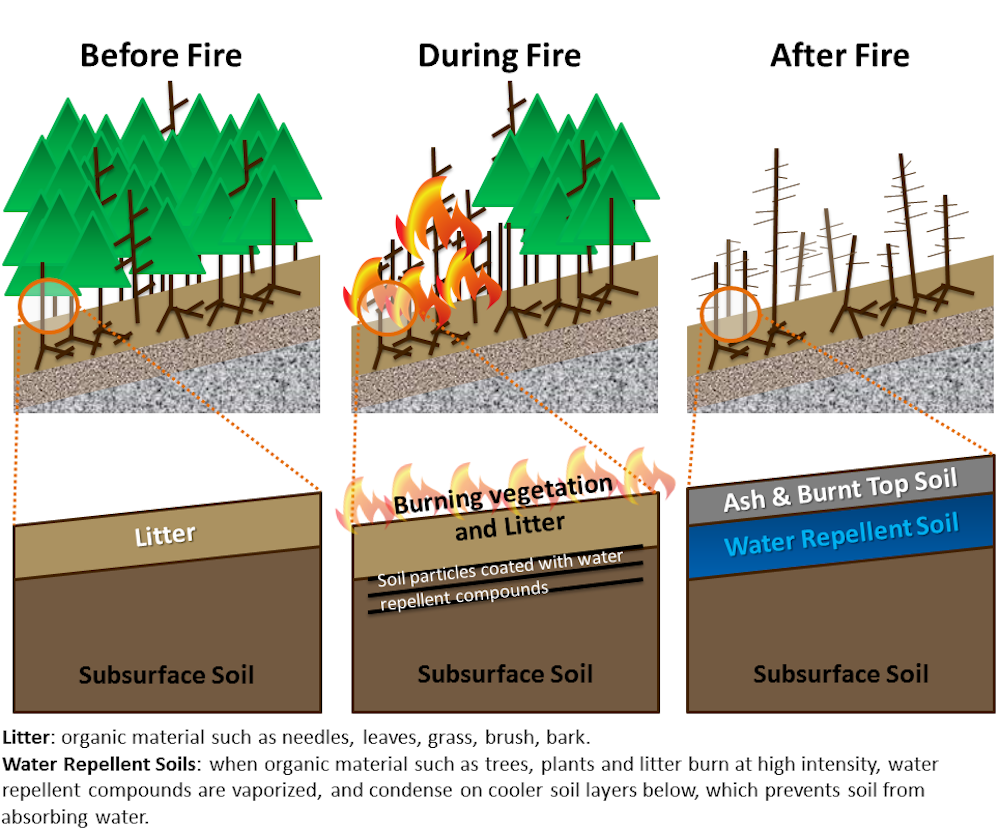
    When severe fires burn hillslopes, the high heat from the fires, sometimes exceeding 1,000 degrees Fahrenheit (538 degrees Celsius), completely destroys trees, shrubs, grass and structures, leaving behind a moonscape of gray ash. Not only that, the heat of the fire actually burns and damages the soil, creating a water-repellent, or hydrophobic, layer.

    What once was a vegetated hillslope, with leaves and trees to intercept rain and spongy soils to absorb water, is transformed into a barren landscape covered with ash, and burned soil where water cannot soak in.

    Illustrations show how fire can change the soil and landscape.
    National Weather Service

    When rain does fall on a burned area like this, water mixes with the ash, rocks and sediment to form a slurry. This slurry of debris then pours downhill in small gullies called rills, which then converge to form bigger and bigger rills, creating a torrent of sediment, water and debris rushing downhill. All this debris and water can transform small streams and usually dry gullies into a danger zone.

    Because the concentration of sediment is so high, especially when there is a large amount of ash and clay, debris flows behave more like a slurry of wet cement than a normal stream. This fluid can pick up and move large boulders, cars, trees and other debris rapidly downhill.

    A firefighter walks through knee-deep mud while checking for victims after a debris flow hit Montecito, Calif., in January 2018.
    Wally Skalij/Los Angeles Times via Getty Images

    In January 2018, a few weeks after the Thomas fire burned through the hills above Montecito, a storm triggered debris flows that killed 23 people and damaged at least 400 homes.

    What controls size and timing of debris flows

    The geography of the land, burn severity, storm intensity and soil characteristics all play important roles in if, when and where debris flows occur.

    Fire and debris flow scientists with the U.S. Geological Survey use these variables to create models to predict the likelihood and possible hazards from postfire debris flows. They are already developing maps to help residents, emergency managers and city officials prepare and predict postfire debris flows in 2025 burn areas in Los Angeles.

    The U.S. Geological Survey modeled debris flow risks after the Palisades Fire near Los Angeles. The map shows some of the highest-risk areas if hit by 15 minutes of rain falling at just under 1 inch (24 millimeters) per hour.
    USGS

    Some of the triggers of debris flows are literally part of the landscape.

    For example, the slope angle in a watershed and the amount of clay in the soil are important. Watersheds with gentle slopes – generally less than about 23 degrees – and a lack of clay and silt-sized particles are unlikely to produce debris flows.

    Other key factors that contribute to postfire debris flows relate to the proportion of the watershed that is severely burned and the intensity and duration of the rainstorm event.

    Early important research in the field of pyrogeomorphology demonstrated that while large, intense storms are more likely to cause large, intense debris flows, even small rainstorms can produce debris flows in burned areas.

    Debris flows are becoming more common

    A whopping 21.8 million Americans live within 3 miles of where a fire burned during the past two decades, and that population more than doubled from 2000 to 2019. A recent study from central and northern California indicates that nearly all the observed increases in area burned by wildfires in recent decades are due to human-caused climate change.

    The warming climate is also increasing the likelihood of more extreme downpours. The amount of moisture the atmosphere can hold increases by about 7% per degree Celsius of warming, leading to more intense downpours, particularly from ocean storms. In California, scientists project increases in rainfall intensity of 18% will result in an overall 110% increase in the probability of major debris flows.

    Jon Frye, of Santa Barbara Public Works, shows what happened in the January 2018 Montecito debris flow and why the risks to downslope communities would continue for several years. Source: County of Santa Barbara, 2018.

    Studies using models of fire, climate and erosion rates estimate that the amount of sediment flowing downhill after fires will increase by more than 10% in nine out of every 10 watersheds in the western U.S.

    Even without rain, debris on fire-damaged slopes can be unstable. A small slide in Pacific Palisades shortly after a fire burned through the area split a home in two. A phenomenon called “dry ravel” is a dominant form of hillslope erosion following wildfires in chaparral environments in Southern California

    Preparing for debris flow risks

    Research on charcoal pieces from ancient debris flows has shown fires and erosion have shaped Earth’s landscape for at least thousands of years. However, the rising risk of wildfires near populated areas and the potential for increasingly intense downpours mean a greater risk of damaging and potentially deadly debris flows.

    As their populations expand, community planners need to be aware of those risks and prepare.

    This article, originally published Jan. 23, 2025, has been updated with rainfall in Los Angeles.

    Jen Pierce receives funding from the National Science Foundation and is the chair of the Quaternary Geology and Geomorphology division of the Geological Society of America.

    ref. LA gets rain, but also risk of flooding and debris flows from wildfire burn scars – a geologist explains the threat – https://theconversation.com/la-gets-rain-but-also-risk-of-flooding-and-debris-flows-from-wildfire-burn-scars-a-geologist-explains-the-threat-247770

    MIL OSI – Global Reports

  • MIL-OSI Global: Rain falling on wildfire burn scars can trigger deadly debris flows – a geologist explains how

    Source: The Conversation – USA – By Jen Pierce, Professor of Geosciences, Boise State University

    A debris flow channel in a severely burned watershed in Idaho. Amirhossein Montazeri/Boise State University, CC BY-ND

    While firefighters work to extinguish the Los Angeles-area wildfires, city officials and emergency managers are also worried about what could come next.

    Light rain began falling on Jan. 25, 2025, helping firefighters who have been battling fires for nearly three weeks, but rain can also trigger dangerous floods and debris flows on burned hillslopes. The National Weather Service issued a flood watch for the burned areas through Jan. 27.

    Debris flows can move with the speed of a freight train, picking up or destroying anything in their path. They can move tons of sediment during a single storm, as Montecito, just up the coast from Los Angeles, saw in 2018.

    What causes these debris flows, sometimes called mudflows, and why are they so common and dangerous after a fire? I am a geologist whose research focuses on pyrogeomorphology, which is how fire affects the land. Here’s what we know.

    How debris flows begin

    When severe fires burn hillslopes, the high heat from the fires, sometimes exceeding 1,000 degrees Fahrenheit (538 degrees Celsius), completely destroys trees, shrubs, grass and structures, leaving behind a moonscape of gray ash. Not only that, the heat of the fire actually burns and damages the soil, creating a water-repellent, or hydrophobic, layer.

    What once was a vegetated hillslope, with leaves and trees to intercept rain and spongy soils to absorb water, is transformed into a barren landscape covered with ash, and burned soil where water cannot soak in.

    Illustrations show how fire can change the soil and landscape.
    National Weather Service

    When rain does fall on a burned area like this, water mixes with the ash, rocks and sediment to form a slurry. This slurry of debris then pours downhill in small gullies called rills, which then converge to form bigger and bigger rills, creating a torrent of sediment, water and debris rushing downhill. All this debris and water can transform small streams and usually dry gullies into a danger zone.

    Because the concentration of sediment is so high, especially when there is a large amount of ash and clay, debris flows behave more like a slurry of wet cement than a normal stream. This fluid can pick up and move large boulders, cars, trees and other debris rapidly downhill.

    A firefighter walks through knee-deep mud while checking for victims after a debris flow hit Montecito, Calif., in January 2018.
    Wally Skalij/Los Angeles Times via Getty Images

    In January 2018, a few weeks after the Thomas fire burned through the hills above Montecito, a storm triggered debris flows that killed 23 people and damaged at least 400 homes.

    What controls size and timing of debris flows

    The geography of the land, burn severity, storm intensity and soil characteristics all play important roles in if, when and where debris flows occur.

    Fire and debris flow scientists with the U.S. Geological Survey use these variables to create models to predict the likelihood and possible hazards from postfire debris flows. They are already developing maps to help residents, emergency managers and city officials prepare and predict postfire debris flows in 2025 burn areas in Los Angeles.

    The U.S. Geological Survey modeled debris flow risks after the Palisades Fire near Los Angeles. The map shows some of the highest-risk areas if hit by 15 minutes of rain falling at just under 1 inch (24 millimeters) per hour.
    USGS

    Some of the triggers of debris flows are literally part of the landscape.

    For example, the slope angle in a watershed and the amount of clay in the soil are important. Watersheds with gentle slopes – generally less than about 23 degrees – and a lack of clay and silt-sized particles are unlikely to produce debris flows.

    Other key factors that contribute to postfire debris flows relate to the proportion of the watershed that is severely burned and the intensity and duration of the rainstorm event.

    Early important research in the field of pyrogeomorphology demonstrated that while large, intense storms are more likely to cause large, intense debris flows, even small rainstorms can produce debris flows in burned areas.

    Debris flows are becoming more common

    A whopping 21.8 million Americans live within 3 miles of where a fire burned during the past two decades, and that population more than doubled from 2000 to 2019. A recent study from central and northern California indicates that nearly all the observed increases in area burned by wildfires in recent decades are due to human-caused climate change.

    The warming climate is also increasing the likelihood of more extreme downpours. The amount of moisture the atmosphere can hold increases by about 7% per degree Celsius of warming, leading to more intense downpours, particularly from ocean storms. In California, scientists project increases in rainfall intensity of 18% will result in an overall 110% increase in the probability of major debris flows.

    Jon Frye, of Santa Barbara Public Works, shows what happened in the January 2018 Montecito debris flow and why the risks to downslope communities would continue for several years. Source: County of Santa Barbara, 2018.

    Studies using models of fire, climate and erosion rates estimate that the amount of sediment flowing downhill after fires will increase by more than 10% in nine out of every 10 watersheds in the western U.S.

    Even without rain, debris on fire-damaged slopes can be unstable. A small slide in Pacific Palisades shortly after a fire burned through the area split a home in two. A phenomenon called “dry ravel” is a dominant form of hillslope erosion following wildfires in chaparral environments in Southern California

    Preparing for debris flow risks

    Research on charcoal pieces from ancient debris flows has shown fires and erosion have shaped Earth’s landscape for at least thousands of years. However, the rising risk of wildfires near populated areas and the potential for increasingly intense downpours mean a greater risk of damaging and potentially deadly debris flows.

    As their populations expand, community planners need to be aware of those risks and prepare.

    This article, originally published Jan. 23, 2025, has been updated with rainfall in Los Angeles.

    Jen Pierce receives funding from the National Science Foundation and is the chair of the Quaternary Geology and Geomorphology division of the Geological Society of America.

    ref. Rain falling on wildfire burn scars can trigger deadly debris flows – a geologist explains how – https://theconversation.com/rain-falling-on-wildfire-burn-scars-can-trigger-deadly-debris-flows-a-geologist-explains-how-247770

    MIL OSI – Global Reports

  • MIL-OSI Africa: Urban food gardens produce more than vegetables, they create bonds for young Capetonians – study

    Source: The Conversation – Africa – By Tinashe P. Kanosvamhira, Post-doctoral researcher, African Centre for Cities, University of Cape Town

    Urban agriculture takes many forms, among them community, school or rooftop gardens, commercial urban farms, and hydroponic or aquaponic systems. These activities have been shown to promote sustainable cities in a number of ways. They enhance local food security and foster economic opportunities through small-scale farming initiatives. They also strengthen social cohesion by creating shared spaces for collaboration and learning.

    However, evidence from some African countries (and other parts of the world) shows that very few young people are getting involved in agriculture, whether in urban, peri-urban or rural areas. Studies from Kenya, Tanzania, Ethiopia and Nigeria show that people aged between 15 and 34 have very little interest in agriculture, whether as an educational pathway or career. They perceive farming as physically demanding, low-paying and lacking in prestige. Systemic barriers like limited access to land, capital and skills also hold young people back.

    South Africa has a higher rate of young people engaging in farming (24%) than elsewhere in sub-Saharan Africa. However, this number could be higher if young people better understood the benefits of a career in farming and if they had more support.

    In a recent study I explored youth-driven urban agriculture in Khayelitsha, a large urban area outside Cape Town whose residents are mostly Black, low-income earners.

    The young urban farmers I interviewed are using community gardens to grow more than vegetables. They’re also nurturing social connections, creating economic and business opportunities, and promoting environmental conservation. My findings highlight the transformative potential of youth-driven urban agriculture and how it can be a multifaceted response to urban challenges. It’s crucial that policy makers recognise the value of youth-led urban agriculture and support those doing the work.

    The research

    Khayelitsha is vibrant and bustling. But its approximately 400,000 residents have limited resources and often struggle to make a living.

    I interviewed members of two youth-led gardens. One has just two members; the other has six. All my interviewees were aged between 22 and 27. The relatively low number of interviewees is typical of qualitative research, where the emphasis is placed on depth rather than breadth. This approach allows researchers to obtain detailed, context-rich data from a small, focused group of participants.

    The first garden was founded in January 2020, just a few months before the pandemic struck. The founders wanted to tackle unemployment and food insecurity in their community. They hoped to create jobs for themselves and others, and to provide nutritional support, particularly for vulnerable groups like children with special needs.

    The second garden was established in 2014 by three childhood friends. They were inspired by one founder’s grandmother, who loved gardening. They also wanted to promote organic farming, teach people healthy eating habits, and create a self-reliant community.

    All of my interviewees were activists for food justice. This refers to efforts aimed at addressing systemic inequities in food production, distribution, and access, particularly for marginalised communities. It advocates for equitable access to nutritious, culturally appropriate food.

    One of the gardens, for instance, operates about 30 beds. It cultivates a variety of produce: beetroot, carrots, spinach, pumpkins, potatoes, radishes, peas, lettuce and herbs. 30% of its produce is donated to local community centres each month (they were unable to say how many people benefited from this arrangement). The rest is sold to support the garden financially. Its paying clients include local restaurants and chefs, and members of the community. The garden also partners with schools, hospitals and other organisations to promote healthy eating and sustainable practices.

    The second garden, which is on land belonging to a local early childhood development centre, also focuses on feeding the community, as well as engaging in food justice activism.

    Skills, resilience and connections

    The gardens also help members to develop skills. Members gain practical knowledge about sustainable agriculture, marketing and entrepreneurship, all while managing operations and planning for growth.


    Read more: Healthy food is hard to come by in Cape Town’s poorer areas: how community gardens can fix that


    This hands-on experience instils a sense of responsibility and gives participants valuable skills they can apply in future careers or ventures. The founder of the first garden told me his skills empowered him to seek help from his own community rather than waiting for government intervention. He approached the management of an early childhood development centre in the community to request space on their land, and this was granted.

    Social connections have been essential to the gardens’ success. Bonding capital (close ties within their networks) and bridging capital (connections beyond their immediate community) has allowed them to strengthen relationships between themselves and civil society organisations. They’ve also been able to mobilise resources, as in the case of the first garden accessing community land.

    Additionally, the gardens foster community resilience. Members host workshops and events to educate residents about healthy eating, sustainable farming and environmental stewardship.

    By donating produce to local early childhood centres, they provide direct benefits to those most in need. These efforts have transformed the gardens into safe spaces for the community.

    Broader collaboration has also been key to the gardens’ success. For instance, the second garden has worked with global organisations and networks, like the Slow Food Youth Network, to share and gain knowledge about sustainable farming practices.

    Room for growth

    My findings highlight the need for targeted support for youth-driven urban agriculture initiatives. Policy and financial backing can enable these young gardeners to expand their efforts. This in turn will allow them to provide more food to their communities, create additional jobs, and empower more young people.

    At a policy level, the government could prioritise land access for urban agriculture projects, especially in under-served communities. Cities can foster an environment for youth initiatives to thrive by allocating spaces within their planning for urban farming.


    Read more: Africa’s megacities threatened by heat, floods and disease – urgent action is needed to start greening and adapt to climate change


    There’s also a need for educational programmes that emphasise the value of sustainable urban agriculture, and workshops and training on entrepreneurship and sustainable farming techniques. Community organising could further empower young farmers. Finally, continued collaboration with national and international food networks would help strengthen such initiatives.

    – Urban food gardens produce more than vegetables, they create bonds for young Capetonians – study
    – https://theconversation.com/urban-food-gardens-produce-more-than-vegetables-they-create-bonds-for-young-capetonians-study-243500

    MIL OSI Africa

  • MIL-OSI Global: Urban food gardens produce more than vegetables, they create bonds for young Capetonians – study

    Source: The Conversation – Africa – By Tinashe P. Kanosvamhira, Post-doctoral researcher, African Centre for Cities, University of Cape Town

    Urban farms like this one in Nouakchott, Mauritania, have many benefits. John Wessels/AFP via Getty Images)

    Urban agriculture takes many forms, among them community, school or rooftop gardens, commercial urban farms, and hydroponic or aquaponic systems. These activities have been shown to promote sustainable cities in a number of ways. They enhance local food security and foster economic opportunities through small-scale farming initiatives. They also strengthen social cohesion by creating shared spaces for collaboration and learning.

    However, evidence from some African countries (and other parts of the world) shows that very few young people are getting involved in agriculture, whether in urban, peri-urban or rural areas. Studies from Kenya, Tanzania, Ethiopia and Nigeria show that people aged between 15 and 34 have very little interest in agriculture, whether as an educational pathway or career. They perceive farming as physically demanding, low-paying and lacking in prestige. Systemic barriers like limited access to land, capital and skills also hold young people back.

    South Africa has a higher rate of young people engaging in farming (24%) than elsewhere in sub-Saharan Africa. However, this number could be higher if young people better understood the benefits of a career in farming and if they had more support.

    In a recent study I explored youth-driven urban agriculture in Khayelitsha, a large urban area outside Cape Town whose residents are mostly Black, low-income earners.

    The young urban farmers I interviewed are using community gardens to grow more than vegetables. They’re also nurturing social connections, creating economic and business opportunities, and promoting environmental conservation. My findings highlight the transformative potential of youth-driven urban agriculture and how it can be a multifaceted response to urban challenges. It’s crucial that policy makers recognise the value of youth-led urban agriculture and support those doing the work.

    The research

    Khayelitsha is vibrant and bustling. But its approximately 400,000 residents have limited resources and often struggle to make a living.

    I interviewed members of two youth-led gardens. One has just two members; the other has six. All my interviewees were aged between 22 and 27. The relatively low number of interviewees is typical of qualitative research, where the emphasis is placed on depth rather than breadth. This approach allows researchers to obtain detailed, context-rich data from a small, focused group of participants.

    The first garden was founded in January 2020, just a few months before the pandemic struck. The founders wanted to tackle unemployment and food insecurity in their community. They hoped to create jobs for themselves and others, and to provide nutritional support, particularly for vulnerable groups like children with special needs.

    The second garden was established in 2014 by three childhood friends. They were inspired by one founder’s grandmother, who loved gardening. They also wanted to promote organic farming, teach people healthy eating habits, and create a self-reliant community.

    All of my interviewees were activists for food justice. This refers to efforts aimed at addressing systemic inequities in food production, distribution, and access, particularly for marginalised communities. It advocates for equitable access to nutritious, culturally appropriate food.

    One of the gardens, for instance, operates about 30 beds. It cultivates a variety of produce: beetroot, carrots, spinach, pumpkins, potatoes, radishes, peas, lettuce and herbs. 30% of its produce is donated to local community centres each month (they were unable to say how many people benefited from this arrangement). The rest is sold to support the garden financially. Its paying clients include local restaurants and chefs, and members of the community. The garden also partners with schools, hospitals and other organisations to promote healthy eating and sustainable practices.

    The second garden, which is on land belonging to a local early childhood development centre, also focuses on feeding the community, as well as engaging in food justice activism.

    Skills, resilience and connections

    The gardens also help members to develop skills. Members gain practical knowledge about sustainable agriculture, marketing and entrepreneurship, all while managing operations and planning for growth.


    Read more:
    Healthy food is hard to come by in Cape Town’s poorer areas: how community gardens can fix that


    This hands-on experience instils a sense of responsibility and gives participants valuable skills they can apply in future careers or ventures. The founder of the first garden told me his skills empowered him to seek help from his own community rather than waiting for government intervention. He approached the management of an early childhood development centre in the community to request space on their land, and this was granted.

    Social connections have been essential to the gardens’ success. Bonding capital (close ties within their networks) and bridging capital (connections beyond their immediate community) has allowed them to strengthen relationships between themselves and civil society organisations. They’ve also been able to mobilise resources, as in the case of the first garden accessing community land.

    Additionally, the gardens foster community resilience. Members host workshops and events to educate residents about healthy eating, sustainable farming and environmental stewardship.

    By donating produce to local early childhood centres, they provide direct benefits to those most in need. These efforts have transformed the gardens into safe spaces for the community.

    Broader collaboration has also been key to the gardens’ success. For instance, the second garden has worked with global organisations and networks, like the Slow Food Youth Network, to share and gain knowledge about sustainable farming practices.

    Room for growth

    My findings highlight the need for targeted support for youth-driven urban agriculture initiatives. Policy and financial backing can enable these young gardeners to expand their efforts. This in turn will allow them to provide more food to their communities, create additional jobs, and empower more young people.

    At a policy level, the government could prioritise land access for urban agriculture projects, especially in under-served communities. Cities can foster an environment for youth initiatives to thrive by allocating spaces within their planning for urban farming.


    Read more:
    Africa’s megacities threatened by heat, floods and disease – urgent action is needed to start greening and adapt to climate change


    There’s also a need for educational programmes that emphasise the value of sustainable urban agriculture, and workshops and training on entrepreneurship and sustainable farming techniques. Community organising could further empower young farmers. Finally, continued collaboration with national and international food networks would help strengthen such initiatives.

    Tinashe P. Kanosvamhira does not work for, consult, own shares in or receive funding from any company or organisation that would benefit from this article, and has disclosed no relevant affiliations beyond their academic appointment.

    ref. Urban food gardens produce more than vegetables, they create bonds for young Capetonians – study – https://theconversation.com/urban-food-gardens-produce-more-than-vegetables-they-create-bonds-for-young-capetonians-study-243500

    MIL OSI – Global Reports

  • MIL-OSI China: Black box of S. Korea’s crashed plane stops recording after bird strike warning

    Source: China State Council Information Office

    This photo shows the site of an airplane crash at the Muan International Airport, some 290 km southwest of Seoul, South Korea, Dec. 29, 2024. [Photo/NEWSIS via Xinhua]

    The black box of an airplane that crashed in South Korea’s southwestern airport late last month stopped recording just a minute after the warning of bird strike, the transport ministry said Saturday.

    The Ministry of Land, Infrastructure and Transport’s aviation railway accident investigation committee held a meeting with the bereaved families to disclose the analysis of the passenger jet’s flight data recorder (FDR) and cockpit voice recorder (CVR).

    The flight control tower warned the ill-fated plane of a possible bird strike just one minute before the jet’s FDR and CVR stopped recording simultaneously.

    Immediately before the discontinued recording, the plane’s power supply was believed to have been cut off as both of its engines collided with birds.

    One of the pilots declared a Mayday, caused by the bird strike, to the control tower during a go-around.

    The airport’s closed-circuit television (CCTV) footage showed that the airplane struck a flock of birds, while feathers and bloodstains of one of the country’s most common winter birds were found from both of the engines.

    On Dec. 29 last year, the passenger jet landed without heels, skidded off the runway and hit a concrete mound equipped with a localizer at the end of the runway at Muan International Airport, some 290 km southwest of the capital Seoul.

    The localizer refers to a part of the instrument landing system providing aircraft with runway centerline guidance.

    A total of 179 of the 181 people aboard the aircraft were confirmed dead. Only two were rescued.

    MIL OSI China News

  • MIL-OSI: Key Tronic Corporation Announces Results for the First Quarter of Fiscal Year 2025

    Source: GlobeNewswire (MIL-OSI)

    SPOKANE VALLEY, Wash., Nov. 05, 2024 (GLOBE NEWSWIRE) — Key Tronic Corporation (Nasdaq: KTCC), a provider of electronic manufacturing services (EMS), today announced its results for the quarter ended September 28, 2024.

    For the first quarter of fiscal year 2025, Key Tronic reported total revenue of $131.6 million, compared to $150.1 million in the same period of fiscal year 2024. Revenue in the first quarter of fiscal year 2025 was adversely impacted by customer-driven design and qualification delays of three programs that we believe impacted revenue by approximately $9 million. These delays have since been resolved on two of these programs and shipments have resumed in the second quarter.   Production in Key Tronic’s Mexico facilities in the first quarter of fiscal year 2025 increased by approximately 10% sequentially from the prior quarter.  

    The Company saw significant improvement in its production efficiencies compared to the first quarter of fiscal year 2024, primarily as a result of recent headcount reductions, continued improvements in the supply chain and a favorable decline in the exchange rate of the Mexican Peso. Gross margins were 10.1% and operating margins were 3.4% in the first quarter of fiscal year 2025, up from 7.2% and 2.2%, respectively, in the same period of fiscal year 2024.

    Net income was $1.1 million or $0.10 per share for the first quarter of fiscal year 2025, compared to net income of $0.3 million or $0.03 per share for the same period of fiscal year 2024.   Adjusted net income was $1.2 million or $0.11 per share for the first quarter of fiscal year 2025, compared to $0.0 million or $0.00 per share for the same period of fiscal year 2024. See “Non-GAAP Financial Measures,” below for additional information about adjusted net income and adjusted net income per share.

    “While we did not meet revenue expectations in our first quarter of fiscal 2025 due to unavoidable delays for a few programs, we are pleased to see our improved operating efficiencies, margins, and liquidity,” said Brett Larsen, President and CEO. “The recent workforce reductions in Mexico, trimming of non-profitable programs, and making a concerted effort to improve working capital are starting to pay off.   We also continued to reduce our inventories, which are now much more in line with our revenue levels. Over the longer term, we expect that these strategic changes will improve our overall profitability.”  

    “During the first quarter, we also continued to win new business, including new programs in manufacturing equipment, vehicle lighting, and commercial pest control.   We believe we are well positioned for increased growth and profitability in coming periods.”

    The financial data presented for the first quarter of fiscal 2025 should be considered preliminary and could be subject to change, as the Company’s independent auditor has not completed their review procedures.

    Business Outlook

    For the second quarter of fiscal 2025, Key Tronic expects to report revenue in the range of $130 million to $140 million and earnings in the range $0.05 to $0.15 per diluted share. These expected results assume an effective tax rate of 20% in the coming quarter.

    Conference Call

    Key Tronic will host a conference call to discuss its financial results at 2:00 PM Pacific (5:00 PM Eastern) today. A broadcast of the conference call will be available at www.keytronic.com under “Investor Relations” or by calling 888-394-8218 or +1-313-209-4906 (Access Code: 7268667). The Company will also reference accompanying slides that can be viewed with the webcast at www.keytronic.com under “Investor Relations”. A replay will be available at www.keytronic.com under “Investor Relations”.

    About Key Tronic

    Key Tronic is a leading contract manufacturer offering value-added design and manufacturing services from its facilities in the United States, Mexico, China and Vietnam. The Company provides its customers with full engineering services, materials management, worldwide manufacturing facilities, assembly services, in-house testing, and worldwide distribution. Its customers include some of the world’s leading original equipment manufacturers. For more information about Key Tronic visit: www.keytronic.com

    Forward-Looking Statements

    Some of the statements in this press release are forward-looking statements within the meaning of the Private Securities Litigation Reform Act of 1995. Forward-looking statements include, but are not limited to those including such words as aims, anticipates, believes, continues, estimates, expects, hopes, intends, plans, predicts, projects, targets, will, or would, similar verbs, or nouns corresponding to such verbs, which may be forward looking. Forward-looking statements also include other passages that are relevant to expected future events, performances, and actions or that can only be fully evaluated by events that will occur in the future. Forward-looking statements in this release include, without limitation, the Company’s statements regarding its expectations with respect to financial conditions and results, including revenue and earnings, cost savings from headcount reduction and the Mexican Peso exchange rate, demand for certain products and the effectiveness of some of its programs, business from customers and programs, and impacts from operational streamlining and efficiencies. There are many factors, risks and uncertainties that could cause actual results to differ materially from those predicted or projected in forward-looking statements, including but not limited to: the future of the global economic environment and its impact on our customers and suppliers; the availability of components from the supply chain; the availability of a healthy workforce; the accuracy of suppliers’ and customers’ forecasts; development and success of customers’ programs and products; timing and effectiveness of ramping of new programs; success of new-product introductions; the risk of legal proceedings or governmental investigations relating to the previously reported financial statement restatements and related material weaknesses, the May 2024 cybersecurity incident and the subject of the internal investigation by the Company’s Audit Committee and related or other unrelated matters; acquisitions or divestitures of operations or facilities; technology advances; changes in pricing policies by the Company, its competitors, customers or suppliers; impact of new governmental legislation and regulation, including tax reform, tariffs and related activities, such trade negotiations and other risks; and other factors, risks, and uncertainties detailed from time to time in the Company’s SEC filings.

    Non-GAAP Financial Measures

    To supplement our consolidated financial statements, which are prepared in accordance with generally accepted accounting principles in the United States (GAAP), we use certain non-GAAP financial measures, adjusted net income and adjusted net income per share, diluted. We provide these non-GAAP financial measures because we believe they provide greater transparency related to our core operations and represent supplemental information used by management in its financial and operational decision making. We exclude (or include) certain items in our non-GAAP financial measures as we believe the net result is a measure of our core business. We believe this facilitates operating performance comparisons from period to period by eliminating potential differences caused by the existence and timing of certain income and expense items that would not otherwise be apparent on a GAAP basis. Non-GAAP performance measures should be considered in addition to, and not as a substitute for, results prepared in accordance with GAAP. We strongly encourage investors and shareholders to review our financial statements and publicly-filed reports in their entirety and not to rely on any single financial measure. Our non-GAAP financial measures may be different from those reported by other companies. See the table below entitled “Reconciliation of GAAP to non-GAAP measures” for reconciliations of adjusted net income to the most directly comparable GAAP measure, which is GAAP net income, and the computation of adjusted net income per share, diluted.

     
    KEY TRONIC CORPORATION AND SUBSIDIARIES
    CONSOLIDATED STATEMENTS OF OPERATIONS
    (In thousands, except per share amounts)
    (Unaudited)
     
      Three Months Ended
      September 28, 2024   September 30, 2023
    Net sales $ 131,558     $ 150,112  
    Cost of sales   118,255       139,250  
    Gross profit   13,303       10,862  
    Research, development and engineering expenses   2,289       2,241  
    Selling, general and administrative expenses   6,570       5,784  
    Gain on insurance proceeds, net of losses         (431 )
    Total operating expenses   8,859       7,594  
    Operating income   4,444       3,268  
    Interest expense, net   3,263       3,011  
    Income before income taxes   1,181       257  
    Income tax (benefit) provision   57       (78 )
    Net income $ 1,124     $ 335  
    Net income per share — Basic $ 0.10     $ 0.03  
    Weighted average shares outstanding — Basic   10,762       10,762  
    Net income per share — Diluted $ 0.10     $ 0.03  
    Weighted average shares outstanding — Diluted   10,762       11,003  
     
    KEY TRONIC CORPORATION AND SUBSIDIARIES
    CONSOLIDATED BALANCE SHEETS
    (In thousands)
    (Unaudited)
     
        September 28, 2024   June 29, 2024
    ASSETS        
    Current assets:        
    Cash and cash equivalents   $ 6,555     $ 4,752  
    Trade receivables, net of credit losses of $3,129 and $2,918     133,984       132,559  
    Contract assets     23,626       21,250  
    Inventories, net     95,845       105,099  
    Other, net of credit losses of $1,642 and $1,679     28,273       24,739  
    Total current assets     288,283       288,399  
    Property, plant and equipment, net     27,910       28,806  
    Operating lease right-of-use assets, net     14,612       15,416  
    Other assets:        
    Deferred income tax asset     18,394       17,376  
    Other     6,735       5,346  
    Total other assets     25,129       22,722  
    Total assets   $ 355,934     $ 355,343  
    LIABILITIES AND SHAREHOLDERSEQUITY        
    Current liabilities:        
    Accounts payable   $ 83,768     $ 79,394  
    Accrued compensation and vacation     6,870       6,510  
    Current portion of long-term debt     3,057       3,123  
    Other     18,450       15,149  
    Total current liabilities     112,145       104,176  
    Long-term liabilities:        
    Long-term debt, net     109,675       116,383  
    Operating lease liabilities     9,573       10,312  
    Deferred income tax liability     74       263  
    Other long-term obligations     124       219  
    Total long-term liabilities     119,446       127,177  
    Total liabilities     231,591       231,353  
    Shareholders’ equity:        
    Common stock, no par value—shares authorized 25,000; issued and outstanding 10,762 and 10,762 shares, respectively     47,351       47,284  
    Retained earnings     78,045       76,921  
    Accumulated other comprehensive income (loss)     (1,053 )     (215 )
    Total shareholders’ equity     124,343       123,990  
    Total liabilities and shareholders’ equity   $ 355,934     $ 355,343  
             
    KEY TRONIC CORPORATION AND SUBSIDIARIES
    Reconciliation of GAAP to non-GAAP measures
    (In thousands, except per share amounts)
    (Unaudited)
     
      Three Months Ended
      September 28, 2024   September 30, 2023
    GAAP net income $ 1,124     $ 335  
    Gain on insurance proceeds (net of losses)         (431 )
    Stock-based compensation expense   67       59  
    Income tax effect of non-GAAP adjustments (1)   (13 )     74  
    Adjusted net income: $ 1,178     $ 37  
           
    Adjusted net income per share — non-GAAP Diluted $ 0.11     $ 0.00  
    Weighted average shares outstanding — Diluted   10,762       11,003  
           
    (1) Income tax effects are calculated using an effective tax rate of 20%, which approximates the statutory GAAP tax rate for the presented periods.
             
    CONTACTS:   Tony Voorhees   Michael Newman
        Chief Financial Officer   Investor Relations
        Key Tronic Corporation   StreetConnect
        (509)-927-5345   (206) 729-3625

    The MIL Network

  • MIL-OSI Security: Defendant Pleads Guilty to Federal Kidnapping and Carjacking Charges

    Source: Federal Bureau of Investigation (FBI) State Crime Alerts (b)

                WASHINGTON – David Zanders, 22, of Washington D.C., pleaded guilty today in U.S. District Court to one count of federal kidnapping and one count of carjacking, stemming from an incident on May 1, 2022, announced U.S. Attorney Matthew Graves; FBI Acting Special Agent in Charge David Geist, of the Washington Field Office’s Criminal and Cyber Division; and Chief Pamela Smith, of the Metropolitan Police Department.

                U.S. District Court Judge Royce C. Lamberth scheduled a sentencing hearing for March 4, 2024. The defendant was arrested on November 18, 2022, and has been detained ever since.

                According to the court documents, in the early morning hours of May 1, 2022, Zanders and a conspirator kidnapped two males outside of a nightclub located at 645 Florida Avenue, NW, Washington, D.C. The pair posed as an Uber and the two male victims subsequently got into the defendant’s vehicle. Shortly thereafter, Zanders pulled over on a neighborhood street in Washington, D.C., pointed a firearm at the two victims and robbed them of their phones and money. The victims were then driven around so the kidnappers could attempt to withdraw money using the victims’ credit cards. One of the victims was able to escape at a gas station in Washington D.C., when Zanders and the other suspect were looking for an ATM.  After the first victim escaped, the second victim was driven to a supermarket in Maryland. The defendant and his cohort then retrieved money from an ATM at the supermarket using the second victim’s ATM card. The second victim was then driven to another location in Maryland and released.

                That same evening, Zanders, his cohort and a third individual met at 955 Longfellow Street, NW, Washington, D.C. Zanders had arranged a meeting with two additional victims where he was purporting to sell his vehicle but was, in fact, going to take their vehicle. When the two victims arrived in their vehicle, a 2019 green Dodge Charger, Zanders pulled out a gun, threatened to shoot the third victim, and demanded his phone, money and keys. The additional suspects turned towards the fourth victim and demanded the car keys. The fourth victim complied and one of the suspects then drove away with the 2019 green Dodge Charger. Zanders and the additional suspect then drove away in their own vehicles and fled the scene.  

                Zanders faces a statutory maximum sentence of life in prison for kidnapping and 15 years for carjacking. A federal district court judge will determine any sentence after considering the U.S. Sentencing Guidelines and other statutory factors.

                In announcing the plea, U.S. Attorney Graves, SAC Geist, and Chief Smith commended the MPD officers and FBI agents who collaborated on the investigation as members of MPD’s Violent Crime Suppression Unit and FBI’s Washington Field Office’s Violent Crimes Task Force. Valuable assistance was provided by the Prince George’s County Police Department.

                The case was prosecuted by Assistant U.S. Attorney Shehzad Akhtar and Assistant U.S. Attorney Cameron Tepfer and by former Special Assistant U.S. Attorney Lauren Renaud.  The case was initially investigated and indicted by Assistant U.S. Attorney Thomas Strong.

    MIL Security OSI

  • MIL-OSI Security: Romance Scammer Who Took U.S. Citizens Hostage in the Dominican Republic Sentenced to 25 Years in Prison

    Source: Federal Bureau of Investigation (FBI) State Crime Alerts (b)

                WASHINGTON – Deivy Jose Rodriguez Delgado, 30, a Venezuelan national, was sentenced today in U.S. District Court for the District of Columbia to 25 years in federal prison for the 2022 armed hostage takings of three U.S. citizens in the Dominican Republic, announced U.S. Attorney Matthew M. Graves and FBI Special Agent in Charge Jeffrey B. Veltri of the Miami Field Office.

                On December 11, 2023, after a nearly two week trial, a jury convicted Delgado of one count of conspiracy to commit hostage taking and three counts of hostage taking. In addition to the prison sentence, U.S. District Court Chief Judge James E. Boasberg ordered Delgado to serve five years of supervised release. Following his release from prison, Delgado will be subject to deportation proceedings. 

                According to the government’s evidence, Delgado, also known as “Sebastian,” kidnapped three men in separate instances between July 5 and July 30, 2022. In each of the three hostage-takings, Delgado lured his victim online with the promise of a friendly “date” and picked the victim up in his car. After driving a short distance, Delgado suddenly stopped to let an accomplice into the backseat, at which point Delgado and his accomplice held the victim at knifepoint, physically restrained the victim, and demanded ransom for his release. Delgado ordered that the ransoms be paid to online banking accounts, including the same CashApp account.

                Each of the three victims was forced at knifepoint to call his friends and family and ask for money to secure his release. The victims were held in captivity by Delgado and his accomplice(s) for up to an hour and were only released after Delgado believed a ransom payment had been made by the victims’ friends and family. In all three hostage takings, the victims were also robbed of their personal belongings before being released on the streets of the Dominican Republic.

                Following multiple victim reports, Dominican authorities began an investigation in August 2022. Local law enforcement in the Dominican Republic traced a vehicle used in one of the hostage takings to Delgado and arrested him on Sept. 14, 2022. During a search of the vehicle, Dominican authorities found two serrated knifes like those used in the hostage takings.

                This case was investigated by the FBI’s Miami Field Office with valuable assistance provided by the Justice Department’s Office of International Affairs and the Dominican Republic’s Division Especial de Investigacion de Crimen Organizado Internacional (DECROI). The case was prosecuted by Assistant U.S. Attorneys John Korba and Jolie Zimmerman of the U.S. Attorney’s Office for the District of Columbia with assistance from paralegal Michael Watts. 

    ##

               Deivy Jose Rodriguez Delgado, 30, a Venezuelan national, used this image of himself to meet his victims on a social media dating application.


    During a search of the vehicle linked to Delgado, Dominican authorities found two serrated knifes like those used in the hostage takings.

    An image Delgado used on his social media app to lure victims.

    ##

    22cr0304

    MIL Security OSI

  • MIL-OSI Security: Sapotaweyak Cree Nation — Swan River RCMP lay numerous charges in robbery

    Source: Royal Canadian Mounted Police

    On November 2, 2024, at 3:25 pm, Swan River RCMP responded to a report of a 24-year-old male having assaulted several people and was now walking around the community with a firearm.

    As officers arrived in the community, information was received that the suspect had fled the area after being picked up in a vehicle.

    Patrols were made and the suspect vehicle was located at the gas bar in Mafeking. A traffic stop was conducted on this vehicle that led to the arrest of the 24-year-old male, a 27-year-old male and a 40-year-old female. The 24-year-old male suspect had been found lying in the back of the vehicle with a loaded sawed-off shotgun, machete and ammunition.

    The investigation has determined that the 24-year-old male had assaulted two male victims (22, 20), threatened to harm them and forced them to empty their pockets and turn over their cell phones all while having the firearm pointed at them.

    24-year-old Chandler Cook and 27-year-old Travis Cook, both from Sapotaweyak Cree Nation, were remanded into custody on charges including Careless Use of a Firearm x2, Point Firearm x2, Robbery with Firearm x2 as well as numerous other firearm-related offences.

    The 40-year-old female, from Brandon, was later released from custody for a future court appearance in Swan River.

    Swan River RCMP continue to investigate.

    MIL Security OSI

  • MIL-OSI Security: Springhill — Cumberland County District RCMP investigating suspicious circumstances

    Source: Royal Canadian Mounted Police

    Cumberland County District RCMP is seeking assistance to identify a man following a suspicious incident in Springhill.

    On November 4, RCMP officers responded to a report of a suspicious person on Pine St. Investigators learned that at approximately 5:00 p.m., a man driving a truck stopped on the roadway and waved to a child outside a nearby home in an attempt to have them approach his vehicle.

    Based on there having been a significant distance between the child and the road, the child is not believed to have been at risk of physical harm during this incident. The child quickly informed an adult, and the vehicle left the area. Police did patrols but the vehicle was not located.

    “This child did the right thing by immediately telling an adult about this incident,” says Sgt. Brian Cameron, Operations NCO of Cumberland County District RCMP. “We don’t know the driver’s intent and would like to hear from him.”

    The male driver had brown hair and a mask that covered his nose and mouth. He was wearing a sweater and pants, possibly blue and green. The pick-up truck was silver in colour.

    Police want to speak with people who have information about this incident, as well as anyone who has witnessed or experienced a similar incident in the area. Anyone with information is asked to contact Cumberland County District RCMP at 902-243-2181. To remain anonymous, contact Nova Scotia Crime Stoppers, toll-free, at 1-800-222-TIPS (8477), submit a secure web tip at www.crimestoppers.ns.ca, or use the P3 Tips app.

    MIL Security OSI

  • MIL-OSI Security: Canton Man Sentenced to Five Years in Prison for Possession of Firearm by a Convicted Felon

    Source: United States Bureau of Alcohol Tobacco Firearms and Explosives (ATF)

    Jackson, MS – A Canton man was sentenced to 5 years in federal prison for possession of a firearm by a convicted felon.

    According to court documents, on January 2, 2024, Damonik Robinson, 23, was found in possession of a firearm after Capitol Police conducted a traffic stop on Madison Street near Fortification Street in Jackson. There were four firearms found in the vehicle, three of which were equipped with attached machinegun conversion devices, commonly known as “switches,” which convert semi-automatic handguns to automatic weapons.  At the time of this possession, Robinson already had a previous felony conviction for drug and gun possession. It is a violation of federal law for a convicted felon to possess a firearm or ammunition.

    Robinson was indicted by a federal grand jury on February 21, 2024.  He pled guilty on July 18, 2024, to possession of a firearm by a convicted felon.

    The U.S. Attorney’s Office has seen an increase in cases involving illegal firearm conversion devices, commonly known as “switches” or “auto sears,” which convert semi-automatic handguns into fully automatic weapons (i.e., machineguns) in a matter of seconds. The rapid fire of firearms converted to machineguns presents a significant danger in our community to both the public and law enforcement.  According to a 2023 report by the Bureau of Alcohol Tobacco, Firearms and Explosives (ATF), there was a 570% increase in the number of machinegun conversion devices taken into ATF custody between 2017 and 2021.

    U.S. Attorney Todd W. Gee and Special Agent in Charge Joshua Jackson of the Bureau of Alcohol, Tobacco, Firearms and Explosives made the announcement.

    The ATF and Capitol Police Department are investigating the case.

    Assistant U.S. Attorney Amber Jones is prosecuting the case.

    This case is part of Project Safe Neighborhoods (PSN), a program bringing together all levels of law enforcement and the communities they serve to reduce violent crime and gun violence, and to make our neighborhoods safer for everyone. On May 26, 2021, the department launched a violent crime reduction strategy strengthening PSN based on these core principles: fostering trust and legitimacy in our communities, supporting community-based organizations that help prevent violence from occurring in the first place, setting focused and strategic enforcement priorities, and measuring the results.

    MIL Security OSI

  • MIL-OSI Global: No, America’s battery plant boom isn’t going bust – construction is on track for the biggest factories, with thousands of jobs planned

    Source: The Conversation – USA – By James Morton Turner, Professor of Environmental Studies, Wellesley College

    Workers install battery packs in a BMW X5 in South Carolina. A new battery plant under construction nearby will supply BMW factories. BMW

    The United States is in the midst of the biggest boom in clean energy manufacturing investments in history, spurred by laws like the bipartisan Infrastructure Investment and Jobs Act and the Inflation Reduction Act.

    These laws have leveraged billions of dollars in government support to drive private sector investments in clean energy supply chains across the country.

    For several years, one of us, Jay Turner, and his students at Wellesley College have been tracking clean energy investments in the U.S. and sharing the data at The Big Green Machine website. That research shows that companies have announced 225 projects, totaling US$127 billion in investment, and more than 131,000 new jobs since the Inflation Reduction Act became law in 2022.

    You may have seen news stories that said these projects are at risk of failure or significant delays. In August 2024, the Financial Times reported that 40% of more than 100 projects it evaluated were delayed. These included battery manufacturing, renewable energy projects and metals and hydrogen projects, as well as semiconductor manufacturing plants. More recently, The Information, which covers the technology industry, warned that 1 in 4 companies were walking away from government-supported grants for battery investments.

    Workers assemble battery packs for electric vehicles in Spartanburg, S.C. New battery plants in the state will help move the supply chain closer to U.S. EV factories.
    BMW

    We checked up on all 23 battery cell factories announced or expanded since the Inflation Reduction Act was signed – almost all of them gigafactories, which are designed to produce over 1 gigawatt-hour of battery cell capacity. These factories have some of the largest employment potential of any project supported by the act.

    We wanted to find out if the boom in U.S.-based clean energy manufacturing is about to go bust. What we have learned is mostly reassuring.

    The biggest battery factories are on track

    While the exact investment totals are challenging to pin down, our research shows that planned capital expenditures add up to $52 billion, which would support 490 gigawatt-hours of battery manufacturing capacity per year – enough to put roughly 5 million new electric vehicles on the road.

    While not all 23 companies have announced their hiring plans, these facilities are expected to support nearly 30,000 new jobs, with projects mostly in the U.S. Southeast, Midwest and Southwest.

    We wanted to know if these projects are on track or experiencing delays or problems.

    To do that, we first reached out to local and state economic development agencies. In many instances, local and state tax incentives are supporting these projects. Where possible, we sought to confirm the project’s status through public data or formal announcements. In other instances, we looked for news stories to see if there is evidence of construction or hiring.

    Of the 23 projects, our research shows that 13 appear to be on track, with total planned capital investments in excess of $40 billion and nearly 352 gigawatt-hours per year of capacity. Importantly, these include most of the biggest projects with the largest investments and projected production.

    By our count, 77% of the total planned capital investment, 79% of the proposed jobs and 72% of the planned battery production are on track, which means that a project is likely to happen, roughly on time, and generally with their expected level of investment and employment.

    Three projects are on the bubble. These have shown progress but experienced delays in construction or financing.

    Five others show deeper signs of distress. We don’t yet have enough information to draw a conclusion on two projects.

    An example of a project that is on track is Envision AESC’s battery factory in Florence, South Carolina. Its scale has been expanded twice since it was first announced in December 2022. It is now a $3 billion investment intended to manufacture 30 gigawatt-hours of batteries annually to supply BMW’s factory in Woodruff, South Carolina.

    In early October 2024, South Carolina Secretary of Commerce Harry Lightsey conducted a tour of the Envision site and posted a video. Construction on the plant started in February 2024, and 850 workers are working six days a week to finish the 1.4 million-square-foot facility by August 2025. Once it goes into full production, the project is expected to employ 2,700 people.

    2024 election could end or accelerate the boom

    But a lot hinges on what happens in the upcoming elections.

    Our data suggests the real risk that these projects and projects like them face isn’t slow demand for electric vehicles, as some people have suggested – in fact, demand continues to climb. Nor is it local opposition, which has slowed only a few projects.

    The biggest risk is policy change. Many of these projects are counting on Advanced Manufacturing Tax Credits authorized by the Inflation Reduction Act through 2032.

    On the campaign trail, Republicans up and down the ticket are promising to repeal key Biden-led legislation, including the Inflation Reduction Act, which includes grant funding and loans to support clean energy as well as tax incentives to support domestic manufacturing.

    While full repeal of the act may be unlikely, an administration hostile to clean energy could divert its unspent funds to other purposes, slow the pace of grants or loans by slow-walking project approvals, or find other ways to make the tax incentives harder to get. While our research has focused on the battery industry, this concern extends to investments in wind and solar power too.

    So, is the big boom in U.S.-based clean energy manufacturing about to go bust? Our data is optimistic, but the politics is uncertain.

    Joshua Busby receives funding from the U.S. Department of Defense. He is affiliated with the Center for Climate and Security and the Chicago Council on Global Affairs.

    James Morton Turner and Nathan Jensen do not work for, consult, own shares in or receive funding from any company or organization that would benefit from this article, and have disclosed no relevant affiliations beyond their academic appointment.

    ref. No, America’s battery plant boom isn’t going bust – construction is on track for the biggest factories, with thousands of jobs planned – https://theconversation.com/no-americas-battery-plant-boom-isnt-going-bust-construction-is-on-track-for-the-biggest-factories-with-thousands-of-jobs-planned-242567

    MIL OSI – Global Reports

  • MIL-OSI New Zealand: Offenders caught after aggravated robbery with machete

    Source: New Zealand Police (District News)

    At about 6am this morning, four people armed with a large machete and other weapons entered the Te Ngai Road Caltex Service Station in Owhata, Rotorua.

    They threatened a staff member, stole cash, vape products and cigarettes.

    The offenders then left in a stolen vehicle which they dumped nearby.

    After calls from the public alerting Police to the location of the vehicle, a police dog and handler tracked the offenders to a nearby address.

    Three youth offenders were arrested and are facing charges of aggravated robbery and unlawfully taking a motor vehicle.

    The offenders are from Hamilton and Rotorua. The property stolen has been recovered along with the weapons used in the incident.

    The vehicle used which was stolen from Hamilton overnight has been recovered and will be returned to its owner.

    Inspector Phil Gillbanks, Rotorua Area Prevention Manager says “Police would like to thank the members of the public who were alert enough to notice suspicious activity and call Police right away.

    We will not tolerate this behaviour and will take enforcement action where appropriate to keep our community safe. It is good to be able to recover the stolen items, including the vehicle used, and make these arrests.

    Let this be a reminder that Police will continue to hold to account, those offenders choosing to behave like this. It is very lucky no one was  injured.

    Like the witnesses did in this case, always call Police straight away on 111 if you see or suspect anything suspicious happening.”

    You can also make a report after the fact, using our 105 service, either by phone or online.

    ENDS

    Issued by Police Media Centre

    MIL OSI New Zealand News

  • MIL-OSI China: China-Europe SMILE satellite to depart for Europe

    Source: People’s Republic of China – State Council News

    China-Europe SMILE satellite to depart for Europe

    Updated: November 6, 2024 09:01 Xinhua
    Technicians check the Solar Wind Magnetosphere Ionosphere Link Explorer (SMILE) at a workshop of the Innovation Academy for Microsatellites of Chinese Academy of Sciences (CAS) in Shanghai, east China, Nov. 4, 2024. The SMILE is a joint mission between the CAS and the European Space Agency (ESA) that aims to deepen the understanding of the Sun-Earth connection by observing the dynamic interaction between the solar wind and the Earth’s magnetosphere. The SMILE satellite has completed the development work in China, including satellite testing, system interface testing and environmental experiments, according to the National Space Science Center of the CAS. The SMILE is about to depart for Europe. It is scheduled for launch by the end of 2025 from Europe’s space launch site in Kourou, French Guiana, by Arianespace’s Vega-C launch vehicle. [Photo/Xinhua]
    A technician checks the Solar Wind Magnetosphere Ionosphere Link Explorer (SMILE) at a workshop of the Innovation Academy for Microsatellites of Chinese Academy of Sciences (CAS) in Shanghai, east China, Nov. 4, 2024. [Photo/Xinhua]
    A technician checks the Solar Wind Magnetosphere Ionosphere Link Explorer (SMILE) at a workshop of the Innovation Academy for Microsatellites of Chinese Academy of Sciences (CAS) in Shanghai, east China, Nov. 4, 2024. [Photo/Xinhua]
    A technician measures the Solar Wind Magnetosphere Ionosphere Link Explorer (SMILE) at a workshop of the Innovation Academy for Microsatellites of Chinese Academy of Sciences (CAS) in Shanghai, east China, Nov. 4, 2024. [Photo/Xinhua]
    Technicians check the Solar Wind Magnetosphere Ionosphere Link Explorer (SMILE) at a workshop of the Innovation Academy for Microsatellites of Chinese Academy of Sciences (CAS) in Shanghai, east China, Nov. 4, 2024. [Photo/Xinhua]
    Technicians pack the battery pack of the Solar Wind Magnetosphere Ionosphere Link Explorer (SMILE) at a workshop of the Innovation Academy for Microsatellites of Chinese Academy of Sciences (CAS) in Shanghai, east China, Nov. 4, 2024. [Photo/Xinhua]
    Customs officers check the packages for the Solar Wind Magnetosphere Ionosphere Link Explorer (SMILE) at a workshop of the Innovation Academy for Microsatellites of Chinese Academy of Sciences (CAS) in Shanghai, east China, Nov. 4, 2024. [Photo/Xinhua]
    A technician checks the Solar Wind Magnetosphere Ionosphere Link Explorer (SMILE) at a workshop of the Innovation Academy for Microsatellites of Chinese Academy of Sciences (CAS) in Shanghai, east China, Nov. 4, 2024. [Photo/Xinhua]
    A technician packs the battery pack of the Solar Wind Magnetosphere Ionosphere Link Explorer (SMILE) at a workshop of the Innovation Academy for Microsatellites of Chinese Academy of Sciences (CAS) in Shanghai, east China, Nov. 4, 2024. [Photo/Xinhua]
    Technicians measure the Solar Wind Magnetosphere Ionosphere Link Explorer (SMILE) at a workshop of the Innovation Academy for Microsatellites of Chinese Academy of Sciences (CAS) in Shanghai, east China, Nov. 4, 2024. [Photo/Xinhua]
    A technician checks the Solar Wind Magnetosphere Ionosphere Link Explorer (SMILE) at a workshop of the Innovation Academy for Microsatellites of Chinese Academy of Sciences (CAS) in Shanghai, east China, Nov. 4, 2024. [Photo/Xinhua]

    MIL OSI China News

  • MIL-OSI China: Chinese auto brand unveils 1st off-road model in Egypt

    Source: China State Council Information Office

    Visitors pose for photos at the launching ceremony of Jetour Auto’s first off-road SUV model T2 in Cairo, Egypt, Nov. 4, 2024. [Photo/Xinhua]

    Jetour Auto, a Chinese auto brand, unveiled its first off-road SUV model, namely T2, on Monday evening.

    Under the theme of “Travel Together,” the launching ceremony held by Jetour at the Saladin Citadel, one of the most famous landmarks in the Egyptian capital of Cairo, attracted more than 600 guests from Egypt and China, including auto dealers, auto experts, internet influencers, and media representatives.

    “T2 is our first off-road model launched in Egypt … After its debut in the UAE (United Arab Emirates), Saudi Arabia, and other countries in the Middle East in the first quarter of 2024, it rapidly became the best-selling boxy SUV in the region,” said Yuan Anguo, vice president of Jetour International Marketing Company.

    According to the Chinese auto brand established in 2018, Jetour’s cumulative sales have now exceeded 1.22 million worldwide.

    In the first three quarters of 2024, a total of 4.312 million complete vehicles were exported from China to markets worldwide, a year-on-year increase of 27.3 percent, showed the latest data from the China Association of Automobile Manufacturers.

    MIL OSI China News

  • MIL-OSI China: Global companies debut cutting-edge technologies

    Source: China State Council Information Office

    This photo taken on Nov. 4, 2024 shows the automobile exhibition area of the 7th China International Import Expo (CIIE) at the National Exhibition and Convention Center (Shanghai) in Shanghai, east China. [Photo/Xinhua]

    With the seventh China International Import Expo (CIIE) in full swing in Shanghai, global companies are unveiling their latest technological innovations, capitalizing on the opportunities arising from China’s commitment to further opening up both its market and manufacturing industry.

    GE Healthcare, a regular exhibitor at the CIIE, has brought an unprecedented lineup to Shanghai this year. The U.S. medical technology company is showcasing multiple products either making their global or Chinese debut.

    Eyeing China’s growing demand for advanced medical technology, GE Healthcare is exhibiting its largest collection of new products ever at this year’s expo, where it has been participating since 2018, said Zhong Luyin, the company’s China communications executive.

    “Our goal extends beyond mere participation in the expo. More importantly, we look forward to engaging in China,” Zhong said.

    A stage for all

    At the ongoing CIIE, over 400 new products, technologies and services from around the world are being showcased, spanning sectors such as artificial intelligence, new materials, autonomous systems and energy transition technologies.

    During a meeting on Monday with select exhibitors and buyers attending the expo, Chinese Premier Li Qiang said that China is able to sustain steady economic recovery, improve the quality and capacity of its market, and provide more extensive growth space for global businesses in terms of trade, investment and innovation. He added that the Chinese market is still one of the best choices for companies worldwide.

    Just days ago, China removed all market access restrictions for foreign investors in the manufacturing sector, with the country’s new edition of its national negative list for foreign investment having taken effect on Nov. 1. This significant move marked the latest effort of the world’s second-largest economy to open its doors even wider.

    “Benefiting from the ‘spillover effect’ of the expo, many of our showcased products are now in use across Chinese hospitals,” said Lu Yi, MRI marketing manager of Siemens Healthineers. At this year’s CIIE, the German medical technology company is unveiling the MAGNETOM Terra.X, its latest generation of magnetic resonance imaging (MRI) equipment — the first time this new equipment is being displayed in Asia.

    Lu revealed that Siemens Healthineers is advancing its localization strategy for cutting-edge product manufacturing. Notably, the MAGNETOM Terra.X is slated for future production at the company’s base in Shenzhen, south China’s Guangdong Province.

    Apart from traditional technological sectors, the ongoing expo showcases an array of futuristic exhibits that seem straight out of the world of science fiction, including tires designed for lunar exploration vehicles, electric vertical takeoff and landing (eVTOL) aircraft, and innovative motor-powered shoes.

    French tire maker Michelin, which is attending the expo for a fourth year, is exhibiting a futuristic prototype wheel for lunar exploration vehicles, among other products including car tires containing 71 percent sustainable materials and a new generation aircraft tire.

    Serge Godefroid, research and development director of Michelin China, said Michelin has been innovating for the future of mobility and is even thinking about mobility beyond the Earth for future lunar or Mars exploration projects.

    Michelin is already extensively testing tires in very rough conditions and with exposure to the range of temperatures that exist on the moon, Godefroid said. “You don’t have somebody to help you inflate a tire on the moon, so you need to find a wheel that can sustain very difficult conditions.”

    Rising innovation landscape

    A number of eVTOL aircraft are proving eye-catching at this year’s CIIE. Vertaxi, an eVTOL startup which is attending the expo jointly with Ampaire, a global leader in hybrid electric aircraft systems, has brought three autonomous eVTOL drones to the 2024 expo.

    Yue Tingting, vice president of Vertaxi, said the company’s smaller eVTOL aircraft have been well received by the market and are being widely used for police, emergency and fire-fighting patrols, public and oil infrastructure inspections, and island logistics.

    Yue admitted that it will take longer for the company’s eVTOL aircraft to obtain the airworthiness certification needed for passenger transport. She, however, is very bullish about China’s low-altitude economy and even envisions a future where people will be able to board eVTOL aircraft for daily commuting, much like taking a taxi or bus.

    Shift Robotics, attending the expo for the first time, is exhibiting its new generation of motor-powered shoes, called Moonwalkers Aero, that allow people to walk at speeds of up to 11 km per hour.

    Moonwalkers deliver smooth power when people who wear them speed up, while they offer very little assistance if the person wearing them walks very slowly. These motor-powered shoes can be used in virtually any environment, even on the subway, in a lift or on stairs, and people can move around in these Moonwalkers without taking off their normal shoes, according to Zhang Xunjie, CEO of Shift Robotics.

    From industry giants to rising startups, the dedication shown to China by global tech companies is well-timed, as the country’s prominence in the global innovation landscape continues to increase. According to the Global Innovation Index 2024 released by the World Intellectual Property Organization, China has moved up one spot to 11th place in the latest rankings of the world’s most innovative economies — becoming one of the fastest risers over the past decade.

    “China’s growth pattern has shifted from quantity-oriented to quality-oriented,” said Tetsuro Homma, executive vice president of Panasonic Holdings Corporation. “To keep pace with this change, we are setting up more research and development teams in China to quickly adapt to the evolving Chinese market.”

    Over the past four years, this Japanese manufacturing company has steadily expanded its investment in China. Home to over 60 Panasonic subsidiaries, China now accounts for nearly a quarter of the company’s business worldwide. “We are innovating for China, and we aspire to innovate in China for the whole world,” Homma said.

    MIL OSI China News

  • MIL-OSI: Orezone Reports Third Quarter 2024 Results

    Source: GlobeNewswire (MIL-OSI)

    All dollar amounts are in USD unless otherwise stated and abbreviation “M” means million.

    VANCOUVER, British Columbia, Nov. 05, 2024 (GLOBE NEWSWIRE) —  Orezone Gold Corporation (TSX: ORE, OTCQX: ORZCF) (“Orezone” or “Company”) reported its operational and financial results for the three and nine months ended September 30, 2024. The Company will host a conference call and webcast on November 6, 2024 commencing at 8:00am PT to discuss its quarterly and year-to-date performance, and outlook for the remainder of the year, including commentary on the progress of its Phase II hard rock expansion and early success on its multi-year, discovery-focus drilling campaign. Call access and webcast details are provided at the end of this press release.

    Patrick Downey, President and CEO, commented, “The third quarter provided a number of positive developments for our Bomboré Mine. Operationally, mining access was opened up in the Siga pits and grid power returned to normalized levels, both of which will ensure ongoing improved gold production and costs in Q4-2024. We generated solid free cash flow during the quarter and continued to pay down debt and advance the Phase II hard rock expansion which will set the path for Bomboré to increase annual gold production by 50% within the next 12 months. We also commenced our multi-year exploration program with the first two diamond drill holes from the current campaign returning robust results, with broad and above-average grade mineralization to 240 metres below the current pit limit, validating our belief that with further targeted drilling, Bomboré can grow into a 7 to 10 million ounce orebody.

    With unhedged gold sales at record prices continuing into the fourth quarter, we forecast generation of continued strong operating cashflow that will help support the Phase II expansion construction. The $58M Phase II term loan previously announced with Coris Bank is advancing and is expected to close in the coming weeks.”

    2024 THIRD QUARTER HIGHLIGHTS AND SIGNIFICANT SUBSEQUENT EVENTS

    (All mine site figures on a 100% basis)   Q3-2024 Q3-2023 9M-2024 9M-2023
    Operating Performance          
    Gold production oz 26,581 30,726   82,244   107,509
    Gold sales oz 27,698 29,167   83,864   105,914
    Average realized gold price $/oz 2,473 1,910   2,280   1,922
    Cash costs per gold ounce sold1 $/oz 1,410 1,152   1,297   936
    All-in sustaining costs1 (“AISC”) per gold ounce sold $/oz 1,655 1,306   1,519   1,088
    Financial Performance          
    Revenue $000s 68,652 55,803   191,680   203,911
    Earnings from mine operations $000s 22,340 13,882   72,389   81,042
    Net income attributable to shareholders of Orezone1 $000s 4,984 5,194   25,620   39,134
    Net income per common share attributable to shareholders of Orezone1
    Basic
    Diluted

    $
    $

    0.01
    0.01

    0.01
    0.01


    0.07
    0.06


    0.11
    0.11

    Adjusted EBITDA1 $000s 25,756 19,163   72,175   93,334
    Adjusted earnings attributable to shareholders of Orezone1 $000s 7,365 3,588   18,427   39,398
    Adjusted earnings per share attributable to shareholders of Orezone1 $ 0.02 0.01   0.05   0.11
    Cash and Cash Flow Data          
    Operating cash flow before changes in working capital $000s 18,888 16,474   53,876   82,839
    Operating cash flow $000s 24,043 6,978   29,677   66,059
    Free cash flow1 $000s 14,120 (4,024 ) (818 ) 35,490
    Cash, end of period $000s 66,900 27,711   66,900   27,711

    1 Cash costs, AISC, Adjusted EBITDA, Adjusted earnings, Adjusted earnings per share, and Free cash flow are non-IFRS measures. See “Non-IFRS Measures” section below for additional information.

    • Safety: Continued strong safety performance with 1.31M and 3.68M hours worked without a lost-time injury for Q3-2024 and 9M-2024, respectively.
    • Liquidity: Free cashflow generation of $14.1M in Q3-2024 despite the continued build-up of VAT receivables and Phase II Expansion capital expenditures in the quarter. Cash stood at $66.9M at September 30, 2024, increases of $55.5M from June 30, 2024 and $47.4M from December 31, 2023, respectively.    
    • Gold Production and Costs:   Gold production of 26,581 ounces at an AISC of $1,655/oz as a result of an above-average strip ratio due to mine sequencing, and drawdown of lower-grade stockpiles due to heavy rainfall events restricting pit access during the quarter combined with higher-than-budgeted government royalties from a better realized gold price.
    • Siga Pits Mining Extension: Mining at Siga East ramped up in Q3-2024 after the relocation of households to the new MV3 resettlement site in June 2024 while mining at Siga South commenced in August 2024. The Q4-2024 mine plan calls for greater mill delivery of higher-grade ore tonnes from the Siga pits as mining productivity and material movement are forecasted to improve with the end of the rainy season and the recent expansion of the contractor mining fleet. Two new heavy-duty excavators and twenty new haul trucks were mobilized to site at the end of October and were placed into service at the start of November. As a result, quarterly gold production is expected to be the highest in Q4-2024 as demonstrated by the production of 12,096 gold ounces in October.
    • Phase II Hard Rock Expansion (“Phase II Expansion”) Approval: The Company announced on July 10, 2024 that its Board of Directors had approved the Phase II Expansion after securing over $105M in new debt and equity for the construction. On August 8, 2024, the Company completed the issuance of 92,743,855 common shares at a share price of C$0.70 for net proceeds of C$64.8M ($47.3M). Concurrently, the Company is working on closing its XOF 35.0 billion ($58M) senior secured loan (“Phase II Term Loan”) with Coris Bank International (“Coris Bank”) in November 2024. The draft loan agreement with Coris Bank is in final form and the Company is now arranging for intercreditor consents from the convertible debenture holders for this additional senior debt.      
    • Phase II Expansion Early Achievements: Expansion activities are advancing ahead of schedule while committed costs are tracking on budget. The Company has placed over 50% of all packages, including CIL tank platework and 95% of all process equipment, including the purchase of a new, pre-owned 9MW 26’ diameter SAG mill. For site activities, all bulk earthwork is complete, and the laydown area is ready to receive deliveries. Rapid progress on major site contracts such as concrete will see these contracts awarded early, thereby adding further float to the schedule for first gold. For the 9M-2024, the Company has expended $9.8M on both early works and the on-going Phase II Expansion, and expects to expend a further $9M – $12M in Q4-2024 as the Company rapidly advances the expansion towards first gold in Q4-2025.
    • Multi-year Exploration Campaign Commencement: The Company initiated a 30,000 m, multi-year discovery focused drill program designed to test the broader size and scale of the Bomboré mineralized system with the goal of increasing the Bomboré global resource to 7M to 10M gold ounces. Results from the first two drill holes at the North Zone intercepted mineralization 240 m below the current reserve pit limit, including 1.67 g/t gold over 46.00 m, demonstrating the continuity of the mineralized system at depth, both in terms of grade and overall width (see the Company’s October 10, 2024 news release). Additional drill results from the next round of drilling are set for release before the end of 2024.
    • Better Grid Power Availability: Availability of grid power normalized in Q3-2024 with the national grid supplying 92% of Bomboré mine’s power needs, up significantly from Q2-2024 when grid power provided only 34% of power consumption.  
    • Debt Reduction: Scheduled principal repayments of XOF 3.0 billion ($5.0M) were made in Q3-2024 on the Company’s Phase I senior loan with Coris Bank.

    2024 Guidance for Bomboré Mine

    Operating Guidance (100% basis) Unit Original
    2024 Guidance
    Revised
    2024 Guidance
    9M-2024
    Actuals
    Gold production Au oz 110,000 – 125,000 Unchanged   82,244
    All-In Sustaining Costs123 $/oz Au sold $1,300 – $1,375 $1,400 – $1,475 $1,519
    Sustaining capital2 $M $14 – $15 Unchanged $11.7
    Growth capital – non Phase II Expansion2 $M $16 – $17 Unchanged $13.2
    Growth capital – Phase II Expansion early works2 $M No guidance provided $3.6 $3.6
    Growth capital – Phase II Expansion2 $M No guidance provided $15.0 – $18.0 $6.2
    1. AISC is a non-IFRS measure. See “Non-IFRS Measures” section below for additional information.
    2. Foreign exchange rates used to forecast cost metrics include XOF/USD of 600 and CAD/USD of 1.30.
    3. Government royalties of $160/oz included in original AISC guidance based on an assumed gold price of $2,000 per oz. Government royalties of $200/oz is now estimated in the revised AISC guidance from a better gold price realized.

    2024 gold production is expected to be at or above the mid-point of guidance with AISC now guided to fall within $1,400/oz to $1,475/oz, a minor increase to the original guidance, mainly due to the impact of higher power costs from the lack of grid availability in H1-2024 (~$60/oz) and from higher government royalties (~$40/oz) on better realized gold prices.

    Sustaining capital for 2024 is expected to reach the low-end of the $14M – $15M guidance range as spending in Q4-2024 will be limited mainly to the ongoing tailings storage facility (“TSF”) expansion (stage 4 lift) and completion of the new on-site explosives magazine.

    Growth capital consists of two carryover projects from 2023:

          (i)      Power connection to Burkina Faso’s national grid (9M-2024 actuals: $1.4M)

    The powerline was energized in January 2024, and system commissioning of the new line and substations were completed in March 2024. Remaining equipment and software upgrades to shorten the transfer between the grid and back-up gensets, and to reduce the quantity of reactive power are expected to be implemented by year-end.

          (ii)      Resettlement Action Plan (“RAP”) – Phases II and III (9M-2024 actuals: $11.8M)

    RAP Phases II and III commenced in 2023 and will see the construction of over 2,200 private and public structures in three new resettlement communities (MV3, MV2, and BV2) to help relocate communities occupying areas in the southern half of the Bomboré mining permit.

    The Company successfully relocated families to the new MV3 resettlement site in June 2024 and is currently constructing the new MV2 resettlement site with construction progress reaching 85% at the end of Q3-2024. Relocation of households to MV2 and the start of construction works at BV2 are scheduled for in Q4-2024.

    RAP spending, including costs for compensation, consultants, relocation allowances, and livelihood restoration programs, is forecasted to remain unchanged at between $15M to $16M for 2024.

    BOMBORÉ GOLD MINE (100% BASIS) – OPERATING HIGHLIGHTS

        Q3-2024 Q3-2023 9M-2024 9M-2023
    Safety          
    Lost-time injuries frequency rate per 1M hrs 0.00 0.00   0.00 0.00  
    Personnel-hours worked 000s hours 1,308 1,128   3,680 3,093  
    Mining Physicals          
    Ore tonnes mined tonnes 1,457,631 2,231,360   5,826,711 6,364,169  
    Waste tonnes mined tonnes 2,690,759 2,654,010   9,265,615 8,188,409  
    Total tonnes mined tonnes 4,148,390 4,885,370   15,092,326 14,552,578  
    Strip ratio waste:ore 1.85 1.19   1.59 1.29  
    Processing Physicals          
    Ore tonnes milled tonnes 1,491,740 1,453,541   4,275,755 4,299,394  
    Head grade milled Au g/t 0.64 0.74   0.68 0.86  
    Recovery rate % 87.4 88.8   87.8 90.9  
    Gold produced Au oz 26,581 30,726   82,244 107,509  
    Unit Cash Cost          
    Mining cost per tonne $/tonne 3.76 3.19   3.49 2.99  
    Mining cost per ore tonne processed $/tonne 9.58 7.79   8.85 6.93  
    Processing cost $/tonne 7.94 9.80   8.77 9.90  
    Site general and admin (“G&A”) cost $/tonne 3.77 3.98   3.84 3.64  
    Cash cost per ore tonne processed $/tonne 21.29 21.57   21.46 20.47  
    Cash Costs and AISC Details          
    Mining cost (net of stockpile movements) $000s 14,295 11,319   37,834 29,786  
    Processing cost $000s 11,846 14,238   37,486 42,566  
    Site G&A cost $000s 5,617 5,787   16,405 15,671  
    Refining and transport cost $000s 51 66   304 378  
    Government royalty cost $000s 5,500 3,503   15,227 12,345  
    Gold inventory movements $000s 1,748 (1,303 ) 1,539 (1,584 )
    Cash costs1on a sales basis $000s 39,057 33,610   108,795 99,162  
    Sustaining capital $000s 4,453 2,606   11,752 10,444  
    Sustaining leases $000s 73 41   219 228  
    Corporate G&A cost $000s 2,255 1,837   6,643 5,451  
    All-In Sustaining Costs1on a sales basis $000s 45,838 38,094   127,409 115,285  
    Gold sold Au oz 27,698 29,167   83,864 105,914  
    Cash costs per gold ounce sold1 $/oz 1,410 1,152   1,297 936  
    All-In Sustaining Costs per gold ounce sold1 $/oz 1,655 1,306   1,519 1,088  

    1 Non-IFRS measure. See “Non-IFRS Measures” section for additional details.

    Bomboré Production Results

    Q3-2024 vs Q3-2023

    Gold production in Q3-2024 was 26,581 ounces, a decline of 13% from the 30,726 ounces produced in Q3-2023. The lower gold production is attributable to a 14% decrease in head grades and a 2% decrease in plant recoveries, partially offset by a 3% increase in plant throughput. The better head grades in Q3-2023 were from the sequencing of higher-grade pits in earlier periods of the mine plan, and greater ore release from more tonnes mined allowing for the stockpiling of lower-grade ore. Less tonnes were mined in Q3-2024 due to lower contractor equipment availability and heavier-than-average rainfall events combined with mining rates in Q3-2023 benefiting from the deployment of a second mining contractor. Pre-stripping activities at the Siga pits increased the strip ratio (1.85 vs 1.19) in Q3-2024, leading to the temporary drawdown of lower grade stockpiles to maintain mill throughput in August 2024. Plant recoveries for Q3-2024 were marginally lower from the greater blend of transition ore in the mill feed as mining deepens in certain pits. The presence of transition ore results in slightly lower metallurgical recoveries and additional plant maintenance due to the harder nature of the ore. Plant throughput increased in Q3-2024 as the Company successfully improved hourly plant throughput by increasing mill power draw and reducing residence time in the CIL circuit without a noticeable effect of recovery rates. Plant throughput was further impacted in Q3-2024 by a ball mill reline performed at the end the quarter (no comparable mill reline in Q3-2023). This mill reline was brought forward from Q4-2024 to ensure maximum mill availability during Q4-2024 when higher-grade ore from the SIGA pits is mined.

    Plant throughput, head grades, and recoveries in Q4-2024 are expected to improve quarter-over-quarter as mining ramps up at Siga East and Siga South for the full quarter, with more contribution of higher-grade, softer ore to the mill feed, and from the completion of all scheduled major plant maintenance in earlier periods of the year.

    9M-2024 vs 9M-2023

    Gold production in 9M-2024 was 82,244 ounces, a decline of 24% from the 107,509 ounces produced in 9M-2023. The lower gold production is attributable to a 20% decrease in head grades, a 3% decrease in plant recoveries, and a 1% decrease in plant throughput. Head grades were higher in 9M-2023 as a result of processing high-grade stockpiles accumulated during the Phase I construction, which were fully depleted by June 2023, and from the sequencing of higher-grade pits in earlier periods of the mine plan. Plant recoveries were lower in 9M-2024 mainly from a greater blend of transition ore. Plant throughput was marginally lower in 9M-2024 due to plant downtime in Q2-2024 caused by frequent grid blackouts and power dips, and time lost to switch to back-up gensets. Grid availability returned to normal levels beginning in July 2024 and with steady grid power, plant throughput is expected to reach a quarterly record in Q4-2024.

    Bomboré Operating Costs

    Q3-2024 vs Q3-2023

    AISC per gold ounce sold in Q3-2024 was $1,655, a 27% increase from $1,306 per ounce sold in Q3-2023. The higher AISC is primarily the result of: (a) a 14% decline in Q3-2024 gold production as explained above; (b) greater per ounce royalty costs from new royalty rates that took effect in October 2023, coupled with a 29% higher realized selling price ($2,473/oz vs $1,910/oz); and (c) increased unit mining costs with deeper pits, drill-and-blast associated with harder transition ore mined, and higher strip ratio, partially offset by a reduction in power costs from the utilization of lower-cost grid energy.

    Cash cost per ore tonne processed in Q3-2024 was $21.29 per tonne, a decrease of 1% from $21.57 per tonne in Q3-2023 mainly from the use of lower-cost grid power in Processing ($7.94/tonne vs $9.80/tonne) and lower site G&A costs ($3.77/tonne vs $3.98/tonne) from tight spending control, partially offset by a 23% increase ($9.58/tonne versus $7.79/tonne) in mining costs per ore tonne processed.

    Mining costs have increased as lower benches are mined resulting in longer hauls and more transition material that requires some drill-and-blast prior to excavation and greater rehandle prior to feeding into the dump pocket on the ROM pad. In addition, unit costs have increased from a higher strip ratio from the pre-stripping of the Siga pits and the waste pushback to the H1 pit that experienced a minor wall failure in 2023.

    Processing costs per ore tonne have benefitted from the introduction of grid power to the Bomboré mine in February 2024 with power cost per tonne dropping to $2.80/tonne in Q3-2024 from $4.94/tonne in Q3-2023, a decrease of $2.14/tonne. Further savings in power costs were offset by a greater blend of transition ore requiring higher per tonne consumption of power and from the rental and use of back-up diesel gensets to supply power when the grid was unavailable. Grid utilization dramatically improved in Q3-2024 at 92% versus 34% in Q2-2024 when issues with the supply system in Ghana and Côte D’Ivoire temporarily reduced the export of power into Burkina Faso. Processing costs in Q3-2024 was also impacted by higher maintenance costs from the ball mill reline.

    9M-2024 vs 9M-2023

    AISC per gold ounce sold in 9M-2024 was $1,519, a 40% increase from $1,088 per ounce sold in 9M-2023. The higher AISC were due namely for the same reasons as explained in the above section.

    NON-IFRS MEASURES

    The Company has included certain terms or performance measures commonly used in the mining industry that is not defined under IFRS, including “cash costs”, “AISC”, “EBITDA”, “adjusted EBITDA”, “adjusted earnings”, “adjusted earnings per share”, and “free cash flow”. Non-IFRS measures do not have any standardized meaning prescribed under IFRS, and therefore, they may not be comparable to similar measures presented by other companies. The Company uses such measures to provide additional information and they should not be considered in isolation or as a substitute for measures of performance prepared in accordance with IFRS. For a complete description of how the Company calculates such measures and reconciliation of certain measures to IFRS terms, refer to “Non-IFRS Measures” in the Management’s Discussion and Analysis for the three and nine months ended September 30, 2024 which is incorporated by reference herein.

    CONFERENCE CALL AND WEBCAST

    The condensed consolidated interim financial statements and Management’s Discussion and Analysis are available at www.orezone.com and on the Company’s profile on SEDAR+ at www.sedarplus.ca. Orezone will host a conference call and audio webcast to discuss 2024 third quarter results on November 6, 2024 at 8:00am PT (11:00am ET).

    Webcast
    Date:    Wednesday, November 6, 2024
    Time:    8:00 am Pacific time (11:00 am Eastern time)
    Please register for the webcast here:  Orezone Q3-2024 Conference Call and Webcast

    Conference Call

    Toll-free in U.S. and Canada: 1-800-715-9871
    International callers: +646-307-1963
    Event ID: 9776163

    QUALIFIED PERSONS
    The scientific and technical information in this news release was reviewed and approved by Mr. Rob Henderson, P. Eng, Vice-President of Technical Services and Mr. Dale Tweed, P. Eng., Vice-President of Engineering, both of whom are Qualified Persons as defined under NI 43-101 Standards of Disclosure for Mineral Projects.

    About Orezone Gold Corporation

    Orezone Gold Corporation (TSX: ORE OTCQX: ORZCF) is a West African gold producer engaged in mining, developing, and exploring its 90%-owned flagship Bomboré Gold Mine in Burkina Faso. The Bomboré mine achieved commercial production on its Phase I oxide operations on December 1, 2022, and is now proceeding with its staged Phase II hard rock expansion that is expected to materially increase annual and life-of-mine gold production from the processing of hard rock mineral reserves. Orezone is led by an experienced team focused on social responsibility and sustainability with a proven track record in project construction and operations, financings, capital markets, and M&A.   

    The technical report entitled Bomboré Phase II Expansion, Definitive Feasibility Study is available on SEDAR+ and the Company’s website.

    Patrick Downey
    President and Chief Executive Officer

    Vanessa Pickering
    Manager, Investor Relations

    Tel: 1 778 945 8977 / Toll Free: 1 888 673 0663
    info@orezone.com / www.orezone.com

    For further information please contact Orezone at +1 (778) 945-8977 or visit the Company’s website at www.orezone.com.

    The Toronto Stock Exchange neither approves nor disapproves the information contained in this news release.

    Cautionary Note Regarding Forward-Looking Statements

    This press release contains certain information that constitutes “forward-looking information” within the meaning of applicable Canadian Securities laws and “forward-looking statements” within the meaning of applicable U.S. securities laws (together, “forward-looking statements”). Forward-looking statements are frequently characterized by words such as “plan”, “expect”, “project”, “intend”, “believe”, “anticipate”, “estimate”, “potential”, “possible” and other similar words, or statements that certain events or conditions “may”, “will”, “could”, or “should” occur, and include, amongst other statements, the Phase II hard rock expansion setting the path for Bomboré to increase annual gold production by 50% within the next 12 months and that Bomboré can grow into a 7 to 10 million ounce orebody.

    All forward-looking statements are subject to a variety of risks and uncertainties and other factors that could cause actual events or results to differ materially from those projected in the forward-looking statements including, but not limited to, terrorist or other violent attacks, the failure of parties to contracts to honour contractual commitments, unexpected changes in laws, rules or regulations, or their enforcement by applicable authorities; social or labour unrest; changes in commodity prices; unexpected failure or inadequacy of infrastructure, the possibility of project cost overruns or unanticipated costs and expenses, accidents and equipment breakdowns, political risk, unanticipated changes in key management personnel, the spread of diseases, epidemics and pandemics diseases, market or business conditions, the failure of exploration programs, including drilling programs, to deliver anticipated results and the failure of ongoing and uncertainties relating to the availability and costs of financing needed in the future, and other factors described in the Company’s most recent annual information form and management’s discussion and analysis filed on SEDAR+ on www.sedarplus.ca. Readers are cautioned not to place undue reliance on forward-looking statements.

    Forward-looking statements are based on the applicable assumptions and factors management considers reasonable as of the date hereof, based on the information available to management at such time. These assumptions and factors include, but are not limited to, assumptions and factors related to the Company’s ability to carry on current and future operations, including: development and exploration activities; the timing, extent, duration and economic viability of such operations, including any mineral resources or reserves identified thereby; the accuracy and reliability of estimates, projections, forecasts, studies and assessments; the Company’s ability to meet or achieve estimates, projections and forecasts; the availability and cost of inputs; the price and market for outputs, including gold; foreign exchange rates; taxation levels; the timely receipt of necessary approvals or permits; the ability to meet current and future obligations; the ability to obtain timely financing on reasonable terms when required; the current and future social, economic and political conditions; and other assumptions and factors generally associated with the mining industry.

    Although the forward-looking statements contained in this press release are based upon what management of the Company believes are reasonable assumptions, the Company cannot assure investors that actual results will be consistent with these forward-looking statements. These forward-looking statements are made as of the date of this press release and are expressly qualified in their entirety by this cautionary statement. Subject to applicable securities laws, the Company does not assume any obligation to update or revise the forward-looking statements contained herein to reflect events or circumstances occurring after the date of this press release.

    The MIL Network

  • MIL-OSI Australia: Eastern Freeway overhaul moves to the next step

    Source: Australian Ministers 1

    The Albanese and Allan Labor governments are powering ahead on North East Link, appointing two world-class consortia as the preferred bidders for the next major elements of the Eastern Freeway Upgrades.

    The Momentum consortium – comprising John Holland, Seymour Whyte, Jacobs and Mott Macdonald – has been selected as the preferred bidder for upgrades between Hoddle Street and Burke Road, including new lanes, connections to the Eastern Busway, and new walking and cycling paths. 

    The Synergy consortium – comprising CPB Contractors, BMD Constructions and Arup – has been selected to complete the Eastern Freeway Upgrades between Tram and Springvale roads, including new express lanes, upgraded noise walls and revitalised sections of the Koonung Creek Linear Park.

    The Eastern Freeway will be overhauled from Hoddle Street to Springvale Road, with new express lanes, modern traffic management technology and Melbourne’s first dedicated busway from Doncaster toward the city – seamlessly connecting to the new North East Link tunnels from Watsonia to Bulleen. 

    Together, the three packages of Eastern Freeway works will add more than 45 kilometres of new lanes where they’re needed most, slashing travel times by up to 11 minutes.

    Major Road Projects Victoria will now work with both bidders ahead of contracts being awarded next year. 

    Significant work is underway to build North East Link and upgrade the freeways – two tunnel boring machines are digging under Yallambie, interchanges are being built near Lower Plenty Road and Manningham Road, and worksites are being set up along the Eastern Freeway and M80 Ring Road. 

    The Eastern Freeway Upgrades and North East Link tunnels will be complete in 2028, taking 15,000 trucks off local roads and saving up to 35 minutes in travel time between the east and outer north. The projects are jointly funded by the Australian and Victorian Governments. 

    Quotes attributable to Infrastructure, Transport, Regional Development and Local Government Minister Catherine King:

    “Selecting preferred bidders for the next stages of the Eastern Freeway Upgrades is another important step in this project that will connect with the North East Link tunnels and make it easier to move around Melbourne. 

    “Together, the three packages of Eastern Freeway works will add more than 45 kilometres of new lanes where they’re needed most, slashing travel times by up to 11 minutes.” 

    Quotes attributable to Victorian Minister for Transport Infrastructure Danny Pearson:

    “We’re delivering the first major upgrade of the Eastern Freeway since it was built – slashing travel times and improving public transport in Melbourne’s east.”

    MIL OSI News

  • MIL-Evening Report: High Court strikes down government’s law to monitor former immigration detainees

    Source: The Conversation (Au and NZ) – By Michelle Grattan, Professorial Fellow, University of Canberra

    The High Court has struck down the Albanese government’s law enabling it to impose ankle bracelets and curfews on the more than 200 non-citizens it released from immigration detention in 2023 after  an earlier decision by the court.

    Wednesday’s decision, by a five-two majority, found the measures “punitive” and an infringement of the constitution.

    The plaintiff in the case  was a stateless Eritrean who was released from immigration detention last November. He was later charged  with six offences  for failing to comply with his monitoring and curfew conditions. The charges are  pending  in the Magistrates’ Court of Victoria.  His earlier criminal record includes a 2017 conviction for offences of burglary and causing injury.

    Legislation for the measures was rushed through parliament a year ago, in response to the release of the detainees, many of whom had serious criminal records, including for murder, rape and assault.

    During consideration of the bill, the opposition forced the government to toughen it – from providing for the measures only where needed for community safety, to saying the minister must act unless satisfied the person did not pose a risk.

    At the time constitutional experts such as Anne Twomey, from the University of Sydney,nas well as the Senate Standing Committee for the Scrutiny of Bills expressed doubts about the legislation.

    Twomey wrote: “the effects of the political bidding war to be seen as the ‘toughest’ and most punitive  towards non-citizens will make it infinitely harder for Commonwealth lawyers to defend these measures in the courts”.

    The opposition said in a statement the effect of the court decision would be that “215 dangerous non-citizen offenders including 12 murderers, 66 sex offenders, 97 people convicted of assault, 15 domestic violence perpetrators and others will be free in the community without any monitoring or curfews”.

    It said since being released, 65 of these people had been charged with new state or territory offences, with 45 remaining free in the community.

    The government should immediately bring in fresh legislation to deal with the situation, the opposition said.

    Surprisingly, the opposition did not ask the government in the House of Representatives question time what it planned to do.

    Michelle Grattan does not work for, consult, own shares in or receive funding from any company or organisation that would benefit from this article, and has disclosed no relevant affiliations beyond their academic appointment.

    ref. High Court strikes down government’s law to monitor former immigration detainees – https://theconversation.com/high-court-strikes-down-governments-law-to-monitor-former-immigration-detainees-243027

    MIL OSI AnalysisEveningReport.nz

  • MIL-OSI China: Global climate crisis requires cooperation, not geopolitics

    Source: China State Council Information Office

    Participants pose for a group photo during the sixth Friends of the Paris Agreement High-Level Dialogue in Paris, France, on Oct. 28, 2024. [Photo/The European Climate Foundation]

    Climate change knows no borders and demands a coordinated global response. The 2015 Paris Agreement was a landmark achievement in multilateral climate governance, with countries pledging collective action to mitigate carbon emissions.

    However, geopolitical tensions increasingly complicate the path to unified global climate action. Some nations are undermining international trust through protectionist policies and trade barriers driven by self-interest.

    Amid this backdrop, the recent sixth Friends of the Paris Agreement High-Level Dialogue, held in Paris on Oct. 28-29, offered a platform to reflect on the progress and challenges of global climate cooperation.

    In an exclusive interview with China.org.cn, Jiang Feng, a researcher at Shanghai International Studies University and chairman of the Shanghai Academy of Global Governance & Area Studies, emphasized that combating climate change requires international collaboration rather than divisive geopolitics. 

    He emphasized the need for stronger China-Europe cooperation, warning that recent countervailing duties on Chinese electric vehicles (EVs) could undermine global efforts to reduce emissions.

    Jiang noted that the Paris Agreement established ambitious, binding targets for global carbon emissions reduction, reflecting a consensus on the urgency of climate action. China, instrumental in shaping and committing to the Paris goals, has made notable progress and received widespread recognition. However, not all countries are showing the same level of commitment; some engage in more rhetoric than action and politicize the transfer of technology.

    Participants at the Paris meeting expressed concerns about the possible negative impact of the upcoming U.S. election on global emissions reduction efforts.

    A key takeaway from the dialogue was the need to broaden the focus of climate measures beyond just emissions reduction targets. Jiang stressed that technological innovation, biodiversity preservation and energy structure transformation should also be prioritized.

    “The Paris Agreement represents a shift – a need for humanity to transition from fossil fuels to renewable energy,” he stated, calling it a historic opportunity for sustainable development.

    Such a transition requires countries to rethink their development philosophies and models to address the core issues of climate change. Jiang pointed to China’s investment in renewable energy as a key example. With strong policies, substantial investments, and technological innovation, China has fueled significant growth in renewables, supporting its economy while also aiding the global energy transition and emissions reduction.

    Jiang also highlighted the ambitious goals set by the European Union and some member states in their fight against climate change. For example, Aachen in Germany and RWTH Aachen University aim for carbon neutrality by 2030 – 15 years ahead of Germany’s national target. Jiang noted that this and other examples show a strong awareness among several countries in addressing climate change, bringing together governments, universities, businesses, and civil society.

    Yet, despite significant achievements, many challenges remain, particularly in the transfer of green technology. “Many innovative technologies are not being fully utilized due to rising geopolitics and trade protectionism, which politicize and instrumentalize the transfer of essential technologies and products globally,” Jiang lamented.

    The EU’s recent five-year imposition of countervailing duties on Chinese EVs illustrates this dilemma. Jiang stated that some countries have maliciously labeled China’s success in the photovoltaic and electric vehicle sectors as “overcapacity.” While the measure aims to give European manufacturers a “window” to strengthen their industries, experts fear it creates unnecessary barriers to technology exchange. Given that European industries require China’s advanced EV technology, such measures may ultimately hinder both Europe’s and global progress toward renewable energy. Instead of imposing trade restrictions, Jiang urged nations to create a supportive and collaborative environment for green technology transfer.

    During the dialogue, Chinese representatives met with experts from the International Energy Agency and European institutions to discuss enhancing mutual understanding and cooperation.

    Jiang emphasized the importance of China-Europe collaboration, suggesting that as key global players, they should jointly plan technology research, development, and transfer projects for third parties or other regions, making these technologies more market-oriented and industrialized.

    “This can not only aid third-party countries and regions but also open up new opportunities for China-Europe collaboration, creating growth drivers for their relationship,” he explained.

    MIL OSI China News

  • MIL-OSI Russia: Underground parking and playground: a new building was built in Koptevo under the renovation program

    Translation. Region: Russian Federation –

    Source: Moscow Government – Government of Moscow –

    In the Koptevo district in the north of Moscow, construction of a house under the renovation program has been completed. It was erected at the address: proezd Cherepanovykh, house 54a. This was reported by the Minister of the Moscow Government, head of the capital’s Department of Urban Development Policy Vladislav Ovchinsky.

    “The residential complex is located within walking distance from the Koptevo and Likhobory MCC stations. This is a single-section building with 119 apartments and an underground parking lot for 88 cars. The first non-residential floors house the concierge and stroller rooms; in the future, shops, services, order pick-up points or other organizations will open there,” said Vladislav Ovchinsky.

    The finished improved finish in the new apartments meets the standards of the renovation program.

    To ensure that the house fits harmoniously into the architectural ensemble of the area, its facades were made of suspended wall panels faced with clinker tiles. In addition, air conditioner baskets were installed on the external walls of the building, and the entrance groups were decorated with stained glass.

    The yard was landscaped, a children’s playground with a safe rubber surface, a sports area and recreation areas were equipped.

    “On the instructions of Sergei Sobyanin, special attention is being paid to the quality of work on residential properties under the renovation program in the capital. A total of 13 control and supervision events were held at the site. The committee’s specialists assessed the quality of construction work, finishing, installation of engineering systems and the completed improvement of the adjacent territory. Based on the results of the final inspection, a conclusion was issued on the compliance of the house on Cherepanov Drive with the design documentation,” noted the Chairman of the State Construction Supervision Committee

    Anton Slobodchikov.

    Previously Sergei Sobyanin reported, that 1.2 trillion rubles have been allocated in the draft budget for three years to implement the renovation program.

    More than 12.6 thousand Muscovites began moving into new houses under the renovation program in the third quarter of 2024

    Renovation program approved in August 2017. It concerns about a million Muscovites and provides for the resettlement of 5,176 houses. In 2023 alone, 59 new buildings in the capital were handed over for settlement and the relocation of over 47 thousand people was ensured. Earlier, Sergei Sobyanin ordered to increasethe pace of implementation of the renovation program has doubled.

    Moscow is one of the leaders among regions in terms of construction rates and volumes. Over the past five years, within the framework of the federal project “Housing” of the national project “Housing and Urban Environment” the volume of construction and commissioning of residential buildings in the capital has doubled: from three million to five to seven million square meters per year. More information about national projects being implemented in Moscow, you can find out here.

    Please note: This information is raw content directly from the source of the information. It is exactly what the source states and does not reflect the position of MIL-OSI or its clients.

    Please note; This information is raw content directly from the information source. It is accurate to what the source is stating and does not reflect the position of MIL-OSI or its clients.

    http://vvv.mos.ru/nevs/item/146225073/

    MIL OSI Russia News

  • MIL-OSI Australia: Summerland Way back in business

    Source: New South Wales Government 2

    Headline: Summerland Way back in business

    Published: 6 November 2024

    Released by: Minister for Planning and Public Spaces, Minister for Regional Transport and Roads


    Motorists using Summerland Way will have a safer drive after the completion of two projects between Casino and Woodenbong, funded by the Albanese and Minns Governments through Disaster Recovery Funding Arrangements.

    The first project at Stoney Gulley, 9km south of Kyogle, has taken just over three months for workers from Transport for NSW to complete.

    The team excavated unsuitable material and placed rock backfill to repair the slope above a 100m section of road, to stabilise the cuttings and provide a low-maintenance solution.

    The Burnetts Slip project, 52km north along Summerland Way at Dairy Flat, started in May and required similar repairs along a 126m section of road.

    Over the past three months the project team has excavated and installed rock backfill, while also carrying out extensive drainage repairs.

    Work was carried out under single lane, alternating traffic flow arrangements which have now been removed.

    Transport for NSW thanks the community and all road users for their patience while this essential flood recovery work was completed.

    Quotes attributed to Federal Minister for Emergency Management Jenny McAllister:

    “Summerland Way is an important route for the Northern Rivers, connecting communities from Kyogle to Casino.

    “We’re helping build the road back as efficiently as possible, and to a more resilient standard.

    “Work is now complete which is excellent news for everyone traveling in the region.”

    Quotes attributed to Minister for Planning and Public Spaces Paul Scully:

    “Summerland Way is an important secondary transport route that links a number of major towns on the Northern Rivers.

    “This disaster recovery effort will take pressure off the major highways and is the transport lifeline for commuters and primary producers.

    “This work will make a big difference to daily lives of people on the Northern Rivers.”

    Quotes attributed to NSW Regional Transport and Roads Minister Jenny Aitchison:

    “Repairing the Summerland Way is great news for the 700 vehicles who use this route every day, of which about 20 per cent are heavy vehicles.

    “This is an important route for locals, visitors and freight operators connecting southern Queensland with northern NSW and I’m sure all who travel along this section of road will be happy to see it’s back in business.”

    Quotes attributed to NSW Parliamentary Secretary for Disaster Recovery and State Member for Lismore Janelle Saffin:

    “The Summerland Way, an alternate route to the Pacific Highway, is a key rural road for daily commuters, freight carriers and tourists, and these two projects will help make driving conditions safer for all.

    “I congratulate Transport for NSW work gangs on making such great strides to stabilise flood-damaged slopes above both sections of road, reopening the Summerland Way to traffic in both directions.

    “I have a long history with the Summerland Way, securing $50 million from then NSW Minister for Transport Carl Scully to do a substantial upgrade.” 

    MIL OSI News