Category: Vehicles

  • MIL-OSI Security: Vicksburg Man Pleads Guilty to Possession of a Firearm by a Convicted Felon

    Source: Federal Bureau of Investigation (FBI) State Crime News

    Jackson, Miss. – A Vicksburg man pled guilty to possession of a firearm by a convicted felon.

    According to court documents, Marquette Cornell McCroy, 42, was found in possession of a firearm in Vicksburg following a traffic stop. McCroy, who was the driver and sole occupant of the vehicle, had previously been convicted of a felony and was therefore prohibited from possessing firearms.

    McCroy threw the firearm on the ground as he attempted to flee the vehicle on foot.

    McCroy is scheduled to be sentenced on February 6, 2025, and faces a maximum penalty of 10 years in prison. A federal district court judge will determine any sentence after considering the U.S. Sentencing Guidelines and other statutory factors.

    U.S. Attorney Todd W. Gee and Special Agent in Charge Robert Eikhoff of the Federal Bureau of Investigation made the announcement.

    The Vicksburg Police Department and the Federal Bureau of Investigation are investigating the case.

    Assistant U.S. Attorney Bert Carraway is prosecuting the case.

    This case is part of Project Safe Neighborhoods (PSN), a program bringing together all levels of law enforcement and the communities they serve to reduce violent crime and gun violence, and to make our neighborhoods safer for everyone.  On May 26, 2021, the department launched a violent crime reduction strategy strengthening PSN based on these core principles: fostering trust and legitimacy in our communities, supporting community-based organizations that help prevent violence from occurring in the first place, setting focused and strategic enforcement priorities, and measuring the results.

    MIL Security OSI

  • MIL-OSI Global: As an ethical hacker, I can’t believe the risks people routinely take when they access the internet in public

    Source: The Conversation – UK – By Christopher Patrick Hawkins, Lecturer in Cyber Security and Computer Science, University of Staffordshire

    In the modern world we are all constantly connected, but this comes with risks. As most cybersecurity specialists will tell you, the biggest vulnerability in any system is the user – whether at home or work.

    The most common ways in which hackers break into systems are via attacks on users such as phishing, rather than by breaching technical infrastructure. As much as 94% of all malware is delivered via email, while phishing is the primary means of attack in 41% of all incidents. This risk is also increasing, with 75% of security experts reporting an overall rise in cyberattacks year on year in 2023.

    Many corporate IT teams have been spending heavily on training users to be more wary of such attacks. However, this has tended to focus on best practice in the workplace. In public areas, where people’s guards might be lowered, it’s quite a different story.

    I’ve recently seen several examples of this for myself. As a certified ethical hacker with years of experience in cybersecurity and contributing to cybercriminal investigations, I can’t tell you how easy it is for these kinds of situations to be exploited by bad actors.

    In the first incident, I was in a shop buying some household items. While I queued, staff were asking customers for email addresses to send them e-receipts for their items.

    This might sound innocent, and it’s surely better for the environment than paper receipts, but it could easily be exploited by a savvy hacker who might be listening. Combined with contextual information such as location, item and cost, they could craft a phishing email that would probably fool most people. It could be an invite to complete a feedback survey, for instance, or a discount code for their next visit to the same store.

    On another occasion I was at a live concert. While we waited for the show to begin, an individual in front of me was browsing his phone. From observing for just a short time, I ascertained his name, job, address, vehicle, phone number and even bank balance. Again, this could have been used by a hacker in a number of malicious ways, including posing as the individual to steal their identity or even coercing them to act against their employer, say by threatening to reveal sensitive information.

    We therefore all need to be mindful of the information that we are exposing to strangers when we are in public. Equally, we need to think about what devices we are using, and what we are connecting them to.

    Unsecured network risks

    While at the same concert, I saw numerous people connecting to the stadium wifi, which was totally unprotected and required no authentication. When you log in to an unsecured network, it exposes your device to risks such as evil twin attacks.

    Evil twin attacks involve the attacker creating a wifi hotspot, which can be set to any name they choose, such as “stadium wifi 2” or whatever. When an unprotected device connects to this network, the attacker can potentially steal the data they are transmitting.

    It can also be used for other nefarious purposes such as snooping on confidential networks, injecting malware into downloads or “man-in-the-middle” attacks in which the hacker poses as the other person in a communication, again usually to steal information.

    People can be exposed to similar threats on unsecured networks through another hacking ruse known as packet sniffing. This is where a hacker uses a program to monitor the data moving over the network and steal information.

    Connecting now …
    Alexander Supertramp

    You can avoid these risks by logging in from a virtual private network (VPN), not that I saw anyone doing that at the concert. More generally, people can protect themselves from identity theft by, for instance, having anti-phishing systems in their inboxes.

    However, the easiest defence of all is to be alert to the risks and take sensible precautions in public. By protecting your data and devices, no matter where you are, you can avoid becoming one of the victims.

    Christopher Patrick Hawkins does not work for, consult, own shares in or receive funding from any company or organisation that would benefit from this article, and has disclosed no relevant affiliations beyond their academic appointment.

    ref. As an ethical hacker, I can’t believe the risks people routinely take when they access the internet in public – https://theconversation.com/as-an-ethical-hacker-i-cant-believe-the-risks-people-routinely-take-when-they-access-the-internet-in-public-240599

    MIL OSI – Global Reports

  • MIL-OSI Security: Hacheyville — 81-year-old woman dies following single-vehicle crash

    Source: Royal Canadian Mounted Police

    An 81-year-old woman from Tracadie, N.B., has died following a single-vehicle crash in Hacheyville, N.B.

    On October 7, 2024, at approximately 2 p.m., members of the Tracadie RCMP detachment responded to a report of a single-vehicle crash on Route 135 in Hacheyville. An 81-year-old woman, who was a passenger in the vehicle, died at the scene as a result of her injuries. The driver, and only other occupant of the vehicle, was transported to hospital with what is believed to be minor injuries.

    The crash is believed to have occurred when the vehicle lost control, drove into the ditch, and struck a culvert.

    Members of the Saint-Isidore and Paquetville Fire Departments, and Ambulance New Brunswick attended the scene. A member of the New Brunswick Coroner’s office and an RCMP Collision Reconstructionist are assisting with the ongoing investigation.

    MIL Security OSI

  • MIL-OSI Global: Flooded industrial sites and toxic chemical releases are a silent, growing threat in hurricanes like Milton and Helene

    Source: The Conversation – USA – By James R. Elliott, Professor of Sociology, Rice University

    An industrial storage tank overturned by Hurricane Helene in Asheville, N.C., shows the power of fast-moving floodwater. Sean Rayford/Getty Images

    Hundreds of industrial facilities with toxic pollutants are in Hurricane Milton’s path as it heads toward Florida, less than two weeks after Hurricane Helene flooded communities across the Southeast.

    Milton, expected to make landfall as a major hurricane late on Oct. 9, is bearing down on boat and spa factories along Florida’s west-central coast, along with the rubber, plastics and fiberglass manufacturers that supply them. Many of these facilities use tens of thousands of registered contaminants each year, including toluene, styrene and other chemicals known to have adverse effects on the central nervous system with prolonged exposure.

    Farther inland, hundreds more manufacturers that use and house hazardous chemicals onsite lie along the Interstate 4 and Interstate 75 corridors and their feeder roads. And many are in the path of the storm’s intense winds and heavy rainfall.

    Black dots indicate facilities in EPA’s 2022 Toxic Release Inventory within Hurricane Milton’s projected impact zone.
    Rice University Center for Coastal Futures and Adaptive Resilience, CC BY-ND

    Helene’s heavy rainfall in late September 2024 flooded industrial sites across the Southeast. A retired nuclear power plant just south of Cedar Key, Florida, was flooded by Helene’s storm surge.

    In disasters like these, the industrial damage can unfold over days, and residents may not hear about releases of toxic chemicals into water or the air until days or weeks later, if they find out at all.

    Yet pollution releases are common.

    After Hurricane Ian broadsided Florida’s western coast in 2022, runoff that included hazardous materials from damaged storage tanks and local fertilizer mining facilities, in addition to millions of gallons of wastewater, was visible from space, spilling across the coastal wetlands into the Gulf of Mexico. A year earlier, Hurricane Ida triggered more than 2,000 reported chemical spills.

    During Hurricane Harvey in 2017, floodwater surrounded chemical facilities near Houston. Some caught fire as cooling systems failed, releasing huge volumes or pollutants into the air. Emergency responders and residents, who didn’t know what risks they might face, blamed the chemicals for causing respiratory illnesses.

    Many types of toxic material can spread, settle and change the long-term health and environmental safety of surrounding communities – often with little notice to residents. Our team of environmental sociologists and anthropologists has mapped hazardous industrial sites across the country and paired them with hurricanes’ projected impact maps to help communities hold nearby facilities accountable.

    Major polluters on Gulf Coast at high risk”

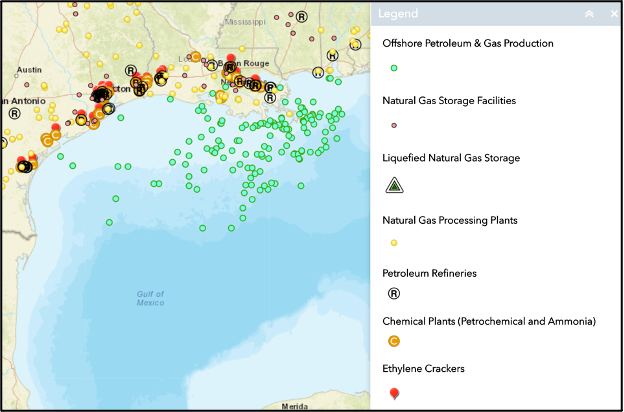
    The risks from industrial facilities are most obvious along the U.S. Gulf Coast, where many major petrochemical complexes are clustered in harm’s way. These refineries, factories and storage facilities are often built along rivers or bays for easy shipping access.

    But those rivers can also bring storm surge flooding that can raise the ocean by several feet during hurricanes. The storm surge from Helene was over 10 feet above ground level in Florida’s Big Bend and over 6 feet in Tampa Bay. With Milton, forecasters warning of a 10- to 15-foot storm surge at Tampa Bay.

    A boom surrounds flooded railcars to try to contain leaks at a chemical plant in Braithwaite, La., after Hurricane Isaac in 2012.
    AP Photo/David J. Phillip

    A recent study found evidence of two to three times more pollution releases during hurricanes in the Gulf of Mexico than during normal weather from 2005 to 2020.

    The effects of these pollution releases fall disproportionately on low-income communities and people of color, further exacerbating environmental health risks.

    Why residents may not hear about toxic releases

    The statistics are disconcerting, yet they get little attention. That is because hazardous releases remain largely invisible due to limited disclosure requirements and scant public information. Even emergency responders often don’t know exactly which hazardous chemicals they are facing in emergency situations.

    The U.S. Environmental Protection Agency requires major polluters to file only very general information about chemicals and on-site risks in their risk management plans. Some large-scale fuel storage facilities, such as those holding liquefied natural gas, are not even required to do that.

    These risk management plans outline “worst-case” scenarios and are supposed to be publicly accessible. But, in reality, we and others have found them difficult to access, heavily redacted and housed in federal reading rooms with limited access. The reason local officials and national scientific review panels often give for the secrecy is to protect the facilities from terrorist attack.

    Oil storage tanks and industrial facilities line the Houston Ship Channel, which is vulnerable to storm surge from Gulf of Mexico hurricanes.
    AP Photo/David J. Phillip

    Adding to this opacity is the fact that many states – including those along the Gulf – suspend restrictions on pollution releases during emergency declarations. Meanwhile, real-time incident notifications from the National Response Center – the federal government’s repository for all chemical discharges into the environment – typically lag by a week or more,

    We believe this limited public information on rising chemical threats from our changing climate should be front-page news every hurricane season. Communities should be aware of the risks of hosting vulnerable industrial infrastructure, particularly as rising global temperatures increase the risk of extreme downpours and powerful hurricanes.

    Mapping the risks nationwide to raise awareness

    To help communities understand their risks, our team at Rice University’s new Center for Coastal Futures and Adaptive Resilience investigates how industrial communities in flood-prone areas nationwide can better adapt to such threats, socially as well as technologically.

    Our interactive map shows where elevated future flood risks threaten to inundate major polluters that we identify using the EPA’s Toxic Release Inventory.

    The U.S. has several hot spots with clusters of flood-prone polluters. Houston’s Ship Channel, Chicago’s waterfront steel industries and the harbors at Los Angeles and New York/New Jersey are among the biggest.

    Three of the biggest hot spots, where large numbers of industrial facilities with toxic materials face elevated future flood risks, are in the Northeast, the northwestern Gulf Coast and the southern end of the Great Lakes.
    Rice University Center for Coastal Futures and Adaptive Resilience, CC BY-ND

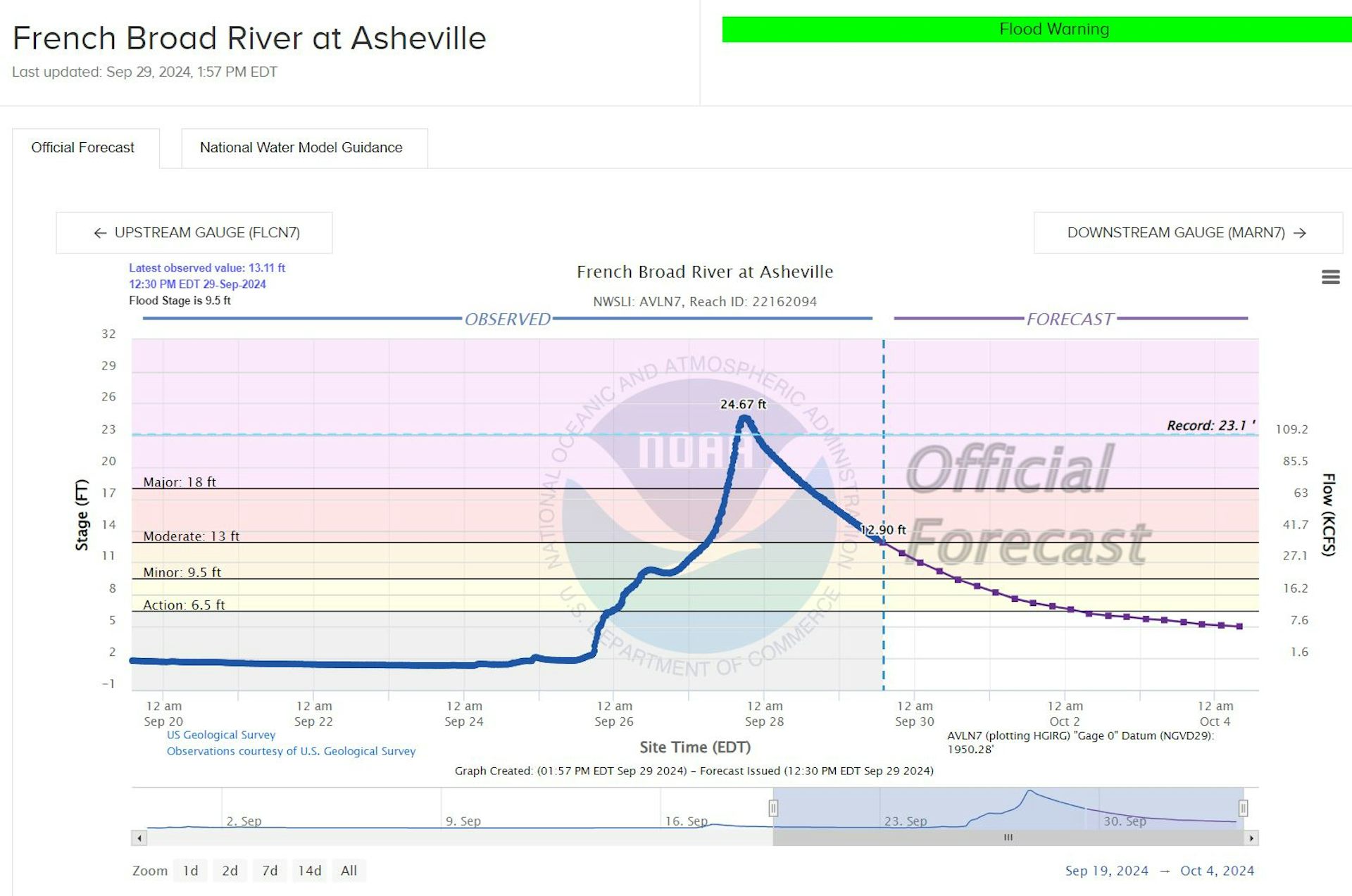
    But, as Helene revealed, there can also be great concern in less obvious spots. Inland, particularly in the mountains, runoff can quickly turn normally tame rivers into fast-rising torrents. The French Broad River at Asheville, North Carolina, rose about 12 feet in 12 hours during Helene and set a new flood stage record.

    When hurricanes and tropical storms are headed for the U.S., our interactive maps show where major polluters are located in the storm’s projected cone of impact. The maps identify hazardous flood-prone facilities down to the address, anywhere in the country.

    Knowledge is the first step

    Knowing where these sites are located is only the first step. Often, it’s up to communities themselves, many of them already overexposed and historically underserved, to raise concerns and demand strategies for mitigating the health, economic and environmental risks that industrial sites at risk of flooding and other damage can pose.

    These discussions can’t wait until a disaster is on the way. By knowing where these risks may be, communities can take steps now to build a safer future.

    This article, originally published Sept. 30, has been updated with Hurricane Milton.

    James R. Elliott receives funding from the National Science Foundation and the National Renewable Energy Lab.

    Dominic Boyer receives funding from the National Science Foundation, NOAA and Texas Sea Grant.

    Phylicia Lee Brown has nothing to disclose.

    ref. Flooded industrial sites and toxic chemical releases are a silent, growing threat in hurricanes like Milton and Helene – https://theconversation.com/flooded-industrial-sites-and-toxic-chemical-releases-are-a-silent-growing-threat-in-hurricanes-like-milton-and-helene-239977

    MIL OSI – Global Reports

  • MIL-OSI Security: McLaughlin Man Sentenced for Voluntary Manslaughter

    Source: Federal Bureau of Investigation (FBI) State Crime Alerts (b)

    ABERDEEN – United States Attorney Alison J. Ramsdell announced today that U.S. District Judge Charles B. Kornmann has sentenced a McLaughlin, South Dakota, man convicted of Voluntary Manslaughter. The sentencing took place on September 30, 2024.

    Johnathan Guggolz, 48, was sentenced to five years in federal prison, followed by three years of supervised release, and ordered to pay a $100 special assessment to the Federal Crime Victims Fund.

    Guggolz was indicted by a federal grand jury in October of 2023. He pleaded guilty on July 8, 2024.

    On the afternoon of August 29, 2023, in McLaughlin, South Dakota, within the Standing Rock Sioux Indian Reservation, a 62-year-old man pulled into the school driveway to pick his wife up from work. Guggolz pulled up next to the man and confronted him about his driving, mocking and belittling him. The man eventually exited his car, secured a pair of duct-taped homemade nunchucks to protect himself, and squared up with Guggolz, a former amateur boxer. After a few moments of posturing, the man thrust the nunchucks towards Guggolz’ hip. Guggolz then punched the man in the face, knocking him unconscious. The man fell backwards and struck his head on the concrete. Guggolz glanced down at the man, now lying helpless on the driveway, then returned to his pickup and drove away. The man subsequently died of a traumatic brain injury incurred in the assault.

    This matter was prosecuted by the U.S. Attorney’s Office because the Major Crimes Act, a federal statute, mandates that certain violent crimes alleged to have occurred in Indian country be prosecuted in federal court as opposed to State court.

    This case was investigated by the FBI, the Bureau of Indian Affairs – Office of Justice Services, and the Mobridge Police Department. Assistant U.S. Attorney Carl Thunem prosecuted the case.

    Guggolz was immediately remanded to the custody of the U.S. Marshals Service. 

    MIL Security OSI

  • MIL-OSI Security: Drug Distribution and Firearm Possession on Menominee Indian Reservation Leads to Eight-Year Prison Sentence for Former Keshena Man

    Source: Federal Bureau of Investigation (FBI) State Crime Alerts (c)

    Gregory J. Haanstad, United States Attorney for the Eastern District of Wisconsin, announced that on October 4, 2024, Anthony Brown, Jr. (age: 50), a former resident of Keshena on the Menominee Indian Reservation, received an eight-year federal prison sentence following convictions for possession with intent to distribute cocaine and possession of a firearm in furtherance of drug trafficking.  Brown will also face five years of supervised release once he completes his sentence.  The sentence, imposed by Senior United States District Judge William C. Griesbach, was the result of a guilty plea entered by the defendant on June 14, 2024.

    According to court records, during the early morning hours of January 1, 2024, investigators with the Menominee Tribal Police Department observed the defendant in his vehicle as he engaged in a hand-to-hand drug transaction in the parking lot of a business on the Menominee Indian Reservation. After a brief interaction, the defendant was arrested and searched.  Law enforcement recovered over 15 grams of cocaine and approximately $4400 in U.S. currency from his person and recovered a loaded .380 caliber semiautomatic handgun from the vehicle.  The firearm had the defendant’s DNA on it.

    Also, according to court records, law enforcement had an additional contact with Brown on January 15, 2024. Brown was arrested after being found passed out at the wheel of a car stopped in Keshena. Brown had cocaine on his person. Officers applied for and obtained a search warrant for the defendant’s residence, which led to the discovery of 380 grams of cocaine, paraphernalia associated with drug use and packaging, ammunition, a ledger containing names, amounts, and prices, and a Glock 21 .45 caliber handgun.

    Investigators seized numerous items which the defendant agreed were proceeds or facilities of illegal drug activity, including $7000 in cash, a 2016 Chevrolet Corvette, a 1999 Porsche Boxster, a 2019 Ford F250 pickup, a 2014 Jeep Wrangler, and a 2017 Kawasaki sport bike style motorcycle. Investigators also seized 216 pairs of luxury shoes. These items were ordered forfeited as part of his sentence.

    During the sentencing hearing, Judge Griesbach noted the seriousness of the crime and the need to deter those who might consider similar actions to protect the community from the destructive effects of controlled substance abuse. Judge Griesbach also observed the need to incapacitate the defendant for a lengthy period, particularly considering Brown’s previous convictions for drug dealing.

    The Menomonee Tribal Police Department and the Federal Bureau of Investigations investigated the case as part of the Safe Trails Task Force (STTF) and the Native American Drug and Gang Initiative (NADGI). NADGI and STTF partner federal, tribal, state, and local law enforcement to combat drug trafficking and violent crime on the Menominee Indian Reservation. STTF members are deputized federal officers who identify and target for prosecution individuals who are involved in distribution of dangerous drugs on the Menominee Indian Reservation. Coordination of state resources through NADGI permits efficient communication and evidence processing, which are essential to swift and fair prosecution of offenders. Assistant United States Attorney Andrew J. Maier prosecuted the case.

    # # #

    MIL Security OSI

  • MIL-OSI Security: Rapid City Man Sentenced for Involuntary Manslaughter

    Source: Federal Bureau of Investigation (FBI) State Crime Alerts (b)

    RAPID CITY – United States Attorney Alison J. Ramsdell announced today that U.S. District Judge Camela C. Theeler has sentenced a Rapid City, South Dakota, man convicted of Involuntary Manslaughter. The sentencing took place on October 2, 2024.

    Lionel Morrison, age 53, was sentenced to three years of probation and ordered to pay a $100 special assessment to the Federal Crime Victims Fund.

    Morrison was indicted for the charge by a federal grand jury in July of 2023. He pleaded guilty on June 7, 2024.

    In May of 2023, Morrison, who was intoxicated, was driving a vehicle just north of Pine Ridge when he lost control of the vehicle. After losing control of the vehicle, Morrison overcorrected the path of the vehicle causing it to roll three times causing the front passenger to be ejected from the vehicle. The victim ultimately succumbed to his injuries on the way to the hospital.

    This matter was prosecuted by the U.S. Attorney’s Office because the Major Crimes Act, a federal statute, mandates that certain violent crimes alleged to have occurred in Indian country be prosecuted in Federal court as opposed to State court.

    This case was investigated by the Oglala Sioux Tribe – Department of Public Safety and the FBI. Assistant U.S. Attorney Megan Poppen prosecuted the case. 

    MIL Security OSI

  • MIL-OSI Security: Security News: Bob Dean Jr. and Affiliated Corporate Entities Agree to $8.2M Consent Judgment to Resolve Allegations of Financial Misconduct Stemming from Evacuation of Nursing Homes During Hurricane Ida

    Source: United States Department of Justice 2

    Bob Dean Jr. and several companies that he owned and operated have agreed to an $8.2 million consent judgment to resolve allegations that they violated the National Housing Act of 1934 (NHA), by misappropriating and misusing the assets and income of four nursing homes in Louisiana before and after Hurricane Ida’s landfall in August 2021. The four nursing homes, all of which were owned and operated by Dean and his companies, and had loans insured by the Federal Housing Administration (FHA), are Maison De’Ville Nursing Home in Houma; Maison De’Ville Nursing Home in Harvey; Maison Orleans Healthcare in New Orleans; and West Jefferson Health Care Center in Harvey.

    The FHA, part of the Department of Housing and Urban Development (HUD), provides mortgage insurance on loans that cover residential care facilities, such as nursing homes, pursuant to the NHA. To encourage lenders to make loans to such facilities, FHA mortgage insurance provides lenders with protection against losses that result from borrowers defaulting on their mortgage loans. To obtain such FHA-insured loans, loan recipients must enter into regulatory agreements with the FHA that provide, among other requirements, that the assets and income of an FHA-insured nursing home may only be spent on goods and services that are reasonable and necessary to the operation of the nursing home. The NHA permits the United States to recover twice the amount of any assets and income of FHA-insured nursing homes that were improperly distributed or misspent.

    In 2023, the government filed a complaint against Dean and his corporate entities alleging that they misspent the nursing homes’ assets and income. The United States alleged that in the five years leading up to Hurricane Ida, Dean funneled money that should have been used to prepare an evacuation site for nursing home residents to his personal bank accounts, leaving his nursing homes — and, more importantly, the nursing homes’ residents — unprepared for a hurricane. As a result, when Hurricane Ida made landfall in August 2021, the residents of Dean’s nursing homes had to ride out the storm in an overcrowded and ill-prepared industrial warehouse Dean owned through a corporate entity. The United States alleged that at Dean’s evacuation center, his nursing homes’ residents languished in squalor and did not receive adequate care, leading to the Louisiana Department of Health evacuating the nursing home residents from Dean’s warehouse and revoking Dean’s nursing homes’ licenses. The United States further alleged that, following the hurricane, Dean did not use the homes’ income and assets solely to operate or maintain the nursing homes, but instead to purchase personal goods and services, including antiques, firearms and cars.

    “This settlement demonstrates the department’s continuing commitment to holding accountable those who put their own financial gain over the needs of our nation’s seniors,” said Principal Deputy Assistant Attorney General Brian M. Boynton, head of the Justice Department’s Civil Division. “We will continue to take action to protect the integrity of federal programs designed to ensure that nursing home residents, who are among our most vulnerable citizens, receive appropriate care.”

    “As the residents of Louisiana well know, hurricanes and natural disasters can devastate people’s lives,” said U.S. Attorney Ronald C. Gathe Jr for the Middle District of Louisiana. “Nursing home operators like Mr. Dean have an obligation to protect their residents during such events, particularly if they are going to rely on federal programs to support or sustain their businesses. This settlement will ensure that those individuals charged with caring for our community’s most vulnerable residents take seriously their duty to have proper safeguards and plans in place to avoid tragedies like the one we saw in Independence, Louisiana, after Hurricane Ida.

    “Nursing home providers have obligations to protect the health, safety, and welfare of residents entrusted to their care,” said HUD General Counsel Damon Smith. “Owners of FHA-insured nursing homes should be on notice that we will hold them accountable when we learn of allegations that they have failed to meet those obligations.”

    “By the time Hurricane Ida bore down on the vulnerable nursing home residents at properties operated by Mr. Dean, he illegally skimmed funding from those facilities and failed to maintain sanitation and adequately equip the warehouse he designated as the evacuation site,” said HUD Inspector General Rae Oliver Davis. “He unfairly enriched himself while residents under his charge endured horrid conditions including insufficient food and medical care. HUD OIG will continue to work with our law enforcement and prosecutorial partners to hold accountable those who misappropriate funds at the expense of vulnerable populations.”

    The Civil Division’s Commercial Litigation Branch, Fraud Section, and the U.S. Attorney’s Office for the Middle District of Louisiana handled the case, with substantial assistance from HUD and HUD’s Office of Inspector General. Trial Attorneys Christopher Reimer and Samuel Robins of the Civil Division’s Fraud Section and Assistant U.S. Attorneys Davis Rhorer Jr. and Chase Zachary for the Middle District of Louisiana handled the matter.

    The United States’ complaint stemmed from an investigation that the Justice Department initiated as part of its Elder Justice Initiative, which supports the efforts of state and local prosecutors, law enforcement and other elder justice professionals to combat elder abuse, neglect and financial exploitation, with the development of training, resources and information. Learn more about the Justice Department’s Elder Justice Initiative at http://www.justice.gov/elderjustice.

    The claims settled by this agreement are allegations only. There has been no determination of liability.

    MIL Security OSI

  • MIL-OSI USA: Hoeven: FAA, Northern Plains UAS Test Site Reach Agreement to Share Unfiltered Radar Data Feed

    US Senate News:

    Source: United States Senator for North Dakota John Hoeven
    10.08.24
    Senator Worked to Advance New Capability Supporting North Dakota as Most Advanced UAS Ecosystem in The Nation, Strengthens NAS Integration & Counter-UAS Development
    GRAND FORKS, N.D. – At the Unmanned Aerial Systems (UAS) Summit today, Senator John Hoeven announced that the Federal Aviation Administration (FAA) and Northern Plains UAS Test Site have reached agreement to share the FAA’s unfiltered radar data feed to support UAS integration efforts. North Dakota’s test site will be the first in the nation to receive this capability, which will:
    Maintain the state’s position as the most advanced UAS ecosystem in the nation.
    Strengthen the test site’s detect-and-avoid capabilities, which allows unmanned aircraft operating under the test site to safely fly where other state’s test sites could not.
    Empower the test site to detect malicious or unlawful UAS traffic, helping make North Dakota the premiere location for counter-UAS technology development.
    Countering threats from the misuse of unmanned aircraft is a critical Department of Defense (DoD) priority.
    This issue was at the heart of Hoeven’s recent discussions with Air Combat Command (ACC) Commander Gen. Kenneth Wilsbach and Chairman of the Joint Chiefs of Staff Gen. Charles Q. Brown.
    Accordingly, Hoeven is advancing Project ULTRA as the funding vehicle to support counter-UAS development. Hoeven worked to establish the initial contract valued at up to $18.25 million for efforts like this, and the project is eligible for additional funding in subsequent years.

    Hoeven is working with additional federal agencies, including the DoD and the Department of Justice (DOJ), to secure their approval of the agreement as soon as possible.
    Currently, FAA radars collect more data than can be shared outside of federal government agencies, due to technical challenges and security concerns. By working to unlock this capability for North Dakota, the state will be positioned to continue leading the future of unmanned aviation research, development and operations. Hoeven’s two guests at the UAS Summit are leading these important priorities:
    FAA Deputy Administrator Katie Thomson, a key figure in FAA’s efforts to safely integrate UAS into the national airspace (NAS).
    Gen. David Stewart, Director of the Joint Counter-Small UAS Office (JCO), who is leading the DoD’s efforts to protect against the misuse of drone technology.
    “This agreement between the FAA and the Northern Plains UAS Test Site to share unfiltered radar data adds a new tool to our vast toolkit in North Dakota, ensuring we remain the most advanced UAS ecosystem in the country,” said Hoeven. “We’ve worked for nearly two decades to build up our state’s talent, infrastructure and legal authorizations to make North Dakota the premiere location for all aspects of the UAS industry. As a result, our test site has more firsts and more partnerships than any other test site. Between this new capability and Project ULTRA, which will help fund many of the upcoming efforts, including counter-UAS development, we are positioned to continue leading the pack.”
    Advancing Project ULTRA
               Hoeven worked to establish and fund Project ULTRA to advance the development of practical UAS applications like supply delivery, base inspections and installation security, benefitting Grand Forks Air Force Base and military installations across the country. The senator recently announced that the DoD has tasked Project ULTRA with conducting demonstration flights using unmanned aircraft to move cargo between Grand Forks Air Force Base and Cavalier Space Force Station.
    Enhancing Counter-UAS Capabilities
               Hoeven stressed how initiatives like Project ULTRA can be utilized to strengthen the nation’s counter-UAS capabilities. Currently, threats such as drone swarm attacks against Israel and Ukraine, as well as UAS incursions into airspace near U.S. military bases, require significantly more expensive counter measures from the U.S. and its allies. This comes in addition to legislation Hoeven helped introduce and pass to support the development of counter-UAS technology and protect important facilities from potential misuse of unmanned aircraft. Hoeven is now sponsoring a bill to renew and expand upon the authorities created under this law.
    Strengthening ND’s Missions
               Following the fireside chat, Hoeven introduced a video from Dr. William LaPlante, Under Secretary of Defense for Acquisition and Sustainment, who the senator has invited to the state to see its UAS ecosystem firsthand. Hoeven, who serves as a member of the Senate Defense Appropriations Committee, has been working with LaPlante to advance the range of missions in North Dakota, from nuclear missions in Minot to the unmanned missions in the Red River Valley. LaPlante’s remarks reinforced the discussion between Hoeven, Thomson and Stewart, further driving home the importance of UAS and counter-UAS to future DoD operations.

    MIL OSI USA News

  • MIL-OSI USA: Bob Dean Jr. and Affiliated Corporate Entities Agree to $8.2M Consent Judgment to Resolve Allegations of Financial Misconduct Stemming from Evacuation of Nursing Homes During Hurricane Ida

    Source: US State of California

    Bob Dean Jr. and several companies that he owned and operated have agreed to an $8.2 million consent judgment to resolve allegations that they violated the National Housing Act of 1934 (NHA), by misappropriating and misusing the assets and income of four nursing homes in Louisiana before and after Hurricane Ida’s landfall in August 2021. The four nursing homes, all of which were owned and operated by Dean and his companies, and had loans insured by the Federal Housing Administration (FHA), are Maison De’Ville Nursing Home in Houma; Maison De’Ville Nursing Home in Harvey; Maison Orleans Healthcare in New Orleans; and West Jefferson Health Care Center in Harvey.

    The FHA, part of the Department of Housing and Urban Development (HUD), provides mortgage insurance on loans that cover residential care facilities, such as nursing homes, pursuant to the NHA. To encourage lenders to make loans to such facilities, FHA mortgage insurance provides lenders with protection against losses that result from borrowers defaulting on their mortgage loans. To obtain such FHA-insured loans, loan recipients must enter into regulatory agreements with the FHA that provide, among other requirements, that the assets and income of an FHA-insured nursing home may only be spent on goods and services that are reasonable and necessary to the operation of the nursing home. The NHA permits the United States to recover twice the amount of any assets and income of FHA-insured nursing homes that were improperly distributed or misspent.

    In 2023, the government filed a complaint against Dean and his corporate entities alleging that they misspent the nursing homes’ assets and income. The United States alleged that in the five years leading up to Hurricane Ida, Dean funneled money that should have been used to prepare an evacuation site for nursing home residents to his personal bank accounts, leaving his nursing homes — and, more importantly, the nursing homes’ residents — unprepared for a hurricane. As a result, when Hurricane Ida made landfall in August 2021, the residents of Dean’s nursing homes had to ride out the storm in an overcrowded and ill-prepared industrial warehouse Dean owned through a corporate entity. The United States alleged that at Dean’s evacuation center, his nursing homes’ residents languished in squalor and did not receive adequate care, leading to the Louisiana Department of Health evacuating the nursing home residents from Dean’s warehouse and revoking Dean’s nursing homes’ licenses. The United States further alleged that, following the hurricane, Dean did not use the homes’ income and assets solely to operate or maintain the nursing homes, but instead to purchase personal goods and services, including antiques, firearms and cars.

    “This settlement demonstrates the department’s continuing commitment to holding accountable those who put their own financial gain over the needs of our nation’s seniors,” said Principal Deputy Assistant Attorney General Brian M. Boynton, head of the Justice Department’s Civil Division. “We will continue to take action to protect the integrity of federal programs designed to ensure that nursing home residents, who are among our most vulnerable citizens, receive appropriate care.”

    “As the residents of Louisiana well know, hurricanes and natural disasters can devastate people’s lives,” said U.S. Attorney Ronald C. Gathe Jr for the Middle District of Louisiana. “Nursing home operators like Mr. Dean have an obligation to protect their residents during such events, particularly if they are going to rely on federal programs to support or sustain their businesses. This settlement will ensure that those individuals charged with caring for our community’s most vulnerable residents take seriously their duty to have proper safeguards and plans in place to avoid tragedies like the one we saw in Independence, Louisiana, after Hurricane Ida.

    “Nursing home providers have obligations to protect the health, safety, and welfare of residents entrusted to their care,” said HUD General Counsel Damon Smith. “Owners of FHA-insured nursing homes should be on notice that we will hold them accountable when we learn of allegations that they have failed to meet those obligations.”

    “By the time Hurricane Ida bore down on the vulnerable nursing home residents at properties operated by Mr. Dean, he illegally skimmed funding from those facilities and failed to maintain sanitation and adequately equip the warehouse he designated as the evacuation site,” said HUD Inspector General Rae Oliver Davis. “He unfairly enriched himself while residents under his charge endured horrid conditions including insufficient food and medical care. HUD OIG will continue to work with our law enforcement and prosecutorial partners to hold accountable those who misappropriate funds at the expense of vulnerable populations.”

    The Civil Division’s Commercial Litigation Branch, Fraud Section, and the U.S. Attorney’s Office for the Middle District of Louisiana handled the case, with substantial assistance from HUD and HUD’s Office of Inspector General. Trial Attorneys Christopher Reimer and Samuel Robins of the Civil Division’s Fraud Section and Assistant U.S. Attorneys Davis Rhorer Jr. and Chase Zachary for the Middle District of Louisiana handled the matter.

    The United States’ complaint stemmed from an investigation that the Justice Department initiated as part of its Elder Justice Initiative, which supports the efforts of state and local prosecutors, law enforcement and other elder justice professionals to combat elder abuse, neglect and financial exploitation, with the development of training, resources and information. Learn more about the Justice Department’s Elder Justice Initiative at http://www.justice.gov/elderjustice.

    The claims settled by this agreement are allegations only. There has been no determination of liability.

    MIL OSI USA News

  • MIL-OSI Security: U.S. Attorney’s Office Announces Sentencing of Albuquerque Man for Violent Crime Spree

    Source: Federal Bureau of Investigation (FBI) State Crime Alerts (c)

    ALBUQUERQUE – An Albuquerque man has been sentenced to 200 months in prison for a violent crime spree that included a series of armed robberies and assaults across New Mexico, culminating in the carjacking and shooting of a 62-year-old veteran.

    There is no parole in the federal system.

    According to court documents, on November 12, 2021, Procopio Montoya Atkinson, 26, robbed a Dollar General store in Northwest Albuquerque. Atkinson feigned a cash purchase of flavored water, and when the female cashier opened the register to give him change, he reached over the counter to take the money. When she shut the drawer, Atkinson escalated his actions by walking behind the counter and demanding money while pointing a firearm at her. Atkinson discharged the firearm toward the ceiling, causing panic. The manager complied with Atkinson’s demands as he began a verbal countdown. Ultimately, Atkinson took $192 from the register and fled.

    The crime spree continued on December 6, 2021, when Atkinson shoplifted clothing and an entire display case full of pocketknives from a Love’s Travel Stop in Belen. Atkinson was confronted by two female employees outside and physically assaulted them while attempting to hit them with his vehicle. Just three days later, on December 9, Atkinson assaulted another female employee at a Walmart in Belen after loading a cart with clothing and tools.

    Atkinson approaching the display case full of pocketknives.

    Atkinson picking up the display case full of pocketknives.

    The discarded display case.

    On December 13, law enforcement obtained an arrest warrant for Atkinson related to the armed robbery from November 12. On December 17, members of the U.S. Marshals Service fugitive task force established surveillance on his home for his arrest. As they moved in to apprehend him at a gas station, Atkinson displayed awareness of their presence by retrieving binoculars to monitor law enforcement movements. Atkinson drove toward one task force officer while pointing a pistol at him before abandoning his pursuit when backup arrived.

    The crime spree culminated on December 20 when John Doe 3 was driving alone in his vintage Chevrolet truck with his wife and daughter following behind in another vehicle. They were stopped at a traffic light when Atkinson approached John Doe 3’s wife and daughter with a pistol and demanded they exit their vehicle. After they refused to open their doors, Atkinson turned his attention to John Doe 3’s truck, a beautifully restored ’62 Chevrolet. He opened the passenger door and, after a brief struggle, shot John Doe 3 in the back.

    A photo of the scene.

    Responding officers successfully blocked the truck in following an unsuccessful escape attempt by Atkinson and John Doe 3 was airlifted to the hospital.

    John Doe 3 survived his injuries, but the emotional toll of that day has left lasting scars; he experiences ongoing pain and anxiety whenever near that intersection or driving through similar situations, and his beloved truck now sits dormant.

    Upon his release from prison, Atkinson will be subject to five years of supervised release.

    U.S. Attorney Alexander M.M. Uballez and Raul Bujanda, Special Agent in Charge of the Federal Bureau of Investigation, made the announcement today.

    The Gallup Resident Agency of the FBI Albuquerque Field Office investigated this case with assistance from the United States Marshal Service, Belen Police Department, Bernalillo County Sheriff’s Office, Albuquerque Police Department, Rio Rancho Police Department and the New Mexico State Police. Assistant U.S. Attorney Timothy Trembley is prosecuting the case.

    # # #

    MIL Security OSI

  • MIL-OSI USA: FEMA, Federal Response Positioned to Fully Support Florida Ahead of Milton Landfall

    Source: US Federal Emergency Management Agency

    Headline: FEMA, Federal Response Positioned to Fully Support Florida Ahead of Milton Landfall

    FEMA, Federal Response Positioned to Fully Support Florida Ahead of Milton Landfall

    Mandatory evacuation orders have been issued and others are underway. If local authorities issue evacuations, please listen and evacuate immediately. Your life could be at risk.

    WASHINGTON — FEMA and its federal partners are leaning forward and have pre-positioned resources to support local and state response efforts ahead of Hurricane Milton’s landfall. President Joseph R. Biden approved an Emergency Declaration for Florida on Monday, authorizing FEMA to coordinate Federal disaster relief efforts to save lives and protect the health and safety of those in the storm’s path. FEMA Administrator Deanne Criswell is on the ground, meeting with officials across the impacted states to marshal the full capabilities of the federal government. 

    This includes pre-staging a full slate of response capabilities in Florida and the region, including: seven FEMA Incident Management Assistance Teams, eight FEMA Urban Search & Rescue and swift water rescue teams, three U.S. Coast Guard Swift Water Rescue teams, four Health Care System Assessment Teams, five Disaster Medical Assistance Teams and an Incident Management Team from the U.S. Department of Health and Human Services, U.S Army Corps of Engineers (USACE) temporary power teams, debris experts and a roofing team, U.S. Environmental Protection Agency (EPA) debris removal and wastewater experts, 300 ambulances and 30 High Water Vehicles with ladders from the U.S. Department of Defense. Additionally, FEMA has five incident staging bases with commodities including food and water. Right now, FEMA currently has 20 million meals and 40 million liters of water in the pipeline to deploy as needed to address ongoing Helene and Milton response efforts and can expand as needed.

    The National Hurricane Center forecasts Hurricane Milton will be a large and extremely dangerous hurricane when it approaches the west coast of Florida tomorrow, bringing devastating hurricane-force winds and life-threatening life surge. In addition to storm surge and extreme winds, Milton will bring heavy rain and the risk of life-threatening flooding, especially in areas with coastal and inland flooding. 

    Hurricane Milton is an extremely dangerous, potentially deadly storm. Those in its path are urged to rush to complete preparations today, know how they are going to get information and listen to local officials.  

    FEMA senior leaders across different regions are on the ground in Florida supporting response efforts. FEMA Region 10 Regional Administrator Willie Nunn will remain in Florida throughout the duration of Hurricane Milton. John Brogan, the Federal Coordinating Officer for Milton and Helene, will also remain in Florida. Nearly 900 staff are already supporting recovery efforts at the Joint Field Office in Tallahassee and operating across the designated counties for hurricanes Helene, Debby and Idalia. This includes more than 460 supporting Hurricane Helene recovery, more than 300 supporting Hurricane Debby recovery and more than 100 supporting Hurricane Idalia recovery.

    FEMA officials are still actively supporting North Carolina, Georgia, South Carolina, Florida, Tennessee and Virginia as they respond to and recover from Hurricane Helene including more than 7,400 federal workers of which 1,500 are FEMA staff. FEMA will not divert personnel or resources from these ongoing responses. 

    FEMA understands that people in the path of this storm may still be recovering from hurricanes Helene, Debby and Idalia and urges everyone to protect themselves and take care of others because time is running out to prepare for the hurricane’s potentially deadly impacts.

    Counties in Hurricane Milton’s path have issued evacuation orders. If you need to evacuate, please “evacuate out, not up.” People should visit FloridaDisaster.org/Know to determine if they live in an evacuation zone. 

    • If you are told to evacuate, do so immediately.  
    • Your gas tank and electric vehicle only need to be halfway full or halfway charged to ensure you can evacuate further inland to a safe location and away from storm surge. You may only need to travel tens of miles, not hundreds.
    • If you live in a county with an evacuation order in place and need evacuation assistance, please call 1-800-729-3413 from 7 a.m. to 7 p.m. for the hurricane evacuation charter bus schedule. Again, this is for residents that are in areas with evacuation orders. Florida also partnered with Uber to provide free rides to a shelter using the code MILTONRELIEF.
    • The state of Florida has activated the State Assistance Information Line. Residents needing information and resources can call 1-800-342-3557. There are English, Spanish & Creole speakers available to answer questions.
    • A list of emergency shelters, including those that can accommodate people who need assistance and those who have pets can be found at Shelter Status | Florida Disaster.
    • Additional resources and state updates on Hurricane Milton can be found by visiting FloridaDisaster.org/Updates.
    • For live updates, follow FLSERT on X and Instagram and FDEM on Facebook.

    Download the free FEMA App available in English and Spanish to receive real-time weather alerts and find local emergency shelters in your area.

    mashana.davis

    MIL OSI USA News

  • MIL-OSI New Zealand: Arrest made following residential burglaries

    Source: New Zealand Police (National News)

    Canterbury Police have arrested a man after a series of residential burglaries over the past few months, predominantly in Christchurch’s hill suburbs.

    Between July and October, Police received several reports of burglary that Police believed to be linked to the same offender.

    In each case, the burglaries took place in homes that were temporarily unoccupied, often while the occupants were on holiday.

    The 39-year-old man currently faces five charges of burglary and enquiries are ongoing to establish his links to additional offences.

    This serves as a timely reminder to anyone leaving their property unattended for a period of time to take steps to make sure it’s secure.

    Burglars are largely opportunistic.

    Alarms will help discourage any burglar looking for easy entry. Locks on windows and doors can be effective, as well as security signage, CCTV, alarms and sensor lights.

    Be wary of posting too much information on social media about holiday or travel plans, or photos of inside your home, as this can make your property a vulnerable target while you’re away.

    Keep in contact with your neighbours, and let each other know if you notice anything unusual.

    Call Police straight away on 111 if you see or suspect anything suspicious at your home or a neighbour’s.

    When reporting activity it’s helpful to take note of the number of people, clothing they wear, and any vehicles present.

    You can make a report after the fact using our 105 service, either by phone or online.

    ENDS

    Issued by Police Media Centre 

    MIL OSI New Zealand News

  • MIL-OSI Security: Bob Dean Jr. and Affiliated Corporate Entities Agree to $8.2M Consent Judgment to Resolve Allegations of Financial Misconduct Stemming from Evacuation of Nursing Homes During Hurricane Ida

    Source: United States Attorneys General 1

    Bob Dean Jr. and several companies that he owned and operated have agreed to an $8.2 million consent judgment to resolve allegations that they violated the National Housing Act of 1934 (NHA), by misappropriating and misusing the assets and income of four nursing homes in Louisiana before and after Hurricane Ida’s landfall in August 2021. The four nursing homes, all of which were owned and operated by Dean and his companies, and had loans insured by the Federal Housing Administration (FHA), are Maison De’Ville Nursing Home in Houma; Maison De’Ville Nursing Home in Harvey; Maison Orleans Healthcare in New Orleans; and West Jefferson Health Care Center in Harvey.

    The FHA, part of the Department of Housing and Urban Development (HUD), provides mortgage insurance on loans that cover residential care facilities, such as nursing homes, pursuant to the NHA. To encourage lenders to make loans to such facilities, FHA mortgage insurance provides lenders with protection against losses that result from borrowers defaulting on their mortgage loans. To obtain such FHA-insured loans, loan recipients must enter into regulatory agreements with the FHA that provide, among other requirements, that the assets and income of an FHA-insured nursing home may only be spent on goods and services that are reasonable and necessary to the operation of the nursing home. The NHA permits the United States to recover twice the amount of any assets and income of FHA-insured nursing homes that were improperly distributed or misspent.

    In 2023, the government filed a complaint against Dean and his corporate entities alleging that they misspent the nursing homes’ assets and income. The United States alleged that in the five years leading up to Hurricane Ida, Dean funneled money that should have been used to prepare an evacuation site for nursing home residents to his personal bank accounts, leaving his nursing homes — and, more importantly, the nursing homes’ residents — unprepared for a hurricane. As a result, when Hurricane Ida made landfall in August 2021, the residents of Dean’s nursing homes had to ride out the storm in an overcrowded and ill-prepared industrial warehouse Dean owned through a corporate entity. The United States alleged that at Dean’s evacuation center, his nursing homes’ residents languished in squalor and did not receive adequate care, leading to the Louisiana Department of Health evacuating the nursing home residents from Dean’s warehouse and revoking Dean’s nursing homes’ licenses. The United States further alleged that, following the hurricane, Dean did not use the homes’ income and assets solely to operate or maintain the nursing homes, but instead to purchase personal goods and services, including antiques, firearms and cars.

    “This settlement demonstrates the department’s continuing commitment to holding accountable those who put their own financial gain over the needs of our nation’s seniors,” said Principal Deputy Assistant Attorney General Brian M. Boynton, head of the Justice Department’s Civil Division. “We will continue to take action to protect the integrity of federal programs designed to ensure that nursing home residents, who are among our most vulnerable citizens, receive appropriate care.”

    “As the residents of Louisiana well know, hurricanes and natural disasters can devastate people’s lives,” said U.S. Attorney Ronald C. Gathe Jr for the Middle District of Louisiana. “Nursing home operators like Mr. Dean have an obligation to protect their residents during such events, particularly if they are going to rely on federal programs to support or sustain their businesses. This settlement will ensure that those individuals charged with caring for our community’s most vulnerable residents take seriously their duty to have proper safeguards and plans in place to avoid tragedies like the one we saw in Independence, Louisiana, after Hurricane Ida.

    “Nursing home providers have obligations to protect the health, safety, and welfare of residents entrusted to their care,” said HUD General Counsel Damon Smith. “Owners of FHA-insured nursing homes should be on notice that we will hold them accountable when we learn of allegations that they have failed to meet those obligations.”

    “By the time Hurricane Ida bore down on the vulnerable nursing home residents at properties operated by Mr. Dean, he illegally skimmed funding from those facilities and failed to maintain sanitation and adequately equip the warehouse he designated as the evacuation site,” said HUD Inspector General Rae Oliver Davis. “He unfairly enriched himself while residents under his charge endured horrid conditions including insufficient food and medical care. HUD OIG will continue to work with our law enforcement and prosecutorial partners to hold accountable those who misappropriate funds at the expense of vulnerable populations.”

    The Civil Division’s Commercial Litigation Branch, Fraud Section, and the U.S. Attorney’s Office for the Middle District of Louisiana handled the case, with substantial assistance from HUD and HUD’s Office of Inspector General. Trial Attorneys Christopher Reimer and Samuel Robins of the Civil Division’s Fraud Section and Assistant U.S. Attorneys Davis Rhorer Jr. and Chase Zachary for the Middle District of Louisiana handled the matter.

    The United States’ complaint stemmed from an investigation that the Justice Department initiated as part of its Elder Justice Initiative, which supports the efforts of state and local prosecutors, law enforcement and other elder justice professionals to combat elder abuse, neglect and financial exploitation, with the development of training, resources and information. Learn more about the Justice Department’s Elder Justice Initiative at http://www.justice.gov/elderjustice.

    The claims settled by this agreement are allegations only. There has been no determination of liability.

    MIL Security OSI

  • MIL-Evening Report: AI is a multi-billion dollar industry. It’s underpinned by an invisible and exploited workforce

    Source: The Conversation (Au and NZ) – By Ganna Pogrebna, Executive Director, AI and Cyber Futures Institute, Charles Sturt University

    Olena Yakobchuk/Shutterstock

    In dusty factories, cramped internet cafes and makeshift home offices around the world, millions of people sit at computers tediously labelling data.

    These workers are the lifeblood of the burgeoning artificial intelligence (AI) industry. Without them, products such as ChatGPT simply would not exist. That’s because the data they label helps AI systems “learn”.

    But despite the vital contribution this workforce makes to an industry which is expected to be worth US$407 billion by 2027, the people who comprise it are largely invisible and frequently exploited. Earlier this year nearly 100 data labellers and AI workers from Kenya who do work for companies like Facebook, Scale AI and OpenAI published an open letter to United States President Joe Biden in which they said:

    Our working conditions amount to modern day slavery.

    To ensure AI supply chains are ethical, industry and governments must urgently address this problem. But the key question is: how?

    What is data labelling?

    Data labelling is the process of annotating raw data — such as images, video or text — so that AI systems can recognise patterns and make predictions.

    Self-driving cars, for example, rely on labelled video footage to distinguish pedestrians from road signs. Large language models such as ChatGPT rely on labelled text to understand human language.

    These labelled datasets are the lifeblood of AI models. Without them, AI systems would be unable to function effectively.

    Tech giants like Meta, Google, OpenAI and Microsoft outsource much of this work to data labelling factories in countries such as the Philippines, Kenya, India, Pakistan, Venezuela and Colombia.

    China is also becoming another global hub for data labelling.

    Outsourcing companies that facilitate this work include Scale AI, iMerit, and Samasource. These are very large companies in their own right. For example, Scale AI, which is headquartered in California, is now worth US$14 billion.

    Cutting corners

    Major tech firms like Alphabet (the parent company of Google), Amazon, Microsoft, Nvidia and Meta have poured billions into AI infrastructure, from computational power and data storage to emerging computational technologies.

    Large-scale AI models can cost tens of millions of dollars to train. Once deployed, maintaining these models requires continuous investment in data labelling, refinement and real-world testing.

    But while AI investment is significant, revenues have not always met expectations. Many industries continue to view AI projects as experimental with unclear profitability paths.

    In response, many companies are cutting costs which affect those at the very bottom of the AI supply chain who are often highly vulnerable: data labellers.

    Low wages, dangerous working conditions

    One way companies involved in the AI supply chain try to reduce costs is by employing large numbers of data labellers in countries in the Global South such as the Philippines, Venezuela, Kenya and India. Workers in these countries face stagnating or shrinking wages.

    For example, an hourly rate for AI data labellers in Venezuela ranges from between 90 cents and US$2. In comparison, in the United States, this rate is between US$10 to US$25 per hour.

    In the Philippines, workers labelling data for multi-billion dollar companies such as Scale AI often earn far below the minimum wage.

    Some labelling providers even resort to child labour for labelling purposes.

    But there are many other labour issues within the AI supply chain.

    Many data labellers work in overcrowded and dusty environments which pose a serious risk to their health. They also often work as independent contractors, lacking access to protections such as health care or compensation.

    The mental toll of data labelling work is also significant, with repetitive tasks, strict deadlines and rigid quality controls. Data labellers are also sometimes asked to read and label hate speech or other abusive language or material, which has been proven to have negative psychological effects.

    Errors can lead to pay cuts or job losses. But labellers often experience lack of transparency on how their work is evaluated. They are often denied access to performance data, hindering their ability to improve or contest decisions.

    Making AI supply chains ethical

    As AI development becomes more complex and companies strive to maximise profits, the need for ethical AI supply chains is urgent.

    One way companies can help ensure this is by applying a human right-centreed design, deliberation and oversight approach to the entire AI supply chain. They must adopt fair wage policies, ensuring data labellers receive living wages that reflect the value of their contributions.

    By embedding human rights into the supply chain, AI companies can foster a more ethical, sustainable industry, ensuring that both workers’ rights and corporate responsibility align with long-term success.

    Governments should also create new regulation which mandates these practices, encouraging fairness and transparency. This includes transparency in performance evaluation and personal data processing, allowing workers to understand how they are assessed and to contest any inaccuracies.

    Clear payment systems and recourse mechanisms will ensure workers are treated fairly. Instead of busting unions, as Scale AI did in Kenya in 2024, companies should also support the formation of digital labour unions or cooperatives. This will give workers a voice to advocate for better working conditions.

    As users of AI products, we all can advocate for ethical practices by supporting companies that are transparent about their AI supply chains and commit to fair treatment of workers. Just as we reward green and fair trade producers of physical goods, we can push for change by choosing digital services or apps on our smartphones that adhere to human rights standards, promoting ethical brands through social media, and voting with our dollars for accountability from tech giants on a daily basis.

    By making informed choices, we all can contribute to more ethical practices across the AI industry.

    Ganna Pogrebna does not work for, consult, own shares in or receive funding from any company or organisation that would benefit from this article, and has disclosed no relevant affiliations beyond their academic appointment.

    ref. AI is a multi-billion dollar industry. It’s underpinned by an invisible and exploited workforce – https://theconversation.com/ai-is-a-multi-billion-dollar-industry-its-underpinned-by-an-invisible-and-exploited-workforce-240568

    MIL OSI AnalysisEveningReport.nz

  • MIL-OSI: Vicor Corporation to Hold Third Quarter Earnings Conference Call and Webcast on October 22, 2024

    Source: GlobeNewswire (MIL-OSI)

    ANDOVER, Mass., Oct. 08, 2024 (GLOBE NEWSWIRE) — Vicor Corporation (NASDAQ: VICR) announced today it will hold its third quarter 2024 earnings conference call and webcast on Tuesday, October 22, 2024 at 5:00 p.m. (Eastern). Prepared remarks regarding the company’s financial and operational results for the three and nine months ended September 30, 2024 will be followed by a question and answer period with Patrizio Vinciarelli, Chief Executive Officer, Jim Schmidt, Chief Financial Officer, and Phil Davies, Corporate Vice President, Global Sales and Marketing.

    Results for the third quarter will be released over GlobeNewswire at the close of the NASDAQ Market Session on October 22, 2024, and the press release and a summary of the company’s financial statements will be available shortly thereafter on the Investor Relations page of Vicor’s website.

    Vicor encourages investors and analysts who intend to ask questions via the conference call to register with Notified, the service provider hosting the conference call. Those registering on Notified’s website will receive dial-in info and a unique PIN to join the call as well as an email confirmation with the details. Registration may be completed at any time prior to 5:00 p.m. on October 22, 2024.

    For those parties interested in listen-only mode, the conference call will be webcast via a link that will be posted on the Investor Relations page of Vicor’s website prior to the conference call. Please access the website at least 15 minutes prior to the conference call to register and, if necessary, download and install any required software.

    For those who cannot participate in the live conference call, a webcast replay of the conference call will also be available on the Investor Relations page of Vicor’s website.

    About Vicor

    Vicor Corporation designs, develops, manufactures, and markets modular power components and complete power systems based upon a portfolio of patented technologies. Headquartered in Andover, Massachusetts, Vicor sells its products to the power systems market, including enterprise and high performance computing, industrial equipment and automation, telecommunications and network infrastructure, vehicles and transportation, and aerospace and defense electronics.

    http://www.vicorpower.com

    For further information contact:
    Vicor Corporation
    James F. Schmidt
    Chief Financial Officer
    Office: (978) 470-2900
    Email: invrel@vicorpower.com

    The MIL Network

  • MIL-OSI Europe: Written question – Discriminatory and inconsistent award of sustainable mobility grants in Valle d’Aosta – E-001769/2024

    Source: European Parliament

    Question for written answer  E-001769/2024/rev.1
    to the Commission
    Rule 144
    Gaetano Pedulla’ (The Left), Dario Tamburrano (The Left), Mario Furore (The Left), Pasquale Tridico (The Left)

    In accordance with Article 7 of Regional Law No 16/2019, the Region of Valle d’Aosta provides sustainable mobility grants for natural persons ‘only if the beneficiaries have been residents of the region for at least 2 years, which do not have to be consecutive, and are resident there on the date of submission of the application’. The requirement for individuals to have been resident there for 2 years (not the condition that they must be residents on the date of application) seems unreasonable and discriminatory.

    If the aim of the measure is to improve the environment, limiting access to grants based on the period of residence is counter-productive. All residents who purchase zero and low-emission vehicles help to reduce pollution, regardless of how long they have lived in the region.

    Moreover, give that it is a monetary subsidy, award of the grant should not discriminate, even indirectly, against other Italian citizens, citizens of other Member States as well as non-EU citizens with the right to equal access to goods and services (Regulation (EU) No 492/2011[1], Directive 2003/109/EC, Directive 2011/98/EU, Directive (EU) 2016/801, etc.) who have been resident in Valle d’Aosta for less than 2 years[2].

    In view of the above, can the Commission indicate what action it could take to ensure that the principle of non-discrimination (Article 2 TEU) is fully respected, and that the 2-year residence requirement does not prevent genuinely equal and consistent access to these grants?

    Submitted: 19.9.2024

    • [1] Article 7(2) states that a worker who is a national of a Member State ‘shall enjoy the same social and tax advantages as national workers’.
    • [2] The Court of Justice of the European Union has repeatedly held that the past residence requirement constitutes indirect discrimination between nationals and foreign nationals, which is prohibited unless it is objectively justified. This means that it must be appropriate for securing the attainment of a legitimate objective and must not go beyond what is necessary to attain that objective (see judgment of the Court (First Chamber) of 10 July 2019, Nicolas Aubriet v Ministre de l’Enseignement supérieur et de la Recherche, Case C-410/18). It is also important to note that the Commission has recently referred Italy to the Court of Justice of the European Union in relation to the past residence requirement it has laid down for accessing a child benefit scheme (Infringement Decision INFR (2022) 4113).
    Last updated: 8 October 2024

    MIL OSI Europe News

  • MIL-OSI USA: All aboard! More clean buses and trains coming to California’s communities most affected by pollution

    Source: US State of California 2

    Oct 8, 2024

    What you need to know: The state is awarding $206 million in new funding to expand bus and rail services in disadvantaged communities, which face disproportionate impacts from pollution. 

    SACRAMENTO — Governor Gavin Newsom today announced that Caltrans will award $206 million for 149 local, clean transportation projects to reduce pollution, especially in disadvantaged communities across the state. The funding announced today brings the state’s total investment in these projects to more than $1 billion in the last decade.

    “Thanks to California’s cap-and-trade program, more clean transit is coming to communities impacted most by pollution. With more than $1 billion invested in clean transit in our communities, we’re bettering the health and day-to-day lives of countless Californians.”

    Governor Gavin Newsom

    This funding is possible through the California Climate Investment funds in the Low Carbon Transit Operation Program (LCTOP), funded by the state’s cap-and-trade program. Over the last decade, LCTOP has provided over $1 billion for over 1,400 projects which expanded bus or rail service, helped transit agencies purchase zero emission vehicles, funded zero emission infrastructure projects, and supported free or reduced transit fare programs. About 96% of this funding has gone to disadvantaged and low-income communities.

    “Caltrans is investing in transit services and infrastructure improvements to enhance and increase travel options in local, disadvantaged communities and help combat climate change,” said Caltrans Director Tony Tavares. “The program exemplifies our commitment to ensuring a transportation network that respects the environment and serves all Californians.”

    LCTOP is funded by the Greenhouse Gas Reduction fund and is part of California Climate Investments, a statewide program that allocates billions of cap-and-trade dollars to reduce greenhouse gas emissions, strengthen the economy, and improve public health and the environment — particularly in disadvantaged communities. 

    Some of the projects that will benefit from LCTOP funding this year include:

    • Los Angeles County Metropolitan Transportation Authority – Metro E-Line Operations: $51.3 million for operations benefitting Metro’s E Line light rail service. The new and expanded transit line serves 29 stations and operates 7 days a week
    • San Francisco Municipal Transportation Agency – Free Muni for seniors, people with disabilities and youth: $18 million to operate the Free Muni program that reduces or eliminates Muni fares for seniors, people with disabilities and youth
    • Orange County Transportation Authority (OCTA) – 40 Hydrogen Fuel Cell Electric Bus Project: $10.3 million to purchase 40 Hydrogen Fuel Cell Electric Buses in support of OCTA’s transition to a zero-emission fleet

    A full list of projects can be found here.

    For more information about California’s transportation investments, visit RebuildingCA.ca.gov and build.ca.gov.

    Press Releases, Recent News

    Recent news

    News In total, California has deployed 284 highly specialized personnel to support hurricane response efforts in recent weeksSACRAMENTO – With Hurricane Milton expected to make landfall in Florida this week as a Category 5 hurricane, Governor Gavin Newsom today…

    News What you need to know: Governor Newsom’s Advisory Council and Million Coaches Challenge are joining forces to train 25,000 youth coaches in California by 2025, setting a new standard for positive youth development and equity in sports. Sacramento, California –…

    News SACRAMENTO – Governor Gavin Newsom today issued the following statement marking one year since the October 7, 2023 attack by Hamas on Israel:“Today marks the somber anniversary of the horrific massacre of more than 1,200 innocent people — men, women, and children…

    MIL OSI USA News

  • MIL-OSI USA: A meaty haul: CHP seizes $1.7 million worth of fentanyl in less than a week — including in raw beef

    Source: US State of California 2

    Oct 8, 2024

    What you need to know: The California Highway Patrol recently conducted two enforcement stops leading to the seizure of nearly $1.7 million of illegal fentanyl and multiple illegally possessed firearms and the arrests of three out-of-state suspects in the Central Valley — including one who attempted to hide fentanyl inside multiple packages of raw beef. 

    SACRAMENTO — The California Highway Patrol (CHP) last week conducted two traffic stops on Interstate 5 in the Central Valley, leading to the seizure of 120,000 fentanyl-laced pills and 11 pounds of fentanyl valued at $1.7 million. The officers arrested three suspects from out of state, including one who had attempted to conceal the illegal drugs inside multiple packages of raw beef.

    “Throughout the state, California continues the tough work to get deadly and illegal drugs off our streets. I am proud of the efforts by our CHP officers here to help keep our community safe and hold drug peddlers accountable.”

    Governor Gavin Newsom

    In the last week, the CHP announced the following operations:

    • Fresno County – On October 3, a traffic stop on Interstate 5 in Fresno County led to a major drug bust after a CHP canine officer was alerted to the presence of narcotics in a cooler in the vehicle. The cooler contained multiple packages of carne asada beef, used to conceal the presence of 11 pounds of fentanyl valued at approximately $500,000. The suspect, a resident of the State of Washington, was arrested at the scene and booked into the Fresno County Jail on felony charges of possession of fentanyl for sale and transportation of fentanyl across non-contiguous counties.
    • Merced County — On October 4, 2024, a CHP Central Division canine officer seized around 120,000 fentanyl-laced pills and two handguns during a traffic stop on Interstate 5 in Los Banos. The discovery, with an estimated street value of $1.2 million, resulted in the arrest of two suspects, both from the State of Washington, on multiple felony charges.

    Cracking down on fentanyl

    California is taking aggressive action to end the fentanyl and opioid crisis. The Governor’s Master Plan for Tackling the Fentanyl and Opioid Crisis provides a comprehensive framework to deepen the impact of these investments, including aggressive steps to support overdose prevention efforts, hold the opioid pharmaceutical industry accountable, crack down on drug trafficking, and raise awareness about the dangers of opioids, including fentanyl.
     
    In June, Governor Newsom expanded the deployment of the Cal Guard’s Counterdrug Task Force by more than doubling the number of service members interdicting fentanyl and other drugs at California ports of entry from 155 to nearly 400. This effort has produced strong results. Cal Guard’s Counterdrug Task Force has now seized over 5,000 pounds of fentanyl powder and 9.6 million pills containing fentanyl since January 2024. These seizures are valued at over $43 million. Fentanyl is primarily smuggled into the country by U.S. citizens through ports of entry.

    Addressing the opioid crisis

    The state launched opioids.ca.gov, a one-stop tool for Californians seeking resources for prevention and treatment, as well as information on how California is working to hold Big Pharma and drug traffickers accountable in this crisis.
     
    As part of Governor Newsom’s Master Plan for Tackling the Fentanyl and Opioid Crisis, over-the-counter CalRx®-branded naloxone is now becoming available across the state. Through the Naloxone Distribution Project (NDP), CalRx®-branded over-the-counter (OTC) naloxone HCL nasal spray, 4 mg, will be available for free to eligible organizations through the state or for sale for $24 per twin-pack through Amneal.

    Images above may be credited to the California Highway Patrol.

    Recent news

    News What you need to know: The state is awarding $206 million in new funding to expand bus and rail services in disadvantaged communities, which face disproportionate impacts from pollution.  SACRAMENTO — Governor Gavin Newsom today announced that Caltrans will award…

    News In total, California has deployed 284 highly specialized personnel to support hurricane response efforts in recent weeksSACRAMENTO – With Hurricane Milton expected to make landfall in Florida this week as a Category 5 hurricane, Governor Gavin Newsom today…

    News What you need to know: Governor Newsom’s Advisory Council and Million Coaches Challenge are joining forces to train 25,000 youth coaches in California by 2025, setting a new standard for positive youth development and equity in sports. Sacramento, California –…

    MIL OSI USA News

  • MIL-OSI USA: Travel Advisory Update: One Night of Lane and Road Closures Scheduled at Sayles Hill Road/Route 146 Intersection on October 12 for Steel Beam Placement

    Source: US State of Rhode Island

    For one night only, starting at 6 p.m. on Saturday, October 12, the Rhode Island Department of Transportation (RIDOT) will temporarily close one lane on Route 146 North and detour traffic on Sayles Hill Road where it meets Route 146 in North Smithfield. The closures will create a work zone so heavy equipment can place new steel beams for continued construction of a new flyover bridge RIDOT is building to reduce congestion and make the intersection safer. All roads will reopen by 10 a.m. on Sunday, October 13. This work was rescheduled from October 5.

    The following is a summary of changes expected during this one-night closure period:

    Route 146 North: All through traffic will be reduced to one lane and use a portion of the new flyover bridge RIDOT opened in May. The right lane will remain open for local traffic only to provide access to the residences and businesses along Route 146 North. Access to all residences and businesses will remain for the duration of the closure. There will be no access to Sayles Hill Road. Drivers headed to Sayles Hill Road toward Manville should use the Route 99 or Route 146A exits to detour. Drivers headed to Sayles Hill Road toward Iron Mine Road should use Route 146A to detour.

    Route 146 South: No changes for through traffic or drivers accessing businesses on the west side of the highway corridor or Sayles Hill Road westbound toward Iron Mine Road. Any traffic wishing to turn onto Sayles Hill Road eastbound toward Manville will remain on Route 146 South and reverse direction to Route 146 North or Route 99 North via the I-295 interchange. The traffic signal will remain green for the duration of the work.

    Sayles Hill Road eastbound, west of Route 146: Drivers will detour using Sayles Hill Road to Route 146 South near the Route 146A merge to access Route 146 South. Anyone wishing to go to Route 146 North can follow Route 146 South and reverse direction to Route 146 North via the I-295 interchange.

    Sayles Hill Road westbound, east of Route 146: Drivers will follow detour signage using Route 99 South to Route 146 South, either remaining on Route 146 South toward Lincoln or reversing direction to Route 146 North via the I-295 interchange. Local access between Route 99 and Route 146 will be maintained.

    When fully built in late 2025, the flyover bridge will eliminate the need for any traffic signals for Route 146 through traffic at Sayles Hill Road, the only traffic light on all of Route 146. More than 85 crashes occur each year at this intersection, and it is a source of significant congestion and travel delay.

    The entire Route 146 Project includes greatly needed improvements to the Route 146 corridor, making it safer, improving transit connections, and reducing congestion and vehicle emissions. In addition to the flyover bridge, the project will replace or repair five bridges and repave 8 miles of roadway. Visit http://www.ridot.net/Route146 for more information.

    The $196 million project was funded in part by a $65 million federal Infrastructure for Rebuilding America (INFRA) grant � the second largest the state ever received � which was secured by Rhode Island’s Congressional delegation. The entire project will be finished in summer 2026.

    All construction projects are subject to changes in schedule and scope depending on needs, circumstances, findings and weather.

    The Route 146 Project is made possible by RhodeWorks and the Bipartisan Infrastructure Investment and Jobs Act. RIDOT is committed to bringing Rhode Island’s infrastructure into a state of good repair while respecting the environment and striving to improve it. Learn more at http://www.ridot.net/RhodeWorks.

    MIL OSI USA News

  • MIL-OSI USA: GUBERNATORIAL PROCLAMATION: Litter-Free Rhode Island’s Take the Pledge Week

    Source: US State of Rhode Island

    Published on Tuesday, October 08, 2024

    WHEREAS, Rhode Island is known for its natural beauty, which extends across its pristine beaches, green parks, rich forests, vibrant cities, and rural towns, all offering unique contributions to the state’s diverse landscape; and 

    WHEREAS, to protect that beauty, the Governor and First Lady launched the Litter-Free Rhode Island program in 2022 and have since made it a top priority year after year to support cleaner cities and towns and to help beautify Rhode Island so that residents and visitors take pride in their surroundings; and 

    WHEREAS, the Litter-Free Rhode Island program has committed tens of thousands of dollars in microgrant opportunities for environmental projects, clean-ups, and educational materials so that Rhode Islanders and students understand the importance of responsible trash disposal and its connection to improving our state’s overall health; and 

    WHEREAS, the Litter-Free Rhode Island program has worked closely with the state’s Department of Environmental Management (DEM), the Department of Transportation (DOT), the Division of Motor Vehicles (DMV), Enterprise Technology Strategy and Services (ETSS), and the Rhode Island Infrastructure Bank (RIIB) to advance these goals; and 

    WHEREAS, the DOT has hired additional highway crews to address litter build-up on state roads and highways and has collected more than 800,000 gallons of trash and more than 460 tons of large debris to support a better-looking and healthier community; and  

    WHEREAS, the DMV has purchased bags to give to drivers to have in their cars so that they can dispose of litter and displays videos at different DMV locations about the Litter-Free Rhode Island program; and 

    WHEREAS, in partnership with the DOT, Litter-Free Rhode Island has created a “Trashboard” to monitor those clean-ups by DOT highway crews, groundskeepers, microgrant recipients, and volunteers; and  

    WHEREAS, ETSS designed and developed the Litter-Free Rhode Island website, https://litterfree.ri.gov, leveraging the award-winning State of Rhode Island Enterprise Content Management System (eCMS); and 

    WHEREAS, DEM and RIIB have partnered together to administer a microgrant program to help fund clean-ups and clean-up supplies for nearly 100 non-profits, schools, environmental organizations, and community groups so those parties can enhance the quality of life for residents and local ecosystems; and 

    WHEREAS, empowering more Rhode Islanders to get involved and to take pride in their state starts by encouraging good habits that promote cleaner and greener Ocean State communities; and 

    WHEREAS, taking the Litter-Free Rhode Island pledge is a simple, easy way to engage and educate residents so they are actively involved in ways bettering their local parks, playgrounds, beaches, rivers, sidewalks, roads, and more. 

    NOW, THEREFORE, I, Daniel J. McKee, Governor of the State of Rhode Island, do hereby proclaim the week of October 7-11, 2024, as Litter-Free Rhode Island’s Take the Pledge Week and encourage all residents, businesses, schools, organizations, agencies, and families to take the pledge to end litter in our state and leave it better for the next generation of Rhode Islanders. 

    MIL OSI USA News

  • MIL-OSI Asia-Pac: DELIVERY OF YARD 3026 (NIRDESHAK)

    Source: Government of India

    Posted On: 08 OCT 2024 7:41PM by PIB Delhi

    Nirdeshak (Yard 3026), second of four Survey Vessel (Large) ships, steered by the Indian Navy’s Warship Design Bureau and being built at Garden Reach Shipbuilders & Engineers (GRSE), Kolkata was delivered to the Indian Navy on 08 Oct 24. The first ship of the class, INS Sandhayak, was commissioned on 03 Feb 24.  The contract for four Survey Vessels (SVL) was signed on 30 Oct 18.

    The SVL ships are designed and built as per classification rules of Indian Register of Shipping by M/s Garden Reach Shipbuilders & Engineers (GRSE), Kolkata. The ship aims at full scale coastal and deep-water hydrographic survey of port/ harbour approaches and determination of navigational channels/ routes. The ship will also collect oceanographic and geophysical data for defence and civil applications. With a displacement of about 3400 tons and overall length of 110 metersNirdeshak is fitted with state-of-the art hydrographic equipment such as data acquisition and processing system, autonomous underwater vehicle, remotely operated vehicle, DGPS long range positioning systems, digital side scan sonar, etc. Powered by two diesel engines, the ship can achieve speeds in excess of 18 knots.

    The keel of the ship was laid on 01 Dec 20 and the ship was launched on 26 May 22. The ship has undergone a comprehensive schedule of trials in harbour and at sea prior to its delivery.

    Nirdeshak has an indigenous content of over 80% by cost. The delivery of Nirdeshak is a reassurance on impetus of the Government of India and the Indian Navy towards ‘Aatmanirbhar Bharat’. The delivery of Nirdeshak is a tribute to the collaborative efforts of a large number of stakeholders, MSMEs and the Indian industry in enhancing the maritime prowess of the nation in the Indian Ocean Region.

    ****

    VM/SPS

    (Release ID: 2063279) Visitor Counter : 66

    MIL OSI Asia Pacific News

  • MIL-OSI New Zealand: Burglary attempt falls flat

    Source: New Zealand Police (National News)

    Going low wasn’t enough for one offender playing hide and seek with Police in Flat Bush this morning.

    Instead, the man will find himself before the Court after allegedly attempting to gain access to shops and parked vehicles.

    Counties Manukau East Area Prevention Manager, Inspector Rakana Cook, says a vigilant store owner detected suspicious activity at around 2.25am.

    “He reported to Police a man was loitering at the back of the shops on Thomas Road,” he says.

    “The male offender was trying to open several car doors as well as shop doors in the block.”

    Police units were on the scene within minutes of the call.

    “On arrival, Police searched the area and found the offender trying to hide underneath a parked vehicle, but instead he was brought out and put in handcuffs,” Inspector Cook says.

    The 25-year-old man has been charged with burglary and will appear in the Manukau District Court next week.

    This morning’s arrest comes as Counties Manukau East have been rolling out Operation Flat Bush over recent weeks.

    In a bid to crack down on an increase in burglaries and vehicle crime reported in the area, Police have been utilising a range of prevention measures in the area including increasing visibility.

    “We are continuing to respond to these emerging issues, and taking every opportunity to disrupt this offending,” Inspector Cook says.

    “I’d like to acknowledge that member of the public’s vigilance; in seeing something suspicious and doing something about it by calling 111.”

    Police continue to encourage the community to report suspicious activity or offending as it happens by calling 111.

    Other information can be reported online, or by calling 105. Contact Crime Stoppers anonymously by calling 0800 555 111.

    ENDS.

    Jarred Williamson/NZ Police

    MIL OSI New Zealand News

  • MIL-OSI USA: SBA Stands Ready to Assist San Carlos Apache Tribe Businesses and Residents Affected by the Watch Fire

    Source: United States Small Business Administration

    SACRAMENTO, Calif. – Low-interest federal disaster loans are now available to San Carlos Apache Tribe businesses and residents as a result of President Biden’s major disaster declaration, U.S. Small Business Administration’s Administrator Isabella Casillas Guzman announced.

    The declaration covers the San Carlos Apache Tribe as a result of the Watch Fire that occurred July 10‑17.

    “SBA’s mission-driven team stands ready to help Arizona’s small businesses and residents impacted by the Watch Fire,” said Administrator Guzman. “We’re committed to providing federal disaster loans swiftly and efficiently, with a customer-centric approach to help businesses and communities recover and rebuild.”

    Businesses of all sizes and private nonprofit organizations may borrow up to $2 million to repair or replace damaged or destroyed real estate, machinery and equipment, inventory and other business assets.

    For small businesses, small agricultural cooperatives, small businesses engaged in aquaculture and most private nonprofit organizations of any size, SBA offers Economic Injury Disaster Loans to help meet working capital needs caused by the disaster. Economic injury assistance is available to businesses regardless of any property damage.

    “SBA’s disaster loan program offers an important advantage–the chance to incorporate measures that can reduce the risk of future damage,” said Francisco Sánchez, Jr., associate administrator for the Office of Disaster Recovery and Resilience at the Small Business Administration. “Work with contractors and mitigation professionals to strengthen your property and take advantage of the opportunity to request additional SBA disaster loan funds for these proactive improvements.”

    Disaster loans up to $500,000 are available to homeowners to repair or replace damaged or destroyed real estate. Homeowners and renters are eligible for up to $100,000 to repair or replace damaged or destroyed personal property, including personal vehicles.

    Interest rates can be as low as 4 percent for businesses, 3.25 percent for private nonprofit organizations and 2.688 percent for homeowners and renters with terms up to 30 years. Loan amounts and terms are set by SBA and are based on each applicant’s financial condition.

    Interest does not begin to accrue until 12 months from the date of the first disaster loan disbursement. SBA disaster loan repayment begins 12 months from the date of the first disbursement.

    As soon as Federal-State Disaster Recovery Centers open throughout the affected area, SBA will provide one-on-one assistance to disaster loan applicants. Additional information and details on the location of disaster recovery centers is available by calling the SBA Customer Service Center at (800) 659-2955.

    ###

    About the U.S. Small Business Administration

    The U.S. Small Business Administration helps power the American dream of business ownership. As the only go-to resource and voice for small businesses backed by the strength of the federal government, the SBA empowers entrepreneurs and small business owners with the resources and support they need to start, grow, expand their businesses, or recover from a declared disaster. It delivers services through an extensive network of SBA field offices and partnerships with public and private organizations. To learn more, visit http://www.sba.gov.

    MIL OSI USA News

  • MIL-OSI USA: SBA to Close Business Recovery Center in Richmond

    Source: United States Small Business Administration

    SACRAMENTO, Calif. – Francisco Sánchez Jr., associate administrator for the Office of Disaster Recovery and Resilience at the Small Business Administration, announced today that SBA will close its Richmond Business Recovery Center at 4:30 p.m. on Friday, Oct. 11. “SBA opened the center to provide personalized assistance to businesses that were affected by the Hurricane Beryl that occurred July 5-9,” said Sánchez.

    Until the center closes, SBA customer service representatives will continue to meet with business owners to answer questions about SBA’s disaster loan program, explain the application process and help each individual complete their electronic loan application. No appointment is necessary.

    FORT BEND COUNTY
    Business Recovery Center
    TW Davis Family YMCA
    911 Thompson Rd.
    Richmond, TX  77469
    Monday – Friday, 8:00 a.m. – 4:30 p.m.
    Closes 4:30 p.m. Friday, Oct. 11

    SBA continues to provide one-on-one assistance to disaster loan applicants in all the federal-state Disaster Recovery Centers and SBA Business Recovery Centers located throughout Texas. Please see a complete listing of locations and hours at SBA.gov/disaster.

    Businesses of all sizes and private nonprofit organizations may borrow up to $2 million to repair or replace damaged or destroyed real estate, machinery and equipment, inventory and other business assets.

    For small businesses, small agricultural cooperatives, small businesses engaged in aquaculture and most private nonprofit organizations of any size, SBA offers Economic Injury Disaster Loans to help meet working capital needs caused by the disaster. Economic injury assistance is available regardless of whether the business suffered any property damage.

    “SBA’s disaster loan program offers an important advantage–the chance to incorporate measures that can reduce the risk of future damage,” Sánchez continued. “Work with contractors and mitigation professionals to strengthen your property and take advantage of the opportunity to request additional SBA disaster loan funds for these proactive improvements.”

    Disaster loans up to $500,000 are available to homeowners to repair or replace damaged or destroyed real estate. Homeowners and renters are eligible for up to $100,000 to repair or replace damaged or destroyed personal property, including personal vehicles.

    Interest rates can be as low as 4 percent for businesses, 3.25 percent for private nonprofit organizations, and 2.688 percent for homeowners and renters with terms up to 30 years. Loan amounts and terms are set by SBA and are based on each applicant’s financial condition.

    Interest does not begin to accrue until 12 months from the date of the first disaster loan disbursement. SBA disaster loan repayment begins 12 months from the date of the first disbursement.

    Applicants may apply online and receive additional disaster assistance information at SBA.gov/disaster. Applicants may also call SBA’s Customer Service Center at (800) 659-2955 or email disastercustomerservice@sba.gov for more information on SBA disaster assistance. For people who are deaf, hard of hearing, or have a speech disability, please dial 7-1-1 to access telecommunications relay services.

    The deadline to apply for property damage is Oct. 10, 2024. The deadline to apply for economic injury is April 14, 2025.

    ###

    About the U.S. Small Business Administration
    The U.S. Small Business Administration helps power the American dream of business ownership. As the only go-to resource and voice for small businesses backed by the strength of the federal government, the SBA empowers entrepreneurs and small business owners with the resources and support they need to start, grow, expand their businesses, or recover from a declared disaster. It delivers services through an extensive network of SBA field offices and partnerships with public and private organizations. To learn more, visit http://www.sba.gov.

    MIL OSI USA News

  • MIL-OSI USA: Rep. Robin Kelly Attends Unveiling of Herscher Community Unit School District’s Electric School Bus Barn

    Source: United States House of Representatives – Congresswoman Robin Kelly IL

    Illinois Second Congressional District leads state in school bus electrification.

    HERSCHER, Ill. – Today, Congresswoman Robin Kelly (IL-02) attended the unveiling of a state-of-the-art electric school bus barn for Herscher Community Unit School District No. 2 (CUSD No. 2). This project stands as the largest electric school bus deployment effort in Illinois to date.

    The school district’s new bus barn has been specifically designed to accommodate its electric fleet with charging infrastructure. Herscher’s recently acquired a brand-new fleet of 25 all-electric LionC school buses from The Lion Electric Company (NYSE: LEV) (TSX: LEV), a leading manufacturer of all-electric medium and heavy-duty urban vehicles.

    The bus depot also features a solar array, which will help offset the facility’s new energy consumption. It is expected to generate approximately 773,000 kilowatt-hours annually.

    “I’m thrilled that the largest effort in Illinois to replace old school buses with new electric buses is happening right here in my district. The new charging station and 25 zero-emission buses will have a long-term impact on our children’s health and environment,” said Congresswoman Robin Kelly (IL-02). “Our children will breathe better, and their future environment will be better protected because of these new electric buses. I can think of no better investment for our children’s future – for their education, health, and environment.”

    Rep. Kelly also received an award from Madeleine Féquière, the Consul General of Canada in Chicago, in recognition of Illinois Second Congressional District’s trade with Canada. Rep. Kelly’s district has over $1 billion in annual trade with Canada.

    “This initiative positions Herscher CUSD No. 2 at the forefront of sustainability efforts in Illinois, offering eco-friendly, safe, and efficient transportation for our 1,800 students,” said Dr Richard S. Decman, Superintendent of Herscher CUSD No. 2. “This marks a new era in student transportation, where safety, sustainability, and innovation go hand in hand. Thanks to the expert guidance from Lion, we were supported in every step of the way to ensure the success of this project.”

    “Herscher School District is a prime example of the impact dedicated federal investments into clean energy can have on school districts across the country, regardless of zip code,” said Nate Baguio, Senior Vice-President of Commercial Development at Lion Electric. “Herscher’s transition to electric school buses is not just a significant step for the district, but a clear demonstration of how it’s possible to lead the charge toward zero-emission transportation. We are proud to have partnered with Herscher to make this vision a reality.”

    “ComEd is proud to power the new all-electric buses at Herscher School District, which is demonstrating how to use clean energy technology to drive down emissions in pursuit of a cleaner, more resilient future for their students and broader community,” said Louie Binswanger, SVP of Governmental, Regulatory and External Affairs at ComEd. “With EVs on the rise in northern Illinois, ComEd remains committed to working with our communities and partners across the state to ensure the grid is prepared to reliably meet the demands of our customers today, and well into the clean energy future of tomorrow.”

    “With plans underway to integrate complementary solar energy projects alongside its electric bus infrastructure, Herscher CUSD No. 2 is setting a new standard for school districts across Illinois,” said Ana Diaz-Puskar, Head of Illinois Public Sector at ForeFront Power. “It’s an honor to serve as the district’s solar partner in its journey toward zero-emission transportation and long-term energy savings.”

    The LionC buses, capable of traveling up to 125 miles on a single charge, represent the district’s commitment to student health and reducing carbon emissions while modernizing its transportation infrastructure. Those buses are fully assembled by Lion at its Joliet, Illinois, facility. Attendees at the unveiling event also had the opportunity to participate in a Ride and Drive experience, offering a firsthand look at the smooth, quiet operation of these electric buses.

    The acquisition of the buses was made possible in part by the EPA’s Clean School Bus Program, which is allocating $5 billion over five years to help school districts across the United States transition to electric school buses.

    MIL OSI USA News

  • MIL-OSI United Kingdom: Game-changing tech to reach the public faster as dedicated new unit launched to curb red tape

    Source: United Kingdom – Executive Government & Departments

    Science Secretary launches new Regulatory Innovation Office today to speed up public access to new technologies.

    New Regulatory Innovation Office Bringing new technologies to the public, faster.

    • Regulatory Innovation Office to reduce the burden of red tape and speed up access to new technologies that improve our daily lives – from AI in healthcare to emergency delivery drones
    • Search begins for a Chair to lead the office, driving economic growth through regulatory reform that enables innovation
    • New Office delivers on a key manifesto commitment and is among steps to back business in buildup to UK hosting International Investment Summit

    New technologies, like AI for better treatments in our NHS and drones delivering emergency supplies to all corners of the UK, could reach the public faster through a dedicated new office that will reduce the burden of red tape on innovation and help kickstart economic growth.

    The new Regulatory Innovation Office (RIO) will reduce the burden for businesses hoping to bring new products and services to the market in some of the UK’s fastest-growing sectors through innovations like –AI training software for surgeons to deliver more accurate surgical treatments for patients and drones which can improve business efficiency and quickly send critical deliveries to remote parts of the country.

    To do so, it will support regulators to update regulation, speeding up approvals, and ensuring different regulatory bodies work together smoothly. It will work to continuously inform the government of regulatory barriers to innovation, set priorities for regulators which align with the government’s broader ambitions and support regulators to develop the capability they need to meet them and grow the economy.

    The announcement comes ahead of further plans to reduce the burden of red tape and support the government’s key mission of kickstarting growth across the country. The new Office will also help set the scene for when the UK hosts the International Investment Summit on Monday 14 October, where the Chancellor will make clear that the UK is “open for business” as the government resets relations with trading partners around the globe.

    The launch of the RIO comes hot on the heels of a raft of public and private investments announced on Sunday (6 October) aimed at transforming cancer treatments for patients while bringing a wave of cutting-edge UK-made MedTech products to the global market.

    The RIO’s mission will initially support the growth of four fast-growing areas of technology making a difference to people’s lives before backing further technologies and sectors as the Office evolves. These are: 

    • Engineering biology – this is the use of synthetic biology and biotechnology to create new products and services derived from organic sources. These technologies can improve health with new treatments like innovative vaccines, help create cleaner fuels and make food production more efficient and sustainable such as through pest resistant crops and cultivated meat. The new RIO will help regulators to bring those products to market safely and more quickly – realising the environmental and health benefits they can bring to our lives.
    • Space – the UK’s space industry is growing fast, supporting everything from GPS on phones to vital communication systems, as new innovations improve our weather forecasting to disaster response systems. To sustain this growth, regulatory reform is needed for greater agility and clarity help foster competition, encourage investment, and open up market access. 
    • Artificial Intelligence and digital in healthcare – with increasing pressures on the NHS, AI is set to revolutionise healthcare delivery so doctors can diagnose illnesses faster and improve patient care. It will help run hospitals more efficiently with medical staff able to spend less time on administration, cutting waiting times and it could enable more personalised medicines, tailoring treatment to individuals. RIO will support the healthcare sector to deploy AI innovations safely, improving NHS efficiency and patients’ health outcomes.
    • Connected and autonomous technology – autonomous vehicles like drones can deliver emergency supplies to remote areas quickly and efficiently and work to approve this technology could play a key part in supporting emergency services to keep people safe. Greater support could also enable more drones to be used by businesses across the UK, building on projects like the drone service used by Royal Mail to deliver to Orkney and improving efficiency.

    The cross-cutting nature of these emerging technologies, which do not fit neatly into existing regulatory frameworks can mean a slower process in getting them onto the market. The new Office will work closely with government departments including the Department for Transport, the Department for Health and Social Care, and the Department for Environment Food and Rural Affairs to address regulatory barriers in these initial growth areas.

    The new office will also bring regulators together and working to remove obstacles and outdated regulations to the benefit of businesses and the public, unlocking the power of innovation from these sectors to generate tens of billions of pounds for the UK economy in the coming years. 

    Science and Technology Secretary, Peter Kyle, said:

    The launch of the Regulatory Innovation Office, a key manifesto commitment, is a big step forward in bringing the UK’s most promising new technologies to the public faster and safely while kickstarting economic growth. 

    By speeding up approvals, providing regulatory certainty and reducing unnecessary delays, we’re curbing the burden of red tape so businesses and our public services can innovate and grow, which means more jobs, a stronger economy, and a better quality of life for people across the UK.  

    From breakthroughs that could help doctors diagnose illnesses earlier to satellite navigation for more accurate weather forecasting and getting emergency supplies to where they are needed, quickly and effectively, RIO will make sure UK companies are at the forefront of the next generation of technologies.

    The Science and Technology Secretary is also looking to appoint the RIO’s first Chair to lead the charge in backing business and safe innovation, and work with regulators and partners to shape a regulatory environment that is fit for the future. Applications are now being welcomed for an ambitious, visionary leader committed to driving that change.

    The organisation has been established within DSIT, where it will incorporate the existing functions of the Regulatory Horizons Council and the Regulators’ Pioneer Fund.

    Alongside the launch of the RIO, the government is already making progress in developing regulatory frameworks for emerging technologies, becoming the first country to outline how it will approach quantum regulation, offering certainty to the sector and encouraging the responsible development of the technology.  

    This is set out in our response to the Regulatory Horizon Council’s report on quantum technologies, also published today. It marks a crucial first step in regulating innovation in a technology that will increasingly underpin powerful computers, secure communications and advanced sensors, in sectors from healthcare to national security.   

    Alongside this package of announcements, today we are announcing:

    • A £1.6 million award to the Food Standards Agency (FSA) as part of round one of the Engineering Biology Sandbox Fund, which aims to test innovative regulatory approaches for products like cultivated meat. Cell-cultivated products are foods created through the isolation of cells from meat, seafood, fat, offal or eggs which are grown in a controlled environment. It could result in food production which is more environmentally friendly and sustainable, using just 1% of the land used for animal equivalents, while increasing food security. Programmes like this will help bring innovative food products to shop shelves safely but without unnecessary delay and at lower costs, giving consumers more choice.
    • The publication of new voluntary screening guidance for synthetic nucleic acid. These technologies allow companies to ‘print’ DNA and RNA, enabling academics and businesses to study and engineer biological systems that help sectors like healthcare and accelerate our path to net-zero. The guidance emphasises the government’s intent for a pro-innovation culture in the engineering biology ecosystem through providing well-defined guardrails for customers and producers of synthetic nucleic acid.

    DSIT media enquiries

    Email press@dsit.gov.uk

    Monday to Friday, 8:30am to 6pm 020 7215 300

    Updates to this page

    Published 8 October 2024

    MIL OSI United Kingdom

  • MIL-OSI United Kingdom: Half a billion-pound investment in electric buses to spark a new era of green growth

    Source: United Kingdom – Executive Government & Departments

    Communities across the country will benefit from brand new, state-of-the-art green buses.

    • £500 million investment announced to deliver 1,200 UK-made zero emission buses, ensuring greener and better journeys for passengers
    • bus operator Go Ahead’s investment to benefit communities across the country, supporting hundreds of jobs and delivering growth
    • Transport Secretary brings together industry to advance opportunities for investment in the UK ahead of investment summit

    Up to 500 UK manufacturing jobs are set to be supported as bus operator Go Ahead today (8 October 2024) announces a major £500 million investment to decarbonise its fleet, including creating a new dedicated manufacturing line and partnership with Northern Ireland-based bus manufacturer Wrightbus.

    The investment is set to fund the manufacturing of up to 1,200 new zero emission buses over the next 3 years. Built for operator Go Ahead, this investment will accelerate the transition to greener buses across the country including in Plymouth, Gloucestershire, East Yorkshire, London and the Isle of Wight.

    On top of directly supporting 500 manufacturing jobs, the £500 million investment for Wrightbus will also support an additional 2,000 jobs across the wider UK supply chain by 2026, helping to get us back on track for growth.

    The Transport Secretary will also announce plans to create a new UK Bus Manufacturing Expert Panel. This panel will bring together industry experts and local leaders to explore ways to ensure the UK remains a leader in bus manufacturing, help local authorities deliver on their transport ambitions, and begin to seize opportunities to embrace zero emission transport technologies.

    The Transport Secretary is expected to meet with key industry leaders today including Wrightbus owner Jo Bamford and CEO Jean-Marc Gales, to reaffirm the government’s commitment to decarbonising local transport and fostering an environment for investment in the UK manufacturing industry, bringing sustained economic growth and supporting jobs.

    The announcement comes ahead of the International Investment Summit, which will gather UK leaders, high-profile investors and businesses from across the world to discuss how we can deepen our partnership to drive investment and growth.

    The Transport Secretary is expected to hold several bilateral meetings at the summit with international business leaders and make clear the UK is “open for business” so that she can help attract further investment to support the delivery of our transport priorities across the country.

    The Prime Minister will also convene the first Council of Nations and Regions later this week, bringing together first ministers, Northern Ireland’s First Minister and Deputy First Minister and regional mayors from across England, as the government forges new partnerships, resets relationships to secure long term investment with the aim of boosting growth and living standards in every part of the UK.

    Transport Secretary, Louise Haigh said:

    The number one mission of this government is growing the economy. The half a billion pounds Go Ahead is announcing today shows the confidence industry has in investing in the UK.

    This announcement will see communities across the country benefit from brand new, state-of-the-art green buses – which will deliver cleaner air and better journeys.

    We’re creating the right conditions for businesses to flourish, so we can support jobs and accelerate towards decarbonising the transport sector.

    Under this government, Britain is open for business.

    For every vehicle manufactured, 10 trees will be planted by Go-Ahead and Wrightbus in the towns and cities where the buses are deployed.

    Buses, as the most used form of public transport, have been prioritised by this government from the outset. The Transport Secretary has made improving bus services and delivering greener transport 2 of her 5 core priorities.

    Last month, the Transport Secretary announced a package of measures to empower local leaders to take back control of their bus services and deliver services based on the needs of communities, to grow passenger numbers and deliver better services for all. 

    Building on this, the government’s new buses bill is set to be introduced in Parliament by the end of this year and will bring an end to the current postcode lottery by taking steps to improve bus services no matter where you live.

    Further details on the UK Bus Manufacturing Expert Panel will be confirmed in due course.

    Go-Ahead Bus CEO, Matt Carney said:

    This multi-million pound investment and partnership with Wrightbus will accelerate the transition to zero-emission fleet across the UK.

    We are proud to be working in partnership with the UK government and local authorities to deliver transformational environmental change for communities, while supporting UK jobs and the growth of the country’s supply chain. 

    Wrightbus CEO, Jean-Marc Gales said:

    The deal with Go-Ahead is hugely significant and represents a huge boost to the UK’s economy. It will support homegrown manufacturing, jobs and skills for the next three years and beyond. We’ve always been proud to support the UK’s supply chain and our Go-Ahead partnership will ensure even more money can be spent securing good green jobs.

    We must also not forget that this deal represents a massive step forward in our ambition to help decarbonise the transport sector with our world-leading products. It was heartening today to hear the government reaffirm its commitment to a green transport sector.

    Roads media enquiries

    Media enquiries 0300 7777 878

    Switchboard 0300 330 3000

    Updates to this page

    Published 8 October 2024

    MIL OSI United Kingdom

  • MIL-OSI USA: PHOTOS AVAILABLE: Governor Cooper, FEMA Administrator Criswell Meet with Military Leaders in Western North Carolina

    Source: US State of North Carolina

    Headline: PHOTOS AVAILABLE: Governor Cooper, FEMA Administrator Criswell Meet with Military Leaders in Western North Carolina

    PHOTOS AVAILABLE: Governor Cooper, FEMA Administrator Criswell Meet with Military Leaders in Western North Carolina
    mseets

    Today, Governor Roy Cooper and FEMA Administrator Deanne Criswell met with U.S. Northern Command Commander General Gregory Guillot and Dual Status Commander Brigadier General Wes Morrison in Western North Carolina. More than 2,500 Soldiers and Airmen are now working in Western North Carolina with approximately 500 more on their way.

    After the meeting, Governor Cooper traveled to Chimney Rock and Lake Lure to thank volunteers and assess damage from Hurricane Helene. While in Chimney Rock, Governor Cooper met with Mayor Peter O’Leary and walked through Main Street to survey damage of the area. The Governor also visited the fire department where he thanked first responders. In Lake Lure, Governor Cooper and Mayor Carol Pritchett stopped at the Lake Lure Inn before touring damage of the area.

    “Today, I visited with military personnel and traveled to Chimney Rock and Lake Lure to talk with people there and see firsthand the devastation caused by Hurricane Helene,” said Governor Cooper. “These communities are home to family-owned businesses and neighbors who are helping one another. We will continue to work with Western North Carolina to respond and recover from this catastrophic storm.”

    Photos from today’s visit can be found here.

    North Carolina National Guard and Military Response

    More than 2,500 Soldiers and Airmen are now working in Western North Carolina area with approximately 500 more on their way. Joint Task Force- North Carolina, the task force led by the North Carolina National Guard is made up of Soldiers and Airmen from 12 different states, two different XVIII Airborne Corps units from Ft. Liberty, a unit coming from Ft. Campbell’s 101st Airborne Division, and numerous civilian entities are working side-by-side to get the much-needed help to the citizens in western North Carolina.

    National Guard and military personnel are operating more than 40 helicopters and more than 1,100 specialized vehicles in Western North Carolina to facilitate these missions. The U.S. Army Corps of Engineers is helping to assess water and wastewater plants and dams. Residents can track the status of the public water supply in their area through a website launched on Saturday.

    FEMA Assistance

    More than $33 million in FEMA Individual Assistance funds have been paid so far to Western NC disaster survivors and more than 109,000 people have registered for Individual Assistance. Nearly 2,111 people are now housed in hotels through FEMA’s Transitional Sheltering Assistance. Federal partners have delivered more than 9.36 million liters of water and more than 7.06 million meals in North Carolina to support both responders and people living in the affected communities.

    More than 800 FEMA staff are in the state to help with the western North Carolina relief effort. In addition to search and rescue and providing commodities, they are meeting with disaster survivors in shelters and neighborhoods to provide rapid access to relief resources. They can be identified by their FEMA logo apparel and federal government identification.

    The Major Disaster Declaration requested by Governor Cooper and granted by President Biden now includes 27 North Carolina counties (Alexander, Alleghany, Ashe, Avery, Buncombe, Burke, Caldwell, Catawba, Clay, Cleveland, Gaston, Haywood, Henderson, Jackson, Lincoln, Macon, Madison, McDowell, Mecklenburg, Mitchell, Polk, Rutherford, Swain, Transylvania, Watauga, Wilkes and Yancey) and the Eastern Band of Cherokee Indians.

    North Carolinians can apply for Individual Assistance by calling 1-800-621-3362 from 7am to 11pm daily or by visiting www.disasterassistance.gov, or by downloading the FEMA app. FEMA may be able to help with serious needs, displacement, temporary lodging, basic home repair costs, personal property loss or other disaster-caused needs.

    Help from Other States

    More than 1,300 responders from 35 state and local agencies have performed 107 missions supporting the response and recovery efforts through the Emergency Management Assistance Compact (EMAC). This includes public health nurses, emergency management teams supporting local governments, veterinarians, teams with search dogs and more.

    Beware of Misinformation

    North Carolina Emergency Management and local officials are cautioning the public about false Helene reports and misinformation being shared on social media. NCEM has launched a fact versus rumor response webpage to provide factual information in the wake of this storm. FEMA also has a rumor response webpage.

    Food, Water and Commodity Points of Distribution

    Efforts continue to provide food, water and basic necessities to residents in affected communities, using both ground resources and air drops from the NC National Guard. More than 20,000 hot meals a day are being prepared and served by mobile kitchens. Food, water and commodity points of distribution are open throughout western North Carolina. For information on these sites in your community, visit your local emergency management and local government social media and websites or visit ncdps.gov/Helene.

    Missing Persons

    To report a missing person or request non-emergency support, please call NC 211 or 1-888-892-1162 if calling from out-of-state. NC 211 also has a registry page for missing persons and welfare check requests.

    Shelters

    A total of 19 shelters are open in Western North Carolina and Saturday night served more than 780 people and 95 pets.

    Storm Damage Cleanup

    If your home has damages and you need assistance with clean up, please call Crisis Cleanup for access to volunteer organizations that can assist you at 844-965-1386.

    Power Outages

    Across Western North Carolina, approximately 139,000 customers remained without power, down from a peak of more than 1 million. Overall power outage numbers will fluctuate up and down as power crews temporarily take circuits or substations offline to make repairs and restore additional customers.

    Road Closures

    Travel remains dangerous, with approximately 650 roads closed. More than 100 of those roads are primary routes connecting the region. As connectivity and reporting measures improve, these number may increase.

    NCDOT is asking people to avoid unnecessary travel to or in Western North Carolina. NCDOT has posted at ncdot.gov an interstate detour map for travelers to avoid western N.C. NCDOT currently has more than 2,050 employees and 1,100 pieces of equipment working on more than 4,100 damaged road sites.

    Fatalities

    Seventy-seven storm-related deaths have been confirmed in North Carolina by the Office of Chief Medical Examiner. We expect that this number will continue to rise over the coming days. The North Carolina Office of the Chief Medical Examiner will continue to confirm numbers twice daily. If you have an emergency or believe that someone is in danger, please call 911. To report that you have been unable to reach a person in Western North Carolina, please call 211.

    Volunteers and Donations

    Due to dangerous road conditions and the need to maintain open routes for emergency operations, travel to Western North Carolina is strongly discouraged. Instead, consider the following options for donations and volunteer opportunities:

    • If you would like to donate to the North Carolina Disaster Relief Fund, visit nc.gov/donate. Donations will help to support local nonprofits working on the ground.
    • For information on volunteer opportunities, please visit nc.gov/volunteernc

    Additional Assistance

    There is no right or wrong way to feel in response to the trauma of a hurricane. If you have been impacted by the storm and need someone to talk to, call or text the Disaster Distress Helpline at 1-800-985-5990. Help is also available to anyone, anytime in English or Spanish through a call, text or chat to 988. Learn more at 988Lifeline.org.

    If you are seeking a representative from the North Carolina Joint Information Center, please email ncempio@ncdps.gov or call 919-825-2599.

    For general information, access to resources, or answers to frequently asked questions, please visit ncdps.gov/helene.

    If you are seeking information on resources for recovery help for a resident impacted from the storm, please email IArecovery@ncdps.gov.

    ###

    Oct 7, 2024

    MIL OSI USA News

  • MIL-OSI New Zealand: Police unveil new fit-for-purpose dog units and ute for Chatham Islands

    Source: New Zealand Police (National News)

    Today New Zealand Police and Wade Group have unveiled the new Ford Ranger 4×4 Police Dog Unit and Mitsubishi Triton ute for the Chatham Islands Police.

    The unveiling and tour of the factory at Wade Group headquarters in Hamilton was attended by Minister for Police Hon Mark Mitchell, Assistant Commissioner of Police Mike Johnson, and Hamilton Mayor Paula Southgate with representatives from Skoda and Ford.

    Assistant Commissioner Mike Johnson says “I am delighted to be here alongside the Minister, Mayor Southgate, executive leaders from Giltrap, Wade, Skoda, Mitsubishi, and Ford to unveil our new Ford Ranger 4×4 Police Dog Unit and custom Mitsubishi Triton ute for the Chatham Islands.

    Police’s ongoing collaboration with these businesses, highlights the tangible impact they have on contributing to the safety of New Zealand.

    Some of the features of the Ford Ranger 4×4 dog units include two large pods for the dog to travel in, an automatic fan, and in-built magnetic water bowls.

    These vehicles are a result of the significant investment made as part of Budget 24 which ensures Police continue to have the tools we need to do our job on a day-to-day basis.
    While the overall goal is to standardise our fleet to drive cost-efficiency, it is crucial to maintain some flexibility for specific needs, especially in rural environments like the Chatham Islands.

    “I am eager to see these vehicles deployed and operational, strengthening our policing capabilities.

    They will not only provide visibility and reassurance to our communities but also enhance our ability to address public concerns around gangs and violent crime,” says Assistant Commissioner Johnson.

    Alyssa Wade, Managing Director, Wade Group says, “It’s a privilege to host the official launch of this new Ford Ranger 4 x 4 Dog Unit. This unique vehicle is the result of close collaboration between the New Zealand Police’s Dog Vehicle Working Group and Wade Group. This event comes on the back of Wade Group’s recent milestone of fitting out over 4,500 New Zealand Police vehicles to date. I’d like to recognise our team, as it’s their commitment and hard work that enables Wade Group to do our bit in helping New Zealand Police keep our communities safe.

    Neil Robinson, Operations Manager Emergency Vehicle Division, Wade Group says, “We kicked off the project back in January with a specification meeting, after nine months of hard work seeing a police dog pup in the back of the vehicle for the first time really highlighted for me the important role these new vehicles will play in the community.

    The Chatham Islands utility has a high-spec fitout, ideal for life on an island – including rust and underbody protection for longevity in a harsh sea environment. With a large portion of the work on the island being off-road, it was necessary to fit the vehicle out with bull bars, winch, snorkel, mud tyres, 360 search-light and a high spec and rugged canopy, he says.”

    As part of the event, Wade Group New Zealand showcased the production line of their Skoda Police vehicles.

    Along with the production line tour, they provided a history, and future of vehicles and the services they provide to New Zealand Police.

    There was a display of specialist vehicles from New Zealand Police, Department of Corrections and Civil Defence and Emergency Management.

    ENDS

    Issued by Police Media Centre

    MIL OSI New Zealand News