Category: Vehicles

  • MIL-OSI Asia-Pac: Roadmap For U.S.-India Initiative to Build Safe and Secure Global Clean Energy Supply Chains

    Source: Government of India (2)

    Posted On: 22 SEP 2024 8:12AM by PIB Delhi

    The United States and India share an enduring commitment to deepen our collaboration on issues of shared national and economic security. As an important aspect of our economic growth agendas, we are committed to working together to capture the benefits of the clean energy transition, including the creation of high-quality jobs for our populations, acceleration of clean energy deployment globally, and achievement of global climate goals.

    In support of these objectives, the United States and India intend to elevate and expand bilateral technical, financial, and policy support to expand complementary U.S. and Indian manufacturing capacity for clean energy technologies and components and lay the groundwork for enhanced cooperation in third countries, with a focus on partnerships in Africa. This effort will build on existing clean energy cooperation between the United States and India, including clean energy initiatives launched during Prime Minister Modi’s visit to the United States in 2023, the Strategic Clean Energy Partnership led by the U.S. Department of Energy and Government of India ministries, technical assistance provided by U.S. laboratories, and novel financial platforms such as the Payment Security Mechanism established to support the rapid deployment of electric buses in India. A U.S. and Indian partnership to establish a shared, resilient, and cutting-edge techno-industrial base centered on innovative clean energy manufacturing techniques sets a strong example for the world and positions our countries to lead clean economic development in the 21st century. 

    To launch this partnership, the United States and India are working to unlock USD$1 billion in new multilateral finance through the International Bank for Reconstruction and Development (IBRD) for projects that include catalyzing India’s domestic clean energy supply chain buildout. The funding could support supply-side manufacturing capacity expansion for key technology verticals, focusing on solar, wind, battery, energy grid systems, and high-efficiency air conditioner and ceiling fan supply chains. Over time, we seek to mobilize additional financing into priority clean energy manufacturing sectors that harness public and private financial tools and pioneer innovative financial vehicles to meet the rapid demand for flexible climate finance solutions.

    The United States and India intend to work with relevant government agencies, civil society, U.S. and Indian private sectors, philanthropies, and multilateral development banks to identify a package of pilot projects across the clean energy value chain that meet our eligibility criteria and meaningfully contribute to supply chain expansion and diversification in identified sectors. The U.S. and Indian governments also pledge to work with industry leaders on the following lines of effort to launch and eventually scale this new partnership: 

    Identifying near-term investment opportunities to expand manufacturing capacity for specific clean energy supply chain segments, with initial focuses on the following clean energy components:

    Solar wafers and wafer manufacturing equipment & next generation solar cells

    Wind turbine nacelle components

    Power transmission line components including conductors, cabling, transformers, and next generation technologies

    Energy storage components including batteries

    Battery packs for 2- and 3-wheel electric vehicles (EVs) and zero-emission e-bus and truck components

    High-efficiency air conditioners and ceiling fan components

    Collaborating with the private sector to scope eligible opportunities in the above supply chain segments and support an initial package of pilot projects, ideally including one project focused on clean energy deployment to Africa. Additional investments plans and sources of funding can be developed over time. This effort would build on private sector partnerships facilitated by U.S. Development Finance Corporation (DFC) across the solar, wind, battery, and critical minerals sectors to pursue opportunities to finance the manufacture of clean energy components. Such investments may be in scope for India’s Green Transition Fund – which will support renewable energy, storage, and e-mobility investments in India and strengthen demand for localized manufacturing – as well as for Indian private equity fund manager Eversource Capital’s new DFC-supported $900 million fund to invest in clean technologies such as renewable energy, efficient cooling, and electric transportation.

    Building trilateral relationships with African partners that have stated political commitments to clean energy deployment, focusing on solar and battery storage opportunities. India and the United States can work multilaterally with African partners to pursue high-potential solar and EV deployment opportunities, understand the conditions required for project success, detail the partnerships and financial model for project success, and implement the project. The United States intends to collaborate with Indian companies to explore investment opportunities and facilitate public-private matchmaking expand partnerships with local African manufacturers. DFC and the U.S. Agency for International Development are anchoring this effort by collaborating with India-based International Solar Alliance to deploy solar and EV charging networks near health facilities.

    Collaborating with each other and industry to consult on policies that will strengthen demand certainty for locally manufactured clean technologies. The U.S. Bipartisan Infrastructure Law and Inflation Reduction Act were historic laws designed to invest in the large-scale deployment of clean energy technologies while also reinvigorating the manufacturing capacity of the United States to appropriately onshore clean energy supply chains. Likewise, India’s Production Linked Incentive Schemes have invested over $4.5 billion to catalyze nascent clean energy manufacturing. However, additional policies are vital to expand and protect these investments in the face of global market dynamics and thin profit margins. Both countries acknowledge the importance of sharing insights on how to design policy frameworks to reduce demand uncertainties and ensure sufficient input materials, technological expertise, finance, and other manufacturing enablers are available and secure.

    This roadmap is intended to serve as a short-term mechanism for driving initial cooperation on projects, to help inform a long-term roadmap including working together to establish a cadence of meetings and milestones this partnership. This roadmap is not intended to give rise to rights or obligations under domestic or international law.

    *********

    MJPS/ST

    (Release ID: 2057453) Visitor Counter : 74
    MIL OSI Asia Pacific News

  • MIL-OSI Africa: Tips for safer driving on icy roads

    Source: South Africa News Agency

    Sunday, September 22, 2024

    The Road Traffic Management Corporation (RTMC) has warned motorists to exercise extreme caution when driving on icy roads. 

    Severe snow and wet conditions have been reported in parts of the country, especially in KwaZulu-Natal and the Free State.

    READ | Government prioritises providing shelter for stranded motorists in anticipation of more snow

    “The South African Weather Service has issued an alert for strong surface winds, severe thunderstorms affecting Gauteng, and snow fall affecting the Eastern Cape and some parts of the country,” the RTMC said at the weekend.

    During this period, the RTMC advises road users to adhere to Arrive Alive road safety messages and follow the advice below: 

    Driving safely on icy roads

    1. Decrease your speed and leave yourself plenty of room to stop. You should allow at least three times more space than usual between you and the car in front of you.
    2. Brake gently to avoid skidding. If your wheels start to lock up, ease off the brake.
    3. Turn on your lights to increase your visibility to other motorists.
    4. Keep your lights and windshield clean.
    5. Use low gears to keep traction, especially on hills.
    6. Don’t use cruise control or overdrive on icy roads.
    7. Be especially careful on bridges, overpasses and infrequently travelled roads, which will freeze first. Even at temperatures above freezing, if the conditions are wet, you might encounter ice in shady areas or on exposed roadways like bridges.
    8. Don’t pass snow ploughs and sanding trucks. The drivers have limited visibility, and you’re likely to find the road in front of them worse than the road behind.
    9. Don’t assume your vehicle can handle all conditions. Even four-wheel and front-wheel drive vehicles can encounter trouble on icy roads. – SAnews.gov.za

    MIL OSI Africa

  • MIL-OSI Africa: Government urges caution amid severe snowfall and road closures

    Source: South Africa News Agency

    Government is advising against any travel on the roads hit by heavy snowfall that affected Gauteng, the Free State, Mpumalanga, KwaZulu-Natal and the Eastern Cape.

    While most of the roads have been cleared of snow and motorists who were trapped have been rescued, mop-up operations are still ongoing. 

    This after heavy snowfall caused havoc on the N3 toll route and other regional roads on Friday night, leaving scores of motorists, including truck drivers and bus commuters, stranded. 

    According to the Government Communication and Information System (GCIS), the N3 toll route remains closed to incoming traffic, apart from the section between Van Reenen’s Pass and the vicinity of Swinburne and Montrose for rescue and recovery operations. 

    “Progress with clearing Van Reenen’s Pass is steady, and it is badly affected by abandoned trucks that are being cleared. Therefore, the Van Reenen’s Pass is still closed as rescue and recovery continues,” the statement read. 

    Both Wilge and Tugela plazas are currently closed to traffic, while the N5 from Bethlehem to Harrismith is open, though dangerous driving conditions persist 30 km from Harrismith due to melting snow. 

    “Travel on this route is strongly discouraged,” the GCIS stressed. 

    The R57 from Kestell to the R714 junction is open with dangerous conditions, while traffic is also flowing from the same junction from Bethlehem to Warden but melting snow is causing hazardous driving conditions. 

    The N11 route is open between Ladysmith and Volksrust. However, according to the GCIS, it is very misty through Majuba Pass, making it difficult to drive and citizens along this route are urged to stay at home. 

    “All passes in the Eastern Cape have been opened for motorists. However, government appeals to motorists to be cautious as the road is still slippery.”

    Government also warned that affected provinces are still experiencing snowfall and heavy mist, and fog is limiting visibility. 

    “Citizens are urged to remain patient and cancel travel on closed routes.” 

    In addition, emergency teams continue to work on clearing the snow and restoring accessibility. 

    “Government will advise when conditions of the roads have improved and declared safe for use.” 

    The State, through the coordinated efforts of disaster management authorities and emergency services, continues to respond to the situation to provide the required assistance. 

    These include the South African Police Service (SAPS), the South African National Roads Agency (Sanral), the N3 Toll Concession (N3TC) and the South African National Defence Force (SANDF). 

    Stranded road users

    Meanwhile, the GCIS said all stranded road users along the N3 toll route have now been assisted. 

    “Government extends its appreciation to the assistance by humanitarian organisations for the relief.” 

    Emergency provisions and medical support are being distributed in all affected provinces, and additional air support will be provided as soon as weather conditions permit. 

    “The public is encouraged to stay informed by tuning in to local radio stations and checking government social media channels for the latest updates on road closures and relief efforts.” 

    Borders

    Regarding ports of entry, the Border Management Authority (BMA) and its partners have temporarily closed certain ports as a safety precaution. 

    “However, operations have now resumed at all ports of entry that were affected by the snowfall, except for the Sani Pass due to the melting snow, which is causing roads to be slippery.” 

    Travellers seeking to enter Lesotho are advised to use the Ficksburg Port, Caledonspoort, Makhaleng, Boesmansnek, Monontsha and Maseru as alternative ports of entry. 

    “Those who are trapped in the snow must remain in their vehicles, signal for help, and wait for assistance from disaster management authorities and police. It is safer to stay inside your vehicle and wait for help.” 

    In addition, citizens are advised not to leave their vehicles to search for assistance unless help is visible within a reasonable distance. 

    “Government thanks all citizens for their cooperation during this challenging time and urges patience and adherence to safety precautions to minimise any further impact of these severe weather conditions. Stay home, stay informed and stay safe,” the GCIS said. – SAnews.gov.za

    MIL OSI Africa

  • MIL-OSI Security: Guam Observes the 23rd Anniversary of 9/11

    Source: United States INDO PACIFIC COMMAND

    Members of the Government of Guam, the Rotary Club of Northern Guam, first responders, military leaders, and other distinguished guests gathered for a 9/11 remembrance ceremony at Two Lovers Point on Sept. 20.

    The ceremony, initially scheduled for the 23rd anniversary of the tragedy, was postponed due to Tropical Storm Bebinca and instead took place a week later, coinciding with the day former President George W. Bush declared the “War on Terror.” Guests laid wreaths at the memorial in honor of the nearly 3,000 lives lost on Sept. 11, 2001.

    Rotary Club President John Ilao welcomed those in attendance, highlighting the significance of the 9/11 monument the club founded and constructed in 2011. He emphasized that the monument is a testament to their motto, “Service Above Self,” and serves as a symbol for the people of Guam, reminding them that “service to others creates a better world.”

    Distinguished guest speaker U.S. Navy Rear Adm. Brent DeVore, commander of Joint Region Marianas, then shared his personal experience from that day when he and his wife, Amy, were in the National Capital Region. DeVore was studying for a graduate assignment, and his wife was working as a nurse practitioner, pregnant with their first child. They were in their apartment, just a mile from the Pentagon, when they witnessed American Airlines Flight 77 crash at 9:37 a.m.

    “We felt the concussion of the impact as it flexed the windows of our apartment,” DeVore said. “Moments later, you can imagine the number of sirens and the stream of emergency response vehicles flowing inward towards the city. Meanwhile, this dichotomy of an eerie silence overhead, as we were close to Reagan National Airport where all of that airspace had been closed, punctuated by immediate response fighter planes that started to circle overhead to secure the airways.”

    DeVore and the world later learned that 184 lives were lost at the Pentagon and aboard Flight 77, in addition to the 40 people killed on United Airlines Flight 93 in Pennsylvania, and the 2,753 victims in New York City, including those aboard American Airlines Flight 11 and United Airlines Flight 175.

    He also reflected on the honor of serving aboard the USS New York (LPD-21), an amphibious transport dock carrying 7.5 tons of steel from the World Trade Center in her bow, 15 years later. DeVore said one of the highlights of that tour for him was sailing into New York City Harbor, where first responders and the local community lined the pier. “[They saw the ship] as a visible reminder of the strength of their community,” he said.

    U.S. Air Force Col. Brandon Shroyer, deputy commander of the 36th Wing, followed with special guest remarks, where he highlighted the actions of 1st Lt. Heather “Lucky” Penney on that fateful day. Penney was assigned to the 121st Fighter Squadron of the District of Columbia Air National Guard along with her commanding officer, Lt. Col. Marc “Sass” Sasseville. They were ordered to intercept United Airlines Flight 93, which was believed to be headed toward Washington D.C. With little time to arm their F-16s, they realized that their plan was simple, Shroyer explained: “Ram the jet and sacrifice themselves for everyone else.” However, due to the bravery and sacrifice of the passengers and crew aboard Flight 93, they learned that the plane had already crashed in a field in Pennsylvania while circling the national capital.

    “This was our generation’s wake-up call,” Shroyer said. “It mobilized our nation and it changed the course of our careers, our lives, and was the beginning of a long war that we continue to wage today.”

    On that day 23 years ago, Shroyer was a cadet in the U.S. Air Force Academy and learned of the attacks while eating breakfast. Like thousands of other Americans who joined the military in the aftermath of 9/11, he chose to continue his training, knowing he would be leading an Air Force at war. Shroyer later flew C-17 and C-130J combat missions over Iraq and Afghanistan.

    During his remarks, DeVore recognized firefighters, emergency medical technicians, flight attendants, pilots, service members, and transportation security officers in attendance.

    “You embody the same courage and dedication that we witnessed on 9/11 in New York City, Washington, D.C., and Pennsylvania,” he said. “You remind us that even in the darkest of times, there is light, hope, and an unbreakable spirit that binds us together as Americans. Let us carry the memories of those we lost, not as a burden but as a beacon guiding us to live lives worthy of their sacrifice. Let their bravery inspire us to be better, to do more, and to never forget.”

    MIL Security OSI

  • MIL-Evening Report: ‘Breakthrough discovery’: Indigenous Rangers in outback WA find up to 50 night parrots – one of Australia’s most elusive birds

    Source: The Conversation (Au and NZ) – By Rachel Paltridge, Adjunct Senior Research Fellow, ecology, The University of Western Australia

    In arid inland Australia lives one of Australia’s rarest birds: the night parrot. Missing for more than a century, a live population was rediscovered in 2013. But the species remains elusive.

    Until recently, Australia’s known night parrot population numbered in the tens of birds, scattered across desert in Queensland and Western Australia.

    But our research team – consisting of Indigenous rangers and scientists – has made a breakthrough discovery. We’ve detected the largest known night parrot population in the world: perhaps as many as 50, living in WA’s Great Sandy Desert, on land managed by the Ngururrpa people. Our results are published today.

    Urgent action is needed to protect these vulnerable populations and ensure the night parrot doesn’t go missing a second time, perhaps for good.

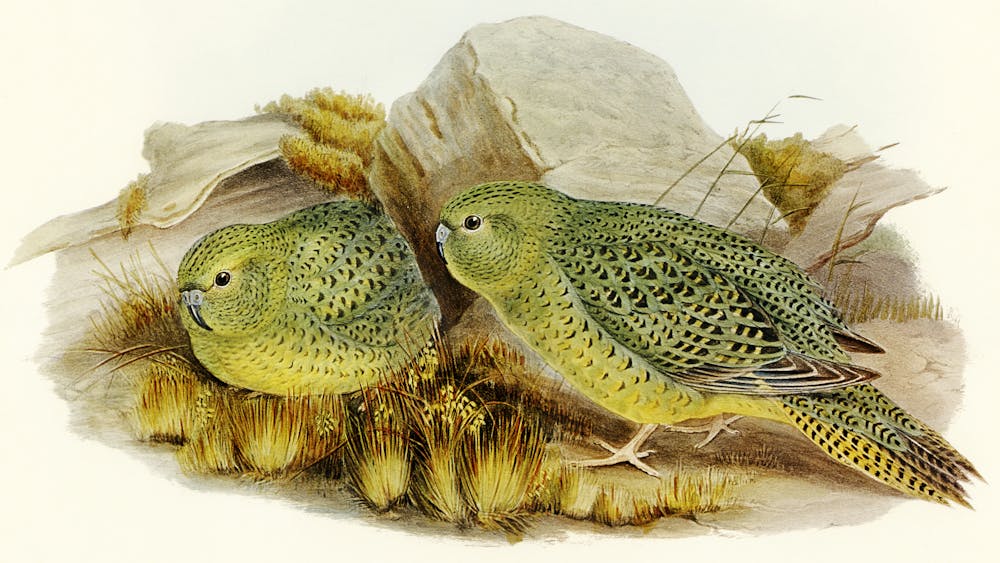
    The night parrot lives in arid inland Australia. Pictured: an 1890 illustration by Elizabeth Gould.
    Wikimedia, CC BY

    A highly mysterious species

    The night parrot was once found throughout Australia’s arid inland, but its numbers plummeted in the late 19th century.

    The bird was not definitely recorded for more than 100 years, until a dead bird was found near Boulia in western Queensland in 1990. Another dead bird was found in Diamantina National Park, also in western Queensland, in 2006.

    In 2013 a small population was found by naturalist John Young in south-western Queensland. That area is now a wildlife reserve.

    Night parrots are notoriously difficult to detect. They build tunnels in dense spinifex and hide there by day, emerging at night to forage. They are known only from populations in remote south-west Queensland and central and northern Western Australia. The species is critically endangered.

    In Western Australia, Indigenous cultural knowledge about the species includes stories about how difficult the bird is to find. There are also whispered stories of mothers telling children the night parrot’s call was the sound of an evil spirit, and warning them not to stray from camp.

    A short video explaining the night parrot project.

    What we did

    The Ngururrpa Indigenous Protected Area is in the Great Sandy Desert. It comprises vast areas of sandplains and dunefields, and smaller areas of floodplain and spinifex which are key night parrot habitats.

    The researchers recorded night parrots using ‘songmeters’.
    Ngururrpa Rangers/Facebook

    Ngururrpa Rangers worked with scientists to learn how to use sound recorders to search for night parrots. We then searched for the birds on Country between 2018 and 2023.

    We combined the rangers’ detailed knowledge of habitats, water and seed resources with geology maps, satellite imagery and fire history data. From this we selected 31 potential roosting areas, then deployed sound recorders called “songmeters” at those sites.

    We wanted to detect the night parrots’ distinctive calls which consist of whistles, croaks and bell-like sounds.

    The acoustic data we gathered was then analysed to extract any bird calls in the night parrot’s frequency range. Potential detections were verified using a reference library of known night parrot calls.

    Our results

    We detected night parrot calls at 17 of 31 sites. Of these, ten were roost sites, where night parrot calls were detected in the hour after sunset and the hour before sunrise.

    Individual night parrots are thought to have unique calls. We analysed how many different calls we could hear, and how loud they were (which can tell us when birds are calling from different locations). From this we built a picture of the identity and number of individuals regularly occupying a site.

    We extrapolated this across the 58 patches of potential night parrot habitat on the Ngururrpa Indigenous Protected Area. We concluded up to 20 roosting areas may be occupied by night parrots.

    Based on the numbers at roosting sites where we recorded calls, we estimate 40–50 night parrots could be present in the Ngururrpa Indigenous Protected Area.


    Fire and predators pose grave threats

    Once we found the night parrot populations, we wanted to know what threats they faced.

    We used camera-traps to identify predators and also collected their scats (poos) to analyse their diets.

    Ngururrpa Ranger Kathryn Njamme with a night parrot feather.
    Ngururrpa IPA

    Dingoes were the predator detected most frequently in night parrot roosting habitat. Our cameras captured them ten times more often than feral cats. And we found dingoes regularly eat feral cats at night parrot sites.

    Based on information from other areas, we suspect cats are a key predator of night parrots. Dingoes could be important in suppressing cat numbers and helping the parrots survive. So, attempts to limit predators in night parrot habitat should not harm dingoes.

    We also analysed 40 years of satellite imagery to assess the threat of fire to night parrots’ roosting habitat. Based on the vegetation types and flammability of surrounding landscapes, we found bushfires sparked by lightning are a much bigger threat to night parrots in the Great Sandy Desert than in Queensland.

    Strategic aerial and ground burning, to reduce fuel loads, already occurs in the Ngururrpa Indigenous Protected Area. As our knowledge of night parrots improves, these programs can become more targeted to protect key night parrot areas.

    Ngururrpa Rangers using ‘Felixer’ devices to selectively control cats in night parrot habitat.
    Ngururrpa IPA

    Keeping night parrots alive

    A long-term monitoring program for night parrots on Ngururrpa Country should be established to help better understand and protect this vitally important population.

    And the remote, wild nature of the landscape should be retained. This means minimising disturbance from people and vehicles, and continuing to exclude livestock and weeds.

    Clifford Sunfly has articulated how the rangers want to help protect night parrots into the future:

    We would like to spend more time on Country to find where [night parrots] are and understand what they are doing.

    We want those scientists to come and help us catch some night parrots and tag them. We also need more snake-cams (inspection cameras) too and more songmeters. And a kit for collecting scats for DNA.

    One day we would love to have our own research facility for doing our night parrot surveys. It would be our dream to have our own research base on Ngururrpa.

    Rachel Paltridge receives funding from the National Environmental Science Program’s Resilient Landscapes Hub, and the Indigenous Desert Alliance.

    Clifford Sunfly is a Ngururrpa Ranger. The ranger program receives funding from the WA government’s Aboriginal Ranger Program and the State NRM Program.

    Nicholas Leseberg receives funding from the Australian and Queensland Governments. He works for Bush Heritage Australia, and as a consultant on night parrots for many projects.

    ref. ‘Breakthrough discovery’: Indigenous Rangers in outback WA find up to 50 night parrots – one of Australia’s most elusive birds – https://theconversation.com/breakthrough-discovery-indigenous-rangers-in-outback-wa-find-up-to-50-night-parrots-one-of-australias-most-elusive-birds-239449

    MIL OSI AnalysisEveningReport.nz

  • MIL-OSI New Zealand: SH2 Wharerata Road lookout area temporarily closed for safety improvements

    Source: New Zealand Transport Agency

    Work gets underway this week on improvements to the State Highway 2 Wharerata Road Lookout rest area and carpark, about 45 minutes south of Gisborne.

    For the next 2 months, ahead of the summer holiday season, crews will rebuild the rest area and car park and lay new asphalt, alongside installing new street furniture so people pulling off the state highway have an improved area to check their phones, make a call or just take a break before continuing their journey.

    Subject to weather conditions, crews will be active on site between 6am and 6pm, Monday to Saturday, and during this time the shoulder approaching the rest area and carpark will be closed with a reduced temporary speed limit in place of 30km/h. At times the passing lane approaching the rest area and carpark may also be temporarily closed for the safety of crews.

    Throughout the works the rest area and carpark will be closed 24/7 to all vehicles.

    Two lanes of traffic on the state highway will remain flowing and there should be little disruption to journeys.

    NZ Transport Agency Waka Kotahi wants to thank those who will be inconvenienced by the temporary closure of the rest area and carpark for their understanding while these improvements happen.

    This work is part of Connecting Tairāwhiti, which is a programme of projects providing more slow vehicle bays and more places to pull off the road safely to check messages or take a break on State Highways 2 and 35 across the Tairāwhiti and northern Hawke’s Bay regions. The programme also includes some resilience projects to strengthen and stabilise sites on State Highway 35 to help it remain open and functional during disruptions such as weather events.

    MIL OSI New Zealand News

  • MIL-OSI New Zealand: State Highway 6 Whangamoa closed following serious crash

    Source: New Zealand Transport Agency

    UPDATE 9:40 pm: State Highway 6 is now open under stop/go traffic management and a 30’km/h temporary speed limit following a serious crash on the Whangamoa Hill earlier this evening.
    Drivers can expect delays when travelling through the crash site until the highway is fully reopened.

    UPDATE 8:15 pm:

    State Highway 6 remains closed this evening, with emergency services and contractors attend a serious crash on the Whangamoa Hill. State Highway 6 is closed to all traffic between Hira and the Rai Valley and is expected to remain closed until the Police Serious Crash Unit completes its investigation.

    Drivers must avoid the area, delay their travel, or detour via State Highway 63 Wairau Valley and St Arnaud.

    6:15pm:

    State Highway 6 is closed between Nelson and Blenheim this evening as emergency services and contractors attend a serious crash on the Whangamoa Hill.
    The single-vehicle crash, which occurred near the Kokorua Road intersection, was reported around 5 pm.

    The highway is closed in both directions and is expected to remain closed for several hours while the Police Serious Crash Unit investigates.

    There are no available local road detours, and the only route between Nelson and Blenheim is via State Highway 63 – St Arnaud and the Wairau Valley.

    This significantly longer route can add over 30 minutes or more to travel times. Drivers must factor this into their travel plans, particularly those with ferry connections in Picton.

    Road users must avoid the area and should consider delaying their journeys.

    Updates on the highway’s status can be found on the NZTA Waka Kotahi website:

    Highway Conditions – Nelson Marlborough(external link)

    MIL OSI New Zealand News

  • MIL-OSI New Zealand: Returning to scene of crime lands one in court

    Source: New Zealand Police (National News)

    A man who stole a car then used it to ram his way out of the victim’s garage has been arrested after he returned back to the scene of the crime.

    At about 1.20am, a man allegedly entered a property in Grove Road, Papakura.

    Counties Manukau South Area Prevention Manager, Inspector Matt Hoyes, says the alleged offender has gone into the garage and hoped inside a Toyota Funcargo which was parked inside, using it to ram his way out of the garage.

    “About five minutes later the vehicle returned to the address while the owner was speaking to Police on the phone.

    “The driver has quickly fled and the Police Eagle helicopter was able to gain observations, tracking the vehicle around the Papakura area.

    “The vehicle then drove around multiple streets in Flat Bush before heading into Manukau.”

    Inspector Hoyes says the vehicle was then spiked and came to a stop on Weymouth Road where the driver was taken into custody without incident.

    “This was a fantastic response from all Police teams involved to bring a quick resolution.

    “As we have said before, vigilant reporting is often be the key to Police being able to respond in a timely manner and hold people to account for their actions.

    “This also serves as a reminder to those who choose to engage in this type of offending, know that we will not tolerate it.”

    A 32-year-old man will appear in Papakura District Court today charged with unlawfully taking a vehicle and burglary.

    ENDS.

    Holly McKay/NZ Police

    MIL OSI New Zealand News

  • MIL-OSI Australia: Call for information – Aggravated robbery – Brinkin

    Source: Northern Territory Police and Fire Services

    Northern Territory Police are calling for information in relation to an aggravated robbery in Brinkin overnight.

    Around 11:55pm, it is alleged an altercation occurred on Trower road, near the intersection with Bradshaw drive, between two dark coloured vehicles.

    The offending vehicle is believed to be a sports utility vehicle carrying young adult male passengers.

    The incident continued onto an address closer to casuarina beach, where police received reports that a man was threatened with a knife before the offenders stole his phone and fled the scene.

    Northern Territory Police are urging anyone with information or who had witnessed the incidents to make contact on 131 444. Police quote reference NTP2400095169.

    Anonymous reports can be made through Crime Stoppers on 1800 333 00 or through https://crimestoppers.com.au/.

    MIL OSI News

  • MIL-OSI Security: Met announces next steps to rebuild trust with Black Londoners

    Source: United Kingdom London Metropolitan Police

    • Met launches London Race Action Plan, committing to the next steps in becoming an anti-racist police service
    • The plan has been co-created with Black officers, staff and communities – with more than 2,200 Londoners consulted.
    • Improvements to the service’s culture, training and leadership all form part of the Met’s commitment to strengthening trust among Black Londoners and its own workforce.
    • A new stop and search charter which has been co-authored with Black communities. This re-sets how stop and search should be carried out in London.
    • Improvements in how we record and monitor the ethnicity of drivers when making vehicle stops, with external scrutiny for greater transparency.
    • An overhaul of our policy on intimate searches of children – increasing the threshold and oversight, ensuring they only occur when necessary and proportionate.
    • To better represent the communities we serve we’re working hard to recruit and retain a more diverse workforce that brings all the talents, experiences and perspectives of London to policing.
    • We’re also now training all new recruits so they understand the lived experience of Black Londoners and other communities across the capital.
    • We’ve committed to rooting out disparities in the Met’s misconduct system and have introduced focused workshops to improve promotion rates. As a result, since 2021 promotion pass rates for Black officers has increased from 68% to 75%.

    The London Race Action Plan outlines the next steps in the Met’s mission to become an anti-racist organisation and a service that is more inclusive, diverse and representative of London.

    It sets out across four pillars how the Met will better represent, respect, involve and protect Black Londoners.

    Over many years the Met has let Black communities down and although steps have been taken in the right direction, there remains a long way to go to be an inclusive and anti-racist organisation.

    The four pillars of the plan will be delivered through tangible action across London, co-designed by the communities we serve. This will include: 

    We know there is more to do, but this plan sets the right course to continue building a Met that our officers and public deserve.

    Progress will be made publicly available via biannual updates.

    Sir Mark Rowley, Commissioner of the Metropolitan Police said: “This plan publicly sets out our next steps towards becoming a truly anti-racist and inclusive organisation.

    “Black Londoners have been let down by the Met over many years and while we continue to take steps in the right direction, there remains a long way to go and there is a lot more work to do.

    “Action not words will rebuild trust in our service, so we must now remain focused on delivering real change that is seen and felt by our communities and our workforce.

    “We are changing our systems, our processes, culture and our leadership. We are better understanding and acting on disproportionality wherever it exists. We are working more closely than ever with communities we’ve let down to build a service that delivers for all of London.

    “To achieve this critical change once and for all will take time, but I am determined that we will continue to strengthen our relationship with Black Londoners – whether that be members of the public or our own colleagues – and renew the principle of policing by consent.”

    MIL Security OSI

  • MIL-OSI China: 7th Chinese farmers’ harvest festival celebrated across China

    Source: People’s Republic of China – State Council News

    7th Chinese farmers’ harvest festival celebrated across China

    Updated: September 23, 2024 07:33 Xinhua
    A villager airs crops at Yangchan Village in Huangshan City, east China’s Anhui Province, Sept. 22, 2024. This Sunday marks the seventh Chinese farmers’ harvest festival. [Photo/Xinhua]
    A farmer loads harvested corns onto a truck at Bianqiao Township of Linyi City, east China’s Shandong Province, Sept. 17, 2024. [Photo/Xinhua]
    A farmer holds harvested rice at Yuanyang County of Honghe Hani and Yi Autonomous Prefecture, southwest China’s Yunnan Province, Sept. 22, 2024. [Photo/Xinhua]
    Farmers harvest rice at Zhanglou Village of Xinyang City, central China’s Henan Province, Sept. 22, 2024. [Photo/Xinhua]
    A farmer harvests grapes at an orchard of Xixiaoyi Village in Tangshan City, north China’s Hebei Province, Sept. 22, 2024. [Photo/Xinhua]
    Farmers harvest rice at Wanchang Township in Yongji County, northeast China’s Jilin Province, Sept. 20, 2024. [Photo/Xinhua]
    An aerial drone photo shows harvesters working in a paddy field in Fangzheng County of Harbin, northeast China’s Heilongjiang Province, Sept. 22, 2024. This Sunday marks the seventh Chinese farmers’ harvest festival. In recent years, China’s major grain production province Heilongjiang has enhanced its grain production capacity and advanced the quality of high-standard farmland development. [Photo/Xinhua]
    Harvesters work in a paddy field in Fangzheng County of Harbin, northeast China’s Heilongjiang Province, Sept. 22, 2024. [Photo/Xinhua]
    An aerial drone photo shows a paddy field in Fangzheng County of Harbin, northeast China’s Heilongjiang Province, Sept. 22, 2024. [Photo/Xinhua]
    Folk artists throw molten iron to create fireworks in Haiyang, east China’s Shandong Province, Sept. 21, 2024. The event aims to commemorate the seventh Chinese farmers’ harvest festival which falls on Sept. 22 this year. [Photo/Xinhua]
    Folk artists throw molten iron to create fireworks in Haiyang, east China’s Shandong Province, Sept. 21, 2024. [Photo/Xinhua]

    MIL OSI China News

  • MIL-OSI Australia: Women charged with stealing in Launceston and Devonport

    Source: Tasmania Police

    Women charged with stealing in Launceston and Devonport

    Monday, 23 September 2024 – 9:46 am.

    Two women have been charged after allegedly stealing over $6,000 worth of goods from stores in the Launceston and Devonport areas between May and September 2024.
    The 26-year-old and 39-year-old, both from Ravenswood, were arrested in the Rooke Street Mall, Devonport on Saturday after they were intercepted by police leaving a store with a significant amount of property.
    Police obtained a search warrant for their vehicle and recovered further stolen property.
    Both women appeared in court today and were remanded in custody to appear again at a later date.
    If you have any information regarding this matter, please contact Tasmania Police on 131 444, or anonymously through Crime Stoppers Tasmania via crimestopperstas.com.au on 1800 333 000.

    MIL OSI News

  • MIL-OSI Australia: Brigades of CFA: Warracknabeal

    Source: Victoria Country Fire Authority

    Warracknabeal Fire Brigade may be one of Victoria’s oldest fire brigades – but its members have always had a focus on innovation and progression.

    Located in the state’s north-west, Warracknabeal brigade has a history dating back to CFA’s formative years. The brigade began in the 1890s when local volunteers secured a 26-person Merryweather hand-operated manual pump enabling them to officially join the newly created Country Fire Brigades Board (now CFA). 

    By 1919, the Country Fire Brigades Board (CFBB) had seen the potential of motorised firefighting vehicles which were considered a great advance on horse-drawn vehicles. Following the war, there were also huge developments in the design and use of motorised water pumps, which made firefighting more efficient and effective.

    Warracknabeal’s then captain, local entrepreneur Tom Gardiner seized upon this opportunity, establishing Gardiner-Aussie Workshops in the early 1920s with the goal of building trucks and pumpers suitable for rural firefighting. His innovative design would prove successful and was quickly adopted by the CFBB. Tom’s workshop was commissioned to develop 55 pumpers prior to his death in 1935.

    The new pumpers would not be the first motorised vehicle produced out of Warracknabeal. A belt drive bike with a small four stroke engine and pedal assist was built by the Mallee Cycle works in 1905.  

    Another of the brigade’s early leaders has strong ties to CFA’s history and was instrumental in improving CFA’s early communication with members. In 1947 Captain Norman Tosh recognised the need for a regular publication to share information with brigades across the state. With approval from CFA, he became the founder and first editor of ‘The Fireman’ (now Firewise), a newspaper for volunteer firefighters which is still in circulation today.

    Warracknabeal Fire Brigade has grown significantly in the years since, and members are firmly focused on the future.

    Current brigade captain Cameron Whelan says, like its early years, Warracknabeal brigade continues to have a progressive and innovative lens focused on improvement.

    The brigade’s new, state-of-the-art station opened in mid-2023 replacing the 35-year-old station. The station features improved facilities such as drive through engine bays, a laundry, changerooms and other amenities. The brigade was able to provide a significant contribution to improve the size of the meeting room, rear shed, install bi-fold doors as well as make other improvements.

    “We’ve always been a vibrant and progressive brigade, so the modern design of the new station represents us well,” Cameron said.

    “We’ve built this station for the next 30 years so the vision is not only to support the needs of Warracknabeal today; we’re also looking beyond that to what will be required in the future.

    “Our Fire Equipment Maintenance servicing is key to the brigade continuing to improve facilities and operational equipment.

    “The brigade also has an active social Auxiliary membership primarily supporting the brigade through fundraising programs and assisting local community groups such as the Scouts and Guides.” 

    The brigade has about 70 members and attends about 40 incidents a year locally; members also provide support across the state during the fire season.

    With one of the key industries in Warracknabeal and surrounds being broadacre cereal farming, harvesting-related fires are one of the main risks the brigade encounters over the fire danger period. Its members have been heavily involved in the development of the joint CFA and Victorian Farmers Federation Grain Harvesting Guidelines.

    “The main incidents we turn out to are running grass and scrub fires through to harvesting machinery fires,” Cameron said.

    “Like many other towns we also have a range of other risks from hospital/aged care, large chemical storage facilities through to household or structural fires.”

    The brigade has a very stable membership and whilst they will always welcome new members, Cameron says they are lucky they don’t need to actively seek members.

    “Like many rural brigades, we can see a drop off when members reach 18-19 years old because they leave for university or work,” Cameron said.

    “A strong Juniors program aims to encourage skill development and succession from the junior to senior ranks. 

    “To encourage retention, we include fire ground practise as part of our Junior training to build their skills and eagerness.”

    Cameron said volunteering with CFA is for anyone who is willing to help their community, better themselves and join a bigger family.

    “The thing I’m most proud of in leading our brigade is the values our members display,” Cameron said.

    “Values such as care, respect and integrity are common attributes amongst our cohort.”

    This story is part of our profile series Brigades of CFA which highlights our brigades and the great work they do in their communities.

    Submitted by CFA News

    MIL OSI News

  • MIL-OSI Global: A weakened Hezbollah is being goaded into all-out conflict with Israel – the consequences would be devastating for all

    Source: The Conversation – USA – By Asher Kaufman, Professor of History and Peace Studies, University of Notre Dame

    For almost a year, Israel and Hezbollah have engaged in increasingly provocative cross-border skirmishes as onlookers warn that this escalating war of attrition could land the region in all-out conflict. The past few days have made that devastating scenario closer to a reality.

    First came Israel’s pager and walkie-talkie attack, an unprecedented assault on Hezbollah’s communications that injured thousands of the organization’s operatives. It was followed by the assassination of Ibrahim Aqil, a key Hezbollah leader, who died in an airstrike that also killed other senior commanders of the militant group, as well as some civilians. Hezbollah has responded by extending the geographical range of its rockets fired at Israel, targeting both military facilities and civilian neighborhoods just north and east of Haifa.

    As a scholar of Lebanon and Israel, I have followed the dynamics of this war of attrition since Oct. 8, 2023, the day after Hamas executed an unprecedented and deadly attack on Israel, which responded by bombarding the Gaza Strip. Hezbollah then began firing rockets into northern Israel in solidarity with Hamas in Gaza.

    Despite the high rhetoric and mutual threats of destruction, until recent days neither Israel nor Hezbollah, nor the latter’s sponsor Iran, have shown an interest in a full-scale war. All parties surely know the likely destructive consequences of such an eventuality for themselves: Israel has the military power to devastate Beirut and other parts of Lebanon as it did in Gaza, while even a weakened Hezbollah could fire thousands of missiles at Israeli strategic sites, from the airport to central Tel Aviv, water supply lines and electricity hubs, and offshore gas rigs.

    So instead, they have exchanged fire and blows along their shared boundary, with somewhat agreed-upon red lines concerning the geographical scope of attacks and efforts not to intentionally target civilians.

    But Israel’s recent attacks in Lebanon may have turned the page of this war of attrition into a new and far more acute situation, putting the region on the brink of a full war. Such a war would wreak havoc in Lebanon and Israel, and might also drag Iran and the United States into direct confrontation. In doing so, it would also fulfill the apparent of the Hamas gunmen who murdered around 1,200 Israelis on Oct. 7 in the hope that a heavy-handed Israeli response would draw in more groups across the region.

    A dangerous ‘new phase’

    Hezbollah’s secretary general, Hassan Nasrallah, has insisted throughout the near-yearlong hostilities that his organization would hold its fire only if a cease-fire agreement is reached between Israel and Hamas. In recent weeks, however, Israel has taken the conflict in the opposite direction.

    The country’s defense minister, Yoav Gallant, described the coordinated attacks on Hezbolah targets as a “new phase,” adding that the “center of gravity” in the war was moving north into Lebanon. The Israeli government has added the “return of the residents of the north securely to their homes” as an additional war goal.

    The assault on Hezbollah’s communications system targeted the organization’s operatives but hit many civilian bystanders, leaving Lebanese in shock, trauma, anger and desperation.

    It demonstrated Israel’s tactical military advantage over Hezbollah. The unprecedented penetration into the heart of the organization’s command and rank-and-file structures has never been seen before in any conflict or war globally. It struck Hezbollah in its most vulnerable places and even exposed its coordination with Iran – one of the injured persons from the pager explosions was the Iranian ambassador in Lebanon.

    The killing of Akil two days later was another signal that the Israeli government had now decided to try to change the rules of this risky game of reprisals and counter-reprisals. It is clear that rather than the uneasy status quo that defined this war of attrition for nearly a year, Israel’s intent is now to pressure Hezbollah to concede.

    Getting out of control

    Nasrallah delivered a gloomy and defiant speech in the aftermath of the pager attack. While acknowledging that Hezbollah was severely undermined by this operation, he defined the Israeli attack as a continuation of “multiple other massacres perpetrated by the enemy over decades.”

    By doing so, he framed it within a popular historical narrative among many Lebanese and Palestinians who regard Israel as a criminal entity that regularly carries out massacres against innocent civilians.

    Nasrallah also insisted that his commitment to supporting Hamas in Gaza remains unwavering.

    While stating that Israeli actions have “crossed all red lines” and could amount to a declaration of war, Nasrallah also reiterated a point he had made in previous peaks of this ongoing conflict: that retribution is coming, the only question being of timing and scale. By doing so, Nasrallah hinted that he may still not be interested in a full war.

    Israel, on the other hand, appears less circumspect. After almost a full year of contained tension with Hezbollah, Israel’s leaders appear willing to risk an escalation that might get out of control.

    It is hard to determine what the strategy behind Israel’s actions is: Since Oct. 7; as the Biden administration has noted, Israel has not displayed a coherent strategy with clear political goals.

    Rather, critics of Prime Minister Benjamin Netanyahu suggest that he is mainly motivated by his own political survival and the retention of power as the head of state, tying Israel’s interests to his own.

    Uniting the ‘axis of resistance’

    So where does this leave Nasrallah as he weighs Hezbollah’s response, surely in consultation with Iran? After such devastating blows to Nasrallah’s organization, it is hard to think that Hezbollah would be willing to scale down, stop its cross-border attacks and retreat away from the Israeli border, or give up its commitment to support Hamas in Gaza.

    Palestinian refugees listen to a speech by Hezbollah leader Hassan Nasrallah from a cafe at the entrance of the Sabra camp in Beirut.
    Joseph Eid/AFP via Getty Images

    On the other hand, opting for a full-scale war, after spending a year avoiding it, is fraught with risk – both Nasrallah and his sponsors in Tehran know well the high costs of such a war for Hezbollah, Lebanon and potentially also for Iran.

    If Hezbollah went to war now against Israel, it would embark on its most consequential move since its foundation in 1982. But it would do so with crippled communications systems and without much of its leadership – some of whom had worked for decades side by side with Nasrallah, building with him the military capacity of the organization.

    In some respects, Israelis under Netanyahu’s leadership, and Lebanese in a country increasingly held hostage by Hezbollah’s interests, face similar predicaments: Their well-being is being sacrificed for other priorities.

    Netanayhu’s recent statements about concern for Israeli citizens in the north sound hollow after 11 months of pursuing policies that put them more in danger, as well as opposing a Gaza cease-fire deal that would also end hostilities between Hezbollah and Israel.

    In Lebanon, Hezbollah has dragged the country into this war against the will of most Lebanese – a decision that has led to significant devastation in parts of a country already suffering extreme political and economic duress.

    Nasrallah’s speech described Hezbollah’s predicament as that of all Lebanon – while sending a veiled threat that dissent would not be tolerated. Many Lebanese are undoubtedly sympathetic to the Palestinian cause and resent Israel’s war in Gaza. But at the same time, they may balk at the idea that their own well-being has to be sacrificed in the process.

    In the meantime, Yahya Sinwar, the Hamas leader and mastermind behind the Oct. 7 massacre, may well be looking on at the unfolding events between Israel and Hezbollah with satisfaction. His plan was designed to trigger the unification of all fronts of the so-called “axis of resistance,” which includes the Houthis in Yemen as well as Hezbollah and other Iran-backed groups with the hope for a regional war against Israel.

    A year later, we are closer than ever to that scenario.

    Asher Kaufman does not work for, consult, own shares in or receive funding from any company or organization that would benefit from this article, and has disclosed no relevant affiliations beyond their academic appointment.

    ref. A weakened Hezbollah is being goaded into all-out conflict with Israel – the consequences would be devastating for all – https://theconversation.com/a-weakened-hezbollah-is-being-goaded-into-all-out-conflict-with-israel-the-consequences-would-be-devastating-for-all-239469

    MIL OSI – Global Reports

  • MIL-OSI New Zealand: ANZ continues to support Hyundai Motor Company’s EV Manufacturing with USD1.35b Green ECA facility

    Source: ANZ statements

    ANZ has successfully closed an USD1.35b Green Labeled K-Sure covered Term Loan Facility for Hyundai Motor Group, funding its first electric vehicle (EV) manufacturing plant in the US, as the world’s third largest car manufacturer continues to invest in the country.

    It will help accelerate Hyundai Motor Company’s electrification strategy with an expected manufacturing capacity of 300,000 units annually at its Georgia Metaplant complex.

    The Green Export Credit Agency (ECA) backed loan adheres to LMA Green Loan Principles, and reinforces ANZ as a key financing partner for Hyundai Motor Group, acting as ECA and Green Loan Coordinator, Mandated Lead Arranger, and Bookrunner on its past three mandates.

    Aaron Ross, ANZ’s Global Head of Project, Export & Asset Finance said, “These deals underscore ANZ’s market-leading position in the Korean ECA sector, delivering low risk, capital-efficient and high-returning facilities that meet our customer needs. We have executed four major EV sector transactions backed by Korean ECAs in the past five years.

    “We’re proud to play a role in supporting Hyundai Motor Group’s capital expenditure initiatives as it strives to become a global leader in electric vehicle manufacturing. Leveraging our expertise across Korea, Japan, Singapore, Indonesia and the US, we have been able to consistently deliver smart solutions by integrating sustainable finance to meet Hyundai Motor Group’s strategic and evolving needs,” Mr Ross said.

    Previous deals with Hyundai Motor Group include:

    • USD 940 million K-Sure-backed deal for Hyundai Mobis’ EV parts plant located within the Georgia Metaplant complex
    • USD 711 million ECA financing to establish South-East Asia’s first and largest EV battery manufacturing facility in Indonesia
    • SGD 230 million green loan to finance the Hyundai Motor Group Innovation Center in Singapore

    ANZ has set a target to fund and facilitate at least $A100 billion by the end of FY2030, including $A15 billion by end FY2024, in social and environmental outcomes through customer activities and direct investments by ANZ. This includes initiatives that aim to help lower carbon emissions, protect nature, increase access to affordable housing and promote financial wellbeing, as described in the target methodology.

    MIL OSI New Zealand News

  • MIL-Evening Report: Move over Olympians, Australia’s wildlife are incredible athletes

    Source: The Conversation (Au and NZ) – By Euan Ritchie, Professor in Wildlife Ecology and Conservation, School of Life & Environmental Sciences, Deakin University

    Now that the Paris Olympics and Paralympics have disappeared from our screens, let’s get back to watching animal videos.

    But seriously, have you ever paused to think about the athletic abilities of Australian wildlife?

    In my research as an ecologist, I’m constantly amazed by the strength, speed and resilience of our native animals. Their prowess is testament to the wonders of evolution, and the necessity of species having to adapt to challenging and changing environments in order to survive.

    Let’s take a closer look at some of our best competitors and how might they fare, against humans and overseas entrants. On your marks, get set… swim, hop, dig, dance, glide!

    Swimming

    Australians are renowned for being strong swimmers. But what is the fastest swimmer in the animal kingdom?

    On this there is much debate. Some suggest it’s the Indo Pacific sailfish, clocking in at about 30km/hr. That’s impressive, but much slower than oft-cited (but inaccurate) claims it can travel at more than 100km/hr.

    For perspective, the fastest human to swim the 50 metres freestyle is American Caeleb Dressel, completing this in a time of 20.16 seconds. That’s roughly 9km/h – faster than many people jog, but still no match for a sailfish.

    As in humans, swimming speed in fishes tends to increase with body length. Larger species that challenge sailfish for the fastest swimmer title include blue or black marlin. Shorter, torpedo-like bluefin tuna are also in contention. All are found in Australian waters, though not exclusively.

    While American swimmer Michael Phelps put in an impressive showing against a simulated great white shark, no human would beat much faster sailfish, marlin and tuna.

    Sprinting, long and high jump

    Aussie icons, red kangaroos can reach speeds of around 60-70km/hr. But they are no match for cheetahs, which can move at more than 120km/hr.

    Long jump is surely the kangaroo’s main event. Red kangaroos can jump a staggering 13 metres or more. Amazingly, this might not be enough to clinch gold. Snow leopards can jump more than 15 metres.

    Kangaroos can clear heights of up to 3m, so would perform well in the high jump. But they’d finish behind bottlenose dolphins, which can jump over 7m in the air, just for kicks.

    Scaled for body size, though, both species would be embarrassed by a tiny insect known as a froghopper. It jumps to heights of more than 140 times its body length.

    Kangaroos sure can jump, but they’re not the greatest of all in the animal kingdom.

    Battles of strength

    African elephants can lift more than 1,000kg and weaver ants more than 100 times their own body weight.

    But relative to size, a truly impressive champion is Australia’s horned dung beetle. At just a centimetre long, these diminutive powerhouses can pull more than 1,100 times their own body weight, roughly equating to an average man lifting two fully-loaded 18-wheeler trucks.

    And yet, horned dung beetles might still only claim silver. Another invertebrate Aussie, the tiny tropical moss mite, is perhaps the world’s strongest animal. It can pull more than 1,180 times its weight.

    Bigger does not always equal stronger.

    Packing the fastest, deadliest punch

    In terms of combat sports, bigger is not always better.

    Peacock mantis shrimps – invertebrates found in Australian marine waters and elsewhere – have the swiftest and most powerful punch in the lightweight crustacean division.

    They kill prey by punching them with strong, club-like appendages. They deliver blows at up to 23m per sec, akin to the speed and force of a .22 calibre bullet being fired.

    So powerful is the punch, it vaporises water and creates a super-hot shockwave that breaks up and incapacitates its prey.

    Nature’s deadliest punch?

    Tantalising contests

    What about a digging contest? Eastern barred bandicoots can shift 4.8 tonnes of soil a year. How would that stack up against marsupial moles, which can disappear almost instantly into desert sands? Or the expert excavations of wombats and aardvarks that can dig more than half a metre in 15 seconds?

    In terms of free-diving and flying, there’s really no contest. Cuvier’s beaked whale can dive nearly 3000m and peregrine falcons can reach over 320 km/hr. These animals are found across the globe, however – not just in Australia.

    Australia’s largest gliding marsupial, the greater glider, can sail up to 100m between trees. But gliding gold would surely go to the giant flying squirrel, which can glide up to 450m.

    I’d love to see a shooting contest between Australia’s archer fish and Madagascar’s panther chameleon. But finding the right arena for both aquatic and land-based sharpshooters would be tricky.

    Raygun’s kangaroo hop is now legendary, but a breaking (break dancing) contest between a peacock spider, spanish dancer (a type of nudibranch) and a magnificent riflebird might genuinely break the internet.

    Step aside, Raygun, peacock spiders are taking the floor.

    Appreciating wildlife athletes

    So who would win a global contest for the best wildlife athlete overall?

    If the competition was on land and focused on running, jumping, strength and climbing, it’s hard to go past the overall abilities of a Bengal tiger.

    Many amazing wildlife athletes are threatened with extinction. Others are gone forever.

    They include the incredible oolacunta – also known as the desert rat kangaroo. It’s powers of endurance in the desert are the stuff of folklore. As legendary Australian mammalogist Hedley Herbert Finlayson wrote in 1931:

    Its speed for such an atom, was wonderful, and its endurance amazing … when we finally got it, it had taken the starch out of three mounts and run us 12 miles; all under such adverse conditions of heat and rough going, as to make it almost incredible that so small a frame should be capable of such an immense output of energy.

    Let’s celebrate wildlife and their athletic abilities and ensure they have a secure future.

    Euan Ritchie receives funding from the Australian Research Council and the Department of Energy, Environment, and Climate Action. Euan is a Councillor within the Biodiversity Council, a member of the Ecological Society of Australia and the Australian Mammal Society, and President of the Australian Mammal Society.

    ref. Move over Olympians, Australia’s wildlife are incredible athletes – https://theconversation.com/move-over-olympians-australias-wildlife-are-incredible-athletes-238303

    MIL OSI AnalysisEveningReport.nz

  • MIL-OSI China: China’s manufacturing industry delivers new momentum

    Source: China State Council Information Office

    Qijiang-2 humanoid robot hands an orange to a visitor at the 2024 World Manufacturing Convention in Hefei, east China’s Anhui Province, Sept. 20, 2024. [Photo/Xinhua]

    With a human build and sleek appearance, the 1.8-meter-tall Qijiang-2 is captivating visitors in the exhibition hall of the 2024 World Manufacturing Convention as it can mimic human movements with remarkable precision.

    The humanoid robot, developed by Anhui Provincial Key Laboratory of Humanoid Robots, is certainly hogging the spotlight at the convention, which opened on Friday and will continue until Monday in Hefei, the capital of east China’s Anhui Province.

    Equipped with advanced sensors and intricate inertial measurement units, Qijiang-2 can perform delicate tasks such as folding clothes, opening bottles, wiping dishes and navigating uneven terrain.

    But it’s more than just a mechanical marvel. Beyond its physical capabilities, the robot also has decision-making features, including intelligent user recognition and secure access for authorized users.

    “In the future, these humanoid robots will be able to adapt to both industrial production and elderly care scenarios, serving as robot workers and robot caregivers,” said Liu Houde, director of the laboratory.

    Qijiang-2 and other cutting-edge exhibits like the Jiuzhou Yunjian Longyun rocket engine and the Origin Wukong superconducting quantum computer are demonstrating China’s breakthroughs in frontier technologies at the event, as well as its potential in the field of high-tech manufacturing.

    The gathering of leading global enterprises and industry experts has also reflected China’s commitment to advancing international cooperation and working with other countries to address the challenges and opportunities in global manufacturing development.

    “After 30 years of development in China, Continental AG values not only China’s market volume but also advanced technologies,” said Enno Tang, president and CEO of Continental China.

    With comprehensive industrial categories and a well-rounded manufacturing system, China has attracted global firms to strengthen their investment in the country.

    An aerial drone photo taken on Aug. 20, 2023 shows a view of Volkswagen (Anhui) Automotive Company Limited in Hefei, east China’s Anhui Province. [Photo/Xinhua]

    Volkswagen Group in April announced an investment of 2.5 billion euros (about 2.8 billion U.S. dollars) in expanding its production and innovation hub in Hefei to increase its pace of innovation in China.

    The company also vowed to accelerate the production of two Volkswagen-brand smart electric vehicles (EVs), which are currently under joint development with Chinese manufacturer Xpeng.

    A deal reached in 2023 between the two companies gave Volkswagen access to Xpeng’s technologies, including its advanced driving assistance system, as the German carmaker made efforts to tap into China’s fast-growing EV market.

    The landmark cooperation agreement between Xpeng and Volkswagen testified to the willingness of China’s auto industry to share its technologies with the world, according to Xpeng CEO He Xiaopeng.

    As the world’s economic landscape evolves, China is stepping up efforts to collaborate with international enterprises, aiming to inject fresh momentum into the global manufacturing sector and accelerate the shift toward high-quality growth.

    This photo taken on Nov. 9, 2023 shows the booth of Schneider Electric at the 6th China International Import Expo in Shanghai, east China. [Photo/Xinhua]

    In the city of Xiamen in east China’s Fujian Province, construction on the Schneider Electric Xiamen Industrial Park began in April.

    China is Schneider Electric’s second-largest market globally, one of its most important supply chain bases, and one of its four global R&D hubs.

    After its completion, the park will be the French multinational’s biggest manufacturing facility for medium voltage equipment anywhere in the world, and some of its products will be supplied to overseas markets.

    The park will be a major R&D center, manufacturing center and supply hub through which the company will serve the global medium voltage market, according to Vincent Bruneau, vice president of Schneider Electric’s Global Supply Chain China.

    Through a combination of innovation-driven policies, open market access and strategic partnerships, China continues to strengthen its position as a key player in global manufacturing.

    “China has been advancing its manufacturing sector by focusing on high-end, intelligent, green development while increasing its efforts in technological innovation to unlock broader markets,” said Wan Hongxian, a professor at the Anhui University of Finance and Economics.

    “China’s manufacturing sector provides a highly promising market for global high-end equipment. Moreover, its advanced production capabilities and responsiveness to market demand enable the development of more high-quality products, delivering tangible benefits to consumers worldwide,” Wan added.

    MIL OSI China News

  • MIL-OSI Australia: Call for information – Aggravated robbery – Marrara

    Source: Northern Territory Police and Fire Services

    Northern Territory Police are calling for information after an aggravated robbery in Marrara early Sunday morning.

    Around 12:45am, police received reports that a 26-year-old female had been approached at a residence on Dornoch Court by two youths who allegedly threatened her with a blunt weapon for her keys before stealing her vehicle.

    A short time later, police observed the vehicle being driven on Elrundie Avenue and attempted to apprehend the vehicle. The vehicle failed to stop, and a pursuit was initiated.

    The pursuit continued throughout the Palmerston area and later into the northern suburbs where a tyre deflation device was successfully deployed.

    The alleged offenders abandoned the vehicle in Malak and fled the scene on foot.

    Investigations are ongoing.

    Police urge anyone with information about the incident to make contact on 131 444 and quote occurrence number P24261314.

    Anonymous reports can be made through Crime Stoppers on 1800 333 00 or through https://crimestoppers.com.au/.

    MIL OSI News

  • MIL-OSI New Zealand: Windy Weather Warning for Wairarapa Drivers

    Source: New Zealand Transport Agency

    Drivers travelling on State Highway 2 over the Remutaka Hill and through Wairarapa will need to be ready for another burst of rough spring weather tomorrow.

    The Metservice has issued a Strong Wind Warning for Wairarapa, Tararua District, and Hawke’s Bay south of Hastings between  8 am and 5 pm tomorrow (Tuesday, 24 September).

    Severe gale west to northwest winds are forecast and will coincide with morning and afternoon commuting times.

    It means drivers must take extra care on exposed routes like Remutaka Hill. This particularly applies to trucks, vans, motorcycles, light vehicles, and towing vehicles.

    Strong winds increase the risk of tree falls, downed powerlines, and windblown debris. Road users must be prepared for these hazards and drive accordingly.

    It is also recommended to check road and weather conditions before travelling, as bad weather can cause roads to be closed on short notice.

    It is also recommended to check road and weather conditions before travelling, as bad weather can cause roads to be closed on short notice.

    Highway Conditions – Wellington/Wairarapa(external link)

    Metservice Weather Warnings(external link)

    MIL OSI New Zealand News

  • MIL-OSI New Zealand: Tasman highway maintenance closure planned – State Highway 60 Mariri Causeway

    Source: New Zealand Transport Agency

    The State Highway summer maintenance programme will be in full swing in Tasman in October with new chipseal to be laid on the State Highway 60, Mariri Causeway (south of Motueka).

    A daytime road closure will occur on Saturday, 19 October from 7 am to 5 pm when road workers will chipseal a one-kilometre section of the highway.

    Mark Owen, Regional Manager Wellington/Top of the South, says while this work will cause short-term disruption for people living, working, and travelling in the area, the payoff will be a safer road surface.

    “We’ve planned this work for Saturday because it’s outside of school hours, there are fewer trucks on the road, and it’s one day of the week when there is no public transport operating.”

    “The reason for doing this work during the day is down to the ground temperature – chipseal has to be laid when the ground is warm to help the new seal set and stick. If it’s too cold, the seal will crack and fail,” Mr Owen says.

    A local road detour will be available via Robinson Road, Main Road Lower Moutere, Wildman Road, and Quayle Street (otherwise known as High Street South). The same detour will apply in reverse for motorists travelling from Motueka to Richmond.

    This detour is expected to add up to 10 minutes to travel time. Drivers travelling between Richmond and Motueka must allow extra time for their journeys.

    Mr Owen says the Great Taste Cycle Trail will remain open, but the detour route means it will be affected by increased traffic.

    “It’s essential drivers and cyclists share the road with care. Cyclists need to be aware there will be more vehicles around them, and drivers must look out for cyclists too.”

    Once the chipsealing is completed, the Mariri Causeway will reopen under a temporary speed limit of 50km/hr to give the chipseal time to bed in. Road workers will then sweep clear any loose chip and re-apply road markings. 

    Drivers must follow all temporary speed limits. They are there to protect the road and vehicles from damage, and to keep people safe. In the event of unforeseen circumstances or bad weather this work will be postponed.

    Works schedule:

    • Saturday, 19 October from 7 am – 5 pm
    • Detour for traffic travelling from Richmond to Motueka is via Robinson Road, Main Road Lower Moutere, Wildman Road and Quayle Street. The reverse will apply for traffic travelling from Motueka to Richmond.
    • The Great Taste Trail will remain open during the works.

    Detour map for traffic travelling from Richmond to Motueka is via Robinson Road, Main Road Lower Moutere, Wildman Road and Quayle Street.

    MIL OSI New Zealand News

  • MIL-OSI China: Smart tourism applications offer unique experiences

    Source: China State Council Information Office 2

    People visit the 2024 China Culture and Tourism Industries Exposition in north China’s Tianjin, Sept. 13, 2024. [Photo/Xinhua]
    Wearing an elegant white dress, Umuhoza, a Rwandan businesswoman, took a photo in front of a smart photo device, which soon generated a photo depicting her as a valiant and chivalrous female with traditional Chinese features.
    “When people travel to China, they really want to take memories back home. The device can take a picture of you and then transform you into a Chinese kind of person. I really love it,” Umuhoza said.
    Umuhoza runs a travel website. She helps tourists from Asian countries travel to African countries, including Rwanda, Egypt and Tanzania. At the same time, her website has a “China package,” catering to travelers from Africa who want to go to China.
    At the 2024 China Culture & Tourism Industries Exposition held earlier this month in north China’s Tianjin Municipality, many foreign visitors were overwhelmed by the novel technologies adopted in China’s tourism sector.
    “That’s amazing. I am very interested in autonomous driving cars and many smart tourism scenes. Perhaps new trade cooperation can be carried out in the future,” Umuhoza said.
    Telling people more about China
    Putting on a virtual reality headset, Elena Jitari-Parry, a full-time travel blogger from Moldova, was instantly drawn to various places to experience the magnificent landscapes of China’s mountains and rivers.
    “So beautiful. It felt so authentic here,” Jitari-Parry said.
    She also quickly learned about securing travel tips for exploring Tianjin via an intelligent tourism companion system, which simply requires a person to ask questions at a booth provided by Midu, a company focusing on artificial intelligence and large language models.
    “Traveling in China can be so easy for foreigners! The digitalization and intelligence services of Chinese tourist attractions have become a new trend, enabling foreigners like me to enjoy a more comfortable and convenient travel experience in China,” Jitari-Parry said.
    With the desire to further explore China, Jitari-Parry chose to be a full-time travel blogger, documenting her travels and experiences in China. “Foreigners are very interested in China’s technological development. I always advise my audience to come to China and see something different.”
    The deep integration of technology and the cultural tourism sector not only creates a variety of experiential consumption scenarios, but also meets people’s new needs for personalized travel, immersive experiences and creative consumption.
    Data showed that by the end of 2023, the scale of China’s digital cultural tourism market had exceeded 1 trillion yuan (about 140 billion U.S. dollars), accounting for more than 30 percent of the entire cultural tourism industry.
    Experiencing smart, convenient services
    In the exhibition area of Meituan, one of China’s leading online services platforms, high-end technologies such as drones and autonomous delivery vehicles became the focus of foreign bloggers’ lenses.
    Ruben Diaz Jr. from the United States was amazed by it. “Some of these things are brand new to me. Tourists can specify drones to deliver the items they need directly to the scenic areas, which is definitely more convenient.”
    A staff member at the Meituan booth said that currently Meituan drones are operating on more than 30 routes in cities such as Beijing, Shenzhen, Shanghai and Guangzhou, and have completed over 300,000 orders in total.
    Thanks to the rapid development of smart tourism in China, tourists have become accustomed to using online payments, ticket purchases and guided tours during their travels.
    Data from iResearch, an industry research and consulting institute, showed that in 2023, the total number of monthly uses and total usage time of online travel apps had grown by more than 30 percent year on year on average.
    Some Chinese online travel service companies also use digital technologies to meet the growing travel needs of foreign visitors in China.
    In May, Tongcheng Travel launched an international travel reservation platform named HopeGoo, which supports payments in 16 global currencies and via various operating languages.
    Richard Santana, a product designer and blogger from the United States, said that with these online services, foreigners will be more willing to go to China, while their travels in China will also be more convenient.
    Ma Yiliang, chief statistician of the China Tourism Academy, said that “digitalization plus cultural tourism” has become a development trend.
    As “China Travel” has surged to be a hot global social media topic, demand for inbound tourism to China has increased significantly.
    “With the smarter and more convenient experience in China, foreign tourists can find a more open, more confident and safer China during their travels,” said Ma. 

    MIL OSI China News

  • MIL-OSI USA: Pelosi Announces $16 Million Federal Infrastructure Grants for San Francisco Ferries

    Source: United States House of Representatives – Congresswoman Nancy Pelosi Representing the 12th District of California

    Washington, D.C.  – Speaker Emerita Nancy Pelosi announced that San Francisco is set to receive more than $16 million in federal grants from the U.S. Department of Transportation.  This federal funding will help modernize the Bay Area’s ferry system and bring the San Francisco Bay Ferry one step closer to realizing a zero-emission fleet.

    “Thanks to the leadership of the Biden-Harris Administration, our nation’s infrastructure is stronger than ever – and San Francisco continues to make progress in our mission to be a transit-first city,” Speaker Emerita Nancy Pelosi said.  “The federal Department of Transportation grants announced for San Francisco will improve the quality of life for Bay Area working families by modernizing our ferry system.  This upgrade will create a cleaner, greener city where reliable public transit reduces congestion and helps build equity and opportunity for all members of our community.”

    “San Francisco Bay Ferry’s Rapid Electric Emission-free Ferry (REEF) Program is designed to reduce greenhouse gas emissions by providing a clean, congestion-reducing transit connection for some of San Francisco’s fastest growing waterfront neighborhoods,” said Seamus Murphy, San Francisco Bay Ferry Executive Director.  “Now, thanks to this federal investment, even more passengers will be able to ride the nation’s first network of zero-emission ferries.”

    “We are extremely grateful for the funding support to modernize our fleet in order to continue providing first-class ferry service to our users across the San Francisco Bay,” Denis Mulligan, General Manager of the Golden Gate Bridge, Highway and Transportation District said.  “The District is looking forward to introducing a new, high-speed low-emission, 500-passenger ferry that will enhance service and reliability while taking cars off the U.S. Highway 101 Corridor.”

    The San Francisco Bay Area Water Emergency Transportation Agency will receive $11.5 million to build two new electric ferry vessels to support the agency’s emission free ferry service between downtown San Francisco, Treasure Island and Mission Bay.  The project will reduce congestion and provide fast, clean and reliable ferry service to emerging neighborhoods and developing employment centers.  The Golden Gate Bridge, Highway and Transportation District will receive $4.9 million to buy a new low-emission ferry that will reduce emissions, enhance service reliability for passengers and relieve congestion on Bay Area roads.

    Today’s announcement was made following letters of support for the projects from Speaker Emerita Pelosi to the Federal Transit Administration.  This funding was awarded to the Bay Area from the Federal Transit Administration’s Electric or Low-Emitting Ferry Grant Program in a competitive national selection process.

    MIL OSI USA News

  • MIL-OSI Australia: Three charged over $130,000 worth of stolen property

    Source: Tasmania Police

    Three charged over $130,000 worth of stolen property

    Monday, 23 September 2024 – 3:46 pm.

    Three people have been charged after police recovered more than $130,000 worth of stolen property.
    Detectives from Northern Criminal Investigation Branch arrested a 22-year-old Kings Meadows man, a 28-year-old Mowbray man, and a 43-year-old Mowbray woman last week in relation to a recent series of burglaries in the northern suburbs of Launceston during which vacant residences and unlocked motor vehicles were targeted.
    During a subsequent search of a residence at Mowbray police seized the stolen property.
    They have each since been charged with aggravated burglary, possession of stolen property, stealing, trespass, and burglary and bailed to appear in the Launceston Magistrates Court at a later date.
    Tasmania Police reminds the community to ensure residences and vehicles are secure when left unattended, to deter opportunistic crime.
    Anyone with information should contact police on 131444 or anonymously by calling Crime Stoppers on 1800 333 000 or online at crimestopperstas.com.au.

    MIL OSI News

  • MIL-OSI China: Road crash kills 6, injures 7 in Hunan province

    Source: China State Council Information Office 2

    Six people were killed and seven others injured in a road accident in central China’s Hunan Province on Monday, authorities said.
    The accident happened at 7:36 a.m., when a white car lost control after being rear-ended by a taxi and crashed into several vehicles running in the other direction on Lusong Bridge in the city of Zhuzhou, according to traffic police of the city’s public security bureau.
    The injured people are being treated and the cause of the accident is being investigated. 

    MIL OSI China News

  • MIL-OSI USA: Dr. Radha Plumb, DOD Chief Digital and Artificial Intelligence Officer, Delivers Remarks at the Advana Industry Day

    Source: United States Department of Defense

    Good morning, everyone. This a great event and these events don’t happen without a lot of teamwork so I would like to take a moment to acknowledge and thank all our teams who have put in so much time and work leading up to it. A special thanks to the teams that made this happen in CDAO – our Acquisition & Assurance, Mission Analytics, and Enterprise Platform and Services and our Air Force acquisition team partners at AFICC. And thanks to you all for joining us here today.

    I want to take a few minutes to provide some context to the more in depth briefs you’ll get today and preview our Advancing AI Multiple Award Contract – which at a $15 billion dollar ceiling and 10-year period of performance will be one of the largest data and AI government acquisition actions ever. Before I talk at you for the next 10 minutes – let me start with the Who, then move to the “Why” and the “How” — to include more details on the AAMAC.

    As most of you know, I am the Pentagon’s Chief Digital and AI Officer. Our mission is to accelerate adoption of digital and AI solutions across DOD. I sort of think of this as having two parts: Advancing deterrence by ensuring our warfighters have the very best digital capabilities and beating bureaucracy by ensuring our critical business functions – like financial management, logistics, and health care – have the digital solutions to deliver for the warfighters and the taxpayers.

    What that means in practice is that I oversee that teams that do everything from the policy and governance process to the teams that deliver and sustain the data and AI infrastructure to the teams that work with key customers around DOD to ensure they have the right digital solutions. Functionally – we approach this broad mission by aligning our teams into three buckets: ENABLE, SPEED, and SCALE. From the outside our structure can feel opaque, so I think it’s worth sharing in some detail how we’re organized and how we coordinate to across our teams to deliver for the Department.

    • ENABLE encompasses the writing of policies and then the processes that promulgate and oversee these practices across DOD. This includes setting formal standards, delivering best practices, building templates and tools, and also defining acquisition pathways and processes to put capabilities in the hands of DoD users.
    • SPEED relates to areas where we put direct investment and staff expertise to develop and deliver solutions on an accelerated timeline – to really prove out the art of the possible. You all are seeing that in the advanced command and control space with the work in GIDE and the recent minimum viable capability for CJADC2.
    • SCALE is focused on the delivery of large, central enterprise platforms that include data stacks; development environments and test and evaluation tools to build capabilities; the data, analytic, and AI enabled products that spread insights across the enterprise; and the assurance processes to build an interoperable ecosystem of platforms and products that are technically sound, secure, and work together to deliver real value. My Deputy CDAOs – Eugene Kuznetsov and Garrett Berntsen – who lead these “SCALE” functions in CDAO, will talk more about their efforts later today.

    As many of you know – CDAO is a new organization. We began by combining pockets of excellence across AI, data, and analytics teams in DoD. And, while each of these teams had promising work, when combined they were truly greater than the sum of their parts. As we move into our third year, we are working to create that flywheel that connects these ENABLE, SPEED, and SCALE functions to drive the digital transformation across the entire defense enterprise.

    Okay – so then WHY are we here today. The short answer is – Open DAGIR

    In May we announced Open DAGIR, which stands for Open Data and Applications Government-owned Interoperable Repositories. {I know…it’s a mouthful]

    But the Open DAGIR construct is actually straightforward in nature – it is a holistic approach that aligns the architecture (that is platforms, data, and applications) and acquisition approaches (governance, budget, incentives and industry engagements.) The structure is driven to create speed, flexibility, interoperability and is made up of three parts:

    (1) enterprise-level infrastructure to ensure reliable, enduring access to the Government-owned, Contractor-operated technology stacks that can onboard new capabilities quickly.
    (2) enterprise-wide applications that we procure through license agreements to streamline access and standardize a core set of digital tools.
    (3) a transparent and agile acquisition process to prototype and where appropriate scale new digital solutions.

    Open DAGIR is by construction not about by a single company or product – it is a way to leverage a competitive acquisition process to rapidly procure and integrate best-in-class technology from industry to meet specific DoD requirements and ensure interoperability.

    In July we held our first Open DAGIR Insight Day, which outlined how we use our experimentation series – GIDE—to identify new technical capabilities to solve novel challenges focused on our strategic command and control requirements. The digital tools and underlying infrastructure that enable what we call “strategic command and control,” a critical warfighting function. This was the first line of effort under Open DAGIR.

    Today we are here to talk about our second line of effort – focused on enabling enterprise-level data-driven digital solutions with tools ranging from advanced analytic applications that can yield greater insights in a fraction of the time to AI-enabled applications that can transform critical functions from the boardroom to the battlefield. And much of this builds off the work of Advana – our Advanced Enterprise Analytics at the Department of Defense – program.

    Before we talk about Advana’s future, it’s worth talking a bit about the journey. I returned to the Department in early 2021 and was Deputy Secretary Hicks’ Chief of Staff. In 2021, she outlined a north star for creating Data Advantage with five Data Decrees. Inherent in that document was a recognition that the Department’s data ecosystem is distributed and heterogeneous. To balance the value of this federated ecosystem with the need to integrate data, she established Advana as the single enterprise data analytics platform for the Department’s leadership. Since then, Advana has grown to DOD’s largest data platform – rapidly reaching over 100,000 users, connecting 500+ source systems and proving out the promise of data-driven digital solutions. Later today you will hear from several members of our team and key customers about Advana’s successes. Their journey and the growth of the platform has been truly remarkable and is a testament to the Department’s rapid digital transformation. Rooted in these successes but with many lessons learned, we are now evolving Advana – everything from the scope to the technical architecture to the acquisition approach to meet the needs of the future. Advana was a critical enabler along our data transformation but it could never be singular end-state solution for all of DoD’s data needs. DoD – which has an $800 billion dollar budget, 3 million employees, a health care system with 9 million beneficiaries, and supply chain with 3 times the suppliers of Walmart. We have more ground vehicles than major shipping companies, more planes than major commercial airlines. We operate 24/7 and cover all contingencies. Globally, the analytic and AI requirements of the DoD are broad and deep and so – we in CDAO knew we needed to continue to adapt and modernize our data backbone to meet those needs.

    So – HOW are we going to meet these diverse needs?

    That’s really the future of Advana – to move beyond a singular, vertically integrated stack and applications to a more federated ecosystem. To do that and to ensure we can integrate the existing data and analytic infrastructure with future solutions, we are executing a series of technical enhancements – called “Advana 1.2” – that will ensure more explicit government stewardship of the platform – to include improved pathways for integration and government-owned environment for development. This will allow us to accelerate the addition of new software capabilities, and allow the Advana data infrastructure to be more easily interoperable with other platforms. You will hear more details about these architecture upgrades from our platforms lead and really one of the builders of Advana 1.0– Alex O’Toole—later today.

    In parallel – under the Open DAGIR construct, we are moving from a single award contract to a multiple award IDIQ contract that will be open to a wide range of potential vendors, called the Advancing AI Multiple Award Contract (AAMAC). This 10-year, $15 billion dollar ceiling IDIQ will be the largest data and AI government acquisition action in history and will be open for customers across DoD. The AAMAC will help scale our data backbone and bring in new digital tools to meet more varied needs from a wider population of DoD users, encourage vendor diversity and partnerships, and drive innovation and mission delivery at scale. It will also set the foundation for transformative investments into data and AI across the DoD enterprise to make real this Open DAGIR construct.

    Let me try to unpack what I mean by the Open DAGIR construct – at the heart of the Open DAGIR approach is a common foundation to enable broad data access and interoperability in tools. This allows data that is ingested and enriched by one set of tools to be used in another tool set. In other words, every platform, tool, and application within the Open DAGIR ecosystem will need to meet a common baseline set of requirements for interoperability and, where possible, integration.

    Our teams will drive the core elements of commonality and flexibility across key technical architecture elements such as:

    • Building a common architecture or backbone to support data interchange and discoverability across platforms, tools, and applications.
    • Establishing common enterprise APIs and a common approach to federated data governance.
    • Standing up a federated governance process based on alignment with core principles but allowing different solutions to compliance – a sort of trust but verify construct.
    • Establishing interoperable stacks- a clear pipeline and pathway for successful applications.

    So in addition to the acquisition and technical upgrades, in the coming months, you’ll see CDAO defining these core technology principles to enable interoperability, including things as basic as: “how do we define a platform?” or “how do we define an application?” to the more complex but still critical “what are the minimum data parity standards we need to set across Open DAGIR platforms?” and “how is intellectual property protected for third party developers while ensuring government insights?”

    Through the Open DAGIR approach, our intent is to add transparency and support industry innovation by protecting vendor proprietary applications and intellectual property, and simultaneously maintain appropriate Government ownership and access to our data and infrastructure.

    The end-state we’re striving for is very achievable – it’s about delivering the right capability delivery on the right timeline. And that means creating a transparent and accessible set of requirements, a collaborative environment for industry innovation, the right protections for intellectual property, and flexible and agile license agreements fit for various stages of prototypes, production, or sustainment.

    Our goal with Open DAGIR and the forthcoming AAMAC is to lay the foundation for more predictable and repeatable tools and processes that match technology solutions with the resources and acquisition pathways to put solutions in the hands of DoD users.

    America’s enduring advantage is our vibrant and creative industry. On the government side – our measure of success is our ability to partner quickly and effectively to deliver those innovative new solutions to our warfighters. We – simply put – cannot afford to fail. And this is truly a partnership with industry – we need your dedication, innovation, and candid feedback to help us drive digital transformation across the DoD enterprise at SCALE.

    Let me close by calling out the elephant in the room – I know we in DOD are not always easy to work with. The acquisition process can be daunting and feel cumbersome and slow, and it can be hard to know who to call. Let me assure you – we’re trying to be less hard to work with

    This Industry Day is just one of multiple opportunities over the next few months for partners across industry to actively engage in plenary/educational sessions alongside CDAO to talk about Open DAGIR and provide meaningful feedback on our approach for the framework and the future of Advana. We have RFIs, challenges, and future industry days. We’re working with a variety of industry associations and groups to set up smaller feedback sessions.  We look forward to continuing the conversation and engaging with you all as we strive to solve some of DoD’ toughest and most complex data and AI challenges.

    Thank you for your time and we welcome your feedback.

    MIL OSI USA News

  • MIL-OSI Canada: Manitoba’s Affordable Energy Plan Launches Historic Partnerships in Wind Generation

    Source: Government of Canada regional news

    Manitoba’s Affordable Energy Plan Launches Historic Partnerships in Wind Generation

    – – –
    Next Generation of Energy Will Keep Rates Low for All Manitobans: Kinew


    The Manitoba government is unveiling the plan to build the next generation of affordable energy, Premier Wab Kinew, Finance Minister Adrien Sala, minister responsible for Manitoba Hydro, and Environment and Climate Change Minister Tracy Schmidt announced today.

    “We are giving you the freedom to make climate-friendly choices by making those choices more affordable,” said Kinew. “Building more energy capacity starts with a new government-to-government partnership in wind, the best source of new clean energy. By building out the grid we’ll keep rates low for everyone and put more Manitobans to work in good union jobs. Together we’ll build the next generation of affordable energy to power Manitoba’s future.”

    For the first time in the province’s history, the Manitoba Affordable Energy Plan formalizes into government policy Indigenous-owned, utility-scale electricity resource supply through the creation of government-to-government partnerships with Indigenous nations in wind generation, while ensuring Manitoba Hydro stays public.

    “Manitoba has some of the lowest energy costs in the country, thanks to decades of investment in Manitoba Hydro’s clean energy grid and skilled workforce,” said Sala. “But we can’t just take it for granted. Now it’s time to build on our advantage to ensure we have low rates, good jobs and clean energy for years to come.”

    Other actions in the plan include:

    • Creating an Indigenous loan-guarantee program to provide First Nations and Métis the capital support and capacity to participate in the energy transition and finance new partnerships in wind generation.
    • Refurbishing Manitoba Hydro generating stations to unlock up to 200 megawatts of power.
    • Ending the first-come, first-served approach for large grid connection to better align with Manitoba’s economic development goals.
    • Strengthening energy codes for homes and buildings to generate long-term energy savings for Manitoba families.
    • Stronger oversight of the oil and gas sector with regular provincial inspections to ensure environmental safety and reliability.
    • Installing new Manitoba Hydro owned and operated public electric vehicle chargers.
    • A renewed focus on energy security with stronger protections in place for procurement and data management to keep Manitoba’s energy supply safe and secure.

    “Our plan supports Manitoba’s path to net zero emissions by 2050 and will help us protect our air, land and water for future generations,” said Schmidt. “By making clean energy choices more affordable, we’ll help families save money while they save energy.”

    To read the plan, visit https://manitoba.ca/energyplan.

    – 30 –

    MIL OSI Canada News

  • MIL-OSI Security: Sheshatshiu — Sheshatshiu RCMP looks to arrest two men involved in violent home invasion (UPDATED)

    Source: Royal Canadian Mounted Police

    Update: Roy Russell was arrested today by Sheshatshiu RCMP. Police are still looking for wanted man, 31-year-old Matthew Daniel Nuna. Anyone with information is asked to contact the detachment (709-497-8700).

    Following a violent home invasion that occurred at a residence in Sheshatshiu on September 8, 2024, arrest warrants have been issued for 43-year-old Roy William Russell and 31-year-old Matthew Daniel Nuna. Three other individuals have been arrested.

    At approximately 7:00 p.m. on Sunday, Sheshatshiu RCMP received the report indicating that a number of individuals entered the home where bear spray was deployed and occupants of the home were assaulted with baseball bats. Suspects further caused heavy damages to the property and departed in a vehicle.

    Russell and Nuna are charged with the following criminal offences:

    • Possession of a weapon for a dangerous purpose
    • Administering a noxious substance – four counts
    • Assault with a weapon – four counts
    • Assault causing bodily harm
    • Break and enter
    • Mischief over $5000 (damage to property)

    Two other individuals, a 48-year-old man and a 34-year-old man, who were present during the crime, were arrested earlier this week as being party to the offences. Both were released on conditions and are set to appear in court at a later date. The vehicle used in the commission of the offence was seized as part of the investigation.

    A third individual, 36-year-old Sebastien Benuen, was arrested yesterday morning. He appears in court today and is charged with the same criminal offences as Russell and Nuna (mentioned above).

    The investigation is continuing.

    Anyone having information on the current location of Roy Russell or Matthew Nuna is asked to contact Sheshatshiu RCMP at 709-497-8700. To remain anonymous, contact Crime Stoppers: #SayItHere 1-800-222-TIPS (8477), visit www.nlcrimestoppers.com or use the P3Tips app.

    MIL Security OSI

  • MIL-OSI Security: Slidell Man Sentenced For Making False Statements To Small Business Administration

    Source: United States Department of Justice (National Center for Disaster Fraud)

    NEW ORLEANS – United States Attorney Duane A. Evans announced that DEAN MEILLEUR (“MEILLEUR”), age 57, a resident of Slidell, Louisiana, was sentenced on September 17, 2024, for making or using false writings or documents to the United States Small Business Administration (SBA), in violation of Title 18, United States Code, Section 1001(a)(3).

    According to court documents, MEILLEUR, submitted false writings and documents to the SBA to obtain Economic Impact Disaster Loans (“EIDL”).  In his EIDL applications, among other things, MEILLEUR falsely represented that he was the owner of a trucking business  formed in 2017 and, that he was eligible for EIDL funds.  As a result of these false submissions, MEILLEUR obtained $147,400 from the SBA to which he was not entitled. 

    United States District Judge Brandon S. Long sentenced MEILLEUR to four (4) years of probation, payment of restitution in the amount of $147,400.00, and a $100 mandatory special assessment fee. 

    Anyone with information about allegations of attempted fraud involving COVID-19 can report it by calling the Department of Justice’s National Center for Disaster Fraud (NCDF) Hotline at 866-720-5721 or via the NCDF Web Complaint Form at: https://www.justice.gov/disaster-fraud/ncdf-disaster-complaint-form.

    For more information on the Department’s response to the pandemic, please visit https://www.justice.gov/coronavirus.

    U.S. Attorney Evans commended  the Federal Bureau of Investigation for investigating this matter.  Assistant United States Attorney Andre J. Lagarde of the Public Integrity Unit is in charge of the prosecution.

    MIL Security OSI

  • MIL-OSI Security: Bay d’Espoir — Excessive speeder ticketed by Bay d’Espoir RCMP

    Source: Royal Canadian Mounted Police

    A 48-year-old man was ticketed by Bay d’Espoir RCMP for excessive speeding on Monday, September 16, 2024.

    On Monday afternoon, just before 4:00 p.m., police observed a vehicle travelling 155km/h in an 80km/h zone on Route 360, south of Catbrook. A traffic stop was conducted. The driver was ticketed for speeding and was issued a licence suspension and the vehicle was seized and impounded.

    RCMP NL continues to fulfill its mandate to protect public safety, enforce the law, and ensure the delivery of priority policing services in Newfoundland and Labrador. We thank the public for continuing to report incidents of excessive speed, dangerous driving and crimes within their communities.

    MIL Security OSI

  • MIL-OSI USA: Rep. Mann Blocks Biden-Harris Electric Vehicle Mandate

    Source: United States House of Representatives – Representative Tracey Mann (Kansas, 1)

    WASHINGTON, D.C. – Today, U.S. Representative Tracey Mann (KS-01) voted to disapprove of the Biden-Harris Administration’s U.S. Environmental Protection Agency’s (EPA) tailpipe emissions rule that requires automobile manufacturers to reduce greenhouse gas emissions and air pollutants by nearly 50% in vehicle fleets modeled in the years 2027 through 2032. Under EPA’s estimation, the rule would require two-thirds of new cars in the United States to be electric by 2032. H.J. Res 136 passed in the U.S. House of Representatives by a vote of 215-191. Rep. Mann, who cosponsors the legislation, released the following statement after the vote:

    “No matter how much the Biden-Harris Administration tries to deny its electric vehicle mandate, the archaic, bureaucratic rules and regulations speak for themselves,” said Rep. Mann. “Under EPA’s rules, automobile manufacturers will be bullied into producing more electric vehicles for the sake of meeting arbitrary quotas and standards set by the federal government. Rather than focus on reducing the record-high energy costs facing American families, the Biden-Harris Administration has again chosen to ignore the facts and focus on its radical climate agenda. Businesses should make production decisions that best meet the demand of consumers, business needs, and objectives, not the demands of Uncle Sam. Kansans who want to buy electric vehicles should be able to buy them because they want to, not because Vice President Harris and President Biden think it’s best.”

    Last week, Rep. Mann rejected EV tax subsidies that could benefit the Chinese Communist Party. In June 2024, Rep. Mann pressed U.S. Secretary of Transportation Pete Buttigieg on the impact of the Biden-Harris Administration’s electric vehicle mandate on the wear and tear of U.S. roads and highways.

    ###

    For more information about Representative Mann, visit: www.mann.house.gov.


    MIL OSI USA News