Category: Vehicles

  • MIL-OSI Security: Greene Man Admits Federal Drug and Firearm Charges

    Source: United States Bureau of Alcohol Tobacco Firearms and Explosives (ATF)

    PORTLAND, Maine: A Greene man pleaded guilty today in U.S. District Court in Portland to possessing controlled substances with intent to distribute and to possessing a firearm in furtherance of a federal drug trafficking crime. 

    According to court records, in January 2025, Lewiston police officers approached and detained John Labbe, 44, after they observed him operating a vehicle unlawfully. Officers recovered from Labbe a handgun with a laser sight. Inside a backpack he was wearing, officers found quantities of fentanyl and cocaine base. A later search of Labbe’s cell phone revealed communications in which he appeared to be arranging for the distribution of controlled substances.

    Labbe faces at least 10 years and up to life in federal prison, a maximum fine of $5 million, and up to life on federal supervised release. He will be sentenced after the completion of a presentence investigative report by the U.S. Probation Office. A federal district judge will determine any sentence after considering the U.S. Sentencing Guidelines and other statutory factors.

    The Bureau of Alcohol, Tobacco, Firearms and Explosives investigated this case, with help from the Lewiston Police Department, the Maine Drug Enforcement Agency, and the Maine Attorney General’s Office.

    Project Safe Neighborhoods: This case is part of Project Safe Neighborhoods (PSN), a program bringing together all levels of law enforcement and the communities they serve to reduce violent crime and gun violence, and to make our neighborhoods safer for everyone. On May 26, 2021, the Department launched a violent crime reduction strategy strengthening PSN based on these core principles: fostering trust and legitimacy in our communities, supporting community-based organizations that help prevent violence from occurring in the first place, setting focused and strategic enforcement priorities, and measuring the results. For more information about Project Safe Childhood, visit https://www.justice.gov/usao-me/psn.

    ###

    MIL Security OSI

  • MIL-OSI Security: Update 299 – IAEA Director General Statement on Situation in Ukraine

    Source: International Atomic Energy Agency – IAEA

    The IAEA team based at Ukraine’s Zaporizhzhya Nuclear Power Plant (ZNPP) has been informed of a drone attack that damaged several vehicles near the site’s cooling pond last week, Director General Rafael Mariano Grossi said today.

    Visiting near one of the areas of Friday’s purported attack, the IAEA team yesterday observed burnt grass and other charred vegetation, which the plant said was caused by a drone that crashed and caused a fire there.

    In the latest such report highlighting constant dangers to nuclear safety during the military conflict, the ZNPP said six drones had been involved in the incident.

    According to the plant’s information provided to the IAEA team, a group of personnel who were cleaning a nearby water reservoir at the time spotted the approaching drones and took cover, with no injuries. However, one of the drones hit the front of a truck and other vehicles were also damaged, the ZNPP said. Approximately one hour later, another drone crashed, causing the fire that burnt the vegetation, it added.

    The incident occurred outside the site perimeter, around 600 metres from the nearest of the ZNPP’s six reactors.

    The IAEA team members were yesterday shown the truck that was reportedly struck, but they could not confirm any damage as they were too far away from the vehicle. They also could not see any drone remains at that distance.

    “If this report is confirmed, it would represent a completely unacceptable attack in the proximity of a major nuclear power plant. Whoever is behind such attacks is playing with fire. It must stop immediately,” Director General Grossi said. 

    It comes just a few weeks after the IAEA team at the ZNPP heard repeated rounds of gunfire that appeared to be aimed at drones reportedly attacking the site’s training centre, also located just outside the site perimeter – on the opposite side to Friday’s reported attack. The training centre has been targeted several times this year, according to the ZNPP.

    In February, a drone severely damaged the New Safe Confinement (NSC) at the Chornobyl plant in northern Ukraine, built to prevent any radioactive release from the reactor unit 4 destroyed in the 1986 accident and to protect it from external hazards.

    Ukraine’s operating nuclear power plants (NPPs) – Khmelnytskyy, Rivne and South Ukraine – also regularly report of drones being detected near the respective sites.

    “There are too many drones flying too close to Ukraine’s nuclear power plants, potentially threatening nuclear safety. As we saw in February, they can cause major damage at these facilities. Once again, I call for maximum military restraint in the vicinity of nuclear facilities,” Director General Grossi said.

    MIL Security OSI

  • MIL-OSI New Zealand: Weekend spree sees man in court

    Source: New Zealand Police

    A spree of car break-ins across one North Shore suburb has parked one offender in a court dock.

    Police have so far charged him with 17 offences over one weekend.

    In recent days, Waitematā East Police began investigating a spate of theft reports from vehicles parked in Schnapper Rock.

    Waitematā East Area Investigators Manager, Detective Senior Sergeant Mike Williams says numerous break-ins occurred between 26 and 29 June.

    “Offenders have been targeting sunglasses, wallets, bank cards and other items left in plain view,” he says.

    “A break came in enquiries when offenders were disturbed in the act on Sunday.

    “The victims got a very good description of a vehicle being used in the offending, which was invaluable to us.”

    Frontline staff attended the incident and, through camera operators, managed to obtain a registration.

    “Our Tactical Crime Unit picked up enquiries on Monday, identifying a person of interest which resulted in a visit to his Te Atatū Peninsula property on Tuesday.”

    A search warrant was executed at the property, resulting in the arrest of a 28-year-old man.

    Detective Senior Sergeant Williams says numerous items of interest were found at the West Auckland property.

    “He will face the North Shore District Court today on multiple counts of theft ex-car, and we will be opposing the man’s bail.

    “It’s a pleasing result, and our North Shore staff worked together with urgency to take enforcement action and ultimately prevent our community from being victimised further.”

    Police enquiries are continuing, and further arrests and charges cannot be ruled out at this point.

    Detective Senior Sergeant Williams says Police acknowledge vigilant reporting from the Schnapper Rock community, with timely and helpful information to respond.

    Always call 111 if you see offending or suspicious activity occurring in the community.

    You can also report information to Police online or by calling 105.

    ENDS.

    Jarred Williamson/NZ Police

    MIL OSI New Zealand News

  • MIL-OSI Security: Seven Sentenced to Federal Prison for Stealing and Trafficking 240 Firearms from Indianapolis Shipping Center

    Source: United States Bureau of Alcohol Tobacco Firearms and Explosives (ATF)

    INDIANAPOLIS— The following seven individuals have been sentenced for their roles in a firearms theft and trafficking conspiracy:

    Defendant Charge(s) Sentence
    Zackary Doss, 27
    • Conspiracy to Receive, Possess, Store or Sell Stolen Firearms
    • Possession of a Firearm by a Felon

    2.5 years imprisonment

    3 years of supervised release

    Dominique Ellison, 37
    • Possession of a Firearm by a Felon

    1.5 years imprisonment

    3 years of supervised release

    Antonio Grant, 33
    • Conspiracy to Receive, Possess, Store or Sell Stolen Firearms
    • Possession of a Firearm by a Felon
    3 years of probation
    Ryan Hurt, 30
    • Conspiracy to Receive, Possess, Store or Sell Stolen Firearms
    • Possession of Stolen Firearms

    4.5 years imprisonment

    3 years of supervised release

    Kevin Jones, Jr, 23
    • Conspiracy to Receive, Possess, Store or Sell Stolen Firearms
    • Possession or Sale of Stolen Firearms

    3.5 years imprisonment

    3 years of supervised release

    Malyk Mendez, 32
    • Conspiracy to Receive, Possess, Store or Sell Stolen Firearms

    1.5 years imprisonment

    1 year of supervised release

    Bruce Williams, 33
    • Conspiracy to Receive, Possess, Store or Sell Stolen Firearms
    • Possession of a Firearm by a Felon

    9 years imprisonment

    3 years of supervised release

    According to court documents, Bruce Williams and Ryan Hurt—then employees at an Indianapolis shipping facility—masterminded a scheme to steal firearms and sell them for profit, utilizing accomplices Malyk Mendez and convicted felon Antonio Grant, among others.  Firearms were ultimately sold to individuals including Kevin Jones, Jr., and convicted felons Dominique Ellison and Zackary Doss.  Jones and Doss, in turn, then sold the firearms to numerous other individuals.

    Between January and March 2022, the group made off with 240 firearms from four separate shipments headed for different states. The conspiracy began to unravel when ATF agents noticed a disturbing pattern: firearms sent through the Indianapolis terminal were missing key inventory.

    A breakdown of stolen firearms, varying in make and models, is as follows:

    • 9 mm semi-automatic handguns (174)
    • .38 caliber revolvers (13)
    • .22 caliber revolvers (2)
    • .45 caliber semi-automatic handguns (38)
    • semi-automatic rifles (5)
    • 10mm semi-automatic handguns (8)

    Williams and Hurt kept some firearms from the thefts for themselves but recruited others, including codefendants, to assist in locating buyers for the stolen guns. Williams also personally sold a substantial number of the stolen firearms.

    Of the 240 firearms that were stolen, only 61 firearms have been recovered as of May 5, 2025; over three years since the thefts occurred. Five of those firearms were recovered from Williams and Hurt upon their arrests.

    The other firearms recovered have been found in a wide array of criminal activity and locations; Indianapolis, Lafayette, Gary, Chicago, Florida, and Oklahoma, to name a few. The criminal activity has included felons possessing firearms, drug trafficking, domestic violence incidents, vehicle pursuits, shootings, carjackings, and homicides.

    “Stolen firearms are a major source of crime guns for violent offenders and pose a serious threat to public safety,” said John E. Childress, Acting United States Attorney for the Southern District of Indiana. “Working with our law enforcement partners, we’re committed to stopping gun traffickers, recovering stolen weapons, and keeping them out of the hands of dangerous individuals.”

    The Bureau of Alcohol, Tobacco, Firearms and Explosives and IMPD investigated this case. The sentences were imposed by U.S. District Judge Jane Magnus-Stinson. 

    Acting U.S. Attorney Childress thanked Assistant U.S. Attorneys Pamela S. Domash and Bradley P. Shepard, who prosecuted this case.

    This case is part of Project Safe Neighborhoods (PSN), a program bringing together all levels of law enforcement and the communities they serve to reduce violent crime and gun violence, and to make our neighborhoods safer for everyone. On May 26, 2021, the Department launched a violent crime reduction strategy strengthening PSN based on these core principles: fostering trust and legitimacy in our communities, supporting community-based organizations that help prevent violence from occurring in the first place, setting focused and strategic enforcement priorities, and measuring the results.

    ###

    MIL Security OSI

  • MIL-OSI Submissions: Why the US bombed a bunch of metal tubes − a nuclear engineer explains the importance of centrifuges to Iranian efforts to build nuclear weapons

    Source: The Conversation – USA – By Anna Erickson, Professor of Nuclear and Radiological Engineering, Georgia Institute of Technology

    An image from Iranian television shows centrifuges lining a hall at Iran’s Natanz uranium enrichment facility in 2021. IRIB via APPEAR

    When U.S. forces attacked Iran’s nuclear facilities on June 21, 2025, the main target was metal tubes in laboratories deep underground. The tubes are centrifuges that produce highly enriched uranium needed to build nuclear weapons.

    Inside of a centrifuge, a rotor spins in the range of 50,000 to 100,000 revolutions per minute, 10 times faster than a Corvette engine’s crankshaft. High speeds are needed to separate lighter uranium-235 from heavier uranium-238 for further collection and processing. Producing this level of force means the rotor itself must be well balanced and strong and rely on high-speed magnetic bearings to reduce friction.

    Over the years, Iran has produced thousands of centrifuges. They work together to enrich uranium to dangerous levels – close to weapons-grade uranium. Most of them are deployed in three enrichment sites: Natanz, the country’s main enrichment facility, Fordow and Isfahan. Inside of these facilities, the centrifuges are arranged into cascades – series of machines connected to each other. This way, each machine yields slightly more enriched uranium, feeding the gas produced into its neighbor to maximize production efficiency.

    As a nuclear engineer who works on nuclear nonproliferation, I track centrifuge technology, including the Iranian enrichment facilities targeted by the U.S. and Israel. A typical cascade deployed in Iran is composed of 164 centrifuges, working in series to produce enriched uranium. The Natanz facility was designed to hold over 50,000 centrifuges.

    Iran’s early intentions to field centrifuges on a very large scale were clear. At the peak of the program in the early 2010s it deployed over 19,000 units. Iran later scaled down the number of its centrifuges in part due to international agreements such as the since scrapped Joint Comprehensive Plan of Action signed in 2015.

    Legacy of enrichment

    Iran has a long history of enriching uranium.

    In the late 1990s, it acquired a Pakistani centrifuge design known as P-1. The blueprints and some components were supplied via the A.Q. Khan black market network – the mastermind of the Pakistani program and a serious source of nuclear proliferation globally. Today, the P-1 design is known as IR-1. IR-1 centrifuges use aluminum and a high-strength alloy, known as maraging steel.

    About one-third of the centrifuges that were deployed at the sites of the recent strike on June 21 are IR-1. Each one produces on the order of 0.8 separative work units, which is the unit for measuring the amount of energy and effort needed to separate uranium-235 molecules from the rest of the uranium gas. To put this in perspective, one centrifuge would yield about 0.2 ounces (6 grams) of 60%-enriched uranium-235 per year.

    A typical uranium-based weapon requires 55 pounds (25 kilograms) of 90%-enriched uranium. To get to weapons-grade level, a single centrifuge would produce only 0.14 ounces (4 grams) per year. It requires more work to go higher in enrichment. While capable of doing the job, the IR-1 is quite inefficient.

    The author explains the uranium enrichment process to CBS News.

    More and better centrifuges

    Small yields mean that over 6,000 centrifuges would need to work together for a year to get enough material for one weapon such as a nuclear warhead. Or the efficiency of the centrifuges would have to be improved. Iran did both.

    Before the strike by U.S. forces, Iran was operating close to 7,000 IR-1 centrifuges. In addition, Iran designed, built and operated more efficient centrifuges such as the IR-2m, IR-4 and IR-6 designs. Comparing the IR-1 with the latest designs is like comparing a golf cart with the latest electric vehicles in terms of range and payload.

    Iran’s latest centrifuge designs contain carbon fiber composites with exceptional strength and durability and low weight. This is a recipe for producing light and compact centrifuges that are easier to conceal from inspections. According to the international nuclear watchdog International Atomic Energy Agency, before the strike Iran was operating 6,500 IR-2m centrifuges, close to 4,000 IR-4 centrifuges and over 3,000 IR-6 centrifuges.

    With each new generation, the separative work unit efficiency increased significantly. IR-6 centrifuges, with their carbon fiber rotors, can achieve up to 10 separative work units per year. That’s about 2.8 ounces (80 grams) of 60%-enriched uranium-235 per year. The International Atomic Energy Agency verified that the IR-6 cascades have been actively used to ramp up production of 60%-enriched uranium.

    The most recent and advanced centrifuges developed by Iran, known as IR-9, can achieve 50 separative work units per year. This cuts down the time needed to produce highly enriched uranium for weapon purposes from months to weeks. The other aspect of IR-9 advanced centrifuges is their compactness. They are easier to conceal from inspections or move underground, and they require less energy to operate.

    Advanced centrifuges such as the IR-9 drive up the risk of nuclear weapons proliferation significantly. Fortunately, the International Atomic Energy Agency reports that only one exists in testing laboratories, and there is no evidence Iran has deployed them widely. However, it’s possible more are concealed.

    Bombs or talks?

    Uranium enrichment of 60% is far beyond the needs of any civilian use. The International Atomic Energy Agency confirmed that Iran stockpiled about 880 pounds (400 kilograms) of highly enriched uranium before the attack, and it might have escaped intact. That’s enough to make 10 weapons. The newer centrifuges – IR-2m, IR-4 and IR-6 – would need a bit over eight months to produce that much.

    It’s not clear what the U.S. attack has accomplished, but destroying the facilities targeted in the attack and hindering Iran’s ability to continue enriching uranium might be a way to slow Iran’s move toward producing nuclear weapons. However, based on my work and research on preventing nuclear proliferation, I believe a more reliable means of preventing Iran from achieving its nuclear aims would be for diplomacy and cooperation to prevail.

    Anna Erickson receives funding from Department of Energy National Nuclear Security Administration (NNSA) related to nuclear nonproliferation technologies. She has previously served on the Board of Directors of the American Nuclear Society.

    ref. Why the US bombed a bunch of metal tubes − a nuclear engineer explains the importance of centrifuges to Iranian efforts to build nuclear weapons – https://theconversation.com/why-the-us-bombed-a-bunch-of-metal-tubes-a-nuclear-engineer-explains-the-importance-of-centrifuges-to-iranian-efforts-to-build-nuclear-weapons-259883

    MIL OSI

  • MIL-OSI Submissions: Humans and animals can both think logically − but testing what kind of logic they’re using is tricky

    Source: The Conversation – USA – By Olga Lazareva, Professor of Psychology, Drake University

    For some mental processes, humans and animals likely follow similar lines of thinking. Catherine Falls Commercial/Moment via Getty Images

    Can a monkey, a pigeon or a fish reason like a person? It’s a question scientists have been testing in increasingly creative ways – and what we’ve found so far paints a more complicated picture than you’d think.

    Imagine you’re filling out a March Madness bracket. You hear that Team A beat Team B, and Team B beat Team C – so you assume Team A is probably better than Team C. That’s a kind of logical reasoning known as transitive inference. It’s so automatic that you barely notice you’re doing it.

    It turns out humans are not the only ones who can make these kinds of mental leaps. In labs around the world, researchers have tested many animals, from primates to birds to insects, on tasks designed to probe transitive inference, and most pass with flying colors.

    As a scientist focused on animal learning and behavior, I work with pigeons to understand how they make sense of relationships, patterns and rules. In other words, I study the minds of animals that will never fill out a March Madness bracket – but might still be able to guess the winner.

    Logic test without words

    The basic idea is simple: If an animal learns that A is better than B, and B is better than C, can it figure out that A is better than C – even though it’s never seen A and C together?

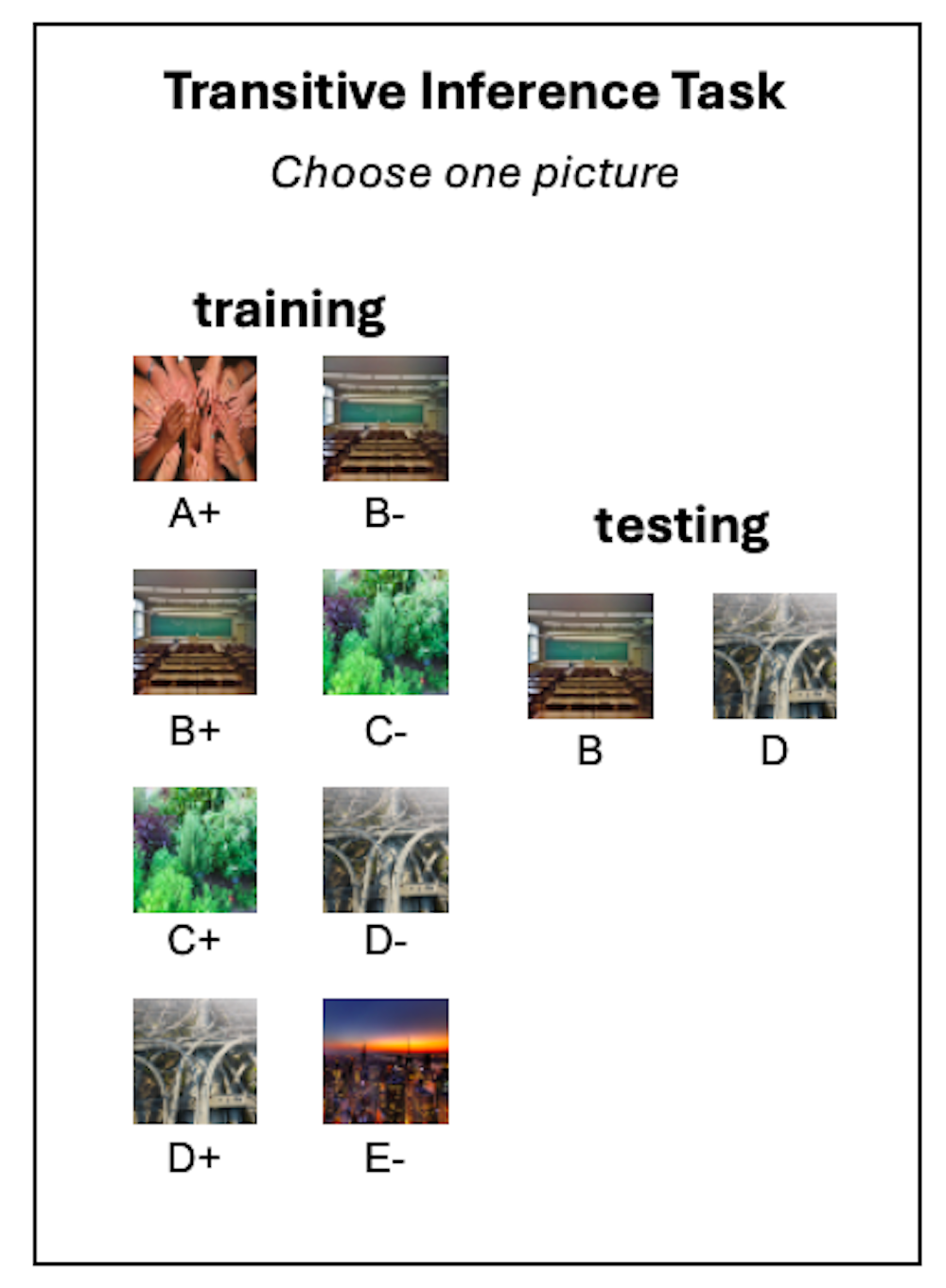
    In the lab, researchers test this by giving animals randomly paired images, one pair at a time, and rewarding them with food for picking the correct one. For example, animals learn that a photo of hands (A) is correct when paired with a classroom (B), a classroom (B) is correct when paired with bushes (C), bushes (C) are correct when paired with a highway (D), and a highway (D) is correct when paired with a sunset (E). We don’t know whether they “understand” what’s in the picture, and it is not particularly important for the experiment that they do.

    In a transitive inference task, subjects learn a series of rewarded pairs – such as A+ vs. B–, B+ vs. C– – and are later tested on novel pairings, like B vs. D, to see whether they infer an overall ranking.
    Olga Lazareva, CC BY-ND

    One possible explanation is that the animals that learn all the tasks create a mental ranking of these images: A > B > C > D > E. We test this idea by giving them new pairs they’ve never seen before, such as classroom (B) vs. highway (D). If they consistently pick the higher-ranked item, they’ve inferred the underlying order.

    What’s fascinating is how many species succeed at this task. Monkeys, rats, pigeons – even fish and wasps – have all demonstrated transitive inference in one form or another.

    The twist: Not all tasks are easy

    But not all types of reasoning come so easily. There’s another kind of rule called transitivity that is different from transitive inference, despite the similar name. Instead of asking which picture is better, transitivity is about equivalence.

    In this task, animals are shown a set of three pictures and asked which one goes with the center image. For example, if white triangle (A1) is shown, choosing red square (B1) earns a reward, while choosing blue square (B2) does not. Later, when red square (B1) is shown, choosing white cross (C1) earns a reward while choosing white circle (C2) does not. Now comes the test: white triangle (A1) is shown with white cross (C1) and white circle (C2) as choices. If they pick white cross (C1), then they’ve demonstrated transitivity.

    In a transitivity task, subjects learn matching rules across overlapping sets – such as A1 matches B1, B1 matches C1 – and are tested on new combinations, such as A1 with C1 or C2, to assess whether they infer the relationship between A1 and C1.
    Olga Lazareva, CC BY-ND

    The change may seem small, but species that succeed in those first transitive inference tasks often stumble in this task. In fact, they tend to treat the white triangle and the white cross as completely separate things, despite their common relationship with the red square. In my recently published review of research using the two tasks, I concluded that more evidence is needed to determine whether these tests tap into the same cognitive ability.

    Small differences, big consequences

    Why does the difference between transitive inference and transitivity matter? At first glance, they may seem like two versions of the same ability – logical reasoning. But when animals succeed at one and struggle with the other, it raises an important question: Are these tasks measuring the same kind of thinking?

    The apparent difference between the two tasks isn’t just a quirk of animal behavior. Psychology researchers apply these tasks to humans in order to draw conclusions about how people reason.

    For example, say you’re trying to pick a new almond milk. You know that Brand A is creamier than Brand B, and your friend told you that Brand C is even waterier than Brand B. Based on that, because you like a thicker milk, you might assume Brand A is better than Brand C, an example of transitive inference.

    But now imagine the store labels both Brand A and Brand C as “barista blends.” Even without tasting them, you might treat them as functionally equivalent, because they belong to the same category. That’s more like transitivity, where items are grouped based on shared relationships. In this case, “barista blend” signals the brands share similar quality.

    How researchers define logical reasoning determines how they interpret results.
    Svetlana Mishchenko/iStock via Getty Images

    Researchers often treat these types of reasoning as measuring the same ability. But if they rely on different mental processes, they might not be interchangeable. In other words, the way scientists ask their questions may shape the answer – and that has big implications for how they interpret success in animals and in people.

    This difference could affect how researchers interpret decision-making not only in the lab, but also in everyday choices and in clinical settings. Tasks like these are sometimes used in research on autism, brain injury or age-related cognitive decline.

    If two tasks look similar on the surface, then choosing the wrong one might lead to inaccurate conclusions about someone’s cognitive abilities. That’s why ongoing work in my lab is exploring whether the same distinction between these logical processes holds true for people.

    Just like a March Madness bracket doesn’t always predict the winner, a reasoning task doesn’t always show how someone got to the right answer. That’s the puzzle researchers are still working on – figuring out whether different tasks really tap into the same kind of thinking or just look like they do. It’s what keeps scientists like me in the lab, asking questions, running experiments and trying to understand what it really means to reason – no matter who’s doing the thinking.

    Olga Lazareva does not work for, consult, own shares in or receive funding from any company or organization that would benefit from this article, and has disclosed no relevant affiliations beyond their academic appointment.

    ref. Humans and animals can both think logically − but testing what kind of logic they’re using is tricky – https://theconversation.com/humans-and-animals-can-both-think-logically-but-testing-what-kind-of-logic-theyre-using-is-tricky-253001

    MIL OSI

  • MIL-OSI Submissions: Where does the UK most need more public EV chargers?

    Source: The Conversation – UK – By Labib Azzouz, Research Associate in Transport and Energy Innovation, University of Oxford

    Electric vehicle chargers at a motorway service station in Grantham, England. Angus Reid/Shutterstock

    The automotive and EV industry has repeatedly insisted that the UK needs more electric vehicle (EV) chargers to help motorists make the switch from conventional fossil-fuel burning cars.

    The Labour government has announced £400 million to install EV chargers, mainly on streets in poorer residential neighbourhoods, in place of the Conservative’s £950 million rapid charging fund that was directed at installing chargers in motorway service stations.

    Does it matter where these chargers are – and who pays to build them?

    The short answer is yes, it does matter. Our research conducted at motorway and local EV charging stations across England – including those located in residential areas, high streets and community centres – indicates that these two types of infrastructure serve distinct groups of users and fulfil different purposes.

    Suggesting that one can substitute for the other risks sending mixed signals to both the industry and the driving public.

    We found that motorway charging stations tend to cater to wealthier men, who are more likely to own premium EVs with long-range batteries and better performance. Many of these drivers have access to home chargers, so their use of public chargers is only for occasional, long-distance travel for business, leisure, or holidays – trips that require chargers along motorways.

    Convenience and charging speed are often more important than the price of public charging, particularly when the travel costs of these drivers are covered by their employers.

    Local public charging stations, on the other hand, serve more diverse groups. These include drivers from lower-income households who are more likely to own older and smaller EVs with shorter ranges. Access to home charging is often limited, especially for people living in flats or urban areas without driveways, garages or off-street parking.

    Not everyone can plug in at home.
    Andersen EV/Shutterstock

    Local chargers are also vital for taxi and delivery drivers who depend on their vehicles for work and make frequent short trips throughout the day. There are many professional drivers without access to workplace charging stations who need alternative local provision – something the Conservative government recognised in its 2022 EV charging strategy.

    Ultimately, the transition to EVs should take a balanced approach that carefully considers social equity, economic viability and environmental impact.

    Different locations serve different drivers

    Motorway charging stations are commercially attractive to private investors, such as energy companies, specialist charging providers and car manufacturers, despite their higher upfront costs and complex requirements.

    This is because service stations offer greater short-term revenue due to their ability to set premium prices. This is a result of there being limited alternatives and high demand for rapid charging, especially among long-distance travellers, and the willingness of EV drivers to pay for speed and convenience – unlike in more price-sensitive neighbourhood settings.

    Unsurprisingly, the government found that the rapid deployment of motorway chargers in recent years has been largely driven by the private sector. Our research highlighted that these revenues could be enhanced by a broader range of retail, dining and relaxation amenities, turning the time waiting for a car to charge into a more productive and pleasurable experience.

    Residential charging stations may not offer high profits per charge, but they typically require lower capital investment and benefit from consistent and predictable use. They are also suited to measures for reducing strain on the grid and balancing energy supply and demand.

    These measures include tariffs that make it cheaper to charge EVs during off-peak hours, or technology that allows cars to feed electricity stored in batteries back into the grid. These features make them appropriate for public funding, where return on investment is measured not just in profit but in value for the public.

    Considering that local EV charging serves those who do not have access to home charging and who drive for a living, the case for public funding is even stronger. These sorts of chargers make switching to an EV easier for different groups.

    For example, safe and carefully placed public chargers could help more women switch to EVs – although our research suggests that, while “careful placement” might refer to residential areas, it doesn’t necessarily mean on streets. Well-lit car parks and community destinations are sometimes considered safer options.

    Charging points outside a community centre in the Outer Hebrides, Scotland.
    AlanMorris/Shutterstock

    By helping EV drivers make frequent short trips, local chargers can also significantly reduce urban air pollution, emissions and noise, contributing to more liveable, healthier cities.

    That said, motorway charging stations and those near key transport corridors still play a crucial role in a comprehensive national network, and public funding may be required in more peripheral and rural areas of the UK where installations lag and commercial interest is limited.

    While long-distance trips are less frequent than short ones, they account for a disproportionately large share of energy use and emissions. Switching such trips to electric will be essential to reaching net zero goals.

    It seems reasonable to prioritise public investment in local EV charging infrastructure to support a fairer EV transition, but this should not be limited to on-street chargers. Investment is needed in residential and non-residential areas, public car parks, community centres and workplaces.

    Different types of EV charging are not interchangeable – all are needed to support the switch.


    Don’t have time to read about climate change as much as you’d like?

    Get a weekly roundup in your inbox instead. Every Wednesday, The Conversation’s environment editor writes Imagine, a short email that goes a little deeper into just one climate issue. Join the 45,000+ readers who’ve subscribed so far.


    Labib Azzouz has received funding from the UK Research and Innovation via the UK Energy Research Centre and Innovate UK as part of the Energy Superhub Oxford (ESO) project.

    Hannah Budnitz receives government funding from UK Research and Innovation grants via the Economic and Social Research Council and the Engineering and Physical Sciences Research Council. She has also previously received funding from Innovate UK and the Department for Transport.

    ref. Where does the UK most need more public EV chargers? – https://theconversation.com/where-does-the-uk-most-need-more-public-ev-chargers-259623

    MIL OSI

  • MIL-OSI USA: Rep. Young Kim, Bipartisan Colleagues Condemn Violent LA Riots, Stand with Law Enforcement and Peaceful Protestors

    Source: United States House of Representatives – Representative Young Kim (CA-39)

    Washington, DC – Today, the House voted to pass H.Res.516, led by U.S. Representative Young Kim (CA-40), to condemn the violent riots in Los Angeles earlier this month and commend law enforcement for their bravery. 

    The resolution expresses that the House of Representatives: 

    • Recognizes the right to assemble and protest peacefully;  
    • Condemns unequivocally the violence perpetrated against Federal, State, and local law enforcement;  
    • Calls on local and State elected leadership to work with the Federal government to end the violent riots and restore peace; and   
    • Expresses gratitude to law enforcement officers for keeping our communities safe in the face of danger.  

    Watch Congresswoman Kim urge for support of this bill HERE and read the full resolution text HERE.  

    “Peaceful protests are a constitutional right, but vandalism, looting, violence, and other crimes are not. Condemning violence and protecting public safety shouldn’t be controversial, which is why I am leading the California Republican delegation in a resolution to support law and order as our communities see unrest enabled by California’s soft-on-crime policies,” said Congresswoman Young Kim. “I thank our law enforcement on the ground and hope we can come together to stop riots in our communities, lower the temperature, and keep our neighborhoods safe.” 

    “As unrest continues in our communities, residents shouldn’t be living in fear, and ICE’s immigration efforts should be focused on finding illegal immigrants with criminal records and removing them from our community,” Congresswoman Kim continued. 

    Congresswoman Kim was joined in leading this resolution by the California Republican delegation, including Reps. Ken Calvert (CA-41), David Valadao (CA-22), Vince Fong (CA-20), Doug LaMalfa (CA-01), Darrell Issa (CA-48), Tom McClintock (CA-05), Jay Obernolte (CA-23), and Kevin Kiley (CA-03). 

    “As members of Congress, we have an obligation to protect our communities and the brave men and women who answer the call to serve,” said Congressman Vince Fong (CA-20). “I strongly support this resolution to condemn the violent acts that hurt our law enforcement officers, shut down freeways, burned cars, and harmed local businesses. These are not peaceful protests, and we must draw a definitive line against such dangerous and destructive actions that have no place in our society. Today’s resolution reaffirms my commitment to restoring public safety and makes it clear that acts of looting and assault will not be tolerated.” 

    “The violence in Los Angeles is a direct result of reckless policies, like the sanctuary city and state policies that are specifically designed to protect criminals. This is the time for California to do away with its disastrous Sanctuary State status, once and for all,” said Congressman Kiley. 

    “What happened in Los Angeles wasn’t a protest, it was a riot, plain and simple. ICE agents were attempting to do their jobs and enforce the law. They were met with violent mobs encouraged by politicians who’ve spent years urging people to resist law enforcement,” said Rep. LaMalfa. “Cars were burned, businesses looted, American flags were torn down, and officers were attacked by hoards waiving foreign flags; all while local officials were silent instead of backing them. Law and order are still a public priority. I’m glad the House stood up to condemn the chaos and back those who fought to restore order.” 

    “The First Amendment right to peacefully protest is fundamental, but the violence and vandalism that occurred in Los Angeles went far beyond free speech,” said Congressman Valadao. “This resolution reaffirms our commitment to standing with law and order, and I’m happy to see common sense win.” 

    “The violence that unfolded in Los Angeles was unacceptable. While peaceful protest is a cornerstone of our democracy, targeting law enforcement, destroying property, and endangering innocent lives clearly crosses the line,” said Congressman Obernolte. “I was proud to cosponsor and vote for this resolution to make it clear: we stand with the officers who put themselves in harm’s way to restore order, and we must hold accountable those who incite chaos. Californians deserve safe communities and leadership that puts public safety above political theater.” 

    “Like all Americans, Californians have a Constitutional right to express their opinion, but they don’t have the right to commit violence or attack law enforcement officers. By passing this resolution, the House is standing up for and thanking our law enforcement officers. There is no room for riots and other violence in our streets,” said Congressman Calvert. 

    “There is no justification for the violence, looting, and destruction that occurred in the streets of Los Angeles. While peaceful protest is a right protected by our Constitution, lawlessness is not. We must stand firmly with law enforcement, uphold justice, and ensure that those who seek to destroy our communities are held accountable,” said Congressman McClintock. 

    MIL OSI USA News

  • MIL-OSI USA: Rep. Young Kim, Bipartisan Colleagues Condemn Violent LA Riots, Stand with Law Enforcement and Peaceful Protestors

    Source: United States House of Representatives – Representative Young Kim (CA-39)

    Washington, DC – Today, the House voted to pass H.Res.516, led by U.S. Representative Young Kim (CA-40), to condemn the violent riots in Los Angeles earlier this month and commend law enforcement for their bravery. 

    The resolution expresses that the House of Representatives: 

    • Recognizes the right to assemble and protest peacefully;  
    • Condemns unequivocally the violence perpetrated against Federal, State, and local law enforcement;  
    • Calls on local and State elected leadership to work with the Federal government to end the violent riots and restore peace; and   
    • Expresses gratitude to law enforcement officers for keeping our communities safe in the face of danger.  

    Watch Congresswoman Kim urge for support of this bill HERE and read the full resolution text HERE.  

    “Peaceful protests are a constitutional right, but vandalism, looting, violence, and other crimes are not. Condemning violence and protecting public safety shouldn’t be controversial, which is why I am leading the California Republican delegation in a resolution to support law and order as our communities see unrest enabled by California’s soft-on-crime policies,” said Congresswoman Young Kim. “I thank our law enforcement on the ground and hope we can come together to stop riots in our communities, lower the temperature, and keep our neighborhoods safe.” 

    “As unrest continues in our communities, residents shouldn’t be living in fear, and ICE’s immigration efforts should be focused on finding illegal immigrants with criminal records and removing them from our community,” Congresswoman Kim continued. 

    Congresswoman Kim was joined in leading this resolution by the California Republican delegation, including Reps. Ken Calvert (CA-41), David Valadao (CA-22), Vince Fong (CA-20), Doug LaMalfa (CA-01), Darrell Issa (CA-48), Tom McClintock (CA-05), Jay Obernolte (CA-23), and Kevin Kiley (CA-03). 

    “As members of Congress, we have an obligation to protect our communities and the brave men and women who answer the call to serve,” said Congressman Vince Fong (CA-20). “I strongly support this resolution to condemn the violent acts that hurt our law enforcement officers, shut down freeways, burned cars, and harmed local businesses. These are not peaceful protests, and we must draw a definitive line against such dangerous and destructive actions that have no place in our society. Today’s resolution reaffirms my commitment to restoring public safety and makes it clear that acts of looting and assault will not be tolerated.” 

    “The violence in Los Angeles is a direct result of reckless policies, like the sanctuary city and state policies that are specifically designed to protect criminals. This is the time for California to do away with its disastrous Sanctuary State status, once and for all,” said Congressman Kiley. 

    “What happened in Los Angeles wasn’t a protest, it was a riot, plain and simple. ICE agents were attempting to do their jobs and enforce the law. They were met with violent mobs encouraged by politicians who’ve spent years urging people to resist law enforcement,” said Rep. LaMalfa. “Cars were burned, businesses looted, American flags were torn down, and officers were attacked by hoards waiving foreign flags; all while local officials were silent instead of backing them. Law and order are still a public priority. I’m glad the House stood up to condemn the chaos and back those who fought to restore order.” 

    “The First Amendment right to peacefully protest is fundamental, but the violence and vandalism that occurred in Los Angeles went far beyond free speech,” said Congressman Valadao. “This resolution reaffirms our commitment to standing with law and order, and I’m happy to see common sense win.” 

    “The violence that unfolded in Los Angeles was unacceptable. While peaceful protest is a cornerstone of our democracy, targeting law enforcement, destroying property, and endangering innocent lives clearly crosses the line,” said Congressman Obernolte. “I was proud to cosponsor and vote for this resolution to make it clear: we stand with the officers who put themselves in harm’s way to restore order, and we must hold accountable those who incite chaos. Californians deserve safe communities and leadership that puts public safety above political theater.” 

    “Like all Americans, Californians have a Constitutional right to express their opinion, but they don’t have the right to commit violence or attack law enforcement officers. By passing this resolution, the House is standing up for and thanking our law enforcement officers. There is no room for riots and other violence in our streets,” said Congressman Calvert. 

    “There is no justification for the violence, looting, and destruction that occurred in the streets of Los Angeles. While peaceful protest is a right protected by our Constitution, lawlessness is not. We must stand firmly with law enforcement, uphold justice, and ensure that those who seek to destroy our communities are held accountable,” said Congressman McClintock. 

    MIL OSI USA News

  • MIL-OSI Security: Three Defendants Sentenced in Wide-Ranging Scheme to Monopolize International Transit Industry, Fix Prices, Extort Competitors, and Launder Money

    Source: United States Attorneys General

    The U.S. Department of Justice today announced that three additional defendants were sentenced in connection with a long-running and violent conspiracy to monopolize the transmigrante forwarding agency industry in the Los Indios, Texas, border region, located near Harlingen and Brownsville, Texas. The defendants controlled the transmigrate industry through fear, monopolization, and extortion of competitors, and laundered proceeds from the conspiracies.

    Pedro Antonio Calvillo Hernandez, age 50 of McAllen, Texas, was sentenced to 37 months’ imprisonment, a three-year term of supervised release, and a $50,000 fine after pleading guilty to conspiracy to illegally fix prices and allocate the market for transmigrante forwarding agency services, conspiracy to monopolize the transmigrante market, and conspiracy to interfere with commerce by extortion.

    Jose de Jesus Tapia Fernandez, age 47 of Brownsville, Texas was sentenced to time served, or 31 months in prison, and a three-year term of supervised release after pleading guilty to a money laundering conspiracy through which extortion proceeds were laundered.

    Mireya Miranda, age 59 of San Antonio, Texas, was sentenced to 10 months of home detention, and a $75,000 fine after pleading guilty to conspiracy to illegally fix prices and allocate the market for transmigrante forwarding agency services; and conspiracy to monopolize the transmigrante market.

    “The danger and the harm to the American people by the use of violence and extortion to fix prices and monopolize the market for an essential service in the Texas border region cannot be understated,” said Assistant Attorney General Abigail Slater of the Justice Department’s Antitrust Division. “Today’s sentences demonstrate the Antitrust Division’s commitment to pursuing incarceration for both white-collar and violent criminals who seek to exploit America’s free markets.”

    “Price fixing is an attempt to distort the market in favor of the fixer and to the detriment of basically everyone else. Although such market manipulation is bad enough, it is even worse when brought about through threats and violence,” said U.S. Attorney Nicholas J. Ganjei for the Southern District of Texas. “The Southern District of Texas will work tirelessly to prosecute such criminal syndicates and to ensure markets along the Texas-Mexico border remain free, fair, and open.”

    “The FBI is proud of the hard work and collaboration with partners that led to today’s sentencing,” said Assistant Director Joe Perez of the FBI’s Criminal Investigative Division. “We remain absolutely committed to thwarting criminal enterprises that function without regard for the rule of law and whose practices of market manipulation include the use of violence and intimidation.”

    “These sentencings reaffirm our unwavering commitment to safeguarding economic integrity at our nation’s borders,” said Special Agent in Charge Craig Larrabee of ICE Homeland Security Investigations San Antonio. “By dismantling an enterprise that thrived on extortion and price fixing, we are ensuring that honest businesses can compete on a level playing field. This case exemplifies how corruption in niche industries can have far-reaching effects, and HSI will continue to pursue those who abuse the system for profit.”

    Transmigrantes transport used vehicles and other goods from the United States through Mexico for resale in Central America. There are only a few locations where transmigrantes can legally cross from the United States into Mexico, one of those being the Los Indios Bridge in Texas. Transmigrante forwarding agencies are U.S.-based businesses that provide services to transmigrante clients, including helping those clients complete the customs paperwork required to export vehicles into Mexico.  

    According to court documents and statements made in court, the co-defendants fixed prices for transmigrante forwarding agency services and created a centralized entity known as the “Pool” to collect and divide revenues among the conspirators, limit competition from other agencies, and increase prices for their services. Some co-defendants also conspired to force forwarding agencies to pay money to the Pool and to pay other extortion fees, including a “piso” for every transaction processed in the industry as well as a “fine” for operating in the market outside of Pool rules. The conspirators perpetrated acts of intimidation, coercion, and violence in furtherance of the antitrust and extortion conspiracies.  Co-defendants Carlos Martinez and Tapia also conspired to launder the extortion proceeds. 

    Calvillo, Tapia, and Miranda must also pay restitution to the victims of the conspiracies. The Court will determine the final restitution amount owed to victims of the conspiracies at a hearing set for Sept. 3.   

    Four co-defendants have previously been sentenced in this case. One other co-defendant has pleaded guilty and is awaiting sentencing. Three other defendants, Rigoberto Brown, Miguel Hipolito Caballero Aupart, and Diego Ceballos-Soto were also charged in the superseding indictment and remain fugitives. Anyone with information about their whereabouts is asked to contact the Antitrust Division’s Complaint Center at 888-647-3258, or visit  www.justice.gov/atr/report-violations.

    The Justice Department’s Antitrust Division, the Criminal Division’s Violent Crime and Racketeering Section (VCRS), the U.S. Attorney’s Office for the Southern District of Texas, Department of Homeland Security – Homeland Security Investigations and the Federal Bureau of Investigation investigated the case. 

    Trial Attorneys Anne Veldhuis, Brittany E. McClure, and Michael G. Lepage and Senior Litigation Counsel John Davis of the Antitrust Division; Trial Attorney Christina Taylor of the Criminal Division’s Violent Crime and Racketeering Section (VCRS); and Assistant U.S. Attorney Alexander L. Alum for the Southern District of Texas prosecuted the case. 

    Anyone with information in connection with this investigation should contact the Antitrust Division’s Complaint Center at 888-647-3258, or visit www.justice.gov/atr/report-violations

    MIL Security OSI

  • MIL-OSI Security: Three Defendants Sentenced in Wide-Ranging Scheme to Monopolize International Transit Industry, Fix Prices, Extort Competitors, and Launder Money

    Source: United States Attorneys General

    The U.S. Department of Justice today announced that three additional defendants were sentenced in connection with a long-running and violent conspiracy to monopolize the transmigrante forwarding agency industry in the Los Indios, Texas, border region, located near Harlingen and Brownsville, Texas. The defendants controlled the transmigrate industry through fear, monopolization, and extortion of competitors, and laundered proceeds from the conspiracies.

    Pedro Antonio Calvillo Hernandez, age 50 of McAllen, Texas, was sentenced to 37 months’ imprisonment, a three-year term of supervised release, and a $50,000 fine after pleading guilty to conspiracy to illegally fix prices and allocate the market for transmigrante forwarding agency services, conspiracy to monopolize the transmigrante market, and conspiracy to interfere with commerce by extortion.

    Jose de Jesus Tapia Fernandez, age 47 of Brownsville, Texas was sentenced to time served, or 31 months in prison, and a three-year term of supervised release after pleading guilty to a money laundering conspiracy through which extortion proceeds were laundered.

    Mireya Miranda, age 59 of San Antonio, Texas, was sentenced to 10 months of home detention, and a $75,000 fine after pleading guilty to conspiracy to illegally fix prices and allocate the market for transmigrante forwarding agency services; and conspiracy to monopolize the transmigrante market.

    “The danger and the harm to the American people by the use of violence and extortion to fix prices and monopolize the market for an essential service in the Texas border region cannot be understated,” said Assistant Attorney General Abigail Slater of the Justice Department’s Antitrust Division. “Today’s sentences demonstrate the Antitrust Division’s commitment to pursuing incarceration for both white-collar and violent criminals who seek to exploit America’s free markets.”

    “Price fixing is an attempt to distort the market in favor of the fixer and to the detriment of basically everyone else. Although such market manipulation is bad enough, it is even worse when brought about through threats and violence,” said U.S. Attorney Nicholas J. Ganjei for the Southern District of Texas. “The Southern District of Texas will work tirelessly to prosecute such criminal syndicates and to ensure markets along the Texas-Mexico border remain free, fair, and open.”

    “The FBI is proud of the hard work and collaboration with partners that led to today’s sentencing,” said Assistant Director Joe Perez of the FBI’s Criminal Investigative Division. “We remain absolutely committed to thwarting criminal enterprises that function without regard for the rule of law and whose practices of market manipulation include the use of violence and intimidation.”

    “These sentencings reaffirm our unwavering commitment to safeguarding economic integrity at our nation’s borders,” said Special Agent in Charge Craig Larrabee of ICE Homeland Security Investigations San Antonio. “By dismantling an enterprise that thrived on extortion and price fixing, we are ensuring that honest businesses can compete on a level playing field. This case exemplifies how corruption in niche industries can have far-reaching effects, and HSI will continue to pursue those who abuse the system for profit.”

    Transmigrantes transport used vehicles and other goods from the United States through Mexico for resale in Central America. There are only a few locations where transmigrantes can legally cross from the United States into Mexico, one of those being the Los Indios Bridge in Texas. Transmigrante forwarding agencies are U.S.-based businesses that provide services to transmigrante clients, including helping those clients complete the customs paperwork required to export vehicles into Mexico.  

    According to court documents and statements made in court, the co-defendants fixed prices for transmigrante forwarding agency services and created a centralized entity known as the “Pool” to collect and divide revenues among the conspirators, limit competition from other agencies, and increase prices for their services. Some co-defendants also conspired to force forwarding agencies to pay money to the Pool and to pay other extortion fees, including a “piso” for every transaction processed in the industry as well as a “fine” for operating in the market outside of Pool rules. The conspirators perpetrated acts of intimidation, coercion, and violence in furtherance of the antitrust and extortion conspiracies.  Co-defendants Carlos Martinez and Tapia also conspired to launder the extortion proceeds. 

    Calvillo, Tapia, and Miranda must also pay restitution to the victims of the conspiracies. The Court will determine the final restitution amount owed to victims of the conspiracies at a hearing set for Sept. 3.   

    Four co-defendants have previously been sentenced in this case. One other co-defendant has pleaded guilty and is awaiting sentencing. Three other defendants, Rigoberto Brown, Miguel Hipolito Caballero Aupart, and Diego Ceballos-Soto were also charged in the superseding indictment and remain fugitives. Anyone with information about their whereabouts is asked to contact the Antitrust Division’s Complaint Center at 888-647-3258, or visit  www.justice.gov/atr/report-violations.

    The Justice Department’s Antitrust Division, the Criminal Division’s Violent Crime and Racketeering Section (VCRS), the U.S. Attorney’s Office for the Southern District of Texas, Department of Homeland Security – Homeland Security Investigations and the Federal Bureau of Investigation investigated the case. 

    Trial Attorneys Anne Veldhuis, Brittany E. McClure, and Michael G. Lepage and Senior Litigation Counsel John Davis of the Antitrust Division; Trial Attorney Christina Taylor of the Criminal Division’s Violent Crime and Racketeering Section (VCRS); and Assistant U.S. Attorney Alexander L. Alum for the Southern District of Texas prosecuted the case. 

    Anyone with information in connection with this investigation should contact the Antitrust Division’s Complaint Center at 888-647-3258, or visit www.justice.gov/atr/report-violations

    MIL Security OSI

  • Trump says US could reach trade deal with India, casts doubt on deal with Japan

    Source: Government of India

    Source: Government of India (4)

    The United States could reach a trade deal with India that would help American companies compete in the South Asian country and leave it facing far lower tariffs, President Donald Trump said on Tuesday, while casting doubt on a possible deal with Japan.

    Trump told reporters aboard Air Force One that he believed India was ready to lower barriers for U.S. companies, which could pave the way for an agreement staving off the 26% rate he announced on April 2, before pausing it until July 9.

    “Right now, India doesn’t accept anybody in. I think India is going to do that, if they do that, we’re going to have a deal for less, much less tariffs,” he said.

    Earlier, Treasury Secretary Scott Bessent told Fox News that the U.S. and India are nearing a deal that would lower tariffs on American imports to the South Asian country and help India avoid levies from rising sharply next week.

    “We are very close with India,” Bessent told Fox News in response to a question about progress on trade negotiations.

    India is one of more than a dozen countries actively negotiating with the Trump administration to try to avoid a steep spike in tariff rates on July 9, when a 90-day tariff pause ends. India could see its new “reciprocal” tariff rate rise to 27% from the current 10%.

    The U.S.-India talks have hit roadblocks over disagreements on import duties for auto components, steel, and farm goods, ahead of Trump’s deadline to impose reciprocal tariffs.

    “We are in the middle — hopefully more than the middle — of a very intricate trade negotiation,” Indian Foreign Minister S Jaishankar told an event in New York on Monday.

    “Obviously, my hope would be that we bring it to a successful conclusion. I cannot guarantee it, because there’s another party to that discussion,” said Jaishankar, who is currently in the U.S. 

    He added that there “will have to be give and take” and the two sides will have to find middle ground.

    TRUMP SUGGESTS HIGHER TARIFF FOR JAPAN

    Bessent told Fox News that different countries have different agendas for trade deals, including Japan, which Trump complained about on Monday and again on Tuesday.

    Trump said he was not thinking of extending the July 9 deadline and would simply send letters notifying countries of the tariff rate they would face.

    “We’ve dealt with Japan. I’m not sure we’re going to make a deal. I doubt it,” Trump told reporters aboard Air Force One as he returned to Washington from a trip to Florida.

    Trump suggested he could impose a tariff of 30% or 35% on imports from Japan – well above the 24% tariff rate he announced on April 2 and then paused until July 9.

    He said Japan was refusing to accept U.S.-grown rice, a demand made by Washington that he described as “an easy one,” while selling millions of cars in the United States.

    “So what I’m going to do, is I’ll write them a letter saying we thank you very much, and we know you can’t do the kind of things that we need, and therefore you pay a 30%, 35% or whatever the numbers that we determine,” he said. So far, only Britain has negotiated a limited trade deal with the Trump administration, accepting a 10% U.S. tariff on many goods, including autos, in exchange for special access for aircraft engines and British beef.

    (REUTERS)

  • MIL-OSI USA News: WHAT THEY ARE SAYING: Senate Approves Landmark One Big Beautiful Bill

    Source: US Whitehouse

    The Senate delivered a resounding victory for American workers, farmers, and small businesses by passing President Donald J. Trump’s One Big Beautiful Bill — a transformative legislative package that locks in historic tax relief, delivers border security, reforms welfare, funds critical infrastructure, and more.

    Industry leaders and stakeholders nationwide hailed the Senate’s vote and called on the House to swiftly send the bill to President Trump’s desk:

    Airlines for America: “We are grateful that the Senate understands the urgent need to overhaul our nation’s air traffic control (ATC) system and included $12.5 billion in their reconciliation package for that cause. This is an important first step as Secretary Duffy works to implement President Trump’s vision of a brand new, state-of-the-art system. We especially appreciate Commerce Committee Chairman Ted Cruz for his long-time dedication to the safety and efficiency of our nation’s airspace. We urge the House of Representatives to quickly pass this legislation so President Trump can sign the One Big Beautiful Bill into law, begin the work of upgrading our ATC system and revitalize our airspace.”

    America’s Credit Unions President and CEO Jim Nussle: “We thank the U.S. Senate for securing the credit union not-for-profit tax status and not adding a new tax on 142 million credit union members as part of H.R. 1. Hard working Americans and their communities rely on the competitive rates and personally tailored services offered by credit unions to achieve their American Dream. By preserving the credit union tax status, it provides consumers across the country with more opportunities to achieve financial freedom.”

    American Airlines: “American Airlines strongly supports the much-needed funding to bolster and modernize our air traffic control system in the Senate reconciliation bill. In addition to staffing challenges, the U.S. air traffic control system’s technology and infrastructure have fallen behind much of the world. As President Trump and Secretary Duffy urgently work to build a state-of-the-art air traffic control system, this down payment is an essential first step in making aviation even safer and more efficient. The reconciliation bill also extends other key pro-growth tax policies that provide businesses with the necessary certainty to continue driving the economy. We urge the House to move swiftly and pass the bill.”

    American Farm Bureau Federation President Zippy Duvall: “Farm Bureau applauds the U.S. Senate for passing the reconciliation package. Farmers and ranchers are the foundation of America’s food supply chain, and they need the certainty that this legislation will provide. Improvements to farm safety net programs that reflect today’s agricultural economy and maintaining important tax provisions will directly benefit farm and ranch families … Important tax provisions will also help farmers save money that can be used to pay bills, invest in new technologies, and pass the family farm to the next generation. We now urge the House to pass the bill and get it to the president’s desk for his signature to ensure America’s farmers and ranchers can continue putting food on the table for America’s families.”

    American Federation for Children CEO Tommy Schultz: “The mission is clear: deliver school choice to every state in America. Today’s vote marks a monumental step toward that goal for the first time in history … We are eager to see President Trump sign school choice into law!”

    American Hotel & Lodging Association President and CEO Rosanna Maietta: “AHLA applauds the Senate’s swift action today to prevent major tax increases on both hotel employees and businesses. The tax provisions included in the Senate bill provide small business hotel owners with the level of certainty they need to effectively operate amidst tremendous uncertainty resulting from years of inflation, trade impacts, and a softening of demand within the broader travel sector. We commend Majority Leader Thune, Senator Crapo, and other Senate champions for securing passage. We urge Congress to swiftly get this package to the President’s desk for his signature to help put businesses back on a pro-growth footing.” 

    American Iron and Steel Institute President and CEO Kevin Dempsey: “Capital investment is crucial for economic growth and job creation in the American steel industry and the manufacturing sector as a whole. Many of the key capital cost recovery provisions of the 2017 tax law have expired or are being phased out. Restoring these provisions is essential to ensuring that many companies will be able to make new investments in steel-intensive facilities and machinery. We applaud Senate passage of this legislation which will permanently restore key provisions that have a proven record of fueling innovation and economic growth, including 100 percent bonus depreciation for business investment, immediate expensing for domestic research and development expenses and the EBITDA-based limitation on business net interest deductions. We urge the House to pass this bill and send it to President Trump this week so that he can sign it into law as soon as possible.”

    American Petroleum Institute President and CEO Mike Sommers: “We applaud the Senate for passing the One Big Beautiful Bill to bolster America’s energy advantage and support economic growth. This historic legislation will help usher in a new era of energy dominance by unlocking opportunities for investment, opening lease sales and expanding access to oil and natural gas development. We will continue to work with policymakers to get this final package to President Trump’s desk.”

    American Soybean Association President Caleb Ragland: “ASA applauds the Senate for its support of agriculture and the farm economy in this legislation. Soybean growers have long championed comprehensive revisions to the 45Z Clean Fuel Production Credit, an improved safety net for agriculture, and increased support for research and market expansion. The modified biofuel tax credits, enhancements to crop insurance and support for MAP and FMD, among other agriculture provisions included in this legislation will support U.S. farmers and expand market opportunities domestically. ASA urges the House to maintain these key agricultural provisions that support our rural economies as they consider this legislation.”

    American Trucking Association SVP of Legislative Affairs Henry Hanscom: “The American Trucking Associations is grateful to Senate Republicans for their hard work to craft a package that will guarantee tax certainty for our nation’s trucking companies. Trucking is the backbone of our economy, employing over 8.5 million Americans in companies that range in size from one-truck operators and small family businesses to enterprise carriers.  Enacting pro-business, pro-growth tax policies will ensure that all of those companies are able to better plan for the future, invest in their workforce and equipment, and move freight safely and efficiently.  As the industry that moves 72% of America’s freight by tonnage, and that is the sole source of freight services for more than 80% of American communities, ATA looks forward to President Trump signing this measure into law as soon as possible.”

    Americans for Prosperity Chief Government Affairs Officer Brent Gardner: “We are so close to delivering a generational win to Americans by making pro-growth tax policy permanent. When we pass this bill, job creators and families will have the certainty they need to invest in their businesses and futures, reigniting the American Dream. We are encouraged by the thoughtful and productive discussions that have brought this legislation back to the House and urge members to pass it expeditiously to ensure that Americans start reaping the benefits of this transformative legislation as soon as possible … It’s time to get this bill to the Oval Office for President Trump’s signature. We’re at the goal line, it’s time to punch it in. Let’s fulfill all those campaign promises and secure this victory for hardworking American taxpayers.”

    Associated Builders and Contractors VP of Government Affairs Kristen Swearingen: “Tax certainty and pro-growth policies are not abstract policy goals for construction businesses—they are the foundation that allows ABC members to invest, grow and keep America building. We thank the Senate for passing this important legislation and urge the U.S. House of Representative to take swift action to send it to the president’s desk.”

    Associated Equipment Distributors President and CEO Brian P. McGuire: “By permanently extending and restoring pro-growth, capital investment incentivizing tax policies, the Senate is ensuring long-term tax code certainty that will benefit the equipment sector and the broader economy. AED applauds Senate Majority Leader John Thune and his team for heeding our call for tax permanence, and we urge the House to pass this legislation and send it to the president’s desk expeditiously.”

    Association of Equipment Manufacturers SVP of Government and Industry Relations Kip Eideberg: “The Association of Equipment Manufacturers applauds the U.S. Senate’s passage of the One Big Beautiful Bill (OBBB) Act — a historic bill that will strengthen U.S. manufacturing, providing the certainty in the tax code necessary for equipment manufacturers to innovate, invest, and create more family-sustaining jobs right here in America. By extending and expanding the tax reforms from 2017, the OBBB will help equipment manufacturers build more in America, while also bolstering our global competitiveness. We commend Leader Thune for his leadership and commitment to ensuring the permanence of President Trump’s pro-growth tax reforms, and applaud the lawmakers involved in driving this effort forward. We urge the U.S. House of Representatives to act swiftly and send the bill to President Trump’s desk.”

    Business Roundtable CEO Joshua Bolten: “Today’s vote puts us on the cusp of extending and strengthening tax reform. Business Roundtable applauds the Senate for passing the One Big Beautiful Bill … The House now has the opportunity to send a swift, decisive signal that America will remain a premier destination for business to invest, hire, and grow. We urge the House to act without delay and send the bill to President Trump’s desk by the Fourth of July.”

    Center for Transportation Policy Executive Director Jackson Shedelbower: “… it’s clear that lawmakers are united in an effort to modernize the country’s aging air traffic control systems. The $12.5 billion that is appropriated in both versions of the package will be a strong down payment towards ensuring that the U.S. maintains its reputation as a global leader in air travel. Lawmakers need to work out the remainder of their differences so the legislation can be swiftly pushed over the finish line.”

    CTIA—The Wireless Association President and CEO Ajit Pai: “CTIA applauds the Senate for passing the One Big Beautiful Bill, which includes a solid spectrum pipeline and smart tax provisions to support wireless investment. Along with restoring FCC auction authority, establishing a robust 800-megahertz pipeline of mid-band spectrum with a specific timeframe for action is critical to meeting growing consumer demand, securing U.S. leadership in 5G, and strengthening national and economic security.  The bill’s targeted tax incentives will accelerate private investment in next-generation networks and support infrastructure deployment, job creation, and economic growth across the country. We thank Senate leadership, including Senate Majority Leader John Thune, Senate Commerce Committee Chairman Ted Cruz, and Senator Marsha Blackburn for their commitment to securing America’s wireless future, and we urge swift action to pass this legislation so President Trump can sign it into law.”

    Concerned Veterans for America Executive Director John Vick: “This legislation represents a win for American families, small businesses, and veterans across the country―groups that form the backbone of a thriving and resilient nation. This is a monumental moment for Americans who believe in hard work, opportunity, and service. The One Big Beautiful Bill Act sets the stage for lasting prosperity and a stronger future for those who have sacrificed the most.”

    Global Business Alliance President and CEO Jonathan Samford: “I applaud Chairman Mike Crapo, Leader John Thune and their Senate colleagues for advancing international tax policies that keep the U.S. the top destination for global investment. These provisions will help sustain American jobs, drive innovation, and reinforce a stable tax environment that attracts cross-border capital and world-class know-how. I urge swift House action and final passage of this One Big Beautiful Bill Act in order to secure America’s competitive edge.”

    Iowa Biodiesel Board Executive Director Grant Kimberley: “These improvements to the biomass-based diesel tax incentive come at a pivotal moment for the industry, which has seen months of uncertainty, stalled production and investment hesitation. Together with EPA’s proposed increase in Renewable Fuel Standard volumes—projecting more than 2 billion additional gallons of biomass-based diesel in 2026—the tax developments point to a significant resurgence in clean fuel demand. This gives us much-needed certainty for the near future.”

    Information Technology Industry Council President and CEO Jason Oxman: “The One Big Beautiful Bill will advance President Trump’s vision of ensuring America outpaces global competitors and remains the world’s leader in technology. We’re pleased to see the Senate pass the reconciliation text with strong innovation-focused language that will empower companies to invest in America by restoring critical research and development expensing and stimulate economic growth and high-skilled job creation. We urge the House of Representatives to send this critical package to President Trump as quickly as possible.”

    Job Creators Network CEO Alfredo Ortiz: “By passing this tax cut bill, Republican Senators show once again that they are the party of Main Street. By expanding and making permanent the Tax Cuts and Jobs Act, including restoring full, immediate expensing, the Senate has delivered historic, pro-growth reform that can last for generations. These tax cuts empower small business owners to invest, hire, raise wages, and reinvest in their communities, ushering in America’s next Golden Age. On behalf of Main Street, JCN calls on the House to quickly pass this legislation and get it to President Trump’s desk by July 4, giving America the best birthday present it could ask for.”

    National Association of Home Builders Chairman Buddy Hughes: “NAHB commends the Senate for passing the One Big Beautiful Bill Act. This legislation will help spur economic growth and allow our members to invest more resources in multifamily rental construction, land development to build more single-family homes, and new equipment to expand their businesses. In turn, this will create a better business climate that allows builders to increase the nation’s housing supply, which is crucial to help ease America’s housing affordability crisis. We urge the House to move quickly to pass this bill.”

    National Association of Manufacturers President and CEO Jay Timmons: “The Senate just pushed the ball deep into the red zone. Now it’s the House’s turn to finish the drive and deliver a big win for manufacturers in America. The Senate advanced a tax package that will strengthen small businesses, family-owned operations and manufacturing workers across the country. It drives manufacturers closer to the goal line—growing businesses, creating jobs and powering stronger communities. After months of driving, months of endurance and effort, months of playing audacious offense and tenacious defense, months of partnership between manufacturers of every industry and our leaders in Congress and the administration, the House now can finish the job. We call on our partners in the House to send this bill to the president’s desk—the strongest tax bill for manufacturers we have seen in a generation. Because when Congress champions the 13 million people who make things in America, manufacturing wins—and when manufacturing wins, America wins.”

    National Business Aviation Association President and CEO Ed Bolen: “We thank the Senate for recognizing with this initial funding that a safe and efficient national airspace requires a robust, resilient ATC system that bolsters our nation’s global aviation leadership. As leading economists have found, immediate expensing helps companies and entrepreneurs relying on business aviation have access to a critical competitive asset, while strengthening America’s manufacturing base. These provisions represent an important investment in an essential American industry, and the citizens, companies and communities that depend on it. NBAA looks forward to their continued progress.”

    National Cattlemen’s Beef Association SVP of Government Affairs Ethan Lane: “The Senate version of the One Big Beautiful Bill protects family farmers and ranchers across the country from a massive tax hike at the end of the year, increases the Death Tax exemption, makes the Section 199A tax deduction permanent, increases the Section 179 tax deduction, funds foreign animal disease prevention programs, and delivers so many more wins for cattle producers … It’s time for the House to pass this bill and send it to President Trump’s desk so he can sign it into law.”

    National Corn Growers Association President Kenneth Hartman, Jr.: “NCGA has worked closely with members of Congress as they drafted and voted on this legislation. We are particularly pleased to see the permanent extension of certain tax provisions, which will provide more certainty to corn farmers around the country as they plan for the future of their businesses.”

    National Cotton Council Chairman Patrick Johnson: “The NCC appreciates the momentous effort that has gone into crafting and passing the One Big Beautiful Bill. We are grateful for the Senate’s commitment to delivering meaningful enhancements to the cotton safety net, which is absolutely critical for the stability and future of our industry.”

    National Council of Farmer Cooperatives President and CEO Chuck Conner: “We commend the Senate for advancing permanent tax relief through the extension of Section 199A, a key priority for farmer co-ops that ensures they are not penalized for doing business together. Equally important are the provisions extending Section 179 expensing and the clean fuel production credit under Section 45Z, which provide producers and co-ops with the incentives and tools they need to innovate, invest, and lead the transition to a more sustainable agricultural future. We also appreciate the Senate’s attention to the needs of production agriculture by updating reference prices and commodity title support to reflect today’s economic realities. Combined with a significant increase in funding for market development programs, these provisions will help producers reach new markets and stay competitive amid global uncertainty. Now, it’s time for the House of Representatives to act. We urge lawmakers to take up the Senate package without delay and send it to the president’s desk before the July 4th recess. America’s farmers can’t afford to wait.”

    National Council of Textile Organizations President and CEO Kim Glas: “On behalf of the U.S. textile industry, I would like to commend Senate leaders for including an important provision in the broader budget reconciliation bill that would permanently end de minimis for commercial shipments from all countries, effective July 2027. The Senate language mirrors a provision included in the House reconciliation package passed earlier in May … We are also grateful that the Trump administration has already used executive authorities to end de minimis access for Chinese goods—which represent approximately two-thirds of all de minimis shipments—while also laying the groundwork to close de minimis to commercial shipments from all countries.”

    National Foreign Trade Council VP for International Tax Policy Anne Gordon: “We welcome Senate passage of the One Big Beautiful Bill … We welcome the Senate’s decision to retain core international and business provisions of the Tax Cuts and Jobs Act in its version of the bill, as well as including permanent immediate expensing of research and development and reinstating depreciation and amortization in the interest deduction limitation. We are also pleased to see the Senate make permanent the look-through for controlled foreign corporations and provide other long-needed international tax fixes for U.S. corporations. As the House considers the revised bill, we encourage swift consideration and passage of tax legislation that incentivizes investment, innovation, and global opportunity for America’s job creators.”

    National Milk Producers Federation President Gregg Doud: “Dairy farmers are grateful for legislation that will create several key opportunities for dairy. Following last month’s successful vote in the House, we are excited that the Senate’s legislation also positions these investments to benefit dairy farmers and the cooperatives they own. We hope they are enacted into law as swiftly as possible.”

    National Mining Association President and CEO Rich Nolan: “We urge the House to quickly pass this bill, which increases the competitiveness of the American mining industry and provides vital incentives, including funding to counter China’s mineral dominance. The bill also makes improperly withdrawn lands available for energy production, which is key to supplying a reliable electric grid capable of powering our nation’s future. Through these measures, the bill will directly support U.S. economic growth and security. Mining feeds and fuels virtually every American supply chain; a strong mining industry creates an equally strong foundation for every industry that depends on the products and energy we provide. More can be done, and the NMA will continue to advocate with Congress and the administration on ways to support additional domestic mining, and mineral production and processing.”

    National Pork Producers Council President Duane Stateler: “We appreciate the efforts of Agriculture Chair John Boozman and other Senate leadership to ensure key animal health provisions were included in the bill, along with tax and other measures important to agriculture. Foreign animal diseases (FADs) threaten not only the livelihoods of pork producers but also our food supply chain at large. We thank our congressional leaders for these important steps to help keep our pork supplies safe, secure, and affordable for American families.”

    National Restaurant Association EVP for Public Affairs Sean Kennedy: “This bill includes the most important pro-growth tax policies restaurant operators need to continue to power the national economy. The inclusion of permanent policies for 199A qualified business income deduction, full expensing of capital investments, and the return of depreciation and amortization in the calculation of business interest expense will give restaurant operators working capital to invest in their businesses and employees. We are also pleased to see the inclusion of policies like No Tax on Tips and Overtime that will benefit our workforce. We appreciate the work that has gone into getting this bill through the Senate and encourage the House to quickly pass it, sending it to the President for signature.”

    National Roofing Contractors Association CEO McKay Daniels: “This legislation is critical to providing certainty for all businesses to continue to invest in their employees and grow their companies. In particular, the bill is a huge win for ‘main street,’ family-owned and pass-through entities that represent 95% of all U.S. businesses and employ the majority of private-sector workers. Without passage of this legislation, our industry will face rising tax burdens and diminished global competitiveness. Congress must act now to secure a stable future for America’s job creators.”

    National Small Business Association President and CEO Todd McCracken: “NSBA applauds the Senate for passing H.R. 1, the One Big Beautiful Bill Act which includes NSBA’s #1 priority, permanency for the small-business tax rate cut in the form of the 199A Qualified Business Income deduction. Enacting this provision and several others—including reversing a very problematic change to the R&D tax deduction—is a major win for small business. As our nation celebrates Independence Day, I urge the House to pass the language approved in the Senate and give America’s small businesses the freedom and independence they need and deserve to keep their businesses thriving.”

    National Sorghum Producers Chair Amy France: “These are critical improvements that will help sorghum producers manage risk, plan for the future, and stay competitive. We’re grateful to Chairman Boozman and other leaders in the Senate Ag Committee who ensured these priorities were part of the final bill.”

    Nuclear Energy Institute President and CEO Maria Korsnick: “We applaud the U.S. Senate for advancing policies that recognize the important role of nuclear energy to achieve a reliable, affordable and increasingly clean energy system. The Senate version of the budget reconciliation bill restores the nuclear power production tax credit through 2032, and the tax credits for new nuclear generation through 2033, with transferability retained for both. The Senate version also preserves the viability of the Loan Program Office by extending the program’s authority and funding from 2026 to 2028, although the appropriation of $1B is less than available under current law. Maintaining the tax provisions in the Senate bill will continue to address economic hurdles and provide confidence to invest in today’s nuclear plants, while securing long-term, well-paying jobs. Further the bill allows us to continue down the path to achieve the Administration’s ambitious goals for deploying new, cutting-edge nuclear technologies that will meet the growing demand for more reliable energy.”

    Philanthropy Roundtable COO Elizabeth McGuigan: “Now more than ever, we need a strong, vibrant civil society. Government spending is shrinking – which is a good thing – and generous Americans are ready and willing to support causes and communities around the country. We’re especially grateful for the leadership of President Donald J. Trump, whose pro-growth, pro-America agenda continues to inspire strong economic stewardship. We encourage the House to pass the Senate bill quickly and without changes.”

    RATE Coalition Executive Director Dan Combs: “Today’s vote is a major win for workers, businesses, and the American economy as a whole. By preserving the 21 percent corporate tax rate, the Senate has reaffirmed its commitment to a competitive tax code that drives investment, fuels job growth, and ensures the U.S. remains the best country in the world to start and grow a business.  We applaud this strong, pro-growth action and urge lawmakers to expeditiously finalize the legislation and send it to President Trump’s desk without delay.”

    Small Business & Entrepreneurship Council President and CEO Karen Kerrigan: “We commend Republican Senate leaders for their tireless work in getting the ‘One Big Beautiful Bill Act’ to this critical stage for America’s small business owners and entrepreneurs. Their commitment to advancing this powerful package shows incredible dedication to the success of Main Street businesses across the country and to the future of U.S. entrepreneurship. Now, House members must focus on the widespread gains in the legislation for the U.S. economy, workers, families, and small business owners. We urge the House to promptly pass the bill so it can be signed by President Trump.”

    Steel Manufacturers Association: “Congratulations to the @SenateGOP for passing H.R. 1! The bill will make historic investments in Americans, our workers, our communities and our economy will all benefit.”

    The LIBRE Initiative President Daniel Garza: “We commend the Senate for passing H.R. 1 to make the Trump tax cuts permanent—measures that have proven to deliver real benefits to hardworking families, job creators, and entrepreneurs across the country. For Latinos—who are starting businesses at a notable rate and powering local economies—this bill is not just good policy, it’s essential.  By making the low tax rates and small business provisions permanent, this legislation helps ensure that Latino workers, small business owners, and families can thrive with greater certainty, flexibility, and opportunity. Tax relief allows families to keep more of what they earn, invest in their future, and weather economic uncertainty with confidence. We applaud the Senate for sending a clear message that the American Dream remains alive and within reach for all—especially those working hard to build a better life.”

    U.S. Chamber of Commerce EVP and Chief Policy Officer Neil Bradley: “With today’s vote, the Senate has taken decisive action to deliver the kind of permanent tax relief the American business community has been calling for. The tax provisions included in this bill will not only drive economic growth and sharpen America’s competitive edge but also put more money in workers’ pockets, increasing prosperity in communities across the country. The Chamber thanks Leader Thune, Chairman Crapo, and all who are working to make the pro-growth reforms of the 2017 Tax Cuts and Jobs Act permanent, including the deduction for domestic R&D expenditures, 100% bonus depreciation for certain business investments, and an expanded business interest limitation. The Chamber applauds the Senate for voting to make these provisions permanent features of the tax code. We urge lawmakers to swiftly pass the OBBBA and deliver it to President Trump to be signed into law.”

    USA Rice Farmers Chair LG Raun: “USA Rice applauds the Senate for passing the OBBB Act including a historic and critical investment in the farm safety net. We urge the House of Representatives to take up and pass this bill with the key ag investments before the 4th of July.”

    Wine & Spirits Wholesalers of America President and CEO Francis Creighton: “On behalf of the Wine & Spirits Wholesalers of America, I want to thank the United States Senate for passing President Trump’s One Big Beautiful Bill Act under Section 198A. This critical legislation empowers America’s family-owned wholesalers to reinvest, compete, and thrive. We urge the U.S. House to act swiftly and send this bill to the President’s desk without delay.”

    MIL OSI USA News

  • MIL-OSI USA: July 1st, 2025 Heinrich Votes Against Republicans’ Big, Beautiful Betrayal of New Mexico Families to Give Tax Handouts to Billionaires

    US Senate News:

    Source: United States Senator for New Mexico Martin Heinrich
    WASHINGTON — U.S. Senator Martin Heinrich (D-N.M.) stood up for New Mexico families by voting against Senate Republicans’ budget reconciliation that funds Republicans’ tax handouts for billionaires at the expense of working people.
    For over 27 hours, Heinrich pushed to amend Republicans’ reconciliation legislation, repeatedly voting to lower costs for families, block cuts to Medicaid, protect rural hospitals in New Mexico, extend tax credits for health care premiums, and prevent millions of Americans from losing their health insurance.
    “The largest cut to Medicaid in American history. The largest transfer of wealth to the rich in American history. The largest cut to food assistance in American history. The largest increase to the national deficit in American history: That’s what this bill represents. And it has one effect — billionaires win, American families lose. It’s a betrayal of working families masquerading as legislation.
    “If signed into law, this bill will hike electricity bills, leave tens of millions uninsured, cut food assistance for millions more, shutter hundreds of nursing homes, force rural hospitals to close, and send health insurance premiums soaring. The consequences of this bill will be deadly — and Republicans will own every single one.
    “Senate Republicans had a choice: stand with working families or bend to billionaires. They chose greed, cruelty, and a callous disregard for the people they represent. New Mexicans and all Americans will suffer for it. I urge all Americans to raise their voices and call on their elected leaders in the House of Representatives to stop this disaster before it becomes law.”
    Last night, Senate Republicans blocked Heinrich’s efforts to:
    Fight Increasing Costs
    Senate Republicans voted against:
    Lowering health care costs for working families and small businesses and ensuring the wealthy and big corporations pay their fair share in taxes.
    Protecting food assistance for kids, veterans, and seniors, including 223,000 New Mexicans from losing all or part of their Supplemental Nutrition Assistance Program (SNAP) benefits in just the first year this bill is enacted into law.
    Preventing cuts to Medicaid that could lead to increased costs for people with private insurance.
    Increasing the Child Tax Credit by ensuring the wealthy and big corporations pay their fair share in taxes.
    Lower energy prices for families and small businesses by preserving the Inflation Reduction Act’s clean energy tax credits.
    Providing permanent tax relief for overtime wages for working class Americans.
    Protect families and small businesses from cost increases by ending the trade war with Canada.
    Preventing any policy changes that raise the cost of electricity prices.

    Protect Rural Hospitals
    Senate Republicans voted against:
    Preventing rural hospitals from closing, converting, reducing, or stopping services, including emergency care, mental health care, and labor and delivery services.
    As a result, this bill could cause 6 to 8 rural hospitals to close in New Mexico, according to the New Mexico Hospital Association.

    Protect Medicaid
    Senate Republicans voted against:
    Stopping cuts to Medicaid and preventing over 90,000 New Mexicans from losing their coverage within the first year alone.
    Stopping cuts to Medicaid that put 4 four nursing homes in New Mexico at risk of closure.
    Stopping cuts to Medicaid that help fund substance use disorder treatment.
    Protecting millions of Americans from losing their health care as a result of new administrative burdens and paperwork requirements.
    Extending the health care premium tax credits created in the Affordable Care Act to prevent millions of people from losing health insurance.
    Keeping labor and delivery units open by stopping cuts to Medicaid that fund 40% of births nationwide and nearly 50% of births in rural communities.
    Ensuring access to reproductive care — including cancer screenings and birth control – by keeping Planned Parenthood funded.
    Expanding Medicaid to cover dental, vision, and hearing and to cut the price of prescription drugs under Medicare in half.

    Protect Our National Security
    Senate Republicans voted against:
    The financial, health, and well-being of our nation’s veterans by prohibiting any federal agency from carrying out mass firings of veterans.

    Prioritize Working Families Over Billionaires
    Senate Republicans voted against:
    Preventing tax handouts for people making over $10 million a year.
    Preventing tax handouts for people and corporations making over $100 million a year.
    Preventing tax handouts for people making over $500 million a year.
    Preventing tax handouts for people making over $1 billion a year.
    Preventing tax handouts for corporations making over $1 billion a year.
    Preventing more than $37 trillion from being added to the debt in 30 years—more debt than has accumulated over the past 249 years.

    Below is a list of amendments that Heinrich filed to amend Republicans’ budget resolution to cut taxes for billionaires at the expense of working people:
    Amendment to stop a new burdensome requirement that could strip health care from 64,000 New Mexicans on Medicaid.
    Amendment to stop a $268 million cost shift that could force New Mexico to cut SNAP benefits and kick families off their food assistance.
    Amendment to protect food assistance for hundreds of thousands of New Mexicans by stopping harsh, burdensome work requirements that would cut SNAP benefits for families, including 39,790 New Mexicans who could lose their benefits altogether.
    Amendment to expand Medicare to cover dental, vision and hearing and cut prescription drug prices under Medicare by 50%.
    Amendment to ensure no increase in cost for middle class families or individuals using Medicaid, CHIP, or private insurance marketplaces established by the ACA.
    Amendment to lower student loan payments by blocking a plan to force borrowers into a more expensive repayment option.
    Amendment to protect students from losing their Pell Grants to cover the cost of rising tuition costs.
    Amendment to protect a tax credit that helps families keep energy costs low by incentivizing clean energy upgrades like installing home heat pumps.
    Amendment to protect a tax credit that helps families save on energy bills and make their homes more comfortable and energy efficient.
    Amendment to protect a tax credit that incentivizes developers and home builders to build energy-efficient homes.
    Amendment to remove a provision in the bill that bars workers providing Medicaid home- and community-based services from obtaining job-based health insurance, retirement benefits, skills training, and the option to have a voice on the job through a union.
    Amendment to save the Inflation Reduction Act’s EPA Clean Heavy-Duty Vehicles grant program that makes our air cleaner, improves public health, spurs important energy and fuel savings for public school districts, and creates high-quality jobs.
    Amendment to protect funding for air pollution reductions, greenhouse gas corporate reporting, methane emissions and waste reduction, environmental and climate justice block grants.
    Amendment to protect the $7,500 clean vehicle tax credit to help Americans with the upfront cost of electric vehicles.
    Amendment to provide $200 million in economic assistance for facilities and businesses harmed by the New World screwworm outbreak.
    Amendment to provide $500 million to combat the spread of and eradicate the New World screwworm through surveillance, training, biosecurity, research, and the construction of sterile fly production and dispersal facilities.
    Amendment to protect mixed-status families by removing unjust new vetting rules that discourage adults from sponsoring unaccompanied children in need of care.
    Amendment to eliminate $2 billion in wasteful spending for the Department of Homeland Security (DHS), which would fund unjust, extreme immigration enforcement measures that target vulnerable migrants and expand deportation efforts.
    Amendment to block nearly $30 billion from funding U.S. Immigration and Customs’ (ICE) extreme and unconstitutional immigration enforcement agenda.
    Amendment to stop steep new immigration fees that would block immigrants from applying for legal status and push more strain onto New Mexico border communities and law enforcement.
    Amendment to stop $46 billion in wasteful spending on President Trump’s border wall, which bypasses environmental regulations and threatens important wildlife habitats for dozens of endangered species, including Mexican gray wolves in New Mexico and Arizona.
    Amendment to shift funding away from unproductive, invasive background checks on immigrant families and instead invest in child welfare professionals at DHS to ensure unaccompanied kids receive safe, supportive care.
    Amendment to ban the President, Vice President, Senate-appointed Executive Branch Officials, Members of Congress, Special Government Employees, and their spouses and children from directly or indirectly issuing or profiting from cryptocurrencies.
    Below is a total list of amendments that Heinrich filed in his capacity as Ranking Member of the Senate Energy and Natural Resources Committee to amend Republicans’ budget resolution to cut taxes for billionaires at the expense of working people:
    Amendment to ensure meaningful Tribal consultation occurs on federal oil and gas leasing projects.
    Amendment that decouples Bureau of Land Management’s (BLM) oil and gas leasing from renewable energy approvals.
    Amendment to protect clean energy manufacturing jobs.
    Amendment striking metallurgical coal from 45X Advanced Manufacturing Tax Credit, which has no phase out.
    Amendment prohibiting companies from receiving a royalty rate reduction authorized under OBBB if the price of oil rises above the price at the time of enactment, protecting taxpayers from high oil prices and pain at the pump.
    Amendment to strike provisions that would increase electricity prices on American households and force a debate on how OBBB raises costs.
    Amendment to strike the new Loan Program Office (LPO) title named “Energy Dominance Financing, which will give $1 billion to fund only coal, oil and gas projects, instead of opening financing to cleaner, cheaper energy options.
    Amendment reserving $100 million for Tribal Energy Projects from the $1 billion provided for “Energy Dominance Financing” program.
    Amendment to strike $1 billion from “Energy Dominance Financing,” which primarily finance coal, oil, and gas projects.
    Amendment grandfathering LPO pipeline projects in “Energy Dominance Financing,” ensuring that projects currently in LPO’s pipeline are still considered under the new program.
    Amendment eliminating Inflation Reduction Act recissions.
    Amendment to strike provision that expands oil and gas leasing in the National Preserve in Alaska, to protect Alaskan lands from additional leases.
    In February, Heinrich attempted to amend Republicans’ resolution by offering an amendment to reinstate blocked grants for survivors of sexual assault and domestic violence and ensure law enforcement can hold predators and abusers accountable. Republicans voted against his amendment. Watch Heinrich’s video here.

    MIL OSI USA News

  • Trump escalates feud with Musk, threatens Tesla, SpaceX support

    Source: Government of India

    Source: Government of India (4)

    U.S. President Donald Trump on Tuesday threatened to cut off the billions of dollars in subsidies that Elon Musk’s companies receive from the federal government, in an escalation of the war of words between the president and the world’s richest man, one-time allies who have since fallen out.

    The feud reignited on Monday when Musk, who spent hundreds of millions on Trump’s re-election, renewed his criticism of Trump’s tax-cut and spending bill, which would eliminate subsidies for electric vehicle purchases that have benefited Tesla, the leading U.S. EV maker. That bill passed the Senate by a narrow margin midday Tuesday.

    “He’s upset that he’s losing his EV mandate and … he’s very upset about things but he can lose a lot more than that,” Trump told reporters at the White House on Tuesday.

    Though Musk has often said government subsidies should be eliminated, Tesla has historically benefited from billions of dollars in tax credits and other policy benefits because of its business in clean transportation and renewable energy. The Trump administration has control over many of those programs, some of which are targeted in the tax bill, including a $7,500 consumer tax credit that has made buying or leasing EVs more attractive for consumers.

    Tesla shares dropped more than 5.5% Tuesday.

    The Tesla CEO renewed threats to start a new political party and spend money to unseat lawmakers who support the tax bill, despite campaigning on limiting government spending. Republicans have expressed concern that Musk’s on-again, off-again feud with Trump could hurt their chances to protect their majority in the 2026 midterm congressional elections.

    Treasury Secretary Scott Bessent pushed back on Musk’s criticism that the bill would balloon the deficit, saying, “I’ll take care of” the country’s finances.

    Musk spearheaded the Department of Government Efficiency (DOGE), aimed at cutting government spending, before he pulled back his involvement in late May. Trump on Truth Social on Tuesday suggested Musk might receive more subsidies “than any human being in history, by far,” adding: “No more Rocket launches, Satellites, or Electric Car Production, and our Country would save a FORTUNE.”

    Trump later doubled down, telling reporters with a smile, “DOGE is the monster that might have to go back and eat Elon.”

    In response to Trump’s threats, Musk said on his own social media platform X, “I am literally saying CUT IT ALL. Now.” He later added that he could escalate the exchange with Trump but said, “I will refrain for now.”

    CHALLENGES TO TESLA

    The feud could create new challenges for Musk’s business empire, particularly as the electric automaker — his primary source of wealth — bets heavily on the success of its robotaxi program currently being tested in Austin, Texas. The speed of Tesla’s robotaxi expansion depends heavily on state and federal regulation of self-driving vehicles.

    “The substance of Tesla’s valuation right now is based on progress towards autonomy. I don’t think anything is going to happen on that front, but that is the risk,” said Gene Munster, managing partner at Tesla investor Deepwater Asset Management.

    Analysts expect another rough quarter when the EV maker reports second-quarter delivery figures on Wednesday. Sales in major European markets were mixed, data showed Tuesday, as Musk’s embrace of hard-right politics has alienated potential buyers in several markets worldwide. The elimination of the EV credit could hit Tesla’s earnings by as much as $1.2 billion, about 17% of its 2024 operating income, J.P. Morgan analysts estimated earlier this year.

    Gary Black, a longtime Tesla investor who manages money for the Future Fund LLC, sold his shares recently as car sales declined. He told Reuters he is considering when to reinvest and that eliminating electric vehicle credits would harm Tesla. In a separate post on X, Black said: “Not sure why @elonmusk didn’t see this coming as a result of him speaking out against passage of President Trump’s big beautiful bill.”

    The U.S. Transportation Department regulates vehicle design and will play a key role in deciding if Tesla can mass-produce robotaxis without pedals and steering wheels, while Musk’s rocket firm SpaceX has about $22 billion in federal contracts.

    Tesla also gets regulatory credits for selling electric vehicles, and has reaped nearly $11 billion by selling those credits to other automakers who are unable to comply with increasingly strict vehicle emissions rules. Without those sales, the company would have posted a first-quarter loss in April.

    Trump had in early June threatened to cut Musk’s government contracts when their relationship erupted into an all-out social media brawl over the tax-cut bill, which non-partisan analysts estimate would add about $3 trillion to the U.S. debt.

    Asked if he was going to deport Musk, a naturalized U.S. citizen, Trump told reporters as he left the White House on Tuesday: “I don’t know. We’ll have to take a look.”

    -Reuters

  • MIL-OSI USA: Crypto Asset Exchange-Traded Products

    Source: Securities and Exchange Commission

    As part of an effort to provide greater clarity on the application of the federal securities laws to crypto assets,[1] the Division of Corporation Finance is providing its views[2] on the application of certain disclosure requirements under the federal securities laws to offerings and registrations of securities by issuers of crypto asset exchange-traded products (“crypto asset ETPs”). Crypto asset ETPs are investment products that are listed and traded on national securities exchanges. They are typically structured as trusts that hold assets which consist of spot crypto assets or derivative instruments that reference crypto assets. These trusts are issuers of securities who must register their offerings and classes of securities under the Securities Act of 1933 (“Securities Act”) and Securities Exchange Act of 1934 (“Exchange Act”), respectively. Issuers of crypto asset ETPs[3] are also subject to the anti-fraud provisions of the federal securities laws. However, the crypto asset ETPs addressed in this statement are not registered as investment companies under the Investment Company Act of 1940.[4]

    The disclosures required in connection with offerings and registrations under the Securities Act and the Exchange Act protect investors, facilitate capital formation, and promote fair, orderly, and efficient markets. In recent years, issuers have registered offerings of crypto asset ETPs under the Securities Act and registered classes of these securities under the Exchange Act. This statement reflects our observations regarding disclosure practices in our reviews of crypto asset ETP filings. It also addresses our views about certain specific questions that market participants have presented to the staff. While disclosures should be based on an issuer’s specific facts and circumstances, we believe that issuers may benefit from the identification of common issues we have observed during our reviews.

    This statement addresses our views about certain disclosure requirements set forth in Regulation S-K and Regulation S-X as they apply to Securities Act registration forms (such as Form S-1). This statement does not address all material disclosure items, and the disclosure topics addressed below may not be relevant for all issuers. Each issuer should consider its own facts and circumstances when preparing its disclosures. Each issuer also should consider whether it is permitted to provide “scaled disclosure” with respect to any applicable disclosure requirements.[5] Moreover, issuers should note that disclosure is not required where a particular disclosure requirement is not applicable.[6]

    Cover Page

    SEC rules require issuers to provide information on the outside front cover page of the prospectus related to the offering, including the offering price of the securities, the nature of any underwriting arrangements and the name(s) of the underwriter(s).[7] Crypto asset ETPs are required to disclose on the cover page the initial offering price of the securities. We have observed cover page disclosure identifying the initial authorized participant (“AP”)[8] or the initial purchaser as a statutory underwriter.

    Prospectus Summary

    SEC rules require issuers to provide a summary in plain English of the information in the prospectus where the length or complexity of the prospectus makes a summary useful.[9] In this summary, we have observed issuers that have identified those aspects of the offering that are the most significant and highlighted those points in clear, plain language, avoiding merely repeating the text of the prospectus.[10] Examples of disclosure we have observed in the prospectus summary include:

    • An overview of the trust, including a clear description of the investment objective of the trust and the tracking index or benchmark it plans to reference;
    • A description of the underlying crypto asset(s) and the associated network(s);
    • The issuer’s policies regarding the management of the underlying crypto asset(s), including any limitations on how they are held or used;
    • The issuer’s policies regarding any incidental rights associated with the underlying crypto assets(s), including forks, airdrops, or similar events; and
    • That the amount of underlying crypto assets per share held by the trust will decline over time as the crypto assets are sold to pay the trust’s fees and expenses.

    Risk Factors

    SEC rules require a discussion of the material factors that make an investment in the issuer and product speculative or risky.[11] The content and scope of an issuer’s risk disclosure will depend on the nature of the security, the issuer’s business, the underlying crypto asset(s), the tracking index or benchmark, and, if material, may include factors such as the characteristics of the security, limited rights of holders, insurance coverage, valuation and liquidity risks, technological risks, cybersecurity risks, and legal, regulatory and tax risks. Discussion of risks that could apply generically to any issuer is discouraged.[12] The following are examples of risks that have been disclosed:

    • Risks related to the underlying crypto asset(s) and crypto asset markets that pose a risk of investor losses, including price volatility, theft of private keys and other hacking incidents, and the risk of price volatility from other parts of the crypto asset markets;
    • Risks of fraud, manipulation, front-running, wash-trading, security failures or operational problems on crypto asset trading platforms;
    • Risks of attacks on the associated network(s) by malicious actors;
    • Risks of concentration of ownership in the underlying crypto asset(s);
    • Risks from loss of incentives for miners and validators of the underlying crypto asset(s);
    • Risks from other competing products that have already entered the market or that charge lower fees; and
    • Risks from APs and other service providers or counterparties providing services for competitors.

    Description of Business

    The Trust, Crypto Asset Prices, and Calculation of NAV

    SEC rules require issuers to provide a narrative description of the material aspects of their business.[13] Crypto asset ETPs generally provide disclosure regarding the trust’s assets, including the characteristics of the underlying crypto asset(s), and describe the applicable index or benchmark methodology, as well as the methodology to calculate net asset value (“NAV”).[14] Disclosure should be presented in clear, concise, and understandable language, without overly relying on technical terminology or jargon.[15] For example, to the extent applicable, we have observed disclosure that:

    Underlying Crypto Asset(s) and Associated Network(s)

    • Provides material information about the underlying crypto asset(s) and associated network(s), including information about the launch of the crypto asset(s) and the initial development team, the method of generating, minting or mining the crypto asset(s), the process for staking, locking and burning the crypto asset(s), the process for validating transactions, the consensus mechanism, use cases, and any fees associated with use of the crypto network(s) or applications;
    • Includes a discussion regarding the total supply of the underlying crypto asset(s) covering the amounts outstanding, issued and burned, the market capitalization for the crypto asset(s), whether there is a cap on supply and what the minting and burning schedule is, as well as material events impacting the supply of the crypto asset(s), such as halving events, modifications to the protocol, and any recent or planned forks; and
    • Describes the spot and/or futures markets for the underlying crypto asset(s), including how those markets are regulated.

    Index or Benchmark

    • Identifies and provides tabular disclosure for each constituent trading platform used to calculate the index or benchmark price, including market share and volume information;
    • Describes how the constituent trading platforms are selected and how the index or benchmark price is calculated;
    • Includes the composition and operation of any oversight committee; and
    • Specifies whether the sponsor has discretion to select a different index or benchmark and discusses whether and how the sponsor will notify investors of material changes to the index or benchmark.

    Calculation of NAV

    • Describes the methodology the trust will use to calculate NAV and the policies and procedures if the index or benchmark is unavailable or the sponsor elects not to rely on it;
    • If the methodology used to calculate NAV differs from the methodology used to determine the fair value of crypto asset holdings for GAAP purposes, provides a discussion of the differences between the two methodologies; and
    • Discloses whether the sponsor has agreements with any third parties for use of their valuation methodologies and whether the sponsor has a license to use a secondary index or benchmark.

    The Trust’s Service Providers, Custody of the Trust’s Assets, and Fees and Expenses

    SEC rules require disclosure of information material to an understanding of the issuer’s business,[16] which may include the extent to which the issuer’s business is materially reliant on third parties. Issuers generally rely on the services of a sponsor and several third-party service providers, including one or more crypto asset custodians. Issuers generally pay a fee to the sponsor of the trust that typically covers the issuer’s operating expenses. Issuers generally disclose the various fees and expenses payable to the sponsor and third-party service providers. Additionally, issuers are required to file as exhibits to the registration statement material contracts not made in the ordinary course of their business, or in the case of ordinary course contracts, those on which they are substantially dependent, except where immaterial in amount or significance.[17] In this regard, we have observed issuers providing the following to the extent applicable:

    The Trust’s Service Providers

    • Identifying the APs, describing the material terms of the AP agreement, and filing the agreement as an exhibit to the registration statement;
    • Identifying any counterparties contracted to assist in the purchase and sale of the underlying crypto asset(s), describing the material terms of any agreement with such parties, disclosing the extent of any affiliations or material relationships between the counterparties and the APs, discussing the criteria for engaging the counterparties, and filing any material agreements as exhibits to the registration statement; and
    • To the extent the trust has an agreement with a counterparty to provide financing for purchases and sales of the underlying crypto asset(s), disclosing the material terms of that arrangement, including the rate of interest, describing the mechanics of financing in connection with creation and redemption orders, and filing any material agreements as exhibits to the registration statement.

    Custody of the Trust’s Assets

    • Identifying and describing the material terms of their agreement(s) with the custodian(s);
    • Storage policies for private keys, including the use of cold, warm or hot storage, whether the issuer’s crypto assets are commingled or held in wallets with assets of other customers, and how transfers of crypto assets from cold, warm or hot storage occur;
    • Who will have access to the private key information and whether any entity will be responsible for verifying the existence of the crypto assets; and
    • Whether and to what extent the custodian carries insurance for any losses of the crypto asset(s) that it custodies for the issuer and to what extent insurance coverage is shared among the custodian’s customers and not specific to the issuer.

    Fees and Expenses

    • How the sponsor fee is calculated, which fees and expenses are assumed by the sponsor, and which fees are capped or otherwise not assumed by the sponsor;
    • The fee arrangements with third parties, including transaction fees and other expenses; and
    • Any arrangements for the sponsor fee or other fees to be paid using the trust’s underlying crypto asset holdings.

    Description of Securities

    SEC rules require a description of the issuer’s securities.[18] In describing the securities offered by the trust, issuers are required to disclose the circumstances under which shareholders have voting rights.[19] Examples of disclosure we have observed in this context include the following:

    • Any limitations or restrictions on voting rights;
    • Whether the rights of holders may be modified other than by a vote of a majority or more of the shares outstanding; and
    • How shareholders will be notified of material amendments to or termination of the trust agreement.

    Plan of Distribution

    SEC rules require disclosure of the plan of distribution of securities offered and sold in a registered offering.[20] Additionally, issuers conducting delayed or continuous offerings under Securities Act Rule 415 undertake to include in a post-effective amendment to the registration statement material information with respect to the plan of distribution not previously disclosed or any material change to that information included in the effective registration statement.[21] Among other information, issuers have provided the following information regarding the plan of distribution:

    • The mechanics of the creation and redemption process between the trust, the APs, the custodian(s), and any other third-party service providers, whether and to what extent creation and redemption orders will be settled onchain or offchain, and any risks associated with the settlement process;
    • The potential impact on the arbitrage mechanism from price volatility, trading volume, and price differentials across crypto asset trading platforms, and in the event crypto asset trading platforms are closed or otherwise unavailable; and
    • Whether and under what circumstances the sponsor may suspend creation and redemption orders and how the trust will notify shareholders if it has suspended creation and redemption orders.

    Directors, Executive Officers, and Significant Employees

    Management

    SEC rules require disclosure of information relating to the identity and experience of those entrusted with the management of the issuer, including executive officers, directors, and certain significant employees who make (or are expected to make) a significant contribution to the issuer’s business.[22] SEC rules also require such disclosure for persons who do not hold formal titles or positions as executive officers or directors but who perform policy-making functions typically performed by executive officers or perform similar functions as directors.[23] Crypto asset ETPs typically have a sponsor whose directors and executive officers perform functions similar to a board of directors and executive officers for the trust. To the extent that a sponsor performs policy-making functions, disclosure has been provided with respect to the directors, executive officers, or other employees of the sponsor performing such functions. Although disclosure regarding executive compensation of the issuer would not be applicable in this situation,[24] we have observed disclosure of the fees paid to the sponsor or third party for performing such functions, as discussed in “The Trust’s Service Providers, Custody of the Trust’s Assets, and Fees and Expenses” above.[25]

    Conflicts of Interest

    SEC rules require disclosure of material information about transactions with related persons and policies and procedures related to the review, approval, or ratification of transactions with related persons.[26] Issuers have disclosed existing and potential conflicts of interest between the sponsor and its affiliates and the trust, including the following:

    • Whether the sponsor or any insiders hold the underlying crypto asset(s) or have crypto asset-related exposure that could create conflicts of interest;
    • Whether the trust has a code of conduct or other requirements for pre-clearance of transactions in the underlying crypto asset(s) that apply to its employees, the sponsor, or any of its affiliates; and
    • The sponsor’s experience sponsoring other exchange-traded products and its specific experience in crypto asset markets.

    Financial Statements

    We have observed that some issuers are organized as statutory trusts or limited partnerships that are registering the offer and sale of beneficial units or limited partnership interests in multiple series. In these instances, for purposes of SEC reporting, the staff has taken the position that the trust or partnership should be treated as the sole registrant, not the individual series.[27] However, the staff has also taken the position that in addition to providing financial statements of the trust or partnership, issuers should provide separate financial statements of each individual series. Issuers have separately provided, prepared, or evaluated, as applicable, the following for the sole registrant and for each series:

    • Separate financial statements and audit reports;
    • Separate interim financial statements; and
    • Separate assessments of materiality for Regulation S-K and Regulation S-X purposes, including Regulation S-X Rules 3-05, 3-09 and 4-08.

    Filing Fee Tables

    Issuers electing to register the offering of an indeterminate number of exchange-traded vehicle securities[28] in reliance on Securities Act Rules 456(d) and 457(u) should be aware that the EDGAR fee tag for “Type of payment” is “2” and the EDGAR “Security type” is “Exchange-Traded Vehicle Securities.” Failure to include these tags may prevent the issuer from being able to file a form of prospectus under Securities Act Rule 424(i) and pay its registration fee not later than 90 days after the end of any fiscal year during which it has publicly offered securities.

    Contacting the Division

    The Division welcomes questions about the application of the SEC’s disclosure rules to offerings and registrations of crypto asset ETPs, as well as any ongoing reporting obligations. We also welcome requests for other assistance (including requests for interpretive or no-action letters) relating to these issues and questions. Information about how to contact the Division is available on our website.[29]


    [1] For purposes of this statement, a “crypto asset” is an asset that is generated, issued, and/or transferred using a blockchain or similar distributed ledger technology network (“crypto network”), including, but not limited to, assets known as “tokens,” “digital assets,” “virtual currencies,” and “coins,” and that relies on cryptographic protocols. References in this statement to “network” refer to a crypto network, and references to “application” refer to an application running on such a crypto network.

    [2] This statement represents the views of the staff of the Division of Corporation Finance (the “Division”). It is not a rule, regulation, exemption, guidance, or statement of the U.S. Securities and Exchange Commission (“Commission” or “SEC”), and the Commission has neither approved nor disapproved its content. This statement, like all staff statements, has no legal force or effect: it does not alter or amend applicable law, and it creates no new or additional obligations for any person.

    [3] For brevity, we refer to crypto asset ETP issuers as “issuers” in this statement.

    [4] As a result, these crypto asset ETPs are not subject to the requirements of the Investment Company Act of 1940, such as the legal requirements related to valuation and custody of fund assets.

    [5] Scaled disclosure refers to disclosure accommodations that the federal securities laws sometimes provide for smaller or newly public companies, such as smaller reporting companies, non-accelerated filers, or emerging growth companies. These accommodations apply to a qualifying company’s registered offerings and its ongoing public company reporting. Scaled disclosure permits these companies to provide less extensive disclosure than other companies.

    [6] See, e.g., Rule 404(c) under the Securities Act and General Instruction II.B. of Form S-1. For example, disclosure regarding properties only is required where issuers have material physical properties. See Item 102 of Regulation S-K.

    [7] See Item 501(b) of Regulation S-K.

    [8] APs are financial intermediaries that provide liquidity for crypto asset ETPs by facilitating the creation and redemption of shares (often referred to as creation and redemption units or creation and redemption baskets). APs place orders to create and redeem baskets.

    [9] See Item 503 of Regulation S-K.

    [10] See Instruction to paragraph 503(a) of Item 503 of Regulation S-K.

    [11] See Item 105 of Regulation S-K.

    [13] See Item 101 of Regulation S-K.

    [14] NAV of a crypto asset ETP is the trust’s total assets minus its total liabilities.

    [15] See Securities Act Rule 421(b).

    [16] See, e.g., Items 101(c) and 101(h) of Regulation S-K.

    [17] See Item 601(b)(10) of Regulation S-K.

    [18] See Item 202 of Regulation S-K.

    [19] See Item 202(d) of Regulation S-K.

    [20] See Item 508 of Regulation S-K.

    [21] See Securities Act Rule 415(a)(3); Item 512(a)(1) of Regulation S-K; and Part II, Item 17 to Form S-1 and Part II, Item 17 to Form S-3.

    [22] See Item 401 of Regulation S-K.

    [23] See Securities Act Rule 405. Disclosure is not required where a particular disclosure requirement is not applicable, or the issuer otherwise does not have responsive information. For example, crypto asset ETPs do not have a board of directors and, therefore, do not provide disclosure regarding members of a board of directors.

    [24] See Item 402 of Regulation S-K.

    [25] See Item 404 of Regulation S-K.

    [26] See Item 404 of Regulation S-K.

    [27] See Securities Act Sections Compliance and Disclosure Interpretations, Question 104.01. Compliance and disclosure interpretations reflect the views of the staff of the Division of Corporation Finance. They are not rules, regulations, or statements of the Commission. The Commission has neither approved nor disapproved these interpretations.

    MIL OSI USA News

  • MIL-Evening Report: ‘Shit in, shit out’: AI is coming for agriculture, but farmers aren’t convinced

    Source: The Conversation (Au and NZ) – By Tom Lee, Senior Lecturer, School of Design, University of Technology Sydney

    David Gray / AFP / Getty Images

    Australian farms are at the forefront of a wave of technological change coming to agriculture. Over the past decade, more than US$200 billion (A$305 billion) has been invested globally into the likes of pollination robots, smart soil sensors and artificial intelligence (AI) systems to help make decisions.

    What do the people working the land make of it all? We interviewed dozens of Australian farmers about AI and digital technology, and found they had a sophisticated understanding of their own needs and how technology might help – as well as a wariness of tech companies’ utopian promises.

    The future of farming

    The supposed revolution coming to agriculture goes by several names: “precision agriculture”, “smart farming”, and “agriculture 4.0” are some of the more common ones.

    These names all gesture towards a future in which the relationship between humans, computing and nature have been significantly reconfigured. Perhaps remote sensing technology will monitor ever more of a farm system, autonomous vehicles will patrol it, and AI will predict crop growth or cattle weight gain.

    But there’s another story to tell about the way technological change happens. It involves people and communities creating their own future, their own sense of important change from the past.

    AI, country style

    Our research team conducted more than 35 interviews with farmers, specifically livestock producers, from across Australia.

    The dominant themes of their responses were captured in two pithy quotes: “shit in, shit out” and “more automation, less features”.

    “Shit in, shit out” is an earthier version of the “garbage in, garbage out” adage in computer science. If the data going into a model is unreliable or overly abstract, then the outputs will be shaped by those errors.

    This captured a real concern for many farmers. They didn’t feel they could trust new technologies if they didn’t understand what knowledge and information they had been built with.

    A different kind of automation

    On the other hand, “more automation, less features” is what farmers want: technologies that may not have a lot of bells and whistles, but can reliably take a task off their hands.

    Australian farmers have a ready appetite for labour-saving technologies. When human bodies are scarce, as they often are in rural Australia, machines are created to fill the void.

    Windmills, wire fences, and even the iconic Australian sheepdog have been a crucial part of the technological narrative of settler colonial farming. These things are not “autonomous” in the same way as computer-powered vehicles and drones, but they offer similar advantages to farmers.

    What these classic farm technologies have in common is a simplicity that derives from a clarity of purpose. They are the opposite of the “everything apps” that fuel the dreams of many Silicon Valley entrepreneurs.

    “More automation, less features” is in this sense a farmer envisaging a digital product that fits with their image of a useful technology: transparent in its operations, and a reliable replacement for or an addition to human labour.

    The lesson of the Suzuki Sierra Stockman

    When speaking with one farmer about favoured technologies of her lifetime, she mentioned the Suzuki Sierra Stockman. These small, no-frills, four-wheel-drive vehicles became something of an icon on Australian sheep and cattle farms through the 1970s, ‘80s and ’90s.

    By the 1990s, the Suzuki Sierra Stockman had an iconic status among Australian farmers.
    Turbo_J / Flickr

    Reflecting on her memories of first using the vehicle, the farmer said:

    Once I learnt that I could actually draft cattle out with the Suzuki, that changed everything. You could do exactly what you did on a horse with a vehicle.

    It seems unlikely that Suzuki’s engineers in Japan envisaged their little jeep chasing cattle in the paddocks of Central West of NSW. The Suzuki was in a sense remade by farmers who found innovative uses for it.

    Future technology must be simple, adaptable and reliable

    The combustion engine was a key technological change on farms in the 20th century. Computers may play a similar role in the 21st.

    We are perhaps yet to see a digital product as iconic as wire fences, windmills, sheepdogs and the Suzuki Stockman. Computers are still largely technologies of the office, not the paddock.

    However, this is changing as computers get smaller and are wired into water tanks, soil monitors and in-paddock scales. More data input from these sensors means AI systems have more scope to help farmers make decisions.

    AI may well become a much-loved tool for farmers. But that journey to iconic status will depend as much on how farmers adapt the technology as on how the developers build it. And we can guess at what it will look like: simple, adaptable and reliable.

    This article is based on research conducted by the Foragecaster project, led by AgriWebb and supported by funding from Food Agility CRC Ltd, funded under the Commonwealth Government CRC Program. The CRC Program supports industry-led collaborations between industry, researchers and the community. This project was also supported by funding from Meat and Livestock Australia (MLA).

    ref. ‘Shit in, shit out’: AI is coming for agriculture, but farmers aren’t convinced – https://theconversation.com/shit-in-shit-out-ai-is-coming-for-agriculture-but-farmers-arent-convinced-259997

    MIL OSI AnalysisEveningReport.nz

  • MIL-Evening Report: ‘Shit in, shit out’: AI is coming for agriculture, but farmers aren’t convinced

    Source: The Conversation (Au and NZ) – By Tom Lee, Senior Lecturer, School of Design, University of Technology Sydney

    David Gray / AFP / Getty Images

    Australian farms are at the forefront of a wave of technological change coming to agriculture. Over the past decade, more than US$200 billion (A$305 billion) has been invested globally into the likes of pollination robots, smart soil sensors and artificial intelligence (AI) systems to help make decisions.

    What do the people working the land make of it all? We interviewed dozens of Australian farmers about AI and digital technology, and found they had a sophisticated understanding of their own needs and how technology might help – as well as a wariness of tech companies’ utopian promises.

    The future of farming

    The supposed revolution coming to agriculture goes by several names: “precision agriculture”, “smart farming”, and “agriculture 4.0” are some of the more common ones.

    These names all gesture towards a future in which the relationship between humans, computing and nature have been significantly reconfigured. Perhaps remote sensing technology will monitor ever more of a farm system, autonomous vehicles will patrol it, and AI will predict crop growth or cattle weight gain.

    But there’s another story to tell about the way technological change happens. It involves people and communities creating their own future, their own sense of important change from the past.

    AI, country style

    Our research team conducted more than 35 interviews with farmers, specifically livestock producers, from across Australia.

    The dominant themes of their responses were captured in two pithy quotes: “shit in, shit out” and “more automation, less features”.

    “Shit in, shit out” is an earthier version of the “garbage in, garbage out” adage in computer science. If the data going into a model is unreliable or overly abstract, then the outputs will be shaped by those errors.

    This captured a real concern for many farmers. They didn’t feel they could trust new technologies if they didn’t understand what knowledge and information they had been built with.

    A different kind of automation

    On the other hand, “more automation, less features” is what farmers want: technologies that may not have a lot of bells and whistles, but can reliably take a task off their hands.

    Australian farmers have a ready appetite for labour-saving technologies. When human bodies are scarce, as they often are in rural Australia, machines are created to fill the void.

    Windmills, wire fences, and even the iconic Australian sheepdog have been a crucial part of the technological narrative of settler colonial farming. These things are not “autonomous” in the same way as computer-powered vehicles and drones, but they offer similar advantages to farmers.

    What these classic farm technologies have in common is a simplicity that derives from a clarity of purpose. They are the opposite of the “everything apps” that fuel the dreams of many Silicon Valley entrepreneurs.

    “More automation, less features” is in this sense a farmer envisaging a digital product that fits with their image of a useful technology: transparent in its operations, and a reliable replacement for or an addition to human labour.

    The lesson of the Suzuki Sierra Stockman

    When speaking with one farmer about favoured technologies of her lifetime, she mentioned the Suzuki Sierra Stockman. These small, no-frills, four-wheel-drive vehicles became something of an icon on Australian sheep and cattle farms through the 1970s, ‘80s and ’90s.

    By the 1990s, the Suzuki Sierra Stockman had an iconic status among Australian farmers.
    Turbo_J / Flickr

    Reflecting on her memories of first using the vehicle, the farmer said:

    Once I learnt that I could actually draft cattle out with the Suzuki, that changed everything. You could do exactly what you did on a horse with a vehicle.

    It seems unlikely that Suzuki’s engineers in Japan envisaged their little jeep chasing cattle in the paddocks of Central West of NSW. The Suzuki was in a sense remade by farmers who found innovative uses for it.

    Future technology must be simple, adaptable and reliable

    The combustion engine was a key technological change on farms in the 20th century. Computers may play a similar role in the 21st.

    We are perhaps yet to see a digital product as iconic as wire fences, windmills, sheepdogs and the Suzuki Stockman. Computers are still largely technologies of the office, not the paddock.

    However, this is changing as computers get smaller and are wired into water tanks, soil monitors and in-paddock scales. More data input from these sensors means AI systems have more scope to help farmers make decisions.

    AI may well become a much-loved tool for farmers. But that journey to iconic status will depend as much on how farmers adapt the technology as on how the developers build it. And we can guess at what it will look like: simple, adaptable and reliable.

    This article is based on research conducted by the Foragecaster project, led by AgriWebb and supported by funding from Food Agility CRC Ltd, funded under the Commonwealth Government CRC Program. The CRC Program supports industry-led collaborations between industry, researchers and the community. This project was also supported by funding from Meat and Livestock Australia (MLA).

    ref. ‘Shit in, shit out’: AI is coming for agriculture, but farmers aren’t convinced – https://theconversation.com/shit-in-shit-out-ai-is-coming-for-agriculture-but-farmers-arent-convinced-259997

    MIL OSI AnalysisEveningReport.nz

  • MIL-OSI Security: Serial Bank Robber Arrested for Allegedly Robbing Weymouth Bank at Gunpoint

    Source: US FBI

    Defendant previously convicted of robbing five banks across four separate cities and towns

    BOSTON – A Quincy man has been arrested and charged in connection with the December 2024 armed robbery of a Santander Bank in Weymouth.

    Glenn Legere, 46, of Quincy, was charged with one count of armed bank robbery. The defendant was arrested this morning and, following an initial appearance in federal court in Boston today, was ordered detained pending a hearing scheduled for July 8, 2025.

    According to the charging document, at approximately 4:52 p.m. on Dec. 17, 2024, local law enforcement was dispatched to a Santander bank branch in Weymouth for a reported bank robbery. There, it is alleged that a bank teller told law enforcement that as employees were preparing to close the bank, a man wearing a sweatshirt, baseball hat, face covering and gloves entered the bank through the main entrance. It is alleged that the suspect approached the victim teller’s window, removed a black firearm from the front pocket of his sweatshirt, opened a black cloth bag and demanded all the money. As the bank teller handed the suspect money from the cash box, the suspect allegedly yelled words to the effect of “I need money,” “I want the money” and “I don’t play.” At various times, the suspect allegedly pointed the firearm directly at the victim teller. It is further alleged that the suspect ran towards other teller windows, gesturing d towards the cash box areas and demanding more money, but the victim teller explained that there was no more money and displayed an empty cash drawer. The suspect allegedly then left the bank with approximately $947 in stolen cash.

    According to court documents, a subsequent review of surveillance video footage from nearby locations determined that the suspect drove to and from the robbery location in a silver or grey Jeep Grand Cherokee. A vehicle matching the description was captured on cameras in Quincy immediately before and after the robbery. It is alleged that the vehicle was registered to Legere. 
        
    Legere has multiple prior convictions for committing armed and unarmed robberies, including a 2011 conviction of armed robbery in Norfolk Superior Court for which he was sentenced to three to five years in state prison, as well as a 2010 conviction for armed and unarmed robbery of banks in Braintree, Hanover, Duxbury and Plymouth for which he was sentenced to three years in state prison.

    As stated in open court at the defendant’s initial appearance today, when Legere was arrested, a firearm and some of the clothing believed to be used by Legere during the robbery were recovered.

    The charge of armed bank robbery provides for a sentence of up to 25 years in prison, five years of supervised release and a fine of $250,000. Sentences are imposed by a federal district court judge based upon the U.S. Sentencing Guidelines and statutes which govern the determination of a sentence in a criminal case.

    United States Attorney Leah B. Foley; Ted E. Docks, Special Agent in Charge of the Federal Bureau of Investigation, Boston Division; Colonel Geoffrey D. Noble, Superintendent of the Massachusetts State Police; and Weymouth Police Chief Richard M. Fuller made the announcement today. Valuable assistance was provided by the Massachusetts State Police, the National Insurance Crime Bureau and the Wellesley Police Department. Assistant U.S. Attorney Luke A. Goldworm of the Major Crimes Unit is prosecuting the case.

    The details contained in the charging document are allegations. The defendant is presumed to be innocent unless and until proven guilty beyond a reasonable doubt in the court of law.  

    MIL Security OSI

  • MIL-OSI: XAI Octagon Floating Rate & Alternative Income Trust Declares its Monthly Common Shares Distribution and Quarterly Preferred Shares Dividend

    Source: GlobeNewswire (MIL-OSI)

    CHICAGO, July 01, 2025 (GLOBE NEWSWIRE) — XAI Octagon Floating Rate & Alternative Income Trust (the “Trust”) has declared its regular monthly distribution of $0.070 per share of the Trust’s common shares (NYSE: XFLT). The Trust also declared preferred dividends for the quarter of $0.40625 per share of the Trust’s 6.50% Series 2026 Term Preferred Shares (NYSE: XFLTPRA).

    The following dates apply to each declaration:

    Share Class Ex-Dividend Date Record Date Payable Date Amount Change
    from
    Previous
    Declaration
    XFLT July 15, 2025 July 15, 2025 August 1, 2025 $0.070 No Change
    XFLTPRA July 15, 2025 July 15, 2025 July 31, 2025 $0.40625 No Change1

    Common share distributions may be paid from net investment income (regular interest and dividends), capital gains and/or a return of capital. The specific tax characteristics of the distributions will be reported to the Trust’s common shareholders on Form 1099 after the end of the 2025 calendar year. Shareholders should not assume that the source of a distribution from the Trust is net income or profit. For further information regarding the Trust’s distributions, please visit www.xainvestments.com.

    The Trust’s net investment income and capital gain can vary significantly over time; however, the Trust seeks to maintain more stable common share monthly distributions over time. The Trust’s investments in CLOs are subject to complex tax rules and the calculation of taxable income attributed to an investment in CLO subordinated notes can be dramatically different from the calculation of income for financial reporting purposes under accounting principles generally accepted in the United States (“U.S. GAAP”), and, as a result, there may be significant differences between the Trust’s GAAP income and its taxable income. The Trust’s final taxable income for the current fiscal year will not be known until the Trust’s tax returns are filed.

    As a registered investment company, the Trust is subject to a 4% excise tax that is imposed if the Trust does not distribute to common shareholders by the end of any calendar year at least the sum of (i) 98% of its ordinary income (not taking into account any capital gain or loss) for the calendar year and (ii) 98.2% of its capital gain in excess of its capital loss (adjusted for certain ordinary losses) for a one-year period generally ending on January 31 of the calendar year (unless an election is made to use the Trust’s fiscal year). In certain circumstances, the Trust may elect to retain income or capital gain to the extent that the Board of Trustees, in consultation with Trust management, determines it to be in the interest of shareholders to do so.

    The common share distributions paid by the Trust for any particular period may be more than the amount of net investment income from that period. As a result, all or a portion of a distribution may be a return of capital, which is in effect a partial return of the amount a common shareholder invested in the Trust, up to the amount of the common shareholder’s tax basis in their common shares, which would reduce such tax basis. Although a return of capital may not be taxable, it will generally increase the common shareholder’s potential gain, or reduce the common shareholder’s potential loss, on any subsequent sale or other disposition of common shares.

    Preferred shareholders are entitled to receive cumulative cash dividends and distributions on the Trust’s 6.50% Series 2026 Term Preferred Shares, when, as and if declared by, or under authority granted by, the Board of Trustees of the Trust out of funds legally available for distribution and in preference to dividends and distributions on common shares. If the Trust is unable to distribute the full dividend amount due in a dividend period on the Trust’s 6.50% Series 2026 Term Preferred Shares, the dividends will be distributed on a pro rata basis among the preferred shareholders.

    Distributions and dividends shall be paid on the Payable Date listed above unless the payment of such distribution or dividend is deferred by the Board of Trustees upon a determination that such deferral is required in order to comply with applicable law, to ensure that the Trust remains solvent and able to pay its debts as they become due and continue as a going concern or, with regard to the Trust’s regular monthly distribution to common shareholders, to comply with the applicable terms or financial covenants of the Trust’s senior securities.

    Future common share distributions will be made if and when declared by the Trust’s Board of Trustees, after the evaluation of several factors, including the Trust’s continued compliance with terms and financial covenants of its senior securities, the Trust’s net investment income, financial performance and available cash. There can be no assurance that the amount or timing of common share distributions in the future will be equal or similar to that described herein or that the Board of Trustees will not decide to suspend or discontinue the payment of common share distributions in the future.

    The investment objective of the Trust is to seek attractive total return with an emphasis on income generation across multiple stages of the credit cycle. The Trust seeks to achieve its investment objective by investing in a dynamically managed portfolio of opportunities primarily within the private credit markets. Under normal market conditions, the Trust will invest at least 80% of its Managed Assets in floating rate credit instruments and other structured credit investments. There can be no assurance that the Trust will achieve its investment objective.

    The Trust’s common shares are traded on the New York Stock Exchange under the symbol “XFLT,” and the Trust’s 6.50% Series 2026 Term Preferred Shares are traded on the New York Stock Exchange under the symbol “XFLTPRA.”

    About XA Investments
    XA Investments LLC (“XAI”) serves as the Trust’s investment adviser. XAI is a Chicago-based firm founded by XMS Capital Partners in 2016. XAI serves as the investment adviser for two listed closed-end funds and an interval closed-end fund. The listed closed-end funds, the XAI Octagon Floating Rate & Alternative Income Trust and XAI Madison Equity Premium Income Fund both trade on the New York Stock Exchange and the interval fund, Octagon XAI CLO Income Fund is available via direct subscription and through select broker/dealers and wealth management platforms.

    In addition to investment advisory services, the firm also provides investment fund structuring and consulting services focused on registered closed-end funds to meet institutional client needs. XAI offers custom product build and consulting services, including development and market research, sales, marketing, and fund management.

    XAI believes that the investing public can benefit from new vehicles to access a broad range of alternative investment strategies and managers. XAI provides individual investors with access to institutional-caliber alternative managers. For more information, please visit www.xainvestments.com.

    About XMS Capital Partners

    XMS Capital Partners, LLC, established in 2006, is a global, independent, financial services firm providing M&A, corporate advisory and asset management services to clients. It has offices in Chicago, Boston and London. For more information, please visit www.xmscapital.com.

    About Octagon Credit Investors
    Octagon Credit Investors, LLC (“Octagon”) serves as the Trust’s investment sub-adviser. Octagon is a 25+ year old, $32.1B below-investment grade corporate credit investment adviser focused on leveraged loan, high yield bond and structured credit (CLO debt and equity) investments. Through fundamental credit analysis and active portfolio management, Octagon’s investment team identifies attractive relative value opportunities across below-investment grade asset classes, sectors and issuers. Octagon’s investment philosophy and methodology encourage and rely upon dynamic internal communication to manage portfolio risk. Over its history, the firm has applied a disciplined, repeatable and scalable approach in its effort to generate attractive risk-adjusted returns for its investors. For more information, please visit www.octagoncredit.com.

    XAI does not provide tax advice; please consult a professional tax advisor regarding your specific tax situation. Income may be subject to state and local taxes, as well as the federal alternative minimum tax.

    Investors should consider the investment objectives and policies, risk considerations, charges and expenses of the Trust carefully before investing. For more information on the Trust, please visit the Trust’s webpage at www.xainvestments.com.

    This press release shall not constitute an offer to sell or a solicitation to buy, nor shall there be any sale of these securities in any state or jurisdiction in which such offer or solicitation or sale would be unlawful prior to registration or qualification under the laws of such state or jurisdiction.

             
    NOT FDIC INSURED    NO BANK GUARANTEE    MAY LOSE VALUE
             
    Paralel Distributors, LLC – Distributor


    Media Contact:

    Kimberly Flynn, President

    XA Investments LLC
    Phone: 888-903-3358
    Email: KFlynn@XAInvestments.com
    www.xainvestments.com


    1 The Trust’s 6.50% Series 2026 Term Preferred Shares dividend is calculated based on the preferred shares Liquidation Preference of $25.00 per share and the fixed dividend rate of 6.50%.

    The MIL Network

  • MIL-OSI: XAI Madison Equity Premium Income Fund Declares its Monthly Distribution of $0.060 per Share

    Source: GlobeNewswire (MIL-OSI)

    CHICAGO, July 01, 2025 (GLOBE NEWSWIRE) — XAI Madison Equity Premium Income Fund (the “Fund”), has declared its regular monthly distribution of $0.060 per share on the Fund’s common shares (NYSE: MCN) payable on August 1, 2025. The amount represents no change from the previous month’s distribution amount.

    As mentioned in previous distribution declarations, the Fund has changed its distribution frequency from quarterly to monthly, which went into effect with the April 1, 2025 declaration.

    Ex-Dividend Date   July 15, 2025
       
    Record Date   July 15, 2025
       
    Payable Date   August 1, 2025
       
    Amount   $0.060 per share
       
    Change from Previous Month   No Change

    The following dates apply to the declaration:

    Common share distributions may be paid from net investment income (regular interest and dividends), capital gains and/or a return of capital. The specific tax characteristics of the distributions will be reported to the Fund’s common shareholders on Form 1099 after the end of the 2025 calendar year. Shareholders should not assume that the source of a distribution from the Fund is net income or profit. For further information regarding the Fund’s distributions, please visit www.xainvestments.com.

    The Fund’s net investment income and capital gain can vary significantly over time; however, the Fund seeks to maintain more stable common share quarterly distributions over time. The Fund’s final taxable income for the current fiscal year will not be known until the Fund’s tax returns are filed.

    As a registered investment company, the Fund is subject to a 4% excise tax that is imposed if the Fund does not distribute to common shareholders by the end of any calendar year at least the sum of (i) 98% of its ordinary income (not taking into account any capital gain or loss) for the calendar year and (ii) 98.2% of its capital gain in excess of its capital loss (adjusted for certain ordinary losses) for a one-year period generally ending on December 31 of the calendar year (unless an election is made to use the Fund’s fiscal year). In certain circumstances, the Fund may elect to retain income or capital gain to the extent that the Board of Trustees, in consultation with Fund management, determines it to be in the interest of shareholders to do so.

    The common share distributions paid by the Fund for any particular period may be more than the amount of net investment income from that period. As a result, all or a portion of a distribution may be a return of capital, which is in effect a partial return of the amount a common shareholder invested in the Fund, up to the amount of the common shareholder’s tax basis in their common shares, which would reduce such tax basis. Although a return of capital may not be taxable, it will generally increase the common shareholder’s potential gain, or reduce the common shareholder’s potential loss, on any subsequent sale or other disposition of common shares.

    Future common share distributions will be made if and when declared by the Fund’s Board of Trustees, after the evaluation of several factors, including the Fund’s net investment income, financial performance and available cash. There can be no assurance that the amount or timing of common share distributions in the future will be equal or similar to that described herein or that the Board of Trustees will not decide to suspend or discontinue the payment of common share distributions in the future.

    The Fund’s objective is to achieve a high level of current income and current capital gains, with long-term capital appreciation as a secondary objective. The Fund intends to pursue its objective by investing in a portfolio of common stocks and utilizing an option strategy, primarily by writing (selling) covered call options on a substantial portion of the common stocks in the portfolio in order to generate current income and gains from option writing premiums and, to a lesser extent, from dividends. Market action can impact dividend issuance as the Fund’s total assets affect the Fund’s future dividend prospects. The Fund provides additional information on its website at www.xainvestments.com.

    About XA Investments

    XA Investments LLC (“XAI”) serves as the Fund’s investment adviser. XAI is a Chicago-based firm founded by XMS Capital Partners in 2016. XAI serves as the investment adviser for two listed closed-end funds and an interval closed-end fund. The listed closed-end funds, the XAI Octagon Floating Rate & Alternative Income Trust and XAI Madison Equity Premium Income Fund both trade on the New York Stock Exchange and the interval fund, Octagon XAI CLO Income Fund is available via direct subscription and through select broker/dealers and wealth management platforms.

    In addition to investment advisory services, the firm also provides investment fund structuring and consulting services focused on registered closed-end funds to meet institutional client needs. XAI offers custom product build and consulting services, including development and market research, sales, marketing, and fund management.

    XAI believes that the investing public can benefit from new vehicles to access a broad range of alternative investment strategies and managers. XAI provides individual investors with access to institutional-caliber alternative managers. For more information, please visit www.xainvestments.com.

    About XMS Capital Partners
    XMS Capital Partners, LLC, established in 2006, is a global, independent, financial services firm providing M&A, corporate advisory and asset management services to clients. It has offices in Chicago, Boston and London. For more information, please visit www.xmscapital.com.

    About Madison Investments
    Madison Investments is an independent investment management firm based in Madison, WI. The firm was founded in 1974, has approximately $28.3 billion in assets under management as of March 31, 2025, and is recognized as one of the nation’s top investment firms. Madison offers domestic fixed income, U.S. and international equity, covered call, multi-asset, insurance and credit union investment management strategies. For more information, please visit www.madisoninvestments.com.

    Madison and/or Madison Investments is the unifying tradename of Madison Investment Holdings, Inc., Madison Asset Management, LLC, and Madison Investment Advisors, LLC. Madison Funds are distributed by MFD Distributor, LLC. Madison is registered as an investment adviser with the U.S. Securities and Exchange Commission. MFD Distributor, LLC is registered with the U.S. Securities and Exchange Commission as a broker-dealer and is a member firm of the Financial Industry Regulatory Authority www.finra.org.

    XAI does not provide tax advice; please consult a professional tax advisor regarding your specific tax situation. Income may be subject to state and local taxes, as well as the federal alternative minimum tax.

    Investors should consider the investment objectives and policies, risk considerations, charges and expenses of the Fund carefully before investing. For more information on the Fund, please visit the Fund’s webpage at www.xainvestments.com.

    This press release shall not constitute an offer to sell or a solicitation to buy, nor shall there be any sale of these securities in any state or jurisdiction in which such offer or solicitation or sale would be unlawful prior to registration or qualification under the laws of such state or jurisdiction.

             
    NOT FDIC INSURED    NO BANK GUARANTEE    MAY LOSE VALUE

    Media Contact:

    Kimberly Flynn, President
    XA Investments LLC
    Phone: 888-903-3358
    Email: KFlynn@XAInvestments.com
    www.xainvestments.com

    The MIL Network

  • MIL-OSI USA: Gov. Kemp Nominates Frank O’Connell for Georgia Tax Court Chief Judge

    Source: US State of Georgia

    ATLANTA – Governor Brian P. Kemp today nominated Frank O’Connell for appointment to the Chief Judge position of the newly-created Georgia Tax Court. The Court will bring improved efficiency in the adjudication of tax cases at the state level and was created by a constitutional amendment approved by Georgia voters during the November 2024 election. Pending his confirmation by the Georgia House and Senate Judiciary committees, O’Connell’s four-year term as Chief tax court judge will begin on April 1, 2026.

    “Georgia taxpayers deserve leadership at the Department of Revenue that recognizes who they are most accountable to and as commissioner, Frank O’Connell has never forgotten that – serving the people of our state with honor and great work ethic,” said Governor Brian Kemp. “That’s why I’m again asking Frank to serve in a leadership position that will benefit the entire state. Marty and I are confident that with his skills and expertise, he will bring the same level of dedication to this new role.”

    “Georgia’s fiscal stability and success is a testament of the great leadership from public servants like Frank O’Connell,” said Lt. Governor Burt Jones. “Commisisoner O’Connell has led the Department of Revenue well and I believe he will continue to be a great leader for Georgia in this new role. I look forward to working with him and seeing his expertise positively impact Georgia’s tax court.”

    “Frank O’Connell has served the hardworking taxpayers of our state with integrity and dedication for over two decades,” said House Speaker Jon Burns. “Like our colleagues in the Senate, we look forward to confirming his appointment as Chief Judge of the Georgia Tax Court.”

    Frank M. O’Connell currently serves as Commissioner of the Georgia Department of Revenue, following his appointment by Governor Kemp to that role in February 2023. O’Connell previously served as Deputy Commissioner and as General Counsel for the Georgia Department of Revenue. He began his 21 years of service with the State of Georgia in the Department of Revenue’s Compliance Division and transferred to what is now the Office of General Counsel as Assistant Director before his appointment as General Counsel.

    In his previous role as Deputy Commissioner, O’Connell was responsible for the Tax Operations divisions of Audits, Taxpayer Services, Compliance, and Processing, and the External Operations divisions of Motor Vehicle Tag & Title, Alcohol & Tobacco Regulation, Local Government Services, and Special Investigations.  In his role as General Counsel where O’Connell spent most of his DOR career, he oversaw the drafting of legislative bills for the Department’s annual legislative package, the drafting of all DOR tax, alcohol & tobacco, and motor vehicle regulations, and advised the Department on agency contracts, Open Records Act responses, and the application of confidentiality laws protecting taxpayer data.

    Prior to joining the Georgia Department of Revenue in 2003, Mr. O’Connell consulted in state and local taxation for ten years at two “Big Four” accounting firms. A member of the Tax Section of the State Bar of Georgia, Mr. O’Connell received his law degree from the University of Notre Dame and his LL.M. in Taxation from New York University.

    O’Connell resides in East Cobb with his wife, Shelia.

    MIL OSI USA News

  • MIL-OSI Africa: North Africa: Green Climate Fund approves a record $300 million for Food and Agriculture Organization of the United Nations (FAO)-designed projects in Papua New Guinea, Saint Lucia and the Sahel


    Download logo

    The Green Climate Fund (GCF) has approved projects worth more than $300 million that will protect forests in Papua New Guinea, promote sustainable fisheries in Saint Lucia, and help grow Africa’s Great Green Wall.

    The initiatives, designed by the Food and Agriculture Organization of the United Nations (FAO), were greenlighted at the 42nd meeting of the GCF Board, held in the Papua New Guinea capital from June 30 to July 3. It represents the highest-value batch of such approvals to date.

    “Through sustainable forestry management, fisheries transformation and land restoration, these FAO-designed projects will make a significant difference to the lives and livelihood of these vulnerable communities, especially in the current global context of overlapping and complex crises due to climate extremes and other shocks,” said FAO Director-General QU Dongyu. “FAO appreciates the unwavering trust that the GCF and Member Countries place in FAO’s professional capacity to provide the required technical expertise to strengthen resilience and safeguard the livelihoods of the most vulnerable,” he added. “The FAO-GCF partnership continues to be critical for the climate investments in agrifood systems required to deliver science-based concrete solutions to countries and communities where they are needed most, leaving no one behind.” 

    All three approvals were outcomes of successful FAO-led GCF readiness projects, as well as other long-standing technical collaborations, which unlocked the resources countries needed to pursue more ambitious climate projects. 

    Papua New Guinea 

    FAO has supported the country to design a high-impact climate project, within the framework of GCF’s pilot programme for results-based payments, that will direct investments worth $63.4 million into Papua New Guinea’s sustainable forest management activities.  

    This substantial GCF investment recognizes the Government’s achievements in reducing greenhouse gas emissions by 17 million tonnes of carbon dioxide equivalent (tCO₂e) during the 2014-2016 period – comparable to taking over 3 million cars off the road for a year.  

    Funding for the project falls under the initiative known as REDD+ (Reducing Emissions from Deforestation and forest Degradation), and will support the Government’s efforts to conserve forests and implement the National REDD+ Strategy 2017–2027.  

    Papua New Guinea has been an advocate for the REDD+ global process since its very inception in 2008. The country has kept forest conservation and reducing emissions from the forest sector high on the national and global agenda including through support from FAO and the UN-REDD programme.  

    The investments seek to promote a virtuous cycle of emission reductions by promoting agroforestry, sustainable fuelwood and charcoal production, community pole and timber plantations, the restoration of natural forest, and more.  

    The project will place special emphasis on the social dimension, prompting benefit sharing, encouraging stakeholder engagement, and strengthening both local and national capacities.  

    Papua New Guinea’s tropical rainforests – of which three-quarters are primary forests – cover 78 percent of the country’s land, making it a global biodiversity hotspot. The forests are home to 191 species of mammals, and 750 species of bird. They also serve as vital carbon sinks, storing large amounts of carbon in above-ground biomass and soil.  

    Saint Lucia 

    The FISH-ADAPT project in Saint Lucia, with an investment of $16.7 million, has been designed to reduce the risks that climate change poses to the fishing and aquaculture sectors in this Small Island Developing State located in the eastern Caribbean Sea. 

    The project aims to transform Saint Lucia’s fisheries sector by making fishing safer and more productive despite a changing climate. It will foster a circular economy to help reduce waste, enhance resource efficiency, and promote livelihood diversification for more resilient communities. Fish value chains and markets will be strengthened; coastal fish grounds and aquaculture systems will become more climate resilient; and fishers will have more diversified incomes. 

    The initiative will put in place agrifood solutions that build sustainability and resilience to improve efficiency, safety and productivity in the fisheries sector. These include empowering fishers and aquaculture farmers by enhancing access to weather data, upgrading landing sites and promoting sustainable offshore fishing.   

    Saint Lucia’s geographic position and socio-economic dependence on the fisheries sector make it especially vulnerable to the impacts of climate change. Fisherfolk who rely on the sea for their livelihoods are finding it increasingly difficult to adapt to a changing climate and declining fish stocks. Increased air temperature and changing rainfall patterns have also been affecting inland aquaculture.  

    Considering these challenges, FISH-ADAPT will target approximately 75,000 beneficiaries – about 41 percent of the population – including marine fishers, sea-moss farmers, fish vendors and processors, and inland aquaculture farmers. 

    The Sahel 

    The Scaling-Up Resilience in Africa’s Great Green Wall (SURAGGWA), with an investment of $222 million, will support livelihoods of agropastoral and pastoral communities living in the Sahel’s semi-arid regions, who are extremely vulnerable to climate change.  

    The initiative is FAO’s first multi-country proposal and the largest funding request ever submitted on behalf of its Member Countries. It builds on the extensive work done by FAO on the Great Green Wall initiative, in particular the Action Against Desertification Programme

    The initiative will seek to scale up successful land restoration practices using a diversity of native species to increase livelihood resilience while also sequestering carbon. It will develop value chains for climate-resilient and low-emission non-timber forest products, supporting the livelihoods and food security of vulnerable communities.  

    Another key aspect of the project will be to strengthen national and regional Great Green Wall institutions to ensure the sustainability and coordination of interventions and monitoring of restoration results as well as mobilizing additional resources including through climate change adaptation and mitigation financing mechanisms.   

    The SURAGGWA Programme will advance the African Union’s ambitions to transform Sahelian landscapes by restoring 100 million hectares of degraded land and creating 10 million jobs. Working with smallholder farmers and pastoralist communities, it will also build resilience and contribute to climate change mitigation through carbon sequestration in restored lands across the eight participating countries (Burkina Faso, Chad, Djibouti, Mali, Mauritania, Niger, Nigeria and Senegal). 

    A quarter of the 100 million people who live in the Sahel rely on pastoralist livelihoods. Poverty, social tensions, and climate change put additional strain on herders and farmers who already compete for limited resources and land. Agriculture, livestock and forestry activities are the foundation of their economies and more than 70 per cent of rural communities depend directly on rainfed agriculture.   

    The FAO–GCF partnership 

    The new approvals raise FAO’s GCF portfolio to over $1.8 billion, with climate investments delivering sustainable agrifood system solutions to the countries and communities where they are needed most. 

    You can read more about FAO’s partnership with GCF here

    Distributed by APO Group on behalf of Food and Agriculture Organization (FAO).

    MIL OSI Africa

  • MIL-OSI USA: Explosive Colors: Unveiling the Mineral Magic Behind Fourth of July Fireworks

    Source: US Geological Survey

    Each hue is created by unique chemicals sourced from various minerals. These natural resources, which can be discovered on a journey across the country, enrich both your celebrations and daily life in often overlooked ways. Dive deeper to discover the fascinating elements responsible for these stunning displays and uncover the surprising roles these minerals play beyond lighting up our celebrations. 

    Discover Where the Minerals Lighting Up the Sky this 4th of July are Produced in the U.S.

    Infographic created by Eliza Malakoff, presidential management fellow

    Barium: The Green Enigma

    Barium, the mineral behind the green glow, is produced from barite in Nevada. Barium’s emerald hues in fireworks continue to enchant audiences while also playing a crucial role in the oil and gas industry. In drilling fluids, barium is used as barite to control well pressure, stabilize the wellbore, and carry cuttings to the surface. 

    Additionally, barite is used in ceramics, glass manufacturing, and as a filler in various industrial processes. Its properties make it valuable in corrosion-resistant coatings for vehicles and equipment. 

    Zinc: The Smoky Trailblazer

    Zinc creates mesmerizing smoke effects and is mined extensively in Alaska. As one of the world’s largest producers, the U.S. contributes to the supply of this versatile mineral, which not only adds drama to fireworks but also plays a pivotal role in galvanization, the process of applying a protective zinc coating to steel or iron. This process protects steel structures across the country from corrosion, extending the lifespan of bridges, buildings, and other critical infrastructure. Zinc is also mixed into brass and other metal alloys to make components used in cars, electronics and household fixtures. 

    Copper: The Blue Powerhouse

    Copper’s stunning blue hues are mined in abundance in Arizona. As one of the world’s largest producers, the U.S. leverages copper in electrical wiring and renewable energy technologies. Copper is integral to the generation, transmission, and distribution of electricity, and its excellent conductivity makes it a cornerstone of our modern energy infrastructure. Copper is also used in construction, in roofing, gutters and siding. It is a key component of brass and bronze, which are used to make everything from industrial machinery to musical instruments.

    Titanium: The Spark of Innovation

    Titanium, responsible for bright white sparks, is mined primarily in Georgia and Florida. Titanium metal has a high strength-to-weight ratio and is crucial to the aerospace and medical devices industries, where its durability and resistance to corrosion ensure long-lasting performance of critical components. In fireworks, it’s the titanium that provides those breathtaking, brilliant white bursts. 

    Magnesium: The Brilliant White Light

    Magnesium’s intense white light is a staple in fireworks. It is sourced from brines in the Great Salt Lake in Utah. Magnesium is a key ingredient in strong, lightweight aluminum metal alloys that are used widely by the aerospace, automotive and electronics industries. Magnesium is also used in the production process of steel, iron, glass and cement. Its flammability also makes it a popular choice in fireworks and flares.

    Sodium: The Golden Glow

    Sodium, responsible for the golden yellows in fireworks, is predominantly sourced from trona ore in Wyoming in the U.S., with the Green River Basin holding one of the largest deposits in the world. The U.S. excels as a significant producer of soda ash derived from trona ore and is integral to both pyrotechnic displays and numerous industrial applications. Sodium compounds, derived from soda ash, are used in manufacturing glass, paper, detergents, and even in water treatment processes, showcasing the mineral’s versatility and importance.

    Independence Day fireworks are more than just an impressive array of colors and sounds; they highlight the minerals that fuel these dazzling displays. The radiant yellows and vibrant greens that illuminate the night sky, along with the practical uses that support our modern lifestyle, all stem from these important minerals. 

    By delving into the captivating origins of these minerals found throughout the U.S. and recognizing their significant impact, you can uncover the hidden forces behind each vibrant explosion of color.

    MIL OSI USA News

  • MIL-OSI USA: Senate Passes President Trump’s One Big Beautiful Bill Act, Advancing Agenda for a Strong, Prosperous America

    US Senate News:

    Source: United States Senator Kevin Cramer (R-ND)
    ***Click here for audio.***
    WASHINGTON, D.C. – The U.S. Senate voted today to pass the One Big Beautiful Bill Act (OBBBA) by a vote of 51 to 50. This legislation permanently extends the 2017 Trump tax cuts, accelerates American energy dominance, supports the nation’s farmers and ranchers, reduces federal spending, invests in generational defense capabilities such as President Donald Trump’s Golden Dome missile-defense shield, and delivers the largest single border-security investment in U.S. history.
    Within 10 years, OBBBA will cut the total deficit nearly in half and primary deficits will become surpluses. It builds upon the 2017 Trump tax cuts with incentives for investing in America to create new jobs and revive domestic manufacturing. The pro-growth policies are reflected in the recent Congressional Budget Office score indicating the legislation will reduce the deficit by $507 billion. The Council of Economic Advisors estimates it will slash the deficit by over $2 trillion over the next decade and lead to higher worker wages and increased GDP.
    U.S. Senator Kevin Cramer (R-ND) issued the following statement after voting in favor of the legislation:
    “What we did with this vote today is took a decisive step toward implementing President Trump’s agenda and restoring some fiscal sanity to Washington, D.C. which has been missing for several decades. It delivers on our promise as Republicans to extend pro-growth tax policy permanently, not just another extension, but make it permanent, and it gives much-needed certainty to American families, and businesses, and investment of all types. We are really aligning federal spending with North Dakota pragmatism, quite honestly. We’re slashing Green New Deal gimmicks, boosting reliable energy sources, delivering unprecedented resources to the border, which we know is in high demand, and then bringing defense efforts like the Golden Dome and nuclear modernization to complete fruition. It’s really a win for every American who believes prosperity, security, and fiscal responsibility all go hand in hand.”
    Prevents a $4 Trillion Tax Increase
    ***Click here for audio on OBBBA tax provisions***
    This legislation permanently extends the Tax Cuts and Jobs Act to provide relief for working Americans and job creators. Without this bill, Americans would receive a $4 trillion tax hike, the largest increase in American history. It supports families by expanding the standard deduction, which is utilized by more than 90% of taxpayers, and the Child Tax Credit, and making both improvements permanent.
    The OBBBA includes pro-growth provisions to support small businesses by preserving the small business deduction to support job creation and local economic growth. It also includes efforts to boost domestic production and investment, including full expensing for domestic research and development, and new capital investments. To support financing for domestic investments, the OBBBA reinstates a globally competitive interest deduction.
    Promotes Energy Dominance
    To promote American energy dominance, the legislation rapidly phases out tax credits for intermittent wind and solar projects while boosting reliable domestic energy sources like nuclear, geothermal, and hydropower. The OBBBA also improves the 45Q credit, a critical tool for North Dakota’s lignite coal and oil producers, by indexing the value of the credit to inflation and equalizing the rate for all users of the credit. It promotes oil and gas development by requiring the Bureau of Land Management to hold quarterly leases, reduces royalty rates to pre-Inflation Reduction Act (IRA) levels, ensures timely leasing of federal coal resources, pauses the IRA natural gas tax for a decade, and creates an opt-in program at the Council on Environmental Quality for expedited environmental reviews. Finally, the OBBBA repeals costly Biden-era green energy efforts including the electric vehicle tax credit, rescinds unobligated IRA funds, nixes the costly methane tax, and fully repeals the Greenhouse Gas Reduction Fund.
    Delivers the Largest Border Security Package in American History
    In the few months since President Trump’s return to the White House, illegal border crossings have dropped precipitously. The OBBBA provisions support these efforts and include funding for over 2,300 miles of border walls and barriers while also giving U.S. Border Patrol and U.S. Immigration and Customs Enforcement (ICE) resources to carry out the mission of protecting the border. This funding will allow ICE to hire additional officers and agents to patrol the border. The bill invests $46.55 billion to complete the Trump Wall and upgrade its barriers and intrusion sensors alongside $4.1 billion for hiring and training agents, officers, pilots, and support staff, as well as incentives to retain top talent. It ends the previous administration’s catch-and-release policy, deploys artificial intelligence (AI)-powered non-intrusive inspection systems, drones, counter-Unmanned Aerial Systems radar, and a nationwide biometric entry-exit network to stop fentanyl at the border.
    Curbs Immigration Abuse & Makes the System Pay for Itself
    The legislation flips the “everything is free” asylum pipeline on its head, imposing an inflation-indexed minimum $100 asylum-application fee that is split evenly between immigration courts and U.S. Citizenship and Immigration Services to attack the backlog without touching taxpayers. Aliens removed in absentia now face a $5,000 fee upon apprehension—half of which flows directly into ICE’s Detention & Removal Office Fee Account to fund beds and removals.
    Makes Long Overdue Improvements to the Farm Safety Net
    To address the absence of a new Farm Bill, the OBBBA supports farm country by raising reference prices for covered commodities under the Agriculture Risk Coverage (ARC) and Price Loss Coverage (PLC) programs. For crop year 2025, the U.S. Department of Agriculture will pay farmers the larger of ARC or PLC, regardless of which program they enrolled in for the year. It boosts premium support for the individual-based crop insurance and the Supplemental Coverage Option. The bill increases marketing assistance loan rates, improves disaster and animal disease prevention programs for livestock, and funds a supplemental agricultural trade promotion program. The OBBBA also modifies work requirements for Supplemental Nutrition Assistance Program eligibility and sets in place reforms to improve efficiency and management of the program. 
    Implements Commonsense Medicaid Reforms
    The bill reduces waste, fraud, and abuse in the Medicaid program and puts Medicaid on a fiscally sustainable path. It establishes sensible work requirements for able-bodied adults and provides exemptions for individuals with dependent children or medical needs. It increases the frequency of eligibility verifications and limits the use of financing gimmicks such as provider taxes to ensure Medicaid remains available for the most vulnerable into the future. The bill also establishes a rural health transformation fund to support critical rural hospitals and clinics across the country. 
    Invests in Generational Defense Capabilities
    President Trump’s Golden Dome initiative, unmanned ships, drones, AI and other recent investments in new defense technology in North Dakota and across the country, are included in the OBBBA. The legislation allocates $25 billion for the Golden Dome missile defense system and $210 million for MH-139 helicopters. Additionally, it provides $15 billion to accelerate nuclear modernization programs specifying $2.5 billion for the Sentinel intercontinental ballistic missile (ICBM) program and $600 million for the Minuteman III ICBM, both of which are housed in North Dakota. It also includes $90 million for APEX Accelerators and significant improvements in quality of life for troops and their families. 
    Modernizes Commerce & Transportation Infrastructure
    The OBBBA injects more than $34 billion into the arteries of American commerce—keeping goods, data, and people moving safely and on time. It fully recapitalizes the Coast Guard with $24.593 billion for new Offshore, Fast-Response, Polar, and Arctic cutters, long-range UAVs, autonomous surface vessels, and critical shore-facility upgrades. Another $12.57 billion modernizes the Federal Aviation Administration’s radars, telecom backbone, runway-safety tech, and controller displays to cut delays and boost air-travel safety nationwide. The bill restores the Federal Communications Commission’s auction authority through 2034 and directs the auction of mid-band spectrum within two years—part of a plan which ultimately reallocates 500 MHz for 5G/6G—and gives National Telecommunications and Information Administration the resources to value and relocate Federal users.
    Click here for bill text. Click here for one-pagers.

    MIL OSI USA News

  • MIL-OSI USA: Cantwell Statement on Senate Passage of the GOP’s Devastating Budget Bill

    US Senate News:

    Source: United States Senator for Washington Maria Cantwell
    07.01.25
    Cantwell Statement on Senate Passage of the GOP’s Devastating Budget Bill
    Full final text of the disastrous bill wasn’t made available before final vote – the nonpartisan Congressional Budget Office doesn’t even know the full cost to the American people; Cantwell was able to strip provision of bill that would have effectively banned states from enforcing AI consumer protection laws
    WASHINGTON, D.C. – Just now, the United States Senate passed a budget bill 51 to 50 (with the Vice President repeatedly casting tie-breaking votes, on final passage of the bill and procedural votes). U.S. Senator Maria Cantwell (D-WA), ranking member of the Senate Committee on Commerce, Science, and Transportation and senior member of the Senate Finance Committee, issued the following statement:
    “Over the past several days, my Republican colleagues made it very clear what their mission is – to make the largest cuts in the social safety net in U.S. history in order to give away tax breaks to major corporations and billionaires.  No matter how loud the voices of our constituents, of our state and local leaders, and of our health care providers, they stuck to their script and adopted legislation that will slash about a trillion dollars from Medicaid and cut billions from SNAP,” Sen. Cantwell said. 
    “I voted against this bill that will strip health insurance from 17 million Americans. The bill that Republicans drafted in the dark of night will hit those that can least afford it the hardest.  The lowest 20% of earners will lose an average of $700 a year, far more than they will get from the tax cuts.
    “The House of Representatives should reject this disastrous legislation so Congress can come back later this month to craft a bipartisan fiscally responsible package that will support working families without adding $3 trillion to our unsustainable federal debt.”
    The finalized text of the bill passed by the Senate this morning wasn’t ever shown to Senators before Republican leadership pushed forward with the final vote. The nonpartisan Congressional Budget Office, which is typically tasked with calculating the financial impact of any major piece of legislation, has not had time to give the bill a score. Prior to scheduling the vote, Senate Republicans refused to hold final meetings with the Senate Parliamentarian – tasked with ensuring that the language in bills follows certain rules and procedures that govern the Senate. Instead, the Parliamentarian had to make decisions on some provisions in a matter of minutes from the Senate floor.
    Sunday night, Sen. Cantwell delivered a speech on the Senate floor to highlight how various provisions included in the 940-page document ultimately sell out the American people. That speech can be watched in full HERE; a transcript is HERE.
    Hours before this morning’s final vote, shortly after 4 a.m., the Senate voted 99-1 in favor of an amendment co-sponsored by Sen. Cantwell and Sen. Marsha Blackburn (R–TN) to strip a ten-year moratorium on state AI regulations from the Republican budget reconciliation bill.  The Senate’s consideration of the bill, known as a votearama in the Senate, set records for the number of debate votes and the length of the debate, and the Senate stayed in session all night as Sen. Cantwell and her colleagues fought to improve the bill.
    “The Senate came together tonight to say that we can’t just run over good state consumer protection laws,” Sen. Cantwell said. “States can fight robocalls and deepfakes and provide safe autonomous vehicle laws. This also allows us to work together nationally to provide a new federal framework on Artificial Intelligence that accelerates U.S. leadership in AI while still protecting consumers.” 
    For weeks, Sen. Cantwell raised alarms over the provision which would have forced states to make an impossible choice between enforcing AI consumer protections or accepting federal BEAD funding to expand broadband access. Despite several revisions by its author and misleading assurances about its true impact, state officials from across the country, including 17 Republican Governors and 40 state Attorneys General, as well conservative and liberal organizations – from the Heritage Foundation to the Center for American Progress – rallied against the harmful proposal. On June 18, Sen. Cantwell hosted a virtual press conference alongside Sen. Blackburn to underscore the impacts to Americans across the country if Congress were to pass the moratorium on state AI legislation.

    MIL OSI USA News

  • MIL-OSI USA: Lankford Secures Major Wins for Oklahoma Families, Energy Producers, and Small Businesses in One Big Beautiful Bill

    US Senate News:

    Source: United States Senator for Oklahoma James Lankford
    WASHINGTON, DC — US Senator James Lankford (R-OK), a member of the Senate Finance and Homeland Security Committees, released the following statement after the passage of the One Big Beautiful Bill, which delivers the largest tax cut in history for hardworking Americans, secures the border, strengthens Medicaid program integrity, and rebuilds the military, all while cutting out-of-control spending.
    “This is a big, beautiful win for Oklahoma families, workers, seniors, and small businesses,” said Lankford. “This bill halts the largest tax increase in history, secures the border, and contains the most significant entitlement reform in years. I fought to make sure Oklahoma values were reflected in this package – protecting charitable giving, supporting energy jobs, and making it easier for businesses to grow and hire American workers.”
    Lankford secured key wins in the One Big Beautiful Bill to support Oklahoma families, job creators, and charitable giving.
    He secured the charitable deduction for non-itemizers, allowing couples to deduct up to $2,000 in donations. This will help more Americans support local churches, charities, and non-profits.
    Lankford also led the repeal of the Biden administration’s tax penalty on oil and gas producers by restoring key investment deductions. This will allow energy producers to reinvest, create jobs, and keep energy prices stable.
    He also worked to make full, immediate expensing permanent so businesses can deduct the full cost of equipment and technology up front. This will drive expansion, innovation, and job creation across Oklahoma. 
    Background
    Lankford has been outspoken on what it would have meant for Oklahomans if the One Big Beautiful Bill hadn’t passed the Senate and if President Trump’s 2017 Tax Cuts expire:
    A staggering 63,000 jobs were projected to be lost.
    The average Oklahoma family faced a $2,013 tax increase.
    Nearly 449,000 households would have seen their child tax credit reduced by 50%.
    Over 233,000 small business owners would have been hit with significant tax hikes.
    More than 1.5 million families would have had their standard deduction cut in half.
    To read more about how this bill helps families, seniors, the vulnerable and disabled, farmers and ranchers, small businesses, as well as strengthens our national defenses, unleashes American energy, and secures the border, see below: 
    How this bill helps families
    This bill delivers the largest tax cut in history, which will result in higher wages and higher take home pay. This is also the most substantial entitlement reform in years, which will help our safety net programs stay viable for those in need.
    The average family will save about $5,000 in additional taxes next year.
    There will be no tax on tips, an increased standard deduction for seniors, no tax on overtime, and a tax break for those who buy new cars made in America.
    This bill will also give families $2,200 per child up to 16 years old every year. It will also create a savings account for every child born between 2025 and the end of 2028 – each account would start with a $1,000 deposit that parents can invest for their kids, giving kids a financial boost from birth.
    In Oklahoma, the long-run wage increase is projected to go from $4,800 to $9,100 according to the Council of Economic Advisers.
    In Oklahoma, the take-home pay increase for a family of four is projected to go from $6,500 to $10,800 according to the Council of Economic Advisers.
    This bill also expands the adoption tax credit and indexes it for inflation. It also allows for tribal governments to decide when a child qualifies as having special needs to extra help under the credit. When adoption can cause as much as $60,000, this tax credit will make it easier for families to welcome a child in need into their lives and homes.
    Police officers, firefighters, truckers, linemen, and others who work overtime will take home an average of more than $1,300 a year because of the no tax on overtime in this bill.
    Those who buy a new American-made car will be able to write off some of the interest from their car loan, which will help families and American manufacturing.
    How this bill helps seniors
    Seniors who make less than $75,000 as an individual or a couple who makes less than $150,000 will see a $6,000 increase in their standard deduction regardless of whether they are receiving Social Security yet or not.
    How this bill helps vulnerable and disabled patients
    This bill is good news for vulnerable and disabled patients because it protects the aged, blind, and disabled from changes to Medicaid. It also blocks Biden’s nursing home staffing mandate that threatened rural care facilities, it boosts physician payments to offset cuts that the Biden administration had implemented, and it ensures continued access to care and incentivizes innovation, especially for those with rare diseases or who need access to telehealth options. It also prohibits tax dollars from going to Planned Parenthood through Medicaid.
    How this bill helps farmers and ranchers
    This bill delivers wins for rural America by expanding the farm safety net, strengthening crop insurance, and supporting agricultural trade. The bill also restores accountability in nutrition programs and ensures food assistance serves Americans in need, not illegal immigrants. 
    This bill would keep two million family farms safe from the death tax by making permanent death tax exemptions from the 2017 Trump Tax Cuts and Jobs Act.
    How this bill incentivizes giving to charity
    Sen. Lankford was proud to lead on restoring a tax deduction for non-itemizers – up to $2,000 per couple – which will help more Americans support charities, houses of worship, and non-profits, especially those that serve the most vulnerable. 
    How this bill helps energy production
    Sen. Lankford also led a repeal of the Biden administration’s unfair tax penalty on oil and gas producers by restoring key investment deductions, which will allow domestic energy producers to reinvest, create jobs, and keep energy costs stable. 
    How this bill helps businesses
    Sen. Lankford worked to make full, immediate expensing permanent, so businesses can deduct investments like equipment and technology up front, which will help fuel job creation and business expansion.
    How this bill cracks down on illegal immigration
    This bill devotes $160 billion to hire more Border Patrol Agents, more ICE officers, and to finish the border wall and invest in technology to secure the border.
    How this bill helps our air traffic control system
    The bill invests $12.5 billion to modernize America’s air traffic control system, by replacing outdated equipment, upgrading safety infrastructure, and expanding controller training so we continue to have the safest skies in the world. 
    How this bill strengthens our national defense
    This bill provides $150 billion to strengthen our military, rebuild our defense industrial base, and support border security missions. It also funds the Golden Dome initiative, boosts efforts to counter China, improves the quality of life for our servicemembers, invests in the tools needed to improve Pentagon accountability and delivers a clean audit.

    MIL OSI USA News

  • MIL-OSI United Nations: Deputy Secretary-General’s Remarks at the High-level session of the International Business Forum “The Future of Development Finance and the Role of the Private Sector” [as prepared for delivery]

    Source: United Nations secretary general

    Excellencies,
    Dear friends,
    It is a privilege to join you today at this pivotal moment for the future of development finance.
    Sadly, the world faces a sustainable development crisis.
    Trade barriers are growing. Aid budgets are shrinking. Macroeconomic risks are mounting.
    Debt burdens are dragging down growth. Climate shocks are hitting harder and more often.
    Development finance is at a critical inflection point.
    Official Development Assistance, long a cornerstone of international solidarity, declined by 7 per cent in real terms last year. And further cuts are already on the table.
    But the real picture is even starker. Much of what is counted as ODA today is being redirected to cover domestic priorities, not long-term SDG investments.
    At the same time, the SDG financing gap has ballooned to 4 trillion dollars a year.
    Yet, amid this sobering reality lies an opportunity:
    An opportunity to reimagine development finance for the world we live in now.
    To move from a model built on assistance, to one driven by purpose and partnership. From international assistance, to strategic, sustainable investment.
    In this new vision, public finance, national and international, remains essential. Especially in sectors where market incentives are weak but human needs are immense, like education, health, social protection.
    But public finance alone cannot carry the weight. It must be used to unlock and leverage private investment, at scale and with speed.
    The question we need to answer is clear:
    What will it take for private capital to flow where it is most needed?
    The outcome document of the FFD4 conference, the “Sevilla Commitment”, puts forward a compelling action agenda that seeks to answer this question.
    First, we need an enabling business environment, supported by strong institutions, policy coherence, and investment pipelines.
    Second, we need better blended finance vehicles that deliver sustainable development impact and align with developing countries’ national priorities. 
    This requires standardizing blended finance with replicable and scalable structures, a ready pipeline of bankable projects, and more transparency in the development outcomes of transactions.
    Third, we need financial innovation. Equity instruments. Auction mechanisms. Creative tools that allow public and private actors to share risk and reward more fairly.
    Fourth, we must scale up aggregation platforms that expand catalytic capital and reduce transaction costs by pooling resources from international financial institutions.
    Fifth, it is time to reassess prudential regulations that may unintentionally discourage long-term investments in developing countries.
    We need to engage with regulators to ensure risk is not mispriced and regulation enables greater use of risk-sharing tools.
    Let’s be clear: we must dramatically expand our sources of development capital, and we must do so urgently and intentionally.
    This is why the United Nations calls on all actors across the investment ecosystem to join us in a long-term, collaborative effort to reshape development finance.
    At the UN, we are taking concrete steps to strengthen partnerships to unlock capital for sustainable development.
    Platforms such as the Global Investors for Sustainable Development (GISD) Alliance are bringing together private investors, foundations, policymakers, and leaders across the development finance spectrum. These leaders can shape sustainable finance frameworks, identify investment barriers, and pilot innovative solutions.
    Working together we can coordinate action, amplify impact, and accelerate the global shift toward long-term, responsible development finance.
    Private sector partners bring more than capital. They bring creativity, agility, and scale. They can power the transition to green energy, accelerate digital inclusion, and revolutionize service delivery.
    Philanthropic partners are also uniquely positioned to take risks others cannot, test innovations, and address gaps that markets and governments may not reach.
    They can back new models and ideas in early stage projects, or help unlock larger flows of investment by building proof points and trust.
    Above all, our financing systems must work for those who have historically been excluded, and on a practical level that means that means removing structural barriers that keep capital out of the hands of women-led businesses, youth innovators, and underserved communities.
    Excellencies,
    This is not about making tweaks here and there. It is about rethinking the fundamentals.
    The current financial system was not built for today’s world. Let alone tomorrow’s.
    We need a system that allocates capital not only by profit, but by purpose, not only by returns, but by impact.
    The next chapter of development finance is not yet written. But it must be a shared story written by all of us, and accountable to all people.
    So, let’s seize this moment and step into this new era not as donors or beneficiaries, but as equal partners, and deliver on the promise of sustainable development.
    On behalf of the United Nations, I thank you for your leadership, your ideas, and your resolve.
    Thank you.

    ***
     

    MIL OSI United Nations News

  • MIL-OSI United Nations: In Dialogue with North Macedonia, Experts of the Human Rights Committee Commend Anti-Discrimination Measures, Raise Concerns about Reports of Excessive Use of Force by Border Officials and Attacks on Journalists

    Source: United Nations – Geneva

    The Human Rights Committee today concluded its consideration of the fourth periodic report of North Macedonia on how it implements the provisions of the International Covenant on Civil and Political Rights, with Committee Experts commending the State’s efforts to address discrimination, and raising issues concerning reports of border officials’ excessive use of force against asylum seekers and attacks on journalists.

    A Committee Expert acknowledged the positive efforts made by the State towards strengthening the rule of law and addressing discrimination, pursued in the context of North Macedonia’s candidacy for membership of the European Union.

    One Committee Expert cited reports of excessive use of force carried out by border officials against asylum seekers.  How did the State party ensure that such reports were investigated in a timely and effective manner?

    Another Committee Expert said there had been an increase in attacks on journalists in recent years; how was the State working to prevent such attacks?  What training was provided to public officials on the right to freedom of expression?

    Nikola Prokopenko, State Counsellor for Criminal Legislation at the Ministry of Justice of North Macedonia and head of the delegation, said North Macedonia had been committed to implementing the Committee’s recommendations, which had been integral to strategic priorities in reforming the legal system, strengthening the rule of law, and advancing democracy in alignment with European standards.

    On measures to prevent discrimination, the delegation said the State was harmonising the law on the prevention of discrimination with relevant European Union directives.  The national commission monitoring discrimination had been strengthened; it had helped to develop national policies on preventing discrimination and to raise civil servants’ awareness of the issue.

    There were internal mechanisms within the police service that investigated complaints of excessive use of force and torture by police officers, the delegation said.  When evidence was found, criminal proceedings were instituted against the accused officer, who was also sanctioned.  There had been no reports of excessive use of force against migrants and asylum seekers between 2022 and 2024.

    The delegation also said recent amendments to the Criminal Code allowed for the ex-officio prosecution of attacks on journalists.  The State had worked to raise the visibility of crimes against journalists and increase punishments for such crimes.  There were four crimes committed against journalists in 2024; all these cases had been prosecuted.

    In concluding remarks, Mr. Prokopenko expressed appreciation for the constructive dialogue, saying that the Committee’s recommendations would serve as valuable guidance for strengthening laws and policies. The State would leave the dialogue motivated to build a more just and equitable human rights-based society.

    Changrok Soh, Committee Chairperson, in concluding remarks, commended North Macedonia on its ratification of international treaties, legal norms on gender-based violence, and policies on gender equality.  However, he said concerns remained related to issues such as hate speech, prison conditions, and the limited protection framework for asylum seekers.  Mr. Soh closed by expressing sincere gratitude to all those who had contributed to the dialogue.

    The delegation of North Macedonia was made up of representatives of the Ministry for Inter-Community Relations; the Agency for Audiovisual Media Services; the Ministry of Social Policy, Demography and Youth; the Ministry of Justice; the Ministry of Health; the Ministry of Foreign Affairs and Foreign Trade; the Ministry of Interior; the Ministry of Education and Science; and the Permanent Mission of North Macedonia to the United Nations Office at Geneva.

    The Human Rights Committee’s one hundred and forty-fourth session is being held from 23 June to 17 July 2025.  All the documents relating to the Committee’s work, including reports submitted by States parties, can be found on the session’s webpage.  Meeting summary releases can be found here.  The webcast of the Committee’s public meetings can be accessed via the UN Web TV webpage.

    The Committee will next meet in public at 3 p.m., Tuesday 1 July to begin its consideration of the fourth periodic report of Latvia (CCPR/C/LVA/4).

    Report

    The Committee has before it the fourth periodic report of North Macedonia (CCPR/C/MKD/4).

    Presentation of the Report

    NIKOLA PROKOPENKO, State Counsellor for Criminal Legislation at the Ministry of Justice of North Macedonia and head of the delegation, said North Macedonia had been committed to implementing the Committee’s recommendations over the reporting period.  These recommendations had been integral to strategic priorities in reforming the legal system, strengthening the rule of law, and advancing democracy in alignment with European standards.

    In 2022, the State signed the Second Additional Protocol to the Council of Europe Convention on Cybercrime; in 2023, it ratified the European Convention on Human Rights; in November 2024, it ratified the Council of Europe Convention on Access to Official Documents; in December 2024, it ratified the Protocol to Eliminate Illicit Trade in Tobacco Products; and the ratification of the Optional Protocol to the Convention on the Rights of the Child on a communications procedure was in its final parliamentary reading.  In October 2024, North Macedonia was elected a member of the Human Rights Council for the 2025-2027 term.

    During the reporting period, North Macedonia completed implementation of the justice sector reform strategy 2017–2022, which laid the foundation for a more transparent, efficient, and accountable justice system; and adopted a development strategy for the justice sector 2024–2028, aimed at further advancing the rule of law and access to justice.

    According to the strategy for Roma inclusion 2022–2030, dedicated funds had been allocated from the national budget to support the implementation of targeted projects in areas of employment, housing, social inclusion, healthcare, and persons lacking personal documentation.  In parallel, the implementation of the strategy for combatting human trafficking and illegal migration (2021–2025) was in the evaluation process.  The State was developing the national action plan for the rights of the child (2025–2029), and the strategy and national action plan for the implementation of the Council of Europe Convention on Preventing and Combatting Violence against Women and Domestic Violence (2026–2033).

    Over the past period, notable progress had been made in the legislative sphere, including through the harmonisation of the Criminal Code with the provisions of the Istanbul Convention; and the adoption of the law on audio and audiovisual media services, the new law on the media, and the law on the execution of sanctions, aimed at enhancing legal clarity and institutional effectiveness.  The State was also actively engaged in drafting amendments to the law on the Judicial Council, the law on the courts, the law on the Public Prosecutor’s Office, and the law on the Council of Public Prosecutors.  These reforms were an integral part of the development sectoral strategy for the judiciary, aiming to further strengthen judicial independence, transparency, and accountability.

    The Government had partnered with the United Nations Children’s Fund to identify the most vulnerable groups of children and conduct a comprehensive assessment of existing services and programmes aimed at addressing child poverty and social exclusion.  It had enacted the law on justice for children and adopted a declaration on the prevention of and fight against violent extremism, which was jointly signed by religious communities and civil society organizations in the country.

    The consistent and effective implementation of reforms in the field of education remained a national priority.  Several reform-oriented laws on education had been adopted, aimed at enhancing accessibility, inclusiveness, and quality of education across all levels.

    The State party was actively implementing the second national action plan to support the women, peace and security agenda.  It had also focused efforts on strengthening institutional capacities for support to and protection of victims of gender-based violence, while intensifying activities aimed at the prevention of discrimination and violence against women and domestic violence.

    North Macedonia remained fully committed to the execution of judgments of the European Court of Human Rights.  In December 2024, the Committee of Ministers of the Council of Europe adopted a final resolution confirming the closure of two cases against the country, thus acknowledging its efforts in implementing the Court’s decisions.

    The fight against corruption and organised crime remained a high national priority.  The State was steadfastly implementing the national strategy for the prevention of corruption and conflict of interests, which set a comprehensive framework for transparency, accountability, and institutional integrity.  The Interdepartmental Body for Coordination of Anti-Corruption Activities played a vital role in fostering inter-institutional cooperation and ensuring the effective implementation of anti-corruption measures across all sectors. 

    The State party was currently drafting a new law on internal affairs, which introduced mandatory professional integrity checks for all personnel at the Ministry of the Interior.  In addition, it had adopted the plan for the prevention of corruption in the penitentiary system (2022–2026), as well as a sector-specific integrity policy.

    Towards the continuous development of staff in the penitentiary sector, the State had established a functional training and education centre, currently staffed with 31 certified trainers, which played a pivotal role in building institutional capacity, improving service delivery, and aligning penitentiary practices with European and international standards.

    In support of freedom of expression, the State had taken concrete steps to strengthen criminal law protection for journalists, thereby reinforcing a safe and enabling environment for independent journalism.

    The State party was prioritising both the enhancement of the legal framework and the strengthening of institutional capacities to prevent and protect against acts of torture and other forms of ill-treatment.  It had established the Commission for Monetary Compensation to Victims of Violent Crime, in accordance with the law on payment of monetary compensation to victims of violent crimes, which was adopted in 2022.  This mechanism envisaged a crucial form of redress and recognised the State’s responsibility to support victims on their path to recovery.

    In the period ahead, North Macedonia would intensify reform efforts and take more decisive, accelerated steps to ensure timely and effective implementation of the planned reform agenda.  Fully-fledged membership of the European Union would serve as a powerful catalyst for the effective realisation, advancement, and sustained protection of human rights in the country.  The State’s reform agenda for 2024 to 2027 promoted reforms that were integral to completing the European Union integration journey.

    Questions by Committee Experts

    A Committee Expert said the dialogue was taking place in the context of North Macedonia’s candidacy for membership of the European Union and membership of the Human Rights Council.  The Committee acknowledged the positive efforts made by the State towards strengthening the rule of law and addressing discrimination.

    North Macedonia had not provided information on the application of the Covenant in its report.  Was the Covenant used by national courts?  How did the State party ensure dissemination of the Committee’s general comments?  During the COVID-19 pandemic, the State party had adopted measures that derogated from the Covenant without reporting them.  Why was this?  The Committee had registered less than five individual communications from North Macedonia. What was being done to ensure that individuals were aware of the Committee’s communications procedure?

    The national human rights institution had “B” status under the Paris Principles and lacked resources.  The role of the national human rights institution as the national preventive mechanism had not been formalised.  Would the State party adopt a law to ensure that the Ombudsperson had sufficient resources and independence, and that its reports were followed up on by the authorities?

    The reform of the Criminal Code in 2023 reportedly made it more difficult to prosecute cases of corruption.  What results had been obtained in prosecuting cases of corruption and money laundering?  Had proceedings involving the former Prime Minister concluded? What was the mandate of the State’s Anti-corruption Commission and how was it funded?

    Another Committee Expert said North Macedonia had made many attempts to address discrimination, including the 2020 law on the prevention of discrimination and the establishment of the Commission on the Prevention of Discrimination.  However, this Commission reportedly operated with only a fifth of the resources it needed.  What challenges did the State party face in ensuring the effective implementation of the legal framework on discrimination?  How effective were remedies available to victims of discrimination?  How was the State party addressing barriers that prevented the reporting of discrimination?

    The national action plan on the Roma for 2014 to 2022 reportedly had achieved limited progress, indicating structural issues. What measures were in place to combat de facto segregation of the Roma in housing and education?  How was the State party empowering Roma women?  What steps had been taken to facilitate access to birth registration for all Roma persons?

    One Committee Expert asked about the results of the strategy for equality and non-discrimination for 2022 to 2026.  The State party needed to recognise discrimination based on sexual orientation and gender identity as grounds for hate speech and hate crimes within the Criminal Code.  Would this be done?  Some 32 cases of hate crimes against lesbian, gay, bisexual, transgender and intersex peoples had been brought to courts, but only two had reached convictions.  Was the State party considering measures to increase the conviction rate?

    Why did the State party impose long pre-trial detention periods of up to 180 days?  Would it revise its practices and ensure that pre-trial detention was used only as a last resort?  Could judicial sentences imposing pre-trial detention be appealed?  Did detained persons have access to a lawyer from the moment of their arrest, and did the State party implement alternatives to pre-trial detention?

    A Committee Expert said North Macedonia adopted a national gender equality strategy in 2017, but no progress had been made on the draft law on gender equality.  Why was this?  It was welcome that the State party had appointed its first woman President in 2024. North Macedonia had a comparatively high percentage of women members of parliament for the region, but had a low representation of ethnic minority women.  How was the State party addressing this?  Only three out of 18 ministers were women; only two out of 82 mayors were women; and women represented 36 per cent of managerial positions in the public sector.  What were the obstacles to improving women’s representation in decision-making?

    New gender-based violence and domestic violence legislation was commendable, but it did not recognise psychological violence and cyber violence.  Would the State party amend the Criminal Code to address these forms of violence? Violence against female journalists and human rights defenders had increased recently.  What measures had the State party taken to implement existing laws and protect these women from violence?  Women involved in court procedures related to gender-based violence were often unaware of their right to free legal aid.  Underaged mothers who were victims of violence were unable to access support shelters.  Cases of gender-based violence had increased in recent years, but there was a low number of criminal convictions of perpetrators.  How was the State party addressing these issues?  Had sufficient funds been allocated to implementing the national action plan on preventing gender-based violence, including to collect data on the issue?

    During the reporting period, North Macedonia had adopted a law permitting abortion from 12 to 17 weeks of pregnancy and regulations on abortion procedures.  However, abortion medications had not been registered and procedures were not available in rural areas.  Would the State party address these issues?

    A Committee Expert noted the establishment of accountability measures within the Ombudsperson’s Office to investigate complaints against police officers on acts of torture and ill-treatment.  Most investigations of complaints had not led to prosecutions; however, there were continued reports of police using violence to obtain forced confessions, and of excessive use of force carried out by border officials against asylum seekers.  How did the State party ensure that complaints of excessive use of force by the police were investigated in a timely and effective manner? 

    The Roma community reportedly continued to face violence and threats from police officers, and not enough was being done to investigate such cases in an impartial manner.  How would the State party ensure the effective investigation of such cases and the punishment of perpetrators?  How would the State party promote the effectiveness of investigative mechanisms, including the national preventive mechanism?

    There were reports of a lack of implementation of prison reform.  The prison system was reportedly severely overcrowded and understaffed.  Some prisons struggled to provide sufficient access to clean water and food, including for juvenile detainees.  What measures would the State party take to address prison overcrowding, provide adequate health and sanitation services in all prisons, and ensure that prison staff were trained on international standards on the treatment of prisoners?

    Responses by the Delegation

    The delegation said that according to the Constitution of North Macedonia, ratified international treaties were part of the domestic legal order.  The State party had undertaken activities to raise awareness of the Committee’s individual communications procedure, and would work to raise the awareness of members of the judiciary about the Committee’s jurisprudence.

    In 2016, the State party adopted legislative amendments to strengthen the Ombudsperson, and a committee was now developing further measures to expand its mandate to monitor the rights of persons with disabilities and trafficking in persons.  National authorities had implemented 74 per cent of the Ombudsperson’s recommendations.  The State was considering measures to strengthen the degree of implementation of the recommendations.

    The State had increased the budget of the National Commission against Corruption by 47 per cent in recent years, and had developed an electronic platform for reporting cases of money laundering and organised crime, which included indicators for monitoring the anti-corruption policy.  It was also drafting amendments to the law on the prevention of corruption and conflicts of interest, which would make sanctions for misdemeanours stricter.  A law on the protection of whistleblowers was adopted in 2022, which had led to three related cases being brought to the courts.  The National Commission against Corruption produced annual reports, proposing initiatives for holding officials responsible and for institutions to respond to cases of corruption.  In 2025, 65 corruption cases were opened, most relating to violations of the Electoral Code involving non-reporting of conflicts of interest by political candidates.

    The State party had incriminated psychological violence in article 144 of the Criminal Code, recognising such violence as an aggravating circumstance.

    The civil oversight mechanism for torture and other cruel, inhuman or degrading treatment granted individuals the right to protection against ill-treatment.  Twenty-five complaints of ill-treatment by police were filed in 2024. There had been three complaints related to torture over the reporting period.  The Ombudsperson had established that there were no violations of rights in most of the cases.  Eight cases related to excessive use of force by the police were still under examination.

    Legal remedies were available to victims of discrimination, including civil lawsuits.  The State party sought to build the capacities of relevant entities within the judiciary to respond to cases of discrimination.  Discrimination was a subject in curricula at the judicial academy.

    North Macedonia had undertaken many activities to fight corruption within the prison system as part of the plan for the fight against corruption 2022-2025.  Amendments to the law on the execution of sanctions had been drafted, under which all prison staff would be obliged to make asset declarations.  In the second half of 2024, the State party increased the number of prison inspections.  Around 100 disciplinary actions had been imposed against prison staff in 2024, and proceedings had been initiated against two former prison wardens who were accused of abusing their authority.

    The State party had advanced the legislative framework to address prison overcrowding, while also developing prison infrastructure.  New laws concerning the Probation Service were being developed, which would increase the Service’s staff.  There had been more than 700 probation cases in 2024 and thus far had been more than 500 in 2025.  The State was promoting the use of probation instruments by the courts and had procured electronic bracelets for house arrests.  There were plans to increase funding for the reconstruction of the prison system.

    The Ombudsperson registered complaints of torture and violence in prisons, and there were plans to establish a registry of injuries among inmates.  The State party had increased the number of disciplinary proceedings against prison staff and had organised visits to prisons by non-governmental organizations. 

    In 2022, the State drafted the second cycle of the strategy for the Roma.  A coordinating unit for the strategy had been set up, and the budget for its implementation had been increased.  The strategy’s main focuses were healthcare, education, housing, employment and civil registration.  Most projects adopted under the former strategy had been completed.  The number of Roma who applied for social housing had increased, as had the number of Roma employees in the public administration. All Roma children born in the State had the right to birth registration, including children born to undocumented parents.

    The State party had developed measures to implement the decisions of the European Court of Human Rights, including measures to prevent the segregation of Roma students in primary schools.  The State party had increased the number of Roma education mediators, who were working on keeping Roma individuals in the education system and preventing discrimination.  Some 97 per cent of Roma students now progressed from primary to secondary school.

    North Macedonia had appointed gynaecologists in the municipality with the largest number of Roma.  There were health care mediators who supported Roma persons’ access to health care procedures.  Ante- and neo-natal screenings for the Roma were funded by the State.  Door-to-door vaccination campaigns were conducted in Roma settlements.

    The State party had adopted clinical guidelines for medically induced abortions and procured medications for abortions, but these had yet to be approved for use.  The State had, in collaboration with a non-governmental organization, trained doctors in one hospital to perform the procedure.

    Analysis was being conducted on the level of harmonisation of the law on the prevention of discrimination with relevant European Union directives, with a view to revising this law. The national commission monitoring discrimination had been strengthened; it had helped to develop national policies on preventing discrimination and to raise civil servants’ awareness of the issue. A research centre for the design of gender responsive budgets and policies was being set up and a report on the implementation of the national strategy for gender equality was being prepared.  Shelters for victims of gender-based violence and domestic violence had been set up across the country.

    There were internal mechanisms within the police service that investigated complaints of excessive use of force and torture and ill-treatment by police officers.  When evidence was found, criminal proceedings were instituted against the accused officer, who was also sanctioned.  A specialised department of the Public Prosecutor was mandated to prosecute police officers who had used excessive force.  There had been no reports of excessive use of force against migrants and asylum seekers between 2022 and 2024.

    The Criminal Code included provisions on cyber bullying, stalking, abuse of personal data, and sexual harassment. The State party had adopted amendments to the Criminal Code that included journalists within the group of professions performing in the public interest and increased penalties for crimes against journalists.  Defamation was decriminalised in 2017 and changed to an administrative offence.

    Follow-Up Questions by Committee Experts

    Committee Experts asked follow-up questions on the strategy to bring the Ombudsperson to “A” status under the Paris Principles; progress in investigations into corruption cases involving high-ranking officials; the results of measures implemented by the commission to combat corruption and the national strategy to combat corruption; whether the national strategy against gender-based violence included measures for the collection of data on domestic violence; measures to address the anti-gender movement in the State; the share of the Roma in the national population and in public bodies; and investigations into cases of ill-treatment against the Roma community.

    Responses by the Delegation

    The delegation said the State party was planning measures to strengthen the implementation of the Ombudsperson’s recommendations, including a deadline for reporting on implementation.  It would take into consideration the Ombudsperson’s financial independence and the status of its employees in upcoming legal reforms.

    From 2017 to 2024, 412 cases of corruption were opened, including 62 cases involving high-profile officials, including the former Prime Minister, and former mayors and prosecutors.  Some 110 indictments had been instituted related to abuse of official power, bribery and corruption.  Offenders had been sentenced to up to 15-year prison sentences, and assets had been confiscated, including more than 800,000 euros in one case.

    The State party had achieved great progress in prosecuting hate crimes.  The Criminal Code had been amended to expand the types of hate crimes and grounds for discrimination addressed, including discrimination based on sexual orientation and gender identity.  Training had been provided for the judiciary on the amended legislation.

    Hate speech was currently defined in eight different criminal laws.  The State party was preparing a revision to its Criminal Code that would establish a stand-alone offence of hate speech.

    In 2025, one case of an attack against a woman human rights defender had been brought before the courts.  There were a few cases of such attacks brought before the courts each year in the past three years.

    Pre-trial detention could be renewed for longer periods depending on the severity of the crime.  For most crimes, it could be renewed up to 90 days, but it could be renewed for up to two years for crimes punishable with life imprisonment.

    The State party was working to harmonise all national laws with the law on the prevention of discrimination and to raise public awareness of discrimination.  The Commission for the Protection of Discrimination lacked human resources, but had achieved great results, organising public awareness campaigns on international instruments related to discrimination.  Many citizens filed complaints with the Commission.  The draft law on gender equality was being analysed in cooperation with non-governmental organizations.

    The Ministry of Labour and Social Policy collected data from social work centres on domestic violence.  There had been 319 newly registered victims of domestic violence in the first quarter of 2025.  In 2024, there was a 14 per cent increase in reported cases of domestic violence. Awareness raising campaigns on the prevention of domestic violence had been carried out, which included information on the mechanism for reporting such violence.

    Gender-based attacks against women were widespread. Policies in North Macedonia were implemented with an obligatory gender analysis.  The State party was championing institutional support for women and their promotion to management positions.  Anti-gender equality movements had appeared in North Macedonia in 2023.  The State party had raised public awareness about gender equality in response.  Some 39 per cent of members of Parliament were women.  Under the new strategy for the prevention of gender-based violence and domestic violence, there were provisions on countering digital violence.

    The police did not keep data on the ethnic affiliations of persons filing reports on excessive use of force by law enforcement. Laws were equally applied when processing all reports.

    Refugees and asylum seekers were housed in open accommodation centres, but were free to leave those centres.  Refugees often transited through the country.  No asylum seekers’ applications had been rejected without reasonable grounds.  The United Nations High Commissioner for Refugees controlled the process of assessing asylum applications.  Asylum seekers who wished to report excessive use of force by the police or challenge decisions on asylum could lodge complaints with the appeals court or the European Court of Human Rights.

    During the COVID-19 pandemic, presidential decrees were issued to enforce a state of emergency.  These decrees did not suspend constitutional rights, beyond enforcing a strict regime regarding movement.  A Constitutional Court ruling that invoked the Covenant had reversed a decision, which had banned certain persons’ from exiting the country.

    Alternative measures to detention, such as house arrest and bail, were applied by the State, and judges were provided with training on these measures.  Remand imprisonment was often stopped on appeal; in 2023, 3.6 per cent of cases were ceased after a court appeal.

    The State party was working to improve legal provisions governing excessive use of force, torture and abuse of office.  New amendments removed the statute of limitations on cases of torture and excessive use of force by the police.  The public prosecutor’s office had investigated 424 cases of excessive use of force by law enforcement officers.

    Questions by Committee Experts

    A Committee Expert said North Macedonia had made huge efforts in combatting trafficking in persons, with a national action plan for 2021 to 2025 and a specific plan addressing child trafficking. Severe penalties had been introduced for the exploitation of children, and measures ensuring the non-punishment of victims and the provision of compensation and shelter had been introduced. There was a rise in the number of victims of trafficking identified in 2021 and reports of ongoing complicity by the police regarding trafficking.  How was this complicity being addressed?  How did the State party ensure victims had access to support and compensation in line with international standards?  How was it addressing the root causes of trafficking, including poverty, lack of education and social marginalisation?  How would the State party enhance identification of adult victims of trafficking?

    The legal framework on political representation had been updated, which had led to increased representation of minority groups in Parliament.  However, there were no representatives of the Roma community.  The Ombudsperson had also reported an increased representation of minorities in the public sector from 2007 to 2020.  There was a lack of funds and staff for the agencies working for the rights of minorities.  How would this be addressed?  How was the State party collecting data on the needs of minorities, and promoting their cultural identities and participation in cultural life?  What measures were in place to promote the Macedonian cultural identity?

    One Committee Expert welcomed that the Constitutional Court passed a decision in 2012 repealing articles of the law on travel documents, granting every citizen the right to freedom of movement. However, several complaints had been filed at the European Court of Human Rights regarding legal limitations on the rights of freedom of movement of the Roma.  In 2023, the Court found that Romani citizens’ freedom of movement had been violated, ordering the State to provide remedies.  What measures were in place to ensure that the right of freedom of movement of the Roma was protected, and that all persons who restricted that right in border areas were held to account?  How had the decision of the European Court of Human Rights been implemented?

    Asylum seekers faced prolonged waits for biometric identification, which restricted their access to basic services.  Reports of detention of asylum seekers were also concerning.  Two temporary transit centres in North Macedonia reportedly operated without State regulation.  How would the State party expedite the issuance of biometric identification to asylum seekers and refugees to facilitate their freedom of movement and access to services?  How would it ensure that detention of asylum seekers was implemented only as a last resort and prevent the detention of women and children asylum seekers?  There were reports of pushbacks of asylum seekers, in violation of the principle of non-refoulement.  Had these incidents been investigated?

    The Committee welcomed several positive measures by the State party to address statelessness, including ratification of the 1963 Statelessness Convention and efforts to provide stateless persons with documentation.  However, there was no official statelessness determination procedure, and some regions had insufficient birth registration systems.  How would the State party strengthen measures to register undocumented persons and ensure that all Roma persons were registered?  Would it establish an effective and fair statelessness determination procedure?

    One Committee Expert asked about the status of the bill amending witness protection measures.  There were significant delays in court cases on corruption and allegations of a lack of transparency in the appointment of judges on the Judicial Council. Could the delegation comment on these issues?  Had implementation of the strategy to strengthen the justice system improved access to justice for marginalised persons?  There was a significant backlog of administrative dispute cases; how was this being addressed?

    A bill on religious groups had been developed which sought to harmonise religious laws with provisions of the Criminal Code and punish antisemitism and the glorification of fascism.  What was the status of this bill?  Had measures been adopted to identify cases of hate speech against religious groups online and punish perpetrators?

    How many journalists had been punished under the law on slander?  There had been an increase in attacks on journalists in recent years; how was the State working to prevent such attacks?  What training was provided to public officials on the right to freedom of expression?  What activities were undertaken by the prosecutor’s office to monitor threats against journalists?

    A Committee Expert asked about legal guarantees offered to persons who were subject to illegal surveillance.  How did judges intervene in such cases?  Was there an exclusion regime in courts for evidence which had been obtained illegally?  What progress had been made in reforming police guidelines related to the collection and treatment of detainees’ data?  What measures were implemented through the State’s digital transformation strategy?

    Another Committee Expert said that in 2024, North Macedonia adopted a law on justice for children that incorporated the best interests of the child.  This was a positive step.  However, only 22 per cent of families with children in North Macedonia were receiving family cash benefits, and more than 7,000 children with disabilities did not receive disability benefits.  What plans were in place to improve social support for children with disabilities and their families?

    What measures were in place to abolish child and forced marriages?  Violence against children remained a problem in the State.  Almost three-quarters of all children were exposed to violent discipline at home, with higher rates for children with disabilities.  Roma children made up 75 per cent of children in correctional facilities, where they were subjected to solitary confinement. What could be done to protect all children in the country?

    It was welcome that measures were taken to improve the accessibility of the voting process for persons with disabilities. How did the State party support the candidacy of persons with disabilities in elections?  What had been done to support undocumented persons and detained persons to exercise their voting rights?  The Constitutional Court had struck down amendments to the electoral code in 2025.  How would the State party ensure that future legal amendments to electoral laws did not infringe on voting rights?

    Responses by the Delegation

    The delegation said the national action plan on trafficking in persons included measures to increase the police’s capacity to address trafficking cases.  The State party applied the principle of non-refoulement for victims of trafficking; it did not forcibly return them to their places of origin.  It was setting up a working group to develop the next iteration of the national action plan on trafficking for 2026 to 2030.  A law on compensation for victims of trafficking was adopted in 2022.  North Macedonia was part of a working group on combatting trafficking in the Western Balkans.  The State conducted awareness raising campaigns on identifying trafficking victims. A roadmap for treating victims of trafficking had also been developed, as had guidelines for their legal representation and reintegration.

    The national strategy on cohesion and multiculturalism included policies promoting culture, education and media representation.  The Ministry for Inter-Community Relations had allocated funds for marking national days for different communities’ celebrations.  The State provided funds to 33 non-governmental organizations to implement activities promoting multiculturalism, ethnic coexistence and minority languages.

    Instruction in primary schools was provided in Macedonian and communities’ local languages, including Albanian, Bosnian and Serbian.  Some 64,000 pupils received instruction in their mother tongues.  All students could learn the minority language of their community, which was taught as an optional subject.  Teaching programmes for Macedonian as a second language had been implemented. The State provided grants to primary and secondary schools to facilitate programmes promoting ethnic harmony. Criteria for developing textbooks written in minority languages had been lowered to facilitate their development.

    Amendments had been made to the Criminal Code to prevent impunity for trafficking crimes.  The criminal procedural law included provisions on the protection of witnesses, which applied to all vulnerable witnesses.  The State party was working to amend this law in line with relevant European Union directives.  The law on witness protection, which was adopted in 2005, was in line with international standards.

    The State party had implemented reforms to the law on surveillance of communications and had established the operative technical agency. These efforts aimed to ensure that regulation of surveillance was in line with international standards.  In 2023, five officers were charged for the destruction of surveillance equipment and were issued prison sentences.

    Amendments to the Criminal Code in 2022 had resulted in the statute of limitations expiring for certain cases related to organised crime and corruption, leading to reduced sentences.  The State party was working to address this shortcoming in its ongoing revision of the Criminal Code.  The average time for the conclusion of administrative cases was 188 days.

    North Macedonia had developed a law prohibiting antisemitism and the glorification of genocide and fascist crimes.  It had also amended the law on the Judicial Council that required the Council to provide explanations for the election of all judges; it would be adopted soon.  The law envisaged the inclusion of non-governmental organizations in the process of electing judges.

    As part of judicial reform efforts, the State had taken steps to address shortcomings in the judiciary that led to cases being passed back and forth between courts, and had set up an electronic case register.  It was also reforming its legal aid system and had provided increased training to legal aid practitioners.

    Recent amendments to the Criminal Code allowed for the ex-officio prosecution of attacks on journalists.  The State had worked to raise the visibility of crimes against journalists and increase punishments for such crimes.  There were four crimes committed against journalists in 2024; all these cases had been prosecuted.  In 2024, there were 15 lawsuits filed against journalists for defamation.  Measures had been implemented to reduce the amount of compensation ordered in these cases, and alternatives to compensation, such as public apologies, were promoted.

    The Ministry of Labour and Social Policy would soon adopt a national action plan on children’s rights, which would address issues such as child poverty and protection from violence.  There was also a strategy for deinstitutionalisation which ensured that no children were placed in institutions; more than 600 children had been placed in foster families.  The State sought to increase healthcare coverage for preschool children.  To combat poverty, the State provided guaranteed minimal child benefits and benefits for children with disabilities and the families that cared for such children.  Measures were in place to support access to the labour market for disadvantaged persons.  Inspections were carried out to identify cases of child abuse and neglect. Amendments to the law on the family were planned to prohibit child marriage.

    The State party was implementing measures to support the participation of persons with disabilities in elections.  North Macedonia had adopted a national strategy on the rights of persons with disabilities and a related action plan. Some 75 experts had been trained to recognise difficulties in child development.  The State party was expanding the network of social protection services for persons with disabilities, including family-based care services.

    In 2018, the State incriminated violence against children, including cyberviolence, which was punished with up to three years imprisonment.  Trafficking of children was considered an aggravating circumstance.  The State party would work to raise public awareness to prevent child marriages.

    Under the national strategy on the Roma, data was collected on areas such as housing and employment.  Around 1.9 per cent of the Roma community was part of the public administration.  All births could be registered, regardless of whether the parents were documented or not. North Macedonia sought to eradicate statelessness.  There were 100 unresolved cases of unregistered persons, but their cases would be resolved through the law on foreigners.  Asylum seekers waited only 15 days to receive identification documents; there were no cases of forced expulsion.  Amended regulations prescribed time limits for keeping biometric materials.

    Follow-Up Questions by Committee Experts

    Committee Experts asked follow-up questions on how biometric data was stored by the police; measures to prevent non-refoulement and to investigate alleged cases of pushbacks, including those involving Greece; efforts to legally recognise religious groups that were not recognised in the Constitution; efforts to implement European Court of Human Rights decisions related to the freedom of movement of Roma individuals; statistics on compensation paid to victims of abuse by law enforcement officials; quotas for representation of women and minority ethnic groups in elections in North Macedonia in 2025 and 2026; the voter turnout rate for the most recent election and mechanisms promoting voter participation; whether the State party had any pending ratifications of international human rights treaties; and whether it investigated reports by non-governmental organizations of pushbacks at the border.

    Responses by the Delegation

    The delegation said there were no recent reports of pushbacks of asylum seekers at the border.  Greek authorities reacted to problems at the border with Greece.  A period had been set for the storage of biometric materials and guidelines had been developed on storage methods.

    The law on witness protection established a witness protection unit within the Ministry of Interior and the Council for Witness Protection.  Witness protection measures included identity changes, which were implemented in cooperation with other countries.

    The judgement of the European Court of Human Rights related to the freedom of movement of Roma persons had been executed. No legislative amendments had been adopted, as legislation allowed for freedom of movement of the Roma.  A law on prevention from discrimination had been adopted, which placed the burden of proof on the alleged perpetrator.  Around 113 civil lawsuits had been filed against the Ministry of Interior related to the freedom of movement; assessment of those cases had been completed.

    The State party had not registered cases of discrimination of the Roma at border crossings.  Persons with expired or damaged travel documents were not allowed to exit the country; this measure applied to all citizens.  Parents were not allowed to take children out of the country if they did not have the permission of the other parent.  Police officers who violated the rights of citizens were prosecuted.  The State party investigated every report of pushbacks that it received, including reports from non-governmental organizations.

    Asylum reception centres accommodated asylum seekers whose applications were being considered and unaccompanied minors, who were provided with special care and immediately appointed social workers as ex-officio guardians.  The State worked to shorten the period of accommodation in such centres.  Asylum seekers’ rights were ensured by the State. They were provided with food, healthcare, sanitation facilities, interpretation services, and free legal aid.

    State law guaranteed religious freedom for all religious groups.  The law envisaged civil oversight of the registration of religious groups. Reasons for not granting registration needed to be provided.  The State party had mechanisms for processing hate speech against religious communities.

    The State party was in the process of ratifying the International Convention for the Protection of All Persons from Enforced Disappearance and the Optional Protocol to the Convention on the Rights of the Child on a communications procedure.  It had harmonised legislation with international standards in 2019 to prohibit solitary confinement of children.

    There had been no explicit application of the Covenant or the Committee’s jurisprudence over the reporting period. The State party would work to strengthen the capacity of the judiciary in this regard.  The Constitutional Court regularly applied the European Convention on Human Rights.

    Closing Statements

    NIKOLA PROKOPENKO, State Counsellor for Criminal Legislation at the Ministry of Justice and head of the delegation, expressed appreciation for the constructive dialogue.  The State party valued the Committee’s efforts in reviewing the application of the Covenant in North Macedonia.  The State faced challenges related to corruption, independence of the judiciary and the protection of marginalised groups.  These challenges tested the State party’s resolve to uphold the human rights of all.  The Committee’s recommendations would be given due consideration and would serve as valuable guidance for strengthening laws and policies.  The review was a step in the State’s ongoing journey toward strengthening human rights protections.  North Macedonia was dedicated to cooperating with the human rights treaty bodies and to promoting justice and rights globally.  The State would leave the dialogue motivated and encouraged to build a more just and equitable human rights-based society.

    CHANGROK SOH, Committee Chairperson, thanked the delegation for its thoughtful and thorough responses to the Committee’s questions.  The dialogue addressed key aspects of implementation of the Covenant. The Committee commended the State’s ratification of international treaties, legal norms on gender-based violence, and policies on gender equality, among other measures.  However, concerns remained related to issues such as hate speech, prison conditions, implementation gaps in protective legislation, and the limited protection framework for asylum seekers.  Mr. Soh closed by expressing sincere gratitude to all those who had contributed to the dialogue.

    __________

    Produced by the United Nations Information Service in Geneva for use of the media; 
    not an official record. English and French versions of our releases are different as they are the product of two separate coverage teams that work independently.

    __________


    CCPR25.012E

    MIL OSI United Nations News

  • MIL-OSI New Zealand: Road closed, Rotorua

    Source: New Zealand Police

    Amohau Street in Rotorua is closed following a crash involving a truck and a pedestrian.

    It happened around 6am near the intersection with Ranolf Street.

    The pedestrian is understood to be seriously injured.

    The Serious Crash Unit has been advised, and motorists are asked to take alternate routes.

    ENDS

    MIL OSI New Zealand News