NewzIntel.com

    • Checkout Page
    • Contact Us
    • Default Redirect Page
    • Frontpage
    • Home-2
    • Home-3
    • Lost Password
    • Member Login
    • Member LogOut
    • Member TOS Page
    • My Account
    • NewzIntel Alert Control-Panel
    • NewzIntel Latest Reports
    • Post Views Counter
    • Privacy Policy
    • Public Individual Page
    • Register
    • Subscription Plan
    • Thank You Page

Category: Vehicles

  • MIL-OSI: Loans for Bad Credit 2025: Honest Loans Launches New Features for Personal Loans with Bad Credit, Offering Instant Approvals

    Source: GlobeNewswire (MIL-OSI)

    New York City, NY, June 26, 2025 (GLOBE NEWSWIRE) —

    Finding yourself short on cash can be stressful—especially when bad credit makes traditional loans feel out of reach. But don’t worry, help is available.

    We’ve compiled a list of the payday loan providers in the U.S. that offer bad credit loans with guaranteed approval of up to $5,000. These lenders typically don’t require a credit check, making their services accessible no matter your financial background.

    Whether you’re unemployed, dealing with a poor credit history, or have no credit at all, these loans are designed to bridge the gap between your current finances and unexpected expenses.

    Our Pick – Bad Credit Personal Loans Guaranteed Approval up to $5,000

    Honest Loans – Flexible Personal Loan Lenders

    Press the link above to explore one of the high-rated lenders tailored to your personal loan needs, offering guaranteed approval. In most cases, loan applications are approved within 1–2 hours after submission.

    If you’re looking for more information to make a confident decision, continue reading for a detailed comparison:

    Honest Loans: Flexible Personal Loan Lenders

    If you’re facing a financial crunch and need quick relief, Honest Loans might be the solution you’re looking for. With loan amounts of up to $5,000, Honest Loans offers a flexible and accessible option to cover your urgent cash needs—even if you have a bad credit history.

    << Check Your Eligibility for a Loan for Bad Credit – Apply Here >>

    Why Choose Honest Loans?

    Honest Loans stands out as a great choice for personal loans due to:

    • Secure website
    • Fast decisions
    • Quick funding
    • No need to visit a physical location or wait in long queues
    • Simple and user-friendly application process

    Thanks to its easy-to-use interface and fast processing, Honest Loans is a reliable option for individuals with bad credit. It offers guaranteed approvals of up to $5,000 at competitive rates, making it one of the most versatile lenders available.

    What Is a Payday Loan?

    A payday loan is a short-term borrowing option that provides fast access to cash when you need it most. These loans typically range from a few hundred to a few thousand dollars and are meant to be repaid by your next payday. They’re designed for individuals who may not qualify for traditional bank credit—often due to limited income, poor credit history, or lack of employment.

    The application process is usually very straightforward and involves submitting proof of income and a bank account, among a few other basic requirements.

    How Payday Loans Work

    Payday loans are simple and fast. Once you submit an application and it’s approved, the funds are usually deposited into your bank account within hours.

    Unlike traditional loans, payday loans involve no lengthy paperwork. The entire process—application, eligibility check, approval, and funding—is handled online through automated systems. This allows borrowers to access funds conveniently and quickly.

    After your loan is approved, you’ll receive the agreement details. You can then decide to accept the loan terms or decline based on what suits your needs.

    Basic Qualifications

    To qualify for a payday personal loan, you typically need:

    • To be a U.S. citizen or permanent resident
    • To be at least 18 years old
    • A verifiable source of income
    • An active checking account
    • A valid phone number or email for communication

    These simple requirements mean that most people can qualify without hassle, which is why payday loans have such a high approval rate.

    Impact of Credit Scores

    Your credit score is generally not a barrier to getting a payday loan. Most lenders either skip the credit check or perform a soft check that doesn’t affect your credit rating.

    Even though payday lenders don’t rely heavily on credit scores, timely repayment can help improve your credit over time. If you have no credit history, successfully managing a payday loan can be a good starting point to build one.

    << Check Your Eligibility for a Loan for Bad Credit – Apply Here >>

    How Payday Loans Differ from Conventional Loans

    • Loan Amount: Payday loans are smaller, typically under $5,000, while traditional loans can be much larger.
    • Repayment Terms: Payday loans are usually due on your next payday; conventional loans are repaid over months or years.
    • Interest Rates: Payday loans have much higher interest rates due to their short-term nature and higher risk profile.
    • Credit Checks: Conventional lenders require thorough credit checks; payday lenders usually don’t.
    • Approval Time: Payday loans are fast—often approved and funded within hours. Conventional loans can take days or even weeks.
    • Borrower Profile: Payday loans are ideal for those with poor or no credit, whereas traditional loans favor borrowers with strong credit histories.
    • Loan Purpose: Payday loans are mostly used for emergencies and unexpected bills. Conventional loans are typically for larger purchases like cars, homes, or long-term projects.

    Regulation of Payday Loans

    Because of the high interest rates and risk of borrower exploitation, payday loans are subject to various state-level regulations. Some states cap the maximum loan amount or interest rate, while others have banned them altogether. Always check the specific rules in your state before applying.

    Pros and Cons of Payday Loans

    ✅ Benefits:

    • Quick approval and funding, often within the same day
    • No credit check required, making them accessible for most
    • Minimal eligibility requirements, increasing approval odds
    • Smaller loan amounts, perfect for short-term emergencies
    • Convenience, with the entire process handled online or in person

    ❌ Drawbacks:

    • Risk of debt cycle, especially if loans are rolled over repeatedly
    • High interest rates, often reaching 300–400% APR

    FAQs

    What happens if I default on a payday loan?

    If you fail to repay your payday loan on time, you may incur late fees, additional charges, and potentially damage your credit score. This can negatively impact your credit history and make it more difficult to secure loans from other lenders in the future. Some lenders may also attempt alternative methods of collecting repayment, such as withdrawing funds directly from your linked bank account.

    Can I get a payday loan with bad credit?

    Yes, many payday lenders accept applications from individuals with poor credit. In most cases, lenders do not require a traditional credit check, so your credit score is not the main factor in the approval process. Instead, proof of income and a valid bank account are typically sufficient.

    How fast can I receive a payday loan?

    Payday loans are designed to be quick and convenient. Most lenders process applications within minutes and provide approval decisions shortly after. If approved, you can often receive the funds in your bank account the same day or by the next business day, depending on the lender and the time of your application.

    Contact Information

    Company: Honest Loans

    Email: support@onlineloannetwork.com 

    Phone: 888-718-9134

    Address: Springates Building, Lower Government Road, Charlestown, Saint Kitts and Nevis

    Disclaimer & Affiliate Disclosure

    This article is intended for informational and commercial purposes only. It does not constitute financial advice, legal counsel, or an endorsement of any particular loan provider. While reasonable efforts have been made to ensure the accuracy and relevance of the information presented, neither the author nor any affiliated third parties guarantee its completeness, accuracy, or timeliness. Readers are strongly advised to conduct their own research and consult with a qualified financial advisor, legal professional, or other appropriate expert before making any financial decisions.

    Please note that the products and services referenced herein—including personal loans and payday lending platforms—may not be suitable for everyone. Loan terms, eligibility criteria, and interest rates differ by lender and jurisdiction. Loan approval is not guaranteed, and is subject to each lender’s verification process, which may include evaluation of location, identity, income, creditworthiness, and regulatory compliance.

    This content may include affiliate links. If you press on one of these links and proceed to apply for or purchase a product or service, the publisher and its partners may earn a commission at no extra cost to you. This has no impact on editorial content, integrity, or recommendations provided. All opinions expressed are general in nature and do not necessarily reflect the views of any specific lender unless otherwise stated.

    By accessing or interacting with this content, you acknowledge and agree that the publisher, content creators, affiliates, distribution partners, and third-party networks bear no responsibility for inaccuracies, omissions, outdated information, or any losses—financial or otherwise—arising from your use of the information provided. This includes but is not limited to declined applications, financial disputes, or loan contract issues with lenders.

    References to companies such as “Honest Loans” are made for informational comparison only and do not imply endorsement, affiliation, or legal partnership. For questions or concerns regarding a particular product or service, please contact the respective provider directly using their official contact information.

    All trademarks, service marks, and company names mentioned are the property of their respective owners.

    Attachment

    • HonestLoans

    The MIL Network –

    June 27, 2025
  • MIL-OSI Russia: History of the bus and trolleybus network

    Translation. Region: Russian Federal

    Source: Moscow Government – Government of Moscow –

    The Gilyarovsky Center will host a lecture entitled “The History of the Bus and Trolleybus Network.”

    Transport historian Maria Kalish will tell us about how urban passenger transport developed and what role bus and trolleybus routes played in the formation of modern Moscow.

    Listeners will learn how the bus and trolleybus network emerged and developed, what technical features and innovations accompanied their path, how routes, vehicle fleets and technologies changed to meet the needs of the growing metropolis. The lecture will help trace how these types of transport adapted to the changing conditions of urban life and why they remain an important part of the capital’s infrastructure.

    Please note: This information is raw content directly from the source of the information. It is exactly what the source states and does not reflect the position of MIL-OSI or its clients.

    Please Note; This Information is Raw Content Directly from the Information Source. It is access to What the Source Is Stating and Does Not Reflect

    https: //bit.m.ru/event/349320257/

    MIL OSI Russia News –

    June 27, 2025
  • MIL-OSI Europe: EU prosecutors crack down on illegal Chinese imports scheme

    Source: European Union 2

    Tons of goods illegally imported through port of Piraeus, €700 million in losses

    (Luxembourg, 26 June 2025) – A coordinated raid by the European Public Prosecutor’s Office (EPPO) in Athens (Greece), Madrid (Spain), Paris (France) and Sofia (Bulgaria) has dealt a significant blow to criminal networks flooding the EU market with goods fraudulently imported from China, while evading custom duties and VAT. The criminal scheme, which involved the massive importation of textile, shoes, e-scoters, e-bikes and other goods, is believed to have caused an estimated damage of approximately €700 million. 

    The investigation carried out by the EPPO, code-named ‘Calypso’, spans 14 countries: Bulgaria, China, Czechia, Denmark, France, Germany, Greece, Hungary, Italy, Poland, Portugal, Slovakia, Slovenia and Spain. A total of 101 searches were conducted yesterday at the offices of customs brokers, companies controlled by the organised criminal groups under investigation, the premises of the suspects, and at the offices of tax advisers and representatives, lawyers, accountants and transport companies, in Bulgaria, Greece, France and Spain. Ten suspects were arrested, including two customs officers. In addition, firearms and cold weapons were found and seized in the houses of three of the suspects.

    Law enforcement agents seized €5.8 million (of which €4.75 million in Greece and the remaining in France and Spain), in different currencies, including Hong Kong dollars, euros in digital wallets and cryptocurrencies. In addition, 7 133 e-bikes and 3 696 e-scooters were secured, as well as 480 containers for further checks and verification in the Port of Piraeus. Eleven properties located in Spain were also seized, as well as 27 vehicles and luxury items (bags, watches and jewellery). Freezing orders were also issued in Greece to seize real estate, boats and bank accounts.

    At issue are several criminal networks, mainly controlled by Chinese nationals, that handle the full circuit of the goods imported from China into the EU market, including distribution to different Member States and sales to end customers, as well as money laundering and sending the profits back to China, while defrauding the payment of customs duties and committing large-scale VAT fraud. 

    How it works 

    The fraudulent scheme starts with the introduction of the goods from China into the EU, mainly through the port of Piraeus (Greece), with a substantial undervaluation or misclassification of the goods, in order to evade custom duties – using false documents to conceal the true value and nature of the merchandise. A network of professional enablers operating at the customs entry point, such as customs brokers, service providers and accounting firms, facilitate the initial clearance, and the apparent purchase and transport of the merchandise by companies mainly registered in Bulgaria, but operating in Greece with a Greek VAT registration number. 

    The goods are subsequently sold to companies established in other Member States, thus allowing the first apparent purchaser to benefit from a VAT import exemption based on Customs Procedure 42 (CP42). This procedure, created to simplify cross-border trade, exempts importers from paying VAT in the country of importation, if the imported goods are subsequently transported to another EU Member State. 

    Through a chain of buffer and shell companies, the goods are apparently sold to companies in specific Member States, where they are supposed to be sold on the market. These fraudulently declared destinations include Bulgaria, Czechia, Denmark, Germany, Hungary, Italy, Slovakia, Slovenia and Spain. However, these fake ultimate acquirers of the goods never receive the merchandise, and operate as a missing trader, thus not paying VAT. In some cases, the criminal organisations used identity documents from legitimate companies, fraudulently hijacking their VAT numbers to conceal the true destination of the goods.

    In reality, after the goods enter the EU, they are stored in warehouses and places controlled by the criminal organisations, and from there they are transported, using false documents, to France, Italy, Poland, Portugal and Spain (the real countries of destination). These Chinese logistics centres, where all goods are stored, operate as highly controlled warehouse districts, functioning almost like exclusive communities, accessible only to members of the criminal groups managing them.

    The transport documents are destroyed as soon as the goods are delivered, and the merchandise is sold to end customers mostly on the black market, in cash, as part of a highly concealed parallel economy. 

    One-stop criminal enterprise

    The criminal organisations under investigation are in charge of producing the false invoices and transport documents to conceal the real destination of the goods, and to recruit a large network of sham companies used for the fake sales and deliveries, in order to hide the whole fraudulent chain. This allows the companies controlled by the criminal organisations to sell the products at a very competitive price, since VAT remains unpaid and customs duties and anti-dumping fees are largely evaded.

    Finally, the proceeds of the crime are transferred to China using different money laundering techniques, including providing money laundering services to other criminal organisations via trade-based underground banking systems. In this way, the organised criminal groups control and conceal the whole criminal chain, from the initial fraudulent import to the VAT fraud, and from the sale of the goods to the laundering of the profits.

    The total damage of the criminal activities under investigation is currently estimated at approximately €700 million: over €250 million come from evaded customs duties (which revert entirely to the EU budget), and close to €450 million from unpaid VAT (which damages both the EU budget and the national budgets of Member States). The damage caused by the fraudulent scheme under investigation is likely much higher. Greece’s Independent Authority for Public Revenue (AADE) is also actively supporting the EPPO to further evaluate the extent of the damage in evaded customs duties. 

    This EPPO-led investigation was supported by Europol through analytical assistance, coordination via a Virtual Command Post, and the deployment of an expert to the command centre in Luxembourg, with additional backing from national law enforcement agencies – highlighting the value of cross-border cooperation against organised crime. The European Anti-Fraud Office (OLAF) contributed to the detection. 

    All persons concerned are presumed to be innocent until proven guilty in the competent courts of law.

    The EPPO is the independent public prosecution office of the European Union. It is responsible for investigating, prosecuting and bringing to judgment crimes against the financial interests of the EU.

    List of most important partners and national authorities involved:

    • Europol
    • European Anti-Fraud Office (OLAF)
    • Hellenic Internal Affairs Agency of Law Enforcement Bodies (Υπηρεσία Εσωτερικών Υποθέσεων Σωμάτων Ασφαλείας)
    • Hellenic Police’s Digital Forensics Investigations and Analysis Subdivision (Υποδιεύθυνση Ψηφιακής Εγκληματολογικής Έρευνας και Ανάλυσης της ΔΕΕ)
    • France’s National Anti-Fraud Office (Office National Antifraude – ONAF)
    • Bulgaria’s State Agency for National Security (ДАНС); National Investigation Service (Национална следствена служба); General Directorate National Police) Главна дирекция “Национална полиция”) and General Directoratе Gendarmerie and Specialised Counter-Terrorism Department (Главна дирекция “Жандармерия и специализан отряд за борба с тероризма”)
    • Spain’s National Police and Tax Agency (Policía Nacional and Agencia Estatal de Administración Tributaria)

    MIL OSI Europe News –

    June 27, 2025
  • MIL-OSI Canada: CBSA investigation leads to firearm and forgery-related charges for a resident of Markham, Ontario

    Source: Government of Canada News (2)

    June 26, 2025
    Mississauga, ON

    The Canada Border Services Agency (CBSA) announced today that an arrest was made for multiple firearm and forgery-related offences following an investigation led by the Ontario Firearms Smuggling Enforcement Team (OFSET). The OFSET is comprised of CBSA Investigators, Intelligence Analysts, and Intelligence Officers dedicated to investigating firearms smuggling throughout the province.

    In the Spring of 2025, Border Services Officers at the CBSA’s International Mail Processing Centres in Montreal, Quebec and Mississauga, Ontario intercepted and seized a number of parcels imported from the United States, destined to an address in Markham, Ontario. The parcels contained a variety of firearms parts as well as personal identification documents and licenses, at least one of which appeared to be fraudulent.

    On June 17, 2025, CBSA Investigators arrested Wei Xu (42) of Markham, Ontario and charged him with Customs Act offences, which included smuggling and evading compliance, and the Criminal Code offence of using a forged document.

    A subsequent search of Xu’s vehicle revealed other firearms and prohibited devices, including a SKS rifle, an over capacity cartridge magazine loaded with ammunition, other cartridge magazines, and a box of ammunition. CBSA Investigators later executed a search warrant at Xu’s residence in Markham where an airsoft gun, additional prohibited firearms, and ammunition were discovered and seized—including a handgun and two fire control units.

    In total, Xu was charged with 10 offences contrary to the Customs Act and the Criminal Code: 

    • 1 count of evading compliance with the Customs Act, s. 153(c) Customs Act
    • 1 count of smuggling, s. 159(1) Customs Act
    • 2 counts of using a forged document, s. 368(1)(a) & 368(1)(b) Criminal Code
    • 3 counts of possession of non-restricted, prohibited and restricted firearms knowing not a holder of a licence, s. 92(1) of the Criminal Code
    • 1 count of possession of a prohibited device knowing not a holder of a licence, s. 92(2) of the Criminal Code
    • 1 count of occupying a motor vehicle knowing a firearm was in vehicle, s. 94 Criminal Code
    • 1 count of manufacturing a prohibited firearm, s. 99 Criminal Code

    These charges have not yet been tested in court. 

    MIL OSI Canada News –

    June 27, 2025
  • MIL-OSI Security: Cuban men arrested for roles in nationwide multimillion-dollar auto theft ring

    Source: Office of United States Attorneys

    McALLEN, Texas – Two Cuban nationals have been taken into custody on charges related to the exportation of stolen motor vehicles, announced U.S. Attorney Nicholas J. Ganjei.

    Sadiel Noa-Aguila, 42, and Miguel Baez-Echevarria, 36, resided in Pharr and Las Vegas, Nevada, respectively. 

    Noa-Aguila is set to make his initial appearance before U.S. Magistrate Judge J. Scott Hacker in McAllen at 9 a.m., while Baez is expected to appear before U.S. Magistrate Judge Brenda Wexler in Las Vegas.  

    According to the criminal complaint unsealed upon their arrests, authorities launched an investigation in 2024 that uncovered a large ring linked to numerous vehicle thefts nationwide. The charges allege the vehicles were primarily stolen from major metropolitan airports and surrounding areas, including Las Vegas; Phoenix, Arizona; Salt Lake City, Utah; Denver, Colorado; Fort Lauderdale, Florida; and Texas cities including Dallas-Fort Worth and Houston.

    As part of the scheme, co-conspirators allegedly used electronic devices to steal the vehicles and reprogram key fobs. They then equipped the vehicles with fraudulent license plates or altered vehicle identification numbers before reselling them, according to the charges. Several vehicles were also allegedly exported to Mexico through ports of entry in Hidalgo County and El Paso. 

    Noa-Aguila allegedly attempted to export one of the vehicles, a 2022 GMC Sierra AT4 through a port of entry in Hidalgo County Oct. 1, 2024. It had been reported stolen in Denver the previous month, according to the allegations.

    The charges allege Baez is linked to the theft of at least 15 additional vehicles and estimates the organization stole vehicles worth millions of dollars in total.

    Both are charged with aiding and abetting the exportation of stolen motor vehicles which carries a maximum 10-year-prison term, upon conviction. Baez also faces charges of conspiracy to commit money laundering for which he could receive up to 20 years in federal prison.  

    Immigration and Customs Enforcement (ICE) – Homeland Security Investigations and Bureau of Alcohol, Tobacco, Firearms and Explosives are conducting the Organized Crime Drug Enforcement Task Forces (OCDETF) operation with the assistance of the FBI, U.S. Marshals Service, Customs and Border Protection, ICE – Enforcement and Removal Operations, Texas Department of Public Safety, Dallas Fort Worth Airport Department of Public Safety, Tarrant County District Attorneys’ Office and Tarrant County Regional Auto Crimes Task Force as well as sheriff’s offices in El Paso and Hidalgo Counties; Otero County, New Mexico; Broward County, Florida; and police departments in El Paso, Houston and Pharr; Las Vegas; Phoenix; Salt Lake City; and Denver.

    Assistant U.S. Attorney Roberto Lopez Jr. is prosecuting the case.

    This case is part of Operation Take Back America, a nationwide initiative that marshals the full resources of the Department of Justice to repel the invasion of illegal immigration, achieve the total elimination of cartels and transnational criminal organizations and protect our communities from the perpetrators of violent crime. Operation Take Back America streamlines efforts and resources from the Department’s OCDETF and Project Safe Neighborhood.

    A criminal complaint is a formal accusation of criminal conduct, not evidence. A defendant is presumed innocent unless convicted through due process of law. 

    MIL Security OSI –

    June 27, 2025
  • MIL-OSI Security: Cuban men arrested for roles in nationwide multimillion-dollar auto theft ring

    Source: Office of United States Attorneys

    McALLEN, Texas – Two Cuban nationals have been taken into custody on charges related to the exportation of stolen motor vehicles, announced U.S. Attorney Nicholas J. Ganjei.

    Sadiel Noa-Aguila, 42, and Miguel Baez-Echevarria, 36, resided in Pharr and Las Vegas, Nevada, respectively. 

    Noa-Aguila is set to make his initial appearance before U.S. Magistrate Judge J. Scott Hacker in McAllen at 9 a.m., while Baez is expected to appear before U.S. Magistrate Judge Brenda Wexler in Las Vegas.  

    According to the criminal complaint unsealed upon their arrests, authorities launched an investigation in 2024 that uncovered a large ring linked to numerous vehicle thefts nationwide. The charges allege the vehicles were primarily stolen from major metropolitan airports and surrounding areas, including Las Vegas; Phoenix, Arizona; Salt Lake City, Utah; Denver, Colorado; Fort Lauderdale, Florida; and Texas cities including Dallas-Fort Worth and Houston.

    As part of the scheme, co-conspirators allegedly used electronic devices to steal the vehicles and reprogram key fobs. They then equipped the vehicles with fraudulent license plates or altered vehicle identification numbers before reselling them, according to the charges. Several vehicles were also allegedly exported to Mexico through ports of entry in Hidalgo County and El Paso. 

    Noa-Aguila allegedly attempted to export one of the vehicles, a 2022 GMC Sierra AT4 through a port of entry in Hidalgo County Oct. 1, 2024. It had been reported stolen in Denver the previous month, according to the allegations.

    The charges allege Baez is linked to the theft of at least 15 additional vehicles and estimates the organization stole vehicles worth millions of dollars in total.

    Both are charged with aiding and abetting the exportation of stolen motor vehicles which carries a maximum 10-year-prison term, upon conviction. Baez also faces charges of conspiracy to commit money laundering for which he could receive up to 20 years in federal prison.  

    Immigration and Customs Enforcement (ICE) – Homeland Security Investigations and Bureau of Alcohol, Tobacco, Firearms and Explosives are conducting the Organized Crime Drug Enforcement Task Forces (OCDETF) operation with the assistance of the FBI, U.S. Marshals Service, Customs and Border Protection, ICE – Enforcement and Removal Operations, Texas Department of Public Safety, Dallas Fort Worth Airport Department of Public Safety, Tarrant County District Attorneys’ Office and Tarrant County Regional Auto Crimes Task Force as well as sheriff’s offices in El Paso and Hidalgo Counties; Otero County, New Mexico; Broward County, Florida; and police departments in El Paso, Houston and Pharr; Las Vegas; Phoenix; Salt Lake City; and Denver.

    Assistant U.S. Attorney Roberto Lopez Jr. is prosecuting the case.

    This case is part of Operation Take Back America, a nationwide initiative that marshals the full resources of the Department of Justice to repel the invasion of illegal immigration, achieve the total elimination of cartels and transnational criminal organizations and protect our communities from the perpetrators of violent crime. Operation Take Back America streamlines efforts and resources from the Department’s OCDETF and Project Safe Neighborhood.

    A criminal complaint is a formal accusation of criminal conduct, not evidence. A defendant is presumed innocent unless convicted through due process of law. 

    MIL Security OSI –

    June 27, 2025
  • MIL-OSI Africa: Netflix gives African film a platform – but the cultural price is high

    Source: The Conversation – Africa – By Wunpini Fatimata Mohammed, Assistant Professor of Communication, Cornell University

    Netflix began its Africa operations in South Africa in 2016. When the US streaming giant announced it was setting up shop in Nigeria in 2020, many west African film-makers, writers, artists and media audiences were jubilant.

    Finally, west Africa’s creativity and brilliance would be formally recognised on the world stage. Netflix Naija’s purpose was to produce local content for Netflix just like Netflix South Africa and later Netflix Kenya.


    Read more: Netflix Naija: creative freedom in Nigeria’s emerging digital space?


    Some film-makers have been wary of US cultural imperialism happening through the market dominance of Netflix and other US streamers. Others have rushed to the streamer to sign deals that will gain their films and TV shows a global audience.

    Netflix’s interest in African stories comes with a colonial power dynamic that research and scholarship has not fully explored. As a scholar of media and communication, I recently examined the effect US streamers are having on the stories being told in films in Nigeria and Ghana.

    In my study, I argue that despite the growing global interest in African pop culture, African creative workers need to be careful about interest from global conglomerates. We can’t talk about African cinemas going global without paying attention to how Hollywood’s colonial relationship with Africa has shaped and influenced what African filmmakers believe will sell globally.


    Read more: Black Panther, Wakanda Forever and the problem with Hollywood – an African perspective


    What price is being paid to appeal to global audiences? Film-makers might focus so much on the western gaze that they lose focus on telling African stories authentically and respectfully.

    In my study, I analyse various films including the Ghanaian film Azali and the Nigerian movie Lionheart to argue that that’s exactly what’s happening.

    Dancing to the tune of the west

    Despite the existence of thriving African film and TV industries before the advent of streaming technologies, we are seeing a replication of what I call the everydayness of colonialism in the area of media representations of the continent.

    Here, African filmmakers and producers find themselves jumping through hoops to tell stories that are “fit” to be streamed to Netflix’s millions of American, European and global subscribers. Global cosmopolitan audiences are prioritised over African audiences.


    Read more: Woman King is set in Benin but filmed in South Africa – in the process it erases real people’s struggles


    African audiences at home and in the diaspora are the reason we have vibrant film industries such as Nollywood to begin with.

    This displacement of African audiences happens both in representation and in access.

    Most African movie audiences do not have access to Netflix and other streaming platforms due to the digital divide and the cost of subscribing. So the target audience shifts to the elite, both African and global, who can afford to stream.

    Azali and Lionheart

    Ghana and Nigeria’s film industries were developed by artists who wanted to reflect their societies to their communities. I found that with Netflix’s arrival, there is a danger of disrupting and undoing this important work.

    The intervention of US streamers has led to the development of glossier versions of Africa. They are universal enough to be consumed by anyone, anywhere in the world, even if it means sacrificing the integrity of stories to achieve this global appeal.

    In Azali, for example, I found that the film sacrificed authentic language and geographical accuracy to tell a story for a western audience.

    Azali explores the themes of child marriage, child-trafficking and rural-urban migration in Ghana. Here, a film about the Dagbamba was set in the town of Zebilla, where Dagbanli is not the dominant language. The film cast non-Dagbanli speakers in major roles to speak a language they neither understood nor had any proficiency in. If Dagbamba had been centred as the primary audience of the movie, this cultural indignity might not have happened.

    Lionheart, though star-studded, departed from traditional Nollywood narrative conventions. The film tells the story of a wealthy Nigerian family and the quest of a young woman to take control of the family business. The movie had high production values and told a story that would be considered universally relatable. However, it was disqualified in its bid for an Oscar nomination in the Best International Feature Film category because of its majority English dialogue. Despite appealing to Netflix in the area of production quality and storyline, African film-makers were still punished by the Academy.

    Nigeria and Ghana’s film industries have traditionally told a wide variety of African stories. Netflix’s arrival is reducing African stories to stories about the elite and for the global cosmopolitan elite.

    Stories about the majority of Africans are being erased. Africa becomes a backdrop to tell stories about the elite class.

    In my study, I argue that narrative construction is an important part of identity and that when external factors begin to determine how African stories are told, it distorts the image of Africa for Africans and raises questions of cultural sovereignty.

    Moving forward

    It is refreshing to see African cultures appreciated on a global scale. But this shouldn’t erase narratives about the African masses and working communities.

    There are film-makers that are resisting the Netflix canon. Nigerian actress and producer Funke Akindele shows that this is possible in A Tribe Called Judah. Her film set a new box office record in Nigeria by avoiding direct to Netflix/streamer distribution and staying true to African audiences. The film tells the story of how a single mother and her five sons navigate poverty in Lagos. It was later licensed to stream on Amazon Prime Video after it made history at the box office in Nigeria.

    Other film-makers like Omoni Oboli, whose approach centres the Nigerian masses, has turned to YouTube. She tells Nigerian stories while resisting the exploitation that can often come with signing a Netflix deal.


    Read more: The unique strategy Netflix deployed to reach 90 million worldwide subscribers


    These projects offer an alternative. As Netflix expands, African creative workers and cultural policymakers must protect the narrative integrity of African stories and resist the economic exploitation of African film-makers. Productions can capture the nuances of African stories while representing African languages and cultures with respect and dignity – without selling out to western values.

    – Netflix gives African film a platform – but the cultural price is high
    – https://theconversation.com/netflix-gives-african-film-a-platform-but-the-cultural-price-is-high-259252

    MIL OSI Africa –

    June 27, 2025
  • MIL-OSI Analysis: Netflix gives African film a platform – but the cultural price is high

    Source: The Conversation – Africa – By Wunpini Fatimata Mohammed, Assistant Professor of Communication, Cornell University

    Netflix began its Africa operations in South Africa in 2016. When the US streaming giant announced it was setting up shop in Nigeria in 2020, many west African film-makers, writers, artists and media audiences were jubilant.

    Finally, west Africa’s creativity and brilliance would be formally recognised on the world stage. Netflix Naija’s purpose was to produce local content for Netflix just like Netflix South Africa and later Netflix Kenya.


    Read more:
    Netflix Naija: creative freedom in Nigeria’s emerging digital space?


    Some film-makers have been wary of US cultural imperialism happening through the market dominance of Netflix and other US streamers. Others have rushed to the streamer to sign deals that will gain their films and TV shows a global audience.

    Netflix’s interest in African stories comes with a colonial power dynamic that research and scholarship has not fully explored. As a scholar of media and communication, I recently examined the effect US streamers are having on the stories being told in films in Nigeria and Ghana.

    In my study, I argue that despite the growing global interest in African pop culture, African creative workers need to be careful about interest from global conglomerates. We can’t talk about African cinemas going global without paying attention to how Hollywood’s colonial relationship with Africa has shaped and influenced what African filmmakers believe will sell globally.


    Read more:
    Black Panther, Wakanda Forever and the problem with Hollywood – an African perspective


    What price is being paid to appeal to global audiences? Film-makers might focus so much on the western gaze that they lose focus on telling African stories authentically and respectfully.

    In my study, I analyse various films including the Ghanaian film Azali and the Nigerian movie Lionheart to argue that that’s exactly what’s happening.

    Dancing to the tune of the west

    Despite the existence of thriving African film and TV industries before the advent of streaming technologies, we are seeing a replication of what I call the everydayness of colonialism in the area of media representations of the continent.

    Here, African filmmakers and producers find themselves jumping through hoops to tell stories that are “fit” to be streamed to Netflix’s millions of American, European and global subscribers. Global cosmopolitan audiences are prioritised over African audiences.


    Read more:
    Woman King is set in Benin but filmed in South Africa – in the process it erases real people’s struggles


    African audiences at home and in the diaspora are the reason we have vibrant film industries such as Nollywood to begin with.

    This displacement of African audiences happens both in representation and in access.

    Most African movie audiences do not have access to Netflix and other streaming platforms due to the digital divide and the cost of subscribing. So the target audience shifts to the elite, both African and global, who can afford to stream.

    Azali and Lionheart

    Ghana and Nigeria’s film industries were developed by artists who wanted to reflect their societies to their communities. I found that with Netflix’s arrival, there is a danger of disrupting and undoing this important work.

    The intervention of US streamers has led to the development of glossier versions of Africa. They are universal enough to be consumed by anyone, anywhere in the world, even if it means sacrificing the integrity of stories to achieve this global appeal.

    In Azali, for example, I found that the film sacrificed authentic language and geographical accuracy to tell a story for a western audience.

    Azali explores the themes of child marriage, child-trafficking and rural-urban migration in Ghana. Here, a film about the Dagbamba was set in the town of Zebilla, where Dagbanli is not the dominant language. The film cast non-Dagbanli speakers in major roles to speak a language they neither understood nor had any proficiency in. If Dagbamba had been centred as the primary audience of the movie, this cultural indignity might not have happened.

    Lionheart, though star-studded, departed from traditional Nollywood narrative conventions. The film tells the story of a wealthy Nigerian family and the quest of a young woman to take control of the family business. The movie had high production values and told a story that would be considered universally relatable. However, it was disqualified in its bid for an Oscar nomination in the Best International Feature Film category because of its majority English dialogue. Despite appealing to Netflix in the area of production quality and storyline, African film-makers were still punished by the Academy.

    Nigeria and Ghana’s film industries have traditionally told a wide variety of African stories. Netflix’s arrival is reducing African stories to stories about the elite and for the global cosmopolitan elite.

    Stories about the majority of Africans are being erased. Africa becomes a backdrop to tell stories about the elite class.

    In my study, I argue that narrative construction is an important part of identity and that when external factors begin to determine how African stories are told, it distorts the image of Africa for Africans and raises questions of cultural sovereignty.

    Moving forward

    It is refreshing to see African cultures appreciated on a global scale. But this shouldn’t erase narratives about the African masses and working communities.

    There are film-makers that are resisting the Netflix canon. Nigerian actress and producer Funke Akindele shows that this is possible in A Tribe Called Judah. Her film set a new box office record in Nigeria by avoiding direct to Netflix/streamer distribution and staying true to African audiences. The film tells the story of how a single mother and her five sons navigate poverty in Lagos. It was later licensed to stream on Amazon Prime Video after it made history at the box office in Nigeria.

    Other film-makers like Omoni Oboli, whose approach centres the Nigerian masses, has turned to YouTube. She tells Nigerian stories while resisting the exploitation that can often come with signing a Netflix deal.


    Read more:
    The unique strategy Netflix deployed to reach 90 million worldwide subscribers


    These projects offer an alternative. As Netflix expands, African creative workers and cultural policymakers must protect the narrative integrity of African stories and resist the economic exploitation of African film-makers. Productions can capture the nuances of African stories while representing African languages and cultures with respect and dignity – without selling out to western values.

    Wunpini Fatimata Mohammed does not work for, consult, own shares in or receive funding from any company or organisation that would benefit from this article, and has disclosed no relevant affiliations beyond their academic appointment.

    – ref. Netflix gives African film a platform – but the cultural price is high – https://theconversation.com/netflix-gives-african-film-a-platform-but-the-cultural-price-is-high-259252

    MIL OSI Analysis –

    June 27, 2025
  • MIL-OSI Analysis: Netflix gives African film a platform – but the cultural price is high

    Source: The Conversation – Africa – By Wunpini Fatimata Mohammed, Assistant Professor of Communication, Cornell University

    Netflix began its Africa operations in South Africa in 2016. When the US streaming giant announced it was setting up shop in Nigeria in 2020, many west African film-makers, writers, artists and media audiences were jubilant.

    Finally, west Africa’s creativity and brilliance would be formally recognised on the world stage. Netflix Naija’s purpose was to produce local content for Netflix just like Netflix South Africa and later Netflix Kenya.


    Read more:
    Netflix Naija: creative freedom in Nigeria’s emerging digital space?


    Some film-makers have been wary of US cultural imperialism happening through the market dominance of Netflix and other US streamers. Others have rushed to the streamer to sign deals that will gain their films and TV shows a global audience.

    Netflix’s interest in African stories comes with a colonial power dynamic that research and scholarship has not fully explored. As a scholar of media and communication, I recently examined the effect US streamers are having on the stories being told in films in Nigeria and Ghana.

    In my study, I argue that despite the growing global interest in African pop culture, African creative workers need to be careful about interest from global conglomerates. We can’t talk about African cinemas going global without paying attention to how Hollywood’s colonial relationship with Africa has shaped and influenced what African filmmakers believe will sell globally.


    Read more:
    Black Panther, Wakanda Forever and the problem with Hollywood – an African perspective


    What price is being paid to appeal to global audiences? Film-makers might focus so much on the western gaze that they lose focus on telling African stories authentically and respectfully.

    In my study, I analyse various films including the Ghanaian film Azali and the Nigerian movie Lionheart to argue that that’s exactly what’s happening.

    Dancing to the tune of the west

    Despite the existence of thriving African film and TV industries before the advent of streaming technologies, we are seeing a replication of what I call the everydayness of colonialism in the area of media representations of the continent.

    Here, African filmmakers and producers find themselves jumping through hoops to tell stories that are “fit” to be streamed to Netflix’s millions of American, European and global subscribers. Global cosmopolitan audiences are prioritised over African audiences.


    Read more:
    Woman King is set in Benin but filmed in South Africa – in the process it erases real people’s struggles


    African audiences at home and in the diaspora are the reason we have vibrant film industries such as Nollywood to begin with.

    This displacement of African audiences happens both in representation and in access.

    Most African movie audiences do not have access to Netflix and other streaming platforms due to the digital divide and the cost of subscribing. So the target audience shifts to the elite, both African and global, who can afford to stream.

    Azali and Lionheart

    Ghana and Nigeria’s film industries were developed by artists who wanted to reflect their societies to their communities. I found that with Netflix’s arrival, there is a danger of disrupting and undoing this important work.

    The intervention of US streamers has led to the development of glossier versions of Africa. They are universal enough to be consumed by anyone, anywhere in the world, even if it means sacrificing the integrity of stories to achieve this global appeal.

    In Azali, for example, I found that the film sacrificed authentic language and geographical accuracy to tell a story for a western audience.

    Azali explores the themes of child marriage, child-trafficking and rural-urban migration in Ghana. Here, a film about the Dagbamba was set in the town of Zebilla, where Dagbanli is not the dominant language. The film cast non-Dagbanli speakers in major roles to speak a language they neither understood nor had any proficiency in. If Dagbamba had been centred as the primary audience of the movie, this cultural indignity might not have happened.

    Lionheart, though star-studded, departed from traditional Nollywood narrative conventions. The film tells the story of a wealthy Nigerian family and the quest of a young woman to take control of the family business. The movie had high production values and told a story that would be considered universally relatable. However, it was disqualified in its bid for an Oscar nomination in the Best International Feature Film category because of its majority English dialogue. Despite appealing to Netflix in the area of production quality and storyline, African film-makers were still punished by the Academy.

    Nigeria and Ghana’s film industries have traditionally told a wide variety of African stories. Netflix’s arrival is reducing African stories to stories about the elite and for the global cosmopolitan elite.

    Stories about the majority of Africans are being erased. Africa becomes a backdrop to tell stories about the elite class.

    In my study, I argue that narrative construction is an important part of identity and that when external factors begin to determine how African stories are told, it distorts the image of Africa for Africans and raises questions of cultural sovereignty.

    Moving forward

    It is refreshing to see African cultures appreciated on a global scale. But this shouldn’t erase narratives about the African masses and working communities.

    There are film-makers that are resisting the Netflix canon. Nigerian actress and producer Funke Akindele shows that this is possible in A Tribe Called Judah. Her film set a new box office record in Nigeria by avoiding direct to Netflix/streamer distribution and staying true to African audiences. The film tells the story of how a single mother and her five sons navigate poverty in Lagos. It was later licensed to stream on Amazon Prime Video after it made history at the box office in Nigeria.

    Other film-makers like Omoni Oboli, whose approach centres the Nigerian masses, has turned to YouTube. She tells Nigerian stories while resisting the exploitation that can often come with signing a Netflix deal.


    Read more:
    The unique strategy Netflix deployed to reach 90 million worldwide subscribers


    These projects offer an alternative. As Netflix expands, African creative workers and cultural policymakers must protect the narrative integrity of African stories and resist the economic exploitation of African film-makers. Productions can capture the nuances of African stories while representing African languages and cultures with respect and dignity – without selling out to western values.

    Wunpini Fatimata Mohammed does not work for, consult, own shares in or receive funding from any company or organisation that would benefit from this article, and has disclosed no relevant affiliations beyond their academic appointment.

    – ref. Netflix gives African film a platform – but the cultural price is high – https://theconversation.com/netflix-gives-african-film-a-platform-but-the-cultural-price-is-high-259252

    MIL OSI Analysis –

    June 27, 2025
  • MIL-OSI: Form 8.3 – Tritax Big Box Reit Plc

    Source: GlobeNewswire (MIL-OSI)

    8.3

    PUBLIC OPENING POSITION DISCLOSURE/DEALING DISCLOSURE BY
    A PERSON WITH INTERESTS IN RELEVANT SECURITIES REPRESENTING 1% OR MORE
    Rule 8.3 of the Takeover Code (the “Code”)

    1.        KEY INFORMATION

    (a)   Full name of discloser: Rathbones Group Plc
    (b)   Owner or controller of interests and short positions disclosed, if different from 1(a):
            The naming of nominee or vehicle companies is insufficient. For a trust, the trustee(s), settlor and beneficiaries must be named.
     
    (c)   Name of offeror/offeree in relation to whose relevant securities this form relates:
            Use a separate form for each offeror/offeree
    Tritax Big Box REIT Plc
    (d)   If an exempt fund manager connected with an offeror/offeree, state this and specify identity of offeror/offeree:  
    (e)   Date position held/dealing undertaken:
            For an opening position disclosure, state the latest practicable date prior to the disclosure
    25/06/2025
    (f)   In addition to the company in 1(c) above, is the discloser making disclosures in respect of any other party to the offer?
            If it is a cash offer or possible cash offer, state “N/A”
    Yes

    2.        POSITIONS OF THE PERSON MAKING THE DISCLOSURE

    If there are positions or rights to subscribe to disclose in more than one class of relevant securities of the offeror or offeree named in 1(c), copy table 2(a) or (b) (as appropriate) for each additional class of relevant security.

    (a)      Interests and short positions in the relevant securities of the offeror or offeree to which the disclosure relates following the dealing (if any)

    Class of relevant security: 1p Ord
      Interests Short positions
      Number % Number %
    (1)   Relevant securities owned and/or controlled: 28,233,149 1.13%    
    (2)   Cash-settled derivatives:        
    (3)   Stock-settled derivatives (including options) and agreements to purchase/sell:        

            TOTAL:

    28,233,149 1.13%    

    All interests and all short positions should be disclosed.

    Details of any open stock-settled derivative positions (including traded options), or agreements to purchase or sell relevant securities, should be given on a Supplemental Form 8 (Open Positions).

    (b)      Rights to subscribe for new securities (including directors’ and other employee options)

    Class of relevant security in relation to which subscription right exists:  
    Details, including nature of the rights concerned and relevant percentages:  

    3.        DEALINGS (IF ANY) BY THE PERSON MAKING THE DISCLOSURE

    Where there have been dealings in more than one class of relevant securities of the offeror or offeree named in 1(c), copy table 3(a), (b), (c) or (d) (as appropriate) for each additional class of relevant security dealt in.

    The currency of all prices and other monetary amounts should be stated.

    (a)        Purchases and sales

    Class of relevant security Purchase/sale Number of securities Price per unit
    1p Ordinary Shares Sale 96,751 146.5p
    1p Ordinary Shares Sale 2,264 146.2643p

    (b)        Cash-settled derivative transactions

    Class of relevant security Product description
    e.g. CFD
    Nature of dealing
    e.g. opening/closing a long/short position, increasing/reducing a long/short position
    Number of reference securities Price per unit
             

    (c)        Stock-settled derivative transactions (including options)

    (i)        Writing, selling, purchasing or varying

    Class of relevant security Product description e.g. call option Writing, purchasing, selling, varying etc. Number of securities to which option relates Exercise price per unit Type
    e.g. American, European etc.
    Expiry date Option money paid/ received per unit
                   

    (ii)        Exercise

    Class of relevant security Product description
    e.g. call option
    Exercising/ exercised against Number of securities Exercise price per unit
             

    (d)        Other dealings (including subscribing for new securities)

    Class of relevant security Nature of dealing
    e.g. subscription, conversion
    Details Price per unit (if applicable)
    1p Ordinary Shares Transfer out 4,195  

    4.        OTHER INFORMATION

    (a)        Indemnity and other dealing arrangements

    Details of any indemnity or option arrangement, or any agreement or understanding, formal or informal, relating to relevant securities which may be an inducement to deal or refrain from dealing entered into by the person making the disclosure and any party to the offer or any person acting in concert with a party to the offer:
    Irrevocable commitments and letters of intent should not be included. If there are no such agreements, arrangements or understandings, state “none”
    None

    (b)        Agreements, arrangements or understandings relating to options or derivatives

    Details of any agreement, arrangement or understanding, formal or informal, between the person making the disclosure and any other person relating to:
    (i)   the voting rights of any relevant securities under any option; or
    (ii)   the voting rights or future acquisition or disposal of any relevant securities to which any derivative is referenced:
    If there are no such agreements, arrangements or understandings, state “none”
    None

    (c)        Attachments

    Is a Supplemental Form 8 (Open Positions) attached? No
    Date of disclosure: 26/06/2025
    Contact name: Chinwe Enyi – Compliance Department
    Telephone number: 0151 243 7053

    Public disclosures under Rule 8 of the Code must be made to a Regulatory Information Service.

    The Panel’s Market Surveillance Unit is available for consultation in relation to the Code’s disclosure requirements on +44 (0)20 7638 0129.

    The Code can be viewed on the Panel’s website at.

    The MIL Network –

    June 27, 2025
  • MIL-OSI Africa: Eastern Cape flood death toll increases to 101

    Source: South Africa News Agency

    The death toll from the devastating floods that struck the Eastern Cape earlier this month has risen to 101, the provincial government confirmed on Thursday.

    Briefing the media on the provincial government’s response to the June disaster incident on Thursday, Cooperative Governance and Traditional Affairs (CoGTA) MEC, Zolile Williams, said the victims include 63 adults and 38 children, with 32 children identified as learners, while two remain missing.

    The OR Tambo and Amathole Districts remained the most severely affected areas due to loss of lives and the displacement of families, damaged infrastructure, livestock losses and learners missing examinations.  

    “The OR Tambo District alone accounts for 77 of the deceased, with Amathole District 10, Alfred Nzo District five, Chris Hani District five, Joe Gqabi District two, and Sarah Baartman District two,” Williams said.

    He also noted that among those who lost their lives include public servants, who were the first responders.

    Ongoing relief efforts

    The MEC said the provincial government remains in the first phase of disaster management response, including Immediate Response and Humanitarian Relief, which is characterised by the provisions made to ensure that all affected people are safe and basic needs are met.

    He noted that the provincial government has activated response systems, enabled through the District Development Model (DDM) approach, and in line with National Disaster Response Standard Operating Procedures, as well as in collaboration with non-governmental organisations and the private sector.

    Humanitarian partners include Gift of the Givers, Al Imdaad Foundation, the Black Coffee Foundation, and Asfraful Aid. Corporates such as Old Mutual, MTN, and local businesses and supermarkets continues to reach communities whose homes and belongings were destroyed by the floods.

    “These collaborations underscore the power of public-private partnerships in responding swiftly to emergencies,” Williams said.

    Williams also acknowledged ongoing support from ordinary citizens who have extended a helping hand to those in need, including those whose presence and contributions have brought hope and comfort to the affected families during this time of need.

    He said government continues to appeal for continued support from the private sector, businesses, and individuals to assist with donations of food, clothing, blankets, furniture, and other essentials. Some affected families have commenced laying their loved ones to rest.  

    “Burial support that is being provided has been made possible by AVBOB who have pledged to offer the storage of the bodies, burial services and transportation of the human remains to the area identified by the family for burial.

    “From today, we are expecting that 31 of the bodies will be buried across the provinces and this includes two learners from Jumba Senior Secondary School who are being buried in Ngqeleni, as well as Nomonde Ntlabathi, who was an Enrolled Nursing Assistant at Bedford Orthopedic Hospital, who will be buried in Centane on Saturday, together with her three grandchildren,” Williams said.

    Through the Department of Education and South African Social Security Agency (SASSA), government has also provided financial assistance to the families to assist with funerals preparations.

    “We remain grateful to our social partners who have provided groceries to the families.” – SAnews.gov.za
     

    MIL OSI Africa –

    June 27, 2025
  • MIL-OSI Analysis: Five prescription drugs that can make it harder to cope with the heat

    Source: The Conversation – UK – By Dipa Kamdar, Senior Lecturer in Pharmacy Practice, Kingston University

    Some prescription drugs affect our ability to sweat, which is an important cooling mechanism. Doucefleur/ Shutterstock

    As temperatures rise, so does the risk of heat-related illness – especially for people taking certain prescription drugs.

    The body uses several mechanisms to regulate temperature: sweating, blood flow to the skin and fluid balance. But some commonly prescribed drugs interfere with these processes, making it harder to stay cool.

    Here are a few you should know about this summer:

    1. Antidepressants

    Two specific types of antidepressants – selective serotonin reuptake inhibitors (SSRIs) and tricyclics (TCAs) – may make summer harder to cope with. They could even cause heat intolerance due to how they affect the body’s ability to sweat.

    Both these antidepressants are believed to partly work by affecting neurotransmitter levels in the brain – primarily serotonin and noradrenaline. However, they may also affect other neurotransmitters.

    For instance, TCAs can block acetylcholine, a neurotransmitter important for sweating. This may cause some patients to sweat less. On a hot day, this could make it hard to cool down.

    However, TCAs also increase noradrenaline levels, a neurotransmitter that stimulates sweat glands. This can increase sweating. In fact, both SSRIs and TCAs can increase sweating in users. Data shows up to 14% of antidepressant users experience this side-effect.

    SSRIs may also interfere with the hypothalamus – the brain region that controls body temperature and tells the sweat glands to start producing sweat. But this signal may be affected by the increased serotonin levels.

    Since sweating is a key cooling mechanism, any disruptions to this process can lead to heat-related illness. Excess sweating may also cause dehydration if fluids aren’t replaced.

    2. Antipsychotics

    Antipsychotics are used to treat psychosis, which can occur in schizophrenia and bipolar disorder. They do this by blocking the neurotransmitter dopamine – which in turn affects levels of the neurotransmitter serotonin. This can disrupt the hypothalamus’s ability to sense and respond to body temperature changes.

    As a result, someone taking an antipsychotic might not feel overheated or thirsty when it’s hot out. This can cause low blood pressure and reduced heart function. The body then tries to compensate by narrowing the blood vessels and holding in heat. This in turn reduces sweating and makes it harder to cool down properly.

    Additionally, antipsychotics have anticholinergic properties. This means they block the action of acetylcholine, making it harder to sweat.

    3. Heart medications

    Beta-blockers are used to manage heart failure and arrhythmias. They do this by lowering heart rate and reducing how forcefully the heart pumps. But this can limit blood flow to the skin – making it harder for the body to release heat on hot days.

    Diuretics are also commonly used in the treatment of high blood pressure or heart failure. But as these drugs increase urine output, this may lead to dehydration and electrolyte imbalances during hot weather. With less fluid available, the body may struggle to sweat properly. If you become severely dehydrated, you might actually stop feeling thirsty. Blood pressure can also drop, which may cause dizziness or fainting – especially when standing up.

    Various heart medications can increase risk of dehydration in hot weather.
    pics five/ Shutterstock

    Ramipril and losartan, also used to manage blood pressure, can increase the risk of dehydration as well. These drugs block a system in the body that helps control blood pressure, fluid balance and thirst. This may reduce your natural urge to drink, increasing dehydration risk when it’s hot.

    4. Stimulants

    Stimulants – such as the amphetamines used for ADHD – affect many brain chemicals, including dopamine and noradrenaline. This can increase body temperature, boost metabolism and change how the body sweats – all of which can make it harder to cool down, especially when exercising or in hot weather. This can also potentially lead to dehydration, overheating or even heatstroke. Stimulants may also reduce the feeling of tiredness, which can cause people to overexert themselves without realising the danger.

    However, some recent research shows people with ADHD who take stimulants may actually have a lower chance of heat-related illnesses – but larger trials are needed to investigate further. The researchers hypothesise that this protective effect may be due to factors such as lower body weight and users staying hydrated.

    5. Insulin

    Warm temperatures cause the body’s blood vessels to dilate (widen) in order to help us cool off. But this action means insulin is absorbed into the bloodstream faster as there’s enhanced blood flow to the area where insulin is injected – making blood sugar drop more quickly. This can lead to hypoglycemia (low blood glucose level), which may lead to dizziness, shaking, sweating, irritability and even potentially loss of consciousness or seizures.

    Faster insulin absorption can also make it harder for people with diabetes to notice signs of low blood sugar in the heat, since common symptoms may be mistaken for being hot.

    Heat can also degrade insulin, reducing its effectiveness and making it unsafe. This is why insulin should be stored in the fridge until use – especially in summer. Damaged insulin will change appearance – turning cloudy or changing colour.


    Read more:
    Drugs and the sun – your daily medications could put you at greater risk of sunburn


    Avoiding heatstroke

    Older adults, people with chronic conditions (especially those with heart or lung disease) and those taking multiple prescription drugs are especially vulnerable to heat-related illnesses.

    Fortunately, there are steps you can take to stay safe during summer if you’re taking one of these common prescription drugs.

    First, check labels for storage instructions. Avoid leaving medications in hot places, such as in cars or on windowsills. Insulin isn’t the only drug affected by heat – inhalers and EpiPens can also malfunction or become less effective.

    Second, stay hydrated when it’s hot – unless your doctor has advised otherwise. Dehydration can actually worsen the effects of many medicines. For example, anti-inflammatory painkillers (such as ibuprofen) are more likely to cause kidney problems and bipolar medicines (including lithium) can become toxic if you’re dehydrated.

    Avoid peak heat hours and stay in cool environments when possible. Watch for warning signs of heat-related illness – such as dizziness, confusion, nausea or excessive sweating.

    Last, don’t stop taking your prescriptions medication without medical advice. If it’s affecting your ability to cope with the heat, speak with your doctor or pharmacist.

    Dipa Kamdar does not work for, consult, own shares in or receive funding from any company or organisation that would benefit from this article, and has disclosed no relevant affiliations beyond their academic appointment.

    – ref. Five prescription drugs that can make it harder to cope with the heat – https://theconversation.com/five-prescription-drugs-that-can-make-it-harder-to-cope-with-the-heat-259479

    MIL OSI Analysis –

    June 27, 2025
  • MIL-OSI Analysis: Believe it or not, there was a time when the US government built beautiful homes for working-class Americans to deal with a housing shortage

    Source: The Conversation – USA – By Eran Ben-Joseph, Professor of Landscape Architecture and Urban Planning, Massachusetts Institute of Technology (MIT)

    The U.S. Housing Corporation built nearly 300 homes in Bremerton, Wash., during World War I. National Archives

    In 1918, as World War I intensified overseas, the U.S. government embarked on a radical experiment: It quietly became the nation’s largest housing developer, designing and constructing more than 80 new communities across 26 states in just two years.

    These weren’t hastily erected barracks or rows of identical homes. They were thoughtfully designed neighborhoods, complete with parks, schools, shops and sewer systems.

    In just two years, this federal initiative provided housing for almost 100,000 people.

    Few Americans are aware that such an ambitious and comprehensive public housing effort ever took place. Many of the homes are still standing today.

    But as an urban planning scholar, I believe that this brief historic moment – spearheaded by a shuttered agency called the United States Housing Corporation – offers a revealing lesson on what government-led planning can achieve during a time of national need.

    Government mobilization

    When the U.S. declared war against Germany in April 1917, federal authorities immediately realized that ship, vehicle and arms manufacturing would be at the heart of the war effort. To meet demand, there needed to be sufficient worker housing near shipyards, munitions plants and steel factories.

    So on May 16, 1918, Congress authorized President Woodrow Wilson to provide housing and infrastructure for industrial workers vital to national defense. By July, it had appropriated US$100 million – approximately $2.3 billion today – for the effort, with Secretary of Labor William B. Wilson tasked with overseeing it via the U.S. Housing Corporation.

    Over the course of two years, the agency designed and planned over 80 housing projects. Some developments were small, consisting of a few dozen dwellings. Others approached the size of entire new towns.

    For example, Cradock, near Norfolk, Virginia, was planned on a 310-acre site, with more than 800 detached homes developed on just 100 of those acres. In Dayton, Ohio, the agency created a 107-acre community that included 175 detached homes and a mix of over 600 semidetached homes and row houses, along with schools, shops, a community center and a park.

    Designing ideal communities

    Notably, the Housing Corporation was not simply committed to offering shelter.

    Its architects, planners and engineers aimed to create communities that were not only functional but also livable and beautiful. They drew heavily from Britain’s late-19th century Garden City movement, a planning philosophy that emphasized low-density housing, the integration of open spaces and a balance between built and natural environments.

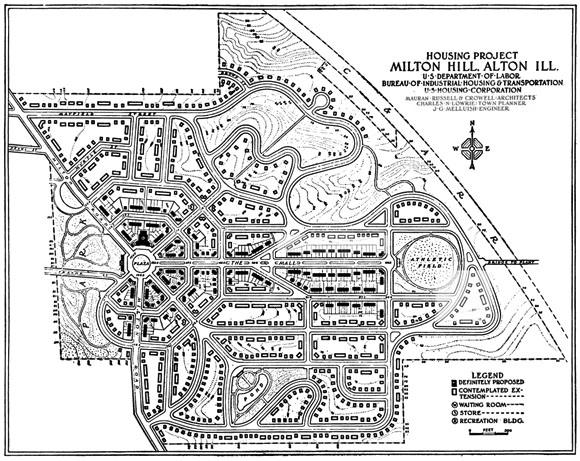
    Milton Hill, a neighborhood designed and developed by the United States Housing Corporation in Alton, Ill.
    National Archives

    Importantly, instead of simply creating complexes of apartment units, akin to the public housing projects that most Americans associate with government-funded housing, the agency focused on the construction of single-family and small multifamily residential buildings that workers and their families could eventually own.

    This approach reflected a belief by the policymakers that property ownership could strengthen community responsibility and social stability. During the war, the federal government rented these homes to workers at regulated rates designed to be fair, while covering maintenance costs. After the war, the government began selling the homes – often to the tenants living in them – through affordable installment plans that provided a practical path to ownership.

    A single-family home in Davenport, Iowa, built by the U.S. Housing Corporation.
    National Archives

    Though the scope of the Housing Corporation’s work was national, each planned community took into account regional growth and local architectural styles. Engineers often built streets that adapted to the natural landscape. They spaced houses apart to maximize light, air and privacy, with landscaped yards. No resident lived far from greenery.

    In Quincy, Massachusetts, for example, the agency built a 22-acre neighborhood with 236 homes designed mostly in a Colonial Revival style to serve the nearby Fore River Shipyard. The development was laid out to maximize views, green space and access to the waterfront, while maintaining density through compact street and lot design.

    At Mare Island, California, developers located the housing site on a steep hillside near a naval base. Rather than flatten the land, designers worked with the slope, creating winding roads and terraced lots that preserved views and minimized erosion. The result was a 52-acre community with over 200 homes, many of which were designed in the Craftsman style. There was also a school, stores, parks and community centers.

    Infrastructure and innovation

    Alongside housing construction, the Housing Corporation invested in critical infrastructure. Engineers installed over 649,000 feet of modern sewer and water systems, ensuring that these new communities set a high standard for sanitation and public health.

    Attention to detail extended inside the homes. Architects experimented with efficient interior layouts and space-saving furnishings, including foldaway beds and built-in kitchenettes. Some of these innovations came from private companies that saw the program as a platform to demonstrate new housing technologies.

    One company, for example, designed fully furnished studio apartments with furniture that could be rotated or hidden, transforming a space from living room to bedroom to dining room throughout the day.

    To manage the large scale of this effort, the agency developed and published a set of planning and design standards − the first of their kind in the United States. These manuals covered everything from block configurations and road widths to lighting fixtures and tree-planting guidelines.

    A single-family home in Bremerton, Wash., built by the U.S. Housing Corporation.
    National Archives

    The standards emphasized functionality, aesthetics and long-term livability.

    Architects and planners who worked for the Housing Corporation carried these ideas into private practice, academia and housing initiatives. Many of the planning norms still used today, such as street hierarchies, lot setbacks and mixed-use zoning, were first tested in these wartime communities.

    And many of the planners involved in experimental New Deal community projects, such as Greenbelt, Maryland, had worked for or alongside Housing Corporation designers and planners. Their influence is apparent in the layout and design of these communities.

    A brief but lasting legacy

    With the end of World War I, the political support for federal housing initiatives quickly waned. The Housing Corporation was dissolved by Congress, and many planned projects were never completed. Others were incorporated into existing towns and cities.

    Yet, many of the neighborhoods built during this period still exist today, integrated in the fabric of the country’s cities and suburbs. Residents in places such as Aberdeen, Maryland; Bremerton, Washington; Bethlehem, Pennsylvania; Watertown, New York; and New Orleans may not even realize that many of the homes in their communities originated from a bold federal housing experiment.

    Homes on Lawn Avenue in Quincy, Mass., that were built by the U.S. Housing Corporation.
    Google Street View

    The Housing Corporation’s efforts, though brief, showed that large-scale public housing could be thoughtfully designed, community oriented and quickly executed. For a short time, in response to extraordinary circumstances, the U.S. government succeeded in building more than just houses. It constructed entire communities, demonstrating that government has a major role and can lead in finding appropriate, innovative solutions to complex challenges.

    At a moment when the U.S. once again faces a housing crisis, the legacy of the U.S. Housing Corporation serves as a reminder that bold public action can meet urgent needs.

    This article is part of a series centered on envisioning ways to deal with the housing crisis.

    Eran Ben-Joseph does not work for, consult, own shares in or receive funding from any company or organization that would benefit from this article, and has disclosed no relevant affiliations beyond their academic appointment.

    – ref. Believe it or not, there was a time when the US government built beautiful homes for working-class Americans to deal with a housing shortage – https://theconversation.com/believe-it-or-not-there-was-a-time-when-the-us-government-built-beautiful-homes-for-working-class-americans-to-deal-with-a-housing-shortage-253512

    MIL OSI Analysis –

    June 27, 2025
  • MIL-OSI Canada: Stay safe, plan ahead for Canada Day weekend

    Source: Government of Canada regional news

    As people make plans for the Canada Day weekend, it’s important to be prepared and stay safe as warm temperatures, dry conditions and wildfire risk continue in many parts of the province.

    People are encouraged to stay vigilant and up to date on local fire bans and restrictions and have an emergency plan in place that is shared with friends and family.

    People heading outdoors this weekend are reminded to plan ahead, carry safety gear and follow all instructions from local governments and First Nations. Before you head out, check ahead for road closures, evacuation alerts, evacuation orders and any fire prohibitions in effect.

    British Columbia continues to face prolonged drought in many regions, and below-average precipitation is contributing to increased wildfire and water supply concerns. Everyone is encouraged to use water efficiently and follow any local watering restrictions.

    Several open-burning prohibitions are in place around the province and will be updated as conditions change. People planning to have campfires should do so safely, following any local prohibitions. Avoid having a campfire when it’s windy, choose a proper fire pit or make a ring of rocks at least three metres from trees, shrubs, structures and debris, and do not leave a campfire unattended.

    The BC Wildfire Service relies on the public for reporting wildfires quickly. Approximately 40% of new fires are reported by the public. If you see smoke or flames, report it immediately by calling *5555 on a cellphone or 1 800 663-5555, toll-free.

    The BC Wildfire Service mobile app allows people to report new wildfires and submit photos, which helps BC Wildfire Service make informed decisions. People can use the app for the most up-to-date information on the current wildfire situation, road conditions, evacuation information and weather forecasts.

    If you’re in a high-risk wildfire area, now is the time to get prepared. Create an emergency plan, pack a grab-and-go bag for each household member, including pets, and create an Emergency Support Services (ESS) profile through your BC Services Card app or at ess.gov.bc.ca. People are advised to make sure their home or tenant insurance includes wildfire protection, which can help with expenses like temporary accommodation and meals if there is a need to evacuate.

    Check your insurance policy to understand what evacuation supports are available through your coverage. If you’re unsure, call your insurance provider or the Insurance Bureau of Canada at 1 844 227-5422 or visit: https://www.ibc.ca/

    People are encouraged to follow instructions and evacuate immediately if a local government or First Nation issues an order. Emergency Support Services (ESS) are available to evacuees who need help covering the cost of their basic needs, such as food, lodging and other essentials.

    People can also reduce risk around the home with a few simple FireSmart steps:

    • clear dry leaves and debris from around your property
    • move propane tanks and other flammables at least 10 metres from structures
    • keep grass cut short
    • close doors and windows
    • water trees, shrubs and plants regularly, following local water restrictions
    • consider more fire-resistant plants for landscaping

    People travelling in B.C. are encouraged to know before they go. You can plan ahead and get the latest road conditions and updates here: https://www.drivebc.ca/

    Drivers on routes throughout the province this summer should expect higher-than-average traffic volumes and plan accordingly. General tips for a safe trip include:

    • allowing additional time to get to your destination due to more people on roads
    • making sure your vehicle is ready for the drive by having a full tank of gas or charged battery, checking engine oil, washer fluid, lights and tires, including the spare
    • packing food and water for passengers and pets
    • planning breaks at rest areas: https://www.th.gov.bc.ca/restareas/?zoom=5&loc=-126.600000%2C54.589121
    • watching for motorcyclists and sharing the road with cyclists and other users
    • obeying all posted speed limits and driving with caution, especially during bad weather
    • leaving the phone alone while behind the wheel, and
    • ensuring all passengers always use seatbelts.​

    Learn More:

    For BC Wildfire Service information and updates, visit: https://wildfiresituation.nrs.gov.bc.ca/dashboard

    For more information about fire prohibitions, visit: https://www2.gov.bc.ca/gov/content/safety/wildfire-status/fire-bans-and-restrictions

    For up-to-date information about road conditions, visit: https://www.drivebc.ca/

    For more information about rest areas during driving, visit: https://www.th.gov.bc.ca/restareas

    For detailed guidance on what happens before, during and after an evacuation order, visit https://www2.gov.bc.ca/gov/content/safety/emergency-management/preparedbc/evacuation-recovery/evacuee-guidance

    For the latest information on evacuation alerts and evacuation orders in B.C., visit: https://EmergencyInfoBC.ca
    Or follow @EmergencyInfoBC on X

    To register with Emergency Support Services, visit: https://ess.gov.bc.ca/

    For information on how to prepare for emergencies, including information about emergency kits, household emergency plans and hazard-specific guides, visit: https://PreparedBC.ca 

    For more information on how to FireSmart your home, visit: https://firesmartbc.ca

    For backcountry safety checklists and trip planning resources, visit: https://www.adventuresmart.ca/

    For more information about drought, visit: https://www2.gov.bc.ca/gov/content/drought

    MIL OSI Canada News –

    June 27, 2025
  • MIL-OSI: $255 Payday Loans Online Same Day No Credit Check Bad Credit Guaranteed Approval -Radcred Loan Platform For Immediate Financial Relief

    Source: GlobeNewswire (MIL-OSI)

    Glendale, California, June 26, 2025 (GLOBE NEWSWIRE) — Radcred has launched a $255 payday loan online platform that provides fast and accessible financial relief for borrowers in urgent need of cash. With same day payday loans, Radcred offers a seamless solution for those needing quick access to funds, even with poor credit histories. In addition, Radcred provides no credit check payday loans, ensuring that individuals with less-than-perfect credit can still access the funds they need.

    From medical bills to car repairs or unexpected rent payments, Radcred ensures borrowers can receive the financial support they need without unnecessary delays. The simplified loan application process and the secure transactions feature of Radcred make it easier for individuals to access emergency cash when they need it most.

    Why $255 Payday Loans Online Are a Lifeline in 2025

    The demand for $255 payday loans online has surged in recent years due to rising living costs and financial instability. According to the Federal Reserve, over 63% of Americans would struggle to cover a $400 emergency expense without borrowing, using credit, or selling assets. This highlights the financial challenges faced by many.

    As more individuals experience unexpected financial pressures, same day payday loans no credit check have become a vital resource. These loans offer quick and easy access to emergency funds, helping borrowers avoid further financial strain during urgent situations, like medical bills or car repairs.

    Urgent payday loan needs have also driven the rise of no credit check payday loans. These loans offer a convenient solution for individuals with poor credit, allowing them to access the funds they need without the usual barriers. As demand for fast and reliable financial relief increases, platforms like Radcred are effectively meeting these needs.

    Radcred Launches Same-Day Payday Loans Online with No Credit Check

    Radcred has introduced a digital-first platform offering $255 payday loans online to help borrowers facing urgent financial needs. The platform provides same-day payday loans with no credit check, making it an ideal choice for those seeking fast and reliable financial relief. Here’s how it works:

    • No Credit Check Payday Loans: Radcred simplifies the loan process by removing the need for a credit check, making it accessible to individuals with poor credit histories.
    • Same-Day Approval: Borrowers can receive approval quickly, often within minutes, ensuring fast access to funds.
    • Quick Fund Transfer: Once approved, the funds are transferred directly to the borrower’s account, often on the same day, providing immediate financial relief.
    • Digital Platform: Radcred connects borrowers to a network of licensed lenders, offering a fast, secure, and seamless online application process.

    Radcred’s platform ensures quick, secure access to emergency funds, making it easier for users to manage unexpected expenses.

    Why Same-Day Payday Loans Online Are the Right Choice for Emergency Needs

    When unexpected emergencies like medical bills, car repairs, or rent payments arise, waiting for traditional loans can lead to added stress and delays. Same day payday loans no credit check offer an ideal solution by providing immediate access to cash. Here’s why they’re the best option for emergency financial needs:

    • Fast Approval: With same-day payday loans for emergencies, the approval process is quick, often completed within minutes, so borrowers don’t have to wait long for a response.
    • Quick Fund Transfer: Once approved, funds are typically transferred directly to your bank account the same day, offering relief within hours.
    • No Credit Check: Many payday loan platforms, including Radcred, provide no credit check payday loans, making it easier for individuals with poor credit to access funds during emergencies.
    • Accessible for Urgent Needs: Payday loans provide the fast cash needed to cover immediate expenses, such as medical bills, auto repairs, or emergency travel.
    • Streamlined Application Process: Fast payday loan applications allow borrowers to apply online quickly, avoiding the long and cumbersome paperwork of traditional loans.

    Same day payday loans are a reliable solution when time is of the essence and quick financial relief is needed.

    How Radcred’s $255 Payday Loan Process Works?

    Applying for $255 payday loans online with Radcred is quick and straightforward. The process is designed to ensure fast approval and easy access to emergency funds. Here’s how it works:

    • Fill out the online application: Start by completing a simple application form. Provide basic personal information such as your income, employment status, and contact details.
    • Soft credit check: Radcred uses a soft credit check to match you with a lender. This check does not affect your credit score, making it ideal for borrowers with poor credit histories.
    • Choose the best loan offer: After the soft credit check, you’ll be presented with multiple loan options. Review each offer carefully, considering the APR, repayment terms, and other details before selecting the one that suits your needs.
    • Receive funds directly in your account: Once you’ve chosen your offer and agreed to the terms, funds will be transferred directly into your bank account. Radcred payday loans are processed quickly, often within hours, allowing you to access emergency cash without delays.

    The Radcred payday loan process is designed for efficiency, providing fast, secure access to funds when you need them most. 

    Common Uses for $255 Payday Loans Online 

    People use $255 payday loans online for a variety of emergency needs, as they provide quick access to funds during urgent situations. Here are some of the most common uses:

    • Medical bills and doctor visits: Unexpected health expenses can arise at any time, and same day payday loans offer a fast solution to cover these costs before they escalate.
    • Car repairs: For vehicle breakdowns or emergency repairs, payday loans online same day $255 allow individuals to get back on the road quickly without worrying about out-of-pocket expenses.
    • Rent shortfalls: When rent payments are due and funds are low, payday loans online same day can help prevent late fees or eviction.
    • Utility payments: Avoid utility disconnections by using an instant online payday loan to pay overdue bills.
    • Unexpected travel expenses: Be it for family emergencies or business, small payday loans online can cover immediate travel needs without financial strain.

    Radcred’s same day payday loan platform ensures that borrowers can quickly access the funds they need, with 1 hour payday loans no credit check options available. The easy process and fast approval make instant payday loans a reliable solution for emergency payday loans.

    Key Benefits of Radcred’s $255 Payday Loans 

    Radcred offers $255 payday loans online with several key benefits, ensuring fast, secure, and reliable financial relief for borrowers. Here’s why Radcred is a top choice for same day payday loans:

    • Fast Approval: Radcred’s application process is quick, providing instant payday loan approval in as little as a few hours. This speed is crucial for those in need of emergency funds.
    • No Credit Check: With 1-hour payday loans no credit check, Radcred uses a soft credit pull to evaluate eligibility without impacting your credit score. This makes the platform accessible to borrowers with less-than-ideal credit histories.
    • Transparent Terms: Radcred payday loan benefits include clear and upfront disclosure of all fees, APR, and repayment terms, ensuring there are no hidden surprises. Borrowers can make informed decisions before accepting any loan offer.
    • Flexibility: Radcred offers flexible loan terms tailored to the needs of individual borrowers. 1 hour payday loans online no credit check instant approval gives you the ability to choose an option that fits your financial situation.

    Radcred’s payday loans 255 no credit check solution provides borrowers with immediate access to funds without the stress of high interest rates, complex applications, or long waits.

    Who Can Apply for $255 Payday Loans Online? 

    To apply for a $255 payday loan online, applicants must meet the following eligibility requirements:

    • Be 18 years or older: Applicants must be of legal age to apply for payday loans.
    • U.S. citizen or permanent resident: You must be a resident of the United States to qualify for the loan.
    • Have a steady income or benefits: A reliable income from employment, government assistance, or other sources is needed to repay the loan.
    • Maintain an active checking account: Your loan funds will be deposited into your checking account, so you need to have an account in your name.
    • No credit score minimum is required: With no credit check payday loans, applicants are not required to meet a specific credit score threshold, making 1-hour payday loans no credit check a viable option for many borrowers.

    Radcred’s Secure Loan Matching Process

    Radcred ensures the security of personal and financial data throughout the payday loan process by using advanced encryption technology. The payday loan platform connects borrowers to a network of state-licensed lenders, prioritizing data protection. Radcred’s process includes a soft credit check, so your credit score remains unaffected. When applying for $255 payday loans online or same day payday loans no credit check, you receive a secure, transparent experience. 

    The fast, seamless application ensures funds are transferred quickly while maintaining the highest levels of security and compliance with lending laws, offering a safe instant payday loans borrowing experience for all users.

    Final Thoughts: $255 Payday Loans for Immediate Relief 

    Radcred’s $255 payday loans online offer fast and efficient relief for those in need of urgent funds. Same-day payday loans provide the cash you need when you need it most. With a quick and easy application process, you can apply for payday loans and receive approval in minutes.

    No credit check is required, and funds are often transferred the same day, ensuring fast access to the money you need. Don’t let unexpected costs hold you back and apply today for $255 payday loans online and get the relief you deserve.

    Disclaimer

    Radcred is not a lender and does not make credit decisions. Loan offers are based on third-party lender criteria and local regulations. Terms, APR, and loan amounts may vary by applicant. $255 payday loans online offers are subject to approval. Borrowers should carefully review all loan offers, including fees and repayment terms, before accepting.

    The MIL Network –

    June 27, 2025
  • MIL-OSI United Kingdom: Dubai-based director who falsified VAT returns banned after his four companies owed HMRC more than £1 million

    Source: United Kingdom – Government Statements

    Press release

    Dubai-based director who falsified VAT returns banned after his four companies owed HMRC more than £1 million

    Director submitted falsified documentation to reclaim VAT

    • Hassan Waqar has been disqualified as a director for 11 years after his four companies reclaimed almost £400,000 in VAT they were not entitled to 

    • The four companies – HN Restaurants Limited, Kiani Construction Limited, Moneemint Ventures Limited and Zoya Investments Limited – submitted falsified documents to HM Revenue and Customs (HMRC) or failed to provide supporting evidence for VAT repayment claims 

    • All four companies were struck-off the Companies House register between February and June 2023, with total debts to HMRC of more than £1.1 million in VAT assessments, penalties and interest

    The boss of four companies which owed HMRC more than £1 million, including £400,000 in VAT they falsely reclaimed, has been banned as a director. 

    Hassan Waqar was the director of HN Restaurants Limited, Kiani Construction Limited and Moneemint Ventures Limited when they submitted falsified documents to HMRC. 

    A fourth company, Zoya Investments Limited, failed to supply evidence to HMRC to support the repayment returns it had submitted. 

    The four companies owed HMRC more than £1.1 million in VAT and penalties when they were all struck-off the Companies House register during the first half of 2023. 

    Waqar, 30, who is now based in Dubai, has been disqualified as a company director for 11 years. 

    Victoria Edgar, Chief Investigator at the Insolvency Service, said: 

    Hassan Waqar submitted falsified documentation for VAT reclamations that his companies were not entitled to receive. 

    Our investigations found that he failed to provide supporting evidence for claims across multiple businesses, with over £1.1 million owed when these companies were struck off the Companies House register in 2023.

    The Insolvency Service is committed to taking action against directors who fail to meet their legal and financial obligations, protecting the integrity of the business environment and the tax system.

    HN Restaurants Limited was set up in May 2020 as a fast-food business. Kiani Construction Limited was a construction company incorporated in August 2021 which was involved in real estate sales. 

    Moneemint Ventures Limited, like HN Restaurants Limited, was established in May 2020, and was described by Waqar as a banking service platform. Zoya Investments Limited, incorporated in March 2021, traded in carrying out fitouts. 

    The four companies received a total of £396,982 in VAT repayments. 

    HN Restaurants Limited, Kiani Construction Limited and Moneemint Ventures Limited provided invoices to HMRC in support of their claims. HMRC contacted several of the suppliers who confirmed they had not issued the invoices to the companies. 

    Bank statements were provided by HN Restaurants Limited and Moneemint Ventures Limited to HMRC to support the repayment return, but they differed to the ones supplied by the banks. 

    Zoya Investments Limited did not provide any evidence to support its VAT repayment claims. 

    HMRC issued penalties to the four companies totalling £706,692. 

    The four companies were struck-off the Companies House register between February and June 2023. 

    Combined, the four companies owed £1,136,832 in VAT assessments, penalties and interest. 

    The Secretary of State for Business and Trade accepted a disqualification undertaking from Waqar, and his ban started on Thursday 26 June. 

    It prevents him from being involved in the promotion, formation or management of a company, without the permission of the court. 

    HMRC issued a joint and several liability notice to Waqar for HN Restaurants, making him personally responsible for paying the tax debts of the company.

    Further information

    • Hassan Waqar is of 21A Street, Dubai, United Arab Emirates. His date of birth is 1 August 1994 

    • HN Restaurants Limited (company number 12727857) 

    • Kiani Construction Limited (company number 13576285) 

    • Moneemint Ventures Limited (company number 12631542) 

    • Zoya Investments Limited (company number 13285735) 

    • Individuals subject to a disqualification order or undertaking are bound by a range of restrictions   

    • Further information about the work of the Insolvency Service, and how to complain about financial misconduct.

    Share this page

    The following links open in a new tab

    • Share on Facebook (opens in new tab)
    • Share on Twitter (opens in new tab)

    Updates to this page

    Published 26 June 2025

    MIL OSI United Kingdom –

    June 27, 2025
  • MIL-OSI Security: McKeesport Felon Sentenced to Prison for Possession of Ammunition Collected from Scene of Fatal Apartment Complex Shooting

    Source: United States Bureau of Alcohol Tobacco Firearms and Explosives (ATF)

    PITTSBURGH, Pa. – A resident of McKeesport, Pennsylvania, was sentenced in federal court to 33 months of imprisonment on his conviction of possession of ammunition by a convicted felon, Acting United States Attorney Troy Rivetti announced today.

    Senior United States District Judge Nora Barry Fischer imposed the sentence on Desmond Dontae Lee, 47.

    According to information presented to the Court, on March 1, 2023, Lee and his son were both part of a group of individuals congregating outside of an apartment in a McKeesport apartment complex. When the resident of the apartment confronted the group and asked them to leave, one of the group members approached the resident and struck him with a closed fist, which led to the resident shooting and killing his attacker. Lee entered and proceeded through the apartment next to the resident’s, exiting that apartment from the rear, and then approached the rear of the resident’s apartment, firing five rounds from a 9mm semi-automatic pistol into the apartment before fleeing the scene. At that time, Lee’s son shot back at and killed the resident at the front of the apartment. The firearm used by Lee was never recovered, but investigators with the Allegheny County Police Department Homicide Unit collected the shell casings fired from Lee’s gun.

    Lee was previously convicted on state drug trafficking and firearms offenses. Federal law prohibits possession of a firearm or ammunition by a convicted felon.

    Assistant United States Attorney V. Joseph Sonson prosecuted this case on behalf of the government.

    Acting United States Attorney Rivetti commended the Allegheny County Police Department and Bureau of Alcohol, Tobacco, Firearms and Explosives for the investigation leading to the successful prosecution of Lee.

    MIL Security OSI –

    June 27, 2025
  • MIL-OSI Security: McKeesport Felon Sentenced to Prison for Possession of Ammunition Collected from Scene of Fatal Apartment Complex Shooting

    Source: United States Bureau of Alcohol Tobacco Firearms and Explosives (ATF)

    PITTSBURGH, Pa. – A resident of McKeesport, Pennsylvania, was sentenced in federal court to 33 months of imprisonment on his conviction of possession of ammunition by a convicted felon, Acting United States Attorney Troy Rivetti announced today.

    Senior United States District Judge Nora Barry Fischer imposed the sentence on Desmond Dontae Lee, 47.

    According to information presented to the Court, on March 1, 2023, Lee and his son were both part of a group of individuals congregating outside of an apartment in a McKeesport apartment complex. When the resident of the apartment confronted the group and asked them to leave, one of the group members approached the resident and struck him with a closed fist, which led to the resident shooting and killing his attacker. Lee entered and proceeded through the apartment next to the resident’s, exiting that apartment from the rear, and then approached the rear of the resident’s apartment, firing five rounds from a 9mm semi-automatic pistol into the apartment before fleeing the scene. At that time, Lee’s son shot back at and killed the resident at the front of the apartment. The firearm used by Lee was never recovered, but investigators with the Allegheny County Police Department Homicide Unit collected the shell casings fired from Lee’s gun.

    Lee was previously convicted on state drug trafficking and firearms offenses. Federal law prohibits possession of a firearm or ammunition by a convicted felon.

    Assistant United States Attorney V. Joseph Sonson prosecuted this case on behalf of the government.

    Acting United States Attorney Rivetti commended the Allegheny County Police Department and Bureau of Alcohol, Tobacco, Firearms and Explosives for the investigation leading to the successful prosecution of Lee.

    MIL Security OSI –

    June 27, 2025
  • MIL-OSI Analysis: Israel bombed an Iraqi nuclear reactor in 1981 − it pushed program underground and spurred Saddam Hussein’s desire for nukes

    Source: The Conversation – Global Perspectives – By Jeffrey Fields, Professor of the Practice of International Relations, USC Dornsife College of Letters, Arts and Sciences

    The Osirak nuclear power research station in 1981. Jacques Pavlovsky/Sygma via Getty Images

    Israel, with the assistance of U.S. military hardware, bombs an adversary’s nuclear facility to set back the perceived pursuit of the ultimate weapon. We have been here before, about 44 years ago.

    In 1981, Israeli fighter jets supplied by Washington attacked an Iraqi nuclear research reactor being built near Baghdad by the French government.

    The reactor, which the French called Osirak and Iraqis called Tammuz, was destroyed. Much of the international community initially condemned the attack. But Israel claimed the raid set Iraqi nuclear ambitions back at least a decade. In time, many Western observers and government officials, too, chalked up the attack as a win for nonproliferation, hailing the strike as an audacious but necessary step to prevent Iraqi dictator Saddam Hussein from building a nuclear arsenal.

    But the reality is more complicated. As nuclear proliferation experts assess the extent of damage to Iran’s nuclear facilities following the recent U.S. and Israeli raids, it is worth reassessing the longer-term implications of that earlier Iraqi strike.

    The Osirak reactor

    Iraq joined the landmark Nuclear Non-Proliferation Treaty in 1970, committing the country to refrain from the pursuit of nuclear weapons. But in exchange, signatories are entitled to engage in civilian nuclear activities, including having research or power reactors and access to the enriched uranium that drives them.

    The International Atomic Energy Agency is responsible through safeguards agreements for monitoring countries’ civilian use of nuclear technology, with on-the-ground inspections to ensure that civilian nuclear programs do not divert materials for nuclear weapons.

    But to Israel, the Iraqi reactor was provocative and an escalation in the Arab-Israeli conflict.

    Israel believed that Iraq would use the French reactor – Iraq said it was for research purposes – to generate plutonium for a nuclear weapon. After diplomacy with France and the United States failed to persuade the two countries to halt construction of the reactor, Prime Minister Menachem Begin concluded that attacking the reactor was Israel’s best option. That decision gave birth to the “Begin Doctrine,” which has committing Israel to preventing its regional adversaries from becoming nuclear powers ever since.

    Israeli Prime Minister Menachem Begin addresses the press after the 1981 attack on the Osarik nuclear reactor.
    Israel Press and Photo Agency/Wikimedia Commons

    In spring 1979, Israel attempted to sabotage the project, bombing the reactor core destined for Iraq while it sat awaiting shipment in the French town of La Seyne-sur-Mer. The mission was only a partial success, damaging but not destroying the reactor.

    France and Iraq persisted with the project, and in July 1980 – with the reactor having been delivered – Iraq received the first shipment of highly enriched uranium fuel at the Tuwaitha Nuclear Research Center near Baghdad.

    Then in September 1980, during the initial days of the Iran-Iraq war, Iranian jets struck the nuclear research center. The raid also targeted a power station, knocking out electricity in Baghdad for several days. But a Central Intelligence Agency situation report assessed that “only secondary buildings” were hit at the nuclear site itself.

    It was then Israel’s turn. The reactor was still unfinished and not in operation when on June 7, 1981, eight U.S.-supplied F-16s flew over Jordanian and Saudi airspace and bombed the reactor in Iraq. The attack killed 10 Iraqi soldiers and a French civilian.

    Revisiting the ‘success’ of Israeli raid

    Many years later, U.S. President Bill Clinton commented: “Everybody talks about what the Israelis did at Osirak in 1981, which I think, in retrospect, was a really good thing. You know, it kept Saddam from developing nuclear power.”

    But nonproliferation experts have contended for years that while Saddam may have had nuclear weapons ambitions, the French-built research reactor would not have been the route to go. Iraq would either have had to divert the reactor’s highly enriched uranium fuel for a few weapons or shut the reactor down to extract plutonium from the fuel rods – all while hiding these operations from the International Atomic Energy Agency.

    As an additional safeguard, the French government, too, had pledged to shut down the reactor if it detected efforts to use the reactor for weapons purposes.

    In any event, Iraq’s desire for a nuclear weapon was more aspirational than operational. A 2011 article in the journal International Security included interviews with several scientists who worked on Iraq’s nuclear program and characterized the country’s pursuit of a nuclear weapons capability as “both directionless and disorganized” before the attack.

    Iraq’s program begins in earnest

    So what happened after the strike? Many analysts have argued that the Israeli attack, rather than diminish Iraqi desire for a nuclear weapon, actually catalyzed it.

    Nuclear proliferation expert Målfrid Braut-Hegghammer, the author of the 2011 study, concluded that the Israeli attack “triggered a nuclear weapons program where one did not previously exist.”

    In the aftermath of the attack, Saddam decided to formally, if secretively, establish a nuclear weapons program, with scientists deciding that a uranium-based weapon was the best route. He tasked his scientists with pursuing multiple methods to enrich uranium to weapons grade to ensure success, much the way the Manhattan Project scientists approached the same problem in the U.S.

    In other words, the Israeli attack, rather than set back an existing nuclear weapons program, turned an incoherent and exploratory nuclear endeavor into a drive to get the bomb personally overseen by Saddam and sparing little expense even as Iraq’s war with Iran substantially taxed Iraqi resources.

    From 1981 to 1987, the nuclear program progressed fitfully, facing both organizational and scientific challenges.

    As those challenges were beginning to be addressed, Iraq invaded Kuwait in 1990, provoking a military response from the United States. In the aftermath of what would become Operation Desert Storm, U.N. weapons inspectors discovered and dismantled the clandestine Iraqi nuclear weapons program.

    The Tammuz nuclear reactor was hit again during the 1991 Gulf War.
    Ramzi Haidar/AFP via Getty Images

    Had Saddam not invaded Kuwait over a matter not related to security, it is very possible that Baghdad would have had a nuclear weapon capability by the mid-to-late 1990s.

    Similarly to Iraq in 1980, Iran today is a party to the Nuclear Non-Proliferation Treaty. At the time President Donald Trump withdrew U.S. support in 2018 for the Joint Comprehensive Plan of Action, colloquially known as the Iran nuclear deal, the International Atomic Energy Agency certified that Tehran was complying with the requirements of the agreement.

    In the case of Iraq, military action on its nascent nuclear program merely pushed it underground – to Saddam, the Israeli strikes made acquiring the ultimate weapon more rather than less attractive as a deterrent. Almost a half-century on, some analysts and observers are warning the same about Iran.

    Jeffrey Fields receives funding from the Carnegie Corporation of New York and Schmidt Futures.

    – ref. Israel bombed an Iraqi nuclear reactor in 1981 − it pushed program underground and spurred Saddam Hussein’s desire for nukes – https://theconversation.com/israel-bombed-an-iraqi-nuclear-reactor-in-1981-it-pushed-program-underground-and-spurred-saddam-husseins-desire-for-nukes-259618

    MIL OSI Analysis –

    June 27, 2025
  • MIL-OSI Analysis: Japanese prime minister’s abrupt no-show at NATO summit reveals a strained alliance with the US

    Source: The Conversation – Global Perspectives – By Craig Mark, Adjunct Lecturer, Faculty of Economics, Hosei University

    Japanese Prime Minister Shigeru Ishiba has sent a clear signal to the Trump administration: the Japan–US relationship is in a dire state.

    After saying just days ago he would be attending this week’s NATO summit at The Hague, Ishiba abruptly pulled out at the last minute.

    He joins two other leaders from the Indo-Pacific region, Australian Prime Minister Anthony Albanese and South Korean President Lee Jae-myung, in skipping the summit.

    The Japanese media reported Ishiba cancelled the trip because a bilateral meeting with US President Donald Trump was unlikely, as was a meeting of the Indo-Pacific Four (IP4) NATO partners (Australia, New Zealand, South Korea and Japan).

    Japan will still be represented by Foreign Minister Takeshi Iwaya, showing its desire to strengthen its security relationship with NATO.

    However, Ishiba’s no-show reveals how Japan views its relationship with the Trump administration, following the severe tariffs Washington imposed on Japan and Trump’s mixed messages on the countries’ decades-long military alliance.

    Tariffs and diplomatic disagreements

    Trump’s tariff policy is at the core of the divide between the US and Japan.

    Ishiba attempted to get relations with the Trump administration off to a good start. He was the second world leader to visit Trump at the White House, after Israeli Prime Minister Benjamin Netanyahu.

    However, Trump’s “Liberation Day” tariffs imposed a punitive rate of 25% on Japanese cars and 24% on all other Japanese imports. They are already having an adverse impact on Japan’s economy: exports of automobiles to the US dropped in May by 25% compared to a year ago.

    Six rounds of negotiations have made little progress, as Ishiba’s government insists on full tariff exemptions.

    Japan has been under pressure from the Trump administration to increase its defence spending, as well. According to the Financial Times, Tokyo cancelled a summit between US and Japanese defence and foreign ministers over the demand. (A Japanese official denied the report.)

    Japan also did not offer its full support to the US bombings of Iran’s nuclear facilities earlier this week. The foreign minister instead said Japan “understands” the US’s determination to prevent Iran from acquiring nuclear weapons.

    Japan has traditionally had fairly good relations with Iran, often acting as an indirect bridge with the West. Former Prime Minister Shinzo Abe even made a visit there in 2019.

    Japan also remains heavily dependent on oil from the Middle East. It would have been adversely affected if the Strait of Hormuz had been blocked, as Iran was threatening to do.

    Unlike the response from the UK and Australia, which both supported the strikes, the Ishiba government prioritised its commitment to upholding international law and the rules-based global order. In doing so, Japan seeks to deny China, Russia and North Korea any leeway to similarly erode global norms on the use of force and territorial aggression.

    Strategic dilemma of the Japan–US military alliance

    In addition, Japan is facing the same dilemma as other American allies – how to manage relations with the “America first” Trump administration, which has made the US an unreliable ally.

    Earlier this year, Trump criticised the decades-old security alliance between the US and Japan, calling it “one-sided”.

    “If we’re ever attacked, they don’t have to do a thing to protect us,” he said of Japan.

    Lower-level security cooperation is ongoing between the two allies and their regional partners. The US, Japanese and Philippine Coast Guards conducted drills in Japanese waters this week. The US military may also assist with upgrading Japan’s counterstrike missile capabilities.

    But Japan is still likely to continue expanding its security ties with partners beyond the US, such as NATO, the European Union, India, the Philippines, Vietnam and other ASEAN members, while maintaining its fragile rapprochement with South Korea.

    Australia is now arguably Japan’s most reliable security partner. Canberra is considering buying Japan’s Mogami-class frigates for the Royal Australian Navy. And if the AUKUS agreement with the US and UK collapses, Japanese submarines could be a replacement.

    Ishiba under domestic political pressure

    There are also intensifying domestic political pressures on Ishiba to hold firm against Trump, who is deeply unpopular among the Japanese public.

    After replacing former prime minister Fumio Kishida as leader of the Liberal Democratic Party (LDP) last September, the party lost its majority in the lower house of parliament in snap elections. This made it dependent on minor parties for legislative support.

    Ishiba’s minority government has struggled ever since with poor opinion polling. There has been widespread discontent with inflation, the high cost of living and stagnant wages, the legacy of LDP political scandals, and ever-worsening geopolitical uncertainty.

    On Sunday, the party suffered its worst-ever result in elections for the Tokyo Metropolitan Assembly, winning its lowest number of seats.

    The party could face a similar drubbing in the election for half of the upper house of the Diet (Japan’s parliament) on July 20. Ishiba has pledged to maintain the LDP’s majority in the house with its junior coalition partner Komeito. But if the government falls into minority status in both houses, Ishiba will face heavy pressure to step down.

    Craig Mark does not work for, consult, own shares in or receive funding from any company or organisation that would benefit from this article, and has disclosed no relevant affiliations beyond their academic appointment.

    – ref. Japanese prime minister’s abrupt no-show at NATO summit reveals a strained alliance with the US – https://theconversation.com/japanese-prime-ministers-abrupt-no-show-at-nato-summit-reveals-a-strained-alliance-with-the-us-259694

    MIL OSI Analysis –

    June 27, 2025
  • MIL-OSI Analysis: Oil shocks in the 1970s drove rapid changes in transport. It could happen again if Middle East tensions continue

    Source: The Conversation – Global Perspectives – By Hussein Dia, Professor of Future Urban Mobility, Swinburne University of Technology

    The Image Bank/Getty

    As the world watches the US–Iran situation with concern, the ripple effect from these events are reaching global oil supply chains – and exposing their fragility.

    If Iran closes the Strait of Hormuz as it is considering, it would restrict the global oil trade and trigger energy chaos.

    Petrol in some Australian cities could hit A$2.50 a litre according to some economists. As global instability worsens, other experts warn price spikes are increasingly likely.

    What would happen next? There is a precedent: the oil shocks of the 1970s, when oil prices quadrupled. The shock drove rapid change, from more efficient cars to sudden interest in alternative energy sources. This time, motorists would likely switch to electric vehicles.

    If this crisis continues or if another one flares up, it could mark a turning point in Australia’s long dependence on foreign oil.

    What would an oil shock mean?

    Australia currently imports 80% of its liquid fuels, the highest level on record. If the flow of oil stopped, we would have about 50 days worth in storage before we ran out.

    Our cars, buses, trucks and planes run overwhelmingly on petrol and diesel. Almost three-quarters (74%) of these liquid fuels are used in transport, with road transport accounting for more than half (54%) of all liquid fuels. Australia is highly exposed to global supply shocks.

    The best available option to reduce dependence on oil imports is to electrify transport.

    How does Australia compare on EVs?

    EV uptake in Australia continues to lag behind global leaders. In 2024, EVs accounted for 9.65% of new car sales in Australia, up from 8.45% in 2023.

    In the first quarter of 2025, EVs were 6.3% of new car sales, a decline from 7.4% in the final quarter of 2024.

    Norway remains the global leader, with battery-electric passenger cars making up 88.9% of sales in 2024. The United Kingdom also saw significant growth – EVs hit almost 20% of new car registrations in 2024.

    In China, EVs made up 40.9% of new car sales in 2024. The 12.87 million cars sold represent three-quarters of total EV sales worldwide.

    One reason for Australia’s sluggishness is a lack of reliable public chargers. While charging infrastructure is expanding, large parts of regional Australia still lack reliable access to EV charging.

    Until recently, Australia’s fuel efficiency standards were among the weakest in the OECD. Earlier this year, the government’s new standards came into force. These are expected to boost EV uptake.

    Could global tensions trigger faster action?

    If history is any guide, oil shocks lead to long-term change.

    The 1970s oil shocks triggered waves of energy reform.

    When global oil prices quadrupled in 1973–74, many nations were forced to reconsider where they got their energy. A few years later, the 1979 Iranian Revolution caused another major supply disruption, sending oil prices soaring and pushing much of the world into recession.

    Huge increases in oil prices drove people to look for alternatives during the 1970s oil shocks.
    Everett Collection/Shutterstock

    These shocks drove the formation of the International Energy Agency in 1974, spurred alternative energy investment and led to advances in fuel-efficiency standards.

    Much more recently, Russia’s invasion of Ukraine pushed the European Union to face up to its reliance on Russian gas and find alternatives by importing gas from different countries and accelerating the clean energy shift.

    Clearly, energy shocks can be catalysts for long-term structural change in how we produce and consume energy.

    The new crisis could do the same, but only if policy catches up.

    If fuel prices shot up and stayed there, consumer behaviour would begin to shift. People would drive less and seek alternate forms of transport. Over time, more would look for better ways to get around.

    But without stronger support such as incentives, infrastructure and fuel security planning, shifting consumer preferences could be too slow to matter.

    A clean-energy future is more secure

    Cutting oil dependency through electrification isn’t just good for the climate. It’s also a hedge against future price shocks and supply disruptions.

    Transport is now Australia’s third-largest source of greenhouse gas emissions. Now that emissions are falling in the electricity sector, transport will be the highest emitting sector emissions source as soon as 2030.

    Building a cleaner transport system also means building a more resilient one. Charging EVs on locally produced renewable power cuts our exposure to global oil markets. So do biofuels, better public transport and smarter urban planning.

    Improving domestic energy resilience isn’t just about climate targets. It’s about economic stability and national security. Clean local energy sources reduce vulnerability to events beyond our control.

    What can we learn from China?

    China offers a compelling case study. The nation of 1.4 billion faces real oil security challenges. In response, Beijing has spent the past decade building a domestic clean energy ecosystem to reduce oil dependency and cut emissions.

    This is now bearing fruit. Last year, China’s oil imports had the first sustained fall in nearly two decades. Crude oil imports fell 1.5%, while oil refinery activity also fell due to lower demand.

    China’s rapid uptake of EVs has clear energy security benefits.
    pim pic/Shutterstock

    China’s green energy transition was driven by coordinated policy, industrial investment and public support for clean transport.

    China’s rapid shift to EVs and clean energy shows how long-term planning and targeted investment can pay off on climate and energy security.

    What we do next matters

    The rolling crises of 2025 present Australian policymakers a rare alignment of interests. What’s good for the climate, for consumers and for national security may now be the same thing.

    Real change will require more than sustained high petrol prices. It demands political will, targeted investment and a long-term vision for clean, resilient transport.

    Doing nothing has a real cost – not just in what we pay at the service station, but in how vulnerable we remain to events a long way away.

    Hussein Dia receives funding from the Australian Research Council, the iMOVE Australia Cooperative Research Centre, Transport for New South Wales, Queensland Department of Transport and Main Roads, Victorian Department of Transport and Planning, and Department of Infrastructure, Transport, Regional Development, Communications and the Arts.

    – ref. Oil shocks in the 1970s drove rapid changes in transport. It could happen again if Middle East tensions continue – https://theconversation.com/oil-shocks-in-the-1970s-drove-rapid-changes-in-transport-it-could-happen-again-if-middle-east-tensions-continue-259670

    MIL OSI Analysis –

    June 27, 2025
  • MIL-OSI: Cerence AI Powers In-Car Experience in Premier German Automaker’s New Electric Sedan

    Source: GlobeNewswire (MIL-OSI)

    BURLINGTON, Mass., June 26, 2025 (GLOBE NEWSWIRE) — Cerence Inc. (NASDAQ: CRNC) (“Cerence AI”), a global leader pioneering conversational AI-powered user experiences, today announced that its core technologies are supporting new agentic and generative AI capabilities in the next-generation of MBUX, rolling out first in the all-new and all-electric Mercedes-Benz CLA. Building on Cerence AI and Mercedes-Benz’s long-term collaboration, this first deployment of the fourth generation of MBUX, supporting advanced conversational capabilities within MBUX Virtual Assistant – as well as the first launch of the automaker’s MB.OS – marks an important milestone in the companies’ shared mission to deliver innovative, intelligent user experiences to Mercedes-Benz drivers.

    Cerence AI and Mercedes-Benz are long-time partners on the MBUX infotainment system. For this program, Cerence AI collaborated closely with Mercedes-Benz global development network to develop the MBUX Virtual Assistant. Cerence’s AI solutions, including speech signal enhancement, cloud-based neural speech recognition, natural language understanding, and embedded neural text-to-speech, serve as the core input and output mechanisms across 25 languages, enabling seamless interaction across the platform’s agentic architecture. This includes the automaker’s new “living” avatar, which takes the form of the Mercedes-Benz star. In addition, Cerence AI enables MBUX to deliver more natural and empathetic interactions. Based on different facets of the user’s voice, the system has the capacity to respond in varying emotional speaking styles leveraging Cerence neural TTS.

    “We greatly value our ongoing partnership with Mercedes-Benz and are proud of our joint effort to integrate our AI solutions, transforming the in-car experience for drivers and passengers around the world,” said Christian Mentz, Chief Revenue Officer, Cerence AI. “This project underscores our unique ability to meet automakers where they are – in this case, partnering closely with Mercedes-Benz to enhance customer choice for their drivers, leveraging the Cerence AI stack that supports the integration of a variety of services and agents.”

    “As we continue to advance MBUX and the Virtual Assistant, we continue our collaboration with Cerence AI to leverage their ongoing innovation in core voice interaction technologies to bring enhanced intelligence and seamless interaction to our drivers,” said Andreas Biehl, Senior Manager Virtual Assistant & Infotainment Experience at Mercedes-Benz.

    To learn more about Cerence AI, visit www.cerence.ai, and follow the company on LinkedIn.

    About Cerence Inc.
    Cerence Inc. (NASDAQ: CRNC) is a global industry leader in creating intuitive, seamless, AI-powered experiences across automotive and transportation. Leveraging decades of innovation and expertise in voice, generative AI, and large language models, Cerence powers integrated experiences that create safer, more connected, and more enjoyable journeys for drivers and passengers alike. With more than 500 million cars shipped with Cerence technology, the company partners with leading automakers, transportation OEMs, and technology companies to advance the next generation of user experiences. Cerence is headquartered in Burlington, Massachusetts, with operations globally and a worldwide team dedicated to pushing the boundaries of AI innovation. For more information, visit www.cerence.ai.

    Contact Information
    Kate Hickman | Tel: 339-215-4583 | Email: kate.hickman@cerence.com

    The MIL Network –

    June 27, 2025
  • MIL-OSI: Cerence AI Powers In-Car Experience in Premier German Automaker’s New Electric Sedan

    Source: GlobeNewswire (MIL-OSI)

    BURLINGTON, Mass., June 26, 2025 (GLOBE NEWSWIRE) — Cerence Inc. (NASDAQ: CRNC) (“Cerence AI”), a global leader pioneering conversational AI-powered user experiences, today announced that its core technologies are supporting new agentic and generative AI capabilities in the next-generation of MBUX, rolling out first in the all-new and all-electric Mercedes-Benz CLA. Building on Cerence AI and Mercedes-Benz’s long-term collaboration, this first deployment of the fourth generation of MBUX, supporting advanced conversational capabilities within MBUX Virtual Assistant – as well as the first launch of the automaker’s MB.OS – marks an important milestone in the companies’ shared mission to deliver innovative, intelligent user experiences to Mercedes-Benz drivers.

    Cerence AI and Mercedes-Benz are long-time partners on the MBUX infotainment system. For this program, Cerence AI collaborated closely with Mercedes-Benz global development network to develop the MBUX Virtual Assistant. Cerence’s AI solutions, including speech signal enhancement, cloud-based neural speech recognition, natural language understanding, and embedded neural text-to-speech, serve as the core input and output mechanisms across 25 languages, enabling seamless interaction across the platform’s agentic architecture. This includes the automaker’s new “living” avatar, which takes the form of the Mercedes-Benz star. In addition, Cerence AI enables MBUX to deliver more natural and empathetic interactions. Based on different facets of the user’s voice, the system has the capacity to respond in varying emotional speaking styles leveraging Cerence neural TTS.

    “We greatly value our ongoing partnership with Mercedes-Benz and are proud of our joint effort to integrate our AI solutions, transforming the in-car experience for drivers and passengers around the world,” said Christian Mentz, Chief Revenue Officer, Cerence AI. “This project underscores our unique ability to meet automakers where they are – in this case, partnering closely with Mercedes-Benz to enhance customer choice for their drivers, leveraging the Cerence AI stack that supports the integration of a variety of services and agents.”

    “As we continue to advance MBUX and the Virtual Assistant, we continue our collaboration with Cerence AI to leverage their ongoing innovation in core voice interaction technologies to bring enhanced intelligence and seamless interaction to our drivers,” said Andreas Biehl, Senior Manager Virtual Assistant & Infotainment Experience at Mercedes-Benz.

    To learn more about Cerence AI, visit www.cerence.ai, and follow the company on LinkedIn.

    About Cerence Inc.
    Cerence Inc. (NASDAQ: CRNC) is a global industry leader in creating intuitive, seamless, AI-powered experiences across automotive and transportation. Leveraging decades of innovation and expertise in voice, generative AI, and large language models, Cerence powers integrated experiences that create safer, more connected, and more enjoyable journeys for drivers and passengers alike. With more than 500 million cars shipped with Cerence technology, the company partners with leading automakers, transportation OEMs, and technology companies to advance the next generation of user experiences. Cerence is headquartered in Burlington, Massachusetts, with operations globally and a worldwide team dedicated to pushing the boundaries of AI innovation. For more information, visit www.cerence.ai.

    Contact Information
    Kate Hickman | Tel: 339-215-4583 | Email: kate.hickman@cerence.com

    The MIL Network –

    June 27, 2025
  • MIL-OSI: GraniteShares Announces Weekly Distributions For YieldBOOST ETFs

    Source: GlobeNewswire (MIL-OSI)

    New York, June 26, 2025 (GLOBE NEWSWIRE) — GraniteShares, a leading innovator in exchange-traded funds (ETFs), is pleased to announce the weekly distribution amounts for YieldBOOST ETFs. Designed with the goal of providing investors with enhanced income opportunities, the YieldBOOST suite of ETFs employs an options strategy to generate current income while offering indirect exposure to major equities, indices, and Bitcoin.

    The following table outlines the weekly distribution amounts for each YieldBOOST ETF:

    Ticker Fund Name Ex-Date Payment Date Distribution Per Share Return of Capital Contribution
    TSYY GraniteShares YieldBOOST TSLA ETF 6/27/2025 7/1/2025 0.29982 100.00%
    TQQY GraniteShares YieldBOOST QQQ ETF 6/27/2025 7/1/2025 0.18079 97.65%
    YSPY GraniteShares YieldBOOST SPY ETF 6/27/2025 7/1/2025 0.19173 0.00%
    XBTY GraniteShares YieldBOOST Bitcoin ETF 6/27/2025 7/1/2025 0.50366 81.68%
    NVYY GraniteShares YieldBOOST NVDA ETF 6/27/2025 7/1/2025 0.58972 0.00%
               

    Distributions are determined based on the underlying strategy of each ETF and may vary over time. Investors are encouraged to review fund details and consult with financial professionals regarding their investment choices. Distributions are not guaranteed and may include a return of capital.

    GraniteShares remains committed to delivering innovative investment solutions that aim to empower investors to optimize income generation and portfolio diversification (diversification does not limit risk). For additional details regarding the YieldBOOST ETFs, including performance, holdings, and strategy, please visit www.graniteshares.com.

    About GraniteShares:

    GraniteShares is a global investment firm dedicated to creating and managing ETFs. Headquartered in New York City, GraniteShares offers a diverse range of investment solutions across U.S., U.K., German, French, and Italian stock exchanges. With a focus on high-conviction investing, the firm is a market leader in leveraged single-stock ETFs and other alternative investment products. As of June 25, 2025, GraniteShares manages $9.0 billion in assets.

    For more information about the GraniteShares YieldBOOST, please visit: https://graniteshares.com/institutional/us/en-us/

    Media Contact:
    GraniteShares Inc.
    Attn: Media Relations
    222 Broadway, 21st Floor
    New York, NY 10038
    844-476-8747
    info@graniteshares.com

    The ex-date (or ex-dividend date) for an ETF is the critical trading day on which investors who purchase shares will no longer be entitled to receive the forthcoming dividend distribution, marking the cutoff point that determines dividend eligibility for shareholders.

    The record date for an ETF is the specific day, typically one business day after the ex-dividend date, when the fund company takes a snapshot of its shareholder registry to determine which investors are officially entitled to receive the upcoming dividend distribution.

    The payable date for an ETF is the specific calendar day when the fund administrator actually distributes the declared dividend payments to all eligible shareholders who owned shares on the record date, completing the dividend distribution process.

    Distribution per share for an ETF is the precise monetary amount paid out to investors for each share they own, representing income from dividends, interest, capital gains or return of capital collected by the fund and subsequently distributed to shareholders according to their ownership stake.

    The distribution rate for an ETF is a critical performance metric that expresses the annualized percentage return derived from all distributions (including dividends, interest, and capital gains) paid to shareholders over a specified period relative to the fund’s current market price, providing investors with a standardized measure to evaluate income-generating potential across different investment vehicles.

    Return of Capital (ROC). The ROC percentage indicates how much the distribution reflects an investor’s initial investment. The figures shown for each Fund in the table above are estimates based on the latest 19a1 forms and may later be determined to be taxable net investment income, short-term gains, long-term gains (to the extent permitted by law), or return of capital. Actual amounts and sources for tax reporting will depend upon the Fund’s investment activities during the remainder of the fiscal year and may be subject to changes based on tax regulations. Your broker will send you a Form 1099-DIV for the calendar year to tell you how to report these distributions for federal income tax purposes.

    An options contract is a standardized financial agreement that grants the holder the right, but not the obligation, to buy or sell a specified quantity of an underlying asset, such as a stock, at a predetermined price (known as the strike price) on or before a defined expiration date, enabling investors to hedge risk, generate income or express directional views on market movements.

    A put option is a standardized financial contract that grants the holder the right, but not the obligation, to sell a specified quantity of an underlying asset, such as a stock, at a predetermined price (known as the strike price) on or before a defined expiration date, typically used to hedge against potential declines in asset value or to express a bearish market outlook.

    Disclaimer:

    Performance data quoted represents past performance and is no guarantee of future results. Current performance may be lower or higher than the performance data quoted. Investment return and principal value will fluctuate so that an investor’s shares, when redeemed, may be worth more or less than original cost. Returns less than one year are not annualized. Returns for the fund would have been lower if the management fee had not been waived. NAV prices are used to calculate market price performance prior to the date when the Fund first traded on the NASDAQ. Market performance is determined using the bid/ask midpoint at 4:00pm Eastern time, when the NAV is typically calculated. Market performance does not represent the returns you would receive if you traded shares at other times. For the fund’s most recent month end performance, please call 1(844) 476-8747, or visit graniteshares.com.

    For standardized performance of GraniteShares YieldBOOST ETFs, please visit:

    Investors should consider the investment objectives, risks, charges and expenses carefully before investing. For a prospectus or summary prospectus with this and other information about the Funds, please call (844) 476 8747 or visit https://graniteshares.com/media/etodfmyu/graniteshares-etf-trust-prospectus-yb.pdf. Read the prospectus or summary prospectus carefully before investing.

    The funds are newly launched and come with risks associated with having a limited operating history.

    An investment in the Fund involves risk, including the possible loss of principal. The Fund is non-diversified and includes risks associated with the Fund concentrating its investments in a particular industry, sector, or geographic region, which can result in increased volatility. The use of derivatives such as option contracts and swaps are subject to market risks that may cause their price to fluctuate over time. Additional risks include Risk of the Underlying ETF, Derivatives Risk, Affiliate Fund Risk, Counterparty Risk, Price Participation Risk, Distribution Risk, NAV Erosion Risk, Put Writing Strategy Risk, and Option Market Liquidity Risk. These and other risks can be found in the prospectus.

    Distributions not guaranteed. Fund does not directly invest in underlying stock. underlying stock. This product involves significant risk. Please go through the disclosures before investing. For important risk disclosures and more, learn more at https://graniteshares.com/institutional/us/enus/ 

    There is no guarantee that the Fund’s investment strategy will be properly implemented, and an investor may lose some or all of its investment.

    An Investment in the Funds is not an investment in their Underlying ETF.

    – The Fund’s strategy will cap its potential gain if the Underlying ETF’s share increases in value.

    – The Fund’s strategy is subject to all potential losses if the Underlying ETF’s share decline, which may not be offset by the income received by the Fund,

    – The Fund does not invest directly in the Underlying ETF,

    – Fund shareholders are not entitled to any distribution paid by Underlying ETF.

    Shares are bought and sold at market price (not NAV) and are not individually redeemed from the ETF. There can be no guarantee that an active trading market for ETF shares will develop or be maintained. Buying or selling ETF shares on an exchange may require the payment of brokerage commissions and frequent trading may incur costs that detract significantly from investment returns.

    This information is not an offer to sell or a solicitation of an offer to buy shares of any Funds to any person in any jurisdiction in which an offer, solicitation, purchase, or sale would be unlawful under the securities laws of such jurisdiction. Please consult your tax advisor about the tax consequences of an investment in Fund shares, including the possible application of foreign, state, and local tax laws. You could lose money by investing in the ETFs. There can be no assurance that the investment objective of the Funds will be achieved. None of the Funds should be relied upon as a complete investment program.

    The ETF Funds are distributed by ALPS Distributors, Inc. GraniteShares is not affiliated with ALPS. ALPS Distributors, Inc, provides marketing services to the Exchange-Traded Grantor Trusts. The Sponsor of the Trust is GraniteShares LLC.

    Control GRS001327

    The MIL Network –

    June 27, 2025
  • MIL-OSI: Ascent Solar Technologies Enters Collaborative Agreement Notice with NASA to Advance Development of Thin-Film PV Power Beaming Capabilities

    Source: GlobeNewswire (MIL-OSI)

    THORNTON, Colo., June 26, 2025 (GLOBE NEWSWIRE) — Ascent Solar Technologies (Nasdaq: ASTI) (“Ascent” or the “Company”), the leading U.S. innovator in the design and manufacture of featherweight, flexible, and durable CIGS thin-film photovoltaic (PV) solutions, announced today that the company is commencing work on a Collaborative Agreement Notice (CAN) with NASA Marshall Space Flight Center (MSFC) and support from NASA Glenn Research Center (GRC) to efficiently advance capabilities for receiving beamed power using CIGS PV modules.

    The CAN program targets rapid iterative development to mature commercial products for enabling mission architectures to include beamed power. The public-private partnership includes Ascent contributing design and prototyping services with NASA providing technical subject matter expertise and test services through combined MSFC & GRC efforts. This 12-month technology maturation will result in commercial products being made available for distributed space power infrastructure, drastically lowering the cost, complexity and risk of NASA missions.

    Launched in 2023, NASA’s Psyche Mission has demonstrated deep space laser communications across 19 million miles of space, validating the efficacy of tight-beaming technologies over vast distances. Bench-testing conducted by NASA MSFC in 2024 demonstrated receiving beamed power using Ascent’s commercial-off-the-shelf (COTS) products as a preceding validation of the technology prior to the CAN award.

    The CAN is evaluating the ability of Ascent’s CIGS PV modules to generate power while illuminated by energy-dense beams of light, with goals to convert more usable power from the equivalent of tens of Earth’s Sun. The ability to remotely receive 10x more power on-demand while using the same PV cells tasked with collecting sunlight can significantly reduce solar array mass and volume required to meet mission power needs. In practice, this suggests that beamed-power architectures can lead to reductions of both spacecraft mass and volume budgets. These size efficiencies will result in agency payloads proportionally increasing relative to the spacecraft as a whole, thus allowing the prioritization of more technology, science and exploration within limited mission budgets.

    Planetary missions require advanced surface mobility logistics and depend on power generation subsystems that comprise a substantial proportion of the landed downmass. It is here where Ascent technology poses a potential solution for reducing spacecraft power system mass and volume needs, creating a significant impact on the overall mission.

    The CAN’s goals include increasing the array power output while lengthening the operational duty cycles to verify that improvements to this emerging technology can help enable NASA to effectively and efficiently achieve the agency’s Commercial Lunar Payload Services (CLPS) missions, Artemis campaign to the Moon, and planetary science objectives. This includes enabling surviving the lunar night as well as powering remote access to areas of scientific interest such as cold traps and permanently shadowed regions on the Moon (PSRs) where water, the potential key to lunar in-situ resource utilization (ISRU), is believed to be located in high concentrations. Ultimately, this could lead to an order of magnitude reduction in the downmass required to access expensive space exploration and science mission destinations. The going rate for robotic landers on the Moon is between 6 & 7-figures per kilogram delivered to the lunar surface, equating to upwards of tens of millions of potential savings per lander mission.

    “This collaboration with NASA further bolsters our longstanding belief that the unique capabilities of thin-film solar technology will play an integral role in overcoming the challenges of reliably converting solar energy and also receive beamed power in a breadth of harsh space environments,” said Paul Warley, CEO of Ascent Solar Technologies. “Through our work together, we plan to bring an even more capable product line to market that will reduce mission costs and complexities while improving PV efficiency, making our technology a crucial piece of future space missions.”

    This cross-NASA-center teaming is demonstrative of rallying together with commercial partners to achieve the agency’s broader Lunar program goals. Beamed power stands to allow NASA program dollars to accomplish more at a fraction of the cost. With 55 countries having signed the Artemis Accords since 2020, the establishment of critical Lunar infrastructure with less resources required facilitates achieving more together with international partners.

    About Ascent Solar Technologies, Inc.

    Backed by 40 years of R&D, 15 years of manufacturing experience, numerous awards, and a comprehensive IP and patent portfolio, Ascent Solar Technologies, Inc. is a leading provider of innovative, high-performance, flexible thin-film solar panels for use in environments where mass, performance, reliability, and resilience matter. Ascent’s photovoltaic (PV) modules have been deployed on space missions, multiple airborne vehicles, agrivoltaic installations, in industrial/commercial construction as well as an extensive range of consumer goods, revolutionizing the use cases and environments for solar power. Ascent Solar’s research and development center and 5-MW nameplate production facility is in Thornton, Colorado. To learn more, visit https://www.ascentsolar.com.

    Forward-Looking Statements

    Statements in this press release that are not statements of historical or current fact constitute “forward-looking statements” including statements about the financing transaction, our business strategy, and the potential uses of the proceeds from the transaction. Such forward-looking statements involve known and unknown risks, uncertainties and other unknown factors that could cause the company’s actual operating results to be materially different from any historical results or from any future results expressed or implied by such forward-looking statements. We have based these forward-looking statements on our current assumptions, expectations, and projections about future events. In addition to statements that explicitly describe these risks and uncertainties, readers are urged to consider statements that contain terms such as “will,” “believes,” “belief,” “expects,” “expect,” “intends,” “intend,” “anticipate,” “anticipates,” “plans,” “plan,” to be uncertain and forward-looking. No information in this press release should be construed as any indication whatsoever of our future revenues, stock price, or results of operations. The forward-looking statements contained herein are also subject generally to other risks and uncertainties that are described from time to time in the company’s filings with the Securities and Exchange Commission including those discussed under the heading “Risk Factors” in our most recently filed reports on Forms 10-K and 10-Q.

    Media Contact

    Spencer Herrmann
    FischTank PR
    ascent@fischtankpr.com

    The MIL Network –

    June 27, 2025
  • MIL-OSI: OSS Announces Third Order from Leading Asian Defense Contractor for Autonomous Maritime Application

    Source: GlobeNewswire (MIL-OSI)

    ESCONDIDO, Calif., June 26, 2025 (GLOBE NEWSWIRE) — One Stop Systems, Inc. (“OSS” or the “Company”) (Nasdaq: OSS), a leader in rugged Enterprise Class compute for artificial intelligence (AI), machine learning (ML) and sensor processing at the edge, today announced it has received a third order from a leading defense contractor in Asia for an autonomous maritime application. The $340,000 purchase order is scheduled for delivery in the third quarter of 2025 and supports the production of unmanned surface vehicles (USVs) for harbor patrol and security operations.  

    The order builds on a $200,000 purchase made in December 2024 and marks a key transition from system development to production deployment. Based on current forecasts and the expected expansion of their USV product line production, OSS anticipates approximately $4 million in cumulative sales between 2026 and 2029. This multi-year opportunity reflects OSS’s growing position as a platform partner for next-generation autonomous maritime systems.

    OSS’s rugged enterprise class computing technology is embedded into a modular system that enables the conversion of manned patrol boats into autonomous surface vessels. The platform supports a range of mission profiles for defense, public safety, and maritime security, allowing vessels to operate autonomously, intelligently, and safely in complex marine environments.

    OSS is supplying 16 rugged 3U Gen 5 Short Depth Servers (SDS) and redundant ethernet switches for high-speed data ingest and interpretation of data from over 30 cameras.  The rugged system from OSS is designed to perform reliably in temperatures over 40°C and deliver the necessary computing power to support the USV’s computer vision and autonomous navigation system.

    “Today’s announcement demonstrates continued momentum in our partnership with a leading defense contractor and reflects the successful transition into the production phase of their USV program,” said OSS CEO Mike Knowles. “It also reinforces our broader platform-based growth strategy aimed at embedding OSS’s PCIe/Switch Fabric technology from initial development, through production scaling, and into long-term sustainment and support. We believe this model aligns with how global defense contractors build and manage critical programs. We see meaningful long-term value in this expanding relationship, and we are proud to support the deployment of next-generation autonomous maritime systems that advance national and maritime security.”

    About One Stop Systems
    One Stop Systems, Inc. (Nasdaq: OSS) is a leader in AI enabled solutions for the demanding ‘edge’. OSS designs and manufactures Enterprise Class compute and storage products that enable rugged AI, sensor fusion and autonomous capabilities without compromise. These hardware and software platforms bring the latest data center performance to harsh and challenging applications, whether they are on land, sea or in the air.

    OSS products include ruggedized servers, compute accelerators, flash storage arrays, and storage acceleration software. These specialized compact products are used across multiple industries and applications, including autonomous trucking and farming, as well as aircraft, drones, ships and vehicles within the defense industry.

    OSS solutions address the entire AI workflow, from high-speed data acquisition to deep learning, training and large-scale inference, and have delivered many industry firsts for industrial OEM and government customers.

    As the fastest growing segment of the multi-billion-dollar edge computing market, AI enabled solutions require-and OSS delivers-the highest level of performance in the most challenging environments without compromise.

    OSS products are available directly or through global distributors. For more information, go to www.onestopsystems.com. You can also follow OSS on X, YouTube, and LinkedIn.

    Forward-Looking Statements
    One Stop Systems cautions you that statements in this press release that are not a description of historical facts are forward-looking statements. Words such as, but not limited to, “anticipate,” “aim,” “believe,” “contemplate,” “continue,” “could,” “design,” “estimate,” “expect,” “intend,” “may,” “might,” “plan,” “possible,” “potential,” “predict,” “project,” “seek,” “should,” “suggest,” “strategy,” “target,” “will,” “would,” and similar expressions or phrases, or the negative of those expressions or phrases, are intended to identify forward-looking statements, although not all forward-looking statements contain these identifying words. These statements are based on the company’s current beliefs and expectations. The inclusion of forward-looking statements should not be regarded as a representation by One Stop Systems or its partners that any of our plans or expectations will be achieved, including but not limited to, the fitness of OSS’ products for unmanned autonomous maritime applications, actual revenue derived from current and expected purchase orders, our growth as a platform partner, performance reliability of the platform in certain conditions, and the timing of shipments and revenue. Actual results may differ from those set forth in this press release due to the risk and uncertainties inherent in our business, including risks described in our prior press releases and in our filings with the Securities and Exchange Commission (SEC), including under the heading “Risk Factors” in our latest Annual Report on Form 10-K and any subsequent filings with the SEC. You are cautioned not to place undue reliance on these forward-looking statements, which speak only as of the date hereof, and the company undertakes no obligation to revise or update this press release to reflect events or circumstances after the date hereof. All forward-looking statements are qualified in their entirety by this cautionary statement, which is made under the safe harbor provisions of the Private Securities Litigation Reform Act of 1995.

    Media Contacts:
    Robert Kalebaugh
    One Stop Systems, Inc.
    Tel (858) 518-6154
    Email contact

    Investor Relations:
    Andrew Berger
    Managing Director
    SM Berger & Company, Inc.
    Tel (216) 464-6400
    Email contact

    The MIL Network –

    June 27, 2025
  • MIL-OSI Africa: Government welcomes progress made in the fight against crime

    Source: South Africa News Agency

    Government welcomes progress made in the fight against crime

    Government has welcomed the progress being made in the fight against crime through initiatives such as Operation Shanela and Operation Vala Umgodi. 

    “About 239 suspects were arrested across the country between 1 and 15 June 2025 through Operation Vala Umgodi,” Minister in the Presidency Khumbudzo Ntshavheni said.

    Briefing media in Cape Town on Thursday, on the outcomes of the Cabinet meeting, Ntshavheni said the suspects were arrested for illegal mining-related offences and various other crimes, including attempted murder, possession of unlicensed firearms, possession of unpolished diamonds, unlawful possession of explosives and contravention of the Immigration Act of 2002.

    “Operation Vala Umgodi has, since its inception in December 2023, led to the arrest of more than 27 000 suspects and the seizure of more than 600 firearms that included imitation firearms (toy guns) and 16 000 rounds of ammunition,” Ntshavheni said.

    Ntshavheni said between 16 June to 22 June 2025, the South African Police Service (SAPS), through Operation Shanela, arrested 15 372 suspects. 

    “Some of the key arrests include 2 400 wanted individuals linked to serious and violent crimes (murder, attempted murder, rape and robbery), 159 arrested for murder, 100 arrests for rape, 1 173 arrests for assault with intent to cause grievous bodily harm, 2 602 for drug possession and 64 for hijacked or stolen vehicles,” the Minister said.

    According to SAPS, these successes stem from proactive policing tactics, including high-visibility patrols, roadblocks, stop-and-search initiatives and intelligence-led suspect tracing.

    “SAPS remains committed to relentless, multidisciplinary crime prevention through Operation Shanela and related initiatives. The National Commissioner of Police, General Fannie Masemola, applauds the dedication of all police officers and partners who collaborated with the police,” the South African Police Service said in a statement earlier this week. – SAnews.gov.za

    Edwin
    Thu, 06/26/2025 – 12:06

    MIL OSI Africa –

    June 27, 2025
  • MIL-OSI Russia: Results of SPIEF-2025.

    As Maksim Liksutov reported, the Moscow Government signed 61 agreements at the forum. A dedicated stand highlighted the city’s transport and industrial sectors.

    Forum guests:

    Learned about the development of the rail framework, unmanned technologies, and an AI-powered video analytics system as part of Moscow Transport’s strategy through 2030

    Explored a model of the innovative Moskva-2026 train

    Saw how batteries for electric transport will be manufactured at the Krasnaya Pakhra site in the city’s Special Economic Zone

    Studied metro maps in Arabic and Chinese

    Examined a prototype of the new ticket vending machine

    Received gifts from Moscow Transport — around 2,000 souvenir sets were distributed in total

    During SPIEF-2025, Moscow Mayor Sergey Sobyanin launched the third route of the city’s regular river electric transport, connecting Novospassky and ZIL and linking four city districts. In addition, Moscow signed a long-term lease agreement for Yaroslavsky Railway Station with Russian Railways (RZD) — a key step toward its comprehensive renovation and integration into the unified Moscow Transport system. An agreement was also signed with Transmashholding for the delivery of one of the largest batches of metro cars for the city’s subway. All these initiatives will make trips for Muscovites even more comfortable, reliable, and safe, — noted Maksim Liksutov.

    MIL OSI Russia News –

    June 27, 2025
  • MIL-OSI Security: Two drug kingpins jailed for life following Met EncroChat investigation

    Source: United Kingdom London Metropolitan Police

    Two men have been jailed for life for importing and dealing a tonne of cocaine and plotting a murder.

    The Met’s investigation uncovered the two men’s plan to commit a murder, as well as their role in delivering millions of pounds worth of drugs across the capital and beyond.

    The evidence of the offences were identified after officers trawled through thousands of messages on encrypted communication service EncroChat.

    Thought to be impenetrable by law enforcement, Met officers accessed chats between James Harding and Jayes Kharouti.

    It was identified that James Harding, 34 (01.01.1991), of Alton, Hampshire, was the head of a sophisticated organised drug dealing network, turning over an estimated £5 million profit in just 10 weeks. Harding resided in Dubai at the time of his arrest.

    Detective Chief Inspector Jim Casey, who led the investigation, said:

    “This sentencing shows the severity of the crimes the duo committed.

    “Following one of the largest EncroChat investigations in the Met’s history, I am pleased that both criminals are serving the time they deserve.

    “Not only did they have a detailed plan to kill, their conspiracy to import and deal drugs harmed a number of our communities in London and across the country.

    “This sends a clear message to other potential offenders: we will investigate and we will put you before the courts.”

    Harding was found guilty by the jury of conspiracy to supply Class A drugs and conspiracy to commit murder on Tuesday, 24 June at The Old Bailey, following a seven-week trial.

    He was sentenced to life at The Old Bailey on Thursday, 26 June, and will have to serve a minimum of 32 years’ imprisonment.

    Kharouti, 39, (09.02.1986) of Depot Road, Epsom, previously admitted to his role in supplying drugs on Friday, 8 November 2024 at The Old Bailey. He was also found guilty of conspiracy to commit murder alongside Harding on Tuesday, 24 June at the same court.

    He was sentenced to life at The Old Bailey on Thursday, 26 June, and will have to serve a minimum of 26 years’ imprisonment.

    Chats on the encrypted messaging site unveiled they both spoke, in detail, about their plan to kill a suspected drug courier from a ‘rival crime network’.

    This case is part of a wider operation to take down those who utilised EncroChat, after the National Crime Agency (NCA) passed information onto the Met after European agencies cracked the encrypted communications platform.

    So far, Met investigations have led to more than 5,000 years-worth of prison sentences for criminals on the site.

    The investigation

    Following the thorough investigation into a series of conversations on EncroChat, the Met discovered Harding used the handle “thetopsking”, while Kharouti used “besttops”. They used the platform to confidently communicate with each other about their vast criminal enterprise.

    The Met spent hundreds of hours reviewing and analysing these messages. Among them were clear conspiracies to carry out a murder of a rival drug gang member with detailed plans, involving recruiting paid hitmen, arranging firearms and getaway vehicles. They had also discussed times, dates and locations.

    This was on top of plans to coordinate deliveries of hundreds of kilograms of cocaine across the country, manage their vast finances and discuss security threats.

    The court heard that approximately 50 importations were made into the UK, with a total weight of one tonne, between April and June 2020.

    This allowed Harding to live a lavish lifestyle in the United Arab Emirates, where he conducted his criminal enterprise.

    The arrests

    Harding was arrested on Monday, 27 December 2021 at Geneva Airport, Switzerland. On Friday, 27 May 2022, he was extradited from Switzerland to the UK when he was arrested by Met officers.

    Kharouti’s home was searched in 2020 after he was linked to the messages. Police found a handset with the same number he gave to Harding. He fled the country shortly after this, before being found in Turkey and extradited back to the UK.

    MIL Security OSI –

    June 27, 2025
  • MIL-OSI: Dimensional Fund Advisors Ltd. : Form 8.3 – WAREHOUSE REIT PLC – Ordinary Shares

    Source: GlobeNewswire (MIL-OSI)

    FORM 8.3

    PUBLIC OPENING POSITION DISCLOSURE/DEALING DISCLOSURE BY
    A PERSON WITH INTERESTS IN RELEVANT SECURITIES REPRESENTING 1% OR MORE
    Rule 8.3 of the Takeover Code (the “Code”)

    1. KEY INFORMATION  
       
    (a) Full name of discloser: Dimensional Fund Advisors Ltd. in its capacity as investment advisor and on behalf its affiliates who are also investment advisors (”Dimensional”). Dimensional expressly disclaims beneficial ownership of the shares described in this form 8.3.  
    (b) Owner or controller of interests and short positions disclosed, if different from 1(a):
    The naming of nominee or vehicle companies is insufficient. For a trust, the trustee(s), settlor and beneficiaries must be named.
       
    (c) Name of offeror/offeree in relation to whose relevant securities this form relates:
    Use a separate form for each offeror/offeree
    Warehouse REIT plc  
    (d) If an exempt fund manager connected with an offeror/offeree, state this and specify identity of offeror/offeree:    
    (e) Date position held/dealing undertaken:
    For an opening position disclosure, state the latest practicable date prior to the disclosure
    25 June 2025  
    (f) In addition to the company in 1(c) above, is the discloser making disclosures in respect of any other party to the offer?
    If it is a cash offer or possible cash offer, state “N/A”
    YES
    TRITAX BIG BOX REIT PLC
     
       
    2. POSITIONS OF THE PERSON MAKING THE DISCLOSURE  
    If there are positions or rights to subscribe to disclose in more than one class of relevant securities of the offeror or offeree named in 1(c), copy table 2(a) or (b) (as appropriate) for each additional class of relevant security.  
    (a) Interests and short positions in the relevant securities of the offeror or offeree to which the disclosure relates following the dealing (if any)  
       
    Class of relevant security: 1 ordinary (GB00BD2NCM38)  
      Interests Short Positions  
      Number % Number %  
    (1) Relevant securities owned and/or controlled: 2,172,298 0.51 %      
    (2) Cash-settled derivatives:          
    (3) Stock-settled derivatives (including options) and agreements to purchase/sell:          
      Total 2,172,298 0.51 %      
       
       
    All interests and all short positions should be disclosed.

    Details of any open stock-settled derivative positions (including traded options), or agreements to purchase or sell relevant securities, should be given on a Supplemental Form 8 (Open Positions).


    (b) Rights to subscribe for new securities (including directors’ and other employee options)  
       
    Class of relevant security in relation to which subscription right exists:    
    Details, including nature of the rights concerned and relevant percentages:    
       
    3. DEALINGS (IF ANY) BY THE PERSON MAKING THE DISCLOSURE  
       
    Where there have been dealings in more than one class of relevant securities of the offeror or offeree named in 1(c), copy table 3(a), (b), (c) or (d) (as appropriate) for each additional class of relevant security dealt in.

    The currency of all prices and other monetary amounts should be stated.

     
    (a) Purchases and sales  
       
    Class of relevant security Purchase/sale Number of securities Price per unit  
             
       
    (b) Cash-settled derivative transactions  
       
    Class of relevant security Product description e.g. CFD Nature of dealing e.g. opening/closing a long/short position, increasing/reducing a long/short position Number of reference securities Price per unit  
               
       
    (c) Stock-settled derivative transactions (including options)
     
    (i) Writing, selling, purchasing or varying
     
    Class of relevant security Product description e.g. call option Writing, purchasing, selling, varying etc. Number of securities to which option relates Exercise price per unit Type e.g. American, European etc. Expiry date Option money paid/ received per unit
                   
       
    (ii) Exercise  
       
    Class of relevant security Product description e.g. call option Exercising/ exercised against Number of securities Exercise price per unit  
               
       
    (d) Other dealings (including subscribing for new securities)  
                 
    Class of relevant security Nature of dealing e.g. subscription, conversion Details Price per unit (if applicable)  
             
       
    4. OTHER INFORMATION  
       
    (a) Indemnity and other dealing arrangements  
       
    Details of any indemnity or option arrangement, or any agreement or understanding, formal or informal, relating to relevant securities which may be an inducement to deal or refrain from dealing entered into by the person making the disclosure and any party to the offer or any person acting in concert with a party to the offer:
    Irrevocable commitments and letters of intent should not be included. If there are no such agreements, arrangements or understandings, state “none”
     
    None  
       
    (b) Agreements, arrangements or understandings relating to options or derivatives  
       
    Details of any agreement, arrangement or understanding, formal or informal, between the person making the disclosure and any other person relating to:
    (i) the voting rights of any relevant securities under any option; or
    (ii) the voting rights or future acquisition or disposal of any relevant securities to which any derivative is referenced:
    If there are no such agreements, arrangements or understandings, state “none”
     
    None  
       
    (c) Attachments  
       
    Is a Supplemental Form 8 (Open Positions) attached? NO  
       
    Date of disclosure 26 June 2025  
    Contact name Thomas Hone  
    Telephone number +44 20 3033 3419  
       

    Public disclosures under Rule 8 of the Code must be made to a Regulatory Information Service.

    The Panel’s Market Surveillance Unit is available for consultation in relation to the Code’s disclosure requirements on +44 (0)20 7638 0129.

    The Code can be viewed on the Panel’s website at www.thetakeoverpanel.org.uk.

    The MIL Network –

    June 26, 2025
←Previous Page
1 … 85 86 87 88 89 … 532
Next Page→
NewzIntel.com

NewzIntel.com

MIL Open Source Intelligence

  • Blog
  • About
  • FAQs
  • Authors
  • Events
  • Shop
  • Patterns
  • Themes

Twenty Twenty-Five

Designed with WordPress