Category: Weather

  • MIL-OSI Canada: Announcing Funding to Improve Energy Efficiency in Ontario’s Industrial Facilities  

    Source: Government of Canada News (2)

    News release

     October 30, 2024                        Toronto, Ontario                       Natural Resources Canada 

    Investments in energy-saving programs are essential to help industries and workers build a more prosperous and sustainable future. The Government of Canada is committed to innovative energy management solutions for industry partners across the country.

    Today, the Honourable Jonathan Wilkinson, Minister of Energy and Natural Resources, announced a federal investment of nearly $20 million to the Independent Electricity System Operator (IESO) from the Green Industrial Facilities and Manufacturing Program (GIFMP). This funding will support the extension of IESO’s Strategic Energy Management Program.

    NRCan has invested in this initiative to help IESO support industrial facilities across four areas:

    • Energy practitioners 
    • Energy managers 
    • Energy management systems 
    • Strategic energy management 

    Investments like these are key to reducing emissions, maximizing energy performance and increasing energy industry competitiveness in Canada. 

    Quotes

    “Supporting Canadian industry with energy efficiency targets is necessary if we want to improve our competitiveness in a growing global economy where the demand for energy is increasing while ultimately achieving our emissions reduction targets. The Independent Electricity System Operator’s Strategic Energy Management Program will reduce energy costs and environmental impacts in Ontario, creating more efficient and less expensive green power. By supporting programs like IESO’s, the federal government is playing a key role in the modernization and improvement of energy systems for Canadians from coast to coast to coast.”

    The Honourable Jonathan Wilkinson

    Minister of Energy and Natural Resources

    “Energy efficiency means cost savings for Canadian business. Supporting Canadian industrial facilities with their efficiency targets is a necessary step toward improving competitiveness in the global economy. We are pleased to play a part in IESO’s Strategic Energy Management Program through an investment of nearly $20 million that will help deliver more efficient, reliable and cost-saving electricity for Ontarians.”

    Julie Dabrusin, Parliamentary Secretary to the Minister of Energy and Natural Resources and to the Minister of Environment and Climate Change, Member of Parliament for Toronto–Danforth

    “As demand for electricity grows in the industrial sector, this funding from Natural Resources Canada will enable the IESO to expand and enhance our energy management solutions. These programs help ensure that Ontario’s industrial facilities remain efficient and competitive while keeping our system affordable and reliable.”

    Lesley Gallinger

    President and CEO, the IESO

    Quick facts

    • Canada’s industrial sectors represented about 3,650 PJ — or more than 40 percent — of Canada’s total energy use in 2021. 

    • Funding for this program originates in investments from Budget 2022, which included $194 million over five years, starting in 2022–2023, for NRCan to expand its existing Industrial Energy Management program by offering cost-shared financial support for a holistic and comprehensive suite of energy efficiency measures up to March 2027.

    • Designed by Save on Energy — IESO’s source for energy-efficiency opportunities and knowledge in Ontario — the Strategic Energy Management Program will help organizations improve their energy performance by implementing best practices for more energy and cost savings.

    • The Green Industrial Facilities and Manufacturing Program is an expansion of NRCan’s Industrial Energy Management Program and provides support for the implementation of energy management systems, capital retrofits and related capacity-building activities.

    Associated links

    Contacts

    Natural Resources Canada
    Media Relations
    343-292-6100
    media@nrcan-rncan.gc.ca

    Cindy Caturao
    Press Secretary
    Office of the Minister of Energy and Natural Resources
    613-795-5638
    cindy.caturao@nrcan-rncan.gc.ca

    Follow us on LinkedIn

    MIL OSI Canada News

  • MIL-OSI USA: Carney, Carper, Coons, Blunt Rochester Announce Over $127 Million in Federal Funding to Decarbonize Port Wilmington

    Source: United States House of Representatives – Representative Lisa Blunt Rochester (DE-AL)

    WILMINGTON, Del. – Today, Delaware Governor John Carney, U.S. Senators Tom Carper and Chris Coons and U.S. Representative Lisa Blunt Rochester (all D-Del.) announced $127.5 million for Port Wilmington as part of the U.S. Environmental Protection Agency’s (EPA) Clean Ports Program, a $3 billion investment by the Biden-Harris Administration in zero-emission port equipment and infrastructure.

    The Clean Ports Program was created by the historic Inflation Reduction Act (IRA) that Senators Carper, Coons, and Representative Blunt Rochester championed in Congress. As Chairman of the Senate Committee on the Environment and Public Works, Senator Carper was the primary author of the final environmental provisions in the IRA, including the Clean Ports Program at EPA. Senator Coons was a key negotiator of the Bipartisan Infrastructure Law and the Inflation Reduction Act, and as a member of the Senate Appropriations Committee, he has long fought to ensure critical infrastructure programs have the necessary resources to fund projects up and down our state, including at Port Wilmington. Representative Blunt Rochester’s legislation, H.R. 862, the Climate Action Planning for Ports Act, served as the framework for the Clean Ports program in the House version of the IRA.

    “The Port has been a critical part of Delaware’s economy for decades,” said Governor Carney. “The investment announced today will ensure the Port continues to support good jobs and enhance environmental safety for years to come.”

    “Our ports are vital to Delaware’s economic well-being, but for too long, pollution from diesel emissions have disproportionately impacted the vulnerable communities closest to them,” said Senator Carper, Chair of the Environment and Public Works Committee. “Port electrification is one solution that will clean up the air that nearby communities breathe while also addressing the climate crisis and creating new jobs. This is why I fought for the final Clean Ports Program in the Inflation Reduction Act. Investing in clean ports will put Delaware – and our nation – on the path to a brighter future with healthier communities, cleaner air, and a stronger economy.”

    “Investing in our infrastructure strengthens our national security and builds a stronger economy where everyone can thrive,” said U.S. Senator Chris Coons. “As Delaware’s member of the Appropriations Committee, I’m proud to have secured this funding for the Port Wilmington that will support good-paying, union jobs for First State workers. As we increase economic growth and competitiveness through investments in Delaware’s infrastructure, we should look for more investments like this one that advance climate resilience, reduce inflation, and further equip Delaware to meet the needs of the 21st century.”

    “The resiliency of Port Wilmington is crucial to the strength of our economy, our workers, and our supply chains,” said Rep. Blunt Rochester, member of the House Energy and Commerce Committee. “I’m proud to have delivered this significant investment in Port Wilmington through the Inflation Reduction Act’s Clean Ports Program, which is based on my Climate Action Planning for Ports Act. The goal of my bill was to reduce carbon emissions to improve public health and lower the environmental impact of our ports. Today’s investment meets that goal with urgency and equity, while advancing the Port’s clean energy future and benefiting our environmental justice communities.”

    “It’s one thing to talk about environmental justice, it’s another thing to do something about it,” said Delaware Secretary of State and Chairman of Diamond State Port Corporation, Jeffrey Bullock. “For years, people have been talking about the importance of cleaning up our ports and using “green” technology to better protect our workers and the people living in surrounding communities, but the money has never been available. This grant is going to make a huge difference by giving the existing port of Wilmington, and the new facility we are building the resources needed to improve environmental safety and make Delaware’s ports better for everyone living in our state.”

    “Our nation’s ports are critical to creating opportunity here in America, offering good-paying jobs, moving goods, and powering our economy,” said EPA Administrator Michael S. Regan. “Today’s historic $3 billion investment builds on President Biden’s vision of growing our economy while ensuring America leads in globally competitive solutions in the future. Delivering cleaner technologies and resources to U.S. ports will slash harmful air and climate pollution while protecting people who work in and live nearby ports communities.”

    The Clean Ports Program, established by the Inflation Reduction Act, is designed to help ports across the country transition to fully zero-emissions operations. The program consists of two competitions: the Climate and Air Quality Planning Competition and the Zero-Emission Technology Deployment Competition. Port Wilmington is an awardee for the latter, which will allow it to attain electric cargo handling equipment and charging infrastructure. EPA’s Clean Ports Program advances President Biden’s Justice40 Initiative, which aims to deliver 40 percent of the overall benefits of certain federal investments to disadvantaged communities that are marginalized by underinvestment and overburdened by pollution. Disadvantaged communities will benefit from cleaner air and access to high quality jobs that will be created to operate zero emissions technologies at ports.

    ###

    MIL OSI USA News

  • MIL-Evening Report: State of the Climate 2024: Australia is enduring harsher fire seasons, more ocean heatwaves and sea-level rise

    Source: The Conversation (Au and NZ) – By Neil Sims, Senior Research Scientist, CSIRO

    ArliftAtoz2205, Shutterstock

    Worldwide, greenhouse gas emissions are still increasing, and temperatures are rising across land and sea.

    But what is climate change doing to Australia, the driest inhabited continent? The latest CSIRO and Bureau of Meteorology State of the Climate Report report highlights that Australia’s climate is continuing to warm.

    Extreme fire weather is increasing. Sea levels are rising. Marine heatwaves are becoming more intense and frequent. And oceans are getting more acidic. All of these come with serious consequences for Australia’s environment and communities.

    Australia’s land is already 1.5°C hotter

    On land, Australia has warmed by an average of 1.51°C since 1910. Our oceans have heated up by 1.08°C on average since 1900.

    This doesn’t mean we’ve breached the Paris Agreement goal of holding climate change to 1.5°C or less, because this goal is based on the long-term average of both land and ocean temperatures. But Australia’s land and seas are now at record levels of heat.

    Globally, 2023 was the hottest year on record – so far. But Australia’s warmest recorded year was 2019.

    Why the difference? Between 2020 and early 2023, three consecutive La Niña events have kept Australia wetter and cooler than during most of the past decade, leading to fewer heat extremes than in 2019. Even so, these years were still warmer than most years before 2000.

    As Australia keeps warming, extreme heat events will become more frequent and more extreme. Extreme heatwaves cause more deaths in Australia than any other natural hazard , peaking at 830 heat-related deaths during Australia’s hottest year in 2019.


    More heat waves, longer fire seasons

    Australia is notoriously fire prone. But fires differ hugely, from low-intensity grassfires through to enormous bushfires that consume forests. When extreme fire weather arrives – hot, dry and windy – small fires can turn large very quickly.

    Extreme fire weather is more frequent and more intense than in previous decades. Hotter conditions dry out grass and leaf litter, producing more fuel for fire. This has led to larger and more frequent forest fires, especially in the southeast of Australia over the past 30 years. Dangerous fire weather will be more common in the future, and the fire seasons will continue to lengthen.

    In extreme fire years such as the Black Summer of 2019-20, when large areas of Australia’s east coast burned, carbon dioxide emissions from bushfires and prescribed burns can actually outweigh Australia’s total emissions that year. However, these emissions are offset in large part when trees and shrubs regrow.

    Drier in the south, wetter in the north

    Climate change is driving a major divergence in where rain falls in Australia.

    In northern Australia, average wet-season rainfall is now about 20% higher than 30 years ago.

    But in southwestern Australia, rainfall in the cooler, growing-season months has declined 16%, and in the southeast by 9% in recent decades.

    More rain in these regions now falls in heavy, short-lived rainfall events.

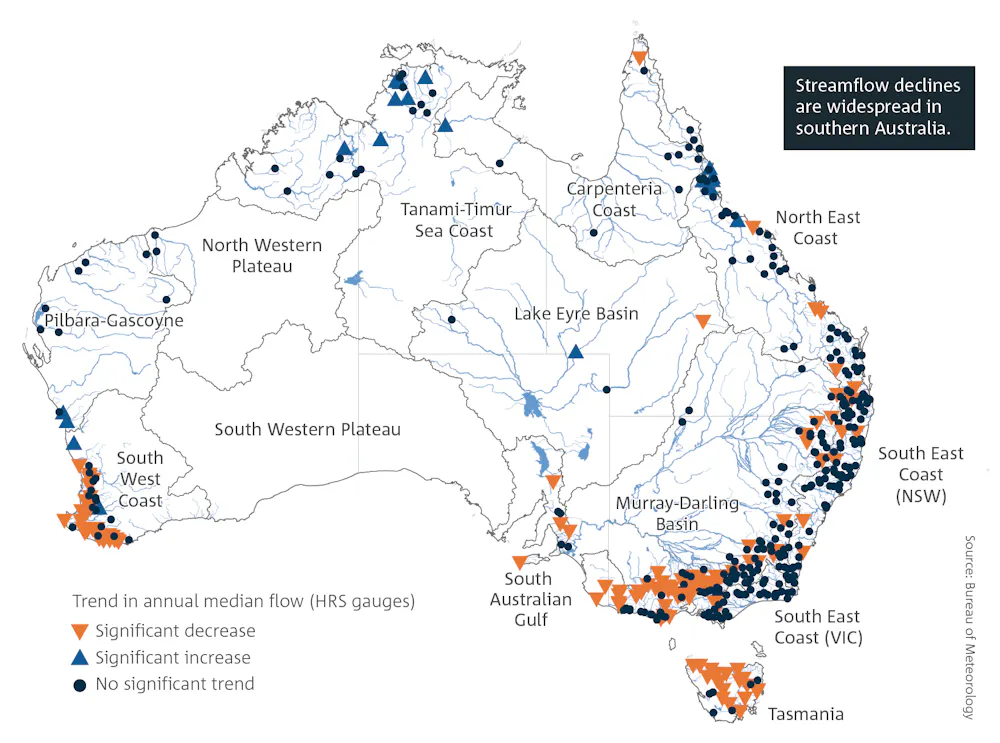
    These changes are also reflected in our rivers, with significantly lower flows for about one third of the gauges in the south. Australia-wide, only 4% of our river gauges are measuring increased flows, and almost all of these are in the north.

    Flows are declining in most rivers in Australia’s south due in part to reduced rainfall, while most rivers in the north are seeing increased flows linked to higher rainfall. This map shows trends in annual median streamflow from available river gauge data in the 1970−2023 period.
    CSIRO/Bureau of Meteorology, CC BY-NC-ND

    Hotter oceans, rising seas

    Almost all (90%) of the extra heat trapped by greenhouse gases has gone into the oceans. Oceans are getting rapidly hotter. This matters because ocean heat strongly influences weather patterns in Australia.

    Australia’s oceans are warming faster than the global average. But the oceans off south-east Australia and the Tasman Sea are a particular hotspot and are now warming at twice the global average.

    As the seas warm, they expand. This thermal expansion is one of the main contributors to rising sea levels. Around Australia, sea levels have risen 22 centimetres since 1900 – with half of that since 1970.

    More emissions equals more heat

    Avoiding the worst damage from climate change is conceptually simple and unequivocal: rapidly reduce greenhouse gases in the atmosphere will help Australia meet its net zero 2050 target.

    Tasmania’s northwest tip has some of the cleanest air in the world, which is why it was chosen to host the Kennaook/Cape Grim Baseline Air Pollution Station. For 48 years, this station has been recording concentrations of greenhouse gases. The picture it captures is stark.

    Carbon dioxide (CO₂) concentrations are now about 51% higher than pre-industrial levels, while concentrations of methane and nitrous oxide, both strong greenhouse gases, continue to increase. Their rate of atmospheric accumulation has rapidly increased in recent years even as some regions and some sources have begun to see emissions slow or even decline, such as reduced CO₂ emissions from land clearing, globally and in Australia.

    Global CO₂ emissions from fossil fuel use have been increasing since the beginning of the Industrial Revolution, and increased by 1.1% from 2022 to 2023, reaching the highest annual level ever recorded.

    The warming has led to an increase in the frequency of extreme heat events over land and in the oceans.
    Leah-Anne Thompson, Shutterstock

    Australia’s carbon contribution

    This year, the State of the Climate report for the first time quantifies Australia’s major human and natural carbon sources and sinks and how they contribute to global CO₂ levels.

    It shows the average annual carbon content embedded in Australia’s fossil fuel exports between 2010 and 2019 (1,055 megatonnes) was more than double the average annual national carbon emissions over the same period (455 Mt). However, the emissions of these carbon exports are accounted in the countries where the fossil fuels are used.

    It also demonstrates the importance of maintaining the integrity of our natural land ecosystems. Ecosystems are Australia’s most important carbon sinks, but their effectiveness as sinks depends on factors including the future evolution of the climate and how it will affect rainfall and wildfire regimes.

    Australia’s Carbon Budget 2010-2019. A product of the National Environmental Science Program – Climate Systems Hub; and a contribution to the Global Carbon Project – Regional Carbon Cycle Assessment and Processes-2.
    Source: NESP-2

    What lies ahead for Australia?

    Australia’s warming is expected to continue, which will lead to more extreme heat events, lower rainfall in some regions, and longer droughts.

    We can expect to see more intense rainfall events, even in regions where average rainfall falls or stays the same.

    Sudden intense rains make flooding more likely, especially in urban areas where concrete and tarmac prevent the ground from soaking up excess water and in low-lying coastal areas where rising sea levels amplify damage from other climate hazards.

    Climate change is already here. Through multiple lines of data and evidence, we have tracked what it is doing to make Australia hotter, more prone to floods and fires, and cutting river flows in the south where most of us live.

    If warming continues, these trends will get worse over time. Understanding these changes and the impacts to Australia will help manage climate risk, now and in the decades to come.

    Blair Trewin, Senior Research Scientist at the Bureau of Meteorology, contributed to this article

    Pep Canadell receives funding from the National Environmental Science Program – Climate Systems Hub

    Neil Sims does not work for, consult, own shares in or receive funding from any company or organisation that would benefit from this article, and has disclosed no relevant affiliations beyond their academic appointment.

    ref. State of the Climate 2024: Australia is enduring harsher fire seasons, more ocean heatwaves and sea-level rise – https://theconversation.com/state-of-the-climate-2024-australia-is-enduring-harsher-fire-seasons-more-ocean-heatwaves-and-sea-level-rise-242191

    MIL OSI AnalysisEveningReport.nz

  • MIL-Evening Report: Earth’s climate will keep changing long after humanity hits net-zero emissions. Our research shows why

    Source: The Conversation (Au and NZ) – By Andrew King, Senior Lecturer in Climate Science, The University of Melbourne

    Shutterstock

    The world is striving to reach net-zero emissions as we try to ward off dangerous global warming. But will getting to net-zero actually avert climate instability, as many assume?

    Our new study examined that question. Alarmingly, we found reaching net-zero in the next few decades will not bring an immediate end to the global heating problem. Earth’s climate will change for many centuries to come.

    And this continuing climate change will not be evenly spread. Australia would keep warming more than almost any other land area. For example if net-zero emissions are reached by 2060, the Australian city of Melbourne is still predicted to warm by 1°C after that point.

    But that’s not to say the world shouldn’t push to reach net-zero emissions as quickly as possible. The sooner we get there, the less damaging change the planet will experience in the long run.

    New research examines if climate change will stop once the world reaches net-zero emissions.
    Shutterstock

    Reaching net-zero is vital

    Global greenhouse gas emissions hit record highs in 2023. At the same time, Earth experienced its hottest year.

    Analysis suggests emissions may peak in the next couple of years then start to fall. But as long as emissions remain substantial, the planet will keep warming.

    Most of the world’s nations, including Australia, have signed up to the Paris climate agreement. The deal aims to keep global warming well below 2°C, and requires major emitters to reach net-zero as soon as possible. Australia, along with many other nations, is aiming to reach the goal by 2050.

    Getting to net-zero essentially means nations must reduce human-caused greenhouse gas emissions as much as possible, and compensate for remaining emissions by removing greenhouse gases from the atmosphere elsewhere. Methods for doing this include planting additional vegetation to draw down and store carbon, or using technology to suck carbon out of the air.

    Getting to net-zero is widely considered the point at which global warming will stop. But is that assumption correct? And does it mean warming would stop everywhere across the planet? Our research sought to find out.

    Centuries of change

    Computer models simulating Earth’s climate under different scenarios are an important tool for climate scientists. Our research used a model known as the Australian Community Climate and Earth System Simulator.

    Such models are like lab experiments for climate scientists to test ideas. Models are fed with information about greenhouse gas emissions. They then use equations to predict how those emissions would affect the movement of air and the ocean, and the transfer of carbon and heat, across Earth over time.

    We wanted to see what would happen once the world hit net-zero carbon dioxide at various points in time, and maintained it for 1,000 years.

    We ran seven simulations from different start points in the 21st century, at five-year increments from 2030 to 2060. These staggered simulations allowed us to measure the effect of various delays in reaching net-zero.

    We found Earth’s climate would continue to evolve under all simulations, even if net-zero emissions was maintained for 1,000 years. But importantly, the later net-zero is reached, the larger the climate changes Earth would experience.

    Warming oceans and melting ice

    Earth’s average temperature across land and sea is the main indicator of climate change. So we looked at that first.

    We found this temperature would continue to rise slowly under net-zero emissions – albeit at a much slower rate than we see today. Most warming would take place on the ocean surface; average temperature on land would only change a little.

    We also looked at temperatures below the ocean surface. There, the ocean would warm strongly even under net-zero emissions – and this continues for many centuries. This is because seawater absorbs a lot of energy before warming up, which means some ocean warming is inevitable even after emissions fall.

    Over the last few decades of high greenhouse gas emissions, sea ice extent fell in the Arctic – and more recently, around Antarctica. Under net-zero emissions, we anticipate Arctic sea ice extent would stabilise but not recover.

    In contrast, Antarctic sea ice extent is projected to fall under net-zero emissions for many centuries. This is associated with continued slow warming of the Southern Ocean around Antarctica.

    Importantly, we found long-term impacts on the climate worsen the later we reach net-zero emissions. Even just a five-year delay would affect on the projected climate 1,000 years later.

    Delaying net-zero by five years results in a higher global average surface temperature, a much warmer ocean and reduced sea ice extent for many centuries.

    Australia’s evolving climate

    The effect on the climate of reaching net-zero emissions differs across the world.

    For example, Australia is close to the Southern Ocean, which is projected to continue warming for many centuries even under net-zero emissions. This warming to Australia’s south means even under a net-zero emissions pathway, we expect the continent to continue to warm more than almost all other land areas on Earth.

    For example, the models predict Melbourne would experience 1°C of warming over centuries if net-zero was reached in 2060.

    Spell out GMST (global mean surface temperature?) in chart? Is listed as global average in caption??

    Net-zero would also lead to changes in rainfall in Australia. Winter rainfall across the continent would increase – a trend in contrast to drying currently underway in parts of Australia, particularly in the southwest and southeast.

    Knowns and unknowns

    There is much more to discover about how the climate might behave under net-zero.

    But our analysis provides some clues about what climate changes to expect if humanity struggles to achieve large-scale “net-negative” emissions – that is, removing carbon from the atmosphere at a greater rate than it is emitted.

    Experiments with more models will help improve scientists’ understanding of climate change beyond net-zero emissions. These simulations may include scenarios in which carbon removal methods are so successful, Earth actually cools and some climate changes are reversed.

    Despite the unknowns, one thing is very clear: there is a pressing need to push for net-zero emissions as fast as possible.

    Andrew King receives funding from the ARC Centre of Excellence for 21st Century Weather and the National Environmental Science Program.

    Tilo Ziehn receives funding from the ARC Centre of Excellence for 21st Century Weather and the National Environmental Science Program.

    ref. Earth’s climate will keep changing long after humanity hits net-zero emissions. Our research shows why – https://theconversation.com/earths-climate-will-keep-changing-long-after-humanity-hits-net-zero-emissions-our-research-shows-why-241692

    MIL OSI AnalysisEveningReport.nz

  • MIL-OSI Submissions: Research – Great Place To Work® Releases Study On Workplace Well-being With Johns Hopkins University

    Source: Great Place To Work®

    Great Place To Work® Releases Study On Workplace Well-being With Johns Hopkins University In Critical Areas Of Mental And Emotional Support, Teamwork, Psychological Safety And Finance Stability

    Singapore, 30 October 2024 – Great Place To Work® Singapore marked its 10th anniversary at its Best Workplaces in Singapore 2024 event with the release of the Great is Possible: Charting a Decade of Progress in Singapore Workplaces (2015-2024) insights report. The report highlights the transformation of Singapore’s workplaces over the past decade, with a special focus on well-being and mental health. This year’s event also introduced the new Legends category, honouring organisations that have consistently made the Best Workplaces list for five or more consecutive years.

    Held at The Ritz-Carlton, the milestone celebration was graced by Deputy Prime Minister Heng Swee Keat and attended by close to 420 guests, including business leaders and employees from Great Place To Work Certified companies.

    Michael C. Bush, Chief Executive Officer of Great Place To Work®, giving his keynote address at the 10th Anniversary of Best Workplaces in Singapore / Great Place to Work® Singapore.

    A Decade of Change in Singapore’s Workplaces

    Over the past ten years, Great Place To Work has led the way in understanding what makes workplaces thrive in Singapore. Great Place To Work Singapore has administered over 400,000 surveys across nearly 1,000 workplaces from more than 440,000 employees since its establishment in 2015.

    In conjunction with its 10th anniversary, Great Place To Work Singapore unveiled the Great is Possible: Charting a Decade of Progress in Singapore Workplaces (2015-2024) insights report, which provides a comprehensive analysis of data collected from 2015 to 2024. The report, based on input from approximately 440,000 employees in the Trust Index Employee Survey, examines the evolving trends and shifts in workplace culture, leadership, and employee well-being. Key findings include:

    • Leadership integrity and psychological safety remain pivotal in fostering positive employee experiences
    • Concerns about fairness in compensation and bridging experience gaps across different organisational levels
    • Employee trust and satisfaction have been on the rise at Best Workplaces for the past ten years, evidenced by a steady increase in overall Trust Index scores

    Spotlight on Employee Well-Being and Burnout

    In response to the rising focus on employee burnout and mental health, Great Place To Work also conducted a study on workplace well-being over the past five years in Singapore. Produced in collaboration with Johns Hopkins University’s Human Capital Development Lab, Well-Being At Work: Fostering a Healthy Work Climate For All examines well-being trends from 2019 to 2024, identifying key factors that influence workplace well-being in Singapore. It draws on data from Great Place To Work’s proprietary Trust Index survey, which included insights from over 200 organisations and 40,000 respondents in the critical areas of mental and emotional support, teamwork, psychological safety, and financial stability.

    The results revealed significant variations in well-being across several dimensions:

    Age and Gender
    • Women and younger employees reported lower well-being levels
    • However, the gender gap narrows among younger generations, suggesting future workforces may experience fewer gender-based disparities.

    Management Levels
    • Senior management reported higher well-being scores, attributed to a sense of purpose, personal growth, and financial stability.

    Impact of COVID-19
    • The pandemic initially boosted employee well-being as organisations prioritised care for their teams.
    • A decline in overall well-being levels was observed as businesses returned to traditional work environments.

    Importance of Connections
    • Strong connections and personal support play a crucial role in fostering a positive work climate.
    • There are strong correlations between teamwork, psychological safety, and overall well-being.

    Notably, Best Workplaces lead the way in well-being, consistently demonstrating higher employee well-being scores. Many of these companies achieve this through certified mental well-being ambassadors and comprehensive health and wellness programs. However, the success of such initiatives depends on employee perceptions influenced by organisational culture and values, highlighting the need for solutions that align with management practices and HR processes, rather than merely addressing issues superficially.

    “Over the past decade, Great Place To Work has witnessed the evolving needs of Singapore’s workplaces. Our reports highlight the growing importance of leadership integrity, psychological safety, and employee well-being. Despite the challenges of the past few years, leading organisations have shown that prioritising inclusion and investing in their people is essential for creating thriving work environments. We hope our findings will inspire more organisations to create high-trust, high-performing workplace cultures where everyone can thrive,” shared Ms Evelyn Kwek, Managing Director of Great Place To Work ASEAN and ANZ.

    Looking Ahead: “Great is Possible”

    This year’s milestone event embraced the theme “Great is Possible,” acknowledging the resilience and innovation of organisations in the face of an ever-changing business climate. A highlight of the 10th anniversary celebration was the introduction of the new Legends category to recognise exceptional companies with an impressive record—having been placed on the Best Workplaces in Singapore List for at least five consecutive years. These Legends stand as models of excellence in what Great looks like in the ever-evolving landscape of the modern workplace.

    The inaugural Legends list includes:
    • Cisco (5 Years)
    • DHL Express (Singapore) Pte Ltd (8 Years)
    • HP (5 Years)
    • Micron Technology (6 Years)
    • Salesforce (10 Years)
    • World Wide Technology (5 Years)

    CEO Michael C. Bush delivered a keynote address on how businesses can transform into great workplaces by prioritising trust, inclusion, and employee value. He emphasised the necessity of achieving greatness for both the present and future of work, and urged leaders to take actionable steps to create environments where all employees can thrive and drive outstanding business outcomes.

    Managing Director of Great Place To Work ASEAN and ANZ, Ms Evelyn Kwek said, “As we celebrate 10 years of the Best Workplaces list in Singapore, we are proud to honour our Legends. They have set the standard for what it means to be a truly Great Workplace, and their success shows what organisations can achieve when they put their people first. We hope our list-makers continue to inspire more organisations to reach for Great.”

    About Great Place To Work®

    As the global authority on workplace culture, Great Place To Work brings 30 years of ground-breaking research and data to help every place become a great place to work for all. Their proprietary platform and For AllTM Model helps companies evaluate the experience of every employee, with exemplary workplaces becoming Great Place To Work Certified or receiving recognition on a coveted Best Workplaces List. Follow Great Place To Work® on LinkedIn, Facebook, and Instagram or visit greatplacetowork.com.sg to learn more.

    About Great Place To Work® Certification

    Great Place To Work Certification is the most definitive “employer-of-choice” recognition that companies aspire to achieve. It is the only recognition based entirely on what employees report about their workplace experience – specifically, how consistently they experience a high-trust workplace. Great Place To Work Certification is recognised worldwide by employees and employers alike and is the global benchmark for identifying and recognising outstanding employee experience. Every year, more than 10,000 companies across 97 countries apply to earn Great Place To Work Certification.

    MIL OSI – Submitted News

  • MIL-OSI USA: Congressman Cory Mills Recovers Over $45 Million for Florida’s 7th Congressional District Constituents

    Source: United States House of Representatives – Congressman Cory Mills Florida (7th District)

    Lake Mary, FL – Congressman Cory Mills (FL-07) proudly announces the recovery of over $45 million from federal agencies on behalf of the residents of Florida’s 7th Congressional District.

    “I am proud to announce that my team and I have secured over $45 million from federal agencies and bureaus who held benefits from Florida’s 7th Congressional District constituents. After the destruction caused by Hurricanes Helene and Milton, we understand that many families are in need of assistance. Navigating FEMA’s processes can be overwhelming, especially when recovering from the impact of hurricanes,” said Rep. Cory Mills (FL-07). “My team is dedicated to ensuring that constituents have access to the federal disaster relief they need. If you or someone you know is struggling to receive assistance from FEMA or any other federal agency due to delays, paperwork issues, or other barriers, my office is here to assist in finding solutions.”

    ###

    MIL OSI USA News

  • MIL-OSI USA: Sen. Russ Goodman Urges USDA Secretary to Extend Indemnity Coverage to Georgia Counties Impacted by Hurricane Helene

    Source: US State of Georgia

    ATLANTA (October 30, 2024) —Sen. Russ Goodman (R–Cogdell), Chairman of the Senate Committee on Agriculture and Consumer Affairs, has formally requested that the United States Department of Agriculture (USDA) re-evaluate its coverage area for the Hurricane Indemnity Program to include several Georgia counties heavily impacted by Hurricane Helene. In a letter sent to USDA Secretary Tom Vilsack, Sen. Goodman emphasized the urgent need for support for Georgia’s agricultural community, citing an estimated $6.4 billion in total damage to the state’s agricultural industry, with direct crop losses expected to exceed $3 billion.

    Several counties—Bulloch, Burke, Candler, Effingham, Evans, Jenkins, Lincoln, Long, Pierce, Richmond, Screven, Tattnall and Wayne—were excluded from the USDA Risk Management Agency’s initial coverage, potentially leaving local farmers without access to vital resources for recovery. Sen. Goodman’s letter, co-signed by several of his legislative colleagues, calls for a thorough analysis of the hurricane’s impact on these areas, leveraging all available data from reliable sources such as the National Oceanic and Atmospheric Administration (NOAA) and IBTrACS.

    “Seeing almost every Senator in our state come together on this issue speaks volumes about the gravity of the situation our farming families are facing,” said Sen. Goodman. “These farmers did their part by investing in Hurricane Indemnity policies. Now, they deserve to see the USDA step up to the plate. The impact of Hurricane Helene is apparent, and our farmers are counting on Secretary Vilsack to act, ensuring they are able to financially recover and rebuild from this devastation. As a legislative body, we’re united in backing our farmers and the belief that they deserve the support they were promised.”

    Sen. Goodman’s letter also highlighted challenges due to Hurricane Helene’s impact on the National Center for Environmental Information, emphasizing that these data limitations should not hinder the assessment of damages in affected regions.

    You can find a copy of the letter to Secretary Vilsack here.

    # # # #
    Sen. Russ Goodman serves as Chairman of the Senate Committee on Agriculture and Consumer Affairs. He represents the 8th Senate District, which includes Atkinson, Clinch, Echols, Lanier, Lowndes and Pierce Counties and a large portion of Ware County. He may be reached at 404.656.7454 or at
    russ.goodman@senate.ga.gov

    MIL OSI USA News

  • MIL-OSI New Zealand: Your rates in action – an Auckland that is thriving and beautiful

    Source: Auckland Council

    1 July 2024

    Your rates help deliver a wide range of day-to-day activities and services, and support investment in Auckland’s assets.

    For 2024/2025, Auckland has some of the lowest rates rises in the country, at 6.8 per cent for the average value residential property. 

    We are working hard to keep your rates down by carefully balancing the need to strengthen the financial and physical resilience of Auckland, while investing where it is needed most to manage growth.

    What your rates deliver

    Your rates support community services and activities that make Auckland thriving and beautiful. This includes improving public transport, maintaining parks, providing local and regional events, delivering environmental services, rubbish collection and a variety of community facilities and services.

    A rising population means your rates need to work hard to meet increasing demand for the activities and services council provides and supports.

    Where we are investing

    We’ve been planning for the region’s growth and have just completed our Long-term Plan 2024-2034, which sets out how Auckland Council will use your rates to improve the daily lives of Aucklanders.

    This includes making the most of what we have and investing where it is needed most. This involves extensive investment in capital projects across the region, as well as funding many services for Aucklanders.

    In the next 10 years, your rates will help deliver:

    More travel choices
    Better public transport and new travel solutions (including a $50 capped weekly public transport pass).

    Safer, improved transport
    Investments to alleviate congestion, improve public transport and address safety issues.

    Flood protection
    Reducing existing flood risks, prevention, awareness and preparation.

    Rejuvenated neighbourhoods
    Regeneration continuing in Wynyard Quarter, City Centre, Takapuna, Northcote, Henderson, Avondale, Maungawhau, Panmure, Onehunga, Papatoetoe, Manukau, Pukekohe and Ormiston.

    Community investment
    Increased sports and recreation facilities through a $35 million fund, continued library and digital services, community-led arts and cultural activities, and local development. Local boards have a new, fairer funding model to support local communities.

    A transformed city centre
    A City Centre Masterplan will deliver a vibrant city centre, regenerating midtown to benefit from the City Rail Link and progress toward transforming Wynyard Point, the port and waterfront.

    A safer city
    We are increasing community patrols and CCTV surveillance to keep people safe in our city centres.

    Food scraps collection
    All urban households will have weekly kerbside food scraps collection. Rates-funded refuse collection will also be phased in for North Shore, Waitakere, Papakura, Franklin and Rodney.

    A growing Auckland economy
    Promoting Auckland as a great place to live, work, invest, study and visit – continuing our large cultural events and securing international and domestic events.

    Well-managed local government
    The Auckland Future Fund will help improve the financial and physical resilience of the council. The council will also be progressing Maori outcomes and continuing with storm recovery activities.

    Want to learn more?

    Our Long-term Plan 2024-2034 is our 10-year plan for Auckland.

    It focuses on our physical and financial resilience, while investing where it is needed most to manage growth. We are doing this in a way that recognises cost of living concerns and provides the greatest benefit to our communities.

    To learn more about all the investment priorities where your rates will go in the coming decade, see the Long-term Plan 2024-2034.

    MIL OSI New Zealand News

  • MIL-OSI USA: Scott, Colleagues to Lead Legislation to Replenish the SBA Disaster Loan Program Following Hurricanes Helene and Milton

    US Senate News:

    Source: United States Senator for South Carolina Tim Scott
    WASHINGTON — U.S. Senator Tim Scott (R-S.C.) joined Senators Thom Tillis (R-N.C.), Ted Budd (R-N.C.), Bill Cassidy, M.D. (R-La.), and Rick Scott (R-Fla.) in announcing plans to introduce legislation that would replenish the Small Business Administration (SBA) Disaster Loan Program. The senators plan to seek passage of the legislation when Congress returns to session. On October 15th, the SBA announced the Disaster Loan Fund had run out of money.
    “Hurricane Helene brought a level of devastation to South Carolina we haven’t seen since Hugo. With a natural disaster of this magnitude, Congress should take the opportunity to show leadership and help ease the pain of those who have lost everything,” said Senator Tim Scott. “Communities back home and in surrounding states have come together to recover, but it will take every possible effort to get us back to where we were.”
    “The SBA Disaster Loan Program running out of funds risks delays in processing the loans of those affected by Helene and Milton and their ability to get their lives back on track,” said Senator Tillis. “That is why I am leading legislation to replenish this fund when Congress returns to Washington, and I look forward to working across the aisle to pass a long-term disaster aid package that will provide additional resources to help make the victims of these hurricanes whole again.”
    “The citizens of Western North Carolina are some of the toughest and most resilient people in this country,” said Senator Budd. “As they recover and rebuild their communities, they must be able to access disaster loans from SBA. This recovery will take many years, and I look forward to working with my colleagues to cut through the delays and provide WNC with the resources they need as quickly as possible.”
    “Hurricanes Francine, Helene, and Milton hit us hard, but Louisianans and Americans are resilient,” said Dr. Cassidy. “This funding is essential to help small businesses recover from these storms and support our local economies.”
    “We cannot allow frontline federal agencies, like the SBA, to run out of disaster relief funds. This is especially important in the wake of Hurricanes Helene and Milton which devastated Florida, North Carolina and communities across the Southeast U.S.,” said Senator Rick Scott. “I continue to call on Leader Schumer to immediately reconvene the Senate so we can fund disaster relief functions at FEMA, the SBA, USDA and other agencies to get folks what they need and deserve. I won’t stop fighting to get this done and am proud to join my colleagues to introduce a bill that funds SBA disaster loans and makes sure the federal government is a reliable partner as families continue their recovery.”
    The Restoring an Economic Lifeline with Immediate Emergency Funding (Relief) Act would appropriate $550 million to fund the SBA Disaster Loan Program Account, which would provide $2.475B in lending capacity projected to last until the end of 2024.
    Read text of the bill here.

    MIL OSI USA News

  • MIL-OSI USA: $16 Million in Federal Funding Fuels Tennessee’s Recovery a Month After Helene

    Source: US Federal Emergency Management Agency

    Headline: $16 Million in Federal Funding Fuels Tennessee’s Recovery a Month After Helene

    $16 Million in Federal Funding Fuels Tennessee’s Recovery a Month After Helene

    A month after the major presidential disaster declaration for the Sept. 26-30 flooding from Tropical Storm Helene, Tennessee families and communities are recovering with $16.4 million in funding from FEMA as well as support from the state, other federal agencies, and voluntary and community organizations.Helene’s rains devastated Eastern Tennessee, leaving mountains of debris strewn across a vast area, knocking out power and communications to thousands, and cutting off drinking water. Residents were left without cell coverage, internet connections and access to essential necessities. It may be years before these remote and rural communities resemble the charm they had before.The disaster declaration was approved on Oct. 2, authorizing funding from FEMA’s Individuals and Households Program to the counties most heavily impacted by the storms: Carter, Cocke, Greene, Hamblen, Hawkins, Johnson, Unicoi and Washington counties. Survivors have until Monday, Dec. 2, to apply for FEMA assistance.State, federal and voluntary organizations have collaborated to drive the recovery. As of Oct. 30, $16.4 million in FEMA funds has been approved for Tennessee’s homeowners, renters and businesses. And FEMA authorized a Direct Temporary Housing mission for survivors who had major or significant structural damage to their primary homes. The American Red Cross, Salvation Army and the Tennessee Department of Education have completed their mission after serving 140,903 meals to survivors.In the early days after the storms, with communications down across a swath of rural communities, FEMA brought in a mobile unit that continues to provide high-speed internet by connecting to satellites.Debris removal remains a major priority. The state and federal partners joined with local communities to clear more than 24,000 cubic yards of debris, a visible and vital step in recovery operations. Special attention is focused on Douglas Reservoir, located only a few miles from the Pigeon Forge-Gatlinburg area and the Great Smoky Mountains National Park. A mile-long curtain was installed to save the dam from damage by 1 million cubic yards of debris that rushed into the lake during the storms. Vegetation, construction and demolition equipment, and hazardous materials continue to line the shores even as the reservoir returns to pre-disaster water levels. Perhaps FEMA’s biggest challenge during the response operation has been the campaign to counter misinformation and harmful rhetoric about FEMA’s assistance programs, which was having a negative impact on Tennesseans desperately in need of help. The agency built a Helene Rumor Response webpage where survivors could find the facts themselves, and it continues to push messaging, in English and Spanish, about the many types of available assistance tailored to each survivor’s unique situation. FEMA accomplishes this by directing traffic to the state’s tn.gov/TEMA and fema.gov/Helene/Tennessee disaster pages as well as FEMA’s social media sites on Facebook, X, Instagram and YouTube.But the work of recovery has only just begun. Here are a few highlights:$16.4 million in funding from the Individuals and Households Program to provide financial help to those who are unable to meet their disaster-related needs through insurance or other means. As part of that total, more than $8 million represents Housing Assistance to help homeowners repair or replace residential property damage that is not covered by insurance.$8.3 million in Other Needs Assistance covers necessary disaster-related expenses such as medical bills; money to clean, repair or replace household items; to repair or replace vehicles damaged by the disaster and other non-housing needs.The Direct Temporary Housing Assistance program will help homeowners and renters whose homes were destroyed or heavily damaged.More than $1.07 million for 186 claims was paid to National Flood Insurance policyholders. The program also extended the grace period for paying policy premiums to Tuesday, Nov. 26.FEMA’s Disaster Survivor Assistance specialists visited 6,277 homes, 288 businesses and 237 community facilities. They also referred 1,140 survivors to community resources.More than $53,000 was paid in Disaster Unemployment Assistance to Tennesseans who have been unable to work because of the disaster. FEMA funds the unemployment program, which is managed by the state.Some 1,311 survivors have visited FEMA’s Disaster Recovery Centers to apply for federal assistance, to get help uploading documents to their account or get answers to questions including decisions about eligibility for FEMA assistance. A Mobile Disaster Recovery Center is scheduled to open Nov. 1 in Johnson County.Specialists at the state’s three Multi-Agency Resource Centers in Carter, Cocke and Washington counties also help survivors apply for FEMA assistance and connect them with additional local, state, federal and voluntary agency resources.Disaster assistance is also available to help communities respond to and recover from Helene’s deadly wrath. FEMA Public Assistance was approved for state and local governments and some private non-profits. These funds help communities cover the costs for debris removal, life-saving emergency protective measures and restoring public infrastructure.Public Assistance is a cost-sharing program and FEMA’s largest grant program. FEMA typically covers 75% of funding and the state covers 25%. For Helene damage in Tennessee, President Biden authorized 100% federal funding for emergency work generated by the disaster. This means FEMA will cover all eligible costs incurred during any 45-day period of the state’s choosing during the first 120 days from the start of the disaster, or Sept. 26. This allows communities to maximize cost savings by selecting the 45 days when the greatest costs occurred.Under Public Assistance, the federal share of funding is reimbursed through the Tennessee Emergency Management Agency to disburse to local agencies, local governments and certain private non-profits including houses of worship.
    kwei.nwaogu
    Wed, 10/30/2024 – 20:38

    MIL OSI USA News

  • MIL-OSI Economics: Mozambique: African Development Bank approves $54 million loan for Mozambique’s first wind energy project

    Source: African Development Bank Group

    The Board of Directors of the African Development Bank has approved a loan of $54 million for a 120 MW onshore wind farm that will help position Mozambique as a regional energy hub.

    The Bank’s loan, which includes $12 million from the Sustainable Energy Fund for Africa (SEFA), is in addition to financing expected from International Finance Corporation (IFC), U.S. International Development Finance Corporation (DFC), the Emerging Africa and Asia Infrastructure Fund (EAAIF) and the Private Infrastructure Development Group’s Technical Assistance. The total project cost is estimated at $224.5 million.

    Mozambique’s national electricity utility, EDM, will be the sole off-taker from the wind farm, located 50 km west of Maputo, under a 25-year power purchase agreement.

    The wind farm will be Mozambique’s first utility-scale wind power project. It is expected to generate 331.6 GWh annually, supplying affordable, reliable, and clean energy to both local consumers and regional markets, diversifying Mozambique’s energy mix, and improving access to electricity. It will also position the country as a regional energy hub, capitalizing on increased energy trade through the Southern African Power Pool (SAPP).

    With Mozambique’s energy sources currently dominated by hydropower and gas, the Namaacha wind farm project will help reduce annual CO₂ emissions by approximately 71,816 tons, contributing to the country’s commitments under the Paris climate agreement.

    The project will support economic growth, job creation, and improved living standards. During construction it will create 600 jobs, of which its targeting about 120 will be for women, and 300 for youth. Once operational, 20 permanent jobs will be created, with a focus on gender and youth inclusion.

    Commenting on the project, Kevin Kariuki, Vice President for Power, Energy, Climate, and Green Growth at the African Development Bank, said, “This wind project represents a milestone for Mozambique and underscores the Bank’s strong commitment to advancing clean, renewable energy solutions in the region. It will not only enhance energy security but also facilitate regional electricity trade, benefiting Mozambique’s socio-economic development.”

    Wale Shonibare, Director of the Energy Financial Solutions, Policy, and Regulations Department at the African Development Bank stressed the technological impact of this milestone project. “As the first large-scale wind energy initiative in Mozambique, this project showcases the transformative potential of renewable technologies to drive sustainable growth. By leveraging Mozambique’s natural resources, we are creating pathways toward a diversified and resilient energy sector that not only meets current demands but is future-proofed to support an evolving economy,” he said.

    Globeleq is one of the project developers. Its CEO Jonathan Hoffman said: “The Namaacha Wind Farm is a significant milestone in Mozambique’s journey toward a diversified and sustainable energy landscape. We are proud to partner with EDM and Source Energia in contributing to the government’s ambitious ‘Energy for All by 2030’ program, which is rapidly transforming into a reality for countless Mozambicans. This project reflects our commitment to supporting Mozambique’s clean energy goals and bringing reliable power to the communities we serve.”

    Aligned with the Bank’s Ten-Year Strategy, the New Deal on Energy for Africa, and its High 5 objective of “Light Up and Power Africa,” the project underscores Mozambique’s dedication to renewable energy development and supports its goal of achieving universal access to electricity by 2030.

    The project complements the Bank’s earlier energy sector initiatives in Mozambique, including the Songo Matambo transmission line and the Mozambique Energy for All program.

    MIL OSI Economics

  • MIL-OSI USA: Whispers in the Texas Wind

    US Senate News:

    Source: United States Senator for Texas John Cornyn

    As the leaves shift from green to shades of red and brown, Fall brings more than just hayrides, pumpkin patches, and trick-or-treating. You may not realize it while carving your jack-o’-lantern, but Texas is home to more than just famous haunted houses—you don’t have to look far to stumble upon a graveyard with a story to tell.

    Texas boasts around 14,000 cemeteries, many of which are steeped in legends that will send a chill up your spine. Some gravestones hold dramatic tales of early settlement, disease, natural disasters, and war. From the Panhandle to the Gulf Coast, these cemeteries are living pieces of history wrapped in a touch of the supernatural.

    Take Oakwood Cemetery in Austin, the state’s oldest graveyard. It spans 40 acres of centuries-old tombstones and is the resting place of Texas Revolution and Civil War veterans, as well as former governors like General Sam Houston. Some of the most haunting stories come from these graves. One such grave belongs to Eula Phillips a teenager murdered on Christmas Eve in 1885. Legend has it her spirit floats through the cemetery at night, searching for answers to her untimely death. 

    Farther southeast, in Galveston, lies the Old City Cemetery, where spirits are rumored to be more restless. This graveyard serves as a somber reminder of the catastrophic Hurricane of 1900 that devastated the island. Thousands lost their lives, including many who were swept into the Gulf of Mexico. On stormy nights, the howling wind is said to carry the cries of men calling for help and wails of women searching for their lost children.

    Among those buried there is Elize Romer Alberti, Galveston’s “Demented Mother,” who poisoned her five children in 1894, four of whom succumbed to it. After the murders, she was sent to the San Antonio Asylum, but returned to Galveston, where she eventually died. Buried with her children, she is said to haunt the cemetery grounds to this day.

    In El Paso, Concordia Cemetery is one of Texas’ largest cemeteries, covering 52 acres and holding the graves of more than 60,000 souls, including buffalo soldiers and Texas Rangers. Its most famous occupant is John Wesley Hardin, the notorious gunslinger of the Old West. Under the moonlight, the spirits of Hardin and other outlaws are rumored to roam the grounds, earning Concordia the nickname “El Paso’s Boot Hill” due to its rowdy history.

    Texas cemeteries hold more than tombstones, they are places where the living just might happen upon spirits of the past. So whether you believe in ghosts or not, this is the season to gather around a campfire and share a scary story or two, because you never know what—or who—may be dying to hear it.

    MIL OSI USA News

  • MIL-OSI USA: FEMA Continues Work with the Disability Community on Helene and Milton Response, FEMA’s Disability Director Visits Affected Areas to Meet with Survivors, Community Groups and Governmental Officials

    Source: US Federal Emergency Management Agency

    Headline: FEMA Continues Work with the Disability Community on Helene and Milton Response, FEMA’s Disability Director Visits Affected Areas to Meet with Survivors, Community Groups and Governmental Officials

    FEMA Continues Work with the Disability Community on Helene and Milton Response, FEMA’s Disability Director Visits Affected Areas to Meet with Survivors, Community Groups and Governmental Officials

    WASHINGTON — Since Hurricane Helene made landfall, FEMA has been working with governmental and voluntary disability support organizations to ensure survivors with disabilities have the tools they need to recover from the storm. Building relationships with these organizations pre-disaster has been crucial to getting support to survivors as quickly as possible. FEMA’s Disability Integration Advisors continue their work advocating for people with disabilities and connecting them with available resources to help speed their recovery.Sherman Gillums, Jr., FEMA’s Director of the Office of Disability Integration and Coordination personally traveled to hurricane-impacted areas to support these advisors, survey recovery efforts and meet with state officials and local disability organizations. “It was important to me to talk to organizations and officials in person to show our unwavering commitment to people with disabilities,” said Director Gillums. “The relationships we’ve built with these organizations prior to the disaster allowed us to pinpoint the areas where people with disabilities needed help. My visit with Able South Carolina and independent living centers in Ashville highlighted ways we could assist with their recovery efforts. I deeply appreciated their insight and openness about their experiences which allowed us to work together on solutions to challenges.”   The percentage of people applying for FEMA disaster assistance and identifying as having a disability is consistent with the demographic information we have for the hurricane affected areas. “This is really important,” said Director Gillums. “It is a good indication that we are reaching people with disabilities and getting them the tools they need to apply for assistance more quickly year after year. That doesn’t mean that there isn’t more work needed to get people with disabilities on the road to recovery, but it is an encouraging first step.As disability advisors, Director Gillums and his staff work to integrate accessibility into all stages of recovery. This includes everything from helping survivors access medical necessities to getting them access to assistive devices like screen readers so they can apply for assistance. Most importantly though, the advisors support emergency management specialists throughout the recovery process, by helping them integrate accessibility and disability inclusiveness into their work. “This storm caused massive disruption to infrastructure that many of us take for granted,” Director Gillums commented after his travel in North Carolina, Virginia and South Carolina. “As a disability advisor, and a member of the disability community myself, I see how these challenges are compounded for people with disabilities. Getting access to electricity can be a matter of independence and even survival. During my deployment, I witnessed firsthand how communities were eager to be a part of the effort to ensure people with disabilities get what they need to sustain some semblance of independence. FEMA is working with these partners to make sure all survivors, including those with disabilities, are able to access the essential resources they need to be safe, informed and in charge of their lives.”FEMA encourages Helene and Milton survivors to apply online as this remains the best way to apply for disaster assistance. Here are the ways to apply for federal assistance: Applying online at disasterassistance.govUsing the FEMA AppCalling 800-621-3362, Staffed daily from 7 a.m.-10 p.m. local timeVisiting a Disaster Recovery Center to talk with FEMA and state agency officials and apply for assistance

    Richmond, VA — Federal Coordinating Officer Timothy S. Pheil discussing the disability integration strategy for the Hurricane Helene response with FEMA Disability Coordinator Sherman Gillums Jr. along with state access and functional needs staff in the situation room at the Virginia Emergency Operations Center.

    View Original’ data-align=”center” data-asset-link=”1″ data-entity-type=”emerald” data-image-style=”large” data-asset-type=”imageasset” data-asset-id=”56473″ src=”https://www.fema.gov/sites/default/files/styles/large/public/externals/cf9d4bec75102ebbb97b6fc199bfe0d0.jpg?itok=9VB86i5n” alt=”Caption: Columbia, S.C. (Oct. 14, 2024) – FEMA’s Director of Disability Integration and Coordination, Sherman Gillums, Jr., visits the Association for Better Living and Education to show support for their ongoing efforts in supporting the disabled community. Director Gillums met with Dori Tempio, Sr., Director of Community Education, and Mandy Halloran, Director of Public Health.” class=”image-style-large”>

    Columbia, S.C. (Oct. 14, 2024) – FEMA’s Director of Disability Integration and Coordination, Sherman Gillums, Jr., visits the Association for Better Living and Education to show support for their ongoing efforts in supporting the disabled community. Director Gillums met with Dori Tempio, Sr., Director of Community Education, and Mandy Halloran, Director of Public Health.

    amy.ashbridge
    Wed, 10/30/2024 – 21:38

    MIL OSI USA News

  • MIL-OSI USA: Updated Hours of Operations for the Montgomery & Pulaski County DRCs Oct. 31 through Nov. 6

    Source: US Federal Emergency Management Agency

    Headline: Updated Hours of Operations for the Montgomery & Pulaski County DRCs Oct. 31 through Nov. 6

    Updated Hours of Operations for the Montgomery & Pulaski County DRCs Oct. 31 through Nov. 6

    BRISTOL, Va.– Disaster Recovery Centers (DRCs) in Montgomery and Pulaski counties have updated hours of operations this upcoming week. The Montgomery County Disaster Recovery Center (DRC) will be temporarily closed Saturday, Nov. 2 – Tuesday Nov. 5 and the reopening is to be announced. The Pulaski County DRC will be temporarily closed from 4 p.m. on Thursday, Oct. 31, 2024, through Tuesday Nov. 5, 2024. The center will reopen at 12 p.m. on Wednesday, Nov. 6, 2024.Disaster survivors can visit any DRC to receive assistance. To find the DRC closest to you, including addresses and hours, visit FEMA.gov/drc or text DRC and a ZIP code to 43362.  The centers are located at:Montgomery County   Montgomery County Government Center755 Roanoke StreetChristiansburg, Va. 24073Updated Hours of Operation 11/01 – 11/05:Nov. 1-5, 2024 – Closed  Hours of Operation after 11/5Reopening to be announced Pulaski County New River Valley Fairgrounds 5581 Fair Grounds CircleDublin, Va. 24084Updated Hours of Operation 10/31 – 11/06:Thursday Oct. 31, 2024 – 8 a.m. – 4 p.m. Nov. 1 – 5, 2024 – ClosedNov. 6, 2024 – 12 p.m. – 6 p.m. Hours of Operation after 11/6Monday – Saturday, 8 a.m. – 6 p.m.Closed SundaysSurvivors do not have to visit a DRC to register with FEMA. You can call 800-621-FEMA (3362). The toll-free telephone line operates seven days a week. If you use a relay service, such as video relay service (VRS), captioned telephone service or others, give FEMA the number for that service. You can also register online at DisasterAssistance.gov or through the FEMA App on your phone.The deadline to apply for FEMA disaster assistance is Dec. 2, 2024.If you have received a letter from FEMA about your application status, visit a DRC to learn more about next steps. DRC staff can help you submit additional information or supporting documentation for FEMA to continue to process your application and answer any questions you may have.FEMA has set up a rumor response webpage to clarify our role in the Helene response. Visit Hurricane Helene: Rumor Response.For more information on Virginia’s disaster recovery, visit vaemergency.gov, the Virginia Department of Emergency Management Facebook page , fema.gov/disaster/4831 and facebook.com/FEMA.  ###FEMA’s mission is helping people before, during and after disasters. FEMA Region 3’s jurisdiction includes Delaware, the District of Columbia, Maryland, Pennsylvania, Virginia and West Virginia. Follow us on X at x.com/FEMAregion3 and on LinkedIn at linkedin.com/company/femaregion3.To apply for FEMA assistance, please call the FEMA Helpline at 1-800-621-3362, visit https://www.disasterassistance.gov/, or download and apply on the FEMA App. If you use a relay service, such as video relay service (VRS), captioned telephone service or others, give FEMA the number for that service. Multilingual operators are available (press 2 for Spanish and 3 for other languages). Disaster recovery assistance is available without regard to race, color, religion, nationality, sex, age, disability, English proficiency, or economic status. Any disaster survivor or member of the public may contact the FEMA Civil Rights Office if they feel that they have a complaint of discrimination.  FEMA’s Civil Rights Office can be contacted at FEMA-OCR-ECRD@fema.dhs.gov or toll-free at 833-285-7448.  
    erika.osullivan
    Wed, 10/30/2024 – 21:15

    MIL OSI USA News

  • MIL-OSI USA: Disaster Recovery Center Opening in York County

    Source: US Federal Emergency Management Agency

    Headline: Disaster Recovery Center Opening in York County

    Disaster Recovery Center Opening in York County

    A Disaster Recovery Center will open in York County to provide in-person assistance to South Carolinians affected by Hurricane Helene.  York CountyYork County Library 138 E. Black St.Rock Hill, SC 29730Open Oct. 31, 9:30 a.m.-7 p.m.; Nov 1-2, 9:30 a.m.-6 p.m.; Nov. 4-6, 9:30 a.m.-7 p.m.; closed on Nov. 3Additional Disaster Recovery Centers are scheduled to open in other South Carolina counties. Click here to find centers that are already open in South Carolina. You can visit any open center to meet with representatives of FEMA, the state of South Carolina and the U.S. Small Business Administration. No appointment is needed. To find all other center locations, including those in other states, go to fema.gov/drc or text “DRC” and a Zip Code to 43362. Homeowners and renters in Abbeville, Aiken, Allendale, Anderson, Bamberg, Barnwell, Beaufort, Cherokee, Chester, Edgefield, Fairfield, Greenville, Greenwood, Hampton, Jasper, Kershaw, Laurens, Lexington, McCormick, Newberry, Oconee, Orangeburg, Pickens, Richland, Saluda, Spartanburg, Union and York counties and the Catawba Indian Nation can apply for federal assistance.The quickest way to apply is to go online to DisasterAssistance.gov. You can also apply using the FEMA App for mobile devices or calling toll-free 800-621-3362. The telephone line is open every day and help is available in many languages. If you use a relay service, such as Video Relay Service (VRS), captioned telephone or other service, give FEMA your number for that service. For a video with American Sign Language, voiceover and open captions about how to apply for FEMA assistance, select this link.FEMA programs are accessible to survivors with disabilities and others with access and functional needs. 
    dalton.kramer
    Wed, 10/30/2024 – 22:02

    MIL OSI USA News

  • MIL-OSI China: China activates emergency response as super typhoon nears

    Source: People’s Republic of China – State Council News

    BEIJING, Oct. 30 — China’s State Flood Control and Drought Relief Headquarters launched a Level-IV emergency response on Wednesday to flooding and typhoons in the coastal province of Zhejiang as Super Typhoon Kong-rey approaches.

    Kong-rey is forecast to bring torrential rain to parts of Fujian Province, Zhejiang Province, Shanghai and Jiangsu Province from Wednesday to Friday, with Zhejiang to be hit hard.

    The headquarters also maintained a Level-IV emergency response to flooding and typhoons in Hainan Province and Fujian Province.

    The Ministry of Emergency Management has deployed more than 4,100 rescuers. It also urged local authorities to take solid steps to brace for the super typhoon.

    MIL OSI China News

  • MIL-OSI Asia-Pac: Opening address by Permanent Secretary for Financial Services and the Treasury (Financial Services) at ASIFMA’s 5th Annual Sustainable Finance Conference: Enabling Transition Finance in Asia (English only) (with photo)

    Source: Hong Kong Government special administrative region

         Following is the opening address by the Permanent Secretary for Financial Services and the Treasury (Financial Services), Ms Salina Yan, at the ASIFMA’s 5th Annual Sustainable Finance Conference: Enabling Transition Finance in Asia today (October 30):
     
    Peter (Chief Executive Officer of the Asia Securities Industry & Financial Markets Association (ASIFMA), Mr Peter Stein), Boris (Managing Director, Head of Institutional Banking Group of DBS Bank (Hong Kong) Limited, Mr Boris Chan), distinguished guests, ladies and gentlemen,
     
         Good morning. It is my great pleasure to join you today at the 5th Annual Sustainable Finance Conference organised by ASIFMA. ASIFMA’s events always draw an inquisitive and enthusiastic crowd with a lot of brain power. Today is no exception, but perhaps with somewhat more seriousness than usual as we are addressing the serious topic of enabling transition finance in the sustainability pathway towards net zero carbon emissions.  
     
         The seriousness is compounded when one reads the Asian Development Bank’s thematic report on “Asia in the Global Transition to Net Zero” published last year. According to the report, developing Asia accounted for 44 per cent of global greenhouse gas (GHG) emissions in 2019, and growth in the region still tends to rely substantially on emission-intensive activities. Obviously, there is a huge need for transition finance to assist heavy-emitting industries and economic activities to go down the path of net zero while managing economic development implications. Market estimates put the funding gap at over US$3 to 4 trillion in annual investment over the next three decades in the region. Policy trade-offs will certainly be involved in finding the right solutions.
     
         For this, I note a keyword in the topic of the Conference today and that is “enabling”. Hong Kong, being an international financial centre as well as a premier sustainable finance hub, is well-positioned to play important enabling roles in expediting Asia’s transition to net zero in an enabling or conducive environment. 
     
         With well-functioning capital markets offering a wide range of investment products and an international pool of financial services professionals, Hong Kong can contribute to mobilising international capital to finance transition initiatives in the region.  We are already doing so and enriching our ecosystem. For example, the number of ESG funds authorised by the Securities and Futures Commission (SFC) has increased significantly in recent years, with assets under management reaching close to US$170 billion as of June this year.
     
         The bond market also helps issuers raise sustainable financing in support of low-carbon transition efforts. The volume of green and sustainable bonds arranged in Hong Kong increased by about five times from around US$6 billion in 2019 to almost US$30 billion last year, topping the Asian market from 2021 to 2023. Among these, the Government Green Bond Programme has issued bonds of various tenors denominated in different currencies including RMB, euro and USD. The programme has recently been expanded to cover sustainable projects. The bonds issuances have been well received by institutional and retail investors alike, and have taken tokenisation form for two recent tranches. 
     
         Two points specifically on transition finance:
     
    (a) First, we published the first edition of the Hong Kong Taxonomy for Sustainable Finance in May this year to provide a clear set of definitions or classification of green activities for application by the industry in their green transition journey. It aligns with the two mainstream taxonomies of the Mainland and the European Union, and currently encompasses 12 economic activities under four sectors of power generation, transportation, construction, and water and waste management. The Taxonomy is now under the next phase development, where the scope of sectors and economic activities will be expanded to cover transition activities as well. The Hong Kong Monetary Authority (HKMA) plans to conduct a public consultation on the updated taxonomy prototype in the first half of 2025.
     
    (b) Second, to cater for the increasingly significant need for transition finance in the region, we have expanded the scope of the Green and Sustainable Finance Grant Scheme to cover transition bonds and loans, helping to incentivise relevant industries in the region to make use of Hong Kong’s transition financing platform towards the decarbonisation mission. Since its inception in 2021 to mid-October this year, we have granted around $280 million to 470 green and sustainable debt instruments under the Scheme.
     
            Moving into another subject which is important to today’s topic, data clarity and transparency is often cited as one of the primary challenges hindering the development of transition finance. Hong Kong operates a highly open and internationalised market aligning with international standards and best practices. We stand ready to promote the adoption of data transparency in the market to facilitate and encourage more transition financing activities. 
     
         Earlier this month, for example, the Hong Kong Code of Conduct for ESG Ratings and Data Products Providers was published by an industry working group sponsored by the SFC. Its aim is to establish and promote a globally consistent, interoperable, and proportionate voluntary code for providers offering ESG ratings and data products and services in Hong Kong. The Code was modelled on international best practices recommended by the International Organization of Securities Commissions (IOSCO). It is intended to enhance transparency of methodologies for ESG ratings and data products and improve standards generally across the market with a view to combating greenwashing and instilling integrity in the growing green and sustainable finance ecosystem.
     
         Another important measure on standards is our commitment to launch a roadmap on the full adoption of the ISSB Standards on sustainability disclosure within this year, leading Hong Kong to be among the first jurisdictions in the world to align its local requirements with ISSB Standards. The Hong Kong Institute of Certified Public Accountants has already issued the exposure drafts for consultation. I am sure they will come up with final Hong Kong standards aligning with the ISSB Standards soon. I know that the afternoon session of this Conference has scheduled a dedicated panel to dive deep into this subject. I will spare the detail here.

         Blended finance is an evolving concept and is quickly developing. An OECD (Organisation for Economic Co-operation and Development) report defines it as a combination of official development finance, private philanthropic funds and commercial finance where the principal purpose is commercial rather than development. I look forward to the Panel’s discussion on this. I would note here that as Asia’s primary asset and wealth management hub for international investors, Hong Kong is well placed to harness the finance power of the public and private sectors. 
     
         On the home front, the HKMA launched last week the Sustainable Finance Action Agenda, setting out its goals and actions to be taken to further support green and sustainable financing needs in Asia and globally. Under the Agenda, one of the action areas is investment in a sustainable future, under which the HKMA aims to achieve net-zero emissions for the investment portfolio of the Exchange Fund by 2050 through continuing to actively expand the scope and variety of its sustainable investments, particularly those supporting the theme of climate transition across the public and private markets. The Exchange Fund will also deepen its focus on transition opportunities and mobilise stakeholders to actively support this effort through stewardship and engagement.
     
         Another emerging source of funds to support sustainable initiatives comes from philanthropy and impact investing of family offices. In Hong Kong, the philanthropic landscape is underscored by the existence of more than 10 000 charities that have been established in Hong Kong, reflecting a diverse and robust ecosystem of giving. Meanwhile, the global impact investing market, valued at about US$1.6 trillion, attaches growing recognition of the need to address critical challenges such as climate change. We have seen growing interest from family offices in impact investing as they do not just allocate funds for charitable purposes but also seek financial returns and measurable social outcomes. To this end, we will soon consult the industry on proposals to enhance the tax arrangements for funds and single family offices, including expanding the definition of “fund” to cover pension fund and endowment fund, and include emission derivatives and emission allowance as eligible exemption items.
     
         Added to this, Hong Kong is exceptionally well placed to serve the sustainable initiatives and transition needs of entities on the Mainland. Various Mainland local governments including Shenzhen, Hainan Province and Guangdong Province have issued offshore RMB local government bonds including green, blue, sustainability and social bonds in Hong Kong over the past few years. And Core Climate, our carbon credit marketplace, is exploring co-operation initiatives with its Mainland counterparts. We will certainly contribute our best to the country’s drive to achieve the goal of peaking carbon emissions by 2030 and reaching net zero by 2060. 
     
         Ladies and gentlemen, all these being said, a lot remains to be done. Hong Kong takes our 2050 net zero commitment very seriously and has set up a high-level steering committee comprising policy bureaux with both environmental protection and financial services policy responsibilities, and all financial regulators to co-ordinate and take forward relevant initiatives. Our Financial Secretary is also chairing the Green Technology and Finance Development Committee. We look forward to having your advice and participation in the journey. On this note, I wish you all a rewarding day at the Conference today. Thank you.   

    MIL OSI Asia Pacific News

  • MIL-OSI Economics: Q&A: Innovative Finance Facility for Climate in Asia and the Pacific (IF-CAP)

    Source: Asia Development Bank

    • Workers walking by a solar power plant in Kazakhstan

    Article | 30 October 2024
    Read time: 6 mins

    SHARE THIS PAGE

    What is IF-CAP?

      The Innovative Finance Facility for Climate in Asia and the Pacific, or IF-CAP, is a multi-donor financing partnership facility with the goal of scaling-up finance for accelerated action against climate change in Asia and the Pacific. IF-CAP partners will provide guarantees for parts of ADB’s sovereign loan portfolios to enable ADB to free up capital to increase lending for climate investments. Supplementary grants will facilitate project preparation, capacity building, and knowledge solutions.

    Why is IF-CAP being formed?

    The battle against climate change will be won or lost in Asia and the Pacific. And our region is uniquely vulnerable to the impacts. More than 40% of climate-related disasters occurred in Asia and the Pacific since the start of the century, affecting nearly 3.6 billion people. ADB estimates that $1.7 trillion per year will need to be invested in infrastructure in developing Asia between 2016-2030 to meet both climate and development goals. The Intergovernmental Panel for Climate Change (IPCC) says the year 2030 is a significant crossroad after which it will become considerably harder to meet climate targets.

    As Asia and the Pacific’s climate bank, the Asian Development Bank is spearheading significant climate change financing and expertise across the region.   IF-CAP is the first leveraged guarantee mechanism for climate finance to ever be adopted by a multilateral development bank. It is inspired by the International Finance Facility for Education (IFFEd), which aims to use innovative financing to unlock new education funding in low-and middle-income countries.

    What will IF-CAP do?

    IF-CAP will allow ADB to significantly increase climate finance for investments that are aligned with the Paris Agreement and other key ADB policies, including the forthcoming Climate Change Action Plan.

      With a model of “$1 in, $4.5 out”, IF-CAP’s current guarantee size of $2.5 billion will create over $11 billion in climate finance for much-needed climate projects across Asia and the Pacific. Alongside lending facilitated by IF-CAP, ADB will provide up to $1 billion in concessional ordinary capital resources lending (COL) from its own resources, in support of projects enabled by IF-CAP’s guarantee structure. In total, resources aligned with IF-CAP amount to over $12 billion.

    IF-CAP enabled projects will address both climate change mitigation, which focuses on reducing greenhouse gas emissions, and climate change adaptation, which focuses on building resilience to the worsening effects of climate change. These investments could cover a wide range of sectors, such as transportation, energy, urban, and agriculture and natural resources, as well as social sectors such as health and education, for projects with high climate impacts.

    What will IF-CAP not do?

    IF-CAP will not support new or existing fossil fuel-based electricity generation facilities or dedicated transmission, or any new or existing natural gas-related projects. Climate finance enabled by IF-CAP will not be used towards early retirement or repurposing of fossil fuel fired power plants.

    • Developing Asia’s share of global greenhouse gas emissions nearly doubled, from 22% in 1990 to 44% in 2019 and is expected to remain at this level until mid-century under current policies.

    • Asia and the Pacific can only realize its climate goals if it pursues a transition away from coal-based energy in the near term.

    How does the leverage mechanism work?

    The program is based on the use of financial guarantees from our partners. By guaranteeing a portfolio of ADB sovereign loans on a first-loss basis, they will help shoulder some of the loss in case of a default by one of our borrowers included in our portfolio.

    This is a groundbreaking arrangement because IF-CAP’s portfolio guarantee enables ADB to optimize the usage of our balance sheet, supported by the strength of our triple-A credit ratings and preferred creditor status. This allows ADB to reduce the capital held for credit risk and release more capital for climate loans. Every dollar of guarantee into IF-CAP will result in the capacity to provide more climate finance for eligible projects. Simulations show that for every $1 that is guaranteed, $4.5 of climate finance could be generated. That is a fundamental shift from the traditional “one dollar in, one dollar out” facilities at MDBs, because of IF-CAP’s leverage effect.

    Who are the partners supporting IF-CAP?

    IF-CAP’s founding partners are Denmark, Japan, Norway, Republic of Korea, Sweden, the United Kingdom, and the United States. In 2023, the Global Energy Alliance for People and Planet established a trust fund under the IF-CAP Financing Partnership Facility.

    What sovereign portfolios will their guarantees cover?

    IF-CAP will cover a dynamic and diversified reference portfolio consisting of ADB’s exposures to a board spectrum of developing member countries, which have been identified to achieve the desired leverage based on the risk appetite of the partners.

    Which countries are eligible for IF-CAP financing?

    All ADB’s developing member countries (DMCs) are eligible. Individual financing partners may exercise discretion for certain projects based on their policies and priorities.

    Will IF-CAP differ from ADB’s regular climate financing?

    Functionally, there will be no difference. IF-CAP’s role will be to enable ADB to approve climate financing more quickly and at a higher volume.

    What are the benefits of IF-CAP?

    For DMCs, IF-CAP can help them advance operations with high climate ambition that are currently not in their pipeline, increase climate finance components of existing pipeline projects, and enable greater visibility and demonstration effects for projects including those with innovative components or high climate impact.

    For IF-CAP partners, it can enable them to make a greater impact through a leveraged guarantee mechanism not offered by other financing partnership facilities, providing them with an effective and efficient way to fight climate change in support of their national commitments.

    For ADB, IF-CAP is an innovative method to optimize our balance sheet, unlock capital resources, and increase our lending capacity by over $11 billion so we can make more resources available for critical climate projects in Asia and the Pacific.

    Will IF-CAP contribute to ADB’s ambition of $100 billion climate financing for 2019-2030?

    IF-CAP will be one of the flagship instruments to enable ADB to reach its climate finance target beyond $100 billion and support our target for climate finance to reach 50% of the total committed financing volume by 2030.

    SHARE THIS PAGE

    MIL OSI Economics

  • MIL-OSI China: Taiwan issues warning as Typhoon Kong-rey nears

    Source: China State Council Information Office 2

    Taiwan’s meteorological agency issued a land warning early Wednesday morning as Typhoon Kong-rey approached the island, following a sea warning on Tuesday afternoon.
    The agency said the typhoon is likely to land on the island on Thursday afternoon.
    As of 9 a.m. Wednesday, Kong-rey was centered about 480 km southeast of the island’s southernmost point, moving northwestward at about 15 to 20 kph, according to the agency. The maximum wind speed near its center reached 184 kph.
    The land warning includes Hualien, Taitung, Pingtung and the Hengchun Peninsula in southern and eastern Taiwan.
    The meteorological agency predicted intensifying rainfall in the island’s northern and eastern parts Wednesday, while from Thursday to Friday, there will be significant rainfall across the island.

    MIL OSI China News

  • MIL-OSI China: China activates emergency response to flooding in Hainan

    Source: People’s Republic of China – State Council News

    BEIJING, Oct. 30 — China’s Ministry of Water Resources on Wednesday issued a Level-IV emergency response to flooding due to the lingering impact of Typhoon Trami in Hainan, the country’s southernmost island province.

    Affected by Typhoon Trami, most areas of Hainan will experience torrential rain on Wednesday, with a high risk of flash floods, and the Wanquan River may experience floods exceeding the warning level.

    The ministry has dispatched a working group to the front line to guide flood response, with the focus on evacuating people from dangerous areas.

    Meanwhile, efforts will also be made to strengthen early warning, enhance disaster response in reservoirs and small and medium-sized rivers, and reinforce inspections and defense of critical sections and weak links such as dikes, according to the ministry.

    From Saturday to Monday, Typhoon Trami rotated over the waters off the southern coast of Hainan and the Xisha Islands.

    China has a four-tier emergency response system, with Level I being the most severe.

    MIL OSI China News

  • MIL-OSI Asia-Pac: Speech by SEE at opening ceremony of 19th Eco Expo Asia

    Source: Hong Kong Government special administrative region

         Following is the speech by the Secretary for Environment and Ecology, Mr Tse Chin-wan, at 19th Eco Expo Asia today (October 30):
     
    Secretary Sun (Secretary of the Leading Party Members Group of the Ministry of Ecology and Environment of the People’s Republic of China, Mr Sun Jinlong), Margaret (Executive Director of the Hong Kong Trade Development Council, Ms Margaret Fong), distinguished guests, ladies and gentlemen,
     
         Good morning.

         My heartfelt welcome to all of you joining us at the opening of the 19th Eco Expo Asia. This is a golden opportunity for us to discuss and advance our shared commitments to a sustainable future. This year, we are honoured to have about 190 officials from about 40 official delegations from various provinces and cities in Mainland China, ASEAN (Association of Southeast Asian Nations) and Belt and Road countries joining this signature annual environmental trade event in Asia.

         When people are talking about Hong Kong, what comes into our minds usually is high-rise buildings and very congested streets and roads. But actually we have a lot of well-protected countrysides in Hong Kong. And if you don’t know, I tell you that we are very rich in biodiversity. The number of coral species in our sea is more than the entire Caribbean Sea. Well, surprised? Therefore, we have produced two documentaries, “Beautiful Hong Kong” and also “Enchanting China” so as to bring the very beautiful scenes of our motherland and natural Hong Kong to the world. What you have just seen is just an extract only, and I encourage all of you to enjoy the full version that would be screened at our booth at this Expo which would tell you more about our efforts and achievements in pollution prevention, ecological protection, and nature conservation.

         This year, the theme of Eco Expo Asia is “Fostering Green Innovations for Carbon Neutrality”. Our country places a lot of importance on climate change and therefore sets targets to achieve peak carbon emissions before 2030 and also strives to achieve carbon neutrality before 2060. As to Hong Kong, our carbon emissions peaked in 2014, and compared to the peak, our carbon emissions today have been reduced by about a quarter already. Actually our carbon emissions per capita is only about one quarter of the United States, and about 60 per cent of the European Union. And therefore we have set an interim target, to cut our carbon emissions by half before 2035 and achieve carbon neutrality before 2050.

         We have been striving to achieve these targets through implementing our Climate Action Plan 2050 in Hong Kong, which covers four major decarbonisation strategies, namely aiming to achieve net-zero electricity generation, promote green buildings and also energy efficiency, promote green transport, as well as manage our waste reduction. In terms of green transport, I can tell you that now out of 10 newly registered vehicles in Hong Kong, seven are electric. And therefore I think we are moving at a reasonable speed.

         Looking ahead, we will continue to harness the transformative power of innovation and technology to accelerate the growth of green and low-carbon transformation through supporting the development of green industry, promoting development of new energy and more importantly, facilitating green research and development projects with application potentials to transform into commercially valuable products through various measures. 

         On green tech, we are supporting relevant research and development through various initiatives and funding schemes, including the Innovation and Technology Fund, Green Tech Fund, New Energy Transport Fund, etc. Over HK$800 million has been approved from these funds for a few hundred research and development and pilot projects in net-zero electricity generation, energy saving, green buildings, green transport, and more.

         Turning to new energy, our Chief Executive has announced in his Policy Address earlier this month, the Hong Kong Special Administrative Region (SAR) Government is committed to further promote the development of new energy including setting a target for sustainable aviation fuel (SAF) consumption, developing SAF and green maritime fuel supply chains, and promoting green and low-carbon energy such as hydrogen. 

         Hydrogen is regarded as a low-carbon energy with development potential in the course of energy transition. To prepare for possible wider application of hydrogen energy, the Hong Kong SAR Government published the Strategy of Hydrogen Development in Hong Kong in June this year. The Strategy sets out the four major strategies of improving legislations, establishing standards, aligning with the market, and advancing with prudency to create an environment conducive to the development of hydrogen energy in Hong Kong in a prudent and orderly manner, so that we would be able to capitalise on the environmental and economic opportunities brought about by the recent developments of hydrogen energy in different parts of the world. 

         While the scarcity of land resources has made it difficult for the development of a major manufacturing base for green energy as well as green technologies in Hong Kong, we are determined to leverage our position as a “super connector” and a “super value-adder” to serve as the platform for green and low-carbon technologies to facilitate their application in other parts of the world. For instance, we have supported the development of Hong Kong’s first green hydrogen production demonstration project at a landfill which is scheduled for commencement next year, and we are also facilitating the industry to establish a solar-to-hydrogen facility in Hong Kong very soon. 

         Ladies and gentlemen, decarbonisation cannot wait. Different regions around the world have suffered the devastating consequences of extreme weather events. Heatwaves, severe droughts, extreme rainfall, and extreme storms have attacked every corner of our planet. This year, Hong Kong experienced the hottest ever mid-autumn festival. These events remind us that climate change is indeed a current-day reality. The world must take urgent actions to combat climate change together. 

         Decarbonisation implies transformational change. Green innovation solutions are of paramount importance in our decarbonisation journey. During Eco Expo Asia, we will see the latest innovation and technologies and products around the world in new energy, climate adaptation and other areas. 

         Last but not least, I thank you again for coming today. Together, we can drive global sustainability. I hope you will find the Expo and the three-day Eco Asia Conference inspiring. For friends who come from abroad and across the boundary, I wish you all an enjoyable stay in Hong Kong, and spend more money. Thank you.
     
    (Please also refer to the Chinese portion of the speech.)

    MIL OSI Asia Pacific News

  • MIL-OSI Asia-Pac: SFST’s speech at ASIFMA’s 5th Annual Sustainable Finance Conference: Enabling Transition Finance in Asia (English only)

    Source: Hong Kong Government special administrative region

         Following is the speech by the Secretary for Financial Services and the Treasury, Mr Christopher Hui, at ASIFMA’s 5th Annual Sustainable Finance Conference: Enabling Transition Finance in Asia today (October 30):

    Distinguished guests, ladies and gentlemen,

         It is both an honour and a privilege to stand before you today at ASIFMA’s 5th Annual Sustainable Finance Conference. I would like to extend my heartfelt gratitude to ASIFMA (Asia Securities Industry & Financial Markets Association) for hosting this significant event, now in its fifth year, and for bringing together an impressive gathering of leaders and advocates in the realm of sustainability. We are here to engage in critical discussions about how we can collectively scale and enable transition finance in Asia – a topic that has never been more urgent.

         Today’s theme, “Enabling Transition Finance in Asia”, reflects a vital aspect of our collective effort to combat climate change. As we know, climate change poses unprecedented challenges to our societies and economies. We must take bold steps to address these challenges. Hong Kong serves as a crucial financial gateway in Asia, bridging the East and West. This unique position makes it an ideal location for managing and channelling investments aimed at sustainable development. With our robust banking system, flourishing financial market, and strong regulatory framework, Hong Kong is well-positioned to facilitate transition finance.

         As we gather here today, we are acutely aware of the challenges that climate change poses to our societies and economies. Today, I would like to outline Hong Kong’s efforts in driving sustainability, encapsulated in four key “C” pillars: Capital, Creation, Commitment, and Collaboration.

    Capital – A vital tool for green financing

         The first “C” is Capital, which highlights Hong Kong’s well-developed capacity for green investment. This is not just a financial mechanism; it is a vital tool for green financing that underpins our commitment to sustainability. Hong Kong has set an ambitious goal to achieve carbon neutrality by 2050, with a target to halve carbon emissions by 2035. To realise these goals, we are implementing a range of policies and initiatives designed to promote green finance and support the transition to a low-carbon economy.

         As Asia’s leading international financial centre and green finance hub, Hong Kong stands ready to channel international investment toward sustainable purposes. Our financial ecosystem is equipped to facilitate a robust green transition. Recent market research estimates that sustainable bond issuance will approach US$1 trillion in 2024. Moreover, it is projected that annual climate investments must reach US$9 trillion by 2030 and US$10 trillion by 2050, underscoring the immense demand for green finance.

         To this end, we launched the Government Green Bond Programme (renamed Government Sustainable Bond Programme) in 2019. This initiative aims to raise funds for government green projects that contribute to sustainable development. I am pleased to report that our issuance has been attracting strong interest from both local and international investors. For example, for the issuance in July this year, our offer of HK$25 billion of bonds attracted more than HK$120 billion equivalent in orders, about five times of the offer size. So far a total of HK$220 billion in government green bonds has been successfully issued, including a diverse array of bonds – retail, institutional, and tokenised – across multiple currencies and tenors. These efforts have effectively raised funds for the Government’s green projects, reinforcing our commitment to fostering a greener future for Hong Kong.

         The momentum towards sustainable investment has gained unprecedented traction in our financial markets. Over 230 ESG (environmental, social, and governance) funds have been authorised by our Securities and Futures Commission, collectively managing over HK$1.3 trillion in assets. This represents a significant year-on-year increase of 19 per cent in the number of funds and an 8 per cent rise in assets. These encouraging statistics reflect a growing recognition among investors of the importance of sustainable finance and their commitment to supporting responsible investment initiatives.

    Creation – innovating the green fintech market

         The second “C” is Creation, which emphasises Hong Kong’s role in innovation for adoption of green fintech. In addition to capital, technology plays a crucial role in green transition. The global shift toward sustainability is not just creating new markets; it is also driving innovation and opening up investment opportunities. The Government recognises that sustainable development and financial innovation must go hand in hand. By positioning Hong Kong as a leader in sustainable finance, we can attract capital, stimulate innovation, and contribute to a more sustainable future for all.

         As we strive to integrate fintech with green finance and accelerate our green transformation, we are actively expanding the green fintech ecosystem. This year in June, we launched the Green and Sustainable Fintech Proof-of-Concept Funding Support Scheme. This initiative aims to provide early-stage funding to technology companies or research institutes conducting green fintech activities, allowing them to collaborate with local enterprises to co-develop new projects that address industry pain points. By facilitating the completion of the commercialisation and proof-of-concept stages, this scheme aims to enable wider adoption of green and sustainable fintech solutions in our local business landscape.

         Fostering partnerships that drive innovation in financial products is another crucial element in promoting sustainable practices and ensuring that our financial systems are resilient and future-ready. Earlier this year, in March, we launched the Prototype Hong Kong Green Fintech Map, developed in collaboration with various stakeholders. This map serves as a one-stop resource, providing comprehensive information on the current status of green fintech companies in Hong Kong and the related services available. By enhancing the visibility of these companies, we support their growth and ultimately contribute to our vision of a greener and more sustainable financial ecosystem.

    Commitment – building a comprehensive foundation

         The third “C” is our commitment to building a comprehensive green finance ecosystem. Recent market studies indicate that approximately 90 per cent of issuance in the green bond market relates to financing climate transition projects. Transition finance encompasses more than just capital; it empowers various industries to evolve towards sustainable practices while acknowledging that the journey to a low-carbon economy varies across sectors.

         The time is ripe for Hong Kong to seize the opportunities ahead in developing a sustainable community. We are committed to enabling transition finance in Asia and working towards a more sustainable future. As part of this commitment, Hong Kong is a forerunner in setting regulatory requirements and guidance for the financial sector. In the recent Policy Address, the Chief Executive announced significant steps towards enhancing our financial reporting framework.

         We will soon launch a roadmap for the full adoption of the International Financial Reporting Standards – Sustainability Disclosure Standards (ISSB Standards). Our goal is clear: We aim for Hong Kong to be among the first jurisdictions to align our local requirements with these internationally recognised standards. This initiative not only underscores our commitment to transparency and sustainability but also positions Hong Kong as a leader in the global financial landscape.

         Transparency and accountability are essential for the success of sustainable finance. As a crucial initial step, Hong Kong Stock Exchange has introduced new climate-related disclosure requirements. These requirements, developed based on the International Financial Reporting Standards (IFRS) S2 Climate-related Disclosures, will be implemented for listed companies under a phased approach starting next year. These initiatives reflect our ongoing efforts to foster a sustainable environment that resonates throughout our financial ecosystem.

    Collaboration – the key to a sustainable future

         The last “C”, but certainly not least, is collaboration. While government initiatives are crucial, the transition to a sustainable economy cannot be achieved in isolation. It requires collaboration among all stakeholders – the Government and regulators, financial institutions, corporations, and the community.

         In 2020, the Government established the Green and Sustainable Finance Cross-Agency Steering Group, comprising representatives from various sectors. This group is working diligently to formulate strategies that enhance Hong Kong’s role as a green finance hub and engage industry participants and relevant stakeholders to advance sustainable finance in Hong Kong.

         As we look ahead, we are also mindful of the international context.  In just a few weeks, the global climate challenge will be front and centre at COP29 (29th Conference of the Parties to the United Nations Framework Convention on Climate Change) in Azerbaijan. This conference presents an opportunity for world leaders to ramp up climate action and provide stronger protections for those on the frontlines of climate change. COP29 is being billed as the “finance COP”, a pivotal moment for countries to establish a new global climate finance goal. We look forward to actively exploring collaboration with other regions on zero-carbon projects and initiatives, enhancing our collective capacity to address these urgent challenges.

    Closing

         In closing, the journey to a sustainable future is one that requires capital, creation, commitment, and collaboration. As we gather here today, we reaffirm our shared responsibility to enable transition finance in Asia and harness the power of finance to drive meaningful change. Together, we can create a better world for future generations.

         Your commitment to advancing the agenda of sustainable finance in Asia is truly inspiring. I am grateful for your attention to this pressing global issue, and I look forward to the fruitful discussions and insights that will emerge from today’s conference. Together, let us turn our vision of a sustainable future into a reality.

         Thank you.

    MIL OSI Asia Pacific News

  • MIL-OSI Video: Biodiversity: No country is immune to devastation inflicted by climate change – UN Chief at COP16

    Source: United Nations (Video News)

    Remarks by António Guterres, Secretary-General of the United Nations, at the opening of the High-Level Segment of the sixteenth meeting of the Conference of the Parties to the Convention on Biological Diversity (COP 16) in Cali, Colombia.

    “President Petro,

    Thank you for hosting this important session, here in Cali – a microcosm of our planet’s rich biodiversity.

    Excellencies, dear friends,

    Nature is life.

    And yet we are waging a war against it.

    A war where there can be no winner.

    Every year, we see temperatures climbing higher.

    Every day, we lose more species.

    Every minute, we dump a garbage truck of plastic waste into our oceans, rivers and lakes.

    Make no mistake.

    This is what an existential crisis looks like.

    No country, rich or poor, is immune to the devastation inflicted by climate change, biodiversity loss, land degradation and pollution.

    These environmental crises are intertwined. They know no borders.

    And they are devastating ecosystems and livelihoods, threatening human health and undermining sustainable development.

    The drivers of this destruction are embedded in outdated economic models, fueling unsustainable production and consumption patterns.

    They are multiplied by inequalities – in wealth and power.

    And with each passing day, we are edging closer to tipping points that could fuel further hunger, displacement, and armed conflicts.

    We have already altered 75% of the Earth’s land surface and 66% of its ocean environments.

    Dear friends,

    Biodiversity is humanity’s ally.

    We must move from plundering it to preserving it.

    As I have said time and again, making peace with nature is the defining task of the 21st century.

    That is the spirit of today’s Declaration of the World Coalition for Peace with Nature:

    A call for action to enhance national and international efforts towards a balanced and harmonious relationship with nature – protecting nature and conserving, restoring and sustainably using and sharing our global biodiversity.

    A call to recognize the vital knowledge, innovations and practices of Indigenous people, people of African descent, farmers and local communities.

    A call for life.

    Excellencies,

    Last month, UN Member States adopted the Pact for the Future.

    The Pact recognizes the need to accelerate efforts to restore, protect, conserve and sustainably use the environment.

    It emphasizes the importance of halting and reversing deforestation and forest degradation by 2030, and other terrestrial and marine ecosystems that act as sinks and reservoirs of greenhouse gases.

    This means conserving biodiversity, while ensuring social and environmental safeguards – in line with the Paris Climate Agreement and the Kunming-Montreal Global Biodiversity Framework.

    When the Framework was adopted two years ago in Montreal, the world made bold commitments to living in harmony with nature by mid-century.

    Its goals and targets require robust monitoring, reporting, and review arrangements to track progress, as well as a resource mobilisation package to increase finance for biodiversity from all sources – mobilizing at least USD 200 billion per year by 2030.

    But we must now turn these promises into action in four vital ways.

    First – at the national level, all countries must finally present clear, ambitious and detailed plans to align with the Framework’s targets.

    These national plans should be developed in coordination with Nationally Determined Contributions and National Adaptation Plans – with positive outcomes in the Sustainable Development Goals.

    We must shift to nature-positive business models and production: renewable energies and sustainable supply chains… zero-waste policies and circular economies… regenerative agriculture and sustainable farming practices…

    These must become the default for governments and businesses alike.

    Second – we must agree on a strengthened monitoring and transparency framework.

    This is not only vital for accountability but also about enabling course corrections and driving ambition.

    Third – finance promises must be kept and support to developing countries accelerated.

    We cannot afford to leave Cali without new pledges to adequately capitalize the Global Biodiversity Framework Fund, and without commitments to mobilize other sources of public and private finance to deliver the Framework – in full.

    And we must bring the private sector on board.

    Those profiting from nature cannot treat it like a free, infinite resource.

    They must step up and contribute to its protection and restoration.

    By operationalizing the mechanism on the sharing of benefits from the use of Digital Sequence Information on Genetic Resources, we will give them one clear avenue to do so, bringing more equity and inclusivity…”

    Full remarks: https://www.un.org/sg/en/content/sg/statement/2024-10-29/secretary-generals-remarks-the-high-level-segment-of-cop16-biodiversity-trilingual-delivered-scroll-down-for-all-english

    https://www.youtube.com/watch?v=wiM2kUkGPOU

    MIL OSI Video

  • MIL-OSI Asia-Pac: Minister of State Sh. Kirti Vardhan Singh Highlights India’s Commitment to Global Biodiversity Conservation at COP16 in Colombia

    Source: Government of India

    Minister of State Sh. Kirti Vardhan Singh Highlights India’s Commitment to Global Biodiversity Conservation at COP16 in Colombia

    India Advocates for Global Conservation with ‘Plant4Mother’ Campaign at COP16 in Colombia

    Posted On: 30 OCT 2024 4:30PM by PIB Delhi

    Union Minister of State for Environment, Forests and Climate Change, Shri Kirti Vardhan Singh delivered the national statement regarding the conservation of biological resources in the High Level Segment of the ongoing 16th meeting of the Conference of Parties (CoP) to the Convention on Biological Diversity, in Cali, Colombia on 29th October 2024.

    MoS Shri Singh congratulated Ms. Susana Muhamad, Minister of Environment of Colombia on taking over the COP Presidency from the longest serving COP President Mr. Huang Runqiu of China.

    Speaking on the occasion, Shri Singh said that India has a rich culture and tradition of worshipping Mother Earth and of living in harmony with Nature. India is one of the world’s 17 Mega-diverse rich Nations housing four out of the 36 globally recognised biodiversity Hotspots. He said, “To honour Mother Earth as we honour our own Mothers, our Prime Minister this year launched a nation-wide tree plantation campaign ‘Ek Ped Maa Ke Naam’ or ‘Plant4Mother’ on the occasion of World Environment Day in our collective efforts to restore and protect our biodiversity.”

    The Minister highlighted that ‘Peace with Nature’ has been part of India’s rich cultural heritage since ancient the Vedic age. The theme resonates with India’s mission of ‘Lifestyle for the Environment (LiFE)” an India led Global mass movement for adopting environment friendly lifestyles.

    India has taken significant step in global wildlife conservation by establishing the International Big Cat Alliance (IBCA) aimed at protecting the world’s seven major big cat species, as their presence is indicative of a healthy ecosystems and rich biodiversity, Shri Singh informed.

    The Minister said that India’s efforts in rejuvenating our sacred river Ganga through ‘Namami Gange’ Mission was duly recognized by United Nations as one of the top 10 World Restoration Flagships to revive the riverine ecosystem. He informed that India’s Ramsar sites has risen from 26 to 85 since 2014 and this number is shortly going to reach 100.

    Shri Singh reiterated that India adopted a ‘Whole of Government’ and ‘Whole of Society’ approach while updating the National Biodiversity Strategy and Action Plan (NBSAP) with its targets aligned with the Kunming-Montreal Global Biodiversity Framework (KMGBF). He said that the Ministry would be releasing updated NBSAP on 30.10.2024 at Cali.

    The Minister said that it is necessary to provide means of implementation including financial resources, as laid down in target 19 of the KMGBF as well as from DSI, for implementation of the NBSAP. Lot of ground needs to be covered in providing easily accessible means of implementation i.e. financial resources, technology and capacity building needs with the requisite Speed, Scope and Scale.  

    Shri Singh concluded by re-iterating India’s commitment towards protecting its own as well as global biodiversity for the present and future generations, in the true spirit of ‘Vasudhaiv Kutubakam – One Earth, One Family, One Future’.

    *****

    VM/GS

    (Release ID: 2069563) Visitor Counter : 33

    MIL OSI Asia Pacific News

  • MIL-OSI Asia-Pac: India’s ‘Ek Ped Maa Ke Naam’ Campaign gains Global Momentum with Plantation Drive in Colombia

    Source: Government of India (2)

    India’s ‘Ek Ped Maa Ke Naam’ Campaign gains Global Momentum with Plantation Drive in Colombia

    Minister of State Shri Kirti Vardhan Singh leads Plantation Drive in Colombia to promote ‘#Plant4Mother’ Initiative

    Posted On: 30 OCT 2024 1:02PM by PIB Delhi

    On the side lines of the 16th Meeting of the Conference of Parties (COP 16) to the UN Convention on Biological Diversity (UNCBD), the Union Minister of State for Environment, Forest and Climate Change, Shri Kirti Vardhan Singh, led a plantation drive under the framework of ‘Ek Ped Maa Ke Naam (#Plant4Mother)’ Campaign in University of Valle, Cali, Colombia on 29th October 2024. The plantation drive was graced by His Excellency Mr. Vanlalhuma, Ambassador of India to Colombia; Ms. Mónica García Solarte, Vice Rector, University of Valle; and Mr. Guillermo Murillo Vargas, Rector, University of Valle, along with the participation of faculty members and students. A sapling was also planted in the University on the name of mother of Shri Tanmay Kumar, Special Secretary, Ministry of Environment, Forests and Climate Change.
    During the plantation drive, the Rector; Vice Rector and Director of International Cooperation of the University of Valle, also planted saplings on the name of their mother. 

    On the occasion, Shri Kirti Vardhan Singh interacted with the faculty members and students of the University and encouraged them to embrace sustainable practices in their daily lives and emphasized on involvement of youth in environmental conservation. More than 30 students and faculty members enthusiastically participated the plantation drive.

    The campaign ‘Ek Ped Maa Ke Naam (#Plant4Mother)’ was launched on Word Environment Day this year, by Prime Minister of India Shri Narendra Modi. It is a unique initiative combining environmental responsibility with a heartfelt tribute to mothers. This campaign was inaugurated with the planting of a Peepal tree by the Prime Minister. 

    During the launch of this Campaign, Shri Modi emphasized on the involvement of citizens worldwide and importance of collective efforts to improve the environment and spoke of India’s strides in increasing forest cover over the past decade. This campaign aligns with the Nation’s quest for sustainable development.

    ***

    VM/GS

    (Release ID: 2069475) Visitor Counter : 28

    MIL OSI Asia Pacific News

  • MIL-OSI Asia-Pac: Model developed to understand equatorial ionospheric processes important for GNSS-based navigation

    Source: Government of India

    Posted On: 30 OCT 2024 12:38PM by PIB Delhi

    Scientists tracking a very narrow band of intense electric current in the earth’s ionosphere called Equatorial ElectroJet through ground-based magnetometers in India’s southern tip have developed an empirical model to understand the equatorial electrodynamical processes that can impact satellite orbital dynamics, Global Positioning Systems and other satellite communication links as well as electrical power grids.

    Earth’s geomagnetic equator passes very close to the southern tip of India, where a unique and very strong current of the order of 100 kA known as Equatorial ElectroJet (EEJ), flows at around 105-110 km height in the upper atmosphere. Due to this intense current jet, the geomagnetic field near the equator is uniquely enhanced by a few tens to a few hundreds of nano tesla (nT). 

    Measuring this current intensity through the geomagnetic field enhancement provides an important understanding of the variation of ionospheric electric field.  Therefore, understanding and modelling of EEJ variations would have important applications in assessing the satellite orbital dynamics, Global Positioning Systems and other satellite communication links, electrical power grids, etc.

    IIG regularly measures this EEJ current using ground-based magnetometers located at an equatorial station Tirunelveli, very close to the southern tip of India. 

    Understanding the EEJ variations from long-term observations for more than two decades, scientists from Indian Institute of Geomagnetism (IIG) Navi Mumbai, an autonomous institute of Department of Science and Technology, have developed an empirical model that can predict the EEJ current very accurately. The research has been published in the journal Space Weather.

    This model, named “Indian Equatorial Electrojet (IEEJ) Model” is the first empirical model that can accurately predict the Equatorial Electrojet over the Indian sector and has been made publicly available.  The model’s web interface facilitates the user to simulate the EEJ for any given date and solar activity conditions; and enables to obtain output in ASCII and/or PNG graphical formats. 

    The model can be used to understand the unique equatorial ionospheric processes and can have applications in GNSS-based navigation/positioning, transmission lines, and the oil/gas industry that uses long-distance pipelines.

    The web-portal for the Indian Equatorial Electrojet Model (IIGM), https://iigm.res.in/system/files/IEEJ_model.html

    ***

    NKR/KS/AG

    (Release ID: 2069472) Visitor Counter : 62

    MIL OSI Asia Pacific News

  • MIL-OSI USA: DLNR News Release – COMMUNITY CLIMATE FAIR COMING TO KAUAʻI, Oct. 29, 2024

    Source: US State of Hawaii

    DLNR News Release – COMMUNITY CLIMATE FAIR COMING TO KAUAʻI, Oct. 29, 2024

    Posted on Oct 29, 2024 in Latest Department News, Newsroom


    DEPARTMENT OF LAND AND NATURAL RESOURCES 


    JOSH GREEN, M.D. 
    GOVERNOR 


    DAWN CHANG 
    CHAIRPERSON 


    NEWS RELEASE 


    FOR IMMEDIATE RELEASE 

    October 29, 2024


    COMMUNITY CLIMATE FAIR COMING TO KAUAʻI NOV. 2

    (LĪHUʻE) – Kauaʻi residents are encouraged to attend the Community Climate Fair on Saturday, Nov. 2, from 11 a.m. to 2 p.m. at Kukui Grove Shopping Center in Līhuʻe. The Hawaiʻi State Climate Change Mitigation and Adaptation Commission (CCMAC) and several partners are hosting the free, family friendly event that’s a first for the island.

    Interactive booths will display the many ways the state, counties and community organizations are working to address climate change across Hawaiʻi.

    The fair will provide networking opportunities for participation at future beach cleanups, native reforestation efforts, and other volunteer initiatives. Attendees can become champions for the environment by giving feedback on the state’s Climate Action Pathways (CAP) planning process and take part in prize drawings.

    “It is important to incorporate the voices of all communities in the co-development of our CAP, so we’re excited to bring the fair to Kauaʻi.” said Leah Laramee, CCMAC coordinator. “We look forward to talking and sharing ideas with all attendees!”

    # # #


    RESOURCES 

    Photographs – see attached

    For more information, please contact Bill Unruh, Climate Outreach Leader at:  [email protected]


    Media Contact: 

    Ryan Aguilar

    Communications Specialist

    Hawaiʻi Dept. of Land and Natural Resources

    808-587-0396

    [email protected]

    MIL OSI USA News

  • MIL-OSI Video: CEO Climate Alliance Letter | Ester Baiget

    Source: World Economic Forum (video statements)

    Ester Baiget, Novonesis CEO, says ramping up existing nature-based solutions could cut global carbon emissions by 8%.

    In an open letter to public and private sector, leaders ahead of COP29, the Alliance of CEO Climate Leaders calls for urgent action to combat climate change. Highlighting the critical role of collaborative leadership from business and government, the letter advocates for ambitious, science-based targets to improve the business case for climate action and spur investment.

    Read the full letter: wef.ch/COP29OpenLetter24

    #AllianceofCEOClimateLeaders #Climate #ClimateChange #COP29 #biosolutions

    The World Economic Forum is the International Organization for Public-Private Cooperation. The Forum engages the foremost political, business, cultural and other leaders of society to shape global, regional and industry agendas. We believe that progress happens by bringing together people from all walks of life who have the drive and the influence to make positive change.

    World Economic Forum Website ► http://www.weforum.org/
    Facebook ► https://www.facebook.com/worldeconomicforum/
    YouTube ► https://www.youtube.com/wef
    Instagram ► https://www.instagram.com/worldeconomicforum/ 
    Twitter ► https://twitter.com/wef
    LinkedIn ► https://www.linkedin.com/company/world-economic-forum
    TikTok ► https://www.tiktok.com/@worldeconomicforum
    Flipboard ► https://flipboard.com/@WEF

    #WorldEconomicForum

    https://www.youtube.com/watch?v=bYKpxYlfPyI

    MIL OSI Video

  • MIL-OSI Video: CEO Climate Alliance | Jesper Brodin

    Source: World Economic Forum (video statements)

    Jesper Brodin, CEO of Ingka Group [IKEA], says businesses and governments need to work closely together to ensure the world meets climate targets.

    In an open letter to public and private sector leaders ahead of COP29, the Alliance of CEO Climate Leaders calls for urgent action to combat climate change. Highlighting the critical role of collaborative leadership from business and government, the letter advocates for ambitious, science-based targets to improve the business case for climate action and spur investment.

    Read the full letter: wef.ch/COP29OpenLetter24

    #AllianceofCEOClimateLeaders

    The World Economic Forum is the International Organization for Public-Private Cooperation. The Forum engages the foremost political, business, cultural and other leaders of society to shape global, regional and industry agendas. We believe that progress happens by bringing together people from all walks of life who have the drive and the influence to make positive change.

    World Economic Forum Website ► http://www.weforum.org/
    Facebook ► https://www.facebook.com/worldeconomicforum/
    YouTube ► https://www.youtube.com/wef
    Instagram ► https://www.instagram.com/worldeconomicforum/ 
    Twitter ► https://twitter.com/wef
    LinkedIn ► https://www.linkedin.com/company/world-economic-forum
    TikTok ► https://www.tiktok.com/@worldeconomicforum
    Flipboard ► https://flipboard.com/@WEF

    #WorldEconomicForum

    https://www.youtube.com/watch?v=cHKqnS_ru7w

    MIL OSI Video

  • MIL-OSI USA: UConn, EPA Launch Regional Environmental Justice Center

    Source: US State of Connecticut

    A multi-disciplinary team of researchers at UConn has received a five-year $10 million grant from the Environmental Protection Agency (EPA) to lead a New England regional center focused on environmental justice.

    On Wednesday, Oct. 30, UConn launched the Environmental Justice Thriving Community Technical Assistance Center (EJ-TCTAC). In close partnership with the EPA, the University will provide critical support to communities throughout New England.

    The center will benefit cities, towns, and recognized Tribes throughout Connecticut, Massachusetts, Rhode Island, New Hampshire, Vermont, and Maine, offering assistance with navigating the federal grant process, engagement efforts, and identifying funding opportunities as the region embraces evolving environmental challenges.

    “As Connecticut’s flagship university, UConn takes pride in service to our communities and helping to prepare them for the environmental challenges they face in the present and the future,” says Pamir Alpay, UConn Vice President for Research, Innovation, and Entrepreneurship. “With the EPA’s generous support, we are proud to extend our expertise and resourcefulness to support environmental justice throughout the cities, towns, and Tribes of New England.”

    UConn won the grant through a competitive process among other universities in the region. UConn is well-positioned to lead the Center thanks to the expertise of faculty working in various areas related to environmental justice and existing connections with community organizations.

    “Too often, communities with the most pressing environmental justice concerns have been left behind due to barriers in accessing federal funding,” says EPA New England Regional Administrator David W. Cash. “UConn’s technical assistance center is a game-changer for New England and will provide greater access to services to ensure overburdened and underserved communities and our Tribal nations can access historic investments to address generational environmental and health disparities.”

    The center became operational with the launch of its website, environmental-justice.program.uconn.edu.

    Carolyn A. Lin, professor in the Department of Communication, leads the team as the director of the EJ-TCTAC. The team includes associate directors Rupal Parekh, assistant professor in the School of Social Work; David Chacon-Hurtado, assistant research professor in the Department of Civil & Environmental Engineering; Diego Cerrai, assistant professor in the Department of Civil & Environmental Engineering; and Chris Newell, the director of Native American Cultural Programs as the tribal liaison.

    “We have a very large group of talented faculty and researchers who have been working on environment-related projects and a lot of them have an environmental justice focus as well,” Lin says. “We hope to excel and do even more than is anticipated successfully.”

    Environmental justice highlights that certain communities, typically lower-income and communities of color, are more likely to be at risk of suffering from environmental harms like pollution and vulnerability to climate change-related impacts like flooding.

    “The need for environmental justice work is very high,” Lin says. “Climate change does not wait for us. The problems are here, and the consequences are obvious. They may not all manifest all at once, but people who live in those communities understand those consequences and they have suffered from them.”

    The Center will support urban, rural, and Tribal communities throughout New England, helping organizations access funding from federal and state agencies to complete environmental justice projects.

    Community organizations will be able to submit requests for free support with tasks like needs assessment, identifying funding sources, grant preparation, grant applications, and grant management. The team will engage partners directly and create digital informational resources, including webinars, podcasts and videos.

    Through this technical assistance, the Center will support projects aimed at improving the quality of life and economic development of communities most affected by environmental injustices.

    “My hope for the Center is that we can use our combined talent and resources, not to mention our passion for this line of work, to truly make a difference in the New England region across urban, rural, and tribal communities,” Lin says.

    The Center is partnering with the EPA; the Institute for New England Native American Studies at the University of Massachusetts, Boston; the New England Environmental Finance Center at the University of Southern Maine; the New England Rural Health Association; Groundwork USA, and the Environmental Protection Network. These partnerships will help the team strengthen its connection with communities and better understand their needs.

    “The only purpose of our Center is to serve the needs of communities across New England,” Lin says. “We have a very strong commitment to pulling together any kind of resources we can and building coalitions with communities and state governments and tribal nations. Because if you unite you are much bigger and much stronger in what you can do.”

    For example, one environmental justice concern in Connecticut is transportation equity. Expanding public transit networks is not only good for the environment, as it cuts carbon emissions by reducing dependence on cars, but it also increases mobility for people who do not own a car.

    “How do we improve our transportation system so that disadvantaged communities who don’t have good access to public transportation will be able to travel more efficiently in terms of time and cost to actually have better educational and economic opportunities,” asks Lin.

    Other initiatives may tackle health disparities related to pollution exposure and toxic infrastructures, helping community organizations combat sources of pollution, develop educational resources, or connect community residents to healthcare services.

    “Environmental issues are directly relevant to our health,” Lin says. “The air we breathe, the water we drink, and the soil beneath us all affect our well-being.”

    MIL OSI USA News