NewzIntel.com

    • Checkout Page
    • Contact Us
    • Default Redirect Page
    • Frontpage
    • Home-2
    • Home-3
    • Lost Password
    • Member Login
    • Member LogOut
    • Member TOS Page
    • My Account
    • NewzIntel Alert Control-Panel
    • NewzIntel Latest Reports
    • Post Views Counter
    • Privacy Policy
    • Public Individual Page
    • Register
    • Subscription Plan
    • Thank You Page

Category: Weather

  • MIL-OSI United Kingdom: Council’s High School Litter Initiative launched

    Source: Scotland – City of Dundee

    A new Take Pride in Your City project is harnessing partnership working to tackle litter and raise recycling awareness at the city’s secondary schools.

    The beginning of the collaboration, between the Council’s Neighbourhood Services and Children & Families Services, has been marked with a litter pick led by St. Paul’s RC Academy staff and pupils.

    The Council’s Environment team are working with a pilot group of secondary schools, including St. Paul’s RC Academy and St. John’s RC Academy, by providing litter picking equipment, reviewing bin provision and ongoing advice.

    These actions are supporting school communities to lead their own events and activities which focus on litter and recycling while building on the work already being done by schools.

    Climate, Environment & Biodiversity Depute Convener Cllr Nadia El-Nakla said: “The Take Pride in Your City campaign is a call to take action on environmental issues that afflict our neighbourhoods, such as litter.  

    “The introduction of the High School Litter Initiative is yet another method being rolled out to tackle littering, and to foster the responsibility of keeping our streets & green spaces clean.

    “Considerable council resources go into regularly removing litter from our shared spaces. Litter is both unpleasant and negatively impacts our local environment. It also presents a missed opportunity for items to be recycled.”

    Children, Families & Communities Convener Cllr Stewart Hunter said: “A collaborative approach is vital in realising the positive effects we all want to see. Through litter prevention education, we can reach young people about the issues of littering at primary school level and continue as children transition into young adulthood.

    “I look forward to seeing this piloted in the city’s secondary schools bringing the equipment and advice to staff and pupils who are eager to get involved.”

    Disposing of items in any public open space is classed as littering and is a criminal offence.

    Offenders can be issued with a fixed penalty notice of £80 or potentially prosecuted, risking a fine of up to £2,500.

    More information about the Take Pride in Your City campaign is available on the Dundee City Council website.

    MIL OSI United Kingdom –

    June 20, 2025
  • MIL-OSI NGOs: Global survey finds 8 out of 10 people support taxing oil and gas corporations to pay for climate damages

    Source: Oxfam –

    A majority of people believe governments must tax oil, gas and coal corporations for climate-related loss and damage, and that their government is not doing enough to counter the influence on politics of the super-rich and polluting industries. These are the key findings of a global survey, which reflects broad consensus across political affiliations, income levels and age groups.  

    Today’s study, which was jointly commissioned by Greenpeace International and Oxfam International, was launched at the Bonn UN climate meetings (SB62 16-26 June), where governments are discussing key climate policy priorities, including ways to mobilize at least US $ 1.3 trillion annually in climate finance for Global South countries by 2035. The poll was conducted across 13 countries, including most G7 countries. 

    The study, run by Dynata, comes with additional research by Oxfam showing that a polluter profits tax on 590 oil, gas and coal companies could raise up to US $400 billion in its first year. This is equivalent to the estimated annual costs of climate damage in the Global South. Loss and damage costs from climate change to the Global South are estimated to reach between $290bn to $580bn annually by 2030. 
     

    Key findings of the survey include: 

    • 81% of people surveyed support new taxes on the oil, coal and gas industry to pay for damages caused by fossil-fuel driven climate disasters like storms, floods, droughts and wildfires.
       
    • 86% of people in surveyed countries support channelling revenues from higher taxes on oil and gas corporations towards communities who are most impacted by the climate crisis. Climate change is disproportionately hitting people in Global South countries, who are historically least responsible for greenhouse gas emissions.
       
    • When asked who should be taxed to pay for helping survivors of fossil-fuel driven climate disasters, 66% of people across countries surveyed think it should be oil and gas companies compared to than 5% who support taxes on working people, 9% on goods people buy, and 20% in favour of business taxes.
       
    • 68% felt that the fossil fuel industry and the super-rich had a negative influence on politics in their country. 77% say they would be more willing to support a political candidate who prioritises taxing the super-rich and the fossil fuel industry. 
       

    Oxfam’s research finds that 585 of the world’s largest and most polluting fossil fuel companies made $583 billion in profits in 2024, a 68% increase since 2019. The annual emissions of 340 of these corporations (for whom data was available) accounted for over half of global greenhouse gas emissions caused by humans. Their emissions in just one year are enough to cause 2.7 million heat-related deaths over the next century. 

    A polluter profits tax on these companies would ensure that renewable energy is more profitable than fossil fuels, encouraging companies to invest in renewables, as well as avoid more deaths driven by fossil fuelled climate change. This new tax must be accompanied by higher taxes on the super-rich and other polluting companies. Governments should impose such taxes nationally and engage positively at the UN to ensure a fair global tax agreement.  

    “People understand that storms, floods, drought, wildfires, and other extreme weather events are being fuelled by oil and gas corporations. Instead of leaving communities exposed to deal with these devastating costs alone, governments can unlock huge sums of money to invest in climate solutions through making dirty energy companies pay,” said Rebecca Newsom, Global Political Lead for Greenpeace’s Stop Drilling, Start Paying campaign. “The Polluters Pay Pact unites communities on the frontlines of climate disasters, concerned citizens, first responders like firefighters and humanitarian groups around the world to call on politicians to act now through making polluters, not people, pay for climate damages.”  

    Amitabh Behar, Executive Director of Oxfam International, said: “Mega-rich coal, oil and gas companies have known for decades about the damage their polluting products wreak on humanity. Corporations continue to cash in on climate devastation, and their profiteering destroys the lives and livelihoods of millions of women, men and children, predominantly those in the Global South who have done the least to cause the climate crisis. Governments must listen to their people and hold rich polluters responsible for their damages. A new tax on polluting industries could provide immediate and significant support to climate-vulnerable countries and finally incentivise investment in renewables and a just transition.”  

    MIL OSI NGO –

    June 20, 2025
  • MIL-OSI Asia-Pac: 34 Youth Leaders Champion Diverse Environmental Causes

    Source: Government of Singapore

    Singapore, 20 June 2025 – The National Environment Agency (NEA) celebrated the graduation of the second cohort of the YOUth for Environmental Sustainability (YES) Leaders Programme today. Minister for Sustainability and the Environment, Ms Grace Fu, commended the 34 graduates and urged perseverance and resilience towards Singapore’s green and sustainability agenda.

    Empowering Youths for Sustainability

    2          Introduced in 2023, the YES Leaders Programme is part of NEA’s YOUth for Environmental Sustainability (YES) Movement, a nationwide initiative designed to engage youths, nurture their interest in environmental issues, and deepen their knowledge of sustainability within Singapore’s context. Through the YES Movement, NEA collaborates with partners and stakeholders to create meaningful opportunities for youths to contribute to a Clean & Green Singapore. The programme also supports the Singapore Green Plan 2030’s Sustainable Living pillar by fostering active green citizenry among youths [1].

    3          The YES Leaders Programme empowers passionate youths with the skills and knowledge to lead impactful environmental projects in their communities. Over the past year, the 34 YES Leaders successfully championed 16 projects, addressing diverse sustainability challenges. Their graduation marks not an end but a beginning, as NEA pledges continued support for their future environmental initiatives.

    4          Mr Loo Deliang, Head of the Sustainability Strategy Unit for the National University of Singapore’s University Campus Infrastructure and a YES Advisor, said, “Seeing passionate youths bring their ideas to life, from the drawing board to real-world practice, is deeply satisfying. As educational institutions, we should provide our campuses as real-world canvases for young people to realise their passion and ideas.”

    5          Mr Shane Tan Tsiat Siong, an Institute of Higher Learning (IHL) mentor from the Singapore University of Social Sciences, said, “The YES Leaders Programme offers a purposeful learning ground for young environmental stalwarts to pursue their passions and curiosity as change-makers of today and tomorrow.”

    6          Ms Samantha Thian, Founder of Seastainable and a YES Advisor, added, “As a strong advocate for youth development, it has been deeply meaningful to support the YES Leaders Programme over the past two years. This programme equips young leaders with the tools, networks, mentorship, and courage to think outside the box and take bold action to rethink sustainability in Singapore.”

    Championing Diverse Environmental Causes

    7          The second cohort of YES Leaders, with diverse academic backgrounds and interests, embarked on projects that engaged the community on topics such as public hygiene, energy efficiency, waste reduction, and environmental sustainability.

    • Beyond the Flush! – Led by Chia Howie, Su Ying Da, and Ma Shu Hang William from Singapore Polytechnic, this project focuses on improving public toilet hygiene. Their innovative prototypes, SHIELD (a barrier for urinals) and Bidet+ (an affordable built-in bidet for male and female toilets), aim to reduce spillage and improve cleanliness.
    • Bite the change: The future of food – Led by Nadhira Fateen Safeel from Singapore University of Social Sciences, this project promotes food sustainability within the community through interactive educational events. It features hands-on cooking session that teach participants simple steps on food scrap repurposing and at-home composting via workshop. Supported by a targeted social media campaign, the initiative engaged over 200 students and staff, equipping participants with skills and awareness to foster long-term sustainable food habits aligned with Singapore’s broader food sustainability goals.
    • Green Grow Gang – Launched by Natalee Chan, Cheyenne Lee, Pang Yu Fei, and Zoe Wong from ITE College West, this project transforms discarded fruit scraps, such as watermelon rinds, into biodegradable flower pots. To date, 56 batches of pots have been produced, tested, and refined for durability and plant compatibility.
    • Developing Net Zero Energy Resource Pack for Primary Schools – Led by Goh Tian Ning and Lim Xin Quan from the National University of Singapore’s Students’ Association for Visions of the Earth (NUS SAVE), this project developed a resource pack featuring classroom slides and a self-guided tour of NUS’ School of Design & Environment 4 (SDE4), a net-positive energy building. The pilot programme also empowered over 25 primary school students, inspiring them to adopt energy-saving habits and understand the differences between net-zero and conventional buildings.

    8          Graduates have continued their sustainability journey beyond YES Leaders Programme. For example:

      • Lim Xin Quan from NUS and Nadhira Fateen Safeel from SUSS from Cohort 2 have joined hands to kick start Planet Pages, a social-environmental project that seeks to facilitate book donations in Singapore and channel it to nooks in needy communities at remote areas overseas.
      • Sophia Ding from Cohort 1 has continued to develop Green Doctor Programme. Her team collected a total mass of 109.2kg of medical blisters from 6 health care institutions over a 6-month period. Her team is continuously looking for ways to improve outcomes and is now conducting a Life Cycle Analysis of their approach and developing plans to scale up their operations.

    Welcoming the Next Cohort

    9          The graduation ceremony also marked the start of the third YES Leaders Programme cohort’s journey. NEA welcomed 37 YES leaders-in-training, nominated by their institutions of higher learning and selected through a rigorous process. Starting 25 June 2025, the new cohort will participate in learning opportunities with policy makers and campaign developers from government agencies, and experts from corporate and non-governmental partners, including CapitaLand, MeTech, EnviroGreen, Chye Thiam Maintenance, Razer, Pan Pacific Hotel Group, Sustainable Living Lab, and Our Tampines Hub. The third cohort will be embarking on their own projects to engage the community to develop innovative ideas on sustainable living.

    Launch of YES Festival

    10        NEA, with the support of CapitaLand, also launched the inaugural YES Festival (YES Fest) at Funan from 20–22 June 2025. This mini-carnival, organised with the involvement of YES Leaders and student volunteers, offers everyone an opportunity to learn about sustainability through project showcases and hands-on workshops conducted by YES Leaders. The event begins at 12 noon on Friday, 20 June 2025. More information and registration for complimentary workshops are available at go.gov.sg/yesfestsg2025.

    —————————————–

    [1] For more information on the YES Movement, visit go.gov.sg/yesmovement.


    ~~ End ~~

    For more information, please submit your enquiries electronically via the Online Feedback Form or myENV mobile application.

    About the Youth for Environmental Sustainability (YES) Leaders Programme

    Launched in September 2023, the NEA YES Leaders Programme provides a platform for passionate and active youth leaders to learn from local policy makers, regulators, developers of national campaigns and programmes, as well as industry experts. They will develop key knowledge surrounding sustainability issues and approaches in Singapore, and build their skills to develop and run sustainability projects within their Institutes of Higher Learning (IHLs) and communities. In addition, NEA YES Leaders will also receive guidance from YES Advisors, comprising individuals who are accomplished in driving sustainability initiatives in local contexts.

    YES Advisor Loo Deliang is currently the Head of Sustainability Strategy Unit for the National University of Singapore’s University Campus Infrastructure. Responsible for spearheading the implementation of the Campus Sustainability Roadmap 2030 and its sustainability programmes, he oversees campus infrastructure sustainability, sustainability roadmap development and implementation, engineering and technology for decarbonisation, and sustainability reporting and disclosure.

    He was awarded the Public Service Medal in 2019 and NEA’s “Ecofriend Award” in 2022 for his community work to promote environmental stewardship

    YES Advisor Pek Hai Lin is currently senior manager for sustainability at the Singapore Institute of Technology. Since her time with NGO Zero Waste SG in 2017, she has led several projects and initiatives driving the circular economy in Singapore and Southeast Asia. In 2019, she was awarded the NEA EcoFriend for coordinating the Bring Your Own Singapore movement which had since onboarded more than 135 partner brands and 1,000 retail and F&B outlets. Her work at SIT has since broadened to look at Environment, Social and Governance impact, and through her commitment to further sustainable development, she hopes to continue to engage people and organisations to relook and disrupt business as usual.

    YES Advisor Samantha Thian is currently serving as Deputy Head of Operations at the UN Intergovernmental Panel on Climate Change (IPCC) Working Group II Technical Support Unit, hosted at Singapore Management University. Samantha is also the founder of Seastainable, a social enterprise sustainability consultancy that she founded in 2017.

    Recognised by Forbes 30 Under 30 Asia (Social Impact) and the NEA EcoFriend Awards in 2021, Samantha has represented Singapore at the G20 Youth Summit (Y20), as part of Singapore’s COP28 and 29 Youth Delegations, and various regional climate forums.

    YES Advisor Veerappan Swaminathan is the founder and director of Sustainable Living Lab (SL2), a consultancy that helps organisations innovate for environmental, economic, and social sustainability. He is also the CEO and director of edm8ker, which trains teachers to impart “maker education” to youths. Additionally, Veera contributes to various initiatives and platforms that promote sustainability, innovation, and social impact. Repair Kopitiam is one such initiative that he had started, to promote the habit of repairing items and combat today’s ‘buy-and-throw’ culture. He received the NUS Outstanding Young Alumni Award in 2019, 2018 Joseph Jaworski Next Generation Foresight Asia Special Award, the EcoFriend Award 2016, the Young Enterprise For Sustainable Development Award 2015, and the President’s Challenge Youth Social Enterprise Award 2015.


    Annex A : YES Leaders Programme Graduates and Projects

    MIL OSI Asia Pacific News –

    June 20, 2025
  • MIL-OSI New Zealand: Global survey finds 8 out of 10 people support taxing oil and gas corporations to pay for climate damages

    Source: Oxfam Aotearoa

    A majority of people believe governments must tax oil, gas and coal corporations for climate-related loss and damage, and that their government is not doing enough to counter the influence on politics of the super-rich and polluting industries. These are the key findings of a global survey, which reflects broad consensus across political affiliations, income levels and age groups. Today’s study, which was jointly commissioned by Greenpeace International and Oxfam International, was launched at the Bonn UN climate meetings (SB62 16-26 June), where governments are discussing key climate policy priorities, including ways to mobilize at least US $1.3 trillion annually in climate finance for Global South countries by 2035. The poll was conducted across 13 countries, including most G7 countries. The study, run by Dynata, comes with additional research by Oxfam showing that a polluter profits tax on 590 oil, gas and coal companies could raise up to US $400 billion in its first year. This is equivalent to the estimated annual costs of climate damage in the Global South. Loss and damage costs from climate change to the Global South are estimated to reach between $290bn to $580bn annually by 2030.
    Key findings of the survey include:
    • 81% of people surveyed support new taxes on the oil, coal and gas industry to pay for damages caused by fossil-fuel driven climate disasters like storms, floods, droughts and wildfires.
    • 86% of people in surveyed countries support channelling revenues from higher taxes on oil and gas corporations towards communities who are most impacted by the climate crisis. Climate change is disproportionately hitting people in Global South countries, who are historically least responsible for greenhouse gas emissions.
    • When asked who should be taxed to pay for helping survivors of fossil-fuel driven climate disasters, 66% of people across countries surveyed think it should be oil and gas companies compared to than 5% who support taxes on working people, 9% on goods people buy, and 20% in favour of business taxes.
    • 68% felt that the fossil fuel industry and the super-rich had a negative influence on politics in their country. 77% say they would be more willing to support a political candidate who prioritises taxing the super-rich and the fossil fuel industry. 
    Oxfam’s research finds that 585 of the world’s largest and most polluting fossil fuel companies made $583 billion in profits in 2024, a 68% increase since 2019. The annual emissions of 340 of these corporations (for whom data was available) accounted for over half of global greenhouse gas emissions caused by humans. Their emissions in just one year are enough to cause 2.7 million heat-related deaths over the next century. A polluter profits tax on these companies would ensure that renewable energy is more profitable than fossil fuels, encouraging companies to invest in renewables, as well as avoid more deaths driven by fossil fuelled climate change. This new tax must be accompanied by higher taxes on the super-rich and other polluting companies. Governments should impose such taxes nationally and engage positively at the UN to ensure a fair global tax agreement.
    Nick Henry, Climate Justice Lead for Oxfam Aotearoa, said: “This new poll shows that people support Oxfam’s call for our leaders to make polluting corporations pay for the damage they cause to our climate.”
    “People understand that storms, floods, drought, wildfires, and other extreme weather events are being fuelled by oil and gas corporations. Instead of leaving communities exposed to deal with these devastating costs alone, governments can unlock huge sums of money to invest in climate solutions through making dirty energy companies pay,” said Rebecca Newsom, Global Political Lead for Greenpeace’s Stop Drilling, Start Paying campaign. “The Polluters Pay Pact unites communities on the frontlines of climate disasters, concerned citizens, first responders like firefighters and humanitarian groups around the world to call on politicians to act now through making polluters, not people, pay for climate damages.”  
    Amitabh Behar, Executive Director of Oxfam International, said: “Mega-rich coal, oil and gas companies have known for decades about the damage their polluting products wreak on humanity. Corporations continue to cash in on climate devastation, and their profiteering destroys the lives and livelihoods of millions of women, men and children, predominantly those in the Global South who have done the least to cause the climate crisis. Governments must listen to their people and hold rich polluters responsible for their damages. A new tax on polluting industries could provide immediate and significant support to climate-vulnerable countries and finally incentivise investment in renewables and a just transition.”
    Nick Henry continued: “Rather than subsidising new oil and gas drilling, and fast-tracking coal mines, our Government should be holding fossil fuel companies responsible for the costs facing our communities to adapt to climate change.”
    NOTES:
    • The research was conducted by market research company Dynata in May-June, 2025, in Brazil, Canada, France, Germany, Kenya, Italy, India, Mexico, the Philippines, South Africa, Spain, the UK and the US. Together, these countries represent close to half the world’s population. Results available here.
    • Oxfam’s polluter profits tax model is explained in this blog and methodology note attached. The methodology note also explains the basis for the emissions of fossil fuel companies and their impacts on heat-related deaths. These deaths were calculated on the basis of emissions in 2023. 

    MIL OSI New Zealand News –

    June 20, 2025
  • MIL-OSI USA: ICYMI from the NYPost: FBI Emails Obtained by Grassley ‘Expose Biden DOJ’s Obsession with Piling on Trump Charges’

    US Senate News:

    Source: United States Senator for Iowa Chuck Grassley

    Miranda Devine: FBI emails revealed to The Post expose Biden DOJ’s obsession with piling on Trump charges
    June 18, 2025
    New York Post

    Internal FBI emails reveal that rogue agents and prosecutors in the Biden DOJ were looking for ways to pile on new criminal charges against Donald Trump over the Jan. 6 Capitol riot — this time over his involvement with the J6 prisoner choir, based on a single partisan news article.

    The 2023 emails obtained by Senate Judiciary Committee Chairman Chuck Grassley (R-Iowa) and revealed exclusively to The Post are an example of the nitpicking malice of anti-Trump lawfare that tainted special counsel Jack Smith’s investigation, during Joe Biden’s presidency.

    “Can we do some work to nail down Trump’s role in this,” writes prosecutor JP Cooney to DOJ colleagues on March 8, 2023, in an email with the subject line “J6 Prisoner Choir/DJT” and an attached Forbes.com article titled “Trump Collaborates On Song With Jan. 6 Defendants.”

    Cooney was a deputy special counsel who worked on both the Robert Mueller and Smith get-Trump special counsel investigations.

    ‘Agent Zero’

    “According to this Forbes article, Trump recorded the Pledge of Allegiance at MAL [Mar a Lago] and Kash Patel [now FBI director] and Ed Henry [a former Fox News host] were also involved,” Cooney wrote in the email chain.

    “The profits are routed to an LLC run by Henry, and proceeds are intended for families of incarcerated J6 defendants — but there is apparently a vetting process that excludes families of defendants who assaulted police officers.

    “I asked Ahmed [likely prosecutor Ahmed Baset, who was fired earlier this month] to preserve this last night. I’ll talk to Maria/Erin and Julia about doing some follow up here to nail down Trump’s role.”

    Cooney also instructed colleagues to look at starting “some process on Ed Henry’s LLC,” presumably a legal process such as a subpoena, search warrant or other court-authorized actions to gather evidence.

    His email was forwarded to eight agents and DOJ staff, including notorious anti-Trump FBI Special Agent Walter Giardina, who responded two days later to say he was investigating the claims in the Forbes article about Trump and the J6 prisoner choir: “Esther and I are working on this today. We’re going to put together our findings at 2 and get something to you shortly after that.”

    Giardina was “Agent Zero” in a lot of overzealous FBI actions involving Trump and his allies, including the investigation of Trump White House adviser Dr. Peter Navarro on contempt of Congress charges for refusing to appear before the House committee investigating the J6 riot.

    It was Giardina’s FBI team that arrested Navarro as he was about to board a plane at Reagan National Airport in 2022, put him in leg irons and threw him in jail instead of simply issuing a summons for him to come to court, as the federal judge overseeing the case later said while criticizing the heavy-handedness.

    Giardina was also significantly involved in Operation Crossfire Hurricane (the debunked Russia collusion investigation against Trump), Mueller’s investigation and cases involving Trump allies Dan Scavino and Roger Stone, as well as the Hillary Clinton emails case.

    According to Grassley, Giardina was an “initial recipient of the Steele Dossier” and falsely claimed that the bogus Clinton campaign smear sheet against Trump was corroborated as “true.”

    Giardina also “electronically wiped the laptop he was assigned while working for Special Counsel Mueller outside of established protocol for record preservation, raising the possibility that he destroyed government records.”

    Whistleblown away

    Whistleblowers have told Grassley that Giardina “openly stated his desire to investigate Trump, even if it meant false predication,” because of his hostility to the past and future president.

    Grassley believes this email chain is another “clear example” of how the federal law enforcement apparatus was weaponized to try to “get Trump” at all costs.

    “Instead of focusing on DOJ and FBI’s core law enforcement responsibilities,” Grassley told The Post, “partisan prosecutors and agents were surfing the web to find any shred of information they could use to spin another baseless case against Trump. Their actions are a disservice to Americans, who pay their salaries and depend on DOJ and FBI to keep them safe…”

    Read the rest HERE.

    -30-

    MIL OSI USA News –

    June 20, 2025
  • MIL-OSI Global: How to stay safe during heat waves – and the heat stroke warning signs to watch for

    Source: The Conversation – USA – By Brian Bossak, Professor of Public Health, College of Charleston

    Extreme heat can become lethal quickly. A young man cools off at Washington, D.C.’s Yards Park during a heat wave in 2021. Olivier Douliery/AFP via Getty Images

    Beach trips, cookouts and other outdoor activities are in full swing as summer heats up and the first widespread heat wave of 2025 arrives.

    For many people, summer is their favorite time of year. However, summer also brings the risk of dangerously high temperatures that can become lethal.

    In the U.S., hundreds of people working or playing outside – even those who seem healthy – succumb to heat-related illnesses each year. Older adults and people in areas that historically haven’t needed air conditioning tend to see the highest rates of illnesses during heat waves, as Chicago saw in 1995 when at least 700 people died in a heat wave.

    Even in places where heat is recognized as a dangerous health threat, people can be caught off guard as the thermometer creeps higher, on average, each year. In some cases, dangerous heat can arise quickly. In 2021, a young family died of heat stroke on a California trail after setting out for a hike when temperatures were still in the 70s Fahrenheit (low to mid 20s Celsius).

    I study health risks in a warming climate as a professor of public health, and I’ve seen heat become a growing concern. Here are some of the key warning signs to watch for when temperatures rise – and ways to keep cool when the heat and humidity get too high.

    Signs of heat-related illness to watch for

    Heat-related illnesses occur across a spectrum, and mild heat stress can quickly progress to life-threatening heat stroke if a person is exposed to dangerous conditions for too long.

    Mild forms of heat-related illness include heat cramps and heat rash, both of which can be caused by extensive sweating during hot conditions. Cooling the body and drinking cool fluids can help.

    When heat-related illnesses progress into heat exhaustion, the situation is more serious. Heat exhaustion includes symptoms such as dizziness, nausea, excessive sweating, feeling weak, thirst and getting a headache.

    Construction workers are often out in the heat for long periods of time while wearing long sleeves, durable long pants, gloves and hard hats considered necessary to stay safe. This worker faces a heat wave in Los Angeles in July 2024.
    Etienne Laurent/AFP via Getty Images

    Heat exhaustion is a signal that the body is losing its ability to maintain a stable core temperature. Immediate action such as moving to a cool, ideally air-conditioned space, drinking liquids, loosening clothes and applying wet cloths are some of the recommended steps that can help keep heat exhaustion from progressing to the most dangerous form of heat-related illness, heat stroke.

    Heat stroke is a medical emergency. At this point, the body can no longer maintain a stable core temperature. A body with heat stroke can reach 106 degrees Fahrenheit or higher rapidly, and that heat can quickly damage the brain, heart and kidneys.

    Signs of heat exhaustion and heat stroke, from the National Weather Service and Centers for Disease Control and Prevention.
    NOAA/CDC

    Typically, someone suffering heat stroke has exhausted their reserves of sweat and salt to stay cool, so sweating eventually stops during heat stroke. Their cognitive ability fails, and they cannot remove themselves from danger. Heat stroke can cause seizures or put someone into a coma as their core temperature rises. If the condition is not treated immediately, and the core temperature continues to rise, heat stroke becomes fatal.

    Because heat exhaustion can lead to heat stroke, addressing heat-related illnesses before they progress is vital.

    How to tell when the heat is too high

    Heat risk isn’t just about temperature – humidity also increases the risk of heat-related illnesses because it affects how well sweating will cool the human body when it gets hot.

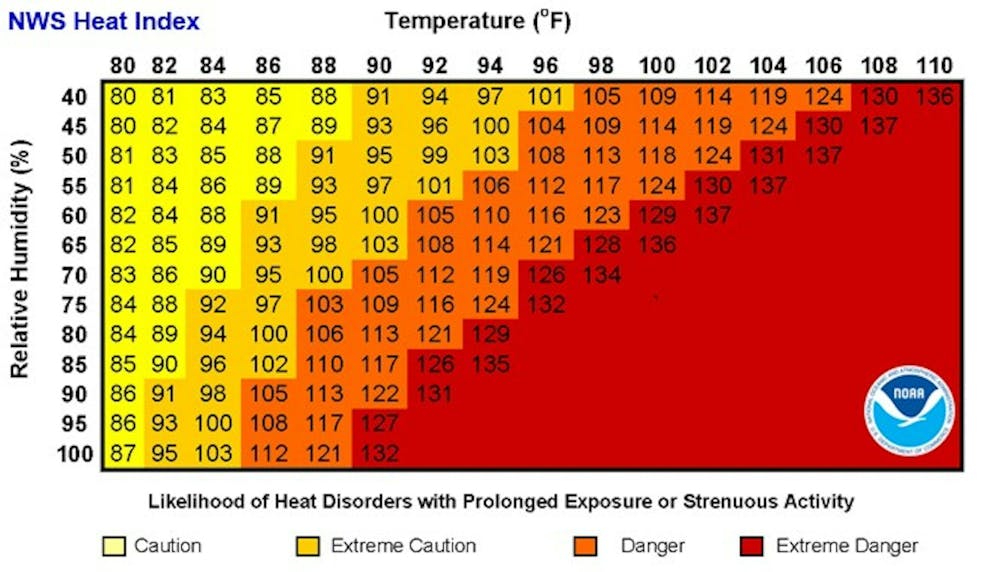
    Instead of just looking at temperature when planning outdoor activities, check the heat index, which accounts for heat illness risk associated with temperature and relative humidity.

    It doesn’t take very high temperatures or very high humidity for the heat index to enter dangerous territory.

    A heat index chart shows how heat and humidity combine for dangerous conditions.
    NOAA

    However, the heat index is still a conservative measure of the impact of heat on humans, particularly for outdoor workers and athletes at summer practices. This is because temperature measurements used in weather forecasting are taken in the shade and are not exposed to direct sunlight. If someone is outside and exposed to the direct sun, the actual heat index can be as much as 15 F higher than the heat index chart indicates.

    A more sophisticated measurement of heat effects on human health is what’s known as the wet-bulb globe temperature, which takes into account other variables, such as wind speed and cloud cover. Neither takes into account a person’s physical exertion, which also raises their body temperature, whether working at a construction site or playing soccer.

    Tips for staying safe in a heat wave

    How can you stay cool when heat waves set in? The answer depends in part on where you are, but the main points are the same:

    • Avoid strenuous outdoor activities in high temperatures if possible. If you start to feel symptoms of heat-related illnesses, drink fluids that will hydrate you. Find shade, rest, and use cool, damp cloths to lower your body temperature. If you see signs of heat stroke in someone else, call for medical help.

    • Be careful with fans. Fans can be useful if the temperature isn’t too high because they wick sweat away from the body and induce evaporative cooling. But at very high temperatures, they can accelerate heat buildup in the body and lead to dangerous conditions. If indoor temperatures reaches 95 degrees or higher, using fans can actually be dangerous and raise the risk of heat-related illnesses.

    • Find a cooling center, library or community center where you can get inside and rest in an air-conditioned space in the hottest hours. In places such as Phoenix, where high temperatures are a regular hazard, cooling centers are typically opened in summer. Northern cities are also opening cooling centers as heat waves occur there more frequently than they did in the past. Urban areas with a lot of pavement and buildings – known as heat islands – can have temperatures well above the city’s average.

    • Hydrate, hydrate, hydrate! Drink plenty of fluids, and don’t forget about the importance of electrolytes. Heat-related dehydration can occur when people sweat excessively, losing water and necessary salts from the body. Some sports drinks or rehydration fluids restore electrolytes and hydration levels.

    Older adults and people with disabilities often face higher risks from heat waves, particularly if they can’t easily move to a cooler environment. Communities and neighbors can help protect vulnerable populations by providing cooling centers and bottled water and making regular wellness checks during high heat.

    Summer can be a season of fun. Just remember the risks, keep an eye on your friends and neighbors when temperatures rise, and plan ahead so you can beat the heat.

    Brian Bossak is not currently receiving relevant external funding for heat-related illness research. In 2017-2019, he served as a consultant on a heat-related research award from the Southeastern Coastal Center for Agricultural Health and
    Safety at the University of Florida.

    – ref. How to stay safe during heat waves – and the heat stroke warning signs to watch for – https://theconversation.com/how-to-stay-safe-during-heat-waves-and-the-heat-stroke-warning-signs-to-watch-for-257708

    MIL OSI – Global Reports –

    June 20, 2025
  • MIL-OSI Global: What UK involvement in Iran could look like – and the political questions it raises

    Source: The Conversation – UK – By Geraint Hughes, Reader in Diplomatic and Military History, King’s College London

    Lauren Hurley / No 10 Downing Street, CC BY-NC-ND

    At the time of writing, US President Donald Trump is deliberating over whether to join Israel’s air campaign to destroy Iran’s suspected nuclear weapons programme. This is already a contentious issue within Washington DC and the Trump administration. But if the president decides to take the US into a war with Iran, it will have significant implications for the US’s allies, not least the UK.

    As the recent strategic defence review emphasises, the US is Britain’s main ally, an essential partner in defence and intelligence.

    However, the Trump administration has made clear to its European allies that it no longer regards the defence of the continent as a US national security priority. And the president’s commitment to Nato is uncertain.

    It is possible that Britain and other European allies could be publicly pressured by Trump to support any intervention on Israel’s side. The US may expect this in return for the US’s continued involvement in Nato and its readiness to honour article 5 (the collective defence principle, which obliges collective retaliation to aggression against one member) for its allies.


    Get your news from actual experts, straight to your inbox. Sign up to our daily newsletter to receive all The Conversation UK’s latest coverage of news and research, from politics and business to the arts and sciences.


    Given the importance of American military power in deterring wider Russian aggression in Europe – and Trump’s transactional character – this would present Keir Starmer with a particularly stark dilemma.

    A purely US air campaign against Iran is feasible. The US Navy will soon have two carrier strike groups in the Middle East region. And the US Air Force’s B2 strategic bombers can launch raids across the globe from bases in the continental US.

    The US also has several military bases in the region. However, as was the case with the 1991 and 2003 wars with Iraq, Washington DC will need permission from Gulf Arab allies to use them.

    Nonetheless, the Trump administration could request authorisation from the UK’s Labour government to use US airbases in the UK and its overseas territories to support an air campaign against Iran. This would not involve the UK deploying forces, but would require the UK to approve the use of the airbases.

    The Diego Garcia airbase in the Indian Ocean would be a useful asset in this case. But its employment would reopen the controversy over its establishment in the 1960s.

    It could also call into question the diplomatic deal the UK made with Mauritius last month to cede sovereignty of the Chagos Islands, while keeping this base open. The Mauritians are likely to oppose US airstrikes on Iran.

    Britain also has options for direct participation. RAF Typhoon jets stationed at Britain’s airbase in Akrotiri, Cyprus provided air defence support for Israel during the Iranian missile and drone strikes in April and October 2024. They could conduct similar missions now.

    But from the Royal Navy’s perspective, it would be difficult to divert the aircraft carrier HMS Prince of Wales from its deployment to the Indo-Pacific, partly because the task group it sails with is a multinational one.

    Given that the British armed forces are already overstretched, it is difficult to see whether the UK could provide more than basing rights and air support to the Israelis (if requested).

    A discreet commitment of UK special forces (the 22nd Special Air Service regiment and the Special Boat Service) on the ground is conceivable. This can be – and indeed has been – authorised by previous governments without parliamentary debate. But any further British military commitment is likely to cause a political row.

    Legal and political ramifications

    The key question for Starmer and his ministers will not be whether Britain could back a US war against Iran but whether it should. After the debacle of the Iraq war and the ensuing Chilcot inquiry, it is difficult to see how any government – let alone a Labour one – can take Britain into a major interstate conflict on this scale without firm parliamentary support and a solid case in international law.

    To this end, the Attorney General Richard Hermer has reportedly questioned the legality of Israel’s preemptive attack on Iran, and has argued that any British military intervention should be limited to the defence of its allies.

    We should not forget that Starmer was a human rights lawyer and the head of the Crown Prosecution Service before he became a politician.

    Another legacy of Iraq is that it is customary (though not a legal requirement) for prime ministers to seek parliamentary approval for any major military operation. David Cameron lost a vote in the House of Commons to approve airstrikes against Bashar al-Assad’s regime in Syria in August 2013. But he gained parliamentary support for Britain’s commitment to the fight against Islamic State in 2015.

    A similar debate now is unlikely to lead to approval of British military intervention in this case. Within the Labour party, there is already widespread condemnation of Israeli tactics and Palestinian civilian casualties in Gaza.

    There is little popular appetite for sending British sailors and airmen into a war with Iran. And, given the US vice-president’s own dismissive comments about the military experiences of European allies, the public is also entitled to ask why British servicemen should die or risk breaching international law for an administration that probably will not appreciate their sacrifice.

    Geraint Hughes does not work for, consult, own shares in or receive funding from any company or organisation that would benefit from this article, and has disclosed no relevant affiliations beyond their academic appointment.

    – ref. What UK involvement in Iran could look like – and the political questions it raises – https://theconversation.com/what-uk-involvement-in-iran-could-look-like-and-the-political-questions-it-raises-259420

    MIL OSI – Global Reports –

    June 20, 2025
  • MIL-OSI Canada: Province, BC Hydro launch pilot program to cut energy costs, support housing density

    Source: Government of Canada regional news

    In a Canadian first, the Province and BC Hydro have launched a pioneering pilot project in Vancouver that has the potential to set new standards for supporting growing housing priorities and densification in Canada.

    Designed to support the transition from single-family homes to multi-unit residences, the initiative is exploring how full electrification – heating, cooling, EV charging and appliances – can be achieved without the need for more significant electrical service upgrades.

    “The potential for this innovative system shows what’s possible when we partner with local technology providers to make clean energy more accessible,” said Adrian Dix, Minister of Energy and Climate Solutions. “We’re proud to support made-in-B.C. solutions that reduce emissions, strengthen our grid and lower energy costs for residents.”

    At the core of this project is a smart panel developed by Burnaby-based Evectrix, a key innovation supported through a $600,000 investment from the Province’s Innovative Clean Energy Fund and BC Hydro’s $700-million Energy Efficiency Plan. This device transforms a conventional breaker panel into a “smart hub” that manages real-time energy usage, in this case eliminating the need to upgrade from a 200-amp to a 400-amp service, even in an electrified six-unit development.

    This pilot project is Canada’s first to demonstrate:

    • all-suite electrification in a multi-unit residential building without requiring a significant service upgrade;
    • a smart panel integration with advanced thermostats for greater suite-level energy control; and
    • management of multiple non-EV electrical loads, such as hot water, ranges and dryers, through a single smart panel.

    Traditionally, densifying from single-family homes to duplexes, fourplexes and sixplexes has required significant electrical upgrades. This project explores a better path: the smart panel dynamically manages load at the suite level, helping avoid over-capacity while unlocking significant savings. The project is a scalable model for retrofitting and densification that could save thousands of dollars in infrastructure costs per project.

    Special permission was given from the City of Vancouver in order for the project to be installed at the location. Through the Consortium for Power Efficient Design, BC Hydro continues working with partners to advocate for changes to the Canadian Electrical Code, expanding the use of energy management systems like the one being explored through this project.

    “This technology pilot is a potential game-changer for accelerating clean-energy adoption in multi-unit housing,” said Chris O’Riley, president and CEO, BC Hydro. “It not only supports our broader goal of building a more sustainable and efficient electricity system, but it also helps customers avoid the high costs of major electrical upgrades – making densification more accessible, affordable and practical.”

    Through its $700-million Energy Efficiency Plan, BC Hydro is significantly increasing investments in energy-saving tools, technologies, programs and rebates. These measures are expected to deliver 2,000 gigawatt hours in electricity savings – enough to power approximately 200,000 homes. The project, located on Vancouver’s Chestnut Street, is one of many innovative pilot programs now underway or in development, designed not only to reduce consumption today but to empower customers to manage their energy use more efficiently in the years ahead and save money.

    If this approach proves successful, it could set the stage for more customer-focused energy solutions that help households and businesses lower their bills, reduce emissions and take advantage of smarter, more responsive grid technologies. These efforts are part of BC Hydro’s long-term commitment to delivering value, reliability and sustainability to customers as energy needs evolve.

    Quotes:

    Brenda Bailey, Minister of Finance and MLA for Vancouver-South Granville –

    “Advanced technology projects like the smart panel will help to create electricity systems that are efficient, resilient and responsive to people’s needs. We will continue to partner with local technology companies to help strengthen our grid and cut energy costs for British Columbians.”

    Kambiz Pishghadam Ghaeni, chief operating officer, Evectrix –

    “We’re proud to bring B.C.-made innovation to life through this first-of-its-kind, electrified six-townhouse project, proving that homeowners can electrify and decarbonize without the burden of costly service upgrades. With meaningful support from the Province and in close collaboration with the BC Hydro team, our intelligent load management technology is unlocking a scalable, affordable and future-ready path to electrify homes and multi-unit buildings throughout the province.” 

    Saul Schwebs, chief building official, City of Vancouver –  

    “The City of Vancouver is proud to support this project, which showcases innovative made-in-British Columbia technology. The City approved the use of this load management technology through a special permission pathway, illustrating our commitment to energy-efficient solutions.” 

    Learn More:

    To learn more about the Province’s plans to power B.C.’s potential, visit: https://www.bchydro.com/poweringpotential

    A backgrounder follows.

    MIL OSI Canada News –

    June 20, 2025
  • MIL-OSI Africa: Eritrea: Commemoration of World Drought and Desertification Day

    Source: Africa Press Organisation – English (2) – Report:

    Download logo

    World Drought and Desertification Day was commemorated at the national level at Embasoira Hotel, Asmara, on 17 June under the theme “Restore the Land – Unlock the Opportunity.” The event, organized by the Ministry of Agriculture, was attended by experts from the Ministries of Agriculture and Land, Water and Environment, the Forestry and Wildlife Authority, Higher Education Institutions, stakeholders, national associations, and farmers.

    In his keynote address, Mr. Semere Amlesom, Director General of Agricultural Extension at the Ministry of Agriculture, highlighted the Eritrean Government’s commitment to combating drought and desertification and emphasized the need for collective action to restore degraded land. He further noted that drought and desertification are among the main causes of biodiversity loss, poverty, forced migration, and conflict, and that restoring the land is essential to addressing these issues and reversing their consequences.

    The event featured presentations on various topics, including Eritrea’s commitment and experience in combating drought, land degradation, and desertification; land use change and its impact on poverty and livelihoods; conservation and sustainable land-use management practices; agroforestry systems for restoring land; environmental impact assessments of agricultural farms; and the role of date palms in restoring degraded land, among other relevant subjects.

    The participants, emphasizing the importance of continued efforts to address drought and desertification, called on stakeholders to work in partnership to achieve the intended goals. As the world continues to grapple with the challenges of climate change, it is essential to accelerate the implementation of sustainable land-use practices and conservation measures.

    – on behalf of Ministry of Information, Eritrea.

    MIL OSI Africa –

    June 20, 2025
  • MIL-OSI NGOs: 8 in 10 people support taxing oil and gas corporations to pay for climate damages, global survey finds

    Source: Greenpeace Statement –

    Bonn, Germany, 19 June 2025 – A vast majority of people believe governments must tax oil, gas and coal corporations for climate-related loss and damage, and that their government is not doing enough to counter the political influence of super rich individuals and polluting industries. These are the key findings of a global survey – including responses from South Africa and Kenya – which reflect a broad consensus across political affiliations, income levels and age groups.[1]  

    The study, jointly commissioned by Greenpeace International and Oxfam International, was launched today at the UN Climate Meetings in Bonn (SB62), where government representatives are discussing climate policies, including ways to raise at least US$ 1.3 trillion annually in climate finance for Global South countries by 2035. The survey was conducted across 13 countries, including most G7 countries. 

    Sherelee Odayar, Oil and Gas Campaigner for Greenpeace Africa said:

    “In Africa, people are feeling the heat—literally—and they’re done footing the bill for disasters driven by record fossil-fuel profits. This survey sends an unmistakable message: our governments have a popular mandate to make oil, gas and coal corporations pay their fair share for the floods, droughts and hunger they’ve helped unleash. A polluter-pays tax would turn dirty profits into clean investments for frontline communities, and that’s the climate justice Africa has been calling for.”

    Ali Mohamed, Special Envoy for Climate Change, Kenya, said:


    “African Leaders adopted the Nairobi Declaration during the inaugural Africa Climate Summit in Nairobi, which among others, calls for a global carbon taxation regime, including levies on fossil fuel trade. Kenya co-chairs the Global Solidarity Levies Taskforce, which brings together a coalition of willing countries to design and implement progressive levies that reflect the true cost of pollution. The principle is simple, sectors profiting from the increasing greenhouse gas emissions that cause the destructive climate change, must be taxed to support climate impacted vulnerable communities in Africa and other developing world, adapt and recover from the devastating losses and damages being suffered so frequently.”

    Mads Christensen, Executive Director of Greenpeace International said:

    “These survey results send a clear message: people are no longer buying the lies. They see the fingerprints of fossil fuel giants all over the storms, floods, droughts, and wildfires devastating their lives, and they want accountability. By taxing the obscene profits of dirty energy companies, governments can unlock billions to protect communities and invest in real climate solutions. It’s only fair that those who caused the crisis should pay for the damage, not those suffering from it.”

    The study, run by Dynata, was unveiled alongside the Polluters Pay Pact, a global alliance of communities on the frontlines of climate disasters. The Pact demands that – instead of piling the costs on ordinary people – governments make oil, gas and coal corporations pay their fair share for the damages they cause, through the introduction of new taxes and fines.

    The Pact is backed by firefighters and other first responders, trade unions and worker groups, and mayors from countries including Australia, Brazil, Bangladesh, India, the Philippines, Sri Lanka, Nigeria, and South Africa, the US, and plaintiffs in landmark climate cases from Pacific island states to Switzerland.

    The Pact is also supported by over 60 NGOs, including Oxfam International, 350.org, Avaaz, Islamic Relief UK, Asociación Interamericana para la Defensa del Ambiente (AIDA), Indian Hawkers Alliance, Pacific Islands Students Fighting Climate Change, Jubilee Australia and the Greenpeace network.

    The survey’s findings published today reveal broad public support for the core demands of the Polluters Pay Pact, as climate impacts worsen worldwide and global inequality grows.

    Key findings of the survey include:

    • 81% of people surveyed would support taxes on the oil, gas, and coal industry to pay for damages caused by fossil-fuel driven climate disasters like storms, floods, droughts and wildfires.
    • 86% of people in surveyed countries support channeling revenues from higher taxes on oil and gas corporations towards communities most impacted by the climate crisis. Climate change is disproportionately hitting people in Global South countries, who are historically least responsible for greenhouse gas emissions. 
    • When asked who should be taxed to pay for helping survivors of fossil-fuel driven climate disasters, 66% of people across countries surveyed think it should be oil and gas companies, while just 5% support taxes on working people, 9% on goods people buy, and 20% favour business taxes.
    • 68% felt that the fossil fuel industry and the super-rich had a negative influence on politics in their country. 77% say they would be more willing to support a political candidate who prioritises taxing the super-rich and the fossil fuel industry. 

    Amitabh Behar, Executive Director of Oxfam International, said: 

    “Fossil fuel companies have known for decades about the damage their polluting products wreak on humanity. Corporations continue to cash in on climate devastation, and their profiteering destroys the lives and livelihoods of millions of women, men and children, predominantly those in the Global South who have done the least to cause the climate crisis. Governments must listen to their people and hold polluters responsible for their damages. A new tax on polluting industries could provide immediate and significant support to climate-vulnerable countries, and finally incentivise investment in renewables and a just transition.” 

    The Polluters Pay Pact demonstrates popular support for the campaign to make polluters pay. The campaign is being waged throughout 2025 in countries worldwide and in critical international forums, including the 4th International Conference on Financing for Development (FFD4), the UN Climate Change Conference (COP30), and negotiations for a UN tax convention that could include new rules to make multinational oil and gas companies pay their fair share for their pollution.

    ENDS

    Notes:

    [1] The research was conducted by first-party data company Dynata in May-June, 2025, in Brazil, Canada, France, Germany, Kenya, Italy, India, Mexico, the Philippines, South Africa, Spain, the UK and the US, with approximately 1200 respondents in each country and a theoretical margin of error of approximately 2.83%. Together, these countries represent close to half the world’s population. Statistics available here. 

    Additional background information available here.

    [2] Learn more about the Polluters Pay Pact: polluterspaypact.org

    [3] Additional quotes here from people around the world who are backing the Polluters Pay Pact, including first responders, local administration, youth, union representatives and people bringing climate cases to courts. 

    Contacts: 

    For Greenpeace Africa:

    Ferdinand Omondi, Communication and Story Manager, Email: [email protected], Cell: +254 722 505 233

    Greenpeace Africa Press Desk: [email protected]. 

    For Greenpeace International: 

    Tal Harris, Greenpeace International, Global Media Lead – Stop Drilling Start Paying campaign, [email protected], +41-782530550Greenpeace International Press Desk: [email protected], +31 (0) 20 718 2470 (available 24 hours). Follow on X and Bluesky for our latest international press releases.

    MIL OSI NGO –

    June 20, 2025
  • MIL-OSI United Kingdom: SNP abandoning future generations with climate announcement

    Source: Scottish Greens

    19 Jun 2025 Climate

    Newly published carbon budgets have watered down targets, when we need to ramp up our efforts.

    More in Climate

    The Scottish Government has abandoned future generations after ignoring key climate experts’ advice today, when they published concerningly weak new climate budgets, say the Scottish Greens.
     
    Scottish Greens Co-Leader Patrick Harvie has slammed it as “yet another step away from evidence-based climate policy”.
     
    Last month, the UK Climate Change Committee (CCC) published a report urging the Scottish Government to take immediate action to reduce carbon emissions if they are to meet their 2045 net-zero target. With the publication of today’s carbon budgets, the SNP have ignored the advice from the CCC on reducing pollution from agriculture and other sectors.
     
    The newly published carbon budgets lack ambition to reduce emissions, with the previous target of a 75% reduction by 2030 now reduced to 57%.
     
    Patrick Harvie said:

    “This is a deeply troubling announcement from the SNP, and takes us another step away from evidence-based climate policy. We’ve known for years that ambitious targets alone aren’t enough to tackle the climate emergency, but that means we should be ramping up action to protect our planet, not watering down the targets.
     
    “Climate experts have been clear that the Scottish Government has failed to take on board the urgent action needed. They issued warning after warning, but the SNP have failed to step up and tackle the climate crisis head on.
     
    “The UKCCC is clear – we can reach Scotland’s 2045 target. But that will only happen if we are brave enough to have less words and more action to get the job done. Today’s announcement does not show bravery from the SNP.
     
    “The government has many of the solutions they need ready at their fingertips. Investing in climate action will create good jobs and save people money too.
     
    “We can switch to clean heat to warm our homes, invest in public transport to reduce cars on our roads, and support rural communities to cut emissions from land use and farming, but instead, the SNP have decided to shy away from taking action, as if they hope someone else is coming to save us.
     
    “We are in a climate emergency, and we need to start acting like it, so that future generations don’t look back and ask why Scotland abandoned them when we had the opportunity to fix things.”

    MIL OSI United Kingdom –

    June 20, 2025
  • MIL-OSI United Kingdom: Victoria and Albert Street completion concludes major highway and transport upgrades

    Source: City of Derby

    One of Derby City Centre’s key routes has completed a major overhaul, connecting key city centre sites like Becketwell Live, The Condor apartment complex and Derby Market Hall.

    The transport improvements – which will enhance appearance, improve air quality, and encourage more sustainable journeys – concluded with the resurfacing of Corporation Street, Victoria Street and Albert Street

    Among the improvements are wider footpaths and a new segregated cycle lane, making it much easier for residents and visitors to choose low-emission, active travel options to move through the heart of the city centre.

    Improved bus bays, coupled with the segregated cycle lane and a permanent one-way system will allow for improved traffic flow and lower emissions, benefitting the health of visitors and residents alike. Bus users will also benefit from new street lighting around bus stops, making them a safer, more comfortable place to wait.

    New living roof bus shelters will be installed, making the area more visually appealing and providing food sources and habitats for a wide variety of pollinating insects.

    On top of the green bus shelters, the area will also benefit from an extensive greening programme, with new planters being installed to give a fresh, vibrant feel to this vital city centre route. The public realm enhancements will also complement the proposed improvements on Osnabruck Square.

    A number of benches have been incorporated into these new planters, giving visitors a place to sit and enjoy a greener city centre.

    The completion of this scheme also marks the end of Transforming Cities programme in Derby, after Derby and Nottingham City Councils secured £161m from the Government’s Transforming Cities Fund. This project has seen improvements made to local transport infrastructure around the city. improving sustainable transport, supporting growth and encouraging more low carbon journeys.

    Councillor Carmel Swan, Cabinet Member for Climate Change, Transport and Sustainability, said: 

    I’m delighted that work on Corporation Street, Victoria Street and Albert Street is now complete. This has been a very visible scheme for the city and now people will be able to see the benefits.

    A vital element of the Transforming Cities schemes, is creating an environment where we can make the city centre a healthier place for our communities to live, work and enjoy.

    We can also now celebrate the completion of the Transforming Cities programme, which has delivered infrastructure improvements across the city. I’m proud of all that we have achieved throughout this project, but rest assured we will continue to champion sustainable and active travel as we continue to deliver a greener Derby.

    MIL OSI United Kingdom –

    June 20, 2025
  • MIL-OSI Global: Extreme weather’s true damage cost is a mystery – that’s a problem for understanding storm risk

    Source: The Conversation – USA – By John Nielsen-Gammon, Regents Professor of Atmospheric Sciences, Texas A&M University

    Hail can be destructive, yet the cost of the damage often isn’t publicly tracked. NOAA/NSSL

    On Jan. 5, 2025, at about 2:35 in the afternoon, the first severe hailstorm of the season dropped quarter-size hail in Chatham, Mississippi. According to the federal storm events database, there were no injuries, but it caused $10,000 in property damage.

    How do we know the storm caused $10,000 in damage? We don’t.

    That estimate is probably a best guess from someone whose primary job is weather forecasting. Yet these guesses, and thousands like them, form the foundation for publicly available tallies of the costs of severe weather.

    If the damage estimates from hailstorms are consistently lower in one county than the next, potential property buyers might think it’s because there’s less risk of hailstorms. Instead, it might just be because different people are making the estimates.

    Hail damage in Dallas in June 2012.
    Rondo Estrello/Flickr, CC BY-SA

    We are atmospheric scientists at Texas A&M University who lead the Office of the Texas State Climatologist. Through our involvement in state-level planning for weather-related disasters, we have seen county-scale patterns of storm damage over the past 20 years that just didn’t make sense. So, we decided to dig deeper.

    We looked at storm event reports for a mix of seven urban and rural counties in southeast Texas, with populations ranging from 50,000 to 5 million. We included all reported types of extreme weather. We also talked with people from the two National Weather Service offices that cover the area.

    Storm damage investigations vary widely

    Typically, two specific types of extreme weather receive special attention.

    After a tornado, the National Weather Service conducts an on-site damage survey, examining its track and destruction. That survey forms the basis for the official estimate of a tornado’s strength on the enhanced Fujita scale. Weather Service staff are able to make decent damage cost estimates from knowledge of home values in the area.

    They also investigate flash flood damage in detail, and loss information is available from the National Flood Insurance Program, the main source of flood insurance for U.S. homes.

    Tornadoes in May 2025 destroyed homes in communities in several states, including London, Ky.
    AP Photo/Timothy D. Easley

    Most other losses from extreme weather are privately insured, if they’re insured at all.

    Insured loss information is collected by reinsurance companies – the companies that insure the insurance companies – and gets tabulated for major events. Insurance companies use their own detailed information to try to make better decisions on rates than their competitors do, so event-based loss data by county from insurance companies isn’t readily available.

    Losing billion-dollar disaster data

    There’s one big window into how disaster damage has changed over the years in the U.S.

    The National Oceanic and Atmospheric Administration, or NOAA, compiled information for major disasters, including insured losses by state. Bulk data won’t tell communities or counties about their specific risk, but it enabled NOAA to calculate overall damage estimates, which it released as its billion-dollar disasters list.

    From that program, we know that the number and cost of billion-dollar disasters in the United States has increased dramatically in recent years. News articles and even scientific papers often point to climate change as the primary culprit, but a much larger driver has been the increasing number and value of buildings and other types of infrastructure, particularly along hurricane-prone coasts.

    Critics in the past year called for more transparency and vetting of the procedures used to estimate billion-dollar disasters. But that’s not going to happen, because NOAA in May 2025 stopped making billion-dollar disaster estimates and retired its user interface.

    Previous estimates can still be retrieved from NOAA’s online data archive, but by shutting down that program, the window into current and future disaster losses and insurance claims is now closed.

    Emergency managers at the county level also make local damage estimates, but the resources they have available vary widely. They may estimate damages only when the total might be large enough to trigger a disaster declaration that makes relief funds available from the federal government.

    Patching together very rough estimates

    Without insurance data or county estimates, the local offices of the National Weather Service are on their own to estimate losses.

    There is no standard operating procedure that every office must follow. One office might choose to simply not provide damage estimates for any hailstorms because the staff doesn’t see how it could come up with accurate values. Others may make estimates, but with varying methods.

    The result is a patchwork of damage estimates. Accurate values are more likely for rare events that cause extensive damage. Loss estimates from more frequent events that don’t reach a high damage threshold are generally far less reliable.

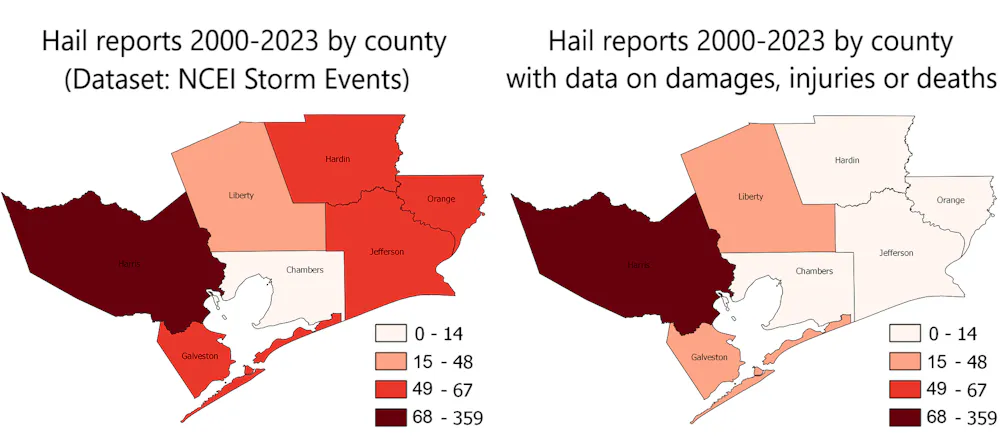
    The number of severe hail reports in southeast Texas listed in the National Centers for Environmental Information’s storm events database is strongly correlated with population. The county with the most reports and greatest detail in those reports is home to Houston. Hailstorms in the three easternmost counties are rarely associated with damage estimates.
    John Nielsen-Gammon and B.J. Baule

    Do you want to look at local damage trends? Forget about it. For most extreme weather events, estimation methods vary over time and are not documented.

    Do you want to direct funding to help communities improve resilience to natural disasters where the need is greatest? Forget about it. The places experiencing the largest per capita damages depend not just on actual damages but on the different practices of local National Weather Service offices.

    Are you moving to a location that might be vulnerable to extreme weather? Companies are starting to provide localized risk estimates through real estate websites, but the algorithms tend to be proprietary, and there’s no independent validation.

    4 steps to improve disaster data

    We believe a few fixes could make NOAA’s storm events database and the corresponding values in the larger SHELDUS database, managed by Arizona State University, more reliable. Both databases include county-level disasters and loss estimates for some of those disasters.

    First, the National Weather Service could develop standard procedures for local offices for estimating disaster damages.

    Second, additional state support could encourage local emergency managers to make concrete damage estimates from individual events and share them with the National Weather Service. The local emergency manager generally knows the extent of damage much better than a forecaster sitting in an office a few counties away.

    Third, state or federal governments and insurance companies can agree to make public the aggregate loss information at the county level or other scale that doesn’t jeopardize the privacy of their policyholders. If all companies provide this data, there is no competitive disadvantage for doing so.

    Fourth, NOAA could create a small “tiger team” of damage specialists to make well-informed, consistent damage estimates of larger events and train local offices on how to handle the smaller stuff.

    With these processes in place, the U.S. wouldn’t need a billion-dollar disasters program anymore. We’d have reliable information on all the disasters.

    John Nielsen-Gammon receives funding from the National Oceanic and Atmospheric Administration and the State of Texas.

    William Baule receives funding from NOAA, the State of Texas, & the Austin Community Foundation.

    – ref. Extreme weather’s true damage cost is a mystery – that’s a problem for understanding storm risk – https://theconversation.com/extreme-weathers-true-damage-cost-is-a-mystery-thats-a-problem-for-understanding-storm-risk-257105

    MIL OSI – Global Reports –

    June 20, 2025
  • MIL-OSI Global: New start date for the Anthropocene proposed – when humans first changed global methane levels

    Source: The Conversation – UK – By Vincent Gauci, Professorial Fellow, School of Geography, Earth and Environmental Sciences, University of Birmingham

    Robsonphoto/Shutterstock

    Humans have been reshaping the environment for at least 10,000 years. But the Anthropocene is the name given to the specific period of Earth history during which humans have had a global effect on the planet’s climate and ecosystems. Despite formal rejection as a geological epoch, it’s widely understood within academic research as useful shorthand for the age of human interference in the Earth system.

    Various dates have been proposed for when the anthropocene effectively began, from the early 17th century to the mid-20th century, when the first atomic weapons were detonated. My new research into atmospheric methane concentration supports the idea of an early date, when European arrival in the Americas first had a notable impact on the atmosphere, but slightly before previous estimates.

    Ice cores – cylinders of ice drilled from glaciers and ice sheets – provide important evidence of historical changes in the global atmospheric composition. It is from these records that a date for the Anthropocene’s pre-industrial beginnings was first proposed in 2015 by two Earth systems scientists at the University College London, Simon Lewis and Mark Maslin.

    They suggested that an unprecedented drop in the level of CO₂ in the atmosphere that was recorded in ice cores – known as the “Orbis spike” – dates back to 1610. This unusually low level reflects additional atmospheric CO₂ absorption into trees from forest regrowth in the Americas following European arrival in the late 1400s.


    Get your news from actual experts, straight to your inbox. Sign up to our daily newsletter to receive all The Conversation UK’s latest coverage of news and research, from politics and business to the arts and sciences.


    From European arrival in 1492 and colonisation in the 1500s, the introduction of disease, mostly smallpox, resulted in demographic collapse of around 50 million people across the Americas. Lewis and Maslin proposed that, as millions of hectares of farmland went untended, forests could regrow and this increased CO₂ removal from the atmosphere.

    This happened in sufficient quantities to be recorded in glacial ice. And that change became a global marker for the start of the so-called Anthropocene.


    Read more:
    Why the Anthropocene began with European colonisation, mass slavery and the ‘great dying’ of the 16th century


    My own research into changing methane concentrations indicates that the Anthropocene began slightly earlier than that, in 1592. Ice core records show a minimum atmospheric methane concentration exactly 100 years after explorer Christopher Columbus first set foot in the Americas. This, I believe, strengthens support for the hypothesis put forward by Lewis and Maslin a decade ago.

    In a paper published in Nature Reviews, Earth and Environment, I consider the effects of global fluctuations in how trees and forests exchange methane. Methane is a greenhouse gas that is around 80 times more powerful than carbon dioxide over a 20-year period. Crucially, methane has a short lifetime of just under ten years, so any ice core record will be far more responsive to changes to the methane cycle than that of longer-lived CO₂.


    Read more:
    Methane is pitched as a climate villain – could changing how we think about it make it a saviour?


    Trees are a methane sink

    So what’s the link to trees? Trees and their woody bark surfaces, despite their biologically inert appearance when compared to leaves, are important interfaces of methane exchange. In swamps and forested floodplains like the Amazon, they are exit points of methane to the atmosphere from the saturated soils where the methane is formed by anaerobic soil microbes.

    However, last year, my team uncovered how the more extensive areas of forest growing on free-draining soils interact with atmospheric methane. The trees host microbes that directly remove methane from the atmosphere.

    This is one of two mechanisms that, together, might explain an unprecedented drop in atmospheric methane concentrations recorded in Antarctic ice cores in the first century following European arrival in the Americas. This would support Lewis and Maslin’s idea that regrowing forests in that period had global effects.

    With more trees growing on abandoned farmland, there was more woody tree surface area in contact with the atmosphere. This meant more methane being taken up by the microbes they host.

    Measuring methane uptake of trees.
    Vincent Gauci, CC BY-NC-ND

    The second mechanism relates to how trees intercept incoming rainfall. Some rainfall is re-evaporated before reaching the soil. Any rain reaching the soil may then be taken up by tree roots and released back to the atmosphere. The rest moves into the soil or washes off into rivers and wetlands.

    It is possible that the spike in forest regrowth led to more evaporation and transpiration. So more water was released by the trees back to the atmosphere and less washed off over the soil surface.

    This limited water flowing into wetlands. Those wetlands are a major methane source. So a small shrinkage in wetland area, combined with more trees absorbing atmospheric methane, could have reduced the atmospheric methane concentration and explain the minimum methane levels observed in 1592.

    When exactly the Anthropocene began may be an argument that has been overtaken by the decision to not label it a new epoch. Indeed, it’s possible that forest clearance for early agriculture by humans around 5,000-8,000 years ago in the mid-Holocene, (a period of relative climate stability in the Neolithic period) contributed to the atmospheric methane increase observed in Antarctic ice from that time.

    As well as an ancient trace of human influence over our forests, the ice core methane records provide a chance to evaluate newly discovered processes operating in the world’s forests. This is something I’m now investigating with my colleague Peter Hopcroft, a palaeoclimate modeller at the University of Birmingham.

    Whether through forest clearances for early agriculture or through the effects on forests of massive depopulation of Indigenous peoples following European contact, these traces of our past influence point to something significant: that there has always been an intimate and evolving connection between humanity and the natural world. A connection so fundamental that, for the vast span of our existence as a species, we have been inseparable from nature itself.


    Don’t have time to read about climate change as much as you’d like?

    Get a weekly roundup in your inbox instead. Every Wednesday, The Conversation’s environment editor writes Imagine, a short email that goes a little deeper into just one climate issue. Join the 45,000+ readers who’ve subscribed so far.


    Vincent Gauci receives funding from or has received funding from the Natural Environment Research Council, The Royal Society, Spark Climate Solutions, AXA Research Fund, Defra and the JABBS Foundation.

    – ref. New start date for the Anthropocene proposed – when humans first changed global methane levels – https://theconversation.com/new-start-date-for-the-anthropocene-proposed-when-humans-first-changed-global-methane-levels-258834

    MIL OSI – Global Reports –

    June 20, 2025
  • MIL-OSI Global: Could trees know when the summer solstice is?

    Source: The Conversation – UK – By Andrew Hacket-Pain, Senior Lecturer, School of Environmental Sciences, University of Liverpool

    cashcashcash/Shutterstock

    People have been celebrating the summer solstice with elaborate rituals since prehistoric times. But humans aren’t the only species to take mark June 21 as a special time. Studies are showing the summer solstice is an important cue for plants too.

    Recent studies, including one of my own, have proposed that trees may use the longest day of the year as a key marker for their growth and reproductive cycles. The solstice seems to act like a calendar reminder for trees.


    Many people think of plants as nice-looking greens. Essential for clean air, yes, but simple organisms. A step change in research is shaking up the way scientists think about plants: they are far more complex and more like us than you might imagine. This blossoming field of science is too delightful to do it justice in one or two stories.

    This story is part of a series, Plant Curious, exploring scientific studies that challenge the way you view plantlife.


    For example, at the solstice, trees growing in cold places slow down the creation of new wood cells and focus their energy on finishing already formed but still incomplete cells. This ensures trees have time to complete cell construction before winter hits. Incomplete cells are damaged by freezing winter temperatures, rendering them useless for water transport the following year.

    Along similar lines, trees use the solstice to fine-tune the “winding down”, or senescence, of their leaves in preparation for autumn. Senescence allows the tree to reabsorb critical nutrients from the leaves before they fall. This process is timed to balance missing out on sunlight from “winding down” too early, against leaving it too late and losing nutrients if still-green leaves are killed by autumn frosts.

    Stonehenge has been part of summer solstice celebrations since ancient times.
    Ria Sh/Shutterstock

    Satellite observations of forests, and controlled experiments in greenhouses, reveal that warmer temperatures immediately prior to the solstice cause the onset of leaf browning to start earlier that autumn. In contrast, warmer temperatures just after the solstice slow down the senescence process.

    This means a longer transition period from green to fully brown leaves. This fine-tuning enables trees to extend the period of photosynthesis in years when temperatures stay warmer for longer, so they don’t miss out on these favourable conditions.

    But not all scientists is convinced. From an evolutionary perspective, the solstice may not be the best seasonal marker for timing these transitions. For example, in forests in the far north, leaves do not appear until early June, only days before the solstice, and the growing season can extend late into October. In these forests, using the solstice to initiate the winding down process makes little sense for trees that have only just started growing for the year.

    Nevertheless, there is more consensus about plants using the solstice to synchronise reproduction.

    In many plants, especially trees from the temperate mid-latitudes, the number of seeds they produce varies dramatically year on year, known as masting. A large European beech tree can produce hundreds of thousands of seeds in a bumper year (a “mast event”) and forgo reproduction altogether in other years.

    Beech trees vary their annual seed production in step, often on a continental scale. They do this to increase the efficiency of their reproduction.

    Beech trees coordinate their reproduction.
    Gabriele Rohde/Shutterstock

    A small moth, Cydia fagiglandana, lays its eggs in beech flowers. When the grubs hatch, they eat and destroy the developing seeds. Cycles of famine and bumper years help protect their seeds from these moths.

    UK beech trees typically lose less than 5% of their seeds to Cydia because the cycles starve the moths into low numbers ready for masting years. But when trees are out of sync, seed loss can increase to over 40%.

    For decades we have known that beech mast events happen in the year after a warm summer. These warmer temperatures trigger an increase in the formation of flower buds. More flower buds usually lead to a greater crop of seeds that autumn.

    Scientists have long puzzled over how beech trees across Europe seem to use the same seasonal window to control mast events. Their seed production is determined by temperatures in late June and early July, irrespective of where they grow in Europe. But how can a beech tree know the date?

    In my team’s 2024 study, we showed that they use the solstice as a seasonal marker. As soon as the days start to shorten after the solstice, beech trees across Europe seem to simultaneously sense the temperature.

    Anywhere temperatures are above average in the weeks following the solstice can expect to have a mast event the next year. Weather conditions in the weeks before the solstice, by contrast, seem to be irrelevant. As seen on weather maps, warm and cool spells tend to occur simultaneously over large areas.

    This allows beech trees to maximise the synchrony of their reproduction, whether that is investing in a mast year (warm temperatures), or forgoing reproduction for a year (low temperatures). Using a fixed marker like the solstice is the key to achieving this synchrony, and the benefits that come from it.

    Note how bumper seed crops and failures tend to be regionally synchronised, and occasionally occur as pan-European events.
    Andrew Hacket Pain, CC BY-NC-ND

    The evidence for this phenomenon has come from observations across dozens of forests across Europe. However, my research group is collaborating with about a dozen other groups in Europe to test this effect by manipulating the temperature of beech branches before and after the solstice at different sites. Ongoing research I am involved with seems to show flowering genes are activated at the summer solstice.

    Also, studies into the circadian rhythms of plants show they have mechanisms in their molecules that allow them to detect and respond to tiny changes in day length. This is the basis for that extraordinary scale of synchronised reproduction.

    If the weather is warm over the next month or so, then there is a good chance that beech trees in your local area will have heavy seed crops next autumn. What’s more, trees across the UK and into northern and central Europe will probably be doing the same.

    Andrew Hacket-Pain has received funding from UKRI, Defra and the British Council.

    – ref. Could trees know when the summer solstice is? – https://theconversation.com/could-trees-know-when-the-summer-solstice-is-259309

    MIL OSI – Global Reports –

    June 20, 2025
  • MIL-OSI United Kingdom: Leicester set for over £80m in transport improvement funding

    Source: City of Leicester

    AROUND £80 million of Government funding is set to be invested in an ambitious programme of local transport improvements across Leicester over the next five years.

    Leicester City Council has been allocated £59 million of Local Transport Grant funding for the four years from 2026, following the Chancellor’s 2025 Spending Review.

    Although detailed guidelines are yet to be published, the long-term funding will allow the city council to plan and deliver and local transport improvements and services up until 2030.

    City Mayor Peter Soulsby said: “The recent announcement of Local Transport Grant funding up until 2030 is very welcome. It will provide the funding certainty needed to make long-term and ambitious plans to maintain and improve the city’s transport network for all users.

    “It will allow us to build on the successes of our local Transforming Cities programme and the major investment being made in the city’s bus services in recent years.”

    Additional government grant funding for highways maintenance, as well as specific funding from the Bus Service Improvement Plan and Active Travel England grant schemes, supporting walking and cycling, is expected to be confirmed later this year.

    Meanwhile, the city council has set out the local transport projects that will be delivered over the coming year using a range of Government grants already allocated and totalling almost £22 million.

    Over £9.3 million for the Government’s Bus Service Improvement Plan grant will support the purchase of up to 48 new electric buses, helping the city move closer to its target of having a fully electric bus network in place by 2030.

    The popular Hop! Bus service – which provides a free to use and fully electric bus shuttle service to key locations around the city centre – will also continue to be funded.

    The remaining £12.6 million of Government grant funding allocation for 2025/26 will be invested in range of highways maintenance and local transport improvement schemes over the next 12 months.

    These include major planned resurfacing and maintenance schemes on Melton Road and Aylestone Road; a rolling programme of pedestrian crossing improvements across the city; and highway access improvements supporting new housing and other developments at key regeneration sites including Ashton Green and the St George’s Cultural Quarter.

    A new maintenance programme to replace street lighting columns and illuminated street signs will also get under way; a neighbourhood improvement fund will be established to support local public realm improvements; and improvements to routes for walkers, wheelers and cyclists will be carried out at Orwell Drive, Newstead Road, Abbey Gate and Knighton Drive.

    The planned transport investment programme for 2025-26 is due to be considered at the next meeting of the council’s Economic Development, Transport and Climate Emergency scrutiny commission on Wednesday 25 June.

    MIL OSI United Kingdom –

    June 20, 2025
  • MIL-OSI United Kingdom: Heat-Health Alerts issued by UKHSA and the Met Office

    Source: United Kingdom – Government Statements

    News story

    Heat-Health Alerts issued by UKHSA and the Met Office

    The latest heat-health alert (HHA) issued by UKHSA and the Met Office for all regions of England.

    Our UKHSA data dashboard provides the latest details on heat-health alerts currently in place and their duration, while our latest blog details how exactly heat impacts the body and what we can do avoid the negative effects.

    Latest

    Thursday 19 June 2025

    The UK Health Security Agency (UKHSA) and the Met Office have issued an amber heat-health alert (HHA) for all regions of England.

    The alert is currently in place from 12 noon on Thursday 19 June to 9am on Monday 23 June. The Met Office has forecast temperatures exceeding 30°C.

    Under the Weather-Health Alert system, an amber alert means that weather impacts are likely to be felt across the whole health service. At this level, we may begin to see some health impacts across the wider population. We may also see an increase in risk to health for individuals aged over 65 years or those with pre-existing health conditions, including respiratory and cardiovascular diseases.

    Dr Agostinho Sousa, Head of Extreme Events and Health Protection at UKHSA, said:

    We have already seen warm weather across the week, and temperatures are set to increase in the coming days, exceeding 30°c in many areas.

    Our findings show that heat can result in serious health outcomes across the population, especially for older adults or those with pre-existing health conditions. It is therefore important to check on friends, family and neighbours who are more vulnerable and to take sensible precautions while enjoying the sun.

    Deputy Chief Meteorologist, Dan Holley, said:

    The highest temperatures from this hot spell are forecast for Saturday, with low 30s Celsius fairly widely across England, and up to 34°C possible in eastern areas. Despite this, the more uncomfortable heat will be in northern and western areas initially, where despite somewhat lower temperatures the air will be more humid.  

    The nights will also be quite warm, with the possibility of temperatures not falling below 20°C in some areas, making it hard to sleep. This is what we term a ‘tropical night’. 

    Temperatures will ease from the west on Sunday as fresher air arrives from the Atlantic, although parts of East Anglia and the far southeast of England could still see 28 to 29°C for a time.

    There are additional ways in which you can keep yourself and others safe during periods of hot weather, such as:

    • keeping your home cool by closing windows and curtains in rooms that face the sun
    • if you do go outside, cover up with suitable clothing, such as an appropriate hat and sunglasses, and seek shade and apply sunscreen regularly
    • keeping out of the sun at the hottest time of the day, between 11am and 3pm
    • if you are going to do a physical activity (for example, exercising or walking the dog), plan to do these during times of the day when it is cooler, such as the morning or evening
    • knowing the symptoms of heat exhaustion and heatstroke and what to do if you or someone else has them

    Our UKHSA data dashboard provides the latest details on HHAs currently in place and their duration, while our latest blog details how exactly heat impacts the body and what we can do avoid the negative effects.

    Previous

    Tuesday 17 June 2025

    First yellow heat-health alert of 2025 issued for 4 regions

    Today sees the first yellow heat-health alert issued of the year, as the UK Health Security Agency (UKHSA) reminds health and social care services to prepare for further alerts through summer as temperatures heat up.

    The alert is currently in place from 9pm on Thursday 12 June to 8am on 15 June and covers the East of England, East Midlands, London and South East regions.

    The Met Office has forecast temperatures of up to 30 degrees Celsius (ºC) on Friday. Whilst temperatures may not seem too high for the general population for now, data from UKHSA shows that even at these forecasted temperatures, vulnerable groups and health care services can be impacted.

    Under UKHSA and the Met Office’s Weather-Health alerting system, a yellow alert means that any impacts will likely include:

    • increased use of health care services by vulnerable populations
    • an increase in risk to health for individuals aged over 65 years or those with pre-existing health conditions, including respiratory and cardiovascular diseases

    Dr Agostinho Sousa, Head of Extreme Events and Health Protection at UKHSA, said:

    “Our findings shows that even moderate heat can result in serious health outcomes, especially for older adults, and it is therefore important that everyone takes sensible precautions while enjoying the sun.

    “The forecasted high temperatures are expected to be short-lived but could primarily impact those over the age of 65 or those with pre-existing health conditions. If you have friends, family or neighbours who are more vulnerable, it is important to check in on them and ensure they are aware of the forecasts and are following the necessary advice.’’

    There are additional ways in which you can keep yourself and others safe during periods of hot weather, such as:

    • keeping your home cool by closing windows and curtains in rooms that face the sun
    • if you do go outside, cover up with suitable clothing, such as an appropriate hat and sunglasses, and seek shade and apply sunscreen regularly
    • keeping out of the sun at the hottest time of the day, between 11am and 3pm
    • if you are going to do a physical activity (for example, exercising or walking the dog), plan to do these during times of the day when it is cooler, such as the morning or evening
    • knowing the symptoms of heat exhaustion and heatstroke and what to do if you or someone else has them

    Our UKHSA data dashboard provides the latest details on HHAs currently in place and their duration, while our latest blog details how exactly heat impacts the body and what we can do avoid the negative effects.

    Share this page

    The following links open in a new tab

    • Share on Facebook (opens in new tab)
    • Share on Twitter (opens in new tab)

    MIL OSI United Kingdom –

    June 20, 2025
  • MIL-OSI NGOs: Dire warning on 1.5°C goal must spark urgent climate action

    Source: Greenpeace Statement –

    Bonn, Germany, New data indicating there may be just three years left to keep the Paris Agreement’s 1.5°C goal alive must urgently galvanise accelerated global emissions cuts and enhanced climate action.

    Data from scientists revealed that the available carbon budget is rapidly shrinking and that at the current rate of emissions the remaining carbon budget to limit global warming to 1.5°C goal could be surpassed in three years.[1]

    Shiva Gounden, Head of Pacific, Greenpeace Australia Pacific said: “This message is a matter of survival for us in the Pacific and all small island developing states. The message is clear – we need to end climate and nature destruction and act with the urgency required. The answer is simple: end the production and burning of coal, oil and gas and defend our future.” 

    “We continue to hope and act, but where is the urgency from the major emitters? It’s time to genuinely stand in solidarity with the people on the frontlines of this crisis. The climate is on fire and our way of life is on the line. This is the greatest existential threat for our Pacific to live as Pasifika people.”

    Tracy Carty, Climate Politics Expert, Greenpeace International said: “This is yet another dire warning that must spark a response. Talk must turn into action. But here in Bonn that urgency seems to be lacking. Our backs are against the wall and governments need to step up.”

    “That means unveiling bold and ambitious 2035 climate action plans that rapidly push ahead with the phase out of coal, oil and gas – especially in rich developed countries who need to move the fastest.” 

    “As emissions continue and monthly temperature records stack up, it’s getting harder and harder to achieve the 1.5°C goal, but now is not the time to give up! Every fraction of a degree matters and more action is needed. What matters now is what we do today and tomorrow.”

    An Lambrechts, Biodiversity Politics Expert, Greenpeace International said: “The 1.5°C goal is also hugely reliant on ending deforestation and that’s why governments must agree at COP30 on an action plan to implement existing commitments to end deforestation and forest degradation by 2030. As COP30 heads to the Amazon under Brazil’s presidency, we must seize this significant opportunity to accelerate protection and restoration of critical ecosystems.”

    ENDS

    Notes:
    [1]Scientists find three years left of remaining carbon budget for 1.5°C

    Greenpeace Bonn Climate Change Conference media briefing

    Contacts:
    Aaron Gray-Block, Climate Politics Communications Manager, Greenpeace International, [email protected]

    Gaby Flores, Communications Coordinator, Greenpeace International, +1 214 454 3871, [email protected]

    Greenpeace International Press Desk, +31 (0)20 718 2470 (available 24 hours), [email protected]

    Join the Greenpeace UNFCCC WhatsApp Update Group

    MIL OSI NGO –

    June 20, 2025
  • MIL-OSI United Kingdom: FMQs: Greens condemn lack of action since anti far-right summit 

    Source: Scottish Greens

    19 Jun 2025 Climate Human Rights

    Warm words are not enough when people and planet are suffering.

    More in Climate

    Promises made to defend democracy and oppose the far-right at a summit hosted by First Minister John Swinney must be turned into actions, says Scottish Greens co-leader Patrick Harvie MSP.

    Patrick used his last slot at First Minister’s Questions in his position as co-leader to challenge John Swinney on the lack of action from the Scottish Government since the summit in April, and to condemn the policy drift from the Scottish Government since John Swinney became First Minister.

    In his first question, Patrick asked:

    “Nearly 2 months ago, the First Minister hosted a summit about opposing the far right and defending democracy. 

    “There was a clear message from many people in the room – governments need to act to address people’s concerns – restore the public services we all rely on, give local communities more power, tackle extreme wealth, and tax the big polluters who are profiteering from climate breakdown so we can invest in our communities.

    “It was obvious that without clear action, this would be just another talking shop. But what changes have we really seen since then?

    “What exactly has the Scottish Government done differently in practical terms, since that meeting to turn promises into action?”

    The First Minister responded claiming that his government had taken action to eradicate child poverty, but pointed to actions which are yet to be taken. He also referred to the publication of the Scottish Government’s carbon budgets this morning, which the Scottish Greens slammed as “deeply concerning” earlier today after advice from the UK Climate Change Committee was rejected.

    Responding to the First Minister, Patrick asked: 

    “There is a clear sense of drift from the First Minister; he came into this job saying he wanted to “build the best future for our country”.

    “But since then he has watered down rent controls. He has stalled plans to help get people off expensive fossil fuels. 

    “He’s abandoned progress on human rights and equalities laws. He has ditched environmental actions like a new National Park.

    “And just today, he has rejected advice from his independent climate experts.

    “And in place of the progressive Green policies that the First Minister has walked away from… what? I struggle to think of a single, signature policy showing ambition or leadership that he has actually delivered in his year in the job.

    “In the face of the threat from the far right, this “steady as she goes” approach is a course to disaster.

    “Does the FM understand that people need to see real progress toward a fairer, greener Scotland, and that failure to tackle inequality and injustice will only benefit the snake oil sellers on the far right?”

    MIL OSI United Kingdom –

    June 20, 2025
  • Climate change: As the planet hits record temperatures, what is the science is telling us?

    Source: Government of India

    Source: Government of India (4)

    Concentrations in the atmosphere of carbon dioxide, the main greenhouse gas, reached a fresh high of 422 parts per million in 2024 the European Union’s Copernicus Climate Change Service (C3S) has said.

    After another record-breaking year for global temperatures in 2024, pressure is rising on policymakers to step up efforts to curb climate change.

    The last global scientific consensus on the phenomenon was released in 2021 through the Intergovernmental Panel on Climate Change, but scientists say evidence shows global warming and its impacts have since been unfolding faster than expected.

    Here is some of the latest climate research:

    CRITICAL POINT

    The world may already have hit 1.5 degrees Celsius (2.7 F) of warming above the average pre-industrial temperature – a critical threshold beyond which it is at risk of irreversible and extreme climate change, scientists say.

    A group of researchers made the suggestion in a study released in November based on an analysis of 2,000 years of atmospheric gases trapped in Antarctic ice cores.

    Scientists have typically measured today’s temperatures against a baseline temperature average for 1850-1900. By that measure, the world is now at nearly 1.3 C (2.4 F) of warming.

    But the new data suggests a longer pre-industrial baseline, based on temperature data spanning the year 13 to 1700, which put warming at 1.49 C in 2023, the study published in the journal Nature Geoscience said.

    OCEAN CHANGES

    The warming of the Atlantic could hasten the collapse of a key current system, which scientists warn could already be sputtering.

    The Atlantic Meridional Overturning Circulation (AMOC), which transports warm water from the tropics to the North Atlantic, has helped to keep European winters milder for centuries.

    Research in 2018 showed that AMOC has weakened by about 15% since 1950, while research published in February 2024 in the journal Science Advances suggested it could be closer to a critical slowdown than previously thought.

    In addition, with the world in the throes of a fourth mass coral bleaching event — the largest on record — scientists fear the world’s reefs have passed a point of no return.

    Scientists will be studying bleached reefs from Australia to Brazil for signs of recovery over the next few years if temperatures fall.

    EXTREME WEATHER

    Ocean warming is not only fuelling stronger Atlantic storms, it is also causing them to intensify more rapidly, with some jumping from a Category 1 to a Category 3 storm in just hours.

    Growing evidence shows this is true of other ocean basins. In October 2024 Hurricane Milton needed only one day in the Gulf of Mexico to go from tropical storm to the Gulf’s second most powerful hurricane on record, slamming Florida’s west coast.

    Warmer air can also hold more moisture, helping storms carry and eventually release more rain. As a result, hurricanes are delivering flooding even in mountain towns like Asheville, North Carolina, inundated in September 2024 by Hurricane Helene.

    FORESTS AND FIRES

    Global warming is drying waterways and sapping moisture from forests, creating conditions for bigger and hotter wildfires from the U.S. West and Canada to southern Europe and Russia’s Far East.

    Research published in October in Nature Climate Change calculated that about 13% of deaths associated with toxic wildfire smoke during the 2010s could be attributed to the climate effect on wildfires.

    Brazil’s Amazon in 2024 was in the grip of its worst and most widespread drought since records began in 1950. River levels sank to all-time lows last year, while fires ravaged the rainforest.

    That added concern to scientific findings earlier last year that between 10% and 47% of the Amazon will face combined stresses of heat and drought from climate change, as well as other threats, by 2050.

    That could push the Amazon past a tipping point, with the jungle no longer able to produce enough moisture to quench its own trees, at which point the ecosystem could transition to degraded forests or sandy savannas.

    Globally, forests appear to be struggling. A July 2024 study found that forests overall failed to absorb the year before as much carbon dioxide from the atmosphere as in the past, due largely to the Amazon drought and wildfires in Canada. That means a record amount of CO2 entered the atmosphere.

    In addition, scientists with the U.S. National Oceanic and Atmospheric Administration found in December 2024 that while the vast Arctic tundra has been a carbon sink for thousands of years, rising wildfire emissions mean the tundra is now releasing more carbon than it stores.

    VOLCANIC SURGE

    Scientists fear climate change could even boost volcanic eruptions. In Iceland, volcanoes appear to be responding to rapid glacier retreat. As ice melts, less pressure is exerted on the Earth’s crust and mantle.

    (REUTERS)

    June 20, 2025
  • MIL-OSI Africa: Western Cape prepares for severe cold, wet weather

    Source: South Africa News Agency

    Western Cape MEC for Local Government, Environmental Affairs, and Development Planning, Anton Bredell, has confirmed that the provincial government is ready for the upcoming winter season. 

    Several days of cold and wet weather are forecasted for the remainder of this week and into next week in the Western Cape. 

    Bredell announced that disaster and emergency services will closely monitor the situation to respond swiftly where needed.

    “The Provincial Disaster Management Centre coordinates and supports the district disaster centres, and each local municipality in the province knows what is expected during the coming winter months to keep people safe,” Bredell said.

    In light of the recent tragic drowning of a young woman at a low-level bridge in Slanghoek, Bredell emphasised the importance of reminding the public about safety precautions during inclement weather.

    In addition, the Provincial Disaster Management Centre has advised residents to create a household emergency plan to ensure they know what to do in the event of a flood.

    “Assess where you live, as your home may flood if you are near a river or if there is poor drainage. Assemble a grab-and-go kit and keep it in a designated, easily accessible location,” the centre said.

    The grab-and-go kit should contain:

    •    Important documents such as IDs, passports, birth certificates, policies and clinic cards.

    •    Cellphone charger.

    •    Essential medication and copies of prescriptions.

    •    Credit cards and money.

    •    First aid kit. 

    “We appeal to the public not to litter or dump in stormwater drains, as this will stop the water from draining away and cause even more flooding,” Bredell said.

    When heavy rains occur, it is important to keep the following points in mind:

    •    Stay informed and heed warnings. Listen to the radio or check reliable social media sources, such as the South African Weather Services or your local municipality, for updates on areas at risk of flooding.

    •    Store a supply of drinking water.

    •    If you live in a flood-prone area or are camping in a low-lying area, get to higher ground immediately.

    •    If told to evacuate by authorities, please do so immediately. Lock your home when you leave. If you have time, disconnect utilities and appliances.

    •    Avoid areas, roads, and passes that are subject to sudden flooding.

    •    Avoid damaged live electrical infrastructure.

    •    Avoid walking or driving through flooded roads. Just 15 cm of fast-moving water can knock you down, and a depth of two feet can float a car. Never attempt to walk, swim, or drive through rapidly flowing water.

    •    Avoid contact with flood water as it can be mixed with sewerage, oil, fuel, or dangerous chemicals.

    •    Prevent children from playing in and near flood waters. 

    Bredell asked the public to trust and listen to emergency personnel when instructions are issued relating to flood prevention or during rescue operations. 

    “These men and women are trained to keep us safe, and they risk their own lives to do this. We can reduce these risks by giving our full cooperation and sharing a mindset of rather safe than sorry.” 

    On Friday last week, President Cyril Ramaphosa visited Mthatha in the Eastern Cape to offer support and assess the damage following the recent floods that killed about 90 people.

    The floods have caused widespread destruction to homes, government facilities, roads, hospitals, and schools, highlighting the urgent need to tackle climate change.

    President Ramaphosa said that this is becoming a new reality for South Africa, with both the Eastern Cape and KwaZulu-Natal experiencing recurring annual disasters. – SAnews.gov.za

    MIL OSI Africa –

    June 19, 2025
  • MIL-OSI USA: DLNR News Release – INCREASED FUNDING, UPDATED EQUIPMENT, ENHANCED MONITORING AND ENGAGED COMMUNITIES, June 18, 2025

    Source: US State of Hawaii

    DLNR News Release – INCREASED FUNDING, UPDATED EQUIPMENT, ENHANCED MONITORING AND ENGAGED COMMUNITIES, June 18, 2025

    Posted on Jun 18, 2025 in Latest Department News, Newsroom


    STATE OF HAWAIʻI

    KA MOKU ʻĀINA O HAWAIʻI


    JOSH GREEN, M.D.

    GOVERNOR


    DEPARTMENT OF LAND AND NATURAL RESOURCES

    KA ‘OIHANA KUMUWAIWAI ‘ĀINA


    DAWN CHANG
    CHAIRPERSON

    INCREASED FUNDING, UPDATED EQUIPMENT, ENHANCED MONITORING AND ENGAGED COMMUNITIES

    Wildfire & Drought LOOKOUT! Campaign Highlights New Era of Wildfire and Drought Awareness


    FOR IMMEDIATE RELEASE

    June 18, 2025


    LĪHUʻE, Kaua‘i — At a news conference here today, state, county and nonprofit organizations involved in wildfire noted that since the devastating series of fires in August 2023, people are finally beginning to pay attention to the risk. They also emphasized that many parts of Hawai‘i continue to be impacted by prolonged drought conditions. Drought is already impacting an estimated 386,000 people across the state.


    During the 10th Wildfire & Drought LOOKOUT! campaign kickoff, Mike Walker, state protection forester with the DLNR Division of Forestry and Wildlife (DOFAW) commented, “When I started the job in 2017, DOFAW had a wildfire suppression budget of $600,000. One fire in California would use that amount in a matter of hours. By 2023, the division was able to get about $4 million for fire suppression.”


    It took fires on Maui and Hawai‘i Island, including the deadly Lahaina fire on August 8, 2023, to bring Hawai‘i’s overall lack of funding support for firefighting efforts, suppression and prevention costs into sharp focus. “So, unfortunately it does really take a tragedy for people to wake up and realize we have a problem and start to address it,” Walker added. DOFAW and its partners had long sought better support for wildland fire efforts.


    This year could see a repeat of severe wildland fire conditions due to increasing drought conditions, particularly now in the eastern part of the state.


    The U.S. Drought Monitor of June 12 shows extreme drought conditions on the north slopes of Mauna Kea, and a sliver of southeast Hawai‘i Island. The rest of the island is experiencing abnormally dry or moderate drought conditions.


    All of Maui Nui (Maui, Moloka‘i, Lāna‘i, Kahoolawe) is in moderate-to-severe drought. The south sides of O‘ahu and Kaua‘i and all of Ni‘ihau currently have abnormally dry conditions.


    Genki Kino, a forecaster in the Honolulu Office of the National Weather Service said,

    “We just had the second-driest wet season in the last 30 years. We’re already seeing vegetation dry out, turn brown and become more receptive to wildfire ignitions. Over the next few months, drier conditions will likely persist with drought conditions worsening across the entire state. We urge everyone to be aware of forecasts calling for windy and dry conditions that often lead to elevated fire danger.

    DLNR Chair Dawn Chang, who also co-leads the state drought council, echoed the concerns from a drought perspective. “This is early June, and we just saw a fire start on here on Kaua‘i last week, a larger one on Maui, just three days ago, and one on O‘ahu at Schofield Barracks. As drought conditions intensify, so too will the fire danger. The two go hand-in-hand and this is why, again this year, we continue to encourage water conservation measures, not only for firefighting purposes, but long-term for the preservation of fresh drinking water supplies.”

    The visibility of the Hawai‘i Wildfire Management Organization (HWMO), which co-leads the Wildfire & Drought LOOKOUT! initiative with DLNR, has risen tremendously and internationally since the 2023 fire events.

    Elizabeth Pickett, HWMO Co-Executive Directed commented, “We’ve been on the forefront of providing science-based information, education and outreach about wildfire for the past 25 years. Until 2023, we flew under the radar, but now many people are energized about protecting the homes and communities from wildfire.”

    For example, the national Firewise USA campaign, which HWMO administers, has grown exponentially from 14 communities across Hawai‘i to more than 30 in the application process or already approved. “Clearly people are beginning to understand the risks they, their families and their livelihoods face when wildfires are looming,” Pickett said.

    The amount of financial support from state and county governments, along with new firefighting apparatus and improved technology, is a long list. But, as Kaua‘i Fire Chief Mike Gibson noted, it takes years from the time you order a new truck or pumper for them to arrive.

    “Fire engines from the time we order them, take about four years before they’re delivered. Brush trucks help us the most because they’re four-wheel drive. Over the past four years, we’ve ordered six new ones. By the end of this summer, we expect to finally get our first three,” Gibson said.

    The 2025 Wildfire & Drought LOOKOUT! campaign includes radio, television and social media PSAs and written and visual resources to help people, agencies and the media develop messages they can use in their communities, with neighbors, or with mass audiences. Island-specific resources are listed in the attachment.

    “This effort has always been very collaborative, with more than 30 partners across the state involved. Sharing information and resources is a critical piece toward making Hawai‘i more fire safe and aware,” Pickett concluded.

    Similarly, Chang added, “The Hawai‘i Drought Council has dozens of stakeholders including government agencies, water suppliers, private industry and agricultural interests. We’re all in this together and the more we can work together doesn’t mean we can stop natural forces, but it does mean that we can try and not exacerbate the risks or outcomes because we lacked awareness and action.”

    # # #

    RESOURCES

    (All images/video courtesy: DLNR)

    HD video, interviews, and photographs:

    Island-specific resources and explanation attached


    HD video – Zoom recording of Wildfire & Drought LOOKOUT! news conference (June 18, 2025):https://www.dropbox.com/scl/fi/A9J7OD8ZWAYN078UTOMF6/Wildfire-and-Drought-News-Conf-Zoom.mp4?rlkey=umx1qe193atilp2bcl9ovrkls&st=6o2artdl&dl=0


    Links to clean HD video and photographs of the Wildfire & Drought LOOKOUT news conference will be distributed separately.


    Media Contact: 

    Dan Dennison

    Communications Director

    Hawaiʻi Dept. of Land and Natural Resources

    808-587-0396

    Email: Dlnr.comms@hawaii.gov

    MIL OSI USA News –

    June 19, 2025
  • MIL-OSI USA: DLNR Media Advisory-Location Change for Wildfire & Drought LOOKOUT! news conference

    Source: US State of Hawaii

    DLNR Media Advisory-Location Change for Wildfire & Drought LOOKOUT! news conference

    Posted on Jun 17, 2025 in Latest Department News, Newsroom

    STATE OF HAWAIʻI

    KA MOKU ʻĀINA O HAWAIʻI

    JOSH GREEN, M.D.

    GOVERNOR

    KE KIAʻĀINA

    DEPARTMENT OF LAND AND NATURAL RESOURCES

    KA ‘OIHANA KUMUWAIWAI ‘ĀINA

    DAWN CHANG

    CHAIRPERSON

    ANNUAL WILDFIRE & DROUGHT LOOKOUT! CAMPAIGN


    MEDIA ADVISORY

    June 17, 2025

    What: The 10th Wildfire & Drought LOOKOUT! awareness campaign and media availability kicks-off next week with a news conference on Kaua‘i. This year, the DLNR has produced island-specific media packages which include recorded interviews, video, and photographs. This material is embargoed until 4:00 a.m. on June 18 but is being released to the media now for advance production. (Please see updated attachment)

    When: News Conference, Wednesday, June 18, 2025 at 11:00 a.m.

    Where: Kaua‘i Emergency Management Agency, 3990 Ka’ana Street, Līhuʻe

    or via Zoom:

    Who:

    • Genki Kino, National Weather Service forecaster
    • Michael Gibson, Kaua‘i Fire Chief
    • Michael Walker, DLNR Division of Forestry and Wildlife, state protection forester
    • Dawn Chang, DLNR Chair and co-chair Hawai‘i Drought Council
    • Elizabeth Pickett, Hawai‘i Wildfire Management Organization Co-Executive Director

    This news conference is open only to credentialed media representatives. Media are asked to join the conversation at least 5 minutes prior to the start of the Zoom.

    # # #

    Media resources:

    Attached

    Media contact:
    Dan Dennison

    Communications Director

    Dept. of Land and Natural Resources, State of Hawai‘i

    Phone: 808-587-0396

    MIL OSI USA News –

    June 19, 2025
  • MIL-OSI United Kingdom: Activation of SWEP due to hot weather

    Source: City of Canterbury

    Our Severe Weather Emergency Protocol (SWEP) has been activated today (Thursday 19 June) as temperatures continue to rise.

    This will remain in place over the coming days and will be reviewed regularly.

    SWEP is a humanitarian response to provide support to rough sleepers in periods of severe weather conditions. There is no single definition of severe weather and as such we take a flexible approach when considering its implementation.

    In hot weather such as we have now, our SWEP response involves our rough sleeper team providing refillable water bottles, suncream, hats and safety advice to people on the streets.

    We have outreach teams working every day and will, of course, be speaking to anyone who needs support.

    However, if you are worried about the welfare of any individual, please ask them to contact us on 0808 196 8140 during working hours or our out of hours number 01227 781879.

    You can also report concerns to us directly using Streetlink.

    Published: 19 June 2025

    MIL OSI United Kingdom –

    June 19, 2025
  • MIL-OSI Russia: Polytechnic University is the leader among Russian universities in THE Impact Rankings 2025

    Translation. Region: Russian Federal

    Source: Peter the Great St Petersburg Polytechnic University – Peter the Great St Petersburg Polytechnic University –

    The Times Higher Education (THE) rating agency has published the results of the international TНE University Impact Rankings 2025. It measures the contribution of universities to socio-economic development through the prism of 17 UN global goals. This year, the ranking included 2,526 universities from 130 countries, including 80 Russian ones. Polytechnic University demonstrated high results, taking first place among Russian universities and entering the group of 301-400 best universities in the world.

    THE Impact Rankings is an opportunity to assess the scale of achievements of such multidisciplinary universities as ours. Due to our polytechnic nature, we make a significant contribution to the development of a wide range of areas. I am proud of the social responsibility of polytechnics, their concern and desire for positive changes. Therefore, even focusing on technological leadership, Polytechnic does not lose sight of the importance of social and economic development of Russia and the world, – noted the rector of SPbPU Andrey Rudskoy.

    This year’s ranking showed a significant improvement in Polytechnic University’s positions on eight sustainable development goals. Particularly impressive is the progress in the area of “Partnerships for Sustainable Development Goals” (SDG17), where the university moved up 11 positions among Russian universities and 200 positions in the world ranking. Indicators for the goal “Preservation of Marine Ecosystems” (SDG14) also increased significantly: plus seven positions in Russia and plus one hundred in the world. Significant progress was noted for the goals “Climate Action” (SDG13) and “Good Health and Well-Being” (SDG3), where SPbPU moved up six and five positions, respectively, among Russian universities. Polytechnic University maintains its leading position in Russia for the goal “Responsible Production and Consumption” (SDG12).

    In addition to its significant impact on the economic development of the region and the country, Polytechnic University makes a significant social contribution. Our university provides access to quality education to more than 30 thousand Russian and foreign students, is a major employer, providing jobs for more than six thousand people, including people with disabilities. In addition, the university organizes many free socially significant events for the local community, and this is only part of our social activities. Evaluation of this kind of contribution is no less important, and this is the great value of such ratings, – commented Vice-Rector for Human Resources Policy Maria Vrublevskaya.

    The assessment is based on information provided by universities and confirmed by Elsevier bibliometric data. The analysis covers three important areas: research activities (development of science to solve global problems), management efficiency (resource management and educational activities) and social work (implementation of social programs within the university).

    You can find more detailed results follow the link.

    Please note: This information is raw content directly from the source of the information. It is exactly what the source states and does not reflect the position of MIL-OSI or its clients.

    MIL OSI Russia News –

    June 19, 2025
  • MIL-OSI Analysis: What makes some people self-censor while others speak out? Podcast

    Source: The Conversation – UK – By Gemma Ware, Host, The Conversation Weekly Podcast, The Conversation

    Jo Panuwat D/Shutterstock

    Faced with the choice in their daily lives, their work or their politics, why do some people decide to keep quiet, to censor themselves in anticipatory obedience, even if they’re not ordered to do so?

    In this episode of The Conversation Weekly, we talk to self-censorship expert Daniel Bar-Tal about what drives people to censor themselves, and its consequences for society.

    It was Daniel Bar-Tal’s experiences serving in the Israeli army that prompted him to begin studying self-censorship. “ I was observing all kind of phenomenon that are going on within a country that is engaged in intractable conflict,” he told us.
    Bar-Tal, an emeritus professor in the school of education at Tel Aviv University, began to notice that self-censorship was essential in societies, like Israel, living in conflict. He explains:

     There are all kind of directives which develop censorship, in the army, in school, teachers are told what they should do and say. But self-censorship is going beyond this. So it means that nobody tells you that you must say A or B or C, but you feel an obligation by yourself to say certain things without any order from above.

    Bar-Tal assembled a team of researchers from different disciplines to examine how self-censorship plays out across different sectors of a society, from politics to academia to journalism. They found three main motivations why people self-censor: as a defence mechanism for their in-group; out of fear; and to win rewards.

    Listen to Bar-Tal talk about his research into self-censorship on the latest episode of The Conversation Weekly podcast, which includes an introduction from Beth Daley, executive editor at The Conversation U.S. about self-censorship currently happening in parts of American academia.


    This episode of The Conversation Weekly was written and produced by Katie Flood with assistance from Mend Mariwany. Gemma Ware is the executive producer. Mixing and sound design by Eloise Stevens and theme music by Neeta Sarl.

    Newsclips in this episode from NBC10 Boston.

    Listen to The Conversation Weekly via any of the apps listed above, download it directly via our RSS feed or find out how else to listen here. A transcript of this episode is available on Apple Podcasts or Spotify.

    Daniel Bar-Tal does not work for, consult, own shares in or receive funding from any company or organisation that would benefit from this article, and has disclosed no relevant affiliations beyond their academic appointment.

    – ref. What makes some people self-censor while others speak out? Podcast – https://theconversation.com/what-makes-some-people-self-censor-while-others-speak-out-podcast-258882

    MIL OSI Analysis –

    June 19, 2025
  • MIL-OSI Africa: Carbon Markets Africa Summit: Unlocking Africa’s Carbon Wealth Through Integrity, Action and Investment — Carbon Markets Africa Summit (CMAS) is a project of VUKA Group

    The award-winning VUKA Group (www.WeareVuka.com) has officially launched the Carbon Markets Africa Summit (CMAS), a purpose-driven, high-level continental gathering that will take place from 21 to 23 October 2025 in Johannesburg. Designed as Africa’s flagship platform for carbon finance, CMAS brings together policymakers, investors, standards bodies, developers and corporates to drive practical, inclusive climate action and unlock Africa’s carbon value at scale.

    Carbon markets are quickly becoming one of Africa’s most promising opportunities for climate finance and sustainable development. Yet the complexity of validation, verification, regulation and monetisation continues to challenge project developers, financiers and governments alike.

    “This isn’t mining or retail. The returns, timelines and requirements are different,” says Olivia Tuchten, Principal Climate Change Advisor at Promethium Carbon. “There’s money to be made and good to be done – but only if stakeholders upskill and understand the process.”

    CMAS is Africa’s response – a strategic event focused on building confidence, closing knowledge gaps and accelerating real transactions.

    Strategic Moment: Africa’s Carbon Future and the Global Agenda

    The timing of CMAS is particularly significant. With growing global momentum around carbon pricing and the operationalisation of Article 6, the outcomes of the upcoming G20 Leaders’ Summit in November are expected to influence the future architecture of global carbon markets.

    As the G20 debates issues like carbon border adjustment mechanisms and international credit standards, Africa must be ready to respond with a united, informed voice. CMAS provides a platform for African stakeholders to strategically align, share technical insights, and sharpen positions – not only for G20, but also in preparation for COP30, where climate finance and carbon market governance will again take centre stage.

    “We are in the right place and at the right time today to ensure that Africa benefits from carbon markets,” says Prof Anthony Nyong, Director of Climate Change and Green Growth at the African Development Bank.

    A Unique Value Proposition: What Sets CMAS Apart

    • Pan-African Focus with Global Reach: Prioritising African leadership while connecting to international buyers, standards and financiers.
    • Ministerial Roundtable (21 October): A closed-door session convening African environment, climate and finance ministers to align policy priorities and amplify Africa’s voice at COP30 and G20.
    • Deal-Making Platforms: Investor roundtables, project showcases, deep-dive workshops and curated networking designed to convert conversations into transactions.
    • Integrity & Compliance: Navigate voluntary and compliance carbon markets with rigor, exploring Article 6, regional frameworks and global best practice.
    • Project Visibility: Spotlight on investable, Africa-based carbon projects with real climate and community impact.
    • Pre-COP30 Momentum: CMAS will help unify African market positions and technical readiness in the lead-up to multilateral climate finance negotiations.

    Advisory Board: A Multi-Sectoral Powerhouse

    To ensure CMAS reflects Africa’s diverse needs and opportunities in carbon markets, an influential advisory board has been convened, including:

    • Andrew Gilder – Director, Climate Legal, South Africa
    • Andrew Ocama – Eastern Africa Alliance on Carbon Markets and Climate Finance, Uganda
    • Bianca Gichangi – Regional Lead – Africa, VCMI, Kenya
    • Brett Stacey – Director, Carbon Zero Verification, United Kingdom
    • Dr Olufunso Somorin – Regional Principal Officer, AfDB, Kenya
    • Heather McEwan – Regional Representative, Verra, South Africa
    • Javier Mazanares – CEO, Allen Manza, Panama
    • Lawrence Cole-Morgan – Carbon Credit Trading Lead, Standard Bank, South Africa
    • Mathis Granjon – Trader, Green Steps, Netherlands
    • Maxime Bayen – Operating Partner, Catalyst Fund, Spain
    • Olivia Tuchten – Promethium Carbon, South Africa
    • Reshma Shah – Lead, Carbon Markets, FSD Africa, Kenya
    • Bernardin Uzayisaba, Carbon Market Programme Specialist, UNDP, South Africa
    • Ibrahim Shelleng, Senior Special Assistant to the President, Government of Nigeria

    A Pathway to African Ownership

    “Africa is still not maximising its potential. We need to do things differently,” says Olufunso Somorin, AfDB. “One of the challenges is that there are many good project developers who have very good ideas, but they don’t have the resource to jumpstart their idea into an investable project.” Somorin continues: “The AfDB has created the African Carbon Support Facility, and we are hoping to start off with a $100 million capitalisation.” Among the goals are supporting countries towards market-creating policy shifts, and the bulk of the funds will provide resources to project developers and assist in validation costs. “The AfDB wants to increase the number of African-owned, African-based and African-led project developments on the ground,” he adds.

    According to Lawrence Cole-Morgan, Standard Bank, “the carbon markets provide Africa with the ability to monetise its significant carbon sequestration potential to fund socio-economic development and badly needed adaptation, while making a meaningful contribution to combatting climate change.” 

    Meanwhile, Andrew Ocama, Eastern Africa Alliance on Carbon Markets and Climate Finance, is of the opinion that “each country is at a different level of readiness to actively participate in the carbon markets. To the seven Alliance countries, these markets are an important avenue for finance owing to their accountability and the measurability of their outcomes.” 

    Event Details

    21 October – Pre-Summit Day

    • Carbon 101 seminar
    • High-impact dialogue by the Global Trust Project

    22–23 October – Main Summit

    • Plenaries
    • Ministerial Roundtable
    • Investor roundtables
    • Hands-on workshops
    • Sector-focused dialogues
    • Deal-making and networking


    Location: Johannesburg, South Africa

    Organised by VUKA Group

    With more than 20 years of experience delivering high-impact B2B events across Africa, VUKA Group is the independent, B-BBEE-compliant force behind platforms like Africa’s Green Economy Summit, Enlit Africa, Smarter Mobility Africa, and DRC Mining Week.

    Distributed by APO Group on behalf of Vuka Group.

    Contact:
    Tailor-made partnerships

    Natalie Kruger
    +66 (0) 65 614 8605
    Natalie.kruger@wearevuka.com

    Portfolio Director – Green Economy
    Emmanuelle Nicholls
    +27 (0) 83 447 8410
    emmanuelle.nicholls@wearevuka.com

    Website: www.CarbonMarketsAfrica.com  

    MIL OSI Africa –

    June 19, 2025
  • MIL-OSI United Kingdom: New climate targets set

    Source: Scottish Government

    Carbon budgets to tackle climate change.

    Limits on the amount of greenhouse gases Scotland will emit over the coming decades have been announced as part of action to tackle climate change.

    The Carbon Budgets propose five-year, statutory limits on emissions from 2026 to 2045. The proposed budgets are in line with the advice from the independent Climate Change Committee (CCC) and the Scottish Government’s own assessments.

    The average level of emissions for Scotland over each five-year period are:

    • 57% lower than 1990 levels for 2026 – 2030
    • 69% lower than 1990 levels for 2031- 2035
    • 80% lower than 1990 levels for 2036 – 2040
    • 94% lower than 1990 levels for 2041 – 2045

    The proposals will be scrutinised by Parliament before being voted on in the autumn.

    Once the Carbon Budgets have been agreed, the Scottish Government will publish and consult on a new draft Climate Change Plan outlining the specific actions required to reduce emissions so as to meet each of the first three carbon budget targets, as well as setting out the associated costs and benefits.

    Cabinet Secretary for Climate Action and Energy Gillian Martin said:

    “Scotland is now halfway to our 2045 climate change target and is ahead of the UK as a whole in reducing long term emissions.

    “These Carbon Budgets will set clear limits on emissions for the coming decades in line with the independent advice of the UK Climate Change Committee.

    “When we publish our draft Climate Change Plan later this year, it will set out the policies needed to continue to reduce our emissions and meet our first three carbon budget targets.

    “It will not ask the impossible of people. We will not sacrifice people’s health or wealth.

    “While we welcome the UK CCC’s advice on how to stay within these limits, as they make clear, it is always for Scotland to decide whether those policies are right for us.

    “This means, for example, that we will chart our own path on forestry, going further than the CCC suggest. And, to ensure we protect rural communities and have a thriving rural economy, we will not adopt all their recommendations on agriculture and peatland and will instead meet our targets in a way which works for rural Scotland, including supporting and protecting our iconic livestock industries.  

    “These Carbon Budgets keep Scotland at the forefront of efforts to protect the planet and our Climate Change Plan will ensure the action we take is fair, ambitious and capable of rising to the emergency before us.”

    Background

    Carbon budgets provide a reliable and consistent framework to measure progress to net zero and are used by other countries including Japan, France, England and Wales. They are less prone to fluctuations than the Scottish Government’s previous approach of interim and annual targets, which could be affected by annual variations such as unseasonable weather or a global pandemic.

    Each carbon budget period will run from 1 January of the start year to 31 December of the final year.

    The budgets would continue to include emissions from international aviation and shipping, and there are no provisions to ‘carry over’ emissions from one carbon budget period to the next.

    Carbon budget breakdown totals:

    • 175  mega tonne 2026 – 2030
    • 126  mega tonne 2031- 2035
    • 81  mega tonne 2036 – 2040
    • 24  mega tonne 2040 – 2045

    MIL OSI United Kingdom –

    June 19, 2025
  • MIL-OSI New Zealand: Kiwis’ Lotto generosity turns into 161 completed cyclone recovery projects – Northland

    Source: New Zealand Government

    Minister of Internal Affairs Brooke van Velden says that communities in Northland are benefitting from $3.59 million in grants from funds raised through a special Lotto draw for Cyclone Gabrielle relief, two years later. 
     

    “Cyclone Gabrielle had a devasting impact on Northland, causing widespread destruction to property and requiring significant relief efforts. Now one year after grant applications closed, more than 161 community organisations have received funding to rebuild thanks to the generosity of Kiwis who bought tickets to the special Lotto draw for Cyclone Gabrielle relief,” says Ms van Velden. 
     

    Funds raised from the special Lotto draw were passed on to the Cyclone Gabrielle Appeal Trust, which accepted grant applications until May 2024 and distributed all funds by October 2024. Grants were given to community organisations in regions where a state of emergency was declared for Cyclone Gabrielle, which were Northland, Auckland, Waikato, Bay of Plenty, East Coast, Hawke’s Bay, and Tararua.  
     

    “As well as repairing and replacing community facilities that were damaged by the cyclone, the proceeds of the lottery draw went towards upgrading local emergency services organisations so they can be better prepared for any future severe weather events”. 
     

    Northland projects that received funding include: 

    $6,000 to Surf Life Saving Baylys Beach Incorporated to purchase a generator to supply power for future adverse weather events 

    $20,000 to the Waimamaku Community Civil Defence Group for equipment and supplies to set up the community hall as an emergency assembly point  

    $19,800 to Oakura Beach Reserve Board in Ōakura for a shipping container to store seven generators to be used in emergencies 

    “Raising funds for important community projects is at the heart of what Lotto does. I’m pleased that the funds raised from this special Lotto draw went towards better preparing impacted communities for future events.” 
     

    The special draw was a part of the overall cyclone recovery effort and complemented the work that government, charities, mayoral relief funds, corporate partners and local fundraisers did in raising money to help with the response and recovery in the aftermath of Cyclone Gabrielle. 
     

    The Cyclone Gabrielle Appeal Trust was established by the Crown as an independent entity to distribute funds raised in the Cyclone Gabrielle Appeal. The Trust allocated $14,511,916 in total across the regions affected to help recovery efforts, of which $11,770,000 came from the live Lotto NZ draw on 18 March 2023. 

    MIL OSI New Zealand News –

    June 19, 2025
  • MIL-OSI New Zealand: Kiwis’ Lotto generosity turns into 178 completed cyclone recovery projects – Hawke’s Bay

    Source: New Zealand Government

    Minister of Internal Affairs Brooke van Velden says that communities in Hawke’s Bay are benefitting from $4.77 million in grants from funds raised through a special Lotto draw for Cyclone Gabrielle relief. 

    “Cyclone Gabrielle had a devasting impact on Hawke’s Bay, causing widespread destruction to property and requiring significant relief efforts. Now, one year after grant applications closed, 178 community organisations have received funding to rebuild thanks to the generosity of Kiwis who bought tickets to the special Lotto draw for Cyclone Gabrielle relief,” says Ms van Velden. 

    Funds raised from the special Lotto draw were passed on to the Cyclone Gabrielle Appeal Trust, which accepted grant applications until May 2024 and distributed all funds by October 2024. Grants were given to community organisations in regions where a state of emergency was declared for Cyclone Gabrielle, which were Northland, Auckland, Waikato, Bay of Plenty, East Coast, Hawke’s Bay, and Tararua.  

    “As well as repairing and replacing community facilities that were damaged by the cyclone, the proceeds of the lottery draw went towards upgrading local emergency services organisations so they can be better prepared for any future severe weather events”. 

    Hawke’s Bay projects that received funding include: 

    • $30,000 to Radio Kidnappers Charitable Trust to upgrade its AM transmission and expand emergency radio coverage across Hawke’s Bay 
    • $9,300 to the Ashley Clinton Fire Brigade (Fire and Emergency New Zealand) to purchase and install a generator and starlink 
    • $30,000 to Eskview and Districts Rugby Football Club to build an outside shelter facility for use as a hub in civil defence emergencies  
    • $20,000 to Waipuka Civil Defence to upgrade the emergency stations and communication hub, and expand shelter space 

    “Raising funds for important community projects is at the heart of what Lotto does. I’m pleased that the funds raised from this special Lotto draw went towards better preparing impacted communities for future events.” 

    The special draw was a part of the overall cyclone recovery effort and complemented the work that government, charities, mayoral relief funds, corporate partners and local fundraisers did in raising money to help with the response and recovery in the aftermath of Cyclone Gabrielle. 

    The Cyclone Gabrielle Appeal Trust was established by the Crown as an independent entity to distribute funds raised in the Cyclone Gabrielle Appeal. The Trust allocated $14,511,916 in total across the regions affected to help recovery efforts, of which $11,770,000 came from the live Lotto NZ draw on 18 March 2023. 

    MIL OSI New Zealand News –

    June 19, 2025
←Previous Page
1 … 42 43 44 45 46 … 227
Next Page→
NewzIntel.com

NewzIntel.com

MIL Open Source Intelligence

  • Blog
  • About
  • FAQs
  • Authors
  • Events
  • Shop
  • Patterns
  • Themes

Twenty Twenty-Five

Designed with WordPress