Category: Weather

  • MIL-OSI Canada: People urged to prepare as warming temperatures increase wildfire, drought risk

    Source: Government of Canada regional news

    With warmer, drier conditions expected to increase across B.C., people are advised to stay prepared for climate-related emergencies.

    “As temperatures rise, so does the risk of wildfire and prolonged drought throughout B.C.,” said Kelly Greene, Minister of Emergency Management and Climate Readiness. “The Province stands ready to support communities and people during an emergency, and I urge people to take action now to increase their household preparedness. Visit PreparedBC.ca for information on how to prepare for common hazards such as heat and wildfire.”

    People are encouraged to prepare grab-and-go bags, create an emergency and evacuation plan, create an Emergency Support Services profile through their B.C. Services Card app and ensure they have renter’s or homeowner’s insurance for their property.

    If you are placed under evacuation alert for any reason, you should immediately:

    • Get prepared to leave your home on short notice.
    • Get your grab-and-go bags ready (which should include several days of clothing, food, water, toiletries and medication), as well as your emergency plan, copies of important documents (including renters and home insurance) and important mementos.
    • Listen to local emergency officials for further information on the situation.

    If you are placed under evacuation order for any reason, you must:

    • Leave the area immediately.
    • Follow the directions of local emergency officials and evacuate using the route(s) they have identified.
    • Do not return home until you have been advised that the evacuation order has been rescinded.

    In the event of an evacuation, Emergency Support Services will be available to provide temporary support to people who don’t have resources to meet their basic needs, such as accommodation, clothing and food.

    Wildfire preparedness

    Warm and dry conditions are expected throughout the province this month, and with that comes an elevated risk of wildfire. Northeastern B.C. is continuing to experience prolonged drought and is expected to remain at high risk for wildfire this summer.

    Regardless of where people live or travel in B.C., it’s critical that everyone does their part to reduce the risk of wildfire. People are urged to be aware of their local fire danger, including open burning prohibitions and report wildfires on the BC Wildfire app or by calling *5555.

    “It has been an intense start to the wildfire season across Canada, but I am incredibly proud of our BC Wildfire Service. BCWS has been there for our neighbours while also keeping us safe here at home,” said Ravi Parmar, Minister of Forests. “Summer is nearly here, and with it will come wildfires. It’s a tough season ahead for communities here in B.C., but know that we will have your back. Your role is to stay informed, prepared and FireSmart.”

    The Province is working to keep communities safe by focusing on all four phases of emergency management: prevention, preparedness, response and recovery. BC Wildfire Service is a year-round operation that enables:

    • out of province deployment to assist partner agencies;
    • improved firefighter recruitment, training and First Nations boot camps;
    • wildfire-prevention work including cultural and prescribed burning;
    • expanded BCWS contract opportunities for heavy equipment and aerial support; and,
    • incorporating new technologies to better support firefighting.

    Drought preparedness

    In addition to wildfire risk, the Province is also closely monitoring key indicators of drought risk, including snowpack. The River Forecast Centre’s latest snowpack survey, released on June 9, shows B.C.’s overall snowpack is at 44% of normal. Low snowpack, early snowmelt and warm seasonal weather forecasts point to the potential for elevated drought this summer. While these are important early indicators, rainfall in the coming weeks will also be a key factor in how drought conditions evolve throughout the province.

    Drought levels measure the severity of dryness and are updated weekly on the B.C. Drought Information Portal. This year, the drought portal features monitoring summaries, providing an overview of B.C.’s current drought conditions, impacts and outlook.

    People, communities and businesses are encouraged to take steps to use water more efficiently and prepare for potential drought conditions.

    “Drought affects the well-being of people, businesses, wildlife and ecosystems that rely on healthy watersheds,” said Randene Neill, Minister of Water, Land and Resource Stewardship. “By staying informed, planning ahead and conserving water, we can work together to safeguard both our communities and the environment.”

    People can find more information about preparing for climate-related hazards at https://PreparedBC.ca 

    Quick Facts:

    • On June 6, the Ministry of Emergency Management and Climate Readiness announced $7 million to support 139 emergency operation centre projects, benefiting 183 communities through the Community Emergency Preparedness Fund (CEPF).
    • Since 2017, the Province has provided approximately $550 million to First Nations and local governments for approximately 2,800 disaster-preparedness and mitigation projects.
    • For wildfire-prevention initiatives through BCWS, FireSmart initiatives and the Forest Enhancement Society of B.C. (FESBC), $90 million has been allocated in 2025.
    • There are 88 cultural and prescribed burn projects planned for 2025; 48 were completed in 2024.

    Learn More:

    To learn more about how to prepare for emergencies, including information about grab-and-go bags, household emergency plans and hazard-specific guides, visit https://PreparedBC.ca

    For information about active evacuation alerts and orders, visit https://EmergencyInfoBC.ca or follow @EmergencyInfoBC on X

    For more information about the Summer Outlook, visit: https://blog.gov.bc.ca/bcwildfire/category/seasonal-outlook/ 

    To learn about how to prepare for wildfires, visit: https://FireSmartBC.ca/

    To view burning prohibitions and restrictions, visit: https://www2.gov.bc.ca/gov/content/safety/wildfire-status/prevention/fire-bans-and-restrictions

    For real-time wildfire information, visit: https://wildfiresituation.gov.bc.ca or the BC Wildfire Service mobile app, which is available for Apple and Android users.

    To pre-register with Emergency Support Services, visit https://ESS.gov.bc.ca

    To access the B.C. Drought Information Portal, visit: https://droughtportal.gov.bc.ca/
    MIL OSI Canada News

  • MIL-OSI USA: NASA’s TROPICS Mission: Offering Detailed Images and Analysis of Tropical Cyclones

    Source: NASA

    Introduction
    Tropical cyclones represent a danger to life, property, and the economies of communities. Researchers who study tropical cyclones have focused on remote observations using space-based platforms to image these storms, inform forecasts, better predict landfall, and improve understanding of storm dynamics and precipitation evolution – see Figure 1.

    The tropical cyclone community has leveraged data from Earth observing platforms for more than 30 years. These data have been retrieved from numerous instruments including: the Advanced Baseline Imager (ABI) on the National Oceanic and Atmospheric Administration’s (NOAA) Geostationary Operational Environmental Satellite (GOES)–Series R satellites; the Tropical Rainfall Measuring Mission (TRMM) Microwave Imager (TMI); the Global Precipitation Measurement (GPM) Microwave Imager (GMI); the Special Sensor Microwave Imager/Sounder (SSMIS) on the Defense Meteorological Satellite (DSMP) satellites; the Advanced Microwave Scanning Radiometer (AMSR-E) on Aqua; AMSR2 on the Japan Aerospace Exploration Agency’s (JAXA) Global Change Observation Mission–Water (GCOM-W) mission; the Advanced Microwave Sounding Unit (AMSU) on Aqua and the Advanced Technology Microwave Sounder (ATMS) on the NASA–NOAA Suomi National Polar-Orbiting Partnership (Suomi NPP), NOAA-20, and NOAA-21; the Moderate Resolution Imaging Spectroradiometer (MODIS) on NASA’s Terra and Aqua Platform; and the Visible Infrared Imaging Radiometer Suite (VIIRS) on Suomi NPP, as well as on the first two Joint Polar Satellite System (JPSS) missions (i.e., NOAA-20 and NOAA-21).
    Despite having decades of data at their disposal, scientists lack data from instruments placed in low-inclination orbits that provide more frequent views within tropical regions. This limitation is especially pronounced in the tropical and subtropical latitudes, which is where tropical storms develop and intensify.
    The NASA Time-Resolved Observations of Precipitation structure and storm Intensity with a Constellation of Smallsats (TROPICS) grew from the Precipitation and All-weather Temperature and Humidity (PATH) to address a need for obtaining three-dimensional (3D) temperature and humidity measurements as well as precipitation with a temporal revisit rate of one hour or better – see Figure 2. TROPICS uses multiple small satellites flying in a carefully engineered formation to obtain rapid revisits of measurements of precipitation structure within the storms, as well as temperature and humidity profiles, both within and outside of the storms, including the intensity of the upper-level warm core. In addition, the instruments provide a median revisit time of about one hour. The data gathered also informs changes in storm track and intensity and provides data to improve weather prediction models.
    The imagery is focused on inner storm structure (near 91 and 205 GHz), temperature soundings (near 118 GHz), and moisture soundings (near 183 GHz). Spatial resolution at nadir is approximately 24 km (16.8 mi) for temperature and 17 km (10.6 mi) for moisture and precipitation, covering a swath of approximately 2000 km (1243 mi) in width. Researchers can use TROPICS data to create hundreds of high-resolution images of tropical cyclones throughout their lifecycle.

    This article provides an overview of the two years of successful science operations of TROPICS, with a focus on the suite of geophysical Level-2 (L2) products (e.g., atmospheric vertical temperature and moisture profiles, instantaneous surface rain rate, and tropical cyclone intensity) and the science investigations resulting from these measurements. The complete article, available in the Proceedings Of The IEEE: Special Issue On Satellite Remote Sensing Of The Earth, provides more comprehensive details of the results.
    From Pathfinder to Constellation
    A single TROPICS satellite was launched as a Pathfinder vehicle on June 30, 2021, aboard a SpaceX Falcon 9 rideshare into a Sun-synchronous polar orbit. TROPICS was originally conceived as a six-satellite constellation, with two satellites launched into each of three low-inclination orbits. Regrettably, the first launch, on June 22, 2022 aboard an Astra Rocket 3.3, failed to reach orbit. While unfortunate, the mission could still proceed with four satellites and meet its baseline revisit rate requirement (with no margin), with the silver lining of an extra year of data gathered from TROPICS Pathfinder that allowed the tropical cyclone research community to prepare and test communications systems and data processing algorithms before the launch of the four remaining constellation satellites. These satellites were deployed on two separate launches – May 8, 2023 and May 26, 2023 aboard a Rocket Lab launch vehicle. The early testing accelerated calibration and validation for the constellation.
    Collecting Data Critical to Understanding Tropical Cyclones
    Tropical cyclone investigations require rapid quantitative observations to create 2D storm structure information. The four radiance data products in the TROPICS constellation [i.e., antenna temperature (L1a), brightness temperature (L1b), unified brightness temperature, and regularized scan pattern and limb-adjusted brightness temperature (L1c)] penetrate below the cloud top to gather data at greater frequency for a lower cost than current operational systems. The constellation data has been used to evaluate the development of the warm core and evolution of the ice water path within storms – two indicators of storm formation and subsequent changes in intensity.
    The upper-level warm core is key to tropical cyclone development and intensification. Precipitation may instigate rapid intensification through convective bursts that are characterized by expanding cold cloud tops, increasing ice scattering, lightning, and towers of intense rain and ice water that are indicative of strong updrafts. TROPICS frequencies provide a wealth of information on scattering by precipitation-sized ice particles in the eyewall and rainbands that will allow for researchers to track the macrostructure of convective bursts in tropical cyclones across the globe. In addition, TROPICS data helps clarify how variations in environmental humidity around tropical cyclones affect storm structure and intensification.
    Upper-level Warm Core
    Analysis of the upper-level warm core of a tropical cyclone reveals valuable information about the storm’s development. The tropical cyclone community is using data from TROPICS to understand the processes that lead to precipitating ice structure and the role it plays in intensification – see Figure 3. While the warm core has been studied for decades, TROPICS provides a new opportunity to get high-revisit rate estimates of the atmospheric vertical temperature profile. By pairing the temperature profile with the atmospheric vertical moisture profile, researchers can define the relative humidity in the lower-to-middle troposphere, which is critical to understanding the impact of dry environmental air on storm evolution and structure.

    Ice Water Path and Precipitation
    Another variable that helps to provide insight into the development of tropical cyclones is the ice water path, which details the total mass of ice present in a vertical column of the atmosphere and is therefore useful for characterizing the structure and intensity of these storms. Increasing ice water path can reflect strengthening convection within a storm and thereby be an indicator of likely intensification – see Figure 4. TROPICS is the first spaceborne sensor equipped with a 205-GHz channel that, along with the traditional 89, 118, and 183 GHz channels, is more sensitive to detecting precipitation-sized ice particles. In addition, the TROPICS Precipitation Retrieval and Profiling Scheme (PRPS) provides an estimate of precipitation. This scheme is based solely on the satellite radiances linked to precipitation rates, which can be used to generate products across time scales, from near-real-time to climatological scales.

    Collaborations and TROPICS Data in Action
    To evaluate and enhance the data gathered by TROPICS, the TROPICS application team enlisted the assistance of operational weather forecasters that formed the TROPICS Early Adopters program. In 2018, the program connected the application team to stakeholders interested in using TROPICS data for research, forecasting, and decision making. This collaboration improved approaches to diagnose and predict tropical cyclones. For example, the National Hurricane Center (NHC) found that the new TROPICS channel at 204.8 GHz offered the best approach to capture convective storm structure, followed by the more traditionally used 91-GHz channel. In addition, the U.S. Joint Typhoon Warning Center (JTWC) has been using TROPICS data to center-fix tropical cyclones and identify cloud formations. In particular, the JTWC team found that the 91-GHz channel was most useful for identifying cloud structure. Both NHC and JTWC found the TROPICS high revisit rate to be beneficial.
    In 2024, the TROPICS applications team developed the TROPICS Satellite Validation Module as part of the NOAA Hurricane Research Division’s annual Advancing the Prediction of Hurricanes Experiment (APHEX). The module coordinated data collection from NOAA’s Hurricane Hunter aircraft beneath TROPICS satellite overpasses to provide data to calibrate and validate TROPICS temperature, moisture, and precipitation measurements. Using this approach, the Hurricane Hunter team tracked Hurricane Ernesto over the central North Atlantic on August 15 and 16, 2024 and used the data to characterize the environment of Ernesto’s rain bands – see Figure 5.

    In addition, the team used TROPICS observations in combination with GPM constellation precipitation estimates to characterize the lifecycle of Hurricane Franklin, which formed on August 19, 2023 and underwent a period of rapid intensification about eight days later. Intensification of the storm, in particular the period of rapid intensification (45 knot increase in maximum winds in 24 hours), occurred in association with a decrease in environmental vertical wind shear, a contraction of the radius of maximum precipitation, and an increase in the precipitation rate. Intensification ended with the formation of secondary rainbands and an outward shift in the radius of maximum precipitation.
    Conclusion
    TROPICS data offer the potential for improving forecasts from numerical weather prediction models and operational forecasts using its high spatial resolution and high revisit rates that enable enhanced characterization of tropical cyclones globally. To date, the TROPICS mission has produced a high-quality aggregate data record spanning 10 billion observations and 10 satellite years, using relatively low-cost microwave sounder constellations. All L1 (i.e., radiances) and L2 (i.e., geophysical products) data products and Algorithm Theoretical Basis Documents are available to the general public through the Goddard Earth Sciences Data and Information Services Center (GES DISC). The GES DISC data discussed in this article include L1 and L2 products for TROPICS-1, TROPICS-3, TROPICS-5, and TROPICS-6.
    TROPICS data has aided hurricane track forecasting for multiple storms as forecasters have used the data at multiple operational tropical cyclone forecast centers. Data gathered by TROPICS will soon be complemented by multiple commercial constellations that are coming online to improve the revisit rate and performance.
    William Blackwell MIT Lincoln Laboratorywjb@ll.mit.edu
    Scott BraunNASA GSFC, TROPICS Project Scientistscott.a.braun@nasa.gov
    Stacy KishEarth Observer StaffEarthspin.science@gmail.com

    MIL OSI USA News

  • MIL-OSI USA: INITIAL PUBLIC NOTICE SAN JOAQUIN COUNTYWIDE BACKUP GENERATORS AND PUMPS

    Source: US Federal Emergency Management Agency

    Headline: INITIAL PUBLIC NOTICE SAN JOAQUIN COUNTYWIDE BACKUP GENERATORS AND PUMPS

    INITIAL PUBLIC NOTICE SAN JOAQUIN COUNTYWIDE BACKUP GENERATORS AND PUMPS

    INITIAL PUBLIC NOTICE SAN JOAQUIN COUNTYWIDE BACKUP GENERATORS AND PUMPS SAN JOAQUIN COUNTY, CALIFORNIALPDM-PJ-09-CA-2024-001The U
    S
    Department of Homeland Security’s Federal Emergency Management Agency (FEMA) intends to provide federal financial assistance under the Legislative Pre-Disaster Mitigation Program to San Joaquin County in San Joaquin County, California, to improve water and storm drainage system reliability and resiliency against power outages during storm and flood events
    The proposed action would mitigate impacts from flood hazards by installing five emergency backup generators and upgrading one pump at existing pump stations
    Pursuant to Executive Order 11988 (Floodplain Management) and FEMA’s implementing regulations at Title 44 of the Code of Federal Regulations Part 9, FEMA hereby provides interested parties with a notice of its intent to carry out an action affecting a floodplain
    The purpose of the proposed action is to reduce flood hazards
    The proposed action would occur at five pump station locations and consists of installing a new gas generator and upgrading the existing pump at one location, replacing an existing generator with a new gas generator at another location, and installing new gas generators at three other locations
    The generators would be installed with new gas connections, automatic transfer switches, and electrical connections with new electrical service
    The proposed generators would be placed on concrete pads
    Services would feed from the public right-of-way to each site with new gas meters installed prior to connection of each generator
    The proposed pump improvements would discharge flows to Fourteen Mile Slough which is in the 100-year floodplain as depicted on the FEMA Flood Insurance Rate Map (FIRM), Map Number 06077C0455F, effective date October 16, 2009
    The FIRM shows that Fourteen Mile Slough lies within Zone AE, an area that has a 1-percent probability of flooding every year and where predicted floodwater elevations have been established
    Additional information about FEMA’s proposed action, including maps showing the potential impacts on floodplains, may be obtained by writing the FEMA Region 9 Environmental Officer at FEMA, 1111 Broadway, Suite 1200, Oakland, California 94607, or fema-rix-ehp-documents@fema
    dhs
    gov
    All requests should be received within 15 days after publication of this notice

    eileen
    chao
    Mon, 06/09/2025 – 16:04

    MIL OSI USA News

  • MIL-OSI Europe: Public development banks launch Clean Oceans Initiative 2.0 after original initiative delivered on its target ahead of time

    Source: European Investment Bank

    Unsplash

    • Public development banks launch Clean Oceans Initiative 2.0 at the UN Ocean Conference, setting a new €3 billion financing target for 2026–2030 to tackle ocean plastic pollution.
    • The original Clean Oceans Initiative reached its €4 billion financing target for plastic pollution reduction projects seven months ahead of schedule.
    • COI 2.0 expands the partnership’s focus beyond pollution management to include waste prevention and circular economy solutions and welcomes new regional partner ADB to strengthen efforts in Asia.

    Building on a shared commitment to marine sustainability, six public development banks today launched the Clean Oceans Initiative 2.0 (COI 2.0), a renewed and expanded partnership dedicated to drastically reducing plastic pollution in the world’s oceans. At the United Nations Ocean Conference in the city of Nice, Agence Française de Développement (AFD), European Investment Bank (EIB), Kreditanstalt für Wiederaufbau (KfW), Cassa Depositi e Prestiti (CDP), and European Bank for Reconstruction and Development (EBRD) together with the Asian Development Bank (ADB), which joins the initiative as a new member, set a financing target of €3 billion for the years 2026 to 2030.

    Launched in 2018 and extended in 2022, the Clean Oceans Initiative is the largest multilateral effort dedicated to funding projects that reduce plastic pollution at sea. In May this year – seven months ahead of schedule – the initiative met its target of €4 billion in long-term financing for public and private sector projects aimed at reducing discharge of plastics, micro-plastics and other litter into the oceans through improved management of solid waste, wastewater and stormwater. Project examples include improved wastewater treatment in Sri Lanka, China, Egypt, and South Africa; solid waste management in Togo and Senegal; and flood protection in Benin, Morocco, and Ecuador.  

    According to the United Nations, if current trends continue the amount of plastic waste entering aquatic ecosystems could triple—from around 11 million tonnes in 2021 to 23–37 million tonnes per year by 2040. The new phase of the Clean Oceans Initiative is the international financial community’s response to these challenges. COI 2.0 will maintain its focus on reducing marine litter, while increasing its impact by placing a stronger emphasis on waste prevention and supporting circular economy solutions, including projects that develop alternatives to plastic.

    Some of the highest amounts of plastic enter the ocean in Asia, making it essential to join forces with local partners. The Asian Development Bank brings crucial regional expertise to the initiative and will be able to leverage projects in its area of action. Going forward, one of the objectives is to measure the impact of the enhanced initiative using scientifically robust and easy-to-apply indicators, especially in the areas of plastic pollution prevention.

    “Delivering on our initial target ahead of schedule demonstrates the power of partnership and collective action,” said EIB Vice-President Ambroise Fayolle. “Through the Clean Oceans Initiative 2.0, we are expanding our collaboration with local partners to deliver innovative solutions where they are needed most. The EIB is committed to supporting projects that make a real and measurable difference, setting new benchmarks for impact as we continue our mission to keep plastics out of the world’s oceans.”

    Background information

    Oceans are vital to life on Earth, providing food, income, climate regulation, and natural resources for billions of people. They absorb about 30% of global carbon dioxide emissions, helping to buffer climate change.

    Plastic pollution threatens marine ecosystems and the livelihoods of millions who depend on healthy oceans. Most ocean plastics originate from mismanaged waste on land, often carried by rivers due to inadequate waste collection and water treatment, especially in rapidly growing cities. Microplastics alone account for an estimated 1.5 million tonnes entering the oceans each year.

    The Clean Oceans Initiative 2.0 focuses on projects in coastal areas that address plastic pollution entering the ocean, particularly in Asia, Africa, and Latin America, where inadequate waste and water management in major river systems remains a critical challenge.

    EIB 

    The European Investment Bank (ElB) is the long-term lending institution of the European Union, owned by its Member States. Built around eight core priorities, we finance investments that contribute to EU policy objectives by bolstering climate action and the environment, digitalisation and technological innovation, security and defence, cohesion, agriculture and bioeconomy, social infrastructure, high-impact investments outside the European Union, and the capital markets union.  

    The EIB Group, which also includes the European Investment Fund (EIF), signed nearly €89 billion in new financing for over 900 high-impact projects in 2024, boosting Europe’s competitiveness and security.  

    All projects financed by the EIB Group are in line with the Paris Climate Agreement, as pledged in our Climate Bank Roadmap. Almost 60% of the EIB Group’s annual financing supports projects directly contributing to climate change mitigation, adaptation, and a healthier environment.  

    High-quality, up-to-date photos of our headquarters for media use are available here.

    MIL OSI Europe News

  • MIL-OSI Europe: Luxembourg and EIB Global team up to help Small Island Developing States confront climate change

    Source: European Investment Bank

    • Luxembourg is tapping EIB Global expertise through the Luxembourg-EIB Climate Finance Platform (LCFP) to contribute €5 million to the Outrigger Impact Fund I.
    • The Fund has a target size of $100 million and aims to provide finance to projects in various sectors of the oceans economy.
    • Outrigger Impact Fund I will provide debt and equity financing to help Small Island Development States adapt to climate change and reduce greenhouse gas emissions.

    Luxembourg is joining forces with the European Investment Bank’s development arm (EIB Global) to pledge €5 million through the Luxembourg-EIB Climate Finance Platform (LCFP) to help Small Island Development States (SIDS) tackle climate change. The Government of Luxembourg is making the commitment to a new fund dedicated to the sustainable use of ocean resources – an area of activity known as the “blue economy” – and EIB Global is managing the contribution to ensure its optimal use.

    Luxembourg’s pledge will take the form of junior equity in the Outrigger Impact Fund I, which has a target size of $100 million and will be run by UK-based fund manager Outrigger Impact. The fund will operate in Small Island Development States, providing debt and equity finance to projects in various blue economy sectors such as sustainable aquaculture, ocean conservation, ecotourism and offshore renewable energy.

    “This investment reflects our ambition to drive more capital towards climate resilience where it is most urgently needed. By backing the Outrigger Impact Fund I through the provision of junior equity, we aim to de-risk innovative projects in the blue economy and mobilise private finance at scale. This is a targeted use of public capital to unlock impact where markets alone would not go,” said Luxembourg Minister of Finance Gilles Roth.  

    “Over the last decade, Luxembourg has been committed to supporting the most vulnerable countries in the fight against climate change. Small Island Development States are disproportionally affected and face a finance gap at the same time. The blue economy offers an opportunity for SIDS to help adapt to climate change, protect and restore nature, while generating sustainable income for the most vulnerable communities,” said Minister of Environment, Climate and Biodiversity Serge Wilmes.  

    EIB Vice-President Ambroise Fayolle and Outrigger Impact Managing Director Simon Dent announced Luxembourg’s contribution at the 2025 United Nations Ocean Conference in Nice, France.

    “Small Island Developing States are disproportionately at risk of the impacts of climate change and receive immeasurably less financing than other developing or low-income countries. That’s why this fund is important – at the portfolio level it is expected to multiply investments with a significant leverage,” said Vice-President Fayolle.

    The involvement of Luxembourg and the EIB in the new fund advances an EU goal in its “Global Gateway Investment Agenda” to deepen worldwide cooperation on investment in areas including climate and the environment.

    The investments by the new fund will reduce greenhouse gas emissions through clean transport, contribute to conservation of protected areas and coral reefs, and reduce pollution including plastics in the ocean. The financing will also increase the resilience of local communities to climate change.

    The fund will leverage private investments and group projects across Small Island Development States to support new or small market players that are developing innovative business models backing the transition to a sustainable blue economy.

    “This new fund will provide catalytic investment in projects, small and medium-sized enterprises and nature-based solutions in Small Island Development States. These states steward over 30% of our oceans through their exclusive economic zones, meaning that their blue economies, ecosystems and sustainable marine assets are full of environmental, social and economic potential,” said Outrigger Impact Managing Director Simon Dent.

    Background information

    About EIB Global

    The European Investment Bank (ElB) is the long-term lending institution of the European Union, owned by the Member States. It finances investments that pursue EU policy objectives.

    EIB Global is the EIB Group’s specialised arm devoted to increasing the impact of international partnerships and development finance, and a key partner of Global Gateway. It aims to support €100 billion of investment by the end of 2027 – around one-third of the overall target of this EU initiative. Within Team Europe, EIB Global fosters strong, focused partnerships alongside fellow development finance institutions and civil society. EIB Global brings the EIB Group closer to people, companies and institutions through its offices across the world. Photos of EIB headquarters for media use are available here.

    About the Luxembourg-EIB Climate Finance Platform (LCFP)

    The LCFP is a de-risking platform initiated by the Government of Luxembourg in collaboration with the EIB that seeks to catalyse private sector investments in high-impact climate projects in developing countries.

    About Outrigger Impact

    Outrigger Impact is a specialised blue economy platform, which is developing a dedicated financing facility to build environmental and economic resilience and drive nature-positive outcomes in Small Island Developing States, by catalysing and leveraging the blue economy and enhancing the sustainability of ocean resources. The Outrigger Impact Fund will provide investment capital for blue economy projects in a range of Small Island Developing States, and the Outrigger Technical Assistance Facility will provide grants and concessionary loans to support early-stage projects in islands, with the common aim of delivering dedicated funding of more than $100 million to catalytic projects in island states.

    MIL OSI Europe News

  • MIL-OSI Canada: New partnership will help detect, monitor wildfires in B.C.

    Source: Government of Canada regional news

    A camera network that gives first responders information to support wildfire response, emergency management and public awareness is being expanded through a partnership between the Province and the University of British Columbia Okanagan campus (UBCO).

    “With this technology, we’re making strides in protecting communities from wildfires by predicting them before they happen. And better predicting them means keeping more families safe,” said Ravi Parmar, Minister of Forests. “I’m proud to work with UBCO and use its research to protect our communities from the threat of wildfire.”

    After a successful trial in 2024, the Province is investing $200,000 to expand the camera network throughout British Columbia. Early detection of wildfire plays a crucial role in reducing risks, lowering suppression costs and protecting communities. Using 5G technology, the cameras detect smoke from wildfires and provide real-time data to support evacuation planning, resource deployment and wildfire behaviour predictions.

    “As our climate changes, it’s important to manage and reduce risks to keep people safe,” said Kelly Greene, Minister of Emergency Management and Climate Readiness. “Taking steps to prevent disasters, such as the early detection of wildfires, can be life-saving and helps protect communities, homes, critical infrastructure and our forests.”

    Data captured by the network is analyzed using artificial intelligence at UBCO and provides information to first responders to support wildfire response, emergency management and public awareness.

    Communities, local governments or First Nations interested in becoming involved in the development of the camera network, can contact the BC Wildfire Service (BCWS) for more information: BCWS.CameraNetwork@gov.bc.ca

    Quotes:

    Lesley Cormack, principal and deputy vice-chancellor, UBC Okanagan –

    “As a leading research institution, the University of British Columbia Okanagan is proud to partner with the BC Wildfire Service and the Government of British Columbia to support the people of the province through the provincial wildfire camera network.”

    Mathieu Bourbonnais, Irving K. Barber faculty of science, UBC Okanagan –

    “The provincial camera network will serve as a vital public-safety platform, helping to build safe and resilient communities, while enhancing wildfire and emergency management across British Columbia.”

    Quick Facts:

    • The Ministry of Emergency Management and Climate Readiness contributed $50,000 to the BCWS provincial wildfire camera network.
    • In 2024, a partnership of Rogers Communications, Pano AI and the BCWS tested smoke-detection cameras in five locations in British Columbia

    MIL OSI Canada News

  • MIL-OSI USA: Senator Coons celebrates passage of five bills out of the Senate Foreign Relations Committee

    US Senate News:

    Source: United States Senator for Delaware Christopher Coons

    WASHINGTON – U.S. Senator Chris Coons (D-Del.) celebrated the passage of five of his bills focused on strengthening U.S. national security and international engagement out of the Senate Foreign Relations Committee during a markup session Thursday. Senator Coons is a member of the committee.

    “From opposing hostage diplomacy to expanding our access to global sources of critical minerals, these bipartisan bills will strengthen our alliances, keep Americans safe, and advance our standing in the world,” said Senator Coons. “I’m grateful to my colleagues on both sides of the aisle for their support, and to Chairman Risch and Ranking Member Shaheen for their leadership in holding last week’s markup. All five of these bills are commonsense pieces of legislation that protect our citizens and better position our nation for the future, and I hope the full Senate will swiftly take up and pass these bills.”

    The following bills written by Senator Coons passed out of the Senate Foreign Relations Committee last week:

    • Defending International Security by Restricting Unlawful Partnerships and Tactics (DISRUPT) Act of 2025: The DISRUPT Act was introduced alongside Senator David McCormick (R-Pa.) to address “adversary alignment,” the growing cooperation between U.S. adversaries that threatens our nation’s interests. Authoritarian regimes in China, Russia, Iran, and North Korea have intensified their cooperation, threatening global stability through increased technology and arms transfers, joint operations, and combined efforts to evade sanctions and export controls. The DISRUPT Act highlights the need for the U.S. to counter these threats and prepare for simultaneous challenges across regions, and requires the executive branch to craft a whole-of-government strategy to approach this phenomenon.
    • Combating PRC Overseas and Unlawful Networked Threats through Enhanced Resilience (COUNTER) Act: The COUNTER Act, introduced with Senator Pete Ricketts (R-Neb.), would combat the People’s Republic of China’s (PRC) attempts to strengthen its global reach by building and expanding military bases in strategically important locations. The PRC has intensified its efforts to establish an overseas network of military bases, which would allow the People’s Liberation Army to project and expand military power. The bill would mitigate this threat by requiring an intelligence assessment of these activities and a strategy from the State Department and Department of Defense. It would also create an interagency task force to implement the strategy and identify proactive measures to counteract both current and future Chinese attempts to add military bases in strategic locations.
    • Countering Wrongful Detention Act: Originally introduced last year alongside Senator James Risch (R-Idaho) to combat “hostage diplomacy,” the legislation would create new tools for the U.S. government to deter states from wrongfully detaining Americans abroad and support wrongful detainees upon their return home. The bill would create a U.S. State Department designation called the “State Sponsor of Unlawful or Wrongful Detention” to hold foreign governments accountable for wrongfully detaining Americans abroad. It aims to refine existing U.S. government responses to wrongful detentions, enhance awareness of travel advisories for Americans in high-risk countries, and establish an advisory council on wrongful detention consisting of survivors, family members, and experts to provide policy recommendations to the executive branch. Seven of the 10 provisions contained in the Countering Wrongful Detention Act were passed into law as part of the FY 2025 NDAA.
    • Finding Opportunities for Resource Exploration (Finding ORE) Act: The Finding ORE act, introduced with Senator Todd Young (R-Ind.) would strengthen U.S. critical mineral security and reduce strategic vulnerabilities. Critical minerals are essential to producing technologies in the defense, semiconductor, automotive, and energy sectors—industries that will shape America’s economic future and global standing. This bill aims to utilize the U.S. Geological Survey’s (USGS) expertise in mapping critical mineral reserves while giving U.S. companies an advantage in responsibly developing mineral resources globally.
    • International Nuclear Energy Act: Introduced alongside Senator Jim Risch (R-Idaho), this bill aims to strengthen the U.S. nuclear industry and offset China’s and Russia’s influence on international nuclear energy development. The bill would create an office to coordinate nuclear export strategies and financing, promoting regulatory harmonization and standardization, and enhancing safeguards and security. The act also would form programs to promote international collaboration and hold cabinet-level biennial summits. Senator Coons is a Co-Chair of the bipartisan Senate Climate Solutions Caucus.

    MIL OSI USA News

  • MIL-OSI USA: Peters Leads Bipartisan Legislation to Help Ensure National Weather Service Provides 24/7 Forecasting to Protect Public Safety

    US Senate News:

    Source: United States Senator for Michigan Gary Peters

    Bill Introduced in Response to DOGE-led Staffing Cuts that Threaten Continuous NWS Operations in the Upper Peninsula

    WASHINGTON, DC – U.S. Senator Gary Peters (MI) co-led bipartisan legislation to help ensure that the National Weather Service (NWS) can continue providing 24/7 forecasting service in communities across the United States. The Federal Operational Resilience in Emergency Conditions and Storm Tracking (FORECAST) Act – which Peters introduced alongside U.S. Senator Jerry Moran (R-KS)  would exempt critical NWS positions from any executive orders imposing a hiring freeze, allowing the agency to adequately staff positions that are essential to notifying the public of extreme weather events that could be detrimental to people or property.

    This legislation is introduced in response to the Trump Administration’s self-inflicted staffing shortages, which have left numerous NWS forecasting offices with too few employees to ensure around-the-clock operation. In Michigan, these actions on the part of the Administration have left Marquette’s forecasting office spread so thin that they may be forced to suspend overnight staffing in the coming weeks.

    “We know that in the Upper Peninsula, weather can change on a dime. That’s why we need a team of full-time meteorologists working around the clock to notify the public when extreme weather impacts the region,” said Senator Peters. “This bill would help protect 24/7 weather monitoring in the UP and ensure we keep our communities informed and protected.” 

    Specifically, the bill exempts the following positions from the Trump hiring freezes:  

    • Meteorologists – Covers meteorologists, including forecasters at NWS Weather Forecast Offices and River Forecast Centers. This is the core classification for operational weather forecasting staff. 
    • Hydrologists – Includes hydrologists who support flood forecasting, river modeling, and water resource management — often working closely with meteorologists at RFCs and in field offices. 
    • Field Technicians – These are the field technicians responsible for maintaining radar systems, NOAA Weather Radios, automated weather stations, and other critical NWS observing infrastructure. 

    In addition, the bill also negates any job offer rescinded on or after January 20, 2025 and requires the Secretary of Commerce to submit a report after one year of enactment to demonstrate current adequate staffing levels at the NWS for these covered positions.  

    MIL OSI USA News

  • MIL-OSI USA: Peters, Slotkin, Bergman Call on Small Business Administration to Approve Disaster Declaration to Assist Communities Impacted by Northern Michigan Ice Storms

    US Senate News:

    Source: United States Senator for Michigan Gary Peters

    WASHINGTON, DC – U.S. Senators Gary Peters (MI) and Elissa Slotkin (MI), as well as U.S. Representative Jack Bergman (MI-01), are calling on President Trump to approve the State of Michigan’s Small Business Administration (SBA) Rapid Administrative Disaster Declaration request following the severe winter storms that impacted Northern Michigan and the Eastern Upper Peninsula in late March. In a letter to SBA Administrator Kelly Loeffler, the lawmakers expressed their support for Governor Gretchen Whitmer’s request to the SBA, which would help provide federal assistance to businesses, homeowners, renters, and private nonprofit organizations that were negatively impacted by the storm.  

    “The economic fallout from the storm has been staggering,” the lawmakers wrote. “In Emmet County, the second-most populous county in Northern Michigan, a local business survey conducted in the storm’s aftermath found that 97 percent of businesses experienced disruption, with 86 percent forced to suspend operations, and 71 percent reporting employees unable to report to work. More than half of these businesses reported infrastructure damage, inventory loss, or supply chain disruptions. Small businesses throughout the region, many of which are already operating on thin margins, are now struggling to recover.” 

    The National Weather Service has ranked this storm one of the most significant ice storms ever recorded in Northern Michigan. State and Federal officials estimate the storms caused $137 million in immediate response costs and inflicted severe damage to homes, businesses, and critical infrastructure. In addition to the immediate damage recorded, the summer tourism industry is expected to be impacted as well as other industries after devastating damage to 3 million acres of forest. The SBA Rapid Administrative Disaster Declaration would allow eligible businesses, homeowners, renters, and private nonprofits in the disaster area, specifically Cheboygan, Mackinac, Emmet, Charlevoix, Otsego, Montmorency, and Presque Isle Counties, as well as the Little Traverse Bay Band of Odawa Indians, to apply for SBA disaster loans to help them recover. 

    The lawmakers continued: “The hardworking people and businesses of Northern Michigan and the Upper Peninsula are strong and resilient. Yet, local capacity is limited, and recovery of this magnitude requires a coordinated effort at all levels of government. As such, we respectfully request that SBA swiftly approve Governor Whitmer’s request for an administrative declaration of disaster. This declaration would make available critical federal support and resources to struggling business owners as they continue working to stabilize operations, preserve jobs, and rebuild.” 

    Peters, Slotkin, and Bergman have worked in a bipartisan way to aid Northern Michigan communities impacted by this devastating storm. In May, the lawmakers urged President Trump to swiftly approve Governor Whitmer’s Major Disaster Declaration request for Individual Assistance and Public Assistance, which, if approved, would help the affected areas recover from these severe winter storms. In the days following the storm, the lawmakers also wrote Governor Whitmer a letter expressing their willingness to provide any federal support needed as part of the State of Michigan’s response.  

    Text of the letter is available here. 

    MIL OSI USA News

  • MIL-OSI Canada: Government of Canada officials to hold a media availability regarding Canada’s summer seasonal weather outlook

    Source: Government of Canada News

    Gatineau, Quebec – June 9, 2025 Media representatives are advised that officials from Environment and Climate Change Canada and Health Canada will hold a media availability to discuss Canada’s summer seasonal weather outlook.

    The media availability will be held via Zoom. Following the briefing, media will have the opportunity to ask questions to Environment and Climate Change Canada and Health Canada experts. This availability is for attribution and may be recorded.

    Event: Media availability (bilingual)
    Date: Tuesday, June 10, 2025
    Time: 1:00 p.m. (EDT)
    Location: Via Zoom

    To join the media availability, please follow the Zoom link.

    Notes to media:

    • Please note this event will be the primary opportunity for media representatives to connect with experts on this topic.
    • When joining the media availability on Zoom, media representatives interested in asking a question are asked to change their screen names to include their full name and media outlet. Unidentified participants will not be called upon.
    • Media representatives can adjust the video layout of their screen for broadcast purposes. To do so, please follow these instructions.

    MIL OSI Canada News

  • MIL-OSI Global: Wildfire smoke can harm your brain, not just your lungs

    Source: The Conversation – Canada – By Dr Bhavini Gohel, Clinical Associate Professor, Cumming School of Medicine, University of Calgary

    Wildfires are already burning in parts of Canada, and as they do, many communities are already facing the familiar thick haze as smoke drifts in.

    Smoke from wildfires has already led Environment Canada to issue air quality warnings for much of Ontario. In Toronto, smoke led to the city briefly having the worst air quality in the world.

    Anyone who has experienced wildfire smoke knows how it can leave you with a scratchy throat, stinging eyes and impact your lungs. However, smoke can also affect your brain. Tiny airborne pollutants found in smoke have been linked to increased risk of stroke, dementia and flare-ups in neurological diseases like multiple sclerosis (MS).

    These effects can disproportionately impact older adults, people with disabilities, Indigenous Peoples and those living in low-income communities. This isn’t just about climate. It’s about equity, and health systems need to catch up.

    Canada’s 2023 wildfire season was the worst on record, and as climate change worsens wildfires, it may be a sign of what’s to come.

    Animation of Canada’s 2023 wildfire season by cartographer Peter Atwood, using NASA data to show the daily spread of fires and smoke across the country. (Peter Atwood)

    A direct path to the brain

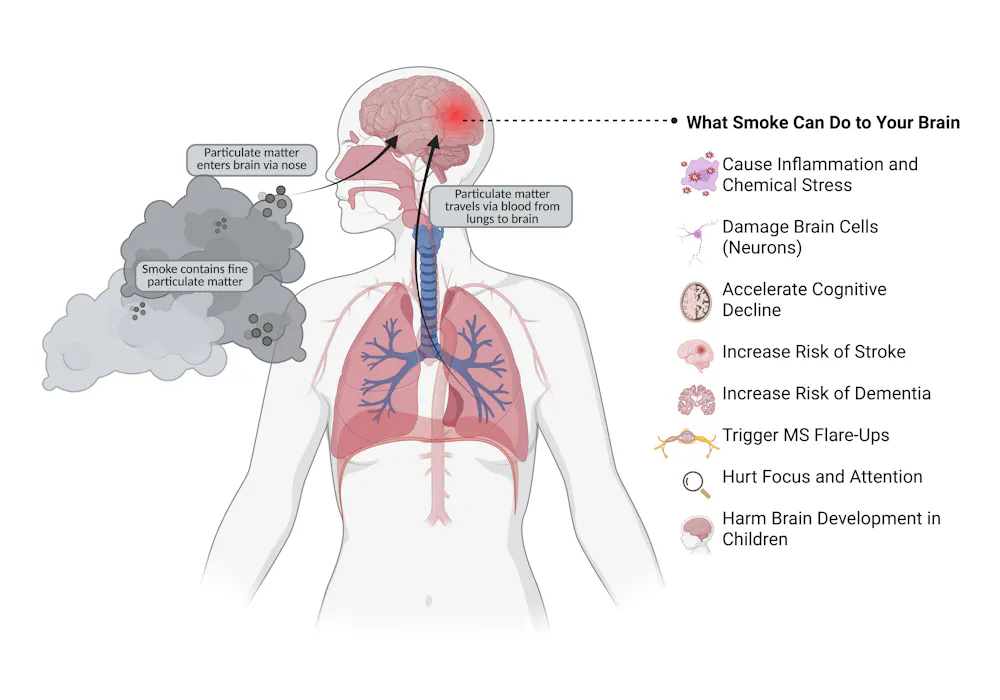
    Alongside harmful gases and heavy metals, wildfire smoke contains fine particulate matter, also known as PM2.5. These tiny particles can travel deep into your lungs, slip into your bloodstream and even reach your brain. Some even bypass the lungs entirely, entering the brain directly through the nose.

    After entering the brain, these toxins can cause inflammation and stress, damage nerve cells and even accelerate cognitive decline. Studies have linked exposure to air pollution to an increased risk of stroke and dementia. Even short-term spikes in smoke exposure, like those during wildfires, lead to a surge in emergency visits for strokes, especially among people over 65.

    A 2022 experiment had thousands of adults participate in an online attention task under smoky conditions. It found that just a three-hour spike in fine particulate matter, typical of a heavy smoke episode, led to measurably worse attention scores. This fits other evidence that breathing smoke makes people mentally foggy, forgetful or fatigued.

    Fine particulate matter in wildfire smoke can reach the brain via the lungs or nose, causing inflammation, neuronal damage, and raising the risk of stroke, dementia, cognitive decline, and MS flare-ups.
    (Muskaan Muse Laroyia)

    Wildfire smoke, dementia and MS

    In 2024, a study found that chronic exposure to wildfire-related air pollution significantly increased the likelihood of someone being diagnosed with dementia. The risk was most pronounced in low-income communities, where people often have less access to clean air, health care and protective measures.

    For people already living with neurological conditions like MS or Parkinson’s disease, the stakes are even higher. Exposure to fine particulate pollution has been linked with increased hospital admissions for MS relapses, particularly in young patients. Other research points to worsening symptoms of epilepsy and cognitive decline under extreme heat and polluted air conditions.

    Despite these mounting risks, neurological health considerations have been largely absent from wildfire preparedness initiatives and public health responses. That needs to change.

    If you want to stay informed about local smoke exposure, tools like AQmap can help you track PM2.5 levels in real time across Canada.

    Some more impacted than others

    Some face far greater risk from wildfire smoke than others, including older adults, those with pre-existing health conditions, people with lower socio-economic status, Indigenous populations, people residing in remote areas and children. This is a health equity issue as much as a medical one.

    Each of these groups faces unique and compounding challenges during smoke events. For example, older adults are more vulnerable to the cardiovascular and neurological effects of smoke. They also face greater barriers to accessing filtered environments.

    People with disabilities or chronic illnesses, including those with neurological conditions, often can’t relocate during smoke events and may rely on power-dependent medical devices that can fail during climate emergencies.

    Low-income families are more likely to live in housing without proper air filtration or cooling. These same communities often face higher baseline rates of neurological disease.

    Indigenous communities, more than 80 per cent of which are located near fire-prone areas, face recurring displacement, interruptions to care and disproportionate exposure to smoke each summer.

    Children and adolescents are particularly susceptible to the harmful neurological effects of wildfires. Because their brains are still developing and they breathe more air per body weight than adults, children are especially vulnerable to harmful pollutants.

    Studies have linked early-life exposure to fine particulate matter with an increased risk of neuro-developmental disorders, lower cognitive function and structural brain changes.

    These populations aren’t just more exposed, they also have fewer resources to respond.

    Rethinking Canada’s health systems

    Recognizing these inequities, we are developing a climate-health equity framework for Canada, with a specific focus on neurological health. Our interdisciplinary team is asking: how can we build health systems that protect vulnerable brains during climate emergencies?

    Health-care workers in Alberta Health Services have designed the Climate-Resilient Acute Care Clinical Operations Framework. This framework supports hospitals in becoming both greener and more resilient, ensuring care can continue during wildfires, floods and extreme heat events.

    Importantly, it also centres the needs of equity-deserving populations, integrating climate adaptation into emergency care, supply chains, staffing and patient communication.

    What needs to change?

    1. Public awareness must expand beyond respiratory health. Neurological effects of smoke should be included in public health messaging, especially for high-risk groups.

    2. Health systems must be climate-ready, with clean air shelters, evacuation protocols and services tailored to meet the needs of neurological patients.

    3. Communities need support, from funding for air filtration to co-ordinated outreach during smoke events. Indigenous-led fire stewardship and community health initiatives should be part of national planning. Supporting Indigenous-led fire stewardship not only strengthens wildfire response but also respects Indigenous sovereignty and traditional ecological knowledge.

    4. Clinicians must be empowered to address climate-related health risks. Training in environmental health, including its impact on the brain, is increasingly essential.

    Wildfire season is back, and with it, an urgent need to protect more than just our lungs. The science is clear: breathing smoky air affects our minds, especially for those already facing health and social vulnerabilities.

    Climate change is a brain health issue. Building a healthier, more equitable future requires us to treat it that way, starting now.

    Dr Bhavini Gohel works for the Canadian Coalition for Green Healthcare.

    Muskaan Muse Laroyia does not work for, consult, own shares in or receive funding from any company or organisation that would benefit from this article, and has disclosed no relevant affiliations beyond their academic appointment.

    ref. Wildfire smoke can harm your brain, not just your lungs – https://theconversation.com/wildfire-smoke-can-harm-your-brain-not-just-your-lungs-258052

    MIL OSI – Global Reports

  • MIL-OSI USA: Assessing the U.S. Climate in May 2025

    Source: US National Oceanographic Data Center

    Key Points:

    • Thirteen states experienced one of their five wettest Mays on record, while dry conditions persisted across much of the Northwest.
    • Two significant severe weather outbreaks on May 15–16 and May 18–20 resulted in over 200 tornado reports, very large hail and damaging winds.
    • Alaska had its second-wettest May on record with exceptionally heavy rainfall in the Southeast.
      Several sites across Hawai`i observed their warmest spring on record.
    • Widespread drought improvement occurred along the East Coast and across much of the Plains.
    Map of the U.S. selected significant climate anomalies and events in May 2025.

    Other Highlights:

    Temperature

    Map of the U.S. showing temperature departures from average for May 2025 with warmer areas in gradients of red and cooler areas in gradients of blue.

    The average temperature for the contiguous U.S. (CONUS) in May 2025 was 61.7°F, 1.5°F above the 20th-century average, ranking in the warmest third of the 131-year period of record. Much of the West, Southwest and Northwest, as well as the northern Rockies and Plains, recorded above-average temperatures. Warmer-than-normal conditions also extended along the southern Gulf Coast from Texas to Florida and up the entire Atlantic seaboard. Florida experienced its second-warmest May on record at 4.0°F above average. In contrast, temperatures across the central U.S. were generally near- to below-average.

    During meteorological spring (March–May) 2025, the CONUS average temperature was 54.1°F, 3.2°F above average, making it the second-warmest spring in the 131-year record. North Carolina recorded its second-warmest spring (3.7°F above average), while Georgia, Louisiana, Maryland, Mississippi and Virginia each matched or exceeded their third-warmest spring on record.

    Alaska’s average temperature for May was 39.0°F, 1.2°F above the long-term average, ranking in the middle third of the 101-year record. For the spring season (March–May), Alaska’s average temperature was 27.7°F, 3.7°F above average, ranking in the warmest third of the historical record.

    Hawai`i was warmer than average in May, with several stations reporting record average temperatures for the month. Spring ranked as the warmest on record at multiple sites, including the Honolulu International and Moloka`i airports.

    Precipitation

    May 2025 U.S. Total Precipitation Percentiles

    The average precipitation across the CONUS in May was 3.63 inches, which is 0.72 inch above the 20th-century average, ranking in the wettest third of the 131-year record. Much of the Southeast and Northeast experienced notably wet conditions, with the Southeast region recording its second-wettest May and the Northeast its third-wettest. Alabama had its wettest May on record—its first with more than 10 inches of rainfall—while Maryland, Pennsylvania, Rhode Island and Vermont each recorded their second wettest. Precipitation was also above average in parts of the Southwest and northern Plains, while drier-than-average conditions prevailed along portions of the Pacific Coast, the Northwest and the upper Mississippi Valley.

    During spring, the CONUS received an average of 8.90 inches of precipitation, 0.97 inch above the long-term average, ranking in the wettest third of the 131-year record. Much-above-average precipitation fell across parts of the southern Plains, South, Ohio Valley and Northeast, as well as in portions of the northern Plains and upper Great Lakes. In contrast, below-average precipitation was observed in parts of the Mountain West, central Plains and across the Florida Peninsula.

    Alaska experienced its second-wettest May on record, largely due to exceptionally heavy rainfall in the Southeast region, where many long-term stations set new monthly precipitation records. Alaska also tied its second-wettest spring on record, despite some parts of the West Coast and western Aleutians being drier than average.

    Drought

    According to the June 3 U.S. Drought Monitor report, about 29.6% of the contiguous U.S. was in drought, a decrease of approximately 7.4% since the end of April. Drought conditions contracted or decreased in intensity along much of the East Coast, from Florida to the Northeast. Improvements were also observed in parts of the Southwest and across sections of the southern, central and northern Plains. In contrast, drought developed or intensified across parts of the Northwest, central Rockies, middle Mississippi Valley and Great Lakes regions. In Hawai`i, drought conditions improved over the western islands but intensified over the Big Island.

    Monthly Outlook

    Above-average temperatures are expected across much of the Lower 48 in June, particularly in parts of the Northwest and Northeast. In contrast, below-average temperatures are favored in Alaska. Lower-than-average precipitation is favored in the Northwest, while wetter-than-average conditions are expected across parts of the Southwest, central Plains and extending into the South and Southeast.

    Drought is expected to persist across much of the Southwest and parts of the central and northern Plains, with additional further development likely in portions of the Pacific West, Northwest and northern Rockies. Some drought improvement is anticipated in parts of Florida and along the Mid-Atlantic Coast.

    Visit the Climate Prediction Center’s Official 30-Day Forecasts and U.S. Monthly Drought Outlook website for more details.

    Significant wildland fire potential  is above normal for June across portions of the Pacific Coast, Northwest and Southwest, as well as parts of the southern Plains, upper Mississippi Valley and Southeast. For additional information on wildland fire potential, visit the National Interagency Fire Center’s One-Month Wildland Fire Outlook.


    For more detailed climate information, check out our comprehensive May 2025 U.S. Climate Report scheduled for release on June 12, 2025. For additional information on the statistics provided here, visit the Climate at a Glance and National Maps webpages.

    MIL OSI USA News

  • MIL-OSI United Kingdom: Major investment brings new life to local play parks across Perth and Kinross

    Source: Scotland – City of Perth

    These projects are a part of the Council’s and Scottish Government’s ongoing play area upgrade programme.

    Four play parks, Langlands Park in Luncarty, The Well Green in Scotlandwell, Westfield Common in Rattray, and Greenloaning, have all undergone full upgrades as part of the council’s commitment to enhancing outdoor spaces for communities. On Friday 6 June, Langlands Park, The Well Green and Westfield Common were officially opened, with community celebrations at each location.

    The upgrades include a wide range of new play equipment and surfacing, designed to make each park more fun, inclusive, and environmentally sustainable.

    These improvements were shaped in partnership with community councils, local schools, and residents, ensuring the new spaces reflect the needs and aspirations of the people who use them most.

    A unique feature of the project is the installation of commemorative boards at each site, combining printed acknowledgements with handwritten signatures from those involved creating a lasting tribute to the community spirit behind the transformation.

    Local children also played a key role, contributing creative ideas, designing logos for park signage, and sharing their hopes for the future of their play spaces through a detailed consultation process.

    Councillor Richard Watters, Convenor of Climate Change and Sustainability Committee said: “We are delighted to see these play parks transformed into vibrant, welcoming spaces for children and families.

    “This investment reflects our ongoing commitment to improving local amenities and supporting healthy, active lifestyles. We hope these parks will be enjoyed by the community for many years to come.”

    Park Highlights

    Westfield Common, Rattray

    Combining a free draining circular pathway, the play areas contain soft fall areas of wood chip. A large climbing net and basket swing provides fun for the older children whilst a multi-unit, roundabout and springies keep the younger children engaged. A zip line also provides family fun on the other side of the greenspace. Coupled with the community run BMX track and MANTALK Blairgowrie garden this greenspace provides facilities for all.

    The Well Green, Scotlandwell

    Includes a thrilling new zip line, monkey bars, swings, and other modern play equipment. Located on the site of a freshwater well, the history of the site is noted in the entrance sign and was once used as an area to dry clothing lines manufactured from locally grown flax.

    Langlands Park, Luncarty

    Features a hybrid grass surfacing that combines artificial and natural grass for a durable, safe play area. Aimed at the younger children, the play area was developed and relocated following consultation with the Community Council and local school. Combining the adjacent route to school with a line-marked cycleway helps provide the opportunity for young children to learn road safety skills at roundabouts and junctions. There is also a ‘hopscotch’ marked on the footway, which we are sure must be used by all age groups, sometimes ‘secretly!’

    Greenloaning

    Located within the greenspace area of a housing estate this facility provides for all the family with picnic benches for family feasts and a range of play equipment for all ages. A rubber surfacing keeps the site useable in all weathers with the play equipment combining a range of vibrant natural colours. The equipment is manufactured from many recycled materials including ‘used fishing nets’ melted down and used in the production for the recycled plastic posts, guaranteed for life. 

    MIL OSI United Kingdom

  • MIL-OSI USA: SPC – No MDs are in effect as of Mon Jun 9 12:02:02 UTC 2025

    Source: US National Oceanic and Atmospheric Administration

    Current Mesoscale DiscussionsUpdated:  Mon Jun 9 12:17:02 UTC 2025 No Mesoscale Discussions are currently in effect.

    Notice:  The responsibility for Heavy Rain Mesoscale Discussions has been transferred to the Weather Prediction Center (WPC) on April 9, 2013. Click here for the Service Change Notice.
    Archived Convective ProductsTo view convective products for a previous day, type in the date you wish to retrieve (e.g. 20040529 for May 29, 2004). Data available since January 1, 2004.

    MIL OSI USA News

  • MIL-OSI USA: YVO’s plan for responding to future geological hazards in Yellowstone National Park

    Source: US Geological Survey

    Yellowstone Caldera Chronicles is a weekly column written by scientists and collaborators of the Yellowstone Volcano Observatory. This week’s contribution is from Michael Poland, geophysicist with the U.S. Geological Survey and Scientist-in-Charge of the Yellowstone Volcano Observatory.

    Cover of the Yellowstone Volcano Observatory response plan for geological hazards in the Yellowstone region.  The report can be accessed at https://pubs.usgs.gov/circ/1351/.  Cover features a photograph by Mike Poland and frame captures from a video by Juliet Su.

    As Benjamin Franklin supposedly said, “failing to plan is planning to fail.”  This is why the Yellowstone Volcano Observatory (YVO) has a plan to guide the observatory’s actions during a response to earthquakes, hydrothermal explosions, or any geological activity that could lead to a volcanic eruption.

    The first YVO response plan was published in 2010 and explained how observatory scientists would collect data, communicate with one another and the public, and interact with emergency managers as part of any incident command system that was organized to deal with a crisis—for example, a major earthquake or volcanic eruption.

    A second version of the YVO response plan was published in 2014 and incorporated changes in the YVO consortium, which expanded in 2013 to include more institutions, as well as lessons learned from a readiness, or “table-top,” exercise that was held in 2011.  Table-top exercises are discussions that simulate a crisis and that are used by emergency responders to practice and evaluate procedures.

    The newest version of the YVO response plan was just published (https://pubs.usgs.gov/circ/1351/).  This update contains several significant modifications compared to the previous versions.

    First and foremost, the YVO response plan now aligns with a procedures established by the USGS Volcano Science Center—particularly the “OVERT,” or Observatory Volcano Event Response Team, concept. OVERT defines critical functions, like data management, communications, monitoring, science, and logistical support, that can be staffed up during a crisis.  The OVERT team can be implemented in stages to follow the nature of whatever volcanic unrest or eruption may be unfolding and is intended to be flexible and modular.  The concept also establishes clear lines of communication and reporting so that no one person has too many responsibilities, and information is shared quickly and openly.

    As an example, if a major seismic swarm were to begin in Yellowstone National Park, YVO might establish an OVERT organizational structure that has staffing for the monitoring and communications teams.  If that seismicity intensified and led to hydrothermal explosions, those teams would be expanded to take on additional responsibilities, and other branches would also be staffed—like those dealing with data documentation and logistics to support field operations. 

    Organization chart giving the structure of a response by the Yellowstone Volcano Observatory to a significant episode of unrest or eruption at the Yellowstone volcanic system. The strategy is scalable (elements are activated as they are needed and deactivated when they are no longer needed) and can be adapted to meet the needs of the event response. Chart follows the Observatory Volcanic Event Response Team structure in the U.S. Geological Survey Volcano Science Center Response Plan for Significant Volcanic Events (Moran and others, 2024—https://pubs.usgs.gov/publication/cir1518). EOC=Emergency Operations Center; UAS=Unoccupied Aircraft Systems; YVO=Yellowstone Volcano Observatory; YVOCOMS=YVO communications group.

    YVO’s updated response plan also defines two different cases: “events” and “activity with potential.” An “event” is a single and sudden hazardous occurrence, like the 1959 M7.3 Hebgen Lake earthquake or the July 23, 2024, hydrothermal explosion at Biscuit Basin, that would prompt YVO to immediately initiate additional monitoring and to communicate hazards information to emergency managers and the public.  Because some geologic hazards evolve slowly, however, YVO’s response plan also defines “activity with potential” that could eventually build towards a hazard that requires intense monitoring.  The 2003 thermal event at Norris Geyser Basin, when ground heated to boiling temperatures in places and caused some boardwalks to be closed and eventually rerouted, is a good example.

    Also included in the response plan are communications protocols and call-down lists that establish robust methods for ensuring that information is passed along to emergency managers at various institutions, like the area land managers and, in the event of an explosive volcanic eruption, the Federal Aviation Administration and National Weather Service.  Additional guidelines describe how YVO consortium members would collaborate to ensure that the public—especially local residents—are informed of hazards that may develop, and steps that can be taken to lessen the impacts of those hazards.

    By developing this response plan, and also putting it into practice—for instance, as part of a table-top exercise that was held for YVO consortium members in 2022—YVO scientists will be better prepared to deal with any future geologic hazards in the Yellowstone region.  Hopefully there will never need to be put the YVO response protocols into practice in response to a serious geologic hazard.  But we must not fail to plan.

    Scientists and collaborators of the Yellowstone Volcano Observatory meet in Mammoth Hot Springs in May 2022 to discuss the protocols for responding to a geological event in Yellowstone National Park.

    MIL OSI USA News

  • MIL-OSI USA: MATSUI, COSTA, AND COLLEAGUES CALL FOR TRUMP ADMINISTRATION TO HALT EFFORTS TO GUT NATIONAL WEATHER SERVICE

    Source: United States House of Representatives – Congresswoman Doris Matsui (D-CA)

    WASHINGTON, D.C. – Congresswoman Doris Matsui (CA-07) and Congressman Jim Costa (CA-21) led a group of 23 lawmakers in a letter to U.S. Department of Commerce (DOC) Secretary Howard Lutnick and Acting National Oceanic and Atmospheric Administration (NOAA) Administrator Laura Grimm, demanding that the Trump Administration restore 24/7 operations at the National Weather Service’s (NWS) Sacramento and Hanford Forecast Offices. 

    It was recently reported that the NWS Sacramento and Hanford Weather Forecast Offices are unable to maintain 24/7 operations due to severe staffing shortages, following layoffs, resignations, and a hiring freeze by the Trump Administration.

    “These service reductions represent the beginning of a public safety crisis with potentially catastrophic consequences if the NWS is unable to retain the staff necessary to maintain around-the-clock weather monitoring in California,” wrote the lawmakers. “Across the state’s airports, highways, farms, and reservoirs, accurate, reliable, and timely weather forecasting is critical for every Californian.” 

    From hurricanes and tornadoes to atmospheric rivers, NWS provides the forecasting necessary to keep Americans safe and prepared for natural disasters. In California, NWS experts are critical for wildfire prediction and water management. NWS also delivers critical services for our farmers, our military, and our critical infrastructure. However, since the Trump Administration took office, over 500 NWS employees have been laid off or pushed into early retirement. Those cuts mean that nearly half of NWS offices have staffing vacancy rates of 20 percent or higher.

    “The National Weather Service is a public safety lifeline and an essential public good. This is not waste or fraud. Americans depend on accurate and timely weather forecasts and alerts not just to plan their day, but to prepare for, and survive, deadly natural disasters,” the lawmakers concluded. “We demand that you immediately reinstate all terminated workers at these offices, lift the federal hiring freeze for NWS, and ensure that the Sacramento and Hanford weather forecast offices are adequately staffed to maintain 24/7 operations.”

    Full text of the letter can be found below or HERE.

    Dear Secretary Lutnick and Acting Administrator Grimm,

    Due to terminations, hiring freezes, and vacancies, the National Weather Service (NWS) recently announced that it would cease 24-hour 7-day-a-week operations at the Sacramento and Hanford Weather Forecast Offices. These service reductions represent the beginning of a public safety crisis with potentially catastrophic consequences if the NWS is unable to retain the staff necessary to maintain around-the-clock weather monitoring in California. Across the state’s airports, highways, farms, and reservoirs, accurate, reliable, and timely weather forecasting is critical for every Californian. We urge immediate action to halt any service interruptions at the Sacramento and Hanford Weather Forecast Offices by reinstating terminated workers and lifting the federal hiring freeze for NWS.

    Across NWS, reports have recently stated that as many as 500 employees have been terminated or taken an early retirement, representing a 12% reduction in staffing since President Trump took office. A recent internal assessment by NWS employees found that nearly half of NWS Weather Forecast Offices had vacancy rates of 20% or higher, a level that represents “critical understaffing.” The Sacramento office currently has seven vacancies for meteorologists, out of 16 positions, while the Hanford office has eight vacancies out of 13 positions—leaving both offices operating at half strength as we approach the peak of wildfire season. Slashing staffing in half at the offices responsible for predicting wildfires, atmospheric rivers, and natural disasters is unacceptable, puts thousands of lives at risk, and does nothing to increase government efficiency.

    Recent years have demonstrated that wildfire season in California is now year-round. In 2024, California saw 8,018 wildfires, burning a total of 1,049,963 acres.4 Since 2013, an average of 1,029,049 acres have burned annually.5 NWS fire weather forecasting plays a critical role in predicting wildfire and protecting the lives of millions of Californians who live in fire prone areas. Incident meteorologists at NWS are often at the frontline to provide information to wildfire managers and first responders to safely contain wildfires.

    The Office of Water Prediction and the National Water Prediction Service also play a critical role in hydrological predictions, in concert with NOAA’s Office of Marine and Aviation Operations. Water managers in California rely on the forecasting expertise of these federal agencies to make reservoir operating decisions. Without the NWS’s expert hydrological forecasters, water managers in California are left blindly guessing and forced to make life-or-death decisions amid the state’s swings between crippling drought and catastrophic flooding.

    The National Weather Service is a public safety lifeline and an essential public good. This is not waste or fraud. Americans depend on accurate and timely weather forecasts and alerts not just to plan their day, but to prepare for, and survive, deadly natural disasters. If the NWS weather forecast offices in Sacramento and Hanford, together covering the entire Central Valley, cannot monitor overnight conditions, that puts our constituents in danger. This is a reckless and unnecessary risk that offers no benefit to the American public. We demand that you immediately reinstate all terminated workers at these offices, lift the federal hiring freeze for NWS, and ensure that the Sacramento and Hanford weather forecast offices are adequately staffed to maintain 24/7 operations. Thank you for your prompt attention to this matter.


    # # #

    MIL OSI USA News

  • MIL-OSI Global: Canada must take action to prevent climate-related migration

    Source: The Conversation – Canada – By Christopher Campbell-Duruflé, Assistant Professor, Lincoln Alexander School of Law, Toronto Metropolitan University

    As wildfire season begins, the destructive impacts of climate change are being felt across Canada. Several communities in northern Saskatchewan have been issued evacuation orders due to wildfires. In Manitoba, Pimicikamak Cree Nation worked to evacuate hundreds of people as wildfires closed in, while smoke from those fires caused air-quality issues across the country.

    It isn’t just wildfires threatening people’s homes and livelihoods. In May, 1,600 residents from the Kashechewan Cree First Nation in Northern Ontario evacuated again due to flooding of the Albany River, which happens almost every year.

    The 2018 United Nations Climate Conference called on all states to adopt “laws, policies and strategies” meant “to avert, minimize and address displacement related to the adverse impacts of climate change.”

    The figures are disquieting. By 2050, more than 140 million people could become internal climate migrants in sub-Saharan Africa, South Asia and Latin America alone, especially if action towards reaching net-zero carbon emissions continues to be insufficient.

    Canada is not spared: 192,000 people were evacuated in 2023 due to disasters made more severe by climate change, including floods and wildfires. As climate change leads to more extreme weather, temporary climate displacement could become permanent migration.

    Climate migration

    The World Bank defines internal climate migration as having to relocate for at least a decade to a location 14 kilometres or more away from your community because of climate impacts.

    Research I presented at the 2025 Canadian Association for Refugee and Forced Migration Studies Conference at Toronto Metropolitan University analyzed how Canada addresses the climate migration challenge in its submissions under the Paris Agreement, which requires parties to adapt to climate change.

    The Canadian government understated the reality of internal climate migration in its submissions under the 2015 Paris Agreement, which obscure the gravity of this phenomenon.

    One of those submissions is the Nationally Determined Contribution (NDC), the cornerstone report each state party must present every five years. Canada’s NDC from 2021 recognizes that climate change harms certain populations more than others, but does not address temporary displacement, let alone internal climate migration.

    The Fort McMurray wildfires displaced more than 80,000 people in 2016, with its population declining 11 per cent between 2015 and 2018. Similarly, the 2019 Québec spring floods displaced more than 10,000 people and, in Sainte-Marie, hundreds of low-income families abandoned the city because they could not afford the reconstructed homes.

    A clear definition of internal climate migrants in Canada, robust data and better co-ordination among Indigenous, municipal, provincial and federal governments is needed.

    This is something a National Adaptation Act could deliver, as a part of a comprehensive framework to bolster adaptation action across the country.

    Transparency lacking

    Canada submitted an adaptation communication in 2024. The communication discusses climate impacts but mentions internal displacement only once. It contains no data or discussion of when displacement becomes permanent, nor does it focus on the disproportionate impact on equity-deserving groups.

    The government submitted an updated NDC earlier this year. It noted “the devastating impact of wildfires, floods, drought and melting permafrost on communities across the country” but only briefly discusses adaptation, referring instead to the 2023 National Adaptation Strategy. The only mentions of displacement come in appended submissions by Indigenous Peoples, including Trʼondëk Hwëchʼin First Nation and Makivvik.

    Indigenous Peoples suffer from flawed adaptation policies and institutional barriers that prevent them from effectively responding to emergencies. As a result, First Nations evacuate 328 times more frequently than settler communities during climate disasters.

    In 2011, for example, officials in Manitoba diverted flood waters to Lake St. Martin to protect urban, cottage and agricultural properties. In the process, they flooded 17 First Nations and displaced 4,525 people. Return of the 1,400 residents of the Lake St. Martin First Nation to a new location only started in 2017, and as recently as 2020 displaced families were protesting on highways for their right to housing.

    A national adaptation act

    Canada should adopt a clear definition of internal climate migrants that captures displacement from climate disasters and slow-onset phenomena like sea-level rise, permafrost thaw and biodiversity loss.

    UN experts released a Technical Guide on Human Mobility in 2024, calling for “a sound evidence base on the patterns and trends, as well as on the drivers and outcomes” of climate-induced mobility. It also highlighted the need for adaptation efforts “that are informed by stakeholder consultations” and “existing (Indigenous) adaptation practices.”

    Defining internal climate migrants would allow Canada to gather robust data at last, and to act decisively on it.

    One first step is the federal government’s pledge of a National Recovery Strategy by 2028, which would set out “shorter time frames for displaced individuals to be able to return to their homes or resettle after climate change disaster events.” But a comprehensive approach is needed to go beyond the fragmented landscape of federal and provincial strategies.

    The Canadian government should work with all stakeholders toward the adoption of a National Adaptation Act, like Brazil, Germany and Japan.

    Such a law could remove barriers to Indigenous adaptation action, co-ordinate efforts across orders of governments to prevent displacements, define internal climate migration, ensure data collection and protect the rights of people temporarily displaced or internally migrating because of climate change.

    It should also aim for greater transparency and accountability than what Canada has so far achieved with its Paris Agreement submissions.

    Christopher Campbell-Duruflé receives funding from the Social Sciences and Humanities Research Council of Canada for his research. He serves on the Legal Committee of the Centre québécois du droit de l’environnement.

    ref. Canada must take action to prevent climate-related migration – https://theconversation.com/canada-must-take-action-to-prevent-climate-related-migration-257607

    MIL OSI – Global Reports

  • MIL-OSI USA: SPC – No MDs are in effect as of Sun Jun 8 07:02:01 UTC 2025

    Source: US National Oceanic and Atmospheric Administration

    Current Mesoscale DiscussionsUpdated:  Sun Jun 8 07:20:03 UTC 2025 No Mesoscale Discussions are currently in effect.

    Notice:  The responsibility for Heavy Rain Mesoscale Discussions has been transferred to the Weather Prediction Center (WPC) on April 9, 2013. Click here for the Service Change Notice.
    Archived Convective ProductsTo view convective products for a previous day, type in the date you wish to retrieve (e.g. 20040529 for May 29, 2004). Data available since January 1, 2004.

    MIL OSI USA News

  • MIL-OSI Canada: Prime Minister Carney announces new parliamentary secretary team

    Source: Government of Canada – Prime Minister

    Today, the Prime Minister, Mark Carney, announced a new parliamentary secretary team focused on building Canada strong.

    Canadians elected this new government with a mandate to define a new economic and security relationship with the United States, to build a stronger economy, to bring down costs, and to keep our communities safe. Parliamentary secretaries will support their respective cabinet ministers and secretaries of state to deliver on this mandate.

    The new parliamentary secretary team is appointed as follows:

    • Karim Bardeesy becomes Parliamentary Secretary to the Minister of Industry
    • Jaime Battiste becomes Parliamentary Secretary to the Minister of Crown-Indigenous Relations
    • Rachel Bendayan becomes Parliamentary Secretary to the Prime Minister
    • Kody Blois becomes Parliamentary Secretary to the Prime Minister
    • Sean Casey becomes Parliamentary Secretary to the Minister of Veterans Affairs and Associate Minister of National Defence
    • Sophie Chatel becomes Parliamentary Secretary to the Minister of Agriculture and Agri-Food
    • Madeleine Chenette becomes Parliamentary Secretary to the Minister of Canadian Identity and Culture and Minister responsible for Official Languages and Parliamentary Secretary to the Secretary of State (Sport)
    • Maggie Chi becomes Parliamentary Secretary to the Minister of Health
    • Leslie Church becomes Parliamentary Secretary to the Secretaries of State for Labour, for Seniors, and for Children and Youth, and Parliamentary Secretary to the Minister of Jobs and Families (Persons with Disabilities)
    • Caroline Desrochers becomes Parliamentary Secretary to the Minister of Housing and Infrastructure
    • Ali Ehsassi becomes Parliamentary Secretary to the President of the King’s Privy Council for Canada and Minister responsible for Canada-U.S. Trade, Intergovernmental Affairs and One Canadian Economy (Canada-U.S. Trade)
    • Mona Fortier becomes Parliamentary Secretary to the Minister of Foreign Affairs
    • Peter Fragiskatos becomes Parliamentary Secretary to the Minister of Immigration, Refugees and Citizenship
    • Vince Gasparro becomes Parliamentary Secretary to the Secretary of State (Combatting Crime)
    • Wade Grant becomes Parliamentary Secretary to the Minister of Environment and Climate Change
    • Claude Guay becomes Parliamentary Secretary to the Minister of Energy and Natural Resources
    • Brendan Hanley becomes Parliamentary Secretary to the Minister of Northern and Arctic Affairs
    • Corey Hogan becomes Parliamentary Secretary to the Minister of Energy and Natural Resources
    • Anthony Housefather becomes Parliamentary Secretary to the Minister of Emergency Management and Community Resilience
    • Mike Kelloway becomes Parliamentary Secretary to the Minister of Transport and Internal Trade
    • Ernie Klassen becomes Parliamentary Secretary to the Minister of Fisheries
    • Annie Koutrakis becomes Parliamentary Secretary to the Minister of Jobs and Families
    • Kevin Lamoureux becomes Parliamentary Secretary to the Leader of the Government in the House of Commons
    • Patricia Lattanzio becomes Parliamentary Secretary to the Minister of Justice and Attorney General of Canada
    • Ginette Lavack becomes Parliamentary Secretary to the Minister of Indigenous Services
    • Carlos Leitao becomes Parliamentary Secretary to the Minister of Industry
    • Tim Louis becomes Parliamentary Secretary to the President of the King’s Privy Council for Canada and Minister responsible for Canada-U.S. Trade, Intergovernmental Affairs and One Canadian Economy (Intergovernmental Affairs and One Canadian Economy)
    • Jennifer McKelvie becomes Parliamentary Secretary to the Minister of Housing and Infrastructure
    • Marie-Gabrielle Ménard becomes Parliamentary Secretary to the Minister of Women and Gender Equality and Secretary of State (Small Business and Tourism)
    • David Myles becomes Parliamentary Secretary to the Minister of Canadian Identity and Culture and Minister responsible for Official Languages and Parliamentary Secretary to the Secretary of State (Nature)
    • Yasir Naqvi becomes Parliamentary Secretary to the Minister of International Trade and Parliamentary Secretary to the Secretary of State (International Development)
    • Taleeb Noormohamed becomes Parliamentary Secretary to the Minister of Artificial Intelligence and Digital Innovation
    • Rob Oliphant becomes Parliamentary Secretary to the Minister of Foreign Affairs
    • Tom Osborne becomes Parliamentary Secretary to the President of the Treasury Board
    • Jacques Ramsay becomes Parliamentary Secretary to the Minister of Public Safety
    • Pauline Rochefort becomes Parliamentary Secretary to the Secretary of State (Rural Development)
    • Sherry Romanado becomes Parliamentary Secretary to the Minister of National Defence
    • Jenna Sudds becomes Parliamentary Secretary to the Minister of Government Transformation, Public Works and Procurement and Parliamentary Secretary to the Secretary of State (Defence Procurement)
    • Ryan Turnbull becomes Parliamentary Secretary to the Minister of Finance and National Revenue and Parliamentary Secretary to the Secretary of State (Canada Revenue Agency and Financial Institutions)

    Prime Minister Carney also announced that Élisabeth Brière will serve as Deputy Chief Government Whip, and Arielle Kayabaga will serve as Deputy Leader of the Government in the House of Commons.

    Quote

    “Canada’s new parliamentary secretary team will deliver on the government’s mandate for change, working collaboratively with all parties in Parliament to build the strongest economy in the G7, advance a new security and economic partnership with the United States, and help Canadians get ahead.”

    Quick Fact

    • Parliamentary secretaries are chosen by the Prime Minister to assist ministers and secretaries of state.

    Associated Link

    MIL OSI Canada News

  • PM Modi calls for global unity to build disaster-resilient infrastructure

    Source: Government of India

    Source: Government of India (4)

    Prime Minister Narendra Modi on Saturday addressed the International Conference on Disaster Resilient Infrastructure (ICDRI) 2025 via videoconferencing, marking the first-ever hosting of the global event in Europe.

    Welcoming participants from around the world, the Prime Minister expressed gratitude to French President Emmanuel Macron and the Government of France for supporting the organization of the conference. He also extended his best wishes for the upcoming United Nations Oceans Conference, linking its objectives with the broader mission of building resilient coastal infrastructure.

    Highlighting this year’s theme, ‘Shaping a Resilient Future for Coastal Regions’, the Prime Minister emphasized the increasing vulnerability of coastal and island regions in the face of climate change and natural disasters. He cited recent examples such as Cyclone Remal in India and Bangladesh, Hurricane Beryl in the Caribbean, Typhoon Yagi in Southeast Asia, Hurricane Helene in the United States, Typhoon Usagi in the Philippines, and Cyclone Chido in parts of Africa as stark reminders of the devastation caused by extreme weather events. These incidents, he said, underscore the urgent need for proactive disaster management and the development of resilient infrastructure.

    Reflecting on India’s own experiences with major natural disasters, including the super-cyclone of 1999 and the tsunami of 2004, PM Modi spoke about how India not only recovered but also laid the groundwork for long-term resilience. The construction of cyclone shelters in vulnerable coastal regions and the establishment of a tsunami warning system that now benefits 29 countries were cited as key achievements in India’s disaster preparedness journey.

    The Prime Minister also praised the ongoing efforts of the Coalition for Disaster Resilient Infrastructure (CDRI), which is currently collaborating with 25 Small Island Developing States to construct robust homes, hospitals, schools, energy systems, and water security solutions. He noted the importance of early warning systems in these efforts and welcomed the active participation of countries from the Pacific, Indian Ocean, and Caribbean regions. The PM also lauded the involvement of the African Union in the coalition’s expanding network.

    PM Modi outlined his vision for global disaster resilience by identifying five key priorities. He called for the integration of disaster resilience education and skill development in higher learning institutions to equip the next generation with the tools needed to tackle future challenges. He proposed the creation of a global digital repository to document and share lessons learned from disaster-hit regions that have rebuilt with resilience.

    Stressing the importance of financial accessibility, the PM advocated for the development of innovative and actionable financing mechanisms to ensure that developing countries can access critical funds for infrastructure. He reiterated India’s recognition of Small Island Developing States as “Large Ocean Countries,” emphasizing the need to focus global attention on their unique vulnerabilities.

    Lastly, PM Modi stressed the critical role of strengthening early warning systems and enhancing coordination to enable timely decisions and ensure that communication effectively reaches the last mile during emergencies.

  • MIL-OSI Europe: Christine Lagarde: Stemming the tide: safeguarding our ocean and economy

    Source: European Central Bank

    Speech by Christine Lagarde, President of the ECB, at the Blue Economy and Finance Forum in Monaco

    Monaco, 7 June 2025

    It is a pleasure to speak at the Blue Economy and Finance Forum.

    In his 1857 poem “Man and the Sea”, Charles Baudelaire explored the deep kinship between the ocean and humanity.[1] For Baudelaire, they were two forces drawn together by awe, fascination, and even conflict.

    Today, that dynamic has taken on a new and troubling dimension. We rely on the ocean for climate stability and economic prosperity, yet we are fuelling a climate crisis that threatens to undermine the very system we depend on. We cannot let that happen.

    Baudelaire described the sea as a “mirror” to the human soul. We now need to take a hard look in that mirror and ask ourselves: what can we do to stem the tide of this crisis, to safeguard our ocean and economy?

    This morning’s two panel discussions will go a long way towards answering that question. But I would like to take this opportunity to open the plenary session with a few thoughts – about what is at stake, and what stakeholders can do about it.

    The ocean’s importance for our climate and economy

    The ocean is home to 95% of the planet’s biosphere.[2] It spans environments as varied as sunlit coral reefs and pitch-black abyssal plains. And it supports an immense range of life, from countless microscopic organisms to the world’s largest animal, the blue whale.

    Given the ocean’s richness, it is worth preserving in its own right. But its value does not end there – the ocean also benefits humanity in two vital ways.

    First, it is one of the planet’s most powerful allies in the fight against climate change.

    The ocean helps to regulate global temperatures by absorbing vast amounts of heat and redistributing it through major currents like the Gulf Stream. It is also the world’s largest carbon sink, reducing the amount of carbon dioxide in the atmosphere and helping to slow global warming.

    The Intergovernmental Panel on Climate Change finds that the ocean has absorbed over 90% of the excess heat trapped in the earth’s system, as well as a third of the carbon dioxide that humans have emitted since the Industrial Revolution.[3]

    Second, a sustainable ocean serves as an important pillar supporting the global economy, providing for food security and economic opportunities.

    Marine ecosystems support over three billion people who rely on fish for at least 20% of their animal protein intake. Indeed, this dependency is more pronounced in some of the least-developed countries, where seafood provides most of the animal protein consumed.[4]

    These ecosystems also help sustain employment opportunities. More than 150 million jobs depend on the production, trade and consumption of ocean-based goods and services, according to the United Nations.[5] The ocean is also home to key natural resources, such as medicines and biofuels, which are vital for ongoing advances in healthcare and clean energy sectors.

    So, there is a great deal at stake in preserving the ocean’s health.

    The threat of climate change

    But today we are placing the sustainability of our ocean under extraordinary stress, with serious implications for both our climate and economy.

    Without the ocean’s capacity to absorb heat and carbon, we would have had to contend with a faster, even more dangerous pace of global warming. Yet there are now signs that this capacity is becoming strained.

    The last ten years were the ocean’s warmest on record. Warmer oceans are driving more frequent marine heatwaves, which damage ecosystems, and have been a major contributor to rising sea levels due to the thermal expansion of seawater. The rate at which the global mean sea level is rising has more than doubled over the past three decades.[6]

    On top of this, the ocean’s absorption of carbon dioxide is driving acidification.

    Combined with ocean warming, acidification is contributing to the bleaching and death of coral reefs, which are vital for supporting fisheries and protecting coastlines from storms. Since 2023 over 80% of the world’s coral reefs have been affected by bleaching.[7]

    We find ourselves in dangerous waters. Together, these changes could have profound consequences for the global economy.

    Food security may be undermined, potentially leading to more volatile prices, which is a concern for central banks tasked with safeguarding price stability. And if coastal areas become unliveable due to rising sea levels or frequent flooding, people may be forced to move. More than 600 million people around the world live in coastal areas that are less than ten metres above sea level.[8]

    Stemming the tide

    So, what can we do to stem the tide of these troubling developments? We may not be able to fully reverse the damage done, but we can work towards slowing its momentum, potentially even stopping it, by acting on two important fronts.

    First, we need to protect. That means cutting greenhouse gas emissions decisively and keeping the goals of the Paris Agreement within reach.

    If we succeed in doing so, we could limit sea level rise to around half a metre by the end of the century. That might not sound reassuring. But every tenth of a degree we avoid is a piece of coastline preserved, a reef protected or a storm surge weakened.

    We also need to protect the natural systems that shield us from floods. Nature-based solutions – for instance, restoring mangroves, marshes and coral reefs – offer powerful, cost-effective defences against extreme weather. Coral reefs alone can reduce wave energy by an average of 97% while supporting fisheries, tourism and coastal livelihoods.[9]

    The second front is just as important: we need to prepare.

    Whether we like it or not, climate-related risks are materialising. We need to adapt our infrastructure and economies to a more volatile world. That includes building sea walls and surge barriers and budgeting for resilience rather than reacting after disaster strikes.

    Make no mistake: adaptation will be costly. According to UN assessments, costs could run into the hundreds of billions of dollars globally each year by mid-century.[10] But the cost of inaction would be far higher. One study estimates that failing to keep global temperatures below two degrees above pre-industrial levels could lead to USD 14 trillion in global annual flood costs by 2100.[11]

    To meet this challenge, we need to catalyse finance for marine and coastal conservation – for instance, through innovative approaches that convert natural capital into financial capital.[12]

    This can be especially impactful for vulnerable countries with limited fiscal space. Above all, we must listen to the communities affected, treating their needs as a basis for our actions rather than an afterthought.

    Let me conclude.

    Baudelaire reminds us that the sea is a mirror of our own nature, which can either heal or harm.

    So, let us choose to heal. That means nurturing the ocean’s rich diversity and facilitating finance to support innovative adaptation measures that build more resilient communities and a stronger global economy.

    Thank you.

    MIL OSI Europe News

  • India calls for global action on extreme heat risk at UNDRR session in Geneva

    Source: Government of India

    Source: Government of India (4)

    Calling extreme heat a “global crisis,” Principal Secretary to the Prime Minister Dr. P. K. Mishra urged coordinated international action during a keynote address at the Special Session on Extreme Heat Risk Governance hosted by the United Nations Office for Disaster Risk Reduction (UNDRR) in Geneva on Thursday.

    Dr. Mishra’s remarks echoed the urgency expressed by the UN Secretary-General, highlighting that rising temperatures now pose a systemic threat to public health, economic stability, and ecological resilience worldwide.

    “Heatwaves are no longer seasonal inconveniences; they are transboundary, systemic risks—especially for densely populated urban areas,” Dr. Mishra said, emphasizing the need for global collaboration on early warning systems, climate-resilient infrastructure, and equity-focused interventions.

    India’s Proactive Heat Risk Management

    Detailing India’s experience, Dr. Mishra said the country has shifted from reactive disaster response to proactive and integrated heat risk management under the leadership of Prime Minister Narendra Modi.

    He noted that since 2016, the National Disaster Management Authority (NDMA) has issued comprehensive national guidelines for heatwave management—revised in 2019—which have enabled decentralized action through Heat Action Plans (HAPs).

    India now has over 250 cities and districts across 23 heat-prone states operating localized HAPs, supported by NDMA’s advisory and technical frameworks. The Ahmedabad Heat Action Plan, a pioneering model, was cited as a successful example of how early warning systems, inter-agency coordination, and community outreach can significantly reduce mortality during heatwaves.

    Whole-of-Government, Whole-of-Society Approach

    Dr. Mishra highlighted India’s “whole-of-government and whole-of-society” strategy, engaging ministries including health, agriculture, urban development, labor, power, education, and infrastructure.

    “Extreme heat deeply impacts communities, and India has actively incorporated traditional wisdom and local experiences into its response,” he said, pointing to the role of schools in spreading climate awareness and of primary health centers in delivering frontline care during heat events.

    India’s response also includes long-term urban resilience measures such as cool roof technologies, passive cooling centers, greening of urban spaces, and the revival of traditional water bodies. Importantly, the integration of Urban Heat Island (UHI) assessments into urban planning is becoming a standard practice in several cities.

    Policy Shift to Enable Funding for Mitigation

    Announcing a major policy shift, Dr. Mishra said that National and State Disaster Mitigation Funds (SDMF) can now be used for heatwave mitigation, allowing local governments, private sector entities, NGOs, and individuals to co-finance adaptation projects. This move, he said, reflects India’s commitment to shared responsibility and community-driven resilience.

    A Call for Global Cooperation

    While acknowledging India’s progress, Dr. Mishra identified key global challenges, including the need for a localized heat-humidity index using real-time data, and the development of affordable, culturally appropriate passive cooling innovations.

    He stressed that vulnerable populations—such as women, outdoor workers, the elderly, and children—are disproportionately impacted by extreme heat, and called for international mechanisms to ensure equitable adaptation.

    Concluding his address, Dr. Mishra affirmed India’s support for the UNDRR’s Common Framework for Extreme Heat Risk Governance, describing it as a vital platform for shared learning, data sharing, institutional capacity building, and joint research.

    “India is fully committed to sharing its expertise, technical capacities, and institutional strengths with global partners,” he said. “We must ensure a resilient, coordinated, and proactive global response to the rising threat of extreme heat.”

  • MIL-OSI USA: Cassidy Announces $14 Million for Hurricanes Ida, Laura Recovery, Wildfire Suppression

    US Senate News:

    Source: United States Senator for Louisiana Bill Cassidy
    WASHINGTON – U.S. Senator Bill Cassidy, M.D. (R-LA) announced Louisiana will receive $14,199,138.08 from the U.S. Federal Emergency Management Agency (FEMA) in reimbursement for building replacements, permanent repairs, and fire suppression efforts following Hurricanes Laura and Ida, and the Tiger Island Fire.
    “When natural disasters threaten lives and homes, Louisiana pulls together,” said Dr. Cassidy, “These dollars support the people and places that keep our state running.”
    Grant Awarded
    Recipient
    Project Description
    $ 3,486,98.90
    St. Nicholas Center for Children
    This grant will provide federal funding for replacement of the main building following Hurricane Laura.
    $3,436,062.30
    City of Sulphur
    This grant will provide federal funding for permanent repairs to the wastewater treatment plant generator system following Hurricane Laura.
    $1,129,735.21
    New Providence Baptist Church
    This grant will provide federal funding for permanent repairs to the main building following Hurricane Laura.
    $1,323,640.80
    South Louisiana Electric Cooperative Association
    This grant will provide federal funding for permanent repairs to the Houma Office Building following Hurricane Ida.
    $2,712,732.84
    South Louisiana Electric Cooperative Association
    This grant will provide federal funding for replacement of the Houma Office Building following Hurricane Ida.
    $1,041,069.96
    Louis Armstrong New Orleans International Airport
    This grant will provide federal funding for permanent repairs to Concourse B – East Terminal following Hurricane Ida.
    $1,068,910.07
    Louisiana Department of Public Safety
    This grant will provide federal funding for fire suppression operations during the Tiger Island Fire.

    MIL OSI USA News

  • MIL-OSI USA: Kennedy announces $18.9 million in Hurricanes Laura, Ida, wildfire aid and generator funding for Louisiana

    US Senate News:

    Source: United States Senator John Kennedy (Louisiana)

    MADISONVILLE, La. – Sen. John Kennedy (R-La.), a member of the Senate Appropriations Committee, today announced $18,901,177 in Federal Emergency Management Agency (FEMA) grants for Louisiana.

    “In the face of hurricanes and wildfires, Louisiana communities prove time and time again that they are the toughest and hardest working out there. This $18.9 million will help our state with the heavy costs of emergency response, mitigation efforts and crucial repairs and replacements,” said Kennedy. 

    The FEMA aid will fund the following:

    • $4,478,132 to the Office of Risk Management for the installation of five permanent generators.
    • $3,486,987 to the St. Nicholas Center for Children in Lake Charles, La. to replace its main building due to Hurricane Laura damage.
    • $3,436,062 to the city of Sulphur, La. to repair its wastewater treatment plant generator system and transfer switch due to Hurricane Laura damage.
    • $2,712,733 to the South Louisiana Electric Cooperative Association to replace its Houma, La. office building due to severe Hurricane Ida damage. 
    • $1,323,641 to the South Louisiana Electric Cooperative Association for the digitization of Hurricane Ida-damaged documents and additional costs.
    • $1,129,735 to the New Providence Baptist Church for repairs to its main building due to Hurricane Laura damage.
    • $1,068,910 to the Louisiana Department of Public Safety for fire suppression operations taken during the Tiger Island Fire.
    • $1,041,070 to the Louis Armstrong New Orleans International Airport for repairs to its east terminal facilities, concourse B and its east terminal-adjacent rental car center due to Hurricane Ida damage. 
    • $223,907 to the Office of Risk Management for management costs associated with generator installation.

    MIL OSI USA News

  • MIL-OSI USA: Tillis Introduces Legislation to Replenish Disaster Relief Fund As North Carolina Prepares For Hurricane Season

    US Senate News:

    Source: United States Senator for North Carolina Thom Tillis

    WASHINGTON, D.C. – With hurricane season officially underway, Senator Thom Tillis (R-NC) has introduced legislation to replenish the Disaster Relief Fund (DRF) to ensure FEMA has the financial resources it needs to respond to natural disasters in the months ahead.

    Tillis’ legislation would provide $25 billion for the DRF, which would fulfill President Trump’s historic DRF funding request for Congress. Since last year, North Carolina has received roughly $4.45 billion from the DRF to respond and recover from Helene. 

    “With Western North Carolina still recovering from Helene and an above-normal hurricane season expected this year, we have to ensure that FEMA has the constant flow of resources it needs to help states respond to natural disasters,” said Senator Tillis. “Congress shouldn’t wait until the last minute, and I’m proud to lead the effort to replenish the DRF and ensure that President Trump’s request is fulfilled so FEMA can focus on its critical mission of helping states and local communities respond to emergencies.” 

    Read the bill HERE.

    Background

    Senator Tillis has been pushing for federal assistance for Western North Carolina since the moment Helene made landfall. 

    On October 1, 2024, Senator Tillis led a bipartisan letter to Senate Appropriations Chair Patty Murray (D-WA) and Vice Chair Susan Collins (R-ME) on the devastation caused by Hurricane Helene and the urgent need to pass an appropriations package to support the millions of Americans affected by the storm.   

    On October 16, 2024, Senator Tillis led a bipartisan group of senators in urging the White House to rapidly submit a government funding request to Congress that will fully cover costs associated with clean-up and recovery following Hurricanes Helene and Milton so that affected communities could begin to heal. The Senators called for Congress to return to Washington from the October in-state work period to approve federal disaster relief legislation.

    On October 23, 2024, The Hill published an op-ed by Senator Tillis addressed to members of Congress to step up and be proactive with long-term disaster recovery assistance.  

    On October 29, 2024, Senator Tillis and his colleagues announced plans to introduce legislation that would replenish the Small Business Administration (SBA) Disaster Loan Program with families and small businesses across WNC unable to get loans approved until then. The Senators outlined their plan to seek passage of the legislation when Congress returned to session.

    On November 14, 2024, Senator Tillis attempted to pass legislation to replenish the SBA Disaster Loan Program through a unanimous consent request on the Senate floor, but was blocked by another Senator.

    On November 15, 2024, Senator Tillis led a bipartisan letter to request that the Office of Management and Budget (OMB) immediately send a supplemental appropriation request to Congress to support the communities we represent, which were devastated after Hurricanes Helene and Milton. The OMB sent the request to Congress a few days later.

    On November 18, 2024, Senator Tillis introduced the standalone RELIEF Act to provide Hurricane relief to small businesses impacted by Hurricane Helene.   

    On November 20, 2024, Senator Tillis called on Congress to quickly pass Hurricane Helene relief during his testimony to the Senate Appropriations Committee. 

    On November 21, 2024, Senator Tillis met with Governor Cooper, Governor-Elect Stein, members of the North Carolina Congressional Delegation and the North Carolina General Assembly, and local leaders from Western North Carolina to discuss efforts to provide federal assistance to North Carolinians affected by the devastation caused by Hurricane Helene. 

    On December 5, 2024, Senator Tillis joined Fox News’ Your World with Neil Cavuto where he discussed the urgent need for Congress to provide federal assistance to North Carolinians affected by the devastation caused by Hurricane Helene.  

    On December 10, 2024, Senator Tillis hosted N.C. Senate President Pro Tempore Phil Berger, N.C. House of Representatives Speaker-elect Destin Hall, State Senators Bill Rabon and Ralph Hise, and State Representative Dudley Greene to discuss efforts to provide immediate assistance to North Carolinians affected by Hurricane Helene’s devastation.  

    On December 18, 2024, Senator Tillis committed to filibustering any continuing resolution that did not include disaster aid for Western North Carolina. 

    On December 21, 2024, Senator Tillis voted to pass a bipartisan government funding bill that included more than $100 billion in disaster relief for states and communities hit by natural disasters, including North Carolina during Hurricane Helene. 

    On January 7, 2025 Senator Tillis announced $1.65 billion in Community Development Block Grant Disaster Recovery (CDBG-DR) funds to help rebuild communities devastated by Hurricane Helene.  

    On January 24, 2025, Senator Tillis released a statement thanking President Trump for his visit to Western North Carolina to survey the devastation left behind by Helene. 

    On January 31, 2025, Senator Tillis introduced the Disaster Mitigation and Tax Parity Act of 2025, legislation that excludes from gross income, for income tax purposes, any qualified catastrophe mitigation payment made under a state-based catastrophe loss mitigation program. 

    On March 11, 2025, Senator Tillis reintroduced the Disaster Assistance Simplification Act, bipartisan legislation to simplify the application process for federal disaster recovery assistance.  

    On April 1, 2025, Senator Tillis sent a letter urging U.S. Secretary of Agriculture Brooke Rollins to work with Congress to quickly distribute the more than $23 billion Congress passed in December to assist farmers, ranchers and rural Americans in responding to devastating natural disasters in 2023 and 2024.

    On April 3, 2025, Senator Tillis (R-NC) introduced the FEMA Independence Act, bipartisan legislation to restore the Federal Emergency Management Agency (FEMA) as an independent cabinet-level agency and improve efficiency in federal emergency response efforts.  

    On April 24, 2025, Senator Tillis introduced the Helene Recovery Small Business Act and the Loans in Our Neighborhoods (LIONs) Act of 2025, legislation that would provide much-needed relief to small businesses as they work to recover from the devastation of Helene.

    On June 4, 2025, Senator Tillis announced he helped secure approximately $1.45 billion in federal funding for disaster-impacted communities, including those in Western North Carolina affected by Helene.

    In addition to Senator Tillis’ legislative efforts the Senator has met with local leaders, residents, and elected officials across Western North Carolina including in: Asheville, Black Mountain, Boone, Burnsville, Canton, Clyde, Fairview, Flat Rock, Hendersonville, Hot Springs, Marshall, Morganton, Spruce Pine, Swannanoa, Waynesville and Wilkesboro.  

    MIL OSI USA News

  • MIL-OSI USA: SBA Offers Disaster Relief to Florida Small Businesses and Private Nonprofits Affected by Hurricane Milton

    Source: United States Small Business Administration

    ATLANTA – The U.S. Small Business Administration (SBA) announced the availability of low interest federal disaster loans to small businesses and private nonprofit (PNP) organizations in Florida who sustained economic losses caused by Hurricane Milton occurring Oct. 9-10, 2024.

    The disaster declaration covers the primary counties of DeSoto, Hardee, Manatee, Sarasota, Seminole and Volusia as well as the adjacent counties of Brevard, Charlotte, Flagler, Glades, Highlands, Hillsborough, Lake, Marion, Orange, Polk and Putnam.

    Under this declaration, the SBA’s Economic Injury Disaster Loan (EIDL) program is available to eligible small businesses, small agricultural cooperatives, nurseries, and PNPs with financial losses directly related to this disaster. The SBA is unable to provide disaster loans to agricultural producers, farmers, or ranchers, except for aquaculture enterprises.

    EIDLs are available for working capital needs caused by the disaster and are available even if the small business or PNP did not suffer any physical damage. The loans may be used to pay fixed debts, payroll, accounts payable, and other bills not paid due to the disaster.

    “Through a declaration by the U.S. Secretary of Agriculture, SBA provides critical financial assistance to help communities recover,” said Chris Stallings, associate administrator of the Office of Disaster Recovery and Resilience at the SBA. “We’re pleased to offer loans to small businesses and private nonprofits impacted by these disasters.”  

    The loan amount can be up to $2 million with interest rates as low as 4% for small businesses and 3.25% for PNPs, with terms up to 30 years. Interest does not accrue, and payments are not due until 12 months from the date of the first loan disbursement. The SBA sets loan amounts and terms based on each applicant’s financial condition.

    To apply online visit sba.gov/disaster. Applicants may also call SBA’s Customer Service Center at (800) 659-2955 or email disastercustomerservice@sba.gov for more information on SBA disaster assistance. For people who are deaf, hard of hearing, or have a speech disability, please dial 7-1-1 to access telecommunications relay services.

    The deadline to return economic injury applications is Jan. 22, 2026.

    ###

    About the U.S. Small Business Administration

    The U.S. Small Business Administration helps power the American dream of business ownership. As the only go-to resource and voice for small businesses backed by the strength of the federal government, the SBA empowers entrepreneurs and small business owners with the resources and support they need to start, grow, expand their businesses, or recover from a declared disaster. It delivers services through an extensive network of SBA field offices and partnerships with public and private organizations. To learn more, visit www.sba.gov. 

    MIL OSI USA News

  • MIL-OSI Africa: Warm weather expected for Comrades 2025 ultramarathon

    Source: South Africa News Agency

    The thousands of runners participating in the Comrades 2025 ultramarathon this weekend can expect predominantly mild to warm and windy conditions, with partly cloudy to cloudy skies.

    On Sunday, 8 June, the 98th edition of the Comrades Marathon will take place between Pietermaritzburg and Durban with as many as 22 677 runners.

    The South African Weather Service (SAWS) has cautioned runners about a cool change in the weather later in the day.

    “… A coastal low and cold front are expected to move northwards up the KwaZulu-Natal coast, introducing colder, more moist conditions to the coast and adjacent interior. 

    “Moreover, there will be a risk of showers or thunderstorms developing over the Drakensberg, spreading to the coast in the evening,” SAWS said on Friday.

    A particularly intense cut-off low system, associated with severe and extreme winter weather, is expected to affect South Africa in the coming days.

    The weather service indicated that this system will begin affecting the Western and Northern Cape early on Saturday morning, 7 June 2025.

    “By Monday, 9 June 2025 and Tuesday, 10 June 2025, this extensive and severe winter weather system will have shifted further east over South Africa, affecting the central and eastern provinces.

    “A significant and dramatic drop in daytime temperatures can be expected over all provinces, with the possible exception of Limpopo. Consequently, farmers of small stock are strongly advised to implement appropriate measures to prevent stock losses due to exposure to bitter cold and wind,” the SAWS said on Thursday.

    The weather service has warned of snowfall over almost every province, with the exception of Limpopo.

    Some of these snowfalls will be disruptive, affecting traffic flow over mountain passes, for example, the N3 highway at Van Reenen’s pass on Monday, 9 June 2025 and Tuesday, 10 June 2025.

    “Given the intensity of the COL system, there is a low probability that Gauteng and the highveld region of Mpumalanga may experience light snowfalls Monday night, 9 June 2025, extending into Tuesday, 10 June 2025. However, at this stage there is significant uncertainty amongst the various numeric weather prediction models in this regard.

    “Heavy rainfall leading to localised flooding and infrastructure damage will be experienced over parts of the Eastern Cape coast and adjacent interior on Sunday, shifting to southern KwaZulu-Natal on Monday,” SAWS said.

    As of Sunday, many provinces will experience bitterly cold daytime conditions, with maximum temperatures unlikely to exceed +10 C. These conditions will be exacerbated by strong, gusty winds.

    Strong, damaging surface winds can be expected over large parts of the interior provinces from Sunday, leading to an elevated risk of wildfires, especially over the central and eastern interior, ahead of the cold change. 

    These extreme conditions are expected to persist over some of the eastern provinces until Wednesday.

    “Strong to near-gale force coastal winds and very rough seas from Friday along the south-west coast, spreading to the south and east coasts during Saturday, and lasting until at least Tuesday along the east coast,” SAWS said. – SAnews.gov.za

    MIL OSI Africa

  • MIL-OSI USA: Regressing into Progress: Remarks before the International Center for Insurance Regulation

    Source: Securities and Exchange Commission

    Thank you, Christian. I appreciate the chance to be part of this event. I must first let you know that my views are my own as a Commissioner and not necessarily those of the U.S. Securities and Exchange Commission (“SEC”) or my fellow Commissioners. Speaking of my views, they may not overlap much with those of Theodor Adorno, the famed early 20th century intellectual whose legacy is so prominent at this university. But his assertion that “progress occurs where it ends”[1] aptly describes my views of much of the global environmental, social, and governance (“ESG”) movement.

    The ESG era, though marketed as progress, has harmed investors, companies, regulators, and society. Nothing is new about companies and investors taking a wide range of factors into account in deciding how to allocate capital. The materiality framework of our U.S. securities regulatory regime elicits disclosure about issues determinative to a company’s long-term financial value, including, when applicable, ESG issues. Our framework distinguishes between what is material to an investment decision and what is not material even though some investors might care deeply about it. Only the former warrants mandatory disclosure.

    The distinctive element that marks this new era is the presumptive categorization of anything bearing the ESG label as inherently material to long-term financial value. In doing so it departs from a near-century-old materiality-based disclosure regime. If ESG is treated as a short-hand for materiality, affixing the ESG label to something automatically justifies using it to drive capital allocation decisions. An ESG label substitutes for hard analysis by companies and investors about how something relates to long-term financial value. The thinking goes that if lots of people in society are talking about “fill-in-the-blank” issue, it needs to factor into all corporate and investor thinking and thus into regulatory mandates. That companies, investors, and their advisors may find certain ESG matters material to their decisions does not justify short-circuiting real analysis of what matters for the long-term financial value of a particular company or a particular investor’s portfolio. The current approach to ESG is harmful because it takes a one-size-fits-all approach to regulation. Instead of capital allocators performing individualized analysis of ESG criteria they are given a box-checking exercise composed of generic metrics and criteria concocted by a hodge-podge of interest groups. As a result, focused financial analysis is burdened by irrelevant and misleading red herrings which may lead to worse financial decisions.

    Let’s start with societal harm. ESG initiatives—even when couched in terms of disclosure—attempt to shift capital flows to uses favored by politicians, regulators, and powerful interest groups as embodied in the taxonomies that drive corporate and investor activity. These favored industries and companies are more likely to correspond to lobbying prowess than to the ability to improve society. Capital diverted to pet projects of the politically powerful is not available for companies working hard to meet people’s genuine needs or to solve society’s most pernicious and pressing problems. As political power shifts, the nature of the favored projects does too. Regardless of whose ESG it is, something other than people’s genuine needs determines who gets capital.

    Regulators, often driven by good intentions, have poured countless hours into devising and implementing ESG frameworks. Central banks, securities regulators, and insurance regulators scour their rule books for ways to inject ESG targets into their regulated entities’ decision-making so that money flows to ESG-positive projects. A sustainability standard setter now sits alongside the international accounting standard setter, which may lead to unwarranted confidence in the sustainability standards and unwanted degradation of the accounting standards.[2] International organizations of regulators have packed their agendas with ESG work streams. Regulators’ other responsibilities have suffered from the attention given to ESG. The climate rule, for example, consumed a tremendous amount of time and resources that could have been devoted to modernizing the disclosure rulebook. And bank regulators’ focus on climate risk may obscure other risks, such as interest rate risk.[3]

    The time and money regulators spend on ESG pales in comparison to what companies have spent. ESG initiatives coming from every level of government and reinforced by grifting, silver-tongued sustainability sirens consume tremendous amounts of corporate resources. Employees across the organization spend time collecting and analyzing ESG data—time which otherwise would be directed toward corporate value maximization. A growing list of ESG issues—amplified by proxy advisors, shareholder proponents, and ESG rating organizations—also demand the time and attention of boards and managers. ESG considerations influence product and supplier choices to the detriment of a company’s long-term value.

    Investors also have suffered from the ESG obsession. Most significantly, if ESG targets supplement financial goals for companies, holding company managers accountable for their performance may be difficult. Managers can claim success based on one of the company’s ESG metrics even if the company has failed to meet its goals related to maximizing the long-term value of the company. Further interfering with accountability, investors may find it hard to locate material information in disclosures brimming with mandated ESG items. So much for Plain English initiatives designed to make disclosure documents easier to read! As just one example in the decline of readability, from 1997 to 2017 the average length of an annual report has grown by almost 200%[4]. These lengthy disclosures are time-consuming and distracting to prepare and give ample fodder for costly shareholder class action litigation and SEC enforcement actions. In one recent case, a throwaway line about the recyclability of coffee capsules led to a $1.5 million penalty.[5] Increasing disclosure increases litigation risk. Shareholders foot the bill for non-litigation costs too. Besides aspiring plaintiffs, an ever growing outside industry of advisers, consultants, accountants, and attorneys who help companies prepare ESG disclosures and defend them in litigation are eager to take their cut. In addition, shareholders incur costs imposed by their fellow shareholders who submit proposals for inclusion on corporate proxies. These proposals increasingly focus on environmental and social issues rather than governance issues with a direct connection to financial returns, such as the presence of staggered boards and poison pills. Proponents, who come from both sides of the political spectrum and often own only a tiny percentage of company shares, impose large costs on companies. Even if the proposal never makes it to the proxy, it can serve as an express ticket to special backroom negotiations with company management. Companies, with the help of attorneys, process and analyze the requests and sometimes make quiet concessions to the proponents that may be wholly unrelated to—and might be directly deleterious to—the company’s long-term financial value. Even worse, shareholders often have no idea these deals are even taking place.

    Recognizing the dangers of an unthinking embrace of everything ESG, the United States at multiple levels, has paused to assess its approach. States have raised questions about how asset managers are taking ESG objectives into consideration in managing state investment portfolios. A knee-jerk prohibition on considering anything that might be categorized as ESG could impede legitimate investment analysis. But asking asset managers to be clear about what is driving their investment decisions can help to ensure that asset managers are fulfilling their fiduciary responsibility to their clients.

    Change also is happening at the federal level. The U.S. Department of Labor will engage in new rulemaking to rescind ESG rules adopted under the prior administration.[6] The SEC’s signature ESG rulemaking faces a court challenge against which the current SEC has decided not to defend,[7] and other ESG initiatives, such as an ESG proposal for investment advisers, have lost steam. Earlier this year, Commission staff rescinded guidance that had made it easier for certain investors and their representatives to inundate companies with proposals that had nothing to do with the company receiving them. In rescinding this guidance, the staff returned to an analysis that considers the “policy issue raised by the proposal and its significance in relation to the company.”[8] This change should help prevent shareholder proponents from forcing companies to focus on ESG issues that are wholly unrelated to their business. To help prevent a shift back to ESG as an excuse for a disclosure mandate, I recommend embedding in the SEC rulebook an explicit commitment to materiality as the governor of disclosure mandates. This commitment is consistent with statute.[9] To complement such a rulemaking, the Commission could undertake a project, as appropriate, to remove from the SEC rulebook or modify any disclosure mandates that are not rooted in materiality.

    Europe too seems to be looking at its ESG regulatory framework with an eye toward streamlining it. Absent such streamlining, Europe could suffer economically. Also worthy of reconsideration is the direct and indirect imposition of Europe’s ESG mandates and regulations on American companies either because they have some European presence or have as investors European asset managers seeking to satisfy their own ESG mandates. These extraterritorial efforts threaten to spread economic malaise globally. International organizations would do well to work as hard to dismantle the ESG regulatory edifice as they have in building it.

    I look forward to a lively upcoming conversation. In this exchange of ideas, I hope that we can honor the legacy of Doktor Adorno in terms that are accessible to people like me who are not steeped in the erudite political, artistic, and philosophical discourse that flowed so readily from his pen.


    [1] Theodor W. Adorno, Progress, in Critical Models: Interventions and Catchwords 150, 143-60 (Henry W. Pickford trans., Columbia Univ. Press 2005).

    [3] See e.g. Governor Michelle W. Bowman, Statement on Principles for Climate-Related Financial Risk Management for Large Financial Institutions (Oct. 24, 2023), https://federalreserve.gov/newsevents/pressreleases/bowman-statement-20231024b.htm (“The lessons learned from supervisory failures during the bank stress in the spring clearly illustrate that bank examiners and bank management should focus on core issues, like credit risk, interest rate risk, and liquidity risk. Today’s guidance could ultimately distract attention and resources from these core risks.”).

    [4] Danny Lesmy, Lev Muchnik and Yevgeny Mugerman, Doyoureadme? Temporal Trends in the Language Complexity of Financial Reporting, SSRN Elec. J. 4 (Sept. 2019), https://ssrn.com/abstract=3469073.

    [9] See, e.g., Andrew Vollmer, Part 1: Reasons a Court Should Find that the SEC Lacked Legal Authority for the Climate-Change Disclosure Rules (Apr. 29, 2024), https://www.finregrag.com/p/reasons-a-court-should-find-that (“The statutory context of the Securities Act and the Securities Exchange Act limits the SEC’s power to issue disclosure rules to specific types of information about the disclosing company’s business, finances, and securities that bear on investment returns.”); Sean J. Griffith, What’s “Controversial” About ESG? A Theory of Compelled Commercial Speech under the First Amendment, 101 Neb. L. Rev. 876, 923 (2023), https://papers.ssrn.com/sol3/papers.cfm?abstract_id=4118755# (“The disclosure of financial material under an investor protection rationale must therefore be bounded by a baseline principle of relevance. Fortunately, securities law contains such a principle in the concept of materiality. . . . Using the concept of materiality as a guide to relevance suggests that in order to be justified under the investor protection rationale, mandatory disclosures must have a clear and plausible relationship to the financial return of the investment. Speculative or uncertain information would not meet this standard. Information that is immaterial . . . imposes a cost on investors.”).

    MIL OSI USA News

  • MIL-OSI USA: June 5th, 2025 Heinrich Slams DOGE Attacks on USGS Scientists and Budget Cuts in Letter to Interior Department Secretary

    US Senate News:

    Source: United States Senator for New Mexico Martin Heinrich
    WASHINGTON — Today, U.S. Senator Martin Heinrich, Ranking Member on the Senate Committee of Energy and Natural Resources sent a letter to U.S. Secretary of the Interior Doug Burgum expressing his grave concern surrounding the Trump Administration’s assault on the Department’s science agency, the U.S. Geological Survey (USGS). The letter highlights President Trump’s proposed budget cuts on the USGS, and the “Department of Government Efficiency” (DOGE) reported planned terminations of hundreds of scientists and potential termination of USGS centers’ leases across the country as threats to our nation’s scientists, public safety responsibilities and operational continuity of the agency.
    In addition to Heinrich, U.S. Senators Tammy Baldwin (D-Wis.), Michael Bennet (D-Colo.), Richard Blumenthal (D-Conn.), Tammy Duckworth (D-Ill.), Kirsten Gillibrand (D-N.), John Hickenlooper (D-Colo.), Mazie Hirono (D-Hawaii), Tim Kaine (D-Va.), Angus King (I-Maine), Amy Klobuchar (D-Minn.), Jeff Merkley (D-Ore.), Patty Murray (D-Wash.), Gary Peters (D-Mich.), Jeanne Shaheen (D-N.H.), Tina Smith (D-Minn.), Chris Van Hollen (D-Md.), Mark Warner (D-Va.), and Ron Wyden (D-Ore.) signed the letter.
    The senators opened the letter, “We write to express concern over recent and proposed actions by the Department of Government Efficiency (DOGE) and broader administrative decisions that together threaten the integrity and continuity of the U.S. Geological Survey (USGS).” The senators continued, “Specifically, the potential termination of General Services Administration (GSA) leases supporting USGS centers across the country— alongside USGS’s proposed FY2026 budget cut of $564 million and the reported planned terminations of hundreds of scientists—represents a multi-front assault on the nation’s scientific infrastructure.”
    Emphasizing the critical role USGS plays in monitoring and analyzing the nation’s resources, the senators highlighted, “USGS’s work underpins the ability of federal, state, and local governments, Tribal nations, industry, and communities tomake informed decisions—particularly in areas such as disaster preparedness, climate adaptation, water resource management, andecosystem protection,” the senators wrote.
    Stressing the impacts of cuts to USGS, “These proposed budgetcuts could mean abandoning research and monitoring that helps farmers guard against wildlife diseases like avian flu, delaying when real-time water and hazard data is provided for disaster response, and ending collaborations that monitor invasive species, harmful algal blooms and wildfire risks,” the senators wrote.
    “The scientific integrity, public safety responsibilities, andoperational continuity of the USGS must not be compromised by administration actions taken without proper oversight or consultation,” stated the senators.
    The senators highlighted the threat that the potential termination of USGS leases pose, many of which house Water Science Centers, Climate Adaptation Science Centers, and Ecosystems Research Centers, “These facilities provide critical support to states, local communities, and Tribal Nations as they confront unprecedented drought, wildfires, habitat loss, and other climate-related disruptions”
    “While DOGE’s actions are framed as efficiency measures, the potential impact of terminating these leases – without transparent criteria or coordination – as well as slashing $564 million from the budget and crippling of the scientific workforce raises serious questions about continuity of operations. If implemented, these changes to USGS would directly impair the federal government’s ability to assess and respond to threats in real time,” stressed the senators.
    The senators concluded the letter by asking the Department of the Interior to respond to questions outlining the far-reaching implications of these actions by June 19, 2025.
    Read the full text of the letter here and below:
     Dear Secretary Burgum,
    We write to express concern over recent and proposed actions by the Department of Government Efficiency (DOGE) and broader administrative decisions that together threaten the integrity andcontinuity of the U.S. Geological Survey (USGS). Specifically, the potential termination of General Services Administration (GSA) leases supporting USGS centers across the country— alongsideUSGS’s proposed FY2026 budget cut of $564 million and the reported planned terminations of hundreds of scientists—represents a multi-front assault on the nation’s scientific infrastructure.
    The USGS is a premier science agency with a critical role inmonitoring and analyzing the nation’s resources, including water, ecosystems, natural hazards, minerals, and energy. Its scientific expertise and robust data collection efforts support public safety, environmental stewardship, and national economic resilience. USGS’s work underpins the ability of federal, state, and local governments, Tribal nations, industry, and communities to make informed decisions—particularly in areas such as disaster preparedness, climate adaptation, water resource management, and ecosystem protection.
    The proposed budget cuts are not about “efficiency”— they represent a retreat from federal responsibility and a dismantling of the scientific infrastructure that communities, industries, andgovernments depend on every day. USGS supports work that directly protects public health, strengthens our economy, andinforms disaster preparedness and response. These proposed budget cuts could mean abandoning research and monitoring that helps farmers guard against wildlife diseases like avian flu, delaying when real-time water and hazard data is provided for disaster response, and ending collaborations that monitor invasive species, harmful algal blooms and wildfire risks. While these impacts are not yet certain, they represent serious risks for communities, Tribes, state and local governments, and natural resource managers who depend on USGS science to make informed, often life-saving decisions. As demonstrated throughout its nearly 150 years of existence, USGS science is not optional; it is essential.
    The potential termination of USGS leases, many of which house Water Science Centers, Climate Adaptation Science Centers, andEcosystems Research Centers, threatens regional scientific capacity at a time when local expertise and place-based science are most needed. These facilities provide critical support to states, local communities, and Tribal Nations as they confront unprecedented drought, wildfires, habitat loss, and other climate-related disruptions. Reliable Page 2 scientific information is essential toboth our national economy and the safety of communities across the country.
    While DOGE’s actions are framed as efficiency measures, the potential impact of terminating these leases – without transparent criteria or coordination – as well as slashing $564 million from the budget and crippling of the scientific workforce raises serious questions about continuity of operations. If implemented, these changes to USGS would directly impair the federal government’s ability to assess and respond to threats in real time.
    Given this uncertainty and the far-reaching implications of these actions, we request immediate clarity on the following by June 19, 2025:
    1. What is the current status of all USGS leases and what facilities are at risk of lease termination?
    2. What criteria were used to select these leases for potential termination, and how was USGS consulted in this process?
    3. What plans are in place to ensure uninterrupted mission support—particularly for key activities under the Water Resources, Natural Hazards, and Ecosystems Mission Areas— if these facilities are closed?
    4. Where will affected employees be relocated, and how will critical field and lab operations be maintained in the interim?
    5. How will USGS ensure that existing commitments to state andlocal governments, tribal partners, and other stakeholders are honored, particularly for time-sensitive water data and hazard alerts?
    6. What USGS staff positions are on the list for termination (please include title and location)? When will the terminations be implemented?
    7. Do any of the USGS employees on the list for termination have salaries funded by reimbursable contracts with external partners? If so, how many such employees are affected, and what is the amount of federal savings that would be generated from their termination?
    8. Given the planned reduction in force, how will existing staff fill the gaps in order to fulfill the USGS mission?
    9. What programs will be eliminated by the $564 million proposed budget cut?
    The scientific integrity, public safety responsibilities, andoperational continuity of the USGS must not be compromised by administrative actions taken without proper oversight or consultation. We appreciate your attention to this matter and look forward to your prompt response.
    Sincerely,

    MIL OSI USA News

  • MIL-OSI USA: SPC Tornado Watch 376 Status Reports

    Source: US National Oceanic and Atmospheric Administration

    Search by city or zip code. Press enter or select the go button to submit request
    Local forecast by”City, St” or “ZIP” 

    SPC on Facebook

    @NWSSPC

    NCEP Quarterly Newsletter

    Home (Classic)SPC Products   All SPC Forecasts   Current Watches   Meso. Discussions   Conv. Outlooks   Tstm. Outlooks   Fire Wx Outlooks     RSS Feeds   E-Mail AlertsWeather Information   Storm Reports   Storm Reports Dev.   NWS Hazards Map   National RADAR   Product Archive   NOAA Weather RadioResearch   Non-op. Products   Forecast Tools   Svr. Tstm. Events   SPC Publications   SPC-NSSL HWTEducation & Outreach   About the SPC   SPC FAQ   About Tornadoes   About Derechos   Video Lecture Series   WCM Page   Enh. Fujita Page   Our History   Public ToursMisc.   StaffContact Us   SPC Feedback

    Watch 376 Status Reports

    Watch 376 Status Message has not been issued yet.

    Top/Watch Issuance Text for Watch 376/All Current Watches/Forecast Products/Home

    Weather Topics:Watches, Mesoscale Discussions, Outlooks, Fire Weather, All Products, Contact Us

    NOAA / National Weather ServiceNational Centers for Environmental PredictionStorm Prediction Center120 David L. Boren Blvd.Norman, OK 73072 U.S.A.spc.feedback@noaa.govPage last modified: June 06, 2025
    DisclaimerInformation QualityHelpGlossary
    Privacy PolicyFreedom of Information Act (FOIA)About UsCareer Opportunities

    MIL OSI USA News