Category: Weather

  • MIL-OSI Security: Milwaukee Woman Sentenced to 15 Years in Federal Prison for Production of Child Pornography

    Source: US FBI

    Richard G. Frohling, Acting United States Attorney for the Eastern District of Wisconsin, announced that on June 3, 2025, Chasity Evans (age 38, of Milwaukee, Wisconsin, and Ripley, Tennessee) was sentenced to 15 years in federal prison by U.S. District Judge Lynn Adelman for her role in the production of child sexual abuse material (CSAM, or child pornography), in violation of Title 18, United States Code, Sections 2251(a), 2251(e), and 2(a).

    According to court records, Evans created child pornography using a minor child, which she then distributed and sold to her co-defendant via cell phone, in exchange for nominal sums of money via Cash App. The criminal conduct occurred on multiple occasions between February 2023 and June 2023, while Evans was a resident of Milwaukee and the Memphis, Tennessee, area. The child was between the ages of 11 and 12 during the production of the CSAM.

    Following her term of imprisonment, Evans also will spend five years on supervised release. She will also have to register as a sex offender under state and federal law.

    The Federal Bureau of Investigation (Milwaukee, Wisconsin, and Memphis, Tennessee, field offices) investigated this case, with the assistance of the Lauderdale County Sheriff’s Office. It was prosecuted by Assistant United States Attorney Abbey M. Marzick.

    ###

    For further information contact:

    Public Information Officer

    Kenneth.Gales@usdoj.gov

    (414) 297-1700

    Follow us on Twitter

    MIL Security OSI

  • MIL-OSI: ESFI Urges Emergency Preparedness Ahead of 2025 Hurricane Season

    Source: GlobeNewswire (MIL-OSI)

    ARLINGTON, Va., June 05, 2025 (GLOBE NEWSWIRE) — As life-threatening storms continue to strike with increasing frequency and severity year over year, a growing number of people will be impacted by hurricanes, lightning, tornadoes, and other hazards. Preliminary hurricane forecasting indicates another above-average hurricane season in 2025.

    Post-storm electrical hazards are frequently responsible for deaths and injuries during the summer months. The high winds, extreme rains, and devastating flooding caused by hurricanes and tornadoes present unique electrical dangers, and those living in affected areas should be aware of these hazards to keep themselves safe.

    The Electrical Safety Foundation International (ESFI) has published numerous materials in recent years educating the public on how to prepare for hurricanes and other severe storms. This release provides safety tips related to hurricanes, flooding, portable generators, and lightning.

    Hurricane and Flooding Safety

    Hurricane season in the U.S. runs from June through November and most significantly impacts coastal southeastern U.S. states. Flooding is a concern associated with hurricanes but is not limited to hurricane events or coastal areas. Flooding can occur anywhere, and all 50 U.S. states have experienced floods or flash floods in the past five years. Water and electricity do not mix, but there are precautions you can take to stay safe before, during, and after a hurricane, severe storm, or flood:

    • Before a storm, follow directives, if any, to turn off your home’s utilities. If you are advised to switch off your home’s power, flip each breaker and then turn off the main breaker. Charge cell phones and other communication devices and unplug electronics and move them as high as possible from the floor.
    • Always use ground fault circuit interrupters (GFCIs) in areas where water and electricity may come into contact.
    • During a storm, do not enter flooded areas until they are determined safe by a professional. Submerged outlets or electrical cords may energize standing water. Similarly, do not go near downed power lines, especially if there is standing water nearby. Always assume downed power lines are live.
    • After a storm, if your home has experienced flooding, keep the power off until an electrician has inspected your system for safety, including appliances that have been wet.

    Portable Generator Safety

    Portable generators can be a useful resource in weathering a storm but can create new hazards if operated incorrectly. Here are tips on how to avoid electric shock and carbon monoxide (CO) poisoning:

    • Always keep generators outside at least 20 feet away from your home and never operate a generator in an enclosed space. Keep generators away from doors, windows, and vents. Make sure your home has CO alarms outside each sleeping area and on every level of the home. If you experience CO poisoning symptoms, leave the premises immediately and call 911.
    • Always use grounded cords and inspect cords for damage prior to use. Keep generators dry and do not operate when wet.
    • Do not overload generators, and do not plug a generator directly into your home. Connect items being powered directly to the generator.
    • Transfer switches are the only way to safely power your home’s electrical system. Using a transfer switch prevents backfeeding. This occurs when your generator becomes a power source for the surrounding area. Backfeeding can damage your and your neighbors’ homes and injure workers trying to restore power.

    Lightning Safety

    While direct outdoor strikes from lightning are responsible for the majority of lightning deaths and injuries, lightning can pose risks to people inside homes or other buildings. Direct or nearby lightning strikes can overwhelm a building’s electrical systems and cause damaging surges. Follow these tips to protect yourself and your property in the event of lightning:

    • Surge protective devices (SPDs) are the first line of defense against home electrical surges, and Type 1 SPDs can protect your electrical system in the case of nearby lightning.
    • During a lightning event, avoid making contact with anything connected to your home’s wiring or plumbing systems.

    ABOUT ESFI

    The mission of the Electrical Safety Foundation International (ESFI) is to reduce electrical deaths, injuries, and fires through public education and outreach and by being the trusted voice on electrical safety. For free safety materials that you can share throughout your community, visit esfi.org.

    Contact:
    Evan Jones
    Electrical Safety Foundation International
    703.841.3247
    evan.jones@esfi.org

    The MIL Network

  • MIL-OSI Canada: Prime Minister announces new parliamentary secretary team

    Source: Government of Canada – Prime Minister

    Today, the Prime Minister, Mark Carney, announced a new parliamentary secretary team focused on building Canada strong.

    Canadians elected this new government with a mandate to define a new economic and security relationship with the United States, to build a stronger economy, to bring down costs, and to keep our communities safe. Parliamentary secretaries will support their respective cabinet ministers and secretaries of state to deliver on this mandate.

    The new parliamentary secretary team is appointed as follows:

    • Karim Bardeesy becomes Parliamentary Secretary to the Minister of Industry
    • Jaime Battiste becomes Parliamentary Secretary to the Minister of Crown-Indigenous Relations
    • Rachel Bendayan becomes Parliamentary Secretary to the Prime Minister
    • Kody Blois becomes Parliamentary Secretary to the Prime Minister
    • Sean Casey becomes Parliamentary Secretary to the Minister of Veterans Affairs and Associate Minister of National Defence
    • Sophie Chatel becomes Parliamentary Secretary to the Minister of Agriculture and Agri-Food
    • Madeleine Chenette becomes Parliamentary Secretary to the Minister of Canadian Identity and Culture and Minister responsible for Official Languages and Parliamentary Secretary to the Secretary of State (Sport)
    • Maggie Chi becomes Parliamentary Secretary to the Minister of Health
    • Leslie Church becomes Parliamentary Secretary to the Secretaries of State for Labour, for Seniors, and for Children and Youth, and Parliamentary Secretary to the Minister of Jobs and Families (Persons with Disabilities)
    • Caroline Desrochers becomes Parliamentary Secretary to the Minister of Housing and Infrastructure
    • Ali Ehsassi becomes Parliamentary Secretary to the President of the King’s Privy Council for Canada and Minister responsible for Canada-U.S. Trade, Intergovernmental Affairs and One Canadian Economy (Canada-U.S. Trade)
    • Mona Fortier becomes Parliamentary Secretary to the Minister of Foreign Affairs
    • Peter Fragiskatos becomes Parliamentary Secretary to the Minister of Immigration, Refugees and Citizenship
    • Vince Gasparro becomes Parliamentary Secretary to the Secretary of State (Combatting Crime)
    • Wade Grant becomes Parliamentary Secretary to the Minister of Environment and Climate Change
    • Claude Guay becomes Parliamentary Secretary to the Minister of Energy and Natural Resources
    • Brendan Hanley becomes Parliamentary Secretary to the Minister of Northern and Arctic Affairs
    • Corey Hogan becomes Parliamentary Secretary to the Minister of Energy and Natural Resources
    • Anthony Housefather becomes Parliamentary Secretary to the Minister of Emergency Management and Community Resilience
    • Mike Kelloway becomes Parliamentary Secretary to the Minister of Transport and Internal Trade
    • Ernie Klassen becomes Parliamentary Secretary to the Minister of Fisheries
    • Annie Koutrakis becomes Parliamentary Secretary to the Minister of Jobs and Families
    • Kevin Lamoureux becomes Parliamentary Secretary to the Leader of the Government in the House of Commons
    • Patricia Lattanzio becomes Parliamentary Secretary to the Minister of Justice and Attorney General of Canada
    • Ginette Lavack becomes Parliamentary Secretary to the Minister of Indigenous Services
    • Carlos Leitao becomes Parliamentary Secretary to the Minister of Industry
    • Tim Louis becomes Parliamentary Secretary to the President of the King’s Privy Council for Canada and Minister responsible for Canada-U.S. Trade, Intergovernmental Affairs and One Canadian Economy (Intergovernmental Affairs and One Canadian Economy)
    • Jennifer McKelvie becomes Parliamentary Secretary to the Minister of Housing and Infrastructure
    • Marie-Gabrielle Ménard becomes Parliamentary Secretary to the Minister of Women and Gender Equality and Secretary of State (Small Business and Tourism)
    • David Myles becomes Parliamentary Secretary to the Minister of Canadian Identity and Culture and Minister responsible for Official Languages and Parliamentary Secretary to the Secretary of State (Nature)
    • Yasir Naqvi becomes Parliamentary Secretary to the Minister of International Trade and Parliamentary Secretary to the Secretary of State (International Development)
    • Taleeb Noormohamed becomes Parliamentary Secretary to the Minister of Artificial Intelligence and Digital Innovation
    • Rob Oliphant becomes Parliamentary Secretary to the Minister of Foreign Affairs
    • Tom Osborne becomes Parliamentary Secretary to the President of the Treasury Board
    • Jacques Ramsay becomes Parliamentary Secretary to the Minister of Public Safety
    • Pauline Rochefort becomes Parliamentary Secretary to the Secretary of State (Rural Development)
    • Sherry Romanado becomes Parliamentary Secretary to the Minister of National Defence
    • Jenna Sudds becomes Parliamentary Secretary to the Minister of Government Transformation, Public Works and Procurement and Parliamentary Secretary to the Secretary of State (Defence Procurement)
    • Ryan Turnbull becomes Parliamentary Secretary to the Minister of Finance and National Revenue and Parliamentary Secretary to the Secretary of State (Canada Revenue Agency and Financial Institutions)

    Prime Minister Carney also announced that Élisabeth Brière will serve as Deputy Chief Government Whip, and Arielle Kayabaga will serve as Deputy Leader of the Government in the House of Commons.

    Quote

    “Canada’s new parliamentary secretary team will deliver on the government’s mandate for change, working collaboratively with all parties in Parliament to build the strongest economy in the G7, advance a new security and economic partnership with the United States, and help Canadians get ahead.”

    Quick Fact

    • Parliamentary secretaries are chosen by the Prime Minister to assist ministers and secretaries of state.

    Associated Link

    MIL OSI Canada News

  • MIL-OSI Africa: SA’s plan to shield coastal assets from climate change

    Source: South Africa News Agency

    With the impact of climate change intensifying globally, government has launched a plan that aims to effectively manage South Africa’s coastal assets.

    This as the country’s coastline or coastal cities are at the frontline of climate change, facing severe and multifaceted complexities that threaten livelihoods, communities, economies, infrastructure, and ecosystems.

    “With climate change projected to increase the frequency and intensity of coastal storms, accelerate sea-level rise, and compound vulnerabilities due to population growth, the risks to infrastructure and ecosystems are escalating. 

    “Our coastal future rests on our ability to innovate and to act with unity and urgency. By investing in nature-based solutions, strengthening climate governance, and unlocking sustainable finance, we can shield our people and ecosystems from the harshest impacts of climate change,” Minister of Forestry, Fisheries and the Environment Dr Dion George said on Thursday in Pretoria.

    The Climate Change Coastal Adaptation Response Plan builds on the National Coastal Management Programme – the department’s guiding instrument for coastal governance – by prioritising climate-focused interventions that protect natural heritage, support sustainable livelihoods, and foster inclusive economic growth. 

    This year’s celebrations of the World Environment Day (commemorated annually on 5 June) take place concurrently with the launch of the Climate Change Coastal Adaptation Response Plan to support the country’s commitment to the Group of Twenty (G20) Environment and Climate Sustainability Working Group, that is being led by South Africa. 

    South Africa assumed the Presidency of the G20 group of countries, which comprises many of the world’s largest developing and developed economies, on 1 December 2024.

    “South Africa contributes to global discussions on biodiversity conservation, sustainable land and ocean management, circular economy, and pollution reduction,” George said.

    This milestone initiative aligns with this year’s World Environment Day global theme, “Ending Plastic Pollution”.

    “It also underscores the importance of implementation support for developing economy countries, ensuring that climate and environmental targets are not only ambitious but also achievable. 

    “As the G20 increasingly focuses on aligning economic recovery with green development, South Africa continues to advocate for a balanced approach – one that upholds the principles of equity, common but differentiated responsibilities, and respective capabilities,” the Minister said.

    Having a robust Climate Change Coastal Adaptation Response Plan is essential to supporting South Africa’s Operation Phakisa efforts to achieve a sustainable oceans economy. 

    Operation Phakisa aims to unlock the full potential of South Africa’s ocean economy—spanning sectors such as marine transport, aquaculture, tourism, and offshore resources.

    “As climate change increasingly threatens coastal infrastructure, ecosystems, and livelihoods through rising sea levels, coastal erosion, and extreme weather events, adaptation measures ensure that economic activities in the ocean space remain viable and resilient.

    “However, without integrating climate resilience into planning and development, these gains are at risk. The Coastal Adaptation Response provides the necessary framework to manage risks, guide climate-smart investment, and ensure that coastal growth does not come at the cost of long-term sustainability. 

    “Together, these initiatives promote a balanced approach—driving economic development while safeguarding coastal ecosystems and livelihoods against the growing risks of climate change,” the Minister said. – SAnews.gov.za

    MIL OSI Africa

  • MIL-OSI United Kingdom: NATO Scramble RAF Typhoons Four Times In Seven Days To Intercept Russian Aircraft05 Jun 2025

    Source: United Kingdom – Royal Air Force

    Two Royal Air Force Typhoon FGR4 aircraft were scrambled for the fourth time in seven days, from the 22nd Tactical Air Base, Malbork, Poland, to intercept unknown aircraft leaving Kaliningrad and close to NATO air space.

    RAF Typhoons were scrambled on three separate occasions to intercept and identify a Russian Ilyushin Il-20M, as it left Kaliningrad air space. The Ilyushin Il-20M known by its NATO code name COOT-A, is a Communication and Electronic signals intelligence surveillance-reconnaissance aircraft.

    On the fourth occasion NATO scrambled RAF Typhoons to intercept and identify a pair of Russian FLANKER H, transiting closer to NATO air space.

    Aircrew from No. II (Army Co-operation) Squadron, part of 140 Expeditionary Air Wing (EAW), are currently conducting Quick Reaction Alert (QRA) as part of NATO enhanced Air Policing (eAP) when they were scrambled.

    “Today was the fourth time in seven days that NATO have scrambled RAF assets stationed at Malbork, Poland. Today’s mission was to intercept and identify the unknown aircraft departing Kaliningrad air space. It was not communicating, nor did it file a flight plan which is required under international law. Once intercepted we escorted the aircraft to protect civilian air traffic in the immediate area, before handing it over to another pair of NATO aircraft.” 

    An EAW spokesperson.

    Op Chessman is the UK contingent delivering the NATO eAP mission. RAF personnel are currently deployed at Malbork Airbase and are under the command of 140 EAW. The operation sees personnel from across the RAF deployed to Malbork alongside NATOs newest member Sweden.

    MIL OSI United Kingdom

  • MIL-OSI United Kingdom: RAF Typhoon and Swedish Air Force Gripen train togetherRAF Typhoons and Swedish Air Force Gripens conducted training together for the first time since the start of their joint deployment to Poland.12 Apr 2025

    Source: United Kingdom – Royal Air Force

    This week, RAF Eurofighter Typhoons and Swedish Air Force JAS-39 Gripens conducted training together for the first time since the start of their joint deployment to Malbork, Poland.

    The British Typhoons departed Malbork Air Base first to simulate an adversary formation, with the Swedish Gripens being scrambled to intercept the Typhoons, supported by a German Air Force A400M air-to-air refuelling aircraft.

    This is a first for the detachment, however it is not the first time the RAF Typhoon and Swedish Air Force Gripen aircraft have trained together. Previously, the aircraft from the RAF and Swedish Air Force carried out joint training in October 2022 as part of the Joint Expeditionary Force (JEF) at Ravlunda Range in southern Sweden.

    This week’s training sortie allowed pilots from No. II (Army Cooperation) Squadron and Swedish Air Force 211 and 212 Fighter Squadrons, to gain first-hand experience of working together. This will lead to a better understanding of capabilities and increased interoperability both in the air and amongst the ground crews.

    “We work to the same rules and tactics, so it is important to train with other NATO members. As a pilot you are always learning, sharing experiences, exchanging tactics and ideas. Ultimately pilots are all growing and maturing with every mission we fly, whether it is a training sortie or live mission.

    “Training with other nations and aircraft results in all involved learning new ideas and improving all nations interoperability, today was a great experience for all involved.”

    Officer Commanding No. II (AC) Squadron

    Conducting air-to-air refuelling from a German A400M was another first for pilots from No. II (AC) Squadron, further enhancing the squadrons capability whilst operating in the enhanced Air Policing mission.

    “We are greatly experienced in refuelling from RAF Voyager aircraft and similar aircraft from other nations. However, refuelling from an A400M presents unique challenges due to subtle differences, such as refuelling airspeed, hose response and basket size and shape. The German crews were extremely professional, and it was a great experience working with them.”

    RAF Typhoon pilot

    Operation Chessman is the UK contingent delivering the NATO enhanced Air Policing mission. RAF personnel currently deployed at Malbork Airbase, are under the command of 140 Expeditionary Air Wing. Personnel from across the RAF are currently deployed to Malbork alongside NATO’s newest member, Sweden, until July 2025.

    MIL OSI United Kingdom

  • MIL-OSI: KraneShares Launches First Global Humanoid & Embodied Intelligence ETF (Ticker: KOID) On Nasdaq

    Source: GlobeNewswire (MIL-OSI)

    NEW YORK, June 05, 2025 (GLOBE NEWSWIRE) — Krane Funds Advisors, LLC (“KraneShares”), an asset management firm known for its global exchange-traded funds (ETFs), announced the launch of the KraneShares Global Humanoid and Embodied Intelligence Index ETF (Ticker: KOID). KOID represents the first US-listed thematic equity ETF that captures the global humanoid opportunity.1

    Thanks to breakthroughs in Artificial Intelligence (AI), machine learning, advanced materials, and robotics manufacturing, commercial and retail applications of humanoid robotics and embodied intelligence are now a reality. Humanoid robots—including Tesla’s Optimus, Figure AI, and Unitree—are already demonstrating impressive performance in human tasks, including in both factory and home settings. The Morgan Stanley Global Humanoid Model projects there could be 1 billion humanoids and $5 trillion in annual revenue by 2050.2

    KOID seeks to capture the global humanoid and embodied intelligence ecosystem, which refers to AI systems integrated into physical machines that can sense, learn, and interact with the real world. Humanoid robotics, a key subset of embodied intelligence, focuses on robots with human-like forms and capabilities designed to work seamlessly in environments built for people, like factories, hospitals, and homes. The acceleration of bringing robots to the commercial and retail markets stems from the need to address urgent global challenges like labor shortages, aging populations, and greater efficiency and safety across industries.

    “Soon, the cost of a humanoid robot could be less than a car3,” said KraneShares Senior Investment Strategist Derek Yan, CFA. “We see compelling investment opportunities among the humanoid enablers and supply-chain partners that will bring humanoid robots into our daily lives at scale.”

    Unlike legacy robotics‐focused ETFs, KOID focuses exclusively on humanoid robotics and embodied AI, positioning itself at the forefront of the next generation of robotics innovation. KOID aims to capture the full spectrum of enabling technologies that form the foundation of humanoid development, including humanoid integration & manufacturing, mechanical systems, sensing & perception, actuation systems (the “muscle” of the robot), semiconductors & technology, and critical materials. KOID offers global exposure to companies based primarily in the United States, China, and Japan within the information technology, industrial, and consumer discretionary sectors.

    “We are excited to bring the Humanoid opportunity to global investors through KOID, the latest addition to our suite of innovative global thematic ETFs,” said KraneShares CEO Jonathan Krane. “At KraneShares, our core goal is to launch strategies like KOID to capture emerging megatrends, giving our clients access to powerful growth opportunities as they accelerate.”

    The KOID ETF will track the MerQube Global Humanoid and Embodied Intelligence Index, which is designed to capture the performance of companies engaged in humanoid and embodied intelligence-related business.

    For more information on the KraneShares Global Humanoid and Embodied Intelligence Index ETF (Ticker: KOID), please visit https://kraneshares.com/koid or consult your financial advisor.

    About KraneShares

    KraneShares is a specialist investment manager focused on China, Climate, and Alternatives. KraneShares seeks to provide innovative, high-conviction, and first-to-market strategies based on the firm and its partners’ deep investing knowledge. KraneShares identifies and delivers groundbreaking capital market opportunities and believes investors should have cost-effective and transparent tools for attaining exposure to various asset classes. The firm was founded in 2013 and serves institutions and financial professionals globally. The firm is a signatory of the United Nations-supported Principles for Responsible Investment (UN PRI).

    Citations:

    1. Data from Bloomberg as of 5/27/2025.
    2. “Humanoids: 1bn Robots and $5tn Revenues by 2050, China is in Pole Position” Morgan Stanley Research, 4/28/2025.
    3. “Could AI Robots Help Fill the Labor Gap?” Morgan Stanley Research, 8/13/2024.

    Carefully consider the Funds’ investment objectives, risk factors, charges and expenses before investing. This and additional information can be found in the Funds’ full and summary prospectus, which may be obtained by visiting https://kraneshares.com/koid. Read the prospectus carefully before investing.

    Risk Disclosures:

    Investing involves risk, including possible loss of principal. There can be no assurance that a Fund will achieve its stated objectives. Indices are unmanaged and do not include the effect of fees. One cannot invest directly in an index.

    This information should not be relied upon as research, investment advice, or a recommendation regarding any products, strategies, or any security in particular. This material is strictly for illustrative, educational, or informational purposes and is subject to change. Certain content represents an assessment of the market environment at a specific time and is not intended to be a forecast of future events or a guarantee of future results; material is as of the dates noted and is subject to change without notice.

    Humanoid and embedded intelligence technology companies often face high research and capital costs, resulting in variable profitability in a competitive market where products can quickly become obsolete. Their reliance on intellectual property makes them vulnerable to losses, while legal and regulatory changes can impact profitability. Defining these companies can be complex, and some may risk commercial failure. They are also affected by global scientific developments, leading to rapid obsolescence, and may be subject to government regulations. Many companies in which the Fund invests may not currently be profitable, with no guarantee of future success.

    A-Shares are issued by companies in mainland China and traded on local exchanges. They are available to domestic and certain foreign investors, including QFIs and those participating in Stock Connect Programs like Shanghai-Hong Kong and Shenzhen-Hong Kong. Foreign investments in A-Shares face various regulations and restrictions, including limits on asset repatriation. A-Shares may experience frequent trading halts and illiquidity, which can lead to volatility in the Fund’s share price and increased trading halt risks. The Chinese economy is an emerging market, vulnerable to domestic and regional economic and political changes, often showing more volatility than developed markets. Companies face risks from potential government interventions, and the export-driven economy is sensitive to downturns in key trading partners, impacting the Fund. U.S.-China tensions raise concerns over tariffs and trade restrictions, which could harm China’s exports and the Fund. China’s regulatory standards are less stringent than in the U.S., resulting in limited information about issuers. Tax laws are unclear and subject to change, potentially impacting the Fund and leading to unexpected liabilities for foreign investors. Fluctuations in currency of foreign countries may have an adverse effect to domestic currency values.

    The Japanese economy depends heavily on international trade and is vulnerable to economic, political, and social instability, which could affect the Fund. The yen is volatile, influenced by fluctuations in Asia, and has historically shown unpredictable movements against the U.S. dollar. Natural disasters, such as earthquakes and tidal waves, also pose risks. Furthermore, government intervention and an unstable financial services sector can negatively impact the economy, which relies significantly on trade with developing nations in East and Southeast Asia.

    The Fund invests in non-U.S. securities, which can be less liquid and subject to weaker regulatory oversight compared to U.S. securities. Risks include currency fluctuations, political or economic instability, incomplete financial disclosure, and potential taxes or nationalization of holdings. Foreign trading hours and settlement processes may also limit the Fund’s ability to trade, and different accounting standards can add complexity. Suspensions of foreign securities may adversely impact the Fund, and delays in settlement or holidays may hinder asset liquidation, increasing the risk of loss.

    The Fund may invest in derivatives, which are often more volatile than other investments and may magnify the Fund’s gains or losses. A derivative (i.e., futures/forward contracts, swaps, and options) is a contract that derives its value from the performance of an underlying asset. The primary risk of derivatives is that changes in the asset’s market value and the derivative may not be proportionate, and some derivatives can have the potential for unlimited losses. Derivatives are also subject to liquidity and counterparty risk. The Fund is subject to liquidity risk, meaning that certain investments may become difficult to purchase or sell at a reasonable time and price. If a transaction for these securities is large, it may not be possible to initiate, which may cause the Fund to suffer losses. Counterparty risk is the risk of loss in the event that the counterparty to an agreement fails to make required payments or otherwise comply with the terms of the derivative.

    Large capitalization companies may struggle to adapt fast, impacting their growth compared to smaller firms, especially in expansive times. This could result in lower stock returns than investing in smaller and mid-sized companies. In addition to the normal risks associated with investing, investments in smaller companies typically exhibit higher volatility.

    A large number of shares of the Fund is held by a single shareholder or a small group of shareholders. Redemptions from these shareholder can harm Fund performance, especially in declining markets, leading to forced sales at disadvantageous prices, increased costs, and adverse tax effects for remaining shareholders.

    The Fund is new and does not yet have a significant number of shares outstanding. If the Fund does not grow in size, it will be at greater risk than larger funds of wider bid-ask spreads for its shares, trading at a greater premium or discount to NAV, liquidation and/or a trading halt. Narrowly focused investments typically exhibit higher volatility. The Fund’s assets are expected to be concentrated in a sector, industry, market, or group of concentrations to the extent that the Underlying Index has such concentrations. The securities or futures in that concentration could react similarly to market developments. Thus, the Fund is subject to loss due to adverse occurrences that affect that concentration. KOID is non-diversified.

    Neither MerQube, Inc. nor any of its affiliates (collectively, “MerQube”) is the issuer or producer of KOID and MerQube has no duties, responsibilities, or obligations to investors in KOID. The index underlying the KOID is a product of MerQube and has been licensed for use by Krane Funds Advisors, LLC and its affiliates. Such index is calculated using, among other things, market data or other information (“Input Data”) from one or more sources (each such source, a “Data Provider”). MerQube® is a registered trademark of MerQube, Inc. These trademarks have been licensed for certain purposes by Krane Funds Advisors, LLC and its affiliates in its capacity as the issuer of the KOID. KOID is not sponsored, endorsed, sold or promoted by MerQube, any Data Provider, or any other third party, and none of such parties make any representation regarding the advisability of investing in securities generally or in KOID particularly, nor do they have any liability for any errors, omissions, or interruptions of the Input Data, MerQube Global Humanoid and Embodied Intelligence Index, or any associated data.

    Neither MerQube nor the Data Providers make any representation or warranty, express or implied, to the owners of the shares of KOID or to any member of the public, of any kind, including regarding the ability of the MerQube Global Humanoid and Embodied Intelligence Index to track market performance or any asset class. The MerQube Global Humanoid and Embodied Intelligence Index is determined, composed and calculated by MerQube without regard to Krane Funds Advisors, LLC and its affiliates or the KOID. MerQube and Data Providers have no obligation to take the needs of Krane Funds Advisors, LLC and its affiliates or the owners of KOID into consideration in determining, composing or calculating the MerQube Global Humanoid and Embodied Intelligence Index. Neither MerQube nor any Data Provider is responsible for and have not participated in the determination of the prices or amount of KOID or the timing of the issuance or sale of KOID or in the determination or calculation of the equation by which KOID is to be converted into cash, surrendered or redeemed, as the case may be. MerQube and Data Providers have no obligation or liability in connection with the administration, marketing or trading of KOID. There is no assurance that investment products based on the MerQube Global Humanoid and Embodied Intelligence Index will accurately track index performance or provide positive investment returns. MerQube is not an investment advisor. Inclusion of a security within an index is not a recommendation by MerQube to buy, sell, or hold such security, nor is it considered to be investment advice.

    NEITHER MERQUBE NOR ANY OTHER DATA PROVIDER GUARANTEES THE ADEQUACY, ACCURACY, TIMELINESS AND/OR THE COMPLETENESS OF THE MERQUBE GLOBAL HUMANOID AND EMBODIED INTELLIGENCE INDEX OR ANY DATA RELATED THERETO (INCLUDING DATA INPUTS) OR ANY COMMUNICATION WITH RESPECT THERETO. NEITHER MERQUBE NOR ANY OTHER DATA PROVIDERS SHALL BE SUBJECT TO ANY DAMAGES OR LIABILITY FOR ANY ERRORS, OMISSIONS, OR DELAYS THEREIN. MERQUBE AND ITS DATA PROVIDERS MAKE NO EXPRESS OR IMPLIED WARRANTIES, AND THEY EXPRESSLY DISCLAIM ALL WARRANTIES, OF MERCHANTABILITY OR FITNESS FOR A PARTICULAR PURPOSE OR USE OR AS TO RESULTS TO BE OBTAINED BY KRANE FUNDS ADVISORS, LLC AND ITS AFFILIATES, OWNERS OF THE KOID, OR ANY OTHER PERSON OR ENTITY FROM THE USE OF THE MERQUBE GLOBAL HUMANOID AND EMBODIED INTELLIGENCE INDEX OR WITH RESPECT TO ANY DATA RELATED THERETO. WITHOUT LIMITING ANY OF THE FOREGOING, IN NO EVENT WHATSOEVER SHALL MERQUBE OR DATA PROVIDERS BE LIABLE FOR ANY INDIRECT, SPECIAL, INCIDENTAL, PUNITIVE, OR CONSEQUENTIAL DAMAGES INCLUDING BUT NOT LIMITED TO, LOSS OF PROFITS, TRADING LOSSES, LOST TIME OR GOODWILL, EVEN IF THEY HAVE BEEN ADVISED OF THE POSSIBILITY OF SUCH DAMAGES, WHETHER IN CONTRACT, TORT, STRICT LIABILITY, OR OTHERWISE. THE FOREGOING REFERENCES TO “MERQUBE” AND/OR “DATA PROVIDER” SHALL BE CONSTRUED TO INCLUDE ANY AND ALL SERVICE PROVIDERS, CONTRACTORS, EMPLOYEES, AGENTS, AND AUTHORIZED REPRESENTATIVES OF THE REFERENCED PARTY.

    ETF shares are bought and sold on an exchange at market price (not NAV) and are not individually redeemed from the Fund. However, shares may be redeemed at NAV directly by certain authorized broker-dealers (Authorized Participants) in very large creation/redemption units. The returns shown do not represent the returns you would receive if you traded shares at other times. Shares may trade at a premium or discount to their NAV in the secondary market. Brokerage commissions will reduce returns. Beginning 12/23/2020, market price returns are based on the official closing price of an ETF share or, if the official closing price isn’t available, the midpoint between the national best bid and national best offer (“NBBO”) as of the time the ETF calculates the current NAV per share. Prior to that date, market price returns were based on the midpoint between the Bid and Ask price. NAVs are calculated using prices as of 4:00 PM Eastern Time.

    The KraneShares ETFs and KFA Funds ETFs are distributed by SEI Investments Distribution Company (SIDCO), 1 Freedom Valley Drive, Oaks, PA 19456, which is not affiliated with Krane Funds Advisors, LLC, the Investment Adviser for the Funds, or any sub-advisers for the Funds.

    The MIL Network

  • MIL-OSI Global: Storm damage costs are often a mystery – that’s a problem for understanding extreme weather risk

    Source: The Conversation – USA – By John Nielsen-Gammon, Regents Professor of Atmospheric Sciences, Texas A&M University

    Hail can be destructive, yet the cost of the damage often isn’t publicly tracked. NOAA/NSSL

    On Jan. 5, 2025, at about 2:35 in the afternoon, the first severe hailstorm of the season dropped quarter-size hail in Chatham, Mississippi. According to the federal storm events database, there were no injuries, but it caused $10,000 in property damage.

    How do we know the storm caused $10,000 in damage? We don’t.

    That estimate is probably a best guess from someone whose primary job is weather forecasting. Yet these guesses, and thousands like them, form the foundation for publicly available tallies of the costs of severe weather.

    If the damage estimates from hailstorms are consistently lower in one county than the next, potential property buyers might think it’s because there’s less risk of hailstorms. Instead, it might just be because different people are making the estimates.

    Hail damage in Dallas in June 2012.
    Rondo Estrello/Flickr, CC BY-SA

    We are atmospheric scientists at Texas A&M University who lead the Office of the Texas State Climatologist. Through our involvement in state-level planning for weather-related disasters, we have seen county-scale patterns of storm damage over the past 20 years that just didn’t make sense. So, we decided to dig deeper.

    We looked at storm event reports for a mix of seven urban and rural counties in southeast Texas, with populations ranging from 50,000 to 5 million. We included all reported types of extreme weather. We also talked with people from the two National Weather Service offices that cover the area.

    Storm damage investigations vary widely

    Typically, two specific types of extreme weather receive special attention.

    After a tornado, the National Weather Service conducts an on-site damage survey, examining its track and destruction. That survey forms the basis for the official estimate of a tornado’s strength on the enhanced Fujita scale. Weather Service staff are able to make decent damage cost estimates from knowledge of home values in the area.

    They also investigate flash flood damage in detail, and loss information is available from the National Flood Insurance Program, the main source of flood insurance for U.S. homes.

    Tornadoes in May 2025 destroyed homes in communities in several states, including London, Ky.
    AP Photo/Timothy D. Easley

    Most other losses from extreme weather are privately insured, if they’re insured at all.

    Insured loss information is collected by reinsurance companies – the companies that insure the insurance companies – and gets tabulated for major events. Insurance companies use their own detailed information to try to make better decisions on rates than their competitors do, so event-based loss data by county from insurance companies isn’t readily available.

    Losing billion-dollar disaster data

    There’s one big window into how disaster damage has changed over the years in the U.S.

    The National Oceanic and Atmospheric Administration, or NOAA, compiled information for major disasters, including insured losses by state. Bulk data won’t tell communities or counties about their specific risk, but it enabled NOAA to calculate overall damage estimates, which it released as its billion-dollar disasters list.

    From that program, we know that the number and cost of billion-dollar disasters in the United States has increased dramatically in recent years. News articles and even scientific papers often point to climate change as the primary culprit, but a much larger driver has been the increasing number and value of buildings and other types of infrastructure, particularly along hurricane-prone coasts.

    Critics in the past year called for more transparency and vetting of the procedures used to estimate billion-dollar disasters. But that’s not going to happen, because NOAA in May 2025 stopped making billion-dollar disaster estimates and retired its user interface.

    Previous estimates can still be retrieved from NOAA’s online data archive, but by shutting down that program, the window into current and future disaster losses and insurance claims is now closed.

    Emergency managers at the county level also make local damage estimates, but the resources they have available vary widely. They may estimate damages only when the total might be large enough to trigger a disaster declaration that makes relief funds available from the federal government.

    Patching together very rough estimates

    Without insurance data or county estimates, the local offices of the National Weather Service are on their own to estimate losses.

    There is no standard operating procedure that every office must follow. One office might choose to simply not provide damage estimates for any hailstorms because the staff doesn’t see how it could come up with accurate values. Others may make estimates, but with varying methods.

    The result is a patchwork of damage estimates. Accurate values are more likely for rare events that cause extensive damage. Loss estimates from more frequent events that don’t reach a high damage threshold are generally far less reliable.

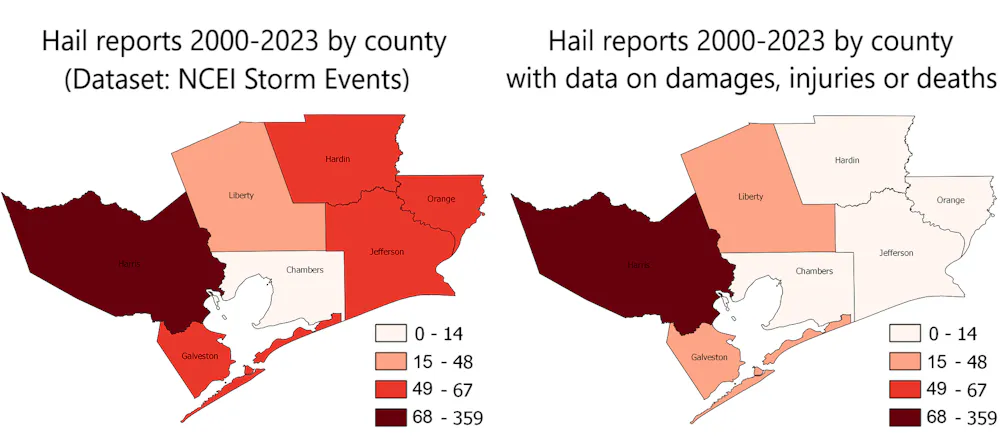
    The number of severe hail reports in southeast Texas listed in the National Centers for Environmental Information’s storm events database is strongly correlated with population. The county with the most reports and greatest detail in those reports is home to Houston. Hailstorms in the three easternmost counties are rarely associated with damage estimates.
    John Nielsen-Gammon and B.J. Baule

    Do you want to look at local damage trends? Forget about it. For most extreme weather events, estimation methods vary over time and are not documented.

    Do you want to direct funding to help communities improve resilience to natural disasters where the need is greatest? Forget about it. The places experiencing the largest per capita damages depend not just on actual damages but on the different practices of local National Weather Service offices.

    Are you moving to a location that might be vulnerable to extreme weather? Companies are starting to provide localized risk estimates through real estate websites, but the algorithms tend to be proprietary, and there’s no independent validation.

    4 steps to improve disaster data

    We believe a few fixes could make NOAA’s storm events database and the corresponding values in the larger SHELDUS database, managed by Arizona State University, more reliable. Both databases include county-level disasters and loss estimates for some of those disasters.

    First, the National Weather Service could develop standard procedures for local offices for estimating disaster damages.

    Second, additional state support could encourage local emergency managers to make concrete damage estimates from individual events and share them with the National Weather Service. The local emergency manager generally knows the extent of damage much better than a forecaster sitting in an office a few counties away.

    Third, state or federal governments and insurance companies can agree to make public the aggregate loss information at the county level or other scale that doesn’t jeopardize the privacy of their policyholders. If all companies provide this data, there is no competitive disadvantage for doing so.

    Fourth, NOAA could create a small “tiger team” of damage specialists to make well-informed, consistent damage estimates of larger events and train local offices on how to handle the smaller stuff.

    With these processes in place, the U.S. wouldn’t need a billion-dollar disasters program anymore. We’d have reliable information on all the disasters.

    John Nielsen-Gammon receives funding from the National Oceanic and Atmospheric Administration and the State of Texas.

    William Baule receives funding from NOAA, the State of Texas, & the Austin Community Foundation.

    ref. Storm damage costs are often a mystery – that’s a problem for understanding extreme weather risk – https://theconversation.com/storm-damage-costs-are-often-a-mystery-thats-a-problem-for-understanding-extreme-weather-risk-257105

    MIL OSI – Global Reports

  • MIL-OSI United Kingdom: National Drought Group meets after driest spring in 132 years

    Source: United Kingdom – Executive Government & Departments

    Press release

    National Drought Group meets after driest spring in 132 years

    Expert group told England has now experienced driest March, April and May since 1893.

    The Environment Agency convened a National Drought Group meeting today (5 June 2025) to discuss the latest outlook and hear from water companies about steps they are taking to prepare for the summer.  

    England has only seen 57% of the long-term average May rainfall and spring is the driest since the reign of Queen Victoria. However, the recent rain at the end of May and the start of June is helping to stabilise the position.

    The expert group will now meet monthly following a drought declaration in the north-west. Four other areas – the north-east, Yorkshire, east and west midlands – are also experiencing prolonged dry weather.  

    The EA told the group it has stepped up its operational response. This includes more compliance checks on businesses who abstract water, such as manufacturers, and increased monitoring of river and groundwater levels.

    The regulator is also working with all members of the National Drought Group, including the National Farmers Union, to help farmers plan their water needs over the summer.

    Meanwhile, water companies updated the group on how they are implementing their drought plans, including increased communication with customers, and speeding up the fixing of leaks.

    United Utilities in the north-west has increased the rate of finding and fixing leaks by 70% in recent weeks after a strong response from the community in spotting leaks during the dry weather.

    Youlgrave Waterworks, a private firm which supplies 500 homes in Derbyshire, became the first company to introduce a hosepipe ban at the start of June. The major water companies report they have no current plans for hosepipe bans but are keeping this under review.

    Helen Wakeham, EA Director of Water and National Drought Group chair, said: 

    It’s been the driest spring since 1893, and we need to be prepared for more summer droughts as our climate changes.

    The recent rainfall is having a positive effect, but it hasn’t been enough to stop a drought in the north-west and we must ensure we have enough water to last the entire summer.

    We are working with water companies, farmers and other abstractors to help them plan their water usage over the summer and urge people to be mindful about their daily use.

    The National Drought Group heard that without further substantial rain, some water companies may need to implement further drought measures this summer to conserve supplies.

    Water Minister Emma Hardy said:

    We face a water shortage in the next decade. That’s why the government is taking urgent steps to secure supplies into the future, as part of our Plan for Change.

    As an immediate step, we have convened the National Drought Group to make sure water companies are acting to conserve this precious resource and act in line with their drought plans.

    The Government has secured over £104 billion of private sector investment to fund essential infrastructure, including nine new reservoirs, and to cut leakage by 17% over the next five years.

    Dr Will Lang, Chief Meteorologist at the Met Office said: 

    After the driest Spring for more than a century across England, the start of June has brought some much-needed rainfall with a mix of Atlantic weather systems interspersed with drier and sunnier periods expected to continue over the coming days.

    Most areas will experience showers at times with some seeing longer spells of rain.  From mid-June onwards, the forecast becomes less clear with signs of drier conditions becoming more dominant across southern England.

    Looking further ahead, the chance of a hot summer is higher than normal with an associated increased risk of heatwaves and related impacts. After the more unsettled and wetter start to June, the likelihoods of a wetter or drier than average summer remain evenly balanced.

    Periods of dry weather and low rivers can have several consequences for the environment and wildlife. Low oxygen levels in water can lead to fish kills, as well as more algal blooms and lower river flows prevent wildlife from moving up or downstream.  

    The National Drought Group – which includes the Met Office, government, regulators, water companies, farmers, and conservation experts – heard:  

    • Reservoir levels are now at 77%.

    • Fish rescues have been carried out on the Rivers Redlake and Tern in Shropshire.  

    • Navigation issues have been noted with the Canals and Rivers Trust having to implement restrictions on the Leeds-Liverpool Canal and Lancaster Canal because of low water levels.   

    • The quality of spring crops is becoming a concern because of the dry soil and poor grass growth for feed.  

    • Applications for Local Resource Options (LRO) screening studies are now open for groups of farmers to explore ways to improve water availability and reliability.

    The Environment Agency is encouraging the public to report environmental incidents to their 24/7 hotline on 0800 80 70 60. Meanwhile angling groups are also asking members to report signs of environmental impacts.

    Notes to editors: 

    A decision to declare drought is taken based on reservoir levels, river flows and moisture in the soil along with consideration of the long-term weather forecasts.  

    More information on how drought is defined can be found here: Drought explained – Creating a better place

    Updates to this page

    Published 5 June 2025

    MIL OSI United Kingdom

  • MIL-OSI Europe: REPORT on financing for development – ahead of the Fourth International Conference on Financing for Development in Seville – A10-0101/2025

    Source: European Parliament

    MOTION FOR A EUROPEAN PARLIAMENT RESOLUTION

    on financing for development – ahead of the Fourth International Conference on Financing for Development in Seville

    (2025/2004(INI))

    The European Parliament,

     having regard to UN General Assembly Resolution 70/1 of 25 September 2015 entitled ‘Transforming our world: the 2030 Agenda for Sustainable Development’, adopted at the UN Sustainable Development Summit in New York and establishing the Sustainable Development Goals (SDGs),

     having regard to the Addis Ababa Action Agenda of the Third International Conference on Financing for Development held in Addis Ababa from 13 to 16 July 2015,

     having regard to the Paris Agreement of 12 December 2015, adopted at the 21st Conference of the Parties to the United Nations Framework Convention on Climate Change,

     having regard to the United Nations Declaration on the Rights of Indigenous People (UNDRIP) of 13 September 2007,

     having regard to the document of the United National Conference on Trade and Development (UNCTAD) of January 2012 entitled ‘Principles on Promoting Responsible Sovereign Lending and Borrowing’,

     having regard to the United Nations Framework Classification for Resources (UNFC),

     having regard to the UN General Assembly Resolution 68/304 of 9 September 2014 entitled ‘Towards the Establishment of a Multilateral Legal Framework for Sovereign Debt Restructuring Processes’,

     having regard to the UN General Assembly Resolution of 10 September 2015 on the ‘Basic Principles on Sovereign Debt Restructuring Processes’,

     having regard to the report of the Organisation for Economic Co-operation and Development (OECD) of 10 November 2022 entitled ‘Global Outlook on Financing for Sustainable Development 2023: No Sustainability Without Equity’,

     having regard to the report of the Organisation for Economic Co-operation and Development of 5 September 2024 entitled ‘Multilateral Development Finance 2024’,

     having regard to the UN Secretary-General’s SDG stimulus to deliver Agenda 2030 of February 2023,

     having regard to UN General Assembly Resolution 79/1 of 22 September 2024 entitled ‘The Pact for the Future’, adopted at the Summit of the Future in New York,

     having regard to the partnership agreement between the EU and its Member States, of the one part, and the Members of the Organisation of African, Caribbean and Pacific States, of the other part[1] (the Samoa Agreement),

     having regard to the joint statement by the Council and the representatives of the governments of the Member States meeting within the Council, the European Parliament and the Commission of 30 June 2017 entitled ‘The new European consensus on development: Our world, our dignity, our future’[2],

     having regard to the Council conclusions of 10 June 2021 on enhancing the European financial architecture for development,

     having regard to its resolution of 17 April 2018 on enhancing developing countries’* debt sustainability[3],

     having regard to its resolution of 24 November 2022 on the future European Financial Architecture for Development[4],

     having regard to its resolution of 14 March 2023 on Policy Coherence for Development[5],

     having regard to its resolution of 15 June 2023 on the implementation and delivery of the Sustainable Development Goals[6],

     having regard to the EU Gender Action Plan (GAP III),

     having regard to the Youth Action Plan (YAP) in European Union external action for 2022-2027,

     having regard to Regulation (EU) 2021/947 of the European Parliament and of the Council of 9 June 2021 establishing the Neighbourhood, Development and International Cooperation Instrument – Global Europe, amending and repealing Decision No 466/2014/EU of the European Parliament and of the Council and repealing Regulation (EU) 2017/1601 of the European Parliament and of the Council and Council Regulation (EC, Euratom) No 480/2009[7],

     having regard to the Climate Bank Roadmap of the European Investment Bank (EIB) of 14 December 2020,

     having regard to the joint communication from the Commission and the High Representative of the Union for Foreign Affairs and Security Policy of 1 December 2021 entitled ‘The Global Gateway’ (JOIN(2021)0030),

     having regard to Rule 55 of its Rules of Procedure,

     having regard to the report of the Committee on Development (A10-0101/2025),

    A. whereas Article 208 of the Treaty on the Functioning of the European Union (TFEU), dictates the reduction, and in the long-term eradication, of poverty as the primary objective of the EU’s development cooperation; whereas Article 21(2) of the Treaty on European Union (TEU) reaffirms its commitment to supporting human rights, preserving peace and preventing conflict, assisting populations, countries and regions confronting natural or man-made disasters, and to the sustainable management of global natural resources;

    B. whereas Article 18(4) TEU calls on the Vice-President of the Commission / High Representative of the Union for Foreign Affairs and Security Policy to ensure the consistency of the Union’s external action;

    C. whereas, at this critical juncture, with just five years remaining before we reach the 2030 target date for the SDGs, the increasing number of crises worldwide, the rise in extreme poverty and hunger, and the increasingly frequent and severe consequences of climate change have meant that, according to the 2024 UN SDG Report, only 17 % of the Sustainable Development Goals are currently on track to be achieved by 2030, despite progress in certain areas; whereas developing countries’[*] domestic revenue mobilisation remained low, due, among other factors, to illicit financial flows and also often corruption, causing crucial resources to be diverted from healthcare, education, and infrastructure development;

    D. whereas more than 700 million people worldwide are living in extreme poverty, a figure that keeps increasing; whereas poverty disproportionately affects women and girls globally, and the gender-poverty gap persists to this day; whereas the wealth gap and inequality within and between countries is widening, hindering sustainable development;

    E. whereas mobilising even a small fraction of global wealth for sustainable development remains difficult, with UN Trade and Development estimating that the annual SDG financing gap in developing countries* has increased to USD 4–4.3 trillion, representing a more than 50 % increase over pre-pandemic estimates and requiring an unprecedented mobilisation of financial resources, both public and private, at the global level, especially to tackle the climate crisis, biodiversity loss and rising inequalities;

    F. whereas food insecurity has significantly risen as a result of Russia’s war of aggression against Ukraine, as well as due to the impact of other armed conflicts and is therefore a barrier of achieving the SDGs; whereas EU cooperation needs to tackle the challenge of food security effectively with partner countries in a sustainable manner;

    G. whereas leading global donors in development cooperation are abandoning their commitments to finance sustainable development;

    H. whereas it is estimated that, if Member States had met the commitment to devote 0.7% of gross national income (GNI) to official development assistance (ODA) since 1970, more than EUR 1.2 trillion could have been allocated for development cooperation, a figure that is likely even to be much higher when taking into account the remainder of donor countries worldwide;

    I. whereas developing countries* face significantly higher borrowing costs, paying on average twice as much interest on their total sovereign debt stock compared to developed (higher income) countries, due to imbalanced global financial structures, but also due to the rating of country-specific risk factors, governance challenges or macroeconomic instability, which further exacerbates the finance divide;

    J. whereas, according to the latest data, almost two-thirds of low-income countries in the world are currently either in debt distress or at high risk thereof, with over 100 countries struggling due to the combination of debt and interest; whereas low-income countries (LICs) spent nearly 20 % of government revenues on servicing external debt in 2023, up fourfold since 2013; whereas debt spending in over three-quarters of low income countries is several times the spending on public goods such as education, health, social protection, or climate change, thus creating one of the most important obstacles for global south countries to advance the SDGs;

    K. whereas if indebted countries are also hit by a catastrophic external shock, such as a natural disaster, they often resort to further borrowing to pay for the reconstruction and recovery costs;

    L. whereas developing countries* in debt distress are projected to face annual debt servicing costs of USD 40 billion between 2023 and 2025, severely constraining their fiscal space for essential public investments;

    M. whereas achieving sustainable development requires more than just curbing debt solutions and securing external finance, it also involves strengthening the economic self-sufficiency of developing countries*, including through enhanced domestic resource mobilisation, qualitative investment-friendly policies, favouring the promotion of local entrepreneurship and local private sector growth;

    N. whereas a fifth of the world’s population lives in countries with high levels of inequality and, according to data from 2023, the richest 1 % of the world owns 47.5 % of all global wealth, and the effective tax rates on the richest 1 % are often lower than the tax rates for the rest of the population;

    O. whereas Climate Resilient Debt Clauses (CRDC) are clauses that can be added to loan or bond contracts and that are triggered by certain specified external catastrophic events, notably climate-related events, which allow the borrower to temporarily suspend debt payments;

    P. whereas the structure of creditors is changing and becoming more complex, with private creditors and new bilateral creditors outside the Paris Club playing a much larger role; whereas China, in particular, issues loans under opaque conditions, which is why stronger international regulation and disclosure of this debt is necessary;

    Q. whereas the upcoming Fourth International Conference on Financing for Development in 2025 presents a critical moment for the necessary reform of the global financial architecture and for addressing the growing financing challenges;

    R. whereas the current international financial architecture is based on the Bretton Woods Agreements of 1944, which represent an architecture that today is incapable of meeting the needs of the 21st century multipolar world, specifically the needs of so-called Global South countries characterised by deeply integrated economies and financial markets, but also marked by geopolitical tensions, growing systemic risks and the effects of climate change, and persists in upholding the existing power imbalance that favours countries in the so-called Global North;

    S. whereas in order to address unsustainable and illegitimate debts, all governments must participate on an equal footing in the decision-making on debt crisis prevention and resolution, as well as different aspects of debt management, beyond creditor-dominated forums;

    T. whereas an improved global financial safety net is necessary to deal with systemic risks and global financial, economic and health crises and shocks;

    U. whereas indebted countries tend to avoid debt restructuring at all costs, i.e. to secure access to the financial market in the future; whereas in order to make external debt payments possible, governments tend to implement harsh austerity programmes, on many occasions following the IMF assessment;

    V. whereas conditionalities imposed by the IMF and some multilateral development banks (MDBs) are focused on fiscal consolidation and market solutions, thus limiting public investment to advance the SDGs; whereas the ultimate consequence of austerity programmes is a deep breach of people’s human rights in the Global South; whereas the G20 Common Framework has done little to solve those limitations, since priority is given to debt rescheduling and reprofiling;

    W. whereas tax resources as a share of GDP remain low in most developing countries*, which are confronted with social, political and administrative difficulties in establishing a sound public finance system, thereby making them particularly vulnerable to tax evasion and avoidance activities of individual taxpayers and corporations;

    X. whereas globalisation creates both opportunities and challenges, as in the case of the increased prevalence and size of multinational enterprises and changes in business models that may enable base erosion and tax avoidance and profit shifting on a significant scale, severely undermining domestic revenue collection, particularly in developing countries*; whereas as a result, taxes on corporate profits have been declining around the world; whereas international tax cooperation needs more solidarity to address national and global challenges;

    Y. whereas climate change has a negative impact on global sustainable development, exacerbating biodiversity loss, breakdown of ecosystems, natural disasters and extreme weather events, and disproportionately affecting historically marginalised groups, in particular women;

    Z. whereas development aid is increasingly being militarised, with funds originally intended for poverty eradication and social progress being diverted towards migration control, security cooperation, and geopolitical competition;

    Aa. whereas illicit financial flows out of developing countries*, challenges such as trade mispricing, loopholes in international tax rules and corruption continue to pose a serious obstacle, often undermining fair and inclusive development efforts, and impacting developing countries’* national budgets and social policy, thus severely reducing funds available for sustainable development; whereas responsible tax behaviour by multinational enterprises is an essential element of the principles of corporate social responsibility;

    Ab. whereas the potential of taxing extractive industries to boost fiscal revenues is largely untapped in developing countries*, primarily due to inadequate global tax rules and the challenges of enforcing them, as transnational companies frequently employ tax avoidance strategies; whereas this challenge is all the more acute for low-income countries that are heavily dependent on natural resources for their economic development;

    Ac. whereas current investment choices continue to diverge from the sustainable development goals, with vast capital flows supporting carbon-intensive industries, while funding for decarbonisation and the energy transition remains insufficient;

    Ad. whereas Russia is expanding its foothold in developing countries* in Africa, most notably in the Sahel region, spreading anti-European propaganda and offering alternatives to European ODA through bilateral deals;

    Ae. whereas the digitalisation of the economy has exacerbated existing problems relating to corporate tax avoidance and evasion, and the importance of ensuring fair and effective taxation of digital services;

    Af. whereas the EIB, through its development arm EIB Global, has committed to increasing the impact of international partnerships and development finance outside the European Union, presenting an opportunity for an enhanced EU contribution to global sustainable development;

    Ag. whereas the EIB has expanded its regional presence, including by opening new regional representation offices, such as the one in Jakarta, Indonesia, to strengthen engagement in south-east Asia and the Pacific;

    Ah. whereas the EIB, through EIB Global, is committed to sustainable development, climate action and innovative investments in low- and middle-income countries;

    Ai. whereas on 20 January 2025, the United States issued an Executive Order, enacting a 90-day suspension and reassessment of all foreign assistance programmes, including those administered by  United States Agency for International Development (USAID), and reaffirmed its withdrawal from the World Health Organisation (WHO) and the Paris Agreement, actions that have serious implications for humanitarian, health and climate initiatives in the Global South; whereas other countries, including some EU countries, also cut their global aid budgets, placing immense pressure on the international development and humanitarian sector;

    Aj. whereas the US withdrawal from foreign assistance programmes puts the EU in a decisive position in global development cooperation and the EU should assess how to strategically address critical shortfalls, particularly in sectors where stability, economic development, and humanitarian support are at risk, while ensuring a coordinated approach with international partners;

    Ak. whereas using regional multilateral development banks (MDBs) as a source of funding could lead to more balanced and equitable collaborations in support of efforts to reform the international financial architecture;

    Al. whereas official development assistance (ODA) has been cut back in many countries, including in the EU; whereas in 2023 only five countries worldwide met or exceeded the UN target of spending 0.7 % of their GNI on official development assistance (ODA); whereas the EU collectively undertook to provide 0.7 % of GNI as ODA, and 0.2 % as ODA to least developed countries (LDCs) by 2030, reaffirmed in the Council conclusions of June 2024, in the European Consensus on Development and in the Council conclusions of 26 May 2015; whereas the successful mobilisation of further capital, both private and public, in addition to ODA and other existing forms of development finance, is critical;

    Am. whereas the New Collective Quantified Goal (NCQG) agreed upon during the COP29 in Baku on 24 November 2024 includes commitments to mobilise at least USD 300 billion per year for climate change mitigation and adaptation in developing countries*; whereas the launch of the Baku-Belém Roadmap requires reaching at least an additional USD 1.3 trillion per year for development cooperation by 2035;

    An. whereas the fragmentation of government approaches to sustainable development financing remains a challenge, with the OECD noting that better policy coherence is needed to align tax, budgetary and development policies;

    Principles and objectives

    1. Stresses the importance for the international community to utilise the opportunities presented by the 4th Financing for Development Conference (FfD4) in Seville to promote structural reform of the international financial architecture to democratise international development cooperation and create equal power sharing, and to call for equitable and inclusive development cooperation policies that support gender equality;

    2. Calls on the EU as a key multilateral actor and its Member States to increase their efforts in development cooperation, increasing their presence, to improve the EU’s global credibility as a reliable partner and strengthen partnerships based on shared values;

    3. Reiterates that EU development policy must be driven by the principles and objectives set out in the UN 2030 Agenda for Sustainable Development, the Paris Agreement and the Addis Ababa Action Agenda and must ensure the application of a human rights based and human-centred approach, in line with Article 208 TFEU, the European Consensus on Development, the GAP III, the YAP, and International Human Rights Law;

    4. Acknowledges that the existing financial architecture presents ongoing challenges to preventing and addressing debt crises, highlighting the need to strengthen the tools available to promote responsible financing and long-term debt sustainability; considers that, in view of the insufficient progress towards the SDGs, the SDG financing gap, and the multitude of recent crises, the FfD4 is an urgently needed opportunity to set up a fair and efficient multilateral debt work-out mechanism, to help strengthen multilateralism, support systemic changes that address long-standing inequalities, define concrete commitments, reinforce the EU’s credibility as a development partner, as well as make substantial progress on ensuring stable financing for sustainable development worldwide; stresses that the mobilisation and effective use of domestic resources, underpinned by the principle of national ownership, are also essential for sustainable development;

    5. Calls on the EU to take effective measures against the shrinking of civic space, and ensure civil society participation in the reform of the current structures for development finance;

    6. Reiterates that at least 93 % of EU development policy expenditure must fulfil the criteria for ODA, and that at least 85 % of new actions should have gender equality as a principal or significant objective, and that at least 5 % should have gender equality as the principal objective;

    7. Emphasises the need for a comprehensive, integrated and people-centred approach to development finance in line with the Bridgetown Initiative, which calls for liquidity and debt sustainability issues to be addressed, for democratisation of financial institutions and debt relief to be implemented, for development and climate finance to be scaled up and for private capital to be increased to achieve the SDGs; stresses the importance of strengthening cooperation with like-minded partners;

    8. Calls for the EU to lead by example in reforming the international financial architecture to better meet the needs of the 21st century, characterised by deeply integrated economies, financial markets, and growing systemic risks;

    9. Recalls the commitment taken at COP 29 in form of the Baku-Belem roadmap to mobilise USD 1.3 trillion per year for development cooperation by 2035; urges the EU and its Member States to work together with their partners towards achieving this goal on the global level, encouraging cumulative polluters to take their part in climate change mitigation and adaptation in developing countries*, as well as for loss and damages, through public concessional and non-debt creating instruments, in line with the ‘Baku to Belem Roadmap’ agreed at COP 29; emphasises in this context the need for private investment to provide the necessary funds;

    10. Recalls that progressive taxation is pivotal to making progress on the ecological transition as well as on social and economic justice; stresses the need to look to new sources of financing, notably from sectors contributing the least to taxation while benefiting the most from globalisation, including those with the largest carbon and greenhouse gas emissions; in particular, calls for the exploration of innovative financing mechanisms, including market-based instruments and for contributions from sectors benefiting from globalisation, and establishment of specific taxes, to help finance global public goods, reduce inequalities within and between countries, contribute to climate objectives and support regional sustainable development; notes that growth, competitiveness and stability of developed economies is also a necessary precondition for increasing ODA financing;

    11. Stresses the importance of policy coherence for development (PCD), including gender and climate goals, as a fundamental part of the EU’s contribution to achieving the SDGs; calls for mainstreaming development goals into all EU policies that affect developing countries*, taking into account their legitimate concerns as regards the impact from European legislation; welcomes the Global Gateway strategy and highlights the importance of any EU development initiative to comply with a rights-based approach and to be linked to human development at all times; insist that EU development initiatives should never contribute in any way to enhancing the debt crisis or increasing inequalities; stresses furthermore that PCD implementation is essential to address the structural causes of the Global South’s unsustainable indebtedness;

    12. Stresses the importance of supporting enabling environments for civil society engagement through development programmes and ensuring their participation in decision-making processes on development aid, including ensuring an inclusive process in the FfD4, supporting civil society participation and access to negotiations and information, and support their role in monitoring and following up on decisions made;

    13. Underlines that underinvestment in critical social sectors threatens progress towards meeting the SDGs and exacerbates inequalities, including gender inequality; stresses the need to close financing gaps in the provision of essential public services, including health, education, energy, water and sanitation, and building social protection systems;

    14. Recognises the primary objective of EU development policy to be the reduction and, in the long term, the eradication of poverty, while also contributing to fostering sustainable economic, social and environmental development in developing countries*;

    15. Emphasises that inadequate investment in agrifood systems continues to aggravate food insecurity; stresses that a strategic approach that ensures better alignment and synergy among the different sources of financing, particularly in developing countries*, is needed to address food insecurity and malnutrition;

    16. Underlines the importance of fostering stronger, more inclusive multi-stakeholder partnerships that fully consider the views and standpoints of our development partner countries – at national, regional and local levels – as well as those of other stakeholders such as international institutions, development banks, non-governmental and civil society organisations, academia and think tanks; believes these development partnerships should be based on equality and tailored to reflect the capacities and needs of partner countries, as outlined in the European Consensus on Development; considers that, while financial support for partner countries is often essential, it cannot fully replace domestic efforts, but should complement them with the aim of catalysing economic growth, strengthening social protection systems and supporting investments in comprehensive human development, particularly education and job creation, which are key tools in eradicating poverty; underlines, in line with the principle of common but differentiated responsibilities, that partnerships should be grounded in mutual interests and shared values, prioritising sustainable development and the needs of people; stresses the importance of respecting human rights and ensuring a people-centred approach;

    17. Stresses the importance of transparency, accountability and proper oversight, emphasising that all EU funding for development cooperation must be carefully managed and monitored to prevent misuse, diversion, or inefficiency, while ensuring that resources are directed towards projects and initiatives that achieve the greatest positive impact in terms of the SDGS;

    Debt

    18. In view of the increasing number of low-income countries in debt distress or at high risk thereof; calls for the opening of an intergovernmental process to set up a UN Framework Convention on Sovereign Debt to address responsible financing with the purpose of preventing and resolving unsustainable debts; urges the EU and its Member States to support this process, to ensure fair burden-sharing among all creditors, including multilateral development banks, where necessary, without jeopardising MDBs’ financial health, to deal in particular with problems such as enormous delays in implementing restructurings and the lack of a common understanding and enforceable rules as regards the comparability of treatment of official and private creditors;

    19. Considers that the reform of the current debt structure should provide countries in the Global South with fair and lasting solutions to a crisis that is already having devastating effects on populations, particularly on women and the most vulnerable communities;

    20. Believes that, in many cases, only general debt relief and cancellation of debt, free of economic policy conditions and accepted by all creditors, can put a country back on a sustainable path of financing, instead of deferring debt repayments; stresses the need to develop domestic legislation to enforce private creditor’s participation in debt restructuring deals;

    21. Finds, however, that any such debt relief must be accompanied by internationally agreed principles on responsible borrowing and lending, including implementation and monitoring mechanisms, alongside enhanced transparency and accountability standards, capacity building and efforts to combat corruption; highlights that, in order to be effective, responsible lending and borrowing principles need to go beyond voluntary approaches; highlights in this context the importance of committing to international human rights, civic and civil society engagement;

    22. Recognises that women are often overrepresented in the public sector, and thereby disproportionally vulnerable to and impacted by budget cuts; emphasises therefore the importance of including a gender perspective in debt collection;

    23. Emphasises the need for enhanced international cooperation to address the changing creditor structure, where private creditors now hold more than a quarter of the external debt stock of developing countries*, and new bilateral creditors outside the Paris Club are involved in debt restructuring efforts, particularly in jurisdictions governing significant portions of sovereign debt, such as New York and the United Kingdom;

    24. Stresses the importance of increasing public and grants-based finance for climate mitigation and adaptation, and that climate finance in the form of loans risks further aggravating the debt distress of low- and middle-income countries; notes that only 50 % of the EU’s total climate finance continues to be provided in the form of grants; urges the EU and all Member States to increase grant-based finance, particularly for adaptation, and especially for least developed countries and small island developing states*;

    25. Calls for closer and stronger cooperation and coordination between the European Parliament, the European Commission, the European External Action Service and EU delegations, particularly in developing countries* in fragile contexts, in order to facilitate discussions and cooperation with relevant actors on the ground in order to identify the most effective projects;

    26. Urges the UN member states to develop a harmonised framework to strengthen domestic sovereign debt restructuring laws across its member countries, with the aim of facilitating more efficient and equitable debt treatment;

    27. Emphasises the need for greater policy coherence in addressing sovereign debt issues, aligning tax, budgetary, and development policies to effectively respond to cross-cutting challenges such as climate change and inequality;

    Reform of the international financial architecture

    28. Calls for an increase in the financing power of MDBs, and the expansion of their mandates to tackle global challenges;

    29. Calls for grants and highly concessional financing of the ecological transition, in particular for mobilising more resources for adaptation and the operationalisation of the Loss and Damage Fund; in addition, believes that all public lenders – governments, MDBs and other official lenders, including the IMF – should include, in their contracts, state-contingent clauses that are tied to climate and other economic exogenous shocks;

    30. Considers it necessary to guarantee new, additional, predictable funding that is readily accessible to women, indigenous peoples and the most vulnerable communities;

    31. Calls for the implementation of a rules-based, automatic quota reallocation system in the International Monetary Fund (IMF) to better reflect the changing global economic landscape and ensure fairer representation of emerging economies, as well as low income and least developed countries; in the meantime, calls for IMF special drawing rights to be rechannelled to developing countries* and multilateral development banks (MDBs), in line with the Bridgetown initiative, the UN Secretary-General’s SDG Stimulus and the initiatives of the African Development Bank (AfDB) and the Inter-American Development Bank (IDB), and for such rights to continue to be regularly allocated; in line with the principle of common but differentiated responsibilities;

    32. Underlines that EU financing must uphold the EU’s role as the world’s leading provider of development aid and climate finance in line with the Union’s global obligations and commitments; calls for sustainable financing models that prioritise resilience, reduce fiscal dependence and support structural transformation to prevent recurrent financial distress in developing economies*;

    33. Welcomes the commitment to gender balance on executive boards of all international organisations in the Zero Draft on the FfD4 Outcome; supports the establishment of a joint committee for governance reforms in the Bretton Woods Institutions to enhance transparency, inclusivity, such as through a fairer representation in decision-making bodies and fair access to finance and diversity in leadership and staff;

    34. Underlines that civil society organisations and smaller non-governmental organisations as well as churches and faith-based organisations are key development partners, since they work closely together with populations on the ground and are therefore better acquainted with their needs, and retain a presence after many other aid providers have withdrawn; calls for the adoption of guidelines on partnerships with churches and faith-based organisations in the area of development cooperation;

    35. Recalls that the regulation of the financial system is essential to advancing towards the prevention and fair resolution of debt crises;

    36. Calls for stronger regulation of global commodity futures markets, which is especially important for food and fuel products, and digital financial markets; stresses equally the need to encourage appropriate finance for social and environmental objectives, while discouraging the financing of high-carbon activities;

    Private business and finance

    37. Emphasises again the crucial role of the mobilisation of private finance to close the financing gap in achieving the SDGs and calls for more action to facilitate private sector involvement in development cooperation and to encourage companies to invest in less developed countries; recalls, however, that private sector investment and blended finance instruments have not always proven to be effective or sufficient in least developed and fragile states, especially in critical public services such as health, education and social protection, and they cannot fully replace public investment, thus requiring special attention from international donors, governments and MDBs; recognises, however, the potential role of enhanced public-private partnerships (PPPs), particularly in the field of technical and vocational training, upskilling and reskilling;

    38. Recalls the need to promote investments in education and vocational training in order to prioritise sustainable job creation and contribute to achieving the SDGs; further notes that trade, investment and job creation are a vital part of EU engagement for development and are contributing to sustainable development;

    39. Underlines the lack of transparency regarding the functioning of the Global Gateway in EU partner countries and absence of clear mechanisms for assessing its impact, particularly in fragile contexts where the Global Gateway may not apply; emphasises that there must be a continuous evaluation of the Global Gateway to assess its effectiveness and strategic direction;

    40. Insists that a conducive business enabling environment is essential for private investment, including through the rule of law, transparency, good governance, anti-corruption measures, investor and consumer protection, and fair competition; calls on the Commission to monitor and further improve mechanisms that will provide a security guarantee for European investors, on the other hand, stresses the need to rebalance investors’ rights with obligations towards the host state i.e. by supporting the local economy through technology transfer and by utilising local labour and inputs, so as to ensure that FDI translates into wider socio-economic benefits for society; calls for further improved access to affordable financing for the informal sector, dominated by micro- and small businesses, often led by women; calls for scaled-up EIB guarantee programmes to financially support small and medium-sized enterprises;

    41. Recalls that the security landscape is a decisive factor for investments and for sustainable development; highlights in this context the role and activities of religious institutions, women and all civil-society actors in conflict resolution and management, contributing to peace and security; more generally, emphasises the interconnectedness of development and security and stresses the necessity of further advancing a clearly defined nexus between development, peace and security;

    42. Emphasises that blended public and private finance must be aligned with the SDGs, focusing on development and requiring frameworks and legislation that focus on sustainable business and finance, sustainability disclosure and transparency and the set-up of a global SDG finance taxonomy;

    43. Calls on the EU to constructively engage towards the adoption of the UN Treaty on Business and Human Rights to regulate the activities of transnational corporations and other business enterprises and to allow victims to seek redress;

    44. Calls for the establishment of a dedicated SDG investment facilitation mechanism supported by the international community to identify and develop investment-ready opportunities aligned with the SDGs in least developed countries, leveraging the UNDP SDG Investor Platform’s success in identifying over 600 investment opportunity areas in emerging markets; recalls that SMEs play an important role in achieving the SDGs and therefore need to be encouraged and incentivised by EU policies to actively participate in initiatives contributing to sustainable development in developing countries*; also urges the EU and its Member States to prioritise allocation of grants and concessional financing based on vulnerabilities, namely in LDCs, fragile or conflict-affected countries, and to engage in coordination with relevant stakeholders including civil society actors;

    45. Urges the expansion of innovative financing mechanisms to mobilise private capital for SDG-aligned projects in LDCs and fragile states, emphasising the need to double current finance flows to nature-based solutions from USD 154 billion to at least USD 384 billion per year by 2025 to effectively address biodiversity loss, land degradation ecosystem destruction and climate change;

    46. Stresses the importance of capacity building and technical assistance for LDCs to develop long-term viable and SDG-aligned projects, advance human development and improve their investment climates, thereby attracting more private sector investment in critical sectors such as renewable energy, healthcare, and sustainable agriculture;

    47. Advocates the creation of a global risk mitigation facility consolidated within current UN-frameworks to address the higher perceived risks and borrowing costs faced by low- and middle-income countries; calls for the regulation of the credit rating system, which currently benefits countries in the Global North disproportionately over those in the Global South, which pay on average twice as much interest on their sovereign debt compared to developed countries, to address these higher perceived risks and borrowing costs;

    48. Emphasises the need for clearly defined access to development finance for local and regional governments in partner countries to ensure more balanced and transparent allocation of resources; stresses that overly centralised funding structures risk reinforcing inefficiencies and the politically motivated distribution of funds; underlines that empowering local governments – many of which play a crucial role in delivering public services and fostering inclusive economic development – would enhance community-based investments, accountability and governance reforms;

    49. Emphasises the need to promote PPPs and private investments, which drive economic growth and sustainable regional development;

    50. Highlights that PPPs are needed to cover the financial gap for development objectives in partner countries, further notes that private sector investments also need to serve the development of local communities and encourage, in this context, investments in education and vocational training;

    51. Highlights the special challenges faced by persons with disabilities and their families in terms of accessing development aid; calls for the special needs of persons with disabilities to be taken into account in development financing;

    Tax cooperation

    52. Welcomes the two-pillar solution for addressing the tax challenges arising from the digitalisation and globalisation of the economy, as agreed by the members of the OECD/G20 Inclusive Framework on Base Erosion and Profit Shifting, as a step forward; takes note, however, that a group of developing countries* has expressed dissatisfaction with the outcome, highlighting concerns around equity and inclusivity within the OECD Inclusive Framework; regrets that Pillar 1 on reallocation of taxing rights has still not entered into force and calls for the acceleration of its implementation, ensuring a fair reallocation of taxing rights to market jurisdictions, particularly benefiting developing countries*; calls for the EU and its Member States to ensure that the agreed global minimum corporate tax rate of 15 % for multinational enterprises is effectively applied, and urges the EU to support capacity building initiatives in developing* countries to effectively implement that minimum tax rate, ensuring they can benefit from the new rules and increase their domestic resource mobilisation;

    53. Urges the international community to take concrete steps in the creation and implementation of a UN Framework Convention on International Tax Cooperation; takes the view that this UN Convention on Tax should be designed with a view to ensuring a fair division of taxing rights between nation states, and, while duly considering national tax sovereignty, support efforts to tackle harmful tax practices and illicit financial flows; stresses, in this context, that the EU should play a proactive role in enabling developing countries* to mobilise domestic resources, in particular through enhanced tax governance, and that the EU should take the lead in combating illicit financial flows;

    54. Advocates further assistance for developing countries* and international cooperation for the purpose of strengthening tax systems, transparency and accountability in public financial management systems and of increasing domestic resource mobilisation, including through the digitalisation of tax systems and administrations;

    55. Supports the decision of G20 finance ministers to ensure that ultra-high net worth individuals are taxed effectively; considers that Brazil’s initiative at the latest G20 summit for a coordinated minimum tax on ultrahigh net worth individuals equal to 2 % of their wealth, which it is estimated would raise up to USD 250 billion annually, is worth further consideration;

    56. Emphasises the need to continue working on efforts to combat illicit financial flows, in particular out of low- and middle-income countries, and corruption, inter alia by investing in human capacities and skills, digitalisation, building up accessible and interoperable data, strengthening governance structures, enhancing regulatory frameworks and promoting regional cooperation;

    57. Recalls that the extractive sector in Africa is particularly prone to illicit outflows; takes the view that the review of tax treaties should aim to strengthen the bargaining position of host governments so they can obtain better returns from their natural resources and stimulate diversification of their economies; in addition, believes that the Extractive Industries Transparency Initiative (EITI) should be made mandatory and extended to focus not only on governments but also on producer firms and commodity trading companies;

    58. Advocates the creation of a global beneficial ownership registry to enhance transparency and combat tax evasion and illicit financial flows, building on existing EU initiatives in this area;

    Official development assistance (ODA) and financing development cooperation

    59. Emphasises that, despite the EU and its Member States remaining the largest global ODA provider, accounting for 42 % of global ODA in 2022 and 2023, the collective ODA/gross national income ratio has declined from 0.56 % in 2022 to 0.51 % in 2023, falling well short of the 0.7 % target; calls for urgent action to address the cumulative shortfall in meeting the 0.7 % target; is alarmed by the worrying trends that further cut ODA in many Member States and in the EU budget as well as by other leading global donors, leading to a further increase in the global financing gap for development; encourages Member States to increase their ODA budgets in the light of the current geopolitical situation; stresses the need to use development cooperation efficiently, to invest more specifically in those partner countries that promote, among other things, democratic reform efforts, access to social security systems and economic self-reliance;

    60. Rejects the idea that the traditional donor-recipient model has become obsolete and that ODA is no longer relevant; underlines that, despite evolving financing mechanisms and partnerships, ODA remains a vital tool for poverty reduction, addressing inequalities, and supporting the most vulnerable communities, particularly in fragile countries and LDCs;

    61. Urges the EU and the Member States to prioritise reaching the immediate target of devoting 0.15 % of GNI to ODA for LDCs, and to take concrete actions to fulfil this commitment, with a view to rapidly scaling up efforts to achieve a level of 0.20 % of GNI as ODA for LDCs; notes that the impact of development finance also depends on the efficiency of implementation of funding;

    62. Urges the Commission to increase efforts to implement the development finance objectives under the GAP III, namely that 85 % of all new actions integrate a gender perspective and support gender equality;

    63. Regrets that women’s rights organisations receive less than 1 % of global ODA and SDG5 remains among the least-funded SDGs, although improvement on SDG5 has been shown to be a cross-cutting driver for sustainable development; reiterates that women-led organisations are often best adapted to respond to humanitarian crises; calls on the international community to set ambitious targets for funding to women’s rights organisations;

    64. Expresses concern over the increasing trend of tied aid, which reached EUR 4.4 billion (6.5 % of total bilateral ODA) in 2022, and calls for measures to reverse this trend and ensure that ODA primarily benefits partner countries rather than donor economies;

    65. Calls on the EU and the Member States to devote 15 % of their ODA to education by 2030;

    66. Calls on the EU and the Member States to ensure that ODA includes long-term, sustainable funding for United Nations Relief and Works Agency for Palestine Refugees in the Near East (UNRWA), guaranteeing access to essential services for Palestinian refugees and preventing further humanitarian crises;

    67. Emphasises that education must remain a central pillar of EU development assistance, including continued support for UNRWA schools, which provide education to over 500 000 Palestinian children, ensuring their right to quality education despite ongoing displacement and conflict;

    68. Stresses the need for a comprehensive approach to development financing, aligning the Neighbourhood, Development and International Cooperation Instrument (NDICI) – Global Europe with the SDGs and the Paris Agreement, while ensuring that the allocation of EUR 79.5 billion for 2021-2027 is used effectively to address global challenges; urges the creation of a system for Parliamentary oversight of NDICI-capital flows to ensure their alignment with the dedicated targets for development;

    69. Reiterates the urgent need to rethink and reform global governance of international development cooperation given the suspension of USAID and reductions in global aid by countries such as the UK, Netherlands, Belgium etc.; stresses that reform to the international financial architecture must be underpinned by a commitment to multilateralism and fit for a more crisis-prone world;

    °

    ° °

    70. Instructs its President to forward this resolution to the Council and the Commission, the European Investment Bank and the United Nations.

    MIL OSI Europe News

  • MIL-OSI United Kingdom: Council agrees further work to tackle climate change

    Source: City of Portsmouth

    Ambitious next steps towards a carbon neutral Portsmouth have been agreed by the city council.

    A programme of work to tackle climate change will build on achievements over the last 12 months, which include:

    • Delivering Warm Homes funding to help make Portsmouth homes more energy efficient, reducing fossil fuel usage
    • Launching a landmark solar power project at Lakeside North Harbour, one of the UK’s biggest solar car park and battery storage installations
    • Starting work on ‘Seachange’, the biggest project in Portsmouth International Port’s history to provide green electricity to power ships while at berth
    • Securing funding to plant 2,500 new trees as part of a wider Greening Strategy to double the city’s tree canopy coverage over 25 years, and developing an Urban Forest Masterplan
    • Partnering with Southern Water to invest in reducing surface water runoff which contributes to outfall releases, including a £220,000 grant for sustainable drainage at New Horizon’s School
    • Working in partnership with Hampshire County Council and First Bus to launch a fleet of 62 brand new, zero emission buses, replacing a diesel fleet as part of the strategy for greener travel and improved air quality

    A report for the Climate Change and Greening the City meeting outlined the council’s focus on continuing to reduce carbon usage across all departments. The council will work with partners to protect and enhance Portsmouth’s natural environment, while building resilience to the impacts of climate change – such as heatwaves and rainfall – with a focus on supporting the most vulnerable.

    A programme of climate and natural environment actions was presented and agreed. It includes:

    • Improving how the council monitors carbon emissions, including emissions from its suppliers.
    • Developing Local Area Energy Plans
    • Continuing to work with the Department for Energy Security and Net Zero on funded schemes to upgrade domestic properties across all tenures to improve energy efficiency and reduce carbon emissions.
    • Developing a resilient treescape by working with stakeholders and communities so old and new trees are resilient to climate change impacts and provide cooling across the city
    • Continued working to reduce surface water flooding
    • Exploring how we deliver a green and healthy streets programme
    • Developing a biodiversity strategy and action plan as part of the council’s Strengthened Biodiversity Duty
    • Development of an air quality strategy

    Cllr Kimberley Barrett, Cabinet Member for Climate Change and Greening the City, said:

    “Climate change is here and its impact is affecting us all. That’s why we declared a climate emergency in 2019, and made a pledge for the city and the council to become carbon neutral.

    “We all want Portsmouth to be a green and healthy city, where people and businesses thrive alongside nature. But we can only achieve this if businesses and our communities work together.

    “The good news is that so much has been achieved already, but we need to keep being ambitious as this programme of work is, to protect and enhance our special city.”

    Cllr Barrett approved the transformation programme, which will form the basis of the council’s activity to tackle climate change and improve the natural environment for 2025/26.

    MIL OSI United Kingdom

  • MIL-OSI: Diginex Limited Signs MOU to Acquire Resulticks for US$2bn, transforming AI and Data Management Capabilities

    Source: GlobeNewswire (MIL-OSI)

    LONDON, June 05, 2025 (GLOBE NEWSWIRE) — Diginex Limited (“Diginex” or the “Company”) (Nasdaq: DGNX), a leading provider of Sustainability RegTech solutions, today announced the signing of a Memorandum of Understanding (“MOU”) for a cash and share acquisition of Resulticks, a globally recognized leader in real-time, AI-driven customer engagement and data management solutions. This strategic move will significantly enhance Diginex’s capabilities in advanced data management and artificial intelligence, further solidifying its position as a pioneer in data-driven client solutions.

    The MOU values Resulticks at $2 billion which will be paid for in three tranches:

    (1) $1.4 billion in Diginex ordinary shares valued at $72 per share and subject to a 12-18 month lock-up, which shares will be issued at closing of the transaction;

    (2) $100 million in cash that is payable within 90 business days of the closing of the transaction; and

    (3) an earnout of up to $500 million payable in Diginex ordinary shares valued at $72 per share and paid in 3 independent tranches subject to Resulticks attaining at least 75% of the below audited EBITDA threshold figures:

          Earnout Amount   Accounting Period     EBITDA Threshold
      a.   $166,666,666   FY2026     $100,000,000
      b.   $166,666,667   FY2027     $200,000,000
      c.   $166,666,667   FY2028     $325,000,000
                     
      * Resulticks shall receive a pro rated portion of the Earnout Amount provided Resulticks achieves between 75% and 100% of the EBITDA Threshold.
     

    Resulticks, headquartered in Singapore with operations across the United States, India, Singapore, and the Middle East, is renowned for its omnichannel client engagement automation platform. The platform leverages AI and big data analytics to deliver personalized customer experiences, enabling businesses to orchestrate seamless engagement across digital and physical touchpoints. We believe that by integrating Resulticks’ cutting-edge technology, Diginex will enhance its ability to provide comprehensive data-driven sustainability solutions, thereby empowering organizations to meet evolving regulatory requirements and stakeholder expectations with greater precision and efficiency.

    We expect the Resulticks platform will enable Diginex to deliver hyper-personalized insights to stakeholders in real time, while also expanding into new verticals where advanced data orchestration and enrichment can unlock value across compliance, supply chain intelligence, and risk analytics solutions. As the application layer of tech becomes increasingly commoditized, data and AI are emerging as the true engines of differentiation, those who own, enrich, and activate data at speed will define the next generation of market leaders. This is where Diginex wishes to position itself with Resulticks and future acquisitions.

    “We are thrilled to announce this business combination with Resulticks, a company that shares our values and commitment to harnessing advanced technology for transformative impact,” said Miles Pelham, Chairman & Founder of Diginex. “This acquisition will strengthen our balance sheet and profitability, as well as significantly deepening our expertise in AI and data management, enabling us to deliver unparalleled insights and solutions to our clients. By combining Resulticks’ real-time data capabilities with our blockchain and machine learning-driven sustainability platforms, we are poised to redefine how organizations navigate sustainability and compliance challenges.”

    “This partnership represents a fusion of two purpose-driven platforms,” said Redickaa Subrammanian, Co-Founder and CEO of Resulticks. “Through Genie, our agentic framework, we’re helping Diginex unlock real-time ESG intelligence and optimize engagement at every stage of the customer lifecycle. At the same time, we’re bringing their sustainability solutions to our global customer base. Together, we’re unlocking activation, attribution, and ROI visibility — helping brands operate smarter and sustain long-term growth in a data-driven world.”

    “AI doesn’t just optimize ESG. It transforms it into a customer engagement engine,” said Daxsan RB, Co-Founder and CIO of Resulticks. “ESG is no longer just about compliance; it’s a competitive lever to deepen customer relationships. By turning ESG data into actionable insights, brands can deliver hyper-personalized engagement — like carbon footprint transparency for eco-conscious buyers — while real-time analytics build trust through verifiable sustainability claims. Leaders who integrate these tools first will define the next era of brand loyalty. This isn’t just reporting, it’s revenue.”

    This acquisition builds on Diginex’s recent momentum into AI and data management, including its memorandum of understanding to acquire Matter DK ApS, previously announced on May 27, 2025, which we expect will expanded Diginex’s sustainability data and analytics offerings for the investment industry. We believe that together, these strategic moves position Diginex as a global leader in delivering innovative, data-driven solutions for client and sustainability engagement.

    About Diginex
    Diginex Limited (Nasdaq: DGNX; ISIN KYG286871044), headquartered in London, is a sustainable RegTech business that empowers businesses and governments to streamline ESG, climate, and supply chain data collection and reporting. The Company utilizes blockchain, AI, machine learning and data analysis technology to lead change and increase transparency in corporate regulatory reporting and sustainable finance. Diginex’s products and services solutions enable companies to collect, evaluate and share sustainability data through easy-to-use software.

    The award-winning diginexESG platform supports 17 global frameworks, including GRI (the “Global Reporting Initiative”), SASB (the “Sustainability Accounting Standards Board”), and TCFD (the “Task Force on Climate-related Financial Disclosures”). Clients benefit from end-to-end support, ranging from materiality assessments and data management to stakeholder engagement, report generation and an ESG Ratings Support Service.

    For more information, please visit the Company’s website: 

    https://www.diginex.com/.

    About Resulticks
    Resulticks is a leading provider of AI-powered, omnichannel customer engagement and data management solutions. Its platform enables businesses to deliver personalized experiences through real-time data analytics and automation, serving clients across industries in North America, Asia, and the Middle East. Resulticks is headquartered in Singapore, with additional offices in Seattle, New York City India, and Dubai.

    For more information, please visit the Resulticks website:

    https://www.resulticks.com/resulticks-story.html

    Forward-Looking Statements

    Certain statements in this announcement are forward-looking statements. These forward-looking statements involve known and unknown risks and uncertainties and are based on the Company’s current expectations and projections about future events that the Company believes may affect its financial condition, results of operations, business strategy and financial needs. Investors can identify these forward-looking statements by words or phrases such as “approximates,” “believes,” “hopes,” “expects,” “anticipates,” “estimates,” “projects,” “intends,” “plans,” “will,” “would,” “should,” “could,” “may” or other similar expressions. The Company undertakes no obligation to update or revise publicly any forward-looking statements to reflect subsequent occurring events or circumstances, or changes in its expectations, except as may be required by law. Although the Company believes that the expectations expressed in these forward-looking statements are reasonable, it cannot assure you that such expectations will turn out to be correct, and the Company cautions investors that actual results may differ materially from the anticipated results and encourages investors to review other factors that may affect its future results disclosed in the Company’s filings with the SEC.

    Disclaimer
    This press release does not constitute an offer to sell or the solicitation of an offer to buy any securities, nor does it constitute a binding commitment to complete the contemplated transaction. The completion of the transaction is subject to the execution of definitive agreements, satisfactory due diligence, and other customary closing conditions.

    Diginex
    Investor Relations
    Email: ir@diginex.com

    IR Contact – Europe
    Anna Höffken
    Phone: +49.40.609186.0
    Email: diginex@kirchhoff.de

    IR Contact – US
    Jackson Lin
    Lambert by LLYC
    Phone: +1 (646) 717-4593
    Email: jian.lin@llyc.global

    IR Contact – Asia
    Shelly Cheng
    Strategic Financial Relations Ltd.
    Phone: +852 2864 4857
    Email: sprg_diginex@sprg.com.hk 

    The MIL Network

  • MIL-OSI Australia: Applications open for 2025-26 ACT Environmental grants

    Source: Northern Territory Police and Fire Services

    As part of ACT Government’s ‘One Government, One Voice’ program, we are transitioning this website across to our . You can access everything you need through this website while it’s happening.

    Released 05/06/2025

    Community groups, volunteers and citizen scientists are invited to apply for funding to support projects that protect and restore the ACT’s natural environment, with applications now open for the 2025–26 ACT Environmental Grants Program.

    A total of $360,000 is available across two grant streams:

    • Environment Grants – Up to $35,000 per project is available for community-led initiatives that improve biodiversity, restore landscapes, connect people to nature and support Caring for Country.
    • Environmental Volunteer Group Assistance Grants – Up to $5,000 per project is available to help volunteer groups build their capacity and continue their valuable environmental work.

    Now in its 29th year, the Environmental Grants Program has supported hundreds of local initiatives, from ecological restoration and habitat creation to youth engagement and citizen science projects.

    Launching the grants on World Environment Day, Minister for Climate Action, Environment, Energy and Water Suzanne Orr said there is no better time to highlight the vital role local groups play in protecting the environment.

    “There’s no better time than World Environment Day to highlight the incredible contribution Canberrans make in protecting our natural spaces,” Minister Orr said.

    “The ACT Government deeply values the tireless work of community groups, environmental volunteers and citizen scientists who are restoring bushland, enhancing biodiversity and helping to make Canberra a more liveable, sustainable city.”

    Minister Orr said the grants not only support conservation outcomes, but also deliver social and educational benefits.

    “These grants are about empowering local communities to lead the way, whether through habitat restoration, education, or on-ground conservation. They also support wellbeing by connecting people to nature in meaningful ways,” she said.

    “If you’re part of a local group with a great idea to care for our environment, I encourage you to apply.”

    Friends of Magpie Hill co-convenors Morgyn Phillips and Astrida Upitis said the support their group received through the program had already delivered long-term benefits.

    “Thanks to an Environmental Volunteer Group Assistance Grant, our volunteer group, Friends of Magpie Hill has been able to access expert training in plant and bird identification,” they said.

    “This training has helped us gain a better understanding about native grasses and plants in our park and where to focus our regeneration efforts.”

    The grants have also had a lasting impact on education-focused projects across the ACT, including at Merici College, where students recently restored a degraded grassy woodland corridor on school grounds.

    Felicity Maher, Sustainability Coordinator at Merici College, said the program was a valuable opportunity for students to engage with environmental issues.

    “Thanks to funding from the ACT Environmental Grants Program, our students planted 600 native plants in a degraded grassy woodland corridor on our school grounds,” Ms Maher said.

    “The project not only enhanced local biodiversity but also created an outdoor learning space for students and a green corridor the wider community can enjoy.”

    “It’s a fantastic opportunity for schools and community groups to make a lasting environmental impact.”

    Applications for the 2025-26 ACT Environmental Grants close Wednesday 17 July 2025.

    For more information and to apply, visit: www.act.gov.au/money-and-tax/grants-funding-and-incentives.

    – Statement ends –

    Suzanne Orr, MLA | Media Releases

    «ACT Government Media Releases | «Minister Media Releases

    MIL OSI News

  • MIL-OSI Africa: The Global Environment Facility (GEF) backs $8.7m initiative to unite African nations against extreme weather events in the Ubangi River Basin

    Source: Africa Press Organisation – English (2) – Report:

    ABIDJAN, Ivory Coast, June 5, 2025/APO Group/ —

    Home to one of the largest tributaries of the Congo River, the Central African Republic (CAR) and the Democratic Republic of the Congo (DRC) will benefit from a pioneering cross-border initiative to prepare for extreme climatic events and develop joint water resource management strategies with $8.7 million in funding from the Global Environment Facility (GEF). 

    Approved this Monday by the GEF Council, the “Regional program for integrated water resources management in the transboundary basin of the Ubangi River between the CAR and the DRC” aims to strengthen bilateral cooperation between the two African nations while improving technical and institutional capacities for managing increasingly extreme floods, droughts and erratic rainfall patterns affecting the Ubangi River basin.  

    The GEF implementing agencies of the project are the International Union for Conservation of Nature (IUCN) and the African Development Bank. A regional body and two national ministries are ensuring the execution of the initiative: the International Commission of the Congo-Ubangi-Sangha (CICOS), the Ministry of Rural Development of the DRC, and the Ministry of Development of Energy and Water Resources of the CAR. 

     Thierry Kamach, Minister of Environment and Sustainable Development of CAR said: “The degradation of natural resources is undeniable. The United Nations 2030 Agenda is an inspiring and unifying message to build strong resilience around a transformative project that will further strengthen ecosystem interdependence for a greener and more sustainable future.” 

    Flowing between the CAR, the DRC and the Republic of Congo, the Ubangi stretches over 2,272 kilometres and is the main right-bank tributary of the Congo River. As such, it is part of the Congo River basin, the second-largest river basin in the world and a global biodiversity hotspot with over 1,000 fish species.  

    The river basin’s rainforest harbours more than 10,000 plant species and 2,500 animal species, including two-thirds of all primates, which are under pressure from deforestation and land cover clearing. In parallel, changes in hydrological regimes, riverbank erosion, sedimentation and mining pollution threaten the river’s fish and shore fauna, which are becoming increasingly rare, and the Ubangi’s role as a regulator of regional and global climates. These challenges will be addressed by the new GEF initiative in an integrated fashion, considering the nexus between biodiversity, climate and ecosystem degradation, and between aquatic and terrestrial ecosystems. 

    This initiative is vital as it brings together the communities and institutions of two countries to conserve one of Africa’s most ecologically and economically important river basins. By working across borders, these countries will strengthen their resilience to climate change while protecting biodiversity and the natural systems that sustain life” said IUCN Director General, Grethel Aguilar. “Through its strong on-the-ground presence in the Congo basin, IUCN will mobilise actors in the forest and environmental sectors to promote collaborative basin management and community-led nature-based solutions at the regional, national and local levels. Our focus will be as much on biodiversity and water resources, as it will on safeguarding the livelihoods of the region’s 25 million inhabitants, many of whom depend on the Ubangi River for navigation, trade and agriculture”.

     “This initiative is aligned with GEF’s long-standing commitment and investments in the sustainable management of the Congo basin,” said GEF CEO and Chairperson Carlos Manuel Rodríguez. “By funding this crucial effort in support of sustainable management of water and land resources while averting pollution and land degradation, the GEF also contributes to maintaining the ecosystem functions of this gigantic forest system in supporting the stability of the regional and global hydrological cycle.” 

    Over the past 30 years, changes in rainfall patterns have progressively decreased water levels and reduced runoff in the Ubangi River by up to 18%. Coupled with the erosion, this further accentuated the siltation of the river, which is not only detrimental to biodiversity but also cripples navigation, limits trade and restricts access to residential areas. Alternating with drought periods, destructive floods are another harsh reality affecting hundreds of thousands of people in the region over the last decade, leading to population displacement to neighbouring countries.  

    The new GEF initiative will enable more effective binational cooperation in decision-making and the political monitoring of water crises by establishing a joint observatory and shared tools and data protocols between the DRC and CAR to enhance forecasting, prevention, and common crisis management measures. To combat biodiversity loss caused by human activities in the river basin, practical demonstrations of nature-based solutions —such as agroforestry, conservation farming and ecosystem rehabilitation— will be carried out on site. 

    Ensuring social inclusivity and promoting a “whole of society” approach, the project will roll out a framework for dialogue and exchange among stakeholders, including regional and local authorities, the private sector (particularly local small to medium-sized enterprises), young professionals, and female community leaders. This aims to strengthen local actors’ capability to contribute to shared watercourse management through training and capacity-building, and to assist them in formulating strategies to resolve common challenges. 

    Anthony Nyong, Director of the Climate Change and Green Growth Department at the African Development Bank, stated: “The Bank welcomes this GEF-supported initiative to strengthen cooperation in the Ubangi basin, enhance local resilience, and promote women’s leadership. Its nature-based, people-centred approach aligns with our High 5s and offers a model for basin-wide collaboration in Africa.” 

    With $67 million mobilised in co-financing, the GEF initiative complements a pre-existing project entitled “Regional Support Programme for the Development of Cross-border Water Infrastructure and Resources between the Central African Republic (CAR) and the Democratic Republic of Congo (DRC) – PREDIRE”, being implemented by the African Development Bank, by mainstreaming environmental, ecosystem and participative approaches into the sectors of water, agriculture and transport. 

    MIL OSI Africa

  • MIL-OSI United Kingdom: UK and ASEAN launch CLARE-ASEAN to boost inclusive urban climate resilience

    Source: United Kingdom – Executive Government & Departments

    World news story

    UK and ASEAN launch CLARE-ASEAN to boost inclusive urban climate resilience

    The programme will run through 2026, focusing on co-developing solutions with marginalised communities and supporting ASEAN climate policy efforts.

    The UK and ASEAN launched the Supporting Socially Inclusive Climate Adaptation & Resilience in ASEAN (CLARE-ASEAN) initiative on 4 June 2025 in Jakarta. The programme uses new evidence and innovation to promote socially-inclusive urban resilience to climate change in the Southeast Asia region.

    The CLARE-ASEAN is a regional programme under the UK’s flagship Climate Adaptation and Resilience (CLARE) research framework, funded about 90% by the UK Foreign, Commonwealth & Development Office (FCDO) and co-funded by Canada’s International Development Research Centre (IDRC). The initiative will run through 2026 and aims to generate evidence-based, inclusive solutions to climate challenges in Southeast Asian cities.

    The UK Ambassador to ASEAN, Sarah Tiffin, said:

    Climate resilience is a pivotal investment for Southeast Asia’s future. The UK’s support through CLARE-ASEAN aims to help ASEAN Member States tackle climate risks at scale—by strengthening partnerships among researchers, policymakers, and local communities.

    CLARE-ASEAN will focus on co-developing climate solutions with marginalised communities, producing tailored research and policy briefs to support ASEAN decision-making, and contributing to the forthcoming IPCC Special Report on Climate Change and Cities.

    The programme is closely aligned with the ASEAN Working Group on Climate Change (AWGCC) Action Plan and responds to the ASEAN State of Climate Change Report, which identifies urban areas—home to more than half of the region’s population—as a critical sector for adaptation efforts.

    Updates to this page

    Published 5 June 2025

    MIL OSI United Kingdom

  • MIL-OSI Africa: Cold front expected to bring adverse weather 

    Source: South Africa News Agency

    Thursday, June 5, 2025

    A well-developed cold front is expected to make landfall this weekend, bringing adverse weather to most of the western parts of the country, says the South African Weather Service (SAWS).

    The weather service has advised the public and small stock farmers to prepare for cold to very cold, wet, and windy conditions, including snowfall, very rough seas, and strong winds. 

    The cold front will make landfall early on Saturday morning while progressing eastward over the course of the weekend.

    “The highest 24-hour rainfall amounts are expected on Saturday, with 10 to 20 mm likely over the western parts of the Western Cape and 30 to 40 mm over the mountainous regions. 

    “Elsewhere, light rain and showers are possible. Light snowfall is also likely over the Western Cape mountains and the southern high-lying areas of the Northern Cape,” the SAWS said on Wednesday.

    The weather conditions will result in difficult driving conditions and flooded roads, short disruption to essential services as well as difficulty in navigation at sea due to very rough and choppy seas. –SAnews.gov.za

    MIL OSI Africa

  • MIL-OSI United Kingdom: Battle of Britain Pilot’s Grave Identified in the Netherlands

    Source: United Kingdom – Executive Government & Departments

    News story

    Battle of Britain Pilot’s Grave Identified in the Netherlands

    More than eighty five years after his death, the previously unmarked grave of Flying Officer Philip Anthony Neville Cox, has finally been identified and a service of rededication held at his graveside.

    The Reverend Jonathan Steward at the graveside of Flying Officer Cox (Crown Copyright)

    The rededication service, organised by the MOD’s Joint Casualty and Compassionate Centre (JCCC), also known as the ‘MOD War Detectives’, was held at the Commonwealth War Graves Commission’s (CWGC) Bergen op Zoom War Cemetery in The Netherlands, yesterday afternoon (4 June 25). The service was conducted by the Reverend Jonathan Stewart CF, Station Chaplain RAF Odiham. 

    JCCC Caseworker, Tracey Bowers, said: 

    I am grateful to the researcher who originally submitted evidence suggesting this brave Pilot was buried in the grave in Bergen op Zoom cemetery. Cox was a brave and talented Officer and excelled in all aspects of service life, serving his Country for 8 years, he will never be forgotten.

    Flying Officer Philip Anthony Neville Cox RAF No.501 (County of Gloucestershire) Sqn, Royal Auxiliary Air Force 

    Evidence and research undertaken by the researcher, RAF Air Historical Branch, CWGC and JCCC shows that Cox was reported missing, believed dead when his Hurricane P3808 failed to return from an operation on 27 July 1940, over Dover. A month later a body was washed ashore on the Westenschouwen (Dutch coast) and buried as an unknown British Air Force Officer, the records also showed some details of his name and number (Cox 33XXX). When he was concentrated into Bergen op Zoom cemetery in 1946 it appears some of these details were accidentally struck off and attempts to identify him missed resulting in him being buried as an “Unknown”. Research shows there was only one other missing with the name Cox but he was not an Officer and the date and location of his crash ruled him out.  

    Reverend Jonathan Steward CF said 

    It has been a real honour to be part of the rededication service for Flying Officer Cox. Having his name forever written in stone is more than symbolic. It shows our commitment to honour and commemorate his sacrifice and show that it will not be forgotten.

    The military party stand behind the newly erected headstone for Flying Officer Cox (Crown Copyright)

    Cox was not only a talented Pilot but sportsman too excelling in both fencing and soccer he was described in his RAF reports as “A good all-round sportsman and very keen on all games. He has showed judgement and will be an asset to the Service”. 

    The grave will now be cared for by CWGC. Fergus Read, Commemorations Case Officer at the CWGC, said:  

    It is an honour to have been involved in the research that led to the formal identification of Flying Officer Cox. This case involved evidence from multiple sources – including Dutch and German archives – which had not been previously connected. It was a privilege to play a part in establishing where this Battle of Britain pilot was buried and the Commission will care for his grave, in perpetuity.

    Updates to this page

    Published 5 June 2025

    MIL OSI United Kingdom

  • MIL-OSI United Kingdom: Change of British High Commissioner to Lesotho: Martine Sobey

    Source: United Kingdom – Executive Government & Departments

    Press release

    Change of British High Commissioner to Lesotho: Martine Sobey

    Mrs Martine Sobey has been appointed British High Commissioner to the Kingdom of Lesotho in succession to Mr Harry MacDonald.

    Martine Sobey

    Mrs Martine Sobey has been appointed British High Commissioner to the Kingdom of Lesotho in succession to Mr Harry MacDonald who will be transferring to another Diplomatic Service appointment. Mrs Sobey will take up her appointment during September 2025.

    Curriculum vitae         

    Full name: Martine Sunshine Sobey       

    Year Role
    2023 to present Abuja, Climate Change and Nature Team Lead
    2022 to 2023 BEIS-FCDO, Team Leader, Joint International Forests Unit
    2021 to 2022 BEIS, Team Leader Forests, Land Use and Carbon Markets
    2019 to 2020 BEIS, Bilateral Partnerships Lead, International Climate Finance
    2019 Joined Civil Service
    2017 to 2019 Rockefeller Foundation, Senior Manager – Africa Region
    2009 to 2017 Environment, climate and international development consulting roles
    2008 to 2009 King’s College London, Masters in Climate Change, Environment and Globalisation

    Media enquiries

    Email newsdesk@fcdo.gov.uk

    Telephone 020 7008 3100

    Email the FCDO Newsdesk (monitored 24 hours a day) in the first instance, and we will respond as soon as possible.

    Updates to this page

    Published 5 June 2025

    MIL OSI United Kingdom

  • MIL-OSI New Zealand: Climate – Warm May Caps Off a Sunny Autumn for Much of New Zealand – NIWA – New Zealand Climate Summary: May 2025

    Source: NIWA

    Last month brought warmer-than-average temperatures to most of the country, marking it as New Zealand’s 10th-warmest May on record, according to NIWA’s latest climate summary for May 2025.
    Inland and southern parts of the South Island experienced particularly warm conditions, with some areas recording temperatures more than 1.5°C above average.
    Rainfall varied across New Zealand, with eastern and southern regions experiencing below-normal rainfall and sunny skies for May, and Lake Tekapo recording its sunniest May since records began in 1928. In contrast, parts of the upper South Island and central North Island were wetter than usual.
    Extreme weather events included a high of 24.2°C in Gisborne and Christchurch, a low of -5.0°C in Manapouri and Tūrangi, and a wind gust reaching 200 km/h at Cape Turnagain.
    Tauranga topped sunshine and rainfall among main centres, while Auckland was the warmest, Dunedin the driest and least sunny, and Christchurch was the coolest. The three sunniest locations in 2025 so far are Taranaki, Bay of Plenty, and Auckland.
    There is more detailed information at the full Monthly Climate Summary, available at https://niwa.co.nz/climate-and-weather/monthly

    MIL OSI New Zealand News

  • MIL-OSI New Zealand: Climate – Fifth-Warmest Autumn on Record Brings Wet Weather to the South Island – Seasonal Climate Summary – NIWA

    Source: NIWA

    Autumn 2025 was New Zealand’s fifth-warmest on record, with nationwide average temperatures above the long-term seasonal average for almost all the country, according to NIWA’s latest seasonal climate summary. 
    Almost all regions experienced above-average temperatures, driven by more frequent northeasterly winds and persistently high-pressure systems. 
    It was a warm autumn, wet for eastern and northern parts of the South Island, says NIWA Climate Scientist Gregor Macara . 
    The data shows it was a wetter-than-usual autumn for eastern and northern parts of the South Island, while Northland, Auckland, Coromandel, and western Bay of Plenty also saw above normal rainfall. 
    Meanwhile, areas such as Dunedin, Whanganui, and Hawke’s Bay remained drier than usual over the three month period, March to May. 
    Two major weather events marked the autumn season: heavy flooding in Canterbury at the end of April, which prompted a state of emergency in multiple districts, and ex-tropical cyclone Tam, which impacted the North Island in mid-April. 
    Extreme conditions included a high of 33.6°C in Timaru, a low of -5.0°C in Manapouri and Tūrangi, and the highest 1-day rainfall of 290 mm, recorded at Tākaka on 3 April. 
    Among the main centres, Auckland was the warmest, Tauranga the sunniest and wettest, and Dunedin the driest and least sunny. More detailed information, including records and local data, is available at https://niwa.co.nz/climate-and-weather/seasonal 

    MIL OSI New Zealand News

  • MIL-OSI: Richemont publishes FY25 Annual Report and Non-Financial Report

    Source: GlobeNewswire (MIL-OSI)

    5 JUNE 2025 

    RICHEMONT PUBLISHES FY25 ANNUAL REPORT 
    AND NON-FINANCIAL REPORT

    Richemont has today published its combined Annual Report and Accounts with the Business review, the Compensation Report and the Corporate Governance Report, along with its Non-Financial Report, for the year ended 31 March 2025.

    The Annual Report and Accounts, which includes the Chairman’s review to shareholders, the annual consolidated and statutory financial statements, and the corresponding audit reports was already published on 16 May 2025.

    The Non-Financial Report 2025, prepared in accordance with the Global Reporting Initiative (GRI) Standards (2021), provides Richemont’s disclosures on non-financial matters. The report complies with the reporting disclosure required by Articles 964a-c of the Swiss Code of Obligations, including the Swiss Ordinance on Climate Disclosures. Selected disclosures and indicators have been independently assured (limited assurance) by PricewaterhouseCoopers SA (PwC).

    Both reports are available for download on the Company’s website at https://www.richemont.com/media/ue1bjrjv/richemont-fy25-annual-report-en.pdf and https://www.richemont.com/media/3vwfatyf/richemont-non-financial-report-2025.pdf. Hard copies will be mailed to parties who have requested it and may also be obtained from the Company’s registered office at the address below or by contacting the Company via the website at www.richemont.com/about-us/contact-us.

    In South Africa, the Annual Report and Non-Financial Report may be obtained directly from the Depository Agent at the following address: Computershare Investor Services Proprietary Limited, Rosebank Towers, 15 Biermann Avenue, Rosebank, Johannesburg, 2196, South Africa.

    About Richemont

    At Richemont, we craft the future. Our unique portfolio includes prestigious Maisons distinguished by their craftsmanship and creativity. Richemont’s ambition is to nurture its Maisons and businesses and enable them to grow and prosper in a responsible, sustainable manner over the long term.

    Richemont operates in three business areas: Jewellery Maisons with Buccellati, Cartier, Van Cleef & Arpels and Vhernier; Specialist Watchmakers with A. Lange & Söhne, Baume & Mercier, IWC Schaffhausen, Jaeger-LeCoultre, Panerai, Piaget, Roger Dubuis and Vacheron Constantin; and Other, primarily Fashion & Accessories Maisons with Alaïa, Chloé, Delvaux, dunhill, G/FORE, Gianvito Rossi, Montblanc, Peter Millar, Purdey, Serapian as well as Watchfinder & Co. Find out more at https://www.richemont.com/.

    Richemont A shares are listed on the SIX Swiss Exchange, Richemont’s primary listing, and are included in the Swiss Market Index (‘SMI’) of leading stocks. Richemont A shares are listed on the Johannesburg Stock Exchange, Richemont’s secondary listing.

    Investor/analyst and media enquiries
    +41 22 721 3003 (investor relations)
    Investor.relations@cfrinfo.net
    +41 22 721 3507 (media)
    pressoffice@cfrinfo.net
    richemont@teneo.com

    Click here for a printer-friendly version in English (PDF)

    The MIL Network

  • MIL-Evening Report: The Top End’s tropical savannas are a natural wonder – but weak environment laws mean their future is uncertain

    Source: The Conversation (Au and NZ) – By Euan Ritchie, Professor in Wildlife Ecology and Conservation, School of Life & Environmental Sciences, Deakin University

    François Brassard

    The Top End of Australia’s Northern Territory contains an extensive, awe-inspiring expanse of tropical savanna landscapes. It includes well-known and much-loved regions such as Darwin, Kakadu National Park, Arnhem Land and Nitmiluk Gorge.

    These tropical savannas feature open forests and woodlands dominated by eucalypts and a diverse grassy understorey. They experience an intense monsoon-driven wet season and long dry season during which fire is common.

    The area is home to a spectacular range of plants and animals, including crocodiles, barramundi, speartooth sharks, the spectacularly coloured Leichhardt’s grasshopper and flocks of magpie geese. Some groups are extraordinarily diverse. Several thousand ant species are thought to live there – compared to just 1,000 species in South America’s Amazon basin.

    Australia’s tropical savannas are diverse and dynamic, shaped by fire and the cycle of wet and dry seasons.
    Brett Murphy

    Yet, despite their immense ecological and cultural significance, the NT’s tropical savannas face an uncertain future. The landscape is under increasing pressure from invasive species, more frequent and severe fires, climate change, mining, agriculture and development – including water extraction.

    Our new report outlines what should be done to ensure conservation and sustainable management of this unique and special region.

    A region in trouble

    As ecologists, we share a deep passion for tropical Northern Australia but fear for its future. To aid environmental policy and decision-making, we set out to describe the current condition and likely future of the NT’s tropical savannas. This involved identifying existing, emerging and possible future threats.

    We found biodiversity in decline. Many species, particularly mammals that were once common and widespread, have disappeared from much of the region. These include the northern quoll, brush-tailed rabbit-rat and black-footed tree-rat.

    Species such as the brush-tailed rabbit-rat have declined substantially and are now locally extinct in some areas.
    Cara Penton

    Habitats are degraded and ecosystems are showing signs of collapse. Feral animals are widespread. Cats prey on native wildlife. Feral pigs feast on turtle nests and trash plants in and around waterways, reducing water quality. Cattle, water buffalo, horses and donkeys eat their way through native plants, reducing habitat structure and complexity, aiding the establishment and spread of weeds.

    In many parts of the Top End, fires are becoming more frequent and severe. This is in part due to the increasing dominance of invasive grasses, particularly Gamba and buffel grass. Both grasses are highly flammable, increasing the risk and harm of fires.

    Longer and hotter dry seasons also increase fire risk and severity, as well as making water less available to wildlife due to higher rates of evaporation. Plants and animals also face greater heat stress and risk of dying during extended periods of extreme temperatures.

    The Top End is spectacular and rich in biodiversity.
    François Brassard

    The changing nature of land-clearing

    Land-clearing is increasing in the Top End, too. We estimate about 45,000 hectares of savanna habitat was destroyed between 2000 and 2020. That’s equivalent to an area roughly the size of 22,500 Melbourne Cricket Grounds.

    Another 146,000 hectares have approval to be cleared, and an additional 100,000 hectares could be cleared for an expanded cotton industry.

    It is not just the amount of clearing that matters, but where it occurs. The habitat mainly destroyed to date has been in higher rainfall areas between Darwin and Katherine. This is where most threatened species live. On average, the cleared areas overlapped with more than 12 nationally listed threatened species.

    What should be done?

    Our report shows current laws are insufficient to protect the Northern Territory’s tropical savannas. Evidence-based law reform is urgently needed.

    Decision-making must be collaborative, not controlled by individuals, based on sound science. It must also actively support and involve First Nations peoples and their goals.

    The Top End is awe inspiring but without greater enviromental protection its many values may be diminished.
    François Brassard

    The situation in the NT reflects broader calls to strengthen national environmental laws as a matter of urgency and greatly boost investment in conservation to achieve positive results for nature.

    Nature is the lynchpin of northern Australia. It characterises and nurtures the place, underpins and embraces Indigenous culture, is a major tourist attraction and helps make our country healthy. We need to recognise its value, and guard against its ongoing loss.


    Our report was independently reviewed by experts in the ecology and conservation of Northern Australia, Professors Richard Williams and Christopher Johnson.

    Euan Ritchie receives funding from the Australian Research Council and the Victorian government’s Department of Energy, Environment, and Climate Action. Euan is a Councillor within the Biodiversity Council, a member of the Ecological Society of Australia and President of the Australian Mammal Society.

    The research underpinning this report was partly supported by the Environment Centre NT, the Wilderness Society and the World Wide Fund for Nature (Australia).

    Brett Murphy receives, or has recently received, funding from the Australian Research Council, Environment Centre NT, and the Northern Territory Government.

    John Woinarski is affiliated with Charles Darwin University, and has previously received research funding from the Australian Department of Climate Change, Energy and the Environment.

    ref. The Top End’s tropical savannas are a natural wonder – but weak environment laws mean their future is uncertain – https://theconversation.com/the-top-ends-tropical-savannas-are-a-natural-wonder-but-weak-environment-laws-mean-their-future-is-uncertain-241893

    MIL OSI AnalysisEveningReport.nz

  • MIL-OSI USA: SPC – No MDs are in effect as of Thu Jun 5 06:16:02 UTC 2025

    Source: US National Oceanic and Atmospheric Administration

    Current Mesoscale DiscussionsUpdated:  Thu Jun 5 06:16:02 UTC 2025 No Mesoscale Discussions are currently in effect.

    Notice:  The responsibility for Heavy Rain Mesoscale Discussions has been transferred to the Weather Prediction Center (WPC) on April 9, 2013. Click here for the Service Change Notice.
    Archived Convective ProductsTo view convective products for a previous day, type in the date you wish to retrieve (e.g. 20040529 for May 29, 2004). Data available since January 1, 2004.

    MIL OSI USA News

  • MIL-OSI New Zealand: Auckland Council backs environmental stars with a burst of funding

    Source: Auckland Council

    Sixty-four conservation projects carried out by mana whenua and community groups around Tāmaki Makaurau have received Auckland Council funding in the current financial year to help protect, restore and enhance the natural environment.

    Another 44 projects will also receive funding over the next two years.

    Community Committee chair, Councillor Angela Dalton says a new streamlined process has delivered support for environmental-related projects this year where it is needed most to help achieve regional Tāmaki Makaurau conservation and water quality goals.

    “We have clearer visibility on where funding will make the biggest difference and the application process is now easier for the groups who work on environmental projects to be considered for funding opportunities,” Cr Dalton says.    

    On 27 May, the council’s Community Committee members approved $731,000 in funding to help support the goals of 23 community groups working to protect and restore the environment, through the 2024/2025 Regional Environment and Natural Heritage (RENH) grant.

    General Manager Environmental Services Samantha Hill says grants ranging from $5,800 to $85,000 have been allocated to projects that will help to protect and restore native ecosystems, grow community involvement and contribute to Māori outcomes.

    “One of the projects delivers pest control to help long-tailed bats living in Franklin; another supports mana whenua-led conservation work on Aotea / Great Barrier Island, and several other groups are carrying out ongoing predator control and native habitat restoration to support a range of threatened native species,” says Ms Hill.

    “With the invaluable work these community groups are doing, we will see significant steps in progress to protect, improve and minimise risks to our natural environment. It is important for us to continue to recognise and support the tireless commitment given by these dedicated community-led conservation groups and their many volunteers.”

    A separate group of 23 projects have also been approved with Community Coordination and Facilitation grants from the Natural Environment Targeted Rate (NETR) for region-wide and large-scale conservation activities.

    Last year, $1 million delivered in grants supported by the Natural Environment Targeted Rate delivered a $6.10 return for each $1 invested on projects benefiting the natural environment.

    Finally, an additional 18 projects will receive a share of ​$1,222,268 in funding from the council’s Healthy Waters department to support environmental projects in 2024/25. These projects will enhance water quality and improve flood resilience.

    All applications were rigorously assessed against key criteria. Fair distribution across the region was also considered in recommendations made for grant allocations. Projects have been approved for funding in all local board areas.

    Year

    Grant Name

    Allocation

    2024/25

    Regional Environment and Natural Heritage (23 applicants)

    $  731,000

    2024/25

    2025/26

    2026/27

    Community Coordination and Facilitation (23 applicants)

    (23 applicants)

    (21 applicants)

    $  973,800

    $  773,000

    $  702,000

    2024/25

    Water Quality and Flood Resilience (18 applicants)

    $1,222,268

    More detail on the environmental projects Auckland Council is supporting in this financial year, and in 2025/26 and 2026/27 is available in this PDF document.   

    MIL OSI New Zealand News

  • MIL-OSI USA: Murkowski Secures Commitment from Secretary of Commerce to Convene Summit with Alaska’s Fishing Industry

    US Senate News:

    Source: United States Senator for Alaska Lisa Murkowski
    06.04.25
    Washington, DC – U.S. Senator Lisa Murkowski, R-AK and a senior member of the Committee on Appropriations, today secured a commitment from U.S. Secretary of Commerce Howard Lutnick to convene a meeting with Alaska seafood stakeholders on trade issues with Russia and ways the administration can help bolster the industry.
    Speaking at hearing held by the Appropriations Subcommittee on Commerce, Justice, Science, and Related Agencies, Murkowski emphasized the importance of fair-trade practices for Alaska’s fishermen. Secretary Lutnick agreed with the Senator’s assessment, reinforcing that the administration’s trade policy “is to protect our fisherman, which are a key resource of the United States of America.” The Secretary committed to join the Senator in sitting down with leaders of the Alaska seafood industry to chart a path forward.
    Click here to watch the full exchange.
    The full transcript of Senator Murkowski’s conversation with Secretary Lutnick can be read below.
    TRANSCRIPT
    Murkowski: Thank you, Mr. Chairman. Mr. Secretary, welcome. I’m glad to follow the Ranking Member as well as the Chairman of the committee in talking about fisheries. You know I’ll never disappoint you, when you come before the committee, we’re going to talk about fish, and I appreciate what you have shared with Senator Collins about the administration’s desire to protect our fisherman. We’re pleased with the executive order relating to American seafood competitiveness.
    I had an opportunity, just yesterday, to visit with one of our seafood industry leaders in the state of Alaska. I thought we were going to be talking about some of the tax provisions that are included in the reconciliation package, but he basically said if we can’t deal with trade issues when it comes to Alaska’s seafood, we are not even going to have to worry about the tax pieces because the trade implications are going to kill us. In Alaska, Russia has declared war on Alaska seafood and they have been very direct, and very open about it. They are using their dominance in the seafood market to help fund their war against Ukraine. And the effort is one that we are looking at, and needing to make sure, I mean really desperate to make sure, that the administration fully understands the implications of what is happening right now.
    We’ve got the largest federal fisheries in the nation, about sixty percent of America’s harvest by volume. Seafood processing is 70 percent of Alaska’s manufacturing employment. The Alaska seafood industry generates $6 billion in economic output for that state, it employs 48,000 people in Alaska. Right now, we have Secretary of the Interior, and the Secretary of Energy, and the Administrator of EPA up in the state, all focused on aspects of our resources. But the other great resource for our state is our fisheries, and they are in peril.
    I would ask for your commitment to sit down with leaders of the Alaska seafood industry, those important stakeholders, so that we can talk about a path forward on some of these issues that are really harming our industry right now. Can you give me that commitment, that we can work with your team to identify a time to do just that?
    Lutnick: Why don’t you organize it, and it would be my pleasure to come and do it together with you, so we can make sure every topic is on the table, and we address it. Because our trade policy is to protect our fisherman, which are a key resource of the United States of America. We are on it and we know about it, I know all about the Russian issues. They’ve been attacking us for years, this is nothing new, sadly. But let’s do it together and this administration is on your side and is on it.
    Murkowski: Excellent, I look forward to that, and we’ll be working with you on that.
    A couple more issues, there has been a lot of discussion about NOAA, and the budget cuts, as well as with the impact on the National Weather Service.
    We’ve been working with the Secretary of Transportation, Secretary Duffy, on aviation safety. We’re going to make some headway, there’s good support within the budget now to do that. But we have a connection here with the Department of Commerce, in that the Automated Surface Observing Systems, the ASOS systems as they are known, which provide for aviation safety, are managed by the National Weather Service. So, right now we’re looking at about a 40 percent staffing shortage. I’ve heard what you’ve said to other colleagues, about you know, you’re not cutting in key areas. I need to make sure that we are looking critically at the National Weather Service staffing in Alaska, to make sure that we are not compromising in any ways, the systems that are vital to transportation, commerce, and safety. We need them to stay operational, so if you can just commit to me that you’ll look at?
    Lutnick: That sounds sensible to me.
    Murkowski: Another one that works on the safety side, and again it ties into our extraordinary oil resources. We have to move that oil by ship out of Valdez, it has to go through Prince William Sound, and they rely on the National Data Buoy Center to manage, not only the buoys there in Prince William Sound, but over a thousand buoys that are operated by both domestic and international partners. Right now, we have a buoy, the Seal Rocks Weather Buoy, that’s right outside of Valdez. But the tankers can’t leave Valdez unless they get the wave height information from the buoy, the weather buoy that’s sitting out there, right? This buoy has been out of commission for months, and we’re told it’s due to funding for operation and maintenance in NOAA’s budget.
    Lutnick: It’s really old.
    Murkowski: It is old!
    Lutnick: It needs to be replaced! Oh my god, if I showed you what that looked like, you and I would hold our heads in our hands.
    Murkowski: We all look at them, and the problem it’s not just the buoy out there at Seal Rock, it is this system, this constellation, that is designed to be the information source, the protectorate for the safety. So, let’s work on this, but I highlight how….
    Lutnick: How to modernize it, we’ve got to.
    Murkowski: I highlight because we’ve got some work to do, but it all knits together. So, I’ve highlighted a couple of specific instances….
    Lutnick: I promise you, we are in it together. I promise I agree with you.
    Murkowski: I won’t make you go out there, if you’ll commit to me that we’re going to upgrade these systems. But in the meantime, we’re going to get them operational, so that we’re not compromising safety.
    Lutnick: Absolutely.
    Murkowski: I appreciate it. Thank you, Mr. Chairman.

    MIL OSI USA News

  • MIL-OSI Australia: Marong Planning Scheme Amendment approved

    Source: New South Wales Ministerial News

    Greater Bendigo Planning Scheme Amendment C263gben, which applies to Marong, has come into effect following Minister for Planning approval.

    Amendment C263gben implements the Marong Township Structure Plan 2020 (re-adopted in 2024), the Marong Flood Study 2018 (North Central Catchment Authority) and the Marong Heritage Citations (Minerva Heritage).

    The land affected is within and adjacent to the township of Marong and the amendment changes zones and overlays to land in the Marong township. Specifically, the amendment:

    • Rezones land within the Marong township from Township Zone to Neighbourhood Residential Zone Schedule 3 and Mixed-use Zone Schedule 3
    • Expands Commercial 1 Zoning and updates floor area maximums
    • Applies new overlays to guide development, character and bushfire protection
    • Applies the Heritage Overlay to 8 new places including statements of significance for each
    • Implements the Marong Flood Study, along with new Local Flood Development Plan by introducing the Floodway Overlay and the Land Subject to Inundation Overlay
    • Identifies new residential growth areas for future rezoning to accommodate a population of approximately 8,000 people

    The amendment process and approval were in accordance with the Planning and Environment Act 1987. The Amendment was considered by an independent panel, and recommendations were supported by Council. The Minister for Planning has the final say and made some changes to the amendment before approving it.

    Mayor Cr Andrea Metcalf welcomed the approval of the Amendment as an important step for guiding Marong’s future development.

    “Marong is expected to grow over the next 25 years with an estimated population of 8,000 people and this Planning Scheme Amendment implements the Marong Township Structure Plan. The Amendment supports creating a compact, well-planned township with a vibrant town centre,” Cr Metcalf said.

    “The completion of this Amendment allows the consideration of new rezoning applications in the Marong growth areas and complements the Bendigo Regional Employment Precinct project.”

    The approved Amendment C263gben is the first in a series of planning scheme amendments to support the future growth of Marong. Other projects currently underway include:

    • The preparation of a Shared Infrastructure Contributions Plan for Marong
    • Planning for the Bendigo Regional Employment Precinct by the Victorian Planning Authority
    • Planning for the Marong Western Freight Corridor by the Department of Transport and Planning – Transport
    • The rezoning of the residential growth precincts in accordance with the City’s Private Planning Scheme Amendment Policy

    The Marong Township Structure Plan was originally adopted in September 2020. The Amendment C263gben was exhibited for six weeks from May to July 2023, and the independent planning panel hearing was held in February 2024. Council adopted C263gben in June 2024. The Minister for Planning approved with changes and gazetted the Amendment on May 29, 2025.

    MIL OSI News

  • MIL-OSI USA: Facing Extreme Hurricane & Wildfire Seasons, Cantwell Slams Admin’s Erosion of Weather Forecasting: “NOAA Has Been Transparent That They Can’t Keep Up”

    US Senate News:

    Source: United States Senator for Washington Maria Cantwell
    06.04.25
    Facing Extreme Hurricane & Wildfire Seasons, Cantwell Slams Admin’s Erosion of Weather Forecasting: “NOAA Has Been Transparent That They Can’t Keep Up”
    Meteorologists from WA, OK and FL sound the alarm on laying off 100s of National Weather Service employees, creating unprecedented staffing shortages; Earlier today, Trump’s Commerce Secretary misled a Senate subcommittee that NOAA was “fully staffed” heading into hurricane & wildfire season
    WASHINGTON, D.C. – Today, U.S. Senator Maria Cantwell (D-WA), ranking member of the Senate Committee on Commerce, Science, and Transportation and a senior member of the Senate Finance Committee, joined renowned meteorologists from across the country for a virtual presser to sound the alarm on cuts to the National Weather Service (NWS) as the United States heads into peak hurricane and wildfire season – and call on the Trump Administration to restore the agency to full capacity.
    “We have already seen these impacts from the Administration failing to heed these warnings. For at least a half a century, the National Weather Service has provided forecasts for 24 hours a day, seven days a week — until now. At least eight weather forecasting offices no longer have a meteorologist to cover overnight shifts. They are planning on eliminating the NOAA buoy program. You can’t map a hurricane if you don’t have the buoy information,” Sen. Cantwell said. “NOAA has been transparent that they can’t keep up. They have said that they can’t keep the lights on in a number of forecast offices. The Department of Commerce needs to be clear to the American people that the staffing shortages will impact our ability to compute that science [and] get those wildfire crews and emergency response where they need to go.”
    “We’re already a handful of days into the 2025 hurricane season. But the National Weather Service and NOAA are dealing with their own storm right now in the form of short staffing and budget cuts,” said Brian LaMarre, former Meteorologist in Charge in the Tampa Bay area. “There are eight [NWS offices] that are below a certain number of employees that work at that particular office, and that means that they can’t work 24/7 operations. That’s never before happened in my career.”
    “For the first time in 35 years, I have real concerns due to the staffing situation,” said Alan Gerard, a 35-year meteorologist with the NWS and the National Severe Storms Laboratory in Norman, OK. “And the very fact that some offices aren’t able to operate 24/7 and that the administration has authorized these hires during a hiring freeze, tells you that there’s recognition that there’s serious shortages.”
    “I find it frankly shameful that we even have to have this sort of discussion,” said Jeff Renner, retired meteorologist of 39 years at KING 5 in Seattle. “More people such as you and I now utilize weather apps such as I have on my telephone, yet there is a lack of fundamental appreciation that most of those forecasts, if not all of them, stem from National Weather Service forecasts.”
    Video of today’s virtual press conference is available HERE; a transcript is HERE.
    Over the past several months, the NWS lost over 560 employees due to layoffs and retirements spurred by the Trump Administration. On Monday, they announced they’d hire 126 – amounting to “a flimsy band-aid,” Sen. Cantwell said.
    This dangerous decision to leave critical jobs unfilled comes as the National Interagency Fire Center, a partnership which includes NWS, released its Fire Maps for the next four months predicting above normal significant fire potential across the West, in Hawaii, the coasts of North and South Carolina, and parts of Texas and Florida. The National Weather Service predicts an above-normal hurricane season, which began June 1.  Last year, according to the National Centers for Environmental Information, there were 27 weather disaster events that cost over $1 billion each and resulted in 568 deaths.
    Earlier this week, the acting head of the Federal Emergency Management Agency (FEMA) baffled his staff when he stated that he did not know that the United States had a hurricane season.
    And earlier today, U.S. Secretary of Commerce Howard Lutnick testified in a Senate hearing and claimed, falsely, that NOAA is “fully staffed” heading into the summer.
    Lutnick was plainly incorrect:
    National Hurricane Center in Miami has at least five vacancies.
    At least eight NWS weather forecasting offices no longer have enough meteorologists to cover overnight shifts.
    30 of the 122 weather forecast offices don’t currently have a meteorologist-in-charge, their most experienced weather expert. Some of these vacancies are in major metropolitan areas such as New York City, Cleveland, Houston, and hurricane-prone Tampa.
    Since mid-March, at least 10 weather forecast offices have suspended or limited their weather balloon launches needed for daily forecasts.
    NOAA is short more than 90 staffers whose job is maintaining Doppler radar and automated airport weather sensors operational across the nation.
    Last Thursday, Sen. Cantwell sent a letter demanding that the Trump Administration immediately exempt the NWS from its current federal hiring freeze so that citizens and communities will not be left to fend for themselves without adequate warnings as both hurricane season and wildfire season rapidly approach.
    Monday’s action by the administration lifted the hiring freeze on 126 positions across four roles – meteorologists, hydrologists, physical scientists, and electronic technicians. However, many other important roles remain subject to the freeze, including credentialed mariners needed to safety operate NOAA research vessels, weather scientists, and weather satellite technicians. NOAA vessels and satellites are crucial to maintaining forecast and weather infrastructure needed for meteorologists to issue quality and timely forecasts. These firings also impact our economy, with a number of commercial fishing surveys cancelled this year, including for Alaska pollock and salmon. Elimination of surveys will take catch from fishing families, which will result in job loss and increased cost for consumers who want access to high-quality American seafood at their local markets and restaurants.
    Multiple recent reports have documented the impacts of the hiring freeze. The Washington Post reports that “Some…forecasting teams are so critically understaffed that the agency is offering to pay moving expenses for any staff willing to transfer to those offices, according to notices recently sent to employees…” And the New York Times found that “The National Weather Service is preparing for the probability that fewer forecast updates will be fine-tuned by specialists, among other cutbacks, because of ‘severe shortages’ of meteorologists and other employees, according to an internal agency document.” These reports make clear that action must be taken immediately to avoid a catastrophic gap in capacity in the face of a future storm or wildfire.
    In February, Sen. Cantwell sent Lutnick a letter warning of the likelihood of this exact situation.

    MIL OSI USA News

  • MIL-OSI Global: Unprecedented heat in the North Atlantic Ocean kickstarted Europe’s hellish 2023 summer. Now we know what caused it

    Source: The Conversation – Global Perspectives – By Matthew England, Scientia Professor and Deputy Director of the ARC Australian Centre for Excellence in Antarctic Science, UNSW Sydney

    Westend61/Getty Images

    In June 2023, a record-breaking marine heatwave swept across the North Atlantic Ocean, smashing previous temperature records.

    Soon after, deadly heatwaves broke out across large areas of Europe, and torrential rains and flash flooding devastated parts of Spain and Eastern Europe. That year Switzerland lost more than 4% of its total glacier volume, and severe bushfires broke out around the Mediterranean.

    It wasn’t just Europe that was impacted. The coral reefs of the Caribbean were bleaching under severe heat stress. And hurricanes, fuelled by ocean heat, intensified into disasters. For example, Hurricane Idalia hit Florida in August 2023 – causing 12 deaths and an estimated US$3.6 billion in damages.

    Today, in a paper published in Nature, we uncover what drove this unprecedented marine heatwave.

    A strange discovery

    In a strange twist to the global warming story, there is a region of the North Atlantic Ocean to the southeast of Greenland that has been cooling over the last 50 to 100 years.

    This so-called “cold blob” or “warming hole” has been linked to the weakening of what’s known as the Atlantic Meridional Overturning Circulation – a system of ocean currents that conveys warm water from the equator towards the poles.

    During July 2023 we met as a team to analyse this cold blob – how deep it reaches and how robust it is as a measure of the strength of the Atlantic overturning circulation – when it became clear there was a strong reversal of the historical cooling trend. The cold blob had warmed to 2°C above average.

    But was that a sign the overturning circulation had been reinvigorated? Or was something else going on?

    A layered story

    It soon became clear the anomalous warm temperatures southeast of Greenland were part of an unprecedented marine heatwave that had developed across much of the North Atlantic Ocean. By July, basin-averaged warming in the North Atlantic reached 1.4°C above normal, almost double the previous record set in 2010.

    To uncover what was behind these record breaking temperatures, we combined estimates of the atmospheric conditions that prevailed during the heatwave, such as winds and cloud cover, with ocean observations and model simulations.

    We were especially interested in understanding what was happening in the mixed upper layer of water of the ocean, which is strongly affected by the atmosphere.

    Distinct from the deeper layer of cold water, the ocean’s surface mixed layer warms as it’s exposed to more sunlight during spring and summer. But the rate at which this warming happens depends on its thickness. If it’s thick, it will warm more gradually; if it’s thin, rapid warming can ensue.

    During summer the thickness of this surface mixed layer is largely set by winds. Winds churn up the surface ocean and the stronger they are the deeper the mixing penetrates, so strong winds create a think upper layer and weak winds generate a shallower layer.

    Sea surface temperature anomaly (°C) for the month of June 2023, relative to the 1991–2020 reference period.
    Copernicus Climate Change Service/ECMWF

    Thinning at the surface

    Our new research indicates that the primary driver of the marine heatwave was record-breaking weak winds across much of the basin. The winds were at their weakest measured levels during June and July, possibly linked to a developing El Niño in the east Pacific Ocean.

    This led to by far the shallowest upper layer on record. Data from the Argo Program – a global array of nearly 4,000 robotic floats that measure the temperature and salinity in the upper 2,000 metres of the ocean – showed in some areas this layer was only ten metres deep, compared to the usual 20 to 40 metres deep.

    This caused the sun to heat the thin surface layer far more rapidly than usual.

    In addition to these short term changes in 2023, previous research has shown long-term warming associated with anthropogenic climate change is reducing the ability of winds to mix the upper ocean, causing it to gradually thin.

    We also identified a possible secondary driver of more localised warming during the 2023 marine heatwave: above-average solar radiation hitting the ocean. This could be linked in part with the introduction of new international rules in 2020 to reduce sulfate emissions from ships.

    The aim of these rules was to reduce air pollution from ship’s exhaust systems. But sulfate aerosols also reflect solar radiation and can lead to cloud formation. The resultant clearer skies can then lead to more ocean warming.

    Early warning signs

    The extreme 2023 heatwave provides a preview of the future. Marine heatwaves are expected to worsen as Earth continues to warm due to greenhouse gas emissions, with devastating impacts on marine ecosystems such as coral reefs and fisheries. This also means more intense hurricanes – and more intense land-based heatwaves.

    Right now, although the “cold blob” to the southeast of Greenland has returned, parts of the North Atlantic remain significantly warmer than the average. There is a particularly warm patch of water off the coast of the United Kingdom, with temperatures up to 4°C above normal. And this is likely priming Europe for extreme land-based heatwaves this summer.

    Global ocean temperatures on June 2 2025. A patch of abnormally warm water is visible off the southern coast of the United Kingdom.
    National Oceanic and Atmospheric Administration

    To better understand, forecast and plan for the impacts of marine heatwaves, long-term ocean and atmospheric data and models, including those provided by the National Oceanic and Atmospheric Administration (NOAA) in the United States, are crucial. In fact, without these data and models, our new study would not have been possible.

    Despite this, NOAA faces an uncertain future. A proposed budget for the 2026 fiscal year released by the White House last month could mean devastating funding cuts of more than US$1.5 billion – mostly targeting climate-based research and data collection.

    This would be a disaster for monitoring our oceans and climate system, right at a time when change is severe, unprecedented, and proving very costly.

    Matthew England receives funding from the Australian Research Council.

    Alex Sen Gupta receives funding from the Australian Research Council.

    Andrew Kiss receives funding from the Australian Research Council.

    Zhi Li receives funding from the Australian Research Council.

    ref. Unprecedented heat in the North Atlantic Ocean kickstarted Europe’s hellish 2023 summer. Now we know what caused it – https://theconversation.com/unprecedented-heat-in-the-north-atlantic-ocean-kickstarted-europes-hellish-2023-summer-now-we-know-what-caused-it-258061

    MIL OSI – Global Reports

  • MIL-OSI USA: Reed Hammers Lutnick for Creating Waste, Inefficiency & Needless Bureaucratic Gridlock at Commerce

    US Senate News:

    Source: United States Senator for Rhode Island Jack Reed

    WATCH: Sen. Reed warns Lutnick’s micromanagement and short-staffing of NOAA could leave states vulnerable to future disasters

    WASHINGTON, DC – In his partisan zeal to root out so-called waste, redundancy, and abuse, U.S. Commerce Secretary Howard Lutnick is generating unprecedented bureaucratic waste and delays that are hampering the U.S. Department of Commerce’s mission, particularly at the National Oceanic and Atmospheric Administration (NOAA).  Whistleblowers within the agency have come forward in the press to sound the alarm that Secretary Lutnick is causing bureaucratic gridlock and hindering the agency’s ability to assist local communities with preparations for extreme weather events.

    “Staff shortages and new layers of bureaucracy are suffocating NOAA and threatening its ability to accurately predict extreme weather events, ensure U.S. ports stay open and safeguard the nation’s commercial and recreational fisheries, say current and former agency officials,” according to E&E News by Politico.

    Things have gotten so bad at Commerce that even President Trump’s staunch ally U.S. Senator Ted Cruz (R-TX) has sounded the alarm.  Noting that NOAA has 5,700 contracts set to expire this year, Senator Cruz reported at a Congressional hearing last month that Secretary Lutnick typically reviews about two dozen contracts a week — at that pace, only 1,248 contracts would be reviewed in a year, and many of them require immediate attention and action.

    E&E News by Politico reported: “These contracts include everything from post-hurricane flood assessment to janitorial services,” Cruz said. He added that a data center at Texas A&M University was shut down for days, “depriving Texas emergency and water managers of critical drought forecasts that help them manage reservoirs and track storm surge data and hurricane forecasts in real time.”

    The report notes: “The coil around NOAA squeezes in two ways, they say. The first is personnel. More than 1,000 NOAA employees have left the agency since the start of the Trump administration, and the empty desks have led to staffing issues in key weather service offices — just as hurricane season approaches… The second issue is the slow pace of approval for outside contracts and grants… But fewer than 20 percent of outstanding grants have been approved, and more than 1,000 are in the queue with more added every day, according to a current NOAA official who was granted anonymity to speak without fear of reprisal.”

    Today, at a Senate Appropriations Subcommittee on Commerce, Justice, Science, and Related Agencies hearing, U.S. Senator Jack Reed (D-RI) grilled Secretary Lutnick about the growing backlog of contracts that are still awaiting his sign off and how his inefficient and insufficient micromanagement tactics have slowed down the vital work of NOAA just as hurricane season is getting underway.

    “We’ve all been talking about bottlenecks, in fact, in the Department and elsewhere throughout the government. In fact, last month, Senator Cruz warned about the growing backlog of contracts awaiting approval at the Department of Commerce.  He warned that NOAA alone has 5,700 contracts set to expire this year. And it’s been reported in the press that you are insisting on personally reviewing every commerce contract over $100,000,” Reed asked.

    Secretary Lutnick admitted: “That is true.”

    Reed responded: “Well, that seems to be something that is not particularly efficient. And that results in the 5,700 contracts just in NOAA. So again, if you can’t find reliable support to do those reviews, I think you’re wasting your time, frankly.”

    To achieve costs savings and efficiently achieve its diverse missions, NOAA operations rely on a significant number of contractors.  While every Administration carefully reviews each contract to ensure it is an effective use of taxpayer dollars, what sets the Trump Administration apart is its own inefficiency and bureaucratic bottleneck that slows the reviews down to the point where the work in the contract either can’t be done or is approved at the last second and could raise costs in the long run.

    This is not a red state or blue state issue.  In addition to Senators Cruz and Reed, several other Senators – including Lindsey Graham (R-SC), Thom Tillis (R-NC), Dan Sullivan (R-AK) — have raised concerns in recent months about missing or delayed funding, according to Politico.

    During the hearing, Reed pressed Lutnick about when the backlog of contract reviews would be completed and Lutnick, surprisingly, claimed there are no more NOAA contracts he needs to review:

    SEN. REED: Well, let’s go ahead and get those 5,700 contracts done. This weekend?

    SEC. LUTNICK: There are not, under any circumstances, any contracts in there. There are none.

    SEN. REED: How about this weekend?

    SEC. LUTNICK: None. 

    SEN. REED: Can you get it done this weekend? Work overtime with the gang and get it done?

    SEC. LUTNICK: There are no contracts waiting for me, and if there were, I’ll be there all night tonight, making sure they get turned out with my team, teaching my team how to do it.

    Noting that the Trump Administration has proposed drastic cuts to NOAA, slashing the agency’s annual budget from the current level of $6.1 billion down to $4.5 billion next year, and eliminating NOAA’s Office of Oceanic and Atmospheric Research, Reed quoted longtime NOAA researcher Craig McLean, who served as NOAA’s top scientist during the first Trump Administration, and warned that the drastic cuts Secretary Lutnick is backing would “take us back to the 1950s in terms of our scientific footing and the American people” if enacted.

    Lutnick’s claim that the National Weather Service budget would remain unimpacted is undermined by steep cuts to other areas of NOAA, such as technology, research, and satellites that would grossly undercut the agency’s climate, weather, and ocean capabilities.

    MIL OSI USA News

  • MIL-OSI Canada: Government of Canada announces 2025 measures to protect Southern Resident killer whales

    Source: Government of Canada News (2)

    June 4, 2025            British Columbia, Canada                            

    The government is acting to protect Canada’s nature, biodiversity and water. Southern Resident killer whales are iconic to Canada’s Pacific coast and hold deep cultural significance for Indigenous Peoples and coastal communities in British Columbia.  

    That’s why today, the Minister of Transport and Internal Trade, the Honourable Chrystia Freeland, the Minister of Fisheries, the Honourable Joanne Thompson, and the Minister of Environment and Climate Change Canada, the Honourable Julie Dabrusin, announced measures to protect Southern Resident killer whales on the west coast.

    These measures will primarily address acoustic and physical disturbance to Southern Resident killer whales from recreational, fishing, and whale watching vessels.

    The 2025 vessel and fishery measures include: 

    • Two mandatory speed restricted zones near Swiftsure Bank, effective June 1 to November 30, 2025.
    • Two vessel restricted zones off Pender and Saturna Islands, effective June 1 to November 30, 2025.
    • The continued requirement for vessels to stay at least 400 metres away from all killer whales, and a prohibition from impeding the path of all killer whales in Southern British Columbia coastal waters between Campbell River and Ucluelet, including Barkley and Howe Sound. This is now in effect until May 31, 2026.
    • A voluntary speed reduction zone in Tumbo Channel, off the North side of Saturna Island, effective June 1 to November 30, 2025.
    • An agreement with authorized local whale watching and ecotourism industry partners to abstain from offering or promoting tours viewing Southern Resident killer whales.
    • Fishery closures for commercial and recreational salmon fisheries in key Southern Resident killer whale foraging areas.  
    • Continued actions to reduce contaminants in the environment affecting whales and their prey, including developing tools to track pollutants and their sources and monitoring contaminants in air, freshwater, sediments, and wastewater.

    Fisheries and Oceans Canada proposes to increase the approach distance to 1,000 metres for Southern Resident killer whales through amendments to the Marine Mammal Regulations under the Fisheries Act.

    The federal government will continue its ongoing efforts and long-term actions alongside all partners, including First Nations, stakeholders, and the marine and tourism industries to support the protection and recovery of the Southern Resident killer whale population.

    MIL OSI Canada News