NewzIntel.com

    • Checkout Page
    • Contact Us
    • Default Redirect Page
    • Frontpage
    • Home-2
    • Home-3
    • Lost Password
    • Member Login
    • Member LogOut
    • Member TOS Page
    • My Account
    • NewzIntel Alert Control-Panel
    • NewzIntel Latest Reports
    • Post Views Counter
    • Privacy Policy
    • Public Individual Page
    • Register
    • Subscription Plan
    • Thank You Page

Blog

  • MIL-OSI Europe: Answer to a written question – Safeguards attached to European Peace Facility top-up support for the Rwanda Defence Force – E-003054/2024(ASW)

    Source: European Parliament

    Council decision (CFSP) 2024/2880 on an assistance measure under the European Peace Facility to support the deployment of the Rwanda Defence Force in Mozambique covers the acquisition of non-lethal individual equipment for the Rwandan troops (RDF) deployed in Cabo Delgado and the costs of transporting staff, equipment and supplies between Rwanda and Mozambique.

    The RDF was deployed at the request of the Government of the Republic of Mozambique and was instrumental in tackling the security crisis in Cabo Delgado.

    Regardless of the assistance measure in question, the EU condemned Rwanda’s support for M23 and military presence on Congolese territory, and urged Rwanda to end its cooperation with M23 and withdraw its military forces from the Democratic Republic of the Congo (DRC).

    In July 2024, the EU imposed restrictive measures on nine individuals and one entity responsible for acts that constitute serious human rights violations and abuses in the DRC and for sustaining the armed conflict, instability and insecurity in the eastern DRC. Notably, it imposed restrictive measures against the Deputy Commander of the Special Force Command of the RDF.

    Each assistance measure adopted within the framework of the European Peace Facility includes robust safeguards, which are duly implemented by the High Representative of the Union in the arrangements with the beneficiary to ensure the end users’ compliance with the requirements and conditions established by the Council.

    This was the case for the initial assistance measure as well as for the top-up adopted on 18 November 2024. Failure to comply with international law may result in the suspension or termination of the assistance measure.

    The EPF assistance measure is duly circumscribed. It is not intended to support specific individuals or the RDF as a whole, but to sustain the RDF units deployed in Mozambique’s northern province of Cabo Delgado, with the full support of the Mozambican authorities.

    Last updated: 10 July 2025

    MIL OSI Europe News –

    July 11, 2025
  • MIL-OSI USA: ICYMI: Mullin tells Fox News: Trump Worked with Congress Every Single Day to Secure Our Borders in His OBBB

    US Senate News:

    Source: United States Senator MarkWayne Mullin (R-Oklahoma)

    ICYMI: Mullin tells Fox News: Trump Worked with Congress Every Single Day to Secure Our Borders in His OBBB

    Washington, D.C. – On Tuesday, U.S. Senator Markwayne Mullin (R-OK) joined a special edition of Fox News’ Hannity with guest host, Kellyanne Conway. The senator called out the outrageous silence from Democrats as attacks on Immigration and Customs Enforcement (ICE) agents have skyrocketed 690 percent since January. He also detailed how President Trump’s ‘One, Big, Beautiful Bill’ (OBBB) is vital to deliver his promises on border security.

    Sen. Mullin’s full interview can be found here.

    On how the left’s rhetoric is inspiring attacks against ICE:

    “It was a coordinated attack. They were in tactical gear. They had devices that would block the signal of cell phones so they couldn’t be tracked. When the police responded, they ambushed them, that’s a coordinated attack. Now, if this was any other situation, Democrats would be out there, at the very least, would be calling for gun control. They have said absolutely nothing. Why? Because they’re the ones that have fanned the flames for this to happen. They’re the ones that’s literally calling on blood. Axios put out that a Democrat politician is calling for those to ratchet up their activities and spill blood when it comes to defending against ICE…”

    “It’s actually very disturbing, because this is their base, and this is where the Democrat Party has went. They have built their base off anger and fear.”

    On the highlights of the OBBB’s border security measures:

    “The wall that President Trump started building in 2017, as 45 [45 POTUS], it was done by executive orders. But what happened when [President] Biden came in is they immediately started tearing it down and selling the material for pennies on the dollar.” 

    “What we did on the ‘One, Big, Beautiful Bill’ is we made it into law, not an executive order, so the next president can’t simply stop. We funded it, fully funded $46 billion to finish a wall the entire southern border. Now that’s huge. We also funded 10,000 new ICE agents. Now it’s not just ICE, but it’s ICE and other agencies that are able to do the same thing. Border agents and ICE, they’re two separate different things, border patrols our border ICE can actually go into the interior and actually arrest people that are here illegally, but they have different entities that we worked closely with Secretary Noam to make sure we had it right. Then they increase the amount of judges we have to speed through these individuals that claimed asylum…”

    “At the same time, we also we have to remember that the drugs and the trafficking isn’t just coming across land, it’s actually coming across the sea too. So we have to work with our Coast Guard. We put in $24 billion to upgrade the Coast Guard. Sometimes they are overlooked. They need new vessels, they need new aircraft, they need new infrastructure. So, President Trump put a heavy emphasis, and he worked with Congress every single day to make sure that we are secured on our southern and northern border.”

    MIL OSI USA News –

    July 11, 2025
  • MIL-OSI Submissions: This tropical plant builds isolated ‘apartments’ to prevent battles among the aggressive ant tenants it relies on for survival

    Source: The Conversation – USA – By Guillaume Chomicki, Professor of Evolutionary Biology, Durham University

    When aggressive ant species come in contact, deadly conflicts ensue G. Chomicki

    In the middle of the South Pacific, a group of Fijian plants have solved a problem that has long puzzled scientists: How can an organism cooperate with multiple partners that are in turn competing for the same resources? The solution turns out to be simple – compartmentalization.

    Imagine an apartment building where unfriendly neighbors might clash if they run into each other, but smart design keeps everyone peacefully separated. In our new research published in the journal Science, we show how certain plants build specialized structures that allow multiple aggressive ant species to live side by side inside them without ever meeting.

    Ants and plants cooperate in Fijian rainforest

    Squamellaria plants are epiphytes – meaning they don’t have roots attached to the ground, and instead grow on another plant for physical support. They live high up in the rainforest canopy, in the South Pacific.

    Because they don’t have direct access to the soil’s nutrients, Squamellaria plants have evolved an original strategy to acquire what they need: In a mutually beneficial relationship, they grow structures that appeal to ants looking for a place to live. This kind of long-term relationship between species – whether helpful or harmful – is called symbiosis.

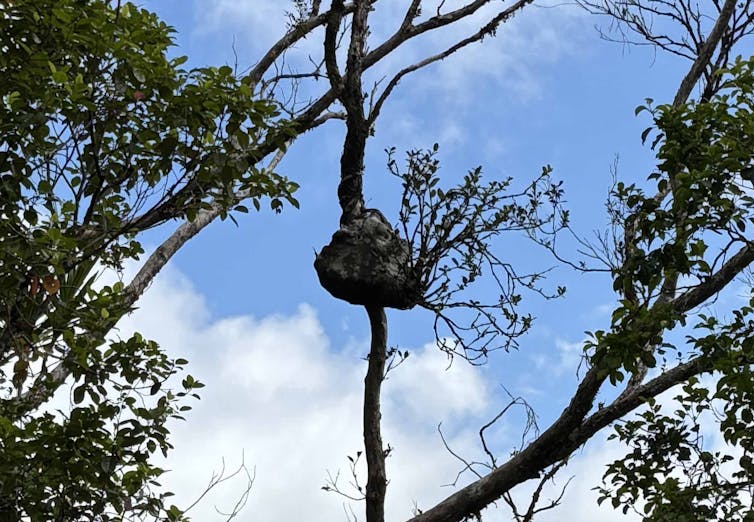
    Here’s how it works in this case. The base of the Squamellaria plant stem forms a swollen, hollow structure called a domatium – a perfect place for ants to live. Domatia gradually enlarge to the size of a soccer ball, containing ever more plant-made houses ready for ants to move into. Each apartment can house a colony made up of thousands of ants.

    A multicompartment Squamellaria (S. tenuiflora) in its natural habitat: rainforests in Fiji. This large plant likely contains a dozen or more compartments.
    G. Chomicki

    The relationship between the ants and the plants is mutualistic, meaning both parties benefit. The ants gain a nice sturdy and private nest space, while the plants gain essential nutrients. They obtain nitrogen and phosphorus from the ants’ feces and from detritus – including dead insects, plant bits and soil – that the ants bring inside the domatium.

    However, tropical rainforest canopies are battlegrounds for survival. Ants compete fiercely for nesting space, taking over any hollow branch or space under tree bark. Any Squamellaria ant house would thus be at risk of being colonized and taken over by other incoming ants, disrupting the existing partnership.

    Until now, it was unclear how the cooperative relationships between ants and plants remain stable in this competitive environment.

    Walls keep the peace

    Our first hint about what keeps the peace in the Squamellaria real estate came when we discovered several ant species living in the same plant domatium. This finding just didn’t make sense. How could aggressively competing ant species live together?

    We investigated the structure of domatia using computed-tomography scanning, which revealed an interesting internal architecture. Each plant domatium is divided into distinct compartments, with thick walls isolating each unit. Independent entrances prevent direct contact between the inhabitants of different units. The walls safeguard the peace as they prevent encounters between different ant species.

    A 3D model of a Squamellaria tenuiflora domatiium based on CT-scanning data reveals its compartmentalization. Each color-coded cavity is a distinct ‘ant apartment,’ isolated of the others, but connected to the outside.
    S. Renner & G. Chomicki

    Back in the lab, when we removed the ant apartments’ walls, placing inhabitants in contact with their neighbors, deadly fights broke out between ant species. The compartmentalized architecture is thus critical in preventing symbiont “wars” and maintaining the stability of the plant’s partnership with all the ants that call it home. By minimizing deadly conflicts that could harm the ants it hosts, this strategy ensures that the plant retains access to sufficient nutrients provided by the ants.

    This research reveals a new mechanism that solves a long-standing riddle – the stability of symbioses involving multiple unrelated partners. Scientists hadn’t previously discovered aggressive animal symbionts living together inside a single plant host. Our study reveals for the first time how simple compartmentalization is a highly effective way to reduce conflict, even in the most extreme cases. The ant colonies are living side by side, but not really together.

    What’s next

    The key to conflict-free living of multipartner symbioses discovered in these Fijian plants – compartmentalization – is likely important in other multispecies partnerships. However, it remains unknown whether compartmentalization is widespread in nature. Research on cooperation between species has long focused on pairwise interactions. Our new insights suggest a need to reinvestigate other multispecies mutualistic symbioses to see how they maintain stability.

    Guillaume Chomicki receives funding from UKRI.

    Susanne S. Renner received previous funding from the German Research Foundation (DFG)

    – ref. This tropical plant builds isolated ‘apartments’ to prevent battles among the aggressive ant tenants it relies on for survival – https://theconversation.com/this-tropical-plant-builds-isolated-apartments-to-prevent-battles-among-the-aggressive-ant-tenants-it-relies-on-for-survival-260674

    MIL OSI –

    July 11, 2025
  • MIL-OSI Canada: Update on measles cases in B.C., ensuring people remain protected

    Source: Government of Canada regional news

    Measles is an extremely contagious virus that can cause severe disease and complications, including pneumonia, encephalitis (inflammation of the brain) and even death. It can spread through air. People can pass the virus to others before they show symptoms, and the virus can stay suspended in the air in a room for several hours.

    Symptoms of measles include fever, cough, runny nose and conjunctivitis. Three to four days after the onset of fever, a rash develops. It generally begins on the face, then spreads rapidly to the rest of the body.

    There has been a resurgence of measles activity in Canada in recent years, with several thousand confirmed cases reported nationally in 2025, after 146 cases were reported in 2024. Cases occur largely in people who were unimmunized or under-immunized (only received one dose). There is also significant measles transmission in other parts of the world, including Europe, Asia and Africa. This is usually the source of cases seen in Canada.

    Measles vaccines have been part of B.C.’s immunization program since 1969, with a second dose (and a comprehensive catch-up campaign for children, youth, and young adults) added to the schedule in 1996.

    In B.C., measles vaccine is provided as measles, mumps and rubella (MMR) vaccine for the first dose and is recommended for children beginning at their first birthday. A second dose, generally with measles, mumps, rubella and varicella vaccine (MMRV), is given at school entry (age 4-6 years).

    How to check your immunization records:

    • Check immunization records for adults and children through the Health Gateway.
    • If the records are not in the Health Gateway:
      • Adults and children may have received a paper record at the time of immunization. For example, in B.C., immunizations may be recorded in the Child Health Passport.
      • If the immunization record is incomplete in Health Gateway and people have a paper record, they can submit the record.
      • If people don’t have a paper record, they can:
        • Contact the health-care provider that gave the vaccines.
        • Contact the community health nurse if the vaccines were given in a First Nations community.
        • If people have moved to B.C. from another province or country, contact the immunization provider or local public health unit and ask to have the records sent to them.

    MIL OSI Canada News –

    July 11, 2025
  • MIL-OSI Canada: New Fine for Illegal Parking in Some Hospital Lots in Halifax

    Source: Government of Canada regional news

    Drivers who park illegally in Queen Elizabeth II Health Sciences Centre (Halifax Infirmary and Victoria General sites) and IWK Health Centre parking lots can be fined $500 starting today, July 10.

    “Free on-site parking at health facilities is for patients, visitors and authorized staff. We want to discourage drivers from parking at these sites without a valid reason and crowding out legitimate users,” said Michelle Thompson, Minister of Health and Wellness. “We hope this step will be a strong deterrent for anyone considering parking at a hospital or healthcare facility who is not seeking or providing care.”

    The Province has created new regulations under the Motor Vehicle Act that allow parking enforcement officers to issue tickets to drivers of vehicles parked illegally in designated hospital parking lots in Halifax.

    The Health Authority Parking Lots Pilot Project Regulations:

    • impose a fine of $500 for parking in specific hospital parking lots if not attending a Queen Elizabeth II or IWK facility
    • list authorized users, including patients, healthcare providers, health authority employees, visitors, volunteers and service providers
    • list documents that can be used to show the person is properly parking in the lot (e.g. a health authority exit pass, health authority ID, etc.).

    Parking tickets will be issued by a peace officer or a special constable. Both health authorities – Nova Scotia Health and IWK Health – will have special constables authorized to issue parking tickets.


    Quick Facts:

    • the ticket amount is $536.60, but will be reduced to $500 if it is paid during the first 60 days after it is issued, in accordance with the Summary Offence Tickets Regulations
    • the QEII Health Sciences Centre includes buildings on two sites in Halifax – the Halifax Infirmary site includes Camp Hill Veterans Memorial, Abbie J. Lane Memorial and the Halifax Infirmary; the Victoria General site includes the Nova Scotia Rehabilitation Centre, the Centre for Clinical Research, and the Bethune, Mackenzie, Dickson, Victoria and Centennial buildings

    Additional Resources:

    Health Authority Parking Lots Pilot Project Regulations: https://novascotia.ca/just/regulations/regs/2025-129.pdf

    News release – Free Parking at Hospitals, Healthcare Facilities: https://news.novascotia.ca/en/2025/04/30/free-parking-hospitals-healthcare-facilities


    Other than cropping, Province of Nova Scotia photos are not to be altered in any way.

    MIL OSI Canada News –

    July 11, 2025
  • MIL-OSI USA: Rep. Dina Titus Statement on Failure of Universal Consent Measure in Senate

    Source: United States House of Representatives – Congresswoman Dina Titus (1st District of Nevada)

    Rep. Dina Titus Statement on Failure of Universal Consent Measure in Senate

    Congresswoman Dina Titus released the following statement after the Senate declined to consider a measure to restore the gambling loss deduction to 100% from 90%:

    “The failure of the Senate’s unanimous consent measure is not surprising. The Senate got us into this mess and it’s now time for both chambers to unite behind my bipartisan FAIR BET Act to ensure that average and high-stakes gamblers do not pay taxes on money they never won. If we do not do this, more gamblers will move to unregulated and untaxed offshore markets; more gamblers will not report winnings; and revenue and jobs will be lost, not just in Las Vegas, but across the nation. We will all be losers if the FAIR BET Act is not passed by Congress and signed by the President.” 

    MIL OSI USA News –

    July 11, 2025
  • MIL-OSI USA: Rep. Dina Titus Statement on Failure of Universal Consent Measure in Senate

    Source: United States House of Representatives – Congresswoman Dina Titus (1st District of Nevada)

    Rep. Dina Titus Statement on Failure of Universal Consent Measure in Senate

    Congresswoman Dina Titus released the following statement after the Senate declined to consider a measure to restore the gambling loss deduction to 100% from 90%:

    “The failure of the Senate’s unanimous consent measure is not surprising. The Senate got us into this mess and it’s now time for both chambers to unite behind my bipartisan FAIR BET Act to ensure that average and high-stakes gamblers do not pay taxes on money they never won. If we do not do this, more gamblers will move to unregulated and untaxed offshore markets; more gamblers will not report winnings; and revenue and jobs will be lost, not just in Las Vegas, but across the nation. We will all be losers if the FAIR BET Act is not passed by Congress and signed by the President.” 

    MIL OSI USA News –

    July 11, 2025
  • MIL-OSI USA: Griffith Announces $33,915 DOT Grant to Cumberlands Airport Commission

    Source: United States House of Representatives – Congressman Morgan Griffith (R-VA)

    Griffith Announces $33,915 DOT Grant to Cumberlands Airport Commission

    The U.S. Department of Transportation (DOT) Federal Aviation Administration (FAA) has awarded the Cumberlands Airport Commission, based in Wise County, Virginia, a $33,915 grant. The funding supports a tree removal project that helps bring the airport into conformity with current standards. U.S. Congressman Morgan Griffith (R-VA) issued the following statement:

    “Tree removal projects are essential in optimizing the safety of aircraft and passengers.

    “This DOT grant for $33,915 helps Cumberlands Airport Commission identify and eliminate obstructions to the Lonesome Pine Airport.”

    BACKGROUND

    As part of the grant funding, the Cumberlands Airport Commission will conduct an environmental analysis.

    ###

    MIL OSI USA News –

    July 11, 2025
  • MIL-OSI USA: Griffith Announces $33,915 DOT Grant to Cumberlands Airport Commission

    Source: United States House of Representatives – Congressman Morgan Griffith (R-VA)

    Griffith Announces $33,915 DOT Grant to Cumberlands Airport Commission

    The U.S. Department of Transportation (DOT) Federal Aviation Administration (FAA) has awarded the Cumberlands Airport Commission, based in Wise County, Virginia, a $33,915 grant. The funding supports a tree removal project that helps bring the airport into conformity with current standards. U.S. Congressman Morgan Griffith (R-VA) issued the following statement:

    “Tree removal projects are essential in optimizing the safety of aircraft and passengers.

    “This DOT grant for $33,915 helps Cumberlands Airport Commission identify and eliminate obstructions to the Lonesome Pine Airport.”

    BACKGROUND

    As part of the grant funding, the Cumberlands Airport Commission will conduct an environmental analysis.

    ###

    MIL OSI USA News –

    July 11, 2025
  • MIL-OSI USA: Newhouse Introduces Legislation to Designate Astria Toppenish as a Critical Access Hospital

    Source: United States House of Representatives – Congressman Dan Newhouse (4th District of Washington)

    Headline: Newhouse Introduces Legislation to Designate Astria Toppenish as a Critical Access Hospital

    WASHINGTON, D.C. – Today, Rep. Dan Newhouse (WA-04) introduced legislation to allow Astria Toppenish to be designated as a Critical Access Hospital, which is currently ineligible for certain rural hospital support due to unique geographic and economic factors and the number of patients it serves.

    “This legislation helps address the unique financial situation of Astria Toppenish by allowing them to be designated as a Critical Access Hospital. Certain rural hospitals like Astria Toppenish face unique challenges qualifying for adequate federal reimbursements as the demand for services continues to rise. While there is plenty of work to be done in addressing these challenges, this legislation is a strong first step in reforming the way we support rural hospitals providing critical health services to our communities.” said Rep. Newhouse.  

    This legislation would directly benefit Astria-Toppenish as it delivers critical healthcare services to the area but is not currently eligible for CAH status. This status would allow it to access financial benefits that allow other rural hospitals to continue providing care to the communities they serve. 

    “I’m proud of the collective work done to propel forward legislation for a Critical Access Hospital designation for Astria Toppenish Hospital. This rural facility serves a vital role in the Yakima Valley, especially for the residents of Toppenish and the Yakama Nation. Without this hospital, families would be left without access to timely, lifesaving care—and that’s simply unacceptable,” said Brian Gibbons, President and CEO of Astria Health. 

    Gibbons continued, “Astria Health has stretched resources as far as they can go, doing everything possible to keep the doors open. But no health system—especially one serving multiple underserved communities—can continue reallocating funds without consequences.” 

    Cathy Bambrick, Administrator for Astria Toppenish Hospital, added, “A Critical Access designation would allow Toppenish hospital to receive enhanced reimbursements for Medicare and Medicaid patients—who make up the majority of those treated at our facility. It’s a commonsense, fiscally responsible solution that supports rural health, preserves access to care, and upholds our commitment to underserved populations.” 

    The CAH designation is designed to reduce the financial vulnerability of rural hospitals and improve access to healthcare by keeping essential services in rural communities. To accomplish this goal, CAHs receive certain benefits, such as cost-based reimbursement for Medicare services. 

    See full bill text here. 

    ### 

    MIL OSI USA News –

    July 11, 2025
  • MIL-OSI USA: Newhouse Introduces Legislation to Designate Astria Toppenish as a Critical Access Hospital

    Source: United States House of Representatives – Congressman Dan Newhouse (4th District of Washington)

    Headline: Newhouse Introduces Legislation to Designate Astria Toppenish as a Critical Access Hospital

    WASHINGTON, D.C. – Today, Rep. Dan Newhouse (WA-04) introduced legislation to allow Astria Toppenish to be designated as a Critical Access Hospital, which is currently ineligible for certain rural hospital support due to unique geographic and economic factors and the number of patients it serves.

    “This legislation helps address the unique financial situation of Astria Toppenish by allowing them to be designated as a Critical Access Hospital. Certain rural hospitals like Astria Toppenish face unique challenges qualifying for adequate federal reimbursements as the demand for services continues to rise. While there is plenty of work to be done in addressing these challenges, this legislation is a strong first step in reforming the way we support rural hospitals providing critical health services to our communities.” said Rep. Newhouse.  

    This legislation would directly benefit Astria-Toppenish as it delivers critical healthcare services to the area but is not currently eligible for CAH status. This status would allow it to access financial benefits that allow other rural hospitals to continue providing care to the communities they serve. 

    “I’m proud of the collective work done to propel forward legislation for a Critical Access Hospital designation for Astria Toppenish Hospital. This rural facility serves a vital role in the Yakima Valley, especially for the residents of Toppenish and the Yakama Nation. Without this hospital, families would be left without access to timely, lifesaving care—and that’s simply unacceptable,” said Brian Gibbons, President and CEO of Astria Health. 

    Gibbons continued, “Astria Health has stretched resources as far as they can go, doing everything possible to keep the doors open. But no health system—especially one serving multiple underserved communities—can continue reallocating funds without consequences.” 

    Cathy Bambrick, Administrator for Astria Toppenish Hospital, added, “A Critical Access designation would allow Toppenish hospital to receive enhanced reimbursements for Medicare and Medicaid patients—who make up the majority of those treated at our facility. It’s a commonsense, fiscally responsible solution that supports rural health, preserves access to care, and upholds our commitment to underserved populations.” 

    The CAH designation is designed to reduce the financial vulnerability of rural hospitals and improve access to healthcare by keeping essential services in rural communities. To accomplish this goal, CAHs receive certain benefits, such as cost-based reimbursement for Medicare services. 

    See full bill text here. 

    ### 

    MIL OSI USA News –

    July 11, 2025
  • MIL-OSI USA: As extension period nears mid-way point, those who haven’t filed 2024 income taxes are urged to do so as soon as possible

    Source: US State of Oregon

    ith the halfway point of the income tax filing extension period approaching, the Oregon Department of Revenue wants to remind taxpayers who haven’t yet filed their 2024 tax return to do so as soon as they can.

    “July 15 may be just the halfway point of the extension period, but for most people who haven’t yet filed their tax year 2024 return there’s no reason not to file now,” said Department of Revenue Director David Gerstenfeld.

    Some people may not have filed because they didn’t have money to pay what they owe, but an extension to file is not an extension to pay any tax owed. Those who didn’t file and haven’t paid are only racking up additional late payment penalties and interest by waiting.

    “Even if they can’t pay the full amount they owe, they should pay what they can as soon as they can to help lower penalties and interest,” the director said. “For those who can’t pay all they owe, filing a return offers them the opportunity to set up a payment plan with the state.”

    Besides not being able to pay, people file for an extension for all kinds of reasons. Some are waiting on additional information or documents. Others are experiencing hardship in the days before the deadline and have to direct their attention elsewhere. Some people just put it off or forget.

    “Whatever the reason, as soon as they have what they need, they should file,” Gerstenfeld said.

    For some taxpayers, filing can mean receiving a refund.

    Several free filing options and in-person tax assistance options remain available during the summer months.

    One of those options is Direct File Oregon. More than 13,000 Oregon taxpayers filed their state returns with Direct File Oregon this year. Nearly 4,700 of those filers connected to Direct File Oregon after first filing their federal returns through IRS Direct File, which is still available through the end of the filing season.

    So far in 2025, the department has processed more than 2.05 million of an expected 2.2 million returns. That leaves approximately 150,000 Oregon taxpayers who still need to file their tax year 2024 returns.

    “Some tax situations are complex and require extra time—even months—to prepare, but most aren’t,” he said. “Filing as soon as you can makes good sense. It can save money and provide some peace of mind.”

    Taxpayers with questions can call 800-356-4222 toll-free from an Oregon prefix (English or Spanish) or 503-378-4988 in Salem and outside Oregon. For TTY (hearing or speech impaired), the department accepts all relay calls.

    MIL OSI USA News –

    July 11, 2025
  • MIL-OSI USA: As extension period nears mid-way point, those who haven’t filed 2024 income taxes are urged to do so as soon as possible

    Source: US State of Oregon

    ith the halfway point of the income tax filing extension period approaching, the Oregon Department of Revenue wants to remind taxpayers who haven’t yet filed their 2024 tax return to do so as soon as they can.

    “July 15 may be just the halfway point of the extension period, but for most people who haven’t yet filed their tax year 2024 return there’s no reason not to file now,” said Department of Revenue Director David Gerstenfeld.

    Some people may not have filed because they didn’t have money to pay what they owe, but an extension to file is not an extension to pay any tax owed. Those who didn’t file and haven’t paid are only racking up additional late payment penalties and interest by waiting.

    “Even if they can’t pay the full amount they owe, they should pay what they can as soon as they can to help lower penalties and interest,” the director said. “For those who can’t pay all they owe, filing a return offers them the opportunity to set up a payment plan with the state.”

    Besides not being able to pay, people file for an extension for all kinds of reasons. Some are waiting on additional information or documents. Others are experiencing hardship in the days before the deadline and have to direct their attention elsewhere. Some people just put it off or forget.

    “Whatever the reason, as soon as they have what they need, they should file,” Gerstenfeld said.

    For some taxpayers, filing can mean receiving a refund.

    Several free filing options and in-person tax assistance options remain available during the summer months.

    One of those options is Direct File Oregon. More than 13,000 Oregon taxpayers filed their state returns with Direct File Oregon this year. Nearly 4,700 of those filers connected to Direct File Oregon after first filing their federal returns through IRS Direct File, which is still available through the end of the filing season.

    So far in 2025, the department has processed more than 2.05 million of an expected 2.2 million returns. That leaves approximately 150,000 Oregon taxpayers who still need to file their tax year 2024 returns.

    “Some tax situations are complex and require extra time—even months—to prepare, but most aren’t,” he said. “Filing as soon as you can makes good sense. It can save money and provide some peace of mind.”

    Taxpayers with questions can call 800-356-4222 toll-free from an Oregon prefix (English or Spanish) or 503-378-4988 in Salem and outside Oregon. For TTY (hearing or speech impaired), the department accepts all relay calls.

    MIL OSI USA News –

    July 11, 2025
  • MIL-OSI USA: Justice Department Opens Investigation into the State of Minnesota for Race- and Sex-Based Hiring Practices

    Source: US State Government of Utah

    The Justice Department’s Civil Rights Division has opened an investigation into the State of Minnesota, including the Minnesota Department of Human Services, to determine whether it has engaged in race- and sex-based discrimination in its state employment hiring practices.

    In a policy issued earlier this month, the Minnesota Department of Human Services requires its hiring supervisors to provide a “hiring justification when seeking to hire a non-underrepresented candidate.” Hiring supervisors who do not comply with the policy “may be subject to disciplinary action, up to and including termination.” The policy seems to be part of a broader effort by the state to engage in race- and sex-based employment practices in its “affirmative action” objectives.

    The Civil Rights Division’s Employment Litigation Section will investigate whether Minnesota is engaged in a pattern or practice of discrimination based on race, sex, and other protected characteristics, pursuant to Title VII of the Civil Rights Act of 1964, as amended.

    “Minnesotans deserve to have their state government employees hired based on merit, not based on illegal DEI,” said Attorney General Pamela Bondi.

    “Federal law has long prohibited employment policies that discriminate based on race or sex,” said Assistant Attorney General Harmeet K. Dhillon of the Civil Rights Division. “The Justice Department refuses to tolerate such conduct, and states invite investigation when they engage in biased hiring practices tied to protected characteristics.”

    You can read the notice letter here.

    MIL OSI USA News –

    July 11, 2025
  • MIL-OSI USA: Rosen, Curtis Introduce Bill to Counter Chinese Sabotage of Taiwan’s Critical Infrastructure

    US Senate News:

    Source: United States Senator Jacky Rosen (D-NV)

    Bipartisan legislation aims to protect Taiwan’s undersea communication cables against “gray zone tactics” used by China
    WASHINGTON, DC – Today, U.S. Senators Jacky Rosen (D-NV) and John Curtis (R-UT), members of the Foreign Relations Committee, introduced the Taiwan Undersea Cable Resilience Initiative Act. This bipartisan bill would protect Taiwan’s critical communications infrastructure and deter malicious “gray zone” activities by the Chinese Communist Party. The cables—critical for global communication and commerce—have repeatedly been targeted by China for undercover sabotage to undermine Taiwan’s security and sovereignty.
    “The Chinese Communist Party’s ongoing efforts to target Taiwan’s undersea cable infrastructure don’t just threaten Taiwan’s national security, but connectivity and communication around the world,” said Senator Rosen. “Senator Curtis and I are introducing this bipartisan legislation to bolster collaboration between our two nations in order to protect these underground cables and impose sanctions on any adversary that targets this critical infrastructure. I will continue to push back on China’s growing aggression, and its attempts to undermine democracy.”
    “We can’t stand idle as China ramps up its tactics to isolate Taiwan, including by sabotaging its vital undersea cables,” said Senator Curtis. “By improving systems and increasing cable resiliency, our bipartisan legislation sends a clear message: the United States stands with Taiwan and our allies in defending shared infrastructure, sovereignty, and freedom.”
    Senator Rosen has prioritized strengthening the U.S.–Taiwan partnership and defending Taiwan against growing threats from the Chinese Communist Party. She introduced and helped pass into law via the annual defense bill the bipartisan Taiwan Cybersecurity Resiliency Act to enhance joint cyber defense efforts, and she led the introduction of the bipartisan TAIWAN Security Act to bolster defense and supply chain cooperation. She has also been a consistent leader in pushing back against authoritarian influence more broadly.

    MIL OSI USA News –

    July 11, 2025
  • Khelo Bharat Niti 2025 sets stage for India’s rise as a global sporting powerhouse

    Source: Government of India

    Source: Government of India (4)

    For generations, sports in India were seen as a pastime squeezed between schoolwork and exams — a hobby on dusty fields rather than a career to aspire to. Limited infrastructure and a societal focus on academics meant few dared to dream of donning the national colours. But over the years, that narrative has steadily transformed, and today, with the launch of Khelo Bharat Niti 2025, India is set to redefine its sporting destiny.

    Launched under the vision ‘From Grassroots to Glory’, the landmark policy is poised to reshape the country’s sports ecosystem. Integrating with the National Education Policy (NEP) 2020, Khelo Bharat Niti aims to bridge the gap between classrooms and playgrounds, recognizing sports as an essential component of holistic development. It prioritizes women’s empowerment, outreach to marginalized and tribal communities, and active engagement with the Indian diaspora.

    A Vision for the 2036 Olympics

    With its eyes set firmly on the global stage, India’s ambitious roadmap includes a strategic push to become a sporting powerhouse by the 2036 Olympics — and to stake its claim as a potential host. This vision is backed by substantial funding: for FY 2025–26, the Ministry of Youth Affairs and Sports has been allocated ₹3,794 crore, marking a 130.9% increase from FY 2014–15. Of this, ₹1,000 crore is earmarked for the flagship Khelo India programme alone.

    Building the Sporting Ecosystem

    The policy focuses on talent identification at the grassroots level, competitive leagues, world-class training, and sports science support. It calls for significant private sector participation through public-private partnerships, corporate social responsibility, and innovative funding models, laying the groundwork for a sustainable sports industry.

    Sports are also being positioned as a major economic driver, with an emphasis on boosting sports tourism, hosting international events, and nurturing sports startups. The goal is to transform sports from a niche pursuit into a vibrant sector generating livelihoods and national pride.

    A Network of Opportunity

    Since its inception in 2016–17 and subsequent expansion in 2021, Khelo India has firmly established itself as a cornerstone of India’s sports revolution. The initiative has approved 326 sports infrastructure projects, committing over ₹3,124 crore to enhance athletic facilities across the nation. Furthermore, it has been instrumental in creating a robust support system for athletes by establishing 1,045 Khelo India Centres and 34 State Centres of Excellence, complemented by 306 accredited academies. This expansive network provides comprehensive support to nearly 2,850 athletes, covering their training needs, equipment, medical care, and stipends. Khelo India also organizes several annual flagship events, including the Khelo India Youth Games, University Games, Para Games, and Winter Games. These 17 editions of events have collectively drawn over 50,000 athletes, showcasing a significant increase in participation and competitive opportunities within the Indian sports landscape.

    One of the programme’s standout initiatives is KIRTI (Khelo India Rising Talent Identification), which scouts talent aged 9–18 through 174 Talent Assessment Centres. It aims to propel India into the top-10 sporting nations by 2036, and top-5 by 2047.

    Further, the inaugural Khelo India Water Sports Festival is set to take place at Srinagar’s Dal Lake this August, featuring five sports and over 400 athletes — a testament to the policy’s vision of broadening India’s sporting horizons.

    Institutional Support for Excellence

    The National Sports University, established in Imphal in 2018, is another pillar supporting this vision. The university focuses on sports sciences, management, coaching, and research, training India’s next generation of elite athletes and sports professionals. With global partnerships and a motto of Sports Excellence through Education, Research and Training, it aims to bridge education with high-performance sport.

    Stories Beyond the Arena

    The impact of these initiatives is visible in countless inspiring journeys. Para-athlete Rohit Kumar, a PhD scholar in Delhi, credits government support for creating equal opportunities for athletes like him. “Progress is possible only when supported by the government and society,” he says. He sees Khelo Bharat Niti 2025 — especially its integration with the NEP — as a transformative step for athletes who wish to balance sports and education.

    Athlete Samantha Saver Siddi, from India’s historic Siddi community, echoes this optimism. Practising at Bengaluru’s Jay Prakash Narayan Sports Academy while pursuing her arts degree, Samantha dreams of winning medals for India and credits the policy for creating an environment where such dreams can thrive.

    Towards a Sporting Nation

    India’s medal tallies — from 57 at Incheon 2014 to 69 at Jakarta 2018, and a record 107 at Hangzhou 2023 — highlight a nation on the rise. As India aims to elevate its global standing, Khelo Bharat Niti 2025 is set to be the blueprint for nurturing talent, expanding opportunities, and building a culture where sports and academics stand shoulder to shoulder.

    With its youth population of over 65%, India has the numbers — and now, the resolve — to transform playground dreams into podium moments. The journey from dusty fields to Olympic podiums is no longer a distant dream, but a goal within reach.

    July 11, 2025
  • MIL-OSI USA: Wyden Blasts Trump Administration Over Budget Cuts Kneecapping Wildfire Preparedness in Oregon

    US Senate News:

    Source: United States Senator Ron Wyden (D-Ore)

    July 10, 2025

    Senator cites concerns he’s heard at briefings in Southern Oregon and statewide

    Video can be found here

    Washington, D.C. – Senator Ron Wyden, D-Ore., today demanded answers from the Trump Administration about how its proposed U.S. Forest Service budget cuts, funding and hiring freezes and recent reorganization of federal wildland firefighting will undermine Oregon’s preparedness for this fire season. 

    “Instead of moving quickly, you all have trotted out another new and described ‘improved’ reorganization in the middle of a very dangerous fire season,” Wyden said to U.S. Forest Service Chief Tom Schultz at a Senate Energy and Natural Resources Committee hearing. “Nobody in my home state said we need to have the Forest Service less involved in fighting fires, but that is the net effect of your organizational plan.”

    In February Trump issued an illegal, blanket freeze on previously approved federal funding for critical programs, including those that help Western states prepare for fire season. During the hearing, Wyden reiterated warnings from fire officials in Southern Oregon, where he heard firsthand accounts of how Trump’s staffing and funding cuts are starving Oregon’s communities of the resources they need to prepare for and respond to fires.

    After ordering the funding freeze, Trump also issued an Executive Order to reorganize the national wildland firefighting apparatus within the Department of the Interior, but the agencies have not shared their plans for doing so with Congress, or how it will hurt states like Oregon.

    At today’s hearing, Wyden also warned that starving federal agencies of the resources they need and intentional mismanagement of forests and public lands is setting the stage to justify future selloffs of public lands. Wyden cited extreme public backlash over the Republicans’ scheme to sell off public lands under their budget bill earlier this month, which forced Senate Republicans to back off their proposal.

    Wyden has been a longtime champion of sustainable forestry and common-sense policies to reduce the risk of wildfire.  In June, Wyden led colleagues in introducing the bipartisan National Prescribed Fire Act of 2025 that would invest in hazardous fuels management to reduce the risk of blistering infernos by increasing the pace and scale of prescribed burns during cooler, wetter months. Wyden also has advocated for repairing and updating critical infrastructure for disaster response, announcing over $80 million for infrastructure repairs and $9.7 million for rural airports across Oregon.


    MIL OSI USA News –

    July 11, 2025
  • This tropical plant builds isolated ‘apartments’ to prevent battles among the aggressive ant tenants it relies on for survival

    Source: ForeignAffairs4

    Source: The Conversation – USA – By Guillaume Chomicki, Professor of Evolutionary Biology, Durham University

    When aggressive ant species come in contact, deadly conflicts ensue G. Chomicki

    In the middle of the South Pacific, a group of Fijian plants have solved a problem that has long puzzled scientists: How can an organism cooperate with multiple partners that are in turn competing for the same resources? The solution turns out to be simple – compartmentalization.

    Imagine an apartment building where unfriendly neighbors might clash if they run into each other, but smart design keeps everyone peacefully separated. In our new research published in the journal Science, we show how certain plants build specialized structures that allow multiple aggressive ant species to live side by side inside them without ever meeting.

    Ants and plants cooperate in Fijian rainforest

    Squamellaria plants are epiphytes – meaning they don’t have roots attached to the ground, and instead grow on another plant for physical support. They live high up in the rainforest canopy, in the South Pacific.

    Because they don’t have direct access to the soil’s nutrients, Squamellaria plants have evolved an original strategy to acquire what they need: In a mutually beneficial relationship, they grow structures that appeal to ants looking for a place to live. This kind of long-term relationship between species – whether helpful or harmful – is called symbiosis.

    Here’s how it works in this case. The base of the Squamellaria plant stem forms a swollen, hollow structure called a domatium – a perfect place for ants to live. Domatia gradually enlarge to the size of a soccer ball, containing ever more plant-made houses ready for ants to move into. Each apartment can house a colony made up of thousands of ants.

    A bulbous plant attached to a branch in a canopy
    A multicompartment Squamellaria (S. tenuiflora) in its natural habitat: rainforests in Fiji. This large plant likely contains a dozen or more compartments.
    G. Chomicki

    The relationship between the ants and the plants is mutualistic, meaning both parties benefit. The ants gain a nice sturdy and private nest space, while the plants gain essential nutrients. They obtain nitrogen and phosphorus from the ants’ feces and from detritus – including dead insects, plant bits and soil – that the ants bring inside the domatium.

    However, tropical rainforest canopies are battlegrounds for survival. Ants compete fiercely for nesting space, taking over any hollow branch or space under tree bark. Any Squamellaria ant house would thus be at risk of being colonized and taken over by other incoming ants, disrupting the existing partnership.

    Until now, it was unclear how the cooperative relationships between ants and plants remain stable in this competitive environment.

    Walls keep the peace

    Our first hint about what keeps the peace in the Squamellaria real estate came when we discovered several ant species living in the same plant domatium. This finding just didn’t make sense. How could aggressively competing ant species live together?

    We investigated the structure of domatia using computed-tomography scanning, which revealed an interesting internal architecture. Each plant domatium is divided into distinct compartments, with thick walls isolating each unit. Independent entrances prevent direct contact between the inhabitants of different units. The walls safeguard the peace as they prevent encounters between different ant species.

    A close-up view of the domatium, showing three overlapping regions in different colors
    A 3D model of a Squamellaria tenuiflora domatiium based on CT-scanning data reveals its compartmentalization. Each color-coded cavity is a distinct ‘ant apartment,’ isolated of the others, but connected to the outside.
    S. Renner & G. Chomicki

    Back in the lab, when we removed the ant apartments’ walls, placing inhabitants in contact with their neighbors, deadly fights broke out between ant species. The compartmentalized architecture is thus critical in preventing symbiont “wars” and maintaining the stability of the plant’s partnership with all the ants that call it home. By minimizing deadly conflicts that could harm the ants it hosts, this strategy ensures that the plant retains access to sufficient nutrients provided by the ants.

    This research reveals a new mechanism that solves a long-standing riddle – the stability of symbioses involving multiple unrelated partners. Scientists hadn’t previously discovered aggressive animal symbionts living together inside a single plant host. Our study reveals for the first time how simple compartmentalization is a highly effective way to reduce conflict, even in the most extreme cases. The ant colonies are living side by side, but not really together.

    What’s next

    The key to conflict-free living of multipartner symbioses discovered in these Fijian plants – compartmentalization – is likely important in other multispecies partnerships. However, it remains unknown whether compartmentalization is widespread in nature. Research on cooperation between species has long focused on pairwise interactions. Our new insights suggest a need to reinvestigate other multispecies mutualistic symbioses to see how they maintain stability.

    The Conversation

    Guillaume Chomicki receives funding from UKRI.

    Susanne S. Renner received previous funding from the German Research Foundation (DFG)

    – ref. This tropical plant builds isolated ‘apartments’ to prevent battles among the aggressive ant tenants it relies on for survival – https://theconversation.com/this-tropical-plant-builds-isolated-apartments-to-prevent-battles-among-the-aggressive-ant-tenants-it-relies-on-for-survival-260674

    July 11, 2025
  • MIL-OSI Africa: Insurance Biz Africa launches pan-African Insurance Webinar Master Series

    Source: APO – Report:

    Digital news publisher, Insurance Biz Africa, is proud to announce the launch of a series of pan-African webinar sessions whose objectives are to take an unprecedented deep dive into the forces reshaping the insurance industry across Africa and the world.

    The 8-part series, themed: “Innovate. Adapt. Insure the Future“, hosted by Insurance Biz Africa, will feature two-hour webinars designed to unpack the most pressing risks, opportunities, and regulatory changes facing insurers across Africa and beyond.

    “This is a pivotal moment for the insurance industry. The annual webinar series will provide crucial insights into topics from AI and climate risk to ESG, equipping professionals and regulators to navigate volatility with confidence. The series is designed to ignite long-lasting conversations around pertinent areas of insurance and reinsurance upon which the industry can build solutions,” says Insurance Biz Africa Founding Editor and Managing Director of New Africa Business News Services (NABNS), Kwanele Sibanda.

    “At NABNS, we believe the time is ripe for bold conversations and collaborative thinking. Our series will not only educate but spark innovation, ensuring insurance and reinsurance remain pillars of economic resilience,” adds Kwanele.

    “Kicking off with Insuring Against Civil Unrests on the 23rd of July, the timing couldn’t have been more perfect, especially seeing what is currently happening across Africa in countries like Kenya, the Democratic Republic of Congo, Togo, Mali and Lybia because of political tensions. This 2-hour session will see Sasria, the only riots and civil unrests insurer in South Africa present a case study in reflection of South Africa’s July 2021 civil unrests. Sasria will also participate in the panel of experts,” concludes Kwanele.

    Insurance Webinar Master Series 2025 Themes & Dates:

    22 July 2025 – Insuring Against Unrest: Lessons from SA’s July 2021 Riots and the Evolving Role of Insurers and Reinsurers

    05 August 2025 – Cybersecurity and Systemic Risk: Building Insurance Resilience in the Digital Era

    Discuss insurance solutions for large-scale cyber events affecting entire economies.

    14 August 2025 – The Future of Underwriting: Leveraging AI, Data, and Automation Across the Insurance Value Chain

    Explore how AI and advanced analytics can revolutionize underwriting precision and speed.

    • Webinar 4:

    26 August 2025 – Bridging the Protection Gap: Innovations in Inclusive Insurance and Risk Transfer
    Innovative products, partnerships, and risk mechanisms that extend protection to underserved markets.

    04 September 2025 – ESG and Sustainable Insurance: From Compliance to Competitive Advantage
    Move beyond ESG box-ticking towards long-term, sustainable profitability.

    18 September 2025 – Index Insurance and Alternative Risk Transfer: Unlocking Scalable, Transparent Risk Solutions

    Examine new models to insure communities and sectors exposed to systemic risks.

    • Webinar 7:

    30 September 2025 – Navigating AI and Digital Disruption in Life Insurance: Risks, Rewards & Regulation

    Balance the transformative potential of AI with evolving consumer protection frameworks.

    • Webinar 8:

    09 October 2025 – Climate Change and Capital Strain: Managing Volatility in a New Risk Era

    Understand how insurers can adapt capital models amid climate-driven losses.

    Bonus Session:

    October 2025 – Insurtech and Distribution: Reimagining Customer Engagement in Insurance

    Explore new technologies reshaping sales, service, and product design.

    Each session will bring together industry leaders presenting case studies and learnings, global experts, and policymakers engaging in robust discussions, live Q&As, and actionable insights.

    Registration & Sponsorship Opportunities:

    Insurance companies, brokers, reinsurers, regulators, and service providers are encouraged to register early or partner as sponsors to showcase leadership in this high-impact series.

    For more details, registration, or sponsorship opportunities, visit: https://apo-opa.co/44yEOZH or contact info@insurancebiz.co.za

    – on behalf of New Africa Business News Services.

    Additional Information:
    To Register: https://apo-opa.co/4nIgBrg
    Insurance Biz Africa: https://apo-opa.co/4kzR4hb

    Contact:
    Issued By: New Africa Business News Services (NABNS)
    Contact: Kwanele Sibanda
    Email: Kwanele@nabns.com
    Tel: +27 27 71 316 8517

    About Insurance Biz Africa:
    Insurance Biz Africa is South Africa’s premier digital news platform dedicated to the insurance, reinsurance, and wealth management sectors. Launched in 2013, the publication offers in-depth industry coverage, expert insights, executive interviews, and regulatory updates to a targeted audience of professionals, decision-makers, and thought leaders. It is owned and published by New Africa Business News Services (NABNS), a division of SAEN Media (Pty) Ltd. The publication adheres to the Press Council of South Africa’s Code of Ethics and remains committed to journalistic integrity and excellence in financial reporting.

    Media files

    .

    MIL OSI Africa –

    July 11, 2025
  • MIL-OSI USA: DOGE Caucus Co-Chairs Lead House Effort to Eliminate Billions in Wasteful Payments

    Source: United States House of Representatives – Representative Aaron Bean Florida (4th District)

    WASHINGTON—In response to more than $160 billion in fraudulent payments in Fiscal Year 2024, DOGE Caucus co-chairs Congressmen Aaron Bean (FL-04), Blake Moore (UT-01), and Pete Sessions (TX-17) introduced the Delivering on Government Efficiency (DOGE) in Spending Act to combat financial fraud and theft of taxpayer dollars. 

    This landmark bill will require the U.S. Department of the Treasury to enforce strict payment verification measures, cementing a key DOGE initiative to ensure accuracy, transparency, and accountability in government spending.

    Upon introduction, Congressman Bean said, “For too long, improper and fraudulent payments have drained resources and undermined trust in government spending. The American people deserve responsible stewardship of their tax dollars, and this bill delivers exactly that. By ensuring federal payments are accurate, transparent, and verifiable, we are eliminating billions of dollars in waste, fraud, and abuse in the federal government. This legislation brings real oversight and integrity to the way Washington manages taxpayer dollars.”

    “Republicans in Congress remain focused on reining in wasteful spending, streamlining our bureaucracy, and making Washington work better for Americans. This legislation will help eliminate billions of dollars of improper payments by implementing pre-payment verification and up-to-date information on ongoing payments. This is a positive step in curbing fraudulent spending and enhancing fiscal accountability,” said Congressman Moore.

    “I’m proud to cosponsor this legislation that brings increased transparency and accountability to the U.S. Treasury. As Co-Chair of the DOGE Caucus, I’m committed to stopping waste before it happens. With $162 billion in improper payments reported in Fiscal Year 2024, this commonsense bill will help protect taxpayer dollars and prevent fraud,” said Congressman Sessions.

    BACKGROUND 

    This bill would promote financial integrity and ensure accountability to American taxpayers by requiring the U.S. Department of the Treasury to:

    • Provide a complete description of the payment prior to disbursing funds.
    • Link the payment to a verified budget account.
    • Cross-check the payment against government databases to ensure accuracy and eligibility.

    Along with these preventive measures, all expenditures will be publicly accessible on USAspending.gov, including annual updates for ongoing transactions.

    Click here to view the bill and here to view a section-by-section breakdown.

    Fellow DOGE Caucus Chair Joni Ernst (R-Iowa) introduced companion legislation in the Senate.


    ###

    MIL OSI USA News –

    July 11, 2025
  • MIL-OSI USA: Congressman Maxwell Frost and Senator Jeff Merkley Introduce Bicameral Pro Renters Bill, the End Junk Fees for Renters Act

    Source: United States House of Representatives – Representative Maxwell Frost Florida (10th District)

    July 10, 2025

    Frost and Gomez First Introduced the Bill to Increase Affordability and Transparency for Renters in 2023

    WASHINGTON, D.C. — Today, Congressman Maxwell Alejandro Frost (D-FL) and Senator Jeff Merkley (D-OR) announced the introduction of bicameral legislation aimed at addressing the housing crisis and standing firmly with working-class renters – the End Junk Fees for Renters Act.

    Frost’s bill, which is being co-led by Congressman Jimmy Gomez (CA-34) in the House, chair of the Congressional Renters Caucus, comes as Florida and the U.S. face a housing affordability crisis that continues to squeeze working people and renters, too often forcing people to slip into homelessness at a time when cities are criminalizing folks who cannot afford to keep a roof over their heads.

    Congressmen Frost and Gomez first introduced the bill in July of 2023 to put an end to the growing number of excessive and dishonest junk fees renters face when looking for and securing housing.

    The End Junk Fees for Renters Act cracks down on junk fee profiteering by landlords and empowers tenants. Specifically, the legislation:

    • Cracks down on junk fees by banning application and screening fees;

    • Puts an end to late fee profiteering by capping late fees at 3% of monthly rent and requiring a 15-day grace period; 

    • Requires that landlords disclose in the rental contract:

      • Past and present litigation with tenants;

      • Ongoing pest and maintenance issues;

      • Rent increase percentages year after year over the last ten years and;

      • The total amount due each month to effectively eliminate surprise fees.

    • Would help consumers comparison shop and make more informed choices when it comes to renting, inevitably driving down overall costs in the rental market and improving living conditions.

    “Donald Trump ran for office under the promise of making American’s lives more affordable – that was a flat-out lie. Six months in, and Trump and Congressional Republicans have proven they only care about the ultra-wealthy, the 1%. Because if they cared about working people, bills like the End Junk Fees for Renters Act would be voted on today to offer immediate and straightforward financial relief to renters,” said Congressman Maxwell Frost. “This is about standing firmly on the side of renters and working people while holding greedy landlords and leasing companies accountable for nickel and diming people every chance they get. It’s time to end the ridiculous fees and fight for housing justice and transparency.” 

    “Billionaire corporations and huge rental companies are hiding fees and added costs to drive up rents and line their own pockets,” said Senator Merkley. “The End Junk Fees for Renters Act fights back against corporate landlords trying to squeeze every dime out of renters that they possibly can. Let’s crack down on these junk fees to ensure all Americans have a fair shot at a safe, affordable roof overhead and the power to fight back against absurd costs.”

    “At a time when Donald Trump and Republicans are stripping away benefits from millions of Americans, households that rent have enough to worry about without being weighed down by hidden application costs and junk late fees. This bill will restore faith and transparency to the renting process by putting an end to the profiteering of predatory landlords and property managers,” said Congressman Jimmy Gomez. “In my district, where up to 80% of households rent, this bill will lift an unnecessary financial burden and help working families build real stability.”

    ###

    MIL OSI USA News –

    July 11, 2025
  • MIL-OSI USA: Rep. Young Kim Leads Bipartisan Resolution to Drive Misophonia Awareness

    Source: United States House of Representatives – Representative Young Kim (CA-39)

    WASHINGTON, D.C. —  Today, U.S. Reps. Young Kim (CA-40) and Valerie Foushee (NC-04) introduced a bipartisan resolution to recognize World Misophonia Awareness Day, which is held annually on July 9, and increase understanding of this complex neurological condition. 

    Misophonia is a condition characterized by intense emotional and physical reactions to specific sounds and is associated with abnormal connectivity between brain regions involved in sensory processing and emotion regulation.  

    “Misophonia affects millions of Americans, including in our community, and yet it is understudied, misrepresented, and misunderstood,” said Rep. Young Kim. “By recognizing World Misophonia Awareness Day, we can elevate this serious health concern, and secure the research, resources, and care those impacted by Misophonia deserve.”  

    “Misophonia affects thousands of Americans yearly, but still little is known about this condition and no cure has been found,” said Rep. Valerie Foushee. “I am proud to introduce this bipartisan resolution alongside Congresswoman Kim recognizing World Misophonia Awareness Day and the need for further research surrounding this condition. Misophonia affects the daily lives and emotional well-being of so many across the country, and Congress must support efforts to ensure proper care and expand treatment options.” 

    “Misophonia is a debilitating condition, and can be especially challenging for teens. We are grateful to Congresswoman Young Kim and Congresswoman Valerie Foushee for joining together to shine a light on this disability, in the hopes of furthering research for treatment,” said Sophie B. Yang, a student and founder of Teens for Education and Advocacy on Misophonia (TEAM) from Brea, California. 

    The resolution aims to: 

    • Increase awareness of Misophonia as a legitimate disorder that affects social and emotional well-being; 
    • Support research into its causes, prevalence, and treatment options;  
    • Provide training on the effects and signs of Misophonia to healthcare workers and mental health professionals; and, 
    • Encourage the development of accommodations for those affected by this chronic condition. 

    Read the resolution HERE. 

    MIL OSI USA News –

    July 11, 2025
  • MIL-OSI United Kingdom: expert reaction to study of projections of heat deaths in England and Wales under difference climate scenarios

    Source: United Kingdom – Executive Government & Departments

    July 10, 2025

    A study in PLOS Climate looks at projections of future heat deaths in England and Wales given different climate scenarios. 

    Dr Raquel Nunes, Assistant Professor in Health and Environment at the University of Warwick, said:

    “The study highlights the importance of mitigation and adaptation for future heat-health outcomes. While it presents valuable future projections, it relies on pre-defined assumptions and scenarios, largely omitting the urgent need to transition from reactive to anticipatory strategies.

    “The forecast of a third consecutive UK heatwave so far this summer – and the increasing frequency, intensity and duration of such events – underscores the urgent need to shift from reactive to anticipatory strategies. Heat-related deaths and illnesses are both preventable and avoidable, yet they expose systemic failures and highlight the need for socially inclusive and institutionally embedded adaptation across governance, infrastructure, and health and care services to prevent increasing vulnerabilities and inequalities.”

    Dr Akshay Deoras, Research Scientist at the University of Reading, said:

    “If floods and storms are the loud alarms of climate change, extreme heat is its silent killer. It is disproportionately lethal, often going unnoticed until it’s too late. With another heatwave bearing down on the UK, this warning feels more urgent than ever.

    “This new comprehensive study makes the threat clear. It analyses heat-related mortality across fifteen plausible combinations of climate and socioeconomic scenarios, capturing a wide range of possible futures for England and Wales. It simultaneously accounts for climate change, population growth and ageing, and adaptive capacity. This multi-driver approach avoids the underestimation of future health burdens that can occur when only one driver is considered.

    “The results show that heat is not only claiming more lives, but that power outages and an aging population could make things far worse if adaptation doesn’t keep pace. Even under the most optimistic scenarios, heat-related deaths are set to rise sharply by mid-century. One of the limitations of the study is that temperature exposure is assigned at the regional level using population-weighted averages, which may not fully reflect local microclimates, potentially masking local hotspots of risk.

    “To save lives, we must cut greenhouse gas emissions and strengthen adaptation strategies at the same time. Crucially, the study highlights the power of natural, passive cooling techniques, such as shutters, shading, and cool roofs, which work even when the electricity fails. These solutions not only protect people but also avoid the trap of relying on air conditioning, which drives further global warming. As the UK experiences fewer cold extremes and more frequent and deadly heatwaves, protecting older adults must be at the heart of climate and public health planning—before this silent threat becomes an undeniable crisis.”

    Prof Richard Allan, Professor of Climate Science at the University of Reading, said:

    “Warming of the climate is making heatwaves more severe and dangerous. The new study paints a concerning picture of the future in which a greater intensity of summer heat compounds with an ageing, more vulnerable population to increase the risk of death. 

    “The research finds danger to people from persistent heat diminishes in scenarios involving deeper cuts in climate warming greenhouse gases but remain concerningly large, meaning that adaptation of our infrastructure and culture is also needed as well as rapidly transitioning to a low carbon society. 

    “The study also notes a concurrent reduction in mortality from cold extremes and may underestimate the adaptive measures that could be adopted in response to hot conditions but underscores the importance of avoiding the worst case storylines by reducing greenhouse gas emissions and improving our resilience to worsening weather extremes.”

    ‘Projections of heat related mortality under combined climate and socioeconomic adaptation scenarios for England and Wales’ by Rebecca Cole et al. was published in PLOS Climate at 7pm UK time on Thursday 10 July 2025.

    DOI: https://doi.org/10.1371/journal.pclm.0000553

    Declared interests

    Richard Allan: “No conflicting interests”

    Dr Akshay Deoras: “I receive funding from UKRI and DSIT/Met Office.”

    Raquel Nunes: “No conflicts of interest”

    MIL OSI United Kingdom –

    July 11, 2025
  • MIL-OSI Canada: New standards for school libraries

    [. However, in the absence of a consistent standard for selecting age-appropriate library materials, school boards have taken different approaches, leading to concerns about safeguards in place.

    In response to these concerns, and informed by feedback from education partners and the public, Alberta’s government has created standards to provide school boards with clear direction on the selection, availability and access to school library materials, such as books.

    “Our actions to ensure that materials in school libraries don’t expose children to sexual content were never about banning books. These new standards are to ensure that school boards have clear guidance to ensure age-appropriate access to school library materials, while reflecting the values and priorities of Albertans.”

    Demetrios Nicolaides, Minister of Education and Childcare

    The new standards set clear expectations for school library materials with regard to sexual content and require school boards to implement policies to support these standards.

    Standards for school library materials

    Under the new standards, school libraries are not permitted to include library materials containing explicit sexual content. Non-explicit sexual content may be accessible to students in Grade 10 and above, provided it is age-appropriate.

    “Protecting kids from explicit content is common sense. LGBTQ youth, like all children, deserve to see themselves in stories that are age-appropriate, supportive and affirming – not in material that sexualizes or confuses them.”

    Blaine Badiuk, education and LGBTQ advocate

    School boards must also regularly review their school library collections, publish a full list of available materials and ensure that a staff member supervises students’ access to school library materials. School boards will have to remove any materials with explicit sexual content from their school libraries by October 1.

    School board policies and procedures

    All school boards must have publicly available policies that align with the new standards for selecting and managing library materials by January 1, 2026. School boards can either create new policies or update existing ones to meet these requirements.

    These policies must outline how school library materials are selected and reviewed, how staff supervise students’ access throughout the school day, and how a student, parent, school board employee or other member of the school community can request a review or removal of materials in the school library. School boards are also required to clearly communicate these policies to employees, students and parents before January 2026.

    “A robust, grade- and age-appropriate library catalogue is vital for student success. We welcome the ministry’s initiative to establish consistent standards and appreciate the ongoing consultation to help craft a plan that will serve our families and communities well.”

    Holly Bilton, trustee, Chinook’s Edge School Division

    “Red Deer Public Schools welcomes the new provincial standards for school library materials. Our division is committed to maintaining welcoming, respectful learning spaces where students can grow and thrive. Under the new standards for school libraries, we remain dedicated to providing learning resources that reflect our values and support student success.”

    Nicole Buchanan, chair, Red Deer Public Schools

    Quick facts

    • The new standards will apply to public, separate, francophone, charter and independent schools.
    • The ministerial order does not apply to municipal libraries located within schools or materials selected for use by teachers as learning and teaching resources.
    • From May 26 to June 6, almost 80,000 people completed an online survey to provide feedback on the creation of consistent standards to ensure the age-appropriateness of materials available to students in school libraries.

    Related information

    • Ministerial Order
    • School library standards engagement
    • Reference Materials: Content warning: this document contains graphic content that may be disturbing to viewers and is not appropriate for young viewers. Viewer discretion is advised.

    Related news

    • Strong support for school library policy (June 20, 2025)
    • Ensuring age-appropriate books in school libraries (May 26, 2025)

    Multimedia

    • Watch the news conference

    Le gouvernement de l’Alberta a présenté de nouvelles normes pour veiller à ce que les ressources des bibliothèques scolaires soient adaptées à l’âge des élèves.

    Les bibliothèques scolaires devraient être des endroits sécuritaires et bienveillants où les élèves peuvent apprendre et explorer sans être exposés à du contenu sexuel inapproprié. Cependant, en l’absence d’une norme uniforme pour choisir des ressources de bibliothèque qui sont adaptées à l’âge des élèves, les autorités scolaires ont adopté différentes approches, ce qui a suscité des inquiétudes quant aux mesures de protection mises en place.

    Donnant suite à ces préoccupations et s’appuyant sur les commentaires des partenaires en éducation et du public, le gouvernement de l’Alberta a établi des normes qui fournissent aux autorités scolaires des directives claires sur la sélection, l’accès et la disponibilité des ressources – dont les livres – dans les bibliothèques scolaires.

    « Dans nos démarches pour éviter que les enfants soient exposés à des ressources à contenu sexuel dans les bibliothèques scolaires, il n’a jamais été question d’interdire de livres. Tout en reflétant les valeurs et les priorités de la population albertaine, ces nouvelles normes offrent aux autorités scolaires une orientation claire pour s’assurer que les enfants ont accès à des ressources adaptées à leur âge dans les bibliothèques scolaires. »

    Demetrios Nicolaides, ministre de l’Éducation et de la Garde d’enfants

    Les nouvelles normes définissent des attentes claires en ce qui concerne les ressources à contenu sexuel dans les bibliothèques scolaires et exigent que les autorités scolaires mettent en œuvre des politiques en appui à ces normes.

    Des normes relatives aux ressources dans les bibliothèques scolaires

    Les nouvelles normes interdisent aux bibliothèques scolaires de conserver des ressources à contenu sexuellement explicite sur leurs étagères. Les élèves de 10e année et plus peuvent avoir accès à des ressources dont le contenu n’est pas sexuellement explicite, à condition que ces ressources soient adaptées à leur âge.

    « Cela relève du gros bon sens de vouloir protéger les enfants des contenus explicites. Les jeunes LGBTQ, comme tous les enfants, doivent pouvoir se reconnaitre dans des histoires adaptées à leur âge, bienveillantes et valorisantes, et non dans du contenu qui les sexualise ou les perturbe. »

    Blaine Badiuk, défenseur des LGBTQ et de l’éducation

    Les autorités scolaires doivent aussi vérifier régulièrement les collections de leurs bibliothèques scolaires, publier une liste complète des ressources disponibles et s’assurer qu’un membre du personnel supervise l’accès des élèves aux ressources des bibliothèques scolaires.

    Les autorités scolaires devront retirer toute ressource à contenu sexuellement explicite de leurs bibliothèques scolaires au plus tard le 1er octobre 2025.

    Les politiques et procédures des autorités scolaires

    D’ici le 1er janvier 2026, toutes les autorités scolaires devront avoir des politiques conformes aux nouvelles normes pour la sélection et la gestion des ressources de bibliothèque. À cet effet, les autorités scolaires peuvent élaborer de nouvelles politiques ou modifier celles qui existent déjà. Dans tous les cas, ces politiques devront être accessibles au public.

    Ces politiques doivent préciser les processus de sélection et de vérification des ressources pour les bibliothèques scolaires, la façon dont le personnel encadrera l’accès aux ressources pendant la journée scolaire, ainsi que la procédure que doit suivre tout membre de la communauté scolaire, incluant les élèves, les parents et les employés, pour demander la révision ou le retrait de ressources d’une bibliothèque scolaire. Les autorités scolaires doivent également communiquer clairement ces politiques à leur personnel, aux élèves et aux parents d’ici janvier 2026.

    « Un vaste catalogue de bibliothèque adapté au niveau scolaire et à l’âge des élèves est essentiel à la réussite scolaire. Nous accueillons favorablement l’initiative du ministère d’établir des normes uniformes et nous apprécions la consultation qui se poursuit en vue d’élaborer un plan qui profitera à nos familles et à nos communautés. »

    Holly Bilton, conseillère scolaire, Chinook’s Edge School Division 

    « Red Deer Public Schools salue la mise en œuvre de nouvelles normes provinciales relatives aux ressources des bibliothèques scolaires. Nous nous engageons à maintenir des environnements d’apprentissage accueillants et respectueux où les élèves peuvent grandir et s’épanouir. Conformément aux nouvelles normes sur les bibliothèques scolaires, nous continuerons à fournir des ressources d’apprentissage qui reflètent nos valeurs et favorisent la réussite des élèves. »

    Nicole Buchanan, présidente, Red Deer Public Schools

    En bref

    • Les nouvelles normes s’appliqueront aux écoles publiques, séparées, francophones, à charte et indépendantes.
    • L’arrêté ministériel ne s’applique pas aux bibliothèques municipales situées dans les écoles ni aux ressources sélectionnées pour être utilisées par les enseignants à des fins d’apprentissage et d’enseignement.
    • Du 26 mai au 6 juin, près de 80 000 personnes ont rempli le sondage en ligne et ainsi donné leur avis sur l’élaboration de normes uniformes pour veiller à ce que les ressources accessibles dans les bibliothèques scolaires soient adaptées à l’âge des élèves.

    Renseignements connexes

    • Arrêté ministériel
    • Consultation sur les normes pour les bibliothèques scolaires
    • Document de référence (en anglais seulement) – Avertissement : Ce document contient des images pouvant heurter la sensibilité des lecteurs. Il est donc réservé à un auditoire averti.

    Nouvelles connexes

    • Un fort appui pour une politique sur les bibliothèques scolaires (20 juin 2025)
    • Ensuring age-appropriate books in school libraries (26 mai 2025)

    Multimédias

    • Regarder la conférence de presse

    MIL OSI Canada News –

    July 11, 2025
  • MIL-OSI USA: North Dakota Congressional Delegation Introduces Congressional Review Act to Repeal BLM’s Harmful Land Use Plan

    US Senate News:

    Source: United States Senator Kevin Cramer (R-ND)

    WASHINGTON, D.C. — Congresswoman Julie Fedorchak and Senators Kevin Cramer and John Hoeven today introduced a Congressional Review Act (CRA) joint resolution of disapproval to overturn the Biden administration’s Bureau of Land Management (BLM) Resource Management Plan (RMP) for North Dakota. The introduction follows the Government Accountability Office’s (GAO) determination that the plan qualifies for repeal under the CRA. 

    “North Dakotans saw the Biden administration’s plan for what it was: A backdoor attempt to shut down responsible energy development on federal lands. It would crush coal production, close off millions of acres to leasing, and devastate jobs and communities across our state,” said Rep. Fedorchak. “This legislation overturns this harmful rule and restores common sense for North Dakota’s landowners and energy producers. We need energy policy that embraces innovation, not one that caters to out-of-touch activists at the expense of our energy security and economic strength.” 

    “The Biden Administration’s Bureau of Land Management Resource Management Plan for North Dakota represented another assault upon our state’s economy and energy producers,” said Senator Cramer. “Washington bureaucrats targeted our coal, oil, and natural gas reserves by blocking producers’ ability to develop them, ignoring the state’s input, clear text of federal law, and countless court precedents. Thankfully, the Trump administration is taking a new direction. This resolution under the Congressional Review Act is another tool at our disposal to get rid of this disastrous rule.” 

    “The RMP for North Dakota is an egregious example of the Biden administration’s overreaching Green New Deal agenda. This rule would lock away vast oil and gas acreage and nearly 99 percent of federal coal acreage in our state, undermining our energy security and economic resilience,” said Senator Hoeven. “The CRA resolution we’re introducing will roll back this harmful policy, ensuring North Dakota remains a powerhouse for our nation, while helping the U.S. to become truly energy dominant.” 

    In the final days of the Biden administration, the Bureau of Land Management adopted the RMP for North Dakota, significantly constraining the state’s ability to access and develop its mineral resources. The plan prohibits coal leasing on over four million acres, or nearly 99 percent of federal coal acreage. It also blocks 213,000 acres, or 44 percent of federally owned fluid mineral acreage, to future development. Throughout the drafting process, the state of North Dakota and theCongressional delegation expressed opposition to the draft RMP before the BLM finalized it. 

    In February 2025, the North Dakota delegation sent a letter to GAO asking the Comptroller General of the U.S. Gene Dodaro to “conclude the CRA applies to the North Dakota RMP, including specifically that GAO determine it is subject to CRA’s submission requirements and subject to review by Congress.” 

    North Dakota Governor Kelly Armstrong said, “We appreciate Senators Hoeven and Cramer and Congresswoman Fedorchak for introducing the CRA joint resolution, which is the cleanest, fastest way to overturn the Biden administration’s disastrous plan. Instead of destabilizing the electric grid, raising consumer costs and making our nation less safe like the Biden plan threatened to do, North Dakotans deserve a Resource Management Plan that encourages responsible development of U.S. energy resources and supports our communities. The state stands ready to work with our delegation to repeal the RMP and replace it with a plan that protects states’ rights and recognizes our unique concerns about mineral ownership.” 

    Alison Ritter, Executive Director of the Western Dakota Energy Association, stated, “The Western Dakota Energy Association thanks our Congressional Delegation for introducing this Congressional Review Act resolution to overturn the anti-energy Resource Management Plan (RMP) President Biden imposed upon North Dakota. Rescinding this plan is key to unlocking North Dakota’s full energy potential, while also protecting good-paying jobs, sustaining strong local economies, and preserving responsible access to the vital resources that power our nation.”  

    Ron Ness, President of the North Dakota Petroleum Council, added, “As part of former President Biden’s over-reaching regulatory agenda, the BLM proposed a Resource Management Plan which was nothing but a transparent anti-energy power grab. The North Dakota Petroleum Council thanks Senators Hoeven and Cramer and Congresswoman Fedorchak for introducing this Congressional Review Act resolution that would force the BLM to simply respect the rule of law.” 

    CLICK HERE to read the CRA. 

    MIL OSI USA News –

    July 11, 2025
  • MIL-OSI USA: Expired and Expiring Authorizations of Appropriations: 2025 Final Report

    Source: US Congressional Budget Office

    Authorizations are laws that establish or continue the operation of federal agencies or programs. One type of authorization—broad enabling legislation—creates an agency, program, or activity and sets guidelines for how it will operate. A second type of authorization—an authorization of appropriations—provides explicit guidance to the Appropriations Committees on the amount of funding that lawmakers envision for a particular agency, program, or activity.

    Authorizations of appropriations provide guidance on funding for many—but not all—authorized agencies, programs, and activities. That guidance may be permanent or may cover only a specific period and include an expiration date. Authorizations of appropriations sometimes appear later in the same statute that broadly authorizes the agency, program, or activity. They may also appear in subsequent laws amending the enabling statutes or in separately enacted legislation.

    This report fulfills the Congressional Budget Office’s statutory requirement to report to the Congress on all programs and activities funded for the current fiscal year whose authorizations of appropriations have expired as well as all programs and activities whose authorizations of appropriations will expire during the current fiscal year. (Those authorizations of appropriations with specified expiration dates are only a small subset of all authorizations in law.) The figure below illustrates the authorizations of appropriations that fall within the scope of this report, as depicted by the second-smallest circle in the figure.

    Scope of CBO’s Final Report on Authorizations of Appropriations for Fiscal Year 2025

    CBO tracks just the authorizations that fall within the scope of this report. The sizes of the circles and their partitions do not indicate the relative size of each group.

    This final report updates CBO’s preliminary report, released on January 15, 2025, which did not include information about appropriations provided for fiscal year 2025 for programs and activities with expired authorizations of appropriations because full-year appropriations were not yet enacted.

    CBO identified 1,326 authorizations of appropriations that expired before the beginning of fiscal year 2025 and identified fiscal year 2025 appropriations—totaling $500 billion—associated with 457 of those expired authorizations. CBO also identified 304 authorizations that are set to expire before the end of fiscal year 2025. It is possible that appropriations other than those identified by CBO may be available to carry out programs and activities with expired authorizations.

    CBO’s annual reports are intended to aid the Congress by providing relevant information about expired or expiring authorizations, but they are not and should not be considered definitive with respect to the application of House or Senate rules about appropriating funds. House and Senate rules may restrict lawmakers from considering an appropriation if it lacks a current authorization. The determination of whether that is the case is made by the Speaker of the House or the Presiding Officer of the Senate on the basis of advice from the relevant chamber’s Office of the Parliamentarian. Historically, the rules that would potentially strike proposed appropriations without authorizations from legislation have often been suspended or waived, thereby enabling those appropriations to be considered and adopted by the Congress.

    MIL OSI USA News –

    July 11, 2025
  • MIL-OSI USA: UConn John Dempsey Hospital Nationally Recognized for Excellence in Stroke and Heart Attack Care

    Source: US State of Connecticut

    UConn John Dempsey Hospital continues to earn national honors for delivering lifesaving care to patients experiencing strokes and heart attacks. The hospital has once again received multiple American Heart Association (AHA) awards for excellence in stroke and cardiovascular treatment, continuing a longstanding tradition of high performance and commitment to quality.

    These honors reflect the hospital’s sustained excellence in treating both stroke and heart attack patients, including those with complex conditions such as Type 2 diabetes.

    • Get With The Guidelines® – Stroke Gold Plus Award (9th consecutive year)
    • Mission: Lifeline® – STEMI Receiving Center Gold Award (11th consecutive year)
    • Get With The Guidelines® – Coronary Artery Disease NSTEMI Silver Award

    The Stroke Gold Plus Award celebrates the hospital’s ninth consecutive year of delivering stroke care that aligns with the latest, research-based national guidelines. The recognition also includes the Target: Type 2 Diabetes™ Honor Roll award, which highlights UConn John Dempsey Hospital’s commitment to caring for stroke patients with Type 2 diabetes, who face an increased risk of complications.

    Stroke is the fifth-leading cause of death and a major cause of disability in the U.S. The AHA’s Get With The Guidelines® – Stroke initiative helps hospitals improve outcomes by ensuring consistent, timely care that reduces disability and improves survival rates.

    In cardiovascular care, the hospital once again earned high marks for its treatment of both ST-elevation myocardial infarctions (STEMI) a severe form of heart attack caused by a full blockage of a coronary artery and non-ST elevation myocardial infarctions (NSTEMI), which are more common and require complex clinical management.

    The STEMI Receiving Center Gold Award, earned for the 11th straight year, recognizes hospitals that provide 24/7 rapid response care and coordinate closely with emergency medical services to restore blood flow as quickly as possible. The NSTEMI Silver Award highlights the hospital’s continued focus on guideline-driven care and recovery support for patients experiencing this more frequent, yet still dangerous, type of heart attack.

    UConn John Dempsey Hospital also earned another Target: Type 2 Diabetes™ Honor Roll distinction in cardiovascular care—recognizing its integrated care approach for patients who are at higher risk due to diabetes and other chronic conditions.

    These recognitions reaffirm UConn John Dempsey Hospital’s role as a regional leader in emergency stroke and heart care.

    “These national honors are a direct reflection of the talent, dedication, and teamwork of our clinical staff,” said Dr. Andy Agwunobi, CEO of UConn Health. “We are proud to provide Connecticut residents with access to exceptional, evidence-based care that continues to improve outcomes and save lives.

    With its continued streak of national honors, UConn John Dempsey Hospital remains at the forefront of evidence-based, time-sensitive care that saves lives and supports long-term recovery.

    MIL OSI USA News –

    July 11, 2025
  • MIL-OSI USA: Attorney General Bonta Secures $720 Million in Nationwide Settlements from Eight Opioid Drug Makers

    Source: US State of California

    Thursday, July 10, 2025

    Contact: (916) 210-6000, agpressoffice@doj.ca.gov

    OAKLAND – California Attorney General Rob Bonta today announced securing approximately $720 million nationwide in settlements with eight drug makers that manufactured opioid pills and worsened the nationwide opioid crisis. Based on the overwhelming participation by attorneys general across the country, all eight defendants have agreed to proceed with a sign-on period for local governments. California could receive more than $70 million in total. 

    “So long as the opioid epidemic continues to ravage communities in California and across the country, we will continue to hold accountable those who played a role in fueling it,” said Attorney General Bonta. “Today’s announcement holds accountable eight drug makers for their role in worsening the opioid crisis and brings much-needed funds for addiction treatment, prevention, and recovery to those impacted by this crisis. The California Department of Justice is committed to keeping our communities safe from the threat posed by the opioid crisis.”

    As part of the settlements, the eight defendants will pay funds to states to address the opioid crisis as outlined below:  

    • Mylan (now part of Viatris): $284,447,916 paid over nine years 
    • Hikma: $95,818,293 paid over one to four years 
    • Amneal: $71,751,010 paid over 10 years 
    • Apotex: $63,682,369 paid in a single year 
    • Indivior: $38,022,450 paid over four years 
    • Sun: $30,992,087 paid over one to four years 
    • Alvogen: $18,680,162 paid in a single year 
    • Zydus: $14,859,220 paid in a single year 

    In addition to these abatement payments, several of the settlements allow states to receive free pharmaceutical products or cash in lieu of this product. Additionally, seven of the companies (not including Indivior) are prohibited from promoting or marketing opioids and opioid products, making or selling any product that contains more than 40 mg of oxycodone per pill, and are required to in place a monitoring and reporting system for suspicious orders. Indivior has agreed to not manufacture or sell opioid products for the next 10 years, but it will be able to continue marketing and selling medications to treat opioid use disorder.  

    The settlements were negotiated by California, North Carolina, Colorado, Illinois, New York, Oregon, Tennessee, Utah, and Virginia.  

    # # #

    MIL OSI USA News –

    July 11, 2025
  • MIL-OSI United Kingdom: UK and France agree major deal to crack down on illegal Channel crossings

    Source: United Kingdom – Executive Government & Departments 3

    News story

    UK and France agree major deal to crack down on illegal Channel crossings

    The Prime Minister and French President Macron agree to return illegal migrants to France.

    The Prime Minister and French President Emmanuel Macron have agreed to take forward a groundbreaking partnership to address illegal Channel crossings and dismantle the people smuggling networks.

    A new pilot scheme will see small boat arrivals being returned to France then an equal number of migrants will be able to come to the UK from France through a new legal route – fully documented and subject to strict security checks.

    The pilot agreement is intended to prevent illegal migrant journeys across Europe to the UK and prevent dangerous small boat crossings, helping to undermine the business model of organised gangs profiting from people’s misery by showing others these journeys could result in them being returned back to France – ultimately saving lives.

    Both countries are working to implement the pilot in the coming weeks, and, once in force, migrants who cross the Channel by small boat can be detained and removed.

    The Prime Minister has made it a priority to reset relationships across Europe and the government is now unlocking, for the first time, the levels of co-operation needed to deliver new and bold approaches to tackle organised immigration crime.

    The French government are working to implement new ways of cracking down on small boats, including a review of their maritime tactics so their operational teams can intervene on the water, ensuring taxi boats that pickup migrants waiting in the water can be stopped.

    Prime Minister Keir Starmer said:

    This ground-breaking deal is a crucial further step in turning the tide on illegal small boat crossings and restoring order to our immigration system.

    For the first time illegal migrants will be sent back to France – targeting the heart of these gangs’ business model and sending a clear message that these life-threatening journeys are pointless.

    By resetting our relationships across Europe we’ve made levels of co-operation possible never seen before. This is about grip not gimmicks, and what serious government looks like – taking down these criminal enterprises piece by piece as we secure our borders through my Plan for Change.

    The Home Secretary hosted her French counterpart, Interior Minister Bruno Retailleau, in Downing Street this morning. The ministers discussed the work being done both internationally and domestically to prevent illegal migration, including issues like clamping down on illegal working and increasing removals of those with no right to be here.

    Since the government came into power, Immigration Enforcement have increased illegal working activity by 51%, with 10,031 visits leading to 7,130 arrests, and will soon undertake a major nationwide blitz targeting illegal working hotspots, focusing on the gig economy and migrants working as delivery riders.

    The UK will go further by changing the law to support a clampdown on illegal working in the gig economy. New biometric kits will be rolled out for Immigration Enforcement teams so they can do on-the-spot checks.

    Home Secretary Yvette Cooper said: 

    Dangerous small boats in our Channel undermine our border security and put lives at risk. That is why we are so determined to work with France to go after the criminal smuggler gangs, to undermine their business model, to begin returns and to prevent boat crossings.

    This new pilot agreement with France is extremely important and allows us for the first time to return people who have paid to travel here illegally, and will sit alongside our wider joint enforcement action, including disrupting supply chains to seize boats and engines, shutting down social media accounts, and targeting finances.

    Since last summer, we have returned over 30,000 people with no right to be in the UK and a major surge in immigration enforcement activity, with a 51% increase in the number of illegal working arrests.

    We are building the foundations of a new and stronger approach to protecting our border security.

    Under the new UK-France pilot, any asylum claim submitted by a migrant who has crossed the Channel will be considered for inadmissibility and, if declared inadmissible, the Home Office will organise readmission of the individual to France.

    For those coming to the UK legally, an individual in France will submit an Expression of Interest application to the new route and the Home Office will make a decision once they have undergone biometric checks. Anyone who had arrived by small boat and returned to France will not be eligible for the legal route to the UK.

    The innovative approach will be tested first before being gradually ramped up.

    Share this page

    The following links open in a new tab

    • Share on Facebook (opens in new tab)
    • Share on Twitter (opens in new tab)

    Updates to this page

    Published 10 July 2025

    MIL OSI United Kingdom –

    July 11, 2025
  • MIL-OSI USA: Kennedy on the One Big Beautiful Bill Act: “Everybody who voted against our bill voted to raise taxes on the American people”

    US Senate News:

    Source: United States Senator John Kennedy (Louisiana)

    Watch Kennedy’s comments here.

    WASHINGTON – Sen. John Kennedy (R-La.) delivered the following remarks on the U.S. Senate floor:

    “I’ve already heard, a lot, that the reconciliation bill that Congress passed is going to kill people. ‘People are going to die. It’s only going to help rich people.’ None of that’s true.

    “The bill that we just passed is primarily a tax cut, and taxes are not terribly complicated. When you tax something, you get less of it, right? You want to stop people wearing wristwatches—I love wristwatches, I’ve had this one for like 30 years—but if you want to stop people from wearing wrist watches, just pass a bill where every time you buy a wristwatch, you have to pay a $200 tax. Boy, that’s going to be the end of wristwatches.

    “Business is the same way. If you want businesses not to expand, tax the hell out of them so they don’t have any money to reinvest in their businesses. If you want people to work less, tax them. Take all their money. People are rational. They’ll go, ‘Why would I want to work an extra 10 hours this week? They’re taxing me. They’re going to take all my money.’

    “So, our bill is a tax cut bill. That’s all it was.

    “We passed the tax cut back in 2017, as you know, Mr. President. Those tax cuts would have expired at the end of this year. If we hadn’t passed this bill, taxes on the American people would have gone up $4.3 trillion. Not billion. $4.3 trillion. It would have tanked our economy. Our economy would have gone down like a fat guy on a seesaw.

    “And some of my friends say, ‘You only cut taxes on the rich.’ That’s not true. That’s just a lie. I mean, well over half of the tax cuts that we extended go to ordinary Americans, working people, working moms, working dads. So, the first thing we did was extend the tax cuts. We avoided $4.3 trillion worth of taxes. And, frankly, everybody who voted against our bill voted to raise taxes on the American people in the amount of $4.3 trillion. That’s just a fact.

    “Our bill did some other things, though. We added some new tax cuts. We cut taxes on tips. Now, not everybody who works for tips is going to get a tax cut, but most people are. We cut taxes on overtime. Most ordinary Americans work overtime. We cut the taxes on overtime. We cut taxes on Social Security income. We cut taxes on some car loans. We extended the child tax credit—$2,200 for every child. That’s important for most Americans. We increased the standard deduction.

    “We strengthened Medicaid. One of the things—it’s really a lie, but I’ll call it rhetoric—going around is: ‘Well, they destroyed Medicaid.’ 

    “Medicaid’s going to grow under our bill. It’s just not going to grow as fast as it was. But 10 years from now, we’ll be spending a minimum a 20% more on Medicaid—not less, more. You know the biggest change we made to Medicaid: work requirements.

    “Now, the American people are the most compassionate people in the world. If you’re hungry, we’ll feed you. If you’re homeless, we’ll house you. If you’re too poor to be sick, we’ll pay for your doctor. We’re a generous people.

    “But those who can work should work. And we’ve got some people on Medicaid who are perfectly healthy. They’re not disabled. They don’t have young kids at home. I’m not talking about a mom with a sick child in her arms. They don’t have minor children at home. They just don’t want to work. They want to get Medicaid, but they don’t want to work.

    “Those who can work should work, and all our bill does is say, ‘Look, you can still keep your Medicaid, but if you can work—not if you’re disabled, not if you’re elderly, not if you’re in a nursing home—but if you’re a healthy adult at home playing video games, you’ve got to go look for a job. And you’ve got to work at least 20 hours a week—not 40 hours a week—20 hours a week. What’s unreasonable about that?

    “The other change made to Medicaid was that some people—not most people, but some people—when they sign up for Medicaid, they lie. They say, ‘I’m only making $25,000 a year.’ In fact, they might be making $75,000 or $100,000 a year. I’m not exaggerating. I’ve seen that happen.

    “What we’ve told the states is, ‘Twice a year for our folks on Medicaid, you have to check their eligibility. Make sure they’re not making more than they’re supposed to because Medicaid is not for everybody.’

    “What’s wrong with that? What’s wrong with saying to people, ‘You’re not entitled to Medicaid if you’re not eligible?’ What’s unreasonable about that? We’re not killing people. We’re trying to save Medicaid so that we can afford it for people who really need it. 

    “The other two things this bill did . . . it provided more money for border enforcement. Now, I know there are many people in America and many people in the Senate who believe in open borders. I respect that. They may not say it, but they do. They just think the border ought to be wide open, and they think that if you believe in secure borders, you’re a racist. I don’t agree with them, but this is America. They’re entitled to their opinion.

    “Most Americans don’t think that. Most Americans want the border to be secure. They want to know who is coming in and out of their country, and this bill is going to provide the money to do that.

    “The other part of our bill as you know, Mr. President, provides much needed money for our military because we live in a dangerous world, and I wish we didn’t, but we do. And weakness invites the wolves.” 

    Watch Kennedy’s speech here.  

    MIL OSI USA News –

    July 11, 2025
←Previous Page
1 … 570 571 572 573 574 … 5,934
Next Page→
NewzIntel.com

NewzIntel.com

MIL Open Source Intelligence

  • Blog
  • About
  • FAQs
  • Authors
  • Events
  • Shop
  • Patterns
  • Themes

Twenty Twenty-Five

Designed with WordPress