The late, great comedian Barry Humphries (of Dame Edna fame) once spoke whimsically about the health benefits of kale. Just one fistful, he joked, contained enough essential vitamins, minerals and trace elements to keep you in a sedentary position in the bathroom for two whole days. Apparently, it wasn’t tasty enough to justify a second helping.
In a world where “superfoods” are relentlessly marketed for their supposed ability to deliver all the nutrients we need, it’s worth asking: which vitamins really are essential? And aside from kale (which I actually rather like), what foods help us meet our daily needs?
Vitamin A
Let’s start at the top. Vitamin A – also known as retinol – is found in foods like eggs, oily fish and dairy products. It plays a crucial role in keeping your skin and immune system healthy.
But it’s probably most famous for supporting vision. Vitamin A binds with light-sensitive pigments in the rod and cone cells of your retina, helping you to see, particularly in low light.
A deficiency in vitamin A, though uncommon in wealthy countries, can lead to serious vision problems and even blindness. Another source of vitamin A is beta-carotene, found in colourful fruits and vegetables like carrots, peppers, spinach and pumpkin. Your body converts beta-carotene into vitamin A, which is why we associate carrots with seeing in the dark.
B1 (thiamin) helps the nervous system and aids digestion. People with chronic alcoholism are especially at risk of deficiency, which can lead to Wernicke-Korsakoff syndrome, a serious neurological disorder that affects memory and movement.
B2 (riboflavin) and B3 (niacin) support similar functions, while B9 (folate) and B12 (cobalamin) are essential for red blood cell production. A lack of either can lead to anaemia.
Folate is especially important in early pregnancy, helping to prevent neural tube defects like spina bifida. That’s why it’s recommended for people who are pregnant or trying to conceive.
You’ll find B vitamins in everything from beans and legumes to meat, fish and dairy; a wide-ranging family of nutrients in a wide-ranging variety of foods.
Vitamin C
The go-to vitamin when we’re under the weather, whether from a virus or a hangover, vitamin C (ascorbic acid) is known as the “healing” vitamin for good reason. It promotes wound healing, supports tissue repair and helps maintain blood vessels and bones.
A deficiency in vitamin C causes scurvy – a condition once common among sailors – with symptoms like fatigue, bruising, depression and gum disease.
Fortunately, vitamin C is found in many different fruits and vegetables, especially citrus fruits. That’s why 19th-century British sailors were given limes to prevent scurvy, earning them the nickname “limeys”.
Vitamin D
Vitamin D is essential for bones, teeth and muscles. It can be absorbed through diet, especially from oily fish, eggs and meat, but your body also makes it in the skin, thanks to sunlight.
In the summer, most people get enough vitamin D from being outside. But in the winter months, diet and, if needed, supplementation become more important.
Deficiency is more common, especially in areas with limited sun exposure. It can lead to soft, weakened bones and symptoms like bone pain, fractures and deformities – including the classic bow-legged appearance. In children, this condition is known as rickets; in adults, it’s called osteomalacia.
Vitamin E
Often overlooked, vitamin E helps protect cells, supports vision and bolsters the immune system. You’ll find it in nuts, seeds and plant oils and it’s usually easy to get enough through a varied diet.
Vitamin F (Sort of)
Not actually a vitamin, “vitamin F” is just a nickname for two omega fatty acids: alpha-linolenic acid (ALA) and linoleic acid (LA). These essential fats support brain function, reduce inflammation, and help maintain healthy skin and cell membranes. Since they’re technically not vitamins, we’ll let them quietly bow out.
Vitamin K
No, you didn’t miss vitamins G through J: they were renamed over the years. But vitamin K is real, and crucial for blood clotting.
Deficiencies are more common in children, and can lead to bruising and bleeding that’s hard to stop. Supplements are effective and given after birth.
All these vitamins are important – and all are found in a wide range of everyday foods. But which single food provides the widest variety?
Kale, oily fish and eggs come in strong at second, third and fourth. But number one is: liver.
Yes, liver. The stuff of childhood dread and overcooked school dinners. But it’s also rich in vitamins A, B, D and K. So rich in Vitamin A, in fact, that it’s advised to eat it only once a week to avoid vitamin A toxicity, and not at all if you’re pregnant. Sometimes, you just can’t win.
Dan Baumgardt does not work for, consult, own shares in or receive funding from any company or organisation that would benefit from this article, and has disclosed no relevant affiliations beyond their academic appointment.
In chapter seven of Sylvia Plath’s The Bell Jar (1963), protagonist Esther Greenwood imagines her life branching out before her like a green fig-tree. Each individual fig on the branches represents a different “wonderful future” – a family, a successful career, romance, travel, fame, etc.
High-achieving Esther has innumerable figs she can choose from, yet she envisages herself “starving to death” in the crook of the tree because she can’t make up her mind on which of the figs she should choose.
Her indecision stems from the knowledge that choosing one wonderful future means losing out on the other, equally appealing opportunities. She wants to experience all of them, but knows she cannot, and, in the end, spends so long deciding that every single fig rots and falls to the ground, dead.
By wanting to do everything, Esther misses her chance to do anything at all. This is a metaphor about wasted potential, fears of choosing the wrong pathway, and feeling rushed into making decisions before you truly know what you want. There is little wonder that it appeals to teenagers.
The “fig tree analogy”, as it is known online, is beloved by gen Z and has become a TikTok staple over the last three years. It was first discussed on the platform as part of the 2023 “Roman Empire” meme, with female users citing it as an example of something they constantly think about.
It then reached a new peak in early 2024 thanks to the “my fig tree” trend, in which users (again, predominantly young women) wrote future hopes and dreams onto a stock image of a fig branch in videos featuring accompanying audio of the passage being read aloud.
Looking for something good? Cut through the noise with a carefully curated selection of the latest releases, live events and exhibitions, straight to your inbox every fortnight, on Fridays. Sign up here.
This trend was, in essence, a way for people to share their dream jobs – with career pathways as varied as “surgeon” and “influencer” sometimes appearing on a single branch. But it also allowed young users to express their anxieties about planning for the future.
In one video, “I can’t help but wonder if I’m going to be truly happy in [my chosen career] forever” is written beside a beautifully illustrated fig tree. I remember feeling this way myself when I read The Bell Jar for the first time in the middle of university applications and big life choices.
When you are young, it can feel like you have only one choice and can never remake it, which is why Plath’s words spoke to me then and seem to be speaking to hundreds now.
But why exactly is this metaphor resonating so strongly with gen Z?
The girls who are participating in the “my fig tree” trend are not subject to the same binary choice of marriage or career that Esther faced. It is now possible to have loads of lovers and then a husband and family, and neither disqualifies you from also being a “brilliant professor” or “amazing editor” or anything else you wish to be.
In The Bell Jar, Plath treats these things as distinct because they would truly have felt that way in Esther’s time of enforced purity and nuclear families. She was, after all, writing pre-second-wave feminism.
It was also referenced in a recent episode of reality dating show Love Island, where it was incorrectly named the “fig theory” and not attributed to Plath.
All of this suggests that the passage has now reached an audience of people who have not read The Bell Jar and see the analogy more as some generic life wisdom than a literary device. Indeed, TikTok videos by self-styled philosophers encouraging watchers to pick any or every fig off the tree instead of being paralysed by indecision like Esther are gaining traction.
While these may prove helpful to Zoomers unsure about their future pathway, I feel that the conversation around this metaphor is increasingly overlooking the fact that Esther is unable to choose a fig because she is depressed.
The real meaning of the fig tree analogy
The Bell Jar may be a novel about coming of age as a woman, but it’s also, at its core, the story of a woman having a breakdown. In the pages preceding the “fig tree analogy”, Esther calls herself “dreadfully inadequate” and claims that “I was only purely happy until I was nine years old”.
So, in the context of the novel, the metaphor can be read as a product of depressive thinking. It is not meant to be a universal truth.
Instead, it represents the subjective thoughts of a narrator who feels herself a failure, despite her plentiful opportunities, because she is mentally ill. Turning Plath’s prose into a theory or philosophy or meme minimises its darker aspects, particularly as the popular TikTok audio that accompanies “fig tree analogy” videos often cuts off before the figs fall, due to the app’s preference for short content.
Some users may well have participated in the “my fig tree” trend without even realising that the quotation ends with Esther losing everything.
Perhaps it should be concerning so many young people relate to a narrator who becomes so overwhelmed by her conflicting ambitions that she attempts to kill herself. I certainly wonder how Plath would feel about her words now being treated as emblematic of a collective female experience. If nothing else, I am sure she would be disappointed at how little has changed in 60 years.
This article features references to books that have been included for editorial reasons, and may contain links to bookshop.org. If you click on one of the links and go on to buy something from bookshop.org The Conversation UK may earn a commission.
Elisha Wise will receive funding from the White Rose College of Arts and Humanities (ARCH) from October 2025.
Plans to cut health-related benefits in the UK continue to give the government political grief – as well as being a huge worry for claimants. Underpinning the controversy are government plans to move more people into work with a long-term ambition of 80% employment.
But cutting welfare costs is a blunt and unhelpful way to face the challenge of increasing employment among people with long-term health conditions.
For people with fluctuating and often invisible conditions such as multiple sclerosis (MS), welfare and work are not opposed. They are usually part of the same life journey – one that is rarely linear and requires systems and supports that are flexible, not punitive.
This was the focus of a recent study led by my research colleague Aman Navani and the MS Society. It is a major UK survey of people with MS with more than 1,100 respondents, and highlights systemic failures in workplace support and welfare systems.
Get your news from actual experts, straight to your inbox.Sign up to our daily newsletter to receive all The Conversation UK’s latest coverage of news and research, from politics and business to the arts and sciences.
Because of its fluctuating nature, MS can act as an important case study to understand how work should accommodate people’s evolving health needs. It also offers lessons that are relevant to a wide array of other conditions.
Women are more likely to have MS, which is usually diagnosed in people in their 30s or 40s. These, of course, are peak working years.
The vast majority of people with MS (96%) who participated in our study reported that their condition has affected their ability to work. This is because MS can make commuting and navigating workplace environments challenging, and physical and mental health impacts often overlap.
Managing symptoms such as cognitive changes, pain and restricted mobility can contribute to anxiety and depression. All of these things put additional strain on the working lives of those affected.
For a quarter of respondents (24%), MS had such a severe effect that they felt unable to work at all. Worryingly, one in two people said they have compromised their health by staying in a job.
For many, leaving work is the only solution they can see. More than one-quarter (26%) cited unmanageable workloads, 19% could not afford to stay in work due to low pay, 20% lacked flexible hours, and for 22% the flexibility they were offered did not meet their needs.
Just 8% said their employer helped them adapt their job to suit their health, and only 2% had progression opportunities tailored to their condition. But nearly half (45%) of those who left work said they could have stayed if their employer had understood their condition better.
Almost half (46%) of respondents who were in work had used the personal independence payment (Pip) as a lifeline. This is an allowance that helps people with the extra living costs associated with having a disability. Under the government’s plans, conditions will be tightened for new claimants.
Designing better jobs
Living with a fluctuating condition requires constant adaptation, from coping with exhaustion to managing the extra time and cost of daily activities. As such, the way jobs are designed matters.
A government report has said that one-quarter of those who are out of work and claiming health and disability benefits might be able to work if they could do so from home.
The rise of remote and hybrid work has indeed been a lifeline for some disabled workers. A recent major study of people who are classified as disabled highlights just how vital this change has been for them: 85% said remote or hybrid work was essential or very important when job hunting, and 79% wouldn’t apply for roles without it.
Among those working fully remotely, 64% said their physical health improved. Homeworking was valued by those with fluctuating conditions such as MS, and for disabled women and carers in particular, full-time homeworking was their preference.
But these gains are precarious. Growth in hybrid roles has stalled and some employers are grabbing headlines with “return-to-office” mandates even at the risk of losing key members of their workforce.
Return-to-office mandates can force some workers to navigate a challenging commute. AlvaroRT/Shutterstock
Nearly one in four working-age people in the UK are disabled. Work and welfare must be designed from the perspective of this growing and diverse cohort – ensuring financial security for people with health conditions, both in work and out of work.
Expanding and protecting access to secure and flexible jobs is key, including remote and hybrid roles, baking these models into more sectors of the economy. The government could lead by example with public sector workers, and protect jobs from knee-jerk employer mandates.
In January this year, only 3.8% of vacancies on the Department for Work and Pensions jobs portal included an option for hybrid or remote work.
This would enable people with fluctuating conditions to attend appointments, recuperate and even take career breaks without harming their careers. For this, the UK needs a benefits system that supports movement in and out of work, avoiding financial cliff edges.
Too many people with MS and similar conditions who can and want to work are forced to leave jobs early due to inadequate support. They face a trade-off between progressing their working life and managing their health. The challenge for government and employers now is to remove this tension.
Alice Martin works for the Work Foundation think tank at Lancaster University, which received funding from MS Society to conduct the research.
Dog theft can be a devastating crime. During the COVID pandemic, newspapers suggested there was an epidemic of “dognapping” in the UK. If you have a dog, the reports may have alarmed you at a time when there were already many reasons to feel afraid.
There are mixed views on whether or not lockdown triggered an increase in dog ownership. Animal welfare charity Battersea attributed a 53% increase in dog adoption to lockdown, and online pet adoption service Pets4Homes said in their 2022 report that demand for puppies rose 104% at the peak of lockdown in May 2020.
But animal charity PDSA said its survey data pointed to a gradual increase in dog ownership since 2011 rather than a dramatic surge during lockdown. However, we do know lockdown saw inflated prices for dogs, with some fashionable breeds going for £9,000.
In terms of criminal activity, social distancing restrictions seemed to lead to a decline in some forms of crime, including shoplifting and burglary. But many media outlets reported the number of dog thefts had increased up to 250% during the pandemic.
Get your news from actual experts, straight to your inbox.Sign up to our daily newsletter to receive all The Conversation UK’s latest coverage of news and research, from politics and business to the arts and sciences.
We wanted to explore if the data supported claims of a dognapping epidemic and whether patterns in dog theft could suggest ways to help reduce it. Our recent study found new insights into dog theft patterns and showed the situation was more complicated than it seemed at first glance.
This means police records on dog theft were not included in crime statistics. The only way to access such information is through Freedom of Information (FOI) requests to individual police forces. There are 45 territorial and three special police forces in the UK, and each has its own reporting and recording practices.
Although police FOI data for dog theft must be approached with caution, it is useful. Previous studies exploring police FOI data found an upward trend in recorded dog thefts in England and Wales: rising nearly 20% from 2015 (1,545) to 2018 (1,849) for 41 police forces combined; and up 3.5% year on year from 2019 (1,452) to 2020 (1,504) for 33 police forces.
DogLost, a UK online community for reuniting lost and stolen dogs with their owners, reported a 170% increase in stolen dogs (with Crime Reference Numbers) registered on their website in 2020 (465), compared to 2019 (172). This figure was widely quoted as a national increase “since lockdown started” by the media.
The 250% increase figure first quoted in December 2020 was actually a comparison of two seven-month periods (January-July 2019 and 2020) for only one police force.
Patterns and trends
Our study found the data for the period covering the COVID pandemic is also incomplete. Data was provided by 32 forces (71%) for 2020, by 27 forces (60%) for 2021, and 23 forces (51%) for 2022.
Patterns and trends do, however, emerge. Between 2020 and 2022, the available data shows a 3.7% rise in dog thefts in the UK, from 1,573 to 1,631. When making adjustments for the number of police forces providing data (which decreased over the period), the estimated national figures suggest there may have been more significant rise of up to 44.2%.
While we cannot assume that the forces who supplied data are representative of all 45 regional forces, if this were the case, it would equate to 2,212 recorded dog thefts in 2020, 2,645 in 2021, and 3,191 in 2022.
There was a lot of variation between different areas. For example, Cambridgeshire, Gwent and Northumbria police forces experienced increases of 36%, 49% and 80% respectively in the number of recorded dog thefts between 2020 and 2021.
Monthly analysis of data from regional police forces and DogLost, show that the number of reports of stolen dogs started to go up when the UK entered its first national lockdown and again during part of the third lockdown. But the average number of police-recorded dog thefts was actually slightly higher outside of lockdown periods than during them between 2020 and 2022.
However, in contrast with police trends, DogLost data shows a 65.2% drop in dogs reported stolen on DogLost’s website in 2022 compared to 2020. Lower DogLost numbers may reflect limited visibility or presence of their networks, the use of alternative lost and stolen dog services, or reluctance to share personal details online due to scams targeting dog theft victims.
Our study found that, overall, there probably was an increase in dog theft from
2020 to 2022, following already identified increases in the preceding years. This rise was probably driven by a combination of opportunity (more dogs, higher value) and situational factors (accessibility, dogs unattended in gardens while owners were inside).
Our evidence does not support the notion of a widespread epidemic as portrayed by the media. However, increased media interest probably amplified awareness of the issue, and influenced the creation of the Pet Theft Taskforce, a UK government initiative set up in May 2021 to investigate and tackle dog thefts.
However, there is potential good news. Our ongoing research suggests the number of police-recorded dog thefts decreased slightly in 2023, and again in 2024. This is supported by research from pet insurer Direct Line, which has estimated a 21% decrease in the number of stolen dogs from 2,290 in 2023 to 1,808 in 2024 in the UK.
Daniel Allen is founder of Pet Theft Reform and patron of the Stolen and Missing Pets Alliance (Sampa).
Melanie Flynn is a member of the Research Advisory Committee of the Vegan Society (UK).
John Walliss does not work for, consult, own shares in or receive funding from any company or organisation that would benefit from this article, and has disclosed no relevant affiliations beyond their academic appointment.
For children in England with special educational needs and disabilities, an education and health care plan (EHCP) is a central pillar of support. The government is due to set out its educational strategy for children with special educational needs and disabilities in the autumn, though, and has not ruled out scrapping ECHPs. Their removal would signal radical change in how the system works in England.
ECHPs are individualised plans that set out the needs of a particular child and the support they should receive – from education, health services and social care – in order have the best opportunity to thrive. But demand for ECHPs is soaring and providing support is proving financially catastrophic for local authorities.
One of the criticisms of EHCPs is that they prioritise providing children with individual models of support, rather than developing inclusive cultures within schools and within the broader education system. Education secretary Bridget Phillipson has outlined a vision of building a system where more children with special educational needs and disabilities can attend mainstream schools.
But removing ECHPs leads to the possibility of children who need more specialist support missing out.
Get your news from actual experts, straight to your inbox.Sign up to our daily newsletter to receive all The Conversation UK’s latest coverage of news and research, from politics and business to the arts and sciences.
To secure an ECHP, local authorities carry out a statutory assessment to determine whether a child’s needs warrant additional support. An assessment does not always lead to an EHCP, but if one is issued, it must outline how the child’s needs will be met and the additional resources needed to do so.
These resources might include funding to provide a child with a teaching assistant, funding for equipment and transport to school, or funding to go to a specialist school. This system of support helps school leaders ensure that children and young people have the right support, at the right time.
According to a report published earlier this year, the demand for EHCPs has risen by 140% since 2015. Recent data shows that there are 482,640 children and young people in England with an EHCP.
Many more children have special educational needs, but do not have an ECHP. These pupils are classed as receiving special educational needs support. The percentage of pupils with an EHCP has increased to 5.3%, from 4.8% in 2024. The percentage of pupils with special educational needs support has increased to 14.2%, from 13.6% in 2024.
Despite government investment of £10.7 billion to local authorities in 2024-25, a House of Commons committee report outlines that long waiting times for assessments, as well as to access support such as speech and language therapy, has led to parents losing confidence in the system.
Funding is allocated to each local authority from central government to fund provision in their areas. It is for local authorities, in consultation with their schools, to determine the individual allocation to schools. However, local authorities are struggling to meet the increased demand for EHCPs. Even when funding is allocated through EHCPs, it is not always sufficient to address the needs of those with complex needs.
And funding is not sufficient to meet demand. Local authorities have accumulated huge deficits due to spending exceeding funding, placing some at risk of going bankrupt.
Future plans
Bridget Phillipson has refused to be drawn on whether EHCPs will be axed. “What I can say very clearly,” she has said, “is that we will strengthen and put in place better support for children.”
Building more inclusive schools is obviously one way of achieving this vision. If scrapping EHCPs means less funding for children for special educational needs and disabilities, though, this cannot be the answer. Children need more support, not less, to enable them to thrive.
The solution is for the government to work out what models of inclusion work well in mainstream schools and to decide how these can be resourced and evaluated. Clarity is also needed on inclusion in mainstream schools can be measured in order to assess whether it is working.
Making more support in mainstream schools work also requires an adequate supply of knowledgeable, well-trained teachers. The government is prioritising this through revision to initial teacher education courses, with an emphasis on all teachers being teachers of special educational needs.
If the government doesn’t get this right, the result may be poorer educational and long-term outcomes for pupils with special educational needs and disabilities. It may also lead to issues with teacher recruitment and retention in mainstream schools, particularly if teachers feel that they do not have the level of support in place that they need to meet the needs of their pupils.
Jonathan Glazzard does not work for, consult, own shares in or receive funding from any company or organisation that would benefit from this article, and has disclosed no relevant affiliations beyond their academic appointment.
The late, great comedian Barry Humphries (of Dame Edna fame) once spoke whimsically about the health benefits of kale. Just one fistful, he joked, contained enough essential vitamins, minerals and trace elements to keep you in a sedentary position in the bathroom for two whole days. Apparently, it wasn’t tasty enough to justify a second helping.
In a world where “superfoods” are relentlessly marketed for their supposed ability to deliver all the nutrients we need, it’s worth asking: which vitamins really are essential? And aside from kale (which I actually rather like), what foods help us meet our daily needs?
Vitamin A
Let’s start at the top. Vitamin A – also known as retinol – is found in foods like eggs, oily fish and dairy products. It plays a crucial role in keeping your skin and immune system healthy.
But it’s probably most famous for supporting vision. Vitamin A binds with light-sensitive pigments in the rod and cone cells of your retina, helping you to see, particularly in low light.
A deficiency in vitamin A, though uncommon in wealthy countries, can lead to serious vision problems and even blindness. Another source of vitamin A is beta-carotene, found in colourful fruits and vegetables like carrots, peppers, spinach and pumpkin. Your body converts beta-carotene into vitamin A, which is why we associate carrots with seeing in the dark.
B1 (thiamin) helps the nervous system and aids digestion. People with chronic alcoholism are especially at risk of deficiency, which can lead to Wernicke-Korsakoff syndrome, a serious neurological disorder that affects memory and movement.
B2 (riboflavin) and B3 (niacin) support similar functions, while B9 (folate) and B12 (cobalamin) are essential for red blood cell production. A lack of either can lead to anaemia.
Folate is especially important in early pregnancy, helping to prevent neural tube defects like spina bifida. That’s why it’s recommended for people who are pregnant or trying to conceive.
You’ll find B vitamins in everything from beans and legumes to meat, fish and dairy; a wide-ranging family of nutrients in a wide-ranging variety of foods.
Vitamin C
The go-to vitamin when we’re under the weather, whether from a virus or a hangover, vitamin C (ascorbic acid) is known as the “healing” vitamin for good reason. It promotes wound healing, supports tissue repair and helps maintain blood vessels and bones.
A deficiency in vitamin C causes scurvy – a condition once common among sailors – with symptoms like fatigue, bruising, depression and gum disease.
Fortunately, vitamin C is found in many different fruits and vegetables, especially citrus fruits. That’s why 19th-century British sailors were given limes to prevent scurvy, earning them the nickname “limeys”.
Vitamin D
Vitamin D is essential for bones, teeth and muscles. It can be absorbed through diet, especially from oily fish, eggs and meat, but your body also makes it in the skin, thanks to sunlight.
In the summer, most people get enough vitamin D from being outside. But in the winter months, diet and, if needed, supplementation become more important.
Deficiency is more common, especially in areas with limited sun exposure. It can lead to soft, weakened bones and symptoms like bone pain, fractures and deformities – including the classic bow-legged appearance. In children, this condition is known as rickets; in adults, it’s called osteomalacia.
Vitamin E
Often overlooked, vitamin E helps protect cells, supports vision and bolsters the immune system. You’ll find it in nuts, seeds and plant oils and it’s usually easy to get enough through a varied diet.
Vitamin F (Sort of)
Not actually a vitamin, “vitamin F” is just a nickname for two omega fatty acids: alpha-linolenic acid (ALA) and linoleic acid (LA). These essential fats support brain function, reduce inflammation, and help maintain healthy skin and cell membranes. Since they’re technically not vitamins, we’ll let them quietly bow out.
Vitamin K
No, you didn’t miss vitamins G through J: they were renamed over the years. But vitamin K is real, and crucial for blood clotting.
Deficiencies are more common in children, and can lead to bruising and bleeding that’s hard to stop. Supplements are effective and given after birth.
All these vitamins are important – and all are found in a wide range of everyday foods. But which single food provides the widest variety?
Kale, oily fish and eggs come in strong at second, third and fourth. But number one is: liver.
Yes, liver. The stuff of childhood dread and overcooked school dinners. But it’s also rich in vitamins A, B, D and K. So rich in Vitamin A, in fact, that it’s advised to eat it only once a week to avoid vitamin A toxicity, and not at all if you’re pregnant. Sometimes, you just can’t win.
Dan Baumgardt does not work for, consult, own shares in or receive funding from any company or organisation that would benefit from this article, and has disclosed no relevant affiliations beyond their academic appointment.
In chapter seven of Sylvia Plath’s The Bell Jar (1963), protagonist Esther Greenwood imagines her life branching out before her like a green fig-tree. Each individual fig on the branches represents a different “wonderful future” – a family, a successful career, romance, travel, fame, etc.
High-achieving Esther has innumerable figs she can choose from, yet she envisages herself “starving to death” in the crook of the tree because she can’t make up her mind on which of the figs she should choose.
Her indecision stems from the knowledge that choosing one wonderful future means losing out on the other, equally appealing opportunities. She wants to experience all of them, but knows she cannot, and, in the end, spends so long deciding that every single fig rots and falls to the ground, dead.
By wanting to do everything, Esther misses her chance to do anything at all. This is a metaphor about wasted potential, fears of choosing the wrong pathway, and feeling rushed into making decisions before you truly know what you want. There is little wonder that it appeals to teenagers.
The “fig tree analogy”, as it is known online, is beloved by gen Z and has become a TikTok staple over the last three years. It was first discussed on the platform as part of the 2023 “Roman Empire” meme, with female users citing it as an example of something they constantly think about.
It then reached a new peak in early 2024 thanks to the “my fig tree” trend, in which users (again, predominantly young women) wrote future hopes and dreams onto a stock image of a fig branch in videos featuring accompanying audio of the passage being read aloud.
Looking for something good? Cut through the noise with a carefully curated selection of the latest releases, live events and exhibitions, straight to your inbox every fortnight, on Fridays. Sign up here.
This trend was, in essence, a way for people to share their dream jobs – with career pathways as varied as “surgeon” and “influencer” sometimes appearing on a single branch. But it also allowed young users to express their anxieties about planning for the future.
In one video, “I can’t help but wonder if I’m going to be truly happy in [my chosen career] forever” is written beside a beautifully illustrated fig tree. I remember feeling this way myself when I read The Bell Jar for the first time in the middle of university applications and big life choices.
When you are young, it can feel like you have only one choice and can never remake it, which is why Plath’s words spoke to me then and seem to be speaking to hundreds now.
But why exactly is this metaphor resonating so strongly with gen Z?
The girls who are participating in the “my fig tree” trend are not subject to the same binary choice of marriage or career that Esther faced. It is now possible to have loads of lovers and then a husband and family, and neither disqualifies you from also being a “brilliant professor” or “amazing editor” or anything else you wish to be.
In The Bell Jar, Plath treats these things as distinct because they would truly have felt that way in Esther’s time of enforced purity and nuclear families. She was, after all, writing pre-second-wave feminism.
It was also referenced in a recent episode of reality dating show Love Island, where it was incorrectly named the “fig theory” and not attributed to Plath.
All of this suggests that the passage has now reached an audience of people who have not read The Bell Jar and see the analogy more as some generic life wisdom than a literary device. Indeed, TikTok videos by self-styled philosophers encouraging watchers to pick any or every fig off the tree instead of being paralysed by indecision like Esther are gaining traction.
While these may prove helpful to Zoomers unsure about their future pathway, I feel that the conversation around this metaphor is increasingly overlooking the fact that Esther is unable to choose a fig because she is depressed.
The real meaning of the fig tree analogy
The Bell Jar may be a novel about coming of age as a woman, but it’s also, at its core, the story of a woman having a breakdown. In the pages preceding the “fig tree analogy”, Esther calls herself “dreadfully inadequate” and claims that “I was only purely happy until I was nine years old”.
So, in the context of the novel, the metaphor can be read as a product of depressive thinking. It is not meant to be a universal truth.
Instead, it represents the subjective thoughts of a narrator who feels herself a failure, despite her plentiful opportunities, because she is mentally ill. Turning Plath’s prose into a theory or philosophy or meme minimises its darker aspects, particularly as the popular TikTok audio that accompanies “fig tree analogy” videos often cuts off before the figs fall, due to the app’s preference for short content.
Some users may well have participated in the “my fig tree” trend without even realising that the quotation ends with Esther losing everything.
Perhaps it should be concerning so many young people relate to a narrator who becomes so overwhelmed by her conflicting ambitions that she attempts to kill herself. I certainly wonder how Plath would feel about her words now being treated as emblematic of a collective female experience. If nothing else, I am sure she would be disappointed at how little has changed in 60 years.
This article features references to books that have been included for editorial reasons, and may contain links to bookshop.org. If you click on one of the links and go on to buy something from bookshop.org The Conversation UK may earn a commission.
Elisha Wise will receive funding from the White Rose College of Arts and Humanities (ARCH) from October 2025.
Source: The Conversation – USA (2) – By Jennifer Duyne Barenstein, Senior Lecturer of Social Anthropology, Swiss Federal Institute of Technology Zurich
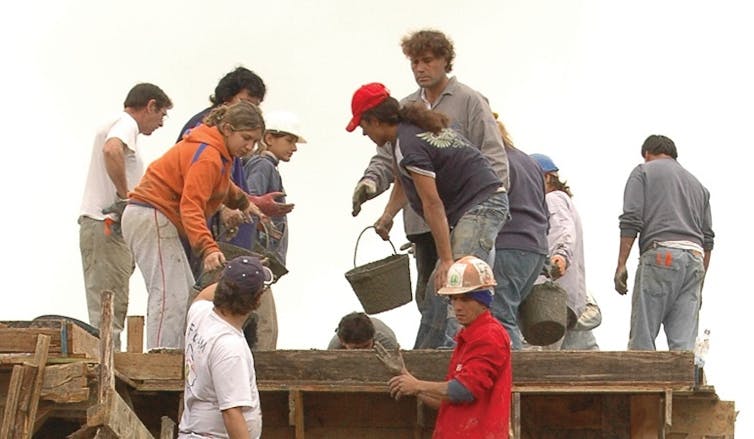
Located in the Peñarol neighborhood of Montevideo, COVIMT 1 was the city’s first mutual aid housing cooperative. It was founded by textile workers, who completed construction of the complex in 1972.Bé Estudio, CC BY-SA
More than 1.8 billion people lack access to adequate and affordable housing. Yet too few countries have taken meaningful steps to ensure dignified housing for their most vulnerable citizens.
We research how cooperative housing can serve as one solution to the affordable housing crisis. There are a variety of cooperative housing models. But they generally involve residents collectively owning and managing their apartment complexes, sharing responsibilities, costs and decision-making through a democratic process.
Other countries, such as El Salvador and Colombia, have struggled to integrate housing cooperatives into their countries’ preexisting housing policies. In fact, although Latin America has a long-standing tradition of community-driven and mutual aid housing, housing cooperatives haven’t taken root in many places, largely due to weak political and institutional backing.
Uruguay is an exception.
With a population of just 3.4 million, the small Latin American nation has a robust network of housing cooperatives, which give access to permanent, affordable housing to citizens at a range of income levels.
An experiment becomes law
Housing cooperatives in Uruguay emerged in the 1960s during a time of deep economic turmoil.
The first few pilot projects delivered outstanding results. Financed through a mix of government funds, loans from the Inter-American Development Bank and member contributions, they were more cost-effective, faster to build and higher in quality than conventional housing.
These early successes played a key role in the passage of Uruguay’s National Housing Law in 1968. This law formally recognized housing cooperatives and introduced a legal framework that supported different models. The most common models to emerge roughly translate to “savings cooperatives” and “mutual aid cooperatives.”
In the savings model, members pool their savings to contribute around 15% of the capital investment. This gives them access to a government-subsidized mortgage to finance the construction. The cooperative then determines how repayment responsibilities are distributed among its members. Typically, members purchase “social shares” in the cooperative, equivalent to the cost of the assigned housing unit. If a member decides to leave the cooperative, their social shares are reimbursed. These shares are also inheritable, allowing them to be passed on to heirs.
In contrast, the mutual aid model enables households without savings to participate by contributing 21 hours per week toward construction efforts. Tasks are assigned to individuals according to their abilities. They can range from manual labor to administrative tasks, such as the ordering of construction materials.
Despite their differences, both models share a fundamental principle: The land and housing units are held collectively and are permanently removed from the private market.
Typically, once cooperatives are established, each household must contribute a monthly fee that covers the repayment of the state’s loan and maintenance costs. In exchange, members have an unlimited and inheritable contract of “use and enjoyment” of a quality apartment. If a member decides to leave, they are partially reimbursed for the contributions they’ve made over time, typically with a 10% deduction that the cooperative keeps.
This ensures that cooperative housing provides long-term security and remains affordable, especially for those at the lowest rungs of the income ladder.
This growth has been possible thanks to state support, federations of cooperatives and nonprofit groups.
The state recognized that the success of housing cooperatives depended on sustained public support. The National Housing Law defined the rights and responsibilities of cooperatives. It also outlined the state’s obligations: overseeing operations, setting criteria for financial assistance and providing access to land.
Beyond organizing and advocating for the right to housing – and human rights more broadly – FUCVAM offers its member cooperatives a wide range of support services, including training to strengthen cooperative management, legal counseling and conflict mediation.
Finally, a vital pillar of this model are the Technical Assistance Institutes, which were also recognized by the National Housing Law. These are independent, nonprofit organizations that advise cooperatives.
Their role is crucial: The construction of large-scale housing projects is complicated. The vast majority of citizens have no prior experience in construction or project management. The success of Uruguay’s cooperative model would be unthinkable without their support.
From the outskirts to the city center
Uruguay’s housing cooperatives have not only expanded, but have also evolved in response to changing needs and challenges.
In their early years, most cooperatives built low-density housing on the outskirts of cities. This approach was largely influenced by the ideals of the Garden City movement, a planning philosophy of the late 19th century that prioritized low-density housing and a balance between development and green spaces. In Uruguay, there was also a cultural preference for single-family homes. And land was more expensive in city centers.
These early cooperatives, however, contributed to urban sprawl, which has a number of drawbacks. Infrastructure has to be built out. It’s harder to reach jobs and schools. There’s more traffic. And single-family homes aren’t an efficient use of land.
Meanwhile, in the 1970s Montevideo’s historic city center started experiencing abandonment and decay. During this period, the country’s shifting socioeconomic landscape created a set of new challenges. More people relied on irregular incomes from informal work, while more single women became heads of households.
In response, housing cooperatives have shown a remarkable ability to adapt.
For women, by women
As urban sprawl pushed development outward, Montevideo’s historic center, Ciudad Vieja, was hemorrhaging residents. Its historic buildings were falling apart.
Seeking to revitalize the area without displacing its remaining low-income residents, the city saw housing cooperatives as a solution.
This spurred the creation of 13 mutual aid cooperatives in Ciudad Vieja, which now account for approximately 6% of all housing units in the area.
One of the pioneers of this effort was Mujeres Jefas de Familia, which translates to Women Heads of Household. Known by the acronym MUJEFA, it was founded in 1995 by low-income, single mothers. MUJEFA introduced a new approach to cooperative housing: homes designed, built and governed with the unique needs of women in mind.
Architect Charna Furman spearheaded the initiative. She wanted to overcome the structural inequalities that prevent women from finding secure housing: financial dependence on men, being primary caregivers, and the absence of housing policies that account for single women’s limited access to economic resources.
Remaining in Ciudad Vieja was important to members of MUJEFA. Its central location allowed them to be close to their jobs, their kids’ schools, health clinics and a close-knit community of friends and family.
However, the project faced major hurdles. The crumbling structure the group acquired in 1991 – an abandoned, heritage-listed building – needed to be transformed into 12 safe, functional apartments.
The cooperative model had to adapt. Municipal authorities temporarily relaxed certain regulations to allow older buildings to be rehabbed as cooperatives. There was also the challenge of organizing vulnerable people – often long-time residents at risk of eviction, who were employed as domestic workers or street vendors – into groups that could actively participate in the renovation process. And they had to be taught how to retrofit an older building.
Today, 12 women with their children live in the MUJEFA cooperative. It’s a compelling example of how cooperative housing can go beyond simply putting a roof over families’ heads. Instead, it can be a vehicle for social transformation. Women traditionally excluded from urban planning were able to design and construct their own homes, creating a secure future for themselves and their children.
Building up, not out
COVIVEMA 5, completed in 2015, was the first high-rise, mutual aid cooperative in a central Montevideo neighborhood. Home to around 300 residents, it’s made up of 55 units distributed across two buildings.
Members participated in the building process with guidance from the Centro Cooperativista Uruguayo, one of the oldest and most respected Technical Assistance Institutes. Architects had to adapt their designs to make it easier for regular people with little experience in construction to complete a high-rise building. Cooperative members received specialized training in vertical construction and safety protocols. While members contributed to the construction, skilled labor would be brought in when necessary.
Members of the cooperative also designed and built Plaza Luisa Cuesta, a public square that created open space in an otherwise dense neighborhood for residents to gather and socialize.
Housing cooperatives are neither public nor private. They might be thought of as an efficient and effective “third way” to provide housing, one that gives residents a stake in their homes and provides long-term security. But their success depends upon institutional, technical and financial support.
Jennifer Duyne Barenstein receives funding from The Swiss National Science Foundation. She is affiliated with the Centre for Research on Architecture, Society and the Built Environment, Department of Architecture, ETH Zurich
Daniela Sanjinés receives funding from the Swiss National Science Foundation. She is affiliated with the Centre for Research on Architecture, Society and the Built Environment, Department of Architecture, ETH Zurich.
Source: The Conversation – USA (2) – By Camille Banger, Assistant Professor in Business Information Technology, University of Wisconsin-Stout
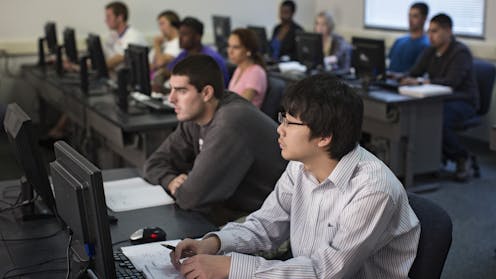
Students pick up on AI-infused apps quickly, but generative AI appears to require more reflection on how to use technology.Hill Street Studios via Getty Images
The tech world says generative artificial intelligence is essential for the future of work and learning. But as an educator, I still wonder: Is it really worth bringing it into the classroom? Will these tools truly help students learn, or create new challenges we haven’t yet faced?
Like many other people in higher education, I was skeptical but knew I couldn’t ignore it. So, instead of waiting for all the answers, I decided to dive in and discover what preparing students for an AI-powered world really means beyond the hype. Last semester, I developed a business technology class where the latest generative AI tools were woven into the curriculum.
What I found is that AI productivity products have a learning curve, much like other applications that students, and ultimately white-collar workers, use in knowledge work. But I needed to adjust how I taught the class to emphasize critical thinking, reflection on how these tools are being used and checks against the errors they produce.
The project
It’s no secret that generative AI is changing how people work, learn and teach. According to the 2025 McKinsey Global Survey on AI, 78% of respondents said their organizations use AI in at least one business function, and many are actively reskilling their workforce or training them with new skills to meet the demands of this shift.
As program director of the Business Information Technology bachelor’s degree program at the University of Wisconsin-Stout, Wisconsin’s polytechnic university, I spend a lot of time thinking about how to prepare students for the workplace. I’m also an AI enthusiast, but a skeptical one. I believe in the power of these tools, but I also know they raise questions about ethics, responsibility and readiness.
So, I asked myself: How can I make sure our students are ready to use AI and understand it?
In spring 2025, University of Wisconsin-Stout launched a pilot for a small group of faculty and staff to explore Microsoft 365 Copilot for business. Since it works alongside tools such as Word, Excel, Outlook, PowerPoint, OneDrive and Teams, which are products our students already use, I saw an opportunity to bring these latest AI features to them as well.
To do that, I built an exploratory project into our senior capstone course. Students were asked to use Copilot for Business throughout the semester, keep a journal reflecting on their experience and develop practical use cases for how AI could support them both as students and future professionals. I didn’t assign specific tasks. Instead, I encouraged them to explore freely.
My goal wasn’t to turn them into AI experts overnight. I wanted them to build comfort, fluency and critical awareness about how and when to use AI tools in real-world contexts.
What my students and I learned
What stood out to me the most was how quickly students moved from curiosity to confidence.
Many of them had already experimented with tools such as ChatGPT and Google Gemini, but Copilot for Business was a little different. It worked with their own documents, emails, meeting notes and class materials, which made the experience more personal and immediately relevant.
In their journals, students described how they used Copilot to summarize Teams video meetings, draft PowerPoint slides and write more polished emails. One student said it saved them time by generating summaries they could review after a meeting instead of taking notes during the call or rewatching a recording. Another used it to check their assignment against the rubric – a scoring tool that outlines the criteria and performance levels for assessing student work – to help them feel more confident before submitting their work.
College students will likely be asked to use AI features in business productivity applications once they enter the workforce. What’s the best way to teach them how to effectively use them? Denise Jans on Unsplash
Several students admitted they struggled at first to write effective prompts – the typed requests that guide the AI to generate content – and had to experiment to get the results they wanted. A few reflected on instances where Copilot, like other generative AI tools, produced inaccurate or made-up information, or hallucinations, and said they learned to double-check its responses. This helped them understand the importance of verifying AI-generated content, especially in academic and professional settings.
Some students also said they had to remind themselves to use Copilot instead of falling back on other tools they were more familiar with. In some cases, they simply forgot Copilot was available. That feedback showed me how important it is to give students time and space to build new habits around emerging technologies.
What’s next
While Copilot for Business worked well for this project, its higher cost compared with previous desktop productivity apps may limit its use in future classes and raises ethical questions about access.
That said, I plan to continue expanding the use of generative AI tools across my courses. Instead of treating AI as a one-off topic, I want it to become part of the flow of everyday academic work. My goal is to help students build AI literacy and use these tools responsibly and thoughtfully, as a support for their learning, not a replacement for it.
Historically, software programs enabled people to produce content, such as text documents, slides or the like, whereas generative AI tools produce the “work” based on user prompts. This shift requires a higher level of awareness about what students are learning and how they’re engaging with the materials and the AI tool.
This pilot project reminded me that integrating AI into the classroom isn’t just about giving students access to new tools. It’s about creating space to explore, experiment, reflect and think critically about how these tools fit into their personal and professional lives and, most importantly, how they work.
As an educator, I’m also thinking about the deeper questions this technology raises. How do we ensure that students continue developing original thoughts and critical thinking when AI can easily generate ideas or content? How can we preserve meaningful learning while still taking advantage of the efficiency these tools offer? And what kinds of assignments can help students use AI effectively while still demonstrating their own thinking?
These questions aren’t easy, but they are important. Higher education has an important role to play in helping students use AI and understand its impact and their responsibility in shaping how it’s used.
Striking the right balance between fostering original thought and critical thinking with AI can be tricky. One way I’ve approached this is encouraging students to first create their content on their own, then use AI for review. This way, they maintain ownership of their work and see AI as a helpful tool rather than a shortcut. It’s all about knowing when to leverage AI to refine or enhance their ideas.
One piece of advice I received that really stuck with me was this: Start small, be transparent and talk openly with your students. That’s what I did, and it’s what I’ll continue doing as I enter this next chapter of teaching and learning in the age of AI.
Camille Banger does not work for, consult, own shares in or receive funding from any company or organization that would benefit from this article, and has disclosed no relevant affiliations beyond their academic appointment.
Every few years, the tires on your car wear thin and need to be replaced. But where does that lost tire material go?
The answer, unfortunately, is often waterways, where the tiny microplastic particles from the tires’ synthetic rubber carry several chemicals that can transfer into fish, crabs and perhaps even the people who eat them.
We are analytical and environmental chemists who are studying ways to remove those microplastics – and the toxic chemicals they carry – before they reach waterways and the aquatic organisms that live there.
Tires shed tiny microplastics as they move over roadways. Rain washes those tire wear particles into ditches, where they flow into streams, lakes, rivers and oceans.
Researchers in 2020 found that more than half of the coho salmon returning to streams in Washington state died before spawning, largely because of 6PPD-Q, a chemical stemming from 6PPD, which is added to tires to help keep them from degrading.
In a study in China, the same chemical, 6PPD-Q, was also found in the urine of children and adults. While the effects of this chemical on the human body are still being studied, recent research shows that exposure to this chemical could harm multiple human organs, including the liver, lungs and kidneys.
In Oxford, Mississippi, we identified more than 30,000 tire wear particles in 24 liters of stormwater runoff from roads and parking lots after two rainstorms. In heavy traffic areas, we believe the concentrations could be much higher.
At the University of Mississippi, we are experimenting with sustainable ways of removing tire wear particles from waterways with accessible and low-cost natural materials from agricultural wastes.
The idea is simple: Capture the tire wear particles before they reach the streams, rivers and oceans.
In a recent study, we tested pine wood chips and biochar – a form or charcoal made from heating rice husks in a limited oxygen chamber, a process known as pyrolysis – and found they could remove approximately 90% of tire wear particles from water runoff at our test sites in Oxford.
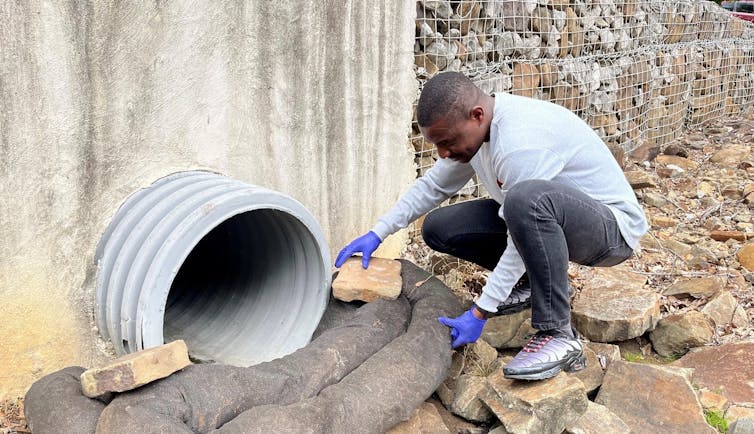
Boluwatife S. Olubusoye, one of the authors of this article, positions a filter sock filled with biochar under a storm drain. James Cizdziel/University of Mississippi
We designed a biofiltration system using biochar and wood chips in a filter sock and placed it at the mouth of a drainage outlet. Then we collected stormwater runoff samples and measured the tire wear particles before and after the biofilters were in place during two storms over the span of two months. The concentration of tire wear particles was found to be significantly lower after the biofilter was in place.
We believe this approach holds strong potential for scalability to mitigate tire wear particle pollution and other contaminants during rainstorms.
Since biochar and wood chips can be generated from agricultural waste, they are relatively inexpensive and readily available to local communities.
Long-term monitoring studies will be needed, especially in heavy traffic environments, to fully determine the effectiveness and scalability of the approach. The source of the filtering material is also important. There have been some concerns about whether raw farm waste that has not undergone pyrolysis could release organic pollutants.
Like most filters, the biofilters would need to be replaced over time – with used filters disposed of properly – since the contaminants build up and the filters degrade.
Plastic waste is harming the environment, the food people eat and potentially human health. We believe biofilters made from plant waste could be an effective and relatively inexpensive, environmentally friendly solution.
Boluwatife S. Olubusoye received partial funding from the Center for Biodiversity and Conservation Research (CBCR) at the University of Mississippi
James V Cizdziel received funding from the National Science Foundation (MRI Grant #2116597) for the instrument used to analyze samples for microplastics.
The Trump administration is decreasing the attention federal regulators pay to pipeline leaks. But leaks from natural gas pipelines don’t just waste energy and warm the planet – they can also make the air more dangerous to breathe. That air pollution threat grows not just in the communities where the leaks happen but also as far as neighboring states, as our analysis of gas leaks and air pollution levels across the U.S. has found.
For instance, in September 2018 the Merrimack Valley pipeline explosion in Massachusetts, which released roughly 2,800 metric tons of methane, damaged or destroyed about 40 homes and killed one person. We found that event caused fine-particle air pollution concentrations in downwind areas of New Hampshire and Vermont to spike within four weeks, pushing those areas’ 2018 annual average up by 0.3 micrograms per cubic meter. That’s an increase of about 3% of the U.S. EPA’s annual health standard for PM2.5. Elevated air pollution then showed up in New York and Connecticut through the rest of 2018 and into 2019.
In our study, we examined pipeline leak data from the U.S. Pipeline and Hazardous Materials Safety Administration from 2009 to 2019 and data about the state’s level of small particulate matter in the air from Columbia University’s Center for International Earth Science Information Network. We also incorporated, for each state, data on environmental regulations, per-capita energy consumption, urbanization rate and economic productivity per capita.
In simple terms, we found that in years when a state – or its neighboring states – experienced more methane leak incidents, that state’s annual average fine-particle air pollution was measurably higher than in years with fewer leaks.
A 2018 natural gas leak and explosion in Massachusetts destroyed and damaged homes, killed one person and increased air pollution over a wide area. John Tlumacki/The Boston Globe via Getty Images
Methane’s role in fine‑particle formation
Natural gas is primarily made of methane, a powerful greenhouse gas. But methane also helps set off chemical reactions in the air that lead to the formation of tiny particles known as PM2.5 because they are smaller than 2.5 micrometers (one ten-thousandth of an inch). They can travel deep into the lungs and cause health problems, such as increasing a person’s risk of heart disease and asthma.
So, when natural gas leaks, energy is wasted, the planet warms and air quality drops. These leaks can be massive, like the 2015 Aliso Canyon disaster in California, which sent around 100,000 metric tons of methane into the atmosphere.
But smaller leaks are also common, and they add up, too: Because the federal database systematically undercounts minor releases, we estimate that undocumented small leaks in the U.S. may total on the order of 15,000 metric tons of methane per year – enough to raise background PM2.5 by roughly 0.1 micrograms per cubic meter in downwind areas. Even this modest increase can contribute to health risks: There is no safe threshold for PM2.5 exposure, with each rise of 1 microgram per cubic meter linked to heightened mortality from cardiovascular and respiratory diseases.
The most direct way to reduce this problem is to reduce the number and quantity of methane leaks from pipelines. This could include constructing them in ways or with materials or processes that are less likely to leak. Regulations could create incentives to do so or require companies to invest in technology to detect methane leaks quickly, as well as encourage rapid responses when a leak is identified, even if it appears relatively small at first.
Reducing pipeline leaks would not just conserve the energy that is contained in the methane and reduce the global warming that results from increasing amounts of methane in the atmosphere. Doing so would also improve air quality in communities that are home to pipelines and in surrounding areas and states.
The authors do not work for, consult, own shares in or receive funding from any company or organization that would benefit from this article, and have disclosed no relevant affiliations beyond their academic appointment.
The coach, the specialized equipment, the carefully tailored exercise regimen – they’re all key to athletic performance. But imagination might be an unexpected asset when it comes to playing sports.
The idea that athletic achievement depends on the mind isn’t new. Sport psychologists have known for years that working with an athlete on their mental game – visualizing the skill, kinesthetically feeling the swing – has a positive impact on actual performance. But these mental simulations draw only upon mental imagery – seeing and feeling the physical goals in the mind’s eye. Imagination offers a much wider range of possibilities.
What if your game could be helped by an imaginary friend?
In a recent retrospective study of college students, we discovered that imagination comes in handy in athletics in ways that are surprisingly social. The creation of what we termed imaginary athletes – a person or being that a child imagined in the context of athletics – enabled and motivated athletic play, especially for children between the ages of about 6 and 12. Imaginary athletes also provided companionship during athletic play.
The most basic form of an imaginary athlete might be a wall, fence or even tree that makes a good opponent in a pinch. For a child or adolescent practicing a sport alone, a surface that provides a ball return or a steady target for a throw gives opportunities for practice usually requiring other players.
Is it any wonder, then, if the branches of the tree start to resemble a wide receiver’s arms, or an invisible goalie emerges in front of the fence? Solitary play might be a lot more fun if a make-believe teammate could provide an assist, or an invisible coach could appear and shout instructions during practice.
The college students in our study reported that such support, even if imaginary, made them play a little longer or try a little harder as kids.
About 41% of our sample of 225 college students reported creating at least one imaginary athlete at some point in middle childhood or early adolescence. Most, but not all, of these beings fell into three categories based on their characteristics.
The first we called placeholders, such as ghost runners. They are typically generic, amorphous, imaginary teammates created by groups of children when not enough real players are available.
The second type functioned as what we named athletic tools. They helped kids focus on their performance and improve their skills, usually by providing a worthy competitor, sometimes based on an admired professional athlete. The skills of athletic tools were often just above those of the child, drawing out the desire to be better, stronger, faster.
Social relationships, our name for the third kind of imaginary athlete, primarily served emotional functions, relieving loneliness and providing the child or adolescent with a sense of belonging, safety or companionship as they engaged in their sport.
Students who remembered imaginary athletes differed from their peers in two ways. First, more men than women reported creating these imaginary beings, possibly owing to the greater investment in and importance of athletics among boys versus girls. Second, people with imaginary athletes scored higher than those without on a current-day measure of predilection for imagination, but they were not more likely to report having created a make-believe friend or animal as a child.
Imagination is a valuable power
Creating an imaginary other might seem like a quirky, perhaps even childish, addition to sports practice. But actually, this behavior is entirely logical. After all, imagination is the core of human thought. Without it, we couldn’t conceptualize anything outside of the present moment that wasn’t already stored in memory. No thinking about the future, no consideration of multiple outcomes to a decision, no counterfactuals, daydreams, fantasies or plans.
Why wouldn’t people apply such a fundamental tool of day-to-day thought in athletic contexts? Participation in sports is common, especially among school-age kids, and many college students in our study described drawing upon their imaginations frequently when playing sports, especially when doing so in their free time.
The creation of imaginary athletes is also unsurprising because it’s one of myriad ways that imagination enhances people’s social worlds throughout their lives. Above all else, social relationships are what matter most to people, and using imagination in thinking about them is common. For instance, people imagine conversations with others, particularly those close to them, sometimes practicing the delivery of bad news or envisioning the response to a proposal of marriage.
In early childhood, kids create imaginary companions who help them learn about friendship and other’s perspectives. And in adolescence, when people focus on developing their autonomy and their own identities, they create parasocial relationships that let them identify with favorite celebrities, characters and media figures. Even in older age, some widows and widowers imagine continued relationships with their deceased spouses. These “continuing bonds” are efforts to cope with loss through imaginary narratives that are fed by and extrapolate upon years of interactions.
At each point in their developmental trajectory, people might recruit imagination to help them understand, manage, regulate and enjoy the social aspects of life. Imaginary athletes are merely one manifestation of this habit.
Because so many children and adolescents spend a lot of time engaged in sports, athletics can be a major environment for working on the developmental tasks of growing up. As children learn about functioning as part of a group, forming, maintaining and losing friendships, and mastering a range of skills and abilities, imaginary athletes provide teammates, coaches and competitors tailored to the needs of the moment.
Of course, an imaginary athlete is but one tool that children and adolescents might use to address developmental tasks such as mastering skills or negotiating peer relationships. Children who aren’t fantasy-prone might create complex training regimens to practice their skills, and they might manage their friendships by talking through problems with others.
But some report that turning inward generated real athletic and social benefits. “I got confidence out of my [imaginary athletes],” reported one participant. “If I could imagine beating someone, and [winning], then I felt like I could do anything.”
The authors do not work for, consult, own shares in or receive funding from any company or organization that would benefit from this article, and have disclosed no relevant affiliations beyond their academic appointment.
We’re now less than a month away from the start of the Albanese government’s “economic reform” (aka “productivity”) roundtable, but it has become quite hard to get a fix on exactly what this gathering will amount to.
The guest list for the August 19-21 summit is obviously tight, given the government decided it wanted the meeting to fit into the cabinet room (so avoiding a more extensive “talkfest”).
But excluding the states and territories from a meeting that discusses deregulation and taxation means major players in these policy areas are not in the room (the NSW treasurer, Daniel Mookhey, chair of the board of treasurers, is the only state government representative invited). Treasurer Jim Chalmers says he will meet state treasurers beforehand, but that doesn’t quite cover their omission.
The government has flagged that industrial relations isn’t on the table, although the unions will be at that table. Yet IR is a major issue in productivity, so that excludes a central area from discussion. The unions are being given a level of protection other players potentially do not have.
Tax reform is a central topic at the roundtable, the themes of which are productivity, budget sustainability and economic resilience. But the scope of what is up for serious consideration is limited.
The government is not willing to consider changing the GST, even if it is not formally ruling out it being canvassed.
When it was put to him that he opposed altering the GST, Prime Minister Anthony Albanese told the ABC this week what he would not do was “go to an election and secure a majority because our government concentrated on cost-of-living measures in our first term […] and immediately we get elected and we say, we’re going to put up the price of everything that you buy.
“That is not something that’s tenable. That’s something which would have represented a breach of trust upon which we were elected on May 3rd.”
Rejecting an overhaul of the GST kyboshes, for better or worse, a major tax switch from our over-reliance on personal income tax to putting more of the tax burden on indirect tax. This is a change many tax experts advocate.
Despite the hype around the pre-roundtable discussion of broad tax reform, what appears likely to find favour with the government are tax changes affecting wealth (but excluding the family home) and the resources sector.
It remains unclear to what extent Chalmers will seek to define the outcome beforehand. That is: will he, after reviewing the submissions, go into the roundtable with a firm idea of what he wants to get out of it, and then see how much he can get over the “consensus” line?
Helpfully for everyone at the roundtable, the Productivity Commission is about to release a series of reports on various aspects of productivity, which will provide data and ideas.
These cover economic resilience, improving workforce skills and adaptability, harnessing digital technology, improving care delivery, and investing in the net zero transformation.
Meanwhile business, which felt it was made something of a patsy in the 2022 jobs and skills summit, with the government using that meeting to gain traction for what it already wanted to do, is being cautious this time.
Even before the formal announcement of the roundtable, it set up a group following the government’s nomination of productivity as a central priority for this term. The umbrella body’s first meeting was attended by more than 20 groups representing businesses of all sizes, universities and the investment community. This body is ongoing. It includes the Business Council of Australia, the Australian Industry Group, the Australian Chamber of Commerce and Industry, the Minerals Council of Australia and the Council of Small Business Organisations.
The umbrella body will put forward a suite of recommendations for the roundtable including on investment, innovation, reducing red tape, planning and approval processes, tax, education and employment.
We now have the full list of roundtable participants. It’s interesting for who’s there and who’s not. Ken Henry, of the seminal Henry taxation report – of which Chalmers has vivid memories from his days as a staffer of former treasurer Wayne Swan – will be present. Henry last week gave a strong presentation at the National Press Club about the pressing need for reform of the environment protection regime.
Also scoring an invitation is teal crossbencher Allegra Spender, who made tax reform one of her core issues last term. Spender is holding her own “tax reform roundtable” on Friday, with a who’s who of experts.
But left off the Treasurer’s invitation list list was the Minerals Council of Australia. This despite the fact that tax changes in the resources area seem a ripe area for discussion.
Michelle Grattan does not work for, consult, own shares in or receive funding from any company or organisation that would benefit from this article, and has disclosed no relevant affiliations beyond their academic appointment.
After South Africa’s first democratic elections in 1994, there was significant optimism about police reform in the country. Impressive steps were taken to bring the South African Police Service under civilian control and to create a service responsive to calls for assistance from the public.
During the apartheid period, South Africa’s police worked to preserve the political order and pursue political opponents. It did not focus on dealing with crime. This is why the achievements of the 1990s are so important. For the first time, black South Africans could call upon officers to respond to personal emergencies. This period also saw a drop in crime levels.
However, this promising early transformation was interrupted. The appointment of Jackie Selebi as national police commissioner in 2000 heralded a new era. Selebi was an African National Congress (ANC) insider. The ANC originated as a liberation movement and has governed the country since 1994.
Selebi had served as the head of the ANC’s Youth League in the 1980s, when it was banned. In 1987 he was appointed to the organisation’s national executive committee, its highest decision-making organ.
His appointment as police commissioner was the start of significant change in the purpose of policing. It marked the end of the focus on civilian control of the police force and prosecuting authorities. As an ANC insider, Selebi led efforts to establish party control over the police.
Other telling developments ensued. The Scorpions were disbanded in 2009 by acting president Kgalema Motlanthe. The unit’s job was to pursue high-profile cases against senior ANC politicians (among others).
The police became increasingly entangled in the ANC’s internal political conflicts. At the same time the office of the national police commissioner experienced high turnover due to intense political manoeuvring. Between 2009 and 2022, there were seven national commissioners.
Recent developments have once again brought the intermingling of police work and power battles in the ANC to the fore. In early July 2025, Lieutenant General Nhlanhla Mkhwanazi, the commissioner of police in the province of KwaZulu-Natal, made some startling claims. He called a press conference and, wearing camouflage uniform, he implicated the minister of police, Senzo Mchunu, together with the deputy national commissioner for crime detection, in a scheme to close down investigations into political assassinations in the province.
President Cyril Ramaphosa rushed back from a meeting of the Brics countries in Brazil to attend to the matter. He announced that the police minister had been placed on leave with immediate effect. He also announced a judicial inquiry into the allegations.
I have conducted research into South Africa’s security apparatus over the last decade. Based on this work, and new research forthcoming in the Journal of Southern African Studies done with Jelena Vidojevic, co-founder of the New South Institute, it is clear that elite contestation in the ANC is intensifying.
In other words, the ability of internal party structures to manage gatekeeping is declining. Many of the people involved are indifferent or even hostile to South Africa’s democratic and constitutional order.
As the ability of some political elites to access state resources through the party declines, some are linked with organised criminal networks. Organised crime has been on the edges of South African politics. It now risks taking a more central role.
In this environment, the police service will often be the thin (blue) line between multiparty contestation according to constitutional rules and the criminalisation of politics in South Africa.
The shift
Large organisational changes within the police vividly illustrate this shift away from its core function.
The Visible Policing programme was meant to meant to deter crime through patrols, checkpoints and roadblocks. But, instead, there was a steady decline in resource allocation. Employee numbers dropped between 2015 and 2021.
Detective services and crime intelligence also experienced such declines.
Conversely, employee numbers in the Protection and Security Services programme, responsible for providing bodyguards to politicians, increased sharply between 2014 and 2016.
Evidence heard by the commission of inquiry into state capture suggested that some officers and budgets in the service were even used to supply President Jacob Zuma and other politicians with what amounted to a private militia.
This reorientation of resources coincided with a rise in crime across the country, a decline in arrests by 24.5%, and a drop in the police’s efficacy in solving crimes.
Furthermore, a politicised police leadership effectively stopped policing various categories of crime. This was particularly true of offences like fraud, corruption, and certain types of theft, and particularly when politically connected persons were involved.
The state capture commission heard extensive evidence about the failure of the police to pursue politically sensitive investigations. Investigations into senior officials were frequently frustrated or impeded, and cases at state-owned enterprises were abandoned.
This shows how police resources were actively redirected as weapons of elite competition, pursuing political enemies and protecting allies within the ruling party.
Mkhwanazi’s claims, if substantiated, suggest that this political policing remains entrenched.
What now?
Ramaphosa has announced the appointment of Firoz Cachalia as the acting minister of police. Cachalia, a well regarded legal academic, served as ANC minister for community safety. Between 2019 and 2022 he was part of the ANC’s national executive committee.
His appointment raises serious questions.
If the core problem with the police is that it has become embroiled in ANC internal politics, having an ANC insider head the ministry of police (even if only on an acting basis) threatens only to compound the problem.
Moreover, South Africans have already witnessed a long and expensive judicial inquiry into state capture. And despite extensive evidence of police failure to pursue politically sensitive investigations, nothing concrete has come of it.
How likely is it that this new initiative will be any different, especially if those investigating it and presiding over key institutions are themselves ANC insiders?
To depoliticise the police service and redirect its attention and activities towards crime and emergencies, a crucial first step is to reconsider the appointment processes for the national police commissioner and other top managers.
Under the current system the president has sole discretion. This bakes party-political considerations into the decision-making process.
Without structural changes, genuine democratic policing will remain an elusive ideal.
In 2024/25 the murder rate in South Africa stood at 42 per 100,000, among the highest in the world and close to levels not seen since the early 2000s.
At the very least, the minister of police must not be an ANC insider. Democratic renewal in South Africa requires bringing the police firmly under parliamentary control.
Ivor Chipkin teaches public policy at the Gordon Institute of Business Science (GIBS) at the University of Pretoria. He is the director of the New South Institute.
Winter is here, and with it come higher rates of respiratory illnesses. If you’ve been struck down recently with a sore throat, runny nose and a cough, or perhaps even a fever, you’re not alone.
Last week, non-urgent surgeries were paused in several Queensland hospitals due to a surge of influenza and COVID cases filling up hospital beds.
Meanwhile, more than 200 aged care facilities around Australia are reportedly facing COVID outbreaks.
So, just how bad are respiratory infections this year, and which viruses are causing the biggest problems?
COVID
Until May, COVID case numbers were about half last year’s level, but June’s 32,348 notifications are closing the gap (compared with 45,634 in June 2024). That said, we know far fewer people test now than they did earlier in the pandemic, so these numbers are likely to be an underestimate.
Besides classic cold-like symptoms, this Omicron offshoot can reportedly cause particularly painful sore throats as well as gastrointestinal symptoms such as nausea and diarrhoea.
While some people who catch COVID have no symptoms or just mild ones, for many people the virus can be serious. Older adults and those with chronic health issues remain at greatest risk of experiencing severe illness and dying from COVID.
The COVID booster currently available is based on the JN.1 subvariant. Nimbus is a direct descendant of JN.1 – as is another subvariant in circulation, XFG or “Stratus” – which means the vaccine should remain effective against current variants.
Free boosters are available to most people annually, while those aged 75 and older are advised to get one every six months.
Vaccination, as well as early treatment with antivirals, lowers the risk of severe illness and long COVID. People aged 70 and older, as well as younger people with certain risk factors, are eligible for antivirals if they test positive.
More recent case numbers seem to be trending lower than 2024, however we don’t appear to have reached the peak yet.
Flu symptoms are generally more severe than the common cold and may include high fever, chills, muscle aches, fatigue, sore throat and a runny or blocked nose.
Most people recover in under a week, but the flu can be more severe (and even fatal) in groups including older people, young children and pregnant women.
An annual vaccination is available for free to children aged 6 months to 4 years, pregnant women, those aged 65+, and other higher-risk groups.
Queensland and Western Australia provide a free flu vaccine for all people aged 6 months and older, but in other states and territories, people not eligible for a free vaccine can pay (usually A$30 or less) to receive one.
RSV
The third significant respiratory virus, respiratory syncytial virus (RSV), only became a notifiable disease in 2021 (before this doctors didn’t need to record infections, meaning data is sparse).
Last year saw Australia’s highest case numbers since RSV reporting began. By May, cases in 2025 were lower than 2024, but by June, they had caught up: 27,243 cases this June versus 26,596 in June 2024. However it looks as though we may have just passed the peak.
RSV’s symptoms are usually mild and cold-like, but it can cause serious illness such as bronchiolitis and pneumonia. Infants, older people, and people with chronic health conditions are among those at highest risk. In young children, RSV is a leading cause of hospitalisation.
A free vaccine is now available for pregnant women, protecting infants for up to six months. A monoclonal antibody (different to a vaccine but also given as an injection) is also available for at-risk children up to age two, especially if their mothers didn’t receive the RSV vaccine during pregnancy.
For older adults, two RSV vaccines (Arexvy and Abrysvo) are available, with a single dose recommended for everyone aged 75+, those over 60 at higher risk due to medical conditions, and all Aboriginal and Torres Strait Islander people aged 60+.
Unfortunately, these are not currently subsidised and cost about $300. Protection lasts at least three years.
The common cold
While viruses including COVID, RSV and influenza dominate headlines, we often overlook one of the most widespread – the common cold.
The common cold can be caused by more than 200 different viruses – mainly rhinoviruses but also some coronaviruses, adenoviruses and enteroviruses.
Typical symptoms include a runny or blocked nose, sore throat, coughing, sneezing, headache, tiredness and sometimes a mild fever.
Children get about 6–8 colds per year while adults average 2–4, and symptoms usually resolve in a week. Most recover with rest, fluids, and possibly over-the-counter medications.
Because so many different viruses cause the common cold, and because these constantly mutate, developing a vaccine has been extremely challenging. Researchers continue to explore solutions, but a universal cold vaccine remains elusive.
How do I protect myself and others?
The precautions we learned during the COVID pandemic remain valid. These are all airborne viruses which can be spread by coughing, sneezing and touching contaminated surfaces.
Practise good hygiene, teach children proper cough etiquette, wear a high-quality mask if you’re at high risk, and stay home to rest if unwell.
You can now buy rapid antigen tests (called panel tests) that test for influenza (A or B), COVID and RSV. So, if you’re unwell with a respiratory infection, consider testing yourself at home.
While many winter lurgies can be trivial, this is not always the case. We can all do our bit to reduce the impact.
Adrian Esterman receives funding from the Medical Research Future Fund.
South Australia is desperate for help to tackle an unprecedented harmful algal bloom that has decimated marine life up and down the coast. While the extent of the damage is still unknown, my preliminary research suggests there’s no end in sight. It may just get better over winter before it gets worse next summer.
The Karenia mikimotoi bloom first appeared in March on two surf beaches outside Gulf St Vincent, about an hour south of Adelaide. It has since spread, killing all kinds of marine organisms – from crabs and small fish to sharks and rays. Only the neighbouring Spencer Gulf, far west coast and southeast coasts have been spared. For now.
In preliminary research now undergoing peer review, I have predicted the bloom’s future spread using a new computer model. In the worst-case scenario, the harmful algal bloom would reach the Spencer Gulf and spread – from Port Lincoln to Whyalla and across to Port Pirie – next summer and autumn. That would be extremely bad news for the thriving seafood, aquaculture and tourism industries. They may need help to prepare.
The worst-case scenario forecasts high concentrations of K. mikimotoi in both South Australian gulfs next April. Jochen Kaempf
A rolling disaster
The algal bloom was first noticed when dozens of surfers and beachgoers on the southern coast of the Fleurieu Peninsula fell ill after exposure to seawater in March.
Soon, dangerous sea foam appeared. Then the killing began in earnest. Many marine species started washing up dead or dying.
The bloom began to spread. In mid-April, K. mikimotoi was detected in water samples from Edithburgh and Coobowie on the southeastern corner of Yorke Peninsula.
In early May, the Kangaroo Island Council announced the bloom had spread across the Investigator Strait affecting the island’s northern coastline.
Wild weather in June pushed the bloom through the Murray Mouth into the Coorong.
So far, the bloom has not been detected in Spencer Gulf. But my modelling suggests it’s only a matter of time.
Predicting the future
I was the first to discover the seasonal upwelling of nutrients in several regions along SA’s southern coastal shelf. This nutrient source fuels the marine food chain. It’s a big part of the reason why the marine life in our Great Southern Australian Coastal Upwelling System is so diverse.
I also simulated the ocean currents in South Australian gulfs using computer models as early as 2009.
I have now developed a computer model to predict where the algae will spread next.
Preliminary results from this research have been submitted to the journal Continental Shelf Research and are being reviewed. But given the speed at which this situation is developing, it’s worth sharing a preprint of this manuscript.
My model matches what’s known about the early spread of the bloom. It began in the coastal waters of the southern Fleurieu Peninsula. It then invaded Investigator Strait, between the Yorke Peninsula and Kangaroo Island, before slowly spreading in a clockwise circulation across the wider Gulf St Vincent.
When the model is used to forecast how the algae bloom will evolve, the story becomes deeply concerning.
It predicts the algal bloom will weaken over this winter, as the growth rate will slow in cooler water. In my model, the algae had already invaded the lower Spencer Gulf in May 2025 but at very low concentrations.
Then, in the worst-case scenario of high growth rates and nothing stopping it, the model predicts the bloom will affect both gulfs – Gulf St Vincent and Spencer Gulf – and Investigator Strait, with severe conditions predicted for the coming summer.
A bloom in the Spencer Gulf could decimate stocks of Australian sardine in the lower gulf, and potentially also western king prawns and the giant Australian cuttlefish in the upper Spencer Gulf. Some research suggests algal growth may be limited in the hypersaline upper reaches of the gulfs, but the spread of the algae as far as Ardrossan indicates otherwise.
Under the best-case scenario, the algae’s natural predator, zooplankton, would eat more of the algae, suppressing future flare-ups. So there is some hope, but more research is needed to better understand how zooplankton could control these algae.
SA also needs to make continuous efforts to monitor K. mikimotoi concentrations. This includes analysis of water samples in both gulfs. It’s important to note satellite images only show the peak phase of the toxic algal bloom, and can be misleading as they also display other species including blooms of “good” algae.
Fortunately, the $28 million support package includes $8.5 million for early detection and monitoring of harmful algal bloom species. This will involve real-time sensors (buoys), satellite imagery and oceanographic modelling. A new $2 million national testing laboratory will check for toxins, while $3 million will be spent on a rapid assessment of fish stocks and fisheries.
But if the algae stick around, there may be little anyone can do to protect our marine environment.
Jochen Kaempf does not work for, consult, own shares in or receive funding from any company or organisation that would benefit from this article, and has disclosed no relevant affiliations beyond their academic appointment.
Source: The Conversation (Au and NZ) – By Jennifer Power, Principal Research Fellow, Australian Research Centre in Sex, Health and Society, La Trobe University
Last week, scientists announced the birth of eight healthy babies in the United Kingdom conceived with DNA from three people. Some headlines have called it “three-person IVF”.
The embryo uses the DNA from the egg and sperm of the intended father and mother, as well as cells from the egg of a second woman (the donor).
This process – known as mitochondrial replacement therapy – allows women with certain genetic disorders to conceive a child without passing on their condition.
While it’s raised broader questions about “three-parent” babies, it’s not so simple. Here’s why it’s unlikely this development will transform the diverse ways LGBTQ+ people are already making families.
What this technology is – and isn’t
The UK became the first country in the world to allow mitochondrial donation for three-person embryos ten years ago, in 2015.
In other countries, such donations are banned or strictly controlled. In Australia, a staged approach to allow mitochondrial donation was introduced in 2022. Stage one will involve clinical trials to determine safety and effectiveness, and establish clear ethical guidelines for donations.
These restrictions are based on political and ethical concerns about the use of human embryos for research, the unknown health impact on children, and the broader implications of allowing genetic modification of human embryos.
There are also concerns about the ethical or legal implications of creating babies with “three parents”.
Carefully and slowly considering these ethical issues is clearly important. But it’s inaccurate to suggest this process creates three parents.
First, the amount of DNA the donor provides is tiny, only 0.1% of the baby’s DNA. The baby will not share any physical characteristics with the donor.
While it is significant that two women’s DNA has been used in creating an embryo, it doesn’t mean lesbian couples will be rushing to access this particular in vitro fertilisation (IVF) technology.
This technique is only used for people affected by mitochondrial disease and is closely regulated. It is not available more widely and in Australia, is not yet available even for this use.
Second, while biological lineage is an important part of many people’s identity and sense of self, DNA alone does not make a parent.
As many adoptive, foster and LGBTQ+ parents will attest, parenting is about love, connection and everyday acts of care for a child.
How do rainbow families use IVF?
Existing IVF is already expensive and medically invasive. Many fertility services offer a range of additional treatments purported to aid fertility, but extra interventions add more costs and are not universally recommended by doctors.
While many lesbian couples and single women use fertility services to access donor sperm, not everyone will need to use IVF.
Less invasive fertilisation techniques, such as intrauterine insemination, may be available for women without fertility problems. This means inserting sperm directly into the uterus, rather than fertilising an egg in a clinic and then implanting that embryo.
Same-sex couples who have the option to create a baby with a sperm donor they know – rather than from a register – may also choose home-based insemination, the proverbial turkey baster. This is a cheaper and more intimate way to conceive and many women prefer a donor who will have some involvement in their child’s life.
In recent years, “reciprocal” IVF has also grown in popularity among lesbian couples. This means an embryo is created using one partner’s egg, and the other partner carries it.
Reciprocal IVF’s popularity suggests biology does play a role for LGBTQ+ women in conceiving a baby. When both mothers share a biological connection to the child, it may help overcome stigmatisation of “non-birth” mothers as less legitimate.
But biology is by no means the defining feature of rainbow families.
LGBTQ+ people are already parents
The 2021 census showed 17% of same-sex couples had children living with them; among female same-sex couples it was 28%. This is likely an underestimate, as the census only collects data on couples that live together.
Same-sex couples often conceive children using donor sperm or eggs, and this may involve surrogacy. But across the LGBTQ+ community, there are diverse ways people become parents.
Same-sex couples are one part of the LGBTQ+ community. Growing numbers of trans and non-binary people are choosing to carry a baby (as gestational parents), as well as single parents who use donors or fertility services. Many others conceive children through sex, including bi+ people or others who conceive within a relationship.
When they donate eggs or sperm to others, some LGBTQ+ people may stay involved in the child’s life as a close family friend or co-parent.
Connection and care, not DNA
While mitochondrial replacement therapy is a remarkable advance in gene technology, it is unlikely to open new pathways to parenthood for LGBTQ+ people in Australia.
Asserting the importance of families based on choice – not biology or what technology is available – has been crucial to the LGBTQ+ community’s story and to rainbow families’ fight to be recognised.
Decades of research now shows children raised by same-sex couples do just as well as any other child. What matters is parents’ consistency, love and quality of care.
Jennifer Power receives funding from the Australian Department of Health, Disability and Aged Care and the Australian Research Council.
There are lots of reasons why people work extra hours. In some jobs, it’s the only way to cover the workload. In others, the pay is poor, so people need to work extra time. And in others still, working back late or on weekends is encouraged and rewarded, explicitly and implicitly.
Those employees who do the extra hours, willingly and without complaint, are seen as hungry and ambitious. A view expressed in some workplaces is simply “that’s what everyone does”.
But what if we discovered that people – at least in heterosexual couple households – can only work long hours at their partner’s expense? Would it still be OK for workplaces to expect people to work longer than our standard full time week, and incentivise them for doing so?
Our study, published this month in the journal Social Indicators Research, found in Australian couple households where both partners had jobs, men earned on average $536 more than women every week. In Germany, the weekly gender earnings gap was €400.
About half of that income gap in both Australia and Germany was due to men working long hours and women effectively subsidising them to do this by cutting back their own work hours.
It’s tough to combine a job with running a household, but one person working extra hours makes this almost impossible. In households, a job with long work hours means someone else must pick up the rest. This includes caring for kids, running the house, walking the dog, cooking dinner and more.
What happens when one partner has to pick up the rest
One in three Australian employees care for children, and 13% of part-time and 11% of all full-time employees give care to someone else, often an ageing parent. This has knock-on effects which are impacting many people in our workforce. The extra hours don’t come out of nowhere, but they have been invisible in what we think of as fair.
In our study, we costed this knock-on in terms of earnings and work hours gaps in households, and what this could mean for equality of income.
We studied between 3,000 and 6,000 heterosexual couples from 2002 to 2019 in Australia and in Germany, estimating their weekly earnings and work hour gaps.
To understand the dynamics in the household, we used a two-stage instrumental variable Oaxaca-Blinder decomposition – a method that allowed us to model earnings gaps as a function of both partners’ paid and unpaid hours. This helped us estimate what the gender gap in hours and earnings would look like if time weren’t being “borrowed” or “subsidised” within the home.
Changing the hours men and women work
The results were striking. We showed how one partner’s paid work hours can increase when the other partner does more unpaid (household) work. This ability for partners to “trade” hours was one of the most important drivers of the work hour (and earning) gap.
So we re-ran models and recalculated what hours a woman and a man would work if one partner wasn’t “subsidising” the other’s work hours. The model showed women would work more hours and men would work fewer when there was a more even split of home duties. The weekly work hour gap shrank to 5.1 hours in Australia (a 58% reduction) and 6.9 hours in Germany (a 47% reduction).
The impact on earnings was just as significant. The gender earnings gap would shrink by 43% in Australia and 25% in Germany.
The gender earnings and work hours gaps are well known, and these are not the only countries facing this problem. What hasn’t been shown before is how it works in households to drive gender inequality across the nation.
The rest of the earnings gap is largely due to differences in pay across male and female industries and jobs, and the persistent gender pay gap in hourly pay.
According to the Australian Bureau of Statistics, the average gender gap in hourly pay is 11.1%. This gap reflects the fact, hour for hour, women are generally paid less. The average weekly earnings gap is much larger at 26.4%.
As things currently stand in Australia, women earn only three-quarters of what men do, a shortfall similar to that in (Germany).
One part of the earnings gap is the gap in the hourly pay rate, but the other is the gap in how many hours are worked. We show how this would shrink if men worked hours that were closer to Australia’s legislated 38-hour week, and workplaces encouraged them to do so.
Closing the gap
If we stopped the time-shifting to partners that our culture of long working hours relies upon, we estimate that in a heterosexual couple, men’s hours would average closer to 41 a week, and women’s would increase to 36.
We could change the long and short hour compromise that so many households have to face. This change could make a huge difference to gender inequality, and women would no longer carry such a large economic cost from their partner’s work.
Maybe reining in excess hours should be the new focus for gender equality.
Lyndall Strazdins has received funding from the Australian Research Council to undertake research on this topic.
She has served as an expert witness on work hours and well-being for the State and Federal Court.
Liana Leach receives funding from the Australian Research Council and the Medical Research Future Fund. She is a member of the National Tertiary Education Union (NTEU).
Tinh Doan receives funding from the Australia ComCare and the Department of Health and Aged Care for other works that are not related to this article.
If Rupert Murdoch becomes a white knight standing up to a rampantly bullying US president, the world has moved into the upside-down.
This is, after all, the media mogul whose US television network, Fox News, actively supported Donald Trump’s Big Lie about the 2020 presidential election result and paid out a US$787 million (about A$1.2 billion) lawsuit for doing so.
It is also the network that supplied several members of Trump’s inner circle, including former Fox host, now controversial Defense Secretary, Pete Hegseth.
But that is where we are after Trump filed a writ on July 18 after Murdoch’s financial newspaper, The Wall Street Journal, published an article about a hand-drawn card Trump is alleged to have sent to sex offender Jeffrey Epstein in 2003. The newspaper reported:
A pair of small arcs denotes the woman’s breasts, and the future president’s signature is a squiggly “Donald” below her waist, mimicking pubic hair.
The Journal said it has seen the letter but did not republish it. The letter allegedly concluded:
Happy Birthday – and may every day be another wonderful secret.
The card was apparently Trump’s contribution to a birthday album compiled for Epstein by the latter’s partner Ghislaine Maxwell, who is serving a 20-year sentence after being found guilty of sex trafficking in 2021.
Trump was furious. He told his Truth Social audience he had warned Murdoch the letter was fake. He wrote, “Mr Murdoch stated that he would take care of it but obviously did not have the power to do so,” referring to Murdoch handing leadership of News Corporation to his eldest son Lachlan in 2023.
Trump is being pincered. On one side, The Wall Street Journal is a respected newspaper that speaks to literate, wealthy Americans who remain deeply sceptical about Trump’s radical initiative on tariffs, which it described in an editorial as “the dumbest trade war in history”.
On the other side is the conspiracy theory-thirsty MAGA base who have been told for years that there was a massive conspiracy around Epstein’s apparent suicide in 2019 that included the so-called deep state, Democrat elites and, no doubt, the Clintons.
Trump, who loves pro wrestling as well as adopting its garish theatrics, might characterise his lawsuit against Murdoch as a smackdown to rival Hulk Hogan vs Andre the Giant in the 1980s.
To adopt wrestling argot, though, it is a rare battle between two heels.
A friendship of powerful convenience
Murdoch and Trump’s relationship is longstanding but convoluted. The key to understanding it is that both men are ruthlessly transactional.
Exposure in Murdoch’s New York Post in the 1980s and ‘90s was crucial to building Trump’s reputation.
Not that Murdoch particularly likes Trump. Yes, Murdoch attended his second inauguration, albeit in a back row behind the newly favoured big tech media moguls. He was also seen sitting in the Oval Office a few days later looking quite at home.
But this was pure power-display politics, not the behaviour of a friend.
Remember Murdoch’s derision on hearing Trump was considering standing for office before the 2016 election, and his promotion of Ron De Santis in the primaries before Trump’s second term. Murdoch’s political hero has always been Ronald Reagan. Trump has laid waste to the Republican Party of Reagan.
Murdoch knows what the rest of sane America knows: Trump is downright weird, if not dangerous. This, of course, only makes Murdoch’s complicity in Trump’s rise to power, and Fox News’ continued boosterism of Trump, all the more appalling.
But, in keeping with Murdoch’s relationship to power throughout his career, what he helps make, he also helps destroy. Perhaps now it’s Trump’s turn to be unmade. As a former Murdoch lieutenant told The Financial Times over the weekend:
he’s testing out: Is Trump losing his base? And where do I need to be to stay in the heart of the base?
And here is Murdoch’s great advantage, and his looming threat.
A double-edged sword
The advantage comes with the scope of Murdoch’s media empire, which operates like a federation of different mastheads, each with their own market and aspirations. While Fox News panders to the MAGA base, and The New York Post juices its New York audience, The Wall Street Journal speaks, and listens, to business. Each audience has different needs, meaning they’re often presented with the same news in very different ways, or sometimes different news entirely.
Like a federation, though, News Corp uses its various operations to drive the type of change that affects all its markets.
It might work like this. The Wall Street Journal breaks a story that’s so shocking it begins to chip away at MAGA’s unquestioning loyalty of Trump. This process is, of course, willingly aided by the rest of the media. The resulting groundswell eventually allows Fox News and the Post to tentatively follow their audiences into questioning, and then perhaps criticising, Trump.
Fox News audiences could slowly begin to question Trump, or abandon the network entirely. NurPhoto/Getty
The threat is that before that groundswell builds, Murdoch is seriously vulnerable to criticism from a still dominant Trump, who can turn conspiracy-prone audiences away from Fox News with just a social media post. Trump has already been busy doing just that, saying he is looking forward to getting Murdoch onto the witness stand for his lawsuit.
If the Fox audience decides it’s the proprietor who’s behind this denigration of Trump, they may decide to boycott their own favoured media channel, even though Fox’s programming hasn’t yet started questioning Trump.
The Murdochs’ fear of audience backlash was a major factor in Fox’s promulgation of the Big Lie after Trump’s defeat in 2020. The fear their audience might defect to Newsmax or some other right-wing media outfit is just as real today.
History littered with fakery
We also need to consider that Trump might be right. What if the letter is a fake?
Murdoch has form when it comes to high-profile exposés that turn out to be fiction. Who can forget the Hitler Diaries in 1983, which we now know Murdoch knew were fake before he published.
Think also of the Pauline Hanson photos, allegedly of her posing in lingerie, all of which were quickly proved to be fake after they were published by Murdoch’s Australian tabloids in 2009.
There was also The Sun’s despicable and wilfully wrong campaign against Elton John in 1987 and the same paper’s continueddenigration of the people of Liverpool following the Hillsborough stadium disaster in 1989.
But while Murdoch’s News Corp has a history of confection and fakery, the Wall Street Journal has a reputation for straight reportage, albeit through a conservative lens. Since Murdoch bought it in 2007, it has been engaged in its own internal battle for editorial standards.
Media rolling over
What Trump won’t get from Murdoch is the same acquiescence he’s enjoyed from America’s ABC and CBS networks, which have both handed over tens of millions of dollars in defamation settlements following dubious claims by Trump about the nature of their coverage.
In December 2024, ABC’s owner Disney settled and agreed to pay US$15 million (A$23 million) to Trump’s presidential library. The president sued after a presenter said Trump was found guilty of raping E. Jean Carroll.
Trump had actually been found guilty by a jury in a civil trial of sexually abusing and defaming Carroll and was ordered to pay her US$5 million (A$7.6 million).
CBS’ parent company, Paramount, did similarly after being sued by the president, agreeing in early July to settle and pay US$16 million (A$24.5 million) to Trump’s library. This was despite earlier saying the case was “completely without merit”.
Beware the legal microscope
From Trump’s viewpoint, two prominent media companies have been cowed. But his campaign against critical media doesn’t stop there.
Last week, congress passed a bill cancelling federal funding for the country’s two public-service media outlets, the Public Broadcasting Service (PBS) and National Public Radio (NPR).
Also last week, CBS announced the cancellation of Stephen Colbert’s stridently critical comedy show, although CBS claims this is just a cost-cutting exercise and not about appeasing a bully in the White House.
Presuming the reported birthday letter is real, Murdoch will not bend so easily. And that’s when it will be important to pay attention, because at some point Trump’s lawyers will advise him about the dangers of depositions and discovery: the legal processes that force parties to a dispute to reveal what they have and what they know.
If the Epstein files do implicate Trump, the legal fight won’t last long and the media campaign against him will only intensify.
Right now we have the spectre of Murdoch joining that other disaffected mogul, Elon Musk, in a moral crusade against Trump, the man they both helped make. The implications are head-spinning.
As global bullies, the three of them probably deserve each other. But we, the public, surely deserve better than any of them.
The authors do not work for, consult, own shares in or receive funding from any company or organisation that would benefit from this article, and have disclosed no relevant affiliations beyond their academic appointment.
Radiodensity heatmap of emerald tree monitors.Roy Ebel
Monitor lizards, also known in Australia as goannas, are some of the most iconic reptiles on the continent. Their lineage not only survived the mass extinction that ended the reign of non-avian dinosaurs, but also gave rise to the largest living lizards on Earth.
Today, these formidable creatures pace through forests and scrublands, flicking their tongues as they go.
A new study published in the Zoological Journal of the Linnean Society looks beneath their skin. For the first time, it reveals hidden bone structures that may hold the key to the evolutionary success of goannas in Australia.
An essential organ
The skin is an organ essential for survival. In some animals, it includes a layer of bone plates embedded among the skin tissue. Think of the armour-like plates in crocodiles or armadillos: these are osteoderms.
Their size ranges from microscopic to massive, with the back plates of the stegosaurus as the most impressive example.
We have only just started to understand these enigmatic structures. Osteoderms can be found in animal lineages that diverged up to 380 million years ago. This means these bone plates would have evolved independently, just like active flight did in birds, pterosaurs and bats.
But what is their purpose? While the advantage of flight is undisputed, the case is not as clear for osteoderms.
The most obvious potential would be for defence – protecting the animal from injuries. However, osteoderms may serve a far broader purpose.
In crocodiles, for example, they help with heat regulation, play a part in movement, and even supply calcium during egg-laying. It is the interplay of these poorly understood functions that has long made it difficult to pinpoint how and why osteoderms evolved.
Sand monitors, also known as sand goannas, are widespread through most of Australia. Ken Griffiths/Shutterstock
A cutting-edge technique
To help resolve this enigma, we had to go back to the beginning.
Surprisingly, to date science has not even agreed on which species have osteoderms. Therefore, we assembled an international team of specialists to carry out the first large-scale study of osteoderms in lizards and snakes.
We studied specimens from scientific collections at institutions such as the Florida Museum of Natural History, the Natural History Museum in Berlin, and Museums Victoria.
However, we soon learnt that this came with challenges. Firstly, the presence of osteoderms can vary dramatically between individuals of the same species. Secondly, there is no guarantee that osteoderms are sufficiently preserved in all specimens.
Most importantly, they are buried deep within skin tissue and invisible to the naked eye. Traditionally, finding them meant destroying the specimen.
Instead, we turned to micro-computed tomography (micro-CT), an imaging technique similar to a medical CT scan, but with much higher resolution. This allowed us to study even the tiniest anatomical structures while keeping our specimens intact.
Micro-CT-based, computer-generated 3D model of Rosenberg’s goanna (Varanus rosenbergi), with the left half showing osteoderms and endoskeleton. Roy Ebel
Using computer-generated 3D models, we then digitally explored the bodies of lizards and snakes from all parts of the world. Incorporating data from prior literature, we processed almost 2,000 such samples in our search for osteoderms.
To illustrate our results, we devised a technique called radiodensity heatmapping, which visually highlights the locations of bone structures in the body.
For the first time, we now have a comprehensive catalogue showing where to find osteoderms in a large and diverse group; this will inform future studies.
Radiodensity heatmapping shows newly discovered osteoderms (yellow to red) in the limbs and tail of the Mexican knob scaled lizard (Xenosaurus platyceps). Roy Ebel
Not just anatomical curiosity
What we found was unexpected. It was thought only a small number of lizard families had osteoderms. However, we encountered them nearly twice as often as anticipated.
In fact, our results show nearly half of all lizards have osteoderms in one form or another.
Our most astonishing finding concerned goannas. Scientists have been studying monitor lizards for more than 200 years. They were long thought to lack osteoderms, except in rare cases such as the Komodo dragon.
So we were all the more surprised when we discovered previously undocumented osteoderms in 29 Australo-Papuan species, increasing their overall known prevalence five times.
Examples of newly discovered osteoderms (magenta) in Australo-Papuan monitor lizards. Roy Ebel
This isn’t just an anatomical curiosity. Now that we know Australian goannas have osteoderms, it opens up an exciting new avenue for further studies. This is because goannas have an interesting biogeographic history: when they first arrived in Australia about 20 million years ago, they had to adapt to a new, harsh environment.
If osteoderms in goannas showed up around this time – possibly owing to new challenges from their environment – we’d gain crucial insights into the function and evolution of these enigmatic bone structures.
Not only may we just have found the key to an untold chapter in the goanna story, our findings may also improve our understanding of the forces of evolution that shaped Australia’s unique reptiles as we know them today.
Roy Ebel receives funding from the Australian Government’s Research Training Program.
Australia has joined 28 international partners in calling for an immediate end to the war in Gaza and a lifting of all restrictions on food and medical supplies.
Foreign Minister Penny Wong, along with counterparts from countries including the United Kingdom, France and Canada, has signed a joint statement demanding Israel complies with its obligations under international humanitarian law.
The statement condemns Israel for what it calls “the drip feeding of aid and the inhumane killing of civilians” seeking “their most basic need” of water and food, saying:
The suffering of civilians in Gaza has reached new depths. The Israeli government’s aid delivery model is dangerous, fuels instability and deprives Gazans of human dignity […] It is horrifying that over 800 Palestinians have been killed while seeking aid.
Weapon of war
Gazans, including malnourished mothers denied baby formula, face impossible choices as Israel intensifies its use of starvation as a weapon of war.
In Gaza, survival requires negotiating what the United Nations calls aid “death traps”.
According to the UN, 875 Gazans have been killed – many of them shot – while seeking food since the US-backed Gaza Humanitarian Foundation began operating in late May. Another 4,000 have been injured.
Gaza has been described as the “hungriest place on Earth”, with aid trucks being held at the border and the United States destroying around 500 tonnes of emergency food because it was just out of date.
More than two million people are at critical risk of famine. The World Food Programme estimates 90,000 women and children require urgent treatment for malnutrition.
Nineteen Palestinians have starved to death in recent days, according to local health authorities.
We can’t say we didn’t know
After the breakdown of the January ceasefire, Israel implemented a humanitarian blockade on the Gaza Strip. Following mounting international pressure, limited aid was permitted and the controversial Gaza Humanitarian Foundation began operations.
As anticipated, only a fraction of the aid has been distributed.
About 1,600 trucks entered Gaza between May 19 and July 14, well below the 630 trucks needed every day to feed the population.
Israeli ministers have publicly called for food and fuel reserves to be bombed to starve the Palestinian people – a clear war crime – to pressure Hamas to release Israeli hostages.
Famine expert Alex De Waal says Israel’s starvation strategy constitutes a dangerous weakening of international law. It also disrupts norms aimed at preventing hunger being used as a weapon of war:
operations like the Gaza Humanitarian Foundation are a big crack in these principles [that is] not going to save Gaza from mass starvation.
Palestinian organisations were the first to raise the alarm over Israel’s plans to impose controls over aid distribution.
UN Relief Chief Tom Fletcher briefed the UN Security Council in May, warning of the world’s collective failure to call out the scale of violations of international law as they were being committed:
Israel is deliberately and unashamedly imposing inhumane conditions on civilians in the occupied Palestinian territory.
Tom Fletcher briefing the United Nations on the ‘atrocity’ being committed in Gaza.
Since then, clear and unequivocal warnings of the compounding risks of genocide, war crimes, crimes against humanity and ethnic cleansing have intensified from the UN, member states and international law experts.
Weaponising aid
The Gaza Humanitarian Foundation claims it has handed out millions of meals since it began operating in the strip in May. But the UN has called the distribution model “inherently unsafe”.
Near-daily shootings have occurred since the militarised aid hubs began operating. Malnourished Palestinians risking death to feed their families are trekking long distances to reach the small number of distribution sites.
While the foundation denies people are being shot, the UN has called the aid delivery mechanism a “deliberate attempt to weaponise aid” that fails to comply with humanitarian principles and risks further war crimes.
Jewish Physicians for Human Rights has rejected the aid’s “humanitarian” characterisation, stating it “is what systematic harm to human beings looks like”.
Human rights and legal organisations are calling for all involved to be held accountable for complicity in war crimes that “exposes all those who enable or profit from it to real risk of prosecution”.
Mounting world action
Today’s joint statement follows growing anger and frustration in Western countries over the lack of political pressure on Israel to end the suffering in Gaza.
Polling in May showed more than 80% of Australians opposed Israel’s denial of aid as unjustifiable and wanted to see Australia doing more to support civilians in Gaza.
Last week’s meeting of the Hague Group of nations shows more collective concrete action is being taken to exert pressure and uphold international law.
Th 12 member states agreed to a range of diplomatic, legal and economic measures, including a ban on ships transporting arms to Israel.
The time for humanity is now
States will continue to face increased international and domestic pressure to take stronger action to influence Israel’s conduct as more Gazans are killed, injured and stripped of their dignity in an engineered famine.
This moment in Gaza is unprecedented in terms of our knowledge of the scale and gravity of violations being perpetrated and what failing to act means for Palestinians and our shared humanity.
Now is the time to exert diplomatic, legal and economic pressure on Israel to change course.
History tells us we need to act now – international law and our collective moral conscience requires it.
Amra Lee does not work for, consult, own shares in or receive funding from any company or organisation that would benefit from this article, and has disclosed no relevant affiliations beyond their academic appointment.
Spurred on by hashtags and usernames indicating these feats involve steroids, soon Mark is online, ordering his first “steroid cycle”. No script, no warnings, just vials in the mail and the promise of “gains”.
A few weeks later, he’s posting progress shots and getting tagged as #MegaMark. He’s pleased. But what if I told you Mark was unknowingly injecting toxic chemicals?
In our new research we tested products sold in Australia’s underground steroid market and found many were mislabelled or missing the expected steroid entirely.
Even more concerning, several contained heavy metals such as lead, arsenic and cadmium. These substances are known to cause cancer, heart disease and organ failure.
What are anabolic steroids, and who is using them?
Anabolic steroids are synthetic drugs designed to mimic the effects of testosterone. Medical professionals sometimes prescribe them for specific health conditions (for example, hypogonadism, where the body isn’t making enough sex hormones). But they are more commonly taken by people looking to increase muscle size, improve athletic performance, or elevate feelings of wellbeing.
In Australia, it’s illegal to possess steroids without a prescription. This offence can attract large fines and prison terms (up to 25 years in Queensland).
Despite this, they’re widely available online and from your local “gym bro”. So it’s not surprising we’re seeing escalating use, particularly among young men and women.
People usually take steroids as pills and capsules or injectable oil- or water-based products. But while many people assume these products are safe if used correctly, they’re made outside regulated settings, with no official quality checks.
For this new study, we analysed 28 steroid products acquired from people all over Australia which they’d purchased either online or from peers in the gym. These included 16 injectable oils, ten varieties of oral tablets, and two “raw” powders.
An independent forensic lab tested the samples for active ingredients, contaminants and heavy metals. We then compared the results against what people thought they were taking.
More than half of the samples were mislabelled or contained the wrong drug. For example, one product labelled as testosterone enanthate (200mg/mL) contained 159mg/mL of trenbolone (a potent type of steroid) and no detectable testosterone. Oxandrolone (also known as “Anavar”, another type of steroid) tablets were sold claiming a strength of 10mg but actually contained 6.8mg, showing a disparity in purity.
Just four products matched their expected compound and purity within a 5% margin.
But the biggest concern was that all steroids we analysed were contaminated with some level of heavy metals, including lead, arsenic and cadmium.
While all of the concentrations we detected were within daily exposure limits regarded as safe by health authorities, more frequent and heavier use of these drugs would quickly see people who use steroids exceed safe thresholds. And we know this happens.
If consumed above safe limits, research suggests lead can damage the brain and heart. Arsenic is a proven carcinogen, having been linked to the development of skin, liver and lung cancers.
People who use steroids often dose for weeks or months, and sometimes stack multiple drugs, so these metals would build up. This means long‑term steroid use could be quietly fuelling cognitive decline, organ failure, and even cancer.
What needs to happen next?
Heavy metals such as lead, arsenic and cadmium often contaminate anabolic steroid products because raw powders sourced from some manufacturers, particularly those in China, may be produced with poor quality control and impure starting materials. These metals can enter the supply chain during synthesis, handling, or from contaminated equipment and solvents, leading to their presence in the final products.
Steroid use isn’t going away, so we need to address the potential health harms from these contaminants.
While pill testing is now common at festivals for drugs such as ecstasy, testing anabolic steroids requires more complex chemical analysis that cannot be conducted on-site. Current steroid testing relies on advanced laboratory techniques, which limits availability mostly to specialised research programs such as those in Australia and Switzerland.
We need to invest properly in a national steroid surveillance and testing network, which will give us data‑driven insights to inform targeted interventions.
We also need to see peer‑led support through trusted programs to educate people who use steroids around the risks. The programs should be based in real evidence, and developed by people with lived experience of steroid use, in partnership with researchers and clinicians.
Timothy Piatkowski receives funding from Queensland Mental Health Commission. He is affiliated with Queensland Injectors Voice for Advocacy and Action as the Vice President. He is affiliated with The Loop Australia as the research lead (Queensland).
Australia’s 48th parliament has a record 112 women members. Ten of those women are independents.
As they take their seats in the chamber, they’ll be realising the aspirations of some of Australia’s first suffragists who, more than a century ago, staunchly supported independent representation, but failed to gain traction at the ballot box.
Our earliest female political aspirants, Catherine Spence in Adelaide, Rose Scott in Sydney and Vida Goldstein in Melbourne, eschewed party politics, believing significant social issues should transcend political boundaries.
Recent close contests in the electorates of Bradfield and the eponymous Goldstein echoed the challenges of female independent candidates across time.
Australia’ first female candidate
Spence had been declined preselection for the nascent Labor Party in 1896. This was when women in South Australia, including Aboriginal women, became the first in Australia to have the right not only to vote, but also to stand for parliament.
Spence believed issues of social justice and electoral reform should override party allegiance.
The following year, Spence nominated for the federal convention to draft a Constitution for the new Australian parliament. Her strongest commitment was to proportional voting based on the Hare system of the single transferable vote, which was ultimately introduced to the Australian Senate in 1948. Spence believed this was the fairest electoral system to give voice to minority concerns.
She was the only woman to nominate. Although not elected, she won her place in history as Australia’s first female political candidate.
Acknowledging her defeat, Spence reflected:
I stood or fell on a question which both parties thought it expedient to ignore […] I look on my position in the poll as very satisfactory.
Similarly, Goldstein, the first woman to stand for Australia’s federal parliament in 1903, viewed her loss as “virtually a victory”. She explained to her supporters:
I stood as a protest against press domination and the creation of the vicious system of machine politics. I had the prejudice of ages to fight, and yet I secured more than half of the votes of the candidate heading the polls.
Although she did not stand for office, she brought together politicians across the divide with people of influence from the judiciary, publishing and the arts at her Friday evening salons.
Despite her privileged background and private income, Scott’s political leanings were towards socialism.
For more than 20 years she corresponded regularly with both Spence and Goldstein. Their extant letters reveal shared concerns for equal pay and education for women and child welfare.
Significant NSW legislation was reputedly drafted on Scott’s rosewood dining table. She remained staunchly opposed to party politics, scrawling her endorsement across a copy of The Inebriates Act 1900 “non-party and non-sectarian”.
Scott joined Goldstein on the hustings and furnished letters of support in Goldstein’s campaign pamphlets.
Spence, however, recalling the bitter lesson of her own candidature, wrote:
I am not at all sure that Vida Goldstein is wise in standing for the Senate. Women do not vote as women for women.
Successive, but unsuccessful attempts
Like Spence, Goldstein was hampered by misinformation, with questions asked about her eligibility to stand for parliament. Both lacked the financial support available to their opponents backed by party organisations.
Goldstein was attacked in the conservative press for her views on home and marriage. Comments on her dress and appearance trivialised reporting of her political message. Labor newspapers proclaimed that support for Goldstein would split the vote and result in a defeat of Labor’s candidates.
Vida Goldstein tried to enter politics numerous times, but faced many obstacles. Museums Vcitoria
Spence escaped similar attention because she was short, stout and in her seventies when she campaigned.
Goldstein nominated for the Senate again in 1910, campaigning for equal pay and federal reform of marriage and divorce laws.
Although she polled higher than in 1903, her campaign was hampered by lack of funds and negative press coverage.
Party politics had become more polarised. Many women were now actively joining the Labor Party or supporting the conservative Australian Women’s National League.
Between 1910 and her final tilt for the Senate in 1917, Goldstein stood twice for the seat of Kooyong, currently held for a second term by independent MP Monique Ryan.
Goldstein stood as a progressive independent for Kooyong in 1912. Labor did not field a candidate. She polled around half the votes of her male opponent. She stood again in 1915, remaining frank and uncompromising on her independent status:
as a non-party candidate I had difficulties to face that confronted no other candidate. The non-party candidate does not get the support of the party press. And the other special prejudice I have to fight is that of sex.
While their work towards women’s suffrage is acknowledged, the broader social and political contributions of our early feminists are often overlooked. When the right to vote still seemed unobtainable, they were lobbying for fairer divorce, child welfare, prevention of domestic violence and equal pay. Political representation seemed a step too far.
“None of these women could have imagined a Julia Gillard. It would have made their heads spin to think that a woman could be prime minister,” says historian Clare Wright.
An Australian parliament with majority of cabinet positions held by women, with women leading both the opposition in the House of Representatives and the government in the Senate, would leave them stunned, but triumphant.
Elizabeth Chappell previously received funding from the Australian Government Research Training Program (RTP) scholarship 2021-2024
Australia has joined 28 international partners in calling for an immediate end to the war in Gaza and a lifting of all restrictions on food and medical supplies.
Foreign Minister Penny Wong, along with counterparts from countries including the United Kingdom, France and Canada, has signed a joint statement demanding Israel complies with its obligations under international humanitarian law.
The statement condemns Israel for what it calls “the drip feeding of aid and the inhumane killing of civilians” seeking “their most basic need” of water and food, saying:
The suffering of civilians in Gaza has reached new depths. The Israeli government’s aid delivery model is dangerous, fuels instability and deprives Gazans of human dignity […] It is horrifying that over 800 Palestinians have been killed while seeking aid.
Weapon of war
Gazans, including malnourished mothers denied baby formula, face impossible choices as Israel intensifies its use of starvation as a weapon of war.
In Gaza, survival requires negotiating what the United Nations calls aid “death traps”.
According to the UN, 875 Gazans have been killed – many of them shot – while seeking food since the US-backed Gaza Humanitarian Foundation began operating in late May. Another 4,000 have been injured.
Gaza has been described as the “hungriest place on Earth”, with aid trucks being held at the border and the United States destroying around 500 tonnes of emergency food because it was just out of date.
More than two million people are at critical risk of famine. The World Food Programme estimates 90,000 women and children require urgent treatment for malnutrition.
Nineteen Palestinians have starved to death in recent days, according to local health authorities.
We can’t say we didn’t know
After the breakdown of the January ceasefire, Israel implemented a humanitarian blockade on the Gaza Strip. Following mounting international pressure, limited aid was permitted and the controversial Gaza Humanitarian Foundation began operations.
As anticipated, only a fraction of the aid has been distributed.
About 1,600 trucks entered Gaza between May 19 and July 14, well below the 630 trucks needed every day to feed the population.
Israeli ministers have publicly called for food and fuel reserves to be bombed to starve the Palestinian people – a clear war crime – to pressure Hamas to release Israeli hostages.
Famine expert Alex De Waal says Israel’s starvation strategy constitutes a dangerous weakening of international law. It also disrupts norms aimed at preventing hunger being used as a weapon of war:
operations like the Gaza Humanitarian Foundation are a big crack in these principles [that is] not going to save Gaza from mass starvation.
Palestinian organisations were the first to raise the alarm over Israel’s plans to impose controls over aid distribution.
UN Relief Chief Tom Fletcher briefed the UN Security Council in May, warning of the world’s collective failure to call out the scale of violations of international law as they were being committed:
Israel is deliberately and unashamedly imposing inhumane conditions on civilians in the occupied Palestinian territory.
Tom Fletcher briefing the United Nations on the ‘atrocity’ being committed in Gaza.
Since then, clear and unequivocal warnings of the compounding risks of genocide, war crimes, crimes against humanity and ethnic cleansing have intensified from the UN, member states and international law experts.
Weaponising aid
The Gaza Humanitarian Foundation claims it has handed out millions of meals since it began operating in the strip in May. But the UN has called the distribution model “inherently unsafe”.
Near-daily shootings have occurred since the militarised aid hubs began operating. Malnourished Palestinians risking death to feed their families are trekking long distances to reach the small number of distribution sites.
While the foundation denies people are being shot, the UN has called the aid delivery mechanism a “deliberate attempt to weaponise aid” that fails to comply with humanitarian principles and risks further war crimes.
Jewish Physicians for Human Rights has rejected the aid’s “humanitarian” characterisation, stating it “is what systematic harm to human beings looks like”.
Human rights and legal organisations are calling for all involved to be held accountable for complicity in war crimes that “exposes all those who enable or profit from it to real risk of prosecution”.
Mounting world action
Today’s joint statement follows growing anger and frustration in Western countries over the lack of political pressure on Israel to end the suffering in Gaza.
Polling in May showed more than 80% of Australians opposed Israel’s denial of aid as unjustifiable and wanted to see Australia doing more to support civilians in Gaza.
Last week’s meeting of the Hague Group of nations shows more collective concrete action is being taken to exert pressure and uphold international law.
Th 12 member states agreed to a range of diplomatic, legal and economic measures, including a ban on ships transporting arms to Israel.
The time for humanity is now
States will continue to face increased international and domestic pressure to take stronger action to influence Israel’s conduct as more Gazans are killed, injured and stripped of their dignity in an engineered famine.
This moment in Gaza is unprecedented in terms of our knowledge of the scale and gravity of violations being perpetrated and what failing to act means for Palestinians and our shared humanity.
Now is the time to exert diplomatic, legal and economic pressure on Israel to change course.
History tells us we need to act now – international law and our collective moral conscience requires it.
Amra Lee does not work for, consult, own shares in or receive funding from any company or organisation that would benefit from this article, and has disclosed no relevant affiliations beyond their academic appointment.
The film and television sector in Australia employs over 26,000 workers and generated more than A$4.5 billion in income in 2021–22. TV dramas generate a large part of this revenue.
Australian screen workers, including screenwriters, have traditionally been classified by productions as freelancers or contractors. In many cases, this means they have not been paid entitlements most other workers in Australia have access to.
A December ruling by the Australian Taxation Office defined many Australian screenwriters as employees, and therefore they should be paid superannuation. Now, the Australian Writers Guild and Screen Producers Australia are each “seeking legal advice” on what this ruling could mean for scriptwriters and Australia’s screen sector.
Mandated superannuation
The superannuation guarantee mandates employers make superannuation contributions for eligible employees in line with the minimum contribution rate (now 12%).
Historically, scriptwriters, like other arts workers, have been mainly engaged as freelancers, not employees. This means they are not always paid superannuation and other legal entitlements that come from being an employee.
But a December 2024 tax office ruling specifically defined many screen workers as employees.
This ruling advises that someone who sells an existing script (such as someone who wrote a film at their own initiative, and then sold the script to a producer) is not an employee, but “selling property”. These writers are not eligible for super payments.
But the ruling found people who are regularly working scriptwriters (such as those working in a writers’ room for a TV series) may be legally considered employees, and are eligible for payments and protections offered to employees.
Screen Producers Australia sees things differently. Information provided to their members argues scriptwriters are paid for the intellectual property rights associated with their product – meaning they are selling property.
Opposing this, the Australian Writers Guild argue scriptwriters on long-running TV programs or in writers’ rooms are performing services and are employees of the production companies.
If the screen production companies do not fall in line with the tax office ruling, the Australian Writers Guild have not ruled out undertaking legal action through a class action suit, or a strike.
As the guild is not a union, they cannot undertake protected industrial action. But the guild could encourage a “wildcat strike”: a spontaneous work stoppage without union leadership. They recognise, however, this would have the impact on member livelihoods.
What does this mean for scriptwriters?
The ruling from the tax office outlines how it would apply the legislation, but it has not yet been tested legally. If the ruling is tested legally – by, say, legal action from scriptwriters seeking superannuation payments – and scriptwriters are found to be employees, it could greatly affect their work and pay.
Not only could this lead to mandated superannuation contributions, but access to other entitlements such as parental leave, holiday pay and redundancy provisions.
Working conditions for Australians in the screen industries are difficult. Those working in the sector suffer from high levels of burnout and face systemic barriers when not white, male and able-bodied.
Scriptwriters in Australia often struggle to achieve sustainable careers. Aman Upadhyay/Unsplash
Scriptwriters in Australia often struggle to achieve sustainable careers. Scriptwriting fees often don’t fully cover the research and writing involved in script development, and the rise of streaming services has seen residuals – money made from licence fees of past work – all but disappear.
Secure work in writers’ rooms for television series is also diminishing as these shrink in both team size and duration, limiting opportunities for emerging writers.
Freelance scriptwriters may lack basic worker rights like minimum wage, job security, union bargaining and workers’ compensation insurance.
For those lucky enough to secure work, superannuation and other entitlements can be negotiated into individual contracts. Until now, this has relied on individuals having the power and ability to engage in contract negotiation.
Creative Workplaces – the division of Creative Australia formed in 2023 to address issues of pay, safety and welfare across the arts – recently launched a website. It offers industrial resources for arts organisations and workers to understand their rights and obligations.
This is an important tool for all in the creative industries to ensure they receive the minimums under the law. But it is not a regulatory body. The onus is on organisations and workers to put into practice the relevant contracts and employment relationships.
As the writers guild argues, it should not be up to individual workers to negotiate for basic worker entitlements. The recent tax office ruling, they say, means entitlements should include superannuation for many scriptwriters.
A sustainable screen career
As with other workplace issues impacting artists in recent years, scriptwriters deserve basic legal protections. They also deserve the safety and security that comes from being recognised as employees.
TV drama provides a valuable training ground for Australian creatives. Fostering talent includes the creation of liveable working conditions.
Initiatives such as Creative Workplaces can provide information, but leaders within creative organisations, production companies and other decision makers must act.
Producers may choose now to pay super, in line with the tax office ruling, or they may wait for legal precedent to be set. And while they must adhere to legal minimums, production companies must also consider whether those working with them can earn a sustainable living on these minimums, or if they should offer better employment terms.
If we want a future for screen stories in Australia, support for those working in the sector to build an enduring career is essential.
The authors do not work for, consult, own shares in or receive funding from any company or organisation that would benefit from this article, and have disclosed no relevant affiliations beyond their academic appointment.
View of the 2023 Perseid meteor shower from the southernmost part of Sequoia National Forest, US.NASA/Preston Dyches
In recent days, you may have seenarticles claiming the “best meteor shower of the year” is about to start. Unfortunately, the hype is overblown – particularly for observers in Australia and New Zealand.
The shower in question is the Perseids, one of the “big three” – the strongest annual meteor showers. Peaking in the middle of the northern summer, the Perseids are an annual highlight for observers in the northern hemisphere.
As a result, every year social media around the world runs rife with stories about how we can enjoy the show. For an astronomer in Australia, this is endlessly frustrating – the Perseids are impossible to see for the great majority of Australians and Kiwis.
Fortunately, there are a few other meteor showers to fill the void, including a pair that will reach their peak in the next seven days.
What are the Perseids?
Every year, Earth runs into a stream of debris laid down over thousands of years by comet 109P/Swift–Tuttle. The comet swings around the Sun every 133 years or so, shedding dust and debris each time. Over the millenia, that material has spread to create a vast stream.
Animation of comet Swift–Tuttle’s orbit from 1850 to 2150. The blue orbit is Earth, magenta is the comet, with Jupiter, Saturn and Uranus’s orbits in green, red and yellow respectively. Phoenix7777/Wikimedia Commons, CC BY-SA
Earth starts to run into debris from Swift–Tuttle in mid-July, and takes six weeks to pass through the stream. When the dust and debris hit Earth’s atmosphere, the resulting meteors create bright streaks in the sky – a meteor shower.
For most of that time, the dust we encounter is very widely spread, and so few meteors are seen. Around August 12, Earth reaches the densest part of the Perseid stream and the shower reaches its peak.
The Perseids aren’t even the ‘best’ meteor shower
Comet Swift–Tuttle last passed through the inner Solar System in 1992. With the comet nearby, Earth encountered more dust and debris, making the Perseids the best meteor shower of the year.
In the decades since, the comet has receded to the icy depths of the Solar System, and the peak rates for the Perseids have fallen off.
The “best” (most abundant) meteor shower of the year is now the Geminids. However, for people in the northern hemisphere, the Perseids are still well worth looking out for.
The curse of the spherical Earth
All meteor showers have a “radiant“– the point at which meteors seem to originate in the sky. This is because, for a given shower, all the debris hitting Earth comes from the same direction in space.
The debris from comet Swift–Tuttle crashes towards Earth from above the north pole, and at an angle. As a result, for people at a latitude of 58 degrees north, the Perseid radiant would be directly overhead in the early hours of the morning.
If a meteor shower’s radiant is below the horizon, you won’t see any meteors – Earth is in the way, and all the dust and debris is hitting the other side of the planet. It’s exactly the same reason you can’t see the Sun at nighttime.
Given the location of the Perseid radiant, it will never rise for observers south of 32 degrees. This means anyone below that line will never see any Perseids.
In theory, anyone north of 32 degrees south latitude can see the Perseids – but there are other complications.
The higher a shower’s radiant is in the sky, the more meteors you will see. This is why the Perseids can’t put on a great show for people in Australia. Even in the far north of Australia, the Perseid radiant remains low in the sky at its highest. For most Australians, the Perseids will be a spectacular disappointment.
Look for these meteor showers instead
If you’re keen to see a meteor shower from Australia or New Zealand, it’s best to cross the Perseids off your list. Fortunately, there are other options.
Every May, Earth passes through debris left behind by comet 1P/Halley, creating the Eta Aquariid meteor shower – only visible in the hours before dawn. For Australian observers, that’s the second best shower of the year.
At the end of July each year, two minor meteor showers reach their peaks: the Southern Delta Aquariids and Alpha Capricornids. This year, they peak on 29 and 30 July, with the best views coming in the hours around midnight. It’s a perfect time to head out to a dark sky site and relax under the stars – the centre of the Milky Way is high overhead in the evening sky, and these two showers provide some added fireworks to make the sky extra special.
Then, in December, comes the true “best shower of the year” – the Geminids. Reaching a peak on 14 and 15 December, the Geminids always put on a spectacular show. Unlike the Perseids, it can be seen from all across our island continent and in Aotearoa.
If you really want to see a great meteor shower, skip the Perseids and plan to head somewhere dark this summer, to spend a couple of nights relaxing under the stars.
Jonti Horner does not work for, consult, own shares in or receive funding from any company or organisation that would benefit from this article, and has disclosed no relevant affiliations beyond their academic appointment.
Source: The Conversation – USA – By Paul M. Collins Jr., Professor of Legal Studies and Political Science, UMass Amherst
Emil Bove, Donald Trump’s nominee to serve as a federal appeals judge for the 3rd Circuit, is sworn in during a confirmation hearing in Washington, D.C., on June 25, 2025. Bill Clark/CQ-Roll Call, Inc, via Getty Images
On June 24, 2025, Erez Reuveni, a former Department of Justice attorney who worked with Bove, released an extensive, 27-page whistleblower report. Reuveni claimed that Bove, as the Trump administration’s acting deputy attorney general, said “that it might become necessary to tell a court ‘fuck you’” and ignore court orders related to the administration’s immigration policies. Bove’s acting role ended on March 6 when he resumed his current position of principal associate deputy attorney general.
When asked about this statement at his June 25 Senate confirmation hearing, Bove said, “I don’t recall.”
And on July 15, 80 former federal and state judges signed a letter opposing Bove’s nomination. The letter argued that “Mr. Bove’s egregious record of mistreating law enforcement officers, abusing power, and disregarding the law itself disqualifies him for this position.”
A day later, more than 900 former Department of Justice attorneys submitted their own letter opposing Bove’s confirmation. The attorneys argued that “Few actions could undermine the rule of law more than a senior executive branch official flouting another branch’s authority. But that is exactly what Mr. Bove allegedly did through his involvement in DOJ’s defiance of court orders.”
On July 17, Democrats walked out of the Senate Judiciary Committee vote, in protest of the refusal by Chairman Chuck Grassley, a Republican from Iowa, to allow further investigation and debate on the nomination. Republicans on the committee then unanimously voted to move the nomination forward for a full Senate vote.
As a scholar of the courts, I know that most federal court appointments are not as controversial as Bove’s nomination. But highly contentious nominations do arise from time to time.
Here’s how three controversial nominations turned out – and how Bove’s nomination is different in a crucial way.
Robert Bork testifies before the Senate Judiciary Committee for his confirmation as associate justice of the Supreme Court in September 1987. Mark Reinstein/Corbis via Getty Images
Robert Bork
Bork is the only federal court nominee whose name became a verb.
“Borking” is “to attack or defeat (a nominee or candidate for public office) unfairly through an organized campaign of harsh public criticism or vilification,” according to Merriam-Webster.
In opposing the Bork nomination, Sen. Ted Kennedy of Massachusetts took the Senate floor and gave a fiery speech: “Robert Bork’s America is a land in which women would be forced into back-alley abortions, blacks would sit at segregated lunch counters, rogue police could break down citizens’ doors in midnight raids, schoolchildren could not be taught about evolution, writers and artists could be censored at the whim of government, and the doors of the federal courts would be shut on the fingers of millions of citizens for whom the judiciary is often the only protector of the individual rights that are the heart of our democracy.”
Ultimately, Bork’s nomination failed by a 58-42 vote in the Senate, with 52 Democrats and six Republicans rejecting the nomination.
Republican Sen. John Ashcroft, from White’s home state of Missouri, led the fight against the nomination. Ashcroft alleged that White’s confirmation would “push the law in a pro-criminal direction.” Ashcroft based this claim on White’s comparatively liberal record in death penalty cases as a judge on the Missouri Supreme Court.
However, there was limited evidence to support this assertion. This led someto believe that Ashcroft’s attack on the nomination was motivated by stereotypes that African Americans, like White, are soft on crime.
Even Clinton implied that race may be a factor in the attacks on White: “By voting down the first African-American judge to serve on the Missouri Supreme Court, the Republicans have deprived both the judiciary and the people of Missouri of an excellent, fair, and impartial Federal judge.”
White’s nomination was defeated in the Senate by a 54-45 party-line vote. In 2014, White was renominated to the same judgeship by President Barack Obama and confirmed by largely party-line 53-44 vote, garnering the support of a single Republican, Susan Collins of Maine.
Ronnie White, a former justice for the Missouri Supreme Court, testifies during an attorney general confirmation hearing in Washington in January 2001. Alex Wong/Newsmakers
Estrada, who had earned a unanimous “well-qualified” rating from the American Bar Association, faced deep opposition from Senate Democrats, who believed he was a conservative ideologue. They also worried that, if confirmed, he would later be appointed to the Supreme Court.
Miguel Estrada, President George Bush’s nominee to the U.S. Court of Appeals for the District of Columbia, is sworn in during his hearing before Senate Judiciary on Sept. 26, 2002. Scott J. Ferrell/Congressional Quarterly/Getty Images
However, unlike Bork – who had an extensive paper trail as an academic and judge – Estrada’s written record was very thin.
Democrats sought to use his confirmation hearing to probe his beliefs. But they didn’t get very far, as Estrada dodged many of the senators’ questions, including ones about Supreme Court cases he disagreed with and judges he admired.
Democrats were particularly troubled by allegations that Estrada, when he was screening candidates for Justice Anthony Kennedy, disqualified applicants for Supreme Court clerkships based on their ideology.
According to one attorney: “Miguel told me his job was to prevent liberal clerks from being hired. He told me he was screening out liberals because a liberal clerk had influenced Justice Kennedy to side with the majority and write a pro-gay-rights decision in a case known as Romer v. Evans, which struck down a Colorado statute that discriminated against gays and lesbians.”
When asked about this at his confirmation hearing, Estrada initially denied it but later backpedaled. Estrada said, “There is a set of circumstances in which I would consider ideology if I think that the person has some extreme view that he would not be willing to set aside in service to Justice Kennedy.”
Unlike the Bork nomination, Democrats didn’t have the numbers to vote Estrada’s nomination down. Instead, they successfully filibustered the nomination, knowing that Republicans couldn’t muster the required 60 votes to end the filibuster. This marked the first time in Senate history that a court of appeals nomination was filibustered. Estrada would never serve as a judge.
Bove stands out
As the examples of Bork, Estrada and White make clear, contentious nominations to the federal courts often involve ideological concerns.
This is also true for Bove, who is opposed in part because of the perception that he is a conservativeideologue.
This makes Bove stand out among contentious federal court nominations.
Paul M. Collins Jr. does not work for, consult, own shares in or receive funding from any company or organization that would benefit from this article, and has disclosed no relevant affiliations beyond their academic appointment.
Source: The Conversation – USA – By Paul M. Collins Jr., Professor of Legal Studies and Political Science, UMass Amherst
Emil Bove, Donald Trump’s nominee to serve as a federal appeals judge for the 3rd Circuit, is sworn in during a confirmation hearing in Washington, D.C., on June 25, 2025. Bill Clark/CQ-Roll Call, Inc, via Getty Images
On June 24, 2025, Erez Reuveni, a former Department of Justice attorney who worked with Bove, released an extensive, 27-page whistleblower report. Reuveni claimed that Bove, as the Trump administration’s acting deputy attorney general, said “that it might become necessary to tell a court ‘fuck you’” and ignore court orders related to the administration’s immigration policies. Bove’s acting role ended on March 6 when he resumed his current position of principal associate deputy attorney general.
When asked about this statement at his June 25 Senate confirmation hearing, Bove said, “I don’t recall.”
And on July 15, 80 former federal and state judges signed a letter opposing Bove’s nomination. The letter argued that “Mr. Bove’s egregious record of mistreating law enforcement officers, abusing power, and disregarding the law itself disqualifies him for this position.”
A day later, more than 900 former Department of Justice attorneys submitted their own letter opposing Bove’s confirmation. The attorneys argued that “Few actions could undermine the rule of law more than a senior executive branch official flouting another branch’s authority. But that is exactly what Mr. Bove allegedly did through his involvement in DOJ’s defiance of court orders.”
On July 17, Democrats walked out of the Senate Judiciary Committee vote, in protest of the refusal by Chairman Chuck Grassley, a Republican from Iowa, to allow further investigation and debate on the nomination. Republicans on the committee then unanimously voted to move the nomination forward for a full Senate vote.
As a scholar of the courts, I know that most federal court appointments are not as controversial as Bove’s nomination. But highly contentious nominations do arise from time to time.
Here’s how three controversial nominations turned out – and how Bove’s nomination is different in a crucial way.
Robert Bork testifies before the Senate Judiciary Committee for his confirmation as associate justice of the Supreme Court in September 1987. Mark Reinstein/Corbis via Getty Images
Robert Bork
Bork is the only federal court nominee whose name became a verb.
“Borking” is “to attack or defeat (a nominee or candidate for public office) unfairly through an organized campaign of harsh public criticism or vilification,” according to Merriam-Webster.
In opposing the Bork nomination, Sen. Ted Kennedy of Massachusetts took the Senate floor and gave a fiery speech: “Robert Bork’s America is a land in which women would be forced into back-alley abortions, blacks would sit at segregated lunch counters, rogue police could break down citizens’ doors in midnight raids, schoolchildren could not be taught about evolution, writers and artists could be censored at the whim of government, and the doors of the federal courts would be shut on the fingers of millions of citizens for whom the judiciary is often the only protector of the individual rights that are the heart of our democracy.”
Ultimately, Bork’s nomination failed by a 58-42 vote in the Senate, with 52 Democrats and six Republicans rejecting the nomination.
Republican Sen. John Ashcroft, from White’s home state of Missouri, led the fight against the nomination. Ashcroft alleged that White’s confirmation would “push the law in a pro-criminal direction.” Ashcroft based this claim on White’s comparatively liberal record in death penalty cases as a judge on the Missouri Supreme Court.
However, there was limited evidence to support this assertion. This led someto believe that Ashcroft’s attack on the nomination was motivated by stereotypes that African Americans, like White, are soft on crime.
Even Clinton implied that race may be a factor in the attacks on White: “By voting down the first African-American judge to serve on the Missouri Supreme Court, the Republicans have deprived both the judiciary and the people of Missouri of an excellent, fair, and impartial Federal judge.”
White’s nomination was defeated in the Senate by a 54-45 party-line vote. In 2014, White was renominated to the same judgeship by President Barack Obama and confirmed by largely party-line 53-44 vote, garnering the support of a single Republican, Susan Collins of Maine.
Ronnie White, a former justice for the Missouri Supreme Court, testifies during an attorney general confirmation hearing in Washington in January 2001. Alex Wong/Newsmakers
Estrada, who had earned a unanimous “well-qualified” rating from the American Bar Association, faced deep opposition from Senate Democrats, who believed he was a conservative ideologue. They also worried that, if confirmed, he would later be appointed to the Supreme Court.
Miguel Estrada, President George Bush’s nominee to the U.S. Court of Appeals for the District of Columbia, is sworn in during his hearing before Senate Judiciary on Sept. 26, 2002. Scott J. Ferrell/Congressional Quarterly/Getty Images
However, unlike Bork – who had an extensive paper trail as an academic and judge – Estrada’s written record was very thin.
Democrats sought to use his confirmation hearing to probe his beliefs. But they didn’t get very far, as Estrada dodged many of the senators’ questions, including ones about Supreme Court cases he disagreed with and judges he admired.
Democrats were particularly troubled by allegations that Estrada, when he was screening candidates for Justice Anthony Kennedy, disqualified applicants for Supreme Court clerkships based on their ideology.
According to one attorney: “Miguel told me his job was to prevent liberal clerks from being hired. He told me he was screening out liberals because a liberal clerk had influenced Justice Kennedy to side with the majority and write a pro-gay-rights decision in a case known as Romer v. Evans, which struck down a Colorado statute that discriminated against gays and lesbians.”
When asked about this at his confirmation hearing, Estrada initially denied it but later backpedaled. Estrada said, “There is a set of circumstances in which I would consider ideology if I think that the person has some extreme view that he would not be willing to set aside in service to Justice Kennedy.”
Unlike the Bork nomination, Democrats didn’t have the numbers to vote Estrada’s nomination down. Instead, they successfully filibustered the nomination, knowing that Republicans couldn’t muster the required 60 votes to end the filibuster. This marked the first time in Senate history that a court of appeals nomination was filibustered. Estrada would never serve as a judge.
Bove stands out
As the examples of Bork, Estrada and White make clear, contentious nominations to the federal courts often involve ideological concerns.
This is also true for Bove, who is opposed in part because of the perception that he is a conservativeideologue.
This makes Bove stand out among contentious federal court nominations.
Paul M. Collins Jr. does not work for, consult, own shares in or receive funding from any company or organization that would benefit from this article, and has disclosed no relevant affiliations beyond their academic appointment.
As the electrification of transport and heating accelerates, many worry the increased demand could overload national power grids. In Australia, electricity consumption is expected to double by 2050.
If everyone charges their car and heats water using electric systems at the same time, peak demand could rise sharply, forcing costly grid upgrades. But this would only happen if there’s no planning done.
The shift to electric vehicles (EVs) and electric water heating has a huge silver lining. As more Australians make the switch, they’re quietly expanding a vast network of distributed energy storage. In a fully electrified future, each person could have on average about 46 kilowatt hours worth of energy storage – both in EV batteries and hot water systems.
Scaled up, that’s a huge resource. If all cars and water heaters run on electricity, their combined flexible energy storage could reach over 1,000 gigawatt-hours (GWh) across Australia. That’s far beyond the 350 GWh capacity of the Snowy 2.0 hydroelectric project and all existing grid-scale batteries put together.
Authorities can use these devices to help operate the grid more efficiently and slash infrastructure costs. In fact, our new research shows that with the right coordination, cities can transform from energy consumers into flexible energy hubs able to store energy and release it as necessary. This would make it possible to avoid billions of dollars worth of grid upgrades.
Storage built in
Electrification replaces fossil fuel-burning technology with electric-only systems, powered by a grid getting steadily cleaner.
For households, electrification means switching a combustion engine car for an EV and replacing gas hot water with electric systems such as heat pumps. Both slash carbon emissions when run on grids with high levels of renewables.
EVs and electric hot water systems offer more than just mobility or heating. They also have built-in energy storage. EV batteries store huge amounts of electricity – usually several times the size of a house battery. Hot water systems store energy too, in the form of heat.
Both of these resources are very useful to power grid authorities, because they can help optimise how the grid operates.
Power grids are a constant balancing act, where supply and demand have to be carefully matched up. At times of intense demand, such as during a heatwave, demand can outstrip normal supply and send prices skyrocketing.
When EVs are charged and water heated during off-peak periods, the strain on the grid can be significantly lessened.
Workplace EV chargers are convenient for drivers – and very useful for the grid. jixiang liu/Shutterstock
Canberra is pointing the way
Since 2020, Canberra has been 100% powered by renewable electricity. The ACT Government is aiming for net zero by 2045.
In our modelling, we found this goal could get a lot closer if EVs and hot water systems are used cleverly. We found changing the time cars are charged and water heated would shift around 5 kWh of electricity per person per day. That’s about a third of each Canberra resident’s average daily electricity use.
Unmanaged charging and water heating would cause peak load to jump 34%. But if charging and heating was shifted to off-peak hours overnight, it could restrict the rise in peak load to just 16%.
Reducing the rise in peak load would make it possible to avoid billions of dollars in grid upgrades such as expanding substations and building more transmission lines.
Where flexibility matters most
We found Canberra’s new energy storage resources are concentrated in storage hotspots – densely populated areas with many electric hot water systems and where many EVs are parked during the day.
Importantly, these hotspots don’t stay put. During working hours, vehicle batteries tend to concentrate in high-density office areas where EVs are parked. Storage capacity rose up to 31% in some Canberra working districts during the working week.
It would make sense to make the most of these hotspots by installing smart chargers, which optimise the timing of EV charging and creating virtual power plants, which can coordinate the time when household devices and EVs draw power.
Both of these approaches offer a cost-effective way to aggregate small scale household devices into a large coordinated storage resource.
Aligning demand with solar peaks means using renewable energy which might otherwise go to waste during peak times.
This map shows Canberra’s storage hotspots averaged out. EV batteries are in blue and electric hot water storage in orange. Bin Lu, CC BY-NC-ND
Policy needs to catch up
Capturing the huge benefits from these new storage resources won’t happen automatically. It requires smart systems and supportive policies.
Technologies such as smart chargers and virtual power plants already exist. South Australia’s Virtual Power Plant shows what’s possible in practice.
But to date, most Australian households don’t have these kinds of smart systems. In many areas, electricity pricing is relatively inflexible and there’s limited coordination between flexible energy use and the needs of the grid.
To unlock the full potential of this huge new energy storage resource, governments and energy companies should:
encourage uptake of smart chargers and smart water heaters in buildings
expand dynamic pricing schemes which better reflect real-time supply and demand to help shift electricity use to off-peak periods
focus on rolling out workplace EV chargers in high-density areas to boost charging during solar peak periods
develop smart energy systems able to aggregate devices in individual households into a large grid-supporting fleet.
More demand – but more storage
As Australia increasingly goes electric, cities are becoming more than just energy consumers.
Rather, they’re becoming flexible energy hubs able to help balance supply and demand.
Used wisely, humble electric water heaters and EVs can do more than meet household needs — they can help power Australia’s clean energy future.
Bin Lu received research funding from the Icon Water & ActewAGL Endowment Fund.
Marnie Shaw has received funding from federal and state governments.
Spurred on by hashtags and usernames indicating these feats involve steroids, soon Mark is online, ordering his first “steroid cycle”. No script, no warnings, just vials in the mail and the promise of “gains”.
A few weeks later, he’s posting progress shots and getting tagged as #MegaMark. He’s pleased. But what if I told you Mark was unknowingly injecting toxic chemicals?
In our new research we tested products sold in Australia’s underground steroid market and found many were mislabelled or missing the expected steroid entirely.
Even more concerning, several contained heavy metals such as lead, arsenic and cadmium. These substances are known to cause cancer, heart disease and organ failure.
What are anabolic steroids, and who is using them?
Anabolic steroids are synthetic drugs designed to mimic the effects of testosterone. Medical professionals sometimes prescribe them for specific health conditions (for example, hypogonadism, where the body isn’t making enough sex hormones). But they are more commonly taken by people looking to increase muscle size, improve athletic performance, or elevate feelings of wellbeing.
In Australia, it’s illegal to possess steroids without a prescription. This offence can attract large fines and prison terms (up to 25 years in Queensland).
Despite this, they’re widely available online and from your local “gym bro”. So it’s not surprising we’re seeing escalating use, particularly among young men and women.
People usually take steroids as pills and capsules or injectable oil- or water-based products. But while many people assume these products are safe if used correctly, they’re made outside regulated settings, with no official quality checks.
For this new study, we analysed 28 steroid products acquired from people all over Australia which they’d purchased either online or from peers in the gym. These included 16 injectable oils, ten varieties of oral tablets, and two “raw” powders.
An independent forensic lab tested the samples for active ingredients, contaminants and heavy metals. We then compared the results against what people thought they were taking.
More than half of the samples were mislabelled or contained the wrong drug. For example, one product labelled as testosterone enanthate (200mg/mL) contained 159mg/mL of trenbolone (a potent type of steroid) and no detectable testosterone. Oxandrolone (also known as “Anavar”, another type of steroid) tablets were sold claiming a strength of 10mg but actually contained 6.8mg, showing a disparity in purity.
Just four products matched their expected compound and purity within a 5% margin.
But the biggest concern was that all steroids we analysed were contaminated with some level of heavy metals, including lead, arsenic and cadmium.
While all of the concentrations we detected were within daily exposure limits regarded as safe by health authorities, more frequent and heavier use of these drugs would quickly see people who use steroids exceed safe thresholds. And we know this happens.
If consumed above safe limits, research suggests lead can damage the brain and heart. Arsenic is a proven carcinogen, having been linked to the development of skin, liver and lung cancers.
People who use steroids often dose for weeks or months, and sometimes stack multiple drugs, so these metals would build up. This means long‑term steroid use could be quietly fuelling cognitive decline, organ failure, and even cancer.
What needs to happen next?
Heavy metals such as lead, arsenic and cadmium often contaminate anabolic steroid products because raw powders sourced from some manufacturers, particularly those in China, may be produced with poor quality control and impure starting materials. These metals can enter the supply chain during synthesis, handling, or from contaminated equipment and solvents, leading to their presence in the final products.
Steroid use isn’t going away, so we need to address the potential health harms from these contaminants.
While pill testing is now common at festivals for drugs such as ecstasy, testing anabolic steroids requires more complex chemical analysis that cannot be conducted on-site. Current steroid testing relies on advanced laboratory techniques, which limits availability mostly to specialised research programs such as those in Australia and Switzerland.
We need to invest properly in a national steroid surveillance and testing network, which will give us data‑driven insights to inform targeted interventions.
We also need to see peer‑led support through trusted programs to educate people who use steroids around the risks. The programs should be based in real evidence, and developed by people with lived experience of steroid use, in partnership with researchers and clinicians.
Timothy Piatkowski receives funding from Queensland Mental Health Commission. He is affiliated with Queensland Injectors Voice for Advocacy and Action as the Vice President. He is affiliated with The Loop Australia as the research lead (Queensland).