The State of South Africa’s Fathers 2024 report is published by the new Tataokhona project at Stellenbosch University. The project focuses on research and interventions related to fathers and fatherhood. This is the third edition of this report, and offers valuable insights into the evolving realities of fatherhood in South Africa. Co-authors Wessel van den Berg, Mandisa Malinga, Kopano Ratele and Tawanda Makusha explain why it’s critical to examine the changing role of men in families.
One of the key findings is that 76% of children in South Africa live with an adult male in the household. This is often overlooked when the media and researchers focus on children’s co-residence with fathers.
However, fewer children live with their biological fathers than with other men. The percentage of children who live with their biological fathers has dropped from 45.3% in 1996 to 35% in 2023.
This decline is linked to broader societal factors, including economic instability, migration patterns, and shifts in traditional family structures.
Never have so few children been recorded as living with their biological fathers, nor have so many lived with other men like uncles, grandfathers, older brothers or mothers’ new partners.
As researchers, policymakers and other development practitioners, we need to explore the contribution men make in their families, biological or otherwise.
The case studies and contributions from authors across the country underscore that while physical presence is important, the quality of engagement between the father figure and child is even more crucial.
Encouraging positive father-child relationships through legal, workplace and social policy changes could help mitigate the known effects of not living together.
What did the survey reveal about who provides for children?
Traditionally, fatherhood has been closely linked to financial provision. However, economic hardships and shifting gender roles are reshaping this expectation.
Co-residence goes down as income goes down. Many fathers, particularly those facing unemployment or economic hardship, struggle to maintain active participation in their children’s lives.
Many fathers are also forced to migrate to find work.
Those men who cannot provide do not see any other role for themselves in children’s lives, and so they disengage.
Data from the State of the World’s Fathers 2023 survey showed that in South Africa 85% of women financially supported their biological children, compared to 80% of men. Most children are supported by both parents, but mothers bear a higher financial burden than fathers.
Women are also more likely than men to provide for non-biological children (50% vs 44%).
These figures highlight the growing financial responsibilities shouldered by women and the need to redefine fatherhood beyond economic provision.
The increasing financial burden on women also reveals deep-seated inequalities in wage distribution and employment opportunities.
Many fathers who wish to support their children financially face obstacles such as unemployment and precarious work conditions.
While some men have adapted by taking on caregiving roles, society still puts pressure on them to prioritise financial contribution over direct caregiving.
This paradox creates stress and identity struggles for many fathers. It reinforces the need for supportive policies like paid parental leave and father-focused caregiving initiatives.
What does the survey tell us about ‘social fathers’?
With only a minority of children living with their biological fathers, social fathers – men who provide care despite not being biologically related to the child – have become increasingly significant. The State of the World’s Fathers 2023 survey found for example that of the men who care for children whom they had not biologically fathered, 51.1% of the men played with the children, 50.2% provided financial support, and 40.2% read books with them.
The report emphasises that 40% of children reside with men who are not their biological fathers, a trend that has grown since 1996. We believe these men can and should be encouraged to step into the role of social fathers. They include grandfathers, uncles, stepfathers, teachers and community leaders who contribute to children’s emotional and material well-being.
However, social fathers lack legal recognition and support in South Africa. This makes it harder for them to access resources that could help them provide better care.
Policymakers and community organisations must recognise and formalise the contributions of social fathers to ensure children receive consistent and supportive care.
What happens now?
Many men struggle to find their place in a rapidly evolving society where gender expectations are no longer fixed.
The rise of feminism and women’s empowerment has rightly expanded opportunities for women, but has left a gap in guiding men towards constructive ways of engaging with these changes.
Additionally, it remains true that more women than men are unemployed. This is primarily due to societal expectations that women should be homemakers or primary caregivers.
Policies that recognise diverse forms of fatherhood will be essential in fostering positive father-child relationships for future generations.
Wessel Van Den Berg works for Equimundo: Center for Masculinities and Social Justice.
Kopano Ratele is a member of the Psychological Society of South Africa.
Mandisa Malinga has previously received research funding from the National Research Foundation of South Africa.
Tawanda Makusha is affiliated with the University of KwaZulu-Natal
People in the UK need to adopt heat pumps and electric vehicles as fast as they once embraced refrigerators, mobile phones and internet connection according to a new report by the Climate Change Committee (CCC).
This government watchdog says the next 15 years will be critical for decarbonising the UK, one of the world’s largest (and earliest) carbon polluters. Eighty-seven percent of its climate-heating emissions must be eliminated by 2040 to keep the country on track for net zero emissions by mid-century, per the report. The majority (60%) of these cuts are expected to come via a single source: electricity.
Out of possible alternatives to a fossil fuelled economy, electrification has emerged as the favoured solution of experts at the CCC.
Ran Boydell, an associate professor in sustainable development at Heriot-Watt University, agrees. “Home boilers will very soon move into the realm of nostalgia,” he says.
The reason why heat pumps are increasingly touted as the future of home heating – and not retooled boilers that burn hydrogen instead of methane – is efficiency.
Boydell points out that green hydrogen fuel is made using electricity from solar and wind farms. We could eliminate emissions a lot quicker, he argues, if that electricity went directly to heat pumps instead.
Electricity can be turned into a fuel – or power appliances directly. Piyaset/Shutterstock
“This is because you end up with only two-thirds of the energy in the hydrogen that you started with from the electricity,” he says.
Likewise, battery-powered vehicles have an advantage that has allowed them to race ahead of hydrogen fuel cells to comprise almost a fifth of all new vehicles sold in the UK in 2024.
“An electric vehicle can be recharged wherever there is access to a plug socket,” say Tom Stacey and Chris Ivory, supply chain experts at Anglia Ruskin University. “The infrastructure that exists to support hydrogen vehicles is limited in comparison and will require extensive investment to introduce.”
If the route to zero emissions is largely settled, we need to travel it quickly.
Electric dreams
One of the fastest energy transitions in history occurred over a decade in South Korea, according to energy system researchers James Price and Steve Pye (UCL). Between 1977 and 1987, the generation of electricity from oil in the east Asian country collapsed – from roughly 7 million gigawatt-hours to nearly 7,000 – and was replaced with, among other sources, nuclear power.
There are historic analogues for the rapid shift necessary to arrest climate change. But a zero-carbon power sector, which the UK government aims to achieve by 2030, is just the start.
“Wind and solar, which provide more than 28% of the UK’s electricity, will soon overtake gas as the main generation source as more wind farms come online,” say energy system modeller Andrew Crossland and engineer Jon Gluyas, both of Durham University.
“But successive governments have failed to achieve the same result in homes and communities where so much high-carbon gas is burned, despite their decarbonisation being critical to net zero.”
Crossland and Gluyas note that solar panels, batteries and heat pumps can be installed “in days” to rapidly cut emissions, and that doing so would create “skilled jobs across the country”. As things stand, however, it would also present a severe challenge to the grid.
Mechanical engineer Florimond Gueniat of Birmingham City University predicts that converting UK transport to battery power wholesale would require expanding grid capacity by 46% – the equivalent of erecting 5,800 skyscraper-sized wind turbines. And that’s even accounting for the greater efficiency of electric vehicles, which waste less of the energy we put into them compared with oil-powered cars.
A massive upgrade to the electricity network is needed, and ordinary people have a part to play. Charging cars could serve as batteries that grid operators draw from during a supply pinch. The same goes for the power generated by solar panels on top of houses.
“Such policies in Germany have … already offset 10% of the national demand,” says Gueniat.
Getting to net zero requires the public’s involvement. But some of the CCC’s advice may be difficult to swallow. Not least the implication that people will have to eat 35% less meat and dairy in 2050 compared with 2019.
So are people ready for a world that runs on electrons alone? Aimee Ambrose, a professor of energy policy at Sheffield Hallam University, thinks heat pumps will struggle to compete with the inviting warmth of wood stoves and coal fires. Over three years she spoke with hundreds of people in the UK, Finland, Sweden and Romania and found strong attachments to high-carbon fuels even among people committed to solving climate change.
Human behaviour is the most difficult variable for experts who study climate change to model. There will certainly be drawbacks to abandoning fossil fuelled conveniences at breakneck speed. Yet, there are bound to be benefits too – some of which might only materialise once we get going.
In mid-April 2020, while much of humanity was under some form of lockdown to halt the spread of COVID-19, atmospheric chemist Paul Monks of the University of Leicester was marvelling at the sudden drop in air pollution, which kills millions of people each year and is predominantly caused by burning coal, oil and gas.
Source: The Conversation – UK – By Maria Kathryn Tomlinson, Lecturer in Public Communication and Gender, University of Sheffield, University of Sheffield
In 2020, the government attempted to address this problem in England with a scheme to make period products available for free in schools and colleges. This is a valuable endeavour. However, just because pads and tampons are stocked in schools, this does not mean that they are easily accessible to the pupils who need them.
In research for my recently published book, I talked to 77 teenagers in England about their knowledge and views of menstruation and related social issues.
Many of the girls and non-binary pupils used this opportunity to share the frustrations, anxiety and embarrassment that they had experienced when searching for, requesting, or using the free period products in their current and previous schools.
Some pupils explained that they had to ask for period products and wished that they could “just grab them” when needed. They told me that products were kept at reception, locked away, or stored in areas – such as staff rooms – that pupils are not allowed to access.
This requires teenagers to discuss their period with teachers or other members of school staff and many pupils I spoke to explained that they felt too embarrassed to do this. This echoes the findings of other research on the continued role played by menstrual stigma in schools.
The teenagers in my research also said that the stigma around poverty deterred them from asking for menstrual products. “There’s so much shame thrown on to it. There are so many labels around the whole concept of not being able to afford these things,” one explained. Another said:
If you’re from a low-income household, you feel really awkward to go and
pick them out, especially because the box is in the middle of the common
room. So, to walk all the way there just to pick out some products… I
wouldn’t say anyone is going to look at you weirdly, but obviously people
have got that mindset of ‘oh they’re going to stare at me because I can’t
afford it’.
Other pupils reported that products were kept in libraries or only in one bathroom in the entire school which, in a large school, could be very far from their classrooms. One girl explained that this distance was especially problematic if her period had begun unexpectedly:
Reception was in a completely different building across the courtyard, so it’s not like I’m going to go to the loo, discover I have my period, go to the front desk, get some stuff and then go back. It’s too time-consuming. If I have classes, I can’t use it. I feel like the period product scheme is a really good idea, but it is dependent on the schools properly utilising it.
Exam time
The pupils also said that they could not always access period products during examinations. They reported that this lack of access had affected their concentration during their GCSEs. They said that examinations often took place far from where they usually accessed menstrual products and, due to concerns about cheating, they could not bring their own into examination rooms.
One girl explained: “Exams are stressful enough and then you put bleeding on to that and getting your pads and painkillers sorted. It’s another thing us girls have to worry about”. Another said: “In exams you can’t really bring anything in. They’re just going to think you’re cheating but you’re not, you just need to change yourself.”
Teenagers said that the products they needed weren’t always available. New Africa/Shutterstock
Some of the teenagers also mentioned that the products themselves were not serving their needs. Some schools only stocked internal products, such as tampons. For a range of reasons – due to culture, disability, and personal preference, among others – these are not suitable for everyone.
Other schools only provided thin pads. This is a problem for pupils with heavy bleeding. “The school pads are not thick enough,” one girl said. “I have to change my pad five to six times a day because I come on really heavy.”
Besides discussing the barriers they had faced to access these products, they also stated that they had never raised these issues with teachers or pastoral staff.
Menstrual justice charity Irise International is launching a toolkit for schools on how they can improve access to both period products and toilets themselves. This is based on evidence from my book as well as Irise’s own consultations with young people.
It is important that pupils are given the opportunity to share – in a comfortable and inclusive setting – their views with staff on which products should be available and where they are stored. This can include ordering reusable products such as cups and period underwear.
Schools should also ensure that period products are easily accessible during exams – such as on a table outside the exam room or in nearby toilets – and that pupils know in advance where they will be kept.
Maria Kathryn Tomlinson received funding for this research from the Leverhulme Trust under Grant ECF-2019-232.
Feeling disbelieved when knowing that there is something very wrong with your body can have devastating and long-term consequences. One of the most obvious consequences is that you won’t get the correct treatment and support.
A study my colleagues and I conducted of over 3,000 people with autoimmune disease uncovered many extra long-lasting disadvantages when the misdiagnosis involved a mental health or psychosomatic label (often termed an “in your head” misdiagnosis by patients).
These often included feelings of shame, self-doubt and depression. For some, it extended to suicidal thoughts and even suicide attempts.
A further consequence was that people had much lower trust in doctors. This distrust led to some people avoiding seeking further medical help, often for fear of being disbelieved again.
A concerning finding from our study was that these negative emotions and distrust often remained just as strong many years after feeling that a doctor had not believed their symptoms.
Psychological scars were deep and usually unhealed. Over 70% of people reporting a psychosomatic or mental misdiagnosis said that it still upset them. And over 80% said that it had damaged their self-worth.
One of our study participants, who had several autoimmune diseases, told her story that spoke for many: “One doctor told me I was making myself feel pain – I still can’t forget those words. Telling me I’m doing it to myself has made me very anxious and depressed.”
These findings were not just anecdotal. Overall, we found depression levels were significantly higher and wellbeing levels lower in people who reported receiving mental health or psychosomatic misdiagnoses.
We chose to use this woman’s testimony in the title of our study: “I still can’t forget those words.” Not only did it accurately reflect our findings, but it symbolises our research team’s ethos to give these often unheard patients a voice.
The hurt of misdiagnosis was compounded by having “nowhere to voice my anger” or distress. Some of the most moving stories were from people whose early symptoms of autoimmune disease, when they were still children, had been disbelieved by doctors.
Even in middle or older age, those words and feelings had remained with them for decades, often felt as strongly as the day that they were heard. As one of the patient partners in our research team described it, they lived the rest of their lives with “seared souls”.
A woman with lupus told the interviewer that her doctor had told her at age 16 that she had “too many symptoms for it not to be hypochondria”. She spoke very emotively and articulately about the damage caused to a developing sense of self.
It has affected my mental health very negatively and I do think it’s affected me in my like sense of self. It’s not good for anyone at any age but as a teenage girl being told you don’t know your own feelings is absolutely no way to shape a human being.
It is natural when hearing all these very difficult stories, and seeing the damage caused, to blame doctors, but is that fair? Doctors very rarely set out to cause harm. Rather, in some cases, it is impossible to diagnose autoimmune diseases quickly.
However, our study highlights that some doctors do reach too quickly for a psychosomatic or mental health explanation for autoimmune disease symptoms.
Some research that may have influenced doctors in giving psychosomatic misdiagnoses says that a long list of symptoms is a red flag that the symptoms are not caused by a disease. This generalisation rather dangerously fails to account for the fact that a long list of symptoms is also a red flag for many autoimmune diseases.
Many autoimmune symptoms are also invisible, and there are no clear tests that will show how bad they are to the doctor. Some of the terms that patients find upsetting and dismissive when doctors talk or write about their symptoms include “vague” and “non-specific”.
Doctors often write letters quickly due to health service constraints, sometimes unthinkingly using terms passed down from their seniors; letters that use terms like “patient claims” or “no objective evidence found of” can increase feelings of being disbelieved.
Empathetic listening
Our research suggests that more doctors need to think about autoimmunity as a diagnosis early on when faced with multiple varied symptoms that often don’t seem to fit together. Above all, many diagnostic clues can be found by listening to and believing the people experiencing the symptoms.
Empathetic listening and support are also required to help misdiagnosed patients heal emotionally – they very rarely can just “move on” as one doctor advised. We should not underestimate the power of doctors saying “I believe you” to patients with multiple invisible symptoms, and “I am sorry for what has happened in the past” if they had a difficult road to diagnosis.
Most of the 50 doctors interviewed for the study reported that misdiagnoses were common in autoimmunity, but few had realised that the repercussions of these misdiagnoses were so severe and long lasting.
Reassuringly, almost all of them were saddened and motivated to improve their patients’ experiences. Several explained that they thought they were being reassuring by telling patients that their symptoms were most likely to be psychological or stress-related and thought this would be preferable to patients worrying about having a disease.
Although many people experience mental health and psychosomatic symptoms, and doctors must consider them as a possible explanation, a clear lesson from our study is that psychosomatic (mis)diagnoses are rarely seen as reassuring to patients with autoimmune disease symptoms. Rather, they are usually deeply damaging with lifelong and life-changing repercussions.
Melanie Sloan receives funding from LUPUS UK, The Lupus Trust, Vasculitis UK, and NIHR. She is an Associate Editor for Rheumatology (Oxford) journal and receives consultancy fees to her Long-Term Conditions Research Group at Cambridge Department of Public Health from Otoimmune, a company dedicated to creating innovative tools and resources to empower people with autoimmune conditions to better understand, manage, and improve their health.
Source: The Conversation – UK – By Aida Hajro, Chair in International Business, University of Leeds, and Founding Co-Director of Migration, Business & Society, University of Leeds
The UK is far from the only country to be caught in a heated debate over its migration system and border security. Unfortunately, it is unlikely to get its response right, because the UK debate ignores a fundamental truth: migration trends largely follow economic cycles and labour demand.
It is well-documented that immigration increases during periods of economic growth and declines during downturns. Furthermore, Brexit has aggravated the UK’s labour shortages – a pinch being felt across nearly every work sector.
Nearly 40% of UK businesses have not been able to grow or take advantage of new opportunities because of these labour shortages.
Public discussions, including recent news coverage, tend to focus on border control and enforcement while overlooking the economic realities that shape migration. Past and present UK governments have largely failed to address the fact that migration is driven by the needs of UK businesses – and is often facilitated by informal recruitment systems, due to the lack of efficient legal migration channels.
Our recent research backs up the idea that demand for labour is a major driver of both documented and undocumented (also known as “irregular”) immigration. Despite not being legally allowed to work, undocumented migrants are still sought after because of the shortages.
Efforts to “crack down” on irregular migration often fail because businesses – especially in sectors like agriculture, healthcare, construction and the service industry – continue to rely on these workers. So without addressing labour shortages and recruitment practices, policies to restrict migration won’t work.
But who bears the cost of migration? It’s not the UK government.
Like most countries, the UK requires prospective workers to obtain a work visa while they are still in their country of origin. Getting this paperwork done is costly and complicated. A worker needs to apply, certify translations of the required documents, in some cases undergo a medical examination, cover travel expenses, pay the visa application fee, and show proof that they have enough personal savings to support themselves in the UK.
To get to the UK, many rely on licensed recruitment agencies, known as “sponsors”. However, neither these sponsors nor the employers who desperately need workers are legally required to cover the costs of migration. For instance, the UK’s seasonal worker scheme, designed to provide much-needed labour for agriculture, does not require employers to pay for visa fees or recruitment expenses.
This is a major weakness in the system, as it leaves the burden of migration costs on prospective workers – people who are ready to take on low-paid and seasonal jobs that UK citizens often avoid. To pay their way, many of these workers borrow from private money-lenders in their home countries, whose monthly interest rates can be excessive. Unsurprisingly, some turn to people smugglers.
These smugglers often operate a business model that offers shortcuts for entering the UK, frequently making false promises about the length of employment and wages on offer. Studies show that most migrants are aware of the severe risks involved in using these illicit services, yet they still do due to the lack of better alternatives.
The Employer Pays Principle
Crossing the Channel is not the primary source of undocumented migration into the UK. The main issue is people overstaying legally granted visas, as the renewal process is complex and costly.
It is no secret in the business world that migrant workers are exposed to significant costs just to access employment. To address this, the Institute for Human Rights and Business – a UK-based thinktank – introduced the Employer Pays Principle (EPP). This asserts that the costs of migration should be paid not by the workers but by employers. Leading corporations in the UK including Unilever, Morrisons, Waitrose and IHG Hotels & Resorts have adopted EPP.
However, embracing this principle can be much more challenging for small and medium-sized enterprises (SMEs). The more-than-800 premises, including nail salons and takeaways, raided across the UK in January 2025 are unlikely to have the human resources and financial means to cover migration costs for the workers they need. Issuing civil penalty notices and demanding that SMEs pay £60,000 per worker if found liable will not solve the problem of undocumented workers.
In general, punitive policies do not stop migration. They simply make it more precarious for already vulnerable people.
And the government’s social media campaigns in countries like Vietnam and Albania, aimed at discouraging people from illegal travel to the UK, are also unlikely to work. The EU tried similar policies between 2015 and 2019 at a cost of nearly €45 million (£37 million) – and they largely failed.
The UK government has run campaigns aimed at discouraging would-be migrants from Vietnam.
To prevent undocumented migration, firms in need of workers should take responsibility for covering the actual costs of migration. Large firms should be legally required to do so, while for SMEs, the UK government could consider ways to improve access to financing and advisory services. It should also consider incentives and rewards for companies that have voluntarily adopted the EPP or introduced other good practices.
Important next steps
It is possible to estimate the cost of responsibly recruiting a migrant worker from a specific country to the UK. Providing clear and open access to this information would be another important step towards facilitating legal migration routes. After all, universities, consultancies and non-governmental organisations are collecting this data. Cross-sector partnerships could save time and money.
Social media campaigns should prioritise educating potential migrants about UK immigration laws and their rights. This would be more valuable than focusing on the risks of undocumented journeys.
It is also crucial to evaluate whether educational campaigns are more effective than those aimed at deterring migration. The government should remain open to abandoning any overseas social media campaigns that don’t demonstrate cost-effectiveness.
The solution starts with accepting the realities of migration and acknowledging labour market forces. Then, creating the right regulatory environment will reduce the human cost of irregular migration, while supporting UK businesses to find the workers they need.
The authors do not work for, consult, own shares in or receive funding from any company or organisation that would benefit from this article, and have disclosed no relevant affiliations beyond their academic appointment.
Source: The Conversation – USA – By Paul Shafer, Assistant Professor of Health Law, Policy and Management, Boston University
Speaker of the House Mike Johnson addresses the media on Feb. 25, 2025, after the House narrowly passed his budget resolution calling for big spending cuts. Kayla Bartkowski/Getty Images
The Conversation U.S. asked Paul Shafer and Nicole Huberfeld, Boston University health policy and law professors, to explain why cutting Medicaid spending would be difficult and what the consequences might be.
What is Medicaid’s role in the health care system?
Created in 1965 along with Medicare, the public health insurance program for older Americans, Medicaid pays for the health care needs of low-income adults and children, including more than 1 in 3 people with disabilities. It also covers more than 12 million who qualify for both Medicare and Medicaid because they are both poor and over 65.
In addition, this safety net program pays the health care costs of more than 2 in 5 U.S. births. Medicaid is a joint federal/state program, driven by federal funding and rules, with the states administering it.
So far, 40 states – as well as Washington, D.C. – have participated in Medicaid expansion. The program’s growth has reduced the number of Americans without health insurance and narrowed coverage gaps for people of color and those with low-wage jobs who typically do not get employer-sponsored coverage.
Hundreds of studies have found that Medicaid expansion has improved access to care and the health of the people who gained coverage, while reducing mortality and bolstering state economies, among other positive outcomes.
Bishop Ronnie Crudup Sr., center, seen in May 2024, has called for the Mississippi Legislature to expand Medicaid in the state. AP Photo/Rogelio V. Solis
In an interesting coincidence, Medicaid itself costs around $880 billion a year between federal and state government spending. That suggests Republicans are aiming for an approximately 10% cut.
How does the program work?
If you’re eligible for Medicaid, by law you can enroll in the program at any time and get health insurance coverage.
If you require treatment for a condition Medicaid covers, whether it’s breast cancer or the flu, that happens with no – or low – out-of-pocket costs. Being enrolled in Medicaid means your medical treatment is covered and cannot be denied for budgetary reasons. The federal government contributes a share of what states pay for the health care of residents who enroll, but it can’t decide how much to spend on Medicaid – states do.
The federal match rate is linked to the per capita income of each state. That means a state with lower per capita income gets a higher federal match, with all states getting at least 50%. For states that participate in the Medicaid expansion, the federal match is 90% across the board for that population.
A dozen states have so-called trigger laws on their books that could automatically revoke Medicaid expansion if this enhanced match rate is lowered.
How can the federal government reduce its Medicaid spending?
The federal government could simply adjust the match rate, shifting more of the cost of Medicaid to states. But prior proposals have suggested a larger change, either through per capita caps or block grants.
Per capita caps would place a per-person cap on federal funding, while block grants would place a total limit on how much the federal government would contribute to a state’s costs for Medicaid each year. In turn, the states would likely cover fewer people, reduce their benefits, pay less for care, or some combination of such cost-cutting measures.
Either per capita caps or block grants would require a massive transformation in how Medicaid operates.
The program has always provided open-ended funding to states, and both states and beneficiaries rely on the stability of federal funds to make the program work. Imposing caps or block grants would force states to contribute significantly more money to the program or cut enrollment drastically. Assuming a substantial cut in federal funding for Medicaid, millions could lose health insurance coverage they cannot afford to get elsewhere.
Speaker Mike Johnson said that per capita caps and changing the federal match rates are not on the table, but they were included in the earlier House Republican memo detailing potential cuts.
House Minority Leader Hakeem Jeffries, a New York Democrat, flanked by his fellow House Democrats, criticizes the House Republicans’ budget bill at the U.S. Capitol on Feb. 25, 2025. Saul Loeb/AFP via Getty Images
What else could happen?
Another idea many Republicans say they support is to add what are known as “work requirements.” The first Trump administration approved state proposals for Medicaid beneficiaries to complete a minimum number of hours of “community engagement” in activities like work, job training, education or community service to enroll and maintain Medicaid eligibility. This is despite the fact that the majority of Medicaid enrollees already work, are disabled, are caregivers for a loved one, or are in school.
Some politicians argue that making people work to receive Medicaid benefits would help them transition to employer-based coverage, so adding that restriction may sound like common sense. However, the paperwork this requires can lead to lots of working people getting kicked out of the program and is very costly to implement. Also, job training programs, volunteering and education, unless in a degree program, generally don’t come with health insurance coverage, making this reasoning faulty.
When Arkansas implemented Medicaid work requirements in 2018, despite the majority of enrollees already working, about 18,000 people lost coverage. The policy was poorly understood, and enrollees had trouble reporting their work activity. What’s more, the employment of low-income adults didn’t grow.
The Government Accountability Office – an independent, nonpartisan government agency – has estimated that preventing payments which shouldn’t be made, or overpayments, could lead to $50 billion in federal savings per year. The GAO cautions that “not all improper payments are the result of fraud.” This significant sum is still nowhere near the scale of the cuts Republicans apparently want to make.
Should Medicaid be cut by anything close to $880 billion over the next decade, we’d expect to see millions of America’s poorest and most vulnerable people kicked out of the program and wind up uninsured. But that would only be the beginning of their problems. Uninsured people are more likely to wait too long before seeing a doctor when they get sick or injured, leading to worse health outcomes and widening the gaps in health between haves and have-nots.
Paul Shafer receives research funding from the National Institutes of Health, Agency for Healthcare Research and Quality, and Department of Veterans Affairs. The views expressed in this article are those of the authors and do not necessarily reflect the position or policy of these agencies or the United States government.
Nicole Huberfeld does not work for, consult, own shares in or receive funding from any company or organization that would benefit from this article, and has disclosed no relevant affiliations beyond their academic appointment.
Source: The Conversation – USA – By Ross Lazear, Instructor in Atmospheric and Environmental Sciences, University at Albany, State University of New York
“How are clouds’ shapes made?” – Amanda, age 5, Chile
I’m a meteorologist, and I’ve been fascinated by weather since I was 8 years old. I grew up in Minnesota, where the weather changes from wind-whipping blizzards in winter to severe thunderstorms – sometimes with tornadoes – in the summer. So, it’s not all that surprising that I’ve spent most of my life looking at clouds.
All clouds form as a result of saturation – that’s when the air contains so much water vapor that it begins producing liquid or ice.
Once you understand how certain clouds develop their shapes, you can learn to forecast the weather.
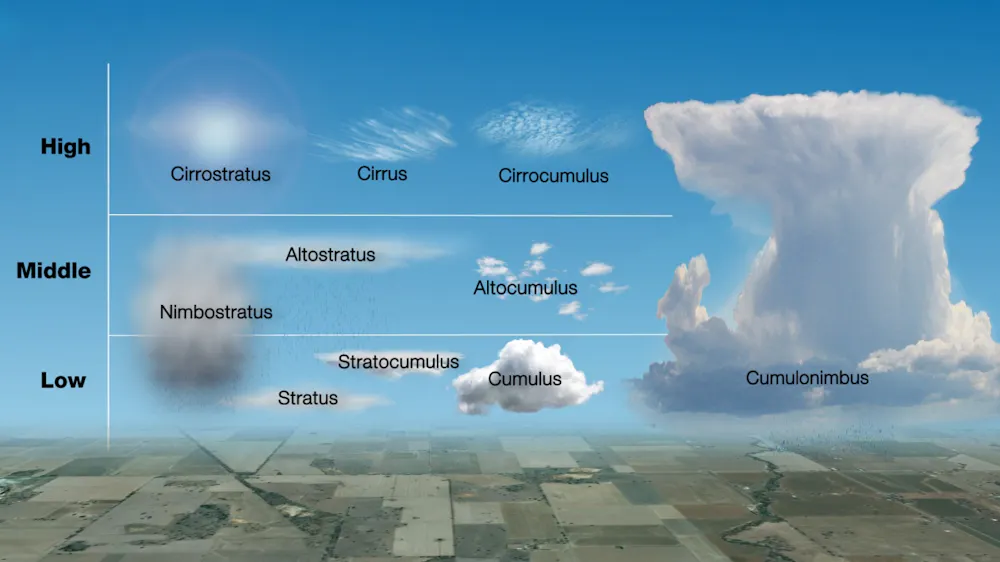
Clouds that look like cartoon cotton balls or cauliflower are made up of tiny liquid water droplets and are called cumulus clouds.
Often, these are fair-weather clouds that form when the Sun warms the ground and the warm air rises. You’ll often see them on humid summer days.
Cumulus clouds over Lander, Wyo. Ross Lazear, CC BY-ND
However, if the air is particularly warm and humid, and the atmosphere above is much colder, cumulus clouds can rapidly grow vertically into cumulonimbus. When the edges of these clouds look especially crisp, it’s a sign that heavy rain or snow may be imminent.
Wispy cirrus are ice clouds
When cumulonimbus clouds grow high enough into the atmosphere, the temperature becomes cold enough for ice clouds, or cirrus, to form.
Clouds made up entirely of ice are usually more transparent. In some cases, you can see the Sun or Moon through them.
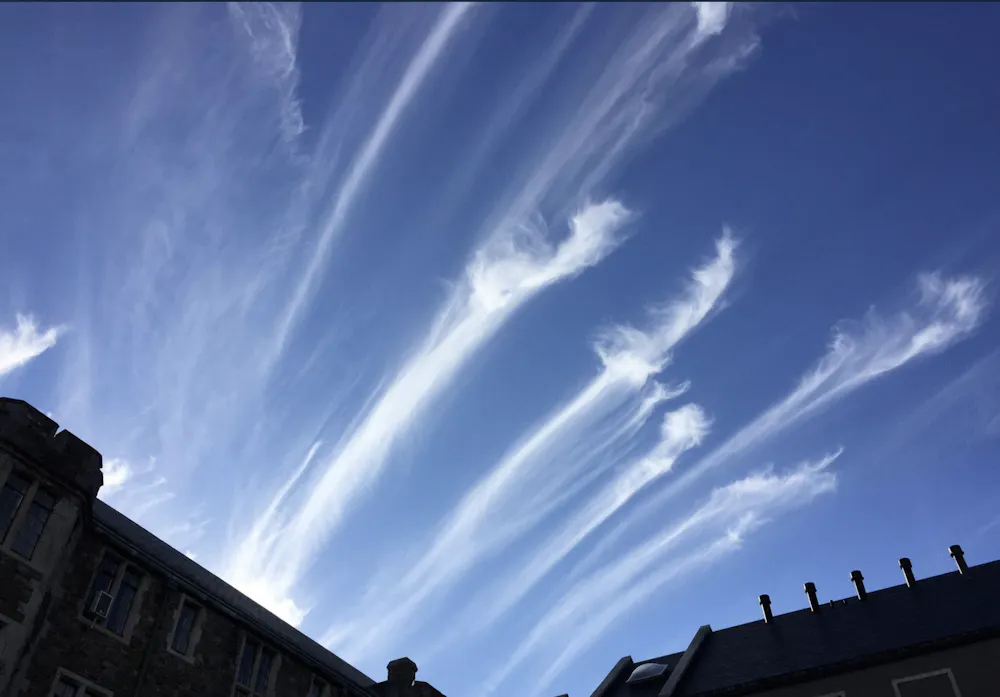
Cirrus clouds over the roof of Bard College in Annandale-on-Hudson, N.Y. Ross Lazear, CC BY-ND
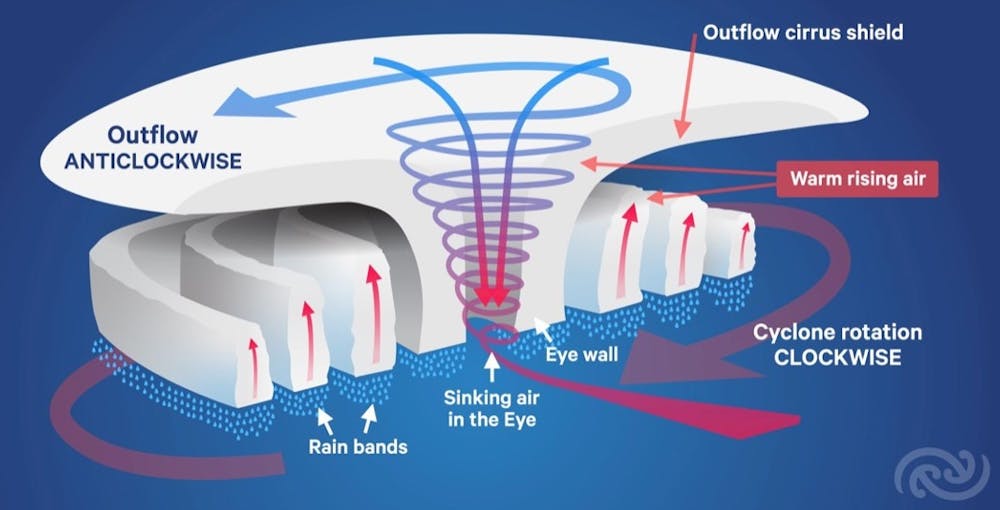
Cirrus clouds that forms atop a thunderstorm spread outward and can form anvil clouds. These clouds flatten on top as they reach the stratosphere, where the atmosphere begins to warm with height.
However, most cirrus clouds aren’t associated with storms at all. There are many ice clouds associated with tranquil weather that are simply regions of the atmosphere with more moisture but not precipitation.
Fog and stratus clouds
Clouds are a result of saturation, but saturated air can also exist at ground level. When this occurs, we call it fog.
In temperatures below freezing, fog can actually deposit ice onto objects at or near the ground, called rime ice.
Reading clouds, with the National Oceanic and Atmospheric Administration.
When clouds form thick layers, we add the word “stratus,” or “layer,” to the name. Stratus can occur just above the ground, or a bit higher up – we call it altostratus then. It can occur even higher and become cirrostratus, or a layer or ice clouds.
If there’s enough moisture and lift, stratus clouds can create rain or snow. These are nimbostratus.
How mountains can create their own clouds
There are a number of other unique and beautiful cloud types that can form as air rises over mountain slopes and other topography.
Lenticular clouds, for example, can look like flying saucers hovering just above, or near, mountaintops. Lenticular clouds can actually form far from mountains, as wind over a mountain range creates an effect like ripples in a pond.
A banner cloud appears to stream out from the Matterhorn, in the Alps on the border between Italy and Switzerland. Zacharie Grossen via Wikimedia, CC BY
Rarer are banner clouds, which form from horizontally spinning air on one side of a mountain.
Wind plays a big role
You might have looked up at the sky and noticed one layer of clouds moving in a different direction from another. Clouds move along with the wind, so what you’re seeing is the wind changing direction with height.
Cirrus clouds at the level of the jet stream – often about 6 miles (10 kilometers), above the ground – can sometimes move at over 200 miles per hour (320 kilometers per hour). But because they are so high up, it’s often hard to tell how fast they are moving.
Ross Lazear does not work for, consult, own shares in or receive funding from any company or organization that would benefit from this article, and has disclosed no relevant affiliations beyond their academic appointment.
Trump is not the first American leader to dream of northern expansion. To me, a historian of early U.S.-Canadian relations, these designs suggest not power, but weakness and simmering divisions inside the United States.
Early Americans’ lust for Canada
Even before independence, social conflict helped turn American eyes northward. Throughout the 18th century, England’s Colonial population in North America doubled every 25 years. Successive generations of Colonists along the Eastern Seaboard had to compete with each other, and with Indigenous people, for resources, arable land and trade.
These unhappy, land-hungry Colonists clamored for expansion, instigating a series of wars against both the French and Spanish empires for control of the northeastern half of the continent, culminating in the French and Indian War, from 1754 to 1763.
While these Colonists were animated by their thirst for expansion, they had little else unifying them. Many Americans today are familiar with the “Join, or Die” cartoon Ben Franklin printed, featuring a segmented snake with each section representing one of the Colonies. However, few realize that it was not crafted during the Revolution to unite Colonists against Britain, but in 1754, to rally divided British Colonists in their war against France.
Attempts to settle other lands ceded by France were no more successful. Fearful that Colonists might provoke a costly war with Indigenous people, Parliament issued the Proclamation of 1763, which attempted to protect native land by discouraging Colonial expansion westward. Many Colonists turned against Britain in response, especially those like George Washington, who had speculated in the land west of the Appalachian Mountains.
The failed invasion of Canada
In the earliest months of the Revolution, the Continental Congress authorized an American invasion of British-occupied Quebec. In a letter addressed to “Friends and Brethren” of Canada, Washington himself implored Canadians to join invading troops. “The Cause of America, and of Liberty, is the Cause of every virtuous American Citizen,” he wrote. “Come then, ye generous Citizens, range yourselves under the Standard of general Liberty.”
But at home, Colonists were far from united in their rebellion. Historians estimate that around 20% of the white Colonial population, more than 500,000 people, remained loyal to Britain, and an even larger number hoped to remain neutral.
The difficult realities of conquest also turned many soldiers against the invasion of Canada. In late October 1775, nearly a quarter of the underfed and overworked troops under the command of soon-to-be turncoat Benedict Arnold abandoned their arduous journey through interior Maine toward Canada. The soldiers who carried on prayed these deserters “might die by the way, or meet with some disaster, Equal to the Cowardly dastardly and unfriendly Spirit they discover’d in returning Back without orders.”
Following American independence, tens of thousands of loyal Colonists sailed north to Canada, determined to build British colonies that would become what one of these refugees called “the envy of the American States.” Their presence on the contested northern border was an unsettling reminder to the new American nation about the power Britain still exerted on the continent.
Conflict with Britain over land and trade in the early 1800s reopened old divisions among Americans. Virginia Congressman John Randolph expressed his frustrations with renewed calls for a northern invasion. “We have but one word, like the whip-poor-will, but one eternal monstrous tone,” an exasperated Randolph noted, “Canada! Canada! Canada!”
The debate over Canada was one of many issues dividing the nation, and as President James Madison would later explain, he hoped that war would help unify a polarized nation. His gamble paid off, but only after opponents from New England flirted with the idea of secession to negotiate their own end to conflict.
One example of annexation talk from the 20th century, however, might serve as a warning to Trump, showing how aggressive rhetoric toward Canada has led to political defeat. In 1911, a bill creating free trade with Canada passed Congress with the support of President William Taft, despite objections from protectionists in both parties.
In an attempt to have the agreement defeated in the Canadian Parliament, U.S. opponents from both sides of the aisle attempted to stir popular sentiment against the U.S. in Canada. Champ Clark, the Democratic speaker of the House and a front-runner for the presidential nomination in 1912, seized on the moment.
“I hope to see the day when the American flag will float over every square foot of the British North American possessions, clear to the North Pole,” Champ proclaimed on the House floor. William Stiles Bennet, a Republican, proposed a resolution that would authorize the president to begin negotiations for annexation.
Back home, however, the plan backfired. Woodrow Wilson, not Clark, secured the Democratic nomination in 1912 and would go on to defeat both the incumbent Taft and former President Theodore Roosevelt. The bluster led not to success and victory, but loss and defeat.
G. Patrick O’Brien does not work for, consult, own shares in or receive funding from any company or organization that would benefit from this article, and has disclosed no relevant affiliations beyond their academic appointment.
When the U.S. government deported 177 Venezuelans on Feb. 20, 2025, the Department of Homeland Security alleged that 80 of the deportees were members of the Venezuelan gang Tren de Aragua.
The U.S. State Department went so far as to designate Tren de Aragua a foreign terrorist organization in an effort to stop “the campaigns of violence and terror committed by international cartels and transnational organizations.”
There is little reliable information about Tren de Aragua – but no shortage of sensationalist news reports and Immigration and Customs Enforcement raids claiming to target them.
We are sociologists who have spent a combined 37 years researching gangs, crime and policing in Venezuela. Our research in Venezuela, and our colleagues’ research in other countries, suggests that incarceration and mass deportations of Venezuelans living in the U.S., whether they have ties to the group or not, will likely strengthen Tren de Aragua rather than cripple it.
Indeed, we have already seen how these strategies contributed to the expansion of street gangs in El Salvador and Honduras by creating new opportunities for members to network and become more organized.
What is Tren de Aragua?
According to investigative journalistsand a handful of academic studies, Tren de Aragua was initially founded by Hector “El Niño” Guerrero and two other men in 2014. The three men were imprisoned in Tocorón prison in the state of Aragua.
By 2017, Tren de Aragua began to be known as a “megabanda,” a category the local press in Venezuela use to refer to large organized criminal groups. The term arose to highlight the size of some street gangs, which at the time was unprecedented in Venezuela.
Tren de Aragua’s growth surged as a result of mass incarceration policies that began under Venezuela’s former President Hugo Chávez and expanded under current President Nicolás Maduro. Incarceration rates began to increase in 2009 and were exacerbated by police raids deployed in 2010 in marginalized neighborhoods across the country. Venezuela’s prisons became filled with young, poor men.
Crowded togetherin inhumane conditions, the men began to organize into prison gangs with clear hierarchies. They accumulated vast profits by charging prisoners fees for food, use of space and protection from inmate violence. They also opened and ran businesses, including a club, inside Tocorón prison.
Members of different gangs in and outside the prison also began to communicate and share information about criminal activities such as kidnapping and extortion. This strengthened social networks and expanded their illegal enterprises.
Tren de Aragua, still based in the Tocorón prison at that time, took advantage of this mass migration. It expanded the group’s business portfolio to include human trafficking and sexual exploitation of Venezuelan female migrants in Chile, Colombia and Peru.
It’s unclear how far beyond Venezuela Tren de Aragua has spread. While the group has certainly expanded operations into the Latin American countries mentioned above, research shows common criminals have posed as Tren de Aragua members in both Colombia and Chile.
Moreover, the arrest of alleged Tren de Aragua members for committing crimes in the U.S. and other countries does not mean that the gang has set up shop in those places. Gang members, same as non-gang members, migrate during crises. They may continue to commit crimes in new places after they arrive. However, it’s important to note that immigration in the U.S. is consistently linked with decreases – not increases – in both violent crime and property crime.
Even some local police departments have questioned the gang’s expansion into the U.S.
Venezuelan security forces wrested control of Tocorón prison from the Tren de Aragua gang in 2023. Yuri Cortez/AFP via Getty Images
Making matters worse
Deportations do not address the urgent situation faced by many migrants who leave their homelands in search of a better, safer future.
When governments prioritize the spectacle of deportations to deal with migration, they contribute to the expansion of even more resilient networks of criminal enterprises.
These same policies could also contribute to the growth of Tren de Aragua within Latin America.
Prison isolates large groups of excluded and marginalized people and constrains them to brutal conditions. This enables and encourages the social networks that fuel illegal markets and criminal activity beyond the walls of prisons.
Rising xenophobia
Another harmful outcome of the policies we have discussed here is that they may fuel xenophobia toward and criminalization of Venezuelan immigrants living in the U.S.
This closes off opportunities and harms people already devastated by economic, political and humanitarian crises in their home country.
Meanwhile, recent cuts in U.S. foreign aid to countries with large Venezuelan populations, such as Colombia and Peru, will likely exacerbate the migration crisis by constraining opportunities for Venezuelans.
Future waves of migrants will be easy prey for criminal organizations like Tren de Aragua, which has turned human trafficking into a lucrative business. And with current policies of cutbacks, incarceration and repression, Tren de Aragua will likely continue to grow and fill its coffers.
The authors do not work for, consult, own shares in or receive funding from any company or organization that would benefit from this article, and have disclosed no relevant affiliations beyond their academic appointment.
The start of President Donald Trump’s second term has been a bonanza for the attorneys general of blue states. As the president has released his blizzard of executive orders and axed federal funding and programs on which states rely, these attorneys general have filed suits designed to put the brakes on what Trump is trying to accomplish.
As the Washington Post reported on Feb. 22, 2025, “In the past month alone, multistate coalitions have sued the Trump administration seven times.”
In early February, the attorneys general of Minnesota, Oregon and Washington sought and were granted an order to stop the Trump administration from implementing an executive order that, according to Lambda Legal, an LGBTQ+ rights advocacy group, “targets transgender and gender-diverse youth.”
Almost a week later, 14 attorneys general went to court to prevent Elon Musk “from issuing orders to any person in the Executive Branch outside of DOGE and otherwise engaging in the actions of an officer of the United States.”
New York Attorney General Letitia James and Connecticut Attorney General William Tong both sued to stop DOGE from obtaining Americans’ personal data. Michael M. Santiago/Getty Images
As a student of law and politics, I see the attorneys general actions against the Trump administration as the latest chapter of an ongoing story dating to the 19th century in which state officials push back against the national government, breathing life into this country’s federal system. That system, designed by the framers to protect liberty and as a guard against tyranny, gave powers to both federal and state governments.
Hybrid role of state attorneys general
The work of attorneys general in the various states involves a mix of law and politics. As the National Association of Attorneys General describes their role, attorneys general are “chief legal officers” and serve “as counselor to state government agencies and legislatures, and as a representative of the public interest.”
In 43 states, they are elected officials who run for office as partisans. These candidates offer programs and promise to take actions that are typically in line with the platforms of the parties that nominate them. As attorney Marissa Smith wrote in the Cornell Law Review, “The position of State AG has long been said to stand for ‘Aspiring Governor’ rather than Attorney General.”
Smith argues that state attorneys general “have leaned into our nation’s divisive partisanship – often as an integral part of a quest for higher office – and used their traditional roles and powers to grandstand and showcase their party loyalty on a national stage.”
When, as in the recent spate of suits, state attorneys general pursue the federal government or another target on the national stage, there’s really no way for them to lose, politically speaking. As journalist Alan Greenblatt writes, “It’s all upside. If a lawsuit succeeds, you achieve a policy goal. If it fails, you’ve still made a name for yourself and often delayed a policy for months and even years,” especially when that policy is unpopular.
Suing the federal government
There is nothing new about what state attorneys general are now doing. At one time or another, lawsuits against the federal government have come from both Democratic and Republican attorneys general.
For example, during the so-called Gilded Age at the end of the 19th century, because of their “unique institutional position,” progressive state attorneys general “were able to serve as opportunity points for the expression of the ‘public interest’ in the absence of administrative mechanisms or actions by other political institutions,” political scientist Paul Nolette writes.
These attorneys general sued railroad companies and other big businesses, seeking to get state courts to rein in the growing power of what were called at the time “robber barons.”
In the 1980s, state attorneys general banded together to sue federal agencies for failing to enforce the law or to implement acts of Congress, including those concerning the deregulation of industry. A decade later, they launched a concerted campaign of lawsuits against major tobacco companies because the federal government was not, they alleged, adequately regulating the tobacco industry.
And when Barack Obama entered the White House, state attorneys general enthusiastically embraced the role of watchdog and nemesis. Republican state attorneys general led the resistance with lawsuits over health policy, immigration and environmental regulations, using their powers much like their Democratic counterparts are doing today.
Texas Attorney General Ken Paxton claims to have sued the Obama administration 100 times. Justin Lane-Pool/Getty Images
Former West Virginia Solicitor General Elbert Lin, who served as the chief litigator in his state’s attorney general’s office, tells the story this way: “During the eight years of the Obama Administration, states led mostly by Republican attorneys general made it a priority, early and often, to challenge President Obama’s initiatives.”
One of them, Texas’ Greg Abbott, sued the Obama administration 31 times, at one point describing his job this way: “I go into the office, I sue the federal government, and I go home.”
During the first Trump administration, Democratic attorneys general continued what had happened under Obama. They filed 138 multistate lawsuits, up from the 78 times Republicans sued the Obama administration.
And at the end of President Joe Biden’s term, Ken Paxton, Texas’ Republican attorney general, issued a press release saying that over the previous four years, he had sued the administration 100 times, calling it “an historic milestone.”
‘Expect to be sued’
Supreme Court Justice Louis Brandeis once called states “laboratories of democracy.” More recently, Jeffrey Rosen of the National Constitution Center praised federalism for continuing “to promote ideological diversity” in an increasingly polarized nation.
That diversity has long been on display in what state attorneys general have done on the national stage.
Today, when some worry that the U.S. constitutional system is breaking down, state attorneys general are trying to realize the founders’ vision of limited government. They are mobilizing legal tools to vindicate legal claims while also using the courts for political purposes.
All presidents should expect to be sued early and often by state attorneys general of the opposite party. But as attorney Jeffrey Toobin writes in The New York Times, “political victories matter more, and last longer, than court cases” in the United States.
In recent years, suits brought by state attorneys general have protected the rights of immigrants, defended reproductive rights and asserted state prerogatives in many areas. But while these lawsuits have an important role to play in America’s constitutional system, what citizens do is more important.
Even successful litigation by state attorneys general typically brings only a one-time victory, but political action is needed to sustain what they achieve in court. And their work cannot be done without the support of the citizens they serve and who, by and large, elect them.
Austin Sarat does not work for, consult, own shares in or receive funding from any company or organization that would benefit from this article, and has disclosed no relevant affiliations beyond their academic appointment.
Isolationism has deep roots in American foreign policy stretching back to George Washington.FotografiaBasica/Getty Images
Few terms in American foreign policy discourse are as misunderstood or politically charged as “isolationism.”
Often used as a political weapon, the term conjures images of a retreating America, indifferent to global challenges.
However, the reality is more complex. For example, some commentators argue that President Donald Trump’s return to the White House signals a new era of isolationism. But others contend his foreign policy is more akin to “sovereigntism,” which prioritizes national autonomy and decision-making free from external constraints, and advocates for international engagement only when it directly serves a nation’s interests.
Understanding isolationism’s role in U.S. policy requires a closer look at its historical roots and political usage.
‘Entangling alliances’
The idea of avoiding foreign entanglements has been a part of American strategic thinking since the country’s founding. President George Washington’s famous warning against “entangling alliances” reflected a desire to insulate the young republic from European conflicts.
Throughout the 19th century, this sentiment shaped U.S. policy, though not exclusively. The country expanded its influence in the Western Hemisphere, maintained strong economic ties abroad and occasionally intervened in regional affairs.
This cautious approach allowed the U.S. to develop its economy and military strength without becoming deeply embroiled in European rivalries.
After World War I, isolationism became more pronounced. The staggering human and financial costs of the war led many Americans to question deep international involvement. Skepticism toward President Woodrow Wilson’s League of Nations reinforced this sentiment, and in the 1930s, the U.S. passed Neutrality Acts designed to keep the country out of foreign wars. However, this approach proved unsustainable.
Though getting increasingly involved in the European conflict in the years before the attack on Pearl Harbor on Dec. 7, 1941, that day officially led the U.S. into World War II, marking the definitive end of traditional isolationism. With the war’s conclusion, American strategic thinking shifted, recognizing that even partial disengagement was no longer an option in a globalized world.
Isolationism as a slur
In the postwar era, isolationism devolved from a coherent strategic perspective into a term of political derision. During the Cold War, those who opposed military alliances like NATO or U.S. interventions in Koreaand Vietnam were often dismissed as isolationists, regardless of their actual policy preferences.
This framing marginalized critics of U.S. global engagement, even when their concerns were grounded in strategic prudence rather than a reflexive desire to withdraw from the world.
The same pattern persisted going into the 21st century. In debates over U.S. involvement in Iraq, Afghanistan and Ukraine, critics of expansive military commitments were frequently labeled isolationists, despite advocating for a recalibration of foreign policy rather than outright disengagement.
Many of those calling for an end to America’s “forever wars” did not argue for global retreat but for a prioritization of national interests over the broad defense of the so-called rules-based international order.
A persistent myth is that isolationism represents a total disengagement from the world. Historically, even during its peak, isolationism in the U.S. was never absolute. Trade, diplomacy and cultural exchanges continued even in periods marked by reluctance to intervene militarily. What critics of interventionism have historically sought is prudence in foreign affairs – avoiding unnecessary wars while ensuring the protection of core national interests.
Moving beyond isolationism
In recent years, “restraint” has gained traction as a more precise and useful framework for U.S. foreign policy. Unlike isolationism, restraint does not imply withdrawal from global affairs but rather advocates a more selective and strategic approach.
Proponents argue that the U.S. should avoid unnecessary wars, focus on core national interests and work with its allies to maintain stability rather than relying on unilateral military action. This perspective acknowledges the limits of American power and the risks of overextension while still recognizing the necessity of international engagement. Advocates of restraint suggest that recalibrating U.S. foreign policy would allow the country to address pressing domestic concerns while maintaining a strong international presence where it matters most.
As the U.S. reassesses decades of intervention, restraint offers a middle path between disengagement and unrestrained global activism. It encourages a more thoughtful and sustainable approach to foreign policy that prioritizes long-term stability and national interests over automatic involvement in conflicts.
Moving beyond the outdated and politically charged debate over isolationism would, I believe, allow for a more productive conversation about how the U.S. can engage globally in a way that is both effective and aligned with its strategic interests.
Andrew Latham does not work for, consult, own shares in or receive funding from any company or organization that would benefit from this article, and has disclosed no relevant affiliations beyond their academic appointment.
Source: The Conversation – USA – By Daniel Speed Thompson, Associate Professor of Religious Studies, University of Dayton
Deacons take part in a mass in St. Peter’s Basilica that was supposed to be presided over by Pope Francis.AP Photo/Alessandra Tarantino
For more than two weeks, eyes have been on the Vatican, awaiting news about Pope Francis’ health. The pope has been at Rome’s Gemelli Hospital since Feb. 14, 2025, being treated for double pneumonia and other complications.
When a pope is ill, resigns or passes away, who steps in? And who else helps lead the Holy See? The Conversation U.S. asked Daniel Speed Thompson, a theologian at the University of Dayton, for some insight into Vatican City.
Who are the most powerful people at the Vatican, besides the pope?
The Vatican houses the central government of the Catholic Church and is also an independent city-state. The pope is both the head of the Catholic Church and head of state.
In order to govern both, he has the Roman Curia, meaning “court.” In modern terms, the Curia is the papal bureaucracy. It is an extension of the pope’s authority.
In Catholic doctrine, the pope has the highest authority in the church. He can exercise it alone or with the College of Bishops, made up of all the bishops in the world. Bishops named by the pope to the office of “cardinal” can, if under 80 years old, vote to elect a new pope. Some cardinals, but by no means all, serve in the papal Curia in Rome.
Besides the pope, curial officials who oversee important aspects of the church’s political and religious life are often powerful figures. For example, the secretariat of state, headed by Cardinal Pietro Parolin, oversees relations with other countries and international organizations. It also oversees the Vatican’s diplomatic corps.
Pope Francis smiles as he walks alongside Vatican Secretary of State Pietro Parolin, left, and Cardinal Giuseppe Versaldi at the Vatican in 2014. AP Photo/Gregorio Borgia
The Dicastery – “department” – for the Doctrine of the Faith, led by Cardinal Víctor Manuel Fernández, addresses questions about correct Catholic teaching on faith and morals. The Dicastery of Bishops, headed by Cardinal Robert Prevost, coordinates the nominations of new bishops around the world.
All these officials work under the authority of the pope, advocating for and implementing his agenda. For example, Prevost has suggested that all Catholics should be involved in the selection of bishops. This idea is linked with Francis’ call for a more “synodal” church: one that is less hierarchical and shaped by lay Catholics’ concerns and challenges.
If a pope can’t fulfill his duties, who steps in?
When a pope dies – or resigns, like Benedict XVI did in 2013 – the governance of the Catholic Church formally falls to the College of Cardinals. However, the authority of the college is very limited. On their own, cardinals cannot make any significant decisions concerning faith, morals and worship. Nor can they undo previous papal decisions or change church laws about electing a new pope.
All the heads of the dicasteries lose their office upon the death or resignation of a pope. The College of Cardinals serves as a caretaker government whose primary purpose is to prepare for the election of the new pope and oversee day-to-day workings of the Vatican.
One cardinal, known as the “camerlengo,” is responsible for confirming the pope’s death or resignation. He then assumes control over the pope’s residence and coordinates the funeral, if needed. The camerlengo also takes custody of the Vatican’s property in Rome and supervises details for the upcoming conclave.
Cardinal Camerlengo Kevin Farrell talks with The Associated Press in his office in Rome in 2018. AP Photo/Paolo Santalucia
The day-to-day business of the Catholic Church continues, but no big decisions can be made in the absence of a pope. The church cannot appoint new bishops, and the Vatican cannot start new diplomatic efforts.
Are officials at the Vatican often nominated to be pope?
Sometimes. Francis was a cardinal from Argentina before his election as pope and had not served in the Roman Curia. However, Benedict XVI, Francis’ predecessor, did serve as the prefect of the Congregation – now called Dicastery – for the Doctrine of the Faith. Some recent popes served in the Curia earlier in their career but not immediately before their election.
What do you wish more people understood about the Vatican?
Three things. First, the Vatican is unlike any organization in the world. Its religious mission and political status rest on nearly 2,000 years of history. This complicated story provides a unique tradition that anchors the institution of the Catholic Church, but can also block the church from critical self-examination and renewal.
Second, the Vatican is like every organization in the world. Vatican officials can be faithful to the highest standards of their religion, truly wishing to serve the church and the common good of humanity. But they can also be flagrantly immoral, even criminals, and careerist seekers of status or luxury. Francis has consistently called out priests and bishops who see themselves as somehow superior by virtue of their office or their ordination.
Finally, compared with the massive bureaucracies of modern governments and corporations, the Vatican is relatively small and not as wealthy as it is often portrayed.
Daniel Speed Thompson does not work for, consult, own shares in or receive funding from any company or organization that would benefit from this article, and has disclosed no relevant affiliations beyond their academic appointment.
The Albanese government has signed up New South Wales to its new schools funding agreement, with an extra A$4.8 billion in funding for the state’s public schools over ten years.
Queensland remains the only state still to join the agreement, which ties federal funding to schools to specific measures, such as phonics checks and teacher training. The federal government is working hard to finalise a deal with that state before going into caretaker mode for the election.
The federal government has been negotiating with states and territories over a new schools funding deal for more than 12 months.
NSW has been among states asking for a 5% increase in funds, while the federal government was initially only offering 2.5%. In January 2025, Victoria and South Australia successfully negotiated for a 5% increase from the federal government, leaving NSW and Queensland as the only two states without a deal ahead of a new school year.
The Commonwealth and NSW governments said in a statement that under the NSW deal, the federal government will provide an extra 5% of the Schooling Resource Standard (SRS).
This would lift the federal contribution from 20% to 25% of the SRS by 2034. It follows the NSW government delivering an election commitment to reach 75% of the SRS by 2025.
The 2011 Gonski review recommended all schools receive a minimum level of funding, called the SRS, with additional funds based on need. In 2025 the estimated SRS amounts are $13,977 for primary school students and $17,565 for secondary school students.
Under the new national agreement all states would reach the full SRS funding in a decade, although at different paces. A lot of the fine print has still to be negotiated.
NSW has committed to removing the 4% provision of indirect school costs such as capital depreciation, so NSW schools would be fully funded over the life of the agreement.
This national agreement ties the funding to teaching and other reforms. These include more individualised support for students, continuing evidence-based teaching practices, and more mental health and wellbeing support for schools.
The two governments said: “This is not a blank cheque. The agreement will be accompanied by a NSW Bilateral Agreement, which ties funding to reforms that will help students catch up, keep up and finish school”.
These include
Year 1 phonics and early years of schooling numeracy checks to identify those needing more help
evidence-based teaching and targeted and intensive supports such as small-group or catch-up tutoring
wellbeing initiatives, including greater access to mental health professionals
access to high-quality and evidence-based professional learning, and
initiatives to attract and retain teachers.
The federal-state agreements incorporate national targets. These include improving NAPLAN reading and numeracy proficiency; increasing NAPLAN outcomes for priority equity cohorts; boosting student attendance; increasing the engagement rate of teacher education students, and raising the proportion of students successfully completing year 12.
Prime Minister Anthony Albanese said “every dollar of this funding will go into helping children learn”.
Federal Education Minister Jason Clare said: “This will help more than 780,000 kids in more than 2,200 public schools. This is real funding tied to real reforms to help students catch up, keep up and finish school.”
Premier Chris Minns said: “We’ve seen a 40% reduction in teacher vacancies since we came to government, but we know there’s still more to do. This investment is vital as we work to lift education standards across the state by ensuring there is a qualified, dedicated teacher at the front of the classroom.”
In January, opposition education spokeswoman Sarah Henderson said Clare had “failed to get the job done”. She noted students in NSW and Queensland “continue to pay the price”.
Michelle Grattan does not work for, consult, own shares in or receive funding from any company or organisation that would benefit from this article, and has disclosed no relevant affiliations beyond their academic appointment.
Source: The Conversation – Global Perspectives – By Matthew Sussex, Associate Professor (Adj), Griffith Asia Institute; and Fellow, Strategic and Defence Studies Centre, Australian National University
Has any nation squandered its diplomatic capital, plundered its own political system, attacked its partners and supplicated itself before its far weaker enemies as rapidly and brazenly as Donald Trump’s America?
The fiery Oval Office meeting between Trump and Ukrainian President Volodymyr Zelensky on Friday saw the American leader try to publicly humiliate the democratically elected leader of a nation that had been invaded by a rapacious and imperialistic aggressor.
And this was all because Zelensky refused to sign an act of capitulation, criticised Putin (who has tried to have Zelensky killed on numerous occasions), and failed to bend the knee to Trump, the country’s self-described king.
The Oval Office meeting became heated in a way that has rarely been seen between world leaders.
What’s worse is Trump has now been around so long that his oafish behaviour has become normalised. Together with his attack dog, Vice President JD Vance, Trump has thrown the Overton window – the spectrum of subjects politically acceptable to the public – wide open.
Previously sensible Republicans are now either cowed or co-opted. Elon Musk’s so-called Department of Government Efficiency (DOGE) is gutting America’s public service and installing toadies in place of professionals, while his social media company, X, is platforming ads from actual neo-Nazis.
The Department of Health and Human Services is helmed by Robert F. Kennedy Jr., a vaccine denier, just as Americans have begun dying from measles for the first time in a decade. And America’s health and medical research has been channelled into ideologically “approved” topics.
At the Pentagon, in a breathtaking act of self-sabotage, Defence Secretary Pete Hegseth has ordered US Cyber Command to halt all operations targeting Russia.
And cuts to USAID funding are destroying US soft power, creating a vacuum that will gleefully be filled by China. Other Western aid donors are likely to follow suit so they can spend more on their militaries in response to US unilateralism.
What is Trump’s strategy?
Trump’s wrecking ball is already having seismic global effects, mere weeks after he took office.
The US vote against a UN General Assembly resolution condemning Russia for starting the war against Ukraine placed it in previously unthinkable company – on the side of Russia, Belarus and North Korea. Even China abstained from the vote.
In the United Kingdom, a YouGov poll of more than 5,000 respondents found that 48% of Britons thought it was more important to support Ukraine than maintain good relations with the US. Only 20% favoured supporting America over Ukraine.
And Trump’s bizarre suggestion that China, Russia and the US halve their respective defence budgets is certain to be interpreted as a sign of weakness rather than strength.
The oft-used explanation for his behaviour is that it echoes the isolationism of one of his ideological idols, former US President Andrew Jackson. Trump’s aim seems to be ring-fencing American businesses with high tariffs, while attempting to split Russia away from its relationship with China.
These arguments are both economically illiterate and geopolitically witless. Even a cursory understanding of tariffs reveals that they drive inflation because they are paid by importers who then pass the costs on to consumers. Over time, they are little more than sugar pills that turn economies diabetic, increasingly reliant on state protections from unending trade wars.
And the “reverse Kissinger” strategy – a reference to the US role in exacerbating the Sino-Soviet split during the Cold War – is wishful thinking to the extreme.
Putin would have to be utterly incompetent to countenance a move away from Beijing. He has invested significant time and effort to improve this relationship, believing China will be the dominant power of the 21st century.
Putin would be even more foolish to embrace the US as a full-blown partner. That would turn Russia’s depopulated southern border with China, stretching over 4,300 kilometres, into the potential front line of a new Cold War.
What does this mean for America’s allies?
While Trump’s moves have undoubtedly strengthened the US’ traditional adversaries, they have also weakened and alarmed its friends.
Put simply, no American ally – either in Europe or Asia – can now have confidence Washington will honour its security commitments. This was brought starkly home to NATO members at the Munich Security Conference in February, where US representatives informed a stunned audience that America may no longer view itself as the main guarantor of European security.
Vice President JD Vance delivers a strong message to European leaders.
The swiftness of US disengagement means European countries must not only muster the will and means to arm themselves quickly, but also take the lead in collectively providing for Ukraine’s security.
Whether they can do so remains unclear. Europe’s history of inaction does not bode well.
US allies also face choices in Asia. Japan and South Korea will now be seriously considering all options – potentially even nuclear weapons – to deter an emboldened China.
There are worries in Australia, as well. Can it pretend nothing has changed and hope the situation will then normalise after the next US presidential election?
The future of AUKUS, the deal to purchase (and then co-design) US nuclear powered submarines, is particularly uncertain.
Does it make strategic sense to pursue full integration with the US military when the White House could just treat Taipei, Tokyo, Seoul and Canberra with the same indifference it has displayed towards its friends in Europe?
Ultimately, the chaos Trump 2.0 has unleashed in such a short amount of time is both unprecedented and bewildering. In seeking to put “America First”, Trump is perversely hastening its decline. He is leaving America isolated and untrusted by its closest friends.
And, in doing so, the world’s most powerful nation has also made the world a more dangerous, uncertain and ultimately an uglier place to be.
Matthew Sussex has received funding from the Australian Research Council, the Atlantic Council, the Fulbright Foundation, the Carnegie Foundation, the Lowy Institute and various Australian government departments and agencies.
In a year with few surprises in the awards categories, there was also a dearth of surprises on the red carpet. The sartorial themes included sparkling metallics, coloured menswear and bows, bows and more bows.
Metallic gowns that resemble the Oscar statue are a familiar sight at the Academy Awards and this year was no different. Some of the standouts included best actress nominee Demi Moore in a magnificently glittering silver Armani Privé gown, Selena Gomez in custom Ralph Lauren encrusted with 16,000 individual blush-toned jewel teardrops, and Emma Stone in a minimalist Louis Vuitton sheath covered in iridescent fish scales.
In the menswear category, tuxedos reign supreme. This year was notable only for the diversity of colours in which these suits came.
Best actor nominee Timothée Chalamet lived up to his reputation for monochrome, richly hued ensembles in a custom butter yellow leather suit by Givenchy, paired with a matching silk shirt and delicate neck brooch in place of a tie. His best actor nominated compatriot, Colman Domingo (one of the best dressed men in Hollywood) was pristine in a double-breasted red silk jacket with black lapels, black trousers and matching red shirt by Valentino, similarly eschewing a tie in favour of a fine gold brooch. Andrew Garfield wore louche chocolate brown Gucci and Jeremy Strong wore a suit by Loro Piana in an unusual tone of olive green.
Bows of varying size and stature were perhaps the strongest theme of the night.
Best actress winner Mikey Madison in black and pink Dior, best supporting actress nominee Felicity Jones in shimmering liquid silver Armani, Elle Fanning in white and black Givenchy and Lupita Nyong’o in white Chanel were all adorned with bows at their waists.
The most remarkable bow of the night though was best actress nominee Cynthia Erivo in a structured deep emerald-green velvet Louis Vuitton gown, the broad, wing-like sleeves of which were crafted as a bow.
Notable mentions must also go to those attendees who do not fit neatly into any thematic category. Best supporting actress nominee Ariana Grande wore a meticulously crafted pale pink Schiaparelli confection and Lisa (of Blackpink and now White Lotus fame) perfected a feminine take on masculine suiting in a tuxedo dress by Markgong.
The only real surprise was the lack of political statements on display. Unlike recent years, when pins and ribbons in support of Ukraine and Palestine were widely worn, this year only Guy Pearce was spotted wearing a Free Palestine pin, Conclave writer Peter Straughan wore a Ukrainian flag pin and Kayo Shekoni had “free Congo” emblazoned on the sole of her high heels.
– Harriette Richards
The best picture: Anora
And the best picture Oscar goes to … Anora – the film that was favoured to win, so no surprises here.
Though he had been working for more than a decade at the time, writer-director-editor Sean Baker came onto the independent movie scene with a bang with 2015’s Tangerine, a gimmicky film that was mainly celebrated for being shot on an iPhone. Why this would be celebrated is anyone’s guess. I suspect it’s because of the “I could do it too” factor – something the average person certainly couldn’t say if we’re talking 35mm celluloid.
Since then, Baker’s films have relished in embracing the digital, neon world, but always in a kind of sentimental and shallow, rather than critical, register. None of his films are awful – and maybe that’s saying something in this day and age. Anora also is not awful, but it’s not particularly memorable either.
Anora follows a run of the mill American dream-type story about a hard-working stripper who seems to strike fairytale gold when a young, fun Russian oligarch falls in love with her. Only the dream turns out to be more of a nightmare (kind of) when things don’t quite work out and the film ends with the titular character once again independent and free.
The idea of undercutting the fairytale setup of the typical rom-com is not at all original, and the film strikes me as even more schmaltzy in its rejection of the fairytale dream than if it had embraced it and played like a tween-focused Nickelodeon film (it’s about as poignant as this).
The film’s cardinal sin, however – and it’s certainly not alone in this – is its critical overlength. Each of the film’s sections could have had some 20 minutes cut and we would have had an enjoyably tight romp at 80 minutes. Instead, Anora drags on, swept up in its imagining of its own profundity – at times pretentious, but mainly tedious.
– Ari Mattes
Not the year to stick a neck out
The speeches this year were conspicuously meek. No announcer majorly insulted anyone else. No winner assaulted anyone else. Even the James Bond retrospective lacked energy. What’s going on in Hollywood?
There are clues that help explain this curious flatness. Host Conan O’Brien mentioned the pressure of “divisive politics” while reflecting on California’s wildfires. Several winners spoke about the importance of shared experience, of what unites us, of film as a medium that brings people together, a force for “good and progress in the world” and “a reminder not to let hate go unchecked”.
The directors of No Other Land, receiving their Oscar for best documentary, shared the one clear critical voice. Palestinian Basel Adra wished his newborn daughter a life without the fear that governs daily life in his homeland. Israeli co-director Yuval Abraham agreed: “There is another way. It’s not too late for life and for the living. There is no other way.”
However, that was the only moment people at the Oscars seemed willing to confront the political elephant in the room.
Anora director Sean Baker used his last (of four!) acceptance speeches to compel more people to help keep cinema doors open. He made his point passionately: this was the best way to sustain an industry that could continue to make brilliant movies. That said, the most emotive speeches of past Oscars events went much further than just commenting on the bread and butter concerns of the film industry.
This year, there were more clues in what people did not say. There were feints at Russian dictators – but nobody mentioned the war in Ukraine. There was no discussion of a certain election result, nor of filmmakers’ fears that Washington is now in the control of a governing faction that loathes them. Most revealing of all: nobody raised a peep about the President or his friends.
Hollywood’s collective discipline was on show tonight – and 2025 is not the year to stick a neck out.
– Tom Clark
A banner year for independent film
Independent films were the big winners for this year’s Oscars. While many of the technical awards went to the big budget films, such as Wicked (the US$145 million film won costume design and production design) and Dune: Part 2 (made at a budget of US$190 million, and winning sound and visual effects), the night’s major awards went to small productions.
While the definitions of “independence” and “studio” films don’t exist in a neat binary when it comes to production and global distribution, we can distinguish between film juggernauts and smaller films.
Three independent films won significant awards that are of note. Latvian film Flow was the first independent film to win best animated feature, up against major films Inside Out 2 (Pixar Films) and The Wild Robot (DreamWorks).
The film follows a cat, a dog, a capybara, a secretary bird and a ring-tailed lemur navigating a post-apocalyptic world with rising sea levels. The film also only used free and open-source software Blender and mostly used sounds from real world counterparts of the various characters. It was made for a budget of just €3.5 million (A$5.9 million).
The best documentary film nominees were dominated by independent films. Notably, the winner No Other Land has sadly been unable to find a distributor to release the film in the United States. (It is available for streaming in Australia on DocPlay, and in select cinemas.) The film was only eligible because the Film Lincoln Centre in New York facilitated a one-week, qualifying theatrical run.
The night’s top glories went to Anora, made on a budget of just US$6 million (A$9.7 million) and taking home the awards for best film, director, actress, screenplay and editing.
In his acceptance speech for best director, Sean Baker spoke of the importance of films getting a theatrical release. Films, he said, are about humanity – and that is best experienced in watching a film with other people.
During awards season, Baker has often spoken about the importance of small budget films in the expression of core human experiences.
The final message of the night went to Baker when he thanked the Academy for recognising a truly independent film: “Long live independent film!”
Indeed, independent films ruled this year’s Oscars.
– Stuart Richards
Best actor and actress
Mikey Madison, who won the best actress award for Anora, is quite good in the role. That said, it’s difficult to evaluate her performance in such a meandering film.
She tries hard playing a stripper who falls for Prince Charming – a Russian oligarch (Hollywood’s anti-Russian sentiment has certainly grown in recent years) who turns out to be a bit of a weakling with meanie parents. But Madison never really convincingly embodies the character, and we’re ever aware as we watch the film that she’s an actress working her way through relevant emotions and intensities.
That said, Madison is good at yelling and stripping, and this is the main way she shows her chops here. She screamed well in Once Upon a Time… in Hollywood (2019), too. The bar this year was admittedly pretty low, and truth be told Madison’s performance in Anora (aside from Fernanda Torres for I’m Still Here) is probably the best out of the nominees.
In contrast, Adrien Brody, who won the best actor award, is absolutely unforgettable in the flawed but magnificent The Brutalist – the best he’s been since The Pianist, and the deserved winner by a mile out of a similarly mediocre field. Brody is simply a pleasure to watch, and drives, in a wholly embodied way, this grandiose and exceedingly long film (the fact it doesn’t feel long is largely due to his magnetism).
The screenplay, in which the character comes across as a combination of arrogant, sweet and at times comedic, allows Brody to display the full range of his talent, and he plays the whole thing with an endearing vulnerability. But, again, it’s unfair to compare Brody and Madison – The Brutalist is a spectacularly accomplished cinematic epic, while Anora feels as stylish and profound as a social media video (I know that’s the point, but that doesn’t make it any more compelling).
– Ari Mattes
A lacklustre year for music
This was a strong year for music-based films, with three of the most nominated ones being musicals of various types: the big-budget Broadway adaptation Wicked, the original film musical Emilia Pérez, and the musician biopic A Complete Unknown.
The music of the ceremony itself was nicely assembled, with a live orchestra (conducted by Michael Bearden) accompanying proceedings from above the stage.
But the show was marred by an absence: the best song nominations were not performed live. The new songs this year were so bland, however – especially when compared to the Wicked score and Bob Dylan – that I can hardly blame the producers. The nominations included a dull Elton John song, some soft guitar rock from Sing Sing, Diane Warren’s 16th (!) nominated song (more soft rock), and two forgettable songs from Emilia Pérez (one of which, El Mal, was the winner).
So little faith did the Academy have in the songs that only a few seconds were played from each, mostly covered by a montage of interviews with the songwriters.
This year’s nominated best scores were not much more memorable, but Daniel Blumberg deserved his win for The Brutalist. It demonstrates a high level of composition and orchestration craft. It uses edgy instrumental textures to increase the feelings of uncertainty and imbalance that the film imparts.
The show included a lot of Wizard of Oz. Ariana Grande sang Over the Rainbow from the 1939 film and Cynthia Erivo sang Home from The Wiz, the 1974 soul musical based on the book. Then they performed Defying Gravity from Wicked together.
Another subtle Wizard of Oz nod was the music played during the commercial breaks: a loop based on Brand New Day from The Wiz, whose 1979 film version had its music produced by the late Quincy Jones. Queen Latifah and backup dancers brought some much needed energy to the last hour of the ceremony with Ease on Down the Road, also from The Wiz, as part of a Jones tribute.
One surprise was an unnecessary but enjoyable James Bond sequence featuring Margaret Qualley dancing to John Barry’s famous theme, a performance of Live and Let Die by K-pop star Lisa, Doja Cat singing Diamonds Are Forever, and Raye’s rendition of Skyfall.
This plus the various numbers from the Oz Musical Universe only highlighted how lacklustre this year’s nominated music was.
– Gregory Camp
The authors do not work for, consult, own shares in or receive funding from any company or organisation that would benefit from this article, and have disclosed no relevant affiliations beyond their academic appointment.
Source: The Conversation (Au and NZ) – By Taimoor Sohail, Postdoctoral Researcher, School of Geography, Earth and Atmospheric Sciences, The University of Melbourne
Flowing clockwise around Antarctica, the Antarctic Circumpolar Current is the strongest ocean current on the planet. It’s five times stronger than the Gulf Stream and more than 100 times stronger than the Amazon River.
It forms part of the global ocean “conveyor belt” connecting the Pacific, Atlantic, and Indian oceans. The system regulates Earth’s climate and pumps water, heat and nutrients around the globe.
But fresh, cool water from melting Antarctic ice is diluting the salty water of the ocean, potentially disrupting the vital ocean current.
Our new research suggests the Antarctic Circumpolar Current will be 20% slower by 2050 as the world warms, with far-reaching consequences for life on Earth.
The Antarctic Circumpolar Current is like a moat around the icy continent.
The current helps to keep warm water at bay, protecting vulnerable ice sheets. It also acts as a barrier to invasive species such as southern bull kelp and any animals hitching a ride on these rafts, spreading them out as they drift towards the continent. It also plays a big part in regulating Earth’s climate.
Unlike better known ocean currents – such as the Gulf Stream along the United States East Coast, the Kuroshio Current near Japan, and the Agulhas Current off the coast of South Africa – the Antarctic Circumpolar Current is not as well understood. This is partly due to its remote location, which makes obtaining direct measurements especially difficult.
Understanding the influence of climate change
Ocean currents respond to changes in temperature, salt levels, wind patterns and sea-ice extent. So the global ocean conveyor belt is vulnerable to climate change on multiple fronts.
Theoretically, warming water around Antarctica should speed up the current. This is because density changes and winds around Antarctica dictate the strength of the current. Warm water is less dense (or heavy) and this should be enough to speed up the current. But observations to date indicate the strength of the current has remained relatively stable over recent decades.
This stability persists despite melting of surrounding ice, a phenomenon that had not been fully explored in scientific discussions in the past.
What we did
Advances in ocean modelling allow a more thorough investigation of the potential future changes.
The model captures features others often miss, such as eddies. So it’s a far more accurate way to assess how the current’s strength and behaviour will change as the world warms. It picks up the intricate interactions between ice melting and ocean circulation.
In this future projection, cold, fresh melt water from Antarctica migrates north, filling the deep ocean as it goes. This causes major changes to the density structure of the ocean. It counteracts the influence of ocean warming, leading to an overall slowdown in the current of as much as 20% by 2050.
Far-reaching consequences
The consequences of a weaker Antarctic Circumpolar Current are profound and far-reaching.
As the main current that circulates nutrient-rich waters around Antarctica, it plays a crucial role in the Antarctic ecosystem.
Weakening of the current could reduce biodiversity and decrease the productivity of fisheries that many coastal communities rely on. It could also aid the entry of invasive species such as southern bull kelp to Antarctica, disrupting local ecosystems and food webs.
A weaker current may also allow more warm water to penetrate southwards, exacerbating the melting of Antarctic ice shelves and contributing to global sea-level rise. Faster ice melting could then lead to further weakening of the current, commencing a vicious spiral of current slowdown.
This disruption could extend to global climate patterns, reducing the ocean’s ability to regulate climate change by absorbing excess heat and carbon in the atmosphere.
Ocean currents around the world (NASA)
Need to reduce emissions
While our findings present a bleak prognosis for the Antarctic Circumpolar Current, the future is not predetermined. Concerted efforts to reduce greenhouse gas emissions could still limit melting around Antarctica.
Establishing long-term studies in the Southern Ocean will be crucial for monitoring these changes accurately.
With proactive and coordinated international actions, we have a chance to address and potentially avert the effects of climate change on our oceans.
The authors thank Polar Climate Senior Researcher Dr Andreas Klocker, from the NORCE Norwegian Research Centre and Bjerknes Centre for Climate Research, for his contribution to this research, and Professor Matthew England from the University of New South Wales, who provided the outputs from the model simulation for this analysis.
Taimoor Sohail receives funding from the Australian Research Council.
Bishakhdatta Gayen receives funding from Australian Research Council (ARC). He works at University of Melbourne as ARC Future Fellow and Associate Professor. He is also A/Prof. at CAOS, Indian Institute of Science.
Peter Dutton says if he became prime minister he would lobby US President Donald Trump “to reconsider his position” on Ukraine.
The opposition leader, who previously rejected Trump’s description of Ukraine’s President Volodymyr Zelensky as a “dictator”, has gone further in distancing himself from Trump after the shouting match in the Oval Office, when Trump and Vice President JD Vance berated Zelensky.
“I was disappointed by the scenes out of the White House,” Dutton told a Monday news conference. “I believe that President Zelensky requires the support of European countries, of the United States, and countries like Australia as well.”
He said the United States has been “an incredibly important ally” for Australia and he regarded it as a reliable one.
But making decisions in Australia’s best interests sometimes meant “standing up to your friends and to those traditional allies because our views have diverged.
“In relation to Ukraine, the Australian view at the moment is different to the United States, and my job as prime minister will be to lobby the president of the United States to reconsider his position in relation to Ukraine. Because I think it’s in all of our collective best interests if we’re able to provide support to Ukraine, and that’s something I’m dedicated to.”
Dutton’s criticism of Trump is at odds with some in his base and some right wing commentators, who are wedded to Trump, right or wrong.
Unlike policy on the Middle East, where bipartisanship has broken, both sides of Australian politics have remained firmly behind Ukraine from the start of the war. There is no sign of the bipartisanship being under pressure.
Australia has supplied Ukraine with about $1.5 billion worth of assistance, of which $1.3 billion is military aid.
Prime Minister Anthony Albanese, speaking at the start of Monday’s cabinet’s meeting, reiterated Australia’s strong backing for the embattled country in its war with Russia.
“We regard this as an issue of doing what’s right, but also what is in Australia’s national interest.
“The brave people of Ukraine, led so extraordinarily by President Zelensky, are fighting not just for their national sovereignty and for their democracy. They are fighting for the international rule of law.
“And it is an easy choice that Australia has made.”
On Sunday Treasurer Jim Chalmers said “I think President Zelensky is a hero”.
Dutton on Monday used similar language. “President Zelensky is a modern-day hero. He’s a war hero and he deserves support.”
On another front – Australia’s bid to avoid the US tariffs on aluminium and steel – while there is bipartisanship, the opposition is from time to time critical of the government’s handling of the issue.
Shadow finance minister Jane Hume said on Monday: “The Coalition wholeheartedly supports the government’s efforts to make sure that these tariffs are not imposed by the US.
“We would hope that the government will pull out all stops here in order to make sure that Australia’s national interests, our economic interests, are protected. I do note that Anthony Albanese is the only member of the Quad, which is one of our most important diplomatic relationships with the US, that hasn’t met directly with Donald Trump yet.”
The new tariffs are due to come into effect on March 12.
Australia has been further alarmed by an article published late last week by Trump’s trade advisor, Peter Navarro.
Navarro wrote: “Consider Australia. Its heavily subsidised smelters operate below cost, giving them an unfair dumping advantage, while Australia’s close ties to China further distort global aluminium trade”.
“Australia and Canada represent frontal assaults on our aluminium markets.”
Michelle Grattan does not work for, consult, own shares in or receive funding from any company or organisation that would benefit from this article, and has disclosed no relevant affiliations beyond their academic appointment.
Indonesia has developed several climate documents as pathways to curb climate change and adapt to its impacts. These impacts influence many elements of life, including displacement, the spread of infectious diseases, and even fatalities.
As a scholar in social development and environmental policy, I conducted a descriptive analysis of more than five Indonesia’s climate documents to learn how the concept of a just transition is being integrated into Indonesia’s climate policies. My analisis reveals that the current narrative in those documents is limited to the outcomes of climate-related approaches.
I found that these climate documents have failed to adequately address the social and environmental aspects that are fundamental to a ‘just transition’ — a global effort to combat climate change and shift towards a sustainable economy while improving the condition of people and the environment.
Indonesia’s climate action is important because the country is home to vast tropical forests and extensive peatlands, which act as important carbon sinks. Yet, it remains one of the world’s largest emitters.
Indonesia’s just transition is essential as it supports global efforts to mitigate climate change while ensuring that the shift is more sustainable and inclusive. Neglecting these factors in the transition can risk equity, justice, and inclusion for affected communities and ecosystems in Indonesia’s climate actions.
The risks it posed
So far, Indonesia’s just transition narrative concentrates mainly on the energy sector. For instance, the government’s white paper on just transition, released in September last year, centres solely on the energy aspect.
Additionally, the use of the word just in the Just Energy Transition Partnership (JETP) — an international partnership aiming at speeding Indonesia’s renewable energy development and coal phase-out — has helped popularise the notion.
A just transition should include broader efforts to limit and adapt to climate change, given these changes directly impact communities. Despite its increasing recognition in the energy sector, just transition remains a long way from being completely integrated into Indonesia’s climate initiatives.
In the forestry sector, Indonesia’s strategy to apply Sustainable Forest Management (SFM) practices, which includes selective logging practices to minimise damage, may lead to the prohibition of traditional slash-and-burn farming in some areas. This threatens local communities that have long practised controlled burning as a sustainable land management method.
Similarly, under FOLU Net Sink 2030 — Indonesia’s plan to reduce emissions from forestry and land-use — the government has introduced community forestry initiatives to improve livelihood. However, the strategy does not yet address the potential consequences for people who rely on forests for their livelihoods and cultural heritage, which could be jeopardised by by SFM practices.
Moreover, Indonesia’s climate resilience strategies for coastal communities overlook the socio-cultural importance of fishing as a key source of income. For example, the government plans to provide business development training to assist fishing families in diversifying their income in response to extreme weather conditions. However, without acknowledging the deep cultural and economic ties these communities have to fishing, such initiatives risk being ineffective.
The cost we bear
The lack of justice in Indonesia’s transition agenda has backfired, with negative consequences for both people and the environment.
For example, the energy shift demands Indonesia to exploit more of its abundant nickel resources for EV batteries, particularly in central and eastern Indonesia. To assist nickel mining and processing, the government has implemented several policies.
While the nickel boom has helped resource-rich provinces like North Maluku and Central Sulawesi boost their economic growth, it has also had serious impacts. Indonesia’s greenhouse gas emissions climbed by 20% between 2022 and 2023, owing to the dependency on coal for nickel processing facilities.
Beyond emissions, nickel mining has also led to deforestation and pollution, affecting local communities who rely on natural resources for their livelihoods and cultural preservation, while also harming biodiversity in mining areas.
The expense of the nickel rush demonstrates how an unjust energy transition can exacerbate challenges faced by vulnerable communities and further degrade the environment.
Next steps
To integrate just transition principles effectively, Indonesia must first redefine the term ‘just transition’ within its own context. Currently, the term has not been properly incorporated into any of Indonesia’s climate-related documents.
A clear and context-specific definition will allow Indonesia to pursue a transition that is both equitable and inclusive.
To accomplish this, the government must engage a wide range of stakeholders in defining and planning the transition to all climate-related initiatives. This encompasses, but is not limited to, all sectors. The goal is to secure broad participation — not only from the public and private sectors, but also from local communities, vulnerable groups including women and Indigenous peoples, as well as other key actors.
A more defined concept and well-structured plan will make it easier to implement, monitor, and evaluate the change. Simultaneously, this inclusive strategy should ensure a fair and equitable distribution of both benefits and burdens. All actors must be able to participate in decision-making and take action prior to and during the transition process.
Indonesia must also have a robust monitoring and evaluation mechanism in place to support its climate actions. The country can learn from Scotland, which has developed a just transition framework with clear outcomes and measurable indicators while ensuring participation and continuous learning from all stakeholders.
Drawing on insights from existing literature and reports will help Indonesia develop a framework that is well-suited to its unique context.
Wira A. Swadana tidak bekerja, menjadi konsultan, memiliki saham, atau menerima dana dari perusahaan atau organisasi mana pun yang akan mengambil untung dari artikel ini, dan telah mengungkapkan bahwa ia tidak memiliki afiliasi selain yang telah disebut di atas.
In a year with few surprises in the awards categories, there was also a dearth of surprises on the red carpet. The sartorial themes included sparkling metallics, coloured menswear and bows, bows and more bows.
Metallic gowns that resemble the Oscar statue are a familiar sight at the Academy Awards and this year was no different. Some of the standouts included best actress nominee Demi Moore in a magnificently glittering silver Armani Privé gown, Selena Gomez in custom Ralph Lauren encrusted with 16,000 individual blush-toned jewel teardrops, and Emma Stone in a minimalist Louis Vuitton sheath covered in iridescent fish scales.
In the menswear category, tuxedos reign supreme. This year was notable only for the diversity of colours in which these suits came.
Best actor nominee Timothée Chalamet lived up to his reputation for monochrome, richly hued ensembles in a custom butter yellow leather suit by Givenchy, paired with a matching silk shirt and delicate neck brooch in place of a tie. His best actor nominated compatriot, Colman Domingo (one of the best dressed men in Hollywood) was pristine in a double-breasted red silk jacket with black lapels, black trousers and matching red shirt by Valentino, similarly eschewing a tie in favour of a fine gold brooch. Andrew Garfield wore louche chocolate brown Gucci and Jeremy Strong wore a suit by Loro Piana in an unusual tone of olive green.
Bows of varying size and stature were perhaps the strongest theme of the night.
Best actress winner Mikey Madison in black and pink Dior, best supporting actress nominee Felicity Jones in shimmering liquid silver Armani, Elle Fanning in white and black Givenchy and Lupita Nyong’o in white Chanel were all adorned with bows at their waists.
The most remarkable bow of the night though was best actress nominee Cynthia Erivo in a structured deep emerald-green velvet Louis Vuitton gown, the broad, wing-like sleeves of which were crafted as a bow.
Notable mentions must also go to those attendees who do not fit neatly into any thematic category. Best supporting actress nominee Ariana Grande wore a meticulously crafted pale pink Schiaparelli confection and Lisa (of Blackpink and now White Lotus fame) perfected a feminine take on masculine suiting in a tuxedo dress by Markgong.
The only real surprise was the lack of political statements on display. Unlike recent years, when pins and ribbons in support of Ukraine and Palestine were widely worn, this year only Guy Pearce was spotted wearing a Free Palestine pin, Conclave writer Peter Straughan wore a Ukrainian flag pin and Kayo Shekoni had “free Congo” emblazoned on the sole of her high heels.
– Harriette Richards
The best picture: Anora
And the best picture Oscar goes to … Anora – the film that was favoured to win, so no surprises here.
Though he had been working for more than a decade at the time, writer-director-editor Sean Baker came onto the independent movie scene with a bang with 2015’s Tangerine, a gimmicky film that was mainly celebrated for being shot on an iPhone. Why this would be celebrated is anyone’s guess. I suspect it’s because of the “I could do it too” factor – something the average person certainly couldn’t say if we’re talking 35mm celluloid.
Since then, Baker’s films have relished in embracing the digital, neon world, but always in a kind of sentimental and shallow, rather than critical, register. None of his films are awful – and maybe that’s saying something in this day and age. Anora also is not awful, but it’s not particularly memorable either.
Anora follows a run of the mill American dream-type story about a hard-working stripper who seems to strike fairytale gold when a young, fun Russian oligarch falls in love with her. Only the dream turns out to be more of a nightmare (kind of) when things don’t quite work out and the film ends with the titular character once again independent and free.
The idea of undercutting the fairytale setup of the typical rom-com is not at all original, and the film strikes me as even more schmaltzy in its rejection of the fairytale dream than if it had embraced it and played like a tween-focused Nickelodeon film (it’s about as poignant as this).
The film’s cardinal sin, however – and it’s certainly not alone in this – is its critical overlength. Each of the film’s sections could have had some 20 minutes cut and we would have had an enjoyably tight romp at 80 minutes. Instead, Anora drags on, swept up in its imagining of its own profundity – at times pretentious, but mainly tedious.
– Ari Mattes
Not the year to stick a neck out
The speeches this year were conspicuously meek. No announcer majorly insulted anyone else. No winner assaulted anyone else. Even the James Bond retrospective lacked energy. What’s going on in Hollywood?
There are clues that help explain this curious flatness. Host Conan O’Brien mentioned the pressure of “divisive politics” while reflecting on California’s wildfires. Several winners spoke about the importance of shared experience, of what unites us, of film as a medium that brings people together, a force for “good and progress in the world” and “a reminder not to let hate go unchecked”.
The directors of No Other Land, receiving their Oscar for best documentary, shared the one clear critical voice. Palestinian Basel Adra wished his newborn daughter a life without the fear that governs daily life in his homeland. Israeli co-director Yuval Abraham agreed: “There is another way. It’s not too late for life and for the living. There is no other way.”
However, that was the only moment people at the Oscars seemed willing to confront the political elephant in the room.
Anora director Sean Baker used his last (of four!) acceptance speeches to compel more people to help keep cinema doors open. He made his point passionately: this was the best way to sustain an industry that could continue to make brilliant movies. That said, the most emotive speeches of past Oscars events went much further than just commenting on the bread and butter concerns of the film industry.
This year, there were more clues in what people did not say. There were feints at Russian dictators – but nobody mentioned the war in Ukraine. There was no discussion of a certain election result, nor of filmmakers’ fears that Washington is now in the control of a governing faction that loathes them. Most revealing of all: nobody raised a peep about the President or his friends.
Hollywood’s collective discipline was on show tonight – and 2025 is not the year to stick a neck out.
– Tom Clark
A banner year for independent film
Independent films were the big winners for this year’s Oscars. While many of the technical awards went to the big budget films, such as Wicked (the US$145 million film won costume design and production design) and Dune: Part 2 (made at a budget of US$190 million, and winning sound and visual effects), the night’s major awards went to small productions.
While the definitions of “independence” and “studio” films don’t exist in a neat binary when it comes to production and global distribution, we can distinguish between film juggernauts and smaller films.
Three independent films won significant awards that are of note. Latvian film Flow was the first independent film to win best animated feature, up against major films Inside Out 2 (Pixar Films) and The Wild Robot (DreamWorks).
The film follows a cat, a dog, a capybara, a secretary bird and a ring-tailed lemur navigating a post-apocalyptic world with rising sea levels. The film also only used free and open-source software Blender and mostly used sounds from real world counterparts of the various characters. It was made for a budget of just €3.5 million (A$5.9 million).
The best documentary film nominees were dominated by independent films. Notably, the winner No Other Land has sadly been unable to find a distributor to release the film in the United States. (It is available for streaming in Australia on DocPlay, and in select cinemas.) The film was only eligible because the Film Lincoln Centre in New York facilitated a one-week, qualifying theatrical run.
The night’s top glories went to Anora, made on a budget of just US$6 million (A$9.7 million), and taking home the awards for best film, director, actress, screenplay and editing.
In his acceptance speech for best director, Sean Baker spoke of the importance of films getting a theatrical release. Films, he said, are about humanity – and that is best experienced in watching a film with other people.
During awards season, Baker has often spoken about the importance of small budget films in the expression of core human experiences.
The final message of the night went to Baker when he thanked the Academy for recognising a truly independent film: “Long live independent film!”
Indeed, independent films ruled this year’s Oscars.
– Stuart Richards
Best actor and actress
Mikey Madison, who won the best actress award for Anora, is quite good in the role. That said, it’s difficult to evaluate her performance in such a meandering film.
She tries hard playing a stripper who falls for Prince Charming – a Russian oligarch (Hollywood’s anti-Russian sentiment has certainly grown in recent years) who turns out to be a bit of a weakling with meanie parents. But Madison never really convincingly embodies the character, and we’re ever aware as we watch the film that she’s an actress working her way through relevant emotions and intensities.
That said, Madison is good at yelling and stripping, and this is the main way she shows her chops here. She screamed well in Once Upon a Time… in Hollywood (2019), too. The bar this year was admittedly pretty low, and truth be told Madison’s performance in Anora (aside from Fernanda Torres for I’m Still Here) is probably the best out of the nominees.
In contrast, Adrien Brody, who won the best actor award, is absolutely unforgettable in the flawed but magnificent The Brutalist – the best he’s been since The Pianist, and the deserved winner by a mile out of a similarly mediocre field. Brody is simply a pleasure to watch, and drives, in a wholly embodied way, this grandiose and exceedingly long film (the fact it doesn’t feel long is largely due to his magnetism).
The screenplay, in which the character comes across as a combination of arrogant, sweet and at times comedic, allows Brody to display the full range of his talent, and he plays the whole thing with an endearing vulnerability. But, again, it’s unfair to compare Brody and Madison – The Brutalist is a spectacularly accomplished cinematic epic, while Anora feels as stylish and profound as a social media video (I know that’s the point, but that doesn’t make it any more compelling).
– Ari Mattes
A lacklustre year for music
This was a strong year for music-based films, with three of the most nominated ones being musicals of various types: the big-budget Broadway adaptation Wicked, the original film musical Emilia Pérez, and the musician biopic A Complete Unknown.
The music of the ceremony itself was nicely assembled, with a live orchestra (conducted by Michael Bearden) accompanying proceedings from above the stage.
But the show was marred by an absence: the best song nominations were not performed live. The new songs this year were so bland, however – especially when compared to the Wicked score and Bob Dylan – that I can hardly blame the producers. The nominations included a dull Elton John song, some soft guitar rock from Sing Sing, Diane Warren’s 16th (!) nominated song (more soft rock), and two forgettable songs from Emilia Pérez (one of which, El Mal, was the winner).
So little faith did the Academy have in the songs that only a few seconds were played from each, mostly covered by a montage of interviews with the songwriters.
This year’s nominated best scores were not much more memorable, but Daniel Blumberg deserved his win for The Brutalist. It demonstrates a high level of composition and orchestration craft. It uses edgy instrumental textures to increase the feelings of uncertainty and imbalance that the film imparts.
The show included a lot of Wizard of Oz. Ariana Grande sang Over the Rainbow from the 1939 film and Cynthia Erivo sang Home from The Wiz, the 1974 soul musical based on the book. Then they performed Defying Gravity from Wicked together.
Another subtle Wizard of Oz nod was the music played during the commercial breaks: a loop based on Brand New Day from The Wiz, whose 1979 film version had its music produced by the late Quincy Jones. Queen Latifah and backup dancers brought some much needed energy to the last hour of the ceremony with Ease on Down the Road, also from The Wiz, as part of a Jones tribute.
One surprise was an unnecessary but enjoyable James Bond sequence featuring Margaret Qualley dancing to John Barry’s famous theme, a performance of Live and Let Die by K-pop star Lisa, Doja Cat singing Diamonds Are Forever, and Raye’s rendition of Skyfall.
This plus the various numbers from the Oz Musical Universe only highlighted how lacklustre this year’s nominated music was.
– Gregory Camp
The authors do not work for, consult, own shares in or receive funding from any company or organisation that would benefit from this article, and have disclosed no relevant affiliations beyond their academic appointment.
If you’re in southeast Queensland, brace yourself.
Tropical Cyclone Alfred is expected to cross the southeast Queensland coast late this Thursday as a Category 2 storm. The last tropical cyclone to make landfall in the region was ex-Tropical Cyclone Zoe in 1974, half a century ago.
Category 2 cyclones produce winds at levels considered damaging at best, destructive at worst – typically gusting as high as 164 kilometres per hour. It can cause minor damage to houses and significant damage to signs, trees and caravans. Power failures are common, while small boats can break moorings. Significant beach erosion is likely on the Sunshine Coast and Gold Coast.
Cyclone Alfred formed nine days ago in the Coral Sea, 900 kilometres north east of Cairns, then headed out to sea. Then it tracked south, reaching severe Category 4 status east of Mackay. In recent days, the storm weakened further as it meandered into the cooler waters of the southern Coral Sea. The cyclone seemed set to peter out, far offshore.
No longer. The latest forecasts show the storm sharply changing direction and making a beeline for heavily populated areas of southeast Queensland.
Its erratic path is not unexpected. Cyclones forming over the Coral Sea have the most unpredictable paths in the world, frustrating coastal Queensland residents, fishers, tourist operators and meteorologists themselves.
Alfred is a typically unpredictable Coral Sea cyclone. But unusually, it has maintained its cyclonic structure and intensity much further south, into subtropical latitudes.
Cyclones, hurricanes and typhoons are different names for the same intense, horizontally rotating tropical storms. They occur in seven tropical ocean basins, above and below the equator.
These storms need atmospheric heat. They only form over seas warmer than 27°C, where evaporation rates are high. They don’t occur in the cooler South Atlantic basin, and only rarely in the southeast Pacific, during strong El Niño events when sea surface temperatures are warmer.
The northwest Pacific – off eastern Asia and the Philippines – experiences the most frequent and intense tropical storms (known there as typhoons).
Australia averages about 13 cyclones a year. Most won’t make landfall and only a few are severe. The world’s hardest hit nation is China, where six cyclones make landfall annually.
This map shows the aggregated paths of the world’s tropical cyclone over the 150 years to 2006. Note: this map uses the Saffir-Simpson scale in measuring wind speeds, which differs slightly to the Australian scale. NASA, CC BY-NC-ND
In the north Pacific and north Atlantic, cyclones typically follow predictable tracks. They move westwards, steered by sub-tropical high pressure sytems to their north.
Cyclone paths are also fairly predictable off the northwest coast of Australia. They typically form over the Timor Sea and drift southwest before shifting south and crossing the coast. Some are severe, as we saw with Category 5 Cyclone Zelia last month.
By contrast, Coral Sea cyclones such as Alfred are much harder to predict.
In the southern hemisphere, cyclones spin clockwise. This figure shows how cyclones form around a low pressure system over warm seawater. Depending on their intensity, tropical cyclones are steered by dominant winds in the lower, middle and upper layers of the atmosphere. Metservice New Zealand, CC BY-NC-ND
How cyclones are steered
Strong winds are the main force steering cyclones, determining direction and forward speed.
Severe tropical cyclones (categories 3–5) are characterised by deep convection currents, which form the famous eye at the centre of the storm, as well as feeder rainbands converging into their centre. Severe systems are generally steered by winds in the middle to upper levels.
By contrast, weaker cyclones (categories 1–2) are much shallower and often have little or no convection around their centre. They tend to be steered by winds in the lower to middle levels. At present, Cyclone Alfred looks to remain relatively weak.
Wind speed and direction can differ markedly in different levels of the atmosphere. Winds can also change direction at the same level. These competing influences are what lies behind the erratic paths of our cyclones.
Cyclones forming in the Coral Sea are more likely to be pushed in different directions by different winds and weather systems than their equivalents in other ocean basins. This is what makes them so hard to predict.
In our region, cyclones are largely steered by two high pressure systems.
The first pushes cyclones east, and the second steers them west. If both are present and roughly equal in strength, they can hold a cyclone near-stationary. We saw this with Cyclone Alfred for most of the last week.
Slow-moving tropical cyclones such as Alfred are more likely to wander, while faster-moving cyclones such as Severe Cyclone Yasi follow a stronger steering pattern and more predictable paths.
Quite often, cyclones travel south and east out to sea. There, they quietly die in a large area of ocean colloquially known as the cyclone graveyard, southeast of Brisbane. These cyclones are steered by different weather systems – upper troughs, cold masses of air from the Southern Ocean.
Cyclone Alfred was initially steered east by a near equatorial ridge to its northeast, then became stuck between this high pressure ridge and a sub-tropical ridge to its southwest. This is why it meandered very slowly south and built up strength to become severe.
An upper trough then pushed it southeast over the weekend. This week, it’s likely to turn sharply westward towards land, propelled by a high pressure ridge to the south.
Landfall – but where?
After meandering around the Coral Sea for more than a week, Cyclone Alfred’s forecast track now seems more certain.
The system is expected to intensify from a Category 1 to 2 tomorrow as it moves over warmer waters and draws in more moisture-laden air. This should see it maintain near Category 2 status until landfall. After it hits, it should rapidly weaken to a tropical low over southern Queensland into the weekend.
Alfred will bring a lot of rain, making flooded rivers and flash flooding likely. The Bureau of Meteorology has issued a flood watch for catchments all the way from Maryborough to the Northern Rivers area of New South Wales. These communities should prepare now.
Cyclone Alfred has a large area of gales, so will affect a wide swathe of coastline from K’gari (Fraser Island) to Byron Bay. Storm-force winds will cover a 100km wide area, mostly concentrated on its southern flank as it approaches and crosses the coast.
In the longer term, Alfred’s remnants will likely be captured by an approaching upper trough and taken back offshore, where it will die in the cyclone graveyard – gone, but not likely to be forgotten.
Steve Turton has previously received funding from the Australian Government.
Source: The Conversation (Au and NZ) – By Mary Louise Stewart, Senior Career Medical Officer, Northern Sydney Local Health District; PhD Candidate, University of Sydney
An estimated one in five women and one in 16 men in Australia have experienced sexual violence.
After such a traumatic experience, it’s understandable many are unsure if they want to report it to the police. In fact, less than 10% of Australian women who experience sexual assault ever make a police report.
In Australia there is no time limit on reporting sexual assault to police. However, there are tight time frames for collecting forensic evidence, which can sometimes be an important part of the police investigation, whether it’s commenced at the time or later.
This means the decision of whether or not to undergo a medical forensic examination needs to be made quite quickly after an assault.
I work as a medical forensic examiner. Here’s what you can expect if you present for a medical forensic examination after a sexual assault.
A team of specialists
There are about 100 sexual assault services throughout Australia providing 24-hour care. As with other areas of health care, there are extra challenges in regional and rural areas, where there are often further distances to travel and staff shortages.
Sexual assault services in Australia are free regardless of Medicare status. To find your nearest service you can call 1800 RESPECT (1800 737 732) or Full Stop Australia (1800 385 578) who can also provide immediate telephone counselling support.
It’s important to call the local sexual assault service before turning up. They can provide the victim-survivor with information and advice to prevent delays and make the process as helpful as possible.
The consultation usually occurs in a hospital emergency department which has a designated forensic suite, or in a specialised forensic service.
The victim-survivor is seen by a doctor or nurse trained in medical and forensic care. There’s a sexual assault counsellor, crisis worker or social worker present to support the patient and offer counselling advice. This is called an “integrated response” with medical and psychosocial staff working together.
In most cases the victim-survivor can have their own support person present too.
Depending on what the victim-survivor wants, the doctor or nurse will take a history of the assault to guide any medical care which may be needed (such as emergency contraception) and to guide the examination.
Sexual assault services are always very aware of giving victim-survivors a choice about having a medical forensic examination. If a person presents to a sexual assault service, they can receive counselling and medical care without undergoing a forensic examination if they do not wish to.
Sexual assault services are inclusive of all genders.
Collecting forensic samples
Samples collected during a medical forensic examination can sometimes identify the perpetrator’s DNA or intoxicating substances (alcohol or drugs that might be relevant to the investigation). The window of opportunity to collect these samples can be as short as 12 hours, or up to 5–7 days, depending on the nature of the sexual assault.
In most of Australia, an adult who has experienced a recent sexual assault can be offered a medical forensic examination without making a report to police.
Depending on the state or territory, the forensic samples can usually be stored for 3 to 12 months (up to 100 years in Tasmania). This allows the victim-survivor time to decide if they want to release them to police for processing.
The doctor or nurse will collect the samples using a sexual assault investigation kit, or a “rape kit”.
Collecting these samples might involve taking swabs to try to detect DNA from external and internal genital areas and anywhere there may have been DNA transfer. This can be from skin cells, where the perpetrator touched the victim-survivor, or from bodily fluids including semen or saliva.
The doctor or nurse carrying out the examination do their best to minimise re-traumatisation, by providing the victim-survivor information, choices and control at every step of the process.
During the consultation, the doctor or nurse will address any concerns about sexually transmitted infections (STIs) and pregnancy, if applicable.
In most cases the risk of STIs is small. But follow-up testing at 1–2 weeks for infections such as chlamydia and gonorrhoea, and at 6–12 weeks for infections such as syphilis and HIV, is usually recommended.
Emergency contraception (sometimes called the “morning after pill”) can be provided to prevent pregnancy. It can be taken up to five days after sexual assault (but the sooner the better) with follow-up pregnancy testing recommended at 2–3 weeks.
Things have improved over time
When I was a junior doctor in the late 90s, taking forensic swabs was usually the responsibility of the busy obstetrics and gynaecology trainee in the emergency department, who was often managing multiple patients and had little training in forensics. There was also usually no supportive counsellor.
Anecdotally, both the doctor and the patient were traumatised by this experience. Research shows that when specialised, integrated services are not provided, victim-survivors’ feelings of powerlessness are magnified.
But the way we carry out medical forensic examinations after sexual assault in Australia has improved over the years.
With patient-centred practices, and designated forensic and counselling staff, the experience for the patient is thought to be empowering rather than re-traumatising.
Our research
In new research published in the Australian Journal of General Practice, my colleagues and I explored the experience of the medical forensic examination from the victim-survivor’s perspective.
We surveyed 291 patients presenting to a sexual assault service in New South Wales (where I work) over four years.
Some 75% of patients reported the examination was reassuring and another 20% reported it was OK. Only 2% reported that it was traumatising. The majority (98%) said they would recommend a friend present to a sexual assault service if they were in a similar situation.
While patients spoke positively about the care they received, many commented that the sexual assault service was not visible enough. They didn’t know how to find it or even that it existed.
We know many victim-survivors don’t present to a sexual assault service or undergo a medical forensic examination after a sexual assault. So we need to do more to increase the visibility of these services.
The National Sexual Assault, Family and Domestic Violence Counselling Line – 1800 RESPECT (1800 737 732) – is available 24 hours a day, seven days a week for any Australian who has experienced, or is at risk of, family and domestic violence and/or sexual assault.
Mary Louise Stewart receives funding from the Ramsay Research and Education Grant and from the University of Sydney via the Postgraduate Research Support Scheme. Mary Louise Stewart works as a medical forensic examiner where her research is being undertaken.
Continuing with a long history of Indigenous storytelling, Murray has embedded the film with themes of identity, heritage and adventure. In doing so, she tells a story that is utterly heartwarming and wholly unique to place.
I didn’t have anything like this growing up. I had the things that reinforced the horrible narratives of Indigenous people globally. So, to have something there for the next generation, representation means everything.
The Lost Tiger is classic orphan story founded on identity. The main character is a thylacine (Tasmanian tiger) named Teo (voiced by Thomas Weatherall), whose hero’s journey starts when he begins to grapple with his differences.
Teo is found as a baby, alongside a mysterious crystal, by a couple from the gregarious wrestling kangaroo troupe Roomania. Young Teo struggles with his identity as he’s coming of age and wants to fit in.
After visiting a museum, Teo meets platypus and aspiring guild adventurer named Plato (Rhys Darby). Once Plato identifies Teo as one of the world’s last thylacines, he tells him of a legendary lost “Tiger Island” said to be inhabited by thylacines – and the two begin a quest to find the island.
The film critiques the “doctrine of discovery” through its antagonist, adventure guild explorer Quinella Quoll (Celeste Barber). The doctrine of discovery refers to a legal and ideological approach through which colonisers tried to justify the seizing of land, resources and objects by Indigenous peoples.
Quoll – who is always looking to “discover” powerful new artifacts for her museum collection – embodies all the extractive qualities of historical European explorers and museum founders.
This is an important message at a time when museums both nationally and internationally are reevaluating what they hold in their collections – and trying to address the historical injustices associated with colonial acquisitions.
With a simple but well-executed plot, the film allows for some fun colloquialisms such as “2-up” (an old Aussie gambling game) and “stop, drop and roll”, along with a slate of side characters that highlight the value of simply doing what’s right.
It taps into the universal truth that each person’s story is irrevocably connected to the stories of others, and that the effect of our choices go far beyond our own lives.
Visually, The Lost Tiger has a distinct texture, underpinned by a vivid vision of the bush. Murray, who is from the Kimberley region, was highly intentional in her portrayal of Australia’s dynamic landscapes. As she explains:
I grew up with red rocks, super white sand, and this aqua coloured ocean, and it looks just like a painting. And it wasn’t until I left Broome and came back, and went, ‘This country has such a juxtaposition’. One minute you can be in the desert, and then you walk into a rain forest with these waterfalls.
The animation itself is created on “stepped keys”, a process in which only every second frame is animated. So instead of seeing 24 frames of motion per second, as you would in a traditional computer-animated film, you see 12 frames per second. This pose-to-pose movement gives the film a stop-motion feel.
This unique approach is complemented by some whiz-bang moments sure to draw in younger viewers. The film’s wrestling scenes and action sequences, supported by animation director Tania Vincent, are choreographed with high levels of energy, leading to a climactic end.
Between two worlds
Animation has the unique ability to tell stories that are both inclusive and diverse – which acknowledge our differences, yet connect us through our shared loves and experiences.
The Lost Tiger does this beautifully by focusing on messages of respect, unity, connection to place and the importance of conserving precious resources on First Nations lands. It also taps into the difficulties of belonging (and struggling to belong) across different cultural worlds.
Murray’s film helps lead us towards an industry that embraces diverse voices, and which will be able to support the uniquely Australian voices of future generations.
The creators of the film acknowledge the Turrbal and Yuggera Peoples as the Traditional Owners and Custodians of the lands in Queensland on which the film was made.
The Lost Tiger is in cinemas now.
Ari Chand does not work for, consult, own shares in or receive funding from any company or organisation that would benefit from this article, and has disclosed no relevant affiliations beyond their academic appointment.
Tropical Cyclone Alfred is predicted to make landfall anywhere between Bundaberg and northern New South Wales this week. The Australian Bureau of Meteorology has warned it may bring severe hazards and “dangerous and life-threatening flash flooding”.
So, how do you prepare for a cyclone – and what do you do if it’s too late to leave?
How to prepare
Your starting point is to consider the risk to yourself and everyone in your household (including pets). Consider ensuring you have:
non-perishable food that everyone in the family will eat (enough for five to seven days)
water for drinking and cleaning (three litres per person per day)
medication (two weeks worth)
toiletries and first aid kit
pet food/supplies
torches
batteries
a back up battery for your phone
baby formula and nappies if needed
protective clothing and closed-in shoes
cash in small denominations
valuable documents such as passports, title deeds, ID, insurance details, photos (these can be photographed or packed in weather-proof container or envelope)
kids’ books, card games, board games, headphones
anything else you may need or really value (and isn’t too heavy to carry).
Make sure you have a grab-and-go kit that you can carry by yourself if authorities suddenly tell you to evacuate immediately.
Conventional wisdom used to be to prepare enough supplies for three days of disruption. Now, experts recommend having enough for five to seven days. After the initial disaster there may be road blockages or supply chain problems.
Ensure you have enough medication for a week or two, because pharmacies may take days or weeks to re-open. And remember that many medications, such as insulin, need to be refrigerated, so consider how you’d keep them cool if the power went out.
Fill containers with water and stick them in your freezer now; they can keep your freezer cool if you lose power. They can also become drinking water in future.
Talk to your neighbours. Do they have a generator or a camping fridge you can use? This is a great opportunity to get to know your community and pool your resources.
Ask yourself if you have friends with whom you or a pet can stay. One of the main reasons people don’t evacuate is because they can’t bring their pets (not all evacuation shelters allow them, so check in advance).
Consider what you can do now to prepare your house. One of the most common call-outs the SES receives is about blocked drains and gutters, so check if there’s time to clean your gutters now. You won’t be able to do it during the storm.
Stay informed – and don’t rely on hearsay
Have a plan for getting truthful information before, during and after the cyclone.
Rely on the information provided by official sources, as they will tell you when it’s too late to evacuate or when it’s safe to come out. This is highly context-specific and will depend on where you are located.
Get advice where possible from your local council’s disaster dashboard (most councils have one).
It should provide information such as where to get sandbags, which roads are closed (which can affect your evacuation plan) and evacuation centre openings and locations.
Anyone who monitors social media will see how many amateur meteorologists and maps are out there, but these are often not the best source. Always rely on official sources rather than hearsay, trending footage or amateur “experts”.
Always have an battery-operated AM-FM radio. If power goes out, relying on your phone to track information will drain your phone battery very quickly.
You may be able to charge it via your car or laptop, but telecommunications networks may not be active.
So having a battery-operated radio on hand – and plenty of batteries – is crucial.
What if the cyclone hits while you’re at home?
If it’s too late to evacuate, have a plan for sheltering in place.
Find the smallest room in your house with the least windows (which can shatter in a storm). This is often the bathroom, but it could be under the stairs. It is usually on the lowest level of the house.
Bring your food, water, radio, blankets and supplies there. Avoid walking around the house during the cyclone to fetch things; there could be glass on the floor or debris flying around.
It’s hard to predict how long you will need to shelter there, but it’s important not to leave until official sources say it is safe to do so.
Cyclones come in stages. They arrive from one direction, then comes an eerie calm as the “eye of the storm” passes over. Next, the other half of the cyclone arrives. Don’t go outside during the eye of the storm, because it’s not over.
Outside the house, there may be powerlines down, broken glass and other hazards. Don’t venture out until you get official clearance from the disaster dashboard or official sources on the radio saying it is safe.
For non-life threatening emergencies – such as a tree on your roof, or water running through your house – call the SES on 132 500 or register on the SES Assistance app (if you’re in Queensland). They will not come during the event itself but will come later.
If it’s a life threatening emergency, always call triple 0.
After the storm
After the storm, consider how to make your house more cyclone-ready in future. Many houses in North Queensland are designed for cyclone zones, but not as many further south will be.
Climate change means cyclones are likely to be more severe in future. These days, be cyclone-ready 365 days a year.
Yetta Gurtner has received funding in the past from the Bureau of Meteorology. She is a community engagement officer with the Queensland State Emergency Services.
Despite community resistance and legal push-back, the government isn’t slowing down on its plan to roll back speed limit reductions on many roads. In the process, it’s going against expert advice from transport officials and solid economic evidence showing the benefits of slower speeds.
Documents recently released quietly by the New Zealand Transport Agency (NZTA) show Land Transport Director Brent Alderton raised serious concerns in 2024 about the proposed speed limit changes and urged decision makers to rely on evidence rather than ideology:
There is well founded evidence, nationally and internationally, that establishes the link between vehicle speed and the likelihood of a crash occurring, as well as the severity and consequences of any crash.
But the government is also bypassing evidence that contradicts its own justification that raising some speed limits will help increase productivity.
A comprehensive economic assessment prepared by engineering consulting firm WSP for the NZTA in March 2024 (later released under the Official Information Act) analysed the impact of previous speed limit changes implemented between 2020 and 2023 (with one dating back to 2011). It found the reductions delivered substantial economic benefits to New Zealand.
For road corridors with reduced speed limits, nearly 27 fewer deaths and serious injuries per year were recorded: “The crash cost savings generally outweigh the travel time disbenefits by a factor of 2 to 10 (or more).”
In other words, for every dollar lost in slightly increased travel times, the report estimates New Zealand gains between NZ$2 and $10 in reduced crash costs.
Economic benefits of lower speeds
All the road corridors with reduced speed limits in the WSP assessment showed positive benefit-cost ratios using NZTA’s standard methodology. Even under various sensitivity tests, including if crash benefits were reduced or project costs increased, most speed reductions maintained positive ratios.
But despite the local and international evidence showing lower speed limits save lives and money, the government persists in claiming raising some limits will reduce travel times and therefore increase productivity.
In fact, everything points to any productivity gains from faster travel being significantly outweighed by increased crash costs. As of 2023, the Ministry of Transport estimates those costs at $769,400 per serious injury and $14,265,600 per fatality.
When the WSP report was released, it projected traffic would experience mean speed reductions of between 5% and 9% on roads with lowered limits. This projection was based on actual changes in driving speeds recorded using GPS-based traffic data.
The data showed these reductions resulted in actual death and injury savings “much greater than predicted”. While the observed speed reductions aligned with expectations, the projected safety benefits significantly underestimated the actual harm reduction.
For example, on the Blenheim to Nelson stretch of State Highway 6, the predicted death and injury reduction was 22%, but the actual reduction was 82%. On State Highway 51, the reduction was 100% compared to an expected 31%.
Conversely, where speed limits were increased from 100 km/h to 110 km/h, as on the Cambridge section of the Waikato Expressway in December 2017, deaths and serious injuries rose by 133% compared to pre-increase levels.
In Auckland, dozens of urban corridors will soon see speed limits rise from 50 km/h to 60 km/h. The Auckland Transport agency will also raise the limit on one stretch of Te Irirangi Drive from 60 km/h to 80 km/h – exactly the kind of substantial increase the WSP report linked to dramatically higher crash risks.
Expediency vs evidence
Overall, the WSP report shows speed limit reductions worked better than expected at preventing harm, with significantly lower numbers of deaths and serious injuries annually across the studied corridors.
It is likely the number of lives saved from these speed limit reductions are reflected in the 2024 road fatality statistics, where road deaths across New Zealand were below 300 for the first time in a decade.
The director of land transport can only promise to “monitor” the impacts of the speed limit increases. In reality, there has been sufficient monitoring and measuring already to show speed limit reductions reduce harm as well as deliver economic benefits.
But the speed limit issue fits within a broader pattern of transport policy where ideology or political expediency appear to trump expert advice and economic analysis.
The government has frozen funding for cycling and walking projects, cancelled Auckland’s light rail plan, abandoned regional passenger rail initiatives and prioritised new highway construction over maintenance of existing roads.
This is despite economic assessments consistently showing better benefit-cost ratios for public and active transport investments than for new road projects.
Similarly, economic assessment shows unequivocally that the financial benefits of lower speeds and safer roads far outweigh the costs. If economic rationality were the driving force behind transport policy, speed limit reductions would be expanded rather than rolled back.
Timothy Welch does not work for, consult, own shares in or receive funding from any company or organisation that would benefit from this article, and has disclosed no relevant affiliations beyond their academic appointment.
Is the tide finally turning on investments into generative AI? The situation is not quite so simple. Tech companies are fully committed to the new technology – but are struggling to find ways to make people pay for it.
The tech giant’s CEO, Satya Nadella, also recently suggested AI has so far not produced much value.
Microsoft’s actions may seem odd in the current wave of AI hype, coming amid splashy announcements such as OpenAI’s US$500 billion Stargate data centre project.
But if we look closely, nothing in Microsoft’s decisions indicates a retreat from AI itself. Rather, we are seeing a change in strategy to make AI profitable by shifting the cost in non-obvious ways onto consumers.
Last year, OpenAI brought in US$3.7 billion in revenue – but spent almost US$9 billion, for a net loss of around US$5 billion.
Microsoft is OpenAI’s biggest investor and currently provides the company with cloud computing services, so OpenAI’s spending also costs Microsoft.
What makes generative AI so expensive? Human labour aside, two costs are associated with AI models: training (building the model) and inference (using the model).
While training is an (often large) up-front expense, the costs of inference grow with the user base. And the bigger the model, the more it costs to run.
Smaller, cheaper alternatives
A single query on OpenAI’s most advanced models can cost up to US$1,000 in compute power alone. In January, OpenAI CEO Sam Altman said even the company’s US$200 per month subscription is not profitable. This signals the company is not only losing money through use of its free models, but through its subscription models as well.
Both training and inference typically take place in data centres. Costs are high because the chips needed to run them are expensive, but so too are electricity, cooling, and the depreciation of hardware.
The growing cost of running data centres to power generative AI products has sent tech companies scrambling for ways to recoup their costs. Aerovista Luchtfotografie / Shutterstock
To date, much AI progress has been achieved by using more of everything. OpenAI describes its latest upgrade as a “giant, expensive model”. However, there are now plenty of signs this scale-at-all-costs approach might not even be necessary.
Chinese company DeepSeek made waves earlier this year when it revealed it had built models comparable to OpenAI’s flagship products for a tiny fraction of the training cost. Likewise, researchers from Seattle’s Allen Institute for AI (Ai2) and Stanford University claim to have trained a model for as little as US$50.
In short, AI systems developed and delivered by tech giants might not be profitable. The costs of building and running data centres are a big reason why.
What is Microsoft doing?
Having sunk billions into generative AI, Microsoft is trying to find the business model that will make the technology profitable.
Over the past year, the tech giant has integrated the Copilot generative AI chatbot into its products geared towards consumers and businesses.
It is no longer possible to purchase any Microsoft 365 subscription without Copilot. As a result subscribers are seeing significant price hikes.
As we have seen, running generative AI models in data centres is expensive. So Microsoft is likely seeking ways to do more of the work on users’ own devices – where the user pays for the hardware and its running costs.
A strong clue for this strategy is a small button Microsoft began to put on its devices last year. In the precious real estate of the QWERTY keyboard, Microsoft dedicated a key to Copilot on its PCs and laptops capable of processing AI on the device.
Apple is pursuing a similar strategy. The iPhone manufacturer is not offering most of its AI services in the cloud. Instead, only new devices offer AI capabilities, with on-device processing marketed as a privacy feature that prevents your data travelling elsewhere.
Pushing costs to the edge
There are benefits to the push to do the work of generative AI inference on the computing devices in our pockets, on our desks, or even on smart watches on our wrists (so-called “edge computing”, because it occurs at the “edge” of the network).
It can reduce the energy, resources and waste of data centres, lowering generative AI’s carbon, heat and water footprint. It could also reduce bandwidth demands and increase user privacy.
But there are downsides too. Edge computing shifts computation costs to consumers, driving demand for new devices despite economic and environmental concerns that discourage frequent upgrades. This could intensify with newer, bigger generative AI models.
A shift to more ‘on-device’ AI computing could create more problems with electronic waste. SibFilm / Shutterstock
And there are more problems. Distributed e-waste makes recycling much harder. What’s more, the playing field for users won’t be level if a device dictates how good your AI can be, particularly in educational settings.
And while edge computing may seem more “decentralised”, it may also lead to hardware monopolies. If only a handful of companies control this transition, decentralisation may not be as open as it appears.
As AI infrastructure costs rise and model development evolves, shifting the costs to consumers becomes an appealing strategy for AI companies. While big enterprises such as government departments and universities may manage these costs, many small businesses and individual consumers may struggle.
Kevin Witzenberger receives funding from the Australian Research Council.
Michael Richardson does not work for, consult, own shares in or receive funding from any company or organisation that would benefit from this article, and has disclosed no relevant affiliations beyond their academic appointment.
A trap or a misstep? Ukrainian President Volodymyr Zelenskyy sit-down with Donald Trump and JD Vance heads south.AP Photo/ Mystyslav Chernov
“A president just disrespected America in the Oval Office. It wasn’t Zelenskyy.”
That was the verdict of the editorial team at the Kyiv Independent, one of Ukraine’s leading media outlets, on a remarkable spat in the Oval Office that played out on Feb. 28, 2025.
The online newspaper European Pravda characterized the “quarrel at the highest level” as a diplomatic failure, but added that it was “not yet a catastrophe.”
Some Ukrainians I have spoken to since the fractious encounter, during which Ukraine’s Volodymyr Zelenskyy was repeatedly hectored by U.S. President Donald Trump and Vice President JD Vance, have indeed characterized it as disastrous for the country. But for others, the incident has been calmly accepted as the new reality in U.S.-Ukraine relations.
There have been some questions directed at Zelenskyy – did he allow himself to be baited into an an argument that could have real consequences? Should he have remained silent? But for the most part, the treatment of Ukraine’s president by Trump and Vance has produced a presumably unintended consequence: It has unified a war-weary Ukrainian people.
As one friend who has been displaced by war from the now occupied city of Nova Kakhovka told me, there has not been this level of mobilization and patriotism in three years.
‘The country needs unity’
This unity is seen in the response across Ukraine’s political divide.
Petro Poroshenko, an often outspoken opponent of Zelenskyy and leader of the opposition party European Solidarity, said on March 1 that, to the surprise of many, he will not criticize Zelenskyy’s performance at the White House. “The country does not need criticism, the country needs unity,” he said in the video posted on X.
Anecdotally, even those Ukrainians who did not vote for Zelenskyy have told me that events in the Oval Office made them feel more supportive of Zelenskyy.
However, a sense of realism is sinking in over the shifting stance of the U.S. administration. Trump’s stated trust in Vladimir Putin and his conciliatory comments over Russian aggression – including a refusal to acknowledge Russian war crimes – have, for many Ukrainians, set low expectations that the White House can help achieve a quick and lasting peace. Yet, as Inna Sovsun of the opposition party Holos noted, “It was difficult to watch a president who’s been a victim of Russian aggression being attacked by the leader of the free world.”
Setting the record straight
The Feb. 28 meeting between the U.S. and Ukrainian leaders followed weeks of increasingly harsh Trump rhetoric toward Zelenskyy. Since being inaugurated on Jan. 20, Trump has called the Ukrainian leader a “dictator without elections,” claiming – incorrectly – that Zelenksyy had 4% approval ratings. He also indicted that the invasion by Russian troops in February 2022 was Ukraine’s fault.
Such comments had already made Ukrainians rally around Zelenskyy, who has a healthy 63% approval rating, according to the latest polls.
The ugly scenes in the Oval Office could see a further rallying around Zelenskyy, especially if he can successfully characterize his role in the dispute as that of defender of his people. Doing so would tap into growing popular resentment over the new U.S. administration’s apparent unwillingness to acknowledge Russian war crimes.
Large U.S. and Ukrainian flags hang on the Kyiv River Port building on March 2, 2025 in Kyiv, Ukraine. Photo by Pierre Crom/Getty Images
The angry exchanges in the Oval Office seemed to have been sparked by Zelenskyy’s objection to Trump’s assertion that Russian President Vladimir Putin is a man of his word.
That refusal to call out Putin – who faces an arrest warrant from the International Criminal Court – angers Ukrainians who have suffered Russian aggression for three years. To hammer that point home, Zekenskyy showed Trump and others in the Oval Office photos of Ukrainian prisoners of war who return from Russian captivity tortured and abused.
As Ukrainian human rights lawyer and Nobel Prize winner Oleksandra Matviichuk noted in a Feb. 17 speech, 65% of Ukrainians polled early in the conflict said their main disappointment in ending the war would be “impunity for Russian crimes.” Three years of conflict will have only hardened that sentiment – yet the U.S., under Trump’s leadership, looks increasingly willing to let Putin off the hook.
Defender of the nation – and truth
A large section of Ukrainian media – both traditionally pro- and anti-Zelenskyy alike – have since Feb. 28 portrayed the president in the role of a defender of both his nation and the truth.
He was, this framing has it, forced into the difficult position of having to set the record straight and challenge untrue statements in real time, and in front of the seemingly antagonistic leader of the world’s largest economy, whose support has been crucial in Ukraine’s attempt to repel the invading Russian army.
To some, keeping silent would have been tantamount to capitulation, but others have questioned Zelenskyy’s approach.
While still maintaining that Zelenskyy’s key message was correct, some Ukrainians have suggested that his emotional tone in the Oval Office was not constructive.
Opposition lawmaker Oleskiy Goncharenko suggested in an interview on CNN that Zelenskyy should have been more “diplomatic” and more “calm” given that the stakes were so high.
Meanwhile, there were also those who questioned the decision to hold such an important conversation in front of the press, especially without the use of professional translators who potentially could have tamped down the rhetoric and slowed the pace of the exchange. Thus, as Tymofiy Mylovanov, the adviser to the office of the president and head of the Kyiv School of Economics put it, some things could “have been lost in translation.”
‘Zelensky is our democratic leader’
So where does the Oval Office dispute leave both Zelenskyy and U.S.-Ukrainian relations?
In the aftermath of the dispute, Republican Sen. Lindsey Graham – who has been a staunch supporter of Ukraine – suggested that Zelenskyy should resign, the implications being that his relationship with Trump was so broken that his presence is now counterproductive for Ukraine’s priorities.
Moreover, to many Ukrainians the barrier to harmonious Ukraine-U.S. relations is not Zelenskyy, but Trump.
Mustafa Nayyem, who served in Zelesnkyy’s government, summed up the view of many Ukrainians by claiming in a social media post that the Trump administration “does not just dislike Ukraine. They despise us.” The “contempt is deeper than indifference, and more dangerous than outright hostility,” he added in the Feb. 28 post.
Intentional provocation
Serhii Sternenko, a Ukrainian activist lawyer and blogger, described the Oval Office spat as an intentional provocation on behalf of Trump to discredit Ukraine as an unreliable partner in the peace negotiations.
Sternenko is not alone in his assessment. Journalist and blogger Vitaly Portnikov argued that the spat was the result of Trump’s unrealistic promise of ending the war quickly being confronted with the reality that perhaps Russia does not want to make any concessions. The thinking here is Putin has shown no indication that he will bend on his war goals, so for Trump, framing Zelenskyy as “not ready for peace” allows the U.S. president to walk away from his campaign promise without accepting defeat.
Among friends: Zelenskyy with Britain’s Prime Minister Keir Starmer and France’s President Emmanuel Macron on March 2, 2025. Justin Tallis – WPA Pool/Getty Images
A new reality
Beyond the headlines and initial reactions from Ukrainian politicians, journalists and civilians, there is also another sentiment that is emerging: resignation to the new reality.
Most Ukrainians want an end to war, but in a way that preserves their sovereignty and guarantees future security. Until recently, that was shared by the occupants of the White House. It is becoming increasingly clear to many Ukrainians that, in regards the war in Ukraine, the U.S. will play a different role under Trump – meaning Ukraine will increasingly look to European leaders as primary partners.
Perhaps Goncharenko, the opposition member of Ukraine’s Parliament, best summed up the consequences of the Oval Office spat: “It was not Ukraine, it was not the United States who won … it was Putin.”
Lena Surzhko Harned does not work for, consult, own shares in or receive funding from any company or organization that would benefit from this article, and has disclosed no relevant affiliations beyond their academic appointment.
Source: The Conversation (Au and NZ) – By Adrian Beaumont, Election Analyst (Psephologist) at The Conversation; and Honorary Associate, School of Mathematics and Statistics, The University of Melbourne
A poll of 20 marginal seats by Redbridge and Accent Research was conducted for the News Ltd tabloids on February 20–25, from a sample presumably over 1,000. The Coalition led by 50.5–49.5, a 1.5-point gain for Labor since the February 4–11 marginals poll.
Labor won the 2022 election by 52–48 and won the marginal seats polled by 51–49, implying a 1.5-point swing to the Coalition across these seats since the last election. If this poll were applied nationally, it suggests a Labor lead of 50.5–49.5.
Primary votes were 41% Coalition (down two), 34% Labor (up one), 12% Greens (steady) and 13% for all Others (up one). Anthony Albanese’s net favourability was up five points to -11 while Peter Dutton’s was down two to -13. By 50–33, voters thought things were headed in the wrong direction (55–27 previously).
While Labor improved overall in this poll, their position in the Victorian seats polled was dire, with an 8.4% two-party swing to the Coalition across the first two waves of this poll. State Labor is dragging down federal Labor.
Labor gains lead in Morgan poll
A national Morgan poll, conducted February 17–23 from a sample of 1,666, gave Labor a 51–49 lead by headline respondent preferences, a 2.5-point gain for Labor since the February 10–16 poll. This poll contrasted with the Resolve poll taken February 18–23 that gave the Coalition a 55–45 lead.
Primary votes were 36.5% Coalition (down three), 31.5% Labor (up 3.5), 13.5% Greens (up one), 5% One Nation (down 0.5), 10% independents (steady) and 3.5% others (down one). By 2022 election preference flows, Labor led by 53–47, a four-point gain for Labor.
By 49.5–34.5, voters said the country was going in the wrong direction (52.5–32.5 previously). The 15-point lead for wrong was the lowest since January 2024. Morgan’s consumer confidence measure jumped 4.7 points to 89.8.
The Morgan poll and the Redbridge marginal seats poll both suggest movement to Labor since the Reserve Bank reduced interest rates on February 18. While the Coalition retained a narrow lead in YouGov, the primary votes implied a little movement to Labor.
The graph below shows Labor’s two-party estimated vote in national polls, so the Redbridge marginals poll is excluded.
Labor has not recovered the lead in a polling average, but the latest polls are far better for them than the Resolve poll last week.
Coalition narrowly ahead in YouGov poll
A national YouGov poll, conducted February 21–27 from a sample of 1,501, gave the Coalition a 51–49 lead by preference flows from YouGov’s MRP polls, in which Greens and One Nation preferences are both weaker for Labor than at the 2022 election. There was no change from YouGov’s last MRP poll, conducted from late January to mid-February.
Primary votes were 37% Coalition (steady since the MRP poll), 28% Labor (down one), 14% Greens (up one), 8% One Nation (down one), 1% for Clive Palmer’s Trumpet of Patriots, 10% independents (up one) and 2% others (down one). By 2022 election preference flows, Labor would lead by about 50.5–49.5, a 0.5-point gain for Labor.
Albanese’s net approval was up three points since YouGov’s last non-MRP poll in January to -12, with 52% dissatisfied and 40% satisfied. Dutton’s net approval was up four points to -2. Albanese led Dutton as better PM by 42–40 (44–40 previously).
By 60–8, voters supported the government operating the Whyalla steelworks through a publicly owned company if no suitable private investor was found.
Additional Resolve questions and seat polls
The Resolve poll for Nine newspapers asked whether Donald Trump’s policies should be applied to Australia. Question wording has an impact: for example, “cutting waste from the public service” is a pro-Trump framing. A question that asked whether Australians approved or disapproved of Trump’s performance as US president would be preferable.
In past elections, seat polls have been unreliable. The Poll Bludger reported last Wednesday that three polls of Western Australian federal seats had been conducted by JWS Research for Australian Energy Producers from a combined sample of 2,529.
In Curtin, held by teal independent Kate Chaney, the Liberals held a huge primary vote lead of 56–28 over Chaney. In Bullwinkel, a new federal WA seat that is notionally Labor, Labnr’s primary vote had slumped 21 points to 15%, putting them in third place behind the Nationals and Liberals. However, there were only modest primary vote swings in Tangney, with Labor looking competitive to hold.
There were also two uComms NSW federal seat polls. In Wentworth, held by teal independent Allegra Spender, Spender held a 57.2–42.8 lead over the Liberals. This poll was taken for Climate 200 on February 12 from a sample of 1,068. In Labor-held Gilmore, the Liberals led by 52.8–47.2. This poll was taken for the Australian Forest Products Association February 17–20 from a sample of 684.
NSW Resolve poll: Labor’s primary vote slumps
A New South Wales state Resolve poll for The Sydney Morning Herald, conducted with the federal January and February Resolve polls from a sample of over 1,000, gave the Coalition 38% of the primary vote (up one since December), Labor 29% (down four), the Greens 14% (up three), independents 11% (down two) and others 8% (up one).
No two-party estimate was reported, but The Poll Bludger estimated a Coalition lead of about 51–49 from these primary votes. Labor incumbent Chris Minns led Liberal Mark Speakman by 35–14 as preferred premier (35–17 in December).
On the rail dispute between the NSW government and the train union, 43% wanted the government to negotiate a better deal with the union, 26% wanted the government to refuse the union’s demands and 16% thought they should agree to the union’s demands in full.
EMRS Tasmanian poll has little change
An EMRS Tasmanian state poll, conducted February 11–18 from a sample of 1,000, gave the Liberals 34% of the vote (down one since November), Labor 30% (down one), the Greens 13% (down one), the Jacqui Lambie Network 8% (up two), independents 12% (up one) and others 3% (steady). Tasmania uses a proportional system, so a two-party estimate is inapplicable.
Liberal Premier Jeremy Rockliff’s net favourability dropped five points to +10, while Labor leader Dean Winter was down eight to +6. Rockliff led Winter by 44–34 as preferred premier (43–37 in November).
Adrian Beaumont does not work for, consult, own shares in or receive funding from any company or organisation that would benefit from this article, and has disclosed no relevant affiliations beyond their academic appointment.
The Oval Office encounter was expected to be an on-camera meeting between the president and the Ukrainian head of state before the signing of a crucial minerals deal between the two countries that was meant to be a key step toward ending war in Ukraine.
But as reporters described it, the initially routine meeting devolved into a “fiery exchange” in which Trump and Vice President JD Vance “berated” and “harangued” Zelenskyy after he pushed back on Vance’s assertion that Trump’s diplomatic skills would ensure that Russian president Vladimir Putin would honor a cease fire agreement.
Trump’s compulsion to dominate both alliesand enemies seems to have caused him to jettison the negotiation the moment that Zelenskyy declined to perform subservient fealty. The meeting, which was ended by Trump with no agreement signed, illustrated why authoritarians are lousy dealmakers, particularly when autocratic instincts are exacerbated by what’s known as toxic masculinity.
Toxic masculinity is a version of masculinity that discourages empathy, expresses strength through dominance, normalizes violence against women and associates leadership with white patriarchy. It devalues behaviors considered to be “feminine” and suggests that the way to earn others’ respect is to accrue power and status.
Trump’s reaction to Zelenskyy in the Oval Office illustrates how these inclinations stymie the president’s purported dealmaking abilities, undermine democratic values and make the world a more dangerous place.
Excerpts from the Feb. 28 Oval Office meeting, featuring U.S. President Donald Trump, Vice President JD Vance and Ukraine President Volodymyr Zelenskyy.
Diplomat, dealmaker or mafia don?
Trump staged the public Oval Office meeting with Zelenskyy to showcase his ostensible prowess as – in his words – an “arbitrator” and “mediator.” Trump insisted during the first 40 minutes that “my whole life is deals” and asserted that he has what it takes to make Putin conform to a peace agreement with an embattled Ukraine.
Apparently eager to project a persona as a successful diplomat and powerful dealmaker, Trump rejected a reporter’s suggestion that “you align yourself too much with Putin” and not with democratic values.
Trump contended that in order to successfully negotiate, he couldn’t alienate either Putin or Zelenskyy. “If I didn’t align myself with both of them,” he said, “you’d never have a deal.” Instead, he claimed, “I’m aligned with the United States of America and for the good of the world. I’m aligned with the world.”
Vance initially echoed Trump’s message, casting Trump as a consummate diplomat and arguing, “What makes America a good country is America engaging in diplomacy.”
But Vance’s tone shifted the moment Zelenskyy challenged Trump’s framing.
Zelenskyy provided historical examples of U.S. diplomatic failures and observed that Trump and other presidents had been unable to contain Putin. Vance responded by castigating Zelenskyy for not “thanking the president” and repeatedly instructed him to “say thank you” as the exchange grew more volatile.
Trump, seemingly angered after Vance pointed out Zelenskyy’s lack of deference, dropped his diplomatic tone and informed Zelenskyy, “You’ve got to be more thankful because let me tell you, you don’t have the cards. With us, you have the cards, but without us, you don’t have any cards.”
After the meeting, both the New York Times columnist Thomas Friedman and Slate’s Kaplan compared Trump to a mafia don. The Daily Beast writer David Rothkopf suggested he was more like “the Luca Brasi for mob boss Vladimir Putin,” invoking Don Corleone’s henchman in the movie “The Godfather.”
After Trump suspended negotiations, canceled lunch and expelled the Ukrainian delegation from the White House, Reuters reported that “most Republicans rallied behind Trump and Vance.”
President Donald Trump, center, and Vice President JD Vance meet with Ukrainian President Volodymyr Zelensky at the White House on Feb. 28, 2025. Andrew Harnik/Getty Images
Many of his supporters voted for Trump in 2016 because they wanted a “dealmaker in chief,” as one poll characterized it, who could get things done in a fractured Congress.
In his second term, despite having a Republican congressional majority, Trump has established himself as the nation’s sole authority, embracing toxic masculinity’s theory of power and respect. Doing an end run around Congress and flouting the law, Trump initiated scores of policy changes via executive order and asserted that neither lawmakers nor judges have the authority to challenge or constrain him.
Trump’s blow-up at Zelenskyy is much more than a foreign policy snafu. It’s a preview of what will happen when toxic masculinity drives U.S. foreign policy.
Toxic masculinity on the world stage
A screenshot of various U.K. newspapers’ headlines about the Oval Office meeting. CBS Evening News
Trump initially acknowledged that Russian abuses were “tough stuff,” but concern for Ukrainians seems to have vanished after Zelenskyy politely challenged Trump.
Decrying Zelenskyy’s insufficient gratitude and escalating the conflict, Trump asserted, “You’re gambling with World War III. And what you’re doing is very disrespectful to the country, this country, that’s backed you far more than a lot of people said they should have.”
Vance similarly shifted focus from the needs of Ukrainian civilians to paying homage to Trump, demanding that Zelenskyy “offer some words of appreciation for the United States of America and the president who is trying to save your country.”
A common tactic employed by abusers is to demand that the person they are bullying show them gratitude.
In their berating, bullying and humiliation of Zelenskyy, the president and vice president of the United States used the language and rhetoric of abusers in an apparent attempt to try to force the proud and dignified leader of a country at war to grovel and get in line.
Their lack of discipline and decorum also upended the negotiation, jeopardizing a deal aimed at halting the fighting in Ukraine and advancing U.S. interests.
In my view, the toxic masculinity on display in the Oval Office on Feb. 28, 2025, was a bald demonstration of something new and alarming to a public accustomed to decorum and diplomacy in that formal setting.
For many, the enduring image of that meeting is an anxious Zelenskyy being hectored by a furious Trump.
But there’s another image that captures equally well the dynamic unfolding in the room. Ukrainian Ambassador Oksana Markarova sat in a chair just in front of the assembled members of the press. Papers held steady in her lap with one hand, the normally unflappable member of the diplomatic corps buried her head in her other hand, unable to even look at what was happening.
Karrin Vasby Anderson does not work for, consult, own shares in or receive funding from any company or organization that would benefit from this article, and has disclosed no relevant affiliations beyond their academic appointment.
This month, as the weather stays high and you’re likely to want to stay under the air-conditioning, our experts have a cornucopia of shows and films they’re watching to suit every mood.
There is Robert de Niro’s romp through politics which “stretches the bounds of credibility”, new seasons of The Traitors from both the United Kingdom and the United States, three new Aussie productions and a new comedy from Aotearoa New Zealand. There is a documentary about Cyclone Tracy for the history buffs – and to round it all out, the intriguingly titled Nightbitch.
Zero Day
Netflix
It seems appropriate that Netflix’s attempt to create a show that captures the state of US politics should be as absurd and troubling as the first months of the Trump administration. Zero Day stretches the bounds of credibility, but, like Trump, it is hypnotic viewing.
A former president, George Mullen (Robert de Niro) is called upon to track down the source of a cyber-attack which turns off all power for one minute, leading to multiple deaths.
Mullen’s own family story becomes central to the plot, involving both his wife (Joan Allen) and daughter (Lizzy Caplan) – who conveniently happens to be a congresswoman, clearly inspired by left-wing congresswoman Alexandria Ocasio-Cortez.
Zero Day is full of such references, from the current president (Angela Bassett), a nod to Kamala Harris, to a populist radio host and a sinister tech tycoon.
American reviews have complained the series tries too hard to appeal across partisan lines, to suggest woke calls from the left is equivalent to extremism on the right. Yes, there’s a fuzziness to the politics of Zero Day. But I saw it as a cry of despair at the state of American public life which is also highly entertaining television.
– Dennis Altman
Optics
ABC iView
What does it mean to tell the truth? And how do we, as consumers of media, differentiate truth from fabrication? Optics, a new comedy series from the ABC, asks these questions through the setting of a public relations firm.
The show expertly balances humour with quick-wit, social media vernacular, and a level of marketing wordsmithing that makes you question if the news has ever told you a true story.
The show is based in the PR firm Fritz & Randell and opens with the death of its aging CEO Frank Fritz (Peter Carroll), in a men-only board meeting no less.
After Frank’s death, the son of the cofounder, Ian Randell (Charles Firth) makes a bid for top spot. But the owner of the firm, Bobby Bahl (Claude Jabbour) is concerned with “optics”, so he puts two young women in charge instead.
Their young, spunky attitude and social media prowess is seen as a massive advantage. And it is. But it soon becomes apparent this move is much more than a feminist fresh-take for the firm – and is rather a bid to push some skeletons further back in the closet.
With outrageous lines such as “is there an emoji for miscarriage”, you are guaranteed an entertaining watch. The show will have you questioning the stories you yourself are presented through news outlets. Further still, it will make you wonder how many hands those stories passed through before they hit the papers and screens.
N00b is a coming-of-age story set in small town Gore, New Zealand, a proverbial “arse-end” of the world. Under show creator Victoria Boult, the series bristles with a vibrancy and edginess.
It’s a familiar story of rugby jocks (“boys”) and popular kids, geeks, misfits, and their witless teachers. It’s something of a modest, reality snapshot of the teen dramas it so confidently riffs on, shows like Laguna Beach and The O.C.
But what makes this a courageous entry in the genre is N00b’s willingness to be both uproariously funny and caustically cynical. This is a very funny teen comedy, and yet it is also dark and provocative in ways I found refreshing and quite surprising.
Boult cut her teeth on film studies at the University of Sydney and then went on to work with Jane Campion on The Power of the Dog. The sureness of vision and the deftness of the way in which Boult understands genre is so impressive. The production is based on Boult’s viral TikTok series of the same name (which I can highly recommend).
I sincerely hope that N00b finds a major audience and perhaps even garners a cult following. Highly recommend.
– Bruce Isaacs
The Traitors US and UK, seasons three
TenPlay (Australia), ThreeNow (New Zealand)
The third seasons from The Traitors UK and US are fantastic companion pieces, with respective hosts Claudia Winkleman and Alan Cumming guiding the plucky contestants with their camp prowess.
With their third seasons, the creative teams behind each version have realised that the more theatrical the better, with Winkleman and Cumming leading the charge with their sass and eccentric fashion choices. The setting of Ardross Castle (for both series) in the Scottish Highlands helps.
The premise is simple: a cast of contestants must complete challenges to earn money for the kitty. Hidden among the faithful contestants are traitors. If a traitor makes it to the end, they keep the money for themselves.
Each episode, the faithfuls must banish a contestant who they think is a traitor. That evening, the traitors also meet in their turret, wearing mysterious cloaks of course, to “murder” a contestant in their sleep.
The British season has a diverse cast of everyday contestants, with standouts being one person who gives herself away as a traitor within seconds of being chosen, and another faking a Welsh accent to appear more down to earth.
The US season is vastly different with a cast of former reality television show icons. Here, it’s fascinating to see how contestants from different franchises, such as RuPaul’s Drag Race, Real Housewives, Survivor and Big Brother all approach the game differently.
Both the American and British versions of The Traitors are fantastic viewing and it’s a genuine shame that the Australian version was let down with substandard casting choices and an aesthetic that was the antithesis of camp.
– Stuart Richards
Cyclone Tracy
9 Now
On Christmas Eve 2024, Australia remembered the 50th anniversary of the destruction of Darwin wrought by Cyclone Tracy. Fittingly, the 9 Now streaming service marked this anniversary by featuring the 1986 miniseries Cyclone Tracy, a vivid depiction of 1970s Darwin and the terrible impact of the cyclone.
Cyclone Tracy stars Tracy Mann as Connie, a widow and mother of two who has just paid off the mortgage of her hotel, which serves as the central stage for the drama.
The series captures the cultural diversity of Darwin (though some portrayals veer towards caricature at times), and the city itself is beautifully evoked through archival footage and great production design. The cyclone itself is frightening, and its destructive power is powerfully evoked (the series’ director of photography, Andrew Lesnie, would later win an Oscar for cinematography).
In the mid-1980s, when this series first went to air, many viewers would have still been coming to terms with this terrible disaster: it was an act of storytelling for the nation. Watching it in 2025, Cyclone Tracy reminds us of the importance of these nation-making television programs that were once such an important part of Australian culture.
– Michelle Arrow
Apple Cider Vinegar
Netflix
Apple Cider Vinegar tells the story of the elaborate cancer con orchestrated by Australian blogger Annabelle (Belle) Gibson.
For anyone who followed Gibson during her rise to fame in the 2010s – or her spectacular fall – the show feels eerily familiar.
From the clothing, to the makeup, to the food, Apple Cider Vinegar excels in set design and staging. Every effort has been made to ensure this true story, based on a lie, looks like it did when it was unfolding on our phone screens in the 2010s.
As someone who followed Gibson closely and spent months hunting down the recalled cookbook to see if the health claims were as outlandish as I’d heard (they were), this show was a treat to watch.
The scenes are cut with recreations of Belle’s stylised Instagram pictures of green juices, beaches and food with “no nasties”. Belle’s account was removed from Instagram after the massive public ousting of her hoax.
Apple Cider Vinegar has done an incredible job recreating this account and breathing life back into the deleted content.
Whether or not you are already familiar with Gibson’s story, Apple Cider Vinegar is a compelling watch. You’ll especially love it if you enjoy non-fiction productions that play with ideas of truth such as iTonya, the Tinder Swindler and Inventing Anna.
Stan’s new series Invisible Boys follows four young gay men as they understand and explore their identities while living in Geraldton, a regional town in Western Australia.
Charlie Roth (Joseph Zada), Zeke Calogero (Aydan Calafiore), Kade “Hammer” Hammersmith (Zach Blampied) and Matt Jones (Joe Klocek) represent four very different young men. Yet they share the experience of feeling invisible because of their sexuality.
An adaptation of Holden Sheppard’s novel of the same name, the story challenges linear narratives of progress and typical ideals of queer life. It also shows how such mentalities can lead gay and bisexual men growing up in regional Australia to feel invisible, as they often don’t fit the neat narratives associated with “progress”.
No previous teen drama has been quite as truthful in its representation of some young gay and bisexual men’s experiences.
As someone who grew up gay in regional Australia, it feels like an authentic representation of my own experience. There’s something universal about Charlie, Zeke, Kade and Matt’s stories of not fitting in, and of being invisible to be safe.
Most striking is the way the series captures the complicated mix of joy and fear – the clash of opportunity and consequence – that accompanies becoming visibly gay in these environments.
“Motherhood,” the beleaguered stay-at-home mother of Nightbitch tells us in contemplative voice-over, “is probably the most violent experience a human can have aside from death itself”.
The film sets out to show motherhood is also far more savage and feral than the anodyne images posted on social media by retrograde tradwives or mumfluencers would have us believe.
As Nightbitch puts it, it’s “fucking brutal”.
Mother (Amy Adams) is an unnamed installation artist who places her career on hold to raise her young son. Wrung out by the demands of motherhood and increasingly furious with the lack of support she receives from her incompetent and often absent Husband (Scoot McNairy), Mother starts to spiral out of control, morphing into a dog complete with tail, sharpened canines, extra nipples and a ravenous desire for raw meat.
Nightbitch takes the fear of the reproductive woman literally, drawing on magic realism and horror tropes to show the visceral and psychological metamorphosis women undergo on becoming mothers. Unfortunately director Marielle Heller’s refusal to lean into the body horror results in a neutered narrative with more bark than bite.
Michelle Arrow receives funding from the Australian Research Council.
Bruce Isaacs, Damien O’Meara, Dennis Altman, Edith Jennifer Hill, Rachel Williamson, and Stuart Richards do not work for, consult, own shares in or receive funding from any company or organisation that would benefit from this article, and have disclosed no relevant affiliations beyond their academic appointment.
Some come to university to pursue a passion, others to discover one, and some aren’t quite sure why they’re here. Whatever their reason, it can take time to adjust and feel comfortable at uni, and some students decide studying is not for them. In their first year, around 14% of Australian students will choose to leave.
What do you do if you get to uni and it isn’t quite what you expect?
Expectations versus reality
The transition from high school to university can be a big adjustment, especially for Year 12 students who are used to structured learning and clear guidance. Suddenly, you’re managing a new timetable, deadlines, and navigating new places and possibly new subjects on your own.
While university social clubs and campus activities can help you settle in, your first year at university can be a lonely time. You are away from familiar school friends and in classes full of people you don’t know.
Mature-aged students (anyone over 21) face their own challenges when life experience does not always translate to confidence in academic skills.
Juggling study, work and personal commitments isn’t easy. Fitting university in around other life pressures can feel overwhelming.
University is often more independent than high school, which can be a big change for students. Neon Wang/Unsplash
If you’re not enjoying yourself, try to work out exactly what it is you don’t like: is it university itself? Is it your course? Or just a particular subject?
If your current degree isn’t working, you could consider switching degrees or the mix of subjects you are studying. Switching to another degree or discipline may come with credit for prior study. Remember, no learning is ever wasted, and many skills are transferable. You can talk to your university admissions team to see what’s possible.
Or perhaps part-time study would be a better option for you. This is very common among uni students. Only 40% complete their degree within four years.
Universities often allow up to ten years for a bachelors’ degree, so you have time to rethink and adjust. Chat with an academic advisor or student services to understand your options.
If university isn’t working at all, remember there are many other options post-school. This includes vocational education and training courses (some of which are free) that provide practical skills, geared towards a job. It is OK to change your mind.
Key dates to know
Timing is important. You need to be aware of the “census date” for your particular uni. This is the deadline when your fees are locked in.
Before then, you can drop courses without financial or academic penalties.
Think of the time before the census date as a “try-before-you-buy” period. While dates vary between universities, the first few weeks give you a chance to experience course content and decide if it’s the right fit for you.
Remember you are going through a big change – so go easy on yourself. And speak to academic, career, and wellbeing supports at your university if you think you need to make a change.
The authors do not work for, consult, own shares in or receive funding from any company or organisation that would benefit from this article, and have disclosed no relevant affiliations beyond their academic appointment.