Category: Academic Analysis

  • MIL-OSI Global: Just having a pet doesn’t help mental health – but pet-owners with secure relationships with their pets are less depressed

    Source: The Conversation – USA – By Brian N. Chin, Assistant Professor of Psychology, Trinity College

    How emotionally close you are to your pet is not necessarily a good measure of how your relationship affects your well-being. Nattalia Nuñez/Unsplash, CC BY-ND

    For many people, pets provide unconditional love, companionship and a sense of security. But not all human-pet relationships are beneficial, and some may contribute to stress and anxiety rather than relief.

    Psychologists have been studying attachment theory for decades. This framework explains how people form emotional bonds, seek closeness and manage separation. People with secure attachment tend to feel safe in relationships, while those with attachment anxiety may crave closeness but frequently worry about rejection or loss.

    Just like with human relationships, people form attachment bonds with pets. Some form secure attachments, finding comfort in their pet and viewing them as a reliable source of companionship. Others experience anxious attachment, feeling excessive worry, distress and a heightened need for reassurance when separated from their pet.

    In our recently published research, my research team and I found that attachment anxiety is strongly linked to depression symptoms among owners. This suggests that well-being isn’t just about having a pet, but about the quality of your bond.

    Strong bonds aren’t always healthy bonds

    My team and I set out to explore whether the way people bond with their pets has a measurable effect on their mental well-being.

    We surveyed over 1,000 pet owners in the U.S. about their closeness to their pets; how often they engaged in activities like playing, cuddling or spending time together; and whether they felt secure or anxious in the relationship. We also measured symptoms of depression to examine how different characteristics of pet bonds might influence mental well-being.

    Our results revealed a clear pattern: Higher pet attachment anxiety was the strongest predictor of depression symptoms. In other words, people who felt overly dependent on their pets, constantly worrying about being apart from them or whether their pet “loved” them back, were more likely to experience depression symptoms.

    For mental health, emotional security in your relationship with your pet may matter more than how frequently you interact.
    Darwin Boaventura/Unsplash, CC BY-ND

    Surprisingly, simply feeling emotionally close to a pet was not enough to predict better mental health. While some may assume that a stronger bond with a pet automatically leads to greater well-being, our findings suggest that the quality of the attachment matters more than its intensity. People with secure pet relationships reported better well-being, while those with higher attachment anxiety experienced greater distress.

    We also found that while frequent pet interactions were linked to stronger and more secure human-pet bonds, interaction frequency did not significantly predict mental health outcomes. This reinforces the idea that emotional security in the relationship, rather than just the frequency of interaction, is what truly matters for mental health.

    Interestingly, people who owned both a cat and a dog reported more depression symptoms than those with only one type of pet. While our study did not determine the cause, one possibility is that managing multiple pets can add stress or increase the burden of caregiving.

    How pet relationships shape your mental health

    Our findings highlight that pet ownership is not a one-size-fits-all solution for mental health. The way people bond with their pets – whether they feel emotionally secure or experience anxiety in the relationship – may be just as important as pet ownership itself in shaping well-being.

    Your bond with your pet influences your well-being in many ways.
    Jonas Vincent/Unsplash, CC BY-ND

    This research also raises important questions about the role of emotional support animals and animal-assisted interventions. If pet ownership is going to be integrated into mental health care, it may not be enough to simply encourage pet companionship. Instead, the quality of the human-animal bond could be a key factor in whether pets provide comfort or contribute to emotional distress.

    This study does not suggest that people should stop seeking emotional support from pets. Instead, it highlights how the way people bond with their pets can influence well-being in ways they may not always realize.

    For those who rely on their pets for emotional support, recognizing these patterns may help foster a bond that feels reassuring rather than stressful. Pets can provide deep comfort, but caregiving comes with challenges, too. Reflecting on both the joys and responsibilities of pet ownership can help strengthen the human-animal bond, supporting the well-being of both pets and owners.

    Brian N. Chin does not work for, consult, own shares in or receive funding from any company or organization that would benefit from this article, and has disclosed no relevant affiliations beyond their academic appointment.

    ref. Just having a pet doesn’t help mental health – but pet-owners with secure relationships with their pets are less depressed – https://theconversation.com/just-having-a-pet-doesnt-help-mental-health-but-pet-owners-with-secure-relationships-with-their-pets-are-less-depressed-250482

    MIL OSI – Global Reports

  • MIL-OSI Global: As flu cases break records this year, vaccine rates are declining, particularly for children and 65+ adults

    Source: The Conversation – USA – By Annette Regan, Adjunct Associate Professor of Epidemiology, University of California, Los Angeles

    It’s not too late to get a flu shot. Fat Camera/E+ via Getty Images

    In February 2025, flu rates spiked to the highest levels seen in at least 15 years, with flu outpacing COVID-19 infections and hospitalizations for the first time since the beginning of the COVID-19 pandemic. The Centers for Disease Control and Prevention has classified this flu season as having “high” severity across the U.S.

    The Conversation asked epidemiologist Annette Regan to explain why this flu season is different from last year’s and what people can do to help reduce the spread.

    How do flu cases and hospitalizations this year compare with previous years?

    Beginning in late January and extending through February 2025, flu hospitalizations have been higher than any other week since before 2009.

    Most flu cases appear to be from influenza A strains, with a split between influenza A/H3N2 and influenza A/H1N1. These are two different subtypes of the influenza A virus.

    Researchers believe that historically seasons that are predominated by influenza A/H3N2 infections tend to be more severe, but infections from influenza A/H1N1 can still be very severe.

    This year’s season is also peaking “late” compared with the past three flu seasons, which peaked in early or late December.

    Unfortunately, there have been a number of deaths from flu too this season. Since Jan. 1, 2025, alone, over 4,000 people, including 68 children, have died from flu. While the number of deaths do not mark a record number, it shows that flu can be a serious illness, even in children.

    Unless directed otherwise, everyone ages 6 months and older should get a flu shot.

    Why are flu cases so high this year?

    There are a number of factors behind any severe season, including poor community protection from low immunization rates and low natural immunity, virus characteristics, vaccine effectiveness and increased human contact via travel, office work or schools.

    Unfortunately, flu vaccination rates have declined since the COVID-19 pandemic. At the end of the 2023-24 flu season, 9.2 million fewer doses were administered in pharmacies and doctors’ offices compared with an average year before the pandemic.

    In addition, since 2022, fewer and fewer doses of flu vaccine have been distributed by private manufacturers. Flu vaccination rates for adults have historically been in the 30% to 60% range, much lower than the recommended 70%. Before the COVID-19 pandemic, flu vaccination rates were increasing by around 1% to 2% every year.

    Flu vaccination rates began dropping after the COVID-19 pandemic, especially in higher-risk groups. Flu vaccination in children has dropped from 59% in 2019-20 to 46% in 2024-25. In adults 65 years and older, the group with the greatest risk of hospitalization and death, flu vaccination rates dropped from 52% in 2019-20 to 43% in 2024-25.

    Lower vaccination rates mean a greater portion of the population is not protected by vaccines. Data shows that vaccination reduces the risk of flu hospitalization. Even if a vaccinated person gets infected, they may be less likely to experience severe illness. As a result, low vaccination rates could contribute to higher flu severity this season.

    However, low vaccination rates are probably not the only reason for the high rates of flu this season. In previous severe seasons, genetic changes to the viruses have made them better at infecting people and more likely to cause severe illness.

    The effectiveness of annual flu vaccines varies depending on how well the vaccine matches the circulating virus. The effectiveness of vaccines ranges from 19% to 60% in any given season. In the 2023-24 flu season, the vaccine was 42% effective.

    Similarly, early 2024-25 data from the U.S. shows that the vaccine was 41% to 55% effective against flu hospitalizations in adults and 63% to 78% effective against flu hospitalizations in children.

    Something as simple as regular handwashing could keep you from getting the flu.

    How do seasonal flu symptoms differ from COVID-19 and other illnesses?

    It’s important to remember that people often incorrectly refer to “the flu” when they have a common cold. Flu is caused only by the influenza virus, which tends to be more severe than common colds and more commonly causes a fever.

    Many of the signs and symptoms for flu, COVID-19 and other respiratory viruses are the same and can range from mild coldlike symptoms to pneumonia and respiratory distress. Common flu symptoms are fever, cough and fatigue, and may also include shortness of breath, a sore throat, nasal congestion, muscle aches and headache.

    Some symptoms, such as changes in or loss of taste and smell, are more common for COVID-19. For both COVID-19 and flu, the symptoms do not start until about one to four days after infection, and symptoms seem to last longer for COVID-19.

    The only way to know what virus is causing an infection is to test. This can be done using a rapid test, some of which now test for flu and COVID-19 together, or by seeing a doctor and getting tested using a nasal swab. There are prescription antiviral medications available to treat flu and COVID-19, but they need to be taken near the time that symptoms start.

    Some people are at high risk of severe flu and COVID-19, such as those who are immunosuppressed, have diabetes or have chronic heart or lung conditions. In these cases, it is important to seek early care and treatment from a health care professional. Some doctors will also prescribe via telehealth calls, which can help reduce the strain on doctors’ offices, urgent care centers and emergency rooms when infection rates are high.

    What can people do now to help steer clear of the flu?

    There are a number of ways people can reduce their risk of getting or spreading flu. Since the flu season is still underway, it’s not too late to get a flu vaccine. Even in seasons when the vaccine’s effectiveness is low, it is likely to offer better protection compared with remaining unvaccinated.

    Handwashing and disinfecting high-traffic surfaces can help reduce contact with the flu virus. Taking efforts to avoid contact with sick people can also help, including wearing a mask when in health care facilities.

    Finally, remember to take care of yourself. Exercising, eating healthy and getting sufficient sleep all help support a healthy immune system, which can help reduce chances of infection.

    Those who have been diagnosed with flu or are experiencing flu-like symptoms should avoid contact with other people, especially in crowded spaces. Covering coughs and sneezes can help reduce the amount of virus that is spread.

    Annette Regan receives research funding from the National Institutes of Health, the US Centers for Disease Control and Prevention, and the Global Vaccine Data Network, and she is employed by the Department of Research & Evaluation at Kaiser Permanente Southern California.

    ref. As flu cases break records this year, vaccine rates are declining, particularly for children and 65+ adults – https://theconversation.com/as-flu-cases-break-records-this-year-vaccine-rates-are-declining-particularly-for-children-and-65-adults-250252

    MIL OSI – Global Reports

  • MIL-OSI Global: Texas records first US measles death in 10 years – a medical epidemiologist explains how to protect yourself and your community from this deadly, preventable disease

    Source: The Conversation – USA – By Daniel Pastula, Professor of Neurology, Medicine (Infectious Diseases), and Epidemiology, University of Colorado Anschutz Medical Campus

    Young children are especially vulnerable to measles. Bilanol via Getty Images

    On Feb. 26, 2025, Texas health officials announced the death of a child in a measles outbreak – the first measles death in the United States since 2015. The outbreak was first identified in early February in Gaines County, Texas, where just 82% of kindergartners are vaccinated against measles, compared with 93% on average across the country. As of Feb. 27, there were at least 124 confirmed cases in Texas and nearby towns in New Mexico.

    In an interview with The Conversation U.S. associate health editor Alla Katsnelson, neurologist and medical epidemiologist Daniel Pastula explains why measles is so dangerous and how people and communities can protect themselves from the virus.

    What is measles, and where does it come from?

    Measles is an ancient disease caused by a virus that probably evolved in cattle and jumped into humans around 500 B.C. One of the first written accounts of it comes from a Persian physician named Rhazes in the ninth century C.E., and measles epidemics were described in medieval Europe and western Asia regularly beginning around 1100-1200. The virus got brought over to the Americas in the 1500s, and it wiped out large populations of native people as Europeans colonized the continent.

    By the 1950s in the United States, there were 500,000 reported cases of measles each year – though the true number was probably closer to 4 million . It was so contagious, every kid was thought to have gotten measles by age 15. At that time, measles caused close to 50,000 hospitalizations annually and about 500 deaths, usually in children. It also caused over 1,000 cases of severe brain inflammation every year.

    The first measles vaccine became available in 1963, and scientists improved it over the following decades, causing the number of cases to plummet. In 2000, measles was declared eliminated from the U.S.

    Since then, there have been occasional minor flare-ups, usually brought in by international travelers, but by and large, measles outbreaks have been rare. No one had died of it in the United States in nearly a decade.

    Today, measles infections in the U.S. are almost completely preventable with vaccination.

    For most people, two doses of the MMR vaccine protects against measles for life.
    Sergii Iaremenko/Science Photo Library via Getty Images

    What are the typical symptoms of measles?

    About 10 to 14 days after infection, people suffering from measles experience a very high fever, cold-like symptoms including a runny nose and sneezing, and eye inflammation called conjunctivitis.

    Next, they may develop white spots called Koplik spots inside their mouth and a diffuse, spotty, red rash that starts at the head and neck, then descends across the entire body. This rash is where the disease gets its name – the word “measles” is thought to come from a medieval Dutch word for “little blemishes.”

    Symptoms of measles infection take about three weeks to resolve. People are contagious from about four days before symptoms emerge to four days after the rash starts.

    What are the possible severe outcomes of measles?

    Epidemiologists estimate that 1 in 5 people who are infected with measles get sick enough to be hospitalized. About 1 in 10 develop ear infections, some of which may result in permanent deafness.

    About 1 in 20 people develop severe measles pneumonia, which causes trouble breathing. Reports from west Texas this month suggest that many infected children there have measles pneumonia.

    About 1 in 1,000 people develop severe brain swelling. Both measles pneumonia and brain swelling can be fatal. About 3 in 1,000 people die after contracting measles.

    In about 1 in 10,000 who get sick with measles and recover from it, the virus lies dormant in the brain for about a decade. It then can reactivate, causing a severe, progressive dementia called subacute sclerosing panencephalitis, which is fatal within one to three years. There is no treatment or cure for the disease. I have seen a couple of suspected cases of subacute sclerosing panencephalitis, and none of these patients survived, despite our best efforts.

    Given how contagious measles is and how severe the outcomes can be, physicians and public health experts are gravely concerned right now.

    How does measles spread?

    Measles is one of the most contagious infectious diseases on the planet. The virus is so infectious that if you are in a room with an infected person and you are not vaccinated and have never had measles before, you have a 90% chance of becoming infected.

    The measles virus is transmitted by droplets released into the air by infected people when they cough, sneeze or simply breathe. Virus particles can survive suspended in the air or on indoor surfaces for up to two hours, so people can get infected by touching a surface carrying virus particles and then touching their face.

    Who should get the measles vaccine, and how effective is it?

    The vaccine for measles has historically been called the MMR vaccine because it has been bundled with vaccines for two other diseases – mumps and rubella. Most children in the U.S. receive it as a two-dose regimen, which is 97% effective against measles.

    Children generally get the first dose of the vaccine at 12-15 months old and the second dose when they are 4-6 years old. Infants who haven’t reached their first birthday generally do not receive it since their immune system is not yet fully developed and they do not develop quite as robust of an immune response. In an emergency, though, babies as young as 6 to 9 months old can be vaccinated. If an infant’s mother previously received the MMR vaccine or had been infected herself as a child, her transferred antibodies probably offer some protection, but this wanes in the months after birth.

    People born before 1957 are considered immune without getting the vaccine because measles was so widespread at that time that everyone was presumed to have been infected. However, certain people in this age group, such as some health care workers, may wish to discuss vaccination with their providers. And some people who had the original version of the vaccine in the 1960s may need to get revaccinated, as the original vaccine was not as effective as the later versions.

    In recent years, vaccination rates for measles and other diseases have fallen.

    Based on available evidence, the vaccine is effective for life, so people who received two doses are most likely protected.

    A single dose of the vaccine is 93% effective. Most people vaccinated before 1989 got just one dose. That year, an outbreak in vaccinated children with one dose spurred public health officials to begin recommending two doses.

    People with certain risk factors who received only one dose, and everyone who has never received a dose, should talk to their health care providers about getting vaccinated. Because the vaccine is a live but weakened version of the virus, those who are severely immunocompromised or are currently pregnant cannot get it.

    People who are immunocompromised, which includes those who have chronic conditions such as autoimmune disorders, are undergoing certain cancer treatments or have received an organ transplant, are more susceptible to measles even if they have been vaccinated.

    In the current measles epidemic in Texas, the vast majority of people falling ill are unvaccinated. Public health officials there are urging unvaccinated people in affected areas to get vaccinated.

    What measures can protect communities from measles outbreaks?

    Vaccination is the best way to protect individuals and communities from measles. It’s also the most effective way to curb an ongoing outbreak.

    High rates of vaccination are important because of a phenomenon called herd immunity. When people who are vaccinated do not get infected, it essentially stops the spread of the virus, thereby protecting those who are most susceptible to getting sick. When herd immunity wanes, the risk of infection rises for everyone – and especially for the most vulnerable, such as young children and people who are immunocompromised.

    Because measles is so contagious, estimates suggest that 95% of the population must be vaccinated to achieve herd immunity. Once vaccine coverage falls below that percentage, outbreaks are possible.

    Having robust public health systems also provides protection from outbreaks and limits their spread. Public health workers can detect cases before an outbreak occurs and take preventive steps. During a measles outbreak, they provide updates and information, administer vaccines, track cases and oversee quarantine for people who have been exposed and isolation for people who are contagious.

    Daniel Pastula does not work for, consult, own shares in or receive funding from any company or organization that would benefit from this article, and has disclosed no relevant affiliations beyond their academic appointment.

    ref. Texas records first US measles death in 10 years – a medical epidemiologist explains how to protect yourself and your community from this deadly, preventable disease – https://theconversation.com/texas-records-first-us-measles-death-in-10-years-a-medical-epidemiologist-explains-how-to-protect-yourself-and-your-community-from-this-deadly-preventable-disease-251004

    MIL OSI – Global Reports

  • MIL-OSI Global: What’s a constitutional crisis? Here’s how Trump’s recent moves are challenging the Constitution’s separation of powers

    Source: The Conversation – USA – By Jeffrey Schmitt, Professor of Law, University of Dayton

    President Donald Trump’s various actions that appear to overstep the power of the executive office are creating what many legal scholars call a constitutional crisis. VladSt/DigitalVision Vectors via Getty Images

    In a short few weeks, President Donald Trump has upended many core parts and functions of the U.S. government. He dismantled the U.S. Agency for International Development and fired thousands of government employees. He has also fired several inspectors general and board members of independent agencies.

    Additionally, Trump’s administration has violated court orders to unfreeze federal funding. And Trump has issued an unprecedented number of executive orders, including one that aims to end the practice of birthright citizenship, something that is guaranteed by the plain text of the U.S. Constitution.

    Legal experts have said that all of these actions and more are leading up to, or have already sparked, a constitutional crisis.

    There is not one clear definition of what a constitutional crisis actually is. And, as constitutional law scholar Jeffrey Schmitt explains in an interview with Amy Lieberman, politics and society editor at The Conversation U.S., there is also no comparable historical example for Trump’s exercise of executive power.

    Former USAID employees terminated after the Trump administration dismantled the agency collect their personal belongings at the USAID headquarters on Feb. 27, 2025, in Washington, D.C.
    Chip Somodevilla/Getty Images

    Why are some people calling what is currently underway a constitutional crisis?

    I think legal experts are concerned that Trump is expanding executive power beyond anything we have known in American history. And as executive power continues to expand, we may eventually hit a tipping point that threatens the structure of the government, as laid out in the Constitution.

    If the Constitution has one central feature, it is the separation of powers. The Constitution divides power between the states and the federal government, and federal power is divided between the three branches of government – the executive, judicial and legislative.

    Now, Trump appears to be taking over Congress’ core powers, including taxing and spending. Typically, Congress passes a budget, and the president can sign or veto the bill. Once the budget is passed into law, the president cannot refuse to spend the allocated money.

    There is some history to this. President Richard Nixon refused in the 1970s to spend money Congress had appropriated, and the U.S. Supreme Court then ordered the federal government to spend the money. Federal law now prohibits what’s called “impoundment.”

    How is Trump challenging these laws now?

    Trump is freezing spending on things he does not support politically, like foreign aid. He also is trying to place new conditions on the disbursement of federal funds as a way to control state and private institutions. For example, a recent letter from his administration threatens to withhold federal funding from schools that do not abandon DEI programs.

    Trump has also fired top officials at independent agencies such as a member of the independent National Labor Relations Board, when federal law and Supreme Court precedent indicate that he has no constitutional authority to do so. He has also fired agency watchdogs without following legal requirements to give Congress 30 days notice. When he fired most USAID employees and froze the agency’s foreign aid payments, he shuttered an entire agency established by Congress.

    And his firing of thousands of federal workers isn’t just about who works in government – cuts like this make an agency unable to perform its mission.

    The federal courts are intervening in some cases, but they are blocking only a small fraction of the president’s actions.

    Are there other times in history the country has come close to a constitutional crisis?

    President Abraham Lincoln and President Franklin Delano Roosevelt both led the country during periods of constitutional change, and they both clashed with the Supreme Court.

    Slavery in the federal territories was the constitutional crisis that precipitated the Civil War. This issue dominated politics throughout the 1850s because people thought it would determine the future of slavery as new states were admitted to the Union. When Congress was unable to reach an agreement, the Supreme Court held that it was unconstitutional for Congress to prohibit slavery in the territories in the infamous case of Dred Scott v. Sandford.

    But opposition to the expansion of slavery was the unifying principle of the young Republican Party. So, during the election of 1860, Lincoln argued that Dred Scott was not binding on the country because it was not settled precedent. He acknowledged, though, that the court’s decisions are binding in the case before it.

    When Lincoln campaigned for president in 1860, he promised to appoint judges who would overrule Dred Scott and to work with Congress to ban slavery in the territories. When Lincoln realized that constitutional change was necessary, he worked tirelessly to get the Thirteenth Amendment, which abolished slavery, ratified in 1865.

    Franklin Roosevelt also worked within the constitutional system to expand the role of the federal government in the New Deal, a series of domestic public works programs in the 1930s. When the Supreme Court ruled against early New Deal programs, FDR complained that the justices were old and out of touch.

    So Roosevelt in 1937 proposed packing the Supreme Court with new justices in a transparent attempt to push the court into accepting his broad reading of federal power. This proposed change never became law, but the Supreme Court changed its views on federal power at roughly the same time, ending the crisis. The country overwhelmingly supported the New Deal’s expansion of federal power in several national elections.

    President Donald Trump and Speaker of the House Mike Johnson appear at an event in Miami on Jan. 27, 2025.
    Mandel Ngan/AFP via Getty Images

    How does today’s situation involving Trump differ?

    Unlike Lincoln or Roosevelt, Trump is trying to seize the powers of Congress and unilaterally transform the federal government. Roosevelt worked with Congress to pass legislation and eventually convince the Supreme Court to accept his views. And while Lincoln rejected the court’s proslavery reading of the Constitution, Trump may be rejecting its central feature – the structural balance of power.

    Can the country resolve this crisis?

    Aside from Trump deciding to change course, there is not much that can be done. Courts can issue orders, but they do not have a military and cannot easily enforce them.

    Congress has the power to remove the president, via impeachment. As we learned during Trump’s first term, however, impeachment is not easy.

    If the president decides to ignore the courts – and Congress continues to do nothing – the final constitutional check on Trump’s power will be the next federal election.

    Jeffrey Schmitt does not work for, consult, own shares in or receive funding from any company or organization that would benefit from this article, and has disclosed no relevant affiliations beyond their academic appointment.

    ref. What’s a constitutional crisis? Here’s how Trump’s recent moves are challenging the Constitution’s separation of powers – https://theconversation.com/whats-a-constitutional-crisis-heres-how-trumps-recent-moves-are-challenging-the-constitutions-separation-of-powers-250706

    MIL OSI – Global Reports

  • MIL-OSI Global: As the Kremlin eyes a thaw with the White House, Russia’s pro-war hawks aren’t too happy

    Source: The Conversation – USA – By Adam Lenton, Assistant Professor of Politics & International Affairs, Wake Forest University

    Russian President Vladimir Putin attends a wreath-laying ceremony at the Tomb of the Unknown Soldier in Moscow on Feb. 23, 2025. Sergei Bobylyov/AFP via Getty Images

    At face value, the Kremlin has plenty to celebrate after U.S. and Russian officials held high-level bilateral talks on the war in Ukraine for the first time since the full-scale conflict began in 2022.

    Russian delegates at the meeting, which took place on Feb. 18 in Saudi Arabia, struck an ebullient tone. Foreign Minister Sergey Lavrov concluded that “the American side has begun to better understand our position,” while Kirill Dmitriev, the head of Russia’s sovereign wealth fund and an envoy for Moscow, noted that the delegates managed to loosen up enough to laugh and joke. President Vladimir Putin did not attend the meeting, but he characterized it the following day as “very friendly,” going as far as to describe the American delegation as “completely different people” who were “ready to negotiate with an open mind and without any judgment over what was done in the past.”

    And the talks are far from the only reason for optimism in Moscow. In statements that echoed Kremlin propaganda, U.S. President Donald Trump blamed Ukraine for being invaded and described Ukrainian President Volodymyr Zelenskyy as a “dictator.” The U.S. then sided with Russia in two United Nations votes on the conflict and opposed language describing Russia as the aggressor in a draft G7 statement marking the anniversary of the war.

    This perceived rapprochement between Washington and Moscow has many critics on both sides of the Atlantic.

    Within Russia the reaction has been mixed. And not everybody in Moscow is celebrating the apparent shift in U.S. policy.

    Favoring pragmatism

    Of course, many Russians would welcome a thaw in relations. In January, Russia’s leading independent polling group found that 61% of Russians favored peace talks over continuing the war in Ukraine – the highest level yet. Meanwhile, the number of web searches for “When will the ‘Special Military Operation’ end?” on Yandex, a Russian tech firm, reached its highest-ever weekly total in the wake of the U.S.-Russia talks.

    While public opinion is unlikely to shape the Kremlin’s approach given Putin’s sole control over major foreign policy decisions, evidence suggests that a rapprochement with the United States could also be a boon for Putin at home.

    In a recently published article in the peer-reviewed journal International Security, my co-author Henry Hale and I found that while most Russians view the U.S. and NATO as threats, they largely prefer a pragmatic, measured response from the Kremlin – an approach they believed Putin delivered prior to the war in 2022.

    High-level summits between Russia and the U.S. have tended to be well received, we found. This is because they tap into a widely held preference for cooperation as well as depicting Russia as a geopolitical “equal” to the U.S.

    Pro-war hardliners speak out

    Yet not everyone is pleased with the prospect of closer U.S. ties. Russia’s vocal minority of tub-thumping war supporters is already angry.

    This loose community of so-called “Z-patriots” – a reference to the large “Z” letters marking Russian military equipment at the beginning of the war – has been a double-edged sword for the Kremlin.

    While they have been helpful in mobilizing grassroots support for the war, they have also lambasted Moscow’s execution and made pointed criticisms of top military brass. Such attacks are, in effect, a way of making veiled attacks on Putin himself.

    And we are talking about a sizable minority. Estimates indicate that Z-patriots – the more hawkish and ideologically committed segment of war supporters – represent 13% to 27% of the Russian population.

    One of this group’s most prominent ideologues, Zakhar Prilepin, didn’t pull any punches in a recent interview. He described as “humiliating” the fact that “the Russian media community, political scientists and politicians are dancing with joy and telling us how wonderful everything is (now that) Trump has arrived.”

    There are reasons to take this group seriously. According to Marlène Laruelle, an expert on nationalism and ideology in Russia, the Z-patriots are emerging as key opinion leaders.

    Unlike other ideological camps in Russia, the Z-patriots are very much a product of the war, having emerged from the popular military blogging community and with deep connections to paramilitary and veterans organizations. Indeed, many sympathized with former mercenary Wagner Group chief Yevgeny Prigozhin’s anti-elite rants, while Igor Girkin, a former Donbas warlord who claimed to have sparked the initial war in eastern Ukraine in 2014, openly mocked Putin to his almost million-strong Telegram followers.

    The Kremlin partially cracked down on some of the Z-patriots in 2023. Prigozhin’s ill-fated mutiny in June was followed by his suspicious death in a plane crash later that summer, while Girkin was jailed and handed a four-year prison sentence for “inciting extremism.”

    Yet the Z-patriots remain a force. Girkin, commenting on the U.S.-Russia talks from prison, lamented the “egregious managerial and command failure” over the past three years and sarcastically concluded that Moscow’s political elites, aware of their own weakness, are likely to “‘drag their heels’ in their inimitable style – and with their well-known genius.”

    Other pro-war voices expressed skepticism about the information communicated by the Russian delegation and ironically said they expected the Kremlin would pass a law against “discrediting Russia-American relations,” a play on the March 2022 law against “discrediting” Russia’s military.

    Sanctions relief a concern

    Some of the sharpest criticisms of the Kremlin have been about the economy.

    Recent weeks have seen renewed optimism among many in Russia that sanctions relief is on the horizon and that sought-after Western brands may return. Russia – since 2022 the most sanctioned country in the world – had previously appeared to accept that sanctions would remain for decades to come.

    The Russian delegation at the recent talks emphasized the prospect of economic cooperation with the United States, no doubt believing Trump to be receptive to such mercantile framings.

    A few days later, Putin announced a willingness to develop Russia’s rare earth minerals with foreign partners, including the United States, in what appeared to be an attempt to outbid Zelenskyy.

    This, too, provoked a populist backlash among Z-patriots.

    “Grampa’s lost it,” one wrote in a thinly veiled swipe at Putin.

    Another displayed dismay that “stealing Russia’s natural resources once again became a prospect for mutually beneficial cooperation with American partners.”

    “We’ve barely begun to develop small and medium businesses,” Prilepin noted, deriding the “unbearable” excitement around the possibility of Western brands returning.

    These sentiments have struck a chord with other parts of society. After all, some Russian businesses have benefited from Western brands’ exit from the Russian market. The government is attempting to fend off these criticisms with a new bill proposed to Russia’s parliament on Feb. 27 calling to ban Western companies that had financially supported Ukraine.

    What to do about veterans?

    Perhaps most consequential will be what happens to the hundreds of thousands of Russian soldiers currently on the front lines.

    While runaway military spending and lavish payouts to soldiers continue to strain the Russian economy, demobilization also poses risks.

    A report from the Institute for the Study of War recently concluded that demobilization would be politically risky for the Kremlin, fearful that masses of disgruntled veterans might constitute a potential challenge.

    That said, many of the estimated 700,000 Russian troops in Ukraine will eventually return to civilian life and likely become an important constituency in Russian politics moving forward.

    The Z-patriots may be a product of war, but they will have an afterlife beyond it. Meanwhile, regardless of any Russian rapprochement with the White House – or perhaps because of it – Russia’s hawks won’t be turning into doves anytime soon.

    Adam Lenton does not work for, consult, own shares in or receive funding from any company or organization that would benefit from this article, and has disclosed no relevant affiliations beyond their academic appointment.

    ref. As the Kremlin eyes a thaw with the White House, Russia’s pro-war hawks aren’t too happy – https://theconversation.com/as-the-kremlin-eyes-a-thaw-with-the-white-house-russias-pro-war-hawks-arent-too-happy-250716

    MIL OSI – Global Reports

  • MIL-OSI Global: The science behind airplane deicing – a mechanical engineer explains how chemistry and physics make flying a more uplifting experience

    Source: The Conversation – USA – By Andrew Sommers, Professor of Mechanical and Manufacturing Engineering, Miami University

    A worker deices an airplane at the airport in Brussels. AP Photo/Virginia Mayo

    If you are a frequent flyer, you’ve probably been at the airport waiting to jet somewhere on a winter trip when the voice of an airline employee announces over the intercom that there will be a slight delay while the plane gets deiced. But how does this process actually work, and why is it needed?

    As a mechanical engineer who studies frost growth and water droplets on surfaces, I have come to appreciate the importance of deicing planes. Indeed, deicing is an important safety step performed by the airlines on wintry days because of how snow and ice can affect the physics of flying.

    Why deice?

    In short, deicing is necessary because snow and ice on airplane wings can decrease lift by as much as 30%. Lift is the vertical upward force that keeps a plane in the sky. It is generated when air flows over the wings of a plane.

    Ice and snow can alter how air flows over the wings, which can affect a pilot’s ability to maneuver and control the aircraft. It can also increase the stall speed, which is not good either. Stall speed is the minimum speed needed by an aircraft to generate enough lift to keep it aloft.

    Additionally, ice on the wings can break off in flight, potentially damaging one or more of the flaps on the wings or an engine. Needless to say, deicing has become an indispensable part of flying, especially in the winter months.

    Operators apply green anti-icing fluid to the wing of a plane. The green hue, which indicates a Type IV fluid, helps the operators see which parts they might have missed.
    Orchidpoet/E+ via Getty Images

    Deicing chemicals

    Most people are familiar with the chemical deicers that are used on roads during the winter months. However, the salts in these products can be corrosive, so they’re not used on aircraft.

    Aircraft deicers consist of a water-based solution of glycol – a colorless, odorless organic liquid – mixed with various additives. These additives might include a thickening agent; a substance that prevents corrosion; a surfactant, which decreases the surface tension; a flame retardant, and a dye.

    Glycols are very good at lowering the freezing point of water, which makes it harder for water to freeze or stay frozen on surfaces. Propylene glycol and ethylene glycol are the two most common types used, typically making up 30% to 70% of the deicing solution.

    Glycols are made up of carbon, hydrogen and oxygen atoms. Pictured here is the chemical structure of ethlyene glycol.
    Cacycle/Wikimedia Commons, CC BY-SA

    For years, only ethylene glycol was used in deicers because of its low cost. However, because propylene glycol is less toxic to wildlife and humans, its adoption by commercial airlines has grown steadily since the 1980s.

    How does the deicing process work?

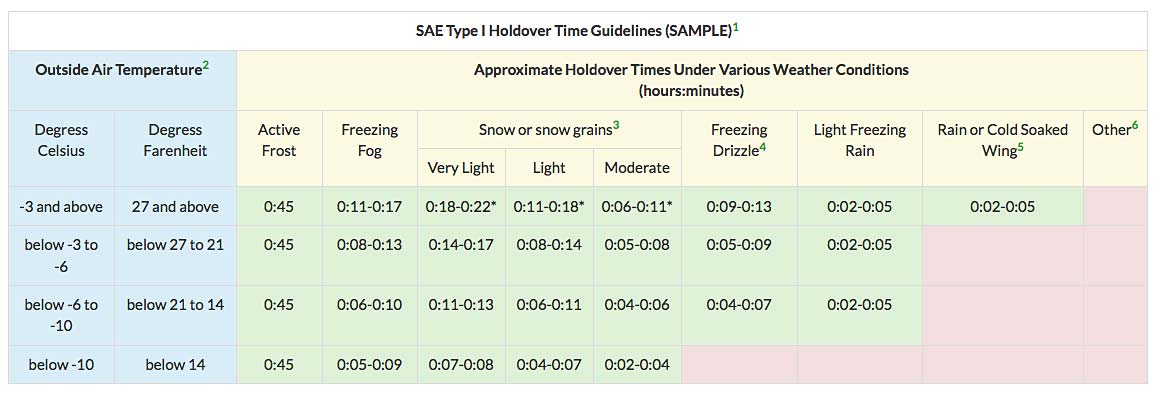
    Airlines use four standard fluid types when deicing aircraft. These fluids have different viscosities – viscosity is a measure of a fluid’s resistance to flow – and holdover times, which is the length of time the fluids are expected to protect the plane during snow or icing conditions.

    The deicing process includes both complex crew logistics and interesting science.

    In the United States, airlines typically use a two-step process before flying. First, they perform deicing using either a heated Type I fluid or a heated solution of Type I fluid and water.

    Deicing removes existing ice and snow from the wings of the plane, which is why airlines often heat the deicing fluid to around 140 to 150 degrees Fahrenheit (60 to 66 degrees Celsius) before application.

    Type I fluids are the thinnest of the deicing fluids, and they’re often red or orange. They spread the easiest on a plane’s surface because they have the lowest viscosity. Since they’re thin enough to flow off a plane when it’s not moving – or moving slowly – they can be applied to any aircraft.

    But as a result, they also have the shortest holdover times, often less than 20 minutes depending on the weather conditions. These holdover times vary, though, and can be less than five minutes for snow if the outside air temperature is below 14 F (minus 10 C).

    Next, the ground crews will typically apply an anti-icing fluid to the aircraft – often Type II or Type IV. Anti-icing solutions are used to help prevent the future accumulation of snow and ice on the wings of planes.

    Type II and Type IV fluids contain thickening agents that increase their viscosity. These thickeners allow the fluid to remain on the aircraft longer to help melt newly forming frost or ice. This translates to longer holdover times – often more than 30 minutes for snow – but it also means the plane needs to reach a higher speed to shear, or blow off, the fluid.

    Once applied, Type II and IV fluids will generally stay on the aircraft until the plane is taxiing down the runaway during takeoff. By then, it has gained enough speed to produce the shear force necessary to remove the fluid from the plane. Type II fluids are a clear or pale straw color, while Type IV fluids are generally green. Including a colored dye helps the ground crew clearly see what parts of the plane have been coated and which areas still need application.

    Type III fluids are not as common anymore. They are formulated to shear off at lower speeds and thus are sometimes used on small commuter aircraft since these planes typically don’t go as fast as commercial jetliners.

    Environmental impact of deicing

    Environmental considerations are also an important part of deicing. Glycols require a lot of oxygen to biodegrade, which can deplete dissolved oxygen in streams or lakes. This, in turn, can threaten aquatic life, like fish and other organisms, that need dissolved oxygen to breathe.

    In addition, ethylene glycol is toxic to wildlife, so the Environmental Protection Agency requires airports to monitor their stormwater runoff. For this reason, most airports collect and treat stormwater runoff on-site or send it to a municipal wastewater treatment facility.

    Airports are also increasingly starting to use fluid recovery systems to recycle the glycols and capture the additives in these fluids, which are often toxic, too. They’ll often use designated areas outside for deicing planes so they can collect and store the fluids after they run off the plane in holding tanks underground until they can be recycled.

    Atmospheric icing

    During flight, planes use other technologies to mitigate the icing risks. For example, most modern aircraft use bleed air systems, which channel hot air from the engine’s compressor through interior ducts to the leading edges of the wings and other critical areas to help prevent ice buildup while the plane is in the sky.

    Some planes also use electrically heated panels embedded in the aircraft’s wings to generate heat. These control systems typically cannot be used while the plane is on the ground, since they rely on cold air flowing across the wing’s surface. This airflow is usually achieved at cruising altitude and is necessary to prevent the plane’s surface from getting too hot.

    Airlines may sometimes also use icephobic coatings to help keep new ice from forming and sticking on the outside surfaces of planes. These coatings delay how soon new ice can form. They can also reduce how strongly the ice adheres to the surface.

    Icephobic polymer coatings can mitigate ice buildup and help reduce ice adhesion on surfaces.
    Hernández Rodríguez et al., 2024., CC BY-SA

    Smaller planes may also use inflatable rubber strips called pneumatic boots on the wings that can be inflated as needed to break off accumulated ice on the leading edge of the wings.

    Flying is truly a modern scientific marvel. A lot of engineering goes into not only getting planes off the ground but also keeping them ice-free during flight. So the next time you experience a weather-related delay at the airport, just remember that deicing is needed to ensure both a safe flight and a truly uplifting one.

    Andrew Sommers does not work for, consult, own shares in or receive funding from any company or organization that would benefit from this article, and has disclosed no relevant affiliations beyond their academic appointment.

    ref. The science behind airplane deicing – a mechanical engineer explains how chemistry and physics make flying a more uplifting experience – https://theconversation.com/the-science-behind-airplane-deicing-a-mechanical-engineer-explains-how-chemistry-and-physics-make-flying-a-more-uplifting-experience-248732

    MIL OSI – Global Reports

  • MIL-OSI Global: Maple seeds’ unique spinning motion allows them to travel far even in the rain, a new study shows

    Source: The Conversation – USA – By Andrew Dickerson, Associate Professor of Mechanical, Aerospace and Biomedical Engineering, University of Tennessee

    Winged seeds called samaras grow on maple trees. These are seeds from the Japanese maple, _Acer palmatum_. AlessandroZocc/iStock via Getty Images Plus

    When wind or other disturbances detach winged maple seeds called samaras from their parent tree, they spin through the air – and can even spin when it’s raining. Impacts by high-speed raindrops only briefly interrupt the seed’s spinning because the seed can shed the drop rapidly and restart its spinning in less time than it takes to blink.

    If you live somewhere with maple trees, you’ve probably seen their striking helicopter seeds – made up of a seed pod attached to a delicate wing. Maple samaras’ unique design and spinning movement can teach physicists like me about seed dispersal patterns and even engineering new types of flying vehicles.

    The samaras’ spinning movement, called autorotation, keeps them in the air for longer so they travel farther.

    The spinning flight of a maple samara.

    In a February 2025 study, my colleagues and I filmed raindrops as they crashed into autorotating samaras. The samaras shed drops by shattering them, flinging the drops off, or rolling out of the way – like they’re turning away from a punch. If a drop falls in just the right place, the spinning seed can cut it in half.

    The movement of a samara as it spins through the air. Our new study captured this pattern using a high-speed camera.
    Breanna Shaeffer and Andrew Dickerson, University of Tennessee-Knoxville

    In order to keep flying, the samaras must shed the entire drop. Samaras shed drops fastest when the drops hit the heavier, round nutlet part of the seed, rather than the wing. Shedding is made easier by the samaras’ mildly water-repellent surface. We estimated that raindrop collisions reduce a samara’s time in flight and the distance it travels while spinning, but by less than 10%.

    Why it matters

    Maples are an important species to the Eastern United States. They provide syrup and timber, making them economically and commercially significant.

    To proliferate in a rapidly changing climate, maples and other samara-bearing species need to disperse their seeds as far as possible.

    My team’s results provide context for other studies focused on how wind transports rotating and nonrotating seeds alike. Some seeds can even travel hundreds of miles.

    From an engineering perspective, the insights gained from our study could inform the design of new types of aerial vehicles that use autorotation to ride the wind without a motor. Mimicking the shapes of these seeds could help such vehicles quickly recover from disruptions to flight.

    Samaras are also visually intriguing. Discovering more about how small, beautiful parts of nature thrive could help scientists get people interested in the environment.

    What still isn’t known

    Maple samaras represent just one way that seeds use the wind to disperse farther. A dandelion’s parachute-like float relies on the seed’s light weight and high drag. A hop tree seed uses a single, wafer-shaped seed to flutter, while triplaris seeds have three wings that achieve a helicopter-like spin. Researchers still aren’t sure how raindrops can affect the flight of these seeds.

    What’s next

    Next, my colleagues and I hope to unravel the flight mechanics of the “rolling samaras” found on tulip poplar and ash trees. These seeds rotate like maple samaras, but the wing also rolls around the axis that runs across its wingspan as it does so.

    Not only do we plan to compare their flight performance against the more recognizable maple samara, but we will also study how these seeds respond to perturbations such as wing damage and crosswinds.

    How I do my work

    I like to uncover the complexity in seemingly simple systems. So many of the brief, small and common interactions in our world are wonderfully beautiful. I seek to tell those stories through a camera lens and with mathematical flair.

    Andrew Dickerson receives funding from the National Science Foundation.

    ref. Maple seeds’ unique spinning motion allows them to travel far even in the rain, a new study shows – https://theconversation.com/maple-seeds-unique-spinning-motion-allows-them-to-travel-far-even-in-the-rain-a-new-study-shows-250341

    MIL OSI – Global Reports

  • MIL-OSI Global: How to make a political Oscars speech that doesn’t flop – according to rhetorical theory

    Source: The Conversation – UK – By Tom F. Wright, Reader in Rhetoric, University of Sussex

    So, it’s happened. You’re on stage, Oscar statue in hand, facing Hollywood’s finest and millions of viewers. You could keep it simple – thank your agent, your co-stars, your dog. Or you could use this moment to say something that matters.

    That’s exactly what Jane Fonda just did at the 2025 Screen Actors Guild Awards, urging the audience “to resist successfully what is coming at us” as Elon Musk’s Doge holds a chainsaw to the US federal government. From the cold war to civil rights to Trump 2.0, award ceremonies have always been stages for activism.

    Some of these political speeches have been electrifying. Some have flopped. Some have been drowned out by the orchestra before they even got started. If you’re going to make a political speech at the Oscars, you’d better do it right.

    Thankfully, Kenneth Burke — one of the 20th century’s most influential rhetorical scholars — offers a road map. His theories on identification, dramatism and symbolic action explain why some speeches resonate while others fall flat.


    Looking for something good? Cut through the noise with a carefully curated selection of the latest releases, live events and exhibitions, straight to your inbox every fortnight, on Fridays. Sign up here.


    1. Know your two (very different) audiences

    Burke argued in the 1950s that rhetoric isn’t just about persuasion – it’s about identification. A speaker is most persuasive when they convince their audience that they share the same values and concerns. If people feel you’re “one of them”, they’re more likely to listen.

    The Oscars create a unique rhetorical challenge. Inside LA’s Dolby Theatre, you might be surrounded by like-minded pampered progressives. But beyond that room, millions of viewers at home may be far less receptive.

    Michael Moore’s infamous acceptance speech in 2003.

    Director Michael Moore learned this the hard way in 2003 when, after winning best documentary for his film Bowling for Columbine, he stormed the stage and declared: “Shame on you, Mr Bush! Shame on you!” The result? A mix of cheers and boos. And days of being pilloried on cable news. Instead of drawing people in, Moore’s approach alienated half his audience.

    Compare this with Meryl Streep’s speech at the 2017 Golden Globes when collecting her lifetime achievement award. She also criticised her president but framed it differently: “Disrespect invites disrespect. Violence incites violence. When the powerful use their position to bully others, we all lose.”

    She didn’t need to utter Donald Trump’s name. And because she framed her speech as a universal concern, rather than a partisan attack, it resonated beyond the room.

    2. Put yourself in the story

    Burke’s second idea is that all communication is “dramatic” – a performance shaped by setting, characters and conflict. In a political speech, the most compelling “character” is often you, the speaker.

    Audiences don’t just respond to abstract arguments. They connect with people who embody the very struggle they’re speaking about.

    Lily Gladstone accepting the Golden Globe for best actress in 2024.

    Lily Gladstone’s 2024 Golden Globes speech worked this way. When she won best actress for Killers of the Flower Moon, she didn’t start with industry statistics or broad calls for change. Instead, she spoke in Blackfeet, honouring her Indigenous roots: “I just spoke a bit of Blackfeet language, a beautiful community – the nation that raised me.”

    That one sentence transformed her win into a moment of cultural recognition, making her speech as much an act of representation as a speech about representation.

    3. Frame your argument wisely

    If you want your audience to engage, you must frame your message in a way that pulls them in. Whereas a speech that just states a problem can feel like noise, one that connects the issue to a larger story can be powerful.

    This is where Burke’s idea of symbolic action comes in. He defined it as “the making or construction of social reality through symbols that foster identification”. Put another way: words don’t just describe reality, they shape it.

    Oprah Winfrey’s speech from the 2018 Golden Globes.

    Take Oprah Winfrey’s 2018 Golden Globes speech picking up the Cecil B. DeMille award. Instead of simply condemning sexism in Hollywood, she tied it to a broader historical movement, from civil rights to #MeToo: “For too long, women have not been heard or believed if they dared to speak their truth to the power [of] those men. But their time is up. Their time is up!”

    Winfrey wasn’t just talking about change – she was creating it in real time, rallying the room behind a clear, urgent message. That’s the difference between listing a problem and delivering a message that sticks.

    4. Turn your speech into an act of protest

    While framing helps persuade an audience, some moments go further, becoming acts of defiance themselves. This is when a speech moves beyond words into symbolic action.

    Let’s take perhaps the most famous protest in Oscars history. In 1973, Marlon Brando refused to pick up his best actor statue – sending in his place Sacheen Littlefeather, who explained she was there as a protest for Hollywood’s treatment of Native American people.

    Sacheen Littlefeather refuses to accept the best actor Oscar on behalf of Marlon Brando.

    “He very regretfully cannot accept this very generous award,” she told the audience. “And the reasons for this being are the treatment of American Indians today by the film industry … and on television in movie reruns, and also with recent happenings at Wounded Knee.”

    In under a minute, she transformed what could have been a quiet refusal into a national reckoning. The audience’s reaction – some cheering, some booing – only made it clearer. This wasn’t just a speech, it was a moment.

    A speech that merely describes a problem may be forgotten, but one that transforms the moment itself? That’s the stuff of history.

    5. Expect a backlash, and decide if you care

    No matter how well you craft your speech, someone is going to be angry. Burke’s final idea for helping us understand this is the “scapegoat mechanism”, by which one figure is cast as the discordant element that must be removed to restore unity.

    If you make a political speech at the Oscars, it could be you. Vanessa Redgrave learned this in 1978: after winning best supporting actress for her role in Julia, she defended her pro-Palestine activism against attacks from the Jewish Defence League, who she called a “bunch of Zionist hoodlums”. The reaction was instant – cheers mixed with boos.

    Vanessa Redgrave accepts the Oscar for supporting actress in 1978.

    Later that night, screenwriter Paddy Chayefsky publicly rebuked her, saying: “A simple ‘thank you’ would have sufficed.” The backlash hurt Redgrave’s career, but she stood by her words.

    If you’re going to say something political, be prepared to own it. And make sure you beat the orchestra.

    Tom F. Wright does not work for, consult, own shares in or receive funding from any company or organisation that would benefit from this article, and has disclosed no relevant affiliations beyond their academic appointment.

    ref. How to make a political Oscars speech that doesn’t flop – according to rhetorical theory – https://theconversation.com/how-to-make-a-political-oscars-speech-that-doesnt-flop-according-to-rhetorical-theory-250949

    MIL OSI – Global Reports

  • MIL-OSI Global: White House spat with AP over ‘Gulf of America’ ignites fears for press freedom in second Trump era

    Source: The Conversation – UK – By Colleen Murrell, Full Professor in Journalism, Dublin City University

    A federal judge in the District Court of Columbia will shortly decide if the US president, Donald Trump, is allowed to dictate the terms of service of the Associated Press (AP), the US wire agency that proudly proclaims it is read by 4 billion people every day.

    In a (typically for this administration) knee-jerk decision on February 11, White House officials informed AP that its journalists would be barred from entering restricted areas such as the Oval Office and Air Force One until it stops using the geographic term “Gulf of Mexico” – in contravention of an executive order renaming it the “Gulf of America”.

    AP’s style guide explains that the Gulf of Mexico has carried this name for more than 400 years, and that Trump’s order only holds authority within the US. It notes that as a global news agency, it “must ensure that place names and geography are easily recognizable to all audiences”.

    But the style guide adds that, while AP will continue to refer to the body of water by its original name, it will do so “while acknowledging the new name Trump has chosen”.

    According to AP’s executive editor, Julie Pace: “Limiting our access to the Oval Office based on the content of AP’s speech not only severely impedes the public’s access to independent news, it plainly violates the first amendment” – which covers freedom of speech and the press.

    In seeking to overturn the ban, AP brought a lawsuit (AP-v-Budowich-Complaint) against the White House chief of staff, Susan Wiles, the deputy chief of staff, Taylor Budowich, and its press secretary, Karoline Leavitt, in their official capacities.

    After a short hearing, Judge Trevor N. McFadden – who was appointed by Trump – declined to restore AP’s access immediately, and instead set another hearing date for March 20. According to the Washington Post, the judge was “not sufficiently convinced the situation was ‘dire’ enough to warrant such an intervention” – and therefore was “not inclined to act precipitously on the executive office of the president”.

    Following this decision, the White House denied access to Trump’s first cabinet meeting on February 26 to an AP photographer, as well as reporters from Reuters, HuffPost and German newspaper Der Tagesspiegel. Instead, officials allowed in cameras from ABC and Newsmax, plus reporters from Axios, the Blaze, Bloomberg and NPR.

    Pick and mix

    But can the president be allowed this pick-and-mix approach to access to the seat of power?

    The White House press pool has been in place for more than a century, with the seating allocation in the press briefing room decided by the board of the White House Correspondents’ Association. As the major American news agency, AP has traditionally held the coveted middle front-row seat, which it still retains – even though senior officials have tweeted veiled threats to rescind AP’s entire White House credentials.

    The press briefing room holds 49 seats, with some seats shared between two companies on rotation, and a few journalists or photographers permitted to stand in the aisles when there is room. Meanwhile, Air Force One (in reality, two Boeing 747s used on rotation) only has room for 13 people to represent the entire White House press corps. The pool on the plane is ordinarily made up of three agency reporters (AP, Reuters and Bloomberg), four photographers (including from AP), three network TV journalists, a radio reporter and two print reporters.

    Trump has an ongoing fight against “legacy” news outlets that dominated coverage before the advent of the internet. These media often have strict editorial guidelines, but the president has regularly dismissed them as “fake news”. During the election campaign, he ignored well-known programmes such as CBS’s Sixty Minutes in favour of Joe Rogan’s podcast.

    At the Pentagon, Trump’s new military brooms have also been sweeping legacy media companies out of their briefing rooms. This list includes NBC, the New York Times, Politico, CNN and The Washington Post. In their place will go Trump-friendly outlets such as Newsmax and the Washington Examiner.

    ‘Privilege, not a right’

    Meanwhile, a petition by media companies is calling on the US government to “honor its commitment to freedom of expression” by upholding “a nonpartisan defense of a free press”. Included on this petition are the Committee to Protect Journalists, the International Press Institute, and the Society of Professional Journalists.

    Members of the press pool are usually the only reporters that get to throw questions at senior members of the administration. Its members follow the president on important trips both nationally and internationally. AP is a widely trusted non-profit news organisation, and its reports get syndicated to media organisations throughout the world, with any profits used to pay for its staff and its newsgathering.

    CNN reporter Kaitlan Collins questions the White House press secretary Karoline Leavitt over the banning of AP from White House briefings.

    The White House released a statement on February 24: “As we have said from the beginning, asking the president of the United States questions in the Oval Office and aboard Air Force One is a privilege granted to journalists, not a legal right.”

    However, having an independent arbiter making decisions about press pool representation is surely preferable in maintaining a free press and accountability than allowing each administration to pick its own reporters – or even its own facts.

    Colleen Murrell received funding from Irish regulator Coimisiún na Meán (2021-4) for research for the annual Reuters Digital News Report Ireland.

    ref. White House spat with AP over ‘Gulf of America’ ignites fears for press freedom in second Trump era – https://theconversation.com/white-house-spat-with-ap-over-gulf-of-america-ignites-fears-for-press-freedom-in-second-trump-era-251163

    MIL OSI – Global Reports

  • MIL-OSI Global: Emmanuel Macron used every diplomatic trick in the book at the White House – but Trump writes his own rules

    Source: The Conversation – UK – By Helen Drake, Professor of French and European Studies and Director of Loughborough University London’s Institute for Diplomacy and International Affairs, Loughborough University

    If there was a book of diplomacy, then French president Emmanuel Macron threw it at US president Donald Trump in their joint press conference in Washington DC. Macron delivered quite the masterclass in the diplomatic arts. Unthreatening body language and public displays of affection? Check.

    Meeting your interlocutor on any and every inch of common ground? Check. Macron’s willing use of fluent English was a key tactic here. Other than when answering French-language questions (when to have responded in English would have brought Macron yet more domestic grief), he adapted to the language of his hosts.

    Macron and Trump’s press conference.

    Recalling shared memories of happier, shared times? Check. It was smart to remind Trump of his time as a guest at the reopening of Notre Dame cathedral in Paris just a few months previously.

    Gently correcting a friend in danger of veering too far from reality (here, regarding the extent and type of European aid to Ukraine) as you would expect from a true ally? Again, check.

    These are the soft skills of diplomacy as communication between human beings to which Macron typically brings his heart, body and soul. On this occasion and on this criterion he outperformed even himself, and outclassed his host by some degree.

    At times, Trump looked enraptured by this performance from such an interesting specimen of utter Europeanness. At others, the host fidgeted and listened stony-faced to the halting interpretation of Macron’s rapid-fire French. He tried a few gauche niceties of his own (“say hello to your beautiful wife”) and dialled up to the max his personal brand of touchy-feely diplomacy.

    Behind the scenes

    Beyond the memorable set pieces of diplomatic theatre lies, of course, the message itself. This must represent the voice, the interests and the concerns of the state or other diplomatic actor. But it may well go against the flow, disrupting the smooth surface of diplomatic pleasantries.

    Former French president Charles de Gaulle notoriously ruffled cold-war feathers in the 1960s with rousing speeches to stir non-aligned countries and French-speaking people to contest the existing world order. Former foreign minister Dominique de Villepin will be remembered for his eloquent, impassioned plea to the United Nations security council in 2003 against the allied invasion of Iraq.

    Macron has dabbled in free-wheeling diplomacy himself. He claimed in 2019 that Nato was close to “brain death” and maintained a dialogue with Russia’s president Vladimir Putin after the 2022 Russian invasion of Ukraine. In Macron’s account at the press conference with Trump, he closed this line of communication when he learned of the atrocities being perpetrated by Russian forces.

    Articulating France’s global, strategic interests is where Macron feels most comfortable and probably where he is best suited (judged by the standards of his domestic political failings). His trip to Washington at such a pivotal moment in Trump’s second presidency, with the fate of Ukraine in the balance, was a natural move for a leader who, since the beginning of his first mandate in 2017, has sought to lead the European conversation about the continent’s security.

    His sense of urgency to secure greater European autonomy and capacity in its defence lies behind his willingness to talk to all parties. France does, after all, go by the fiendishly untranslatable label of a “puissance d’équilibres” (which means an actor with the power to strike a balance but also perhaps to bring others into balance or even, simply, to keep the peace).

    Macron’s readiness to confront the cold, hard facts of contemporary international relations – he has already told the French they need to put themselves on a wartime footing in economic terms – gives him a track record of sorts in the diplomatic negotiations now to come: between Europeans themselves, and between Europe and the US.

    But facing down Macron’s fancy optics is one particularly awkward fact – namely that Trump does not do diplomacy by the book, or at least not the one he was metaphorically gifted by president Macron. Where the point of diplomacy is to establish a common language with shared codes and expectations in order to ease tensions and bridge differences between parties, Trump’s diplomatic how-to guide boasts new chapters on the arts of bullying, harassment, gaslighting and, of course, the deal.


    Read more:
    Trump and Europe: US ‘transactionalism on steroids’ is the challenge facing leaders now


    For now, the US president is tolerating the quaint diplomatic overtures of these curious Europeans and given the ultra-high stakes of what couldn’t be further from a game, that is diplomacy itself.

    Helen Drake does not work for, consult, own shares in or receive funding from any company or organisation that would benefit from this article, and has disclosed no relevant affiliations beyond their academic appointment.

    ref. Emmanuel Macron used every diplomatic trick in the book at the White House – but Trump writes his own rules – https://theconversation.com/emmanuel-macron-used-every-diplomatic-trick-in-the-book-at-the-white-house-but-trump-writes-his-own-rules-250832

    MIL OSI – Global Reports

  • MIL-OSI Global: The UK’s food system is broken. A green new deal for agriculture could be revolutionary

    Source: The Conversation – UK – By Benjamin Selwyn, Professor of International Relations and International Development, Department of International Relations, University of Sussex

    William Edge/Shutterstock

    The UK’s food system was described as broken in a recent parliamentary report – and it’s not hard to see why. High living costs, a health crisis of diet-related chronic disease, farmers’ incomes squeezed and low pay across the agricultural sector all play their parts.

    And these elements are underpinned by an environmentally destructive mode of agricultural production – the longer the livestock-intensive system prevails, the greater the environmental, economic and social costs.

    The opportunity cost of not dealing with the food crisis is severe. The Food, Farming and Countryside Commission found that the price of the UK’s unhealthy food system is around £268 billion a year – almost equivalent to the government’s entire expenditure on health. And farmers are also worried about the sector as they face an unpredictable climate, smaller profits and changes to tax relief policies.

    I have researched how a green new deal for agriculture – namely a food system that complements rather than undermines the environment, while tackling social inequities – could begin to address these problems.

    In 2024 the UK’s farming sector experienced its second-worst harvest on record. Huge levels of rain last winter disrupted farmers’ ability to grow crops and reduced yields.

    The UK’s population faces a significant health crisis, exacerbated by the high cost of living. In 2022, around two-thirds of the population across all four nations were either overweight or obese.

    Retailers, processors and distributors grab an exorbitant share of the final value of many agricultural products. Sometimes farmers make as little as 1p profit for each item they produce. And farm workers’ earnings can sometimes leave them facing absolute poverty.

    What’s more, the UK farming sector is systemically inefficient. Dairy and meat products provide about 32% of calories consumed in the UK, and less than half (48%) of the protein. At the same time, livestock and their feed make up 85% of the UK’s total land use for agriculture.

    To make matters worse, land ownership is highly concentrated – about 25,000 landowners, typically corporations and members of the aristocracy, own about 50% of England, for example.

    What would change look like?

    A green new deal for agriculture would require a significant reorientation of policy, akin to the 1945 Labour government’s establishment of the welfare state. Critics might decry the costs and difficulties – but the longer the government waits, the greater the economic and environmental costs are likely to be.


    Read more:
    Britain’s unearned wealth has ballooned – a modest capital tax could help avoid austerity and boost the economy


    The government could introduce compulsory sale orders to spread land ownership more evenly. These would enable public bodies to obtain land that has been left derelict, vacant or that has been used in environmentally damaging ways. These measures could be supported by the establishment of community land trusts – non-profit, democratic organisations that own and work land for the benefit of local people.

    And a green new deal for agriculture could start with the government using its ecosystems service payments, where farmers and landowners are paid to manage their land in an environmentally beneficial way, to stimulate a transition to more plant-based proteins. This could combat hardship among farmers and agricultural workers, and tackle food poverty and ill health in the population. It would also establish the basis for a more sustainable agricultural system.


    Read more:
    Subsidised community restaurants could help tackle the UK’s broken food system – here’s how


    The UK think tank Green Alliance has mapped a green protein transition. It would entail an increase in “agro-ecologically” farmed land – that is, methods that bring a more ecological approach to farming. At present, this is about 3% of UK land, and it would have to rise to 60% by 2050. Under the plan, by 2030 10% of farmland would become semi-natural habitat, rising to one-third by 2050. This would protect land and facilitate natural restoration, and would also support agro-ecological farming methods.

    In this scenario, Britons would be projected to eat 45% less meat and dairy, replacing them with alternative proteins – plants and synthetic foods such as those made from precision fermentation. This is a revolutionary technology producing proteins that can be used in new alternatives to meat and dairy.

    Many conceptions of the protein transition from animal sources to more plant products ignore the necessity of improving farmers’ and agricultural workers’ incomes. But this will be crucial.

    Ecosystems service payments should be broadened to include a focus on sustainable incomes. Farms can be paid directly by government for sustainable production to combat farmer poverty. And the real living wage of £12.60 an hour should be compulsory for agricultural workers.

    As land use shifts from livestock grazing and feed crop production, more ground could be used for food crops for human consumption. There would then be more scope to change which food crops are produced – from wheat to legumes, for example.

    Flour made from broad beans – which can be grown in the UK – packs a bigger protein punch than traditional wheat flour.
    Narsil/Shutterstock

    Research has shown that flour made from broad beans is higher in key nutrients – protein, iron and fibre – than wheat flour. Bread, pasta, pizza, cakes and biscuits could increasingly be produced using broad bean flour, underpinning a shift towards more nutritious diets.

    A protein transition would also free up land for fruit and vegetable production for domestic consumption, reducing the UK’s heavy import dependence by using polytunnels and environmentally sustainable greenhouses.

    Climate breakdown means that the frequency of poor harvests will increase. And the volatile economic and political global picture means that affordable food imports cannot be taken for granted.

    A green new deal for agriculture could begin to remedy many of the problems the UK faces due to its broken food system. What’s needed is a coalition including courageous political parties, farmers, and workers within and beyond food production. Working together, these groups would be well placed to withstand the economic, political and environmental shocks that are on the horizon.

    Benjamin Selwyn does not work for, consult, own shares in or receive funding from any company or organisation that would benefit from this article, and has disclosed no relevant affiliations beyond their academic appointment.

    ref. The UK’s food system is broken. A green new deal for agriculture could be revolutionary – https://theconversation.com/the-uks-food-system-is-broken-a-green-new-deal-for-agriculture-could-be-revolutionary-250565

    MIL OSI – Global Reports

  • MIL-OSI Global: How evolution might explain impatience

    Source: The Conversation – UK – By Daniel Read, Professor of Behavioural Science, Warwick Business School, University of Warwick

    DC Studio/Shutterstock

    Nobody likes to wait, and we are willing to pay to avoid it. Expedited shipping, fast food and video streaming are all profitable because they reduce or eliminate that wait. You can test this by asking a group of people to choose between receiving £100 now or £110 in a year. Research shows a significant majority will choose the £100.

    But why do many people choose not to wait, when it seems obvious that they would be better off doing so? Sometimes this impatience is just put down to irrationality, impulsivity or short-sightedness, but there is also a long tradition in psychology and economics that views impatience as, at least in part, a rational response to the world.

    Perhaps the world of today, or perhaps the world in which we evolved.

    Recent research proposes that our evolutionary history shaped our impatience, and uses mathematical models to show how it works.

    The key idea is this. Imagine a large population of identical people who can choose between enjoying an early reward, or a larger reward later in time. An example might be choosing between two hunting grounds, one close and one further away.

    The closer one is guaranteed to yield a small animal quite quickly, while the farther one is likely to yield a big animal but only after a considerable wait or a gruelling hunt. Another example might be eating the juvenile, smaller fruit on a tree or waiting a few months until the fruit are abundant and ripe.

    Of course there is a catch. If the people wait too long for the large reward, there is a chance they won’t live long enough to earn it. And even if they do, the ripe fruit might have vanished before they reached it, perhaps stolen by a rival.

    As the authors of the recent study show, the animals (including humans) they model are better off taking the bird in the hand with even relatively small amounts of risk (you might not reach the birds) and uncertainty (there might not be two birds when you get there).

    Although models like this are simplifications of the real world, they are valuable for conceptualising how evolution might have produced particular tendencies in humans and other animals. But this model doesn’t do a lot to explain the human impatience we see now.

    In most studies of choice over time, people display high levels of impatience even in settings where risk is all but eliminated, and when it is financially beneficial to be patient.

    Struggle with impatience? It’s human nature.
    Khosro/Shutterstock

    One explanation is that the evolved way of valuing the future is still in place even in modern humans. We act as if the world is uncertain and risky, as it would have been for hunter gatherers, even when it is not.

    Good things come to those who wait

    Another explanation might be that we struggle to think about how the £110 is better than the £100. There is a lot of evidence for this.

    Consider, for example, an experiment I carried out in 2012 with psychologists Marc Scholten and Shane Frederick. Participants chose between £700 now or £700 plus £42 in one year.

    When given the choice in terms of monetary amounts, people were impatient. But if the £42 was described instead as “plus 6%” they were much more patient.

    People know that earning 6% a year is a great interest rate. But many people do not do the calculations and the extra £42 seems paltry compared to the £700.

    Another result that does not fit this evolutionary story concerns people’s responses to losses. Take a choice between paying a bill for £100 now or £100 later. A lot of people, often a majority, will prefer to pay the bill now. Indeed, some will prefer to pay £110 now rather than £100 later.

    Yet the possibility that you will not have to pay a future bill, or that the bill might have vanished by the time you get to it (the indebted has forgotten or died) should make you want to delay paying bills as long as possible. The more common response is probably partly due to a fundamental aversion to debt, which does not have an obvious evolutionary basis, but it is associated with religiosity.

    It remains to be seen if these complex preferences (such as patience for negative outcomes) can be explained by the process of natural selection, or if it is something that came later in human development.

    Evolutionary theory is an essential tool for thinking about the foundations of human decision making. The modern world is, however, very different from the environment in which we evolved.

    Daniel Read receives funding from the ESRC.

    ref. How evolution might explain impatience – https://theconversation.com/how-evolution-might-explain-impatience-249325

    MIL OSI – Global Reports

  • MIL-Evening Report: Albanese’s pitch on beer – temporary freeze on excise indexation

    Source: The Conversation (Au and NZ) – By Michelle Grattan, Professorial Fellow, University of Canberra

    The Albanese government will temporarily freeze the indexation on draught beer excise, in what it describes as a win for drinkers, brewers and businesses.

    The freeze is for two years and starts from the next due indexation date in August. Indexation changes are made twice a year, with the most recent one in February.

    The government says the cost to the budget would be $95 million over four years from 2025-26.

    The Australian Hotels Association had previously called for a freeze on the excise for drinks sold in pubs, clubs, bars, and restaurants.

    In a statement, the government said the move would “take pressure off the price of a beer poured in pubs, clubs and other venues, supporting businesses, regional tourism and customers”.

    Last week it announced relief for Australian distillers, brewers and wine producers.

    At present brewers and distillers get a full remission of any excise paid up to $350,000 each year. The government said it would increase the cap to $400,000 for all eligible alcohol manufacturers and also increase the Wine Equalisation Tax producer rebate cap to $400,000 from July 1 next year. That was estimated to decrease tax receipts by $70 million over five years from 2024-25.

    Prime Minister Anthony Albanese described the temporary excise indexation freeze as “a commonsense measure”.

    Treasurer Jim Chalmers said, “This is a modest change but will help take a little bit of pressure off beer drinkers, brewers and bars”.

    The AHA recently labelled the excise a “hidden” tax, saying it put pressure on the cost of living. It said Australia’s beer tax was the third highest in the OECD.

    The industry and Chalmers had a skirmish over the recent indexation increase. Chalmers said it would equal less than one cent a pint, and warned outlets not to “rip off” or mislead consumers.

    Chalmers wrote to the Australian Consumer and Competition Commission asking it to monitor outlets in February to make sure they “do not take undue advantage” of the rise to “mislead” customers about the impact.

    The federal government introduced the beer excise in 1988, with the tax linked to inflation. The AHA said in September that the recent jump in inflation meant the beer excise rose 8% over the previous six months.

    Michelle Grattan does not work for, consult, own shares in or receive funding from any company or organisation that would benefit from this article, and has disclosed no relevant affiliations beyond their academic appointment.

    ref. Albanese’s pitch on beer – temporary freeze on excise indexation – https://theconversation.com/albaneses-pitch-on-beer-temporary-freeze-on-excise-indexation-250898

    MIL OSI AnalysisEveningReport.nz

  • MIL-OSI Global: Africa’s newest book prize is named after Andreé Blouin: who was she?

    Source: The Conversation – Africa – By Tinashe Mushakavanhu, Research Associate, University of Oxford

    Andrée Blouin was a political activist and writer from the Central African Republic. Until recently, her name hardly ever appeared in the grand narratives of Africa’s liberation.

    When she died in 1986, her passing was hardly in the news – a stark contrast to her pivotal role as an adviser and campaign strategist to newly independent African leaders in Algeria, both Congos, Côte d’Ivoire, Mali, Guinea and Ghana.

    She was more than a participant. She was an organising force, an architect of resistance, a strategist who shaped the fight against colonial rule. Yet, like many women in African history, her contributions faded into the margins, overshadowed by the men she helped empower.

    Interest in Blouin has been rekindled. She is featured in the Oscar-nominated documentary Soundtrack to a Coup d’État about DRC independence leader Patrice Lumumba. She worked as his speechwriter and chief of protocol.

    And her memoir My Country, Africa: Autobiography of the Black Pasionaria, long out of print, was re-released and is now widely available.

    Now a new annual book award called the Andrée Blouin Prize has been launched in her honour by a South Africa-based publishing house, Inkani Books. Its mission is to amplify the voices of African women, cisgender and transgender, writing about history, politics and current affairs from a left perspective.

    For me as a literary historian who has been preoccupied with archives of marginal historical figures, this activation of Blouin powerfully highlights her legacy. It also invites new engagement with her work.

    Who was Andrée Blouin?

    Blouin was born in 1921 in Central African Republic but from the age of three she was placed in an orphanage in neighbouring Congo Brazzaville. She ran away when she was 14 and so began a life of rebellion.

    She would grow up to be a formidable political operator. Her reach touches many parts of Africa. For her, the struggle was not just local, it was everywhere. As a multilingual person, she spoke a dozen languages, a gift that allowed her to easily move between places and political contexts.

    Her political awakening was deeply personal – she was radicalised by her son’s death from malaria in a colonial hospital in 1942. He had been denied life-saving medication. Colonialism, she realised, was not just her own misfortune but a system of evil suffocating African lives.

    Today history is vindicating this fascinating historical figure. This is happening through the wealth of archival material – photographs, videos, interviews and texts – that places her at the centre of political action. The image of African liberation tends to be men in suits. And yet a smiling Blouin can be seen with them, side by side, even addressing large crowds.

    It is thanks to the refusal of this archive to be repressed that we can review moments that shaped African liberation history. And appreciate the roles that women like Blouin played.

    Behind the prize

    African literary prizes have seen significant growth in recent years, both in number and influence. They play an important role in promoting African literature, offering recognition and financial support to writers, and shaping the literary canon.

    They can also address the need for dedicated platforms that amplify underrepresented voices.

    Inkani Books describes itself as a “people’s movement-driven publishing house”. It is introducing The Andrée Blouin Prize in her honour. The impetus for the prize, according to Inkani’s publishing director Efemia Chela, was to directly challenge erasure of women in history and in political writing.

    She explains:

    This prize is not just an accolade; it is a reclamation of space, a declaration that African revolutionary women’s narratives will no longer be sidelined.

    The publishing house, established less than five years ago, has been reissuing popular books about revolutionary figures. These include the likes of Thomas Sankara, Kwame Nkrumah, Amílcar Cabral and Frantz Fanon. These men are often celebrated for their heroism and intellectual contributions to pan-African ideas about freedom, politics and revolution.

    The Andrée Blouin Prize is a bold act of reclamation, ensuring that the narratives of African revolutionary women are no longer overlooked but recognised, celebrated and centred.

    In fact, this is an invitation for contemporary women to write themselves into literary history.

    The inaugural winner will receive a $2,000 advance and a publishing contract with Inkani. The prize is open to all women across Africa and is dedicated to showcasing and celebrating the continent’s diverse and vibrant experiences.

    It is part of a broader movement challenging historical exclusions in African publishing. Literary production is dominated by big multinational publishing companies that determine reading tastes and trends.

    Last year, Nigeria-based Cassava Republic Press launched the Global Black Women’s Non-Fiction Manuscript Prize to spotlight exceptional works by Black women.


    Read more:
    African literary prizes are contested – but writers’ groups are reshaping them


    While African publishing has not always been welcoming to women writers, a shift is underway. Writers like Nigeria’s Chimamanda Ngozi Adichie, Zimbabwe’s NoViolet Bulawayo, Uganda’s Jennifer Nansubuga Makumbi, and Zambia’s Namwali Serpell are now among the most influential voices shaping African literature today.

    Tinashe Mushakavanhu does not work for, consult, own shares in or receive funding from any company or organisation that would benefit from this article, and has disclosed no relevant affiliations beyond their academic appointment.

    ref. Africa’s newest book prize is named after Andreé Blouin: who was she? – https://theconversation.com/africas-newest-book-prize-is-named-after-andree-blouin-who-was-she-250828

    MIL OSI – Global Reports

  • MIL-Evening Report: How ‘muscular Christianity’ strove to bring men back to religion – and what it can teach us today

    Source: The Conversation (Au and NZ) – By Gavin Brown, Lecturer in Religious Education, Australian Catholic University

    Wikimedia Commons

    Most people recognise organisations such as the YMCA and the Boy Scouts, or events such as the Modern Olympic Games, summer camps and wilderness retreats.

    Few, though, have ever heard of the movement from which they took their principal inspiration: muscular Christianity.

    The term sounds odd indeed, conjuring up images of Jesus with an impressively chiselled physique or, for devotees of the eighties, Vangelis’ memorable soundtrack to Chariots of Fire.
    However, the term arose because it once carried Christian hopes of a solution to a longstanding problem: men.

    That is, in the 19th century especially, Christian churches became particularly alarmed more and more men were leaving religion to women – from attendance at worship to running parish organisations or establishing charitable endeavours.

    Worse still was the fear Christianity itself had become soft and even effeminate through the Victorian age.

    Christians, especially the Protestants who started the movement, needed to present Christianity in ways attractive to men. But how?

    A literary beginning

    In 1857, the Englishman Thomas Hughes published the novel Tom Brown’s School Days, followed later by Tom Brown at Oxford in 1859.

    In the first book, Tom attends the prestigious Rugby School, before making his way to Oxford in the sequel. This character would epitomise a “muscular Christian”, as Hughes put it. In the sequel, Hughes wrote:

    The least of the muscular Christians has hold of the old chivalrous and Christian belief, that a man’s body is given him to be trained and brought into subjection, and then used for the protection of the weak, the advancement of all righteous causes, and the subduing of the earth which God has given to the children of men.

    Author Thomas Hughes largely based Tom Brown’s School Days on his own years at Rugby School.
    Wikimedia Commons

    Men precisely as men could use their bodies to Christianise the world. A movement with twin aims was born: first, encourage men to embrace their physicality and second, through such disciplining of their bodies, to glorify God.

    Rise and fall

    From England, the movement spread through the Anglosphere, including Australia.

    And it has some impressive credentials. Pierre de Coubertin’s inspiration for reviving the Olympic Games was, in part, inspired by reading Tom Brown’s School Days.

    In the United States, the YMCA – the Young Men’s Christian Association – in New York added a gymnasium in 1869, which soon became a permanent fixture at the “Y.” The physical director at Boston’s Y coined the term “body building”. James Naismith would later invent basketball in 1891 while working at a Y.

    The YMCA on Melbourne’s St. Kilda Road during WWI.
    Aussie~mobs/flickr

    Many Protestant churches drew upon muscular Christianity to bring men back into the fold. They masculinised church services through hymns which celebrated manliness and virtue, encouraged ministers to embody more masculine traits, brought men into the company of other men through brotherhoods and promoted vigorous missionary activity.

    Even Jesus received a makeover – arguably the most popular being Warner Sallman’s 1940 portrait painting Head of Christ.

    Sallman’s original motivation for such depictions came from the dean of a Chicago Bible College in 1914:

    I hope you can give us your conception of Christ. And I hope it’s a manly one. Most of our pictures today are too effeminate.

    There is evidence, too, of Catholics muscling in. Take, for example, Notre Dame’s football team’s successes in the 1920s and 30s in the US, or the Italian cyclist Gino Bartali, winner of the Tour de France in 1938 and 1948 and, according to the Catholic press, the ideal Catholic sportsman.

    Most historians will mark the decline of the movement after the first world war, though its influence continues to be felt to this day.

    A continuing legacy?

    So, apart from indulging in historical curiosity, what does it offer us?

    Muscular Christianity highlights both the dangers and continuing challenges raised when navigating the complex relationship between religion, culture and gender.

    It pursued a worthy goal, but tended to play a zero-sum gender game: gains for men in the churches often came at the expense of women. Such emphasis on masculinity easily slipped into gender bias, where a “church full of men” was deemed more valuable than churches full of women.

    The effort to bolster masculinity also traded in narrow gender stereotypes, though as the historian Clifford Putney reminds us, there was some flow-on effect for women and their organisational engagement in sport and physical activity.

    Some evangelical Christians have recently re-engaged its ethos.

    And perhaps muscular Christianity still has something valuable to say. At the very least, scratch beneath the surface of modern Western culture and you will often find Christianity or values which originated from it.

    Muscular Christianity can also remind us to reconnect with our bodies. We now live in a world which, as Australian author Michael Frost argues, has become increasingly “excarnate” – that is, less bodily.

    Muscular Christianity recognised bodies matter and matter spiritually. It encouraged people not to treat health and physical activity as ends in their own right or as a servant of the ego but, rather, a means to an end: wholeness, good character, the cultivation of virtue and the selfless desire to help others.

    An 1867 wood engraving of the Lady Muscular Christians.
    Wikimedia Commons

    Gavin Brown does not work for, consult, own shares in or receive funding from any company or organisation that would benefit from this article, and has disclosed no relevant affiliations beyond their academic appointment.

    ref. How ‘muscular Christianity’ strove to bring men back to religion – and what it can teach us today – https://theconversation.com/how-muscular-christianity-strove-to-bring-men-back-to-religion-and-what-it-can-teach-us-today-249485

    MIL OSI AnalysisEveningReport.nz

  • MIL-Evening Report: Diversity, equity and inclusion in the workplace are under attack. Here’s why they matter more than ever

    Source: The Conversation (Au and NZ) – By Gemma Hamilton, Senior Lecturer, RMIT University

    Jacob Lund/Shutterstock

    As International Women’s Day approaches, we must redouble our efforts to champion social justice and the principles of diversity, equity and inclusion (DEI). These are under unprecedented attack by some political leaders.

    In the United States, President Donald Trump has recently dismantled DEI measures, claiming they are wasteful and discriminatory. Without evidence, he even blamed diversity hirings for a deadly collision between a military helicopter and a passenger plane that killed 67 people.

    In Australia, Opposition Leader Peter Dutton is echoing a similar agenda with his criticism of “culture, diversity and inclusion” positions in the public service.

    We must resist attempts to tear down all the progress that has been made and remind ourselves of the many good reasons why we pursue DEI in the workplace.

    Women, racial minorities, people with disability and others continue to face barriers to equal opportunities at work. Too often, they remain excluded from leadership and decision-making roles.

    Defending diversity

    Given the assault on DEI measures, it is worth restating why they are so important to a truly inclusive modern workplace.

    DEI initiatives work to address obstacles and correct disadvantages so everyone has a fair chance of being hired, promoted and paid, regardless of their personal characteristics.

    They ensure every person has a genuinely equal chance of access to social goods. They can be seen as “catch up” mechanisms, recognising that we don’t all start our working lives on an equal footing.

    Gender equality initiatives address discrimination, stereotypes and structural barriers that disadvantage people on the basis of their gender.

    These initiatives call into question the idea of “merit-based” hiring, which often disguises the invisible biases which are held by many people in power – for example, against someone of a particular gender.

    Australia’s story

    In Australia, we have a mixed story to tell when it comes to diversity, equity and inclusion.

    The federal workplace gender laws require companies with more than 100 employees to report annually on gender equality indicators, including pay gaps and workforce composition.

    DEI initiatives are already being dismantled in the United States.
    Gorodenkoff/Shutterstock

    In Victoria, the Gender Equality Act 2020
    promotes “positive action” to improve gender equality in higher education, local government and the public sector, which covers around 11% of the total state workforce.

    Despite these laws, Australia is behind on gender equality indicators compared to other countries such as Iceland, Norway and New Zealand. According to the World Economic Forum’s Global Gender Gap report, Australia is ranked 26th out of 146 countries, albeit a step up from 54th in 2021.

    The report shows continuing and significant gender gaps, particularly regarding women’s representation in various industries such as science and political leadership.

    Increased recognition

    But in a cross section of fields, including politics, sports, medicine, media and academia there have been positive changes. Gender equality is being promoted through a wide range of initiatives that seek to push back against centuries of patriarchal dominance.

    Workplace policies around paid parental leave, flexible working arrangements, part-time work, breastfeeding and anti-discrimination are part of the broader agenda to make workplaces more inclusive for women, gender-diverse people and working parents.

    Many workplaces accommodate the needs of working mothers.
    Jacob Lund/Shutterstock

    While many would not consider these improvements specific diversity initiatives, they are clear examples of the ways in which workplaces now recognise the different needs of women and working mothers.

    Today, we see more women in the workplace and in positions of leadership across sectors.

    But as feminist Sara Ahmed has noted, it is often the marginalised employees who carry the burden of doing all the “diversity work” in the workplace.

    Diversity becomes work for those who are not accommodated by an existing system.

    Redoubling efforts

    Despite the welcome advances made, inequalities persist in the workplace.

    We recognise many in positions of power are not willing (or able) to acknowledge their own privileged positions. Therefore they do not see the barriers that exist for others.

    Social justice will not simply be gifted by those in power.

    Given the challenging political climate, it is more important than ever that we continue to strive for gender equality – rather than simply uphold the status quo.

    Gemma Hamilton receives funding from the Australian Research Council (ARC).

    Nicola Henry receives funding from the Australian Research Council (ARC) and Google. She is also a member of the Australian eSafety Commissioner’s Expert Advisory Group.

    Bess Schnioffsky does not work for, consult, own shares in or receive funding from any company or organisation that would benefit from this article, and has disclosed no relevant affiliations beyond their academic appointment.

    ref. Diversity, equity and inclusion in the workplace are under attack. Here’s why they matter more than ever – https://theconversation.com/diversity-equity-and-inclusion-in-the-workplace-are-under-attack-heres-why-they-matter-more-than-ever-250651

    MIL OSI AnalysisEveningReport.nz

  • MIL-Evening Report: A quantum computing startup says it is already making millions of light-powered chips

    Source: The Conversation (Au and NZ) – By Christopher Ferrie, A/Prof, UTS Chancellor’s Postdoctoral Research and ARC DECRA Fellow, University of Technology Sydney

    PsiQuantum

    American quantum computing startup PsiQuantum announced yesterday that it has cracked a significant puzzle on the road to making the technology useful: manufacturing quantum chips in useful quantities.

    PsiQuantum burst out of “stealth mode” in 2021 with a blockbuster funding announcement. It followed up with two more last year.

    The company uses so-called “photonic” quantum computing, which has long been dismissed as impractical.

    The approach, which encodes data in individual particles of light, offers some compelling advantages — low noise, high-speed operation, and natural compatibility with existing fibre-optic networks. However, it was held back by extreme hardware demands to manage the fact photons fly with blinding speed, get lost, and are hard to create and detect.

    PsiQuantum now claims to have addressed many of these difficulties. Yesterday, in a new peer-reviewed paper published in Nature, the company unveiled hardware for photonic quantum computing they say can be manufactured in large quantities and solves the problem of scaling up the system.

    What’s in a quantum computer?

    Like any computer, quantum computers encode information in physical systems. Whereas digital computers encode bits (0s and 1s) in transistors, quantum computers use quantum bits (qubits), which can be encoded in many potential quantum systems.

    Superconducting quantum computers require an elaborate cooling rig to keep them at temperatures close to absolute zero.
    Rigetti

    The darlings of the quantum computing world have traditionally been superconducting circuits running at temperatures near absolute zero. These have been championed by companies such as Google, IBM, and Rigetti.

    These systems have attracted headlines claiming “quantum supremacy” (where quantum computers beat traditional computers at some task) or the ushering in of “quantum utility” (that is, actually useful quantum computers).

    In a close second in the headline grabbing game, IonQ and Honeywell are pursuing trapped-ion quantum computing. In this approach, charged atoms are captured in special electromagnetic traps that encode qubits in their energy states.

    Other commercial contenders include neutral atom qubits, silicon based qubits, intentional defects in diamonds, and non-traditional photonic encodings.

    All of these are available now. Some are for sale with enormous price tags and some are accessible through the cloud. But fair warning: they are more for experimentation than computation today.

    Faults and how to tolerate them

    The individual bits in your digital computers are extraordinarily reliable. They might experience a fault (a 0 inadvertently flips to a 1, for example) once in every trillion operations.

    PsiQuantum’s new platform has impressive-sounding features such as low-loss silicon nitride waveguides, high-efficiency photon-number-resolving detectors, and near-lossless interconnects.

    The company reports a 0.02% error rate for single-qubit operations and 0.8% for two-qubit creation. These may seem like quite small numbers, but they are much bigger than the effectively zero error rate of the chip in your smartphone.

    However, these numbers rival the best qubits today and are surprisingly encouraging.

    One of the most critical breakthroughs in the PsiQuantum system is the integration of fusion-based quantum computing. This is a model that allows for errors to be corrected more easily than in traditional approaches.

    Quantum computer developers want to achieve what is called “fault tolerance”. This means that, if the basic error rate is below a certain threshold, the errors can be suppressed indefinitely.

    Claims of “below threshold” error rates should be met with skepticism, as they are generally measured on a few qubits. A practical quantum computer would be a very different environment, where each qubit would have to function alongside a million (or a billion, or a trillion) others.

    This is the fundamental challenge of scalability. And while most quantum computing companies are tackling the problem from the ground up – building individual qubits and sticking them together – PsiQuantum is taking the top down approach.

    Scale-first thinking

    PsiQuantum developed its system in partnership with semiconductor manufacturer GlobalFoundries. All the key components – photon sources and detectors, logic gates and error correction – are integrated on single silicon-based chip.

    PsiQuantum says GlobalFoundries has already made millions of the chips.

    A diagram showing the different components of PsiQuantum’s photonic chip.
    PsiQuantum

    By making use of techniques already used to fabricate semiconductors, PsiQuantum claims to have solved the scalability issue that has long plagued photonic approaches.

    PsiQuantum is fabricating their chips in a commercial semiconductor foundry. This means scaling to millions of qubits will be relatively straightforward.

    If PsiQuantum’s technology delivers on its promise, it could mark the beginning of quantum computing’s first truly scalable era.

    A fault-tolerant photonic quantum computer would have major advantages and lower energy requirements.

    Christopher Ferrie is a founder of Eigensystems. He receives funding from the Australian Research Council.

    ref. A quantum computing startup says it is already making millions of light-powered chips – https://theconversation.com/a-quantum-computing-startup-says-it-is-already-making-millions-of-light-powered-chips-251057

    MIL OSI AnalysisEveningReport.nz

  • MIL-Evening Report: Australia’s retirement savings are too big to invest at home – here’s why super funds are looking to the US

    Source: The Conversation (Au and NZ) – By Susan Thorp, Professor of Finance, University of Sydney

    Marek Masik/Shutterstock

    You might remember Pesto, the king penguin chick who became a star attraction at Melbourne Aquarium last year. Good food, good genes and a safe home let Pesto grow into a huge ball of brown fluff twice the size of his parents. Pesto became a local and international celebrity.

    While not cute or funny like Pesto, Australia’s financial sector gave birth to its own baby three decades ago that has since rapidly grown into a big adult – superannuation. It, too, has become internationally famous.

    This week, our superannuation sector attracted the attention of US asset managers and government officials, including the new US Treasury Secretary Scott Bessent, at a summit in Washington DC.

    Super industry leaders joined Treasurer Jim Chalmers and the Australian ambassador to the US, Kevin Rudd, to pitch a strengthening of ties. So, why are Australian super funds so keen to shore up support in the United States?


    Read more:
    Your super fund is invested in private markets. What are they and why has ASIC raised concerns?


    A giant nest egg

    Figures from the Australian Prudential Regulation Authority (APRA) show the total pool of superannuation assets had grown to about A$4.2 trillion by December 2024. That’s up 11.5% on the year before.

    That’s about 160% of the value of all goods and services produced in Australia – the gross domestic product (GDP) – over the year to June 2024 at $2.6 trillion.

    This scales to a very large pool of investable retirement money – the fifth largest in the world. Australia’s population ranks just 54th in the world.

    Some of the biggest individual funds have significant assets under management. Australian Super and Australian Retirement Trust, for example, both manage more than $300 billion in retirement savings.

    Looking overseas

    This leads us to why the Australian super industry is securing openings in the US. Australian super funds have invested some funds overseas since their inception. But this practice is expanding quickly for two reasons.

    First, the sheer size of the superannuation investment pool has largely outgrown its Australian asset base.

    To illustrate, our $4.2 trillion super pool is significantly larger than the total market capitalisation of the Australian Securities Exchange (ASX), about $3.1 trillion.

    Without new places to invest our super, it’s impossible to keep earning a return on it.

    The second – and related – reason is the need for diversification. It makes sense to lower risk by spreading funds across industries, geographies and jurisdictions.

    A scan of the aggregated asset allocation of large Australian super funds shows that around half of the funds invested in equities, property and infrastructure are currently in overseas assets.

    The US accounts for about 45% of aggregate financial assets of all investors worldwide – more than US$90 trillion (A$144 trillion).

    The strategy to diversify investments has paid off. The US stock market has seen some spectacular recent returns, with annual returns of more than 20% in some years. These have far outpaced those of the ASX.

    Compulsory savings

    Australia’s super sector has been fed by compulsory contributions (savings) and investment returns. Super has also been protected by legislation that makes participation compulsory for most workers and preserves savings until retirement.

    Australia has had a system of compulsory employer superannuation contributions for workers since 1992.
    DGLimages/Shutterstock

    Since 1992, employers have made compulsory (superannuation guarantee) contributions on behalf of workers into superannuation accounts. The compulsory contribution has risen significantly from an initial 3% of earnings to 12% of earnings from July this year.

    High coverage (well over 90% of workers), combined with rising contribution rates, has meant the amount of money flowing into superannuation accounts has grown at a remarkable compound annual rate of 14% since 1992.

    Even after the superannuation guarantee rate peaks at 12% this year, growth in labour earnings, fed by workforce and productivity growth, will continue to generate substantial inflows.

    Can’t touch our nest egg early

    Australia’s strict rules preventing withdrawals from super are among the tightest in the world. With some exceptions for extreme hardship, members of super funds can withdraw their savings from age 60 if they retire, and from age 65 even if they have not retired.

    An ageing population will mean more retirees in future decades, speeding up outflows. But so far, Australian retirees are proving to be very cautious with their nest eggs.

    Along with compulsory contributions and rules on withdrawing it, investment returns have grown the super baby, at rates of 7.3% annually over the past 30 years, or about 4.4% annually above inflation.

    The super sector is still smaller than its older sibling, the banking system, where assets of A$6.3 trillion are about 240% of the value of annual GDP. But super is forecast to grow to 200% of annual GDP over the next two decades.

    Riskier investments

    To generate these rates of return, Australian super funds have invested in a wide range of financial assets, and with a substantial exposure to high return (but riskier) assets.

    In Australia, super funds invest around two-thirds
    of funds in equities, property, infrastructure and commodities, and around one-third in safer bonds and cash.

    That contrasts with some other pension systems, such as Japan and the UK, where a majority of funds are invested in safer assets like government bonds.

    Susan Thorp is a member of UniSuper. She receives and has received research funding from the Australian Research Council, the Australian Securities and Investments Commission, the TIAA Institute (USA), IFM, and UniSuper and Cbus Superannuation funds via ARC Linkage Grants. Thorp was previously Professor of Finance and Superannuation at UTS, a position that was partly funded by Sydney Financial Forum (Colonial First State Global Asset Management), the NSW Government, the Association of Superannuation Funds of Australia (ASFA), the Industry Superannuation Network (ISN), and the Paul Woolley Centre for the Study of Capital Market Dysfunctionality, UTS. She was an Associate Investigator for the ARC Centre of Excellence in Population Ageing Research (CEPAR), and is a member of the OECD-International Network on Financial Education Research Committee, the Steering Committee of the Mercer CFA Global Pensions Index, the Australian Securities and Investments Commission (ASIC) Consultative Committee, the Board of New College (UNSW) and the Research Committee of Super Consumers Australia, a not-for-profit advocacy organisation for Australian pension plan participants.

    ref. Australia’s retirement savings are too big to invest at home – here’s why super funds are looking to the US – https://theconversation.com/australias-retirement-savings-are-too-big-to-invest-at-home-heres-why-super-funds-are-looking-to-the-us-250920

    MIL OSI AnalysisEveningReport.nz

  • MIL-Evening Report: Nangs are popular with young people. But are they aware of the serious harms of nitrous oxide?

    Source: The Conversation (Au and NZ) – By Julaine Allan, Professor, Mental Health and Addiction, Rural Health Research Institute, Charles Sturt University

    Lenscap Photography/Shutterstock

    Nitrous oxide – also known as laughing gas or nangs – is cheap, widely available and popular among young people.

    Yet it often flies under the radar in public health programs and education settings. For example, it’s not included in the drug education curriculum in Australian schools.

    In our new study, we spoke to young people (aged 18 to 25) who have used nitrous oxide. We found they were are unaware of its risks – even when they reported symptoms such as “brain fog” and seizures.

    What is nitrous oxide?

    Nitrous oxide is regularly used for sedation and pain relief in dentistry and childbirth.

    The gas, which has no colour or flavour, is also used recreationally and is known as nangs, nos, whippits and balloons.

    In fact, nitrous oxide has been used to get intoxicated since its creation in 1722, and wasn’t used in surgery until 1842. It can create a feeling of dissociation from the body, changes in perception and euphoria. This lasts about one minute.

    In Australia, nitrous oxide is cheap and accessible. This is because the gas is also used in baking, for example to whip cream.

    So, while it’s not legal to sell nitrous oxide for recreational use, the canisters or “bulbs” are widely available online via 24-hour delivery services.

    People usually discharge the gas into a balloon or a whipped cream dispenser and then inhale. Nitrous oxide is intensely cold – minus 40 degrees Celsius.

    People inhale the gas using a balloon.
    Ink Drop/Shutterstock

    How common is it?

    We still don’t have much data about who uses nitrous oxide and how often. Compared to other drugs, there is minimal research on its recreational use.

    However researchers believe it is becoming more common globally, especially among young people.

    For example, in 2022, nitrous oxide was the second-most used controlled substance among 16–24 year olds in the United Kingdom after cannabis.

    In January 2023, the Netherlands banned the sale and possession of nitrous oxide after 1,800 road accidents, including 63 fatal crashes, were linked to the drug in a three-year period.

    The Global Drug Survey reported a doubling in nitrous oxide use between 2015 and 2021, from 10% of respondents to 20%. But this voluntary survey is not representative of all people who use drugs. While it is an indication of people’s nitrous oxide use, the picture remains patchy.

    What are the health risks?

    Nitrous oxide is not the most harmful drug people can use but that doesn’t make it safe.

    Inhaling nitrous oxide has short-term health risks, including:

    • cold burns from the gas

    • injuries from falling over

    • nausea and dizziness.

    Using a lot of nitrous oxide at one time can result in passing out (from lack of oxygen) and seizures. Calling an ambulance is necessary if this happens.

    Longer-term health problems may include:

    • vitamin B12 loss (causing numbness of hands and feet and eventually paralysis)

    • urinary incontinence

    • strokes

    • memory loss

    • mental health conditions, including depression and psychosis.

    The availability of much larger canisters (including flavoured varieties) is also linked to an increase in significant harms. These can deliver roughly 70 times the amount of nitrous oxide as traditional small canisters.

    Larger bulbs allow people to consume more of the gas at one time and they often experience health problems more quickly as a result.

    However, there is still limited knowledge about nitrous oxide in the health system. This means its health risks are often compounded because it is overlooked by those assessing medical conditions and because people deny using it.

    Large gas canisters mean people consume a lot more nitrous oxide in one go.
    joshua snow/Shutterstock

    Our research

    During the first stage of our 2025 Australian study, we interviewed seven young people (aged 18 to 25) who had used nitrous oxide at least ten times.

    While the number of interviewees was small, the stories they told were very similar.

    They were either unaware of, or unconcerned about, the drug’s potential risks. This is despite their own experiences of psychological and physical problems.

    They reported becoming unconscious, getting burns from the gas on their hands and faces, sores around the mouth and even having seizures.

    Of particular concern to us was use before driving because people did not recognise the lingering effects of the gas on concentration.

    Our study participants also spoke about “memory zaps” or “brain fog”. Regular use of nitrous oxide affected people’s ability to participate in work and study, with some saying it was also bad for their mental health.

    These thinking problems are a concerning side effect. Yet it’s one that has not been adequately investigated.

    The role of social media

    Videos of young people using nitrous oxide can easily be found on social media. This not only points to its popularity but suggests social media could be a good place to reach young people with information about the drug and harm reduction.

    In the second stage of our research we worked with 30 young people who used nitrous oxide to co-create harm reduction resources.

    As a group, we developed videos, photos and text for
    our nitrous oxide specific social media accounts on Tik Tok and Instagram and for posts on various sub-reddits.

    These describe ways to use the drug more safely. For example the “take a breath” messaging suggests breathing the nitrous oxide in for only ten seconds at a time to ensure enough oxygen. “Take a seat” advises sitting down while using nangs, to avoid injuries from falling.

    Julaine Allan receives funding from the National Health and Medical Research Council and the Commonwealth Department of Health and Aging to conduct research on substance use and mental health programs. She has received funding in the past from other state and commonwealth departments and entities for research.

    Helen Simpson, Jacqui Cameron, and Kenny Kor do not work for, consult, own shares in or receive funding from any company or organisation that would benefit from this article, and have disclosed no relevant affiliations beyond their academic appointment.

    ref. Nangs are popular with young people. But are they aware of the serious harms of nitrous oxide? – https://theconversation.com/nangs-are-popular-with-young-people-but-are-they-aware-of-the-serious-harms-of-nitrous-oxide-250654

    MIL OSI AnalysisEveningReport.nz

  • MIL-Evening Report: Yes, paper straws suck. Rather than bring back plastic ones, let’s avoid single-use items

    Source: The Conversation (Au and NZ) – By Bhavna Middha, ARC DECRA Senior Research Fellow, Centre for Urban Research, RMIT University

    Dragon Images/Shutterstock

    When US President Donald Trump ordered federal agencies to return to plastic straws, claiming the paper version is ineffective and “disgustingly dissolves in your mouth”, he was widely criticised for setting back efforts to reduce plastic pollution. But many alternatives designed to help phase out single-use plastics don’t really solve the problem at all.

    It’s not unusual to see plastic bans challenged or overturned. However, a government ban on the substitute is altogether new.

    It’s true paper straws can disintegrate and become soggy before we finish a drink. Problems with finding viable substitutes to single-use plastics is one of the many challenges involved in phasing them out.

    Sometimes, swapping one single-use item for another really is more trouble than it’s worth. A better approach would be to change our society’s single-use and disposal mindset.

    The problem with plastic

    Plastic pollution is an urgent problem for the environment and human health. Microplastics are everywhere, from Antarctica to our brains.

    Plastic is made from fossil fuels, and so contributes to global warming. What’s more, plastic production is forecast to triple by 2050.

    But recycling is difficult. Less than 10% of the world’s plastic has been recycled.

    So we need to reduce our use of plastic in the first place, rather than trying to clean it up afterwards.

    Substituting plastic straws for paper still involves using virgin materials.
    JeniFoto/Shutterstock

    Poor substitutes and other traps

    Trump rejected paper straws, saying they “don’t work” as well as plastic straws. The poor consumer experience of drinking through a soggy straw is one thing, but there are other problems too.

    Swapping one problematic or hazardous material for another is sometimes called “regrettable substitution”, because the replacement has its own issues. For example, one harmful chemical used to make plastics is often replaced with others that are as bad or worse.

    Paper straws, like paper cups, are often coated with plastics such as polyethylene or acrylic resin. This makes them difficult to recycle but also raises the risk of pollution. Some paper straws have been shown to contain more “forever chemicals” (per- and polyfluoroalkyl substances, or PFAS) than plastic.

    Along with paper, other plant-based materials such as corn starch and bamboo are increasingly replacing single-use plastics – especially in food packaging. These substitutes carry a cost that is passed down to consumers, and many are more expensive to produce than plastic.

    Some are labelled “compostable” or “biodegradable”. The term compostable suggests they will break down in home compost heaps or green waste bins, but that has been called into question.

    Unfortunately, the term “biodegradable” does not necessarily mean a material will break down in home compost, or even landfill. It may require heat or pressure – in an industrial setting – for it to disintegrate enough to be harmless or safely used on your garden.

    When it comes to straws, paper, bamboo, metal and glass have all been adopted as substitutes. Metal and glass straws could be dangerous for kids and less able-bodied people. They can also be hard to clean. Again, “biodegradable plastic” products have been accused of greenwashing and have been banned from organic composting bins in New South Wales and potentially Victoria because they don’t disintegrate well or are contaminated.

    Meanwhile, thicker plastic bags labelled “reusable” have been introduced following bans on lightweight “single-use” plastic bags. While these durable bags may be reused for months at a time, they will eventually wear out and then they are even harder to break down in landfill.

    Plastic bans can be problematic

    Governments all over the world have attempted to ban single-use plastic. Often these bans are introduced without considering how the products are used in daily life and how those services will be replaced. The changes may disadvantage certain groups and new supply chains need to be created.

    Often, governments wanting to be seen as protecting the environment target the low-hanging fruit such as plastic straws and plastic bags, rather than packaging as a whole.

    So it’s no surprise these bans have faced opposition. Many have already been repealed or diluted.

    In India, for example, the plastic ban was criticised for shifting the burden of waste management away from larger, more polluting industries on to smaller businesses. Larger establishments were also accused of passing the costs of substitute packaging, such as more expensive paper and cloth, to consumers.

    Better to avoid single-use items

    It’s time to stop searching for the perfect substitute. Let’s instead focus on getting rid of single-use items altogether.

    Remember, straws were originally used for very specific cases and places: very young children and others unable to drink straight from a cup. They might still need straws.

    Single-use bottles are unnecessary. We should learn from Germany’s glass bottle reuse system and set up circular loops of production and distribution.

    Get serious about reducing plastic packaging

    While some packaging – even some plastics – is needed for food safety and freshness, an overhaul of unnecessary packaging would go a long way.

    In the United Kingdom, anti-waste charity WRAP examined fresh produce in supermarkets and called for the government to ban packaging on 21 fruits and vegetables sold in supermarkets by 2030. These included cucumbers, bananas and potatoes.

    Removing unnecessary packaging and plastics involves reconfiguring social rules, knowledge, standards and expectations such as making items without packaging affordable and widely available. We must challenge our disposable society by creating spaces and practices that allow reuse.

    Better policies and regulations

    Policies that prevent plastics from reaching consumers in the first place would be better than bans on single-use items.

    Governments should put the onus on the corporations that have profited from plastic and their role in plastic pollution.

    Supermarkets and the food industry as a whole must also take responsibility for their part in the plastic waste problem.

    Voluntary codes have not worked. Government regulation levels the playing field, but industry expertise and technical and social knowledge is needed to ensure systems work. While not without its challenges, Australia’s tyre recycling system has addressed many similar issues. The scheme’s approach to developing a national market for used tyres could be replicated for plastics, packaging and glass.

    Meaningful change for our environment and health requires government regulations done well and fairly. It also requires coordinated waste infrastructure and industry practices that build on technical expertise and consumers’ lived experience.

    Bhavna Middha receives funding from the Australian Research Council through the Discovery Early Career Research Award.

    Ralph Horne receives funding from the Australian Research Council (ARC) and a range of industry and government partners from time to time, to support research activities relevant to this article. In particular, he is a Chief Investigator on the ARC Research Hub Transformation of Reclaimed Waste Resources to Engineered Materials and Solutions for a Circular Economy (TREMS).

    Kajsa Lundberg does not work for, consult, own shares in or receive funding from any company or organisation that would benefit from this article, and has disclosed no relevant affiliations beyond their academic appointment.

    ref. Yes, paper straws suck. Rather than bring back plastic ones, let’s avoid single-use items – https://theconversation.com/yes-paper-straws-suck-rather-than-bring-back-plastic-ones-lets-avoid-single-use-items-250266

    MIL OSI AnalysisEveningReport.nz

  • MIL-Evening Report: Political fighting over Chinese warships misses the point: Australia’s navy is no match for China’s built-up force

    Source: The Conversation (Au and NZ) – By Richard Dunley, Senior Lecturer in History and Maritime Strategy, UNSW Sydney

    Over the past few days, the Australian media has been dominated by the activities of the Chinese navy’s Task Group 107 as it has progressed south along the Australian coast and conducted a series of live-fire exercises.

    Much of the discussion has been rather breathless in nature, with accusations of “gunboat diplomacy” being bandied around.

    The live-fire exercises have also dominated the Australian political debate. Amid all the accusations, the fact that these exercises are routine and entirely legal has gotten lost.

    The Australian government was correct to lodge a complaint with its Chinese counterpart when one of these exercises disrupted civilian aviation. But the overall response has been an extraordinary overreaction.

    There is no indication the Chinese vessels undertook any surface-to-air exercises, and it remains unclear whether the initial firings involved medium-calibre weapons or smaller arms.

    Either way, the facts suggest the disruption from the Chinese vessels was caused by inexperience or poor procedure, rather than some more nefarious purpose.

    This is not to suggest the People’s Liberation Army-Navy’s (PLA-N) deployment is unimportant, but as happens all too often, the Australian public debate is missing the wood for the trees.

    While a number of retired naval officers have publicly played down the significance of the live-fire exercises, these voices have generally been drowned out by the politicisation of the issue. This highlights the failure of the Department of Defence to communicate effectively to the public.

    In other countries, including the United States, senior officers are given far more leeway to make public statements in matters within their purview.

    Had Vice Admiral Mark Hammond, the chief of navy, or Vice Admiral Justin Jones, the chief of Joint Operations, been empowered to explain how live-fire exercises are routine and are commonly carried out by Australian warships on deployment in our region, we may have avoided this unhelpful stoush.

    The remarkable growth of the Chinese navy

    The real significance of the activities of Task Group 107 is the way it has revealed the very different trajectories of the PLA-N and its Royal Australian Navy counterpart.

    The task group is made up of a Type 055 Renhai-class cruiser, a Type 054A Jiangkai II frigate and a Type 903 Fuchi-class replenishment ship. This is a powerful force that symbolises the rapid development of the Chinese navy.

    The Renhai-class cruisers are acknowledged to be some of the most capable surface combatants currently in operation.

    They are 13,000 tonnes in size and are armed with 112 vertical-launch system (VLS) missile tubes. The Australian navy’s premier surface warship, the Hobart-class destroyer, is just 7,000 tonnes and has 48 VLS missiles cells.

    These are very crude metrics, but it would be foolhardy to assume Chinese technology is dramatically inferior to that of Australia or its allies. Similarly, China’s Type 054A frigates are comparable to the general-purpose frigates that Australia is currently trying to acquire.

    Since 2020, China has commissioned eight Type 055 cruisers, adding to a fleet of more than 30 Type 52C and Type 52D destroyers and an even greater number of Type 054A frigates.

    This build-up vastly exceeds that of any other navy globally. Chinese shipyards are churning out the same combat power of the entire Royal Australian Navy every couple of years.

    Until recently, we have seen remarkably little of this naval capability in our region. A PLA-N task force operated off the northeast coast of Australia in 2022. Last year, a similar force was in the South Pacific. Most analysts expect to see more Chinese vessels in Australia’s region over the coming years.

    One significant limitation on Chinese overseas deployments has been the PLA-N’s small force of replenishment ships, which resupply naval vessels at sea.

    As the PLA-N’s capabilities continue to grow and priorities shift, this appears to be changing. A recent US Department of Defence report noted that China was expected to build further replenishment ships “to support its expanding long-duration combatant ship deployments”.

    Australia struggling to keep up

    In response to the Chinese build-up, Australia is investing heavily to rebuild its navy. However, this process has been slow and beset by problems.

    Indeed, this week, the Defence Department revealed that the selection of the design for the new Australian frigate has been postponed into 2026.

    This leaves the navy with a limited fleet of just 11 surface combatants, the majority of which are small and ageing Anzac-class frigates.

    The arrival of the Chinese task group also sheds an unfavourable light on other recent decisions.

    The cuts to the Arafura-class offshore patrol vessel program make sense from some perspectives. But these ships would have provided additional options to persistently shadow foreign warships in Australian areas of interest.

    Similarly, the growing need of Australian ships to escort Chinese vessels in our region will place an increasing strain on Australian replenishment capability.

    At present, both of Australia’s resupply ships are out of service. Additional capacity was also cut from the recent defence budget.

    The activities of the Chinese task force are not some aggressive move of gunboat diplomacy in our region.

    In many ways, this sensationalist messaging has distracted from a much bigger issue. The presence of Chinese naval ships in our region is going to be a fact of life. And due to failures from both sides of politics over the past 15 years, Australia’s navy is ill-equipped to meet that challenge.

    Richard Dunley does not work for, consult, own shares in or receive funding from any company or organisation that would benefit from this article, and has disclosed no relevant affiliations beyond their academic appointment.

    ref. Political fighting over Chinese warships misses the point: Australia’s navy is no match for China’s built-up force – https://theconversation.com/political-fighting-over-chinese-warships-misses-the-point-australias-navy-is-no-match-for-chinas-built-up-force-251039

    MIL OSI AnalysisEveningReport.nz

  • MIL-Evening Report: ‘Brain vitrification’: new research shows how the Vesuvius eruption turned a man’s brain to glass

    Source: The Conversation (Au and NZ) – By Louise Zarmati, Senior Lecturer in Humanities and Social Sciences Education, Faculty of Education, University of Tasmania

    A fragment of vitrified brain found at Herculaneum. Guido Giordano et al. / Scientific Reports

    A young man killed in the eruption of Mount Vesuvius in 79 CE was likely overcome by a fast-moving cloud of gas at a temperature of more than 500°C in a process that transformed fragments of his brain into glass, according to new research.

    The man’s remains were discovered in 1961, and in 2020 researchers confirmed that parts of his brain had been turned into glass. This is only example of vitrified brain matter found to date at any archaeological site.

    The new study, led by Guido Giordano of Roma Tre University and published in Scientific Reports, explains how the unusual sequence of rapid heating and cooling required to turn organic matter into glass may have occurred.

    Pompeii’s less famous neighbour

    The city of Pompeii is one of the most famous archaeological sites in Italy and the world. Fewer people know about its smaller neighbour, Herculaneum, which was also destroyed by the devastating eruption of Mount Vesuvius in 79 CE.

    Herculaneum was settled during the sixth century BCE by Greek traders who named it after the Greek hero Herakles (whom the Romans called Hercules). By the first century CE, it had developed into a typical Roman town.

    The excavated ruins of Herculaneum today. Mount Vesuvius can be seen in the background.
    WitR / Shutterstock

    Built on a grid plan, Herculaneum boasted a forum, theatre, elaborate bath complexes, multi-storey buildings and luxurious private seafront villas with spectacular views over the Bay of Naples.

    The town’s population is estimated to have been around 5,000 people at the time of the eruption. They consisted of wealthy Roman citizens, merchants, artisans, and current and freed slaves. About 7 kilometres to the east, Mount Vesuvius loomed.

    A tale of two destructions

    Although Pompeii and Herculaneum were both destroyed, their experiences of the eruption were different.

    Located about 8km southeast of Vesuvius, Pompeii was violently pelted by falling pumice and ash for about 12 hours before its final destruction by what are called “pyroclastic surges”: fast-moving, turbulent clouds filled with hot gases, ash and steam. Pompeii’s end arrived some 18–20 hours after the eruption began.

    Herculaneum’s destruction came much sooner. During the first hours it experienced light ash and pumice fall. Most of the population is believed to have left during this time.

    Then, about 12 hours after the eruption began, in the early hours of the morning, Herculaneum was engulfed by a swift-moving, deadly pyroclastic surge. The deadly cloud of gas, ash and rock swept over the town at speeds greater than 150km per hour. Anyone who had not already escaped died rapidly and violently as the town was buried.

    A rain of ash, a sudden heat

    Casts of the bodies of victims found at Pompeii.
    Lancevortex / Wikimedia, CC BY-SA

    Because of the differences in how the eruption hit the two towns, those who died in each were preserved in different ways.

    At Pompeii, victims were buried under ash that hardened around their bodies. This allowed archaeologist Giuseppe Fiorelli to develop a technique in the 1860s for creating the now-famous plaster casts that dramatically preserved the victims’ final positions at the moment of death.

    At Herculaneum, extreme heat (400–500°C) from pyroclastic surges caused instant death. As a result, we see skeletal remains with signs of thermal shock: skulls fractured from boiling brain tissue and rapidly carbonised flesh.

    Victims found in boat houses and along the shore at Herculaneum in the 1980s appear to have died quickly while waiting to escape by sea.

    ‘The custodian’

    In 1961, Italian archaeologist Amedeo Maiuri discovered a skeleton in a small room of the College of the Augustales, a public building dedicated to worship of the emperor. The victim was lying face-down on the charred remains of a wooden bed.

    Maiuri identified the person as male and about 20 years old, and dubbed him “the custodian” of the Augustales. What was unusual about this skeleton was the appearance of glassy, black material scattered within the cranial cavity, something archaeologists had not seen before at either Herculaneum or Pompeii.

    The carbonised remains of ‘the custodian’ found at Herculaneum.
    Guido Giordano et al. / Scientific Reports

    In 2020, a scientific team led by anthropologist PierPaolo Petrone and volcanologist Guido Giordano conducted the first study of the glassy material using a scanning electron microscope and a neural network image-processing tool. They identified traces of the victim’s brain cells, axons and myelin in the well-preserved sample.

    Petrone and Giordano concluded that the conversion of the man’s brain tissue into glass was the result of its sudden exposure to scorching volcanic ash followed by a rapid drop in temperature.

    Brain of glass

    The follow-up study, released today in Scientific Reports, provides a more detailed analysis of the vitrification process. The scientists estimate the temperature at which the brain transformed into glass had to be above 510°C, followed by rapid cooling.

    The researchers propose the following scenario to describe the victim’s death and explain how his brain was vitrified.

    The victim died when he was engulfed by the fast-moving, extremely hot ash cloud of the pyroclastic surge. His brain rapidly heated to a temperature exceeding 510°C. The thick bones of the skull may have protected the brain tissue from turning to gas and vaporising.

    Fragments of the man’s brain were turned into glass by a very particular process of rapid heating and cooling.
    Guido Giordano et al. / Scientific Reports

    Within minutes, the ash cloud dissipated and the temperature quickly dropped to around 510°C, a temperature suitable for vitrification. The researchers also believe the fact the brain was broken into small pieces allowed it to cool quickly and therefore vitrify.

    In the final phase of the eruption, Herculaneum was buried by thick, lower-temperature deposits that preserved what remained of the man’s body in cement-like material. The vitrification resulted in the preservation of complex neural structures such as neurons and axons.

    This research makes a significant contribution to scientific knowledge. After centuries of archaeological research, this is still the only known example of human brain matter preserved by vitrification.

    Louise Zarmati does not work for, consult, own shares in or receive funding from any company or organisation that would benefit from this article, and has disclosed no relevant affiliations beyond their academic appointment.

    ref. ‘Brain vitrification’: new research shows how the Vesuvius eruption turned a man’s brain to glass – https://theconversation.com/brain-vitrification-new-research-shows-how-the-vesuvius-eruption-turned-a-mans-brain-to-glass-250918

    MIL OSI AnalysisEveningReport.nz

  • MIL-Evening Report: ‘He knows how to make sure that there is no evidence’: when your domestic violence abuser is a police officer

    Source: The Conversation (Au and NZ) – By Ellen Reeves, Lecturer in Criminology, University of Liverpool

    Traci Hahn/Shutterstock

    People experiencing domestic violence are often urged to report their abuse to police. But what if your abuser is a police officer?

    Our new research, drawing on 17 interviews with victim-survivors from two studies and published in the journal Violence Against Women, examined the challenges faced by victim-survivors in this situation.

    ‘He knows how to make sure that there is no evidence’

    Victim-survivors told us their abusers often initially used their police role to project a “safe” image. Later, however, many perpetrators were able to draw on their police training and skills in control, surveillance and investigation to abuse and entrap their partners. One interviewee said:

    He is a state-funded, trained master manipulator.

    Police also have access to weapons, and importantly, knowledge about how domestic violence evidence is collected. One interviewee said:

    They’re doing things that they believe they can get away with or that they know they can get away with […] Police offenders are smarter than that and they’re looking for these little insidious ways to skirt the system.

    One person who experienced coercive control from her police officer father-in-law said:

    He knows how to make sure that there is no evidence.

    ‘The people coming to interview me are his colleagues’

    Victim-survivors told us they faced many barriers when seeking help.

    Some victim-survivors had moved away from family and friends for the perpetrator’s job and only socialised with other “police families”, leaving them isolated.

    One person said her perpetrator:

    used to bitch about DVs, like just how it’s that victim’s moment of 15  minutes of fame, a moment of attention.

    This made some victim-survivors reluctant to report abuse.

    When they did report abuse, many encountered police reluctance or refusal to take action against “one of their own”. One person said:

    I tried to report his stalking to the local police station. The moment I mentioned the name, I was pretty much told to get the fuck out.

    Other victim-survivors we interviewed said:

    I had to report at the police station where he works, where everybody knows everybody […] So the people coming to interview me are his colleagues […] You can’t trust them, you don’t feel safe, and even the police stations nearby, it’s still regional and they still work with each other.

    They just had a chat to him and he went, “No, that didn’t happen” and then that was it, he just got more and more and more empowered.

    Some victim-survivors in our study felt no amount of evidence was sufficient to see the perpetrator charged or convicted. One told us:

    Every time I spoke to a solicitor, they’d say, “Oh, well. You’ll have such a – you’ll have a far higher threshold to prove anything because he’s a police officer, and magistrates don’t like giving orders against police officers because they get made non-operational.”

    In some cases, the police perpetrator had the victim-survivor arrested or subjected to a domestic violence intervention order. One victim-survivor recounted:

    He’d wake you up all night, he’d break in, he’d destroy property, intimidation. He did do an assault but it wasn’t an assault — it didn’t leave a mark, but then he said that I had dug my fingernails into his hand and that’s what I was charged on the basis of. Minor, minor injury that I actually saw him do […] So I ended up with assault occasioning an actual bodily harm over that.

    What do you do when your abuser is a police officer?
    ymgerman/Shutterstock

    ‘I can call the police now if I want and get you sectioned’

    Some interviewees told us police officers can use police databases to get information (such as location) about the victim-survivor.

    In one case, a fellow police officer drove the perpetrator to the victim-survivor’s “secure” location.

    Police perpetrators can also draw on their knowledge and connection with broader formal institutions. One interviewee told us:

    He was convincing me that I had a mental health issue. He’d get me to a point where I’d be sobbing because he’d tell me everything that was wrong with me and berate me and then say, “I can call the police now if I want and get you sectioned and you have to go to [mental health facility] for the night”.

    Many interviewees expressed frustration that family violence cases where the perpetrator was a police officer are often not referred to Professional Standards Command, an internal police oversight body operating in most state and territory police forces.

    Calls for genuine accountability and independence

    Many victim-survivors interviewed said police perpetrators were not – in their experience – likely to be held accountable. One told us:

    Police sought [an intervention order] for my protection and this was granted for 12 months. He has his weapon taken from him, then returned two weeks later.

    Another said:

    He didn’t get sacked, they let him resign […] and now he’s on a nice cushy pension for the rest of his life.

    Another participant said her perpetrator was simply moved to another location.

    Cases were often handed back and forth between different police stations, Professional Standards Command, and other independent or semi-independent police bodies. There was often no transparency in how decisions were made and little – if any – communication with the victim-survivor about the progression of their case.

    Legal or professional repercussions were rare and minimal. They also often failed to stop the abuse, and allowed the perpetrator to keep their job.

    Some state and territory police forces, including Victoria Police and Tasmania Police, now have specific police officer-involved domestic violence policies.

    For example, Professional Standards Command in Victoria has a Sexual Offences and Family Violence Unit to investigate allegations that involve Victoria Police employees accused of family violence, sexual assault, serious sexual harassment and predatory behaviour.

    Victim-survivors welcomed this but expressed concern these new dedicated teams may remain vulnerable to the “boy’s club mentality” and information leaks.

    Ultimately, broader police responses to gender-based violence cannot improve while a problematic police culture persists.

    The National Sexual Assault, Family and Domestic Violence Counselling Line – 1800 RESPECT (1800 737 732) – is available 24 hours a day, seven days a week for any Australian who has experienced, or is at risk of, family and domestic violence and/or sexual assault.

    Ellen Reeves has received funding for family violence related research from the Australian Institute of Criminology, the Australian Research Council and Respect Victoria.

    Kate has received funding for family violence related research from a range of federal and state government and non-government sources. Currently, Kate receives funding from Australia’s National Research Organisation for Women’s Safety (ANROWS), the South Australian government, Safe Steps, Australian Childhood Foundation, and 54 Reasons. This piece is written by Kate Fitz-Gibbon in her role at Monash University and is wholly independent of Kate Fitz-Gibbon’s role as chair of Respect Victoria and membership on the Victorian Children’s Council.

    Sandra Walklate has received funding from the Australian Institute of Criminology and the Australian Research Council for family violence relayed research.

    Silke Meyer has received federal and state government funding for research and evaluation. She currently receives research funding from Australia’s National Research Organisation for Women’s Safety (ANROWS), the Queensland government and non-government organisations.

    ref. ‘He knows how to make sure that there is no evidence’: when your domestic violence abuser is a police officer – https://theconversation.com/he-knows-how-to-make-sure-that-there-is-no-evidence-when-your-domestic-violence-abuser-is-a-police-officer-250754

    MIL OSI AnalysisEveningReport.nz

  • MIL-Evening Report: Farming cooperatives can get a bad environmental rap, but they can also be a force for good

    Source: The Conversation (Au and NZ) – By Stefan Korber, Senior Lecturer in Innovation and Entrepreneurship, University of Auckland, Waipapa Taumata Rau

    Shutterstock

    It might have surprised some people when the United Nations made 2025 the International Year of Cooperatives and praised the “significant role cooperatives play in advancing the implementation of the Sustainable Development Goals”.

    Because cooperatives certainly have their critics. Economically, cooperative principles such as democratic ownership and governance are sometimes linked to inefficiency, low competitiveness and conservative decision-making.

    Environmentally, agricultural cooperatives can be portrayed as ecologically suspect and immune to effective regulation. New Zealand’s cooperative dairy giant Fonterra, for example, has been labelled “New Zealand’s worst climate polluter” by Greenpeace due to the methane emissions and effluent its cows produce.

    Obviously there is a major political dimension to that argument. But our recent research suggests agricultural cooperatives can also play a positive role when it comes to sustainable development – precisely because of their inherently diverse and democratic structure.

    Cooperatives are basically associations of individuals or businesses who voluntarily join to meet common economic, social or cultural needs. Jointly owned and democratically controlled, their profits are distributed among members rather than external shareholders.

    We interviewed individuals – from farmers to top-level managers and directors – in three New Zealand agricultural cooperatives. We wanted to shed more light on how their model can work to address one of the most pressing challenges New Zealand faces: sustainable land and water use.

    Spreading innovative ideas

    The three horticultural and dairy co-ops in our study collectively employ around 800 staff and are part of important value chains that connect New Zealand farmers to foreign markets. Industry experts described them as especially innovative in tackling sustainability challenges.

    For decades, industrialised agriculture has exacerbated land degradation by draining natural aquifers for farming, polluting land and water with effluent runoff, and creating food safety concerns about chemical residues.

    However, the co-ops in our study have developed methods and approaches to respond to these problems by enabling collaboration between members and external stakeholders. They also leverage some good old “number 8 wire” thinking from their farmers.

    First, organised workshops enable members to learn about the latest policy requirements and how customer expectations are changing. Instead of presenting ready-made solutions, the cooperatives support their farmers to experiment with novel ideas in response to identified problems.

    Motivated by increased awareness of ecological issues, some farmers came up with pioneering solutions, such as novel effluent systems, that made a positive environmental impact and saved money.

    Because of their networked structure, cooperatives can help innovative ideas spread rapidly across the broader membership. Farmers take pivotal roles, acting as champions and “thought leaders” to promote new ideas on roadshows and at field days.

    Networked learning: farmers become ‘thought leaders’ within cooperatives, spreading knowledge and innovative ideas.
    Shutterstock

    Building collaboration and trust

    Secondly, our co-ops ensured solutions developed on the farm held up to scientific scrutiny. They established working groups where researchers from public research institutes collaborated with farmers to develop solutions that worked for everyone.

    The most promising ideas even receive funding to conduct on-farm trials to test their real-world application, and that they meet the practical requirements of farmers.

    Explaining why getting farmers and scientists in the same room was vital, one cooperative manager told us:

    A lot of farmers often see science as purely academic and not practical. So, giving the farmers a say in that whole process is vital. You’ve got to instil that trust […] that’s when you are getting results.

    Third, the cooperatives codify novel agricultural methods into best-practice guidelines and audit them regularly. By combining these efforts, cooperatives can achieve widespread acceptance of new farming practices that are scientifically validated but also practical.

    Power in the collective

    Ultimately, our findings show large-scale sustainable transformation rests on finding ways to orchestrate the efforts of many individuals and organisations towards a common goal.

    To be sure, we are not saying some cooperatives and their members don’t also contribute to climate change. But we are suggesting they can play a more positive and proactive role than typically assumed.

    A lot of attention these days is paid to investor-owned, multinational corporations that seek to tackle complex challenges with technical solutions. Similarly, small-scale “ecopreneurial” initiatives that make a difference locally often find media and public favour.

    But it’s questionable whether single organisations, small or large, can galvanise the large-scale changes contemporary challenges demand.

    Cooperatives, on the other hand, are inherently diverse. They can represent the interests of local communities better than organisations controlled by often distant shareholders.

    As such, they are ideally placed to coordinate and facilitate the collaborative solutions needed to develop and implement sustainable transformation.


    The author acknowledges his colleagues in this research project: Lisa Callagher (University of Auckland), Frank Siedlok (University of St Andrews) and Ziad Elsahn (Lancaster University).

    Stefan Korber does not work for, consult, own shares in or receive funding from any company or organisation that would benefit from this article, and has disclosed no relevant affiliations beyond their academic appointment.

    ref. Farming cooperatives can get a bad environmental rap, but they can also be a force for good – https://theconversation.com/farming-cooperatives-can-get-a-bad-environmental-rap-but-they-can-also-be-a-force-for-good-250905

    MIL OSI AnalysisEveningReport.nz

  • MIL-Evening Report: First Vegas, then the world? Why the NRL is eyeing international markets

    Source: The Conversation (Au and NZ) – By Tim Harcourt, Industry Professor and Chief Economist, University of Technology Sydney

    This weekend, Australia’s National Rugby League (NRL) continues to trumpet its now annual pilgrimage to open its season in Las Vegas.

    While it’s only the second year of a five-year arrangement, the NRL claims its Vegas experiment has been a great success at a time when the league has been in excellent health on and off the field.

    But why is the Australian league hosting games in Las Vegas? And has this experiment paid dividends?

    The NRL has made the bold decision to play games at Las Vegas.

    The NRL’s Vegas play

    There are a few reasons behind the NRL’s Vegas venture, with money at the heart of it.

    It’s partly about future TV revenue and trying to grab a slice of the US sports gambling market.

    And then there’s sponsors – it’s allowed the NRL to fish in the larger US pond in terms of corporate involvement in the game.

    According to NRL CEO Andrew Abdo:

    Outside of the benefit we get here domestically, in America we’ve now got sponsors that are incremental. We would not have had these sponsors had we not been growing in America. We’ve got a successful travel experience for fans, and we’ve got incremental subscriptions on Watch NRL, so you’ve got real revenue coming in which allows to us to now invest in expansion, and invest in a better product here.

    The move is also part of a grand vision to grow the game internationally.

    The NRL has announced a team from Papua New Guinea will join the league in 2028. It is also aiming for more integration with the Super League in England, perhaps one day eyeing franchises in the US and the Pacific.

    The NRL is also conscious of the US National Football League’s venture into Melbourne in 2026 and the competition that could bring for Pacific talent.


    Read more:
    It’s the most American of sports, so why is the NFL looking to Melbourne for international games?


    There may also be some football diplomacy at play. For example, some Sharks players visited the Los Angles firefighters who fought the recent wildfires for some lessons on leadership and crisis management.

    What happened last year?

    The Vegas venture started a year ago with the Sydney Roosters playing the Brisbane Broncos and the Manly-Warringah Sea Eagles playing the South Sydney Rabbitohs in a groundbreaking double-header.

    These matches were the first NRL regular season games held outside Australia and New Zealand.

    The crowd at Allegiant Stadium, which holds 65,000 fans, surpassed all expectations, with 40,746 turning up when about 25,000 were expected.

    According to Steve Hill, CEO of the Las Vegas Convention and Visitors Authority, more than 14,000 fans flew from Australia for the games and many Aussie expats living in the US also made the trip.

    In terms of TV audiences in Australia, the experiment was a big hit.

    The Manly-South Sydney clash was the most-watched NRL game ever on Fox Sports, with 838,000 fans tuning in. The Roosters-Broncos contest drew a Fox Sports audience of 786,000.

    According to NRL chairman Peter V’Landys:

    There was a lot of success in Vegas last year that we didn’t even plan, and for me that was record viewership in Australia and […] record attendances at pubs and clubs.

    Stateside reaction

    Of course a lot of Aussies tuned in, but how about US viewers?

    Around 61,000 tuned into Manly-South Sydney while 44,000 watched the Roosters and Broncos, which is well below the threshold of 100,000 viewers for profitable sports broadcasting, according to TV ratings experts Sports Media Watch in the US.

    The NRL set up fan zones and other activities in the build-up to the games in Las Vegas to attract US fans and entertain the visting Aussie tourists.

    This year there will be even more on offer: there are four games instead of two, with the NRL bringing over the Canberra Raiders and the New Zealand Warriors, and reigning four-time premiers the Penrith Panthers and the Cronulla Sharks.

    In addition, there’s an English Super League game, with the Wigan Warriors taking on Warrington Wolves, as well as an Australia-England women’s Test match.

    Is it worth it?

    So, has it been worth all the expense for the NRL?

    According to V’Landys, the competition’s bottom line has been largely unaffected despite the significant costs of the games:

    This year there’s a possibility that we’ll actually return a profit on Vegas and if not, it’ll be a small loss.

    But he’s not leaving anything to chance. In fact, in a televised plea on US TV show Fox and Friends, V’Landys invited President Donald Trump to attend the game.

    Will the president attend? Unlike a major US event like the Superbowl, where Trump was the first sitting president to attend, there’s not a big domestic constituency for rugby league, so chances are he won’t join the revelry in Vegas.

    But it sounds like the NRL, on current projections, won’t need him.

    With the introduction of a new team in PNG in 2028 and a possible 19th outfit in Perth soon after, the NRL has showcased an impressive vision to take the game into new markets.

    Even if a tiny proportion of the US market jumps on board rugby league, it can only help take the game closer to to its goal of being the undisputed number one sport in Australia.

    Tim Harcourt does not work for, consult, own shares in or receive funding from any company or organisation that would benefit from this article, and has disclosed no relevant affiliations beyond their academic appointment.

    ref. First Vegas, then the world? Why the NRL is eyeing international markets – https://theconversation.com/first-vegas-then-the-world-why-the-nrl-is-eyeing-international-markets-250622

    MIL OSI AnalysisEveningReport.nz

  • MIL-OSI Global: Trump mineral deal with Ukraine offers hope but little in the way of security

    Source: The Conversation – UK – By Jonathan Este, Senior International Affairs Editor, Associate Editor

    If you want to get an idea of how Donald Trump’s mind works (and this can change from day to day, as we know), it’s worth taking a look at his TruthSocial website. As I write, beneath a video pinned to the top of his feed featuring an AI-generated vision of “Trump Gaza” (complete with casinos, shopping malls and a giant golden statue of the man himself), can be found a clue to the frenetic presidential activity of the past month.

    In a post threatening legal action against any writer or publisher whose “Fake books” offends, Trump refers to himself as “a President who is being given credit for having the Best Opening Month of any President in history”. Apparently George Washington is second on that list – and, given that Potus #1 took 33 days to sign the first bill passed under the new US constitution, you could say Potus #47 has left him trailing in his wake.

    Of course #47 appears to face fewer constitutional constraints than his illustrious predecessor.

    Sadly, though, Trump will be unable to include in this list the deal he has reportedly just struck with Volodymyr Zelensky which swaps a share in Ukraine’s mineral wealth for an as yet unspecified security guarantee.

    Precise details of this deal aren’t confirmed. But we’re told that the original US$500 billion (£394 billion) demand has been dropped in return for a share in an investment fund into which Ukraine will contribute 50% of the revenue from its mineral resources. “What better could you have for Ukraine than to be in an economic partnership with the United States?” commented US national security adviser, Mike Waltz.


    Sign up to receive our weekly World Affairs Briefing newsletter from The Conversation UK. Every Thursday we’ll bring you expert analysis of the big stories in international relations.


    But for the sake of social media, a deal’s a deal and can be trumpeted as such. Zelensky is heading to Washington to sign the agreement and we shall find out in due course whether or not this will assure Ukraine’s future security. There is still the actual peace deal with Russia to work out, after all.

    Another landmark foreign policy deal brokered by the Trump White House was with the Taliban in 2020 and concerned the future of Afghanistan. And, as Philip A. Berry writes, Zelensky can take little comfort in that.

    Berry, a research fellow at King’s College London, who has extensive experience of working with anti-narcotics agencies in Afghanistan, points to similarities in the way Trump managed negotiations with the Taliban and his deal-making with Ukraine and discussions so far with Russia. The Afghan government was largely cut out of the negotiations, as Trump has threatened to do to Ukraine with regards a peace deal. And like the current situation, Trump’s regular public utterances seriously undermined the talks. Berry concludes:

    Trump’s Taliban deal excluded the US’s ally, conceded too much to an adversary, and was partly motivated by the perception of wasting American dollars in a far-off land. Unfortunately, these hallmarks are all too evident in the president’s stance on Ukraine. Zelensky can only hope that things work out better this time around.


    Read more:
    How Trump the ‘master deal-maker’ failed when it came to negotiating with the Taliban in Afghanistan


    Trust will be absolutely vital if the US and Ukraine are to conclude this agreement and, more critically, if they are to reach terms with Russia that will guarantee the “just peace deal” that Zelensky craves, writes David J. Wilcox of the University of Birmingham. Wilcox points to the relationship of trust built by Mikhail Gorbachev and Ronald Reagan in the 1980s which paved a way for a series of nuclear weapons reduction treaties between the Soviet Union and the US.

    It has just been announced that preparations are being made for “expert-level” talks between the US and Russia, but, as Wilcox points out, “any negotiations to end the war will rest ultimately on those two states and their leaders”. And at present, nothing has been publicly said about whether Putin and Zelensky have even agreed to meet.


    Read more:
    Ukraine war: why negotiations depend on trust


    Meanwhile, what do we know about Ukraine’s mineral wealth and what sort of return Trump can expect for the US? Dafydd Townley, an expert in international security at the University of Portsmouth, stresses that Trump’s recent decision to impose punitive tariffs against Beijing has closed off China as a source of key minerals on which the US has been reliant up until now.

    It’s a clue, writes Townley, as to why the US president seemed very keen on bringing his deal-making facilities to bear on Greenland, which also has large deposits of desirable minerals.

    Interestingly, as Townley points out, Russia has taken control of about 20% of Ukraine’s mineral deposits under the territory it now controls (which America would be open to exploiting according to an offer made by Vladimir Putin’s aides at the recent talks in Saudi Arabia).

    It’s also worth noting that Ukraine’s extraction sector has suffered over the past decade from chronic under-investment, thanks to the ongoing hostilities between Russia and Ukraine. As a result it could be some years before the US gets what it needs from the deal it has reportedly struck with Kyiv.


    Read more:
    Why Trump really wants Ukraine’s minerals — China has put theirs off limits


    Three long years

    Amid all the shuttle diplomacy and wheeler-dealing taking place around them, at the start of the week the embattled Ukrainian population marked the third anniversary of Russia’s full-scale invasion. They were joined by more than a dozen foreign leaders who gathered in Kyiv to express their continuing support.

    As the conflict moves into its fourth year, Stefan Wolff, an international security expert at the University of Birmingham, takes a look at the broader geopolitical implications of the conflict in the era of Trump.

    He sees worrying parallels with the Munich conference of 1938 which sealed Czechoslovakia’s fate. Not, as you might expect, in terms of Trump’s apparent appeasement of Putin – but because, like Munich, talks on the fate of a sovereign nation are being held without that nation being present. Wolff writes:

    There is every indication that Putin is unlikely to stop in or with Ukraine. And it is worth remembering that the second world war started 11 months after Neville Chamberlain thought he had secured “peace in our time”.

    This, of course, is the prospect that has both terrified and stiffened the resolve of Ukraine’s western allies. But Wolff also points to limitations in this analogy, in that he doesn’t believe that Trump is acting out of fear that he is in a weaker position than Putin, as did Neville Chamberlain and the French prime minister Édouard Daladier.

    It’s rather that Trump sees himself as part of a triumvirate of world leaders, along with Putin and China’s president, Xi Jinping, who have the opportunity to carve out spheres of influence and establish a new world order based on the exercise of raw power.


    Read more:
    Ukraine war: Trump is not trying to appease Putin – he has a vision of a new US-China-Russia order


    Richard Youngs, meanwhile, sees the dawning of what he calls a “no world order”. Youngs, an international relations expert at the University of Warwick, sees an era of flux, where the stability of the past 80 years is disintegrating without anything stable or concrete to replace it.

    Several European leaders, including Keir Starmer who is today visiting Trump in Washington, are due to meet this Sunday ahead of a bigger defence summit in Brussels next week, to continue discussions about how to respond to the changing Ukraine situation. Reports suggest a European defence bank or fund that would include the UK may be on the cards.

    Youngs certainly believes that European powers will need to consider practical measures in order to bind themselves into more cohesive relationship and ensure their continuing autonomy. One of those will be in boosting their defence capabilities – something that is now gathering pace in the face of US pressure.

    But more radical thinking will be needed, writes Youngs, who has coined the term “geoliberalism” as a way of visualising the sort of thinking about the values and certainties that can bind Europe together in the face of global turbulence.


    Read more:
    No world order: Europe needs more radical thinking for the Trump era


    Alex Titov, meanwhile, believes that for all the talk of “deals” to end the violence, both sides have their reasons for wanting to continue, given that their stated positions remain diametrically opposed and irreconcilable.

    Russia’s battlefield progress, while steady, is slow and there’s no real prospect of it forcing a capitulation from Kyiv in the next 12 months. But – particularly with the radically different US position under Donald Trump, neither is there any chance of Russia being forced off the territory it has captured. Ominously, Titov concludes, this could mean that “the bloodiest battles of the war are yet to come”.


    Read more:
    Ukraine war three years on: the bloodiest battles may be still to come


    A new way of governing

    After a whirlwind first month, Trump held his first cabinet meeting this week, with a special appearance from his right-hand man Elon Musk, who reportedly got to speak more than anyone else. Musk, of course, has been responsible for much of the maelstrom of activity that has caused so much disquiet and is providing a lot of work for lawyers who are pushing back against many of the new adminstration’s measures on the grounds they are unconstitutional.

    Musk, Trump and his vice-president J.D. Vance have, in turn, pushed back against judges who have issued injunctions to either halt or delay some of their measures. Musk, in a fit of pique this week when three judges halted three of the administration’s policies, complained bitterly “What is the point of having democratic elections if unelected activist ‘judges’ can override the clear will of the people? Well, that’s no democracy at all!”

    Stephen Lovell, professor of modern history at King’s College London, has been looking at the way that Trump and his team are attempting to bend the US constitution to their will, comparing their approach to that of Vladimir Putin. Putin, as we know, never saw a constitutional loophole he didn’t want to wriggle through or otherwise obliterate.


    Read more:
    Trump, Putin and the authoritarian take on constitutionalism


    World Affairs Briefing from The Conversation UK is available as a weekly email newsletter. Click here to get updates directly in your inbox.


    ref. Trump mineral deal with Ukraine offers hope but little in the way of security – https://theconversation.com/trump-mineral-deal-with-ukraine-offers-hope-but-little-in-the-way-of-security-250962

    MIL OSI – Global Reports

  • MIL-Evening Report: Shuttered car factories in Australia could be repurposed to make houses faster and cheaper

    Source: The Conversation (Au and NZ) – By Ehsan Noroozinejad, Senior Researcher, Urban Transformations Research Centre, Western Sydney University

    studiovin/Shutterstock

    Australia is in the grip of a severe housing shortage. Many people are finding it extremely difficult to find a place to live in the face of rising rents and property price surges. Homelessness is rising sharply. Tent cities are becoming more common.

    The federal government has pledged to encourage the building of about 1.2 million new dwellings over the five years from mid-2024. The problem is, conventional building techniques are unlikely to be able to respond to the scale of demand quickly. Conventional building is expensive and slow. Faster, cheaper construction methods are needed.

    There might be a way to accelerate the build. In recent years, car manufacturers Ford, General Motors and Toyota have shuttered their Australian factories, due to intense global competition.

    Before these factories fell silent, they were home to trained workers, advanced machinery and efficient production systems. In Australia, companies such as Hickory Group are working to turn car factories into house factories. In Japan, Toyota has been making modular housing for decades, by adapting car production line techniques.

    Scaling this approach up in Australia could simultaneously address industrial decline and housing demand.

    Can mothballed car factories really make houses?

    After years of decline, Australia’s car manufacturing industry came to an end in 2017, when Toyota and General Motors’ factories stopped mass production. Ford’s local factories closed a year earlier. It was the end of 70 years of mass production, though companies such as Premcar are still making local versions of overseas cars.

    Thousands of factory workers lost their jobs. But the effect rippled outward, as about 40,000 workers in the supply chain lost their jobs.

    These automobile factories left behind more than just empty structures.

    Most of them have not been demolished. Some still have advanced manufacturing lines. Their former workers with automation and precise engineering training might be working in different fields, such as caravan manufacturing.

    Building a house in a factory has similarities to car manufacturing. Both use modular production, in which individual parts are manufactured and then assembled into a final product.

    That’s not to say this would be easy – there would be regulatory hurdles to overcome and the factories would need an overhaul.

    One tough part is figuring out how to use modern car-building tools (such as robotics) to make components of houses. While building cars and houses share some ideas, they’re not the same.

    Bringing these factories back into production would boost the economies of states such as Victoria.

    States such as South Australia have already started down this path, turning Mitsubishi’s defunct Tonsley Park factory into an innovation precinct hosting modular construction companies such as Fusco Constructions, which will begin operations next year.

    Meanwhile, much work has been done in Australia and overseas to find ways to mass-produce housing using factories.

    Imagine thousands of individual car parts were delivered to your front yard, where workers painstakingly put the car together. This seems crazy. But it’s essentially what we do with houses, especially freestanding ones. Advocates for modern methods of construction have pointed out the inefficiencies of transporting building materials to a site and assembling them there.

    Some large-scale builders are already working to automate more of the home-building process. Besides making houses more cheaply, the benefits include centralising production around a factory, protection from weather delays, and the ability to use industrial robots.

    Car assembly lines guarantee each component is manufactured to exacting specifications. Automobile manufacturing has been transformed by new technologies, including digital twin simulations, robotics and 3D printing. But the building industry has been slower to take these up. If we can bring these technologies to bear on how we make homes, we can accelerate construction, reduce errors and cut prices.

    In fact, we are seeing some car manufacturers moving into home building. Mercedes-Benz, Bugatti, Bentley, Aston Martin and Porsche are all putting their names on high-end homes in some way, while Honda has explored manufacturing smart, low-energy homes.

    Change is coming – but slowly

    Advanced building techniques are not new to Australia. Prefab buildings are already being built on factory lines by companies such as Fleetwood, ATCO Structures and Logistics and Modscape.

    Here, building components are produced in a controlled factory setting before being delivered to the construction site for prompt assembly. Dozens of companies are working in this space. To date, however, most of these buildings will be used as schools, police stations or temporary housing for mining workers.

    Last year, the federal government set up a A$900 million fund as an incentive for state and territory governments to accelerate building approvals and take up prefab techniques. To date, the sector is struggling to scale up due to a lack of infrastructure and too few manufacturers.

    Other countries are further along the path. In Sweden, up to 84% of detached homes are made with prefabricated components, compared with about 15% in Japan and 5% in the United States, United Kingdom and Australia.

    One option is to adopt yet more advanced techniques, such as lean manufacturing and automated assembly. Both of these are well established in car-making, and could be used to increase the speed and accuracy of prefab home construction.

    What would it take to make this happen?

    Australia’s housing crisis has been years in the making. To solve it, we may need bold solutions.

    Converting old car factories into affordable home factories could help accelerate our response to the challenge – and reinvigorate industrial precincts.

    It would take work and funding to make this happen. But there are commonalities. Making prefab homes depends on precise, modular production methods that work best when automated. Transitions like these can happen.

    Dr. Ehsan Noroozinejad has received funding from both national and international organisations to support research addressing housing and climate crises. His most recent funding comes from the James Martin Institute for Public Policy. He has received funding from the Natural Sciences and Engineering Research Council of Canada

    ref. Shuttered car factories in Australia could be repurposed to make houses faster and cheaper – https://theconversation.com/shuttered-car-factories-in-australia-could-be-repurposed-to-make-houses-faster-and-cheaper-249709

    MIL OSI AnalysisEveningReport.nz

  • MIL-OSI Global: What are the chances an asteroid will impact Earth in 2032?

    Source: The Conversation – Canada – By Gordon Osinski, Professor in Earth and Planetary Science, Western University

    An artist’s rendition of one of the many thousands of near-Earth objects that could potentially impact Earth in the future. (European Space Agency/P.Carril)

    For a few days in mid-February, headlines around the world buzzed about the potential for an asteroid to hit the Earth in 2032 — specifically, asteroid 2024 YR4. The chance of this impact rose to a high of 3.1 per cent on Feb. 18.

    The number has since dropped to near zero, but this news was a real-life Don’t Look Up moment, and a stark reminder of the threat that asteroid impacts pose to life on Earth.

    As a planetary geologist, my research focuses on meteorite impact craters, the scars of large asteroid and cometary impacts in Earth’s past.

    Impact Earth

    There are countless numbers of asteroids and an unknown number of comets throughout our solar system. Most of these objects date back to the very beginnings of our solar system, around 4.5 billion years ago.

    Research has identified approximately 200 locations where these asteroids or comets have struck the Earth in the past to form meteorite impact craters. It’s very rare that planetary geologists can tell whether it was an asteroid or comet that hit.

    One of the most famous of these 200 or so impact craters is the 200 km diameter Chicxulub impact crater in the Yucatan Peninsula, Mexico. This impact wiped out 65 per cent of all species on Earth, including the dinosaurs, 66 million years ago.

    One of the most recent and best-preserved craters on Earth is the 1.2 km in diameter Meteor Crater in Arizona, which formed 50,000 years ago.

    The Meteor Crater in Arizone is one of the most recent and best-preserved craters on Earth.
    (G.Osinski), CC BY

    Millions of craters

    Two hundred craters over 4.5 billion years hardly seems like a big number or cause for concern however, this number is a tiny fraction of the actual record. Most impact craters formed on Earth have been erased due to plate tectonics, volcanic eruptions, and erosion by water, wind and ice.

    To truly appreciate how common impact craters are, we need to look to Earth’s closest neighbour, the moon. Because of its proximity, objects that can hit the moon can also hit the Earth. In fact, because the Earth is bigger, which means our gravitational attraction is higher, more asteroids and comets would have hit the Earth over the past 4.5 billion years than the moon.

    The best estimate is 1.3 million craters over one kilometre in diameter on the moon, with another 700,000 or so smaller ones.

    The dots represent a snapshot of the population of near-earth asteroids that scientists think are likely to exist. The simulated near-Earth asteroids are blue, and Earth’s orbit is green.
    (NASA/JPL-Caltech)

    Updated calculations

    Asteroid 2024 YR4 was discovered on Dec. 27, 2024 by the Chilean station of the Asteroid Terrestrial-impact Last Alert System (ATLAS). It was immediately recognized to be a near-Earth object (NEO). Additional telescope observations enabled astronomers to better calculate its orbit.

    In January, the probability of this asteroid hitting Earth surpassed one per cent, which triggered a series of international responses. The International Asteroid Warning Network coordinates telescopes around the world to make further observations and narrow down uncertainties in its orbit.

    An image of asteroid 2024 YR4 captured by one of the ATLAS telesopes.
    (SOURCE)

    On Feb. 18, NASA and the European Space Agency announced that the probability of asteroid 2024 YR4 hitting Earth in 2023 was 3.1 per cent, the highest ever recorded for an object of this size. This represents one in 32 odds. For comparison, the chance of dying in a motor vehicle crash in the United States is one per cent, or one in 95; the chances of the asteroid hitting Earth were pretty significant.

    Thankfully, the most recent estimates of the probability of impact have gone down to near zero, based on improved calculations of its orbit.

    We’re off the hook… for now.

    Potential impact

    Bruce Betts, chief planetary scientist at the Planetary Society, was quoted as saying: “If you put it over Paris or London or New York, you basically wipe out the whole city and some of the environs,” leading to asteroid 2024 YR4 being dubbed “a city-killer.”

    The average impact velocity for an asteroid on Earth is a whopping 17 km per second — this is 25 times faster than an F-35 Lightning strike fighter.

    To calculate the mass of an asteroid, we need to know its size. Estimates for 2024 YR4 range from 40 to 90 metres. If we take the upper estimate of 90 m, we can calculate the energy released at approximately nine megatons, the equivalent of the explosive energy of nine million tons of TNT. For comparison, the atomic bomb dropped on Hiroshima in Japan in 1945 was only 0.015 megatons.

    The crater formed by this 90 m asteroid would be approximately 2.7 km in diameter. This is just over twice the diameter of the Meteor Crater.

    The destruction doesn’t stop there, however. Research on nuclear weapons suggests that each megaton can destroy roughly 50 square kilometres, so this impact could destroy up to 450 square km around the crater through a fireball, supersonic ejecta and seismic shaking.

    Would this be a city killer as some reports suggested? Absolutely. With an urban area of 232 square kilometres, my hometown of London, Ont., with a population of around 420,000 would be totally destroyed.


    Read more:
    Asteroid has a very small chance of hitting Earth in 2032, but a collision could devastate a city


    Actual risks

    The good news is that we estimate that the impact of a 90 m diameter asteroid will occur once in every 10,000 years. For a 40 m size asteroid, this drops to once every 1,000 years — but the destructive effects are drastically reduced. It’s worth pointing out that these numbers are very approximate, and they don’t really help us figure out when the next one might happen.

    As the story around asteroid 2024 YR4 shows, there is more good news in that we are getting better at detecting asteroids. Thanks to the coordination of the United Nations Office for Outer Space Affairs, many space agencies around the world are collaborating, with the knowledge that this is a problem for our entire planet.

    If the calculations had continued to show that the chance of asteroid 2024 YR4 hitting Earth in 2032 was high, with enough time, an attempt to deflect the asteroid could have been attempted. In September 2022, NASA’s DART spacecraft provided the first demonstration that deflecting an asteroid from its path is possible, something that had been imagined in Hollywood movies, but not proven to be possible until then.

    Gordon Osinski receives funding from the Natural Sciences and Engineering Research Council of Canada and the Canadian Space Agency.

    ref. What are the chances an asteroid will impact Earth in 2032? – https://theconversation.com/what-are-the-chances-an-asteroid-will-impact-earth-in-2032-250463

    MIL OSI – Global Reports

  • MIL-Evening Report: Oscars 2025: who will likely win, who should win, and who barely deserves to be there

    Source: The Conversation (Au and NZ) – By Ari Mattes, Lecturer in Communications and Media, University of Notre Dame Australia

    We’ve probably all had a moment when we stopped taking the Oscars too seriously. For me, it was when Denzel Washington won best actor for Training Day (2001), a crime film in which he displays virtually none of his acting chops.

    And as popular cinema becomes uglier (it’s mostly shot on digital video now, which almost never looks as good as film) and streamers (or logistics companies such as Amazon) take over film production, it’s becoming increasingly difficult to appreciate the point of the ceremony.

    From this year’s ten nominees for best picture, The Brutalist, Conclave and I’m Still Here are good – while (most of) the other nominees are only okay.

    Some well-made films, but nothing outstanding

    Writer-director Sean Baker’s Anora is nominated for best picture this year, after already winning the Palme d’Or. It’s a moderately sweet film in the tradition of Pretty Woman – having more nudity and sex, and a disappointing ending, doesn’t automatically make it edgier. It’s too long by at least half an hour, with some okay performances.

    It’s certainly not bad, but the idea that this is one of the “best pictures” of 2024 is alarming – or would be, if I wasn’t already so cynical. Most importantly, there’s nothing formally or aesthetically compelling about it, in which case I might have forgiven the silly (anti) Cinderella story.

    Another nominee, A Complete Unknown, is similarly well-made. Timothée Chalamet gives a predictably moody performance as Bob Dylan, and it’s fun to learn something about the relationships between Dylan and musical legends Joan Baez and Pete Seeger.

    But there’s also something fundamentally weird about watching a memoir about a person as iconic as Dylan. It veers too often into the terrain of impersonation, and this is even more off-putting given Dylan is still alive. Throw in Chalamet’s (certainly accomplished) singing of Dylan’s songs, and it feels like we’re watching someone do karaoke really well.

    The Substance tries to shock and titillate the viewer with its caricature of celebrity in an era of body modification and mega-media corporations. Demi Moore, Margaret Qualley and Dennis Quaid try hard to be funny, but the whole thing plays like an undergraduate essay that makes the same point ad nauseam. Though the actors surely had fun, there’s nothing compelling about their guffawing.

    This is also the problem with messy hybrid musical-thriller Emilia Pérez, the other over-the-top genre film tipped by some to win the award.

    The film, following a cartel leader who disappears and transitions into a woman, is overly dependent on making a point about the world outside of itself. This point is so obvious that it rapidly becomes tedious, with insufficient attention given to the formal and narrative tensions and ambiguities that compel an audience to engage with a film on a serious, visceral level.

    Dune: Part Two sounds and looks good, but is more meandering than Part One in developing Herbert’s unwieldy epic. If you liked Part One, you’ll probably like Part Two, but it’s not exactly cutting-edge material.

    Nickel Boys is a low-key, sentimental rendition of Colson Whitehead’s novel about two African American boys sent to a reform school in Florida in the early 1960s, and their coming of age as they survive myriad abuses. It’s watchable, if not particularly memorable.

    Finally, Wicked is, well … Wicked. If you like the musical you may like the film (although the live aspect of musicals makes this one play better on the stage than on the screen, unlike The Wizard of Oz, which was made for the screen). In any case, it’s not ridiculously bad, even though it is too long.

    A few top contenders

    Walter Salles’ I’m Still Here – which traces the struggle of an activist in Brazil after the forced disappearance of her husband in 1970 – works well in its evocation of place and time, and should soften the heart of even the most cynical viewer.

    Based on Marcelo Rubens Paiva’s 2015 memoir, the entire film is washed over with a faint scent of nostalgia that complements the idea of failing to find, and then remembering, that which is missing.

    Conclave, adapted from Robert Harris’ novel, is another solidly made affair. It follows the political machinations of the Vatican as the Dean of Cardinals sets up a conclave to elect a new pope after the previous one dies of a heart attack.

    Ralph Fiennes is as effective and sombre as usual in the lead role as Cardinal Lawrence and various twists and turns keep us watching throughout. But one suspects the primary pleasure of the film is that it seems to offer an insider’s view of the Vatican, including all the fetishistic processes and rituals.

    Despite its serious tone, Conclave is a fun romp. And what a pleasure it is to watch Isabella Rossellini on the big screen once again.

    The strongest nominee

    The film that is most classically like a best picture nominee is The Brutalist – an epic, visually-magnificent study of the struggles of (fictional) architect László Toth, a Hungarian Jew who moves to America following the Holocaust.

    Testament to the technical accomplishments of the film, and its superb creation of a coherent world, The Brutalist runs close to four hours (thankfully with an intermission) without becoming tedious. It chugs along with the relentless momentum of a steam engine.

    Adrien Brody is charming as Toth, endowing the character with a roguish and playful quality, and the supporting cast are solid. Akin to one of Toth’s constructions (as we hear in the epilogue section), the film neither indicates nor tells us anything beyond itself.

    There may be conclusions to be drawn regarding the relationship between art, power and capitalism, but the film gives you the space to devise these yourself. The film is, in a sense, beautifully mute.

    Out of all the nominations, The Brutalist is the only one that feels like a genuine best picture contender (with something of the grandeur of classical Hollywood cinema about it). Although many critics are predicting Anora will win, The Brutalist is the strongest of the nominees.

    That said, my pick for the best film of 2024 goes to a production that didn’t get a best picture nomination (as usual). Magnus von Horn’s The Girl With the Needle is a stunning Danish expressionistic nightmare that seamlessly integrates formal experimentation with a thrilling and horrific true crime narrative.

    It is absolutely sensational – the kind of thing you never forget. Thankfully, it has been recognised through its nomination for best international feature film.

    Ari Mattes does not work for, consult, own shares in or receive funding from any company or organisation that would benefit from this article, and has disclosed no relevant affiliations beyond their academic appointment.

    ref. Oscars 2025: who will likely win, who should win, and who barely deserves to be there – https://theconversation.com/oscars-2025-who-will-likely-win-who-should-win-and-who-barely-deserves-to-be-there-250783

    MIL OSI AnalysisEveningReport.nz

  • MIL-Evening Report: Eating disorders don’t just affect teen girls. The risk may go up around pregnancy and menopause too

    Source: The Conversation (Au and NZ) – By Gemma Sharp, Professor, NHMRC Emerging Leadership Fellow & Senior Clinical Psychologist, The University of Queensland

    Drazen Zigic/Shutterstock

    Eating disorders impact more than 1.1 million people in Australia, representing 4.5% of the population. These disorders include binge eating disorder, bulimia nervosa, and anorexia nervosa.

    Meanwhile, more than 4.1 million people (18.9%) are affected by body dissatisfaction, a major risk factor for some types of eating disorders.

    But what image comes to mind first when you think of someone with an eating disorder or body image concerns? Is it a teenage girl? If so, you’re definitely not alone. This is often the image we see in popular media.

    Eating disorders and body image concerns are most common in teenage girls, but their prevalence in adults, particularly in women, aged in their 30s, 40s and 50s, is actually close behind.

    So what might be going on with girls and women in these particular age groups to create this heightened risk?

    The 3 ‘P’s

    We can consider women’s risk periods for body image issues and eating disorders as the three “P”s: puberty (teenagers), pregnancy (30s) and perimenopause and menopause (40s, 50s).

    A recent report from The Butterfly Foundation showed the three highest prevalence groups for body image concerns are teenage girls aged 15–17 (39.9%), women aged 55–64 (35.7%) and women aged 35–44 (32.6%).

    We acknowledge there’s a wide age range for when girls and women will go through these phases of life. For example, a small proportion of women will experience premature menopause before 40, and not all women will become pregnant.

    Variations in the way eating disorder symptoms are measured across different studies can make it difficult to draw direct comparisons, but here’s a snapshot of what the evidence tells us.

    Puberty

    In a review of studies looking at children aged six to adolescents aged 18, 30% of girls in this age group reported disordered eating, compared to 17% of boys. Rates of disordered eating were higher as children got older.

    Pregnancy

    During pregnancy, eating disorder prevalence is estimated at 7.5%. Almost 70% of women are dissatisfied with their body weight and figure in the post-partum period.

    Pregnancy can represent a major change in identity and self-perception.
    Pormezz/Shutterstock

    Perimenopause

    It’s estimated more than 73% of midlife women aged 42–52 are unsatisfied with their body weight. However, only a portion of these women would have been going through the menopause transition at the time of this study.

    The prevalence of eating disorders is around 3.5% in women over 40 and 1–2% in men at the same stage.

    So what’s going on?

    Although we’re not sure of the exact mechanisms underlying eating disorder and body dissatisfaction risk during the three “P”s, it’s likely a combination of factors are at play.

    These life stages involve significant reproductive hormonal changes (for example, fluctuations in oestrogen and progesterone) which can lead to increases in appetite or binge eating and changes in body composition. These changes can result in concerns about body weight and shape.

    These stages can also represent a major change in identity and self-perception. A girl going through puberty may be concerned about turning into an “adult woman” and changes in attitudes of those around her, such as unwanted sexual attention.

    Pregnancy obviously comes with significant body size and shape changes. Pregnant women may also feel their body is no longer their own.

    While social pressures to be thin can stop during pregnancy, social expectations arguably return after birth, demanding women “bounce back” to their pre-pregnancy shape and size quickly.

    Women going through menopause commonly express concerns about a loss of identity.
    In combination with changes in body composition and a perception their appearance is departing from youthful beauty ideals, this can intensify body dissatisfaction and increase the risk of eating disorders.

    These periods of life can each also be incredibly stressful, both physically and psychologically.

    For example, a girl going through puberty may be facing more adult responsibilities and stress at school. A pregnant woman could be taking care of a family while balancing work and other demands. A woman going through menopause could potentially be taking care of multiple generations (teenage children, ageing parents) while navigating the complexities of mid-life.

    Research has shown interpersonal problems and stressors can increase the risk of eating disorders.

    Body image concerns and eating disorders are not limited to teenage girls.
    transly/Unsplash, CC BY

    We need to do better

    Unfortunately most of the policy and research attention currently seems to be focused on preventing and treating eating disorders in adolescents rather than adults. There also appears to be a lack of understanding among health professionals about these issues in older women.

    In research I (Gemma) led with women who had experienced an eating disorder during menopause, participants expressed frustration with the lack of services that catered to people facing an eating disorder during this life stage. Participants also commonly said health professionals lacked education and training about eating disorders during menopause.

    We need to increase awareness among health professionals and the general public about the fact eating disorders and body image concerns can affect women of any age – not just teenage girls. This will hopefully empower more women to seek help without stigma, and enable better support and treatment.

    Jaycee Fuller from Bond University contributed to this article.

    If this article has raised issues for you, or if you’re concerned about someone you know, call Lifeline on 13 11 14. For concerns around eating disorders or body image visit the Butterfly Foundation website or call the national helpline on 1800 33 4673.

    Gemma Sharp receives funding from an NHMRC Investigator Grant. She is the Founding Director and Member of the Consortium for Research in Eating Disorders.

    Amy Burton and Megan Lee do not work for, consult, own shares in or receive funding from any company or organisation that would benefit from this article, and have disclosed no relevant affiliations beyond their academic appointment.

    ref. Eating disorders don’t just affect teen girls. The risk may go up around pregnancy and menopause too – https://theconversation.com/eating-disorders-dont-just-affect-teen-girls-the-risk-may-go-up-around-pregnancy-and-menopause-too-250156

    MIL OSI AnalysisEveningReport.nz