Category: Academic Analysis

  • MIL-OSI Global: The gold price has surged to record highs. What’s behind the move?

    Source: The Conversation – Global Perspectives – By Dirk Baur, Professor of Finance, The University of Western Australia

    The gold price has surged to a new all-time high above US$2,900 (A$4,544) an ounce this month.

    It has risen by 12% since the start of the year and clearly outperformed US and Australian stock markets. The US stock index S&P500 is up 4% and the ASX 200 has gained just 2% in that time.

    That follows an extraordinary run in 2024, when the precious metal surged 27%, the biggest rise in 14 years.

    The drivers behind this surge include heightened uncertainty and fear of inflation that has been stoked by US President Donald Trump’s threats of tariffs, together with increased demand from central banks.


    What explains gold’s recent rally?

    There are many factors at play.

    The supply of gold through gold mine production and recycling is relatively constant over time. But the demand is more variable, and consists of four major components: jewellery, technology, investment and central banks.

    In 2024, jewellery accounted for about 50% of total demand, technology or industrial demand was 5%, investment demand was 25% and central bank demand was 20%.

    Investment demand refers to investors who buy gold as an asset. Central banks generally buy gold to diversify their reserve holdings.

    As all four demand components vary over time (some more than others), gold price movements are sometimes driven by jewellery demand, sometimes by investor demand, and sometimes – as has happened recently – by central bank demand.

    What adds to the difficulty is that both the gold supply and gold demand are global. The supply comes from gold mines across the globe, from emerging countries in Africa and industrial countries such as Australia and Canada.

    The same is true for demand. While China and India dominate jewellery demand, the demand comes from many countries, as does investment demand. Central bank demand stems from large and small central banks around the world.

    Why is there demand for gold?

    One key reason for the popularity of gold is that it is considered to be a store of value. This means gold rises with inflation and maintains its value in the long run.

    In other words, an ounce of gold buys the same basket of goods (or more) today than 20 years ago. This is not the case for money (or fiat currency) such as the US or Australian dollars.

    Due to inflation, the value of money is not constant but depreciates over time. Because gold holds its value, it is also called an inflation hedge.

    While the store of value property holds in the long run, there is another important property that is more short-lived and particularly relevant during crisis periods.

    Gold is seen as a safe haven in troubled times

    The safe haven property of gold means gold prices increase when investors seek shelter in response to a shock or crisis. For example, investors bought gold in reaction to the September 11 2001 terrorist attacks, the start of the global financial crisis in 2008, and the outbreak of COVID in 2020.

    The safe haven effect of gold is generally short-lived, often resulting in falling gold prices after about 15 days.

    Russia’s invasion of Ukraine in February 2022, and the subsequent sanctions on Russia – especially the freeze of Russia’s foreign government bond holdings abroad – has highlighted the risk to governments of losing access to foreign currency holdings.

    It appears some governments or central banks reacted to this with increased gold purchases. This led to a record high of 1,082 tonnes of central bank gold purchases in 2022.

    2023 saw the second-highest annual purchase in history at 1,051 tonnes, followed by 1,041 tonnes in 2024.

    The potential reaction of central banks to the Russian invasion of Ukraine is akin to investors seeking a safe haven, but is a rather new phenomenon for central banks.


    There is an additional, secondary, effect of such central bank purchases and rebalancing from US dollars to gold.

    Selling US dollars for gold implies a weakening US dollar, which increases the price of gold. (If the US dollar weakens, you need more US dollars to buy gold.) The inverse relationship between gold prices and currencies also makes gold a currency hedge. That means gold can protect investors from potential losses due to fluctuating exchange rates. This effect is particularly strong for rather volatile currencies such as the Australian dollar.

    In contrast to the shock caused by the Russian invasion of Ukraine, the more recent increase in gold prices is harder to associate with a single shock.

    Broader economic worries

    The election of Trump has not only increased the risk of higher inflation due to tariffs and a trade war, it has also increased geopolitical risk as the US government reassesses its alliances with other countries.

    The relative unpredictability of Trump compared with his predecessors and with politicians more generally may have increased uncertainty and gold prices.
    The recent gold price trend highlights that “gold loves bad news”.

    Gold prices may anticipate geopolitical shocks or higher inflation. Gold prices rose well before inflation increased after the pandemic and started to fall when inflation had peaked in 2022.

    It is not clear exactly why gold has risen to all-time highs in 2025, but it’s possibly not good news for the world economy.

    Dirk Baur does not work for, consult, own shares in or receive funding from any company or organisation that would benefit from this article, and has disclosed no relevant affiliations beyond their academic appointment.

    ref. The gold price has surged to record highs. What’s behind the move? – https://theconversation.com/the-gold-price-has-surged-to-record-highs-whats-behind-the-move-250391

    MIL OSI – Global Reports

  • MIL-Evening Report: Remembering Roberta Flack, a spellbinding virtuoso of musical interpretation

    Source: The Conversation (Au and NZ) – By Leigh Carriage, Senior Lecturer in Music, Southern Cross University

    The multi-Grammy award winner Roberta Flack has passed away at 88.

    Her approach and sound were a unique combination of soul, folk, rhythm and blues, jazz, pop and musicianship, and arranging skills so broad she had had a lasting impact on future artists.

    Her sustained career laid a foundation for pop and neo-soul artists Alicia Keys, Erykah Badu, Solange, J Dilla, Flying Lotus, and D’Angelo.

    Over her career, Flack performed some original songs, but she is better known for her myriad of covers and performances of songs written for her. No matter who wrote the songs, she made all of them her own. She was a master of musical interpretation.

    An early life of music

    Flack was born in North Carolina in 1937. Both of her parents played piano; her mother was the church organist.

    Her early interest in gospel tunes was encouraged and supported with her participation in a local Baptist church in Arlington, Virginia, and many relatives who sang.

    Her formal classical musical training continued at Howard University. After a brief period teaching at a junior high school, Flack started landing regular bookings at Mr. Henry’s, a Washington DC bar where Flack performed a range of traditional spirituals, jazz, blues and folk repertoire.

    In 1968, she signed with Atlantic Records.

    Her brilliant debut

    Her debut album, First Take, was recorded over just ten hours in 1969 at Atlantic Recording Studios, New York. First take indeed! Genius!

    Considering Flack’s background, religious inspiration and being surrounded by the social movements of the 1960s, it is not surprising that her first album features songs that address race and religion. The album creates a fusion of music with themes of spiritually and compelling political issues.

    Flack blended genres effortlessly. One of the highlights of the album is Flack’s interpretation of the folk song The First Time Ever I Saw Your Face. Written in 1957 by British political singer-songwriter Ewan MacColl for the vocalist Peggy Seeger, Flack’s interpretation is notably delivered with a deliberately slower tempo, and with legato phrasing – smooth, and connected.

    The lesser-known second track, the Venezuelan/Mexican song Angelitos Negros, offers a soulful statement of black rights.

    Flack’s powerful vocal delivery evokes a haunting sense of loss and refined passion. This, combined with her choice of musical arrangement with repeating lyrics, forms a commanding protest song.

    Always forging her own path

    Labels often described her work as “adult contemporary” or “easy-listening”.

    This barely addresses the diversity within her catalogue, which features Broadway ballads like The Impossible Dream, her definitive interpretation of Leonard Cohen’s Hey, That’s No Way To Say Goodbye, Bee Gees and Beatles songs, and folk classics.

    Blending genres like jazz, latin, rock and folk with nuanced elements of classical into her own arrangements and song interpretations, to the listener Flack’s interpretation becomes authorship.

    In this way, Flack played a role in defining pop music’s processes.

    Flack is best known for her majestic indelible early hits songs like Killing Me Softly with His Song, Where Is the Love and The Closer I Get to You.

    The 1973 live recording of Killing Me Softly With His Song, written by Charles Fox and Norman Gimbel, is breathtaking.

    Flack opens without an introduction: straight in, delicately infusing the lyrics with a vast array of tonal shades. The smooth phrases are delivered with a beautifully aligned dynamic, like the most carefully crafted expression.

    In 1996 Killing Me Softly with His Song, was reinvented by the Fugees with lead vocalist Lauryn Hill.

    Where Is the Love, a duet with Donny Hathaway, brings together their two legendary voices perfectly. Here were two highly skilled pianists with incredible musicality with voices that blended perfectly together.

    I have always enjoyed Flack’s version of Compared to What. Flack’s emotive delivery; the warmth of her tone; the panache; the edgeless smooth phrasing pulls you near in complete comfort.

    For Flack the lyric meaning – telling the story with clarity and honesty – was paramount. Her expression is refined with understated inventiveness. There is such power in her performances. She is spellbinding, reaching a deep soulful place that is both classically and contemporarily informed.

    While Flack wrote some songs, such as You Know What It’s Like, she was not predominantly a songwriter. Instead, she was a virtuosic interpreter of music. Whether penned by Flack or not, each song’s interpretation sounds authored by her. That is the sense you are getting when you listen to her music: it doesn’t matter who it’s written by, her interpretation makes you believe it is by her.

    Leigh Carriage does not work for, consult, own shares in or receive funding from any company or organisation that would benefit from this article, and has disclosed no relevant affiliations beyond their academic appointment.

    ref. Remembering Roberta Flack, a spellbinding virtuoso of musical interpretation – https://theconversation.com/remembering-roberta-flack-a-spellbinding-virtuoso-of-musical-interpretation-250763

    MIL OSI AnalysisEveningReport.nz

  • MIL-Evening Report: The gold price has surged to record highs. What’s behind the move?

    Source: The Conversation (Au and NZ) – By Dirk Baur, Professor of Finance, The University of Western Australia

    The gold price has surged to a new all-time high above US$2,900 (A$4,544) an ounce this month.

    It has risen by 12% since the start of the year and clearly outperformed US and Australian stock markets. The US stock index S&P500 is up 4% and the ASX 200 has gained just 2% in that time.

    That follows an extraordinary run in 2024, when the precious metal surged 27%, the biggest rise in 14 years.

    The drivers behind this surge include heightened uncertainty and fear of inflation that has been stoked by US President Donald Trump’s threats of tariffs, together with increased demand from central banks.


    What explains gold’s recent rally?

    There are many factors at play.

    The supply of gold through gold mine production and recycling is relatively constant over time. But the demand is more variable, and consists of four major components: jewellery, technology, investment and central banks.

    In 2024, jewellery accounted for about 50% of total demand, technology or industrial demand was 5%, investment demand was 25% and central bank demand was 20%.

    Investment demand refers to investors who buy gold as an asset. Central banks generally buy gold to diversify their reserve holdings.

    As all four demand components vary over time (some more than others), gold price movements are sometimes driven by jewellery demand, sometimes by investor demand, and sometimes – as has happened recently – by central bank demand.

    What adds to the difficulty is that both the gold supply and gold demand are global. The supply comes from gold mines across the globe, from emerging countries in Africa and industrial countries such as Australia and Canada.

    The same is true for demand. While China and India dominate jewellery demand, the demand comes from many countries, as does investment demand. Central bank demand stems from large and small central banks around the world.

    Why is there demand for gold?

    One key reason for the popularity of gold is that it is considered to be a store of value. This means gold rises with inflation and maintains its value in the long run.

    In other words, an ounce of gold buys the same basket of goods (or more) today than 20 years ago. This is not the case for money (or fiat currency) such as the US or Australian dollars.

    Due to inflation, the value of money is not constant but depreciates over time. Because gold holds its value, it is also called an inflation hedge.

    While the store of value property holds in the long run, there is another important property that is more short-lived and particularly relevant during crisis periods.

    Gold is seen as a safe haven in troubled times

    The safe haven property of gold means gold prices increase when investors seek shelter in response to a shock or crisis. For example, investors bought gold in reaction to the September 11 2001 terrorist attacks, the start of the global financial crisis in 2008, and the outbreak of COVID in 2020.

    The safe haven effect of gold is generally short-lived, often resulting in falling gold prices after about 15 days.

    Russia’s invasion of Ukraine in February 2022, and the subsequent sanctions on Russia – especially the freeze of Russia’s foreign government bond holdings abroad – has highlighted the risk to governments of losing access to foreign currency holdings.

    It appears some governments or central banks reacted to this with increased gold purchases. This led to a record high of 1,082 tonnes of central bank gold purchases in 2022.

    2023 saw the second-highest annual purchase in history at 1,051 tonnes, followed by 1,041 tonnes in 2024.

    The potential reaction of central banks to the Russian invasion of Ukraine is akin to investors seeking a safe haven, but is a rather new phenomenon for central banks.


    There is an additional, secondary, effect of such central bank purchases and rebalancing from US dollars to gold.

    Selling US dollars for gold implies a weakening US dollar, which increases the price of gold. (If the US dollar weakens, you need more US dollars to buy gold.) The inverse relationship between gold prices and currencies also makes gold a currency hedge. That means gold can protect investors from potential losses due to fluctuating exchange rates. This effect is particularly strong for rather volatile currencies such as the Australian dollar.

    In contrast to the shock caused by the Russian invasion of Ukraine, the more recent increase in gold prices is harder to associate with a single shock.

    Broader economic worries

    The election of Trump has not only increased the risk of higher inflation due to tariffs and a trade war, it has also increased geopolitical risk as the US government reassesses its alliances with other countries.

    The relative unpredictability of Trump compared with his predecessors and with politicians more generally may have increased uncertainty and gold prices.
    The recent gold price trend highlights that “gold loves bad news”.

    Gold prices may anticipate geopolitical shocks or higher inflation. Gold prices rose well before inflation increased after the pandemic and started to fall when inflation had peaked in 2022.

    It is not clear exactly why gold has risen to all-time highs in 2025, but it’s possibly not good news for the world economy.

    Dirk Baur does not work for, consult, own shares in or receive funding from any company or organisation that would benefit from this article, and has disclosed no relevant affiliations beyond their academic appointment.

    ref. The gold price has surged to record highs. What’s behind the move? – https://theconversation.com/the-gold-price-has-surged-to-record-highs-whats-behind-the-move-250391
    MIL OSI AnalysisEveningReport.nz

  • MIL-Evening Report: What do young people want to see in politics? More than 20,000 pieces of their writing hold some answers

    Source: The Conversation (Au and NZ) – By Philippa Collin, Professor, Institute for Culture and Society, Western Sydney University

    Shutterstock

    Ahead of the Australian election, candidates, advisers and political parties might be paying attention to what young people think. And if they’re not, they should be.

    This election will be the first in which Gen Z and Millennial voters (aged 18–40) will outnumber Baby Boomers (aged 60–79). Many of these young people were in high school during the previous two elections.

    While there are concerns about the effectiveness of civics and citizenship education, there is also evidence young people are interested in, and active on, many issues.

    So what do young people care about most? We analysed thousands of pieces of writing by young Australians to find out.

    What matters to young people?

    For the past 20 years, young people have been telling us what matters to them as part of the Whitlam Institute’s What Matters? writing competition. Students in years 5–12 can write about whatever they like. Most are directed by their schools to contribute as a part of their civics curriculum. Some opt to enter the competition out of interest.

    A unique sample, our analysis of 22,500 entries from 2019 to 2024 provides insight into the issues that resonate most with this generation.

    We identified common themes: society and democracy, mental health, environment and climate change, intergenerational justice and (social) media.

    1. Society and democracy

    We found young people were actively grappling with complex and diverse issues in an increasingly fragmented political landscape. They are also concerned about anti-democratic forces.

    They reflect on what makes this moment exceptional – climate change, war and violence, rapid technological change – and consider actions needed from individuals, communities and institutions for them to have a future.

    Our research shows young people prioritise care in local and global futures, valuing peer support, family, intergenerational ties, and connections across communities and borders. The most common topic was family, followed by pollution, racism and poverty.

    An ethics of care shapes their sense of belonging and responsibility –
    and the responsibilities of government. As a senior student wrote in 2022:

    Children are being abused, or watching one of their parents be abused countless times. The Government needs to step up and do their job properly by using more effective ways of helping children and their parents get out of unsafe environments.

    Our sentiment analysis shows that they write with hope – and frequently with anxiety and fear.

    2. Mental health

    Many young people write about “health”, including physical health and the health of communities and natural environments. Most often, though, they write about mental health and the causes of worry, distress and illness.

    Young people want governments and leaders to tackle the causes of the causes of ill-health. In other words, they want action on what creates the drivers of ill-health, including climate change, inequality and loneliness.

    For policymakers and advocates, this means recognising mental health as deeply connected to broader social and political issues – issues young people believe governments must address if they are serious about improving wellbeing.

    3. Environment and climate change

    Environmental issues, particularly climate change, were dominant themes — more so than in previous years. Students write about their relationship to the environment and the benefits of connecting to nature.

    Concerns about climate change were a common theme across the entries.
    Shutterstock

    Some are calling out extractive relationships with the environment, particularly by large corporations. They demand urgent action from individuals and institutions, advocating for policies that prioritise future generations and the planet.

    A senior student wrote in 2019:

    our future is under threat because of climate change […] it is our generation’s future that is on the line, yet we continue to be unheard.

    4. Intergenerational justice

    Young people see intergenerational justice and social justice as interconnected, demanding climate action, economic opportunity and democratic participation. Their concerns reflect a commitment to human rights including refugee rights, gender equality and Indigenous justice.

    Their writing shows awareness of Australia’s role in the world. Many discuss global conflicts and the responsibilities of nations in promoting peace and security. They want to contribute to efforts to address these issues.

    Young people want to trust and have more of a role in Australian democracy. They want those in power, and the institutions and agencies over which they preside, to be more transparent, to communicate regularly and honestly, and to show how they are taking action for a better future for all generations.

    Key areas where young people want greater accountability are in government, the media and business. Twelve-year-old Ivy said in an interview:

    young children should have a direct voice to parliament […] adults would take us more seriously instead of just viewing us as just kids. If issues affect kids right now or this generation, they should have a say about that to parliament.

    Young people want their activism and efforts recognised and supported. They hope for a democracy in which they’re not just heard, but are actively engaged by leaders, with a direct voice in government (at all levels) and institutions.

    5. (Social) media

    Young people highlight social media’s pros and cons, calling for strategies that better engage with them to reduce harm and maximise benefits.

    Young Australians painted a nuanced picture of social media.
    Shutterstock

    They stress the need for digital literacy to navigate online information critically, and they want online environments to be supportive and safe.

    Young people are concerned about how they are represented in the media generally. They argue that inclusive and accurate portrayals are key to having their voices heard and respected – crucial for meaningful civic participation.

    Candidates on notice

    Young people are not just future constituents – they are voting at the next election.

    The young people whose writing we analysed have formed civic and political values during a turbulent time in Australian and world history: catastrophic bushfires and floods, a climate crisis, a pandemic, and digital technologies that are changing our lives.

    They reject the idea they are too young to understand issues, and instead want a participatory democracy in which their voices influence real decisions. Indeed, the public has shown a desire to let young people have more of a say.

    Our analysis tells us many of this year’s 18–24-year-old voters are informed, engaged and ready to hold leaders accountable. They want action on climate, mental health, economic justice and democratic accountability. They’re tired of being ignored and sidelined.


    The authors would like to acknowledge research assistant Ammar Shoukat Randhawa for their work on the research this article reports.

    Philippa Collin receives funding from the Australian Research Council, Telstra Foundation, Google, batyr, Whitlam Institute, Academy Of The Social Sciences In Australia and NSW Health. In recent years she has received funding from the NHMRC, the Federal Department of Education, Centre for Resilient and Inclusive Societies.

    Azadeh Dastyari is the Director, Research and Policy at the Whitlam Institute. She also receives funding from the Australian Communications Consumer Action Network (ACCAN).

    Michael Everitt Hartup has no conflict of interest.

    Sky Hugman receives funding from The Whitlam Institute

    ref. What do young people want to see in politics? More than 20,000 pieces of their writing hold some answers – https://theconversation.com/what-do-young-people-want-to-see-in-politics-more-than-20-000-pieces-of-their-writing-hold-some-answers-250062

    MIL OSI AnalysisEveningReport.nz

  • MIL-Evening Report: Want a side of CO₂ with that? Better food labels help us choose more climate-friendly foods

    Source: The Conversation (Au and NZ) – By Yi Li, Senior Lecturer in Marketing, Macquarie University

    udra11, Shutterstock

    When you’re deciding what to eat for lunch or dinner, do you consider the meal’s greenhouse gas emissions? How do you compare the carbon footprint of a beef sandwich with that of a falafel wrap?

    Most people can’t tell what’s better for the climate. Even those who care deeply about making sustainable food choices can struggle.

    In Australia, meat products are responsible for almost half (49%) the greenhouse gas emissions of products consumed at home. Switching from these high-emission foods to lower-emission foods, such as plant-based meals, can significantly reduce household emissions. But a lack of knowledge may be stopping people doing the right thing.

    The good news is my colleagues and I have a simple solution. Highlighting the source of the food as animal- or plant-based on carbon labels makes a big difference to consumer choices. In our latest research, we show this new carbon label encourages switching from animal-based to plant-based foods.

    Closing the knowledge gap

    Previous research has shown consumers consistently underestimate the vast difference in greenhouse gas emissions between animal- and plant-based foods. For instance, producing one kilogram of beef emits 60kg of greenhouse gases, whereas producing the same quantity of peas emits just 1kg of greenhouse gases. However, most people think the gap between the two is much smaller.

    This matters because collectively, our food choices have a big impact on climate change. Agriculture generates almost a third of global greenhouse gas emissions, with animal products the biggest contributors.

    Making carbon labels more informative

    A “carbon footprint” refers to the greenhouse gas emissions associated with a product.

    Globally, there is increasing interest in carbon food labelling, given its potential to nudge consumers towards more sustainable food choices. In Australia, such labelling is voluntary and not yet widespread.

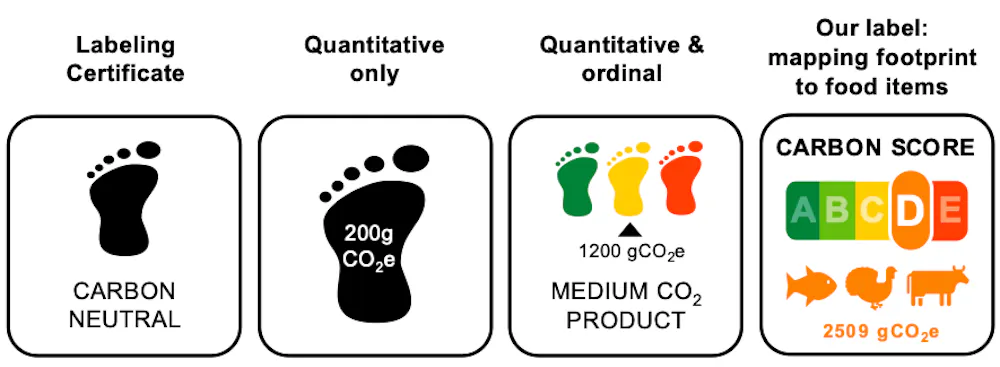
    Most carbon labels follow a similar approach. They typically display a number representing greenhouse gas emissions, and a traffic-light system indicating the level of environmental impact from green (low) to red (high). But such labels do not indicate whether the food is animal- or plant-based. So a high carbon score does not help people identify the source of the emissions.

    Our label maps the carbon footprint to the source of the food, whether plant or animal, along with information about the greenhouse gas emissions.
    Romain Cadario, Yi Li, Anne-Kathrin Klesse, (2025) Appetite., CC BY

    We designed a new type of label. It clearly displays whether the food is sourced mainly from animals or plants, along with the standard emissions score and traffic-light colour code. This approach is especially useful for the growing segment of pre-prepared and packaged foods such as soups and other ready-to-eat meals, which often contain a mix of meat and plant-based food.

    Our label creates a mental link between a food source and its carbon impact. When a consumer sees high carbon scores and red traffic lights appearing more frequently on meat and other animal products, they begin to make the connection between those products and higher emissions. This is key to addressing a lack of knowledge around food carbon emissions.

    We tested our label against the existing labels in a series of experiments with 1,817 everyday consumers from Australia, the United States and the Netherlands.

    One experiment involved soup. Compared with the group exposed to the standard carbon label, the group exposed to our label learned to associate animal-based soups with higher greenhouse gas emissions more effectively. They were more accurate at estimating the greenhouse gas emissions of a second batch of soups without labels.

    This improved knowledge also translates to more climate-friendly food choices. In another experiment with Australian consumers, we encouraged participants to choose five meals from ten options. Five were animal-based and five were plant-based.

    Half the participants saw the meal options with our carbon labels, and the other half did not see the carbon labels. The group exposed to our carbon labels chose fewer animal-based options in their weekly meal plan. In this case, we don’t know whether a third group exposed to the standard label would also make more climate-friendly choices, but our earlier experiments suggested our label was more effective.

    In the final experiment conducted in the Netherlands, displaying our carbon label made university students more likely to choose the plant-based snack option rather than the animal-based option.

    Providing information about the source of the food, whether plant or animal, influenced choices of meal plans.
    Romain Cadario, Yi Li, Anne-Kathrin Klesse, (2025) Appetite., CC BY

    When knowledge isn’t enough

    While people who care most about sustainable eating may think they know better than others, we found that is not the case. These people were not better able than other participants to tell the difference in greenhouse gas emissions between animal- and plant-based foods without seeing our carbon label.

    But they were better learners. When confronted with the facts about the differences between animal and plant-based foods on our labels, they were more likely to change their choices and switch to plant-based foods.

    What this means for consumers and businesses

    A simple change to food labels could help consumers make more informed environmental choices. For businesses and policymakers, it shows displaying only carbon numbers isn’t enough – the food source is crucial.

    Some forward-thinking restaurants and food companies are already experimenting with adding carbon labels to the menu to encourage diners to choose climate-friendly dishes. Our research suggests this approach could be more effective when combined with the new carbon labels we designed.

    Meat products make a significant contribution to climate change.
    Valmedia, Shutterstock

    Implications for climate action

    As Australia grapples with meeting its climate commitments, helping consumers understand the environmental impact of their food choices will become increasingly important.

    The challenge for businesses, policymakers and researchers isn’t convincing people to care about sustainability – they already do. Almost half of Australian shoppers (46%) say sustainability is important to them and influences their purchases, despite cost-of-living pressures.

    But most sustainable actions in retail involve recyclable packaging, products and materials, and local produce. The carbon emission implications of these actions, sadly, are far less than reducing animal-based food consumption.

    Instead, we need to focus on giving people the tools to make their environmental concerns count. Our carbon labels could be the key to helping consumers turn their sustainable intentions into meaningful climate action.

    Yi Li does not work for, consult, own shares in or receive funding from any company or organisation that would benefit from this article, and has disclosed no relevant affiliations beyond their academic appointment.

    ref. Want a side of CO₂ with that? Better food labels help us choose more climate-friendly foods – https://theconversation.com/want-a-side-of-co-with-that-better-food-labels-help-us-choose-more-climate-friendly-foods-250513

    MIL OSI AnalysisEveningReport.nz

  • MIL-Evening Report: Calculating the economic cost of climate change is tricky, even futile – it’s also a distraction

    Source: The Conversation (Au and NZ) – By Dennis Wesselbaum, Associate Professor, Department of Economics, University of Otago

    Piyaset/Shutterstock

    Climate change is no longer a distant threat. It’s here, it’s real and it increasingly affects us all.

    But predicting climate change and its associated costs, particularly over long periods of time, is inherently uncertain. And based on the best available evidence from organisations such as the United Nations’ Intergovernmental Panel on Climate Change, the economic costs of climate change appear to be small – making this a relatively weak argument for environmental action.

    At its most basic, climate is the long-term average of the weather we experience. Or, as former president of the American Meteorological Society, Marshall Shepherd, famously put it, “weather is your mood, and climate is your personality”.

    It’s widely accepted that climate change refers to a shift in long-term weather patterns, typically driven by human activities.

    But the impact of climate change, ranging from rising temperatures and extreme weather events to health impacts and disruptions to food and water supply, varies greatly. Some areas experience more extreme impacts than others, exacerbating social and economic disparities.

    There also appears to be a false sense about our state of knowledge. For example, many believe climate change already causes more frequent and intense storms, but the evidence for this is inconclusive.

    Trying to predict the unpredictable

    To understand the economic costs of climate change, we must first grasp how climate affects socioeconomic outcomes.

    The relationship between temperature and socioeconomic outcomes can be modelled using a “dose-response” function, which shows how much a given change in temperature (the “dose”) influences the outcome (for example, temperature-related mortality).

    A key challenge is to understand the shape of the dose-response function. Is the relationship between temperature and mortality linear or is it more complex? Does it have thresholds beyond which the effects substantially change? Is there only one function or are there different ones for different populations?

    As climate change shifts the distribution of weather variables, it alters the outcomes as well. Yet, predicting how these distributions will evolve is difficult.

    The further into the future we look, the harder it is to make reliable predictions about both weather and the associated economic costs.

    If you were asked in 1925 to predict the economy in 2000, for example, how accurate would you have been? In 1925 you drove a Ford Model T, used coal-fired steam trains and passenger ships for travel, and a trip from London to Auckland took up to eight weeks by sea. You used a telegraph for long-distance communication and a radio for entertainment.

    Compare that with the globalised, interconnected economy of the year 2000. Given the technological advancements, would your prediction have been even close?

    Rather than focusing on the uncertain future economic costs of climate change, we should be addressing how it is affecting human life now.
    James Andrews1/Shutterstock

    Cost estimates

    There are a wide range of estimates on the economic costs of climate change. But one of the most reliable has come from the UN’s Intergovernmental Panel on Climate Change.

    The panel’s latest assessment report avoids quantifying the economic costs of climate change. So, to understand the economic costs of climate change, we can use the best estimate based on the previous report and the insights from meta studies. These analyses posit a temperature rise of 3.7°C will reduce global gross domestic product (GDP) by about 2.6% (ranging from 0.5 to 8.2%) by 2100.

    For New Zealand, this is equivalent to about NZ$11 billion, or twice the cost of Auckland’s City Rail Link.

    However, this comparison is extremely misleading. The value of 2.6% today will differ substantially from 2.6% in 75 years.

    The New Zealand economy grew at a compound annual rate of 1.4% between 1960 and 2000. Using this same average growth rate, New Zealanders will have a 184% higher standard of living in 2100. If nothing is done to address climate change, and given the best cost estimate, our standard of living would still be 176% higher than it is now.

    Reporting costs

    There are also issues with how some people report costs. For instance, while the total damage caused by floods and hurricanes in the United States has gone up in dollar amounts, it has not actually increased as a percentage of peoples’ incomes.

    In this context, it is crucial to distinguish between the damage caused by climate change and that resulting from human activities – such as the construction of more houses, higher property prices and river management practices.

    The economic costs of climate change based on the best available evidence appear to be small and highly uncertain.

    Shifting the focus

    Even if we accept our best estimates, economic costs are not the issue, but saving the environment is.

    Instead of focusing the debate of climate change around economic costs, we need to refocus the debate on tangible impacts happening right now: retreating glaciers, species extinction, shifting seasons and coastal erosion, to name a few.

    Addressing these issues is costly, but action will be needed to save the environment and ensure a liveable world into the future.

    Dennis Wesselbaum does not work for, consult, own shares in or receive funding from any company or organisation that would benefit from this article, and has disclosed no relevant affiliations beyond their academic appointment.

    ref. Calculating the economic cost of climate change is tricky, even futile – it’s also a distraction – https://theconversation.com/calculating-the-economic-cost-of-climate-change-is-tricky-even-futile-its-also-a-distraction-248862

    MIL OSI AnalysisEveningReport.nz

  • MIL-Evening Report: Scientists have discovered a 3 billion-year-old beach buried on Mars

    Source: The Conversation (Au and NZ) – By Aaron J. Cavosie, Senior lecturer, School of Earth and Planetary Sciences, Curtin University

    A view of the Utopia Planitia region on Mars which is believed to be the site of an ancient ocean. ESA/DLR/FU Berlin, CC BY-SA

    In the 1970s, images from the NASA Mariner 9 orbiter revealed water-sculpted surfaces on Mars. This settled the once-controversial question of whether water ever rippled over the red planet.

    Since then, more and more evidence has emerged that water once played a large role on our planetary neighbour.

    For example, Martian meteorites record evidence for water back to 4.5 billion years ago. On the young side of the timescale, impact craters formed over the past few years show the presence of ice under the surface today.

    Today the hot topics focus on when water appeared, how much was there, and how long it lasted. Perhaps the most burning of all Mars water-related topics nowadays is: were there ever oceans?

    A new study published in PNAS today has made quite a splash. The study involved a team of Chinese and American scientists led by Jianhui Li from Guangzhou University in China, and was based on work done by the China National Space Administration’s Mars rover Zhurong.

    Data from Zhurong provide an unprecedented look into rocks buried near a proposed shoreline billions of years old. The researchers claim to have found beach deposits from an ancient Martian ocean.

    An illustration of Mars 3.6 billion years ago, when an ocean may have covered nearly half the planet. The orange star (right) is the landing site of the Chinese rover Zhurong. The yellow star is the landing site of NASA’s Perseverance rover.
    Robert Citron/Southwest Research Institute/NASA

    Blue water on a red planet

    Rovers exploring Mars study many aspects of the planet, including the geology, soil and atmosphere. They’re often looking for any evidence of water. That’s in part because water is a vital factor for determining if Mars ever supported life.

    Sedimentary rocks are often a particular focus of investigations, because they can contain evidence of water – and therefore life – on Mars.

    For example, the NASA Perseverance rover is currently searching for life in a delta deposit. Deltas are triangular regions often found where rivers flow into larger bodies of water, depositing large amounts of sediment. Examples on Earth include the Mississippi delta in the United States and the Nile delta in Egypt.

    The delta the Perseverance rover is exploring is located within the roughly 45km wide Jezero impact crater, believed to be the site of an ancient lake.

    Zhurong had its sights set on a very different body of water – the vestiges of an ancient ocean located in the northern hemisphere of Mars.

    Topography of Utopia Planitia. Lower parts of the surface are shown in blues and purples, while higher altitude regions show up in whites and reds, as indicated on the scale to the top right.
    ESA/DLR/FU Berlin

    The god of fire

    The Zhurong rover is named after a mythical god of fire.

    It was launched by the Chinese National Space Administration in 2020 and was active on Mars from 2021 to 2022. Zhurong landed within Utopia Planitia, a vast expanse and the largest impact basin on Mars which stretches some 3,300km in diameter.

    Zhurong is investigating an area near a series of ridges – described as paleoshorelines – that extend for thousands of kilometres across Mars. The paleoshorelines have previously been interpreted as the remnants of a global ocean that encircled the northern third of Mars.

    However, there are differing views among scientists about this, and more observations are needed.

    On Earth, the geologic record of oceans is distinctive. Modern oceans are only a few hundreds of millions of years old. Yet the global rock record is riddled with deposits made by many older oceans, some several billions of years old.

    This diagram shows how a series of beach deposits would have formed at the Zhurong landing site in the distant past on Mars.
    Hai Liu/Guangzhou University

    What lies beneath

    To determine if rocks in Utopia Planitia are consistent with having been deposited by an ocean, the rover collected data along a 1.3km measured line known as a transect at the margin of the basin. The transect was oriented perpendicular to the paleoshoreline. The goal was to work out what rock types are there, and what story they tell.

    The Zhurong rover used a technique called ground penetrating radar, which probed down to 100 metres below the surface. The data revealed many characteristics of the buried rocks, including their orientation.

    Rocks imaged along the transect contained many reflective layers that are visible by ground penetrating radar down to at least 30 metres. All the layers also dip shallowly into the basin, away from the paleoshoreline. This geometry exactly reflects how sediments are deposited into oceans on Earth.

    The ground penetrating radar also measured how much the rocks are affected by an electrical field. The results showed the rocks are more likely to be sedimentary and are not volcanic flows, which can also form layers.

    The study compared Zhurong data gathered from Utopia Planitia with ground penetrating radar data for different sedimentary environments on Earth.

    The result of the comparison is clear – the rocks Zhurong imaged are a match for coastal sediments deposited along the margin of an ocean.

    Zhurong found a beach.

    Photograph of frosted terrain on Utopia Planitia, taken by the Viking 2 lander in 1979.
    NASA/JPL

    A wet Mars

    The Noachian period of Martian history, from 4.1 to 3.7 billion years ago, is the poster child for a wet Mars. There is abundant evidence from orbital images of valley networks and mineral maps that the surface of Noachian Mars had surface water.

    However, there is less evidence for surface water during the Hesperian period, from 3.7 to 3 billion years ago. Stunning orbital images of large outflow channels in Hesperian land forms, including an area of canyons known as Kasei Valles, are believed to have formed from catastrophic releases of ground water, rather than standing water.

    From this view, Mars appears to have cooled down and dried up by Hesperian time.

    However, the Zhurong rover findings of coastal deposits formed in an ocean may indicate that surface water was stable on Mars longer than previously recognised. It may have lasted into the Late Hesperian period.

    This may mean that habitable environments, around an ocean, extended to more recent times.

    Aaron J. Cavosie has received funding from Australian Research Council and the Space Science and Technology Centre at Curtin University.

    ref. Scientists have discovered a 3 billion-year-old beach buried on Mars – https://theconversation.com/scientists-have-discovered-a-3-billion-year-old-beach-buried-on-mars-250496

    MIL OSI AnalysisEveningReport.nz

  • MIL-OSI Global: Moving beyond Black history month towards inclusive histories in Québec secondary schools

    Source: The Conversation – Canada – By R. Nanre Nafziger, Assistant Professor, African/Black Studies in Education, McGill University

    As Montréal celebrates its 34th Black History Month, it is time to fully integrate Black history into Québec education.

    As an all-out war on diversity and inclusion rages below Canada’s southern border, an opportunity is opened for Québec to live up to its vision of a truly inclusive and multicultural society.

    Integral to this is mainstreaming the histories of Black, Indigenous and other racialized and equity-deserving communities. This can be done through history studies and also through citizenship and cultural education.

    It is important to go beyond Black History Month in order to embrace the importance of Black history for Black students and all students — ignored for too long in history textbooks and teaching.

    To this urgent issue we bring our combined research and educational expertise. Nanre Nafziger, the first author of this story, has researched how Black/African peoples can reclaim their histories and cultures, and Sabrina Jafralie, who has a PhD in teacher education, has researched Québec curricula and also brings experience as a Québec-born-and-raised teacher at a Montréal high school.

    Essential to combat anti-Black racism

    Teaching Black history is essential to fighting against anti-Black racism reinforced through negative depictions of African and Black histories.

    History education is important for raising critical and actively involved citizens and increasing acceptance and understanding. Educators speak of developing a “historical consciousness” — which includes learning to examine causes and consequences, and to revisit and interpret sources. This is a critical building block for fighting racism and negative depictions of racialized groups.

    History education is important for raising actively involved citizens and increasing understanding. Students at Dawson College in Montréal in 2021.
    THE CANADIAN PRESS/Graham Hughes

    Québec curriculum development, like most North American curricula, has historically leaned towards a Eurocentric narrative.

    Black/African history education is largely absent in Québec’s history curricula, reinforcing the erasure of the contributions of Black people to the development of Québec but also to world history. For example, history and citizenship secondary education (Cycle 1) refers to Black/Afro-Canadian history only in naming enslavement and oppression.

    This creates a narrow and damaging history that fails to recognize the diverse range of achievements by Black people. It neglects the rich cultural heritage of Afro-Canadians and reinforces systemic inequities in how knowledge is produced and disseminated.

    Sabrina writes: I was fortunate that my Afro Nova Scotian mother taught me our history across Canada. However, it was not present in my education until I created it in high school.

    Historical fight for Black history

    Researchers have raised concerns that Québec’s “interculturalism” — a longstanding province-specific take on how to address and integrate cultural differences — fails to take into account the complexities of identities and omits important histories.

    Such an approach further compounds anti-Black racism in schools.

    Black students, parents and educators have called for Black history to be taught in Québec schools year-round and activists have called for the creation of a more inclusive curriculum.

    Despite systemic omissions, Black and African communities in Québec have a rich tradition of upholding and preserving their histories through the meticulous work of community archivists and memory keepers.

    This includes the creation of Black libraries, books, articles and curriculum materials, oral storytelling and walking tours. Black community organizations offer cultural and community programming that focuses on diverse cultures and histories of Black people. Renowned historian, educator and long-time advocate for Black history Dorothy Williams, created a curriculum toolkit called the ABCs of Black History in French and English for teachers and educators to use in schools.

    Recommended revisions

    In its brief to the education minister, the Advisory Board on English Education recommended rewrites to “the K-11 history curriculum to broaden its perspective beyond Québec based content and Eurocentricity,” and allowing latitude for schools to incorporate history curriculum relevant to students’ backgrounds.

    While it is helpful when school boards mark Black History Month and share resources for teachers, the integration of Black history requires a holistic and comprehensive curricular focus.

    Québec may learn from other provinces. Nova Scotia has a curriculum on African Canadian history and Ontario plans to roll out a Black history curriculum in schools in September 2025. Educators in British Columbia created a Black Studies 12 course which helps promote racial equity in education.

    Culture and citizenship curriculum

    The new Culture and Civics Curriculum (CCQ), a mandatory subject in primary and secondary schools, offers opportunities to address systemic racism with a focus on citizenship, culture and identity. Yet, there is no assurance students will gain competencies to address racism, or teachers will be well-equipped to lead such learning, given the curricular approach. For example:

    • The elementary program of the CCQ prepares students to understand “cultural realities” and contains a module on Indigenous perspectives. However, the approach is rooted in Euro-centered sociology.

    • Secondary 5 (students aged 16-17) names the compulsory concept of social inequalities (along with sexism and other inequalities related to gender and sexuality; racism and colonialism; socio-economic inequalities; environmental inequalities). However, the teacher decides how to teach these grouped concepts and what emphasis to give these areas.

    This means there is a possibility that the CCQ curriculum could address anti-Black racism, but there are too many variables to guarantee it. By contrast, sexuality education and civic education are deemed mandatory and special topics.

    Black history now

    Including Black history in the curriculum will have a profound, direct impact on students by strengthening their identity, citizenship, and “sense of pride and belonging to Québec society.”

    Healthy learning can take place when students and people see their place in history and curriculum, as this creates a sense of belonging. The current curriculum creates exclusion and allows educators to hide in their bias if they desire.

    Diverse curricula create space and acknowledge hidden histories and foster a shared humanity and a vision for a shared, socially just, future.

    Québec’s complicated history of colonialism, systemic racism and ongoing repression associated with secularism is not one to be shied away from.

    Rather, integrating Black history can serve as a portal for inspiring and encouraging critical discourses on histories of communities that are under-represented in dominant stories of Québec.

    At a moment when exclusion, vitriol against difference and increasing intolerance dominates social discourse and interactions, Québec can choose another path. Only through critically assessing our past can we look forward to any form of a unified future: nous nous souvenons, we must all remember and be remembered.

    The authors do not work for, consult, own shares in or receive funding from any company or organisation that would benefit from this article, and have disclosed no relevant affiliations beyond their academic appointment.

    ref. Moving beyond Black history month towards inclusive histories in Québec secondary schools – https://theconversation.com/moving-beyond-black-history-month-towards-inclusive-histories-in-quebec-secondary-schools-248832

    MIL OSI – Global Reports

  • MIL-OSI Global: U.S. cuts to HIV/AIDS funding will be detrimental for vulnerable groups in Kenya

    Source: The Conversation – Canada – By Toby Le, PhD Candidate in Medical Microbiology, University of Manitoba

    On his first day in office, U.S. President Donald Trump signed an executive order to freeze foreign aid funding. This was followed by a stop-work order for dozens of life-saving humanitarian programs.

    One of the programs affected by this announcement is the U.S. President’s Emergency Plan for AIDS Relief (PEPFAR). This program has invested more than US$100 billion in the global HIV/AIDS response since it was founded in 2003. This makes the U.S. the largest funder of HIV/AIDS programs worldwide.

    Although a 90-day waiver has since been issued which temporarily allows life-saving HIV drugs to continue being delivered, the impact of this executive order is already being felt across the globe — including in Africa, where PEPFAR funding has been integral in controlling the HIV/AIDS epidemic.

    If PEPFAR funding ends when the waiver expires — or resumes but doesn’t allow funding for services to all key populations — this will have severe impacts on those in the continent living with HIV or at high-risk of infection.

    HIV/ AIDS research

    For 45 years, the University of Manitoba has been part of an important initiative in Nairobi, Kenya — partnering with the Sex Worker Outreach Program (SWOP and local agency Partners for Health and Development in Africa (PHDA) to develop effective strategies against HIV that can be employed in the region and communities worldwide. The approach, developed in 1985 by Elizabeth Ngugi, a public health nurse, and Francis Plummer, a University of Manitoba researcher, has empowered the community to share knowledge and to advocate for their rights. It has been vital in reducing HIV prevalence.

    This partnership between the University of Manitoba and SWOP has been funded by PEPFAR since 2003. It receives an average of US$1.5 million annually to deliver reproductive health, tuberculosis, sexually transmitted infection and HIV services to key populations. Currently, this funding allows the program to operate nine clinics in Kenya, which annually provide services to over 40,000 female sex workers, 12,000 men who have sex with men and 1,400 transgender people.

    The program offers safe spaces and tailors services to address the specific needs of each group and reduces health-care barriers. Our research team assessed gaps and refined approaches so that this partnership could serve the most vulnerable — transforming engagement with key groups.

    Groundbreaking research findings have also emerged because of this partnership. University of Manitoba research conducted with the SWOP community was among the first to show that STIs increase the risk of HIV infection, that breastfeeding heightens the risk of transmitting HIV to babies, that male circumcision helps prevent HIV and that some people exposed to HIV have a natural immunity to the virus.

    These findings have informed global prevention strategies and highlight the partnership’s significant impact.

    Critical funding

    If PEPFAR funding does indeed end in April once the temporary waiver expires, it would have a serious impact on the HIV/AIDS programs being delivered not only in Kenya but around the globe.

    SWOP clinics have been instrumental in curbing HIV infections among sex workers. HIV prevalence among female sex workers accessing SWOP clinics declined from 44 per cent in 2008 to 12 per cent in 2017. This 67 per cent reduction can be attributed to an increase in HIV testing, community education and STI treatment. The program also highlighted the prevalence of HPV anal lesions in men who have sex with men and the importance of early detection. The cessation of PEPFAR funding will jeopardize STI and HIV services.

    After much advocating, the SWOP clinics servicing female sex workers were able to resume some of their activities last week (Feb. 12, 2025). However, the waiver specified that PEPFAR-funded HIV care and treatment services could only be offered to certain groups. This meant we were unable to resume HIV prevention services for all key groups.

    Without a strong contingency plan, the abrupt end to PEPFAR funding will have devastating consequences. It would mean an immediate end to SWOP activities. This would mean no more HIV testing, preventive treatment and anti-retroviral therapy — which would increase the risk of transmission, leading to an increase in cases and even a greater number of deaths in people living with HIV.

    Key groups accessing SWOP are among the most marginalized in Kenya. Without access to dedicated clinics, the majority will avoid seeking care due to fear of stigma, discrimination and harassment in clinics designed for the general public.

    SWOP partners with local agencies to provide empowerment, legal support and counselling. Closing these clinics could leave the communities they serve more vulnerable to violence, exploitation and human rights abuse.

    On the research front, funding cuts would mean ongoing projects would be halted and new ones couldn’t be started. Three already-funded University of Manitoba studies are planned to start this year. These aim to further investigate the impact of HIV on women living in the region and understand how women’s health can be improved not only in Kenya but worldwide.

    But without SWOP’s infrastructure (such as their clinics and outreach team) we won’t be able to start these new studies. Furthermore, the implementation of research-based programs that aim to prevent HPV-related cancers would be stopped.

    Cuts to HIV/AIDS funding could threaten the 40 years of work that has gone into ending the AIDS epidemic — potentially putting the lives of millions of people at risk.

    The PEPFAR program has saved over 25 million lives since its beginning in 2003. Ending the PEPFAR program would have serious impacts on services for key populations and the LGBTQ+ communities. If the funding does end after the waiver expires in April, it will be necessary for Canada’s provincial and federal governments to step in and become leaders in global health and the fight against HIV.

    Toby Le receives funding from CIHR and Research Manitoba.

    Julie Lajoie receives funding from Grand Challenge Canada, Canadian Institute of Health Research, CANFAR and MMSF (Manitoba Medical Service Fundation).

    Keith Fowke receives funding from CIHR and the Bill and Melinda Gates Foundation.

    ref. U.S. cuts to HIV/AIDS funding will be detrimental for vulnerable groups in Kenya – https://theconversation.com/u-s-cuts-to-hiv-aids-funding-will-be-detrimental-for-vulnerable-groups-in-kenya-250001

    MIL OSI – Global Reports

  • MIL-OSI Global: Francis − a pope who has cared deeply for the poor and opened up the Catholic Church

    Source: The Conversation – USA – By Mathew Schmalz, Professor of Religious Studies, College of the Holy Cross

    Pope Francis during the Palm Sunday Mass at St. Peter’s Square on April 2, 2023, in Vatican City. Antonio Masiello/Getty Images

    Pope Francis, who remains in critical condition and hospitalized as he battles pneumonia in both lungs, was elected pope on March 13, 2013, after the surprise resignation of Benedict XVI.

    Prior to becoming pope, he was Jorge Mario Bergoglio, archbishop of Buenos Aires, and was the first person from the Americas to be elected to the papacy. He was also the first pope to choose Francis as his name, thus honoring St. Francis of Assisi, a 13th-century mystic whose love for nature and the poor have inspired Catholics and non-Catholics alike.

    Pope Francis chose not to wear the elaborate clothing, like red shoes or silk vestments, associated with other popes. As a scholar of global Catholicism, however, I would argue that the changes Francis brought to the papacy were more than skin deep. He opened the church to the outside world in ways none of his predecessors had done before.

    Care for the marginalized

    Pope Francis reached out personally to the poor. For example, he turned a Vatican plaza into a refuge for the homeless, whom he called “nobles of the street.”

    The Argentinian Jorge Mario Bergoglio, ordained for the Jesuits in 1969 at the Theological Faculty of San Miguel.
    Jesuit General Curia via Getty Images

    He washed the feet of migrants and prisoners during the traditional foot-washing ceremony on the Thursday before Easter. In an unprecedented act for a pope, he also washed the feet of non-Christians.

    He encouraged a more welcoming attitude toward gay and lesbian Catholics and invited transgender people to meet with him at the Vatican.

    On other contentious issues, Francis reaffirmed official Catholic positions. He labeled homosexual behavior a “sin,” although he also stated that it should not be considered a crime. Francis criticized gender theory for “blurring” differences between men and women.

    While he maintained the church’s position that all priests should be male, he made far-reaching changes that opened various leadership roles to women. Francis was the first pope to appoint a woman to head an administrative office at the Vatican. Also for the first time, women were included in the 70-member body that selects bishops and the 15-member council that oversees Vatican finances. Shortly before his death, he appointed an Italian nun, Sister Raffaella Petrini, as President of the Vatican City.

    Pope Francis in St. Peter’s Square on April 18, 2022.
    Stefano Spaziani/Mondadori Portfolio via Getty Images

    Not shy of controversy

    Some of Francis’ positions led to opposition in some Catholic circles.

    One such issue was related to Francis’ embrace of religious diversity. Delivering an address at the Seventh Congress of Leaders of World and Traditional Religions in Kazakhstan in 2022, he said that members of the world’s different religions were “children of the same heaven.”

    While in Morocco, he spoke out against conversion as a mission, saying to the Catholic community that they should live “in brotherhood with other faiths.” To some of his critics, however, such statements undermined the unique truth of Christianity.

    During his tenure, the pope called for “synodality,” a more democratic approach to decision making. For example, synod meetings in November 2023 included laypeople and women as voting members. But the synod was resisted by some bishops who feared it would lessen the importance of priests as teachers and leaders.

    In a significant move that will influence the choosing of his successor, Pope Francis appointed more cardinals from the Global South. But not all Catholic leaders in the Global South followed his lead on doctrine. For example, African bishops publicly criticized Pope Francis’ December 2023 ruling that allowed blessings of individuals in same sex couples.

    His most controversial move was limiting the celebration of the Mass in the older form that uses Latin. This reversed a decision made by Benedict XVI that allowed the Latin Mass to be more widely practiced.

    Traditionalists argued that the Latin Mass was an important – and beautiful – part of the Catholic tradition. But Francis believed that it had divided Catholics into separate groups who worshiped differently.

    This concern for Catholic unity also led him to discipline two American critics of his reforms, Bishop Joseph Strickland of Tyler, Texas, and Cardinal Raymond Burke. Most significantly, Carlo Maria Viganò, the former Vatican ambassador, or nuncio, to the United States was excommunicated during Francis’ tenure for promoting “schism.”

    In the last days of his pontificate, Pope Francis also criticized the Trump administration’s efforts to deport migrants. In a letter to US Bishops, he recalled that Jesus, Mary and Joseph had been emigrants and refugees in Egypt. Pope Francis also argued that migrants who enter a country illegally should not be treated as criminals because they are in need and have dignity as human beings.

    Writings on ‘the common good’

    In his official papal letters, called encyclicals, Francis echoed his public actions by emphasizing the “common good,” or the rights and responsibilities necessary for human flourishing.

    Pope Francis washes the foot of a man during the foot-washing ritual at a refugee center outside of Rome on March 24, 2016.
    L’Osservatore Romano/Pool Photo via AP

    His first encyclical in 2013, Lumen Fidei, or “The Light of Faith,” sets out to show how faith can unite people everywhere.

    In his next encyclical, Laudato Si’, or “Praise Be to You,” Francis addressed the environmental crisis, including pollution and climate change. He also called attention to unequal distribution of wealth and called for an “integral ecology” that respects both human beings and the environment.

    His third encyclical in 2020, Fratelli Tutti, or “Brothers All,” criticized a “throwaway culture” that discards human beings, especially the poor, the unborn and the elderly. In a significant act for the head of the Catholic Church, Francis concluded by speaking of non-Catholics who have inspired him: Martin Luther King Jr., Desmond Tutu and Mahatma Gandhi.

    In his last encyclical, Dilexit Nos, or “He Loved Us,” he reflected on God’s Love through meditating on the symbol of the Sacred Heart that depicts flames of love coming from Jesus’ wounded heart that was pierced during the crucifixion.

    Francis also proclaimed a special “year of mercy” in 2015-16. The pope consistently argued for a culture of mercy that reflects the love of Jesus Christ, calling him “the face of God’s mercy.”

    A historic papacy

    Francis’ papacy has been historic. He embraced the marginalized in ways that no pope had done before. He not only deepened the Catholic Church’s commitment to the poor in its religious life but also expanded who is included in its decision making.

    The pope did have his critics who thought he went too far, too fast. And whether his reforms take root depends on his successor. Among many things, Francis will be remembered for how his pontificate represented a shift in power in the Catholic Church away from Western Europe to the Global South, where the majority of Catholics now live.

    Mathew Schmalz is Roman Catholic and a political independent.

    ref. Francis − a pope who has cared deeply for the poor and opened up the Catholic Church – https://theconversation.com/francis-a-pope-who-has-cared-deeply-for-the-poor-and-opened-up-the-catholic-church-164362

    MIL OSI – Global Reports

  • MIL-Evening Report: Do you speak other languages at home? This will not hold your child back at school

    Source: The Conversation (Au and NZ) – By Valeria Maria Rigobon, Lecturer in Literacy, Australian Catholic University

    Serwin365/Unsplash, CC BY

    It is common for Australian children to grow up with languages other than English in their family lives.

    More than one-fifth of Australians report speaking a language other than English at home.

    But when it comes time to start school, it’s common for parents to worry about raising a child to be bilingual or multilingual.

    They may wonder, am I harming my child’s English development if I speak another language at home?

    The short answer is no. Research shows speaking more than one language doesn’t hinder a child’s academic progress – in fact, it can even help.

    What does the research say?

    Up until the 1980s, some studies incorrectly suggested early exposure to more than one language could harm a child’s academic achievement. But these findings have since been widely criticised because many of the children in the studies came from economically disadvantaged backgrounds (and so were already disadvantaged in terms of their schooling).

    More recent Australian research has found when socioeconomic status is accounted for, multilingual children are “indistinguishable from their monolingual peers” in literacy and numeracy by the time they are eleven years old. This is provided they have adequate English vocabulary skills by the time they finish Year 2.

    Some studies show multilingual students even surpass monolingual children in different academic areas. This includes English reading, writing, spelling, grammar and punctuation as well as numeracy. Research suggests multilingual students’ enhanced mental flexibility from switching between languages may explain their higher academic performance later in school, but this is not yet confirmed.

    Recent Australian studies show bilingual and multilingual children keep up with their peers at school.
    PNW Promotion/ Pexels, CC BY

    Do you need to learn one language before starting the other?

    Research shows children can learn multiple languages at the same time, starting from infancy.

    This means you don’t have to wait for a child to become fluent in one before you start learning another.

    Similarly, a child does not have to be a highly skilled English speaker to start to learn to read in English. They can develop their spoken and written/reading language skills at the same time.

    It is also important to look at children’s skills across all the languages they know.

    Research on children aged up to 30 months found multilingual children often had smaller vocabularies in English than their monolingual peers. But they had a healthy range when assessed on words they knew in all languages.

    A common misconception is multilingual children may “confuse” words between languages, but this is not the case. They actually learn quite quickly whom they can communicate with in each language, and switch between languages without much effort.

    For example, Valeria’s niece Aurora is four and is already fluent in Hungarian, Spanish and Ukrainian. There are videos of Aurora speaking Spanish with her Venezuelan father and grandmother, turning to respond to her grandfather in Hungarian, and switching to Ukrainian to speak with her mother, all in one conversation.

    Regular calls or visits with family members who speak the home language will help your child develop their languages skills.
    Tima Miroshnichenko/ Unsplash, CC BY

    How can I help my child learn multiple languages?

    Research shows it is important a child receives lots of exposure to each language through meaningful interactions with people who speak those languages.

    There is no clear definition of the amount needed, but it should be regular – for example, everyday talk with parents or visits or phone calls with grandparents who share the home language.

    Also, if you’re worried your child isn’t getting enough English exposure outside school, do not abandon your home language. Instead, create other English opportunities, such as in playgroups, daycare, sports teams or other out-of-school activities.

    Ultimately, the best thing parents can do to support their children’s multilingual learning is build a community filled with native speakers of English and the home language(s).

    Staying consistently connected to this community of people who value each language, especially after children start school, will also support a child’s motivation to keep growing in each language.

    Rauno Parrila receives funding from Australian Research Council and Social Science and Humanities Research Council of Canada.

    Valeria Maria Rigobon does not work for, consult, own shares in or receive funding from any company or organisation that would benefit from this article, and has disclosed no relevant affiliations beyond their academic appointment.

    ref. Do you speak other languages at home? This will not hold your child back at school – https://theconversation.com/do-you-speak-other-languages-at-home-this-will-not-hold-your-child-back-at-school-250405

    MIL OSI AnalysisEveningReport.nz

  • MIL-Evening Report: Trump, Putin and Musk all share a leadership style – we’ve figured out what it is

    Source: The Conversation (Au and NZ) – By Andrei Lux, Lecturer of Leadership and Research Cluster Lead, Edith Cowan University

    Dictatorships would appear to be on the rise. Russian president Vladimir Putin, US president Donald Trump and even un-elected tech entrepreneur, Elon Musk are ruling by decree like “kings”.

    Some might naively call these leaders “authentic” for saying and often doing what they believe. But that’s not the whole story.

    Such unilateral decisions are deeply divisive, and often opposed. In the US, the federal court blocked Trump’s executive order banning workplace diversity, equity and inclusion programs to try to contain the damage.

    Researchers used to think that authenticity was inherently good and moral. But as authentic leadership research gets more sophisticated with robust experimental methods, what we know about this powerful approach is changing quickly.

    Experiments use controlled simulations and real-world field trials to show how leadership behaviour influences followers. These new methods are the gold standard for establishing cause-and-effect relationships, and they’re challenging old ideas.

    Authentic leadership redefined

    After 20 years of research, we’ve redefined authentic leadership as a process of sending leadership “signals”. What leaders say and do sends powerful messages about their values.

    In a digital age where every tweet and public act is scrutinised, understanding these signals is important for employees and voters. And keeping up with this new way of expressing authentic leadership is vital for anyone seeking to lead in today’s volatile world.

    In our latest article, we looked at what authentic leadership involves and why signalling is so important.

    But what exactly is “signalling”?

    Sending leadership ‘signals’

    Everything leaders do or say – how they behave, express themselves, look, and communicate – sends messages to everyone watching. These messages are “signals”. Leaders influence their followers by sending signals that will trigger specific thoughts or emotions.

    But executive life is complex and full of inherent contradictions between personal authenticity and the demands of leadership roles.

    High-profile figures such as Musk and Trump show how leadership signals can be polarising. Just last week Musk used his social media platform X (formerly Twitter) to call for an unconstitutional election in Ukraine.

    Musk’s edicts and announcements have prompted demonstrations around the US.
    Rena Schild/Shutterstock

    Signalling authentic leadership

    Demonstrating authentic leadership depends on sending clear, observable signals that reflect the leaders’ principles and ethical convictions.

    Here are some tips for spotting authentic leadership signals in everyday interactions. It is notable that it’s easier to find examples of leaders displaying the complete opposite.

    1. Self-awareness

    Leaders signal self-awareness by regularly seeking honest feedback and reflecting on their own strengths and weaknesses. They openly acknowledge mistakes and share their learning. They value personal growth and continuous improvement.

    Instead, Trump repeatedly ignores his own mistakes, even after they are exposed. His latest claim to be debunked was that Ukrainian President Zelensky’s approval was 4%, while his actual approval is closer to 60%.

    2. Internal moral perspective

    Leaders signal an internal moral perspective by making decisions – even if they are unpopular – firmly rooted in core ethical values. Upholding these values and encouraging open discussions on ethics is a principled approach to leadership.

    Instead, Musk has given federal workers 48 hours to justify their employment. The directive leaves little room for open dialogue on the ethical rationale or moral implications of such a drastic measure. He relies, instead, on top-down command.

    Key federal agencies including the FBI and Pentagon have told employees to ignore the email.

    3. Balanced processing

    Leaders signal balanced processing by seeking different views and considering all options before making a decision. Admitting any biases and using team brainstorming or surveys, ensures fair and informed decision-making.

    Instead, Trump has signed more than 50 executive orders since taking office in January. These include some that are unlawful, as an open display of personal bias and unilateral decision-making.

    4. Relational transparency

    Leaders signal relational transparency by sharing appropriate personal experiences and vulnerabilities with their teams. Being honest about limitations and inviting open dialogue builds trust through genuine and consistent communication.

    Instead social media guru, Mark Zuckerberg, another Trump ally, assured staff his charity the Chan Zuckerberg Initiative would continue its commitment to diversity, equity and inclusion. Then, only weeks later, he dismantled it.

    You can’t just fake it, either

    Leadership signals can convey honest information or be manipulated to send contrived messages.

    Trying to fake it doesn’t work. Leadership behaviour has to align with the leaders’ real values and internal sense of self – otherwise it’s not authentic leadership. It’s just impression management.

    Learning the difference empowers us to understand leaders’ actions and better navigate the post-truth era of global business and politics.

    Andrei Lux works for Edith Cowan University and is a Member of the Australian and New Zealand Academy of Management.

    Kevin Brian Lowe does not work for, consult, own shares in or receive funding from any company or organisation that would benefit from this article, and has disclosed no relevant affiliations beyond their academic appointment.

    ref. Trump, Putin and Musk all share a leadership style – we’ve figured out what it is – https://theconversation.com/trump-putin-and-musk-all-share-a-leadership-style-weve-figured-out-what-it-is-250502

    MIL OSI AnalysisEveningReport.nz

  • MIL-OSI Global: Canada’s productivity strategy needs to centre workers

    Source: The Conversation – Canada – By Ako Ufodike, Associate Professor, Administrative Studies, York University, Canada

    As Canada moves into 2025, its productivity still lags, despite efforts by the federal government to address the issue in the 2024 federal budget.

    Canada’s productivity has declined in nine of the last 10 quarters. Between 2015 and 2023, Canadian productivity fell by an average of 0.8 per cent per year. This means that, for every hour worked by Canadian employees, their output decreased by about eight per cent over that entire period.

    Labour productivity measures how much an economy produces per hour of work. Increasing productivity means finding ways to help people create more value in the time they spend working. However, how productivity is measured — and who benefits from productivity stimulation initiatives — varies.


    Read more:
    Canada’s lagging productivity affects us all — and will take years to remedy


    From an employer’s perspective, the main factor influencing productivity is the number of hours worked. For employees, the best proxy is wages received per hour worked — two related variables with differing implications.

    To date, Canada’s strategy to improve productivity has been very traditional, in that its primary aim has been to provide incentives for improved business performance.

    Global productivity issues

    Canada’s productivity stagnation struggles are not unique. A December 2024 OECD working paper highlighted a widespread slowdown across the OECD nations.

    From 1995 to 2023, ouputs from labour and capital inputs — know as multifactor productivity — declined sharply in both small and large advanced OECD countries.

    In Australia, Austria, Belgium, Canada, France, Spain and the United Kingdom, productivity has nearly stalled. Greece, Italy, Luxembourg and Mexico experienced prolonged periods of negative growth.

    The OECD paper also found a link between productivity decline and stagnating human capital development. Since 2003, young citizens of OECD countries have underperformed on standardized tests in science, math and reading.

    At the same time, many skilled immigrants to these countries are selected from the sciences and must score exceptionally high on language proficiency exams such as the International English Language Testing System.

    This raises questions about how countries assess and utilize human capital, and whether traditional productivity measures fully capture workforce potential.

    Innovation in productivity approaches

    Innovation improves productivity, yet Canada’s 2024 budget fails to embrace this principle. The 2024 budget prescribed five main strategies to address Canada’s productivity issues:

    • incentives for entrepreneurs;
    • fiscal incentives for productivity-enhancing assets;
    • regulatory sandboxes to reduce bureaucratic red tape;
    • enhanced federal research support;
    • a $200-million investment in the Venture Capital Catalyst Initiative.

    However, the initiatives largely continue to follow the traditional approach which focuses on incentivizing businesses to increase output, rather than focusing on workers — the factor most relevant to productivity.

    One of the budget’s major assumptions, which has so far failed to materialize, was that productivity would grow by 1.8 per cent between 2024 and 2028, despite a 1.8 per cent decline over the previous three years and a 0.8 per cent decline over the preceding decade.

    Another overlooked factor is that declining wages also decrease productivity. Instead of focusing solely on business incentives, a more effective labour-agency approach would also incentivize those who own the denominator in the productivity formula — workers.

    Addressing immigrant underemployment

    Immigrants are the primary drivers of population growth in most OECD countries, yet many end up in precarious employment or underemployed, despite being exceptionally qualified.

    Even when immigrants are employed at the appropriate level, many are underpaid in comparison to non-immigrant workers or their predecessors in the same roles. This wage suppression is at odds with efforts to improve productivity.


    Read more:
    I’ve worked in precarious jobs for more than 10 years – here’s what unions should do to support migrant workers


    This issue is particularly evident in Canada, where conversations about productivity are being shaped by immigration trends. In 2023, Canada welcomed one million new immigrants without a corresponding increase in economic output. From July 2023 to July 2024, immigrant underemployment rose by 3.1 to 12.6 per cent.

    Labour market integration varies across regions. In Alberta, for example, 80 per cent of new jobs between 2018 and 2022 were filled by immigrants, yet, productivity did not rise.

    Some critics have blamed immigrants for Canada’s productivity struggles, but this narrative risks fostering anti-immigrant sentiment. While population growth may contribute to declining per capita productivity, in reality, many highly qualified immigrants end up underemployed or unemployed through no fault of their own.

    A 2024 Statistics Canada report highlighted this missed economic opportunity, stating: “recent immigrants were more likely than people born in Canada to be employed in professional occupations and lower-skilled and labourer occupations.”

    Despite this, the 2024 budget doesn’t address harmful “unproductive immigrant” narratives.

    Driving productivity growth

    Canada’s current approach to productivity is incomplete. While business incentives play a role, productivity growth cannot be achieved without investing in workers — particularly immigrants, who represent a growing share of the workforce.

    Canada and other OECD nations are missing an opportunity by failing to fully utilize immigrant talent. Rather than blaming immigrants for productivity declines, countries should recognize immigrants as valuable contributors. Proper credential recognition and expanding workforce integration programs could allow immigrants to contribute at their full economic potential.


    Read more:
    Canadian immigrants are overqualified and underemployed — reforms must address this


    A truly innovative productivity strategy would fund reskilling, upskilling and mentorship programs for immigrants and youth. It would also support equity initiatives to ensure immigrants aren’t exploited or paid less than their counterparts.

    Improving career mobility is also essential. Helping immigrants transition into high-output sectors, such as technology or engineering, through retraining programs and targeted incentives could strengthen productivity.

    Addressing wage inequity is also crucial. Ensuring immigrants receive fair wages aligned with their qualifications will improve worker motivation and productivity, consistent with the arguments of efficient wage theory.

    If these issues remain unaddressed, Canada risks continued productivity stagnation by overlooking a key opportunity to harness the potential of its immigrant workforce.

    Ako Ufodike receives funding from Social Sciences and Humanities Research Council.

    ref. Canada’s productivity strategy needs to centre workers – https://theconversation.com/canadas-productivity-strategy-needs-to-centre-workers-249669

    MIL OSI – Global Reports

  • MIL-OSI Global: We need meaningful, not less, EDI and climate action in turbulent times

    Source: The Conversation – Canada – By Sarah E. Sharma, Assistant Professor, School of Political Studies, L’Université d’Ottawa/University of Ottawa

    Today, both climate action and equity, diversity and inclusion (EDI) are increasingly under attack. Nowhere is this more apparent than in the United States, where the Trump administration is leading a concerted effort to obstruct climate action and penalize EDI.

    A federal judge recently granted an injunction blocking U.S. government officials from terminating or changing federal contracts they consider equity-related.

    The injunction comes just over a month after President Donald Trump signed executive orders that end federal government support for programs promoting EDI. The judge found the executive orders could likely violate the U.S. Constitution and free-speech rights.

    In Canada, Conservative leader Pierre Poilievre has blamed carbon pricing for driving up prices, despite research showing that it has a minimal impact on inflation. Meanwhile, provincial governments in Alberta and Saskatchewan are pursuing punitive anti-transgender agendas and some universities are moving away from EDI, claiming it promotes exclusion.

    Until recently, governments, universities and corporations faced criticism for their lack of meaningful commitments on EDI and the climate. Many responded with ambitious pledges but insufficient action. This led to greenwashing and diversity-washing, symbolic commitments that mask inaction.

    Hypocrisies in climate and EDI policies have become easy targets for right-wing populists. As a result, EDI and climate action are being scapegoated for broader systemic failures. For instance, the most deadly American plane crash in two decades has been baselessly linked to EDI, rather than clear evidence of systemic failures.

    There are good reasons to challenge greenwashing and diversity-washing. Yet, denigrating climate and DEI actions wholesale avoids tackling the roots of complex problems and can have dangerous outcomes.

    Why we need meaningful EDI in climate action

    Climate policies that ignore social justice deepen exclusion, weaken public buy-in and provoke backlash. A just energy transition requires policies that resonate with marginalized communities and with those who feel threatened by change. Without this, opposition will only grow.

    We recently published a journal article, co-authored with researchers Neelakshi Joshi and Georgia Savvidou, outlining how greenwashing, diversity-washing and the backlash against EDI all undermine effective climate action. We argue that we cannot address environmental challenges without confronting class, gender and racial inequities.

    EDI is rooted in historical social movements that fought against exclusion. Established rights — like maternity leave, anti-discrimination in the workplace and marriage equality — are all products of these movements.

    Over the past decade, movements like #MeToo, Black Lives Matter and Missing and Murdered Indigenous Women and Girls have advanced our understanding of systemic discrimination. EDI efforts have aimed to make institutions more representative and reduce inequalities in workplaces and society.

    EDI in climate action has also gained traction, particularly through the push for a “just transition.” This movement seeks to restructure energy systems fairly and inclusively, ensuring no one is left behind.

    Energy systems are deeply inequitable. Who profits, who has access and who shapes energy policy is highly uneven. Meaningful EDI that redistributes these benefits is essential. This includes the need to support workers in fossil fuel industries and the most vulnerable to climate impacts.

    Ironically, political leaders who oppose EDI on merit grounds appoint key figures with no expertise. They ignore that diversity expands merit, not lowers it — EDI removes barriers, not standards.

    Meaningful EDI in energy transitions

    In our journal article we outline how public and private leaders make bold promises without transformative action, leading to greenwashing and diversity-washing.

    Insufficient and superficial efforts can hinder systemic change. In the energy sector, simply prioritizing boardroom and workforce diversity does not necessarily guarantee fairer working conditions or tangible benefits for local communities.

    We must move beyond empty greenwashing and diversity-washing rhetoric towards actions that target the needs of diverse populations where they live and work.

    For example, community-led clean energy projects enable citizens to actively participate in energy transitions. Indigenous-led renewable energy ownership facilitates Indigenous sovereignty. Community organizations like Empower Me address the energy poverty faced by newcomers, immigrants, single mothers, seniors and others.

    These examples demonstrate that more diverse perspectives are needed not to pursue EDI for its own sake, but to transform energy systems in real ways for more people.

    When diverse experiences are not taken into account, our energy and climate decisions are prone to blind-spots and groupthink. This locks us further into existing practices, rather than opening up innovative and transformative paths.

    We must reconnect with reality and not hide in fantasies that reject natural and social science alike. When EDI is obstructed, we cannot make effective progress on the climate crisis. We lose opportunities to discuss the injustices that are baked into energy systems — discussions that can lead to tailored and targeted policies relevant to the everyone’s needs.

    This means heating, cooling and transport options that work for people of all backgrounds, income and ability levels, and initiatives that suit rural and remote communities as well as urban residents.

    In turbulent times, the world needs more meaningful EDI, not less.

    Sarah E. Sharma receives funding from the Social Sciences and Humanities Research Council of Canada and the Department of National Defence’s Mobilizing Insights in Defence and Security (MINDS) program.

    Amy Janzwood receives funding from the Social Sciences and Humanities Research Council of Canada.

    Julie MacArthur receives funding from the Social Sciences and Humanities Research Council of Canada.

    Runa Das receives funding from the Social Sciences and Humanities Research Council of Canada.

    ref. We need meaningful, not less, EDI and climate action in turbulent times – https://theconversation.com/we-need-meaningful-not-less-edi-and-climate-action-in-turbulent-times-249683

    MIL OSI – Global Reports

  • MIL-Evening Report: Farmers, investors, miners and parents: how unconventional climate advocates can reach new audiences

    Source: The Conversation (Au and NZ) – By Xiongzhi Wang, Postdoctoral Research Fellow in Environmental Social Science, Australian National University

    Max Acronym/Shutterstock

    When you think about climate advocates, you’ll likely picture left-leaning environmentalists who live in cities. This group has contributed to building public support for climate action worldwide, through protests, petitions, lobbying and so on.

    While a majority of Australians understand that climate change is happening and that humans are the main cause, there are still holdout groups. Acceptance of the fact that climate change is largely caused by humans sits at 60% of Australians, well below other countries.

    Holdout groups in Australia can include people associated with political conservatism, the business sector, farming, the resource sector, some religious groups and some sports fans. For these groups, climate advocacy by left-leaning environmentalists may be limited in its effectiveness.

    How do you reach these groups? Our new research points to one solution: unconventional climate advocates. That is, those not from the stereotypical background and who belong to holdout groups. Think of groups such as Farmers for Climate Action and the Investor Group on Climate Change.

    These individuals and groups can play a crucial role in expanding the base of the climate movement – without necessarily working with mainstream climate groups. Better still, we found these unconventional advocates tend to receive more sympathetic media coverage.

    Who are these unconventional advocates?

    We distinguish two types of unconventional climate advocates –role-based and bridge-builders.

    Role-based advocates come from groups not typically associated with climate advocacy, such as Australian Parents for Climate Action, Doctors for the Environment, Vets for Climate Action and Australian Firefighters Climate Alliance. These advocates broaden our perception of who engages in climate advocacy.

    Bridge-builders come from groups with a history of tension with environmentalists and environmental issues. They can often span the divide between their group and the broader climate movement. These groups include Farmers for Climate Action, Investor Group on Climate Change, Hunter Jobs Alliance and Australian Religious Response to Climate Change.

    Why do they matter?

    Unconventional advocates are vital because they can reach a broader section of the population. This is because we are more likely to listen to insiders: people from groups we identify with who share our values and beliefs. We also pay more attention to messages when they come from a surprising source and when they go against perceived interests.

    A farmer advocating for climate action is more likely to resonate with other farmers than city-based environmentalists, for instance. Similarly, if you expect farmers to be opposed to climate action, you’re more likely to pay attention to their message than if it came from an environmentalist.

    Our research shows these groups are not mainstream environmentalists. They exist on the periphery of the climate movement.

    Using social network analysis, we mapped the connections between more than 3,000 climate advocacy groups in Australia. This showed us unconventional advocates are less connected to traditional environmental groups such as Greenpeace Australia Pacific or the Australian Conservation Foundation.

    This distance may actually be advantageous. By maintaining a degree of independence from the mainstream environmental movement, unconventional advocates can avoid being dismissed as “greenies” – an unpopular group for some people in rural areas. Farmers advocating for climate action may be more effective if they’re not seen as aligned with environmentalists who might be viewed with suspicion in rural communities.

    Does unconventional advocacy work?

    By one metric, unconventional advocacy does work. These individuals and groups broadly receive more sympathetic media coverage.

    In recent research, we analysed more than 17,000 Australian media articles published between 2017 and 2022 mentioning unconventional and more stereotypical environmentalist climate advocacy groups.

    We found Greenpeace Australia Pacific and other established groups received the most media coverage overall. Disruptive groups such as Extinction Rebellion tended to be framed negatively, with a focus on conflict and arrests. The negativity was most pronounced in articles published by News Corp, owned by the conservative media figure Rupert Murdoch.

    Unconventional advocates received less media coverage than other types of advocates. When they did receive coverage, it was generally more sympathetic. Articles tended to focus on their achievements and to use less confrontational language, even from conservative-leaning media outlets.

    This suggests unconventional advocates are well positioned to shift public opinion in holdout groups and build a broader base of support for climate action.

    Unconventional advocates for unprecedented times

    In Australia and in many other countries, climate action has become politicised – often along party lines. Holdout groups are a minority, but a large minority. To actually respond to the increasing threat of climate change will require building a bigger base of support.

    Unconventional advocates offer a way to disrupt hardened divides, expand the range of voices in the movement and engage communities and groups often left out of the conversation.

    Xiongzhi Wang works as a postdoc with his salary coming from the Australian Research Council (project DP220103155) which funds the research related to this article.

    Kelly Fielding received funding from Australian Research Council DP220103155 for the research related to this article. She currently donates to Greenpeace Australia.

    Rebecca Colvin serves on advisory/research committees/panels for: the Australian Museum’s Climate Solutions Centre; The Climate Risk Group; The Blueprint Institute; RE-Alliance; the NSW Environmental Trust. She is a non-executive member of the Board of the NSW Government’s EnergyCo. She receives funding from The Australian Research Council (DP220103155 and DE230101151).

    Robyn Gulliver receives funding from the Climate Social Science Network. She has worked for and volunteers for a range of environmental advocacy groups.

    Winnifred Louis receives funding from the Australian Research Council (project DP220103155) for the research related to this article. She has been a longstanding advocate for environmental and climate action but is not affiliated with any groups mentioned here.

    ref. Farmers, investors, miners and parents: how unconventional climate advocates can reach new audiences – https://theconversation.com/farmers-investors-miners-and-parents-how-unconventional-climate-advocates-can-reach-new-audiences-249949

    MIL OSI AnalysisEveningReport.nz

  • MIL-Evening Report: What’s the difference between medical abortion and surgical abortion?

    Source: The Conversation (Au and NZ) – By Lydia Mainey, Senior Nursing Lecturer, CQUniversity Australia

    PeopleImages.com – Yuri A/Shutterstock

    In Australia, around one in four people who are able to get pregnant will have a medical or surgical abortion in their lifetime.

    Both options are safe, legal and effective. The choice between them usually comes down to personal preference and availability.

    So, what’s the difference?

    What is a medical abortion?

    A medical abortion involves taking two types of tablets, sold together in Australia as MS2Step.

    The first tablet, mifepristone, stops the hormone progesterone, which is needed for pregnancy. This causes the lining of the uterus to break down and stops the embryo from growing.

    After taking mifepristone, you wait 36–48 hours before taking the second tablet, misoprostol. Misoprostol makes the cervix (the opening of the uterus) softer and starts contractions to expel the pregnancy.

    It’s normal to have strong pain and heavy bleeding with clots after taking misoprostol. Pain relief including ibuprofen and paracetamol can help.

    After two to six hours, the bleeding and pain usually become like a normal period, although this may last between two to six weeks.

    Haemorrhage after a medical abortion is rare (occurring in fewer than 1% of abortions). But you should seek help if bleeding remains heavy (if you soak two pads per hour for two consecutive hours) or if you have have signs of infection (such as a fever, increasing abdominal pain or smelly vaginal discharge).

    Do I have to go to hospital?

    It is legal to have a medical abortion outside of a hospital up to nine weeks of pregnancy.

    Depending on state or territory law, the medication can be prescribed by a qualified health-care provider such as a GP, nurse practitioner or endorsed midwife. These clinicians often work in GP surgeries or sexual and reproductive health clinics and they may use telehealth.

    Medical abortions also occur after nine weeks of pregnancy, but these are done in hospitals and overseen by doctors alongside nurses or midwives.

    Medical abortions after 20 weeks are done by taking medications to start early labour in a maternity unit. Often, medications are first given to stop the foetal heartbeat so it is not born alive. Then, other medications are given to manage pain.

    These types of abortions are very rare. They may be used when an obstacle has prevented someone accessing an abortion abortion earlier, continuing with the pregnancy is dangerous for the pregnant person’s health or if there is a serious problem with the foetus.

    Medical abortions in Australia involve taking two tablets, usually around two days apart.
    PeopleImages.com – Yuri A/Shutterstock

    What is a surgical abortion?

    Surgical abortions are performed in an operating unit, usually with sedation, so you will not remember the procedure. Surgical abortions are sometimes preferred over medical abortions because they are quicker. But the decision should be between you and your health-care provider.

    In the first 12–14 weeks of pregnancy, a surgical abortion takes less than 15 minutes and patients are usually discharged a few hours after the procedure.

    Medications may be given before surgery to soften and open the cervix and to ease pain. During the procedure, the cervix is gently stretched open and the contents of the uterus are removed with a small tube. This procedure is carried out by trained doctors with the assistance of nurses.

    Surgical abortions after 12–14 weeks are more complex and are performed by specially trained doctors. Similar to medical abortions, medications may be given first to stop the foetal heartbeat.

    It is normal to experience some cramping and bleeding after a surgical abortion, which can last about two weeks. However, like medical abortion, you should seek help for heavy bleeding or signs of infection.

    Do I need an ultrasound?

    It used to be common before an abortion to have an ultrasound scan to check how far along the pregnancy was and to make sure it was not ectopic (outside the uterus).

    However, this is no longer recommended in the early stages of pregnancy (up to 14 weeks) if it delays access to abortion. If the date of the last menstrual period is known and there are no other concerning symptoms, an ultrasound scan may not be necessary.

    This means people can access medical abortion much sooner, even from the first day of a missed period, without waiting for the embryo to be big enough to be seen on an ultrasound scan. This is called “very early medical abortion”.

    Before and after care

    Before having an abortion, a health-care provider will explain common side effects and when to seek urgent medical attention. For people who want it, many types of contraception can be started the day of abortion.

    Your health-care provider will help you understand your options, including whether you want to start contraception.
    PowerUp/Shutterstock

    Even though the success rate of medical abortion is very high (over 95%) it is routine to make sure the person is no longer pregnant.

    This is usually done two to three weeks after taking the first tablet mifepristone, either by a low-sensitivity urine pregnancy test (which you can do at home) or a blood test.

    In the rare case a medical abortion has not worked, a surgical abortion can be done.

    Sometimes after a medical or surgical abortion, tissue is left behind in the uterus. If this happens you may need another dose of misoprostol (the second tablet) or a surgical procedure to remove the tissue.

    Some people may also seek support-based counselling or peer support to help them work through the emotions that might accompany having an abortion.

    Understanding the differences and similarities between medical and surgical abortions can help individuals make informed decisions about their reproductive health.

    It’s important to speak with an unbiased health-care provider to discuss the best option for your circumstances and to ensure you receive the necessary follow-up care and support.

    Lydia Mainey is the co-chair of the Termination of Pregnancy Working Group, a subgroup of the Queensland Health Sexual Health Clinical Network. She has previously worked at MSI Australia, a non-profit which provides abortion, contraception and vasectomy services. Lydia was previously a member of the MSI Australia Technical Advisory Group.

    ref. What’s the difference between medical abortion and surgical abortion? – https://theconversation.com/whats-the-difference-between-medical-abortion-and-surgical-abortion-249839

    MIL OSI AnalysisEveningReport.nz

  • MIL-Evening Report: Studies of Parkinson’s disease have long overlooked Pacific populations – our work shows why that must change

    Source: The Conversation (Au and NZ) – By Victor Dieriks, Research Fellow in Health Sciences, University of Auckland, Waipapa Taumata Rau

    Shutterstock/sfam_photo

    A form of Parkinson’s disease caused by mutations in a gene known as PINK1 has long been labelled rare. But our research shows it’s anything but – at least for some populations.

    Our meta-analysis revealed that people in specific Polynesian communities have a much higher rate of PINK1-linked Parkinson’s than expected. This finding reshapes not only our understanding of who is most at risk, but also how soon symptoms may appear and what that might mean for treatment and testing.

    Parkinson’s disease is often thought of as a single condition. In reality, it is better understood as a group of syndromes caused by different factors – genetic, environmental or a combination of both.

    These varying causes lead to differences in disease patterns, progression and subsequent diagnosis. Recognising this distinction is crucial as it paves the way for targeted interventions and may even help prevent the disease altogether.

    Why we focus on PINK1-linked Parkinson’s

    We became interested in this gene after a 2021 study highlighted five people of Samoan and Tongan descent living in New Zealand who shared the same PINK1 mutation.

    Previously, this mutation had been spotted only in a few more distant places –Malaysia, Guam and the Philippines. The fact it appeared in people from Samoan and Tongan backgrounds suggested a historical connection dating back to early Polynesian migrations.

    One person in 1,300 West Polynesians carries this mutation. This is a frequency well above what scientists usually classify as rare (below one in 2,200). This discovery means we may be overlooking entire communities in Parkinson’s research if we continue to assume PINK1-linked cases are uncommon.

    This world map shows people in some Polynesian communities have a much higher rate of PINK1-linked Parkinson’s than the global population.
    Eden Yin, CC BY-SA

    Traditional understanding says PINK1-linked Parkinson’s is both rare and typically strikes younger people, mostly in their 30s or 40s, if they inherit two faulty copies of the gene. In other words, it’s considered a recessive condition, needing two matching puzzle pieces before the disease can unfold.

    Our work challenges this view. We show that even one defective PINK1 gene can cause Parkinson’s at an average age of 43, much earlier than the typical onset after 65. That’s a significant departure from the standard belief that only people with two defective gene copies are at risk.

    Why this matters for people with the disease

    It’s not just genetics that challenge long-held views. Historically, PINK1-linked Parkinson’s was thought to lack some of the classic features of the disease, such as toxic clumps of alpha-synuclein protein.

    In typical Parkinson’s, alpha-synuclein builds up in the brain, forming sticky clumps known as Lewy bodies. Our results, contrary to prior beliefs, show that alpha-synuclein pathology is present in 87.5% of PINK1 cases. This finding opens up a promising new avenue for future treatment development.

    The biggest concern is early onset. PINK1-linked Parkinson’s can begin as early as 11 years old, although a more common starting point is around the mid-30s. This early onset means living longer with the disease, which can profoundly affect education, work opportunities and family life.

    Current treatments (such as levodopa, a precursor of dopamine) help manage symptoms, but they’re not designed to address the root cause. If we know someone has a PINK1 mutation, scientists and clinicians can explore therapies for specific genetic pathways, potentially delivering relief beyond symptom management.

    Sex differences add a layer of complexity

    In Parkinson’s, generally, men are at higher risk and tend to develop symptoms earlier. However, our findings suggest the opposite pattern for PINK1-linked cases. Particularly, women with two defective copies of the gene experience onset earlier than men.

    This highlights the need to consider sex-related factors in Parkinson’s research. Overlooking them risks missing key elements of the disease.

    Genetic testing could be a game-changer for PINK1-linked Parkinson’s. Because it often appears earlier, doctors may not recognise it immediately, especially if they are more familiar with the common, later-onset form of Parkinson’s.

    Early genetic testing could lead to a faster, more accurate diagnosis, allowing treatment to begin when interventions are most effective. It would help families understand how the disease is inherited, enabling relatives to get tested.

    In some cases, where appropriate and culturally acceptable, embryo screening may be considered to prevent the passing of the faulty gene.

    Knowing you have a PINK1 mutation could also make finding the right treatment more efficient. Instead of a lengthy trial-and-error process with different medications, doctors could use emerging therapies designed to target the underlying PINK1 mutation rather than relying on general Parkinson’s treatments meant for the broader population.

    Addressing research gaps

    These findings underscore how crucial it is to include diverse populations in health research.

    Many communities, such as those in Samoa, Tonga and other Pacific nations, have had little to no involvement in global Parkinson’s genetics studies. This has created gaps in knowledge and real-world consequences for people who may not receive timely or accurate diagnoses.

    Researchers, funding bodies and policymakers must prioritise projects beyond the usual focus on European or industrialised countries to ensure research findings and treatments are relevant to all affected populations.

    To better diagnose and treat Parkinson’s, we need a more inclusive approach. Recognising that PINK1-linked Parkinson’s is not as rare as previously thought – and that genetics, sex differences and cultural factors all play a role – allows us to improve care for everyone.

    By expanding genetic testing, refining treatments and ensuring research reflects the full spectrum of Parkinson’s, we can move closer to more precise diagnoses, targeted therapies and better support systems for all.

    Victor Dieriks receives funding from the Health Research Council Hercus Fellowship, the School of Medical Science, the University of Auckland and Te Tı̄ toki Mataora.

    Eden Paige Yin receives funding from the University of Auckland.

    ref. Studies of Parkinson’s disease have long overlooked Pacific populations – our work shows why that must change – https://theconversation.com/studies-of-parkinsons-disease-have-long-overlooked-pacific-populations-our-work-shows-why-that-must-change-250366

    MIL OSI AnalysisEveningReport.nz

  • MIL-OSI Global: ‘Your life becomes a nightmare’: how scam operations exploit those trapped inside – Scam Factories podcast, Ep 2

    Source: The Conversation – UK – By Gemma Ware, Host, The Conversation Weekly Podcast, The Conversation

    A few weeks after Ben Yeo travelled to Cambodia for what he thought was a job in a casino, he found himself locked up in a padded room. “It’s a combination between a prison and a madhouse,” he remembers. He was being punished for refusing to conduct online scams.

    “They tried all kinds of coercive manoeuvres, using a fire extinguisher to try to hit me, to scare me, using a plastic bag over my head to suffocate me … Whatever you see in the movies that actually happened.”

    Scam Factories is a podcast series from The Conversation Weekly taking you inside Southeast Asia’s brutal fraud compounds. It accompanies a series of multimedia articles on The Conversation.

    In the second episode, Inside the Operation, we explore the history of how scam compounds emerged in Southeast Asia and who is behind them. We hear about the violent treatment people receive inside through the testimonies of two survivors, Ben, and another man we’re calling George to protect his real identity.

    The Conversation collaborated for this series with three researchers: Ivan Franceschini, a lecturer in Chinese Studies at the University of Melbourne, Ling Li, a PhD candidate at Ca’ Foscari University of Venice, and Mark Bo, an independent researcher.

    They’ve spent the past few years researching the expansion of scam compounds in the region for a forthcoming book. They’ve interviewed nearly 100 survivors of the compounds, analysed maps and financial documents related to the scam industry and tracked scammers online to find out how these compounds work.

    Read an article by Ivan Franceschini and Ling Li which accompanies this episode about the rise of the scamming industry.

    The Conversation contacted AsiaHR international for comment. We did not receive a response. We contacted all the other companies mentioned in this multimedia series for comment, except Jinshui who we could not contact. We did not receive a response from them either.


    This episode was written and produced by Gemma Ware, with assistance from Mend Mariwany and Katie Flood. Leila Goldstein was our producer in Cambodia and Halima Athumani recorded for us in Uganda. Hui Lin helped us with Chinese translation. Sound design by Michelle Macklem and editing help from Ashlynee McGhee and Justin Bergman.

    Listen to The Conversation Weekly podcast via any of the apps listed above, download it directly via our RSS feed or find out how else to listen here.

    Mark Bo, an independent researcher who works with Ivan Franeschini and Ling Li, is also interviewed in this podcast series. Ivan, Ling, Mark, and others have co-founded EOS Collective, a non-profit organisation dedicated to investigating the criminal networks behind the online scam industry and supporting survivors.

    ref. ‘Your life becomes a nightmare’: how scam operations exploit those trapped inside – Scam Factories podcast, Ep 2 – https://theconversation.com/your-life-becomes-a-nightmare-how-scam-operations-exploit-those-trapped-inside-scam-factories-podcast-ep-2-250464

    MIL OSI – Global Reports

  • MIL-OSI Global: A Palestinian-Israeli film is an Oscars favorite − so why is it so hard to see?

    Source: The Conversation – USA – By Drew Paul, Associate Professor of Arabic, University of Tennessee

    Directors Basel Adra, left, and Yuval Abraham on stage at the 62nd New York Film Festival on Sept. 29, 2024. Jamie McCarthy/Getty Images

    For many low-budget, independent films, an Oscar nomination is a golden ticket.

    The publicity can translate into theatrical releases or rereleases, along with more on-demand rentals and sales.

    However, for “No Other Land,” a Palestinian-Israeli film nominated for best documentary at the 2025 Academy Awards, this exposure is unlikely to translate into commercial success in the U.S. That’s because the film has been unable to find a company to distribute it in America.

    “No Other Land” chronicles the efforts of Palestinian townspeople to combat an Israeli plan to demolish their villages in the West Bank and use the area as a military training ground. It was directed by four Palestinian and Israeli activists and journalists: Basel Adra, who is a resident of the area facing demolition, Yuval Abraham, Hamdan Ballal and Rachel Szor. While the filmmakers have organized screenings in a number of U.S. cities, the lack of a national distributor makes a broader release unlikely.

    Film distributors are a crucial but often unseen link in the chain that allows a film to reach cinemas and people’s living rooms. In recent years it has become more common for controversial award-winning films to run into issues finding a distributor. Palestinian films have encountered additional barriers.

    As a scholar of Arabic who has written about Palestinian cinema, I’m disheartened by the difficulties “No Other Land” has faced. But I’m not surprised.

    The role of film distributors

    Distributors are often invisible to moviegoers. But without one, it can be difficult for a film to find an audience.

    Distributors typically acquire rights to a film for a specific country or set of countries. They then market films to movie theaters, cinema chains and streaming platforms. As compensation, distributors receive a percentage of the revenue generated by theatrical and home releases.

    The film “Soundtrack to a Coup D’Etat,” another finalist for best documentary, shows how this process typically works. It premiered at the Sundance Film Festival in January 2024 and was acquired for distribution just a few months later by Kino Lorber, a major U.S.-based distributor of independent films.

    The inability to find a distributor is not itself noteworthy. No film is entitled to distribution, and most films by newer or unknown directors face long odds.

    However, it is unusual for a film like “No Other Land,” which has garnered critical acclaim and has been recognized at various film festivals and award shows. Some have pegged it as a favorite to win best documentary at the Academy Awards. And “No Other Land” has been able to find distributors in Europe, where it’s easily accessible on multiple streaming platforms.

    So why can’t “No Other Land” find a distributor in the U.S.?

    There are a couple of factors at play.

    Shying away from controversy

    In recent years, film critics have noticed a trend: Documentaries on controversial topics have faced distribution difficulties. These include a film about a campaign by Amazon workers to unionize and a documentary about Adam Kinzinger, one of the few Republican congresspeople to vote to impeach Donald Trump in 2021.

    The Israeli-Palestinian conflict, of course, has long stirred controversy. But the release of “No Other Land” comes at a time when the issue is particularly salient. The Hamas attacks of Oct. 7, 2023, and the ensuing Israeli bombardment and invasion of the Gaza Strip have become a polarizing issue in U.S. domestic politics, reflected in the campus protests and crackdowns in 2024. The filmmakers’ critical comments about the Israeli occupation of Palestine have also garnered backlash in Germany.

    Locals attend a screening of ‘No Other Land’ in the village of A-Tuwani in the West Bank on March 14, 2024.
    Yahel Gazit/Middle East Images/AFP via Getty Images

    Yet the fact that this conflict has been in the news since October 2023 should also heighten audience interest in a film such as “No Other Land” – and, therefore, lead to increased sales, the metric that distributors care about the most.

    Indeed, an earlier film that also documents Palestinian protests against Israeli land expropriation, “5 Broken Cameras,” was a finalist for best documentary at the 2013 Academy Awards. It was able to find a U.S. distributor. However, it had the support of a major European Union documentary development program called Greenhouse. The support of an organization like Greenhouse, which had ties to numerous production and distribution companies in Europe and the U.S., can facilitate the process of finding a distributor.

    By contrast, “No Other Land,” although it has a Norwegian co-producer and received some funding from organizations in Europe and the U.S., was made primarily by a grassroots filmmaking collective.

    Stages for protest

    While distribution challenges may be recent, controversies surrounding Palestinian films are nothing new.

    Many of them stem from the fact that the system of film festivals, awards and distribution is primarily based on a movie’s nation of origin. Since there is no sovereign Palestinian state – and many countries and organizations have not recognized the state of Palestine – the question of how to categorize Palestinian films has been hard to resolve.

    In 2002, The Academy of Motion Picture Arts and Sciences rejected the first ever Palestinian film submitted to the best foreign language film category – Elia Suleiman’s “Divine Intervention” – because Palestine was not recognized as a country by the United Nations. The rules were changed for the following year’s awards ceremony.

    In 2021, the cast of the film “Let It Be Morning,” which had an Israeli director but primarily Palestinian actors, boycotted the Cannes Film Festival in protest of the film’s categorization as an Israeli film rather than a Palestinian one.

    Film festivals and other cultural venues have also become places to make statements about the Israeli-Palestinian conflict and engage in protest. For example, at the Cannes Film Festival in 2017, the right-wing Israeli culture minister wore a controversial – and meme-worthy – dress that featured the Jerusalem skyline in support of Israeli claims of sovereignty over the holy city, despite the unresolved status of Jerusalem under international law.

    Israeli Culture Minister Miri Regev wears a dress featuring the old city of Jerusalem during the Cannes Film Festival in 2017.
    Antonin Thuillier/AFP via Getty Images

    At the 2024 Academy Awards, a number of attendees, including Billie Eilish, Mark Ruffalo and Mahershala Ali, wore red pins in support of a ceasefire in Gaza, and pro-Palestine protesters delayed the start of the ceremonies.

    So even though a film like “No Other Land” addresses a topic of clear interest to many people in the U.S., it faces an uphill battle to finding a distributor.

    I wonder whether a win at the Oscars would even be enough.

    This article has been updated to clarify that the film was a collaborative effort between Palestinian and Israeli filmmakers.

    Drew Paul does not work for, consult, own shares in or receive funding from any company or organization that would benefit from this article, and has disclosed no relevant affiliations beyond their academic appointment.

    ref. A Palestinian-Israeli film is an Oscars favorite − so why is it so hard to see? – https://theconversation.com/a-palestinian-israeli-film-is-an-oscars-favorite-so-why-is-it-so-hard-to-see-249233

    MIL OSI – Global Reports

  • MIL-OSI Global: Fossil footprints reveal what may be the oldest known handcarts – new research

    Source: The Conversation – UK – By Matthew Robert Bennett, Professor of Environmental and Geographical Sciences, Bournemouth University

    If you’re a parent you’ve probably tried, at some point, to navigate the supermarket with a trolley, and at least one child in tow. But our new study suggests there was an ancient equivalent, dating to 22,000 years ago. This handcart, without wheels, was used before wheeled vehicles were invented around 5,000 years ago in the Middle East.

    Recently our research team discovered some remarkable fossil traces which might give a hint. These traces were found alongside some of the oldest known human footprints in the Americas at a place called White Sands in New Mexico.

    In the last few years, several footprint discoveries at this site have begun to rewrite early American history – pushing back the arrival of the first people to enter this land by 8,000 years.

    There is some controversy around the age (23,000 years old) of these footprints, with some researchers unhappy with our dating methods. But they provide a remarkable picture of past life on the margins of a large wetland at the end of the last ice age.

    The footprints tell stories, written in mud, of how people lived, hunted and survived in this land. Footprints connect people to the past in a way that a stone tool or archaeological artefact never can. Traditional archaeology is based on the discovery of stone tools. Most people today have never made a stone tool but almost all of us will have left a footprint at some time, even if it is only on the floor of the bathroom.

    Today, modern shopping trolleys can be found rusting in canals, rivers or abandoned in shrubbery. But ancient versions would have probably been of wood and simply rotted away. We know that transport technology must have existed.

    Everyone has stuff to transport, but we have no record of it until written histories. At White Sands, we found drag-marks made by the ends of wooden poles while excavating for fossil footprints. Sometimes these appear as just one trace, while at other times they occur as two parallel, equidistant traces.

    A pole or poles used in this fashion is called a travois. These drag-marks are preserved in dried mud that was buried by sediment and revealed by a combination of erosion and excavation. The drag-marks extend for dozens of metres before disappearing beneath overlying sediment. They clip barefoot human tracks along their length, suggesting the user dragged the travois over their own footprints as they went along.

    To help interpret these features, we conducted a series of tests on mud flats both in Dorset, UK, and on the coast of Maine, US. We used different combinations of poles to recreate simple, hand-pulled travois.

    In our experiments the pole-ends dragged along the mud truncate footprints in the same way as the fossil example in New Mexico. These features in the fossil examples were also always associated with lot of other human footprints travelling in a similar direction, many of which, judging by their size, were made by children.

    We believe the footprints and drag-marks tell a story of the movement of resources at the edge of this former wetland. Adults pulled the simple, probably improvised travois, while a group of children tagged along to the side and behind.

    The research team has benefited from the insight of the Indigenous peoples we work with at White Sands, and they interpret the marks in this way as well. We cannot discount that some of the marks may be made by dragging firewood, but this does not fit all the cases we found.

    Travois are known from historical documents and accounts of Indigenous peoples and their traditions. They were more commonly associated with dogs or horses, but they were pulled by humans in our tests.

    As such they represent early examples of the handcart or wheelbarrow, but without the wheel. The earliest record of a wheeled vehicle dates from Mesopotamia (modern day Iraq), in 2,500BC. We think the travois were probably improvised from tent poles, firewood and spears when the need arose.

    Maybe they were created to help move camp, or more likely, transport meat from a hunting-site. In the latter context the analogy with the shopping trolley comes to the fore, as does the pained expression of the adults faces as they quest for resources with a gaggle of children in tow.

    Matthew Robert Bennett receives funding from Arts and Humanities Research Council.

    Sally Christine Reynolds does not work for, consult, own shares in or receive funding from any company or organisation that would benefit from this article, and has disclosed no relevant affiliations beyond their academic appointment.

    ref. Fossil footprints reveal what may be the oldest known handcarts – new research – https://theconversation.com/fossil-footprints-reveal-what-may-be-the-oldest-known-handcarts-new-research-250438

    MIL OSI – Global Reports

  • MIL-OSI Global: Sanctions rarely achieve their goals – here’s why they failed in Russia and Myanmar

    Source: The Conversation – UK – By Sergey Sosnovskikh, Lecturer in International Business, Manchester Metropolitan University

    Sanctions are, according to research, effective less than 10% of the time if success is defined as the complete compliance of a sanctioned regime with the imposed external pressure. Taking a more lenient view, which includes partial concessions or negotiated settlements, the success rate rises to 35% at most.

    The idea that sanctions can completely restrict trade to sanctioned countries is largely flawed. Iranian residents, for example, can still access many western products despite sanctions through intermediaries in countries like Turkey and the Gulf states.

    To better understand why sanctions fail, consider the cases of Russia and Myanmar. The sanctions imposed on Russia following its full-scale invasion of Ukraine in 2022 have undoubtedly caused some economic disruption, including inflation, labour shortages and a devaluation of the Russian rouble. But they have had a limited impact overall.

    In April 2024, the International Monetary Fund predicted that Russia’s economy would grow faster than all of the world’s advanced economies that year, including the US.

    Many countries have not participated in the west’s sanctions regime, which has created enforcement gaps. These gaps have largely enabled Russia to maintain access to sanctioned goods and continue its economic activities.

    In January 2023, a US thinktank called Silverado reported that some former Soviet states had increased their “transshipment” of goods produced by multinational firms that no longer export to Russia directly.

    Transshipment is a process where cargo is unloaded from one vessel and reloaded into another while in transit. Armenia and Uzbekistan, as well as China and Turkey, are the countries commonly used as “transshipment points” to Russia.

    Indeed, research of our own into how sanctioned goods continue to reach Russia reveals that companies often reroute their supply chains through politically allied intermediary nations. These rerouted imports can, however, drive up product prices for ordinary citizens.

    Stacks of containers at a port in St Petersburg, Russia.
    Andrey Mihaylov / Shutterstock

    Russia has also reduced its dependency on imports by increasing production in sectors such as agriculture and manufacturing. In August 2023, for example, India and Russia signed the biggest ever grain deal between the two countries.

    And the Russian government implemented fiscal and monetary measures, including currency controls and subsidies, to stabilise the economy and support key industries.

    Russia’s large, diverse economy and abundant natural resources make it more resilient to sanctions compared to some smaller and less diversified nations. Much of the world is reliant on Russian gas and, since the imposition of western sanctions, countries like China and India have increased the amount they buy.

    Even the EU is still spending billions of US dollars on Russian gas. In the first 15 days of 2025, after an agreement allowing Russia to pump gas to the EU via pipelines running across Ukraine ended, the EU’s 27 countries imported Russian gas at a record rate.

    Sanctioning Myanmar’s military

    Targeted western sanctions have tried to undermine the financial interests of Myanmar’s military junta, which has been battling armed opposition to its rule since a coup in 2021. But these sanctions have only been partially effective, too.

    China, India, Japan and neighbouring south-east Asian countries continue to engage in business with Myanmar. In Myanmar’s lucrative gas export sector, the vacuum left by departing western companies has been swiftly filled by Asian partners. This has ensured the junta’s income streams remain largely intact.

    Brands that have ostensibly exited the market due to sanctions or activist pressure also remain accessible through the country’s porous border trade. And there have been cases where a significant delay between a company’s declared exit and its actual departure inadvertently allowed operations to continue as usual for some time.

    In 2024, we conducted a study with our colleague Anna Grosman, an expert on innovation and entrepreneurship at Loughborough University, on multinational firms operating in Myanmar. Our findings highlight the dilemma foreign businesses face in sanctioned countries over whether to stay or leave.

    This decision is shaped by formal pressure, such as home and host government restrictions. For instance, a multinational firm’s home government may penalise companies that continue to operate in a sanctioned country, while the host government may impose policies or financial barriers to prevent or delay their exit.

    However, informal pressure from activists, diaspora groups and international advocacy organisations also plays a role. Staying can help businesses avoid financial losses and the complexities of exit, but it also exposes them to reputational damage and ethical dilemmas.

    Western sanctions on Myanmar’s military regime have been ineffective, too.
    R. Bociaga / Shutterstock

    Some of the junta’s financial channels, such as revenue from the jade mining industry, are out of reach for sanctions. In 2021, the US treasury department sanctioned Myanmar’s state-owned gemstone company, Myanmar Gem Enterprise, describing it as “a key economic resource” for the military.

    However, sanctions on Myanmar Gem Enterprise have not been completely effective. Myanmar’s gemstone mining industry is mostly an informal sector, with data on mining income and distribution underreported and opaque. Continued revenue from this sector will almost certainly have further cushioned the impact of western sanctions.

    The sanctions have only partially stopped the flow of income to the junta. But they have contributed to the hardships facing ordinary citizens. Myanmar’s currency has cratered, while imported goods including pharmaceuticals and fuel are in short supply. Power outages are now common and there are soaring levels of unemployment.

    Some western governments have now imposed sanctions on state-owned banks in Myanmar in an attempt to stop revenue from reaching the junta. This move will only worsen the situation facing Myanmar’s people.

    Sanctions drive nations towards building domestic industries to replace imported goods and strengthening alliances with supportive countries. Far from achieving their intended political objectives, sanctions can exacerbate an already volatile geopolitical landscape, while driving up prices for ordinary people.

    But at the same time, governments and businesses have a duty to exit a country when they are no long able to adhere to their own human rights commitments.

    The authors do not work for, consult, own shares in or receive funding from any company or organisation that would benefit from this article, and have disclosed no relevant affiliations beyond their academic appointment.

    ref. Sanctions rarely achieve their goals – here’s why they failed in Russia and Myanmar – https://theconversation.com/sanctions-rarely-achieve-their-goals-heres-why-they-failed-in-russia-and-myanmar-244975

    MIL OSI – Global Reports

  • MIL-OSI Global: Wales wants to punish lying politicians – how would it work?

    Source: The Conversation – UK – By Stephen Clear, Lecturer in Constitutional and Administrative Law, and Public Procurement, Bangor University

    shutterstock Minerva Studio/Shutterstock

    Elected politicians and candidates in Wales who deliberately lie could face serious consequences, including being removed from office, under proposals aimed at restoring trust in politics.

    The Senedd’s (Welsh parliament) standards of conduct committee has recommended legally defining political deception, and strengthening existing rules to explicitly ban misleading statements. Proposed potential penalties range from a formal retraction to suspension or, in extreme cases, recall by voters.

    But the committee stopped short of recommending that deliberate deception be made a criminal offence. The idea that politicians who lie could be investigated by the police and courts had previously been mooted. The option of a civil offence with a lower burden of proof being introduced was also rejected.

    The committee has been working on the proposals as a way of restoring faith in politics, and trust in politicians, in the lead up to the next Senedd elections in 2026. While the report sets out options for change, the Welsh government has already promised to introduce a legal ban (in some form) before the next election.

    These efforts see Wales become the first UK nation to attempt to tackle the problem of dwindling trust in politics by modern day legislative force.

    Those championing the changes refer to how the deliberate rise in campaigns of misinformation, by those of all political persuasions, have in some instances led to electoral victories overseas.

    The need to act is also reflected in the public’s perception. Surveys have consistently found that trust in politicians to tell the truth has declined. A survey in 2023 placed politicians as the least trusted profession in the UK. Just 9% of the public said they trusted elected officials to tell the truth.

    More recently, findings from the British social attitudes report in 2024 revealed that the public is as critical now of how the UK is governed as it has ever been. A record high of 45% of respondents said they now “almost never” trust governments of any party to place the needs of the nation above the interests of their own political party.

    Restoring trust

    The Senedd committee had considered three different options for restoring trust.

    First, to create a criminal offence of deception. Second, to use an existing investigative body such as the Public Services Ombudsman for Wales, and to bring in a civil sanction such as a fine. And third, to strengthen the code of conduct for Senedd members with enhanced sanctions. In other words, it would be dealt with through the Senedd’s own disciplinary procedures.

    To a certain degree there are some mechanisms already in place for dealing with deception in Welsh politics. For example, politicians are already expected to adhere to the seven principles of public life, which include honesty and integrity.

    Generally speaking, opposition Senedd members will hold the Welsh government to account by questioning and scrutinising their work. It is also possible to stage votes of no confidence as an accountability mechanism.

    Although as seen in the case of former first minister Vaughan Gething, it is questionable as to the extent to which they can be enforced. Gething initially refused to step down after losing such a vote.

    The electorate also has an important role to play in holding politicians to account. Ultimately an untrustworthy politician should, in theory at least, be unlikely to win any election. But Senedd elections only take place every five years.

    The standards of conduct committee already has the power to review complaints referred to it. It also has responsibility for reviewing the code of conduct for members of the Senedd, guidance on the code and complaints procedures, and rules for lobbying.

    Part of the perceived problem with this is that the committee is made up of Senedd members and are, therefore, responsible for setting the rules for themselves. Or alternatively, as Plaid Cymru MS Adam Price (who has campaigned on this issue for many years) put it, it’s like marking your own homework. The committee’s report offers a potential of recommending appointing lay members to sit alongside them.

    Proposals to legislate against politicians who lie in Wales were first raised by the Plaid Cymru MS, Adam Price.
    ComposedPix/Shutterstock

    Some may be concerned about the practical complexities of disqualifying candidates and Senedd members, and where that may, in turn, leave democracy and democratic processes. If sanctions were to be introduced, questions could also be raised about the potential for vexatious complaints to discredit electoral candidates.


    Read more:
    Wales could become world’s first country to criminalise politicians who lie


    In respect of making “deception” a criminal offence, concerns may have been raised about the constitutional principle of separation of powers, and whether it should truly be for unelected judges to take decisions about the democratically elected arm of the state. Or whether that could lead to the politicisation of the judiciary.

    While, research had found that more than two-thirds of Welsh voters supported a law criminalising political lying, judicial adjudication for serving Senedd members has been ruled out. The report also details concerns from the legal professions that existing resource pressures on the courts would have lead to long disputes, rather than the swift resolutions.

    But in reality, we are talking about strengthening safeguards for maintaining standards in public offices. In particular addressing deliberate mistruths by politicians to secure deceitful advantages during an election.

    In that sense, the new legislation is essentially bringing the political profession in line with others such as lawyers, doctors, journalistic and financial institutions, by having clearer repercussions when they lie and fail to maintain professional standards.

    Given the need for something to change in order to restore trust, and the extensive powers that politicians have to affect the lives of citizens, it is clear why Wales is trying a different approach towards restoring trust.

    Stephen Clear does not work for, consult, own shares in or receive funding from any company or organisation that would benefit from this article, and has disclosed no relevant affiliations beyond their academic appointment.

    ref. Wales wants to punish lying politicians – how would it work? – https://theconversation.com/wales-wants-to-punish-lying-politicians-how-would-it-work-248728

    MIL OSI – Global Reports

  • MIL-OSI Global: Donald Trump wants to bring back plastic straws, but the world is going in another direction

    Source: The Conversation – UK – By Randa Lindsey Kachef, Research affiliate, King’s College London

    David Pereiras / shutterstock

    Donald Trump recently surprised the world again by signing an action to end what he describes as the “forced use” of paper straws. Although there is some merit in the argument the White House presents that paper straws simply aren’t fit for purpose, what the paper straw revolution represents is the power of individual change in enacting progressive policy.

    Much like recent EU legislation which required all plastic bottles to have caps attached by a tether, the removal of items that tend to be easily littered is a way to help people be more environmentally cautious without any extra effort. Unfortunately, the paper straw appears to have failed in this endeavour.

    We should not stop this trajectory because of one fail, however. Even if paper straws are not a viable option, we mustn’t let their fate undermine all initiatives to reduce the impacts of single use plastics.

    The story behind the move away from plastic straws began in 2015, when a disturbing video of a turtle having a plastic straw removed from its nose went viral. Unfortunately this appears to be a common occurrence, with a video of a turtle with a plastic fork in its nose posted only a few months later. This shows plastic straws themselves are not the issue and that there is a wider problem that everyone should be aware of: plastic which ends up in the ocean is often mistaken for food and eaten by wildlife.

    Paper problems

    Admittedly, anyone who has used a paper straw will agree that they are not a viable alternative to plastic. The obvious complaint is that they get soggy too quickly. But there are several unseen components that show the switch to paper may not be as great as we once thought.

    Paper, but plastic-coated?
    Sia Footage / shutterstock

    To begin with, in an effort to keep them water-resistant, paper straws themselves are coated in plastic. This means they cannot be recycled. As they are an organic material, they release greenhouse gas when they decompose in landfill – they can however safely be incinerated, something that is not widely recommended for their plastic counterparts.

    As the demand for paper straws skyrocketed, this created a deficit in production, leading to the development of new manufacturing facilities, construction that in itself has a significant environmental impact. Meanwhile, the heavier weight of paper straws can lead to an increase in freighting fuel consumption and associated emissions.

    Flimsy plastics are more likely to be littered

    Anything, however, is better than plastic. A somewhat misleading statistic that plastic straws account for a mere 0.025% of ocean plastics has been circulating in the argument to bring them back. Although this is true by volume, it is not a correct representation of the sheer number of individual straws recorded in the environment which is suspected to be as many as 8.3 billion, about one per person on earth.

    The fact straws are so small and lightweight is a big part of the problem, since smaller and more easily fragmented items are far harder to collect. As litter, they punch above their weight.

    A child’s plastic beach toy may weigh as much as a few hundred plastic straws, but if littered the straws would do more harm to the environment and wildlife, and would look worse. As straws are made of polypropylene, a flimsier more brittle type of plastic, it doesn’t take much effort for them to break apart into bite sized pieces. Because of this, straws turn into microplastics much quicker than the toy, which has a higher chance of eventually being picked up.

    To this day, straws continue to to be on the top ten types of plastics found on beaches, and we have yet to see any videos of larger pollutants like those beach toys being pulled from the nose of any animal.

    Although we could argue indefinitely as to which straw materials are worse (reuseable metal or glass straws require water and a cleaning agent, another potential contaminant) the overarching sentiment is the most alarming component of Trump’s announcement.

    Paper straw pressue came from below

    The move towards paper straws was a refreshing direction in environmental preservation, in that it was initiated locally and by producers, not through legislation. In the summer of 2018 Seattle became the first US city to enforce a ban on plastic utensils, straws and cocktail sticks. Soon thereafter, McDonald’s, Starbucks, Alaska Airlines and many others announced they would stop the sale of plastic straws.

    Later that year, the UK government and European Union began consultations for national bans which came into effect in 2020 and 2021 respectively. In 2019 Canada followed suit with a ban coming into law in 2022.

    It was not until July of 2024 that the then US president, Joe Biden announced his plan to phase out single-use plastics (although the fact sheet and official press release has now been removed from the White House website). This was several years after the global movement got underway – accompanied by the first complaints from Trump on the topic in 2019.

    It is important to note that both the EU and UK bans on plastic straws included stirrers and cotton bud sticks. However their removal from the market caused little to no controversy, mostly because there are adequate alternatives.

    Litter producers can drive change

    What the movement towards paper straws represents is the power of producers to drive change, in a bottom-up approach. A similarly encouraging scenario can be seen in attitudes towards polystyrene.

    Back in 2019 Dunkin’ Donuts announced it would stop using foam cups in certain US markets, and delivered a full removal of the cups in the US by early 2020, while in January 2025 California introduced a state wide polystyrene ban. Meanwhile, negotiations on a global plastics agreement remain indecisive.

    In the wake of a pattern of stalemate and regressive policy, it is on the consumers and producers to take action. We must continue to support producers who invest in innovation to address these issues in a way that makes our lives easier and cleaner.


    Don’t have time to read about climate change as much as you’d like?

    Get a weekly roundup in your inbox instead. Every Wednesday, The Conversation’s environment editor writes Imagine, a short email that goes a little deeper into just one climate issue. Join the 40,000+ readers who’ve subscribed so far.


    Randa Lindsey Kachef does not work for, consult, own shares in or receive funding from any company or organisation that would benefit from this article, and has disclosed no relevant affiliations beyond their academic appointment.

    ref. Donald Trump wants to bring back plastic straws, but the world is going in another direction – https://theconversation.com/donald-trump-wants-to-bring-back-plastic-straws-but-the-world-is-going-in-another-direction-250449

    MIL OSI – Global Reports

  • MIL-OSI Global: Why Charles Dickens would have made Great Expectations a videogame if he were writing today

    Source: The Conversation – UK – By Lynda Clark, Lecturer in Creative Writing (Interdisciplinary Futures), University of Edinburgh

    Despite dying over 100 years before the release of Pong, the novelist Charles Dickens has connections to a number of videogames. He appears as a character in Assassin’s Creed Syndicate (2015); is the subject of a mobile app walking-tour, Charles Dickens London: The Writer’s Journey (2022); and his works are brought to virtual life in the forthcoming The Mysteries of Gad’s Hill Place.

    There’s also plenty in Dickens’ work to suggest that were he alive today, he may be writing his own videogames as well as appearing in them.

    Great Expectations (1861) in particular demonstrates Dickens’ ludic credentials. A sense of progression is common in the Bildungsroman or “progress” novel, but Pip seems to embody ideas of “levelling-up” more reminiscent of a playable character accumulating XP (experience points) than a typical protagonist.

    Pip (Philip Pirrip) is a young blacksmith’s apprentice whose life is dramatically changed when he inherits a great fortune. Pip’s guardian, Mr Jaggers, who is also the lawyer in charge of the inheritance, describes Pip’s “expectations” (inheritance) as if it is an attainable in-game currency.

    He makes it clear, just as a videogame NPC (non-playable character) might, how the story’s currency should be spent – on items befitting a gentleman, just as a videogame character might spend on costumes and items for their inventory. As Jaggers puts it, the inheritance is “a sum of money amply sufficient for your suitable education and maintenance”


    This article is part of Rethinking the Classics. The stories in this series offer insightful new ways to think about and interpret classic books and artworks. This is the canon – with a twist.


    On his path to becoming a gentleman, Pip must develop himself in various areas such as intellect and eloquence, and acquire new clothes, which, it is implied, will confer new “powers”. They should not, Mr Jaggers stresses, be “working clothes”.

    This spiritual, physical and sartorial growth is not unlike that found in many roleplaying games such as Metaphor: Refantazio (2024), where the protagonist must develop “royal virtues” through building relationships with followers. This is reminiscent of the way Pip must build his relationship with the wealthy, eccentric Miss Havisham to further his place in society. Like Pip, the protagonist of Metaphor: Refantazio also gains access to progressively advantageous clothing and accessories as the story advances.

    Dickens appears as a character in the game Assassin’s Creed Syndicate.

    As literary theorist Peter Brooks has observed, even Pip’s name is representative of growth – a seed full of potential, the kind of on-the-nose naming scheme that would make auteur videogame designer Hideo Kojima proud. Many of Kojima’s characters in the Metal Gear franchise are named in the same way, such as Fragile, the director of a delivery company that has the motto “handled with love”.

    And before we even get into the story itself, the contents page in later collected editions arranges protagonist Pip’s journey into “stages” – a term more commonly found in videogames.

    Expectations and endings

    Perhaps the strongest argument for Great Expectations as evidence of Dickens’ potential as a videogame writer are its multiple endings. The published ending alludes to future romance. After a chance meeting four years after the primary events of the novel, Pip takes fellow orphan Estella’s hand and sees “no shadow of another parting from her”.

    However the alternate version, often presented as an appendix, has a quite different outlook. Again Pip runs into Estella, and they share fond words, but this time there is no sign of a romantic union. Instead, it’s suggested that the suffering Estella has endured through a cruel marriage has given her a deeper understanding of Pip’s life – “a heart to understand what [his] used to be”.


    Looking for something good? Cut through the noise with a carefully curated selection of the latest releases, live events and exhibitions, straight to your inbox every fortnight, on Fridays. Sign up here.


    This downbeat tone is more akin to the so-called “bad” ending (or fail state) of choice-based videogames. These are endings which occur when the player has not sufficiently developed their character, or made poor conversational choices during their play.

    Even the published ending is not necessarily so positive if the reader has been paying attention to all of Pip’s “side-quests”. Both he and Estella are childhood wards of Miss Havisham, and in adulthood, a man named Magwitch plays father-figure to Pip and is Estella’s actual father.

    Therefore, it is only possible to accept their union as romantic if putting aside facts which, to contemporary readers at least, may well have verged on incest. This means there are two possible endings even within the single published ending – one where he commits near-incest and one where he doesn’t, depending on your interpretation.

    It could also be argued that the ending of each “stage” is its own potential end, thereby increasing the number of possible endings further still. For instance, literary theorist Caroline Levine has suggested another alternative ending in Pip’s imagined possible future with his childhood friend and confidante, Biddy.

    This kind of premature ending is frequently found in narrative videogames. A memorable example is Far Cry 4 (2014), where it’s possible to get the credits rolling some 15 minutes into a game which typically lasts as long as 60 hours.

    Had Dickens been writing today, I have no doubt he would have seen great narrative potential in videogames, just as modern videogame creators find inspiration in his novels.

    Beyond the canon

    As part of the Rethinking the Classics series, we’re asking our experts to recommend a book or artwork that tackles similar themes to the canonical work in question, but isn’t (yet) considered a classic itself. Here is Lynda Clark’s suggestion:

    The novel All You Need Is Kill by Hiroshi Sakurazaka (2004) remains underappreciated, despite already having been adapted into a manga (2014) and a film (2014’s Edge of Tomorrow).

    Like Pip, young soldier Keiji Kiriya is required to undergo intellectual, physical and emotional growth in order to progress. He undertakes this process of “levelling up” in an even more ludic manner, dying and “respawning” (resurrecting) with knowledge of his previous lives. Each death suggests a potential end, and his relationship with fellow time-looped soldier Rita Vrataski is open to similar interpretations of bittersweet love, doomed romance or platonic respect – depending on reader preference.

    Lynda Clark undertook part of this research during an AHRC-funded PhD.

    ref. Why Charles Dickens would have made Great Expectations a videogame if he were writing today – https://theconversation.com/why-charles-dickens-would-have-made-great-expectations-a-videogame-if-he-were-writing-today-249199

    MIL OSI – Global Reports

  • MIL-OSI Global: Kim Jong-un is launching a crackdown on North Korea’s drinking culture

    Source: The Conversation – UK – By David Hall, PhD Candidate in Korean Studies, University of Central Lancashire

    North Korean leader Kim Jong-un recently chaired a meeting of the Korean Worker’s Party Secretariat, the body responsible for prescribing correct behaviour and ensuring it’s adhered to by party members. The party’s official newspaper, Rodong Sinmun, reported that this meeting was convened to address various shortcomings in discipline (tangnaegyuryurŭl ranp’ok) – including binge drinking by some party officials.

    The meeting was concerned with two violations of party discipline in particular. Party officials in Onchon County (about 60km west of the capital, Pyongyang) were accused of making inadequate preparations for their local party meeting, which – as a result – was held in a “grossly formalistic (hyŏngshikchŏkŭro) way”.

    In North Korea’s early political history, accusations of being formalistic related to overly celebrating foreign governments and their methods of socialism. But used in relation to the officials in Onchon County, it meant going through the motions, and not displaying enough genuine enthusiasm and engagement with the political process.

    This lack of ideological zeal was reportedly further displayed when 40 of the officials went on a “drinking spree” – an act considered directly opposed to the party’s line on maintaining discipline. In the English-language version of the Rodong Sinmun news article, these officials were branded as a “corrupt group”. But in the Korean-language version, they were more colourfully condemned as a “rotten group” (ssŏgŏppajin muri) and an “arrogant rabble” (pangjahan ohapchijol).

    In response, Kim stated that the behaviour of the party officials was a “political and moral” crime which undermined the foundations of the Korean Worker’s Party. Consequently, the Onchon County party committee was dissolved and the 40 officials involved in the drunken revelry were earmarked for punishment. While it was not mentioned what punishment the officials would receive, it’s likely at the very least they will be subject to ideological re-education.

    Accusations of drunkenness and alcoholism as a means of criticising and purging party officials is nothing new in North Korea. In December 1955, Pak Il-u (then the minister of post and telecommunications) was accused of leading a depraved lifestyle and being an alcoholic. This was done to besmirch his reputation, justify his expulsion from the Korean Worker’s Party, and imprison him.

    It isn’t illegal to drink in North Korea. Alcohol has a strong cultural presence: it is used on formal occasions to celebrate weddings, relieve sadness during funerals, and commemorate the birthdays of leaders.

    In recent years, the country has even promoted its alcoholic products on postage stamps. In 2022, the government issued a stamp depicting three variations of Taedonggang Beer, produced at a state-owned domestic brewery since 2002. The beer is named after the Taedong river, which runs through Pyongyang.

    The following year, a stamp depicting Pyongyang Soju was issued. This rice and corn-based liquor has been produced at a state-owned factory since 2009. With an alcohol content of 25%, North Korea’s soju has a higher alcohol content than South Korea’s best-selling version, Jinro Chamisul Original (20.1% ABV).

    In June 2015, Kim designated Pyongyang Soju as the national liquor – underlining that alcohol holds an important place both in North Korea’s cultural heritage and contemporary society.

    That’s not to say North Koreans are heavy drinkers compared with their compatriots in the south, who – according to pre-COVID statistics – drink about twice as much. In North Korea, a litre of alcohol costs about the same as a kilo of corn (a proxy for a day’s food), which may explain this.

    Political and moral vice

    But excessive drinking is regarded, as Kim stated, as a political and moral vice. Alcohol and other drug taking, such as methamphetamine use, is bound up with mental health as a sign of degeneracy.

    Given that mental health care in North Korea is virtually non-existent (mental health conditions are correlated with ideological problems), drinking, smoking and other drug use often become coping mechanisms for people living there. But these have all become regarded as anti-state activities.

    In recent years, North Korea has cracked down more strictly on what is seen as the “ideological and cultural poisoning” of society. For example, it has been reported that people have been sentenced to lengthy prison sentences or execution for consuming and/or distributing foreign media, using foreign slang terms, or wearing foreign clothes and hairstyles.

    Divorcing couples and those caught selling hot dogs have reportedly been the most recent examples of people’s anti-state behaviour receiving labour camp sentences. Divorce represents dissent to the socialist idea of collectivism, prioritising group needs (family) over individual desires.

    Therefore, the attack on excessive alcohol consumption – and it being publicly reported on – can be seen as another development in the trend of North Korea clamping down on individualistic behaviour, because it does not conform to the ideals of how people in this socialist society should behave.

    David Hall does not work for, consult, own shares in or receive funding from any company or organisation that would benefit from this article, and has disclosed no relevant affiliations beyond their academic appointment.

    ref. Kim Jong-un is launching a crackdown on North Korea’s drinking culture – https://theconversation.com/kim-jong-un-is-launching-a-crackdown-on-north-koreas-drinking-culture-249514

    MIL OSI – Global Reports

  • MIL-OSI Global: How virtual reality could help revive endangered language and culture

    Source: The Conversation – UK – By Fabrizio Galeazzi, Associate Professor in Heritage and Creative Technologies, Anglia Ruskin University

    Every two weeks, a language is at risk of disappearing. According to the UN, at least 50% of the 7,000 different languages spoken around the world today could either disappear or become seriously endangered by the end of this century, leading to a significant loss of cultural diversity.

    “A language is not just words. It’s a culture, a tradition and a unification of a community, a whole history that creates what a community is,” as linguist Noam Chomsky once said.

    To help stem the tide, a collaboration between myself and colleagues at the StoryLab research institute at Anglia Ruskin University and creative industry partner NowHere Media is exploring the use of virtual reality (VR) technology and immersive storytelling to try to revitalise endangered indigenous cultures and languages.

    The results of our research interviews with participants suggest immersive stories, when created with communities, can be a powerful way of fostering group identity and promoting the long-term legacy and custodianship of cultural heritage.


    Looking for something good? Cut through the noise with a carefully curated selection of the latest releases, live events and exhibitions, straight to your inbox every fortnight, on Fridays. Sign up here.


    Created by NowHere Media before the start of our project, Kusunda VR is an immersive interactive film that encourages viewers to learn key words of the Kusunda language, which is under threat of disappearing in Nepal. The film documents the nomadic way of life of the Kusunda people. It features their language, in the form of interviews with its last remaining speakers.

    NowHere Media worked closely with shaman Lil Bahadur, just one of 150 Kusunda speakers left in the world, and his granddaughter Hima to capture the nomadic Kusunda world and language. They used volumetric filming and photogrammetry – techniques that create a three-dimensional space and allow for a highly realistic and immersive environment – to be played using virtual reality technology. Voice-based interactions help viewers learn some words in the Kusunda language.

    Lil almost lost his mother tongue when he gave up his hunter-gatherer lifestyle to live in the city at the age of 18. But researchers discovered that his teenage granddaughter was passionate about keeping her grandfather’s language – and culture – alive.

    “If the Kusunda language disappears then the existence of the Kusunda people in Nepal will also fade away,” Hima told us. “We’ll lose our identity. That’s why I want to save our language.”

    Hima began learning the language from community elder Gyani Maiya Sen-Kusunda, one of the last speakers of the language, an ambassador for its preservation and a teacher to the emerging generation. She was the original protagonist of Kusunda VR but died at the age of 83 in 2020 during the production of the film.

    Immersive technology

    StoryLab received a grant from the British Academy to evaluate the potential of immersive technology in bringing endangered languages back to life. Our research study, Reviving Kusunda, compared the interactive Kusunda VR experience alongside a short film created during the project. We wanted to to offer an insight into the role of immersive technologies in creating emotional understanding of the subject in comparison to regular film.

    Audio-visual 2D formats such as film have played an important role over the last century in documenting and archiving cultural heritage such as oral traditions, language and traditional art forms. However, we are keen to know how new technologies, such as virtual and augmented reality, compare with existing audio-visual formats.

    Participants in our research – both members of the Kusunda community in Nepal and the public in the UK – identified many benefits to using multiple formats. However, they expressed a clear preference for VR. They highlighted the importance of interactivity and immersion in engaging viewers in the subject matter. With the VR experience, viewers are part of the story – a key aspect that helps revive stories and memories from the past.

    Participants considered VR especially effective in attracting their interest, creating a connection with the subject, and inspiring audiences to engage further with endangered languages and heritage.

    When viewing the VR experience, participants said they felt like a character in the film, and were immersed within the action which made them feel a strong emotional connection. They also noted how crucial it was to “feel” like the Kusunda people. This opens a range of possibilities for the use of VR for the revitalisation of endangered heritage and languages.

    The Reviving Kusunda project highlights how older speakers can educate younger generations about a language in a highly engaging way. We believe there are huge possibilities to use immersive 3D storytelling to revitalise other endangered languages.

    After the success of the Reviving Kusunda project, StoryLab now leads a €3 million Horizon Europe project called Revive. This looks specifically at two endangered European languages – Griko, spoken in parts of southern Italy, and Cornish, a language spoken in Cornwall in the southwest of England.

    This initiative brings together an international consortium of academic and industry partners to explore the integrated use of immersive technologies, data visualisation, archival research and co-creation to protect Europe’s heritage and linguistic capital.

    The aim is for immersive, interactive experiences to be hosted in museums and visitor centres to raise awareness of a region’s culture, as well as adapted to help with more formal language learning in schools and colleges for future generations.

    Participants of the Reviving Kusunda project universally acknowledged the unique way that VR can truly bring aspects of heritage to life, effectively “making intangible [heritage], tangible”.

    In the words of one participant from the Kusunda community: “When I watched the VR today, I felt I was watching the stories grandmother used to tell me. They were in front of my eyes as if they were real.”

    Fabrizio Galeazzi does not work for, consult, own shares in or receive funding from any company or organisation that would benefit from this article, and has disclosed no relevant affiliations beyond their academic appointment.

    ref. How virtual reality could help revive endangered language and culture – https://theconversation.com/how-virtual-reality-could-help-revive-endangered-language-and-culture-247856

    MIL OSI – Global Reports

  • MIL-OSI Global: Why justice for Ukraine must be at the forefront of peace negotiations

    Source: The Conversation – Canada – By Oleksa Drachewych, Assistant Professor in History, Western University

    On Feb. 18, representatives from Russia and the United States met in Saudi Arabia to determine if peace in Ukraine is possible. Ukrainian representatives were not invited.

    U.S. Secretary of State Marco Rubio said on social media that the meeting was a step in developing an “enduring peace” between Russia and Ukraine. Russian President Vladimir Putin claimed in a media interview that the meeting was “very positive” and confirmed the true meaning of the talks was to start normalising relations between Russia and the U.S.

    Although U.S. President Donald Trump has claimed “the Russians want to see the war end,” Russian officials remain committed to their war aims. Russian foreign minister Sergei Lavrov announced before the meetings that Russia would not return Ukrainian territory. After, he stated that should a peace deal be brokered, any peacekeeping forces could not come from NATO nations. The latter statement stunted growing European efforts to develop a security guarantee for Ukraine should a ceasefire be reached.

    Keith Kellogg, U.S. envoy for Kyiv and Moscow, said after his Feb. 20 meeting with Ukrainian president Volodymyr Zelenskyy that the U.S. is aligned with the nation — and that any end to the war with Russia should ensure there is no “next war”. Yet White House officials do not seem to have Ukraine’s best interest in mind in negotiating a potential resolution to the war.

    For instance, U.S. Secretary of Defense Pete Hegseth announced on Feb. 12 that the U.S. government doesn’t believe NATO membership for Ukraine “is a realistic outcome of a negotiated settlement.” He added that Ukraine would need to accept territorial concessions to Russia.

    Trump has also increasingly parroted Russian narratives — such as claiming that Ukraine started the war. He has also delegitimized Zelenskyy by claiming he is a “dictator” who refuses to hold elections — despite the nation’s constitution stating elections cannot legally be held under martial law.

    Trump also continues to demand 50 per cent of Ukraine’s natural resources to repay the United States for previous military and financial support. This has led to a deterioration in Ukrainian-U.S. relations at a time where Russian-U.S. relations appear to be improving.


    Read more:
    Ukraine’s natural resources are at centre stage in the ongoing war, and will likely remain there


    European leaders have responded with frustration. Zelenskyy has made his position clear that any negotiation must include Ukraine at the table. Ukraine would not accept an imposed peace.

    Any attempt at negotiating a lasting peace between the two nations must include accountability for Russian crimes.

    The realities of Russia’s invasion

    American overtures for peace have often referred to “stopping the millions of deaths” in Russia’s war in Ukraine. While on the surface this goal is admirable, it oversimplifies the realities of what the last three years of war have done to Ukraine. Namely, Russian forces have committed extensive war crimes and atrocity in Ukraine.

    Russian forces barrage Ukraine with drone strikes and terror bombing — including targeting civilians. Even as negotiations were happening in Saudi Arabia, Russian drones struck Odesa, injuring four civilians. This was the latest in a long line of such attacks. International Criminal Court (ICC) arrest warrants are out for Russian military leaders on just this issue.

    The Ukrainian government has confirmed over 19,500 Ukrainian children have been abducted by Russian forces. But in July 2023, Russian officials claimed they had over 700,000 Ukrainian children in Russian territory.

    Investigative reporting confirms the Russian government is assimilating these children — forcing them to stop speaking Ukrainian and raising them with a Russian identity. These actions have also led to ICC arrest warrants for Putin and Maria Lvova-Belova, Russia’s Children’s Rights Commissioner who oversees the program. Russia’s actions violate the UN Genocide Convention.

    Widespread sexual assault by Russian forces has been documented against Ukrainian men and women. Torture chambers have also been found in liberated cities. Russian forces committed mass murder in multiple Ukrainian cities — underscored by the discovery of mass graves in Bucha, Izium and Lyman.

    Mariupol, once a city of over 400,000 has been reduced to a population of 120,000 as of 2023. This showcases the devastation caused by Russian forces. Russia has also started seizing buildings to give to Russian settlers to further Russify the city.

    The realities under Russian occupation are only partially known. The Russian government has demanded Ukrainians living under occupation forfeit their Ukrainian identification documents and obtain Russian passports. In schools, Russia has fully implemented its nationalistic curriculum, which includes “anti-Ukrainian propaganda” aimed at assimilating Ukrainian children.

    Against international law, forcible Russification of the Ukrainian people has become a common feature of Russian occupation during this war.

    Ukraine’s fight for justice

    Ukraine continues to fight against Russian occupation. While it’s honourable to want to stop the deaths caused by fighting, the Russian regime’s actions in Ukrainian territory must be remembered too.

    This is why justice is just as important as resolution. While it’s unlikely Russian officials will find themselves before the ICC, there must be some form of accountability for Russian crimes against Ukraine if peace is negotiated. While present frontlines may dictate where Ukraine may be forced to cede territory or freeze conflict, the realities of Russian aggression cannot be ignored.

    Here, history offers a guide for what shouldn’t be done this time when brokering a peace deal.


    Read more:
    How Russia’s fixation on the Second World War helps explain its Ukraine invasion


    During the Second World War, Soviet forces committed extensive war crimes and atrocities. Yet the Soviet Union never faced a reckoning for those acts. Russian officials remember this. As a result, Putin feels empowered to commit similar atrocities in Ukraine — believing Russia, just as the Soviet Union, won’t face any consequences.

    For any possibility of lasting peace, accountability and justice for Russian war crimes must be at the forefront of negotiations. Otherwise, Russia will have learned it can act with impunity — threatening the likelihood of enduring peace for Ukraine.

    Oleksa Drachewych does not work for, consult, own shares in or receive funding from any company or organisation that would benefit from this article, and has disclosed no relevant affiliations beyond their academic appointment.

    ref. Why justice for Ukraine must be at the forefront of peace negotiations – https://theconversation.com/why-justice-for-ukraine-must-be-at-the-forefront-of-peace-negotiations-250208

    MIL OSI – Global Reports

  • MIL-OSI Global: German election: the results explained as Friedrich Merz comes out swinging for Europe

    Source: The Conversation – UK – By Ed Turner, Reader in Politics, Co-Director, Aston Centre for Europe, Aston University

    Friedrich Merz, the presumptive chancellor of Germany, has confirmed he will seek a coalition with the social democratic SPD after the Christian Democrats (CDU/CSU) won the February 23 election, topping the poll with 28.5%. Although the SPD has gone from winning the last election to a record low result of 16.4% of the vote, it remains the only credible coalition partner for presumptive chancellor and CDU leader Friedrich Merz.

    Among Merz’s first acts was a bold statement that his first priority is “to strengthen Europe as quickly as possible so that, step by step, we can really achieve independence from the USA”.

    Things might have looked different for Merz. Had a small party, (the Sahra Wagenknecht Alliance, or BSW) won just 0.03% less of the vote, Merz would have needed to find a third coalition partner. That would have most likely meant trying to work with the Greens. This would have been a much more difficult circle to square for the centre right and an option that would have come with a far greater risk of early government collapse, if a deal could even have been reached in the first place.

    The far right Alternative for Germany (AfD) had a record result, coming second with a 20.8% share of the vote. Mainstream parties including the CDU/CSU have ruled out any sort of deal with the far right, which the AfD will now be viewing as an opportunity. A further period of CDU/CSU-SPD government at a time of economic challenges will leave the party feeling it has a good opportunity to capitalise on discontent and grow further.

    The 2025 election saw a record low vote share for the CDU/CSU and SPD. It’s notable that none of the leaders of the one-time Volksparteien (“people’s parties” – with a cross-class, cross-society appeal) were popular. Merz fared best among them but on a scale of -5 to +5 for popularity, he achieved an average of precisely 0.

    Worse still was the situation of the centre-right FDP, which crashed out of the parliament on a grand scale, getting just 4.3%, down 7.1 points. Its leader, Christian Lindner, who had brought about the downfall of the previous “traffic light” coalition between his own party, the SPD and the Greens, announced his retirement from politics. The Greens, with a respectable result (11.6%, down 3.1 points), will prepare for a spell in opposition.

    The election shows a country disunited, a long way from being at ease with itself. Observers are immediately struck by the difference between eastern and western Germany. In the east, the far right Alternative for Germany (AfD) came first in all five states (excluding Berlin, which is a mix of east and west). In the west, with some exceptions, the CDU/CSU was dominant.


    Read more:
    These maps of support for Germany’s far-right AfD lay bare the depth of the urban-rural divide


    It has been evident for some time that concerns about migration as well as a feeling of being treated as second class citizens is driving up support for the far right in the east. Now, opposition to military support for Ukraine and general pessimism are also playing into the trend.

    Age proved another very significant divide. Among those aged 18 to 24, the Left party got 25%, ahead of the AfD (21%). The CDU/CSU took just 13% and the SPD 12% . Among the over 60s, the picture is reversed. The CDU/CSU took 37% and the SPD 23%, while the AfD took 15% and the Left just 5%.

    The Left’s success, at least among the young, was the one big surprise of the election. After a torrid period which saw the departure of leading figure Sahra Wagenknecht and her followers to form a separate party, the Left looked unlikely to meet the 5% vote share threshold needed to enter parliament until very recently. An internal split over Israel and Gaza was also causing difficulties.

    However, the Left profited from the polarisation caused by Friedrich Merz’s decision to press ahead with a vote on hardline policies towards asylum seekers, including more border checks and turning away irregular migrants without processing an asylum claim. A savvy social media campaign spearheaded by the party’s youthful joint parliamentary leader Heidi Reichinnek also helped.

    Meanwhile, the BSW took just 4.97% of the national vote and will therefore not have any seats in parliament. It is however worth noting that the BSW’s popularity was also extremely uneven across the country and another example of geographical division. While it tanked nationally, its anti-migration, “anti-woke” and pro-welfare policies, mixed with its criticism of support for Ukraine, was a more popular offering in the east with results around the 10% mark, double the national average.

    What now for Europe?

    The SPD has claimed it will not enter government at any price. It has hinted it will put any coalition proposals to a vote among party members as a way of trying to exercise leverage over Merz. But, in truth, the party has nowhere else to go. There is no alternative to a CDU/CSU-SPD coalition apart from early elections or a fundamental rethink of the former’s approach to the AfD. Neither is an attractive prospect.

    All parties are also acutely aware of the tremendous pressure from other European countries for Germany to get its act together in the context of US president Trump’s assertiveness and the need to support Ukraine. But there are huge challenges to address on the domestic front. Merz has pledged tax cuts and higher defence expenditure, but there is no clarity at all how these will be paid for. Drastic reductions in welfare and other social expenditure would likely be a “no go” area for the SPD. An option might be to loosen Germany’s “debt brake” – constitutional restrictions on government borrowing. This is something Merz has been reluctant to do, but he has hinted he might consider it in the aftermath of the vote. This fundamental reform would need a two-thirds majority in both chambers of parliament, and if extra funds were only for defence, it is possible the Left and the AfD would combine to defeat it.

    So Germany’s election gives us a paradox: in some ways the outcome is rather familiar, with an old-school Christian democrat leading a coalition with the SPD, another party with a long track record in government – and indeed with some prospect of German leadership in Europe. But it is also a deeply uncertain result. Germany is a country facing huge challenges: sluggish growth, war in Europe and a US president questioning key tenets of the post-war transatlantic relationship. It’s not clear how to put together a governing coalition that can agree on how to face these challenges, and which can satisfy a starkly divided electorate. Turbulent times, in the country and across the continent, may well be ahead.

    Ed Turner receives funding from the German Academic Exchange Service (DAAD) and the Friedrich Ebert Foundation.

    ref. German election: the results explained as Friedrich Merz comes out swinging for Europe – https://theconversation.com/german-election-the-results-explained-as-friedrich-merz-comes-out-swinging-for-europe-250690

    MIL OSI – Global Reports

  • MIL-OSI Global: Entrepreneurship as a way out of poverty? Study in rural Kenya shows why it doesn’t always work

    Source: The Conversation – Africa – By Ralph Hamann, Professor, University of Cape Town

    International development agencies and non-governmental organisations often seek to advance community development by fostering entrepreneurship. The premise is that poor people can enhance their household incomes by establishing small businesses or by adding value to natural resources.

    Such programmes commonly include training and the provision of loans to enable micro-entrepreneurs to get started. But these interventions aren’t straightforward and often fail to achieve their objectives.

    Prior research has pointed to the fundamental economic challenges of entrepreneurship in the context of poverty. Cultural and institutional factors also play a role. Researchers have argued, for instance, that cultural norms of collectivism shape how entrepreneurs define themselves. They are likely to prioritise their roles as mentors or community safety net. This constrains their ability to innovate and grow their businesses.

    We wanted to explore an entrepreneurship-focused intervention in more detail. Specifically, why do some people seem more inclined than others to adopt these new behaviours?

    In a recent paper we set out our findings based on a study we conducted with 25 participants in northern Kenya. We built on our combined interests in entrepreneurship in resource-constrained environments, identity theory, and community development. We found that programme participants responded to the intervention in very different ways, and that religion helped explain these differences.

    Our findings have implications for interventions promoting entrepreneurship as a means to reduce poverty. First, such interventions can create profound identity tensions for participants and so their proponents need to take into account local cultures much more than is commonly the case. Second, entrepreneurship-focused interventions can change participants’ behaviours in ways that potentially disadvantage the poorest community members, leading to greater inequality at the community level.

    On the ground

    The development intervention we examined was aimed at fostering entrepreneurship in extremely poor pastoralist communities. The programme built on a small government cash transfer and put recipients into savings groups of up to 30 people. Participants were encouraged to start small businesses in these group discussions. They also received training in life skills and basic financial and business skills, such as the concept of profit and how to buy and sell goods.

    We found that over the five-year period of our study, an increasing number of pastoralists began engaging in businesses involving the sale of livestock, beadwork, sugar, tea leaves, washing powder and other necessities. But we discovered that these new business-oriented behaviours created profound tensions for the participants, and participants responded in different ways.

    The source of these tensions was in how individuals defined themselves within the local culture.

    The collectivist culture in these communities involved norms such as nkanyit (loosely translated, respect), which meant that people should share their belongings with others. But the training and the credit repayment requirements associated with the intervention made this problematic.

    To make profits and repay loans, the programme participants had to deny other community members’ requests for handouts or loans. This contravened local norms and expectations. It also created the fear that community members might curse the entrepreneur or her or his family.

    One participant explained:

    Business is different from what we were doing; business is not to give credits and also not to just give things to people… but people can curse you {if you say no}.

    Yet participants responded to these tensions in different ways. Some (about one-third of our research participants) gave in to the existing expectations and the need to avoid curses. As a result, they gave handouts to community members and often this led to their business languishing or collapsing. One participant noted:

    When I have food {business goods} in the house, I can’t tell people that I don’t have anything, and they know that I do. I just give some to avoid {curses}.“

    Others, however, continued with the new business activities despite the threat of curses. We discovered that a key factor explaining this was religion.

    Christians believed that their faith would protect them from curses. For some this occurred from the beginning. Others, fearful of curses early on, came to believe that curses would not apply in the context of the businesses that they wanted to keep running.

    For instance, one participant argued:

    Don’t give to people because of the fear of curses, just say no and pray for protection from the curses because God is great.

    Implications

    We highlight the importance of people’s social identities – specifically religious identities – in explaining why some participants are more likely to adopt capitalist behaviours (such as borrowing money to invest in business, or charging consumers interest on loans) than others.

    Organisations delivering entrepreneurship interventions and education in contexts of extreme poverty need to be aware of what identities they are encouraging participants to construct, either directly or indirectly through training and mentorship, and even through the questions that they ask participants.

    They need to be careful about creating tensions between existing cultural norms and the new concepts and behaviours they are introducing.

    More broadly, there may also be unintended negative consequences at the community level. Among the research participants in our study that adopted the entrepreneur role, this was linked to a diminished willingness to support poor community members. So, even if participants in the programme benefit through higher incomes, their entrepreneurial behaviours reduce traditional habits of giving to the needy. This could increase hardships for the very poor and create greater inequalities.

    This article is co-authored by Jody Delichte, and it is based on her PhD research at the University of Cape Town Graduate School of Business. Jody currently works as an international development and culture consultant. We are grateful to Jeremy Upane for his translation support in the field.

    The authors do not work for, consult, own shares in or receive funding from any company or organisation that would benefit from this article, and have disclosed no relevant affiliations beyond their academic appointment.

    ref. Entrepreneurship as a way out of poverty? Study in rural Kenya shows why it doesn’t always work – https://theconversation.com/entrepreneurship-as-a-way-out-of-poverty-study-in-rural-kenya-shows-why-it-doesnt-always-work-246700

    MIL OSI – Global Reports

  • MIL-OSI Global: Africa relies too heavily on foreign aid for health – 4 ways to fix this

    Source: The Conversation – Africa – By Francisca Mutapi, Professor in Global Health Infection and Immunity. and co-Director of the Global Health Academy, University of Edinburgh

    There’s been a global trend in the reduction of aid to Africa since 2018. Donors are shifting their funding priorities in response to domestic and international agendas. Germany, France and Norway, for instance, have all reduced their aid to Africa in the past five years. And, in 2020, the UK government reduced its Overseas Development Aid from 0.7% of gross national income to 0.5%.

    Many health services across the African continent rely heavily on overseas aid to provide essential care. International funding supports everything from vaccines and HIV treatment to maternal health programmes.

    Cuts to aid, particularly unilateral ones, can have widespread implications. For instance, about 72 million people missed out on treatment for neglected tropical diseases between 2021 and 2022 due to UK aid cuts.

    The freeze of US aid to Africa in January 2025 is the latest in this trend. It’s already having significant and wide-ranging impacts across the African continent. For example, vaccination campaigns for polio eradication and HIV/Aids treatment through the President’s Emergency Plan for AIDS Relief (Pepfar) have been stopped. This puts millions of lives at risk. In South Africa alone, the cut of Pepfar’s US$400 million a year to HIV programmes risks patients defaulting on treatment, infection rates going up and eventually a rise in deaths.

    President Donald Trump’s actions have highlighted Africa’s reliance on foreign aid for health funding. I’m a global health expert who sits on various funding and advisory boards, including those of the World Health Organization (WHO), the UK government and boards of global resource mobilisation organisations. I am well aware of the competing funding priorities for international funders and have long advocated for local, sustainable health funding mechanisms.

    Long-term strategies to reduce aid dependency are critical. Breaking away from this current funding status requires concerted efforts building on proven best practice.


    Read more:
    How nonprofits abroad can fill gaps when the US government cuts off foreign aid


    Country-leadership and ownership

    African countries currently face the unique challenge of simultaneously dealing with high rates of communicable diseases, such as malaria and HIV/Aids, and rising levels of non-communicable diseases, such as cardiovascular diseases and diabetes.

    But Africa’s health systems are not sufficiently resourced. They’re not able to provide appropriate, accessible and affordable healthcare to address these challenges.

    African governments spend less than 10% of their GDP on health, amounting to capital expenditure of US$4.5 billion. This falls short of the estimated US$26 billion annual investment needed to meet evolving health needs.

    Aid goes towards filling this funding gap. For example, in 2021, half of sub-Saharan African countries relied on external financing, such as grants and loans, for more than one-third of their health expenditures.

    Foreign aid has helped. But it clearly leaves African countries vulnerable to the political mood swings among funders.

    It also leads to loss of self-determination in terms of health priorities as, ultimately, the funder determines the health priorities. This is one reason why many programmes in Africa focus on a single disease, such as HIV. This leads to poorly integrated health services. For instance health workers or services are channelled into managing a single disease.

    New, underutilised financing options

    The current trajectory of reduced aid to Africa is likely to continue. Global aid is being directed to other challenges, such as conflict and illegal immigration.

    The continent cannot continue on the same path while hoping for different outcomes. Africa needs to grow a range of immediately available domestic financing options. Many of these are underutilised and include:

    1.) Diversifying domestic resource mobilisation. This should include commodity taxation to fund health. For instance, tobacco taxes which are currently underutilised in Africa.

    Zimbabwe offers a successful example. It has bridged donor resource gaps through its 3% Aids levy (started in 1999). Imposed on both individual and corporate incomes, it funds domestic HIV/Aids prevention, care and treatment programmes.

    Nigeria’s another country that’s taken initiative, prioritising domestic budget allocation to health. It recently absorbed the 28,000 healthworkers formerly paid by USAid. This demonstrates that domestic health financing in Africa is possible.

    2.) More private-public partnerships. Formed between local and international philanthropies or institutions, these can bridge financing gaps.

    One successful example is the 2015 health service provision partnership between the Kenyan government and GE Healthcare. GE Healthcare provides radiography equipment and services which the government pays for over time. This allows the government to budget and plan healthcare expenditure over several years.

    3.) Promotion of regional integration to boost local production. This will reduce the need for aid-funded imported medical products.

    For instance, the African Union’s harmonised Africa Medicines Authority registration facility creates a single continental market for medicines. This supports local producers and exporters, by allowing them to operate on a larger scale. It also makes production and distribution more cost-effective. Finally, it reduces the reliance on imported medicines, strengthening Africa’s pharmaceutical industry.

    4.) Leverage development finance institutions. These are specialised financial organisations – such as the Africa Development Bank, African Export-Import Bank and the Development Bank of Southern Africa. They can provide capital and expertise to projects deemed too risky for traditional investors. This includes support for health financing for infrastructure development, private sector development for small and medium-sized enterprises and the regional integration.

    One transformative initiative is the AfricInvest investment platform. With support from development finance institutions in the US and Europe, AfricInvest has raised over US$100 million for health investment in Africa. It has funded at least 45 dialysis facilities in Africa, delivering over 130,000 dialysis sessions annually, primarily to remote and underserved communities all at affordable costs.

    A combination of these approaches at national, regional and continental level will accelerate Africa’s withdrawal from aid dependency.

    Francisca Mutapi receives funding from the Aspen Global Innovation Programme, Scottish Funding Council funding to the University of Edinburgh, Academy of Medical Sciences, British Academy and the Royal Society. Francisca Mutapi is the Deputy Director of the Tackling Infections to Benefit Africa (TIBA) Partnership and Deputy Board Chair of Uniting to Combat NTDS. She sits on the UK Foreign, Commonwealth & Development Office (FCDO) and WHO Africa Regional Director’s Scientific Advisory Groups.

    ref. Africa relies too heavily on foreign aid for health – 4 ways to fix this – https://theconversation.com/africa-relies-too-heavily-on-foreign-aid-for-health-4-ways-to-fix-this-249886

    MIL OSI – Global Reports