Source: The Conversation – USA – By Thomas G. Roberts, Postdoctoral Fellow in International Affiars, Georgia Institute of Technology
Neither candidate has talked much about space policy on the campaign trail, but both have records to consider.Anton Petrus/Moment via Getty Images
The next president of the United States could be the first in that office to accept a phone call from the Moon and hear a woman’s voice on the line. To do so, they’ll first need to make a series of strategic space policy decisions. They’ll also need a little luck.
Enormous government investment supports outer space activities, so the U.S. president has an outsize role in shaping space policy during their time in office.
Past presidents have leveraged this power to accelerate U.S. leadership in space and boost their presidential brand along the way. Presidential advocacy has helped the U.S. land astronauts on the surface of the Moon, establish lasting international partnerships with civil space agencies abroad and led to many other important space milestones.
But most presidential candidates refrain from discussing space policy on the campaign trail in meaningful detail, leaving voters in the dark on their visions for the final frontier.
For many candidates, getting into the weeds of their space policy plans may be more trouble than it’s worth. For one, not every president even gets the opportunity for meaningful and memorable space policy decision-making, since space missions can operate on decades-long timelines. And in past elections, those who do show support for space initiatives often facecriticism from their opponents for their high price tags.
But the 2024 election is different. Both candidates have executive records in space policy, a rare treat for space enthusiasts casting their votes this November.
As a researcher who studies international affairs in outer space, I am interested in how those records interface with the strategic and sustainable use of that domain. A closer look shows that former President Donald Trump and Vice President Kamala Harris have used their positions to consistently prioritize U.S. leadership in space, but they have done so with noticeably different styles and results.
Trump’s space policy record
As president, Trump established a record of meaningful and lasting space policy decisions, but did so while attracting more attention to his administration’s space activities than his predecessors. He regularlytook personal creditfor ideas and accomplishments that predated his time in office.
The former president oversaw the establishment of the U.S. Space Force and the reestablishment of the U.S. Space Command, as well as the National Space Council. These organizations support the development and operation of military space technologies, defend national security satellites in future conflicts and coordinate between federal agencies working in the space domain.
While president, Donald Trump oversaw the creation of the U.S. Space Force. AP Photo/Alex Brandon
Should he be elected again, the former president may wish to accelerate NASA’s Moon plans by furthering investment in the agency’s Artemis program, which houses its lunar initiatives.
Notably, the Trump administration kept this position that the president can alter at will assigned to the vice president, a precedent the Biden administration upheld.
In this role, Harris led the United States’ commitment to refrain from testing weapons in space that produce dangerous, long-lasting space debris. This decision marks an achievement for the U.S. in keeping space operations sustainable and setting an example for others in the international space community.
Like some Trump administration space policy priorities, not all of Harris’ proposals found footing in Washington.
Should she be elected, Harris may choose to continue her efforts to shape responsible norms of behavior in space and organize oversight over the space industry.
Alternatively, she could cede the portfolio to her own vice president, Minnesota Gov. Tim Walz, who has virtually no track record on space policy issues.
Stability in major space policy decisions
Despite the two candidates’ vastly different platforms, voters can expect stability in U.S. space policy as a result of this year’s election.
Given their past leadership, it is unlikely that either candidate will seek to dramatically alter the long-term missions the largest government space organizations have underway during the upcoming presidential term. And neither is likely to undercut their predecessors’ accomplishments.
Thomas G. Roberts is affiliated with the Center for Strategic and International Studies.
In just about any discussion of a poll about the very close presidential race between Vice President Kamala Harris and former President Donald Trump, you’ll hear the phrase “within the poll’s margin of error.” Those words signal that it is a tight race with no clear leader, even if one of them has a slightly larger percentage of support, like 48% to 47%.
As the director of the Quinnipiac University Poll, which has been taking the pulse of the public on policy issues and elections for the past 30 years, I’ve noted that people have been paying more attention to this technical term since at least 2016.
But those 1 or 2 percentage points were within their polls’ margins of error. And Clinton lost Florida. In a poll about a political race, the margin of error tells readers the likely range of results of an election.
What is a margin of error?
A poll is one or more questions asked of a small group of people and used to gauge the views of a larger group of people. The margin of error is a mathematical calculation of how accurate the poll results are – of how closely the answers given by the small group match the views held by the larger group.
If everyone in the larger group were polled, there would be no margin of error. But it’s complicated, difficult and expensive to contact that many people. The U.S. Census Bureau spent US$13.7 billion over several years in its most recent effort to count every person in the United States every 10 years, and it still wasn’t able to include exactly everyone.
Pollsters don’t have that kind of time – or money – so they use smaller samples of the population. They seek to identify representative samples in which all members of the larger group have a chance to be included in the poll.
The group size is important
The calculation of how close the poll is to the views of the larger population is based on the size of the group that is polled.
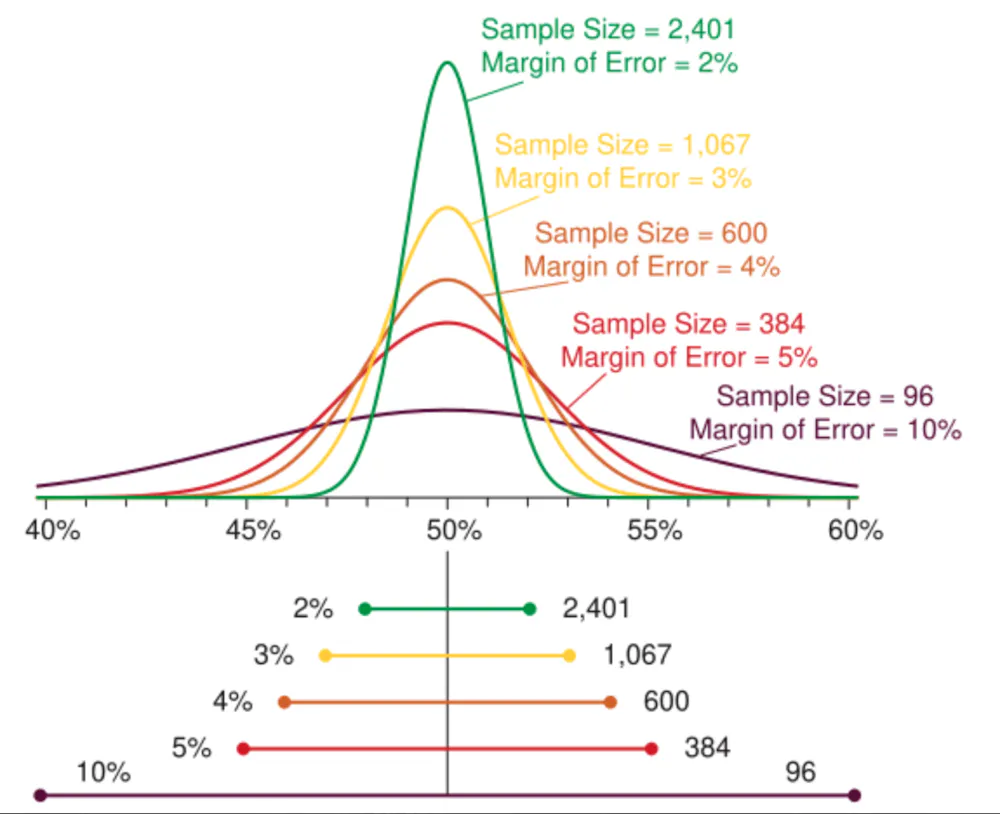
For example, a sample of 600 voters will have a larger margin of error – about 4 percentage points – than a sample of 1,000 voters, which has a margin of error of just over 3 percentage points.
The way the sample is chosen also matters: In 1936, the Literary Digest magazine polled people on the presidential election by mailing surveys to telephone owners, car owners and country club members. Everyone in this group was relatively affluent, so they were not representative of the whole U.S. voting population. Calculating a margin of error would have been meaningless because the sample did not capture all segments of the population.
Let’s use an example of how to understand the margin of error. If a poll shows that 47% of the polled group support Candidate A, and the margin of error is plus or minus 3 percentage points, that means that the percentage in the population supporting Candidate A is likely to be between 44% (47 minus 3) and 50% (47 plus 3).
One quick note: Most polls report margins of error alongside another technical term, “confidence interval.” In the most rigorous reporting of polls, you might see a sentence near the end that says something like “The margin of error is plus or minus 3 percentage points, at a 95% confidence interval.” What all that means is this: Imagine if 100 different random samples of the same size were selected from the larger group, and then asked the same questions in the poll. The 95% confidence interval means that 95% of the time, those other polls’ responses would be within 3 percentage points of the answers reported in this one poll.
Comparing support between candidates
The concept of margin of error gets more complex when looking at the differences in support between two candidates. If a margin of error is plus or minus 3 percentage points, the margin of error on the difference between them is about double – or 6 percentage points, in this example.
That’s because the margin of error here is a combined one, and refers to not just the percentage voting for Candidate A but also to the percentage voting for the other candidate.
To look back at 2016 again, the final Quinnipiac University Poll in Florida before Election Day showed Clinton with 46% support and Trump with 45% support. The margin of error was 3.9 percentage points, which meant Clinton was likely to get between 42.1% and 49.9% of the vote, and Trump was likely to get between 41.1% and 48.9% of the vote.
The actual result was that Trump won Florida with 48.6%, as compared with Clinton’s 47.4%. Those results were within our poll’s margin of error, meaning we were correct to declare it “too close to call” – and we would have been wrong to say Clinton was ahead.
2024 will be a close election
In the current election cycle, many media reports about polls are not including information about the margin of error.
Leaving out that information, or downplaying its significance, may help media outlets provide a quick, simple picture about the state of the race. Technology can seem precise in the modern age of the internet and artificial intelligence.
But polling is not as precise. It is an inexact science. It’s a pollster’s job to capture snapshots of the complexities of human nature at a particular time. People’s minds can change, and new information can arise as the campaigns unfold.
With the presidential election in its final weeks, our polls have been finding a fairly tight and steady race, with most voters telling us their minds are made up. Because the difference between the presidential candidates is within the margin of error in swing states, the election polling in autumn 2024 is telling Americans to hold their breath and make sure they vote, because it is likely to be a squeaker.
Doug Schwartz is affiliated with the American Association of Public Opinion Research (AAPOR).
The U.S. Supreme Court recently weighed in on these debates with its 2024 decision in Grants Pass v. Johnson. The court’s ruling grants cities the authority to prohibit individuals from sleeping and camping in public spaces, effectively condoning the use of fines and bans to address rising rates of homelessness.
East Atlanta Village, a historically Black neighborhood in Atlanta with about 3,000 residents, is trying something different. In the fall of 2023, with support from the Atlanta City Council, the mayor’s office and Intown Cares, a local nonprofit that works to alleviate homelessness and hunger, the neighborhood hired a full-time social worker to support people experiencing homelessness.
Michael Nolan, an Intown Cares social worker, is trained in an approach that emphasizes individual autonomy and dignity, recognizes that being homeless is a traumatic experience, and prioritizes access to housing. His role includes helping individuals get the documentation they need to move off the streets, such as copies of their birth certificates and Social Security cards. He also has a dedicated phone line that community members can use to alert him about dangerous situations that involve homeless people.
Michael Nolan, East Atlanta Village’s social worker, spends 40-plus hours weekly providing supplies, services and other help to people experiencing homelessness.
I am a researcher at the University of Washington studying programs and technologies that help urban neighborhoods flourish. I’m also a resident of East Atlanta Village and have helped the neighborhood organize and evaluate this experiment.
For the past year, my colleagues and I have collected data about the neighborhood social work program to understand how well it can support both people without housing and the broader community. Our preliminary findings suggest that neighborhood social work is a promising way to address challenges common in many neighborhoods with homelessness.
I believe this approach has the potential to provide long-term solutions to homelessness and improve the health and safety for the entire neighborhood. I also see it as a sharp contrast with the punitive approach condoned by the Supreme Court.
Resolving conflicts over public space
One of the people I interviewed while evaluating this initiative was Rebecca, a resident of East Atlanta Village who walks her dog in the local park every day. In the fall of 2023, she noticed that a man had moved into the park and set up a tent. At first, the area was clean, but within a few weeks there was garbage around the tent and throughout the park.
Rebecca felt that the trash was ruining one of the few green spaces in the neighborhood. She decided to contact Nolan. Nolan told her that he knew the unhoused man, was working with him to secure permanent housing and in the meantime would help him move his tent to a less-frequented space.
Such negotiations around public spaces are common challenges for neighborhoods with large homeless populations, especially in dense urban areas. Other examples in our data included conflicts when a homeless person began sleeping in his car outside another resident’s home, and when a homeless man wandered into a homeowner’s yard.
The standard approach in these situations is to fine, ban or imprison the unhoused individual. But those strategies are expensive, can prolong homelessness and do little to actually resolve the issues.
In contrast, hiring a social worker has enabled East Atlanta Village to resolve conflicts gently, through conversation and negotiation. The solutions address concerns about public health and safety and also offer people without homes an opportunity for long-term change.
Meeting basic needs
Over the past year, this program has helped 13 people move into housing. Nolan has facilitated over 180 medical and mental health care visits for people living on the street.
Eighty-six people have been connected to Medicaid, food assistance or Social Security benefits. Thirty-five people have health care for the first time, and six people have started receiving medication for their addictions.
Research shows that addressing people’s basic needs by helping them obtain food, medicine, housing and other necessities not only supports those individuals but also produces cascading benefits for the entire community. They include reduced inequality, better health outcomes and lower crime rates.
Managing mental and behavioral health
Studies have found that about two-thirds of unhoused individuals struggle with mental health challenges. Unmet mental and behavioral health needs can contribute to unsafe and illegal behavior.
The United States does not have a comprehensive system in place for supporting people who are living on the street and struggling with chronic mental and behavioral health challenges. While much more infrastructure is needed, in East Atlanta Village, Nolan is able to check in on people experiencing homelessness, work with clinics to deliver medication for addiction and mental health needs and alert community members about dangerous situations.
As an example, in December 2023 a homeless man was arrested in East Atlanta Village for trespassing, stealing mail and other erratic behavior. When concerned residents posted to the neighborhood Facebook group, Nolan responded that he knew the man well, that this behavior was not typical and that he would look into the situation.
Nolan later updated his post, commenting that the man had been arrested but that he would “continue to follow up and ensure that his current behaviors do not return upon his release.”
In other examples, Nolan has helped de-escalate situations when people experienced mental health episodes in local coffee shops and churches.
A model for other cities
Cities around the U.S. have decisions to make about addressing homelessness and its associated challenges. Neighborhood social work is not a magic bullet, but my colleagues and I see it as a promising approach to address the most common challenges that neighborhoods with high rates of homelessness face.
East Atlanta Village is currently working with the Atlanta City Council to renew funding for this program, which cost US$100,000 in its initial year. We hope that other neighborhoods also consider this strategy when deciding how to address homelessness in their own areas.
Ishita Chordia is affiliated with the East Atlanta Neighborhood Association. She volunteers for the neighborhood association and has helped organize and evaluate the neighborhood social work program.
Source: The Conversation – USA – By Christopher A. Cooper, Professor of Political Science & Public Affairs, Western Carolina University
Lt. Gov. Mark Robinson shares the stage with former U.S. President Donald Trump during a 2022 rally in Selma, N.C.Allison Joyce/Getty Images
For all its prominence as a key battleground state, North Carolina hasn’t done much swinging in U.S. presidential elections.
The last time a majority of North Carolinians voted for a Democratic candidate was 2008 for Barack Obama. The time before that was 1976 for Jimmy Carter. In the past 12 presidential elections, Republicans have won 10. Those Republicans include Donald Trump in 2016 and 2020.
But as I demonstrate in my 2024 book, “Anatomy of a Purple State: A North Carolina Politics Primer,” simply looking at the outcome of presidential voting gives a skewed understanding of voting behavior in other elections across the state.
Consider 2020 again. While it is true that Trump won North Carolina’s 15 electoral college votes – it now has 16, based on 2020 U.S Census Bureau data — his margin of victory was only about 74,000 votes out of some 5.4 million votes cast. It was the smallest margin of any state that Trump won.
Part of the reason is the nearly even split among voters in the two major parties and the emergence of registered voters who claim they are unaffiliated.
Despite being considered a red state, North Carolina’s congressional delegation is split evenly between Democrats and Republicans with seven each. In addition, four of the state’s 10 statewide, elected Council of State officeholders, including Gov. Roy Cooper, are Democrats.
Though both of North Carolina’s U.S. senators are Republicans and the GOP holds supermajorities in both houses of the state Legislature, North Carolina is not entirely red or blue. It is undeniably purple – and that gives rise to further uncertainty over how the state will vote in the 2024 presidential election.
The Kamala Harris factor
Before U.S. President Joe Biden dropped out of the race in July 2024, polls showed that he lagged behind Trump by 5 percentage points in North Carolina.
As in many other battleground states, it appeared that Trump had a small but fairly durable lead over Biden.
Vice President Kamala Harris campaigns in Greenville, N.C., on Oct. 13, 2024. Alex Wong/Getty Images
For the first time in years, Democratic Party registration began to exceed Republican Party registration in the state.
From July 20-26, 2,351 people registered as Democrats in North Carolina – a 44% increase compared with the previous week. During the same period, Republican and unaffiliated voter registrations were down 23% and 14%, respectively, from the previous week.
The rise and fall of Mark Robinson
In spring 2024, during the height of primary season, Trump stepped into the North Carolina gubernatorial race by endorsing Lt. Gov. Mark Robinson, a Black Republican with a history of derogatory comments about Muslims and members of the LGBTQ community.
“This is a Martin Luther King on steroids,” Trump said of Robinson during a rally in Greensboro, North Carolina, on March 2, 2024.
Given Trump’s two wins in the state, his endorsement was expected to help Robinson beat Democrat Josh Stein in one of the nation’s most competitive state elections.
But Trump’s enthusiasm all but vanished after a series of negative stories about Robinson. They included a Sept. 19, 2024, CNN report alleging that Robinson frequented a porn web site called “Nude Africa” years ago where he described himself as a “Black Nazi.” Robinson also allegedly made a number of misogynistic and racist statements such as “slavery is not bad.”
Trump made another campaign stop in Wilmington on Sept. 21, 2024. Robinson, who had frequently appeared with Trump at previous North Carolina rallies, was not on the stage.
Polling conducted after CNN’s bombshell report showed an election that had shifted from competitive to one where the Democrat Stein is favored by a large margin to become North Carolina’s governor.
It is unclear whether Robinson’s apparent demise will affect the top of the ticket – or other state GOP candidates.
Natural disasters
Hurricane Helene hit western North Carolina on Sept. 28 and brought high winds, flooding, an estimated US$47 billion in property damages and 250 deaths.
It also caused questions about access to voting in areas devastated by Helene and then, two weeks later, Hurricane Milton.
A woman in North Carolina places an American flag near a mobile home that was destroyed in October 2024 by Hurricane Helene. Mario Tama/Getty Images
Twenty-nine counties in North Carolina were affected by the storm, although 13 counties received the brunt of the damage. Analysis of data from the North Carolina Board of Elections reveals that Trump led Biden by about a 10 percentage-point margin among voters in those affected counties.
Given this, lower turnout in this region might hurt Trump more than Harris. It’s little surprise then that the Trump campaign has called for expanding voting access in those areas.
But there’s no way to know who will receive North Carolina’s 16 Electoral College votes. Such is the unpredictable politics of a purple state.
Christopher A. Cooper does not work for, consult, own shares in or receive funding from any company or organization that would benefit from this article, and has disclosed no relevant affiliations beyond their academic appointment.
Source: The Conversation – USA – By Neil K R Sehgal, PhD Student in Computer & Information Science, University of Pennsylvania
A statue of Jefferson Davis, second from left, is on display in Statuary Hall on Capitol Hill in Washington. A slaveholder, Davis represented Mississippi in the Senate and House before the American Civil War.AP Photo/Susan Walsh, File
One way to measure the legacy of slavery is to determine whether the disproportionate riches of slaveholders have been passed down to their present-day descendants.
Connecting the wealth of a slaveholder in the 1860s to today’s economic conditions is not easy. Doing so requires unearthing data for a large number of people on slaveholder ancestry, current wealth and other factors such as age and education.
But in a new study, we tackled this challenge by focusing on one of the few groups of Americans for whom such information exists: members of Congress. We found that legislators who are descendants of slaveholders are significantly wealthier than members of Congress without slaveholder ancestry.
How slavery made the South rich
In 1860, one year before the Civil War, the market value of U.S. slaves was larger than that of all American railroads and factories.
At the time of emancipation in 1863, the estimated value of all enslaved people was roughly US$13 trillion in today’s dollars. The lower Mississippi Valley had more millionaires, all of them slaveholders, than anywhere else in the country.
More recently, however, historians discovered that, while the South fell behind the North economically immediately following emancipation, many elite slaveholders recovered financially within one or two generations.
They accomplished this by replacing slavery with sharecropping – a kind of indentured servitude that trapped Black farm workers in debt to white landowners – and enacting discriminatory Jim Crow laws that enforced racial segregation.
Of its 535 members, 100 were descendants of slaveholders, including Democratic Sen. Elizabeth Warren and Republican Sen. Mitch McConnell.
Legislators whose ancestors were large slaveholders – defined in our study as owning 16 or more slaves– have a current median net worth five times larger than their peers whose ancestors were not slaveholders: $5.6 million vs. $1.1 million. These results remained largely the same after accounting for age, race and education.
Wealth creates many privileges – the means to start a business or pursue higher education. And intergenerational wealth transfers can allow these advantages to persist across generations.
Because members of Congress are a highly select group, our results may not apply to all Americans. However, the findings align with other studies on the transfers of wealth and privilege across generations in the U.S. and Europe.
Wealth, these studies find, often stays within rich families across multiple generations. Mechanisms for holding onto wealth include low estate taxes and access to elite social networks and schools. Easy entry into powerful jobs and political influence also play a part.
Privilege with power
But members of Congress do not just inherit wealth and advantages.
They shape the lives of all Americans. They decide how to allocate federal funds, set tax rates and create regulations.
This power is significant. And for those whose families benefited from slavery, it can perpetuate economic policies that maintain wealth inequality.
Beyond inherited wealth, the legacy of slavery endures in policies enacted by those in power – by legislators who may be less likely to prioritize reforms that challenge the status quo.
The economic deprivation still experienced by Black Americans is the flip side of the privilege enjoyed by slaveowners’ descendants. The median household wealth of white Americans today is six times higher than that of Black Americans – $285,000 versus $45,000.
Meanwhile, federal agencies that enforce antidiscrimination laws remain underfunded. This limits their ability to address racial disparities.
Legislators in the House of Representatives debate the abolition of the 1836 gag rule, which prevented discussion of any laws concerning slavery. MPI/Getty Images
There are, however, other ways to improve opportunities for historically disadvantaged populations that could gain bipartisan backing.
A majority of Americans, both conservatives and liberal, support increased funding for environmental hazard screening, which assesses the potential impact of a proposed project. They also favor limits on rent increases, better public school funding and raising taxes on the wealthy.
These measures would help dismantle the structural barriers that perpetuate economic disparities. And the role of Congress here is central.
Members of Congress do not bear personal responsibility for their ancestors’ actions. But they have an opportunity to address both the legacies of past injustices and today’s inequalities.
By doing so, they can help create a future where ancestral history does not determine economic destiny.
The authors do not work for, consult, own shares in or receive funding from any company or organization that would benefit from this article, and have disclosed no relevant affiliations beyond their academic appointment.
Embrace change, they say, or become a casualty. This adage weighed heavily on my mind during my latest research trip to the Arctic. Repeatedly, I found myself clutching the .303 calibre rifle over my shoulder — a piece of equipment I once considered unnecessary.
As my research assistants and I crossed the tundra of Victoria Island in northern Canada, firearms were only the most obvious addition to our gear. Each of us carried a whistle around our neck, a canister of bear spray on our hip, and new alertness in our routine. Back at our camp near Wellington Bay, Nunavut, an electric fence surrounded our tents. Grizzly bears were new inhabitants on this island. Safety called for different provisions and a different mindset.
After three decades, I had returned north with a purpose: to assess how tundra plants were responding in a rapidly changing climate. For my assistants and me, the plan was straightforward. We would return to the exact sites I had studied some 30 years earlier, to evaluate how they had changed during those intervening years.
By the end, I learned a more fundamental point: that perseverance, and long-term planning, are the key to enabling scientific progress and unlocking ecological secrets.
In the Arctic, the pace of environmental change is especially troubling. Species like grizzlies and orcas are advancing northward, weather is more volatile and sea ice is shrinking — driven by temperatures rising nearly four times more quickly than the global average.
While the significance of the Arctic is planetary, an encounter with the land is intensely personal.
North of the treeline, in the expanse of arctic tundra, you take in the whole horizon. In summer, you hear the distant bugling of cranes and geese as you walk boundlessly in the midnight sun.
In winter, you may come upon a band of caribou as you travel atop the wind-sculpted snow. Once you’ve stood north of the treeline, your worldview is transformed.
I am one of those transformed individuals. As a graduate student in the 1990s, I resided at Ekalluktok — a special place on the south coast of Victoria Island where the migrations of char and caribou intersect, where Inuit have lived for thousands of years. Here I studied the abundance and variety of tundra plants.
Today, the Arctic has already blown past 2 C of warming. Understanding the effects of climate change on this island could provide insights into the dynamics of change across the entire Arctic region.
Plants, foundation of the food chain, are a top research priority. Shifts in the flora are likely to be consequential to herbivores such as muskoxen and caribou — and therefore to people.
Measuring change
Nature reveals her swings and proclivities with reluctance. To prise open those mysteries, I added a key ingredient: time. On this return trip, I intended to walk back decades to uncover the response of plants in an altered climate by using precisely the same methods at precisely the same locations as I had in the 1990s.
For deciphering ecological change, it’s a potent recipe: measure, add decades, repeat.
Our more immediate challenge was finding those same locations. Three decades earlier, in the days before GPS, I had marked each location with a metal stake. Now, I trusted that stakes, too, “stand still and wait to be revisited.”
For weeks, my assistants and I scoured the land for those stakes, guided by maps, memory and a metal detector. And our search — sometimes easy and direct, sometimes meandering and desperate — yielded 98 per cent of them.
At each stake, we bent low, occasionally on hands and knees, to tally the abundance of sedges, shrubs, lichens and diminutive wildflowers. It was a repeat performance from my original study almost three decades earlier.
Grasses and sedges increased substantially, an example of arctic greening, regarded as one of the world’s clearest illustrations of climate change effects. Some species — notably purple saxifrage, the official flower of Nunavut — declined dramatically, contributing to arctic browning.
Many other plants showed no apparent change, suggesting climatic resilience, at least over decades. But across the Arctic, the picture of vegetation change remains incomplete, complicated by variations among species and regions. Sustained science will be needed to unravel this ecological complexity.
Funding the long-term
That broader message, unforeseen to me at the outset, is now clear.
Without precisely paired observations, the vegetation shifts at Ekalluktok would have been indistinct. Elegant in their simplicity, repeat observations offer a double vantage point: an instant retrospective for decoding the past and a foundation for monitoring the future.
Managing change starts with awareness. And in a changing world, sustained science will be essential to interpret, mitigate and steer us along a favourable path. Conservation is not a sprint, but a determined trek toward better understanding and a better future.
James Schaefer received funding from Arctic Species Conservation Fund (WWF-Canada), Kenneth M. Molson Charitable Foundation, Northern Studies Training Program (Polar Knowledge Canada), Symons Trust for Canadian Studies, and Trent University.
Make no mistake, New Brunswick Premier Blaine Higgs lost big on Monday night. The province’s voters delivered a forceful rebuke of Higgs’ Progressive Conservatives similar to the 1995 election, when the party won only six seats against Frank McKenna’s Liberals.
Research shows trans children have high rates of suicidal ideation, especially when they’re not supported in how they identify.
Over time, Higgs supported anti-trans and anti-sex education protesters, even as many advocates, parents and educators raised concerns about the safety and mental well-being of LGBTQ+ youth. He also refused to deny what’s known as the so-called kitty litter myth that falsely alleges students are allowed to identify as animals and use litter boxes.
When confronted by parents about a safe-sex presentation slide for a high-school audience, Higgs banned the group that conducted the presentation.
It didn’t end there. Higgs erroneously suggested an Indigenous nation sought to claim most of the province from property owners. In 2021, his government discouraged land acknowledgements by provincial employees. Higgs also argued that Indigenous people had already ceded their land.
Taking aim at francophones, social issues
Higgs’ relationship with francophones was just as bad. He refused to learn French in Canada’s only bilingual province after promising he would. He alleged he was unfairly targeted as an anglophone.
When coming to power in 2018 with a minority government, Higgs weakened bilingual requirements for paramedic positions. Later, he controversially proposed ending French immersion programs, arguing it was unfair to “English Prime” students in the province.
When he won a majority in 2020, Higgs lowered taxes on the highest income earners while constraining increases to health care and education.
Higgs was successful in uniting the right. As a former leadership contender of the linguistic segregationist Confederation of Regions party, Higgs welcomed far-right People’s Alliance representatives to his party.
But his tenure faced internal opposition. Atlantic conservatism tends to be closer to the political centre. Higgs’ Maritime counterparts, Premiers Dennis King of Prince Edward Island and Tim Houston of Nova Scotia, have largely avoided social issues.
On the province’s Policy 713, also called the Sexual Orientation and Gender Identity policy, six PCs voted with an opposition motion against the proposed changes. Four were cabinet ministers.
Several ministers resigned from cabinet with letters blasting Higgs’ leadership.
Almost half of PC riding associations sought a leadership review. They fell just short of the minimum needed to trigger a review.
Most leaders recognize when their time was up. Not Higgs.
An embattled campaign
The PCs’ tumultuous time in government made for an uninspired campaign. Twelve of the 26 winning PC representatives from 2020 did not run again. In their place came more social conservatives who would not oppose Higgs.
The PCs received bad news early. They were projected to fall short of their 2024-25 balanced budget aims.
Still, Higgs campaigned on his fiscal management. He offered a two per cent HST cut as a reward. For some, this proposal rang as vote-buying from a government that could have pursued a sales tax cut at any point in its six-year tenure.
The PCs campaigned on few other commitments. Their two-page platform made generic promises like “respect parents.” They also sought to “compel individuals into drug treatment” and “axe the carbon tax.”
Meanwhile, the Liberals hammered the PCs on housing, health care and education. All three areas had been stressed by population growth and tight funding. Housing policy was a particular weakness given the PCs’ long-term resistance to rent caps and its record as a housing-starts laggard.
Higgs’ confidence in his record was misplaced. While his social conservativism has an audience in New Brunswick, few saw it as a priority relative to the cost of living.
His other campaign efforts made little difference. Higgs sought to make his opponent Prime Minister Justin Trudeau. He also stirred anti-immigration sentiment over federal asylum-seeker plans. Both efforts seemed desperate.
Rejection of grievance politics?
The Liberals’ return to power could be attributed to a referendum on Higgs. There is no doubt Higgs had personal defects that cost him his own riding.
But his loss is more than a personal rejection. It also seems a rejection of a grievance politics that favours anger over substance.
After repeatedly focusing on social issues over matters like housing, the grievances lost their allure. Even for the most steadfast Conservative voters, Higgs’ targeting of minorities came across as bullying.
While Higgs may be the worst offender, he is not the only practitioner of grievance conservatism. Federal Conservative Leader Pierre Poilievre and Alberta Premier Danielle Smith play the same tune. Will their political fates be any different?
Noah Fry does not work for, consult, own shares in or receive funding from any company or organisation that would benefit from this article, and has disclosed no relevant affiliations beyond their academic appointment.
Scurvy is is often considered a historical ailment, conjuring images of sailors on long sea voyages suffering from a lack of fresh fruit and vegetables.
Yet doctors in developed countries have recently reported treating cases of scurvy, including Australian doctors who reported their findings today in the journal BMJ Case Reports.
What is scurvy?
Scurvy is a disease caused by a severe deficiency of vitamin C (ascorbic acid), which is essential for the production of collagen. This protein helps maintain the health of skin, blood vessels, bones and connective tissue.
Without enough vitamin C, the body cannot properly repair tissues, heal wounds, or fight infections. This can lead to a range of symptoms including:
fatigue and weakness
swollen, bleeding gums or loose teeth
joint and muscle pain and tenderness
bruising easily
dry, rough or discoloured skin (reddish or purple spots due to bleeding under the skin)
cuts and sores take longer to heal
anaemia (a shortage of red blood cells, leading to further fatigue and weakness)
increased susceptibility to infections.
It historically affected sailors
Scurvy was common from the 15th to 18th centuries, when naval sailors and other explorers lived on rations or went without fresh food for long periods. You might have heard some of these milestones in the history of the disease:
in 1497-1499, Vasco da Gama’s crew suffered severely from scurvy during their expedition to India, with a large portion of the crew dying from it
from the 16th to 18th centuries, scurvy was rampant among European navies and explorers, affecting notable figures such as Ferdinand Magellan and Sir Francis Drake. It was considered one of the greatest threats to sailors’ health during long voyages
in 1747, British naval surgeon James Lind is thought to have conducted one of the first clinical trials, demonstrating that citrus fruit could prevent and cure scurvy. However, it took several decades for his findings to be widely implemented
In the new case report, doctors in Western Australia reported treating a middle-aged man with the condition. In a separate case report, doctors in Canada reported treating a 65-year old woman.
There’s an abundance of vitamin C in our food supply, but some people still aren’t getting enough. Rebecca Kate/Pexels
Both patients presented with leg weakness and compromised skin, yet the doctors didn’t initially consider scurvy. This was based on the premise that there is abundant vitamin C in our modern food supply, so deficiency should not occur.
On both occasions, treatment with high doses of vitamin C (1,000mg per day for at least seven days) resulted in improvements in symptoms and eventually a full recovery.
The authors of both case reports are concerned that if scurvy is left untreated, it could lead to inflamed blood vessels (vasculitis) and potentially cause fatal bleeding.
Last year, a major New South Wales hospital undertook a chart review, where patient records are reviewed to answer research questions.
This found vitamin C deficiency was common. More than 50% of patients who had their vitamin C levels tested had either a modest deficiency (29.9%) or significant deficiency (24.5%). Deficiencies were more common among patients from rural and lower socioeconomic areas.
Now clinicians are urged to consider vitamin C deficiency and scurvy as a potential diagnosis and involve the support of a dietitian.
Why might scurvy be re-emerging?
Sourcing and consuming nutritious foods with sufficient vitamin C is unfortunately still an issue for some people. Factors that increase the risk of vitamin C deficiency include:
poor diet. People with restricted diets – due to poverty, food insecurity or dietary choices – may not get enough vitamin C. This includes those who rely heavily on processed, nutrient-poor foods rather than fresh produce
food deserts. In areas where access to fresh, affordable fruits and vegetables is limited (often referred to as food deserts), people may unintentionally suffer from a vitamin C deficiency. In some parts of developing countries such as India, lack of access to fresh food is recognised as a risk for scurvy
the cost-of-living crisis. With greater numbers of people unable to pay for fresh produce, people who limit their intake of fruits and vegetables may develop nutrient deficiencies, including scurvy
Capsicums are a good source of vitamin D but they’re not cheap. Pexels/Jack Sparrow
weight loss procedures and medications. Restricted dietary intake due to weight loss surgery or weight loss medications may lead to nutrient deficiencies, such as in this case report of scurvy from Denmark
mental illness and eating disorders. Conditions such as depression and anorexia nervosa can lead to severely restricted diets, increasing the risk of scurvy, such as in this case report from 2020 in Canada
isolation. Older adults, especially those who live alone or in nursing homes, may have difficulty preparing balanced meals with sufficient vitamin C
certain medical conditions. People with digestive disorders, malabsorption issues, or those on restrictive medical diets (due to severe allergies or intolerances) can develop scurvy if they are unable to absorb or consume enough vitamin C.
How much vitamin C do we need?
Australia’s dietary guidelines recommend adults consume 45mg of vitamin C (higher if pregnant or breastfeeding) each day. This is roughly the amount found in half an orange or half a cup of strawberries.
When more vitamin C is consumed than required, excess amounts leave the body through urine.
Signs of scurvy can appear as early as a month after a daily intake of less than 10 mg of vitamin C.
Eating vitamin C-rich foods – such as oranges, strawberries, kiwifruit, plums, pineapple, mango, capsicum, broccoli and Brussels sprouts – can resolve symptoms within a few weeks.
Vitamin C is also readily available as a supplement if there are reasons why intake through food may be compromised. Typically, the supplements contain 1,000mg per tablet, and the recommended upper limit for daily Vitamin C intake is 2,000mg.
Lauren Ball receives funding from the National Health and Medical Research Council, Queensland Health and Mater Misericordia. She is a Director of Dietitians Australia, a Director of Food Standards Australia and New Zealand, a Director of the Darling Downs and West Moreton Primary Health Network and an Associate Member of the Australian Academy of Health and Medical Sciences.
Australia now has a government and parliament wanting timely transition to net zero. We have a government and parliament wanting to build Australia as the renewable energy superpower of the zero-carbon world economy. For the time being, we have favourable international settings for using our opportunity.
The government of Australia has embraced this superpower narrative, taken some big steps towards supporting its emergence, and articulated sound principles for guiding further policy development.
But Australians in business and the community wanting to make large efforts to turn opportunity into reality find themselves in a tangle of policy uncertainty and contradiction.
The source of the problem is the abolition of carbon pricing in 2014. Since then, the Commonwealth government has worked within constraints that rule out success.
We can make a start towards net zero and becoming a renewable energy superpower without moving the constraints, but we can’t get far. This is a problem for any government of Australia, and not only for the current Labor government. We will not rise sustainably out of the post-pandemic dog days until we get energy policy right.
Striking the right balance
Striking the right balance between state intervention and market exchange is always essential for successful economic development, in all places.
The market generally delivers goods and services more cost-effectively than the state where there is genuine competition among suppliers and purchasers of goods and services.
The difference is especially large and important at a time of structural change and uncertainty. State decisions inevitably tend towards continuation on established paths and slow response to new opportunities.
Australia will not make use of more than a small fraction of the superpower opportunities available to it without immense contributions from an innovative, competitive private business sector.
So we have to design energy and related markets that provide the widest possible scope for competition among enterprises within clear rules understood in advance of investment decisions by all market participants.
The state has to do well the things that only the state can do. Because government capacity is a finite resource, it is much more likely that it will do the essential things well if it doesn’t try to do the things that markets do well.
The state must define the boundaries between the services that it delivers and those to be delivered by the market.
In the electricity sector, government must take responsibility for design of the market rules and compliance with them. It must provide the natural monopoly services of electricity transmission and hydrogen transportation and storage. It must take ultimate responsibility for system security and reliability.
For any market to work, individual market participants must be blocked by regulation from damaging others through their business decisions, or subject to a tax equal to the costs they impose on others. And they must be rewarded for large benefits that they confer on others.
This is essential economics. Its understatement in Productivity Commission and financial media commentary on energy and climate policy discussion over the past decade reveals the debasement of Australian political culture that gave us the dog days.
It has been politically incorrect to tell the truth out loud.
It’s time for carbon pricing
A crucial element of post-2030 market design is introduction of a green premium for zero-carbon energy.
It is obviously necessary for low-cost decarbonisation and expansion of the electricity sector and building Australia as a renewable energy superpower. The green premium is crucial for securing international market access for the zero-carbon export industries.
One of the dog days constraints on policy is that there should be no mandatory demands on private investors. Those constraints must be broken for the green premium to reflect the social cost of carbon, as it must if we are to achieve net zero by 2050 and build Australia as the renewable energy superpower.
The economically efficient way of achieving the premium is carbon pricing. It would be most efficient within an economy-wide system, although it could be introduced initially for the electricity sector and extended to other industries later.
Investors now need to know soon that there will be a premium reasonably related to the social cost of carbon after the Renewable Energy Target ends in 2030.
What matters for the superpower industries is the green premiums for which they are eligible in other countries. Pending the emergence of appropriate premiums, the Commonwealth is proposing payments from the budget.
That is appropriate. It can get the early movers started. It would be expensive if it continued for long. The superpower industries will grow rapidly if they have access to premiums corresponding to the social cost of carbon. Over time, payments from the Australian budget will be replaced by market premiums in destination countries.
There are several possible forms of carbon pricing. The system operating in Australia from 2012 to 2014 was economically and environmentally efficient.
It would have been linked to the EU Emissions Trading System from July 1 2014 if it had not been abolished the day before. The Australian carbon price would be equal to the European price. We would be introducing a European-type Carbon Border Adjustment Mechanism to ensure that Australian producers were not disadvantaged by competition in the domestic market from suppliers who were not subject to similar carbon constraints. The ETS (emissions trading scheme) would be contributing around 2% of GDP to public revenues – going a substantial part of the way to answering the daunting budget challenge to restoration of Australian prosperity.
Part of that increased revenue could support payments to power users to ensure there was no increase in power prices to users until expansion of renewable generation and storage had brought costs down – along the lines of the A$300 per household introduced in the 2024 budget, but larger.
The arrangements would provide automatic access for zero-carbon Australian goods to the high-priced European market. There would be no need to provide for a green premium for sales to Europe from the Australian market. The green premiums in other markets would at first need to be covered, as they are now, from the Australian public revenue.
A carbon solutions levy
Rod Sims (former chair of the Australian Competition and Consumer Commission) and I have suggested a carbon solutions levy. It is administratively simpler than the ETS. It would initially raise much more revenue.
We propose exemption for coal and gas exports to countries in which Australian zero-carbon exports attract a premium comparable to the EU carbon price, even if it is not generated through an ETS.
We would hope that if the carbon solutions levy were to be introduced from 2030, our major trading partners would by that time have introduced green premiums that justify exemption from the levy for coal and gas exports to those countries.
The European Union would be exempt from the beginning. The Northeast Asian economies are moving towards eventual justification of exemption. China now has a country-wide emissions trading system.
The carbon price in July 2024 is about A$21 per tonne, having increased by 50% since early in the year. The price is expected to continue rising until it is playing a major role in transformation of Chinese industry.
Incidentally, China undertook to the United Nations Framework Convention on Climate Change that its emissions would peak by 2030, but its rapid expansion of renewable energy generation, electric vehicles and zero-carbon industrial technologies suggest that the peak may have come in 2023.
Japan is working on direct budgetary support for importers of zero-carbon products which could pass through into a premium for zero-carbon exports from Australia.
During a visit in April 2024, I was advised that the Japanese government is working towards issue of “green bonds” to pay for the premium. A carbon tax from 2035 would meet the cost of servicing and retiring the bonds.
Korea and Taiwan are introducing their own mechanisms for supporting premiums for zero-carbon imports.
One initial criticism of the carbon solutions levy is that it would cause leakage of Australian exports to competing suppliers of gas and coal. There would be some leakage, alongside substantial transfers from rents to the public revenues, and for metallurgical coal in particular, some increase in export prices.
The price increase would introduce an element of green premium for Australian green iron exports. The Superpower Institute (a non-profit research organisation founded by Sims and I) has commissioned the Centre of Policy Studies at Victoria University to quantify the extent of leakage, transfers from rent and higher export prices. The results will be available for public discussion early in 2025. The study will also calculate the effect of the levy on Australian public finances, real incomes and real consumption.
Regional considerations
Australia’s main competitor in regional coal markets is Indonesia. Its main competitors in gas markets are Papua New Guinea, East Timor, Indonesia, Brunei and the Middle East petroleum producers.
No informed person would suggest that there could be an economic problem with leakage to the Middle East: Saudi Arabia and the small Gulf states extract revenue from petroleum exports at much higher rates per dollar than Australia would after imposition of the levy.
There is a case in the Australian national interest for not seeing expansion of export sales from Papua New Guinea and East Timor as being entirely a waste.
But in their national interest and ours, I suggest that we seek to negotiate a four-way agreement on climate and energy with Indonesia, East Timor and Papua New Guinea.
We would all impose carbon solutions levy-type levies at similar rates. This would be a major source of revenue for all of us.
Participation of Indonesia removes leakage of coal exports. Indonesia already has an emissions trading scheme, although it generates a carbon price of only a few dollars per tonne.
It may choose to remove other imposts on fossil carbon exports at the time of introduction of new carbon-related measures – such as the requirement to make 35% of coal exports available at prices well below international prices for domestic power generation.
Participation of the four countries removes the leakage issue for gas. The four neighbours would cooperate in major development programs based on expansion of zero-carbon energy supply and goods production.
There is active discussion in Indonesia of archipelago-wide electricity transmission infrastructure to allow the superior renewable energy resources of the outer islands – Papua, Nusa Tenggara, Sulawesi, Kalimantan, Sumatra – to contribute to decarbonisation and growth of zero-carbon industry everywhere, including in the Java heartland.
The Indonesian grid would run close to neighbouring Australia, Papua New Guinea, East Timor, East and West Malaysia and the Philippines. It would be the geopolitically practical means of linking Australia and Singapore, as envisaged in the SunCable project in the Northern Territory.
The Indonesian national grid could link to the Australian Sungrid discussed in my book The Superpower Transformation in Darwin and the Pilbara.
The alternatives to carbon pricing are weak
The alternatives to economy-wide carbon pricing are likely to turn out to be short-lived expedients that lead sooner rather than later to the return of today’s incoherence and underperformance in energy and climate policy and performance.
The state must provide reliability of power supply to the general population.
The Commonwealth government can do this without distorting competitive electricity markets by establishing an energy reserve I have proposed in my book The Superpower Transformation.
The superpower industries depend on electricity and hydrogen markets operating efficiently and embodying carbon prices. Otherwise the market design issues relevant to their development are similar to those for electricity.
Negative carbon externalities need to be corrected by taxation or alternative carbon pricing mechanisms. Positive externalities from innovation should be rewarded.
Positive innovation externalities are important in the introduction of new industries, technologies and business models for the zero-carbon economy.
Economy-wide carbon pricing at the social cost of carbon is essential to getting the balance right between state intervention and market exchange.
Once it is in place with fiscal rewards for innovation, the government can let businesses decide which new industries and technologies warrant investment.
Once carbon pricing is known to be coming into place reasonably soon, there is no further need for government underwriting of investment in power generation.
There is no need to include a climate trigger in assessment of a project of any kind: if it emits carbon, it will pay for the climate damage it does.
There is no need for government to take a view on climate grounds about the merits of nuclear power generation. It is zero-emissions generation and, like renewable energy, not subject to the carbon price. If it can compete with other forms of generation, it will find a place in private investment decisions on the energy mix.
There is no need for government investment in nuclear power generation. Private investors will have the same incentives to invest in nuclear as in other zero-carbon generation technologies.
There will be no need for the government to take a view on incentives for carbon capture and storage. If it is effective and emissions are actually reduced, carbon payments will be correspondingly reduced.
The carbon price will allow private investors to get on with the job of expanding renewable energy supply at a rapid pace and decarbonising the economy more generally.
Ross Garnaut is a Director and shareholder of Zen Energy. Together with Rod Sims, Ross is a co-founder and Director of The Superpower Institute, a not for profit think tank.
Every year, 7.6 million tonnes of food is lost or wasted in Australia. When we think about this, we might picture mouldy fruit, stale bread and overly full fridges. But in fact, almost half of this waste happens before food ever gets to us. Waste is common in food production, processing and transportation.
For example, the process of making cheese from milk results in a comparatively small amount of cheese and a lot of whey – up to 90% the mass of the raw milk.
Whey is useful, as it still has about half the nutrients of milk. But whey remains one of the largest sources of food loss and waste in Australia’s large dairy sector. Every year, about 350 million litres goes down the drain, costing businesses over A$580 million to dispose of it and wasting some of the resources it takes to make milk.
In our new research, we interviewed cheesemakers from 42 companies – representing almost a third of Australia’s cheese industry.
We found cheesemakers knew what waste whey could be used for but were put off by practical challenges.
You can already buy whey products such as fermented drinks and protein powders. Infant formula may contain the highly valuable lactoferrin, which would be usually left in whey. A popular Swiss soft drink, Rivella, is also made from whey.
In Australia, some producers have begun making alcoholic spirits by fermenting the lactose in whey. Researchers have found whey-based alcohol can emit less greenhouse gases than traditional grains.
Our research found over half of our cheesemakers were using multiple methods to reduce whey going to waste, from making animal feed to making ricotta to irrigating paddocks. Even so, there is still room to make much more use of whey.
What did we find?
Every year, 43% of all milk produced in Australia is used to make cheese – about eight billion litres a year. When we did this research, there were 132 cheesemakers, using cow, goat, sheep, and camel milk to make cheese. The industry is characterised by a few large manufacturers (about 2% of companies) and many small manufacturers (about 90% of the total). Cheesemakers are largely concentrated in Australia’s southeast.
To understand the challenge of avoiding whey waste, we spoke to cheesemakers, big and small, right across Australia between November 2022 and June 2023.
All of our cheesemaker respondents knew of at least one whey-based product.
But there were barriers to using whey themselves by a range of things, from the set-up cost of a new facility to the challenge of scale, competing priorities and the distance to potential partners. As one respondent said:
Every single part of the business would have to be changed, upgraded, or increased to accommodate using the whey in any way
Another said:
We’re all doing 60 to 70-hour weeks and you [need] someone to actually drive it
How can we overcome the barriers?
Based on our interviews, we found four possible ways to encourage cheesemakers to put their whey to use:
turning whey into value-added products in-house. This could be quite effective – one of our respondents reported making more money from whey-based products than cheese. But setting it up requires time and money.
engaging other companies to take the waste. Partnering with outside companies can help overcome time and money issues – but everyone needs to agree on a price for a product previously considered waste.
starting joint ventures, such as teaming up with other cheesemakers. This method suits cheesemakers wanting to keep the value of the whey. Successful ventures require clear leadership and transparent business plans.
scaling up. Some cheesemakers are already using their own whey. If they move to accept whey from other makers, they can scale up – as long as the new whey sources can meet their specifications.
We found giving Australian cheesemakers the full range of options greatly increased how willing they were to find ways to use whey.
When they only had in-house options, 33% of respondents said they would find ways to use way. This rose to 79% when all four options were available.
Even once the cheese has been made, the whey left behind contains proteins and other nutrients. guys_who_shoot/Shutterstock
Which whey forward?
Our research shows there’s no silver bullet to solve whey waste. We’ll have to come at it from different angles and focus on collaboration between cheesemakers, governments, industry bodies and consumers.
One crucial thing is to make sure there there is demand for these changes. In separate research, we found there is currently little expectation from consumers and retailers about what happens to whey waste. Increasing demand for whey-based products and setting expectations for cheesemaking practices could drive this change. But food safety regulations and taxes on alcohol can make it more challenging still for makers.
In regions with a cluster of cheesemakers, it might make more sense for one or two makers to take all the whey waste and turn it into value-added products to benefit from the scale. While many cheesemakers told us they felt isolated from potential partners, we found a potential partner was right around the corner – just one or two kilometres in most cases.
This is where decision support tools may be able to help in future. These software tools help you lay out your options so you can compare them and pick the best one. They can take into account financial outlay, risks and environmental impacts.
The good news is, there is an abundant, nutrient rich byproduct able to be converted into other products. The challenge now is to find ways of boosting collaboration between cheesemakers and other companies – and ensuring whey-based products have a market.
Jack Hetherington’s PhD project receives funding from the End Food Waste Cooperative Research Centre, CSIRO and the University of Adelaide. Jack is currently the Treasurer for the Landcare Association of South Australia and a member of the SA Crawford Fund committee.
Adam James Loch has received funding from the Australian Research Council, the South Australian Department for Environment and Water, and the European Commission.
Pablo Juliano does not work for, consult, own shares in or receive funding from any company or organisation that would benefit from this article, and has disclosed no relevant affiliations beyond their academic appointment.
A large communications satellite has broken up in orbit, affecting users in Europe, Central Africa, the Middle East, Asia and Australia, and adding to the growing swarm of space junk clouding our planet’s neighbourhood.
The Intelsat 33e satellite provided broadband communication from a point some 35,000km above the Indian Ocean, in a geostationary orbit around the equator.
Initial reports on October 20 said Intelsat 33e had experienced a sudden power loss. Hours later, US Space Forces-Space confirmed the satellite appears to have broken up into at least 20 pieces.
So what happened? And is this a sign of things to come as more and more satellites head into orbit?
A space whodunnit
There are no confirmed reports about what caused the breakup of Intelsat 33e. However, it is not the first event of its kind.
What we do know is that Intelsat 33e has a history of issues while in orbit. Designed and manufactured by Boeing, the satellite was launched in August 2016.
In 2017, the satellite reached its desired orbit three months later than anticipated, due to a reported issue with its primary thruster, which controls its altitude and acceleration.
More propulsion troubles emerged when the satellite performed something called a station keeping activity, which keeps it at the right altitude. It was burning more fuel than expected, which meant its mission would end around 3.5 years early, in 2027. Intelsat lodged a US$78 million insurance claim as a result of these problems.
However, at the time of its breakup, the satellite was reportedly not insured.
Intelsat is investigating what went wrong, but we may never know exactly what caused the satellite to fragment. We do know another Intelsat satellite of the same model, a Boeing-built EpicNG 702 MP, failed in 2019.
More importantly, we can learn from the aftermath of the breakup: space junk.
30 blue whales of space junk
The amount of debris in orbit around Earth is increasing rapidly. The European Space Agency (ESA) estimates there are more than 40,000 pieces larger than 10cm in orbit, and more than 130,000,000 smaller than 1cm.
The total mass of human-made space objects in Earth orbit is some 13,000 tonnes. That’s about the same mass as 90 adult male blue whales. About one third of this mass is debris (4,300 tonnes), mostly in the form of leftover rocket bodies.
Tracking and identifying space debris is a challenging task. At higher altitudes, such as Intelsat 33e’s orbit around 35,000km up, we can only see objects above a certain size.
Visualisation of debris around the Earth.
One of the most concerning things about the loss of Intelsat 33e is that the breakup likely produced debris that is too small for us to see from ground level with current facilities.
The past few months have seen a string of uncontrolled breakups of decommissioned and abandoned objects in orbit.
In June, the RESURS-P1 satellite fractured in low Earth orbit (an altitude of around 470km), creating more than 100 trackable pieces of debris. This event also likely created many more pieces of debris too small to be tracked.
It is not yet known whether this most recent event will affect other objects in orbit. This is where continuous monitoring of the sky becomes vital, to understand these complex space debris environments.
Who is responsible?
When space debris is created, who is responsible for cleaning it up or monitoring it?
In practice, there is often little accountability. The first fine over space debris was issued in 2023 by the US Federal Communications Commission.
It’s not clear whether a similar fine will be issued in the case of Intelsat 33e.
Looking ahead
As the human use of space accelerates, Earth orbit is growing increasingly crowded. To manage the hazards of orbital debris, we will need continuous monitoring and improved tracking technology alongside deliberate efforts to minimise the amount of debris.
Most satellites are much closer to Earth than Intelsat 33e. Often these low Earth orbit satellites can be safely brought down from orbit (or “de-orbited”) at the end of their missions without creating space debris, especially with a bit of forward planning.
In September, ESA’s Cluster 2 “Salsa” satellite was de-orbited with a targeted re-entry into Earth’s atmosphere, burning up safely.
Of course, the bigger the space object, the more debris it can produce. NASA’s Orbital Debris Program Office calculated the International Space Station would produce more than 220 million debris fragments if it broke up in orbit, for example.
Accordingly, planning for de-orbiting of the station (ISS) at the end of its operational life in 2030 is now well underway, with the contract awarded to SpaceX.
Christopher Fluke works for Swinburne University of Technology. He has previously received funding from the SmartSat CRC, including funding to support a research collaboration with CGI Australia (Space, Defence and Intelligence). He is a member of the International Astronomical Union.
Sara Webb and Tallulah Waterson do not work for, consult, own shares in or receive funding from any company or organisation that would benefit from this article, and have disclosed no relevant affiliations beyond their academic appointment.
Science and Nature, two leading science journals, have revealed a growing problem: an alarming rise in fraudulent research papers produced by shady paper mill companies. This wave of fake studies is creating a major headache for the academic world, putting the integrity of global academic research at risk.
Paper mill companies offer authorship services to researchers, academics, and students who want their names listed as an author of a scientific article published in reputable scientific journals.
By paying around €180 to €5000 (approximately US$197 – $5472), a person can have their name listed as the author of research paper, without having to painstakingly do research and write the results. No doubt, some experts refer to these paper mills as illegal and criminal organizations.
A 2023 research highlights a dramatic increase in fraudulent scientific artiles traced back to paper mills. In just five years, the numbers of retractions soared jumped from 10 in 2019 to 2,099 in 2023.
Paper mills are found operating in countries whose research policies incentivise researchers to produce as many scientific articles as possible, such as China, Russia, India and Iran.
Based on research data and investigative journalist reports from the last five years, I summarise how these paper mills operate and how to detect them.
They also offer to rewrite scientific articles using generative artificial intelligence tools, such as ChatGPT and Quillbot, or to translate published articles from other languages into English.
2. A promised path to publication
In some cases, paper mills offer authorship slots before an article is accepted for publication.
In other cases, they offer authorship slots after the article is ready to be published by the journal.
Therefore, it is not uncommon for paper mills to sell authorship slots with a guarantee that the article will definitely be published. In fact, according to the conventions generally accepted in the academic community, no well-run journal can give such a guarantee.
Publishing decisions are normally made only after editors have considered the feedback from peer reviewers. This means, there is no possibility for a manuscript to secure acceptance before passing the peer review process.
To smooth the way for their operations, some paper mills even operate like a cartel, bribing rogue journal editors to ensure publication. A 2024 investigation by a Science journalist revealed that some scientific journal editors were offered as much as $20,000 to cooperate with these schemes. This investigation resulted in more than 30 editors of reputable international journals identified as involved in paper mill activities.
4. Unusual collaboration patterns
One of the peculiarities of paper mill articles is its strange mix of authors. An article on the activity of ground beetles attacking crops in Kazakhstan, for example, is written by authors who are neither affiliated with institutions in Kazakhstan nor experts in insects or agriculture. The authors’ backgrounds are suspiciously heterogeneous, ranging from anaesthesia, dentistry, to biomedical engineering.
5. Anonymous co-authors
Prospective customers of paper mill services usually have to agree to the rules of confidentiality. By agreeing to this rule, buyers have no idea which journal their article will target or who their co-authors will be. Often, the authors listed on the same paper don’t even know each other.
Spotting the red flags: how to detect paper mills articles
Detecting scientific articles produced by paper mills often begins with analyzing retraction patterns carried out by journals.
This can be done in two ways: by tracking post-publication peer reviews on platforms like PubPeer, or by checking the Retraction Watch database, a website that documents retractions of problematic scientific articles.
The proportion of scientific articles retracted for being associated with paper mills is much smaller than the estimated total number of paper mill articles currently in circulation.
Retraction Watch data, as of May 2024, only recorded 7,275 retractions of articles related to the paper mill out of a total of 44,000 retractions recorded. In fact, it is estimated that up to 400,000 paper mill articles have infiltrated scientific literature over the past two decades.
The UK Research Integrity Office—an independent UK charity that offers support to the public, researchers and organisations to promote good academic research practice—estimates that the paper mill industry has gained around $10 million globally.
For example, a Russian paper mill could earn $6.5 million if they sold all the authorship of scientific articles it produced from 2019 to 2021.
In Indonesia, this financial loss directly impacts the public. Public universities rely on the state budget, funded largely by taxpayers, and tuition fees from students to cover operational expenses, including research grants and publication incentives.
Though the exact financial toll of these paper mills is hard to pin down, it is clear that the public are footing the bill for fraudulent research practices, siphoning resources away from enuin academic advancements.
Rizqy Amelia Zein tidak bekerja, menjadi konsultan, memiliki saham, atau menerima dana dari perusahaan atau organisasi mana pun yang akan mengambil untung dari artikel ini, dan telah mengungkapkan bahwa ia tidak memiliki afiliasi selain yang telah disebut di atas.
Source: The Conversation (Au and NZ) – By Mark Patrick Taylor, Chief Environmental Scientist, EPA Victoria; Honorary Professor, School of Natural Sciences, Macquarie University
Most of us are fortunate that, when we turn on the tap, clean, safe and high-quality water comes out.
But a senate inquiry into the presence of PFAS or “forever chemicals” is putting the safety of our drinking water back in the spotlight.
Lidia Thorpe, the independent senator leading the inquiry, says Elders in the Aboriginal community of Wreck Bay in New South Wales are “buying bottled water out of their aged care packages” due to concerns about the health impacts of PFAS in their drinking water.
So, how is water deemed safe to drink in Australia? And why does water quality differ in some areas?
Here’s what happens between a water catchment and your tap.
Human intervention in the water cycle
There is no “new” water on Earth. The water we drink can be up to 4.5 billion years old and is continuously recycled through the hydrological cycle. This transfers water from the ground to the atmosphere through evaporation and back again (for example, through rain).
Humans interfere with this natural cycle by trapping and redirecting water from various sources to use. A lot happens before it reaches your home.
The quality of the water when you turn on the tap depends on a range of factors, including the local geology, what kind of activities happen in catchment areas, and the different treatments used to process it.
The guidelines set acceptable water quality values for more than 250 physical, chemical and bacterial contaminants. They take into account any potential health impact of drinking the contaminant over a lifetime as well as aesthetics – the taste and colour of the water.
The guidelines are not mandatory but provide the basis for determining if the quality of water to be supplied to consumers in all parts of Australia is safe to drink. The guidelines undergo rolling revision to ensure they represent the latest scientific evidence.
From water catchment to tap
Australians’ drinking water mainly comes from natural catchments. Sources include surface water, groundwater and seawater (via desalination).
adjusting pH to balance the chemistry of the water and to aid filtration.
This water is delivered to our taps via a reticulated system – a network of underground reservoirs, pipes, pumps and fittings.
In areas where there is no reticulated system, drinking water can also be sourced from rainwater tanks. This means the quality of drinking water can vary.
There are many impacts of poor regional water quality. These include its implication in elevated rates of tooth decay in First Nations people. This occurs when access to chilled, sugary drinks is cheaper and easier than access to good quality water.
What about PFAS?
There is also renewed concern about the presence of PFAS or “forever” chemicals in drinking water.
A review by the National Health and Medical Research Council (NHMRC) proposed lowering the limits for four PFAS chemicals in drinking water: PFOA, PFOS, PFHxS and PFBS.
The review used publicly available data and found most drinking water supplies are currently below the proposed new guideline values for PFAS.
However, “hotspots” of PFAS remain where drinking water catchments or other sources (for example, groundwater) have been impacted by activities where PFAS has been used in industrial applications. And some communities have voiced concerns about an association between elevated PFAS levels in their communities and cancer clusters.
Importantly, assessment of exposure levels from all sources in the population shows PFAS levels are falling meaning any exposure risk has also reduced over time.
How about removing PFAS from water?
Most sources of drinking water are not associated with industrial contaminants like PFAS. So water sources are generally not subject to expensive treatment processes, like reverse osmosis, that can remove most waterborne pollutants, including PFAS. These treatments are energy-intensive and expensive and based on recent water quality assessments by the NHMRC will not be needed.
While contaminants are everywhere, it is the dose that makes the poison. Ultra-low concentrations of chemicals including PFAS, while not desirable, may not be harmful and total removal is not warranted.
Mark Patrick Taylor is a full-time employee of EPA Victoria, appointed to the statutory role of Chief Environmental Scientist. He is also an Honorary Professor at Macquarie University. EPA Victoria has previously received funding from the Department of Energy, Environment and Climate Action and Victorian water authorities to understand the presence of contaminants waste water. He has previously received funding from the Australian Government, ARC and other government agencies for environmental pollution research.
Antti Mikkonen is a full-time employee of EPA Victoria, in the role of Principal Health Risk Advisor for chemicals. Antti has previously received funding from the Australian Government Department of Education for research to understand PFAS bioaccumulation in livestock and models for risk management.
Minna Saaristo is a full-time employee of EPA Victoria, appointed to the role of Principal Scientist – Ecological Risk and Emerging contaminants. She is affiliate of the School of Biological Sciences at Monash University. EPA Victoria has previously received funding from the Department of Energy, Environment and Climate Action and Victorian water authorities to understand the presence of emerging contaminants in recycled water. She has previously received funding from the Australian Government, ARC and other government agencies for environmental pollution research.
Each year in Kenya, familiar faces are feted at the national remembrance of the country’s heroes and heroines. Dedan Kimathi is arguably the most commemorated of figures. As one of the most prominent leaders of the anti-colonial Land and Freedom Army, Mau Mau, he has become a symbol of the bloodshed for independence.
Field Marshal Muthoni Kirima also features. She avoided British capture for 11 years, hiding in the forests of central Kenya, and was the only woman to reach the status of field marshal in the Mau Mau. So it is unsurprising that the then deputy president, Rigathi Gachagua, and other top government leaders attended her funeral in September 2023. Kirima died at the age of 92. The surviving Mau Mau generation is now declining, but many of those who fought or grew up during the 1950s rebellion live on.
While the leaders of the Mau Mau and the political elite now hold a prominent place in Kenya’s national history of independence, this cannot be said of the thousands of civilians who contributed to the anti-colonial cause. These include the unarmed women who sustained the freedom fighters during this fraught period of Kenya’s history.
Historians estimate that between 1952 and 1960, British colonial forces detained 80,000 Kenyans, hanged over 1,000 suspected rebels, and forcibly resettled approximately 1.2 million civilians in colonial “villages”. As its control of the colony dwindled, Britain used brutal measures including torture, forced labour and collective punishment to suppress anti-colonial dissent. It wasn’t until 2013 that Britain finally acknowledged these human rights abuses, having been exposed in the landmark High Court hearings (2011-2012).
These discoveries have instigated a flurry of historical examination from historians and activists to assess British brutality in Kenya. This work has largely focused on the detention camps incarcerating freedom fighters and Britain’s military campaign. But what of the civilians, mainly women and children, whose lives were disrupted and threatened by their forced resettlement into guarded villages? In 2018, I set out to conduct research in Kenya to capture these important stories.
The oral histories of women Britain forcibly resettled in the 1950s offer important insights into life in these villages. They challenge the evidence in the colonial archive. Archival records lack rich or diverse information about the day-to-day experiences of those who lived in the villages.
Brutal history
Between 1954 and 1960, an estimated 1.2 million Kenyans were forcibly removed from their homes and forced into colonial “villages”. This form of collective punishment was to work in tandem with the mass detention of suspected freedom fighters. Torture and forced labour were practised widely.
The High Court hearings forced Britain to release its “migrated archive”, which consisted of over 20,000 files pertaining to 37 of its former colonies. These records had been secretly removed during the process of decolonisation. The archive corroborated survivors’ testimonies of torture, sexual violence and mistreatment in the camps. These new histories of colonial violence expose the limits of international human rights laws in the wars of decolonisation.
For its audience back home and across the world, Britian’s Colonial Office circulated images of the colonial villages, images depicting community, safety and even joy. Photographs of children playing on a make-shift slide, women laughing in a sewing class, a village headman smiling in the local shop. But how well did these depictions represent lived experiences?
Women’s stories
Over the Spring of 2019, I interviewed several women who had at some stage of the 1950s been forcibly resettled. Their ages at the time of interview ranged from 69 to 105 years old.
Most women were put in contact with me during my time spent in the central region of Kenya, building up relationships with community leaders, cultural heritage practitioners, and through friends. The interviews conducted for the project mainly took place in the participant’s homes. Stories and memories shared over a warm mug of chai (tea).
Several themes emerged from the interviews with women who experienced forced resettlement.
Firstly, surveillance. When the British colonial government declared a state of emergency in October 1952, it was concerned by the growing anti-colonial sentiment and initial attacks made by Mau Mau fighters. By 1953 it became apparent to colonial officials that women in the Gikuyu, Embu and Meru regions were playing a significant role in sustaining the forest fight. Much of the Mau Mau strategising took place deep in the forests of Mount Kenya, with women supplying food, ammunition, and intelligence to the armed combatants.
Women were characterised as the eyes and ears of the movement and concentrating them in colonial “villages” ensured the colonial state’s eyes and ears were fixed upon them. As one interviewee explained to me:
everything had changed … you do not play, you do not make a noise … We see the Home Guards up there.
Women and children in the villages knew they were under constant watch from the colonial state and its guards, and they regulated their own behaviour accordingly.
The villages, while depicted in propaganda as lush green spaces with happy villagers, instead followed similar patterns to the detention scheme. Most villages were surrounded by barbed-wire fences, or trenches filled with sharpened sticks.
These were well fortified spaces to keep out the Mau Mau and keep in those who might support them. Security posts were often situated at the top of hillsides facing down on the huts of inhabitants. Security officials monitored all movement.
As one interviewee expressed it:
We looked like caged people. Like people in prison.
The punishments inflicted if rules were broken raise a second theme in these interviews: brutality. Violence and coercion came in several forms. If a family was suspected of continuing to aid forest fighters, guards set the roof of their hut ablaze.
Village-wide curfews were put in place and people were locked inside their homes for extended periods of time. They were denied food. Public beatings were inflicted. People were executed. Many women sustained severe bodily harm when being interrogated at the security post. These punishments often extended to sexual violence.
But the British colonial state could not break the women’s spirit. Women spoke of the food they shared with one another. They recalled caring for children who had been orphaned. Women set up trading networks that sustained the community and prepared them for life post-conflict. Many persisted in their support of the Mau Mau, sneaking food out of the village, breaking the fences so forest fighters could get into the village site, and strategising under nightfall.
With military operations subduing from 1956, Britain slowly began releasing families from the colonial villages. Some women were allocated land elsewhere, others were assigned land that had once been part of that village. For many then, the memories of forced resettlement remain ever present.
Silent heroes
During this research I often received a similar response from women: “you want to speak to my husband, he was in the forest, he was detained, he was one of those heroes”.
Collectively, women who faced forced resettlement for their participation and connection to the liberation movement have tended to marginalise their own significance.
Yet, in many ways, women across the central region of Kenya embodied the conflict. Their day-to-day lives became part of the battlefield. It raises a challenge for scholars to recognise all the experiences of colonialism in Kenya. To extend our anti-colonial histories beyond Mau Mau, also.
Bethany Rebisz consults for the Museum of British Colonialism, a non-profit platform which facilitates global conversations about British colonialism and its legacies. The research conducted and explored in this article received funding from the UKRI AHRC, Royal Historical Society, and the British Institute of Eastern Africa.
Source: The Conversation (Au and NZ) – By Adrian Beaumont, Election Analyst (Psephologist) at The Conversation; and Honorary Associate, School of Mathematics and Statistics, The University of Melbourne
The Labor Party has won a seventh consecutive ACT election.
The ACT uses the Hare Clark proportional representation method with five five-member electorates, for a total of 25 seats. A quota is one-sixth of the vote or 16.7%.
For Saturday’s election, the ABC is calling
ten Labor seats, eight Liberals, two Greens, one Independent for Canberra (IfC) and one other independent, with three still undecided.
Labor has won a seventh consecutive term, having governed in the ACT since 2001, often in coalition with the Greens. At the 2022 federal election, the ACT gave Labor a 67–33 two-party win, easily the most pro-Labor jurisdiction. This strong left lean makes it difficult for the Liberals to win ACT elections.
Vote shares were 34.5% Labor (down 3.3% since the 2020 election), 33.0% Liberals (down 0.9%), 12.5% Greens (down 1.0%), 8.5% Independents for Canberra (new) and 11.5% for all Others (down 3.3%). Postal votes have not yet been counted, and these should help the Liberals.
Nearly all pre-poll votes and some election day votes were cast electronically. Provisional preference distributions for these votes were published on election night, with paper ballots to be added to these electronic votes in the coming days.
Analysis of each of the five electorates follows. The final seat result will probably be ten Labor (steady since 2020), ten Liberals (up one), three Greens (down three), one IfC (new) and one other independent (up one). If this occurs, Labor and the Greens will retain their combined majority with 13 of the 25 seats.
In Brindabella, the Liberals won 2.57 quotas, Labor 2.05, the Greens 0.55 and IfC 0.45. Analyst Kevin Bonham says the Liberals are likely to win the last seat after postals are counted.
In Ginninderra, Labor has 2.26 quotas, the Liberals 1.52, the Greens 0.89 and IfC 0.45. Bonham says the Greens and Liberals easily win the final two seats on the provisional distribution.
In Kurrajong, Labor has 2.20 quotas, the Liberals 1.41, the Greens 1.07 and IfC 0.83. IfC easily wins the last seat on the provisional distribution.
In Murrumbidgee, the Liberals have 2.06 quotas, Labor 2.02, independent Fiona Carrick 0.78 and the Greens 0.57. Carrick easily wins the last seat.
In Yerrabi, the Liberals have 2.19 quotas, Labor 1.86, the Greens 0.71 and IfC 0.58. The Greens easily defeat IfC on the provisional distribution.
Harris dips in polls, but US presidential contest remains tight
The United States presidential election will be held on November 5. In analyst Nate Silver’s aggregate of national polls, Democrat Kamala Harris leads Republican Donald Trump by 49.1–46.8, a gain for Trump since last Monday, when Harris led by 49.3–46.5. Harris’ national lead peaked on October 2, when she led by 49.4–45.9.
Joe Biden’s final position before his withdrawal as Democratic candidate on July 21 was a national poll deficit against Trump of 45.2–41.2.
The US president isn’t elected by the national popular vote, but by the Electoral College, in which each state receives electoral votes equal to its federal House seats (population based) and senators (always two). Almost all states award their electoral votes as winner-takes-all, and it takes 270 electoral votes to win (out of 538 total).
Relative to the national popular vote, the Electoral College is biased to Trump, with Harris needing at least a two-point popular vote win to be the narrow Electoral College favourite in Silver’s model.
In Silver’s state poll aggregates, Harris leads by just 0.4 points in Pennsylvania (19 electoral votes) and Wisconsin (ten). She leads by about one point in Michigan (15 electoral votes) and Nevada (six). Trump leads by 0.8 points in North Carolina (16 electoral votes), 1.4 points in Georgia (16) and 1.8 points in Arizona (11).
If Harris holds her current leads in Pennsylvania, Wisconsin, Michigan and Nevada, she likely wins the Electoral College by at least 276–262. But Harris’ margins in these states are now very narrow.
While Silver’s model is still effectively a 50–50 toss-up, Trump is now the slight favourite with a 51% chance to win the Electoral College, up from 48% last Monday. Harris’ Electoral College win probability had peaked at 58% on September 27. There’s a 26% chance that Harris wins the popular vote but loses the Electoral College.
While Trump was the favourite in Silver’s model between late August and mid-September, this is his first lead in FiveThirtyEight since early August.
Silver said on Friday that current economic conditions imply Harris should win the national popular vote by about one point, so the contest is trending towards this outcome. But Trump would be likely to win the Electoral College with just a one-point Harris advantage in the popular vote.
Liberals lose Pittwater to teal at NSW state byelections
Byelections occurred Saturday in the New South Wales state Liberal-held seats of Epping, Hornsby and Pittwater. Labor did not contest any of these byelections. In Pittwater, The Poll Bludger’s projections give teal independent Jacqui Scruby a 54.1–45.9 lead over the Liberals, a 4.8% swing to Scruby since the 2023 state election.
Current primary votes are 53.7% Scruby (up 17.3%), 42.4% Liberals (down 2.6%) and 3.9% for a Libertarian. The Greens had won 6.8% in 2023, but did not contest, presumably to stop left-wing votes exhausting under NSW’s optional preferential system.
The other two byelections were easy Liberal holds, with the Liberals beating the Greens by 61.6–38.4 in Hornsby (58.0–42.0 against Labor in 2023). The Liberals won Epping by 65.8–34.2 against the Greens (54.8–45.2 against Labor in 2023).
Federal Morgan poll and NT redistribution
A national Morgan poll, conducted October 7–13 from a sample of 1,697, had a 50–50 tie, unchanged from the September 30 to October 6 Morgan poll.
Primary votes were 37.5% Coalition (steady), 30% Labor (down 1.5), 14% Greens (up 1.5), 6% One Nation (up 0.5), 9% independents (steady) and 3.5% others (down 0.5).
The headline figure uses respondent preferences. By 2022 election preference flows, Labor led by 51–49, a one-point gain for the Coalition.
The Northern Territory has two federal electorates: Lingiari and Solomon. It had been seven years since the last NT redistribution, so a new redistribution was required, and this was released Friday.
ABC election analyst Antony Green said Labor’s margin in Lingiari was increased from 0.9% to 1.7%, but decreased in Solomon from 9.4% to 8.4%. This is a draft redistribution, but there are not expected to be any changes before finalisation.
Adrian Beaumont does not work for, consult, own shares in or receive funding from any company or organisation that would benefit from this article, and has disclosed no relevant affiliations beyond their academic appointment.
Source: The Conversation (Au and NZ) – By Tim Lindsey, Malcolm Smith Professor of Asian Law and Director of the Centre for Indonesian Law, Islam and Society, The University of Melbourne
Former General Prabowo Subianto will be sworn in as Indonesia’s eighth president today. Twenty-five years ago he was a pariah, and for good reason.
He faced accusations of human rights abuses in Papua and East Timor, and in 1998, special forces troops under his command had abducted democracy activists in Jakarta, 13 of whom have never been seen again. Those who did return had been tortured.
The students had been calling for the resignation of President Soeharto, Prabowo’s father-in-law, who finally stepped down in May 1998 after widespread rioting that many believe Prabowo helped engineer. Then, backed by troops under his command, Prabowo tried to storm the presidential palace, gun in hand, to threaten the new president, BJ Habibie.
Prabowo never went on trial for the disappearances of the activists, though he was banned from travelling to the United States for two decades.
And his cherished military career quickly ended – he was dismissed from the army for “misinterpreting orders”. Disgraced, and seen as embodying the violence and repression of Soeharto’s regime, Prabowo went into voluntary exile in Jordan. It seemed he had no future in the democratic Reformasi (reformation) system that began to emerge from the ruins of the repressive New Order.
But Prabowo was far from finished. His rehabilitation and extraordinary climb to the presidency may now signal the end of Indonesia’s fragile, aspirational liberal democracy and a return to the New Order model.
The end of Reformasi?
It is clear enough that Prabowo has no enthusiasm for democracy. He has said, for example, that it “very, very tiring” and “very, very messy and costly”.
Gerindra, the political party he founded and leads, even has, as its number one mission statement, a return to the Constitution “as stipulated on 18 August 1945”. This is the authoritarian original version of the Constitution that Soeharto relied on to rule. It did not guarantee human rights or a separation of powers, and it gave huge power to the president, who was not elected and had no term limit.
This Constitution was amended after Soeharto fell to bring in a liberal, democratic model. So, a return to the original 1945 Constitution would in itself likely end Indonesia’s hard-won, if troubled, democracy.
But Prabowo may not need to go this far to enjoy the sweeping power his former father-in-law exercised. Many of the elements of the New Order are already in place. Much of the work of dismantling Indonesia’s liberal democracy has already been done by the outgoing president, Joko Widodo (Jokowi), whose son, Gibran Rakabuming Raka, is now Prabowo’s vice president.
For example, a key pillar of the New Order was “dual function”, a doctrine that allowed serving military members to take civilian posts, allowing them to dominate the government. This was abolished after Soeharto fell.
But amendments to the civil service law passed last October again allow active members of the army and police to occupy civilian positions. Proposed amendments to the Indonesian National Army (TNI) Law now being debated could expand this. When questioned about the army’s return to civilian life, the armed forces commander welcomed the changes, saying the army would not be exercising a “dual function” but a “multi-function”.
Likewise, under Soeharto, repressive laws tightly restricted press freedom. Now, a controversial new criminal code that comes into force in 2026 will reinstate prohibitions on criticising the government that the Constitutional Court had previously struck out. A proposed new Broadcasting Law would also ban “broadcasting investigative journalism content”.
Under the New Order, civil society activism was also harshly restricted. In the last ten years under Jokowi, there has been a steady escalation of defamation actions and threats against government critics. And a law passed in 2017 allows the government to dissolve non-governmental organisations without any judicial process. Already, three NGOs have been banned.
Many activists now speak openly of their fear of being targeted and intimidated by government trolls or even the intelligence agencies. Others fear Prabowo will use his links to Muslim civil society organisations to pressure or delegitimise other groups he sees as critics.
Prabowo is also following in the footsteps of Soeharto and Jokowi by building a massive coalition in the national legislature, the DPR. More than 80% of members are already on board, with only one party holding out.
Prabowo will also expand his cabinet, allowing him to award places to supporters and co-opt others, including members of civil society. This will further weaken the opposition.
This kind of government of elite “unity” makes politics opaque. Political fights take place behind the scenes, resolved by power plays and deals before measures go to a vote. It would make the national legislature not much more than a rubber stamp, as it was under Soeharto.
This assumes Prabowo can manage Indonesia’s powerful political bosses – especially the feuding former presidents Megawati Soekarnoputri and Jokowi. Together, they now control the two biggest parties in the legislature (PDI-P and Golkar, respectively).
The still hugely popular Jokowi backed his former bitter enemy Prabowo in the February elections because he saw this as a way to maintain influence after he left office. But Prabowo will be reluctant to share real power with anyone for long. His relationship with Jokowi is likely to be one the biggest challenges to his rule.
Dealing with an obstructive court
One of the few remaining obstacles to Prabowo acquiring the sort of dictatorial powers Soeharto exercised is the Constitutional Court, which has the power to strike out laws. Prabowo will not want a non-compliant and obstructive (that is, independent) Constitutional Court. Already politicians are openly discussing the need to “assess its performance”.
If the legislature passes laws to weaken the court, the court could just strike them out, as it has done in the past.
But the court was established by the amendments to the original 1945 Constitution. This means that if government cannot pass laws to weaken the court, stack the court or intimidate independent judges, a return to the 1945 Constitution could be used to eliminate it.
Prabowo would need to feel his rule is secure and that he has the rock-solid support of the elites before doing this, but it is certainly possible. Returning to the original Constitution would simply require a two-thirds vote in the MPR, Indonesia’s highest representative assembly.
Bold promises on the economy
Soeharto’s system was based on a Faustian bargain that allowed him to rule corruptly and oppressively in return for high economic growth and development that lifted millions out of poverty.
Prabowo is likely to adopt the same approach. He campaigned on an annual GDP growth target of 8%, a rate reached under Soeharto, but never by subsequent governments. Jokowi also placed great emphasis on development (infrastructure in particular), but never got much above 5% growth per year.
Many are optimistic about the economy under the new president. Prabowo’s father was a prominent economist and a finance minister. Prabowo has also asked Jokowi’s highly-regarded finance minister, Sri Mulyani, to stay in her role.
However, Prabowo comes to office with some enormously expensive commitments that would make Sri Mulyani’s job extremely difficult. These include his free school lunches program (upwards of US$30 billion, or A$45 billion), which Sri Mulyani has publicly questioned, and Jokowi’s signature new capital city, Nusantara, currently under construction. (The initial phase alone will cost at least US$35 billion, or A$52 billion).
Moreover, Prabowo’s main priority will be to keep the elites happy and maintain his enormous coalition. His supporters and allies – including his brother, tycoon Hashim Djojohadikusumo who has funded his political career – will all demand access to concessions and lucrative appointments for their cronies to make good the vast amounts spent on the February elections. Rational economic policy-making will therefore be highly constrained.
Foreign investment has always been the key to high growth in Indonesia, but despite the constant rhetoric about Indonesia being open for business, it will undoubtedly remain protectionist in practice under Prabowo. That will likely make the 8% GDP annual growth target impossible.
More active foreign relations
Prabowo, who was educated overseas and speaks English fluently, feels comfortable on the global stage. He will want a more prominent place in world affairs for his country, reflecting its vast size and new status as a middle-income country.
As Jokowi’s defence minister, he was active internationally, even attempting to broker a peace deal between Russia and Ukraine. And, to his obvious delight, countries like the US that had previously denied him entry have congratulated him on his victory.
Prabowo’s main foreign affairs challenge will be the same as his predecessor’s: managing the difficult relationship with China.
Indonesians are deeply suspicious of China, an attitude driven by a potent mixture of deeply rooted racist attitudes, fear of communism and anxiety about China’s hegemonic ambitions. However, Indonesia is a major recipient of Belt and Road investments and the elite rely heavily on Chinese trade and investment.
Like Jokowi, Prabowo will have to manage this difficult balance.
Back to the future
Indonesian civil society leaders are already talking about the new administration as “New Order Volume II” or “neo-New Order”, and it is easy to see why. All the signs point to a continuation under Prabowo of the process begun under Jokowi: a slide towards something that looks much more like Soeharto’s system than the liberal democracy reformers tried to construct 25 years ago.
There is nothing in Prabowo’s past or his campaign promises to suggest otherwise. Perhaps the only question is how quickly it happens and how far he will go.
Tim Lindsey receives funding from the Australian Research Council.
Jessica Campbell has made history as the first full-time female coach in the National Hockey League, marking a significant milestone in professional hockey.
Campbell was hired by the Seattle Kraken in July, and during the team’s home opener against the St. Louis Blues on Oct. 8, the crowd erupted into cheers when she was introduced as part of the team’s coaching staff.
While the Kraken went on to lose to the Blues 3-2, the game was a pivotal turning point for gender equality and coaching in the NHL. Campbell’s appointment as a full-time assistant coach shows there’s a path forward for women who aim to coach at the men’s professional level.
Campbell’s story serves as a reminder of the challenges women coaches face. However, it also demonstrates how achieving a coaching role in a professional league, though difficult, is not impossible.
Her coaching career began as an assistant with the U18 Canadian women’s national team, and from there she coached in Sweden with the Malmö Redhawks. She then served as an assistant coach for the men’s national team in Germany and the Nürnberg Ice Tigers. Campbell later became the first female coach in the American Hockey League when she was hired by the Coachella Valley Firebirds as an assistant coach.
“I didn’t imagine this path for me. I didn’t see it,” Campbell said in a 2023 interview. “Quite frankly there was no visibility and there weren’t other females doing this work, and so I didn’t know it was possible.”
It was not until more and more NHL players sought out her skating and skill development program that she began to consider coaching in the NHL as a potential career path.
Women coaches in the major leagues
The NHL has been slow on the uptake when it comes to full-time women coaches. The other three major leagues — the National Football League, Major League Baseball and the National Basketball Association — have had women in coaching roles for years.
Yet, these numbers still reflect an alarming gender disparity. Like Campbell, many women may struggle to envision themselves in coaching positions. This moment encourages us to consider both the importance of women in coaching, and why there continues to be an under-representation of women coaching men’s sports.
To combat these barriers, the NHL has implemented various supports to ensure Campbell will not remain in a league of her own.
The NHL Coaches Association launched a Female Coaches Development Program in 2021 to support the development of women coaching hockey. By providing leadership strategies, skill development, networking and career opportunities, the program aims to normalize women coaching men and expand the pool of available candidates.
Paving the way
While Campbell is the first full-time assistant coach in the NHL, others have had opportunities to guest coach at NHL camps or to be on the bench for pre-season games.
For instance, Kim Weiss, the first woman to coach NCAA Division III men’s hockey, served as a guest coach for the Colorado Avalanche.
Similarly, Kori Cheverie, the first woman to coach a Canadian university men’s hockey team, was a guest coach with the Pittsburgh Penguins and became the first female coach on the bench during an NHL pre-season game.
Along with Campbell, the visibility that each of these women provides can spark meaningful change in the NHL. While Campbell’s coaching debut with the Kraken is breaking down barriers, sustained effort and dedication is required to create a more inclusive sport culture.
Continued emphasis on initiatives like the NHL’s Female Coaches Development program are necessary for both current and aspiring women coaches so girls and women can envision themselves in leadership roles in the future.
As a scholar who has studied the under-representation of women coaches, my hope is that Campbell will not remain an anomaly in the NHL, and eventually we see more women in both assistant and head coaching roles.
Campbell’s new position with the Kraken could spur this change, with her and others enriching the NHL through the abilities, contributions and diverse perspectives that women bring to coaching.
Hayley Baker does not work for, consult, own shares in or receive funding from any company or organisation that would benefit from this article, and has disclosed no relevant affiliations beyond their academic appointment.
There’s a saying in sports journalism: “The answer to all your questions is money.” But in the case of Saudi Arabia’s massive sports investment programs during the reign of Crown Prince Mohammed Bin Salman, money is not the whole story.
In a simple sense, there is a clear profit motive. With US$925 billion in assets in 2023, Saudi Arabia’s sovereign wealth fund exists to convert oil revenues into even greater national income.
Last year, the country’s Public Investment Fund reported $36.8 billion in profits. Since 2016, it has spent $51 billion on sports properties.
The point is not to turn bin Salman into the world’s greatest sports impresario. Rather, it’s that he’s seeking to improve the economic and geopolitical situation of Saudi Arabia through sports investments while ensuring the long-term survival of the Saudi regime.
Beyond Newcastle United, LIV Golf
Investing in sports is a common way for developing countries to announce their arrival on the global stage. Instead of one-and-done mega events, Saudi Arabia is pursuing a more dispersed and diverse approach.
The Public Investment Fund’s highest profile investments are well known, especially the 2021 purchase of Newcastle United of the English Premier League and the LIV golf tour that challenged the PGA’s decades-long dominance of the sport.
Beyond golf and soccer, Saudi Arabia has also spent dizzying sums on lower profile investments in esports, wrestling and motorsports. In other games, like chess and snooker, the profit motive is less clear.
The logical conclusion is that Saudi Arabia treats its sports investments as a loss leader — an unprofitable activity meant to stimulate more profitable activity somewhere else. In the words of Public Investment Fund’s 2022 annual report, international investment pools “allow Saudi Arabia to extend its global reach and influence.”
But that explanation doesn’t go far enough. For bin Salman, the suite of sports investments and properties is only a small part of a larger strategy to prepare Saudi Arabia for a 21st century when global oil demand is expected to fall by mid-century and geopolitics will become more complicated.
This is no secret: Saudi Arabia’s official grand strategy — Vision 2030 — envisions the complete modernization of the country’s economy and foreign policy. Saudi Arabia’s sports diplomacy is therefore part of a broader geopolitical strategy to prepare Saudi Arabia for an era of multipolarity, when power is distributed among several states.
Sports diplomacy also normalizes western financial and political engagement with the Saudi regime. Internationally, bin Salman wants to cultivate economic and security relationships with entities whose interests align with those of the Saudi royal family and the Saudi state, thereby ensuring the long-term health of both.
Regular interactions between Saudi Arabia and the West create an understanding that Riyadh is a “normal” place to do business — and if it’s good business, there is no reason to risk the relationship with too much rancour over its authoritarianism and abysmal human rights record. Sports investing, in short, is a Saudi hedge against western abandonment.
The allure of the big payday
To western eyes, the most troubling implication of Saudi sports investment is the normalization of authoritarian capitalism — economic freedom without political freedom — as a feature of the emerging international order.
Along with China, Russia, Singapore and others, Saudi Arabia represents an alternative to western democratic capitalism as a pathway to development.
This would be surprising to a previous generation of scholars and policymakers who once thought that free markets and free societies were a self-reinforcing phenomenon.
But given the staying power of authoritarian capitalism, doing business with dictators and strongmen has become inevitable and even desirable in some cases. In the sports world, few have resisted the charms of a huge payday.
Closely related to authoritarian capitalism is democratic backsliding. Around the world, the quality of democracy and freedom is eroding, and the slow-drip normalization of economic intercourse with authoritarian capitalists is part of that erosion.
So can anything be done? Western states have options, but they’re limited.
After all, Saudi Arabia’s investments are legal and eagerly sought after by both private and public sectors.
Western officials can put up resistance to the awarding of mega events to authoritarian states. But mewling about problematic hosts means little unless liberal democracies are prepared to pay the hosting costs themselves, which they are increasingly unwilling to do.
Meanwhile, authoritarians are eager to host mega events and attract the prestige that comes with them. Currently, for example, Saudi Arabia is the sole bidder for the 2034 FIFA World Cup.
Countries could try regulatory intervention to delimit the extent of Saudi influence. National security is often used as a pretext for blocking foreign investments in strategically important sectors, like ports and 5G wireless networks.
Saudi plan is working
But golf and video games do not rise to the level of national security concern, so American regulators are unlikely to step in. Political intervention from the United States Congress or the White House is even less likely. Saudi Arabia is a key part of the American strategy on the Middle East to confront Iran, and quibbling too intensely about human rights or sports investment is not worth the strategic costs.
The genius of Saudi Arabia’s enterprise is that it’s power projection by consent. Investors and fans want what bin Salman is selling, governments have limited recourse and critics are left to grasp at standard, out-dated arguments.
For Saudi Arabia, however, its sports charm offensive is about more than money. It’s about an investment in the future prosperity and security of the kingdom and the longevity of the Saudi dynasty. So far, the plan is working.
Aaron Ettinger does not work for, consult, own shares in or receive funding from any company or organisation that would benefit from this article, and has disclosed no relevant affiliations beyond their academic appointment.
The key to maximizing AI’s potential lies in understanding the distinct but complementary roles that both humans and AI play.(Shutterstock)
Generative artificial intelligence (AI) tools like ChatGPT or Dall-E are changing how creative work is done, particularly in industries that rely on innovation.
However, AI use in the innovation process requires careful considerations. Our research shows that the key to success is understanding and leveraging the distinct but complementary roles that both humans and AI play.
Innovation is about solving complex problems that result in real improvement. It’s not just about coming up with good ideas — it also involves knowledge work, which is the process of using information to create something valuable.
Generative AI can help businesses get ready to innovate by making knowledge work easier, but its full potential in this area is still not fully understood.
AI use in the innovation process requires careful considerations. (Shutterstock)
Design sprints
Our team, which includes academic researchers with expertise in emerging digital technologies and a practitioner experienced in leading human-centred innovation projects, conducted a detailed study of how generative AI was used in design sprints at three organizations. (The study is available as a pre-print and has been submitted to a journal for peer review).
A design sprint is a fast, structured process for solving important problems that helps teams test if a product, service or strategy will work. Sprints are useful because they reduce the risks and costs of traditional product development
During a design sprint, a small team of five to seven employees from different areas works together intensely for a few days to solve a problem. Their work is co-ordinated by a facilitator, who organizes activities, guides the team, keeps track of progress, makes sure the goals are clear and that time is used efficiently.
The first stage of a design sprint focuses on understanding and defining the problem, while the second stage is about creating and testing a solution. Both stages require teams to use two key types of thinking:
Divergent thinking, which means coming up with many different ideas and possibilities.
Convergent thinking, which means narrowing those ideas down to identify priorities or solutions.
Our study examined how the facilitator used generative AI tools like ChatGPT, DALL-E 3 or Uizard to help the team engage effectively in both divergence and convergence.
AI and humans working together
In divergent thinking activities, we found two main benefits of using generative AI. First, it encouraged teams to explore more possibilities by providing baseline ideas as a starting point. Second, it helped to rephrase and synthesize unclear ideas from team members, ultimately leading to better communication within the teams.
One participant told us:
“Sometimes we had a lot of ideas, and the AI summarized them into a concise text. This allowed us to wrap our head around it. It gave us a base, there were many fragmented ideas that everyone had contributed, and now we had a text we all agreed on. This way, we started from the same base which served as a springboard to move forward.”
The real value of generative AI was thus not in contributing brilliant new ideas itself, but in the valuable synergies that emerged from the process. Team members used their contextual knowledge and stayed in charge of the process while the AI helped to better convey their ideas, expand exploration and address possible blind spots.
The real value of generative AI was not in generating groundbreaking ideas itself, but in fostering productive synergies between team members and AI. (Shutterstock)
Making better informed decisions
We noticed different dynamics in convergence activities where teams had to make decisions after demanding sessions of idea generation. By that point, team members were usually mentally exhausted. Generative AI was especially helpful for doing the heavy lifting during this part.
The AI helped manage the information-intensive tasks necessary for team alignment like reformulating, summarizing, organizing, comparing and ranking options. This reduced the mental strain on team members, allowing them to focus on important tasks like evaluating ideas. In this process, the team was responsible for:
Checking AI’s outputs to make sure the content was accurate and useful. For example, ChatGPT and Uizard helped create draft scenarios and prototype drafts to validate their concept, but the team still had to refine them to meet project goals.
Adding their own insights and contextual nuances to guide final decisions, considering factors like feasibility, ethics and long-term strategic impact.
One participant said:
“Sometimes, the AI would focus onto details that were insignificant to us…Sometimes we needed less general synthesis and more personalized input.”
Overall, this form of human-AI collaboration in convergent activities helped the team make better informed and more confident decisions about which problem to focus on and which solution to pursue. This made them feel in control of the sprint’s final outcomes.
One participant said:
“For pivotal phases like making decisions or voting on something important like a success factor, if we relied solely on AI to determine what is important, there would be rejection. We are better positioned to know. We are the employees who will execute the final solution.”
Challenges and opportunities
Consistent with research on cognitive automation and intelligent automation, we found that generative AI was of great help in handling cognitively demanding tasks like reformulating poorly articulated ideas, summarizing information and recognizing patterns in team members’ contributions.
A key challenge with using Generative AI in innovation is ensuring it complements, rather than replaces, human involvement. While AI can act as a useful companion, there’s a risk it could reduce team engagement or ownership of the project if overused.
The design sprint facilitator told us:
“Feasibility needs to be balanced with desirability. You could technically automate most of the process but that would kill the need for pleasure, interaction, and humans’ doubts won’t be addressed; plus humans need to own the problem — all these are essential elements in a human-centred innovation process.”
Consequently, regularly assessing AI’s impact within this process is crucial in order to maintain a healthy balance. Automation should enhance creativity and decision-making without undermining the human insights that are central to innovation.
As AI continues to develop, its role in innovation will grow. Companies that integrate AI into their workflows will be better equipped to handle the fast-paced demands of modern innovation. But it’s important to understand both the strengths and limits of AI and humans to ensure this collaboration is effective.
This article was co-authored by Cédric Martineau, CEO and innovation management consultant at Carverinno Consulting.
The authors do not work for, consult, own shares in or receive funding from any company or organisation that would benefit from this article, and have disclosed no relevant affiliations beyond their academic appointment.
Source: The Conversation (Au and NZ) – By Peter Yongqi Gu, Associate Professor, School of Linguistics and Applied Language Studies, Te Herenga Waka — Victoria University of Wellington
Getty Images
There is a belief widely held across the Western world: Chinese students are schooled through rote, passive learning – and an educational system like this can only produce docile workers who lack innovation or creativity.
We argue this is far from true. In fact, the Chinese education system is producing highly successful students and an extremely skilled and creative workforce. We think the world can learn something from this.
In the US, you could have a meeting of tooling engineers, and I’m not sure we could fill the room. In China you could fill multiple football fields.
To which Tesla CEO Elon Musk quickly responded on X: “True”.
When South African President Cyril Ramaphosa visited the Shenzhen headquarters of electric vehicle manufacturer BYD earlier this year, he was surprised to learn the company was planning to double its 100,000-strong engineering taskforce within the coming decade.
He might not have been so surprised had he known Chinese universities are producing more than ten million graduates every year – the foundation for a super-economy.
The ‘paradox of the Chinese learner’
Chinese learners achieve remarkable success levels compared to their Western – or non-Confucian-heritage – counterparts.
Since Shanghai first participated in the PISA educational evaluation in 2009, 15‑year-olds in China have topped the league table three out of four times in reading, mathematics and science.
How can a supposedly passive and rote Chinese system outperform its Western counterparts? A number of Australian scholars have been studying this “paradox of the Chinese learner” since the 1990s.
Their research shows those common perceptions of Chinese and other Asian learners are wrong. For example, repetition and meaningful learning are not mutually exclusive. As one Chinese saying goes:
书读百遍其意自现 – meaning reveals itself when you read something many times.
What can Western education learn?
An emphasis on education is a defining feature of Chinese culture. Since Confucianism became the state-sanctioned doctrine in the Han Dynasty (202BCE–220CE), education has entered every fabric of Chinese society.
This became especially true after the institutionalisation of the Keju system of civil service examinations during the Sui Dynasty (581CE–618CE).
Today, the Gaokao university entrance examination is the modern Keju equivalent. Millions of school leavers take the exam each year. For three days every July, Chinese society largely comes to a standstill for the Gaokao.
While the cultural drive for educational excellence is a major motivation for everyone involved in the system, it is not something that is easily learned and replicated in Western societies.
However, there are two principles we believe are central to Chinese educational success, at both the learner and system levels. We use two Chinese idioms to illustrate these.
The first we call “orderly and gradual progress” – 循序渐进. This principle stresses patient, step-by-step and sequenced learning, sustained by grit and delayed gratification.
The second we call “thick accumulation before thin production” – 厚积薄发. This principle stresses the importance of two things:
a comprehensive foundation through accumulation of basic knowledge and skills
assimilation, integration and productive creativity only come after this firm foundation.
Technique to art: weekly calligraphy lessons have been mandatory in Chinese primary and middle schools since 2013. Getty Images
Knowledge, skill and creativity
The epitome of orderly and gradual progress is the way calligraphy is learned. It goes from easy to difficult, simple to complex, imitating to free writing, technique to art. Since 2013, it has been a mandatory weekly lesson in all primary and middle schools in China.
The art of Chinese writing embodies patience, diligence, breathing, concentration and an appreciation of the natural beauty of rhythm. It teaches Chinese values of harmony and the aesthetic spirit.
“Thick accumulation” can be illustrated in the way students study extremely hard for the national Gaokao examination, and also during tertiary education. This way they accumulate the basic knowledge and skills required in a modern society.
“Thin production” refers to the ability to narrow or focus this accumulated knowledge and skill to find and implement creative solutions in the workplace or elsewhere.
Ways of learning
On the face of it, the emphasis on gradual and steady progress, and on accumulation of basic knowledge and skills, may look like a slow, monotonous and uninspiring process – the origin of those common myths about Chinese learning.
In reality, it boils down to a simple argument: without a critical mass of basic knowledge and skills, there is little to assimilate and integrate for productive creativity.
Of course, there are problems with Chinese learning and education, not least the fierce competitiveness and overemphasis on examinations. But our focus here is simply to show how two basic educational principles underpin Chinese advances in science and technology in a modern knowledge economy.
We believe these principles are transferable and potentially beneficial for policymakers, scholars and learners elsewhere.
The authors do not work for, consult, own shares in or receive funding from any company or organisation that would benefit from this article, and have disclosed no relevant affiliations beyond their academic appointment.
Federal Environment Minister Tanya Plibersek’s recent decision to approve expansion plans for three New South Wales coal mines disappointed many people concerned with stabilising the global climate.
Two of these mines, Narrabri and Mount Pleasant in New South Wales, featured in the high-profile but ultimately unsuccessful Living Wonders court case, intended to force the federal government to take account of climate damage done by coal mine approvals. A lawyer involved in the case said Plibersek’s decision showed a refusal to “recognise their climate harms”.
The emissions from these projects will be considered by the minister for climate change and energy under the government’s strong climate laws.
But these laws apply only to emissions produced in Australia, which in this case will be from extracting and transporting coal and the relatively small amount of coal burned here. Most of the coal will be exported and burned overseas. Australian laws do not count those much larger emissions.
The government is effectively washing its hands of the far larger emissions created when the coal is burned overseas. Since taking office, the Albanese government has approved seven applications to open or expand coal mines. Just this week, NSW Treasurer Daniel Mookhey said his state would keep exporting coal into the 2040s.
This reasoning doesn’t stack up. If we stopped expanding coal mines, coal would get more expensive – and we would accelerate the global shift to clean energy.
How can more coal be compatible with net zero?
Under the 2015 Paris Agreement on climate action, nations must publicly commit to domestic emissions reductions goals and are expected to steadily ramp up ambition.
But these emissions cuts are domestic only – we don’t measure the emissions we enable by exporting coal and gas.
The Albanese government has increased domestic ambition by committing to a 43% reduction on 2005 figures by 2030. This seems to be a substantial advance on the 26-28% commitment made by the previous government. In reality, internal tensions in the Morrison Coalition government handed Labor an unintentional gift.
In 2021, estimates suggested Australia was already on track for a 35% reduction. But internal opposition among Coalition backbenchers stopped Morrison announcing this as a target. As a result, Labor’s change looks about twice as impressive as it should.
Still, progress is happening. Domestically, Australia is now burning less and less coal.
But in terms of exports, the government’s position – clear in Plibersek’s decision as well as the government’s plan to keep gas flowing for decades – is as long as there is a demand for coal and gas from other countries, Australia will be ready and willing to meet it.
Most of the coal unlocked by Plibersek’s decision will go overseas, given NSW exports 85% of its coal to partners such as Japan, China, South Korea and Taiwan.
How does the government defend this?
Expanding coal mines while maintaining a public commitment to net zero is a consistent theme between this government and its predecessor, which also committed to net zero. It meets a minimal interpretation of our legal obligations under the Paris Agreement, but maintains the planet’s path towards dangerous warming.
In her statement of reasons given in 2023 as to why the Mount Pleasant mine expansion should be permitted, Plibersek and the Labor government offer several defences.
The first is she is simply acting in accordance with Australian law, as the project would comply with “applicable Commonwealth emissions reduction legislation”. This is a weak reed, to put it mildly. The Albanese government, with the support of Greens and independents, can change the law whenever it chooses.
In reality, the government has steadfastly resisted pressure to include a “climate trigger” in Australia’s environmental approval processes. Their resistance is relatively new – as recently as 2016, Labor policy included a climate trigger for land clearing.
Labor’s second defence has often been dubbed the “drug dealer’s defence”. That is, if Australia didn’t export coal, other producers would take our place. As Prime Minister Anthony Albanese has put it:
policies that would just result in a replacement of Australian resources with resources that are less clean from other countries would lead to an increase in global emissions, not a decrease.
As I’ve argued previously, this defence doesn’t work. Coal is subject to a rising cost curve – if we stopped exporting it, new or expanded production from other sources would cost more to extract and hence be priced higher. More expensive coal would, in turn, accelerate the global energy transition. We do have agency – we could choose not to unlock more coal.
Finally, Plibersek claims emissions from burning Mount Pleasant coal – estimated at over 500 million tonnes of carbon dioxide equivalent over the mine’s extended lifetime – would not be “substantial” relative to total global emissions. For context, Australia’s total emissions are now less than 500 million tonnes a year.
This “litterbug’s defence” suggest Australia’s emissions – whether produced domestically or exported – are not big enough to make a difference. This is not true – we are now the second largest exporter of emissions globally, after Russia. That is due largely to coal.
Are fossil fuel exports untouchable?
There’s a huge gap between global pledges to cut emissions and the reductions needed to actually achieve the Paris targets. Most countries we export coal and gas to are not yet on a path to achieve the reductions in emissions necessary to stabilise the global climate – though China’s emissions may, remarkably, be about to decline.
That’s why we need to press for decarbonisation at every stage of the energy system, from extraction of coal, oil and gas to the financing of new carbon-based projects as well as at the point where the fuel is burned and emissions produced generated.
The problem for Australia is we sell a lot of coal and gas – more than ever before. So even as solar and wind energy begins to displace coal and gas in domestic power generation, our coal and gas exports seem all but untouchable.
We should be saddened but not surprised at this pattern. The Albanese government seems guided by the principle of doing nothing to generate substantial opposition – and to count on the fact a Dutton Coalition government would do even less.
John Quiggin is a former member of the Climate Change Authority
Source: The Conversation (Au and NZ) – By Jongkil Jay Jeong, Senior Research Fellow in the School of Computing and Information System, The University of Melbourne
Despite huge advances in cyber security, one weakness continues to overshadow all others: human error.
Research has consistently shown human error is responsible for an overwhelming majority of successful cyber attacks. A recent report puts the figure at 68%.
No matter how advanced our technological defences become, the human element is likely to remain the weakest link in the cyber security chain. This weakness affects everyone using digital devices, yet traditional cyber education and awareness programs – and even new, forward-looking laws – fail to adequately address it.
So, how can we deal with human-centric cyber security related challenges?
Understanding human error
There are two types of human error in the context of cyber security.
The first is skills-based errors. These occur when people are doing routine things – especially when their attention is diverted.
For example, you might forget to back up desktop data from your computer. You know you should do it and know how to do it (because you have done it before). But because you need to get home early, forgot when you did it last or had lots of emails to respond to, you don’t. This may make you more exposed to a hacker’s demands in the event of a cyber attack, as there are no alternatives to retrieve the original data.
The second type is knowledge-based errors. These occur when someone with less experience makes cyber security mistakes because they lack important knowledge or don’t follow specific rules.
For example, you might click on a link in an email from an unknown contact, even if you don’t know what will happen. This could lead to you being hacked and losing your money and data, as the link might contain dangerous malware.
Many cyber attacks are successful because people click on unknown links in emails and text messages. ParinPix/Shutterstock
Traditional approaches fall short
Organisations and governments have invested heavily in cyber security education programs to address human error. However, these programs have had mixed results at best.
This is partly because many programs take a technology-centric, one-size-fits-all approach. They often focus on specific technical aspects, such as improving password hygiene or implementing multi-factor authentication. Yet, they don’t address the underlying psychological and behavioural issues that influence people’s actions.
The reality is that changing human behaviour is far more complex than simply providing information or mandating certain practices. This is especially true in the context of cyber security.
Public health campaigns such as the “Slip, Slop, Slap” sun safety initiative in Australia and New Zealand illustrate what works.
Since this campaign started four decades ago, melanoma cases in both countries have fallen significantly. Behavioural change requires ongoing investment into promoting awareness.
The same principle applies to cyber security education. Just because people know best practices doesn’t mean they will consistently apply them – especially when faced with competing priorities or time pressures.
New laws fall short
The Australian government’s proposed cyber security law focuses on several key areas, including:
combating ransomware attacks
enhancing information sharing between businesses and government agencies
strengthening data protection in critical infrastructure sectors, such as energy, transport and communications
expanding investigative powers for cyber incidents
These measures are crucial. However, like traditional cyber security education programs, they primarily address technical and procedural aspects of cyber security.
A greater emphasis is needed on human-centered approaches to cybersecurity where people’s needs, motivations, behaviours, and abilities are at the forefront of determining the design, operation, and security of information technology systems.
3 rules for human-centric cyber security
So, how can we adequately address the issue of human error in cyber security? Here are three key strategies based on the latest research.
Minimise cognitive load. Cyber security practices should be designed to be as intuitive and effortless as possible. Training programs should focus on simplifying complex concepts and integrating security practices seamlessly into daily workflows.
Foster a positive cyber security attitude. Instead of relying on fear tactics, education should emphasise the positive outcomes of good cyber security practices. This approach can help motivate people to improve their cyber security behaviours.
Adopt a long-term perspective. Changing attitudes and behaviours is not a single event but a continuous process. Cyber security education should be ongoing, with regular updates to address evolving threats.
Ultimately, creating a truly secure digital environment requires a holistic approach. It needs to combine robust technology, sound policies, and, most importantly, ensuring people are well-educated and security conscious.
If we can better understand what’s behind human error, we can design more effective training programs and security practices that work with, rather than against, human nature.
Jongkil Jay Jeong does not work for, consult, own shares in or receive funding from any company or organisation that would benefit from this article, and has disclosed no relevant affiliations beyond their academic appointment.
In September 2023, an Australian Senate committee released a landmark report on concussions and repeated head trauma in contact sports.
The committee made 13 recommendations to improve outcomes for past, present and future players.
The report emphasised shared responsibility and transparency in developing a national approach, with the government to lead nine of the recommendations.
As of October 2024, no official government update has been provided.
We’ve assessed the status of the recommendations – of the publicly available sources, we found evidence of action in some areas but no national strategy in directly addressing the focus of several key recommendations.
We approached the Senate committee secretary and the Department of Health and Aged Care for more information but neither was able to comment.
We acknowledge there is likely more work going on behind the scenes, and these processes take time.
Here’s what we found.
Progress being made
In the past year, there has been progress made with several recommendations including those addressing community awareness, education and guidelines for amateur and youth sports.
The AIS continues to engage in health-led efforts with a suite of resources aimed at increasing community awareness and education.
In June this year, the institute published a new set of return-to-play guidelines specifically targeting community and youth athletes.
This represents a tangible response from a federally funded sporting body.
However, these guidelines must be easily implemented by clubs. To date, there is no indication the government plans to increase funding or resources to clubs to help do so.
The committee also called for national sporting organisations to “further explore rule modifications to prevent and reduce the impact of concussions and repeated head trauma, prioritising modifications for children and adolescents”.
Several major sporting codes have modified their rules and we expect them to remain focused on rule modifications to ensure the longevity of their sports.
General practitioners (GPs) are often the first port of call after a concussion, and the committee recommended the development of standardised guidelines for GPs and first aid responders.
This addresses concerns that GPs may require additional training in treating sport-related brain trauma.
There appears to be work in progress or a lack of progress elsewhere, including key recommendations for a National Sports Injury Database (NSID) and professional sport data sharing.
The inquiry highlighted how patchy data collection had contributed to evidence gaps in understanding sports injury management and surveillance. The committee’s most urgent recommendation therefore was for the government to establish the NSID.
This would work closely with another recommendation that called for professional sport codes to collect and share de-identified concussion and sub-concussive event data with the NSID.
As of October 2024, the Australian Institute of Health and Welfare reports the NSID is still under development and is not yet ready to receive data.
Other recommendations related to research – establishing an independent research pathway, ongoing funding commitments and a co-ordinated and consolidated funding framework.
These recommendations called for the government’s existing agencies, or a newly created body, to coordinate research on the effects of concussion and repeated head trauma.
No new dedicated sports-related concussion research pathways have emerged since the inquiry.
In terms of funding commitments, in April this year – after former rugby league star Wally Lewis’s National Press Club appearance – Dementia Australia reported the government had pledged $A18 million for concussion and CTE support services and education.
The May 2024 federal budget allocated $132.7 million to boost sports participation from grassroots to high performance. But this did not address concussion and repeated head trauma, and we haven’t been able to find evidence of a co-ordinated and consolidated funding framework.
Our view is concussion funding pools should be primarily focused on supporting independent research projects. However, sporting bodies clearly need to be involved – they provide access to athlete populations and most people in these organisations have a genuine care for athlete welfare.
Another recommendation called for a national concussion strategy. This should focus on binding return-to-play protocols and rules to protect participants from head injuries.
The recommendation included a role for government and whether any existing government bodies would be best placed to monitor, oversee and/or enforce concussion-related rules and protocols.
In our view, this recommendation involves much more than producing guidelines. It requires a more comprehensive national strategy, with consideration to monitoring compliance and enforcement.
We could not find any evidence indicating the current status of this recommendation.
Increased funding and support for affected athletes were also focus areas.
These recommendations called for a review to address barriers to workers’ compensation and ensure adequate insurance arrangements remain in place.
We could not find any evidence of whether state and territory governments are involved in the reviews of workers compensation to apply to professional athletes.
The committee recommenced the government consider measures to increase donations to brain banks for scientific research.
We couldn’t find any evidence of steps taken to implement this recommendation.
Moving forward
There has been progress in education and guidelines but a lack of the coordinated, transparent approach the committee envisioned.
A formal government response, as demonstrated in Canada and the United Kingdom, is essential to establish trust and chart a clear path forward.
The Australian government, as guardian of the Australian public’s health, has an opportunity to do the same.
Annette Greenhow receives funding from SSHRC Partnership Development Grant. Annette is a Board Member of the Australian and New Zealand Sports Law Association. The views expressed in this article are her own.
Stephen Townsend does not work for, consult, own shares in or receive funding from any company or organisation that would benefit from this article, and has disclosed no relevant affiliations beyond their academic appointment.
The nature of humanity, its essence, is to feel another’s pain as one’s own, and to act to take that pain away.
For most of our history, we believed empathy was a uniquely human trait – a special ability that set us apart from machines and other animals. But this belief is now being challenged.
As AI becomes a bigger part of our lives, entering even our most intimate spheres, we’re faced with a philosophical conundrum: could attributing human qualities to AI diminish our own human essence? Our research suggests it can.
Digitising companionship
In recent years, AI “companion” apps such as Replika have attracted millions of users. Replika allows users to create custom digital partners to engage in intimate conversations. Members who pay for Replika Pro can even turn their AI into a “romantic partner”.
Physical AI companions aren’t far behind. Companies such as JoyLoveDolls are selling interactive sex robots with customisable features including breast size, ethnicity, movement and AI responses such as moaning and flirting.
While this is currently a niche market, history suggests today’s digital trends will become tomorrow’s global norms. With about one in four adults experiencing loneliness, the demand for AI companions will grow.
The dangers of humanising AI
Humans have long attributed human traits to non-human entities – a tendency known as anthropomorphism. It’s no surprise we’re doing this with AI tools such as ChatGPT, which appear to “think” and “feel”. But why is humanising AI a problem?
For one thing, it allows AI companies to exploit our tendency to form attachments with human-like entities. Replika is marketed as “the AI companion who cares”. However, to avoid legal issues, the company elsewhere points out Replika isn’t sentient and merely learns through millions of user interactions.
Some AI companies overtly claim their AI assistants have empathy and can even anticipate human needs. Such claims are misleading and can take advantage of people seeking companionship. Users may become deeply emotionally invested if they believe their AI companion truly understands them.
This raises serious ethical concerns. A user will hesitate to delete (that is, to “abandon” or “kill”) their AI companion once they’ve ascribed some kind of sentience to it.
But what happens when said companion unexpectedly disappears, such as if the user can no longer afford it, or if the company that runs it shuts down? While the companion may not be real, the feelings attached to it are.
Empathy – more than a programmable output
By reducing empathy to a programmable output, do we risk diminishing its true essence? To answer this, let’s first think about what empathy really is.
Empathy involves responding to other people with understanding and concern. It’s when you share your friend’s sorrow as they tell you about their heartache, or when you feel joy radiating from someone you care about. It’s a profound experience – rich and beyond simple forms of measurement.
A fundamental difference between humans and AI is that humans genuinely feel emotions, while AI can only simulate them. This touches on the hard problem of consciousness, which questions how subjective human experiences arise from physical processes in the brain.
Science has yet to solve the hard problem of consciousness. Shutterstock
While AI can simulate understanding, any “empathy” it purports to have is a result of programming that mimics empathetic language patterns. Unfortunately, AI providers have a financial incentive to trick users into growing attached to their seemingly empathetic products.
The dehumanAIsation hypothesis
Our “dehumanAIsation hypothesis” highlights the ethical concerns that come with trying to reduce humans to some basic functions that can be replicated by a machine. The more we humanise AI, the more we risk dehumanising ourselves.
For instance, depending on AI for emotional labour could make us less tolerant of the imperfections of real relationships. This could weaken our social bonds and even lead to emotional deskilling. Future generations may become less empathetic – losing their grasp on essential human qualities as emotional skills continue to be commodified and automated.
Also, as AI companions become more common, people may use them to replace real human relationships. This would likely increase loneliness and alienation – the very issues these systems claim to help with.
AI companies’ collection and analysis of emotional data also poses significant risks, as these data could be used to manipulate users and maximise profit. This would further erode our privacy and autonomy, taking surveillance capitalism to the next level.
Holding providers accountable
Regulators need to do more to hold AI providers accountable. AI companies should be honest about what their AI can and can’t do, especially when they risk exploiting users’ emotional vulnerabilities.
Exaggerated claims of “genuine empathy” should be made illegal. Companies making such claims should be fined – and repeat offenders shut down.
Data privacy policies should also be clear, fair and without hidden terms that allow companies to exploit user-generated content.
We must preserve the unique qualities that define the human experience. While AI can enhance certain aspects of life, it can’t – and shouldn’t – replace genuine human connection.
The authors do not work for, consult, own shares in or receive funding from any company or organisation that would benefit from this article, and have disclosed no relevant affiliations beyond their academic appointment.
Australia’s fertility rate has fallen to a new record low of 1.5 babies per woman. That’s well below the “replacement rate” of 2.1 needed to sustain a country’s population.
On face value, it might not seem like a big deal. But we can’t afford to ignore this issue. The health of an economy is deeply intertwined with the size and structure of its population.
Australians simply aren’t having as many babies as they used to, raising some serious questions about how we can maintain our country’s workforce, sustain economic growth and fund important services.
So what’s going on with fertility rates here and around the world, and what might it mean for the future of our economy? What can we do about it?
Are lower birth rates always a problem?
Falling fertility rates can actually have some short-term benefits. Having fewer dependent young people in an economy can increase workforce participation, as well as boost savings and wealth.
Smaller populations can also benefit from increased investment per person in education and health.
But the picture gets more complex in the long term, and less rosy. An ageing population can strain pensions, health care and social services. This can hinder economic growth, unless it’s offset by increased productivity.
Other scholars have warned that a falling population could stifle innovation, with fewer young people meaning fewer breakthrough ideas.
In the short term, lower birth rates can mean more is able to be spent per-person on services like education. Jandrie Lombard/Shutterstock
A global phenomenon
The trend towards women having fewer children is not unique to Australia. The global fertility rate has dropped over the past couple of decades, from 2.7 babies per woman in 2000 to 2.4 in 2023.
However, the distribution is not evenly spread. In 2021, 29% of the world’s babies were born in sub-Saharan Africa. This is projected to rise to 54% by 2100.
There’s also a regional-urban divide. Childbearing is often delayed in urban areas and late fertility is more common in cities.
In Australia, we see higher fertility rates in inner and outer regional areas than in metro areas. This could be because of more affordable housing and a better work-life balance.
But it raises questions about whether people are moving out of cities to start families, or if something intrinsic about living in the regions promotes higher birth rates.
Fewer workers, more pressure on services
Changes to the makeup of a population can be just as important as changes to its size. With fewer babies being born and increased life expectancy, the proportion of older Australians who have left the workforce will keep rising.
One way of tracking this is with a metric called the old-age dependency ratio – the number of people aged 65 and over per 100 working-age individuals.
In Australia, this ratio is currently about 27%. But according to the latest Intergenerational Report, it’s expected to rise to 38% by 2063.
An ageing population means greater demand for medical services and aged care. As the working-age population shrinks, the tax base that funds these services will also decline.
An ageing population can mean more pressure on tax-payer funded services like healthcare. Chinnapong/Shutterstock
Unless this is offset by technological advances or policy innovations, it can mean higher taxes, longer working lives, or the government providing fewer public services in general.
What about housing?
It’s tempting to think a falling birth rate might be good news for Australia’s stubborn housing crisis.
The issues are linked – rising real estate prices have made it difficult for many young people to afford homes, with a significant number of people in their 20s still living with their parents.
This can mean delaying starting a family and reducing the number of children they have.
At the same time, if fertility rates stay low, demand for large family homes may decrease, impacting one of Australia’s most significant economic sectors and sources of household wealth.
Governments worldwide, including Australia, have long experimented with policies that encourage families to have more children. Examples include paid parental leave, childcare subsidies and financial incentives, such as Australia’s “baby bonus”.
Many of these efforts have had only limited success. One reason is the rising average age at which women have their first child. In many developed countries, including Australia, the average age for first-time mothers has surpassed 30.
As women delay childbirth, they become less likely to have multiple children, further contributing to declining birth rates. Encouraging women to start a family earlier could be one policy lever, but it must be balanced with women’s growing workforce participation and career goals.
Research has previously highlighted the factors influencing fertility decisions, including levels of paternal involvement and workplace flexibility. Countries that offer part-time work or maternity leave without career penalties have seen a stabilisation or slight increases in fertility rates.
Any solutions to falling fertility rates must balance other important factors such as women’s increased workforce participation. Halfpoint/Shutterstock
The way forward
Historically, one of the ways Australia has countered its low birth rate is through immigration. Bringing in a lot of people – especially skilled people of working age – can help offset the effects of a low fertility rate.
However, relying on immigration alone is not a long-term solution. The global fertility slump means that the pool of young, educated workers from other countries is shrinking, too. This makes it harder for Australia to attract the talent it needs to sustain economic growth.
Australia’s record-low fertility rate presents both challenges and opportunities. On one hand, the shrinking number of young people will place a strain on public services, innovation and the labour market.
On the other hand, advances in technology, particularly in artificial intelligence and robotics, may help ease the challenges of an ageing population.
That’s the optimistic scenario. AI and other tech-driven productivity gains could reduce the need for large workforces. And robotics could assist in aged care, lessening the impact of this demographic shift.
The authors do not work for, consult, own shares in or receive funding from any company or organisation that would benefit from this article, and have disclosed no relevant affiliations beyond their academic appointment.
Source: The Conversation (Au and NZ) – By Daryl Higgins, Professor & Director, Institute of Child Protection Studies, Australian Catholic University
An ABC report on Monday revealed a concerning rise in peer-on-peer sexual abuse within Australian primary schools.
Data on Victorian schools shows hundreds of such incidents were reported in 2022 and 2023, with many involving children under the age of ten.
The Australian Child Maltreatment Study also showed rates of sexual abuse inflicted by peers has been increasing. Overall, 18.2% of participants aged 16 to 24 reported being sexually abused by a peer during their childhood, compared to 12.1% of those aged 45 years and over.
Parents may be wondering how they can protect their children at school.
One of the most effective tools parents have is open, regular and age-appropriate conversations with their kids.
It is crucial for parents to talk with their children about boundaries and consent from an early age. For younger children, this can be as simple as teaching them their body belongs to them and no one else has the right to touch them without permission. Asking if its OK for a hug, and respecting when children say “no” is a great start.
When discussing consent, it is important to highlight consent is not just about saying “no”, but also recognising and respecting others’ boundaries.
Peer relationships and trusted adults play a crucial role in a child’s life. Helping children identify adults they can trust if they need to talk about something is also very important. Peers are often the first to hear of concerns or are often the recipients of disclosures, so fostering healthy friendships and teaching children to report to trusted adults is crucial.
Addressing peer pressure and secrecy
Children may feel pressured by peers or may be told to keep certain behaviours secret.
It is essential for parents to emphasise no matter who asks them to keep a secret, they should always share concerns or things they are unsure about with a trusted adult.
Parents can reinforce the message that if someone tells them not to tell, it is a “red flag”.
Children can often feel unsure or scared of whether what has happened is wrong. This is why encouraging openness and creating a nonjudgmental space for children to share is important.
Discussing online safety
Research shows exposure to harmful material, like pornography, is a contributing factor to inappropriate sexual behaviour among peers.
Being aware of your child’s internet use and educating them on how to keep themselves safe online is crucial.
What else can parents do?
While conversations with your children are vital, parents can also take practical steps to ensure their child’s safety at school. These include:
familiarising yourself with school policies: understand the school’s procedures for reporting bullying, harassment and sexual abuse. Parents should ask about how teachers manage supervision during breaks or other occasions where children may be less well unsupervised
getting involved in your child’s social world: knowing who your child’s friends are and staying connected with teachers can offer insight into troubling dynamics. Create opportunities for your child to talk about their friendships and school experiences regularly. And as they start navigating the digital world, it’s even more important to know who they are engaging with
teach assertiveness and confidence: find ways to empower your child to speak up for themselves when they are unsure, or something feels wrong. Don’t leave this up to a class teacher to deal with in respectful relationship education. At home, you can encourage assertiveness in expressing their preferences and boundaries. You can also model how to stand up to peer pressure. Children can learn and be encouraged to say simple phrases such as, “stop, I don’t like it” or “no, I don’t want to”.
If there is a problem
If you do come across an issue or problem, try and work with your school. Despite your distress, try not to be adversarial – rather pitch your conversation to the teacher or principal as “How can I help us work through this together?”
Prevention requires vigilance, communication and support from both parents and schools. Parents play a crucial role in shaping their child’s understanding of what’s OK, what’s harmful, as well as boundaries, safety and consent.
By having ongoing conversations, staying informed, and working with schools, parents are the first step to creating safety for children – and supporting them if something goes wrong.
Daryl Higgins receives funding from the Australian Research Council, the National Health and Medical Research Council and a range of government departments, agencies, and service providers, including Bravehearts. He was a Chief Investigator on the Australian Child Maltreatment Study.
Gabrielle works with the Australian Child Maltreatment Study (ACMS) team as part of her PhD Candidature. She has also previously worked for Bravehearts in various roles, including for the Turning Corners program, which provides support to young people who have displayed harmful sexual behaviours.
The Australian National Health and Medical research Council (NHMRC) has today released draft guidelines for acceptable levels of per- and polyfluoroalkyl substances, or PFAS, in drinking water.
PFAS chemicals are also known as “forever chemicals”, because they don’t break down easily and can persist in the environment, including drinking water supplies.
The new guidelines – which are not mandatory but will inform state and territory policy – are expected to be finalised in April 2025. They propose a reduction in the maximum levels previously considered safe for four key PFAS chemicals: PFOS, PFOA, PFHxS and PFBS.
Continually scrutinising and updating our PFAS regulations is important to ensure Australians’ safety. However, these updated guidelines are unlikely to have a significant impact on Australia’s drinking water. The majority of potable water supplies in Australia either have no detectable PFAS, or have levels already below the new limits.
What are PFAS chemicals?
PFAS are highly fat-soluble compounds that are very slow to break down. They are basically long chains of carbon atoms studded with fluorine molecules.
PFAS chemicals are inert, water-repellent and heat-resistant. These properties make them ideal for industrial usage and they have been used in firefighting foams and fire-retardant material. They have also been used in common household items such as nonstick pans and stain-resistant fabrics.
Unfortunately, their useful industrial stability means they persist in the environment and can accumulate in the human body. It can take five years for half an ingested dose of PFAS to be removed.
Given PFAS chemicals have the potential to mimic the body’s own fats, there has been concern they could harm our health if sufficient amounts accumulated in the body.
What sorts of health effects are they linked to?
The buildup of a chemical that’s hard to remove from our bodies is always of concern. Despite this, the potential health risks appear to be low. In 2018 the Australian Expert Health Panel for PFAS looked in detail at the evidence.
One of the largest concerns was PFAS chemicals’ ability to increase levels of cholesterol in the blood, potentially increasing heart disease risk. However, studies of people who have been chronically exposed to significant levels of PFOA have not shown statistically significant increases in heart disease.
In 2018, the report from Australia’s expert health panel stated:
Evidence to date does not establish whether PFAS at exposure levels seen in Australia might increase risks of cardiovascular disease… Established risk factors … are likely to be of a much greater magnitude than those potentially caused by PFAS.
Cancer has also been a concern. However the expert panel found no consistent evidence that PFAS chemicals are associated with cancer. One study even found exposure to PFOA decreased the incidence of bowel cancer.
However, the impact of PFAS on human health is continuously reviewed as new evidence comes to light.
Why has Australia revised its drinking water guidelines?
Australia began to phase out PFAS chemicals in the early 2000s. Since then, the levels of PFAS detected in the Australian population have steadily dropped.
Now that industrial use is being phased out, the main way we are exposed to PFAS is through things like persistent environmental contamination. While drinking water is not a major source of PFAS, water can be contaminated from environmental sources, for example, if contaminated dust or ground water makes its way into reservoirs.
Most drinking water levels in Australia either have no detectable PFAS or are already below the new levels. Juergen_Wallstabe/Shutterstock
The NHMRC periodically reviews the health evidence around PFAS used to develop these guidelines, which were last updated in 2018. The latest review looks at additional evidence available since then.
A few developments were of particular interest in this review: studies about the influence of PFAS on thyroid function. Altering thyroid function can be problematic because thyroid hormones regulate our metabolism, growth and development.
The International Agency for Cancer Research’s (IARC) recent ruling on PFAS and cancer also needed to be investigated. The IARC has classified PFOS – one of the four key chemicals Australia is regulating – as “possibly carcinogenic to humans”. However the IARC noted there was “inadequate” evidence PFOS directly causes any type of cancer in people.
This agency can rule on the probability that a chemical can cause cancer under any possible exposure, no matter how extreme. But it doesn’t evaluate the risk of cancer from ordinary exposure.
This means the NHMRC needed to reevaluate the evidence that the levels present in drinking water would constitute a risk.
What are the new PFAS limits?
The NHRMC considered evidence about PFAS exposure in animal studies, and by looking at human epidemiology.
In studies involving animals, the NHMRC review paid particular attention to what concentration of PFAS exposure had no effect on their health. This threshold is used to determine limits for humans, by adding a safety buffer usually a hundred times lower than the level that was safe for animals.
The limits are set are carefully considering the evidence about impact on human health, as well as evaluating how much PFAS exposure is likely from sources beyond drinking water, such as food and inhaled dust.
The proposed limits are:
Note: PFOS and PFHxS are now regulated separately. NHMRC
These guidelines are unlikely to have a significant impact on health. As the NHMRC report shows, majority of potable water supplies in Australia have no detectable PFAS, or levels are already below these new limits.
For example, drinking water sampling for WaterNSW found PFOS levels were between 1.2ng/L and undectable. Similar results were found for PFHxS (between 1.4 and 0.1ng/L) and PFOA (basically undetectable).
While the concentration of PFAS in bores near contamination sites are higher, these are typically not used as sources of drinking water.
The Australian guidelines differ from some international guidelines. The draft guidelines note that different jurisdictions place different weighting on animal and human evidence, and this will affect these regulatory levels.
The draft guidelines are now open to public consultation, with submissions closing on November 22 2024. Final guidelines are expected to be released in April 2025.
Ian Musgrave has received funding from the National Health and Medical Research Council to study adverse reactions to herbal medicines and has previously been funded by the Australian Research Council to study potential natural product treatments for Alzheimer’s disease. He has collaborated with SA Water on studies of cyanobacterial toxins and their implication for drinking water quality.
Source: The Conversation – UK – By Austin Kay, Researcher in Sustainable Advanced Materials, Centre for Integrative Semiconductor Materials, Swansea University
As the world races to meet net-zero targets, emissions from all industrial sectors must be reduced more urgently than ever. Agriculture is an important area of focus as it contributes up to 22% of global greenhouse gas emissions.
One approach to decarbonising agriculture involves integrating solar panels – or photovoltaics (PVs) – into fields of crops, greenhouses and livestock areas. Often known as agrivoltaics, this can help farmers reduce their carbon footprint while continuing to produce food.
Agrivoltaics can also mitigate one of the main criticisms often made of solar power – that solar farms “waste” vast tracts of agricultural land that could otherwise be used for food production. In reality, solar farms currently occupy only 0.15% of the UK’s total land – not much compared to the 70% of land devoted to agriculture.
The simplest example of an agrivoltaic system would be conventional, crystalline silicon PVs (the market-leading type of solar panels), installed in fields alongside livestock. This method of farm diversification has become increasingly popular in recent years for three main reasons.
First, it enhances biodiversity as it means the fields are not being used for just one crop (monoculture), undergoing regular crop rotation, or being harvested for silage. Second, it increases production as livestock benefit from the shade and the healthier pasture growth.
Finally, the solar farm has reduced maintenance costs because livestock can keep the grass short. All this is achieved while the solar panels provide locally generated, clean energy.
However, if they’re not set up properly, agrivoltaics may still cause problems. One of the most important challenges, when used in fields where crops are grown, is balancing the need for sunlight between crops and solar panels. Crops need light to grow, and if solar panels block too much sunlight, they can negatively impact crop yields.
This issue varies from place to place. In countries with fewer sunny days like the UK, the panels need to let more sunlight through. But in places like Spain or Italy, some shade can actually help crops by reducing the stress of intense heat during summer months. Finding the right balance is tricky, as it depends on local conditions, the type of crop, and even the needs of pollinators like bees.
The complexity deepens when we consider the type of PV material used. Traditional solar panels aren’t always suitable because they often block the wavelengths (colours) of light needed by plants.
This is where newer materials, like organic semiconductors and perovskites, are ideal as they can be customised to let crops get the light they need while still generating energy. Unlike traditional inorganic semiconductors, which are essentially crystals of metal and metalloid atoms, organic semiconductors are molecules mainly made of carbon and hydrogen. Perovskites, meanwhile, are like a hybrid of organic and inorganic semiconductors.
In fact there are thousands of combinations of these materials to choose from, with scientific literature containing a plethora of options. Figuring out which one works best can be a daunting task.
This is where computational tools can make a big difference. Instead of testing each material in real-world conditions – which would take years and be incredibly expensive – researchers can use simulations to predict their performance. These models can help identify the best materials for specific crops and climates, saving both time and resources.
The tool
We have developed an open-source tool that helps compare various PV materials, making it easier to identify the best options for agrivoltaics. Our tool uses geographical data and realistic simulations of how different PV materials perform.
It considers how light travels through these materials and reflects off them, as well as other important performance measures like voltage and power output. The tool can also take lab-based measurements of PV materials and apply them to real-world scenarios.
Using this tool, we simulated how much power different PV materials could generate per square metre over the course of a year, across various regions. And we calculated how much light passed through these materials to ensure it was enough for crops to thrive.
By running these simulations for multiple materials, we could identify the most suitable options for specific crops and climates.
Tools like ours could play a critical role in decarbonising the agricultural sector by guiding the design of agrivoltaic systems. Future research could combine these simulations with economic and environmental impact analyses. This would help us understand how much energy we can expect from a solar panel over its lifetime compared to the resources and costs involved in producing it.
Ultimately, our tool could help researchers and policymakers in selecting the most efficient, cost-effective and eco-friendly ways to decarbonise agriculture and move us closer to achieving global net-zero emissions.
Don’t have time to read about climate change as much as you’d like?
Austin Kay is a Postgraduate Student at Swansea University and receives funding from the Engineering and Physical Sciences Research Council (EPSRC) through program grant EP/T028513/1 Application Targeted and Integrated Photovoltaics.
In a significant diplomatic manoeuvre that may have far-reaching implications for the international system of alliances, Turkey has submitted a formal request to join Brics, the group of emerging-market economies, signalling its intent to diversify its partnerships beyond the west.
The Brics grouping, named after Brazil, Russia, India, China, and South Africa, comprises some of the world’s largest economies. Earlier this year, it welcomed four new members: Iran, the United Arab Emirates, Ethiopia and Egypt. Although Saudi Arabia has been invited to join, the official process is yet to take place. Often viewed as an alternative to western-led organisations such as the EU, G7 and Nato, Brics signifies a significant shift in global power dynamics.
Ankara’s decision could be a strategy to strengthen relations with non-western powers as the global economy’s centre continues to shift away from the west, but is also about chasing more trade with Brics members.
Announced ahead of the Brics summit starting on October 22, Turkey’s application has raised questions about the broader implications for its role within Nato. If accepted, Turkey would be the first Nato member of Brics. However, this is not to say that Turkey is entirely turning away from the west. Turkey’s institutional ties with the western world run deep. At most, this move signals Turkey’s president Recep Tayyip Erdoğan’s intention to increase the government’s flexibility in its foreign relations.
Erdoğan said on September 1 that this move shows Ankara’s aims to cultivate ties with all sides simultaneously to “become a strong, prosperous, prestigious and effective country if it improves its relations with the east and the west simultaneously”.
Turkey’s acceptance into the group could be discussed during the upcoming 16th Brics summit, in Kazan, Russia. Malaysia, Thailand and Azerbaijan are among other countries expecting to join.
Between east and west
Turkey’s balancing act between east and west is not a recent phenomenon but a continuation of its policies since the end of the cold war, and is in line with its geographical position at the edge of Europe and Asia.
This strategy has been central to Turkey’s intricate, at times conflicting, approach to international relations and remains pertinent in an increasingly complex world. The shift from a unipolar world – the idea that the world is dominated by one super power – to one with more global powers has led all governments to reassess their foreign policies, and Ankara is no different.
Turkey’s longstanding commitment to Nato makes it highly unlikely that its willingness to join the Brics group signifies a move away from its western allies. Since 2016, Turkey has strengthened its economic, political, and military ties with Russia and China, and its recent application to the Brics group reflects this trend. According to some experts in Turkish foreign policy, while this development may raise concerns in western capitals, there is no pressing reason for the west to be alarmed about Turkey making concessions to Russia or acting independently of Nato.
There are two incentives driving Turkey’s application. According to Sinan Ülgen, director of the Istanbul-based Centre for Economic and Foreign Policy Studies: “The first is Turkey’s aspiration to enhance its strategic autonomy in foreign policy which essentially involves improving ties with non-western powers like Russia and China in a way to balance the relationship with the west. The second is the accumulated frustrations over the relationship with the west. For example, the EU has not even been able to decide on the start of negotiations on the updating of the customs union, its trade deal with Turkey that dates back to 1996.”
Turkey has been keen on joining the Brics group since 2018. Putin, during a meeting with Turkish foreign minister Hakan Fidan in Moscow in June this year, welcomed Ankara’s interest and promised that Moscow “will support this desire to be together with the countries of this alliance [Brics], to be together, closer, to solve common problems”.
Since the war in Ukraine, Russia has been making extra efforts to gain the support of more countries. Turkey holds a particular significance in this effort due to its strategic location, and its control of the Black Sea straits, an essential trade route for both Ukraine and Russia. The Black Sea has played an important part in the Ukraine war, and Turkey has been part of an alliance that has stymied Russia’s attempts to fully control the waters, and allowed Ukraine to continue to use the waters.
The Montreux Convention regulates maritime traffic through the Turkish Straits. The convention distinguishes between Black Sea and non-Black Sea powers, acknowledging specific advantages for the former, which includes Ukraine and Russia.
In March 2022, Erdoğan indicated that the convention allows Turkey to restrict the passage of naval vessels belonging to warring parties. Putin may be hoping that with Turkey on board as a Brics ally he may be able to persuade Ankara to give him more leeway. Currently Russia’s inability to control the Black Sea and cargo ships within it are seriously weakening its ability to constrain Ukraine’s economy.
Turkey anticipates that Brics membership will enhance its geopolitical standing and expand its economic influence, especially in non-western markets. Most importantly, leveraging its geopolitical position to influence global affairs and pursuing a more balanced and diversified foreign policy.
It is evident that Turkey aims to maintain its connections with the west while also desiring the flexibility to engage with other regions. It is highly improbable that this would lead to a significant overhaul of Turkey’s ties with western countries. It may, however, cause concern among fellow Nato members about how much they can rely on Turkey in the future.
Bulent Gökay does not work for, consult, own shares in or receive funding from any company or organisation that would benefit from this article, and has disclosed no relevant affiliations beyond their academic appointment.
There is a city nearby that we hide from view. Its people are of all ages, ethnicities and classes. What unites them is a disease: all are diagnosed with myalgic encephalomyelitis, or ME.
We hide them there because we don’t know where else to put them. Like a plague village, we have no plans to treat them, to study their disease or to trial possible drugs for them. We could choose to draw up such plans, to give the residents hope for their future health. But our country’s choice is to turn away and forget about these 250,000-plus inhabitants altogether. A city the size of Brighton that we deliberately ignore.
Worse, when we don’t ignore them, we blame them, telling them that they are all free to rise from their beds and wheelchairs, to walk away from the city. Doctors tell them they can free themselves of the disease by changing their belief systems. Make the effort, they say, and you will regain your health and previous lives.
Our co-editors commission long-form journalism, working with academics from many different backgrounds who are engaged in projects aimed at tackling societal and scientific challenges.
Outwardly, the city is quiet: its clocks have stopped, the streets are empty and house blinds are drawn. Inwardly, some lie still in their darkened rooms, masks on to protect them from their light sensitivity, keeping within their limited energy level, unable to tolerate sound, food and touch – lives spent in the shadows, barely lived. Inside, they feel like they have life-sapping toxins coursing through their veins. They say it feels like being on the verge of death; some even call it a “pseudo dying syndrome”.
A brief conversation with a friend, or washing their hair, or a sudden movement causes their symptoms to flare. This intensifies a fatigue that sleep cannot alleviate, and heightens their muscle or joint pain, headaches, or sensitivities to food, light or sound.
Simon McGrath, a close friend of mine who has lived with ME and written about it for 20 years, tells me:
I never know how much it is safe for me to do. It’s like I’m surrounded by an electric fence that will trigger a bad day if I touch it. But the fence is invisible, and moves every day.
A ‘scandal’ so much more than chronic fatigue
Fatigue does not begin to describe this disease, despite its other name being chronic fatigue syndrome, or CFS. “A bad day is like a very bad hangover lasting 24 hours or more: the morning after, without the night before,” Simon explains. “But with much more pain, much more fatigue and very bad brain fog. I feel as if all the neurons in my skull have collapsed and disconnected from each other.” By spotlighting fatigue, ME’s other name fails to convey its many debilitating symptoms.
Simon – or, rather, his illness – is why I am a ME researcher. At university, where we met, he graduated with a biochemistry degree, fizzing with energy and talent. His ME soon dimmed his bright future but would not stop him making a difference to the ME community through his writing, and in helping me understand this horrible disease.
The Times journalist, Sean O’Neill, says that ME is “routinely stigmatised and ignored by the NHS” and calls it “a scandal waiting for its Post Office moment”. O’Neill and his family had to endure the inquest into the death of his daughter, Maeve Boothby O’Neill, who died from natural causes because of severe ME.
Maeve’s ME left her unable to move, communicate or tolerate light, sound or touch. She did not want to go to hospital because, according to her GP, she “always gets worse when [she] goes in”.
Why is it that we give the least or worst treatments to those who are most in need?
Exile and misogyny
ME exiles people from their family, friends, and hoped-for futures. For most, this banishment is for life because nine in ten will never recover, and also because we expend too little effort to end this wicked disease.
That’s the irony – it’s society’s lack of effort to understand this illness and its treatment; our societal inertia; our failure to accept patients’ symptoms that perpetuate their exile.
So let’s attempt to diagnose what causes our apathy towards this cruel disease. The chief cause is misogyny, an ingrained prejudice born of the disease’s strong female bias: for every five women living with ME, there is only one man. It also has a strong age bias – young men are ten times less likely to be diagnosed with it than older women.
Another female-dominant disease is endometriosis. Like ME, the medical establishment is only just starting to appreciate the full nature of this debilitating condition.
In her memoir, Giving up the Ghost, the prize-winning novelist Hilary Mantel said of her endometriosis: “The more I said that I had a physical illness, the more they said I had a mental illness. The more I questioned the nature, the reality of the mental illness, the more I was found to be in denial, deluded.”
ME patients also report feeling that their concerns and symptoms are all too often dismissed.
Women with ME have spoken about their experiences of medical misogyny. For example, I talked to the Vikings actress Jennie Jacques who has spoken openly about her experiences of ME. She said that “Medical misogyny [is] at the heart of it. ME was psychologised when it most definitely shouldn’t have been”.
When later asked by ME specialistByron Hyde MD “why had he written up the Free Hospital epidemics as hysteria without any careful exploration of the basis of his thesis?”, McEvedy responded devastatingly, saying: “It was an easy PhD, why not?”
In the US, female-biased conditions attract less funding than male-biased ones. Funding for ME is 400-times less than for HIV/Aids, a male-biased disease, once their different disease burdens are accounted for.
In 2021, the previous UK government acknowledged the problem stating: “Studies suggest gender biases in clinical trials and research are contributing to worse health outcomes for women.”
COVID empathy?
The ongoing COVID-19 pandemic should have woken us up from our collective lethargy, and should have turned apathy into empathy. For then there were times when we all became housebound, often sick with the SARS-CoV-2 virus, and moreover so many of us – a million people, more than Liverpool and Manchester combined – came down with Long COVID.
Long COVID and ME share so many symptoms: post-exertional malaise, fatigue, widespread pain, disordered sleep, and brain fog. This overlap should never have surprised us – after all, two-thirds of people with ME report having had a triggering infection, such as glandular fever, just prior to their initial symptoms. Around 10% of people with glandular fever go on to develop ME symptoms.
It is as if we have our own brain fog, obscuring everyone with ME, forgetting how we – if fortune had been different – might have been them.
If we do not act to reduce the spread of infection, through immunisation and better ventilation, then numbers of people with long COVID – and other ME-like illnesses – will continue to rise, as infections so often trigger these conditions.
Going back to Simon, ME made him housebound, then bedbound. The NHS treated him with therapies based on increasing activity levels (Graded Exercise Therapy, or GET). This involves “gradually increasing physical activity to improve fitness and get the body used to activity again”.
The other NHS treatment approach, Cognitive Behavioural Therapy (CBT), is about changing “illness beliefs”. Here, patients are asked to examine “how thoughts, behaviour and CFS/ME symptoms interact with each other”.
But these treatments are ineffective as cures. And worse still, for the majority of 11,000 people with ME on one survey, GET did more harm then good.
In a different online survey, of 542 ME patients, 81% responded that their symptoms worsened because of GET treatment. National Institute for Health and Care Excellence guidelines, revised in 2021, say that CBT is not curative and that GET should not be offered to people with ME. Yet this new guidance has been implemented by only 28% of English NHS Trusts and Integrated Care Boards.
So, despite GET being described by patients as causing harm, and CBT as being ineffective as a cure, they are still being offered as a treatment. Over decades, very little has changed for Simon and hundreds of thousands of others with ME.
As we grew older together, Simon watched as I changed scientific career from physics into biology. I watched as his health might begin to rebuild, before suddenly collapsing, setting him back months or years. His ME has cost so much, he told me:
It’s so isolating and there’s so much loss. I got ill in the prime of life. It cost me relationships, my social life, my career, the chance of a family, the chance to contribute. Everything. Plenty of people seem to think it’s a lifestyle choice. Nobody would choose this.
As if his ME burden was not heavy enough, he started to carry other long-term health conditions, which each alone would bring me to my knees. Even though he does not feel it, I see his strength and resolution in adversity. At a time when biomedical evidence was rarely championed, he began his ME blog, and together with co-authors re-analysed clinical trial data. They concluded that the “recovery rates in the CBT and GET groups were not significantly higher than those in the control, no-therapy group”.
His own experience of ME, and his scientific eye-for-detail, make him a go-to person for people in the ME community.
In contrast, by 2013, and despite my decades of scientific training and academic privileges, I had done nothing for ME research. Why did I hesitate? “It’s not my scientific area,” I told myself. I trusted other researchers to identify effective and potentially curative treatments soon.
I was unprepared for the shock of my first ME research meetings. When studying other diseases, I had become used to vast conference halls brimming with celebrated scientists, enthusiastic PhD students, science prize winners, funders, and journal editors, all on the hunt for the next big breakthrough, grant or career opportunity.
For ME, however, the rooms were small and half-empty, funders and journal editors were nowhere to be seen, and researchers were talking at cross-purposes, showing sparse data from small-scale studies. These meetings were also empty of robust evidence for what physiologically had gone wrong for so many. At each meeting, a single word came to my mind: “forsaken” – those who others shun, neglect and abandon, whose existence is denied. I could not then, in all conscience, turn my back and walk away.
Not once have I regretted this decision. Its professional cost – measured in traditional markers of esteem, such as “glamour” publications, international conference and seminar invitations – has been more than offset by the fulfilment from working in this long-neglected field.
The extent of scientific disinterest in ME is clear: so far this year, there have been 17-times more publications mentioning “multiple sclerosis” than those mentioning ME or CFS, despite MS being rarer.
New study
My privilege now is to walk ME’s city of stolen futures alongside many people – like Simon – whose lost decades have been spent searching for their disease’s root causes. Together, for two-and-a-half years our team went back-and-forth with the Medical Research Council MRC and the National Institute for Health and Care Research NIHR. Eventually, we managed to secure a £3.2m award for DecodeME, a hunt for ME’s genetic causes.
DecodeME is not just the world’s largest study of the genetic causes of ME, but it was the first to place people with experience of ME at its heart. A total of 27,000 people with ME in the UK took part. We will report the study’s results as soon as we can. When we do, we will give them back first to the ME community whose data and samples we hold in trust.
The UK government has pledged to publish its delivery plan on ME in 2025. Andrew Gwynne MP, parliamentary under-secretary of state at the Department of Health and Social Care, has said that it “will focus on boosting research, improving attitudes and education and bettering the lives of people with this debilitating disease”.
This delivery plan will need to be radical.
Today, we urgently need more people to move through this city of lost hope to hear and to listen.
We need scientists to develop new vaccines against infections that trigger ME.
We need researchers, clinical specialists, hospital managers, and politicians to give deserved priority to this long-forsaken community and help lead these long-lost inhabitants back into the land of the well.
To hear about new Insights articles, join the hundreds of thousands of people who value The Conversation’s evidence-based news. Subscribe to our newsletter.
Chris Ponting’s research has been funded by MRC, NIHR, Action for M.E. and ME Research UK.