Category: Academic Analysis

  • MIL-OSI Global: How might the US-Iran conflict escalate? Expert Q&A

    Source: The Conversation – UK – By Scott Lucas, Professor of International Politics, Clinton Institute, University College Dublin

    On Sunday June 22, Donald Trump announced that several of Iran’s most important nuclear facilities had been “completely obliterated” and that the country’s nuclear weapons programme had been crippled. Iran denied this and vowed to retaliate. The Iranian parliament has already given approval to closing the strait of Hormuz, a vital waterway through which 20% of the world’s oil transits en route to customers all over the world.

    Initially the US government insisted that the objective was simply to halt Iran’s nuclear programme. But the Israeli prime minister, Benjamin Netanyahu, has said several times that he wanted to topple Iran’s theocratic regime. And the day after the US bombing raids, Donald Trump also began to talk of regime change in Iran.

    We asked Middle East expert Scott Lucas how the situation might develop.

    How might this now escalate?

    Iran’s leadership has no good military options, just as it has had limited capabilities in the nine days since Israel launched its missile strikes and targeted assassinations across the country. In theory, it could target US forces, with up to 40,000 in the region within range of missiles and drones. Iran-backed militias in Iraq could also attack US personnel on bases in the country.

    But the Biden administration showed that it would hit these back hard. When the militias in Iraq and the Assad regime’s Syria killed troops and a contractor, Washington pummelled the groups with airstrikes. Iran’s Quds Force, responsible for operations outside the Islamic Republic, told the militias to stop.

    Iran could target the US fleet in the Persian Gulf. It has also threatened to close the vital strait of Hormuz. But given that 20% of the world’s oil goes through the waterway, those operations would incur the wrath not only of Washington but of other countries. The Gulf states, whose support Tehran desperately wants and needs, would be angered.

    Iran’s allies in Yemen, the Houthi rebels, could renew their attacks on Red Sea shipping. They could fire drones and missiles, reprising their assault on Saudi oil facilities between 2019 and 2022. But the political and military cost of that retaliation would be high.


    Sign up to receive our weekly World Affairs Briefing newsletter from The Conversation UK. Every Thursday we’ll bring you expert analysis of the big stories in international relations.


    Iranian hybrid attacks, through cyber-warfare and assassination plots, are also a possibility. But the US and other states have clamped down on those activities in recent years with toughened surveillance, enforcement and sanctions on Iran, making their achievement of results more difficult.

    So while Iran continues to launch a dwindling stock of missiles at Israel, I think that its strategy beyond that is political. Play the victim and try to encourage other states, including the Gulf countries and the Europeans, to distance themselves from the Trump administration.

    What does this tell us about the relationship between Trump and Netanyahu?

    Benjamin Netanyahu has played Trump to ensure the success of Israel’s war. It’s as simple as that. As recently as February 4, Trump came close to humiliating the Israeli prime minister when he visited Washington to ask for the administration’s support for strikes on Iran. As Netanyahu sat uncomfortably in the White House press briefing, Trump declared that the US was going to open negotiations with Iran over Tehran’s nuclear programme.

    Netanyahu told the Trump administration in mid-May that it was intending to go ahead with strikes on Iran, even without US approval. There was some manoeuvring over the next three weeks, as the US and Iran went through five sets of talks. But on June 8, Trump met his national security advisors at Camp David in Maryland, where the CIA director John Ratcliffe and chairman of the joint chiefs of staff, General Dan Caine, briefed him on the threat from Iran.

    The next day Netanyahu told Trump over the phone that Israel was going ahead with its attacks, which it launched four days later. The US duly cancelled the sixth set of peace talks in Oman. Now Trump, with the Orwellian cry of “NOW IS THE TIME FOR PEACE!”, has blown up those negotiations for the foreseeable future.


    Read more:
    Why are the US and Israel not on the same page over how to deal with Iran? Expert Q&A


    Where are Russia and China in all this?

    Both countries are watching closely and calculating their response. On May 22, Beijing condemned “a reckless escalation and a flagrant violation of international law”. But its response will largely be rhetorical, avoiding any military or even political entanglement. If the US deepens its involvement in Iran’s war, including with any further strikes, China will step up the rhetoric while seeking advantage from the instability. It will play the responsible power, pursuing peace and progress, in contrast to a destructive and unreliable Trump administration. That would be a certain diplomatic win for Beijing.

    Russia is in a trickier position because of its 40-month full-scale invasion of Ukraine, which has no end in sight. Iran has been an essential part of the military campaign, providing thousands of drones for Moscow’s daily attacks on military and civilian sites. As recently as April, the two countries signed a comprehensive strategic partnership agreement, pledging closer cooperation in trade, defence, energy, and regional infrastructure projects. Iranian foreign minister Abbas Araqchi has flown to Moscow for “serious consultations” with Russian “friends”, including Vladimir Putin.

    But Russia’s scope for intervention could be limited. Just before the US attacks the Russian president, Vladimir Putin, said he might mediate between Israel and Iran. Trump immediately slapped him down. And the Kremlin will not want to commit military resources to what might be a prolonged conflict, since it is already stretched – maybe overstretched – in Ukraine both on the battlefield and on the economic front.

    What will the Arab world be thinking?

    Perhaps the most important reaction to the strikes is coming from the Gulf states, in particularly Saudi Arabia, the UAE and Qatar. Only a few weeks ago Trump was in the Gulf signing deals on trade and arms. But Gulf leaders are rattled by what might be an expanding, destructive conflict with the prospect of a power vacuum in Tehran.

    For months, they have manoeuvred against that instability in discussions with the Islamic Republic as well as with Washington. With its open-ended war in Gaza, Israel has already shattered the economic and political prospects of “normalisation” (establishing diplomatic relations and trade partnerships). Now the Gulf states are worried how far Israel and Iran will carry out their confrontation across the Middle East.

    There had been hints that they might come off the fence between flattering Trump and pushing back against Washington, and this now appears to have happened – to an extent anyway. Without naming the US, Saudi Arabia “condemned and denounced” the violation of Iran’s sovereignty. Qatar said the US strikes would have “catastrophic repercussions”. The UAE warned all parties to avoid those “serious” repercussions, and Oman went farther by criticising the breaking of international law.

    Trump ignored his own intelligence. So who is helping him game out this situation?

    That’s a great question with no clear answer. It is clear that it’s not the director of National Intelligence, Tulsi Gabbard, reportedly out of favour because she dared to publicise the assessment of US intelligence agencies that Iran is not pursuing a nuclear weapon. But with other cabinet members all proclaiming that this was Donald Trump’s “brilliant” plan, it is hard to see who led in pushing him away from negotiations and into the strikes.

    The defense secretary, Pete Hegseth, is little more than a hyperactive cheerleader. Secretary of State Marco Rubio is balancing between promoting the strikes and urging Iran to return to negotiations. The US vice-president, J.D. Vance, was central last week in efforts to persuade Republican legislators to back the strikes, amid the split in the Trumpist bloc over attacks.

    In the end, much of the impetus for this comes from Israel. Netanyahu has been careful to lavish praise on the US president for his “bold decision”, which he said would “change history”. With encouragement from a roll call of his Republican party admirers, Trump appears to have eagerly taken this up as his “victory”, claiming to have achieved “peace through strength”.

    Scott Lucas does not work for, consult, own shares in or receive funding from any company or organisation that would benefit from this article, and has disclosed no relevant affiliations beyond their academic appointment.

    ref. How might the US-Iran conflict escalate? Expert Q&A – https://theconversation.com/how-might-the-us-iran-conflict-escalate-expert-qanda-259514

    MIL OSI – Global Reports

  • MIL-OSI Global: Here’s why the public needs to challenge the ‘good AI’ myth pushed by tech companies

    Source: The Conversation – UK – By Arshin Adib-Moghaddam, Professor in Global Thought and Comparative Philosophies, Director of Centre for AI Futures, SOAS, University of London

    While there’s been much negative discussion about AI, including on the possibility that it will take over the world, the public is also being bombarded with positive messages about the technology, and what it can do.

    This “good AI” myth is a key tool used by tech companies to promote their products. Yet there’s evidence that consumers are wary of the presence of AI in some products. This means that positive promotion of AI may be putting unwanted pressure on people to accept the use of AI in their lives.

    AI is becoming so ubiquitous that people may be losing their ability to say no to using it. It’s in smartphones, smart TVs, smart speakers like Alexa and virtual assistants like Siri. We’re constantly told that our privacy will be protected. But with the personal nature of the data that AI has access to in these devices, can we afford to trust such assurances?

    Some politicians also propagate the “good AI” promise with immense conviction, mirroring the messages coming from tech companies.


    Get your news from actual experts, straight to your inbox. Sign up to our daily newsletter to receive all The Conversation UK’s latest coverage of news and research, from politics and business to the arts and sciences.


    My current research is partly explained in a new book called the The Myth of Good AI. This research shows that the data feeding our AI systems is biased, as it often over-represents privileged sections of the population and mainstream attitudes.

    This means that any AI products that don’t include data from marginalised people, or minorities, might discriminate against them. This explains why AI systems continue to be riddled with racism, ageism and various forms of gender discrimination, for instance.

    The speed with which this technology is impinging on our everyday life, makes it very hard to properly assess the consequences. And an approach to AI that is more critical of how it works does not make for good marketing for the tech companies.

    Power structures

    Positive ideas about AI and its abilities are currently dominating all aspects of AI innovation. This is partly determined by state interests and by the profit margins of the tech companies.

    These are tied into the power structures held up by tech multi-billionaires, and, in some places, their influence on governments. The relationship between Donald Trump and Elon Musk, despite its recent souring, is a vivid manifestation of this.

    And so, the public is at the receiving end of a distinctly hierarchical top-down system, from the big tech companies and their governmental enablers to users. In this way, we are made to consume, with little to no influence over how the technology is used. This positive AI ideology is therefore primarily about money and power.

    As it stands, there is no global movement with a unifying manifesto that would bring together societies to leverage AI for the benefit of communities of people, or to safeguard our right to privacy. This “right to be left alone”, codified in the US constitution and international human rights law, is a central pillar of my argument. It is also something that is almost entirely absent from the assurances about AI made by the big tech companies.

    Yet, some of the risks of the technology are already evident. A database compiling cases in which lawyers around the world used AI, identified 157 cases in which false AI-generated information – so called hallucinations – skewed legal rulings.

    Some forms of AI can also be manipulated to blackmail and extort, or create blueprints for murder and terrorism.

    Tech companies need to programme the algorithms with data that represents everyone, not just the privileged, in order to reduce discrimination. In this way, the public are not forced to give into the consensus that AI will solve many of our problems, without proper supervision by society. This distinction between the ability to think creatively, ethically and intuitively may be the most fundamental faultline between human and machine.

    It’s up to ordinary people to question the good AI myth. A critical approach to AI should contribute to the creation of more socially relevant and responsible technology, a technology that is already trialled in torture scenarios, as the book discusses, too.

    The point at which AI systems would outdo us in every task is expected to be a decade or so away. In the meantime there needs to be resistance to this attack on our right to privacy, and more awareness of just how AI works.

    Arshin Adib-Moghaddam does not work for, consult, own shares in or receive funding from any company or organisation that would benefit from this article, and has disclosed no relevant affiliations beyond their academic appointment.

    ref. Here’s why the public needs to challenge the ‘good AI’ myth pushed by tech companies – https://theconversation.com/heres-why-the-public-needs-to-challenge-the-good-ai-myth-pushed-by-tech-companies-259200

    MIL OSI – Global Reports

  • MIL-OSI Global: AI is consuming more power than the grid can handle — nuclear might be the answer

    Source: The Conversation – Canada – By Goran Calic, Associate Profesor of Strategy and Entrepreneurship Leadership Chair, McMaster University

    New partnerships are forming between tech companies and power operators — ones that could reshape decades of misconceptions about nuclear energy.

    Last year, Meta (Facebook’s parent company) put out a call for nuclear proposals, Google agreed to buy new nuclear reactors from Kairos Power, Amazon partnered with Energy Northwest and Dominion Energy to develop nuclear energy and Microsoft committed to a 20-year deal to restart Unit 1 of the Three Mile Island nuclear plant.

    At the centre of these partnerships is artificial intelligence’s voracious appetite for electricity. One Google search uses about as much electricity as turning on a household light for 17 seconds. Asking a Generative AI model like ChatGPT a single question is equivalent to leaving that light on for 20 minutes.


    Read more:
    AI is bad for the environment, and the problem is bigger than energy consumption


    Having GenAI generate an image can draw about 6,250 times more electricity, roughly the energy of fully charging a smartphone, or enough to keep the same light bulb on for 87 consecutive days.

    The hundreds of millions of people now using AI have effectively added the equivalent of millions of new homes to the power grid. And demand is only growing. The challenge for tech companies is that few sources of electricity are well-suited to AI.

    The grid wasn’t ready for AI

    AI requires vast amounts of computational power running around the clock, often housed in energy-intensive data centres.

    Renewable energy sources such as solar and wind provide intermittent energy, meaning they don’t guarantee the constant power supply these data centres require. These centres must be online 24/7, even when the sun isn’t shining and the wind isn’t blowing.

    Fossil fuels can run continuously, but they carry their own risks. They have significant environmental impacts. Fuel prices can be unpredictable, as exemplified by the gas price spikes due to the war in Ukraine, and the long-term availability of fossil fuels is uncertain.

    Major tech companies like Google, Amazon and Microsoft say they are committed to eliminating CO2 emissions, making fossil fuels a poor long-term fit for them.

    This has pushed nuclear energy back into the conversation. Nuclear energy is a good fit because it provides electricity around the clock, maximizing the use of expensive data centres. It’s also clean, allowing tech companies to meet their low CO2 commitments. Lastly, nuclear energy has very low fuel costs, which allows tech companies to plan their costs far into the future.

    However, nuclear energy has its own set of problems that have historically been hard to solve — problems that tech companies may now be uniquely positioned to overcome.

    Is nuclear energy making a comeback?

    Nuclear power has long been considered too costly and too slow to build. The estimated cost of a 1.1 gigawatt nuclear power facility is about US$7.77 billion, but can run higher. The recently completed Vogtle Units 3 and 4 in the state of Georgia, for example, cost US$36.8 billion combined.

    Historically, nuclear energy projects have been hard to justify because of their high upfront costs. Like solar and wind power, nuclear energy has relatively low operating costs once a plant is up and running. The key difference is scale: unlike solar panels, which can be installed on individual rooftops, the kind of nuclear reactors tech companies require can’t be built small.

    Yet this cost is now more palatable when compared to the expense of AI data centres, which are both more costly and entirely useless without electricity. The first phase of OpenAI and SoftBank’s Stargate AI project will cost US$100 billion and could be entirely powered by a single nuclear plant.

    Nuclear power plants also take a long time to build. A 1.1 gigawatt reactor takes, on average, 7.5 years in the U.S. and 6.3 years globally. Projects with such long timelines require confidence in long-term electricity demand, something traditional utilities struggle to predict.

    To solve the problem of long-range forecasting, tech companies are incentivizing power providers by guaranteeing they’ll purchase electricity far into the future.

    These companies are also literally and financially moving closer to nuclear power, either by acquiring nuclear energy companies or locating their data centres next to nuclear power plants.

    Destigmatizing nuclear energy

    One of the biggest challenges facing nuclear energy is the perception that it’s dangerous and dirty. Per gigawatt-hour of electricity, nuclear produces only six tonnes of CO2. In comparison, coal produces 970, natural gas 720 and hydropower 24. Nuclear even has lower emissions than wind and solar, which produce 11 and 53 tonnes of CO2, respectively.

    Nuclear energy is also among the safest energy sources. Per gigawatt-hour, it causes 820 times fewer deaths than coal, 43 times fewer than hydropower and roughly the same as wind and solar.

    Still, nuclear energy remains stigmatized, largely because of persistent misconceptions and outdated beliefs about nuclear waste and disasters. For instance, while many public concerns remain about nuclear waste, existing storage solutions have been used safely for decades and are supported by a strong track record and scientific consensus.

    Similarly, while the Fukushima disaster in Japan displaced thousands of people and was extremely costly (total costs of the disaster are expected at about US$188 billion), not a single person died of radiation exposure after the accident, a United Nations Scientific Committee of 80 international experts found.


    Read more:
    With nuclear power on the rise, reducing conspiracies and increasing public education is key


    For decades, there was little effort to correct public perceptions about nuclear fears because it wasn’t seen as necessary or profitable. Coal, gas and renewables were sufficient to meet the demand required of them. But that’s now changing.

    With AI’s energy needs soaring, Big Tech has classified nuclear energy as green and the World Bank has agreed to lift its longstanding ban on financing nuclear projects.

    Big Tech’s billion-dollar bet on nuclear

    The world has long lived with two nuclear dilemmas. The first is that, despite being one the safest and cleanest form of energy, nuclear was perceived as one the most dangerous and dirtiest.

    The second is that upgrading the power grid requires large-scale investments, yet money had been funnelled into small, distributed sources like solar and wind, or dirty ones like coal and natural gas.

    Now tech companies are making hundred-billion-dollar strategic bets that they can solve both nuclear dilemmas. They are betting that nuclear can offer the kind of steady, clean power their AI ambitions require.

    This could be an unexpected positive consequence of AI: the revitalization of one of the safest and cleanest energy sources available to humankind.

    Michael Tadrous, an undergraduate student and research assistant at the DeGroote School of Business at McMaster University, co-authored this article.

    Goran Calic does not work for, consult, own shares in or receive funding from any company or organisation that would benefit from this article, and has disclosed no relevant affiliations beyond their academic appointment.

    ref. AI is consuming more power than the grid can handle — nuclear might be the answer – https://theconversation.com/ai-is-consuming-more-power-than-the-grid-can-handle-nuclear-might-be-the-answer-258677

    MIL OSI – Global Reports

  • MIL-OSI Global: Which African countries are flourishing? Scientists have a new way of measuring well-being

    Source: The Conversation – Africa – By Victor Counted, Associate Professor of Psychology, Regent University

    What does it mean to live a good life? Psychologists and social scientists have been focusing on a new idea called flourishing – a sense of well-being that goes beyond just happiness or success. It’s about your whole life being good, including how you interact with other people and your community. So then, how do Africans fare when it comes to flourishing?

    Victor Counted is a psychological scientist whose research across 40 African countries offers a data-rich rethinking of flourishing on the continent. His findings challenge the dominant narrative that Africa is “lagging behind” in development by showing a more nuanced picture of what it means to live a good life. We asked him more.


    What is flourishing?

    Flourishing is more than economic growth or individual happiness. It’s a multidimensional state of being that reflects how people feel about their lives and how well their lives are actually going. So it also measures people’s values within their community.

    The idea of well-being often carries a Eurocentric emphasis on the individual – personal satisfaction, autonomy, achievement. Flourishing accounts for how whole a person is in relation to their environment.

    It includes the social, spiritual and ecological contexts in which one lives. So, it’s not just about how one feels, but how one lives – fully, meaningfully and in a satisfying relationship with the world around us.

    What’s the Global Flourishing Study?

    The Global Flourishing Study tries to measure global patterns of human flourishing. It’s an ongoing five-year longitudinal study in over 200,000 participants across 22 countries.

    I was one of the team of global scholars brought together to examine the trends on what it means to live well across cultures and life circumstances.


    Read more:
    What makes people flourish? A new survey of more than 200,000 people across 22 countries looks for global patterns and local differences


    The study identifies six key dimensions of flourishing:

    • Happiness and life satisfaction
    • Mental and physical health
    • Meaning and purpose
    • Character and virtue
    • Close social relationships
    • Financial and material stability

    Participants rate how they’re doing in each of these areas on a scale from 0 to 10. Further questions capture experiences related to trust, loneliness, hope, resilience, and other related well-being variables.


    CC BY-ND

    Of the 22 nations, five were African: Nigeria, Kenya, South Africa, Tanzania and Egypt.

    While these countries didn’t top the global rankings (Indonesia and Mexico did), Nigeria, Kenya and Egypt all reported relatively high flourishing scores, especially when well-being was considered apart from financial status.


    Nigeria, for example, ranked 5th globally in flourishing scores that excluded financial indicators – ahead of many wealthier nations. Nigerians indicated strengths in social relationships, character and virtues (like forgiveness or helping others). But potential areas of growth included financial well-being, housing, ethnic discrimination and education.

    Overall, this suggests that while material resources matter, they’re not the only thing that determines well-being. Kenya ranked 7th, Egypt 10th, Tanzania 11th and South Africa 13th. Each showed unique strengths in areas like meaning, social connection or mental health.

    You did a separate study on flourishing in Africa. What did you find?

    In a 2024 study we analysed data from the Gallup World Poll (2020–2022) to explore 38 indicators of well-being across 40 African countries.

    This study offered a more detailed and culture-sensitive picture of how Africans experience and prioritise flourishing. The dimensions explored were derived from both local and universal sources, allowing for regionally relevant insights.

    We found that African populations often score high in meaning, character and social relationships – despite economic hardship. This offers an important corrective to western assumptions about well-being.

    Some of our key findings were:

    ● There is significant diversity between and within African countries. Mauritius consistently ranked highest in life evaluations (overall satisfaction with their lives), while countries like Sierra Leone and Zimbabwe scored lowest.

    ● East African countries such as Rwanda and Ethiopia showed strong performance in social well-being indicators (like feeling respected or learning new things daily) even when economic indicators were low.

    ● Countries in West Africa, such as Senegal and Ghana, scored high in emotional well-being, with many people reporting positive daily emotions like enjoyment and laughter.

    ● Southern African nations, despite challenges like income inequality, displayed resilience through strong community ties and cultural practices rooted in the philosophy of ubuntu.

    The results reinforced that flourishing in Africa cannot only be reduced to gross domestic product (GDP) per capita (a measure of the average economic output per person in a country) – nor to western norms of success.

    What can African countries focus on to flourish?

    In my view, the path to greater flourishing lies in embracing local knowledge and investing in culturally relevant development priorities. Instead of following western pathways – centred on individual advancement – Africa can model alternative flourishing pathways that reflect what matters most to African people.

    1. Prioritise local knowledge systems

    African ideas about a connected society – like ubuntu (southern Africa), ujamaa (east Africa), teranga or wazobia (west Africa), and al-musawat wal tarahum (north Africa) teach people to care for each other and live in peace. These values help people live meaningful lives and can inform leadership and legislation.

    2. Redefine development metrics

    Western development models focus on individual achievement, economic output and material consumption. GDP per capita fails to capture the everyday realities and aspirations of African communities. We should also measure things like how happy people are, how hopeful they feel about the future, how strong and resilient their communities are, and how clean, safe and dignifying their living environments are.

    This is not a new idea – for years development scholars have called for a shift away from narrow economic indicators toward a focus on human dignity, agency, and the real opportunities people have to pursue the lives they value. What’s new is the growing availability of data and the momentum to take these alternative metrics seriously in shaping national policies and priorities.

    3. Invest in education for character development

    Quality education is essential to unlocking the continent’s potential to flourish. But Africa needs more than just academic skills and workforce readiness – it needs a strategy for intentional development of values and habits that shape how a person thinks, feels, and acts with integrity.

    Part of the problem lies in how the humanities – fields like history, literature, philosophy, and religious studies – are often undervalued or underfunded in education systems. But it is precisely these disciplines that nurture moral imagination, critical reflection, and civic responsibility. We need educational models that form not just workers, but whole persons – people who can think ethically, act responsibly, and lead with character in their communities.


    Read more:
    What makes a person seem wise? Global study finds that cultures do differ – but not as much as you’d think


    What does Africa offer the world in terms of flourishing?

    Africa is not waiting to be saved. Across the continent, people are building communities of care, cultivating joy amid hardship, and passing on values of unity, faith, and compassion. This is what development looks like when rooted in human dignity.

    Africa flourishing goals offer an alternative vision for development – one that starts with what Africa already has, not what it lacks. These are locally emic aspirations for well-being. They are shaped by Africa’s indigenous knowledge systems, cultural values, and religious/spiritual traditions. Pursuing these goals means prioritising wholeness over wealth, community over consumption, and resilience over rescue.

    The continent has so much to offer the world: wisdom, strong community values, and ways of staying resilient and living fully even in hard times. But many of these local insights are missing in the global science of well-being.

    Victor Counted consults for Africa Flourishing Initiative

    ref. Which African countries are flourishing? Scientists have a new way of measuring well-being – https://theconversation.com/which-african-countries-are-flourishing-scientists-have-a-new-way-of-measuring-well-being-257458

    MIL OSI – Global Reports

  • MIL-OSI Global: Iran is considering closing the strait of Hormuz – why this would be a major escalation

    Source: The Conversation – UK – By Basil Germond, Professor of International Security, Department of Politics, Philosophy and Religion, Lancaster University

    Faced with the prospect of continuing Israeli airstrikes and further American involvement, Iran’s parliament has reportedly approved plans to close the strait of Hormuz.

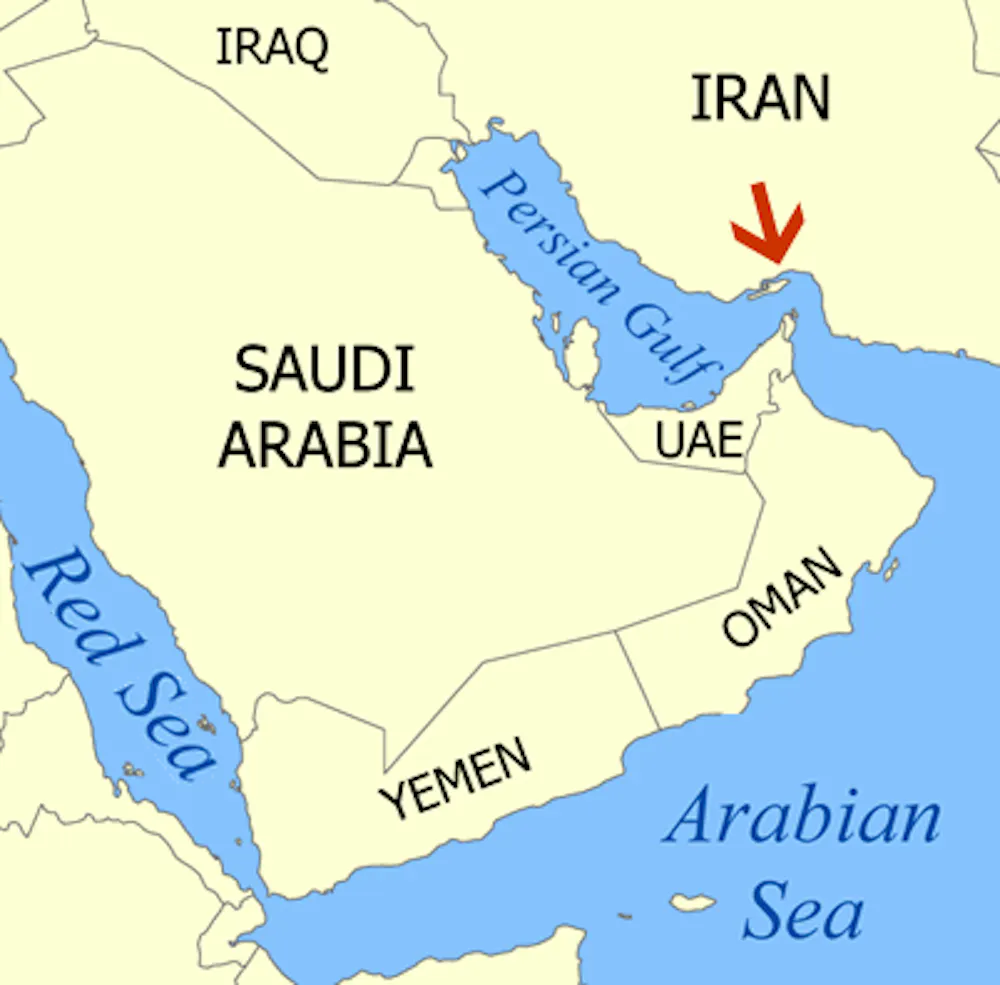
    This is potentially a very dangerous moment. The strait of Hormuz is an important shipping lane through which 20% of the world’s oil transits – about 20 million barrels each day.

    The waterway connects the Persian Gulf and the Gulf of Oman. Iran can either disrupt maritime traffic or attempt to “close” the strait altogether. These are distinctly different approaches with different risks and outcomes.


    Get your news from actual experts, straight to your inbox. Sign up to our daily newsletter to receive all The Conversation UK’s latest coverage of news and research, from politics and business to the arts and sciences.


    The first option is to try and disrupt maritime traffic like Yemen’s Houthi rebels have been doing in the Red Sea since winter 2024. This can be done by attacking passing ships with rockets and drones.

    There are already reports that Iran has started to jam GPS signals in the strait, which has the potential to severely interfere with passing ships, according to US-based maritime analyst Windward.

    Disruption of this kind is likely to deter shipping companies from using this route for fear of casualties and loss of cargo. Shipping companies that want to avoid the Red Sea can always use alternative shipping lanes, such as the Cape of Good Hope route. As inconvenient as that is, there is no such option in the case of the Gulf.

    As we’ve seen with Houthis’ attacks, such disruptions have impacts on oil price, but also ripple effects on stock markets and inflation. Although the US and its western allies can absorb these economic effects – certainly for a while – disrupting the strait would still demonstrate that Tehran has some leverage.

    The credibility factor

    The second option – “closing” the strait would involve interdicting all maritime traffic. This is akin to a blockade. And for it to work, as we have seen in the Black Sea with Russia’s failed attempt at blockading Ukraine, a blockade must be credible enough to deter all traffic.

    Iran has a number of ways to block the strait. It could deploy mines in the waters around the choke point and sink vessels to create obstacles. Iran would also likely use its navy, including submarines, to engage those attempting to break the blockade; use electronic and cyber attacks to disrupt navigation; and threaten civilian traffic and regional ports and oil infrastructure with drones and rockets.

    It’s worth noting that Iran still has plenty of short-range rockets. Israel claims to have destroyed much of its longer range ballistic-missile capability, but it is understood that the country still has a stockpile of short-range missiles that could be effective in targeting ships and infrastructure in the Gulf as well as US bases in the region.

    Recent events have shown up Iran as a bit of a paper tiger. It has made bold claims about its plan to retaliate and the military strength it has to do so. Yet with almost no air power capabilities (apart from drones and missiles) and limited naval power – and with its proxies either defeated or on the back foot – Iran is no longer in a position to project power in the region.

    Iran’s response to the current Israeli attacks have not managed to inflict any major damage or achieve any strategic or political objectives. It’s hard to see a change on the battlefield as things stand.

    Vital waterway: 20% of the world’s oil transts through the Strait of Hormuz.
    w:en:Kleptosquirrel/Wikimedia Commons, CC BY-SA

    For this reason, Tehran’s best option is to target the strait of Hormuz, which has the potential to cause a significant spike in oil prices, leading to a major disruption of the global economy.

    Short of being able to rival the US or Israel on the battlefield, Iran might decide to use asymmetrical means of disruption (in particular missile and drone attacks on civilian shipping) to affect the global economy. Closing or disrupting the strait would be an effective way of doing that.

    A blockade, even a partial one, would offer Tehran some options on the diplomatic scene. For instance, it has been reported that the US asked China to convince Iran not to close the strait. This demonstrates that Tehran can use the threat of a blockade to its advantage on the diplomatic front. But for this to work, the blockade needs to be effective and thus sustained.

    What would be the effect of a blocking the Strait?

    Disrupting traffic in the strait could drag Gulf states – Iraq, Kuwait, Saudi Arabia, UAE, Bahrain and Qatar – into the conflict, since their interests will be directly affected. It’s important to consider how they might respond and whether this will drive them closer to the US – and even Israel, as was already happening with the Abraham Accords and the tentative, but shaky, rapprochement between Saudi Arabia and Israel.


    Read more:
    US joins Israel in attack on Iran and ushers in a new era of impunity


    These are all things Iran would have factored into its calculations a year ago when Israel was targeting its proxies, including Hezollah, Hamas and the various Shia militias it funds in Iraq and elsewhere. But now, given that it has suffered an enormous military setback, which has hurt the regime’s prestige and credibility – including, importantly, at home – Tehran is more likely to downplay these risks. I would expect it to proceed with its blockade plans.

    Even if China voices concerns, like it did regarding the Houthis’ attacks, this is unlikely to change the decision. The regime is cornered. If the leaders believe they could be toppled, they are likely to consider the risks worth taking, particularly if they feel it could give them diplomatic leverage.

    The US has enough naval and air power to disrupt such a blockade. It can preemptively destroy Iran’s mine-laying forces. It can also target missile launch sites inland and respond to threats as and when they arise.

    This is likely to prevent Iran from completely closing the strait. But it won’t prevent the Islamic republic from disrupting maritime trade enough to have serious effects on the world economy. This might well be one of the last cards the regime has to play, both on the battlefield and in the diplomatic arena.

    Basil Germond does not work for, consult, own shares in or receive funding from any company or organisation that would benefit from this article, and has disclosed no relevant affiliations beyond their academic appointment.

    ref. Iran is considering closing the strait of Hormuz – why this would be a major escalation – https://theconversation.com/iran-is-considering-closing-the-strait-of-hormuz-why-this-would-be-a-major-escalation-259562

    MIL OSI – Global Reports

  • MIL-OSI Global: Embarrassed? Why this feeling might actually be good for you

    Source: The Conversation – UK – By Laura Elin Pigott, Senior Lecturer in Neurosciences and Neurorehabilitation, Course Leader in the College of Health and Life Sciences, London South Bank University

    Embarrassment is generated by a network of different brain regions working together. Kues/ Shutterstock

    Picture this: it’s your first day at a new job. You’re about to introduce yourself to a large group of people you’ll be working with – and promptly fall flat on your face. Not exactly the entrance you had in mind.

    We’ve all cringed at moments like these — whether they happen to us or to others. That instant, full-body wince, and the shared, silent relief that it didn’t happen to you.

    Embarrassment is a universal, visceral and oddly contagious emotion. It’s what psychologists call a self-conscious emotion. This means it hinges on our awareness of ourselves through others’ eyes.

    Unlike shame or guilt, embarrassment isn’t usually moral — it’s about looking awkward or inept. Context matters too. We feel more embarrassed in front of people whose opinions we value or who hold power.

    Yet while embarrassment may feel uncomfortable, it actually has surprising social and psychological benefits.


    Get your news from actual experts, straight to your inbox. Sign up to our daily newsletter to receive all The Conversation UK’s latest coverage of news and research, from politics and business to the arts and sciences.


    Empathy and social connection

    Evolutionary psychologists believe embarrassment developed as a social corrective – a way to acknowledge mistakes, signal remorse and reduce conflict within groups.
    This instinct probably helped our ancestors stay in the group, which was critical for survival. People who showed embarrassment were seen as more trustworthy and cooperative.

    In this way, embarrassment can invite empathy and forgiveness, strengthening relationships. It signals that we care what others think, promoting approachability and emotional closeness. So, while it’s uncomfortable in the moment, embarrassment probably evolved to keep communities cohesive.

    Embarrassment is also contagious. Most of us have cringed on someone else’s behalf. This shows how deeply tuned our social brains are. We empathise with others’ awkwardness, often rushing to reassure them. This empathy helps preserve harmony and can also help us build connection with others.

    Embarrassment signals remorse and can invite empathy from others.
    fizkes/Shutterstock

    Trust and virtue

    Visible signs of embarrassment – such as blushing or stumbling over words – are often seen as signs of honesty and generosity. One study found that people who show embarrassment are judged to be more trustworthy and sociable.

    Blushing may have evolved on purpose to be a visible, honest signal of humility that others instinctively trust. Experiments even show we’re more likely to forgive someone who looks embarrassed than someone who acts indifferent.

    Learning social norms

    Forgetting you’re not on mute in a Zoom meeting, sending a message to the wrong group chat or realising your shirt’s inside out after an important meeting. These moments may be minor, but our brains still process them as social threats – albeit small ones.

    In this way, embarrassment helps us adhere to social norms and expectations – many of which are unwritten and only discovered once we’ve flubbed them by mistake. Embarrassment acts as an internal guide, helping us remember social missteps and encouraging us to conform to shared expectations – not out of shame, but because it feels right. It also nudges us whenever we stray near the edges of what’s socially comfortable, helping us course-correct swiftly.

    The way we react to an embarrassing situation is also important in helping us learn from our experiences. Many of us laugh nervously when embarrassed. This effectively reframes the incident from threatening to harmlessly amusing in our minds.

    Humility and authenticity

    Embarrassment keeps egos in check, signals emotional intelligence and makes us more relatable. In a curated world, an awkward moment can humanise us and build credibility.

    However, while moderate embarrassment is healthy and constructive, excessive fear of it can become harmful – crossing into social anxiety.

    Your brain on embarrassment

    Embarrassment isn’t generated by a single “embarrassment centre” in the brain. Rather, it’s generated by a network of different brain regions working together.

    The medial prefrontal cortex (mPFC) is a region in the front of the brain that’s active during self-reflection and when thinking about how others perceive us. It’s also involved in storing social memories – which is why an embarrassing memory, even from years ago, can still make you cringe when it pops into your head.

    The anterior cingulate cortex (ACC) is the reason you blush, your heart pounds and you feel sweaty when you’re deeply embarrassed. The ACC activates your “fight or flight” reaction. When the ACC fires up, it also helps us adjust our behaviour – aiding in impulse control and helping us learn from the mistake so we don’t do it again.

    The amygdala is the brain’s emotional alarm bell. When we get embarrassed, the amygdala registers the emotional intensity of the situation – especially the fear of being seen negatively.

    People with social anxiety show an imbalance between the mPFC and amygdala. Their mPFC is underactive (so they’re less able to rationalise others’ perspectives), while their amygdala is overactive (causing excessive fear signals). This combination makes it hard for them to accurately gauge social situations, often interpreting them as more threatening and embarrassing than they really are.

    Finally, the insula, a region located deep in the brain, helps us tune into our emotions and bodily states. This creates that gut-level discomfort we feel during embarrassing moments. All these regions work in concert during an embarrassing moment.

    Embarrassment is uncomfortable, yes – but it’s also a reminder that we care about others and want to belong. It’s part of what makes us human. So the next time you experience an embarrassing moment, try to laugh it off and remember that the moment is helping us to learn and connect.

    Laura Elin Pigott does not work for, consult, own shares in or receive funding from any company or organisation that would benefit from this article, and has disclosed no relevant affiliations beyond their academic appointment.

    ref. Embarrassed? Why this feeling might actually be good for you – https://theconversation.com/embarrassed-why-this-feeling-might-actually-be-good-for-you-259094

    MIL OSI – Global Reports

  • MIL-OSI Global: Why social media injury recovery videos could do more harm than help

    Source: The Conversation – UK – By Craig Gwynne, Senior Lecturer in Podiatry, Cardiff Metropolitan University

    Studio Romantic/Shutterstock

    When Kim Kardashian glided into the launch party of her NYC SKIMS boutique on a knee scooter, a mobility aid for people with lower leg injuries – stiletto on one foot, designer cast on the other – she wasn’t just managing an injury. She was creating content.

    And she’s far from alone.

    In 2024, rapper Kid Cudi turned his own broken foot into a viral storyline, posting updates of himself on crutches and in a surgical boot after a mishap at the Coachella festival in California. These high profile injuries don’t just invite sympathy; they generate style points, followers and millions of views.

    But as injury recovery morphs into online entertainment, it raises an important question: is this trend helping people heal or encouraging risky behaviour that can delay recovery?


    Get your news from actual experts, straight to your inbox. Sign up to our daily newsletter to receive all The Conversation UK’s latest coverage of news and research, from politics and business to the arts and sciences.


    Open any social media feed and you’ll likely stumble across videos of people hobbling through supermarkets, dancing on crutches, or sweating through workouts in a medical boot. Hashtags like #BrokenFootClub and #InjuryRecovery have spawned thriving online communities where users share advice, frustrations and recovery milestones. For many, rehab has become a public performance, complete with triumphant comeback narratives.

    And it’s not just celebrities. All sorts of people are turning their injuries, from hiking sprains to post-surgery recoveries, into digital diaries. Some offer helpful tips or emotional support, while others focus on fast-tracked progress, sometimes glossing over the slower, necessary steps that true healing demands.

    A broken foot used to mean rest. Now it can mean millions of views.

    Watching others navigate recovery can be deeply reassuring. Seeing someone joke about wobbling to the bathroom or demonstrate how to climb stairs with crutches can ease the loneliness that often comes with injury.

    And some creators are genuinely getting it right. Increasing numbers of healthcare professionals, from orthopaedic surgeons to physiotherapists and podiatrists, now use social media platforms such as TikTok and Instagram to share safe exercises, realistic timelines and expert tips on navigating recovery. For people who struggle to access in-person care, this clinically sound content can be a lifeline.

    But not all content is created equal – and some can do more harm than good.

    When rest gets rebranded

    But on social media, rest isn’t always part of the narrative. The most viewed recovery videos often aren’t posted by healthcare professionals but by influencers eager to showcase rapid progress. Some discard crutches too soon, hop unaided, or attempt high-impact exercises while their bodies are still vulnerable – all for the sake of engagement.

    What’s often missing is the unglamorous reality: swelling, setbacks, rest and the slow, sometimes frustrating, pace of real healing. Bones, tendons and ligaments aren’t impressed by likes or follower counts. Healing requires time and carefully structured loading: a gradual, deliberate increase in weight bearing and movement to rebuild strength without risking re-injury.

    Ignoring this process can lead to delayed healing, chronic pain, re-injury, or even long term joint and muscle complications that can affect the knees, hips, or back.

    And this isn’t just speculation. A 2025 study examining TikTok content on acute knee injuries found that most videos were produced by non-experts and often contained incomplete or inaccurate information. Researchers warned that this misinformation may not only distort patient expectations but also lead to decisions that hinder proper recovery. Similar trends were found in anterior cruciate ligament knee injury videos, where dangerous, non-evidence based practices were widely promoted to millions of viewers.

    Healthcare professionals are now seeing the ripple effects firsthand. Many physiotherapists and podiatrists report a growing number of patients arriving with unrealistic expectations shaped by social media, rather than medical advice. Some patients feel frustrated when their recovery doesn’t match the rapid progress they see online. Others attempt risky exercises before their bodies are ready, setting themselves back.

    A 2025 study examining TikTok content on acute knee injuries found that most videos were produced by non-experts and often contained incomplete or inaccurate information. Researchers warned that this misinformation may not only distort patient expectations but also lead to decisions that hinder proper recovery.

    The World Health Organization has also flagged the dangers of online health misinformation. When social media shortcuts replace professional care, patients risk not only slower recovery but potentially more complex medical problems, while clinicians are left managing the aftermath.

    Recovery isn’t a race

    While supportive online communities can be a valuable source of comfort, the pressure to “bounce back” quickly can be dangerous. Viral videos and celebrity recoveries can create a toxic sense of comparison, tempting people to rush their own healing process.

    Research shows that the psychological drive to return to activity, particularly among younger adults, can reduce rehab compliance and sharply increase the risk of re-injury. True recovery isn’t governed by trending hashtags; it follows a personal, biologically determined timeline that requires patience, rest, and carefully structured rehabilitation.

    Seeing stars like Kim Kardashian with a designer cast might make injury look fashionable. But for most people, a broken foot is not glamorous; it’s weeks of awkward movement, discomfort, adaptation and quiet, steady healing.

    Mobility content can inspire, motivate, and connect – but it’s not a road map for your own recovery. If you’re injured, approach online content with curiosity, not comparison. Learn from others, but listen to your body. Healing is personal. Your recovery won’t be dictated by views, likes, or viral trends – it will unfold on your body’s own timetable.

    Craig Gwynne does not work for, consult, own shares in or receive funding from any company or organisation that would benefit from this article, and has disclosed no relevant affiliations beyond their academic appointment.

    ref. Why social media injury recovery videos could do more harm than help – https://theconversation.com/why-social-media-injury-recovery-videos-could-do-more-harm-than-help-258533

    MIL OSI – Global Reports

  • MIL-OSI Global: Where did the wonder go – and can AI help us find it?

    Source: The Conversation – UK – By Lucy Gill-Simmen, Vice Dean for Education & Student Experience, Royal Holloway University of London

    French philosopher René Descartes crowned human reason in 1637 as the foundation of existence: Cogito, ergo sumI think, therefore I am. For centuries, our capacity to doubt, question and think has been both our compass and our identity. But what does that mean in an age where machines can “think”, generate ideas, write novels, compose symphonies and, increasingly, make decisions?

    Artificial intelligence (AI) has brought a new kind of certainty, one that is quick, data-driven and at times frighteningly precise, at times alarmingly wrong. From Google’s Gemini to OpenAI’s ChatGPT, we live in a world where answers can arrive before the question is even finished. AI has the potential to change not just how we work, but how we think. As our digital tools become more capable, we may well be justified in asking: where did the wonder go?

    We have become increasingly accustomed to optimisation. From using apps to schedule our days to improving how companies hire staff through AI-powered recruitment tools, technology has delivered on its promise of speed and efficiency.


    This article is part of our State of the Arts series. These articles tackle the challenges of the arts and heritage industry – and celebrate the wins, too.


    In education, students increasingly use AI to summarise readings and generate essay outlines; in healthcare, diagnostic models match human doctors in detecting disease.

    But in our pursuit of optimisation, we may have left something essential behind. In her book The Power of Wonder (2023), author Monica Parker describes wonder as a journey, a destination, a verb and a noun, a process and an outcome.

    Lamenting how “modern life is conditioning wonder-proneness out of us”, the author suggests we have “traded wonder for the pale facsimile of electronic novelty-seeking”. And there’s the paradox: AI gives us knowledge at scale, but may rob us of the humility and openness that spark genuine curiosity.

    AI as the antidote?

    But what if AI isn’t the killer of wonder, but its catalyst? The same technologies that predict our shopping habits or generate marketing content can also create surreal art, compose jazz music and tell stories in different ways.

    Tools like DALL·E, Udio.ai, and Runway don’t just mimic human creativity, they expand our creative capacity by translating abstract ideas into visual or audio outputs instantly. They don’t just mimic creativity, they open it up to anyone, enabling new forms of self-expression and speculative thinking.

    The same power that enables AI to open imaginative possibilities can also blur the line between fact and fiction, which is especially risky in education where critical thinking and truth-seeking are paramount. That’s why it’s essential that we teach students not just to use these tools, but to question them. Teaching people to wonder isn’t about uncritical amazement – it’s about cultivating curiosity alongside discernment.

    Educators experimenting with AI in the classroom are starting to see this potential, as my recent work in the area has shown. Rather than using AI merely to automate learning, we are using it to provoke questions and to promote creativity.

    When students ask ChatGPT to write a poem in the voice of Virginia Woolf about climate change, they learn how to combine literary style with contemporary issues. They explore how AI mimics voice and meaning, then reflect on what works and what doesn’t.

    When they use AI tools to build brand storytelling campaigns, they practise turning ideas into images, sounds and messages and learn how to shape stories that connect with audiences. Students are not just using AI, they’re learning to think critically and creatively with it.

    This aligns with Brazilian philosopher Paulo Friere’s “banking” concept of education, where rather than depositing facts, educators are required to spark critical reflection. AI, when used creatively, can act as a dialogue partner, one that reflects back our assumptions, challenges our ideas and invites deeper inquiry.

    The research is mixed, and much depends on how AI is used. Left unchecked, tools like ChatGPT can encourage shortcut thinking. When used purposely as a dialogue partner, prompting reflection, testing ideas and supporting creative inquiry, studies show it can foster deeper engagement and critical thinking. The challenge is designing learning experiences that make the most of this potential.

    A new kind of curiosity

    Wonder isn’t driven by novelty alone, it’s about questioning the familiar. Philosopher Martha Nussbaum describes wonder as “taking us out of ourselves and toward the other”. In this way, AI’s outputs have the potential to jolt people out of cognitive ruts and into new realms of thought, causing them to experience wonder.

    It could be argued that AI becomes both mirror and muse. It holds up a reflection of our culture, biases and blind spots while nudging us toward the imaginative unknown at the same time. Much like the ancient role of the fool in King Lear’s court, it disrupts and delights, offering insights precisely because it doesn’t think like humans do.

    This repositions AI not as a rival to human intelligence, but as a co-creator of wonder, a thought partner in the truest sense.

    Descartes saw doubt as the path to certainty. Today, however, we crave certainty and often avoid doubt. In a world overwhelmed by information and polarisation, there is comfort in clean answers and predictive models. But perhaps what we need most is the courage to ask questions, to really wonder about things.

    The German poet Rainer Maria Rilke once advised: “Be patient toward all that is unsolved in your heart and try to love the questions themselves.”

    AI can generate perspectives, juxtapositions and “what if” scenarios that challenge students’ habitual ways of thinking. The point isn’t to replace critical thinking, but to spark it in new directions. When artists co-create with algorithms, what new aesthetics emerge that we’ve yet to imagine?

    And when policymakers engage with AI trained on other perspectives from around the world, how might their understanding and decisions be transformed? As AI reshapes how we access, interpret and generate knowledge, this encourages rethinking not just what we learn, but why and how we value knowledge at all.

    Educational philosophers such as John Dewey and Maxine Greene championed education that cultivates imagination, wonder and critical consciousness. Greene spoke of “wide-awakeness”, a state of being in the world.

    Deployed thoughtfully, AI can be a tool for wide-awakeness. In practical terms, it means designing learning experiences where AI prompts curiosity, not shortcuts; where it’s used to question assumptions, explore alternatives, and deepen understanding.

    When used in this way, I believe it can help students tell better stories, explore alternate futures and think across disciplines. This demands not only ethical design and critical digital literacy, bit also an openness to the unknown. It also demands that we, as humans, reclaim our appetite for awe.

    In the end, the most human thing about AI might be the questions it forces us to ask. Not “What’s the answer?” but “What if …?” and in that space, somewhere in between certainty and curiosity, wonder returns. The machines we built to do our thinking for us might just help us rediscover it.

    Lucy Gill-Simmen does not work for, consult, own shares in or receive funding from any company or organisation that would benefit from this article, and has disclosed no relevant affiliations beyond their academic appointment.

    ref. Where did the wonder go – and can AI help us find it? – https://theconversation.com/where-did-the-wonder-go-and-can-ai-help-us-find-it-258490

    MIL OSI – Global Reports

  • MIL-OSI Global: Society needs a systems update to cope with climate crisis – my new film explains why

    Source: The Conversation – UK – By James Dyke, Associate Professor in Earth System Science, University of Exeter

    The climate and ecological crisis is one of the greatest challenges humanity has ever faced. If the world fails to address it, and over the rest of this century we continue to burn fossil fuels and pump even more carbon dioxide into the atmosphere, we’ll face catastrophe. On this much, almost all governments agree (with some notable exceptions such as the US).

    Even the world’s largest oil and gas companies now acknowledge that their products are behind the alarming increase in global temperatures and that we will have to transition to alternative fuels. Eventually.

    In some oil and gas firms’ net zero policies you will often see the word “eventually” or its equivalent used. Yes, they accept that the age of fossil fuels will be over, but they don’t give any end date. In fact, with continued expansion of new oil and gas fields they appear to give every indication of continuing to be fossil fuel companies for the foreseeable future.


    Get your news from actual experts, straight to your inbox. Sign up to our daily newsletter to receive all The Conversation UK’s latest coverage of news and research, from politics and business to the arts and sciences.


    Will such firms actually phase out coal, oil and gas at the rate required to avoid dangerous climate change? How quickly does that now have to happen? Immediately.

    At current rates of emissions, the window to have a 50:50 chance of limiting warming to 1.5°C will close in as little as six years. Given that global emissions are not stabilising but in fact going up, we are in the process of overshooting 1.5°C and heading deep into dangerous climate change territory.

    Does that mean it’s game over, that the climate catastrophes we fear will come to pass? Thinking about these sorts of systemic risks form the basis of much of my current research. This includes some pretty alarming analysis on how societies can react to challenges such as climate change in ways that can make the situation much worse.

    But herein lies a potentially powerful source of hope for the future because what we do as individuals and members of communities and countries will make all the difference. That’s what was on my mind when I started working on a new climate change documentary with filmmaker Paul Maple.

    Radical reductions

    Our new film System Update: Rebooting Our Future argues that, while we may have run out of time to avoid dangerous climate change, we are now only beginning to see how we can not just avoid further environmental damage but make a much better world for all of humanity. To do that, we must go beyond the incremental and timid policies of today. We need to be radical and dig into the drivers of climate change.

    Take economic growth, for example. You will not find a political party in power in any industrialised nation that does not have continued economic growth as one of its core objectives. Economic performance is often the main way politicians are judged. That’s why threats of a recession lead news reports.

    In System Update, I ask what is this economic growth for, if it continues to drive expanded energy and material consumption and drive us further towards climate and ecological collapse?

    If our economic and political systems cannot deliver radical emissions reductions in a sustainable and fair way, then they need to be rebooted. Rather than policies being orientated towards maximising economic growth, we can instead question how the current goods and services an economy produces are used.

    How can local communities be empowered to make themselves more resilient to climate change while reducing their emissions? Where can citizen assemblies strengthen our democracies and help foster the wider support for ambitious climate action? These assemblies work by recruiting a representative cross section of society who hear from a range of climate experts, and then work together to provide policy recommendations.

    I put such questions to an amazing group of activists, academics and policymakers. We quickly discovered from economic anthropologist Jason Hickel that there is no end of new thinking about economics.

    Lawyer and key architect of the Paris agreement Farhana Yamin recounted the epic battle that she and others have been waging with politicians to get them to understand and act on some of the fundamental truths of climate change. Researcher and strategist Laurie Laybourn spoke of the need for leaders to understand how this gathering storm of climate change demands new mindsets.

    Climate change adaptation expert Kathryn Brown made the case for a rapid increase in efforts to protect communities from environmental change, while climate historian Alice Bell put today’s debates into the wider context. Climate campaigner Max Wakefield and climate justice activist Dylan Hamilton connected the big picture elements of the climate crisis to both everyday actions like what you buy and how to you travel, to deeper engagement with politics.

    It’s easy to feel overwhelmed about the scale of climate change. There is a constant stream of bad news about rising temperatures and extreme weather. What I hope System Update shows is that there is no end of ideas for how such an outcome could be averted, and how you could put them into practice.

    We will win. The age of fossil fuels is ending. The question now is, how fast do you want to make that happen?


    Don’t have time to read about climate change as much as you’d like?

    Get a weekly roundup in your inbox instead. Every Wednesday, The Conversation’s environment editor writes Imagine, a short email that goes a little deeper into just one climate issue. Join the 45,000+ readers who’ve subscribed so far.


    James Dyke does not work for, consult, own shares in or receive funding from any company or organisation that would benefit from this article, and has disclosed no relevant affiliations beyond their academic appointment.

    ref. Society needs a systems update to cope with climate crisis – my new film explains why – https://theconversation.com/society-needs-a-systems-update-to-cope-with-climate-crisis-my-new-film-explains-why-257503

    MIL OSI – Global Reports

  • MIL-OSI Global: Appeals court ruling grants Donald Trump broad powers to deploy troops to American cities

    Source: The Conversation – Canada – By Jack L. Rozdilsky, Associate Professor of Disaster and Emergency Management, York University, Canada

    Residents of Los Angeles will need to get used to federally controlled National Guard troops operating on their streets. Due to a ruling from an appeals court on June 19, United States President Donald Trump now has broad authority to deploy military forces in American cities.

    This is a troubling development. All presidents have held in their grasp extraordinary powers to deploy military troops domestically. But Trump stands apart with his apparent keen interest in manufacturing false emergencies to exploit extraordinary power.

    An 1878 law called the Posse Comitatus Act restricts using the military for domestic law enforcement. The broader principle being challenged by Trump’s actions in L.A. is the norm of the military not being allowed to interfere in the affairs of civilian governance.

    Injunctions and appeals

    Five months into Trump’s presidency, L.A. has been targeted for aggressive immigration enforcement. In their pluralistic city where dozens of languages and nationalities peacefully co-exist, some Angelenos believe the city is experiencing an attack on its most essential social fabric.

    On June 7, Trump acted under United States Code Title 10 provisions to take over command and control of California’s National Guard. Federalized military forces were deployed.

    The objective was to counter what Trump argued was a form of rebellion against the authority of the government of the United States. In fact, these “rebellions” were largely peaceful protests in downtown L.A.

    On June 9, the U.S. District Court for the Northern District of California granted an injunction restraining the president’s use of military force in L.A. The court order supported Gov. Gavin Newsom’s contention that Trump overstepped his authority.

    On June 19, a decision from a panel of judges at the U.S. Court of Appeals for the Ninth Circuit overturned the injunction.

    What this means at the moment is that Trump does not have to return control of the troops to Newsom. California has options to continue litigation by asking the Federal Appeals Court to rehear the matter, or perhaps directly asking the U.S. Supreme Court to intervene.

    Moving toward authoritarianism

    Trump’s June 7 memorandum facilitating his move to overrule Newsom’s authority and seize control of 2,000 National Guard troops was based on the president defining his own so-called emergency.

    He claimed incidents of violence and disorder following aggressive immigration enforcement amounted to a form of rebellion against the U.S.

    As Trump flexes his emergency power might, his second term has been called the 911 presidency. He has used extraordinary emergency powers at a pace well beyond his predecessors, pressing the limits to address his administration’s supposed sense of serious perils overtaking the nation.

    Issues arise when the level of actual danger locally is not at all representative of what the president suggests is a full-scale national emergency. For example, demonstrations over immigration raids occupied only a tiny parcel of real estate in L.A.’s huge metropolitan area. A Los Angeles-based rebellion against the U.S. was not occurring.

    As dissent over aggressive immigration enforcement actions grew, localized clashes with law enforcement did occur. Mutual aid surged into Los Angeles, where neighbouring California law enforcement agencies acted to assist one another. The law enforcement challenges never rose to the level of the governor of California requesting additional federal support.

    Shortly after the federal government took over the California National Guard, Newsom said the move was purposefully inflammatory.

    In addition to declaring dubious emergencies to amass power, stoking violence is a characteristic of authoritarian rulers. Creating fear, division and feelings of insecurity can lead to community crises. Trump did not need to wait for a crisis; it seems he simply invented one.

    No guardrails

    The expression “out of kilter” comes to mind as Trump inches closer to invoking the Insurrection Act of 1807. If so, the situation will look quite similar in practice to what is happening now in Los Angeles.

    Five years ago, Trump flirted with invoking the Insurrection Act during Black Lives Matter unrest in Washington, D.C., in and around Lafayette Park.

    As recent L.A. protests intensified, Trump stated: “We’re going to have troops everywhere.”

    Currently, there are few guardrails in place to prevent a rogue president from misusing the military in domestic civilian affairs. Trump has been coy about whether he would tap into the greater powers available to him under the Insurrection Act.

    Real emergencies presenting existential threats to America do persist. Nuclear proliferation, climate change and pandemics need serious leaders. But politically exploiting last-resort emergency laws designed to provide options to deal with genuine existential threats — not to weaponize them against protesters demonstrating against public policy — is absurd.

    Jack L. Rozdilsky receives support for research communication and public scholarship from York University. He also has received research support from the Canadian Institutes of Health Research.

    ref. Appeals court ruling grants Donald Trump broad powers to deploy troops to American cities – https://theconversation.com/appeals-court-ruling-grants-donald-trump-broad-powers-to-deploy-troops-to-american-cities-258894

    MIL OSI – Global Reports

  • MIL-OSI Global: To spur the construction of affordable, resilient homes, the future is concrete

    Source: The Conversation – USA – By Pablo Moyano Fernández, Assistant Professor of Architecture, Washington University in St. Louis

    A modular, precast system of concrete ‘rings’ can be connected in different ways to build a range of models of energy-efficient homes. Pablo Moyano Fernández, CC BY-SA

    Wood is, by far, the most common material used in the U.S. for single-family home construction.

    But wood construction isn’t engineered for long-term durability, and it often underperforms, particularly in the face of increasingly common extreme weather events.

    In response to these challenges, I believe mass-produced concrete homes can offer affordable, resilient housing in the U.S. By leveraging the latest innovations of the precast concrete industry, this type of homebuilding can meet the needs of a changing world.

    Wood’s rise to power

    Over 90% of the new homes built in the U.S. rely on wood framing.

    Wood has deep historical roots as a building material in the U.S., dating back to the earliest European settlers who constructed shelters using the abundant native timber. One of the most recognizable typologies was the log cabin, built from large tree trunks notched at the corners for structural stability.

    Log cabins were popular in the U.S. during the 18th and 19th centuries.
    Heritage Art/Heritage Images via Getty Images

    In the 1830s, wood construction underwent a significant shift with the introduction of balloon framing. This system used standardized, sawed lumber and mass-produced nails, allowing much smaller wood components to replace the earlier heavy timber frames. It could be assembled by unskilled labor using simple tools, making it both accessible and economical.

    In the early 20th century, balloon framing evolved into platform framing, which became the dominant method. By using shorter lumber lengths, platform framing allowed each floor to be built as a separate working platform, simplifying construction and improving its efficiency.

    The proliferation and evolution of wood construction helped shape the architectural and cultural identity of the nation. For centuries, wood-framed houses have defined the American idea of home – so much so that, even today, when Americans imagine a house, they typically envision one built of wood.

    A suburban housing development from the 1950s being built with platform framing.
    H. Armstrong Roberts/ClassicStock via Getty Images

    Today, light-frame wood construction dominates the U.S. residential market.

    Wood is relatively affordable and readily available, offering a cost-effective solution for homebuilding. Contractors are familiar with wood construction techniques. In addition, building codes and regulations have long been tailored to wood-frame systems, further reinforcing their prevalence in the housing industry.

    Despite its advantages, wood light-frame construction presents several important limitations. Wood is vulnerable to fire. And in hurricane- and tornado-prone regions, wood-framed homes can be damaged or destroyed.

    Wood is also highly susceptible to water-related issues, such as swelling, warping and structural deterioration caused by leaks or flooding. Vulnerability to termites, mold, rot and mildew further compromise the longevity and safety of wood-framed structures, especially in humid or poorly ventilated environments.

    The case for concrete

    Meanwhile, concrete has revolutionized architecture and engineering over the past century. In my academic work, I’ve studied, written and taught about the material’s many advantages.

    The material offers unmatched strength and durability, while also allowing design flexibility and versatility. It’s low-cost and low-maintenance, and it has high thermal mass properties, which refers to the material’s ability to absorb and store heat during the day, and slowly release it during the cooler nights. This can lower heating and cooling costs.

    Properly designed concrete enclosures offer exceptional performance against a wide range of hazards. Concrete can withstand fire, flooding, mold, insect infestation, earthquakes, hail, hurricanes and tornadoes.

    It’s commonly used for home construction in many parts of the world, such as Europe, Japan, Mexico, Brazil and Argentina, as well as India and other parts of Southeast Asia.

    However, despite their multiple benefits, concrete single-family homes are rare in the U.S.

    That’s because most concrete structures are built using a process called cast-in-place. In this technique, the concrete is formed and poured directly at the construction site. The method relies on built-in-place molds. After the concrete is cast and cured over several days, the formwork is removed.

    This process is labor-intensive and time-consuming, and it often produces considerable waste. This is particularly an issue in the U.S., where labor is more expensive than in other parts of the world. The material and labor cost can be as high as 35% to 60% of the total construction cost.

    Portland cement, the binding agent in concrete, requires significant energy to produce, resulting in considerable carbon dioxide emissions. However, this environmental cost is often offset by concrete’s durability and long service life.

    Concrete’s design flexibility and structural integrity make it particularly effective for large-scale structures. So in the U.S., you’ll see it used for large commercial buildings, skyscrapers and most highways, bridges, dams and other critical infrastructure projects.

    But when it comes to single-family homes, cast-in-place concrete poses challenges to contractors. There are the higher initial construction costs, along with a lack of subcontractor expertise. For these reasons, most builders and contractors stick with what they know: the wood frame.

    A new model for home construction

    Precast concrete, however, offers a promising alternative.

    Unlike cast-in-place concrete, precast systems allow for off-site manufacturing under controlled conditions. This improves the quality of the structure, while also reducing waste and labor.

    The CRETE House, a prototype I worked on in 2017 alongside a team at Washington University in St. Louis, showed the advantages of a precast home construction.

    To build the precast concrete home, we used ultra-high-performance concrete, one of the latest advances in the concrete industry. Compared with conventional concrete, it’s about six times stronger, virtually impermeable and more resistant to freeze-thaw cycles. Ultra-high-performance concrete can last several hundred years.

    The strength of the CRETE House was tested by shooting a piece of wood at 120 mph (193 kph) to simulate flying debris from an F5 tornado. It was unable to breach the wall, which was only 2 inches (5.1 centimeters) thick.

    The wall of the CRETE House was able to withstand a piece of wood fired at 120 mph (193 kph).

    Building on the success of the CRETE House, I designed the Compact House as a solution for affordable, resilient housing. The house consists of a modular, precast concrete system of “rings” that can be connected to form the entire structure – floors, walls and roofs – creating airtight, energy-efficient homes. A series of different rings can be chosen from a catalog to deliver different models that can range in size from 270 to 990 square feet (25 to 84 square meters).

    The precast rings can be transported on flatbed trailers and assembled into a unit in a single day, drastically reducing on-site labor, time and cost.

    Since they’re built using durable concrete forms, the house can be easily mass-produced. When precast concrete homes are mass-produced, the cost can be competitive with traditional wood-framed homes. Furthermore, the homes are designed to last far beyond 100 years – much longer than typical wood structures – while significantly lowering utility bills, maintenance expenses and insurance premiums.

    The project is also envisioned as an open-source design. This means that the molds – which are expensive – are available for any precast producer to use and modify.

    The Compact House is made using ultra-high-performance concrete.
    Pablo Moyano Fernández, CC BY-SA

    Leveraging a network that’s already in place

    Two key limitations of precast concrete construction are the size and weight of the components and the distance to the project site.

    Precast elements must comply with standard transportation regulations, which impose restrictions on both size and weight in order to pass under bridges and prevent road damage. As a result, components are typically limited to dimensions that can be safely and legally transported by truck. Each of the Compact House’s pieces are small enough to be transported in standard trailers.

    Additionally, transportation costs become a major factor beyond a certain range. In general, the practical delivery radius from a precast plant to a construction site is 500 miles (805 kilometers). Anything beyond that becomes economically unfeasible.

    However, the infrastructure to build precast concrete homes is already largely in place. Since precast concrete is often used for office buildings, schools, parking complexes and large apartments buildings, there’s already an extensive national network of manufacturing plants capable of producing and delivering components within that 500-mile radius.

    There are other approaches to build homes with concrete: Homes can use concrete masonry units, which are similar to cinder blocks. This is a common technique around the world. Insulated concrete forms involve rigid foam blocks that are stacked like Lego bricks and are then filled with poured concrete, creating a structure with built-in insulation. And there’s even 3D-printed concrete, a rapidly evolving technology that is in its early stages of development.

    However, none of these use precast concrete modules – the rings in my prototypes – and therefore require substantially longer on-site time and labor.

    To me, precast concrete homes offer a compelling vision for the future of affordable housing. They signal a generational shift away from short-term construction and toward long-term value – redefining what it means to build for resilience, efficiency and equity in housing.

    An image of North St. Louis, taken from Google Earth, showing how vacant land can be repurposed using precast concrete homes.
    Pablo Moyano Fernández, CC BY-SA

    This article is part of a series centered on envisioning ways to deal with the housing crisis.

    Pablo Moyano Fernández does not work for, consult, own shares in or receive funding from any company or organization that would benefit from this article, and has disclosed no relevant affiliations beyond their academic appointment.

    ref. To spur the construction of affordable, resilient homes, the future is concrete – https://theconversation.com/to-spur-the-construction-of-affordable-resilient-homes-the-future-is-concrete-254561

    MIL OSI – Global Reports

  • MIL-OSI Global: No country for old business owners: Economic shifts create a growing challenge for America’s aging entrepreneurs

    Source: The Conversation – USA – By Nancy Forster-Holt, Clinical Associate Professor of Innovation and Entrepreneurship, University of Rhode Island

    Americans love small businesses. We dedicate a week each year to applauding them, and spend Small Business Saturday shopping locally. Yet hiding in plain sight is an enormous challenge facing small business owners as they age: retiring with dignity and foresight. The current economic climate is making this even more difficult.

    As a professor who studies aging and business, I’ve long viewed small business owners’ retirement challenges as a looming crisis. The issue is now front and center for millions of entrepreneurs approaching retirement. Small enterprises make up more than half of all privately held U.S. companies, and for many of their owners, the business is their retirement plan.

    But while owners often hope to finance their golden years by selling their companies, only 20% of small businesses are ready for sale even in good times, according to the Exit Planning Institute. And right now, conditions are far from ideal. An economic stew of inflation, supply chain instability and high borrowing costs means that interest from potential buyers is cooling.

    For many business owners, retirement isn’t a distant concern. In the U.S., baby boomers – who are currently 61 to 79 years old – own about 2.3 million businesses. Altogether, they generate about US$5 billion in revenue and employ almost 25 million people. These entrepreneurs have spent decades building businesses that often are deeply rooted in their communities. They don’t have time to ride out economic chaos, and their optimism is at a 50-year low.

    New policies, new challenges

    You can’t blame them for being gloomy. Recent policy shifts have only made life harder for business owners nearing retirement. Trade instability, whipsawing tariff announcements and disrupted supply chains have eroded already thin margins. Some businesses – generally larger ones with more negotiating power – are absorbing extra costs rather than passing them on to shoppers. Others have no choice but to raise prices, to customers’ dismay. Inflation has further squeezed profits.

    At the same time, with a few notable exceptions, buyers and capital have grown scarce. Acquirers and liquidity have dried up across many sectors. The secondary market – a barometer of broader investor appetite – now sees more sellers than buyers. These are textbook symptoms of a “flight to safety,” a market shift that drags out sale timelines and depresses valuations – all while Main Street business owners age out. These entrepreneurs typically have one shot at retirement – if any.

    Adding to these woes, many small businesses are part of what economists call regional “clusters,” providing services to nearby universities, hospitals and local governments. When those anchor institutions face budget cuts – as is happening now – small business vendors are often the first to feel the impact.

    Research shows that many aging owners actually double down in weak economic times, sinking increasing amounts of time and money in a psychological pattern known as “escalating commitment.” The result is a troubling phenomenon scholars refer to as “benign entrapment.” Aging entrepreneurs can remain attached to their businesses not because they want to, but because they see no viable exit.

    This growing crisis isn’t about bad personal planning — it’s a systemic failure.

    Rewriting the playbook on small business policy

    A key mistake that policymakers make is to lump all small business owners together into one group. That causes them to overlook important differences. After all, a 68-year-old carpenter trying to retire doesn’t have much in common with a 28-year-old tech founder pitching a startup. Policymakers may cheer for high-growth “unicorns,” but they often overlook the “cows and horses” that keep local economies running.

    Even among older business owners, circumstances vary based on local conditions. Two retiring carpenters in different towns may face vastly different prospects based on the strength of their local economies. No business, and no business owner, exists in a vacuum.

    A small business owner in Rochester, Vt., discusses the challenges of retirement in a news segment from WCAX-TV.

    Relatedly, when small businesses fail to transition, it can have consequences for the local economy. Without a buyer, many enterprises will simply shut down. And while closures can be long-planned and thoughtful, when a business closes suddenly, it’s not just the owner who loses. Employees are left scrambling for work. Suppliers lose contracts. Communities lose essential services.

    Four ways to help aging entrepreneurs

    That’s why I think policymakers should reimagine how they support small businesses, especially owners nearing the end of their careers.

    First, small business policy should be tailored to age. A retirement-ready business shouldn’t be judged solely by its growth potential. Rather, policies should recognize stability and community value as markers of success. The U.S. Small Business Administration and regional agencies can provide resources specifically for retirement planning that starts early in a business’s life, to include how to increase the value of the business and a plan to attract acquirers in later stages.

    Second, exit infrastructure should be built into local entrepreneurial ecosystems. Entrepreneurial ecosystems are built to support business entry – think incubators and accelerators – but not for exit. In other words, just like there are accelerators for launching businesses, there should be programs to support winding them down. These could include confidential peer forums, retirement-readiness clinics, succession matchmaking platforms and flexible financing options for acquisition.

    Third, chaos isn’t good for anybody. Fluctuations in capital gains taxes, estate tax thresholds and tariffs make planning difficult and reduce business value in the eyes of potential buyers. Stability encourages confidence on both sides of a transaction.

    And finally, policymakers should include ripple-effect analysis in budget decisions. When universities, hospitals or governments cut spending, small business vendors often absorb much of the shock. Policymakers should account for these downstream impacts when shaping local and federal budgets.

    If we want to truly support small businesses and their owners, it’s important to honor the lifetime arc of entrepreneurship – not just the launch and growth, but the retirement, too.

    Nancy Forster-Holt does not work for, consult, own shares in or receive funding from any company or organization that would benefit from this article, and has disclosed no relevant affiliations beyond their academic appointment.

    ref. No country for old business owners: Economic shifts create a growing challenge for America’s aging entrepreneurs – https://theconversation.com/no-country-for-old-business-owners-economic-shifts-create-a-growing-challenge-for-americas-aging-entrepreneurs-254537

    MIL OSI – Global Reports

  • MIL-OSI Global: How the end of carbon capture could spark a new industrial revolution

    Source: The Conversation – USA – By Andres Clarens, Professor of Civil and Environmental Engineering, University of Virginia

    Steelmaking uses a lot of energy, making it one of the highest greenhouse gas-emitting industries.
    David McNew/Getty Images

    The U.S. Department of Energy’s decision to claw back US$3.7 billion in grants from industrial demonstration projects may create an unexpected opening for American manufacturing.

    Many of the grant recipients were deploying carbon capture and storage – technologies that are designed to prevent industrial carbon pollution from entering the atmosphere by capturing it and injecting it deep underground. The approach has long been considered critical for reducing the contributions chemicals, cement production and other heavy industries make to climate change.

    However, the U.S. policy reversal could paradoxically accelerate emissions cuts from the industrial sector.

    An emissions reality check

    Heavy industry is widely viewed as the toughest part of the economy to clean up.

    The U.S. power sector has made progress, cutting emissions 35% since 2005 as coal-fired power plants were replaced with cheaper natural gas, solar and wind energy. More than 93% of new grid capacity installed in the U.S. in 2025 was forecast to be solar, wind and batteries. In transportation, electric vehicles are the fastest-growing segment of the U.S. automotive market and will lead to meaningful reductions in pollution.

    But U.S. industrial emissions have been mostly unchanged, in part because of the massive amount of coal, gas and oil required to make steel, concrete, aluminum, glass and chemicals. Together these materials account for about 22% of U.S. greenhouse gas emissions.

    The global industrial landscape is changing, though, and U.S. industries cannot, in isolation, expect that yesterday’s means of production will be able to compete in a global marketplace.

    Even without domestic mandates to reduce their emissions, U.S. industries face powerful economic pressures. The EU’s new Carbon Border Adjustment Mechanism imposes a tax on the emissions associated with imported steel, chemicals, cement and aluminum entering European markets. Similar policies are being considered by Canada, Japan, Singapore, South Korea and the United Kingdom, and were even floated in the United States.

    The false promise of carbon capture

    The appeal of carbon capture and storage, in theory, was that it could be bolted on to an existing factory with minimal changes to the core process and the carbon pollution would go away.

    Government incentives for carbon capture allow producers to keep using polluting technologies and prop up gas-powered chemical production or coal-powered concrete production.

    The Trump administration’s pullback of carbon capture and storage grants now removes some of these artificial supports.

    Without the expectation that carbon capture will help them meet regulations, this may create space to focus on materials breakthroughs that could revolutionize manufacturing while solving industries’ emissions problems.

    The materials innovation opportunity

    So, what might emissions-lowering innovation look like for industries such as cement, steel and chemicals? As a civil and environmental engineer who has worked on federal industrial policy, I study the ways these industries intersect with U.S. economic competitiveness and our built environment.

    There are many examples of U.S. innovation to be excited about. Consider just a few industries:

    Cement: Cement is one of the most widely used materials on Earth, but the technology has changed little over the past 150 years. Today, its production generates roughly 8% of total global carbon pollution. If cement production were a country, it would rank third globally after China and the United States.

    Researchers are looking at ways to make concrete that can shed heat or be lighter in weight to significantly reduce the cost of building and cooling a home. Sublime Systems developed a way to produce cement with electricity instead of coal or gas. The company lost its IDP grant in May 2025, but it has a new agreement with Microsoft.

    Making concrete do more could accelerate the transition. Researchers at Stanford and separately at MIT are developing concrete that can act as a capacitor and store over 10 kilowatt-hours of energy per cubic meter. Such materials could potentially store electricity from your solar roof or allow for roadways that can charge cars in motion.

    How concrete could be used as a capacitor. MIT.

    Technologies like these could give U.S. companies a competitive advantage while lowering emissions. Heat-shedding concrete cuts air conditioning demand, lighter formulations require less material per structure, and energy-storing concrete could potentially replace carbon-intensive battery manufacturing.

    Steel and iron: Steel and iron production generate about 7% of global emissions with centuries-old blast furnace processes that use intense heat to melt iron ore and burn off impurities. A hydrogen-based steelmaking alternative exists today that emits only water vapor, but it requires new supply chains, infrastructure and production techniques.

    U.S. Steel has been developing techniques to create stronger microstructures within steel for constructing structures with 50% less material and more strength than conventional designs. When a skyscraper needs that much less steel to achieve the same structural integrity, that eliminates millions of tons of iron ore mining, coal-fired blast furnace operations and transportation emissions.

    Chemicals: Chemical manufacturing has created simultaneous crises over the past 50 years: PFAS “forever chemicals” and microplastics have been showing up in human blood and across ecosystems, and the industry generates a large share of U.S. industrial emissions.

    Companies are developing ways to produce chemicals using engineered enzymes instead of traditional petrochemical processes, achieving 90% lower emissions in a way that could reduce production costs. These bio-based chemicals can naturally biodegrade, and the chemical processes operate at room temperature instead of requiring high heat that uses a lot of energy.

    Is there a silver bullet without carbon capture?

    While carbon capture and storage might not be the silver bullet for reducing emissions that many people thought it would be, new technologies for managing industrial heat might turn out to be the closest thing to one.

    Most industrial processes require temperatures between 300 and 1830 degrees Fahrenheit (150 and 1000 degrees Celsisus for everything from food processing to steel production. Currently, industries burn fossil fuels directly to generate this heat, creating emissions that electric alternatives cannot easily replace. Heat batteries may offer a breakthrough solution by storing renewable electricity as thermal energy, then releasing that heat on demand for industrial processes.

    How thermal batteries work. CNBC.

    Companies such as Rondo Energy are developing systems that store wind and solar power in bricklike materials heated to extreme temperatures. Essentially, they convert electricity into heat during times when electricity is abundant, usually at night. A manufacturing facility can later use that heat, which allows it to reduce energy costs and improve grid reliability by not drawing power at the busiest times. The Trump administration cut funding for projects working with Rondo’s technology, but the company’s products are being tested in other countries.

    Industrial heat pumps provide another pathway by amplifying waste heat to reach the high temperatures manufacturing requires, without using as much fossil fuel.

    The path forward

    The Department of Energy’s decision forces industrial America into a defining moment. One path leads backward toward pollution-intensive business as usual propping up obsolete processes. The other path drives forward through innovation.

    Carbon capture offered an expensive Band-Aid on old technology. Investing in materials innovation and new techniques for making them promises fundamental transformation for the future.

    Andres Clarens receives funding from the National Science Foundation and the Alfred P Sloan Foundation.

    ref. How the end of carbon capture could spark a new industrial revolution – https://theconversation.com/how-the-end-of-carbon-capture-could-spark-a-new-industrial-revolution-257894

    MIL OSI – Global Reports

  • MIL-OSI Global: I’m an expert in crafting public health messages: Here are 3 marketing strategies I use to make Philadelphia healthier

    Source: The Conversation – USA – By Sarah Bauerle Bass, Professor of Social and Behavioral Sciences, Temple University

    A comic book produced for Black transgender women in Philadelphia explains the benefits of using PrEP to prevent HIV infection. Wriply Bennet for the Risk Communication Laboratory, Temple University

    In Philadelphia, the leading causes of death are heart disease, cancer and unintentional drug overdose. While some of these deaths are caused by things out of our control – like genetics – many are largely preventable.

    Preventable deaths are the result of a series of decisions. Whether a person decides to smoke, eat lots of fried foods or be a couch potato, their decisions – sometimes unconsciously – can affect their health.

    I’m a health communication expert and public health researcher at Temple University in North Philadelphia. I began working in public health in the late 1980s at the beginning of the HIV/AIDS epidemic, and before that I worked in marketing and public relations. I have spent my career thinking about how health decisions are like many of the decisions consumers make each day around which products to buy.

    One key difference with health decisions is the inherent risks involved. There isn’t much risk in trying a new brand of cereal, but there is risk in riding a motorcycle without a helmet.

    Many people have a “that won’t happen to me” attitude when making a decision that involves risk. This element of “risk perception” has guided my interest in health decisions and how to use commercial marketing techniques – the same ones companies use to sell products – to encourage people to get vaccinated, get a colonoscopy or get treated for a medical condition.

    Temple students involved in the RapidVax project talk to Kensington residents about COVID-19 vaccinations during the pandemic.
    Temple University College of Public Health

    Breaking demographics into psychographics

    One strategy I use is segmentation analysis.

    Segmentation analysis is the process of looking at groups of people who may look like they are all similar on the surface – such as Black women from North Philadelphia – and then breaking them into smaller groups based on differences in their attitudes, beliefs or behaviors.

    Looking at these “psychographics” instead of demographics like age or sex can help public health communication researchers better understand how to communicate effectively.

    For example, I led a study in 2021 that looked at how connected transgender women living in Philadelphia and the San Francisco Bay Area felt to other members of the trans community. We wanted to see if messaging about PrEP, or pre-exposure prophylaxis, the medication used to prevent HIV infection, would need to be different depending on how connected they felt.

    We found that participants who were more engaged with the trans community were not only more knowledgeable about PrEP, but they were also more likely to see the benefits of using it compared with those who were less engaged.

    This indicates that strategies to reach those not as connected may need to include, for example, providing more basic information about what PrEP is and how it works.

    An example of perceptual mapping that shows different attitudes and beliefs around the HIV prevention medication PrEP.
    Temple University College of Public Health

    Mathematical models and 3D maps

    Another powerful marketing tool that I use is a process known as perceptual mapping and vector message modeling.

    Using simple survey answers, we can mathematically model how people are thinking about a health decision and present it in a three-dimensional map.

    Similar to how someone might think about the relationship between where cities or countries are in relation to each other – such as where Philadelphia is in relation to New York or Chicago – we can take answers from a survey and convert them into distances. We ask people to agree or disagree to statements about the benefits or barriers to a decision and enter their responses into a computer program to create the map.

    We can then do vector message modeling, which shows how to move the group toward the desired decision.

    Think back to high school physics when you may have learned about the amount of force, or pushing and pulling, needed to move one object toward another. Vector message modeling helps us figure out which beliefs to push or pull against to get the group to move toward a particular decision, and it helps us create the most persuasive messages for that group.

    When we use vector modeling along with segmentation analysis, we can also compare how messaging may need to be similar or different for different groups.

    For example, I used segmentation analysis and then perceptual mapping and vector message modeling to understand how medical mistrust might affect the decision to get vaccinated for COVID-19 among a group of Philadelphians who had not yet been vaccinated.

    Education materials created after using commercial marketing techniques to identify persuasive messages about COVID-19 booster shots.
    Temple University College of Public Health

    Our team then looked at perceptual maps and vector message modeling by levels of mistrust. The vectors showed that those with high levels of medical mistrust would be more likely to respond to messages that addressed concerns about the pandemic being a hoax, or the worry that minorities wouldn’t get the same treatment as others.

    This allowed us to think about how to build in messages around those issues in public media campaigns or other communication strategies that encourage vaccination.

    Decision-making tools

    I have used these methods to create and test a number of different communication strategies to influence health decisions.

    For example, I’ve developed web-based tools that have been used in hospitals and clinics in Philadelphia to encourage methadone patients with hepatitis C to receive antiviral treatment for their infection, Black cancer patients to take part in a clinical trial or to get genetic testing, and patients with low literacy and higher risk of colorectal cancer to have a colonoscopy.

    Staff members from the Risk Communication Laboratory organize materials to educate North Philadelphia residents about COVID-19 booster shots.
    Temple University College of Public Health

    My colleagues and I have also developed posters, booklets and social media posts that encourage low-income and vaccine-hesitant Philadelphians in Kensington to get COVID-19 booster shots; educational slides for low-literacy Philadelphia adults on dirty bombs and how the radioactive weapons might be used in a terror attack; and a comic book for trans women to learn about the benefits of PrEP use.

    Getting people to make better decisions about their health can be an uphill battle. We all have our reasons for not doing things that are good for us. For example, what did you eat for lunch today? Was it healthy? If not, why did you eat it?

    My job is to figure out what makes people do what they do, and then help them make decisions that keep them healthy.

    Read more of our stories about Philadelphia.

    Sarah Bauerle Bass has received funding from a number of organizations, including the National Institutes of Health, the American Cancer Society, Pennsylvania and Philadelphia Departments of Health, and independent pharma research grants from Gilead and Merck.

    ref. I’m an expert in crafting public health messages: Here are 3 marketing strategies I use to make Philadelphia healthier – https://theconversation.com/im-an-expert-in-crafting-public-health-messages-here-are-3-marketing-strategies-i-use-to-make-philadelphia-healthier-254905

    MIL OSI – Global Reports

  • MIL-OSI Global: 3 years after abortion rights were overturned, contraception access is at risk

    Source: The Conversation – USA – By Cynthia H. Chuang, Professor of Medicine and Public Health Sciences, Penn State

    Women living in states that ban or severely restrict abortion may be especially motivated to avoid unintended pregnancy. Viktoriya Skorikova/Moment via Getty Images

    On June 24, 2022, the U.S. Supreme Court decision in Dobbs v. Jackson Women’s Health Organization eliminated a nearly 50-year constitutional right to abortion and returned the authority to regulate abortion to the states.

    The Dobbs ruling, which overturned Roe v. Wade, has vastly reshaped the national abortion landscape. Three years on, many states have severely restricted access to abortion care. But the decision has also had a less well-recognized outcome: It is increasingly jeopardizing access to contraception.

    We are a physician scientist and a sociologist and health services researcher studying women’s health care and policy, including access to contraception. We see a worrisome situation emerging.

    Even while the growing limits on abortion in the U.S. heighten the need for effective contraception, family planning providers are less available in many states, and health insurance coverage of some of the most effective types of contraception is at risk.

    A growing demand for contraception

    Abortion restrictions have proliferated around the country since the Dobbs decision. As of June 2025, 12 states have near-total abortion bans and 10 states ban abortion before 23 or 24 weeks of gestation, which is when a fetus is generally deemed viable. Of the remaining states, 19 restrict abortion after viability and nine states and Washington have no gestational limits.

    It’s no surprise that women living in states that ban or severely restrict abortion may be especially motivated to avoid unintended pregnancy. Even planned pregnancies have grown riskier, with health care providers fearing legal repercussions for treating pregnancy-related medical emergencies such as miscarriages. Such concerns may in part explain emerging research that suggests the use of long-acting contraception such as intrauterine devices, or IUDs, and permanent contraception – namely, sterilization – are on the rise.

    A national survey conducted in 2024 asked women ages 18 to 49 if they have changed their contraception practices “as a result of the Supreme Court overturning Roe v. Wade.” It found that close to 1 in 5 women began using contraception for the first time, switched to a more effective contraceptive method, received a sterilization procedure or purchased emergency contraception to keep on hand.

    The Supreme Court’s decision in Dobbs reshaped the landscape of abortion access across the U.S.

    A study in Ohio hospitals found a nearly 16% increase in women choosing long-acting contraception methods or sterilization in the six months after the Dobbs decision, and a 33% jump in men receiving vasectomies. Another study, which looked at both female and male sterilization in academic medical centers across the country, also reported an uptick in sterilization procedures for young adults ages 18 to 30 after the Dobbs decision, through 2023.

    A loss of contraception providers

    Ironically, banning or severely restricting abortion statewide may also diminish capacity to provide contraception.

    To date, there is no compelling evidence that OB-GYN doctors are leaving states with strict abortion laws in significant numbers. One study found that states with severe abortion restrictions saw a 4.2% decrease in such practitioners compared with states without abortion restrictions.

    However, the Association of American Medical Colleges reports declining applications to residency training programs located in states that have abortion bans – not just for OB-GYN training programs, but for residency training of all specialties. This drop suggests that doctors may be overall less likely to train in states that restrict medical practice. And given that physicians often stay on to practice in the states where they do their training, it may point to a long-term decline in physicians in those states.

    But the most significant drop in contraceptive services likely comes from the closure of abortion clinics in states with the most restrictive abortion policies. That’s because such clinics generally provide a wide range of reproductive services, including contraception. The 12 states with near-total abortion bans had 57 abortion clinics in 2020, all of which were closed as of March 2024. One study reported a 4.1% decline in oral contraceptives dispensed in those states.

    Contraception under threat

    The Dobbs decision has also encouraged ongoing efforts to incorrectly redefine some of the most effective contraceptives as medications that cause abortion. These efforts target emergency contraceptive pills, known as Plan B over-the-counter and Ella by prescription, as well as certain IUDs. Emergency contraceptive pills are up to 98% effective at preventing pregnancy after unprotected sex, and IUDs are 99% effective.

    Neither method terminates a pregnancy, which by definition begins when a fertilized egg implants in the uterus. Instead, emergency contraceptive pills prevent an egg from being released from the ovaries, while IUDs, depending on the type, prevent sperm from fertilizing an egg or prevent an egg from implanting in the uterus.

    Conflating contraception and abortion spreads misinformation and causes confusion. People who believe that certain types of contraception cause abortions may be dissuaded from using those methods and rely on less effective methods. What’s more, it may affect health insurance coverage.

    Medicaid, which provides health insurance for low-income children and adults, has been required to cover family planning services at no cost to patients since 1972. Since 2012, the Affordable Care Act has required private health insurers to cover certain women’s health preventive services at no cost to patients, including the full-range of contraceptives approved by the Food and Drug Administration.

    According to our research, the insurance coverage required by the Affordable Care Act has increased use of IUDs, which can be prohibitively expensive when paid out of pocket. But if IUDs and emergency contraceptive pills were reclassified as interventions that induce abortion, they likely would not be covered by Medicaid or the Affordable Care Act, since neither type of health insurance requires coverage for abortion care. Thus, access to some of the most effective contraceptive methods could be jeopardized at a time when the right to terminate an unintended or nonviable pregnancy has been rolled back in much of the country.

    Indeed, Project 2025, the conservative policy agenda that the Trump administration appears to be following, specifically calls for removing Ella from the Affordable Care Act contraception coverage mandate because it is a “potential abortifacient.” And politicians in multiple states have expressed support for the idea of restricting these contraceptive methods, as well as contraception more broadly.

    On the third anniversary of the Dobbs decision, it is clear that its ripple effects include threats to contraception. Considering that contraception use is almost universal among women in their reproductive years, in our view these threats should be taken seriously.

    Cynthia H. Chuang receives funding from the Agency for Healthcare Research and Quality.

    Carol S. Weisman does not work for, consult, own shares in or receive funding from any company or organization that would benefit from this article, and has disclosed no relevant affiliations beyond their academic appointment.

    ref. 3 years after abortion rights were overturned, contraception access is at risk – https://theconversation.com/3-years-after-abortion-rights-were-overturned-contraception-access-is-at-risk-258458

    MIL OSI – Global Reports

  • MIL-OSI Global: The sleeper Supreme Court decision that could have profound impacts on the Trump administration agenda – and restore faith in the high court

    Source: The Conversation – USA – By Ray Brescia, Associate Dean for Research and Intellectual Life, Albany Law School

    The Trump administration has tried to punish or suppress speech and opposition to administration policies. Baac3nes/Getty Images

    The American public’s trust in the Supreme Court has fallen precipitously over the past decade. Many across the political spectrum see the court as too political.

    This view is only strengthened when Americans see most of the justices of the court dividing along ideological lines on decisions related to some of the most hot-button issues the court handles. Those include reproductive rights, voting rights, corporate power, environmental protection, student loan policy, worker rights and LGBTQ+ rights.

    But there is one recent decision where the court was unanimous in its ruling, perhaps because its holding should not be controversial: National Rifle Association v. Vullo. In that 2024 case, the court said that it’s a clear violation of the First Amendment’s free speech provisions for government to force people to speak and act in ways that are aligned with its policies.

    The second Trump administration has tried to wield executive branch power in ways that appear to punish or suppress speech and opposition to administration policy priorities. Many of those attempts have been legally challenged and will likely make their way to the Supreme Court.

    The somewhat under-the-radar – yet incredibly important – decision in National Rifle Association v. Vullo is likely to figure prominently in Supreme Court rulings in a slew of those cases in the coming months and years, including those involving law firms, universities and the Public Broadcasting Service.

    That’s because, in my view as a legal scholar, they are all First Amendment cases.

    Will the Supreme Court continue to protect free speech rights, as it did unanimously in 2024?
    Geoff Livingston/Getty Images

    Why the NRA sued a New York state official

    In May 2024, in an opinion written by reliably liberal Sonia Sotomayor, a unanimous court ruled that the efforts of New York state government officials to punish companies doing business with the NRA constituted clear violations of the First Amendment.

    Following its own precedent from the 1960s, Bantam Books v. Sullivan, the court found that government officials “cannot attempt to coerce private parties in order to punish or suppress views that the government disfavors.”

    Many of the current targets of the Trump administration’s actions have claimed similar suppression of their First Amendment rights by the government. They have fought back, filing lawsuits that often cite the National Rifle Association v. Vullo decision in their efforts.

    To date, the most egregious examples of actions that violate the principles announced by the court – the executive orders against law firms – have largely been halted in the lower courts, with those decisions often citing what’s now known as the Vullo decision.

    While these cases may still be working their way through the lower courts, it is likely that the Supreme Court will ultimately consider legal challenges to the Trump administration’s efforts in a range of areas.

    These would include the executive orders against law firms, attempts to cut government grants and research funding from universities, potential moves to strip nonprofits of their tax-exempt status, and regulatory actions punishing media companies for what the White House believes to be unfavorable coverage.

    The court could also hear disputes over the government terminating contracts with a family of companies that provides satellite and communications support to the U.S. government generally and the military in particular.

    Despite the variety of organizations and government actions involved in these lawsuits, they all can be seen as struggles over free speech and expression, like Vullo.

    Whether it is private law firms, multinational corporations, universities or members of the media, all have one thing in common: They have all been targeted by the Trump administration for the same reason – they are engaged in actions or speech that is disfavored by President Donald Trump.

    Protecting speech, regardless of politics

    U.S. Supreme Court Justice Robert Jackson, front, took leave to help prosecute war criminals at the Nuremberg trials at the end of World War II.
    Bettman/Getty Images

    The NRA, an often-controversial gun-rights advocacy organization, was the plaintiff in the Vullo decision.

    But just because the groups that have been targeted by the Trump administration are across the political divide from the NRA does not mean the outcome in decisions relying on the court’s opinion will be different. In fact, these groups can rely on the same arguments advanced by the NRA, and are, I believe, likely to win.

    Vullo isn’t the only decision on which the court can rely when considering challenges to the Trump administration’s efforts targeting these groups.

    In the wake of World War II, Supreme Court Justice Robert Jackson took a leave from the court and served as a prosecutor in the Nuremberg trials of Nazi leaders. Prosecuting them for their atrocities, Jackson saw how the Nuremberg defendants wielded government authority to punish enemies who resisted their rise and later opposed their rule.

    Once he returned to the court, Jackson wrote the majority opinion in West Virginia State Board of Education v. Barnette, where the court found that students who refused to salute the American flag and recite the Pledge of Allegiance at school could not be expelled.

    Jackson’s opinion is a forceful rejection of government attempts to control what people say: “If there is any fixed star in our constitutional constellation, it is that no official, high or petty, can prescribe what shall be orthodox in politics, nationalism, religion, or other matters of opinion or force citizens to confess by word or act their faith therein.”

    If some of the cases testing the state’s power to force fidelity to the executive branch reach the Supreme Court, the cases could offer the justices the opportunity to, once again, speak with one voice as they did in NRA v. Vullo, to demonstrate it can be evenhanded and will not play politics with the First Amendment.

    Ray Brescia does not work for, consult, own shares in or receive funding from any company or organization that would benefit from this article, and has disclosed no relevant affiliations beyond their academic appointment.

    ref. The sleeper Supreme Court decision that could have profound impacts on the Trump administration agenda – and restore faith in the high court – https://theconversation.com/the-sleeper-supreme-court-decision-that-could-have-profound-impacts-on-the-trump-administration-agenda-and-restore-faith-in-the-high-court-258216

    MIL OSI – Global Reports

  • MIL-OSI Global: How do atoms form? A physicist explains where the atoms that make up everything around come from

    Source: The Conversation – USA – By Stephen L. Levy, Associate Professor of Physics and Applied Physics and Astronomy, Binghamton University, State University of New York

    Many heavy atoms form from a supernova explosion, the remnants of which are shown in this image. NASA/ESA/Hubble Heritage Team

    Curious Kids is a series for children of all ages. If you have a question you’d like an expert to answer, send it to CuriousKidsUS@theconversation.com.


    How do atoms form? – Joshua, age 7, Shoreview, Minnesota


    Richard Feynman, a famous theoretical physicist who won the Nobel Prize, said that if he could pass on only one piece of scientific information to future generations, it would be that all things are made of atoms.

    Understanding how atoms form is a fundamental and important question, since they make up everything with mass.

    The question of where atoms comes from requires a lot of physics to be answered completely – and even then, physicists like me only have good guesses to explain how some atoms are formed.

    What is an atom?

    An atom consists of a heavy center, called the nucleus, made of particles called protons and neutrons. An atom has lighter particles called electrons that you can think of as orbiting around the nucleus.

    The electrons each carry one unit of negative charge, the protons each carry one unit of positive charge, and the neutrons have no charge. An atom has the same number of protons as electrons, so it is neutral − it has no overall charge.

    An atom consists of positively charged protons, neutrally charged neutrons and negatively charged electrons.
    AG Caesar/Wikimedia Commons, CC BY-SA

    Now, most of the atoms in the universe are the two simplest kinds: hydrogen, which has one proton, zero neutrons and one electron; and helium, which has two protons, two neutrons and two electrons. Of course, on Earth there are lots of atoms besides these that are just as common, such as carbon and oxygen, but I’ll talk about those soon.

    An element is what scientists call a group of atoms that are all the same, because they all have the same number of protons.

    When did the first atoms form?

    Most of the universe’s hydrogen and helium atoms formed around 400,000 years after the Big Bang, which is the name for when scientists think the universe began, about 14 billion years ago.

    Why did they form at that time? Astronomers know from observing distant exploding stars that the size of the universe has been getting bigger since the Big Bang. When the hydrogen and helium atoms first formed, the universe was about 1,000 times smaller than it is now.

    And based on their understanding of physics, scientists believe that the universe was much hotter when it was smaller.

    Before this time, the electrons had too much energy to settle into orbits around the hydrogen and helium nuclei. So, the hydrogen and helium atoms could form only once the universe cooled down to something like 5,000 degrees Fahrenheit (2,760 degrees Celsius). For historical reasons, this process is misleadingly called recombination − combination would be more descriptive.

    The helium and deuterium − a heavier form of hydrogen − nuclei formed even earlier, just a few minutes after the Big Bang, when the temperature was above 1 billion F (556 million C). Protons and neutrons can collide and form nuclei like these only at very high temperatures.

    Scientists believe that almost all the ordinary matter in the universe is made of about 90% hydrogen atoms and 8% helium atoms.

    How do more massive atoms form?

    So, the hydrogen and helium atoms formed during recombination, when the cooler temperature allowed electrons to fall into orbits. But you, I and almost everything on Earth is made of many more massive atoms than just hydrogen and helium. How were these atoms made?

    The surprising answer is that more massive atoms are made in stars. To make atoms with several protons and neutrons stuck together in the nucleus requires the type of high-energy collisions that occur in very hot places. The energy needed to form a heavier nucleus needs to be large enough to overcome the repulsive electric force that positive charges, like two protons, feel with each other.

    The immense heat and pressure in stars can form atoms through a process called fusion.
    NASA/SDO

    Protons and neutrons also have another property – kind of like a different type of charge – that is strong enough to bind them together once they are able to get very close together. This property is called the strong force, and the process that sticks these particles together is called fusion.

    Scientists believe that most of the elements from carbon up to iron are fused in stars heavier than our Sun, where the temperature can exceed 1 billion F (556 million C) – the same temperature that the universe was when it was just a few minutes old.

    This periodic table shows which astronomical processes scientists believe are responsible for forming each of the elements.
    Cmglee/Wikimedia Commons (image) and Jennifer Johnson/OSU (data), CC BY-SA

    But even in hot stars, elements heavier than iron and nickel won’t form. These require extra energy, because the heavier elements can more easily break into pieces.

    In a dramatic event called a supernova, the inner core of a heavy star suddenly collapses after it runs out of fuel to burn. During the powerful explosion this collapse triggers, elements that are heavier than iron can form and get ejected out into the universe.

    Astronomers are still figuring out the details of other fantastic stellar events that form larger atoms. For example, colliding neutron stars can release enormous amounts of energy – and elements such as gold – on their way to forming black holes.

    Understanding how atoms are made just requires learning a little general relativity, plus some nuclear, particle and atomic physics. But to complicate matters, there is other stuff in the universe that doesn’t appear to be made from normal atoms at all, called dark matter. Scientists are investigating what dark matter is and how it might form.


    Hello, curious kids! Do you have a question you’d like an expert to answer? Ask an adult to send your question to CuriousKidsUS@theconversation.com. Please tell us your name, age and the city where you live.

    And since curiosity has no age limit – adults, let us know what you’re wondering, too. We won’t be able to answer every question, but we will do our best.

    Stephen L. Levy receives funding from the National Science Foundation and the National Institutes of Health. He is affiliated with CyteQuest, Inc.

    ref. How do atoms form? A physicist explains where the atoms that make up everything around come from – https://theconversation.com/how-do-atoms-form-a-physicist-explains-where-the-atoms-that-make-up-everything-around-come-from-256172

    MIL OSI – Global Reports

  • MIL-OSI Global: Astronomy has a major data problem – simulating realistic images of the sky can help train algorithms

    Source: The Conversation – USA – By John Peterson, Assoc. Professor of Physics and Astronomy, Purdue University

    A simulation of a set of synthetic galaxies. Photons are sampled from these galaxies and have been simulated through the Earth’s atmosphere, a telescope and a sensor using a code called PhoSim. John Peterson/Purdue

    Professional astronomers don’t make discoveries by looking through an eyepiece like you might with a backyard telescope. Instead, they collect digital images in massive cameras attached to large telescopes.

    Just as you might have an endless library of digital photos stored in your cellphone, many astronomers collect more photos than they would ever have the time to look at. Instead, astronomers like me look at some of the images, then build algorithms and later use computers to combine and analyze the rest.

    But how can we know that the algorithms we write will work, when we don’t even have time to look at all the images? We can practice on some of the images, but one new way to build the best algorithms is to simulate some fake images as accurately as possible.

    With fake images, we can customize the exact properties of the objects in the image. That way, we can see if the algorithms we’re training can uncover those properties correctly.

    My research group and collaborators have found that the best way to create fake but realistic astronomical images is to painstakingly simulate light and its interaction with everything it encounters. Light is composed of particles called photons, and we can simulate each photon. We wrote a publicly available code to do this called the photon simulator, or PhoSim.

    The goal of the PhoSim project is to create realistic fake images that help us understand where distortions in images from real telescopes come from. The fake images help us train programs that sort through images from real telescopes. And the results from studies using PhoSim can also help astronomers correct distortions and defects in their real telescope images.

    The data deluge

    But first, why is there so much astronomy data in the first place? This is primarily due to the rise of dedicated survey telescopes. A survey telescope maps out a region on the sky rather than just pointing at specific objects.

    These observatories all have a large collecting area, a large field of view and a dedicated survey mode to collect as much light over a period of time as possible. Major surveys from the past two decades include the SDSS, Kepler, Blanco-DECam, Subaru HSC, TESS, ZTF and Euclid.

    The Vera Rubin Observatory in Chile has recently finished construction and will soon join those. Its survey begins soon after its official “first look” event on June 23, 2025. It will have a particularly strong set of survey capabilities.

    The Rubin observatory can look at a region of the sky all at once that is several times larger than the full Moon, and it can survey the entire southern celestial hemisphere every few nights.

    The Vera Rubin Observatory will take in lots of light to construct maps of the sky.
    Rubin Observatory/NSF/AURA/B. Quint, CC BY-SA

    A survey can shed light on practically every topic in astronomy.

    Some of the ambitious research questions include: making measurements about dark matter and dark energy, mapping the Milky Way’s distribution of stars, finding asteroids in the solar system, building a three-dimensional map of galaxies in the universe, finding new planets outside the solar system and tracking millions of objects that change over time, including supernovas.

    All of these surveys create a massive data deluge. They generate tens of terabytes every night – that’s millions to billions of pixels collected in seconds. In the extreme case of the Rubin observatory, if you spent all day long looking at images equivalent to the size of a 4K television screen for about one second each, you’d be looking at them 25 times too slow and you’d never keep up.

    At this rate, no individual human could ever look at all the images. But automated programs can process the data.

    Astronomers don’t just survey an astronomical object like a planet, galaxy or supernova once, either. Often we measure the same object’s size, shape, brightness and position in many different ways under many different conditions.

    But more measurements do come with more complications. For example, measurements taken under certain weather conditions or on one part of the camera may disagree with others at different locations or under different conditions. Astronomers can correct these errors – called systematics – with careful calibration or algorithms, but only if we understand the reason for the inconsistency between different measurements. That’s where PhoSim comes in. Once corrected, we can use all the images and make more detailed measurements.

    Simulations: One photon at a time

    To understand the origin of these systematics, we built PhoSim, which can simulate the propagation of light particles – photons – through the Earth’s atmosphere and then into the telescope and camera.

    A simulation of photons traveling from a single star to the Vera Rubin Observatory, made using PhoSim. The layers of turbulence in the atmosphere move according to wind patterns (top middle), and the mirrors deform (top right) depending on the temperature and forces exerted on them. The photons with different wavelengths (colors) are sampled from a star, refract through the atmosphere and then interact with the telescope’s mirrors, filter and lenses. Finally, the photons eject electrons in the sensor (bottom middle) that are counted in pixels to make an image (bottom right). John Peterson/Purdue

    PhoSim simulates the atmosphere, including air turbulence, as well as distortions from the shape of the telescope’s mirrors and the electrical properties of the sensors. The photons are propagated using a variety of physics that predict what photons do when they encounter the air and the telescope’s mirrors and lenses.

    The simulation ends by collecting electrons that have been ejected by photons into a grid of pixels, to make an image.

    Representing the light as trillions of photons is computationally efficient and an application of the Monte Carlo method, which uses random sampling. Researchers used PhoSim to verify some aspects of the Rubin observatory’s design and estimate how its images would look.

    A simulations of a series of exposures of stars, galaxies and background light through the Rubin observatory using PhoSim. Photons are sampled from the objects and then interact with the Earth’s atmosphere and Rubin’s telescope and camera.
    John Peterson/Purdue

    The results are complex, but so far we’ve connected the variation in temperature across telescope mirrors directly to astigmatism – angular blurring – in the images. We’ve also studied how high-altitude turbulence in the atmosphere that can disturb light on its way to the telescope shifts the positions of stars and galaxies in the image and causes blurring patterns that correlate with the wind. We’ve demonstrated how the electric fields in telescope sensors – which are intended to be vertical – can get distorted and warp the images.

    Researchers can use these new results to correct their measurements and better take advantage of all the data that telescopes collect.

    Traditionally, astronomical analyses haven’t worried about this level of detail, but the meticulous measurements with the current and future surveys will have to. Astronomers can make the most out of this deluge of data by using simulations to achieve a deeper level of understanding.

    John Peterson does not work for, consult, own shares in or receive funding from any company or organization that would benefit from this article, and has disclosed no relevant affiliations beyond their academic appointment.

    ref. Astronomy has a major data problem – simulating realistic images of the sky can help train algorithms – https://theconversation.com/astronomy-has-a-major-data-problem-simulating-realistic-images-of-the-sky-can-help-train-algorithms-258786

    MIL OSI – Global Reports

  • MIL-OSI Global: Neuropathic pain has no immediate cause – research on a brain receptor may help stop this hard-to-treat condition

    Source: The Conversation – USA – By Pooja Shree Chettiar, Ph.D. Candidate in Medical Sciences, Texas A&M University

    Neuropathic pain is experienced both physically and emotionally. Salim Hanzaz/iStock via Getty Images

    Pain is easy to understand until it isn’t. A stubbed toe or sprained ankle hurts, but it makes sense because the cause is clear and the pain fades as you heal.

    But what if the pain didn’t go away? What if even a breeze felt like fire, or your leg burned for no reason at all? When pain lingers without a clear cause, that’s neuropathic pain.

    We are neuroscientists who study how pain circuits in the brain and spinal cord change over time. Our work focuses on the molecules that quietly reshape how pain is felt and remembered.

    We didn’t fully grasp how different neuropathic pain was from injury-related pain until we began working in a lab studying it. Patients spoke of a phantom pain that haunted them daily – unseen, unexplained and life-altering.

    These conversations shifted our focus from symptoms to mechanisms. What causes this ghost pain to persist, and how can we intervene at the molecular level to change it?

    More than just physical pain

    Neuropathic pain stems from damage to or dysfunction in the nervous system itself. The system that was meant to detect pain becomes the source of it, like a fire alarm going off without a fire. Even a soft touch or breeze can feel unbearable.

    Neuropathic pain doesn’t just affect the body – it also alters the brain. Chronic pain of this nature often leads to depression, anxiety, social isolation and a deep sense of helplessness. It can make even the most routine tasks feel unbearable.

    About 10% of the U.S. population – tens of millions of people – experience neuropathic pain, and cases are rising as the population ages. Complications from diabetes, cancer treatments or spinal cord injuries can lead to this condition. Despite its prevalence, doctors often overlook neuropathic pain because its underlying biology is poorly understood.

    Neuropathic pain can be debilitating.
    Kate Wieser/Moment via Getty Images

    There’s also an economic cost to neuropathic pain. This condition contributes to billions of dollars in health care spending, missed workdays and lost productivity. In the search for relief, many turn to opioids, a path that, as seen from the opioid epidemic, can carry its own devastating consequences through addiction.

    GluD1: A quiet but crucial player

    Finding treatments for neuropathic pain requires answering several questions. Why does the nervous system misfire in this way? What exactly causes it to rewire in ways that increase pain sensitivity or create phantom sensations? And most urgently: Is there a way to reset the system?

    This is where our lab’s work and the story of a receptor called GluD1 comes in. Short for glutamate delta-1 receptor, this protein doesn’t usually make headlines. Scientists have long considered GluD1 a biochemical curiosity, part of the glutamate receptor family, but not known to function like its relatives that typically transmit electrical signals in the brain.

    Instead, GluD1 plays a different role. It helps organize synapses, the junctions where neurons connect. Think of it as a construction foreman: It doesn’t send messages itself, but directs where connections form and how strong they become.

    This organizing role is critical in shaping the way neural circuits develop and adapt, especially in regions involved in pain and emotion. Our lab’s research suggests that GluD1 acts as a molecular architect of pain circuits, particularly in conditions like neuropathic pain where those circuits misfire or rewire abnormally. In parts of the nervous system crucial for pain processing like the spinal cord and amygdala, GluD1 may shape how people experience pain physically and emotionally.

    Fixing the misfire

    Across our work, we found that disruptions to GluD1 activity is linked to persistent pain. Restoring GluD1 activity can reduce pain. The question is, how exactly does GluD1 reshape the pain experience?

    In our first study, we discovered that GluD1 doesn’t operate solo. It teams up with a protein called cerebellin-1 to form a structure that maintains constant communication between brain cells. This structure, called a trans-synaptic bridge, can be compared to a strong handshake between two neurons. It makes sure that pain signals are appropriately processed and filtered.

    But in chronic pain, the bridge between these proteins becomes unstable and starts to fall apart. The result is chaotic. Like a group chat where everyone is talking at once and nobody can be heard clearly, neurons start to misfire and overreact. This synaptic noise turns up the brain’s pain sensitivity, both physically and emotionally. It suggests that GluD1 isn’t just managing pain signals, but also may be shaping how those signals feel.

    What if we could restore that broken connection?

    This image highlights the presence of GluD1, in green and yellow, in a neuron of the central amygdala, in red.
    Pooja Shree Chettiar and Siddhesh Sabnis/Dravid Lab at Texas A&M University, CC BY-SA

    In our second study, we injected mice with cerebellin-1 and saw that it reactivated GluD1 activity, easing their chronic pain without producing any side effects. It helped the pain processing system work again without the sedative effects or disruptions to other nerve signals that are common with opioids. Rather than just numbing the body, reactivating GluD1 activity recalibrated how the brain processes pain.

    Of course, this research is still in the early stages, far from clinical trials. But the implications are exciting: GluD1 may offer a way to repair the pain processing network itself, with fewer side effects and less risk of addiction than current treatments.

    For millions living with chronic pain, this small, peculiar receptor may open the door to a new kind of relief: one that heals the system, not just masks its symptoms.

    The authors do not work for, consult, own shares in or receive funding from any company or organization that would benefit from this article, and have disclosed no relevant affiliations beyond their academic appointment.

    ref. Neuropathic pain has no immediate cause – research on a brain receptor may help stop this hard-to-treat condition – https://theconversation.com/neuropathic-pain-has-no-immediate-cause-research-on-a-brain-receptor-may-help-stop-this-hard-to-treat-condition-256982

    MIL OSI – Global Reports

  • MIL-OSI Global: How emotions rule every stage of the entrepreneurial process

    Source: The Conversation – UK – By Florencio Portocarrero, Assistant Professor of Management, Department of Management, London School of Economics and Political Science

    tsyhun/Shutterstock

    Governments often see entrepreneurs as the engines of innovation, job creation and economic growth. In the UK alone, small and medium enterprises account for 99.8% of the business population and employ more than 16 million people.

    However, entrepreneurship is not just a strategic or financial undertaking. It’s primarily an emotional journey. From the spark of an idea to the triumphs and failures of running a business, emotions constantly shape how entrepreneurs think, decide, act and relate to others.

    Recent research I led draws on 276 studies to show that emotions don’t just accompany entrepreneurship – they drive it. Far from being distractions, emotions – like passion, fear, anxiety and compassion – and emotional intelligence can make or break a venture. Here are four ways they shape the entrepreneurial journey.

    1. The double edge of passion

    Ask any entrepreneur what keeps them going through long hours, tight budgets and personal sacrifice, and you’ll probably hear the word “passion”. Passion is one of the most studied emotions in entrepreneurship – for good reason. It fuels creativity, motivates persistence and can inspire others.

    Investors are more likely to back passionate founders and employees feel more engaged when their leaders show authentic enthusiasm. Passionate storytelling resonates with customers.

    Most of the benefits linked to passion emerge when entrepreneurs choose to pursue ventures that align with their identity and values. This aspect of the emotion is called “harmonious passion”, and it leads to greater wellbeing, better work-life balance and sustained motivation.

    But passion also has a darker side, called obsessive passion. This is a type of emotional experience driven by internal pressures (self-worth, for example) or external expectations (status or validation). Entrepreneurs with high levels of obsessive passion often become workaholics, suffer burnout and cannot walk away from their enterprises. This is even the case when their ventures are experiencing sustained failures.

    Passion can be a superpower. But like any power, it needs to be wielded with care.

    2. Fear and anxiety: not always the enemy

    Starting a business is inherently risky. Founders often deal with uncertain markets, fluctuating cash flow and high personal stakes. Unsurprisingly, fear and anxiety are common companions in this journey.

    These emotions are often framed negatively, but our research shows that they serve vital functions. Fear can make entrepreneurs more vigilant and help them anticipate challenges. Anxiety can enhance performance under pressure, such as during investor pitches or public launches. These can act like emotional smoke alarms, warning entrepreneurs about potential problems before they spiral.

    However, problems arise when these emotions become overwhelming. Chronic fear of failure can prevent entrepreneurs from taking calculated risks. It can lead to perfectionism, decision paralysis or the premature abandonment of promising ideas.

    The key is not to suppress fear or anxiety but to manage these emotions. Practices like journaling, peer mentorship and mindfulness training are valuable tools. They can help entrepreneurs reflect and use fear and anxiety constructively rather than letting it control them.

    Journaling can be an effective way for entrepreneurs to manage fear – and channel it positively.
    Daniel Hoz/Shutterstock

    3. Compassion as fuel for social enterprise

    Entrepreneurship isn’t always about chasing profits. Many founders launch ventures to address urgent social issues, from poverty and inequality to environmental degradation. These social entrepreneurs are often driven not just by vision but also by compassion.

    Our review found that compassion is a defining emotional characteristic of social entrepreneurs. It motivates them to act when others turn away. It helps them connect with communities, earn trust and stay resilient in the face of adversity. Their emotional connection to a mission creates a deep sense of purpose that can carry them through setbacks that might paralyse other entrepreneurs.

    This emotional resilience is often overlooked in traditional entrepreneurship education, which tends to emphasise strategy and metrics. But for many mission-driven founders, compassion is the emotional backbone of the business.

    4. Emotional intelligence as a business strategy

    Emotions don’t just shape how entrepreneurs feel, they affect how others respond to them. Our research points to emotional intelligence, the ability to recognise, understand and regulate emotions, as a critical skill for entrepreneurs.

    Founders who demonstrate high emotional intelligence motivate teams better, manage conflict and build trust with stakeholders. They’re more likely to retain talent, adapt under pressure and sustain long-term ventures. Investors, too, respond to emotional cues. A confident and passionate pitch can be more persuasive than a technically perfect but emotionally flat one.

    However, there’s a fine line. Too much emotional expression can backfire. Investors may question the founder’s judgement, and teams may interpret it as instability.

    The most effective entrepreneurs aren’t the ones who suppress their emotions but those who deploy them strategically. In a world where startups rise and fall on relationships, emotional intelligence is not a soft skill. It’s a core business strategy.

    Entrepreneurship is an emotional endeavour. The highs are exhilarating, but the lows can be crushing. While grit and skill matter, our review shows that founders’ emotional agility often determines whether they thrive or burn out.

    Innovation should be celebrated and it’s vital to recognise and support entrepreneurs’ emotional experiences. That means building programmes that teach emotional management, creating networks that offer psychological safety and reframing failure not as weakness but as part of the emotional terrain of entrepreneurship.

    This article was co-published with LSE Blogs at the London School of Economics.

    Florencio Portocarrero does not work for, consult, own shares in or receive funding from any company or organisation that would benefit from this article, and has disclosed no relevant affiliations beyond their academic appointment.

    ref. How emotions rule every stage of the entrepreneurial process – https://theconversation.com/how-emotions-rule-every-stage-of-the-entrepreneurial-process-258439

    MIL OSI – Global Reports

  • MIL-OSI Global: African finance ministers shouldn’t be making bond deals: how to hand over the job to experts

    Source: The Conversation – Africa – By Misheck Mutize, Post Doctoral Researcher, Graduate School of Business (GSB), University of Cape Town

    Eurobonds, debts owed in a foreign currency, have become a quick and attractive way for African countries to borrow money. They are behind a sharp rise in commercial borrowing as a percentage of total external debt: it has nearly doubled from 27% in 2011 to 52% in 2020. This has increased the debt vulnerability of most African countries.

    Recent developments, however, show that most of the bonds have not been structured properly. As a result, African countries are paying way over the odds relative to their sovereign risks.

    Based on my bond price modelling expertise, it is my view that there are two major drivers of the mispricing of African government bonds. They are interlinked.

    Firstly, a lack of expertise in debt management offices, whose job it is to negotiate the terms of any debt deals and to oversee their execution. This is a topic I explored in a recent article.


    Read more:
    African countries are bad at issuing bonds, so debt costs more than it should: what needs to change


    The second factor, which I address here, is that in many African countries, finance ministers have assumed primary responsibility for Eurobond issuance. They engage directly with investment bankers, legal advisors and credit rating agencies.

    In my view they shouldn’t.

    Finance ministers should stay away from debt negotiations because they are political appointees. They operate under incentives tied to electoral cycles, not fiscal sustainability. Their short tenures and desire to fund visible projects often conflict with the long-term nature of sovereign debt obligations.

    They don’t have the necessary expertise to handle the technical complexity required to get the best possible deal, either.

    Simply calling for ministers to step aside would ignore the institutional realities in most African countries. In particular, debt management offices have severe capacity constraints.

    Nevertheless, as global financial conditions tighten and African countries seek to refinance maturing Eurobonds or issue new instruments, the risks of politicised borrowing must be minimised. Ministers should spend their energies on ensuring their debt management offices are well staffed with top quality teams. They should then leave it up to these technical staff to prepare and arrange the financing.

    This would leave room for ministers to manage any disagreements between technical staff and the banks when necessary. And to close the final deal.

    Ministers versus the experts

    Eurobond issuance involves advanced financial engineering – pricing models, investor engagement, covenant structuring and legal compliance across jurisdictions. It takes a deep understanding of capital markets.

    When debt management offices are operating at their best, they are filled with people who have this knowledge. They have a combination of financial market and public policy skills, including debt portfolio management, risk analysis and debt transaction processing.

    In discussions with debt managers at the African Sovereign Debt Conference it’s become clear to me that debt managers are sidelined in the international bond issuance negotiations. They are also sidelined in the execution process, except for administrative support.

    What happens instead is that finance ministers are usually key contacts of the investment bankers. By approaching a minister directly, investment bankers get to close their mandates faster.

    But this minimises due diligence and bypasses internal safeguards. Ministers may not pay attention to complex legal clauses under foreign jurisdictions, details of investor negotiations and fee structures. They may accept unfavourable terms, ignore sustainability assessments and obscure fiscal vulnerabilities in pursuit of political wins and quick disbursements.

    For example, in 2018, Ghana’s then finance minister was internationally lauded for financial stewardship. Ghana was the first African issuer of a longest tenure and a zero-coupon bond. A year later, the country defaulted, suggesting the bond terms weren’t great for the country. The minister nevertheless received several awards as the best and most prudent in Africa.

    There is also the issue of conflicts of interest. When the same actor – in this case the finance minister – proposes, negotiates and approves a debt instrument, the system lacks accountability.

    In many African countries, parliaments, audit institutions and civil society have limited understanding about the technical details of bond agreements. Ministers can easily sideline procurement rules and transparency mechanisms, resulting in non-competitive contracts and opaque fees paid to underwriters and advisors.

    Investment bankers prefer this arrangement as it works in their favour.

    Reforms that are needed

    Before finance ministers can hand over control, debt management offices must be equipped. This requires targeted reforms, including:

    • Capacity building through strategic partnerships: African debt management offices should work with international issuing syndicates and development partners to gain first-hand exposure to structuring, pricing and marketing global bonds.

    • Human capital reforms: Governments must attract and retain highly skilled debt managers by offering competitive pay, professional development opportunities and protection from political interference.

    • Debt management offices must be staffed by dedicated quantitative analysts. They must also be equipped to use real-time market intelligence systems and formal investor relations programmes.

    • Gradual delegation: Authority can be shifted, starting with less complex debt instruments.

    The role of the finance minister must evolve. Ministers should provide strategic leadership: approving borrowing strategies, ensuring alignment with macroeconomic goals, and engaging parliament and the public.

    Their function should shift from operational to institutional oversight and accountability.

    Structural reforms must embed the capacity, autonomy and transparency required for debt management offices to lead effectively.

    In South Africa, for example, the assets and liabilities management division of the National Treasury department manages government’s annual funding programme.

    Professionalising the debt issuance process is not just about avoiding technical mistakes. It’s also about creating resilient institutions that can withstand political turnover. That fosters credibility and long-term access to capital.

    Ministers should remain accountable to the public, and debt management offices must do their work based on technical merit.

    Misheck Mutize is affiliated with the African Union – African Peer Review Mechanism as a Lead Expert on credit ratings

    ref. African finance ministers shouldn’t be making bond deals: how to hand over the job to experts – https://theconversation.com/african-finance-ministers-shouldnt-be-making-bond-deals-how-to-hand-over-the-job-to-experts-259017

    MIL OSI – Global Reports

  • MIL-OSI Global: African finance ministers shouldn’t be making bond deals: how to hand over the job to experts

    Source: The Conversation – Africa – By Misheck Mutize, Post Doctoral Researcher, Graduate School of Business (GSB), University of Cape Town

    Eurobonds, debts owed in a foreign currency, have become a quick and attractive way for African countries to borrow money. They are behind a sharp rise in commercial borrowing as a percentage of total external debt: it has nearly doubled from 27% in 2011 to 52% in 2020. This has increased the debt vulnerability of most African countries.

    Recent developments, however, show that most of the bonds have not been structured properly. As a result, African countries are paying way over the odds relative to their sovereign risks.

    Based on my bond price modelling expertise, it is my view that there are two major drivers of the mispricing of African government bonds. They are interlinked.

    Firstly, a lack of expertise in debt management offices, whose job it is to negotiate the terms of any debt deals and to oversee their execution. This is a topic I explored in a recent article.


    Read more:
    African countries are bad at issuing bonds, so debt costs more than it should: what needs to change


    The second factor, which I address here, is that in many African countries, finance ministers have assumed primary responsibility for Eurobond issuance. They engage directly with investment bankers, legal advisors and credit rating agencies.

    In my view they shouldn’t.

    Finance ministers should stay away from debt negotiations because they are political appointees. They operate under incentives tied to electoral cycles, not fiscal sustainability. Their short tenures and desire to fund visible projects often conflict with the long-term nature of sovereign debt obligations.

    They don’t have the necessary expertise to handle the technical complexity required to get the best possible deal, either.

    Simply calling for ministers to step aside would ignore the institutional realities in most African countries. In particular, debt management offices have severe capacity constraints.

    Nevertheless, as global financial conditions tighten and African countries seek to refinance maturing Eurobonds or issue new instruments, the risks of politicised borrowing must be minimised. Ministers should spend their energies on ensuring their debt management offices are well staffed with top quality teams. They should then leave it up to these technical staff to prepare and arrange the financing.

    This would leave room for ministers to manage any disagreements between technical staff and the banks when necessary. And to close the final deal.

    Ministers versus the experts

    Eurobond issuance involves advanced financial engineering – pricing models, investor engagement, covenant structuring and legal compliance across jurisdictions. It takes a deep understanding of capital markets.

    When debt management offices are operating at their best, they are filled with people who have this knowledge. They have a combination of financial market and public policy skills, including debt portfolio management, risk analysis and debt transaction processing.

    In discussions with debt managers at the African Sovereign Debt Conference it’s become clear to me that debt managers are sidelined in the international bond issuance negotiations. They are also sidelined in the execution process, except for administrative support.

    What happens instead is that finance ministers are usually key contacts of the investment bankers. By approaching a minister directly, investment bankers get to close their mandates faster.

    But this minimises due diligence and bypasses internal safeguards. Ministers may not pay attention to complex legal clauses under foreign jurisdictions, details of investor negotiations and fee structures. They may accept unfavourable terms, ignore sustainability assessments and obscure fiscal vulnerabilities in pursuit of political wins and quick disbursements.

    For example, in 2018, Ghana’s then finance minister was internationally lauded for financial stewardship. Ghana was the first African issuer of a longest tenure and a zero-coupon bond. A year later, the country defaulted, suggesting the bond terms weren’t great for the country. The minister nevertheless received several awards as the best and most prudent in Africa.

    There is also the issue of conflicts of interest. When the same actor – in this case the finance minister – proposes, negotiates and approves a debt instrument, the system lacks accountability.

    In many African countries, parliaments, audit institutions and civil society have limited understanding about the technical details of bond agreements. Ministers can easily sideline procurement rules and transparency mechanisms, resulting in non-competitive contracts and opaque fees paid to underwriters and advisors.

    Investment bankers prefer this arrangement as it works in their favour.

    Reforms that are needed

    Before finance ministers can hand over control, debt management offices must be equipped. This requires targeted reforms, including:

    • Capacity building through strategic partnerships: African debt management offices should work with international issuing syndicates and development partners to gain first-hand exposure to structuring, pricing and marketing global bonds.

    • Human capital reforms: Governments must attract and retain highly skilled debt managers by offering competitive pay, professional development opportunities and protection from political interference.

    • Debt management offices must be staffed by dedicated quantitative analysts. They must also be equipped to use real-time market intelligence systems and formal investor relations programmes.

    • Gradual delegation: Authority can be shifted, starting with less complex debt instruments.

    The role of the finance minister must evolve. Ministers should provide strategic leadership: approving borrowing strategies, ensuring alignment with macroeconomic goals, and engaging parliament and the public.

    Their function should shift from operational to institutional oversight and accountability.

    Structural reforms must embed the capacity, autonomy and transparency required for debt management offices to lead effectively.

    In South Africa, for example, the assets and liabilities management division of the National Treasury department manages government’s annual funding programme.

    Professionalising the debt issuance process is not just about avoiding technical mistakes. It’s also about creating resilient institutions that can withstand political turnover. That fosters credibility and long-term access to capital.

    Ministers should remain accountable to the public, and debt management offices must do their work based on technical merit.

    Misheck Mutize is affiliated with the African Union – African Peer Review Mechanism as a Lead Expert on credit ratings

    ref. African finance ministers shouldn’t be making bond deals: how to hand over the job to experts – https://theconversation.com/african-finance-ministers-shouldnt-be-making-bond-deals-how-to-hand-over-the-job-to-experts-259017

    MIL OSI – Global Reports

  • MIL-OSI Global: After the smoke clears, a wildfire’s legacy can haunt rivers for years, putting drinking water at risk

    Source: The Conversation – USA – By Ben Livneh, Associate Professor of Hydrology, University of Colorado Boulder

    Burned ground can become hydrophobic and almost waxlike, allowing rainfall to quickly wash contaminants downslope. Ben Livneh/University of Colorado

    Picture a wildfire raging across a forested mountainside. The smoke billows and the flames rise. An aircraft drops vibrant red flame retardant. It’s a dramatic, often dangerous scene. But the threat to water supplies is only just beginning.

    After the smoke clears, the soil, which was once nestled beneath a canopy of trees and a spongy layer of leaves, is now exposed. Often, that soil is charred and sterile, with the heat making the ground almost water-repellent, like a freshly waxed car.

    When the first rain arrives, the water rushes downhill. It carries with it a slurry of ash, soil and contaminants from the burned landscape. This torrent flows directly into streams and then rivers that provide drinking water for communities downstream.

    As a new research paper my colleagues and I just published shows, this isn’t a short-term problem. The ghost of the fire can haunt these waterways for years.

    Scientists explain how wildfires can contaminate water supplies and the ways they measure the effects, summarized in their 2024 publication. University of Colorado-Boulder.

    This matters because forested watersheds are the primary water source for nearly two-thirds of municipalities in the United States. As wildfires in the western U.S. become larger and more frequent, the long-term security and safety of water supplies for downstream communities is increasingly at risk.

    Charting the long tail of wildfire pollution

    Scientists have long known that wildfires can affect water quality, but two key questions remained: Exactly how bad is the impact? And how long does it last?

    To find out, my colleagues and I led a study, coordinated by engineer Carli Brucker. We undertook one of the most extensive analyses of post-wildfire water quality to date. The results were published June 23, 2025, in the journal Nature Communications Earth & Environment.

    We gathered decades of water quality data from 245 burned watersheds across the western U.S. and compared them to nearly 300 similar, unburned watersheds.

    A map of the basins studied shows the outlines of fires in red and burned basins in black. The blue basins did not burn and were used for comparisons.
    Carli Brucker, et al., 2025, Nature Communications Earth & Environment

    By creating a computer model for each basin that accounted for its normal water quality variability, based on factors such as rainfall and temperature, we were able to isolate the impact of the wildfire. This allowed us to see how much the water quality deviated after the fire, year after year.

    The results were stark. In the first year after a fire, the concentrations of some contaminants skyrocketed. We found that levels of sediment and turbidity – the cloudiness of the water – were 19 to 286 times higher than prefire levels. That much sediment can clog filters at water treatment plants and require expensive treatment and maintenance. Think of trying to use a coffee filter with muddy water – the water just won’t flow through.

    Concentrations of organic carbon, nitrogen and phosphorus were three to 103 times greater in the burned basins. These dissolved remnants of burned plants and soil are particularly problematic. When they mix with the chlorine used to disinfect drinking water, they can form harmful chemicals called disinfection byproducts, some of which are linked to cancer.

    More surprisingly, we found the impacts to be really persistent. While the most dramatic spikes in phosphorous, nitrate, organic carbon and sediment generally occurred in the first one to three years, some contaminants lingered for much longer.

    Contaminants including phosphorus, organic carbon and nitrates lingered in water supplies for years after wildfires. The charts show the average among all burned basins eight years before fires (light blue) and all burned basins after fires (orange). The gray bars show levels in the year immediately after the fire. The horizontal purple line shows levels that would be expected without a fire, based on the prefire years.
    Carli Brucker, et al., 2025, Nature Communications Earth & Environment

    We saw significantly elevated levels of nitrogen and sediment for up to eight years following a fire. Nitrogen and phosphorus act like fertilizer for algae. A surge of these nutrients can trigger algal blooms in reservoirs, which can produce toxins and create foul odors.

    This extended timeline suggests that wildfires are fundamentally altering the landscape in ways that take a long time to heal. In our previous laboratory-based research, including a 2024 study, we simulated this process by burning soil and vegetation and then running water over them.

    After mountain slopes burn, the rain that falls on them washes ash, charred soil and debris downstream.
    Ben Livneh/University of Colorado

    The stuff that leaches out is a cocktail of carbon, nutrients and other compounds that can exacerbate flood risks and degrade water quality in ways that require more expensive treatment at water treatment facilities. In extreme cases, the water quality may be so poor that communities can’t withdraw river water at all, and that can create water shortages.

    After the Buffalo Creek Fire in 1996 and then the Hayman Fire in 2002, Denver’s water utility spent more than US$27 million over several years to treat the water, remove more than 1 million cubic yards of sediment and debris from a reservoir, and fix infrastructure. State Forest Service crews planted thousands of trees to help restore the surrounding forest’s water filtering capabilities.

    A growing challenge for water treatment

    This long-lasting impact poses a major challenge for water treatment plants that make river water safe to drink. Our study highlights that utilities can’t just plan for a few bad months after a fire. They need to be prepared for potentially eight or more years of degraded water quality.

    We also found that where a fire burns matters. Watersheds with thicker forests or more urban areas that burned tended to have even worse water quality after a fire.

    Since many municipalities draw water from more than one source, understanding which watersheds are likely to have the largest water quality problems after fires can help communities locate the most vulnerable parts of their water supply systems.

    As temperatures rise and more people move into wildland areas in the American West, the risk of wildfires increases, and it is becoming clear that preparing for longer-term consequences is crucial. The health of forests and our communities’ drinking water are inseparably linked, with wildfires casting a shadow that lasts long after the smoke clears.

    Ben Livneh receives funding from the Western Water Assessment NOAA grant #NA21OAR4310309, ‘Western Water Assessment: Building Resilience to Compound Hazards in the Inter-Mountain West’.

    ref. After the smoke clears, a wildfire’s legacy can haunt rivers for years, putting drinking water at risk – https://theconversation.com/after-the-smoke-clears-a-wildfires-legacy-can-haunt-rivers-for-years-putting-drinking-water-at-risk-259118

    MIL OSI – Global Reports

  • MIL-Evening Report: View from the Hill: Albanese supports US bombing, reluctantly

    Source: The Conversation (Au and NZ) – By Michelle Grattan, Professorial Fellow, University of Canberra

    When Prime Minister Anthony Albanese and Foreign Minister Penny Wong went out on Monday to back the United States attack on Iran, it was obvious their support was through gritted teeth.

    Albanese told their joint news conference: “The world has long agreed that Iran cannot be allowed to get a nuclear weapon. And we support action to prevent that. That is what this is.

    “The US action was directed at specific sites central to Iran’s nuclear program. We don’t want escalation and a full-scale war. We continue to call for dialogue and for diplomacy. As I’ve said for many days now, we are deeply concerned about any escalation in the region and we want to see diplomacy, dialogue and de-escalation.”

    At the news conference and in Wong’s media round beforehand, one big question was, why did they take so long to appear?

    The attack is a seismic event in the Middle East conflict. Yet on Sunday the government only put out a tepid statement attributed to a “spokesperson”, which did not endorse the American action.

    This suggests the prime minister and foreign minister are, at the very least, uncomfortable with the action.

    It is further evidence of the current distance between the Australian government and the Trump administration. Whether it affects Albanese’s attempt to get the now much-sought after bilateral remains to be seen.

    At every stage of the Middle East conflict, as the situation has progressively escalated, the Australian government has been urging restraint and/ or de-escalation.

    Albanese is caught between not wanting to repudiate the Americans, the conflicting pressures of domestic lobbies, and his Labor constituency.

    Over the years, Albanese has moved to the political centre. But he hasn’t taken down from his website a strong speech he made in 2003 opposing the Iraq war.

    “In the short term, the conflict that is now clearly about to start can only make things worse, perhaps much worse,” Albanese told parliament then. “Iraq does not represent a threat to Australia. We are, with this [Howard government] decision, supporting a pre-emptive strike, which changes forever the way that international politics works.”

    In that war and this war, some of the same issues are at play. Iraq was thought to have weapons of mass destruction – later it was found it did not. Iran has long been on the path to developing nuclear weapons, but there are varying intelligence assessments of how much progress it has made.

    One can’t help thinking Albanese probably has the same sort of reservations about the Iran strike that he did about the Iraq war.

    For Australia’s there is one big difference: there is no thought of involving Australian defence forces, as happened in Iraq.

    Former Labor senator Doug Cameron, in parliament from 2008 to 2019 and a firebrand of the left, on Monday recalled how then opposition leader Simon Crean opposed Australia’s support for and participation in the Iraq war. (Crean said, “Never allow our foreign policy to be determined by another nation. Never commit to unnecessary war when peace is possible.”)

    Cameron, now a national patron of Labor Against War, issued several tweets condemning the government’s stand, and saying “time for Labor backbenchers to speak up”.

    But the Labor backbench is far from what it once was. Hardly anyone speaks up to challenge anything. As for the left, it is a shadow of its old feisty self.

    “What has happened to the left?” Cameron asks. “To be honest I don’t understand it,” he admits to The Conversation.

    Cameron recalls how the left – and indeed the wider caucus – was up in arms when Bob Hawke in the mid-1980s wanted Australia to facilitate the Americans’ testing of MX missiles that would splash down in the Tasman Sea. Hawke had to back down.

    He wonders if it’s a matter of not wanting to contradict a “left prime minister, and a left foreign minister”. “Personal support and party solidarity have come before common sense.”

    There are many causes of the demise of the ALP left, as Cameron knew it. They include the loss of what power Labor’s rank-and-file once had, the splintering of the left more broadly to minor parties notably the Greens, and the decline of ideology within Labor (and generally). There is no current “Doug Cameron”-equivalent in the caucus. The factions no longer fight over ideas – they preside over spoils.

    Those who contest the thesis of the decline of the left argue the contemporary Labor left has been shaping the Albanese government’s agenda on key issues from within, for example on industrial relations, industry policy, climate policy, and gender issues.

    If the Albanese of 2003 could have foreseen what the caucus left of 2025 would be like, he’d have been surprised, and possibly shocked. As it is, he’s pretty pleased the left is so quietly behaved.

    Michelle Grattan does not work for, consult, own shares in or receive funding from any company or organisation that would benefit from this article, and has disclosed no relevant affiliations beyond their academic appointment.

    ref. View from the Hill: Albanese supports US bombing, reluctantly – https://theconversation.com/view-from-the-hill-albanese-supports-us-bombing-reluctantly-258967

    MIL OSI AnalysisEveningReport.nz

  • MIL-Evening Report: Strait of Hormuz: closing vital oil and gas route would disrupt global supplies. How will Australia be affected?

    Source: The Conversation (Au and NZ) – By Sanjoy Paul, Associate Professor in Operations and Supply Chain Management, UTS Business School, University of Technology Sydney

    Below the Sky/Shutterstock

    The Iranian parliament has approved the closure of key shipping route the Strait of Hormuz, in a move that could further escalate the Israel/Iran war.

    The strait lies between Iran and its Gulf Arab neighbours and is used to transport about 20 million barrels per day of oil – the equivalent of 20% of global daily oil consumption.

    Since 2020, this critical route has been used to transport an average of 14.8 million barrels a day of crude oil and natural gas liquids, 5.5 million barrels a day of petroleum products and 10.8 billion cubic feet per day of LNG.

    The closure of the strait, which will not take effect until endorsed by Iran’s Supreme National Security Council, will significantly impact global oil and gas supplies and could potentially create energy crises.

    An important route for Asia

    In 2024, 84% of the crude oil and natural gas liquids, and 83% of the LNG passed through this channel were destined for Asian countries including China, India, Japan and South Korea.

    In the first quarter of 2025, China alone imported about 38% of crude oil shipped through the strait.

    It is likely these countries will be directly impacted by a closure.

    What it means for Australia

    Only about 15% of Australia’s crude oil and 5% of petroleum products are imported from Middle Eastern countries including Saudi Arabia and the United Arab Emirates.

    However, 30% of Australia’s refined oil effectively transits through the Strait of Hormuz. This is because Australia sources refined oil from the Republic of Korea and Singapore that is refined from crude oil from the Middle East.

    If Australia’s key suppliers are affected by the closure, there could be devastating flow-on effects for the country’s oil supply.

    Since the conflict between Iran and Israel started, the oil price has increased by 10%. The closure of the strait could further inflate the oil price globally

    Though Australia does not rely directly on crude oil from the Middle East, its reliance on South Korea and Singapore for refined oil is significant. The increased oil price and its impact on the cost of goods and services could also hurt Australia’s fight to control inflation.

    Past tensions in the strait

    The Strait of Hormuz has never been fully closed. However, it has been disrupted a few times leading to reduced capacity.

    Notable disruptions include attacks on commercial ships including oil tankers during the Iran-Iraq war in the 1980s and the tension in the strait between Iranian and US navies in 2007.

    None of these disruptions led to the closure of the channel so the impact of these disruptions on global oil supply was minimal.

    Bypassing the strait

    Both Saudi Arabia and the United Arab Emirates have established oil pipelines that could bypass the Strait of Hormuz if it is closed or compromised.

    Saudi Arabia’s pipeline can carry five million barrels per day and the emirates’ capacity is 1.5 million barrels per day. This is compared to their production capacities of nine and 3.3 million barrels per day respectively.

    This could significantly slow down the transportation of crude oil from both countries.

    Qatar relies on the Strait of Hormuz to transport nearly all of its LNG shipments. Last week Qatar instructed all LNG carriers to hold off transiting through the strait until the day before loading and to remain east of Hormuz. This has kept their carriers outside the impacted regions.

    The limited alternative options and reduced capacities of pipelines could potentially disrupt the global oil and LNG supply.

    Potential strategies

    If the strait is fully closed, the impacts could be severe, especially for Asian countries which rely on energy from the Middle East.

    Many countries, such as China, have oil reserves that can sustain their current oil consumption for about five years. However, many developing countries don’t keep supply inventories.

    In the short term, countries should seek to diversify their sources of oil and gas supply. In the long term, they should create a strategic reserve for it.

    Supply countries should focus on expanding alternative routes such as pipelines connected to alternative ports.

    Most importantly, countries should focus on creating renewable energy sources and speed up their adoption to meet energy needs. In future, renewable energies will be the most viable alternatives to crude oil and LNG amid geopolitical tensions.

    Sanjoy Paul does not work for, consult, own shares in or receive funding from any company or organisation that would benefit from this article, and has disclosed no relevant affiliations beyond their academic appointment.

    ref. Strait of Hormuz: closing vital oil and gas route would disrupt global supplies. How will Australia be affected? – https://theconversation.com/strait-of-hormuz-closing-vital-oil-and-gas-route-would-disrupt-global-supplies-how-will-australia-be-affected-259535

    MIL OSI AnalysisEveningReport.nz

  • MIL-Evening Report: Australian CEOs are still getting their bonuses. Performance doesn’t seem to matter so much

    Source: The Conversation (Au and NZ) – By Richard Denniss, Adjunct Professor, Crawford School of Public Policy, Australian National University

    RomanR/Shutterstock

    Almost all of Australia’s top chief executives are, according to their boards at least, knocking it out of the park in terms of performance.

    That is despite sluggish productivity, persistently high carbon emissions, rising inequality and Australia’s public spending on research and development being among the lowest in the OECD.

    According to new data from the Australian Council of Superannuation Investors, 91% of Australia’s top chief executive officers (CEOs) received some form of performance bonus last year. That elevated their pay well above their base salaries (which were already over A$1 million). Only five CEOs out of 142 eligible for a bonus received zero.

    The fact nearly all of Australia’s top CEOs are receiving these performance bonuses shows performance pay is more about rewarding conformity and discipline than risk-taking and entrepreneurship.

    Do we really believe 91% of our CEOs made big bets that paid off last year? A more plausible explanation is that we simply reward executives for not stuffing up. Their customer base is growing in line with population growth and their prices are rising faster than their cost of production, which means profits rise without too much effort.

    Not keeping up with change

    Take the electricity industry for example. It’s hard to imagine an industry in which change is more inevitable than the industry responsible for transitioning away from gas and coal-fired power stations to renewable energy.

    But according to the Australian Bureau of Statistics, the electricity, gas and water industry spends a mere 0.24% of sales on research and development each year. That is half the economy-wide average.

    Unfortunately, innovation does not appear to be a prerequisite for CEOs being rewarded with large bonuses. According to Energy Australia, its CEO Mark Collette (base salary over $1 million) recently challenged a room full of other well-paid leaders at Australian Energy Week to continuously ask themselves: “Will this make energy cheaper?

    However instead of focusing on keeping costs down for consumers, companies have sometimes resorted to misleading statements. Energy Australia recently admitted to misleading customers by claiming the coal and gas-fired electricity it was selling was “carbon neutral”.

    Companies purchase carbon credits to offset emissions elsewhere in their businesses.
    tech_BG/Shutterstock

    Energy Australia was buying widely used carbon offsets to make the claim the fossil-fuel fired electricity it was selling was carbon neutral. In its apology Energy Australia conceded “offsets do not prevent or undo the harms caused by burning fossil fuels for a customer’s energy use”.

    While it is clear Energy Australia’s spending on carbon credits did nothing to make the company’s energy cheaper, it is not yet clear if the board will award a “performance bonus”.

    Leading the world – in pay packets

    Another example of the lack of relationship between CEO pay and organisational performance is Australia’s university sector. The vice chancellors of Australian universities are among the best paid in the world, with over a dozen Australian earning more than the head of Cambridge University.

    But there is no correlation between student satisfaction and vice chancellor pay.

    And while Australian vice chancellor pay has been soaring, Australian universities have been slipping steadily down international rankings for university quality.

    Inequality is rising

    While performance-based bonuses and incentives are common among CEOs and vice chancellors, the same is not true for lower-paid staff.

    Instead, these staff are often asked to “do more, with less” even as their real wages have declined. Universities have seen a notable decline in academic staff per student while the gap between the pay of lecturers and vice chancellors has skyrocketed.

    Extremely high salaries for CEOs and vice chancellors have done nothing to boost Australian productivity growth, or our performance in global rankings for our universities, research and development or innovation. Paying out large bonuses for average performance has done little to help either.

    Inequality in Australia is rising. As long as CEO pay is rising faster than the minimum wages, that gap will continue to widen. The latest data showed CEO salaries are 55 times that of the average worker.

    Just doing their job

    While it is true it is hard to measure the performance of a CEO, it’s also hard to measure the care and attention provided by a childcare worker, the compassion of an aged care nurse, the helpfulness of a call centre operator or the enthusiasm of a lecturer.

    Few CEOs think we need bonuses to motivate the vast majority of Australian workers. But it is heresy to suggest those at the top of a big organisation could simply work diligently without a giant bonus.

    So, it’s not just income that is unequal in Australia. We expect a lot more self-motivation from those at the bottom of the income distribution than those at the very top.

    Richard Denniss does not work for, consult, own shares in or receive funding from any company or organisation that would benefit from this article, and has disclosed no relevant affiliations beyond their academic appointment.

    ref. Australian CEOs are still getting their bonuses. Performance doesn’t seem to matter so much – https://theconversation.com/australian-ceos-are-still-getting-their-bonuses-performance-doesnt-seem-to-matter-so-much-259382

    MIL OSI AnalysisEveningReport.nz

  • MIL-Evening Report: Woodside’s North West Shelf gas extension is being challenged in the courts. Could it be stopped?

    Source: The Conversation (Au and NZ) – By Samantha Hepburn, Professor, Deakin Law School, Deakin University

    The controversial extension of Woodside’s North West Shelf gas project off Western Australia faces two legal challenges. Both raise significant concerns about the validity of government approvals. One could even seek an injunction, preventing federal environment minister Murray Watt from making a final decision.

    The first battle is being fought along climate lines. Enormous amounts of greenhouse gases will be released when gas from the project is exported and burned overseas. The Friends of Australian Rock Art group now argues the then WA environment minister Reece Whitby should have taken this pollution into account when approving the extension in December.

    The second concerns ancient Aboriginal rock art in the Murujuga National Park on the Burrup Peninsula. There’s evidence greenhouse gas emissions released during extraction of fossil fuels is damaging the artwork, and Traditional Owners are seeking a protection order.

    The decision to grant the extension appears at odds with national heritage and state environment laws. Both cases will be a closely watched test of these legal protections.

    What’s the North West Shelf approval about?

    Approval for the North West Shelf gas processing plant in Karratha, WA, was to expire in 2030. Woodside Energy sought to extend the project to 2070.

    The state government gave approval to the extension in December, and the federal government gave conditional approval last month.

    Watt gave Woodside ten business days to respond to “strict conditions particularly relating to the impact of air emissions” on nearby rock art, but that deadline was not met. Woodside has been given more time to review the conditions.

    Meanwhile, two legal challenges have been mounted.

    The Friends of Rock Art case

    Earlier this month, the group Friends of Australian Rock Art requested judicial review of the approval by Whitby.

    Judicial review is where courts review government decisions to ensure they are lawful and fair. The case is yet to be heard in the WA Supreme Court.

    The group argues the state failed to give proper regard to the climate impact of the proposal, as required under the WA Environment Protection Act.

    Specifically, the group argues the approval did not fully examine the climate impacts of so-called “scope three” emissions. These occur when the exported gas is burned overseas.

    Under WA state law, the minister must consider whether a proposal will have a significant effect on the environment. This is a broad requirement and the climate effects of a decision are relevant.

    The WA Office of Environmental Protection makes this clear in a statement of objectives, which include minimising “the risk of environmental harm associated with climate change by reducing greenhouse gases as far as practicable”.

    Guidelines published in November to help implement this objective set out that where scope three emissions are likely to exceed 100,000 tonnes a year, extra information must be provided to government. This includes “a summary of where the scope three emissions will be emitted (domestic or international), and whether they are or are reasonably likely to be subject to emission reduction requirements as scope 1 or 2 emissions”.

    The guidelines further state that the EPA’s usual minimum expectation for proposals is for “deep, substantial and sustained emission reductions” this decade – with net zero no later than 2050, and reductions occurring along a linear trajectory (at minimum) from 2030.

    Woodside has indicated the project extension would emit about 80 million tonnes of scope three emissions annually – about equal to the emissions from a small to medium-sized country.

    Co-convener of the Friends group, Judith Hugo, said the minister did not give adequate regard to the guidelines and failed to consider the project’s full impact on the climate, as well as the nearby rock art.

    While litigation on scope three emissions is relatively new, it is gaining traction globally. It has become an increasingly significant factor underlying corporate climate action and policy development.

    Announcing the legal challenge on June 17, 2025 (Friends of Australian Rock Art)

    2. The Traditional Owner case

    Raelene Cooper is a Mardathoonera woman and founder of the group Save our Songlines. She filed legal action in the Federal Court in 2022, seeking temporary protection from industrial emissions for the art.

    Murujuga has some of the planet’s oldest known rock art, dating back 40,000 years. Research has shown rocks closer to the industrial operations have been degraded by past emissions.

    On May 23 this year, Cooper called for an “urgent assessment of the ongoing impacts of all industry on the Burrup” before the federal government decided on Woodside’s proposed extension.

    She had filed a motion in the Federal Court seeking to compel Watt to make a determination of her Murujuga Section 10 cultural heritage assessment. But Watt announced conditional approval for the Woodside extension on May 28.

    Watt reportedly promised to give Cooper three days’ notice of the approval. That would have given Cooper an opportunity to file an injunction preventing the minister from making a final decision to approve the North West Shelf prior to resolving her section 10 protection order.

    Resolution of the protection order is particularly important given the art has been nominated for UNESCO World Heritage listing. The World Heritage Committee referred the nomination back to the federal government so as to “prevent any further industrial development adjacent to, and within, the Murujuga Cultural Landscape”.

    This referral occurred before the project extension was approved. If the approval is finalised, the nomination may fail, because the government cannot ensure the area will be protected.

    Cooper’s case is set to be heard in July.

    Saving Murujuga Rock Art (The Australia Institute)

    High stakes and delicate decision-making

    These legal actions reflect deep public concern over the North West Shelf gas project extension.

    In the context of a worsening climate emergency and damage to ancient rock art, properly adhering to the legal requirements for the assessment of such projects couldn’t be more crucial.

    Samantha Hepburn does not work for, consult, own shares in or receive funding from any company or organisation that would benefit from this article, and has disclosed no relevant affiliations beyond their academic appointment.

    ref. Woodside’s North West Shelf gas extension is being challenged in the courts. Could it be stopped? – https://theconversation.com/woodsides-north-west-shelf-gas-extension-is-being-challenged-in-the-courts-could-it-be-stopped-259130

    MIL OSI AnalysisEveningReport.nz

  • MIL-Evening Report: How do I get started in the gym lifting weights?

    Source: The Conversation (Au and NZ) – By Mandy Hagstrom, Senior Lecturer, Exercise Physiology. School of Health Sciences, UNSW Sydney

    Thomas Barwick/Getty

    So you’ve never been to a gym and are keen to start, but something’s holding you back. Perhaps you don’t know what to actually do in there or feel like you’ll just look stupid in front of everyone. Maybe you’re worried about injuring yourself.

    It’s OK. Everyone starts somewhere. I did, too.

    Resistance exercise (such as weight lifting) is really good for your health. Benefits include a reduced risk of osteoporosis-related fractures, reduced risk factors for chronic diseases such as diabetes, better sleep, improved mental health and, of course, stronger and bigger muscles.

    So, how do people get started in the gym? Here’s what you need to know, and what the research says.

    Worried about injury?

    Don’t be. It’s probably less risky than lots of other forms of exercise you might already do or did in the past.

    Team sports such as rugby and soccer, and strength-based sports such as powerlifting, weightlifting, and cross fit all have similar injury rates. They’re all in the vicinity of three to four injuries per 1,000 hours of participation.

    Going to the gym has almost half this rate of injuries, at about 1.8 per 1,000 hours.

    Let’s put that into context.

    If you go to the gym three times per week for a one-hour session – and you do that every week of the year – you achieve approximately 156 hours of resistance training exercise a year.

    So if the injury rate is about 1.8 injuries per 1,000 hours, that means that you could exercise for years in the gym without even a little niggle!

    Some groups, such as young men under 40, may be at a greater risk of injury in the gym. So if that’s you, you may want to be a little more conscious about how fast you progress, and the types of exercises you do in the gym.

    Compare these injury risk stats to the known risks of sedentary lifestyles, and the worry should go out the door.

    In short, it’s a lot more dangerous to be sedentary than it is to go to the gym.

    OK, how do I get started?

    It’s fine to begin with what you feel most comfortable with. You don’t have to go straight to a ridiculously complex or challenging program.

    However, that doesn’t mean you don’t need to put in the effort!

    Most gyms can start you off by designing a workout program for you (you might have to pay for a personal training session). If you have a medical condition, find an accredited exercise physiologist. They’re trained to help you exercise safely.

    It’s OK to start with gym machines, which are designed to make it easier to keep your movements consistent.

    But keep your mind open about trying the free weights section (where the dumbbells, barbells and mirrors are). Benefits from this type of training may vary from what you get via machines.

    That’s because a lot of the moves you do with free weights are what’s called compound exercises, meaning they work a lot of muscles and joints together at the same time. They’re really good for you. Examples of compound exercises include:

    • squats
    • lunges
    • deadlifts
    • bench presses
    • hip thrusts
    • kettle bell swings.
    Most gyms can connect you with a trainer to show you what to do.
    PeopleImages.com – Yuri A/Shutterstock

    How much should I do in the gym?

    Standard government physical activity recommendations state you should do muscle strengthening twice per week.

    If you are new to the gym, you can make progress with a minimalist approach. For example, you may choose to only lift once or twice per week, compared with many seasoned gym-goers who might lift four or five times per week.

    Recent research shows even those people already consistently lifting in a gym can maintain or slowly improve by doing just two sessions per week, in which each exercise is only performed for one set and the whole session lasts just 30 minutes or so.

    So if you can stick to one hour per week (made up of two challenging half-hour sessions) then you will still be making progress.

    How do I make my habit stick?

    Sticking to the habit after the novelty has worn off is where many come unstuck.

    Some research suggests it takes six weeks to form a gym habit, and that the more frequent the attendance in those first six weeks, the more likely the habit will stick.

    At the one-year mark, the biggest predictor of regular attendance (defined as twice per week) was enjoyment. This was followed closely by the concept of self-efficacy (believing in yourself and your ability to stick to it), and social support.

    This is really important.

    Find what you like about the gym. Train the way that you enjoy. Find a friend to join the gym with. That will help you create the habit.

    From there, you can progress the types and intensity of gym exercises you do.

    It’s OK if it’s hard at first.
    I love photo/Shutterstock

    I feel like a duck out of water

    Every gym-goer felt this at first. I did too.

    The confusion about which bit of the machine to sit on, pull, or push, is a tad overwhelming.

    The sense of security in sticking to the familiar, shying away from the free weight area.

    Remember: everyone is there to improve themselves and is on their own journey.

    Most people won’t even notice that you are there, and most experienced gym-goers will be delighted to help if you’re unsure.

    If that’s not your experience at your local gym, perhaps look for a new and more welcoming environment. Not all gyms and gym cultures are created equal.

    Mandy Hagstrom is affiliated with Sports Oracle, a company that delivers the International Olympic Committee diploma in Strength and Conditioning.

    ref. How do I get started in the gym lifting weights? – https://theconversation.com/how-do-i-get-started-in-the-gym-lifting-weights-258291

    MIL OSI AnalysisEveningReport.nz

  • MIL-Evening Report: Why the US strikes on Iran are illegal and can set a troubling precedent

    Source: The Conversation (Au and NZ) – By Donald Rothwell, Professor of International Law, Australian National University

    After the United States bombed Iran’s three nuclear facilities on Sunday, US President Donald Trump said its objective was a “stop to the nuclear threat posed by the world’s number one state sponsor of terror”.

    US Defence Secretary Pete Hegseth echoed this justification, saying:

    The president authorised a precision operation to neutralise the threats to our national interest posed by the Iranian nuclear program and the collective self-defence of our troops and our ally Israel.

    Is this a legitimate justification for a state to launch an attack on another?

    I believe, looking at the evidence, it is not.

    Was it self defence?

    Under the UN Charter, there are two ways in which a state can lawfully use force against another state:

    • the UN Security Council authorises force in exceptional circumstances to restore or maintain international peace and security under Chapter 7

    • the right of self defence when a state is attacked by another, as outlined in Article 51.

    On the first point, there was no UN Security Council authorisation for either Israel or the US to launch an attack on Iran to maintain international peace and security. The security council has long been concerned about Iran’s nuclear program and adopted a series of resolutions related to it. However, none of those resolutions authorised the use of military force.

    With regard to self defence, this right is activated if there is an armed attack against a nation. And there’s no evidence of any recent Iranian attacks on the US.

    There have been incidents involving attacks on US assets by Iranian-backed proxy groups in the region, such as the Houthi rebels in Yemen and Hezbollah. In his address to the nation on Saturday night, Trump made reference to historical incidents the US believes the Iranians were responsible for over the years.

    However, none of these actions is directly related to the strikes on Iran’s nuclear facilities.

    What about a preemptive strike?

    Another possible ground the US can use to mount a case for its bombardments is anticipatory or preemptive self defence.

    Both of these aspects of self defence are controversial. They have never been clearly endorsed by the UN Security Council or the International Court of Justice.

    The US has sought to assert a fairly wide-ranging, robust interpretation of the right of self defence over many years, including both anticipatory self defence and preemptive self defence (which is particularly relevant in the Iran strikes).

    The major point of distinction between the two is whether a potential attack is imminent. Anticipatory self defence is in response to an attack on the brink of happening, such as when armed forces are massing on a border. Preemptive self defence is a step further removed, before a genuine threat materialises.

    Famously, in 2002, the administration of President George W. Bush adopted what is known as the “Bush doctrine” following the September 11 terrorist attacks.

    This doctrine was framed around the notion of preemptive self defence justifying a strike on another nation. This was one of the grounds the US used to justify its military intervention of Iraq in 2003 – that Iraq’s alleged program of weapons of mass destruction posed an imminent threat to the US.

    However, this justification was widely discredited when no evidence of these weapons was found.

    Did Iran pose an imminent threat?

    With regard to Iran’s nuclear program, an imminent threat would require two things: Iran having nuclear weapons capability, and an intent to use them.

    On capability, there have been debates about Iran’s transparency with respect to its cooperation with the International Atomic Energy Agency (IAEA).

    But, importantly, the IAEA is the body that has the authorisation and capability to make judgements about a nation’s nuclear program. And it said, at this point in time, Iran did not yet have nuclear weapons capability.

    As Rafael Grossi, the head of the IAEA told the BBC:

    […]whereas until the early 2000s there used to be […] a structured and systematic effort in the direction of a nuclear device, that is not the case now.

    Trump’s statement in which he referred to the US military operation against Iran’s “nuclear enrichment facilities” was particularly striking. There was no reference to weapons. So, even the language coming out of the White House does not make reference to Iran possessing weapons at this point in time.

    Trump’s address to the nation after the Iran strikes.

    Further, many states have nuclear weapons capability, but they’re not necessarily showing intent to use them.

    Iran has a long track record of aggressive rhetoric against Israel and the US. But the critical question here is whether this equates to an intent to strike.

    What about collective defence?

    Israel began its military campaign against Iran on June 13, also arguing for the need for anticipatory or preemptive self defence to counter the threat posed by Iran’s nuclear program.

    If Israel is exercising its right to self defence consistently with the UN Charter, as it claims, it can legitimately call on the assistance of its allies to mount what is known as “collective self defence” against an attack.

    On all the available evidence, there’s no doubt the Israelis and Americans coordinated with respect to the US strikes on June 22. At face value, this is a case of collective self defence.

    But, importantly, this right is only valid under international law if the original Israeli right to self defence is legitimate.

    And here, we encounter the same legal difficulties as we do with the US claim of self defence. Israel’s claim of an imminent attack from Iran is very dubious and contentious on the facts.


    Read more:
    Are Israel’s actions in Iran illegal? Could it be called self-defence? An international law expert explains


    A concerning precedent

    The overarching concern is these strikes can set a precedent. Other states can use this interpretation of the right of self defence to launch anticipatory or preemptive strikes against other nations any time they want.

    If this practice is allowed to go unchecked and is not subject to widespread condemnation, it can seen by the international community as an endorsement – that this type of conduct is legitimate.

    There are many states acquiring conventional weapons that could be seen to pose a potential threat to their neighbours or other states. And there are several states considering the acquisition of nuclear weapons.

    One example is Japan, where there has been some debate about nuclear weapons as a deterrence to future possible threats from China.

    So, how might Japan’s actions be seen by its neighbours – namely China and North Korea? And how might these countries respond in light of the precedent that’s been set by the US and Israel?

    Should Australia condemn the US strikes?

    Australia’s Foreign Minister Penny Wong has come out in support for the US action, saying “we cannot allow Iran to have a nuclear weapon”. She hasn’t, however, addressed the legality of the US strikes.

    The Albanese government should be discussing this. There’s an expectation, in particular, on the part of Labor governments, given former leader Doc Evatt’s role in the creation of the UN Charter, that they show strong support for the rules-based international order.

    Labor governments were very critical of the way in which the Howard government engaged in the US-led invasion of Iraq, asserting there was no basis for it under international law.

    Accordingly, there’s an expectation that Labor governments should be holding all states accountable for egregious breaches of international law. And, when viewed through the lens of international law, there’s no other way you can characterise the US strikes on Iran.

    Donald Rothwell receives funding from Australian Research Council

    ref. Why the US strikes on Iran are illegal and can set a troubling precedent – https://theconversation.com/why-the-us-strikes-on-iran-are-illegal-and-can-set-a-troubling-precedent-259542

    MIL OSI AnalysisEveningReport.nz

  • MIL-Evening Report: MIT researchers say using ChatGPT can rot your brain. The truth is a little more complicated

    Source: The Conversation (Au and NZ) – By Vitomir Kovanovic, Associate Professor and Associate Director of the Centre for Change and Complexity in Learning (C3L), Education Futures, University of South Australia

    Rroselavy / Shutterstock

    Since ChatGPT appeared almost three years ago, the impact of artificial intelligence (AI) technologies on learning has been widely debated. Are they handy tools for personalised education, or gateways to academic dishonesty?

    Most importantly, there has been concern that using AI will lead to a widespread “dumbing down”, or decline in the ability to think critically. If students use AI tools too early, the argument goes, they may not develop basic skills for critical thinking and problem-solving.

    Is that really the case? According to a recent study by scientists from MIT, it appears so. Using ChatGPT to help write essays, the researchers say, can lead to “cognitive debt” and a “likely decrease in learning skills”.

    So what did the study find?

    The difference between using AI and the brain alone

    Over the course of four months, the MIT team asked 54 adults to write a series of three essays using either AI (ChatGPT), a search engine, or their own brains (“brain-only” group). The team measured cognitive engagement by examining electrical activity in the brain and through linguistic analysis of the essays.

    The cognitive engagement of those who used AI was significantly lower than the other two groups. This group also had a harder time recalling quotes from their essays and felt a lower sense of ownership over them.

    Interestingly, participants switched roles for a final, fourth essay (the brain-only group used AI and vice versa). The AI-to-brain group performed worse and had engagement that was only slightly better than the other group’s during their first session, far below the engagement of the brain-only group in their third session.

    The authors claim this demonstrates how prolonged use of AI led to participants accumulating “cognitive debt”. When they finally had the opportunity to use their brains, they were unable to replicate the engagement or perform as well as the other two groups.

    Cautiously, the authors note that only 18 participants (six per condition) completed the fourth, final session. Therefore, the findings are preliminary and require further testing.

    Does this really show AI makes us stupider?

    These results do not necessarily mean that students who used AI accumulated “cognitive debt”. In our view, the findings are due to the particular design of the study.

    The change in neural connectivity of the brain-only group over the first three sessions was likely the result of becoming more familiar with the study task, a phenomenon known as the familiarisation effect. As study participants repeat the task, they become more familiar and efficient, and their cognitive strategy adapts accordingly.

    When the AI group finally got to “use their brains”, they were only doing the task once. As a result, they were unable to match the other group’s experience. They achieved only slightly better engagement than the brain-only group during the first session.

    To fully justify the researchers’ claims, the AI-to-brain participants would also need to complete three writing sessions without AI.

    Similarly, the fact the brain-to-AI group used ChatGPT more productively and strategically is likely due to the nature of the fourth writing task, which required writing an essay on one of the previous three topics.

    As writing without AI required more substantial engagement, they had a far better recall of what they had written in the past. Hence, they primarily used AI to search for new information and refine what they had previously written.

    What are the implications of AI in assessment?

    To understand the current situation with AI, we can look back to what happened when calculators first became available.

    Back in the 1970s, their impact was regulated by making exams much harder. Instead of doing calculations by hand, students were expected to use calculators and spend their cognitive efforts on more complex tasks.

    Effectively, the bar was significantly raised, which made students work equally hard (if not harder) than before calculators were available.

    The challenge with AI is that, for the most part, educators have not raised the bar in a way that makes AI a necessary part of the process. Educators still require students to complete the same tasks and expect the same standard of work as they did five years ago.

    In such situations, AI can indeed be detrimental. Students can for the most part offload critical engagement with learning to AI, which results in “metacognitive laziness”.

    However, just like calculators, AI can and should help us accomplish tasks that were previously impossible – and still require significant engagement. For example, we might ask teaching students to use AI to produce a detailed lesson plan, which will then be evaluated for quality and pedagogical soundness in an oral examination.

    In the MIT study, participants who used AI were producing the “same old” essays. They adjusted their engagement to deliver the standard of work expected of them.

    The same would happen if students were asked to perform complex calculations with or without a calculator. The group doing calculations by hand would sweat, while those with calculators would barely blink an eye.

    Learning how to use AI

    Current and future generations need to be able to think critically and creatively and solve problems. However, AI is changing what these things mean.

    Producing essays with pen and paper is no longer a demonstration of critical thinking ability, just as doing long division is no longer a demonstration of numeracy.

    Knowing when, where and how to use AI is the key to long-term success and skill development. Prioritising which tasks can be offloaded to an AI to reduce cognitive debt is just as important as understanding which tasks require genuine creativity and critical thinking.

    The authors do not work for, consult, own shares in or receive funding from any company or organisation that would benefit from this article, and have disclosed no relevant affiliations beyond their academic appointment.

    ref. MIT researchers say using ChatGPT can rot your brain. The truth is a little more complicated – https://theconversation.com/mit-researchers-say-using-chatgpt-can-rot-your-brain-the-truth-is-a-little-more-complicated-259450

    MIL OSI AnalysisEveningReport.nz