Category: Academic Analysis

  • MIL-OSI Submissions: Yellowstone has been a ‘sacred wonderland’ of spiritual power and religious activity for centuries – and for different faith groups

    Source: The Conversation – USA (3) – By Thomas S. Bremer, Professor Emeritus of Religious Studies, Rhodes College

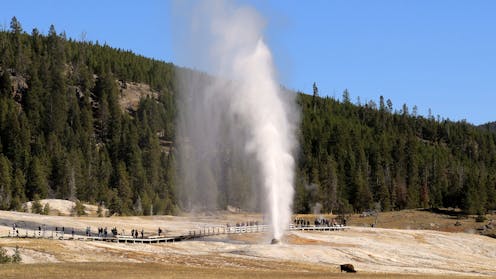
    Beehive Geyser, in the Upper Geyser Basin of Yellowstone National Park. Thomas S. Bremer

    Nearly 5 million travelers come to Wyoming to visit Yellowstone National Park each year, most in the summer months. They come for the geysers, wildlife, scenery and recreational activities such as hiking, fishing and photography.

    However, few realize that religion has been part of Yellowstone’s appeal throughout the park’s history. My 2025 book “Sacred Wonderland” documents how people have long found holiness in Yellowstone: how a landscape once sacred to Native Americans later inspired Christians and New Age communities alike.

    Native reverence – and removal

    Long before European Americans “discovered” the Yellowstone region in the 19th century, numerous Indigenous peoples were aware of its unique landscape – particularly geysers, hot springs and other hydrothermal wonders. Several tribal groups engaged in devotional practices long before it became a park. These included the Tukudika, or Sheep Eaters, a band of mountain Shoshone. They lived year-round within the boundaries of what would become the national park.

    Anthropologists know relatively little about the specific beliefs that Native Americans held about Yellowstone during this era. However, it’s clear most of the Indigenous groups who frequented Yellowstone considered it, as historian Paul Schullery concludes, “a place of spiritual power, of communion with natural forces, a place that inspired reverence.”

    Lower Falls of the Yellowstone River, Yellowstone National Park.
    Thomas S. Bremer

    After the Civil War, more Euro-Americans entered the region. In 1872, the U.S. government created Yellowstone as the first national park, setting a precedent for others in the United States and around the world.

    Yellowstone and other U.S. national parks established in the 19th century were products of manifest destiny: the Christian idea that Americans had a divinely ordained right to expand their country across the continent. The nation’s westward expansion included turning supposedly wild, “uncivilized” areas into parks.

    The park system’s creation, though, came at the cost of Indigenous communities. In Yellowstone, the Tukudika were forcibly removed in the 1870s to two reservations in Idaho and Wyoming, as anthropologists Peter Nabokov and Lawrence Loendorf discuss in their book “Restoring a Presence.”

    Christian ministry

    In addition to the concept of manifest destiny, Christians brought their own religious practices to Yellowstone National Park.

    The U.S. Army was responsible for protecting and managing the park from 1886 to 1918. It operated from Fort Yellowstone at Mammoth Hot Springs in the northern part of the park. The last building it erected at the fort was a chapel, which has been in continuous use as a worship space – mostly for Christian groups – since its completion in 1913.

    The Yellowstone National Park Chapel at Mammoth Hot Springs, finished in 1913, was the last building constructed by the U.S. Army at Fort Yellowstone.
    Thomas S. Bremer

    One group that has used the chapel consistently since the 1950s is ACMNP, A Christian Ministry in the National Parks, an evangelical Protestant parachurch ministry founded in Yellowstone. Its volunteers conduct worship services and proselytize among employees and visitors.

    ACMNP began as the brainchild of Presbyterian minister Warren Ost, who had worked as a bellhop at the Old Faithful Inn during summer breaks in seminary. Upon graduation, he formed the ministry, hoping to capitalize on the awe people experience in the parks to affirm believers’ faith and bring new souls to Christ.

    ACMNP’s mission involves placing seminarians and other students in national parks as “worker-witnesses.” They work as paid employees in secular jobs and conduct religious activities after their regular working hours. Additionally, they are encouraged to talk about religion with their fellow workers on the job.

    ACMNP experienced rapid growth in the 1950s and 1960s, boosted by support from National Park Service leadership. Cooperation included reduced-cost housing for their volunteers, and in some parks the superintendents or other high-level officials served on local ACMNP committees.

    At its peak in the 1970s, ACMNP had nearly 300 volunteers working in over 50 locations. However, a federal lawsuit in the 1990s challenged its relationship with the government on the grounds of church-state separation and ended some of the privileges ACMNP had enjoyed. Not long after the legal action, Ost announced his retirement.

    Although the organization has scaled back operations, the ministry in Yellowstone has experienced few changes. ACMNP volunteers continue to offer religious services to park employees and visitors throughout the summer.

    Spiritual fortress

    Another religious group has a very different interpretation of Yellowstone. The Church Universal and Triumphant, which had several thousand members at its height, was founded by Elizabeth Clare Prophet in the 1970s, based on the teachings of her late husband, Mark Prophet.

    The Church Universal and Triumphant is an heir to the “I AM” movement, which flourished in the U.S. during the 1930s. Most prominent among I AM’s influences were theosophy, which promotes esoteric knowledge gleaned from Asian religious traditions as a universal wisdom underlying all religions; new thought, which advocates a mind-over-matter spirituality; and spiritualism, which involves communicating with spirits.

    In the 1980s, Prophet’s followers relocated from California to Montana, where they purchased a large ranch adjacent to Yellowstone National Park’s northwest boundary. With them, they brought an eclectic New Age theology that combines elements of Christianity, Buddhism and Hinduism with belief in “ascended masters,” spiritual beings who guide the church. The group’s tradition teaches that beneath Yellowstone are two underground caverns, hidden from human view, that contain a cache of sacred stones with spiritual powers.

    The Church Universal and Triumphant gained attention in the ‘90s when its believers in Montana built underground bunkers. Members believed that their ascended masters had predicted a nuclear war and had instructed the community to prepare to survive underground. When the prophecy of a nuclear attack did not materialize, many members became disillusioned.

    The group struggled to rebuild its reputation and establish goodwill with Montana neighbors, including the National Park Service. Elizabeth Clare Prophet retired in 1999, and since then the church has concentrated more on its publishing and educational enterprises. However, a core community of the faithful still live and worship on their Royal Teton Ranch adjacent to Yellowstone.

    The main church sanctuary at Church Universal and Triumphant headquarters, just outside Yellowstone National Park.
    Thomas S. Bremer

    Although the community teaches that its Montana ranch is a sacred location of the ascended masters, followers’ holiest place in the Western Hemisphere is roughly 35 miles south of Yellowstone, in Grand Teton National Park. They believe humanity began at Grand Teton Mountain and that the faithful will find their destiny there.

    Accordingly, members believe that Yellowstone and Grand Teton national parks are brimming with spiritual powers, sacred sources of light and energy for the entire world.

    In my conversations with people in the park, I found that very few knew anything about Yellowstone’s religious history at all – especially Native American practices. The ongoing practices of religious communities in the park remain invisible to nearly all visitors. Still, many vacationers interpret Yellowstone’s wonders as evidence of God’s handiwork.

    Thomas S. Bremer received funding in the past to conduct historical research for the National Park Service at Lincoln Home National Historic Site in Springfield, Illinois.

    ref. Yellowstone has been a ‘sacred wonderland’ of spiritual power and religious activity for centuries – and for different faith groups – https://theconversation.com/yellowstone-has-been-a-sacred-wonderland-of-spiritual-power-and-religious-activity-for-centuries-and-for-different-faith-groups-261045

    MIL OSI

  • MIL-OSI Submissions: As Mexico’s LGBTQ+ community battles for inclusion, two drag performers have become internet stars – with more than 2 million TikTok followers

    Source: The Conversation – USA (2) – By Francisco Tijerina, PhD Candidate in Hispanic Studies, Washington University in St. Louis

    Turbulence Queen, left, and Burrita Burrona perform at the Mexico City Pride Parade in June 2024. Jaime Nogales/Medios y Media via Getty Images News

    In January 2022, Erick Martínez, also known as Turbulence Queen, introduced a guest on his YouTube channel: Ivan “Momo” Guzmán, with the stage name Burrita Burrona, a drag performer wearing a cartoonish donkey costume topped by a wig.

    During their interview, Turbulence and Burrita shared stories, gossiped and threw shade at Mexican actors, newscasters and performers. Soon after, their careers took off.

    Before Burrita’s first appearance, Turbulence’s YouTube channel had fewer than 5,000 subscribers. Now, after the rebranding of the show to include Burrita’s name, their channel has about 375,000. More than 2 million subscribe to them on TikTok – Turbulence, with 600,000 followers and 16 million likes; Burrita with 1.5 million followers and 28 million likes. Their “El Podcast del Momento” has more than 225,000 subscribers.

    The two proved so popular that corporate sponsors started getting in on the action. Soriana, a large supermarket chain in Mexico, splashed their images on a line of cakes. Netflix Latin America had them hosting a series of videos promoting its new South Korean dramas. The media giant Televisa included Turbulence and Burrita as part of their comedic coverage of the 2024 Paris Olympics.

    Over the past 3 ½ years, the YouTube show has added some new characters, including Burrita’s mom and an on-and-off love interest, a butch lesbian wolf. Along with the interviews, the characters do comedic cooking segments and sketches. Even in today’s fragmented and cluttered media environment, the program regularly gets around 250,000 views, with some episodes reaching more than 1 million.

    While drag performers are not new in Mexico, Burrita is something of a novelty: a drag mascot. Although long a part of Mexico’s commercial culture – mascots promote everything from soccer teams to pharmacies and are a staple at children’s birthday parties – Burrita is the first to do it in drag.

    A clip from an episode of ‘El Podcast del Momento.’

    Discrimination and violence

    As a Mexican scholar who specializes in the study of gender and sexuality, I’m struck by how these LGBTQ+ characters have become enormously popular in what I consider a relatively conservative and deeply religious country. However, that too is changing: Today’s Mexico is sometimes called a conservative country with liberal laws. Still, in a country where about 5% of the population self-identify as LGBTQ+, the battle for inclusion – and more diverse representation of gender and sexuality – is far from over.

    In 2023, conservative groups pressured the International Book Fair of Monterrey to cancel a public short-story reading by drag queens. In 2024, a social media influencer’s misogynistic, homophobic and transphobic remarks ran live on national television. Also in 2024, San Nicolás de los Garza, a city of more than 400,000 people, banned public performances by drag queens. Ironically, San Nicolás is in the state of Nuevo Leon, which has one of the largest LGBTQ+ populations in Mexico.

    Indeed, national policies protecting the LGBTQ+ community don’t always apply equally; some states are more restrictive than others. For example, although Mexico’s Supreme Court legalized same-sex marriage in 2015, three states have yet to ratify it in their state constitutions.

    Turbulence Queen is interviewed on local TV at a 2023 red carpet event in Mexico.
    Jaime Nogales/Medios y Media via Getty Images Entertainment

    In May 2025, Mexico’s National Institute of Statistics and Geography reported these findings: 60% of the LGBTQ+ community say they’ve been subjected to some form of violence. Nearly 30% have had suicidal thoughts or have attempted suicide. Just over 37% say they experienced some form of discrimination during the past year. From 2020 to 2025, 25% said they were denied access to health care, education or social support. Hate crimes are on the rise, with 672 reported over a five-year period, including 141 in 2024, a significant jump from the 92 reported in 2023. The 2024 statistic includes 55 murders of transgender women.

    Taking off the mask

    Turbulence and Burrita’s swift success is impressive, but not all LGBTQ+ citizens in Mexico enjoy the same level of recognition and privilege. And as the fight for equal treatment continues, the country’s politics over the past decade has shifted. In 2018, leftist Andrés Manuel López Obrador was elected president. His successor, Claudia Sheinbaum, a climate scientist and a close ally of López Obrador’s, was elected in 2024.

    But although both López Obrador and Sheinbaum are more progressive than previous administrations, neither has been particularly vocal about their support for the LGBTQ+ community. For instance: Although Sheinbaum, Mexico’s first female and Jewish president, mentioned her support for the LGBTQ+ community during her campaign, she has largely ignored LGBTQ+ issues since taking office.

    Until recently, there were few openly LGBTQ+ people pitching products or appearing on television. But Guzmán, who’s the first mascot to perform in drag, is not hiding his sexuality, despite the costume. Rather, he can be read as a symbol of Mexico’s ongoing pursuit of equality. And perhaps his character’s visibility will allow more in the community to be able to shed their masks and come out.

    Francisco Tijerina does not work for, consult, own shares in or receive funding from any company or organization that would benefit from this article, and has disclosed no relevant affiliations beyond their academic appointment.

    ref. As Mexico’s LGBTQ+ community battles for inclusion, two drag performers have become internet stars – with more than 2 million TikTok followers – https://theconversation.com/as-mexicos-lgbtq-community-battles-for-inclusion-two-drag-performers-have-become-internet-stars-with-more-than-2-million-tiktok-followers-241552

    MIL OSI

  • MIL-OSI Submissions: Why 2025 became the summer of flash flooding in America

    Source: The Conversation – USA (2) – By Jeffrey Basara, Professor of Meteorology, UMass Lowell

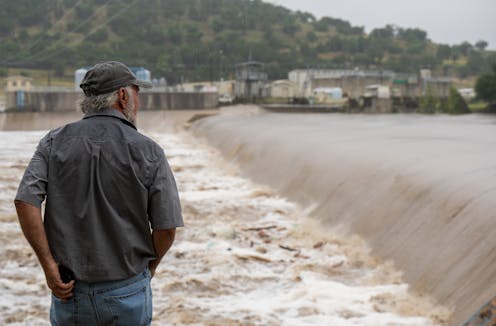
    Rescuers searched for survivors after a flash flood in Texas Hill Country on July 4, 2025, that killed more than 130 people. Jim Vondruska/Getty Images

    The National Weather Service has already issued more than 3,600 flash flood warnings across the United States in 2025, and that number is increasing as torrential downpours continue in late July. There’s a good chance the U.S. will exceed its yearly average of around 4,000 flash flood warnings soon.

    For communities in Texas, New Mexico, West Virginia and New Jersey, the floods have been deadly. And many more states have seen flash flood damage in recent weeks, including New York, Oklahoma, Kansas, Vermont and Iowa.

    What’s causing so much extreme rain and flooding?

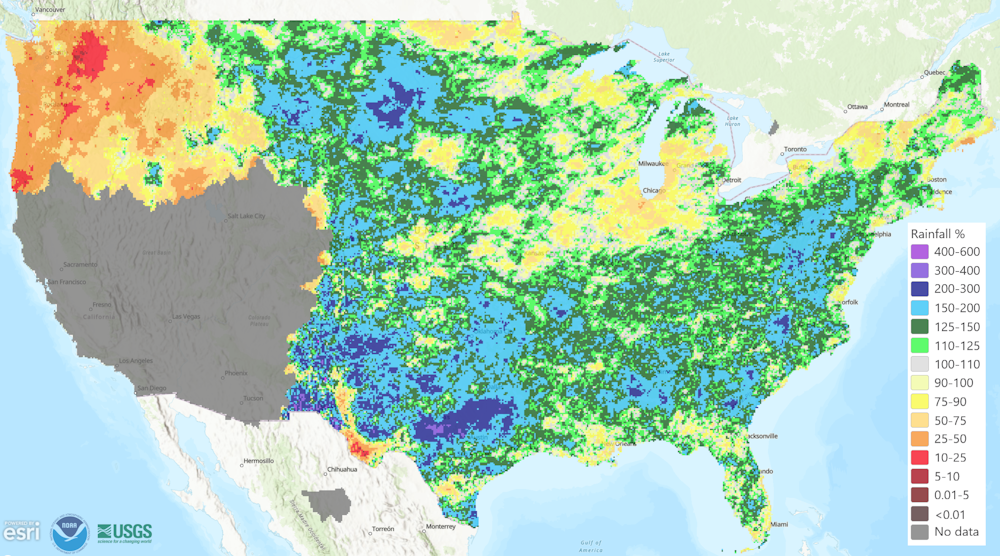
    Much of the central and eastern U.S. has had above-normal precipitation over the three months from April 23 through July 24, 2025. Blues are 150% to 200% of normal. Purples are even higher.
    NOAA National Water Prediction Service

    I study extreme precipitation events along with the complex processes that lead to the devastating damage they cause.

    Both the atmosphere and surface conditions play important roles in when and where flash floods occur and how destructive they become, and 2025 has seen some extremes, with large parts of the country east of the Rockies received at least 50% more precipitation than normal from mid-April through mid-July.

    Excess water vapor, weaker jet stream

    Flash floods are caused by excessive precipitation over short periods of time. When rain accumulates too fast for the local environment to absorb or reroute it, flooding ensues, and conditions can get dangerous fast.

    Flooding from heavy rain in the Boston area on July 10, 2025, shut down an interstate and filled streets and garages with water.
    John Tlumacki/The Boston Globe via Getty Images

    During the warm season, intrusions of tropical air with excessive water vapor are common in the U.S., and they can result in intense downpours.

    In addition, the jet stream and westerly winds – which move storm systems from west to east across the U.S. – tend to weaken during summer. As a result, the overall movement of thunderstorms and other precipitation-producing systems slows during the summer months, and storm systems can remain almost stationary over a location.

    The combination of intense rainfall rates and extended precipitation increases the likelihood of flash flooding.

    The surface rain falls on makes a difference, too

    Local surface characteristics also play important roles in how flash floods develop and evolve.

    When intense precipitation is combined with saturated soils, steep slopes, urban areas and sparse vegetation, runoff can quickly overwhelm local streams, rivers and drainage systems, leading to the rapid rise of water levels.

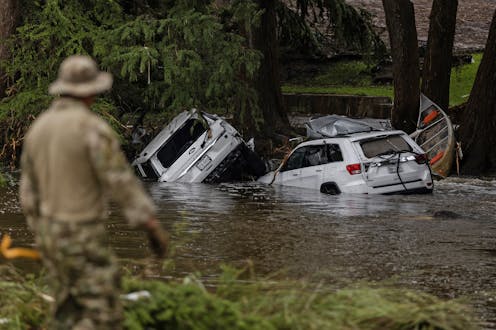
    When the remnants of Hurricane Helene hit the mountains of North Carolina in October 2024, the intense rainfall on steep slopes quickly filled streams and then rivers that washed away homes in their narrow valleys.
    Sean Rayford/Getty Images

    Because the characteristics of the surface can vary significantly along a stream or river, the timing and location of a heavy downpour pose unique risks for each local area.

    What’s driving flash floods in 2025?

    During the horrific flooding in Texas Hill Country on July 4, 2025, that killed more than 135 people, atmospheric water vapor in the region was at or near historic levels. The storm hit at the headwaters of the Guadalupe River, over streams that converge in the river valley.

    As thunderstorms developed and remained nearly stationary over the region, they were fueled by the excessive atmospheric water vapor. That led to high rainfall rates. Hours of heavy rainfall early that morning sent the river rising quickly at a summer camp near Hunt, Texas, where more than two dozen girls and staff members died. Downstream at Kerrville, the river rose even faster, gaining more than 30 feet in 45 minutes.

    Overall, a persistent atmospheric pattern in late spring and summer 2025 has included a shift of the jet stream farther to the south than normal and, along with lower atmospheric pressures, has supported excessive rainfall across the central and eastern U.S.

    While the West Coast has experienced dry conditions in early summer 2025 due to a ridge of high pressure, the U.S. east of the Rockies has seen an active storm track with frontal boundaries and disturbances that produced thunderstorms and intense downpours across the region.

    Warmer-than-normal ocean water can also boost rainfall. The Caribbean and the Atlantic Ocean are source regions for atmospheric water vapor in the central and eastern U.S. In summer 2025, that water vapor has created extremely humid conditions, which have produced very high rainfall rates when storms develop.

    The result has been flash floods in several states producing catastrophic destruction and loss of life.

    Looking to the future

    The U.S. has seen devastating flash floods throughout its history, but rising global temperatures today are increasing the risk of flooding.

    As ocean and air temperatures rise, atmospheric water vapor increases. Higher ocean temperatures can produce more atmospheric water vapor through evaporation, and a warmer atmosphere can hold more moisture, fueling downpours. In some high-risk areas, meteorologists, aware of the risks, say they are becoming more proactive about warnings.

    Currently, evidence shows that atmospheric water vapor is increasing in the overall global climate system as temperatures rise.

    Jeffrey Basara receives funding from the National Science Foundation, NASA, and NOAA.

    ref. Why 2025 became the summer of flash flooding in America – https://theconversation.com/why-2025-became-the-summer-of-flash-flooding-in-america-261650

    MIL OSI

  • MIL-OSI Submissions: Why do MAGA faithful support Trump if his ‘big beautiful bill’ will likely hurt many of them?

    Source: The Conversation – USA – By Alex Hinton, Distinguished Professor of Anthropology; Director, Center for the Study of Genocide and Human Rights, Rutgers University – Newark

    Supporters of President Donald Trump demonstrate near his Mar-a-Lago home in Palm Beach, Fla., on July 17, 2025. Joe Raedle/Getty Images

    President Donald Trump signed the wide-ranging One Big Beautiful Bill Act into law on July 4, 2025. It focuses on cutting taxes, mainly for households that earn US$217,000 or more each year, as well as increasing funding for military and border security and revamping social programs.

    Republicans tout it as providing “an economic lifeline for working families” and “laying a key cornerstone of America’s new golden age.”

    Democrat lawmakers argue that, in reality, Trump’s act “steals from the poor to give to the ultra-rich.”

    The act is estimated to increase the country’s debt by more than US$3 trillion over 10 years, while knocking more than 10 million people off Medicaid.

    About 41.4 million adults in the U.S. receive Medicaid. And 49% of Medicaid recipients who voted in the 2024 election backed Trump.

    While 94% of Democrats and Democratic-leaning independents said in a May 2025 survey that they are worried Medicaid cuts will lead to more adults and children losing their health insurance, 44% of Republicans and Republican-leaning independents expressed concern about this, according to the KFF Health Tracking Poll.

    Why, then, do Trump’s Make America Great Again supporters – especially those who will be hit hard by cuts to food assistance programs and health care, including hospitals – continue to support him even as he enacts policies that some think go against their interests? Indeed, over 78% of Republicans or Republican-leaning voters say they support the measure Trump signed.

    As an anthropologist who studies MAGA and American political culture, I understand that many of the MAGA faithful believe that Trump is a once-in-a-lifetime leader who is catapulting the U.S. into a new golden age.

    Sure, their reasoning goes, bumps in the road are expected. But they think that most of the criticism of Trump and this latest bill is ultimately fake news spread by radical leftists who have what some call Trump Derangement Syndrome, meaning anti-Trump hysteria.

    President Donald Trump holds up the One Big Beautiful Bill Act that he signed into law on July 4, 2025, at the White House.
    Alex Brandon − Pool/Getty Images

    Trump alone can fix it

    In the eyes of the MAGA faithful, Trump is no ordinary politician. To them, he is a savior who can help ward off the threat of radical left socialism. They believe Trump’s proclamation: “I alone can fix it.”

    Some see Trump’s survival of an assassination attempt on July 13, 2024, as evidence he is divinely chosen to lead the country. Trump himself claimed during his second inaugural address, “I was saved by God to make America great again.”

    As I have repeatedly observed firsthand at Trump rallies and MAGA gatherings and heard in my conversations with Trump supporters, many Trump supporters – even those whom Democrats contend will be hurt by the bill – see the bill as a key step to making America great again. Doing so will not be easy and may cause some pain.

    But as Trump himself has noted about policies such as tariffs, “sometimes you have to take medicine to fix something.”

    ‘Fake news!’

    Even if the bill may cause some short-term pain, MAGA stalwarts contend, the apocalyptic claims of critics of massive health cuts are hoaxes spread by the radical left media. White House National Economic Council director Kevin Hassett, for example, dubbed the Medicare cut claims “a big fake news story.”

    This view, based on my research and observations, is unsurprising. Trump has been pushing the “fake news conspiracy” theory, which holds that the media is part of the deep state, since his first term. He even dubbed the press “the enemy of the people.”

    Trump’s fake news rhetorical strategy has been successful in helping him maintain support. Trump supporters take it for granted that negative news coverage of the president is most likely fake news.

    The Trump administration frequently invokes this conspiracy theory, including statements with headlines like “100 Days of HOAXES: Cutting Through the Fake News.”

    The White House is taking the same approach with the new legislation. In June 2025, the Trump administration issued a statement stating “Myth vs. Fact: The One Big Beautiful Bill” and “MYTHBUSTER: The One Big Beautiful Bill Cuts Spending, Deficit – and That’s a Fact.”

    There is already evidence that this depiction is resonating in places such as rural Nebraska, where many residents do not blame Trump for a health clinic that claims it is shutting down due to Medicaid cuts. “Anyone who’s saying that Medicaid cuts is why they’re closing is a liar,” said one woman of the clinic’s closure.

    President Donald Trump holds a rally in July 2024 in Harrisburg, Pa.
    Spencer Platt/Getty Images

    ‘Crushing it’ in the Golden Age

    More broadly, the MAGA faithful contend, the bill’s critics miss the bigger picture. For the most part, Trump has been “crushing it” while putting “‘W’ after ‘W’ on the board.”

    From their perspective, Trump has assembled an all-star Cabinet team that is implementing key pillars of the MAGA agenda, such as restricting immigration, blocking unfair trade and avoiding drawn-out wars.

    Trump supporters underscore the president’s accomplishments on immigration. Attempted unauthorized border crossings of migrants have plummeted in 2025, amid a rise in arrests of immigrants.

    “Our message is clear,” stated Department of Homeland Security Assistant Secretary Tricia McLaughlin, “criminal illegal aliens are not welcome in the United States.”

    Gas prices are also down. Trump has followed through on his pledge to supporters to purge what he calls the deep state, by downsizing or gutting entire government departments and agencies.

    Trump has clamped down on woke universities that brainwash students, as MAGA supporters see it.

    He withheld funding from the University of Pennsylvania until it agreed to ban transgender women from playing on women’s sports teams. Trump also cut $400 million in funding for Columbia University because the administration said it did not sufficiently protect Jewish students from harassment during Palestinian rights protests.

    And Israeli Prime Minister Benjamin Netanyahu even nominated Trump for the Nobel Peace Prize in July for his diplomatic work in the Middle East.

    Recounting Trump’s foreign policy achievements, one conservative commentator gushed that Trump “promised we would win so much we’d get tired of winning. Instead, the wins keep coming – and America isn’t tired at all.”

    Trumpism = Trump

    Yet, Trump faces challenges.

    A June 2025 KFF Health Tracking Poll found that support for the new legislation decreased when people were informed about its negative health care impact, for example.

    Republicans could also face backlash in 2028 after the full impact of the act takes effect and people lose health insurance and other public benefits.

    Regardless, I believe MAGA faithful will likely continue to support Trump.

    They may argue over parts of his bill, the airstrikes on Iran or the release of the Jeffrey Epstein files.

    But, in the end, they will circle the wagons around Trump for a simple reason. Trump created the MAGA movement. He dominates the Republican Party. And there is no Trumpism without Trump.

    Alex Hinton receives receives funding from the Rutgers-Newark Sheila Y. Oliver Center for Politics and Race in America, Rutgers Research Council, and Henry Frank Guggenheim Foundation.

    ref. Why do MAGA faithful support Trump if his ‘big beautiful bill’ will likely hurt many of them? – https://theconversation.com/why-do-maga-faithful-support-trump-if-his-big-beautiful-bill-will-likely-hurt-many-of-them-260766

    MIL OSI

  • From sweetener to cancer fighter? Fermented stevia shows promise in pancreatic cancer study

    Source: ForeignAffairs4

    Source: The Conversation – UK – By Justin Stebbing, Professor of Biomedical Sciences, Anglia Ruskin University

    Dionisvera/Shutterstock

    In an unexpected twist in the fight against cancer, humble kitchen bacteria and a plant best known for sweetening tea could one day help in treating one of humanity’s deadliest diseases, new research suggests.

    A group of scientists in Japan has discovered that fermented stevia, a plant commonly used as a calorie-free sweetener, may hold intriguing anti-cancer properties. While these findings are early and need much more research, they hint at a potential future role for stevia in tackling pancreatic cancer.

    Pancreatic cancer remains one of the most difficult cancers to treat. Symptoms typically appear only after the disease has spread, and conventional therapies like chemotherapy rarely result in a cure. The outlook is bleak: fewer than 10% of patients survive five years beyond diagnosis.

    This urgent need for more effective and less toxic treatments has driven researchers to explore plant-based compounds. Many chemotherapy drugs already used today have botanical origins – including paclitaxel, derived from the bark of the Pacific yew tree, and vincristine, sourced from the Madagascar periwinkle – offering a proven pathway for discovering new cancer-fighting agents.


    Read more:
    Chemotherapy can be a challenging treatment – here’s how to deal with some of the side-effects


    Stevia, a leafy plant native to South America, is widely known for its natural sweetness. It’s a familiar presence on supermarket shelves, but few think of it as a medicinal plant.

    Stevia leaves are rich in bioactive compounds, some of which have shown hints of anticancer and antioxidant activity in previous research. The challenge has been harnessing this potential, as unfermented stevia extracts are only mildly effective in laboratory settings, often requiring high doses to affect cancer cells.

    Hand plucks stevia in the rays of the bright sun
    Stevia could play an important role in cancer prevention.
    yul38885/Shutterstock

    That’s where fermentation comes in. Known for creating yogurt, kimchi and sourdough bread, fermentation is more than a culinary technique. I’s a form of microbial alchemy that can transform plant compounds into new, bioactive molecules.

    Researchers at Hiroshima University asked a simple but innovative question: what if stevia was fermented with the right bacteria? They experimented with a strain called Lactobacillus plantarum SN13T, a relative of a bacteria commonly found in fermented foods. Fermentation produced a compound called chlorogenic acid methyl ester (CAME), which showed much stronger anti-cancer effects than raw stevia extract.

    In lab tests, the fermented stevia extract caused pancreatic cancer cells to die in large numbers but left healthy kidney cells largely unharmed. Further analysis revealed that CAME was responsible for this effect. It worked by blocking cancer cells at a specific phase of their life cycle, preventing them from multiplying and by triggering apoptosis, a natural process where cells self-destruct when damaged or no longer needed.

    CAME seems to alter the genetic programming of cancer cells. It activates genes that promote cell death while simultaneously suppressing those that help cancer cells grow and survive. This double hit both slows cancer progression and encourages malignant cells to kill themselves.

    The power of fermentation

    Fermented stevia extract was also found to be a stronger antioxidant than its unfermented counterpart. Oxidative stress – an imbalance of potentially harmful moelcules known as free radicals in the body — is linked to cancer and other diseases. By neutralizing these free radicals more effectively, the fermented extract may offer extra protection for healthy cells.

    This is not the first time fermentation has been shown to unlock hidden benefits. Fermented soy and ginseng have been found to offer enhanced health properties compared to their raw forms.

    Red ginseng plant
    Fermented ginseng, particularly red ginseng, could offer enhanced health benefits.
    zhengchengbao/Shutterstock

    But the stevia findings stand out because of the compound’s selectivity. Killing cancer cells while sparing healthy ones is the holy grail for cancer researchers.

    It’s important to note that these results come from lab-grown cells, not from animal or human studies. Many substances that look promising in petri dishes fail in clinical trials due to the complexity of the human body. Still, the discovery is exciting and warrants further exploration.

    This research highlights the potential of everyday foods and their natural microbes as untapped sources of new medicines. It also reflects growing interest in “microbialbiotransformation” – using beneficial bacteria to create powerful compounds from plants.

    In the case of stevia, a simple quest for a natural sweetener has evolved into something potentially far more profound: a stepping stone toward a cancer therapy that’s natural, targeted and cost-effective.


    Get your news from actual experts, straight to your inbox. Sign up to our daily newsletter to receive all The Conversation UK’s latest coverage of news and research, from politics and business to the arts and sciences.

    The Conversation

    Justin Stebbing does not work for, consult, own shares in or receive funding from any company or organisation that would benefit from this article, and has disclosed no relevant affiliations beyond their academic appointment.

    ref. From sweetener to cancer fighter? Fermented stevia shows promise in pancreatic cancer study – https://theconversation.com/from-sweetener-to-cancer-fighter-fermented-stevia-shows-promise-in-pancreatic-cancer-study-261599

  • Yellowstone has been a ‘sacred wonderland’ of spiritual power and religious activity for centuries – and for different faith groups

    Source: ForeignAffairs4

    Source: The Conversation – USA (3) – By Thomas S. Bremer, Professor Emeritus of Religious Studies, Rhodes College

    Beehive Geyser, in the Upper Geyser Basin of Yellowstone National Park. Thomas S. Bremer

    Nearly 5 million travelers come to Wyoming to visit Yellowstone National Park each year, most in the summer months. They come for the geysers, wildlife, scenery and recreational activities such as hiking, fishing and photography.

    However, few realize that religion has been part of Yellowstone’s appeal throughout the park’s history. My 2025 book “Sacred Wonderland” documents how people have long found holiness in Yellowstone: how a landscape once sacred to Native Americans later inspired Christians and New Age communities alike.

    Native reverence – and removal

    Long before European Americans “discovered” the Yellowstone region in the 19th century, numerous Indigenous peoples were aware of its unique landscape – particularly geysers, hot springs and other hydrothermal wonders. Several tribal groups engaged in devotional practices long before it became a park. These included the Tukudika, or Sheep Eaters, a band of mountain Shoshone. They lived year-round within the boundaries of what would become the national park.

    Anthropologists know relatively little about the specific beliefs that Native Americans held about Yellowstone during this era. However, it’s clear most of the Indigenous groups who frequented Yellowstone considered it, as historian Paul Schullery concludes, “a place of spiritual power, of communion with natural forces, a place that inspired reverence.”

    A large waterfall pours over a steep cliff into a river below, surrounded by rocky canyon walls and forested slopes.
    Lower Falls of the Yellowstone River, Yellowstone National Park.
    Thomas S. Bremer

    After the Civil War, more Euro-Americans entered the region. In 1872, the U.S. government created Yellowstone as the first national park, setting a precedent for others in the United States and around the world.

    Yellowstone and other U.S. national parks established in the 19th century were products of manifest destiny: the Christian idea that Americans had a divinely ordained right to expand their country across the continent. The nation’s westward expansion included turning supposedly wild, “uncivilized” areas into parks.

    The park system’s creation, though, came at the cost of Indigenous communities. In Yellowstone, the Tukudika were forcibly removed in the 1870s to two reservations in Idaho and Wyoming, as anthropologists Peter Nabokov and Lawrence Loendorf discuss in their book “Restoring a Presence.”

    Christian ministry

    In addition to the concept of manifest destiny, Christians brought their own religious practices to Yellowstone National Park.

    The U.S. Army was responsible for protecting and managing the park from 1886 to 1918. It operated from Fort Yellowstone at Mammoth Hot Springs in the northern part of the park. The last building it erected at the fort was a chapel, which has been in continuous use as a worship space – mostly for Christian groups – since its completion in 1913.

    A small stone church features a pitched roof, arched windows and a prominent entrance.
    The Yellowstone National Park Chapel at Mammoth Hot Springs, finished in 1913, was the last building constructed by the U.S. Army at Fort Yellowstone.
    Thomas S. Bremer

    One group that has used the chapel consistently since the 1950s is ACMNP, A Christian Ministry in the National Parks, an evangelical Protestant parachurch ministry founded in Yellowstone. Its volunteers conduct worship services and proselytize among employees and visitors.

    ACMNP began as the brainchild of Presbyterian minister Warren Ost, who had worked as a bellhop at the Old Faithful Inn during summer breaks in seminary. Upon graduation, he formed the ministry, hoping to capitalize on the awe people experience in the parks to affirm believers’ faith and bring new souls to Christ.

    ACMNP’s mission involves placing seminarians and other students in national parks as “worker-witnesses.” They work as paid employees in secular jobs and conduct religious activities after their regular working hours. Additionally, they are encouraged to talk about religion with their fellow workers on the job.

    ACMNP experienced rapid growth in the 1950s and 1960s, boosted by support from National Park Service leadership. Cooperation included reduced-cost housing for their volunteers, and in some parks the superintendents or other high-level officials served on local ACMNP committees.

    At its peak in the 1970s, ACMNP had nearly 300 volunteers working in over 50 locations. However, a federal lawsuit in the 1990s challenged its relationship with the government on the grounds of church-state separation and ended some of the privileges ACMNP had enjoyed. Not long after the legal action, Ost announced his retirement.

    Although the organization has scaled back operations, the ministry in Yellowstone has experienced few changes. ACMNP volunteers continue to offer religious services to park employees and visitors throughout the summer.

    Spiritual fortress

    Another religious group has a very different interpretation of Yellowstone. The Church Universal and Triumphant, which had several thousand members at its height, was founded by Elizabeth Clare Prophet in the 1970s, based on the teachings of her late husband, Mark Prophet.

    The Church Universal and Triumphant is an heir to the “I AM” movement, which flourished in the U.S. during the 1930s. Most prominent among I AM’s influences were theosophy, which promotes esoteric knowledge gleaned from Asian religious traditions as a universal wisdom underlying all religions; new thought, which advocates a mind-over-matter spirituality; and spiritualism, which involves communicating with spirits.

    In the 1980s, Prophet’s followers relocated from California to Montana, where they purchased a large ranch adjacent to Yellowstone National Park’s northwest boundary. With them, they brought an eclectic New Age theology that combines elements of Christianity, Buddhism and Hinduism with belief in “ascended masters,” spiritual beings who guide the church. The group’s tradition teaches that beneath Yellowstone are two underground caverns, hidden from human view, that contain a cache of sacred stones with spiritual powers.

    The Church Universal and Triumphant gained attention in the ‘90s when its believers in Montana built underground bunkers. Members believed that their ascended masters had predicted a nuclear war and had instructed the community to prepare to survive underground. When the prophecy of a nuclear attack did not materialize, many members became disillusioned.

    The group struggled to rebuild its reputation and establish goodwill with Montana neighbors, including the National Park Service. Elizabeth Clare Prophet retired in 1999, and since then the church has concentrated more on its publishing and educational enterprises. However, a core community of the faithful still live and worship on their Royal Teton Ranch adjacent to Yellowstone.

    A stage area displaying an image of the Hindu god Shiva and two large portraits of men, with a white chair flanked by two flower-laden tables.
    The main church sanctuary at Church Universal and Triumphant headquarters, just outside Yellowstone National Park.
    Thomas S. Bremer

    Although the community teaches that its Montana ranch is a sacred location of the ascended masters, followers’ holiest place in the Western Hemisphere is roughly 35 miles south of Yellowstone, in Grand Teton National Park. They believe humanity began at Grand Teton Mountain and that the faithful will find their destiny there.

    Accordingly, members believe that Yellowstone and Grand Teton national parks are brimming with spiritual powers, sacred sources of light and energy for the entire world.

    In my conversations with people in the park, I found that very few knew anything about Yellowstone’s religious history at all – especially Native American practices. The ongoing practices of religious communities in the park remain invisible to nearly all visitors. Still, many vacationers interpret Yellowstone’s wonders as evidence of God’s handiwork.

    The Conversation

    Thomas S. Bremer received funding in the past to conduct historical research for the National Park Service at Lincoln Home National Historic Site in Springfield, Illinois.

    ref. Yellowstone has been a ‘sacred wonderland’ of spiritual power and religious activity for centuries – and for different faith groups – https://theconversation.com/yellowstone-has-been-a-sacred-wonderland-of-spiritual-power-and-religious-activity-for-centuries-and-for-different-faith-groups-261045

  • As Mexico’s LGBTQ+ community battles for inclusion, two drag performers have become internet stars – with more than 2 million TikTok followers

    Source: ForeignAffairs4

    Source: The Conversation – USA (2) – By Francisco Tijerina, PhD Candidate in Hispanic Studies, Washington University in St. Louis

    Turbulence Queen, left, and Burrita Burrona perform at the Mexico City Pride Parade in June 2024. Jaime Nogales/Medios y Media via Getty Images News

    In January 2022, Erick Martínez, also known as Turbulence Queen, introduced a guest on his YouTube channel: Ivan “Momo” Guzmán, with the stage name Burrita Burrona, a drag performer wearing a cartoonish donkey costume topped by a wig.

    During their interview, Turbulence and Burrita shared stories, gossiped and threw shade at Mexican actors, newscasters and performers. Soon after, their careers took off.

    Before Burrita’s first appearance, Turbulence’s YouTube channel had fewer than 5,000 subscribers. Now, after the rebranding of the show to include Burrita’s name, their channel has about 375,000. More than 2 million subscribe to them on TikTok – Turbulence, with 600,000 followers and 16 million likes; Burrita with 1.5 million followers and 28 million likes. Their “El Podcast del Momento” has more than 225,000 subscribers.

    The two proved so popular that corporate sponsors started getting in on the action. Soriana, a large supermarket chain in Mexico, splashed their images on a line of cakes. Netflix Latin America had them hosting a series of videos promoting its new South Korean dramas. The media giant Televisa included Turbulence and Burrita as part of their comedic coverage of the 2024 Paris Olympics.

    Over the past 3 ½ years, the YouTube show has added some new characters, including Burrita’s mom and an on-and-off love interest, a butch lesbian wolf. Along with the interviews, the characters do comedic cooking segments and sketches. Even in today’s fragmented and cluttered media environment, the program regularly gets around 250,000 views, with some episodes reaching more than 1 million.

    While drag performers are not new in Mexico, Burrita is something of a novelty: a drag mascot. Although long a part of Mexico’s commercial culture – mascots promote everything from soccer teams to pharmacies and are a staple at children’s birthday parties – Burrita is the first to do it in drag.

    A clip from an episode of ‘El Podcast del Momento.’

    Discrimination and violence

    As a Mexican scholar who specializes in the study of gender and sexuality, I’m struck by how these LGBTQ+ characters have become enormously popular in what I consider a relatively conservative and deeply religious country. However, that too is changing: Today’s Mexico is sometimes called a conservative country with liberal laws. Still, in a country where about 5% of the population self-identify as LGBTQ+, the battle for inclusion – and more diverse representation of gender and sexuality – is far from over.

    In 2023, conservative groups pressured the International Book Fair of Monterrey to cancel a public short-story reading by drag queens. In 2024, a social media influencer’s misogynistic, homophobic and transphobic remarks ran live on national television. Also in 2024, San Nicolás de los Garza, a city of more than 400,000 people, banned public performances by drag queens. Ironically, San Nicolás is in the state of Nuevo Leon, which has one of the largest LGBTQ+ populations in Mexico.

    Indeed, national policies protecting the LGBTQ+ community don’t always apply equally; some states are more restrictive than others. For example, although Mexico’s Supreme Court legalized same-sex marriage in 2015, three states have yet to ratify it in their state constitutions.

    A drag performer, with bright red hair, speaks to an off-camera TV reporter.
    Turbulence Queen is interviewed on local TV at a 2023 red carpet event in Mexico.
    Jaime Nogales/Medios y Media via Getty Images Entertainment

    In May 2025, Mexico’s National Institute of Statistics and Geography reported these findings: 60% of the LGBTQ+ community say they’ve been subjected to some form of violence. Nearly 30% have had suicidal thoughts or have attempted suicide. Just over 37% say they experienced some form of discrimination during the past year. From 2020 to 2025, 25% said they were denied access to health care, education or social support. Hate crimes are on the rise, with 672 reported over a five-year period, including 141 in 2024, a significant jump from the 92 reported in 2023. The 2024 statistic includes 55 murders of transgender women.

    Taking off the mask

    Turbulence and Burrita’s swift success is impressive, but not all LGBTQ+ citizens in Mexico enjoy the same level of recognition and privilege. And as the fight for equal treatment continues, the country’s politics over the past decade has shifted. In 2018, leftist Andrés Manuel López Obrador was elected president. His successor, Claudia Sheinbaum, a climate scientist and a close ally of López Obrador’s, was elected in 2024.

    But although both López Obrador and Sheinbaum are more progressive than previous administrations, neither has been particularly vocal about their support for the LGBTQ+ community. For instance: Although Sheinbaum, Mexico’s first female and Jewish president, mentioned her support for the LGBTQ+ community during her campaign, she has largely ignored LGBTQ+ issues since taking office.

    Until recently, there were few openly LGBTQ+ people pitching products or appearing on television. But Guzmán, who’s the first mascot to perform in drag, is not hiding his sexuality, despite the costume. Rather, he can be read as a symbol of Mexico’s ongoing pursuit of equality. And perhaps his character’s visibility will allow more in the community to be able to shed their masks and come out.

    The Conversation

    Francisco Tijerina does not work for, consult, own shares in or receive funding from any company or organization that would benefit from this article, and has disclosed no relevant affiliations beyond their academic appointment.

    ref. As Mexico’s LGBTQ+ community battles for inclusion, two drag performers have become internet stars – with more than 2 million TikTok followers – https://theconversation.com/as-mexicos-lgbtq-community-battles-for-inclusion-two-drag-performers-have-become-internet-stars-with-more-than-2-million-tiktok-followers-241552

  • Why 2025 became the summer of flash flooding in America

    Source: ForeignAffairs4

    Source: The Conversation – USA (2) – By Jeffrey Basara, Professor of Meteorology, UMass Lowell

    Rescuers searched for survivors after a flash flood in Texas Hill Country on July 4, 2025, that killed more than 130 people. Jim Vondruska/Getty Images

    The National Weather Service has already issued more than 3,600 flash flood warnings across the United States in 2025, and that number is increasing as torrential downpours continue in late July. There’s a good chance the U.S. will exceed its yearly average of around 4,000 flash flood warnings soon.

    For communities in Texas, New Mexico, West Virginia and New Jersey, the floods have been deadly. And many more states have seen flash flood damage in recent weeks, including New York, Oklahoma, Kansas, Vermont and Iowa.

    What’s causing so much extreme rain and flooding?

    Map shows a very wet central and eastern U.S., particularly over Texas, but just about everywhere east of the Rockies was quite a bit above normal
    Much of the central and eastern U.S. has had above-normal precipitation over the three months from April 23 through July 24, 2025. Blues are 150% to 200% of normal. Purples are even higher.
    NOAA National Water Prediction Service

    I study extreme precipitation events along with the complex processes that lead to the devastating damage they cause.

    Both the atmosphere and surface conditions play important roles in when and where flash floods occur and how destructive they become, and 2025 has seen some extremes, with large parts of the country east of the Rockies received at least 50% more precipitation than normal from mid-April through mid-July.

    Excess water vapor, weaker jet stream

    Flash floods are caused by excessive precipitation over short periods of time. When rain accumulates too fast for the local environment to absorb or reroute it, flooding ensues, and conditions can get dangerous fast.

    A man standing in ankle-deep water moves equipment to safety in a construction business.
    Flooding from heavy rain in the Boston area on July 10, 2025, shut down an interstate and filled streets and garages with water.
    John Tlumacki/The Boston Globe via Getty Images

    During the warm season, intrusions of tropical air with excessive water vapor are common in the U.S., and they can result in intense downpours.

    In addition, the jet stream and westerly winds – which move storm systems from west to east across the U.S. – tend to weaken during summer. As a result, the overall movement of thunderstorms and other precipitation-producing systems slows during the summer months, and storm systems can remain almost stationary over a location.

    The combination of intense rainfall rates and extended precipitation increases the likelihood of flash flooding.

    The surface rain falls on makes a difference, too

    Local surface characteristics also play important roles in how flash floods develop and evolve.

    When intense precipitation is combined with saturated soils, steep slopes, urban areas and sparse vegetation, runoff can quickly overwhelm local streams, rivers and drainage systems, leading to the rapid rise of water levels.

    Damaged homes along the Broad River in North Carolina.
    When the remnants of Hurricane Helene hit the mountains of North Carolina in October 2024, the intense rainfall on steep slopes quickly filled streams and then rivers that washed away homes in their narrow valleys.
    Sean Rayford/Getty Images

    Because the characteristics of the surface can vary significantly along a stream or river, the timing and location of a heavy downpour pose unique risks for each local area.

    What’s driving flash floods in 2025?

    During the horrific flooding in Texas Hill Country on July 4, 2025, that killed more than 135 people, atmospheric water vapor in the region was at or near historic levels. The storm hit at the headwaters of the Guadalupe River, over streams that converge in the river valley.

    As thunderstorms developed and remained nearly stationary over the region, they were fueled by the excessive atmospheric water vapor. That led to high rainfall rates. Hours of heavy rainfall early that morning sent the river rising quickly at a summer camp near Hunt, Texas, where more than two dozen girls and staff members died. Downstream at Kerrville, the river rose even faster, gaining more than 30 feet in 45 minutes.

    Overall, a persistent atmospheric pattern in late spring and summer 2025 has included a shift of the jet stream farther to the south than normal and, along with lower atmospheric pressures, has supported excessive rainfall across the central and eastern U.S.

    While the West Coast has experienced dry conditions in early summer 2025 due to a ridge of high pressure, the U.S. east of the Rockies has seen an active storm track with frontal boundaries and disturbances that produced thunderstorms and intense downpours across the region.

    Warmer-than-normal ocean water can also boost rainfall. The Caribbean and the Atlantic Ocean are source regions for atmospheric water vapor in the central and eastern U.S. In summer 2025, that water vapor has created extremely humid conditions, which have produced very high rainfall rates when storms develop.

    The result has been flash floods in several states producing catastrophic destruction and loss of life.

    Looking to the future

    The U.S. has seen devastating flash floods throughout its history, but rising global temperatures today are increasing the risk of flooding.

    As ocean and air temperatures rise, atmospheric water vapor increases. Higher ocean temperatures can produce more atmospheric water vapor through evaporation, and a warmer atmosphere can hold more moisture, fueling downpours. In some high-risk areas, meteorologists, aware of the risks, say they are becoming more proactive about warnings.

    Currently, evidence shows that atmospheric water vapor is increasing in the overall global climate system as temperatures rise.

    The Conversation

    Jeffrey Basara receives funding from the National Science Foundation, NASA, and NOAA.

    ref. Why 2025 became the summer of flash flooding in America – https://theconversation.com/why-2025-became-the-summer-of-flash-flooding-in-america-261650

  • Why do MAGA faithful support Trump if his ‘big beautiful bill’ will likely hurt many of them?

    Source: ForeignAffairs4

    Source: The Conversation – USA – By Alex Hinton, Distinguished Professor of Anthropology; Director, Center for the Study of Genocide and Human Rights, Rutgers University – Newark

    Supporters of President Donald Trump demonstrate near his Mar-a-Lago home in Palm Beach, Fla., on July 17, 2025. Joe Raedle/Getty Images

    President Donald Trump signed the wide-ranging One Big Beautiful Bill Act into law on July 4, 2025. It focuses on cutting taxes, mainly for households that earn US$217,000 or more each year, as well as increasing funding for military and border security and revamping social programs.

    Republicans tout it as providing “an economic lifeline for working families” and “laying a key cornerstone of America’s new golden age.”

    Democrat lawmakers argue that, in reality, Trump’s act “steals from the poor to give to the ultra-rich.”

    The act is estimated to increase the country’s debt by more than US$3 trillion over 10 years, while knocking more than 10 million people off Medicaid.

    About 41.4 million adults in the U.S. receive Medicaid. And 49% of Medicaid recipients who voted in the 2024 election backed Trump.

    While 94% of Democrats and Democratic-leaning independents said in a May 2025 survey that they are worried Medicaid cuts will lead to more adults and children losing their health insurance, 44% of Republicans and Republican-leaning independents expressed concern about this, according to the KFF Health Tracking Poll.

    Why, then, do Trump’s Make America Great Again supporters – especially those who will be hit hard by cuts to food assistance programs and health care, including hospitals – continue to support him even as he enacts policies that some think go against their interests? Indeed, over 78% of Republicans or Republican-leaning voters say they support the measure Trump signed.

    As an anthropologist who studies MAGA and American political culture, I understand that many of the MAGA faithful believe that Trump is a once-in-a-lifetime leader who is catapulting the U.S. into a new golden age.

    Sure, their reasoning goes, bumps in the road are expected. But they think that most of the criticism of Trump and this latest bill is ultimately fake news spread by radical leftists who have what some call Trump Derangement Syndrome, meaning anti-Trump hysteria.

    An older man with white hair sits and holds up a larger piece of paper. He is surrounded by people dressed formally who applaud and smile.
    President Donald Trump holds up the One Big Beautiful Bill Act that he signed into law on July 4, 2025, at the White House.
    Alex Brandon − Pool/Getty Images

    Trump alone can fix it

    In the eyes of the MAGA faithful, Trump is no ordinary politician. To them, he is a savior who can help ward off the threat of radical left socialism. They believe Trump’s proclamation: “I alone can fix it.”

    Some see Trump’s survival of an assassination attempt on July 13, 2024, as evidence he is divinely chosen to lead the country. Trump himself claimed during his second inaugural address, “I was saved by God to make America great again.”

    As I have repeatedly observed firsthand at Trump rallies and MAGA gatherings and heard in my conversations with Trump supporters, many Trump supporters – even those whom Democrats contend will be hurt by the bill – see the bill as a key step to making America great again. Doing so will not be easy and may cause some pain.

    But as Trump himself has noted about policies such as tariffs, “sometimes you have to take medicine to fix something.”

    ‘Fake news!’

    Even if the bill may cause some short-term pain, MAGA stalwarts contend, the apocalyptic claims of critics of massive health cuts are hoaxes spread by the radical left media. White House National Economic Council director Kevin Hassett, for example, dubbed the Medicare cut claims “a big fake news story.”

    This view, based on my research and observations, is unsurprising. Trump has been pushing the “fake news conspiracy” theory, which holds that the media is part of the deep state, since his first term. He even dubbed the press “the enemy of the people.”

    Trump’s fake news rhetorical strategy has been successful in helping him maintain support. Trump supporters take it for granted that negative news coverage of the president is most likely fake news.

    The Trump administration frequently invokes this conspiracy theory, including statements with headlines like “100 Days of HOAXES: Cutting Through the Fake News.”

    The White House is taking the same approach with the new legislation. In June 2025, the Trump administration issued a statement stating “Myth vs. Fact: The One Big Beautiful Bill” and “MYTHBUSTER: The One Big Beautiful Bill Cuts Spending, Deficit – and That’s a Fact.”

    There is already evidence that this depiction is resonating in places such as rural Nebraska, where many residents do not blame Trump for a health clinic that claims it is shutting down due to Medicaid cuts. “Anyone who’s saying that Medicaid cuts is why they’re closing is a liar,” said one woman of the clinic’s closure.

    A large crowd of people sit and face board a man who is illuminated from the front.
    President Donald Trump holds a rally in July 2024 in Harrisburg, Pa.
    Spencer Platt/Getty Images

    ‘Crushing it’ in the Golden Age

    More broadly, the MAGA faithful contend, the bill’s critics miss the bigger picture. For the most part, Trump has been “crushing it” while putting “‘W’ after ‘W’ on the board.”

    From their perspective, Trump has assembled an all-star Cabinet team that is implementing key pillars of the MAGA agenda, such as restricting immigration, blocking unfair trade and avoiding drawn-out wars.

    Trump supporters underscore the president’s accomplishments on immigration. Attempted unauthorized border crossings of migrants have plummeted in 2025, amid a rise in arrests of immigrants.

    “Our message is clear,” stated Department of Homeland Security Assistant Secretary Tricia McLaughlin, “criminal illegal aliens are not welcome in the United States.”

    Gas prices are also down. Trump has followed through on his pledge to supporters to purge what he calls the deep state, by downsizing or gutting entire government departments and agencies.

    Trump has clamped down on woke universities that brainwash students, as MAGA supporters see it.

    He withheld funding from the University of Pennsylvania until it agreed to ban transgender women from playing on women’s sports teams. Trump also cut $400 million in funding for Columbia University because the administration said it did not sufficiently protect Jewish students from harassment during Palestinian rights protests.

    And Israeli Prime Minister Benjamin Netanyahu even nominated Trump for the Nobel Peace Prize in July for his diplomatic work in the Middle East.

    Recounting Trump’s foreign policy achievements, one conservative commentator gushed that Trump “promised we would win so much we’d get tired of winning. Instead, the wins keep coming – and America isn’t tired at all.”

    Trumpism = Trump

    Yet, Trump faces challenges.

    A June 2025 KFF Health Tracking Poll found that support for the new legislation decreased when people were informed about its negative health care impact, for example.

    Republicans could also face backlash in 2028 after the full impact of the act takes effect and people lose health insurance and other public benefits.

    Regardless, I believe MAGA faithful will likely continue to support Trump.

    They may argue over parts of his bill, the airstrikes on Iran or the release of the Jeffrey Epstein files.

    But, in the end, they will circle the wagons around Trump for a simple reason. Trump created the MAGA movement. He dominates the Republican Party. And there is no Trumpism without Trump.

    The Conversation

    Alex Hinton receives receives funding from the Rutgers-Newark Sheila Y. Oliver Center for Politics and Race in America, Rutgers Research Council, and Henry Frank Guggenheim Foundation.

    ref. Why do MAGA faithful support Trump if his ‘big beautiful bill’ will likely hurt many of them? – https://theconversation.com/why-do-maga-faithful-support-trump-if-his-big-beautiful-bill-will-likely-hurt-many-of-them-260766

  • Plug-in solar panels are the latest green energy trend – here’s what you need to know

    Source: ForeignAffairs4

    Source: The Conversation – UK – By Dylan Ryan, Lecturer in Mechanical & Energy Engineering, Edinburgh Napier University

    Astrid Gast/Shutterstock

    Solar power is the fastest growing source of electricity globally. Normally, anyone wanting to tap into it would have to rely on roof-mounted panels. But in many parts of Europe, people have found a simple alternative in the form of “plug-in panels” that can be arranged on balconies.

    Instead of having to be wired into the house, you can feed the power generated by these panels into an inverter and a standard plug. Is this something that might catch on in the UK? Let’s investigate.

    First, solar installations usually come under “permitted development” with regard to planning permission. But you still might need to apply, particularly if you live in a shared development or a listed building.

    For example, some apartment blocks are insured collectively; if solar panels are going to affect the building’s insurance, it’s going to affect the whole block. There may also be rules regarding what you can put on your balcony, so consult your building manager.

    The UK government is promising to ease restrictions on solar balconies, but we shall have to see how it addresses these issues.

    There are also safety concerns. The power generated by the panel has to be balanced with consumption. Which, in practice, may restrict their use to a circuit that only connects to low-power devices (lights, TVs or computers are fine, but not ovens or kettles).

    So you need to be aware of what the panels are connected to, particularly if you have an older home which may have been built before modern electrical safety standards. Also, to connect the panels, you would need a weatherised external plug, which not all flats have.

    How much power could you get?

    As luck would have it, I have a south-facing balcony, so let us run the numbers.

    I came across a 800W system online that sells for £499 (with supports that would allow me to mount it). It has an area of 3.95m² and is made of a thin photovoltaic film (about 10-12% efficient).

    The optimum angle for a solar panel in Edinburgh where I live is 37.6 degrees. Mounting them vertically (draped over the railing of a balcony, as is often the case) will reduce performance, with typical losses of 30-45%. My balcony is also completely shaded for half of the day due to a neighbouring building, so a panel will generate little power at those times.

    A house with a large balcony covered with a vertical line of panels.
    A vertically mounted solar system in France. This is not the best angle for generation.
    Asurnipal/Wikimedia, CC BY

    The position of the sun varies as it moves across the sky during the day, as well as seasonally, as does the solar energy received. We can input this data plus our location into an online calculator, which will account for hourly and seasonal variations.

    This estimates output for a vertically mounted panel at 132 kilowatt-hours per year (kWh/yr). Assuming electricity costs of £0.24/kWh, that means a payback period of 15.7 years (thin film solar systems typically last between ten and 20 years).

    If we could orientate the panel at the optimum angle of 37.6° (tilt them out from the edge of the balcony), the power generated would rise to 182 kWh/yr (a payback period of 11.4 years, although this could fall foul of planning rules).

    A first-floor flat with two solar arrays tilted slightly over the balcony.
    Balcony solar panels angled to achieve optimum performance.
    Triplec85/Wikimedia, CC BY

    Free from the shading of my neighbour on the top floor and angled optimally, output from a plug-in panel could rise to 370 kWh/yr (payback 5.6 years). But this is for south-facing balconies. An east- or west-facing balcony would produce 30% less power and a north-facing panel, half as much or less.

    Is it worth it?

    Another issue is that you can only use the generated electricity when you are in the house. If, for example, I’m out half the time the panels are generating power (which is likely), the payback period doubles – so they will probably never pay for themselves. A battery could help store power for use later, but that adds costs plus the hassle of wiring everything up.

    Let’s look at a monocrystalline panel (these last longer than film and are more efficient) that is roof-mounted at the optimum angle (so it’s clear of any obstructions) and wired up to feed into the grid so any power you don’t use, you can sell it to the network.

    An apartment building with panels mounted on the roof.
    Rooftop solar panels on an apartment block in Berlin, Germany.
    Georg Slickers/Wikimedia, CC BY

    Assuming a 4kW monocrystalline array at an installation cost of £5,500, the online calculator estimates generation of 2,970 kWh/yr for a payback period of 7.7 years (on a system that will last 25-30 years). And that’s not even considering any possible grants that you might be eligible for.

    Whether or not balcony solar is feasible is going to be very site-specific. If you have a balcony with an uninterrupted view south and you are not going to fall foul of any planning or electrical issues, it might be worth it.

    If you face north, or there’s another building in the way, or your fuse box looks like a prop from Downton Abbey, less so. In many cases, a solar generator mounted at an optimum angle and exporting electricity to the grid might be a better idea, even if the initial installation costs are higher.


    Don’t have time to read about climate change as much as you’d like?

    Get a weekly roundup in your inbox instead. Every Wednesday, The Conversation’s environment editor writes Imagine, a short email that goes a little deeper into just one climate issue. Join the 45,000+ readers who’ve subscribed so far.


    The Conversation

    Dylan Ryan does not work for, consult, own shares in or receive funding from any company or organisation that would benefit from this article, and has disclosed no relevant affiliations beyond their academic appointment.

    ref. Plug-in solar panels are the latest green energy trend – here’s what you need to know – https://theconversation.com/plug-in-solar-panels-are-the-latest-green-energy-trend-heres-what-you-need-to-know-260467

  • Origins of Israel’s nuclear ambiguity lie in a secret deal forged between Richard Nixon and Golda Meir – podcast

    Source: ForeignAffairs4

    Source: The Conversation – UK – By Gemma Ware, Host, The Conversation Weekly Podcast, The Conversation

    Israel has never officially confirmed or denied having nuclear weapons and has never signed the nuclear non-proliferation treaty. Instead, even as evidence has emerged about its nuclear capabilities, Israel has maintained a policy of nuclear ambiguity.

    The origins of this opacity lie in a secret deal forged in a one-on-one meeting between Israeli prime minister, Golda Meir, and the US president, Richard Nixon, at the White House in September 1969.

    In this episode of The Conversation Weekly podcast, we speak to Avner Cohen, professor of non-proliferation studies at the Middlebury Institute of International Studies at Monterrey in the US, about that 1969 deal and why it has endured for more than 50 years. Cohen is the author of Israel and the Bomb, considered the definitive work on Israel’s nuclear programme, and has been interrogated by the Israeli state for his research.

    Cohen tells us that the understanding between Meir and Nixon meant the US accepted Israel as a special kind of nuclear weapon state. In turn, Israel committed to restraint, not to test nuclear weapons, and not to be the first to introduce them to the region. Neither side has confirmed the existence of a deal, and there are only hints at it in the historical record. Cohen explains:

     Once you realise that there is actually a deal, it explains a great deal of the situation. Why the US [is] looking the other way, why the issue is determined to be removed from the diplomatic agenda, and why many other countries, especially in the west, prefer not to see the Israeli nuclear issue.

    Listen to the conversation with Avner Cohen on The Conversation Weekly podcast.


    This episode of The Conversation Weekly was written and produced by Mend Mariwany and Gemma Ware with assistance from Katie Flood and Ashlynne McGhee. Mixing and sound design by Eloise Stevens and theme music by Neeta Sarl.

    Newclips in this episode from CNN, AP Archive, BBC News and ABC.

    Listen to The Conversation Weekly via any of the apps listed above, download it directly via our RSS feed or find out how else to listen here. A transcript of this episode is available on Apple Podcasts or Spotify.

    The Conversation

    Avner Cohen does not work for, consult, own shares in or receive funding from any company or organisation that would benefit from this article, and has disclosed no relevant affiliations beyond their academic appointment.

    ref. Origins of Israel’s nuclear ambiguity lie in a secret deal forged between Richard Nixon and Golda Meir – podcast – https://theconversation.com/origins-of-israels-nuclear-ambiguity-lie-in-a-secret-deal-forged-between-richard-nixon-and-golda-meir-podcast-261789

  • Russia-Ukraine talks: both sides play for time and wait for Donald Trump’s 50 days to run out

    Source: ForeignAffairs4

    Source: The Conversation – UK – By Stefan Wolff, Professor of International Security, University of Birmingham

    Russia and Ukraine met in Istanbul on July 23 for a third round of talks since face-to-face negotiations resumed in May. Expectations were low. Two previous rounds have yielded very few concrete results, apart from agreements on prisoner exchanges the return of the bodies of soldiers killed in action.

    The latest meeting was the shortest yet, lasting just 40 minutes. The negotiating teams were led by former Ukrainian defence minister Rustem Umerov and Vladimir Medinsky, a senior aide to Russian president Vladimir Putin. They agreed on another exchange of prisoners and on setting up three working groups on political, military and humanitarian issues to engage online rather than in face-to-face meetings.

    But if the talks have achieved very little, they have demonstrated two things. First, that the two sides remain very far apart on what they would consider acceptable terms for a ceasefire, let alone a peace agreement. And, second, that neither side is prepared to walk away from the negotiations, worried about incurring the wrath of the US president, Donald Trump.

    A fourth round of negotiations has not been ruled out, but it is unlikely to involve either Vladimir Putin or Volodymyr Zelensky, given that their negotiating positions still offer little hope of a deal ready to be signed at a leaders’ summit.


    Sign up to receive our weekly World Affairs Briefing newsletter from The Conversation UK. Every Thursday we’ll bring you expert analysis of the big stories in international relations.


    The latest round of talks, however, took place in a different context to the earlier two meetings. Earlier in July, Trump set a deadline of 50 days, ending on September 2, for the fighting to stop.

    After this if there’s no progress towards a ceasefire, the US president will consider imposing hefty secondary sanctions on Russia’s remaining trade partners. The aim would be to starve Moscow’s war economy of crucial foreign income, principally from heavily discounted sales of oil and gas to willing buyers including India and China.

    The first ten days of this 50-day ultimatum have now passed. While the talks in Istanbul might be seen as a sign that Kyiv and Moscow are taking Trump seriously, the lack of tangible results suggests otherwise. There is no indication that either Russia or Ukraine have moved from their maximalist demands.

    Russia keeps insisting on the recognition of its illegal occupation in Ukraine, on future limits to Ukraine’s military strength, and on a denial of the country’s accession to Nato. Ukraine meanwhile asks for its territory to be restored and its sovereignty – including its ability to determine its alliance arrangements – to be respected.

    Playing for time

    Developments on and around the battlefields in Ukraine don’t offer any signs that Moscow or Kyiv are ready even for a ceasefire either. Russia continues to make incremental gains along the 1,000km of frontlines in Ukraine.

    It also keeps pounding Ukrainian cities, including the capital Kyiv, with nightly drone and missile attacks. These have taken place at unprecedented scales of hundreds of drones that have repeatedly overwhelmed Ukraine’s already stretched air defence systems.

    Yet, Ukraine has been buoyed by the promise of more US arms deliveries – paid for by other Nato allies – and the continuing commitments by its international partners to support the country. These include those made at the recent Nato summit in The Hague and the Ukraine Recovery Conference in Rome.

    Add to that Trump’s apparent pivot away from Putin and his recently more constructive relationship with Zelensky, and it becomes clear why Kyiv – like Moscow – thinks that time is on its side.

    Both may be proved wrong. Zelensky’s latest efforts to consolidate his power – a large-scale cabinet reshuffle and a decree to curb the independence of two of Ukraine’s anti-corruption agencies – have caused alarm among EU officials in Brussels. More importantly, they have also triggered rare public protests against the government in Kyiv and other major Ukrainian cities, including Dnipro, Lviv and Odesa.

    The protests may not get enough traction to pose a real danger to the government. But they indicate that support for Zelensky is not unconditional.

    This is something that the Ukrainian president appeared to acknowledge when he outlined his plans to submit an additional bill to parliament to protect the independence of the embattled anti-corruption agencies. What is widely seen as a power grab by the president’s inner circle also has the potential of undermining public morale at a critical time in the war.

    All of this also feeds into a Russian narrative of Zelensky as an illegitimate leader of his country who Russia cannot negotiate with. But it would be a mistake to assume that Russia can simply wait until Ukrainians are simply too exhausted to continue resisting Russia’s invasion or when western support will stop keeping Ukraine in the fight.

    Even if Europeans become disillusioned with Zelensky, Russia’s war against Ukraine is too much of an existential question for European security that they will abandon Kyiv just because they do not agree with its anti-corruption policies.

    It’s also not clear how long Russia can sustain the intensity of its ground and air campaigns against Ukraine or how long these will provide even the kinds of incremental gains that they currently achieve. Trump’s new plan for arming Ukraine by selling arms and ammunition to European Nato allies who would then deliver them to Kyiv is likely to blunt the effectiveness of the Russian air campaign and stymie its ground offensive.

    So playing for time is unlikely to get either Moscow or Kyiv any closer to achieving their war aims. But preventing the other side’s victory – whether that’s on the battlefield or at the negotiation table – may well be enough for now for both Putin and Zelensky.

    At the moment, continuing their war of attrition is the second-best solution that both presidents can agree on. The outcome of the third round of talks between their negotiators indicates that they may have reached such an implicit understanding already.


    Get your news from actual experts, straight to your inbox. Sign up to our daily newsletter to receive all The Conversation UK’s latest coverage of news and research, from politics and business to the arts and sciences.

    The Conversation

    Stefan Wolff is a past recipient of grant funding from the Natural Environment Research Council of the UK, the United States Institute of Peace, the Economic and Social Research Council of the UK, the British Academy, the NATO Science for Peace Programme, the EU Framework Programmes 6 and 7 and Horizon 2020, as well as the EU’s Jean Monnet Programme. He is a Trustee and Honorary Treasurer of the Political Studies Association of the UK and a Senior Research Fellow at the Foreign Policy Centre in London.

    ref. Russia-Ukraine talks: both sides play for time and wait for Donald Trump’s 50 days to run out – https://theconversation.com/russia-ukraine-talks-both-sides-play-for-time-and-wait-for-donald-trumps-50-days-to-run-out-261793

  • An ultra-black coating for satellites could stop them spoiling astronomy pictures

    Source: ForeignAffairs4

    Source: The Conversation – UK – By Noelia Noël, Senior Lecturer, School of Mathematics and Physics, University of Surrey

    Every night, as telescopes around the world open their domes to study the cosmos, astronomers are forced to contend with an unexpected form of pollution: bright white streaks slicing across their images.

    These luminous trails are caused by satellites. Specifically, the growing number of “megaconstellations” launched into low Earth orbit (LEO). These mega-constellations consist of many, sometimes hundreds, of satellites. They are intended to work as a system, providing services such as global internet access. Commercial companies that operate mega-constellations include SpaceX, Amazon and OneWeb.

    The streaks in astronomy images aren’t just cosmetic. They can corrupt sensitive astronomy data, generate false signals, and even trigger alerts for events that never happened.

    There may now be a partial solution to the luminous trails vexing astronomers. An ultra-black coating could be applied to the satellites themselves, dimming the trails that they leave in images. This material, called Vantablack 310, absorbs more than 99.99% of visible light.

    Modern astronomical observations rely on long exposure imaging, collecting faint light from distant galaxies, exoplanets, or supernovae over several minutes or hours. When a satellite crosses the field of view during that time, it reflects sunlight into the telescope, creating a saturated streak across the image.

    The impact is already substantial. Researchers at the Vera C Rubin Observatory in Chile – a flagship survey telescope set to revolutionise our understanding of the Universe – estimate that over 30% of the telescope’s twilight images already contain at least one satellite trail. And it’s not only visible light astronomy that’s at risk.

    Radio telescopes, infrared detectors, and even gravitational wave observatories are reporting increasing interference from satellites – including reflected light, unwanted radio emissions, and other forms of contamination. The ultra-black coating won’t alleviate these issues, of course. Other solutions will need to be found for these other forms of interference.


    Read more:
    Could the first images from the Vera Rubin telescope change how we view space for good?


    A crowded sky

    With more than 16,000 active satellites already in orbit and tens of thousands more planned, the skies are becoming increasingly congested. While these constellations offer enormous benefits, including global internet access, disaster response, agricultural monitoring, and climate surveillance, they also threaten the clarity of astronomical observations.

    Satellites in low Earth orbit (typically 500km-600km altitude) are often visible to the naked eye shortly after sunset or before sunrise. For sensitive telescopes, they can be ten to 100 times brighter than the recommended limits set by the International Astronomical Union.

    I am one of a team of researchers at the University of Surrey that is exploring Vantablack 310 as a next generation coating to reduce satellite brightness. The trials are being carried out by UK scientists in partnership with the Surrey Space Centre, and materials innovators Surrey NanoSystems.

    Originally developed for high-contrast optical systems – such as instruments that need to spot faint signals next to very bright ones – the coating absorbs more than 99.99% of visible light.

    Very black car surrounded by spotlights
    Vantablack has been demonstrated on on a BMW concept car.
    Vanderwolf Images/Shutterstock

    In 2026, Vantablack 310 will be tested in orbit for the first time aboard Jovian 1, a CubeSat – a small satellite about the size of a cereal box. It was developed at the University of Surrey and launched as part of the UK’s Jupiter programme, a university-led initiative that trains students in real-world satellite design, testing and operations, while supporting cutting-edge space research.

    The mission will assess how the coating performs under the harsh conditions in space, such as temperature swings, ultraviolet radiation, and micro-meteoroid impacts. If successful, it could significantly reduce how bright satellites appear to telescopes – making the streaks they leave behind much fainter and easier to remove from astronomical images.

    Ultra-black coatings will not make satellites invisible. Even the darkest object in orbit will reflect some light. But the goal is not invisibility – it is compatibility. Reducing satellite brightness below key thresholds ensures that scientific observations remain viable.

    What’s at stake is more than just clean astronomical data. The night sky is one of humanity’s oldest shared resources – a source of scientific insight, cultural heritage, and spiritual meaning across time and geography. From the star lore of indigenous people to ancient navigation systems, the night sky has always helped us understand our place in the universe.

    Publicly funded observatories in lower income countries – where many of the world’s darkest skies still exist – are also disproportionately affected, despite those countries having little say in the decisions that affect their skies.

    Framing the issue solely as a technical inconvenience for elite institutions misses the point. This is also about equity, access, and environmental justice. Who gets to access the sky, and who decides how it is altered, are global questions that demand inclusive solutions.


    Get your news from actual experts, straight to your inbox. Sign up to our daily newsletter to receive all The Conversation UK’s latest coverage of news and research, from politics and business to the arts and sciences.

    The Conversation

    This project was funded with six months of support from the Research England Development Fund (UKRI), focusing on mitigating satellite light pollution, including the in-orbit testing of ultra-black coatings.

    ref. An ultra-black coating for satellites could stop them spoiling astronomy pictures – https://theconversation.com/an-ultra-black-coating-for-satellites-could-stop-them-spoiling-astronomy-pictures-259171

  • MIL-Evening Report: Grattan on Friday: net zero battle has net zero positives for Sussan Ley

    Source: The Conversation (Au and NZ) – By Michelle Grattan, Professorial Fellow, University of Canberra

    There’s no other way of looking at it: Sussan Ley faces a diabolical situation with the debate over whether the Coalition should abandon the 2050 net zero emissions target.

    The issue is a microcosm of her wider problems. The Nationals, the minor party in the Coalition, are determined to run their own race on most things. The Liberals have become akin to two parties, split between those eyeing urban seats and younger voters, and right-wingers reflecting the party’s conservative grassroots.

    Nobody misses the contrast. The Albanese government is beset by a host of actual issues around the transition to a clean energy economy. The renewables rollout is not going as fast as desirable and is meeting with resistance in some communities. Energy costs are high. But such problems are not putting any pressure on Labor’s unity.

    At the same time, the opposition is fractured over an argument about a target that’s a quarter of a century away, when who knows what the technological or political landscape will look like. For the opposition, the internal debate about net zero is about symbols and signals, rather than substance.

    The net zero debate exploded within the opposition this week with Barnaby Joyce’s private member’s bill to scrap Australia’s commitment to it. The timing, in parliament’s first week, was extraordinarily inconvenient for Ley. But if not now, it would have erupted later.

    On present indications, the Nationals appear likely to ditch the net zero commitment. David Littleproud, anxious to avoid the issue becoming a threat to his leadership, is reading the party room and positioning himself to be in the anticipated majority.

    Asked on Thursday whether he supported net zero, Littleproud told the ABC, “well, I have real concerns about it, to be candid. What net zero has become is about trying to achieve the impossible, rather than doing what’s sensible.” But, he insisted, “we’re not climate deniers”.

    It is less clear how the debate will pan out in the Liberal Party, once the group under Shadow Energy Minister Dan Tehan produces its report on energy and emissions-reduction policy.

    Liberal sources say the issue is now being driven by the party’s grassroots, rather than the parliamentary party. Branches are throwing up motions to get rid of the 2050 target.

    The Western Australian Liberal state council will debate a motion this weekend to drop the net zero commitment. The Queensland LNP organisation will consider its position next month. A few weeks ago, the South Australian Liberal state council rejected net zero.

    With a policy review underway, Ley and the parliamentary Liberals have left a vacuum on the issue. Some Liberals warn the parliamentarians risk being run over by the party outside parliament. Others point out that on policy, the parliamentarians are independent of the organisation, which often comes up with right-wing motions.

    How should Ley best handle the situation? By filling the vacuum with a position sooner rather than later. That means accelerating the Tehan report. Beyond that, ideally she should be taking leadership on the issue herself. But is she in a strong enough position to do that?

    One idea being floated would be for the Liberals to retain the net zero target but extend the time frame. This wouldn’t stop the criticism about the shift.

    Whether the Coalition could stay as one if its two parties had different positions on net zero may be an open question but it certainly would be messy.

    On the other side of politics, the government is rapidly approaching a decision on another key target – the one Australia will put up internationally for cutting emissions by 2035. Inevitably, this will be contentious.

    This target must be submitted by September (it was conveniently delayed beyond the election). Minister for Climate Change and Energy Chris Bowen has yet to receive advice on the target from the Climate Change Authority (advice that will be published). The target is expected to be between 65% and 75%.

    The challenge will be to strike a target with sufficient ambition that doesn’t alienate business and the regions.

    Next week the executive secretary of the United Nations Framework Convention on Climate Change, Simon Stiell, will be in Canberra for talks. His comments will be carefully watched.

    Last year he told the Sydney Morning Herald, “the world needs countries like Australia to take climate action and ambition to the next level, and it’s firmly in the interests of every Australian that they do so”.

    Climate and energy issues will have a place at next month’s economic reform roundtable. Bowen is organising two preliminary roundtables – on electricity, with energy user stakeholders, and on climate adaptation. He told The Conversation’s podcast that adaptation will “be an increasing focus of this government and future governments because, tragically, the world has left it too late to avoid the impacts of climate change”.

    The government is waiting, somewhat impatiently, for the decision on whether Australia will be given the nod to host next year’s UN climate conference. The COP meeting, which would be in Adelaide in November 2026, is an enormous event to put on, so the decision is becoming urgent.

    Bowen says Australia already has the numbers over Turkey, the other contender. But “one of the things about the process to decide COPs, I’ve learnt, is it’s quite opaque and there’s no particular timeline and no particular rules to the ballot.

    “It’s meant to work on a consensus, sort of an old world, sort of gentlemanly sort of approach to say whoever loses will withdraw. That’s not the way it’s panning out. I’ve had multiple meetings with my Turkish counterpart to try to find a ‘win-win’ solution. We haven’t been able to find that yet.”

    Stiell’s trip includes Turkey as well as Australia. Bowen will be hoping he may provide some clarity, when they meet, about how the “opaque” process of assigning the COP meeting is going. Bowen will be emphasising how important the proposed co-hosting COP with the Pacific is to the region, with climate change already an existential issue for many Pacific countries.

    Michelle Grattan does not work for, consult, own shares in or receive funding from any company or organisation that would benefit from this article, and has disclosed no relevant affiliations beyond their academic appointment.

    ref. Grattan on Friday: net zero battle has net zero positives for Sussan Ley – https://theconversation.com/grattan-on-friday-net-zero-battle-has-net-zero-positives-for-sussan-ley-261092

    MIL OSI AnalysisEveningReport.nz

  • Togo’s ‘Nana-Benz’: how cheap Chinese imports of African fabrics have hurt the famous women traders

    Source: ForeignAffairs4

    Source: The Conversation – Africa – By Fidele B. Ebia, Postdoctoral fellow, Duke Africa Initiative, Duke University

    The manufacturing of African print textiles has shifted to China in the 21st century. While they are widely consumed in African countries – and symbolic of the continent – the rise of “made in China” has undermined the African women traders who have long shaped the retail and distribution of this cloth.

    For many decades Vlisco, the Dutch textile group which traces its origins to 1846 and whose products had been supplied to west Africa by European trading houses since the late 19th century, dominated manufacture of the cloth. But in the last 25 years dozens of factories in China have begun to supply African print textiles to west African markets. Qingdao Phoenix Hitarget Ltd, Sanhe Linqing Textile Group and Waxhaux Ltd are among the best known.

    We conducted research to establish how the rise of Chinese-made cloth has affected the African print textiles trade. We focused on Togo. Though it’s a tiny country with a population of only 9.7 million, the capital city, Lomé, is the trading hub in west Africa for the textiles.

    We conducted over 100 interviews with traders, street sellers, port agents or brokers, government officials and representatives of manufacturing companies to learn about how their activities have changed.

    “Made in China” African print textiles are substantially cheaper and more accessible to a wider population than Vlisco fabric. Our market observations in Lomé’s famous Assigamé market found that Chinese African print textiles cost about 9,000 CFA (US$16) for six yards – one complete outfit. Wax Hollandais (50,000 CFA or US$87) cost over five times more.

    Data is hard to come by, but our estimates suggest that 90% of imports of these textiles to Lomé port in 2019 came from China.

    One Togolese trader summed up the attraction:

    Who could resist a cloth that looked similar, but that cost much less than real Vlisco?

    Our research shows how the rise of China manufactured cloth has undermined Vlisco’s once dominant market share as well as the monopoly on the trade of Dutch African print textiles that Togolese traders once enjoyed.

    The traders, known as Nana-Benz because of the expensive cars they drove, once enjoyed an economic and political significance disproportionate to their small numbers. Their political influence was such that they were key backers of Togo’s first president, Sylvanus Olympio – himself a former director of the United Africa Company, which distributed Dutch cloth.

    In turn, Olympio and long-term leader General Gnassingbé Eyadéma provided policy favours – such as low taxes – to support trading activity. In the 1970s, African print textile trade was considered as significant as the phosphate industry – the country’s primary export.

    Nana-Benz have since been displaced – their numbers falling from 50 to about 20. Newer Togolese traders – known as Nanettes or “little Nanas” – have taken their place. While they have carved out a niche in mediating the textiles trade with China, they have lower economic and political stature. In turn, they too are increasingly threatened by Chinese competition, more recently within trading and distribution as well.

    China displaces the Dutch

    Dating back to the colonial period, African women traders have played essential roles in the wholesale and distribution of Dutch cloth in west African markets. As many countries in the region attained independence from the 1950s onwards, Grand Marché – or Assigamé – in Lomé became the hub for African print textile trade.

    While neighbouring countries such as Ghana limited imports as part of efforts to promote domestic industrialisation, Togolese traders secured favourable conditions. These included low taxes and use of the port.


    Read more:
    West Africans ditch Dutch wax prints for Chinese ‘real-fakes’


    Togolese women traders knew the taste of predominantly female, west African customers better than their mostly male, Dutch designers. The Nana-Benz were brought into the African print textile production and design process, selecting patterns and giving names to designs they knew would sell.

    They acquired such wealth from this trade that they earned the Nana-Benz nickname from the cars they purchased and which they used to collect and move merchandise.

    Nana-Benz exclusivity of trading and retailing of African print textiles cloth in west African markets has been disrupted. As Vlisco has responded to falling revenues – over 30% in the first five years of the 21st century – due to its Chinese competition, Togolese traders’ role in the supply chain of Dutch cloth has been downgraded.

    In response to the flood of Chinese imports, the Dutch manufacturer re-positioned itself as a luxury fashion brand and placed greater focus on the marketing and distribution of the textiles.

    Vlisco has opened several boutique stores in west and central Africa, starting with Cotonou (2008), Lomé (2008) and Abidjan (2009). The surviving Nana-Benz – an estimated 20 of the original 50 – operate under contract as retailers rather than traders and must follow strict rules of sale and pricing.

    While newer Togolese traders known as Nanettes are involved in the sourcing of textiles from China, they have lower economic and political stature. Up to 60 are involved in the trade.

    Former street sellers of textiles and other petty commodities, Nanettes began travelling to China in the early to mid-2000s to source African print textiles. They are involved in commissioning and advising on the manufacturing of African print textiles in China and the distribution in Africa.

    While many Nanettes order the common Chinese brands, some own and market their own. These include what are now well-known designs in Lomé and west Africa such as “Femme de Caractère”, “Binta”, “Prestige”, “Rebecca Wax”, “GMG” and “Homeland”.

    Compared to their Nana-Benz predecessors, the Nanettes carve out their business from the smaller pie available from the sale of cheaper Chinese cloth. Though the volumes traded are large, the margins are smaller due to the much lower final retail price compared to Dutch cloth.

    After procuring African print textiles from China, Nanettes sell wholesale to independent local traders or “sellers” as well as traders from neighbouring countries. These sellers in turn break down the bulk they have purchased and sell it in smaller quantities to independent street vendors.

    All African print textiles from China arrive in west Africa as an incomplete product – as six-yard or 12-yard segments of cloth, not as finished garments. Local tailors and seamstresses then make clothes according to consumer taste. Some fashion designers have also opened shops where they sell prêt-à-porter (ready-to-wear) garments made from bolts of African print and tailored to local taste. Thus, even though the monopoly of the Nana-Benz has been eroded, value is still added and captured locally.

    Since the COVID-19 pandemic, Chinese actors have become more involved in trading activity – and not just manufacturing. The further evolution of Chinese presence risks an even greater marginalisation of locals, already excluded from manufacturing, from the trading and distribution end of the value chain. Maintaining their role – tailoring products to local culture and trends and linking the formal and informal economy – is vital not just for Togolese traders, but also the wider economy.

    The Conversation

    Rory Horner receives funding from the British Academy Mid-Career Fellowship. He is also a Research Associate at the Department of Geography, Environmental Management and Energy Studies at the University of Johannesburg.

    Fidele B. Ebia does not work for, consult, own shares in or receive funding from any company or organisation that would benefit from this article, and has disclosed no relevant affiliations beyond their academic appointment.

    ref. Togo’s ‘Nana-Benz’: how cheap Chinese imports of African fabrics have hurt the famous women traders – https://theconversation.com/togos-nana-benz-how-cheap-chinese-imports-of-african-fabrics-have-hurt-the-famous-women-traders-260924

  • MIL-Evening Report: Reserve Bank says unemployment rise was not a shock, inflation on track

    Source: The Conversation (Au and NZ) – By John Hawkins, Head, Canberra School of Government, University of Canberra

    Reserve Bank Governor Michele Bullock has fleshed out the central bank’s thinking behind its surprise decision to keep interest rates on hold this month.

    In a speech today to the Anika Foundation, Bullock said there has been:

    meaningful progress in bringing inflation down.

    But the Reserve Bank is waiting for confirmation that underlying inflation has actually moved back towards the mid-point of its 2% to 3% target band:

    We still think it will show inflation declining slowly towards 2.5%, but we are looking for data to support this expectation.

    The governor was pleased to see the progress on inflation did not come at the cost of jobs growth. Employment has remained around an all-time high as a proportion of the population. Comparable countries have not managed as well as this.

    The Reserve Bank has cut interest rates twice this year, and said policy is leaning towards further cuts by the end of the year.

    The dual mandate

    The Reserve Bank’s 2-3% inflation target is well known. But it is not the sole focus of policymakers. The bank actually has a dual mandate of inflation and employment, which was the topic of Bullock’s annual speech to Sydney’s financial community.

    The Reserve Bank Act charges the bank’s monetary policy board with setting monetary policy:

    in a way that, in the Board’s opinion, best contributes to:

    (i) price stability in Australia; and

    (ii) the maintenance of full employment in Australia.

    Full employment has been enshrined in legislation as a goal of the central bank since the 1940s.

    Last week, the monthly employment report unexpectedly showed a jump in unemployment to 4.3% in June after five months as 4.1% as more people looked for work.

    In her speech, Bullock said while some of the coverage suggested the increase was a shock, the employment figures over the whole of the June quarter were in line with the bank’s forecasts.

    She did not think it would have meant a different decision at the last board meeting if it had been known then.

    Are the twin goals in conflict or complementary?

    Some other central banks, such as the US Federal Reserve, also have dual mandates.

    In the long run, there is no conflict between these goals. In the governor’s words:

    Low and stable inflation – or price stability – is a prerequisite for strong and sustainable employment growth because it creates favourable conditions for households and businesses to plan, invest and create jobs without having to worry about inflation.

    Even in the short run, the two goals often involve no conflict. When the economy is overheating, inflation is high and unemployment low, so it is clear interest rates should be raised. During a recession, inflation is low and unemployment high, so it is clear interest rates should be lowered.

    But there are times when the implications from the two goals clash. A surge in oil prices, for example, could lead to both higher inflation (suggesting interest rates should be raised) and weaker economic activity (suggesting interest rates should be lowered).

    The governor said the bank’s response may depend on the likely longevity of such a shock:

    If a supply disruption is temporary and modest, monetary policy should mostly ‘look through’ it. Raising interest rates makes little sense if inflation is expected to ease once temporary supply disruptions are resolved – it would only weaken the job market.

    By contrast, when a supply shock is likely to have a longer lasting effect on the economy and inflation there may be stronger grounds for monetary policy to respond.

    The outlook

    In its latest published forecasts, in May, the bank said that if, as markets expected, it lowers its cash rate target to 3.4% by the end of the year, then unemployment would rise marginally, to 4.3%, while its preferred measure of underlying inflation drops to 2.6%.

    The Reserve Bank will release its updated forecasts after its next policy meeting on August 12, when it is also expected to cut interest rates.

    Better monthly inflation data on the way

    The Reserve Bank governor has made clear she regards the quarterly inflation series as a better guide than the current monthly series. At her May press conference she said:

    We get four readings on inflation a year.

    The Australian Bureau of Statistics has announced it is upgrading the monthly consumer price index (CPI) with effect from the October 2025 reading. It will then have the same coverage as the current quarterly CPI. But it will still be a more volatile measure than the quarterly.

    The bank will go through a learning experience becoming familiar with the new monthly series.


    Read more:
    Australia’s inflation rate is to go monthly. Be careful what you wish for


    John Hawkins was formerly a senior economist at the Reserve Bank.

    ref. Reserve Bank says unemployment rise was not a shock, inflation on track – https://theconversation.com/reserve-bank-says-unemployment-rise-was-not-a-shock-inflation-on-track-261759

    MIL OSI AnalysisEveningReport.nz

  • MIL-Evening Report: The Murray–Darling Basin Plan Evaluation is out. The next step is to fix the land, not just the flows

    Source: The Conversation (Au and NZ) – By Michael Stewardson, CEO One Basin CRC, The University of Melbourne

    Yarramalong Weir is one of many barriers to the passage of fish in the Murray-Darling Basin. Geoff Reid, One Basin CRC

    A report card into the A$13 billion Murray–Darling Basin Plan has found much work is needed to ensure the ecology of Australia’s largest river system is properly restored.

    The assessment, by the Murray–Darling Basin Authority, is the most comprehensive to date.

    The authority says the river system is doing better now than it would have without the plan, which aims to ensure sustainable water use for the environment, communities and industries. But it found there is more to be done.

    We are water, economics and environmental researchers with many years of experience working in the Murray-Darling Basin. We agree more work is needed, but with a more local focus, to restore the basin to health.

    This requires more than just more water for the environment. Coordinated local efforts to restore rivers and the surrounding land are desperately needed. There’s so much more to the river system than just the water it contains.

    Preparing for the 2026 Basin Plan Review (Murray–Darling Basin Authority)

    What’s the plan?

    The Murray-Darling Basin is Australia’s food bowl. But for too long, the health of environment was in decline – rivers were sick and wildlife was suffering. The river stopped flowing naturally to the sea because too much water was being taken from it.

    Poor land management has also degraded the river system over time. Floodplain vegetation has been damaged, the river channel has been re-engineered, and pest plants and animals have been introduced.

    The Murray-Darling Basin Plan was established in 2012. It aimed to recover water for the environment and safeguard the long-term health of the river system, while continuing to support productive agriculture and communities. It demanded more water for the environment and then described how this water would be delivered, in the form of targeted “environmental flows”.

    Since 2012, the allocation of water to various uses has gradually changed. So far, 2,069 billion litres (gigalitres) of surface water has been recovered for the environment. Combined with other earlier water recovery, a total of about 28% of water previously diverted for agriculture, towns and industry is now being used by the environment instead.

    A mixed report card

    The evaluation released today is the first step towards a complete review of the plan next year. The 2026 review will make recommendations to Environment and Water Minister Murray Watt. It will then be up to him to decide whether any changes are needed.

    It is a mixed report card. Ecological decline has been successfully halted at many sites. But sustained restoration of ecosystems across the basin is yet to be achieved, and native fish populations are in poor condition across 19 of the basin’s 23 catchments.

    Climate change is putting increasing pressure on water resources. More intense and frequent extreme climate events and an average 20–30% less streamflow (up to 50% in some rivers) are expected by mid-century.

    The evaluation also called for better policy and program design. Specifically, flexible programs have proven more effective than prescriptive, highly regulated programs.

    Finally, the report also highlights that the cost of water reform is increasing.

    Direct buybacks of water licences, mostly from irrigators, account for around two-thirds of the water recovered for the environment under the basin plan. Buybacks are the simplest and most cost-effective way to recover water but are controversial because of concerns about social and economic impacts.

    Much of the remaining water has been recovered through investment in more efficient water supply infrastructure, with water savings reserved for environmental use.

    The authority suggests different approaches will be needed for additional water recovery.

    Having plenty of native vegetation on river banks is important for river health.
    Geoff Reid, One Basin CRC

    Healthy rivers need more than water

    For the past two decades, measures to restore the Murray-Darling Basin have focused largely on water recovery. But research suggests attention now needs to be paid to other, more local actions.

    In March, one author of this article – Samantha Capon – identified nine priority actions to restore Australia’s inland river and groundwater ecosystems at local levels. They included:

    • revegetating land alongside waterways
    • retiring some farmland
    • modifying barriers to fish movements
    • installing modern fish screens on irrigation pumps.

    The study estimated such actions would cost around A$2.9 billion a year, if completed over the next 30 years.

    Works to restore vegetation or other environmental conditions at these critical habitats will only occur with landholders, as well as Traditional Owners.

    That’s because most of the basin’s wetlands and floodplain areas are on private property, including in irrigation districts.

    Irrigator involvement is needed to place fish screens on private irrigation pumps or retire farmland. There is a growing interest and some early experience in using private irrigation channels to deliver environmental water. This also requires local partnerships.

    The basin plan should include targets for environmental outcomes, not just water recovery. This will allow the benefits from local restoration measures and environmental flows to be included when tracking the plan.

    Such ecosystem accounting tools already exist. Research is urgently needed to make these tools both locally relevant and suitable for the basin plan.

    Time for a local approach

    To date, water for the environment under the basin plan has been recovered largely through centralised government-led programs. Decisions around the delivery of environmental flows are also largely in the hands of government agencies.

    But other local restoration actions are also needed.

    A business-as-usual approach would leave responsible agencies struggling to complete these vital local measures with limited funding, resources and accountability.

    Michael Stewardson is a member of the Advisory Committee on Social, Economic and Environmental Science, which advises the Murray Darling Basin Authority,, although he is not representing the views of this committee in this article. The committee is established under Section 203 of the Water Act 2007.
    Michael Stewardson is the CEO of the One Basin CRC, which is jointly funded under the commonwealth Cooperative Research Centre Program and by its partners listed here: https://onebasin.com.au/
    These partners include: state and federal government agencies including the Murray Darling Basin Authority; irrigation infrastructure operators (government owned and non-government), natural resource management agencies (government and non-government); agriculture businesses, industry organisation and R&D organisations; local government organisations; consulting companies in the water sector; technology companies; education and training organisations; and research organisation. Partners contribute to the One Basin CRC in the form of in-kind and cash contributions. The One Basin CRC is also funded by the Commonwealth Environmental Water Office under its FlowMER program. The views in this article do not necessarily represent the views of these partner and funding organisations.
    Michael Stewardson has previously received research funding from the Australian Research Council and both state and federal government agencies.

    Neville Crossman is a Program Leader for Adaptation and Innovation in the One Basin CRC. He is a past employee of the Murray-Darling Basin Authority (2018-2024). He has worked closely with a range of State and federal government agencies and many researchers, industry and community members in the Murray-Darling Basin throughout his career.

    Samantha Capon receives funding from the federal Department of Climate Change, Energy Efficiency, the Environment and Water (DCCEEW), NSW DCCEEW, the Cotton Research and Development Corporation. She is a member of the Murray-Darling Basin Authority’s Advisory Committee for Social, Economic and Environmental Science (ACSEES), but is not representing the view of this committee in this article. Samantha has worked closely with NRM agencies, a range of State and federal government agencies and many researchers, industry and community members in the Murray-Darling Basin throughout her career.

    Seth Westra is the Research Director for the One Basin CRC. He receives funding from the federal Department of Climate Change, Energy Efficiency, the Environment and Water (DCCEEW), NSW DCCEEW and the South Australian Department for Environment and Water (DEW). Seth is Research Director of the One Basin Cooperative Research Centre, Director of the Systems Cooperative, and has worked closely with NRM agencies, a range of State and federal government agencies and many researchers, industry and community members in the Murray-Darling Basin throughout his career.

    ref. The Murray–Darling Basin Plan Evaluation is out. The next step is to fix the land, not just the flows – https://theconversation.com/the-murray-darling-basin-plan-evaluation-is-out-the-next-step-is-to-fix-the-land-not-just-the-flows-261840

    MIL OSI AnalysisEveningReport.nz

  • Historic ruling finds climate change ‘imperils all forms of life’ and puts laggard nations on notice

    Source: ForeignAffairs4

    Source: The Conversation – Global Perspectives – By Jacqueline Peel, Professor of Law and Director, Melbourne Climate Futures, The University of Melbourne

    Hilaire Bule/Getty

    Climate change “imperils all forms of life” and countries must tackle the problem or face consequences under international law, the International Court of Justice (ICJ) has found.

    The court delivered its long-awaited advisory opinion overnight. The momentous case opens the door for countries impacted by climate disasters to sue major emitting countries for reparations.

    And citizens could seek to hold governments to account for a failure to safeguard their human rights if their own or other countries fail to take adequate action to ensure a safe climate.

    Here’s what the court ruled – and the global ramifications likely to flow from it.

    man giving speech in front of demonstration.
    Vanuatu’s Climate Change Minister Ralph Regenvanu delivers a speech at a demonstration before the International Court of Justice issued its first advisory opinion on state’s legal obligations to address climate change.
    John Thys/AFP

    Climate change breaches human rights

    The ICJ case was instigated by law students at the University of the South Pacific in Vanuatu in 2019. They successfully launched a campaign for the court to examine two key issues: the obligations of countries to protect the climate from greenhouse gases, and the legal consequences for failing to do so.

    The court found a clean, healthy and sustainable environment is essential for the enjoyment of many other human rights. As such, it found, the full enjoyment of human rights cannot be ensured without the protection of the climate system and other parts of the environment.

    The ruling confirms climate change is much more than a legal problem. Rather, the justices concluded, it is an:

    existential problem of planetary proportions that imperils all forms of life and the very health of our planet.

    Most nations have signed up to global human rights agreements such as the International Covenant on Civil and Political Rights. The ICJ ruling means parties to those agreements must take measures to protect the climate system and other parts of the environment.

    An advisory opinion from the International Court of Justice is not legally binding. But it is an authoritative description of the state of the law and the rights of countries to seek reparations if the law is breached. As such, it carries great legal weight.

    Just as climate science assessments of the Intergovernmental Panel on Climate Change have become the gold standard for understanding the causes and impacts of climate change, the court’s ruling provides a clear baseline against which to assess countries’ action, or inaction, on climate change.

    Keeping 1.5°C alive?

    In recent years, many states’ emissions reduction targets under the Paris Agreement have seemed to “settle” at levels which would hold global temperature increases to 2°C at best.

    But the International Court of Justice ruled the much more ambitious 1.5°C goal had become the scientifically based consensus target under the Paris Agreement.

    Some countries argued formal emissions targets should be left to the discretion of each government. However, the court found against this. Rather, each nation’s targets had to be in line with – and make an adequate contribution to – the global goal of holding heating to 1.5°C.

    The court found each state’s emissions reduction pledges should be judged against a stringent “due diligence” standard. The standard takes into account each country’s historical contributions to emissions, level of development and national circumstances, among other factors.

    The ruling means rich countries, such as Australia, will be required under international law to make more ambitious emission-reduction pledges under the Paris Agreement, such as for the 2035 target currently under consideration by the Albanese government.

    The court decision also provides a measure of climate justice for small island states, which have historically low emissions but face a much higher risk of damage from climate change than other nations.

    Holding states accountable for inaction

    Because climate change is global, it is difficult – but not impossible – to attribute damage from extreme weather to the actions of any one nation or group of nations.

    On this question, the court said while climate change is caused by the cumulative impact of many human activities, it is scientifically possible to determine each nation’s total contribution to global emissions, taking into account both historical and current emissions.

    If a nation experiences damage caused by the failure of another nation, or group of nations, to fulfil international climate obligations, the ruling means legal proceedings may be launched against the nations causing the harm. It may result in compensation or other remedies.

    For small, climate-vulnerable nations such as those in the Alliance of Small Island States, this opens more legal options in their efforts to encourage high-emitting nations to properly address climate change.

    Importantly, the court made clear nations can be legally liable even if damage from climate change comes from many causes, including from the activities of private actors such as companies.

    That means nations cannot seek an exemption because others have contributed to the problem. They must also act to regulate companies and other entities under their jurisdiction whose activities contribute to climate change.

    pacific island, palm trees and beach.
    Pacific Island nations emit very little but face huge threats from climate change.
    Luca Turati/Unsplash, CC BY-NC-ND

    Paris Agreement quitters aren’t safe

    One line of argument put to the court by Australia and other states was that climate treaties represented the only obligations to tackle climate change under international law.

    But the court found this was not the case. Rather, other international laws applied.

    The United States pulled out of the Paris Agreement earlier this year. The court’s opinion means the US and other nations are still accountable for climate harms under other international laws by which all countries are bound.

    Could this lead to greater climate action?

    The International Court of Justice has produced a truly historic ruling.

    It will set a new baseline in terms what countries need to do to address climate change and opens up new avenues of recourse against high-emitting states not doing enough on climate change.

    The Conversation

    Jacqueline Peel receives funding from the Australian Research Council under her Australian Laureate Fellowship and Kathleen Fitzpatrick Award on ‘Transforming International Law for Corporate Climate Accountability’.

    ref. Historic ruling finds climate change ‘imperils all forms of life’ and puts laggard nations on notice – https://theconversation.com/historic-ruling-finds-climate-change-imperils-all-forms-of-life-and-puts-laggard-nations-on-notice-261848

  • MIL-OSI Submissions: Historic ruling finds climate change ‘imperils all forms of life’ and puts laggard nations on notice

    Source: The Conversation – Global Perspectives – By Jacqueline Peel, Professor of Law and Director, Melbourne Climate Futures, The University of Melbourne

    Hilaire Bule/Getty

    Climate change “imperils all forms of life” and countries must tackle the problem or face consequences under international law, the International Court of Justice (ICJ) has found.

    The court delivered its long-awaited advisory opinion overnight. The momentous case opens the door for countries impacted by climate disasters to sue major emitting countries for reparations.

    And citizens could seek to hold governments to account for a failure to safeguard their human rights if their own or other countries fail to take adequate action to ensure a safe climate.

    Here’s what the court ruled – and the global ramifications likely to flow from it.

    Vanuatu’s Climate Change Minister Ralph Regenvanu delivers a speech at a demonstration before the International Court of Justice issued its first advisory opinion on state’s legal obligations to address climate change.
    John Thys/AFP

    Climate change breaches human rights

    The ICJ case was instigated by law students at the University of the South Pacific in Vanuatu in 2019. They successfully launched a campaign for the court to examine two key issues: the obligations of countries to protect the climate from greenhouse gases, and the legal consequences for failing to do so.

    The court found a clean, healthy and sustainable environment is essential for the enjoyment of many other human rights. As such, it found, the full enjoyment of human rights cannot be ensured without the protection of the climate system and other parts of the environment.

    The ruling confirms climate change is much more than a legal problem. Rather, the justices concluded, it is an:

    existential problem of planetary proportions that imperils all forms of life and the very health of our planet.

    Most nations have signed up to global human rights agreements such as the International Covenant on Civil and Political Rights. The ICJ ruling means parties to those agreements must take measures to protect the climate system and other parts of the environment.

    An advisory opinion from the International Court of Justice is not legally binding. But it is an authoritative description of the state of the law and the rights of countries to seek reparations if the law is breached. As such, it carries great legal weight.

    Just as climate science assessments of the Intergovernmental Panel on Climate Change have become the gold standard for understanding the causes and impacts of climate change, the court’s ruling provides a clear baseline against which to assess countries’ action, or inaction, on climate change.

    Keeping 1.5°C alive?

    In recent years, many states’ emissions reduction targets under the Paris Agreement have seemed to “settle” at levels which would hold global temperature increases to 2°C at best.

    But the International Court of Justice ruled the much more ambitious 1.5°C goal had become the scientifically based consensus target under the Paris Agreement.

    Some countries argued formal emissions targets should be left to the discretion of each government. However, the court found against this. Rather, each nation’s targets had to be in line with – and make an adequate contribution to – the global goal of holding heating to 1.5°C.

    The court found each state’s emissions reduction pledges should be judged against a stringent “due diligence” standard. The standard takes into account each country’s historical contributions to emissions, level of development and national circumstances, among other factors.

    The ruling means rich countries, such as Australia, will be required under international law to make more ambitious emission-reduction pledges under the Paris Agreement, such as for the 2035 target currently under consideration by the Albanese government.

    The court decision also provides a measure of climate justice for small island states, which have historically low emissions but face a much higher risk of damage from climate change than other nations.

    Holding states accountable for inaction

    Because climate change is global, it is difficult – but not impossible – to attribute damage from extreme weather to the actions of any one nation or group of nations.

    On this question, the court said while climate change is caused by the cumulative impact of many human activities, it is scientifically possible to determine each nation’s total contribution to global emissions, taking into account both historical and current emissions.

    If a nation experiences damage caused by the failure of another nation, or group of nations, to fulfil international climate obligations, the ruling means legal proceedings may be launched against the nations causing the harm. It may result in compensation or other remedies.

    For small, climate-vulnerable nations such as those in the Alliance of Small Island States, this opens more legal options in their efforts to encourage high-emitting nations to properly address climate change.

    Importantly, the court made clear nations can be legally liable even if damage from climate change comes from many causes, including from the activities of private actors such as companies.

    That means nations cannot seek an exemption because others have contributed to the problem. They must also act to regulate companies and other entities under their jurisdiction whose activities contribute to climate change.

    Pacific Island nations emit very little but face huge threats from climate change.
    Luca Turati/Unsplash, CC BY-NC-ND

    Paris Agreement quitters aren’t safe

    One line of argument put to the court by Australia and other states was that climate treaties represented the only obligations to tackle climate change under international law.

    But the court found this was not the case. Rather, other international laws applied.

    The United States pulled out of the Paris Agreement earlier this year. The court’s opinion means the US and other nations are still accountable for climate harms under other international laws by which all countries are bound.

    Could this lead to greater climate action?

    The International Court of Justice has produced a truly historic ruling.

    It will set a new baseline in terms what countries need to do to address climate change and opens up new avenues of recourse against high-emitting states not doing enough on climate change.

    Jacqueline Peel receives funding from the Australian Research Council under her Australian Laureate Fellowship and Kathleen Fitzpatrick Award on ‘Transforming International Law for Corporate Climate Accountability’.

    ref. Historic ruling finds climate change ‘imperils all forms of life’ and puts laggard nations on notice – https://theconversation.com/historic-ruling-finds-climate-change-imperils-all-forms-of-life-and-puts-laggard-nations-on-notice-261848

    MIL OSI

  • MIL-Evening Report: Historic ruling finds climate change ‘imperils all forms of life’ and puts laggard nations on notice

    Source: The Conversation (Au and NZ) – By Jacqueline Peel, Professor of Law and Director, Melbourne Climate Futures, The University of Melbourne

    Hilaire Bule/Getty

    Climate change “imperils all forms of life” and countries must tackle the problem or face consequences under international law, the International Court of Justice (ICJ) has found.

    The court delivered its long-awaited advisory opinion overnight. The momentous case opens the door for countries impacted by climate disasters to sue major emitting countries for reparations.

    And citizens could seek to hold governments to account for a failure to safeguard their human rights if their own or other countries fail to take adequate action to ensure a safe climate.

    Here’s what the court ruled – and the global ramifications likely to flow from it.

    Vanuatu’s Climate Change Minister Ralph Regenvanu delivers a speech at a demonstration before the International Court of Justice issued its first advisory opinion on state’s legal obligations to address climate change.
    John Thys/AFP

    Climate change breaches human rights

    The ICJ case was instigated by law students at the University of the South Pacific in Vanuatu in 2019. They successfully launched a campaign for the court to examine two key issues: the obligations of countries to protect the climate from greenhouse gases, and the legal consequences for failing to do so.

    The court found a clean, healthy and sustainable environment is essential for the enjoyment of many other human rights. As such, it found, the full enjoyment of human rights cannot be ensured without the protection of the climate system and other parts of the environment.

    The ruling confirms climate change is much more than a legal problem. Rather, the justices concluded, it is an:

    existential problem of planetary proportions that imperils all forms of life and the very health of our planet.

    Most nations have signed up to global human rights agreements such as the International Covenant on Civil and Political Rights. The ICJ ruling means parties to those agreements must take measures to protect the climate system and other parts of the environment.

    An advisory opinion from the International Court of Justice is not legally binding. But it is an authoritative description of the state of the law and the rights of countries to seek reparations if the law is breached. As such, it carries great legal weight.

    Just as climate science assessments of the Intergovernmental Panel on Climate Change have become the gold standard for understanding the causes and impacts of climate change, the court’s ruling provides a clear baseline against which to assess countries’ action, or inaction, on climate change.

    Keeping 1.5°C alive?

    In recent years, many states’ emissions reduction targets under the Paris Agreement have seemed to “settle” at levels which would hold global temperature increases to 2°C at best.

    But the International Court of Justice ruled the much more ambitious 1.5°C goal had become the scientifically based consensus target under the Paris Agreement.

    Some countries argued formal emissions targets should be left to the discretion of each government. However, the court found against this. Rather, each nation’s targets had to be in line with – and make an adequate contribution to – the global goal of holding heating to 1.5°C.

    The court found each state’s emissions reduction pledges should be judged against a stringent “due diligence” standard. The standard takes into account each country’s historical contributions to emissions, level of development and national circumstances, among other factors.

    The ruling means rich countries, such as Australia, will be required under international law to make more ambitious emission-reduction pledges under the Paris Agreement, such as for the 2035 target currently under consideration by the Albanese government.

    The court decision also provides a measure of climate justice for small island states, which have historically low emissions but face a much higher risk of damage from climate change than other nations.

    Holding states accountable for inaction

    Because climate change is global, it is difficult – but not impossible – to attribute damage from extreme weather to the actions of any one nation or group of nations.

    On this question, the court said while climate change is caused by the cumulative impact of many human activities, it is scientifically possible to determine each nation’s total contribution to global emissions, taking into account both historical and current emissions.

    If a nation experiences damage caused by the failure of another nation, or group of nations, to fulfil international climate obligations, the ruling means legal proceedings may be launched against the nations causing the harm. It may result in compensation or other remedies.

    For small, climate-vulnerable nations such as those in the Alliance of Small Island States, this opens more legal options in their efforts to encourage high-emitting nations to properly address climate change.

    Importantly, the court made clear nations can be legally liable even if damage from climate change comes from many causes, including from the activities of private actors such as companies.

    That means nations cannot seek an exemption because others have contributed to the problem. They must also act to regulate companies and other entities under their jurisdiction whose activities contribute to climate change.

    Pacific Island nations emit very little but face huge threats from climate change.
    Luca Turati/Unsplash, CC BY-NC-ND

    Paris Agreement quitters aren’t safe

    One line of argument put to the court by Australia and other states was that climate treaties represented the only obligations to tackle climate change under international law.

    But the court found this was not the case. Rather, other international laws applied.

    The United States pulled out of the Paris Agreement earlier this year. The court’s opinion means the US and other nations are still accountable for climate harms under other international laws by which all countries are bound.

    Could this lead to greater climate action?

    The International Court of Justice has produced a truly historic ruling.

    It will set a new baseline in terms what countries need to do to address climate change and opens up new avenues of recourse against high-emitting states not doing enough on climate change.

    Jacqueline Peel receives funding from the Australian Research Council under her Australian Laureate Fellowship and Kathleen Fitzpatrick Award on ‘Transforming International Law for Corporate Climate Accountability’.

    ref. Historic ruling finds climate change ‘imperils all forms of life’ and puts laggard nations on notice – https://theconversation.com/historic-ruling-finds-climate-change-imperils-all-forms-of-life-and-puts-laggard-nations-on-notice-261848

    MIL OSI AnalysisEveningReport.nz

  • Why Texas Hill Country, where a devastating flood killed more than 135 people, is one of the deadliest places in the US for flash flooding

    Source: ForeignAffairs4

    Source: The Conversation – USA (2) – By Hatim Sharif, Professor of Civil and Environmental Engineering, The University of Texas at San Antonio

    A Kerrville, Texas, resident watches the flooded Guadalupe River on July 4, 2025. Eric Vryn/Getty Images

    Texas Hill Country is known for its landscapes, where shallow rivers wind among hills and through rugged valleys. That geography also makes it one of the deadliest places in the U.S. for flash flooding.

    In the early hours of July 4, 2025, a flash flood swept through an area of Hill Country dotted with summer camps and small towns about 70 miles northwest of San Antonio. More than 135 people died in the flooding. The majority of them were in Kerr County, including more than two dozen girls and counselors at one summer camp, Camp Mystic. Dozens more people were still unaccounted for a week later.

    The flooding began with a heavy downpour, with more than 10 inches of rain in some areas, that sent water sheeting off the hillsides and into creeks. The creeks poured into the Guadalupe River.

    A river gauge at Hunt, Texas, near Camp Mystic, showed how quickly the river flooded: Around 3 a.m. on July 4, the Guadalupe River was rising about 1 foot every 5 minutes at the gauge, National Weather Service data shows. By 4:30 a.m., it had risen more than 20 feet. As the water moved downstream, it reached Kerrville, where the river rose even faster.

    Flood expert Hatim Sharif, a hydrologist and civil engineer at the University of Texas at San Antonio, explains what makes this part of the country, known as Flash Flood Alley, so dangerous.

    What makes Hill Country so prone to flooding?

    Texas as a whole leads the nation in flood deaths, and by a wide margin. A colleague and I analyzed data from 1959 to 2019 and found 1,069 people had died in flooding in Texas over those six decades. The next highest total was in Louisiana, with 693.

    Many of those flood deaths have been in Hill County. It’s part of an area known as Flash Flood Alley, a crescent of land that curves from near Dallas down to San Antonio and then westward.

    The hills are steep, and the water moves quickly when it floods. This is a semi-arid area with soils that don’t soak up much water, so the water sheets off quickly and the shallow creeks can rise fast.

    When those creeks converge on a river, they can create a surge of water that wipes out homes and washes away cars and, unfortunately, anyone in its path.

    Hill Country has seen some devastating flash floods. In 1987, heavy rain in western Kerr County quickly flooded the Guadalupe River, triggering a flash flood similar to the one in 2025. Ten teenagers being evacuated from a camp died in the rushing water.

    San Antonio, at the eastern edge of Hill Country, was hit with a flash flood on June 12, 2025, that killed 13 people whose cars were swept away by high water from a fast-flooding creek near an interstate ramp in the early morning.

    Why does the region get such strong downpours?

    One reason Hill Country gets powerful downpours is the Balcones Escarpment.

    The escarpment is a line of cliffs and steep hills created by a geologic fault. When warm air from the Gulf rushes up the escarpment, it condenses and can dump a lot of moisture. That water flows down the hills quickly, from many different directions, filling streams and rivers below.

    As temperature rise, the warmer atmosphere can hold more moisture, increasing the downpour and flood risk.

    A tour of the Guadalupe River and its flood risk.

    The same effect can contribute to flash flooding in San Antonio, where the large amount of paved land and lack of updated drainage to control runoff adds to the risk.

    What can be done to improve flash flood safety?

    First, it’s important for people to understand why flash flooding happens and just how fast the water can rise and flow. In many arid areas, dry or shallow creeks can quickly fill up with fast-moving water and become deadly. So people should be aware of the risks and pay attention to the weather.

    Improving flood forecasting, with more detailed models of the physics and water velocity at different locations, can also help.

    Probabilistic forecasting, for example, can provide a range of rainfall scenarios, enabling authorities to prepare for worst-case scenarios. A scientific framework linking rainfall forecasts to the local impacts, such as streamflow, flood depth and water velocity, could also help decision-makers implement timely evacuations or road closures.

    Education is particularly essential for drivers. One to two feet of moving water can wash away a car. People may think their trucks and SUVs can go through anything, but fast-moving water can flip a truck and carry it away.

    Officials can also do more to barricade roads when the flood risk is high to prevent people from driving into harm’s way. We found that 58% of the flood deaths in Texas over the past six decades involved vehicles. The storm on June 12 in San Antonio was an example. It was early morning, and drivers had poor visibility. The cars were hit by fast-rising floodwater from an adjacent creek.

    This article, originally published July 5, 2025, has been updated with the death toll rising.

    The Conversation

    Hatim Sharif does not work for, consult, own shares in or receive funding from any company or organization that would benefit from this article, and has disclosed no relevant affiliations beyond their academic appointment.

    ref. Why Texas Hill Country, where a devastating flood killed more than 135 people, is one of the deadliest places in the US for flash flooding – https://theconversation.com/why-texas-hill-country-where-a-devastating-flood-killed-more-than-135-people-is-one-of-the-deadliest-places-in-the-us-for-flash-flooding-260555

  • MIL-Evening Report: Australia says US beef will soon be welcome here again. It’s unlikely we’ll buy much of it

    Source: The Conversation (Au and NZ) – By Felicity Deane, Professor of Trade Law and Taxation, Queensland University of Technology

    DarcyMaulsby/Getty

    The Albanese government has today confirmed it will lift biosecurity restrictions on beef imports from the United States. The timing of this decision has raised some eyebrows.

    Back in April, US President Donald Trump had singled out what he characterised as an Australian “ban” on US beef as he announced 10% baseline tariffs on imports from Australia.

    Responding to today’s announcement, Nationals leader David Littleproud said it appeared the restrictions have been “traded away to appease Donald Trump”.

    But Trade Minister Don Farrell said there was “nothing suspicious about this”. And some Australian industry groups have since expressed their confidence in the decision.

    So, has Australia’s beef industry been sold out for the benefit of a trade deal? Or is it just a poorly timed announcement at the end of a review into Australia’s restrictions?

    Biosecurity concerns

    Australia’s biosecurity rules, particularly around beef products, have long been a source of friction with the United States. These rules date back to the late 1990s and were strengthened following a US mad cow disease scare in 2003.

    In 2019, a ban was lifted on beef products from cattle that had been born, raised and slaughtered in the US. However, a ban remained on any products from cattle originating in Mexico or Canada that had been slaughtered in the US.

    This was a cause for some tension, because the traceability requirements in the US were not as stringent as in Australia. That meant it wasn’t always possible to determine the origins of US products. So the 2019 change effectively only applied to shelf-stable products – not fresh meat.

    Last month, the Albanese government made assurances Australia’s biosecurity rules wouldn’t be compromised in trade negotiations. But it also confirmed a review of the rules was underway.

    The National Farmers’ Federation acknowledged the government’s decision in a statement today:

    The report released today is the result of a long-standing, science-based review by the Australian Government into the biosecurity risks posed by cattle raised in Canada and Mexico, but processed in and exported from the US.

    Speaking on ABC Radio, Cattle Australia chief executive Will Evans acknowledged “a lot of people” may feel “blindsided” by the government’s decision, but expressed his confidence in the government’s process.

    Boom times for Australian beef

    Australians are some of the highest per-capita consumers of beef products in the world. But Australia is also the world’s second-largest beef exporter, trailing only Brazil.

    In contrast, the US is the world’s second-largest importer of beef, behind only China.

    That poses the question: how much do we actually need beef from the US? Is it even worth lifting this ban, if it will impact so few people?

    The beef industry might be fair to question whether this is for the benefit of their industry, when it seems the existing 10% baseline tariffs have had no impact on the volumes of beef being exported from Australia. Quite the opposite.

    In June, Australia’s beef exports broke an all-time monthly record, and the US continued to be our largest export market.

    In addition, it is important to recognise the US tariffs on beef would theoretically be absorbed by the consumer, rather than the exporter.

    The trade war rages on

    Theory suggests that international trade is a good thing (though not everyone is a “winner”). Where there is trade between nations, competitive pricing is encouraged and consumers may enjoy more product variety.

    Most restrictions on trade are viewed unfavourably by economists, but there are some notable exceptions. The health and safety of food products and assurance of biosecurity standards are such concerns.

    Overnight, comments from the Trump administration suggest the 10% tariffs on imports from Australia could be raised, with a new baseline tariff rate of 15%.

    To apply these to Australian beef is in direct conflict with the Australia and United States Free Trade Agreement (AUSFTA). This agreement progressively removed tariffs on Australian beef, with all tariffs eliminated by 2023.

    Consequently, any new US tariff would violate these terms, threatening a trade relationship that has seen beef exports to the US flourish.

    Is our reputation on the line?

    It is important to note that the biosecurity rules in Australia and the traceability requirements for our producers are a point of national pride.

    Central to Australia’s biosecurity framework is the Biosecurity Act 2015 and the National Livestock Identification System, which ensures traceability, food safety, disease control and animal welfare.

    This imposes strict requirements on Australian beef producers – and as a result, imposes costs. It also means Australian beef is considered a premium product in much of the world.

    Australians should hope the evidence from the government’s review fully supports this action.

    Given the unpredictability of the Trump administration, it remains to be seen whether lifting these restrictions will win Australia any concessions on trade anyway.

    Felicity Deane does not work for, consult, own shares in or receive funding from any company or organisation that would benefit from this article, and has disclosed no relevant affiliations beyond their academic appointment.

    ref. Australia says US beef will soon be welcome here again. It’s unlikely we’ll buy much of it – https://theconversation.com/australia-says-us-beef-will-soon-be-welcome-here-again-its-unlikely-well-buy-much-of-it-261836

    MIL OSI AnalysisEveningReport.nz

  • MIL-Evening Report: Jet ski accidents are tragic but preventable. Here’s how to reduce the risk

    Source: The Conversation (Au and NZ) – By Milad Haghani, Associate Professor & Principal Fellow in Urban Risk & Resilience, The University of Melbourne

    Richard Hamilton Smith/Getty

    Two teenage boys were thrown from a jet ski during a ride on the Georges River in Sydney’s south this week. One died at the scene. The other lost an arm, and was rushed to hospital in a serious condition.

    The exact cause of the crash is being investigated and a report will be prepared for the coroner.

    Sadly, this tragic incident is not isolated. While fatal jet ski crashes are relatively rare, serious injuries are not.

    Here’s what we know about jet ski accidents, who’s at risk, and how to prevent them.

    Jet skis are now more common

    Jet skis have become a familiar sight on Australian waterways, with sales peaking during the early years of the COVID pandemic. There are now almost 100,000 registered jet skis nationwide.

    So what was once a niche summer thrill has become a more mainstream recreational activity, particularly for young Australians.

    As the number of jet skis on our waterways grows, so too will the risks.

    How often do accidents happen?

    Most jet ski crashes occur in daylight hours, are twice as likely on weekends, and tend to spike during warmer months. Injuries typically happen close to shore (often within 50 metres) where crowded conditions increase the risk of colliding with other vessels, swimmers or fixed obstacles.

    Fatal jet ski accidents in Australia have claimed the lives of riders, passengers, swimmers and kayakers.

    Across New South Wales, Queensland and Victoria, there are up to three deaths per 100,000 licence holders. There are an estimated 19–26 serious injuries per 100,000 licence holders, depending on the state.

    But these figures likely understate the true picture as many non-fatal injuries go unreported unless hospitalised.

    For example, data from research sponsored by the United States Coast Guard suggest that for every moderate injury captured in accident reports, more than 30 actually occur. For every severe injury, it’s likely 1.65 actually occur.

    Who is at risk?

    Global jet ski statistics indicate about 85% of jet ski injuries involve male riders.

    Risk-taking behaviour and being an inexperienced rider are also risk factors, with young adults dominating injury statistics.

    One review found about 60% of jet ski crashes involved the rider drinking alcohol.

    What types of injuries?

    Recreational riders often typically travel at 60–80 kilometres per hour. But these machines can reach speeds above 100km/h. This can generate immense force in the event of a collision.

    In a crash, riders are ejected from the jet ski or collide directly with water, the craft, another vessel or fixed objects. So the leading causes of death and serious injury on jet skis are from these traumatic impacts.

    A study from a US trauma centre looked at 127 people injured in jet ski incidents and found most injuries involved broken bones. The legs were most commonly affected, followed by arms, spine and hips.

    Hitting the handlebars was a major cause of open fractures (when a broken bone pierces the skin), some of which later became infected.

    Women and children face particular risks

    However, there is a distinct and concerning injury pattern for female passengers.

    Women riding on the back of a jet ski (as a passenger) are especially at risk of serious injuries to the genital and anal area. This can happen if they fall off backwards and land directly on the powerful stream of water coming from the jet nozzle.

    Case reports describe incidents of vaginal lacerations, rectal injuries and pelvic floor damage. Such injuries are rare but can be devastating and life-threatening. Sometimes there are permanent complications, such as the risk of infertility or incontinence.

    Children also face unique and often severe risks. A US study looked at 66 children hospitalised in jet ski accidents. It found most were boys with the average age of around 12 years old, and nearly three-quarters operated the jet ski themselves. About 70% of injuries involved collisions with another vessel or object. Four children died, all from head trauma after crashing into stationary objects. More than 40% were left with some degree of disability.

    What now?

    The risks from jet skis are real and too often underestimated. But many injuries can be prevented:

    • we need public education campaigns to remind riders of the risks and to promote better behaviour. This would remind riders to slow down in congested areas, avoid reckless turns, and be especially careful with passengers. As alcohol is a common factor in crashes, drinking in moderation before riding should also be stressed

    • women are recommended to wear neoprene protective shorts, or wetsuits, instead of ordinary swimwear. A growing number of medical professionals are now backing this as essential safety gear, not optional, to reduce the risk of perineal injuries from water jets

    • manufacturers can redesign handlebars to reduce the severity of impact injuries. They can also build in safeguards that reduce jet pressure when no one is seated at the rear (to safeguard the health of a passenger who falls off backwards)

    • states also need consistent rules on minimum rider age, training and licensing. The laws vary widely. These inconsistent regulations create confusion and loopholes, especially when riders cross borders.

    The authors do not work for, consult, own shares in or receive funding from any company or organisation that would benefit from this article, and have disclosed no relevant affiliations beyond their academic appointment.

    ref. Jet ski accidents are tragic but preventable. Here’s how to reduce the risk – https://theconversation.com/jet-ski-accidents-are-tragic-but-preventable-heres-how-to-reduce-the-risk-261746

    MIL OSI AnalysisEveningReport.nz

  • MIL-OSI Submissions: Why Texas Hill Country, where a devastating flood killed more than 135 people, is one of the deadliest places in the US for flash flooding

    Source: The Conversation – USA (2) – By Hatim Sharif, Professor of Civil and Environmental Engineering, The University of Texas at San Antonio

    A Kerrville, Texas, resident watches the flooded Guadalupe River on July 4, 2025. Eric Vryn/Getty Images

    Texas Hill Country is known for its landscapes, where shallow rivers wind among hills and through rugged valleys. That geography also makes it one of the deadliest places in the U.S. for flash flooding.

    In the early hours of July 4, 2025, a flash flood swept through an area of Hill Country dotted with summer camps and small towns about 70 miles northwest of San Antonio. More than 135 people died in the flooding. The majority of them were in Kerr County, including more than two dozen girls and counselors at one summer camp, Camp Mystic. Dozens more people were still unaccounted for a week later.

    The flooding began with a heavy downpour, with more than 10 inches of rain in some areas, that sent water sheeting off the hillsides and into creeks. The creeks poured into the Guadalupe River.

    A river gauge at Hunt, Texas, near Camp Mystic, showed how quickly the river flooded: Around 3 a.m. on July 4, the Guadalupe River was rising about 1 foot every 5 minutes at the gauge, National Weather Service data shows. By 4:30 a.m., it had risen more than 20 feet. As the water moved downstream, it reached Kerrville, where the river rose even faster.

    Flood expert Hatim Sharif, a hydrologist and civil engineer at the University of Texas at San Antonio, explains what makes this part of the country, known as Flash Flood Alley, so dangerous.

    What makes Hill Country so prone to flooding?

    Texas as a whole leads the nation in flood deaths, and by a wide margin. A colleague and I analyzed data from 1959 to 2019 and found 1,069 people had died in flooding in Texas over those six decades. The next highest total was in Louisiana, with 693.

    Many of those flood deaths have been in Hill County. It’s part of an area known as Flash Flood Alley, a crescent of land that curves from near Dallas down to San Antonio and then westward.

    The hills are steep, and the water moves quickly when it floods. This is a semi-arid area with soils that don’t soak up much water, so the water sheets off quickly and the shallow creeks can rise fast.

    When those creeks converge on a river, they can create a surge of water that wipes out homes and washes away cars and, unfortunately, anyone in its path.

    Hill Country has seen some devastating flash floods. In 1987, heavy rain in western Kerr County quickly flooded the Guadalupe River, triggering a flash flood similar to the one in 2025. Ten teenagers being evacuated from a camp died in the rushing water.

    San Antonio, at the eastern edge of Hill Country, was hit with a flash flood on June 12, 2025, that killed 13 people whose cars were swept away by high water from a fast-flooding creek near an interstate ramp in the early morning.

    Why does the region get such strong downpours?

    One reason Hill Country gets powerful downpours is the Balcones Escarpment.

    The escarpment is a line of cliffs and steep hills created by a geologic fault. When warm air from the Gulf rushes up the escarpment, it condenses and can dump a lot of moisture. That water flows down the hills quickly, from many different directions, filling streams and rivers below.

    As temperature rise, the warmer atmosphere can hold more moisture, increasing the downpour and flood risk.

    A tour of the Guadalupe River and its flood risk.

    The same effect can contribute to flash flooding in San Antonio, where the large amount of paved land and lack of updated drainage to control runoff adds to the risk.

    What can be done to improve flash flood safety?

    First, it’s important for people to understand why flash flooding happens and just how fast the water can rise and flow. In many arid areas, dry or shallow creeks can quickly fill up with fast-moving water and become deadly. So people should be aware of the risks and pay attention to the weather.

    Improving flood forecasting, with more detailed models of the physics and water velocity at different locations, can also help.

    Probabilistic forecasting, for example, can provide a range of rainfall scenarios, enabling authorities to prepare for worst-case scenarios. A scientific framework linking rainfall forecasts to the local impacts, such as streamflow, flood depth and water velocity, could also help decision-makers implement timely evacuations or road closures.

    Education is particularly essential for drivers. One to two feet of moving water can wash away a car. People may think their trucks and SUVs can go through anything, but fast-moving water can flip a truck and carry it away.

    Officials can also do more to barricade roads when the flood risk is high to prevent people from driving into harm’s way. We found that 58% of the flood deaths in Texas over the past six decades involved vehicles. The storm on June 12 in San Antonio was an example. It was early morning, and drivers had poor visibility. The cars were hit by fast-rising floodwater from an adjacent creek.

    This article, originally published July 5, 2025, has been updated with the death toll rising.

    Hatim Sharif does not work for, consult, own shares in or receive funding from any company or organization that would benefit from this article, and has disclosed no relevant affiliations beyond their academic appointment.

    ref. Why Texas Hill Country, where a devastating flood killed more than 135 people, is one of the deadliest places in the US for flash flooding – https://theconversation.com/why-texas-hill-country-where-a-devastating-flood-killed-more-than-135-people-is-one-of-the-deadliest-places-in-the-us-for-flash-flooding-260555

    MIL OSI

  • Bali is built on informal and ‘illegal’ settlements. Bulldozing Bingin Beach misses the real threat of overdevelopment

    Source: ForeignAffairs4

    Source: The Conversation – Global Perspectives – By Kim Dovey, Professor of Architecture and Urban Design, The University of Melbourne

    Balinese officials have begun the demolition of more than 40 businesses at Bingin Beach, a popular tourist spot in the Uluwatu region.

    In June, the Balinese House of Representatives determined the settlement is on public land, and is therefore illegal and needs to be demolished. But I’d argue it doesn’t.

    The ‘illegal’ settlement

    The Bingin Beach coastal settlement began development in the 1970s as an informal surfer hub at the base of a steep escarpment. The beach is a few hundred metres long and largely disappears at high tide.

    Originally lined with a string of makeshift warungs (small food stores) and cheap accommodations, the settlement has grown incrementally over the decades, up and along the escarpment, with an intensive mix of surf shops, restaurants and small hotels.

    The steepness of the slope precludes vehicle access. The only public access is via two somewhat narrow pedestrian stairways.

    While it initially served the surfer community, the settlement now caters to a broader tourist market, with some rooms going for upwards of US$150 per night.

    But after more than 50 years of incremental development, the House of Representatives has declared the settlement was illegally constructed on state land, and has ordered the demolition of 45 buildings – effectively the entire settlement.

    While most of the buildings seem highly durable, the demolition order is based on illegality, and not durability. A spokesperson for the traders argues most of the businesses are locally owned, and livelihoods are at stake.

    The ‘legal’ settlement

    The former farmland at the top of the escarpment is also covered with tourist developments that mostly emerged since 2010, and now extend up to a kilometre inland. This is a much more familiar landscape for Bali: a mix of walled hotel compounds and private villas, with manicured gardens and swimming pools.

    However, one could scarcely call this larger settlement “planned”. Shops and restaurants emerge wherever they can find a market along the narrow roads. There are no sidewalks and pedestrians are constantly engaged in an anxious game of negotiated passing.

    The infrastructure of roads and lanes has also been designed incrementally, across the former farm fields, as the settlement developed. The resulting street network is convoluted and largely unwalkable. The most common street sign is “no beach access this way”.

    What is informality?

    I’m an academic, architect and urban planner who studies informal settlements and informal urbanism more generally. In this context “informal” can mean illegal, makeshift and unplanned, but it can also mean incremental, adaptive and inventive.

    Informal settlement is the means by which a large proportion of Indonesians produce affordable housing. It is also the most traditional form of indigenous housing globally.

    After many decades of governments trying to demolish such settlements, the overwhelming consensus across the United Nations Human Settlements Programme is that wholesale demolition is rarely an answer. On-site formalisation and upgrading is the more sustainable pathway.

    When engaging with informal settlements, we need to preserve the infrastructures that work and only demolish where necessary. The Bingin Beach escarpment settlement has proven sustainable and has become an integral part of the local heritage.

    Its demolition will destroy livelihoods and displace the surfing market, while feathering other nests.

    So why is it being demolished? Perhaps to clear the ground for the next round of up-market resorts – what urban studies research calls “accumulation by disposession”. Bingin is widely seen as a major real estate hotspot for investment.

    What is overdevelopment?

    One of the key dangers of informal settlement is “overdevelopment”. Without
    formal planning codes, density can escalate to destroy the very attraction that produced the settlement.

    Most buildings along the Bingin Beach escarpment are two to four storeys, and step back with the slope of the escarpment. The exception is the 2019 addition of the Morabito Art Cliff hotel that rises more than six storeys, obscuring the natural landscape, blocking views, and setting a precedent for more of the same.

    If everyone in the area built like this, the Bingin settlement would be replaced with a cliff of buildings. To demolish this one building would set a useful precedent of containing the settlement to a sustainable scale.

    The Impossibles dream

    A few hundred metres south-west of Bingin Beach, a different story unfolds near the beach known as Impossibles. Here, a precarious limestone cliff largely precludes access to the beach, and the clifftop has long been lined with low-rise tourist compounds.

    An aeriel view of the Uluwatu coast shows Bingin Beach and the Impossibles.
    Map data: Google, 2025 Maxar Technologies

    This earlier layer of development is now being demolished and replaced with larger, denser resorts as part of the Amali project which claims a “rare cliff-front location”. The location is “rare” because about half of the 50-metre-high cliff has been excavated to construct villa units quite literally in the cliff.

    This excavation was well underway when, in May 2024, it caused much of the remaining natural cliff face to collapse onto the beach and into the ocean. It remains unclear whether the excavation was formally approved. Either way, it prompts the question: what if everyone did that?

    The Bingin escarpment and the Impossibles cliff face represent very different kinds of development. One is incremental, irregular and geared to its social and environmental context, while the other is large-grain and environmentally destructive. It makes no sense to demolish the former in order to make way for the latter.

    It is imperative to not only save the Bingin Beach settlement, which is part of Bali’s surfing heritage, but also to awaken from the impossible dream of building more and more villas on this fragile and limited coastland.

    The Conversation

    Kim Dovey does not work for, consult, own shares in or receive funding from any company or organisation that would benefit from this article, and has disclosed no relevant affiliations beyond their academic appointment.

    ref. Bali is built on informal and ‘illegal’ settlements. Bulldozing Bingin Beach misses the real threat of overdevelopment – https://theconversation.com/bali-is-built-on-informal-and-illegal-settlements-bulldozing-bingin-beach-misses-the-real-threat-of-overdevelopment-261755

  • MIL-Evening Report: Bali is built on informal and ‘illegal’ settlements. Bulldozing Bingin Beach misses the real threat of overdevelopment

    Source: The Conversation (Au and NZ) – By Kim Dovey, Professor of Architecture and Urban Design, The University of Melbourne

    Balinese officials have begun the demolition of more than 40 businesses at Bingin Beach, a popular tourist spot in the Uluwatu region.

    In June, the Balinese House of Representatives determined the settlement is on public land, and is therefore illegal and needs to be demolished. But I’d argue it doesn’t.

    The ‘illegal’ settlement

    The Bingin Beach coastal settlement began development in the 1970s as an informal surfer hub at the base of a steep escarpment. The beach is a few hundred metres long and largely disappears at high tide.

    Originally lined with a string of makeshift warungs (small food stores) and cheap accommodations, the settlement has grown incrementally over the decades, up and along the escarpment, with an intensive mix of surf shops, restaurants and small hotels.

    The steepness of the slope precludes vehicle access. The only public access is via two somewhat narrow pedestrian stairways.

    While it initially served the surfer community, the settlement now caters to a broader tourist market, with some rooms going for upwards of US$150 per night.

    But after more than 50 years of incremental development, the House of Representatives has declared the settlement was illegally constructed on state land, and has ordered the demolition of 45 buildings – effectively the entire settlement.

    While most of the buildings seem highly durable, the demolition order is based on illegality, and not durability. A spokesperson for the traders argues most of the businesses are locally owned, and livelihoods are at stake.

    The ‘legal’ settlement

    The former farmland at the top of the escarpment is also covered with tourist developments that mostly emerged since 2010, and now extend up to a kilometre inland. This is a much more familiar landscape for Bali: a mix of walled hotel compounds and private villas, with manicured gardens and swimming pools.

    However, one could scarcely call this larger settlement “planned”. Shops and restaurants emerge wherever they can find a market along the narrow roads. There are no sidewalks and pedestrians are constantly engaged in an anxious game of negotiated passing.

    The infrastructure of roads and lanes has also been designed incrementally, across the former farm fields, as the settlement developed. The resulting street network is convoluted and largely unwalkable. The most common street sign is “no beach access this way”.

    What is informality?

    I’m an academic, architect and urban planner who studies informal settlements and informal urbanism more generally. In this context “informal” can mean illegal, makeshift and unplanned, but it can also mean incremental, adaptive and inventive.

    Informal settlement is the means by which a large proportion of Indonesians produce affordable housing. It is also the most traditional form of indigenous housing globally.

    After many decades of governments trying to demolish such settlements, the overwhelming consensus across the United Nations Human Settlements Programme is that wholesale demolition is rarely an answer. On-site formalisation and upgrading is the more sustainable pathway.

    When engaging with informal settlements, we need to preserve the infrastructures that work and only demolish where necessary. The Bingin Beach escarpment settlement has proven sustainable and has become an integral part of the local heritage.

    Its demolition will destroy livelihoods and displace the surfing market, while feathering other nests.

    So why is it being demolished? Perhaps to clear the ground for the next round of up-market resorts – what urban studies research calls “accumulation by disposession”. Bingin is widely seen as a major real estate hotspot for investment.

    What is overdevelopment?

    One of the key dangers of informal settlement is “overdevelopment”. Without
    formal planning codes, density can escalate to destroy the very attraction that produced the settlement.

    Most buildings along the Bingin Beach escarpment are two to four storeys, and step back with the slope of the escarpment. The exception is the 2019 addition of the Morabito Art Cliff hotel that rises more than six storeys, obscuring the natural landscape, blocking views, and setting a precedent for more of the same.

    If everyone in the area built like this, the Bingin settlement would be replaced with a cliff of buildings. To demolish this one building would set a useful precedent of containing the settlement to a sustainable scale.

    The Impossibles dream

    A few hundred metres south-west of Bingin Beach, a different story unfolds near the beach known as Impossibles. Here, a precarious limestone cliff largely precludes access to the beach, and the clifftop has long been lined with low-rise tourist compounds.

    An aeriel view of the Uluwatu coast shows Bingin Beach and the Impossibles.
    Map data: Google, 2025 Maxar Technologies

    This earlier layer of development is now being demolished and replaced with larger, denser resorts as part of the Amali project which claims a “rare cliff-front location”. The location is “rare” because about half of the 50-metre-high cliff has been excavated to construct villa units quite literally in the cliff.

    This excavation was well underway when, in May 2024, it caused much of the remaining natural cliff face to collapse onto the beach and into the ocean. It remains unclear whether the excavation was formally approved. Either way, it prompts the question: what if everyone did that?

    The Bingin escarpment and the Impossibles cliff face represent very different kinds of development. One is incremental, irregular and geared to its social and environmental context, while the other is large-grain and environmentally destructive. It makes no sense to demolish the former in order to make way for the latter.

    It is imperative to not only save the Bingin Beach settlement, which is part of Bali’s surfing heritage, but also to awaken from the impossible dream of building more and more villas on this fragile and limited coastland.

    Kim Dovey does not work for, consult, own shares in or receive funding from any company or organisation that would benefit from this article, and has disclosed no relevant affiliations beyond their academic appointment.

    ref. Bali is built on informal and ‘illegal’ settlements. Bulldozing Bingin Beach misses the real threat of overdevelopment – https://theconversation.com/bali-is-built-on-informal-and-illegal-settlements-bulldozing-bingin-beach-misses-the-real-threat-of-overdevelopment-261755

    MIL OSI AnalysisEveningReport.nz

  • MIL-OSI Submissions: Bali is built on informal and ‘illegal’ settlements. Bulldozing Bingin Beach misses the real threat of overdevelopment

    Source: The Conversation – Global Perspectives – By Kim Dovey, Professor of Architecture and Urban Design, The University of Melbourne

    Balinese officials have begun the demolition of more than 40 businesses at Bingin Beach, a popular tourist spot in the Uluwatu region.

    In June, the Balinese House of Representatives determined the settlement is on public land, and is therefore illegal and needs to be demolished. But I’d argue it doesn’t.

    The ‘illegal’ settlement

    The Bingin Beach coastal settlement began development in the 1970s as an informal surfer hub at the base of a steep escarpment. The beach is a few hundred metres long and largely disappears at high tide.

    Originally lined with a string of makeshift warungs (small food stores) and cheap accommodations, the settlement has grown incrementally over the decades, up and along the escarpment, with an intensive mix of surf shops, restaurants and small hotels.

    The steepness of the slope precludes vehicle access. The only public access is via two somewhat narrow pedestrian stairways.

    While it initially served the surfer community, the settlement now caters to a broader tourist market, with some rooms going for upwards of US$150 per night.

    But after more than 50 years of incremental development, the House of Representatives has declared the settlement was illegally constructed on state land, and has ordered the demolition of 45 buildings – effectively the entire settlement.

    While most of the buildings seem highly durable, the demolition order is based on illegality, and not durability. A spokesperson for the traders argues most of the businesses are locally owned, and livelihoods are at stake.

    The ‘legal’ settlement

    The former farmland at the top of the escarpment is also covered with tourist developments that mostly emerged since 2010, and now extend up to a kilometre inland. This is a much more familiar landscape for Bali: a mix of walled hotel compounds and private villas, with manicured gardens and swimming pools.

    However, one could scarcely call this larger settlement “planned”. Shops and restaurants emerge wherever they can find a market along the narrow roads. There are no sidewalks and pedestrians are constantly engaged in an anxious game of negotiated passing.

    The infrastructure of roads and lanes has also been designed incrementally, across the former farm fields, as the settlement developed. The resulting street network is convoluted and largely unwalkable. The most common street sign is “no beach access this way”.

    What is informality?

    I’m an academic, architect and urban planner who studies informal settlements and informal urbanism more generally. In this context “informal” can mean illegal, makeshift and unplanned, but it can also mean incremental, adaptive and inventive.

    Informal settlement is the means by which a large proportion of Indonesians produce affordable housing. It is also the most traditional form of indigenous housing globally.

    After many decades of governments trying to demolish such settlements, the overwhelming consensus across the United Nations Human Settlements Programme is that wholesale demolition is rarely an answer. On-site formalisation and upgrading is the more sustainable pathway.

    When engaging with informal settlements, we need to preserve the infrastructures that work and only demolish where necessary. The Bingin Beach escarpment settlement has proven sustainable and has become an integral part of the local heritage.

    Its demolition will destroy livelihoods and displace the surfing market, while feathering other nests.

    So why is it being demolished? Perhaps to clear the ground for the next round of up-market resorts – what urban studies research calls “accumulation by disposession”. Bingin is widely seen as a major real estate hotspot for investment.

    What is overdevelopment?

    One of the key dangers of informal settlement is “overdevelopment”. Without
    formal planning codes, density can escalate to destroy the very attraction that produced the settlement.

    Most buildings along the Bingin Beach escarpment are two to four storeys, and step back with the slope of the escarpment. The exception is the 2019 addition of the Morabito Art Cliff hotel that rises more than six storeys, obscuring the natural landscape, blocking views, and setting a precedent for more of the same.

    If everyone in the area built like this, the Bingin settlement would be replaced with a cliff of buildings. To demolish this one building would set a useful precedent of containing the settlement to a sustainable scale.

    The Impossibles dream

    A few hundred metres south-west of Bingin Beach, a different story unfolds near the beach known as Impossibles. Here, a precarious limestone cliff largely precludes access to the beach, and the clifftop has long been lined with low-rise tourist compounds.

    An aeriel view of the Uluwatu coast shows Bingin Beach and the Impossibles.
    Map data: Google, 2025 Maxar Technologies

    This earlier layer of development is now being demolished and replaced with larger, denser resorts as part of the Amali project which claims a “rare cliff-front location”. The location is “rare” because about half of the 50-metre-high cliff has been excavated to construct villa units quite literally in the cliff.

    This excavation was well underway when, in May 2024, it caused much of the remaining natural cliff face to collapse onto the beach and into the ocean. It remains unclear whether the excavation was formally approved. Either way, it prompts the question: what if everyone did that?

    The Bingin escarpment and the Impossibles cliff face represent very different kinds of development. One is incremental, irregular and geared to its social and environmental context, while the other is large-grain and environmentally destructive. It makes no sense to demolish the former in order to make way for the latter.

    It is imperative to not only save the Bingin Beach settlement, which is part of Bali’s surfing heritage, but also to awaken from the impossible dream of building more and more villas on this fragile and limited coastland.

    Kim Dovey does not work for, consult, own shares in or receive funding from any company or organisation that would benefit from this article, and has disclosed no relevant affiliations beyond their academic appointment.

    ref. Bali is built on informal and ‘illegal’ settlements. Bulldozing Bingin Beach misses the real threat of overdevelopment – https://theconversation.com/bali-is-built-on-informal-and-illegal-settlements-bulldozing-bingin-beach-misses-the-real-threat-of-overdevelopment-261755

    MIL OSI

  • Cycling’s governing body is introducing new rules to slow down elite riders. Not everyone’s happy

    Source: ForeignAffairs4

    Source: The Conversation – Global Perspectives – By Popi Sotiriadou, Associate Professor of Sport Management – Director Business Innovation, Griffith University

    MARCO BERTORELLO/AFP via Getty Images

    Most sports look to support their athletes to become “faster, higher, stronger” – in reference to the Olympic Games’ original motto – so it is perhaps surprising that cycling’s world governing body is trying to slow down elite riders.

    However, there’s good reason the Union Cycliste Internationale (UCI) recently announced new rules to slow riders down.

    These rules – which apply to elite road and cyclo-cross mass-start events for men and women such as the Tour de France – come into place shortly and are aimed at improving rider safety.


    Read more:
    I rode the Tour de France to study its impact on the human body – here’s what I learned


    What are the new rules?

    From August 1, a new bicycle gearing regulation will kick in.

    Professional cyclists will only be allowed to use a 54-tooth front chainring with an 11-tooth rear cog.

    This replaces the current common setup of 54-10.

    To put this into context, a 54-tooth chainring is the big front gear on a bike and the 11-tooth cog is a small rear gear. Moving to a slightly bigger cog (54-11) makes it harder to hit top speeds: the change from a 54-10 to a 54-11 gear setup could reduce the top speed by about 2.4 kilometres per hour.

    Pro riders can reach incredible speeds during descents, sometimes surpassing 130 kilometres per hour.

    Then, from January 1 2026, handlebars must become wider, increasing from a minimum 350–360 millimetres width (depending on the event) to at least 400mm wide.

    The handlebar width affects how a rider controls their bike: narrower bars reduce frontal surface area, making a rider more aerodynamic which again means a faster ride.

    This is especially useful in time trials or sprints.

    Wider bars offer better stability and control, helping navigate tight turns, peloton traffic, or crosswinds.

    The UCI has also announced plans to introduce a formal helmet approval protocol in 2027, which will include separate standards for helmets used in mass-start events and time trials.

    This shift suggests helmets may soon be subject to the same pre-race approval process as frames and wheels, potentially leading to safer, more regulated head protection.

    New rules, different opinions

    Professional cycling is getting faster due to stronger athletes, better training and advanced, lighter equipment.

    As a result, high-speed crashes, especially downhill or in crowded sprint finishes, have become more common and more dangerous.

    The UCI maintain the new regulations are part of a broader strategy to mitigate speed-related risks, enhance safety and uphold the integrity of the sport.

    However, these measures have sparked debate within the cycling community.

    Some elite cyclists, particularly those who have suffered severe crashes and injuries, suggest it is time safety caught up with technology.

    Wout van Aert, who suffered a severe knee injury in September 2024 during a wet descent, said:

    Limiting the number of gears would make the sport much safer.

    Chris Froome, four-time Tour de France winner, also said he supported strategies “to keep the speeds down on the descents”.

    The Professional Cycling Council supports testing gear ratio limits.

    It is also likely these changes could limit cutting-edge innovations that only wealthy teams can afford. This would in turn narrow technological disparities across teams.

    Former pro Michael Barry though believes gear restrictions are not the answer, and the UCI should instead focus on improved course design and inspection, better barriers and crash protective clothing.

    Technology experts agree, arguing speed is determined more by a rider’s power output and aerodynamic drag than by gear ratios. To enhance safety, they propose alternative solutions such as real-time rider tracking, crash-protective clothing, improved course design and inspection and faster medical response.

    The wider handlebar rule has also stirred controversy, especially among smaller-framed riders, many of whom are women, who typically ride with 360–380mm handlebars for better comfort and control.

    Under the new regulation, those forced to use bars that exceed their optimal fit range could end up suffering from poor wrist alignment, increased fatigue and a higher risk of repetitive strain injuries.

    Despite the growth of women’s cycling, the UCI has not made exemptions for smaller riders, raising concerns a one-size-fits-all solution may compromise inclusively and safety.

    Even though regular riders can continue to use the equipment they prefer, what happens in the pro world often shapes non-elite rider preferences and trends, and the bikes sold in stores. If narrower bars are banned at the top level, manufacturers may stop offering them.

    Historically, advancements in aerodynamics, gear ratios and component weights seen in the pro peloton have become standard features on consumer bikes.

    A delicate balance

    The UCI’s new regulations mark a likely shift towards standardised equipment and heightened safety. This deliberate emphasis on safety naturally elevates awareness among all cyclists about the crucial link between equipment choices and rider wellbeing.

    While these restrictions may foster a more level playing field, they also risk curbing the sport’s long-standing tradition of engineering innovation.

    The very appeal of professional cycling has often been intrinsically tied to the relentless pursuit of technological advancements that yield even fractional competitive advantages.

    Striking a balance between ensuring safety and preserving this spirit of ingenuity remains a crucial challenge for the sport’s future.

    The Conversation

    Popi Sotiriadou does not work for, consult, own shares in or receive funding from any company or organisation that would benefit from this article, and has disclosed no relevant affiliations beyond their academic appointment.

    ref. Cycling’s governing body is introducing new rules to slow down elite riders. Not everyone’s happy – https://theconversation.com/cyclings-governing-body-is-introducing-new-rules-to-slow-down-elite-riders-not-everyones-happy-260917

  • MIL-Evening Report: World’s highest court issues groundbreaking ruling for climate action. Here’s what it means for Australia

    Source: The Conversation (Au and NZ) – By Wesley Morgan, Research Associate, Institute for Climate Risk and Response, UNSW Sydney

    JOHN THYS/AFP via Getty Images

    The world’s highest court says countries are legally obliged to prevent harms caused by climate change, in a ruling that repudiates Australia’s claims it is not legally responsible for emissions from our fossil fuel exports.

    The landmark ruling overnight by the International Court of Justice (ICJ) will reverberate in courts, parliaments and boardrooms the world over.

    In a closely watched case at The Hague, the judges were asked to clarify the legal obligations countries have to protect the Earth’s climate system for current and future generations. They were also asked to clarify the legal consequences for nations that fail to do this.

    At issue was the scope of legal obligations. During the court’s deliberations, Australia sided with other fossil fuel exporters and major emitters – including Saudi Arabia, the United States and China – to argue state obligations on climate change are restricted to those set out in climate-specific treaties such as the Paris Agreement.

    But the court disagreed. It found countries have additional obligations to protect the climate and take action to prevent climate harm inside and outside their boundaries. These obligations arise in human rights law, the law of the sea, and general principles of international law.

    This clear statement will have groundbreaking consequences. It means Australia must set a 2035 emissions reduction target in line with the best available science, as required under the Paris Agreement. But it must also go further, by regulating the fossil fuel industry to prevent further harm.

    Australia’s arguments rejected

    The ICJ is the primary legal organ of the United Nations. Its key role is to settle disputes between countries and clarify international law as it applies to nation states.

    While weighing up the obligations of countries to address the climate crisis, the court heard legal arguments from almost 100 countries, making it the largest case ever heard by the ICJ.

    The case threatened major implications for fossil-fuel producers such as Australia, which is heavily reliant on coal and gas exports.

    In his oral presentation to the ICJ, Australian Solicitor-General Stephen Donaghue told the court only the Paris Agreement should apply when it comes to mitigating climate change. Under the Paris rules, countries must set targets to cut domestic emissions, but they are not required to report emissions created when their fossil fuel exports are burned overseas.

    Donaghue and the Australian delegation also suggested responsibility for harms caused by climate change could not be pinned on individual states. Australia also argued protecting human rights does not extend to obligations to tackle climate change.

    The ICJ largely rejected these arguments.

    The ICJ judges largely rejected Australia’s arguments. Pictured: ICJ President Yuji Iwasawa (third from right) and members issuing their advisory opinion.
    JOHN THYS/AFP via Getty Images

    Fossil fuel era is over

    The court found Australia, and other fossil fuel producers, are obliged under international law to prevent fossil fuel companies in their territory from causing significant climate harm.

    This will essentially require a managed phase out of fossil fuel production. As the ICJ ruling says:

    Failure of a State to take appropriate action to protect the climate system from [greenhouse gas] emissions – including through fossil fuel production, fossil fuel consumption, the granting of fossil fuel exploration licences or the provision of fossil fuel subsidies – may constitute an internationally wrongful act which is attributable to that State.

    Australia is one of the world’s largest exporters of coal and gas. When burned overseas, emissions from Australia’s fossil fuel exports are more than double those of its entire domestic economy.

    Australia has approved hundreds of oil, gas and coal projects in recent decades. Dozens more are in the approvals pipeline. Final federal approval is still pending for Woodside’s massive Northwest Shelf gas project – which is set to add millions of tonnes of greenhouse gas emissions every year, for decades.

    The Australian government must heed the message from the Hague. The days of impunity for the fossil fuel industry are coming to an end.

    Woodside’s massive Northwest Shelf gas project is set to add millions of tonnes of greenhouse gas emissions every year.
    GREG WOOD/AFP via Getty Images

    A spark of hope from the Pacific

    Today’s ruling is remarkable for where it originated.

    In 2019, 27 law students at the University of the South Pacific in Vanuatu were given a challenge: find the most ambitious legal pathways towards climate justice.

    Each year, Vanuatu faces the prospect of cyclones, earthquakes, tsunamis, volcanoes, flooding rain and drought. Climate change compounds the risk to island communities – people who have done the least to contribute to the problem.

    The students decided to file a case with the world court. And so began a legal campaign that travelled from Vanuatu’s capital, Port Vila, through the halls of the United Nations in New York and to the world court in the Hague.

    In 2023 Vanuatu and other island nations succeeded in passing a UN General Assembly resolution. It asked the ICJ to give an advisory opinion on countries’ obligations to protect the climate system and legal consequences for states causing “significant harm” to Earth’s climate.

    This week’s ruling delivers poetic justice to Vanuatu and other vulnerable island states.

    The ruling delivers poetic justice to Vanuatu and other vulnerable island states. Pictured: representatives of Pacific states outside the International Court of Justice in December 2024.
    Michel Porro/Getty Images

    A new era for climate justice

    The court’s findings are likely to influence a wave of climate litigation worldwide. It could shape legal reasoning in Australia, too.

    Last week, a Federal Court judge found the Australian government has no legal duty of care to protect Torres Strait Islanders from climate change. If that case is appealed, a superior court may revisit the government’s obligations – and have regard to the ICJ ruling in doing so.

    The ICJ decision will also be relevant for the Queensland Land Court, which this week began hearing a challenge to stop a greenfield mine proposed by Whitehaven Coal – citing environmental and human rights impacts of the project’s emissions.

    Clarified international law obligations should also guide policymakers in the Australian parliament. With a huge majority in the House of Representatives and a climate-friendly Senate crossbench, the Albanese government has a mandate to implement policy in line with Australia’s international law obligations.

    Wesley Morgan is a fellow with the Climate Council of Australia

    Gillian Moon is a regular donor to the Australian Conservation Foundation, which is a party in the Whitehaven Coal case.

    ref. World’s highest court issues groundbreaking ruling for climate action. Here’s what it means for Australia – https://theconversation.com/worlds-highest-court-issues-groundbreaking-ruling-for-climate-action-heres-what-it-means-for-australia-261842

    MIL OSI AnalysisEveningReport.nz

  • MIL-OSI Submissions: Cycling’s governing body is introducing new rules to slow down elite riders. Not everyone’s happy

    Source: The Conversation – Global Perspectives – By Popi Sotiriadou, Associate Professor of Sport Management – Director Business Innovation, Griffith University

    MARCO BERTORELLO/AFP via Getty Images

    Most sports look to support their athletes to become “faster, higher, stronger” – in reference to the Olympic Games’ original motto – so it is perhaps surprising that cycling’s world governing body is trying to slow down elite riders.

    However, there’s good reason the Union Cycliste Internationale (UCI) recently announced new rules to slow riders down.

    These rules – which apply to elite road and cyclo-cross mass-start events for men and women such as the Tour de France – come into place shortly and are aimed at improving rider safety.


    Read more:
    I rode the Tour de France to study its impact on the human body – here’s what I learned


    What are the new rules?

    From August 1, a new bicycle gearing regulation will kick in.

    Professional cyclists will only be allowed to use a 54-tooth front chainring with an 11-tooth rear cog.

    This replaces the current common setup of 54-10.

    To put this into context, a 54-tooth chainring is the big front gear on a bike and the 11-tooth cog is a small rear gear. Moving to a slightly bigger cog (54-11) makes it harder to hit top speeds: the change from a 54-10 to a 54-11 gear setup could reduce the top speed by about 2.4 kilometres per hour.

    Pro riders can reach incredible speeds during descents, sometimes surpassing 130 kilometres per hour.

    Then, from January 1 2026, handlebars must become wider, increasing from a minimum 350–360 millimetres width (depending on the event) to at least 400mm wide.

    The handlebar width affects how a rider controls their bike: narrower bars reduce frontal surface area, making a rider more aerodynamic which again means a faster ride.

    This is especially useful in time trials or sprints.

    Wider bars offer better stability and control, helping navigate tight turns, peloton traffic, or crosswinds.

    The UCI has also announced plans to introduce a formal helmet approval protocol in 2027, which will include separate standards for helmets used in mass-start events and time trials.

    This shift suggests helmets may soon be subject to the same pre-race approval process as frames and wheels, potentially leading to safer, more regulated head protection.

    New rules, different opinions

    Professional cycling is getting faster due to stronger athletes, better training and advanced, lighter equipment.

    As a result, high-speed crashes, especially downhill or in crowded sprint finishes, have become more common and more dangerous.

    The UCI maintain the new regulations are part of a broader strategy to mitigate speed-related risks, enhance safety and uphold the integrity of the sport.

    However, these measures have sparked debate within the cycling community.

    Some elite cyclists, particularly those who have suffered severe crashes and injuries, suggest it is time safety caught up with technology.

    Wout van Aert, who suffered a severe knee injury in September 2024 during a wet descent, said:

    Limiting the number of gears would make the sport much safer.

    Chris Froome, four-time Tour de France winner, also said he supported strategies “to keep the speeds down on the descents”.

    The Professional Cycling Council supports testing gear ratio limits.

    It is also likely these changes could limit cutting-edge innovations that only wealthy teams can afford. This would in turn narrow technological disparities across teams.

    Former pro Michael Barry though believes gear restrictions are not the answer, and the UCI should instead focus on improved course design and inspection, better barriers and crash protective clothing.

    Technology experts agree, arguing speed is determined more by a rider’s power output and aerodynamic drag than by gear ratios. To enhance safety, they propose alternative solutions such as real-time rider tracking, crash-protective clothing, improved course design and inspection and faster medical response.

    The wider handlebar rule has also stirred controversy, especially among smaller-framed riders, many of whom are women, who typically ride with 360–380mm handlebars for better comfort and control.

    Under the new regulation, those forced to use bars that exceed their optimal fit range could end up suffering from poor wrist alignment, increased fatigue and a higher risk of repetitive strain injuries.

    Despite the growth of women’s cycling, the UCI has not made exemptions for smaller riders, raising concerns a one-size-fits-all solution may compromise inclusively and safety.

    Even though regular riders can continue to use the equipment they prefer, what happens in the pro world often shapes non-elite rider preferences and trends, and the bikes sold in stores. If narrower bars are banned at the top level, manufacturers may stop offering them.

    Historically, advancements in aerodynamics, gear ratios and component weights seen in the pro peloton have become standard features on consumer bikes.

    A delicate balance

    The UCI’s new regulations mark a likely shift towards standardised equipment and heightened safety. This deliberate emphasis on safety naturally elevates awareness among all cyclists about the crucial link between equipment choices and rider wellbeing.

    While these restrictions may foster a more level playing field, they also risk curbing the sport’s long-standing tradition of engineering innovation.

    The very appeal of professional cycling has often been intrinsically tied to the relentless pursuit of technological advancements that yield even fractional competitive advantages.

    Striking a balance between ensuring safety and preserving this spirit of ingenuity remains a crucial challenge for the sport’s future.

    Popi Sotiriadou does not work for, consult, own shares in or receive funding from any company or organisation that would benefit from this article, and has disclosed no relevant affiliations beyond their academic appointment.

    ref. Cycling’s governing body is introducing new rules to slow down elite riders. Not everyone’s happy – https://theconversation.com/cyclings-governing-body-is-introducing-new-rules-to-slow-down-elite-riders-not-everyones-happy-260917

    MIL OSI