Source: The Conversation – UK – By Paul Brindley, Senior Lecturer, Department of Landscape Architecture, University of Sheffield
Daxiao Productions / shutterstock
Outside of the home, public playgrounds are the most common places for children to play and the fundamental right of every child to play is even recognised in a UN convention. Despite this, there has been very limited research exploring inequality in the provision of playgrounds.
To help address this, we have analysed data from almost 34,000 playgrounds in England – the largest national dataset on playgrounds yet. In particular, we looked at England’s largest 534 settlements with populations over 15,000 and mapped patterns from the 18,077 children’s playgrounds within them.
We found substantial inequalities. For example, with two places broadly comparable in population size, one might have five times the number of children per playground.
Get your news from actual experts, straight to your inbox.Sign up to our daily newsletter to receive all The Conversation UK’s latest coverage of news and research, from politics and business to the arts and sciences.
With the exception of London, deprived settlements in England tend to have fewer, smaller and further-away playgrounds – a serious social justice issue. In London however, relationships were found to be the opposite, with deprived areas tending to have more playgrounds in close proximity.
There are many different ways to measure the provision of playgrounds, but we used 21 indicators across three domains: the number of playgrounds per child, the size of playgrounds, and their closeness to where children live.
This ensured our results were not heavily influenced by a single variable, since some settlements excelled in one domain but were lacking in others.
Winners and losers
The graph below shows children’s playground provision for major settlements in England:
More deprived settlements tend to have fewer, smaller playgrounds. Brindley & Martin (2025)
Places on the left of the graph have smaller playgrounds, while in places towards the bottom of the graph kids have to travel further to a playground. Circle size indicates how many playgrounds there are per child.
Here’s the same graph for boroughs of London, where the relationship is reversed:
In London, kids in more deprived inner city boroughs have better access to playgrounds. Brindley & Martin (2025)
Comparing major settlements, Liverpool has nearly five times more children under 16 per playground than Norwich (1,104 compared to 236). In London, the difference is even greater: the borough of Redbridge has nearly eight times more children per playground than Islington (1,567 v 204).
In terms of playground size, Leicester dedicates four times more of its urban area to playgrounds than Leeds (0.30% v 0.07%), while Norwich offers seven times more playground space per child than Birmingham (4.2 metres to 0.7 metres). In London, Islington has five times the playground area of Barnet (0.64% of total urban area v 0.13%), and three times more space per child than Redbridge (2.8 metres v 0.9 metres).
Liverpool has the lowest percentage of children within 100, 300 and 500 metres of playgrounds, with Coventry having the lowest percentage at 800 metres. In contrast, Southampton, Plymouth and Reading have the highest percentages of children living close to playgrounds.
In London, Redbridge and Kingston upon Thames had the lowest percentages of children living close to playground, while Islington, Tower Hamlets and Hackney had the highest levels of provision. These distance measures will be heavily influenced by population density, especially in London (Redbridge is suburban; Islington is inner city). However, patterns outside of London appear more complex.
Different solutions for different places
Places like Norwich, Islington and Milton Keynes fared well across all three domains, while places like Liverpool, Leeds or Stockton-on-Tees did comparably poorly in all three. But most areas fell somewhere in between.
For example, places such as Portsmouth or Nottingham have good scores for distance but have poor provision in terms of size. They would, therefore, benefit most from expanding existing playgrounds.
In contrast, playgrounds in Brighton and Lincoln are bigger but tend to be further away. Places like these would benefit from a few new strategically positioned playgrounds to fill in the gaps.
As with any dataset, there are constraints. In future, we want to incorporate additional data on accessibility for disabled children, and we recognise that playgrounds are just one element across the wider spectrum of places where children play. For instance, children in outer London boroughs with few playgrounds might live nearer to woods or sports fields.
We also acknowledge that we have no data to monitor the quality of playgrounds. Is a 100 square metre playground filled with interesting and safe features? Or a single worn out slide surrounded by fencing? Ultimately, playground use rather than provision is the most important measure. After all, a bad playground will not make children more active.
Our hope is that, as people become more aware of the problem, we’ll see new policies and better placemaking for children. Already we are working with Play England (England’s national charity for play) on a “digital dashboard” capable of supporting councils to plan more strategically for play in their local areas.
The authors do not work for, consult, own shares in or receive funding from any company or organisation that would benefit from this article, and have disclosed no relevant affiliations beyond their academic appointment.
Ozempic and Wegovy have been hailed as wonder drugs when it comes to weight loss. But as the drug has become more widely used, a number of unintended side-effects have become apparent – with the weight loss drug affecting the appearance of everything from your butt to your feet.
“Ozempic face” is another commonly reported consequences of using these popular weight loss drugs. This is a sunken or hollowed out appearance the face can take on in people taking weight loss drugs. It can also increase signs of ageing – including lines, wrinkles and sagging skin.
This happens because the action of semaglutide (the active ingredient in both Ozempic and Wegovy) isn’t localised to act just on the fat in places we don’t want it. Instead, it acts on fat across the whole body – including in the face.
But it isn’t just the appearance of your face that semaglutide affects. These drugs may also affect the mouth and teeth, too. And these side-effects could potentially lead to lasting damage.
Get your news from actual experts, straight to your inbox.Sign up to our daily newsletter to receive all The Conversation UK’s latest coverage of news and research, from politics and business to the arts and sciences.
Dry mouth
Semaglutide effects the salivary glands in the mouth. It does this by reducing saliva production (hyposalivation), which can in turn lead to dry mouth (xerostomia). This means there isn’t enough saliva to keep the mouth wet.
It isn’t exactly clear why semaglutide has this effect on the salivary glands. But in animal studies of the drug, it appears the drug makes saliva stickier. This means there’s less fluid to moisten the mouth, causing it to dry out.
Another species that has been shown to thrive in conditions where saliva is reduced is Porphyromonas gingivalis. This bacteria is a significant contributor to the production of volatile sulphur compounds, which cause the foul odours characteristic of halitosis.
Another factor that might explain why semaglutide causes bad breath is because less saliva being produced means the tongue isn’t cleaned. This is the same reason why your “morning breath” is so bad, because we naturally produce less saliva at night. This allows bacteria to grow and produce odours. Case report images show some people taking semaglutide have a “furry”-like or coated appearance to their tongue. This indicates a build up of bacteria that contribute to bad breath.
Some people taking the weight loss drug experience a bacterial buidl-up on their tongue. sruilk/ Shutterstock
Tooth damage
One of the major side-effects of Ozempic is vomiting. Semaglutide slows how quickly the stomach empties, delaying digestion which can lead to bloating, nausea and vomiting.
Repeated vomiting can damage the teeth. This is because stomach acid, composed primarily of hydrochloric acid, erodes the enamel of the teeth. Where vomiting occurs over a prolonged period of months and years the more damage will occur. The back surface of the teeth (palatal surface) closest to the tongue are more likely to see damage – and this damage may not be obvious to the sufferer.
Vomiting also reduces the amount of fluid in the body. When combined with reduced saliva production, this puts the teeth at even greater risk of damage. This is because saliva helps neutralise the acid that causes dental damage.
Saliva also contributes to the dental pellicle – a thin, protective layer that the saliva forms on the surface of the teeth. It’s thickest on the tongue-facing surface of the bottom row of teeth. In people who produce less saliva, the dental pellicle contains fewer mucins – a type of mucus which helps saliva stick to the teeth.
Reducing the risk of damage
If you’re taking semaglutide, there are many things you can do to keep your mouth healthy.
Drinking water regularly during the day can help to keep the oral surfaces from drying out. This helps maintain your natural oral microbiome, which can reduce the risk of an overgrowth of the bacteria that cause bad breath and tooth damage.
Drinking plenty of water also enables the body to produce the saliva needed to prevent dry mouth, ideally the recommended daily amount of six to eight glasses. Chewing sugar-free gum is also a sensible option as it helps to encourage saliva production. Swallowing this saliva keeps the valuable fluid within the body. Gums containing eucalyptus may help to prevent halitosis, too.
There’s some evidence that probiotics may help to alleviate bad breath, at least in the short term. Using a probiotic supplements or consuming probiotic-rich foods (such as yoghurt or kefir) may be a good idea.
Women are twice as likely to have side-effects when taking GLP-1 receptor agonists – including gastrointestinal symptoms such as vomiting. This may be due to the sex hormones oestrogen and progesterone, which can alter the gut’s sensitivity. To avoid vomiting, try eating smaller meals since the stomach stays fuller for longer while taking semaglutide.
If you are sick, don’t immediately brush your teeth as this will spread the stomach’s acid over the surface of the teeth and increase the risk of damage. Instead, rinse your mouth out with water or mouthwash to reduce the strength of the acid and wait at least 30 minutes before brushing.
It isn’t clear how long these side effects last, they’ll likely disappear when the medication is stopped, but any damage to the teeth is permanent. Gastrointestinal side-effects can last a few weeks but usually resolve on their own unless a higher dose is taken.
Adam Taylor does not work for, consult, own shares in or receive funding from any company or organisation that would benefit from this article, and has disclosed no relevant affiliations beyond their academic appointment.
Source: The Conversation – UK – By Marcel Plichta, PhD Candidate in the School of International Relations, University of St Andrews
Russia launched its largest single drone attack of the war against Ukraine’s cities on June 1. The Ukrainian Air Force reported that they faced 472 unmanned one-way attack (OWA) drones overnight.
The record may not stand for long. The prior record was on May 26, when Moscow launched some 355 drones. The day before Russia had set a record with 298 Shaheds, which itself surpassed the May 18 tally.
Russia’s enormous OWA drone attacks came as a surprise to politicians and the general public, but it’s the culmination of years of work by the Russia military. Initially purchased from Iran, Russia began building factories in 2023 to assemble and then manufacture Shaheds (Iranian-designed unmanned drones) in Russia. Greater control over production gave Russia the opportunity to expand the number of Shaheds quickly.
Get your news from actual experts, straight to your inbox.Sign up to our daily newsletter to receive all The Conversation UK’s latest coverage of news and research, from politics and business to the arts and sciences.
It also helps them gradually upgrade their drones. Investigations into downed Shaheds show that Russia has been coating the drones in carbon, which resists detection by radar by absorbing incoming waves instead of reflecting them back. They have also been adding SIM cards to transmit data back to Russia through mobile networks.
Shaheds also had their warheads upgraded. On May 20 the Ukrainian media reported that Shaheds were using newer incendiary and fragmentation warheads which start fires and spread large volumes of shrapnel respectively to increase their effectiveness.
Russia hit Kyiv with its biggest ever drone strike a few days ago.
These upgrades were simple in order to keep the cost of the drone, its major advantage over a missile, under control. These drones are both inexpensive and long-range.
This means that an attacker such as Russia can launch hundreds every month at targets across Ukraine with little concern about how many are lost along the way. Meanwhile, the defender is stuck figuring out how to shoot all incoming drones down at a reasonable cost indefinitely.
The problem is made even more complicated by the fact that air defence systems are sorely needed at the front line to shoot down hostile aircraft, making it a difficult trade-off.
Adding to the problem is the recent production of decoy Shaheds. While they carry no warhead and pose little threat by themselves, Ukrainian air defence cannot always tell the decoy from the real thing and still need to shoot them down. In late May, Ukrainian officials told the media that up to 40% of incoming Shaheds were decoys.
Consequently, Russia’s 472-drone attack reflects all of Russia’s innovations so far. These have improved the number of drones that survive, increased lethality, while using decoys alongside armed drones to ensure as many as possible reach their target.
What are the challenges for Ukraine?
Ukraine shoots most incoming Shaheds down. Even the 472-drone attack still had 382 claimed interceptions, a rate of 81%. However, the relatively high interception rate disguises the Shahed’s benefits for Russia.
Shaheds are cheap by military standards, so launching constant attacks is a disproportionate burden for Ukrainian air defence units. Kyiv has mobilised an enormous amount of resources to protect its cities, from mobile units in trucks to counter-Shahed drones that function like a cheaper anti-aircraft missile.
That said, these systems often have short ranges, which means that the savings per interception are somewhat offset by the need to maintain many hundreds of systems across a country as large as Ukraine. Ukraine also has the option of trying to strike Russia’s Shahed factories, which they have attempted a few times.
Despite Ukraine’s evolving air defence, Russia still sees military benefits to constant Shahed attacks. In a study I contributed to last year, we found that Russia’s initial OWA drone strategy in 2022 and 2023 did little to force Ukraine to negotiate an end to the war on terms favourable to Russia.
That may still be the case now, but the volume of drones and the high tempo of attacks means that Russian strategy could well be aimed at systematically exhausting Ukrainian air defence.
As Ukraine grapples with unpredictable US military support, Kyiv is more vulnerable to running out of ammunition for its more advanced air defence systems. This means that constant Shahed attacks make it more difficult for Ukraine to stop incoming missiles, which carry much larger warheads.
Ukraine’s drone strike this week.
Of course, Ukraine has its own versions of the Shahed, which it uses to routinely launch strikes against Russian military and oil facilities. Less is known about Ukraine’s OWA drones, but they often use many similar features to Shaheds such as satellite navigation.
For Russia’s Vladimir Putin, using Shaheds is not all about military benefit. Politically, he has increasingly used Shahed attacks to project a sense of power to his domestic audiences. On May 9, Russia paraded Shaheds through Moscow’s streets as part of its annual Victory Day celebrations, which had not been done in years past.
Ukraine has begun employing its own OWA drones as part of the “Spiderweb” operation to attack military and oil infrastructure across Russia.
Russia’s 472-drone attack is unlikely to remain its largest attack for long. Putin has shown a determination to expand the scale and tempo of its drone campaign and resist Ukaine’s calls for a permanent “ceasefire in the sky”, but this week Ukraine’s drone strategy has shown that prolonging the drone war can also have serious and unexpected effects for Moscow.
So long as the conflict continues, Ukraine’s defenders will find themselves facing more, and better, drones aimed at their cities. But increasingly it looks like Russia must worry about Ukraine’s drone capabilities too.
Marcel Plichta works for Grey Dynamics Ltd. as an intelligence instructor.
Children no longer play freely in driveways, on their streets or in urban parks and courtyards. In many places, children’s freedom to roam has been diminishing for generations, but the pandemic has hastened the decline of this free play.
Since the pandemic, children’s physical activity has become ever more structured. It now mostly happens in after-school or sports clubs, while informal, child-led play continues to decline.
In many cases, children don’t have easy access to purpose-built spaces like playgrounds. They need adults to get them there. Without the use of more informal spaces to spend time with other children, this means they often lack daily opportunities for play.
Unstructured play happens when children are given the opportunity to behave freely in spaces with other children. They will often need support from adults – such as through supervision – to help them play safely.
Get your news from actual experts, straight to your inbox.Sign up to our daily newsletter to receive all The Conversation UK’s latest coverage of news and research, from politics and business to the arts and sciences.
Play – and especially unstructured opportunities for play – is essential for children. Beyond providing opportunities for physical activity, play is good for children’s development. It helps them to push boundaries, find ways of exploring friendships and resolving conflicts, and to stretch their imagination and creativity.
Schools are important for encouraging play. They can, for instance, combine play with potential benefits for physical activity levels, and with compassion for the environment and an interest in climate change and biodiversity.
But they are not the sole solution. Supporting play needs to reach beyond the school gates.
Urban play
The charity Playing Out has been working in Bristol, where we are based, and in many other cities across the UK to champion community-led “play streets”. Residents apply to their local council for temporary road closures, which allows them to let their children play on the street without fearing passing cars. Parents and carers supervise resident children to play outside their houses.
Finding ways to encourage children to play in places such as driveways, courtyards, and on their streets can also help with their independence in the outdoors. The three of us have worked on a variety of research projects on children’s interaction with the urban environment.
Lydia is involved with children and families living in an urban area of Bristol, exploring how to get children to play in these urban pockets of space. The “OK to play” project intends to create a toolkit to help families enhance these small threshold areas, such as driveways, into play spaces.
The experience of COVID lockdowns worldwide emphasised the importance of green spaces and nature for all of us in maintaining good levels of physical and mental health. This was often particularly challenging for children who lived in cities without easy access to gardens or green spaces.
Debbie has worked with artists and primary-aged children on the “What does nature mean to me” project. The children explored green spaces in Bristol, collecting natural materials for collages as well as painting, drawing and taking photographs.
The children were fascinated to see that nature resides even in the most urban places. Making art as well as spending time freely in natural spaces gave the children opportunities to explore big ideas: their hopes and fears for the future and what their role might be in the climate crisis.
Helping play happen
Adults have a crucial role in making being outside safer for children’s play. What the projects we’ve worked on have in common is willing adults who see the value of unstructured play, who can enthuse children, put in place structures to make being outside safer and support each other in enabling more children to engage in their right to play.
If you’re a parent or carer, you can take action. You could start by considering how you prioritise how your children spend their time. This might mean signing up to one less activity class, and instead using that regular time to supervise your children – and perhaps offering to supervise friends or neighbours’ children, too – as they play freely in your driveway, courtyard or other urban pocket.
Damien Hirst is never far from scandal. Perhaps best known for immersing animal corpses into formaldehyde and selling them as art, the “enfant terrible” of the 1990s Young British Artists (YBA) movement seems to court controversy for a living – and has made an extraordinary amount of money in the process. Reputedly worth around £700 million, this working-class lad “easily” topped a recent list of the world’s richest artists.
Money is at the root of a lot of the questions that hover around Hirst’s legacy to the art world as he reaches his 60th birthday. Few artists have stress-tested the question of artistic value (and price) more than him – not least in his 2007 work For The Love of God: a platinum cast of a human skull encrusted with thousands of flawless diamonds.
Last year, Hirst’s money-related motives were called into question again in an investigation by the Guardian which revealed he had backdated three formaldehyde sculptures to the 1990s when they were, in fact, made in 2017. The report also found he had backdated some of the 10,000 original spot paintings from his NFT project The Currency to 2016, despite them being made between 2018 and 2019.
Hirst’s company, Science Ltd, defended the artist by reminding critics that his art is conceptual – and that he has always been clear that what matters is “not the physical making of the object or the renewal of its parts, but rather the intention and the idea behind the artwork”. His lawyers pointed out:
The dating of artworks, and particularly conceptual artworks, is not controlled by any industry standard. Artists are perfectly entitled to be (and often are) inconsistent in their dating of works.
But some of the art world did not respond kindly to this approach. Writing about Hirst’s “backdating scandal”, New York’s Rehs Galleries asked not only if Hirst could be sued by buyers and investors, but whether he was in creative decline. And Jones accused Hirst of being stuck in the past, calling the Guardian’s findings a “betrayal” for the artist’s admirers which could “threaten to poison Hirst’s whole artistic biography”.
The Insights section is committed to high-quality longform journalism. Our editors work with academics from many different backgrounds who are tackling a wide range of societal and scientific challenges.
Ever since Hirst burst on the art scene in the 1990s with his macabre readymades (or “objets trouvé”) of dead animals in vitrines, he has divided art critics and the public alike. He has faced – and denied – multiple allegations of plagiarism and been censored by animal rights activists, while also being acclaimed as a “genius” and one of the leading global artists of the 20th and 21st centuries. Amid all the eye-watering auction sales, he has donatedartworks to numerous charities throughout his career.
So, was the backdating incident another instance of Hirst mastering the art of the concept – and even offering a sly critique of consumerism and the art world machine, of which he is such a large cog? Or was it really just a big lie by a multi-millionaire artist seeking even more financial gain?
As philosophers of art, we think our discipline can shed light on these complex questions by exploring the nature of conceptual art, aesthetic deception and the ethics of the art market. As we contemplate the legacy of Hirst at 60, we ask: must artists always be truthful?
What only the best art can attain
Hirst had a humble upbringing. Born in the English port city of Bristol in 1959, he was raised in Leeds by his Irish mother, who encouraged him to draw. He never met his father and got in trouble with the police on a few occasions in his youth. His early artistic education was rocky too: he got a grade E in art A-Level and was rejected a handful of times by art schools.
But as a teenager, he had fallen in love with Francis Bacon’s paintings, later explaining that he admired their visceral expressions of the horror of the fragile body, and that he “went into sculpture directly in reaction … to Bacon’s work”. Hirst would also use his work experience in a morgue to hone his anatomical drawing skills.
His love of conceptual art blossomed when he began studying fine art at London’s Goldsmiths University in 1986 – taught by art world legends such as Michael Craig-Martin and catching the attention of collector and businessman Charles Saatchi. Craig-Martin had risen to fame for his conceptual artwork An Oak tree (1973), consisting of a glass of water on a pristine shelf with a text asserting that the glass was, in fact, an oak tree. Hirst has described this artwork as “the greatest piece of conceptual sculpture – I still can’t get it out of my head”.
Hirst’s fascination with death culminated in his most notorious work of art, The Physical Impossibility of Death in the Mind of Someone Living (1991) – a dead tiger shark, caught off the coast of Queensland in Australia, preserved in formaldehyde in a glass vitrine.
We encountered the work, separately and ten years apart, in London and New York. We both felt inclined to dislike and dismiss it. Instead, we were simply overwhelmed. By forcing us to stare death in the face, literally, the work put everything on its edge – awe-inspiring and horrifying, life-affirming and fatal, in your face yet somehow apart and absent.
Like it or not, Hirst’s shark achieved what only the best art can: jolting us out of our everyday registers – making us confront mortality, the value of life, and the human condition.
Video: Khan Academy.
Not everyone agreed, of course. After it was exhibited in the first YBA show at the Saatchi Gallery in 1992, there was a swarm of hate. According to the Stuckist Art Group (an anti-conceptual art movement), a dead shark isn’t art. Of Hirst’s entire oeuvre, the group’s co-founders have said: “They’re bright and they’re zany – but there’s fuck all there at the end of the day.”
After Hirst won the Turner Prize in 1995 for Mother and Child, Divided (a bisected cow and calf in glass tanks) Conservative politician Norman Tebbit asked whether the art world had “gone stark raving mad”. Art critic Brian Sewell exclaimed that Hirst’s work is “no more interesting than a stuffed pike over a pub door”.
But Hirst never seemed to care about such criticism as he tackled controversial themes ranging from death, science and religion to the unrelenting power of capitalism. Along the way, he has used his power to criticise the very art world of which he forms such an important part, and from which he has gained such enormous riches.
You might say his art reached a logical endpoint with The Currency in 2021 – a conceptual experiment in which 10,000 unique, hand-painted spot paintings were reduced to money itself, as they corresponded to 10,000 non-fungible tokens (NFTs). Buyers were given the choice of keeping either the physical or the digital version, while the other would be destroyed. Speaking to the actor and art enthusiast Stephen Fry, Hirst said of these paintings:
What if I made these and treated them like money? … I’ve never really understood money. All these things – art, money, commerce – they’re all ethereal. It relies not on notebooks or pieces of paper but belief, trust.
How Hirst makes his art
It’s not just what Hirst’s art supposedly means that sometimes rocks the boat, but how he makes it.
While he began his career by personally making and manipulating his chosen artistic materials – from paint and canvas to flies and maggots – he now unapologetically relies on a studio populated by numerous assistants to produce the works that bear his name. It is largely these studio workers who pour the paint on spinning canvases, handle the formaldehyde, construct the glass boxes, and source the dead animals.
Hirst has fully endorsed the conceptual artist’s mantra of “the art is the idea”. If the artwork is the idea rather than the material object, then it should suffice merely for the artist to think or conceptualise the objects for them to count as his works of art. According to this perspective, exactly who makes the objects which are exhibited, sold and debated in the media is entirely unimportant.
But to some, this adds to the ways in which they feel deceived or “had” by Hirst. After all, at least in the western artistic tradition, the connection between artist and artwork has for hundreds of years been considered unique, sacred even. If an artist doesn’t actually make the art any more, to what extent can they really be said to be an artist at all?
Except that, in this respect, Hirst is not particularly unusual. Outsourcing the physical act of making an artwork is almost standard among contemporary artists such as Anish Kapoor, Rachel Whiteread and Jeff Koons – all of whom have long relied on trainee artists, engineers, architects, constructors and more to build their large structural works.
And while Andy Warhol was the trendsetter in this regard from the early 1960s – calling his studio The Factory for its assembly line-style of production – the practice predates even him by hundreds of years. The great masters of the 16th, 17th and 18th centuries, having acquired sufficient fame and fortune, were rarely the sole creators of their masterpieces.
The 17th-century Flemish artist Rubens, for example, would often leave the painting of less central or prominent features in his works to his studio assistants – many of whom, including Anthony van Dyck and Jacob Jordaens, went on to highly successful artistic careers of their own. Even 14-year-old Leonardo da Vinci started out as a studio apprentice in the workshop of the Italian sculptor and painter Andrea del Verrocchio.
Unlike Rubens, however, Hirst now only rarely makes any kind of material contribution to his works, beyond adding his signature. The Currency series involved Hirst merely adding a watermark and signature to the thousands of handmade spot paintings.
Video: HENI.
Also, Hirst’s works make no formal recognition of this studio input, whereas for Rubens, the arrangement was fairly transparent. Indeed, the division of labour was sometimes even negotiated with the painting’s buyer – the more a buyer was willing to pay, the more Rubens would paint himself.
But Hirst makes no secret of his lack of physical involvement in the material process, explaining:
You have to look at it as if the artist is an architect – we don’t have a problem that great architects don’t actually build the houses … Every single spot painting contains my eye, my hand and my heart.
Hirst’s social media pages often show the artist arriving at his studio while his team are busy at work. And clearly, not all potential buyers care about his “hands-off approach” – a large part of what they value is, precisely, the signature. In 2020, Hirst told The Idler magazine’s editor Tom Hodgkinson:
If I couldn’t delegate, I wouldn’t make any work … If I want to paint a spot painting but don’t know how I want it to look, I can go to an assistant … When they ask how you want it to look, you can say: ‘I don’t know, just do it.’ It gives you something to kick against or work against.
In the past decade, though, Hirst says he has scaled back his studio, admitting his art life felt like it was out of control:
You start by thinking you’ll get one assistant and before you know it, you’ve got biographers, fire eaters, jugglers, fucking minstrels and lyre players all wandering around.
The product of a specific place and time
Hirst disrupts our beliefs about art to an extent matched by few of his contemporaries. Always in the business of fragmenting the already vague expectations of the art market – and wider general public – he continues the trajectory outlined by fellow experimental conceptual artists such as Marcel Duchamp, Joseph Beuys, Adrian Piper, Sol LeWitt, Joseph Kosuth and Yoko Ono – now well over 50 years ago.
When the making of art moves into this level of abstraction, a historical fact like the precise inception date seems harder to pin down – and it becomes much less clear which aspects of the creative process should determine when the work was “made”.
Of course, the same question arises outside the confines of this artistic genre. How should we deal with performative arts such as theatre, jazz or opera? Is it all that important to date John Coltrane’s Blue Train to its first recording in 1957, rather than any of the other dates on which the American jazz legend performed it? Surely some aesthetic and artistic qualities are added on each occasion?
However, art in general, be it Blue Train or one of Hirst’s spot paintings, is always the product of a specific place and time. It is undoubtedly a significant fact about Hirst’s Cain and Abel (1994) – one of the artworks highlighted by the Guardian misdating investigation – that it was “made” in the YBA boom of the 1990s.
Can we engage with these pieces without bringing knowledge of this fact into our experience of them? Yes. Can we grasp at least some of their wider meaning? Almost certainly. But can we fully appreciate them as cultural objects – defining a precise moment in the evolution of art and society at large, perhaps foreseeing a certain shift in our larger value systems including what art means to us? Maybe not.
But there is another possibility we need to consider – one that touches on the worries of some of Hirst’s critics. What if Hirst intentionally misled the public for financial and commercial gain, and that the dating debacle has nothing to do with his cunning conceptual practice?
Jon Sharples, senior associate at London-based law firm Howard Kennedy – one of the first UK practices to advise on art and cultural property law – observed a few reasons why an artist might deliberately fudge or mislead on the origin of their art:
The potential for commercial pressure to do so is obvious. If works from a certain period achieve higher market prices than works from other periods, there is a clear incentive to increase the supply of such works to meet the demand for them.
Another reason Sharples offered is an art-historical one – to make the artist appear more radical: “In the linear, western conception of art history – in which ‘originality’ is often elevated above all other artistic virtues, and great store is placed in being the ‘first’ artist to arrive at a particular development – artists have sometimes been given to tampering with the historical record.”
Here, Sharples referenced the famous example of “the father of abstraction”, Russian artist Kazimir Malevich, backdating the first version of his Black Square by two years.
So, has Hirst just told a big fib about the origins of some of his art?
Philosophers largely agree that lying involves asserting something you believe to be untrue; speaking seriously but not telling the truth. And most of the time, we all assume that people around us abide by the norm that everyone ought to speak truthfully to each other. If we didn’t believe this, we would barely be able to communicate with one another. Lying involves violating this “truth norm”.
Yet, the case of art seems to stand in stark contrast to this. When we ask whether an artist has lied as part of their artistic practice, it is often not clear that there is a straightforward truth norm in the art world to be violated: it’s not clear that the artist is speaking ‘seriously’ in the first place.
I (Daisy) have researched in depth the reasons why lying in the art world is such a tricky business. In many exhibitions, it is the aesthetic experience that is of primary value. If what matters is creating beauty, then straightforward truth is not the point.
Moreover, even in cases where the art is designed to convey a specific message, it’s tricky to say in what sense they ought to tell “the truth”. Many artworks represent fictional scenarios which needn’t be fully accurate.
For instance, it was quite acceptable in the 16th century for painters of religious paintings to give central biblical figures inaccurate clothing – and for portrait artists not to paint their sitter’s flaws and blemishes. And in the perplexing art world of the 21st century, many post-1960 artforms are designed to challenge and critique the very nature of truth itself.
All of which means straightforward “truth games” do not operate as smoothly in the art world as they do in the ordinary world. With its self-reflective and self-critical structure, the art world of today offers a space to think open-endedly and creatively. Do you expect everything you see in an art gallery, or even speeches by conceptual artists, to be straightforwardly “true”? We don’t think so.
The art world is hardly renowned for its straightforwardly communicated messages. To accuse Hirst of lying assumes he is playing the truth game that the rest of us are signed up to in the first place. And it’s not clear he is.
Hirst might be closer to a novelist or actor who plays with and explores the very nature of truth and falsehood. In this way, he’s maybe at most a “bullshitter” who doesn’t play – or care for – the truth game at all.
The real problem?
But this fascination with Hirst’s dating practices may overlook the more important – if equally complex – problem of how his art works were made, rather than when. Are the ethical concerns about the production of Hirst’s enormous oeuvre the real issue in assessing his legacy as an artist?
For instance, Hirst has been criticised for treating his staff as “disposable”. During the peak of the COVID pandemic, he laid off 63 of his studio assistants even though his company had reportedly received £15 million of emergency loans from the UK government.
And while Hirst’s lawyers insist his studios always adhere to health-and-safety regulations, some of the “factory line” workers producing artworks for The Currency were allegedly left with repetitive strain injuries. One artist described their year-long toil as “very, very tedious”. Another commented on the work tables being at a low level, forcing them to constantly bend down.
Hirst has publicly praised assistants such as the artist Rachel Howard, who he described as “the best person who ever painted spots for me”. Likewise, Howard described working with Hirst as “a very good symbiotic” relationship.
Hirst is famous for exhibiting slain animals … and for the use of thousands of butterflies whose wings are torn and glued on various objects. Death and the taste of the macabre serve to attract attention. Then wealthy collectors such as Saatchi and even the prestigious Sotheby’s artificially inflate the prices of Hirst’s junk. It’s a squalid commercial operation based on death and contempt for living and sentient beings.
Video: Channel 4 News.
Indeed, some of Hirst’s macabre formaldehyde pieces are known for rotting a little too much. The Physical Impossibility of Death in the Mind of Someone Living originally deteriorated due to an improper preservation technique, and had to be replaced by another shark caught off the same Australian coast. It’s not clear how many sharks have now been killed – or will need to be killed in the future – to preserve this masterpiece.
Further concerns have been raised about the environmental ethics of Hirst’s art, including that The Currency project incurred a hefty carbon footprint because of its reliance on blockchain technology. While Hirst used a more environmentally-friendly sidechain to release his NFTs, he still received payment via bitcoin, which has a far higher energy consumption.
Traditionally, art historians, critics and investors have championed an artwork’s meaning over any of its moral flaws in its production. But the ethics of artmaking are now being questioned by philosophers such as ourselves, as well as by many influential figures in the art world. Artworks that incur large carbon footprints, cause damage to ecosystems, or use and kill animals, are now considered morally flawed in these ways.
Philosophers such as Ted Nannicelli argue that these ethical defects can actually diminish the artistic value of the work of art. Meanwhile, artists such as Angela Singer and Ben Rubin and Jen Thorp use their art for animal and eco-activism, while doing no harm to creatures or the ecosystem in the process.
As we both acknowledge, Hirst’s shark expressed a laudable meaning in an arresting way. But is this enough to excuse the (repeated) killing of this awesome animal? Do we become complicit in its death by praising it as art? It is a question anybody who was impressed by its sheer aesthetic presence all those years ago should ask themselves.
In this and many other ways, Hirst’s work continues to raise fundamental questions about art – long after it was created, or dated. If nothing else, surely this confirms his enduring position in the British art establishment.
Damien Hirst’s representatives were contacted about the criticisms of Hirst that are highlighted in this article, but they did not respond by the time of publication.
To hear about new Insights articles, join the hundreds of thousands of people who value The Conversation’s evidence-based news. Subscribe to our newsletter.
Elisabeth Schellekens has received funding from Vetenskapsrådet (Swedish Funding Council) as Principal Investigator for research into Aesthetic Perception and Aesthetic Cognition (2019-22), and an AHRC Innovation Award on Perception and Conceptual Art with Peter Goldie (2003).
Daisy Dixon does not work for, consult, own shares in or receive funding from any company or organisation that would benefit from this article, and has disclosed no relevant affiliations beyond their academic appointment.
Source: The Conversation – Canada – By Masaya Llavaneras Blanco, Assistant Professor of Development Studies, Huron University College, Western University
On May 9, Lourdia Jean-Pierre, a 32-year-old Haitian migrant woman, died after giving birth in her rural home in El Ceibo, Dominican Republic. The cause of death was a postpartum hemorrhage, according to a news report in The Haitian Times.
Despite needing medical attention, Jean-Pierre was reportedly afraid to go to the hospital. Why? She feared being deported.
Last October, the Dominican government initiated a new wave of mass deportations as President Luis Abinader ordered a quota of 10,000 Haitians deported per week. On April 6, he announced new extraordinary measures to control immigration.
The rollout of this policy began on April 21. Migration officials were assigned to work in hospitals and required migrants to show their documents before receiving medical care or face deportation.
The new protocol does not specify pregnant and breastfeeding women. However, it effectively targets them in hospitals. Evidence of this is the fact that the policy was immediately implemented in the 33 hospitals “that report the largest number of pregnant migrant women — mainly those of Haitian origin.”
The targeting of pregnant women is not new
The targeting of pregnant migrants in the DR isn’t new. In September 2021, the Ministry of the Interior and Police announced a protocol to limit pregnant migrant women’s access to health care in the DR.
Dozens of deportation raids were carried out in maternity wards in the capital and other large urban centres. According to immigration officials, attendance at pre-natal appointments fell by 80 per cent by the end of 2021.
Deportation raids in maternity wards slowed down between 2022 and 2024, but women were still afraid to go for their check-up appointments. Pre-natal care is essential in preventing maternal deaths.
This happened to Mirryam Ferdinad who, according to community reports, went to a hospital for a programmed Caesarean section and was instead detained in Haina, the country’s largest migrant detention centre. Ferdinad was released one week on Saturday May 31st. Is it possible to add that update with this link? https://www.instagram.com/p/DKWAD44N_N7/?igsh=cXY5a21xY2pud2tp
Elena Lorac, co-founder of Reconocido, an advocacy group of denationalized Dominicans of Haitian descent, said the situation is exacerbated by structural racism.
In contrast, DR’s nationalist groups, such as the Antigua Orden Dominicana, emphasize their colonial Spanish roots.
Reproductive health rights under attack
Haitian pregnant women are between a rock and a hard place. Hemorrhages and unsafe abortions are among the main causes of maternal mortality. Most of these cases are preventable if pregnant people have access to health services.
Maternal mortality in the DR is lower. But its mistreatment of pregnant migrants, and its criminalization of abortion in all circumstances, pose significant risks for women.
Haiti: A country in humanitarian crisis
Deported migrants usually have no family or social networks in the locations they are deported at. And they have limited to no access to health services and social services.
Dominican-Haitians also get deported because they have no legal documents despite having lived there their whole lives. They often have never been to Haiti, and barely speak Haitian Creole.
Droughts are becoming more severe and widespread across the globe. But it’s not just changing rainfall patterns that are to blame. The atmosphere is also getting thirstier.
In a new study published in Nature, my colleagues and I show that this rising “atmospheric thirst” – also known as atmospheric evaporative demand (AED) – is responsible for about 40% of the increase in drought severity over the last four decades (1981-2022).
Imagine rainfall as income and AED as spending. Even if your income (rainfall) stays the same, your balance goes into deficit if your spending (AED) increases. That’s exactly what’s happening with drought: the atmosphere is demanding more water than the land can afford to lose.
As the planet warms, this demand grows – drawing more moisture from soils, rivers, lakes, and even plants. With this growing thirst, droughts are getting more severe even where rain hasn’t significantly declined.
Get your news from actual experts, straight to your inbox.Sign up to our daily newsletter to receive all The Conversation UK’s latest coverage of news and research, from politics and business to the arts and sciences.
The process of AED describes how much water the atmosphere wants from the surface. The hotter, sunnier, windier and drier the air is, the more water it requires – even if there isn’t less rain.
So even in places where rainfall hasn’t changed much, we’re still seeing worsening droughts. This thirstier atmosphere is drying things out faster and more intensely and introducing more stress when this water is not available.
Our new analysis reveals that AED doesn’t just make existing droughts worse – it expands the areas affected by drought. From 2018 to 2022, the global land area experiencing drought rose by 74%, and 58% of that expansion was due to increased AED.
Our study highlights that the year 2022 stood out as the most drought-stricken year in over four decades. More than 30% of the world’s land experienced moderate to extreme drought conditions. In both Europe and east Africa, the drought was especially severe in 2022 – this was driven largely by a sharp increase in AED, which intensified drying even where rainfall hadn’t dropped significantly.
In Europe alone, widespread drying had major consequences: reduced river flows hindered hydropower generation, crop yields suffered due to water stress, plus many cities faced water shortages. This put unprecedented pressure on water supply, agriculture and energy sectors, threatening livelihoods and economic stability.
My team’s new research brings clarity to the dynamics of drought. We used high-quality global climate data, including temperature, wind speed, humidity and solar radiation – these are the key meteorological variables that influence how much water the atmosphere can draw from the land and vegetation. The team combined all these ingredients to measure AED – essentially, how “thirsty” the air is.
Then, using a widely recognised drought index that includes both rainfall and this atmospheric thirst, we could track when, where and why droughts are getting more severe. With this metric, we can calculate how much of that worsening is due to the atmosphere’s growing thirst.
The future implications of this increasing atmospheric thirst are huge, especially for regions already vulnerable to drought such as western and eastern Africa, western and south Australia, and the southwestern US where AED was responsible for more than 60% of drought severity over the past two decades.
Without factoring in AED during drought monitoring and planning, governments and communities may underestimate the true risk they face. With global temperatures expected to rise further, we can expect even more frequent and severe droughts. We need to prepare. That involves understanding and planning for this growing atmospheric thirst.
Driving drought
Knowing what is causing droughts in each specific location enables smarter climate adaptation. AED must be a central part of how we monitor, model and plan for drought.
Identifying the specific drivers of drought is essential for tailoring effective ways to cope with drought. If droughts are mainly due to declining rainfall, then the focus should be on water storage and conservation. But if AED is the main driver – as it is in many places now – then strategies must address evaporative loss (i.e. the amount of water lost from the surface and plants to the atmosphere) and plant water stress. This might involve planting drought-resistant crops, constructing irrigation systems that use water more efficiently, improving soil health or restoring habitats to keep moisture in the land.
As our research shows, rising AED – driven by global warming – is intensifying drought severity even where rainfall hasn’t declined. Ignoring it means underestimating risk.
Don’t have time to read about climate change as much as you’d like?
Solomon Gebrechorkos receives funding from the UK Foreign, Commonwealth and Development Office (FCDO; grant no. 201880) and the UK Natural Environment Research Council (NERC; grant no. NE/S017380/1).
Source: The Conversation – France – By Kevin Parthenay, Professeur des Universités en science politique, membre de l’Institut Universitaire de France (IUF), Université de Tours
The United Nations Ocean Conference (UNOC 3) will open in Nice, France, on June 9, 2025. It is the third conference of its kind, following events in New York in 2017 and Lisbon in 2022. Co-hosted by France and Costa Rica, the conference will bring together 150 countries and nearly 30,000 individuals to discuss the sustainable management of our planet’s oceans.
This event is presented as a pivotal moment, but it is actually part of a significant shift in marine governance that has been going on for decades. While ocean governance was once designed to protect the marine interests of states, nowadays it must also address the numerous climate and environmental challenges facing the oceans.
Media coverage of this “political moment” however should not overshadow the urgent need to reform the international law applicable to the oceans. Failing that, this summit will risk being nothing more than another platform for vacuous rhetoric.
To understand what is at stake, it is helpful to begin with a brief historical overview of marine governance.
The meaning of ocean governance
Ocean governance changed radically over the past few decades. The focus shifted from the interests of states and the corresponding body of international law, solidified in the 1980s, to a multilateral approach initiated at the end of the Cold War, involving a wide range of actors (international organizations, NGOs, businesses, etc.).
This governance has gradually moved from a system of obligations pertaining to different marine areas and regimes of sovereignty associated to them (territorial seas, exclusive economic zones (EEZs), and the high seas) to a system that takes into consideration the “health of the oceans.” The aim of this new system is to manage the oceans in line with the sustainable development goals.
Understanding how this shift occurred can help us grasp what is at stake in Nice. The 1990s were marked by declarations, summits and other global initiatives. However, as evidenced below, the success of these numerous initiatives has so far been limited. This explains why we are now seeing a return to an approach more firmly rooted in international law, as evidenced by the negotiations on the international treaty on plastic pollution, for example.
UNOC 3 is a direct offshoot of this convention: discussions on sustainable ocean management stem from the limitations of this founding text, often referred to as the “Constitution of the Seas”.
UNCLOS was adopted in December 1982 at the Montego Bay Convention in Jamaica and came into force in November 1994, following a lengthy process of international negotiations that resulted in 60 states ratifying the text. At the outset, the discussions focused on the interests of developing countries, especially those located along the coast, in the midst of a crisis in multilateralism. The United States managed to exert its influence in this arena without ever officially adopting the Convention. Since then, the convention has been a pillar of marine governance.
It established new institutions, including the International Seabed Authority, entrusted with the responsibility of regulating the exploitation of mineral resources on the seabed in areas that fall outside the scope of national jurisdiction. UNCLOS is the source of nearly all international case law on the subject.
Although the convention did define maritime areas and regulate their exploitation, new challenges quickly emerged: on the one hand, the Convention was essentially rendered meaningless by the eleven-year delay between its adoption and implementation. On the other hand, the text also became obsolete due to new developments in the use of the seas, particularly technological advances in fishing and seabed exploitation.
The early 1990s marked a turning point in the traditional maritime legal order. The management of the seas and oceans came to be viewed within an environmental perspective, a process that was driven by major international conferences and declarations such as the Rio Declaration (1992), the Millennium Declaration (2005), and the Rio+20 Summit (2012). These resulted in the 2030 Agenda and the Sustainable Development Goals (SDGs), the UN’s 17 goals aimed at protecting the planet (with SDG 14, “Life Below Water”, directly addressing issues related to the oceans) and the world’s population by 2030.
A weekly e-mail in English featuring expertise from scholars and researchers. It provides an introduction to the diversity of research coming out of the continent and considers some of the key issues facing European countries. Get the newsletter!
The United Nations Conference on Environment and Development (UNCED, or Earth Summit), held in Rio de Janeiro, Brazil, in 1992, ushered in the era of “sustainable development” and, thanks to scientific discoveries made in the previous decade, helped link environmental and maritime issues.
From 2008 to 2015, environmental issues became more important as evidenced by the regular adoption of environmental and climate resolutions.
A shift in UN language
Biodiversity and the sustainable use of the oceans (SDG 14) are the two core themes that became recurring topics in the international agenda since 2015, with ocean-related issues now including items like acidification, plastic pollution and the decline of marine biodiversity.
The United Nations General Assembly resolution on oceans and the law of the seas (LOS is a particularly useful tool to acknowledge this evolution: drafted annually since 1984, the resolution has covered all aspects of the United Nations maritime regime while reflecting new issues and concerns.
Some environmental terms were initially absent from the text but have become more prevalent since the 2000s.
This evolution is also reflected in the choice of words.
While LOS resolutions from 1984 to 1995 focused mainly on the implementation of the treaty and the economic exploitation of marine resources, more recent resolutions have used terms related to sustainability, ecosystems, and maritime issues.
Toward a new law of the oceans?
As awareness of the issues surrounding the oceans and their link to climate change has grown, the oceans gradually became a global “final frontier” in terms of knowledge.
The types of stakeholders involved in ocean issues have also changed. The expansion of the ocean agenda has been driven by a more “environmentalist” orientation, with scientific communities and environmental NGOs standing at the forefront of this battle. This approach, which represents a shift away from a monopoly held by international law and legal practitioners, clearly is a positive development.
However, marine governance has so far relied mainly on non-binding declaratory measures (such as the SDGs) and remains ineffective. A cycle of legal consolidation toward a “new law of the oceans” therefore appears to be underway and the challenge is now to supplement international maritime law with a new set of measures. These include:
the negotiation of a treaty on marine plastic pollution, still in progress and not finalized yet;
the agreement on fisheries subsidies adopted by the World Trade Organization (WTO) to preserve fish stocks, which so far has failed to be fully implemented;
lastly, the Seabed Authority’s Mining Code, designed to regulate seabed mining.
Of these agreements, the BBNJ is arguably the most ambitious: since 2004, negotiators have been working toward filling the gaps of the United Nations Convention on the Law of the Sea (UNCLOS) by creating an instrument on marine biodiversity in areas beyond national jurisdiction.
The agreement addresses two major concerns for states: sovereignty and the equitable distribution of resources.
Adopted in 2023, this historic agreement has yet to enter into force. For this to happen, sixty ratifications are required and to date, only 29 states have ratified the treaty (including France in February 2025, editor’s note).
The BBNJ process is therefore at a crossroads and the priority today is not to make new commitments or waste time on complicated high-level declarations, but to address concrete and urgent issues of ocean management, such as the frantic quest for critical minerals launched in the context of the Sino-American rivalry, and exemplified by Donald Trump’s signing of a presidential decree in April 2025 allowing seabed mining – a decision that violates the International Seabed Authority’s well established rules on the exploitation of these deep-sea resources.
At a time when U.S. unilateralism is leading to a policy of fait accompli, the UNOC 3 should, more than anything and within the framework of multilateralism, consolidate the existing obligations regarding the protection and sustainability of the oceans.
Kevin Parthenay is a member of the Institut Universitaire de France (IUF).
Rafael Mesquita ne travaille pas, ne conseille pas, ne possède pas de parts, ne reçoit pas de fonds d’une organisation qui pourrait tirer profit de cet article, et n’a déclaré aucune autre affiliation que son organisme de recherche.
Source: The Conversation – Africa – By Richard Calland, Emeritus Associate Professor in Public Law, UCT. Visiting Adjunct Professor, WITS School of Governance; Director, Africa Programme, University of Cambridge Institute for Sustainability Leadership, University of Cambridge
But there is an opportunity to recast development finance as strategic investment: “country platforms”.
Country platforms are government-led, nationally owned mechanisms that bring together a country’s climate priorities, investment needs and reform agenda, and align them with the interests of development partners, private investors and implementing agencies. They function as a strategic hub: convening actors, coordinating funding, and curating pipelines of projects for investment.
Think of them as the opposite of donor-driven fragmentation. Instead of dozens of disconnected projects driven by external priorities, a country platform enables governments to set the agenda and direct finance to where it is needed most. That could be renewable energy, climate-smart agriculture, resilient infrastructure, or nature-based solutions.
The Independent High Level Expert Group on Climate Finance, on which I serve, is striving to find new ways to ramp up finance – both public and private – in quality and quantity. I agree with those who argue that country platforms could be the innovation that unlocks the capital urgently needed to tackle climate overshoot and buttress economic development.
The model is already being tested. More than ten countries have launched their platforms, and more are in the pipeline.
For African countries, the opportunity could not be more timely. African governments are racing to deliver their Nationally Determined Contributions. These are the commitments they’ve made to reduce their greenhouse gas emissions as part of climate change mitigation targets set out in the Paris Agreement. Implementing these plans is often being done under severe fiscal constraints.
At the same time global capital is looking for investment opportunities. But it needs to be convinced that the rewards will outweigh the risks.
Where it’s being tested
In Africa, South Africa’s Just Energy Transition Partnership has demonstrated both the potential and the complexity of a country platform. Egypt and Senegal also have country platforms at different stages of implementation. Kenya and Nigeria are exploring similar mechanisms. The African Union’s Climate Change and Resilient Development Strategy calls for country platforms across the continent.
New entrants can learn from countries that started first.
But country platforms come in different shapes and sizes according to the context.
Another promising example is emerging through Mission 300, an initiative of the World Bank and African Development Bank, working with partners like The Rockefeller Foundation, Global Energy Alliance for People and Planet, and Sustainable Energy for All. It aims to connect 300 million people to clean electricity by 2030.
Central to this initiative are Compact Delivery and Monitoring Units. These are essentially country platforms anchored in electrification. They reflect how a well-structured country platform can make an impact. Twelve African countries are already moving in this direction. All announced their Mission 300 compacts at the Africa Heads of State Summit in Tanzania.
This growing cohort reflects a continental commitment to putting energy-driven country platforms at the heart of Africa’s development architecture.
Why now – and why Africa?
A well-functioning country platform can help in a number of ways.
Firstly, it can give the political and economic leadership a clear goal. The platform can survive elections and show stability, certainty and transparency to the investment world.
Secondly, national ownership and strategic alignment can reduce risk and build confidence. That would encourage investment.
Thirdly, it builds trust among development partners and investors through clear priorities, transparency, and national ownership.
Fourthly, it moves beyond isolated pilot projects to system-level transformation – meaning structural change. The transition in one sector, energy for example, creates new value chains that create more, better and safer jobs. Country platforms put African governments in charge of their own economic development, not as passive recipients of climate finance.
The country sets its investment priorities and then the match-making with international climate finance can begin.
Making it work: what’s needed
Developing the data on which a country bases its investment and development plans, and blending those with the fiscal, climate and nature data, is complex. For this reason country platforms require investment in institutional capacity, cross-ministerial collaboration, and strong coordination between finance ministries, environment agencies and economic planners. And especially, in leadership capability.
African countries must take charge of this capacity and capability acceleration.
Second, development partners can respond by providing money as well as supporting African leadership, aligning with national strategies, and being willing to co-design mechanisms that meet both investor expectations and local realities.
Capacity is especially crucial given the scale of Africa’s needs. According to the African Development Bank, Africa will require over US$200 billion annually by 2030 to meet its climate goals. Donor aid will provide only a fraction of this. It will require smart, coordinated investment and careful debt management. Country platforms provide the structure to govern the process.
Seizing the opportunity
Country platforms represent one of the most promising innovations in climate and development finance architecture. Properly designed and led, they offer African countries the opportunity to take ownership of their climate and development futures – on their own terms.
Country platforms could be the “buckle” that finally enables the supply and demand sides of climate finance to come together. It will require commitment, strategic and technical capability, and, above all, smart leadership.
Richard Calland works for the University of Cambridge Institute for Sustainability Leadership. He is also an Emeritus Associate Professor at the University of Cape Town and an Adjunct Visiting Professor at the University of Witwatersrand School of Governance. He serves on the Advisory Council of the Council for the Advancement of the South African Constitution, Chairs of the Board of Sustainability Education and is a member of the Board of Chapter Zero Southern Africa.
Source: The Conversation – USA – By John Nielsen-Gammon, Regents Professor of Atmospheric Sciences, Texas A&M University
Hail can be destructive, yet the cost of the damage often isn’t publicly tracked.NOAA/NSSL
On Jan. 5, 2025, at about 2:35 in the afternoon, the first severe hailstorm of the season dropped quarter-size hail in Chatham, Mississippi. According to the federal storm events database, there were no injuries, but it caused $10,000 in property damage.
How do we know the storm caused $10,000 in damage? We don’t.
That estimate is probably a best guess from someone whose primary job is weather forecasting. Yet these guesses, and thousands like them, form the foundation for publicly available tallies of the costs of severe weather.
If the damage estimates from hailstorms are consistently lower in one county than the next, potential property buyers might think it’s because there’s less risk of hailstorms. Instead, it might just be because different people are making the estimates.
We are atmosphericscientists at Texas A&M University who lead the Office of the Texas State Climatologist. Through our involvement in state-level planning for weather-related disasters, we have seen county-scale patterns of storm damage over the past 20 years that just didn’t make sense. So, we decided to dig deeper.
We looked at storm event reports for a mix of seven urban and rural counties in southeast Texas, with populations ranging from 50,000 to 5 million. We included all reported types of extreme weather. We also talked with people from the two National Weather Service offices that cover the area.
Storm damage investigations vary widely
Typically, two specific types of extreme weather receive special attention.
After a tornado, the National Weather Service conducts an on-site damage survey, examining its track and destruction. That survey forms the basis for the official estimate of a tornado’s strength on the enhanced Fujita scale. Weather Service staff are able to make decent damage cost estimates from knowledge of home values in the area.
They also investigate flash flood damage in detail, and loss information is available from the National Flood Insurance Program, the main source of flood insurance for U.S. homes.
Tornadoes in May 2025 destroyed homes in communities in several states, including London, Ky. AP Photo/Timothy D. Easley
Most other losses from extreme weather are privately insured, if they’re insured at all.
Insured loss information is collected by reinsurance companies – the companies that insure the insurance companies – and gets tabulated for major events. Insurance companies use their own detailed information to try to make better decisions on rates than their competitors do, so event-based loss data by county from insurance companies isn’t readily available.
Losing billion-dollar disaster data
There’s one big window into how disaster damage has changed over the years in the U.S.
The National Oceanic and Atmospheric Administration, or NOAA, compiled information for major disasters, including insured losses by state. Bulk data won’t tell communities or counties about their specific risk, but it enabled NOAA to calculate overall damage estimates, which it released as its billion-dollar disasters list.
From that program, we know that the number and cost of billion-dollar disasters in the United States has increased dramatically in recent years. News articles and even scientific papers often point to climate change as the primary culprit, but a much larger driver has been the increasing number and value of buildings and other types of infrastructure, particularly along hurricane-prone coasts.
Previous estimates can still be retrieved from NOAA’s online data archive, but by shutting down that program, the window into current and future disaster losses and insurance claims is now closed.
Emergency managers at the county level also make local damage estimates, but the resources they have available vary widely. They may estimate damages only when the total might be large enough to trigger a disaster declaration that makes relief funds available from the federal government.
Patching together very rough estimates
Without insurance data or county estimates, the local offices of the National Weather Service are on their own to estimate losses.
There is no standard operating procedure that every office must follow. One office might choose to simply not provide damage estimates for any hailstorms because the staff doesn’t see how it could come up with accurate values. Others may make estimates, but with varying methods.
The result is a patchwork of damage estimates. Accurate values are more likely for rare events that cause extensive damage. Loss estimates from more frequent events that don’t reach a high damage threshold are generally far less reliable.
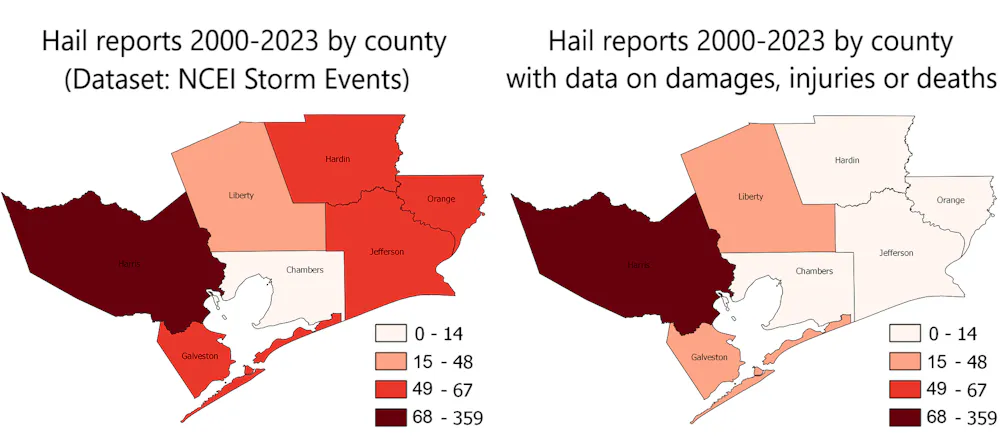
The number of severe hail reports in southeast Texas listed in the National Centers for Environmental Information’s storm events database is strongly correlated with population. The county with the most reports and greatest detail in those reports is home to Houston. Hailstorms in the three easternmost counties are rarely associated with damage estimates. John Nielsen-Gammon and B.J. Baule
Do you want to look at local damage trends? Forget about it. For most extreme weather events, estimation methods vary over time and are not documented.
Do you want to direct funding to help communities improve resilience to natural disasters where the need is greatest? Forget about it. The places experiencing the largest per capita damages depend not just on actual damages but on the different practices of local National Weather Service offices.
Are you moving to a location that might be vulnerable to extreme weather? Companies are starting to provide localized risk estimates through real estate websites, but the algorithms tend to be proprietary, and there’s no independent validation.
4 steps to improve disaster data
We believe a few fixes could make NOAA’s storm events database and the corresponding values in the larger SHELDUS database, managed by Arizona State University, more reliable. Both databases include county-level disasters and loss estimates for some of those disasters.
First, the National Weather Service could develop standard procedures for local offices for estimating disaster damages.
Second, additional state support could encourage local emergency managers to make concrete damage estimates from individual events and share them with the National Weather Service. The local emergency manager generally knows the extent of damage much better than a forecaster sitting in an office a few counties away.
Third, state or federal governments and insurance companies can agree to make public the aggregate loss information at the county level or other scale that doesn’t jeopardize the privacy of their policyholders. If all companies provide this data, there is no competitive disadvantage for doing so.
Fourth, NOAA could create a small “tiger team” of damage specialists to make well-informed, consistent damage estimates of larger events and train local offices on how to handle the smaller stuff.
With these processes in place, the U.S. wouldn’t need a billion-dollar disasters program anymore. We’d have reliable information on all the disasters.
John Nielsen-Gammon receives funding from the National Oceanic and Atmospheric Administration and the State of Texas.
William Baule receives funding from NOAA, the State of Texas, & the Austin Community Foundation.
Some Edmonton Oilers fans are pinning their Stanley Cup hopes on captain Connor McDavid.AP Photo/Rebecca Blackwell
Déjà vu is a common occurrence in the world of sports, and the Edmonton Oilers are no strangers to repeat matchups. The Canadian team faced off against the New York Islanders in both 1983 and ’84 for hockey’s biggest prize, the Stanley Cup. In this year’s National Hockey League finals, the Oilers will try to avenge their Game 7 loss to the Florida Panthers in 2024.
Edmontonians who have been “loyal to the oil,” as fans say, have been waiting for redemption ever since. The Trump administration’s threats toward its northern neighbor has fueled a wave of nationalism, making even more fans eager for a Canadian team to win the Stanley Cup – which has not happened since 1993. With hopes pinned to Edmonton, the finals also brings renewed attention to some of Canada’s biggest exports: hockey and oil.
The Oilers also evoke another aspect of Canadian society that, for some, has almost religious importance: resource extraction. In American and Canadian culture, oil has long been entangled with religion. It’s a national blessing from God, in some people’s eyes, and a means to the “good life” for those who persevere to find it. For many people in communities whose economies center around resource extraction, the possibility of success is valued above its environmental risks.
We are scholars of religion who study sports and how oil shapes society, or petro-cultures. The Edmonton Oilers showcase a worldview in which triumph, luck and rugged work pay off – beliefs at home on the ice or in the oil field. The Stanley Cup Final offers a glimpse into how the oil industry has helped shaped the religious fervor around Canada’s favorite sport.
Edmonton Oilers fan Dale Steil’s boots before the team’s playoff game against the Los Angeles Kings on April 26, 2024. AP Photo/Tony Gutierrez
Boomtown
Edmonton is the capital of Alberta, a province known for its massive oil, gas and oil sands reserves. With five refineries producing an average of 3.8 million barrels a day, oil and gas is Alberta’s biggest industry – and a way of life.
This is especially true in Edmonton, known as the “Oil Capital of Canada.” Here, oil not only structures the local economy, but it also shapes identities, architecture and everyday experiences.
Visit the West Edmonton Mall, for example, and you’ll see a statue of three oil workers drilling, reminding shoppers that petroleum is the bedrock of their commerce. Visit the Canadian Energy Museum to learn how oil and gas have remade the region since the late 1940s, and glimpse items such as engraved hard hats and the “Oil Patch Kid,” a spin on the iconic “Cabbage Patch Kids” toys. Tour the Greater Edmonton area and see how pump jacks dot the horizon. Oil is everywhere, shaping futures, fortunes and possibility.
Set against this backdrop, the Oilers’ name is unsurprising. It is not uncommon, after all, to name teams after local industries. Football’s Pittsburgh Steelers pay homage to the steel mills that once employed much of the team’s fan base. The Tennessee Oilers were originally the Houston Oilers, prompting other Texas teams such as the XFL’s Roughnecks to follow suit. Further north, the name of basketball’s Detroit Pistons references car manufacturing.
Teams with industry-inspired names play double duty, venerating both a place and a trade. Some fans are not only cheering for the home team, but also cheering for themselves – affirming that their industry and their labor matter.
Ales Hemsky of the Edmonton Oilers skates out from under the oil derrick for a game at Rexall Place in 2008 in Edmonton, Alberta. Andy Devlin/NHLI via Getty Images
In a TikTok video from last year’s Stanley Cups playoffs, a man overcome with joy at the Oilers’ victory over the Dallas Stars claps his hands and hops around his living room. The caption reads, “My first-generation immigrant oil rig working Filipino father who has never played a second of hockey in his life … happily cheering for the Oilers advancing in the playoffs. Better Bring that cup home for him oily boys.” He appears to be cheering for the Oilers not because they are a hockey team, but because they are an oil team.
And indeed, the Oilers are an oily team. The Oilers’ Oilfield Network, for example, describes itself as “exclusively promot[ing] companies in the Oil and Gas industry,” allowing leaders to connect “through the power of Oilers hockey.”
The Oilers’ connection with industry is further underscored by their logos. The current one features a simple drop of oil, but past designs featured machinery gears and an oil worker pulling a lever shaped like a hockey stick.
Simply put, “Edmonton is all oil,” Oilers goaltender Stuart Skinner shared after defeating the Dallas Stars to win the 2025 Western Conference Final.
After the British North America Act founded Canada in 1867, the new nation searched for a distinctive identity through sport and other cultural forms.
Enter hockey. The winter game evolved in Canada from the Gaelic game of “shinty” and the First Nations’ game of lacrosse and soon became part of the glue holding the nation together.
Ever since, media, politicians, sports groups and major industries have helped fuel fan fervor and promoted hockey as integral to Canada’s rugged frontiersman character.
In 1936, Imperial Oil, one of Canada’s largest petroleum companies, began sponsoring Hockey Night in Canada, a national radio show that reached millions each week. Several years later, Imperial Oil played a major role in bringing the show to television, where the Imperial Oil Choir sang the theme song. Imperial Oil and its gas stations, Esso, also sponsored youth hockey programs across the nation. In 2019, Imperial inked a deal to be the NHL’s “official retail fuel” in Canada.
Striking it rich
Connections between hockey and industry in Alberta’s oil country aren’t just about sponsorships. Central to both cultures is the idea of luck – historically, one of the many things it takes to extract fossil fuels. “Striking it rich” in the oil fields has become entangled with the idea of divine providence, especially among the many Christian laborers.
A Canadian oil worker kisses his wife and daughter goodbye as he sets off to work in northern Alberta in the 1950s. John Chillingworth/Getty Images
Oil represents fortune, and who wouldn’t want to borrow a bit of that for their team? Sports are thrilling because sometimes talent, team chemistry and the home-field advantage still lose to a stroke of good luck. Oil culture pairs the idea of divine favor with an insistence on rough-and-tumble endurance, similar to hockey.
Sometimes if you don’t strike it rich the first time, you have to keep on drilling. The next well may be the one to bring wealth. Oil prospectors know this, but so do sports fans who maintain hope season to season.
Soon fans from around the world will join Edmonton locals in rooting for the Oilers. They’ll throw their hands up in despair if captain Connor McDavid enters the “sin bin” – the penalty box – or dance in celebration to the Oilers’ theme, “La Bamba.” Some of them will be cheering, too, for oil.
This is an updated version of an article originally published on June 19, 2024.
The authors do not work for, consult, own shares in or receive funding from any company or organization that would benefit from this article, and have disclosed no relevant affiliations beyond their academic appointment.
In his first general audience in Rome, Pope Leo XIV referred to Vincent van Gogh’s painting “Sower at Sunset” and called it a symbol of hope. A brilliant setting sun illuminates a field as a farmer walks toward the right, sowing seeds.
Leo referred to Christ’s Parable of the Sower, a story in the Gospel that speaks to the need to do good works. “Every word of the Gospel is like a seed sown in the soil of our lives,” he said, and highlighted that the soil is not only our heart, “but also the world, the community, the church.”
He noted that “behind the sower, van Gogh painted the grain already ripe,” and Leo called it an image of hope which shows that somehow the seed has borne fruit.
Van Gogh painted “Sower at Sunset” in 1888, when he was living in Arles in southern France. At the time, he was creating art alongside his friend Paul Gauguin and feeling very happy about the future. The painting reflects his optimism.
Van Gogh’s inspiration
In November 1888, van Gogh wrote to his brother Theo, in whom he frequently confided, about “Sower at Sunset.” He described its beautiful colors: “Immense lemon-yellow disc for the sun. Green-yellow sky with pink clouds. The field is violet, the sower and the tree Prussian Blue.”
Van Gogh’s painting was inspired by French artist Jean-Francois Millet’s 1860 painting, “The Sower.” But he transformed Millet’s composition, in which a dark, isolated figure dominates, and deliberately set the sower in the midst of a landscape transformed by the sun.
Other artists, including the Norwegian Emanuel Vigeland, explicitly depicted the Parable of the Sower. Vigeland’s series of stained-glass windows in an Oslo church explains each passage’s meaning. As the sower works, some seeds fall by the wayside and the birds immediately eat them, indicating those who hear the word of God but do not listen.
Norwegian artist Emanuel Vigeland’s ‘Parable of the Sower,’ 1917-19, Lutheran church of Borgestad, near Oslo, Norway. Virginia Raguin
Some seeds fall on stony ground and cannot take root, a symbol of those with little tenacity. Others fall among thorns and are choked. Vigeland juxtaposed a dramatic image of a miser counting piles of money, indicating how the man’s life has become choked by desire for material gain.
The final passage of the parable states that some seeds fell on good ground and yielded a hundredfold. Vigeland’s depiction shows an image of an abundant harvest of grain next to a man seated on the ground and cradling a child in his lap.
What it says about Leo
Van Gogh’s painting corresponds to many of the ideas the new pope expressed in the first days of his papacy. Leo observed: “In the center of the painting is the sun, not the sower, [which reminds us that] it is God who moves history, even if he sometimes seems absent or distant. It is the sun that warms the clods of the earth and ripens the seed.”
The theme of the dignity of labor is also inherent in the image of the sower being deeply engrossed in physical labor, which relates to the pope’s choice of his name. The pope stated that he took on the name Leo XIV “mainly because Pope Leo XIII in his historic encyclical Rerum Novarum addressed the social question in the context of the first great industrial revolution.” Leo XIII was referring to the social question of economic injustice in the meager rewards for workers even as owners made great profits from the Industrial Revolution.
The pope saw Van Gogh’s image of the sower, like Vigeland’s, as a message of hope. That message, to him, fits with the theme of hope of The Jubilee Year proclaimed by Leo’s predecessor, Francis. Leo also expressed hope that humans listening to God would embrace service to others.
Virginia Raguin does not work for, consult, own shares in or receive funding from any company or organization that would benefit from this article, and has disclosed no relevant affiliations beyond their academic appointment.
People often imagine childhood as a time when the body functions at its best, but about 25% of children experience chronic pain. I was one of them: Starting in elementary school, migraines incapacitated me for hours at a stretch with excruciating pain that made it impossible to go to school, much less talk to friends or have fun.
Chronic pain in children is not only widespread but also persistent. Many continue to experience symptoms for years on end. For example, one-third of children with abdominal pain experience symptoms that last into adulthood. Children with chronic pain are also more likely to come from families that have less income, have greater health care barriers, report more safety concerns about their environment and experience greater exposure to violence than those without chronic pain.
The most studied and perhaps most effective approach for treating chronic pain in children is cognitive behavioral therapy. This modality involves teaching children how pain works in the brain, and also training them on problem solving, relaxation methods such as deep breathing, challenging negative thoughts about pain, and pacing activities to avoid pain flares. Unlike pain medications, which wear off after a few hours, research suggests that cognitive behavioral therapy can have a lasting effect. Kids can get back to doing things they need and want to do, and they often feel better too over the long term.
To be sure, providing interventions in the form of web-based tools or apps can improve access for children who can’t see a provider. However, we have found that children and their families are more likely to complete the course of treatment with a provider, and that automated self-management tools can complement but not replace care delivered by a provider. In fact, when cognitive behavioral therapy for children’s chronic pain is delivered exclusively through an online tool, only a third of children complete treatment.
How community providers can fill the gap
Despite the proven benefits of psychological therapies for children’s pain, few providers are trained to use them. That’s one of the most common barriers to care.
One potentially untapped resource is school nurses and other specialists who are often the first point of contact for a child with chronic pain, such as social workers and school counselors. Programs already exist to train school providers, including school nurses, in managing children’s mental health, but few of them address chronic pain.
To fill this gap, my colleagues and I have developed a program to train school nurses and other community health experts to teach children cognitive and behavioral strategies to manage their chronic pain. So far, we have trained approximately 100 school providers across Michigan, who report that the training improves pain symptoms and helps keep children in school. We are also expanding the project to address trauma and other mental health symptoms that commonly occur with chronic pain, and to support providers in discouraging substance use to manage pain in these children.
Our work suggests that this approach can empower providers to reach children in rural communities and other settings that lack access to care. By training more boots on the ground, we hope to provide children with the pain management tools they need to grow into healthy and thriving adults.
Natoshia R. Cunningham receives grant funding from the US Department of Defense, the Michigan Health Endowment Fund, and the Childhood Arthritis and Rheumatology Research Alliance-Arthritis Foundation. She was previously funded by the National Institutes of Health, and the Blue Cross Blue Shield Foundation of Michigan.
Whether you’re streaming a show, paying bills online or sending an email, each of these actions relies on computer programs that run behind the scenes. The process of writing computer programs is known as coding. Until recently, most computer code was written, at least originally, by human beings. But with the advent of generative artificial intelligence, that has begun to change.
Now, just as you can ask ChatGPT to spin up a recipe for a favorite dish or write a sonnet in the style of Lord Byron, you can now ask generative AI tools to write computer code for you. Andrej Karpathy, an OpenAI co-founder who previously led AI efforts at Tesla, recently termed this “vibe coding.”
For complete beginners or nontechnical dreamers, writing code based on vibes – feelings rather than explicitly defined information – could feel like a superpower. You don’t need to master programming languages or complex data structures. A simple natural language prompt will do the trick.
How it works
Vibe coding leans on standard patterns of technical language, which AI systems use to piece together original code from their training data. Any beginner can use an AI assistant such as GitHub Copilot or Cursor Chat, put in a few prompts, and let the system get to work. Here’s an example:
“Create a lively and interactive visual experience that reacts to music, user interaction or real-time data. Your animation should include smooth transitions and colorful and lively visuals with an engaging flow in the experience. The animation should feel organic and responsive to the music, user interaction or live data and facilitate an experience that is immersive and captivating. Complete this project using JavaScript or React, and allow for easy customization to set the mood for other experiences.”
But AI tools do this without any real grasp of specific rules, edge cases or security requirements for the software in question. This is a far cry from the processes behind developing production-grade software, which must balance trade-offs between product requirements, speed, scalability, sustainability and security. Skilled engineers write and review the code, run tests and establish safety barriers before going live.
But while the lack of a structured process saves time and lowers the skills required to code, there are trade-offs. With vibe coding, most of these stress-testing practices go out the window, leaving systems vulnerable to malicious attacks and leaks of personal data.
And there’s no easy fix: If you don’t understand every – or any – line of code that your AI agent writes, you can’t repair the code when it breaks. Or worse, as some experts have pointed out, you won’t notice when it’s silently failing.
The AI itself is not equipped to carry out this analysis either. It recognizes what “working” code usually looks like, but it cannot necessarily diagnose or fix deeper problems that the code might cause or exacerbate.
IBM computer scientist Martin Keen explains the difference between AI programming and traditional programming.
Why it matters
Vibe coding could be just a flash-in-the-pan phenomenon that will fizzle before long, but it may also find deeper applications with seasoned programmers. The practice could help skilled software engineers and developers more quickly turn an idea into a viable prototype. It could also enable novice programmers or even amateur coders to experience the power of AI, perhaps motivating them to pursue the discipline more deeply.
Vibe coding also may signal a shift that could make natural language a more viable tool for developing some computer programs. If so, it would echo early website editing systems known as WYSIWYG editors that promised designers “what you see is what you get,” or “drag-and-drop” website builders that made it easy for anyone with basic computer skills to launch a blog.
For now, I don’t believe that vibe coding will replace experienced software engineers, developers or computer scientists. The discipline and the art are much more nuanced than what AI can handle, and the risks of passing off “vibe code” as legitimate software are too great.
But as AI models improve and become more adept at incorporating context and accounting for risk, practices like vibe coding might cause the boundary between AI and human programmer to blur further.
Chetan Jaiswal does not work for, consult, own shares in or receive funding from any company or organization that would benefit from this article, and has disclosed no relevant affiliations beyond their academic appointment.
Your brain breaks apart fleeting streams of acoustic information into parallel channels – linguistic, emotional and musical – and acts as a biological multicore processor. Although scientists have recognized this division of cognitive labor for over 160 years, the mechanisms underpinning it remain poorly understood.
Researchers know that distinct subgroups of neurons must be tuned to different frequencies and timing of sound. In recent decades, studies onanimal models, especially in rodents, have confirmed that splitting sound processing across the brain is not uniquely human, opening the door to more closely dissecting how this occurs.
Yet a central puzzle persists: What makes near-identical regions in opposite hemispheres of the brain process different types of information?
Answering that question promises broader insight into how experience sculpts neural circuits during critical periods of early development, and why that process is disrupted in neurodevelopmental disorders.
Timing is everything
Sensory processing of sounds begins in the cochlea, a part of the inner ear where sound frequencies are converted into electricity and forwarded to the auditory cortex of the brain. Researchers believe that the division of labor across brain hemispheres required to recognize sound patterns begins in this region.
For more than a decade, my work as a neuroscientist has focused on the auditory cortex. My lab has shown that mice process sound differently in the left and right hemispheres of their brains, and we have worked to tease apart the underlying circuitry.
For example, we’ve found the left side of the brain has more focused, specialized connections that may help detect key features of speech, such as distinguishing one word from another. Meanwhile, the right side is more broadly connected, suited for processing melodies and the intonation of speech.
We tracked how neural circuits in the left and right auditory cortex develop from early life to adulthood. To do this, we recorded electrical signals in mouse brains to observe how the auditory cortex matures and to see how sound experiences shape its structure.
Surprisingly, we found that the right hemisphere consistently outpaced the left in development, showing more rapid growth and refinement. This suggests there are critical windows of development – brief periods when the brain is especially adaptive and sensitive to environmental sound – specific to each hemisphere that occur at different times.
To test the consequences of this asynchrony, we exposed young mice to specific tones during these sensitive periods. In adulthood, we found that where sound is processed in their brains was permanently skewed. Animals that heard tones during the right hemisphere’s earlier critical window had an overrepresentation of those frequencies mapped in the right auditory cortex.
Adding yet another layer of complexity, we found that these critical windows vary by sex. The right hemisphere critical window opens earlier in female mice, and the left hemisphere window opens just days later. In contrast, male mice had a very sensitive right hemisphere critical window, but no detectable window on the left. This points to the elusive role sex may play in brain plasticity.
Our findings provide a new way to understand how different hemispheres of the brain process sound and why this might vary for different people. They also provide evidence that parallel areas of the brain are not interchangeable: the brain can encode the same sound in radically different ways, depending on when it occurs and which hemisphere is primed to receive it.
Speech and neurodevelopment
The division of labor between brain hemispheres is a hallmark of many human cognitive functions, especially language. This is often disrupted in neuropsychiatric conditions such as autism and schizophrenia.
Reduced language information encoding in the left hemisphere is a strong indication of auditory hallucinations in schizophrenia. And a shift from left- to right-hemisphere language processing is characteristic of autism, where language development is often impaired.
Strikingly, the right hemisphere of people with autism seems to respond earlier to sound than the left hemisphere, echoing the accelerated right-side maturation we saw in our study on mice. Our findings suggest that this early dominance of the right hemisphere in encoding sound information might amplify its control of auditory processing, deepening the imbalance between hemispheres.
These insights deepen our understanding of how language-related areas in the brain typically develop and can help scientists design earlier and more targeted treatments to support early speech, especially for children with neurodevelopmental language disorders.
Everyday human behavior is guided and shaped by the search for rewards. This includes eating tasty meals, drinking something refreshing, sexual activity and nurturing children. Many of these behaviors are needed for survival. But in some instances, this search for rewards can pose a significant threat to survival.
People rely on memories of rewards to function and survive. Associated with positive experiences, these memories provide context for evaluating present and future choices. For example, if foods high in sugar are associated with a positive experience, this can reinforce the behavior of eating the food that provided the reward. Similarly, a flavorful meal at a specific restaurant increases the likelihood you’ll become a returning costumer.
A deeper understanding of how reward memories work and interact with each other is critical to informing the choices you make and to treating disorders where seeking rewards has become problematic. Eliminating all reward seeking would negatively affect behaviors essential for survival, such as eating and reproducing. But if you can specifically target reward memories linked to different drugs, this could help reduce their abuse.
I am a behavioral neuroscientist studying addiction, and my team is interested in how reward memories are formed and processed in the brain. We study how memories linked to natural rewards such as food, water and sex differ from those linked with rewards from drugs such as fentanyl and cocaine.
Understanding the differences between these types of rewards and how memories of different drugs interact may lead to more effective treatments for addiction.
What is memory?
To study reward memories, it is important to understand the neurobiology of memory, or how the brain remembers things.
In 1904, evolutionary zoologist Richard Semon introduced the term engram to describe the physical representation of a memory – also called its trace – that forms in the brain after an experience. Later, psychologist Donald Hebb hypothesized that interconnected brain cells that are active at the same time during an experience form a physical ensemble that make up a memory.
In the past decade, neuroscientists have developed new tools that support the idea that neuronal ensembles, or small populations of brain cells that are activated at the same time, are likely the physical representation of memory. How new memories recruit neurons into ensembles is not fully understood, but the plasticity of neurons – their ability to change their connections with each other – seems to play a major role.
Memories are physically stored in your brain.
Research on neuronal ensembles has transformed how scientists understand learning and memory. Researchers can now createartificial memories, activate positive memories to counteract negative feelings, and alter how memories are linked. All these experiments on altering memory have been conducted on animal models, since the technology required to apply these techniques to humans is not yet available.
To create artificial memories, for instance, researchers can mark a neuronal ensemble associated with a specific environment A in genetically modified mice. They can then activate those neurons when exposing the mice to a foot shock in a different environment B. Later, the mice showed increased freezing behavior in environment A, though they never received a shock in that space. By activating the memory of environment A during the foot shock, mice created a false memory that the foot shock was associated with that space.
Treating substance use disorders
Neuronal ensembles hold untapped promise for the study and treatment of substance use disorders and other reward-related disorders. These include those involving a deficit in their ability to experience reward, such as gambling disorder, eating disorders and depression.
Natural rewards – food, water, sex and nurturing – induce pleasurable feelings that reinforce the behavior that elicits that reward. This is known as positive reinforcement, a strategy often used in everyday life; think training a dog with treats, or using sticker charts for potty training.
Research has linked positive and negative experiences with neuronal ensembles: exploratory and socialbehaviors, fear, and feeding. In substance use disorders, a drug can induce both pleasant and unpleasant feelings. For example, cocaine induces an intense rush or high, but the crash induced by the drug wearing off causes irritability and lethargy. These feelings reinforce drug use at the expense of essential behaviors that ensure survival, such as eating, sleeping or maintaining social networks and relationships.
Similarly to how any memory is stored in the brain as a neuronal ensemble, drug memories are carried in specific neuronal ensembles and activated during drug-related behaviors.
Fundamental questions remain about how neuronal ensembles encode drug-related memories. Because the processing centers for drug rewards and natural rewards mostly overlap in the brain, it is challenging to develop treatments that target only drug reward seeking. Emerging treatments for addiction, such as certain types of brain stimulation, are not specific enough to differentiate between drug or natural reward pathways.
Discovering how particular drugs of abuse affect genes, cells and neuronal circuits can help researchers develop new treatments for substance use disorders without altering the natural reward-seeking behaviors essential for survival.
The reward of drug use can be hard to disentangle from the rewards of eating, drinking and other activities necessary for survivial. Kseniya Ovchinnikova/Moment via Getty Images
For example, about 72% of people suffering from substance use disorders report usingmultiple substances, frequently together. To better understand how polysubstance use affects the brain, my team tags neurons active during drug-related behaviors in genetically modified mice. This allows us to map and compare the neurons carrying reward-related memories for one drug with the neurons associated with another drug. In this way, we can study how the brain represents and stores memories when mice are exposed to cocaine and fentanyl – two substances people in the U.S. are increasingly taking together – and how different brain regions communicate this information with each other.
To dissect exactly how drugs of abuse hijack the brain’s natural reward system, my team is comparing how seeking different types of rewards changes the neurons carrying reward memories. For example, we have previously shown that the network of cells carrying the memory of seeking cocaine are mostly distinct from those linked to seeking sugar.
Based on this work, we are currently using fruit fly models to analyze the genetic activity of the neuronal ensemble linked to seeking cocaine. This will allow us to better identify which genes could be potential targets to reduce the activity of that neuronal ensemble and treat substance use disorder.
Psychedelics and addiction
Drug-related intrusive thoughts and fixed behavioral patterns – meaning actions that are repeatedly taken regardless of negative consequences – are common symptoms of substance abuse that lead to the formation of harmful neural pathways in the brain. Psychedelics may be able to help reformthese pathways by triggering an overall “system reboot” of the brain.
Several clinical trials point to the potential of psychedelics to treat tobacco, alcohol and opioid use disorders, with early results showing increased abstinence and reduced drug cravings.
My lab is currently examining how psilocin – the active metabolite of the psychedelic psilocybin – affects the drug-related memories of mice. Our research focuses on two questions. First, can psilocin alter drug seeking and intake in fentanyl addiction? And second, what type of memory does psilocin create in the brain, and could it alter prior cocaine memories?
Reward memories both help people survive and lead to substance use disorders. Delving into the intricate mechanisms of how the brain remembers rewards at the cellular and genetic levels can help researchers and doctors better treat addiction without altering the reward pathways needed for survival.
Ana Clara Bobadilla receives funding from the National Institute on Drug Abuse and the Brain & Behavior Research Foundation.
Source: The Conversation – Canada – By Alessandro Marcon, Senior Research Associate at the Health Law Institute, University of Alberta
Online searches for health information can pull up misleading ads.(S. Ghassimi), CC BY
More than 80 per cent of online searches are now performed with Google. But there’s an insidious element to the world’s most popular search engine. As companies compete for the advertising spaces that accompany search query results, users seeking critical health information can be exposed to dangerous and exploitative misinformation.
In 2024, North Americans overwhelmingly used Google for news and information on politics, celebrities, entertainment and topical events like natural disasters. Health-related queries are also popular: nearly 70 per cent of the Canadian public use online searches for health information.
Google is the world’s most popular search engine. (Shutterstock)
Online searches
The phrases or questions contained in online searches serve as valuable data. They can inform epidemiological surveillance and provide insight into popular global and regional trends.
These data also hold immense value for online marketing teams, tracking who is searching for what, where and when. In addition to search tracking, however, queries now are used for online advertising. It’s a reality that raises serious ethical, regulatory and public health issues.
Before the internet, key advertising spaces existed in magazines and newspapers, on highway billboards and time slots between radio and television programming. Advertising is so lucrative that a 30-second time slot during the Super Bowl now costs upwards of US$8 million.
Online, fixed slots have now been replaced by targeted advertisements to accompany search results, determined by search queries entered by users.
Highly coveted spots
Like a Super Bowl ad, advertising on Google’s first page results is highly coveted.
Obtaining the rights to these space requires companies to outbid one another to win the ads spaces determined by search terms — an advertiser can purchase ad space from Google associated with a specific phrase or keyword.
Companies with snack products, for example, may compete for their sponsored content to appear when individuals search for “Super Bowl party snacks,” “new chip flavours” or “chip and dip ideas.”
As harmless and obvious — and perhaps even inevitable — as this marketing approach may seem, the practice is problematic when industry targets personal, sensitive and critical health terms — which is exactly what our research uncovered.
Searches for cancer, exploitative ads
Using the AI-driven marketing platform SemRush, we analyzed the search terms purchased for advertising by notorious alternative cancer clinics in Tijuana, Mexico and Arizona. We determined what queries were targeted and how much was spent on acquiring the advertising space matching these queries.
We also assessed whether this spending increased traffic to their clinic websites. Our results showed that over roughly one decade, these clinics paid over an estimated US$15 million to purchase the ad spaces for thousands of search words and phrases.
These search queries related to cancer prognosis and diagnosis, treatment options including alternative treatments and cancer types including late-stage cancer. In sum, the advertising strategy generated more than 6.5 million website visits for alternative cancer clinics.
Alternative cancer treatments can interfere with the success of medical treatments. (Shutterstock)
Negative health impacts
Unfortunately, the success of these alternative clinics’ marketing strategies is nothing short of a disaster for the public’s health and well-being. Alternative cancer treatments are associated with an increased risk of death and offer false hope for those suffering from end-stage cancer.
Google is therefore enabling an advertising option that contributes to the harmful spread of inaccurate and damaging cancer misinformation that can directly lead to detrimental health-related actions.
Protection from deception
Our research focused entirely on the cancer context and analyzed the targeted search query approach of problematic clinics in two specific locations. It is imaginable — indeed very probable — that this approach is deployed in other health contexts and beyond.
Google does have and enforce policies to protect users from deceptive advertising content. But there is little oversight regarding how advertisers may exploit its keyword ad matching features.
It’s imperative that Google take action to restrict its ads mechanism from being used in this exploitative manner. Search results could give prominence only to websites supported by accurate scientific evidence. Google could prohibit the advertising purchase of ostensibly controversial search terms. This would include personal, sensitive queries from vulnerable groups, including patients suffering from cancer and other life-threatening ailments.
Source: The Conversation – UK – By Jolanta Burke, Associate Professor, Centre for Positive Health Sciences, RCSI University of Medicine and Health Sciences
Birthdays are typically seen as joyful events, filled with celebration, laughter and gifts. Yet it’s not uncommon, particularly if you are approaching a milestone age, to feel sad on your birthday.
Birthdays can trigger painful emotions for anyone who may feel neglected, lonely, or disappointed about how their lives turned out to be. They are also reminders of ageing and mortality, and may bring feelings of grief for lost time or fear about the future.
Milestone birthdays, such as turning 30 or 40, are even associated with particularly high instances of suicide, according to research from Japan. More people also die of stroke and a heart attack around their birthdays than on other days.
All of these negative feelings, whether extreme depression or just feeling a bit disappointed, make up what’s sometimes known as the “birthday blues”.
One important factor influencing whether you will get the birthday blues is how satisfied you are with your life. Life satisfaction is the degree to which you feel your life aligns with your expectations, and whether you have met, exceeded or fallen short of your life goals.
If you’re approaching a big birthday, you may feel susceptible to the comparison trap of social media, or feel self-conscious about where you are in life. Birthdays are an often unwelcome benchmark by which to measure how well we are doing at any given age.
No one’s 20s and 30s look the same. You might be saving for a mortgage or just struggling to pay rent. You could be swiping dating apps, or trying to understand childcare. No matter your current challenges, our Quarter Life series has articles to share in the group chat, or just to remind you that you’re not alone.
Another important factor is whether you have a clear sense of meaning in your life. A clear sense of meaning is associated with greater wellbeing, while ongoing search for meaning is associated with mental health challenges.
Milestone birthdays often prompt people to re-evaluate their meaning in life. This introspection may result in emotional distress, a decline in wellbeing or even suicidal thoughts – or, it can be a positive step into a new decade.
Rewriting your birthday
You might imagine what you would like your milestone birthday celebration to look like, but sometimes reality does not match up. Perhaps you imagined a big party, only to realise you don’t have the social circle to make it happen, or that friends are busy with work and other commitments. You may long for a quiet birthday with a partner and children, yet find yourself still living with your parents, or without a partner or family of your own.
Here are some practical steps you can take to have a more positive approach to your birthday.
1. Envision your best possible self
My colleague and I once worked with a small group of women aged over 55 who struggled to look forward to their retirement. For many, their future felt uncertain, even frightening. To help them shift their mindset, we introduced an activity “Best Possible Self”.
We encouraged participants to re-imagine their future, focusing on what could go well for them and setting up goals to make their vision come true. After three months, even those who dreaded talking about the future noted a significant increase in hopefulness. The activity reminded them that good times could still come.
Writing about your best possible self for just 20 minutes a day over a few days, especially around your birthday, could help you re-imagine your future and nurture a sense of hope, no matter what stage of life you are in.
2. Pick an alternative birthday setting or an activity
Birthdays don’t have to be a big night out. Plan an activity or visit a place you genuinely enjoy and which brings you happiness or comfort. This could be a walk in a park, attending a theatre performance, or a cosy day at home.
Instead of just going through the motions, focus on enhancing the emotional quality of the experience. Pick a park that holds a special meaning or memories for you, or plan some home-based activities that energise you, such as cooking your favourite meal, creating art or watching a movie you love.
3. Practice mindful awareness
Notice the sounds, smells and other sensations as you go through your day. Pay attention to the emotions that arise, whether it is joy, nostalgia or hope.
Reflect on how your thoughts have changed as a result of this experience. Perhaps think about what you are grateful for, what you’ve achieved in the last year, how far you have come from more challenging times in the past or what your hopeful vision is towards the future.
4. Express and reinforce your positive experiences
Find meaningful ways to express yourself and record your birthday. This might be by writing an entry in a journal, calling someone and sharing your insights, or creating something, like a playlist, photo collage, or drawing to capture this moment.
Fear of ageing is also about fear of the unknown. We can combat this by cultivating hope – recognising what is going well for us in life and believing in the possibility of better days ahead.
To ease the pressure of having a “happy birthday”, it might help to aim instead for a more compassionate “hopeful birthday”. This mindset acknowledges the complexity of ageing, and leaves room for both celebration and vulnerability. In a world that demands constant positivity, where we’re expected to keep smiling, stay positive and suppress discomfort, it offers us a break to be ourselves.
The risk of suicide around birthdays is particularly high for those who have depression or autism. If you are feeling upset about your birthday or belong to a vulnerable group, reach out to a helpline, counsellor, therapist, family member or a friend and ask for support during this challenging time. It is easier to tackle the birthday blues together, than do it on your own.
In the UK: Samaritans are available by phone, for free, at 116 123, or by email at jo@samaritans.org. Further resources can also be found here.
Jolanta Burke does not work for, consult, own shares in or receive funding from any company or organisation that would benefit from this article, and has disclosed no relevant affiliations beyond their academic appointment.
Climate change is already happening. But 36% of the world’s population still disputes the realities of its origins and impacts. When the science is clear but public understanding lags, more lives and livelihoods are put at risk.
The media can act as a bridge between climate solutions and public understanding. A global analysis by the Reuters Institute for the Study of Journalism found that the news media remain the primary source of climate change information, with 31% of people getting it from television and 24% from websites and social media platforms.
Despite all of this, the mainstream media around the world is not doing enough to shoulder the responsibility of preparing the public for the impacts of climate change and environmental degradation. Research indicates that climate change coverage spikes around UN climate summits (Cops) and events like World Water Day, but drops off in between.
That means the stories being told about the environment get the most attention during certain months and consistently less coverage throughout the rest of the year.
I study how the media reports on climate change in authoritarian countries like Iran and across the Middle East and north Africa, a region where heat indices surpass 55°C and severe water shortages persist.
As part of my PhD research, I found that international media reporting of the world’s most climate-vulnerable nations is sporadic, with coverage often increasing around political and environmental events.
Reporting on environmental issues in countries facing conflict, war and political tensions is challenging, as the topic often falls low on the media’s list of priorities.
When it comes to Iran, most of the news making headlines is focused on its nuclear development programme, problems with the west and violations of human rights. The fact that thousands of Iranians die each year from thirst, air pollution and heatwaves rarely makes it into international media, and when it does, it’s usually tied to a political event like protests or US economic sanctions.
For the past few years, I have been researching and writing for news outlets about the Iranian government’s failure to take action towards mitigating climate change. While discussing the issue with climate scientists, I learned that Iran is among the top ten countries globally contributing to carbon emissions.
I also learned that, along with Yemen and Libya, Iran is the only country left to ratify the Paris agreement, a treaty that aims to keep global temperatures to 1.5 degrees above pre-industrial times.
However, when I analysed the media coverage, there was not nearly enough mention of this throughout the year. Most articles were published in November, around the time the UN usually holds its annual climate summits, like the UN climate summit, Cop29, hosted by Azerbaijan last year.
This is a trend I’ve realised through my research and reporting. When the media only covers environmental issues in countries like Iran during political upheavals or climate summits, the world remains largely unaware of these ongoing challenges the rest of the time.
Here’s the problem: just in the past few months, millions of Iranians across the country have been suffering through crippling sand and dust storms, drought and land subsidence, issues that have been exacerbated by climate change.
My PhD research into how the media covers the environment in authoritarian regimes is supported by other studies. I found that articles about water and climate issues in Iran and the Middle East tend to peak around environmental protests and UN climate change summits.
My study shows that Iran received the highest amount of environmental coverage during the 2021 protests in the southwestern province of Khuzestan concerning the lack of water and drought.
The bigger picture
When journalists, editors and media outlets delay reporting on the impact of climate change in countries like Iran, we miss the full scale of the damage. As a result, there’s less pressure on authorities to change policies or prepare the public for the growing environmental challenges like forced migration, hunger, and conflict.
If these countries are more vulnerable to climate change and their governments are doing little to solve the problem, this urgency must be reflected in the media.
This can be achieved if news organisations publish more stories that explore the root causes of environmental problems and include insights from experts who can offer solutions.
If even one story can help save a lake, river or wetland from drying up, that’s a pretty powerful effect.
Don’t have time to read about climate change as much as you’d like?
Sanam Mahoozi does not work for, consult, own shares in or receive funding from any company or organisation that would benefit from this article, and has disclosed no relevant affiliations beyond their academic appointment.
For many, a visit to the dentist brings fear, anxiety, or memories of uncomfortable experiences. But dentistry is changing – and it’s becoming much kinder.
Today, needle-free and drill-free approaches are helping manage tooth decay in ways that are more comfortable, especially for children, anxious patients and those with special healthcare needs. Three of the most promising techniques are silver diamine fluoride (SDF), atraumatic restorative treatment (ART) and the Hall technique.
During the COVID-19 pandemic, many dental clinics sought out non-aerosol-generating procedures (those that don’t spray water or create mist), to reduce viral transmission. SDF and ART became essential treatment approaches during that period – and their popularity has continued to grow. These techniques don’t just make dentistry more acceptable – they challenge the traditional belief that every cavity needs to be drilled and filled.
Tooth decay is caused by bacteria in dental plaque that feed on sugars and produce acids, gradually wearing away the tooth’s surface when tooth brushing isn’t good.
Traditional treatment ordinarily involves numbing a tooth by injection of local anaesthetic followed by removal of the decayed part of the tooth with a drill. The hole (or cavity) left is then then restored or “filled” with a filling material, for example dental composite. While effective, this method can be painful or frightening, especially for younger or vulnerable patients.
But we now understand that not all cavities need to be restored immediately, and that stabilising disease and preventing progression can be just as important.
Parents are often surprised – and relieved – to learn that their child’s cavity might not need an injection or a filling at all. Sometimes, especially for small cavities in baby teeth close to falling out naturally, just monitoring or applying SDF may be enough.
Equally, there’s a growing recognition that patient comfort and trust are essential parts of long-term oral health and quality of life. A traumatic dental experience early in life can deter someone from seeking care for years, making problems worse down the line.
Silver diamine fluoride offers a radically different approach. It is a clear liquid applied directly into a cavity using a small brush. It takes only seconds and requires no drilling, no needles or costly, complicated equipment.
SDF works in two ways. The silver has antibacterial properties that kill the bacteria causing the decay, while the fluoride helps harden the remaining tooth structure. It’s particularly effective for shallow cavities and can stop decay in its tracks. Several studies have found that SDF stopped decay in about 80% of treated cases.
Silver diamine fluoride application.
It’s not a perfect solution. One side effect is that the treated area turns black, which can be an aesthetic concern, especially for front teeth. But for back teeth, or for children who cannot tolerate other options, this may be an acceptable alternative for avoiding needles and drilling or costly treatment under general anaesthetic.
Filling teeth with hand tools, not drills
Atraumatic restorative treatment is another gentle approach. Originally developed for use in areas with limited access to dental equipment, it’s now widely used as a patient-friendly option.
ART involves removing soft, decayed tooth tissue using hand instruments – no noisy drills or anaesthetic injections needed. Once the decay tissue is removed, the cavity is filled with a material called glass ionomer cement. This special material sticks to the tooth, releases fluoride over time, and helps prevent further decay.
The process is quiet, minimally invasive and usually takes less time than conventional treatments. It can often be done with the patient sitting upright, which is particularly helpful for very young children or those with special needs. This treatment doesn’t require a dental chair or power source so it can be done anywhere – from schools to nursing homes.
Crowns without drilling
Another gentle and increasingly popular option for managing decay in children’s teeth is the Hall technique.
Unlike traditional treatments that involve drilling or removing decay, the Hall technique works by sealing the decayed tissue in, rather than taking it out. It uses a preformed metal crown – often called a “stainless steel crown” – that is simply placed over the decayed baby tooth without any drilling, injections, or removal of tooth tissue.
The Hall technique.
Here’s how it works: after checking that the tooth is suitable (usually with an x-ray), the dentist uses small orthodontic separators between the child’s teeth for a few days to create space. Then, in a quick and painless appointment, the crown is gently pushed onto the tooth and held in place with special dental cement. That’s it – no needles, no drill and no discomfort.
By sealing the cavity in this way, the bacteria inside are cut off from the sugars they need to keep causing damage. Over time, the decay becomes inactive, and the crown protects the baby tooth until it naturally falls out.
Parents are often amazed by how well children cope with this approach. In fact, studies show that children who have had the Hall technique often experience less discomfort, fewer dental visits, and better long-term outcomes than those who undergo traditional drilling and
filling.
The future of kinder dentistry
Of course, the best (and kindest) way to avoid needles, drilling and filling is to prevent tooth decay in the first place. But when treatment is needed, the options above are changing the game – and they’re here to stay.
Silver diamine fluoride, atraumatic restorative treatment and the Hall technique aren’t right for every situation, but they’re safe, backed by evidence and a powerful reminder that dental care doesn’t have to be painful to be effective.
For anxious patients, nervous kids, or anyone who’s put off going to the dentist because of fear, these gentler approaches can be the difference between avoiding care and finally getting it.
Dentistry is changing – and it’s time our expectations caught up.
Paul Leavy is currently undertaking his PhD at the Trinity College Dublin (TCD) Centre for Health Policy and Management. Paul Leavy receives funding from the Health Research Board (HRB) as a PhD Scholar under the SPHeRE Programme (2018-1).
Isabel Olegário does not work for, consult, own shares in or receive funding from any company or organisation that would benefit from this article, and has disclosed no relevant affiliations beyond their academic appointment.
Liberal candidate Lee Jae-myung has won South Korea’s snap presidential election with a clear lead. With all of the ballots counted, Lee won almost 50% of the vote, ahead of his conservative rival Kim Moon-soo on 41%. He takes over a country that is deeply divided along gender lines.
Lee’s campaign effectively channelled voter anger. He focused on resetting South Korea’s politics after impeached former president Yoon Suk Yeol, who was from the same party as Kim, unleashed chaos by declaring martial law in December 2024.
However, gender conflict has continued, subtly but powerfully, to shape voter behaviour, campaign strategies and the national debate about who is to blame for the lack of opportunities in South Korea for young men.
The election took place three years after Yoon pipped Lee to the presidency by just a quarter of a million votes – the closest margin in the country’s history. Yoon’s victory was, as has been noted by researcher Kyungja Jung, “the epitome of the utilisation of gender wars”.
A key part of Yoon’s strategy was fostering a sense among young Korean men that it was now them, rather than women, who were the victims of discrimination. He secured 59% of the vote from men in their 20s and 53% from men in their 30s. Just 34% of women in their 20s supported him.
In the latest election, gender was everywhere and nowhere all at once. On the one hand, not a single candidate put forward a meaningful policy to address structural gender discrimination in the workplace, domestic violence or public sexual harassment.
None even mentioned the gaping absence of women candidates, despite thousands of mostly young women having filled the streets demanding democracy after Yoon’s martial law declaration. It was the first time in nearly 20 years that not a single woman stood among the contenders for the highest role in the country.
Lee, positioning himself as the consensus candidate, attempted to neutralise gender as a campaign issue. When reporters asked him whether he would announce any women-related pledges, he said: “Why do you keep dividing men and women? They are all Koreans.”
His remark may sound inclusive. But it signals a strategy to declare the gender issue off-limits for the sake of the greater good, thus sidestepping the specific inequalities that continue to divide the country. It’s a form of unity by erasure.
Lee Jun-seok of the right-wing Reform party, on the other hand, tried to resurrect the same playbook that delivered Yoon to power in 2022. He attempted to provoke, polarise and win the loyalty of disaffected young men.
As Yoon had done three years ago, he called for the abolition of the Ministry of Gender Equality and Family. And during a televised debate, he asked: “If someone says they want to stick chopsticks into women’s genitals, would that count as misogyny?” The question was a nod to a controversial online remark Lee Jae-myung’s son had made years earlier.
Lee Jun-seok’s comment drew widespread condemnation and, ultimately, he only scraped about 7.7% of the total vote. This included over 37% of men in their 20s, while 58% of women in the same age group backed Lee Jae-myung. Gender is a highly political matter in South Korea whichever way you look at it.
Gender wars
This gender divide is now one of the most consistent features of South Korean politics. Women are vocal and visible in public to safeguard not just their own rights, but also South Korea’s democracy.
Yet populist politicians have cultivated a perception among young men – squeezed by stagnant wages, fierce competition over jobs and social expectations – that their diminishing opportunities are due to policies they see as favouring women.
This has resulted in many young South Korean men seeing feminism not as a movement for equality but as an obstacle to their own progress. In reality, their struggle has less to do with gender and more to do with structural inequalities in income and opportunity for all young Koreans.
As Kyungja Jung observed in a paper from 2024: “Misogyny becomes an outlet for their [South Korean men’s] frustration and masculinity crisis as they search for a scapegoat for their struggles in neoliberal society. They blame women rather than the neoliberal economy.”
Young people even from the best universities in Korea feel they cannot compete in the job market no matter what they do. South Korea now has one of the highest rates of young people not in education, employment or training among the OECD countries. This has given rise to the so-called “N-Po” generation, who feel so disadvantaged that they have given up on all future dreams of marriage, family and a career.
South Korea isn’t alone in mobilising backlash against feminism and gender equality. Around the globe, gender has become one of the major fault lines in politics. In the November 2024 US election, Donald Trump led among young men by 14 points, while Kamala Harris had an 18-point edge with young women.
Meanwhile, self-described misogynist Andrew Tate continues to shape young male attitudes online. And in Italy, Giorgia Meloni rose to power on a far-right platform that, despite being a woman herself, reduces women to their roles as mothers and homemakers.
Young women played a key role in the protests against Yoon’s martial law declaration. Icelander / Shutterstock
One model for change in South Korea could be to introduce quotas for women in politics to make their voices heard. Women only occupy around 20% of the 300 seats in South Korea’s National Assembly, trailing well behind the global (27.2%) and Asian (22.1%) averages. If women are not in politics making decisions about themselves, then their voices will not be heard beyond the streets.
Lee Jae-myung’s win has given South Korea a moment to breathe. But the fault lines remain. When an entire demographic, be it young men or women, feels systematically unheard or structurally discriminated against, opportunistic voices can move in to fill the void.
Gender is political. Ignoring it may be just as risky as confronting it head-on.
Ming Gao receives funding from the Swedish Research Council. This research was produced with support from the Swedish Research Council grant “Moved Apart” (nr. 2022-01864). Ming Gao is a member of Lund University Profile Area: Human Rights.
Joanna Elfving-Hwang receives funding from the Academy of Korean Studies. This research was supported by the Core University Program for Korean Studies through the Ministry of Education of the Republic of Korea and Korean Studies Promotion Service of the Academy of Korean Studies (AKS-2022-OLU-2250005).
Source: The Conversation – UK – By Shelley Galpin, Lecturer in Culture, Media and Creative Industries, King’s College London
Announcing its new six-part adaptation of Pride and Prejudice, Netflix quoted screenwriter Dolly Alderton as saying: “Once in a generation, a group of people get to retell this wonderful story.” In the 250th anniversary of her birth, it would seem that every new generation wants its own adaptation of Jane Austen’s perennial classic.
It’s 30 years since Colin Firth’s Darcy decided that the only remedy for unrequited love was a dip in a muddy lake. And 20 since Matthew Macfadyen’s Darcy strode across a chilly field at sunrise to declare that Keira Knightley’s Lizzie had “bewitched me body and soul”. And, erm, almost 10 years since Lily James’s Lizzie fell for Darcy while simultaneously battling zombie hordes in Pride and Prejudice and Zombies.
Looking for something good? Cut through the noise with a carefully curated selection of the latest releases, live events and exhibitions, straight to your inbox every fortnight, on Fridays. Sign up here.
Netflix’s (zombie-free) adaptation has, at time of writing, announced that Emma Corrin will play Lizzie opposite Jack Lowden’s Darcy, with Olivia Colman set to play Lizzie’s mother, Mrs Bennet. So with another retelling of the iconic love story on the horizon, what makes it such a attractive novel to adapt for screen?
The clue is partly in the name. The characters are deeply flawed; Darcy is proud, Lizzie is prejudiced against him after she feels slighted at their first meeting. Both need to learn to “get over themselves” to achieve their happy ending. This makes for a highly satisfying character arc. It is difficult to imagine the love story between Lizzie’s “oh-so-perfect” sister Jane and the amiable Mr Bingley having quite the same draw.
It is satisfying when these two destined-to-be-together characters finally find their happy ending. But the scheming of Bingley’s snobbish sister and the misguided loyalty of Darcy that interrupt the progress of their budding romance do not present the same dramatic tension as Lizzie and Darcy’s own internal battles.
In one of the most iconic lines, upon learning of an error of judgement, Austen’s Lizzie ruefully acknowledges that, “Till this moment I never knew myself”. It is this internalised process of self-reflection and growth that makes for such compelling and relatable characterisation.
While creating flawed characters, though, Austen reserved her most acidic barbs for the more powerful members of society. Recently, White Lotus star Aimee Lou Wood called out her cruel portrayal in a Saturday Night Live skit, wisely drawing attention to the difference between punching up at the more powerful and punching down at easy targets with less social capital.
Austen’s work is defined by her keen sense of class hierarchies, and she skilfully maintains a warmly humorous tone by gently mocking the human foibles of her characters, while never treating them with contempt.
However, in the same way that the hit show Succession delighted audiences with the opportunity to recoil at the vulgarities of the rich, in Pride and Prejudice Austen punches up by reserving her most mocking behaviour for the privileged.
Rich matriarch Lady Catherine de Bourgh delights in lecturing others about the correct way to behave, only to turn up at the Bennet household in the middle of the night with the sole intention of berating Lizzie. And the ridiculous Mr Collins, heir apparent to the Bennet family home, appears almost delusional in his belief that he is God’s gift to the Bennet sisters.
These supporting roles have given a range of great actors the chance to lean into Austen’s social satire by emphasising the abhorrent nature of the characters, and by extension, revealing the stifling nature of the social system that the characters exist within.
Society isn’t the only thing stifling the characters however. Perhaps one of the most appealing aspects of Pride and Prejudice is its situating of Lizzie within the best and the worst of what family has to offer, allowing for a colourful cast of supporting characters.
Embarrassing family members such as the meddling mother and the no-filter youngest sister have a universal relatability that can be easily moulded to contemporary sensibilities.
Mrs Bennet in particular, played for laughs with exaggerated hysteria by Alison Steadman for the BBC in 1995, was reimagined in a rather more sympathetic light in Joe Wright’s 2005 film adaptation, when the very real perils facing her and her daughters upon the death of her husband were more sensitively explored.
With the highly acclaimed Olivia Colman – so skilled at conveying emotional complexities – now cast in the role, it is likely that this more nuanced take on the character will continue, particularly in the light of more recent high-profile explorations of gendered power dynamics.
Family life is not all bad for Lizzie though. In Jane Bennet, Austen creates the perfect older sister. Not only does she provide adaptations with an ideal subplot through her romance with Bingley, but the intimacy between the sisters also allows for useful scenes in which the characters discuss their innermost feelings.
Through their private conversations, the sisters confide in each other, while also lying to each other and themselves about their true feelings, as the audience holds its breath through the highs and lows and waits for the inevitable happy ending to arrive.
Because, ultimately, it’s all about the love story. While many literary critics have observed the fallacy of ending a romance with marriage, when this is really just the beginning, the fairytale structure of Austen’s novel, with its movement through burgeoning emotions, frustration and despair, arriving finally at self-knowledge and love, has proven a winning formula for centuries.
Lizzie and Darcy will keep finding each other, generation after generation. Wet shirts and zombies, optional.
Shelley Galpin does not work for, consult, own shares in or receive funding from any company or organisation that would benefit from this article, and has disclosed no relevant affiliations beyond their academic appointment.
According to a recent report, the UK rail industry is a relatively safe environment for both passengers and workers. The findings, from the Rail Accident Investigation Branch, came from data on railway accidents for 2024.
But it also showed that there remain areas of concern in the industry. Specifically, it found examples of “not learning” from accidents and incidents. And alarmingly, there has also been a “lack or loss” of learning from historic tragedies.
So how and where can the sector recover that experience and insight in order to learn the lessons? The report findings imply the knowledge exists, but has been forgotten. It may be that, rather than looking back over the previous 12 months, the industry should cast its gaze back 100 or 150 years.
For the rail workforce, a major new historical dataset is being released that might offer some answers. The Railway Work, Life & Death project has added nearly 70,000 cases of worker accidents in England and Wales to its database of staff accidents from before 1939.
Get your news from actual experts, straight to your inbox.Sign up to our daily newsletter to receive all The Conversation UK’s latest coverage of news and research, from politics and business to the arts and sciences.
Until now the records have been available only in hard copy. But digital access via the project website will mean insights from accidents – some dating to the 1850s – can be used to improve rail workforce safety in the present day.
Examples from the project include the case of North Eastern Railway office cleaner Mary Ramsey. She was run over by a train in 1859 at South Shields while taking out the ashes from the station fireplaces. Ivor Richards, who worked for the Rhymney Railway in Cardiff, was just 14 when he was killed crossing the lines in 1916.
These, and the tens of thousands of other historic cases, can be used to explore issues that resonate today. The online dataset offers a platform for people to access knowledge freely and learn from the past. No living person or current organisation is singled out. This means people in the rail industry now can use the records to draw parallels between past and present, and use it as a way into frank discussions about safety today.
The utility of this approach and the value of the data is recognised by the industry. From within the rail sector, accident investigators, health and safety managers and trade union officers will be attending the dataset launch on June 5, at The National Archives of the UK, at Kew, London.
Though the industry has changed radically over the last 200 years, some issues still exist that would have been equally recognisable to workers more than 100 years ago. From working at height, through slips, trips and falls, to working on and around railway lines, the essence of some railway work – and the dangers – remain consistent.
Both used historic examples to address contemporary issues – demonstrating the value of a “useable past” and the potential for this new dataset.
The examples of Mary Ramsey and Ivor Richards might be used to discuss things like safe walking routes, or safety training and certification for going on or near working railway lines. They can start conversations about the mitigations that might have been put in place to prevent an accident, or “safe systems of work”. Even though concepts like safety certification and safe walking routes are anachronistic, they allow a space in which discussion can borrow from the past to focus on the present.
The dataset also has benefits for people beyond the rail industry. This year is being marked as Railway 200 – 200 years since the Stockton and Darlington Railway was launched. This is seen as the birth of the modern system. For historians, we can use the dataset to see the people who kept the railway system running.
There’s a risk that the version of the past that is portrayed is a straightforward one, and railways (particularly steam railways) are seen through rose-tinted spectacles. That view obscures how hard, dirty and dangerous working on the railways was for many people.
Narratives about the railways’ past should challenge people – and acknowledge the difficult bits. This newly released dataset can do exactly that. It documents working conditions, wages, practices and, of course, dangers from working on the railways. It allows anyone to find out more about the past, making research easier and more accessible.
And the dataset lets people tell more diverse stories about who was included in the rail industry.
For example, we can see how disability as a result of a workplace accident was experienced and managed. William Parry was employed as a signalman in south Wales following a 1907 accident on the railways that cost him his leg.
Giving more prominence to under-represented groups – while showing their long-standing presence in the rail industry – has significant social value. It can help support those currently in the industry, as well as show those contemplating a railway career that the workplace is for them. It meshes with the work of groups like Women in Rail and Ethnicity and Race in Rail to encourage greater representation in the industry.
Having spent nearly ten years co-leading the Railway Work, Life & Death project, I sometimes ask myself why I do it – not least given the inherent sadness in many of the cases. But then I see the people behind the statistics, their wider lives, their families and communities, and the window the records gives into life on the railways. That personal connection drives me – alongside the conviction that it can make a difference to today’s industry.
Railway workers from the past and the accidents they often suffered have been largely forgotten, precisely because the industry is now relatively safe. Employee accidents are nowhere near as commonplace or visible as they once were. But there is room for improvement. Remembering the people of the early railway era and learning from their experiences is once again possible through the Railway Work, Life & Death project.
Mike Esbester does not work for, consult, own shares in or receive funding from any company or organisation that would benefit from this article, and has disclosed no relevant affiliations beyond their academic appointment.
Alberta Premier Danielle Smith is using sovereignty sentiments in Alberta as a kind of implied threat to get a better deal for the province.
In a letter to Mark Carney in the run-up to the recent first ministers conference in Saskatoon, Smith told the prime minister that failure to build additional pipelines for Alberta oil would “send an unwelcome signal to Albertans concerned about Ottawa’s commitment to national unity.”
Accordingly, it’s worth asking: what would happen if Alberta did vote to leave?
Two historical touch points are the 1995 sovereignty referendum in Québec and the Brexit vote in the United Kingdom in 2016. In different ways, both examples drive home one inevitable point: in the event of a vote to pursue sovereignty, the future of Alberta would have to be negotiated one painful and uncertain step at a time.
International lawlessness
Sovereignty is an assertion of independent governmental authority, notably including a monopoly over the legitimate use of force over a defined people and territory. Unlike provinces in a country like Canada, sovereign countries co-operate with each other if — and only if — it’s in their interests to do so.
Some proponents of separatism have argued that an independent Alberta could rely on international law to secure continued access to tidewater through Canada. The idea seems to form the basis of Smith’s assertions that one nation cannot “landlock” another under international law. But that’s not the case.
What’s more, international law — even if it does apply in theory — doesn’t always hold in practice. That’s because between countries, formal anarchy prevails: no one has the responsibility to enforce international law on their own. If one country breaks international law, it’s up to other countries to respond. If that doesn’t happen, then it just doesn’t happen.
Simply put, if Alberta were to leave Canada, it would lose all enforceable rights and protections offered by the Canadian Constitution and enforced by the institutions and courts. In their place, Alberta would get exactly — and only — what it can bargain for.
The Québec example
The Québec independence saga has in many ways clarified and refined the path to potential secession for provinces in Canada, and hints at what can happen in the aftermath of a sovereignty referendum.
In the wake of the near miss that was the 1995 referendum — when those wanting to remain in Canada defeated those who voted to separate with the narrowest of margins — Jean Chretien’s Liberal government took rapid steps to respond.
Another course of action, known as Plan B, defined the path to secession.
The federal government asked the Supreme Court of Canada for a clarification on the legality of sovereignty. It then passed the Clarity Act, which enshrined into law Ottawa’s understanding of the court’s answer. The reference and act both made clear that any secession attempt could be triggered only by a “clear majority” on a “clear question.”
The act also illuminated the stakes of secession. The preamble of the legislation, for instance, spells out that provincial sovereignty would mean the end of guaranteed Canadian citizenship for departing provincial residents.
The act also lays out some of the points to be negotiated in the event of secession, “including the division of assets and liabilities, any changes to the borders of the province, the rights, interests and territorial claims of the Aboriginal peoples of Canada, and the protection of minority rights.”
Simply put, everything would be on the table if Albertans opted to separate.
You Brexit, you bought it
Brexit provides an example of just how painful that process can be. After voting to leave the European Union, the U.K. found itself bogged down in a difficult negotiation process that continues to this day.
The U.K. is dealing with these challenges even though it was already a sovereign state. Alberta is not. Everything between a sovereign Alberta and its neighbours would be subject to difficult negotiations, both in the initial days of an independent Albertan state and any subsequent discussions.
Alberta would have little leverage
Once independent, Alberta would be a landlocked, oil-exporting nation.
It would be negotiating with Canada — and the United States, its neighbour to the south — over every aspect of its new relationship.
Its borders with other provinces and territories would need be negotiated, as would the status of marginalized populations and Indigenous Peoples within Alberta. The status of lands subject to treaty — in other words, most of the province — would have to be negotiated.
After all, if Canada is divisible, so is Alberta. A new republic has no automatic claims to territory with respect to Indigenous Peoples and treaty lands.
Once borders were settled, Alberta would have little leverage and would need a lot of help as a country of about 4.5 million negotiating with neighbours of 35 million in Canada and 350 million in the U.S. Who would be its allies?
Nothing would be guaranteed, not Alberta’s admission to the United Nations, the establishment of an Albertan currency and exchange rates, national and continental defence, the management of shared borders and citizenship rules or the terms of cross-border trade and investment.
Access to Canadian ports would be at Canada’s discretion, negotiated on terms Canada considered in its interests. Alberta could no more force a pipeline through Canada than through the United States.
Puerto Rico North?
Of course, a republic of Alberta would be free to pursue deeper relations with the American republic to its south. The U.S president, however, has already made clear what would be the likely terms for free trade: accession.
Here, too, there would be no guarantees. Alberta could just as easily become an American territory, with limited representation, as it could a 51st state. “Puerto Rico North” is as possible as “Alaska South.”
Gone too would be any claims to share collective goods. Alberta’s neighbours would have no incentive, for instance, to help with the inevitable post-oil clean-up, estimated in the hundreds of billions of dollars.
Simply put, if Alberta were to vote to leave Canada, it would truly be on its own.
Stewart Prest does not work for, consult, own shares in or receive funding from any company or organisation that would benefit from this article, and has disclosed no relevant affiliations beyond their academic appointment.
How Australia manages the now unpredictable US relationship has become a major debate among policy experts. Some question the implications for Australia’s reliance on the US for its security.
One voice urging Australia to “rebalance” its relationship with the US is Dr Emma Shortis, the director of the Australia Institute’s International and Security Affairs program.
Shortis is a historian with a particular interest in the United States’ history and politics. She joins the podcast to talk about her new book, After America: Australia and the New World Order.
On the Australia–US alliance, Shortis says Trump doesn’t think about Australia – which might be a good thing, given Canada’s experience.
Trump doesn’t really think about the United States’ relationship with Australia. We know that. He has made it very clear. He was asked in the Oval Office about the AUKUS submarine deal, and he responded, what does that mean? He doesn’t think about Australia.
[…] We also probably have to ask ourselves, would it be a good thing if Donald Trump thought about Australia more, if he cared about us more, or gave us more attention?
[…] There’s been a subtle but a noticeable shift in language coming from the prime minister in particular, about Australia’s role in the world and about the relationship with the United States – particularly this week, saying that Australia effectively won’t be dictated to by the United States around defence spending […] In the longer history of the way Australian leaders have bent the knee to the United States, that’s a pretty significant change.
On Albanese’s likely meeting with Trump on the sidelines of the G7 summit in Canada, Shortis cautions against making offers to Trump on critical minerals to seek a better deal on tariffs.
It doesn’t matter what we give him. So giving away Australian sovereign resources, or offering them on the cheap without much return, is not only not great policy [… but] it doesn’t align with a strategy of progressive patriotism that the prime minister has been talking about. And I don’t think it will get us much from the United States.
It also falls into a trap that Trump is so good at laying, which is dividing the world. Getting individual world leaders to come scraping and begging, asking for exemptions, rather than being met by a solid wall of democratic resistance to what he’s doing.
On hopes that after Trump, America might move away from its current style of politics, Shortis argues Trump’s changes are deeper than him.
I would also argue really strongly that the America we thought we knew, the Biden version of the United States, is not coming back any time soon. This second Trump administration is an entirely different beast from the first. Trump and particularly the people around him, the movement that supports him, see this as a generational victory for the far-right movement in the United States. And they will not give it up easily.
[…] So this idea that we can just wait him out, that we can rely on the old assumptions about the cycles of American politics, I think is something we have to be really careful with.
Shortis argues Australia should be “a real friend” to the US and its people – which would mean speaking up when we disagree – rather than abandoning the alliance.
I don’t think we should drop the alliance. I also don’t think that is a realistic option politically at the moment. I think the alliance does serve a purpose when it is oriented towards those shared values […] and not to a kind of poverty-stricken view of security and the prevention of war.
[…] What we can do is pursue more independence in our decision-making, which lots of other countries do. If you look around the world, not many other countries are continually asking themselves: ‘Who is going to come and protect us? Who is going to come and save us?’ That is almost a kind of uniquely Australian trait. But again one that’s not inevitable and that we can rethink.
Michelle Grattan does not work for, consult, own shares in or receive funding from any company or organisation that would benefit from this article, and has disclosed no relevant affiliations beyond their academic appointment.
Source: The Conversation (Au and NZ) – By Matthew Sussex, Associate Professor (Adj), Griffith Asia Institute; and Fellow, Strategic and Defence Studies Centre, Australian National University
The iconoclastic American general Douglas Macarthur once said that “wars are never won in the past”.
That sentiment certainly seemed to ring true following Ukraine’s recent audacious attack on Russia’s strategic bomber fleet, using small, cheap drones housed in wooden pods and transported near Russian airfields in trucks.
The synchronised operation targeted Russian Air Force planes as far away as Irkutsk – more than 5,000 kilometres from Ukraine. Early reports suggest around a third of Russia’s long-range bombers were either destroyed or badly damaged. Russian military bloggers have put the estimated losses lower, but agree the attack was catastrophic for the Russian Air Force, which has struggled to adapt to Ukrainian tactics.
This particular attack was reportedly 18 months in the making. To keep it secret was an extraordinary feat. Notably, Kyiv did not inform the United States that the attack was in the offing. The Ukrainians judged – perhaps understandably – that sharing intelligence on their plans could have alerted the Kremlin in relatively short order.
Ukraine’s success once again demonstrates that its armed forces and intelligence services are the modern masters of battlefield innovation and operational security.
Finding new solutions
Western military planners have been carefully studying Ukraine’s successes ever since its forces managed to blunt Russia’s initial onslaught deep into its territory in early 2022, and then launched a stunning counteroffensive that drove the Russian invaders back towards their original starting positions.
There have been other lessons, too, about how the apparently weak can stand up to the strong. These include:
attacks on Russian President Vladimir Putin’s vanity project, the Kerch Bridge, linking the Russian mainland to occupied Crimea (the last assault occurred just days ago)
the relentless targeting of Russia’s oil and gas infrastructure with drones
attacks against targets in Moscow to remind the Russian populace about the war, and
its incursion into the Kursk region, which saw Ukrainian forces capture around 1,000 square kilometres of Russian territory.
On each occasion, Western defence analysts have questioned the wisdom of Kyiv’s moves.
Why invade Russia using your best troops when Moscow’s forces continue laying waste to cities in Ukraine?
Why hit Russia’s energy infrastructure if it doesn’t markedly impede the battlefield mobility of Russian forces?
And why attack symbolic targets like bridges when it could provoke Putin into dangerous “escalation”?
The answer to this is the key to effective innovation during wartime. Ukraine’s defence and security planners have interpreted their missions – and their best possible outcomes – far more accurately than conventional wisdom would have thought.
Above all, they have focused on winning the war they are in, rather than those of the past. This means:
shaping the information environment to promote their narratives and keep vital Western aid flowing, and
deploying surprise attacks not just as ways to boost public morale, but also to impose disproportionate costs on the Russian state.
The impact of Ukraine’s drone attack
In doing so, Ukraine has had an eye for strategic effects. As the smaller nation reliant on international support, this has been the only logical choice.
Putin has been prepared to commit a virtually inexhaustible supply of expendable cannon fodder to continue his country’s war ad infinitum. Russia has typically won its wars this way – by attrition – albeit at a tremendous human and material cost.
That said, Ukraine’s most recent surprise attack does not change the overall contours of the war. The only person with the ability to end it is Putin himself.
That’s why Ukraine is putting as much pressure as possible on his regime, as well as domestic and international perceptions of it. It is key to Ukraine’s theory of victory.
This is also why the latest drone attack is so significant. Russia needs its long-range bomber fleet, not just to fire conventional cruise missiles at Ukrainian civilian and infrastructure targets, but as aerial delivery systems for its strategic nuclear arsenal.
The destruction of even a small portion of Russia’s deterrence capability has the potential to affect its nuclear strategy. It has increasingly relied on this strategy to threaten the West.
A second impact of the attack is psychological. The drone attacks are more likely to enrage Putin than bring him to the bargaining table. However, they reinforce to the Russian military that there are few places – even on its own soil – that its air force can act with operational impunity.
The surprise attacks also provide a shot in the arm domestically, reminding Ukrainians they remain very much in the fight.
Finally, the drone attacks send a signal to Western leaders. US President Donald Trump and Vice President JD Vance, for instance, have gone to great lengths to tell the world that Ukraine is weak and has “no cards”. This action shows Kyiv does indeed have some powerful cards to play.
That may, of course, backfire: after all, Trump is acutely sensitive to being made to look a fool. He may look unkindly at resuming military aid to Ukraine after being shown up for saying Ukrainian President Volodymyr Zelensky would be forced to capitulate without US support.
But Trump’s own hubris has already done that for him. His regular claims that a peace deal is just weeks away have gone beyond wishful thinking and are now monotonous.
Unsurprisingly, Trump’s reluctance to put anything approaching serious pressure on Putin has merely incentivised the Russian leader to string the process along.
Indeed, Putin’s insistence on a maximalist victory, requiring Ukrainian demobilisation and disarmament without any security guarantees for Kyiv, is not diplomacy at all. It is merely the reiteration of the same unworkable demands he has made since even before Russia’s full-scale invasion in February 2022.
However, Ukraine’s ability to smuggle drones undetected onto an opponent’s territory, and then unleash them all together, will pose headaches for Ukraine’s friends, as well as its enemies.
That’s because it makes domestic intelligence and policing part of any effective defence posture. It is a contingency democracies will have to plan for, just as much as authoritarian regimes, who are also learning from Ukraine’s lessons.
In other words, while the attack has shown up Russia’s domestic security services for failing to uncover the plan, Western security elites, as well as authoritarian ones, will now be wondering whether their own security apparatuses would be up to the job.
The drone strikes will also likely lead to questions about how useful it is to invest in high-end and extraordinarily expensive weapons systems when they can be vulnerable. The Security Service of Ukraine estimates the damage cost Russia US$7 billion (A$10.9 billion). Ukraine’s drones, by comparison, cost a couple of thousand dollars each.
At the very least, coming up with a suitable response to those challenges will require significant thought and effort. But as Ukraine has repeatedly shown us, you can’t win wars in the past.
Matthew Sussex has received funding from the Australian Research Council, the Atlantic Council, the Fulbright Foundation, the Carnegie Foundation, the Lowy Institute and various Australian government departments and agencies.
Australia’s economy slowed sharply in the March quarter, growing by just 0.2% as government spending slowed and extreme weather events dampened demand. That followed an increase of 0.6% in the previous quarter.
The national accounts report from the Australian Bureau of Statistics (ABS) showed annual growth steady at 1.3%, below market forecasts for an improvement to 1.5%.
The result is also weaker than the Reserve Bank of Australia’s forecasts.
The ABS said: “Extreme weather events further dampened domestic demand and reduced exports”, with the impact particularly evident in mining, tourism and shipping.
This report on Gross Domestic Product (GDP) will be a key consideration for the Reserve Bank’s next meeting on July 7–8, helping shape its decision on whether to cut rates again. In May, the central bank cut the cash rate by 0.25% to 3.85%.
On balance, the softer than expected pace of growth makes another rate cut in July a bit more likely.
Private demand drives growth as public spending slumps
Household spending slowed to 0.4% in the quarter from 0.7%. Essential spending led the way, with a sharp 10.2% rise in electricity costs due to a warmer-than-usual summer and reduced electricity bill rebates. Food spending also increased as Queenslanders stocked up ahead of Tropical Cyclone Alfred.
Investment also contributed to growth, though its composition shifted. Private investment rose 0.7%, driven by a rebound in house building and strong non-dwelling construction, particularly in mining and electricity projects. But business investment in equipment and machinery slumped.
Public investment fell 2.0%, ending a run of positive growth since September 2024. This decline, which detracted 0.1 percentage points from GDP, reflected the completion or delay of energy, rail and road projects.
“Public spending recorded the largest detraction from growth since the September quarter 2017”, the ABS said.
Disappointing trade performance
Exports unexpectedly became the main drag on growth in the March quarter, marking a sharp turnaround from December 2024.
Total exports fell 0.8%, led by a drop in services – particularly travel – due to weaker foreign student arrivals and lower spending. Goods exports also declined as bad weather disrupted coal and natural gas shipments, and demand from key markets like China and Japan softened.
The growth outlook is soft
Given the weaker-than-expected growth in the March quarter, Australia’s economic outlook remains soft.
A disappointing sign in the report was another fall in GDP per head of population, known as GDP per capita. This measure declined by 0.2%, after just one quarterly rise and seven previous quarters of a “per capita recession”, when population growth outpaces economic growth.
The household saving rate continue to rise in the March quarter, back to pre-COVID levels at 5.2%. This is because income grew faster than spending, and households remain cautious amid economic uncertainty. Additional government support also boosted savings.
The economic slowdown reflects weak household spending and a notable pullback in public sector investment. With domestic demand under strain, short-term growth prospects appear limited as the economy continues to adjust to past interest rate hikes and the early effects of the recent cuts.
The Reserve Bank began cutting official rates in February – its first move after 13 consecutive hikes between May 2022 and November 2023 – but the impact has yet to flow through. The next GDP figures, due on September 3, will offer a clearer picture of how the February and May rate cuts are shaping the recovery.
Trade tensions add uncertainty
Global conditions have become more unsettled, with rising trade tensions and shifting geopolitical alliances putting pressure on international trade. Renewed tariff threats – particularly from the US – are disrupting global supply chains. For export-reliant Australia, this increases the risk of weaker trade volumes and greater exposure to external shocks.
Given Australia’s close trade ties with China, any sustained slowdown there poses a clear threat to export earnings and broader economic growth. Together, these global headwinds are adding to the uncertainty surrounding Australia’s economic outlook.
A balancing act on rates
With demand soft and the economy losing momentum, the Reserve Bank may cut interest rates again at its July meeting to help boost growth. Key sectors like household spending, public services and mining have been under pressure. A further rate cut could support confidence and encourage more spending.
However, the monthly inflation report for April adds uncertainty. While headline inflation held steady at 2.4% over the year to April, underlying measures ticked higher.
The monthly rate excluding volatile items such as fuel and fresh food rose to 2.8%, up from 2.6%. That suggests price pressures are becoming more widespread.
These mixed signals leave the RBA facing a delicate balancing act. Upcoming data, particularly the employment report on June 19 and the May monthly inflation indicator on June 25, will be critical in determining whether inflation is easing enough to justify another cut or showing signs of persistence that call for caution.
Stella Huangfu does not work for, consult, own shares in or receive funding from any company or organisation that would benefit from this article, and has disclosed no relevant affiliations beyond their academic appointment.
In our national discussions on domestic and family violence, much of the focus is rightly on the women experiencing the violence and how best to help them.
But another vital, less acknowledged part of the puzzle is the impact on children.
Children and young people exposed to, or witnessing domestic violence between their parents or primary caregivers is widely recognised as a form of child abuse.
They can be placed in otherwise unthinkable scenarios. These include being forced to spy on a parent, defending a parent, intervening to stop the violence, or being used as a hostage.
After the event, young people can be the ones assisting with injuries, calling for emergency services and witnessing police intervention. Sometimes, they’re forced to leave the home and seek refuge.
Evidence shows children living with domestic violence have greater rates of learning difficulties, poor health and wellbeing and may exhibit challenging behaviours.
The Australian Personal Safety Survey (2021–2022) identified one in eight adults (13%) witnessed violence between their parents or caregivers before the age of 15.
People were twice as likely to have witnessed violence towards their mother than their father.
There is also emerging evidence children and young people exposed to domestic violence are more likely to be victims of multiple forms of maltreatment.
The Australian Child Maltreatment Study invited people aged 16 and older to participate. Four out of ten young people (aged 16–24) who responded to the survey and experienced childhood abuse, also reported more than one type of abuse.
What does this mean for them as adults?
Australians who witness violence against their mother as a young person are 2.5 times more likely to become victims of intimate partner domestic violence from the age of 15, compared to people who are not exposed to domestic violence during childhood.
We don’t know why they are at greater risk, but one theory is that children who grow up in a domestic violence household may minimise or normalise the behaviour.
The Australian National Community Attitudes Survey on Violence Against Women shows a quarter of Australians (23%) minimise domestic violence, believing it’s is an overreaction to day to day stress.
We don’t know how many people in Australia who witness domestic violence as a child become perpetrators of intimate partner abuse as adults.
Howeve, global studies have found witnessing parental violence as a young person is the highest risk factor associated with likelihood of perpetrating violence in adult relationships (28%). This is closely followed by permissive attitudes on violence against women (24%).
New data released by the Australian Institute of Family Studies further reveals men who grow up with positive father figure role models expressing affection are 48% less likely to become perpetrators of family violence in adulthood.
Do childhood victims become adult victims?
While there is a real increased risk of adult domestic violence among children who witness parental domestic violence, it is not the majority.
One in three (34%) Australian women who witness parental domestic violence against their mother become victims of adult domestic violence themselves. It’s one in seven (14%) men.
As researchers, we are usually identifying a problem, rather than examining positive outcomes. This means less attention has been paid to understanding resilience and what protects young people.
Our research team has conducted two projects in which we spoke with young people about their experience of living with fathers who abused their mothers.
While we focused on amplifying their voices and asking what they wanted to say to their fathers, it was common for them to mention they were fearful of forming their own intimate partner relationships.
They had heard of cycles of intergenerational violence and did not want to become like their fathers.
Can we break the cycle?
An evaluation of a pilot project working directly with children and young people in the western suburbs of Melbourne found children living with domestic violence experienced present fear, overwhelming worry about their future, and an inability to form positive friendships.
Receiving one-on-one, intensive support helped them with improved confidence, decreased fear and overall increased happiness.
Both of these example studies with children and young people are small. Conducting research with children and young people involves greater attention to risk, ethics and safety, and often requires a greater amount of time for the whole process. Many projects are not sufficiently funded to include the voices of young people.
The available research shows the concerning long-term impact of childhood exposure to domestic violence, but it also shows hope.
It is a minority of children in these circumstances who become victims in adulthood, and we estimate also a minority who go on to perpetrate violence.
Reparative work with children does show their lives can be greatly improved. The participation of young people in research and the recent Australia’s National Research Organisation for Women’s Safety conference also shows they can clearly articulate an understanding of their experiences, what has worked for them, and importantly, what is not effective.
We have good evidence for what can work to prevent and end family violence if there is sufficient long-term investment.
But children’s needs have been under investigated. We would benefit from better understanding of what can help young people exposed to domestic violence and the positive impact of early intervention.
The National Sexual Assault, Family and Domestic Violence Counselling Line – 1800 RESPECT (1800 737 732) – is available 24 hours a day, seven days a week for any Australian who has experienced, or is at risk of, family and domestic violence and/or sexual assault.
Kristin Diemer holds a joint appointment at the University of Melbourne and Australia’s National Research Organisation for Women’s Safety (ANROWS). She is a member of the Advisory Panels for the Australian Personal Safety Survey, and the National Community Attitudes Survey on violence against women.
Source: The Conversation (Au and NZ) – By Yasmine Probst, Professor, School of Medical, Indigenous and Health Sciences. Advanced Accredited Practising Dietitian, University of Wollongong
Not everyone who follows a gluten-free diet has an underlying condition. But if you experience nausea, bloating or stomach pain after eating gluten, it could be the sign of a gluten intolerance, or coeliac disease.
While gluten intolerance and coeliac disease share many similar symptoms, one can cause intestinal damage and malnutrition. So, what’s the difference?
What is coeliac disease?
Coeliac disease is an autoimmune disease. This means the body mistakenly starts attacking healthy cells and tissue – in this case, in the small intestine – causing inflammation.
It affects around one in 70 Australians, but only 20% of this group are diagnosed.
If you have coeliac disease, eating foods that contain gluten can damage your villi, structures in the small intestine that help the body absorb nutrients.
Following a meal containing gluten, you may experience digestive problems including diarrhoea, bloating, nausea, gas and abdominal pain.
Coeliac disease can lead to long-term damage in the small intenstine. Sakurra/Shutterstock
Gluten can also cause non-digestive symptoms such as brain fog, headaches, dermatitis herpetiformis (an itchy, blistery skin rash), joint pain and fatigue.
In the long term, untreated coeliac disease can lead to malnutrition because the damaged villi can’t absorb nutrients from food. It can also reduce bone mineral density and has been linked to neurological disorders such as epilepsy and dementia.
How is coeliac disease diagnosed?
For an accurate diagnosis, you must not have eliminated gluten from your diet yet. This is so its effect on your digestive system can be measured.
A diagnosis involves blood tests followed by biopsies of the small intestine using an endoscope (an instrument with a light that can look inside the body).
Blood tests look for antigens – markers of a reaction to gluten – while the biopsy inspects any damage to the villi in the intestine.
In some cases, a capsule endoscopy, where a pill-sized camera is swallowed, is used to look at the intestine and observe for damage.
What about gluten intolerance?
People with gluten intolerance experience similar symptoms to coeliac disease. The difference is, after consuming gluten, there is no autoimmune response or intestinal damage.
An estimated 1% of Australians live with a gluten intolerance, but only 12 in every 100 of this group are diagnosed by a doctor.
Doctors will rule out coeliac disease and wheat allergies as a first step for a person with symptoms related to eating gluten.
Once these have been ruled out, a gluten-free diet trial, supervised by an accredited practising dietitian, might be recommended to see if symptoms improve.
A formal diagnosis of gluten intolerance can only be confirmed using a highly complex dietary trial that compares the effect of gluten and a placebo over at least eight weeks.
This form of scientific study is very labour-intensive and not very common.
So instead many people just choose to eliminate gluten, without a diagnosis.
Extreme sensitivity to gluten
Coeliac disease is more severe than gluten intolerance and sensitivity can vary among those diagnosed.
Even traces of gluten can trigger symptoms. This means a strict, lifelong, gluten-free diet essential.
It also means people with coeliac disease have to be careful about cross-contamination. For example, using the same knife, chopping board or toaster to cut or toast gluten-free bread and regular bread can transfer gluten particles and cause a reaction.
According to the latest studies, consuming just 50mg of gluten per day is enough to cause intestinal damage for people with coeliac disease.
For context, a slice of whole-wheat bread contains about 4,800mg of gluten, meaning 50mg is around 1/100th of a slice of bread.
A small amount of gluten won’t affect someone with gluten intolerance in the same way. They may have temporary symptoms, but won’t experience intestinal damage.
However, the symptoms and their severity can vary from person to person, depending on their individual sensitivity.
You might be wondering if there is a downside to avoiding gluten, if you don’t have coeliac disease or an intolerance.
There can be.
Grain foods that contain gluten are rich in essential nutrients such as fibre, folate, iron and B-group vitamins.
Avoiding gluten when you don’t need to can lead to nutritional deficiencies.
Gluten-free products can also be more expensive and are sometimes higher in sugar, salt and fat to help compensate for texture and taste.
Before making any changes to your diet, it is best to speak with an accredited practising dietitian to make sure you’re not missing out on important nutrients.
So, what if you have symptoms?
Common signs of a gluten intolerance or coeliac disease include bloating, diarrhoea or constipation, and stomach pain. Both conditions can trigger non-gastrointestinal symptoms such as headaches, fatigue and joint pain.
If these symptoms sound familiar, it’s best to speak to a health-care professional who may test you for coeliac disease and/or a wheat allergy before eliminating gluten from your diet.
Remember, self-diagnosing and removing gluten without proper guidance might do you more harm than good.
If your symptoms concern you, speak to your GP, a gastroenterologist or a qualified dietitian. Dietitians Australia has a list of accredited practising dietitians.
Yasmine Probst receives funding from Multiple Sclerosis Australia.
Olivia Wills does not work for, consult, own shares in or receive funding from any company or organisation that would benefit from this article, and has disclosed no relevant affiliations beyond their academic appointment.
Most of us have heard of esports but many don’t realise the fast-growing world of competitive video gaming features tournaments, university scholarships and billions of dollars in revenue.
As we approach the 2032 Brisbane Olympic and Paralympic Games, it’s time for Australia to develop esports talent pathways and invest in infrastructure.
Doing so would create social benefits and economic opportunities, creating jobs in game development, content creation, events and tourism.
The athletes
For those unaware, esports refers to the organised, competitive playing of video games. All esports are video games but not all video games are esports.
Esports players compete in competitions ranging from online ranked play (where you get an Elo rating, like chess) to live, in-person tournaments.
Popular games include League of Legends, Dota 2 and Counter-Strike.
Professional players compete in leagues and tournaments, online or in packed stadiums.
Like most pro athletes, these players often train with their teams daily, and many also train by themselves informally. During training, they are honing reflexes, refining tactics and analysing opponents.
Esports has been around in some form since the 1970s but it’s exploded into the mainstream in the past decade.
Unlike traditional sports, which depend on TV deals and fixed broadcast schedules, esports live online. Events are streamed on platforms like Twitch and YouTube, letting fans tune in from anywhere in the world.
Today, China, Japan and other nations have government-backed esports strategies, dedicated arenas and thriving pro circuits.
The International Olympic Committee (IOC)’s announcement of the 2027 Esports Games marks a significant step.
While not part of the main Olympics, this event is a signal esports is valued for its skill, global reach and cultural impact.
With Brisbane to host the 2032 Olympic and Paralympic Games, this may be Australia’s moment to step up by building talent development pathways and investing in major infrastructure: purpose-built training centres, venues for live competition and streaming and systems to support players from grassroots to elite levels.
What’s happening in Australia?
Australia is home to a growing esports community, with thousands of young Australians competing in national and international tournaments.
Esports have become a central part of youth culture, from local high school leagues to university tournaments.
Australia has already shown it can host major international esports events. Over the past decade, we’ve hosted qualifiers for titles such as Counter-Strike, Dota 2 and League of Legends.
Flagship events such as Intel Extreme Masters (IEM), one of the most prestigious esports tournaments globally, continue to highlight Australia’s potential: in 2019, IEM Sydney drew thousands of fans and international teams, filling stadiums and putting Australia on the global esports map.
More recently, IEM Melbourne in April this year brought Counter-Strike 2 back to local fans.
If the right infrastructure is developed here, Australia could become a regular destination for international esports tournaments.
These programs don’t just train players, they prepare students for careers in broadcasting, game development, coaching and performance science.
Despite limited national support, some states and councils are experimenting with community programs, while broadcasters such as ESL Australia continue to grow local events and coverage.
Challenges and opportunities
Australia’s esports industry boasts immense potential, but it still faces significant challenges.
The biggest hurdle is a lack of national investment and infrastructure.
Unlike traditional sports, esports have no central body coordinating funding, training or pathways from amateur to professional. While other countries are investing in esports stadiums and elite teams, Australia has largely left the sector to develop on its own.
Another issue is cultural: esports still struggle for full acceptance from sporting bodies, schools and sections of government.
Without a coordinated effort to integrate esports into national sporting strategy, Australia risks being left behind.
Yet the opportunities are clear.
The IOC’s 2027 Esports Games could be a turning point. Ahead of Brisbane 2032, Australia is uniquely positioned to lead a national commitment to esports infrastructure and player development.
Brisbane’s organisers could also advocate for esports’ inclusion in the 2032 Olympics, which could position Australia as a leading contender in this emerging field.
With the right support, Australia could shift from spectator to serious player.
Craig is employed as a Senior Lecturer at Queensland University of Technology (QUT). QUT is mentioned within the article in relation to their QUT Esports program.
Dylan Poulus works for Movember as a Senior Research Fellow in esports and video games and at Southern Cross University as a Senior Lecturer in Psychology. Movember and Southern Cross University are mentioned in the articles in relation to their work in esports. Dylan has received grant funding from the Australian Institute of Sport to investigate esports high-performance.