Source: Republic of South Africa (video statements-2)
Media Briefing by Minister Enoch Godongwana and Minister Khumbudzo Ntshavheni
Source: Republic of South Africa (video statements-2)
Media Briefing by Minister Enoch Godongwana and Minister Khumbudzo Ntshavheni
Source: United Nations – Geneva
The United Nations Human Rights Council will hold its fifty-eighth regular session from 24 February to 4 April 2025 at the Palais des Nations in Geneva, starting with its high-level segment from 24 to 26 February, when dignitaries representing more than 100 Member States will address the Council.
The session will open at 9 a.m. on Monday, 24 February under the Presidency of Ambassador Jürg Lauber of Switzerland. Delivering statements at the opening will be the Secretary-General of the United Nations, António Guterres; the President of the United Nations General Assembly , Philemon Yang; the United Nations High Commissioner for Human Rights, Volker Türk; as well as the Chief of the Federal Department of Foreign Affairs of Switzerland, Ignazio Cassis. The Council will be meeting in room XX of the Palais des Nations.
On Monday, 3 March, the Council is scheduled to hear a global update by the High Commissioner for Human Rights on the situation of human rights around the world. The general debate on his global update will start following his presentation of a number of country-specific reports and updates.
During the session, the Council will hold 30 interactive dialogues with the High Commissioner, his Office and designated experts, with Special Procedure mandate holders and investigative mechanisms, and with Special Representatives of the Secretary-General. The Council will also hold five enhanced interactive dialogues and one high-level dialogue, as well as nine general debates.
The Council will also hold the annual high-level panel discussion on human rights mainstreaming with a focus on the thirtieth anniversary of the Beijing Declaration and Platform for Action; the biennial high-level panel on the death penalty ; panel discussions on early warning and genocide, HIV response and leaving no one behind, and on rights to work and to social security ; the annual interactive debate on the rights of persons with disabilities; the annual discussion on the rights of the child; and a commemoration of the International Day for the Elimination of Racial Discrimination.
The Council will examine the situation of human rights in a number of countries under its various agenda items, including the situation in the occupied Palestinian territory, Eritrea, Sudan, South Sudan, Nicaragua, Afghanistan and Myanmar under agenda item two; in Iran, Syria, Venezuela, Ukraine, Belarus, the Democratic People’s Republic of Korea, and Myanmar under agenda item four; and in Mali, Haiti, Ukraine, the Democratic Republic of the Congo, South Sudan and Central African Republic under agenda item 10.
The final outcomes of the Universal Periodic Review of 14 States will also be considered, namely those of Norway, Albania, Democratic Republic of the Congo, Côte d’Ivoire, Portugal, Bhutan, Dominica, Democratic People’s Republic of Korea, Brunei Darussalam, Costa Rica, Equatorial Guinea, Ethiopia, Qatar and Nicaragua.
Towards the end of the session, the Council will appoint three new members of the Expert Mechanism on the Rights of Indigenous Peoples.
A detailed agenda and further information on the fifty-eighth session can be found on the session’s webpage . Reports to be presented are available here.
First Week of the Session
The fifty-eighth regular session will open at 9 a.m. on Monday, 24 February with a short opening meeting, followed by the start of the high-level segment, which will continue until 26 February, and during which the Council will hear addresses by more than 100 dignitaries. Intervening during the high-level segment will be the annual high-level panel discussion on human rights mainstreaming in the afternoon of 24 February and the biennial high-level panel on the death penalty in the morning of Tuesday, 25 February. The general segment will follow the conclusion of the high-level segment in the afternoon of Wednesday, 26 February.
On Thursday, 27 February, the Council will hold an interactive dialogue on the High Commissioner’s report on the occupied Palestinian territory, including East Jerusalem, and the obligation to ensure accountability and justice, followed by enhanced interactive dialogues on the situation of human rights in Eritrea and on the High Commissioner’s report on Sudan, with the assistance of the designated Expert. Friday, 28 February, will see the conclusion of the discussion on Sudan, followed by an enhanced interactive dialogue on the report of the Commission on Human Rights in South Sudan. This will be followed by three interactive dialogues, the first on the report of the Group of Human Rights Experts on Nicaragua, the second with the Special Rapporteur on the situation of human rights in Afghanistan, and the third on the High Commissioner’s oral update on Myanmar.
Second Week of the Session
At the beginning of the second week, on the morning of Monday, 3 March, the Council will hear the High Commissioner’s global update, then conclude the interactive dialogue on the High Commissioner’s oral update on Myanmar. This will be followed by the presentation of reports on the activities of the Office of the High Commissioner in Colombia, Guatemala and Honduras, and of another report on Cyprus, and oral updates on Sri Lanka and Nicaragua. The Council will then begin the general debate under agenda item two, namely the annual report of the High Commissioner for Human Rights and reports of the Office of the High Commissioner and the Secretary-General, which will conclude on Tuesday, 4 March. The Council will subsequently begin its considerations under agenda item three on the promotion and protection of all human rights, holding interactive dialogues with the Special Rapporteur on torture and other cruel, inhuman or degrading treatment or punishment and with the Special Rapporteur on freedom of religion or belief.
On the morning of Wednesday, 5 March, the Council will hold a panel on early warning and genocide prevention, then conclude its interactive dialogue with the Special Rapporteur on freedom of religion or belief. This will be followed by an enhanced interactive dialogue on the report of the Office of the High Commissioner on transitional justice. Another panel will be held on Thursday, 6 March on HIV response and leaving no one behind, in addition to two interactive dialogues with the Special Rapporteur on the situation of human rights defenders and the Special Rapporteur in the field of cultural rights. A third panel will be held in the morning of Friday, 7 March on rights to work and to social security, followed by two interactive dialogues with the Special Rapporteur on the right to adequate housing and the Independent Expert on the rights of persons with albinism.
Third Week of the Session
The Council will start its third week on Monday, 10 March with a focus on disability, beginning with an interactive dialogue with the Special Rapporteur on the rights of persons with disabilities, to be followed by the annual debate on the rights of persons with disabilities. The day will conclude with an interactive dialogue with the Independent Expert on foreign debt, which will continue in the morning of Tuesday, 11 March. Two more interactive dialogues will also be held on Tuesday with the Special Rapporteur on the right to food and the Special Rapporteur on the promotion and protection of human rights and fundamental freedoms while countering terrorism.
Wednesday, 12 March will see a further three interactive dialogues with the Special Rapporteur on the right to privacy, and the Special Representatives of the Secretary-General on violence against children and on children and armed conflict, the latter of which will conclude on Thursday, 13 March. The focus on children will continue on Thursday, with the Council also holding its annual discussion on the rights of the child, the theme of which will be early childhood development, and starting an interactive dialogue with the Special Rapporteur on the sale of children, which will conclude on Friday, 14 March.
On Friday, an interactive dialogue with the Special Rapporteur on the human right to a healthy environment will precede the presentation of reports by the open-ended intergovernmental working group on transnational corporations and other business enterprises with respect to human rights, the Secretary-General, the High Commissioner and his Office, followed by the start of the general debate on agenda item three.
Fourth Week of the Session
The first day of the Council’s fourth week, Monday 17 March, will be devoted to concluding the general debate on agenda item three. From Tuesday, 18 March, consideration of agenda item four, human rights situations that require the Council’s attention, will begin. First on the schedule is a joint interactive dialogue with the Special Rapporteur and the independent international fact-finding mission on the situation of human rights in Iran, followed by interactive dialogues with the independent international commission of inquiry on Syria, the fact-finding mission on Venezuela and the independent international commission of inquiry on Ukraine.
On Wednesday, 19 March, after the conclusion of the dialogue with the commission of inquiry on Ukraine, three more separate interactive dialogues will be held with the group of independent experts on the situation of human rights in Belarus and with the Special Rapporteurs on the situation of human rights in the Democratic People’s Republic of Korea and in Myanmar.
Thursday, 20 March, will see the Council hear the presentation of the High Commissioner’s report on the Democratic People’s Republic of Korea and his oral update of the situation of human rights in Venezuela. This will be followed by the general debate on agenda item four, which will conclude on the morning of Friday, 21 March. On Friday, the Council will also hold an interactive dialogue with the Special Rapporteur on minority issues, before beginning considerations under agenda item five on human rights bodies and mechanisms. After hearing the presentation of reports by the Forum on Minority Issues, the Social Forum, and the Special Procedures of the Council, it will commence the general debate on agenda item five.
Fifth Week of the Session
The Council will start its fifth week on Monday, 24 March with its consideration under agenda item six of the final outcomes of the Universal Periodic Reviews of 14 States: Norway, Albania, Democratic Republic of the Congo, Côte d’Ivoire, Portugal, Bhutan, Dominica, Democratic People’s Republic of Korea, Brunei Darussalam, Costa Rica, Equatorial Guinea, Ethiopia, Qatar and Nicaragua. This consideration will continue through to the morning of Wednesday, 26 March, after which the Council will hold a general debate on agenda item six. This will be followed by the presentation of the reports of the High Commissioner and the Secretary-General under agenda item seven, namely the human rights situation in Palestine and other occupied Arab territories, and the general debate on this agenda item. The general debate under agenda item eight – follow-up and implementation of the Vienna Declaration and Programme of Action – is also scheduled to commence on Wednesday afternoon.
Ending racism will be the Council’s theme for Thursday, 27 March. After concluding the debate under agenda item eight, it will hear the presentation of the report of the intergovernmental working group on the effective implementation of the Durban Declaration and Programme of Action, then hold its general debate on agenda item nine, namely racism, racial discrimination, xenophobia and related forms of intolerance, follow-up to and implementation of the Durban Declaration and Programme of Action. From 2:30 to 4:30 p.m., the Council will also hold a meeting in commemoration of the International Day for the Elimination of Racial Discrimination.
Friday, 28 March will begin with the conclusion of the debate under agenda item nine, followed by three interactive dialogues conducted under agenda item 10 on technical assistance and capacity-building. The first dialogue will be with the Independent Expert on the situation of human rights in Mali; the second on the High Commissioner’s report on the situation of human rights in Haiti, with the participation of the Independent Expert on the subject; and the third on the High Commissioner’s oral update on the situation of human rights in Ukraine.
Sixth Week of the Session
Monday, 31 March is a United Nations holiday. On Tuesday, 1 April, the Council will hold an enhanced interactive dialogue on oral updates by the High Commissioner and by the team of international experts on the Democratic Republic of the Congo, followed by an interactive dialogue on the report of the Office of the High Commissioner on technical assistance and capacity building for South Sudan and a high-level dialogue on the Central African Republic. At the end of the day, the Council will hear the annual presentation of the High Commissioner on technical cooperation and his oral update on Georgia, and the presentation of the report of the Board of Trustees of the Voluntary Fund for Technical Cooperation, followed by the general debate on agenda item 10.
The general debate will conclude on Wednesday, 2 April, and the Council will then start to act on draft decisions and resolutions, appoint three new members of the Expert Mechanism on the Rights of Indigenous Peoples, and adopt the report of the fifty-eighth regular session, before closing the session on Friday, 4 April.
The Human Rights Council
The Human Rights Council is an inter-governmental body within the United Nations system, made up of 47 States, which is responsible for strengthening the promotion and protection of human rights around the globe. The Council was created by the United Nations General Assembly on 15 March 2006 with the main purpose of addressing situations of human rights violations and making recommendations on them.
The composition of the Human Rights Council at its fifty-eighth session is as follows: Albania (2026); Algeria (2025); Bangladesh (2025); Belgium (2025); Benin (2027); Bolivia (2027); Brazil (2026); Bulgaria (2026); Burundi (2026); Chile (2025); China (2026); Colombia (2027); Costa Rica (2025); Côte d’Ivoire (2026); Cuba (2026); Cyprus (2027); Czechia (2027); Democratic Republic of the Congo (2027); Dominican Republic (2026); Ethiopia (2027); France (2026); Gambia (2027); Georgia (2025); Germany (2025); Ghana (2026); Iceland (2027); Indonesia (2026); Japan (2026); Kenya (2027); Kuwait (2026); Kyrgyzstan (2025); Malawi (2026); Maldives (2025); Marshall Islands (2027); Mexico (2027); Morocco (2025); Netherlands (2026); North Macedonia (2027); Qatar (2027); Republic of Korea (2027); Romania (2025); South Africa (2025); Spain (2027); Sudan (2025); Switzerland (2027); Thailand (2027); and Viet Nam (2025).
The term of membership of each State expires in the year indicated in parentheses.
The President of the Human Rights Council in 2025 is Jürg Lauber (Switzerland). The four Vice-Presidents are Tareq Md Ariful Islam (Bangladesh), Razvan Rusu (Romania), Paul Empole Losoko Efambe (Democratic Republic of the Congo) and a fourth Vice-President to be elected later from the Group of Latin American and Caribbean States. Mr. Efambe will also serve as Rapporteur of the Geneva-based body.
The dates and venue of the fifty-eighth session are subject to change.
Information on the fifty-eighth session can be found here , including the annotated agenda and the reports to be presented.
For further information, please contact Pascal Sim (simp@un.org), Matthew Brown (matthew.brown@un.org) or David Díaz Martín (David.diazmartin@un.org)
___________
Produced by the United Nations Information Service in Geneva for use of the media;
not an official record. English and French versions of our releases are different as they are the product of two separate coverage teams that work independently.
HRC.25.001E
Source: The Conversation – Africa – By Danielle Resnick, Senior Research Fellow, International Food Policy Research Institute (IFPRI)
The Economic Community of West African States (Ecowas) lost three of its founding members on 29 January 2025. Burkina Faso, Mali and Niger comprised 16% of the bloc’s population of 424 million and 7% of its economy.
Some commentators have labelled their departure – first announced a year ago – as “Sahelexit”. The decision to leave Ecowas was made by the three countries’ military leaders and is now poised to take effect legally. The three countries have created the Alliance of Sahel States (Alliance des États du Sahel, AES), a mutual defence and security pact formalised through the Liptako Gourma Charter in 2023.
The decision to leave Ecowas was prompted after the military leaders launched coups against democratically elected leaders in Mali in 2021, Burkina Faso in 2022 and Niger in 2023. The Ecowas Democracy and Governance Protocol prohibits unconstitutional changes of government. The regional body therefore imposed economic, financial and travel sanctions on each country after each coup.
Food was exempted from the sanctions. But the resulting increase in transport times and other logistical hurdles contributed to substantial levels of food price inflation in the region. In Niger, for instance, the average market price of rice rose by 38% between July 2023, when sanctions were first imposed, and February 2024, when they were lifted.
Remaining Ecowas countries were also badly affected. Benin’s revenues at the port of Cotonou, the main transit source for goods going into Niger, fell dramatically. The sanctions on Mali badly hurt revenue generation at the port of Dakar in neighbouring Senegal.
All sanctions were lifted in February 2024. But the damage was done, and the three states began preparing their departure from the regional body.
Ecowas has given these three states a transition period until July 2025 in case they backtrack and want to return. But the Alliance of Sahel States leaders have said their decision is irreversible.
The exit from Africa’s largest political and economic union threatens to disrupt flows of goods, services and people. As a political economist who focuses on agriculture and nutrition policy in much of Africa, I worry that these developments will have serious consequences for food security in a region where almost 17 million children under five are already acutely malnourished.
Already, the cost of a daily nutritious diet in the three Sahel alliance countries is 110% higher than the daily minimum wage in the west African region. The countries are also among the world’s hunger hotspots. In early 2025, 7.5 million of their population were classified as in crisis, emergency or famine conditions.
The exit will also imperil regional cooperation on conflict. Insurgent attacks are moving further south of the Sahel.
This will reduce access to safe, affordable food and deter investments in agro-processing.
The implications of exit are most obvious for trade relations. Although the three countries will remain in the eight-member francophone West African Economic and Monetary Union, they are departing the Ecowas customs union, which includes the region’s anglophone countries. A customs union removes tariffs among its member states and establishes a common external tariff on non-member states. Members experience freer trade with each other while protecting their domestic industries from external competition. Since 2015, import tariffs for intra-Ecowas goods have been eliminated. A common external tariff is levied on imports from non-Ecowas countries.
Leaving Ecowas means the three countries will have to adhere to the common external tariff rates for their imports into Ecowas member countries. They will also revert to using the World Trade Organisation’s Most Favored Nation rates on imports from Ecowas countries, which are higher for some categories of goods than the Ecowas tariff.
In other words, for some goods, including agricultural products, imports will be more expensive for all countries. The three states will be further hurt by the community levy, the 0.5% tax Ecowas imposes on goods from non-Ecowas member states to fund the bloc’s budget.
All three countries are landlocked. Leaving Ecowas means they lose access to ports like Tema in Ghana and Lagos in Nigeria. There will be implications for some of their biggest exports. For instance, almost 60% of Burkina Faso’s vegetable exports and 90% of its live animal exports go to Ghana and Côte d’Ivoire.
Ghana, along with Côte d’Ivoire and Benin, is a key export market for Niger’s onions. Niger also imports a large share of its food products from Nigeria, one of its largest trading partners in the region.
The tariff and levies therefore could increase the cost of food for consumers in both the Alliance of Sahel States and remaining Ecowas countries.
The withdrawal of the three countries will also affect food production through diminished access to electricity as well as wheat flour and edible oils. The trio face possible exclusion from the Ecowas West African Power Pool, which aims to increase members’ access to the regional electricity market. Burkina Faso and Niger import most of their electricity from Côte d’Ivoire and Nigeria.
Finally, the livelihoods of Sahelian migrants living in Ecowas countries remain uncertain. Due to the Ecowas freedom of movement protocol, more than 1.3 million Burkinabes and half a million Malians live in Côte d’Ivoire. Many of them run small, informal sector businesses to support their families back home.
Ecowas marks its 50th anniversary in 2025. What could the future look like?
Junta leaders are proposing various ways in which the relationship between the Alliance of Sahel States and Ecowas will proceed. For instance, they have claimed that they will maintain visa-free travel from Ecowas countries into theirs. But all 12 remaining Ecowas states would have to approve that proposal. The alliance also launched its own passport, but it’s not clear how Ecowas states will treat citizens who use it.
Another possible scenario is that they will negotiate bilateral agreements with their major Ecowas trading partners and with other countries that offer sea access, such as Mauritania and Morocco. This scenario obviously undermines efforts to enhance regional trade integration.
Finally, the problems surrounding the “Sahelexit” embody a larger set of tensions. These include whether political objectives should be embedded within trade arrangements — a debate also central to the possible renewal of the African Growth and Opportunity Act this year – and whether concerns over national sovereignty will undermine regional cooperation on increasing cross-border climate, conflict, and health threats to food security.
Danielle Resnick receives funding from the Gates Foundation and the Open Society Foundation.
– ref. Ecowas breakup could push up food prices and worsen hunger in west Africa – https://theconversation.com/ecowas-breakup-could-push-up-food-prices-and-worsen-hunger-in-west-africa-249195
Source: Amnesty International –
Egyptian authorities must immediately release dozens of people arbitrarily detained and prosecuted on terrorism-related charges, solely for posting online content supporting calls for an end to President Abdel Fattah al-Sisi’s rule, Amnesty International said today. The crackdown took place ahead of the anniversary of the 25 January 2011 revolution, a time when authorities routinely escalate repression to prevent any peaceful protests.
Since late December 2024, security forces have arbitrarily arrested at least 59 people, including at least four women, for sharing content from the Facebook page “Revolution of the Joints” or interacting on a Telegram channel with the same name. Both platforms are critical of President Abdel Fattah al-Sisi’s government and demand political change. Security forces only brought the detainees before prosecutors from 8 to 12 February, following weeks of enforced disappearance or incommunicado detention, during which some were subjected to beatings.
“Rather than obsessively arresting dozens of people across the country every year at this time, the Egyptian authorities must address the root causes of popular discontent, including economic hardship. It is incredible how the government has the audacity to lock people up for complaining about its failure to guarantee people’s economic, social and cultural rights amid a deteriorating standard of living,” said Mahmoud Shalaby, Egypt Researcher at Amnesty International.
“Rather than obsessively arresting dozens of people across the country every year at this time, the Egyptian authorities must address the root causes of popular discontent, including economic hardship” – Mahmoud Shalaby, Egypt Researcher
“People must be allowed to freely express their views on the government without the risk of arrest and arbitrary detention.”
Amnesty International documented the cases of seven male detainees who were arbitrarily arrested between 23 December 2024 and 16 January 2025 in connection with content they posted on social media. Security forces arrested five of them at their homes and two on the streets in the governorates of Mansoura, Suez, Cairo, Qualyubiya, Damanhur and Alexandria, according to their lawyers.
The lawyers told Amnesty International that after their arrest, the authorities escorted the men to National Security Agency (NSA) facilities in their respective governorates. NSA agents held the men in incommunicado detention for periods ranging from four to six weeks before presenting them before the Supreme State Security Prosecution (SSSP) between 8 and 12 February. Two of the detainees were subjected to enforced disappearance for 28 and 41 days, as their relatives inquired about their whereabouts at local police stations, but the authorities denied their presence and refused to reveal any information about their fate.
Prosecutors questioned the detainees about their social lives, political affiliations, and the reasons for publishing content calling for the change of the government. The men explained that the main drive for posting such content was the ongoing economic crisis and their struggle to meet basic needs amid rising prices.
The SSSP prosecutors investigated the men on terrorism-related charges including “joining a terrorist group,” “spreading false news,” “inciting committing a terrorist crime,” and “committing a crime of funding terrorism.” Prosecutors ordered the pretrial detention of the seven for 15 days pending investigations.
During their interrogations by the SSSP, the men told prosecutors that NSA agents questioned them while blindfolded and/or handcuffed and without a lawyer present. Four of the men reported being subjected to verbal insults and beatings at least once, while two described being subjected to electric shocks. However, prosecutors have not opened any investigations into these claims.
“There will be no end in sight for the gross violations committed by Egyptian security forces such as enforced disappearance and torture or other ill-treatment as long as SSSP prosecutors continue to be complicit by covering up such abuses instead of investigating them,” Mahmoud Shalaby said.
Background
This is the second time in the last six months that the Egyptian authorities have arbitrarily arrested people for expressing their support for a change in government. In July 2024, Egyptian security forces arbitrarily detained 119 individuals, including at least seven women and one child, in at least six governorates, in connection to online calls for a “Dignity Revolution” on 12 July. Detainees posted on their social media accounts calling for protests and political change due to price hikes and the then power cuts.
Source: European Parliament
Question for written answer E-000288/2025/rev.1
to the Commission
Rule 144
Jean-Paul Garraud (PfE), Fabrice Leggeri (PfE)
In 2024, a total of 46 843 migrants landed in the Canary Islands, up 17.4 % from 2023. This situation highlights the limitations of the migration policies and external border controls in the European Union. Ángel Víctor Torres, Spain’s Minister for Territorial Policy, has admitted that this wave of migration is overloading the reception and accommodation facilities. Faced with such a high number of arrivals, the local authorities even stated that they were no longer able to look after unaccompanied migrant children.
Meanwhile, Pedro Sánchez’s Socialist Government has adopted a reform aimed at regularising 300 000 illegal immigrants per year. This measure will merely serve to encourage potential immigrants, allow the smuggling networks to grow even stronger and put more human lives at risk.
Submitted: 23.1.2025
Source: European Parliament
7 Committee on Development MEPs, led by chair Barry Andrews, will travel to Tanzania to gather first-hand information on Global Gateway initiatives and other development cooperation projects on the ground and to assess their impact on the local economy and population.
MEPs will focus on the impact of EU investment in the country, both in sector-specific projects and the wider impact of the EU’s flagship Global Gateway initiative. Over the course of the three-day mission, MEPs will visit projects focusing on water and sanitation, economic development and port infrastructure, gender equality, education, and sustainable fishing practices. The MEPs will meet with government ministers and representatives of EU diplomatic missions, UN agencies, development banks, private sector, and national development agencies. They will also talk with their counterparts in the Tanzanian parliament as well as local civil society representatives to discuss, among other issues, sustainable development, inter-parliamentary cooperation and human rights.
Source: Africa Press Organisation – English (2) – Report:
ADDIS ABABA, Ethiopia, February 19, 2025/APO Group/ —
African Development Bank Group (www.AfDB.org) President Dr. Akinwumi A. Adesina, delivered a compelling farewell address to Heads of State and Government at the 38th African Union Summit, highlighting a decade of remarkable achievements by the Bank in driving Africa’s economic transformation. Adesina’s participation at the august continental gathering in Addis Ababa ended on a high note as African leaders considered and endorsed four Bank-led initiatives including the drive to connect 300 million Africans to electricity by 2030, measuring Africa’s green wealth as part of its GDP, an innovative facility to provide Africa with a financial buffer and a roadmap for the continent to achieve inclusive growth and rapid sustainable development.
Adesina, who is also the Chairman of the Group’s Boards of Directors, underscored the impact of the Bank’s High 5s Agenda—Light up and Power Africa, Feed Africa, Industrialize Africa, Integrate Africa, and Improve the Quality of Life for the People of Africa—which has impacted more than half a billion lives across the continent.
“It has been an unprecedented partnership to advance the goal of the African Union towards achieving Agenda 2063: the Africa we want,” said Adesina who in February 2022, became the first president of the Bank Group to address the AU Summit.
During the final day of the assembly, several African governments and AU officials paid tribute to Dr. Adesina for his exceptional leadership of the Bank and strong global advocacy for Africa, He ends his tenure as the Bank Group’s president on 1st September 2025.
The February 15–16 Summit saw the election of Djibouti’s Foreign Minister Mahmoud Ali Youssouf as Chairperson of the African Union Commission, taking over from Moussa Faki Mahamat. Algeria’s Ambassador, Salma Malika Haddadi, was elected the Commission’s Deputy Chairperson.
Reflecting on his tenure at the helm of the African Development Bank, Dr. Adesina said the Bank has transformed 515 million lives, including 231 million women, over the past decade:
He cited the landmark Africa Energy Summit held in Tanzania in January, where 48 nations signed the Dar Es Salaam Declaration to adopt bold policies in support of an initiative by the World Bank and the African Development Bank to extend electricity access to 300 million Africans by 2030. That meeting, attended by 21 heads of state, secured $48 billion in commitments from the two institutions and an additional $7 billion from other development partners.
The Addis Ababa Summit endorsed the Dar Es Salaam Energy Declaration, the Baku Declaration by African Heads of State on Measuring the Green Wealth of Africa. The Assembly also adopted the African Financing Stability Mechanism, a groundbreaking initiative mandated by the African Union Heads of State and Government. Co-led by the African Union Commission and the African Development Bank, it could generate, if immediately implemented, approximately USD 20 billion in debt servicing savings for African countries by 2035. The Assembly also adopted the Strategic Framework on Key Actions to Achieve Inclusive Growth and Sustainable Development in Africa report which outlines key actions required to enable Africa to achieve, and sustain an annual growth rate of at least 7% of GDP over the next five decades.
On food security, Adesina cited the Bank’s Technologies for African Agricultural Transformation (TAAT), the Dakar 2 Food Summit that mobilized $72 billion in 2023, and the $1.5 billion Africa Emergency Food Production Facility that was launched in May 2022 to avert a major food and fertilizer crisis triggered by global conflicts.
“The African Development Bank accelerated food production in Africa. Over 101 million people became food secure. We mobilized $72 billion to implement the food and agriculture delivery compacts across the continent,” he stressed. With the support of the Bank, Ethiopia has achieved self-sufficiency in wheat production within four years and is now a wheat-exporting nation.
A Decade of Transformative Impact
With a strong focus on job creation, the Bank has trained 1.7 million youth in digital skills and is rolling out Youth Entrepreneurship Investment Banks to drive youth-led economic growth. “Our goal is simple: create youth-based wealth across Africa,” Adesina reiterated.
Additionally, the Affirmative Finance Action for Women in Africa (AFAWA) initiative has provided $2.5 billion in financing to over 24,000 women-owned businesses, said Adesina.
Over the past decade, the African Development Bank has invested over $55 billion in infrastructure, making it the largest multilateral financier of African infrastructure.
The Bank has also prioritized healthcare, committing $3 billion in quality healthcare infrastructure and another $3 billion for pharmaceutical development, including establishing the Africa Pharmaceutical Technology Foundation.
Historic Financial Mobilization for Africa
Under Adesina’s presidency, the Bank achieved its largest-ever capital increase, growing from $93 billion in 2015 to $318 billion currently. The most recent replenishment of the African Development Fund, the Bank Group’s concessional window, raised a record $8.9 billion for Africa’s 37 low-income countries, setting the stage for a target of $25 billion for its upcoming 17th replenishment.
The Africa Investment Forum, a joint effort with eight other partner institutions, has also mobilized over $200 billion in investment commitments, reinforcing Africa as a leading investment destination.
As he bade farewell, the outgoing Bank chief expressed gratitude to the African Heads of State, the African Union Commission, regional economic communities, and the people of Africa for their unwavering support.
“As today will be my final attendance of the AU Summit as President of the African Development Bank, I would like to use this opportunity to immensely thank your Excellencies Heads of State and Government for your extraordinary support over the past ten years. I am very grateful for your always being there for the African Development Bank—your Bank. I am very grateful for your kindness, friendship, and partnership as we forged global alliances to advance the continent’s interest around the world,” he said.
The 2025 Summit under the theme, “Justice for Africans and People of African Descent Through Reparations,” drew global political leaders and other dignitaries, including UN Secretary-General António Guterres, and the Prime Minister of Barbados, Mia Mottley.
Guterres reiterated calls for reform of the international financial architecture, which is hampering the development of many African economies, beset by expensive debt repayments and high borrowing costs, which limits their capacity to invest in education, health and other essential needs.
Prime Minister Mottley emphasized Africa’s strategic role in shaping global economic trends, particularly highlighting the continent’s control of 40% of the world’s minerals. She stressed the importance of addressing emerging challenges like artificial intelligence, urging African nations to take a proactive role in technological advancement rather than becoming “victims of technology.”
She also underscored the urgency of removing artificial barriers between Africa and the Caribbean, calling for the elimination of transit visa requirements to boost trade and integration. Mottley echoed demands for reparatory justice, noting that both the Caribbean and Africa began their independence journey with “chronic deficits” in resources, fairness, and opportunity.
Opening the Summit on Saturday, Ethiopian Prime Minister Dr. Abiy Ahmed urged continued unity among member countries in addressing the challenges.
“In a world marked by rapid change and multiple challenges, we find ourselves at the crossroads of uncertainty and opportunity. This movement calls upon us to strengthen our collective resolve, embrace resilience and foster unity across Africa”, he said.
Source: Africa Press Organisation – English (2) – Report:
JOHANNESBURG, South Africa, February 19, 2025/APO Group/ —
*The survey was conducted by Toluna research agency at the request of Kaspersky in 2023. The study sample included 10000 online interviews (5000 parent-child pairs, with children aged 3 to 17 years) in 5 countries: Türkiye, South Africa, Egypt, Saudi Arabia, and the UAE.
Source: United Nations (Video News)
Remarks to the Security Council by António Guterres, Secretary-General of the United Nations, on practicing multilateralism, reforming and improving global governance.
Excellencies,
I thank Minister Wang Yi and China for convening this important discussion.
This year marks the 80th anniversary of the United Nations.
Born out of the ashes of the Second World War, our organization was the result of a global commitment to “save succeeding generations from the scourge of war.”
It also signaled a commitment to an entirely new level of international cooperation grounded in international law and our founding Charter.
To help countries move past the horrors of conflict to forge sustainable peace.
To tackle poverty, hunger and disease.
To assist countries in climbing the development ladder.
To provide humanitarian support in times of conflict and disaster.
To embed justice and fairness through international law and respect for human rights.
And to work through this Council to push for peace through dialogue, debate, diplomacy and consensus-building.
Eight decades later, one can draw a direct line between the creation of the United Nations and the prevention of a third world war.
Eight decades later, the United Nations remains the essential, one-of-a-kind meeting ground to advance peace, sustainable development and human rights.
But eight decades is a long time.
And because we believe in the singular value and purpose of the United Nations, we must always strive to improve the institution and the way we work.
We have the hardware for international cooperation — but the software needs an update.
An update in representation to reflect the realities of today.
An update in support for developing countries to redress historical injustices.
An update to ensure countries adhere to the purposes, principles and norms that ground multilateralism in justice and fairness.
And an update to our peace operations.
Excellencies,
Global solidarity and solutions are needed more than ever.
The climate crisis is raging, inequalities are growing, and poverty is on the rise.
As this Council knows well, peace is getting pushed further out of reach — from the Occupied Palestinian Territory to Ukraine to Sudan to the Democratic Republic of the Congo and beyond.
Terrorism and violent extremism remain persistent scourges.
We see a dark spirit of impunity spreading.
The prospect of nuclear war remains — outrageously — a clear and present danger.
And the limitless promise of emerging technologies like Artificial Intelligence is matched by limitless peril to undermine and even replace human thought, human identity and human control.
These global challenges cry out for multilateral solutions.
The Pact for the Future you adopted in September is aimed at strengthening global governance for the 21st century and rebuilding trust — trust in multilateralism, trust in the United Nations, and trust in this Council.
At its heart, the Pact for the Future is a pact for peace — peace in all its dimensions.
It puts forward concrete solutions to strengthen the machinery of peace, drawing from proposals to the New Agenda for Peace that prioritize prevention, mediation and peacebuilding.
The Pact seeks to advance coordination with regional organizations, and ensure the full participation of women, youth and marginalized groups in peace processes.
And it calls for strengthening the Peacebuilding Commission to mobilize political and financial support for nationally owned peacebuilding and prevention strategies.
The Pact also includes the first multilateral agreement on nuclear disarmament in more than a decade…
New strategies to end the use of chemical and biological weapons…
And revitalized efforts to prevent an arms race in outer space and advance discussions on lethal autonomous weapons.
It also calls on Member States to live up to their commitments enshrined in the UN Charter, and the principles of respect for sovereignty, territorial integrity and the political independence of states.
It reaffirms unwavering commitment to abide by international law and prioritize the peaceful settlement of disputes through dialogue.
It recognizes the role of the United Nations in preventive diplomacy.
It reinforces the need to uphold all human rights — civil, political, economic, social and cultural.
It calls for the meaningful inclusion of women and youth in all peace processes.
And it specifically calls on this Council to ensure that peace operations are guided by clear and sequenced mandates that are realistic and achievable — with viable exit strategies and transition plans.
But the Pact does even more for peace.
Full remarks: https://www.un.org/sg/en/content/sg/statement/2025-02-18/secretary-generals-remarks-the-security-council-the-maintenance-of-international-peace-and-security-practicing-multilateralism-reforming-and-improving-global-governance
Source: Republic of South Africa (video statements)
The Minister of Finance, Mr Enoch Godongwana, delivers the 2025 Budget Speech
Source: World Food Programme
NAIROBI – The United Nations World Food Programme (WFP) has welcomed a contribution of US$5 million from the Republic of Korea’s Ministry of Foreign Affairs (MoFA) to improve food security and build resilience for vulnerable communities in Kenya’s arid and semi-arid regions.
With below-normal rainfall forecasted for the upcoming March-May rainy season, strengthening early warning systems is critical to help communities and government anticipate and prepare for extreme weather events.
“The Republic of Korea’s commitment to supporting vulnerable families in Kenya is commendable,” said Lauren Landis, WFP’s Country Director in Kenya. “This contribution comes at a time when people in the arid and semi-arid regions face the risk of both droughts and floods, exacerbating food insecurity and increasing humanitarian needs. This project will equip communities with the tools and resources they need to prepare and build sustainable livelihoods.”
The contribution will enable WFP to support more than 158,000 people like smallholder farmers, pastoralists, women, and youth, to restore degraded ecosystems, create economic opportunities, and strengthen early warning systems to provide accurate and timely forecasts in Baringo, Mandera, Samburu, Tana River and Turkana Counties.
“The Republic of Korea recognizes the urgent need to build resilience and food security in Kenya,” said Nam Sangkyoo, the Republic of Korea’s Deputy Ambassador to Kenya. “By partnering with WFP, we are empowering communities to break the cycle of crises and build a future where they can thrive.”
The Republic of Korea is a longstanding supporter of WFP’s work in Kenya and this contribution is in addition to past investments like resilience projects supported by the Korea International Cooperation Agency (KOICA) and rice contributions for refugees from the Ministry of Agriculture, Food and Rural Affairs (MAFRA).
# # #
The United Nations World Food Programme is the world’s largest humanitarian organization saving lives in emergencies and using food assistance to build a pathway to peace, stability and prosperity for people recovering from conflict, disasters and the impact of climate change.
Follow us on X @wfp_kenya, @wfp_africa, @wfp_media
Source: United Kingdom – Executive Government & Departments
Mr Charles King has been appointed His Majesty’s Ambassador to the Federal Republic of Somalia.
Charles King
Mr Charles King has been appointed His Majesty’s Ambassador to the Federal Republic of Somalia in succession to Mr Michael Nithavrianakis MVO. Mr King will take up his appointment during May 2025.
Full name: Charles Nicholas King
| Year | Role |
|---|---|
| 2023 to 2024 | FCDO, Joint Head of Israel/OPTs Gaza Taskforce |
| 2020 to 2023 | FCDO, Head of Levant and North Africa Department and UK Special Representative for Syria |
| 2017 to 2020 | Paris, Counsellor, Foreign Policy and Strategic Affairs |
| 2015 to 2016 | FCO, Chief of Staff to Jonathan Powell, PM’s Special Representative for Libya |
| 2012 to 2015 | Istanbul, Head of Syria Office |
| 2010 to 2012 | FCO, Head of Afghanistan Reconciliation and Regional Team |
| 2009 to 2010 | Baghdad, Deputy Head of Political Section |
| 2008 to 2009 | Damascus, Second Secretary Political/Economic |
| 2007 to 2008 | Cairo, Arabic language training |
| 2006 to 2007 | FCO, Head of Africa/Middle East Consular Casework Team |
| 2004 to 2006 | FCO, Deputy Head of EU Accessions Bill Team and Desk Officer for Romania and Bulgaria |
| 2004 | Joined FCO |
Media enquiries
Email newsdesk@fcdo.gov.uk
Telephone 020 7008 3100
Contact the FCDO Communication Team via email (monitored 24 hours a day) in the first instance, and we will respond as soon as possible.
Published 19 February 2025
Source: GlobeNewswire (MIL-OSI)
LEXINGTON, Mass., Feb. 19, 2025 (GLOBE NEWSWIRE) — Mimecast, a global cybersecurity leader transforming the way businesses manage and mitigate human risk, announced today the appointment of Adenike (Nikki) Cosgrove as Chief Marketing Officer.
Drawing on more than twenty years of cybersecurity experience, Nikki will lead Mimecast’s global marketing organization driving strategic growth and positioning in new and existing markets to further establish Mimecast as the clear industry leader in Human Risk Management.
Nikki brings a wealth of expertise to Mimecast. She joins the organization from Proofpoint (following their 2016 acquisition of Return Path Email Fraud Protection), where she spent more than nine years, most recently as regional CMO for EMEA, leading product and strategic marketing operations.
An accomplished cybersecurity executive, Nikki’s expertise spans the spectrum of product and business strategy including growth marketing, strategic communications, analyst relations, and competitive intelligence. Prior to Proofpoint, Nikki worked as lead EMEA advisor to security and risk professionals for Forrester Research and Canalys, where she developed a deep understanding of CISO challenges and helped clients with their information and cybersecurity strategies.
“Nikki’s expertise in our sector, coupled with her strategic leadership, business acumen and marketing pedigree, perfectly positions her to lead Mimecast’s marketing organization as we cement our reputation as industry leader in Human Risk Management,” said CEO, Marc van Zadelhoff. “The last year at Mimecast has been marked by innovation and strategic growth, including three industry-shaping acquisitions and global expansion. Nikki is joining us at an incredibly exciting time for the business and will play a key role in how we take this momentum forward across our global markets.”
Nikki holds a Bachelor of Engineering degree from the University of Hull and a Master of Research, Telecommunications, from University College London. Nikki has lived in Japan, Hong Kong, Zimbabwe, and Nigeria, and currently resides in London.
“As the threat landscape evolves and cybercriminals increasingly target individuals, securing human risk has never been more critical,” said Nikki Cosgrove. “I’m excited to step into the role of Chief Marketing Officer and apply my experience to accelerate Mimecast’s momentum, strengthen our market leadership, and drive strategies that deliver even greater value to our customers worldwide.”
To learn more about Mimecast visit here.
About Mimecast
Mimecast is a leading cybersecurity company transforming the way businesses manage and mitigate human risk. Its AI-powered, API-enabled connected Human Risk Management platform is purpose-built to protect organizations from the spectrum of cyber threats. Integrating cutting-edge technology with human-centric pathways, our platform enhances visibility and provides strategic insight that enables decisive action and empowers businesses to protect their collaborative environments, safeguard their critical data and actively engage employees in reducing risk and enhancing productivity. More than 42,000 businesses worldwide trust Mimecast to help them keep ahead of the ever-evolving threat landscape. From insider risk to external threats, with Mimecast customers get more. More visibility. More insight. More agility. More security.
Mimecast is either a registered trademark or trademark of Mimecast Services Limited in the United States and/or other countries. Proofpoint is a registered trademark of Proofpoint, Inc. in the United States and other countries. All other third-party trademarks and logos contained in this press release are the property of their respective owners.
A photo accompanying this announcement is available at https://www.globenewswire.com/NewsRoom/AttachmentNg/5230c472-fe83-4608-a7a3-a314fe8e701e
Source: World Trade Organization – WTO (video statements)
Director-General Ngozi Okonjo-Iweala met with Salah Ahmed Jama, Deputy Prime Minister of Somalia, after the first meeting about the country’s WTO membership process.
More about Somalia’s accession process:
https://www.wto.org/english/thewto_e/acc_e/som_e/a1_somalia_e.htm
Download this video from the WTO website:
https://www.wto.org/english/res_e/webcas_e/webcas_e.htm
Source: Africa Press Organisation – English (2) – Report:
ADDIS ABABA, Ethiopia, February 19, 2025/APO Group/ —
On the sidelines of the 38th African Union Summit, African leaders discussed obstacles to the continent’s economic integration, underscoring visa-free movement to reduce illegal migration and strengthen official travel channels.
The high-level dialogue, convened by the African Development Bank Group and the African Union Commission alongside the AU Summit, brought together trade ministers and business leaders who pointed to Rwanda’s experience as evidence that open borders enhance, rather than compromise, security.
African Development Bank Group Vice President for Regional Development, Integration and Business Delivery Nnenna Nwabufo expressed the Bank’s continued commitment to supporting the acceleration of visa-free movement across the continent.
“We do it for its promise to transform Africa and to create prosperity,” she noted. “In fact, the goals of our new Ten‑Year Strategy (2024–2033) are designed around seizing Africa’s opportunities for a prosperous, inclusive, resilient, and integrated continent.”
In his keynote address, Albert Muchanga, Commissioner for Economic Development, Trade, Tourism, Industry and Minerals at the African Union Commission, outlined four priority areas to open up the continent.
They include liberalizing the movement of categories of people critical for trade in goods and services, implementing the Strategic Framework on Key Actions to Achieve Inclusive Growth and Sustainable Development in Africa, advancing to the next stage of African economic integration, particularly the African Common market, as envisaged under the 1991 Abuja Treaty, and establishing the appropriate facilitation measures, whether soft or hard infrastructure, to facilitate free movement of persons.
Commissioner Muchanga stressed the need to make more progress on some continental projects, such as the trans-African highways (Cairo to Cape and Dakar to Mombasa), to facilitate free movement of persons.
Presenting the “State of play in visa-free movement in Africa,” which featured findings from the latest edition of the AfricaVisa Openness Index, AVOI, Principal Regional Integration Coordinator at the African Development Bank’s Regional Integration Coordination Office, Ometere Omoluabi-Davies, highlighted the progress made by some countries regarding opening up their borders for Africans.
The presentation reported that 39 African countries have improved their scores since 2016, indicating that visa openness across Africa is at its highest level since the inception of the index. Despite this inspiring trajectory, it was observed that there is still much room for progress to facilitate the unrestricted mobility of Africans within the continent.
Rwanda Minister of Trade and Industry Prudence Sebahizi shared his country’s experience and economic gains from implementing a visa-free regime.
“Rwanda does not agree with the usual excuse of security threats that accompany visa-free discussions because what is important is to invest in the systems, security, governance, monitoring,” he declared.
“In the end, people who travel for tourism and business will always use the official channels such as the borders and airports. This means the policy itself cannot contribute to security concerns but rather solve the issue of smuggling and illegal migration.”
The event featured roundtable discussions in which Africa’s policymakers and business leaders shared insights on implementing visa-free movement across the continent. With a resounding call to action, African Union’s Youth Envoy, Chido Mpemba, emphasized that the interconnectedness of young people through social media and the internet enables experience sharing and cross-border collaboration. She noted that this was critical for building the social and cultural integration needed to create a shared African identity.
The session concluded with a joint announcement of the 2025 Visa-Free Roadshow by Dr. Joy Kategekwa, Director of the Regional Integration Coordination Office of the African Development Bank Group, and Dr. Sabelo Mbokazi, Head of Employment, Labor and Migration Division of the African Union Commission.
This roadshow aims to sustain advocacy and mobilize action for visa openness and free movement within Africa’s broader regional integration agenda to deliver better results for all Africans.
Source: United States Army
MSATA, Tanzania – U.S. Army soldiers with the East Africa Response Force (EARF), assigned to Combined Joint Task Force – Horn of Africa (CJTF-HOA), alongside the Tanzanian People’s Defense Force ( TPDF)and military leaders, officially launched exercise Justified Accord 2025 (JA25) with an opening ceremony at Msata Military Training Base, Tanzania, on Feb. 11, 2025.
The event marked the start of the U.S. Army Southern European Task Force, Africa (SETAF-AF)- led -exercise, bringing together allied and partner nations to enhance regional security cooperation, multinational readiness, and crisis response capabilities.
During the ceremony, TPDF Maj. Gen. Charles Patnik of the Tanzania People’s Defense Force (TPDF) welcomed the multinational participants and emphasized the importance of regional cooperation in addressing shared security challenges. He acknowledged the significance of JA25 in strengthening the interoperability, communication, and tactical effectiveness of participating forces.
He also underscored Tanzania’s commitment to working alongside CJTF-HOA, SETAF-AF, and other regional partners to enhance security and stability in East Africa.
U.S. Army Lt. Col. Michael W. Kummerer, senior defense and air attaché at the U.S. Embassy in Tanzania, also provided remarks, highlighting the longstanding partnership between the United States and Tanzania, as well as and the role of CJTF-HOA in supporting multinational military cooperation.
Col. Priscus Paulin, TPDF commandant, spoke about the evolving security landscape in East Africa and the importance of multilateral military training exercises like JA25 in preparing forces to respond effectively to emerging threats.
JA25, which runs from Feb. 10–21, 2025, is designed to enhance the ability of multinational forces to conduct joint operations in realistic, high-intensity training scenarios.
CJTF-HOA plays a central role in building security partnerships across East Africa, and its participation in JA25 reinforces its mission of strengthening regional stability through military cooperation, training, and capacity-building initiatives. As the exercise unfolds, the collaboration and expertise shared between U.S., Tanzanian, and other partner forces will enhance their collective ability to address security challenges and improve military readiness in the region.
Translartion. Region: Russians Fedetion –
Source: Government of the Russian Federation – An important disclaimer is at the bottom of this article.
Previous news Next news
Alexander Novak met with the Special Representative for Climate Change of the President of Kenya, Chairman of the African Group of Negotiators Ali Daoud Mohamed
Deputy Prime Minister of Russia Alexander Novak met with the Special Representative for Climate Change of the President of Kenya, Chairman of the African Group of Negotiators within the framework of the UN Framework Convention on Climate Change (UNFCCC) process Ali Daoud Mohamed.
The parties discussed national efforts and international cooperation in implementing the goals of the Paris Agreement to limit global warming and climate change.
The meeting also discussed cooperation in the carbon market, the need to take into account the contribution of forests to absorbing emissions, and the possibility of coordinating the efforts of Russia and African countries in matters of adaptation to climate change.
Alexander Novak stressed the need to implement a smooth transition to a zero-emissions economy with equal access to modern technologies.
“The transition to a low-carbon economy must be fair and take into account various national climate and natural conditions and development priorities. I believe that the transition to zero emissions will be gradual, using a wide range of technologies. Harmonious coexistence of both green and traditional energy, which can complement each other, is necessary. The transition from fossil fuels is not the only way to reduce emissions, but one of the possible ways. A ban on investment in projects related to the use of fossil fuels cannot be the basis for a fair transition,” said Alexander Novak.
The Deputy Prime Minister noted the important role of the transition from coal to natural gas in the process of moving towards carbon neutrality. This allows for a significant reduction in greenhouse gas emissions and helps to overcome technological gaps.
The meeting participants recognized that any unilateral barriers or artificial restrictions that hinder the achievement of climate goals are inappropriate, since global warming is one of the main challenges for future generations.
Russia has emphasized its commitment to climate issues and intends to continue participating in the international dialogue on combating climate change regardless of the changing course of other countries. In total, Russia has already managed to reduce emissions by almost 70% compared to the 1990 level – this is an absolute record among all countries participating in the international climate agenda.
Please note: This information is raw content directly from the source of the information. It is exactly what the source states and does not reflect the position of MIL-OSI or its clients.
Source: Securelist – Kaspersky
Headline: Spam and phishing in 2024
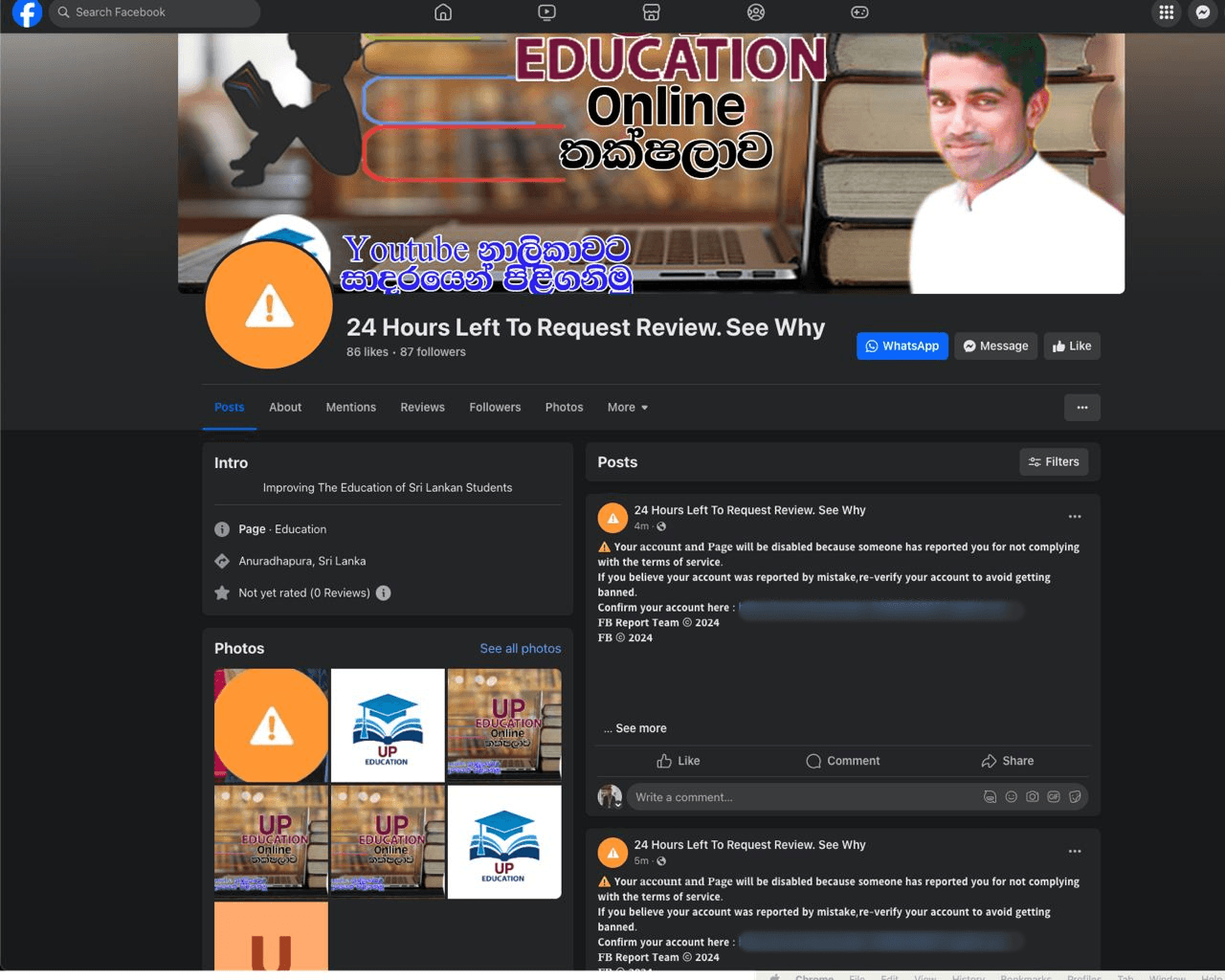
In 2024, cybercriminals targeted travel enthusiasts using fake hotel and airline booking websites. In one simple scheme, a fraudulent site asked users to enter their login credentials to complete their booking — these credentials ended up in criminal hands. Sometimes, the fake login form appeared under multiple brand names at once (for example, both Booking and Airbnb).
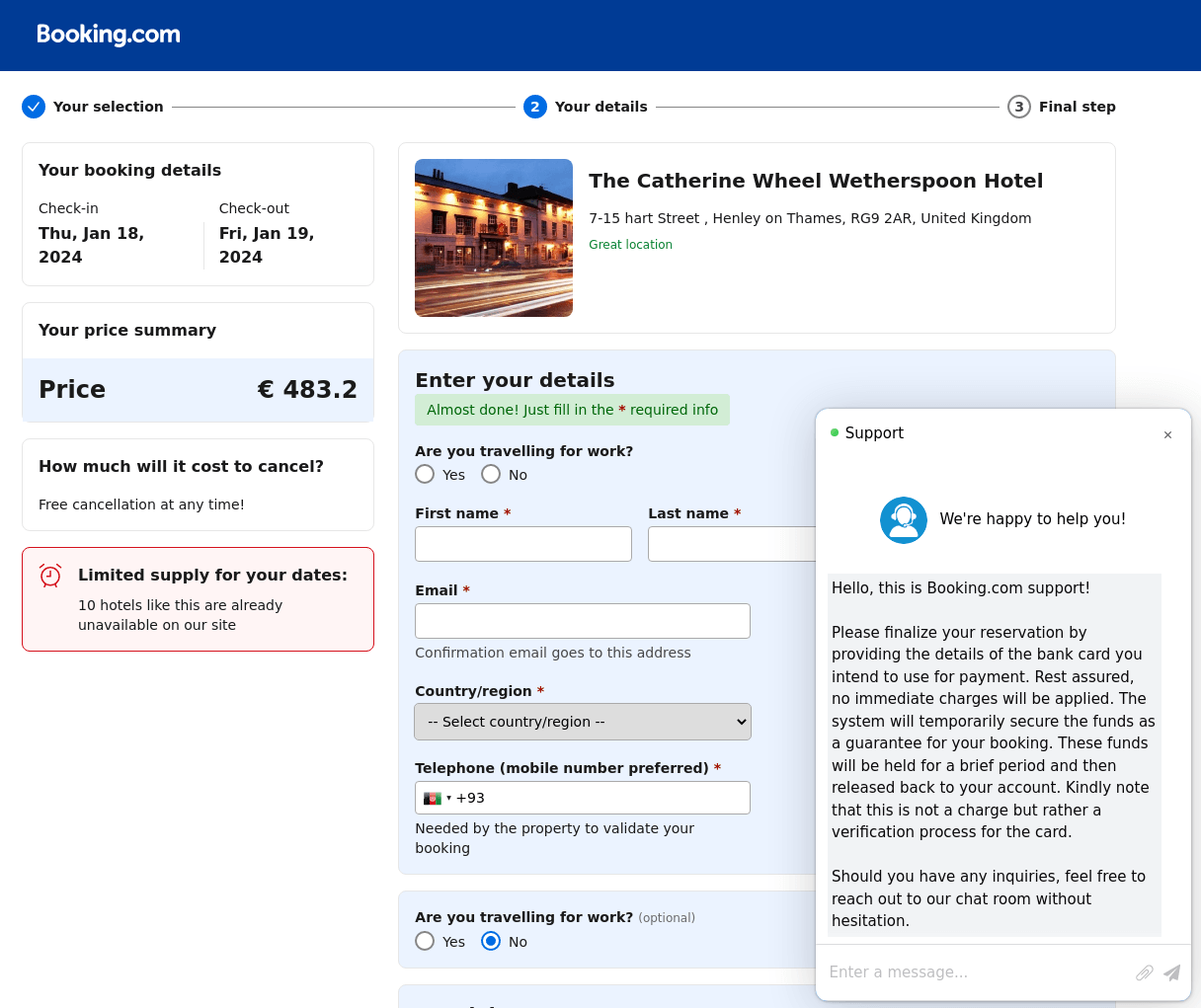
Another scheme involved a more sophisticated fake site, where users could even select the purpose of their trip (business or leisure). To complete the booking, the scammers requested bank card details, claiming that a certain sum would be temporarily blocked on the account to verify the card’s authenticity. Legitimate booking services regularly request payment details, so the victim may not suspect anything in this case. To rush users into entering their data carelessly, on the phishing page, the scammers displayed warnings about dwindling accommodation availability and an imminent payment deadline for the booking. If the victim entered their data, the funds were not frozen but went straight into the criminals’ pockets.
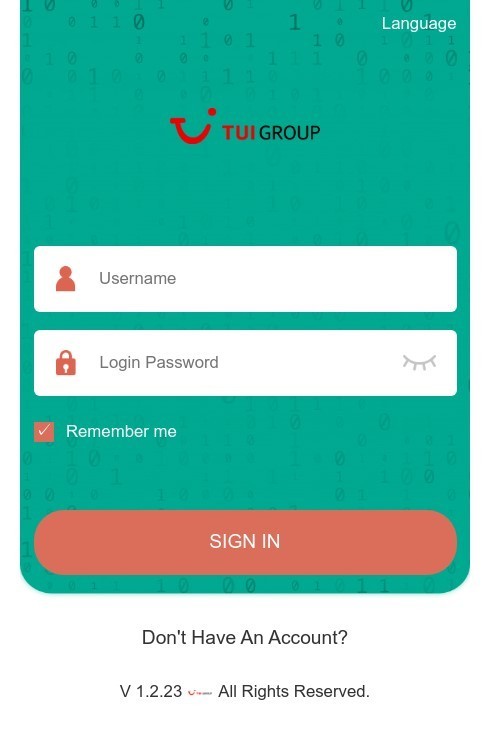
Cyberthreats in the travel sector affected not only tourists but also employees of travel agencies. By gaining access to a corporate account, criminals could conduct financial transactions on behalf of employees and gain access to large customer databases.
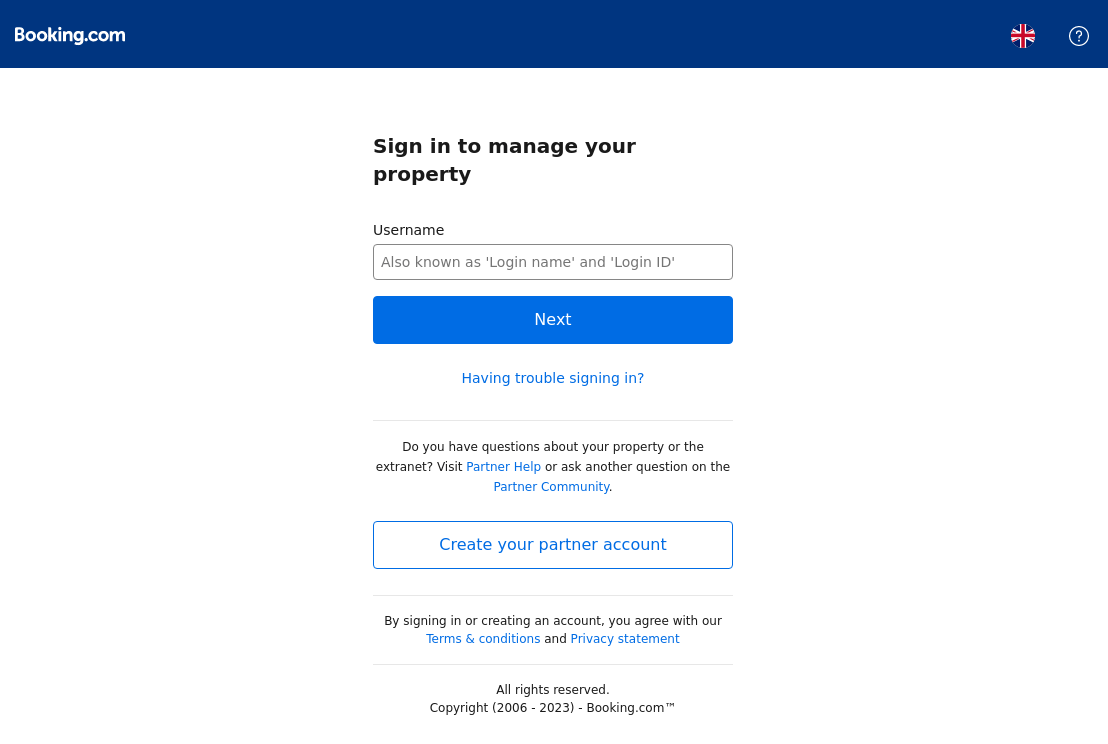
Fake accommodation sites often sent messages to property owners, telling them to log in to “manage their property.” This scheme targeted people renting out their homes through online booking platforms.
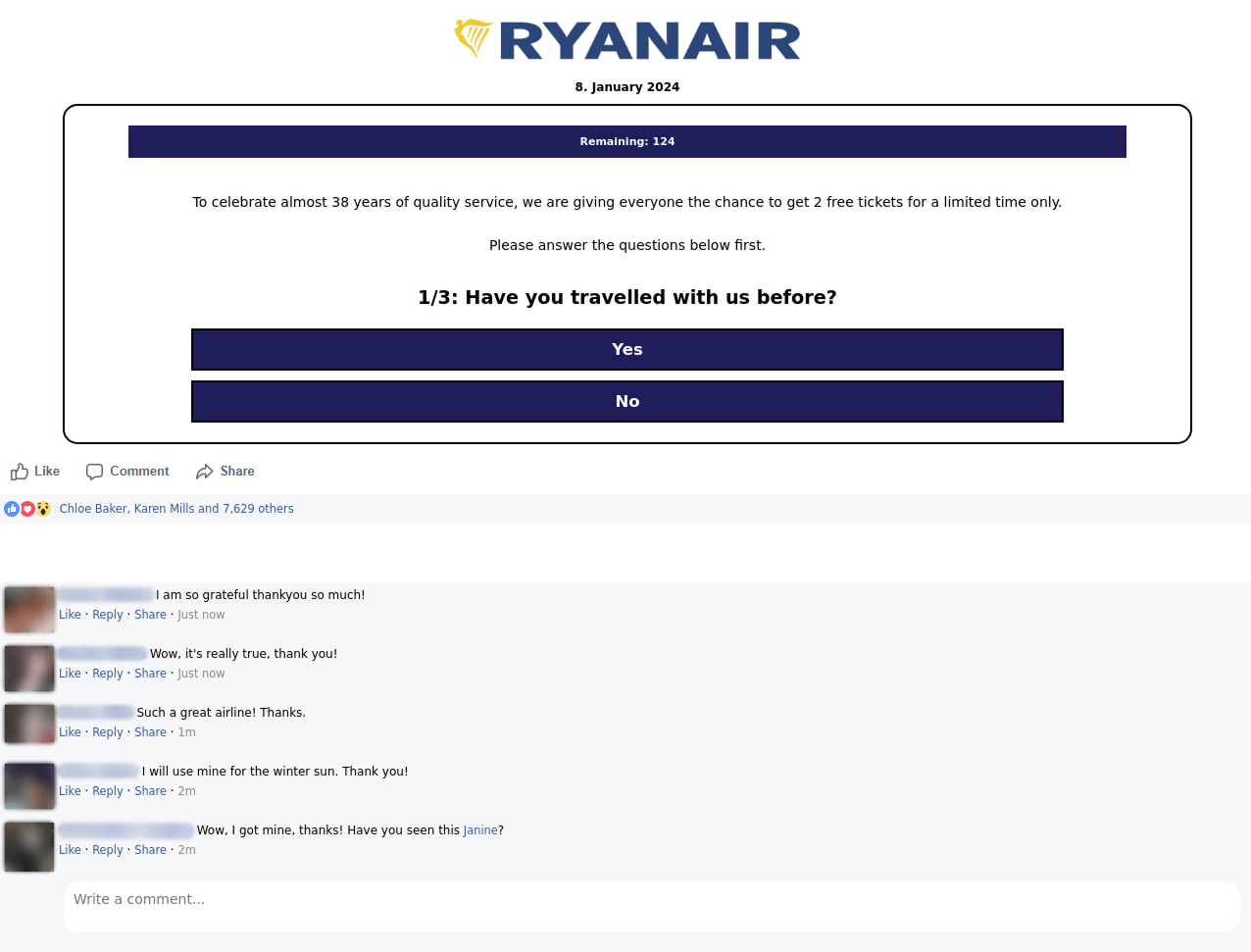
Other scam pages featured surveys, offering respondents gifts or prize draws for participating. In this case, victims risked both their credentials and their money. Such fake giveaways are a classic scam tactic. They are often timed to coincide with a significant date for the travel industry or a specific company. For example, the screenshot below shows an offer to take part in a giveaway of airline tickets to celebrate Ryanair’s birthday.
After completing the survey, users may be asked to share the offer with a certain number of contacts, and then pay a small fee to receive the expensive gift. Of course, these prizes are non-existent.
To steal credentials for social media and messenger accounts, scammers used another classic technique: asking users to verify themselves. In one scheme, the victim was redirected to a website that completely replicated WhatsApp’s design. The user entered their phone number and login code, handing their credentials straight over to the cybercriminals.
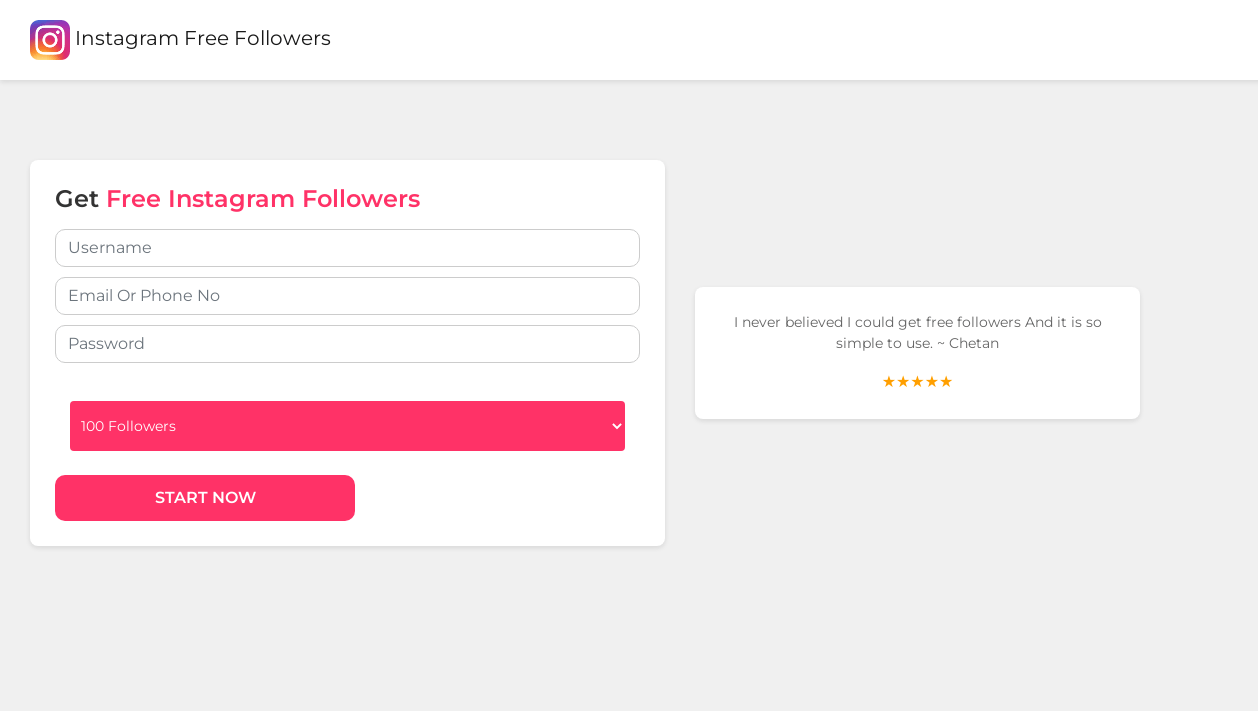
Beyond verification scams, fraudsters also lured victims with attractive offers. For example, in the screenshot below, the victim is promised free Instagram followers.
Some cybercriminals also used the promise of adult content to lure victims into entering their credentials in a fake authorization form.
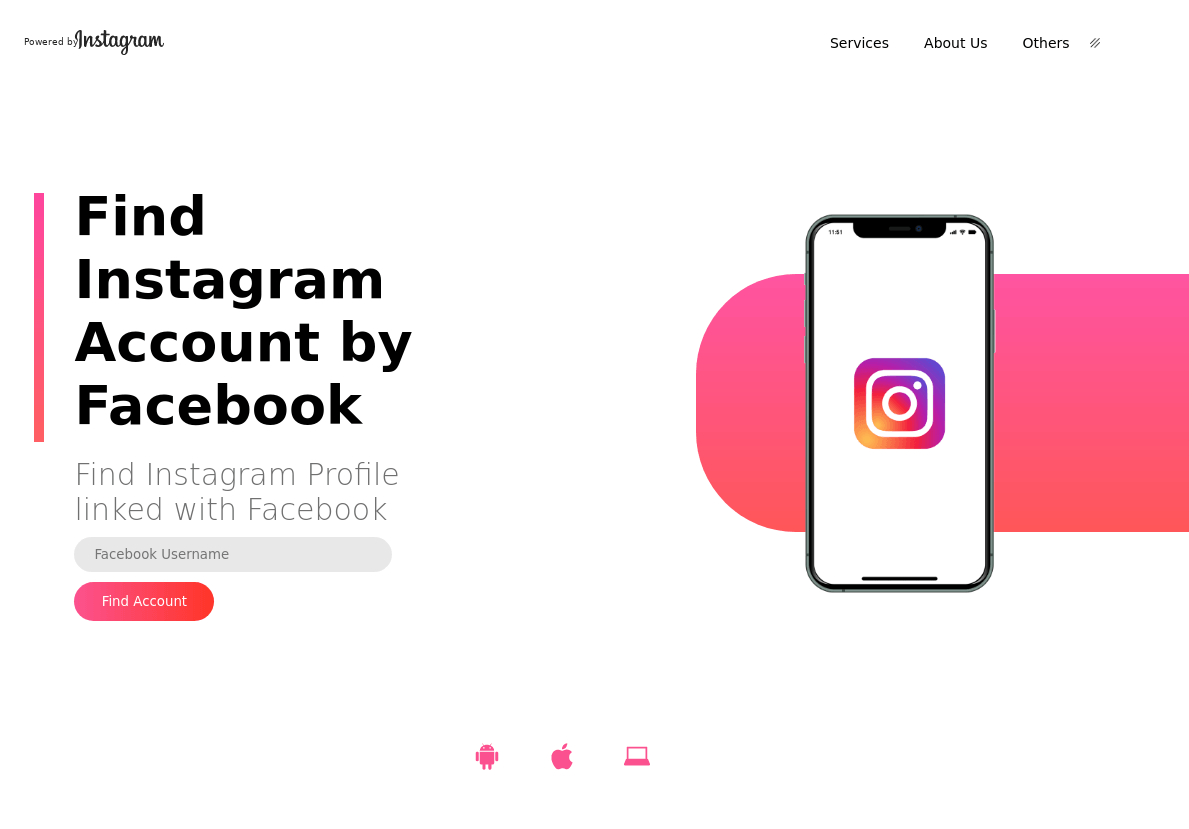
Other scammers took advantage of Facebook and Instagram being owned by the same company. On a fraudulent page, they claimed to offer a service that allowed users to find Instagram profiles by entering their Facebook login and password.
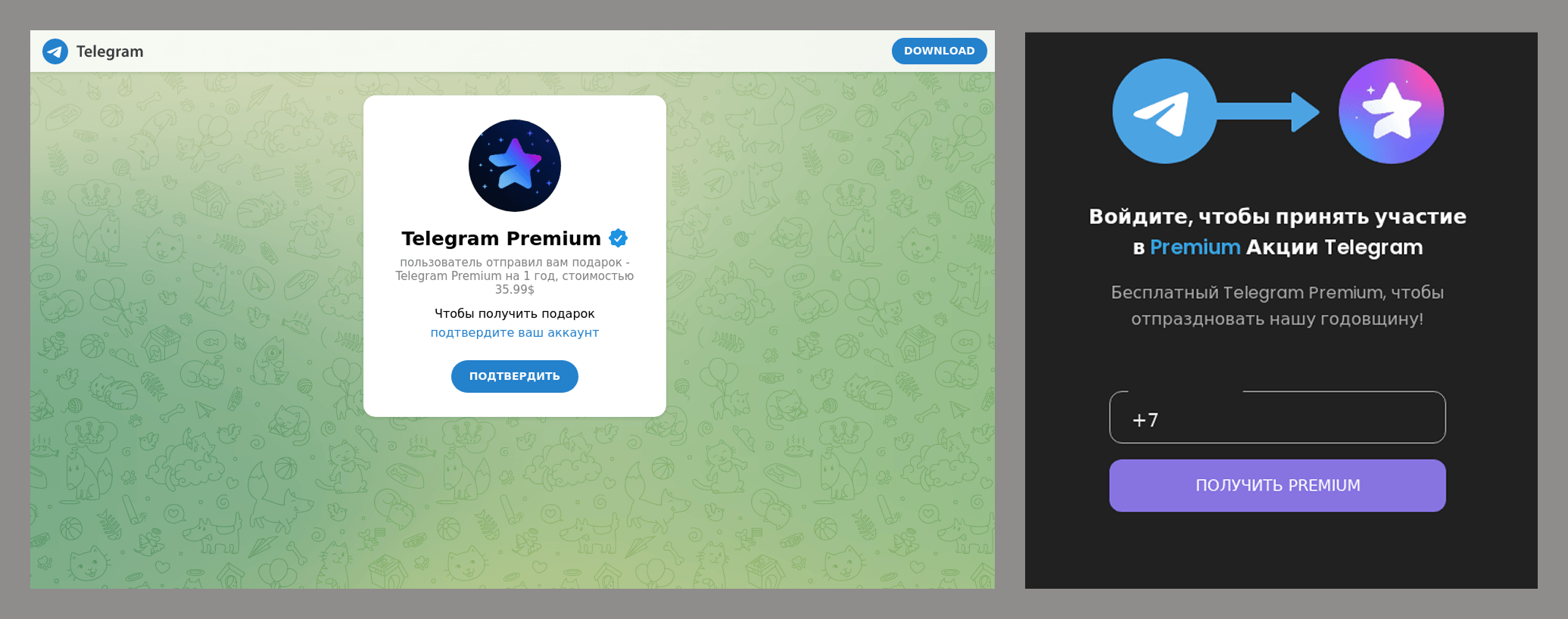
Some scams offered users a surprise “gift” — a free Telegram Premium subscription. To enable the messenger’s premium features, the victim only had to enter their phone number and a one-time code on a fraudulent website.
Some fake social media and messenger pages were designed not to steal login credentials but to install malware on victims’ devices. Taking advantage of the popularity of Facebook Lite for Android, scammers offered users a “more advanced official version”, claiming it had extra features missing in the original app. However, instead of an upgraded app, users downloaded malware onto their devices.
Similarly, installing a supposedly free Telegram client with an activated Premium subscription often led to downloading malware.
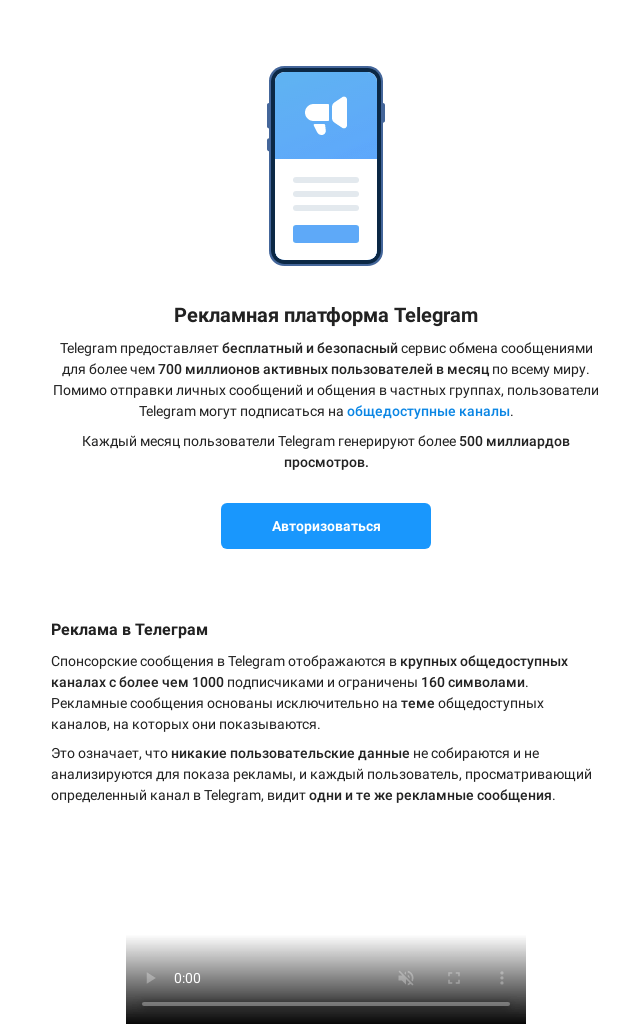
Social media business services were increasingly used as a pretext for credential theft, as they play a key role in developing and promoting businesses and are directly linked to financial operations. Cybercriminals tricked Telegram channel owners into logging in to a phishing platform imitating the official Telegram Ads tool, thereby stealing their Telegram credentials. To make the scam more convincing, the attackers detailed how Telegram advertising works and promised millions of ad views per month.
TikTok users have also been targeted. TikTok Shop allows sellers to list curated products—items featured in videos—for potential buyers to find and purchase. Scammers created fake TikTok Shop pages to steal seller credentials, potentially leading to both reputational and financial damage.
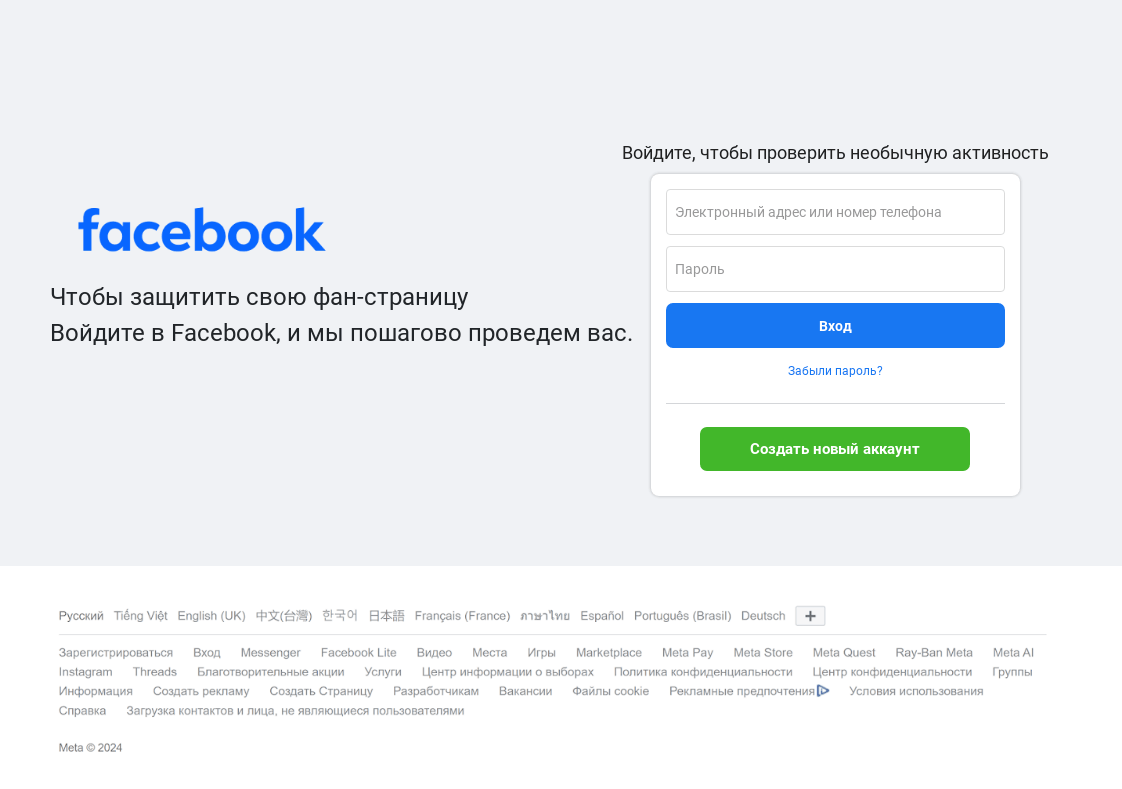
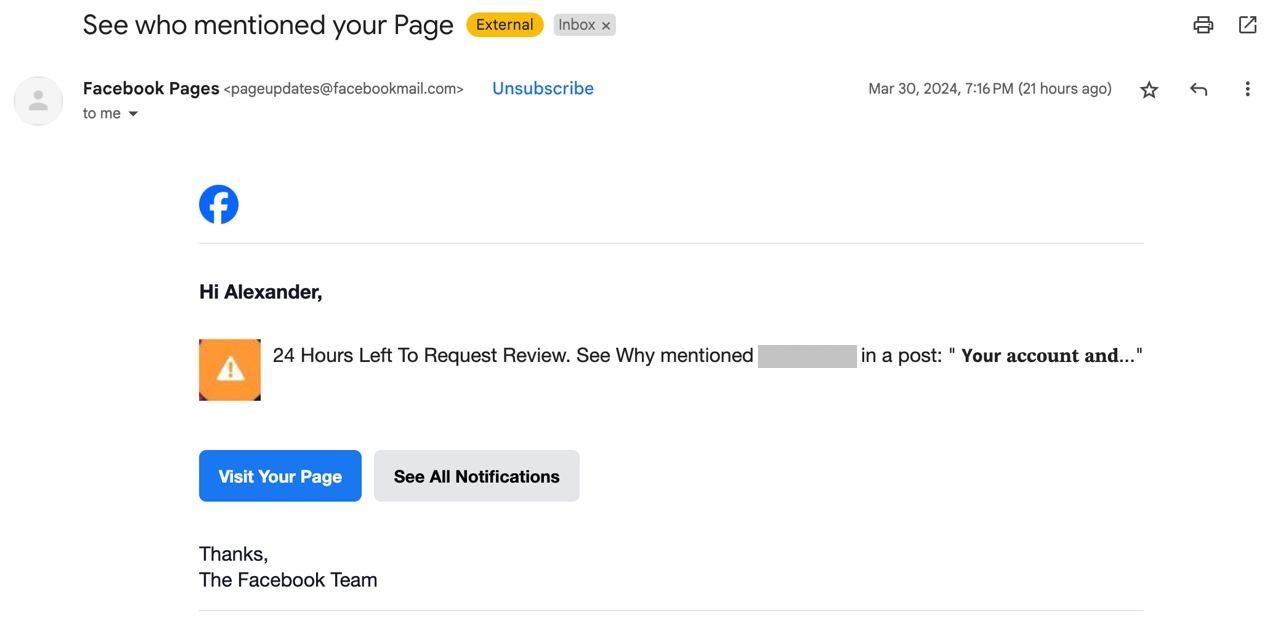
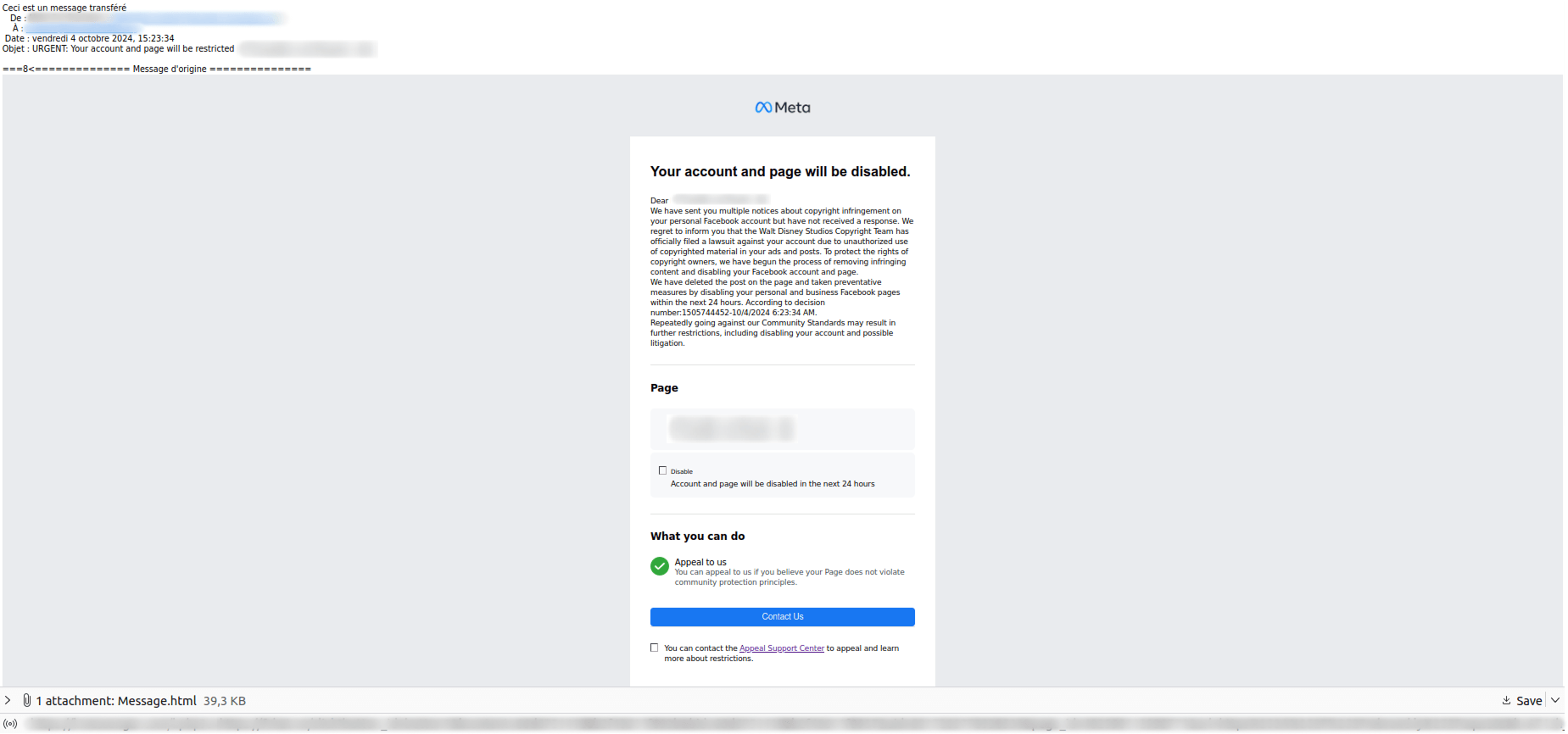
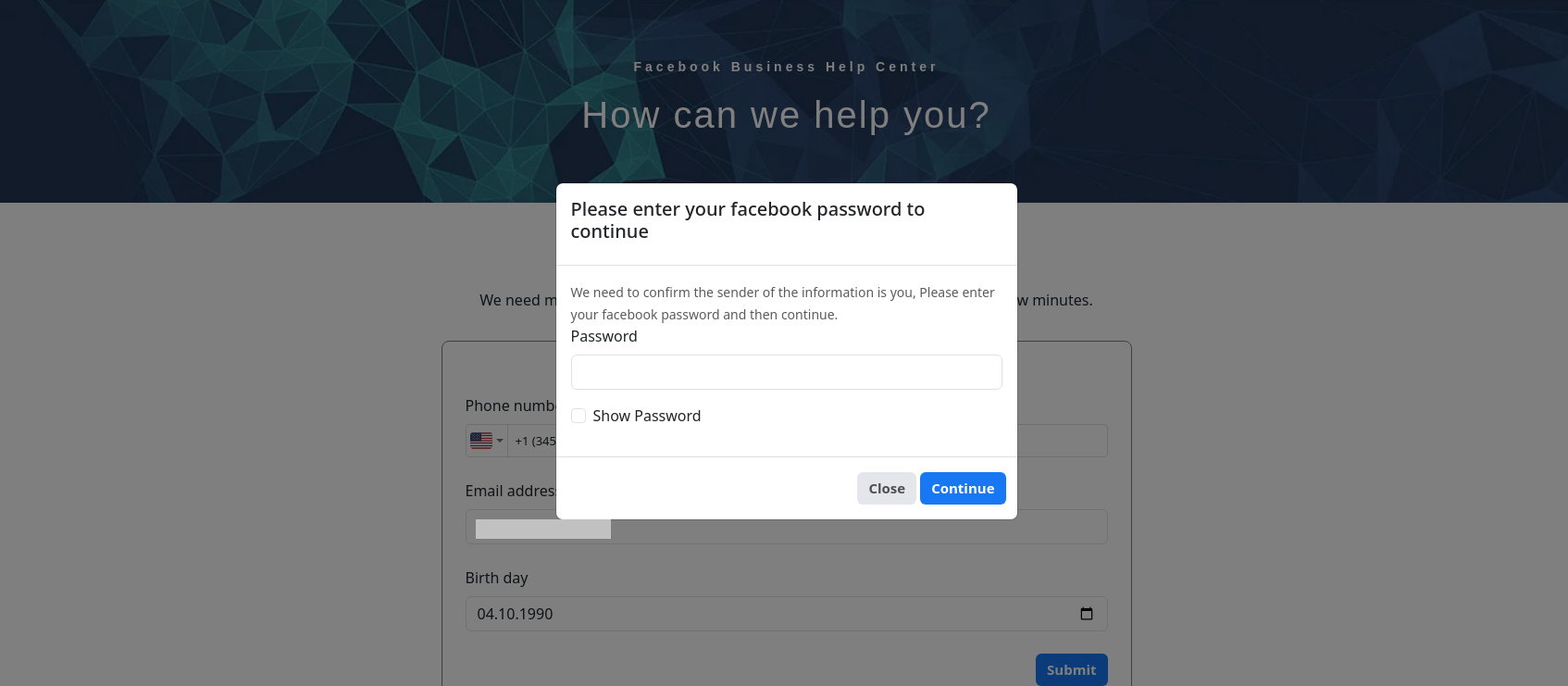
In another case, fraudsters informed Facebook fan page owners of unusual activity in their accounts. Potential victims were prompted to check their profile by entering their login credentials into a phishing form.
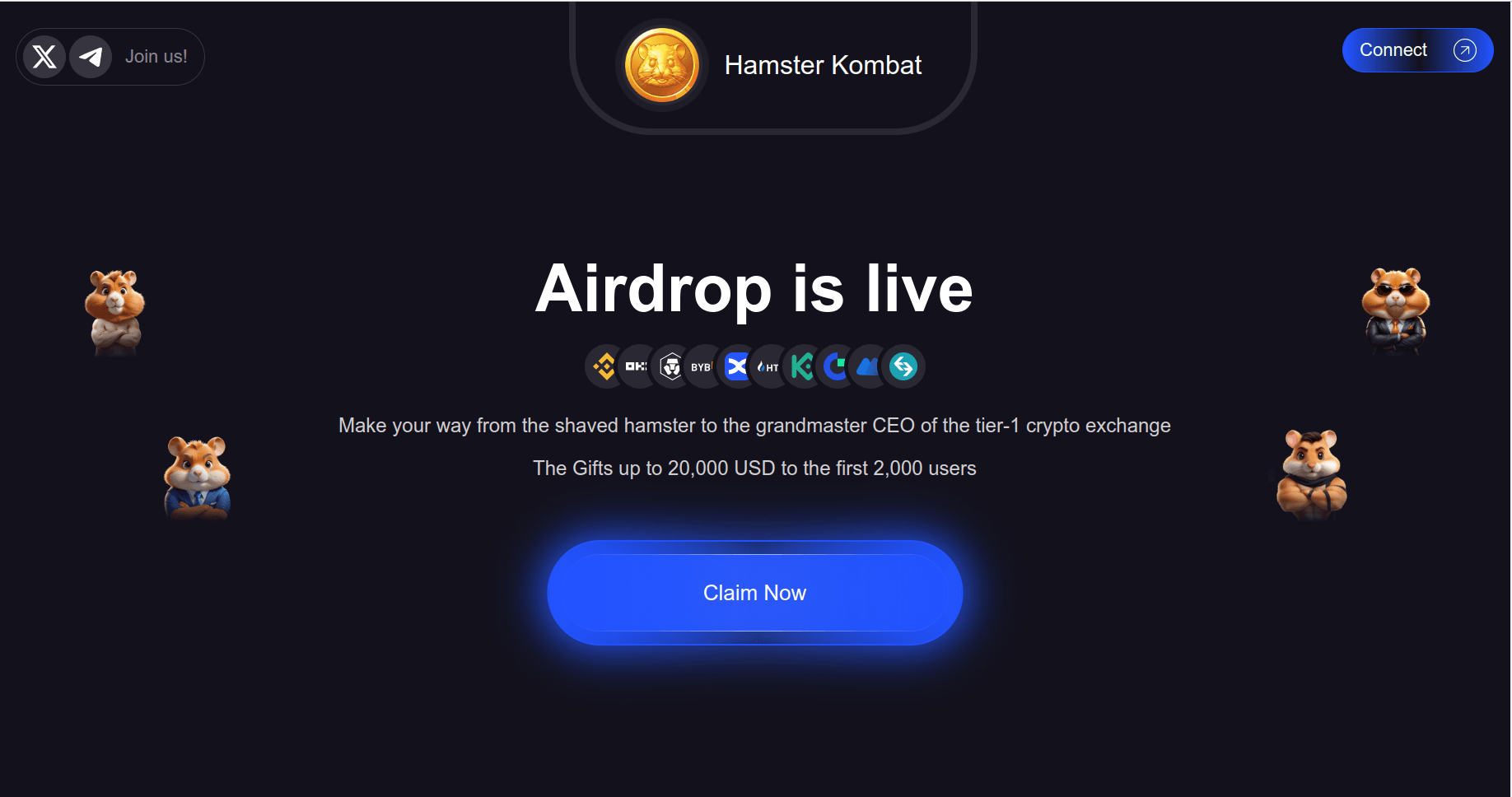
One of last year’s most sensational stories was the cryptocurrency game Hamster Kombat. This clicker game, simulating the creation of a crypto exchange in a gamified format, quickly attracted a massive audience. Players eagerly awaited the moment when the in-game coins could be exchanged for real virtual currency. But while the official listing was delayed, the fraudulent schemes wasted no time.
Fraudsters claimed to offer cash-out services for in-game coins by converting them into rubles. To withdraw money, criminals claimed, users just had to log in through a fake Telegram page.
The growing anticipation for the new cryptocurrency’s market launch was frequently exploited by cybercriminals to steal seed phrases from crypto wallets. Scammers announced an early token sale, requiring users to log in through a fake page to participate. Of course, there was no mention of such promotions on official resources.
The popularity of Hamster Kombat was also abused in scam schemes. For example, users were offered access to a crypto wallet supposedly containing a significant sum in virtual coins. To claim it, the unsuspecting victims had to share information about the “opportunity” with a certain number of contacts in messaging apps. Having made their potential victim an accomplice in spreading false information, the scammers demanded a small commission for the withdrawal and disappeared with the stolen money.
A more elaborate scam also aimed to trick users into paying a “commission”, but with a slightly different approach. First, visitors to the page were asked to register to learn about some new activity related to Hamster Kombat.
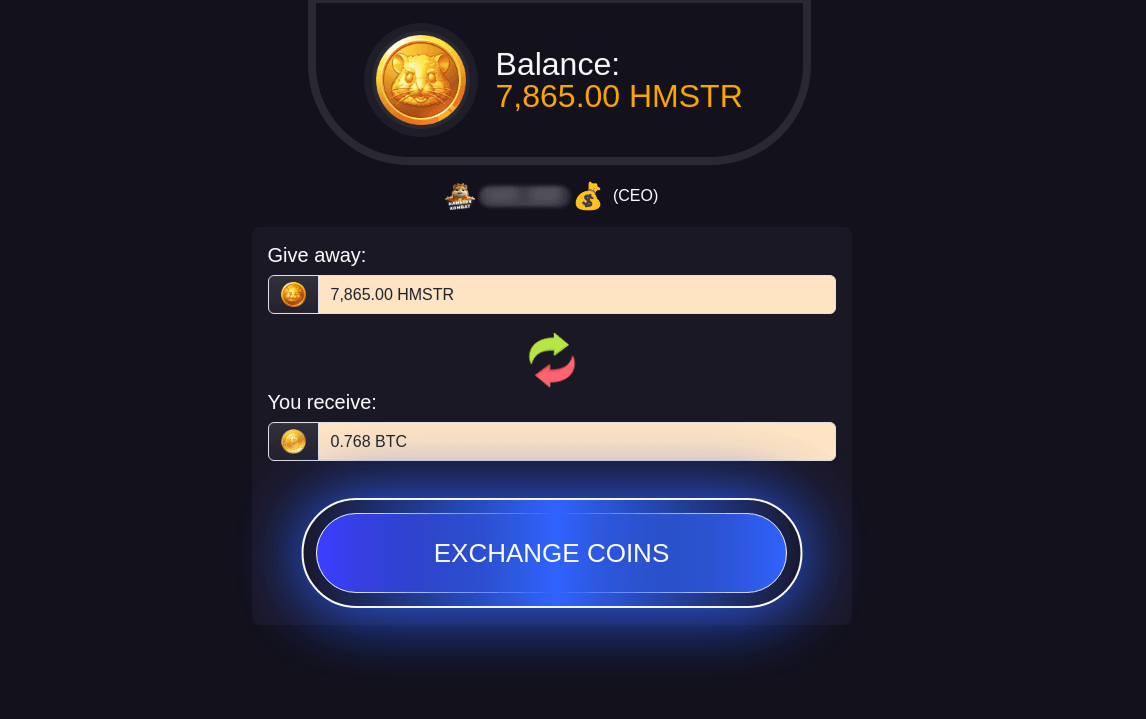
Once registered, they were suddenly informed of having won a large amount of the HMSTR cryptocurrency supposedly as part of an experiment conducted on the platform. Exploiting uncertainty around the token’s listing, scammers urged victims to bypass the official trading launch and exchange their in-game currency for Bitcoin immediately.
To make it more convincing, the page displayed an exchange rate at which the “prize” would be converted.
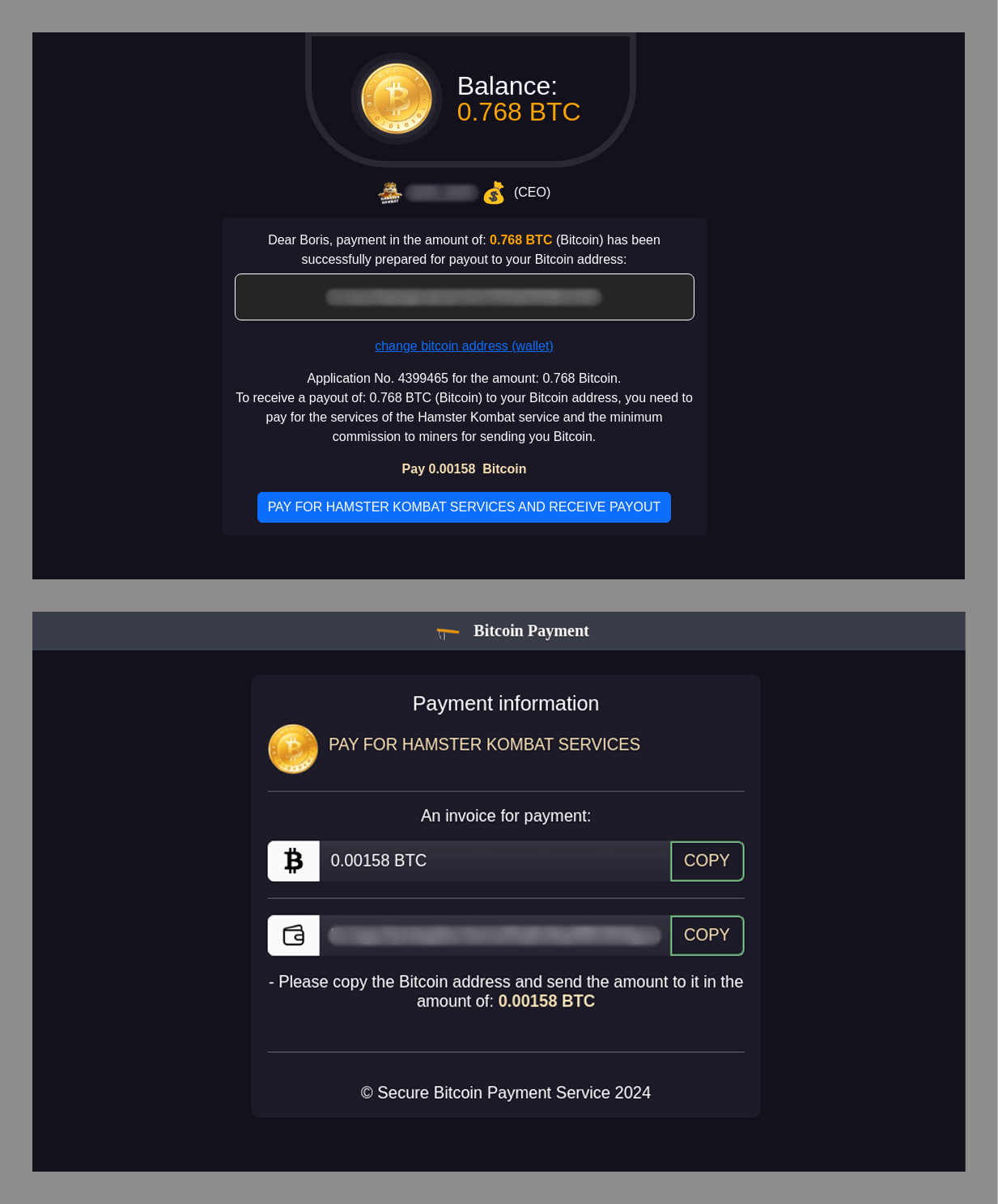
However, after clicking the “Exchange coins” button, users were prompted to pay a commission for the service.
Everyone who paid this fee lost their money and received no Bitcoin.
Phishing attacks also targeted TON wallet users. In this case, scammers lured victims with promises of bonuses, requiring them to link their crypto wallets on fraudulent websites.
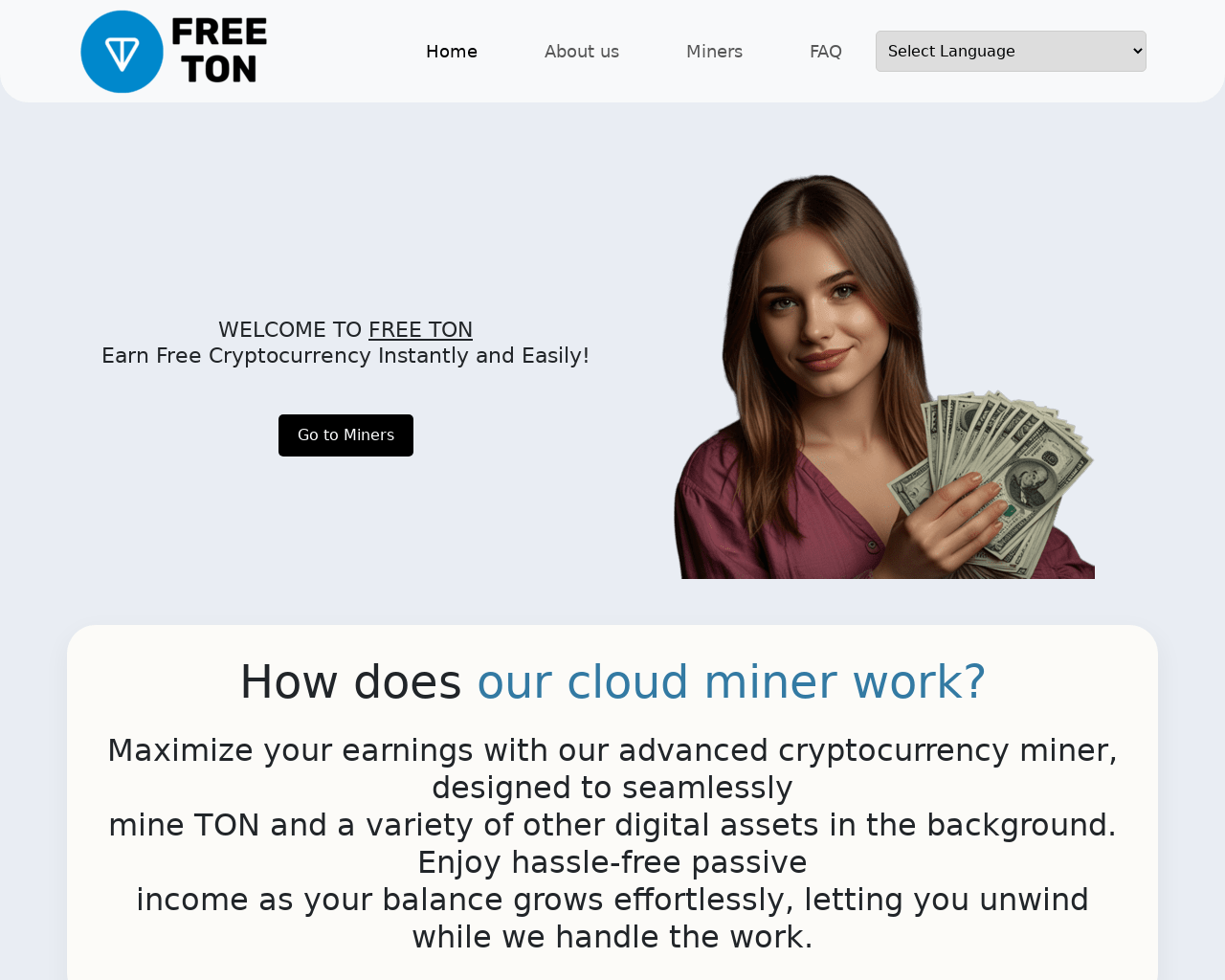
TON cryptocurrency was also used as bait in scam schemes. In a classic scenario, users were promised a quick way to earn digital currency. Fraudsters advertised a cloud mining service that allegedly generated high profits without any effort. After registering, unsuspecting users could monitor their “earnings” but had to pay a commission in cryptocurrency to withdraw funds.
Another “profitable” crypto scam resembled a Ponzi scheme: victims were required to recruit at least five new participants into the program—without receiving any money, of course. The scam site mimicked an online earning platform.
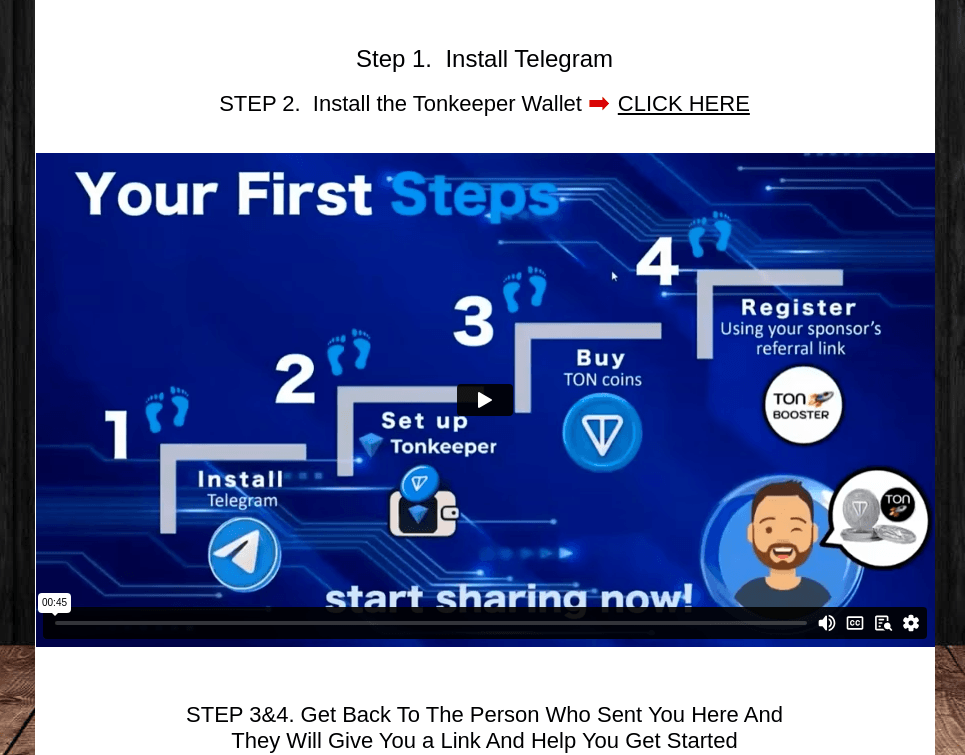
Visitors were instructed to install Telegram and use an unofficial bot to activate a crypto wallet where profits would supposedly be deposited.
According to the instructions, users then had to buy Toncoin and register in the program through a referral link from another participant. The scam worked by enticing people to make a small investment in the hopes of making big profits—the victims used their own funds to purchase the cryptocurrency for registration. But as with any pyramid scheme, only those at the top profited, while everyone else was left with nothing but empty dreams.
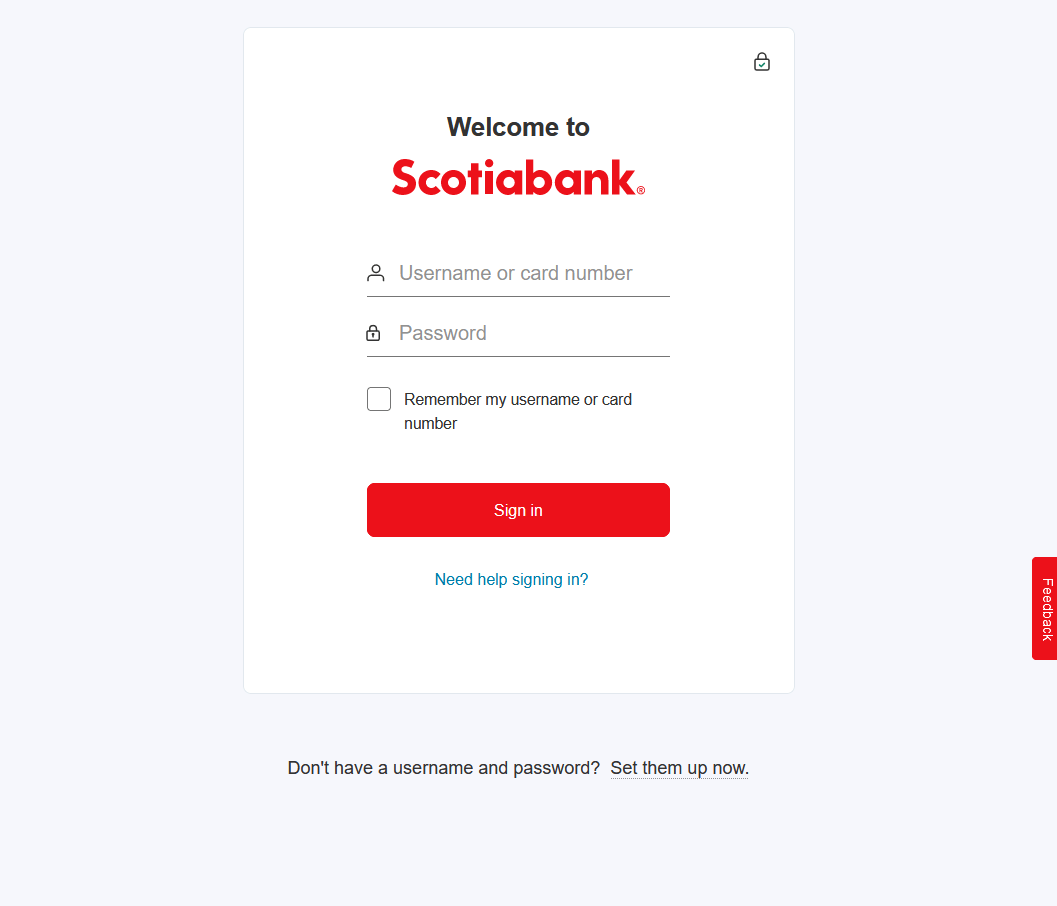
Victims of phishing frequently included bank clients and users of government service portals. In such schemes, users first received a notification that they needed to update their account credentials. Cybercriminals used various communication channels to contact their victims: email, text messages, and chats in messaging apps. The victims were then led to fake sites where they were asked to provide their personal data. First, they entered their personal login credentials on the organization’s website.
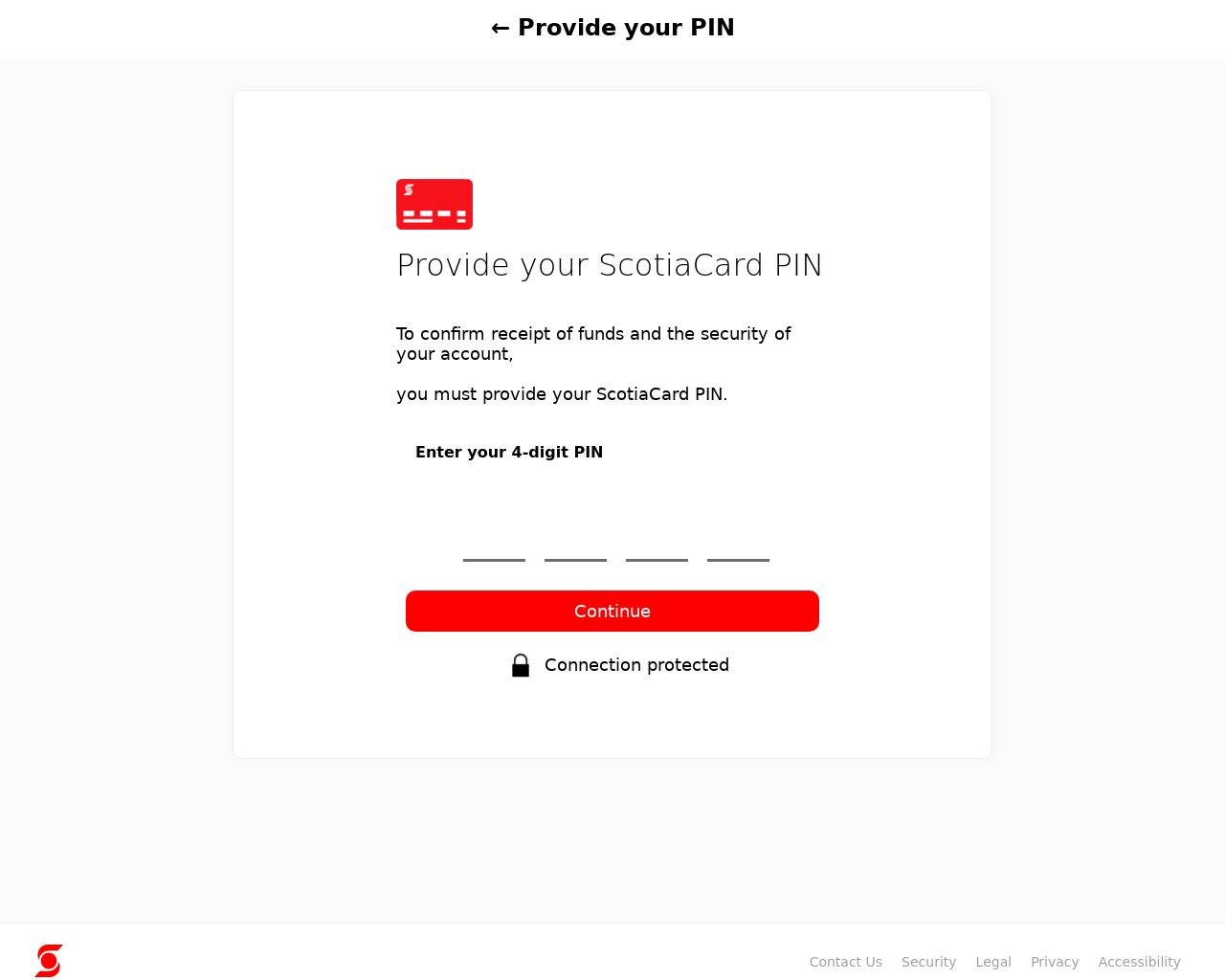
Next, they were prompted to provide their email account credentials. The scammers also attempted to collect identity document details and other data, including the bank card PIN code.
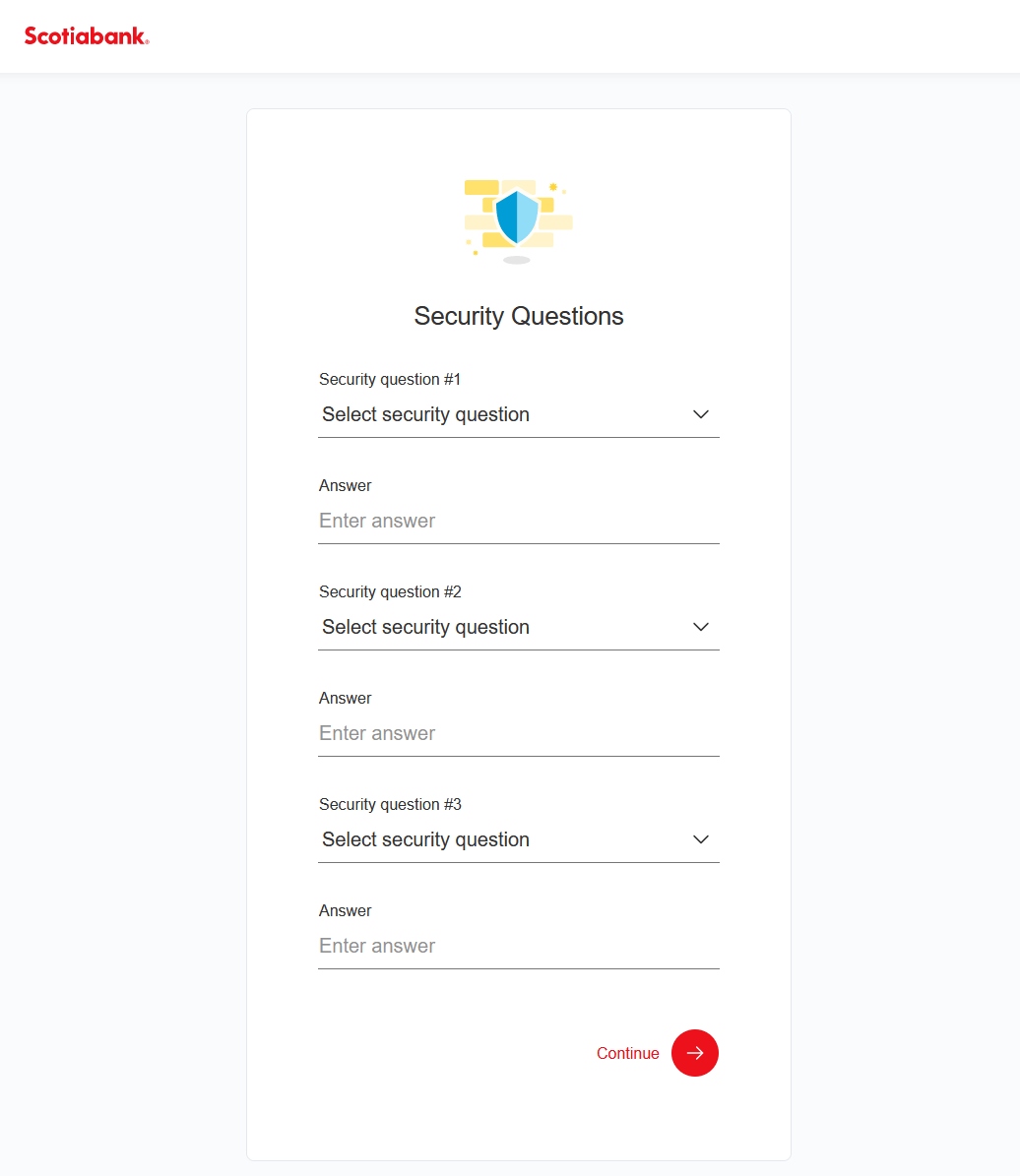
Additionally, these phishing forms requested answers to security questions commonly used for additional verification in banking transactions.
This way, the cybercriminals gained full access to the victim’s account. Even the PIN code could be useful for the scammers in gaining access to the account. Security questions served as an extra safeguard for fraudsters in case the bank’s security service detected suspicious activity.
Phishing schemes also exploited the images of real people. For example, users browsing YouTube could stumble upon ad videos of celebrities announcing giveaways for their fans. Clicking the link in such a video led users to a page containing a post supposedly from the celebrity’s social media account, explaining how to claim the prize. However, when attempting to collect the “winnings”, visitors were asked to pay a small commission—insignificant compared to the value of the “gift.” Needless to say, those who paid the fee lost their money. The prize never existed, and the video was nothing more than a deepfake.
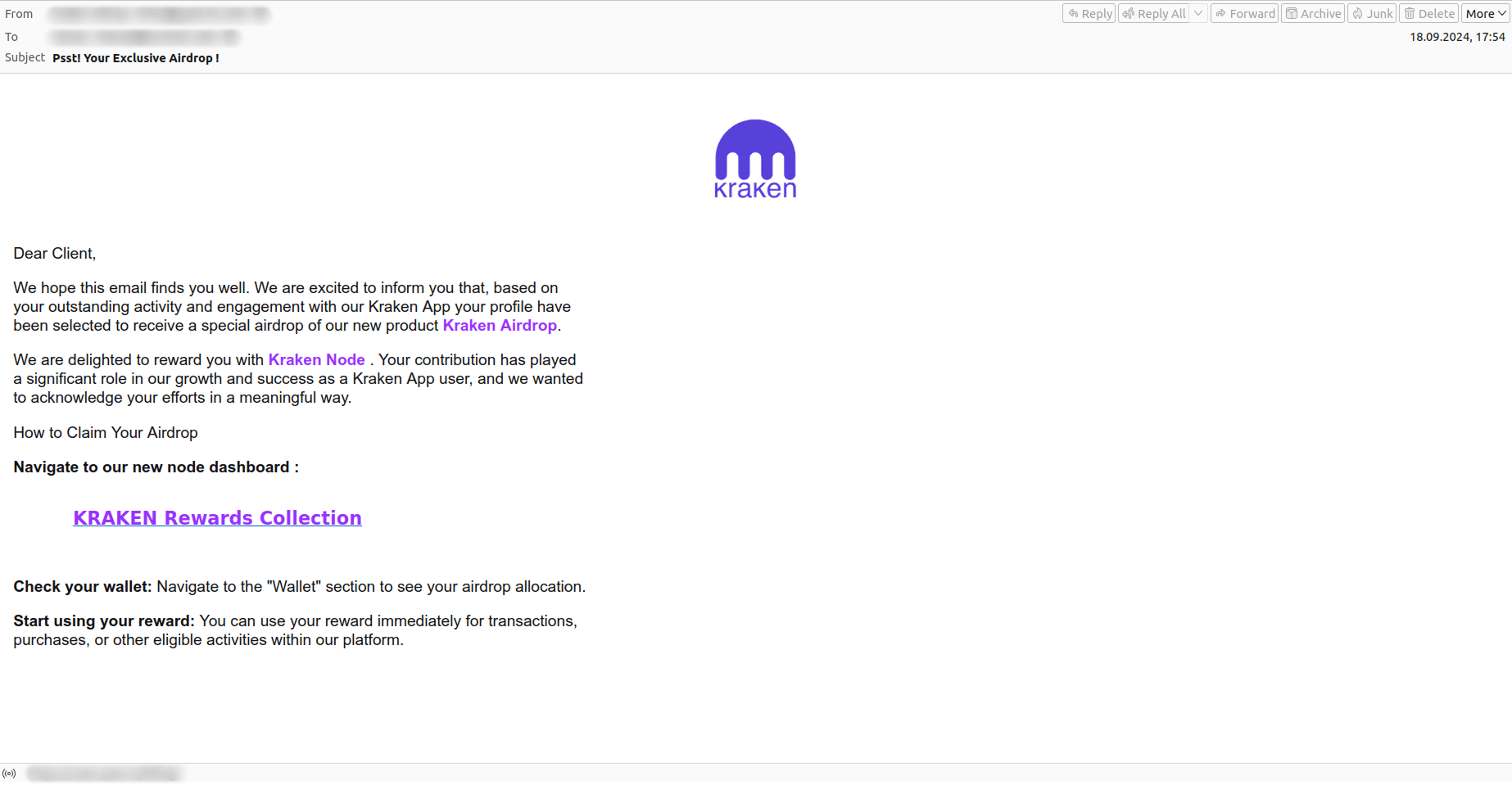
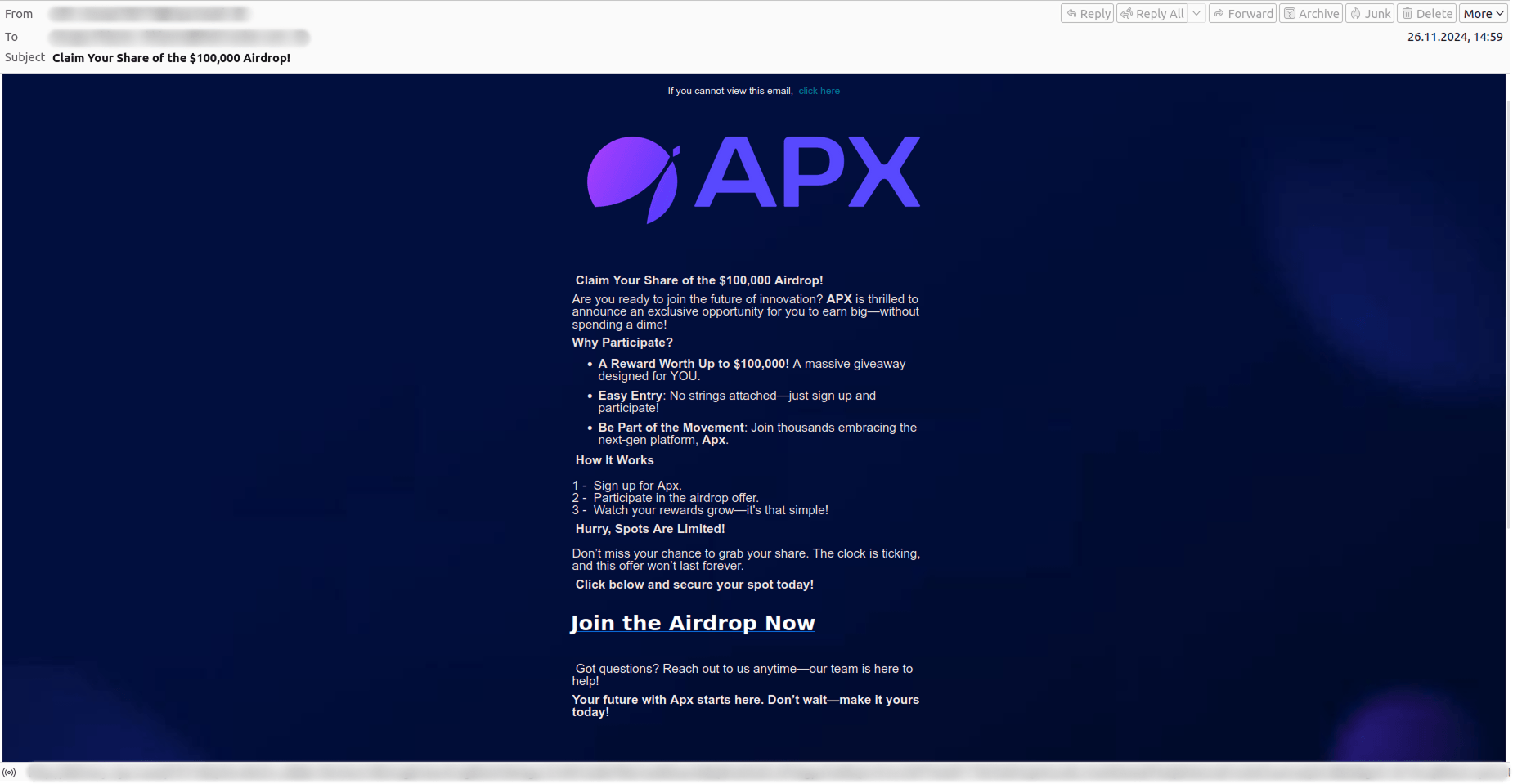
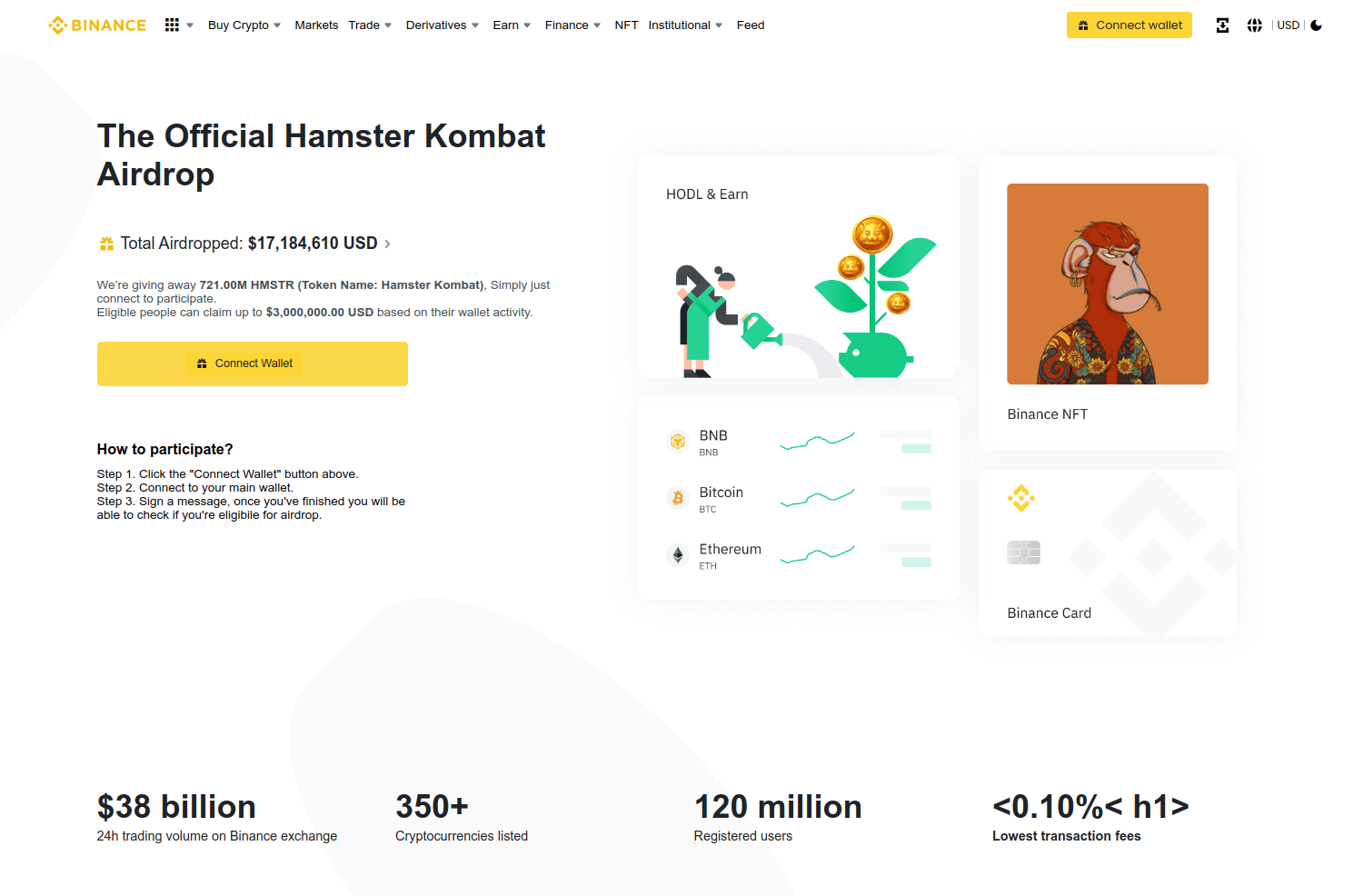
Throughout the year, we frequently encountered emails announcing fake cryptocurrency airdrops, allegedly from teams of well-known crypto projects. The recipients, referred to as the platform’s “most valuable users,” were invited to participate in an “exclusive” event as a thank you for their loyalty and exceptional engagement.
New users unfamiliar with cryptocurrency were lured in with a unique opportunity to take part in the token giveaway and win a large sum—all they had to do was register on the platform, which was, of course, fake.
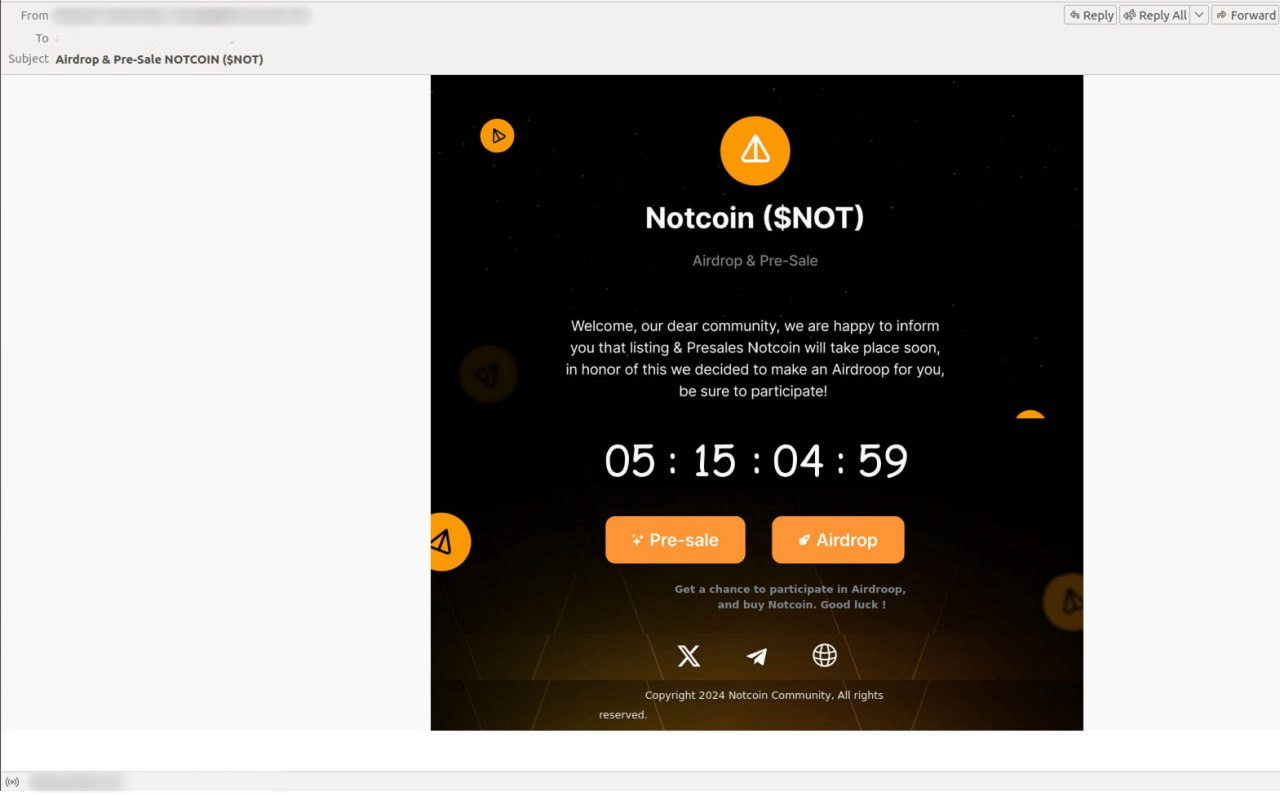
Scammers in 2024 closely monitored cryptocurrency market news. For example, in the spring, ahead of Notcoin’s upcoming listing, scam messages appeared featuring countdown timers, urging potential victims to participate in an airdrop allegedly arranged just for them.
Scam emails also targeted users of the cryptocurrency game Hamster Kombat, popular among Russian-speakers. Players eagerly awaited the HMSTR token listing, which was repeatedly postponed—a delay that scammers were quick to exploit. In the fall of 2024, they began sending emails pretending to be from the Hamster Kombat team, promising generous cash prizes if victims clicked a link to a fake game site.
Similar offers were distributed via a fraudulent website mimicking a major cryptocurrency exchange. In both cases, to claim the coveted tokens, victims had to link their cryptocurrency wallets.
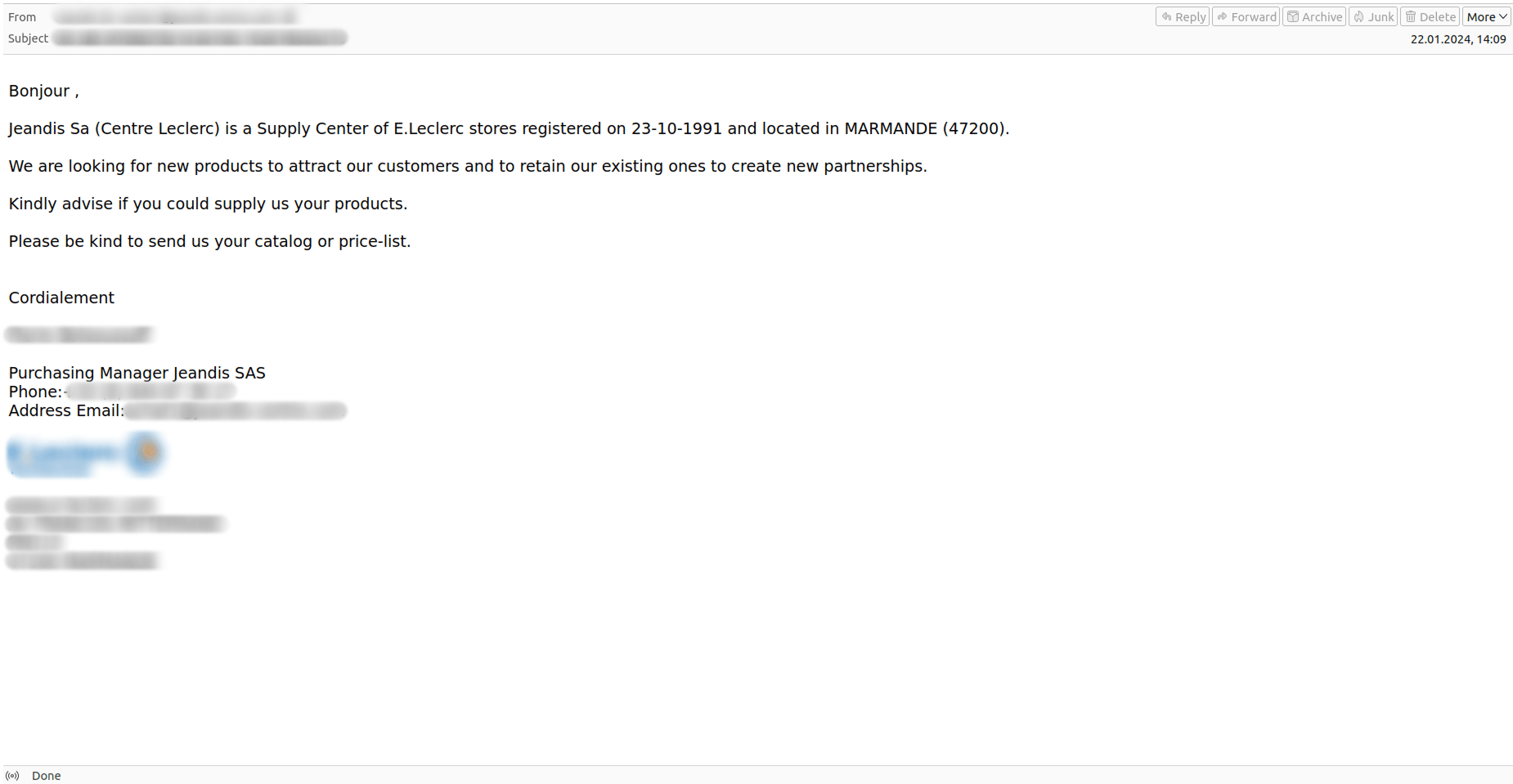
In 2024, the Nigerian scam remained popular among spammers. Furthermore, fraudsters used both time-tested and trending themes to deceive victims. Cybercriminals employed various tricks and manipulations to engage with email recipients, with the ultimate goal of extracting money.
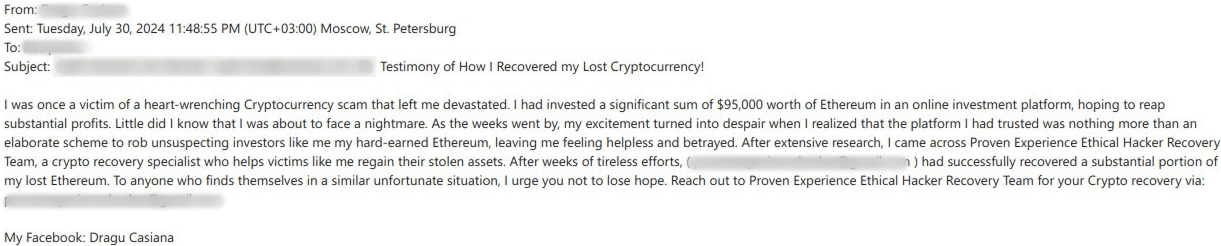
Most often, users were lured into classic schemes: fraudsters posed as terminally ill wealthy individuals seeking a worthy heir, lottery winners eager to share their prize, or investors offering opportunities in a promising business. Sometimes, to evade suspicion, scammers “rescued” their victims from other fraudsters and offered to compensate them for any financial losses. For example, in the summer of 2024, we came across an interesting case where an alleged victim of crypto fraud suggested that fellow sufferers contact a group of noble hackers for help recovering lost cryptocurrency.
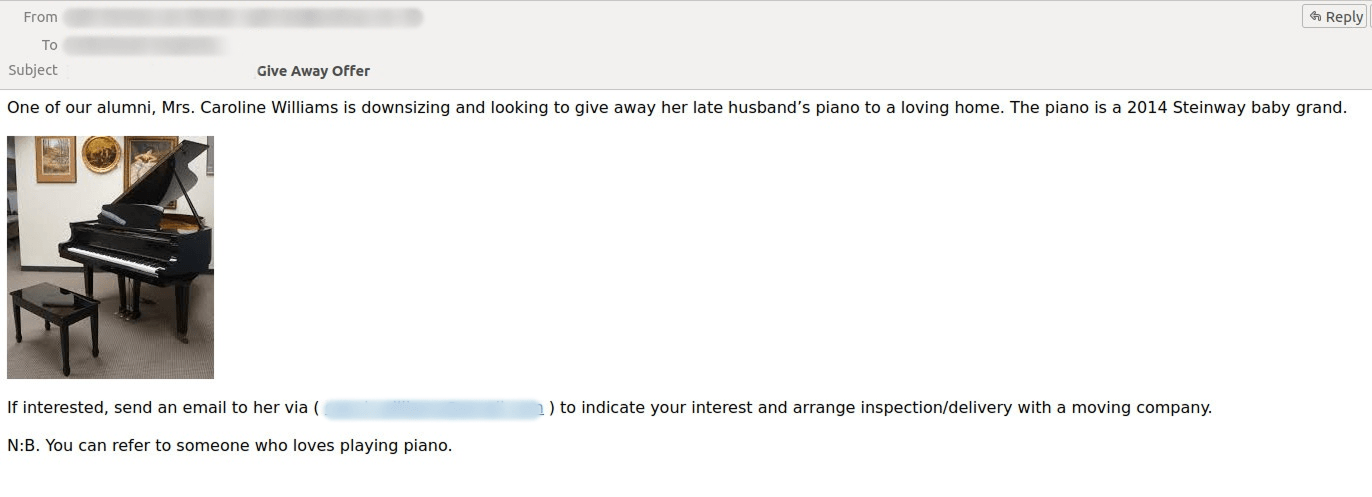
Some scam offers were quite unexpected, as they didn’t promise vast riches, and, therefore, might not attract such a wide audience. In mid-to-late 2024, we saw scam emails claiming to be looking for new owners for pianos due to relocation or the previous owner’s passing.
We also encountered even more creative scam narratives. For example, an email allegedly sent from a secret society of Illuminati promising to share their wealth, power and fame if the recipients agree to join their grand brotherhood.
Other “Nigerian” scam emails capitalized on current news events. Thus, the most talked-about event of 2024, the US presidential election, significantly influenced the types of scams we saw. For example, one scam email claimed that the recipients were incredibly lucky to be eligible to receive millions of dollars from Donald Trump’s foundation.
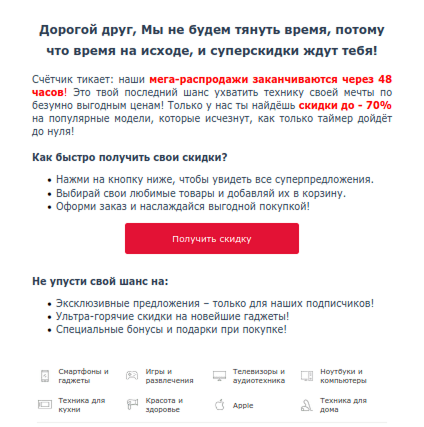
Last year, the Russian segment of the internet was not spared from mass scam mailings. We frequently encountered schemes mimicking investment projects of major banks, promising users easy earnings and bonuses. Fraudsters also sent out emails with promotional offers from home appliance and electronics stores. Customers were informed of huge discounts on sales that were supposedly about to end.
The links in such emails led to fraudulent websites that looked identical to legitimate online stores but stood out with extremely low prices. After paying for their desired items, customers lost their money, as orders were never actually placed.
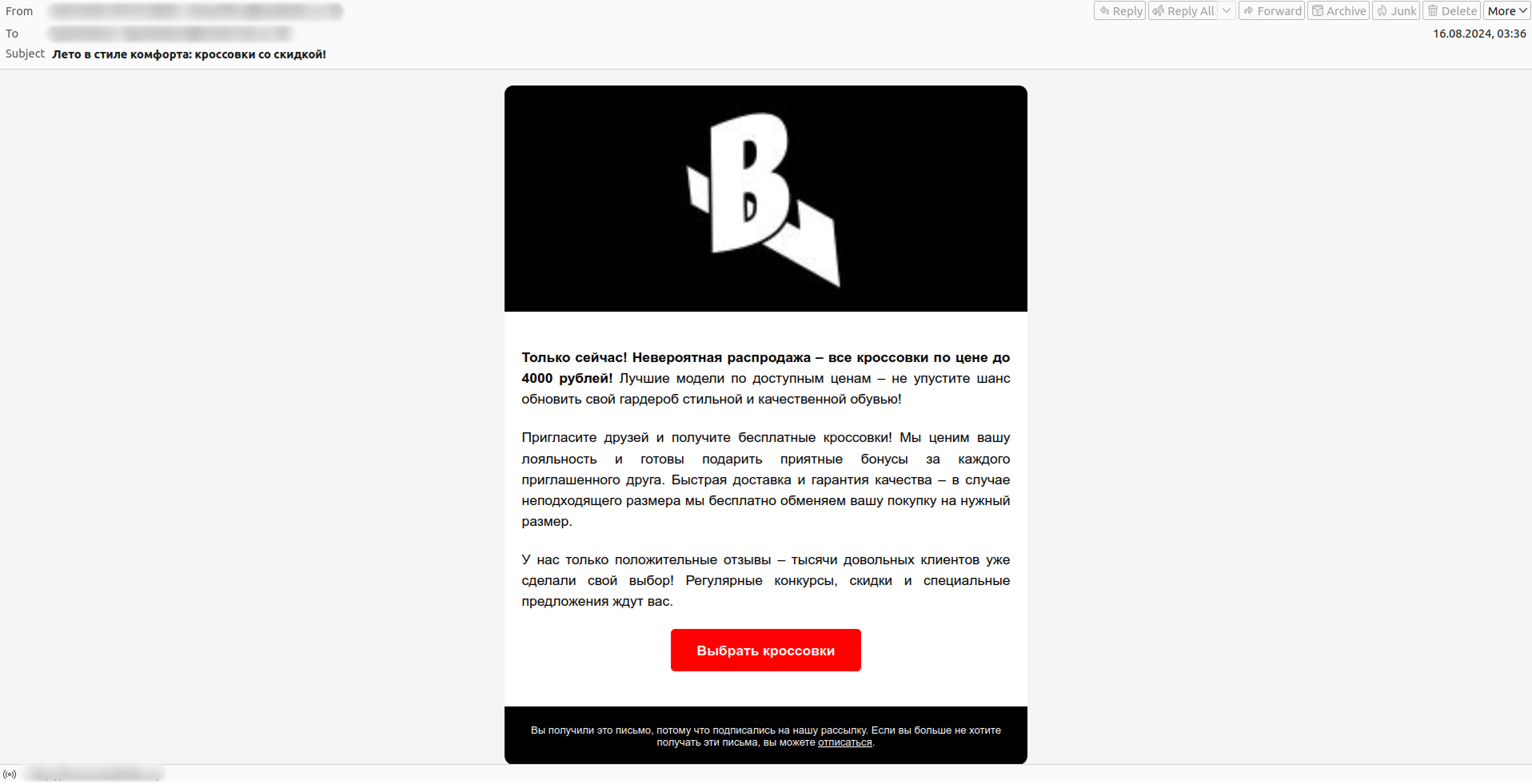
Beyond electronics, scammers also offered other discounted products. In one such campaign, users received an email advertising a sneaker store selling popular models at affordable prices.
Judging by the technical headers of the emails, both the sneaker store and electronics store promotions were sent by the same fraudsters.
Additionally, we came across emails offering recipients to apply for debit or credit cards under favorable conditions. Unlike the electronics and shoe sale scams, these messages were legitimate referral programs from major banks, which enterprising spammers tried to monetize. Technically, such emails are not scams, as their links lead to real banking websites, and recipients do not face any risks. However, senders profit from registrations via the referral program. Nevertheless, we do not recommend clicking links from unknown senders, as seemingly harmless emails from a referral platform could be phishing or scam messages.
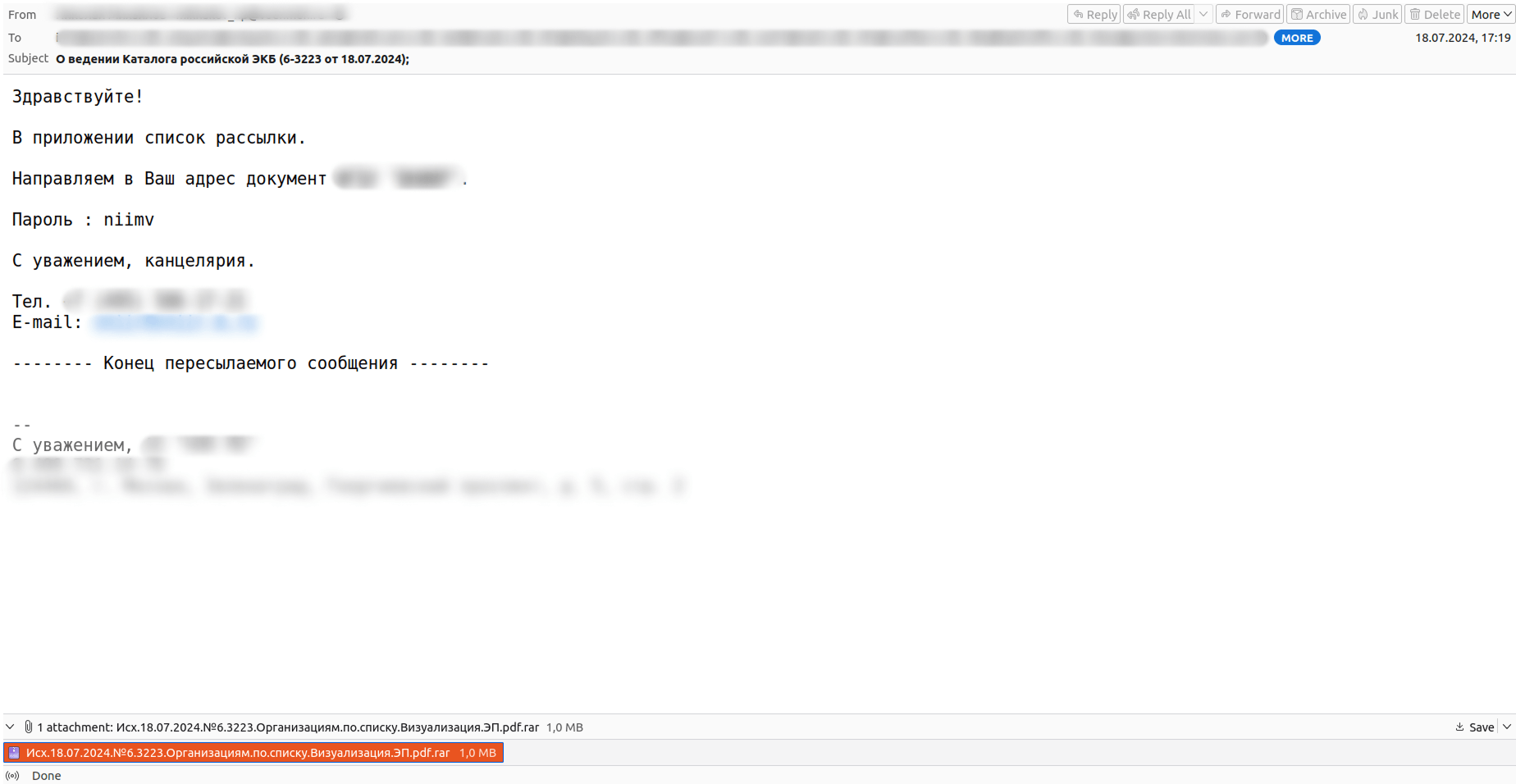
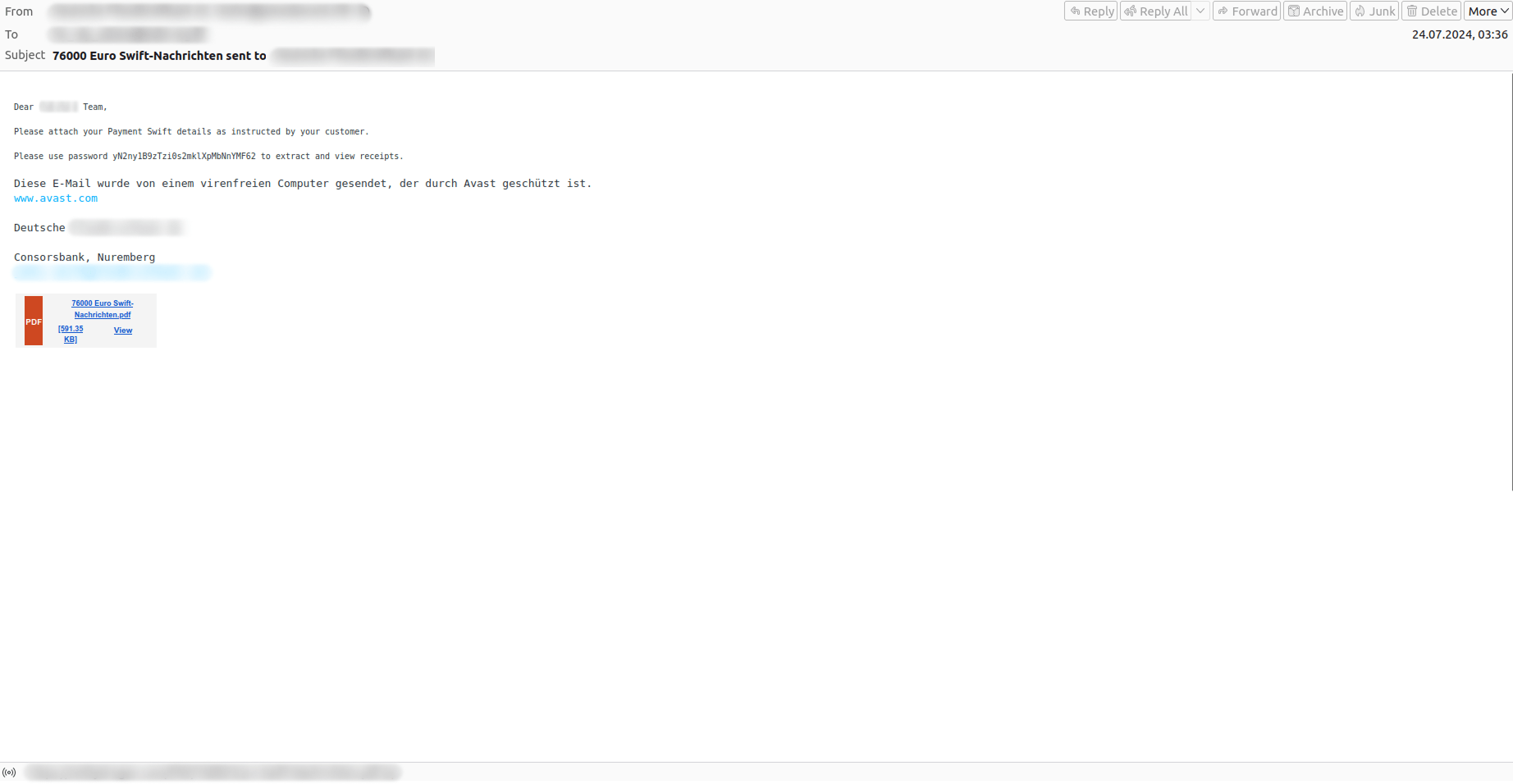
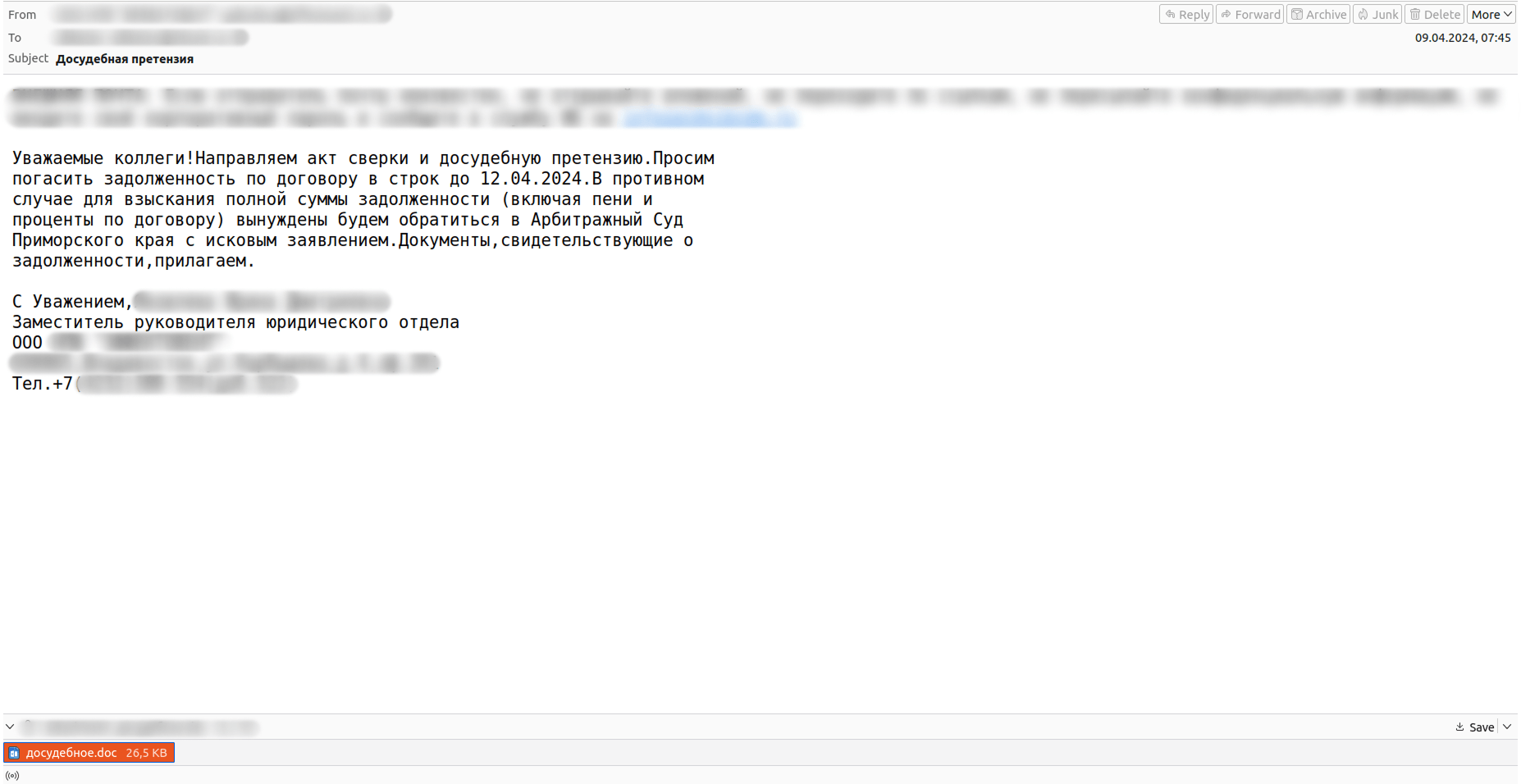
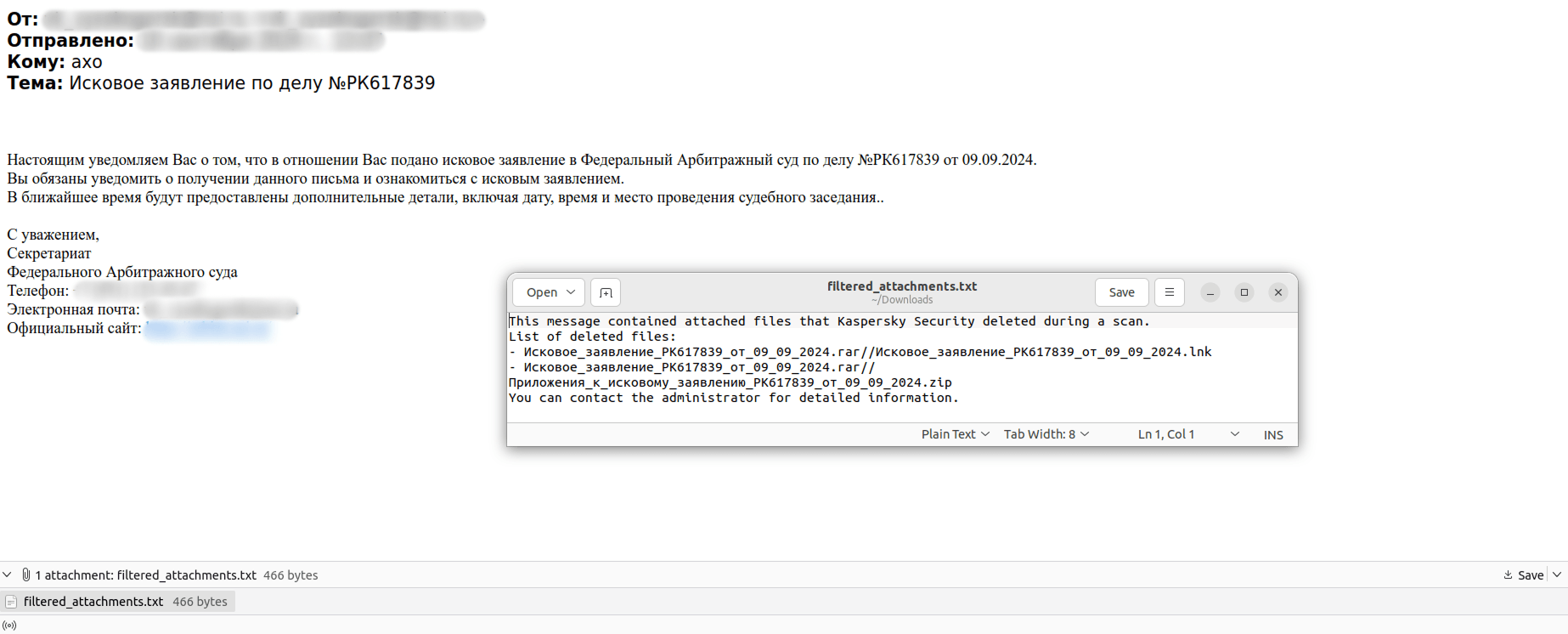
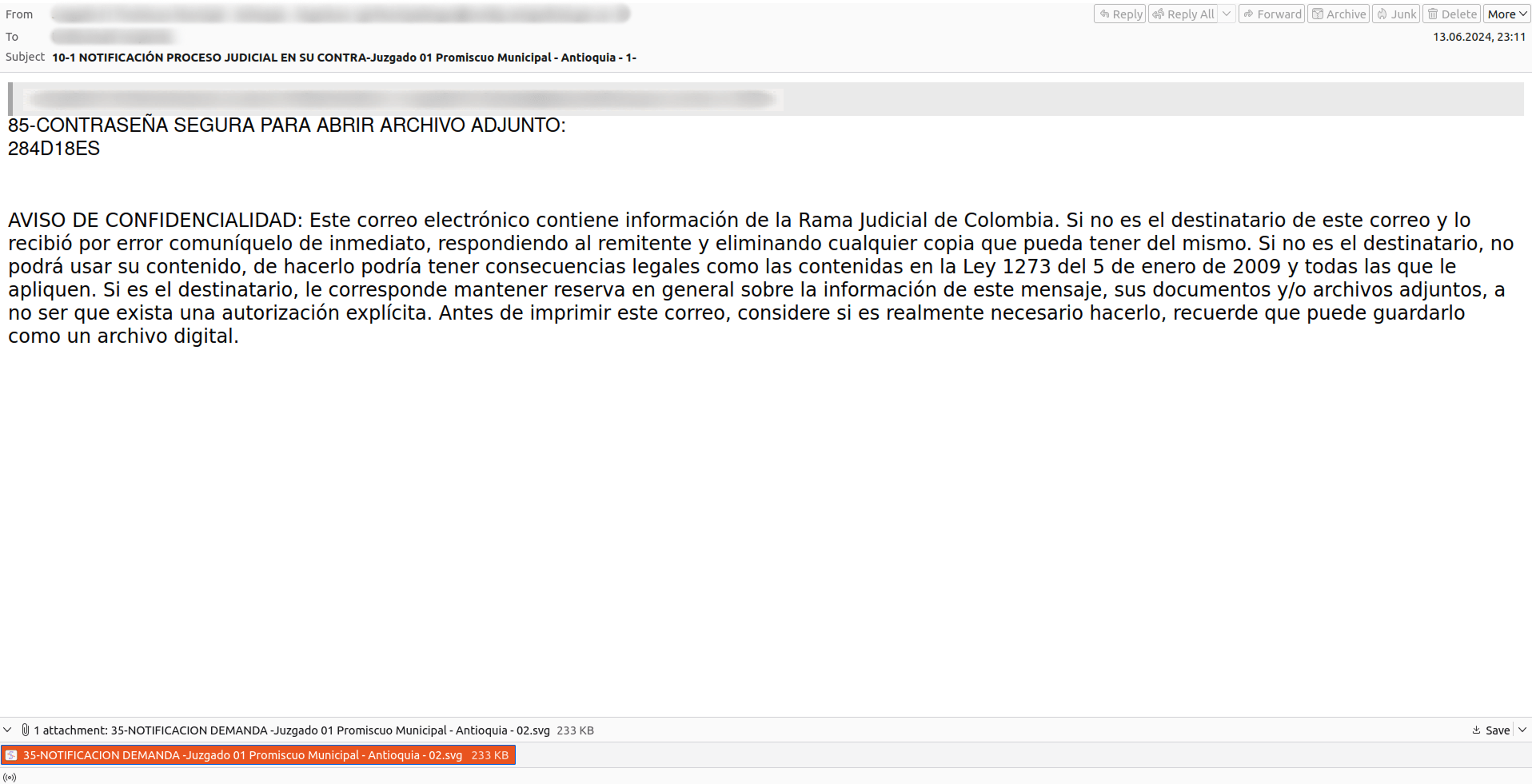
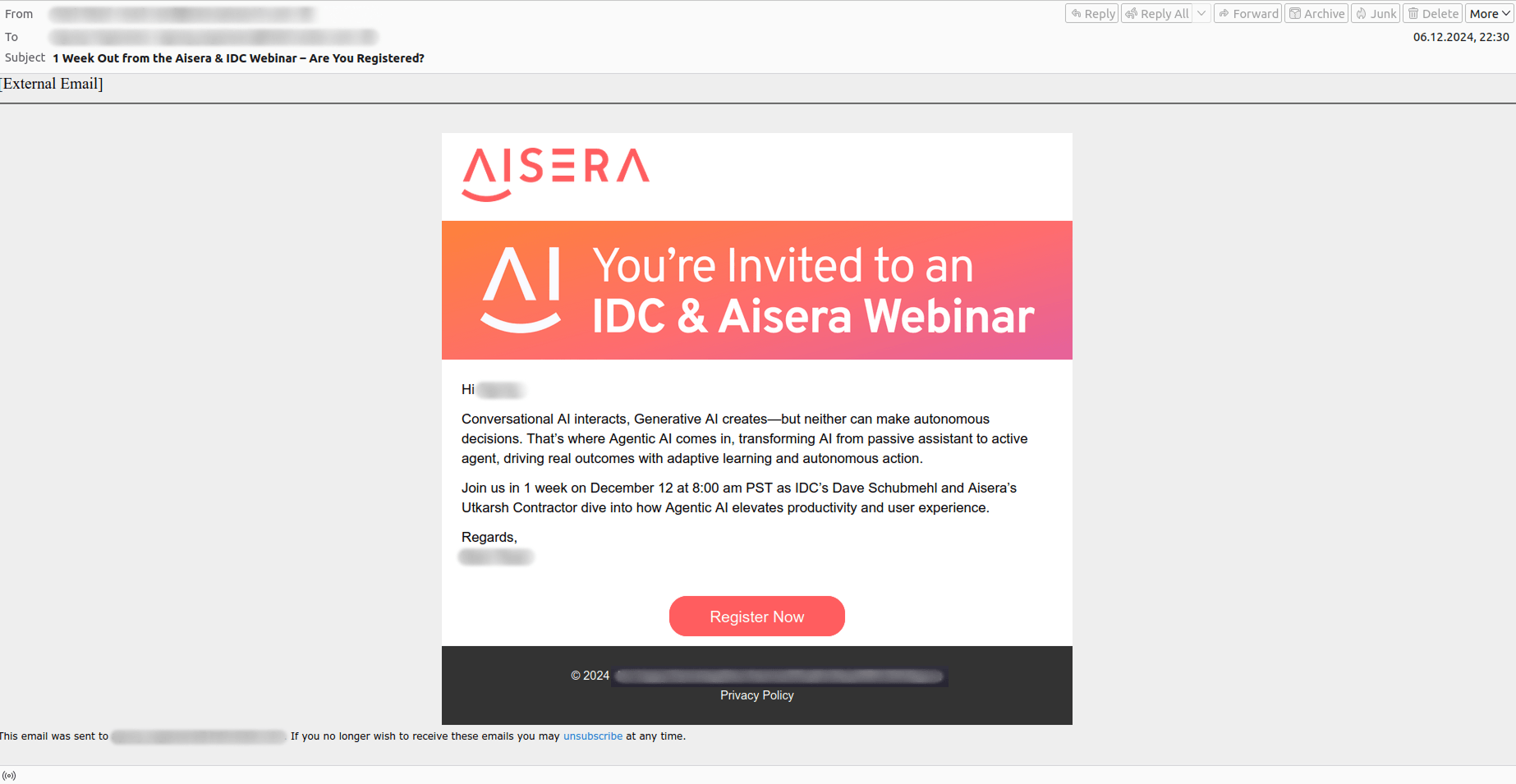
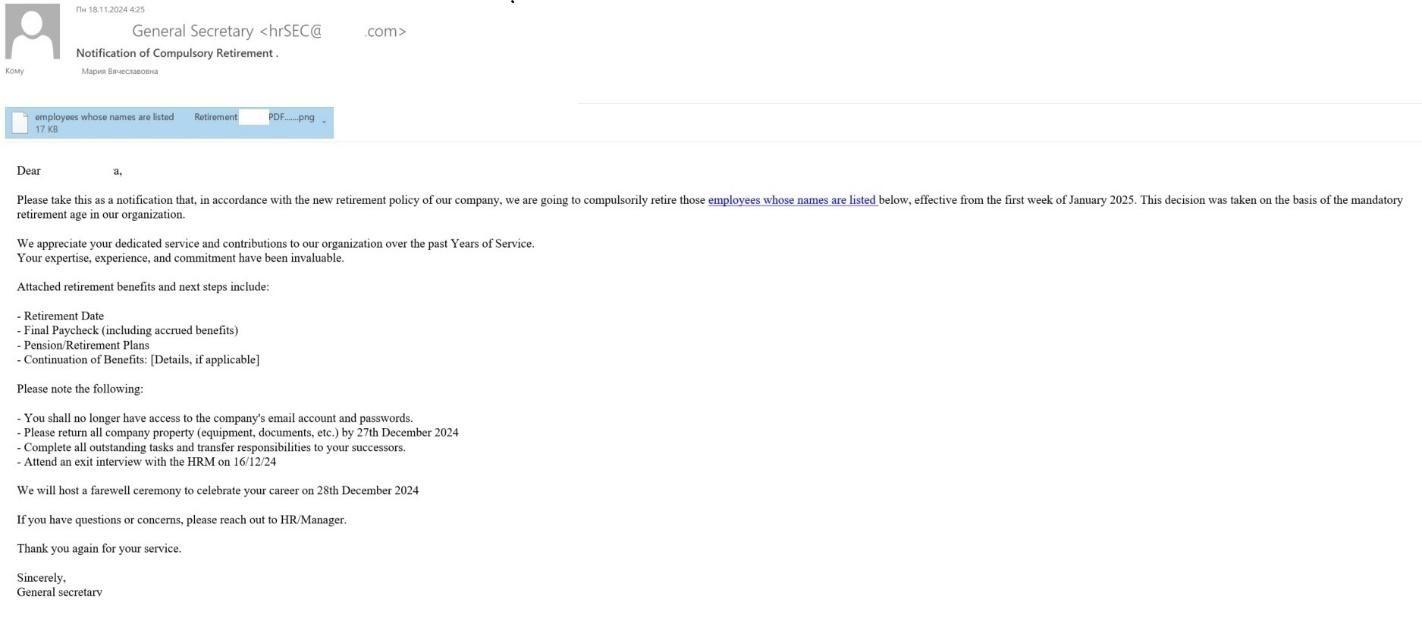
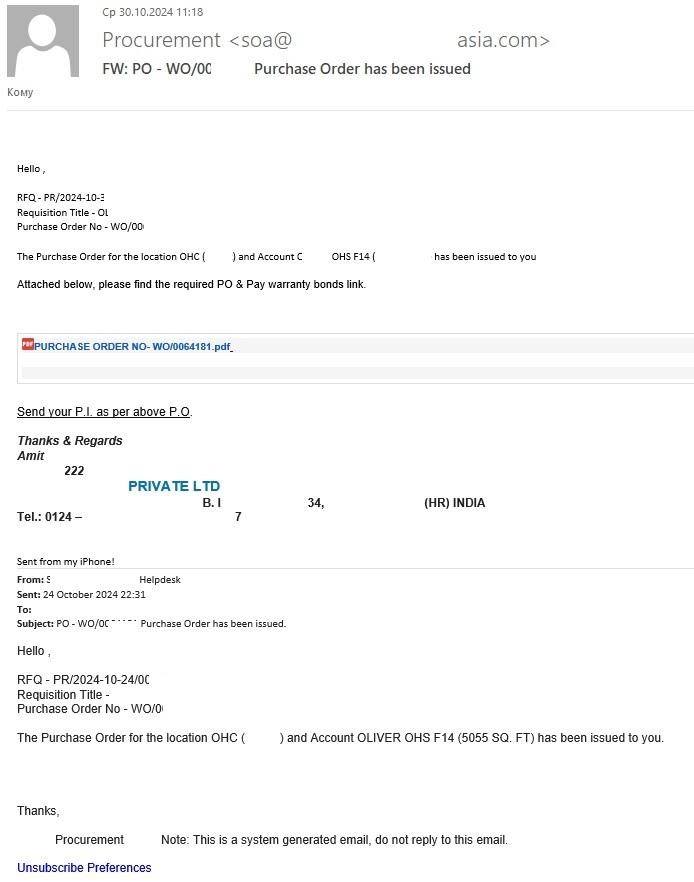
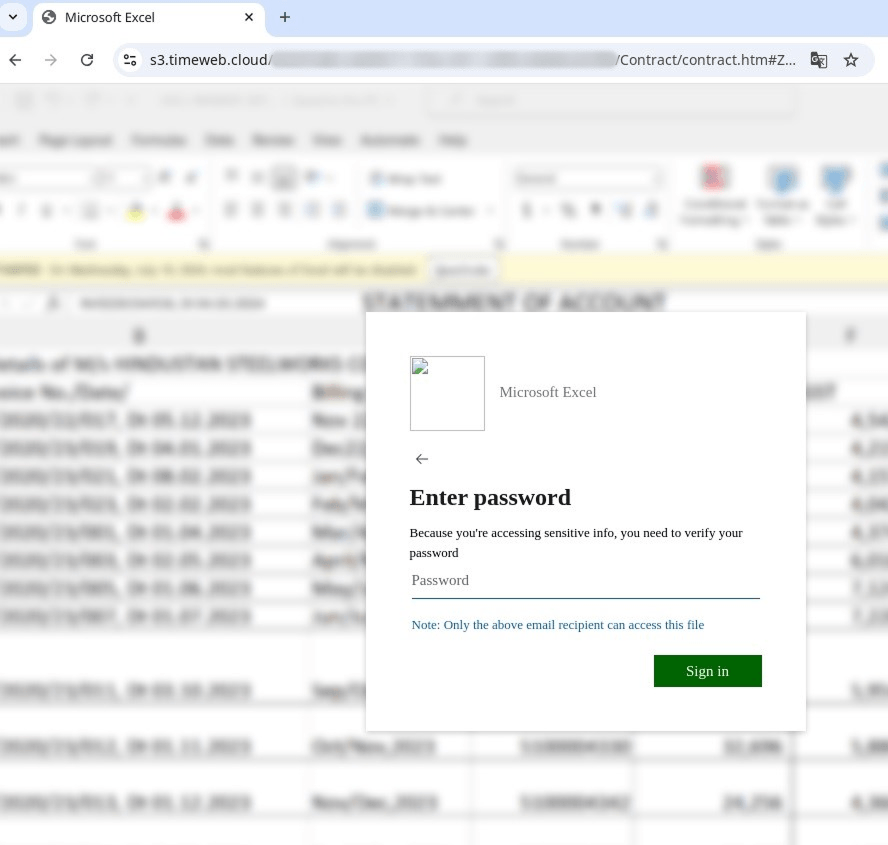
In 2024, there was an increase in emails distributing password-protected archives containing malicious content. Sometimes, these files were included not as attachments but via download links, which also required a password. Presumably, this was the attackers’ attempt to bypass email security filters. Typically, the archive password was mentioned in the email text, and sometimes in the attachment’s filename. Notably, fraudsters often disguised malicious archives or links as files with other extensions, such as PDF, XLS, or DOC.
Since April 2024, we have been recording similar distributions of files with the double extension .PDF.RAR, targeting employees of Russian companies in the government, financial, manufacturing, and energy sectors.
We assume that these messages were sent from compromised email accounts of the recipients’ business partners. Some emails contained real correspondence, to which attackers replied with an email containing the malware. All the emails we examined in this campaign were unique. The attackers likely crafted messages to closely mimic the style of the compromised business partner.
Similar messages containing malicious files were also found in other languages. However, unlike campaigns targeting Russian-speaking users, these had more general themes—attachments were disguised as invoices, commercial offers, supply orders, tender schedules, court notices, and other documents.
Last year, attackers frequently threatened legal action to convince victims to click dangerous links or open malicious attachments. These messages primarily targeted Russian companies but were also observed in other languages. Typically, fraudsters posed as business partners, demanding debt repayment; otherwise, they “would be forced to take the matter to arbitration court.” In one such campaign, pre-trial claims in attachments were .DOC files containing VBA scripts. These scripts established connections with command servers and downloaded, saved, and executed malicious files on the victim’s device. Kaspersky’s products detect this payload with the verdict HEUR:Trojan-Downloader.MSOffice.Sload.gen.
In some cases, cybercriminals gave no reason for their legal threats but instead attempted to shock victims with an already “filed” lawsuit to pressure them into opening the attachment. Of course, it contained malware.
According to our observations, the past year saw a rise in the distribution of malicious SVG files. Disguised as harmless images, these files contained scripts that downloaded and installed additional malware on the victim’s device. (Our solutions detect these scripts as Trojan.Script.Agent.sy and Trojan.Script.Agent.qe.) The emails we encountered were written in Spanish and posed as fake legal case notifications and court summons. The text included a password for opening the attached file.
A special category of emails that users complained about in 2024 was requests for quotation from suspicious senders. These emails were sent either from free email addresses or recently created domains. Attackers signed the emails with the names of large companies, included links to their websites, and sometimes even used official company logos. These emails followed a uniform template: the “buyers” briefly introduced themselves, expressed interest in the recipient’s products, and requested a catalog or price list. Interestingly, the fraudsters did not seem to care about the type of goods involved.
If the recipient responded, events could unfold in two ways. In some cases, after receiving a reply to the initial seemingly legitimate request, the fraudsters sent malicious attachments or links in the next email.
In another scenario, the “buyers” engaged in further correspondence with their “potential partner”—the victim—discussing details and insisting on their conditions, including post-payment and requiring the seller to cover customs duties. This meant that the supplier bore all the risks of delivery and could lose their goods without receiving any payment.
In the spring of 2024, we discovered an interesting phishing email scheme that leveraged legitimate Facebook notifications. The service sent entirely legitimate emails to users mentioned in threatening posts. The attackers used compromised Facebook accounts, renamed to “24 Hours Left To Request Review. See Why,” and changed the profile picture to an icon featuring an orange exclamation mark.
Then, the fraudsters created posts on these pages tagging the business accounts of potential victims. The tagged users received notifications from the alarmingly-named pages.
These posts contained more details than the emails: victims were warned about an impending account ban due to a complaint from another user. To dispute the ban for violating service terms, the recipient of the “notification” was required to follow a phishing link from the post—leading to a fake site with Meta logos that requested Facebook login credentials.
We also found phishing emails containing legitimate Facebook links in October 2024, but this time without using the platform’s infrastructure. These emails contained notifications of lawsuits for copyright infringement and the removal of unlawful posts from the recipient’s profile. The target was warned that their personal and business pages would be blocked within 24 hours, pressuring them to take hasty and careless action.
However, they were immediately offered the chance to appeal by contacting the “Appeal Support Center.” The link in the email led to a phishing site disguised as Meta’s support service, where the victim was also asked to enter their profile password. To make the phishing link more convincing, a legitimate mechanism for redirecting users to external Facebook resources was used.
At the end of 2024, we noticed an email campaign targeting companies promoting their business pages on Facebook. These emails mimicked official Meta for Business notifications and threatened to block the user’s account and business page for violating the platform’s rules and community policies.
To dispute these accusations, the fraudsters urged the profile owners to click a link to contact “Facebook support” in a legitimate messenger. However, in reality, the victim was communicating with the owner of a fan page called “Content Moderation Center,” imitating an official support service employee. The scam could have been identified by the “Fan Page” label in the chat, though it was easy to miss.
In 2024, scammers continued to exploit news agenda in spam campaigns.
During the UEFA Euro 2024 football championship in Germany, emails began to appear offering merchandise with UEFA EURO 2024 logos.
After Pavel Durov’s arrest in Paris, we noticed English-language messages calling for donations to supposedly fund his legal defense.
In the fall of last year, a scam campaign began circulating, offering not-yet-released MacBook Pro M4 devices at low prices or even for free. The links in these emails led to fake websites imitating major marketplaces.
Before Black Friday, we recorded a surge in spam offering exclusive discounts. The links in these messages lured victims to sites disguised as marketplaces, electronics stores, and financial institutions.
One of the most common categories of spam email in 2024, complained of frequently by our corporate clients, was commercial offers for online promotion. Users were offered services such as creating or redesigning websites, setting up SEO tools, and purchasing databases with potential client contacts and other information. Other advertised services included guest post placement with backlinks to the client’s site, writing positive reviews, removing negative reviews, and creating personalized email campaigns. While these messages are not malicious or fraudulent, they are mass-distributed and unsolicited, causing inconvenience to users. The popularity of this type of spam is likely driven by the development of digital marketing tools and the search for new clients for small- and medium-sized businesses amid growing online competition.
We also frequently encountered business offers for the online promotion of company accounts on social media. Spammers sell fake likes and followers. They often pose as employees of real social media marketing firms, claiming to be industry leaders. At the end of their emails, the spammers included a link to a marketing platform and payment options for their services. One such campaign, which we observed throughout the past year and is still active, stood out due to the variety of languages used in the emails and the diversity of domain names. With these tactics, the spammers aimed to reach a global audience.
The growing popularity of neural networks has led companies to actively integrate AI into their business processes. We assume that clients of such organizations, in turn, are drawn to service offers that incorporate neural networks. As a natural consequence of this trend, AI-driven solutions began appearing in spam campaigns advertising online marketing services.
Spammers emphasized using AI, particularly ChatGPT, to perform various business tasks. We identified the following themes in these emails:
Other topics also appeared in spam emails, but they all shared the same goal—enhancing business processes and attracting potential clients.
Another particularly popular category of spam related to neural networks was advertising online events. Last year, we encountered numerous examples of emails promoting webinars about the promising capabilities and practical applications of AI in business operations.
In 2024, two main trends were observed in targeted phishing:
In all these cases, the common factor was that clicking the link led the employee to a phishing login page instead of the actual corporate portal. Most often, attackers targeted Microsoft accounts, though some phishing forms mimicked internal corporate resources.
When attempting to open the attachment, the user was redirected to a phishing page. As in the previous case, these fake forms harvested Microsoft credentials and corporate account logins.
The number of phishing attacks in 2024 increased compared to the previous year. Kaspersky solutions blocked 893,216,170 attempts to follow phishing links—26% more than in 2023.
Number of Anti-Phishing triggerings, 2024 (download)
Users from Peru (19.06%) encountered phishing most often. Greece (18.21%) ranked second, followed by Vietnam (17.53%) and Madagascar (17.17%). They are closely followed by Ecuador (16.90%), Lesotho (16.87%) and Somalia (16.70%). The final places in the TOP 10 are occupied by Brunei (16.55%), Tunisia (16.51%) and Kenya (16.38%).
| Country/territory | Share of attacked users* |
| Peru | 19.06 |
| Greece | 18.21 |
| Vietnam | 17.53 |
| Madagascar | 17.17 |
| Ecuador | 16.90 |
| Lesotho | 16.87 |
| Somalia | 16.70 |
| Brunei | 16.55 |
| Tunisia | 16.51 |
| Kenya | 16.38 |
* Share of users who encountered phishing out of the total number of Kaspersky users in the country/territory, 2024
The most common domain zone hosting phishing sites remains the COM zone (29.78%)—its popularity has increased one and a half times compared to 2023. In second place is the XYZ domain (7.10%), which ranked fifth last year, followed by TOP (6.97%), which retained its position in the top ten. Next, with a slight margin from each other, are the ONLINE (4.25%) and SITE (3.87%) domain zones, where phishing sites were less actively hosted last year. The Russian RU domain (2.23%) and the global NET domain (2.02%) are in sixth and seventh place, respectively. Following them are CLICK (1.41%) and INFO (1.35%)—the year before, these zones were not frequently used. Closing the top ten is another national domain: UK, with a share of 1.33%.
Most frequent top-level domains for phishing pages, 2024 (download)
The rating of organizations targeted by phishers is based on the detections of the deterministic component in the Anti-Phishing system on user computers. The component detects all pages with phishing content that the user has tried to open by following a link in an email message or on the web, as long as links to these pages are present in the Kaspersky database.
In 2024, the highest number of attempts to access phishing links blocked by Kaspersky solutions was associated with pages imitating various web services (15.75%), surpassing global internet portals (13.88%), which held the top position in 2023. The third and fourth positions in last year’s top ten also swapped places: banks moved ahead (12.86%), overtaking online stores at 11.52%. Attackers were also interested in social media (8.35%) and messengers (7.98%): attacks targeting them strengthened their positions in the ranking. For websites imitating delivery services, we observed a decline in phishing activity (6.55%), while the share of payment systems remained unchanged at 5.82%. Also included in the list of the most frequently targeted organizations were online games (5.31%) and blogs (3.75%).
Distribution of organizations targeted by phishers, by category, 2024 (download)
In 2024, spam emails accounted for 47.27% of the total global email traffic, an increase of 1.27 p.p. compared to the previous year. The lowest spam levels were recorded in October and November, with average shares dropping to 45.33% and 45.20%, respectively. In December, we observed a seemingly slight upward trend in junk emails, resulting in the fourth quarter of the year being the calmest. Spam activity peaked in the summer, with the highest number of emails recorded in June (49.52%) and July (49.27%).
Share of spam in global email traffic, 2024 (download)
In the Russian internet segment, the average spam share exceeded the global figure, reaching 48.57%, which is 1.98 p.p. higher than in 2023. As in the rest of the world, spammers were least active at the end of the year: in the fourth quarter, 45.14% of emails were spam. However, unlike global trends, in Runet, we recorded four months during which the spam share exceeded half of all traffic: March (51.01%), June (51.53%), July (51.02%), and September (51.25%). These figures identified the third quarter as the most active, with a share of 50.46%. December was the calmest month, and interestingly, despite spam levels being generally high or the same in Russia, the number of spam emails in December was lower than the global figure: 44.56%.
Share of spam in Runet email traffic, 2024 (download)
We continue to observe an increase in the share of spam sent from Russia—from 31.45% to 36.18%. The United States and mainland China, which held second and third place last year, swapped positions, with China’s share increasing by 6 p.p. (17.11%) and the US share decreasing by 3 p.p. (8.40%). Kazakhstan, which entered the top twenty for the first time last year, rose from eighth to fourth place (3.82%), pushing Japan (2.93%) down, and causing Germany, previously in fifth place, to drop one position with a share of 2.10%. India’s share slightly decreased, but the country moved up two positions from last year to seventh place. Conversely, the amount of spam sent from Hong Kong more than doubled (1.75%), allowing this territory to take eighth place in the top twenty. Next come Brazil (1.44%) and the Netherlands (1.25%), whose shares continued to decline.
TOP 20 countries and territories where spam originated in 2024 (download)
In 2024, Kaspersky solutions detected 125,521,794 attempts to open malicious email attachments, ten million fewer than the previous year. Interestingly, one of the peaks in email antivirus detections occurred in April—in contrast to 2023, when this month had the lowest malicious activity. In January and December, we observed a relative decrease in detections, while increases were noted in spring and autumn.
Number of email antivirus detections, 2024 (download)
The most common malicious email attachments were Agensla stealers (6.51%), which ranked second last year. Next were Badun Trojans (4.51%), which spread in archives disguised as electronic documents. The Makoob family moved from eighth to third place (3.96%), displacing the Noon spyware (3.62%), which collects browser passwords and keystrokes. The malicious Badur PDFs, the most common attachments in 2023, dropped to fifth place with a 3.48% share, followed by phishing HTML forms from the Hoax.HTML.Phish family (2.93%). Next in line were Strab spyware Trojans (2.85%), capable of tracking keystrokes, taking screenshots, and performing other typical spyware actions. Rounding out the top ten were SAgent VBS scripts (2.75%), which were not as actively used last year, the Taskun family (2.75%), which maintained its previous share, and PDF documents containing phishing links, Hoax.PDF.Phish (2.11%).
TOP 10 malware families distributed as email attachments, 2024 (download)
The list of the most widespread malware reflects trends similar to the distribution of families, with a few exceptions: the Hoax.HTML.Phish variant of malicious HTML forms dropped two positions (2.20%), and instead of a specific Strab Trojan sample, the top ten included the ISO image Trojan.Win32.ISO.gen, distributed via email (1.39%).
TOP 10 malicious programs distributed as email attachments, 2024 (download)
In 2024, users in Russia continued to face malicious email attachments more frequently than other countries, although the share of email antivirus detections in this country decreased compared to last year, to 11.37%. China ranked second (10.96%), re-entering the top twenty after several years. Next came Spain (8.32%), Mexico (5.73%), and Turkey (5.05%), which dropped one position each with a slight decline in malicious attachments. Switzerland (4.82%) took sixth place, appearing in the ranking for the first time. Following them were Vietnam (3.68%), whose share declined, and the UAE (3.24%), which strengthened its position in the ranking. Also among frequent targets of malicious spam were users from Malaysia (2.99%) and Italy (2.54%).
TOP 20 countries and territories targeted by malicious mailings, 2024 (download)
Political and economic crises will continue to provide new pretexts for fraudulent schemes. In some cases presented in the 2024 report, we can observe the “greed” of cybercriminals: the use of two different company brands on the same page; a credible fake of a resource aimed not at stealing credentials but at stealing money; comprehensive questionnaires that can lead not only to loss of access to funds but also to identity theft. Such multi-layered threats may become a new trend in phishing and scam attacks.
We continue to observe major news events being exploited in spam campaigns that promise easy earnings and discounted goods or services. The growing user interest in artificial intelligence tools is actively being leveraged by spammers to attract an audience, and this trend will undoubtedly continue.
Source: GlobeNewswire (MIL-OSI)
VICTORIA, Seychelles, Feb. 19, 2025 (GLOBE NEWSWIRE) — Bitget, the leading cryptocurrency exchange and Web3 company, announced the expansion of its global recruitment initiative Bitget Builders Program which invites crypto enthusiasts from various backgrounds to co-build the Bitget ecosystem while unlocking exclusive benefits, event access, and growth opportunities.
Starting February 2025, the Bitget Builders Program will launch a long-term global recruitment of builders who are exploring deeply in blockchain industry and in line with Bitget’s vision of driving blockchain innovation and adoption. The recruitment program is not limited to any specific country, so applications for this program are invited from all over the world. Builders will engage in a variety of roles that align with their skills and interests while gaining rewards for their contributions. Top-performing participants will have the opportunity to earn exclusive invitations to Token 2049 in Dubai, as well as a face-to-face meetup with Bitget COO Vugar Usi Zade.
“Build Bitget with Vugar” events will serve as a dialogue between Bitget’s leadership and its global community. Bitget COO Vugar Usi Zade will lead a series of interactive sessions to share insights into Bitget’s strategic vision, core values, and future roadmap. Through AMAs, workshops, and networking sessions, participants will gain firsthand knowledge of Bitget’s ecosystem strategy and collaborate on shaping its evolution.
So far over 5,000 participants in Bitget Builders Program have played a significant role in Bitget’s global expansion by organizing community events, promoting high-profile projects, and managing local engagement. This year, community managers will be upgraded to Bitget Builders and gain enhanced benefits. In addition, Bitget Builders will spearhead the “Global Meetup Tour,” kicking off in cities around the world to expand Bitget’s global footprint and strengthen community ties.
“The Bitget Builders Program embodies our belief in community-driven growth. By empowering builders with resources and recognition, we’re accelerating the creation of a more inclusive and innovative crypto ecosystem,” said Vugar Usi Zade, COO at Bitget. “Bitget believes Gen Z and younger crypto users, who grow up with the increasing adoption of crypto, will be playing a vital role in promoting crypto adoption. We’re excited to meet passionate individuals worldwide through our events and build Bitget’s future together.”
The Bitget Builders Program is a pivotal component of the Blockchain4Youth charity project, which aims to empower young talents and foster innovation within the crypto space. This innovative initiative has successfully brought participants from more than 55 countries and is dedicated to providing opportunities with thriving Web3 talents, deeply integrating the next generation of crypto leaders into the Bitget ecosystem, and fostering a robust crypto community.
For more details on the Bitget Builders Program, users can visit here.
About Bitget
Established in 2018, Bitget is the world’s leading cryptocurrency exchange and Web3 company. Serving over 100 million users in 150+ countries and regions, the Bitget exchange is committed to helping users trade smarter with its pioneering copy trading feature and other trading solutions, while offering real-time access to Bitcoin price, Ethereum price, and other cryptocurrency prices. Formerly known as BitKeep, Bitget Wallet is a world-class multi-chain crypto wallet that offers an array of comprehensive Web3 solutions and features including wallet functionality, token swap, NFT Marketplace, DApp browser, and more.
Bitget is at the forefront of driving crypto adoption through strategic partnerships, such as its role as the Official Crypto Partner of the World’s Top Football League, LALIGA, in EASTERN, SEA and LATAM market, as well as a global partner of Turkish National athletes Buse Tosun Çavuşoğlu (Wrestling world champion), Samet Gümüş (Boxing gold medalist) and İlkin Aydın (Volleyball national team), to inspire the global community to embrace the future of cryptocurrency.
For more information, users can visit: Website | Twitter | Telegram | LinkedIn | Discord | Bitget Wallet
For media inquiries, users can contact: media@bitget.com
Risk Warning: Digital asset prices are subject to fluctuation and may experience significant volatility. Investors are advised to only allocate funds they can afford to lose. The value of any investment may be impacted, and there is a possibility that financial objectives may not be met, nor the principal investment recovered. Independent financial advice should always be sought, and personal financial experience and standing carefully considered. Past performance is not a reliable indicator of future results. Bitget accepts no liability for any potential losses incurred. Nothing contained herein should be construed as financial advice. For further information, please refer to our Terms of Use.
Contact
Simran Alphonso
media@bitget.com
A photo accompanying this announcement is available at https://www.globenewswire.com/NewsRoom/AttachmentNg/6b5c114c-6fa7-4f71-922b-2000aaaf9b97
Source: China State Council Information Office 3
The record-breaking “Ne Zha 2” has now officially become the highest-grossing animated film of all time.
A new poster to mark “Ne Zha 2” becoming the No. 1 animated film of all time. [Image courtesy of CMC Pictures]
By Wednesday noon, the unstoppable Chinese animated sensation had grossed 12.42 billion yuan ($1.71 billion) worldwide according to Chinese box office tracker Maoyan Pro. This surpasses Disney and Pixar’s “Inside Out 2,” which claimed the top spot in animation history in 2024 by grossing $1.69 billion, per Box Office Mojo statistics.
As a result, “Ne Zha 2” has become the highest-grossing animated film globally and the eighth-highest-grossing film of all time, regardless of animation or live-action. Notably, it stands as the only Chinese or Asian film in a club dominated by Hollywood cinematic juggernauts.
This is just one of many impressive milestones the film has achieved since its debut on Jan. 29, the first day of the Chinese New Year. Its accomplishments include becoming the highest-grossing Chinese film ever, the highest-grossing film in a single market globally, the first film to surpass $1 billion in a single market, and the first non-Hollywood film to enter the coveted billion-dollar club.
“Thanks to the support of countless audiences, we have been able to achieve these miraculous accomplishments,” said Wang Jing, executive producer of “Ne Zha 2,” during an event promoting movie-themed tourism on Feb. 17 at the China National Film Museum in Beijing. “Rooted in Chinese culture, ‘Ne Zha 2’ reflects the spirit of constant innovation and striving to move upward, embodied by Chinese animators, filmmakers and audiences, showcasing the brilliance of Chinese culture to the world.”
“Congratulations to director Jiaozi and all Chinese animators,” said fellow animator Wang Yunfei, president of Its Cartoon Animation Studio. “Animation is an art form that creates new worlds and new life, which is why I still love it after 25 years in the industry.” Wang told China.org.cn that he hopes Chinese animators will embrace the belief that the journey itself is invaluable at this historic moment. “If you do not climb high mountains, you will not know how high the sky is. Keep your passion alive and continue forging ahead,” he said.
A still from “Ne Zha 2.” [Image courtesy of Enlight Media]
“Ne Zha 2” was developed over five years with a 4,000-strong team, featuring new characters, epic battle sequences and 1,900 special effects shots. In the film’s climactic battle, there are 200 million characters, showcasing wild imagination, a visual feast and immense workloads. The film involved the combined efforts of 138 Chinese animation and VFX companies, including teams that worked on previous animated hits and sci-fi blockbusters such as “Monkey King: Hero Is Back,” “Boonie Bears,” “Jiang Ziya: Legend of Deification” and “The Wandering Earth.”
On social media, many animators who worked on the movie have expressed their excitement and happiness about joining the project, while a few also shared how exhausting the creative process was and how much of a perfectionist director Jiaozi is, challenging them to push their limits. Chen Xuguang, director of the Institute of Film, Television and Theatre at Peking University, noted that the film showcases the collaborative power of China’s creative ecosystem and signals an upgrade in both the film industry and its aesthetic standards.
Wang Shiyong, founder and CEO of Wuhan-based 2:10 Animation, and his team contributed to many visually spectacular scenes in “Ne Zha 2.” He expressed pride in the film’s achievements and emphasized its significance to the Chinese animation industry. “The film’s outstanding box office performance will attract more investment and talent to the animation industry, injecting strong vitality into its development,” he said.
As this world-class film climbs the global top 10 box office chart, its achievements have already stunned both domestic and international audiences, as well as industry insiders, showcasing the prowess and potential of Chinese cinema, culture and its market. Maoyan Pro analysts have now revised their projection for its total earnings to 15.1 billion yuan, which would be enough to place the film at No. 5 on the all-time global box office chart.
The film drew significant international attention and interest after it opened overseas last week in North America, Australia, New Zealand, Fiji and Papua New Guinea. The film earned $7.2 million in North America from Feb. 14 through Sunday, setting a record for the highest opening weekend for any Chinese-language film in the past 20 years. Despite showing in only 660 theaters, it ranked No. 5 on the weekend chart, competing with Marvel’s “Captain America: Brave New World” which was shown in more than 4,000 theaters. In Australia, it secured third place with $1.5 million over the weekend.
A new international poster to mark “Ne Zha 2.” [Image courtesy of Enlight Media]
Both overseas critics and audiences have expressed their enjoyment of the movie. For example, critic Simon Abrams from RogerEbert.com wrote that “Ne Zha 2” is a “rare sequel that amplifies both its action and drama” without sacrificing much of what worked in the first movie, adding: “It’s also a rare blockbuster that offers something worthwhile for a wide-ranging audience.” Another critic, Fred Topel from Deadline.com, called the Chinese blockbuster “visually engaging,” noting that, “The rendering of martial arts battles is as graceful as DreamWorks Animation’s ‘Kung Fu Panda’ series. The myriad creatures should appeal to international fans of fantasy epics like ‘Game of Thrones’ and ‘The Lord of the Rings.’” On Rotten Tomatoes, its audience score has reached 99%, and on IMDb, it has also received an impressive 8.4/10 based on more than 4,300 user ratings.
Distributors announced on Tuesday that the film will be released in China’s Hong Kong and Macao on Feb. 22, with plans to roll out in various international territories later this year, including Malaysia, Saudi Arabia, Japan and Greece.
Additionally, “Ne Zha 2” is generating a ripple effect beyond movie theaters, showcasing how its positive influence extends to culture, tourism, catering, merchandise and stock markets, further boosting China’s vibrant consumption and dynamic economy.
Source: GlobeNewswire (MIL-OSI)
HOUSTON, Feb. 19, 2025 (GLOBE NEWSWIRE) — VAALCO Energy, Inc. (NYSE: EGY; LSE: EGY) (“Vaalco” or the “Company”) today announced that it declared its quarterly cash dividend of $0.0625 per share of common stock for the first quarter of 2025 ($0.25 annualized), which is payable on March 28, 2025, to stockholders of record at the close of business on February 28, 2025. Future declarations of quarterly dividends and the establishment of future record and payment dates are subject to approval by the Board of Directors.
George Maxwell, Vaalco’s Chief Executive Officer, commented, “We are pleased to announce our first quarter 2025 dividend, marking the beginning of the fourth year of paying a meaningful cash dividend to our shareholders. While we plan an active investment program in 2025, our ongoing operational and financial success has allowed us to continue returning cash to our shareholders. We remain committed to paying a sustainable, meaningful dividend to our shareholders while we grow Vaalco through both organic development activities across our diversified portfolio and inorganic growth opportunities.”
About Vaalco
Vaalco, founded in 1985 and incorporated under the laws of Delaware, is a Houston, Texas, USA based, independent energy company with a diverse portfolio of production, development and exploration assets across Gabon, Egypt, Cote d’Ivoire, Equatorial Guinea, Nigeria and Canada.
For Further Information
| Vaalco Energy, Inc. (General and Investor Enquiries) | +00 1 713 543 3422 |
| Website: | www.vaalco.com |
| Al Petrie Advisors (US Investor Relations) | +00 1 713 543 3422 |
| Al Petrie / Chris Delange | |
| Buchanan (UK Financial PR) | +44 (0) 207 466 5000 |
| Ben Romney / Barry Archer | VAALCO@buchanan.uk.com |
Forward Looking Statements
This press release includes “forward-looking statements” within the meaning of Section 27A of the Securities Act of 1933, as amended (the “Securities Act”) and Section 21E of the Securities Exchange Act of 1934, as amended, which are intended to be covered by the safe harbors created by those laws and other applicable laws and may also include “forward-looking information” within the meaning of applicable Canadian securities laws (collectively, “forward-looking statements”). Where a forward-looking statement expresses or implies an expectation or belief as to future events or results, such expectation or belief is expressed in good faith and believed to have a reasonable basis. All statements other than statements of historical fact may be forward-looking statements. The words “anticipate,” “believe,” “estimate,” “expect,” “intend,” “forecast,” “outlook,” “aim,” “target,” “will,” “could,” “should,” “may,” “likely,” “plan” and “probably” or similar words may identify forward-looking statements, but the absence of these words does not mean that a statement is not forward-looking. Forward-looking statements in this press release include, but are not limited to, statements relating to expectations of future dividends to stockholders. Such forward-looking statements are subject to risks, uncertainties and other factors, which could cause actual results to differ materially from future results expressed, projected or implied by the forward-looking statements. These risks and uncertainties include, but are not limited to: risks relating to any unforeseen liabilities of Vaalco; the ability to generate cash flows that, along with cash on hand, will be sufficient to support operations and cash requirements; risks relating to the timing and costs of completion for scheduled maintenance of the FPSO servicing the Baobab field; and the risks described under the caption “Risk Factors” in Vaalco’s 2023 Annual Report on Form 10-K filed with the SEC on March 15, 2024 and subsequent Quarterly Reports on Form 10-Q filed with the SEC.
Dividends beyond the first quarter of 2025 have not yet been approved or declared by the Board of Directors. The declaration and payment of future dividends remain at the discretion of the Board of Directors and will be determined based on Vaalco’s financial results, balance sheet strength, cash and liquidity requirements, future prospects, crude oil and natural gas prices, and other factors deemed relevant by the Board of Directors. The Board of Directors reserves all powers related to the declaration and payment of dividends. Consequently, in determining the dividend to be declared and paid on Vaalco’s common stock, the Board of Directors may revise or terminate the payment level at any time without prior notice.
Inside Information
This announcement contains inside information as defined in Regulation (EU) No. 596/2014 on market abuse which is part of UK domestic law by virtue of the European Union (Withdrawal) Act 2018 (“MAR”) and is made in accordance with the Company’s obligations under article 17 of MAR. The person responsible for arranging the release of this announcement on behalf of VAALCO is Matthew Powers, Corporate Secretary of VAALCO.
Source: Australian Treasurer
Anika Wells:
Good morning, everybody. I’m Anika Wells, federal Member for Lilley. Welcome to the majestic kingdom of Lilley. It’s always great to be home and here at Volgren, where for the past 15 years in part of our manufacturing hub here on the Northside, Volgren has been not just helping commuters get to places on public transport but providing great secure jobs for auto electricians, for welders, for spray painters who live and love working here on the north side of Brisbane. So, welcome news yesterday for them with the RBA rate cut, it means that for the more than 90,000 people who are employed in Lilley here, working in places like Volgren or like the Brisbane Airport or like Westfield Chermside or like the Prince Charles Hospital, many of those people are mortgage holders and yesterday’s news means that they will be about $1,000 a year better off as a result of this rate cut.
We know that is incredibly welcome news, and we know as the Albanese Labor government we have more work to do. And I say as the Aged Care Minister, you’ve seen this term us pump $15 billion into wage rises for aged care workers, some of the lowest paid people, some of the people who most needed a pay rise. We are seeing welcome results and green shoots in places like aged care, but it takes a while to turn the Queen Mary around and that’s why Murray, Jim and I are here to continue that work on cost‑of‑living relief, because the people in Lilley, their households are looking upwards of $90 a month better off as a result of yesterday’s decision, but we’re going to keep working hard for them. And to talk about that, here is Murray Watt.
Murray Watt:
Well, thanks very much, Anika. It’s a pleasure to join you and Jim in your electorate, thanks for having me in your electorate. And thanks to Stewart and the team here at Volgren for showing us around the incredible high‑tech manufacturing that’s going on here right here in Brisbane’s Northside. It was a pleasure to talk with a range of the tradespeople who are working here, and today we’ve had more encouraging news for the workers that we are meeting here today and for all workers across Australia.
Building on yesterday’s rate cut from the RBA, today the Australian Bureau of Statistics has released its latest data on wage rises in our country. And what that data shows is that we have now had 5 consecutive quarters of wages growing above inflation in Australia under the Albanese Labor government. The last quarter, the December quarter 2024, showed real wage growth. So, wages growing above inflation by 0.5 per cent. And if you look at the whole year of 2024, we saw real wage growth of 0.8 per cent, leading to 5 consecutive quarters of real wage growth in Australia.
Now, that stands in massive contrast to what we saw under the Coalition when we were first elected. The 5 quarters leading into the last election, we saw real wages going backwards under the Coalition. Wages were falling and not keeping pace with inflation. And over the last nearly 3 years, we’ve been able to turn that around to a point that wages are consistently now rising above inflation. And why does that matter?
It matters because lifting wages is a crucial part of the Albanese government’s plan to assist Australians deal with their cost‑of‑living pressures. And it’s important to recognise that this is a real tribute to the Australian employers and workers who have delivered these wage rises, but it also demonstrates that the changes that we’ve made to Australia’s workplace laws are working as intended. At the last election, we said that we would get wages moving again, and we can now see that happening consistently over the last 5 quarters, and we need to remember that every single change Labor made to our workplace laws in this term of office was voted against by Peter Dutton and the Coalition. They have consistently tried to make life harder for Australians by stopping those wage rises, not to mention voting against everything we’ve done to deliver cost‑of‑living relief as well.
And now, as we approach the end game heading into the next election, I think Australians are taking great notice of the fact that Peter Dutton is already on the record saying that if he wins the next election, he will unwind a number of the changes that we have made to workplace laws. Now, that’s code for sending pay backwards again. So, if you look at the Coalition’s record, when they were last in office, their deliberate policy was to keep wages low, and that’s what they did. In Opposition, they have voted against every step we’ve taken to get wages moving again. And now, as we get ready for the next election, they’re promising to take those gains away and to cut the pay of Australian workers at a time when people still need support.
I’ve got no doubt that this will be a big issue as we head into the next campaign. But today is very encouraging news for Australian workers. I should also mention one facet of the data is that wages are rising faster in the private sector than they are in the public sector, which I think goes against a lot of what we see from the commentators. I’ll leave it at that. Happy to take questions, but I’ll hand them over to Jim now to carry on.
Jim Chalmers:
Thanks, Murray. Thanks, Anika, for having us in your patch. Thanks in particular to Stewart and all of your workers for welcoming us here. This is what a Future Made in Australia looks like. People working together to build, in this case the buses, but the manufacturing sector, we couldn’t be more supportive of the work that happens here in South East Queensland, but indeed right around Australia as well. When the Albanese government came to office, real wages were falling, and interest rates were rising. Now, real wages are growing, and interest rates have started to come down.
For 5 consecutive quarters, real wages have been growing. They fell for 5 consecutive quarters under our Liberal and National predecessors, and that goes to the difference between the parties. Peter Dutton wants lower wages and higher interest rates. What we’ve been able to deliver is much lower inflation, higher real wages, low unemployment. We’ve got the Liberal debt down and now interest rates have started to come down as well. These outcomes aren’t accidental. They’re deliberate. We have been working around the clock for the best part of 3 years to fight inflation, to roll out cost‑of‑living help and to get real wages growing again in our country. And that’s because Labor’s reason for being is to make sure that there are more Australians working, earning more and keeping more of what they earn.
That’s why today’s wages data is so encouraging because it shows that quarter after quarter after quarter, we’ve been able to get real wages growing again after they were falling for a prolonged period under our predecessors when we came to office. Earning more, keeping more of what they earn, that is the story of the labour market under this Albanese Labor government.
We have got the lowest average unemployment rate of any government in the last 50 years. And what makes Australia unusual is we’ve been able to get inflation down while we get wages up and keep unemployment low. We’ve been able to deal with some of the debt that was left to us by the Liberals and we’re seeing interest rates starting to come down as well. Now, in New Zealand, they cut rates today as well, just like they cut rates in Australia yesterday. The difference is the New Zealand economy is in recession. Their unemployment rate is 5.1 per cent. We’ve been able to keep the economy ticking over, delivering real wages growth. We’ve been able to keep unemployment at 4.0 per cent, and all of that, I think, shows what Australians have achieved together over the course of the last 2 and a half to 3 years.
We inherited a mess, and we’ve been working hard to clean it up. And you can see that very conspicuously when it comes to real wages growth. Just last week, Peter Dutton was making the case for higher interest rates. He is desperately disappointed that interest rates were cut yesterday and so has Angus Taylor. Angus Taylor even let it slip that Australians deserve an interest rate increase yesterday when he was responding to the Reserve Bank’s decision to cut interest rates.
We welcome the news that interest rates are being cut in Australia. This is the rate relief that Australians desperately need and deserve after all of the progress that we’ve made together on inflation. When we came to office, inflation was much higher and rising. Now it is lower and falling. When we came to office, interest rates were going up; now they’re coming down. When we came to office, real wages were falling and now they’re growing again. All of these are deliberate design features of our economic policy, and that’s why we’re pleased to see the progress made today in wages and yesterday when it comes to interest rates.
Happy to take some questions.
Journalist:
Does the wages data show that the economy is stabilising? Could it lead to further interest rate cuts?
Chalmers:
I don’t want to make predictions about future movements in interest rates. I welcome enthusiastically the Reserve Bank’s decision yesterday to cut rates because it will take some of the edge off mortgage costs for millions of Australians who desperately need that help. We understand that people are under substantial cost‑of‑living pressure, but more than acknowledge that, we’re doing something about it. Getting wages moving again, the tax cuts, the energy bill relief, cheaper early childhood education, cheaper medicine, rent assistance, all of this is about doing more than recognising people are under pressure and actually doing something about it. We know that one interest rate cut doesn’t automatically solve all of the challenges in our economy or all of the pressure on household budgets, but it will help, and that’s why we welcome it.
Here, the contrast is really important. Peter Dutton wants higher interest rates and lower wages. If he had his way, Australians would be thousands of dollars worse off right now. They’ll be worse off still if he wins, and that’s because he will go after wages again, he’ll go after Medicare again, he’ll push up electricity prices with nuclear reactors and Australians would be worse off as a consequence. That means whenever the election is called, it’s a pretty simple choice: Labor getting wages moving again, helping with the cost of living, fighting inflation and building Australia’s future, a Future Made in Australia, versus Peter Dutton and the Coalition, who will make people worse off and take Australia backwards.
Journalist:
Do we expect a surplus in your next Budget?
Chalmers:
We’re not anticipating that in the government’s fourth Budget, we released not that long ago in the mid‑year update, the best assessment of the budget position. We have already delivered 2 budget surpluses. That’s the first time that’s happened in almost 2 decades and that’s helping in the fight against inflation as the Reserve Bank Governor says.
The deficit for this year, it’s a deficit, but it’s smaller than what we inherited from our predecessors. And that’s a demonstration of our responsible economic management, which has been the defining feature of this Labor government.
Journalist:
[indistinct] some of the subdued reaction to the rate cut. I’ll refer to some headlines from some of the major newspapers saying it’s a rate relief with a catch, you’re the one‑cut wonder. Has that caught you by surprise?
Chalmers:
Well, I think the Liberal Party and their cheerleaders in the media were really disappointed when rates were cut, and we see that reflected in the commentary. A lot of that commentary is a political position dressed up as economic commentary. There are people associated with the Liberal Party who are very disappointed that rates were cut, or inflation’s come down substantially, or real wages are growing, or we’ve been able to deliver 2 [surpluses]. I try not to focus too much on the partisan commentary. I focus on the objective commentary, and any objective observer of the Australian economy under Labor would conclude that inflation is down substantially, wages are up, unemployment is low, the debt is down from what we inherited and interest rates have started to be cut as well. All 5 of those things are positive developments. We’re confident about the future of our economy, but we’re not complacent. We know that there are still cost‑of‑living pressures. That’s why the cost‑of‑living relief that we are rolling out, which Peter Dutton opposed, is so important.
I thought the Reserve Bank Governor made a really important point yesterday. She said she’s optimistic about the future but alive to the risks in the economy. That’s a view that we share. There’s a lot of global economic uncertainty right now in particular, but we can be confident but not complacent about the future of our economy, given the progress that Australians have made together over the course of the last couple of years.
Journalist:
What do you make of Clive Palmer and his trumpet politics and sticking a million dollars into the [indistinct]?
Chalmers:
Any vote for a minor right‑wing party is the same as a vote for the major right‑wing party, and that puts Medicare and wages at risk. So, I say to Australians who are tempted by the big dollars of Clive Palmer and others to be very careful about where you put your vote at the next election. Any non‑Labor vote puts Medicare and wages at risk. And we know that because Peter Dutton has said that he will cut $350 billion, he needs to find $600 billion from somewhere for nuclear reactors and he won’t tell Australians where those cuts are going to come from.
That should send a shiver up the spine of every Australian, and particularly every Australian worker, not telling us the agenda for secret cuts. And so, a vote for Clive Palmer or Pauline Hanson or any one of a number of these minor right‑wing parties is a vote for Peter Dutton, and that’s a vote for cuts that we won’t know about until after the election.
Journalist:
How would you categorise the Budget you’re putting together? Are we going to see more cost‑of‑living sugar hits like rebates, or is it going to be more responsible?
Chalmers:
The best hint I could give you for the government’s fourth Budget is that it will be like the first 3, and that means responsible. The government’s fourth Budget will be defined by responsible economic management, rolling out meaningful and substantial cost‑of‑living relief where that is responsible and affordable. That’s been the approach we took in the first 3, that’ll be the approach that we take in the fourth. We know even with the progress that we’ve made together on inflation and wages, and now interest rates, we know that people are still under pressure. What we do in every budget, not just this fourth Budget, is we weigh up the economic conditions, the budget pressures, the pressures on people in their household budgets, and we do the best that we can by them.
Journalist:
Will power bill rebates, do you classify that as responsible?
Chalmers:
We haven’t finalised the Budget yet, and obviously there are a whole range of measures which are under consideration, but not yet finalised. We’ve made it clear in our first 3 budgets, the tax cuts are helping people right now. The energy bill relief, early childhood education, cheaper medicines, getting wages moving again, rent assistance, Fee‑Free TAFE. We’ve shown a willingness before to fund cost‑of‑living help in a substantial way, but in a responsible way. And if we can afford to do more in the fourth Budget, of course, we’re considering that right now.
Journalist:
Do you intend to deliver a Budget before the election, Treasurer?
Chalmers:
That’s our expectation. We’ve spent some hours in the Cabinet room earlier this week putting together the Budget for the 25th of March, and we will continue to work towards that.
The timing of the election is a matter for the Prime Minister, my job is to continue to work on the Budget with Katy Gallagher and other colleagues to make sure that we’re ready to go.
Journalist:
Wages have slowed, their growth has slowed. Should Australians expect this to continue?
Chalmers:
We want strong and sustainable wages growth, and we’re absolutely delighted to see that. For 5 consecutive quarters now, we’ve seen annual real wage growth in our economy because it was falling for 5 quarters when we came to office. I think, as I said before, our reason for being as a Labor government is to get more people working, earning more and keeping more of what they earn. Not as some kind of accidental outcome, but as a deliberate consequence of our economic strategy. The tax cuts are a big part of that, keeping more of what you earn.
All of our policies on wages, which Murray is now responsible for, they are part of getting wages growing again. So, we’re seeing real wages growth. That’s a good thing. The Wage Price Index has moderated a little bit, but not a lot. Overwhelmingly, the story of the last 5 quarters has been real wages growth and that’s a good thing.
Journalist:
Will any pre‑election handouts stoke inflation?
Chalmers:
We’re obviously very conscious of the broader economic conditions when we finalise the Budget and not just when it comes to cost‑of‑living help. And what we’ve shown in our cost‑of‑living relief to date is we’ve been able to put downward pressure on electricity prices, on early childhood education, on rent as well, to take some of the edge off those cost‑of‑living pressures. That would be a similar approach that we would consider as we put the fourth Budget together.
Again, it comes back to the choice and the contrast. Peter Dutton opposed our cost‑of‑living help. If he had his way, Australians would be thousands of dollars worse off right now and they’ll be worse off still if he wins, and that comes to the choice at the election: a Labor government working around the clock to get people better pay, to give every taxpayer a tax cut to help with their electricity bills – or Peter Dutton, who will come after wages again, come after Medicare again, push electricity prices up with these nuclear reactors. As we get closer to the election, whenever it is, the choice is really crystallising. Labor, helping with the cost of living, getting wages moving again, strengthening Medicare and building Australia’s future, versus Peter Dutton and the Coalition who will make people worse off and take Australia backwards.
I’ll take one more question then I think we’re done here.
Journalist:
Can I ask you about the Whyalla steelworks? The ABC has been told that potentially that’s been placed into administration by the state government. Have you been briefed on that and have you got any assurances for workers?
Chalmers:
More than being briefed, a number of us have been in discussions with our South Australian counterparts for a little while now. We want to see a future for steel in Whyalla. That is a really important town, and we are big believers in the future of Whyalla. We’re big believers in the future of the Australian steel industry and Australian manufacturing more broadly. No government has been a bigger believer in a Future Made in Australia than ours, and so that’s really driven us in our conversations with our South Australian counterparts.
The Prime Minister has been talking to Premier Malinauskas; Minister Husic’s been talking to his counterpart. I’ve been talking to Treasurer Mullighan, and we’ll have more to say about those discussions in due course.
Journalist:
Can’t say whether it has been placed into administration?
Chalmers:
We’ll have more to say about that when that’s appropriate. Thanks very much.
Source: Australian Government – Minister of Foreign Affairs
This week, I will attend the G20 Foreign Ministers’ Meeting in Johannesburg, South Africa.
As a middle power and trading nation, cooperation with other countries ensures our nation’s success and keeps Australians safe.
The G20 is an opportunity for Australia to engage with some of the world’s largest economies on shared challenges, delivering strong and sustainable growth, and advancing peace and security.
I look forward to discussing our progress in the fight against global inflation and to continue the Albanese Government’s work to ease cost of living pressures.
The Foreign Ministers’ Meeting will mark the first ministerial meeting for South Africa’s host year.
The Australian Government supports South Africa’s G20 Presidency and its focus on building partnerships.
While in Johannesburg, I will also undertake other ministerial meetings with G20 members, including MIKTA ministers from Mexico, Indonesia, South Korea and Türkiye.
Media note: Imagery will be available via this folder on the DFAT Multimedia Library.
Source: International Organization for Migration (IOM)
Douala, February 20, 2025 – The United Nations Migration Agency – International Organization for Migration (IOM), in partnership with the Ministry of Youth and Civic Education (MINJEC), is officially launching the fundraising initiative for the implementation of the Youth and Migration, Football Cameroon (YMM Football Cameroon) project. This initiative aims to mobilize resources and foster partnerships to tackle the urgent issue of irregular migration, while creating economic opportunities for young people on Cameroonian soil.
An integrated analysis of data on migration patterns, reasons for travelling and demographic characteristics in Cameroon and the Central African Republic (CAR) revealed that economic factors (58%), family reunification (18%) and access to services (10%) are the main drivers of human mobility in Cameroon and the region:
Through the YWAM Football Cameroon project, IOM and MINJEC aim to promote opportunities for young people to grow and develop at local level, to prepare them for a better future. The aim is to mobilize the sum of 10 million euros for the creation of 350,000 businesses to be run by young Cameroonians. The resources mobilized will specifically enable :
Today’s event in Douala will bring together representatives from the private sector, diplomatic missions, the diaspora and United Nations agencies.
This project is in line with the three objectives of the IOM General Management Strategy 2024 – 2028, to invest in Cameroon’s future and build a better future for young Cameroonians.
***
For further information, please contact:
Source: The White House
11:48 A.M. EST
Q Mr. President, great to see you again.
THE PRESIDENT: Thank you very much. Thank you.
Q How are you?
THE PRESIDENT: Thank you.
Q Elon Musk.
MR. MUSK: Hi.
Q Great to see you.
MR. MUSK: Thanks. Thanks for having me.
Q I’ve been reading a lot about you. I’ve got to start with this. So, he’s working for free with DOGE. He’s — he’s kind of put a lot of his life on hold, and you sued Twitter a number of years ago. You just made him pay you $10 million?
THE PRESIDENT: That’s right. That’s right.
Q That’s — that’s right. (Laughs.)
THE PRESIDENT: Well, I sued — I sued from long before he had it.
MR. MUSK: Yeah. Yeah. (Inaudible.)
THE PRESIDENT: And, I mean, they really did a number on me, you know. And I sued, and they had to pay. You know, they paid $10 million settlement.
Q You’re okay with that?
MR. MUSK: I mean, I left it up to the lawyers and, you know, the team running Twitter. So, I said, “You guys do what you think is the right — makes sense.”
Q I think it’s funny.
THE PRESIDENT: I think —
Q Because —
THE PRESIDENT: — it’s a very low — I was looking to get much more money than that.
Q So, you gave him a discount w- — in the lawsuit?
THE PRESIDENT: He got — oh, he got a big discount. I don’t think he even knows about it.
Q He’s become one of your — if you read and believe the media — he’s become one of your best friends. He’s working for free for you. He’s —
MR. MUSK: Well, I love the president. I just want to be clear about that.
Q You don’t care about that?
MR. MUSK: I — no, I love the pr- — I —
Q You love the president?
MR. MUSK: I think — I think President Trump is a good man, and — and he’s, you know — I — I —
THE PRESIDENT: That’s the way he said that. You know, there’s something nice about. (Laughter.)
MR. MUSK: No, it is. I, you know —
THE PRESIDENT: It is.
MR. MUSK: Because, I mean, the president has been so — so unfairly attacked in the media. It’s truly outrageous. And I’ve sp- — at this point, spent a lot of time with the president, and not once have I seen him do something that was mean or cruel or — or wrong. Not once.
Q You know, I’ve known him for 30 years.
MR. MUSK: Yeah.
Q And I’ve never seen anybody take as much as he’s taken.
MR. MUSK: Yeah.
Q And we’ve discussed this. And I’m like, “How do you deal with it?”
THE PRESIDENT: Did have a choice? (Laughs.) I didn’t have a choice.
Q Well, you would say that to me. I’m like, “What — what am I going to do? Worry about it?”
THE PRESIDENT: That’s the only thing I can say.
Q And, you know — and then culminating in two assassination attempts, which resulted in your endorsement.
MR. MUSK: Well, I was going to do it anyway, but that was —
Q That was it?
MR. MUSK: — a precipitating event, yeah.
THE PRESIDENT: That speeded it up a little bit?
MR. MUSK: Yeah. Yeah.
Q The day of the assassination?
THE PRESIDENT: Nice. I didn’t know that.
MR. MUSK: Yeah, it just — it sped it up, but I was going to do it anyway.
Q Mr. President, with your indulgence, I’m convinced that people only know a little bit about Elon. I don’t think they know everything about Elon, because as I studied for and prepared for this interview, I learned a lot about you that I didn’t know. I think people will think about Tesla. Democrats are demonizing you and — and trying to make the country hate you.
I just want people to understand you a little bit better, and the person that you’ve gotten to know and have now put a lot of trust in.
THE PRESIDENT: Sure.
Q And, you know, just — let’s go over a little bit of your bio, starting —
MR. MUSK: Ah, okay.
Q — with PayPal and how you became involved in Tesla and SpaceX and Neuralink —
MR. MUSK: This — this could take a while.
Q — and all these —
MR. MUSK: I mean, you know, I — I think the way you think of me is, like, I’m a technologist and I try to make technologies that improve the world and make life better.
Q You can show them your shirt.
MR. MUSK: Yeah, and that’s why, like, my t-shirt says “tech support” — (laughter) — because I’m here to provide the president with — with technology support.
And now, that — that may seem, like, well, is that a silly thing? But actually, it’s a very important thing, because the president will make these executive orders, which are very sensible and good for the country, but then they don’t get implemented, you know?
So, if you take the — for example, all the funding for the migrant hotels, the president issued an executive order: Hey, we need to stop taking taxpayer money and — and paying for luxury hotels for illegal immigrants —
Q It’s crazy.
MR. MUSK: — which makes no sense. Like, obviously, people do not want their tax dollars going to — to fund high-end hotels for — for illegals. And yet, they were still doing that, even as late as last week.
And so, you know, we went in there, and we were like, “This is in violation of the presidential executive order. It needs to stop.”
So — so, what we’re — what we’re doing here is — is — one of the biggest functions of the DOGE team is just making sure that the presidential executive orders are actually carried out. And this is — I just want to point out, this is a very important thing, because the president is the elected representative of the people, so he’s representing the will of the people. And if the bureaucracy is fighting the will of the people and preventing the pres- — the president from implementing what the people want, then what we live in is a bureaucracy and not a democracy.
Q Yeah. You — you’re both aware — you have to be keenly aware that the media and — and the punditry class — not that — you know, I think you’ve proven they have no power anymore, because they threw everything they had at you, and they didn’t win. And that was, you know, the New York Times, Washington Post, three networks, every late-night comedy show, two cable channels — they — they just threw — they threw everything — lawfare, weaponization.
THE PRESIDENT: It’s true.
Q And now I see they want you two to start — they want a divorce. They want you two to start hating each other. And they try — “Oh, President Elon Musk,” for example. You do know that they’re doing that to you?
THE PRESIDENT: Oh, I see it all the time. They tried it, then they stopped. That wasn’t — they have many different things of hatred.
Actually, Elon called me. He said, “You know they’re trying to drive us apart.” I said, “Absolutely.”
You know, they said, “We have breaking news: Donald Trump has ceded control of the presidency to Elon Musk. President Musk will be attending a Cabinet meeting tonight at 8 o’clock.” (Laughter.) And I say — it’s just so obvious. They’re so bad at it.
I used to think they were good at it. They’re actually bad at it, because if they were good at it, I’d never be president because I — I think nobody in history has ever gotten more bad publicity than me.
I could do the greatest things; I get 98 percent bad publicity. I could do — outside of you and a few of your very good friends. It’s, like, the craziest thing.
But you know what I have learned, Elon? The people are smart. They get it.
MR. MUSK. Yeah. They do, actually. Yeah.
THE PRESIDENT: They get it. They really see what’s happening.
MR. MUSK: Yes.
Q And at the end of this interview, I — what I would like is, I — I want people to know the relationship and know more about you.
What is the relationship, Mr. President?
THE PRESIDENT: Well, I respect him. I’ve always respected him. I never knew that he was right on certain things, and I’m usually pretty good at this stuff. He did Starlink. He did things that were so advanced and nobody knew what the hell they were.
I can tell you, in North Carolina, they had no communication. They were wiped out. Those people were — you know, they had rivers in between — land that never saw water, all of a sudden, there was a river and a vicious — like, rapids. People were dying all over. They had no communication.
They said, “Do you know Elon Musk?” And they didn’t really know I knew him. I said, “Yeah.” They said, “Could you get Starlink?” It’s, like, the first time I ever heard of it. I said, “What’s Starlink?” “A communication system that’s unbelievable.”
Q I have it.
THE PRESIDENT: And he — yeah. And he said — I called him, and I said, “Listen, they really need it.” And he got, like, thousands of units of this communication, and it saved a lot of lives. He got it immediately. And you can’t get it. I mean, you have to wait a long time to get it. But he got it to him immediately.
And I said, “That’s pretty amazing.” And I didn’t even know he had it.
We watch the rocket ships, and we watch Tesla.
I think, you know, something that had an effect on me was when I saw the rocket ship come back and get grabbed like you grab a beautiful little baby. You grab your baby. It just —
MR. MUSK: Just hug the rocket.
THE PRESIDENT: I’d never seen —
MR. MUSK: Everyone — right. Everyone needs (inaudible) —
Q You hug the rocket. You hug the rocket.
MR. MUSK: — (inaudible) rockets.
THE PRESIDENT: Yeah. No, but — and he said, “You know, you can’t really have a rocket program if you’re going to dump a billion dollars into the ocean every time you fly. You have to save it.” And he saved it. First time —
Q That’s ever been done.
THE PRESIDENT: — I’ve ever seen that done. Now nobody else can do it.
If you look at the U.S., Russia, or China, they can’t do it, and they won’t be able to do it for a long time. He has the technology. So, you learn — I wanted somebody really smart to work with me, in terms of the country — a very important aspect. Because, I mean, he doesn’t talk about it. He’s actually a very good businessman. And when he talks about the executive orders — and this is probably true for all presidents: You write an executive order and you think it’s done, you send it out; it doesn’t get done. It doesn’t get implemented. They don’t implement it.
They — maybe they’re from the last administration — and they are, in some cases. You try and get them out as fast as you can. But I could — as soon as he said that, I said, “You know, that’s interesting.” You write a beautiful executive — and you sign it and you assume it’s going to be done, but it’s not. What he does is he takes it, and with his hundred geniuses — he’s got some very brilliant young people working for him that dress much worse than him, actually —
MR. MUSK: Yeah, the do.
THE PRESIDENT: — they dress in just t-shirts. (Laughter.) You wouldn’t know they have 180 IQ.
Q Wait. Wait. So, what — he’s — he’s your tech support?
MR. MUSK: I —
THE PRESIDENT: No, no. He is —
MR. MUSK: I actually virtually am tech support.
THE PRESIDENT: He’s much more than that.
MR. MUSK: I actually am tech support, though. But that’s —
THE PRESIDENT: But he gets it done. He’s a leader. He really is a — he gets it done. You get a lot of tech people, and you have people, they’re good with tech, but they — he gets it done.
You know, I said, in real estate, you had guys that would draw beautiful renderings of a building, and they’d draw the rendering, it would be great, and you’d say, “Great. When are you starting?” But they were never able to get it built. They couldn’t get the finances. They couldn’t get the approvals. It would never get done. And then you have other guys that are able to get it done. You know, they could just get it done.
I was in real estate. Same thing in this. He gets it done.
So, when he said that — he said, “You know, when you sign these executive orders, a lot of them don’t get done, and maybe the most important ones,” and he would take that executive order that I’d signed, and he would have those people go to whatever agency it was — “When are you doing it? Get it done. Get it done.” And some guy that maybe didn’t want to do it, all of a sudden, he’s signing — he just doesn’t want to bothered.
Q Does — do a lot of those executive orders have to be codified into law to — do you need the Republican Congress to follow up?
THE PRESIDENT: Yeah, and they will. A lot of them will be. Yeah.
Q They will?
THE PRESIDENT: Look, in the meantime, we have four years. The beauty is, we have four years. That’s why I like doing it right at the beginning. Because an executive order is great. I mean, the one problem — it’s both good and bad, because when they did all these executive orders, I’ve canceled most of them. They were terrible. I mean, we were going to go radical left, communist, okay? It was crazy. Their —
MR. MUSK: Really crazy.
THE PRESIDENT: — executive orders were so bad, if they ever got them codified, you’d never be able to break them. So, the damage that Biden has done to this country — and it’s not even Biden; it’s the people that circled him in the Oval Office, okay? — but the damage they did to this country, in terms of, let’s say, open borders — you know, there’s so many things, but open borders, where millions of people poured into our country, and hundreds of thousands of those people are criminals. They’re murderers. They’re drug dealers. They’re gang members. They’re people from prisons from all over the world.
And we have a great guy, Tom Homan, and he is doing so incredibly. You saw the numbers. They’re down like 96 percent.
Q Ninety-five percent.
THE PRESIDENT: He is a phenomenal guy. And Kristi Noem is doing an unbelievable job. And he wanted her. He said, “She’s so tough.” And I said, “I don’t think of her as that way. You know, she’s very nice.” He said, “No, she’s so tough.” And she is. I see her with the horses. She’s riding the horse. Let’s — (laughter) — she’s great.
But the team we have is — is really unbelievable.
But those executive orders, I sign them, and now they get passed on to him and his group and other people, and they’re all getting done. We’re getting them done.
Q Let me go back a little bit to your background, because —
MR. MUSK: Sure.
Q — it’s beyond impressive. You were the chief engineer, for example — you were an early believer in Tesla. You became the CEO and — and then the chief engineer, which was phenomenal. SpaceX, same thing, which is unbelievable.
I mean, you were the first company — private company to send astronauts successfully into — into space, first private company to send astronauts into orbit.
MR. MUSK: Yeah.
Q That’s — that’s pretty deep.
THE PRESIDENT: He’s going to go into orbit soon.
Q Okay.
MR. MUSK: (Laughs.) Yeah.
THE PRESIDENT: No, he’s going to go to Mars. He’s going to fly on his —
Q Starlink.
MR. MUSK: At some point, yeah.
Q As in (inaudible) —
MR. MUSK: But they say — they always ask me, like, “Do you want to die on Mars?” And I say, “Well, yes, but not on impact.” (Laughter.)
Q Star- — Starlink is in 100 countries.
This is going to be hard. I feel like I’m interviewing two brothers here.
MR. MUSK: You go ahead.
Q Starshield, which could be used for national defense.
MR. MUSK: Yeah, it is already being used for national defense.
Q Then you have a — what is it called? Optimus, a part of Tesla.
MR. MUSK: They’re a robot, yeah.
Q A robotic arm. Then you have an AI arm. And then you have something that really fascinated me, and it’s called Neuralink.
MR. MUSK: Yes.
Q You might help the blind to see and people with spinal cord injuries that they — that they can recover, where in the past — how close is that to becoming a success?
MR. MUSK: At Neuralink we’re — we’ve ha- — we’ve implanted Neuralink in three patients so far, who are quadriplegics, and it allows them to directly control their phone and computer just using their mind, just by thinking. It’s like — so, we call this product Telepathy, so you control your computer and phone just by thinking, and it’s possible to actually control the computer and phone faster than someone who has working hands.
Then the next step would be to add a second Neuralink implant past the point where these — the neurons are damaged, so that somebody can walk again and so the pe- — they can have full-body functionality restored. And —
THE PRESIDENT: And you like Bobby, right?
MR. MUSK: I like Bobby, actually. Yeah. I — I supported Bobby Kennedy. I think he — you know, he’s unfairly maligned as someone who is anti-science. But I think he — he isn’t. He just wants to question the science, which is the essence of the science — the scientific method, fundamentally, is about always questioning the science.
Q Well, they didn’t tell us the truth about COVID.
MR. MUSK: Correct.
Q That’s for sure.
MR. MUSK: Yes.
Q And we learned a lot with the Twitter files. And that just, then, raises a question. You’re the richest man in the world. You may not like that part.
THE PRESIDENT: Yeah.
Q You’re pretty competitive.
MR. MUSK: I mean, it’s neither here nor there.
Q I’ve known you a long time.
MR. MUSK: I don’t think it matters.
Q But —
THE PRESIDENT: That’s why I became president.
Q — he’s on your team.
THE PRESIDENT: (Inaudible) —
Q Well, that’s true. He can’t top that.
THE PRESIDENT: He’s good. You know, I wanted to find somebody smarter than him. I searched all over. I just couldn’t do it. I couldn’t. I couldn’t.
Q You really tried hard.
THE PRESIDENT: I couldn’t find anyone smarter, right? So, we had to — we had to, for the country.
Q But this is the thing —
THE PRESIDENT: So, we settled on — we settled on this guy.
MR. MUSK: Well, thanks for having me.
THE PRESIDENT: (Laughs.) Yeah.
Q So —
MR. MUSK: I’m just trying to be useful here.
Q But this is the interesting — but this is where we are as a so- — a society. And I — I hate to do this to you, but I’m going to do it anyway. You’re doing all of these things. At DOGE, nobody at DOGE gets paid a penny, correct?
MR. MUSK: Well, actually, some people are federal employees, so they do.
Q Oh, okay.
MR. MUSK: Yeah. They’re (inaudible). But it’s fair to say that the software engineers at DOGE could be earning millions of dollars a year and instead of earning a small fraction of that as federal employees.
Q Okay. So, just —
THE PRESIDENT: And they’re very committed people.
MR. MUSK: Yes.
Q So — you’re — you’re committed to helping the blind see, people with spinal cord injuries recover.
MR. MUSK: Yes.
Q You’re committed to getting to Mars. You’re committed to rescue — you’re going to help rescue, next month, two astronauts that I think were abandoned. They — they dispute that in an interview.
THE PRESIDENT: When are you — when are you getting them?
MR. MUSK: At the — at the president’s request, we — or instruction, we are accelerating the return of the astronauts, which was postponed, kind of, to a ridiculous degree.
THE PRESIDENT: They got left in space.
Q They’ve been there. They were supposed to be there eight days. They’re there almost 300.
THE PRESIDENT: Biden.
MR. MUSK: They were put —
Q Yeah.
MR. MUSK: Yes, they were left up there for political reasons, which is not good.
Q Okay, it’s not good. Now, if I had the weight and pressure of doing that successfully on my shoulders, I think I’d be, you know — but you — when we spoke before we did this interview, you were very confident. You think this will be a successful mission.
MR. MUSK: Well, we don’t want to be complacent, but we have brought astronauts back from the space station many times before, and always with success. So, as long as we’re not complacent —
THE PRESIDENT: When are they — when are you going to launch?
MR. MUSK: I think it’s about — about four weeks to
bring them back.
Q About four weeks?
MR. MUSK: Yeah.
THE PRESIDENT: And you have the go-ahead.
MR. MUSK: We’re being extremely cautious.
Q Yeah.
THE PRESIDENT: You now have the go-ahead.
MR. MUSK: Yes. Well, thanks to you —
THE PRESIDENT: They didn’t have the go-ahead with Biden.
Q What’s that?
THE PRESIDENT: He was going to leave him in space. I think he was going to leave them in space.
Q Well, it’s like the (inaudible) —
THE PRESIDENT: He considered it a —
Q — growing up, lost in space.
THE PRESIDENT: Yeah, he didn’t want the publicity. Can you believe it?
Q Unbelievable. And so —
MR. MUSK: Yeah.
Q — I want to echo something that the president said and then ask an overarching question. So, people in — get hit with Hurricane Helene, they have no communication with the outside world. You come to the rescue. You donated that, I believe?
MR. MUSK: Yes. Yes.
Q You donated to the people of —
THE PRESIDENT: He saved a lot of lives. In North Carolina, he saved a lot of lives.
Q And California, after the wildfires?
THE PRESIDENT: California. But, I mean, in North Carolina, where they were really in trouble, they had no communication, people were dying.
Q Nothing.
THE PRESIDENT: They were dying of starvation. He saved a lot of lives in North Carolina.
Q Okay. Now you’re going to rescue astronauts. And now — again, you do — you do all of this — I would think liberals would love the fact that you have the biggest electric vehicle company in the world.
MR. MUSK: Yeah. I mean, I used to be adored by the left, you know.
Q Not anymore.
MR. MUSK: Le- — less so these days.
Q He killed that, huh?
MR. MUSK: I mean, less —
THE PRESIDENT: I really (inaudible) —
MR. MUSK: Well, I mean, this — this whole sort of, like, you know — it was — they call it, like, “Trump derangement syndrome.” And I didn’t — you know, you don’t realize how real this is until, like, it’s — you can’t reason with people.
So, like, I was at a friend’s birthday party in L.A., just a birthday dinner, and it was, like, a nice, quiet dinner, and everything was — everyone was behaving normally. And then I happened to mention — this was before the election, like a month or two before — I happened to mention the president’s name, and it was like they got shot with a dart in the jugular that contained, like, the methamphetamine and rabies. Okay? (Laughter.)
And they’re like, “Whyy?” And I’m, like, “What is wrong — like, guys, like” — you just can’t have, like, a normal conversation. And it’s like — it’s like they become completely irrational.
Q He — he has no idea, if you’re friends with him —
MR. MUSK: Yeah.
Q — you pay a price. You know, it’s like, I walk into a restaurant in New York, and it’s like half the room gets daggers and they want to —
MR. MUSK: The eye-daggers — eye-daggers level is insane. (Laughter.)
I mean, there was, like — I had, like, some — some invitation because — so, I got invited to, like, so- — basically, a big, sort of, damn — damn event like that was — but I’d received the invitation, like, the beginning of last year and then — and I still attended, even after I’d endorsed President Trump, and I didn’t realize how profoundly that would affect, you know, how I was received. (Laughter.)
I mean, I walk into the room and I’m getting just the dirty looks from — from everyone. Like, if looks could kill, I would have been dead several times over.
Q But that was not — (laughter) — before Trump
MR. MUSK: (Inaudible) —
Q Before Trump: “BC” —
MR. MUSK: — ashes on the floor. (Laughs.)
Q — or “BT.” Before Trump, that never happened. Right?
MR. MUSK: No.
Q No. So —
MR. MUSK: I — I just — doesn’t seem strange? Like, what — what is up with this total, like, madness?
Q You’re smarter than me. Can you — I actually think that there’s a level of irrationality. It’s almost like a trigger and —
MR. MUSK: It totally triggers.
Q And it’s like — look, I — I’ve been on TV — this is my 29th year. I’ve been on radio 35 years. I will — I’ve gone hard in the paint to — for candidates that lost.
MR. MUSK: Yeah.
Q And guess what? I get over it.
MR. MUSK. Sure. Yeah, yeah.
Q And I just keep doing my show, and I just — you know, I come back to fight another day.
So, here’s the big — then this is the million dollar or billion dollar — I’m among billionaires — question. So, you have all this going on and you stop, in a way — you’re still doing it — and you partner with him. And this is what you get for it from the Democrats. You get “nobody voted for Elon.” Well, nobody voted for any of your Cabinet nominees. Okay? “People are dying because of DOGE cuts.” I’ll give you a chance to respond to all that. “What DOGE is doing is illegal.” “Elon Musk is” — more street vernacular for a male body part. “It’s a constitutional crisis.”
MR. MUSK: How c- — why — why are they reacting like this?
Q Well, first of all, do you give a flying rip? Number one. And —
MR. MUSK: Well, I guess we must be — if we’re the target, we’re doing something right. You know, if — like, they wouldn’t be complaining so much if they — we weren’t doing something useful, I think.
What — all we’re really trying to do here is restore the will of the people through the president. And — and what we’re finding is there’s an unelected bureaucracy. Speaking of unelected, there’s a — there’s a vast federal bureaucracy that is implacably opposed to the — the president and the Cabinet.
And you look at, say, D.C. voting. It’s 92 percent Kamala. Okay, so we’re in 92 percent Kamala. That’s a lot.
Q Yeah. They don’t like me here either.
MR. MUSK: I think about that number a lot. I’m like, 92 percent. That’s, basically, almost everyone. And so — but if — but how can you — if — if the will of the president is not implemented, and the president is representative of the people, that means the will of the people is not being implemented, and that means we don’t live in a democracy, we live in a bureaucracy.
And so, I think what we’re seeing here is the — sort of, the thrashing of the bureaucracy as we try to restore democracy and the will of the people.
Q You —
MR. MUSK: Is this making sense? I mean — sorry.
Q Y- — no, of course it does. I mean, to me, if you look at our framers and our founders — and you’ve really become a student of history, Mr. President, and we’ve ta- — we’ve had conversations both on air and off air — and if we talk about constitutional order or transformational change, nobody can argue that what’s happening here is going at the speed of light.
But however, what were the principles of our framers and our founders? They wanted limited government, greater freedom for the people — and we’ll get to the specific cutting of waste, fraud, and abuse. That — that is your goal, is it not?
THE PRESIDENT: Yeah. And my goal was to get great people. And when you look at what this man has done, I mean, it was something — I knew him a little bit through the White House. Originally, I’d see him around a little bit. I didn’t know him before that, and I respected what he did. And he fought hard. You know, he was a — he was maybe questioned for a while. He was having some difficulties. It was not easy doing what he did.
I mean, how many people have started a car company and made it really successful and made a better car where it’s, you know, beating these big companies that that’s all they do is cars? I mean, it’s really amazing the things that he’s done.
But I didn’t know it as much then as now. I mean, the fruits have sort of taken hold.
But I wanted great people, and he’s a great person. He’s an amazing person. He’s also a caring person. You know, he uses the word “care.”
So, they sign a contract in a government agency, and it has three months. And the guy leaves that signed the contract, and nobody else is there, and they pay the contract for 10 years.
So, the guy is getting checks for years and years and years, and he’s telling his family, obviously — maybe it was crooked, maybe he paid to get the contract, or maybe he paid that they didn’t terminate him. But, you know, we have contracts that go forever, and they’ve been going for years, and they’re supposed to end in three months or five months or two years or something, and they go forever. So, the guy is either crooked — you know, where he knew this was going to happen — or he’s crooked because he’s getting payments that he knows he shouldn’t be getting.
MR. MUSK: Yeah.
THE PRESIDENT: But they’re finding things like that. They’re finding things far worse than that. And they’re finding billions — and it will be hundreds of billions of dollars’ worth of fraud. I say waste and abuse, but fraud, waste, and abuse. And he’s doing an amazing job.
And he attracts a young, very smart type of person. I call them high-IQ individuals, and they are. They’re very high Q and — high IQ. And when they go in to see the people and talk to these people — you know, the people think they’re going to pull it over. They don’t. These guys are smart, and they love the country. You know, there’s a certain something.
But he uses the word “care.” So, people have to care. Like, when I bought Air Force One —
MR. MUSK: Exactly.
THE PRESIDENT: — I negotiated the price. It was $5.7 billion, and I got it — I got them down $1.7 billion. Now they’re not building the plane fast enough. I mean, they’re actually in default — Boeing. They’re supposed to —
Q When is it —
THE PRESIDENT: They’ve been building this thing forever. I don’t know —
Q This is the new Air Force One?
THE PRESIDENT: — what’s going on.
MR. MUSK: Yeah.
THE PRESIDENT: We don’t build the way we used to build. You know, we used to build like a ship a day, and now to build a ship is, like, a big deal, and we’re going to get this country back on track. We could do it, but so many things — it takes so long to get things built and get things done.
And a lot of it could be something we’ve been discussing. The regulators go in and they make it impossible to build. They make it very difficult to build anything, whether it’s a ship, a plane, or a building or anything. And some of them do it because they want to show how important they are. Some of them do it maybe because they think they’re right. They use the environment to stop progress and to stop things. It’s always the environment. “It’s an environmental problem.” It’s not an environmental problem at all. But they do a lot of things.
And, by the way, speaking of that, Lee Zeldin is going to be fantastic in the position. So important. He could take 10 years to approve or disapprove something, or he could do it in a month. You know, just as good.
Q Sure.
THE PRESIDENT: And I think you’re going to see some fantastic — a fantastic job done by him. He’s a tremendous guy.
Q Newt — you echoed something when I had just met you, and it was very similar to what Newt has been saying, that we’re — he brought this country to the dance. This is the opportunity to be transformational, and to have, I would argue, a — the most consequential presidency if we — if we’d really dig down and do something that had never been done before, and that is get rid of this bureaucracy. And I’m going —
MR. MUSK: Yes.
Q — to get to specifics. You say the same thing. It’s not done yet.
MR. MUSK: Absolutely.
Q And what did you mean by that?
MR. MUSK: Well, I mean the — w- — winning the election is really the opportunity to fix the system. It is not fixing the system itself. So, it’s an opportunity to fix the system and to restore the power of democracy.
And, you know, people — like, it’s funny how — how often it — you — when these attacks occur, the thing that they’re accusing the administration of is what they are guilty of. They’re saying that things are — are being done are unconstitutional, but what they are doing is unconstitutional. They are guilty of the crime of which they accuse us.
THE PRESIDENT: That’s always the first thing they do.
MR. MUSK: Yeah.
THE PRESIDENT: “He’s in violation of the Constitution.” They don’t even know what they’re talking — well, they know.
MR. MUSK: It’s absurd.
THE PRESIDENT: It’s just a con job. It’s a big con job. And they’re so bad for the country, so dangerous and so bad.
And the media is so bad. When I watch MSNBC, which I don’t watch much, but you have to watch the enemy on occasion, the level of arrogance and — and cheating and — they’re just horrible people. These are horrible people.
Q They lie.
THE PRESIDENT: These are horrible people.
Q They tell conspiracy theories.
THE PRESIDENT: They lie, and they start up with the Constitution. They couldn’t care less about the Constitution.
CNN, likewise. I mean, I watched them asking questions with, you know, the hatred with the — why — I said, “What are you asking the question with such anger? You’re asking me a normal question.” But you see the bias. The bias is so incredible. Those two are bad.
PBS is bad. AP is bad. CBS is terrible.
I mean, CBS now — they changed an answer in Kamala. They asked her some questions. She answered them like, you know, a low-IQ person. The opposite of him — the absolute opposite. But she gave a horrible answer. They took the entire answer out, and they put another answer that she gave 20 minutes later into the — in- — as the answer.
Q It was part of her word salad.
THE PRESIDENT: I’ve never even heard of that be- — I thought I heard of it all.
MR. MUSK: Right.
Q That wh- — “60 Minutes” once — one — wanted to do an interview with me, and I said, “Live to tape.”
MR. MUSK: Yeah, exactly.
Q They said, “No.” And I said, “No” —
MR. MUSK: Right.
Q — “No deal.”
MR. MUSK: Exactly. They can- —
Q Like, this interview will —
THE PRESIDENT: I’ve never even heard — you know, I’ve seen where they take a sentence off or something and they’ll do — but they —
Q Sometimes you cut for time o- —
THE PRESIDENT: No, no. They took the entire — this long, terrible statement that she made and put another.
Nobody’s ever seen what’s happening. And, you know, the people that do all this complaining, they’re very dishonest people.
MR. MUSK: Yeah.
Q Yeah. I — I’m going to, just for the sake of saving time —
THE PRESIDENT: Yeah.
Q — because I could spend — and I’ve done this on radio and TV, I — I can spend an hour finding the outrageous amounts of money being spent abroad, like USAID.
MR. MUSK: Sure.
Q And I do want to mention a couple, but I’m going to —
MR. MUSK: Yeah.
Q — scroll it and —
MR. MUSK: Well — well, I guess, at a high level, I think it’s what the president mentioned earlier, which is that in order to save taxpayer money, it comes down to two things: competence and caring. And —
THE PRESIDENT: That’s right.
MR. MUSK: — and when — when president was shown the outrageous bill for the new Air Force One and — and then negotiated it down, if he had — if the president had not applied competence and caring, the price would have been 50 percent higher — literally, 50 percent higher. The president cared. The president was competent. The price was not 50 percent higher as the result.
And so, when you add more competence and caring, you get a better deal for the American people.
THE PRESIDENT: But we could take — we were talking about this yesterday. I could take — give me thousands of bills — any — I could pick any one of them, and I could —
MR. MUSK: Yes, exactly.
THE PRESIDENT: — take all thousand. And let’s say it’s a bill for $5,000 — just $5,000, and it’s done by some bureaucrat. And if he would say, “I’ll give you three. I don’t want to pay you five. It’s too high. I’ll give you three.” But they don’t do that. If a guy sends in a bill for $5,000, they pay $5,000. They expect to be cut. Everybody expects to be cut. When you send in a bill, you expect to be cut. They send in the bill higher, for the most part. This is true with lawyers, legal fees. When they send in legal fees, you — I can cut — I wish I had the time, I would save so — but I could cut these bills in half — much better than half.
But you offer people a much lower number because you know they — they actually put fat — I’m not even saying it’s — it’s like a way of business. They put more on because they expect to be negotiated. When you send in a bill to the government, there’s nobody to negotiate.
MR. MUSK: Yes.
THE PRESIDENT: You send it a bill for $10,000, and they send you a check back for $10,000. If you would call them and said, “We’ll give you five.” “No, no, no. I need more than five.” “We’ll give you a five.” “I’m not going to pay any more than five.” “Make it six.” “No, I’m not going to make it six.” And you’ll settle for $5,500. You’ve just cut the bill almost in half, and it took, like, two minutes. When did that stop? But —
Q (Inaudible) the art of the deal?
THE PRESIDENT: — that’s caring. No, it’s not even the art of the deal. It’s caring. He uses the word —
MR. MUSK: It’s — it’s competence and caring.
THE PRESIDENT: — it’s caring.
Q Yeah.
THE PRESIDENT: It’s — it’s a certain competence, but I think it’s more caring.
MR. MUSK: I — if you —
THE PRESIDENT: (Inaudible.)
MR. MUSK: Actually, if you add either ingredient — either competence or caring — you’ll — you’ll get a better outcome. But it stands to reason —
Q Right. People don’t want to do this (inaudible.)
MR. MUSK: — that’s the reason that if you don’t have competency and you don’t have caring, you’re going to get a terrible deal. And the problem is that the American taxpayer has been — been getting a terrible deal, because — look at the last administration. Can you — can anyone — can any reasonable person say that last administration was either competent or caring?
Q But they lied to us and said that Joe didn’t have a cognitive decline.
MR. MUSK: They fully lied.
Q They said the borders were closed. They said that the borders were secure. They said that —
MR. MUSK: Right.
Q You know, they said Obamacare would save —
MR. MUSK: They flat out lied.
Q They flat out lied —
MR. MUSK: It was insane.
Q — on many occasions.
MR. MUSK: Yes.
Q I tell my audience all the time: Don’t trust government.
MR. MUSK: Yes.
Q So, the — I want — as I scroll this information, and it’s — it’s — I’ll scroll a lot more than I’ll mention to both of you, and this is the cost savings. I want you — I want people at home to understand this part: The average American makes $66,000 a year.
MR. MUSK: Yeah.
Q Okay? We have $37 trillion in national debt.
MR. MUSK: Yes.
Q Now, all the money I’m about to mention and what we’re going to scroll on our screen — and all of this is going to foreign countries. It is not being spent here in America —
MR. MUSK: Yes.
Q — for better schools, law and order.
MR. MUSK: I — I think the average taxpaying American should be mad as hell because their tax money is being poorly spent.
Q I’m mad. It’s stealing from —
MR. MUSK: It’s a — it’s an outrage —
Q — our kids and grandkids.
MR. MUSK: Yes, and the — and people —
THE PRESIDENT: And a lot of fraud, Sean. A lot of fraud.
Q Yes.
THE PRESIDENT: And a lot of kickbacks.
They’re sending money out. They’re not that stupid. These people aren’t that stupid. They’re sending for transgender — something having to do with the opera, and they’re sending out $7 million —
MR. MUSK: (Laughs.) Literally.
THE PRESIDENT: — $7 million. (Inaudible) —
Q You just stole my next line. I can’t believe that.
THE PRESIDENT: No, it’s incredible.
Q I was going to mention that.
THE PRESIDENT: No, but it’s incredible: $7 million.
Now, you know they — they’re not so stupid. They’re sending all this money. They expect to get a lot of it back. And that’s what happens.
Q Okay. So, let’s go through it.
MR. MUSK: Yes, they’re — a bunch of —
Q So, for the average person at home —
MR. MUSK: — this stuff is round-tripping. To the president’s point, they’ll — they’ll make it sound like it’s going to help some people in a foreign country, but then they — then they get kickbacks.
Q All right. Let me go to the ne- — to the fir- —
MR. MUSK: Yeah.
Q — to the second question first. I want to know, because people like Joni Ernst, and — and House —
MR. MUSK: Yeah, Joni — Joni Ernst has been —
Q They tried to get —
MR. MUSK: — has tried for a long time, and she’s actually got a lot of good data. Senator Ernst has been really helpful, actually.
Q Okay, but they — they actually hide what the real purpose of the spending is.
MR. MUSK: That’s true.
Q In other words, they — and — and h- — this is a question: How did you decipher? It will say, “Humanitarian blah, blah, blah in Serbia or Afghanistan.” We’ve been giving money to China for crying out loud, which I think is nuts.
MR. MUSK: Well, we’re giving money to the Taliban.
Q Money to the Taliban?
MR. MUSK: Like a lot.
Q All right. So —
MR. MUSK: (Laughs.) I’m like, for what?
Q But they —
MR. MUSK: I — I want to see pictures of what they did.
Q But they try to obscure it, and — and — but then you got to the bottom line, which is what I’m now scrolling on the screen —
MR. MUSK: Yes.
Q — and that is: $20 million on a Sesame Street show in Iraq; $56 million to boost tourism in Tunisia and Egypt; $40 million to build schools in Jordan; $11 million to tell the Vietnamese to stop burning trash; $45 million for DEI scholarships in Burma; $520 million for consultant-driven ESG investments in Africa; DEI programs in Serbia; the president’s favorite — I’m sure you — you love that taxpayer money was spent on a DEI musical in Ireland or a chan- — transgender opera in Colombia or a —
MR. MUSK: If I could, like, it sounds like —
Q — transgender comic book in Peru.
MR. MUSK: It sounds like — it sounds like how can these things be real? But this is actually what was done.
Q Okay. The — I —
MR. MUSK: It — it sounds like a comedy sketch or something. It’s like —
Q I have 20 pages of this.
MR. MUSK: Right. It’s not — the list is a mile long.
THE PRESIDENT: The one thing you didn’t mention, the media. The media is getting millions of dollars.
MR. MUSK: Yes.
THE PRESIDENT: Now, they say Politico, which is a radical left —
Q Subscriptions.
THE PRESIDENT: — you know, garbage magazine or — or program. I guess they have magazine and they have some — some media of all types. $8 million.
I hear the New York Times got a lot. I hear they get subscriptions — where they have subscriptions but maybe the paper is not sent. I have no idea if that’s true or not, but it’s — they call it subscriptions. Lots of subscri- — to different media, not just the Times — maybe the Times, and maybe not the Times.
Q A million dollars in subscriptions is a lot.
THE PRESIDENT: Well — but — but millions of dollars going to media that’s radical-left, crooked, dishonest media.
MR. MUSK: Well — well, Reuters — this is actually really wild: Reuters got like — something like $10 million for something that was literally titled “mass disinformation campaign.”
Q Well —
MR. MUSK: That was on the purchase order. Well, I — I
thought that was a little bold. (Laughs.)
Q I will tell you what was bold is when you released —
MR. MUSK: I’m like —
Q — the Twitter files.
MR. MUSK: — shouldn’t you at least try to call it something else? (Laughs.)
Q The Twitter files — how they targeted him; how Twitter, at the time, worked closely with the FBI, the CIA; and, even before the release of Hunter’s very real laptop, they were feeding them disinformation. That —
MR. MUSK: Absolutely.
Q — you found all that out.
MR. MUSK: Well, I think —
Q That’s called transparency, right?
THE PRESIDENT: The FBI has to be rehabbed. The FBI —
MR. MUSK: Yeah.
THE PRESIDENT: What’s happened with the FBI and the DOJ is just — their — their stock has gone way down. I mean, their reputation is shot.
Q And intelligence.
THE PRESIDENT: And I think Pam is going to do great. I think Kash is going to do great. I think they have to do great or we have a problem.
But when you look at what they did, the raid of Mar-a-Lago — the raid of Mar-a-Lago — you look at what they did, their reputation is shot.
Q It is.
What — you were going to say, Elon?
MR. MUSK: Well, no, I was going to say that I think probably a — like, a lot of people still —
Q How — how did you find (inaudible)?
MR. MUSK: — still believe, like, the Russia hoax, even though you’ve done a lot to combat that. The — you know, the — the Steele dossier was an incre- — a massive scam that was concocted by Hillary Clinton and her — her campaign.
Q She bought and paid it — for it —
MR. MUSK: Right.
Q — Russian disinformation.
MR. MUSK: There was — it was — the — people still think the — the Russia hoax is real. Like a lot of people s- — because they never — they never heard the counterpoint. I mean — I mean, a bunch of people should be in prison for that. That was a — that was outrageous election interference, creating a fake Russia hoax.
Q How much — if you had to put a number on it, how much do you think you’ve identified waste, fraud, abuse, corruption at this point? And again, we’ve been — we’re going to be scrolling this throughout the program.
MR. MUSK: Well, the — the overall goal is to try to get a trillion dollars out of the deficit. And if we — if we — if the deficit is not brought under control, America will go bankrupt. This is a very important thing for people to understand. A country is no different from an individual, in that if an individual overspends, an individual can go bankrupt, and so can a country.
And — and the out- — the massive waste, fraud, and abuse that has been going on, which is leading to a $2-trillion-a-year deficit, that — that’s what the president was handed on Jan. 20th, a $2 trillion deficit. It’s insane.
Q For this fiscal year?
THE PRESIDENT: Two trill- — yeah. We inherited it.
MR. MUSK: Two —
THE PRESIDENT: Yeah. And inflation is back. I’m only here for two and a half weeks.
Q That was January —
THE PRESIDENT: Inflating is back —
Q — you were there for a week.
THE PRESIDENT: No, think of it, inflation is back. And they said, “Oh, Trump infla-” — I had nothing to do with it. These people have — have run the country. They spent money like nobody has ever spent. They were — they were given $9 trillion to throw out the window — $9 trillion, and they spent it on the Green New Scam, I call it. It’s the greatest scam in the history of the country. One of them. We have a lot of them, I guess. But one of them.
Q Well —
THE PRESIDENT: Dollar-wise, probably —
Q — and DEI —
THE PRESIDENT: — it is.
Q — and wokeism —
THE PRESIDENT: Yeah, yeah.
Q — and transgenderism —
THE PRESIDENT: Well, that’s all part of it. Yeah.
Q — and LGBTQ+.
MR. MUSK: Yes.
Q And, by the way, not in America — other countries, not here.
THE PRESIDENT: You know, the amazing thing is when you see, like, the teaching of DEI: $9 million. How do you spend $9 million to teach no matter what it is?
MR. MUSK: Right.
THE PRESIDENT: You could teach physics.
MR. MUSK: Exactly. Totally.
THE PRESIDENT: You could go to MIT for a lot less.
MR. MUSK: It’s (inaudible) expensive. (Laughs.) Expensive.
THE PRESIDENT: Yeah, the teaching —
MR. MUSK: Expensive BS.
THE PRESIDENT: — of DEI.
Q Well, I think it would be better spent on —
THE PRESIDENT: No, it’s a kickback. It’s got to be a kickback. Nobody is that — nobody could do that. Nobody is —
Q Well, it —
THE PRESIDENT: Nobody is giving — to assess the dialog of an audience coming out of a theater: $4 million.
Q How much do you believe, Elon, you’ve identified in — in waste, fraud, abuse, corruption now? And how much —
MR. MUSK: Well —
Q — do you anticipate you will?
MR. MUSK: Sure. Well, the — I — I think —
THE PRESIDENT: One percent.
MR. MUSK: (Laughs.)
THE PRESIDENT: No, because it’s so massive. It’s — this is —
MR. MUSK: Yeah, exactly.
THE PRESIDENT: — huge money. Huge money. Look —
Q So, what we’ve found now is one percent?
MR. MUSK: Well, we’ve j- — we’ve just gotten started here.
THE PRESIDENT: As good as they are, they’re not going to find some contract that was crooked — you know, crooked as hell. And, I mean, there’s going to be so much that isn’t found. But what is found — I think he’s going to find a trillion dollars.
MR. MUSK: Yeah, I think so.
THE PRESIDENT: But I think it’s a very small percentage compared to what it is. I mean, he could tell you about treasuries; he could tell you about a woman that worked for Biden that became a very wealthy woman while she was working for him. Right?
MR. MUSK: Yeah.
Q Yeah, I know who you’re talking about.
MR. MUSK: I mean, there are some strange situations where people — where, you know, someone’s working for the government earning $200,000 a year, and then, suddenly, they’re worth tens of millions of dollars within a few years. Where’d the money come?
Q How’d they earn it?
MR. MUSK: Yeah.
Q They have a private company on the side?
MR. MUSK: We’re just curious. Like, can you —
THE PRESIDENT: While they were working.
MR. MUSK: Can you show us — because, like, in order to be worth tens of millions of dollars, you’d have to start a company, or you’ve got to get some kind — the compensation has got to come from somewhere. So, how does a civil servant with — earning $200,000 a year suddenly, within a span of a few years, be worth tens of millions dollars?
Q W- —
MR. MUSK: So, I just want to connect the dots here.
Q All right, s- —
MR. MUSK: Maybe there’s a legitimate explanation, but I don’t think so. (Laughter.)
Q So, you know, and this gets to kind of the heart of where I am. I — I looked at your work, and I look at this amount of money, and I get angry. And I don’t get v- — I’m not an angry person.
MR. MUSK: Sure.
Q I don’t get angry. I get a- — I get annoyed sometimes, but I don’t get angry.
And I did live paycheck to bay- — paycheck a part of my life. And I think of, you know, the working men and women in this country that the — 56 percent of which cannot afford a $1,000 emergency after four years of Harris and Biden.
MR. MUSK: Sure.
Q Okay? That is serious, you know, financial trouble. Or they’re putting bare necessities on credit cards.
And I’m looking at this and I’m thinking, well, how much — when we — when all is said and done, we could have written a check or cut the taxes or fixed our schools —
MR. MUSK: Yes. Yes.
Q — or deported these illegals that we keep finding, known terrorists, cartel members, gang members.
MR. MUSK: Yeah.
Q And — and we’re not doing it.
THE PRESIDENT: Sean, the saddest thing is they don’t talk about the individual lines. I could go on your show right now, I could get a list that I have on the beautiful Resolute Desk in the Oval Office, and it’s got 40 points, and all they are is the heading of what this money is.
You don’t have to go deep into it, and you see it’s, you know, all different things and it’s so ridiculous.
I mean, normally, when you look for fraud, you’re looking for one thing out of a hundred. Here, out of a hundred, 95 are going to be bad. I mean, they’re — and they’re so obvious just by the heading.
But they never mention that. They only mention, “This is a violation of our Constitution. This is a” — the word they give, you know, it’s like a sound bite — “constitutional crisis.” It’s a new thing, “constitution-” — But they never mention about where the money is going.
MR. MUSK: Yes. Exactly.
THE PRESIDENT: And when people hear that — I had a very smart man, John Kennedy — he’s actually a very smart man. He said, “Sir, you should just go on television and just read the name of the topic that you’re giving all the money — just the topic that you’re giving this money to, and don’t say anything more,” and he’s right.
MR. MUSK: Yeah.
THE PRESIDENT: And I’ll do it at some point, you know, when —
But they never talk about where the money is going. They just talk about, “It’s a constitutional crisis.”
It’s so sad. And honestly, I think they’re bad people. I used to give them the benefit of the doubt, but you almost think they hate the country. I think they hate the country. They’re sick people.
Q Remember, what they can’t — what they couldn’t accomplish at the ballot box, what they can’t accomplish legislatively, now they’re using the courts.
MR. MUSK: Yes.
Q And they c- — they’re trying to bury you in lawsuits.
THE PRESIDENT: That’s right. You know the good news, though? They’ve lost their confidence. They’re not the same people.
Q I think you’re right.
THE PRESIDENT: They’re — they’re not the same people.
This election was brutal for them. We won every swing state. We won by millions and millions of votes. We won everything. We — all 50 states went up — all 50. It’s never happened.
Q Popular vote.
THE PRESIDENT: Every one. All 50 states went up.
They’ve lost their confidence. I see it. And they’re — they’re just swirling and twirling. They don’t know what the hell is happening. They’re much different. They’re just as mean, but they’re not getting to the point.
Q Why do you invite them into the Oval Office nearly every day?
MR. MUSK: (Laughs.)
THE PRESIDENT: Well, the media — you’re talking about the media.
Q Yeah, your friends in the media.
THE PRESIDENT: The media — no, they’re — you know, the anger that — they ask questions so angry — a question — a normal question. I give them an answer. They — but they — I say, “Why are you so angry when you ask a question?” Just a standard question. And, I don’t know, there’s something —
Q They haven’t had a- — they haven’t been allowed in that office for the last four years, and here you’re giving them access.
Let me go to an area that I think is key, and — and you talked about this in recent interviews, and that is: We don’t need a Department of Education. Okay. And what some people are trying to do is stoke fears that, “Oh, my gosh, my kid is not going to get the money for education.”
THE PRESIDENT: (Laughs.) Yeah.
Q Or “grandma’s Social Security and Medicare.” This was a big promise of yours on the campaign trail.
THE PRESIDENT: Yeah. Yeah.
Q So, I really want to give you both an opportunity to assure the American people you will keep — that money will be allocated for students, but with higher standards. For example, I would assume associated with monies given or vouchers.
THE PRESIDENT: (Inaudible) so much and — and then Elon goes. But, look, Social Security won’t be touched —
Q Won’t be touched.
THE PRESIDENT: — other than if there’s fraud or something — we’re going to find it; it’s going to be strengthened — but won’t be touched. Medicare, Medicaid, none of that stuff is going to be touched. It’s just —
Q Nothing. I want you to —
THE PRESIDENT: (Inaudible) don’t have to.
Now, if there are illegal migrants in the system, we’re going to get them out of the system, and all of that fraud. But it’s not going to be touched.
School — I want to bring school back to the states, so that Iowa, Indiana — all these places — Idaho, New Hampshire — there’s so many places, the states. I figure 35 really run well.
And right now, it’s Norway, Sweden, Denmark, Finland, China — China, can you imagine? — has top — top schools. We’re last.
So, they have a list of 40 countries. We’re number 40. Usually we’re 38, 39, but last time, we were number 40. And what I say is you’ve got to give it back.
So, it doesn’t work.
I’ll tell you what we’re number one in: cost per pupil. We spend more money than any other country by far — it’s not even close — per pupil. Okay? So, we know it doesn’t work.
So, we spend the most and we have the worst — right? — the worst result. When we give that — when we give that back to Indiana, when we give that b- — back to Iowa and back to a lot of the states that run well — they run well, a lot of them — 35, 37, 38 — now, you’re going to have 10 laggards, but you’re going to have 5 real laggards, but that’s going to be okay.
Take New York — you give it to Westchester County, you give it to Suffolk County, you give it to Upstate New York, and you give it to Manhattan — but you give it to four or five subsections. Same thing in California. Los Angeles is going to be a problem, but you’re going to give it to places that run well. We can change education
Now, school choice is important, but that will get care — taken care of automatically.
We want to bring education back to the states. You will spend half the number. And I’m not even doing this —
Q So, you’re leaning more towards grants not vouchers, like to parents?
THE PRESIDENT: I’m not even — I’m not even doing this to save, but you will save. It will cost you much less money. You get a much better education.
If you go to some of these states, you’ll be the equivalent of Norway, Sweden, Denmark — places that really have a good school system. You’ll have — those places will be the equivalent, and your overall numbers will get so much better.
Q Do you want standards associated with the money?
THE PRESIDENT: The only thing I want to do from — from Washington, D.C., is make sure they’re teaching English, reading, writing —
Q Math and science.
THE PRESIDENT: — and arithmetic. Okay?
Q Science? Science might help.
THE PRESIDENT: Okay. A little science. You know —
Q Computers.
THE PRESIDENT: — you’re not going to have much of a problem with that, but that’s it.
Do you know, we have half the buildings — I mean, you look at Department of Education —
MR. MUSK: It’s empty.
THE PRESIDENT: Look at the real estate and the —
MR. MUSK: Yeah.
THE PRESIDENT: — the level. For what? To — to — I mean, for — what do they do?
We have really bad educa- — the teachers — I love teachers. I respect teachers. And, by the way, there’s no reason why teachers can’t form a union. They can do whatever they want to do, if it’s back in the states. So, we’re not looking to hurt the teacher — I’m — I’m going to help the teachers. I think the teachers should be incentivized, because a good teacher is like a good scientist, is like a great doctor.
MR. MUSK: Sure.
THE PRESIDENT: It’s a valuable commodity.
MR. MUSK: Yeah.
THE PRESIDENT: I think they should be incentivized.
MR. MUSK: Yes.
THE PRESIDENT: So, I’m totally for the teachers.
MR. MUSK: Absolutely.
Q I interview a guy a lot on radio. He’s from Wichita, Kansas. And he started —
THE PRESIDENT: Right.
Q — as a medical doctor. Started Atlas.MD, and he’s now — he’s rolled it out nationwide. Concierge care, $50 a month, 24-hour access to a doctor.
THE PRESIDENT: Right.
Q You know, they use a lot of telemedicine now as part of it — very innovative. He negotiates directly with pharmaceutical companies. People — if they have high blood pressure, they walk out with their medicine. They have high cholesterol, they walk out with their medicine. And they pay pennies on the dollar.
You mentioned —
THE PRESIDENT: By the way, forms of that could be done.
Q Forms of that?
THE PRESIDENT: Forms of that could be done.
Q Innovation.
THE PRESIDENT: We got hurt when we didn’t get the vote on Obamacare. I made Obamacare — I had a choice: I could let it rot and win a point, or I could do the best you could do with it. And that’s what I did. We did a great job with it, and we made it sort of work, but it’s lousy. We could do so much better.
And when you say — you go to certain areas, they — they have doctors round the clock. They have great medical care for a fraction of what we’re paying right now.
There are things we could do.
But, look, just overall, this man has been so valuable. I hate to see the way they go after him. They go after him. It’s so unfair. He doesn’t need this. He wants to do this.
First of all, this is bigger than anything he’s ever done. He’s done great companies and all, but this is much — you know, this is trillion — everything’s trillions, right?
MR. MUSK: Yeah. The numbers are crazy.
Q To go back to my original point —
THE PRESIDENT: He can save —
MR. MUSK: Yeah.
Q But let me — give him his $10 million back.
MR. MUSK: Well — well — I — no. So, people ask me, like, “What’s — what’s the — what’s the — what’s, like, the — what’s your biggest surprise in — in D.C.?” And I’m like, “The sheer scale.”
Q It’s massive. So, you love the challenge?
MR. MUSK: Well, I mean, to —
THE PRESIDENT: He’ll never do anything bigger.
MR. MUSK: To the president’s point —
THE PRESIDENT: That’s the only thing you can say, “He’ll
never do anything” —
MR. MUSK: But, I mean, you do something slightly better, and you save billions of dollars for the American taxpayer — just slightly better. Slightly. (Laughs.)
Q When you say “tech support” —
MR. MUSK: You go one percent better, and it’s, like, you know, tens of billions of dollars saved to the American taxpayer.
Now, if I may address the point that you — the question you asked earlier, which is, you know, how do we assure people that —
Q They want to know.
MR. MUSK: Yeah, how do we assure people that we’re going to do the right thing, that their — that their Social Security benefits will be there, that their — the medical care will be good and s- — and — in fact, how do we make it — ensure that there’s better medical care in the future? How do we improve their benefits? How do we make sure that their Social Security check goes further than it did in the past and not — it doesn’t get weakened by inflation?
So, the — if we — if we address the — the massive deficit spending, the sort of — the — the waste in the government, then — then we can actually address inflation.
So, provided the economy grows faster than the money supply, which means you stop the government overspending and the waste, and the output of real useful goods and services exceeds the increase in the money supply, you have no inflation.
Q Yeah.
MR. MUSK: And — and you also drop the — the interest payments that people pay, because if the government keeps —
Q Way too high.
MR. MUSK: Yes. The — the reason the interest payments are so high is because the — the national debt keeps increasing. So, the — the government is competing for — to sell debt with — for — with — with the private citizens. This drives up the interest rate.
So, if you have a — if you have a — if you cut back on the deficit, you actually have an amazing situation for people, because you get r- — you get rid of inflation and you drop the interest rates. And that means people’s mortgage payments go down, their credit card payments go down, their car payments go down, their student loans go down. Everything — their — their life becomes more affordable and they’re standard of living improves.
Q How quickly? Because I think people are suffering now. We’re still living under the Biden-Harris economy.
THE PRESIDENT: But, Sean, you have states right now —
Q Yeah.
THE PRESIDENT: You have some states that operate that way. They operate as well as any corporation. They really operate well.
MR. MUSK: Yeah.
Q Florida.
THE PRESIDENT: They have surpluses. They ha- — they don’t —
MR. MUSK: Texas is — has a surplus, for example.
Q Yeah.
THE PRESIDENT: When they — when they look at New York and — and California and some of these places that should have an advantage — I mean, there’s a big advantage — or Pritzker does such a bad job in Illinois; it’s horrible how bad he is — and they don’t have that advantage.
You know, New York has stock exchange and a lot of things. And California has the weather and the beautiful water and all the thing- —
MR. MUSK: California has — has great weather. The most expensive weather on Earth.
THE PRESIDENT: Yeah. (Laughter.) But — but —
Q I like Florida.
MR. MUSK: Yeah.
THE PRESIDENT: But some states operate the way he’s talking about.
Q Efficiently.
THE PRESIDENT: When you go into some of these states, you’re going to find very little. You’re going to find almost nothing. They really operate well — big surpluses, low taxes. And —
Q You know, my taxes went up the first time you were president, because you took away the SALT deduction —
THE PRESIDENT: I — well, I did.
Q — which, by the way, I thought was the right decision.
THE PRESIDENT: It was the right decision — in fact, Reagan tried to do it — because it rewards badly run states.
But at the same time, it’s a tough — it was — it’s tough for the states. I mean, it really is tough for the states.
The sad part is it rewards really badly run states.
Q Yeah.
THE PRESIDENT: And Reagan tried to do it. He was unable to do it. I got it done.
Q You got it done, and —
THE PRESIDENT: And now we’re going to give some back.
Q A little bit.
THE PRESIDENT: Because you know what? We’ve got to help them.
Q It’s only a little.
THE PRESIDENT: We’ve got to help.
Q Because otherwi- — we’re encouraging people to elect high taxes, spen- —
THE PRESIDENT: Nobody had any idea it would be that devastating. I did the right thing. I got something that Reagan couldn’t do. I got it done, where everybody is — are the same. But you know what? We’ve got to help them out.
Q Reagan had the Grace Commission, some of the best business minds in the country.
THE PRESIDENT: Right.
Q And they came up with recommendations. Congress adopted none of them, and none of them were implemented.
I’ve got to ask this question, because the media is obsessed about it: What — what if there is a conflict? In other words, because you do business — it was funny, when it came out the other day, that there was going to be, I think, $400 million — billio- — I don’t know if it was millions or billions — a lot of money on Teslas that Joe Biden’s administration w- — did with Tesla, and —
MR. MUSK: I’m not familiar with that.
Q You’re not even familiar with it? But —
MR. MUSK: I — I don’t think — are you talking about, like, the Inflation Reduction Act stuff or —
Q It was some — it was a purchase order of Tesla vehicles.
MR. MUSK: Oh. Oh, that was — that was incorrect. There was s- — like, there’s some sort of — the media claim that there was, like, $400 million worth of Cybertrucks —
Q That was it.
MR. MUSK: — being bought by the DOD.
Q And that he gave it to you.
MR. MUSK: No — well, first of all, that was —
THE PRESIDENT: No, actually, it was —
MR. MUSK: Th- — it was fa- —
THE PRESIDENT: It was Biden.
Q It was Biden.
THE PRESIDENT: And you know Biden wouldn’t give him much.
MR. MUSK: But — but it wasn’t even — it was fake news, six weeks to Sunday. Tesla is not getting $400 million for Cybertrucks. And the — and the — and this alleged —
Q That’s what it was, Cybertrucks.
MR. MUSK: This — yeah. This alleged award occurred in December, before the president took office. So, it’s — it’s fake on multiple levels. There i- — Tesla isn’t getting $400 million. And even if it — even if it was, which it isn’t, it was awarded during the Biden administration.
Q Okay, but you’re — you — you —
MR. MUSK: It’s total fake news.
Q There — there is —
MR. MUSK: It’s fake on, like — it’s like multiple leverals —
Q There is some integration —
MR. MUSK: — multiple layers of fake.
Q So, you’re — you’re tasked now — and I pray to God this is successful. I really do. I wish you Godspeed.
MR. MUSK: Yeah.
Q You know, “Godspeed, John Glenn.”
THE PRESIDENT: It’s — it’s going to be, by the way. I really believe it’s going to be.
Q But — but there —
MR. MUSK: Oh, yeah.
Q But there are legitimate areas —
THE PRESIDENT: Because the country is going to do well beside this.
This is cutting. We’re only talking about cutting.
We’re also going to make a lot of money. We’re g- — we’re taking in so much money.
Q But what about his business? What if — if there is —
THE PRESIDENT: Then we won’t let him do it.
Q — a contract he would otherwise get?
THE PRESIDENT: We’re not going to let him do it. He — if —
Q You’re not going to let him do it?
THE PRESIDENT: If he’s got a conflict — I mean, look — he —
Q Y- — now y- —
THE PRESIDENT: He’s in certain areas — I mean, I see this morning — I didn’t — I didn’t know, but I said, “Do the right thing” — where they’re cutting way back on the electric vehicle subsidies.
MR. MUSK: Yes.
THE PRESIDENT: They’re cutting back.
Q You’re losing —
THE PRESIDENT: Not only cutting back —
Q It hurts you.
MR. MUSK: Correct.
THE PRESIDENT: Yeah.
Now, I will tell you —
Q You don’t care?
MR. MUSK: Well —
THE PRESIDENT: He’s probably not that happy with it, but that would have been one thing he would have come to me and said, “Listen, you got to do me a favor. This is crazy.” (Laughter.) But this was in the tax bill. They’re cutting back on the subsidies.
I didn’t — I wasn’t involved in it. I said, “Do what’s right, and you get” — and they’re coming up with the tax, but it’s just preliminary.
But I mean, if he were involved, wouldn’t you think he’d probably do that? Now, maybe he does better if you cut back on the subsidies. Who knows. Because he figures — he does think differently. He thinks he has a better product, and as long as he has a level playing field, he doesn’t care what you do —
MR. MUSK: Exactly.
THE PRESIDENT: — which he’s very — he’s told me that.
MR. MUSK: Yeah. I mean, I haven’t asked the president for anything ever.
THE PRESIDENT: It’s true.
Q And if it comes up, how — how will you handle it? (Inaudible.)
THE PRESIDENT: He won’t be involved.
MR. MUSK: Yeah, I’ll — I’ll re- — I’ll recuse myself if it is a conflict.
THE PRESIDENT: If there’s a conflict, he won’t be involved.
MR. MUSK: Yeah.
THE PRESIDENT: I mean, I wouldn’t want that, and he won’t want it.
MR. MUSK: Right. And — and also, I’m getting a — sort of a daily proctology exam here. You know, it’s not like I’ll be getting away from something in the dead of night.
Q Welcome to D.C. If you want a friend, get a dog.
MR. MUSK: Well, I do have a dog, but I also have friends. (Laughter.) My dog loves me, poor little creature.
THE PRESIDENT: You know the truth was —
MR. MUSK: I need to bring him to D.C.
THE PRESIDENT: He’s — I know every businessman. I know the — the good ones, the bad ones, the smart ones, the lucky ones. I know them all. This guy is a ver- — he’s a brilliant guy. He’s a great guy. He’s got tremendous imagination and scientific imagin- — far beyond — you know, you keep talking about a technologist and all, but you’re much more than a technologist. You are that. But he’s also a good person. He’s a very good person, and he wants to see the country do well.
And I know a lot of great businesspeople, really great business people, but, you know, they’re not really, in some cases, very good people. And I know people that would try and take advantage of the situation.
This guy is somebody that really cares for the country, and I saw that very early on. I saw it, really, a long time ago when I got to know him. He’s a very different kind of a character.
That’s why — you know who loves him: young people that are very smart and that love the country. He’s got, like, a tremendous following, because that’s what he’s — he’s a good person.
And he doesn’t need this. He didn’t need this, and he’s doing this to help the country. If I didn’t win this election, this country was — I don’t think it could have made it. I don’t — I mean, we’re allowing criminals — millions of criminals into our country, where everything is transgender, it’s men playing in women’s sports.
I mean, none of this stuff — you could go — I could give you a hundred things. It’s almost like they’re trying to destroy the fabric of — of the country, of the world, because the world was following us. Now the world is following us out of this pit.
We’ve done a lot. I’ll tell you what, in three weeks, we’ve done more — I think we’ve done more — in — in terms of meaningful, not just dollars — than maybe any president ever. And a lot of people are saying that.
Q Shock — it’s been shock and awe.
THE PRESIDENT: I mean, if we can keep it going at this level, this country is going to be at a level that it’s never seen before.
Q You know one of the things you did that I really thought was pretty clever and smart and fair, and that was reciprocal tariffs.
THE PRESIDENT: Yeah, reciprocal.
Q Ta- — I didn’t know India charged so much. I didn’t know the European Union to charge them.
MR. MUSK: Yeah, totally.
Q I didn’t know Canada was charging us.
THE PRESIDENT: Everybody. Everybody. Everybody but us.
Q Brazil, why?
THE PRESIDENT: And I was doing it — you know, I charged China tariffs. I took in hundreds of billions of dollars, and I was doing that. But when we got — we had the greatest economy in history. But then we got hit with COVID, and we had to solve that problem, because I was doing it — and now I said, I want to come back and do the recipri- — because every country in the world almost — we have a deficit with almost every country — not every one, but just about, pretty close.
And — but every country in the world takes advantage of us, and they do it with tariffs. They makes — make it — it’s impossible for him to sell a car, practically, in, as an example, India. I don’t know if that’s true or not, but I think —
MR. MUSK: The tariffs are like 100 percent import duty.
THE PRESIDENT: The tariffs are so high —
MR. MUSK: Yeah.
THE PRESIDENT: — they don’t want to — now, if he built the factory in India, that’s okay, but that’s unfair to us. It’s very unfair.
And I said, “You know what we do?” I told Prime Minister Modi yesterday — he was here. I said, “Here’s what you do. We’re going to do — be very fair with you.” They charge the highest tariffs in the world, just about.
Q 36 percent?
THE PRESIDENT: Oh, much — much higher.
MR. MUSK: It’s 100 percent on — auto imports are 100 percent.
THE PRESIDENT: Yeah, that’s peanuts. So, much higher. And — and others too. I said, “Here’s what we’re going to do: reciprocal. Whatever you charge, I’m charging.” He goes, “No, no, I don’t like that.” “No, no, whatever you charge, I’m going to charge.” I’m doing that with every country.
MR. MUSK: It seems fair.
Q Don’t you —
THE PRESIDENT: (Laughs.) It does.
MR. MUSK: It’s — it’s like fair is fair.
THE PRESIDENT: Nobody can argue with me. You know, the media can’t argue — I said — they said, “Tariffs — you’re going to charge tariffs?” You know, if I said, like, 25 percent they’d say, “Oh, that’s terrible.” I don’t say that anymore —
Q Can I — (inaudible) —
THE PRESIDENT: — because I say, “Whatever they charge, we’ll charge.” And you know what?
Q They stop.
THE PRESIDENT: They — then they say, “Oh, that sounds fair.”
MR. MUSK: All the president is saying is that —
Q (Inaudible.)
MR. MUSK: — it needs to be at a level playing field and — and fair and square.
Q Yeah. And how does — how —
THE PRESIDENT: And we’re going to make a lot of money and a lot of businesses are going to come pouring in.
MR. MUSK: How can you argue with a fair and square situation?
Q Don’t — don’t you think most of them will look at the — the — for example, without America, China’s economy will tank. They need our business.
THE PRESIDENT: They do. Everybody needs us.
Q Everybody needs it.
THE PRESIDENT: And you know what?
Q Do- — don’t you think they’ll stop?
THE PRESIDENT: We only have so long left where we’re in this position. We’re the bank, and the bank is getting smaller and smaller and smaller. We — we’re the bank. We got to do this now. We can’t wait another 10 years and have a shell of a country left, because that’s what was going to happen.
Q Mr. President —
THE PRESIDENT: This country — if I didn’t win this election and have people like this man right here that really do care, because that’s the other word — if you don’t care, you could be the smartest guy in the world, it’s not going to matter. But if we didn’t win this election, I’m telling you, we would not have had a country for very long.
Q How quickly —
MR. MUSK: May I say —
Q — do you balance the budget and — and when do we start paying down that debt?
THE PRESIDENT: Well, potentially, very quickly, between what he’s doing and with income coming in from tariffs and other things. I mean, I hope we can — I don’t want to give a date, because then these people are going to say, “Oh, well, he didn’t make the date.” But I think we can do it very quickly.
We would have never done it if this didn’t happen. Never. It would have never been — it would only get worse and worse, and ultimately, it would have exploded.
This country was headed down a very bad track. And the whole DEI thing, that was — that was a trap. That was a sick trap.
Q (Inaudible.)
MR. MUSK: (Inaudible.)
THE PRESIDENT: And, you know, we’ve destroyed that. That’s gone. That’s pretty much gone.
Q I agree.
MR. MUSK: (Inaudible) —
Q We’re not — we’re not funding it.
MR. MUSK: If — I really want to — I really want to emphasize to people that — this is a very important point — if we don’t solve the deficit, there won’t be money for medical care. There won’t be money —
THE PRESIDENT: Right.
MR. MUSK: — for Social Security. We either solve the deficit or all we’ll be doing is paying debt.
Q Nobody —
MR. MUSK: It’s — it’s got to be solved, or there’s no medical care, there’s no Social Security, there’s no nothing. That’s got to be solved. It’s not optional. America will go bankrupt if this is not done. That’s why I’m here.
Q The president’s —
THE PRESIDENT: Europe takes advantage of us.
MR. MUSK: And — and I’d like to also just send a message — like, because, as the president said, like, this — there’s a lot of rich people out there. They should be caring more about the country because — the reason they should be caring about — more about country is: America falls, what do you think is going to happen to your business? What do — what do you think — do you think you’re be going to be okay if — if the ship of America sinks? Of course not.
Like, what — what I’m doing here, what the president is doing is it’s just long-term thinking. The ship of America must be strong. The ship of America cannot sink. If it sinks, we all sink with it.
THE PRESIDENT: Sean, you’re a —
Q This is what — this is what drives you?
MR. MUSK: Yes.
Q This is important. It says “tech support.” So, you’re not trying to be president, as the media suggests. You are really here because your heart and your passion is this. And the president described you as being — this is the biggest thing you ever done. Now you trying to bring sight to —
THE PRESIDENT: There could be nothing bigger. There’s nothing —
Q You’re sending ships up to Mars — you know, spaceships up in the sky all the time —
THE PRESIDENT: That’s peanuts.
Q — and saving astronauts. That’s pretty big.
THE PRESIDENT: That’s peanuts compared to what we’re talking about.
Q It’s peanuts?
THE PRESIDENT: Yeah.
Q Do you agree with that?
MR. MUSK: Well, it’s esse- — it’s essential that America be healthy, that America’s economy be strong. And — and if that — if — basically, like, my concern is like, if — if — America is the central pillar holding up Western civilization. That pillar must be strong. If that pillar falls, the whole roof comes crashing down.
THE PRESIDENT: Including his ships.
MR. MUSK: There’s no place to hide.
THE PRESIDENT: Including his ships going up.
MR. MUSK: There’s no place to run.
THE PRESIDENT: Nothing. There’s nothing left.
Q Why — why, if this is your goal, your motivation, you’re losing money in the process, you’re offeri- — you do all these nice things for people for free; you’re trying to solve, you know, blindness; you’re going to rescue astronauts; you help the people in North Carolina, California; you’re cutting money that was sent abroad that’s not helping the American people, then why the rage —
MR. MUSK: Actually, I think it was like —
Q But why this rage?
MR. MUSK: — it was not helping the American people and hurting people overseas, to be clear.
Q Why this rage against you now? First, they hated him. Now they hate both of you.
MR. MUSK: Well, I think we’re seeing an antibody reaction from — from those who are receiving the — the wasteful and fraudulent money.
Q They’re being exposed.
MR. MUSK: Yes.
Q Nobody wants to be exposed when you’re corrupt.
MR. MUSK: I’ll — I’ll tell you a lesson I learned at PayPal. You know who complained the loudest — the quickest and the loudest and with the most amount of righteous indignation? The fraudsters. That’s who complained first, loudest, and — and they would generally have this immense overreaction. That’s how we knew there were the fraudsters. That’s how we knew. There’s a tell.
Q What di- — I’ve never — I’ve never met you before today.
MR. MUSK: Yeah.
Q And it’s nice to meet you, by the way. Thank — thank you for doing this.
You guys are really friends. I could s- — you guys — I could see you kicking up your shoes.
THE PRESIDENT: Well, he doesn’t do this kind of thing. And the way I figured that you’d get to know him is if I did it with him. I said, “Come on, let’s do it together.” He doesn’t do this.
I think he’s smarter not doing it, overall. Because, you know, I mean, he’s done very well without doing it. But he doesn’t feel it’s really worthwhile. He wants the product to speak for itself, or whatever he does speak for itself. But he views it as — you know, does it matter?
And I’m doing this with you today because I wanted to have people understand him. And I think it’s very important — I disagree with him. I think it’s very important that they do understand him.
He doesn’t need this. He doesn’t need it. Now, I happen to think it’s made him very popular. I think it — he’s more popular now because there are so many people — you know, you’re talking about the radical left — they have the lowest ratings. MSNBC is dying. CNN is dying. They’re all dying. The New York Times is doing lousy. The Washington Post is doing horribly. They’re all doing badly because people don’t buy it anymore.
But I think it was important that he do this one interview. You’ve been a very fair guy. I think you were the right guy to do it. If we could get some radical left guy — and he’d do just as well, frankly, because it’s all about common sense.
Q They would attack him —
THE PRESIDENT: But this — Sean —
Q — as being unconstitutional, not — a fascist.
THE PRESIDENT: — to me this was a — it was important for people to understand, he’s doing a big job. He’s doing a very thankless job. He’s doing a thankless job, but he’s helping us to save our country.
Our country was in serious trouble, and I had to get the best guy, somebody with credibility, because if he were just a regular, good — very good, solid businessman, he wouldn’t have the credibility. He’s got the best credibility for this.
And people also know he’s an honest guy. He’s an honest guy. He’s just a very, very smart guy who’s done amazing things. And this will be the biggest thing he’s ever done, because, you know, his companies are all great. But if this country goes bad — I guess where he is a little selfish is this. He knows one thing and probably doesn’t think — but if his — if this country goes bad, his stuff is not going to be worth very much, I can tell you.
MR. MUSK: Well, I’d say, if the — if the ship of America sinks, we’re all go- — going down with it. You know, this idea that people can escape to New Zealand or some other place is false. If the central pillar of Western civilization that is America falls, the whole roof comes crashing down and there is no escape.
Q It’s amazing, since you’ve been elected, to watch Canada, Mexico, Venezuela, Colombia — I — I was shocked at the statements that Vladimir Putin made about you. I — I was shocked at the hostage release. I was shocked that Venezuela had done it — had done it. Zelenskyy wants a deal. Putin wants a deal.
THE PRESIDENT: All good statements.
Q King Abdullah was interested.
THE PRESIDENT: You mean by that all good statements. Look, they respect the president of this country. They respect — they did not respect the last president. They laughed at him, and they laughed at our country, and he’s done great damage to our country.
Q Have foreign leaders told you what they thought of Biden?
THE PRESIDENT: Yeah, they have, but I’d rather not say. They — they have. It’s not — it — look —
Q It’s the obvious.
THE PRESIDENT: He was not George Washington, let’s put it that way.
MR. MUSK: (Inaudible.)
THE PRESIDENT: Not the greatest.
Q Sorry, if that’s (inaudible).
THE PRESIDENT: He’s done a tremendous disservice.
Q Will you be here —
THE PRESIDENT: And, by the way, the Democrats have done a great disservice, and they ought to get their act together and use a little judgment, and they ought to work with us on straightening out this mess that —
Q Who? John Fetterman?
THE PRESIDENT: — a lot of people have —
Q Maybe? Who — what Democrat is not radicalized?
THE PRESIDENT: Actually, you mention John.
Q John Fetterman.
THE PRESIDENT: He’s become the best voice in the Democrat party. You know, I had lunch with him, and I thought he was terrific, but he’s a much different man than he was before he had this difficulty. He used to be radical left, and I think he became much smarter, actually. He’s really — he’s really a voice of reason.
But the Democrats have to get together. They have to get their act together, because the stuff they — they talk about makes no sense. It makes — none whatsoever. And they must know it. They must know.
MR. MUSK: Yeah. I mean, like, the country has spoken very clearly and rejected the core tenets of the Demo- — Democratic Party. The country voted t- — fo- — I mean, the country made the — America has made its vote clear. The president won the popular vote decisively. The Republicans won the House. Repub- — Republicans won the Senate. What more do you need?
The Democratic Party needs to take a hard look in the mirror and — and change their ways.
Q I think they went from shock, denial, into the depression stage of grief, and now they’re in the rage stage, where I anticipate they’ll stay for four years, and if they get the chance, they’ll want to impeach him 10 times. Do you anticipate you’ll be here in four years? My last question.
MR. MUSK: I’ll — I’ll be as helpful as long as I can be helpful.
THE PRESIDENT: That’s a good question. I mean, I was thinking about that just now. I said, “I wonder how long he’s going to be doing it.” You can’t get somebody like this. He cares, and he’s brilliant, and he’s got energy.
You need energy, also, in addition to those other things.
You know, I have a lot of guys that are very smart, but they have no energy. They want to sleep all day long. You need a lot of energy. He’s got a lot of energy. He’s doing a great job.
If there’s any conflict, he — he will stop it. But if he didn’t, I’d stop it. I’d see if there’s a conflict. I mean, we’re talking about big stuff.
But he’s under a pretty big microscope.
MR. MUSK: Yeah, seriously.
THE PRESIDENT: I mean, everybody is watching him. If there’s a conflict, you’re going to be reading about it within about two minutes after the conflict.
MR. MUSK: Exactly. There — there’s — the possibility of me getting away with something is 0 percent — 0.0. I — I’m scrutinized to a ridiculous degree.
And — and the other thing is that we — you know, what — what’s — you know what’s better than saying “trust — trust me” is just full transparency. So, what we’re doing with — with the DOGE — DOGE dot — just go to DOGE.gov. You can see every single action that’s being taken.
And now –and I want to be clear, we are going to make some mistakes. We’re not going to be perfect. Nobody bats a thousand. But we’re going to fix the mistakes very quickly. That’s what matters: not that you don’t make mistakes, but that you fix the mistakes very fast.
THE PRESIDENT: And you’re going to ask the other side, when they talk about, “This is a constitutional crisis,” you got to a- — what are they paying for? Where are those tax — because when you read off the list of things, it’s a big con job. See, when they talk Constitution —
MR. MUSK: Totally.
THE PRESIDENT: — it’s a total con job.
MR. MUSK: Yes.
THE PRESIDENT: They never talk — and I watch some of the shows —
MR. MUSK: It’s specifics — they avoid specifics.
THE PRESIDENT: Yeah, when you start talking about how did — how come they spent money on transgender here and transgender there —
MR. MUSK: Yeah, totally.
THE PRESIDENT: — and all the stuff in some country that nobody ever heard of, they don’t want to talk about it. They just talk about, “This is a constitutional crisis.”
Q It shocks the conscious.
THE PRESIDENT: The money is being squandered purposely — tremendous theft, tremendous kickbacks, everything — and we’re straightening it out. And thank goodness. I look up, and I say, “Thank you,” because I think if it went on for four more years, it would not be salvageable. You wouldn’t be able —
MR. MUSK: Absolutely.
THE PRESIDENT: You wouldn’t be able to save it.
Q You believe, too, that when you were in Butler, came within a millimeter being assassinated —
THE PRESIDENT: Yeah.
Q The day you endorsed him, that was that day.
MR. MUSK: Yes.
Q But you had been planning on it?
MR. MUSK: Yeah.
Q Pretty — I think everybody will never forget that iconic blood on your face. “Fight, fight, fight.” I actually was afra- — watching it and thought you might drop again. You know, I didn’t know if it had hit you. You can sometimes get up and then the blood starts to accumulate. It was scary — pretty scary.
MR. MUSK: Well, I mean, th- — this is how you know someone’s true character, because everyone can say they’re brave, but the president was actually shot. Okay? Courage under fire. “Fight, fight, fight,” blood streaming down the face. That’s true courage. You can’t fake that.
Q Yeah. Thank you both.
Mr. President, thank you, sir.
THE PRESIDENT: Thank you very much.
Q Appreciate it. Elon, thank you for your time. Really nice to meet you.
END 1:01 P.M. EST
Source: The Conversation (Au and NZ) – By Karleen Gribble, Adjunct Professor, School of Nursing and Midwifery, Western Sydney University
Sleep is the holy grail for new parents. So no wonder many tired parents are looking for something to help their babies sleep.
A TikTok trend claims giving your baby a tablespoon or two of butter in the evening will help them sleep more at night.
As we’ll see, butter is just the latest food that promises to help babies sleep at night. But no single food can do this.
So if you’re a new parent and desperate for a good night’s sleep, here’s what to try instead.
Babies need help to fall asleep, through feeding, movement (like rocking) or touch (like a cuddle or massage).
Newborn babies also do not know night from day. Melatonin in breastmilk helps babies sleep more at night until they start to make this sleep-inducing hormone themselves. Bottlefed newborn babies do not have access to this melatonin. Regardless of how you feed your baby, it can take several months for them to develop a sleep pattern with longer stretches at night.
Babies also sleep lighter than older children and adults. Light sleep helps ensure they continue breathing, protecting them from SIDS (sudden infant death syndrome). It also means they wake easily and often.
The idea that babies should sleep deeply, alone and for long stretches, goes against their physiology. So “sleeping like a baby” usually means waking quite a lot at night.
Yet, many parents have been asked whether their baby is sleeping through the night and is a “good baby”. The perception is that if a baby doesn’t sleep for long stretches at night, it must be “bad”.
This may lead parents to say their babies sleep longer than they really do, setting unrealistic expectations for other new parents.
The social pressure around baby sleep can add stress and anxiety for new parents. So the Tiktok trend about feeding babies butter may seem tempting.
But giving babies any solid food before they are around six months old is not recommended. Babies’ digestive systems are not ready for solid food until they are around six months and feeding them before this can cause constipation or make them more likely to catch an illness. For this reason alone, you should not give your young baby butter.
From about six months old, babies should be offered nutritious, iron-rich solid foods. Butter doesn’t fit this bill because it is almost all saturated fat. If butter replaces more nutritious foods, babies may not get the vitamins and minerals they need.
Butter is the latest in a long line of beliefs about certain foods making babies sleep longer at night. It was once thought that adding cereal or crushed arrowroot biscuits in bottle of milk before bedtime would make them sleep longer. Research found this did not increase sleep at all.
Similarly, there is no evidence that giving babies butter before bed makes them sleep longer.
In fact, research shows the foods babies eat make no difference to night waking.
Waking overnight doesn’t necessarily mean a baby is hungry. And stopping breastfeeds or bottle feeds overnight doesn’t necessarily reduce night waking.
Your baby could be too hot or cold, or need a nappy change. But some babies continue to wake at night even without an obvious problem.
The good news is, sleeping is a skill babies develop naturally as they grow.
Behavioural sleep interventions, known as “sleep training”, are not very effective in increasing overnight sleep. In one study, sleep training did not reduce the number of night wakes and only increased the length of the longest sleep by about 16 minutes. Sleep training is especially not recommended for babies under six months.
If you’re missing out on sleep at night, try to have small naps during the day while your baby sleeps. Ask friends and family to do some chores to allow you to nap.
If your baby is crying and you find yourself getting overwhelmed it is OK to put your baby down somewhere safe (like a cot or baby mat) and take some time to settle yourself.
If your baby’s sleep pattern changes significantly or they haven’t slept at all for more than a day, or if your baby seems to have pain or a fever see your doctor, or family and child health nurse, as soon as possible.
If you think your baby is not sleeping well because of a breastfeeding problem, the Australian Breastfeeding Association has a national helpline. The association can also advise on co-sleeping.
The charity Little Sparklers provides peer support for parents, including someone to chat to, about baby sleep. It also has helpful resources.
UNICEF has resources about caring for your baby at night. And the UK-based Baby Sleep Info Source (Basis) provides evidence-based information about babies and sleep.
Karleen Gribble is a volunteer breastfeeding educator and counsellor with the Australian Breastfeeding Association, a member of the Public Health Association of Australia and the World Public Health Nutrition Association.
Naomi Hull is the National Coordinator of the World Breastfeeding Trends Initiative – Australia and is on the Executive of the Infant and Toddler Foods Research Alliance. Naomi is a volunteer breastfeeding counsellor with the Australian Breastfeeding Association, and a member of the International Lactation Consulants Association, the Lactation Consultants of Australia and New Zealand, the Public Health Association of Australia and the World Public Health Nutrition Association. Naomi receives funding from a RTP Stipend Scholarship from the federal government.
Nina Chad has been the Infant and Young Child Feeding Consultant for the World Health Organization since 2021. She is a member of the Public Health Association of Australia, the World Public Health Nutrition Association and the Australian Breastfeeding Association.
– ref. Feeding your baby butter won’t help them sleep through the night, whatever TikTok says – https://theconversation.com/feeding-your-baby-butter-wont-help-them-sleep-through-the-night-whatever-tiktok-says-249699
Source: United Nations secretary general
HE Amb. Tesfaye Yilma Sabo, Permanent Representative of Ethiopia to the United Nations,
HE Amb. Maurizio Massari, Permanent Representative of Italy to the United Nations,
Excellencies, distinguished delegates,
Ladies and Gentlemen,
It is a real pleasure to join our Permanent Representatives and welcome you all today.
As you all know transforming our food systems is essential to driving progress across the Sustainable Development Goals and delivering for everyone, everywhere – sufficient, nutritious food – now and in the future, particularly as we go towards the five years to deliver on the 2030 Agenda.
That is why, in 2021, the UN Secretary-General convened the UN Food Systems Summit. This established the foundation for a new, integrated approach to food systems—placing food at the heart of our efforts to address poverty, zero hunger, inequality, climate change, and biodiversity loss.
It has reshaped the global narrative, building an engine of transformation that recognizes food systems as a key lever to accelerate and reinforce SDG progress.
Building on this momentum, the first Summit Stocktake, hosted by the Government of Italy in 2023, reaffirmed strong political will among nations. Countries pledged to increase the pace of their efforts towards sustainable, inclusive, and resilient food systems transformation.
But it also highlighted persistent gaps and challenges. Among them, an urgent need to enhance public-private-community partnerships, and strengthen private sector engagement.
These crucial issues identified at the first stocktake, resulted in the UN Secretary-General’s Call to Action.
The Call identified six critical areas for concerted action, including: securing concessional finance, investments, budget support, and debt restructuring. It also emphasized addressing food security in crisis situations.
The proposed SDG stimulus – of $500 billion a year – was recognized as a game-changer, offering fiscal space and resources, including through SDR rechannelling.
Finance was emphasized as a critical component of food systems transformation, along with support of our Multilateral Development Banks in unlocking investments in this field.
Given the global context riddled with challenges of rising living costs, social inequalities, climate change, and geopolitical tensions, we will need all hands on deck to reach food systems transformations with the impact to advance on the 2030 Agenda.
Now, in just over five months, Addis Ababa will host the Second United Nations Food Systems Summit Stocktake.
We are grateful to the Government of Ethiopia for hosting this important event and for making our commitment to take the second stocktake to a developing country, a reality. Worth noting also is its leadership and extensive work on its policy environment, infrastructure development and the production of food that engages small holder farmers across the country. We are grateful to Italy, which has agreed to co-host, for its legacy and continued leadership and support to food systems transformation. It is important that we see leadership and sustainability of that support at country level.
The Stocktake will be different, it has to be, in response to many of the requests for us to have more focus and impact.
First, we will be reflecting on progress since 2023, with a Report from the system, but also a shadow report from our stakeholders.
Second, we will be partnering to track commitments and outcomes through national food systems pathways to accelerate SDG implementation.
And third, unlocking investments to sustain and scale transformative initiatives aligned with the SDGs.
In preparations for the Stocktake, we are committed to an inclusive, cross-sectoral efforts and consultations.
We will hold a second briefing in Nairobi next week engaging UN Headquarters in Nairobi, Rome and Geneva.
In addition, we will hold five regional briefings, on the margins of the United Nations Regional Forums on Sustainable Development, from March to May.
We will also be engaging all our Resident Coordinators in UN Country Teams, at the country level so that they are fully engaged with our member states in bringing to Addis Ababa, the progress and of course, the challenges and opportunities.
At the same time, we will push progress towards food systems transformation, including through important gatherings this year – the Fourth Financing for Development Conference in Spain, UNFCCC COP 30 in Brazil, the Second World Summit on Social Development in Qatar, and the Third United Nations Ocean Conference in France.
These are all critical platforms to drive progress, harness collective action and create new investment opportunities.
As Member States, you are at the forefront of this transformation. Your leadership and coordination will be instrumental in ensuring that the Stocktake inspires real action at the national level.
The United Nations is with you –committed to creating sustainable, inclusive, healthy and resilient food systems everywhere, across all our regions, reaching everyone.
We thank you for this important opportunity that will help us to shape the Stocktake in Addis Ababa in July.
Source: China State Council Information Office
Aid trucks wait to enter Gaza at the Egyptian side of the Rafah border crossing on Jan. 19, 2025. [Photo/Xinhua]
Hamas reaffirmed on Tuesday its willingness to implement the second and third phases of the Gaza ceasefire agreement.
Hamas spokesperson Hazem Qassem said in a statement that the group had agreed, at the request of a mediator, to double the number of Israeli hostages to be released, demonstrating its commitment to the deal.
Qassem rejected Israeli demands for Hamas to leave Gaza, calling them part of a “psychological war.” He stressed that Hamas would not accept Israeli Prime Minister Benjamin Netanyahu’s demand that the group disarm and its leaders be expelled from Gaza.
Separately, Israel’s public broadcaster reported that Netanyahu had officially decided to begin negotiations for the second phase of the ceasefire deal and informed the Security Cabinet of his decision.
Source: China State Council Information Office
A worker prepares the truck loaded with Chinese aid at the warehouse of Jordan Hashemite Charity Organization in Zarqa, Jordan, on Feb. 18, 2025. [Photo/Xinhua]
China reaffirmed its firm support for the two-state solution as the only realistic path to resolving the recurring cycles of the Israeli-Palestinian conflict, China’s envoy to Egypt and the Arab League said in Cairo on Monday.
Speaking at the Fourth Meeting of the Global Alliance for the Implementation of the Two-State Solution held in Cairo, Ambassador Liao Liqiang expressed deep concern over the situation in Gaza and urged the international community to push for full implementation of the ceasefire agreement, according to a statement released by the Chinese embassy.
Liao emphasized that Gaza is an integral part of Palestinian territory and that future arrangements for the enclave should respect the will of the Palestinian people, adhere to international law and UN resolutions, and address the concerns of regional countries.
The meeting discussed the role of the United Nations Relief and Works Agency for Palestine Refugees in the Near East (UNRWA) and Israel’s restrictions on its operations. Liao reiterated China’s support for UNRWA’s work in post-conflict Gaza, saying any actions targeting or hindering the agency are detrimental to a political settlement.
He called on the international community to utilize platforms like the Global Alliance for the Implementation of the Two-State Solution to build consensus and promote a comprehensive, just and lasting solution to the Palestinian issue.
Egypt’s foreign ministry, in a statement after the meeting, reiterated its commitment to the two-state solution, stressing that an independent Palestinian state based on 1967 borders with East Jerusalem as its capital is the only way to achieve lasting peace.
UNRWA Commissioner-General Philippe Lazzarini highlighted the agency’s crucial role in maintaining the ceasefire and providing essential services to Palestinian refugees, calling for urgent international support to address the humanitarian crisis in Gaza.
UN Special Coordinator for the Middle East Peace Process ad interim Sigrid Kaag underscored the importance of a comprehensive political solution.
The meeting brought together representatives from 35 countries and various regional and international organizations.
Source: GlobeNewswire (MIL-OSI)
TORTOLA, British Virgin Islands, Feb. 18, 2025 (GLOBE NEWSWIRE) — February 19, 2025 – Orca Energy Group Inc. (“Orca” or the “Company” and includes PanAfrican Energy Tanzania Limited (“PAET“) and its other subsidiaries and affiliates) (TSX-V: ORC.A, ORC.B) announces the approval of its Independent Reserves Evaluation as at December 31, 2024. All currency amounts in this news release are in United States Dollars ($) unless otherwise stated.
INDEPENDENT RESERVES EVALUATION
The Company’s conventional natural gas reserves as at December 31, 2024 for the period to the end of the primary 25-year term of the production sharing agreement (the “Songo Songo PSA“) with the Tanzanian Petroleum Development Corporation (the “TPDC“) have been evaluated by independent petroleum engineering consultants McDaniel & Associates Consultants Ltd. (“McDaniel“), an independent reserves evaluator, in accordance with the definitions, standards and procedures contained in the Canadian Oil and Gas Evaluation Handbook (“COGE Handbook“) and National Instrument 51-101 – Standards of Disclosure for Oil and Gas Activities (“NI 51-101“). The Songo Songo PSA expires upon the expiry of TPDC’s Songo Songo licence in respect of the Songo Songo gas field (the “Songo Songo Licence“) in October 2026. The preparation date of the independent reserves evaluation prepared by McDaniel is February 18, 2025 and the effective date of the evaluation is December 31, 2024 (the “McDaniel Report“).
All of the Company’s reserves are located in Tanzania. Reserves included herein are stated on a Company gross reserves basis unless noted otherwise. Company gross reserves are the total of the Company’s working interest share in reserves.
The Company’s Board of Directors has reviewed and approved the McDaniel Report. Additional reserves information required under NI 51-101 is included in Orca’s reports relating to reserves data and other oil and gas information under NI 51-101, which will be filed on its profile on SEDAR+ at www.sedarplus.ca. The following discussion is subject to a number of cautionary statements, assumptions, contingencies and risks as set forth in this news release.
HIGHLIGHTS
| Company Gross Reserves | Company Net Reserves | |||
| Conventional.
Natural Gas |
Conventional.
Natural Gas |
|||
| MMcf | MMcf | |||
| Proved | ||||
| Developed Producing | 40,244 | 28,020 | ||
| Developed Non-Producing | – | – | ||
| Undeveloped | – | – | ||
| Total Proved | 40,244 | 28,020 | ||
| Probable | 1,224 | 803 | ||
| Total Proved plus Probable | 41,469 | 28,823 | ||
Net Present Value of Future Net Revenue of Gas Reserves
| Before and After Future Income Tax Expenses Discounted at | Unit Value | ||||||||||||||||
| Before and After Tax at 10% |
|||||||||||||||||
| 0 | % | 5 | % | 10 | % | 15 | % | 20 | % | $/Mcf | |||||||
| ($’000) | |||||||||||||||||
| Proved | |||||||||||||||||
| Developed Producing | 67,574 | 64,549 | 61,824 | 59,357 | 57,112 | 2.21 | |||||||||||
| Developed Non-Producing | – | – | – | – | – | – | |||||||||||
| Undeveloped | – | – | – | – | – | – | |||||||||||
| Total Proved | 67,574 | 64,549 | 61,824 | 59,357 | 57,112 | 2.21 | |||||||||||
| Probable | 3,160 | 3,016 | 2,887 | 2,769 | 2,663 | 3.60 | |||||||||||
| Total Proved plus Probable | 70,735 | 67,565 | 64,710 | 62,126 | 59,775 | 2.25 | |||||||||||
Notes:
McDaniel employed the following gas sales, pricing and inflation rate assumptions as of December 31, 2024 in estimating the Company’s reserves data using forecast prices and costs. The Company received an average gas price of $4.67/Mcf in 2024 and $4.22/Mcf net of the transportation tariff imposed by Songas Limited as determined by the energy regulator, EWURA.
| Songo Songo gas prices | ||||||||
|
Year |
Brent crude
$/bbl |
Proved
$/Mcf |
Proved plus probable
$/Mcf |
Annual inflation
% |
||||
| 2025 | 76.50 | 5.15 | 5.20 | 2 | ||||
| 2026 | 78.03 | 5.25 | 5.32 | 2 | ||||
Note: Brent price forecast based on the McDaniel January 1, 2025 price forecast.
The price of gas for the Industrial sector is based on a formula related to discounts to heavy fuel oil prices and includes caps and floors. This has been reflected in the above pricing.
Orca Energy Group Inc.
Orca is an international public company engaged in natural gas development and supply in Tanzania through its subsidiary PAET. Orca trades on the TSX Venture Exchange under the trading symbols ORC.A and ORC.B.
For further information please contact:
Jay Lyons
Chief Executive Officer
+44 (0)20 8434 2754
ir@orcaenergygroup.com
For media enquiries:
Celicourt (PR)
Mark Antelme
Jimmy Lea
Orca@celicourt.uk
+44 (0)20 8434 2754
Neither the TSX Venture Exchange nor its Regulation Service Provider (as that term is defined in the policies of the TSX Venture Exchange) accepts responsibility for the adequacy or accuracy of this release.
Abbreviations
| bbl | cubic meters |
| Mcf | thousand cubic feet |
| MMcf | million standard cubic feet |
Forward Looking Information
Certain information regarding Orca set forth in this news release contains forward-looking information and statements as defined under applicable securities laws (collectively, “forward-looking statements” or “statements“) that involve substantial known and unknown risks and uncertainties. The use of any of the words “plan”, “expect”, “prospective”, “project”, “intend”, “believe”, “should”, “anticipate”, “estimate” or other similar words, or statements that certain events or conditions “may” or “will” occur are intended to identify forward-looking statements. These statements are only predictions and actual events or results may differ materially. Although the Company’s management believes that the expectations reflected in the forward-looking statements are reasonable, it cannot guarantee future results, levels of activity, performance or achievement since such expectations are inherently subject to significant business, economic, competitive, political and social uncertainties and contingencies. Many factors could cause Orca’s actual results to differ materially from those expressed or implied in any forward-looking statements made by, or on behalf of, Orca.
In particular, statements relating to “reserves” are deemed to be forward-looking statements, as they involve the implied assessment, based on certain estimates and assumptions that the resources described exist in the quantities predicted or estimated, and that the resources described can be profitably produced in the future. Additional forward-looking statements in this news release include statements regarding: expectations regarding demand for natural gas and the implications of decreasing demand; expiration of the Songo Songo PSA and the Songo Songo Licence and pending extension of the Songo Songo Licence and Songo Songo PSA; reserves and future net revenue from the Company’s reserves; assumptions regarding the increased demand for hydro power in Tanzania; and assumptions regarding gas sales, pricing and inflation rates.
These forward-looking statements are subject to numerous risks and uncertainties, including but not limited to risks and uncertainties regarding or associated with: drilling wells, including the costs of drilling and whether development drilling results in commercially productive quantities of oil and gas; the terms of Orca’s future petroleum contracts, including potential obligations to drill wells and declare discoveries in order to retain Orca’s exploration and production rights; Orca’s local operational dependence and focus of its existing contracts; Orca’s future control over the Songo Songo Licence areas and facilities, including its status as operator thereof, and the timing and extent of costs in association therewith; estimations of reserves and the present value of future net revenues derived from them; Orca’s dependency on its management and technical team; Orca’s business plan including the additional capital required to execute such plans; commercializing Orca’s interests in any hydrocarbons produced from future licence areas; Orca’s ability to access appropriate equipment and infrastructure in a timely manner; the exploration and production of oil and natural gas, including but not limited to drilling and other operational and environmental risks and hazards; severe weather including but not limited to tropical storms and hurricanes; disagreements with TPDC regarding the Songo Songo PSA; the political and economic circumstances in the countries in which Orca operates; disputes with the Government of Tanzania; technological development; activism against oil and exploration and development; limitations on insurance coverage; Orca’s operations in a litigious environment; global populism; Orca’s future capitalization which may include additional indebtedness; acquisitions and the integration of any target entity or business into Orca’s current business; cybersecurity and data breaches; impacts of pandemics; share price volatility and dilution; Orca’s controlling shareholder and its control over key decision making as a result of its control of a majority of the voting rights attached to Orca’s issued and outstanding securities; Orca’s status as a holding company that’s ability to declare and pay dividends and purchase its own securities is dependent upon the receipt of funds from Orca’s subsidiaries by way of dividends, fees, interest, loans or otherwise; the impact of general economic conditions, including global and local oil and gas prices; industry conditions including changes in laws and regulations, and changes in how they are interpreted and enforced; competition; lack of availability of qualified personnel; risks related to obtaining required approvals of regulatory authorities; risks associated with negotiating with governments and other counterparties; fluctuations in foreign exchange or interest rates; risks and uncertainties associated with obtaining an extension to the Songo Songo PSA and related Songo Songo Licence or successfully renegotiating them; changes in income tax laws or tax rates; ability to access sufficient capital from internal and external sources; associated with the failure of counterparties to perform under the terms of their contracts, including collectability of Orca’s receivables from such parties; reduced global economic activity as a result of global pandemics, including lower demand for natural gas and a reduction in the price of natural gas; prolonged deficiency in Tanzania’s official reserve and foreign exchange losses; political instability and the impacts of the Russian-Ukrainian conflict, the Israel-Hamas conflict, conflicts in the Middle East and related actions; and other factors, many of which are beyond the control of the Company. Readers are cautioned that the foregoing list of factors is not exhaustive.
Although the forward-looking statements contained in this news release are based upon assumptions which management believes to be reasonable, Orca cannot assure investors that actual results will be consistent with these forward-looking statements. Readers are cautioned not to place undue reliance on forward-looking statements included in this news release, as there can be no assurance that the plans, intentions or expectations upon which the forward-looking statements are based will occur. By their nature, forward-looking statements involve numerous assumptions, known and unknown risks and uncertainties that contribute to the possibility that the predictions, forecasts, projections and other forward-looking statements will not occur. With respect to forward-looking statements contained in this news release, Orca has made assumptions regarding, among other things: continued and timely development of infrastructure in areas of new production; obtaining an extension to the Songo Songo PSA and related Songo Songo Licence on terms acceptable to Orca; accuracy of estimates of Orca’s reserves volumes; the impact of any pandemics or political conflicts on the demand for and price of natural gas, volatility in financial markets, disruptions to global supply chains and the Company’s business, operations, access to customers and suppliers, availability of employees to carry out day-to-day operations, and other resources; future commodity prices and commodity price fluctuations; availability of skilled labour; availability of transactions to facilitate Orca’s growth strategy; growth of demand and consumption of natural gas in Tanzania and throughout Africa; the impact of increasing competition; conditions in general economic and financial markets; effects of regulation by governmental agencies; receipt of partner, regulatory and community approvals; future operating costs; effects of regulation by governmental agencies; that Orca’s conduct and results of operations will be consistent with its expectations; current or, where applicable, proposed industry conditions, laws and regulations will continue in effect or as anticipated as described herein; and other matters. There are a number of assumptions associated with the development of the evaluated areas, including continued performance of existing wells, future drilling programs and performance from new wells, the growth of infrastructure, well density per section, and recovery factors and development necessary involves known and unknown risks and uncertainties, including those risks identified in this news release. Orca believes the material factors, expectations and assumptions reflected in the forward-looking information are reasonable but no assurance can be given that these factors, expectations and assumptions will prove to be correct.
Management has included the above summary of assumptions and risks related to forward-looking information provided in this news release in order to provide investors with a more complete perspective on Orca’s current and future operations and such information may not be appropriate for other purposes. Orca’s actual results, performance or achievement could differ materially from those expressed in, or implied by, these forward-looking statements and, accordingly, no assurance can be given that any of the events anticipated by the forward-looking statements will transpire or occur, or if any of them do, what benefits Orca will derive. These forward-looking statements are made as of the date of this news release and Orca disclaims any intent or obligation to update publicly any forward-looking statements, whether as a result of new information, future events or results or otherwise, other than as required by applicable securities laws. The forward-looking statements contained in this news release are expressly qualified by this cautionary statement.
Oil and Gas Advisory
The Company’s conventional natural gas reserves as at December 31, 2024 disclosed herein were evaluated by McDaniel in accordance with the definitions, standards and procedures contained in the COGE Handbook and NI 51-101. The McDaniel Report had an effective date of December 31, 2024. The Company’s conventional natural gas reserves as at December 31, 2023 disclosed herein were evaluated by McDaniel in accordance with the definitions, standards and procedures contained in the COGE Handbook and NI 51-101. Such report had an effective date of December 31, 2023.
Additional reserves information required under NI 51-101 are included in Orca’s reports relating to reserves data and other oil and gas information under NI 51-101, which are filed on its profile on SEDAR at www.sedar.com.
This news release contains estimates of the net present value of Orca’s future net revenue from the Company’s reserves. The net present value of future net revenue attributable to the Company’s reserves is stated without provision for interest costs and out of country general and corporate administrative costs, but after providing for estimated royalties, production costs, development costs, other income and future capital expenditures. It should not be assumed that the undiscounted or discounted net present value of future net revenue attributable to the Company’s reserves estimated by McDaniel represent the fair market value of those reserves. Such amounts do not represent the fair market value of the Company’s reserves. The recovery and reserve estimates of the Company’s conventional natural gas reserves provided herein are estimates only and there is no guarantee that the estimated reserves will be recovered. Actual reserves may be greater than or less than the estimates provided herein.