Category: Africa

  • MIL-OSI United Nations: UNRWA delivers bulk of aid in Gaza, as destruction mounts in West Bank

    Source: United Nations 4

    Peace and Security

    Some 30,000 residents from Jenin refugee camp in the occupied West Bank have fled their homes after large swathes of it were destroyed in a series of controlled detonations by the Israeli security forces (ISF), the UN agency for Palestine refugees (UNRWA) said on Tuesday.

    UNRWA’s communications director Juliette Touma described catastrophic scenes at the camp, where some 100 buildings had been “destroyed or heavily damaged” by the detonations at the weekend.

    The camp’s residents had “endured the impossible”, she said, after nearly two months of “unceasing and escalating violence” linked to the Israeli military operation.

    The detonation on Sunday was when children were supposed to go back to school,” Ms. Touma explained, adding that the 13 UNRWA schools in the camp and its surrounding areas remain closed, depriving 5,000 children of education.

    Israeli ban

    UNRWA faces unprecedented challenges to continue carrying out its work following the Israeli parliament’s adoption in October last year of two laws banning its operations in Israeli territory and prohibiting Israeli authorities from having any contact with the agency. The Knesset laws entered into force last Thursday.

    Still, Ms. Touma said that to this day, the Government of Israel has “not communicated to UNRWA how they intend to implement” the laws.

    The agency’s teams are “staying and delivering” in the remaining parts of the West Bank, Ms. Touma said, with basic services, including primary healthcare and education ongoing.

    Schools and clinics remain open, including in occupied East Jerusalem, providing services to refugees,” the UNRWA spokesperson said. “We are seeing attendance at UNRWA schools at over 80 to 85 per cent.”

    Ms. Touma also reported a “steady increase” in the number of patients visiting the UNRWA health centres in the West Bank, with one clinic in East Jerusalem recording more than 400 patients a day.

    Turning to the Gaza Strip, where humanitarian needs are sky-high, Ms. Touma said that the “biggest priority” for UNRWA teams there is distributing supplies from 4,200 aid trucks that have entered the enclave since the start of the ceasefire on 19 January.

    This is the target number that was set as part of the initial phase of the ceasefire and represents a welcome boost for the people of Gaza whose needs remain enormous – particularly among the hundreds of thousands of people who have returned to the shattered north.

    More trucks are expected to arrive later this week, Ms. Touma said, adding that “hundreds of trucks” are waiting to enter Gaza from Egypt and Jordan.

    Truce opportunity

    The first phase of the temporary truce between Israel and Hamas followed more than 15 months of war which in which some 46,000 Palestinians were killed, according to the Gaza health authorities. The conflict was sparked by the 7 October 2023 Hamas-led attacks on Israel, in which some 1,200 people were killed and 250 were taken hostage.

    Ms. Touma stressed that UNRWA has brought in 60 per cent of all supplies that came into Gaza since the ceasefire began and that the “vast majority” of the aid is distributed by the agency which has more than 5,000 staff there. A fifth of them are health workers, Ms. Touma added, underscoring UNRWA’s major role as a primary healthcare provider in the enclave, offering an average of 17,000 daily consultations.

    Following the Knesset ban, UN chief António Guterres and the heads of many UN agencies insisted that UNRWA is irreplaceable in the Occupied Palestinian Territory.

    Besides obstacles stemming from the new Israeli legislation, the agency’s operations are also constantly in jeopardy because of its “very bad” financial health, Ms. Touma said. The United States, notably, had stopped funding UNRWA as of January 2024.

    The UNRWA spokesperson said that the agency was able to pay salaries to its workers last month but had limited visibility over its financial situation, calling the funding crisis “endemic”.

    MIL OSI United Nations News

  • MIL-OSI United Nations: Statement attributable to the Spokesperson for the Secretary-General – on the death of former President Horst Köhler

    Source: United Nations secretary general

    The Secretary-General was saddened to learn of the death of Horst Köhler, the former President of the Federal Republic of Germany.  Former President Köhler was a champion of the United Nations, deeply committed to global partnerships, sustainable development and creating new perspectives for youth in Africa.  He served as the Secretary-General’s Personal Envoy on Western Sahara from 2017 to 2019, during which he sought to help resolve the long-standing conflict there. 

    The Secretary-General extends his sincere condolences to the family of former President Köhler, as well as the Government and people of Germany.
     

    MIL OSI United Nations News

  • MIL-OSI: ThinkMarkets wins ‘Newcomer of the Year 2024’ at TradingView awards

    Source: GlobeNewswire (MIL-OSI)

    LONDON, Feb. 04, 2025 (GLOBE NEWSWIRE) — ThinkMarkets, a leading online trading provider, recently announced that it received an award from TradingView for ‘Newcomer of the Year 2024’. 

    The annual TradingView awards aim to recognize integrated brokers on its platform that are at the forefront of global online trading and have consistently demonstrated providing their users with the best service over the last 12 months. 

    TradingView selects the winner for its nominated categories based on a broker’s verified client reviews, feedback, and ratings, as well as client engagement, platform uptime, and more. This ensures all awards are authentic and that only the best brokers receive recognition. 

    Commenting on the news, co-CEO, Nauman Anees, said the following: 

    “We’re delighted to win this prestigious TradingView award. Despite launching on the platform only midway through the year in July 2024 and having to compete alongside other brokers that also joined that year, we’re thrilled to have made such an impact. We’ve received an overwhelmingly positive response from both new and existing clients eager to take advantage of this offering. We’re grateful that TradingView and the wider trading community have recognized our efforts with this award, and we’ll continue to expand and improve our offering to ensure we remain a leading choice among traders on TradingView.” 

    ThinkMarkets also took the opportunity to express a big thank you for the continued support from its clients, partners, and employees who have all helped in their efforts to achieve this prestigious award. 

    For more information and the latest updates, users can visit: www.thinkmarkets.com 

    About ThinkMarkets
    ThinkMarkets is a global, multi-regulated online brokerage established in 2010 offering clients quick and easy access to 4,000+ CFD instruments across FX, indices, commodities, equities, and more. ThinkMarkets has offices in London, Dubai, Melbourne, and Tokyo and hubs in the Asia-Pacific, Europe, and South Africa. It also operates with several financial licenses around the globe and delivers some of the industry’s most recognized trading platforms, including its award-winning platform, ThinkTrader.

    Contact

    ThinkMarkets
    pr@thinkmarkets.com

    A photo accompanying this announcement is available at https://www.globenewswire.com/NewsRoom/AttachmentNg/a0daee5a-f695-4bad-8f7e-faf0c960bd58

    The MIL Network

  • MIL-OSI Global: Hunger rises as food aid falls – and those living under autocratic systems bear the brunt

    Source: The Conversation – USA – By Jonas Gamso, Associate Professor and Deputy Dean of Knowledge Enterprise for the Thunderbird School of Global Management, Arizona State University

    Volunteers hand out USAID flour at the Zanzalima Camp in Ethiopia. J. Countess/Getty Images

    “No famine has ever taken place in the history of the world in a functioning democracy,” observed Nobel Prize-winning economist Amartya Sen in his 1999 book “Development as Freedom.”

    My recent research doesn’t tackle Sen’s central argument – premised on the belief that democratic leaders prioritize food security because they cannot win reelection if the most basic needs of their constituents are not met – head on. Instead, I explored an auxiliary question: Do democratic governments cope better than their autocratic counterparts when their countries are confronted by sudden drops in food aid?

    The answer is a resounding “yes.”

    I came to that conclusion by analyzing food insecurity data from 110 countries from 2000 to 2020.

    Food aid – a form of international assistance in which donors give food, or funds to buy food, to low- or middle-income countries – has recently fallen, reaching fewer people in 2024 than in 2023, according to estimates from the World Food Program, a United Nations agency. Major donors like Germany and the United States have reduced or suspended aid, citing budgetary constraints or concerns about theft, including to some of the neediest countries, such as Afghanistan, Haiti and Ethiopia. Adding to concerns, the Trump administration has signaled that it may move to “close down” the U.S. Agency for International Development, or USAID, the largest provider of global food assistance.

    At the same time, the world has faced a significant hunger crisis since 2019 due to a combination of factors, including the impacts of civil conflict, climate change and stubbornly high prices.

    I wanted to determine whether food aid cuts and rising hunger are connected, and if democracy matters. I started by cataloging instances when countries had experienced significant reductions in food aid inflows. I then looked at whether those “aid shocks” were followed by upticks in food insecurity, using data from the U.N.’s Food and Agricultural Organization. Finally, I assessed whether the relationship between aid shocks and food insecurity varied across countries and political systems.

    The results indicate that autocracies experience heightened food insecurity when sharp cuts to international food assistance occur, whereas democracies keep their people fed.

    For example, autocratic Eswatini, an absolute monarchy in southern Africa that was formerly known as Swaziland, experienced a food aid shock in 2010 that was followed by a 2 percentage point uptick in the prevalence of undernourishment. In contrast, when Mongolia, a robust democracy, experienced an aid shock in 2007, undernourishment actually declined by about 3 percentage points.

    On the one hand, this isn’t entirely surprising, as democratic leaders – unlike their autocratic counterparts – have to face the public in national elections, and winning is difficult when people are experiencing widespread hunger. Because leaders in a democracy are more accountable to their citizens, they make more of an effort to make up for the lost aid or cushion the adverse effects of food aid shocks on their populations.

    On the other hand, democracies often struggle to move quickly, due to their complex policymaking processes and checks and balances. This may lead some to conclude that it is harder for them to move nimbly during a foreign aid crisis.

    Why it matters

    While many question the effectiveness of aid, including food aid, my findings suggest that cutting it – as some critics suggest – will have negative effects on the health and well-being of vulnerable people around the world. Already, food systems experts have expressed fears over the Trump administration’s proposed aid freezes and the potential breaking up of USAID.

    For this reason, donor nations should be cautious about halting or rapidly shifting their foreign giving.

    At the same time, donor governments, which are mostly Western democracies, have often used aid as a tool for promoting democratic institutions, at times cutting off aid to autocratic countries that abuse human rights. While this practice seems sensible to donors that wish to punish or discourage autocrats, my findings raise a significant concern: People living in autocratic countries may be left starving when aid is withdrawn.

    And donor nations could take further steps to support democratization and democratic resilience, particularly in countries that are vulnerable to food insecurity. For example, donors can engage with civil society groups in aid-recipient nations, empowering them with tools and techniques to promote, protect and preserve democratic institutions. This way, countries will be more resilient and less likely to fall into crisis levels of hunger if and when aid cuts occur.

    What’s next

    While there is a tendency to treat governments as either “democratic” or “autocratic,” that approach obscures a good deal of nuance. Democracies vary in terms of their rules, procedures and governing structures. Likewise, autocracies can differ greatly from one another, with military regimes, personalist dictatorships and party-based autocracies each having unique characteristics.

    Moving forward, I hope to dig into these varieties of democracy and autocracy to see how countries representing each respond to aid shocks.

    The Research Brief is a short take on interesting academic work.

    Jonas Gamso does not work for, consult, own shares in or receive funding from any company or organization that would benefit from this article, and has disclosed no relevant affiliations beyond their academic appointment.

    ref. Hunger rises as food aid falls – and those living under autocratic systems bear the brunt – https://theconversation.com/hunger-rises-as-food-aid-falls-and-those-living-under-autocratic-systems-bear-the-brunt-247759

    MIL OSI – Global Reports

  • MIL-OSI Europe: AMERICA/PARAGUAY – Appointment of new director of the Pontifical Mission Societies

    Source: Agenzia Fides – MIL OSI

    Tuesday, 4 February 2025

    Vatican City (Agenzia Fides) – On January 2, 2025, Cardinal Luis Antonio G. Tagle, Pro-Prefect of the Dicastery for Evangelization (Section for First Evangelization and New Particular Churches), appointed Sister Justina Santander, SSPS, as national director of the Pontifical Mission Societies (PMS) of Paraguay for the period 2025-2030.Sister Justina Santander, 66, and of Paraguayan nationality, has more than 40 years of religious and missionary life in the Missionary Congregation of the Servants of the Holy Spirit. For 33 years, she worked as a missionary abroad, mainly in Botswana. She has a diploma in spirituality and pastoral care from The Milltown Institute in Ireland, where she also studied English. She obtained a degree in religious education and another in educational management from the University of South Africa, and has participated in numerous specialization courses, including one on sign language and inclusive education.Last year, she took part in leadership and spiritual development at the Mater Dei Pastoral Center in South Africa. Her pastoral duties include her work as director of the St. Arnold Primary School in Tonota (Botswana), coordinator of the HIV/AIDS program at St. Joseph School, superior in the community of Gaborone, and teacher of religious and Christian education at St. Joseph Kale School, where she developed a pastoral program for orphanage students with specific needs, among other tasks. In addition, she worked at the Cathedral of Our Lady of the Desert in Francistown and is a member of missionary animation at the Society of the Divine Word, in Paraguay. (EG) (Agenzia Fides, 4/2/2025)
    Share:

    MIL OSI Europe News

  • MIL-OSI: Cequence Security Triples ARR in MEA, Achieves Record Customer Wins & Strengthens Leadership Ahead of LEAP 2025

    Source: GlobeNewswire (MIL-OSI)

    SANTA CLARA, Calif., Feb. 04, 2025 (GLOBE NEWSWIRE) — Cequence Security, a pioneer in API security and bot management, today announced significant momentum in the Middle East and Africa (MEA) region, driven by rapid customer adoption, strategic partnerships and a strengthened leadership team. This expansion further solidifies Cequence’s position as the go-to API security and bot management provider in the region, addressing the growing demand for advanced threat protection and digital risk mitigation.

    “APIs are the backbone of modern digital transformation, but they are also the most exploited attack surface,” said Ameya Talwalkar, CEO of Cequence Security. “We are not just expanding—we are transforming how businesses defend their digital assets. As the only solution that provides data sovereignty in the region, we empower enterprises with AI-driven security tailored to their unique regulatory and threat landscapes. By combining innovative threat intelligence with proactive defense, we enable organizations to anticipate and mitigate attacks before they impact operations.”

    Cequence’s expansion in MEA has been marked by:

    • New customer acquisitions across financial services, telecommunications, oil and gas, and technology, securing organizations such as:
      • A top Islamic bank in the UAE
      • One of the largest financial institutions in the Middle East and Africa
      • A major telecom provider in Turkey
      • A digital transformation leader in the energy sector
    • A 193% increase in ARR in the MEA region year-over-year.
    • A 68% increase in partner deal registrations, demonstrating strong market demand for Cequence’s Unified API Protection (UAP) platform.
    • An 83% increase in reseller partnerships, spanning KSA, UAE, Qatar, Jordan, Kuwait, Bahrain and Egypt.
    • The planned signing of a strategic Memorandum of Understanding (MOU) at LEAP 2025 with a strategic GTM partner, underscoring Cequence’s commitment to regional cybersecurity initiatives.
    • Hiring for multiple positions across various departments in the region, reinforcing Cequence’s investment in local talent and its commitment to long-term growth in MEA.

    Strategic Leadership Appointment
    To drive Cequence’s expansion in MEA, the company has appointed Mohammad Ismail as its new Head of Go-to-Market (GTM) & Sales for EMEA, strategically based in Dubai to accelerate regional growth and customer success. With over 25 years of experience in cybersecurity and enterprise IT across the Middle East, Africa, and Southeast Asia, Ismail brings a proven track record of driving business growth and forging strategic alliances.

    “My focus at Cequence is to strengthen our presence in the EMEA region by deepening relationships with customers and partners,” said Mohammad Ismail, Head of GTM & Sales for EMEA. “With the increasing adoption of the growing reliance on APIs to power digital services, organizations need robust API security and bot management solutions. I look forward to leveraging my experience to expand our footprint, provide strategic guidance, and help customers stay ahead of evolving cyber threats.”

    Customer Success and Industry Validation
    Cequence’s platform has helped organizations across MEA overcome critical API security and bot management challenges. Customers have leveraged Cequence to:

    • Secure APIs during open banking transitions, ensuring compliance and real-time protection for sensitive financial data.
    • Enhance API governance and security testing, integrating seamlessly with CI/CD pipelines to enforce OWASP Top 10 protections.
    • Detect and stop sophisticated API attacks with AI-driven threat detection and real-time behavioral analysis, mitigating risks from shadow APIs and automated threats.
    • Improve visibility and response times with comprehensive API activity monitoring, automated security enforcement, and automated enforcement with no human intervention.
    • Meet stringent data sovereignty requirements, ensuring security policies remain within customer-controlled environments.

    These capabilities combined with Cequence’s unified approach, continue to drive strong adoption among MEA enterprises seeking to protect their digital environments.

    Investor Confidence and Market Leadership
    Cequence’s expansion in MEA has garnered continued support from investors, including Prosperity7 Ventures and Sanabil Investments.

    “The Middle East presents a unique and fast-growing opportunity for cybersecurity innovation, and Cequence is leading the charge with its best-in-class API security solutions,” said Abhishek Shukla, managing director and head of North America at Prosperity7 Ventures. “With an experienced leadership team, strong regional partnerships, and a relentless focus on innovation, Cequence is well-positioned to drive continued success in the MEA market.”

    Commitment to Innovation
    As part of its ongoing commitment to innovation, Cequence has introduced new capabilities tailored to the MEA market, including:

    • Expanded cloud and on-premises deployment options, ensuring compliance with regional data sovereignty requirements.
    • Enhanced partner enablement programs, equipping resellers and service providers with advanced API security expertise.

    “With API threats growing more sophisticated, we remain focused on delivering cutting-edge security solutions that empower organizations to stay ahead of attackers,” added Talwalkar. “Our investment in MEA reflects our dedication to supporting businesses with the tools they need to protect their digital assets and maintain trust with their customers.”

    Meet Us at LEAP 2025
    Cequence will be at Stand H1.D30 during LEAP 2025. Stop by to meet our team and learn more about how our industry-leading API security and bot management solutions can help protect your digital ecosystem.

    Join Ameya Talwalkar, CEO of Cequence, as he discusses the evolving API security and bot management landscape. His session will cover emerging threats, regional trends and strategies for mitigating cyber risks.

    When: 7:30 PM – 7:50 PM
    Where: Stand H1.D30

    About Cequence Security
    Cequence is a pioneer in API security and bot management, protecting the applications and APIs that organizations depend on from attacks, business logic abuse, and fraud. Our unique Unified API Protection platform unites discovery, compliance, and protection capabilities, providing unmatched real-time security in the face of sophisticated threats. Demonstrating value in minutes rather than days or weeks, Cequence offers a flexible deployment model that requires no app instrumentation or modification. Cequence solutions scale to meet the needs of the largest and most demanding private and public sector organizations, protecting more than 8 billion daily API interactions and 3 billion user accounts. To learn more, visit www.cequence.ai.

    Media Contact
    Katrina Porter
    press@cequence.ai

    The MIL Network

  • MIL-OSI Global: The impact of Donald Trump’s anti-climate measures on our heating planet

    Source: The Conversation – Canada – By Bruce Campbell, Adjunct Professor, Faculty of Environmental and Urban Change, York University, Canada

    Before assessing the impact of United States President Donald Trump’s climate and energy policies, some context about the current state of the planet is in order. United Nations Secretary General Antonio Guterres recently called the world’s fossil fuel addiction “a Frankenstein’s monster sparing nothing and no one.”

    The year 2024 was the first in which the average temperature exceeded the Paris Agreement threshold of 1.5°C. Under a status quo scenario, Earth is on track to reach an approximate 2.7°C increase in planetary warming by 2100.

    The 2024 Lancet Countdown on Health and Climate Change report found that climate-related global health threats are reaching new records, including heat-related deaths, food insecurity and the spread of infectious diseases.

    Despite six reports by the Intergovernmental Panel on Climate Change (IPCC), 29 COP conferences and thousands of scientific papers, the world has made only minor headway on climate action.

    Main carbon polluters and their victims

    The 10 largest oil-producing and consuming countries account for 73 per cent of total oil production and consumption globally.

    The U.S. is the largest oil producer and oil consumer, accounting for almost one-quarter of global production and more than 20 per cent of consumption in 2022. Canada is the fourth-largest oil producer and the ninth-largest consumer, and also has the highest per-capita CO2 emission levels of any country.

    The world’s 60 largest banks, meanwhile, earmarked US$6.9 trillion over the last eight years to enable the fossil fuel industry.

    According to an Oxfam International report, the richest one per cent of the world’s population, most of whom live in developed countries, are responsible for more than twice as much carbon pollution each year as the poorest 50 per cent of humanity. Low-income countries that make up nearly 60 per cent of the world’s population, on the other hand, account for less than 15 per cent of global greenhouse gas emissions.

    At COP 29 in Azerbaijan last year, developed countries, including Canada, pledged to triple their financial support for poor climate-vulnerable countries to $300 billion a year by 2035 to help them mitigate emissions, adapt to climate threats and help pay for loss and damage.

    But this is far from the $1.3 trillion demanded by Global South countries. Their pledges bear little resemblance to global fossil fuel subsidies that totalled an estimated $7 trillion in 2022.

    Trump’s climate-related actions

    Ahead of Trump’s recent inauguration, and under sustained pressure by Republicans, major American and Canadian banks withdrew from the Net-Zero Banking Alliance (NZBA) originally led by Canada’s Mark Carney as the United Nations’ Special Envoy for Climate Action.


    Read more:
    Mark Carney might have the edge as potential Liberal leader, but still faces major obstacles


    The oil and gas industry donated more than $75 million to Trump’s campaign, though donations provided by those with links to fossil fuels were estimated to be five times greater than that.

    Trump’s more than 200 executive orders included a so-called National Energy Emergency Declaration, in which he:

    · Withdrew the U.S. from the Paris Climate Agreement, which he called one-sided, joining only three other petro-states — Iran, Libya and Yemen — that are not signatories to the Agreement.

    · Signed an order aimed at “unleashing American energy.”

    · Signed a declaration that would allow his administration to fast-track permits for new fossil fuel infrastructure.

    · Blocked all new offshore wind power development.

    · Revoked former president Joe Biden’s order that half of vehicles sold by 2030 be electric

    · Enabled new oil and gas development on federal lands, including reversing restrictions on petroleum extraction in Alaska and the Arctic Wildlife Reserve.

    Elon Musk, among Trump’s closest billionaire allies, has been silent on the president’s 2025 exit from the Paris Climate Accord.

    This is noteworthy because after Trump’s first withdrawal from the accord in 2017, Musk announced he was leaving presidential advisory councils, stating: “Climate change is real, leaving Paris is not good for America or the world.”

    What’s ahead

    Notwithstanding the Trump fossil fuels embrace, there are some silver linings.

    Although the Trump snub of the COP climate conferences is generally seen as a setback, stronger climate action may now be possible without the U.S. at the table. Furthermore, many American states and municipalities will continue to push forward with aggressive emissions reduction measures. And thousands of climate lawsuits against U.S. governments and corporations are underway.


    Read more:
    Trump voters are not the obstacle to climate action many think they are


    Trump’s actions may also spur the migration of the U.S. renewables industry to Canada. Regardless, renewables will continue to replace fossil fuels worldwide.

    A global movement of governments, elected officials, organizations and individuals has endorsed the Canadian-founded Fossil Fuels Non-Proliferation treaty initiative. Modelled on the Nuclear Non-Proliferation Treaty, it sets clear deadlines for the global phaseout of fossil fuels.

    At the 2025 World Economic Forum, Fortescue, a global metal mining giant, endorsed the treaty, the first major industrial company to do so.

    In his famous 2015 Lloyd’s of London speech, Carney, now the Liberal leadership frontrunner, called climate change “the tragedy of the horizon.”

    He warned that climate change will lead to financial crises and falling living standards unless the world’s biggest economies do more to ensure their companies come clean about their current and future carbon emissions.

    Payam Akhavan, an Iranian-born Canadian human rights lawyer, served as legal counsel to the Commission of Small Island States at the recent International Court of Justice climate hearings where these nations presented evidence about the devastating impact of climate change on their citizens.

    In an interview with CBC Ideas, Akhavan said: “What’s happening to the small island states today is going to happen to all of us tomorrow.”

    Ultimately, the writing is on the wall for fossil fuels. It’s not a matter of if the world moves away from them dramatically, but when.


    Bruce Campbell was awarded a Community Leadership in Justice fellowship from the Ontario Law Foundation in 2016. He is a voluntary member of the Canadian Centre for Policy Alternatives, the Rideau Institute for International Affairs, and the Group of 78.

    ref. The impact of Donald Trump’s anti-climate measures on our heating planet – https://theconversation.com/the-impact-of-donald-trumps-anti-climate-measures-on-our-heating-planet-247887

    MIL OSI – Global Reports

  • MIL-OSI Russia: Sobyanin presented awards to young researchers ahead of Russian Science Day

    Translartion. Region: Russians Fedetion –

    Source: Moscow Government – Government of Moscow –

    On the eve of Russian Science Day Sergei Sobyanin presented to young scientists Moscow Government Prizes for 2024.

    “We never had so many competitive applications – more than 1300 works have been announced. And choosing you for us was also not an easy business. So these are really deserved awards that you deserve with your talent, skill, commitment to science. And of course, I hope that these awards in your life are not the last, but only the beginning of your large scientific career. In recent years, our country has been in difficult conditions of international sanctions, a special military operation. And more than ever, issues related to the technological sovereignty of our country in almost all key areas, starting from space to medicine. In recent years, we had to solve very difficult issues related to domestic industry, and high technology supply. And of course, the demand for own scientific research, for domestic science, for technologies related to both the military-industrial complex and with civilian technologies, more than ever. And what you do in your areas, inventing important, necessary technologies, opening new technologies for medicine, astronautics, aircraft building, new materials, creating a huge layer of inventions in the field of medical technologies, of course, is also very cool. Without this, we do not have to talk about any sovereignty. So you do a very important work, of course, for yourself as scientists, for the city, one of the most advanced technological centers not only of our country, but also the world, well, for Russia – for sovereignty, for security, for the future of our great power “, – said Sergey Sobyanin.

    The Moscow mayor thanked the scientists for their work on his own behalf and on behalf of Muscovites and congratulated them on their well-deserved awards. According to him, a decision was made to double the size of the bonus, which has not been indexed since 2019. The bonuses received by young specialists today are also planned to be recalculated taking into account the increase.

    The Moscow Government Prize Competition for Young Scientists has been held since 2013. Awards are given annually for achieving outstanding results in fundamental and applied scientific research in the field of natural, technical and humanitarian sciences, as well as for the development and implementation of new technologies, equipment, devices, equipment, materials and substances that contribute to improving the efficiency of activities in the real sector of the economy and the social sphere of the capital.

    Young Moscow scientists under the age of 35 (doctors of sciences under the age of 40) may apply for the award. We are talking about scientific and scientific-pedagogical workers, postgraduate students, doctoral students, and other specialists engaged in scientific and scientific-technical activities in scientific and higher education organizations located in the city, as well as employees of enterprises and organizations conducting experimental developments.

    In 2019, at the suggestion of the Mayor of Moscow, the size of one award was increased from 1.5 million to two million rubles. If the award is given to a research team, it is divided equally between its members, and diplomas are awarded to each of them.

    The number of awards has also increased from 33 to 50. At the same time, the number of nominations remains unchanged (22), including 11 nominations in the field of research and the same number in the field of development.

    During the competition for the awards in 2013–2024, more than eight thousand applications were submitted. The awards were given to 758 young scientists.

    In 2024, 1,332 applications were received from employees of 310 organizations.

    The prize is awarded since 2013 for outstanding results in fundamental and applied research. Moscow scientists under 35 years of age, and doctors of science under 40 years of age can apply for it. Compared to the previous year, the size of the prize has been doubled – from two to four million rubles,” the Mayor of Moscow wrote in his telegram channel.

    Source: Sergei Sobyanin’s Telegram channel @Mos_Sobyanin

    The awards were won by 78 researchers whose developments and research have already proven themselves in practice.

    Photodetectors, biostimulators and vacuum tubes

    Thus, the award was presented to Sofia Morozova from the Moscow Institute of Physics and Technology (National Research University). She developed methods for obtaining nanostructured polymeric materials, which are important for the creation of environmentally friendly transport based on hydrogen-air fuel cells and for preserving public health.

    “We were all lucky to become laureates of the Moscow Government Prize in a special period, the Decade of Science and Technology. I would like to express my sincere gratitude to you, Sergey Semenovich, for the development of the city, which is happening through the development of Moscow universities, Moscow schools, colleges, and city infrastructure. Special thanks for the Fiztekh metro station and the Novodachnaya station of the first Moscow Central Diameter, which help us get to work, and also for the inspiration for us, young scientists. I congratulate everyone on receiving this significant award and wish to see how the developments will be put into practice,” said Sofia Morozova.

    Natalia Semenchenko, Vladislav Burlakov and Renat Davletshin from the Orion Scientific and Production Association have created photoreceiving devices for space-based optical-electronic systems that allow surveying the Earth’s surface and obtaining images of the thermal field of the entire Earth’s disk. The devices are used in the Electro-L and Arktika-M series of space weather satellites.

    Kristina Skuratovskaya, Anton Budaev and Maxim Makarov from the N.V. Sklifosovsky Research Institute of Emergency Care have come up with new types of medical preparations and materials that allow for the effective treatment of patients with intra-articular pathology of the musculoskeletal system. The developments are used in the surgery department of City Clinical Hospital No. 13 and the emergency traumatology department of the musculoskeletal system of the N.V. Sklifosovsky Research Institute of Emergency Care to replace traumatic defects in intra-articular fractures, which allows for the axial load on the operated limb to be reduced immediately after surgery.

    Seda Kurbanova from the Morozov Children’s City Clinical Hospital has developed a diagnostic program for verifying cardiovascular damage in Kawasaki disease. The program has already been implemented in the practice of the capital’s healthcare system.

    Andrey Briko and Vladislava Kapravchuk, representing the Bauman Moscow State Technical University, conducted a series of studies aimed at creating technologies for mapping neuromuscular activity. The results of the research and the technologies developed can be used to create exoskeletons for medical and industrial purposes, bionic prostheses, and rehabilitation robotic complexes for patients with impaired motor functions.

    Tatyana Bezbabicheva and Ramin Malik oglu Afandiev from the National Medical Research Center of Neurosurgery named after Academician N.N. Burdenko have developed a comprehensive method for monitoring the state of the visual pathways during neurosurgical operations on the occipital, parietal and temporal lobes of the brain. The solution is already being used in neurosurgical operations at the center to ensure the greatest safety for patients.

    The work of Alexander Pushkarev from the Russian Medical Academy of Continuous Professional Education resulted in unique technologies of local exposure to low temperatures, which are used in cryosurgery, cryopreservation and cryotherapy. They are used in the treatment of oncological diseases, as well as for physiotherapy and rehabilitation of patients for the purpose of pain relief, reducing inflammation and swelling in diseases of the musculoskeletal system, sports, mine-explosive and other injuries. The method is used at the Russian University of Medicine, the Russian National Research Medical University named after N.I. Pirogov and CryoEngineering LLC.

    Another laureate of the award, Evgeny Bychkov from the Central Research Institute “Kurs”, is the author of an industrial technology for designing low-temperature refrigeration machines on multicomponent mixtures of refrigerants. The development allows for thermostatting of objects at temperatures from minus 90 to minus 160 degrees, which makes it possible to reduce the time and material costs of design, as well as increase the energy efficiency of machines of this class. The technology has already been implemented in the institution.

    Sergey Surkov and Sergey Sharkov, representing the scientific and production enterprise “Toriy”, received the award for electrovacuum devices for amplification and generation of electromagnetic oscillations of ultra-high frequency. The devices are used at the National Research Center “Kurchatov Institute” to maintain the operability of the “Olivin” station, which is part of the “Siberia” accelerator-storage complex.

    The work of Milana Sharikova and Pavel Nikitin from the Scientific and Technological Center for Unique Instrumentation of the Russian Academy of Sciences is aimed at creating devices and methods for optical information processing in long-wave spectral ranges – infrared and terahertz. Interest in the terahertz range is due to the fact that by 2035 it is planned to create 6G generation information systems. The developments are in demand at domestic industrial enterprises, in institutes of the Russian Academy of Sciences and universities.

    The use of a biostimulant composition created by Inessa Lugova (All-Russian State Center for Quality and Standardization of Animal Medicines and Feed) has made it possible to improve the qualitative and quantitative indicators of poultry farming, including hatching of chickens and preservation of livestock, as well as to save electricity during egg incubation due to the acceleration effect. The drug is in demand at the country’s leading poultry farms.

    Dmitry Korolev and Vladimir Alferov from the Research Institute of Molecular Electronics have developed the software and hardware of the NE501CD microcontroller, implementing a cryptographically protected protocol for contactless electronic travel documents. The microcontroller is currently being actively implemented in the Troika and Strelka transport cards.

    View the full list of winners of the Moscow Government Prizes for Young Scientists for 2013–2024 you can on the website Andfollow the link.

    Moscow Government Prize for Young ScientistsHow young scientists can receive the Moscow Government Prize

    In 2020, a council of laureates of the Moscow Government Prize for Young Scientists was created.

    “In addition, we have created a Council, which includes 70 award winners. They act as consultants

    under the Department of Education and Science of Moscow and are engaged in educational work. We involve them in such projects as “Scientists in Schools” and the All-Russian Festival SCIENCE 0,” said the Mayor of Moscow in his telegram channel.

    Source: Sergei Sobyanin’s Telegram channel @Mos_Sobyanin

    This is a permanent advisory body whose main tasks are the popularization of science, the involvement of students in scientific activities, and the improvement of the quality of education.

    Moscow is the center of Russian science

    By decision of Vladimir Putin, the years 2022–2031 have been declared in Russia Decade of Science and Technology.

    Moscow has one of the most powerful intellectual and technological potentials among the world’s megacities. The capital is home to 840 scientific organizations — 20.3 percent of all organizations conducting research and development in Russia. Among them are academic and research institutes, national research universities and leading universities of the country.

    Moscow employs 33.3 percent of the country’s scientific personnel, including 44.9 percent of doctors of science and 38.5 percent of candidates of science. 22.3 percent of undergraduates and 42.2 percent of postgraduates in Russia study in the capital’s universities.

    The Moscow government attaches great importance to the development of science and the stimulation of scientific work. The largest project of the coming years in the field of scientific development is the creation of the innovative scientific and technological center of the Moscow State University (MSU) named after M.V. Lomonosov “Vorobyovy Gory”. In 2023, the Lomonosov cluster, the flagship of the MSU innovation center, opened. Its residents are 76 companies, employing more than two thousand employees.

    High-tech companies create developments in the fields of medicine, information and biotechnology, unmanned systems, robotic systems and other areas. Every year, the cluster residents invest more than two billion rubles in scientific research.

    In 2024, the creation of a new campus of the Bauman Moscow State Technical University was completed. As part of the project, 14 buildings with a total area of about 170 thousand square meters were built and restored. The campus includes a central cluster, a multifunctional scientific and educational building, a multifunctional complex “Quantum Park”, a center for biomedical systems and technologies, research and engineering centers, the Palace of Technologies and other buildings, which have all the necessary conditions for modern educational and research activities.

    Large-scale scientific and innovative projects include the construction of a national space center, the creation of production clusters for photonics, electric vehicle manufacturing, pharmaceuticals, unmanned aerial vehicles, as well as support for the development of artificial intelligence technologies.

    47 Moscow technology parks have become a huge space for the development of applied science and innovation, where more than 2,200 high-tech companies have located their production, and over 74.5 thousand jobs have been created there. About a third of the residents of technology parks work in the field of scientific research and certification.

    Four technology parks were created on the basis of research institutes. The Kurchatov Institute technology park conducts research in the field of nuclear physics and genetics, and develops new methods of storing and transmitting data. The Research Institute of Computer Complexes (NIIVK) technology park creates new communication and navigation systems, as well as technologies for the space industry. The Innopark VNIRO technology park conducts research in the field of fisheries and biotechnology and is engaged in new methods of processing and storing food products. The Moscow State University Science Park technology park works in the field of biology, chemistry, physics and other sciences.

    Putin: Moscow has fully fulfilled its obligations to create the MSU clusterDigital platforms and useful services: which projects reached the final of the fourth stream of the capital’s “Academy of Innovators”

    The Moscow Innovation Cluster and its affiliates have become the link between science, business and the state. digital platform i.moscow. The platform unites everyone who wants to create a new product or service. More than 200 thousand users have already registered on it. 40 thousand companies from Moscow and other regions of the country have become participants and partners of the cluster. Thanks to i.moscow, every 10th company engaged in scientific research and development in the field of natural and technical sciences received support from the city. Their revenue is three times higher than that of other companies in the industry.

    In addition, much attention is paid to creating conditions for self-realization of young scientists, engineers, software developers and other specialists involved in the technology business.

    In 2024, a youth entrepreneurship hub opened in Moscow — the first center in Russia for engaging young talents in technology business. The project is aimed at creating a single point of attraction for Moscow youth involved in entrepreneurship, increasing entrepreneurial literacy and the level of public trust in young entrepreneurs.

    Over the past year, over 32,000 participants have joined the project, opening over a thousand new technology businesses in Moscow. Young entrepreneurs can take advantage of the hub’s programs, including:

    — The Academy of Innovators is an international continuous program for the intensive development of technology projects and startups. Students have access to training sessions with leading industry experts in the market, and they can also interact with personal business mentors. In addition, as part of the program, participants find their first customers among city structures and large businesses, and attract their first investments. Currently, the Academy’s digital ecosystem has over 28 thousand participants from more than 300 cities in Russia and about 40 countries around the world. They have founded over 800 new technology businesses in Moscow and attracted over 380 million rubles in funding in the form of investments and grants;

    — “Digital Transformation Leaders” is a Moscow Mayor’s competition for young IT specialists. This is the world’s largest competition for the development of digital solutions for city structures and large businesses. Over six years, more than 40 thousand people have taken part in the competition (hackathon), creating over two thousand digital solutions for customers. Vladimir Putin instructed to scale up the successful practice of holding a hackathon in the regions of Russia. In 2023, regional stages of the competition were held in the Sakha Republic (Yakutia) and Krasnodar Krai, and Volgograd Oblast and Kamchatka Krai became task setters at the hackathon last year;

    — “Moscow Innovator” is a Moscow Mayor’s competition that promotes the recognition of talented young inventors and scientists. Participants compete for Moscow Mayor’s awards in six priority areas of urban economy and three nominations for different stages of project development. This allows identifying scientific and technological solutions (from promising ideas to finished products). The competition was first held in 2020. Over 11 thousand inventors took part in it during its existence. 174 innovative projects became winners.

    Along with the annual Moscow Government Prize, young scientists and winners of the Moscow Innovator competition can apply for annual grants in the amount of one billion rubles. The funds are intended for scientific teams of the capital’s medical organizations. This is provided for by the city’s ecosystem for supporting scientific research. The operator is the Moscow Center for Innovative Technologies in Healthcare. Over 170 breakthrough studies have been supported in three years. The projects are being implemented, among other things, jointly with leading Russian universities and research organizations.

    Moscow doctors and scientists are developing high-tech methods of diagnostics, treatment, rehabilitation and implementing them in the city’s healthcare system. Some of the solutions have been created and applied in clinical practice for the first time in Russia and the world.

    The Moscow government provides financial support to the winners of the regional competition of the Russian Science Foundation in the amount of 50 million rubles annually. We are talking about scientific projects in priority areas for the city, implemented on the basis of scientific organizations and universities in the capital. Since 2022, more than 530 applications have been submitted for participation in the regional competition. 84 scientific teams have become winners.

    In addition, the city allocates grants to universities and scientific organizations. In 2024, 1.176 billion rubles were allocated for events with students within the framework of pre-professional, specialized and additional education programs, career guidance and education, as well as for the development and popularization of science. In particular, the following was provided:

    — 400 grants for the development of a system of specialized and pre-professional training;

    — 35 grants for the popularization of science, as well as for the support and implementation of additional education programs for students, including at centers for technological support of education.

    In 2024, the XIX All-Russian Science Festival Nauka 0 took place, which took place at 100 city venues. The festival events in a mixed format (online and offline) were attended by more than 18.5 million participants.

    The largest joint project of the Moscow Government and the scientific community is pre-professional classes of city schools (engineering, psychological and pedagogical, medical, IT, media and entrepreneurship), in which about 44 thousand schoolchildren study. Leading universities and scientific organizations of the city act as partners of pre-professional classes. Scientists and practitioners are actively involved in teaching in pre-professional classes. Schoolchildren are also introduced to scientific activities in academic classes. The curricula describe the practical application of scientific knowledge and the results of scientific research.

    Since 2013, within the framework of the Moscow Pre-University project, specialized classes for teaching high school students have been opened at Moscow universities. Fifteen universities are participating in the project: Lomonosov Moscow State University, Russian University of Transport (MIIT), Russian State University for the Humanities, Moscow Engineering Physics Institute, Kosygin Russian State University, Plekhanov Russian University of Economics, National Research University Higher School of Economics, Moscow State Linguistic University, I.M. Sechenov First Moscow State Medical University, Russian Presidential Academy of National Economy and Public Administration, Moscow State Pedagogical University, Moscow Aviation Institute, Moscow Finance and Law University, State University of Management, Financial University under the Government of the Russian Federation.

    Touch the world of science. How future scientists are trained in academic classes of Moscow schoolsFruit leather, electronic nurse and printer-builder, or What the capital’s innovators have invented

    Under the guidance of university teachers, more than 7.3 thousand schoolchildren engage in practical work in laboratories, conduct educational research projects, and also participate in scientific student associations.

    In 2024, Moscow schools hosted more than 450 lectures by representatives of the scientific community — young scientists and professors of the Russian Academy of Sciences. They were attended by over 12 thousand students. Scientists told schoolchildren about new developments and advanced technologies, and also helped them make an informed choice of an educational trajectory in the field of science.

    Since 2024, the project “In the Center of Science” has been implemented, aimed at creating a community of young scientists in the capital and popularizing science among schoolchildren and teachers. Within its framework, festivals, clubs, trips and laboratory workshops are held, where students can get acquainted with the modern work of scientists and implement their own projects under the guidance of young researchers and teachers of leading universities in Moscow. The project helps teachers open scientific clubs in schools, and allows scientists to exchange experiences and learn about opportunities for professional growth. In 2024, over 10 thousand scientists, students and teachers of Moscow educational organizations took part in its events.

    Please note: This information is raw content directly from the source of the information. It is exactly what the source states and does not reflect the position of MIL-OSI or its clients.

    Please Note; This Information is Raw Content Directly from the Information Source. It is access to What the Source Is Stating and Does Not Reflect

    https: //vv.mos.ru/mayor/tkhemes/12346050/

    MIL OSI Russia News

  • MIL-OSI: Nykredit Realkredit A/S has received the Danish Financial Supervisory Authority’s approval of Nykredit’s increase of the qualifying shareholding in Spar Nord Bank A/S – Nykredit Realkredit A/S

    Source: GlobeNewswire (MIL-OSI)

    NOT FOR RELEASE, PUBLICATION OR DISTRIBUTION, DIRECTLY OR INDIRECTLY, IN OR TO ANY JURISDICTION WHERE DOING SO WOULD CONSTITUTE A VIOLATION OF THE RELEVANT LAWS OR REGULATIONS OF SUCH JURISDICTION

    Nykredit Realkredit A/S has received the Danish Financial Supervisory Authority’s approval of Nykredit’s increase of the qualifying shareholding in Spar Nord Bank A/S.

    4 February 2025

    Nykredit Realkredit A/S has received the Danish Financial Supervisory Authority’s approval of Nykredit’s increase of the qualifying shareholding in Spar Nord Bank A/S.

    In accordance with section 4(1) of the Danish Takeover Order1, Nykredit Realkredit A/S (“Nykredit”) announced on 10 December 2024 that Nykredit intended to submit a voluntary public tender offer (the “Offer”) to acquire all shares in Spar Nord Bank A/S (“Spar Nord Bank”), with the exception of Spar Nord Bank’s treasury shares, for a cash price of DKK 210 per share, valuing the aggregated issued share capital of Spar Nord Bank at DKK 24.7 billion.

    On 8 January 2025, Nykredit published the offer document regarding the Offer (the “Offer Document”), as approved by the Danish FSA in accordance with section 11 of the Danish Takeover Order. The Offer Period ends on 19 February 2025 at 23:59 (CET).

    Nykredit has received the Danish Financial Supervisory Authority’s approval in accordance with section 61 of the Danish Financial Business Act to increase Nykredit’s qualifying shareholding in Spar Nord Bank up to 100 per cent of the share capital.

    In addition to the Danish Financial Supervisory Authority’s approval, the Offer is subject to fulfilment of the conditions set out in section 6.6 of the Offer Document, including approval by the Danish Competition and Consumer Authority and achievement of the 67 per cent acceptance limit.

    It is Nykredit’s view that the shareholders of Spar Nord Bank find the Offer attractive. At the time of this announcement, Nykredit holds 31.1 per cent of the shares in Spar Nord Bank, and Nykredit’s information about acceptances received so far indicates that the 67 per cent acceptance limit stated in the Offer has been reached.

    Nykredit aims to delist Spar Nord Bank from Nasdaq Copenhagen A/S and to compulsorily acquire the remaining shares as soon as possible after completion of the Offer.

    Nykredit expects the Offer to be completed during H1/2025.

    The full terms and conditions of the Offer are contained in the Offer Document. The Offer Document is published in the Danish FSA’s OAM database: https://oam.finanstilsynet.dk/ and can also, with certain restrictions, be accessed at https://www.nykredit.com/en-gb/offer-spar-nord/ and https://www.sparnord.com/investor-relations/takeover-offer.   

    About Spar Nord Bank

    Spar Nord Bank was founded in 1824 and is now a nationwide bank with 58 branches. Spar Nord Bank offers all types of financial services, consultancy and products, focusing its business on retail customers and primarily small and medium-sized enterprises (SMEs) in the local areas in which the bank is represented. The bank is also focused on leasing operations and large corporate customers, which are both business areas handled by the head offices.

    Spar Nord Bank has historically been rooted in northern Jutland and continues to be a market leader in this region. However, in the period from 2002 to 2024, Spar Nord Bank has established and acquired branches outside northern Jutland. Over the course of the years, the bank has adjusted its branch network in an ongoing process and now has a nationwide distribution network comprising 58 branches. These 58 branches are distributed on 32 banking areas, each of which is headed by a manager reporting directly to the bank’s executive board.

    The Spar Nord Bank Group consists of two earnings entities: Spar Nord Bank’s branches and the Trading Division. As an entity, the Trading Division serves customers from Spar Nord Bank’s branches as well as large retail customers and institutional clients in the field of equities, bonds, fixed income and forex products, asset management and international transactions. Finally, under the concept Sparxpres, the bank offers consumer loans to personal customers through Sparxpres’ platform as well as debt consolidation loans and consumer financing via retail stores and gift voucher solutions via shopping centres and city associations.

    About Nykredit

    Nykredit Realkredit A/S (“Nykredit”) is a public limited company incorporated under the laws of Denmark, company reg. (CVR) no. 12 71 92 80, having its registered office at Sundkrogsgade 25, 2150 Nordhavn, Denmark. Nykredit is a mortgage credit institution and, together with its wholly-owned subsidiary Totalkredit A/S, is a market leader of the Danish mortgage credit market with a market share of some 45.2 per cent. Nykredit offers mortgage financing for private individuals and businesses.

    Nykredit is part of the Nykredit Group, which historically dates back to 1851. In addition to carrying on mortgage credit business, the Group carries on banking business through Nykredit Bank – including banking and wealth management operations – and has a total of around 4,000 employees in Denmark.

    Nykredit is owned by an association of the Nykredit Group’s customers, Forenet Kredit. Forenet Kredit owns close to 80 per cent of Nykredit’s shares. Other major shareholders are five Danish pension funds: Akademikernes Pension AP Pension, PensionDanmark, PFA and PKA.

    Nykredit is known for the advantages offered through the association. Forenet Kredit makes capital contributions to the Nykredit Group when times are good, and Nykredit has decided to pass these on to its customers.

    Since, 2017, Forenet Kredit has paid over DKK 8 billion in capital contributions to the Nykredit Group, and in the period to 2027, Forenet Kredit has provided a further DKK 7 billion.

    Questions and further information

    Any questions concerning the Offer may be directed to:

    Nykredit Bank A/S

    Company reg. (CVR) no.: 10 51 96 08

    Sundkrogsgade 25

    2150 Nordhavn

    Denmark

    Telephone: +45 7010 9000

    and

    Carnegie Investment Bank

    Filial af Carnegie Investment Bank AB (publ), Sverige

    Company reg. (CVR) no. 35 52 12 67

    Overgaden Neden Vandet 9B

    1414 Copenhagen K

    Denmark

    E-mail: annette.hansen@carnegie.dk

    For further information about the Offer, please see: https://www.nykredit.com/en-gb/offer-spar-nord/.

    This announcement and the Offer Document are not directed at shareholders of Spar Nord Bank A/S whose participation in the Offer would require the issuance of an offer document, registration or activities other than what is required under Danish law (and, in the case of shareholders in the United States of America, Section 14(e) of, and applicable provisions of Regulation 14E promulgated under, the US Securities Exchange Act of 1934, as amended). The Offer is not made and will not be made, directly or indirectly, to shareholders resident in any jurisdiction in which the submission of the Offer or acceptance thereof would be in contravention of the laws of such jurisdiction. Any person coming into possession of this announcement, the Offer Document or any other document containing a reference to the Offer is expected and assumed to independently obtain all necessary information about any applicable restrictions and to observe these.

    This announcement does not constitute an offer or an invitation to purchase securities or a solicitation of an offer to purchase securities in accordance with the Offer or otherwise. The Offer will be submitted only in the form of the Offer Document approved by the FSA, which sets out the full terms and conditions of the Offer, including information on how to accept the Offer. The shareholders of Spar Nord Bank are advised to read the Offer Document and any related documents as they contain important information.

    Restricted jurisdictions

    The Offer is not made, and acceptance of the Offer to tender Spar Nord Bank Shares is not accepted, neither directly nor indirectly, in or from any jurisdiction in which the making or acceptance of the Offer would not be in compliance with the laws of such jurisdiction or would require any registration, approval or any other measures with any regulatory authority not expressly contemplated by the Offer Document (the “Restricted Jurisdictions”). Neither the United States nor the United Kingdom is a Restricted Jurisdiction.

    Restricted Jurisdictions include, but are not limited to: Australia, Canada, Hong Kong, Japan, New Zealand and South Africa.

    Persons obtaining documents or information relating to the Offer (including custodians, account holding institutions, nominees, trustees, representatives, fiduciaries or other intermediaries) should not distribute, communicate, transfer or send these in or into a Restricted Jurisdiction or use mail or any other means of communication in or into a Restricted Jurisdiction in connection with the Offer. Persons (including, but not limited to, custodians, custodian banks, nominees, trustees, representatives, fiduciaries or other intermediaries) intending to communicate this Offer Document or any related document to any jurisdiction outside Denmark or the United States should inform themselves about these restrictions before taking any action. Any failure to comply with these restrictions may constitute a violation of the Laws of such jurisdiction, including securities Laws. It is the responsibility of all Persons obtaining this Offer Document, an acceptance form and/or other documents relating to the Offer Document or to the Offer, or into whose possession such documents otherwise come, to inform themselves about and observe all such restrictions.

    Nykredit is not responsible for ensuring that the distribution, dissemination or communication of this Offer Document outside Denmark, the United States and the United Kingdom is consistent with applicable Law in any jurisdiction other than Denmark, the United States and the United Kingdom.

    Important Information for Shareholders in the United States

    The Offer concerns the shares in Spar Nord Bank, a public limited liability company incorporated and admitted to trading on a regulated market in Denmark, and is subject to the disclosure and procedural requirements of Danish law, including the Danish capital markets act and the Danish takeover order.

    The Offer is being made to shareholders in Spar Nord Bank in the United States in compliance with the applicable US tender offer rules under the U.S. Securities Exchange Act of 1934, as amended, (the “U.S. Exchange Act”), including Regulation 14E promulgated thereunder, subject to the relief available for a “Tier II” tender offer, and otherwise in accordance with the requirements of Danish law and practice

    Accordingly, US Spar Nord Bank shareholders should be aware that this announcement and any other documents regarding the Offer have been prepared in accordance with, and will be subject to, the disclosure and other procedural requirements, including with respect to withdrawal rights, the Offer timetable, settlement procedures and timing of payments of Danish law and practice, which may differ materially from those applicable under US domestic tender offer law and practice. In addition, the financial information contained in this announcement or the Offer Document has not been prepared in accordance with generally accepted accounting principles in the United States, or derived therefrom, and may therefore differ from, or not be comparable with, financial information of US companies.

    In accordance with the laws of, and practice in, Denmark and to the extent permitted by applicable law, including Rule 14e-5 under the U.S. Exchange Act, Nykredit, Nykredit’s affiliates or any nominees or brokers of the foregoing (acting as agents, or in a similar capacity, for Nykredit or any of its affiliates, as applicable) may from time to time, and other than pursuant to the Offer, directly or indirectly, purchase, or arrange to purchase, outside of the United States, shares in Spar Nord Bank or any securities that are convertible into, exchangeable for or exercisable for such shares in Spar Nord Bank before or during the period in which the Offer remains open for acceptance. These purchases may occur either in the open market at prevailing prices or in private transactions at negotiated prices. Any information about such purchases will be announced via Nasdaq Copenhagen and relevant electronic media if, and to the extent, such announcement is required under applicable law. To the extent information about such purchases or arrangements to purchase is made public in Denmark, such information will be disclosed by means of a press release or other means reasonably calculated to inform US shareholders of Spar Nord Bank of such information.

    In addition, subject to the applicable laws of Denmark and US securities laws, including Rule 14e-5 under the U.S. Exchange Act, the financial advisers to Nykredit or their respective affiliates may also engage in ordinary course trading activities in securities of Spar Nord Bank, which may include purchases or arrangements to purchase such securities.

    It may not be possible for US shareholders to effect service of process within the United States upon Spar Nord Bank, Nykredit or any of their respective affiliates, or their respective officers or directors, some or all of which may reside outside the United States, or to enforce against any of them judgments of the United States courts predicated upon the civil liability provisions of the federal securities laws of the United States or other US law. It may not be possible to bring an action against Nykredit, Spar Nord Bank and/or their respective officers or directors (as applicable) in a non-US court for violations of US laws. Further, it may not be possible to compel Nykredit and Spar Nord Bank or their respective affiliates, as applicable, to subject themselves to the judgment of a US court. In addition, it may be difficult to enforce in Denmark original actions, or actions for the enforcement of judgments of US courts, based on the civil liability provisions of the US federal securities laws.

    The Offer, if completed, may have consequences under US federal income tax and under applicable US state and local, as well as non-US, tax laws. Each shareholder of Spar Nord Bank is urged to consult its independent professional adviser immediately regarding the tax consequences of the Offer.

    NEITHER THE U.S. SECURITIES AND EXCHANGE COMMISSION NOR ANY SECURITIES COMMISSION OR OTHER REGULATORY AUTHORITY IN ANY STATE OF THE U.S. HAS APPROVED OR DECLINED TO APPROVE THE OFFER OR THIS ANNOUNCEMENT, PASSED UPON THE FAIRNESS OR MERITS OF THE OFFER OR PROVIDED AN OPINION AS TO THE ACCURACY OR COMPLETENESS OF THIS ANNOUNCEMENT OR ANY OFFER DOCUMENT. ANY REPRESENTATION TO THE CONTRARY IS A CRIMINAL OFFENCE IN THE UNITED STATES.


    1 Executive Order no. 636 of 15 May 2020

    Attachment

    The MIL Network

  • MIL-OSI Africa: Urgent action needed to reinforce breast cancer control measures in Africa: World Health Organization (WHO) report

    Source: Africa Press Organisation – English (2) – Report:

    BRAZZAVILLE, Congo (Republic of the), February 4, 2025/APO Group/ —

    An estimated 135 000 women could lose their lives to breast cancer by 2040 in sub-Saharan Africa if urgent actions are not taken to reverse the trends, a new World Health Organization (WHO) report finds.

    The WHO study assessed breast cancer control capacities in 42 of the 47 countries within the African region, focusing on six critical areas: leadership, governance and financing, health workforce, health information systems, and service delivery. The assessment revealed significant gaps and disparities in breast cancer control across the region highlighting critical shortage of healthcare workers essential for prevention, diagnosis, and treatment, as well as limited access to specialized cancer centres, hinderingprogress toward the Global Breast Cancer Initiative (GBCI) goals.

    The analysis finds that only 5 out of 47 countries in the region have established organized breast cancer screening programmes with many countries still relying on opportunistic screening programmes. Access to pathology in Africa remains limited, with only two countries meeting the standard of one lab per 100 000 people.

    Breast cancer-related deaths in the region are largely driven by late diagnosis and insufficient prevention and care measures. In 2022 alone, 38 out of every 100 000 women were diagnosis with breast cancer and 19 per 100 000 tragically lost their lives to the disease.

    To enhance breast cancer care in the region, the WHO report underscores the urgent need for investment in leadership, governance and financing as fundamental steps. Strengthening these elements will pave the way for advancements in strategic planning, healthcare infrastructure, workforce training and, most importantly, equitable access to essential services.

    The report calls countries to develop and adequately fund comprehensive National Cancer Control Plans, providing a strategic framework for coordinated national efforts to combat breast cancer effectively.

    To address the severe shortage of cancer care healthcare professionals, WHO advocates for the expanding and enhancement of oncology training programs. Building a well-equipped workforce is essential to ensuring high-quality cancer prevention, diagnosis, and treatment services. Beyond workforce development, the report highlights the urgent need for organized breast cancer screening and early diagnosis programmes in countries. Ensuring these programs are accessible to all women in the region is crucial, as early detection significantly improves treatment outcomes and survival rates.  

    MIL OSI Africa

  • MIL-OSI Global: DRC rebels take eastern city of Goma – why it matters and what could happen next

    Source: The Conversation – UK – By Dale Pankhurst, PhD Candidate, School of History, Anthropology, Philosophy and Politics, Queen’s University Belfast

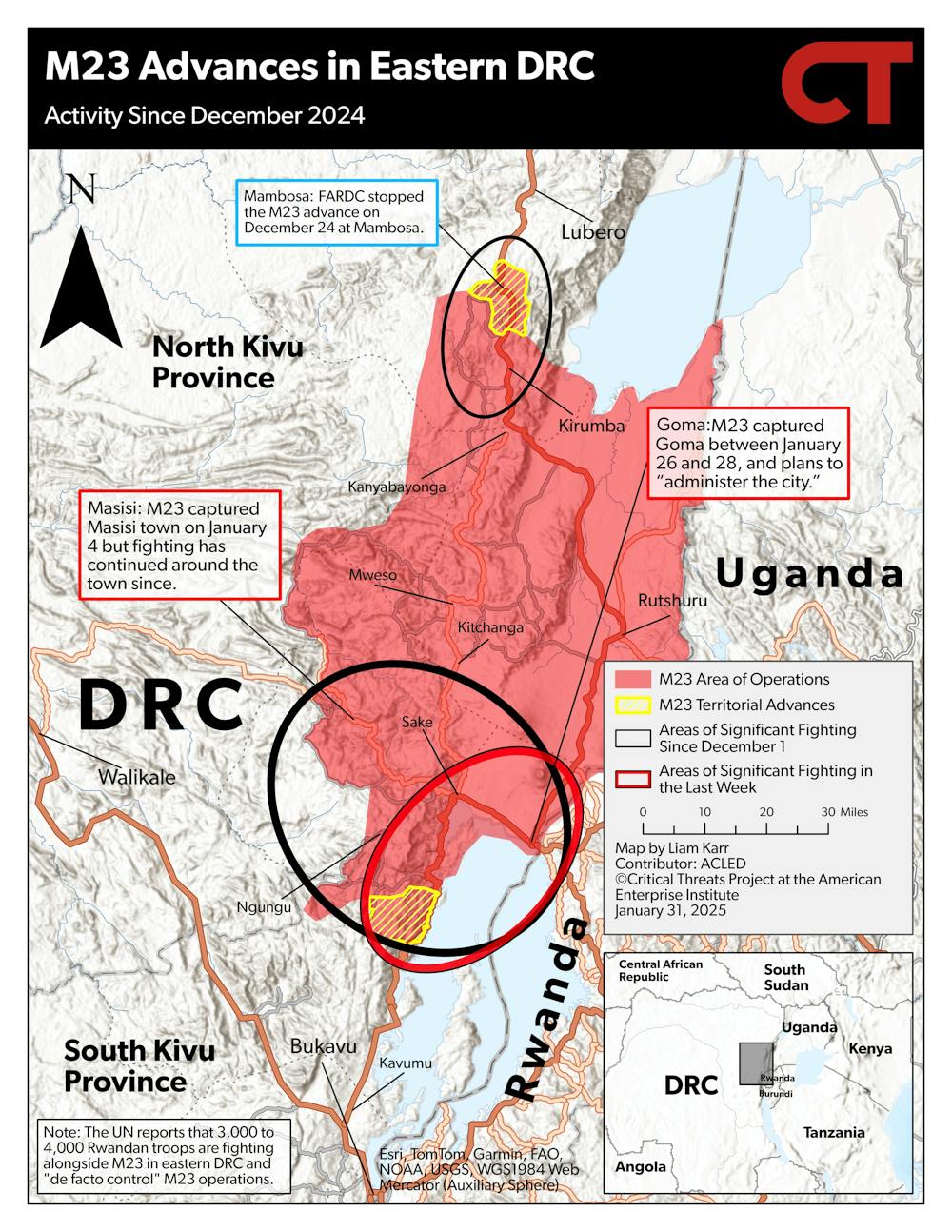
    In a major escalation in the conflict in the eastern Democratic Republic of the Congo (DRC), rebels from the March 23 Movement – or M23 – have seized Goma, the capital city of North Kivu province. At least 773 people have been killed there since the M23 claimed to have won control on January 27, while rebels have also seized several other towns in North Kivu including Sake and Minova.

    The rebels are now reportedly advancing towards Bukavu, the capital of South Kivu province. And Corneille Nangaa, who leads a rebel alliance of which M23 is the largest member, has vowed to march on the DRC’s capital in Kinshasa. Located 1,000 miles west of Goma, the capture of Kinshasa is unlikely. But the conflict still looks set to spread deeper into the DRC.

    The speed of the M23 advance has taken many by surprise. The rebels captured Goma, a city of 2 million people, within just three days. But the conflict between the DRC and the M23, which takes its name from the 2009 date on which a deal was reached to end a revolt by members of the ethnic Tutsi group, has been grinding on intermittently for years.

    Beginning in April 2012, when the M23 was formally created, the conflict has its roots in the same deep ethnic divisions that led to the Rwandan genocide in 1994. Following the genocide, where radical ethnic Hutus killed roughly 800,000 minority Tutsis, many Hutu extremists fled over the border into the DRC and settled in areas including North Kivu.

    The M23 seeks to act as a self-defence force for Congolese Tutsis against discrimination both by the DRC and non-state actors. This includes targeting by the Democratic Forces for the Liberation of Rwanda, a Hutu-dominated rebel group that seeks to overthrow the Rwandan government. The group has in the past committed egregious acts of violence against civilians in North Kivu, including mass killings and sexual violence.

    The M23 rebel group seized the city of Goma on January 27.
    The Critical Threats Project at the American Enterprise Institute

    The seizure of Goma is crucial for several reasons. First, it means that a sizeable and strategically important border province of the DRC is now in rebel hands. North Kivu is an active volcanic region that is rich in various minerals such as coltan, which is used in electronic equipment and the aerospace industry.

    In May 2024 the M23 seized Rubaya, a key mining town that produces 15% of the world’s coltan. Since then, the group has generated considerable income from controlling mineral production and trade. Indeed, the Global Initiative against Transnational Organized Crime labels the agendas of armed groups in the eastern DRC as “profit-driven”.

    Second, the capture of Goma has exacerbated inter-state tension between the DRC and Rwanda, raising the prospect of another inter-state war. News of the prized seizure came hours after the DRC’s foreign minister, Thérèse Kayikwamba Wagner, accused Rwandan troops of invading Congolese territory.

    A UN report from 2013 found that Rwanda not only supports the M23 group, but actively commands its troops. UN experts now estimate that there are up to 4,000 Rwandan troops fighting alongside the M23 in the DRC. Rwanda has denied backing the M23 despite ample evidence to the contrary.

    The Congolese government says Rwanda’s involvement is part of a ploy to exploit North Kivu’s vast mineral resources. In a report from December 2024, a panel of UN experts wrote that “fraudulent [mineral] extraction, trade and export to Rwanda” benefited both the M23 “and the Rwandan economy”. According to the Rwandan government’s own figures, the country exports far more gold than it mines.

    And third, the escalating conflict will deepen an already grave humanitarian crisis in the region. In March 2024, the UN reported that the number of internally displaced people in the DRC had reached 7.2 million – one of the largest such crises in the world. It is estimated that over 6 million civilians in the east of the DRC are now facing high levels of food insecurity.

    What next

    The DRC and Rwandan governments have already gone to war on two previous occasions, once in 1996 and then again in 1998 in what turned into a more protracted five-year conflict. The first war was triggered by Rwanda’s invasion of the DRC to target anti-Rwandan rebel groups seeking refuge there. The war soon drew in other states and became known as Africa’s first world war. Since 1996, conflict in the eastern DRC has killed approximately 6 million people.

    Yet despite this increased tension, there are hopes that a diplomatic solution can be reached. In the past, warring factions in the eastern DRC have agreed to temporary ceasefires following intensive mediation by international institutions such as the East African Community and the African Union, as well as neighbouring countries like Angola.

    However, previous ceasefires have also been violated by both sides. And the stakes are arguably higher this time, with the DRC losing further territory and control over strategic cities to the rebels.

    The Congolese government may be reluctant to accept peace conditions until it regains control over lost portions of territory. Indeed, the Congolese president, Félix Tshisekedi, has already snubbed prospective peace talks to establish a ceasefire.

    Western powers hold key leverage, and may be able to subdue the M23 insurgency. France has given its backing to the DRC government and has warned of the catastrophic humanitarian consequences should the situation deteriorate further.

    The US and other major powers like the UK have also withdrawn state funding for Rwanda in the past over its support for the M23 insurgency. In 2013, for example, cuts to foreign aid forced Rwanda to scale back its support for the rebels, both through reduced military training and supply runs. The UK government has threatened to withdraw funding to Rwanda again following the M23’s capture of Goma.

    Belgium, on the other hand, is leading calls for the EU to suspend a controversial minerals deal with Rwanda that boosts the bloc’s access to several elements in exchange for funding to help Kigali develop its mineral extraction infrastructure. When the deal was signed in 2024, Tshisekedi described it as “a provocation in very bad taste”.

    In any case, a ceasefire between the DRC and the M23 is not enough. What is needed is a long-term, durable solution that addresses the root causes and fears that are driving the armed conflict.

    Dale Pankhurst does not work for, consult, own shares in or receive funding from any company or organisation that would benefit from this article, and has disclosed no relevant affiliations beyond their academic appointment.

    ref. DRC rebels take eastern city of Goma – why it matters and what could happen next – https://theconversation.com/drc-rebels-take-eastern-city-of-goma-why-it-matters-and-what-could-happen-next-248393

    MIL OSI – Global Reports

  • MIL-OSI Economics: The Pula depreciated by 0.8 percent against the South African rand.

    Source: Bank of Botswana

    Over the twelve months period to January 2025, the nominal Pula exchange rate depreciated by 3.2 percent against the South African rand, while it appreciated by 0.1 percent against the IMF Special Drawing Rights (SDR). With respect to the SDR constituent currencies, the Pula appreciated by 2.8 percent against the Japanese yen, 2.3 percent against the euro and 0.2 percent against the British pound, while it depreciated by 1.8 percent against the US dollar and 0.2 percent against the Chinese renminbi.

    The Pula depreciated by 0.8 percent against the South African rand, while it appreciated by 0.5 percent against the SDR over the one-month period to January 2025. It appreciated by 1.5 percent against the British pound, 0.6 percent against the euro, 0.5 percent against the US dollar and 0.2 percent against the Chinese renminbi, while it depreciated by 0.4 percent against the Japanese yen.

    MIL OSI Economics

  • MIL-OSI Economics: BoBC Auction Results – 4 February 2025

    Source: Bank of Botswana

    The Monetary Policy Rate (MoPR) was unchanged at 1.9 percent of the previous week, for a paper maturing on 12 February 2025.   For the 1-month BoBC paper maturing on 5 March 2025, the stop-out yield increased from 2.23 percent to 2.25 percent. The summarised results of the auction held on 4 February 2025, are attached below:

    BOBC Results 4 February 2025.pdf

    MIL OSI Economics

  • MIL-OSI Russia: Mikhail Piotrovsky became an Honorary Doctor of SPbPU

    Translartion. Region: Russians Fedetion –

    Source: Peter the Great St Petersburg Polytechnic University – Peter the Great St Petersburg Polytechnic University –

    A ceremony of presenting the mantle and diploma of Honorary Doctor of SPbPU to the General Director of the State Hermitage Museum Mikhail Piotrovsky took place at Peter the Great St. Petersburg Polytechnic University.

    The decision to award this high title to the head of the country’s main museum was made unanimously by the members of the Academic Council on December 2, 2024.

    It is a great honor and happiness for us that such a legendary person as Mikhail Borisovich Piotrovsky has appeared in the ranks of the Polytechnics, without exaggeration, – SPbPU Rector, Academician of the Russian Academy of Sciences Andrei Rudskoy opened the ceremony and asked the Scientific Secretary of the Polytechnic Dmitry Karpov to present the new Honorary Doctor in accordance with protocol.

    It would seem that there is no person not only in St. Petersburg, but also far beyond its borders, who would not know the historian-orientalist, doctor of historical sciences, professor, academician of the Russian Academy of Sciences and the Russian Academy of Arts, Honorary Citizen of St. Petersburg Mikhail Borisovich Piotrovsky. However, Dmitry Karpov found such words and such an unusual presentation for the presentation of Mikhail Piotrovsky that the personality of the Hermitage director was revealed in a new and vivid way. The book “Good Tone. Conversations Without Courage, Recorded by Irina Klenskaya” helped with this. Thus, based on quotes from Mikhail Borisovich himself, Dmitry Anatolyevich composed a lively and figurative essay.

    Quote: Only culture is capable of transforming chaos into strict order, and the chaos of the world into harmony. That is why the Hermitage is becoming an important and powerful player in the public life of not only the country, but the entire world.

    Dmitry Karpov recalled the “Great Hermitage” program, which is based on the idea of making the collections of the country’s main museum accessible through a complex of open storage facilities and satellite museums. Cultural and educational centers have already been built: “Hermitage-Kazan”, “Hermitage-Ural”, “Hermitage-Vyborg”, “Hermitage-Siberia” in Omsk and “Hermitage-Eurasia” in Orenburg. They are being built in Kaluga, Nalchik, Vladivostok.

    Polytechnic students are well aware of the long-term and fruitful joint work of the university and the Hermitage: since 2016, an agreement on cooperation in the development and improvement of engineering systems and security systems for Hermitage facilities, in the field of 3D modeling, has been in force. During the year of the pandemic, Polytechnic students made about 11 thousand protective screens and masks for the museum. At the end of 2023, the agreement was updated and expanded. Within the framework of cooperation, the following are carried out: excursions for students Polytechnic University in the Restoration and Storage Center of the Hermitage “Staraya Derevnya”, thanks to which future specialists become familiar with modern engineering technologies, automation systems and support for the climate parameters of the storage facility, as well as the functioning of alternative energy.

    Dmitry Anatolyevich cited an excerpt from a story about the Atlanteans of the New Hermitage, work on which began in 1845: “Never in Europe has any sculptor produced such figures from granite as the ancient Egyptians and Greeks did. Now this fantastic art, this great skill has become Russian” – this is how contemporaries spoke about the creation of Alexander Ivanovich Terebenev.”

    The St. Petersburg Polytechnic University also has a special feeling for the Hermitage Atlanteans – in 2022, the team of the NTI Center of SPbPU completed laser scanning of the portico of the New Hermitage and the sculptures of the Atlanteans and processing of the obtained data. Based on the results of the work together with the Hermitage art historians, a large two-part article was published: “Information modeling for the preservation of cultural heritage: the portico of the new Hermitage building and the sculptures of the Atlanteans.”

    Laser scanning and data processing of the interior of the New Hermitage building was also carried out to create three-dimensional models as part of the “Virtual Tour of the Hermitage” project, and scanning of the Alexander Column on Palace Square.

    “It is a great honor and responsibility for the university to make a feasible contribution to the preservation of truly priceless symbols of our city, our common cultural heritage,” Dmitry Karpov emphasized, concluding the presentation. “Deeply respected Mikhail Borisovich, we are proud of our country, our culture and our Hermitage. And the fact that together with you we do everything possible so that our country is strong, rich, glorious and respected.”

    After this, the rector of the Polytechnic announced: “Bring in the Honorary Doctorate diploma, the mantle and the medal!”

    According to tradition, the doctoral gown and cap were brought into the hall of the Academic Council by students dressed in the uniform of polytechnics of the early 20th century. The ceremony was accompanied by the Gaudeamus anthem performed by the Polyhymnia choir. Mikhail Borisovich was presented with a book about the Honorary Doctors of the Polytechnic University – his page is in it.

    In his response, Mikhail Piotrovsky thanked for the honor bestowed upon him and noted that the tradition of conferring Honorary Doctors of the Polytechnic University is an important element of St. Petersburg culture. Mikhail Borisovich emphasized that he is connected with the Polytechnic University not only by long-term cooperation, but now by joint work in the St. Petersburg branch of the Russian Academy of Sciences, headed by Andrei Rudskoy.

    “We have many different connections,” noted Mikhail Piotrovsky. “My deputy, Alexey Valentinovich Bogdanov, associate professor, teaches at the Polytechnic University, 49 graduates of the university work at the Hermitage, you give us wonderful personnel. What we are doing together is the most important topic today for society: the combination of science and art. We have many opportunities for further joint work, entire programs that are very important both for us and for the development of science. We would like students, under the guidance of teachers, to participate in our digitalization processes, primarily in the field of big data. Together we could make an exhibition of beautiful exhibits of technical progress preserved in the Hermitage – wonderful astrolabes, spheres, globes, clocks. We have them, they all function, but it would be good to tell about them beautifully, developing the experience of the multimedia Hermitage. Today, the “Great Hermitage” was mentioned, our next project is “Heavenly Hermitage”, a cloud-based one, it is a backup copy in which everything that is not done in the earthly Hermitage can take place. And here we would like your intellectual and expert help.”

    Mikhail Piotrovsky said that the Hermitage has many advisory councils, and it would be possible to create a separate student council, under the leadership of teachers. As ideas for cooperation with students, Mikhail Piotrovsky also suggested thinking about forecasting the condition of museum objects and “taming technology.”

    In closing the ceremony, Andrey Rudskoy thanked Mikhail Piotrovsky for his businesslike approach and outlook on the future and promised that all ideas and proposals were accepted, would be discussed and implemented.

    Photo archive

    Please note: This information is raw content directly from the source of the information. It is exactly what the source states and does not reflect the position of MIL-OSI or its clients.

    MIL OSI Russia News

  • MIL-OSI Russia: The admissions campaign for international applicants continues at HSE

    Translartion. Region: Russians Fedetion –

    Source: State University Higher School of Economics – State University Higher School of Economics –

    The number of applications has almost doubled: to date, more than 2,600 applications have been submitted for undergraduate programs, and more than 2,400 for master’s programs. Such increased interest from foreign applicants in studying at the HSE confirms the status of HSE as one of the most sought-after Russian universities abroad.

    Who most often chooses HSE

    The leading countries in terms of the number of applications submitted for undergraduate programs are Pakistan, Nigeria, Kazakhstan, Uzbekistan, Belarus, Afghanistan, Bangladesh, Kyrgyzstan, Ghana and Moldova. The countries that most frequently apply for graduate programs are Ghana, India, Nigeria, Gambia, Pakistan, Ethiopia, China, Bangladesh, Afghanistan and Cameroon.

    “HSE University sees one of its tasks as the active promotion of Russian education in the international arena. And the growing interest among applicants from Asian and African countries, from the CIS countries only confirms HSE’s reputation as a leading research university with the competencies of the future not only in Russia but also abroad. Moreover, both in full-time and online forms,” noted Victoria Panova, Vice-Rector of HSE University. – After all, in a rather difficult time, HSE, along with 10 world universities, entered the number of leaders in distance education according to the rating of THE Online Learning Rankings 2024 magazine. A wide range of programs in the socio-economic and humanitarian areas, in the creative sphere, brilliant teachers from almost 50 countries of the world, a high level of support for international students and modern infrastructure of HSE – all this meets international standards, and the cost of education is often lower than in Western universities. Applicants and their parents evaluate the advantages and opportunities that HSE provides during and after their studies, and choose us.”

    What opportunities does the university offer to international applicants?

    One of the key advantages for international applicants to HSE remains the opportunity to choose the admission format. The university offers two options: a competition for budget (quota) places under the state scholarship of the Government of the Russian Federation, which covers up to 100% of the cost of education, and admission on a commercial basis.

    Foreign applicants can receive a Russian Government scholarship (quota) based on the results of international Olympiads (applicants to a bachelor’s degree) and based on the results of selection events (minimum scores for Master’s degree And bachelor’s degree).

    Additionally, applicants to undergraduate programs may re-credit results of international and national examinations, which makes the admission process even more flexible.

    Preparing for Study: What to Do If You Don’t Know Russian

    HSE offers to master the Russian language in The Center for the Preparation of Foreign Students, choosing to study for one year. Applicants to the bachelor’s degree program can take specialized entrance examinations and apply for a budget (quota) place with an additional year of preparation and Russian language training. A similar option is possible for future master’s degree students: upon successful completion of the portfolio competition, they can also receive a budget place with a year of training.

    HSE – accessible, convenient, understandable

    Website for international applicants has been translated into seven languages, including Chinese, Spanish, Arabic and Hindi, allowing candidates to easily find the information they need and navigate the admissions process. In addition, international applicants are contacted on social media and during webinars, answering the most pressing questions about education, visas, life in Russia and even whether there are places with halal food.

    “We strive to attract only the best. We work with talented schoolchildren and applicants on an ongoing basis,” says Alexander Deyev, Director of Talent Abroad. “HSE ensures simplicity and accessibility of the entire process — from online application submission to the start of studies. We understand that entering a university, especially in a foreign country, is an important step that can be associated with many difficulties, especially for international students. Therefore, every year we do everything possible to make the application and document preparation process as clear as possible. Online consultations, personal support at all stages of admission, preparation for arrival in Russia — all this allows our applicants to feel confident and calm, to know that they will always be supported and helped to solve any problem that arises.”

    Please note: This information is raw content directly from the source of the information. It is exactly what the source states and does not reflect the position of MIL-OSI or its clients.

    MIL OSI Russia News

  • MIL-OSI United Kingdom: Minister for European Union Relations speech at EU-UK Forum

    Source: United Kingdom – Government Statements

    A speech delivered in Brussels at the EU-UK Forum by Nick Thomas-Symonds, Minister for European Union Relations.

    Many thanks, Paul, and many thanks to the EU-UK Forum for organising this conference.

    And, of course, for the invitation for me to come along to speak.

    I suppose I should also say a big thank you to the Prime Minister for the warm-up act last night.

    It’s a real pleasure to share a stage with my EU counterpart Maros Sefcovic.

    Even though, of course, Maros joined us virtually, our mutual goal of reaching a better UK EU relationship is very real.   

    And today, I want to explain why that is so important…

    …what it could mean for the UK and for Europe…

    …and what I believe the defining structure of that relationship could look like. 

    It is obvious to me – as I am sure it is to all of you – that at a time of such intense global change, the UK and the EU have many mutually aligned interests and challenges.

    We want increased prosperity…

    … we want to strengthen our security…

    …and we want our citizens to be safe. 

    Those joint challenges that we face were powerfully set out by our UK Chancellor, Rachel Reeves…

    …and, indeed, the President of the European Commission, Ursula von der Leyen just last week.

    In her growth speech, my Friend the Chancellor didn’t shy away from the economic challenges that we are confronting. She said:

    “Growth will not come without a fight. Without a government willing to take the right decisions now to change our country’s future for the better.  

    “But for too long, that potential has been held back.”  

    On the same day, the President von der Leyen presented the ‘Competitiveness Compass’ saying that, and I quote:

     “Europe has everything it needs to succeed. But, at the same time, we must fix our weaknesses to regain competitiveness.” 

    The ‘Competitive Compass’ sets out the importance of “trade openness”, “not only for sustaining Europe’s prosperity, but also for enhancing its resilience”.

    We know that low growth is not the destiny for our economies. 

    Research and innovation…

    …reducing red tape…

    …a new skills agenda…

    …boosting productivity…

    …a more resilient economy…

    …all these elements found in the Compass are also crucial parts of the Prime Minister’s Plan for Change.  

    These are areas of mutual interest to both of our economies

    It is also clear about the vital interconnection between security and prosperity…

    …that is why the work we are all engaged in – that Maroš and I are driving forward – is so vital.

    In the UK and indeed in Brussels – we are clear-eyed about the scale of challenges that we face – and the opportunities for growth and innovation.

    The European Union is the UK’s biggest trading partner, with trade totalling – in 2023 – over £800bn.

    Many of our best education and science facilities have lifelong links…

    …and our collaboration on research and development has been the springboard for hugely successful innovations that have driven growth and jobs. 

    And in a more uncertain world, we are regularly reminded that allies are more secure together than they are apart.

    This Government’s position is simple: the UK and the EU are linked through trade and international organisations like NATO…

    …and even though we voted to leave the EU, our role as key allies and trade partner remains.

    We know that for these relationships to flourish, trust is a vital ingredient.  

    This Government recognises that the UK’s signature means something.

    So, we are committed to implementing the Trade and Co-operation Agreement and the Windsor Framework and building on that structure to address emerging challenges and opportunities.

    Now, I want to say – straightforwardly – that we see real opportunities to improve the status quo.

    As ‘Businesseurope’ set out in their report this Autumn: 

    “There remain many unnecessary barriers to trade and investment. Following the elections of new governments in the EU and UK, there is a clear opportunity to upgrade the relationship to deliver for businesses and citizens.”

    I agree with them. 

    A study published last year showed that between 2021 and 2023, the goods EU businesses export to the UK were down by 32%…

    …while UK goods exports to the EU were down by 27%.

    That is not good for British business or European businesses…

    …especially at a time when our economies need a kickstart. 

    Reducing trade barriers is of mutual benefit to the UK and the EU. 

    [redacted political content]

    It was vital that we re-joined Horizon…

    …we should never have left in the first place…

    …but the gap in continuity and other challenges means we haven’t together achieved as much as we could have done.

    It’s especially bad when global competition for innovation has never been fiercer.

    When the UK should have been working more closely with international law enforcement on security…

    …we frankly wasted years undermining the role of the ECHR, in pursuit of a doomed Rwanda deportation scheme.

    We cannot continue in this way with one of our largest, most important partners… 

    …that is why this Government will always work in the UK’s national interest…

    …and for me, that means being a ruthlessly pragmatic negotiator.

    That means making the case for closer working with our allies in the EU, to make people across the UK and the EU safer, more secure and more prosperous…

    …that means making sure that we are working to strengthen cooperation, moving away from a zero sum, win, lose dynamic we have seen in recent years…

    …and that is the spirit I take into discussions with the EU. 

    The UK and the EU have many mutually beneficial interests… 

    …I want to build on these as we work to reset our relationship…

    …to help construct a more secure, a safer and a more prosperous UK and EU. 

    Now this British Government was elected on a mandate…

    …to strengthen national security by reconnecting with our allies…

    …to increase people’s safety through strong borders…

    …and increase prosperity through growth.

    Our European friends are a part of every single one of those priorities…

    …and I believe it’s these priorities that form the three pillars of a reset in our relationship.

    On security – you saw yesterday how seriously we’re taking this.

    Our Prime Minister met with all 27 of the EU leaders and the Secretary General of NATO… 

    …discussing the common threats we face…

    …and the value that closer EU-UK cooperation on defence could bring…

    …whether it’s securing undersea cables or working together on research and development. 

    On safety – I am clear that if we want to protect our respective borders and keep our citizens safe, then we need to work together.

    That is the only way we’re going to break up the vile global trade in human trafficking…

    …that’s the only way to tackle organised crime and terrorism, which plagues us all. 

    And on prosperity – if we want to grow our economies…

    …and boost our living standards…

    …then we need to reduce barriers to UK and EU trade. 

    And I am pleased to say that – that on all three of these issues – we are making progress. 

    On security, the Prime Minister and the President of the European Council have made clear they wanted closer cooperation on security and defence…

    …and the EU High Representative and the Foreign Secretary have already agreed to new six-monthly Foreign Policy dialogues 

    On safety, we have already increased the UK’s presence at Europol…

    …but I want us to go further. 

    We need to find to find ways to better coordinate law enforcement so that we can smash the gangs behind the small boats. 

    To make people safer, we must do all we can to strengthen our collective ability to tackle organised crime and work together on illegal migration.

    Afterall, these are shared challenges. 

    And on prosperity, we have said we will seek to negotiate a Sanitary and Phytosanitary agreement to remove barriers to trade…

    …and find ways to resolve issues like the Mutual Recognition of Professional Qualifications.

    We can go much further on energy and the green transition.

    Our Government’s commitment is to Make Britain a Clean Energy superpower by 2030… 

    …and together, we need to deliver energy security so that we are never again left exposed as we were when Russia – illegally – invaded Ukraine.

    These challenges all span borders and we must work together to seize opportunities that lie ahead.

    All of this work is supported by much greater cooperation between the UK Government and the EU. 

    Right from the very top – with the Prime Minister meeting with President von der Leyen and Council President Costa…

    …agreeing to a leader-level summit that will be held in May, where we hope we can deliver a balanced, yet ambitious outcome to benefit all of our citizens.

    Just before Christmas, our Chancellor attended a meeting of the EU finance ministers…

    …the first time a British Chancellor has been invited to the Eurogroup since Brexit.

    These meetings form only some of the nearly 70 direct engagements…

    …between UK Ministers and our EU counterparts since coming into Government…

    …and I look forward to many more ahead. 

    And I say to you all: I look forward to working with you throughout this year and into the future.

    But ladies and gentlemen – the time for ideologically-driven division is over…

    …the time for ruthless pragmatism is now.

    It is through a new partnership between the UK and the EU that we will deliver for the people of the United Kingdom, and for people across the continent.

    The future of the EU and the UK lies beyond the status quo…

    …reaching forward to deliver benefits for all our people to share.

    So, let us rise to our shared challenges and grasp this opportunity.

    Because together we will create a stronger UK and we will create a stronger Europe.

    Thank you very much.

    Updates to this page

    Published 4 February 2025

    MIL OSI United Kingdom

  • MIL-OSI Security: Nearly 20,000 live animals seized, 365 suspects arrested in largest-ever wildlife and forestry operation

    Source: Interpol (news and events)

    4 February 2025

    138 countries and regions join forces to target fauna and flora trafficking worldwide

    LYON, France – Nearly 20,000 live animals, all endangered or protected species, have been seized in a global operation against wildlife and forestry trafficking networks, jointly coordinated by INTERPOL and the World Customs Organization (WCO).

    Operation Thunder 2024 (11 November – 6 December) brought together police, customs, border control, forestry and wildlife officials from 138 countries and regions, marking the widest participation since the first edition in 2017.

    Authorities arrested 365 suspects and identified six transnational criminal networks suspected of trafficking animals and plants protected by the Convention on International Trade in Endangered Species of Wild Fauna and Flora (CITES). Such species are illegally trafficked to meet specific market demands, whether for food, perceived medicinal benefits, “luxury” and collector items or as pets and competition animals.

    Globally, more than 100 companies involved in the trafficking of protected species were identified.

    The operation led to the rescue of 18 big cats, including these tiger cubs in the Czech Republic.

    The seized animals were sent to conservation centres, where their health was assessed while awaiting repatriation or rehabilitation.

    Organized crime networks profit from the demand for rare plants and animals, like this bird seized in Mexico.

    More than 5,877 live turtles were seized during Operation Thunder, including these ones in Tanzania.

    Morocco conducted intelligence-led investigations and seized over 50 snakes of various species.

    12 live pangolins were seized during the action weeks, such as this one in Mozambique.

    These Oryx were seized in Iraq. The collection of DNA is a crucial part of supporting prosecutions.

    1,731 other reptiles were seized live, like these blue-tongued lizards in Australia.

    Overall, nearly 20,000 live animals, all endangered or protected species, were rescued.

    33 protected primates were seized during the operation, this one was discovered in Chile.

    An example of a deer seized in North Macedonia during the operation that was jointly coordinated by INTERPOL and the World Customs Organization (WCO).

    This primate was rescued in Indonesia during Operation Thunder.

    The live animals, which included big cats, birds, pangolins, primates and reptiles were rescued in connection with 2,213 seizures made worldwide.

    Where possible, wildlife forensic experts collected DNA samples before transferring the animals to conservation centres, where their health was assessed while awaiting repatriation or rehabilitation, in line with national frameworks and relevant protocols.

    The collection of DNA is a crucial part of supporting prosecutions, as it helps confirm the type of species and its origin or distribution, shedding light on new trafficking routes and emerging trends.

    Large-scale trafficking of animal parts, plants and endangered species

    In addition to the live animals, participating countries seized hundreds of thousands of protected animal parts and derivatives, trees, plants, marine life and arthropods.

    Timber cases represent the most significant seizures, primarily occurring in sea cargo container shipments, while most other seizures took place at airports and mail processing hubs.

    Authorities also investigated online activities and found suspects using multiple profiles and linked accounts across social media platforms and marketplaces to expand their reach.

    More than 100 companies involved in the trafficking of protected species were also identified.

    Valdecy Urquiza, INTERPOL Secretary General said:

    “Organized crime networks are profiting from the demand for rare plants and animals, exploiting nature to fuel human greed. This has far-reaching consequences: it drives biodiversity loss, destroys communities, contributes to climate change and even fuels conflict and instability.

    “Environmental crimes are uniquely destructive, and INTERPOL, in cooperation with its partners, is committed to protecting our planet for future generations.”

    Ian Saunders, WCO Secretary General, said:

    “Operation Thunder continues to shed light on a crime that is often not a priority for enforcement actors. Through our joint efforts we have established cooperation mechanisms that facilitate the exchange of information and intelligence, and we have refined our enforcement strategies.

    “The illegal wildlife trade is still rapidly growing, highly lucrative and has devastating effects. The WCO remains committed to supporting its members and partners to effectively combat this serious crime.”

    This leopard hide was seized in Namibia, during the largest-ever global operation against wildlife and forestry trafficking.

    As well as this leopard skin coat discovered in Poland, Polish authorities also seized 300 seahorse tablets.

    This Mariposa butterfly found in Peru was one of 5,991 pieces and 233kg of arthropods seized globally.

    This wood in Brazil was among 49,572 pieces, 214.9 tonnes and 1340 m3 of timber seized worldwide.

    These sea cucumbers and shark fins were seized in Mozambique.

    Nearly 4.5 tonnes of pangolin scales were seized in Nigeria.

    Mongolia reported the seizure of 40 m3 of timber.

    This skull, discovered by Mexican authorities, was among 53 pieces of big cats seized around the world, including claws, furs, and skulls.

    Python skin products, like this one seized in Italy, are perceived as high-end or luxurious items.

    This coral, found in Italy, was one of 493 pieces and 21.41kg of coral seized globally.

    Indonesia reported two instances of trafficking of African ivory.

    Significant seizures include:

    • Indonesia: 134 tonnes of timber headed to Asia via ocean freight.
    • Kenya: 41 tonnes of exotic timber headed to Asia via ocean freight.
    • Nigeria: 4,472 kg of pangolins scales
    • Türkiye: 6,500 live songbirds discovered during a vehicle inspection at the Syrian border.
    • India: 5,193 live red-eared ornamental slider turtles concealed in passenger suitcases arriving from Malaysia at Chennai Airport.
    • Peru: 3,700 protected plants intercepted en route from Ecuador.
    • Qatar: Eight rhino horns found in a suspect’s luggage while transiting from Mozambique to Thailand.
    • United States: One tonne of sea cucumbers, considered a seafood delicacy, smuggled from Nicaragua.
    • Hong Kong, China: 973 kg of dried shark fins originating from Morocco seized at the airport.
    • Czech Republic: Eight tigers, aged between two months and two years, discovered in a suspected illegal breeding facility.
    • Indonesia: 846 pieces of reticulated python skin, from the world’s longest snake species, concealed on board a ship.
    • More than 300 firearms, vehicles and poaching equipment.

    Building a global intelligence picture of wildlife and timber trafficking

    Regular operations such as Thunder enable investigators to build a comprehensive global intelligence picture and detailed offender profiles, significantly enhancing the effectiveness of enforcement efforts and resolution of cross-border cases.

    Cooperation between various stakeholders is essential for effectively combating transnational criminal networks, from seizure to arrest and prosecution, as the data collected enable customs administrations to refine their risk management and compliance strategies, and stay one step ahead of criminals, ensuring that their contribution to the fight against wildlife crime is dynamic and responsive.

    Ahead of the operation, countries exchanged actionable intelligence on ongoing cases and high-value targets, updating critical information on 21 INTERPOL Red Notices for suspected traffickers wanted internationally. This exchange continued throughout the operation, with officers using the secure channels provided by both INTERPOL and the WCO to communicate in real time.

    The Operation Thunder series is backed by the CITES Secretariat and carried out under the partnership framework of the International Consortium on Combating Wildlife Crime (ICCWC). The 2024 edition was co-funded by the European Union, the UK Department for Environment, Food and Rural Affairs (DEFRA), and the United States Agency for International Development (USAID).


    MIL Security OSI

  • MIL-OSI Africa: Civil Society Organizations Brief the Committee on the Elimination of Discrimination against Women on the Situation of Women in the Democratic Republic of the Congo, Nepal, Belarus and Luxembourg

    Source: Africa Press Organisation – English (2) – Report:

    GENEVA, Switzerland, February 4, 2025/APO Group/ —

    The Committee on the Elimination of Discrimination against Women was this afternoon briefed by representatives of civil society organizations on the situation of women’s rights in the Democratic Republic of the Congo, Nepal, Belarus and Luxembourg, the reports of which the Committee will review this week.

    In relation to the Democratic Republic of the Congo, speakers raised concerns regarding gender-based violence and abuse of internally displaced women and girls in the context of the escalating conflict, and the impact of the withdrawal of the United Nations Organization Stabilization Mission in the Democratic Republic of the Congo.

    On Nepal, speakers addressed discrimination against vulnerable women, including indigenous women and girls, lesbian, bisexual, transgender and intersex women, and women sex workers; anti-discrimination legislation; and the participation of women in political processes.

    Non-governmental organizations speaking on Belarus raised topics including the dissolution of civil society organizations, imprisonment of women human rights defenders, and barriers to access to justice for women.

    Regarding Luxembourg, a speaker raised issues related to a lack of gender sensitive policies and measures to address intersecting forms of discrimination, and the subordination of women through the social system.

    The National Human Rights Commissioner of the Democratic Republic of the Congo spoke on the country, as did the following non-governmental organizations: Centre for Migration, Gender, and Justice; Groupe d’Action pour les Droits de la Femme; and SAVIE ASBL LGBT.

    Regarding Nepal, the following non-governmental organizations spoke: Forum for Women, Law and Development; Feminist Dalit Organization; Nepal Indigenous Women Federation; Sex Workers and Allies South Asia and Team; Campaign for Change, Mitini Nepal, and Intersex Asia; and Visible Impact.

    The following non-governmental organizations spoke on Belarus: Belarusian Helsinki Committee; Human Constanta; Belarusian Congress of Democratic Trade Unions; Coalition against gender-based and domestic violence; and Our House.

    A representative of the Consultative Commission of the Grand-Duchy of Luxembourg on Human Rights spoke on Luxembourg.

    The Committee also held an informal meeting with the Working Group on Business and Human Rights and representatives from civil society and the business sector on “increasing the bottom line through smart, gender-inclusive, rights-focused approaches in digitisation.”

    Opening the meeting, Nahla Haidar, the newly elected Committee Chairperson, said artificial intelligence and digital technologies had revolutionised everyday life and business practices across sectors in ways that were never envisioned in the past. She called for action to prevent bias and discrimination against women through cyber-enabled modalities; expand women’s economic opportunities in the new digital era; and equip women and girls with necessary skills, capacities and tools to contribute to providing digital solutions.

    In the meeting, speakers discussed topics such as measures to prevent discrimination of women in the private sector, and particularly in the field of technology; measures to promote access to science, technology, engineering and maths education for women; measures to address the impacts of artificial intelligence on women; and measures to protect women’s rights in the energy transition era.

    Committee Experts and members of the Working Group spoke in the meeting, as did representatives of the United Nations Office of the High Commissioner for Human Rights, the World Trade Organization, and various private sector and civil society organizations.

    The Committee on the Elimination of Discrimination against Women’s ninetieth session is being held from 3 to 21 February. All documents relating to the Committee’s work, including reports submitted by States parties, can be found on the session’s webpage. Meeting summary releases can be found here. The webcast of the Committee’s public meetings can be accessed via the UN Web TV webpage.

    The Committee will next meet in public at 10 a.m. on Tuesday, 4 February to consider the report of the Democratic Republic of the Congo submitted under the exceptional reporting procedure (CEDAW/C/COD/EP/1).

    Opening Remarks by the Committee Chair

    NAHLA HAIDAR, Committee Chairperson, said that during each session, the Committee invited national and international non-governmental organizations to informal public meetings to provide specific information on the States parties that were scheduled for consideration by the Committee. She welcomed the representatives of non-governmental organizations and national human rights institutions that had come to provide information on the States parties whose reports were being considered this week: Democratic Republic of the Congo, Nepal, Belarus and Luxembourg.

    Statements by Non-Governmental Organizations from the Democratic Republic of the Congo, Nepal and Belarus

    Democratic Republic of the Congo

    On the Democratic Republic of the Congo, speakers, among other things, said violence against displaced persons was on the rise in the State. Gender-based violence, specifically, was rampant, leaving survivors with limited access to justice. Displaced women had a lack of access to reproductive health care and were giving birth in unsafe conditions. The economic struggles that displaced women and girls faced were equally alarming. With scarce income opportunities, many were driven to survival sex, which exposed them to sexual exploitation and abuse.

    The withdrawal of the United Nations Organization Stabilisation Mission in the Democratic Republic of the Congo raised real concerns. Plans from national authorities to take on the responsibilities of the Mission remained lacking. Armed militias and members of the security forces continued to abuse women with impunity. There were also “tolerance houses” where internally displaced women and girls were sexually abused. Justice remained inaccessible for most survivors.

    Speakers called on the Government to bolster administrative capacities; ensure the transfer of United Nations facilities to the armed forces; investigate “tolerance houses” and hold perpetrators of gender-based violence criminally liable; control the spread of weapons; and ensure justice and dignity for all women in the State. Speakers also called for a national migration strategy that was gender-responsive; mechanisms for gender-based violence prevention, mitigation, and response; provision of health services and resources, especially with regards to maternity health, that connected to related concerns such as food insecurity and nutrition; and programmes to expand livelihood provisions that supported displaced women and girls.

    Nepal

    Speakers said Nepal had yet to enact a robust anti-discrimination law, making women more vulnerable to abuse. There was a need to criminalise discrimination against women and eliminate all discriminatory legal provisions against them. The State party also needed to allocate sufficient human and financial resources to public bodies working on women’s rights. Appropriate support needed to be provided to women victims of violence.

    Fifteen per cent of Nepal’s population of women faced multiple forms of discrimination; many women faced social exclusion and violence. Some girls did not report crimes due to a lack of trust in the justice system.

    Nepal needed to amend the Constitution to address historical discrimination of indigenous women and to recognise the customary laws of indigenous people. The Government needed to amend the act on the rights of persons with disabilities to address the rights of indigenous women with disabilities. Access to justice needed to be promoted for indigenous women and women with disabilities.

    Nepal had failed to ratify the Palermo Protocol, and human trafficking and sex work were treated as the same in the country. Sex workers faced various forms of discrimination and violence. Nepal’s legislation had a direct impact on sex workers’ access to citizenship. Legislation on trafficking in persons needed to be amended to differentiate between trafficking and sex work. The Government also needed to facilitate sex workers’ access to citizenship and promote awareness raising campaigns on the rights of sex workers.

    Lesbian, bisexual, transgender and intersex girls faced harmful treatment and violence, and systematic discrimination in education and healthcare in Nepal, and the Government had failed to act in response. The Government needed to ensure such women could access single women’s allowances, redefine marriage to include gender-free terminology, and support this group’s access to rights.

    Education on sexual and reproductive health remained optional and inadequate in Nepal. It needed to be made compulsory. Legislation needed to be amended to fully decriminalise abortion, particularly abortions in cases of rape. The State also needed to amend legislation to include sexual and reproductive health and rights and sensitise health care providers and community members on safe births. It further needed to decriminalise sexual relations between consenting adolescents under the age of 18.

    The meaningful participation of women in political processes was lacking; many women politicians faced violence. Nepal needed to investigate historic violence against marginalised women, collect disaggregated data on women, enhance women’s leadership capacities, take measures to eliminate discrimination against marginalised women and girls, and provide quality health services to all women and girls, particularly indigenous women, at a minimal cost.

    Belarus

    Speakers on Belarus said the Constitution did not provide effective protection against discrimination. Women’s rights to education and health care were limited. Belarus had institutionalised discriminatory food provisions; women and girls were not able to access fruit and nuts, leading to long-term health risks.

    Access to justice for women was undermined by the persistent persecution of women human rights defenders. Women activists had been falsely labelled as terrorists despite their peaceful actions. The State had systematically dissolved various civil society organizations, including many that supported women. Almost 2,000 non-governmental organizations had been forced to liquidate. All women’s organizations that had prepared shadow reports to the Committee for the last review had been liquidated. It was immensely difficult to find legal assistance due to the political suppression of lawyers. In 2022, the Government had forcibly liquidated all trade unions. Six women trade union activists remained in prisons.

    At least 139 women were political prisoners in Belarus. They lacked access to healthcare and were persistently ill-treated. Imprisoned women faced forced labour and modern forms of slavery. If women refused to work, they were put in “cages of shame” and forced to stand outside for several hours. Women prisoners earned between five and 10 euros per month and faced harsh penalties for not meeting quotas.

    When domestic violence cases were reported to police, police screened the political activities of the victim rather than provide support. Victims and aggressors were invited together to meetings with authorities, promoting impunity.

    Women migrants were vulnerable to trafficking and violence. Domestic violence was not a ground for asylum in Belarus.

    Luxembourg

    No non-governmental organizations spoke on the situation of women in Luxembourg.

    Questions by Committee Experts

    A Committee Expert said that there were many laws and policies for women in the Democratic Republic of the Congo, but there was weak implementation. How was the transitional justice policy being implemented for women? Was there a plan to promote the security of women and girls in the Democratic Republic of the Congo?

    The Expert shared the non-governmental organizations’ concern regarding the suppression of civil society in Belarus. Were there plans to update the national action plan on human rights in Belarus, and were there plans to establish a national human rights institution?

    Another Expert asked about anti-trafficking activities being carried out in the Democratic Republic of the Congo. To what extent were women represented in local governments and decision-making bodies in Nepal?

    One Committee Expert asked about financial resources devoted to implementing the national gender equality plan in Nepal. What were areas of concern related to sexual and reproductive health services in Belarus?

    A Committee Expert asked about problems regarding access to justice for Dalit women in Nepal. How common was the dowry custom in Nepal? Why was the dowry for younger women and girls lower?

    Another Committee Expert asked if the Democratic Republic of the Congo had laws on the accountability of military personnel and contractors involved in violence against women. What social protection system and benefits did Belarus have for women and girls?

    One Committee Expert asked about legal provisions that needed to be challenged. What needed to be done to educate girls and society about the harms of the kumari practice in Nepal, which isolated girls from their community?

    A Committee Expert called for information on the Democratic Republic of the Congo’s national action plan on the development of the security forces. What action had been taken to dismantle non-governmental armed groups in the east? Was it still possible for non-governmental organizations in Belarus to protect women and interact with the Government?

    Responses by Non-Governmental Organizations

    Nepal

    Responding to questions on Nepal, speakers said there was a very low percentage of women in federal and provincial decision-making bodies in Nepal, and an even lower percentage of Dalit women. There needed to be increased representation of women in these bodies. There were several laws that directly discriminated against women, including laws on legal residences, which considered women and girls’ residences as those of their husbands and fathers. Divorced women lost their property rights. It was prohibited to oppose gender biases in cultural and social practices. Nepal’s laws did not recognise lesbian, bisexual, transgender and intersex women as minorities; this needed to be done.

    In Nepal, the parents of women paid dowries, and less dowry was paid for younger women. Dowry payments were most prevalent in the south of the country. The Criminal Code criminalised this practice, but it still existed.

    Sexual and reproductive health education was part of the school curriculum but was no longer a compulsory subject. There were also gaps in sexual and reproductive health legislation, with many marginalised women not able to access sexual and reproductive health services.

    Dalit women and other marginalised women could not easily access the justice system. They were not made aware of where and how to access justice and faced violence and discrimination from the police because of their identity.

    Belarus

    Responding to questions on Belarus, speakers said Belarus’ Gender Equality Council did not include non-governmental organizations working on human rights and gender equality. Belarus’ legislation on incitement to hatred was used to oppress women human rights defenders. One such woman had been imprisoned for seven years under this legislation. Raids, inspections and blocking of websites were tools used by the Government to restrict the activities of civil society organizations.

    Statements by National Human Rights Institutions

    Democratic Republic of the Congo

    GISÈLE KAPINGA NTUMBA, National Human Rights Commissioner of the Democratic Republic of the Congo, said the Democratic Republic of the Congo was going through one of its darkest times in recent history, marked by the invasion of the M23 rebels in the east of the country, which was facing a protracted, violent crisis. Many women and girls had been displaced and were facing heightened risks of sexual violence and rape. The National Human Rights Commission had conducted investigations into sexual violence linked to conflict, engaging with competent institutions to address this problem and combat impunity.

    The Commission welcomed that the Government had implemented several measures to protect women and girls from sexual and gender-based violence, including a law criminalising such violence and enshrining access to justice for victims. However, there was still a long way to go until these measures could effectively protect civilians from sexual and gender-based violence. The number of internally displaced persons continued to grow, and there had been many cases of rape reported. There needed to be increased funds to limit the circulation of small arms and light weapons, build new camps, and increase humanitarian aid for internally displaced persons. Care for victims of sexual and gender-based violence needed to be given by trained professionals.

    The national fund for compensation for the victims of gender-based violence had helped victims to access care. The Commission also welcomed the organisation of travelling courts to combat impunity. The Government needed to restore peace in the east and take steps to protect civilians from gender-based violence, and provide internally displaced persons with adequate aid. Armed groups needed to respect the rules of international humanitarian law and implement an immediate ceasefire. The international community needed to promote peace by adopting sanctions against M23 and other armed groups.

    Luxembourg

    LAURA CAROCHA, Human and Social Sciences Expert,Commission consultative des Droits de l’Homme du Grand-Duché de Luxembourg [Consultative Commission of the Grand-Duchy of Luxembourg on Human Rights], welcomed the efforts made by Luxembourg to combat discrimination against women since the last report, while noting persistent shortcomings, including a social system that kept women in a subordinate position to men. Luxembourg’s policy favoured a “neutral” approach that was not gender sensitive. Ms. Carocha urged politicians to openly acknowledge this systemic patriarchal domination and to make the deconstruction of this mechanism a priority. To this end, it was imperative that the Government finally implemented the principle of gender mainstreaming in a cross-cutting manner in all its policies.

    Luxembourg’s equality efforts lacked an intersectional approach and the Government rarely addressed multiple and intersecting forms of discrimination. Disability was conspicuously absent from the National Action Plan for Equality between Women and Men, while the gender dimension was neglected in the National Action Plan on Disability. It was essential to have detailed data, disaggregated by gender, age, ethnicity, disability and education level, to better understand and address the different forms of discrimination that women faced. The Government also needed to impose concrete actions on companies, municipalities and administrations in terms of gender equality and the fight against discrimination against women.

    All actions taken in the fight against discrimination against women needed to be carried out in close collaboration with civil society. This cooperation needed to be translated into lasting partnerships and political will to ensure that the contributions of civil society were seriously considered in the decision-making process.

    Ms. Carocha concluded by calling for the recognition of multiple forms of discrimination, and a proactive and participatory response from the Government to gender inequalities rooted in societal dynamics. This meant adopting structural solutions that addressed the root causes of discrimination.

    Questions by Committee Experts

    A Committee Expert offered condolences to the people of the Democratic Republic of the Congo, including families of civilians who had lost their lives. What did the National Human Rights Commission wish the Committee to highlight in the dialogue with the State party?

    Another Committee Expert asked about measures to prevent conflict-related gender-based violence in the Democratic Republic of the Congo.

    One Committee Expert asked if humanitarian aid groups were able to access Goma and deliver food, health and menstrual products?

    A Committee Expert expressed concern regarding the lack of participation from women’s organizations from Luxembourg in the dialogue. What progress had been made in reforming the Constitution? Was there an initiative to amend the timeframe for authorising abortions in the State? The State party did not publish data broken down by origin. Could data be provided on migrant workers in Luxembourg?

    Another Committee Expert asked about Luxembourg’s process for identifying stateless persons.

    Responses by National Human Rights Institutions

    GISÈLE KAPINGA NTUMBA, National Human Rights Commissioner of the Democratic Republic of the Congo, said that in Goma, people in displacement camps had been bombarded. They had no power and no water, and the Rwandese army was on its way in. The international community needed to assist the Democratic Republic of the Congo in creating humanitarian corridors to assist internally displaced persons fleeing the region. The State had approved laws and measures on preventing sexual violence, but implementing these was a challenge, particularly in regions where the Government did not have control. In the dialogue, the Committee needed to ask the Government to choose diplomacy over other means, as the population was dying for nothing. Those involved in the conflict needed to be prosecuted. The international community needed to condemn the situation in the east and promote diplomacy.

    Meeting with the Working Group on Business and Human Rights

    Statements

    ANDREA ORI, Director, Groups in Focus Section, Human Rights Treaties Branch, United Nations Office of the High Commissioner for Human Rights, said that the meeting would address the nexus between business and human rights, and gender and digital technologies. Cooperation and practices in digital fields needed to not perpetrate discrimination against women. There was room for improvement on measures addressing gender discrimination in the workplace, representation of women in leadership positions, workplace harassment, and labour rights for women. Women were over-represented in low-paying jobs. Stereotypes hindered women’s access to finance and investments, and women had less access to technology and digital services. Today’s discussion would focus on enhancing the promotion and protection of women.

    NAHLA HAIDAR, Committee Chairperson, said artificial intelligence and digital technologies had revolutionised everyday life and business practices across sectors in ways that were never envisioned in the past. Strategic, innovative modalities to better safeguard the rights of women and girls called for partnerships, joint approaches and harmonised frameworks. Women needed to be engaged in digital developments from the beginning. States needed to avoid the re-inventing of stereotypes, bias and discrimination and the perpetuation of violence against women through cyber-enabled modalities; safeguard women’s livelihoods and expand economic opportunities in the new digital era for them; and equip women and girls with necessary skills, capacities and tools to contribute to providing digital solutions.

    This briefing was anticipated to be the first in a series of collaborative efforts to address substantive issues on women’s economic rights in a digital world based on the provisions of the Convention. Business and human rights principles and the jurisprudence of the Committee and standards could be systematically deployed to uphold and respond to women’s rights protection and economic empowerment, particularly through inclusive digital technologies.

    Sadly, gender equality had often been constrained by interpretations outside the text of the Convention, resulting in persistent gender gaps and disparities. Critical partnerships would enable the Committee to explore a collaborative and coordinated approach for bridging digital gender inequalities to create a more inclusive and equitable digital future for women and girls, one that was not only free of all forms of violence but also offered them equal opportunities to access and utilise digital technologies to boost their livelihoods and human capital assets.

    LYRA JAKULEVIČIENĖ, Chairperson of the Working Group on Business and Human Rights, said that this year, the Working Group was preparing a report on the use of artificial intelligence in businesses and its human rights impacts. It focused on the deployment of artificial intelligence technologies and procurement by States and businesses, looking at biases and other issues. The use of artificial intelligence and other technologies had many benefits and but also created concerns, including related to gender, and these would be captured in the report. Synergy with the Committee would help both bodies to advance their agendas and strengthen the global protection of human rights, particularly for vulnerable women and girls.

    ESTHER EGHOBAMIEN-MSHELIA, Committee Expert, said 300 million fewer women than men had access to mobile internet globally. Although about a third of small and medium enterprises were owned by women, women were under-represented in discussions on the global value chain. States needed to focus on the energy transition and artificial intelligence technologies, as if they did not address issues in these fields, the gender gaps would widen.

    FERNANDA HOPENHAYM, Gender Focal Point of the Working Group on Business and Human Rights, said the United Nations Guiding Principles on Business and Human Rights had a cross-cutting gender perspective, and this needed to be addressed by States and businesses. The Guiding Principles said that States needed to include a gender perspective in all policies on business and human rights. It also called on businesses to respect human rights and to implement measures promoting diversity and inclusion. Women needed to be able to access remedies in cases in which their rights were violated. Technologies needed to be gender sensitive, responsive and transformative.

    Panel Discussion

    In the ensuing discussion, speakers, among other things, said women faced many barriers to accessing the labour market; these needed to be addressed. Countries needed to change company cultures to address discrimination against women employees, and promote diversity and family-friendly policies. Businesses needed to consider documents outlining the rights of women and girls, such as the Convention, and use tools to assess the effectiveness of gender equality measures. They also needed to create an enabling environment for women. Another key requirement was to conduct human rights due diligence with a gender lens.

    Some speakers expressed concerns related to discrimination against women in the technology sector. Many companies lacked a gender lens when assessing their value chains and were not carrying out gender-related due diligence. There was evidence of disproportionate harm to non-binary women and the targeting of women human rights defenders online. Companies were actively amplifying gender biases. The Committee and the Working Group needed to work with civil society and to call out companies by name when they violated human rights. They also needed to promote corporate accountability and prevent regression.

    Speakers presented measures to change cultural mindsets to support women to succeed professionally; to promote a healthy work-life balance for women; to raise awareness of women’s rights among businesses; and to develop rules and tools to protect women and girls on social media platforms.

    Some speakers said technology could allow for greater access to education for women and girls, so women needed increased access to it. One speaker said girls had less opportunities to study in fields such as programming and robotics. With simple reforms and measures encouraging participation, more and more women and girls would choose information technology as a profession, they said.

    Some speakers expressed concerns that artificial intelligence technology was not sufficiently regulated. It was possible for artificial intelligence systems to learn and reproduce societal biases and there were also privacy concerns regarding the data that these systems used. One speaker presented efforts to eliminate biases in artificial intelligence systems and to develop tools to ensure that such systems respected human rights.

    One speaker called for respect for women’s rights in the energy transition. Women had strong roles to play in preventing child labour in the energy sector and supporting children’s access to education. Businesses needed to ensure women’s experiences were incorporated in energy transition programmes, and to finance science, technology, engineering and maths education programmes for women, speakers said.

    MIL OSI Africa

  • MIL-OSI Europe: Written question – Use of public funds for environmental lobbying – P-000317/2025

    Source: European Parliament

    Priority question for written answer  P-000317/2025
    to the Commission
    Rule 144
    Mathilde Androuët (PfE), Jordan Bardella (PfE), Christophe Bay (PfE), Marie-Luce Brasier-Clain (PfE), Valérie Deloge (PfE), Mélanie Disdier (PfE), Anne-Sophie Frigout (PfE), Jean-Paul Garraud (PfE), Julien Leonardelli (PfE), Aleksandar Nikolic (PfE), Philippe Olivier (PfE), Gilles Pennelle (PfE), Pascale Piera (PfE), Julie Rechagneux (PfE), André Rougé (PfE), Malika Sorel (PfE), Pierre-Romain Thionnet (PfE), Rody Tolassy (PfE), Alexandre Varaut (PfE)

    It has been reported[1] that the Commission has funded environmental organisations, including those supported by former Commissioner Frans Timmermans in connection with the Nature Restoration Law. Subsidies amounting to EUR 700 000 have reportedly been used to steer the public debate towards the greenest positions. This funding raises questions about the use of public funds and compliance with the principles of transparency and ethics.

    Swift clarification is essential to ensure the proper use of public funds and restore citizens’ trust in the European institutions. In this regard:

    • 1.Can the Commission confirm whether public subsidies have been used to encourage organisations to lobby for its own legislative proposals, and if so, to what extent?
    • 2.What measures have been taken to prevent public funds from being used for indirect lobbying, in particular through the LIFE programme, which promotes green laws?
    • 3.How does the Commission ensure transparency and impartiality in the award and use of subsidies allocated to organisations carrying out lobbying activities?

    Supporters[2]

    Submitted: 24.1.2025

    • [1] Lobbyschandaal in Brussel: EU betaalde milieuclubs in het geheim voor promotie van groene plannen Timmermans – Alexander Baaker – De Telegraaf – 22 January 2025.
    • [2] This question is supported by Members other than the authors: Fabrice Leggeri (PfE), Matthieu Valet (PfE), Séverine Werbrouck (PfE)
    Last updated: 4 February 2025

    MIL OSI Europe News

  • MIL-OSI Video: DRC: Survivors of Sexual Exploitation – Victims’ Rights Advocate | United Nations

    Source: United Nations (Video News)

    During her visit to the Democratic Republic of the Congo, UN Victims’ Rights Advocate Najla Nassif Palma engaged directly with survivors of sexual exploitation and abuse by UN personnel to ensure their voices are heard and their rights prioritised.

    https://www.youtube.com/watch?v=myNvB3yXDZQ

    MIL OSI Video

  • MIL-OSI Economics: Samsung Galaxy Studio Comes to Canal Walk

    Source: Samsung

    Samsung has brought an exciting interactive experience to Canal Walk Shopping Centre with the Galaxy Studio, which opened on 31 January 2025. The studio is offering visitors the chance to step into the future – an immersive space where technology and creativity collide, showcasing the latest in Galaxy AI innovation.
     
    At Galaxy Studio, guests can get an exclusive hands-on preview of the newly launched Samsung Galaxy S25 Series –  a true AI companion – set to redefine the future of mobile technology. Unveiled on 22 January 2025, the Galaxy S25 Series learns from your daily habits and routines, adapting to fit seamlessly into your life. It’s not just a phone – it’s your next mobile assistant that empowers you to make every day extraordinary.


    With the new One UI 7.0, the Galaxy S25 Series is designed to elevate your mobile experience by personalising your interactions, simplifying tasks, and enhancing every aspect of your daily routine. Studio visitors will be treated to live demonstrations of the phone’s unique AI features, showing how Samsung’s cutting-edge mobile technology makes every day easier, smarter, and more efficient. From AI-enhanced intuitive features to smart personalisation, this device will turn your idea of what a phone can do on its head.
     
    At Galaxy Studio, visitors can engage directly with the technology and witness its transformative power in real time. You can explore Samsung’s AI-driven camera features, capture your moments, and watch as they’re enhanced instantly, giving you the chance to share your stunning creations on social media.


    One of the Galaxy Studio highlights is a demonstration of the phone’s powerful camera in a concert scenario in the Nightography Booth. Guests will be able to capture their thrilling moment as a DJ at a ‘concert/live event’. Galaxy Studio is more than just a space to see the Galaxy S25 Series in action; it’s an immersive world that highlights how AI can reshape everything from how we capture memories to how we stay connected. Whether you’re snapping photos, organising your day, or learning how Galaxy AI simplifies your life, this is an experience you won’t want to miss.
     
    Dates: 31 January – 16 February 2025Location: Galaxy Studio, Canal Walk, Century City, Cape TownAdmission: Free


    Dynamic radio presenter, event MC, writer, and media personality, Sibongile Mafu, will be making an appearance as a guest at the Galaxy Studio on Saturday, 01 February, to also witness for herself the magical mobile AI innovation that is the Galaxy S25 Series.
     
    For more information and updates, follow Samsung South Africa on social media – @SamsungmobileSA (X, Instagram), Samsung South Africa (Facebook).

    MIL OSI Economics

  • MIL-OSI Economics: Applications now open for the 2025 Samsung Solve for Tomorrow STEM Competition

    Source: Samsung

    Applications for the 2025 Samsung Solve for Tomorrow STEM Competition are now open. The competition is aimed at empowering young people through education and skill enhancement, particularly focusing on Science, Technology, Engineering, and Math (STEM). Applications opened on Monday, January 27 and close on February 28, 2025.
     
    The competition seeks to foster innovation among high school learners from underprivileged backgrounds throughout South Africa.  Grade 10 and 11 learners attending public schools are encouraged to apply. Participants will be tasked with addressing genuine community problems using STEM principles, thus improving their analytical abilities and gaining professional guidance from Samsung employees.
     
    Teams stand a chance to win exciting prizes and the recognition as South Africa’s next generation of innovators and problem-solvers.


    This year’s theme, “Infrastructure and Safety,” challenges learners to tackle pressing issues in their schools and communities. They have an opportunity to explore creative solutions in one of the following topics:
     
    Energy-Efficient Schools – Develop practical and sustainable ways to reduce energy consumption in schools.
     
    Innovative Transport Solutions for Learners in Rural/Township schools – Design efficient and accessible transport systems for learners in remote areas.
     
    Affordable Safety Devices for Learners Traveling Long Distances – Create low-cost, effective tools to enhance the safety of learners during their daily commutes.
     
    Qualifying criteria
    Entries should be made by a team of 2 to 5 learners
    Must choose one topic to address
    The school must be a quintile 1 – 4 public school
    Applicants must be South African Citizens
    Entries should be made on the Samsung Solve for tomorrow website


    How to Apply:
    Application forms are accessible online. Visit our website https://www.samsung.com/za/solvefortomorrow/  to register your school and submit your team’s proposal.
     
    Do not miss this opportunity to empower your learners to think big, collaborate, and shape the future of South Africa. Together, we can inspire change, one idea at a time. Join us and be part of the movement to change our communities’ problems using STEM.
     
    For more information, visit https://www.samsung.com/za/solvefortomorrow/  or contact us at ssasft@samsung.com.

    MIL OSI Economics

  • MIL-OSI Africa: Groundbreaking Ebola vaccination trial launches today in Uganda

    Source: Africa Press Organisation – English (2) – Report:

    GENEVA, Switzerland, February 4, 2025/APO Group/ —

    In a global first, Uganda’s Ministry of Health, the World Health Organization (WHO) and other partners today launched a first ever vaccine trial for Ebola from the Sudan species of the virus, and at an unprecedented speed for a randomized vaccine trial in an emergency.

    The principal investigators from Makerere University and the Uganda Virus Research Institute (UVRI), with support from WHO and other partners, have worked tirelessly to get the trial ready in 4 days since the outbreak was confirmed on 30 January. It is the first trial to assess the clinical efficacy of a vaccine against Ebola disease due to Sudan virus. The speed was achieved through advanced research preparedness, while ensuring full compliance with national and international regulatory and ethical requirements.

    The candidate vaccine was donated by IAVI, with financial support from WHO, the Coalition for Epidemic Preparedness Innovations (CEPI), Canada’s International Development Research Centre (IDRC), and the European Commission’s Health Emergency Preparedness and Response Authority (HERA) and support from the Africa Centres for Disease Control and Prevention (Africa CDC).

    “This is a critical achievement towards better pandemic preparedness, and saving lives when outbreaks occur,” said Dr Tedros Adhanom Ghebreyesus, WHO’s Director-General.  “This is possible because of the dedication of Uganda’s health workers, the involvement of communities, the Ministry of Health of Uganda, Makerere University and UVRI, and research efforts led by WHO involving hundreds of scientists through our research and development Filoviruses network. We thank our partners for their dedication and cooperation, from IAVI for donating the vaccine, to CEPI, EU HERA and Canada’s IDRC for funding, and Africa CDC for further support. This massive achievement would simply not be possible without them.”

    In 2022, during the previous outbreak of Ebola disease (also from the Sudan species of the virus) in Uganda, a randomized protocol for candidate vaccines was developed. Principal investigators were designated under the leadership of the Minister of Health, and teams were trained to allow such a trial to take place during an active outbreak.

    The randomized vaccine trial to assess the recombinant vesicular stomatitis virus (rVSV) candidate vaccine was launched at a ceremony in Kampala today by the Minister of Health of Uganda. WHO is co-sponsoring the trial. WHO was represented by Dr Mike Ryan, Executive Director of WHO’s Health Emergencies Programme and Deputy Director-General, and the WHO representative to Uganda Dr Kasonde Mwinga, along with other colleagues.

    Three vaccination rings were defined today. The first ring involves about 40 contacts and contacts of contacts of the first reported and confirmed case, a health worker who has died.

    Although several promising candidate medical countermeasures are progressing through clinical development, as of now, there is no licensed vaccine available to effectively combat a potential future outbreak of Ebola disease from the Sudan species of the virus. Licensed vaccines exist only for the disease caused by Ebola virus, formerly known as Zaïre ebolavirus. Likewise for treatments, approved treatments are only available for Ebola virus.

    The vaccine for the trial was recommended by the independent WHO candidate vaccine prioritization working group. If the candidate vaccine is effective, it can contribute to controlling this outbreak and generate data for vaccine licensure.

    In 2022, the research teams were trained in good clinical practice (GCP) and standard operating procedures for such trials. They completed refresher training in recent days. WHO colleagues experienced in trials and in ring vaccination arrived in Uganda over the weekend to support the trial implementation and GCP compliance.

    The vaccine doses were pre-positioned in the country. WHO worked with the principal investigators and national authorities and the vaccine developer to review cold chain documentation and ensure the doses were stored correctly over the previous years. As part of the signed agreement with the Ministry of Health, WHO has a signed agreement with IAVI for additional doses of the candidate vaccine to be made available shortly.

    MIL OSI Africa

  • MIL-OSI United Kingdom: Empowering women in business: Bangladeshi female entrepreneurs embark on a landmark trade mission to the UK

    Source: United Kingdom – Executive Government & Departments

    Bangladeshi women entrepreneurs representing eight businesses are set to lead a trade mission to the UK.

    A group of diverse and inspirational Bangladeshi women entrepreneurs representing eight businesses are set to lead a trade mission to the United Kingdom in February 2025, with support from the UK Government SheTrades Programme. During the visit, they will be showcasing their businesses, meeting investors and exploring new opportunities.

    Their visit will involve high-level discussions with investors, legislators and corporate executives in the UK and promote cross-border trade between the two countries including under the UK’s Developing Countries Trading Scheme (DCTS). The DCTS is the UK’s generous preferential trading scheme which provides duty-free, quota-free trade to Bangladesh on everything but arms. The DCTS gives Bangladesh the opportunity to potentially save £317m in tariffs annually on the country’s exports to the UK, the highest among all countries eligible for DCTS.

    British High Commissioner to Bangladesh Sarah Cooke hosted a send-off reception at her residence on 3 February to congratulate the entrepreneurs ahead of their departure to the UK.

    The International Trade Centre is implementing this initiative to bring 50 women-led businesses from four Asian countries (Bangladesh, Nepal, Pakistan and Mongolia) and six African countries (Ghana, Nigeria, Rwanda, Kenya, Zimbabwe and Mozambique) to Manchester on 11 February to hold business-to-business (B2B) meetings with UK companies. Women-led companies in the fresh and processed food, textiles and clothing, handicrafts, beauty, information technology and business process outsourcing sectors will have one-on-one meetings with British buyers who want to diversify their supply chains and increase the competitiveness of their products.

    The businesses chosen from Bangladesh are TMSS ICT and Handicrafts, SuperTel, Opus Technology, Tarango Bangladesh, Parijat Bangladesh, TANIS Bangladesh and Leatherina. Five of these companies already possess the certification needed to enter the UK market and the remaining three are currently being supported by the British Standard Institute (BSI) with necessary accreditation.

    This Mission is hosted in partnership with the Greater Manchester Chamber of Commerce and financed by UK International Development as part of the SheTrades Commonwealth+ Programme. The London Chamber of Commerce & Industry, the Greater Birmingham Chambers of Commerce and the West & North Yorkshire Chamber of Commerce are also supporting the event.

    British High Commissioner to Bangladesh Sarah Cooke said:

    The UK government is incredibly proud to support this remarkable group of Bangladeshi women entrepreneurs to develop new markets in the UK. Their inventiveness, tenacity and spirit of entrepreneurship serve as evidence of the enormous potential of Bangladeshi women-led enterprises.

    As Bangladesh and the UK continue to expand our bilateral trade through the UK’s Developing Countries Trading Scheme (DCTS), the UK will remain a steadfast partner. This trade mission will further solidify our trade and investment relationship.

    Updates to this page

    Published 4 February 2025

    MIL OSI United Kingdom

  • MIL-OSI USA: Senator Coons’ resolution reaffirming USAID’s role in safeguarding U.S. national security blocked on the Senate floor

    US Senate News:

    Source: United States Senator for Delaware Christopher Coons

    WASHINGTON – Tonight, U.S. Senator Chris Coons (D-Del.) went to the Senate floor to introduce and ask for unanimous consent on a resolution reaffirming the sense of Congress that the U.S. Agency for International Development (USAID)’s independence is essential for advancing the national security interests of the United States.

    The resolution is a direct response to President Donald Trump’s and Elon Musk’s potential elimination of USAID and pause to the vast majority of U.S. foreign assistance programs, including reports that President Trump would sign an executive order folding the agency into the State Department— moves that are illegal without congressional approval. 

    “We know that diplomacy and development stand alongside defense in being critical to our national security,” Senator Coons said on the Senate floor. “Who wins if we do in fact shut this all down? It’s our adversaries. It’s terrorists, it’s drug cartels, it’s Russia, it’s China, it’s those we’ve held at bay through the great work of this organization and its dedicated servants for decades.”

    Senator Coons spoke on the unlawful efforts to defund and destroy USAID by President Trump and Musk and demanded clarity amid purges of USAID’s top personnel, aid freezes, and chaos. He highlighted USAID’s vital humanitarian assistance work during global conflicts and other crises, including efforts to counter terrorism recruitment in the Philippines and to reduce the number of children pulled into gangs supporting organized crime and human trafficking. He also pointed out that while Republicans claim to be concerned about cutting costs, our entire foreign aid budget accounts for less than one percent of the federal budget.

    U.S. Senator Jim Risch (R-Idaho) objected.

    The resolution introduced by Senator Coons expressed “the sense of the Senate that [USAID] is essential for advancing the national security interests of the United States.” The resolution has 42 cosponsors. The full text of the resolution is available here. 

    Earlier today, the Washington Post published an op-ed from Senator Coons highlighting the dangers posed but the Trump administration’s efforts to dismantle USAID.

    A video and partial transcript of Senator Coons’ comments are available below.

    WATCH HERE.

    SENATOR COONS: “Mr. President, if I might further expound on the resolution and respond to the comments by my colleague, the Chairman of the Foreign Relations Committee on which I serve. The resolution I sought to advance today is a simple statement of fact. It reviews the history of USAID, its creation as an independent agency, and its recognition in a law I helped write just last year—that to reorganize it explicitly requires congressional consultation and notification in advance.

    The statement of the resolution, the core point, is that USAID is essential to the national security of the United States, because it mitigates threats abroad before they reach us here, it promotes global stability, it addresses the root causes of migration and extremism, and secures the leadership and influence of the United States in an era of strategic competition with the People’s Republic of China. 

    Let me speak to a few points, if I might: the power of the purse, process matters, one percent, and who wins. Rolling back the decades of work and relationships that the nonprofits and AID do around the world is creating a vacuum – a vacuum that will be filled by bad actors. So in a country where we’ve long-funded the PEPFAR program, started by President Bush, long-supported on a bipartisan basis, that provides anti-retrovirals and testing and nurses and support and clinics; to abandon that, to defund that, to shut that down, simply creates an opening for a bad actor to come in and say ‘The Americans abandoned you. Sorry for your luck. Here we are. We want to help.’ The Chinese have invested hundreds and hundreds of billions of dollars advancing their interests through investing in infrastructure, building partnerships in critical minerals, becoming the leads on port operations, and delivering humanitarian aid. We should not shut down our assistance to the world in a way that creates this vacuum. Who wins is the first question. My concern is our adversaries.

    Second, process matters. As those of us who are lawyers know, it’s backwards to start with an executive order that shuts down the funding for an organization and entity, to invade and occupy its headquarters, to have an unelected department get into its systems, to lay off and furlough its senior leadership, and then notify Congress of the intent to begin a conversation about reorganization. I welcome a chance to have a conversation about the future of our development assistance around the world, and my hope is that it will continue, because I have case after case to review here about the good work it does. But to shut down the funding and to cause lots of our partners to lay off their key staff, then begin a conversation about reorganization, is to get it backwards in terms of process and the law.

    I’m an appropriator. Why should we bother coming to an agreement on appropriations here in the Senate, pass a law, send it to the president, he signs it – and then in the next Congress and the next president, they can shut it down and claw it back? It gets to the very question of the power of the purse, which in Article 1 of the Constitution is the power of this body. Going forward, of course, as my colleague said, elections have consequences. It is true that President Trump and the new majority here will put their imprimatur on the policy priorities across a wide range of agencies and programs, absolutely. I expect that discussion and that fight – but this is reaching back and shutting down. 

    One percent – one percent, actually, less than one percent of the total federal budget goes to these vital humanitarian programs around the world. I’ll give you a few examples of what has been stopped in its tracks: a U.S. organization funded through AID has stopped its counterterrorism work in the Philippines that was reducing recruitment and radicalization. We walked away from that work. In Mexico, an organization that reduces the number of children recruited by gangs to help move drugs and migrants across our border has had its funding cut off. I remember trips I took, bipartisan delegations I was a part of, that went and visited AID-funded work where folks were delivering critical care. St. Mary’s clinic in Kibera – in Nairobi, in Kenya: one of the worst informal settlements – slums – I’ve ever been in in my life, and these dedicated, caring, capable folks delivering vital life assistance. In Liberia during Ebola, I will never forget meeting with the nurses, doctors, volunteers, the Liberians who were helping save lives. Why does this matter? Today there is an Ebola outbreak in Kampala, Uganda, and it’s the disease monitoring and testing, it’s the clinics and the nurses that keep these diseases controlled and managed on the other side of the world before they come here.

    Failing to sustain this work in an efficient and effective way is to fail to show the values of the United States, to show we’re not a reliable partner, it’s to show that the decades of bipartisan support for critical initiatives like PEPFAR have been abandoned because they’re no longer considered a smarter strategic investment by one party, while the other party will fight for it.

    My fondest hope is that we will yet find there is bipartisan support for continuing and sustaining these investments, but it’s unclear, because the unelected leader of DOGE, Elon Musk, is even now tweeting, ‘shut it down, close it off.’ My hope is that Secretary Rubio’s comments today on television about sustaining many of the critical functions of AID will win out, but I’m not confident – because it’s unclear to me who’s really driving this initiative. 

    Let me close: We know that diplomacy and development stand alongside defense in being critical to our national security. President Trump’s first defense secretary, General James Mattis, said to us in a hearing that if foreign aid were to get cut, he would need to buy more bullets, because foreign aid around the world helps us build relationships of support, combat terrorism and extremism, advance our values and priorities, and make us safer and more secure. I cannot think of a more troubling development than this long-trusted, capable, bipartisan effort at helping bring our values to the world and helping secure our nation would be cut off, abruptly, roughly, in a way that violates the law and the spirit of our long bipartisan compromise.

    Who wins if we do in fact shut this all down? It’s our adversaries. It’s terrorists, it’s drug cartels, it’s Russia, it’s China, it’s those we’ve held at bay through the great work of this organization and its dedicated servants for decades. My hope is that even though this resolution was opposed and thus defeated tonight, that the determination to support this great work will survive and thrive and prevail.”

    Senator Coons is a member of the Senate Foreign Relations Committee and Ranking Member of the Senate Appropriations Subcommittee on Defense. He is the former Chair of the Senate Appropriations Subcommittee on State and Foreign Operations.

    MIL OSI USA News

  • MIL-OSI: Amundi: Fourth quarter & Full-year 2024 results

    Source: GlobeNewswire (MIL-OSI)


    Amundi: Fourth quarter & Full-year 2024 results

    Record 2024 net income1,2at €1.4 billion

    Results
    at the highest historical level
      2024 adjusted net income1,2 of €1,382m, up sharply: +13% vs. 2023

    • Thanks to Revenue growth (+9%) and improvement of the Cost-to-income ratio to 52.5%2
    • Earnings per share2: €6.75

    Q4 2024 – adjusted net income1,2€377m, up +20% Q4/Q4

    Dividend proposed to the Annual General Meeting of 27 May 2025 at €4.25 per share

         
    2024 net inflows multiplied by 2 compared to 2023   Assets under management3at a new record of €2,240bn at end-2024, +10% year-on-year

    Net inflows3+€55bn over the year, of which +€34bn in medium to long term assets excl. JVs

    Q4 net inflows +€20bn, incl. +€18bn in medium to long term assets, record ETF inflows: +€11bn

    Amundi Technology: strong revenue growth and acquisition of aixigo

         
    Major advances
    of the plan
    Ambitions 2025
      AuM targets achieved one year ahead of schedule for Third-Party Distribution and Passive Management
    Net income2: +6.1% average annual growth 2021-24, above the Ambitions 2025 target
    2024 Cost/income ratio2 already on 2025 target

    3 value-creating external growth operations, in line with strategic and financial objectives

    ESG Ambitions 2025 plan on track

    Paris, 4 February 2025
    Amundi’s Board of Directors met on 3 February 2025 under the chairmanship of Philippe Brassac, and approved the financial statements for the fourth quarter and full year 2024.

    Valérie Baudson, Chief Executive Officer, said:
    “2024 was a record year for Amundi, both in terms of results and activity. Our net income has reached €1.4bn and our net inflows have doubled compared to 2023.
    Our assets under management are at an all-time high, at more than €2.2tn, thanks to very dynamic inflows in several strategic areas, such as third-party distributors, ETFs and Asia. We have also confirmed and expanded our leading position in fixed income strategies. The success of our technological services offer was also strengthened.
    Finally, we carried out three external growth operations. They accelerate our development and create value for our clients and shareholders.
    This commercial performance translated into record results, both for the year and in the fourth quarter. Our cost/income ratio, at the best level in the industry, is already in line with our 2025 target. This strong financial performance allows us to propose an increased dividend, offering an attractive return for our shareholders.
    2024 marks an acceleration of the diversification that was initiated with the plan Ambitions 2025, several objectives of which have already been achieved, one year ahead of schedule.
    Close to our clients and attentive to their needs, we are very well positioned on the mega-trends of the savings industry. This makes us confident about our future growth. »

    * * * * *

    Accelerating diversification on industry mega-trends

    In 2024, the strategic priorities of the plan Ambitions 2025 contributed significantly to the growth of activity and results. They ideally position Amundi on the key growth drivers of the savings industry.

    • Third-Party Distribution delivered strong growth in its assets under management, +27% year-on-year to €401bn at the end of December and at the objective of the plan Ambitions 2025, one year ahead of schedule; Third-Party Distribution now represents 57% of Retail segment’s assets under management; 2024 net inflows of +€32bn were at an all-time high, highly diversified across all regions and asset classes: +€5bn in active management, +€18bn in ETFs and +€9bn in treasury products; Q4 was the strongest quarter for inflows in history, at +€13bn, with the same dominance as for the year; 12 new partnerships with digital players were signed in 2024 (BourseDirect, Scalable, Moneyfarm, etc.), bringing to 45 the number of partnerships with this type of player, in Europe and Asia;
    • ETFs4 reached €268bn in assets under management at the end of December, up +30% year-on-year, driven by record net inflows of +€27.8bn for the year, including +€10.5bn in Q4, diversified by client segments and between equity and fixed income products; these inflows were driven by the success of the US and global equity ranges, in particular the S&P500 ETF, innovative products such as the Amundi MSCI US Mega Cap and ex Mega Cap, as well as the Amundi Prime All Country World UCIT ETF, which has gathered more than +€2bn in 9 months;
    • Asia saw its assets under management increase by +17% year-on-year, to €469bn, thanks to +€28bn in inflows in 2024, positive in the 9 countries where Amundi operates; the Indian JV SBI MF continued to grow (€292bn in assets under management, +23% year-on-year with +€20.6bn in net inflows), as well as direct distribution excluding JVs (€103bn in assets under management, +16% year-on-year, with 2024 net inflows of +€5bn); 2024 was marked by the success of the partnership with Standard Chartered and the launch of a range of “CIO Signature Funds”, with assets under management reaching $2bn managed on behalf of the bank’s clients in 11 countries, in Asia, the Middle East and Africa; finally, the contribution to net income from Asian JVs, at €123m, increased by +20.9%, particularly the Indian JV (+31.5%, at €104m);
    • Fixed income expertise now manages €1,190bn in assets under management5 via a very wide range of solutions, which we have adapted in the face of the variations in long-term rates over the year; these solutions gathered +€57.5bn5 in 2024, of which +€11.7bn5 in Q4, thanks to a wider range of strategies: Amundi remains, as in 2023, the leader in Europe for maturity funds and fixed income ETFs, and the success of the inflows extended in 2024 to short-term fixed income solutions, securitisation, euro credit or stable duration strategies;
    • technology revenues recorded a strong increase by +33.8% compared to 2023, to €80m, and +47.1% Q4/Q4; Amundi Technology completed in Q4 the acquisition of the European leader in Wealth Tech, aixigo, complementing the ALTO6 Wealth and Distribution platform with a modular offering recognised in the industry.

    Objectives of the plan Ambitions 2025 achieved one year ahead of schedule

    Major objectives were achieved by 2024 and Amundi’s financial results are higher than planned in the trajectory of the Plan Ambitions 2025:

    • assets under management targets have been or are close to being reached at the end of 2024, a year ahead of schedule, for third-party distributors (€401bn vs. the €400bn target), passive management (€418bn vs. €420bn) and even Asia (€469bn, at 6% of the €500bn target);
    • 2024 cost income ratio2 at 52,5%, is already on target for 2025 (less than 53%);
    • 2024 net income2, at €1,382m, shows an average annual growth rate (CAGR) of +6.1% compared to the reference 2021 net income7 of the Plan, above the target of +5%; even restated for the slight positive market effect between 2021 and 2024, it is above the target, at +5.5%;
    • for 2024, the proposed dividend of €4.25 per share corresponds to a payout ratio8of 67%, above the minimum target of the Medium-Term Plan (65%), as in 2022 and 2023;
    • the average dividend payout ratio over 2022-24, at 72%, corresponds to a distribution surplus of +€0.24bn over the period, to which are added three external transactions that also consumed the capital generated over the period to the tune of +€0.5bn; the surplus capital remaining available for acquisitions at the end of 2024 is above €1bn;
    • Amundi has achieved three external growth operations: the acquisition of the private assets multi-management specialist Alpha Associates, closed in April 2024, the partnership with the US asset manager Victory Capital, signed in July and expected to be completed towards the end of the first quarter of 2025, and finally the acquisition of the Wealth Tech aixigo, closed in November 2024; these three operations are in line with the strategic and financial objectives of the plan Ambitions 2025; they will generate by 2027E9 a combined accretion of earnings per share2 of about +5% and a return on investment of around 12%;
    • finally, the extra-financial and climate commitments of the plan ESG Ambitions 2025 have been achieved or are on their way to being achieved:
      • the share of ETFs (in number) meeting the ESG criteria10 of the SFDR regulation reached 37% at the end of 2024, compared to a target of 40% at the end of 2025;
      • the number of companies with which we have engaged in shareholder dialogue on their climate transition plans has increased by +1,478 since 2021, compared to a target of +1,000 over 2021-25;
      • Greenhouse gas emissions per employee fell by -62% compared to 2018 on scopes 1, 2, and 3, against a target of a -30% reduction.

    Activity

    A favourable market environment in the quarter as well as over the year

    In the fourth quarter of 2024, the average level of equity markets11 increased by +2.8% compared to the previous quarter and by +19.5% compared to the same quarter of 2023. European bond markets12were also up, by +1.6% compared to the previous quarter and by +6.7% compared to the same quarter of 2023, reflecting the ECB’s rate cut decisions and the tightening of credit spreads. The market effect is therefore positive on the evolution of Amundi’s revenues over these two periods.

    Compared to the 2021 averages reference for the Plan Ambitions 2025, the market effect is only very slightly positive.

    The asset management market in Europe continued its recovery in the fourth quarter. Net inflows in open-ended funds13, at +€232bn, were driven by passive management (+€111bn) and by treasury products (+€74bn). For the third consecutive quarter, medium- to long-term active management recorded positive flows (+€46bn) driven by fixed income strategies (+€61bn).

    Inflows at the highest level since 2021, more than double the 2023 net inflows, and new record for assets

    Net inflows in the quarter amounted to +€20.5bn. For the year, net inflows reached +€55.4bn, twice the level of 2023.

    Amundi’s assets under management3as of 31 December 2024 grew by +2.2% over the quarter and +10.0% over the year to reach a new record of €2,240bn. They benefited from market appreciation and from a high level of inflows, the highest since 2021. The market and currency effect amounted to +€28.1bn in the fourth quarter of 2024, and +€140.1bn in 2024. The increase in assets under management also benefited from the integration of Alpha Associates since the second quarter of 2024 (+€7.9bn in April).

    Net inflows for the year amount to +€55.4bn, of which +€34bn in MLT assets14,15. The last quarter is particularly dynamic, +€17.9bn, thus representing more than half of the MLT inflows14 of the year.

    These MLT14 inflows continued this quarter to be driven by ETFs (+€10.5bn) and active management (+€5.5bn), notably through the active fixed income strategies (+€9.1bn). Also of note was a good performance in structured products, at +€0.9bn.

    The rest of net inflows for the quarter came from treasury products (+€0.7bn) and JVs (+€1.9bn)

    All client segments contributed to the positive net inflows:

    • the Retail segment, at +€11.5bn, recorded its highest level of inflows since 2021, thanks to Third-Party Distributors (+€12.7bn); Partner networks in France experienced net positive flows (+€0.8bn), compared to net outflows from International networks (-€1.4bn) and at Amundi BOC WM;
    • The Institutional segment, at +€7.1bn, of which +€10.8bn in MLT assets14, benefited from a strong contribution from Institutionals and Sovereigns (+€7.4bn) as well as CA & SG Insurers (+3,7€bn) in MLT assets14, and from Corporates (+€9.1bn) in treasury products;
    • JVs (+€1.9bn) continued to benefit from dynamic inflows from SBI MF in India (+€2.3bn).

    It should be noted regarding SBI MF that the request for proposal, for the redeployment of the mandate of the Indian pension fund EPFO16 has been launched. A significant outflow is therefore likely to be expected in the second or third quarter of 2025, with a completely negligible effect on the revenues of the JV.

    Fourth quarter and full-year 2024 results

    Q4 2024: strong growth in net income2, +20% Q4/Q4, highest quarter ever

    Adjusted data2

    In the fourth quarter of 2024, adjusted net income2reached €377m, up +20.5% compared to the fourth quarter of 2023.

    It includes Alpha Associates, whose acquisition was finalised in early April, as well as aixigo for two months in the fourth quarter of 2024.

    The growth in net income is mainly due to revenue growth and the very strong momentum of Asian JVs.

    Adjusted net revenues2 reached €924m, up +14.6% compared to the fourth quarter of 2023, mainly driven by management and technology revenues:

    • the sustained growth in net management fees, of +13.5% compared to the fourth quarter of 2023, to €820m, reflects the good level of activity and the increase in average assets under management excluding JVs (+10.5% over the same period);
    • performance fees (€57m) increased by +67.6% compared to the fourth quarter of 2023 (€34m), benefiting from the good performance of Amundi’s management teams, with more than 69% of assets under management ranked in the first or second quartiles according to Morningstar17 over 1, 3 or 5 years, and 247 Amundi funds rated 4 or 5 stars by Morningstar as of 31 December; fixed income strategies accounted for half of total performance fees, coming from very much diversified strategies;
    • Amundi Technology’s revenues, at €26m, continued to grow strongly (+47.1% compared to the fourth quarter of 2023), amplified this quarter by the first consolidation of aixigo for two months in the fourth quarter (+€5m);
    • finally, financial and other income2 amounted to €21m, down from the fourth quarter of 2023 due to the impact of lower short-term rates in the euro area.

    The increase in Operating expenses2, by +13.1% compared to the fourth quarter of 2023, to €482m, remains lower than the increase in revenues (+14.6%) thus generating a positive jaws effect which reflects the Group’s operational efficiency.

    This increase is explained by:

    • the first consolidation of Alpha Associates and aixigo;
    • investments in development initiatives of the plan Ambitions 2025, including technology, third-party distribution, Asia;
    • provisioning for individual variable remuneration, in line with the growth in results
    • non-recurring items, including the charge related to the discount proposed in the context of the capital increases of the Amundi and Crédit Agricole S.A. groups, which was reserved for Amundi’s employees;

    Excluding these elements, the increase is in line with inflation (2.5%).

    The Cost income ratio at 52,1% in adjusted data2, improved from the same quarter last year.

    The Adjusted gross operating income2(GOI) amounted to €443m, up +16,4% compared to the fourth quarter of 2023, reflecting revenue growth.

    Income from equity-accounted companies18, at €29m, was up +1.6% compared to the fourth quarter of 2023. Growth was slowed by the impact of the decline in Indian equity markets on the financial income of our JV, SBI MF, which though continues to benefit from the strong growth of its business along the year.

    Adjusted earnings per share2in the fourth quarter of 2024 reached €1.84, up +20,2%.

    Accounting data in the fourth quarter of 2024

    Accounting Net income Group share amounted to €349m, including non-cash expenses related to the acquisitions of Alpha Associates and aixigo, and the amortisation of intangible assets related to distribution contracts and client contracts, for a total of -€17m after tax. Integration costs related to aixigo and the partnership with Victory Capital, whose closing is expected towards the end of the first quarter 2025, were also recorded in the fourth quarter of 2024, for a total of -€10m after tax. In addition, depreciation and amortisation on adjustments to the value of intangible assets after the integration of aixigo were also recorded in operating expenses for -€1m after tax (see p. 12 for a detail of all these items).

    Accounting earnings per share for the fourth quarter of 2024 reached €1.70.

    2024: record net income

    For the year 2024, the adjusted net income2 amounts to €1,382m, up +13.0%.

    This strong growth reflects the high level of activity:

    • Adjusted net revenues2 have increased by +9,2% compared to 2023, to €3,497m, mainly driven by management revenues; net management fees increased by +8.3%, in line with the growth in average assets under management; the increase in performance fees (+17.3%) is explained by a very good performance of the management teams, particularly for active bond strategies; Amundi Technology’s revenues also grew strongly, by +33.8% to €80m with the ramp-up of revenues gained from the acquisition of 8 clients in 2024, and reinforced with the acquisition of aixigo for two months in 2024 (+€5m);
    • Net management fee margins were stable compared to 2023 at 17.7 basis points, as the positive effects of market appreciation and the client mix offset the unfavourable effect of the product mix;
    • Adjusted operating expenses2 grew less than revenues, by +7.7% to €1,837m, generating a positive jaws effect; almost half of this increase was due to the consolidation of Alpha Associates and aixigo, investments in growth areas (technology, ETFs, third-party distribution, Asia, etc.) and higher provisions for variable compensation, in line with the increase in revenues;
    • the Adjusted cost income ratio2 reached 52.5%, compared to 53.2% in 2023, at the best level and at the 2025 target.

    The Adjusted gross operating income2 (GOI) amounted to €1,660m, up +10,8% compared to 2023.

    Income from equity-accounted companies18 accentuates this growth. At €123m, +20.9% compared to the full year of 2023, it grew faster than operating profit, mainly driven by India, whose contribution exceeded €100m (€104m) for the first time.

    Adjusted earnings per share2 reached €6.75 in 2024.

    Accounting data for the year 2024

    Accounting Net income Group share amounted to €1,305m, including non-cash expenses related to the acquisitions of Alpha Associates and aixigo and the amortisation of intangible assets related to distribution contracts and client contracts, for a total of -€67m after tax. Integration costs related to aixigo and the partnership with Victory Capital, whose closing is expected towards the end of the first quarter 2025, were also recorded in 2024, for a total of -€10m after tax. In addition, depreciation and amortisation on adjustments to the value of intangible assets after the integration of aixigo were also recorded in operating expenses for -€1m after tax (see p. 12 for a detail of all these items).

    Accounting earnings per share for the year 2024 reached €6.37.

    A solid financial structure and a dividend of €4.25 per share

    Tangible net assets19 amounted to €4.5bn at 31 December 2024, up +€0.2bn or +4.5% compared to the end of 2023. This increase is in particular the result of the accounting net income for the year 2024 (+€1.4bn20) the payment of dividends (-€0.8bn) for the 2023 financial year and the recognition of goodwill and intangible assets in respect of the two acquisitions finalised in 2024, Alpha Associates and aixigo (-€0.5bn).

    On 5 September 2024, the FitchRatings rating agency confirmed Amundi’s long-term rating at A+ with a stable outlook, the best in the sector.

    The Board of Directors will propose to the Annual General Meeting on 27 May 2025, a dividend of €4.25 per share, in cash, an increase compared to the dividend paid for the 2023 financial year.

    This dividend corresponds to a payout ratio of 67% of net income Group share, and a yield of more than 6% based on the share price as of 31 January 2025 (closing price of €68).

    The ex-dividend date will be Tuesday 10 June 2025 and will be paid as of Thursday 12 June 2025.

    Since the listing in November 2015, the TSR21 (total shareholder return) has been +126%, i.e. +9.2% per year on average.

    * * * * *

    ANNEXES

    Adjusted income statement22024 and 2023

    (€m)   2024 2023 % var.
    2024/2023
             
    Net revenuee – adjusted   3,497 3,204 +9.2%
    Management fees   3,184 2,940 +8.3%
    Performance fees   145 123 +17.3%
    Technology   80 60 +33.8%
    Financial income and other net income   88 80 +9.7%
    Operating expenses – adjusted   (1,837) ( 1,706) +7.7%
    Cost income ratio – adjusted (%)   52.5% 53.2% -0.7pp
    Gross operating income – adjusted   1,660 1,498 +10.8%
    Cost of risk & others   (10) (8) +28.7%
    Equity-accounted companies   123 102 +20.9%
    Income before tax – adjusted   1,774 1,592 +11.4%
    Corporate taxes   (394) (374) +5.5%
    Non-controlling interests   3 5 -43.5%
    Net income, Group share – adjusted   1,382 1,224 +13.0%
    Amortisation of intangible assets, after tax   (67) (59) +13.2%
    Amortisation related to aixigo PPA, after tax   (1)
    Integration costs, after tax   (10) NS
    Net income Group share   1,305 1,165 +12.0%
    Earnings per share (€)   6.37 5.70 +11.7%
    Earnings per share – adjusted(€)   6.75 5.99 +12.6%

    Adjusted income statement2of the fourth quarter of 2024

    (€m)   Q4 2024 Q4 2023 % var.
    Q4/Q4
      Q3 2024 % var.
    Q4/Q3
                   
    Net revenue – adjusted   924 806 +14.6%   862 +7.3%
    Management fees   820 723 +13.5%   805 +1.9%
    Performance fees   57 34 +67.6%   20 NS
    Technology   26 18 +47.1%   20 +32.6%
    Financial income and other net income   21 32 -33.4%   17 +22.7%
    Operating expenses – adjusted   (482) (426) +13.1%   (456) +5.6%
    Cost income ratio – adjusted (%)   52.1% 52,8% -0.7pp   52.9% -0.8pp
    Gross operating income – adjusted   443 381 +16.4%   406 +9.1%
    Cost of risk & others   (3) (2) +40.0%   (2) +62.8%
    Equity-accounted companies   29 29 +1.6%   33 -10.4%
    Income before tax – adjusted   469 407 +15.2%   437 +7.4%
    Corporate taxes   (93) (96) -3.9%   (101) -7.8%
    Non-controlling interests   1 2 -64.6%   1 -4.4%
    Net income Group share – adjusted   377 313 +20.5%   337 +11.9%
    Amortization of intangible assets after tax   (17) (15) +17.9%   (17) -0.3%
    Amortisation related to aixigo PPA after tax   (1)  
    Integration costs after tax   (10) 0 NS   0 NS
    Net income, Group share   349 299 +17.0%   320 +9.3%
    Earnings per share (€)   1.70 1.46 +16.7%   1.56 +9.0%
    Earnings per share – adjusted (€)   1.84 1.53 +20.2%   1.65 +11.7%

    Evolution of assets under management from the end of 2021 to the end of December 202422

    (€bn) Assets

    under management

    Net
    Inflows
    Market &
    forex effect
    Scope
    effect
      Change in AuM
    vs. previous quarter
    As of 31/12/2021 2,064         +14%23
    Q1 2022   +3.2 -46.4    
    As of 31/03/2022 2,021         -2.1%
    Q2 2022   +1.8 -97.75    
    As of 30/06/2022 1,925         -4.8%
    Q3 2022   -12.9 -16.3    
    As of 30/09/2022 1,895         -1.6%
    Q4 2022   +15.0 -6.2    
    As of 31/12/2022 1,904         +0.5%
    Q1 2023   -11.1 +40.9    
    As of 31/03/2023 1,934         +1.6%
    Q2 2023   +3.7 +23.8    
    As of 31/06/2023 1,961         +1.4%
    Q3 2023   +13.7 -1.7    
    As of 30/09/2023 1,973         +0.6%
    Q4 2023   +19.5 +63.8   -20  
    As of 31/12/2023 2,037         +3.2%
    Q1 2024   +16.6 +63.0    
    As of 31/03/2024 2,116         +3.9%
    Q2 2024   +15.5 +16.6   +8  
    30/06/2024 2,156         +1.9%
    Q3 2024   +2.9 +32.5    
    30/09/2024 2,192         +1.6%
    Q4 2024   +20.5 +28.1    
    31/12/2024 2,240         +2.2%

    Total year-on-year from December 31, 2023 to December 31, 2024: +10.0%

    • Net inflows                     +€55.4bn
    • Market & foreign exchange rate effects        +€140.1bn
    • Scope effects                +€7.9bn
      (First consolidation of Alpha Associates in Q2 2024, the acquisition of aixigo has no effect on assets under management)

    Details of assets under management and net inflows by client segments24

    (€bn) AuM
    31.12.2024
    AuM
    31.12.2023
    % change /31.12.2023 Inflows Q4 2024 Inflows Q4 2023 Inflows 2024 Inflows 2023
    French networks 138 132 +4.7% +0.8 +1.1 +1.1 +5.7
    International networks 167 162 +3.0% -2.1 -0.4 -6.5 -3.6
    Of which Amundi BOC WM 2 3 -32.7% -0.6 -0.4 -1.2 -3.7
    Third-Party Distributors 401 317 +26.6% +12.7 +0.5 +31.9 +4.6
    Retail 706 611 +15.6% +11.5 +1.1 +26.6 +6.8
    Institutional & Sovereigns (*) 521 486 +7.2% -0.7 -1.6 +0.7 +12.9
    Corporates 122 111 +9.9% +8.6 +10.1 +2.8 +2.7
    Employee savings plan 90 86 +3.8% +0.7 -0.7 +3.1 +1.9
    CA & SG Insurers 429 427 +0.6% -1.5 +4.3 -1.0 -5.4
    Institutional 1,162 1,110 +4.7% +7.1 +12.0 +5.6 +12.0
    JVs 372 316 +17.7% +1.9 +6.3 +23.3 +7.0
    Total 2,240 2,037 +10.0% +20.5 +19.5 +55.4 +25.8

    Details of assets under management and net inflows by asset classes24

    (€bn) AuM
    31.12.2024
    AuM
    31.12.2023
    % change /31.12.2023 Inflows Q4 2024 Inflows Q4 2023 Inflows 2024 Inflows 2023
    Equity 544 467 +16.6% +7.3 +0.1 +7.3 +2.2
    Multi-assets 274 279 -1.8% -0.9 -7.5 -23.2 -24.5
    Bonds 747 656 +13.9% +10.6 +7.4 +47.4 +17.6
    Real, alternative & structured assets 114 107 +6.2% +0.9 +1.9 +2.4 +4.3
    MLT ASSETS excl. JVs 1,680 1,510 +11.3% +17.9 +1.9 +34.0 -0.5
    Treasury products excl. JVs 188 211 -10.9% +0.7 +11.2 -1.8 +19.3
    TOTAL excluding JVs 1,868 1,721 +8.6% +18.5 +13.2 +32.2 +18.8
    JVs 372 316 +17.7% +1.9 +6.3 +23.3 +7.0
    TOTAL 2,240 2,037 +10.0% +20.5 +19.5 +55.4 +25.8
    Of which MLT assets 2,018 1,794 +12.5% +21.1 +6.9 +56.0 +6.2
    Of which treasury products 222 242 -8.6% -0.6 +12.6 -0.5 +19.7

    Details of assets under management and net inflows by management types and asset classes24

    (€bn) AuM
    31.12.2024
    AuM
    31.12.2023
    % change /31.12.2023 Inflows Q4 2024 Inflows Q4 2023 Inflows 2024 Inflows 2023
    Active management 1,148 1,062 +8.1% +5.5 -5.7 +7.6 -21.3
    Equity 206 195 +5.6% -2.5 -2.1 -7.9 -4.6
    Multi-assets 263 270 -2.7% -1.2 -7.8 -24.5 -26.0
    Bonds 679 597 +13.8% +9.1 +4.2 +40.1 +9.3
    Structured products 44 39 +10.9% +0.9 +2.8 +3.6 +5.6
    Passive management 418 340 +22.9% +11.5 +5.8 +23.9 +16.6
    ETFs & ETC 268 207 +29.5% +10.5 +5.0 +27.8 +13.0
    Index & Smart beta 150 133 +12.7% +1.0 +0.7 -3.9 +3.6
    Real and Alternative Assets 70 68 +3.5% -0.0 -0.9 -1.2 -1.3
    Real assets 66 63 +5.4% +0.1 -0.2 +0.0 -0.0
    Alternative assets 4 5 -20.1% -0.1 -0.7 -1.2 -1.3
    TOTAL MLT assets excl. JVs 1,680 1,510 +11.3% +17.9 +1.9 +34.0 -0.5
    Treasury products excl. JVs 188 211 -10.9% +0.7 +11.2 -1.8 +19.3
    TOTAL excl. JVs 1,868 1,721 +8.6% +18.5 +13.2 +32.2 +18.8
    JVs 372 316 +17.7% +1.9 +6.3 +23.3 +7.0
    TOTAL 2,240 2,037 +10.0% +20.5 +19.5 +55.4 +25.8

    Details of assets under management and net inflows by geographic areas24

    (€bn) AuM
    31.12.2024
    AuM
    31.12.2023
    % change /31.12.2023 Inflows Q4 2024 Inflows Q4 2023 Inflows 2024 Inflows 2023
    France 994 950 +4.6% +5.9 +11.6 +18.7 +10.4
    Italy 202 203 -0.3% -0.8 -2.1 -14.5 -4.3
    Europe excl. France & Italy 440 372 +18.4% +11.1 +2.9 +17.1 +8.9
    Asia 469 400 +17.3% -1.5 +7.5 +28.1 +7.2
    Rest of the world 135 113 +20.0% +5.7 -0.5 +6.1 +3.5
    TOTAL 2,240 2,037 +10.0% +20.5 +19.5 +55.4 +25.8
    TOTAL outside France 1,246 1,087 +14.7% +14.6 +7.9 +36.8 +15.4

    Methodology appendix

    Accounting & adjusted data

    Accounting data – They include the amortisation of intangible assets, recorded as other income; since Q2 2024, other non-cash expenses spread according to the schedule of payments of the earn-out until the end of 2029; these expenses are booked as deductions from revenues, in financial costs, and since Q4, the amortisation charge of the technology asset related to the acquisition of aixigo, booked as amortisation of intangible assets in operating expenses.

    Integration costs related to the transaction with Victory Capital and amortisation of the aixigo related PPA were recorded in the fourth quarter, in operating expenses, for a combined amount of -€14m pre-tax and -€11m after-tax. No costs of that nature were recorded in the first nine months of 2024 or in the 2023 financial year.

    The aggregate amounts of these items are as follows for the different periods under review:

    • Q4 2023: -€20m before tax and -€15m after tax
    • 2023: -€82m before tax and -€59m after tax
    • Q3 2024: -€24m pre-tax and -€17m after tax
    • Q4 2024: -€38m before tax and -€28m after tax
    • 2024: -€106m before tax and -€77m after tax

    Adjusted data – In order to present an income statement that is closer to economic reality, the following adjustments are made: restatement of the amortisation of distribution contracts with Bawag, UniCredit and Banco Sabadell, intangible assets representing client contracts of Lyxor and, since the second quarter of 2024, Alpha Associates, as well as other non-cash charges related to the acquisition of Alpha Associates; such depreciation and amortisation and non-cash expenses. are recorded as a deduction from net revenues; ; restatement of the amortisation of a technological asset related ot the acquisition of aixigo, recorded in operating expenses.

    Acquisition of Alpha Associates

    In accordance with IFRS 3, recognition of Amundi’s balance sheet as at 01/04/2024:

    • goodwill of €288m;
    • an intangible asset of €50m, representing client contracts, depreciable on a straight-line basis until the end of 2030;
    • a liability representing the conditional earn-out not yet paid, for €160m, including an actuarial discount of -€30m, which will be amortised over 6 years.

    In the Group’s income statement, the following is recorded:

    • amortisation of intangible assets for a full-year expense of -€7.6m (-€6.1m after tax); in 2024 (9 months of integration) this corresponds to -€5.7m (-€4.6m after tax)
    • other non-cash expenses spread according to the schedule of payments of the earn-out until the end of 2029; these expenses are recorded as deductions from net income, as financial expenses; in 2024 (9 months) they represent -€4.3m (-€3.2m after tax).

    Over twelve months 2024, these expenses and depreciation and amortisation are therefore -€10m before tax for 9 months. They only started in Q2.

    In Q4 2024, the amortisation of intangible assets was -€1.9m before tax (-€1.5m after tax) and non-cash expenses were -€1.4m before tax (i.e. -€1.1m after tax).

    Acquisition of aixigo

    In accordance with IFRS 3, recognition on Amundi’s balance sheet at the date of acquisition:

    • goodwill of €121m;
    • a technology asset of €36m, representative of the goodwill attributed to aixigo’s software solutions, depreciable on a straight-line basis over 5 years;

    The full-year amortisation charge of the technology asset was -€7.2m (-€4.8m after tax); in Q4 2024, the amortisation charge was -€1.2m (-€0.8m after tax), it is recognised in operating expenses.

    Alternative Performance Measures25

    In order to present an income statement that is closer to economic reality, Amundi publishes adjusted data that excludes the depreciation of intangible assets and,

    • since the second quarter of 2024, from Alpha Associates, as well as other non-cash charges related to the acquisition of Alpha Associates.
    • Since the fourth quarter of 2024, the amortisation of intangible assets as operating expenses under aixigo.
    • In the fourth quarter of 2024, the integration costs on Victory Capital and aixigo.

    Adjusted, normalised data are reconciled with accounting data as follows :

    = accounting data
    = adjusted data
    (€M)   2024 2023   Q4 2024 Q4 2023   Q3 2024
                     
    Net management revenue   3,329 3,063   877 757   825
    Technology   80 60   26 18   20
    Net financial income and other net income   (3) (1)   (2) 12   (6)
    Adjusted net financial income and other income   88 80   21 32   17
                     
    Net revenue (a)   3,406 3,122   901 786   838
    – Depreciation of intangible assets before tax   (87) (82)   (22) (20)   (22)
    – Other non-cash expenses related to Alpha Associates   (4) 0   (1) 0   (1)
    Net revenue – adjusted (b)   3,497 3,204   924 806   862
                     
    Operating expenses (c)   (1,852) (1,706)   (496) (426)   (456)
    – Integration costs before tax   (13) 0   (13) 0   0
    – Amortisation of the aixigo related PPA before tax   (1) 0   (1) 0   0
    Operating expenses – adjusted (d)   (1,837) (1,706)   (482) (426)   (456)
                     
    Gross Operating Income (e)=(a)+(c)   1,554 1,416   405 360   382
    Gross operating income – adjusted (f)=(b)+(d)   1,660 1,498   443 381   406
    Cost income ratio (%) -(c)/(a)   54.4% 54.6%   55.1% 54.2%   54.4%
    Cost income ratio – adjusted (%) -(d)/(b)   52.5% 53.2%   52.1% 52.8%   52.9%
    Cost of risk & other (g)   (10) (8)   (3) (2)   (2)
    Equity-accounted companies (h)   123 102   29 29   33
    Income before tax (i)=(e)+(g)+(h)   1,668 1,511   431 387   413
    Income before tax – adjusted (j)=(f)+(g)+(h)   1,774 1,592   469 407   437
    Income tax (k)   (366) (351)   (83) (91)   (94)
    Income tax – adjusted (l)   (394) (374)   (93) (96)   (101)
    Non controlling interests (m)   3 5   1 2   1
    Net income, Group share (n)=(i)+(k)+(m)   1,305 1,165   349 299   320
    Net income, Group share – adjusted (o)=(j)+(l)+(m)   1,382 1,224   377 313   337
                     
    Earnings per share (€)   6.37 5.70   1.70 1.46   1.56
    Adjusted earnings per share (€)   6.75 5.99   1.84 1.53   1.65

    Shareholding

        31 December 2024   30 September 2024   31 December 2023
    (units)   Number
    of shares
    % of share capital   Number
    of shares
    % of share capital   Number
    of shares
    % of share capital
    Crédit Agricole Group   141,057,399 68.67%   141,057,399 68.93%   141,057,399 68.93%
    Employees   4,272,132 2.08%   2,751,891 1.34%   2,918,391 1.43%
    Treasury shares   1,992,485 0.97%   958,031 0.47%   1,247,998 0.61%
    Free Float   58,097,246 28.28%   59,880,313 29.26%   59,423,846 29.04%
                       
    Number of shares at the end of the period   205,419,262 100.0%   204,647,634 100.0%   204,647,634 100.0%
    Average number of shares year-to-date   204,776,239   204,647,634   204,201,023
    Average number of shares quarter-to-date   205,159,257   204,647,634   204,647,634

    Average number of shares on a pro rata basis.

    • The average number of shares increased by +0.3% between Q3 2024 and Q4 2024, +0.3% between Q4 2023 and Q4 2024, and again +0.3% between 2023 and 2024.
    • A capital increase reserved for employees was recorded on 31 October 2024. 771,628 shares were created (approximately 0.4% of the share capital before the transaction).
    • Amundi announced on 7 October 2024 a buyback program of up to 1m shares (i.e. ~0.5% of the share capital before the transaction) to cover performance share plans, It was finalised on 27 November 2024.                                                                                                        

    Financial communication calendar

    • Q1 2025 earnings release: Tuesday 29 April 2025
    • Annual General Meeting: Tuesday 27 May 2025
    • Q2 and H1 2025 earnings release: Tuesday 29 July 2025
    • Q3 and 9-month 2025 results: Tuesday 28 October 2025

    Dividend schedule

    • Ex-dividend day: Monday 10 June 2025
    • Payment: from Wednesday 12 June 2025

    About Amundi

    As Europe’s leading asset manager among the world’s top 10 players26, Amundi offers its 100m clients – individuals, institutions and corporates – a full range of savings and investment solutions in active and passive management, in traditional and real assets. This offer is enriched with services and technological tools that cover the entire savings value chain. A subsidiary of the Crédit Agricole group, Amundi is listed on the stock exchange and currently manages more than €2.2tn in assets under management27.

    Its six international management platforms28, its financial and extra-financial research capacity, as well as its long-standing commitment to responsible investment make it a leading player in the asset management landscape.

    Amundi’s clients benefit from the expertise and advice of 5,700 professionals in 35 countries.

    Amundi, a trusted partner that acts every day in the interest of its clients and society.

    www.amundi.com  

    Press contacts:        
    Natacha Andermahr 
    Tel. +33 1 76 37 86 05
    natacha.andermahr@amundi.com 

    Corentin Henry
    Tel. +33 1 76 36 26 96
    corentin.henry@amundi.com

    Investor contacts:
    Cyril Meilland, CFA
    Tel. +33 1 76 32 62 67
    cyril.meilland@amundi.com 

    Thomas Lapeyre
    Tel. +33 1 76 33 70 54
    thomas.lapeyre@amundi.com 

    Annabelle Wiriath

    Tel. + 33 1 76 32 43 92

    annabelle.wiriath@amundi.com

    DISCLAIMER

    This document does not constitute an offer or invitation to sell or purchase, or any solicitation of any offer to purchase or subscribe for, any securities of Amundi in the United States of America or in France. Securities may not be offered, subscribed or sold in the United States of America absent registration under the U.S. Securities Act of 1933, as amended (the “U.S. Securities Act”), except pursuant to an exemption from, or in a transaction not subject to, the registration requirements thereof. The securities of Amundi have not been and will not be registered under the U.S. Securities Act and Amundi does not intend to make a public offer of its securities in the United States of America or in France.

    This document may contain forward looking statements concerning Amundi’s financial position and results. The data provided do not constitute a profit “forecast” or “estimate” as defined in Commission Delegated Regulation (EU) 2019/980.

    These forward-looking statements include projections and financial estimates based on scenarios that employ a number of economic assumptions in a given competitive and regulatory context, assumptions regarding plans, objectives and expectations in connection with future events, transactions, products and services, and assumptions in terms of future performance and synergies. By their very nature, they are therefore subject to known and unknown risks and uncertainties, which could lead to their non-fulfilment. Consequently, no assurance can be given that these forward-looking statement will come to fruition, and Amundi’s actual financial position and results may differ materially from those projected or implied in these forward looking statements. In particular, conditions to completion of the announced transaction between Amundi and Victory Capital, may not be satisfied and such transaction may not be completed on schedule, or at all; risks relating to the expected benefits or impact of the transaction on Victory Capital’s and Amundi’s respective businesses are contained in their respective public filings.

    Amundi undertakes no obligation to publicly revise or update any forward-looking statements provided as at the date of this document. Risks that may affect Amundi’s financial position and results are further detailed in the “Risk Factors” section of our Universal Registration Document filed with the French Autorité des Marchés Financiers. The reader should take all these uncertainties and risks into consideration before forming their own opinion.

    The figures set out in this document were approved by Amundi’s Board of Directors and have been prepared in accordance with applicable prudential regulations and IFRS guidelines, as adopted by the European Union and applicable at that date, but remain subject to ongoing review by the statutory auditors.

    Unless otherwise specified, sources for rankings and market positions are internal. The information contained in this document, to the extent that it relates to parties other than Amundi or comes from external sources, has not been verified by a supervisory authority or, more generally, subject to independent verification, and no representation or warranty has been expressed as to, nor should any reliance be placed on, the fairness, accuracy, correctness or completeness of the information or opinions contained herein. Neither Amundi nor its representatives can be held liable for any decision made, negligence or loss that may result from the use of this document or its contents, or anything related to them, or any document or information to which this document may refer.

    The sum of values set out in the tables and analyses may differ slightly from the total reported due to rounding.


    1        Net income Group share
    2        Adjusted data: see p. 12
    3        Assets under management (AuM) and flows including assets under advisory, marketed assets and funds of funds, and taking into account 100% of Asian JV’s assets and flows; for Wafa Gestion in Morocco, they are reported in proportion to Amundi’s holding in the capital of the JV
    4        Excluding JVs
    5        Including JV: €247bn in assets under management, +€12.2bn inflows in 2024 and +€0.6bn in Q4
    6        ALTO: Amundi Leading Technologies & Operations, Amundi’s suite of 5 technology applications, including ALTO Investment, Wealth and Distribution, Sustainability, Asset Servicing and Employee Savings and Retirement
    7        Adjusted net income Group share, normalised for the exceptionally high level of performance fees in the year: €1,158m
    8        Calculated on accounting net income Group share
    9        Compared to consensus estimates prior to these transactions
    10        According to SFDR Articles 8 and 9
    11        50% MSCI World + 50% Eurostoxx 600 composite index for equity markets, average values over each period considered
    12        Bloomberg Euro Aggregate for bond markets, average values over each reporting period
    13        Source: Morningstar FundFile, ETFGI. European & cross-border open-ended funds (excluding mandates and dedicated funds). Data at the end of December 2024.
    14        Medium-Long Term Assets excluding JV
    15        However, 2024 net inflows include, for -€11.6bn, the exit in the third quarter of a multi-asset mandate with a European insurer, which brought low revenues
    16        EPFO: Employees’ Provident Fund Organisation, India’s leading pension fund with total assets of €250bn at the end of December 2024. In Q4 2019, SBI MF had won a bond mandate granted by EPFO, for an amount of €60bn, which totaled €110bn in assets under management as of 31 December 2024; it is this mandate that would be shared with other managers according to the request for proposal
    17        Source: Morningstar Direct, Broadridge FundFile – Open-ended funds and ETFs, global fund scope, December 2024; as a percentage of the assets under management of the funds in question; the number of Amundi open-ended funds rated by Morningstar was 1071 at the end of December 2024. © 2024 Morningstar, all rights reserved
    18        Reflecting Amundi’s share of the net income of minority JVs in India (SBI MF), China (ABC-CA), South Korea (NH-Amundi) and Morocco (Wafa Gestion),
    19        Shareholders’ equity less goodwill and intangible assets
    20        Excluding the amortisation of intangible assets
    21        The TSR (Total Shareholder Return) includes the total return for a shareholder: increase in the share price + dividends paid from 2016 to 2024 + Preferential Subscription Rights detached in May 2017. Calculation made on the basis of the closing price of 31 January 2025, €68 per share.
    22        Assets under management and flows including assets under advisory, marketed assets and funds of funds, and taking into account 100% of Asian JV’s assets and flows; for Wafa Gestion in Morocco, they are reported in proportion to Amundi’s holding in the capital of the JV
    23        Lyxor, integrated as of 31/12/2021
    24        Assets under management and flows including assets under advisory, marketed assets and funds of funds, and taking into account 100% of Asian JV’s assets and flows; for Wafa Gestion in Morocco, they are reported in proportion to Amundi’s holding in the capital of the JV;
    as of 01/01/2024, reclassification of short-term bond strategies (€30bn in AuM) as Bonds previously classified as Treasury until that date; the assets and net flows up to that date have not been reclassified in these tables
    25        See also the section 4.3 of the 2023 Universal Registration Document filed with the AMF on 18 April 2024
    26Source: IPE “Top 500 Asset Managers” published in June 2024 based on assets under management as of 31/12/2023
    27Amundi data as of 31/12/2024
    28Boston, Dublin, London, Milan, Paris and Tokyo

    Attachment

    The MIL Network

  • MIL-OSI Security: 13 Alleged Meth, Cocaine Traffickers Charged In 15-Count Indictment

    Source: United States Bureau of Alcohol Tobacco Firearms and Explosives (ATF)

    Thirteen alleged drug traffickers operation out of the Texas Panhandle were federally charged in DEA-led Operation Put It In Reverse, announced Acting U.S. Attorney for the Northern District of Texas Chad Meacham.

    Those charged in a 15-count indictment filed include:

    • Juan Gabriel Castro, aka “Big Boy,” charged with conspiracy to distribute and possess with intent to distribute controlled substances, possession with intent to distribute methamphetamine, possession with intent to distribute cocaine

    • Luis Gilberto Garcia, charged with conspiracy to distribute and possess with intent to distribute controlled substances, possession with intent to distribute methamphetamine,  possession with intent to distribute cocaine

    • Terry Deon Noble, charged with conspiracy to distribute and possess with intent to distribute controlled substances, possession with intent to distribute methamphetamine, possession with intent to distribute cocaine, distribution of methamphetamine

    • David Dewayne Keelin, charged with conspiracy to distribute and possess with intent to distribute controlled substances, possession with intent to distribute methamphetamine, possession with intent to distribute cocaine

    • Charlotte Ann Villanueva, charged with conspiracy to distribute and possess with intent to distribute controlled substances, possession with intent to distribute methamphetamine

    • Kody Ryan Patterson, charged with conspiracy to distribute and possess with intent to distribute controlled substances, possession with intent to distribute methamphetamine

    • Melissa Lynn Nelson, charged with conspiracy to distribute and possess with intent to distribute controlled substances, possession with intent to distribute methamphetamine

    • Joshua James Tarver, charged with conspiracy to distribute and possess with intent to distribute controlled substances, distribution of methamphetamine,

    • Danny James Wise, charged with conspiracy to distribute and possess with intent to distribute controlled substances, possession with intent to distribute methamphetamine

    • Christopher Steven Conley, charged with conspiracy to distribute and possess with intent to distribute controlled substances, possession with intent to distribute methamphetamine

    • Reba Lynn McLaughlin, charged with conspiracy to distribute and possess with intent to distribute controlled substances, possession with intent to distribute methamphetamine

    • Mario Socorro Martinez, charged with conspiracy to distribute and possess with intent to distribute controlled substances, distribution of methamphetamine, possession with intent to distribute methamphetamine

    • Alfredo Olivares Jimenez, aka “Freddie,” charged with conspiracy to distribute and possess with intent to distribute controlled substances, possession with intent to distribute methamphetamine

    The defendants were arrested last week.

    Over th course of the investigation, law enforcement seized approximately 70 kilograms of methamphetamine, four kilograms of cocaine, two kilograms of fentanyl, $70,000 in assets, and eight firearms.

    “These arrests demonstrate the continued resolve of DEA Amarillo Resident Office to investigate this organization to the fullest extent possible,” said DEA Special Agent in Charge Eduardo A. Chávez.  “Local street dealers, transporters, bulk suppliers, and anyone in between should know DEA is committed to holding everyone in this organization, and others like it, accountable for selling deadly drugs to our communities.”

    An indictment is merely an allegation of criminal conduct, not evidence. All defendants are presumed innocent until proven guilty in a court of law.

    If convicted, the defendants face as much as twenty years to life in federal prison.

    The Drug Enforcement Administration’s Dallas Field Division – Amarillo Resident Office conducted the investigation with the Texas Department of Public Safety’s Criminal Investigation and Highway Patrol Divisions, the Amarillo Police Department, the Randall County Sheriff’s Department, the Potter County Sheriff’s Department, the Hall County Sheriff’s Office, Agents of the Texas Attorney General’s Office (OIG),  Texas Game Warden Officers, the Bureau of Alcohol, Tobacco, Firearms & Explosives’ Dallas Field Division, the Federal Bureau of Investigation’s Dallas Field Office, the United States Marshal’s Service, and Texas State Probation – Amarillo. Assistant U.S. Attorney Anna Marie Bell is prosecuting the case.

    MIL Security OSI

  • MIL-OSI China: Global celebrations of Chinese New Year

    Source: People’s Republic of China – State Council News

    Global celebrations of Chinese New Year

    Updated: February 4, 2025 09:28 Xinhua
    A woman presents Hanfu attire in Kuala Lumpur, Malaysia, Feb. 2, 2025. A Hanfu-themed gathering in celebration of the Chinese Lunar New Year, or the Spring Festival, was held here on Sunday. [Photo/Xinhua]
    Guests take part in a closing bell ceremony held by Nasdaq and the Chinese Consulate General in New York in celebration of the Chinese Lunar New Year, in New York, the United States, Jan. 27, 2025. [Photo/Xinhua]
    Students from the art troupe of the High School Affiliated to Renmin University of China perform during the Chinese New Year Showcase in Chicago, the United States, Feb. 1, 2025. [Photo/Xinhua]
    Tunisian Chinese learners practice Chinese calligraphy during a cultural event held at a bookstore in celebration of the Chinese New Year, also known as the Spring Festival, in Tunis, Tunisia, Feb. 1, 2025. [Photo/Xinhua]
    A person in Monkey King costume plays Mahjong during a Chinese New Year celebration at Camden Market in London, Britain, Feb. 1, 2025. [Photo/Xinhua]
    Performers pose for photos during a Chinese New Year celebration at Camden Market in London, Britain, Feb. 1, 2025. [Photo/Xinhua]
    People watch a performance during a celebration of the Chinese New Year in Madrid, Spain, Jan. 31, 2025. [Photo/Xinhua]
    A decoration of a snake is seen on the show window of a bookstore in Turin, Italy, Jan. 31, 2025. Exhibition boards and posters about the Chinese New Year are displayed on the streets of Turin as part of the festival celebration. [Photo/Xinhua]
    Dragon dancers perform in a celebration of the Chinese New Year at Denpasar in Bali Province, Indonesia, Feb. 1, 2025. [Photo/Xinhua]
    A woman interacts with a lion dancer during an event celebrating the Chinese New Year in Wellington, New Zealand, Feb. 1, 2025. [Photo/Xinhua]
    Local residents learn to make decorative Chinese knots during an event celebrating the Chinese New Year at the Auckland Art Gallery in Auckland, New Zealand, Feb. 1, 2025. [Photo/Xinhua]
    A tourist poses for a photo with a mascot during a celebration of the Chinese New Year in Melbourne, Australia, Feb. 1, 2025. [Photo/Xinhua]
    A lion dance is staged during a celebration of the Chinese New Year in Melbourne, Australia, Feb. 1, 2025. [Photo/Xinhua]
    Members of a Yingge team perform the traditional Chaoyang Yingge dance during the Spring Festival temple fair in Frankfurt, Germany, on Jan. 31, 2025. The Yingge team from Shantou, south China’s Guangdong province, offered a rich cultural feast in Frankfurt to friends from all over the world through their Chaoyang Yingge dance, a unique art form combining drama, dance, and martial arts. [Photo/Xinhua]

    MIL OSI China News

  • MIL-OSI USA: Virginia Gang Members Sentenced to Decades in Prison for Kidnapping and Murder

    Source: US State Government of Utah

    Hezekiah Carney, 26, of Norfolk, Virginia, and Jayquan Jones, 22, of Richmond, Virginia, were each sentenced today to 38 years in prison for federal charges relating to the kidnapping and murder of a fellow Almighty Black P. Stone gang member. A total of four defendants have now been sentenced as part of the case.

    “The defendants assaulted and kidnapped a 25-year-old mother of two, drove her to a remote location, and murdered her by shooting her eight times,” said Supervisory Official Antoinette T. Bacon of the Justice Department’s Criminal Division. “Cold-blooded, senseless gang violence like this affects entire communities. Today’s sentencings underscore that protecting our communities from violent criminals is a top Department priority. I applaud the tremendous work of all our prosecutors and law enforcement partners, who made securing these significant sentences possible.”

    “This act of wanton violence exemplifies the senseless brutality we associate with organized gangs and emphasizes the importance of eradicating them from our communities,” said U.S. Attorney Erik S. Siebert for the Eastern District of Virginia. “The investigation and prosecution that brought these defendants to justice were successful because of the vital partnerships built with our law enforcement partners working together toward our common goal of public safety.”

    “When gang members resort to kidnapping and murder, they leave behind shattered lives and communities in fear,” said Assistant Director Chad Yarbrough of the FBI’s Criminal Investigative Division. “This sentencing should send a message that the FBI and our law enforcement partners are committed to holding dangerous criminals accountable, protecting innocent lives and ensuring our neighborhoods are safe from violence.”

    “Today’s sentencing marks another significant step towards justice for the victim, her family and the community. While no sentence can ever undo the pain caused by this tragic crime, we hope this outcome brings forth an amount of closure” said Special Agent in Charge Anthony Spotswood of the Bureau of Alcohol, Tobacco, Firearms and Explosives (ATF) Washington Field Division. “The ATF remains committed to working with our law enforcement partners as we protect our community and ensure those that commit violent crimes are held accountable for their actions.”

    According to court documents, in the early morning hours of May 6, 2023, Carney, along with co-defendants Jamica Langley, 25, of Richmond; Donnisha Goodman, 27, of Portsmouth, Virginia; and Acacia Jackson, 20, of New York, traveled to the victim’s residence in Richmond to beat her for a perceived gang infraction.

    The group left the apartment after beating the victim. About an hour later, Goodman, Jackson, Carney, and Langley returned to the victim’s apartment with fellow gang member Jones. Some of them were armed and wearing masks.

    The defendants forced the victim into a Hyundai Sonata and drove her approximately an hour east of Richmond to a remote area in York County, Virginia. After forcing the victim from the vehicle, Jones and Goodman executed her by shooting her at least eight times to the head, abdomen, back, buttocks, and legs.

    Upon returning to Portsmouth after the murder, Carney, the leader of the gang, directed Goodman, Jackson, and Langley to burn their clothing, stay together, and not to speak with law enforcement.

    The day after the murder, on May 7, 2023, the Norfolk Police Department located the Sonata with Jackson, Goodman, and Langley in the car. From the car, police recovered a 9mm cartridge that displayed the same markings as casings found at the murder scene.

    On Aug. 29, 2024, Carney, Goodman, and Jones pleaded guilty to using a firearm causing death, and Langley and Jackson pleaded guilty to conspiring to commit kidnapping. On Jan. 7, Goodman was sentenced to 35 years in prison and Langley was sentenced to 20 years in prison. Jackson is scheduled to be sentenced on Feb. 13.

    The FBI, ATF, and state and local law enforcement partners investigated the case.

    Trial Attorney Alyssa Levey-Weinstein of the Criminal Division’s Violent Crime and Racketeering Section and Assistant U.S. Attorneys Lisa McKeel and Mack Coleman for the Eastern District of Virginia prosecuted the case.

    MIL OSI USA News

  • MIL-OSI Security: Virginia Gang Members Sentenced to Decades in Prison for Kidnapping and Murder

    Source: United States Attorneys General 2

    Hezekiah Carney, 26, of Norfolk, Virginia, and Jayquan Jones, 22, of Richmond, Virginia, were each sentenced today to 38 years in prison for federal charges relating to the kidnapping and murder of a fellow Almighty Black P. Stone gang member. A total of four defendants have now been sentenced as part of the case.

    “The defendants assaulted and kidnapped a 25-year-old mother of two, drove her to a remote location, and murdered her by shooting her eight times,” said Supervisory Official Antoinette T. Bacon of the Justice Department’s Criminal Division. “Cold-blooded, senseless gang violence like this affects entire communities. Today’s sentencings underscore that protecting our communities from violent criminals is a top Department priority. I applaud the tremendous work of all our prosecutors and law enforcement partners, who made securing these significant sentences possible.”

    “This act of wanton violence exemplifies the senseless brutality we associate with organized gangs and emphasizes the importance of eradicating them from our communities,” said U.S. Attorney Erik S. Siebert for the Eastern District of Virginia. “The investigation and prosecution that brought these defendants to justice were successful because of the vital partnerships built with our law enforcement partners working together toward our common goal of public safety.”

    “When gang members resort to kidnapping and murder, they leave behind shattered lives and communities in fear,” said Assistant Director Chad Yarbrough of the FBI’s Criminal Investigative Division. “This sentencing should send a message that the FBI and our law enforcement partners are committed to holding dangerous criminals accountable, protecting innocent lives and ensuring our neighborhoods are safe from violence.”

    “Today’s sentencing marks another significant step towards justice for the victim, her family and the community. While no sentence can ever undo the pain caused by this tragic crime, we hope this outcome brings forth an amount of closure” said Special Agent in Charge Anthony Spotswood of the Bureau of Alcohol, Tobacco, Firearms and Explosives (ATF) Washington Field Division. “The ATF remains committed to working with our law enforcement partners as we protect our community and ensure those that commit violent crimes are held accountable for their actions.”

    According to court documents, in the early morning hours of May 6, 2023, Carney, along with co-defendants Jamica Langley, 25, of Richmond; Donnisha Goodman, 27, of Portsmouth, Virginia; and Acacia Jackson, 20, of New York, traveled to the victim’s residence in Richmond to beat her for a perceived gang infraction.

    The group left the apartment after beating the victim. About an hour later, Goodman, Jackson, Carney, and Langley returned to the victim’s apartment with fellow gang member Jones. Some of them were armed and wearing masks.

    The defendants forced the victim into a Hyundai Sonata and drove her approximately an hour east of Richmond to a remote area in York County, Virginia. After forcing the victim from the vehicle, Jones and Goodman executed her by shooting her at least eight times to the head, abdomen, back, buttocks, and legs.

    Upon returning to Portsmouth after the murder, Carney, the leader of the gang, directed Goodman, Jackson, and Langley to burn their clothing, stay together, and not to speak with law enforcement.

    The day after the murder, on May 7, 2023, the Norfolk Police Department located the Sonata with Jackson, Goodman, and Langley in the car. From the car, police recovered a 9mm cartridge that displayed the same markings as casings found at the murder scene.

    On Aug. 29, 2024, Carney, Goodman, and Jones pleaded guilty to using a firearm causing death, and Langley and Jackson pleaded guilty to conspiring to commit kidnapping. On Jan. 7, Goodman was sentenced to 35 years in prison and Langley was sentenced to 20 years in prison. Jackson is scheduled to be sentenced on Feb. 13.

    The FBI, ATF, and state and local law enforcement partners investigated the case.

    Trial Attorney Alyssa Levey-Weinstein of the Criminal Division’s Violent Crime and Racketeering Section and Assistant U.S. Attorneys Lisa McKeel and Mack Coleman for the Eastern District of Virginia prosecuted the case.

    MIL Security OSI