Category: Africa

  • MIL-Evening Report: Interactive: What Earth’s 4.54 billion-year history would look like in a single year

    Source: The Conversation (Au and NZ) – By Francisco Jose Testa, Lecturer in Earth Sciences (Mineralogy, Petrology & Geochemistry), University of Tasmania

    The Conversation

    As a kid, it was tough for me to grasp the massive time scale of Earth’s history. Now, with nearly two decades of experience as a geologist, I think one of the best ways to understand our planet’s history and evolution is by condensing the entire timeline into a single calendar year.

    It’s not a new concept, but it’s a powerful one.

    So, how do we go about this? If we consider Earth’s age as 4.54 billion years and divide it by 365 days, each day of the Gregorian calendar represents about 12.438 million years.

    Let’s say we want to calculate what “day” the Paleozoic started in our new Earth calendar. We just need to subtract 541 million years from the age of the planet and divide it by 12.438 million years. Simple, right?

    As I ran these equations, I noticed something amusing. Some of the most significant events in Earth’s history coincide with major holidays in the Western world. By this reckoning, the dinosaurs went extinct on Christmas Day.


    The Earth calendar

    View the events in the infographic above, or scroll down to read about the entire year in order.

    January 1

    4.54 billion years ago: Formation of proto-Earth as part of the Solar System

    Dust and gas in the early Solar System collide and combine under gravity. This process eventually leads to the formation of a molten planet, our proto-Earth.

    January 3

    4.5 billion years ago: Theia’s impact and the formation of the Moon

    A Mars-sized planet, Theia, collides with the proto-Earth, changing the composition of our planet forever. This massive impact ejects a significant amount of material into orbit around Earth, which eventually coalesces to form the Moon.

    February 4

    4.1 billion years ago: Beginning of the Late Heavy Bombardment

    Earth, the Moon and other inner bodies of our Solar System experience intense asteroid and comet impacts, which shape their surfaces. Unlike Earth, the Moon still retains these craters today because it lacks an atmosphere, water and tectonic activity. The bombardment continues until the very end of February – 3.8 billion years ago.

    February 14

    3.97 billion years ago: Beginning of the Archean Eon

    By Valentine’s Day, the hottest period in Earth’s history – the Hadean Eon – has finally come to an end. With these hostile conditions in the past, the stage is lovingly set for life to emerge as the Archean Eon begins.

    March 16

    3.6 billion years ago: Formation of the first supercontinent, maybe

    For a couple of weeks now, Earth has been cool enough to form stable continental crusts. Vaalbara is a theorised supercontinent consisting of two cratons (ancient, stable and thick blocks that form the cores of continents): Kaapvaal in eastern South Africa, and Pilbara in north-western Western Australia. While still under debate, this would make Vaalbara 3.6 to 2.7 billion years old, one of the oldest supercontinents we know of.

    March 26

    3.48 billion years ago: Earliest direct evidence of life

    Right before the end of the first quarter of the year, simple prokaryotic organisms appear during the Paleoarchean. These are the earliest direct evidence of life recorded as microfossils (stromatolites).

    May 27

    2.7 billion years ago: Cyanobacteria become the first oxygen producers

    Blue-green algae called cyanobacteria develop oxygenic photosynthesis. They use sunlight to convert carbon dioxide and water into organic compounds, releasing oxygen as a byproduct. It’s a milestone for the development of our current atmosphere.

    June 16

    2.46 billion years ago: The Great Oxygenation Event

    A dramatic rise in oxygen levels occurs in shallow seas and in Earth’s atmosphere, driven by oxygenic photosynthesis from cyanobacteria. This event lasts approximately 400 million years, transforming Earth’s environment and paving the way for more complex life forms to thrive on a radically changed planet.

    September 17

    1.3 billion years ago: Formation of the supercontinent Rodinia

    One of the first supercontinents to form on Earth, Rodinia brings together most of the planet’s landmasses. During its 550 million years of existence, Earth is predominantly inhabited by simple life forms, including prokaryotes and early eukaryotes.

    October 31

    750 million years ago: Breakdown of Rodinia and Snowball Earth events

    By Halloween, Rodinia begins to crack apart just like candies in a kid’s trick-or-treat bag. The breakup of Rodinia dramatically influences the planet’s climate and ocean circulation, potentially triggering Snowball Earth events. These two major global glaciations, lasting approximately 70 million years, play a significant role in shaping Earth’s history.

    November 9

    635 million years ago: The Ediacaran Period begins

    Right before the start of the Paleozoic, the first large, complex, multi-cellular marine life forms appear. The Ediacaran biota includes diverse, soft-bodied organisms – early animals, algae and other complex life. Today, curious visitors to the Flinders Ranges in South Australia might be lucky enough to spot some Ediacaran fossils.

    November 17

    538.8 million years ago: The Cambrian Explosion

    The Cambrian Explosion lasts no more than two days (25 million years). During this time, sudden development of complex life occurs in the oceans. Almost all present-day animal phyla appear, and other groups diversify in major ways. Undoubtedly, this is a critical period for life on our planet.

    November 23

    470 million years ago: Plants first colonise Gondwanaland during the Ordovician Period

    Early land plants are simple, non-vascular organisms that colonise moist environments – much like moss today. Over time, plants evolve more complex structures, including vascular tissue specialised for transporting water, nutrients and food, allowing them to thrive in a wider range of terrestrial habitats.

    December 1

    370 million years ago: First vertebrates move onto land

    On the very first day of December, four-limbed animals called tetrapods are the first animals with backbones (vertebrates) to transition to a life on land during the Late Devonian period. These are the ancestors of all land-dwelling vertebrates, living and extinct.

    December 10

    252 million years ago: Permian-Triassic mass extinction

    Life is almost entirely obliterated after a series of massive Siberian volcanic eruptions trigger global warming and a lack of oxygen in the oceans. The Great Dying is the largest extinction in Earth’s history, wiping out more than 90% of marine species and about 70% of terrestrial species.

    December 12

    230 million years ago: The rise of dinosaurs

    The very first dinosaurs are small, bipedal reptiles that eventually evolve into the diverse group of animals that dominate Earth during the Mesozoic Era. Dinosaurs reign over our planet for 13 days, meaning their kingdom endures for an epic 165 million years.

    December 25

    66 million years ago: Cretaceous-Paleogene mass extinction

    Christmas Day is not a joyful day for dinosaurs: they go extinct. The current leading hypothesis for their demise is an asteroid impact in the Yucatán Peninsula of Mexico. A massive space lump of coal from Santa, if you will.

    December 26

    56 million years ago: The rise of mammals

    Boxing Day is a good day for mammals. During the Palaeocene, right after the extinction event, mammals begin to grow in size and diversity. By noon, when the Eocene starts 56 million years ago, they have evolved into the first large herbivores and carnivores.

    December 31: midday

    ~7 to 6 million years ago: The planet of the apes

    The very first hominids, either Sahelanthropus or Orrorin, appear by noon on December 31. These species represent some of the earliest common ancestors of humans and other great apes, such as gorillas, orangutans and chimpanzees.

    December 31: 11:25pm

    300,000 years ago: Modern humans finally arrive

    The very first Homo sapiens emerge in Africa, marking the beginning of anatomically modern humans.

    The final ten minutes

    We’re almost at midnight, and nearly all of humanity’s history can be condensed into the last ten minutes of the year.

    11:50pm

    ~86,377 years ago: Homo sapiens migrate out of Africa into Eurasia. Thus begins a significant global colonisation by early modern humans.

    11:51pm

    ~77,740 years ago: The first symbolic art. Engraved ochre in South Africa’s Blombos Cave is considered one of the earliest symbolic artworks created by humans, indicating the development of cognitive and cultural sophistication.

    11:52pm

    ~69,102 years ago: The Last Glacial Period. An ongoing global cooling event intensifies, forcing humans to adapt to harsher climates.

    11:53pm

    ~60,464 years ago: Humans reach Australia. This marks the earliest known migration across sea, and settlement on a new isolated continent.

    11:54pm

    ~51,826 years ago: Upper Paleolithic Revolution. Humans arrive at a capacity for well-developed language, more complex social structures, and highly specialised tools.

    11:55pm

    ~43,119 years ago: The Neanderthals go extinct. Multiple factors cause their demise, including violence, diseases, natural catastrophes and being outcompeted by Homo sapiens, the only remaining hominid species on Earth.

    11:56pm

    ~34,551 years ago: Symbolic art flourishes and culture emerges globally among modern humans. This time is characterised by significant advancements in creativity and social organisation.

    11:57pm

    ~25,913 years ago: The Last Glacial Maximum. Ice sheets reach their greatest extent, covering large parts of North America, Europe and Asia. This is the peak of the most recent ice age, affecting both ecosystems and human migration.

    11:58pm

    ~17,275 years ago: Warming begins after the Last Glacial Maximum. Ice sheets gradually retreat, leading towards the end of the last ice age.

    11:59pm

    ~8,638 years ago: Significant events take place globally. The Agricultural Revolution has started, with humans cultivating crops and domesticating animals, leading to the first permanent settlements and village life.

    Midnight

    8,638 years ago to today: A great deal happens in the last few seconds of the year. From the Bronze and Iron Age, to the rise and fall of major empires, the Renaissance, the Industrial Revolution, world wars, space exploration, the internet and artificial intelligence.

    Francisco Jose Testa does not work for, consult, own shares in or receive funding from any company or organisation that would benefit from this article, and has disclosed no relevant affiliations beyond their academic appointment.

    ref. Interactive: What Earth’s 4.54 billion-year history would look like in a single year – https://theconversation.com/interactive-what-earths-4-54-billion-year-history-would-look-like-in-a-single-year-245373
    MIL OSI AnalysisEveningReport.nz

  • MIL-OSI Asia-Pac: Drawing strength from the rich Dogra legacy, it is time now to make a mark in the global world of which India has already become an essential part after 2014 when Prime Minister Sh Narendra Modi took over, says Dr Jitendra Singh;

    Source: Government of India (2)

    Drawing strength from the rich Dogra legacy, it is time now to make a mark in the global world of which India has already become an essential part after 2014 when Prime Minister Sh Narendra Modi took over, says Dr Jitendra Singh;

    In the last 10 years during the Modi regime, there has been a resurgence of Dogra pride and it is mainly attributable to some of the long awaited decisions taken by this government including declaring of holiday on the birthday of Maharaja Hari Singh, observing the Accession Day of Jammu & Kashmir and inclusion of Dogri as an official language

    India of today is no longer what it was about two decades ago

    There is no dearth of talent or potential in youth but what is required is the change of mindset and liberation from the obsession for “SarkariNaukri”: DrJitendra Singh

    Posted On: 22 DEC 2024 7:14PM by PIB Delhi

    Union Minister of State (Independent Charge) for Science and Technology, Minister of State (Independent Charge) for Earth Sciences, MoS, PMO, Department of Atomic Energy, Department of Space, Personnel, Public Grievances and Pensions, Dr Jitendra Singh said,  drawing strength from the rich Dogra legacy, it is time now to make a mark  in the global world of which India has already become an essential part after 2014 when Prime Minister Narendra Modi took over.

    Addressing a programme organised to observe “Dogra Diwas” commemorating the inclusion of Dogri language in the Indian  Constitution and the  “International Dogra Legacy Excellence Awards 2024” , Dr. Jitendra Singh said, there was a rich Dogra legacy from the earlier times which has even, after partition, produced some internationally acclaimed icons like the famous Space Scientist and Founder ISRO Prof Satish Dhawan and renowned singer of the Indian subcontinent MalikaPokhraj or musicians like Shiv Kumar Sharma and Ustad Allah Rakha, though this may not be a very widely known fact in some sections. He said, while celebrating the legacy gives us inspiration and confidence, nevertheless to keep the legacy alive for prosperity, it is equally important to carry it forward to the next destination which, in today’s context, would imply Dogra contribution in the making of Viksit Bharat of 2047.

    Dr. Jitendra Singh observed that in the last 10 years during the Modi regime, there has been a resurgence of Dogra pride and it is mainly attributable to some of the long awaited decisions taken by this government including declaring of holiday on the birthday of Maharaja Hari Singh, observing the Accession Day of Jammu & Kashmir and inclusion of Dogri as an official language. He recalled that in his parliamentary constituency also, at the entry point of Jammu & Kashmir, Lakhanpur, for the first time a majestic statue of Maharaja Gulab Singh, the founder of Jammu & Kashmir State, was established in recent years.

    Exhorting the Dogra community, particularly the youth, to be part of the mainstream growth story of India, Dr. Jitendra Singh said, India of today is no longer what it was about two decades ago. He said, unlike in the past, we do not wait to adopt the successful practices from other countries but today we are developing our own best practices including technologies for other countries to follow. The success stories of Chandrayaan 3 and COVID Vaccine are the most illustrious examples of this, he added.

    Dr. Jitendra Singh said, at a time when we have risen to global rank 3 in the world StartUp ecosystem and when we are ahead of many others in Quantum Technology and Biotechnology, would we be doing justice to our Dogra legacy if we keep ourselves isolated and not be a part of the global journey of India as is seen in several other States. He said, there is no dearth of talent or potential in Dogra youth but what is required is the change of mindset and liberation from the obsession for “Sarkari Naukri”. He said, he sometimes feels pained to see youth on indefinite protest for a Rs.6,000 “Sarkari Naukri” when the Modi government has rolled out a series of attractive schemes, which promises a more lucrative source of livelihood. One  of the examples is the Purple Revolution or the Lavender Entrepreneurship right in our immediate neighbourhood.

    Dr. Jitendra Singh said that as India today stands among the league of frontline nations in the world, it offers an opportunity to the Dogra youth to draw strength from their rich legacy and seek recognition for themselves across the country and beyond. He said taking inspiration from the Dogra legacy, it is time for them to leave their own mark on the world. He said, this legacy should lay the foundation of giving further impetus to the journey for perfection, and enable the youth to play a visibly meaningful role in the making of a Vikisit Bharat.


    ***

    NJ/ZN

    (Release ID: 2087058) Visitor Counter : 29

    MIL OSI Asia Pacific News

  • MIL-OSI Asia-Pac: English rendering of PM’s address at the Indian Community Event ‘Hala Modi’ in Kuwait

    Source: Government of India (2)

    Posted On: 21 DEC 2024 9:22PM by PIB Delhi

    Bharat Mata ki—Jai!

    Bharat Mata ki—Jai!

    Bharat Mata ki—Jai!

    Namaskar!

    I arrived in Kuwait just two or two and a half hours ago. And ever since I set foot here, I have felt a unique sense of belonging and warmth all around. You all have come from different states of Bharat, but looking at all of you, it feels as if a mini Hindustan has come alive before me. Here, I see people from North, South, East, and West, speaking different languages and dialects. Yet, there is one common echo in everyone’s hearts, one resounding chant in everyone’s hearts – Bharat Mata ki Jai, Bharat Mata ki—Jai.

    Here, there is a festive atmosphere of culture. Right now, you are preparing for Christmas and New Year. Soon, Pongal will arrive. Whether it’s Makar Sankranti, Lohri, Bihu, or many such festivals, they are not far away. I extend my heartfelt wishes to all of you for Christmas, New Year, and all the festivals celebrated in every corner of the country.

    Friends,

    Today, this moment is very special for me personally. After 43 years—more than four decades—a Prime Minister of Bharat has come to Kuwait. It takes just four hours for you to travel from Bharat to Kuwait, but it took a Prime Minister four decades to make this journey. Many of you have been living in Kuwait for generations. Some of you were even born here. And every year, hundreds of Indians join your community.  You have added a touch of Indian flavour to Kuwaiti society, painted the canvas of Kuwait with the colours of Indian skills, and blended Bharat’s talent, technology, and tradition into the fabric of Kuwait.  That is why I am here today—not just to meet you, but to celebrate your achievements.

    Friends,

    A little while ago, I met Indian workers and professionals working here. These friends are involved in construction work and are contributing their hard work in many other sectors as well. Members of the Indian community, as doctors, nurses, and paramedics, are a significant strength of Kuwait’s medical infrastructure.  Those among you who are teachers are contributing to strengthening Kuwait’s next generation. Those of you who are engineers and architects are building the next generation of infrastructure in Kuwait.

    And friends,

    Whenever I speak with the leadership of Kuwait, they always praise you all immensely. The citizens of Kuwait also hold great respect for you because of your hard work, honesty, and skills.  Today, Bharat is the world leader in remittances, and a significant share of the credit for this achievement goes to all of you hardworking friends. Your contribution is deeply respected by your fellow countrymen back home.

    Friends,

    The relationship between Bharat and Kuwait is one of civilizations, of the sea, of affection, and of trade. Bharat and Kuwait are situated on opposite shores of the Arabian Sea. It is not just diplomacy that binds us, but also the connection of hearts. Our present ties are as strong as our shared history.  There was a time when pearls, dates, and magnificent breeds of horses from Kuwait were sent to Bharat, while many goods from Bharat made their way here. Indian rice, tea, spices, fabrics, and wood were regularly brought to Kuwait. The teakwood from Bharat was used to build ships on which Kuwaiti sailors undertook long voyages.  The pearls of Kuwait have been as precious as diamonds to Bharat. Today, Indian jewellery is renowned worldwide, and Kuwaiti pearls have contributed to that legacy.  In Gujarat, we often hear stories from our elders about how, in past centuries, there was constant travel and trade between Kuwait and Bharat. Particularly in the 19th century, Kuwaiti traders started coming to Surat. At that time, Surat was an international market for Kuwaiti pearls. Ports like Surat, Porbandar, and Veraval in Gujarat stand as witnesses to these historic connections.

    Kuwaiti traders have even published numerous books in the Gujarati language. After Gujarat, Kuwaiti traders established a distinct presence in Mumbai and other markets as well. One notable example is the renowned Kuwaiti merchant Abdul Latif Al Abdul Razzak, whose book ‘How to Calculate Pearl Weight’ was published in Mumbai. Many Kuwaiti traders opened offices in Mumbai, Kolkata, Porbandar, Veraval, and Goa for their export and import businesses. Even today, many Kuwaiti families reside in Mumbai’s Mohammad Ali Street.  It might surprise many to learn that 60-65 years ago, the Indian rupee was used in Kuwait just as it was in Bharat. Back then, if someone purchased something from a shop in Kuwait, Indian rupees were accepted as currency. Terms like “Rupiya,” “Paisa,” and “Aana,” which were part of Indian currency vocabulary, were very familiar to the people of Kuwait.

    Friends,

    Bharat was one of the first countries in the world to recognize Kuwait after its independence. That is why visiting a country and society with which we share so many memories and such deep connections in both our past and present is truly memorable for me.  I am deeply grateful to the people of Kuwait and its government. I would like to especially thank His Highness The Amir for his kind invitation.

    Friends,

    The bond forged through culture and commerce in the past is now reaching new heights in this new century. Today, Kuwait is a very significant energy and trade partner for Bharat, and Bharat is also a major investment destination for Kuwaiti companies. I vividly recall a saying mentioned by His Highness, The Crown Prince of Kuwait, during our meeting in New York. He said, “When you are in need, India is your destination.” The citizens of Bharat and Kuwait have always stood by each other during difficult times and crises. During the Corona pandemic, both countries supported each other at every level. When Bharat needed help the most, Kuwait supplied liquid oxygen to us. His Highness, The Crown Prince, personally stepped forward to inspire everyone to work swiftly.  I am satisfied that Bharat, too, extended its support by sending vaccines and medical teams to help Kuwait fight the crisis. Bharat kept its ports open to ensure there were no shortages of essential food supplies for Kuwait and its surrounding regions.  In June of this year, a heart-breaking incident occurred here in Kuwait—the fire tragedy in Mangaf—which claimed the lives of many Indians. When I heard this news, I was deeply concerned. However, the way the Kuwaiti government extended its support during that time was like that of a true brother. I salute Kuwait’s spirit and compassion.

    Friends,

    This tradition of standing by each other in both happiness and sorrow forms the foundation of our mutual relationship and trust. In the coming decades, we will become even greater partners in prosperity. Our goals are not very different. The people of Kuwait are working towards building New Kuwait, and the people of Bharat are also dedicated to making the country a developed nation by 2047.  Kuwait aims to become a dynamic economy through trade and innovation, and Bharat, too, is focusing on innovation and continuously strengthening its economy. These two goals complement each other.  The innovation, skills, technology, and manpower required for the creation of New Kuwait are all available in Bharat. Bharat’s start-ups, ranging from fintech to healthcare, smart cities to green technologies, can provide cutting-edge solutions for every need of Kuwait. Bharat’s skilled youth can also add new strength to Kuwait’s future journey.

    Friends,

    Bharat has the potential to become the world’s skill capital. Bharat will remain the youngest country in the world for many decades to come. In this context, Bharat has the capacity to meet the global demand for skills. To achieve this, Bharat is focusing on skill development and skill upgrading for its youth, in line with global needs.  In recent years, Bharat has signed migration and employment agreements with nearly two dozen countries, including Gulf nations, Japan, Australia, France, Germany, Mauritius, the UK, and Italy. Countries around the world are also opening their doors to Bharat’s skilled manpower.

    Friends,

    Many agreements are being made with different countries to ensure the welfare and facilities of Indians working abroad. You may be familiar with the e-Migrate portal. Foreign companies and registered agents have been brought onto a single platform through this portal. This makes it easy to identify where there is a demand for manpower, what type of manpower is needed, and which company requires it.  Thanks to this portal, millions of workers have come to Gulf countries in the past 4-5 years. Every such initiative has a single goal—to ensure that the talent from Bharat contributes to the world’s progress and that those who go abroad for work always have the necessary support.  You all in Kuwait will also benefit greatly from Bharat’s efforts in this regard.

    Friends,

    Wherever we live in the world, we respect the country we are in, and we feel immense joy in seeing Bharat reach new heights. You all came from Bharat, lived here, yet you have preserved your Indian identity in your hearts. Now, tell me, which Indian wouldn’t feel proud of the success of Mangalyaan? Which Indian wouldn’t have been overjoyed by the landing of Chandrayaan on the moon? Am I not right? Today, Bharat is advancing with a new spirit. Bharat is now the world’s fifth-largest economy. It is home to the world’s number one fintech ecosystem. Bharat also boasts the world’s third-largest start-up ecosystem and is the second-largest mobile phone manufacturer in the world.

    Let me share a statistic with you, and I’m sure you will be pleased to hear it. In the past 10 years, the length of optical fiber laid across Bharat is eight times greater than the distance between the Earth and the Moon. Today, Bharat is one of the most digitally connected countries in the world. Every Indian is using digital tools from small towns to villages. Smart digital systems in Bharat are no longer a luxury; they are now a part of the everyday life of the common man. Whether it’s enjoying a cup of tea, buying fruits on the street, or making digital payments, Bharat has embraced digital convenience. Ordering groceries, food, fruits, vegetables, or everyday household items is now done in a matter of moments, and payments are made via mobile phones.  People have DigiLocker for storing documents, DigiYatra for seamless travel at airports, and FASTag to save time at toll booths. Bharat is becoming increasingly digitally smart, and this is just the beginning. The future of Bharat lies in innovations that will set the direction for the entire world. The future Bharat will be the hub of global development, the growth engine of the world. The time is not far when Bharat will become the hub of Green Energy, Pharma, Electronics, Automobiles, Semiconductors, Legal, Insurance, Contracting, and Commercial sectors. You will see the major economic centres of the world establishing themselves in Bharat. Bharat will emerge as a massive hub for Global Capability Centres, Global Technology Centres and Global Engineering Centres.

    Friends,

    We consider the entire world to be one family. Bharat is moving forward as a ‘Vishwa Bandhu’ (global friend), thinking of the world’s welfare. The world, too, is acknowledging this spirit of Bharat. Today, on December 21, 2024, the world is celebrating its first World Meditation Day, dedicated to Bharat’s thousands of years of meditation tradition. Since 2015, the world has been celebrating International Yoga Day on June 21, also dedicated to Bharat’s yoga tradition. In 2023, the world celebrated the International Year of Millets, which was made possible through Bharat’s efforts and proposal. Today, Bharat’s yoga is uniting every region of the world. Bharat’s traditional medicine, our Ayurveda, and our Ayush products are enriching global wellness. Our superfoods, millets, and Shri Anna are becoming a major foundation for nutrition and a healthy lifestyle. From Nalanda to the IITs, Bharat’s knowledge system is strengthening the global knowledge ecosystem. Today, Bharat is also becoming a key link in global connectivity. During the G-20 summit held in Bharat last year, the announcement of the India-Middle East-Europe Corridor was made. This corridor is set to provide a new direction for the future of the world.

    Friends,

    The journey of a ‘Viksit Bharat’ (Developed India) is incomplete without your support and the participation of the Indian diaspora. I invite you all to join the resolve for a ‘Viksit Bharat’. The first month of the new year, January 2025, will be a month of many national celebrations. From January 8 to 10 this year, the Pravasi Bharatiya Divas will be held in Bhubaneswar, with people from all over the world coming together. I invite you all to be a part of this event.  On this journey, you can take blessings from Lord Jagannath in Puri. After that, do visit Prayagraj to take part in the Maha Kumbh Mela, which will be held from January 13 to February 26, lasting for about a month and a half. Make sure to return after watching the Republic Day celebrations on January 26. And yes, bring your Kuwaiti friends to Bharat, show them around, and let them experience Bharat. There was a time when Dilip Kumar Saheb inaugurated the first Indian restaurant here. The real taste of Bharat can only be experienced there. So, make sure to prepare your Kuwaiti friends for this experience.

    Friends,

    I know that all of you are very excited about the Arabian Gulf Cup that is starting today. You are eager to cheer for the Kuwait team. I am grateful to His Highness, The Amir, for inviting me as the Guest of Honour for the opening ceremony. This reflects the immense respect that the royal family, the government of Kuwait, have for all of you and Bharat. I hope that you continue to strengthen the Bharat-Kuwait relationship in this way. With this wish, once again, a heartfelt thank you to all of you!

    Bharat Mata ki—Jai!

    Bharat Mata ki—Jai!

    Bharat Mata ki—Jai!

    Thank you very much. 

    DISCLAIMER: This is the approximate translation of the PM’s speech. Original speech was delivered

    MIL OSI Asia Pacific News

  • MIL-OSI Economics: Chad: New EUR 28 million African Development Bank-funded solar project to boost Chad’s energy access

    Source: African Development Bank Group
    The Board of Directors of the African Development Bank Group has approved funding worth EUR 28 million to build solar power plants in Gassi and Lamadji, Chad. This is part of the Bank’s Desert to Power program to increase energy access across Africa.

    MIL OSI Economics

  • MIL-OSI Economics: Chad: the African Development Fund approves a grant of USD 11 million to increase rice production through comprehensive water management.

    Source: African Development Bank Group
    The Board of Directors of the African Development Fund – the African Development Bank Group’s concessional financing window – approved a grant of USD 11.53 million to Chad in Abidjan on 17 December 2024 to implement the Project to Support Rural Infrastructure Development and the Promotion of Agricu

    MIL OSI Economics

  • MIL-OSI Economics: Africa Investment Forum 2024 Market Days highlights Japan’s Role in Africa’s agricultural and energy revolution

    Source: African Development Bank Group

    African Development Bank President Dr. Akinwumi Adesina painted a compelling picture of the potential of Africa’s agricultural and energy transition during a plenary session at the Africa Investment Forum 2024 Market Days, highlighting the deepening Japan-Africa partnership, emphasizing how Japanese technology and innovation could help unlock them.

    He spoke on 9 December as part of two panel discussions on Africa’s agriculture and energy transition, that brought together 100 Japanese investors, showcased how digital solutions , innovative technologies and business models are transforming Africa’s business  landscape.

    “Agriculture is the place to be,” declared Dr. Adesina, highlighting Africa’s possession of 65% of the world’s remaining arable land. “You may like oil and gas, that’s fine. But nobody drinks oil, and nobody smokes gas. But everybody eats food three times a day.” With the global food and agricultural market in Africa projected to reach $1 trillion by 2030, the continent presents unprecedented opportunities for investment and innovation.

    Digital Revolution in Agriculture

    Space Shift Inc. demonstrated their groundbreaking use of satellite technology for crop monitoring in Nigeria. Chief Business Officer Tamao Tada presented how their AI-powered system combines optical and radar satellite data to provide continuous monitoring of crop growth, harvest timing predictions, and historical farming activity records – even through cloud cover. This technology is enhancing credit scoring for farmers and improving agricultural decision-making.

    AAIC Partners Africa Limited, through Director Hiroki Ishida, shared their success story in Rwanda and Tanzania, where they’ve implemented smart agriculture projects covering 1,700 hectares. Their work demonstrates how Japanese technology can transform large-scale agricultural operations in Africa through IoT solutions and satellite technology optimization.

    VunaPay’s COO, Koya Matsuno, addressed one of agriculture’s most pressing challenges through their digital platform that enables instant payments to farmers upon produce delivery. “Imagine working hard for a month and your boss tells you that you’re not going to get paid for another six months,” Matsuno illustrated, highlighting how their solution is transforming agricultural finance.

    Green Carbon Inc.’s Manager, Ryo Harada, introduced innovative approaches to generating carbon credits in agriculture. Their projects, including biochar and alternate wetting and drying (AWD) in rice fields, can reduce methane emissions by 30-50% while generating valuable carbon credits for farmers.

    Strategic Partnership Framework

    The Japan International Cooperation Agency (JICA), represented by Jin Wakabayashi, Deputy Director General for Private Sector Investment Finance, outlined their comprehensive support for agricultural development, emphasizing three key pillars for private finance window: Climate-resilient agriculture; Food security enhancement and financial inclusion facilitation.

    The African Development Bank’s Director of Private Sector Operations, Richard Ofori-Mante, highlighted successful collaborations with Japanese institutions, including a $600 million of the Enhanced Private Sector Assistance for Africa (EPSA) facility with JICA and ongoing partnerships with major Japanese corporations like Mitsubishi.

    “What I see here is what Executive Director Nomoto and I envisioned,” reflected Dr. Adesina, describing the creation of a comprehensive ecosystem supporting Japanese investment in African agriculture. This ecosystem spans agricultural technology and innovation; infrastructure development; financial services; private equity and venture capital and government support mechanisms.

    The Bank’s collaboration with MasterCard on the Community Pass program, aiming to provide 100 million African farmers with digital access to financial services and agricultural information, exemplifies this ecosystem approach.

    Green Transition and Digital Solutions

    Uncovered Fund specializes in supporting start-ups in Africa, including climate technology company and electric vehicle (EV) battery service provider, through their funds to support net zero in the continent. “Not just financing, the Uncovered Fund also provides Japanese technology to the start-ups”, explained Mr. Takuma Terakubo, CEO & General Partner.

    Hitachi Energy is also working towards clean energy transition and carbon neutral. Through its technologies and partnerships, Hitachi is implementing infrastructure projects which deliver reliable renewable energy to cities and rural areas, contributing to electrification of Africa. Mr. Bekim Tahiri, Executive & Global Sales Manager, emphasizes the importance of digitalization to make all the information visible to identify any issues to maintain their power supply and critically of investing into the Electrical Grid to successfully integrate clean energy whilst supporting access to power for the African continent.

    Mizuho, one of the global systemically important banks, has been a bridge between Africa and Asia through strong partnerships with African financial institutions. In his presentation, Mr. Junaid Belo-Osagie, Executive Director, focused on two sectors: hydrogen and clean cooking. “In terms of clean cooking, four in five Africans are exposed to harmful gases, and only 4 billion USD are required to move towards clean cooking scenario”, he added.

    The mission of the Japan Organization for Metals and Energy Security (JOGMEC) is to ensure a stable and affordable supply of energy and mineral resources. Ms. Yuri Uchida, Deputy General Manager of JOGMEC, underscored that in terms of hydrogen and ammonia sector, JOGMEC has a support system that focuses on the price gap, where they try to promote low-carbon hydrogen society.

    Nippon Export and Investment Insurance’s (NEXI) business in Africa has been growing in the past 20 years at an annual growth rate of 18%. Mr. Yuichiro Akita, General Manager, illustrated several cases including two wind power projects in Egypt and one solar power project in Kenya, where they underwrote insurances to facilitate green energy transition. “We have projects pipeline worth 5 billion USD in the coming years”, Mr. Akita emphasized.

    Catalyzing Action

    Ken Shibusawa, Vice-chairperson of Africa Project Team, Keizai Doyukai (Japan Association of Corporate Executives), brought urgency to the discussions. Moderator of the second session, he challenged his Japanese peers to move from interest to action, emphasizing that beyond the commonly discussed “cost of inaction” in sustainability, there was another critical cost: Japan’s missed opportunities in Africa. “In Japan, we have the technology, we have the people, we have the money, but what we lack is the Action,” Shibusawa noted, urging Japanese businesses to realize the cost they’re paying for future generations by not acting in Africa.

    Japan’s Long-term Commitment to Africa

    In closing remarks, Deputy Vice Minister of Finance of Japan, Daiho Fujii, underscored Japan’s long-standing commitment to African development, dating back to the country’s first participation in the African Development Fund in 1973. He highlighted Japan’s pioneering role in private sector mobilization, notably through the establishment of the EPSA at the Bank in 2006, which has provided around $9 billion to date.

    “Africa undoubtedly has huge potential to attain high growth, create jobs and build a solid economic structure for future generations,” Fujii emphasized. He particularly noted how the day’s focus on agricultural innovation and green growth addresses critical development challenges while respecting African ownership of its development path.

    The Deputy Vice Minister stressed that “it is time for us to co-create innovative solutions together with Africa,” highlighting how Japanese solutions and innovative business models presented during the session could be “real game-changers” in addressing the continent’s challenges and unleashing its potential.

    Looking ahead to TICAD 9

    With Japan’s upcoming Tokyo International Conference on African Development (TICAD 9), set to take place in Yokohama in August 2025, and the African Development Fund’s 17th replenishment negotiations on the horizon, the partnership between Japan and Africa in agricultural innovation and green growth is poised for further expansion. This momentum is evidenced by Executive Director Takaaki Nomoto’s successful mobilization of 100 Japanese participants for the Forum, up from 80 investors last year.

    Looking toward TICAD 9, Deputy Vice Minister Fujii reaffirmed Japan’s commitment: “Japan respects African ownership and will continue to encourage sustainable development driven by Africa… I believe if we work together, we can see an Africa where all people enjoy healthy and productive lives.”

    The convergence of Japanese technology, investment, and Africa’s agricultural and energy transition potentials is creating unprecedented opportunities for sustainable development and food and energy security, marking a new chapter in Japan-Africa relations.

    MIL OSI Economics

  • MIL-OSI New Zealand: Save the Children 2024 IN REVIEW: Why three child killer diseases rose globally this year

    Source: Save the Children

    Three child-killer diseases – dengue, cholera, and mpox – witnessed major resurgences in 2024 fuelled partly by climate crises and conflict, with these illnesses likely to cause significant strains on communities in 2025 without more focused global attention, said Save the Children.
    More than 13,600 people, including children, are suspected or confirmed to have died from these three diseases this year, with cases of dengue and mpox reaching record highs. While there was a slight global decline in cases of cholera, the number of fatal cases of the virus jumped 126% from 2023.
    It was a horror year for dengue fever in 2024, with cases of the mosquito-borne virus reaching the highest number on record at 13.3 million – more than double the 6.5 million cases in 2023 which was itself a record high [1]. Increased urbanisation and changes in climate and temperatures have fuelled the mosquitoes that spread the virus. The World Health Organization estimates that 4 billion people are currently at risk of dengue and related viruses and this will rise to 5 billion by 2050.
    There were nearly half a million cases of cholera this year, with 3,432 deaths recorded by the end of September, when most recent data was available [2]. While the number of cases in 2024 is 16% lower than last year, there has been a 126% spike in deaths, according to the WHO. The increase in mortality is likely due to the location of the outbreaks in conflict-affected areas where access to healthcare is severely compromised, and regions experiencing flooding that has damaged critical infrastructure.
    This year saw a major increase in cases and fatalities from the mpox virus, which was declared a public health emergency of international concern in August 2024 by both the World Health Organization and the Africa Centre for Disease Control. This followed a surge of mpox infections in the Democratic Republic of Congo and surrounding countries in Africa, with a major portion of cases and deaths being children, and a new circulating variety (known as a ‘clade’) of mpox a particular concern to children.
    Beauty, 17, lives with her sister and her parents in an informal settlement in Lusaka, Zambia. Her community was hit by a major cholera outbreak earlier this year. Beauty said:
    “Cholera, this current outbreak, has really impacted me and my family because my father had to stop work because of the outbreak, and my mother – she’s a teacher – she also had to stop work for the same issue. It was challenging for us in terms of finances and surviving, but, to God’s grace, we’re surviving. It’s important to have access to clean water because most of the diseases that happen, they happen because people drink contaminated water. So, if you drink clean water…then you can prevent yourself from getting diseases like cholera.”
    Dr Revati Phalkey, Global Health and Nutrition Director, said:
    “Currently, about half of the world’s population is not fully covered by essential, quality, affordable health services – denying them their right to health committed as part of universal health coverage ambitions. Health systems are under enormous pressure to deliver universal health coverage with the majority of countries experiencing worsening or no significant change in service coverage since the launch of the sustainable development goals in 2015.
    “We need greater global investments to build strong health systems that are able to deliver essential health services especially vaccines and essential medicines while responding to global health emergencies, including emerging issues like mpox.
    “It is time for governments and the international community to step up and ensure all children are protected against disease and have access to adequate health services when they need them and where they need them. Every child has the right to survive and thrive and it is our collective responsibility to deliver on this.”
    While these headline grabbing illnesses saw rapid increases in cases or death rates in 2024, pneumonia remains the leading infectious cause of death among children under 5, killing about 500,000 children a year.
    However, new estimates from the Global Burden of Diseases, Injuries, and Risk Factors Study (GBD) show that the number of children dying from pneumonia dropped sharply from 693,000 in 2019 to 502,000 in 2021, the lowest number ever recorded. This 28% reduction is being attributed to the impact of COVID-19 restrictions and underscores the power of preventing the spread of infection. That said, the impact of the climate crisis is likely to increase respiratory diseases such as pneumonia once again, affecting children the most impacted by inequality and poverty.
    Meanwhile, children are particularly vulnerable to dengue fever because their immune systems are weaker than adults and they tend to play outside where there is less protection against the mosquitos. Children under five are at particular risk of developing dehydration and shock from dengue if they contract the illness, and children are most impacted if the illness incapacitates or kills their parents and other caregivers.
    Mpox causes fever, rash and lesions all over the body, severe headaches and fatigue, with some children developing respiratory problems and difficulty swallowing. In severe cases, mpox can lead to sepsis, a life-threatening response to infection that requires immediate specialist medical attention.
    Cholera takes a heavier toll on young children, especially those under the age of 5 who are at higher risk of severe dehydration and death during cholera outbreaks.
    Around the world, Save the Children provides public healthcare for children and their families, including treatment for diseases like dengue, cholera and mpox, and works with schools and communities to improve awareness on how to prevent infection.
    • [1] Total number of dengue-related deaths globally in 2024 – 9600 see [2]; Total number of cholera and acute water diarrhea deaths in 2024 – 4018 see [3]; Total number of Mpox deaths in 2024 – 57 see [4]; Total number of deaths of the three diseases in 2024 – 13,675.
    • [2] According to the WHO Global Dengue Surveillance, since the beginning of 2024, over 13.3 million dengue cases and over 9600 dengue-related deaths have been reported globally. https://worldhealthorg.shinyapps.io/dengue_global/
    • [3] According to the WHO, from 1 January to 27 October 2024, a cumulative total of 486 760 cholera and acute watery diarrhoea cases and 4018 deaths were reported from 33 countries across five WHO regions. While the number of cases reported in October 2024 is 42% lower than the same period in 2023, the number of deaths has increased by 54% – reflecting severe response challenges in outbreak settings [ https://www.who.int/publications/m/item/multi-country-outbreak-of-cholera–external-situation-report–20—20-november-2024]
    • [4] According to the WHO, as of 1 December 2024, in Africa there were 13 171 confirmed cases of Mpox, including 57 deaths reported by 20 countries. https://worldhealthorg.shinyapps.io/mpx_global/

    MIL OSI New Zealand News

  • MIL-OSI China: First China-Ethiopia Film, TV Festival opens to promote cultural exchange

    Source: China State Council Information Office 3

    The first China-Ethiopia Film and TV Festival commenced Saturday in Addis Ababa, the capital of Ethiopia, aiming at promoting cultural exchange among the BRICS member states through collaborating in the film industry.

    The groundbreaking event marked the establishment of a new partnership between China and Ethiopia in the creative industry with a special focus on introducing each other’s films, strengthening cross-culture exchanges, and sharing knowledge, technologies and experiences.

    Speaking at the event, Chinese Ambassador to Ethiopia Chen Hai said as ancient civilizations, both China and Ethiopia boast a long history, splendid culture, beautiful natural scenery and diverse ethnic customs that can potentially help them produce high-quality films, dramas and TV shows.

    “This China-Ethiopia Film and TV Festival is a groundbreaking event to promote their film industries, bilateral relations, cultural exchanges, mutual understanding and friendship among the peoples of the two countries,” Chen said.

    Ethiopia and China have enjoyed a long history of friendly cooperation mainly in the fields of construction, infrastructure development and manufacturing.

    The festival is believed to serve as a platform for cultural exchanges and allow filmmakers of the BRICS member states to work together, share experiences and present their works to global audiences.

    Shibru Mamo, director general for Public Diplomacy of Ethiopia’s Ministry of Foreign Affairs, emphasized the significance of the festival in strengthening people-to-people relations among BRICS member states through their movies, plays and TV shows.

    “This festival also represents the strong and historic partnership between Ethiopia and China, a relationship that is continuously growing in scope and depth in economic, political, infrastructure and cultural collaborations,” Mamo said, noting the festival will not only serve as a tool to promote cultural exchanges among BRICS member states, but also help scale up the existing economic and political cooperation between Ethiopia, China, and other BRICS member states.

    The three-day festival features a total of 12 Chinese and Ethiopian films and documentaries. A Chinese documentary film entitled “The Road to Prosperity,” which highlights China’s transformative development journey, showcasing its people’s hard work, resilience and commitment to growth, was presented at the opening ceremony of the festival.

    MIL OSI China News

  • MIL-OSI Video: President Ramaphosa signs the Presidential Proclamation to bring the BELA Act into full operation.

    Source: Republic of South Africa (video statements)

    President Cyril Ramaphosa signs the Presidential Proclamation to bring the Basic Education Laws Amendment Act into operation from , 20 December 2024, at the Union Buildings in Pretoria.

    The President has instructed the Minister of Basic Education to see to the full implementation of the BELA Act following the endorsement by leaders of the parties to the Government of National Unity.

    The Basic Education Laws Amendment Act enacts measures that ensures the ability of schools to give effect to the promotion of all official languages.

    https://www.youtube.com/watch?v=UxWB563R5P0

    MIL OSI Video

  • MIL-OSI Video: Minister Ramokgopa briefs the media on EAP for 2024 and announces the Preferred Bidders

    Source: Republic of South Africa (video statements-2)

    Minister Ramokgopa briefs the media on EAP for 2024 and announces the Preferred Bidders under RESIPPPP Bid Window 7 and BESIPPPP Bid Window 2

    https://www.youtube.com/watch?v=UDx7Gbb0xDI

    MIL OSI Video

  • MIL-OSI: Financing facility update

    Source: GlobeNewswire (MIL-OSI)

    23 December 2024

    ICG Enterprise Trust announces increased credit facility

    ICG Enterprise Trust plc (‘ICGT’) has increased the size of its revolving credit facility (‘RCF’) from €240m to €300m to accommodate portfolio growth. This change was effective from 20 December 2024.

    There are no other changes to the terms previously disclosed on 1 June 2023 and 5 June 2024.

    At 13 December 2024, ICGT had total available liquidity of £84m (31 July 2024: £126m). This comprised £8m cash and £76m (€92m) undrawn RCF. Pro forma for the increase announced today, ICGT would have had total available liquidity of £134m.

    Enquiries

    Analyst / Investor enquiries                                                                                                
    Chris Hunt, Head of Corporate Development and Shareholder Relations
    +44 (0) 20 3545 2000

    Media                                                                                                                    
    Clare Glynn, Corporate Communications, ICG                                                    
    +44 (0) 20 3545 1395

    Website                                                                                 
    www.icg-enterprise.co.uk

    About ICG Enterprise Trust

    ICG Enterprise Trust is a leading listed private equity investor focused on creating long-term growth by delivering consistently strong returns through selectively investing in profitable, cash-generative private companies, primarily in Europe and the US, while offering the added benefit to shareholders of daily liquidity.

    We invest in companies directly as well as through funds managed by Intermediate Capital Group plc (‘ICG’) and other leading private equity managers who focus on creating long-term value and building sustainable growth through active management and strategic change.

    Disclaimer

    The information contained herein does not constitute an offer to sell, or the solicitation of an offer to acquire or subscribe for, any securities in any jurisdiction where such an offer or solicitation is unlawful or would impose any unfulfilled registration, qualification, publication or approval requirements on ICG Enterprise Trust PLC (the “Company”) or its affiliates or agents. Equity securities in the Company have not been and will not be registered under the applicable securities laws of the United States, Australia, Canada, Japan or South Africa (each an “Excluded Jurisdiction”). The equity securities in the Company referred to herein and on the pages that follow may not be offered or sold within an Excluded Jurisdiction, or to any U.S. person (“U.S. Person”) as defined in Regulation S under the U.S. Securities Act of 1933, as amended (the “U.S. Securities Act”), or to any national, resident or citizen of an Excluded Jurisdiction.

    The information on the pages herein may contain forward looking statements. Any statement other than a statement of historical fact is a forward looking statement. Actual results may differ materially from those expressed or implied by any forward looking statement. The Company does not undertake any obligation to update or revise any forward looking statements. You should not place undue reliance on any forward looking statement, which speaks only as of the date of its issuance.

    The MIL Network

  • MIL-OSI Global: Repression of climate and environmental protest is intensifying across the world

    Source: The Conversation – UK – By Oscar Berglund, Senior Lecturer in International Public and Social Policy, University of Bristol

    Climate and environmental protest is being criminalised and repressed around the world. The criminalisation of such protest has received a lot of attention in certain countries, including the UK and Australia. But there have not been any attempts to capture the global trend – until now.

    We recently published a report, with three University of Bristol colleagues, which shows this repression is indeed a global trend – and that it is becoming more difficult around the world to stand up for climate justice.

    This criminalisation and repression spans the global north and south, and includes more and less democratic countries. It does, however, take different forms.

    Our report distinguishes between climate and environmental protest. The latter are campaigns against specific environmentally destructive projects – most commonly oil and gas extraction and pipelines, deforestation, dam building and mining. They take place all around the world.

    Climate protests are aimed at mitigating climate change by decreasing carbon emissions, and tend to make bigger policy or political demands (“cut global emissions now” rather than “don’t build this power plant”). They often take place in urban areas and are more common in the global north.

    Four ways to repress activism

    The intensifying criminalisation and repression is taking four main forms.

    1. Anti-protest laws are introduced

    Anti-protest laws may give the police more powers to stop protest, introduce new criminal offences, increase sentence lengths for existing offences, or give policy impunity when harming protesters. In the 14 countries we looked at, we found 22 such pieces of legislation introduced since 2019.

    2. Protest is criminalised through prosecution and courts

    This can mean using laws against climate and environmental activists that were designed to be used against terrorism or organised crime. In Germany, members of Letzte Generation (Last Generation), a direct action group in the mould of Just Stop Oil, were charged in May 2024 with “forming a criminal organisation”. This section of the law is typically used against mafia organisations and had never been applied to a non-violent group.

    In the Philippines, anti-terrorism laws have been used against environmentalists who have found themselves unable to return to their home islands.

    Criminalising protest can also mean lowering the threshold for prosecution, preventing climate activists from mentioning climate change in court, and changing other court processes to make guilty verdicts more likely. Another example is injunctions that can be taken out by corporations against activists who protest against them.

    3. Harsher policing

    This stretches from stopping and searching to surveillance, arrests, violence, infiltration and threatening activists. The policing of activists is carried out not just by state actors like police and armed forces, but also private actors including private security, organised crime and corporations.

    In Germany, regional police have been accused of collaborating with an energy giant (and its private fire brigade) to evict coal mine protesters, while private security was used extensively in policing anti-mining activists in Peru.

    4. Killings and disappearances

    Lastly, in the most extreme cases, environmental activists are murdered. This is an extension of the trend for harsher policing, as it typically follows threats by the same range of actors. We used data from the NGO Global Witness to show this is increasingly common in countries including Brazil, Philippines, Peru and India. In Brazil, most murders are carried out by organised crime groups while in Peru, it is the police force.

    Protests are increasing

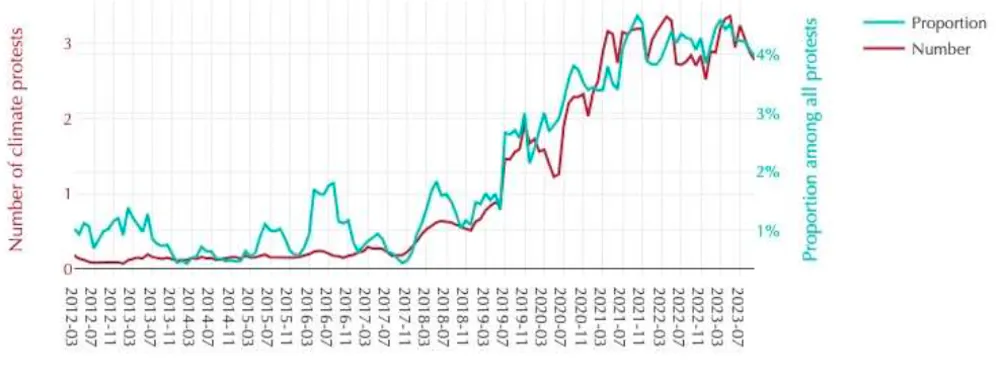
    To look more closely at the global picture of climate and environmental protest – and the repression of it – we used the Armed Conflicts Location Event database. This showed us that climate protests increased dramatically in 2018-2019 and have not declined since. They make up on average about 4% of all protest in the 81 countries that had more than 1,000 protests recorded in the 2012-2023 period:

    Climate protests increased sharply in the late 2010s in the 14 countries studied. (Data is smoothed over five months; number of protests is per country per month.)
    Berglund et al; Data: ACLED, CC BY-SA

    This second graph shows that environmental protest has increased more gradually:

    Environmental protests in the same 14 countries.
    Data: ACLED, CC BY-SA

    We used this data to see what kind of repression activists face. By looking for keywords in the reporting of protest events, we found that on average 3% of climate and environmental protests face police violence, and 6.3% involve arrests. But behind these averages are large differences in the nature of protest and its policing.

    A combination of the presence of protest groups like Extinction Rebellion, who often actively seek arrests, and police forces that are more likely to make arrests, mean countries such as Australia and the UK have very high levels of arrest. Some 20% of Australian climate and environmental protests involve arrests, against 17% in the UK – with the highest in the world being Canada on 27%.

    Meanwhile, police violence is high in countries such as Peru (6.5%) and Uganda (4.4%). France stands out as a European country with relatively high levels of police violence (3.2%) and low levels of arrests (also 3.2%).

    In summary, while criminalisation and repression does not look the same across the world, there are remarkable similarities. It is increasing in a lot of countries, it involves both state and corporate actors, and it takes many forms.

    This repression is taking place in a context where states are not taking adequate action on climate change. By criminalising activists, states depoliticise them. This conceals the fact these activists are ultimately right about the state of the climate and environment – and the lack of positive government action in these areas.

    Oscar Berglund is a member of the Green Party. The report this article is based on was written with Christina Pantazis, Chris Rossdale and Roxana Pessoa Cavalcanti.

    Tie Franco Brotto does not work for, consult, own shares in or receive funding from any company or organisation that would benefit from this article, and has disclosed no relevant affiliations beyond their academic appointment.

    ref. Repression of climate and environmental protest is intensifying across the world – https://theconversation.com/repression-of-climate-and-environmental-protest-is-intensifying-across-the-world-246379

    MIL OSI – Global Reports

  • MIL-OSI USA: FACT SHEET: President  Biden Takes Action to Protect American Workers and Businesses from China’s Unfair Trade Practices in the Semiconductor  Sector

    US Senate News:

    Source: The White House
    A resilient and secure supply of foundational semiconductors is critical to U.S. national and economic security.  These semiconductors are essential to key sectors of the U.S. economy, powering cars, medical devices, critical infrastructure, key aerospace and defense systems, and the goods and services we rely on every day.
    The People’s Republic of China (PRC) routinely engages in non-market policies and practices, as well as industrial targeting, of the semiconductor industry that enables PRC companies to significantly harm competition and create dangerous supply chain dependencies in foundational semiconductors.  
    Today, the Biden-Harris Administration is taking additional action to protect American workers and businesses from the PRC’s unfair trade practices in the semiconductor sector and support a healthy domestic industry for foundational semiconductors. 
    These actions include:
    Launching a Section 301 investigation to examine the PRC’s targeting of foundational semiconductors.
    The Office of the U.S. Trade Representative is launching a Section 301 investigation to examine the PRC’s targeting of foundational semiconductors (also known as legacy or mature node chips) for dominance and the impact on the U.S. economy.
    In addition, the investigation will initially assess the impact of the PRC’s acts, policies, and practices on the production of silicon carbide substrates or other wafers used as inputs into semiconductor fabrication.
    PRC semiconductors often enter the U.S. market as a component of finished goods. This Section 301 investigation will examine a broad range of the PRC’s non-market acts, policies, and practices with respect to the semiconductor sector, including to the extent these semiconductors are incorporated as components into downstream products for critical industries like defense, automotive, medical devices, aerospace, telecommunications, and power generation and the electrical grid. 
    Awarding and catalyzing billions of dollars in semiconductor manufacturing projects across the country.
    The Biden-Harris Administration has championed efforts to ensure more chips are made in America by American workers, in particular through CHIPS and Science Act funding, which allocates at least $2 billion for mature semiconductors.  This was a key part of President Biden’s vision for renewing American economic leadership and a vibrant American industrial base.
    The United States is investing across the semiconductor supply chain—including the upstream materials critical to chip manufacturing such as silicon carbide and wafers.  To date, the Department of Commerce has catalyzed billions of dollars in private sector investments that will serve the American auto and defense industries, including the Texas Instruments projects in Texas and Utah, the GlobalFoundries projects in Vermont and New York, and the Bosch project in California.  Many of these investments also include supply agreements with customers across critical infrastructure industries to maximize the predictability, volume, and quality of domestically manufactured chips needed to power complex technology.  These investments are compounded and sustained by this Administration’s 48D Advanced Manufacturing Investment Credit, which will provide up to a 25% tax incentive for the manufacturing of semiconductors, semiconductor manufacturing equipment, and wafer production.
    Reducing national security risks in federal supply chains.
    Semiconductors are key components of U.S. critical infrastructure that have many military applications. It is vital that federal agencies procure secure and trusted chips. 
    To clean up federal procurement of semiconductors, the Biden-Harris Administration is:
    Implementing a statutory provision in the James M. Inhofe National Defense Authorization Act for FY 2023 that prohibits executive agencies from procuring or obtaining products and services that include chips from certain Chinese fabs and other entities of concern.
    Releasing a Request for Information (RFI) to gauge the best ways for government contractors to scale up their use of domestically manufactured chips, particularly for critical infrastructure.  The RFI intends to solicit commercial ideas from industry that may inform future policymaking in support of the government-wide effort to leverage existing manufacturing capacity.
    Issuing guidance to help the Federal Government – the world’s largest buyer – organize its demand for domestic semiconductors so that agencies can mitigate the risk posed by undue dependence on foreign manufacturing, limited competition, and possible higher manufacturing costs.  This effort includes agencies developing strategies to dual or multiple source semiconductors, increasing transparency for critical infrastructure supply chains, and providing the government’s demand for the products and services that use these chips.
    Prioritizing supply chain resilience and bolstering our toolkit to address non-market policies and practices.
    President Biden made supply chain resilience a Day One priority in his Administration.  The first-ever U.S. Government Quadrennial Supply Chain Review, published on December 19, provides an in-depth assessment of the United States’ critical supply chains, actions taken over the last four years to make each supply chain more resilient, and necessary steps to increase U.S. resilience in the future. 
    The Review includes a comprehensive strategy to respond to non-market policies and practices because they pose a significant challenge in critical industries covered in the supply chain report.  The strategy details the types of comprehensive action necessary to combat non-market policies and practices, including procurement policies. 
    Working with our partners around the world to strengthen cooperation on semiconductor supply chains and address shared concerns about China’s unfair practices.
    Semiconductor supply chains are critical not only to the United States but to all of our allies and partners.  The Biden-Harris Administration has closely consulted with allies and partners on promoting economic resilience and addressing the PRC’s non-market practices in the semiconductor supply chain, including through the following efforts:
    The State Department launched the CHIPS and Science Act’s International Technology Security and Innovation (ITSI) Fund, which has thus far partnered with eight countries – Costa Rica, Panama, Vietnam, Indonesia, India, Kenya, the Philippines, and Mexico – to promote semiconductor supply chain development, security, and diversification.
    The Department of Commerce announced the Indo-Pacific Economic Framework for Prosperity (IPEF) Agreement Relating to Supply Chain Resilience with 13 diverse partner countries across the Indo-Pacific, led by the United States, to coordinate more resilient supply chains for semiconductors and other industries.
    Within the G7, the United States has championed efforts to bolster economic resilience and address harmful market distortions and global excess capacity in key sectors resulting from non-market policies and practices.   This led to the establishment of mechanisms to jointly monitor and respond to these detrimental practices, including in the semiconductor sector.  
    President Biden recognizes the benefits for our workers and businesses from strong alliances and a rules-based international trade system based on fair competition.  The Biden-Harris Administration will continue to collaborate with allies and partners on this critical issue in the coming days and weeks.  

    MIL OSI USA News

  • MIL-OSI: Bitget Ranks Among Top 3 Crypto Exchanges for Futures Trading in November Report

    Source: GlobeNewswire (MIL-OSI)

    VICTORIA, Seychelles, Dec. 23, 2024 (GLOBE NEWSWIRE) — Bitget, the leading cryptocurrency exchange and Web3 company, has shared its monthly transparency report highlighting the ecosystem’s strong performance in November 2024. The cryptomarket saw a sharp increase, with Bitcoin surging past $106,000. At Bitget, this ATH trend was replicated, with Bitget Token (BGB) rising from approximately $1.44 to $1.70, marking an increase of around 18%. This upward trend was driven by Bitget’s global expansion and significant growth in trading volumes, user engagement, and platform security, especially achieving the third position worldwide in global futures trading.

    Bitget retained over 45 million users with a daily trading volume of $10 billion, while USDT-M futures trading volume surged to $16 billion, and daily spot trading volume doubled, reaching $400 million. Its Protection Fund, growing impressively from $400 million+ to over $600 million, supports strong security and user trust on the platform.

    In November, Bitget’s top-performing spot tokens saw impressive growth, led by UNICE at 2666.71%. Additionally, 13 tokens were listed on Poolx, and 5 tokens among these were also featured in Pre-market listings, showcasing strong interest and dual exposure for these assets.

    Bitget hosted “Pitch n’ Slay” event in Bangkok. Under Bitget’s Blockchain4Her program, the competition provided exposure, capital and guidance for female entrepreneurs in the blockchain space and offered a chance to secure up to $100,000 in funding by Foresight Ventures. Pitch n’ Slay showcased the power of collaboration in creating inclusive pathways for women in blockchain, aligning with Bitget’s commitment to fostering a diverse and thriving blockchain ecosystem.

    Bitget introduced VND Bank Transfer in Vietnam. It enables users to deposit VND through VietQR and withdraw funds via bank transfers to purchase popular crypto such as BTC, ETH, USDT, SOL, and BGB through Bitget’s cash conversion feature.

    Bitget Wallet introduced a comprehensive memecoin trading toolkit, enabling users to discover high-potential tokens, analyze critical data, and trade seamlessly across multiple chains. Additionally, it launched the Refer2Earn Program, encouraging user growth through passive income, and a $20M Telegram Mini-App Support Program to empower developers and drive innovation in the Telegram ecosystem.

    Bitget’s strong performance shows it shines again as the top global players in the crypto industry. The company will keep focusing on innovation, user engagement, and market expansion in the rapidly evolving crypto sector, ongoingly bridging CeFi and DeFi, and expanding access to decentralized finance.

    For more information, please visit the monthly report here.

    About Bitget

    Established in 2018, Bitget is the world’s leading cryptocurrency exchange and Web3 company. Serving over 45 million users in 150+ countries and regions, the Bitget exchange is committed to helping users trade smarter with its pioneering copy trading feature and other trading solutions, while offering real-time access to Bitcoin priceEthereum price, and other cryptocurrency prices. Formerly known as BitKeep, Bitget Wallet is a world-class multi-chain crypto wallet that offers an array of comprehensive Web3 solutions and features including wallet functionality, token swap, NFT Marketplace, DApp browser, and more.
    Bitget is at the forefront of driving crypto adoption through strategic partnerships, such as its role as the Official Crypto Partner of the World’s Top Football League, LALIGA, in EASTERN, SEA and LATAM market, as well as a global partner of Turkish National athletes Buse Tosun Çavuşoğlu (Wrestling world champion), Samet Gümüş (Boxing gold medalist) and İlkin Aydın (Volleyball national team), to inspire the global community to embrace the future of cryptocurrency.

    For more information, visit: WebsiteTwitterTelegramLinkedInDiscordBitget Wallet
    For media inquiries, please contact: media@bitget.com

    Risk Warning: Digital asset prices are subject to fluctuation and may experience significant volatility. Investors are advised to only allocate funds they can afford to lose. The value of any investment may be impacted, and there is a possibility that financial objectives may not be met, nor the principal investment recovered. Independent financial advice should always be sought, and personal financial experience and standing carefully considered. Past performance is not a reliable indicator of future results. Bitget accepts no liability for any potential losses incurred. Nothing contained herein should be construed as financial advice. For further information, please refer to our Terms of Use.

    A photo accompanying this announcement is available at https://www.globenewswire.com/NewsRoom/AttachmentNg/44eb3496-f2b3-4044-a147-b66820609d72

    The MIL Network

  • MIL-OSI: Bitget Partners with Fiat24 to Advance PayFi Solutions for Crypto

    Source: GlobeNewswire (MIL-OSI)

    VICTORIA, Seychelles, Dec. 23, 2024 (GLOBE NEWSWIRE) — Bitget, the leading cryptocurrency exchange and Web3 company, has announced a strategic partnership with Fiat24, a Swiss-regulated fintech company that develops modern banking solutions powered by blockchain technology. The collaboration focuses on exploring PayFi solutions for major cryptos like Ethereum (ETH) and Bitget Token (BGB), as well as stablecoins such as USD Coin (USDC). This initiative aims to provide seamless, efficient, and secure payment solutions that bridge traditional and decentralized financial ecosystems.

    Bitget has recently made significant progress in the PayFi space with the launch of services such as Bitget Pay and Bitget Card. Bitget Pay enables low-fee, instant crypto payments, while the Bitget Card allows users to seamlessly convert crypto into fiat for real-world transactions using a globally accepted debit card.

    Fiat24, on the other hand, offers a regulated Swiss-based payment system to users across 65 countries and regions, providing access to a crypto-friendly Swiss offshore bank account paired with a Mastercard debit card. This blockchain-driven approach ensures transparency, security, and user ownership.

    The partnership between Bitget and Fiat24 combines Bitget’s comprehensive crypto ecosystem with Fiat24’s innovative infrastructure. Together, they aim to expand the use cases for ETH, BGB, and stablecoins, driving accessibility and adoption of PayFi solutions globally.

    “We are excited to collaborate with Fiat24 to advance crypto payments and simplify access to financial services for users worldwide, especially the unbanked,” said Gracy Chen, CEO at Bitget. “PayFi will be one of Bitget and BGB’s long-term strategies and a key approach to enhancing the real-world impact of crypto assets. Together with our partners, we envision a future where crypto payments become the norm.”

    About Bitget

    Established in 2018, Bitget is the world’s leading cryptocurrency exchange and Web3 company. Serving over 45 million users in 150+ countries and regions, the Bitget exchange is committed to helping users trade smarter with its pioneering copy trading feature and other trading solutions, while offering real-time access to Bitcoin priceEthereum price, and other cryptocurrency prices. Formerly known as BitKeep, Bitget Wallet is a world-class multi-chain crypto wallet that offers an array of comprehensive Web3 solutions and features including wallet functionality, token swap, NFT Marketplace, DApp browser, and more.

    Bitget is at the forefront of driving crypto adoption through strategic partnerships, such as its role as the Official Crypto Partner of the World’s Top Football League, LALIGA, in EASTERN, SEA and LATAM market, as well as a global partner of Turkish National athletes Buse Tosun Çavuşoğlu (Wrestling world champion), Samet Gümüş (Boxing gold medalist) and İlkin Aydın (Volleyball national team), to inspire the global community to embrace the future of cryptocurrency.

    For more information, visit: WebsiteTwitterTelegramLinkedInDiscordBitget Wallet
    For media inquiries, please contact: media@bitget.com

    Risk Warning: Digital asset prices are subject to fluctuation and may experience significant volatility. Investors are advised to only allocate funds they can afford to lose. The value of any investment may be impacted, and there is a possibility that financial objectives may not be met, nor the principal investment recovered. Independent financial advice should always be sought, and personal financial experience and standing carefully considered. Past performance is not a reliable indicator of future results. Bitget accepts no liability for any potential losses incurred. Nothing contained herein should be construed as financial advice. For further information, please refer to our Terms of Use.

    A photo accompanying this announcement is available at https://www.globenewswire.com/NewsRoom/AttachmentNg/e693ef7b-cac1-4f78-9c91-fcb74f563615

    The MIL Network

  • MIL-OSI Banking: BoBC Auction Results – 23 December 2024

    Source: Bank of Botswana

    The Monetary Policy Rate (MoPR) was unchanged at 1.9 percent of the previous week, for a paper maturing on 31 December 2024.   The summarised results of the auction held on 23 December 2024, are attached below:

    BOBC Results 23 December 2024.pdf

    MIL OSI Global Banks

  • MIL-OSI Global: Octopuses and their relatives are a new animal welfare frontier − here’s what scientists know about consciousness in these unique creatures

    Source: The Conversation – USA – By Rachel Blaser, Professor of Neuroscience, Cognition and Behavior, University of San Diego

    A common octopus (Octopus vulgaris) off Croatia in the Mediterranean Sea. Reinhard Dirscherl/ullstein bild via Getty Images

    We named him Squirt – not because he was the smallest of the 16 cuttlefish in the pool, but because anyone with the audacity to scoop him into a separate tank to study him was likely to get soaked. Squirt had notoriously accurate aim.

    As a comparative psychologist, I’m used to assaults from my experimental subjects. I’ve been stung by bees, pinched by crayfish and battered by indignant pigeons. But, somehow, with Squirt it felt different. As he eyed us with his W-shaped pupils, he seemed clearly to be plotting against us.

    A common cuttlefish (Sepia officinalis) in Portugal’s Arrábida Natural Park.
    Diego Delso/Wikipedia, CC BY-SA

    Of course, I’m being anthropomorphic. Science does not yet have the tools to confirm whether cuttlefish have emotional states, or whether they are capable of conscious experience, much less sinister plots. But there’s undeniably something special about cephalopods – the class of ocean-dwelling invertebrates that includes cuttlefish, squid and octopus.

    As researchers learn more about cehpalopods’ cognitive skills, there are calls to treat them in ways better aligned with their level of intelligence. California and Washington state both approved bans on octopus farming in 2024. Hawaii is considering similar action, and a ban on farming octopus or importing farmed octopus meat has been introduced in Congress. A planned octopus farm in Spain’s Canary Islands is attracting opposition from scientists and animal welfare advocates.

    Critics offer many arguments against raising octopuses for food, including possible releases of waste, antibiotics or pathogens from aquaculture facilities. But as a psychologist, I see intelligence as the most intriguing part of the equation. Just how smart are cephalopods, really? After all, it’s legal to farm chickens and cows. Is an octopus smarter than, say, a turkey?

    A deepwater octopus investigates the port manipulator arm of the ALVIN submersible research vessel.
    NOAA, CC BY

    A big, diverse group

    Cephalopods are a broad class of mollusks that includes the coleoids – cuttlefish, octopus and squid – as well as the chambered nautilus. Coleoids range in size from adult squid only a few millimeters long (Idiosepius) to the largest living invertebrates, the giant squid (Architeuthis) and colossal squid (Mesonychoteuthis) which can grow to over 40 feet in length and weigh over 1,000 pounds.

    Some of these species live alone in the nearly featureless darkness of the deep ocean; others live socially on active, sunny coral reefs. Many are skilled hunters, but some feed passively on floating debris. Because of this enormous diversity, the size and complexity of cephalopod brains and behaviors also varies tremendously.

    Almost everything that’s known about cephalopod cognition comes from intensive study of just a few species. When considering the welfare of a designated species of captive octopus, it’s important to be careful about using data collected from a distant evolutionary relative.

    Marine biologist Roger Hanlon explains the distributed structure of cephalopod brains and how they use that neural power.

    Can we even measure alien intelligence?

    Intelligence is fiendishly hard to define and measure, even in humans. The challenge grows exponentially in studying animals with sensory, motivational and problem-solving skills that differ profoundly from ours.

    Historically, researchers have tended to focus on whether animals think like humans, ignoring the abilities that animals may have that humans lack. To avoid this problem, scientists have tried to find more objective measures of cognitive abilities.

    One option is a relative measure of brain to body size. The best-studied species of octopus, Octopus vulgaris, has about 500 million neurons; that’s relatively large for its small body size and similar to a starling, rabbit or turkey.

    More accurate measures may include the size, neuron count or surface area of specific brain structures thought to be important for learning. While this is useful in mammals, the nervous system of an octopus is built completely differently.

    Over half of the neurons in Octopus vulgaris, about 300 million, are not in the brain at all, but distributed in “mini-brains,” or ganglia, in the arms. Within the central brain, most of the remaining neurons are dedicated to visual processing, leaving less than a quarter of its neurons for other processes such as learning and memory.

    In other species of octopus, the general structure is similar, but complexity varies. Wrinkles and folds in the brain increase its surface area and may enhance neural connections and communication. Some species of octopus, notably those living in reef habitats, have more wrinkled brains than those living in the deep sea, suggesting that these species may possess a higher degree of intelligence.

    Holding out for a better snack

    Because brain structure is not a foolproof measure of intelligence, behavioral tests may provide better evidence. One of the highly complex behaviors that many cephalopods show is visual camouflage. They can open and close tiny sacs just below their skin that contain colored pigments and reflectors, revealing specific colors. Octopus vulgaris has up to 150,000 chromatophores, or pigment sacs, in a single square inch of skin.

    Like many cephalopods, the common cuttlefish (Sepia officinalis) is thought to be colorblind. But it can use its excellent vision to produce a dizzying array of patterns across its body as camouflage. The Australian giant cuttlefish, Sepia apama, uses its chromatophores to communicate, creating patterns that attract mates and warn off aggressors. This ability can also come in handy for hunting; many cephalopods are ambush predators that blend into the background or even lure their prey.

    The hallmark of intelligent behavior, however, is learning and memory – and there is plenty of evidence that some octopuses and cuttlefish learn in a way that is comparable to learning in vertebrates. The common cuttlefish (Sepia officinalis), as well as the common octopus (Octopus vulgaris) and the day octopus (Octopus cyanea), can all form simple associations, such as learning which image on a screen predicts that food will appear.

    Some cephalopods may be capable of more complicated forms of learning, such as reversal learning – learning to flexibly adjust behavior when different stimuli signal reward. They may also be able to inhibit impulsive responses. In a 2021 study that gave common cuttlefish a choice between a less desirable but immediate snack of crab and a preferred treat of live shrimp after a delay, many of the cuttlefish chose to wait for the shrimp.

    Cuttlefish perform in an experiment adapted from the Stanford “marshmallow test,” which was designed to see whether children could practice delayed gratification.

    A new frontier for animal welfare

    Considering what’s known about their brain structures, sensory systems and learning capacity, it appears that cephalopods as a group may be similar in intelligence to vertebrates as a group. Since many societies have animal welfare standards for mice, rats, chickens and other vertebrates, logic would suggest that there’s an equal case for regulations enforcing humane treatment of cephalopods.

    Such rules generally specify that when a species is held in captivity, its housing conditions should support the animal’s welfare and natural behavior. This view has led some U.S. states to outlaw confined cages for egg-laying hens and crates too narrow for pregnant sows to turn around.

    Animal welfare regulations say little about invertebrates, but guidelines for the care and use of captive cephalopods have started to appear over the past decade. In 2010, the European Union required considering ethical issues when using cephalopods for research. And in 2015, AAALAC International, an international accreditation organization for ethical animal research, and the Federation of European Laboratory Animal Science Associations promoted guidelines for the care and use of cephalopods in research. The U.S. National Institutes of Health is currently considering similar guidelines.

    The “alien” minds of octopuses and their relatives are fascinating, not the least because they provide a mirror through which we can reflect on more familiar forms of intelligence. Deciding which species deserve moral consideration requires selecting criteria, such as neuron count or learning capacity, to inform those choices.

    Once these criteria are set, it may be well to also consider how they apply to the rodents, birds and fish that occupy more familiar roles in our lives.

    Rachel Blaser does not work for, consult, own shares in or receive funding from any company or organization that would benefit from this article, and has disclosed no relevant affiliations beyond their academic appointment.

    ref. Octopuses and their relatives are a new animal welfare frontier − here’s what scientists know about consciousness in these unique creatures – https://theconversation.com/octopuses-and-their-relatives-are-a-new-animal-welfare-frontier-heres-what-scientists-know-about-consciousness-in-these-unique-creatures-241978

    MIL OSI – Global Reports

  • MIL-OSI USA: Deputy Secretary of Defense Kathleen Hicks Makes Holiday Calls to Deployed Service Members

    Source: United States Department of Defense

    Pentagon Spokesman Eric Pahon provided the following readout:

    Deputy Secretary of Defense Kathleen Hicks spoke today via video call with deployed service members from the U.S. Air Force, U.S. Army, and U.S. Navy to wish them happy holidays.

    During the conversations, Deputy Secretary Hicks thanked the service members and their families for their unwavering dedication and sacrifice in defense of the nation.

    She commended their commitment and hard work toward ensuring the safety and security of the United States, as well as their continued commitment to supporting America’s allies and partners around the globe.

    Deputy Secretary Hicks spoke with service members from the following units:

    • 2nd Security Force Assistance Brigade. Soldiers from this unit are deployed to Camp Lemonnier, Djibouti, to develop the Djiboutian security forces’ capabilities and capacity to rapidly deter threats through the Battalion Intervention Rapide (BIR).
    • 480th Expeditionary Fighter Generation Squadron. Airmen from this unit are deployed to Prince Sultan Air Base, Saudia Arabia, supporting aircraft and training requirements in the U.S. Central Command area of responsibility.
    • USS Gettysburg (CG 64). Sailors aboard USS Gettysburg (CG 64), a Ticonderoga-class guided-missile cruiser, are deployed in defense of the Harry S. Truman Strike Group to ensure regional stability and security in the U.S. Central Command area of responsibility. 

    Deputy Secretary Hicks also commended the professionalism and integrity with which U.S. service members worldwide carry out their duties, and the vital contributions of military families in support of our all-volunteer force.

    MIL OSI USA News

  • MIL-OSI NGOs: South Sudan receives thousands of displaced and injured people fleeing intensified war in Sudan

    Source: Médecins Sans Frontières –

    Juba – As South Sudan receives a massive influx of tens of thousands of people fleeing the intensified war in Sudan, Médecins Sans Frontières (MSF) is scaling up its response to the humanitarian crisis in Renk and surrounding informal settlements along the border. Over the last weeks the number of recently displaced people has surpassed 80,000, including hundreds of people with war wounds. MSF is calling for immediate, coordinated humanitarian and medical support for displaced people to address critical gaps and prevent further suffering.

    Over 5,000 people have crossed into South Sudan each day since the beginning of December, as the fighting escalates near the border in Sudan’s White Nile, Blue Nile, and Sennar states. The influx of people into Renk town and surrounding areas has overwhelmed an area that is already scarce of resources, leaving displaced people in crisis.  

    “We have added 14 tents around the hospital to make space for the war-wounded patients that are arriving at Renk County hospital,” says Emanuele Montobbio, MSF emergency coordinator in Renk. “There is no place for other tents in the surroundings, while patients and their families keep coming to the hospital.”

    “We are working alongside the International Committee of the Red Cross (ICRC) to treat war-wounded patients and manage the growing influx of critical cases and the mass casualty response in pre- and post-operative care wards, but the situation is completely overwhelming and it’s not enough,” he says. “Just a few dozen people have been treated with surgical interventions and tetanus vaccinations in recent weeks, while over 100 wounded patients, many with serious injuries, still await surgery.”

    Outside the transit centres within Renk and in informal settlements, thousands are forced to live under trees or in makeshift shelters, with limited access to food, clean water, healthcare or any other basic services. The poor water and sanitation conditions are heightening the risk of disease outbreaks at a time when Renk is already experiencing a cholera outbreak.  

    “Immediate action must be taken,” says Roselyn Morales, MSF deputy medical coordinator in South Sudan, following the team’s assessment on the ground. “Thousands of people are living in dire conditions under the open sky in informal settlements, facing critical shortages of food, clean water, shelter and healthcare.”

    A stagnant pool of water is the only easily accessible water source in the Jerbana informal settlement. Both humans and livestock depend on this pool, which is gradually drying up. South Sudan, 19 December 2024.
    Isaac Buay/MSF

    “We urgently call on both South Sudanese authorities and international organisations to rapidly scale up their response in Renk and beyond, ensuring that the essential and lifesaving needs of the affected population are addressed without delay,” she says.

    The two transit centres in Renk, which are designed to accommodate a maximum of 8,000 people, are now sheltering over 17,000. While most returnees and refugees initially entered South Sudan through the official Joda border crossing, an increasing number are now crossing through informal routes to the east of Renk. More than 82,000 new arrivals have been recorded in areas including Joda, Duku Duku, Jerbana, Shemmedi, Gosfami, and Atam.  

    “Our village was in flames,” says Alhida Hammed, who is displaced from Sudan’s Blue Nile state and is currently under treatment for a gunshot wound at Renk County hospital. “The houses were blazing, and everyone was running in different directions. We have been displaced and now live under a tree. I have no desire to return home. Home is no longer a home—it is filled with bad memories.” 

    “I used to only hear about air raids, but recently, it became a reality,” says Bashir Ismail, who is from Mosmon in Sudan’s Blue Nile state. “I was at the market buying some items when the bombing started. Something hit me in the chest—it was the most painful experience of my life. I was so disoriented that it felt like I had lost my memory. The next thing I knew, I was in Renk County hospital.” 

    MSF is deploying mobile clinics to provide general healthcare in informal settlements in Gosfami, Atam, Jerbana and Joda, where displaced people are concentrated. On 17 December alone, MSF teams conducted over 250 medical consultations in Gosfami and referred severely ill people to Renk County hospital.

    We are also launching activities in response to the urgent need for water and sanitation in Atam and Jerbana. Additionally, relief items have been delivered to these areas for distribution to 2,500 displaced families. However, despite these efforts, the response remains insufficient due to the absence of other humanitarian organisations in these informal settlements, which has left a significant gap in support for displaced people.

    MIL OSI NGO

  • MIL-OSI United Kingdom: The UK calls on all parties to the conflict to refrain from obstructing MONUSCO operations: UK Statement at the UN Security Council

    Source: United Kingdom – Executive Government & Departments

    Explanation of vote delivered by Ambassador James Kariuki, UK Deputy Permanent Representative to the UN, following the vote on renewing MONUSCO’s mandate.

    The United Kingdom welcomes the adoption of this resolution renewing MONUSCO’s mandate. And we thank France and Sierra Leone for their leadership of the negotiations.

    I would like to make two points.

    First, The UK is disappointed by the postponement of the Luanda Process Heads of State Summit scheduled for 15 December.

    We remain greatly appreciative of Angola’s mediation efforts and urge all parties to engage with the Luanda Process in good faith and deliver on their commitments.

    Second, we are concerned by the surge in violence since the 15 December.

    In this context, the UK is concerned by the presence of Rwanda Defence Forces in DRC, as reported by the Group of Experts. 

    We call on all parties to the conflict to refrain from obstructing MONUSCO operations.

    Updates to this page

    Published 20 December 2024

    MIL OSI United Kingdom

  • MIL-OSI NGOs: MSF condemns RSF violent attack on Bashair Teaching hospital in South Khartoum

    Source: Médecins Sans Frontières –

    Khartoum – Médecins Sans Frontières (MSF) strongly condemns the violent incursion by the Rapid Support Forces (RSF) into the emergency room of Bashair Teaching hospital in South Khartoum, Sudan, on 18 December. The attackers fired weapons inside the emergency ward, directly threatened medical staff, and severely disrupted lifesaving care. MSF urgently calls on RSF to respect the neutrality of medical facilities and the safety of healthcare workers.

    This latest attack follows an earlier incident on 11 November, when armed fighters stormed the hospital, fired shots, and killed a patient receiving treatment. These repeated violations of the neutrality of healthcare facilities and the sanctity of medical care are unacceptable.

    “Several RSF soldiers entered the emergency rooms and some of them started firing against medical personnel, threatening patients and MSF and Ministry of Health staff,” says Samuel David Theodore, MSF’s head of mission in Sudan.  

    “Luckily, no one was injured but everyone is extremely affected by this traumatic aggression inside the hospital. Attacks against medical facilities and health personnel are unacceptable, hospitals must remain safe spaces, free from violence and intimidation. Staff cannot have their lives threatened whilst they provide care,” he says. 

    The bullet marks left by the Rapid Support Forces inside the emergency room of Bashair Teaching hospital in South Khartoum, Sudan, 19 December 2024.
    MSF

    Bashair Teaching hospital is one of the last functioning healthcare facilities in South Khartoum amidst the ongoing conflict. MSF staff have tirelessly maintained lifesaving activities under exceptionally difficult conditions.

    “Bashair Teaching hospital is a lifeline for thousands of people in South Khartoum,” says Claire San Filippo, emergency coordinator for Sudan. “MSF support is critical for countless men, women, and children affected by this devastating conflict.  However, the safety of our patients and staff is paramount. Attacks like these severely compromise our ability to continue operating.”

    Since the beginning of June 2024, MSF has conducted 12,396 emergency consultations, 2,510 patients were admitted in the maternity ward, and 4,490 children were screened for malnutrition at Bashair Teaching hospital in South Khartoum. 

    MIL OSI NGO

  • MIL-OSI United Nations: Outraged by Killing of Three World Food Programme Staff Members in Sudan, Secretary-General Calls for Thorough Investigation

    Source: United Nations General Assembly and Security Council

    The following statement was issued today by the Spokesman for UN Secretary-General António Guterres:

    The Secretary-General is outraged by the killing of three World Food Programme (WFP) staff members in Sudan on 19 December, when the agency’s field office in Yabus, in Blue Nile State, was hit by aerial bombardment.

    He sends his deepest condolences to the families of the victims and their WFP colleagues.

    The Secretary-General condemns all attacks on UN and aid personnel and facilities.  He calls for a thorough investigation.

    Yesterday’s incident underscores the devastating toll that Sudan’s brutal conflict is having on millions of people in need and the humanitarians trying to reach them with life-saving assistance.

    2024 is the deadliest year on record for aid workers in Sudan.  Yet, despite significant threats to their personal safety, they continue to do all they can to provide vital support wherever it is needed.

    The Secretary-General calls on the parties to adhere to their obligations to protect civilians, including aid personnel, as well as humanitarian premises and supplies. Attacks must not be directed against them and all feasible precautions must be taken to avoid harming them.

    After more than 20 months of conflict in Sudan, the Secretary-General once again stresses the need for an immediate ceasefire.  The United Nations will continue to back international mediation efforts and work with all relevant stakeholders to help bring an end to the war.

    MIL OSI United Nations News

  • MIL-OSI Video: Secretary Blinken participates in a UN Security Council Session on Sudan

    Source: United States of America – Department of State (video statements)

    Secretary of State Antony J. Blinken participates in a UN Security Council Session on Sudan in New York City, New York, on December 19, 2024.

    Transcript: https://www.state.gov/secretary-antony-j-blinken-at-a-un-security-council-meeting-on-sudan/
    ———-
    Under the leadership of the President and Secretary of State, the U.S. Department of State leads America’s foreign policy through diplomacy, advocacy, and assistance by advancing the interests of the American people, their safety and economic prosperity. On behalf of the American people we promote and demonstrate democratic values and advance a free, peaceful, and prosperous world.

    The Secretary of State, appointed by the President with the advice and consent of the Senate, is the President’s chief foreign affairs adviser. The Secretary carries out the President’s foreign policies through the State Department, which includes the Foreign Service, Civil Service and U.S. Agency for International Development.

    Get updates from the U.S. Department of State at www.state.gov and on social media!
    Facebook: https://www.facebook.com/statedept
    Twitter: https://twitter.com/StateDept
    Instagram: https://www.instagram.com/statedept
    Flickr: https://flickr.com/photos/statephotos/

    Subscribe to the State Department Blog: https://www.state.gov/blogs
    Watch on-demand State Department videos: https://video.state.gov/
    Subscribe to The Week at State e-newsletter: http://ow.ly/diiN30ro7Cw

    State Department website: https://www.state.gov/
    Careers website: https://careers.state.gov/
    White House website: https://www.whitehouse.gov/
    Terms of Use: https://state.gov/tou

    #StateDepartment #DepartmentofState #Diplomacy

    https://www.youtube.com/watch?v=U4_KCmexhFw

    MIL OSI Video

  • MIL-OSI Russia: Dmitry Chernyshenko: All-Russian Phygital Games in 2025 will be held in Nizhny Novgorod

    Translation. Region: Russian Federation –

    Source: Government of the Russian Federation – An important disclaimer is at the bottom of this article.

    Previous news Next news

    Dmitry Chernyshenko announced the country’s phygital capital in 2025

    As part of the year-end review, the Government Coordination Center announced the country’s phygital capital in 2025. The qualifying tournament for the upcoming Games of the Future – the Phygital Games – will be held next year in Nizhny Novgorod.

    “At the initiative of our President, a new, previously non-existent movement, “phygital”, was created. The first Games of the Future in human history were held with great success, and the heads of seven states came to the Games at the invitation. The format that we created has already been supported in 106 countries,”

    noted Deputy Prime Minister Dmitry Chernyshenko.

    Phygital disciplines competitions are held in Serbia, Armenia, Cameroon, Uzbekistan and other countries.

    In Russia, the development of the phygital movement is defined by a concept approved by the Government. Moreover, the word “phygital” has become one of the main state words of the year in Russia, along with the words “self-realization”, “historical education” and “sovereignty”. More than 3 thousand documents were used for the analysis. RANEPA experts conducted a quantitative and qualitative analysis of strategic planning documents and speeches by Vladimir Putin.

    “Russia, as a founding country, must first of all show at home what the development of this amazing product can be. A product that creates a completely new, harmoniously developed personality, which is equally perfect in both the digital and real worlds,” added Dmitry Chernyshenko.

    “32 regions have already actively joined the work, 300 of our athletes have already participated in the selection and will go to the Future Games in the Emirates. We would like to wish the guys there all sorts of victories, success, as Russia is used to being a leader in all areas, including sports. We are a great sports power. And despite the fact that phygital is at the intersection of science, education and sports, it is something completely new. We want to give all the records there our resounding names,” the Deputy Prime Minister noted.

    In 2025, the GOTF.Major.Russia Phygital Games will be held in Nizhny Novgorod. 14 Russian cities bid for the right to host the tournament.

    “The phygital movement in the Nizhny Novgorod Region is developing at a rapid pace. This year, as part of “CIPR-2024”, we held the first phygital festival, and in the summer – the first phygital camp, we include competitions in phygital basketball, football, racing, hockey and even phygital sledge hockey in the largest sports tournaments. At mass sports events, we organize master classes so that as many children as possible who are keen on computer games get involved in classic sports, and athletes of basic sports gain additional skills with the help of “phygital”. I thank the organizers for choosing our site to hold the All-Russian Phygital Games. It is a great honor for us to host this tournament in the Nizhny Novgorod region. We will make every effort to ensure that the competitions are not only held at the highest level, but also become a real celebration of the sports of the future for all participants,” said the Governor of the Nizhny Novgorod Region, Gleb Nikitin.

    The Future Games is a unique tournament in the phygital concept, a sports show of a new format that combines competitions in the physical and digital dimensions. The Future Games 2024 tournament, which was held in Kazan from February 21 to March 3, 2024, was attended by more than 2,000 athletes from different countries in 21 innovative disciplines. The baton of the Future Games was picked up by other countries: next year the tournament will be held in the United Arab Emirates, and in 2026 – in Kazakhstan.

    Phygital Games are annual all-Russian competitions in phygital sports. Teams that win the competitions receive the right to participate in the international qualification, and in case of collecting a sufficient number of rating points, a direct ticket to the annual international multi-sport tournament “Games of the Future”.

    The Phygital Games 2024 were held in Moscow from September 1 to 8 at the venue of the forum and festival “Territory of the Future. Moscow 2030” in the Luzhniki sports complex. They included competitions of the Russian Phygital Sports Championship 2024 in the disciplines “Rhythm Simulator” and “Tactical Shooting” and the national qualification in Phygital Football and Phygital Basketball.

    Please note: This information is raw content directly from the source of the information. It is exactly what the source states and does not reflect the position of MIL-OSI or its clients.

    MIL OSI Russia News

  • MIL-OSI United Kingdom: The UK will continue to work closely with UNOWAS to build peace and security in West Africa and the Sahel: UK statement at the UN Security Council

    Source: United Kingdom – Executive Government & Departments

    Statement by Fergus Eckersley, UK Minister Counsellor, at the UN Security Council meeting on West Africa and the Sahel.

    First, the United Kingdom congratulates Senegal, Ghana, and Mauritania on their successful recent elections. 

    But, elsewhere, democracy and civic space remain under pressure, with civil society organisations, human rights defenders, journalists and media institutions facing severe challenges.

    Timelines for the return to constitutional governments in Mali and Burkina Faso have either been delayed or remain unclear, and Niger is also yet to establish a transition timeline. 

    Guinea’s transition timeline has also slipped again. We urge that the return to constitutional order is completed swiftly. Inclusive and transparent democratic processes are crucial for stability and peace.

    Second, the security situation across the Sahel is worsening, with terrorist and insurgent activities, serious and organised crime, and external actors and proxies exacerbating instability.

    Private military security companies, like Russia’s Wagner Group and Africa Corps, are not the answer. They have a track record of worsening existing conflicts and undermining long-term development and stability.

    We are concerned about the economic impact of deteriorating security in already fragile states. 

    Many countries in the Sahel now face difficulties accessing the financing they need to maintain macroeconomic stability and sustain growth.

    The United Kingdom also notes the outcome of the recent ECOWAS summit held on 15 December, including the announcement of the six-month grace period for the Alliance of Sahelian States. 

    We urge all states in the region to cooperate to tackle the growing security, development, governance challenges and transnational threats. Maintaining strong links between states is critical.

    Third, we are extremely concerned by the deteriorating regional humanitarian situation.

    Extreme flooding has affected over 3.7 million people in West Africa this year and has contributed to worsening food insecurity, further fuelled by conflict, displacement and climate change.

    Since 2019, UK aid has supported over 16 million people in the Sahel with life-saving assistance. 

    But access is increasingly restricted. 

    We call on all actors to ensure safe and unimpeded access for humanitarian assistance. 

    Armed escorts must remain a last resort.

    In closing, the UK looks forward to deepening bilateral partnerships, and continuing to work closely with UNOWAS and regional organisations to help build peace and security in West Africa and the Sahel.

    Updates to this page

    Published 20 December 2024

    MIL OSI United Kingdom

  • MIL-OSI Global: Saudi Arabia is a controversial choice to host the World Cup, but the spotlight and scrutiny might spark change

    Source: The Conversation – UK – By Wasim Ahmed, Senior Lecturer in Marketing, University of Hull

    The official announcement that Saudi Arabia would host the 2024 Fifa men’s World Cup came as a surprise to nobody. Hosting rights have been on the country’s geopolitical agenda for many years, and football’s international governing body was more than happy to oblige.

    Both parties have come in for heavy criticism as a result.

    A joint statement from 21 campaign groups, including Amnesty International, accused Fifa of making “empty human rights commitments”. The apparent lack of a competitive bidding process was ridiculed, and concerns were raised about the the potential environmental impact.

    So what was Fifa thinking?

    After all the controversy over the 2022 tournament in Qatar (and Russia in 2018) has it simply doubled down on being impervious to global criticism? Or is it genuinely trying to perform a balancing act which fairly distributes the geopolitical and economic power of football?

    Whatever the underlying reason, Fifa has become well practised at defending itself. It said that for the 2034 tournament, a “comprehensive consultation process” had taken place. Fifa president Gianni Infantino added that he expects Saudi Arabia to deliver “social improvements [and] positive human rights impacts” as “one of the responsibilities of hosting a World Cup”.

    And there is some evidence which actually backs up this stance. It has been suggested for example, that after the intense scrutiny around its hosting of the 2022 World Cup, Qatar’s approach to human rights and the treatment of migrant workers improved.

    It could also be argued that Fifa is opening up the sport to new regions, away from the traditional power bases of football. After all, since the 1930s, Europe has hosted 11 Word Cup tournaments, with five in Latin America. It took until 2002 for Asia to have a turn (in Japan and South Korea), while Africa did not have a host nation until 2010 (South Africa).

    Fifa also likes to position itself as a promoter of global peace and international unity. The appointment of former Arsenal manager Arsene Wenger as chief of global football development was a positive move in this direction. Under his leadership, Fifa has established more consultation processes with fans and national confederations to shape the future of football. It still has a way to go though.

    The world is watching

    Fifa would probably argue that it is accountable and open. After all, it went to the trouble of publishing a bid evaluation report. This endorsed Saudi Arabia’s bid for being “innovative” and “forward looking”, showing strong financial and organisational capacity.

    You can understand the “innovative” element. One of the planned stadiums situated on top of a cliff, promises to be a modern marvel. Another will be built 350m above the ground, at the heart of a newly built city.

    The “forward looking” part may be a stretch for a country where the royal family remains omnipotent, the security services are powerful, and questioning the ruling elite is simply not tolerated.

    Yet sport could also provide an opportunity for Saudi Arabia to change. In recent years, the country has lifted a ban on women drivers, opened up job opportunities, and appointed women to some of the top jobs in government. Women attend football matches, there has been a surge in popularity of female-only gyms, and the country’s gay scene is becoming more visible.

    All of this does not match Saudi Arabia to the standards many in the west are used to, but at least it’s a start.

    Fifa certainly appears to see it this way. Justifying the country’s successful bid, it said: “This is about making decisions based on evidence of how effectively bidders intend to address human rights risks connected with a tournament. It is not about peremptorily excluding countries based on their general human rights context.”

    A league apart?

    And it’s perhaps worth noting that few potential host countries would get a completely clean bill of political or societal health. In 2018, when the US, Canada and Mexico were given joint hosting duties for the 2026 tournament, the first Trump presidency had banned travellers from some Muslim countries from entering the country and was sparking huge concerns over the treatment of migrant families at the Mexican border.

    Similarly, Canada continues to grapple with its long-term mistreatment of the country’s indigenous population.

    In 2024 (so far) across the US and Mexico, there have been more than 45,000 deaths linked to gun violence. That includes dozens of politicians in Mexico, where 163 journalists have been killed since 2000.

    The US, Mexico and Canada are also among the biggest oil and gas producing nations in the world. The US has the second biggest carbon footprint of any country, which will be exacerbated by the 78 matches due to be played there during the 2026 tournament.

    Few questioned the decision to award the three countries hosting rights. So perhaps the inconvenient truth for purists is that no nation is perfectly suited for this role.

    Competing to host major events has become something of a geopolitical tournament in itself, where the prizes on offer include power, prestige and the chance to try and change global perceptions. At the same time, football continues to seek ways to satisfy its hunger for commercial development and revenue growth.

    Amid all of this, the hope must be that the world’s favourite sport manages to be a force for social good – wherever it is played.

    The authors do not work for, consult, own shares in or receive funding from any company or organisation that would benefit from this article, and have disclosed no relevant affiliations beyond their academic appointment.

    ref. Saudi Arabia is a controversial choice to host the World Cup, but the spotlight and scrutiny might spark change – https://theconversation.com/saudi-arabia-is-a-controversial-choice-to-host-the-world-cup-but-the-spotlight-and-scrutiny-might-spark-change-246366

    MIL OSI – Global Reports

  • MIL-OSI Global: Climate, migration and conflict mix to create ‘deadly’ intense tropical storms like Chido

    Source: The Conversation – UK – By Liz Stephens, Professor of Climate Risks and Resilience, University of Reading

    Cyclone Chido was an “intense tropical cyclone”, equivalent to a category 4 hurricane in the Atlantic. It made landfall in Mayotte, a small island lying to the north-west of Madagascar on December 14, generating wind gusts approaching 155mph (250km/hr). Later on, it hit Mozambique, East Africa with the same ferocity.

    This storm skirted north of Madagascar and affected the Comoros archipelago before making landfall in Mozambique. It is well within the range of what is expected for this part of the Indian Ocean. But this region has experienced an increase in the most intense tropical cyclones in recent years. This, alongside its occurrence so early in the season, can be linked to increases in ocean temperatures as a result of climate change.

    News of the effects of tropical cyclone Chido in Mayotte, Mozambique and Malawi continues to emerge. Current estimates suggest 70% of Mayotte’s population have been affected, with over 50,000 homes in Mozambique partially or completely destroyed.

    Ongoing conflict in Mozambique and undocumented migration to Mayotte will have played a key role in the number of deaths and the infrastructure damage.

    Assessing how these cyclones characteristics are changing across southern Africa is part of the research we are involved in. Our team also studies how to build resilience to cyclones where conflict, displacement and migration magnify their effects.

    A human-made disaster?

    The risk that tropical cyclones pose to human life is exacerbated by socioeconomic issues. Migrants on Mayotte, many of whom made perilous journeys to escape conflict in countries such as the Democratic Republic of Congo, now make up more than half of the island’s population.

    Precarious housing and the undocumented status of many residents reportedly made the disaster more deadly, as people feared evacuation would lead them to the police. On islands with poor infrastructure such as Mayotte, there is often simply nowhere safe to go. It takes many days for the power network and drinking water supply to be restored.

    The situation is particularly complex in Mozambique. The ongoing conflict and terrorist violence, coupled with cyclones, including Kenneth in 2019, has caused repeated evacuations and worsening living conditions. Cabo Delgado and Nampula in the far north of Mozambique, the provinces most affected by both Chido and the conflict, rank among the poorest and most densely populated in the country due to limited education, scarce livelihood options and an influx of people displaced by violence.

    As of June 2024, more than half a million people remained without permanent homes in the region, many living in displacement camps. That number is likely to rise significantly after Chido.

    Compounding the crisis, Chido’s landfall so early in the cyclone season meant that the usual technical and financial preparations were not yet fully ramped up, with low stock levels delaying the timely delivery of aid. Unrest following elections in November hampered preparations further, cutting the flow of resources and personnel needed for anticipatory action and early response.

    Tropical cyclones in a warmer world

    Warmer sea surface temperatures not only provide more fuel for stronger storms, but may also expand the regions at risk of tropical cyclones.

    The Indian Ocean is warming faster than the global average, and is experiencing a staggering increase in the proportion of storms reaching the intensity of Chido.

    Climate simulations predict that storms will continue getting stronger as we further warm our world, and could even lead to an unprecedented landfall as far south as the Mozambican capital, Maputo.

    Scientists carry out attribution studies to determine how climate change contributed to specific events. Scientists undertaking rapid attribution studies of Chido have found that the ocean surface temperatures along the path of the storm were 1.1°C warmer than they would have been without climate change. So, temperatures this warm were made more than 50 times more likely by climate change. Another study focusing on Chido itself concluded that the cyclone’s winds were 5% faster due to global heating caused by burning fossil fuels, enough to bump it from a category 3 to a category 4 storm.

    Intense winds are not the only hazard. Scientists are confident that tropical cyclones will dump more rain as a result of climate change. A trend towards slower-moving storms has been observed, causing more of that rain to accumulate in a single location, resulting in floods.

    Cyclone Freddy delivered a year’s worth of rain to southern Malawi in just four days in March 2023. Storm surges, exacerbated by sea level rise, also raise the scale of flooding, as in the devastating Cyclone Idai in March 2019. An increase in the number of storms that rapidly intensify, as Chido did before landfall in Mayotte has also been linked to climate change, which makes it harder to provide early warnings.

    To improve resilience to future cyclones, conflict, migration and social dynamics must be considered alongside climate change, without this, displaced and migrant communities will continue to be the most affected by the risks that climate change poses.


    Don’t have time to read about climate change as much as you’d like?

    Get a weekly roundup in your inbox instead. Every Wednesday, The Conversation’s environment editor writes Imagine, a short email that goes a little deeper into just one climate issue. Join the 40,000+ readers who’ve subscribed so far.


    Liz Stephens also works for the Red Cross Red Crescent Climate Centre, where she works as the Science Lead. She receives funding from the Foreign, Commonwealth & Development Office (FCDO) and the International Development Research Centre in Canada, as part of the CLARE (CLimate Adaptation and REsilience) research programme. Liz holds advisory positions within the Red Cross Red Crescent Movement, for the European Commission’s Global Flood Awareness System, the Anticipation Hub and the African Risk Capacity

    I work for a university which has interest on publications around disasters and climate change. I am part of a research consortium (REPRESA) funded by IDRC to research cyclones in Southern Africa region

    Dan Green does not work for, consult, own shares in or receive funding from any company or organisation that would benefit from this article, and has disclosed no relevant affiliations beyond their academic appointment.

    ref. Climate, migration and conflict mix to create ‘deadly’ intense tropical storms like Chido – https://theconversation.com/climate-migration-and-conflict-mix-to-create-deadly-intense-tropical-storms-like-chido-246219

    MIL OSI – Global Reports

  • MIL-OSI Global: What next for Syria? The danger of violence in post-war transitions

    Source: The Conversation – UK – By Chelsea Johnson, Lecturer in International Relations, University of Liverpool

    Images emerging from Syria over the past week have shown jubilation on the streets, as millions celebrate the end of 24 years of repression under Bashar al-Assad.

    It is rare for rebels to manage to tip the scales in their favour and win a war outright after such a long and protracted stalemate. But the obvious next question is: what comes next? Looking to the handful of similar examples, history suggests that new forms of violence could continue to threaten Syria’s political future.

    In Libya, an umbrella coalition of rebel forces known as the National Transition Council defeated Muammar Gaddafi’s government in 2011. Meanwhile, in South Sudan, victory against Omar al-Bashir came in the form of a successful referendum on independence that same year.

    Looking further back, in Idi Amin’s Uganda, an alliance was brokered by neighbouring Tanzania between two rival rebellions in 1979. Their joint military campaign ended in Amin’s defeat soon after.

    The immediate aftermath of rebel victory in each of these cases points to one common lesson. Where a fragmented coalition of armed groups finds itself in a political vacuum, more violence – not less – is probably on the horizon.

    Fragile and shifting coalitions

    The injustices of repressive regimes often motivate rebellion. They can also provide a common enemy that, especially when sensing a window of opportunity, makes it possible for rival armed groups to put aside their differences and work together towards a common cause.

    Subsequently, however, transition periods generate uncertainty over political futures. This can make it difficult for former allies to remain united.

    Many Libyan militias allied behind the National Transition Council during its uprising against Muammar Gaddafi. But they soon became violent rivals in competition over political influence in the transitional government being formed in Tripoli.

    In a vacuum of authority, these new forms of violence may look like local turf wars. But they are often attempts by faction leaders to position themselves advantageously as political spoils are up for grabs at the national level.

    Meanwhile, where dominant factions vie for national power in the presence of many smaller and more localised militias, these weaker factions may be prone to changing allegiances so as to end up on the winning side.

    Fighting in Libya throughout 2017 exhibited this kind of opportunistic flip-flopping. Local militias such as the Kiniyat Brigade changed their allegiances between the faction of former prime minister, Khalifa al-Ghawil, and a rival faction based in Tripoli claiming to represent the legitimate government of Libya.

    The conflict in South Sudan has long been described as ethnic in nature. The main rival leaders, Salva Kiir and Riek Machar, belonged to the country’s two largest ethnic groups, Dinka and Nuer. But this obscures a more complex and strategic constellation of alliances. Many of the groups that have fought against Kiir have also been ethnic Dinkas and vice versa, with loyalties shifting over time as either leader gains an advantage. Some of the most recent violence has been between forces loyal to Machar and a co-ethnic splinter faction known as Kitgwang, which opposes his leadership.

    Numerous reports from international observers and mediators have attested to the difficulty of brokering and maintaining a stable agreement on the terms of transition in these countries due to fluid and shifting coalitions.

    Armed groups in Syria have already shown such tendencies. The Military Operations Command, the coalition of Syrian opposition groups that brought down Assad’s regime, exists in name only. The dominant group, Hayat Tahrir al-Sham (HTS), is itself an amalgam of at least four separate militias, while previous coalitions backed by Turkey and the US have coalesced and fragmented over time.

    HTS leader Ahmed al-Sharaa has pledged that all rebel factions will “be disbanded and the fighters trained to join the ranks of the defence ministry”. But history suggests that a rival is likely to emerge from one of these blocs to challenge the legitimacy of HTS’s claim to lead the transition. This will introduce a new element of uncertainty for the smaller factions forced to choose a side.

    Looking ahead to elections

    Even where a stable transitional coalition can be upheld, peace may eventually be threatened by the outcome of a winner-takes-all election.

    Violence was avoided in post-Amin Uganda for as long as the two faction leaders who overthrew him held top positions in a transitional power-sharing government. But when elections produced a clear win for Milton Obote in 1980, his rival, Yoweri Museveni, relaunched his rebellion. Uganda’s so-called bush war would continue until 1986, when Museveni’s forces took the capital, Kampala, by force.

    Ethiopia’s post-war transition fared slightly better after victory for an allied rebel assault on the authoritarian Derg regime in 1991. Most of Ethiopia’s rebel factions had clear and distinct ethno-territorial bases and, as a result, the new constitution emerging from an inclusive national conference devolved power to ethnic regions in a federal system.

    This attempt to create a political stake for former rebels not wholly dependent on national election results may have succeeded had local or regional elections been held first. Ultimately, however, at least two rebellions returned to low-level violence throughout the 1990s, accusing the new government of marginalisation and attempts to undermine their electoral competitiveness.

    In any case, devolution appears unlikely in Syria. Aside from Kurdish separatists in the north-east, the country’s many militias have less clear linkages to specific demographic groups and often overlap in their areas of influence. And with HTS now calling for a unified state with no federal regions, the national-level political game will remain high stakes and prone to violent forms of contention.

    Chelsea Johnson receives funding from the British Academy.

    ref. What next for Syria? The danger of violence in post-war transitions – https://theconversation.com/what-next-for-syria-the-danger-of-violence-in-post-war-transitions-246073

    MIL OSI – Global Reports

  • MIL-OSI Global: A short history of palm reading in the UK – and a guide to how it’s supposed to work

    Source: The Conversation – UK – By Martha McGill, Historian of Supernatural Beliefs, University of Warwick

    Wikimedia , CC BY

    In August 1676, a court in Hertford heard a case of fraud against Joseph Haynes, James Domingo and Domingo’s “pretended wife” Sarah. The three had been travelling between local towns telling fortunes.

    Apparently, Domingo had promised one woman that she would marry a “pretty tall merry-speaking” farmer’s son with a mole on his chin and a respectable £80 to his name. Haynes, meanwhile, boasted that his divinatory efforts had won him £5, three maidenheads and a broken shin.

    The court’s decision is not recorded, but the case encapsulates the divided opinion of divination in the 17th century. Although commonly condemned by the authorities, fortune-telling was a popular and potentially profitable art.

    We do not know how exactly the three miscreants practised, but most travelling fortune-tellers studied facial features (physiognomy) or read palms (palmistry or chiromancy). The idea that there was occult meaning etched in the body’s marks, lines, features and moles stretches back to antiquity.

    The body’s outer form supposedly reflected the state of the soul. Also, it was believed that the body was intimately entwined with the wider cosmos.


    Looking for something good? Cut through the noise with a carefully curated selection of the latest releases, live events and exhibitions, straight to your inbox every fortnight, on Fridays. Sign up here.


    In a popular work from the early 16th century, the German physician Heinrich Cornelius Agrippa explained that the body’s appearance and behaviour invited particular “celestial gifts”. Palmistry was the art of interpreting this “harmonical correspondency”.

    However, Christian authorities were largely unimpressed. Theologians dismissed palmistry as superstitious, or argued that it was presumptuous to pry into God’s plan. The Catholic church officially condemned divinatory arts in a papal bull of 1586. The English Protestant minister William Perkins (1558–1602) wrote that palmistry was an “abomination” that was “detested of God, and ought also to be detestable in the eyes of Gods [sic] people”.

    Official mistrust of palmistry was spurred by its association with “Egyptian” fortune-tellers (often shortened to “gypsies”). This label was used for travellers of diverse origins, but especially the Romani diaspora from India.

    Romani travellers first reached central and western Europe in the 15th century and many claimed to have come from Egypt. Ancient Egyptians were famed for their occult wisdom and the association probably helped Romani groups to win credit as fortune-tellers. Nevertheless, they met with widespread persecution.

    A fortune teller reading the palm of a soldier.
    Wellcome Collection, CC BY-NC

    In England, a 1530 parliamentary act officially banished the “outlandish” people “calling themselves Egyptians” who allegedly travelled about the country, swindling people by pretending divinatory prowess.

    All the same, magical practitioners at various social levels continued to offer palm-reading services. And from the 17th century, pamphlets offered guides to interpreting your own hands.

    An anonymous work published in London in 1700 claimed to fully resolve all questions about human life through “the Rules of Art used by the Ancient and Famous Egyptian Magi, or Wise Men and Philosophers”.

    Here I offer some guidance on how you’re supposed to read your palm based on that work. It may contradict itself hopelessly. It may promise you a grisly death. But if the stars are kind, you too could rise by your good deeds and find a spouse lauded for their virtue – or, at least, a merry man with £80 and a nice mole.

    How to read a palm

    Always consult the left hand.

    1: Life line

    Look for the semi-curved line that starts between the thumb and index finger and runs down toward the wrist.

    If this line is long and clear, not broken with little cross-lines, you will be healthy and live to an old age. However, if the uppermost part of the line is forked or jagged, you will often be sick.

    If there are three stars intersecting with the line, you may suffer “great losses and calamities”. If the line intertwines with the table line, you will gain “honour and riches”.

    2: Table line

    Look for a horizontal line on your upper palm that starts near the index or middle finger and runs to beneath the little finger.

    If this line is broad and vivid in colour, you will be healthy and contented. However, if the line is forked at the end, you will gain riches by trickery and soon lose them again. If it branches towards the index or middle finger, you will rise to a prestigious position.

    3: Middle line

    Look for a horizontal line across the middle part of the palm.

    If there are lots of small lines in between this and the table line, you will be sick when you are young but make a recovery. If there is a halfmoon in this line, you will suffer from “cold and watery diseases”, but a sun or a star promises prosperity.

    4: Line of Venus

    Look for an arching line that runs near the base of your middle, ring and little fingers.

    If this line forks near the index finger, you may be ruined by keeping bad company. If there are crosses on this line near the index and little fingers, you are “inclined to a virtuous and modest course of life”. The author claims that wise men employ this method to choose suitable wives.

    5: Liver line

    Look for a vertical line that starts beneath the ring or little finger and runs to the base of the palm.

    If this line is straight, you are of sound judgement. If it is crooked you are deceitful. If this line and the middle line begin near one other, it means foolishness in men and foretells injury by overwork for women.

    6: Plain of Mars

    Plains are flat areas of the palm that can be associated with difference parts of life. The plain of Mars is the centre of your palm.

    If the lines in this plain are crooked, you will fall by your enemies. If you have lines beginning at the middle of your wrist and reaching into the plain of Mars, you will get into lots of fights. If there are large crosses in the plain, you will, if a man, rise by good deeds or, if a woman, have many husbands and children.

    Martha McGill does not work for, consult, own shares in or receive funding from any company or organisation that would benefit from this article, and has disclosed no relevant affiliations beyond their academic appointment.

    ref. A short history of palm reading in the UK – and a guide to how it’s supposed to work – https://theconversation.com/a-short-history-of-palm-reading-in-the-uk-and-a-guide-to-how-its-supposed-to-work-246276

    MIL OSI – Global Reports