NewzIntel.com

    • Checkout Page
    • Contact Us
    • Default Redirect Page
    • Frontpage
    • Home-2
    • Home-3
    • Lost Password
    • Member Login
    • Member LogOut
    • Member TOS Page
    • My Account
    • NewzIntel Alert Control-Panel
    • NewzIntel Latest Reports
    • Post Views Counter
    • Privacy Policy
    • Public Individual Page
    • Register
    • Subscription Plan
    • Thank You Page

Category: Americas

  • MIL-OSI Global: How many types of insects are there in the world?

    Source: The Conversation – USA – By Nicholas Green, Assistant Professor of Biology, Kennesaw State University

    This is a close-up photo of an ordinary garden fly. Amith Nag Photography/Moment via Getty Images

    Curious Kids is a series for children of all ages. If you have a question you’d like an expert to answer, send it to CuriousKidsUS@theconversation.com.


    How many types of insects are there in the world? – Sawyer, age 8, Fuquay-Varina, North Carolina


    Exploring anywhere on Earth, look closely and you’ll find insects. Check your backyard and you may see ants, beetles, crickets, wasps, mosquitoes and more. There are more kinds of insects than there are mammals, birds and plants combined. This fact has fascinated scientists for centuries.

    One of the things biologists like me do is classify all living things into categories. Insects belong to a phylum called Arthropoda – animals with hard exoskeletons and jointed feet.

    All insects are arthropods, but not all arthropods are insects. For instance, spiders, lobsters and millipedes are arthropods, but they’re not insects.

    Instead, insects are a subgroup within Arthropoda, a class called “Insecta,” that is characterized by six legs, two antennae and three body segments – head, abdomen and the thorax, which is the part of the body between the head and abdomen.
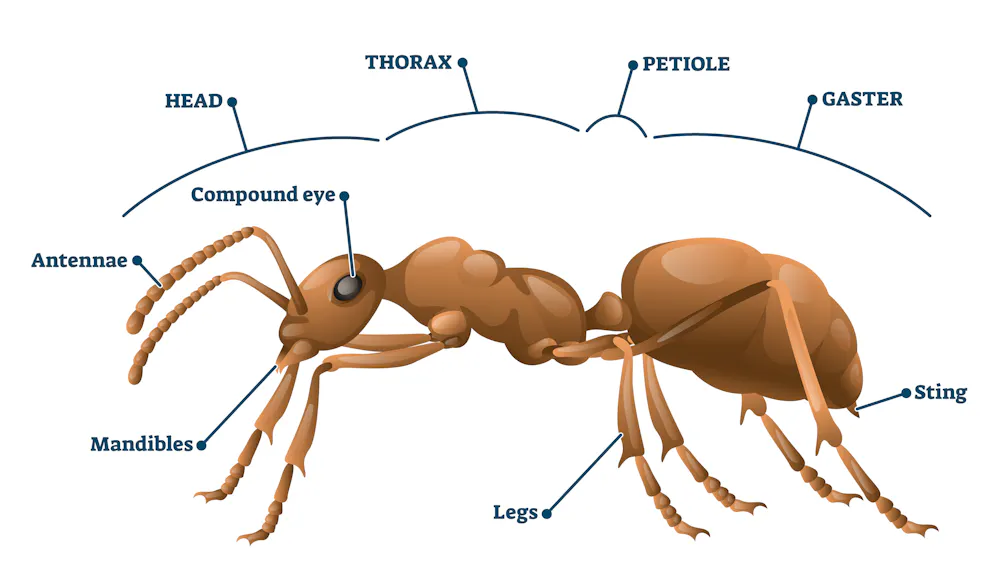
    The mandibles of the ants are its jaws; the petiole is the ant’s waist.
    Vector Mine/iStock via Getty Images Plus

    Most insects also have wings, although a few, like fleas, don’t. All have compound eyes, which means insects see very differently from the way people see. Instead of one lens per eye, they have many: a fly has 5,000 lenses; a dragonfly has 30,000. These types of eyes, though not great for clarity, are excellent at detecting movement.

    What is a species?

    All insects descend from a common ancestor that lived about about 480 million years ago. For context, that’s about 100 million years before any of our vertebrate ancestors – animals with a backbone – ever walked on land.

    A species is the most basic unit that biologists use to classify living things. When people use words like “ant” or “fly” or “butterfly” they are referring not to species, but to categories that may contain hundreds, thousands or tens of thousands of species. For example, about 18,000 species of butterfly exist – think monarch, zebra swallowtail or cabbage white.

    Basically, species are a group that can interbreed with each other, but not with other groups. One obvious example: bees can’t interbreed with ants.

    But brown-belted bumblebees and red-belted bumblebees can’t interbreed either, so they are different species of bumblebee.

    Each species has a unique scientific name – like Bombus griseocollis for the brown-belted bumblebee – so scientists can be sure which species they’re talking about.

    This is what a dragonfly looks like up close.
    Dieter Meyrl/E+ via Getty Images

    Quadrillions of ants

    Counting the exact number of insect species is probably impossible. Every year, some species go extinct, while some evolve anew. Even if we could magically freeze time and survey the entire Earth all at once, experts would disagree on the distinctiveness or identity of some species. So instead of counting, researchers use statistical analysis to make an estimate.

    One scientist did just that. He published his answer in a 2018 research paper. His calculations showed there are approximately 5.5 million insect species, with the correct number almost certainly between 2.6 and 7.2 million.

    Beetles alone account for almost one-third of the number, about 1.5 million species. By comparison, there are “only” an estimated 22,000 species of ants. This and other studies have also estimated about 3,500 species of mosquitoes, 120,000 species of flies and 30,000 species of grasshoppers and crickets.

    The estimate of 5.5 million species of insects is interesting. What’s even more remarkable is that because scientists have found only about 1 million species, that means more than 4.5 million species are still waiting for someone to discover them. In other words, over 80% of the Earth’s insect biodiversity is still unknown.

    Add up the total population and biomass of the insects, and the numbers are even more staggering. The 22,000 species of ants comprise about 20,000,000,000,000,000 individuals – that’s 20 quadrillion ants. And if a typical ant weighs about 0.0001 ounces (3 milligrams) – or one ten-thousandth of an ounce – that means all the ants on Earth together weigh more than 132 billion pounds (about 60 billion kilograms).

    That’s the equivalent of about 7 million school buses, 600 aircraft carriers or about 20% of the weight of all humans on Earth combined.

    For every person on Earth, it’s estimated there are 200 million insects.

    Many insect species are going extinct

    All of this has potentially huge implications for our own human species. Insects affect us in countless ways. People depend on them for crop pollination, industrial products and medicine. Other insects can harm us by transmitting disease or eating our crops.

    Most insects have little to no direct impact on people, but they are integral parts of their ecosystems. This is why entomologists – bug scientists – say we should leave insects alone as much as possible. Most of them are harmless to people, and they are critical to the environment.

    It is sobering to note that although millions of undiscovered insect species may be out there, many will go extinct before people have a chance to discover them. Largely due to human activity, a significant proportion of Earth’s biodiversity – including insects – may ultimately be forever lost.


    Hello, curious kids! Do you have a question you’d like an expert to answer? Ask an adult to send your question to CuriousKidsUS@theconversation.com. Please tell us your name, age and the city where you live.

    And since curiosity has no age limit – adults, let us know what you’re wondering, too. We won’t be able to answer every question, but we will do our best.

    Nicholas Green does not work for, consult, own shares in or receive funding from any company or organization that would benefit from this article, and has disclosed no relevant affiliations beyond their academic appointment.

    – ref. How many types of insects are there in the world? – https://theconversation.com/how-many-types-of-insects-are-there-in-the-world-247333

    MIL OSI – Global Reports –

    March 25, 2025
  • MIL-OSI Global: Rethinking repression − why memory researchers reject the idea of recovered memories of trauma

    Source: The Conversation – USA – By Gabrielle Principe, Professor of Psychology, College of Charleston

    Memories and photos both can misrepresent the past. Westend61 via Getty Images

    In 1990, George Franklin was convicted of murder and sentenced to life in prison based on the testimony of his 28-year-old daughter Eileen. She described seeing him rape her best friend and then smash her skull with a rock.

    When Eileen testified at her father’s trial, her memory of the murder was relatively fresh. It was less than a year old. Yet the murder happened 20 years earlier, when she was 8 years old.

    How can you have a one-year-old memory of something that happened 20 years ago? According to the prosecution, Eileen repressed her memory of the murder. Then much later she recovered it in complete detail.

    Can a memory of something so harrowing disappear for two decades and then resurface in a reliable form?

    This case launched a huge debate between memory researchers like me who argue there is no credible scientific evidence that repressed memories exist and practicing clinicians who claim that repressed memories are real.

    This controversy is not merely an academic one. Real people’s lives have been shattered by newly recollected traumatic experiences from childhood. I’ve seen this firsthand as a memory expert who consults on legal cases involving defendants accused of crimes they allegedly committed years or even decades ago. Often the only evidence linking the defendant to the crime is a recovered memory.

    But the scientific community disagrees about the existence of the phenomenon of repressed memory.

    Freud was the father of repression

    Nineteenth-century psychoanalytic theorist Sigmund Freud developed the concept of repression. He considered it a defense mechanism people use to protect themselves from traumatic experiences that become too overwhelming.

    The idea is that repression buries memories of trauma in your unconscious, where they – unlike other memories – reside unknown to you. They remain hidden, in a pristine, fixed form.

    In Freud’s view, repressed memories make themselves known by leaking out in mental and physical symptoms – symptoms that can be relieved only through recovering the traumatic memory in a safe psychological environment.

    In the 1980s, increasing numbers of therapists became concerned about the prevalence of child sexual abuse and the historical tendencies to dismiss or hide the maltreatment of children. This shift gave new life to the concept of repression.

    Rise of repressed memory recovery

    Therapists in this camp told clients that their symptoms, such as anxiety, depression or eating disorders, were the result of repressed memories of childhood sexual abuse that needed to be remembered to heal. To recover these memories, therapists used a range of techniques such as hypnosis, suggestive questioning, repeated imagining, bodywork and group sessions.

    Did recovered-memory therapy work? Many people who entered therapy for common mental health issues did come out with new and unexpected memories of childhood sexual abuse and other trauma, without physical evidence or corroboration from others.

    But were these memories real?

    The notion of repressed memories runs counter to decades of scientific evidence demonstrating that traumatic events tend to be very well remembered over long intervals of time. Many victims of documented trauma, ranging from the Holocaust to combat exposure, torture and natural disasters, do not appear to be able to block out their memories.

    In fact, trauma sometimes is too well remembered, as in the case of post-traumatic stress disorder. Recurrent and intrusive traumatic memories are a core symptom of PTSD.

    No memory ≠ repressed memory

    There are times when victims of trauma may not remember what happened. But this doesn’t necessarily mean the memory has been repressed. There are a range of alternative explanations for not remembering traumatic experiences.

    Trauma, like anything you experience, can be forgotten as the result of memory decay. Details fade with time, and retrieving the right remnants of experience becomes increasingly difficult if not impossible.

    Someone might make the deliberate choice to not think about upsetting events. Psychologists call this motivated forgetting or suppression.

    There also are biological causes of forgetting such as brain injury and substance abuse.

    Trauma also can interfere with the making of a memory in the first place. When stress becomes too big or too prolonged, attention can shift from the experience itself to attempts to regulate emotion, endure what’s happening or even survive. This narrow focus can result in little to no memory of what happened.

    A forgotten memory isn’t just waiting around to be rediscovered – it’s gone.
    malerapaso/E+ via Getty Images

    False memories

    If science rejects the notion of repressed memories, there’s still one question to confront: Where do newly recollected trauma memories, such as those triggered in recovered-memory therapy, come from?

    All memories are subject to distortions when you mistakenly incorporate expectations, assumptions or information from others that was not part of the original event.

    Memory researchers contend that memory recovery techniques might actually create false memories of things that never happened rather than resurrect existing memories of real experiences.

    To study this possibility, researchers asked participants to elaborate on events that never happened using the same sorts of suggestive questioning techniques used by recovered-memory therapists.

    What they found was startling. They were able to induce richly detailed false memories of a wide range of childhood traumatic experiences, such as choking, hospitalization and being a victim of a serious animal attack, in almost one-third of participants.

    These researchers were intentionally planting false memories. But I don’t think intention would be necessary on the part of a sympathetic therapist working with a suffering client.

    Are the memory wars over?

    The belief in repressed memories remains well entrenched among the general public and mental health professionals. More than half believe that traumatic experiences can become repressed in the unconscious, where they lurk, waiting to be uncovered.

    This remains the case even though in his later work, Freud revised his original concept of repression to argue that it doesn’t work on actual memories of experiences, but rather involves the inhibition of certain impulses, desires and fantasies. This revision rarely makes it into popular conceptions of repression.

    As evidence of the current widespread belief in repressed memories, in the past few years several U.S. states and European countries have extended or abolished the statute of limitations for the prosecution of sexual crimes, which allows for testimony based on allegedly recovered memories of long-ago crimes.

    Given the ease with which researchers can create false childhood memories, one of the unforeseen consequences of these changes is that falsely recovered memories of abuse might find their way into court – potentially leading to unfounded accusations and wrongful convictions.

    Gabrielle Principe does not work for, consult, own shares in or receive funding from any company or organization that would benefit from this article, and has disclosed no relevant affiliations beyond their academic appointment.

    – ref. Rethinking repression − why memory researchers reject the idea of recovered memories of trauma – https://theconversation.com/rethinking-repression-why-memory-researchers-reject-the-idea-of-recovered-memories-of-trauma-237419

    MIL OSI – Global Reports –

    March 25, 2025
  • MIL-OSI Global: Genomic sequencing reveals previously unknown genes that make microbes resistant to drugs and hard to kill

    Source: The Conversation – USA – By Nneka Vivian Iduu, Graduate Research Assistant in Pathobiology, Auburn University

    In the 20th century, when a routine infection was treated with a standard antibiotic, recovery was expected. But over time, the microbes responsible for these infections have evolved to evade the very drugs designed to eliminate them.

    Each year, there are more than 2.8 million antibiotic-resistant infections in the United States, leading to over 35,000 deaths and US$4.6 billion in health care costs. As antibiotics become less effective, antimicrobial resistance poses an increasing threat to public health.

    Antimicrobial resistance began to emerge as a serious threat in the 1940s with the rise of penicillin resistance. By the 1990s, it had escalated into a global concern. Decades later, critical questions still remain: How does antimicrobial resistance emerge, and how can scientists track the hidden changes leading to it? Why does resistance in some microbes remain undetected until an outbreak occurs? Filling these knowledge gaps is crucial to preventing future outbreaks, improving treatment outcomes and saving lives.

    Antimicrobial resistance can be deadly.

    Over the years, my work as a microbiologist and biomedical scientist has focused on investigating the genetics of infectious microbes. My colleagues and I identified a resistance gene previously undetected in the U.S. using genetic and computational methods that can help improve how scientists detect and track antimicrobial resistance.

    Challenges of detecting resistance

    Antimicrobial resistance is a natural process where microbes constantly evolve as a defense mechanism, acquiring genetic changes that enhance their survival.

    Unfortunately, human activities can speed up this process. The overuse and misuse of antibiotics in health care, farming and the environment push bacteria to genetically change in ways that allow them to survive the drugs meant to kill them.

    Early detection of antimicrobial resistance is crucial for effective treatment. Surveillance typically begins with a laboratory sample obtained from patients with suspected infections, which is then analyzed to identify potential antimicrobial resistance. Traditionally, this has been done using culture-based methods that involve exposing microbes to antibiotics in the lab and observing whether they survived to determine whether they were becoming resistant. Along with helping authorities and researchers monitor the spread of antimicrobial resistance, hospitals use this approach to decide on treatment plans.

    However, culture-based approaches have some limitations. Resistant infections often go unnoticed until antibiotics fail, making both detection and intervention processes slow. Additionally, new resistance genes may escape detection altogether.

    Genomics of antimicrobial resistance

    To overcome these challenges, researchers have integrated genomic sequencing into antimicrobial resistance surveillance. Through whole-genome sequencing, we can analyze all the DNA in a microbial sample to get a comprehensive view of all the genes present – including those responsible for resistance. With the computational tools of bioinformatics, researchers can efficiently process vast amounts of genetic data to improve the detection of resistance threats.

    Despite its advantages, integrating genomic sequencing into antimicrobial resistance monitoring presents some challenges of its own. High costs, quality assurance and a shortage of trained bioinformaticians make implementation difficult. Additionally, the complexity of interpreting genomic data may limit its use in clinical and public health decision-making.

    Bioinformatics allows researchers to analyze large biological datasets.
    hh5800/iStock via Getty Images Plus

    Establishing international standards could help make whole-genome sequencing and bioinformatics a fully reliable tool for resistance surveillance. The World Health Organization recommends laboratories follow strict quality control measures to ensure accurate and comparable results. This includes using reliable, user-friendly computational tools and shared microbial databases. Additional strategies include investing in training programs and fostering collaborations between hospitals, research labs and universities.

    Discovering a resistance gene

    Combining whole genome sequencing and bioinformatics, my colleagues and I analyzed Salmonella samples collected from several animal species between 1982 and 1999. We discovered a Salmonella resistance gene called blaSCO-1 that has evaded detection in U.S. livestock for decades.

    The blaSCO-1 gene confers resistance to microbes against several critical antibiotics, including ampicillin, amoxicillin-clavulanic acid and, to some extent, cephalosporins and carbapenems. These medications are crucial for treating infections in both humans and animals.

    Salmonella Typhimurium invading a cell.
    NIAID/Flickr, CC BY-SA

    The blaSCO-1 gene likely remained unreported because routine surveillance usually targets well-known resistance genes and it has overlapping functions with other genes. Gaps in bioinformatics expertise may have also hindered its identification.

    The failure to detect genes like blaSCO-1 raises concern about its potential role in past treatment failures. Between 2015 and 2018, the Centers for Disease Control and Prevention began implementing whole-genome sequencing for routine surveillance of Salmonella. Studies conducted during this period found that 77% of multistate outbreaks were linked to livestock harboring resistant Salmonella.

    These missed genes have significant implications for both food safety and public health. Undetected antimicrobial resistance genes can spread through food animals, contaminated food products, processing environments and agricultural runoff, allowing resistant bacteria to persist and reach humans. These resistant bacteria lead to infections that are harder to treat and increase the risk of outbreaks. Moreover, the global movement of people, livestock and goods means that these resistant strains can easily cross borders, turning local outbreaks into worldwide health threats.

    Identifying new resistance genes not only fills a critical knowledge gap, but it also demonstrates how genomic and computational approaches can help detect hidden resistance mechanisms before they pose widespread threats.

    Strengthening surveillance

    As antimicrobial resistance continues to rise, adopting a One Health approach that integrates human, animal and environmental factors can help ensure that emerging resistance does not outpace humans’ ability to combat it.

    Initiatives like the Quadripartite AMR Multi-Partner Trust Fund provide support for programs that strengthen global collaborative surveillance, promote responsible antimicrobial use and drive the development of sustainable alternatives. Ensuring researchers around the world follow common research standards will allow more labs – especially those in low- and middle-income countries – to contribute to global surveillance efforts.

    The health of future generations depends on the world’s ability to ensure food safety and protect public health on a global scale. In the ongoing battle between microbial evolution and human innovation, vigilance and adaptability are key to staying ahead.

    This research was supported by the USDA Agricultural Research Service Program, the FDA and the HHS.

    – ref. Genomic sequencing reveals previously unknown genes that make microbes resistant to drugs and hard to kill – https://theconversation.com/genomic-sequencing-reveals-previously-unknown-genes-that-make-microbes-resistant-to-drugs-and-hard-to-kill-250148

    MIL OSI – Global Reports –

    March 25, 2025
  • MIL-OSI USA: $19.4 Million Project to Rehabilitate Two Aging Bridges

    Source: US State of New York

    overnor Kathy Hochul today announced work is underway on a $19.4 million project to rehabilitate two aging bridges on the New York State Thruway (I-87/ I-287) in the village of Suffern, Rockland County. Beginning this month, motorists will encounter lane shifts to facilitate construction. Three travel lanes in each direction will be maintained at all times through this critical corridor, with an estimated 120,000 vehicles traveling it daily.

    “My administration is firmly committed to rehabilitating roads and bridges across the state,” Governor Hochul said. “This investment will help enhance safety, ensuring a smoother ride for the tens of thousands of regional travelers who use this vital Thruway corridor each day.”

    Thruway Authority Executive Director Frank G. Hoare said, “The Thruway Authority is dedicated to reinvesting toll dollars to modernize its infrastructure. These bridges have served us reliably over the decades and we are undertaking efforts to ensure they remain safe and dependable for the tens of millions of motorists who use them each year.”

    Contractor crews will repair concrete substructure and steel superstructure, along with completely replacing the concrete deck and parapets with precast concrete deck panels on the bridge over Route 202 (milepost 29.54). Crews will construct new bridge joints on the span over the Mahwah River (milepost 29.41). Both bridges are located on I-87 between exit 14B (Airmont – Montebello – Airmont Road) and Exit 15 (New Jersey – I-287 – NJ Route 17 South).

    Preliminary work began last fall on the bridges, both of which are at least 70 years old and about a tenth of a mile apart. The stretch of Thruway also serves motorists and commercial vehicles traveling to and from New Jersey via I-287 via Exit 15 at milepost 30.17.

    Other project improvements will include rehabilitating median drainage structures, building new median barriers and installing new pavement markings. Signs in the area will advise motorists of lane shifts. Motorists are urged to be alert and follow the posted speed limits in work zones. The project is scheduled to be completed by the end of 2026, by project contractor, DeFoe Corp. of Mount Vernon, N.Y.

    About the Thruway Authority
    The Governor Thomas E. Dewey Thruway, built in the early 1950s, is one of the oldest components of the National Interstate Highway System and one of the longest toll roads in the nation. The maintenance and operation of the Thruway system is funded primarily by tolls. The Thruway Authority does not receive any dedicated federal, state or local tax dollars and is paid for by those who drive the Thruway, including one-third of drivers from out of state.

    In 2024, the Thruway Authority processed more than 400 million transactions and motorists drove 8.2 billion miles on the Thruway. The Authority’s approved 2025 Budget invests a total of $477.3 million in dedicated funding for capital projects across the Thruway system beginning in 2025, an increase of more than $33 million compared to the approved 2024 budget. The increased investment will lead to work on approximately 61 percent of the Thruway’s more than 2,800 pavement lane miles as well as the replacement or rehabilitation of 20 percent of the Thruway’s 817 bridges.

    The Thruway is one of the safest roadways in the country with a fatality rate far below the nationwide index, and toll rates are among the lowest in the country compared to similar toll roads. The Thruway’s base passenger vehicle toll rate is less than 5 cents per mile, compared to the Ohio Turnpike (6 cents per mile), the New Jersey Turnpike (up to 39 cents per mile) and the Pennsylvania Turnpike (16 cents per mile).

    The Thruway Authority’s top priority is the safety of our employees and customers. In 2024, two Thruway Authority employees died and another was seriously injured in separate incidents while working on the Thruway. The lives of Thruway Authority employees, roadway workers and emergency personnel depend on all of those who travel the highway. Motorists should stay alert and pay attention while driving, slow down in work zones and move over when they see a vehicle on the side of the road. The state’s Move Over Law, which was expanded in March 2024, requires drivers to slow down and move over for all vehicles stopped along the roadway. Safety is a shared responsibility.

    For more information, follow the Thruway on Facebook, X and Instagram, or visit the Thruway website.

    MIL OSI USA News –

    March 25, 2025
  • MIL-OSI USA: UConn Law Professor Leslie Levin Honored by New York State Bar Association

    Source: US State of Connecticut

    UConn Law Professor Leslie Levin was recognized for her lifetime of work in legal ethics, media law, and evidence with the Sanford D. Levy Professional Ethics Award.

    This prestigious award is given annually by the New York State Bar Association Committee on Professional Ethics to an individual or institution who has most contributed to the understanding and advancement in the field of professional ethics.

    “Leslie Levin has long been a trusted expert on one of the most critical subjects of our profession. She is among the nation’s top authorities on legal ethics in addition to being an outstanding role model, author, and educator. She is an inspiration to her students and colleagues,” said Domenick Napoletano, president of the New York State Bar Association.

    Levin was one of the first in the legal academy to systematically study lawyers’ ethical decision making using empirical methods. She has co-edited Lawyers in Practice: Ethical Decision Making in Context, which explores the many factors that affect how lawyers resolve ethical issues in different practice contexts. She has also been extolled for her nationally recognized pathbreaking work on the impact of bar associations on the socialization of lawyers.

    “I was surprised and deeply honored to receive the award. It was the last thing I expected when they called me,” Levin said. “I am, at heart, a lawyer and when I started teaching, I wanted to write about lawyers and how they conduct themselves in the real world. How do they resolve ethical issues in practice?”

    Levin served as the first director of the UConn Law Lawyering Process Program and as the first faculty pro bono coordinator, in addition to many other positions within the law school including multiple associate deanships. She also co-authored a report and recommendations about access to justice for self-represented litigants at the request of the Connecticut Judicial Branch Access to Justice Commission.

    The graduating class of 2023 honored Levin with that year’s Perry Zirkel ’76 Distinguished Teaching Award.

    “I am delighted to see the honor conferred on Professor Levin,” Dean Eboni S. Nelson said. “She is one of our country’s leading scholars on legal ethics and a transformational teacher, whose many contributions have greatly benefited the law school and legal community.”

    MIL OSI USA News –

    March 25, 2025
  • MIL-OSI: Nokia and Honeywell Aerospace Technologies partner with Numana to advance quantum-safe networks

    Source: GlobeNewswire (MIL-OSI)

    Press Release
    Nokia and Honeywell Aerospace Technologies partner with Numana to advance quantum-safe networks

    • Collaboration to drive innovation and enable a global post-quantum security economy for enterprises and service providers.
    • Quantum-safe communications poised to safeguard digital infrastructure.
    • The partnership benefits from Numana’s Kirq quantum communication testbed, Honeywell Aerospace Technologies’ quantum key distribution, and Nokia’s advanced cryptographic network technologies.

    24 March 2025
    Montreal, Quebec – Nokia and Honeywell Aerospace Technologies today announced a strategic partnership with Numana to advance Quantum-Safe Networks (QSN) in Montreal, Canada, and worldwide. This collaboration will drive innovation, foster collaboration, and accelerate the adoption of next-generation secure networking technologies for enterprises and service providers. Additionally, this partnership will help raise awareness about the importance and benefits of these technologies, advancing secure and reliable networking solutions for a resilient digital future.

    “As the world increasingly depends on digital infrastructure, the need for advanced cryptographic protection has never been more critical. By partnering with Numana and its collaboration partners like Honeywell Aerospace Technologies and others, we can deploy our combined expertise in enabling future-proof networks to help organizations, enterprises and service providers build a secure and resilient digital future starting today,” said Jeffrey Maddox, President of Nokia Canada.

    The partnership will benefit from Numana’s Kirq Quantum Communication Testbed, a world-class facility that provides a real-world environment for testing and validating new quantum-resistant and quantum communication technologies. Nokia will leverage its expertise in post-quantum networking, incorporating advanced IP routers, high-capacity optical transport nodes, and state-of-the-art quantum-safe cryptographic technologies, all backed by its extensive practical experience and proven success in real-world deployments.

    Additionally, Nokia intends to utilize this environment to foster collaborative-based innovations, enabling the development of solutions within the broader quantum technology ecosystem. Honeywell Aerospace Technologies will introduce quantum-secure encryption keys from space to terrestrial data centers, applications, and networks.

    “Numana will oversee the deployment, operation, and ongoing development of the testbed and make the equipment and infrastructure available to carry out various projects, based on the needs of the technology innovation ecosystem. Our ambition is to accelerate quantum technology in Quebec and help the industry develop leading-edge products to transform the province into a true global leader in quantum communication. This project aligns with Numana’s new positioning as a technology macro-accelerator which analyzes disruptive technologies and implements open testbeds to accelerate the development of products and services and their adoption,” noted Numana President and CEO François Borrelli.

    Numerous studies highlight the significant benefits for the private sector and the profound impact quantum communication is poised to have on Quebec and Canada as a whole.

    “Honeywell Aerospace Technologies welcomes the opportunity to join forces with Nokia and Numana to advance quantum-safe communications. Our quantum encryption technology will play a critical role in securing satellite networks and improving the integrity of data transmitted from space to earth,” said Lisa Napolitano, Vice President of Space at Honeywell Aerospace Technologies.

    The partnership also aligns with the commitments by Quebec and Canada to quantum innovation and cybersecurity leadership. The Numana facility in Quebec will serve as a hub where enterprises, research institutions, and government agencies can explore, evaluate, and validate secure networking technologies in a real-world environment.

    The arrival of multinational players like Nokia and Honeywell Aerospace Technologies brings immense value to this innovative network by introducing innovative technologies and unparalleled expertise. This collaborative effort will advance the development and deployment of quantum-secure solutions and foster a robust global network that supports continuous innovation, addresses cybersecurity needs, and ushers in the era of next-generation communications.

    “This important partnership in the quantum sector is another step toward developing more projects using the Kirq testbed. It clearly shows that Québec has great drawing power and reinforces our position as a global strategic hub for technological innovation and quantum science, which are critical for securing tomorrow’s communication,” said Christine Fréchette, the Minister of Economy, Innovation and Energy and Minister Responsible for Regional Economic Development.

    The collaboration will enhance the overall quantum technology landscape by concentrating on several key areas, including:

    • Education and training: While QSN solutions are available today, Numana’s technology ecosystem will provide awareness, training, and educational resources to help organizations understand and implement their quantum-secure strategies.
    • Ecosystem development: Foster collaboration among industry stakeholders, including researchers, developers, and businesses throughout the global quantum technology sector.
    • Research and development: Jointly develop, assess, and evolve the technologies and science toward advanced secure communication. 

    Multimedia, technical information and related news 
    Website: Nokia Quantum Safe Networks
    Video: Quantum-Safe Networks in 60 seconds
    Blog: Nokia and Honeywell join Numana: A Leap Toward Quantum Security in North America

    About Nokia
    At Nokia, we create technology that helps the world act together.

    As a B2B technology innovation leader, we are pioneering networks that sense, think, and act by leveraging our work across mobile, fixed, and cloud networks. In addition, we create value with intellectual property and long-term research, led by the award-winning Nokia Bell Labs, which is celebrating 100 years of innovation.

    With truly open architectures that seamlessly integrate into any ecosystem, our high-performance networks create new opportunities for monetization and scale. Service providers, enterprises, and partners worldwide trust Nokia to deliver secure, reliable, and sustainable networks today – and work with us to create the digital services and applications of the future.

    About Numana: A macro-accelerator for technological ecosystems
    Founded in 2007, Numana is a non-profit organization that contributes to economic and social vitality by bringing stakeholders from the private, institutional, and public technology sectors together around common goals and joint initiatives. To learn more, go to https://numana.tech/en/.

    About Honeywell
    Honeywell is an integrated operating company serving a broad range of industries and geographies around the world. Our business is aligned with three powerful megatrends – automation, the future of aviation, and energy transition – underpinned by our Honeywell Accelerator operating system and Honeywell Forge IoT platform. As a trusted partner, we help organizations solve the world’s toughest, most complex challenges, providing actionable solutions and innovations through our Aerospace Technologies, Industrial Automation, Building Automation, and Energy and Sustainability Solutions business segments that help make the world smarter and safer as well as more secure and sustainable. For more news and information on Honeywell, please visit www.honeywell.com/newsroom.

    Editor’s Note: Press event
    Numana is hosting and streaming a press event today at 9:00 am (EST) at the Maison Alcan, 1188 Sherbrooke O. in Montreal. RSVP to Simon Falardeau of Numana at falardeausimon@hotmail.com or Kevin Petschow of Nokia at kevin.petschow@nokia.com.

    Media inquiries 
    Nokia Press Office 
    Email: Press.Services@nokia.com  

    Follow Nokia on social media
    LinkedIn X Instagram Facebook YouTube BlueSky

    Numana
    Simon Falardeau
    Email: falardeausimon@hotmail.com

    Honeywell Aerospace Technologies
    Adam Kress
    Phone: +1-602-760-6252
    Email: adam.kress@honeywell.com

    The MIL Network –

    March 25, 2025
  • MIL-OSI: The Gender Pay Gap Stalls in 2025 – Payscale’s Research Shows

    Source: GlobeNewswire (MIL-OSI)

    • Despite pay transparency laws, wage equity progress continues to stall nationwide, with systemic barriers still limiting women’s earning potential.
    • The “childbearing penalty” remains highly evident, as women with children continue to earn just 75 cents for every dollar fathers make, while fathers make 2% more than childless men.
    • While the gender pay gap showed gradual improvement from 2018 to 2022, progress has remained stagnant since the Great Resignation, with declines especially evident among older women.

    SEATTLE, March 24, 2025 (GLOBE NEWSWIRE) — Today, Payscale Inc., the leading provider of compensation data, software and services, released its 2025 Gender Pay Gap Report (GPGR), revealing that despite pay transparency laws, the closing of the gender pay gap has stalled nationwide, with systemic barriers still limiting women’s earning potential.

    Payscale’s analysis found that in 2025 women still earn just 83 cents for every dollar men make. While this is unchanged from last year, according to AAUW, Equal Pay Day shifted back more than two weeks this year, meaning that women must work that much longer to achieve the same earnings as men in 2025, compared to 2024. The controlled gender pay gap also remains the same as last year, at 99 cents. The controlled gender pay gap is the amount that women earn for every dollar that a man earns when accounting for job title and compensable factors, while the uncontrolled gender pay gap is the difference in median pay for men and women overall.

    “Even though our 2025 Compensation Best Practices Report showed a minor decrease in support for pay equity (57%), and there has been a recent weakening of public support around Diversity, Equity and Inclusion (DEI) of late, some states have shown promising progress towards closing the gender pay gap,” said Ruth Thomas, pay equity strategist at Payscale. “While not every state has enacted pay transparency laws, which are shown to support pay equity efforts, many organizations are still staunchly committed to the cause. In fact, compared to 2020, there has been a 19% increase in corporate commitment to these efforts.”

    Key takeaways from GPGR:

    Working Parents — Motherhood continues to hurt pay equity, while fathers get a raise as a result of the childbearing penalty.

    • Women with children face a significantly wider gender pay gap, earning just 75 cents for every dollar fathers make—unchanged from last year.
    • This gap is even wider for women of color, with American Indian and Alaska Native mothers experiencing the largest disparity, earning just 64 cents for every dollar fathers earn.
    • When controlling for job roles and experience, mothers earn 98 cents for every dollar earned by fathers with similar characteristics, a figure that has remained steady.
    • Meanwhile, fatherhood financially benefits men, who earn 2% more than childless men, while mothers face stagnant or reduced pay compared to childless women.

    Job Seeking — Women seeking new jobs are closing the pay gap, but parenting responsibilities and workplace flexibility keep many stuck with lower wages.

    • The gender pay gap is narrower for women actively seeking a new job in the next six months compared to those not looking, suggesting that a willingness to leave positions may lead to higher pay.
    • Yet, this uncontrolled gender pay gap slightly widened this year to $0.83 from $0.84 last year, indicating slower progress overall.
    • Women who stay in their current job may do so due to benefits they can’t afford to lose, such as flexible work schedules, which can result in tolerating lower pay.
    • Workplace culture, flexibility, and work-life balance may be more important to women than men when deciding whether to stay with an employer, potentially influencing their pay trajectory.

    Higher Education — Despite earning advanced degrees like MBAs, law degrees, and health professional doctorates, women still face a significant pay gap, highlighting that education alone doesn’t guarantee pay equity.

    • Women with MBAs face the largest uncontrolled pay gap, earning just 77 cents for every dollar earned by men with the same degree.
    • Health professional doctorates have the smallest uncontrolled pay gap at 89 cents, while women with law degrees earn 87 cents for every dollar men with the same degree make, marking a slight decrease from last year.

    Leadership and Career Progress — Not only do women earn less as their career progresses, they’re also less likely to reach leadership roles.

    • White men are the most likely to hold leadership positions, with 45% serving as managers or in higher roles. Women are underrepresented in leadership roles, with only 5% of white women becoming executives compared to 7% of white men. The numbers are even lower for women of color: 3% for Hispanic women, 4% for Black or African American women, and 3% for Asian women.
    • Women who do ascend the corporate ladder earn less than their male counterparts, with the gap widening at higher levels. Women at the executive level earn 93 cents for every dollar men make, even when controlling for job characteristics, and just 72 cents when not controlling for these factors.
    • The gender pay gap is widest for Hispanic women and American Indian and Native Alaskan women at the executive level when data are controlled, currently standing at 91 cents, which is two points narrower than 2024.

    Gender Norms — While STEM industries show progress toward pay equity, traditional gender norms continue to widen the gap in other sectors.

    • The biggest pay gaps appear in occupations with deep-rooted gender norms, including Legal (63 cents), Farming & Fishing (77 cents), and Management (79 cents), where men dominate top-paying positions.
    • The gender pay gap is also widest in Finance & Insurance (78 cents) and Agencies & Consultancies (84 cents) industries, despite women making up 53% and 59% of the workforce in these industries, respectively.
    • Even in female-dominated industries like Healthcare (89 cents), Education (91 cents), and Nonprofits (88 cents), pay disparities persist.
    • Some STEM-heavy industries show pay equity when controlled, but women remain underrepresented in higher-paying roles within these industries.

    Location – States with and without salary transparency laws have seen improvements in the controlled gender pay gap, likely due in part to increased awareness from transparency efforts in other regions or companies adopting national pay transparency practices.

    • In 2025, Illinois, Minnesota, New Jersey, Vermont and Massachusetts will enact pay transparency legislation.
    • The controlled pay gap remained closed in 2025 for California, Connecticut, Maryland, New Jersey, New York, Oregon, and Washington, D.C. – all showed closed pay gaps last year, and, except for New Jersey and Oregon, have active pay transparency laws.
    • While other states continue to show improvement, Massachusetts, Montana, New Hampshire, North Carolina, New Mexico, Vermont, and Washington state have seen their gaps widen.
    • New gains are emerging in Alabama, Delaware, Nebraska, North Dakota, Rhode Island, South Dakota, and West Virginia, where the controlled pay gap has recently closed.

    “It’s disappointing to still see a lack of progress towards closing the gender pay gap. Beyond being the right thing to do, ensuring fair pay without discrimination is required by law. This fact alone should support closing the gender pay gap. Even more, it’s a critical retention tool for businesses, which is why, unsurprisingly, women employees frequently leave organizations because they don’t think they are being paid fairly,” said Lulu Seikaly, senior corporate employment attorney at Payscale. “Pay transparency has an important role to play here, because when an employee has an understanding of their compensation trajectory it increases trust and loyalty. Our 2025 Compensation Best Practices Report revealed that over half (56%) of companies are sharing pay ranges in their job postings regardless of whether or not it’s required by law — a promising nod to the future of fair pay.”

    According to Payscale’s 2025 Compensation Best Practices Report, 72% of HR and compensation professionals believe that gender pay gap research is meaningful. Paired with Payscale’s compensation management software and services enable organizations to easily evaluate their current compensation strategies and standardize their internal pay practices to increase transparency and ensure fair pay.

    The 2025 Gender Pay Gap Report analyzes crowdsourced data from over 369,000 people in the U.S. who took Payscale’s free online salary survey between January 2024 and January 2025. The full report and its methodology, including analysis by race, job level, age, education, industry, occupation, and location, can be accessed in its entirety at Payscale.com/research-and-insights/gender-pay-gap.

    About Payscale
    As the industry leader in compensation management, Payscale is on a mission to help job seekers, employees, and businesses make sustainable fair pay a reality. Empowering 65% of the Fortune 500, Payscale provides a combination of diverse and dynamic data sources, experienced compensation services, and scalable software to enable organizations such as Panasonic, ZoomInfo, Chipotle, AccentCare, University of Washington, American Airlines, and PetSmart to make fair and appropriate pay decisions.

    Pay is powerful.

    To learn more, visit www.payscale.com.
      
    Contact: Press@Payscale.com

    The MIL Network –

    March 25, 2025
  • MIL-OSI: MicroAlgo Inc. plans to issue additional new shares at an offering price of $0.8 per share.

    Source: GlobeNewswire (MIL-OSI)

    SHENZHEN, March 24, 2025 (GLOBE NEWSWIRE) — MicroAlgo Inc. plans to issue additional new shares at an offering price of $0.8 per share.

    Shenzhen, China, March. 24, 2025 – MicroAlgo Inc. (NASDAQ: MLGO), (the “Company”or “MicroAlgo”), today announced the plan to issue more new shares. Considering that MicroAlgo Inc. entered into a convertible bond purchase agreement with creditors on October 7, 2024, with a total amount of US$20 million. These bonds have a maturity period of 360 days. According to the convertible bond purchase agreement, the bonds are convertible into common shares at a conversion price equal to 70% of the lowest closing market price during the 60 trading days preceding the conversion request.
    MicroAlgo Inc. has received notice from the creditors under this US$20 million convertible bond purchase agreement, requesting the company to issue new shares at $ 0.8 per share to repay the debt in accordance with the agreement terms. The company plans to fulfill the relevant clauses of this US$20 million convertible bond purchase agreement and will issue new shares at $ 0.8 per share for debt repayment.
    This serves as a risk disclosure in accordance with the Form 6-K filing submitted to the U.S. Securities and Exchange Commission (SEC) on October 9, 2024.

    About MicroAlgo Inc.
    MicroAlgo Inc. (the “MicroAlgo”), a Cayman Islands exempted company, is dedicated to the development and application of bespoke central processing algorithms. MicroAlgo provides comprehensive solutions to customers by integrating central processing algorithms with software or hardware, or both, thereby helping them to increase the number of customers, improve end-user satisfaction, achieve direct cost savings, reduce power consumption, and achieve technical goals. The range of MicroAlgo’sservices includes algorithm optimization, accelerating computing power without the need for hardware upgrades, lightweight data processing, and data intelligence services. MicroAlgo’s ability to efficiently deliver software and hardware optimization to customers through bespoke central processing algorithms serves as a driving force for MicroAlgo’s long-term development.

    Forward-Looking Statements
    This press release contains statements that may constitute “forward-looking statements.” Forward-looking statements are subject to numerous conditions, many of which are beyond the control of MicroAlgo, including those set forth in the Risk Factors section of MicroAlgo’s periodic reports on Forms 10-K and 8-K filed with the SEC. Copies are available on the SEC’s website, www.sec.gov. Words such as “expect,””estimate,””project,””budget,””forecast,””anticipate,””intend,””plan,””may,””will,””could,””should,””believes,””predicts,””potential,””continue,” and similar expressions are intended to identify such forward-looking statements. These forward-looking statements include, without limitation, MicroAlgo’s expectations with respect to future performance and anticipated financial impacts of the business transaction.
    MicroAlgo undertakes no obligation to update these statements for revisions or changes after the date of this release, except as may be required by law.

    Contact
    MicroAlgo Inc.
    Investor Relations
    Email: ir@microalgor.com

    The MIL Network –

    March 25, 2025
  • MIL-OSI NGOs: Help our staff members reach patients with care

    Source: Doctors Without Borders –

    Individuals like you keep Doctors Without Borders/Médecins Sans Frontières (MSF) fiercely independent.

    Your support enables us to respond at a moment’s notice when a disaster strikes. You ensure that we can recruit local staff who understand the needs of their communities best. You make it possible for us to deliver high-quality, culturally responsive emergency care and aid.

    Until Monday, March 31, all gifts will be TRIPLED, to have THREE TIMES the impact on our lifesaving work around the world. Please don’t wait to make your 3X MATCHED contribution now >>
    —
    All gifts given, up to $500,000, will be tripled through midnight on Monday, March 31—thanks to a generous matching grant from Worthington & Margaret Mayo-Smith. Gifts received after the match has been met will not be matched but will be used where needed most.

    1. Amount
    2. Payment Information
    3. Your Information
    4. Billing Information

    A Donation has been made to Doctors Without Borders/Médecins Sans Frontières (MSF)

    In Honor of

    From

    The verification code for Visa, Master Card, and Discover is a 3-digit number printed on the back of your card. The American Express verification code is a 4-digit number printed on the front of your card. We ask for your email address so we can send you a receipt for tax purposes. We ask for your phone number so we can send you updates from the field. We ask for the name of the company or organization making this gift so we can properly attribute the donation in our database to the company or organization making this donation.

    By making a gift to MSF-USA, you’ll receive an email confirming your donation, along with regular updates on our work in the field through emails and SMS messages (if mobile number is provided). You can update your preferences or unsubscribe at any time.

    By clicking DONATE your credit card will be securely processed.

    Unrestricted donations enable MSF to carry out our programs around the world. If we cannot honor a specific request, we will reallocate your donation to where the needs are greatest.

    MIL OSI NGO –

    March 25, 2025
  • MIL-OSI Video: Department of State Press Briefing – March 24, 2025 – 2:00 PM

    Source: United States of America – Department of State (video statements)

    Spokesperson Tammy Bruce leads the Department Press Briefing, at the Department of State, on March 24, 2025

    ———-
    Under the leadership of the President and Secretary of State, the U.S. Department of State leads America’s foreign policy through diplomacy, advocacy, and assistance by advancing the interests of the American people, their safety and economic prosperity. On behalf of the American people we promote and demonstrate democratic values and advance a free, peaceful, and prosperous world.

    The Secretary of State, appointed by the President with the advice and consent of the Senate, is the President’s chief foreign affairs adviser. The Secretary carries out the President’s foreign policies through the State Department, which includes the Foreign Service, Civil Service and U.S. Agency for International Development.

    Get updates from the U.S. Department of State at www.state.gov and on social media!
    Facebook: https://www.facebook.com/statedept
    X: https://x.com/StateDept
    Instagram: https://www.instagram.com/statedept
    Flickr: https://flickr.com/photos/statephotos/

    Subscribe to the State Department Blog: https://www.state.gov/blogs
    Watch on-demand State Department videos: https://video.state.gov/
    Subscribe to The Week at State e-newsletter: http://ow.ly/diiN30ro7Cw

    State Department website: https://www.state.gov/
    Careers website: https://careers.state.gov/
    White House website: https://www.whitehouse.gov/
    Terms of Use: https://state.gov/tou

    #StateDepartment #DepartmentofState #Diplomacy

    https://www.youtube.com/watch?v=8L8HAy6JyEk

    MIL OSI Video –

    March 25, 2025
  • MIL-OSI USA: Gov. Pillen Declares Emergency for Counties Impacted by Winter Storm

    Source: US State of Nebraska

    . Pillen Declares Emergency for Counties Impacted by Winter Storm


    LINCOLN, NE – Today, Governor Jim Pillen declared a state of emergency for more than 20 counties impacted by this week’s winter storm. The combination of rain, sleet, hail, heavy snow, and high winds resulted in closures across multiple roadways, including Interstate 80. Conditions also did considerable damage to trees and power lines, resulting in a loss of electricity across multiple service areas. The heaviest damage occurred along the eastern part of the state. 

    Since Wednesday, significant progress has been made in getting customers reconnected.  The public power districts have received assistance from crews in other states, through mutual aid agreements.  According to the U.S. Department of Energy, the peak outage was reported Thursday afternoon with 119,199 customers without power. That has now been reduced to just over 29,000 customers.

    Gov. Pillen has received regular updates from the utilities, as well as from leadership within the Nebraska Emergency Management Agency (NEMA), while storm recovery has continued over the last few days. His proclamation will allow Nebraska’s adjutant general to take any steps necessary and to utilize funds for protecting lives and property impacted by the storm. 

    Counties covered by today’s emergency declaration include Burt, Butler, Cass, Clay, Colfax, Cuming, Dodge, Douglas, Fillmore, Gage, Jefferson, Lancaster, Platte, Polk, Nuckolls, Saline, Sarpy, Saunders, Seward, Thayer, Thurston, Washington, Wayne and York. It is possible the list of counties will change as NEMA continues to receive damage assessment data from local emergency management agencies. If so, an additional declaration may be issued by Gov. Pillen. Initial damage estimates currently exceed $21 million. Again, it is possible that number will fluctuate with ongoing damage assessments.  

    Today, Gov. Pillen reiterated his appreciation to those who have been managing aspects of storm since its onset early Wednesday.

    “From state troopers who assisted stranded motorists, to snow removal crews and now those involved in repairing downed lines to re-establish our power grid – a lot of people have stepped up very quickly to ensure that our safety has been the number one priority,” said Gov. Pillen.

    Once all damage assessments are completed, steps will be undertaken to seek a federal disaster declaration.

    In conjunction with this proclamation, Gov. Pillen also issued an executive order waiving the use of dynamic pricing for the remainder of the emergency order.  

    Copies of both documents are attached to this release.

    ###

    MIL OSI USA News –

    March 25, 2025
  • MIL-OSI: Standard Lithium Reports Results for Six Month Fiscal Period Ended December 31, 2024

    Source: GlobeNewswire (MIL-OSI)

    VANCOUVER, British Columbia, March 24, 2025 (GLOBE NEWSWIRE) — Standard Lithium Ltd. (“Standard Lithium” or the “Company”) (TSXV:SLI) (NYSE American:SLI), a leading near-commercial lithium company, today announced its financial and operating results for the six month fiscal period ended December 31, 2024.

    “The last year has been crucial for the Company as we move ever closer to a final investment decision, construction, and subsequent production at the South West Arkansas project, and continue to expand our leasehold footprint in East Texas. Our goal as we exited 2024 was to prioritize, focus, and execute, and we continue to do just that,” said David Park, Chief Executive Officer and Director of Standard Lithium. “We closed on our $225 million grant from the U.S. Department of Energy, which is a testament to the caliber of our South West Arkansas project. We completed a drilling program, conducting extensive reservoir testing that demonstrated better reservoir properties than what was previously assumed in our PFS. We also successfully completed the derisking of our DLE technology through pilot field testing, producing results that exceeded expectations and providing samples that may later be used in the qualification process for offtake discussions. With FEED and DFS taking shape and nearing completion in the summer, and preliminary offtake and financing discussions underway, we continue to press on towards a final investment decision at South West Arkansas, and continue to expand our presence in East Texas, as we move towards the preparation of a maiden inferred resource report and further project definition on that asset.”     

    Highlights Subsequent to the Six Month Fiscal Period Ended December 31, 2024

    All amounts are in US dollars unless otherwise indicated.

    • Finalized $225 million grant from the U.S. Department of Energy (“DOE”) for the South West Arkansas Project. The grant will support construction of Phase 1 of the South West Arkansas (“SWA”) project. The SWA project is expected to be one of the world’s first commercial-scale Direct Lithium Extraction (“DLE”) facilities.
    • Undertook extensive field and reservoir testing program at SWA project.   Completed drilling of new well and multiple well re-entries into the Smackover Formation to conduct detailed reservoir testing and brine sampling work.
    • Completed final test of field-pilot plant at SWA project. In partnership with Koch Technology Solutions, successfully operated a field-pilot plant at SWA project as final DLE derisking step prior to commercialization. Lithium recovery far exceeded design criteria, with over 99% recovery from brine sourced from the project’s International Paper Company well.
    • Launch of Smackover Lithium. On January 29, 2025, at a community townhall in Stamps, AR, the Company and Equinor announced Smackover Lithium as the new name for their joint venture developing DLE projects in Southwest Arkansas and East Texas.
    • Continued Strategic additions to board of directors. The Company announced on March 19, 2025 the appointment of Karen G. Narwold, as an independent member of its board of directors.

    Highlights From Six Month Fiscal Period Ended December 31, 2024

    • Entered into a license agreement (“Agreement”) with Koch Technology Solutions (“KTS”) to deploy and use KTS’ Li-ProTMLithium Selective Sorption (“Li-pro LSS”) technology. Under the license agreement, SWA Lithium, the jointly-owned U.S. subsidiary of Standard Lithium and Equinor, will utilize Li-pro LSS at the commercial processing facility for Phase 1 of the SWA project. The Agreement includes a first-of-its-kind performance guarantee from KTS for lithium recovery, contaminant rejection and water use. In addition, it allows for continued, exclusive joint development of the technology in the Smackover Formation.
    • Commercial-scale DLE at the Demonstration Plant continues to exceed expectations. The Company installed a commercial-scale DLE column in late March 2024 and has been operating the column continuously. The column is a Li-pro LSS unit, supplied by KTS and identical to those currently being integrated into the front-end engineering and design (FEED) study for the SWA project. Key technical highlights of the commercial-scale DLE column include: lithium recovery efficiency of 95.4% and excellent contaminant rejection rates. Nearly 10,000 operational cycles have been completed by the Li-pro LSS technology to date.
    • Strategic additions to board of directors and executive team strengthen leadership. David Park assumed the position of Chief Executive Officer (“CEO”) and Director of the Company on September 1, 2024, following the retirement of CEO, Director and founder Robert Mintak. Further, the Company announced on December 10, 2024 the appointment of Paul Collins as an independent member of its board of directors.
    • Cash and working capital of $31.2 million and $27.5 million, respectively, as of December 31, 2024.
    • The Company has no term or revolving debt obligations as of December 31, 2024.

    Consolidated Financial Statements

    This news release should be read in conjunction with the Company’s Consolidated Financial Statements and MD&A for the six month fiscal period ended December 31, 2024, which are available on the Company’s issuer profile on SEDAR+ at www.sedarplus.ca and on EDGAR at www.sec.gov.

    Six-Month Fiscal Period Ended December 31, 2024 Call and Webcast

    The Company will hold a conference call and webcast to discuss its six-month fiscal period ended December 31, 2024 on Friday, March 28th at 3:30 p.m. ET. Access to the call is available via webcast or direct dial.

    Conference Call and Webcast Details
    Standard Lithium Six Month Fiscal Period Ended December 31, 2024 Results Call and Webcast March 28, 2025 3:30 p.m. Eastern Time (US and Canada)

    Participant Information:
    Conference ID: 6644028

    USA / International Toll +1 (646) 307-1963
    USA – Toll-Free (800) 715-9871
    Canada – Toronto (647) 932-3411
    Canada – Toll-Free (800) 715-9871

    Attendee Webcast Link:
    https://events.q4inc.com/attendee/457319305

    Incentive Grant

    The Company also announces that it will grant stock options (“Options”), restricted share units (“RSUs”), and deferred share units (“DSUs”) valued at $3,513,000 to management and directors under the Company’s shareholder-approved incentive plans effective March 26, 2025. An additional 300,000 Options will be granted to Ms. Narwold effective March 26, 2025 in connection with her appointment to the board of directors. All Option entitlements will be calculated using the Black-Scholes method and will be exercisable for a period of sixty months at a price equivalent to the US dollar closing price on the NYSE American on March 26, 2025. A portion of the Options will vest in equal thirds over thirty-six months, with the balance vesting immediately. All RSU and DSU entitlements will be calculated using the US dollar closing price on the NYSE American on March 26, 2025. The RSUs will also vest in equal thirds over 36 months. DSUs will vest after 12 months and settle in common shares upon the holder’s departure from the Company or a change of control.

    The grant of the incentive securities is intended to align compensation of directors and management with the interests of shareholders. For further information regarding the shareholder-approved incentive plans, readers are encouraged to review the management information circular prepared for the Company’s annual general meeting which includes summaries of the incentive plans and which is available under the Company’s profile on SEDAR+ (www.sedarplus.com) and by visiting the Company’s website (www.standardlithium.com).

    About Standard Lithium Ltd.

    Standard Lithium is a leading near-commercial lithium development company focused on the sustainable development of a portfolio of large, high-grade lithium-brine properties in the United States. The Company prioritizes projects characterized by the highest quality resources, robust infrastructure, skilled labor, and streamlined permitting. Standard Lithium aims to achieve sustainable, commercial-scale lithium production via the application of a scalable and fully integrated DLE and purification process. The Company’s flagship projects are located in the Smackover Formation, a world-class lithium brine asset, focused in Arkansas and Texas. In partnership with global energy leader Equinor, Standard Lithium is advancing the South West Arkansas project, a greenfield project located in southern Arkansas, and actively exploring promising lithium brine prospects in East Texas. Additionally, the Company is advancing the Phase 1A project in partnership with LANXESS Corporation, a brownfield development project located in southern Arkansas. Standard Lithium also holds an interest in certain mineral leases in the Mojave Desert in San Bernardino County, California.

    Standard Lithium trades on both the TSX Venture Exchange and the NYSE American under the symbol “SLI”. Please visit the Company’s website at www.standardlithium.com.

    Qualified Person

    Steve Ross, P.Geo., a qualified person as defined by National Instrument 43-101 – Standards of Disclosure for Mineral Projects, and Vice President Resource Development for the Company, has reviewed and approved the relevant scientific and technical information in this news release.

    Investor and Media Inquiries

    Chris Lang
    Standard Lithium Ltd.
    +1 604 409 8154 
    investors@standardlithium.com

    Neither the TSX Venture Exchange nor its Regulation Services Provider (as that term is defined in policies of the TSX Venture Exchange) accepts responsibility for the adequacy or accuracy of this release. This news release may contain certain “Forward-Looking Statements” within the meaning of the United States Private Securities Litigation Reform Act of 1995 and applicable Canadian securities laws. When used in this news release, the words “anticipate”, “believe”, “estimate”, “expect”, “target,” “plan”, “forecast”, “may”, “schedule” and other similar words or expressions identify forward-looking statements or information. These forward-looking statements or information may relate to intended development timelines, future prices of commodities, accuracy of mineral or resource exploration activity, reserves or resources, regulatory or government requirements or approvals, the reliability of third party information, continued access to mineral properties or infrastructure, fluctuations in the market for lithium and its derivatives, changes in exploration costs and government regulation in Canada and the United States, and other factors or information. Such statements represent the Company’s current views with respect to future events and are necessarily based upon a number of assumptions and estimates that, while considered reasonable by the Company, are inherently subject to significant business, economic, competitive, political and social risks, contingencies and uncertainties. Many factors, both known and unknown, could cause results, performance or achievements to be materially different from the results, performance or achievements that are or may be expressed or implied by such forward-looking statements. The Company does not intend, and does not assume any obligation, to update these forward-looking statements or information to reflect changes in assumptions or changes in circumstances or any other events affecting such statements and information other than as required by applicable laws, rules and regulations.

    The MIL Network –

    March 25, 2025
  • MIL-OSI: Data Storage Corporation Schedules Fiscal 2024 Business Update Conference Call

    Source: GlobeNewswire (MIL-OSI)

    MELVILLE, N.Y., March 24, 2025 (GLOBE NEWSWIRE) — Data Storage Corporation (Nasdaq: DTST) (“DSC” and the “Company”), a leading provider of multi-cloud hosting, managed cloud services, disaster recovery, cybersecurity, and IT automation, that integrates with AWS, Microsoft Azure, and Google Cloud,  today announced that it plans to host a conference call at 11:00 a.m. Eastern Time on Monday, March 31, 2025, to discuss the Company’s financial results for the 2024 fiscal year which ended December 31, 2024, as well as corporate progress and other developments.

    The conference call will be available via telephone by dialing toll-free 877-407-9219 for U.S. callers or for international callers +1-201-689-8852. A webcast of the call may be accessed at  DSC 2024 Fiscal Year Earnings Call or on the Company’s News & Events section of the website,  www.dtst.com/news-events.

    A webcast replay of the call will be available on the Company’s website (www.dtst.com/news-events) through September 30, 2025. A telephone replay of the call will be available approximately three hours following the call, through April 7, 2025, and can be accessed by dialing 877-660-6853 for U.S. callers or + 1-201-612-7415 for international callers and entering conference ID: 13751220. 

    About Data Storage Corporation
    Data Storage Corporation (Nasdaq: DTST) through its subsidiaries is a leading provider of multi-cloud hosting, fully managed cloud services, disaster recovery, cybersecurity, IT automation, and voice & data solutions. Recognizing that data migration is a critical step in transitioning from on-premises systems to the cloud, DSC provides comprehensive migration services to ensure seamless, secure, and efficient data transfer, minimizing downtime and optimizing performance.

    Through its owned and operated cloud platform, built on IBM Power Cloud infrastructure, DSC delivers high-performance, scalable, and secure cloud solutions with interoperability across its infrastructure partners, AWS, Microsoft Azure, and Google Cloud.

    With data centers supporting its CloudFirst platform deployments across the United States, Canada, and the United Kingdom, DSC provides mission-critical solutions to a diverse clientele, including Fortune 500 companies, government agencies, educational institutions, and healthcare organizations.

    As a leader in the multi-billion-dollar cloud hosting and business continuity market, DTST is recognized for its expertise in cloud infrastructure, IT modernization, and data migration, enabling clients to transition to the cloud with confidence and operational continuity.

    For more information, please visit www.dtst.com or follow us on X @DataStorageCorp.

    Safe Harbor Provision
    This press release contains “forward-looking statements” within the meaning of the Private Securities Litigation Reform Act of 1995, as amended, that are intended to be covered by the safe harbor created thereby. Forward-looking statements are subject to risks and uncertainties that could cause actual results, performance or achievements to differ materially from any future results, performance or achievements expressed or implied by such forward-looking statements. Statements preceded by, followed by or that otherwise include the words “believes,” “expects,” “anticipates,” “intends,” “projects,” “estimates,” “plans” and similar expressions or future or conditional verbs such as “will,” “should,” “would,” “may” and “could” are generally forward-looking in nature and not historical facts, although not all forward-looking statements include the foregoing. Although the Company believes that the expectations reflected in such forward-looking statements are reasonable, it can provide no assurance that such expectations will prove to have been correct. These forward-looking statements are based on management’s expectations and assumptions as of the date of this press release and are subject to a number of risks and uncertainties, many of which are difficult to predict that could cause actual results to differ materially from current expectations and assumptions from those set forth or implied by any forward-looking statements. Important factors that could cause actual results to differ materially from current expectations include the Company’s ability to grow its presence in Europe. These risks should not be construed as exhaustive and should be read together with the other cautionary statements included in the Company’s Annual Report on Form 10-K, subsequent Quarterly Reports on Form 10-Q and Current Reports on Form 8-K filed with the Securities and Exchange Commission. Any forward-looking statement speaks only as of the date on which it was initially made. Except as required by law, the Company assumes no obligation to update or revise any forward-looking statements, whether as a result of new information, future events, changed circumstances or otherwise.

    Contact:
    Crescendo Communications, LLC
    212-671-1020
    DTST@crescendo-ir.com

    The MIL Network –

    March 25, 2025
  • MIL-OSI USA: Army collaborates with ride-share companies to improve transportation

    Source: United States Army

    WASHINGTON – The U.S. Army launched a pilot ride-share access program to improve installation access for over 600,000 military members, their families, retirees and civilians living at six Army installations. Over the next two months, ride-share access will be re-envisioned at Fort Bliss, Texas; Fort Bragg, North Carolina; Joint Base Lewis-McChord, Washington; Schofield Barracks, Hawaii; Fort Shafter, Hawaii; and Tripler Army Medical Center, Hawaii.

    “This program demonstrates our commitment to addressing the challenges faced by our military communities,” said Dan Driscoll, Secretary of the Army. “Through collaboration with the ride-share industry, we’re able to provide our Soldiers and their families with safe, reliable and convenient transportation options that support their unique needs and enhance their overall quality of life.”

    The ride-share access pilot will standardize access procedures and requirements to safely increase ridership and promote additional transportation options. If successful, the Army plans to expand the program to additional installations across the country.

    In accordance with the Army’s strict security standards, all visitors, including taxi and ride-sharing vehicle drivers, will undergo identity proofing and vetting through the FBI’s National Crime Information Center and Terrorist Screening Database. In addition to this credential vetting, drivers will also be required to establish their purpose for each visit by showing the ride-sharing hail on their smartphones and/or identifying the person and building for the pickup.

    “This pilot is our response to see if we can safely collaborate with the ride-share industry to simplify transportation options for everyone living on, working on or even visiting our camps, posts and installations,” said Sgt. Maj. of the Army Michael Weimer. “We heard you and agree, it shouldn’t be so hard to coordinate transportation onto our installations, but also in and around some of our larger ones.”

    For more information, please contact U.S. Army Public Affairs at usarmy.pentagon.hqda-ocpa.mbx.mrd-press-desk@army.mil.

    MIL OSI USA News –

    March 25, 2025
  • MIL-OSI USA: A steadfast bond: Celebrating a decade of the Massachusetts-Kenya State Partnership Program

    Source: United States Army

    U.S. Soldiers assigned to Chosen Company, 2nd Battalion, 503rd Infantry Regiment, 173rd Airborne Brigade; join 1st Battalion, 182nd Infantry Regiment, 51st Troop Command, 27th Infantry Brigade Combat Team, Massachusetts National Guard; the Kenya Defence Forces (KDF); Somalia Danab; Tanzania People’s Defence Forces; and 3rd Rifles, 11th Infantry Brigade, 1st (United Kingdom) Division, pose for a group photo while a KDF F5, assigned to the 15th Fighter Wing flies over at the Counter Insurgency Terrorism and Stability Operations center during Justified Accord 2025 (JA25) in Nanyuki, Kenya, Feb. 20, 2025. JA25 is the premier U.S. Africa Command (USAFRICOM) exercise in East Africa, designed to enhance multinational combat readiness, strengthen crisis response capabilities and empower allies and partners in the region. Led by U.S. Army Southern European Task Force, Africa (SETAF-AF) and hosted by Kenya, Djibouti and Tanzania, JA25 integrates high-intensity training scenarios that sharpen warfighting skills, increase operational reach and enhance the ability to execute complex joint and multinational operations. The exercise runs from Feb. 10–21, 2025. (U.S. Army photo by Sgt. Kylejian Francia) (Photo Credit: Sgt. Kylejian Francia) VIEW ORIGINAL

    Back to

    U.S. Army Southern European Task Force, Africa

    NAIROBI, Kenya – 2025 marks the 10th anniversary of the enduring partnership between the Massachusetts Army National Guard (MANG) and the Kenyan Defence Forces (KDF) under the auspices of the State Partnership Program (SPP). Established in 2015, this collaboration exemplifies the power of sustained military-to-military engagement in fostering global security, stability and combined warfighting capacity.

    The SPP, overseen by the National Guard Bureau, strategically pairs American states with partner nations worldwide, facilitating a tailored approach to capacity building and strengthened lethality. For Massachusetts and Kenya, this has translated into a dynamic exchange of knowledge, skills and experience across a diverse range of military and civilian domains. These include, but are not limited to, cybersecurity, aviation, disaster response, medical readiness and counterterrorism strategies.

    Kenya Defence Force (KDF) medics joined the medics with 8th Medical Brigade and 1st Battalion 182nd Infantry Regiment, Massachusetts National Guard, to conduct a casualty evacuation rehearsal during exercise Justified Accord 2025 (JA25) at the Counter Insurgency Terrorism and Stability Operations Center in Nanyuki, Kenya, Feb. 12, 2025. JA25 is the premier U.S. Africa Command (USAFRICOM) exercise in East Africa, designed to enhance multinational combat readiness, strengthen crisis response capabilities and empower allies and partners in the region. Led by U.S. Army Southern European Task Force, Africa (SETAF-AF) and hosted by Kenya, Djibouti and Tanzania, JA25 integrates high-intensity training scenarios that sharpen warfighting skills, increase operational reach and enhance the ability to execute complex joint and multinational operations. The exercise runs from Feb. 10–21, 2025. (Photo Credit: Sgt. 1st Class Jeremy Brown) VIEW ORIGINAL

    “Anytime you can create relationships with other countries, you are making integration easier when you need to deploy together,” said U.S. Army Sgt. Eamon Beach, a squad leader assigned to Bravo Company, 1st. Battalion, 182nd Infantry Regiment (Americal), MANG.

    This was Beach’s first time in Kenya, taking part in Justified Accord 2025 (JA25).

    The cornerstone of this partnership lies in its collaborative training exercises, often conducted within the framework of larger multinational initiatives like JA25, a U.S. Africa Command (AFRICOM)-directed, U.S. Army Southern European Task Force, Africa (SETAF-AF)-managed exercise.

    These exercises provide invaluable opportunities for both MANG and KDF Soldiers to enhance interoperability, refine tactical skills and build camaraderie in simulated scenarios.

    Beach also noted that training side-by-side in Kenya allowed both MANG and KDF Soldiers to learn several similarities in the way they train on specific tasks. From urban operations training and room clearance procedures, tactics were shared and honed together throughout the exercise.

    U.S. Army Spc. Sonny Farfan, an infantryman assigned to 1st Battalion, 182nd Infantry Regiment, 51st Troop Command, 27th Infantry Brigade Combat Team, Massachusetts National Guard, fires an M4 carbine behind a barrier at the Counter Insurgency Terrorism and Stability Operations center during exercise Justified Accord 2025 (JA25) in Nanyuki, Kenya, Feb. 18, 2025. JA25 is the premier U.S. Africa Command (USAFRICOM) exercise in East Africa, designed to enhance multinational combat readiness, strengthen crisis response capabilities and empower allies and partners in the region. Led by U.S. Army Southern European Task Force, Africa (SETAF-AF) and hosted by Kenya, Djibouti and Tanzania, JA25 integrates high-intensity training scenarios that sharpen warfighting skills, increase operational reach and enhance the ability to execute complex joint and multinational operations. The exercise runs from Feb. 10–21, 2025. (U.S. Army photo by Sgt. Kylejian Francia) (Photo Credit: Sgt. Kylejian Francia) VIEW ORIGINAL

    Along with JA25, the SPP fosters enduring personal relationships between Soldiers, transcending cultural differences, building mutual understanding and trust. These personal connections prove critical to facilitating seamless communication and cooperation, highlighting the adaptability and agility of both forces.

    The impact of the Massachusetts-Kenya partnership extends beyond the military sphere. Collaborative efforts in disaster preparedness and response have been particularly noteworthy. In previous exchanges, MANG provided much-needed assistance to Kenya in the wake of natural disasters, leveraging its experience and resources to support relief efforts and strengthen resilience.

    1 / 2 Show Caption + Hide Caption – U.S. Army Staff Sgt. Franklin Tejada, an infantryman assigned to 1st Battalion, 182nd Infantry Regiment, 51st Troop Command, 27th Infantry Brigade Combat Team, Massachusetts National Guard, fires an M4 carbine at the Counter Insurgency Terrorism and Stability Operations center during Justified Accord 2025 (JA25) in Nanyuki, Kenya, Feb. 18, 2025. JA25 is the premier U.S. Africa Command (USAFRICOM) exercise in East Africa, designed to enhance multinational combat readiness, strengthen crisis response capabilities and empower allies and partners in the region. Led by U.S. Army Southern European Task Force, Africa (SETAF-AF) and hosted by Kenya, Djibouti and Tanzania, JA25 integrates high-intensity training scenarios that sharpen warfighting skills, increase operational reach and enhance the ability to execute complex joint and multinational operations. The exercise runs from Feb. 10–21, 2025. (U.S. Army photo by Sgt. Kylejian Francia) (Photo Credit: Sgt. Kylejian Francia) VIEW ORIGINAL
    2 / 2 Show Caption + Hide Caption – U.S. Army Spc. Sonny Farfan, an infantryman assigned to 1st Battalion, 182nd Infantry Regiment, 51st Troop Command, 27th Infantry Brigade Combat Team, Massachusetts National Guard, fires an M4 carbine at the Counter Insurgency Terrorism and Stability Operations center during Justified Accord 2025 (JA25) in Nanyuki, Kenya, Feb. 18, 2025. JA25 is the premier U.S. Africa Command (USAFRICOM) exercise in East Africa, designed to enhance multinational combat readiness, strengthen crisis response capabilities and empower allies and partners in the region. Led by U.S. Army Southern European Task Force, Africa (SETAF-AF) and hosted by Kenya, Djibouti and Tanzania, JA25 integrates high-intensity training scenarios that sharpen warfighting skills, increase operational reach and enhance the ability to execute complex joint and multinational operations. The exercise runs from Feb. 10–21, 2025. (U.S. Army photo by Sgt. Kylejian Francia) (Photo Credit: Sgt. Kylejian Francia) VIEW ORIGINAL

    As the Massachusetts-Kenya partnership celebrates its 10th anniversary, it stands as a testament to the enduring power of collaboration and shared commitment to a safer and more secure world. The conclusion of the exercise highlighted this fact.

    JA25’s culminating event saw combined forces working together to defeat a violent extremist organization (VEO) which had taken over a simulated village. The multinational contingent put their newly refined urban tactics and lethality on full display.

    “The Massachusetts-Kenya partnership builds capacity, strengthens the alliance, supports regional stability and exercises our expeditionary capabilities,” said U.S. Army Lt. Col. David Dicrescenzo, commander of Task Force Minuteman and senior responsible officer for MANG forces in Kenya at JA25. “That’s the significance of this exercise and partnership.”

    As the global security landscape continues to evolve, multinational partnerships will likely become even more important. The enduring bond between the MANG and KDF, forged over a decade of collaboration and shared experiences, serves as an example of what partnership can mean for shared lethality, strength and stability.

    About SETAF-AF

    SETAF-AF provides U.S. Africa Command and U.S. Army Europe and Africa a dedicated headquarters to synchronize Army activities in Africa and scalable crisis-response options in Africa and Europe.

    Follow SETAF-AF: Facebook, Twitter, Instagram, YouTube, LinkedIn & DVIDS

    MIL OSI USA News –

    March 25, 2025
  • MIL-OSI: Oxbridge / SurancePlus to Speak at Uncorrelated Puerto Rico on April 1st

    Source: GlobeNewswire (MIL-OSI)

    GRAND CAYMAN, Cayman Islands, March 24, 2025 (GLOBE NEWSWIRE) — Oxbridge Re Holdings Limited (Nasdaq: OXBR) (“Oxbridge Re”), together with its subsidiary SurancePlus, is engaged in the tokenization of Real-World Assets (“RWAs”), initially with tokenized reinsurance securities and in providing reinsurance solutions to property and casualty insurers in the Gulf Coast region of the United States. The company today announced that its CEO and Chairman, Jay Madhu, will participate as a panelist at the Uncorrelated Puerto Rico summit, taking place March 30th – April 1st at the Condado Vanderbilt Hotel in San Juan, Puerto Rico.

    Panel: Sustainable Profits: Impact Investing in the Caribbean
    Date: Tuesday, April 1, 2025
    Time: 11:55 AM (CDT)
    Location: Condado Vanderbilt Hotel, San Juan, PR

    Uncorrelated Puerto Rico

    Uncorrelated Puerto Rico is expected to host over 300 LPs, fund managers, allocators and startup leaders, and will feature deep-dive sessions on emerging markets and direct investment opportunities. Oxbridge / SurancePlus CEO Jay Madhu will join global and regional leaders to explore how private capital is being deployed into high-return, alternative strategies. The discussion will include SurancePlus’ innovative approach to tokenizing reinsurance contracts – offering uncorrelated, high-yield investment opportunities.

    For the first time, investors can gain access to the SurancePlus offering by choosing their preferred risk-return profile with two distinct tokenized reinsurance offerings:

    • EtaCat Re – 20% Annual Targeted Return (Balanced Yield)
    • ZetaCat Re – 42% Annual Targeted Return (High Yield)

    Invest now at SurancePlus.com/invest

    Jay Madhu, CEO of Oxbridge, commented, “Uncorrelated Puerto Rico is a valuable platform to connect with allocators, family offices and investors seeking differentiated opportunities. Through tokenized reinsurance, we have opened access to a traditionally exclusive asset class – offering global investors exposure to high-yield opportunities backed by blockchain infrastructure, regulatory compliance and real-world utility.”

    Meet Oxbridge / SurancePlus at Uncorrelated Puerto Rico

    Investors and potential partners interested in Oxbridge and SurancePlus’ tokenized reinsurance offerings are encouraged to connect with the team during the event. Contact details are provided below.

    Disclaimer: This press release does not constitute an offer to sell nor a solicitation of an offer to buy the EtaCat Re or ZetaCat Re tokenenized reinsurance securities (the “Securities”). The Securities are not required to be, and have not been, registered under the United States Securities Act of 1933, as amended, in reliance on the exemptions provided by Regulation S and SEC Rule 506(c) thereunder. Offers and sales of the Securities are made only by, and pursuant to, the terms set forth in the Confidential Private Placement Memorandum relating to the Securities. The offering of the Securities is not being made to persons in any jurisdiction in which the making or acceptance thereof would not be in compliance with the securities, blue sky, or other laws of such jurisdiction.

    About Oxbridge Re Holdings Limited 

    Oxbridge Re Holdings Limited (NASDAQ: OXBR, OXBRW) (“Oxbridge”) is headquartered in the Cayman Islands. The company offers tokenized Real-World Assets (“RWAs”) as tokenized reinsurance securities and reinsurance business solutions to property and casualty insurers, through its wholly owned subsidiaries SurancePlus Inc., Oxbridge Re NS, and Oxbridge Reinsurance Limited.

    Insurance businesses in the Gulf Coast region of the United States purchase property and casualty reinsurance through our licensed reinsurers Oxbridge Reinsurance Limited and Oxbridge Re NS.

    Our Web3-focused subsidiary, SurancePlus Inc. (“SurancePlus”), has developed the first “on-chain” reinsurance RWA of its kind to be sponsored by a subsidiary of a publicly traded company. By digitizing interests in reinsurance contracts as on-chain RWAs, SurancePlus has democratized the availability of reinsurance as an alternative investment to both U.S. and non-U.S. investors. 

    Company Contact:
    Oxbridge Re Holdings Limited
    Jay Madhu, CEO
    +1 345-749-7570
    jmadhu@oxbridgere.com

    Forward-Looking Statements

    This press release may contain forward-looking statements made pursuant to the Private Securities Litigation Reform Act of 1995. Words such as “anticipate,” “estimate,” “expect,” “intend,” “plan,” “project” and other similar words and expressions are intended to signify forward-looking statements. Forward-looking statements are not guarantees of future results and conditions but rather are subject to various risks and uncertainties. A detailed discussion of risks and uncertainties that could cause actual results and events to differ materially from such forward-looking statements is included in the section entitled “Risk Factors” contained in our Form 10-K filed with the Securities and Exchange Commission (“SEC”) on 26th March 2024. The occurrence of any of these risks and uncertainties could have a material adverse effect on the Company’s business, financial condition and results of operations. Any forward-looking statements made in this press release speak only as of the date of this press release and, except as required by law, the Company undertakes no obligation to update any forward-looking statement contained in this press release, even if the Company’s expectations or any related events, conditions or circumstances change.

    The MIL Network –

    March 25, 2025
  • MIL-OSI USA: Utah’s Andy Markus recognized as 2025 NEA ESP of the Year

    Source: US National Education Union

    WASHINGTON—NEA has named Andy Markus, the head custodian at Draper Park Middle School, in Draper, Utah, the 2025 NEA Education Support Professional (ESP) of the Year.  

     Markus, an assistant facilities manager, has worked for the Canyons School District for 13 years as the assistant custodian at Midvale Elementary and the head custodian at Bella Vista Elementary, before taking over in the same role at Draper Park Middle School. As one of the first people that students see in the morning, he has the important responsibility of being an inviting face, welcoming students to an exciting day of learning. His work in ensuring that students show up to a building that invites growth and learning earned him the 2024 Utah ESP of the Year award.  

     “NEA and its three million members are proud to recognize Andy’s dedication to his students, his school and his union,” said NEA President Becky Pringle. “He consistently goes above and beyond to be a welcoming presence to all who enter the building and school grounds He inspires each of the students to be better versions of themselves and to try new things. Andy’s ability to lift the spirits of any student having a hard day, or make a new student instantly feel at home, is an invaluable asset to the Draper community.”  

     The Education Support Professional of the Year award is designed to spotlight the work of ESPs across the country and honor one member who has demonstrated extraordinary achievements and dedication to public education. ESPs are the bus drivers who get our students to school safely. They are the custodians who keep our school buildings and grounds clean, the cafeteria workers who ensure our school communities are fed, the paraeducators who meet the needs of our most vulnerable students, and so much more.   

    “Congratulations to Andy,” said Mike Evans, President of the Utah School Employees Association. “I’ve had the privilege of working with Andy for many years, and he’s consistently been an exceptional leader. He’s always the first to step up, no matter the time or place.” 

     Markus will serve as an ambassador for ESPs across the country, speaking about the work and importance of ESPs at local, state, and national events.  

     “From cleaning up the grounds to mentoring students, my work goes beyond maintaining a building,” Markus said. “It’s about fostering a community where students and staff feel proud to be. The pride and care we put into our environment are reflected in the success of our students, and I’m grateful to be a part of that positive change.”  

    One of the biggest ways that  Markus goes above and beyond is by being a lifeline for students. His after-school program allows students to let out steam, leading to better behavior in the classroom. He allows students to help him every Friday as an incentive to demonstrate good behavior throughout the week. He also partnered with his school’s counselor to start the “Andy Talk” program, where students would walk with him as he worked, giving them an opportunity to share their struggles with a trusted adult.  

     “Andy is much more than his job description,” says Erin Longacre, parent of Draper Park Middle School kids and a board member of the Parent Teacher Student Association. “He’s the ‘What do you need,’ when you’re looking for help. He’s the ‘hello,’ when you need a smile. He’s the person that gets it done!”  

     As president of the Canyons Educational Support Professionals Association and a board member of the USEA, Markus has taken an active role in advocating for his fellow ESPs, from monthly meetings with district administration officials to taking time off work to lobby representatives at the state capitol. He wasn’t just fighting for those in his district, however. He fights for the rights of ESPs across Utah. “Last year when the Nebo School District was being dealt a poor hand by their district by losing their negotiation rights, Andy was the first person to sign up to go knock on doors with the field staff over that area,” says Britt Wolf, an administrative assistant at Hillcrest High School.  

    Markus was one of five finalists that included Illinois’ Amy Evans, intervention reading assistant; North Carolina’s Beryl Torrence, director of operations-transportation; Pennsylvania’s Becky Marszalek, paraprofessional; and Virginia’s Alyce Holmes Pope, family services specialist.

     For more information on the NEA ESP of the Year Award program, including a complete list of the 2025 NEA ESP of the Year nominees and more information on the five finalists, visit www.nea.org/ESPOTY.  

    # # #    

     ESPs are categorized into nine career families: paraeducators; clerical services; custodial services; skilled trades; technical services; security services; transportation services; food services; and health and student services. Learn more at www.nea.org/esp.  

     Follow us on Bluesky at https://bsky.app/profile/neapresident.bsky.social and https://bsky.app/profile/neatoday.bsky.social.  

    The National Education Association is the nation’s largest professional employee organization, representing more than 3 million elementary and secondary teachers, higher education faculty, education support professionals, school administrators, retired educators, students preparing to become teachers, healthcare workers, and public employees. Learn more at nea.org.  

    MIL OSI USA News –

    March 25, 2025
  • MIL-OSI USA: Coalition Sues Trump Administration For Dismantling Department of Education, Hurting All Students

    Source: US National Education Union

    Washington, D.C. — Advocacy organizations representing millions of educators, civil rights champions, school employees, students, and families will file a lawsuit Monday to stop the Trump Administration’s illegal attempts to dismantle the United States Department of Education. The plaintiffs include the National Association for the Advancement of Colored People (NAACP), public school parents, The National Education Association (NEA), and AFSCME Maryland Council 3, and they are supported by Student Defense and Education Law Center (ELC).

    Since taking office, Trump Administration officials have taken an escalating series of steps to dismantle the Department, including a series of staff reductions and the termination of $1.5 billion in current contracts and grants for Congressionally-authorized programs and activities. On March 11, the Secretary instituted a Department-wide reduction in force, which, when combined with prior staff reductions, slashes the already lean Department workforce in half.  

    Most recently, on March 20, 2024, President Donald Trump signed an Executive Order formally instructing Secretary Linda McMahon to pursue “all necessary steps to facilitate the closure of the Department of Education and return education authority to the States.” The very next day, President Trump indicated that the administration would move the higher education student loan portfolio to the Small Business Administration and disability-related programs to the Department of Health and Human Services.  

    “Taken together, Defendants’ steps since January 20, 2025, constitute a de facto dismantling of the Department by executive fiat…,” the complaint argues. “But the Constitution gives power over ‘the establishment of offices [and] the determination of their functions and jurisdiction’ to Congress—not to the President or any officer working under him.” Because it is a Congressionally-created federal agency, legally eliminating the Department of Education, or its constituent offices, or transferring them to other federal agencies, requires Congressional approval. 

    While state and local governments are responsible for the vast majority of America’s public education system, Congress created the Department to help bridge longstanding gaps in educational opportunity and provide critical funding and supports to students. The Department fulfills that role by enforcing civil rights laws, supporting students with disabilities, promoting equal educational opportunities, bolstering the educator workforce, and administering the Federal Student Aid programs that place college within reach of working Americans. 

    Eliminating or effectively shuttering the Department puts at risk the millions of vulnerable students, including those from low-income families, English learners, homeless students, rural students, and others who depend on Department support. It also jeopardizes more than 400,000 educator jobs; makes it impossible for the Department to ensure that federal education funding actually is spent as Congress intended; threatens support for 7.5 million students with disabilities; and leaves millions of students vulnerable to discrimination. It could also reduce access to Pell Grants, upend repayments for student loan borrowers, and invite fraudulent and predatory behavior from unscrupulous institutions of higher education.

    The lawsuit alleges that actions to dismantle the Department exceed the constitutional authority of the executive branch and violate the federal Administrative Procedure Act. It asks the court to immediately halt the government’s attempt to dismantle the Department.

    “As a parent of a child with disabilities who has an Individual Education Program (IEP), I am deeply troubled by the severe cuts the Trump Administration has made to the Department of Education,” said Mara Greengrass, a Maryland mother who is a plaintiff in the litigation. “Funding for special education and the Department’s oversight have been crucial in ensuring my son receives the quality education he—and every child in this country—deserves.”

    “Nothing is more important than the success of students. America’s educators and parents won’t be silent as Donald Trump, Elon Musk, and Linda McMahon try to steal opportunities from our students, our families, and our communities to pay for tax cuts for billionaires. Gutting the Department of Education will hurt all students by sending class sizes soaring, cutting job training programs, making higher education more out of reach, taking away special education services for students with disabilities, and gutting student civil rights protections. Parents, educators, and community leaders know this will widen the gaps in education, which is why we will do everything in our power to protect our students and their futures,” said National Education Association President Becky Pringle.

    “Education is power. By firing half of the workforce at the Department of Education, Trump is not only seeking to dismantle an agency — he is deliberately destroying the pathway many Americans have to a better life,” said Derrick Johnson, President and CEO of the NAACP. “The forceful elimination of thousands of essential workers will harm the most vulnerable in our communities. The NAACP and our partners are equipped with the necessary legal measures to prevent this unlawful attack on our children’s future.”

    “Congress created the Department of Education, and Congress controls its future — not billionaires Marylanders never voted for,” said AFSCME Council 3 President Patrick Moran. “This illegal move to bypass our elected representatives would be devastating to our state’s public schools. Department of Education funding supports AFSCME Council 3 members in their essential work every day. It helps bus drivers get students in rural areas to school on time, ensures cafeteria workers can deliver consistent meals to students in low-income areas, keeps custodial workers on staff to ensure public schools are safe environments, supports disability and English as a second language school services, and more. Without this funding, we lose essential school workers — and our most vulnerable students will pay the price.”

    “The Trump Administration’s effort to dismantle the Department of Education is not only illegal; it inflicts great harm on students, schools, and communities across the country,” said Robert Kim, Education Law Center Executive Director. “The Administration’s assertion that critical federal funding and support for schools and students will somehow continue as normal even after shuttering the Department reveals a dangerous lack of understanding of the Department’s role to provide funding for and implement programs for our most underserved student populations, ensure equal access and opportunity, and enforce civil rights in our nation’s schools. We cannot afford to let the Trump Administration throw our public schools into chaos.”

    “Donald Trump’s own Secretary of Education has acknowledged they can’t legally shut down the Department of Education without Congress,” said Student Defense President Aaron Ament. “Yet that is, for all intents and purposes, exactly what they are doing. It’s a brazen violation of the law that will upend the lives of countless students and families.”

    # # #

    About the National Education Association:

    The National Education Association is the nation’s largest professional employee organization, representing more than 3 million elementary and secondary teachers, higher education faculty, education support professionals, school administrators, retired educators, students preparing to become teachers, healthcare workers, and public employees. Learn more at www.nea.org 

    About the NAACP:

    The NAACP advocates, agitates, and litigates for the civil rights due to Black America. Our legacy is built on the foundation of grassroots activism by the biggest civil rights pioneers of the 20th century and is sustained by 21st century activists. From classrooms and courtrooms to city halls and Congress, our network of members across the country works to secure the social and political power that will end race-based discrimination. That work is rooted in racial equity, civic engagement, and supportive policies and institutions for all marginalized people. We are committed to a world without racism where Black people enjoy equitable opportunities in thriving communities.

    NOTE: The Legal Defense Fund – also referred to as the NAACP-LDF – was founded in 1940 as a part of the NAACP, but now operates as a completely separate entity.

    About AFSCME Maryland Council 3:

    AFSCME Maryland Council 3 represents more than 50,000 public service workers in local, city, county and state government as well as in higher education and the private sector who provide the valuable public services that our communities rely on. From Western Maryland to the Eastern Shore, we make Maryland happen.

    About Education Law Center:

    Education Law Center pursues justice and equity for public school students by enforcing their right to a high-quality education in safe, equitable, non-discriminatory, integrated, and well funded learning environments. We seek to support and improve public schools as the center of communities and the foundation of a multicultural and multiracial democratic society. To achieve these goals, we engage in litigation, research and data analysis, policy advocacy, communications, and strategic partnerships and collaborations. https://edlawcenter.org/

    About Student Defense:

    The National Student Legal Defense Network (“Student Defense”) is a non-profit organization that works, through litigation and advocacy, to advance students’​ rights to educational opportunity and to ensure that higher education provides a launching point for economic mobility.

    MIL OSI USA News –

    March 25, 2025
  • MIL-OSI USA: Meet the Undergraduate Researcher: Kayvona Brown, CLAS

    Source: US State of Connecticut

    Though she’s in her last semester at UConn, Kayvona Brown (‘25 CLAS) isn’t slowing down anytime soon. Her research is just too important. 

    Brown, who is from Stamford, is a truly interdisciplinary scholar: a psychological sciences major with minors in sociology and women’s, gender, and sexuality studies (WGSS). Over her four years at UConn, she found a way to braid together her interests in psychology and supporting the health and development of women and children of color, especially Black mothers and children.  

    Now, she is poised to pursue a Ph.D. in clinical or developmental psychology and “continue to make a difference in my community, with the people around me who don’t often get their voices heard.” 

    On Trauma, Pain, and Healing 

    Brown’s current research revolves around pain and post-traumatic stress – and ultimately, healing — among sexual assault survivors. 

    “Typically, when we study PTSD, we are looking at veterans, survivors of natural disasters; those types of traumas, not necessarily sexual assault,” she says. “For people who do not have this experience, it can be a really taboo topic, and we don’t necessarily do a lot of that research within psychology.” 

    She adds, “As a survivor myself, I really wanted to understand the biopsychosocial effects on my whole body.” 

    Brown’s research has been supported by the national McNair Scholars program, a prestigious initiative designed to prepare undergraduate students for doctoral studies through involvement in research and other scholarly activities. 

    The first research project Brown helped complete investigated how people of various gender identities experienced pain, as well as how they described this pain to male or female clinicians. She worked with Teresa Graziano ’24 Ph.D., and Natalie J. Shook, a professor in the School of Nursing. 

    “When it comes to reporting pain, there’s a lack of research on transgender and nonbinary individuals,” Brown says. This project sought to fill this gap, exploring the complex gender dynamics between patients and clinicians, as well as how hormone replacement therapy can affect patients’ physiological experiences of pain. 

    In November 2024, Brown was one of just eight students nationwide selected to share her research with the National Science Foundation and the Board of the US Department of Education at the annual McNair conference, hosted at the University of Maryland – Baltimore County. 

    The more we learn about these symptom clusters, the more we can make better and improved treatments that are personalized for specific clusters.

    She presented her poster “Relations between PTSD Symptoms Clusters and Pain within Recent Sexual Assault Survivors: An Examination of Racial Differences,” which she had previously shared at the Fall Frontiers in Undergraduate Research exhibition at UConn Storrs. 

    This work explored how PTSD symptoms impact the experience of pain for sexual assault survivors. Overall, she found that women sexual assault survivors with greater PTSD symptoms tend to have greater reported pain severity and pain interference (the degree to which pain interferes with daily life). Brown also found a significant difference in the experience of pain between white and nonwhite survivors, with survivors of color reporting higher pain levels. 

    “Pain and PTSD are highly comorbid – they go hand in hand,” Brown says. 

    Brown is specifically intrigued by the way that PTSD symptoms tend to manifest in what are called “symptom clusters.” The DSM-5 defines four distinct clusters: intrusion (intrusive thoughts, nightmares, and flashbacks), avoidance (avoidance of potentially triggering situations), negative alterations in cognition or mood, and hyperarousal (reactivity, hypervigilance, and difficulty relaxing). Each individual with PTSD will experience different symptoms across these categories. 

     “The more we learn about these symptom clusters, the more we can make better and improved treatments that are personalized for specific clusters,” Brown says. 

    Brown’s research is part of a growing tradition in the field of psychology that recognizes the interplay between people’s everyday experiences and their psychological and physiological symptoms. For instance, research has shown that experiencing racism can lead to heightened levels of chronic stress, which in turn can cause and exacerbate adverse health outcomes. 

    Bringing it Home 

    Brown presents her research at UConn’s Undergraduate Fall Frontiers in Research symposium. (Courtesy of Kayvona Brown)

    For Brown, just exploring this link through research wasn’t enough – she also wanted to try to help stop the cycle at its source. So she joined the UConn Women’s Center Violence Against Women Prevention Program (VAWPP) and started doing direct outreach in her community. 

    With the VAWPP and its associated One Love program, Brown has spoken with students in First-Year Experience (FYE) classrooms and student athletes. She leads presentations on gender-based violence and how it can manifest in different environments, as well as intimate partner violence prevention and healthy relationships. 

    Presenting her research on this subject to the Board of Education was a full-circle moment, Brown recalls. 

    “We were able to really connect, and I was able to share my story and share the stories of millions of other women,” she says. “And I remember people coming up to me and saying, that was really impactful. I realized that was something that I really wanted to continue to pursue.” 

    Currently, Brown is working on a research project entitled “The Impact of Self-Blame on PTSD Symptom Clusters in Interpersonal Trauma-Exposed Violence.” This work is taking with Board of Trustees Distinguished Professor Crystal Park, in her Spirituality, Meaning, and Health Lab. 

    She is also working in the lab of Marketa Burnett, an assistant professor of Human Development & Family Sciences and Africana Studies. With Burnett, she’s supporting a one-of-a-kind research initiative dedicated to exploring the hopes and dreams African American parents have for their daughters, as well as how these hopes show up in their parenting styles. The project’s title is “‘Getting her to see herself the way I see her’: Exploring Black Caregivers’ Hopes and Dreams for their Daughters.” 

    One variable the research team is investigating is how Black parents are supporting their daughters in dreaming big by encouraging both creative expression and STEM ambitions. 

    “A lot of parents don’t teach [girls] that STEM is an option for them,” Brown says, “and if they do, they’re teaching them to do nursing or become a doctor. But there are other types of STEM, like getting your Ph.D. and being a scientist.” 

    Soon enough, Brown will be taking the next step in her academic journey to do just that.  

    MIL OSI USA News –

    March 25, 2025
  • MIL-OSI USA: Science in Seconds: Freeze Frame

    Source: US State of Connecticut

    Conn Health is now home to a cryo electron microscope (cryo-EM). The advanced imaging system uses a beam of electrons to image frozen biological samples. The images are then used to create a 3D model revealing the hidden structures of proteins, viruses and cells with unprecedented clarity and detail.

    In this Science in Seconds segment, Wolfgang Peti, PhD, professor of molecular biology and biophysics, shows us how cryo-EM works and how it can help speed up drug design and ultimately patient care.

    MIL OSI USA News –

    March 25, 2025
  • MIL-OSI USA: 10 Questions With Women’s Sports Expert Risa Isard

    Source: US State of Connecticut

    In our recurring 10 Questions series, the Neag School of Education catches up with students, alumni, faculty, and others throughout the year to offer a glimpse into their Neag School experience and their current career, research, or community activities.

    Assistant professor Risa Isard is a trailblazer in the sport industry, dedicating her career to advancing equity in women’s sports. A researcher and consultant, she explores how stigma shapes the experiences of athletes, executives, and organizations. Her work sheds light on the economic, historical, and sociocultural forces that impact women’s sports, advocating for marginalized communities, including women, LGBTQ+ individuals, and people of color.

    Risa Isard at the WNBA All-Star weekend in July 2024. (Contributed photo)

    Isard’s expertise is widely recognized — her insights have been featured by the SXSW festival, MSNBC, the New York Times, ESPN, and more. As a thought leader, she has published in Sports Business Journal, Quartz, and espnW, influencing industry policies and sparking change. Beyond research, Isard is the founder of RISport, consulting for sport organizations on issues that matter to them most. Previously, she played a pivotal role at the Aspen Institute’s Sports & Society Program, where she launched national initiatives, hosted leaders such as Michelle Obama and Billie Jean King, and created tools to expand access to sports. She has also held sport industry roles with Duke women’s basketball, the Phoenix Mercury, soccer legend Brandi Chastain’s foundation, national nonprofit KABOOM!, and the Fresno Grizzlies minor league baseball team.

    With a Ph.D. in Management from UMass Amherst and a specialized bachelor’s degree from Duke, Isard and her journey are a testament to the power of sports as a vehicle for social change.

    Q: Can you share examples from your research on how stigma influences the experience of stakeholders in women’s sports?

    A: Despite progress, stigma continues to impact professionals and fans in women’s sports. Employees in women’s sport face condescending remarks, such as being asked if they plan to work for a men’s team next year, suggesting that a role with the women’s team is not an achievement. Fans struggle to access games on TV or convince bars to air matches. These experiences stem from stigmas that affect investment, visibility, and respect, reinforcing the idea that women’s sports are less valuable. Yet, the passion of athletes, employees, and fans remains strong, fueling the fight for recognition and equality.

    Q: What are some effective strategies for advancing equity in sports organizations?

    A: My study on WNBA media coverage revealed that Black athletes, who comprised 80% of the league’s athletes and won 80% of postseason awards, received only half the media coverage of their white teammates. This research led to industry-wide discussions and tangible changes in organizations’ practices, resulting in more coverage for women athletes and Black athletes in women’s sports. By tracking disparities and committing to coverage that reflects the talent on the court, organizations can create systemic change. Intentional strategies like these help level the playing field for all athletes in women’s sports.

    Q: How does intersectional diversity shape decision-making and culture within sports organizations?

    A: That same study from above shows that Black WNBA athletes with a more masculine gender presentation receive the least media coverage, while white athletes with similar gender expressions receive the most. This highlights the need for an intersectional approach to understand practices in the sport industry. Media visibility translates into financial opportunities — endorsement deals depend in part on coverage, making representation crucial for an athlete’s career. Addressing these disparities can help advance social change, like closing the wealth gap.

    By tracking disparities and committing to coverage that reflects the talent on the court, organizations can create systemic change. &#8212 Risa Isard, assistant professor

    Q: What enduring stigmas persist in women’s sports and how can the industry address them?

    A: Women’s sports still battle misconceptions about their value and the athleticism they showcase, which impact player salaries, sponsorships, media coverage, and more. Changing this requires treating women’s sports with the same respect as men’s, which means investing in their growth and recognizing their commercial successes. Supporting women athletes isn’t just about fairness — it’s also a smart business move that drives profitability and advances the industry.

    Q: How should marketing and management strategies differ when promoting women’s sports, as compared to men’s sports?

    A: Women’s sports fans engage differently than men’s sports fans. For example, they tend to be more loyal and supportive of sponsors. They also are far more likely to consume their sports alone. This means marketing approaches should reflect fans’ unique behaviors rather than mimicking men’s sports strategies. Additionally, women’s teams face distinct challenges shaped by historical and societal factors, which can affect employees. Understanding these differences and responding to them are the keys to effective growth and investment in women’s sports.

    Q: How do you balance academic research with actionable insights for the sports industry?

    A: My research is shaped by real-world industry experiences and conversations, ensuring it addresses pressing issues. Once complete, I prioritize making my findings accessible — through op-eds in trade journals and via social media — so that decision-makers can apply research-driven insights. I am also proud to be a member of The Collective Think Tank, an initiative by global sport and entertainment agency Wasserman. This bridge between academia and industry helps sports professionals implement meaningful change.

    Supporting women athletes isn’t just about fairness — it’s also a smart business move that drives profitability and advances the industry. &#8212 Risa Isard, assistant professor

    Q: Why do you think your research is important to the sports industry?

    A: My work aims to encourage the industry to grow in profitability through equity-driven business practices. Women’s sports have long been undervalued, but with research-backed strategies, we can create a future where fairness and commercial success go hand in hand. I hope my contributions help elevate women’s sports and build on the legacy of those fighting for progress.

    Q: Why did you decide to join UConn’s Neag School of Education?

    A: UConn has been a leader in supporting women’s sports, creating an environment where gender equity is normalized. This unique culture provides an ideal setting to study and influence the future of women’s sports while engaging with students who will shape the industry.

    Q: How can UConn positively impact the future of women’s sports?

    A: UConn’s early investment in women’s sports offers a model for other programs. By sharing successful strategies with the NCAA and beyond, UConn can help shape best practices for growing and sustaining women’s sports at all levels.

    Q: What trends in women’s sports do you find most promising and how can stakeholders build upon them?

    A: Women’s sports are expanding rapidly — leagues like the NWSL and WNBA are growing, while new leagues in hockey, volleyball, and softball emerge. Increased media coverage, investment, and purpose-built stadiums contribute to this momentum. With continued financial backing and visibility, women’s sports can reach new heights, solidifying their place in the broader sports industry.

    To learn more about the Neag School of Education’s Sport Management program, visit sport.education.uconn.edu.

    MIL OSI USA News –

    March 25, 2025
  • MIL-OSI: Markets4you Wins Two Major Awards at FX Daily Awards 2025

    Source: GlobeNewswire (MIL-OSI)

    ROAD TOWN, British Virgin Islands, March 24, 2025 (GLOBE NEWSWIRE) —

    Multi-asset broker Markets4you has announced its double win at the FX Daily Awards 2025, receiving Best Forex Broker APAC and Best Mobile App Trading Platform Global. These awards recognize Markets4you’s strong presence in the Asia-Pacific (APAC) region and its commitment to providing traders with a secure, fast, and reliable trading platform—both on desktop and mobile.

    The APAC region remains one of the fastest-growing markets for online trading. With over 3 million users, Markets4you has helped traders access a wide range of markets, including forex, stocks, indices, and more. The company continues to expand its local support teams, provide expert market insights, and offer educational resources to help traders make informed decisions.

    Markets4you’s mobile app also received recognition for its speed, user-friendly design, and full trading features. It allows users to open and manage trades, deposit, withdraw, and monitor the markets from anywhere with ease.

    Ms. Marina Strauss, CEO of Markets4you, shared: “These awards show our dedication to creating the best possible trading experience for our users. Whether it’s through our platform or mobile app, we’re committed to helping traders achieve their goals with the right tools, support, and market access.”

    Markets4you remains focused on continuous improvement, innovation, and delivering real value to traders around the world.

    About Markets4you
    Markets4you is an award-winning, multi-asset trading platform offering contracts for difference (CFDs) in a wide range of markets across various assets, including forex, stocks, commodities, and indices. For 18 years, Markets4you has been trusted by over 3 million traders and 100,000 partners worldwide.

    The award-winning broker has attained over 35 industry awards, including:
    International Business Magazine Awards 2024
    ● Best Partnership Program Asia
    ● Best Global Online Trading Platform
    ● Best Global Mobile Trading App

    Global Forex Awards 2024
    ● Best Affiliate Program – Asia
    ● Most Transparent Broker – Global

    Forex4you and Markets4you are registered trademarks of E-Global Trade & Finance Group, Inc.

    For more information, users can visit www.markets4you.com.

    Contact

    Marketing Manager
    Yew Chong
    Markets4you
    yew.chong@eglobal-group.com 

    A photo accompanying this announcement is available at https://www.globenewswire.com/NewsRoom/AttachmentNg/b649e647-b1ac-4971-b15d-9256f289d1d1

    The MIL Network –

    March 25, 2025
  • MIL-OSI Global: How political leaders communicate climate policy c should be a defining factor this election

    Source: The Conversation – Canada – By Andrew Heffernan, Climate Associate at the Information Integrity Lab and Adjunct Professor in Political Studies, L’Université d’Ottawa/University of Ottawa

    Prime Minister Mark Carney has called an April 28 federal election, setting the stage for a campaign where climate policy could be a central issue.

    The current iteration of Canada’s consumer carbon rebate is dead — which many view as a casualty of effective communication — yet climate policy remains a pressing topic for voters and a major battleground for political leaders.


    Read more:
    The Canada Carbon Rebate is still widely misunderstood — here’s why


    As Canada grapples with intensifying climate-related challenges, the next government will not only need to implement evidence-based policies to meet international climate commitments, but also effectively communicate its vision to voters.

    The public remains concerned about environmental issues, yet many are worried that bold climate policies have damaged the economy. This tension between environmental responsibility and economic growth will shape how each party formulates and communicates their climate policies in the upcoming campaign.

    The Liberals: Navigating the middle ground

    For Carney and the Liberal Party, the challenge is twofold. First, the Liberals must present a new climate plan after the collapse of the consumer carbon rebate, which has faced widespread public opposition in recent years.

    While the new Liberal leader has already terminated the the carbon rebate, it still remains unclear what exactly his comprehensive climate plan will look like. Carney’s website states that his strategy will: “Provide incentives for consumers. Put more of the burden on big polluters. And help us build the strongest economy in the G7.”


    Read more:
    Big government, big trouble? Defending the future of Canada’s climate policy


    This suggests his climate policy will hinge more on positive incentives for consumers to invest in sustainable approaches rather than putting a cost on polluting.

    While the carbon rebate initially enjoyed broad support as a key tool for reducing emissions, it has become a lightning rod for political controversy.

    Climate change is no longer just an environmental issue; it’s increasingly seen as a matter of economic survival, with green energy jobs and clean technologies representing an opportunity for Canada to position itself as a global leader in the sector.

    Carney will have to make a convincing case that his policy will create jobs, stimulate innovation and provide a clear path toward a greener, more sustainable economy.

    Failing to do so could lead to the loss of centrist and moderate voters, some of whom are wary of the perceived economic risks of aggressive climate action.

    The Conservatives: Axing the rebate isn’t enough

    On the opposite end of the political spectrum, federal Conservative Leader Pierre Poilievre has made axing the carbon rebate a central part of his platform.

    Framing the carbon rebate as an economic penalty, Poilievre has played into populist sentiments by promising to “axe the tax” and relieve financial pressures on Canadian families and businesses.

    However, even if the Conservatives are successful in eliminating the carbon rebate, they still face the challenge of needing a comprehensive climate policy that lowers emissions and meets Canada’s Paris Agreement targets. Poilievre has said he would not withdraw Canada from the accord, but he hasn’t addressed how he would meet Canada’s commitments.

    Poilievre’s populist rhetoric may resonate with voters who feel economically squeezed, but it’s unlikely to be enough to win over voters concerned about the climate crisis — especially as he has voted against environmental and climate action in Parliament over 400 times in his career, a point his opponents will be sure to raise repeatedly.

    For the Conservatives, the real challenge will be how to present a climate policy that appeals to both economic conservatives, who prioritize fiscal responsibility, and environmental conservatives, who are concerned about the future of the planet.

    Poilievre will need to clearly articulate how his policies will preserve Canada’s environmental future without stifling economic growth or inflating costs for the average Canadian.

    NDP and Green Party

    A key piece of the future of climate policy in Canada will be the NDP and Green Party, who are generally considered left-of-centre parties alongside the governing Liberals.

    The NDP, which can siphon progressive votes away from the Liberals — which sometimes benefits Conservatives — have been clear as mud when it comes to their climate policy for the next election.

    NDP leader Jagmeet Singh rescinded his party’s long-standing support for the Liberal carbon rebate in April 2024, but has not yet said what his party would put in its place.

    Meanwhile, the Green Party, which has historically played a less significant role in electoral outcomes in terms of vote splitting, has generally maintained its support for the carbon rebate. Its website suggests the party supports the polluter-pays principle. However, the Greens have yet to take a clear stance on the shifting climate grounds on which this election could partially be fought.

    Political communication the key to success

    In the coming years, the future of climate policy in Canada will be less about crafting the perfect policy and more about crafting a message that addresses how people are feeling.

    The Liberal Party has been open about the demise of the carbon rebate being a combination of a lack of their own effective communication strategy, mixed with harmful disinformation campaigns that led to the demise of their signature climate policy.

    For the Liberals, Conservatives, NDP and Greens alike, the road to effective climate policy will lie in this communication. Political leaders will need to balance ambition and pragmatism, ensuring their policies align with Canadians’ economic interests.

    With 71 per cent of Canadians suggesting they want the next government to do more to address climate change, leaders who can articulate a vision for a sustainable, prosperous future while addressing the immediate concerns of Canadians will be the ones who have the best chance of winning the public’s trust — and the next election.

    Andrew Heffernan is affiliated with the Liberal Party of Canada.

    – ref. How political leaders communicate climate policy c should be a defining factor this election – https://theconversation.com/how-political-leaders-communicate-climate-policy-c-should-be-a-defining-factor-this-election-251990

    MIL OSI – Global Reports –

    March 25, 2025
  • MIL-OSI Video: Deborah Sampson was an Army BOSS.

    Source: US Army (video statements)

    by Digital Media Divisions

    About the U.S. Army:

    The Army Mission – our purpose – remains constant: To deploy, fight and win our nation’s wars by providing ready, prompt & sustained land dominance by Army forces across the full spectrum of conflict as part of the joint force.

    Interested in joining the U.S. Army?
    Visit: spr.ly/6001igl5L

    Connect with the U.S. Army online:
    Web: https://www.army.mil
    Facebook: https://www.facebook.com/USarmy/
    X: https://www.twitter.com/USArmy
    Instagram: https://www.instagram.com/usarmy/
    LinkedIn: https://www.linkedin.com/company/us-army
    #USArmy #Soldiers #Military #Shorts #BeAllYouCanBe

    https://www.youtube.com/watch?v=My0g0mo6l-s

    MIL OSI Video –

    March 25, 2025
  • MIL-OSI United Kingdom: expert reaction to news that influenza of avian origin (H5N1) has been confirmed in a single sheep in Yorkshire

    Source: United Kingdom – Executive Government & Departments

    March 24, 2025

    Scientists comment on the first case of Avian Flu (H5N1) confirmed in a sheep in Yorkshire. 

    Prof Ed Hutchinson, Professor of Molecular and Cellular Virology, MRC-University of Glasgow Centre for Virus Research (MRC CVR), said:

    “Influenza viruses are common in wild birds. Over the last five years, a particularly aggressive strain of the H5N1 avian influenza virus has spread through bird populations across the world. On the way, it has caused repeated ‘spillover’ infections of mammals: mammals that wouldn’t normally get avian influenza have caught the disease from birds. Usually these are one-off infections that don’t go any further, although last year the virus began to spread widely among dairy cattle in the USA, demonstrating the potential influenza viruses have for adapting to new species.

    “The emergence of avian influenza in cattle last year was surprising, as normally cattle don’t catch this type of influenza (influenza A virus). Another animal we hadn’t previously thought of as a host for influenza A viruses is sheep, which makes this announcement of H5N1 influenza in a single sheep in Yorkshire startling. Sheep haven’t previously been thought of as hosts for influenza A viruses, although last year in the USA young goats did get infected with H5N1 at a farm in Minnesota – in this case, this was a one-off infection that didn’t go any further.

    “The sheep was on a farm where avian influenza was present in captive birds, suggesting an obvious route of transmission from wild birds to captive birds to the sheep.

    “The fact that the virus was detected in the sheep’s milk is also surprising. It suggests parallels to the ongoing H5N1 outbreak in dairy cattle in the USA, where the virus is spreading through cow’s milk. At the moment there is no evidence of any ongoing transmission from the sheep, and the case appears to have been contained.

    “More work will be needed to understand what’s going on here – in particular to understand if this is a very rare or one-off event which happened because there was a lot of H5N1 around and this was just the wrong sheep in the wrong place, or whether sheep infections with H5N1 might become more common in the future. Ongoing surveillance will be needed to understand the risk this virus poses to the welfare of sheep as well as to food security.

    “In terms of direct risk to humans, we know from the dairy outbreak in the USA that H5N1 in milk is a possible source of human infection. H5N1 can cause severe illness in humans and it is important to minimise the risk of farmed animals infecting them, although so far in the USA human cases of H5N1 contracted from cows in dairies have typically been quite mild. There is also a risk of H5N1 ‘breeding’ with human strains of influenza to produce a new human influenza virus. There is no evidence that this has happened anywhere with an H5N1 virus, but it is important that we work hard to keep that risk as low as possible.

    “A single infected sheep does not pose a significant risk to humans, particularly because it looks as if the farmer, DEFRA and the APHA have worked together effectively to contain and monitor the situation. However, H5N1 is globally distributed in birds, and if it did become clear that this was not a one-off and that sheep are at risk of infection then this would have implications for surveillance and farm biosecurity in any country with sheep farming. For the time being, this is one to keep an eye on, but not to get too alarmed about.”


    Professor Ian Brown, Group Leader at the Pirbright Institute, said:

    “The detection of H5 highly pathogenic avian influenza (HPAI) in the mammary gland of sheep which has had close contact with infected birds is not an unexpected finding. Proactivity in looking for spillover to domestic mammals has been strengthened in the UK subsequent to the spread of infection amongst USA dairy cattle. The threat to animals and humans remains unchanged since such spillover we have learnt is possible when close contact occurs between multiple infected species. It is too early to consider whether such virus is capable of onward spread within sheep but this was an isolated small holding with a small number of birds and sheep. The pathways of spread of these viruses in the USA has been shown to be by movement of dairy cattle in commercial milking herds which appears not applicable in this single case of one animal becoming infected. It does emphasise the importance of separating species and maintaining good farm hygiene.”

    https://www.gov.uk/government/news/influenza-of-avian-origin-confirmed-in-a-sheep-in-yorkshire  

    Declared interests

    Prof Ed Hutchinson: I have received honoraria for work in a steering group of the Centre for Open Science (Open Practices in Influenza Research; 2021-2022) and on an advisory board for Seqirus (2022). I have unpaid positions on the board of the European Scientific Working group on Influenza and other respiratory viruses (ESWI) and as a scientific adviser to PinPoint Medical. I am part of FluTrailMAP(OneHealth), a UKRI-funded research consortium aiming to respond to H5N1.

    Prof Ian Brown: IB receives research funding to study avian influenza in multiple hosts. IB is a member of the UK scientific committee ‘New and Emerging Respiratory Threats Assessment Group’. IB participates in UKHSA led fora that assess the risk to human health from avian influenza viruses.

    MIL OSI United Kingdom –

    March 25, 2025
  • MIL-OSI United Kingdom: City’s new parking zone to be reviewed

    Source: City of Liverpool

    A set of parking measures trialled around Everton FC’s new stadium are to be reviewed.

    The measures, introduced under an Experimental Traffic Regulation Order (ETRO) for the stadium’s first event last month, have been suspended primarily around the business areas within the new zone.

    The review formally begins today, following yesterday’s successful second test event at the waterfront stadium.

    The temporary cessation of the measures comes into effect along the city’s waterfront from its northern extremity by Canada Dock down to the Leeds Street corridor at the city centre boundary, and eastwards across to the Pumpfields district.

    The new ETRO parking zone will continue to be in place within the residential districts, from the Eldonian Village across to Great Homer Street and north to “the Shakespeare streets” in Kirkdale.

    Residents who have not yet applied for parking permits are encouraged to do so. These permits are free. Each household is allowed a visitor permit, which is also free.

    The announcement to review the measures in the business areas of the zone enables the Council to consider the feedback from the public consultation exercise, which was launched to coincide with the new ETRO. Liverpool City Council has so far received more than 5,000 responses.

    A number of amendments to the new parking zone have already been announced following the first test event.

    An updated ETRO is expected to be announced by August before the new football season begins and Everton FC start to host matches at their stunning Bramley Moore Dock venue.

    A further series of improvements, identified from the first test event, have also now been implemented, including:

    • A review of the event traffic management plan on road closures ahead of the second test event. This was to ensure closures were enacted and communicated more effectively.
    • Improvements to Street Lighting on walking routes to and from the stadium.
    • Improved pedestrian wayfinding signage between Sandhills station and City Centre stations and the stadium.
    • Temporary signage to shuttle bus and taxi rank locations.

    Cllr Liam Robinson, Leader of Liverpool City Council said: “The new stadium has created new challenges on parking in this part of the city, adding to the pressures from commuters, and the changing needs of a growing area for business. It’s important we get these measures right. 

    “Since the consultation launched last month we’ve had a lot of feedback. The Council has listened carefully.  The legal basis for the new restrictions enables us to make amendments in the light of evidence and experience.

    “We will now take the time between now and the start of the new football season to get the balance of new measures right, and in the meantime suspend the measures in the parts of the zone of most concern to local businesses.

    “There is still the year-round issue of commuter parking affecting our residential areas with the zone, so it makes absolute sense for the measures to continue there.

    “We are also working closely with colleagues at the Liverpool City Region Combined Authority on their plans for public transport provision and we are in in active dialogue with them and Everton FC to ensure changes and improvements are made.”

    Cllr Dan Barrington, Liverpool City Council’s Cabinet Member for Transport and Connectivity, said: “It’s been a month since this experimental parking zone launched and we’ve already learnt a lot about its operation and impact.

    “The second test on Sunday feels like the right time to take stock of what we’ve learned so far and carefully consider the arrangements that need to apply from August.  Our Highways team will continue to analyse all the feedback from the consultation, and the evidence generated from the test events, to find ways to make amendments and improvements. We know this takes a few months to carry out, so in the meantime will temporarily suspend the traffic order in the business areas of the zone.

    “The issue of illegal and unsafe parking on double yellow lines and pavements that blights the area, specifically on the residential areas cannot be overlooked. These issues impact the area all year round and it’s vital we get the balance right to ensure the parking measures supports businesses and the area’s economic development, whilst providing residents with the protection they deserve.”

    MIL OSI United Kingdom –

    March 25, 2025
  • MIL-OSI United Kingdom: British exports shine in African infrastructure and renewable energy deal

    Source: United Kingdom – Executive Government & Departments 4

    Press release

    British exports shine in African infrastructure and renewable energy deal

    A partnership with UK Export Finance (UKEF) has enabled British firm Dints to secure a £12.5 million contract for infrastructure and renewable energy operations

    Image: Dints International

    • Dints International wins contract to supply Angolan infrastructure and renewable energy operations
    • Contract made possible in part thanks to UK government guarantee
    • Boosting exports plays a vital role in growing the economy, a key part of the Plan for Change

    A partnership with UK Export Finance (UKEF) has enabled British firm Dints to secure a £12.5 million contract as supplier to MCA’s infrastructure and renewable energy operations in Angola.  

    Established 18 years ago, Dints is a London-based project integrator bringing together buyers, suppliers, logistics providers and funding partners.    

    A loan guarantee issued by UKEF to Apple Bank means that the Portuguese contractor operating in Angola, MCA, can now access finance to purchase more than £12.5 million in equipment through Dints. This will create opportunities for UK manufacturers to supply goods and services to the project. 

    Dints will provide vehicles, plant and machinery to support infrastructure and renewable energy projects in Angola. UKEF’s support helps companies like Dints to grow the economy, delivering on the Plan for Change.   

    Recent partnerships with Dints have helped to generate over £21 million in UK exports to markets including Peru, Guinea, Côte d’Ivoire and Botswana. These projects support jobs across the UK supply chain, as Dints’ suppliers come from regions including Leicestershire, Yorkshire and Humber, Staffordshire, County Armagh, Cambridgeshire, and Hertfordshire.

    Gareth Thomas, Minister for Exports, said:  

    This deal opens a wealth of opportunities for UK businesses, helping to increase exports, boost jobs and grow the economy.

    As part of our Plan for Change, we are firmly backing businesses to export around the world and reach new markets, and this deal is a shining example of just that.

    Geoffrey de Mowbray, Dints’ CEO, said:  

    It has been a pleasure to work with MCA on this transaction. By bringing together UK and international suppliers with the support of UKEF, AF Capital and Apple Bank, suppliers are paid as if selling to their domestic markets while unlocking global opportunities. This approach makes UK exports more accessible as well as facilitating critical infrastructure and renewable energy projects and demonstrates the value of a coordinated, transparent export model in driving sustainable development.

    Tim Reid, CEO of UK Export Finance, said:

    By providing a loan guarantee to Dints’ overseas client, we’re not only securing a substantial export opportunity for British suppliers but also helping to transform lives in Angola through improved access to critical infrastructure and renewable electricity. This is exactly the kind of win-win outcome we strive to achieve at UK Export Finance.

    Manuel Couto Alves, Founder & Chairman of MCA, said: 

    At MCA, we recognise the critical role that strategic partnerships play in driving meaningful and sustainable change. As we continue to expand our infrastructure operations and deliver world-class projects in Angola, it is clear that collaboration with financial institutions such as UK Export Finance and trusted suppliers like Dints is essential in achieving the ambitious goals of sustainable development.

    Stephen Peal, Group MP of Yorpower, a supplier on the project, said: 

    This has been an exciting opportunity for YorPower from the start. It is an honour to be supporting the energy transition in Angola, which is a new territory for us. Working along Dints has proven to be an outstanding route to new territories and opportunities across the world. We are able to grow and develop our brand without the complication export would normally present, by dealing locally in the UK with the experts at Dints.

    Charlie Style, Business Development Manager at King Trailers, a supplier on the project, said: 

    King Trailers is proud to support Dints in delivering projects contributing to the sustainable development of communities in Angola. Our specialized transport solutions will play a key role in ensuring the safe and efficient movement of essential equipment, reinforcing our commitment to supporting global infrastructure and renewable energy projects.

    This collaboration was made possible through the support of UK Export Finance (UKEF), which plays a crucial role in championing British manufacturing. UKEF’s backing not only enables companies like King Trailers to secure international contracts but also drives innovation and strengthens the UK supply chain. By providing financial support and export credit guarantees, UKEF helps safeguard skilled jobs at King Trailers and across the wider UK manufacturing sector, ensuring long-term growth and competitiveness on the global stage.

    UKEF issued the guarantee through its Standard Buyer Loan Guarantee product. By helping buyers to purchase UK exports more easily, loans from or guaranteed by UKEF secure export contracts with good payment terms for British businesses – including small businesses likely to need payment upfront before they can deliver a contract.

    Contact

    Media enquiries:

    Email newsdesk@ukexportfinance.gov.uk

    Share this page

    The following links open in a new tab

    • Share on Facebook (opens in new tab)
    • Share on Twitter (opens in new tab)

    Updates to this page

    Published 24 March 2025

    MIL OSI United Kingdom –

    March 25, 2025
  • MIL-OSI: AGF Investments Announces March 2025 Cash Distributions for Certain AGF ETFs and ETF Series

    Source: GlobeNewswire (MIL-OSI)

    TORONTO, March 24, 2025 (GLOBE NEWSWIRE) — AGF Investments Inc. (AGF Investments) today announced the March 2025 cash distributions for AGF Enhanced U.S. Equity Income Fund*, AGF Total Return Bond Fund* and AGF Systematic Global Infrastructure ETF, which pay monthly distributions, as well as AGF Global Sustainable Growth Equity ETF and AGF Systematic Global Multi-Sector Bond ETF, which pay quarterly distributions. Unitholders of record on March 31, 2025 will receive cash distributions payable on April 4, 2025.

    Details regarding the final “per unit” distribution amounts are as follows:

    ETF Ticker Exchange Cash Distribution Per Unit ($)
    AGF Enhanced U.S. Equity Income Fund* AENU Cboe Canada Inc. $0.139911
    AGF Total Return Bond Fund* ATRB Cboe Canada Inc. $0.116000
    AGF Systematic Global Infrastructure ETF QIF Cboe Canada Inc. $0.140750
    AGF Global Sustainable Growth Equity ETF AGSG Cboe Canada Inc. $0.007818
    AGF Systematic Global Multi-Sector Bond ETF QGB Cboe Canada Inc. $0.061607


    *AGF Enhanced U.S. Equity Income Fund and AGF Total Return Bond Fund are mutual funds with an ETF series option.

    Further information about the AGF ETFs can be found at AGF.com.

    About AGF Management Limited

    Founded in 1957, AGF Management Limited (AGF) is an independent and globally diverse asset management firm. Our companies deliver excellence in investing in the public and private markets through three business lines: AGF Investments, AGF Capital Partners and AGF Private Wealth.

    AGF brings a disciplined approach, focused on incorporating sound, responsible and sustainable corporate practices. The firm’s collective investment expertise, driven by its fundamental, quantitative and private investing capabilities, extends globally to a wide range of clients, from financial advisors and their clients to high-net worth and institutional investors including pension plans, corporate plans, sovereign wealth funds, endowments and foundations.

    Headquartered in Toronto, Canada, AGF has investment operations and client servicing teams on the ground in North America and Europe. With nearly $54 billion in total assets under management and fee-earning assets, AGF serves more than 815,000 investors. AGF trades on the Toronto Stock Exchange under the symbol AGF.B.

    About AGF Investments

    AGF Investments is a group of wholly owned subsidiaries of AGF Management Limited, a Canadian reporting issuer. The subsidiaries included in AGF Investments are AGF Investments Inc. (AGFI), AGF Investments America Inc. (AGFA), AGF Investments LLC (AGFUS) and AGF International Advisors Company Limited (AGFIA). The term AGF Investments may refer to one or more of these subsidiaries or to all of them jointly. This term is used for convenience and does not precisely describe any of the separate companies, each of which manages its own affairs.

    AGF Investments entities only provide investment advisory services or offers investment funds in the jurisdiction where such firm and/or product is registered or authorized to provide such services.

    AGF Investments Inc. is a wholly-owned subsidiary of AGF Management Limited and conducts the management and advisory of mutual funds in Canada.

    Media Contact

    Amanda Marchment
    Director, Corporate Communications
    416-865-4160
    amanda.marchment@agf.com  

    The MIL Network –

    March 25, 2025
  • MIL-OSI: In a First, LNG Cargo Trade Indexed to Abaxx LNG Futures

    Source: GlobeNewswire (MIL-OSI)

    TORONTO, March 24, 2025 (GLOBE NEWSWIRE) — Abaxx Technologies Inc. (CBOE:ABXX)(OTCQX:ABXXF) (“Abaxx” or the “Company”), a financial software and market infrastructure company, majority shareholder of Abaxx Singapore Pte Ltd., the owner of Abaxx Commodity Exchange and Clearinghouse (individually, “Abaxx Exchange” and “Abaxx Clearing”), and producer of the SmarterMarkets™ Podcast, today announced the first over-the-counter (“OTC”) trade of an LNG cargo indexed to Abaxx LNG futures.

    Two Asia-based counterparties have agreed to trade an LNG cargo to be exported from the Gulf of Mexico (“GOM”) with the transaction price indexed to Abaxx GOM LNG futures. The adoption of Abaxx physically deliverable LNG futures as the price index for an OTC LNG cargo trade represents a significant milestone and advances their potential to become benchmarks in global LNG markets. On Friday, March 21, 2025, the Abaxx GOM LNG futures (May delivery) settled at $12.46/mmBtu¹, the Abaxx NWE LNG futures (May delivery) settled at $13.37/mmBtu, and the Abaxx NPA LNG Futures (May delivery) settled at $13.59/mmBtu.

    “This trade reflects the need for more precise LNG pricing as geopolitical shifts, including tariffs and trade disputes, continue to impact global commodities markets,” said Joe Raia, Chief Commercial Officer of Abaxx Exchange. “The use of Abaxx futures settlement prices for this high-value cargo gives the global LNG market confidence in the strength of our contracts and reinforces their role as a reliable tool for managing price risk with benchmarks that reflect real LNG market conditions more reliably than regional pipeline hubs or proxies.”

    About Abaxx Technologies Inc.

    Abaxx is building Smarter Markets — markets empowered by better financial technology and market infrastructure to address our biggest challenges, including the energy transition. In addition to developing and deploying financial technologies that make communication, trade, and transactions easier and more secure, Abaxx is the majority-owner of Abaxx Exchange and Abaxx Clearing, subsidiaries recognized by MAS as an RMO and ACH, respectively.

    Abaxx Exchange and Abaxx Clearing are a Singapore-based commodity futures exchange and clearinghouse, introducing centrally-cleared, physically deliverable commodities futures and derivatives to provide better price discovery and risk management tools for the commodities critical to our transition to a lower-carbon economy.

    For more information please visit abaxx.tech, abaxx.exchange and smartermarkets.media.

    For more information about this press release, please contact:
    Steve Fray, CFO
    Tel: +1 647 490 1590

    Media and Investor inquiries:
    Abaxx Technologies Inc.
    Investor Relations Team
    Tel: +1 647 490 1590
    E-mail: ir@abaxx.tech

    ¹“Million British thermal units”, a thermal unit of measurement for natural gas.

    Cautionary Statement Regarding Forward-Looking Information

    This press release includes certain “forward-looking statements” which do not consist of historical facts. Forward-looking statements include estimates and statements that describe Abaxx’s future plans, objectives, or goals, including words to the effect that Abaxx expects a stated condition or result to occur. Forward-looking statements may be identified by such terms as “seeking”, “should”, “intend”, “predict”, “potential”, “believes”, “anticipates”, “expects”, “estimates”, “may”, “could”, “would”, “will”, “continue”, “plan” or the negative of these terms and similar expressions. Since forward-looking statements are based on current expectations and assumptions and address future events and conditions, by their very nature they involve inherent risks and uncertainties. Although these statements are based on information currently available to Abaxx, Abaxx does not provide any assurance that actual results will meet respective management expectations. Risks, uncertainties, assumptions, and other factors involved with forward- looking information could cause actual events, results, performance, prospects, and opportunities to differ materially from those expressed or implied by such forward-looking information.

    Forward-looking information related to Abaxx in this press release includes, but is not limited to: Abaxx’s objectives, goals or future plans, introduction of new battery materials products; liquidity on Abaxx Exchange; the delivery of commodities subject to futures contracts; and the expected growth and positive impacts from global battery metal demand. Such factors impacting forward-looking information include, among others: risks relating to the global economic climate; dilution; Abaxx’s limited operating history; future capital needs and uncertainty of additional financing; the competitive nature of the industry; currency exchange risks; the need for Abaxx to manage its planned growth and expansion; the effects of product development and need for continued technology change; protection of proprietary rights; the effect of government regulation and compliance on Abaxx and the industry; acquiring and maintaining regulatory approvals for Abaxx’s products and operations; the ability to list Abaxx’s securities on stock exchanges in a timely fashion or at all; network security risks; the ability of Abaxx to maintain properly working systems; reliance on key personnel; global economic and financial market deterioration impeding access to capital or increasing the cost of capital; and volatile securities markets impacting security pricing unrelated to operating performance. In addition, particular factors which could impact future results of the business of Abaxx include but are not limited to: operations in foreign jurisdictions; protection of intellectual property rights; contractual risk; third-party risk; clearinghouse risk; malicious actor risks; third-party software license risk; system failure risk; risk of technological change; dependence of technical infrastructure; changes in the price of commodities; capital market conditions; and restriction on labor and international travel and supply chains in addition to the risk factors identified in the Company’s most recent management discussion and analysis filed on SEDAR+. Abaxx has also assumed that no significant events occur outside of Abaxx’s normal course of business.

    Abaxx cautions that the foregoing list of material factors is not exhaustive. In addition, although Abaxx has attempted to identify important factors that could cause actual results to differ materially, there may be other factors that cause results not to be as anticipated, estimated, or intended. When relying on forward-looking statements and information to make decisions, investors and others should carefully consider the foregoing factors and other uncertainties and potential events. Abaxx has assumed that the material factors referred to in the previous paragraphs will not cause such forward-looking statements and information to differ materially from actual results or events. However, the list of these factors is not exhaustive and is subject to change and there can be no assurance that such assumptions will reflect the actual outcome of such items or factors. The forward-looking statements and information contained in this press release represents the expectations of Abaxx as of the date of this press release and, accordingly, is subject to change after such date. Abaxx undertakes no obligation to update or revise any forward-looking statements and information, whether as a result of new information, future events or otherwise, except as required by law. Accordingly, readers are cautioned not to place undue reliance on these forward-looking statements and information. Cboe Canada does not accept responsibility for the adequacy or accuracy of this press release.

    The MIL Network –

    March 25, 2025
  • MIL-OSI Africa: SA to partake in Petersberg Climate Dialogue 

    Source: South Africa News Agency

    The Minister of Forestry, Fisheries, and the Environment, Dr Dion George, will this week represent South Africa at the 15th Petersberg Climate Dialogue (PCD), where the country will reinforce its commitment to climate action.

    “The dialogue will provide a strategic opportunity for South Africa to reinforce its commitment to climate action, advocate for equitable solutions that address the unique challenges faced by developing nations, and foster stronger international cooperation,” the Department of Forestry, Fisheries, and the Environment said on Monday.

    Taking place on Tuesday and Wednesday, the annual high-level conference, co-hosted by Germany and Brazil in Berlin, Germany, serves as a crucial bridge between successive United Nations Climate Change Conferences (COPs), providing a platform for international dialogue on climate action and cooperation.

    “Established in 2010 by former German Chancellor Dr Angela Merkel, the dialogue convenes selected nations to pave the way for successful negotiations under the United Nations Framework Convention on Climate Change (UNFCCC). 

    “The ministerial meeting provides an informal yet strategic space for countries to deliberate on key issues under the UNFCCC and the Paris Agreement, including the Global Goal on Adaptation, mitigation ambition, loss and damage from climate impacts, and the provision of international climate finance,” the department said.

    The Minister will use this platform as an opportunity to provide an overview of South Africa’s Presidency of the G20 Environment and Climate Sustainability Working Group. 

    “I look forward to sharing highlights about our five interrelated key priorities, including climate change and air quality, biodiversity and conservation, and land degradation, desertification and drought,” said George. – SAnews.gov.za

    MIL OSI Africa –

    March 25, 2025
←Previous Page
1 … 1,183 1,184 1,185 1,186 1,187 … 1,925
Next Page→
NewzIntel.com

NewzIntel.com

MIL Open Source Intelligence

  • Blog
  • About
  • FAQs
  • Authors
  • Events
  • Shop
  • Patterns
  • Themes

Twenty Twenty-Five

Designed with WordPress