Category: Analysis

  • MIL-OSI Global: Why Hulu’s The Handmaid’s Tale failed as feminist television

    Source: The Conversation – UK – By Roberta Garrett, Senior Lecturer in Literature and Cultural Studies, University of East London

    Warning: this article contains spoilers for all seasons of The Handmaid’s Tale.

    Hulu’s television adaptation of Margaret Atwood’s landmark 1985 feminist novel, The Handmaid’s Tale, has now come to an end.

    The series focused on female oppression within the imagined future religio-fascist state of Gilead. So, in light of the Donald Trump-led Republican party’s infringements on the reproductive rights of women, it seems appropriate that the first series launched in 2017, a year after Trump was elected, and the final series aired shortly after his current tenure began.

    Following Trump’s first election, the iconography of the handmaids’ costumes – hooded scarlet cloaks and white bonnets – were adopted as symbols of resistance at women’s rights protests around the world.

    The adaptation has been a popular and critical success. However, as I argue in The Routledge Handbook of Motherhood on Screen, despite its strong association with women’s protest movements, Hulu’s adaptation misrepresents the themes of Atwood’s biting feminist dystopia. In fact, it reinforces certain attitudes that Atwood, and other feminist writers and thinkers, have been criticising for decades.

    In particular, the series idealises white biological mothers, while demonising or marginalising other female figures. Here are three examples of how it does this.


    Looking for something good? Cut through the noise with a carefully curated selection of the latest releases, live events and exhibitions, straight to your inbox every fortnight, on Fridays. Sign up here.


    1. Childless women are bitter spinsters or wicked stepmothers

    Atwood’s novel focuses chiefly on the horror of the rape and forced impregnation of the handmaids. But Hulu’s adaptation gives more weight to the theme of maternal loss and the handmaids’ desire to keep their biological offspring.

    The characters of the television show evolve over six series. This means they require extended character arcs, backstories and more emphasis on psychology than the novel. Hulu’s adaptation evolved into a dark maternal melodrama, where the moral worth of female characters is tied to their ability to bear children.

    Like a traditional fairy tale, the adaptation depicts infertile women, older spinsters and adoptive mothers in an overwhelmingly negative light. They are frequently shown to be unfit mothers, or cruel women.

    Atwood’s novel uses relatively flat characterisation in order to accentuate Gilead’s authoritarian structure, rather than individual psychology or motivations. In contrast, Hulu’s The Handmaid’s Tale develops the character of Aunt Lydia (one of the older, childless women who train, bully and discipline the handmaids) and Serena Joy (the commander’s wife in the household that June is sent to) as central characters.

    The trailer for season six of The Handmaid’s Tale.

    Aunt Lydia’s (Ann Dowd) backstory in season three reveals that in her pre-Gilead life, she was a lonely, ageing school teacher who suffers sexual rejection. She responds to this by spitefully removing a child from the care of his loving but overworked young, single mother.

    The moral worth attached to fertile and infertile women in the series is even more evident in the treatment of Serena (Yvonne Strahovski). In the novel Serena is an outspoken advocate for traditional female roles. The series takes this further. It shows baby‑crazed Serena actively creating the laws of Gilead – and the handmaid system – to obtain a child. She was apparently made infertile after being shot by a protester during a speaking engagement.

    Serena is the series’ chief antagonist throughout the first four seasons. This changes in season five. Now pregnant, Serena finds herself at the mercy of another angry infertile woman who wants to steal her baby. Once pregnant, Serena mellows and becomes a more sympathetic character. This evolution can be seen to reinforce the idea that infertile women are unfulfilled, unhappy women who can only be redeemed through pregnancy and childbirth.

    In its overall view, the series presents the spinsterish aunts as sadists who delight in punishing the fertile handmaids, and the infertile commanders’ wives as cold and shallow. Unlike the sisterly handmaids, the latter secretly loathe one another. They appear to only value children as status symbols.

    2. It endorses intensive, ‘natural’ mothering

    As many feminist critics have pointed out, the model of child-rearing currently favoured by society is “intensive”, and endorses so-called “natural” practices and behaviour (such as unmedicated birth and extended breastfeeding). These place considerable pressure on new mothers.

    This mode of mothering is displayed by handmaid heroines June (Elisabeth Moss) and Janine (Madeline Brewer). They show no difficulty in bonding with babies produced through rape, breastfeed with ease, have an innate ability to comfort their offspring and – in June’s case – even successfully give birth entirely alone.

    In contrast, the adoptive mothers are cack-handed with their babies and quickly resent their maternal duties. This suggests that good mothering is the preserve of biological mothers, to whom it comes naturally.

    A recap of seasons one to five of The Handmaid’s Tale.

    3. It consigns black women to side roles

    Series one to three focuses largely on white handmaids. Although June’s husband (O-T Fagbenle) and best friend Moira (Samira Wiley) are black, they escape to Canada in the first season, so feature only minimally in the drama that follows. Black characters occupy minor roles as servants or nannies (known as “Marthas”), who are readily sacrificed by June in her child-saving crusade.

    June casually causes the execution of the Martha who cares for her first daughter by pestering her to allow her to make contact. The Martha pleads with her to stop, but June responds with her usual maternal piety: “You know I can’t stop.” As the audience barely knows the Martha, their sympathies are directed towards June. Her desire to see her daughter is presented as a legitimate reason to endanger the life of a black non-mother.

    Only Rita (Amanda Brugel), the Martha assigned to June’s household, has a consistent, if marginal, onscreen presence. Rita is a key part of the resistance movement, but her role as resistance fighter diminishes when June assumes leadership. As communications professor Meredith Neville-Shepard argues, Rita spends much of the later episodes thanking “white saviour” June for facilitating her escape to Canada.

    For these reasons, although The Handmaid’s Tale succeeds as a compelling female-centered drama, unlike Atwood’s novel, it foregrounds the rights of biological mothers over the issue of women’s reproductive choice. While Atwood criticised forced impregnation, Hulu’s Handmaid’s tale became increasingly invested in an idealised view of white “natural mothers” that is oppressive to many women.

    Roberta Garrett does not work for, consult, own shares in or receive funding from any company or organisation that would benefit from this article, and has disclosed no relevant affiliations beyond their academic appointment.

    ref. Why Hulu’s The Handmaid’s Tale failed as feminist television – https://theconversation.com/why-hulus-the-handmaids-tale-failed-as-feminist-television-258122

    MIL OSI – Global Reports

  • MIL-OSI Global: UK funds controversial climate-cooling research

    Source: The Conversation – UK – By Will de Freitas, Environment + Energy Editor, UK edition

    Clouds over the ocean could be ‘brightened’ to reflect sunlight away from the planet. Kingcraft / shutterstock

    The UK government’s Advanced Research and Invention Agency – known as Aria – recently announced it is funding 21 research teams to explore what it terms climate cooling. The money involved (£56 million) isn’t much in the grand scheme of things. But experts on both sides of the debate (and this issue divides climate academics more than almost any other) agree it’s likely to be a precursor to more significant investment in future.


    This roundup of The Conversation’s climate coverage comes from our award-winning weekly climate action newsletter. Every Wednesday, The Conversation’s environment editor writes Imagine, a short email that goes a little deeper into just one climate issue. Join the 45,000+ readers who’ve subscribed.


    To refresh, “geoengineering” refers to any large-scale moves to deliberately alter the climate to combat global warming. This could involve removing carbon dioxide from the atmosphere, perhaps with huge vacuum-like machines (that still don’t really exist) or, more prosaically, by growing more trees. Some experts would consider planting a forest or restoring a wetland as a form of geoengineering.

    But today we’re focusing on the other main category of geoengineering, known as “solar radiation management”, or SRM. The idea here is to ensure that more sunlight is reflected back into space before it can heat up the planet.

    What makes the new UK investment so important, says Robert Chris, is it’s the first time a state has put significant public money into researching solar radiation management. Chris, who researches geoengineering at The Open University, highlighted five projects (of the 21 total) which are likely to involve small-scale experiments:

    “Three … concern brightening clouds over the ocean, one explores a method of refreezing the Arctic and the fifth looks at a specific detail of the potential cooling effect of placing certain compounds in the stratosphere.”


    Read more:
    Five geoengineering trials the UK is funding to combat global warming


    Marine brightening

    Let’s start with the brighter clouds.

    “We’re using water cannons to spray seawater into the sky. This causes brighter, whiter clouds to form. These low marine clouds reflect sunlight away from the ocean’s surface.”

    That’s Daniel Harrison of Southern Cross University in Australia, writing in late 2023 about his research. He’s now been awarded UK government money to continue his work, looking specifically at whether brightening clouds directly over the Great Barrier Reef for a few months could reduce coral bleaching during a marine heat wave.

    “Modelling studies are encouraging and suggest it could delay the expected decline in coral cover. This could buy valuable time for the reef while the world transitions away from fossil fuels.”

    The UK funding will enable Harrison to extend his work and assess if it can be safe and effective, albeit only as a temporary measure specifically targeted at the Great Barrier Reef.


    Read more:
    Could ‘marine cloud brightening’ reduce coral bleaching on the Great Barrier Reef?


    The other two cloud brightening projects, run from the universities of Manchester and Nottingham, are looking at developing better ways to seed clouds in the first place.

    Arctic refreezing

    The Arctic refreezing project is run by Shaun Fitzgerald of the University of Cambridge, and focuses on sea ice. The idea is to pump sea water from below the ice onto its surface in the winter, where it freezes. This means there will be more ice accumulated ahead of the summer melting season, meaning more of the sun’s energy reflected back into space (ice is more reflective than open ocean).

    Losing Arctic sea ice creates a feedback loop – the warmer the water, the less sea ice is formed; the less sea ice there is, the warmer it gets.
    Ondrej Prosicky / shutterstock

    Fitzgerald recently returned from fieldwork in northern Canada and wrote about his work for The Conversation. “Crucially,” he said, “the research is focused on developing our understanding of these potential ideas. The research could show that they are impractical, unfeasible or would potentially make things worse.” For instance, he points out that thicker ice “may not be much use” if it is so much saltier that it melts more quickly. He describes initial results – before the government funding – as “inconclusive but encouraging”.


    Read more:
    Arctic ice is vanishing – our bold experiment is trying to protect it


    Blocking out the sun

    The final project Chris highlights looks at one aspect of proposals to inject tiny particles high in the atmosphere where they would help reflect sunlight back into space. This is probably the most likely to happen, eventually, as it’s relatively cheap and well-studied.

    One risk concerns the health and environmental impact of these particles as they fall back to the surface. Hugh Hunt, also from Cambridge, has been awarded funds to examine alternative compounds that may be less toxic than those usually proposed.

    Chris writes: “The plan is to send tiny samples into the stratosphere in specially designed gondolas attached to balloons. The gondolas will later be recovered, so that the effect of the stratosphere on the samples can be examined. Nothing will be released into the atmosphere.”

    Researchers in this field are generally quick to point out the risks involved. Chris cautions that: “Deliberately altering the atmosphere, a shared global resource, is fraught with ethical, geopolitical and practical problems.” That’s the case whether geoengineering is carried out by states or private interests.

    Is there public support, for instance? Democratic oversight? What if something goes wrong – who is to blame and who is responsible for fixing the mess? Should all countries agree on an action plan, since geoengineering will affects everyone?

    These are concerns shared by Cambridge’s Albert Van Wijngaarden, UCL’s Chloe Colomer and Adrian Hindes of Australia National University. Writing last year on the risk of critical voices being excluded from geoengineering research, they worry that if “geoengineering is essentially allowed to self-regulate, with no effective global governance, future research could easily take us down a dangerous path”.

    They outline an “unproductive” polarisation between advocates and critics, and argue that “upcoming research projects must factor in the concerns of opponents, and not represent only supporters of geoengineering or those who have not been explicitly against it”.

    Perhaps the UK government was indeed listening: in the recent Aria funding announcement, Van Wijngaarden and Colomer were awarded a grant to design “engagement programmes” for people in the Arctic who are “among the most impacted” by climate change and geoengineering, but who are often ignored “because of ongoing and historical power imbalances”.


    Read more:
    Plans to cool the Earth by blocking sunlight are gaining momentum but critical voices risk being excluded


    People such as Fitzgerald (the Arctic ice freezer) do tend to recognise these issues. Fitzgerald, together with his colleague Elil Hoole, says that plans to dim the sun must be led by those most affected by climate change.

    Robert Chris calls solar geoengineering a “crazy idea”. But he says the alternative – not doing it – may be worse. “Perhaps solar geoengineering is the price we must pay for our wholly inadequate climate change response to date.”

    ref. UK funds controversial climate-cooling research – https://theconversation.com/uk-funds-controversial-climate-cooling-research-258210

    MIL OSI – Global Reports

  • MIL-OSI Global: How to design landscapes that enhance natural sounds and minimise noise pollution

    Source: The Conversation – UK – By Carlos Abrahams, Senior Lecturer in Environmental Assessment – Director of Ecoacoustics, Nottingham Trent University

    Superblocks in Barcalona, Spain, keep traffic noise to the periphery of residential areas. David Alf/Shutterstock

    Sounds are integral parts of any landscape. Think of the calls of grouse and curlew on the Pennine Moors. Wind sieving through reed beds in the Norfolk Broads. Church bells chiming out over the hustle and bustle of central London. Every locale across the Earth, beneath our oceans, lakes and rivers, and even underground, has its own distinctive “soundscape”.

    Soundscapes are created by a combination of biological sounds – the voices of birds, bats and insects – alongside environmental sounds from rainfall, waves crashing on the shore and low-frequency seismic rumbles. Layered over these natural sound sources are human-made noises from planes, trains, traffic and other elements of 21st-century life.

    This human-made noise can be so loud and so pervasive in some areas that it blocks the natural sounds that would otherwise be audible. This affects the behaviour and life cycles of wildlife, because many species rely on sound for breeding activity, social communication and predator detection. Masking these important signals can reduce breeding success and drive populations away from the disturbed habitats.

    Noise pollution also reduces our own health and wellbeing. Chronic noise exposure is linked to elevated stress levels, impaired cognitive function and an increased risk of cardiovascular disease. The damaging soundscapes of European urban areas contribute to 12,000 premature deaths and cost €40 billion (£34 billion) every year.


    Get your news from actual experts, straight to your inbox. Sign up to our daily newsletter to receive all The Conversation UK’s latest coverage of news and research, from politics and business to the arts and sciences.


    As soundscape researchers, we are trying to both understand and learn how to minimise the effects of noise on both wild nature and humans. Part of the solution involves adapting landscape design to build towns and cities that don’t just limit adverse noise pollution, but produce beneficial soundscapes. These can help people and wildlife engage with their surroundings and navigate more easily through them.

    For example, people might be drawn to vibrant chatter from a nearby street or use the sound of a river to place ourselves within the mental map of our neighbourhood. Paying attention to soundscapes within the landscape design process can create a stronger sense of place, linking us more closely to our surroundings.

    Many cities tackle noise at its source through urban design. In Barcelona, 57% of people are regularly exposed to excessive noise levels. The “superblocks” initiative – where motorised traffic is limited to peripheral roads around groups of buildings in the city – has allowed the pedestrianised inner streets to be opened up for people, planting and wildlife. This has created tranquil and rich local soundscapes and improved the population’s health in these areas.

    Landscape interventions, such as tree buffers, earth banks and noise walls, can limit noise propagation through the environment. At Buitenschot Park in the Netherlands, landscape architects have designed ridges or earth banks that absorb and disperse ground-level noise from the nearby Schiphol airport. These sculptural landforms were inspired by local observations that noise reduced with the ploughing of fields near the airport. The similar use of noise reduction surfaces, such as the low-noise asphalt currently being tested in Paris, also help to limit the spread of unwanted sound.

    Changes to the landscape also alter the perception of noise by the listener. Adding favourable sounds, such as flowing water, can draw attention away from traffic noise. Soundscape projects that include green spaces help increase biodiversity and engage citizens at the heart of the city. Some UK initiatives such as Bristol soundwalks and London’s Sounder City strategy involve the mapping of such quiet spaces to explain their purpose and encourage their use.

    Noise beyond cities

    Noise is not just an urban issue. Rural landscapes are adversely affected by agriculture, quarrying and tourism. Historically, rural landscapes have been afforded greater protection from noise than their urban counterparts. The UK national parks were originally designated to allow for the “quiet enjoyment”
    of countryside areas, while the tranquillity maps published two decades ago by the countryside charity Campaign to Protect Rural England sought to protect peaceful areas across the country.

    Today, rewilding and habitat restoration can play an important role in returning more natural soundscapes with a better balance of non-human and human soundmakers. Restoring wetlands, woodlands and grasslands increases vocalising species, like birds. This benefits both wildlife and people, enabling nature connection and improving environmental quality. By considering sound as a key element of sustainability and resilience, spaces can support biodiversity while enhancing the wellbeing and quality of life of the people in these communities.


    Don’t have time to read about climate change as much as you’d like?

    Get a weekly roundup in your inbox instead. Every Wednesday, The Conversation’s environment editor writes Imagine, a short email that goes a little deeper into just one climate issue. Join the 45,000+ readers who’ve subscribed so far.


    Carlos Abrahams works for the ecological consultancy Baker Consultants Ltd and owns shares in Soil Acoustics Ltd. He has received research funding from Innovate UK in leration to soil ecoacoustics.

    Usue Ruiz-Arana does not work for, consult, own shares in or receive funding from any company or organisation that would benefit from this article, and has disclosed no relevant affiliations beyond their academic appointment.

    ref. How to design landscapes that enhance natural sounds and minimise noise pollution – https://theconversation.com/how-to-design-landscapes-that-enhance-natural-sounds-and-minimise-noise-pollution-252859

    MIL OSI – Global Reports

  • MIL-OSI Global: A neuroscientist explains why it’s impossible for AI to ‘understand’ language

    Source: The Conversation – Canada – By Veena D. Dwivedi, Director – Centre for Neuroscience; Professor – Psychology | Neuroscience, Brock University

    Language that refers to neural networks in AI is misleading. (Shutterstock)

    As meaning-makers, we use spoken or signed language to understand our experiences in the world around us. The emergence of generative artificial intelligence such as ChatGPT (using large language models) call into question the very notion of how to define “meaning.”

    One popular characterization of AI tools is that they “understand” what they are doing. Nobel laureate and AI pioneer Geoffrey Hinton said: “What’s really surprised me is how good neural networks are at understanding natural language — that happened much faster than I thought…. And I’m still amazed that they really do understand what they’re saying.”

    Hinton repeated this claim in an interview with Adam Smith, chief scientific officer for Nobel Prize Outreach. In it, Hinton stated that “neural nets are much better at processing language than anything ever produced by the Chomskyan school of linguistics.”

    Chomskyan linguistics refers to American linguist Noam Chomsky’s theories about the nature of human language and its development. Chomsky proposes that there is a universal grammar innate in humans, which allows for the acquisition of any language from birth.

    I’ve been researching how humans understand language since the 1990s, including more than 20 years of studies on the neuroscience of language. This has included measuring brainwave activity as people read or listen to sentences. Given my experience, I have to respectfully disagree with the idea that AI can “understand” — despite the growing popularity of this belief.

    Geoffrey Hinton’s response to receiving the Nobel prize in physics for his work in AI.

    Generating text

    First, it’s unfortunate that most people conflate text on a screen with natural language. Written text is related to — but not the same thing as — language.

    For example, the same language can be represented by vastly different visual symbols. Look at Hindi and Urdu, for instance. At conversational levels, these are mutually intelligible and therefore considered the same language by linguists. However, they use entirely different writing scripts. The same is true for Serbian and Croatian. Written text is not the same thing as “language.”

    Next let’s take a look at the claim that machine learning algorithms “understand” natural language. Linguistic communication mostly happens face-to-face, in a particular environmental context shared between the speaker and listener, alongside cues such as spoken tone and pitch, eye contact and facial and emotional expressions.

    The importance of context

    There is a lot more to understanding what a person is saying than merely being able to comprehend their words. Even babies, who are not experts in language yet, can comprehend context cues.

    Take, for example, the simple sentence: “I’m pregnant,” and its interpretations in different contexts. If uttered by me, at my age, it’s likely my husband would drop dead with disbelief. Compare that level of understanding and response to a teenager telling her boyfriend about an unplanned pregnancy, or a wife telling her husband the news after years of fertility treatments.

    In each case, the message recipient ascribes a different sort of meaning — and understanding — to the very same sentence.

    In my own recent research, I have shown that even an individual’s emotional state can alter brainwave patterns when processing the meaning of a sentence. Our brains (and thus our thoughts and mental processes) are never without emotional context, as other neuroscientists have also pointed out.

    So, while some computer code can respond to human language in the form of text, it does not come close to capturing what humans — and their brains — accomplish in their understanding.

    It’s worth remembering that when workers in AI talk about neural networks, they mean computer algorithms, not the actual, biological brain networks that characterize brain structure and function. Imagine constantly confusing the word “flight” (as in birds migrating) versus “flight” (as in airline routes) — this could lead to some serious misunderstandings!

    Finally, let’s examine the claim about neural networks processing language better than theories produced by Chomskyan linguistics. This field assumes that all human languages can be understood via grammatical systems (in addition to context), and that these systems are related to some universal grammar.

    Chomsky conducted research on syntactic theory as a paper-and-pencil theoretician. He did not conduct experiments on the psychological or neural bases of language comprehension. His ideas in linguistics are absolutely silent on the mechanisms underlying sentence processing and understanding.

    What the Chomskyan school of linguistics does do, however, is ask questions about how human infants and toddlers can learn language with such ease, barring any neurobiological deficits or physical trauma.

    There are at least 7,000 languages on the planet, and no one gets to pick where they are born. That means the human brain must be ready to comprehend and learn the language of their community at birth.

    Regardless of where a child is born, the human brain is capable of acquiring any language.
    (Unsplash/tommao wang), CC BY

    From this fact about language development, Chomsky posited an (abstract) innate module for language learning — not processing. From a neurobiological standpoint, the brain has to be ready to understand language from birth.

    While there are plenty of examples of language specialization in infants, the precise neural mechanisms are still unknown, but not unknowable. But objects of study become unknowable when scientific terms are misused or misapplied. And this is precisely the danger: conflating AI with human understanding can lead to dangerous consequences.

    Veena D. Dwivedi receives funding from the Canada Foundation for Innovation, the Social Sciences and Humanities Research Council of Canada, and Brock University.

    ref. A neuroscientist explains why it’s impossible for AI to ‘understand’ language – https://theconversation.com/a-neuroscientist-explains-why-its-impossible-for-ai-to-understand-language-246540

    MIL OSI – Global Reports

  • MIL-OSI Global: Stop the ‘good’ vs ‘bad’ snap judgments and watch your world become more interesting

    Source: The Conversation – USA – By Lorraine Besser, Professor of Philosophy, Middlebury

    Sticking to just thumbs-up or thumbs-down limits how you engage with the world. PM Images/Photodisc via Getty Images

    How many times have you used the words “good” or “bad” today?

    From checking your weather app to monitoring the progress you’ve made on your to-do list, to scrolling through social media, opportunities to make snap evaluations abound. And the more you sort things into these categories, the more instinctive making these judgments becomes. You may find yourself filtering everything that comes your way in terms of “good” or “bad.”

    A dark cloud triggers “bad,” a social media post of baby animals triggers “good,” a news story about a political scuffle triggers “bad.” Whether you think something is good or bad, or worthy of a like or not, is an important piece of information. But if that categorization is the only thing that’s on your mind, the only lens through which you interpret the world, you’ll miss out on a lot.

    I’m a philosopher who specializes in happiness, well-being and the good life. I study how one’s state of mind influences one’s experiences of the world.

    In my recent book “The Art of the Interesting,” I explore the ways the evaluative perspective squashes your ability to experience psychological richness and other positive dimensions of life. The more you instinctively react with a “good” or a “bad,” the less of the world you take in. You’ll be less likely to engage your mind, exercise curiosity and have interesting experiences.

    Evaluation narrows your mind

    When you instinctively label something as good or bad, you focus only on the features that make that thing good or bad.

    A storm cloud has so much more to it than a simple ‘good’ or ‘bad’ label allows for.
    Pobytov/E+ via Getty Images

    You look outside, and all you see is the darkness of the clouds, threatening your plans for the day. You don’t notice the cooling shade those clouds create, nor the dramatic ways the wind makes them morph. You don’t notice the flowers unfurling, nor the child walking by who is also looking up at the clouds, but with a wide-eyed look of wonder.

    When snap evaluations reign, you effectively shut yourself off from a wide range of possible experiences. When everything around you is just good or bad, nothing can be perplexing, mysterious or intriguing. Nothing can be simply new, or simply challenging, or simply stimulating. Nothing is interesting, for your mind has filtered out these possible sources of cognitive engagement. It sees what it expects, and nothing else.

    Open your mind for more psychological richness

    Snap evaluations narrow your perspective and limit your mind’s potential to connect and engage with other aspects of your experiences. But you can unlock this potential simply by resisting any instinct to judge and instead viewing the world without trying to evaluate what you see.

    Right away, you’ll start to notice more, and you’ll activate your mind’s internal drives for curiosity and exploration.

    Freed from the dead-end judgments of good/bad, you can explore what is novel, allow yourself to be challenged, and tackle the complexities inherent to human experiences. Traffic jams can become sources of intrigue, rather than just a bad way to start your day. Delicious meals won’t just taste good − they spark your curiosity and stimulate your creativity. You’ll go from seeing a co-worker as difficult and irritating to recognizing them as an individual with human imperfections who’s deserving of your compassion.

    You’ll also feel the pains, struggles and rewards that arise through these mental engagements. You’ll experience rich, intense moments and a greater range of emotions. You’ll find your life chock-full of unusual and unique experiences with very few instances of boredom and monotony.

    Over time, your mind will become more adept at finding connections, exercising creativity and operating from a place of cognitive complexity. You’ll start to view the world more holistically, as full of connections waiting to be discovered.

    All of these are signs that your life has become more psychologically rich.

    Your same old world opens up around you when you stop judging it.
    LeoPatrizi/E+ via Getty Images

    Expand your mind, expand your sense of self

    Psychological richness and, more generally, experiences of novelty and interestingness are valuable on their own. But there’s evidence that they’re also important due to their effects on your sense of self. When you engage in new, interesting activities, you not only broaden your horizons and develop fresh perspectives, but you also become more confident in your ability to do whatever comes next. In these ways, you expand your very sense of self.

    The connection between psychological richness and self-expansion is intuitive. Novel, interesting activities stimulate the mind, challenging it to engage and explore. This process can expand your confidence in your abilities and provide you with a greater sense of control over your environment. As one’s sense of self expands, one’s very presence within the world shifts.

    One recent study explored the influence of psychological richness on pro-environmental behavior. While it’s common to feel sad, anxious, angry, powerless and helpless in the face of climate change, developing psychological richness can transform these negative attitudes.

    Researchers found that people who experience psychological richness were more willing to engage in sustainable activities. They believe this correlation is mediated by self-expansion, which helps subjects feel more confident that their actions would have an impact on the daunting problem of climate change.

    Cut out good and bad, go for interesting instead

    Everyone has the capacity to develop a sense of presence and agency in the world that enhances the very experience of life. A habit of snap evaluations inhibits this capacity, but you can train your mind to be more apt to engage and explore.

    The easiest way to do this?

    Stop saying, or thinking, “good” and “bad.” When you find yourself inclined to do so, force yourself to say something else. Start right now and begin your journey to engage with the world in a more rewarding way.

    Lorraine Besser does not work for, consult, own shares in or receive funding from any company or organization that would benefit from this article, and has disclosed no relevant affiliations beyond their academic appointment.

    ref. Stop the ‘good’ vs ‘bad’ snap judgments and watch your world become more interesting – https://theconversation.com/stop-the-good-vs-bad-snap-judgments-and-watch-your-world-become-more-interesting-252690

    MIL OSI – Global Reports

  • MIL-OSI Global: How illicit markets fueled by data breaches sell your personal information to criminals

    Source: The Conversation – USA – By Thomas Holt, Professor of Criminal Justice, Michigan State University

    Criminals often buy illicit information with cryptocurrencies. Boris Zhitkov via Getty Images

    Every year, massive data breaches harm the public. The targets are email service providers, retailers and government agencies that store information about people. Each breach includes sensitive personal information such as credit and debit card numbers, home addresses and account usernames and passwords from hundreds of thousands – and sometimes millions – of people.

    When National Public Data, a company that does online background checks, was breached in 2024, criminals gained the names, addresses, dates of birth and national identification numbers such as Social Security numbers of 170 million people in the U.S., U.K. and Canada. The same year, hackers who targeted Ticketmaster stole the financial information and personal data of more than 560 million customers.

    As a criminologist who researches cybercrime, I study the ways that hackers and cybercriminals steal and use people’s personal information. Understanding the people involved helps us to better recognize the ways that hacking and data breaches are intertwined. In so-called stolen data markets, hackers sell personal information they illegally obtain to others, who then use the data to engage in fraud and theft for profit.

    The quantity problem

    Every piece of personal data captured in a data breach – a passport number, Social Security number or login for a shopping service – has inherent value. Offenders can use the information in different ways. They can assume someone else’s identity, make a fraudulent purchase or steal services such as streaming media or music.

    The quantity of information, whether Social Security numbers or credit card details, that can be stolen through data breaches is more than any one group of criminals can efficiently process, validate or use in a reasonable amount of time. The same is true for the millions of email account usernames and passwords, or access to streaming services that data breaches can expose.

    This quantity problem has enabled the sale of information, including personal financial data, as part of the larger cybercrime online economy.

    eg: In headline of the following chart, U.S. doesn’t need periods.

    The sale of data, also known as carding, references the misuse of stolen credit card numbers or identity details. These illicit data markets began in the mid-1990s through the use of credit card number generators used by hackers. They shared programs that randomly generated credit card numbers and details and then checked to see whether the fake account details matched active cards that could then be used for fraudulent transactions.

    As more financial services were created and banks allowed customers to access their accounts through the internet, it became easier for hackers and cybercriminals to steal personal information through data breaches and phishing. Phishing involves sending convincing emails or SMS text messages to people to trick them into giving up sensitive information such as logins and passwords, often by clicking a false link that seems legitimate.

    One of the first phishing schemes targeted America Online users to get their account information to use their internet service at no charge.

    Selling stolen data online

    The large amount of information criminals were able to steal from such schemes led to more vendors offering stolen data to others through different online platforms.

    In the late 1990s and early 2000s, offenders used Internet Relay Chat, or IRC channels, to sell data. IRC was effectively like modern instant messaging systems, letting people communicate in real time through specialized software. Criminals used these channels to sell data and hacking services in an efficient place.

    In the early 2000s, vendors transitioned to web forums where individuals advertised their services to other users. Forums quickly gained popularity and became successful businesses with vendors selling stolen credit cards, malware and related goods and services to misuse personal information and enable fraud.

    One of the more prominent forums from this time was ShadowCrew, which formed in 2002 and operated until being taken down by a joint law enforcement operation in 2004. Their members trafficked over 1.7 million credit cards in less than three years.

    Forums continue to be popular, though vendors transitioned to running their own web-based shops on the open internet and dark web, which is an encrypted portion of the web that can be accessed only through specialized browsers like TOR, starting in the early 2010s. These shops have their own web addresses and distinct branding to attract customers, and they work in the same way as other e-commerce stores. More recently, vendors of stolen data have also begun to operate on messaging platforms such as Telegram and Signal to quickly connect with customers.

    Cybercriminals and customers

    Many of the people who supply and operate the markets appear to be cybercriminals from Eastern Europe and Russia who steal data and then sell it to others. Markets have also been observed in Vietnam and other parts of the world, though they do not get the same visibility in the global cybersecurity landscape.

    The customers of stolen data markets may reside anywhere in the world, and their demands for specific data or services may drive data breaches and cybercrime to provide the supply.

    The goods

    Stolen data is usually available in individual lots, such as a person’s credit or debit card and all the information associated with the account. These pieces are individually priced, with costs differing depending on the type of card, the victim’s location and the amount of data available related to the affected account.

    Vendors frequently offer discounts and promotions to buyers to attract customers and keep them loyal. This is often done with credit or debit cards that are about to expire.

    Some vendors also offer distinct products such as credit reports, Social Security numbers and login details for different paid services. The price for pieces of information varies. A recent analysis found credit card data sold for US$50 on average, while Walmart logins sold for $9. However, the pricing can vary widely across vendors and markets.

    Illicit payments

    Vendors typically accept payment through cryptocurrencies such as Bitcoin that are difficult for law enforcement to trace.

    Bitcoin is often used as payment for elicit information because it’s difficult to trace.
    AP Photo/Charles Krupa

    Once payment is received, the vendor releases the data to the customer. Customers take on a great deal of the risk in this market because they cannot go to the police or a market regulator to complain about a fraudulent sale.

    Vendors may send customers dead accounts that are unable to be used or give no data at all. Such scams are common in a market where buyers can depend only on signals of vendor trust to increase the odds that the data they purchase will be delivered, and if it is, that it pays off. If the data they buy is functional, they can use it to make fraudulent purchases or financial transactions for profit.

    The rate of return can be exceptional. An offender who buys 100 cards for $500 can recoup costs if only 20 of those cards are active and can be used to make an average purchase of $30. The result is that data breaches are likely to continue as long as there is demand for illicit, profitable data.

    This article is part of a series on data privacy that explores who collects your data, what and how they collect, who sells and buys your data, what they all do with it, and what you can do about it.

    Thomas Holt does not work for, consult, own shares in or receive funding from any company or organization that would benefit from this article, and has disclosed no relevant affiliations beyond their academic appointment.

    ref. How illicit markets fueled by data breaches sell your personal information to criminals – https://theconversation.com/how-illicit-markets-fueled-by-data-breaches-sell-your-personal-information-to-criminals-251586

    MIL OSI – Global Reports

  • MIL-OSI Global: Cuts to school lunch and food bank funding mean less fresh produce for children and families

    Source: The Conversation – USA – By Marlene B. Schwartz, Professor of Human Development and Family Sciences, University of Connecticut

    For many American children, school lunches are their most nutritious meal of the day. SDI Productions/iStock via Getty Images Plus

    The U.S. government recently cut more than US$1 billion in funding to two long-running programs that helped schools and food banks feed children and families in need. The U.S. Department of Agriculture says the reductions are a “return to long-term, fiscally responsible initiatives.” But advocacy groups say the cuts will hurt millions of Americans.

    The reductions came just days before the release of the Trump administration’s Make America Healthy Again report, an analysis of the factors causing chronic disease in children. One of those factors, the report says, is poor diet.

    Dr. Marlene Schwartz, a professor of human development and family sciences and director of the Rudd Center for Food Policy & Health at the University of Connecticut, discusses why cutting the Local Food for Schools and the Local Food Purchase Assistance programs means less fresh food will be available to children and families – and could hurt local farmers and ranchers too.

    Dr. Marlene Schwartz discusses why these programs were cut.

    The Conversation has collaborated with SciLine to bring you highlights from the discussion, edited here for brevity and clarity.

    Could you explain the two programs that were cut?

    Marlene Schwartz: Most schools were eligible for Local Food for Schools, a $660 million program, which has now been cut. The funds for Local Food for Schools were on top of the reimbursement that schools get for meals and would have allowed them to buy more local, fresh food.

    The Local Food Purchase Assistance program was designed primarily for food banks. Again, the idea was to provide federal money, about $500 million, so food banks could buy from local farmers and support local agriculture. But that too was cut.

    How will these cuts affect families and schoolchildren?

    Schwartz: Many children eat two of their meals, five days a week, at school. During the 2022-2023 school year, about 28 million kids ate lunch at school. More than 14 million had breakfast there.

    Having fresh, local produce in the school cafeteria provides the opportunity to introduce children to more fruits and vegetables and teach them about the food grown in their own communities. Think about how powerful a lesson about nutrition and local agriculture can be when you not only hear and read about it but can taste it too.

    How will these cuts affect farmers and ranchers?

    Schwartz: When the funding was there, the farmers and ranchers knew they had guaranteed buyers for their products. So the loss of these funds, especially so quickly, will have a very negative effect on them. Suddenly, the buyers they counted on don’t have the money to buy from them.

    Food banks provide fresh foods as well as canned.
    RyanJLane/E+ via Getty Images

    How does nutritious food in schools impact kids?

    Schwartz: Both the National School Lunch Program and the School Breakfast Program are required to comply with the dietary guidelines for Americans, so they’ve always had nutrition standards. These guidelines are updated every five years to reflect the most recent science and public health needs.

    The regulations on school meal nutrition were strengthened significantly with the 2010 Healthy, Hunger-Free Kids Act. We’ve done a number of studies showing that because of these changes, healthier meals are available at schools, and children eat better. The U.S. Department of Agriculture also did a large national study that reported much the same.

    Another study looked at the nutritional quality of the food at school, from home and at restaurants. It found that school food was the healthiest of all. Many people were surprised by this, but when you think about it, schools are the only setting required to follow federal and state nutrition regulations – restaurants and grocery stores don’t have to do that.

    But getting kids to eat nutritious food can be a challenge.

    Schwartz: We’ve known for decades that American children are not eating enough fruits and vegetables. We know they’re eating too much added sugar, saturated fat and sodium.

    This is due in part to the millions of dollars food companies spend to entice children to eat more sugary cereals, sweetened beverages and fast food.

    I think the best nutrition education happens on your plate. By maximizing the quality of food served in schools, policymakers can influence the diets of millions of children every single day.

    How nutritious are the foods at food banks?

    Schwartz: Food banks often measure their success in terms of the pounds of food they distribute into a community. But families relying on the charitable food system often have a higher risk of diet-related illness – like high blood pressure or Type 2 diabetes – and many want healthier foods.

    In response, food banks, which nationwide serve about 50 million Americans, have made a concerted effort to improve the nutritional quality of their food. There’s now a system to help food banks consistently track the nutritional quality of what they provide.

    Watch the full interview to hear more.

    SciLine is a free service based at the American Association for the Advancement of Science, a nonprofit that helps journalists include scientific evidence and experts in their news stories.

    Marlene B. Schwartz receives funding from the USDA, National Institutes of Health, Centers for Disease Control, Robert Wood Johnson Foundation, Partnership for a Healthier America, and the CT State Department of Education.

    ref. Cuts to school lunch and food bank funding mean less fresh produce for children and families – https://theconversation.com/cuts-to-school-lunch-and-food-bank-funding-mean-less-fresh-produce-for-children-and-families-256772

    MIL OSI – Global Reports

  • MIL-OSI Global: Game theory explains why reasonable parents make vaccine choices that fuel outbreaks

    Source: The Conversation – USA – By Y. Tony Yang, Endowed Professor of Health Policy and Associate Dean, George Washington University

    Vaccination is an example of how people make decisions in an interconnected system. MichelleLWilson via iStock/Getty Images Plus

    When outbreaks of vaccine-preventable diseases such as measles occur despite highly effective vaccines being available, it’s easy to conclude that parents who don’t vaccinate their children are misguided, selfish or have fallen prey to misinformation.

    As professors with expertise in vaccine policy and health economics, we argue that the decision not to vaccinate isn’t simply about misinformation or hesitancy. In our view, it involves game theory, a mathematical framework that helps explain how reasonable people can make choices that collectively lead to outcomes that endanger them.

    Game theory reveals that vaccine hesitancy is not a moral failure, but simply the predictable outcome of a system in which individual and collective incentives aren’t properly aligned.

    Game theory meets vaccines

    Game theory examines how people make decisions when their outcomes depend on what others choose. In his research on the topic, Nobel Prize-winning mathematician John Nash, portrayed in the movie “A Beautiful Mind, showed that in many situations, individually rational choices don’t automatically create the best outcome for everyone.

    Vaccination decisions perfectly illustrate this principle. When a parent decides whether to vaccinate their child against measles, for instance, they weigh the small risk of vaccine side effects against the risks posed by the disease. But here’s the crucial insight: The risk of disease depends on what other parents decide. If nearly everyone vaccinates, herd immunity – essentially, vaccinating enough people – will stop the disease’s spread. But once herd immunity is achieved, individual parents may decide that not vaccinating is the less risky option for their kid.

    In other words, because of a fundamental tension between individual choice and collective welfare, relying solely on individual choice may not achieve public health goals.

    A 1963 poster featuring Wellbee, the CDC’s national symbol of public health, encouraged people to get the polio vaccine.
    CDC via Wikimedia Commons

    This makes vaccine decisions fundamentally different from most other health decisions. When you decide whether to take medication for high blood pressure, your outcome depends only on your choice. But with vaccines, everyone is connected.

    This interconnectedness has played out dramatically in Texas, where the largest U.S. measles outbreak in a decade originated. As vaccination rates dropped in certain communities, the disease – once declared eliminated in the U.S. – returned. One county’s vaccination rate fell from 96% to 81% over just five years. Considering that about 95% of people in a community must be vaccinated to achieve herd immunity, the decline created perfect conditions for the current outbreak.

    This isn’t coincidence; it’s game theory playing out in real time. When vaccination rates are high, not vaccinating seems rational for each individual family, but when enough families make this choice, collective protection collapses.

    The free rider problem

    This dynamic creates what economists call a free rider problem. When vaccination rates are high, an individual might benefit from herd immunity without accepting even the minimal vaccine risks. Game theory predicts something surprising: Even with a hypothetically perfect vaccine – faultless efficacy, zero side effects – voluntary vaccination programs will never achieve 100% coverage. Once coverage is high enough, some rational individuals will always choose to be free riders, benefiting from the herd immunity provided by others.

    And when rates drop – as they have, dramatically, over the past five years – disease models predict exactly what we’re seeing: the return of outbreaks.

    Game theory reveals another pattern: For highly contagious diseases, vaccination rates tend to decline rapidly following safety concerns, while recovery occurs much more slowly. This, too, is a mathematical property of the system because decline and recovery have different incentive structures. When safety concerns arise, many parents get worried at the same time and stop vaccinating, causing vaccination rates to drop quickly.

    But recovery is slower because it requires both rebuilding trust and overcoming the free rider problem – each parent waits for others to vaccinate first. Small changes in perception can cause large shifts in behavior. Media coverage, social networks and health messaging all influence these perceptions, potentially moving communities toward or away from these critical thresholds.

    Mathematics also predicts how people’s decisions about vaccination can cluster. As parents observe others’ choices, local norms develop – so the more parents skip the vaccine in a community, the more others are likely to follow suit.

    Game theorists refer to the resulting pockets of low vaccine uptake as susceptibility clusters. These clusters allow diseases to persist even when overall vaccination rates appear adequate. A 95% statewide or national average could mean uniform vaccine coverage, which would prevent outbreaks. Alternatively, it could mean some areas with near-100% coverage and others with dangerously low rates that enable local outbreaks.

    Not a moral failure

    All this means that the dramatic fall in vaccination rates was predicted by game theory – and therefore more a reflection of system vulnerability than of a moral failure of individuals.
    What’s more, blaming parents for making selfish choices can also backfire by making them more defensive and less likely to reconsider their views.

    Much more helpful would be approaches that acknowledge the tensions between individual and collective interests and that work with, rather than against, the mental calculations informing how people make decisions in interconnected systems.

    People make decisions by balancing individual and collective interests – a calculation that’s crucial for how infectious diseases spread.

    Research shows that communities experiencing outbreaks respond differently to messaging that frames vaccination as a community problem versus messaging that implies moral failure. In a 2021 study of a community with falling vaccination rates, approaches that acknowledged parents’ genuine concerns while emphasizing the need for community protection made parents 24% more likely to consider vaccinating, while approaches that emphasized personal responsibility or implied selfishness actually decreased their willingness to consider it.

    This confirms what game theory predicts: When people feel their decision-making is under moral attack, they often become more entrenched in their positions rather than more open to change.

    Better communication strategies

    Understanding how people weigh vaccine risks and benefits points to better approaches to communication. For example, clearly conveying risks can help: The 1-in-500 death rate from measles far outweighs the extraordinarily rare serious vaccine side effects. That may sound obvious, but it’s often missing from public discussion. Also, different communities need different approaches – high-vaccination areas need help staying on track, while low-vaccination areas need trust rebuilt.

    Consistency matters tremendously. Research shows that when health experts give conflicting information or change their message, people become more suspicious and decide to hold off on vaccines. And dramatic scare tactics about disease can backfire by pushing people toward extreme positions.

    Making vaccination decisions visible within communities – through community discussions and school-level reporting, where possible – can help establish positive social norms. When parents understand that vaccination protects vulnerable community members, like infants too young for vaccines or people with medical conditions, it helps bridge the gap between individual and collective interests.

    Health care providers remain the most trusted source of vaccine information. When providers understand game theory dynamics, they can address parents’ concerns more effectively, recognizing that for most people, hesitancy comes from weighing risks rather than opposing vaccines outright.

    The authors do not work for, consult, own shares in or receive funding from any company or organization that would benefit from this article, and have disclosed no relevant affiliations beyond their academic appointment.

    ref. Game theory explains why reasonable parents make vaccine choices that fuel outbreaks – https://theconversation.com/game-theory-explains-why-reasonable-parents-make-vaccine-choices-that-fuel-outbreaks-256975

    MIL OSI – Global Reports

  • MIL-OSI Global: Detroit voters have an opportunity to pick a mayor who will ease zoning, improve transit and protect long-term residents

    Source: The Conversation – USA – By Brian J. Connolly, Assistant Professor of Business Law, University of Michigan

    Five of Detroit’s mayoral candidates discuss their ideas for the future of the city. Detroit PBS

    Five of the nine candidates in Detroit’s mayoral contest debated on May 29, 2025, during the annual Mackinac Policy Conference.

    When asked about outgoing Mayor Mike Duggan’s 11-year tenure, many of the candidates praised him for skillfully steering Detroit through bankruptcy and attracting new business investment.

    But the candidates also saw an opportunity to do more.

    “Without a doubt, we have to ensure that more investment comes back into our neighborhoods and that we’re activating our commercial corridors,” the race’s front-runner, Detroit City Council President Mary Sheffield, said.

    Helping Detroit residents improve their neighborhoods will be an important task for the city’s next mayor. I do not live in Detroit, but my family lived there for generations before my grandparents joined the white flight from the city in the 1970s. And my research on housing, infrastructure and land use law offers some ideas for how the next mayor could encourage investment while at the same time improving social equity.

    Duggan’s legacy

    By most accounts, the Motor City under Duggan has been an urban revitalization success story.

    Once the nation’s murder capital, its crime rate has fallen dramatically.

    And after experiencing the largest-ever municipal bankruptcy, the city boasts an investment-grade credit rating. For the past two years, the city has gained population after decades of losses. But many of the city’s neighborhoods, from Brightmoor to Jefferson-Chalmers, have not experienced the same economic surge as its booming downtown.

    Detroit’s Brightmoor neighborhood has an artsy vibe – and a high crime rate.
    Patrick Gorski/NurPhoto via Getty Images

    In the city center, offices are being converted to apartments, Michigan’s second-tallest building is rising along with other new developments, and the city has hosted major national events such as the NFL draft. Yet some of Detroit’s outlying areas still suffer from disinvestment and abandonment, poor infrastructure, underperforming schools and crime.

    Many Detroiters are concerned the city’s boom might displace longtime residents if it causes housing prices to increase dramatically or removes affordable homes from the market.

    Detroit’s voters will narrow the field to two candidates on Aug. 5. To help voters evaluate the candidates’ positions between now and then, here are some research-backed ideas for improving life in the city.

    Make it easy to build

    Detroit’s next mayor can make it easier to build new homes and businesses in the city’s neighborhoods.

    Repopulating neighborhoods reduces visual blight, brings life to vacant areas and improves the city’s fiscal health by bringing in new tax revenue. Population growth also supports neighborhood businesses that create jobs and serve the community. And it will mitigate the city’s recent, steep growth in housing prices by adding new supply to the market.

    Easing zoning and building rules is a good place to start. U.S. cities such as Minneapolis and Portland have recently reformed zoning laws to simplify housing construction. They’ve also modified single-family zoning citywide to allow multiplexes and accessory dwelling units. Those interventions have resulted in a small increase in new housing. Even more construction has taken place in cities such as Denver that have allowed higher-density development along major corridors – projects that can be more easily scaled and financed due to their larger size and attractiveness to investors.

    To date, Detroit has not adopted any of these reforms.

    Another way to spur building is to offer developers a predictable approval process. Even if cities maintain building height restrictions, setbacks and design requirements – things Detroit has maintained – predictable procedures reduce development costs and assure investors that projects can be completed on time. For example, cities can shorten the time it takes to review a project. They can also avoid city council or planning commission public hearings with subjective review criteria, which Detroit currently allows under its zoning laws.

    Detroit’s initial efforts to update its zoning in 2018 stalled. Yet the city has an opportunity to become the nation’s easiest place to build, and doing so will ensure that it remains affordable while attracting investment.

    Improve transit service

    Detroit’s next mayor can aid its neighborhoods by improving transit service.

    Without a regional transit system, southeast Michigan remains heavily car-dependent. Yet a 2017 study showed less than half of low-income Detroiters own cars. And of those who don’t own a car, 43% missed work, an appointment or something else due to a lack of transportation. Although this study is several years old, these statistics likely haven’t changed much due to rising costs of housing and car ownership.

    Today, nearly one-third of Detroiters live in poverty – meaning, for a family of four, they earn less than US$32,000 per year – yet the national average annual cost of car ownership exceeds $12,000. Giving lower-income Detroiters a low-cost, reliable means to get to work would benefit the city’s neighborhoods, residents and businesses.

    Expanding transit service has other benefits, too. Transit reduces traffic, encourages the healthy habit of walking to and from stops and improves air quality. Transit investments also increase land values around stations and brings new businesses to these neighborhoods. In addition to serving the needs of working Detroiters, more frequent and reliable bus service would increase neighborhood property values, according to research.

    Make property taxes fairer

    Since the city’s emergence from bankruptcy 11 years ago, housing wealth in Detroit has grown by $4.6 billion.

    Although a rise in land values signals investor confidence in the city and benefits its homeowners, high prices limit Detroiters’ ability to afford housing, the wealth is not shared with everyone, and there is heightened risk of displacing low-income residents.

    And, as candidates frequently mentioned during the debate, after more than 40 years of tax increases to make up for sliding property values, the city has one of the highest effective property tax rates in Michigan, over 2.8%, making housing even less affordable. Nevertheless, Detroit routinely abates taxes for major commercial developments such as Hudson’s Detroit and several downtown hotels, which some residents view as unfair.

    Detroit’s next mayor has an opportunity to reduce the property tax burden for residents and businesses, improve the system’s fairness, and use increasing land prices and new development for public benefit.

    Duggan proposed a land-value tax to replace the city’s property tax in 2023. Unlike property taxes, land-value taxes place a levy on the value of land, not structures on the land. These taxes create an incentive for owners to develop their properties for productive use rather than speculate on underutilized land.

    In a city like Detroit, with thousands of vacant properties, a land-value tax would encourage development by limiting the benefits of long-term land speculation. For lower-income homeowners and renters, the city could avoid displacement through exemptions and other mechanisms.

    Duggan’s proposal failed in the Michigan Legislature, which needs to approve changes to the property tax. But Detroit’s next mayor could revive this push.

    The next mayor could also press the Legislature for other tools, such as the authority to levy development impact fees to build parks and schools or provide social services in neighborhoods affected by new development.

    Michigan law allows the formation of special assessment districts, business improvement zones and other special taxing entities to provide public infrastructure. Expanding these tools may allow Detroit to leverage rising property values to provide public benefits such as streets or parks.

    Importantly, the city can gain better public services and infrastructure while encouraging development. Tools such as the city’s community benefits ordinance, which requires developers of large projects to negotiate with neighbors for services and amenities, look good on paper but can delay projects or mistake individuals’ interests for community needs. Similarly, affordable housing mandates often lead to counterproductive results such as discouraging new development or raising costs on market-rate housing.

    Brian J. Connolly does not work for, consult, own shares in or receive funding from any company or organization that would benefit from this article, and has disclosed no relevant affiliations beyond their academic appointment.

    ref. Detroit voters have an opportunity to pick a mayor who will ease zoning, improve transit and protect long-term residents – https://theconversation.com/detroit-voters-have-an-opportunity-to-pick-a-mayor-who-will-ease-zoning-improve-transit-and-protect-long-term-residents-254540

    MIL OSI – Global Reports

  • MIL-OSI Global: In pardoning reality TV stars Todd and Julie Chrisley, Trump taps into a sense of persecution felt by his conservative Christian base

    Source: The Conversation – USA – By Diane Winston, Professor and Knight Center Chair in Media & Religion, USC Annenberg School for Communication and Journalism

    Savannah Chrisley, left, spearheaded a campaign to pardon her mother, Julie, and father, Todd, right. Noel Vasquez/Getty Images

    President Donald Trump has never met Todd Chrisley, the reality TV star that he pardoned on May 27, 2025, along with Chrisley’s wife, Julie.

    But the pair have much in common.

    Both are admired by their fans for their brash personas and salty ripostes. Both enjoy lavish lifestyles: Trump is known for his real estate deals and rococo White House redecoration, and Chrisley for his entrepreneurial skill and acquisitions of sprawling properties.

    Quick-tempered tycoons, they live large and keep score – especially when people cross them.

    And maybe most importantly, both have run into legal trouble with Georgia prosecutors. In 2019, The U.S. Attorney’s Office for the Northern District of Georgia indicted the Chrisleys for fraud and tax evasion, and the Fulton County district attorney filed charges against Trump in 2023.

    In 2022, Todd and Julie Chrisley were tried in Fulton County, found guilty and sentenced to 12- and seven-year sentences, respectively. A year later, a Fulton County grand jury indicted Trump as part of an alleged conspiracy to overturn the 2020 presidential election results in Georgia, a case that’s currently in limbo.

    After the Chrisleys went to prison, their daughter Savannah began campaigning for their release. Her efforts to win over prominent conservatives – including her outspoken support for Trump – led to a prime-time appearance at the 2024 Republican National Convention.

    “My family has been persecuted by rogue prosecutors due to our public profile and conservative beliefs,” she told the delegates and a television audience of 15 million viewers.

    Turning an insult into an accolade, she claimed prosecutors had called them the “Trumps of the South.”

    Her framing of her parents’ imprisonment aligns with Trump’s broader campaign narrative of victimization, redemption and retribution, which critics say he has continued to promote and carry out during his second term.

    Preaching perfection

    Like Trump, who starred on “The Apprentice” for 11 years, the Chrisleys had their own reality television show.

    Chrisley Knows Best” aired on USA Network from 2014 to 2023. I’m familiar with the Chrisleys because I wrote about Todd in a 2018 book I co-edited on religion and reality television. The show was particularly popular among viewers in their 30s, who were fascinated by the Chrisleys’ extravagant lifestyle and Todd’s over-the-top personality.

    The self-proclaimed “patriarch of perfection,” Todd flew twice a month to Los Angeles from Atlanta, and later Nashville, to have his hair cut and highlighted. He spoke freely about using Botox and invited viewers into his room-size closet where his clothes were organized by color. No matter the time of day, Todd was camera-ready: buffed, manicured and dressed in designer clothes.

    The family enjoyed all the trappings of success: fancy cars, a palatial home and expensive vacations. Yet, in almost every episode, Todd made clear that his life, and theirs by extension, centered on family, religion and responsibility. In fact, many episodes revolved around Todd’s efforts to promote these values through his parenting lessons.

    On the one hand, Todd tried to teach responsibility and the value of hard work to his five children. On the other hand, he bribed and cajoled them into doing what he wanted. Todd seemed to have it both ways: His strictness and traditional values appealed to Christian viewers, but his sass and cussing won over secular audiences.

    But sometimes his words rang hollow. Todd talked a lot about work, but viewers rarely saw him at a job. He frequently quoted the Bible, but audiences seldom saw him in church. He extolled family, but a few years into the series, his two older children, Lindsie and Kyle, disappeared from the show.

    In 2023, the series disappeared, too. By then, the Chrisleys were in prison.

    Trump knows best

    On the day of his inauguration, when Trump pardoned or commuted the sentences of the roughly 1,500 people involved in the Jan. 6, 2021, insurrection, he vowed to “take appropriate action to correct past misconduct by the Federal Government related to the weaponization of law enforcement.”

    According to the president, the imprisonment of Todd and Julie Chrisley and his pardoning of them is just that.

    “Your parents are going to be free and clean and I hope that we can do it by tomorrow,” Trump told Savannah Chrisley in a recorded phone conversation. “They’ve been given a pretty harsh treatment based on what I’m hearing.”

    Trump’s pardons, which have freed a number of conservatives convicted of fraud, may stem from his belief that he and many others have been falsely accused and persecuted by the elite, liberal establishment.

    But the pardons also strike home for his right-wing religious supporters, many of whom think that Democrats will do anything to quash their faith, including using the justice system to specifically target Christians.

    “We live in a nation founded on freedom, liberty and justice for all. Justice is supposed to be blind. But today, we have a two-faced justice system,” Savannah Chrisley said during her RNC speech. “Look at what they are doing to countless Christians and conservatives that the government has labeled them extremists or even worse.”

    While those claims have been disputed, eradicating anti-Christian bias, at home and abroad, has nevertheless become a centerpiece of Trump’s policies during his second term.

    The lawyers who prosecuted the Chrisleys had a different perspective. They called Todd and Julie “career swindlers who have made a living by jumping from one fraud scheme to another, lying to banks, stiffing vendors and evading taxes at every corner,” and whose reputations were “based on the lie that their wealth came from dedication and hard work.”

    The couple were ultimately found guilty of defrauding Atlanta-area banks of US$36 million by using falsified papers to apply for mortgages, obtaining false loans to repay older loans, and not repaying those loans. They also were convicted of hiding their true income from the IRS and owing $500,000 in back taxes.

    At his sentencing, Todd said that he intended to pay it all back. At a press conference after his pardon, he said he was convicted for something he did not do.

    Todd Chrisley holds a press conference on May 31, 2025, after his release from prison.

    In the days since their release, the Chrisleys announced they were filming a new reality show, which will air on Lifetime. The series will focus on the couple’s legal struggles, imprisonment, pardon and reunification.

    Thanks to the constitutional protections of the presidency, Trump’s reelection has shielded him from ongoing federal criminal prosecution. And now, thanks to the stroke of Trump’s pen, the “Trumps of the South” are back in business, too.

    Diane Winston does not work for, consult, own shares in or receive funding from any company or organization that would benefit from this article, and has disclosed no relevant affiliations beyond their academic appointment.

    ref. In pardoning reality TV stars Todd and Julie Chrisley, Trump taps into a sense of persecution felt by his conservative Christian base – https://theconversation.com/in-pardoning-reality-tv-stars-todd-and-julie-chrisley-trump-taps-into-a-sense-of-persecution-felt-by-his-conservative-christian-base-257932

    MIL OSI – Global Reports

  • MIL-OSI Global: Storm damage costs are often a mystery – that’s a problem for understanding extreme weather risk

    Source: The Conversation – USA – By John Nielsen-Gammon, Regents Professor of Atmospheric Sciences, Texas A&M University

    Hail can be destructive, yet the cost of the damage often isn’t publicly tracked. NOAA/NSSL

    On Jan. 5, 2025, at about 2:35 in the afternoon, the first severe hailstorm of the season dropped quarter-size hail in Chatham, Mississippi. According to the federal storm events database, there were no injuries, but it caused $10,000 in property damage.

    How do we know the storm caused $10,000 in damage? We don’t.

    That estimate is probably a best guess from someone whose primary job is weather forecasting. Yet these guesses, and thousands like them, form the foundation for publicly available tallies of the costs of severe weather.

    If the damage estimates from hailstorms are consistently lower in one county than the next, potential property buyers might think it’s because there’s less risk of hailstorms. Instead, it might just be because different people are making the estimates.

    Hail damage in Dallas in June 2012.
    Rondo Estrello/Flickr, CC BY-SA

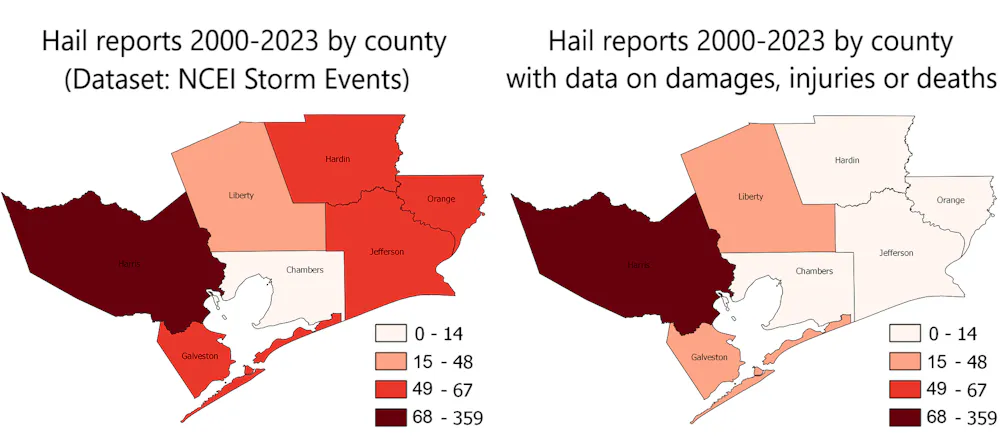
    We are atmospheric scientists at Texas A&M University who lead the Office of the Texas State Climatologist. Through our involvement in state-level planning for weather-related disasters, we have seen county-scale patterns of storm damage over the past 20 years that just didn’t make sense. So, we decided to dig deeper.

    We looked at storm event reports for a mix of seven urban and rural counties in southeast Texas, with populations ranging from 50,000 to 5 million. We included all reported types of extreme weather. We also talked with people from the two National Weather Service offices that cover the area.

    Storm damage investigations vary widely

    Typically, two specific types of extreme weather receive special attention.

    After a tornado, the National Weather Service conducts an on-site damage survey, examining its track and destruction. That survey forms the basis for the official estimate of a tornado’s strength on the enhanced Fujita scale. Weather Service staff are able to make decent damage cost estimates from knowledge of home values in the area.

    They also investigate flash flood damage in detail, and loss information is available from the National Flood Insurance Program, the main source of flood insurance for U.S. homes.

    Tornadoes in May 2025 destroyed homes in communities in several states, including London, Ky.
    AP Photo/Timothy D. Easley

    Most other losses from extreme weather are privately insured, if they’re insured at all.

    Insured loss information is collected by reinsurance companies – the companies that insure the insurance companies – and gets tabulated for major events. Insurance companies use their own detailed information to try to make better decisions on rates than their competitors do, so event-based loss data by county from insurance companies isn’t readily available.

    Losing billion-dollar disaster data

    There’s one big window into how disaster damage has changed over the years in the U.S.

    The National Oceanic and Atmospheric Administration, or NOAA, compiled information for major disasters, including insured losses by state. Bulk data won’t tell communities or counties about their specific risk, but it enabled NOAA to calculate overall damage estimates, which it released as its billion-dollar disasters list.

    From that program, we know that the number and cost of billion-dollar disasters in the United States has increased dramatically in recent years. News articles and even scientific papers often point to climate change as the primary culprit, but a much larger driver has been the increasing number and value of buildings and other types of infrastructure, particularly along hurricane-prone coasts.

    Critics in the past year called for more transparency and vetting of the procedures used to estimate billion-dollar disasters. But that’s not going to happen, because NOAA in May 2025 stopped making billion-dollar disaster estimates and retired its user interface.

    Previous estimates can still be retrieved from NOAA’s online data archive, but by shutting down that program, the window into current and future disaster losses and insurance claims is now closed.

    Emergency managers at the county level also make local damage estimates, but the resources they have available vary widely. They may estimate damages only when the total might be large enough to trigger a disaster declaration that makes relief funds available from the federal government.

    Patching together very rough estimates

    Without insurance data or county estimates, the local offices of the National Weather Service are on their own to estimate losses.

    There is no standard operating procedure that every office must follow. One office might choose to simply not provide damage estimates for any hailstorms because the staff doesn’t see how it could come up with accurate values. Others may make estimates, but with varying methods.

    The result is a patchwork of damage estimates. Accurate values are more likely for rare events that cause extensive damage. Loss estimates from more frequent events that don’t reach a high damage threshold are generally far less reliable.

    The number of severe hail reports in southeast Texas listed in the National Centers for Environmental Information’s storm events database is strongly correlated with population. The county with the most reports and greatest detail in those reports is home to Houston. Hailstorms in the three easternmost counties are rarely associated with damage estimates.
    John Nielsen-Gammon and B.J. Baule

    Do you want to look at local damage trends? Forget about it. For most extreme weather events, estimation methods vary over time and are not documented.

    Do you want to direct funding to help communities improve resilience to natural disasters where the need is greatest? Forget about it. The places experiencing the largest per capita damages depend not just on actual damages but on the different practices of local National Weather Service offices.

    Are you moving to a location that might be vulnerable to extreme weather? Companies are starting to provide localized risk estimates through real estate websites, but the algorithms tend to be proprietary, and there’s no independent validation.

    4 steps to improve disaster data

    We believe a few fixes could make NOAA’s storm events database and the corresponding values in the larger SHELDUS database, managed by Arizona State University, more reliable. Both databases include county-level disasters and loss estimates for some of those disasters.

    First, the National Weather Service could develop standard procedures for local offices for estimating disaster damages.

    Second, additional state support could encourage local emergency managers to make concrete damage estimates from individual events and share them with the National Weather Service. The local emergency manager generally knows the extent of damage much better than a forecaster sitting in an office a few counties away.

    Third, state or federal governments and insurance companies can agree to make public the aggregate loss information at the county level or other scale that doesn’t jeopardize the privacy of their policyholders. If all companies provide this data, there is no competitive disadvantage for doing so.

    Fourth, NOAA could create a small “tiger team” of damage specialists to make well-informed, consistent damage estimates of larger events and train local offices on how to handle the smaller stuff.

    With these processes in place, the U.S. wouldn’t need a billion-dollar disasters program anymore. We’d have reliable information on all the disasters.

    John Nielsen-Gammon receives funding from the National Oceanic and Atmospheric Administration and the State of Texas.

    William Baule receives funding from NOAA, the State of Texas, & the Austin Community Foundation.

    ref. Storm damage costs are often a mystery – that’s a problem for understanding extreme weather risk – https://theconversation.com/storm-damage-costs-are-often-a-mystery-thats-a-problem-for-understanding-extreme-weather-risk-257105

    MIL OSI – Global Reports

  • MIL-OSI Global: Reproducibility may be the key idea students need to balance trust in evidence with healthy skepticism

    Source: The Conversation – USA – By Sarah R. Supp, Associate Professor of Data Analytics, Denison University

    Reproducing results can increase trust in scientific studies. Huntstock via Getty Images

    Many people have been there.

    The dinner party is going well until someone decides to introduce a controversial topic. In today’s world, that could be anything from vaccines to government budget cuts to immigration policy. Conversation starts to get heated. Finally, someone announces with great authority that a scientific study supports their position. This causes the discussion to come to an abrupt halt because the dinner guests disagree on their belief in scientific evidence. Some may believe science always speaks the truth, some may think science can never be trusted, and others may disagree on which studies with contradicting claims are “right.”

    How can the dinner party – or society – move beyond this kind of impasse? In today’s world of misinformation and disinformation, healthy skepticism is essential. At the same time, much scientific work is rigorous and trustworthy. How do you reach a healthy balance between trust and skepticism? How can researchers increase the transparency of their work to make it possible to evaluate how much confidence the public should have in any particular study?

    As teachers and scholars, we see these problems in our own classrooms and in our students – and they are mirrored in society.

    The concept of reproducibility may offer important answers to these questions.

    Reproducibility is what it sounds like: reproducing results. In some ways, reproducibility is like a well-written recipe, such as a recipe for an award-winning cake at the county fair. To help others reproduce their cake, the proud prizewinner must clearly document the ingredients used and then describe each step of the process by which the ingredients were transformed into a cake. If others can follow the directions and come up with a cake of the same quality, then the recipe is reproducible.

    Think of the English scholar who claims that Shakespeare did not author a play that has historically been attributed to him. A critical reader will want to know exactly how they arrived at that conclusion. What is the evidence? How was it chosen and interpreted? By parsing the analysis step by step, reproducibility allows a critical reader to gauge the strength of any kind of argument.

    We are a group of researchers and professors from a wide range of disciplines who came together to discuss how we use reproducibility in our teaching and research.

    Based on our expertise and the students we encounter, we collectively see a need for higher-education students to learn about reproducibility in their classes, across all majors. It has the potential to benefit students and, ultimately, to enhance the quality of public discourse.

    The foundation of credibility

    Reproducibility has always been a foundation of good science because it allows researchers to scrutinize each other’s studies for rigor and credibility and expand upon prior work to make new discoveries. Researchers are increasingly paying attention to reproducibility in the natural sciences, such as physics and medicine, and in the social sciences, such as economics and environmental studies. Even researchers in the humanities, such as history and philosophy, are concerned with reproducibility in studies involving analysis of texts and evidence, especially with digital and computational methods. Increased interest in transparency and accessibility has followed the rising importance of computer algorithms and numerical analysis in research. This work should be reproducible, but it often remains opaque.

    Broadly, research is reproducible if it answers the question: “How do you know?” − such that another researcher could theoretically repeat the study and produce consistent results.

    Reproducible research is explicit about the materials and methods that were used in a study to make discoveries and come to conclusions. Materials include everything from scientific instruments such as a tensiometer measuring soil moisture to surveys asking people about their daily diet. They also include digital data such as spreadsheets, digitized historic texts, satellite images and more. Methods include how researchers make observations and analyze data.

    To reproduce a social science study, for example, we would ask: What is the central question or hypothesis? Who was in the study? How many individuals were included? What were they asked? After data was collected, how was it cleaned and prepared for analysis? How exactly was the analysis run?

    Proper documentation of all these steps, plus making available the original data from the study, allows other scientists to redo the research, evaluate the decisions made during the process of gathering and analyzing information, and assess the credibility of the findings.

    This short video, made by the National Academies, explains the key concepts in reproducing scientific findings and notes ways the process can be improved.

    Over the past 20 years, the need for reproducibility has become increasingly important. Scientists have discovered that some published studies are too poorly documented for others to repeat, lack verified data sources, are questionably designed, or even fraudulent.

    Putting reproducibility to work: An example

    A highly contentious, retracted study from 1998 linked the measles, mumps and rubella (MMR) vaccine and autism. Scientists and journalists used their understanding of reproducibility to discover the flaws in the study.

    The central question of the study was not about vaccines but aimed to explore a possible relationship between colitis − an inflammation of the large intestine − and developmental disorders. The authors explicitly wrote, “We did not prove an association between measles, mumps, and rubella vaccine and the syndrome described.”

    The study observed just 12 patients who were referred to the authors’ gastroenterology clinic and had histories of recent behavioral disorders, including autism. This sample of children is simply too small and selective to be able to make definitive conclusions.

    In this study, the researchers translated children’s medical charts into summary tables for comparison. When a journalist attempted to reproduce the published data tables from the children’s medical histories, they found pervasive inconsistencies.

    Reproducibility allows for corrections in research. The article was published in a respected journal, but it lacked transparency with regard to patient recruitment, data analysis and conflicts of interest. Whereas traditional peer review involves critical evaluation of a manuscript, reproducibility also opens the door to evaluating the underlying data and methods. When independent researchers attempted to reproduce this study, they found deep flaws. The article was retracted by the journal and by most of its authors. Independent research teams conducted more robust studies, finding no relationship between vaccines and autism.

    Each research discipline has its own set of best practices for achieving reproducibility. Disciplines in which researchers use computational or statistical analysis require sharing the data and software code for reproducing studies. In other disciplines, researchers interpret nonnumerical qualities of data sources such as interviews, historical texts, social media content and more. These disciplines are working to develop standards for sharing their data and research designs for reproducibility. Across disciplines, the core principles are the same: transparency of the evidence and arguments by which researchers arrived at their conclusions.

    Reproducibility in the classroom

    Colleges and universities are uniquely situated to promote reproducibility in research and public conversations. Critical thinking, effective communication and intellectual integrity, staples of higher-education mission statements, are all served by reproducibility.

    Teaching faculty at colleges and universities have started taking some important steps toward incorporating reproducibility into a wide range of undergraduate and graduate courses. These include assignments to replicate existing studies, training in reproducible methods to conduct and document original research, preregistration of hypotheses and analysis plans, and tools to facilitate open collaboration among peers. A number of initiatives to develop and disseminate resources for teaching reproducibility have been launched.

    Despite some progress, reproducibility still needs a central place in higher education. It can be integrated into any course in which students weigh evidence, read published literature to make claims, or learn to conduct their own research. This change is urgently needed to train the next generation of researchers, but that is not the only reason.

    Reproducibility is fundamental to constructing and communicating claims based on evidence. Through a reproducibility lens, students evaluate claims in published studies as contingent on the transparency and soundness of the evidence and analysis on which the claims are based. When faculty teach reproducibility as a core expectation from the beginning of a curriculum, they encourage students to internalize its principles in how they conduct their own research and engage with the research published by others.

    Institutions of higher education already prioritize cultivating engaged, literate and critical citizens capable of solving the world’s most challenging contemporary problems. Teaching reproducibility equips students, and members of the public, with the skills they need to critically analyze claims in published research, in the media and even at dinner parties.

    Also contributing to this article are participants in the 2024 Reproducibility and Replicability in the Liberal Arts workshop, funded by the Alliance to Advance Liberal Arts Colleges (AALAC) [in alphabetical order]: Ben Gebre-Medhin (Department of Sociology and Anthropology, Mount Holyoke College), Xavier Haro-Carrión (Department of Geography, Macalester College), Emmanuel Kaparakis (Quantitative Analysis Center, Wesleyan University), Scott LaCombe (Statistical and Data Sciences, Smith College), Matthew Lavin (Data Analytics Program, Denison University), Joseph J. Merry (Sociology Department, Furman University), Laurie Tupper (Department of Mathematics and Statistics, Mount Holyoke College).

    Sarah Supp receives funding from the National Science Foundation, awards #1915913, #2120609, and #2227298.

    Joseph Holler receives funding from the National Science Foundation, award #2049837.

    Peter Kedron receives funding from the National Science Foundation, award #2049837 and from Esri.

    Richard Ball has received funding from the Alfred P. Sloan Foundation and the United Kingdom Reproducibility Network.

    Anne M. Nurse and Nicholas J. Horton do not work for, consult, own shares in or receive funding from any company or organization that would benefit from this article, and have disclosed no relevant affiliations beyond their academic appointment.

    ref. Reproducibility may be the key idea students need to balance trust in evidence with healthy skepticism – https://theconversation.com/reproducibility-may-be-the-key-idea-students-need-to-balance-trust-in-evidence-with-healthy-skepticism-251771

    MIL OSI – Global Reports

  • MIL-OSI Global: How your electric bill may be paying for big data centers’ energy use

    Source: The Conversation – USA – By Ari Peskoe, Lecturer on Law, Harvard University

    Your power bill may be hiding something. photoschmidt/iStock/Getty Images Plus

    In the race to develop artificial intelligence, large technology companies such as Google and Meta are trying to secure massive amounts of electricity to power new data centers. Electric utilities see the prospect of earning large profits by providing electricity to these power-hungry facilities and are competing for their business by offering discounts not available to average consumers.

    In our paper Extracting Profits from the Public, we explain how utilities are forcing regular ratepayers to pay for the discounts enjoyed by some of the nation’s largest companies and identify ways policymakers can limit the costs to the public.

    Shifting costs

    In much of the U.S., utilities are monopolists. Within their service territories, they are the only companies allowed to deliver electricity to consumers. To fund their operations, utilities split the costs of maintaining and expanding their systems among all ratepayers – homeowners, businesses, warehouses, factories and anyone else who uses electricity.

    Historically, a utility expanded its system to meet growing demand for electricity from new factories, businesses and homes. To pay for its expansion − new power plants, new transmission lines and other equipment − the utility would propose to raise electricity rates by different amounts for various types of consumers.

    Public utility commissions are state agencies charged with ensuring that the public gets a fair deal. These commissions monitor how much money the utility spends to provide electric service and how its costs are shared among various types of ratepayers, including residential, commercial and industrial consumers. Ultimately, the public utility commission is supposed to approve any rate increases based on its assessment of what’s fair to consumers.

    Splitting the utility’s costs among all consumers made perfect sense when population growth and economic development across the economy stimulated the need for new infrastructure. But today, in many utility service territories, most of the projected growth in electricity demand is due to new data centers.

    Here’s the problem for consumers: To meet data center demand, utilities are building new power plants and power lines that are needed only because of data center growth. If state regulators allow utilities to follow the standard approach of splitting the costs of new infrastructure among all consumers, the public will end up paying to supply data centers with all that power.

    An artist’s rendering of a proposed Meta data center in Richland Parish, La.
    Meta via Facebook

    A big price tag

    One particularly acute example is in Louisiana. A Meta data center under development in the northeastern corner of the state is projected to use, by our calculations, twice as much energy as the city of New Orleans.

    Entergy, the regional monopoly utility, is proposing to build more than US$3 billion worth of new gas-fired power plants and delivery infrastructure to meet the data center’s energy demand. Rather than billing Meta directly for these costs, Entergy is proposing to include the costs in rates paid by all customers.

    Entergy claims its contract with Meta will cover some portion of the $3 billion price tag and that will mitigate any increases in consumers’ bills. But Entergy has asked state regulators to keep key terms of the contract secret, and only a redacted version of its application is available online.

    The public has no idea how much it might pay if the commission approves the contract. And if the Meta data center ends up using much less power than the company anticipates, the public does not know whether it would be on the hook to pay higher electricity rates for longer periods to guarantee Entergy a profit.

    The electronics in data centers consume large amounts of electricity.
    RJ Sangosti/MediaNews Group/The Denver Post via Getty Images

    Secret agreements

    Our research, reviewing nearly 50 public utility commission proceedings about data centers’ power needs across 10 states, uncovered dozens of secretive contracts between utilities and data centers. Unlike Louisiana, most states require utilities to submit to the public utility commission their one-off deals with data centers, but they allow utilities to conceal the pricing terms from the public.

    In normal rate-review cases, numerous parties advocate for their interests in a public proceeding, including members of the public, industry groups and the utility itself. But as our paper finds, utility commission reviews of data center contracts are based on confidential utility filings that are inaccessible to the general public. Few, if any, outsiders participate, and as a result the commission often hears only the utility’s version of the deal.

    Because the pricing terms are secret, it is impossible to know whether the deal that a utility is offering to a data center is too low to cover the utility’s costs of providing power to the data center, which would mean that the public is subsidizing the deal. History shows, however, that utilities have a long history of exploiting their monopolies to shift costs to the public, including through secret contracts.

    Electric utilities also charge customers for the costs of building and maintaining transmission networks.
    Jay L. Clendenin/Getty Images

    Other public costs

    Our paper also explores other ways that the public pays for data center energy costs. For instance, many high-voltage interstate transmission projects, which connect large power plants to local delivery systems, are developed through regional planning processes run by numerous utilities. These alliances have complex rules for splitting the costs of new transmission lines and equipment among their utility members.

    Once a utility is charged its share, it spreads the costs of new transmission projects among its local ratepayers. Because some regions are building new transmission capacity to accommodate data centers, our analysis finds that the public has been forced to pay billions of dollars for data center growth.

    Data center energy costs can also be shifted when data centers connect directly to existing power plants. Under what are called “co-location” deals, the power plant stops selling energy to the wider public and just sells to the data center. With less supply in the overall market, prices go up and the public faces higher bills as a result.

    Many state legislatures are noticing these problems and working to figure out how to address them. Several recent bills would set new terms and conditions for future data center deals that could help protect the public from data center energy costs.

    Ari Peskoe is the Director of the Electricity Law Initiative at the Harvard Law School Environmental and Energy Law Program (EELP). EELP receives funding from philanthropic foundations that support the clean energy transition.

    Eliza Martin does not work for, consult, own shares in or receive funding from any company or organization that would benefit from this article, and has disclosed no relevant affiliations beyond their academic appointment.

    ref. How your electric bill may be paying for big data centers’ energy use – https://theconversation.com/how-your-electric-bill-may-be-paying-for-big-data-centers-energy-use-257794

    MIL OSI – Global Reports

  • MIL-OSI Global: 100 years ago, the Supreme Court made a landmark ruling on parents’ rights in education – today, another case raises new questions

    Source: The Conversation – USA – By Charles J. Russo, Joseph Panzer Chair in Education and Research Professor of Law, University of Dayton

    A selection of books that are part of the Supreme Court case Mahmoud v. Taylor are pictured on April, 15, 2025, in Washington. AP Photo/Pablo Martinez Monsivais

    A century ago, the Supreme Court handed down one of its most important cases about education. On June 1, 1925, the court struck down an Oregon statute requiring all students to attend public school – a law critics argued was meant to limit faith-based schools, at a time when anti-Catholic bias was still common in parts of the United States.

    The majority opinion in Pierce v. Society of Sisters of the Holy Name of Jesus and Mary included a now-famous dictum about parents’ rights to shape their children’s upbringing. According to the court, “the child is not the mere creature of the state; those who nurture him and direct his destiny have the right, coupled with the high duty, to recognize and prepare him for additional obligations.”

    Soon, the Supreme Court is expected to release another decision around parental beliefs and education: Mahmoud v. Taylor. The plaintiffs are parents who want to excuse their children from public school lessons involving storybooks with LGBTQ+ characters – lessons they assert contradict their religious beliefs.

    As someone who teaches education law, I believe this is perhaps the court’s most significant case on parental rights since Pierce. Mahmoud raises questions not only about religious freedom, but also about educators’ ability to determine curricula, and public education in a pluralistic society.

    Picture-book debate

    Controversy arose during the 2022-23 school year in Montgomery County, Maryland’s largest school district, when officials approved various storybooks with LGBTQ+-inclusive themes to be incorporated into the English language-arts curriculum for preschool and elementary students.

    Some parents challenged the materials, including “Pride Puppy!”, a picture book the board later removed from use. Originally approved for preschool and pre-K, the story portrays a family whose puppy gets lost at a LGBTQ+ Pride parade, devoting a page to each letter of the alphabet. At the end of the book, a long “search and find” list of words for children to go back and look for in the pictures of the parade includes “[drag] queen” and “king,” “leather” and “lip ring.”

    Other materials for older children included stories about same-sex marriage, a transgender child and nonbinary bathroom signs.

    Parents who objected to the use of these materials on religious grounds sought to excuse their children from lessons using them. The parents basically argued that requiring their children to participate compelled or coerced them to go against their families’ religious beliefs.

    A group of parents protest in Rockville, Md., on June 27, 2023, in an effort to opt out of books that feature LGBTQ+ characters in Montgomery County schools.
    Sarah L. Voisin/The Washington Post via Getty Images

    Initially, officials agreed to allow opt-outs for elementary schoolers whose parents objected to the materials. However, a day later they changed their minds. Since then, school officials cited concerns about absenteeism, the feasibility of accommodating opt-out requests, and a desire to avoid stigmatizing LGBTQ+ students or families as reasons for their policy.

    A group of Muslim, Orthodox Christian and Catholic families challenged the board’s refusal to excuse their children from lessons using the disputed materials.

    The federal trial court, however, rejected the parents’ claim that having no opt-outs violated their right to due process.

    Parents appealed, and the 4th Circuit affirmed in favor of the school board 2-1. The court added that officials had not violated the parents’ First Amendment rights to freely exercise their faith. “There’s no evidence at present that the Board’s decision not to permit opt-outs compels the Parents or their children to change their religious beliefs or conduct, either at school or elsewhere,” the panel concluded.

    The dissenting judge stridently countered. Officials violated the parents’ free exercise rights by forcing them “to make a choice,” he wrote, between “either adher[ing] to their faith, or receiv[ing] a free public education for their children.” He also noted that the board’s opt-out policy was not neutral toward religion, because under Maryland regulations, children may be excused from sex-ed lessons.

    In January 2025, the Supreme Court agreed to hear the parents’ appeal, addressing whether the schools are burdening parents’ free-exercise rights.

    Court record

    In their brief to the Supreme Court and oral arguments, the parents cited Wisconsin v. Yoder, a Supreme Court ruling from 1972. The court found that Amish parents did not have to send their children to school after the eighth grade, which the families argued would violate their religious beliefs. Amish communities descend from Anabaptist Christians who fled persecution in Europe and emphasize living simply, eschewing many modern technologies.

    In Yoder, the justices agreed with the parents that their children received all the education they needed in their home communities. Under the First Amendment, parents have the right “to guide the religious future and education of their children,” the majority wrote, a matter “established beyond debate.”

    During oral arguments for Mahmoud in April 2025, some justices briefly discussed another precedent: the Supreme Court’s 1943 judgment in West Virginia State Board of Education v. Barnette, resolved at the height of U.S. involvement in World War II. Here, three parents who were Jehovah’s Witnesses refused to have their children participate in public schools’ flag salute and Pledge of Allegiance because they viewed it as a form of idolatry contrary to their religious beliefs. Others objected
    to the salute as “being too much like Hitler’s.”

    The court reasoned that educators could not compel students to participate, because forcing children – or anyone – to engage in activities inconsistent with their beliefs is contrary to their First Amendment rights to the free exercise of religion and freedom of speech.

    Viewed together, these cases highlight how the court has granted parents significant leeway to exempt their children from educational activities inconsistent with their religious beliefs.

    Questions at court

    During oral arguments, a majority of justices appeared to support the parents’ request to excuse children from lessons involving the books about LGBTQ+ characters.

    The board’s attorney argued that students did not have to agree with the books’ messages, simply to participate in the lesson. Being exposed to an idea “does not burden free exercise,” he said.

    Protesters in support of LGBTQ+ rights and against book bans outside the U.S. Supreme Court building on April 22, 2025, the day the court heard arguments in Mahmoud v. Taylor.
    Anna Moneymaker/Getty Images

    Chief Justice John Roberts, however, queried whether it is realistic for 5-year-olds to understand that distinction. He asked, “Do you want to say you don’t have to follow the teacher’s instructions, you don’t have to agree with the teacher? I mean, that may be a more dangerous message than some of the other things.”

    Other conservative justices also appeared skeptical of the idea that the lessons were merely exposing young children to ideas, but not instilling moral lessons. The storybooks do not simply explain that some people believe something and others do not, Justice Amy Coney Barrett suggested; they inform students that “this is the right view of the world.” Similarly, Justice Neil Gorsuch remarked that telling students that “some people think X, and X is wrong and hurtful and negative” is “more than exposure.”

    “What is the big deal about allowing them to opt out of this?” Justice Samuel Alito asked.

    Conversely, Justice Elena Kagan acknowledged that parents’ concerns were “serious,” but wondered how to draw limits on opt-out policies. Did the parents’ argument suggest that anytime “a religious person confronts anything in a classroom that conflicts with her religious beliefs or her parents’ that – that the parent can then demand an opt-out?”

    Justice Sonia Sotomayor pressed the plaintiffs’ attorney on whether “the mere exposure to things that you object to” really counts as coercion. And Justice Ketanji Brown Jackson questioned why, even if opt-outs are not allowed, public schools teaching “something that the parent disagrees with” is coercive, given that homeschooling and private schools are legal.

    Mahmoud raises challenging questions about curricular content, parental control and free exercise of religion – questions the court will hopefully resolve. A ruling is expected in June or early July 2025.

    Charles J. Russo does not work for, consult, own shares in or receive funding from any company or organization that would benefit from this article, and has disclosed no relevant affiliations beyond their academic appointment.

    ref. 100 years ago, the Supreme Court made a landmark ruling on parents’ rights in education – today, another case raises new questions – https://theconversation.com/100-years-ago-the-supreme-court-made-a-landmark-ruling-on-parents-rights-in-education-today-another-case-raises-new-questions-257876

    MIL OSI – Global Reports

  • MIL-Evening Report: Internal tensions throw PNG anti-corruption body into crisis

    By Scott Waide, RNZ Pacific PNG correspondent

    Three staffers from Papua New Guinea’s peak anti-corruption body are embroiled in a standoff that has brought into question the integrity of the organisation.

    Police Commissioner David Manning has confirmed that he received a formal complaint.

    Commissioner Manning said that initial inquiries were underway to inform the “sensitive investigation board’s” consideration of the referral.

    That board itself is controversial, having been set up as a halfway point to decide if an investigation into a subject should proceed through the usual justice process.

    Manning indicated if the board determined a criminal offence had occurred, the matter would be assigned to the National Fraud and Anti-Corruption Directorate for independent investigation.

    Local news media reported PNG Prime Minister James Marape was being kept informed of the developments.

    Marape has issued a statement acknowledging the internal tensions within ICAC and reaffirming his government’s commitment to the institution.

    Long-standing goal
    The establishment of ICAC in Papua New Guinea has been a long-standing national aspiration, dating back to 1984. The enabling legislation for ICAC was passed on 20 November 2020, bringing the body into legal existence.

    Marape said it was a proud moment of his leadership having achieved this in just 18 months after he took office in May 2019.

    The appointments process for ICAC officials was described as rigorous and internationally supervised, making the current internal disputes disheartening for many.

    Marape has reacted strongly to the crisis, expressing disappointment over the allegations and differences between the three ICAC leaders. He affirmed his government’s “unwavering commitment” to ICAC.

    These developments have significant implications for Papua New Guinea, particularly concerning its international commitments related to combating financial crime.

    PNG has been working to address deficiencies in its anti-money laundering and counter-terrorism financing (AML/CTF) framework, with the Financial Action Task Force (FATF) closely monitoring its progress.

    Crucial for fighting corruption
    An effective and credible ICAC is crucial for demonstrating the country’s commitment to fighting corruption, a key component of a robust AML/CTF regime.

    Furthermore, the International Monetary Fund (IMF) often includes governance and anti-corruption measures as part of its conditionalities for financial assistance and programme support.

    Any perception of instability or compromised integrity within ICAC could hinder Papua New Guinea’s efforts to meet these international requirements, potentially affecting its financial standing and access to crucial development funds.

    The current situation lays bare the urgent need for swift and decisive action to restore confidence in ICAC and ensure it can effectively fulfill its mandate.

    This article is republished under a community partnership agreement with RNZ.

    MIL OSI AnalysisEveningReport.nz

  • MIL-Evening Report: Grattan on Friday: Albanese will need some nuance in facing a female opposition leader

    Source: The Conversation (Au and NZ) – By Michelle Grattan, Professorial Fellow, University of Canberra

    Anthony Albanese loves a trophy, especially a human one. He prides himself on his various “captain’s pick” candidates – good campaigners he has steered into seats.

    Way back in the Gillard days, he was key in persuading discontented Liberal Peter Slipper to defect. Slipper became an independent and Labor’s speaker.

    The exercise helped the government’s numbers, but the bold play didn’t end well for Labor or for Slipper. The government was tarnished, and Slipper, relentlessly pursued by the Coalition and mired in controversy, eventually had to quit the speakership. The affair did produce Julia Gillard’s famous misogyny speech, however.

    Now Albanese has another gee-whiz prize – Western Australian Senator Dorinda Cox, who has defected from the Greens. Cox, after being defeated in a bid for Greens deputy leader, approached Labor and the PM drove her course to being accepted into the party.

    The manoeuvre makes a marginal but insignificant difference to Senate numbers – Labor will still need the Greens to pass legislation opposed by the Coalition.

    Taking in Cox is a risk, and some in Labor are looking at it askance.

    The prime minister’s embrace of Cox contradicts Labor’s argument when its Western Australian senator Fatima Payman defected to become an independent. It said then hers was a Labor seat and she should therefore resign. But this wouldn’t be the first time expediency trumped consistency in politics.

    Cox, who is Indigenous and was spokeswoman for First Nations and resources in the last parliament, has been a fierce critic of the extending the North West Shelf gas project, which the government has just announced. Albanese says he is confident she “understands that being a member of the Labor Party means that she will support positions that are made by the Labor Party”.

    She has also faced allegations of treating staff badly. Labor discounts the claims against her, saying they are overblown and a product of Greens factionalism and toxicity. Certainly, she was given a tough time by the hard-left faction represented by deputy leader Mehreen Faruqi. Labor would be wise to ensure Cox feels supported in her new party home.

    Albanese perhaps calculates that the worst that can happen is there’s a blow up and she defects to the crossbench. Labor could shrug and say, she was never really one of us.

    Snatching a senator from the Greens is particularly satisfying to Albanese because he hates the party so much. Last term, lower house Greens MP Max Chandler-Mather (defeated at the election) really got under his skin. More generally, the Greens held up important legislation, most notably on housing.

    In the new Senate, Labor will need only the Greens to pass legislation opposed by the Coalition. How new Greens leader Larissa Waters – who replaced Adam Bandt after he lost his seat – handles the party’s relationship with the government will be crucial for the more contentious parts of Labor’s legislative program.

    The usually low-key Waters will be under a lot of pressure. The Greens had a bad election, losing three lower house seats. Now they have lost a senator at the start of Waters’ watch.

    Waters conceded on the Serious Danger podcast in late May that Labor had successfully run the narrative of the Greens as blockers. “So I do think we’re going to need to be quite deft in how we handle balance of power in this term, […] People want us to be constructive. They don’t just want us to roll over and tick off on any old shit. They want meaningful reforms.”

    Waters will want to pick her fights carefully, and also find ways of pursuing the Greens’ agenda where the party co-operates. The first deal is likely to be on the government’s legislation to increase the tax on those with large superannuation balances, which contains the controversial provision to tax unrealised capital gains.

    Opposition Leader Sussan Ley and her team will confront some of the same problems as the Greens – when to oppose and when to seek to negotiate with the government.

    For his part, Albanese will have a novel challenge with Ley – what stance to adopt against the first female opposition leader, especially but not only in parliamentary clashes.

    After facing two alpha male opposition leaders, Scott Morrison and Peter Dutton, a new approach will obviously be necessary. As one Labor man succinctly puts it, “Labor can’t monster a woman”. There can be no repeat of Albanese, a frontbencher a decade ago in the Shorten opposition, interjecting to urge a female colleague engaged in a stoush with Ley to “smash her”.

    For Ley, trying to deal with the Liberals’ multiple difficulties in attracting women voters and candidates must be high on her agenda. Former Liberal federal president Alan Stockdale, one of the three-person group currently running the NSW division of the party, showed himself part of the problem when this week he told the NSW Liberal Women’s Council, “The women in this party are so assertive now that we may need some special rules for men to get them pre-selected”.

    Stockdale said later he was being “light-hearted”. Tone deaf might be a better term. Ley jumped on him. “There is nothing wrong with being an assertive woman. In fact I encourage assertive women to join the Liberal Party.”

    The jury is out on whether Ley will be able to make any sort of fist of her near-impossible job. But in the short time she’s been leader, she has shown she is willing to be assertive.

    She emerged from the brief split in the Coalition looking much steadier than Nationals leader David Littleproud, even though she had to persuade her party room to accept the minor party’s policy demands.

    In her frontbench reshuffle, she was willing to wear the inevitable criticism that came with dropping a couple of senior women who had under-performed.

    As deputy leader, Ley adjusted her style a while before the election, toning down the aggression and sometimes wild attacks, that had characterised her performance earlier in the term. A Liberal source said she found her “line and length”. As leader, she will have others, notably deputy Ted O’Brien, to do the head-kicking, giving her room to attempt to develop a positive political persona.

    Labor leaned into attacking Dutton – never afraid to name him. With Ley, Albanese might adopt the Bob Carr approach of avoiding using his opponent’s name. At least until he finds his line and length in dealing with her.

    Michelle Grattan does not work for, consult, own shares in or receive funding from any company or organisation that would benefit from this article, and has disclosed no relevant affiliations beyond their academic appointment.

    ref. Grattan on Friday: Albanese will need some nuance in facing a female opposition leader – https://theconversation.com/grattan-on-friday-albanese-will-need-some-nuance-in-facing-a-female-opposition-leader-257338

    MIL OSI AnalysisEveningReport.nz

  • MIL-Evening Report: Tasmania could go to an election just 16 months after its last one. What’s going on?

    Source: The Conversation (Au and NZ) – By Robert Hortle, Deputy Director, Tasmanian Policy Exchange, University of Tasmania

    Tasmania’s Liberal government and its premier, Jeremy Rockliff, have come under huge pressure since the state budget was handed down last week.

    It’s culminated in the Tasmanian House of Assembly voting to pass a motion of no confidence in the premier – but only after the speaker, Labor’s Michelle O’Byrne, cast a tie-breaking vote in favour.

    Rockliff has since confirmed he’ll recall parliament to sit early next week and debate some emergency bills, then ask the governor for permission to call an early election.

    It’s been a wild few days in Tasmanian politics, with huge amounts of conjecture and confusion. Here’s how it all unfolded.

    What is a no confidence motion?

    First, we need a short lesson in our system of government, called the Westminster system. The Tasmanian situation right now all started with a motion of no confidence in the premier, Rockliff.

    This type of parliamentary motion is used to declare the parliament no longer has confidence in the target of the motion.

    No confidence motions can be directed at a specific minister or a government as a whole.

    If a no confidence motion in a minister is passed, they usually resign from their ministry and sometimes from parliament as well.

    If a no confidence motion in a government is passed, the leader of the government usually recommends one of two options to the governor. They can ask the governor to dissolve parliament and call an election, or they can advise the governor to ask someone else (usually the leader of the opposition) to have a go at forming government.

    What is happening in Tasmania?

    Strap in, it’s complex.

    On May 29, the Liberal government presented the state budget. The outlook is grim, with the state forecast to be over $10 billion in debt by 2029.

    To address this, the government proposed big cuts to the public service in the coming years.

    On June 2, the leader of the opposition, Labor’s Dean Winter, tabled a motion of no confidence in the premier at the end of his budget reply speech.

    “Tabling” a motion means putting it on the agenda for discussion at some point in future. To be debated, it has to be “moved”.

    Winter stated he wouldn’t move the motion until he had enough support to guarantee it would pass. The motion focused on three things:

    • alleged poor financial management

    • the ongoing Spirit of Tasmania ferry fiasco

    • and the government’s plan to potentially privatise some state-owned businesses.

    Support was fast in coming. By Monday evening, three of the six cross-benchers had said they would vote for the motion, meaning Labor only needed the five Greens MPs to jump onboard.

    At a party meeting early on Wednesday morning, the Greens decided they would do just that.

    So, instead of debating the budget, Wednesday and Thursday were spent debating the no confidence motion.

    There was a lot of confusion in Tasmanian political circles at this point. There is very little formal procedure that describes how no confidence motions work in Tasmania’s parliament.

    Instead, what happens is defined by convention, which means there are lots of grey areas. There have only been a few successful no confidence motions in Tasmania’s history (the most recent ones were in 1989 and 1982).

    So how did it play out?

    This time around, there were a few complications.

    The motion referred to the premier, not the government. There was speculation, therefore, that if the motion passed, the Liberal Party could replace Rockliff as leader, and Labor would then pass the budget.

    However, during parliamentary debate, several Liberal MPs argued they saw the motion as indicating lack of confidence in the whole government – not just the premier. Under this view, Rockliff would have to go to the governor, Barbara Baker, and ask her to call an election, or advise her to ask Winter to try to rally the numbers to govern.

    Although the convention is that the governor follows the premier’s advice, there is precedent for them making their own decision.

    Just to spice things up further, Baker is currently on leave. The decision would need to be made by the lieutenant-governor, Chief Justice Chris Shanahan, who is new to his role – and the state.

    An election quickly shaped up as the most likely outcome. On Thursday morning, Rockliff announced that if the motion passed, he would ask the governor to dissolve parliament and call an election.

    Shortly after that, Winter ruled out governing in coalition – or doing a deal – with the Greens. This made it very unlikely any alternative government would have the numbers to pass legislation through the lower house, leaving the lieutenant-governor with few options.

    Late on Thursday, parliament voted on the motion. With the numbers tied at 17-17, the speaker cast her vote with the “ayes” alongside the other nine Labor MPs, all five Greens MPs, independents Craig Garland and Kristie Johnston, and the Jacqui Lambie Network’s last remaining MP, Andrew Jenner.

    Following an emotionally charged speech, Rockliff met with the lieutenant-governor. Speaking to the media afterwards, he said he’ll recall parliament on Tuesday with the aim of passing an emergency supply bill to ensure public servants continue to be paid despite the delay in the budget process.

    Rockliff said he would then ask Baker – who returns from leave next week – for permission to call an election. It will be interesting to see if she takes his advice or not.

    What happens now?

    All this means Tasmania could head back to the polls in mid-July, just 16 months after the last state election.

    The Liberals will seek to pin the blame for the snap election on Labor and the crossbench, and hope that a grumpy electorate punishes them for this.

    They will also try to convince Tasmanians they are the only party that can get the controversial stadium in Hobart is built, thereby delivering the state its long-desired AFL team.

    Labor will campaign on the three things it cited in the no confidence motion, while arguing it will also guarantee that Tasmania gets an AFL team.

    They’ll also be hoping to ride the wave of the recent strong result for federal Labor at the national election. However, on past evidence, they can’t bank on this.

    Labor’s challenge will be differentiating themselves from the current government, because their positions are pretty closely aligned on key issues, including the stadium, salmon farming, and the proposed development assistance panels.

    The Greens will set out their stall as the only party firmly against the current stadium proposal and in favour of removing salmon farming in Tasmanian waters.

    For the independents, an early election is bad news. Campaigns are expensive, and without extensive party resources to draw on, some independents may be forced to decide whether they can afford to run again so soon.

    All of this does not point to a more stable parliament. The vote share of the two major parties has been steadily decreasing in Tasmania. A new election is not likely to reverse this trend.

    In the meantime, Tasmanians are left to wonder when their political leaders will get serious about tackling the state’s complex health, housing, education, sustainability, and productivity challenges.

    Robert Hortle does not work for, consult, own shares in or receive funding from any company or organisation that would benefit from this article, and has disclosed no relevant affiliations beyond their academic appointment.

    ref. Tasmania could go to an election just 16 months after its last one. What’s going on? – https://theconversation.com/tasmania-could-go-to-an-election-just-16-months-after-its-last-one-whats-going-on-258180

    MIL OSI AnalysisEveningReport.nz

  • MIL-Evening Report: Punishment for Te Pāti Māori over Treaty haka stands – but MPs ‘will not be silenced’

    RNZ News

    Aotearoa New Zealand’s Parliament has confirmed the unprecedented punishments proposed for opposition indigenous Te Pāti Māori MPs who performed a haka in protest against the Treaty Principles Bill.

    Te Pāti Māori co-leaders Debbie Ngarewa-Packer and Rawiri Waititi will be suspended for 21 days, and MP Hana-Rawhiti Maipi-Clarke suspended for seven days, taking effect immediately.

    Opposition parties tried to reject the recommendation, but did not have the numbers to vote it down.

    Te Pati Maori MPs speak after being suspended.  Video: RNZ/Mark Papalii

    The heated debate to consider the proposed punishment came to an end just before Parliament was due to rise.

    Waititi moved to close the debate and no party disagreed, ending the possibility of it carrying on in the next sitting week.

    Leader of the House Chris Bishop — the only National MP who spoke — kicked off the debate earlier in the afternoon saying it was “regrettable” some MPs did not vote on the Budget two weeks ago.

    Bishop had called a vote ahead of Budget Day to suspend the privileges report debate to ensure the Te Pāti Māori MPs could take part in the Budget, but not all of them turned up.

    Robust, rowdy debate
    The debate was robust and rowdy with both the deputy speaker Barbara Kuriger and temporary speaker Tangi Utikare repeatedly having to ask MPs to quieten down.

    Flashback: Te Pāti Māori MP Hana-Rawhiti Maipa-Clarke led a haka in Parliament and tore up a copy of the Treaty Principles Bill at the first reading on 14 November 2024 . . . . a haka is traditionally used as an indigenous show of challenge, support or sorrow. Image: RNZ/Samuel Rillstone/APR screenshot

    Tākuta Ferris spoke first for Te Pāti Māori, saying the haka was a “signal of humanity” and a “raw human connection”.

    He said Māori had faced acts of violence for too long and would not be silenced by “ignorance or bigotry”.

    “Is this really us in 2025, Aotearoa New Zealand?” he asked the House.

    “Everyone can see the racism.”

    He said the Privileges Committee’s recommendations were not without precedent, noting the fact Labour MP Peeni Henare, who also participated in the haka, did not face suspension.

    MP Tākuta Ferris spoke for Te Pāti Māori. Image: RNZ/Samuel Rillstone

    Henare attended the committee and apologised, which contributed to his lesser sanction.

    ‘Finger gun’ gesture
    MP Parmjeet Parmar — a member of the Committee — was first to speak on behalf of ACT, and referenced the hand gesture — or “finger gun” — that Te Pāti Māori co-leader Debbie Ngarewa-Packer made in the direction of ACT MPs during the haka.

    Parmar told the House debate could be used to disagree on ideas and issues, and there was not a place for intimidating physical gestures.

    Greens co-leader Marama Davidson said New Zealand’s Parliament could lead the world in terms of involving the indigenous people.

    She said the Green Party strongly rejected the committee’s recommendations and proposed their amendment of removing suspensions, and asked the Te Pāti Māori MPs be censured instead.

    Davidson said the House had evolved in the past — such as the inclusion of sign language and breast-feeding in the House.

    She said the Greens were challenging the rules, and did not need an apology from Te Pāti Māori.

    Foreign Minister and NZ First party leader Winston Peters called Te Pāti Māori “a bunch of extremists”. Image: RNZ/Samuel Rillstone

    NZ First leader Winston Peters said Te Pāti Māori and the Green Party speeches so far showed “no sincerity, saying countless haka had taken place in Parliament but only after first consulting the Speaker.

    “They told the media they were going to do it, but they didn’t tell the Speaker did they?

    ‘Bunch of extremists’
    “The Māori party are a bunch of extremists,” Peters said, “New Zealand has had enough of them”.

    Peters was made to apologise after taking aim at Waititi, calling him “the one in the cowboy hat” with “scribbles on his face” [in reference to his traditional indigenous moko — tatoo]. He continued afterward, describing Waititi as possessing “anti-Western values”.

    Labour’s Willie Jackson congratulated Te Pāti Māori for the “greatest exhibition of our culture in the House in my lifetime”.

    Jackson said the Treaty bill was a great threat, and was met by a great haka performance. He was glad the ACT Party was intimidated, saying that was the whole point of doing the haka.

    He also called for a bit of compromise from Te Pāti Māori — encouraging them to say sorry — but reiterated Labour’s view the sanctions were out of proportion with past indiscretions in the House.

    Green Party co-leader Chlöe Swarbrick said the prime minister was personally responsible if the proposed sanctions went ahead. Image: RNZ/Samuel Rillstone

    Greens co-leader Chlöe Swarbrick said the debate “would be a joke if it wasn’t so serious”.

    “Get an absolute grip,” she said to the House, arguing the prime minister “is personally responsible” if the House proceeds with the committee’s proposed sanctions.

    Eye of the beholder
    She accused National’s James Meager of “pointing a finger gun” at her — the same gesture coalition MPs had criticised Ngarewa-Packer for during her haka. The Speaker accepted he had not intended to; Swarbrick said it was an example where the interpretation could be in the eye of the beholder.

    She said if the government could “pick a punishment out of thin air” that was “not a democracy”, putting New Zealand in very dangerous territory.

    An emotional Maipi-Clarke said she had been silent on the issue for a long time, the party’s voices in haka having sent shockwaves around the world. She questioned whether that was why the MPs were being punished.

    “Since when did being proud of your culture make you racist?”

    “We will never be silenced, and we will never be lost,” she said, calling the Treaty Principles bill a “dishonourable vote”.

    She had apologised to the Speaker and accepted the consequence laid down on the day, but refused to apologise. She listed other incidents in Parliament that resulted in no punishment.

    NZ Parliament TV: Te Pāti Māori Privileges committee debate.  Video: RNZ

    Maipi-Clarke called for the Treaty of Waitangi to be recognised in the Constitution Act, and for MPs to be required to honour it by law.

    ‘Clear pathway forward’
    “The pathway forward has never been so clear,” she said.

    ACT’s Nicole McKee said there were excuses being made for “bad behaviour”, that the House was for making laws and having discussions, and “this is not about the haka, this is about process”.

    She told the House she had heard no good ideas from the Te Pāti Māori, who she said resorted to intimidation when they did not get their way, but the MPs needed to “grow up” and learn to debate issues. She hoped 21 days would give them plenty of time to think about their behaviour.

    Labour MP and former Speaker Adrian Rurawhe started by saying there were “no winners in this debate”, and it was clear to him it was the government, not the Parliament, handing out the punishments.

    He said the proposed sanctions set a precedent for future penalties, and governments might use it as a way to punish opposition, imploring National to think twice.

    He also said an apology from Te Pāti Māori would “go a long way”, saying they had a “huge opportunity” to have a legacy in the House, but it was their choice — and while many would agree with the party there were rules and “you can’t have it both ways”.

    Te Pāti Māori co-leader Rawiri Waititi speaking to the media after the Privileges Committee debate. Image: RNZ/Mark Papalii

    Te Pāti Māori co-leader Rawiri Waititi said there had been many instances of misinterpretations of the haka in the House and said it was unclear why they were being punished, “is it about the haka . . . is about the gun gestures?”

    “Not one committee member has explained to us where 21 days came from,” he said.

    Hat and ‘scribbles’ response
    Waititi took aim at Peters over his comments targeting his hat and “scribbles” on his face.

    He said the haka was an elevation of indigenous voice and the proposed punishment was a “warning shot from the colonial state that cannot stomach” defiance.

    Waititi said that throughout history when Māori did not play ball, the “coloniser government” reached for extreme sanctions, ending with a plea to voters: “Make this a one-term government, enrol, vote”.

    He brought out a noose to represent Māori wrongfully put to death in the past, saying “interpretation is a feeling, it is not a fact . . .  you’ve traded a noose for legislation”.

    This article is republished under a community partnership agreement with RNZ.

    MIL OSI AnalysisEveningReport.nz

  • MIL-Evening Report: Virgin Australia is coming back to the share market. Here’s what this new chapter could mean

    Source: The Conversation (Au and NZ) – By Rico Merkert, Professor in Transport and Supply Chain Management and Deputy Director, Institute of Transport and Logistics Studies (ITLS), University of Sydney Business School, University of Sydney

    Petr Podrouzek/Shutterstock

    It is finally happening. After five years of being a private company, Virgin Australia will relist on the Australian Securities Exchange (ASX) on June 24. The company is expected to raise A$685 million through the initial public offering (IPO).

    So, who will benefit from Virgin Australia’s return to the share market? Having paid $3.5 billion for the bankrupt carrier back in 2020, private equity firm Bain Capital will be the most immediate winner.

    Earlier this year, Bain had sold 25% of the company to Qatar Airways. Now, with the IPO, Bain will reduce its stake from about 70% down to 40%.

    With Virgin’s anticipated market capitalisation close to $2.3 billion and enterprise value of reportedly up to $3.6 billion, it is now evident that Bain Capital has – with Jayne Hrdlicka at the helm of the airline – not only managed to turn the company around, but to also profit nicely from doing so.

    Without Bain’s rescue at the beginning of the pandemic (which was catastrophic for airlines globally), the situation may have become quite detrimental for travellers. It also avoided having the Australian taxpayer foot the bill for a bailout.

    Whether the airline’s customers end up better off will depend on what Virgin Australia ends up doing with the $685 million it raises, on top of the substantial profits it has recently been able to generate.

    Stronger competition for Qantas?

    Looking at the strategies of both Virgin Australia and its biggest competitor, Qantas, in recent years, it seems both have learned to love playing the duopoly game.

    Based on our own calculations, Virgin controls roughly 33% of Australia’s domestic seat capacity and the Qantas group (which includes Jetstar) much of the rest on the country’s core flight network.

    In the 2010s, the two airlines were out-competing themselves in adding capacity to the market, which drove down yields (or revenue per passenger) and nearly killed Virgin Australia 1.0.

    Now, Qantas and Virgin have new chief executives who understand both airlines can be very profitable if they show some (capacity) discipline in how many seats they create and sell.

    Better services

    For that reason, it’s likely not much will change in terms of competition, at least in the domestic market. But this is only true as far as capacity is concerned.

    It seems reasonable to assume Virgin’s raised capital will only support future growth if it is profitable. The majority of the funds will likely go towards fleet renewal and improvement of the airline’s product.

    For consumers, this wouldn’t necessarily mean lower airfares in the domestic market. But it would mean newer aircraft and enhanced services, which is a positive for both flyers and the environment.

    International departures

    Virgin Australia will become a more formidable competitor to Qantas, thanks to its newly formed relationship with international partner Qatar Airways and the additional cash from relisting.

    It will be interesting to observe what Qatar will do next and whether a new player – perhaps Singapore Airlines – will enter the scene and take a stake in the airline once Virgin Australia is trading publicly again.

    It would not be the first time an international airline has taken a stake in Virgin Australia, and could create some interesting dynamics.

    Another beneficiary is Virgin Australia’s management team, who’ve been somewhat shackled by the priority of getting the IPO off the ground. The IPO will free up management to deploy resources towards more longer-term priorities.

    Many will see a significant payday – it’s estimated staff are sitting on shares that could soon collectively be worth $180 million.

    Why now?

    Bain Capital has timed this IPO carefully. Virgin Australia has (in tandem with Qantas) produced a stellar financial performance in the last financial year. It may deliver an even better one in the current reporting period.

    To maximise returns, it is likely Bain did not want to waste the opportunity to capitalise on the moment. Global markets are still full of volatility and geopolitical uncertainty. What may diminish is the financial performance of the core business Bain Capital is trying to sell.

    At $2.90 a share, Virgin Australia will have a price-to-earnings ratio (used to assess how relatively expensive a share price is) of seven times its expected earnings this financial year. This is lower than Qantas’ ratio of ten times expected earnings this financial year.

    Profits are likely to remain high this year, with continuing strong demand, high yields and low jet fuel prices. The brokers and underwriting investment banks will use this to sell the story.

    IPOs can sometimes deliver those already holding shares in a company significant day-one windfall profits. In this case, however, Bain’s expertise in the venture capital market means it is unlikely to leave any money on the table.

    One may also argue while Virgin appears to be priced at a discount compared to Qantas, there may be legitimate reasons for the price differential, such as Qantas’ very profitable loyalty business.

    Given uncertainties around demand and geopolitical tensions, there is no guarantee the share price of Qantas will remain at record highs for too long, which means the opportunity to present Virgin shares as a bargain may be short-lived.

    In the long term, it is widely agreed airlines are by definition volatile investments and not necessarily something the average investor should have in their portfolio.

    Moving forward

    Symbolically, the decision for Virgin to use a new stock ticker – VGN instead of the old VAH – may avoid bringing back bad memories.

    Five years can be a lifetime in aviation, but maybe not to bond holders who got just 10 cents in the dollar and shareholders (including the large airline partners who held equity stakes) who got nothing when the airline collapsed in 2020.

    From a strategy perspective, it will be important for management to avoid history repeating itself with international airlines buying into Virgin and securing board seats.

    This can be one way of influencing the strategy of the carrier’s domestic arm to funnel more passengers to their own international flights.

    It is positive, for both Virgin Australia and the Australian aviation industry, that Bain Capital appears set to pull this off and that the revitalised airline is now truly Virgin Australia 2.0.

    Rico Merkert and his team of PhD students receive funding from the Australian Research Council through a discovery project and various research industry project, including with Thales and Air New Zealand. He has previously worked on research with and for international airlines, including Qantas and Virgin Australia.

    ref. Virgin Australia is coming back to the share market. Here’s what this new chapter could mean – https://theconversation.com/virgin-australia-is-coming-back-to-the-share-market-heres-what-this-new-chapter-could-mean-258179

    MIL OSI AnalysisEveningReport.nz

  • MIL-OSI Global: Why the global tax system needs fixing – podcast

    Source: The Conversation – UK – By Mend Mariwany, Producer, The Conversation Weekly Podcast, The Conversation

    Cagkan Sayin/Shutterstock

    For decades, multinational corporations have used sophisticated strategies to shift profits away from where they do business. As a result, countries around the world lose an estimated US$500 billion annually in unpaid taxes, with developing nations hit particularly hard.

    In the first of two episodes for The Conversation Weekly podcast called The 15% solution, we explore how companies have exploited loopholes in the global tax system. The episode features insights from Annette Alstadsæter, director of the Centre for Tax Research at the Norwegian University of Life Sciences, and Tarcisio Diniz Magalhaes, a professor of tax law at the University of Antwerp in Belgium.

    The problem goes beyond clever accounting. Our international tax rules were built for an industrial age where companies were physically present where they operated. But today’s tech giants can generate billions in revenue from users around the world, without having a single employee or office there, leaving those nations unable to tax those profits at all.

    In 2021, after years of international negotiations, the Organisation for Economic Co-operation and Development unveiled a global tax deal designed to address tax avoidance through a minimum corporate tax rate of 15%. But will this new framework actually work? And what happens when major economies refuse to participate?

    Across two episodes, The 15% solution explores why a new global tax regime is needed, whether it can fix a broken system, and what’s at stake if it fails. Part two will be published on June 6.


    This episode of The Conversation Weekly was written and produced by Mend Mariwany. Gemma Ware is the executive producer. Mixing and sound design by Eloise Stevens and theme music by Neeta Sarl.

    Newsclips in this episode from NBC News, France24, BBC News, DW News and TRT World.

    Listen to The Conversation Weekly via any of the apps listed above, download it directly via our RSS feed or find out how else to listen here. A transcript of this episode is available on Apple Podcasts.

    Tarcísio Diniz Magalhães has received funding from the University of Antwerp Research Fund, Flanders Research Foundation, Social Sciences and Humanities Research Council in Canada and the Ford Foundation. He is a member of the Antwerp Tax Academy and DigiTax Centre of Excellence and is lead professor on International Taxation, Working Group on Tax Reform, ACMinas – Commercial and Business Association of Minas Gerais. Annette Alstadsæter is the Director of Skatteforsk – Centre for Tax Research which collaborates with the EU Tax Observatory on the Atlas of the Offshore World.

    ref. Why the global tax system needs fixing – podcast – https://theconversation.com/why-the-global-tax-system-needs-fixing-podcast-257672

    MIL OSI – Global Reports

  • MIL-Evening Report: The Potter Museum of Art relaunches with the outstanding 65,000 Years, a Short History of Australian Art

    Source: The Conversation (Au and NZ) – By Roger Benjamin, Professor in Art History, University of Sydney

    Installation view of 65,000 Years: A Short History of Australian Art, Potter Museum of Art, the University of Melbourne, 2025. Photography by Christian Capurro

    In the late 1970s, when I was a fine arts student, the Melbourne University Gallery was just one room in a neo-gothic quadrangle. It wasn’t until the mid 1990s that the university commissioned Nonda Katzalidis to design a four-story concrete gallery on a narrow site fronting Swanston Street.

    The Ian Potter Museum of Art quickly became a vital centre for displaying diverse university collections – from classical antiquities to post-war bark paintings and contemporary art.

    The re-opening of the museum, after it closed for renovations in 2018, is an art event of major proportions with the architectural clout to match.

    The newest addition by Randall Marsh of Wood Marsh Architects transforms an adjacent red-brick building. A polished-steel portal gives onto stylish spaces: high vaulted ceilings, a light-filled atrium, new teaching rooms and luxurious bathrooms. There is now a serious restaurant with a long dining room, open kitchen and balcony café.

    Named “Residence” for its annual chef-in-residence program, starting with the Michelin-starred Robbie Noble, this may well become the go-to space for visitors, academics and students alike.

    Potter Museum of Art, the University of Melbourne.
    Photography by Christian Capurro.

    All expectations are exceeded by the opening exhibition 65,000 Years, a Short History of Australian Art. The title emphasises both the ancient Indigenous presence on this continent, and cheekily suggests that the main art that’s been made here is Aboriginal.

    As we recognise the monumental contributions of bark painting from the 1940s on, dot-painting from the 1970s on, and urban art starting in the 1980s, there is much to commend this view.

    Grand ambitions

    The exhibition, in eight main spaces over three floors, has an ambition and scope exceeding landmark surveys such as Dreamings: Art of Aboriginal Australia (1988) and Aratjara: Art of the First Australians (1993).

    There is a powerful curatorial will here, led by the legendary public intellectual and Indigenous scholar Marcia Langton, who initiated the project.

    She engaged one of the country’s most effective and knowledgeable curators in Judith Ryan, known for her series of field-defining exhibitions over four decades at the National Gallery of Victoria.

    Installation view of 65,000 Years: A Short History of Australian Art, Potter Museum of Art, the University of Melbourne, 2025.
    Photography by Christian Capurro

    Working together with associate curator Shanysa McConville, their exhibition is both politically astute in its management of tough historical issues, and visually stunning. The team has sourced superlative, large-scale examples of major artists’ work from private and public sources to sit alongside the university collections.

    It’s an exhibition that repays hours of looking, aided by the curators’ exemplary wall labels. A sumptuously illustrated 340-page tome published by Thames & Hudson Australia for the Potter supports a deeper dive. This includes 23 essays by both Indigenous and non-Indigenous writers who delve into specific groups of work.

    An example is the pungent essay by Grazia Gunn, who in 1973 exhibited the University’s rare barks from Groote Eylandt, presented in 1946 by the Jewish refugee Leonhard Adam.

    Installation view of 65,000 Years: A Short History of Australian Art, Potter Museum of Art, the University of Melbourne, 2025.
    Photography by Christian Capurro

    These barks can be seen again in the show, near a masterful assemblage of early barks from Yirrkala, painted in 1937 at the request of ethnographer Donald Thomson. This selection is unprecedented: a dozen barks with complete body designs for mardayin (mens’ ceremony), organised across clan groups.

    Truth telling

    Throughout 65,000 Years, there is a powerful truth-telling element on frontier wars and massacres. The early recognition of First Peoples’ work as art in the assembled barks goes some way to balancing Melbourne University’s own chapter of shame.

    In the side gallery, Langton and team present the role of Melbourne University medical anatomists, eugenicists and physical anthropologists in grave-robbing, and promoting the illicit collection and sale of Aboriginal remains, right up to the mid-1930s.

    On a big-screen video Langton, seated in a massive carved cathedral chair like a modern-day Delphic Oracle, dispassionately retells this grisly truth.

    The exhibition is comprehensive as it moves across regions and eras in a deft interplay with the building’s shifting levels. The ground floor (bar a stunning atrium enlaced with newly commissioned women’s baskets and “sun-mats”) deals with the imagery of contact from early colonial settlements.

    A group of French and British drawings of First Peoples are true portraits in the sense that the sitters are named. Late 19th century colour drawings by Barak or Mickey of Ulladulla are next to rare archival finds: distressing drawings of police reprisals by Oscar (Kuku-Yalanji), from 1898, and six lyrical drawings by Blak inmates of the Darwin Gaol, mounted together under the title “Dawn of Art” for display at the 1888 Melbourne Centenary Exhibition.

    Gordon Bennet (1955–2014), Big romantic painting (apotheosis of Captain Cook) 1993, synthetic polymer paint on canvas, 182×400.5×4cm.
    The University of Melbourne Art Collection

    Entering this colonial/decolonial zone, the glowering work of the late, great Gordon Bennett sets the precedent for the current historical citation and appropriation of colonial imagery.

    His example has inspired artists from Richard Bell and Brook Andrew to Megan Cope and Daniel Boyd.

    Bennett, faithfully represented by Melbourne’s Sutton Gallery through his life, was a McGeorge Fellow at Melbourne Uni in 1993, producing the groundbreaking Mirrorama installation with Groote Eylandt barks in opposition to classical busts. A gentle man and great thinker in art, Bennett then, as now, adds lustre to the Potter.

    65,000 Years, a Short History of Australian Art is at the Potter Museum of Art, Melbourne, until November 22.

    Roger Benjamin has previously worked as an art selector for the Vizard Collection at the Ian Potter Museum of Art, is an art collector and donor, and a colleague of the exhibition curators; he was not involved in the curation of this exhibition.

    ref. The Potter Museum of Art relaunches with the outstanding 65,000 Years, a Short History of Australian Art – https://theconversation.com/the-potter-museum-of-art-relaunches-with-the-outstanding-65-000-years-a-short-history-of-australian-art-257640

    MIL OSI AnalysisEveningReport.nz

  • MIL-Evening Report: Victorian principals will soon be able to expel students for out-of-school behaviour – is this a good idea?

    Source: The Conversation (Au and NZ) – By Paul Kidson, Associate Professor in Educational Leadership, Australian Catholic University

    Getty Images/ Javier Zayaz

    When does a school’s responsibility for student behaviour end? Is it at 3pm when the bell goes? Or does a school still have to respond to harmful behaviour after hours?

    The Victorian government has announced new powers for government school principals to suspend or expel students for serious misbehaviour beyond the school grounds. The powers will begin in July, from the beginning of term 3.

    The state government says this will “address concerns around harmful behaviour that happens outside school hours […] but affects student and staff safety”.

    The new powers have a particular focus on online safety and follow similar moves in South Australia and New South Wales.

    What does this mean for schools and students?

    A blurry line

    The line between when “school” starts and finishes is blurry. Anti-social activities and their impacts don’t neatly fall at a convenient time or location.

    Cyberbullying – using the internet to be mean to a child or young person – has grown insidiously over the past decade and frequently takes place outside of the school grounds and after hours. This now includes deepfakes and AI-generated images.

    But the impacts of cyberbullying are very much felt during school hours. Bullying can lead to decreased academic performance – even in primary school. It can also lead to fractured social relationships. So schools are deeply involved. They may need to provide additional academic and welfare support for the student, as well as manage any social tensions and flare-ups on campus.

    As the eSafety Commission has warned, teachers can also face online abuse from students.

    So school leaders are needing to support both student and staff mental health.

    A changing legal climate

    But it’s not just online actions that blur the lines. In 2024, the NSW Supreme Court ruled in a case of an assault by a group of students against a 14-year-old student.

    Although the attack took place outside the school grounds, after the final bell, the court determined the NSW public high school had a duty “beyond the confines of the school boundaries and outside of its operating hours”. In part, this was based on previous known violence from one of the perpetrators.

    Schools now exist in a dynamic and complex set of ecosystems and the new Victorian powers acknowledge and respond to this reality.

    What does it mean for principals?

    For some school leaders, there may be relief they can deal with the consequences of the most severe and destructive actions. This could include online harassment or recent incidents such as rating students’ physical appearances.

    For others, there may be concerns this will add to their already stretched and pressured workloads.

    Research including the annual survey I run with colleagues, shows being an Australian school leader takes an ongoing emotional toll. The work often involves dealing with violence and abuse.

    Expelling kids should be a very last resort

    As a community, we can all agree schools should be places that are safe and free from violence of any kind.

    But the removal of any student from a school signals a series of breakdowns. This is why schools have policies and procedures to try and resolve these issues positively before the consequences become more severe. Schools will normally use intervention strategies such as counselling, behaviour monitoring and formal cautions before suspension emerges as a possibility. Sadly, these do not always result in changed behaviour.

    As consequences escalate, so too do their impacts.

    Students who begin to disengage from their learning can get caught in a spiral of increasing disengagement, leading to repeat instances of suspension and then expulsion. This can then chart a distressing path for some towards incarceration.

    So we need to focus on strategies which reduce this pathway.

    This includes initiatives that boost students’ engagement at school such as those in the Better and Fairer Schools Agreement (part of the new funding agreement between the federal and state governments). We also need funds to increase counsellors and psychologists in schools.

    Being able to expel students for out-of-school behaviour will help manage some of the symptoms of poor student behaviour. But unless the underlying causes are also addressed, expulsion will not resolve the issues – and ultimately transport the problem to another community.

    Paul Kidson does not work for, consult, own shares in or receive funding from any company or organisation that would benefit from this article, and has disclosed no relevant affiliations beyond their academic appointment.

    ref. Victorian principals will soon be able to expel students for out-of-school behaviour – is this a good idea? – https://theconversation.com/victorian-principals-will-soon-be-able-to-expel-students-for-out-of-school-behaviour-is-this-a-good-idea-258188

    MIL OSI AnalysisEveningReport.nz

  • MIL-Evening Report: The Top End’s tropical savannas are a natural wonder – but weak environment laws mean their future is uncertain

    Source: The Conversation (Au and NZ) – By Euan Ritchie, Professor in Wildlife Ecology and Conservation, School of Life & Environmental Sciences, Deakin University

    François Brassard

    The Top End of Australia’s Northern Territory contains an extensive, awe-inspiring expanse of tropical savanna landscapes. It includes well-known and much-loved regions such as Darwin, Kakadu National Park, Arnhem Land and Nitmiluk Gorge.

    These tropical savannas feature open forests and woodlands dominated by eucalypts and a diverse grassy understorey. They experience an intense monsoon-driven wet season and long dry season during which fire is common.

    The area is home to a spectacular range of plants and animals, including crocodiles, barramundi, speartooth sharks, the spectacularly coloured Leichhardt’s grasshopper and flocks of magpie geese. Some groups are extraordinarily diverse. Several thousand ant species are thought to live there – compared to just 1,000 species in South America’s Amazon basin.

    Australia’s tropical savannas are diverse and dynamic, shaped by fire and the cycle of wet and dry seasons.
    Brett Murphy

    Yet, despite their immense ecological and cultural significance, the NT’s tropical savannas face an uncertain future. The landscape is under increasing pressure from invasive species, more frequent and severe fires, climate change, mining, agriculture and development – including water extraction.

    Our new report outlines what should be done to ensure conservation and sustainable management of this unique and special region.

    A region in trouble

    As ecologists, we share a deep passion for tropical Northern Australia but fear for its future. To aid environmental policy and decision-making, we set out to describe the current condition and likely future of the NT’s tropical savannas. This involved identifying existing, emerging and possible future threats.

    We found biodiversity in decline. Many species, particularly mammals that were once common and widespread, have disappeared from much of the region. These include the northern quoll, brush-tailed rabbit-rat and black-footed tree-rat.

    Species such as the brush-tailed rabbit-rat have declined substantially and are now locally extinct in some areas.
    Cara Penton

    Habitats are degraded and ecosystems are showing signs of collapse. Feral animals are widespread. Cats prey on native wildlife. Feral pigs feast on turtle nests and trash plants in and around waterways, reducing water quality. Cattle, water buffalo, horses and donkeys eat their way through native plants, reducing habitat structure and complexity, aiding the establishment and spread of weeds.

    In many parts of the Top End, fires are becoming more frequent and severe. This is in part due to the increasing dominance of invasive grasses, particularly Gamba and buffel grass. Both grasses are highly flammable, increasing the risk and harm of fires.

    Longer and hotter dry seasons also increase fire risk and severity, as well as making water less available to wildlife due to higher rates of evaporation. Plants and animals also face greater heat stress and risk of dying during extended periods of extreme temperatures.

    The Top End is spectacular and rich in biodiversity.
    François Brassard

    The changing nature of land-clearing

    Land-clearing is increasing in the Top End, too. We estimate about 45,000 hectares of savanna habitat was destroyed between 2000 and 2020. That’s equivalent to an area roughly the size of 22,500 Melbourne Cricket Grounds.

    Another 146,000 hectares have approval to be cleared, and an additional 100,000 hectares could be cleared for an expanded cotton industry.

    It is not just the amount of clearing that matters, but where it occurs. The habitat mainly destroyed to date has been in higher rainfall areas between Darwin and Katherine. This is where most threatened species live. On average, the cleared areas overlapped with more than 12 nationally listed threatened species.

    What should be done?

    Our report shows current laws are insufficient to protect the Northern Territory’s tropical savannas. Evidence-based law reform is urgently needed.

    Decision-making must be collaborative, not controlled by individuals, based on sound science. It must also actively support and involve First Nations peoples and their goals.

    The Top End is awe inspiring but without greater enviromental protection its many values may be diminished.
    François Brassard

    The situation in the NT reflects broader calls to strengthen national environmental laws as a matter of urgency and greatly boost investment in conservation to achieve positive results for nature.

    Nature is the lynchpin of northern Australia. It characterises and nurtures the place, underpins and embraces Indigenous culture, is a major tourist attraction and helps make our country healthy. We need to recognise its value, and guard against its ongoing loss.


    Our report was independently reviewed by experts in the ecology and conservation of Northern Australia, Professors Richard Williams and Christopher Johnson.

    Euan Ritchie receives funding from the Australian Research Council and the Victorian government’s Department of Energy, Environment, and Climate Action. Euan is a Councillor within the Biodiversity Council, a member of the Ecological Society of Australia and President of the Australian Mammal Society.

    The research underpinning this report was partly supported by the Environment Centre NT, the Wilderness Society and the World Wide Fund for Nature (Australia).

    Brett Murphy receives, or has recently received, funding from the Australian Research Council, Environment Centre NT, and the Northern Territory Government.

    John Woinarski is affiliated with Charles Darwin University, and has previously received research funding from the Australian Department of Climate Change, Energy and the Environment.

    ref. The Top End’s tropical savannas are a natural wonder – but weak environment laws mean their future is uncertain – https://theconversation.com/the-top-ends-tropical-savannas-are-a-natural-wonder-but-weak-environment-laws-mean-their-future-is-uncertain-241893

    MIL OSI AnalysisEveningReport.nz

  • MIL-Evening Report: GPs asking men about their behaviour in relationships could help reduce domestic violence

    Source: The Conversation (Au and NZ) – By Kelsey Hegarty, Professor of Family Violence Prevention, The University of Melbourne

    Domestic violence is increasing in Australia. A new report shows one in three men have ever made a partner feel frightened or anxious. One in 11 have used physical violence when angry. And one in 50 have used sexual violence against their partner.

    The report, which I co-authored, estimates 120,000 men each year will start to use abuse and violence against their partner for the first time.

    So we need to engage these men before they start using abuse and violence. Our work with GPs suggests they can engage men early to prevent harm to families.

    Why use GPs?

    Men who use domestic violence frequently visit health services and need help to address harmful behaviours in relationships. These men are more likely to have increased alcohol use, substance abuse and mental health issues.

    Our new report found men with depressive symptoms, especially those who were severely depressed or suicidal, were at greater risk of starting to use abuse and violence.

    We know from experience with men’s behaviour change programs that men who volunteer for these programs are more likely to sustain change than men ordered to undertake them by the court.

    GPs can apply this knowledge by identifying men who have internal motivations for change, or who want to be a “better person”.

    This echoes a new community campaign that asks men “What kind of man do you want to be?”

    GPs and mental health practitioners have great potential to build conversations around behaviours in men’s relationships. However, discussions need to be tailored after learning more about the man’s identity and needs.

    How can GPs ask men about potential violence?

    GPs can begin by signposting:

    Often when I see people who are depressed, it’s helpful to understand what else is going on for them. Can I ask how things are at home?

    They then move to more specific questions:

    You mentioned that you have been disagreeing a bit with your partner. What happens when you disagree?

    Have you ever done something that you later regretted?

    The next step is gauging insight about their behaviour:

    Are you ever worried about your behaviour?

    Do you ever think your partner sometimes feels scared of you?

    The final step is offering support:

    There’s people you could see and online resources that are helpful for men who are worried about their behaviour in their relationship. Can I give you some info about it?

    How are men likely to respond?

    My research team explored men’s perceptions of seeking help for an unhealthy relationship and how they could be supported to recognise their behaviour and undertake change.

    Men we talked to said:

    [Asking] ‘Are you worried about your relationship?’ is good. It’s not asking, ‘Are you abusive? Are you violent?’

    They then wanted a response that motivates them:

    A tactful way to actually suggest, maybe this is for you, that might help. Because I know if someone tells me that you’ve got to go do this, I don’t want to do it. If someone can plant the seed in someone’s head it might help.

    To “plant the seed”, a trained and equipped GP could prepare and motivate men to accept a referral and address other needs, such as parenting issues and alcohol and drug use.

    Difficulties for GPs

    Many men who use violence never engage with intensive, face-to-face or online behaviour change programs. So GPs can play an important role in offering ongoing support and encouragement for men who use abuse and violence to change their behaviour.

    Some of the issues GPs have raised about doing this work include:

    It’s often hard, sort of balancing between throwing them a lifeline and putting a way forward, but at the same time really acknowledging and saying that violence is unacceptable – you have to find a way of engaging them in the process of saying, ‘Well look, this is wrong, we need to do something’, without losing them.

    If I start pushing, pressuring him, then he becomes closed up or defensive, then that’s obviously going to potentially harm my therapeutic relationship with him.

    Men find websites and apps useful

    Men are very open to websites or apps that provide a safe, private place for them to reflect on their harmful behaviours and consequences.

    My research team has developed a primary care response model called I-engage, which includes GPs engaging men and offering them an online tool to encourage men to seek help.

    We also developed the healthy relationship website, Better Man, from discussions with men.

    The men we interviewed suggested developing resources that:

    1. “don’t jump down my throat straight away”

    2. “help me realise what I’m becoming”

    3. “give hope for seeing a change in my future”

    4. “make it simple and accessible”.

    The resulting website increases men’s early engagement with help-seeking.
    Motivational techniques encourage men’s awareness and self-reflection, avoiding stigma and shame.

    The program includes four modules:

    • better relationships encourages a man to reflect on behaviours in his relationship

    • better values explores how men’s behaviours align with their values

    • better communication looks at how a man’s communication style may differ with a partner compared to others

    • finally, take better action reinforces help seeking, provides resources for parenting, alcohol and drug use, and mental health.

    GPs need training and funding for this work

    Early engagement through the health system requires GPs to be supported, trained and resourced to identify and respond to all members of a family.

    We have been calling for funding of a long consultation for a Family Safety Plan through a Medicare item number for a decade.

    The health system can engage men using behaviours in their relationships that cause harm to their partners and children.

    As one man who we worked with says:

    We’ve got to grab them before they hit their partner or their kids. We’ve got to be able to stop them getting to that stage. We’ve got to grab their attention. Let’s help them realise this is the person that they are, or they are becoming and it’s not what society is going to accept nowadays.


    For information and advice about family and intimate partner violence contact 1800 RESPECT (1800 737 732). If you or someone you know is in immediate danger, contact 000. Men’s Referral Service (call 1300 766 491) offers advice and counselling to men looking to change their behaviour.

    Kelsey Hegarty leads the Safer Families Centre which receives Australian government funding to train GPs.

    ref. GPs asking men about their behaviour in relationships could help reduce domestic violence – https://theconversation.com/gps-asking-men-about-their-behaviour-in-relationships-could-help-reduce-domestic-violence-258075

    MIL OSI AnalysisEveningReport.nz

  • MIL-Evening Report: Jack Ball wins the Ramsay Art Prize among a who’s who of Australian young contemporary artists

    Source: The Conversation (Au and NZ) – By Catherine Speck, Emerita Professor, Art History and Curatorship, University of Adelaide

    Jack Ball with Heavy Grit in Ramsay Art Prize 2025, Art Gallery of South Australia, Adelaide. Photo: Saul Steed

    Jack Ball, a Sydney-based trans artist, was awarded the 2025 Ramsay Art Prize at the Art Gallery of South Australia for an immersive installation Heavy Grit.

    The inspiration for the photo-collage and sculptural artwork stems directly from the artist’s exploration of the Australian Queer Archives in Melbourne – especially the scrapbooks covering the closeted decades of the 1950s to 1970s – and the merging of the past with present.

    The grainy print surface of the photo-collage elements, drawing on newspaper clippings, are arranged as four semi-abstract fluid shapes.

    Collage allows Ball to layer archival material with his own photo practice, to cut, crop, resize and imply ambiguity and possibility in the blurred imagery.

    The collages sit beside small photographs placed behind textured stained glass that seem like peep shows into queer culture, and are emblematic of Heavy Grit’s tension between what is revealed and what is hidden.

    Installation view: Jack Ball, born Darramurragal/Sydney 1986, Heavy Grit, 2024, Boorloo/Perth, inkjet prints on hemp, cotton and metallic rag, textured coloured glass, beeswax, activated charcoal, copper pipe, second-hand and remnant fabrics, acrylic paints, sand, rope.
    Courtesy of the artist and AVA, Boorloo/Perth, photo: Saul Steed

    Beneath are sand-filled soft sculptures, all of which suggest intimacy, stolen moments, the bright lights of Oxford Street, queer dress culture and much more, set off by loose flourishes of orange framing the collage. There is a delicate play of surface, scale and medium in an expansive installation that requires close, but slow looking.

    The Ramsay Prize

    The A$100,000 prize, awarded every two years, is open to artists under 40.

    It is the nation’s richest art prize for that age category and is funded in perpetuity by the Ramsay Foundation, for artwork in any medium.

    It is visionary in intent and reflects donors Diana and James Ramsay’s aim “to support and encourage contemporary Australian artists to make their best work at a pivotal point in their career”. And it has done just that.

    It commenced in 2017. Vincent Namatjira, who was awarded the prize in 2019, proceeded to win the Archibald Prize. Kate Bohunnis (2021) and Ida Sophia (2023) attribute winning the Ramsay to being career changing.

    Strong work on show

    There is much strong work across a range of media areas on show in this year’s exhibition.

    Installation view: Ramsay Art Prize 2025 featuring Alfred Lowe’s You’ve been on my mind, sister, Art Gallery of South Australia, Adelaide.
    Photo: Saul Steed

    Arrernte artist Alfred Lowe’s ceramic sculptural figures are adorned with bright pink raffia skirts. But beneath the colour and whimsy and contrasting materials is an exploration of his conflicted First Nations world of Central Australia and its charged politics.

    Tom Polo’s brightly coloured abstract and gestural paintings of fragmented and exaggerated forms suggest human vulnerability and the fluidity of daily life.

    Installation view: Ramsay Art Prize 2025 featuring Tom Polo’s learning to leave (once, and again), Art Gallery of South Australia, Adelaide.
    Photo: Saul Steed

    Bridie Gillman’s evocative Pink room, pink womb painting is a double-sided triangular installation which references ideas of place and belonging.

    It was produced in response to staying in an 18th century bedroom with pink walls in Portugal. The dramatic colour changes she observed according to the light conjured up notions of a deep maternal presence. She invokes this in her changing shades of pink on the canvases and base, accompanied by a subtle soundscape by Reuben Schafer.

    Shireen Taweel’s meticulous suspended copper objects delve into matters astronomical, the contribution of a Persian polymath’s foundational work in trigonometry and the precision required to locate stars and other celestial bodies.

    She emulates that precision in her intriguing copper installation, Al-Tusi preferred to rely on perfect circles instead, as an instrument of astronomical observation. Her pierced motifs in the copper are informed by precise calculations.

    Installation view: Ramsay Art Prize 2025 featuring Jason Phu’s the deepest love in the deepest well of despair and Shireen Taweel’s Al-Tusi preferred to rely on perfect circles instead, Art Gallery of South Australia, Adelaide.
    Photo: Saul Steed

    Chinese-Australian artist Jason Phu draws on his cultural heritage in his large painting. Comic-like figures enact a narrative across time, as occurs in more serious Chinese Scroll paintings.

    Phu inverts the tradition, adds a vernacular touch, and oscillates between humour and grim despair. His central figure in red enacts the text above: “the deepest love, the deepest despair”.

    David Attwood’s whimsical kinetic sculptural assemblage featuring a motorised house cleaning sponge harks back to the wacky idea of a self-cleaning house, and touches on the gendered nature of housework.

    Liam Fleming was schooled in the refined precision and techniques of making production line glass. Here, his slumped glass sculptural work come from his “letting go” of this exactness.

    Installation view: Ramsay Art Prize 2025 featuring Liam Fleming’s Transitory Series, Art Gallery of South Australia, Adelaide.
    Photo: Saul Steed

    Greek-Australian queer artist and designer Jordon Gogos’ impressive large tapestry, Time Machine, is made from repurposed and recycled textiles, and explores memory and identity.

    His deft mix of chance and design – and extending the possibilities of fabric itself by layering, embroidering and felting – produces a compelling and playful piece.

    These are just eight of the artworks on show in which the experimentation, range, diversity and rich cultural mix point to a vibrant contemporary art scene.

    What’s left unsaid

    But of the 22 finalists – a veritable who’s who of the contemporary art scene – only one artist reflects on war in a world beset by conflict.

    Ukrainian-born Stanislava Pinchuk is currently Australia’s official war artist in Ukraine. Her moving image work, Theatre of war, focuses on three such “theatres”: the siege of Sarajevo, the war in Ukraine, and Homer’s account of the Trojan war in the Iliad.

    Installation view: Ramsay Art Prize 2025 featuring Stanislava Pinchuk’s The Theatre of War, Art Gallery of South Australia, Adelaide.
    Photo: Saul Steed

    But where is the bravery of earlier Ramsay entries such as Hoda Afshar’s moving photographic portraits of our courageous whistleblowers in Agonistes, shown in the Ramsay Art Prize exhibition of 2020?

    There were close to 600 entries this year, so it seems odd that no-one else was selected for the final cut whose work had overt political content such as the war in Gaza.

    The Ramsay Art Prize 2025 is at the Art Gallery of South Australia until August 31.

    Catherine Speck has received funding from the ARC to investigate Australian art exhibitions (with Joanna Mendelssohn, Catherine De Lorenzo and Alison Inglis).

    ref. Jack Ball wins the Ramsay Art Prize among a who’s who of Australian young contemporary artists – https://theconversation.com/jack-ball-wins-the-ramsay-art-prize-among-a-whos-who-of-australian-young-contemporary-artists-257326

    MIL OSI AnalysisEveningReport.nz

  • MIL-Evening Report: ER Report: A Roundup of Significant Articles on EveningReport.nz for June 5, 2025

    ER Report: Here is a summary of significant articles published on EveningReport.nz on June 5, 2025.

    Final counting shows polls understated Labor in 2025 election almost as much as they overstated it in 2019
    Source: The Conversation (Au and NZ) – By Adrian Beaumont, Election Analyst (Psephologist) at The Conversation; and Honorary Associate, School of Mathematics and Statistics, The University of Melbourne With almost all primary votes now counted to two-party preferred (as I explained on May 29), Labor has won the national two-party vote by a 55.3–44.7 margin,

    Resignation of PM’s press secretary highlights gaps in NZ law on covert recording and harassment
    Source: The Conversation (Au and NZ) – By Cassandra Mudgway, Senior Lecturer in Law, University of Canterbury Getty Images The sudden resignation this week of one of Prime Minister Christopher Luxon’s senior press secretaries was politically embarrassing, but also raises questions about how New Zealand law operates in such cases. A Stuff investigation revealed the

    One year ago, Australia scrapped a key equity in STEM program. Where are we now?
    Source: The Conversation (Au and NZ) – By Maria Vieira, Lecturer, Education Futures, University of South Australia ThisIsEngineering/Pexels In June 2024, the Australian government ended the Women in STEM Ambassador program. The decision followed a report that urged a broader, intersectional approach to diversity in the fields of science, technology, engineering and maths (STEM). For

    The pursuit of eternal youth goes back centuries. Modern cosmetic surgery is turning it into a reality – for rich people
    Source: The Conversation (Au and NZ) – By Margaret Gibson, Associate Professor of Sociology, Griffith University The Conversation, CC BY-SA Kris Jenner’s “new” face sparked myriad headlines about how she can look so good at 69 years old. While she’s not confirmed what sort of procedures she’s undergone, speculation abounds. As a US reality TV

    Woodside’s North West Shelf approval is by no means a one-off. Here are 6 other giant gas projects to watch
    Source: The Conversation (Au and NZ) – By Samantha Hepburn, Professor, Deakin Law School, Deakin University GREG WOOD/AFP via Getty Images The federal government’s decision to extend the life of Woodside’s North West Shelf gas plant in Western Australia has been condemned as a climate disaster. The gas lobby claims more gas is needed to

    Unprecedented heat in the North Atlantic Ocean kickstarted Europe’s hellish 2023 summer. Now we know what caused it
    Source: The Conversation (Au and NZ) – By Matthew England, Scientia Professor and Deputy Director of the ARC Australian Centre for Excellence in Antarctic Science, UNSW Sydney Westend61/Getty Images In June 2023, a record-breaking marine heatwave swept across the North Atlantic Ocean, smashing previous temperature records. Soon after, deadly heatwaves broke out across large areas

    Bowel cancer rates are declining in people over 50. But why are they going up in younger adults?
    Source: The Conversation (Au and NZ) – By Suzanne Mahady, Associate Professor, Gastroenterologist & Clinical Epidemiologist, Monash University Thirdman/Pexels Bowel cancer is the fourth most common cancer in Australia, with more than 15,000 cases diagnosed annually. It’s also the second most common cause of cancer-related death. Recently, headlines have warned of an uptick in cases

    Australian kids BYO lunches to school. There is a healthier way to feed students
    Source: The Conversation (Au and NZ) – By Liesel Spencer, Associate Professor, School of Law, Western Sydney University Getty Images/ courtneyk Australian parents will be familiar with this school morning routine: hastily making sandwiches or squeezing leftovers into containers, grabbing a snack from the cupboard and a piece of fruit from the counter. This would

    Australia’s charity sector is growing – but many smaller charities are doing it tough
    Source: The Conversation (Au and NZ) – By Margaret Faulkner, Senior Marketing Scientist, Ehrenberg-Bass Institute, University of South Australia Revenue for Australia’s charity and not-for-profit sector has reached record highs, and total donations have grown. But the story isn’t the same everywhere, and some smaller charities may be struggling. That’s according to the latest edition

    Taylor Swift now owns all the music she has ever made: a copyright expert breaks it down
    Source: The Conversation (Au and NZ) – By Wellett Potter, Lecturer in Law, University of New England On Friday, Taylor Swift announced she now owns all the music she has ever made. This reported US$360 million acquisition includes all the master recordings to her first six albums, music videos, concert films, album art, photos and

    The secret to Ukraine’s battlefield successes against Russia – it knows wars are never won in the past
    Source: The Conversation (Au and NZ) – By Matthew Sussex, Associate Professor (Adj), Griffith Asia Institute; and Fellow, Strategic and Defence Studies Centre, Australian National University The iconoclastic American general Douglas Macarthur once said that “wars are never won in the past”. That sentiment certainly seemed to ring true following Ukraine’s recent audacious attack on

    Politics with Michelle Grattan: historian Emma Shortis warns against falling into Trump’s trade traps
    Source: The Conversation (Au and NZ) – By Michelle Grattan, Professorial Fellow, University of Canberra Prime Minister Anthony Albanese is expected to have his first face-to-face meeting with US President Donald Trump this month, against a background of increased steel and aluminium tariffs and US pressure on Australia to boost its defence spending. How Australia

    Extreme weather events have slowed economic growth, adding to the case for another rate cut
    Source: The Conversation (Au and NZ) – By Stella Huangfu, Associate Professor, School of Economics, University of Sydney Australia’s economy slowed sharply in the March quarter, growing by just 0.2% as government spending slowed and extreme weather events dampened demand. That followed an increase of 0.6% in the previous quarter. The national accounts report from

    Young people who witness domestic violence are more likely to be victims of it. Here’s how we can help them
    Source: The Conversation (Au and NZ) – By Kristin Diemer, Associate Professor of Sociology, The University of Melbourne In our national discussions on domestic and family violence, much of the focus is rightly on the women experiencing the violence and how best to help them. But another vital, less acknowledged part of the puzzle is

    Gluten intolerance and coeliac disease can both cause nausea, bloating and pain. What’s the difference?
    Source: The Conversation (Au and NZ) – By Yasmine Probst, Professor, School of Medical, Indigenous and Health Sciences. Advanced Accredited Practising Dietitian, University of Wollongong fotodrobik/Shutterstock Around one in ten Australians say they follow a gluten-free diet. This means eliminating common foods – such as bread, pasta and noodles – that contain gluten, a protein

    How physicists used antimatter, supercomputers and giant magnets to solve a 20-year-old mystery
    Source: The Conversation (Au and NZ) – By Finn Stokes, Ramsay Fellow in Physics, University of Adelaide Cindy Arnold, Fermilab Physicists are always searching for new theories to improve our understanding of the universe and resolve big unanswered questions. But there’s a problem. How do you search for undiscovered forces or particles when you don’t

    Ahead of the Brisbane Olympics, it’s time for Australia to get serious about esports
    Source: The Conversation (Au and NZ) – By Craig McNulty, Senior Lecturer in Exercise Physiology, Queensland University of Technology Roman Kosolapov/Shutterstock Most of us have heard of esports but many don’t realise the fast-growing world of competitive video gaming features tournaments, university scholarships and billions of dollars in revenue. As we approach the 2032 Brisbane

    ER Report: A Roundup of Significant Articles on EveningReport.nz for June 4, 2025
    ER Report: Here is a summary of significant articles published on EveningReport.nz on June 4, 2025.

    MIL OSI AnalysisEveningReport.nz

  • MIL-Evening Report: Resignation of PM’s press secretary highlights gaps in NZ law on covert recording and harassment

    Source: The Conversation (Au and NZ) – By Cassandra Mudgway, Senior Lecturer in Law, University of Canterbury

    Getty Images

    The sudden resignation this week of one of Prime Minister Christopher Luxon’s senior press secretaries was politically embarrassing, but also raises questions about how New Zealand law operates in such cases.

    A Stuff investigation revealed the Beehive staffer allegedly recorded audio of sessions with sex workers, and whose phone contained images and video of women at the gym, supermarket shopping, and filmed through a window while getting dressed.

    The man at the centre of the allegations has reportedly apologised and said he had sought professional help for his behaviour last year.

    The police have said the case did not meet the threshold for prosecution. And this highlights the difficulties surrounding existing laws when it comes to non-consensual recording, harassment and image-based harm.

    Describing his “shock” at the allegations against his former staffer, the prime minister said he was “open to revisiting” the laws around intimate audio recordings without consent. If that happens, there are several key areas to consider.

    Are covert audio recordings illegal?

    New Zealand law prohibits the non-consensual creation, possession and distribution of intimate visual recordings under sections 216H to 216J of the Crimes Act 1961. These provisions aim to protect individuals’ privacy and bodily autonomy in situations where they have a reasonable expectation of privacy.

    The definition of “intimate visual recording” under these sections is limited to visual material, such as photographs, video or digital images, and does not extend to audio-only recordings.

    As a result, covert audio recordings of sex workers engaged in sexual activity would fall outside the scope of these offences, even though the harm caused is similar.

    If such audio or video recordings were ever shared with others or posted online, that may be a criminal offence under the Harmful Digital Communications Act 2015 – if it can be proved this was done with the intention to cause serious emotional distress.

    What about covert filming of women in public places?

    Covert recording of women working out or walking down a road, including extreme closeups of clothed body parts, would unlikely meet the definition of “intimate visual recording”.

    That is because they do not typically involve nudity, undergarments or private bodily activities, and they often occur in public places where there is no reasonable expectation of privacy.

    Even extreme closeups may not meet the threshold unless they are taken from beneath or through clothing in a way that targets the genitals, buttocks or breasts. While they are invasive and degrading, they may remain lawful.

    By contrast, it is more likely that covert filming of women dressing or undressing through a window would satisfy the definition, depending on where the women were. For example, were they in a place where they would have a reasonable expectation of privacy?

    If the non-consensual recording captures a person in a state of undress, then the creation of such images or videos could be considered a crime.

    Are any of these behaviours “harassment”?

    Under the Harassment Act 1997, “harassment” is defined as a pattern of behaviour directed at a person that involves at least two specified acts within a 12-month period, or a single continuing act.

    These acts can include following, watching, or any conduct that causes the person to fear for their safety. Although covert filming or audio recording is not expressly referenced, the acts of following and watching within alleged voyeuristic behaviour, if repeated, could fall within the definition.

    But harassment is only a crime where it is done with the intent or knowledge that the behaviour will likely cause a person to fear for their safety. This is a threshold that might be difficult to prove in voyeurism or similar cases.

    Covert recording of women’s bodies, whether audio or visual, is part of a broader pattern of gender-based violence facilitated by technology. Feminist legal scholars have framed this as “image-based sexual abuse”. The term captures how non-consensual creation, recording, sharing or threatening to share intimate content violates sexual autonomy and dignity.

    This form of harm disproportionately affects women and often reflects gender power imbalances rooted in misogyny, surveillance and control. The concept has become more mainstream and is referenced by law and policymakers in Australia and the United Kingdom.

    Has New Zealand law kept up?

    Some forms of image-based sexual abuse are criminalised in New Zealand, but others are not. What we know of this case suggests some key gaps remain – largely because law reform has been piecemeal and reactive.

    For example, the intimate visual recording offences in the Crimes Act were introduced in 2006 when wider access to digital cameras led to an upswing in covert filming (of women showering or “upskirting”, for example).

    Therefore, the definition is limited to these behaviours. But the law was drafted before later advances in smartphone technology, now owned by many more people than in 2006.

    Generally, laws are thought of as “living documents”, able to be read in line with the development of new or advanced technology. But when the legislation itself is drafted with certain technology or behaviours in mind, it is not necessarily future-proofed.

    Where to now?

    There is a risk to simply adding more offences to plug the gaps (and New Zealand is not alone in having to deal with this challenge). Amending the Crimes Act to include intimate audio recordings might address one issue. But new or advanced technologies will inevitably raise others.

    Rather than responding to each new form of abuse as it arises, it would be better to take a step back and develop a more principled, future-focused criminal law framework.

    That would mean defining offences in a technology-neutral way. Grounded in core values such as privacy, autonomy and consent, they would be more capable of adapting to new contexts and tools.

    Only then can the law provide meaningful protection against the evolving forms of gendered harm facilitated by digital technologies.

    Cassandra Mudgway does not work for, consult, own shares in or receive funding from any company or organisation that would benefit from this article, and has disclosed no relevant affiliations beyond their academic appointment.

    ref. Resignation of PM’s press secretary highlights gaps in NZ law on covert recording and harassment – https://theconversation.com/resignation-of-pms-press-secretary-highlights-gaps-in-nz-law-on-covert-recording-and-harassment-258274

    MIL OSI AnalysisEveningReport.nz

  • MIL-Evening Report: Final counting shows polls understated Labor in 2025 election almost as much as they overstated it in 2019

    Source: The Conversation (Au and NZ) – By Adrian Beaumont, Election Analyst (Psephologist) at The Conversation; and Honorary Associate, School of Mathematics and Statistics, The University of Melbourne

    With almost all primary votes now counted to two-party preferred (as I explained on May 29), Labor has won the national two-party vote by a 55.3–44.7 margin, although this may drop to a 55.2–44.8 margin once the remaining votes from Bradfield come in.

    Labor’s two-party share is over two points higher than in any poll taken in the final week before the election.

    Final primary votes were 34.6% Labor (up 2.0% since the 2022 election), 31.8% Coalition (down 3.9%), 12.2% Greens (steady), 6.4% One Nation (up 1.4%), 1.9% Trumpet of Patriots (down 2.2% from United Australia Party in 2022), 7.4% independents (up 2.1%) and 5.7% others (up 0.6%).

    The table below shows the primary vote and two-party estimates of all ten polls conducted in the final week before the election, with the election results at the bottom. When polls gave a breakdown for Trumpet of Patriots, independents and others, I’ve combined these for an all Others total. Bold numbers in the table represent estimates that were within 1% of the result.

    Fieldwork dates for the Ipsos poll were not released, but it was published in The Daily Mail on election day, so it was presumably taken in the last week. Published primary votes in this poll included 5% undecided, which I have redistributed proportionally to the parties listed.

    In 2019, all the polls gave Labor between a 51–49 and a 52–48 lead. The actual result was a Coalition win by 51.5–48.5.

    This year, all polls had Labor between a 51–49 and a 53–47 lead and the actual result was a Labor win by 55.3–44.7. The two polls (Freshwater and Ipsos) that had Labor below a 52–48 lead were particularly poor.

    The polls understated Labor’s primary vote and overstated the Coalition’s. Labor won the primary vote by 2.7 points, when nearly all polls had the Coalition ahead (Redbridge was tied). The Freshwater and Ipsos polls performed badly in overstating the Coalition’s vote.

    The Greens were mostly overstated, while One Nation was overstated by every pollster except Morgan.

    Preference flow assumptions compounded the polls’ problems. If I plug the election primary votes into my 2022 preference flows spreadsheet, I get a Labor two-party lead of 55.3–44.7, the same as the actual result.

    Newspoll had higher One Nation preference flows to the Coalition than in 2022. If they’d used 2022 flows, Labor would have led by about 53–47. YouGov used data from its MRP polls that gave the Coalition both a higher share of One Nation and Greens preferences than in 2022. If they’d used 2022 flows, Labor would have led by 54.2–45.8.

    We won’t have data on preference flows by party for some time, but it’s likely that One Nation preferences did become more pro-Coalition. However, Greens and independent preferences compensated by becoming more pro-Labor.

    Respondent-allocated polls from Essential, Resolve, Freshwater, Redbridge and Spectre all suggested this would be the case. YouGov may have used MRP polls earlier in the year to allocate preferences. Labor was doing badly on preferences earlier.

    The poll graph that I used in my pre-election articles is below. There was a surge to Labor in March and April. Labor had been polling poorly from December to February and may have lost an election held then. The polls told us that Labor had recovered to an election-winning position, but they understated the magnitude of that win.

    The best two polls were not the final polls, but a Morgan poll taken two weeks from the election that gave Labor a 55.5–44.5 lead. Morgan’s final two polls both gave Labor a 53–47 lead. The other good poll was a Redbridge poll of 20 marginal seats that gave Labor a 54.5–45.5 lead a week before the election (actual result 54.8–45.2 to Labor across these seats).

    Redbridge would have been better if they’d stuck with their 54.5–45.5 to Labor in the marginal seats in this poll, but they dropped back to 53–47 to Labor in the poll published on election day.

    The final YouGov MRP poll predicted Labor would win 84 of the 150 seats, understating Labor by ten seats. An exit poll of early voters from the first two days of early in-person voting correctly had swings to Labor.

    While public polling was poor at this election, Liberal internal polling was worse. This article in The Australian published the day before the election said the Coalition was confident of gaining ten seats from Labor. Labor actually gained 14 seats from the Coalition.

    The worst seat polls

    I’m not going to relate every seat poll in this election, but there were some seat poll stinkers.

    I referred to JWS seat polls of Ryan, Brisbane and Griffith on April 18. These polls gave the Liberal National Party a 57–43 lead over Labor in Ryan, with the Greens a distant third on primary votes. In Brisbane, Labor led the LNP by 51–49. In Griffith, Labor led the LNP by 51–49, but the LNP led the Greens by 53–47.

    In Ryan, the Greens made the final two and defeated the LNP by 53.3–46.7. If Labor had made the final two, they would have won by 57.8–42.2. In Brisbane, Labor crushed the LNP by 59.0–41.0. In Griffith, Labor and the Greens made the final two, and a two-party count between Labor and the LNP had Labor winning by 65.9–34.1.

    I referred to a Compass seat poll of McMahon on April 11. This poll gave right-wing independent Matt Camenzuli 41% of the primary vote, the Liberals 20% and Labor incumbent Chris Bowen just 19%. Bowen actually won 45.5% of the primary vote, the Liberals 26.8% and Camenzuli just 9.8%.

    I referred to KJC polls of four seats on April 27. These polls gave the Liberals a 49–45 lead including undecided in Tangney and a 46–41 lead in Blair. In Richmond, the Greens led Labor by 39–34. In Hunter, Labor led the Nationals by 45–41.

    Labor actually won Tangney by 57.0–43.0 and Blair by 55.7–44.3. In Richmond, the Greens did not make the final two, and Labor would have beaten them easily if they had. In Hunter, One Nation instead of the Nationals made the final two, with Labor winning by 59.0–41.0. Had the Nationals made the final two, Labor would have won by a similar 59.5–40.5.

    Recount results and Greens senator defects to Labor

    In Liberal-held Bradfield, Teal Nicolette Boele defeated the Liberals by 26 votes after a recount, overturning an eight-vote Liberal lead on the original count. The Liberals could challenge this result in the courts, but Boele will be seated until the courts decide.

    In Goldstein, the partial recount of primary votes for Teal incumbent Zoe Daniel and Liberal Tim Wilson was completed on May 31. Wilson won by 175 votes, down from 260 before the recount started.

    With these results, the final seat outcome of the election is 94 Labor out of 150, 43 Coalition and 13 for all Others. That’s a Labor majority of 38 by the UK method.

    Western Australian Greens Senator Dorinda Cox, who was elected in 2022, defected to Labor on Monday. This gives Labor 29 of the 76 senators and the Greens ten. Labor will still need either the Coalition or the Greens to reach the 39 votes required for a Senate majority. Cox’s six-year term will expire in June 2028.

    South Korea and Poland elections

    On Tuesday the centre-left candidate won the South Korean presidential election that had been called early after the previous right-wing president was impeached and removed from office. On Sunday the Law and Justice (PiS) candidate won the Polish presidential election, defeating a pro-Western centrist.

    Donald Trump’s US national ratings have improved since his nadir in late April. I wrote about these events for The Poll Bludger on Wednesday.

    Adrian Beaumont does not work for, consult, own shares in or receive funding from any company or organisation that would benefit from this article, and has disclosed no relevant affiliations beyond their academic appointment.

    ref. Final counting shows polls understated Labor in 2025 election almost as much as they overstated it in 2019 – https://theconversation.com/final-counting-shows-polls-understated-labor-in-2025-election-almost-as-much-as-they-overstated-it-in-2019-256981

    MIL OSI AnalysisEveningReport.nz

  • MIL-Evening Report: The pursuit of eternal youth goes back centuries. Modern cosmetic surgery is turning it into a reality – for rich people

    Source: The Conversation (Au and NZ) – By Margaret Gibson, Associate Professor of Sociology, Griffith University

    The Conversation, CC BY-SA

    Kris Jenner’s “new” face sparked myriad headlines about how she can look so good at 69 years old. While she’s not confirmed what sort of procedures she’s undergone, speculation abounds.

    As a US reality TV personality, socialite and Kardashian matriarch, Jenner has long curated her on-screen identity. Her fame and fortune are intimately tied to a multinational cosmetics industry that has, for centuries, bartered in the illusion of timeless beauty.

    The pursuit of cosmetic enhancement can be traced back as far as Ancient Egypt, reminding us the desire to look younger is hardly new.

    But while many women try in vain to battle the ageing process, Jenner is an example of someone who’s actually succeeded, at least visually. What does that mean for the rest of us?

    Decades of surgeries

    Modern cosmetic plastic surgery has its roots in compassion. It was developed to help disfigured first world war soldiers rebuild their faces and identities.

    But this origin story has been sidelined. Today, aesthetic procedures are overwhelmingly pursued by women and marketed as lifestyle enhancements rather than medical interventions.

    Advancements in reconstructive surgery were made after both world wars with treatments on wounded soldiers.
    AFP/Getty Images

    Plastic surgery, once considered extreme or shameful, began to gain popularity in the 1960s, and is now widespread.

    Hollywood has long played a role in shaping these standards. During its Golden Age, stars like Marilyn Monroe and John Wayne are reported to have undergone cosmetic surgeries – rhinoplasty (nose jobs), chin implants, facelifts – to preserve their screen personas.

    Even before Instagram, before-and-after images were a cultural obsession, often used to shame or expose.

    From taboo to trend

    The digital age has further normalised cosmetic enhancements, with social media influencers and celebrities promoting procedures alongside beauty products.

    It’s estimated Jenner spent upwards of US$130,000 (around A$200,000) on cosmetic interventions, resulting in a look that some media outlets suggest places her in her 30s.

    There’s been similar speculation about Lindsay Lohan, Christina Aguilera and Anne Hathaway, though none of the women have confirmed anything themselves.

    On Jenner, social media users are split. Some offer aspirational praise (“If I had the money, I’d get it all done!”), while others criticise her rejection of “ageing gracefully”.

    Today, celebrities increasingly control the narrative. Jenner has embraced her past cosmetic transformations, sharing them openly on social media and in interviews. The taboo is evolving.

    Yet many stars, including Courtney Cox, Ariana Grande, and Mickey Rourke, have spoken openly about regrets and the psychological toll of these procedures. Even with agency, the pressure remains immense.

    Youth as a cultural ideal

    This obsession with agelessness reflects a deeper societal discomfort with visible ageing, particularly in women.

    Celebrities, with access to elite medical professionals and procedures, seem to cheat time.

    Yet the outcome of is often disorienting: when Jenner appears younger than her children, the generational lines blur.

    This erasure of age difference entrenches youth as an end in itself. It also destabilises how we perceive kinship and mortality.

    Supermodel Bella Hadid has said she regrets getting a rhinoplasty as a teenager. Of Palestinian descent, she said “I wish I’d kept the nose of my ancestors”.

    In my own research, I’ve argued cosmetic enhancement is tied to a cultural denial of death.

    The ageing isn’t the problem – it’s our refusal to accept it.

    The desperate clinging to youth reflects a collective resistance to change. Celebrity culture and consumer capitalism exploit this vulnerability, making age a problem to be solved rather than a life stage to be honoured.

    We should mourn our ageing, not erase it. In another world, we could witness it, share it, and celebrate its quiet, powerful beauty.

    So what about us?

    But that’s not the world many live in, and the pressure extends beyond Hollywood.

    With filters, apps, and social media platforms, ordinary people also curate and enhance their images, playing their part in a fantasy of perfection.

    A recent study looked at the way young Australians use selfie editing tools. It found the widespread use of such apps have a significant effect on the body image of young people.


    Read more:
    ‘Perfect bodies and perfect lives’: how selfie-editing tools are distorting how young people see themselves


    The line between self-care and self-deception has never been blurrier. We all want to present the best version of ourselves, even if reality slips into illusion.

    So while women have long tried to outrun visible ageing, whether that be through anti-wrinkle creams or more invasive means, Jenner is an example of something relatively rare: a woman who’s actually managed to do it.

    In doing so, she and her celebrity counterparts set a new youthful beauty standard in what ageing should (or shouldn’t) look like.

    And while that standard may be felt by a variety of women, few will be able to achieve it.

    Extremely wealthy beauty moguls like Kris Jenner can afford elite treatments, while most people face growing financial pressure and a cost-of-living crisis. The divide isn’t just aesthetic – it’s economic.

    Beauty, in this context, is both a product and a privilege.

    And of course, judgement of women’s appearances remains a powerful force for discrediting their political, social, and moral worth. For every bit of praise there is for Jenner’s “youthful” appearance, there are videos claiming she’s “ruined her face” and questioning of whether she should spend so much money on such a cause.

    As long as gender inequality persists and beauty remains a currency of value, the pressure to conform will endure.

    Margaret Gibson does not work for, consult, own shares in or receive funding from any company or organisation that would benefit from this article, and has disclosed no relevant affiliations beyond their academic appointment.

    ref. The pursuit of eternal youth goes back centuries. Modern cosmetic surgery is turning it into a reality – for rich people – https://theconversation.com/the-pursuit-of-eternal-youth-goes-back-centuries-modern-cosmetic-surgery-is-turning-it-into-a-reality-for-rich-people-257969

    MIL OSI AnalysisEveningReport.nz

  • MIL-Evening Report: One year ago, Australia scrapped a key equity in STEM program. Where are we now?

    Source: The Conversation (Au and NZ) – By Maria Vieira, Lecturer, Education Futures, University of South Australia

    ThisIsEngineering/Pexels

    In June 2024, the Australian government ended the Women in STEM Ambassador program. The decision followed a report that urged a broader, intersectional approach to diversity in the fields of science, technology, engineering and maths (STEM).

    For six years, under the leadership of astrophysicist Lisa Harvey-Smith, the program contributed to research, tools and resources aimed at breaking down structural barriers that limit women’s and girls’ participation in STEM education and careers.

    At the time, the move to scrap it was framed as a step toward more inclusive progress.

    Does that reasoning still hold one year later? As diversity and inclusion efforts face global cutbacks, it’s more important than ever to reflect on where Australia is heading. Are we truly building a more equitable STEM future?

    Why diversity in STEM matters

    Structural barriers have long limited participation in STEM for women, people of colour, First Nations communities, people with disabilities, and those in low socioeconomic groups.

    Such barriers include stereotypes and bias, a lack of role models, limited flexible work arrangements, and inadequate parental leave and childcare support.

    If we achieved equity in STEM, everyone – including entire groups who have been systemically excluded in the past – would have equal access to opportunities, resources and recognition.

    For a young Aboriginal woman studying engineering in a regional town, it would mean the same chance to apply for internships at top firms as peers who live in cities. She would have the same access to well-equipped labs and mentoring programs, and an equal likelihood of being nominated for academic awards or leadership roles.

    Improving diversity in STEM is also critical to Australia’s capacity for innovation, particularly as we face global challenges such as climate change, disruption from artificial intelligence, and geopolitical instability.

    Diverse STEM teams are more likely to approach problems from multiple perspectives. They embody democratic values, driving innovation and strengthening resilience in the face of complex issues.

    Yet, despite decades of gender-focused programs, meaningful progress has been limited. STEM Equity Monitor 2024 data show that while the number of women in STEM has increased, only 37% of university STEM enrolments are women. When it comes to STEM jobs in Australia, only 15% are occupied by women.

    If not an ambassador, then what?

    The lack of diversity in STEM is driven by systemic barriers such as persistent stereotypes, a shortage of diverse role models, and unequal access to opportunities.

    An independent report released in February 2024 recommended looking at diversity in a more inclusive way.

    Instead of focusing only on women in STEM, it suggested we consider how different aspects of a person’s identity – such as their gender, race, or background – can combine and affect their experience.

    This means some people may face additional challenges. For example, a migrant woman of colour in STEM might deal with more obstacles than a white woman in the same field, because of the way her different identities overlap.

    So … where are we now?

    While adopting this view is commendable, the practical changes that have happened over the past year raise important questions about whether Australia is truly moving toward a more inclusive STEM landscape.

    In August 2024, the government announced a $38 million boost to STEM programs, aligning with recommendations from the independent report. Two long-standing programs were closed, while seven other initiatives received additional funding.

    However, many of the funded programs still leave major gaps.

    For instance, one of the few initiatives targeting school-aged students, the National Youth Science Forum, is mostly limited to Years 11 and 12. Yet we know that girls’ disengagement from STEM begins as early as primary school.

    Similarly, while the Superstars of STEM initiative continues to receive investment, its focus remains on “inspiring” students through role models.

    Inspiration alone is not enough. We need a sustained, systemic approach that changes attitudes and builds structures to support and retain diverse students throughout their STEM journey.

    A key tool may have been left underfunded

    Of all the initiatives announced, the STEM Equity Monitor received the smallest share of funding, despite being the key tool for tracking Australia’s progress on diversity in STEM.

    The 2024 report still relies on some data last updated in 2022, reflecting a lack of commitment to maintaining a consistent, annual pulse on equity outcomes. Moreover, the monitor doesn’t provide intersectional analysis, limiting its ability to inform targeted, evidence-based actions.

    In principle, it still makes sense to shift Australia’s strategy on diversity in STEM towards a more intersectional and systemic approach. However, the practical steps taken so far don’t seem to align with that vision. Funding decisions, program closures, and limited investment in data and accountability tools suggest a disconnect between intent and implementation.

    Without clear action plans, inclusive design – which ensures STEM initiatives genuinely serve people of all backgrounds – and robust monitoring, there is a risk the new direction will be symbolic rather than transformative.

    Maria Vieira has previously received funding from the Women in STEM and Entrepreneurship Round 3 Grant from the Australian Government.

    ref. One year ago, Australia scrapped a key equity in STEM program. Where are we now? – https://theconversation.com/one-year-ago-australia-scrapped-a-key-equity-in-stem-program-where-are-we-now-257977

    MIL OSI AnalysisEveningReport.nz