Category: Analysis

  • MIL-Evening Report: Giant glaciers pulverised Earth’s ancient rocks, setting the stage for complex life

    Source: The Conversation (Au and NZ) – By Chris Kirkland, Professor of Geochronology, Curtin University

    Petr Jan Juracka / Shutterstock

    Imagine floating in space, gazing on a frozen white orb. The ball hangs in the void, lonely and gleaming in the light from its star. From pole to equator, the sphere is covered in a thick crust of ice. In orbit around the white planet is a single cratered moon.

    You are gazing on Earth in the Cryogenian period, 700 million years ago. This is about three times as long ago as the earliest dinosaurs roamed – but still not long in the scheme of Earth’s mind-bending 4.5 billion years of history.

    During the Cryogenian, our planet was plunged into a series of deep freezes when enormous glaciers flowed across the globe.

    In new research published in Geology, we show that these crushing rivers of ice, sometimes kilometres deep, pulverised the planet’s rocky surface like enormous bulldozers. When the ice eventually thawed, the ground-up minerals washed into the oceans where they may have provided the nutrients needed for the evolution of complex life.

    Into the fridge

    According to the Snowball Earth hypothesis, Earth underwent at least two extreme global glaciations during the Cryogenian. Traces of these events can be seen across the globe in sedimentary rocks formed under glacial conditions, strongly suggesting that ice spread from the poles to reach the equatorial region.

    Nobody is sure exactly what triggered these deep-freeze events, though scientists have proposed a range of possibilities. One key may have been a significant decline in atmospheric greenhouse gases, particularly carbon dioxide (CO₂).

    During ‘Snowball Earth’ phases, our planet was encrusted with a thick layer of ice.
    Oleg Kuznetsov / Wikimedia, CC BY-SA

    The CO₂ levels in the atmosphere may have fallen because of increased weathering of rocks situated on a large tropical continent that existed at the time. When continents are positioned in tropical regions, warm, moist conditions accelerate chemical weathering, pulling CO₂ out of the atmosphere, locking it away in carbonate minerals.

    Tectonic activity during the breakup of continents that happened during this period may have also played a part. It could have created conditions such as shallow seas, leading to more removal of CO₂ from the air.

    As ice sheets advanced toward the tropics, they reflected more sunlight back into space, leading to further cooling. These processes together caused ice to spread rapidly until the planet was almost entirely frozen.

    How did Snowball Earth end?

    Volcanic activity may have played a crucial role in ending these ice ages. As glaciers covered the planet, interactions between Earth’s crust, oceans and atmosphere slowed dramatically. As a result, when volcanic eruptions injected CO₂ into the atmosphere, it would not have been re-absorbed but rather accumulated over millions of years.

    These high levels of CO₂ created a runaway greenhouse effect, warming the planet and eventually melting the ice. The resulting thaw caused rapid sea level rise and an influx of nutrients into the oceans.

    Distinct rock formations were created during this abrupt climate change, as the chemistry of the oceans responded to the new conditions. The surge of nutrients may have contributed to a cascade of biological changes, possibly setting the stage for the rise of complex life.

    Many scientists have considered the idea that changing atmospheric conditions on the thawing of Snowball Earth led to changes in ocean chemistry. In our new research, we found that material scraped off the continents during the thaw may also have played a role.

    Snowball to slushball, glacial bulldozer to planetary power hose

    We studied sections of rock, from older to younger, through the snowball period to melt down. By doing this, we built up a picture of what the glaciers and the subsequent river systems were doing to the crust of our planet.

    We explored minerals with these sequences of rock and found consistent distinctive changes during periods of time when snowball events started and also when thawing occurred.

    Snowball Earth events were associated with a pronounced increase in older, deeper crust being exposed and ground down under kilometres of ice.

    As the glaciers retreated during thaw periods, massive outflows of melt water transported mineral grains that had been trapped and stabilised under the ice. Once exposed to liquid water, fragile minerals dissolved, releasing chemicals.

    This process – like the changes in the atmosphere – would have changed the chemistry of the oceans. The glacial retreat help shaped the distribution of elements critical to ocean ecosystems.

    Lessons from the past

    The timescales of Earth’s natural processes are important to keep in mind. Over thousands, millions and billions of years, processes such as plate tectonics, erosion, and atmospheric cycles will continue to shape the planet’s future.

    On shorter timescales, however, human activities have become the dominant force driving climate change.

    While Earth itself will endure, the survival of complex human societies depends on our actions today. We are passengers on an extraordinary “spaceship Earth”, a planet that recycles its chemical building blocks through dynamic geochemical cycles, using matter originally forged in ancient stars.

    These processes regulate Earth’s surface and sustain life, even as our planet’s fate is tied to the evolution of the Sun and the cosmos. Humanity, uniquely among Earth’s species, has developed the tools and systems to mitigate existential threats such as climate change, famine, war and even asteroid impacts, yet the effective use of these capabilities remains in our hands.

    The deep past provides a guide on how chemical cycles on our planet operate. Whether we will be wise enough to use this information is yet to be seen.

    Chris Kirkland does not work for, consult, own shares in or receive funding from any company or organisation that would benefit from this article, and has disclosed no relevant affiliations beyond their academic appointment.

    ref. Giant glaciers pulverised Earth’s ancient rocks, setting the stage for complex life – https://theconversation.com/giant-glaciers-pulverised-earths-ancient-rocks-setting-the-stage-for-complex-life-249612

    MIL OSI AnalysisEveningReport.nz

  • MIL-Evening Report: Presumed extinct, this desert rat-kangaroo may still be alive in hiding. New analysis reveals its delicate diet

    Source: The Conversation (Au and NZ) – By Rex Mitchell, Postdoctoral Fellow, Flinders University

    Hedley Herbert Finlayson, The Red Centre, 1935

    When it comes to how hard an animal can bite, size always matters.

    There may be no truer a case of this than the desert rat-kangaroo (Caloprymnus campestris), known as the ngudlukanta to the traditional custodians of its Country of origin, the Wangkangurru Yarluyandi people.

    This small, possibly extinct marsupial from the inhospitable Sturt Stony Desert may have had a solid skull built for hard biting. But not enough to bite through the kinds of foods biologists used to think it ate.

    We discovered the lack of chomping power in the skull of this rat-kangaroo while testing new approaches for analysing skull biomechanics.

    Our results, published today in the Journal of Experimental Biology, may help with ongoing searches for the elusive species.

    Declared extinct 30 years ago, there remains hope the critter might still emerge in some parts of its original home range.

    A difficult desert

    The Sturt Stony Desert in the far north-east of South Australia is one of the world’s most inhospitable places. Few animals can make it their home.

    However, one small marsupial species was known to brave the heat, drought, and scarcity of food: the ngudlukanta.

    The desert rat-kangaroo, known as ngudlukanta to the Wangkangurru Yarluyandi people.
    Hedley Herbert Finlayson, The Red Centre, 1935

    The species was previously thought to be long extinct, until mammal researcher Hedley Herbert Finlayson led the rediscovery of the animal in the 1930s.

    But soon after, it vanished again.

    Sadly, the tiny desert dweller was officially declared extinct in 1994. Weighing just under 1kg, it would have been a perfect snack for introduced predators like foxes and cats. It was further pushed towards extinction by competition with rabbits, overstocking with cattle and sheep, and poor fire management.

    Yet, exciting reports of possible sightings of the ngudlukanta still emerge sporadically. Descriptions of its distinctive compact size, combined with its short face and the hopping gait of a kangaroo, have sparked renewed interest in rediscovering this animal.

    In the quest to find this elusive little battler, information about its diet is key. It can help people to keep a closer eye on areas where its favourite foods would be found.

    From a bite to a diet

    To better understand its diet and feeding behaviour, we turned to the animal’s skull.

    The ngudlukanta had a solidly built skull, with a short and wide face. This led researchers to suggest that it could eat harder desert foods like roots, nuts and seeds.

    But in our latest analysis, we showed that these assessments were probably incorrect. Instead, the animal’s diet was more likely restricted to softer materials, rather than the tougher foods eaten by some of its harder-headed relatives like the burrowing bettong.

    The reason for this? It all comes down to its size.

    Previous interpretations of its biting ability had drawn conclusions from comparisons of skull shape between species, but without considering size differences between them.

    Our results form part of a paper that addresses this issue in the methods that researchers use. We used a method called finite element analysis, which helps to predict how a structure – in this case, a skull – would handle the forces it experiences in the real world.

    But what we did differently to other researchers was to keep information about size differences between the skulls in the models.

    What did we find?

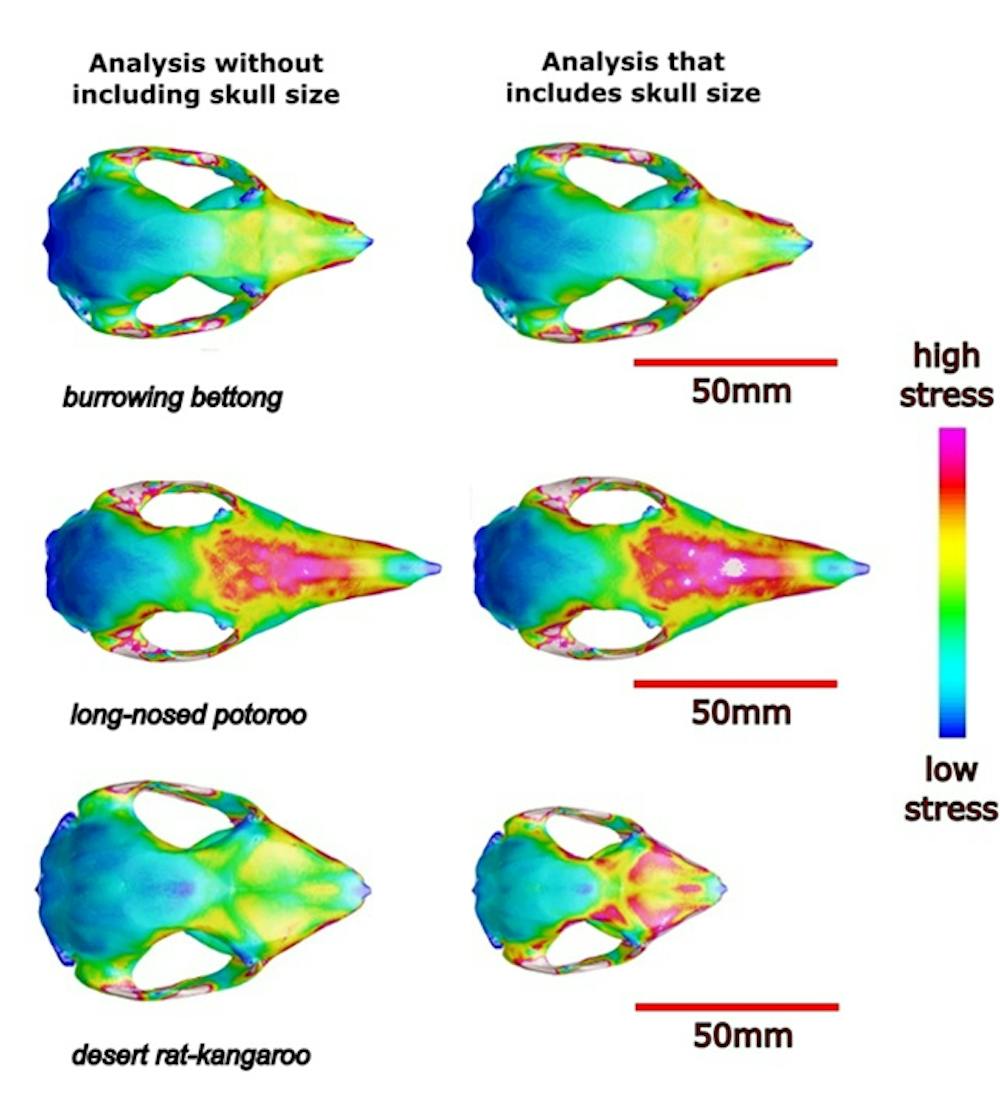
    The skull of the ngudlukanta is definitely efficient at biting, but it is also about one quarter smaller than the skull of the next smallest species in our sample, the northern bettong.

    When we included its smaller size in the analysis, the results suggested its relatively short face and robust jaw were unlikely to help it eat harder foods.

    Instead, its solid skull features mostly compensated for its small size, but would only allow it to support bites about as hard as those of the long-nosed potoroo – a larger species with a much less efficient skull at biting.

    Finite element models simulating the stress of each skull during biting with the front teeth. The stress in the desert rat-kangaroo is more similar to the hard food-eating burrowing bettong when not including its small size in the models. But its stress levels are more like the long-nosed potoroo when including its small size.
    Authors

    Early investigations of stomach contents from the 1930s tell us the ngudlukanta fed mostly on leaves and small amounts of insects. But little further detail exists. A more restricted range of softer, fresher plant materials, as suggested by our analysis, would narrow its range of preferred foods in the deserts it lived in.

    Our results therefore paint a picture of a species occupying a delicate position within the desert ecosystem.

    An unsolved mystery in a vast desert

    In recent years, one of us (Karl Vernes) has mounted several expeditions into the ngudlukanta‘s habitat, hoping to find evidence of its continued existence.

    However, finding this tiny marsupial in a vast desert is a challenge – not just because it was probably always rare and elusive, but also because we still know precious little about its ecology.

    Eyewitness accounts, remote camera traps, analysis of predator scat (poo) for mammal remains, genetic testing of scats, and the expert ecological knowledge of Traditional Owners have all been used to investigate the possibility of the survival of the ngudlukanta. No definitive evidence has yet emerged.

    Whether the ngudlukanta is extinct or not, therefore, remains an unsolved mystery.

    But history is replete with examples of rediscovered species believed to be extinct, known as “Lazarus species”. The desert’s vast, inhospitable terrain means it is plausible for a small nocturnal species to be evading detection.

    The distinctive short face of the ngudlukanta, alongside its small size and hopping gait, have led eyewitnesses to argue for its persistence.
    Hedley Herbert Finlayson, The Red Centre, 1935

    In fact, the desert rat-kangaroo was already a Lazarus species after its rediscovery in the 1930s. The story of the ngudlukanta therefore serves as a reminder that extinction declarations are not always the end of the story.

    If the species is still roaming the most inhospitable regions of the continent, the new knowledge gained from our analysis could help pinpoint areas where the ngudlukanta might persist.

    Who knows? The next chapter in the story of this desert-dweller may yet surprise us.

    Rex Mitchell has received funding from the Australian Research Council’s Centre of Excellence for Biodiversity and Heritage (CABAH).

    Karl Vernes has received funding from the Australian Research Council, the Mohamed bin Zayed Species Conservation Fund, Experiment.com, the Hermon Slade Foundation and Parks Australia. He is a member of the Australian Mammal Society.

    Vera Weisbecker receives funding from The Australian Research Council. She is affiliated with The Australian Mammal Society and member of the Australian Greens Party.

    ref. Presumed extinct, this desert rat-kangaroo may still be alive in hiding. New analysis reveals its delicate diet – https://theconversation.com/presumed-extinct-this-desert-rat-kangaroo-may-still-be-alive-in-hiding-new-analysis-reveals-its-delicate-diet-250283

    MIL OSI AnalysisEveningReport.nz

  • MIL-OSI Global: AI-detection software isn’t the solution to classroom cheating — assessment has to shift

    Source: The Conversation – Canada – By Michael Holden, Assistant Professor, Faculty of Education, University of Winnipeg

    Two years since the release of ChatGPT, teachers and institutions are still struggling with assessment in the age of artificial intelligence (AI).

    Some have banned AI tools outright. Others have turned to AI tools only to abandon them months later or have called for teachers to embrace AI to transform assessment.

    The result is a hodgepodge of responses, leaving many kindergarten to Grade 12 and post-secondary teachers to make decisions about AI use that may not be aligned with the teacher next door, institutional policies, or current research on what AI can and cannot do.

    One response has been to use AI detection software, which rely on algorithms to try to identify how a specific text was generated.

    AI detection tools are better than humans at spotting AI-generated work. But they’re a sufficiently imperfect solution, and they do nothing to address the core validity problem of designing assessments where we can be confident in what students know and can do.

    Teachers using AI detectors

    A recent American survey, based on nationally representative surveys of K-12 public school teachers published by the Center for Democracy and Technology, reported that 68 per cent of teachers use AI detectors.

    This practice has also founds its way into some Canadian K-12 schools and universities.

    AI detectors vary in their methods. Two common approaches are to check for qualities described as “burstiness,” referring to alternating and short and long sentences (the way humans tend to write) and complexity (or “perplexity”). If an assignment does not have the typical markers of human-generated text, the software may flag it as AI-generated, prompting the teacher to begin an investigation for academic misconduct.

    To its credit, AI detection software is more reliable than human detection. Repeated studies across contexts show humans — including teachers and other experts — are incapable of reliably distinguishing AI-generated text, despite teachers’ confidence that they can spot a fake.

    Teachers should not be confident they can spot AI-generated text. Icons for apps DeepSeek and ChatGPT on a smartphone screen in Beijing, Jan. 28, 2025.
    (AP Photo/Andy Wong)

    Accuracy of detectors varies

    While some AI detection tools are unreliable or biased against English language learners, others seem to be more successful. However, what success rates should really signal for educators is questionable.

    Turnitin boasts that their AI detector has a 99 per cent success rate, vis-à-vis their near one per cent rate of false positives (that is, the number of human-generated submissions their tool incorrectly flags as AI-generated). This accuracy has been challenged by a recent study that found Turnitin only detected AI-generated text about 61 per cent of the time.

    The same study suggested how different factors could shape accuracy results. For example, GPTZero’s accuracy may be as low as 26 per cent, especially if students edit the output an AI tool generates. Yet a different study of the same detector suggested a wide range of results (for example, between 23 and 82 per cent accuracy or 74 and 100 per cent accuracy).

    Considering numbers in context

    The value of a percentage depends on its context. In most courses, being correct 99 per cent of the time is exceptional. It’s above the most common threshold for statistical significance in academic research, which is often set at 95 per cent.

    But a 99 per cent success rate would be atrocious in air travel. There, a 99 per cent success rate would mean around 500 accidents every day in the United States alone. That level of failure would be unacceptable.

    To suggest what this could look like: at an institution like mine, the University of Winnipeg, about 10,000 students submit multiple assignments — we could ballpark five, for argument’s sake — for around five courses every year.

    That would be about 250,000 assignments every year. There, even a 99 per cent success rate means roughly 2,500 failures. That’s 2,500 false positives where students did not use ChatGPT or other tools, but the AI detection software flags them for possible use of AI, potentially initiating hours of investigative work for teachers and administrators alongside stress for students who may be falsely accused of cheating.

    Time wasted investigating false positives

    While AI detection software merely flag possible problems, we’ve already seen that humans are unreliable detectors. We cannot tell which of these 2,500 assignments are false positives, meaning cheaters will still slip through the cracks and precious teacher time will be wasted investigating innocent students who did nothing wrong.

    This is not a new problem. Cheating has been a major concern long before ChatGPT. Ubiquitous AI has merely shed a spotlight on a long-standing validity problem.

    When students can plagiarize, hire contract cheaters, rely on ChatGPT or have their friend or sister write the paper, relying on take-home assessments written outside class time without any teacher oversight is indefensible. I cannot presume that such forms of assessment represent the student’s learning, because I cannot reliably discern if the student actually wrote them.

    Need to change assessment

    The solution to taller cheating ladders is not taller walls. The solution is to change how we are assessing — something classroom assessment researchers have been advocating for long before the onset of AI.

    Just as we don’t spend thousands of dollars on “did-their-sister-write-this” detectors, schools should not rest easy simply because AI detection companies have a product to sell. If educators want to make valid inferences about what students know and can do, assessment practices are needed that emphasize ongoing formative assessment (like drafts, works-in-progress and repeated observations of student learning).

    These need to be rooted in authentic contexts relevant to students’ lives and their learning that centre comprehensive academic integrity as a shared responsibility of students, teachers and system leaders — not just a mantra of “don’t cheat and if we catch you we will punish you.”

    Let’s spend less on flawed detection tools and more on supporting teachers to develop their assessment capacity across the board.

    Michael Holden does not work for, consult, own shares in or receive funding from any company or organisation that would benefit from this article, and has disclosed no relevant affiliations beyond their academic appointment.

    ref. AI-detection software isn’t the solution to classroom cheating — assessment has to shift – https://theconversation.com/ai-detection-software-isnt-the-solution-to-classroom-cheating-assessment-has-to-shift-246102

    MIL OSI – Global Reports

  • MIL-OSI Global: USAID’s apparent demise and the US withdrawal from WHO put millions of lives worldwide at risk and imperil US national security

    Source: The Conversation – USA – By Nicole Hassoun, Professor of Philosophy, Binghamton University, State University of New York

    USAID was established by President John F. Kennedy in 1961 as a way to consolidate existing foreign aid programs. JAM STA ROSA/AFP via Getty Images

    On his first day in office, Jan. 20, 2025, President Donald Trump began a drastic reshaping of the United States’ role in global health as part of the first 26 executive orders of his new term.

    He initiated the process of withdrawing the U.S. from the World Health Organization, which works to promote and advance global health, following through on his first attempt in 2020. He also ordered staff members of the Centers for Disease Control and Prevention to cut off all communications with WHO representatives.

    In his first week, Trump also issued a stop-work order pending a 90-day review on nearly all programs of the United States Agency for International Development, or USAID.

    Many experts view this as a first step in dismantling the organization, which facilitates global efforts to improve health and education and to alleviate poverty. The sweeping move left aid workers and the people who depend on them in a panic and interrupted dozens of clinical trials across the world.

    President Trump’s executive order sparked legal action from international health care organizations, resulting in a federal judge ordering a temporary halt to the Trump administration’s freeze on foreign aid. Ultimately, that legal action was unsuccessful.

    On Feb. 23, the Trump administration put nearly all of USAID’s 4,700 workers on paid administrative leave globally and stated that it would be terminating 1,600 of those positions.

    Most recently, on Feb. 25, a federal judge ordered the Trump administration to allow some USAID funding to resume and required that it pay all of its invoices for work completed before the foreign aid freeze went into effect.

    I am the executive director of the Global Health Impact project, an organization that aims to advance access to essential medicines in part by evaluating their health consequences around the world, and a researcher focusing on global health and development ethics and policy.

    In my view and that of many other public health scholars, closing down USAID will imperil our national security and put millions of lives at risk.

    Because of the USAID stop-work order, 500,000 metric tons of food are at risk of spoiling.

    20 million with HIV treated

    USAID works with both nongovernmental organizations and private companies to help distribute medicines and vaccines around the world. The agency also helps improve government policies and invest in research and development to contain and address epidemics and pandemics.

    Starting in the late 1960s, for instance, USAID helped lead the effort to eliminate smallpox and has also helped fight polio and other devastating diseases over the past six decades.

    The smallpox pandemic was one of the worst of all time – it killed one-third of the people infected, causing an estimated 300 million to 500 million deaths worldwide in the 20th century. By contrast, COVID-19 killed less than 1% of those infected.

    These efforts have brought immense financial as well as health benefits to the U.S. and the rest of the world. Some economists estimate that the Global Polio Eradication Initiative, created in 1988, alone saved the world more than US$27 billion as of 2017, and that it will save a total of $40 billion to $50 billion by 2035.

    USAID also plays an important role in promoting global health equity. The agency works to increase access to primary health care, combat hunger and strengthen health systems – ultimately saving lives. In addition, USAID has provided a great deal of funding to fight infectious diseases such as malaria, tuberculosis and HIV.

    For instance, the U.S. President’s Emergency Plan for AIDS Relief, or PEPFAR, provides treatment for 20 million people living with HIV in Africa. Trump’s federal aid freeze has halted funding for PEPFAR projects.

    While the limited waiver under which the agency must now operate means some PEPFAR activities may eventually resume, many are now left without federal funding indefinitely. Unless another organization fills the gap, millions will die without USAID assistance.

    A 2022 photo of men in Afghanistan lining up to receive a monthly food ration, largely supplied by USAID.
    Scott Peterson/Getty Images News via Getty Images

    Mistakes made

    This is not to deny that USAID has made some grave errors in its history.

    For instance, USAID provided significant funding to the Democratic Republic of Congo (formerly Zaire) during the murderous regime of Mobutu Sese Seko, who was in power from 1965 to 1997.

    But USAID also has done an immense amount of good. For instance, it has helped contain the Ebola epidemic in the Democratic Republic of Congo since 2018. USAID’s work in preventing epidemics from spreading helps people everywhere, including in the U.S.

    If anything, there is a strong argument for increasing USAID funding. China has invested heavily in Asia and Africa through its Belt and Road Initiative, which is an attempt to recreate ancient trade routes by investing in roads, trains and ports. Some researchers argue that this has shifted diplomatic relations in favor of China. They believe that if the U.S. does not make similar investments and instead cuts foreign aid, it will affect the United States’ ability to achieve its foreign policy objectives.

    Similarly, there is a strong argument for increasing U.S. support for the WHO rather than withdrawing from the organization.

    Trump’s withdrawal order cites what he sees as the organization’s failures in addressing the COVID-19 pandemic as the rationale. But the WHO helped lead efforts to accelerate vaccine development and distribution, and retrospective reports claim that even more deaths could have been avoided with greater international cooperation.

    While dismantling USAID will cause irreparable harm to global health, these actions taken together are likely to deal a devastating blow to efforts to protect Americans and everyone else in the world from sickness and death.

    Alyssa Figueroa, an undergraduate student at Binghamton University, contributed to this article.

    Nicole Hassoun has received funding for research from the World Health Organization and the United Nations. She is the executive director of Global Health Impact (global-health-impact.org) which participates in the Pandemic Action Network.

    ref. USAID’s apparent demise and the US withdrawal from WHO put millions of lives worldwide at risk and imperil US national security – https://theconversation.com/usaids-apparent-demise-and-the-us-withdrawal-from-who-put-millions-of-lives-worldwide-at-risk-and-imperil-us-national-security-249260

    MIL OSI – Global Reports

  • MIL-Evening Report: England subsidises drugs like Ozempic for weight loss. Could Australia follow?

    Source: The Conversation (Au and NZ) – By Jonathan Karnon, Professor of Health Economics, Flinders University

    Nomad_Soul/Shutterstock

    People with a high body weight living in England can now access subsidised weight-loss drugs to treat their obesity. This includes Wegovy (the weight-loss dose of Ozempic, or semaglutide) and Mounjaro (one of the brand names for tirzepatide).

    These drugs, known as GLP-1 agonists, can improve the health of people who are overweight or obese and are unable to lose weight and keep it off using other approaches.

    In Australia, the government subsidises the cost of semaglutide (Ozempic) for people with diabetes.

    But it is yet to subsidise semaglutide (Wegovy) on the Pharmaceutical Benefits Scheme (PBS) for weight loss.

    This is despite Australia’s regulator approving GLP-1 agonists for people with obesity, and for overweight people with at least one weight-related condition.

    This leaves Australians who use Wegovy for weight loss paying around A$450–500 out of pocket per month.

    But could Australia follow the England’s lead and list drugs such as Wegovy or Mounjaro on the PBS for weight loss? Doing so could bring the price down to $31.60 ($7.70 concession).

    Australia has already knocked back Wegovy for subsidies

    The Pharmaceutical Benefits Advisory Committee (PBAC) reviews the submissions pharmaceutical companies make for their drug therapies to be subsidised through the PBS.

    For every such recommendation, PBAC publishes a public document that summarises the evidence and the reasons for recommending that the drug should be added to the PBS – or not.

    In November 2023, PBAC reviewed Novo Nordisk’s submission. It proposed including semaglutide on the PBS for adults with an initial BMI of 40 or above and a diagnosis of at least two weight-related conditions. At least one of these related conditions needed to be obstructive sleep apnoea, osteoarthritis of the knee, or pre-diabetes.

    Sleep apnoea was one of the weight-related conditions in the original application.
    JPC-PROD/Shutterstock

    However, PBAC concluded semaglutide should not be subsidised through the PBS because it didn’t consider the drug cost-effective at the price proposed.

    PBAC referred to evidence on the long-term benefits from weight loss for people at increased risk of developing heart disease, diabetes or having a stroke. However, it didn’t factor these effects into its calculations when estimating the cost-effectiveness of semaglutide.

    The committee suggested a future submission could focus on patients with either pre-existing cardiovascular (heart) disease, type 2 diabetes, or at least two markers of “high cardiometabolic risk”. This could include hypertension (high blood pressure), high cholesterol, chronic kidney disease, fatty liver disease or pre-diabetes.

    What did England decide?

    The National Institute for Health and Care Excellence (NICE) has a similar role to the PBAC, informing decisions to subsidise medicines in England.

    As a result of NICE’s recommendation, semaglutide is subsidised in England for adults with at least one weight-related condition and BMI of 30 or above. Patients must be treated by a specialist weight-management service and prescriptions are for a maximum of two years.

    More recently, NICE approved another GLP-1 agonist, tirzepatide, for adults with at least one weight-related condition and a BMI of 35 or above.

    This approval didn’t restrict prescriptions to those treated in a specialist weight-management service. However, only 220,000 of the 3.4 million who meet the eligibility criteria will receive tirzepatide in the next three years. It is not clear how the 220,000 patients will be selected.

    The limits on tirzepatide will reduce the impact of GLP-1 agonists on the health budget. It is also intended to inform the broader roll-out to all eligible patients.

    For both semaglutide and tirzepatide, NICE noted that clinicians should consider stopping the treatment if the patient loses less than 5% of their body weight after six months of use.

    Australians who use Wegovy for weight loss or heart disease pay A$450–$500 out of pocket per month.
    antoniodiazShutterstock

    Why did they reach such different decisions?

    NICE assessed the use of GLP-1 agonists for a broader population than PBAC: people with one weight-related condition and a BMI of 30 or above.

    Another difference was that NICE’s cost-effectiveness analysis included estimates of the longer-term benefits of these drugs in reducing the risk of diabetes, cardiovascular (heart) disease, stroke, knee replacement and bariatric surgery.

    The proposed prices of the GLP-1 agonists in England and Australia are not reported. We can only observe the estimated health benefits. These are represented as the additional number of “quality-adjusted life years” (QALYs) associated with using the drugs. One QALY is the equivalent of one additional year of life in best imaginable health.

    Committees estimate the amount of additional health spending required to gain QALYs, to see if it’s worth the public investment. Looking at the committees’ estimates of weight-loss drugs (without a two-year maximum):

    • NICE reported a gain of 0.7 QALYs per patient receiving semaglutide for a target population with a BMI of 30 or more

    • PBAC reported a gain of 0.3 QALYs, but for a population with a BMI of 40 and above.

    Part of the explanation for the difference in estimated QALY gains is that PBAC did not consider the reduced risk of future weight-related conditions, only the impact on existing conditions.

    In contrast, NICE referred to substantial cost offsets due to reduced weight-related conditions, in particular because some patients would avoid developing diabetes.

    England and Australia’s estimates of the benefits of Wegovy differed.
    Matt Fowler KC/Shutterstock

    Time to rethink PBAC’s focus?

    Both NICE and PBAC are clearly concerned about the impact of GLP-1 agonists on the health budget.

    PBAC is trying to restrict access to a limited pool of people at highest risk. It is also being more conservative than NICE in estimating the expected benefits of GLP-1 agonists. This would require manufacturers to reduce their price in order for PBAC to consider these drugs cost-effective.

    Maybe this approach will work and the Australian government will pay less for these drugs the next time it considers publicly funding them.

    However, GLP-1 agonists are not on the agenda for the forthcoming PBAC meetings, so there is no timeline for when GLP-1 agonists might be funded in Australia for weight loss.


    Read more:
    People on Ozempic may have fewer heart attacks, strokes and addictions – but more nausea, vomiting and stomach pain


    Jonathan Karnon receives funding from the National Health and Medical Research Council and the Medical Research Future Fund.

    ref. England subsidises drugs like Ozempic for weight loss. Could Australia follow? – https://theconversation.com/england-subsidises-drugs-like-ozempic-for-weight-loss-could-australia-follow-245367

    MIL OSI AnalysisEveningReport.nz

  • MIL-OSI Global: Why Trump’s Gaza reconstruction proposal is unlikely to work

    Source: The Conversation – Canada – By Ali Asgary, Professor, Disaster & Emergency Management, Faculty of Liberal Arts & Professional Studies & Director, CIFAL York, York University, Canada

    There have been many conversations around U.S. President Donald Trump’s Gaza proposal to permanently displace Palestinians from Gaza to neighbouring countries and turn the strip into a luxury resort development. Criticisms of Trump’s comments often focus on the proposal’s illegality, immorality and impracticality.

    However, little has been discussed from the perspective of post-disaster and post-war reconstruction. Post-conflict reconstruction, as part of post-disaster reconstruction studies, has a very long history, scholarly literature, lessons learned and is one of the well-studied phases of disaster and emergency management.

    Where to rebuild

    When it comes to where to rebuild or reconstruct after disasters, including human-made disasters such as war and conflict, there are three main options:

    1) reconstruction in the original location;

    2) reconstruction in a new location; and

    3) reconstruction and integration in existing settlements.

    Each of these approaches has its advantages, disadvantages and challenges. One of the key principles of post-disaster recovery and reconstruction is minimizing post-disaster relocation.

    While a significant majority of post-disaster reconstruction happens in the original locations, there has been reconstruction and resettlement to new locations and beside or inside existing settlements.

    For example, after the 1974 conflict in Cyprus, the city of Famagusta was abandoned and residents were relocated to new areas. Relocation after the 1995 volcano eruption that buried Plymouth in Montserrat is another example. After the 1990 Manjil earthquake in Iran, many villages were relocated and rebuilt in new locations.

    Rebuilding in the original location

    Studies show that reconstruction in the original location is generally the most preferred and effective option. People impacted and displaced by war and disasters usually prefer to live in their original community.

    In some cases, reconstruction in the original location may still require some forms of temporary resettlement. This temporary relocation is a preferred option when the affected areas do not have enough space or ability to support the population during the reconstruction period, particularly during debris removal and infrastructure restoration.

    Past reconstruction efforts in developed and developing countries, show that recovery and reconstruction are more effective, democratic and faster when the impacted population is in charge of the reconstruction process, and remain close to their damaged homes.

    The closer a temporary settlement is to the reconstruction site, the better. Proximity allows the impacted population to participate effectively, monitor and benefit from the reconstruction process without distance and accessibility barriers.

    Rebuilding in new locations

    Reconstruction in a new location is usually considered as one of the last options when rebuilding in the original place is not possible due to various hazards like landslides, earthquakes, tsunamis, hurricanes, flooding or volcanos.

    This usually occurs when mitigation measures are neither possible nor feasible. This option requires relocating the impacted population and rebuilding everything from scratch. Its success very much depends on the availability of land, resources and the willingness of the impacted population to relocate.

    Even when relocation is the only viable option, impacted people must be fully involved and given discretion regarding their place of relocation. Involuntary resettlement programs are impracticable. Even when the population is displaced, studies show that people return to their original homes if they can.

    Rebuilding near existing settlements is an extension of this option except that instead of rebuilding in a new location, reconstruction happens beside existing settlements to minimize infrastructure costs.

    This option can still be challenging. Implementation can be very complex even when new settlements are in the same country or area. Reintegrating people into a new place, even when they are willing to be relocated, requires many livelihood support initiatives, land availability, legal frameworks for land distribution and dispute resolution.

    Rebuilding options for Gaza

    Trump’s proposal is close to that last option, with three major differences. The first difference is that there is no consultation with Palestinians in Gaza.

    The second difference is that the impacted population will be forcefully and involuntarily relocated to settlements in other countries (Egypt and Jordan).

    The third difference is that the United States would “own” Gaza, and rebuild it for other purposes and uses, not for the benefit of Palestinians.

    As mentioned above, one key justification for rebuilding in a new location is that the original place is not permanently safe. Trump’s proposal assumes that Gaza is not safe for Palestinians but somehow safe for others.

    Post-disaster and conflict reconstruction is not just a physical reconstruction project. Rather, it is a complex, multidimensional process, with potentially very high negative impact if not properly planned and implemented.

    Top-down approaches in post-disaster recovery and reconstruction often fail because these approaches ignore the complexity of the built environment, the local conditions, and the needs of the affected population.

    Displacing entire populations, their economic activities and their social networks and relations can have significant impacts — direct and indirect — on the population and on governments. Community relocation fails because it disrupts social networks, and increases negative sentiments and dissatisfaction with living conditions in new location.

    Post-war reconstruction programmes must be multi-dimensional and based on a clear understanding of local conditions and careful consultation with the affected people. The alternative to large-scale resettlement is to reduce the risks people face in their current location.

    In the past, international solidarity has played an important role in reconstruction. Such solidarity increasingly exists for the Palestinians of Gaza, and with that, rebuilding in the same location can still be a viable and preferred option.

    Ali Asgary does not work for, consult, own shares in or receive funding from any company or organisation that would benefit from this article, and has disclosed no relevant affiliations beyond their academic appointment.

    ref. Why Trump’s Gaza reconstruction proposal is unlikely to work – https://theconversation.com/why-trumps-gaza-reconstruction-proposal-is-unlikely-to-work-249680

    MIL OSI – Global Reports

  • MIL-OSI Global: More than just a game: How sports are reflecting Canada-U.S. tensions

    Source: The Conversation – Canada – By Noah Eliot Vanderhoeven, PhD Candidate, Political Science, Western University

    Canada emerged victorious in the 4 Nations Face-off hockey tournament on Feb. 20, but the event was overshadowed by growing political tensions between Canada and the United States.

    In the lead-up to the final game, American fans booed the Canadian national anthem, likely in response to Canadian fans booing the American national anthem ahead of a game between the two teams on Feb. 15.

    This was not the first recent airing of grievances from Canadian fans at a sporting event. Following U.S. President Donald Trump’s announcement of tariffs against Canada and repeated calls for Canada to become the 51st state, fans at a Toronto Raptors game and Ottawa Senators game booed the American national anthem.


    Read more:
    How Donald Trump’s attacks on Canada are stoking a new Canadian nationalism


    Despite the proposed tariffs being postponed for 30 days, Trump’s antagonistic vision for Canada-U.S. relations has stoked anti-American sentiments among Canadians, including calls to boycott American goods and a deteriorating belief in close Canada-U.S. relations.

    Those anti-American sentiments boiled over again when Canada faced the U.S. in Montréal, showcasing how sport can be used as an expression of nationalism — especially at a time of increased tensions between the two countries.

    Why sports matter politically

    It’s not surprising that sport has become an arena for nationalist political rhetoric. Sport possesses powerful symbolism that can be exploited to great affect in forming a coherent national identity.

    In this way, sporting events are a way fandoms can reinforce national identity as an objective symbol that connects to primitive forms of national ideology.

    Sport is also a powerful psychological setting for national rhetoric. A person’s social identity, or how they see themselves in relation to others, can be reinforced through sport. This can happen, for instance, when someone views themselves as a member of a team and celebrates their success, or views a rival team or country in a negative light after a loss.

    Additionally, the outcome of a game can boost in-group favouritism, which can influence whether consumers buy goods from a specific vendor.

    Nationalism versus patriotism

    Generally, research suggests sports reinforce a national in-group identity that is more patriotic than nationalistic. However, the vitriol Canadians have expressed during the American national anthem leans towards expressing nationalist views rather than patriotic ones.

    Patriotism typically focuses on why a country is great without necessarily disparaging outsiders or other countries. Nationalism, on the other hand, tends to play up why one’s country is great while vilifying another country or group.

    Trump’s focus on using tariffs to bully Canada into increasing security at the border has undoubtedly soured relations between the two countries. If Trump decides to flex the United States’ capacity to be a bully in U.S.-Canadian relations, Canada is stuck with limited options.

    But are Canadians playing right into Donald Trump’s hand by leaning into an adversarial relationship?

    How Trump uses sports for political gain

    Trump has a history of using major sporting events to his political benefit. During his last presidential campaign, he attended the Army-Navy football game and became the first sitting president to attend the recent Super Bowl in New Orleans.

    Trump also considered attending the 4 Nations final between the U.S. and Canada in Boston, but couldn’t attend due to a scheduled speech with U.S. governors. Still, he made his presence felt by calling the American team the morning before the game to wish them luck.

    Looking ahead, Trump may continue to use international sporting events to assert his vision for U.S. relations with Canada and Mexico.

    In January, Trump invited Gianni Infantino, the head of FIFA, to his inauguration, just as preparations have begun for the 2026 World Cup, which is to be hosted by Canada, Mexico and the U.S.

    With Infantino and Trump becoming increasingly friendly, it seems likely Trump will use the upcoming World Cup to influence North American relations. At the very least, he will likely try to insert himself into its coverage.

    Trump using sport to reinforce his image

    Beyond politics, Trump uses sports to play into his crafted image as a hyper-masculine man. This image has played a large part in Trump’s popularity among young men and helped him win a second term as president.

    Yet Trump does not necessarily fit the masculine norms his supporters lionize. Trump is fairly tall, which has been shown to be preferred among American voters. However, unlike past presidents such as Dwight D. Eisenhower and Richard Nixon, who played college football, Trump’s athletic background is limited to high school football.

    Nor did Trump serve in the military like previous presidents John F. Kennedy and Ronald Reagan, both of whom served in the Second World War. Trump, by contrast, avoided service during the Vietnam war for medical and educational reasons.

    Despite a lack of traditional masculine bonafides, Trump has shown an ability to use sporting events for his political gain. He has used sporting events as potent media environments to insert his talking points and burnish his masculine image.

    In the end, the boos from Canadian fans may be music to Donald Trump’s ears. He wants to be hated by outsiders so he can turn around to his supporters and say that the U.S. is under attack at its borders. He wants the sporting accomplishments of the American men’s teams to reflect on his strength.

    It can still go against him, as we saw Thursday night with Canada beating the U.S. in overtime. Justin Trudeau wasted no time using that moment to respond with strong rhetoric in a tweet.

    What happened on the ice was out of Trump’s control. But he used the event to serve his own goals, sowing greater divisiveness across borders. The shadow of his combative rhetoric loomed large over the entire event.

    Noah Eliot Vanderhoeven does not work for, consult, own shares in or receive funding from any company or organisation that would benefit from this article, and has disclosed no relevant affiliations beyond their academic appointment.

    ref. More than just a game: How sports are reflecting Canada-U.S. tensions – https://theconversation.com/more-than-just-a-game-how-sports-are-reflecting-canada-u-s-tensions-250385

    MIL OSI – Global Reports

  • MIL-OSI Global: Why Donald Trump is a relentless bullshitter

    Source: The Conversation – Canada – By Tim Kenyon, Professor, Faculty of Humanities, Brock University

    There have been many questions raised about the intentions behind Donald Trump’s spate of radical public statements about Canada, in which he claims trade deficits amount to subsidies, massive amounts of fentanyl are flowing across the border and the country should become the 51st American state, among other things.

    The U.S. president’s comments have fuelled speculation about what he means when he makes these kinds of false claims — or whether he means anything at all.

    After all, rounded to the nearest percentage point, zero per cent of illicit fentanyl entering the U.S. comes from Canada, trade deficits are not subsidies and annexing Canada is an absurd proposal.

    So why say things that are so untrue?

    Is Trump serious about any of this?

    Ignore Trump? Or fear him?

    The aggregate opinion seems to be both an unhelpful no and a yes, so the answer remains unclear.

    If we take every provocation seriously, we’re falling for the “flood the zone” strategy as Trump spews out outlandish claims as a form of distraction.

    If we shrug off his claims, we’re ignoring the potential danger.

    But there are patterns and incentives behind Trump’s flouting of basic communicative norms. One illustrative example dates back to 2018 talks with Prime Minister Justin Trudeau, when Trump complained about the U.S. trade deficit with Canada. Later, he told prospective donors in Missouri that he’d made this claim up on the spot.

    Why make up a claim like that? And, having done so, why admit and even brag about it, and then renew this knowingly false claim six years later?

    My colleague Jennifer Saul and I are scholars in the political philosophy of language. We’re among those who cite this example of Trump bullshit in our work on bullshit in authoritarian political speech and how bullshit can succeed even though everyone recognizes that it is, in fact, bullshit.


    Read more:
    Bullshit is everywhere. Here’s how to deal with it at work


    Why Trump bullshits

    Our notion of bullshit is a refinement of the term that was the subject of American philosopher Harry Frankfurt’s seminal 2005 book On Bullshit.

    Most liars care enough about the truth to try to conceal it. But simply not caring either way is a different vice, which Frankfurt called bullshitting.

    An example would be claiming a trade deficit without having any idea whether that’s true or false. Other examples include uttering falsehoods that are so obvious they couldn’t possibly be intended to deceive anyone.

    Really obvious bullshit can succeed politically, we proposed, because there are many audiences in mass communication. Bullshit targeted at Audience A can be a big hit with Audience B, if B thinks A deserves it.

    Then it becomes a display of power over A, with B enjoying the spectacle. This overt bullshitting lends itself to authoritarian politics for someone cultivating a strongman image. It marks an opponent for disrespectful treatment, and advertises that the bullshitter cannot be held to account.

    So Trump’s admission that he bullshitted Trudeau in 2018 was a successful strategy because he revealed it to a sympathetic audience, who got to see themselves as part of the performance and not as its target. Asking: “Does Trump really mean this?” is often less revealing than: “How does this promote Trump’s image as an authority figure, and to which audience?”

    Similarly, Trump falsely remarked in 2019 that Hurricane Dorian’s projected path included Alabama. He responded to fact-checking by showing an official storm track map that he literally altered by hand, with a marker.

    Such a ridiculous invention couldn’t be meant to deceive. But it showed Trump’s base, many of whom distrust mainstream information sources, that he couldn’t be made to back down for reporters, no matter the facts.

    Some claims appear deceptive lies to one audience and bullshit to another, like Trump’s recent claim that Ukrainian President Volodymyr Zelenskyy is a dictator who started the war in Ukraine.

    Some audiences might believe it. Others will see it as false and designed to be deceptive, yet recognize it as a threat to treat Ukraine as an aggressor with American demands for Ukraine’s rare earth minerals at stake.


    Read more:
    Ukraine’s natural resources are at centre stage in the ongoing war, and will likely remain there


    Credibility matters in unexpected ways

    Even conservative pundits initially worried that Trump’s propensity to bullshit would diminish the finite resource that is credibility.

    They didn’t recognize that credibility is a dubious virtue in strongman politics. Its absence can even be an asset. Acting without credibility is a chance to flex — to show that you can compel others to take you seriously whether they believe you or not.

    These incentives link frivolous outbursts of bullshit with very serious doubling-downs. Trump first spoke about Canada becoming the 51st state in a meeting with Trudeau in late November so offhandedly that it was not immediately mentioned in news reports.

    Once Fox News seized upon it, Trudeau was forced to publicly dismiss the comment as a joke.

    Prime Minister Justin Trudeau and Donald Trump at Trump’s Mar-a-Lago estate in Florida in November 2024. Trudeau apparently thought Trump was just bullshitting when he made mention of Canada becoming a 51st state during the dinner.
    (X/@JustinTrudeau)

    A great deal more commentary revealed liberal-leaning Canadians and Americans were angry and even frightened by this sort of talk — conditions that made it attractive for Trump to double down rather than back down.


    Read more:
    Canada as a 51st state? Republicans would never win another general election


    Combing through Trump’s speech and actions towards Canada to discover what he really means may just be an attempt to “sane-wash” them; meaning trying to figure out if they reflect a stable and sincere attitude, or even a stable and insincere negotiating strategy.

    What makes Trump’s bullshit so dangerous is that it rarely reflects fixed, coherent meanings or convictions. It lurches from triviality to deadly seriousness, depending on how his various audiences provide the approval and the outrage Trump seeks for his performances of strength.

    Tim Kenyon does not work for, consult, own shares in or receive funding from any company or organisation that would benefit from this article, and has disclosed no relevant affiliations beyond their academic appointment.

    ref. Why Donald Trump is a relentless bullshitter – https://theconversation.com/why-donald-trump-is-a-relentless-bullshitter-249896

    MIL OSI – Global Reports

  • MIL-OSI Global: How hockey’s politics played out at the 4 Nations Face-Off Tournament

    Source: The Conversation – Canada – By Braeden McKenzie, Postdoctoral Fellow & Equity Data and Research Analyst, University of Victoria

    The National Hockey League’s 4 Nations Face-Off tournament captured attention across North America as hockey’s first best-on-best competition since the 2014 Sochi Winter Olympics.

    The tournament, which featured competitive round-robin games between Canada, the United States, Finland and Sweden, was a massive success for the league. The final game between Canada and the U.S. averaged 9.25 million viewers with Canada defeating the United States 3-2 in overtime.

    The recent rise in political tensions between Canada and the U.S., amid continued threats of a trade war, have made their way onto the ice. Canadian fans in Montréal loudly booed the Star-Spangled Banner before both of Team USA’s round robin games.

    In response, Bill Guerin, Team USA’s general manager, encouraged U.S. President Donald Trump to attend the championship game in Boston. For his part, Trump used the tournament to reiterate his threat to annex Canada in a Truth Social post.

    An apolitical image

    Historically, hockey has been marketed as an apolitical space. The culture celebrates players that demonstrate a willingness to do their talking on the ice, praising their quiet reverence for the game’s traditions above all else.

    Superstar players like Gordie Howe, Bobby Orr, Wayne Gretzky and Sidney Crosby have been admired for being modest, respectful and even bland in their conduct, approach to the game and leadership style.

    Perhaps unsurprisingly, when players and coaches for the American and Canadian teams were asked about the political context the tournament had been thrust into, most reiterated that hockey should not be political and instead should operate as a space for people to escape.

    However, such notions belie a culture of masculinity that is decidedly white, and which ingrains expectations about tradition, professionalism and respect and works to uphold hockey’s political status quo.

    Fans boo American national anthem ahead of a showdown between Canada and the United States at the 4 Nations Face-Off. (The Canadian Press)

    Hockey’s preferred political acts

    In reality, hockey has always been a political space. Acts like playing national anthems, saluting flags or honouring military service are all inherently political. So, too, are displays of gigantic national flags in stadiums or arenas, military jet flyovers and public subsidies for professional sports facilities.

    It is noteworthy that those political acts are seen as acceptable in sports, while others — like booing or kneeling during an anthem — have faced widespread criticism from players, coaches and management.

    Performances of nationalism and militarism are somehow seen as apolitical, while expressions of protest are unpatriotic and too political. Such distinctions are less about preserving hockey as an apolitical space and more about maintaining unity and consensus in support of the brand of politics that is celebrated throughout the culture.

    Because the game’s history is largely based in white masculinities and traditions, political positions which reflect those ideologies (such as Don Cherry’s brand of nostalgic working-class populism and the MAGA movement’s views on nationalism, family structure or race) have been whole-heartedly accepted within hockey culture.

    A false neutrality

    Framing hockey as somehow neutral or apolitical simply reinforces the politics of the status quo, which benefits those in power and is, in itself, a clear expression of politics.

    Wayne Gretzky, perhaps Canada’s best ever player, has become an example of this very political reality. Gretzky recently faced criticism for attending the U.S. election night celebrations at Mar-A-Lago and Trump’s inauguration. Trump himself has suggested that Gretzky could be Canada’s governor if it becomes the 51st state.

    P.K. Subban, a gold medal-winning Canadian defenseman, was also criticized after he tweeted a screenshot of Trump’s Truth Social post, suggesting Trump may make the difference in the final game’s result.

    While many Canadians might disapprove of Gretzky attending the inauguration and Subban’s post, the acts are not likely to receive any major push-back within hockey itself (with the exception of former Canadian NHL player Akim Aliu calling out Subban).

    Having historically developed as a symbol of white masculinity, hockey will continue to represent a haven for ideologies rooted in inequity, division and extreme nationalism. While silence from players and coaches throughout the tournament is not wholly ill-intentioned, it without question represents complicity in the face of growing hatred, extremism and political turmoil.

    In contrast, acts of resistance or dissent are likely to continue to be cast off as too political by management, coaches and players. These individuals seem fine with politics in sport — just not politics that challenge their own.

    The authors do not work for, consult, own shares in or receive funding from any company or organisation that would benefit from this article, and have disclosed no relevant affiliations beyond their academic appointment.

    ref. How hockey’s politics played out at the 4 Nations Face-Off Tournament – https://theconversation.com/how-hockeys-politics-played-out-at-the-4-nations-face-off-tournament-250602

    MIL OSI – Global Reports

  • MIL-Evening Report: Outstanding craftsmanship and international voices: the 5 films up for best documentary at the 2025 Oscars

    Source: The Conversation (Au and NZ) – By Phoebe Hart, Associate Professor, Film Screen & Animation, Queensland University of Technology

    Oscar-nominated best documentary film Sugarcane. Disney+

    The Academy Awards represent the screen industry’s biggest annual global recognition for the very best of moviemaking. And in these troubled times, many recognise the power of documentaries to transform the world for the better.

    Like last year, the 2025 nominations for Best Documentary are international in their scope, continuing an Academy trend of placing more emphasis on voices outside of the United States.

    This year’s nominations feature a few milestones: it’s the first time a Japanese filmmaker has been put forward, and the first time an Indigenous North American filmmaker has been nominated in Oscars history.

    All exhibit outstanding craftsmanship while exploring intense themes. The following roundup will hopefully encourage you to check them out at the cinema or online, and see why the experts also think they deserve the top gong.

    Soundtrack to a Coup d’Etat

    Johan Grimonprez’s experimental essay examines the Cold War politics of the 1950s and 60s. At this time, many African nations were gaining independence from their colonial masters.

    In Soundtrack to a Coup d’Etat, the uranium and mineral rich Democratic Republic of the Congo becomes a poignant case study.

    As the first prime minister Patrice Lumumba breaks the country away from Belgian rule, a murderous plot by global superpowers to destroy the country’s newfound sovereignty unfolds.

    And underneath it all: the frenetic beat of jazz as a revolutionary reaction against racism on both sides of the Atlantic.

    A wealth of archival material featuring former world leaders, the Congolese situation, and the musical stylings of Nina Simone, Duke Ellington, Louis Armstrong and others make this documentary effortlessly cool. The edit and sound design has a wonderful syncopated rhythm, revealing fascinating facets of modern history and the scramble for power.

    Sugarcane

    St. Joseph’s Mission was a residential school for Indigenous children in Canada, which closed in 1981.

    When ground penetrating radar begins looking for unmarked graves at the school, Julian Brave NoiseCat – whose father was born on the site – and co-director Emily Kassie embark on a quest of accountability for a myriad of institutional abuses.

    Editors Nathan Punwar and Maya Daisy Hawke interweave archival reels alongside Emily Kassie and Christopher LaMarca’s stark verité cinematography. The film captures members of the Williams Lake First Nation community reckoning with generations of trauma at the hands of Catholic clergy.

    Together, they present some disturbing facts in the film, which won a directing award at the Sundance Film Festival.

    National Geographic has routinely received a documentary Oscar nomination. This film is a challenging topic for Australian and New Zealand audiences. We also have a troubling history with the placement of Aboriginal children in homes, where many faced hardships and mistreatment.

    Sugarcane gives a platform for truth-telling and healing.

    Porcelain War

    Ceramists Slava Leontyev and Anya Stasenko are inspired by the nature of Ukraine and each other. Their friend, and fellow creator, Andrey Stefanov documents their lives on tape after his wife and children flee at the start of the Russian invasion.

    All become involved in active defiance.

    The film combines nonprofessional video, body cams and drone footage alongside wildlife photography and charming animations of Anya’s delicate paintings on clay.

    There are gripping scenes of armed conflict from the viewpoint of Slava’s squad of reservists. These are everyday folks who have become involved in fighting on the ground.

    Porcelain War benefits from a soundtrack composed and performed by folk music quartet DakhaBrakha. This adds an eerie texture to this portrait of hope.

    The film thoughtfully balances light and shade with grace, demonstrating that art remains a potent way to oppose erasure.

    Black Box Diaries

    When her high-profile #MeToo sexual assault case is dropped on the grounds of insufficient evidence, Japanese journalist, director and producer Shiori Itō commences chronicling her journey to justice.

    Deploying abstract imagery over recorded conversations with investigators and witnesses, Itō builds her argument over several years. The passage of time is interspersed with her unfiltered video diary entries.

    There has been controversy about the director including hotel footage of her drugged and being dragged out of a taxi by her attacker, senior reporter Noriyuki Yamaguchi, without permission. Itō had been given the footage for the legal case, but had agreed it would not be used outside of the courtroom.

    The debate has prevented the film from showing on Japanese screens. However, Itō has argued the public good of using this material outweighs commercial interests – especially considering the pressure of Yamaguchi’s influential connections to quell the case, which include then-Prime Minister Shinzo Abe.

    Itō doesn’t shy away from exposing the raw emotional depths of her remarkably brave undertaking against fierce odds, and she serves as an inspiring change-maker we should all heed.

    No Other Land

    No Other Land takes stock of the West Bank situation from the perspective of Basel Adra, who documents evictions of Palestinians in his home village of Masafer Yatta.

    Basel works with journalist Yuval Abraham to bear witness to the army’s gradual destruction of his village to make way for a military training ground.

    No Other Land features some great observational camerawork with many poetic images of resilience. Things kick up a notch when a villager, Harun, is shot by Israeli soldiers while trying to confiscate his building tools. Basel is targeted for filming the ensuing protests – but Adra and Abraham continue undeterred.

    A friendship develops amid the chaos between the Palestinian activist and Israeli reporter, who co-direct and edit with Hamdan Ballal and Rachel Szor. It’s the touching humanity of their relationship that goes to the core of the film; compassion is key to deescalating tensions in the region.


    In Australia and Aotearoa New Zealand, Soundtrack to a Coup d’Etat, Porcelain War, Black Box Diaries and No Other Land are streaming on DocPlay; Sugarcane is streaming on Disney+.

    Phoebe Hart does not work for, consult, own shares in or receive funding from any company or organisation that would benefit from this article, and has disclosed no relevant affiliations beyond their academic appointment.

    ref. Outstanding craftsmanship and international voices: the 5 films up for best documentary at the 2025 Oscars – https://theconversation.com/outstanding-craftsmanship-and-international-voices-the-5-films-up-for-best-documentary-at-the-2025-oscars-249151

    MIL OSI AnalysisEveningReport.nz

  • MIL-Evening Report: Multiple warnings and huge fines are not stopping super funds, insurers and banks overcharging customers

    Source: The Conversation (Au and NZ) – By Jeannie Marie Paterson, Professor of Law, The University of Melbourne

    Last week the Federal Court fined Australia’s biggest superannuation company, AustralianSuper, A$27 million for overcharging customers.

    The company had breached its legal obligations under the Superannuation Industry (Supervision) Act 1993 by failing to identify and merge the duplicate accounts of customers.

    Given the individual errant fees were about $1.50 per duplicate account, the penalty might sound disproportionate to the wrongdoing.

    But over the nine years the duplicate account and other fees were being charged, they collectively cost customers about $69 million.

    As revealed in court, the double charging continued even though AustralianSuper’s employees and officers were aware that duplicate accounts were widespread.

    Not a precedent

    This court case was not the first. It follows a damning series of cases brought by the Australian Securities and Investments Commission (ASIC) against banks, insurers and super funds for overcharging.

    In 2022, ASIC reported six of Australia’s largest financial services institutions had paid almost $4.4 billion in compensation to customers for overcharging or providing no service.

    Financial penalties were also imposed. Westpac and associated entities were fined $40 million for charging $10.9 million to more than 11,800 dead customers.

    ANZ was also hit with a $25 million penalty for failing to provide promised fee benefits to about 689,000 customer accounts over more than 20 years.

    These cases were highlighted in the Royal Commission into Misconduct in the Banking, Superannuation and Financial Services Industry, which ran from December 2017 to February 2019. But even after that, new instances emerged.

    In 2023, a review by ASIC resulted in general insurers repaying more than $815 million to more than 5.6 million customers for pricing failures since 1 January 2018“.

    After this, ASIC imposed penalties on insurers IAG-subsidiaries and QBE. It was alleged they misled customers by promising them loyalty discounts to renew their home insurance policies. But the customers actually had their premiums raised by an amount similar in size to the discounts.

    In 2024, ASIC announced the findings of an inquiry into excessively high fees for superannuation fund advice. The fees were not proportionate to the advice needs of members or the cost of advice.

    More than 300 members across seven of the funds had advice fees of more than $15,000 deducted from their accounts.

    Despite repeated calls by ASIC and the Australian Prudential Regulation Authority for the industry to improve its operations, a 2024 ASIC review found major banks left at least two million low-income customers in high-fee accounts. Those affected were refunded more than $28 million.

    Why has this litany of pricing misconduct cases occurred?

    Put in the best light, the failures represent a combination of poor legacy payment systems and increasingly complex modern payment structures and products.

    Recognising these constraints, the Federal Court has stated that the obligation under the Corporations Act to ensure financial services are provided “efficiently, honestly and fairly” does not demand “absolute perfection”.

    In other words, some mistakes are inevitable. But this does not relieve banks, insurers and superannuation funds from responsibility for payment errors.

    The buck stops with the institutions

    Charging more money than permitted or failing to pass on discounts will usually be a breach of the financial institution’s contract with its customers, and may also amount to misleading conduct.

    It’s unlawful. Even if the individual amounts in question are small compared with the turnover of the financial institution, they are significant to the customers affected.

    This means, as courts have consistently recognised, that financial institutions have a responsibility to put in place “systems and processes” to identify and correct payment errors. And they need to remediate affected customers promptly.

    The ongoing misconduct suggests banks, insurers and superannuation trustees have ignored this.

    Notably, in 2023, a court found NAB waited more than two years to correct overcharging, despite being aware of it.

    And in 2025, the court was critical of AustralianSuper for taking years to address the problem of duplicate customer accounts even after it was identified.

    The judge in the AustralianSuper case said:

    nobody was responsible for ensuring compliance with legislative requirements and [this] resulted in no resources being dedicated to that task.

    When no one takes responsibility

    After the Royal Commission, ASIC was criticised for not being sufficiently rigorous in enforcing the law. It now appears ASIC is working through the fee practices of banks, insurers and super funds armed with considerable penalties.

    ASIC’s clear aim is to ensure payment misconduct doesn’t pay, and enforcement by the regulator cannot be dismissed as a mere cost of doing business.

    But is this enough? Customers may wait years for payment errors to be identified and redressed through enforcement by ASIC.

    We need to rethink how these institutions understand their obligations to customers. Notably, the United Kingdom has introduced a “consumer duty”, which requires banks to promote customers’ interests and demonstrate how they are doing this.

    Australia doesn’t have this obligation. But it may be worth learning from the UK. Banks, insurers and superannuation funds here should be obligated to show they are using processes that produce good ongoing outcomes for their customers.

    Jeannie Marie Paterson receives funding from the Australian Research Council for a project on treating customers fairly commencing July 2025.

    ref. Multiple warnings and huge fines are not stopping super funds, insurers and banks overcharging customers – https://theconversation.com/multiple-warnings-and-huge-fines-are-not-stopping-super-funds-insurers-and-banks-overcharging-customers-250658

    MIL OSI AnalysisEveningReport.nz

  • MIL-Evening Report: Which type of note-taking is better for learning: laptop or pen and paper?

    Source: The Conversation (Au and NZ) – By Penny Van Bergen, Associate Professor in the Psychology of Education, Macquarie University

    VesnaArt/Shutterstock

    Once upon a time, university lectures were accompanied by the sound of pens scribbling on paper. But if you go into a lecture hall today, you will hear students tapping on laptops.

    Devices are now an accepted and important part of modern learning. But this does not necessarily mean students should forget the old-fashioned ways of taking notes.

    Research shows pen and paper can help students learn and remember more from class.

    The benefits of note-taking

    Studies have long shown students who take notes during a lecture, class, or while reading are able to remember more of that content later.

    One reason is note-taking is more active than listening or reading, which helps us maintain attention.

    And students often go beyond just recording the information being said.

    Note-taking means students are trying to understand their teacher by making assessments about what is important in real time. They might also organise the content into themes and sub-themes or highlight things that stand out.

    These activities are examples of active engagement which strengthens the “encoding process”: the way new knowledge moves into long-term memory and forms memory pathways.

    Strong memory pathways enable knowledge to be more easily accessed later, such as when problem solving in class or doing an exam.

    Taking notes during class can help keep your focus and make it easier to retain information.
    Matej Kastelic/Shutterstock


    Read more:
    Avoid cramming and don’t just highlight bits of text: how to help your memory when preparing for exams


    Note-taking on a laptop

    Research shows the kinds of notes students take when typing on a laptop differ from those taken with traditional pen and paper.

    A 2018 study in the United States found college students took longer lecture notes (both in word count and quantity of ideas) when typing on a laptop than when writing by hand. They also recorded longer sections verbatim from the lecture. This might occur because students typically type faster than they handwrite.

    However, while students are faster on a laptop, they are also likely to become distracted.

    A 2021 study of US college students used tracking software and found the average student was distracted for about half their lecture by social media, assignments, shopping and other off-task internet activities.

    Note-taking with a pen

    So how do pen and paper compare?

    A 2024 meta-analysis of 24 international studies showed taking lecture notes by hand resulted in stronger overall test performance and course grades for undergraduate students.

    This is because handwriting engages the brain in a more active way than typing, which is better for learning.

    Students who take notes by hand use more shorthand, visual signals (for example, bolding, underlining, arrows and stars) and images (diagrams, graphs and tables) than those who type.

    Taking notes by hand is particularly helpful if a lecturer or teacher pauses during a lecture or lesson, so students can revise or add to their notes in real time. In one US study, students using longhand added three times as many new ideas to their notes during lecture pauses as laptop users did.

    Notetaking on pen and paper can help students form strong connections between ideas.
    ABO PHOTOGRAPHY/Shutterstock

    Are there times laptops might be better?

    Despite the benefits of handwriting, there are some situations where laptops may be more appropriate for note-taking.

    Students who struggle with slow handwriting or spelling may find pen and paper note-taking interferes with their learning. This is because they need to focus more on the physical act of writing so it becomes harder to process new knowledge.

    Some neurodivergent students may also find handwriting challenging. For instance, autistic students often experience difficulties with fine motor skills like handwriting. Similarly, students with dyslexia or dysgraphia may struggle with handwriting tasks.

    For these students, typing with features like spell-check and auto-correction can allow them to focus on understanding and fully participating in class.

    But for those who find both handwriting and typing equally comfortable, the research shows using a pen and paper are more effective for learning.

    Penny Van Bergen receives funding from the Australian Research Council, Google and the Marsden Fund.

    Emma Burns receives funding from the Australian Research Council, is an associate editor for the Australian Educational Researcher and is on the board of the Australian Educational Research Organisation.

    Hua-Chen Wang receives funding from Google on a research project regarding vocabulary learning.

    ref. Which type of note-taking is better for learning: laptop or pen and paper? – https://theconversation.com/which-type-of-note-taking-is-better-for-learning-laptop-or-pen-and-paper-250404

    MIL OSI AnalysisEveningReport.nz

  • MIL-Evening Report: I spy with my little eye: 3 unusual Australian plant ecosystems to spot on your next roadtrip

    Source: The Conversation (Au and NZ) – By Gregory Moore, Senior Research Associate, School of Agriculture, Food and Ecosystem Sciences, The University of Melbourne

    A boab tree in the Kimberley. Hideaki Edo Photography/Shutterstock

    When the growing gets tough, the tough trees and shrubs get growing.

    Australia’s environment is brutal. Its ancient, low-nutrient soils and generally low rainfall make it a hard place for plants to grow. Despite this, the continent is filled with wonderfully diverse plant ecosystems.

    If you don’t know what you’re looking for, it can be easy to miss these seemingly unremarkable species. So, here are three little-known Australian plant species and ecosystems to look out for during your next roadtrip.

    1. Cycads and eucalypts

    If you are driving a coastal route along southern New South Wales, keep an eye out for the stunning combination of burrawang cycads (Macrozamia communis) and spotted gum (Corymbia maculata). These species live in harmony along the NSW coastline, from Kempsey to Bega, and inland as far as Mudgee.

    Spotted gum trees with burrawang cycad understorey on the Burrawang walking track, NSW South Coast.
    Destinations Journey/Shutterstock

    If you’re on a road trip, now is the perfect time to talk to children about ancient moving continents, volcanoes and dinosaurs.

    Cycads are ancient gymnosperms (cone-bearing plants) which evolved long before the Gondwanan supercontinent separated. These tough, hardy plants saw the dinosaurs come and go, and their relatives are found all around the world.

    These cycads form a striking understorey to the spotted gum. As their scientific name (Macrozamia communis) suggests, they form a dense community.

    Further north in Queensland, pineapple cycads (Lepidozamia peroffskyana), and Western Australia’s zamia palm (Macrozamia riedlei) are also worth spotting.

    Cycad seeds are poisonous, but First Nations Australians worked out a complex process to prepare them for safe eating. This involved dissolving the plant’s toxins in running water, cooking, working and grinding the seeds into a powder.

    Spotted gums evolved long after dinosaurs went extinct. Early eucalypt fossils date from about 34 million years ago, while current species are often only a few million years old.

    Spotted gums are a great example of how plants that survive tough environments often also do well in difficult urban situations.

    Cycads are similarly found growing in poor soils and arid conditions. They have long, glossy leaves up to about 1.5 metres in length with lots of leaflets.

    There are both male and female plants. The female cone is an impressive, wide-domed structure that can be almost half a metre across. Its bright orange-red seeds are eaten by foraging marsupials, large birds and flying foxes.

    Spotted gums are tall, straight eucalyptus trees with dark green, glossy leaves. Old bark creates dark grey spots against their cream coloured trunk, giving them a mottled look.

    It is interesting to see ancient and modern species in such a close community relationship in cycad-spotted gum forests. Both are also well-adapted to the fires that frequent their habitat.

    2. Ancient acacias

    Travelling inland, the environment gets even tougher. Most large trees disappear and are replaced by woodlands dominated by inland acacia (wattle) species.

    These inland acacias are short but mighty, with deep, extensive root systems.

    Two of these species, mulga (Acacia aneura) and brigalow (A. harpophylla) are part of Australian folklore. A Banjo Paterson character says: “You know how the brigalow grows […] saplings about as thick as a man’s arm”.

    Nutrients and water resources are limited, so mulga and brigalow trees are often evenly spaced across the landscape. This eerie symmetry makes it look like they were planted by humans.

    Acacias grow in arid conditions and are what many Australians think of when they envisage the red inland of our continent.
    Ashley Whitworth/Shutterstock

    Many people are unaware that the twisted, stunted specimens they see are more than 250 years old and occupy vast tracts of the Australian landscape.

    Waddy-wood (Acacia peuce) is a rare species of acacia, found in just three locations on the edge of the Simpson Desert. This tree has very strong wood, and was used by Indigenous Australians for making clubs (waddys) and tools for carrying fire.

    Inland acacias were widely used by Indigenous Australians for their wood, resins and medicinal properties. They have also been used as fodder for livestock, especially during drought.

    These crucial species provide important habitat for other plants and animals. But they are under threat.

    As old trees collapse and die, there are no young trees replacing them. This is because of drought and grazing, compounded by climate change.

    Desertification – where fertile land is degraded until it essentially becomes desert – is becoming a huge problem due to the massive area dominated by acacias.

    3. Boabs

    If you’re driving across the Northern Territory and Western Australia, you might come across the mighty boab (Adansonia gregoryii).

    These close relatives of the African and Madagascan baobabs floated to Australia as seeds or seedlings around 12 million years ago.

    Swollen boab tree trunks (called a caudex) can store thousands of litres of water.
    bmphotographer/Shutterstock

    These deciduous trees live in mostly dry environments that also experience strong monsoonal-type rains. Boabs trap and store water in their trunks, allowing them not only to survive but thrive.

    Their African and Madagascan baobab relatives are sometimes called trees of life, as they support many species.

    Australian boabs are similar. They offer habitat, roosting and nesting sites. Their flowers and fruits are food sources to many species of insects and birds.

    They were – and are – important trees in First Nations cultures. Carvings and symbols on their trunks can last for more than a century, much longer than on other trees. These are called dendroglyphs.

    For example, snake carvings dated to more than 200 years old have been found on boab trees in Northern Australia’s Tanami Desert.

    While these special trees are usually found far from the beaten track, they can be spotted growing around Darwin and other remote towns. If you get the chance to see them, count yourself lucky.

    Tough terrain, tough trees

    Plant communities are remarkably resilient. They also display great creativity when evolving ways to survive tough environments.

    Make sure to keep an eye out as you’re exploring Australia and enjoy the fascinating plants our country has to offer.

    Gregory Moore does not work for, consult, own shares in or receive funding from any company or organisation that would benefit from this article, and has disclosed no relevant affiliations beyond their academic appointment.

    ref. I spy with my little eye: 3 unusual Australian plant ecosystems to spot on your next roadtrip – https://theconversation.com/i-spy-with-my-little-eye-3-unusual-australian-plant-ecosystems-to-spot-on-your-next-roadtrip-246129

    MIL OSI AnalysisEveningReport.nz

  • MIL-Evening Report: England subsidises drugs like Ozepmic for weight loss. Could Australia follow?

    Source: The Conversation (Au and NZ) – By Jonathan Karnon, Professor of Health Economics, Flinders University

    Nomad_Soul/Shutterstock

    People with a high body weight living in England can now access subsidised weight-loss drugs to treat their obesity. This includes Wegovy (the weight-loss dose of Ozempic, or semaglutide) and Mounjaro (one of the brand names for tirzepatide).

    These drugs, known as GLP-1 agonists, can improve the health of people who are overweight or obese and are unable to lose weight and keep it off using other approaches.

    In Australia, the government subsidises the cost of semaglutide (Ozempic) for people with diabetes.

    But it is yet to subsidise semaglutide (Wegovy) on the Pharmaceutical Benefits Scheme (PBS) for weight loss.

    This is despite Australia’s regulator approving GLP-1 agonists for people with obesity, and for overweight people with at least one weight-related condition.

    This leaves Australians who use Wegovy for weight loss paying around A$450–500 out of pocket per month.

    But could Australia follow the England’s lead and list drugs such as Wegovy or Mounjaro on the PBS for weight loss? Doing so could bring the price down to $31.60 ($7.70 concession).

    Australia has already knocked back Wegovy for subsidies

    The Pharmaceutical Benefits Advisory Committee (PBAC) reviews the submissions pharmaceutical companies make for their drug therapies to be subsidised through the PBS.

    For every such recommendation, PBAC publishes a public document that summarises the evidence and the reasons for recommending that the drug should be added to the PBS – or not.

    In November 2023, PBAC reviewed Novo Nordisk’s submission. It proposed including semaglutide on the PBS for adults with an initial BMI of 40 or above and a diagnosis of at least two weight-related conditions. At least one of these related conditions needed to be obstructive sleep apnoea, osteoarthritis of the knee, or pre-diabetes.

    Sleep apnoea was one of the weight-related conditions in the original application.
    JPC-PROD/Shutterstock

    However, PBAC concluded semaglutide should not be subsidised through the PBS because it didn’t consider the drug cost-effective at the price proposed.

    PBAC referred to evidence on the long-term benefits from weight loss for people at increased risk of developing heart disease, diabetes or having a stroke. However, it didn’t factor these effects into its calculations when estimating the cost-effectiveness of semaglutide.

    The committee suggested a future submission could focus on patients with either pre-existing cardiovascular (heart) disease, type 2 diabetes, or at least two markers of “high cardiometabolic risk”. This could include hypertension (high blood pressure), high cholesterol, chronic kidney disease, fatty liver disease or pre-diabetes.

    What did England decide?

    The National Institute for Health and Care Excellence (NICE) has a similar role to the PBAC, informing decisions to subsidise medicines in England.

    As a result of NICE’s recommendation, semaglutide is subsidised in England for adults with at least one weight-related condition and BMI of 30 or above. Patients must be treated by a specialist weight-management service and prescriptions are for a maximum of two years.

    More recently, NICE approved another GLP-1 agonist, tirzepatide, for adults with at least one weight-related condition and a BMI of 35 or above.

    This approval didn’t restrict prescriptions to those treated in a specialist weight-management service. However, only 220,000 of the 3.4 million who meet the eligibility criteria will receive tirzepatide in the next three years. It is not clear how the 220,000 patients will be selected.

    The limits on tirzepatide will reduce the impact of GLP-1 agonists on the health budget. It is also intended to inform the broader roll-out to all eligible patients.

    For both semaglutide and tirzepatide, NICE noted that clinicians should consider stopping the treatment if the patient loses less than 5% of their body weight after six months of use.

    Australians who use Wegovy for weight loss or heart disease pay A$450–$500 out of pocket per month.
    antoniodiazShutterstock

    Why did they reach such different decisions?

    NICE assessed the use of GLP-1 agonists for a broader population than PBAC: people with one weight-related condition and a BMI of 30 or above.

    Another difference was that NICE’s cost-effectiveness analysis included estimates of the longer-term benefits of these drugs in reducing the risk of diabetes, cardiovascular (heart) disease, stroke, knee replacement and bariatric surgery.

    The proposed prices of the GLP-1 agonists in England and Australia are not reported. We can only observe the estimated health benefits. These are represented as the additional number of “quality-adjusted life years” (QALYs) associated with using the drugs. One QALY is the equivalent of one additional year of life in best imaginable health.

    Committees estimate the amount of additional health spending required to gain QALYs, to see if it’s worth the public investment. Looking at the committees’ estimates of weight-loss drugs (without a two-year maximum):

    • NICE reported a gain of 0.7 QALYs per patient receiving semaglutide for a target population with a BMI of 30 or more

    • PBAC reported a gain of 0.3 QALYs, but for a population with a BMI of 40 and above.

    Part of the explanation for the difference in estimated QALY gains is that PBAC did not consider the reduced risk of future weight-related conditions, only the impact on existing conditions.

    In contrast, NICE referred to substantial cost offsets due to reduced weight-related conditions, in particular because some patients would avoid developing diabetes.

    England and Australia’s estimates of the benefits of Wegovy differed.
    Matt Fowler KC/Shutterstock

    Time to rethink PBAC’s focus?

    Both NICE and PBAC are clearly concerned about the impact of GLP-1 agonists on the health budget.

    PBAC is trying to restrict access to a limited pool of people at highest risk. It is also being more conservative than NICE in estimating the expected benefits of GLP-1 agonists. This would require manufacturers to reduce their price in order for PBAC to consider these drugs cost-effective.

    Maybe this approach will work and the Australian government will pay less for these drugs the next time it considers publicly funding them.

    However, GLP-1 agonists are not on the agenda for the forthcoming PBAC meetings, so there is no timeline for when GLP-1 agonists might be funded in Australia for weight loss.


    Read more:
    People on Ozempic may have fewer heart attacks, strokes and addictions – but more nausea, vomiting and stomach pain


    Jonathan Karnon receives funding from the National Health and Medical Research Council and the Medical Research Future Fund.

    ref. England subsidises drugs like Ozepmic for weight loss. Could Australia follow? – https://theconversation.com/england-subsidises-drugs-like-ozepmic-for-weight-loss-could-australia-follow-245367

    MIL OSI AnalysisEveningReport.nz

  • MIL-Evening Report: Labor likely to win WA election, but the campaign is exposing faultlines in the state’s politics

    Source: The Conversation (Au and NZ) – By Narelle Miragliotta, Associate Professor in Politics, Murdoch University

    With Western Australia heading to the polls on March 8, the Cook Labor government will likely prove the exception to the rule that incumbency is a liability for contemporary governments.

    Despite incumbent governments around the world losing office, Labor looks headed for a comfortable re-election.

    The WA contest begins from an unusual position. In 2021, Labor won a historic victory, driven by the popularity of the then premier Mark McGowan. It won 53 of 59 seats in the Legislative Assembly, with the Liberals reduced to two elected members in that chamber.

    Since then, however, Labor’s popularity has slipped.

    In September 2024, the Freshwater Strategy poll reported Labor’s primary vote had declined from 60% to 39%, while the Liberals’ primary vote had increased to 32% from 21% since the 2021 state election.

    A January-February 2025 Newspoll had Labor’s primary vote down from 59.9% to 42%, and its two-party preferred primary vote down from 69.7% to 56%.

    Nevertheless, on a two-party preferred basis, Labor is ahead on 56% to the Liberals’ 44%. While Premier Roger Cook is no McGowan, his approval rating is higher than that of the Liberal leader, Libby Mettam.

    The WA Labor government has several factors working in its favour.

    First is the healthy (two-party preferred) margins that Labor holds in many seats, including traditionally safe Liberal seats. After 2021, the WA Electoral Commission (WAEC) reclassified several former Liberal-held seats as “very safe” or “safe” Labor seats. Labor’s margins in Dawesville, South Perth, Riverton and Darling Range make it far from certain these seats will return to the Liberals in 2025.

    Second, Labor is presiding over a strong local economy. While it has faced criticism for weak responses on housing, equitable access to government concessions, and climate action, Labor’s fiscal record is not in contention.

    Third, Cook is not shy about activating WA’s sensitivities about the east coast. He has railed about “laws which damage Western Australia’s economy”, and complained that the nation’s high “standard of living […] is because of West Australian industry and the West Australian economy”.

    The Cook government can back in its “WA-first” position by pointing to policy wins against federal governments. These include securing increases in WA’s GST share and forcing the shelving of proposed federal nature-positive legislation.

    However, WA Labor cannot take all the credit for its strong position. The WA opposition is doing itself remarkably few favours.

    A challenge for the Liberals is the loss of (people) presence due to their spectacular electoral losses in 2021. In addition to losing the status of the official opposition, the remaining party room lacked star power, featuring a National party defector, an upper house member later sacked for lying to the party leader, and divisive figures such as Nick Goiran and Peter Collier, both key players in the destabilisation that contributed to the party’s 2021 defeat.

    Mettam has also been undermined by forces within her own party.

    Her most serious challenger is the media personality, Lord Mayor of Perth, and Liberal candidate for Churchlands, Basil Zempilas.

    In November 2024, an employee of Zempilas admitted to leaking an internal poll to the media that suggested Mettam’s continued leadership would cause a 3% swing against the party. While Zempilas denied knowledge of the poll, Mettam was forced to hold a party room meeting to defend her leadership five months before the election.

    Then there are some questionable decisions taken by Mettam.

    She flipped on the Voice to parliament referendum and later adopted federal Liberal leader Peter Dutton’s position on refusing to stand in front of the First Nations Flag. Such positions will be popular among some voters, but not the inner metropolitan constituencies that the party hopes to win back.

    The final complication is the Liberals’ tetchy relationship with the Nationals, the official opposition since 2021.

    The WA Liberals and Nationals have always had a tense relationship. Not even the shared experience of a depleted parliamentary presence inspired camaraderie. Despite their alliance, the Labor government exploited policy tensions between them.

    In preparation for even more fraught times ahead, the two parties signed an election code of conduct, agreeing to play nice at elections. However, the Nationals face an existential crisis owing to changes to the state upper house electoral rules. Introducing a single statewide upper house electorate ended the malapportionment that had bolstered the Nationals’ representation in the Legislative Council.

    The Nationals responded by fielding additional lower house candidates, although fewer than the party had foreshadowed. Crucially, the Nationals are competing in the seats of South Perth and Bateman, which are key inner metropolitan seats for the Liberals. Labor, however, is doing the Nationals no favours by preferencing the Liberals.

    There is also an assortment of minor parties and independents. Climate 200 is backing several independents, two of whom are contesting the prized former Liberal seats of Churchlands and Nedlands. Now that McGowan fever has abated, the “Teals” might swoop in as the progressive middle path between Labor and Liberals. Green victories will be likely restricted to the Legislative Council.

    The election might be a foregone conclusion in WA but it would be a mistake to think it is a prelude to the federal election. While WA Labor remains broadly popular among the state’s voters, polling suggests there is less love for the federal Labor party.

    Nothing to disclose.

    Nardine Alnemr and Narelle Miragliotta do not work for, consult, own shares in or receive funding from any company or organisation that would benefit from this article, and have disclosed no relevant affiliations beyond their academic appointment.

    ref. Labor likely to win WA election, but the campaign is exposing faultlines in the state’s politics – https://theconversation.com/labor-likely-to-win-wa-election-but-the-campaign-is-exposing-faultlines-in-the-states-politics-249690

    MIL OSI AnalysisEveningReport.nz

  • MIL-OSI Global: How Nutriset, a French company, has helped alleviate hunger and create jobs in some of the world’s poorest places

    Source: The Conversation – USA – By Nicolas Dahan, Professor of Management, Seton Hall University

    Michel Lescanne, founder and president of the French company Nutriset, holds Plumpy’nut packets in 2005. Robert Francois/AFP via Getty Images

    About 19 million children under 5 around the world suffer from severe acute malnutrition every year. This life-threatening condition kills 400,000 of them – that’s one child every 10 seconds.

    These numbers are staggering, especially because a lifesaving treatment has existed for nearly three decades: “ready-to-use therapeutic food.”

    Nutriset, a French company, was founded by Michel Lescanne. He was one of two scientists who invented this product in 1996. A sticky peanut butter paste branded Plumpy’nut, it’s enriched with vitamins and minerals and comes in packets that require no refrigeration or preparation.

    Health care professionals were quickly convinced of its promise. What was harder to figure out was how to manufacture as many packets as possible while cutting costs. In 2008, ready-to-use therapeutic food producers like Nutriset charged US$60 for one box of 150 packets – the number needed to treat one severely malnourished child for the 6-8 weeks needed for their recovery.

    In a study we published in the Journal of Management Studies in October 2024, we explained how the international agencies, nongovernmental organizations, activists and for-profit companies involved in the product’s distribution managed to resolve a public controversy over the use of Nutriset’s patent and its for-profit business model.

    Contrary to the expectations of activists and many humanitarian NGOs, this for-profit company managed to reduce its prices down to $39 per box of Plumpy’nut packets by 2019 and keep them consistently lower than any nonprofit or for-profit competitors could, all the while enforcing its patent rights.

    We interviewed Jan Komrska, a pharmacist then serving as the ready-to-use therapeutic food procurement manager at UNICEF, the United Nations agency for children; Tiddo von Schoen-Angerer, a pediatrician who was leading the access to medicines campaign at Doctors Without Borders, a medical charity; and Thomas Couaillet, a Nutriset executive. We also studied documents issued over the course of a decade to find out why this company’s unusual approach to intellectual property protection was so successful.

    Helping franchisees in low-income countries get started

    Nutriset and humanitarian organizations disagreed at the start over how to proceed with the production of ready-to-use therapeutic food.

    Doctors Without Borders at first accused Nutriset of behaving like a big drugmaker, shielding itself from competition by aggressively enforcing its patents to charge excessively high prices. The nongovernmental organization demanded that Nutriset allow any manufacturer to make its patented packets, without any compensation for that intellectual property.

    By 2012, Nutriset had changed course. It had stopped being almost the sole producer of ready-to-use therapeutic food and instead allowed licensees and franchisee partners, chiefly located in low-income countries, to make the packets without having to pay any royalties. It did, however, make an exception for the United States. It allowed Edesia, a Rhode Island-based nonprofit, to become a Nutriset franchisee.

    It also provided these smaller producers with seed funding and technical advice.

    Nutriset is still the world’s largest ready-to-use therapeutic food producer, we have determined through our research. It’s responsible for about 30% to 40% of the world’s annual production, down from more than 90% in 2008.

    There are some other U.S. manufacturers, such as Tabatchnick Fine Foods, but they aren’t Nutriset partners.

    Nutriset produced this video in 2012 to explain the scale of hunger around the world and how its ready-to-use therapeutic food packets can help.

    Threatening legal action

    At the same time, the company continued to threaten to take legal action against potential rivals located in developed countries that were replicating their recipe without authorization. Usually, cease-and-desist letters were sufficient.

    Nutriset implemented this strategy to ward off competition from big multinational corporations that might try to establish their brands in new markets, gaining a foothold before flooding them with imported ultraprocessed food. A big risk, had that occurred, would have been less breastfeeding for newborns and the disruption of local diets.

    Nutriset’s strategy of opening access to its patent selectively has enabled UNICEF to double the share of packets it buys from producers located in the Global South.

    UNICEF, the world’s biggest buyer of ready-to-use therapeutic food, bought less than one-third of its supplies from those nations in 2011. That share climbed to two-thirds in 2022.

    Nutriset’s reliance on local franchisees has helped create over 1,000 jobs in hunger-stricken regions while strengthening the supply chain and reducing the carbon emissions of transportation, according to UNICEF.

    Nutriset’s creative patent strategy also helped its partner producers in low-income countries, which include nonprofit and for-profit ventures, compete with large corporations in developed countries by the time its patent expired in 2018.

    In this instance, a for-profit company not only managed to keep its prices lower than its competitors, including nonprofits, but used its patent to support economic development in developing countries by shielding startup producers from international competition.

    As a result of these successes, we found that nongovernmental organizations eventually stopped criticizing the French company and recognized that high prices were actually not due to Nutriset’s patent policy but rather to global prices of the packets’ ingredients.

    In recognition of its contributions and innovation, Nutriset won the U.S. Patent and Trademark Office’s Patents for Humanity Award in 2015.

    Offering a cheap, convenient and effective treatment

    One of the biggest advantages of ready-to-use therapeutic food is that parents or other caregivers can give it to their kids at home or on the go. That’s more convenient and cheaper than the alternative: several months of hospitalization where children receive a nutrient-dense liquid called “therapeutic milk.”

    The at-home treatment works most of the time. More than 80% of the children who get three daily food packets recover within two months.

    Severe acute malnutrition deaths remain high because historically only 25% to 50% of children suffering from it get treated with ready-to-use therapeutic food, due to insufficient funding. The treatment programs are run by governments, UNICEF and other international agencies, and NGOs such as Doctors Without Borders.

    USAID’s funding role

    The U.S. government spent about $200 million in 2024 through the U.S. Agency for International Development on ready-to-use therapeutic food, enough packets to treat 3.9 million children. That’s nearly as much as UNICEF, which treats about 5 million children annually.

    It’s unclear whether the Trump administration, which is trying to dismantle USAID, will discontinue its funding of ready-to-use therapeutic food that the U.S. government has purchased exclusively from U.S. manufacturers with U.S.-sourced ingredients.

    At a time when the flow of development aid from several wealthy countries is declining, the precedent Nutriset set suggests that humanitarian organizations, by teaming up with international agencies, governments and for-profit companies, can help drive down the costs of saving lives threatened by hunger while increasing the nutritional autonomy of the Global South.

    But the funding for ready-to-use therapeutic food and its distribution has to come from somewhere, whether it is from governments, foundations or other donors.

    The authors do not work for, consult, own shares in or receive funding from any company or organization that would benefit from this article, and have disclosed no relevant affiliations beyond their academic appointment.

    ref. How Nutriset, a French company, has helped alleviate hunger and create jobs in some of the world’s poorest places – https://theconversation.com/how-nutriset-a-french-company-has-helped-alleviate-hunger-and-create-jobs-in-some-of-the-worlds-poorest-places-249258

    MIL OSI – Global Reports

  • MIL-OSI Global: How the Victorians started the modern health obsession with collagen

    Source: The Conversation – UK – By Michelle Spear, Professor of Anatomy, University of Bristol

    Dream79/Shutterstock

    Shimmering, wobbling and painstakingly prepared, jelly was a staple of elite Victorian dining tables. But beneath its elegant presentation lay a deeper significance – one that reveals much about the era’s understanding of bone, health and scientific progress.

    By examining what jelly meant to the Victorians, we gain a fascinating insight into how food, science, and social status were entwined, and why our modern fascination with bone broth and collagen supplements is nothing new.

    To the Victorians, food was not merely sustenance but spectacle, and few dishes displayed culinary prowess as effectively as jelly.

    The ability to produce a flawless, quivering mould showed not only a cook’s technical skill but also a household’s refinement and affluence. A beautifully set table featuring jewel-toned jellies and savoury aspics signified sophistication, wealth and control over one’s domestic sphere.

    Despite its seemingly effortless appearance, jelly was among the most labour-intensive dishes a Victorian cook could prepare. Before the advent of commercially available gelatin, creating the perfect jelly required hours of patient work, beginning with the extraction of gelatin from animal bones.

    Beneath the quivering surface of a Victorian jelly lies a remarkable structural conversion that begins deep within bone.

    The key to jelly is collagen, the most abundant protein in the body and a fundamental component of bone. Collagen provides bone with tensile strength and flexibility, working alongside hydroxyapatite, a crystalline form of calcium phosphate, which lends bone its rigidity.

    In its natural state, collagen exists as a tightly wound triple-helix structure – a molecular arrangement that resists breakdown under normal conditions. However, through prolonged exposure to heat and water, this resilient protein undergoes hydrolysis, breaking apart into gelatin — a substance capable of setting liquids into the delicate, tremulous form so prized by the Victorians.

    The process begins with the slow simmering of bones, a practice familiar to both culinary and medical traditions.

    When bones are boiled in water over extended periods, heat disrupts the hydrogen bonds stabilising the collagen fibrils, causing them to unravel. This process, known as thermal denaturation, leads to the gradual breakdown of collagen’s highly ordered triple helix, transforming it into smaller, soluble protein fragments.

    The longer the bones are boiled, the more collagen dissolves, releasing a rich, proteinaceous broth — the precursor to both gelatin and the contemporary trend of bone broth, a healthy soup made by boiling animal bones.

    As hydrolysis progresses, collagen loses its fibrous structure, forming a loose network of protein chains that remain suspended in the liquid. Unlike intact collagen, which is rigid and insoluble, these denatured fragments possess the unique ability to trap water molecules within a gel matrix when cooled.

    This transformation is the defining characteristic of gelatin: once heated, it dissolves readily into a liquid, but upon cooling, the reformation of weak intermolecular bonds allows it to set into a flexible, semi-solid state.

    The final stages of gelatin extraction involve purification and clarification. Victorian kitchens employed traditional methods of refining the broth, often using egg whites to bind to impurities, which were then skimmed from the surface. Once sufficiently clarified, the liquid was left to cool, allowing the gelatin to set into its characteristic wobbly structure.

    Unlike modern commercial gelatin, which undergoes industrial processing for uniformity and ease of use, Victorian gelatin varied in strength and purity depending on the bones used and the duration of boiling.

    Some bones yielded a stronger gelatin than others, influencing both its setting properties and clarity. Calves’ feet were among the most prized sources, rich in collagen and capable of producing a firm, well-setting jelly.

    In contrast, ox bones, though commonly used for broths, contained less collagen and required prolonged boiling to extract enough gelatin, often resulting in a weaker set.

    Boiling time was critical in determining gelatin strength. A long, slow simmer (12–24 hours) was optimal. Shorter boiling times, often used for poultry or lighter broths (and lighter bones), resulted in weaker gelatin. However, overboiling (beyond 24–36 hours) risked breaking down the protein structure too much, preventing the gelatin from setting properly.

    Collagen and health

    The link between gelatin and bone health was not lost on Victorian society. Medical texts of the period frequently recommended gelatin-rich broths for invalids, children, and the elderly, reinforcing the belief that consuming gelatin could replenish and strengthen the body’s own systems.

    This intuitive logic mirrors contemporary claims that bone broth supports joint health, digestion and skin elasticity. However, while broth provides collagen and minerals, scientific evidence for its direct functional benefits remains limited.

    Collagen from food is broken down during digestion and does not directly restore cartilage or connective tissue. Despite its nutrient content, bone broth is no more beneficial than other protein sources, with its resurgence driven more by slow food and wellness trends than firm scientific backing.

    In many ways, the gelatinous dishes that graced Victorian dining tables were as much a product of scientific curiosity as they were of culinary tradition. The transformation of bone into jelly encapsulated an era fascinated by both anatomy and domestic mastery, offering a rare but not exclusive intersection between the dinner table and the laboratory.

    Michelle Spear does not work for, consult, own shares in or receive funding from any company or organisation that would benefit from this article, and has disclosed no relevant affiliations beyond their academic appointment.

    ref. How the Victorians started the modern health obsession with collagen – https://theconversation.com/how-the-victorians-started-the-modern-health-obsession-with-collagen-249215

    MIL OSI – Global Reports

  • MIL-OSI Global: Trump’s claim that US debt calculation may be fraudulent could put the economy in danger

    Source: The Conversation – UK – By Gabriella Legrenzi, Senior Lecturer in Economics and Finance, Keele University

    Deacons docs/Shutterstock

    The US president, Donald Trump, is challenging official figures around the country’s federal debt, suggesting possible fraud in its calculation. The president’s remarks have added a controversial twist to an issue that is both complex and consequential for the United States. And it has implications for the global economy and financial markets too.

    US federal debt is the total amount of money the US government owes from years of borrowing to cover budget deficits (spending beyond its revenues). Over time, this amount has grown significantly, becoming a focal point for political debates and economic forecasts.

    The US debt clock indicates an amount of debt of above US$36 trillion (£28.5 trillion), corresponding to US$107,227 (£84,795) per US citizen.

    This figure is based on the US total public debt series. It is undeniable that the US debt has grown remarkably since the 2008 recession, with a further acceleration during the COVID pandemic. This brings the US federal debt in at around 121% of the size of the entire economy (GDP). For comparison, the UK’s Office for Budget Responsibility puts British national debt at 99.4% of GDP in 2024.

    This pattern is common across advanced economies, given the necessity to spend to support their economies during recessions.

    Trump has also claimed that, as the result of this alleged fraud, the US might have less debt than was thought. Potential fraud aside, it is common knowledge that the headline debt figure overstates the amount of federal debt. This is because it includes debt that one part of the US government owes to another part, as well as debt held by the Federal Reserve Banks.

    Subtracting these debts from the US federal debt data gives us the debt held by the public. This is much lower but it still shows a similar growing pattern over time.

    How US national debt has grown as a share of GDP:

    The conventional wisdom (courtesy of Mr Micawber, a character in Charles Dickens’ novel David Copperfield) is that an income greater than expenditure equals happiness, while the opposite results in misery. But this does not necessarily apply to public debt.

    This is ultimately a debt we have with ourselves (and our future generations). What really matters is its long-term sustainability, meaning that the debt-to-GDP ratio is not following an explosive pattern. This kind of pattern could increase the risk premium (effectively the interest) demanded by investors, with a negative impact on private investments and growth prospects. Also, it potentially raises the risk of default.

    Our research has shown that there is no universally accepted threshold where debt becomes unsustainable. Instead, each case requires context-specific analysis looking at macroeconomic fundamentals such as inflation and unemployment, financial crises as well as the (potentially self-fulfilling) market expectations.

    Trump’s take

    Recently, Trump has questioned not only the size of federal debt but also the integrity of the methods used to calculate it, without presenting any evidence. He claims that the Elon Musk-led Department of Government Efficiency (Doge) has uncovered potential fraud. If confirmed, these findings could significantly alter perceptions of the country’s financial position.

    Reports have also highlighted his controversial allegation that the US is “not that rich right now. We owe US$36 trillion … because we let all these nations take advantage of us.” These claims are puzzling, as the large size of US debt reflects decades of fiscal policy decisions in the wake of numerous shocks to the economy. Debt itself is not a cause of alarm for analysts.

    While the amount of US federal debt held by foreign stakeholders has risen over time, it is currently less than 30% of GDP. This is down from an all-time high of 35% during Trump’s first term back in 2020 during the pandemic.

    Of the US federal debt held by foreign countries, the largest amounts are owned by Japan, China, and the UK. Yet, when other countries hold US federal debt, it has nothing to do with “taking advantage” of the US.

    In fact, the US dollar is the world’s dominant vehicle currency. It is on one side of 88% of all trades in the foreign exchange market, which has a global daily turnover of US$7.5 trillion.

    As such, the US benefits from a so-called “exorbitant privilege”. This advantage comes from the international demand for the “safe haven” status of US Treasury securities and the US dollar, and has allowed the US to issue debt at a relatively low interest rate.

    Research suggests that this “safe haven” status of the US dollar has increased the maximum sustainable debt for the US by around 22%. What’s more, it’s estimated to have saved the US government 0.7% of GDP in annual interest payments.

    These advantages rely on the fact that US Treasury bonds are traditionally viewed as risk-free assets. This is particularly the case during times of global financial stress, as they are backed by the full faith and credit of the US government. The US has a longstanding record of meeting its debt obligations.

    But Trump’s comments risk shaking the confidence of financial markets, leading traders to reassess the reliability of official data and the potential risks associated with US Treasury bonds. Whether truth or tale, such remarks touch on sensitive issues regarding fiscal responsibility and transparency in government.

    Any suggestion that the US government’s debt figures are unreliable could be destabilising. This is because they could call into question the reliability of the US fiscal system among the international investors and foreign governments that hold these securities.

    Much like Trump’s tariff threats, alleging other countries who hold a substantial portion of US federal debt have been opportunistic could be risky.

    The president could end up straining diplomatic bilateral relations with key creditors, which may cause broader uncertainties in global financial markets.

    With Trump in the White House, distinguishing between politically charged rhetoric and fiscal sustainability of the US federal debt will be essential for maintaining trust in the US economy and the health of the global financial system.

    The authors do not work for, consult, own shares in or receive funding from any company or organisation that would benefit from this article, and have disclosed no relevant affiliations beyond their academic appointment.

    ref. Trump’s claim that US debt calculation may be fraudulent could put the economy in danger – https://theconversation.com/trumps-claim-that-us-debt-calculation-may-be-fraudulent-could-put-the-economy-in-danger-250538

    MIL OSI – Global Reports

  • MIL-OSI Global: The UK farmer protests you probably haven’t heard about

    Source: The Conversation – UK – By Alex Heffron, PhD Candidate in Geography, Lancaster University

    Fruit pickers and farm workers protesting labour abuses on British farms. Peter Marshall

    Farm owners have besieged parliament with tractors in order to protest new subsidy schemes and inheritance tax arrangements. The farm workers who milk cows, drive machinery and pick crops have grievances too, yet their demands have been less publicised. So, what do they want?

    I am a farmer based in the south-west of Wales and a researcher of farming policy. I recently joined a protest by a group of Latin American farm workers known as “Justice is Not Seasonal”, outside the Home Office in London.

    The group accused soft fruit supplier Haygrove, which operates farms on three continents and supplies veg box delivery schemes including Riverford and Abel and Cole, of presiding over poor living and working conditions, failing to pay workers and charging inflated flight costs for overseas workers. Haygrove has an annual turnover in excess of £50 million.

    Haygrove denies these allegations. In response to a case brought forward by the trade union United Voices of the World and the charity Anti Trafficking and Labour Exploitation Unit, the Home Office has made an interim decision stating there are reasonable grounds that one of the affected workers, Julia Quecaño Casimiro, has been subjected to human trafficking and modern slavery.

    The case tribunal is due to be held soon although it has been a slow, arduous process reaching this point.

    In an article for the BBC, a spokesperson for Haygrove said that Casimiro’s claims were “materially incorrect and misleading”. Haygrove’s practices are audited by third-party organisations including the Home Office, and the company takes “great care” in ensuring fair recruitment and working processes, the spokesperson said.

    Various trade unions and organisations attended the protest, including the Landworkers’ Alliance, United Voices of the World, Independent Workers’ union of Great Britain, Unite and Solidarity Across Land Trades.

    Conspicuously absent was the National Farmers’ Union, which predominantly represents farm owners. This highlights the divergent class interests that exist within terms like “farmer”.

    More workers and more exploitation

    There are 160,000 UK farm workers (as opposed to owners and managers). Of these, some of the most gruelling agricultural work is done by around 45,000 seasonal migrant workers, either in fields in all weather or in the sweltering heat of polytunnels.

    The UK attracts migrant farm workers with six-month temporary visas. A United Nations special rapporteur, Tomoya Obokata, an expert in human rights law and modern slavery, has suggested that the UK is breaking international law with its seasonal work scheme by failing to investigate instances of forced labour. Claims of exploitation and bullying on UK farms are also becoming more common. Meanwhile, in an effort to appease farm managers, the UK government recently announced a five-year extension of this scheme.

    Food and farming organisations have urged the UK to produce more fruit and vegetables as part of a wider shift towards a less carbon-intensive food system.

    To scale up domestic production will require more workers harvesting crops in poor conditions, especially migrant workers who don’t have the same legal rights as British citizens.

    Seasonal migrant workers, for example, cannot bring family members to the UK and have no access to benefits, while their visas are often tied to one place of work which typically includes accommodation which leaves them particularly vulnerable to abuse. A call for increased labour, without a call for improved conditions, could mean more exploitation on British farms.

    Exploitation is not limited to the allegations of a few bad apples either. It is so widespread that it threatens the resilience of the UK’s food system.

    A recent report found that more than half of migrants at risk of labour abuse work in the food system. A more resilient food supply will require better working conditions, pay and housing for workers in this sector, the report concludes.

    Higher prices don’t mean better welfare

    It’s tempting to ask consumers to pay more for their food so that farm workers might earn more. However, higher prices are no guarantee of better conditions. Leaving aside rising inflation and stagnating wages which make it harder for consumers to buy ethically, organic farms already sell produce at a premium and some are also among those accused of mistreating workers.

    This is even a problem among small-scale organic food producers, as documented by Solidarity Across Land Trades. A report by this land worker’s union found that some small farms use bogus traineeships to justify paying workers as little as £1.41 per hour. This is despite the produce usually being sold for more than conventional supermarket prices.

    Greener diets depend on increased fruit and vegetable production.
    Framarzo/Shutterstock

    The structural problems of the food system are more complicated than the price consumers pay for food. There is also the question of who gets to be heard, who is valued and who is deemed worthy of rights and dignity when food production takes place under a system of class-based exploitation. These challenges cannot be solved at the checkout alone.

    The ecological crisis demands transitions away from diesel-powered machinery and chemical fertilisers and herbicides produced with fossil fuels. Farm workers are needed to carry out the transition towards more sustainable practices, but there will be no green transition unless these workers have a stake in it.

    This idea of “a just transition” has gained traction in recent years, and it is just as relevant to farmers and farm workers as it is to workers in other sectors, such as oil and gas. But what might it look like?

    The demands made by Justice Is Not Seasonal are a good place to start: an end to forced labour and exploitation on UK farms and full accountability for those responsible, fair wages and safe working conditions, residency rights and access to justice and remediation.


    Don’t have time to read about climate change as much as you’d like?

    Get a weekly roundup in your inbox instead. Every Wednesday, The Conversation’s environment editor writes Imagine, a short email that goes a little deeper into just one climate issue. Join the 40,000+ readers who’ve subscribed so far.


    Alex Heffron does not work for, consult, own shares in or receive funding from any company or organisation that would benefit from this article, and has disclosed no relevant affiliations beyond their academic appointment.

    ref. The UK farmer protests you probably haven’t heard about – https://theconversation.com/the-uk-farmer-protests-you-probably-havent-heard-about-249414

    MIL OSI – Global Reports

  • MIL-OSI Global: Mexico’s drug corruption has more to do with US demand than crooked politicians

    Source: The Conversation – UK – By Nathaniel Morris, Honorary Lecturer in the Department of History, UCL

    The US president, Donald Trump, asserted in early February that Mexican drug-trafficking organisations have an “intolerable alliance” with the government of Mexico. His remarks have cast a pall over bilateral relations already strained by recent talk of tariffs and military interventions.

    Although the two nations have sometimes clashed in the past, Mexico is today a close US ally. It is America’s top trading partner, with two-way commerce totalling US$807 billion (£640 billion) in 2023. And joint US-Mexican anti-narcotics collaborations stretch back nearly a century.

    Trump’s accusation was, therefore, as unexpected as it was explosive. It has brought figures from across the Mexican political spectrum together in condemnation of what Mexico’s president, Claudia Sheinbaum, called “baseless slander”.

    The Mexican government is, on paper, a resolute enemy of the drug trade. However, the undeniable existence of drug-related corruption in Mexico means the reality is a little more complex.

    Since the birth of the Mexico-US drug trade in the early 20th century, certain government officials have turned a blind eye to the activities of drug traffickers in exchange for bribes. This “indirect” government involvement in the drug trade has always been by far the most prevalent form of drug-related corruption in Mexico.

    From the 1930s onwards, political bosses, police chiefs and military commanders in Mexico’s so-called “golden triangle” states of Sinaloa, Durango and Chihuahua taxed illicit opium production in the areas under their authority.

    They also sabotaged anti-drugs campaigns waged by other branches of government, in order to avoid conflict with their constituents and take a cut of their profits. Similar intrigues took place in the key trafficking hubs on the US-Mexico border, like Tijuana, Ciudad Juarez and Nuevo Laredo.


    Read more:
    How the ‘Mexican miracle’ kickstarted the modern US–Mexico drugs trade


    Over the second half of the 20th century, Mexican and US drug enforcement efforts created an ever-more profitable black market. Low-level corruption accompanied the expansion of drug production and trafficking south into other areas of Mexico like Nayarit, Michoacán and Guerrero.

    Nowadays, the indirect involvement of local representatives of the Mexican government in the drug trade has become a fact of life in such places. But zones of drug production or trafficking still constitute only a fraction of Mexico’s total territory. This means corrupt local officials comprise a tiny minority of the overall government workforce.

    There are, however, also cases in which higher-level representatives of the Mexican state – or even entire government institutions – have participated directly in the production, transport or sale of illegal drugs.

    Such cases are relatively rare. But, they are inherently higher profile than the more routine, “looking the other way” kind of corruption. They are, therefore, more likely to make headlines in the US and from there inform popular and even national political discourse.

    The earliest such case is probably that of revolutionary military commander Esteban Cantú. Between 1915 and 1920, Cantú constructed a powerful political regime and funded important local development projects in the northern state of Baja California. He did so by taxing the import, sale and production of smoking opium first legally and then, when President Venustiano Carranza banned the practice, illegally.

    High-level official involvement in the drug trade became more frequent as the trade itself became ever more illicit and profitable. In 1940, Sinaloa governor Rodolfo Loaiza cut a series of deals with the up-and-coming drug trafficking organisations of his native state. An attempt to double-cross them cost Loaiza his life in 1944.

    Around the same time, political campaign manager Carlos Serrano looked to regional drug smugglers to help fund Miguel Alemán’s successful run for the presidency. Serrano was rewarded with command of the newly created, US-backed Federal Directorate of Security (DFS) secret police force. He soon used this position to move directly into opium trafficking himself.

    After US president Richard Nixon declared a “war on drugs” on both sides of the border in 1971, increasing crackdowns provided more opportunities for the same Mexican officials charged with enforcing prohibition to cut deals with traffickers. Resulting squeezes on supply also caused prices to soar and made such deals increasingly lucrative for government officials.

    By the mid-1980s, the DFS had become so deeply immersed in the drug trade that several of its agents were implicated in the Guadalajara Cartel’s murder of US Drug Enforcement Administration agent Enrique “Kiki” Camarena. The agency was disbanded soon after.

    But US demand for drugs continued unabated through the 1990s and into the 21st century. The profits offered by involvement in the drug trade proved hard to resist for a select number of high-ranking government officials, including members of the federal cabinet and state governors.

    Even Genaro García Luna, the architect of Mexico’s modern “war on drugs” ended up on the take. He is now serving 38 years in a US prison for colluding with Joaquín “El Chapo” Guzmán’s Sinaloa Cartel.

    Joaquín ‘El Chapo’ Guzmán being led away by Mexican law enforcement personnel after his arrest in 2014.
    Octavio Hoyos / Shutterstock

    An ‘intolerable alliance’?

    The indirect involvement of Mexican government officials remains far more common than direct or institutional involvement in the drug trade.

    Such corruption is largely opportunistic, rather than systematic, which is why it remains concentrated in areas where drug production and trafficking are particularly prevalent. It is also not limited to the Mexican side of the border. Plenty of crooked American cops and politicians have cut deals with traffickers over the years, too.

    Trump’s recent attacks on the Mexican government are not an accurate diagnosis of a uniquely Mexican problem. They are more of a headline-grabbing shot across the bows in the context of the renegotiation of many different aspects of the US-Mexico relationship.

    In the end, the issue of drug-related corruption in Mexico has less to do with its own government and more to do with American society’s own insatiable demand for drugs. Crackdowns on the cartels inevitably cause the price of drugs to rise, increasing the temptation of Mexican officials to try and grab a piece of the pie.

    As a businessman like Trump should be able to see, it’s not government corruption that drives the US-Mexican drug trade, but the iron laws of supply and demand.

    Nathaniel Morris has previously received funding from the Leverhulme Trust, the Arts and Humanities Research Council and University College London for research that has fed into this article. He is also a member of Noria Research.

    ref. Mexico’s drug corruption has more to do with US demand than crooked politicians – https://theconversation.com/mexicos-drug-corruption-has-more-to-do-with-us-demand-than-crooked-politicians-249991

    MIL OSI – Global Reports

  • MIL-OSI Global: Why Trump really wants Ukraine’s minerals – China has put theirs off limits

    Source: The Conversation – UK – By Dafydd Townley, Teaching Fellow in International Security, University of Portsmouth

    Donald Trump is demanding reparations from Ukraine for the assistance that it has given to Kyiv during the Russian invasion. Trump has demanded Ukraine sign a US$500 billion (£394 billion) deal that would give the US access to, and revenue from, Ukraine’s rare and critical minerals, an essential resource in 21st century economy.

    Trump has said that this would form part of a repayment of the aid given by the US to Ukraine. Ukraine’s president, Volodymyr Zelensky, has so far refused to sign such an agreement stating that the aid was a grant and not a loan, as agreed by Trump’s predecessor Joe Biden and the Republican-controlled Congress.

    A key reason behind Trump’s push for this mineral deal is the US reliance on rare minerals such as gallium, which is critical for advanced defence technologies but is not readily available domestically.

    China, a leading supplier of gallium, has used its control over the resource as leverage against the US. It has imposed a ban on rare minerals being exported to the US, as part of its retaliation to increased US tariffs on Chinese goods.

    Other minerals are crucial for military technology such as missile system, electronics and electric vehicles. In Ukraine, there are deposits for 22 of the 34 minerals identified by the European Union as critical.

    The problem for the US is that China currently accounts for a high proportion of certain crticial mineral imports.

    So Trump sees a resolution to the Ukraine war as an opportunity to secure alternative sources of critical minerals, reducing US dependency on China and allowing Trump to take a more aggressive approach towards it. He also may not have predicted that China would hit back against the US tariffs with restrictions on these vital resources quite so quickly.

    Gallium is valued by the defence manufacturing industry because it is reliable and durable. In particular, the element is seen as a crucial tool enhancing radar, satellite communication systems, and electronic warfare systems. It is also used in multi-chip modules utilised by navigation and air traffic control systems.

    In addition to gallium, Ukraine has vast resources of graphite, an element that is used in the construction of electric vehicles and nuclear reactors, and a third of Europe’s supply of lithium, which is used in batteries.

    Trump’s focus on critical minerals has also influenced his interest in Greenland which possesses significant reserves of critical minerals, making it a potential alternative to Chinese-controlled resources.


    Read more:
    Trump’s Greenland bid is really about control of the Arctic and the coming battle with China


    Which minerals does Trump want?

    Why is China so important?

    Trump’s concern over China is also driving his negotiations with Russia more generally. One of Trump’s core concerns is China’s partnership with Russia. There is no doubt that China is now the dominant force in the Sino-Russian alliance.

    Given the increasing cooperation between the two nations in military, economic, and technological areas, Trump believes that China’s influence in global affairs needs to be countered aggressively. The Trump administration has sought to undermine the alliance by softening the US’s approach to Russia, a move that has shocked European leaders.

    Trump has long viewed China as the major threat to the US, considering it their biggest economic rival and a significant obstacle to making America “great again”.

    His economic policies have targeted Chinese trade practices, supply chain dependencies and geopolitical manoeuvres. One of his key trade advisers has argued American businesses are at a disadvantage from China’s state-controlled economy, intellectual property theft and trade imbalance.

    The recent tariffs imposed by the US on hundreds of billions of dollars’ worth of Chinese imports, were intended to make US products more competitive by driving up the cost of Chinese imports, thereby encouraging businesses and consumers to buy domestic goods instead.

    At the same time, Trump sought to weaken China’s export economy by making it more difficult for Chinese companies to sell goods in the US. His tariff policies extended beyond China, with similar measures being considered for Europe.

    By targeting multiple regions, Trump aimed to shift global supply chains and solidify the US as a manufacturing powerhouse. By ending the war in Ukraine, Trump believes the US can redirect funds and resources used in Europe toward countering China’s growing influence.

    Trump has tried to justify the tariffs on China by claiming Chinese manufacturers are responsible for the mass production of fentanyl, which is then trafficked into the US through various channels. Trump has proposed stricter measures to curb the flow of fentanyl, including sanctions and tariffs on Chinese firms allegedly involved in its production.

    Following China’s retaliation, Trump needs peace in Ukraine and the consequential mineral agreement with Kyiv before China’s ban on exports to the US affects critical US manufacturing. Such an agreement would then allow him to take an even more aggressive posture with China with fewer consequences.

    However, Zelensky recently claimed that Russia has taken control of 20% of Ukraine’s minerals since the invasion. And it’s possible it will be years before any American investor gets any return on their money due to a chronic lack of investment in Ukraine’s minerals sector for almost a decade.

    Even if Trump does get the deal he wants, he will have to wait a while before Ukraine’s minerals will fulfil all of the US’s needs.

    Dafydd Townley does not work for, consult, own shares in or receive funding from any company or organisation that would benefit from this article, and has disclosed no relevant affiliations beyond their academic appointment.

    ref. Why Trump really wants Ukraine’s minerals – China has put theirs off limits – https://theconversation.com/why-trump-really-wants-ukraines-minerals-china-has-put-theirs-off-limits-250546

    MIL OSI – Global Reports

  • MIL-OSI Global: Labour’s Mike Amesbury has been jailed for punching a man – here’s why he’s still an MP

    Source: The Conversation – UK – By Thomas Caygill, Senior Lecturer in Politics, Nottingham Trent University

    Former Labour MP Mike Amesbury has been jailed for ten weeks after he pleaded guilty to punching a man in his constituency of Runcorn and Helsby. The incident happened in October of last year. Amesbury had the Labour whip withdrawn and has sat as an independent MP since.

    What happens to MPs who are accused and found guilty of wrongdoing? While it does depend on how we define “wrongdoing”, as it can vary in terms of the scale of offence, there are several options available to parliamentary parties, the House of Commons itself and the public. In the case of Amesbury, neither parliament nor the Labour party can stop him from remaining as an MP under the current rules, either while in prison or after he comes out. But his constituents do have a say.


    Want more politics coverage from academic experts? Every week, we bring you informed analysis of developments in government and fact check the claims being made.

    Sign up for our weekly politics newsletter, delivered every Friday.


    The ultimate power parliamentary parties have (particularly the leader) is to remove the whip. In effect, this means the MP is expelled from the parliamentary party and may not sit with their colleagues, nor be reelected under the party banner should the whip remain withdrawn at an election.

    There is a distinction between the whip being withdrawn and it being suspended. To have the whip withdrawn suggests it is final and will not be returned. To have it suspended suggests its removal is only temporary and can be returned. This was the case with the seven Labour MPs who voted against the party line over the two-child benefit cap.

    Amesbury had the whip withdrawn after the allegations and video evidence (which was circulated widely on social media) emerged. However, he remains an independent MP, at least for now.

    The House of Commons has the power to suspend MPs from the chamber for a specified period of time. Where an MP is found to have broken the code of conduct or committed a contempt of the House (for example, misleading the House), the committee on standards may recommend a period of suspension which leads to a motion being tabled in the House of Commons.

    This is what was going to happen to Boris Johnson after he was found to have misled parliament over “partygate” allegations. He resigned before the suspension could take effect.

    The parliamentary commissioner for standards, (an independent officer of the House of Commons), can also investigate complaints made against MPs (including over breaching lobbying rules). In serious cases it can report to the standards committee to recommend a sanction, including suspension from the House.

    The only way an MP can be expelled by the House of Commons completely (rather than having their membership suspended) is if they are sentenced to more than a year’s imprisonment. In this case, Amesbury was sentenced to ten weeks, so well below that threshold.

    Prior to 2015, this would have been the end of the process. Amesbury would have had the whip withdrawn. After completing his ten-week sentence he would have been free to continue to sit as an MP until the end of his current term.

    The role of the public

    As things stand in 2025, this is no longer the end of the line for these kinds of offences. We are approaching the tenth anniversary of the Recall of MPs Act, which has provided a route for the electorate to remove sitting MPs who have been found to have committed wrongdoing.

    Recall refers to a process whereby the electorate in a constituency can trigger a byelection to remove a sitting MP before the end of their term of office. MPs can be recalled under three circumstances:

    • if they are convicted in the UK of any offence and sentenced or ordered to be imprisoned or detained, after all appeals have been exhausted

    • if an MP is suspended from the House following report and recommended sanction from the committee on standards for a specified period: at least 10 sitting days, or at least 14 days if sitting days are not specified (we saw a number of these kind of recalls during the 2019 Parliament, particularly following lobbying scandals)

    • if an MP is convicted of making false or misleading parliamentary allowances claims (under the Parliamentary Standards Act 2009).

    In the case of Amesbury, his sentence is close to meeting the conditions of the first point. I use the word “close” as he is planning on appealing the sentence, and the criteria cannot be formally met until those appeals are exhausted.

    If any of the criteria are met, then the speaker must notify the local returning officer (who oversees elections). A recall petition is then automatically launched and remains open for six weeks. Under the act, electors must sign the petition in person, by post or by proxy. For a petition to be successful and a byelection triggered, 10% of the eligible registered voters must sign it.

    At the time of writing, there have been six recall petitions launched against various MPs. Four of those were successful and saw the sitting MP lose their seat, one petition failed and the MP remained in place and in one case the MP resigned while the petition was open, automatically triggering a byelection.

    Given Amesbury is appealing, this process has not yet begun. However, he is under pressure, particularly from opposition MPs, to resign immediately and trigger a byelection now.

    While there is potentially a way back for Amesbury in terms of remaining an MP (should his appeal be successful or if a recall petition goes ahead and fails to meet the 10% threshold) it is unlikely there is a way back for him in terms of having the Labour whip restored.

    Either way, he may be on borrowed time. Even if he remains an MP, without a party whip he most likely faces defeat at a subsequent general election.

    This is what happened to former Labour MP Claudia Webbe. She had the whip withdrawn by the Labour Party in 2021 following a conviction for harassment. However, she appealed her sentence and was given community service instead – failing to trigger the Recall of MPs Act. She remained as an independent MP until the 2024 general election, where she was defeated by the Conservative candidate.

    There is an onus on political parties to ensure they respond to credible allegations of wrongdoing appropriately, including suspending the whip and removing it where necessary. In Amesbury’s case, Labour acted quickly.

    But given the scandals we have seen in recent years, the public have limited patience. And wrongdoing, by what is a small minority of MPs, can tar the reputation of all MPs and parliament itself.

    Thomas Caygill is currently receiving funding from the British Academy (SRG2324241256)

    ref. Labour’s Mike Amesbury has been jailed for punching a man – here’s why he’s still an MP – https://theconversation.com/labours-mike-amesbury-has-been-jailed-for-punching-a-man-heres-why-hes-still-an-mp-250707

    MIL OSI – Global Reports

  • MIL-OSI Global: ‘I thought about escaping every day’: how survivors get out of Southeast Asia’s cybercrime compounds – Scam Factories podcast, Ep 3

    Source: The Conversation – UK – By Gemma Ware, Host, The Conversation Weekly Podcast, The Conversation

    Every day that he was locked up in a scam compound in Southeast Asia, George thought about how to get out. “We looked for means of escaping, but it was hard,” he told The Conversation.

    George, whose name has been changed to protect his identity, managed to secretly contact a rescue organisation in Myanmar, where he was being held. That set in motion a chain of events that would eventually lead to his freedom, but it would take months before he made it back home to his family in Uganda.

    Hundreds of thousands of people like George are estimated to have been caught up in the brutal scamming industry in Southeast Asia, many forced into criminality against their will.

    Scam Factories is a podcast series from The Conversation Weekly taking you inside these brutal fraud compounds. It accompanies a series of multimedia articles on The Conversation.

    In our third and final episode, Great Escapes, we find out the different ways people manage to escape and at what costs, what it takes for them to get home, and what is being done to clamp down on the industry.

    The Conversation collaborated for this series with three researchers: Ivan Franceschini, a lecturer in Chinese Studies at the University of Melbourne; Ling Li, a PhD candidate at Ca’ Foscari University of Venice, and Mark Bo, an independent researcher.

    They’ve spent the past few years researching the expansion of scam compounds in the region for a forthcoming book. They’ve interviewed nearly 100 survivors of the compounds, analysed maps and financial documents related to the scam industry and tracked scammers online to find out how these compounds work.

    Read an article by Ivan Franceschini and Ling Li which accompanies this episode.

    The Conversation contacted all the companies mentioned in this multimedia series for comment, except Jinshui who we could not contact. We did not receive a response from any of them.


    This episode was written and produced by Gemma Ware, with assistance from Mend Mariwany and Katie Flood. Leila Goldstein was our producer in Cambodia and Halima Athumani recorded for us in Uganda. Hui Lin helped us with Chinese translation. Sound design by Michelle Macklem and editing help from Ashlynee McGhee and Justin Bergman.

    Newsclips in this episodes are from CNA, Reuters and Al Jazeera English.

    Listen to The Conversation Weekly podcast via any of the apps listed above, download it directly via our RSS feed or find out how else to listen here.

    Mark Bo, an independent researcher who works with Ivan Franeschini and Ling Li, is also interviewed in this podcast series. Ivan, Ling, Mark, and others have co-founded EOS Collective, a non-profit organisation dedicated to investigating the criminal networks behind the online scam industry and supporting survivors.

    ref. ‘I thought about escaping every day’: how survivors get out of Southeast Asia’s cybercrime compounds – Scam Factories podcast, Ep 3 – https://theconversation.com/i-thought-about-escaping-every-day-how-survivors-get-out-of-southeast-asias-cybercrime-compounds-scam-factories-podcast-ep-3-250673

    MIL OSI – Global Reports

  • MIL-Evening Report: 5 years on, COVID remains NZ’s most important infectious disease – it still demands a strong response

    Source: The Conversation (Au and NZ) – By Michael Baker, Professor of Public Health, University of Otago

    Getty Images

    This Friday, February 28, marks five years since COVID-19 was first reported in Aotearoa New Zealand. At a population level, it remains our most harmful infectious disease, with thousands of hospitalisations and 664 deaths last year.

    Understandably perhaps, many people want to move on from the early pandemic years, and there is a temptation to minimise COVID’s threat now the emergency response has passed.

    But it deserves a proportionate response that draws on the rich evidence we now have of how to minimise the harms of respiratory infections and the health and economic benefits that come from managing them well.

    The epidemiology of the SARS-CoV-2 virus continues to change. Hospitalisations provide the most consistent measure of incidence trends. Wastewater testing shows similar successive waves of infection.

    The past five years divide into a successful elimination response from March 2020 to late 2021 and a mitigation period from February 2022 onwards.


    The mitigation phase, which has now lasted three years, has been driven by Omicron variants of SARS-CoV-2, with seven waves of generally decreasing size (see graph above).

    Total hospitalisations have dropped from a peak of more than 22,000 in 2022 to about 9,000 in 2024 (a 60% decline). Deaths attributed to COVID have also decreased from 2,757 in 2022 to 664 in 2024 (a 76% decline). These drops are likely to reflect changes in both the virus and population immunity arising from vaccination and infection.

    The timing and size of COVID waves remain unpredictable. They are not following a seasonal pattern like influenza. Only two of the seven Omicron waves peaked in the flu season (see graph above).

    Although further declines are likely, it is possible a large-scale change in the virus could emerge – as we’ve seen with Delta and Omicron variants – and reverse this pattern. We still need to plan for the possibility of severe future variants as well as for other types of pandemics that might be becoming more likely.

    Health and economic impacts of Long COVID

    Despite a favourable downward trend, deaths and hospitalisations from COVID are still higher than those estimated for influenza, which is probably our next most burdensome infectious disease.

    It is also a major cause of health inequities with significantly worse infection outcomes for Māori and Pacific peoples.

    Continuing high rates of repeat infections are also driving Long COVID, with the risk estimated at 4-14% per infection. Long COVID occurs with infections of all intensities, with both initial infection and reinfections.

    Consequently, the prevalence of Long COVID is likely to increase over time, with substantial health and economic consequences.

    How to respond to the ongoing pandemic

    We know what works to reduce the harms from COVID. Above all, we need an evidence-informed national plan, clear communication, engagement with key partners (including the health sector, public and Māori), resources and implementation. Key elements include:

    1. Continuing and enhancing highly effective COVID surveillance

    Surveillance systems include use of wastewater testing and whole-genome sequencing which guide our response. We need to add a focus on hospital-acquired COVID which is an important source of infections and deaths, estimated to have caused about 14% of COVID deaths in New South Wales in 2023, which would represent about 150 deaths that year in New Zealand.

    2. Promoting regular repeat vaccinations

    The currently available Pfizer JN.1 vaccine provides a reasonable match with the circulating strain of the virus. This vaccine is very safe and effective at reducing many adverse effects of infection, including Long COVID, but requires regular additional doses for all age groups to maintain effectiveness.

    3. Using public health and social measures to reduce infections

    These measures include improving indoor air quality and promoting testing and self-isolation for those with respiratory symptoms. Reintroducing free RAT tests and sick-leave support would help.

    Wearing respirator masks (for example, N95) is highly effective, particularly in confined indoor environments such as public transport. Given the severe effects of hospital-acquired COVID, health settings need particular attention. Evidence supports the effectiveness and value of admission testing of patients and staff wearing N95 masks.

    4. Taking specific measures to reduce and manage Long Covid

    This means active steps to reduce both the incidence of infection (with public health and social measures) and the severity and duration of illness (with vaccination and antivirals). New Zealand needs to offer more than a single additional dose for younger age groups to improve their protection from Long COVID.

    5. Updating and implementing our pandemic preparedness and response plan

    The Royal Commission of Inquiry into COVID delivered a set of recommendations based on the pandemic experience. Now is the time to implement them.

    Our capacity could be supported through a New Zealand Centre for Disease Control and a pandemic cooperation agreement with Australia. Developing these pandemic capabilities would help to minimise COVID and other respiratory infections, including influenza.

    All of these measures would be supported by a strong, systematic response to the corrosive effects of misinformation and disinformation.

    The past five years have taught us a great deal about pandemic diseases and how to manage them. A key lesson from New Zealand’s highly successful early elimination response was the importance of good evidence-informed leadership and a cohesive plan.

    Such leadership is still needed now to mitigate the harm from COVID which remains an ongoing threat to individual and societal wellbeing.

    Michael Baker’s employer, the University of Otago, has received funding from the Health Research Council of New Zealand and the New Zealand Ministry of Health for research he has carried out on COVID-19 epidemiology, prevention and control.

    Matire Harwood is a member of the Hauora Māori Advisory Committee to the Minister of Health.

    Amanda Kvalsvig, John Donne Potter, and Nick Wilson do not work for, consult, own shares in or receive funding from any company or organisation that would benefit from this article, and have disclosed no relevant affiliations beyond their academic appointment.

    ref. 5 years on, COVID remains NZ’s most important infectious disease – it still demands a strong response – https://theconversation.com/5-years-on-covid-remains-nzs-most-important-infectious-disease-it-still-demands-a-strong-response-246873

    MIL OSI AnalysisEveningReport.nz

  • MIL-OSI Global: Alcohol ingestion by animals is surprisingly widespread – and we’re starting to understand its impact

    Source: The Conversation – UK – By Anna Christina Bowland, PhD Candidate in Biosciences, University of Exeter

    Humans may not be the only animals that ingest alcohol, research is suggesting. Studies on animals are showing they may be eating natural ethanol for its medicinal or nutritional properties.

    Humans drink alcohol in almost every part of the world, apart from places where people abstain for religious reasons. In the past, many people believed alcohol consumption was unique to humans, but growing evidence is showing we aren’t alone in our taste for booze.

    It has long been known that vinegar flies are closely linked to alcohol given their tendency to breed on fermented fruits. However, it turns out they are not an outlier.

    When you think of alcohol, you may think of a pint of beer or a glass of wine. But there are many types of alcohol, most of which are extremely toxic. For example, isopropanol (rubbing alcohol), which is commonly used as a disinfectant.

    Ethanol, or ethyl alcohol, is the alcohol found in alcoholic beverages, but ethanol is also prevalent in nature. Yeasts, including Saccharomyces cerevisiae, also known as brewer’s yeast, are widespread in the natural environment and produce ethanol (possibly to defend the plant’s sugary resource from competing microorganisms), when they metabolise sugars via fermentation. Many fruits, nectars and saps contain an abundance of sugars. Some of this sugar becomes ethanol when colonised by yeast.

    Fruit from plants in Panama, Costa Rica, Singapore, Israel and Finland have been found to contain ethanol, as well as some nectars and saps. The concentration of ethanol in naturally fermenting fruit is typically much lower than those in human-made alcoholic beverages, but some overripe fruit, such as fruits of the black palm (Astrocaryum standleyanum) have ethanol levels similar to a standard beer (5%).

    If fruit, nectars and saps ferment in the wild, it is not surprising that some animals may ingest ethanol. Studies, experimental and in the wild, have confirmed insects (including honeybees and butterflies) ingest it, as well as birds (such as hummingbirds, cedar waxwings and bohemian waxwings) and mammals (for example, pen-tailed tree shrews and the slow loris). Non-human primates, including one of our closest living relatives the chimpanzee, ingest it too.

    Although examples in the wild are rare, this may be due to lack of research rather than prevalence. Researchers are developing methods that make it easier to measure ethanol in the field, and as more research is conducted, more examples will probably be discovered.

    Do animals get drunk?

    There are many anecdotes of “drunk” animals, from moose to elephants, but none of these cases have actually been validated. From an evolutionary standpoint, being drunk is disadvantageous. Intoxicated animals could be more susceptible to injury or predation, and less likely to survive.

    Instead, many scientists expect natural selection would favour adaptations for increased ethanol metabolism to avoid becoming “drunk”. This allows animals to eat fermented foods while minimising the negative effects of intoxication.

    In animals, including humans, the primary metabolic route for ethanol is similar. Ethanol is first oxidised to acetaldehyde (a toxic intermediate) by the enzyme alcohol dehydrogenase.

    Acetaldehyde is then converted to acetate (which is less toxic) by aldehyde dehydrogenase. Yet, the efficiency at which different animals metabolise ethanol varies. It can vary between humans too.

    Some animals appear to have enhanced ethanol metabolism. Much like humans, chimpanzees, gorillas and bonobos share a mutation that make them particularly efficient at metabolising ethanol.

    Interestingly, the only Asian great ape (orangutan), which is highly arboreal (tree-dwelling), doesn’t share this mutation. This may be because orangutans did not experience the same evolutionary pressures as the more terrestrial (ground-dwelling) African great apes.

    For example, orangutans primarily feed in trees where fruit is expected to be less fermented than when it falls to the ground.

    Adult female chimpanzee feeding on ripe Spondias mombin
    Kimberley Hockings, CC BY-NC-ND

    It is possible that if sugary foods ferment naturally, then animals that eat these foods may consume ethanol without meaning to. Ethanol may have some benefits. It has antimicrobial properties and vinegar flies are known to use it to self-medicate against parasites. However, not much is known on whether other animals also use ethanol for medicinal purposes.

    There are confirmed sightings of many animals, from chimpanzees to orangutans using plants for medication, so the use of ethanol in this way could be widespread. Animals may also ingest food with ethanol in it because ethanol itself is a source of calories and its presence indicates sugar and nutrient content.

    Ambrosia beetles use the smell of ethanol as a cue to find suitable host trees to colonise. The ethanol increases the growth of fungi which the beetles feed on.

    Many of us are keenly aware of ethanol’s cognitive impact, including feelings of relaxation. Ethanol might play a significant role in promoting sociality among humans. This may also apply to other species, but has yet to be studied in a natural context.

    We still have much to learn about wild animals’ natural use of ethanol. Many
    hypotheses remain untested, and we know little about whether animals seek out ethanol and fermented foods. But many animals ingest it. It is clear the party is growing, and we are just one of many species that partake in ethanol.

    Anna Christina Bowland has received funding from the Primatological Society of Great Britain (PSGB) and the University of Exeter.

    ref. Alcohol ingestion by animals is surprisingly widespread – and we’re starting to understand its impact – https://theconversation.com/alcohol-ingestion-by-animals-is-surprisingly-widespread-and-were-starting-to-understand-its-impact-246638

    MIL OSI – Global Reports

  • MIL-OSI Global: Child given detention for getting less than 90% on a test – psychology shows there are far better ways to motivate students

    Source: The Conversation – UK – By Hannah Wilkinson, Lecturer in Educational Psychology, University of Manchester

    Connect Images – Legacy/Shutterstock

    An 11-year-old at a school in Essex was recently reported to have been given a detention for not achieving 90% on his maths homework (he got 81%). This measure by his school comes in an environment when schools in England seem to be increasingly reaching for severe methods of punishment: more and more children are being suspended or excluded. But the 11-year-old’s detention suggests a use of sanctions not only to deal with bad behaviour, but also to drive improved academic achievement.

    While this is a particularly overt example, many schools adopt strict behavioural policies in part to improve results. And the 2019 Timpson review of school exclusion in England reported allegations that a small number of schools were excluding pupils in order to boost the school’s academic attainment by removing them.

    But research in educational psychology shows there are better ways to motivate learners than the threat of sanctions.

    Since the 1988 Education Reform Act, which offered parents preference for their children’s schools and placed increased emphasis on measurable data, the education system has become a market in which schools compete against one another.

    Today, you can view a host of statistics for schools. These include how much progress students have made since joining secondary school and how many students received a pass in English and maths GCSE, as well as the percentage of students who have stayed in education or gained employment after leaving Year 11. These results can be compared with local schools and the national average.

    While the introduction of this visible data was introduced in a bid to improve schools and student outcomes, perhaps it is time to take stock of how this has changed the ways schools operate.

    The toll on schools and pupils

    The costs for schools failing to deliver on these statistics are high. They have included increased Ofsted inspections, the removal of the headteacher and the forced move of a school from local authority control into an academy trust.

    These accountability measures may lead schools to more punitive, pressuring approaches in order to push students to work hard to achieve good results, as well as to remove disruptive pupils from classrooms so as not to jeopardise the attainment of others.

    The headteacher of the boy given a detention over his maths score told the BBC that the school was under pressure after receiving a “requires improvement” rating from Ofsted.

    But increasing the focus on achievement and punishing students when they do not meet set standards comes with a cost. Pupils are at risk of becoming disengaged and unhappy at school, and may suffer damage to their self-esteem.

    When students feel their self-esteem is at risk they are more likely to engage in what are known as “defensive strategies” in a bid to protect their self-esteem. For example, students may decrease their effort or procrastinate. This allows them to attribute their potential poor performance to factors such as not trying hard enough, rather than it being a reflection of their own poor ability.

    Often feeling like a failure can lead to learned helplessness. This happens when, following a series of negative results or stressful situations, people can feel that the outcomes of their life are beyond their control and that negative events are unavoidable.

    These perceptions can result in beliefs that there is little point in trying to change the inevitable. It can lead to helpless behaviour and reduced motivation and belief in their own ability.

    A different strategy

    Self-determination theory is a psychological theory that offers a perspective beyond the traditional reward and punishment approach to motivation. It posits that as humans we are naturally keen to learn and grow, but environmental conditions can diminish this innate drive.

    To feel in control of our own actions and therefore motivated to act, we need to feel that we are competent, with opportunities to exercise our capabilities. We need to feel that we have autonomy – that we are responsible for our own behaviour. And we need to have a sense of belonging with others.

    When these three “needs” are satisfied, we are more likely to be highly motivated and to engage in tasks with enthusiasm. However, these needs can be thwarted if we receive high levels of criticism and negative performance feedback, are set work which is too challenging, or face threats and imposed goals.

    When success criteria is too high, students will not feel competent in their ability to achieve these high standards. Working just to avoid punishment means students’ behaviour is being driven by external influences and therefore they will not feel autonomous.

    Furthermore, harsh punishments will reduce students’ sense of belonging within their school environment as they will not feel valued. These punitive behaviours are more likely to result in decreased effort and disengagement.

    While it’s not an easy task for schools and teachers working in a high-stakes, results-based system, there are ways to amend practices to support rather than thwart students’ innate motivation.

    This can include ensuring that work is set at an appropriate level and expectations for success are achievable. Schools can try to foster an environment which promotes respect and care, by acknowledging students’ views and providing them with opportunities to offer their voice and provide feedback.

    In order to support students’ autonomy, where possible, schools could provide them with choice. This could include deciding what topic they want to carry out a project on. Students could choose the format for presenting their homework, such as bullet points or a letter, or handwritten or digital, that allows them to work to their strengths.

    Even providing students with a clear rationale for decisions – such as why a class is focusing on a certain topic – can help to make them feel more involved and engaged.

    By encouraging students to set their own targets which suit personal goals and aspirations for their future, rather than those set by governments and schools, we can help them to redefine their view of success and prioritise their efforts on being the best that they can be. This can help protect their self-esteem and support their motivation towards working towards these goals.

    If schools are able to focus more on the individual needs and goals of their students this could harness their natural motivation to learn and thrive.

    Hannah Wilkinson does not work for, consult, own shares in or receive funding from any company or organisation that would benefit from this article, and has disclosed no relevant affiliations beyond their academic appointment.

    ref. Child given detention for getting less than 90% on a test – psychology shows there are far better ways to motivate students – https://theconversation.com/child-given-detention-for-getting-less-than-90-on-a-test-psychology-shows-there-are-far-better-ways-to-motivate-students-249804

    MIL OSI – Global Reports

  • MIL-OSI Global: Demi Moore: the Oscar nominee with a career defined by defiance

    Source: The Conversation – UK – By Caroline Ruddell, Reader in Film and Television, Brunel University of London

    Demi Moore won the Golden Globe for best actress in January for her performance in the horror sci-fi film, The Substance. In her acceptance speech, she shared that, 30 years ago, a producer told her she was a “popcorn actress”. The implication was that she was not the kind of “serious” actor who might win awards.

    Having now also received an Oscar nomination for the role, it seems her work is finally being taken seriously. During the 1980s and 1990s, Moore was a huge star and renowned for appearing in mainstream, big budget films – hence the “popcorn” label. If you go back to the films she is best known for, however, an interesting trend emerges.

    As a researcher of gender in film and television, I’ve long been interested in Moore’s work. That’s because, while it is perhaps most explicit in The Substance, the majority of her oeuvre interrogates womanhood and power.


    Looking for something good? Cut through the noise with a carefully curated selection of the latest releases, live events and exhibitions, straight to your inbox every fortnight, on Fridays. Sign up here.


    In The Substance, Moore plays the fading celebrity Elisabeth Sparkle with ferocity. But the plaudits for her performance don’t mean this is something new – that ferociousness has always been there in her onscreen roles.

    As femme fatale Meredith in Disclosure (1994), for example, she dominated every scene with an aggressive power that is rare to behold. Writing about Moore’s work in 2004, film researcher Linda Ruth Williams described that power as a “dangerous sexiness”.


    Read more:
    The Substance: Demi Moore is ferocious in gloriously gory satire on Hollywood’s female ageism


    Meredith is a woman from senior executive Tom’s (Michael Douglas) past. When she walks back into his life, she comes close to derailing it entirely through a concoction of manipulative and cunning behaviour, an impressive business sense, and outright pure and simple aggression.

    At one point, Tom even says he would in no way be a physical match for her due to the amount of time she spends exercising on a StairMaster machine. Though she doesn’t win out in the end, Meredith is by far the most powerful and compelling character in the film.

    Moore’s Golden Globe acceptance speech.

    Even in Moore’s more passive roles, such as Molly in Ghost (1990), she steals the show. A big part of that is her uncanny ability to make her eyes flit between intense dark fury and overwhelming grief.

    And I can’t ignore G.I. Jane (1997). In that film, Moore shaved herself a buzzcut on camera and yelled the unforgettable line “suck my dick” at Master Chief Urgayle (Viggo Mortensen) upending, or at least unsettling, social expectations of women in the military. Much of the power of Moore’s performance in this film is in the way she physically transformed for the role. Williams described the role as a work of “corporeal shapeshifting” due to the intense physical training Moore undertook for the part.

    In A Few Good Men (1992), her character, Lieutenant Commander Joanne Galloway, rivals all others with her fierce intellect and knowledge of the law. While Tom Cruise’s Lieutenant Daniel Kaffee wows in the courtroom, it is Galloway’s knowledge of the case and refusal to bow to patriarchal power (largely embodied by Jack Nicholson’s Colonel Jessep) that sees them through.

    Ageing in Hollywood

    In September 2024, I was interviewed for an article about older women in film and television by the journalist Christobel Hastings.

    In it, Hastings stated that “Hollywood has a long history of ignoring female actors”. Citing several research studies, she noted that women’s careers peak at age 30 in the industry, while men’s peak 15 years or more later.

    But she also made the case that there has been an increase in the diversity of roles available to older actresses both in film and television. Such movement for female actresses has long been championed by the Geena Davis Institute, a research organisation focusing on equitable representation in media, for over 20 years.

    If I were to sum up Moore’s career with one word, it would be defiance. And now, with The Substance, she has defied expectations once again by joining the (thankfully increasing) ranks of female actresses who are finding meaty roles as they head into middle or older age.

    Caroline Ruddell does not work for, consult, own shares in or receive funding from any company or organisation that would benefit from this article, and has disclosed no relevant affiliations beyond their academic appointment.

    ref. Demi Moore: the Oscar nominee with a career defined by defiance – https://theconversation.com/demi-moore-the-oscar-nominee-with-a-career-defined-by-defiance-249765

    MIL OSI – Global Reports

  • MIL-OSI Global: Understanding the cultural experience of keeping warm can help us embrace clean energy

    Source: The Conversation – UK – By Becky Shaw, Professor in Fine Art, Birmingham City University

    The way we heat our homes is a major contributor to the greenhouse gases that are heating up the planet. So moving to more sustainable home heating is vital for decarbonisation and meeting emissions targets.

    Campaigns usually offer technological solutions as well as environmental and economic incentives. But they rarely recognise that the way we heat our homes is a way of life – connected to our identities, relationships, communities, culture, values and the “practice” of making a home.

    Changing something as fundamental as heating can bring up complex feelings. To understand how people are connected to the way they heat their homes, we – a group of academics at Sheffield Hallam University, Birmingham City University and universities in Finland, Sweden and Romania – embarked on a project that combined history, art, and social science research to find out how cultures and histories of heating can inform fair and effective change.


    Looking for something good? Cut through the noise with a carefully curated selection of the latest releases, live events and exhibitions, straight to your inbox every fortnight, on Fridays. Sign up here.


    The Justheat research project explores the experience of eight communities in four nations that have had different heating transition journeys. These are: Sweden, which is at an advanced stage of energy transition; Finland, where a culture of burning wood is in conflict with decarbonisation; Romania, with a hesitant energy plan where experiences of heating poverty make change unpopular; and the UK which has a “lagging” uptake of low carbon heating sources.

    We gathered oral histories from selected communities to encourage personal reflection on the past through the perspective of the present. Oral histories encourage people to decide what is important to tell – not the researcher. We collected more than 300 accounts of changes in the way people heated their homes since 1940.

    Artists were appointed in each country to create artworks that highlighted various aspects of the oral histories. This included Finnish painter and textiles artist Henna Aho, Romanian photographer Denise Lobont and video artist Ram Krishna Ranjan, who lives in Sweden. I am both the project UK artist and co-ordinator of the other artists. All were selected because they had an existing interest in home heating and had experience of collaboration.

    When listening to people’s stories, the artists noted how detailed descriptions or emotional intensity stood out. These included reflections on how children found fires to be a source of play (one participant described “crashing” toy planes into the flames), a son’s guilt for not helping his mother with making the fire, and a woman’s memory of a friend becoming ill from severe cold. The artists were inspired by the creative ways people mixed past, present and future in their stories.

    Each nation and story is unique, but the tension between government (or other forms of authority) and communities was a common theme. For example, in Finland people value wood as a secure fuel that they can grow and control themselves – but this means some people move away from the efficient and sustainable networked heating solutions that are already in use there.

    In Sweden, oral histories showed a strong trust in government energy policy, but renters struggled with the ways that landlords can limit heating. In Romania, a severe lack of energy during the fall of Communism in 1989 and austerity measures to pay off national debt led to desperate households burning furniture to keep warm.

    In Romania and some other countries, descriptions of past distrust in the government often accompanies a negative reaction to current policies, fearing that they will reduce individual control and benefit.

    In the UK the last mining pits closed as recently as 2013, so the pain of losing livelihoods and communities is still felt. Some of our UK oral histories documented how coal provided people with a sense of security because they could control how long the fuel would last.

    Coal was described as a total way of life, linking home, family, work, community, love, food, safety and care. Despite the dirt and drudgery of coal home heating, the joy of getting warm by the fire was seared into people’s memory. While there were stories of feeling cold, they often described feeling joy in the contrast of being cold and then getting warm. This was seen as part of the intense joy of radiant heat.

    When gas central heating was rolled out in the 1970s and 1980s, our oral histories described it as “marvellous” in its speed and cleanliness, but some participants also felt that it lacked the comfort, cheer and invitation to gather together that a solid fuel fire offers.

    Despite Sweden’s successful electric heating network, the Swedish oral histories recorded an enduring joy in the use of wood-burning stoves to heat their summer houses. This did not counter their appreciation of electric networked heating, but the delight of an additional fire and its capacity to draw people together, persists.

    Combined, the oral histories and the artworks inspired by them let us understand how past changes to the way we heat our homes have affected us. We are currently sharing the artists’ work with communities and local energy leaders, and we are interested to see how artworks might encourage discussion.

    Current research and policy focuses on technological change to generate rapid decarbonisation. However, no change can be made without getting households on board. As part of this, we need to understand how past experiences influence communities’ response to energy change.

    Changing the way we heat our homes is likely to be attractive only if it offers a significant improvement in the experience of keeping warm, rather than merely appealing to us in economic terms, or for environmental reasons.

    Becky Shaw receives funding from Arts and Humanities Research Council and Birmingham City University.

    ref. Understanding the cultural experience of keeping warm can help us embrace clean energy – https://theconversation.com/understanding-the-cultural-experience-of-keeping-warm-can-help-us-embrace-clean-energy-244710

    MIL OSI – Global Reports

  • MIL-OSI Global: Ukraine war: game theory reveals the complexities (and fragility) of a nuclear deterrent

    Source: The Conversation – UK – By Renaud Foucart, Senior Lecturer in Economics, Lancaster University Management School, Lancaster University

    Since the cold war, deterrence has been a fundamental principle underpinning peace between global superpowers. The idea is that if two sides have nuclear weapons, the consequences of actually using them mean the button never gets pressed.

    But the strategy goes beyond the countries which own the weapons. In practice, for instance, most of Europe relies on the US for a nuclear “umbrella” of deterrence. And any country with nuclear weapons can offer guarantees of peace to others.

    This is what happened in 1994 when Russia, the UK and the US signed the Budapest memorandum in which Ukraine renounced its nuclear weapons from the Soviet era in exchange for a promise to “respect the independence and sovereignty and the existing borders of Ukraine”. This was widely seen as a good idea for Ukraine and the world, reducing the risk of a nuclear accident.

    But that memorandum has not served Ukraine well. As North Korea, India, Pakistan or Israel know, owning nuclear weapons – even against international agreements – ensures your protection. A piece of paper does not.

    And now, across the world, the ability to offer the equivalent of a Budapest memorandum to other countries has vanished. A key part of the theory behind a successful nuclear deterrent has fallen away.

    This is described in game theory – the mathematical study of strategic interactions – as the idea of a “credible commitment”. To deter a military invasion, the country offering protection must be ready to do something that hurts its own interests if it happens.

    In the case of Ukraine, this has so far involved allies sending costly military equipment, financial support and enduring the small risk of further escalation of the conflict. Being a trustworthy guarantor is a matter of international reputation: a country that delivers is considered credible. But no one will trust a guarantor that breaks its promises.


    Read more:
    Ukraine war: what is the Budapest Memorandum and why has Russia’s invasion torn it up?


    And while credible retaliation is important, so too is avoiding escalation. For it is also in everyone’s interest to reduce the probability of a catastrophic outcome.

    Over the years, the small number of countries with internationally accepted nuclear arsenals (the US, UK, France, Russia and China) have developed nuclear doctrines. These are sophisticated and often deliberately opaque rules for escalation and deescalation.

    The Nobel prize-winning economist, Thomas Schelling, argues that the uncertainty around these rules is what makes them so effective. It strengthens a system in which protection can be offered to other countries in exchange for them not developing their own nuclear capabilities.

    War games

    Game theory research has also shed light on the complexity of these rules of engagement (or non-engagement), such as the expectation (and necessity) of credible retaliation against an attack.

    Imagine, for example, that China launches a nuclear bomb that completely destroys Manchester. A rational British prime minister may prefer to end hostilities and accept the destruction of a major city rather than retaliate and risk the total destruction of human life.

    But for the deterrent to actually work, they must retaliate – or expect to see Birmingham and London disappear.

    Another difficulty comes in finding the appropriate response to varying levels of provocation. When Russian-affiliated soldiers were found guilty by Dutch courts of downing a Malaysian Airlines civilian flight with 298 people onboard, including 196 Dutch nationals, there was no talk of proportional retaliation. No one seriously contemplated shooting down a Russian plane or bombing a small Russian city.

    Nor was there any retaliation to Russian interventions in European elections, or to the sabotage of infrastructure in Baltic states, or to murders and attempted murders on European soil.

    And after the full-scale invasion of Ukraine in February 2022, the reaction of the west was consistent with principles designed to avoid escalation. Sanctions were imposed on Russia, military aid was sent to Ukraine.

    But to abandon Ukraine now, forcing it to cede territory after three years of fighting, death, and destruction, would be a significant shift. It would represent a clear and deliberate abandonment of the international guarantees Ukraine thought it had.

    Arsenals and agreements

    Game theory also suggests that the most likely consequence of abandoning those commitments is that no country will repeat Ukraine’s mistake of giving up its nuclear capabilities. And no country will want to place their trust in potentially unreliable allies.

    Europe for instance, will aim to develop its own nuclear umbrella, potentially combining French and British capabilities. It will also hasten to integrate the next likely targets of Moscow’s military ambitions.

    This will include the parts of Ukraine not annexed by Russia, but also Georgia, already invaded by Russia in 2008, and Moldova, partly occupied by Russia.

    The second consequence is that the west will no longer have a good reason to convince countries to abandon their nuclear ambitions. That means no credible deal for North Korea, no convincing offer for Iran, and even fewer prospects to end the nuclear programmes of Pakistan, India or Israel.

    Looking at the ruins of Mariupol or Gaza City, and comparing them to Pyongyang, Tel Aviv or Tehran, many countries will conclude that a nuclear weapon is a better way to ensure security than any piece of paper.

    So if the west does abandon Ukraine, game theory suggests that the world should expect a proliferation of nuclear powers. Each will need to learn, as Russia and the US have, to live on the threshold of diastrous confrontation. But research shows that establishing a situation of reduced risk takes time.

    And that could be a time filled with increased potential for events reminiscent of the Cuban missile crisis – and a growing belief that nuclear war is inevitable.

    Renaud Foucart does not work for, consult, own shares in or receive funding from any company or organisation that would benefit from this article, and has disclosed no relevant affiliations beyond their academic appointment.

    ref. Ukraine war: game theory reveals the complexities (and fragility) of a nuclear deterrent – https://theconversation.com/ukraine-war-game-theory-reveals-the-complexities-and-fragility-of-a-nuclear-deterrent-249995

    MIL OSI – Global Reports

  • MIL-OSI Global: Five tips to find what really brings you joy outside of work

    Source: The Conversation – UK – By Alison Bishop, Lecturer in Positive Psychology Coaching, University of East London

    Not long ago I attended a concert. It was a band that I had been waiting a while to see and so I was excited to be there in the crowd. Part way through, they played my favourite song and I noticed that I felt something different.

    It felt like a pinnacle moment where the emotion of joy felt expansive and unstoppable. In that moment, I felt more alive with all my senses of my surroundings heightened and yet so much more connected to the core of who I know myself to be.

    I first set out to write about finding joy, as if joy was out there in the world waiting for us to find it. However, the story of the concert shows us that this is not the case.

    Not everyone likes the band that I saw and not everyone in the concert had the same experience as me. This tells us that joy is more personal, an inside job, rather than something to find outside ourselves.


    Ready to make a change? The Quarter Life Glow-up is a new, six-week newsletter course from The Conversation’s UK and Canada editions.

    Every week, we’ll bring you research-backed advice and tools to help improve your relationships, your career, your free time and your mental health – no supplements or skincare required. Sign up here to start your glow-up at any time.


    The psychologist Chris Meadows suggests that joy is a feeling that comes from viewing an event in our lives as being meaningful to us or good for us.

    Joy is not just a singular experience, there are different types of joy, according to Meadows. In his study of joy he writes about the muted experience of “serene joy”, which aims at restoring or maintaining equilibrium in the body. Then there is “excited joy”, which is linked to pursuing goals.

    “Individuated joy” is felt while alone while “affiliative joy” is shared with others. Meadow’s study into the phenomenon of joy suggests that social experiences of joy occur more often than solo ones and result in what we know as bonding experiences.

    “Anticipatory joy” occurs when the fulfilment of a goal is imminent and then “consummatory joy” happens when the goal has been achieved. There is also an element of feeling blessed or that what has been achieved has exceeded expectations.

    In addition to the thought processes that lead to joy, there are many other elements that need to be in place. Safe, familiar surroundings are key in enabling us to be present in the moment to support relaxed equilibrium. When we feel safe and relaxed, we are more able to laugh and play and explore new ideas.

    Playfulness that’s aimless but results in fairly predictable outcomes, allows us to switch off our inner critic and focus on the good feelings of being in the moment with joy. This brings a sense of ease in that whatever happens, requires very little effort on our part.

    Here are five tips on how to find what brings you joy in its many forms:

    1. Be present

    “Be in the moment” is easy to say but harder to do.

    Joy exists in the present, therefore, we need to be there to experience it. This might mean that sometimes we need to ditch the phone and not video something to post or watch later as doing that prevents us becoming immersed in the here and now. This is about making our own experience more important than the “likes” of others.

    2. Listen to your inner voice

    Next, turn up the volume on your inner voice.

    As joy is unique to each of us, we need to hear our own voice to find out what will bring us joy. To do this, it helps to create specificity around the goals that we aspire to in the future so that we are clear about what we want to achieve.

    I love the theme tune for The Pirates of the Caribbean and want to be able to play it on the piano. To make this goal specific, I need to decide what my success criteria is. It might be, I want to play to the end without stopping, or I want to get to the end without stopping and to play all of the notes on the sheet music without mistakes. Only I can know whether I would feel more joyful by achieving the second goal over the first.

    Being specific means we will clearly know when that goal fulfilment is either imminent or achieved. So, the more specific we are the better. The same goes for looking at the experiences that have brought us joy in the past. By reflecting on these experiences, we can learn things about ourselves that lead to us being able to create more joy.

    3. Don’t listen to your inner critic

    It helps to switch off your inner critic, or at least turn the volume on this down.

    It is not possible to be playful and feel safe and free, while we constantly are censoring ourselves. So, tell the inner critic that it is OK for you to be you.

    4. Find your tribe

    These are people who enjoy the same things as you. Being with other people who are like us enables us to feel freer to express ourselves in ways that are congruent with who we are.

    5. Tune into the little things

    Finally, pay attention to the little things, as they actually are the big things. Joy comes from the most unexpected places. By noticing when we feel joy we can create more of those experiences in our lives so that we can truly experience that joie de vivre (the joy of living).

    Alison Bishop does not work for, consult, own shares in or receive funding from any company or organisation that would benefit from this article, and has disclosed no relevant affiliations beyond their academic appointment.

    ref. Five tips to find what really brings you joy outside of work – https://theconversation.com/five-tips-to-find-what-really-brings-you-joy-outside-of-work-238722

    MIL OSI – Global Reports