Category: Antarctica

  • MIL-OSI United Nations: Press Release 19 March 2025 WMO report documents spiralling weather and climate impacts

    Source: World Meteorological Organization

    “Our planet is issuing more distress signals — but this report shows that limiting long-term global temperature rise to 1.5 degrees Celsius is still possible. Leaders must step up to make it happen — seizing the benefits of cheap, clean renewables for their people and economies – – with new National climate plans due this year, ” said United Nations Secretary-General António Guterres.

    “While a single year above 1.5 °C of warming does not indicate that the long-term temperature goals of the Paris Agreement are out of reach, it is a wake-up call that we are increasing the risks to our lives, economies and to the planet,” said WMO Secretary-General Celeste Saulo.

    The report said that long-term global warming is currently estimated to be between 1.34 and 1.41 °C compared to the 1850-1900 baseline based on a range of methods – although it noted the uncertainty ranges in global temperature statistics.

    A WMO team of international experts is examining this further in order to ensure consistent, reliable tracking of long-term global temperature changes to be aligned with the Intergovernmental Panel on Climate Change (IPCC).

    Regardless of the methodology used, every fraction of a degree of warming matters and increases risks and costs to society.

    The record global temperatures seen in 2023 and broken in 2024 were mainly due to the ongoing rise in greenhouse gas emissions, coupled with a shift from a cooling La Niña to warming El Niño event. Several other factors may have contributed to the unexpectedly unusual temperature jumps, including changes in the solar cycle, a massive volcanic eruption and a decrease in cooling aerosols, according to the report.

    Temperatures are just a small part of a much bigger picture.

    “Data for 2024 show that our oceans continued to warm, and sea levels continued to rise. The frozen parts of Earth’s surface, known as the cryosphere, are melting at an alarming rate: glaciers continue to retreat, and Antarctic sea ice reached its second-lowest extent ever recorded. Meanwhile, extreme weather continues to have devastating consequences around the world,” said Celeste Saulo.

    Tropical cyclones, floods, droughts, and other hazards in 2024 led to the highest number of new displacements recorded for the past 16 years, contributed to worsening food crises, and caused massive economic losses.

    “In response, WMO and the global community are intensifying efforts to strengthen early warning systems and climate services to help decision-makers and society at large be more resilient to extreme weather and climate. We are making progress but need to go further and need to go faster. Only half of all countries worldwide have adequate early warning systems. This must change,” said Celeste Saulo.

    Investment in weather, water and climate services is more important than ever to meet the challenges and build safer, more resilient communities, she stressed.

    The report is based on scientific contributions from National Meteorological and Hydrological Services, WMO Regional Climate Centres, UN partners and dozens of experts. It includes sidebars on monitoring global temperature for the Paris Agreement and understanding the temperature anomalies in 2023 and 2024. It includes supplements on climate services and on extreme weather.

    It is one of a suite of WMO scientific reports which seek to inform decision-making. It was published ahead of World Meteorological Day on 23 March, World Water Day on 22 March and World Glaciers Day on 21 March.

    Three methods for establishing an up-to-date estimate of current global warming as of 2024, compared with the IPCC AR6 method, which uses averages over the previous 10 years and is representative of warming to 2019. The best estimate resulting from each method is shown as a dark vertical line, and the uncertainty range is shown by the shaded area.

    Key Indicators

    Atmospheric Carbon Dioxide

    Atmospheric concentration of carbon dioxide, as well as methane and nitrous oxide, are at the highest levels in the last 800,000 years.

    Carbon dioxide concentrations in 2023 (the last year for which consolidated global annual figures are available) were 420.0 ± 0.1 parts per million (ppm), 2.3 ppm more than 2022 and 151% of the pre-industrial level (in 1750). 420 ppm corresponds to 3,276 Gt  – or 3.276 trillion tonnes of CO₂ in the atmosphere.

    Real-time data from specific locations show that levels of these three main greenhouse gases continued to increase in 2024. Carbon dioxide remains in the atmosphere for generations, trapping heat.

    Global Mean Near-surface Temperature

    In addition to 2024 setting a new record, each of the past ten years, 2015-2024, were individually the ten warmest years on record.

    The record temperature in 2024 was boosted by a strong El Niño which peaked at the start of the year. In every month between June 2023 and December 2024, monthly average global temperatures exceeded all monthly records prior to 2023.

    Record levels of greenhouse gases were the primary driver, with the shift to El Niño playing a lesser role.

    Ocean Heat Content

    Around 90% of the energy trapped by greenhouse gases in the Earth system is stored in the ocean.

    In 2024, ocean heat content reached its highest level in the 65-year observational record. Each of the past eight years has set a new record. The rate of ocean warming over the past two decades, 2005-2024, is more than twice that in the period 1960-2005.

    Ocean warming leads to degradation of marine ecosystems, biodiversity loss, and reduction of the ocean carbon sink. It fuels tropical storms and contributes to sea-level  rise. It is irreversible on centennial to millennial time scales. Climate projections show that ocean warming will continue for at least the rest of the 21st century, even for low carbon emission scenarios.

    Ocean Acidification

    Acidification of the ocean surface is continuing, as shown by the steady decrease of global average ocean surface pH. The most intense regional decreases are in the Indian Ocean, the Southern Ocean, the eastern equatorial Pacific Ocean, the northern tropical Pacific, and some regions in the Atlantic Ocean.

    The effects of ocean acidification on habitat area, biodiversity and ecosystems have already been clearly observed, and food production from shellfish aquaculture and fisheries has been hit as have coral reefs.

    Projections show that ocean acidification will continue to increase in the 21st century, at rates dependent on future emissions. Changes in deep-ocean pH are irreversible on centennial to millennial time scales.

    Annual global ocean heat content down to 2000 m depth for the period 1960–2024, in zettajoules (1021 J). The shaded area indicates the 2-sigma uncertainty range on each estimate.

    Global Mean Sea Level

    In 2024, global mean sea level was the highest since the start of the satellite record in 1993 and the rate of increase from 2015-2024 was double that from 1993–2002, increasing from 2.1 mm per year to 4.7 mm per year.

    Sea level rise has cascading damaging impacts on coastal ecosystems and infrastructure, with further impacts from flooding and saltwater contamination of groundwater.

    Glacier Mass Balance

    The period 2022-2024 represents the most negative three-year glacier mass balance on record. Seven of the ten most negative mass balance years since 1950 have occurred since 2016.

    Exceptionally negative mass balances were experienced in Norway, Sweden, Svalbard, and the tropical Andes.

    Glacier retreat increases short-term hazards, harms economies and ecosystems and long-term water security.

    Sea-ice Extent

    The 18 lowest Arctic sea-ice minimum extents in the satellite record all occurred in the past 18 years. The annual minimum and maximum of Antarctic sea-ice extent were each the 2nd lowest in the observed record from 1979.

    The minimum daily extent of sea-ice in the Arctic in 2024 was 4.28 million km2, the 7th lowest extent in the 46-year satellite record. In Antarctica, the minimum daily extent tied for the 2nd lowest minimum in the satellite era and marked the 3rd consecutive year that minimum Antarctic sea-ice extent dropped below 2 million km2. These are the three lowest Antarctic ice minima in the satellite record.

    Extreme events and impacts

    Extreme weather events in 2024 led to the highest number of new annual displacements since 2008, and destroyed homes, critical infrastructure, forests, farmland and biodiversity.

    The compounded effect of various shocks, such as intensifying conflict, drought and high domestic food prices drove worsening food crises in 18 countries globally by mid-2024.

    Tropical cyclones were responsible for many of the highest-impact events of 2024. These included Typhoon Yagi in Viet Nam, the Philippines and southern China.

    In the United States, Hurricanes Helene and Milton in October both made landfall on the west coast of Florida as major hurricanes, with economic losses of tens of billions of dollars. Over 200 deaths were associated with the exceptional rainfall and flooding from Helene, the most in a mainland United States hurricane since Katrina in 2005.

    Tropical Cyclone Chido caused casualties and economic losses in the French Indian Ocean island of Mayotte, Mozambique and Malawi. It displaced around 100,000 people in Mozambique.
  • MIL-OSI United Nations: Climate change: Paris Agreement goals still within reach, says UN chief

    Source: United Nations MIL OSI b

    Climate and Environment

    The effects of human-driven climate change surged to alarming levels in 2024, with some consequences likely to be irreversible for centuries – if not millennia – according to a new report from the World Meteorological Organization (WMO). 

    The latest State of the Global Climate report confirms 2024 as the hottest year since records began 175 years ago, with a global mean temperature of 1.55°C above pre-industrial levels – surpassing the critical warming threshold of 1.5°C for the first time.  

    While a single year above 1.5°C doesn’t break the Paris Agreement‘s long-term goals (a long-term average below 1.5°C), it is a stark warning of the urgent need for emissions reduction.

    Multiple climate indicators also set new records. Atmospheric carbon dioxide concentrations are at their highest in 800,000 years, and the oceans continue to warm at unprecedented rates.  

    Glaciers and sea ice are rapidly melting, contributing to a rise in global sea levels that threatens coastal ecosystems and infrastructure worldwide.

    Furthermore, tropical cyclones, floods, droughts, and other hazards last year led to the highest number of new displacements recorded in 16 years, contributing to worsening food crises, and fuelling massive economic losses.  

    Leveraging renewables and early warning systems

    Despite these alarming trends, UN Secretary-General António Guterres said that the Paris Agreement goals are still achievable and called on world leaders to step up their efforts in response to the mounting crisis.

    Our planet is issuing more distress signals – but this report shows that limiting long-term global temperature rise to 1.5 degrees Celsius is still possible. Leaders must step up to make it happen –seizing the benefits of cheap, clean renewables for their people and economies – with new national climate plans due this year’’, he urged.

    WMO Secretary-General Celeste Saulo called the report findings a “wake-up call” to the increasing level of deadly risk facing human life, economies and the planet.

    “WMO and the global community are intensifying efforts to strengthen early warning systems and climate services to help decision-makers and society at large be more resilient to extreme weather and climate. We are making progress but need to go further and need to go faster”, she said.  

    Irreversible changes

    The report explains that the record-breaking global temperatures in 2023 and 2024 were primarily driven by increasing greenhouse gas emissions, amplified by the transition from La Niña to El Niño.  

    Other factors that might have contributed include solar cycle variation, volcanic activity and changes in ocean circulation.

    Scientists also underscore the urgency of taking action, outlining some already irreversible changes – including the rate of sea level rise – that has doubled since satellite measurements began.

    Projections show that ocean warming, which reached its highest level on record, will continue over the rest of the 21st century and beyond, even if the world were to significantly reduce emissions. Similarly, ocean acidification will continue to increase for the rest of this century, at rates dependent on future emissions.

    Other key findings

    • Globally, each of the past ten years were individually the ten warmest years on record.
    • Each of the past eight years has set a new record for ocean heat content.
    • The 18 lowest Arctic sea-ice extents on record were all in the past 18 years.
    • The three lowest Antarctic ice extents were in the past three years.
    • The largest three-year loss of glacier mass on record occurred in the past three years.
    • In 2024, ocean heat content reached its highest level in the 65-year observational record.
    • Tropical cyclones were responsible for many of the highest-impact events of 2024. These included Typhoon Yagi in Viet Nam, the Philippines and southern China.  

    MIL OSI United Nations News

  • MIL-OSI China: China’s icebreaker Xuelong 2 opens to visitors in New Zealand

    Source: People’s Republic of China – State Council News

    WELLINGTON, March 18 — Chinese research icebreaker Xuelong 2, or Snow Dragon 2, opened its decks to the public on Tuesday at Lyttelton Harbor in Christchurch, New Zealand, attracting around 600 visitors, including local officials and members of the public.

    Currently on China’s 41st Antarctic expedition, the Xuelong 2 is making its second stop in Christchurch on this voyage.

    As part of the visit, Chinese and New Zealand Antarctic researchers held an academic seminar aboard the vessel, discussing polar marine biology, chemistry and geology.

    During its port call, the Xuelong 2 conducted personnel rotations and resupplied before continuing its mission in the Ross Sea for an oceanic survey.

    MIL OSI China News

  • MIL-Evening Report: Sand-sized fossils hold secrets to the history of climate change

    Source: The Conversation (Au and NZ) – By Yuhao Dai, Research Fellow in Earth Sciences, Australian National University

    N-2-s/Shutterstock

    Between 18,000 and 11,000 years ago, the amount of carbon dioxide in the atmosphere suddenly shot up. This caused rapid global warming, the mass melting of glaciers, and the end of the last ice age.

    Much of this sudden influx of atmospheric CO₂ came from the Southern Ocean around Antarctica, highlighting the key role this body of water plays in regulating the global climate.

    However, we have a poor understanding of how and why CO₂ release from this region changed during periods such as the end of the last ice age. But our new study, published in Nature Communications, reveals how much CO₂ was released to the atmosphere from the polar Southern Ocean during this period – and what factors were responsible.

    We reached these conclusions by examining the chemistry of sand-sized fossils, called foraminifera, from the seafloor south of Tasmania.

    Tiny shells preserved in mud

    Foraminifera are tiny single-celled organisms, either floating in the ocean surface or living on the seabed. Most of them build shells made of calcium carbonate to protect themselves. After death, these foraminifera shells are preserved in the mud on the seabed.

    Newer generations of foraminifera shells stack over older ones, like adding new pages to a book. Over time, these foraminifera shells form a book on the seabed that can be dated back to millions of years ago.

    Even more fascinating, trace amounts of elements in the seawater are incorporated into the calcium carbonate shells of foraminifera. In some foraminifera species, the amount of these elements is sensitive to the environment they live in.

    For example, the amount of boron in a species called Cibicidoides wuellerstorfi is sensitive to carbonate ion concentrations, and the amount of cadmium in another species (Hoeglundina elegans) is sensitive to phosphate concentrations.

    By looking at trace elements in these foraminifera shells found in the sequence of mud on the seabed, we can decipher mysteries about the past seawater condition in the book left by foraminifera on the seabed.

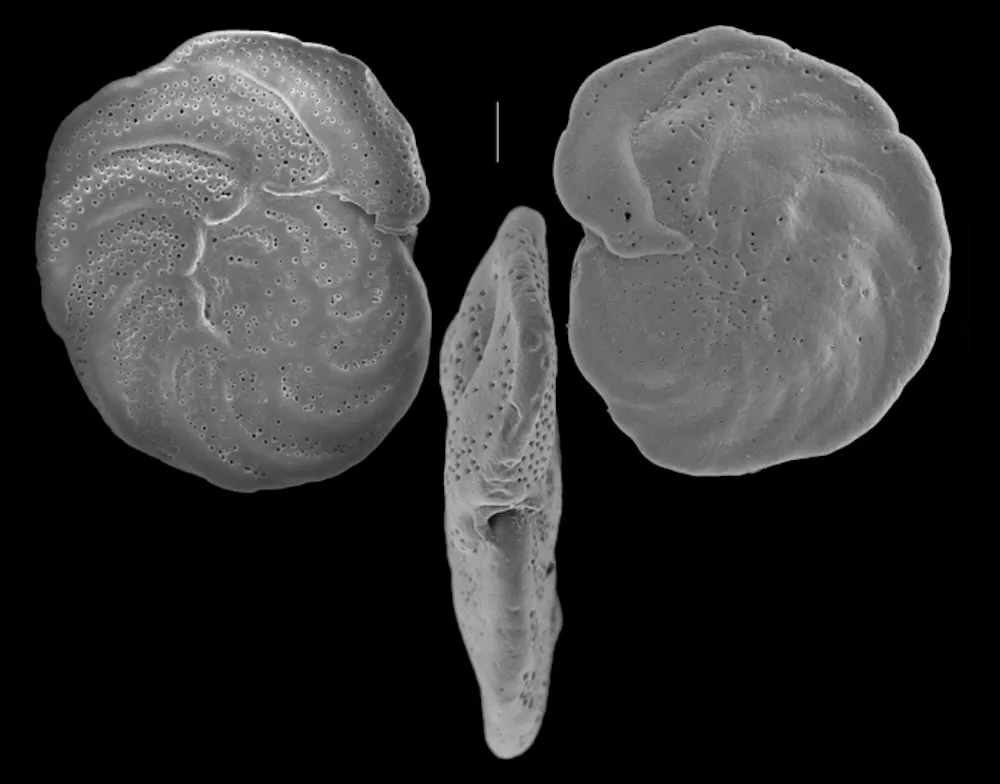
    In some species of foraminifera, such as Cibicidoides wuellerstorfi (pictured here), the trace amount of elements found in their shells is sensitive to their environment.
    Le Coze, François/WoRMS, CC BY-SA

    A giant metal straw

    How do scientists do this? First we go out to the ocean to collect mud.

    In this process, a giant metal straw is dropped to the seabed and then raised to our research ships, fully filled with mud. We take these mud samples back to our lab. There, we slice them into pieces and examine them separately.

    This allows us to extract information from each page of the book in chronological order. Foraminifera shells are washed out of the mud, and specific shells are picked out under a microscope, cleaned, and finally analysed for their chemical composition.

    Foraminifera have lived almost everywhere in the ocean for millions of years. Based on their chemical composition, scientists have reconstructed a continuous record of seawater temperature during the past 66 million years in great detail.

    Among a few places in the ocean where you cannot find foraminifera is the polar Southern Ocean. Although some foraminifera live there, seawater in this region is often too corrosive for their shells to preserve on the seabed. The lack of foraminifera in the polar Southern Ocean brings a huge challenge for scientists eager to understand past changes in CO₂ exchanges between the ocean and the atmosphere.

    Among a few places in the ocean where you cannot find foraminifera is the polar Southern Ocean.
    Mathias Berlin/Shutterstock

    From Antarctica to Tasmania

    We decided to tackle the problem using mud on the seabed 3,300 metres below the surface just south of Tasmania.

    Seawater at that depth near Tasmania is ideal for studying the chemistry of the polar Southern Ocean. That’s because seawater from the polar Southern Ocean sinks to the bottom of the ocean, moves northwards, and eventually occupies the seabed south of Tasmania.

    Seawater chemistry – including concentrations of carbon, phosphate and oxygen – does change along its way at the bottom of the ocean.

    These changes are, however, generally proportional to each other. So if all these concentrations are known for seawater at depth near Tasmania, we can work out their concentrations in the polar Southern Ocean.

    Fortunately, there were plenty of foraminifera shells in the mud for all these reconstructions at the site we examined near Tasmania.

    Reconstructing ancient chemical concentrations

    Using the chemistry of foraminifera, we reconstructed changes in concentrations of carbonate ion (which is largely related to carbon), phosphate and oxygen at the bottom of the ocean near Tasmania during the end of the last ice age roughly 20,000–10,000 years ago. This period is known as the last deglaciation.

    Based on these reconstructions, we calculated the amount of CO₂ released from the polar Southern Ocean during the last deglaciation. Some of this CO₂ came from biological processes – changes in the amount of carbon used by microscopic organisms living near the ocean surface. The rest was from physical processes – CO₂ molecules escaping from seawater directly to the air.

    We found that biological processes were more important for CO₂ releases during the earlier stages of the deglaciation, while the physical processes contributed more during the later stages.

    From the polar Southern Ocean, seawater sinks to the bottom of the ocean and moves northwards to reach the seabed south of Tasmania.
    Steve Todd/Shutterstock

    So why is this important?

    Scientists use climate models to predict future climate and to reproduce past atmospheric CO₂ changes.

    Our results provide testing targets for climate models to reproduce.

    Better reproduction of past changes will improve climate model design for predicting future changes.

    This will help us understand how future changes in the polar Southern Ocean can affect atmospheric CO₂, contributing to making effective plans to mitigate CO₂ emissions.

    Yuhao Dai receives funding from the Australian Research Council Special Research Initiative, Australian Centre for Excellence in Antarctic Science.

    ref. Sand-sized fossils hold secrets to the history of climate change – https://theconversation.com/sand-sized-fossils-hold-secrets-to-the-history-of-climate-change-250928

    MIL OSI AnalysisEveningReport.nz

  • MIL-OSI New Zealand: Comments following bilateral with US Secretary of State Rubio

    Source: New Zealand Government

    [Comments following the bilateral meeting with United States Secretary of State, Marco Rubio; United States State Department, Washington D.C.]
    * We’re very pleased with our meeting with Secretary of State Marco Rubio this afternoon. * We came here to listen to the new Administration and to be clear about what is important to New Zealand. Today, we enjoyed substantive and productive discussions with Secretary Rubio across a broad range of issues. * There’s a lot happening in the Indo-Pacific, and indeed our world. It’s a seriously valuable time to be here in Washington DC. * Secretary Rubio has had a long career in foreign policy and it was helpful to re-connect with him and hear his insights into what is going on.* This has been a very successful visit to Washington DC, meeting with a wide range of representatives of the Trump Administration.* We agreed that we should continue to work together for a free, open and prosperous Indo-Pacific. And we talked about all the areas where New Zealand and the United States have interests in common. These include the prosperity and stability of the Pacific Islands, space and technology, as well as Antarctica where our cooperation has been deep and longstanding. * This visit has provided the starting point for considering what constructive cooperation between New Zealand and the United States might look like in the months and years ahead. * This is just the first step. We will now go back to New Zealand to discuss with Cabinet colleagues what we have learned here in Washington DC.* With Secretary Rubio, we have agreed to remain in close contact in the months ahead. We will no doubt see each other again later this year, whether at a regional meeting or back here in DC.


    MIL OSI New Zealand News

  • MIL-OSI USA: NASA Super Pressure Balloons Return to New Zealand for Test Flights

    Source: NASA

    NASA’s Scientific Balloon Program has returned to Wānaka, New Zealand, for two scheduled flights to test and qualify the agency’s super pressure balloon technology. These stadium-sized, heavy-lift balloons will travel the Southern Hemisphere’s mid-latitudes for planned missions of 100 days or more. 
    Launch operations are scheduled to begin in late March from Wānaka Airport, NASA’s dedicated launch site for mid-latitude, ultra long-duration balloon missions.  
    “We are very excited to return to New Zealand for this campaign to officially flight qualify the balloon vehicle for future science investigations,” said Gabriel Garde, chief of NASA’s Balloon Program Office at the agency’s Wallops Flight Facility in Virginia. “Our dedicated team both in the field and at home has spent years in preparation for this opportunity, and it has been through their hard work, fortitude, and passion that we are back and fully ready for the upcoming campaign.” 
    While the primary flight objective is to test and qualify the super pressure balloon technology, the flights will also host science missions and technology demonstrations. The High-altitude Interferometer Wind Observation (HIWIND), led by High Altitude Observatory, National Center for Atmospheric Research in Boulder, Colorado, will fly as a mission of opportunity on the first flight. The HIWIND payload will measure neutral wind in the part of Earth’s atmosphere called the thermosphere. Understanding these winds will help scientists predict changes in the ionosphere, which can affect communication and navigation systems. The second flight will support several piggyback missions of opportunity, or smaller payloads, including: 

    Compact Multichannel Imaging Camera (CoMIC), led by University of Massachusetts Lowell, will study and measure how Earth’s atmosphere scatters light at high altitudes and will measure airglow, specifically the red and green emissions.  
    High-altitude Infrasound from Geophysical Sources (HIGS), led by NASA’s Jet Propulsion Laboratory and Sandia National Laboratories, will measure atmospheric pressure to collect signals of geophysical events on Earth such as earthquakes and volcanic eruptions. These signals will help NASA as it develops the ability to measure seismic activity on Venus from high-altitude balloons.   
    Measuring Ocean Acoustics North of Antarctica (MOANA), led by Sandia National Laboratories and Swedish Institute of Space Physics, aims to capture sound waves in Earth’s stratosphere with frequencies below the limit of human hearing.
    NASA’s Balloon Program Office at the agency’s Wallops Flight Facility is leading two technology demonstrations on the flight. The INterim Dynamics Instrumentation for Gondolas (INDIGO) is a data recorder meant to measure the shock of the gondola during the launch, termination, and landing phases of flight. The Sensor Package for Attitude, Rotation, and Relative Observable Winds – 7 (SPARROW-7), will demonstrate relative wind measurements using an ultrasonic device designed for the balloon float environment that measures wind speed and direction.

    NASA’s 18.8-million-cubic-foot (532,000-cubic-meter) helium-filled super pressure balloon, when fully inflated, is roughly the size of Forsyth-Barr Stadium in Dunedin, New Zealand, which has a seating capacity of more than 35,000. The balloon will float at an altitude of around 110,000 feet (33.5 kilometers), more than twice the altitude of a commercial airplane. Its flight path is determined by the speed and direction of wind at its float altitude.  
    The balloon is a closed system design to prevent gas release. It offers greater stability at float altitude with minimum altitude fluctuations during the day to night cycle compared to a zero pressure balloon. This capability will enable future missions to affordably access the near-space environment for long-duration science and technology research from the Southern Hemisphere’s mid-latitudes, including nighttime observations. 
    The public is encouraged to follow real-time tracking of the balloons’ paths as they circle the globe on the agency’s Columbia Scientific Balloon Facility website. Launch and tracking information will be shared across NASA’s social media platforms and the NASA Wallops blog.
    NASA’s return to Wānaka marks the sixth super pressure balloon campaign held in New Zealand since the agency began balloon operations there in 2015. The launches are conducted in collaboration with the Queenstown Airport Corporation, Queenstown Lake District Council, New Zealand Space Agency, and Airways New Zealand.  
    “We are especially grateful to our local hosts, partners, and collaborators who have been with us from the beginning and are critical to the success of these missions and this campaign,” said Garde. 
    NASA’s Wallops Flight Facility in Virginia manages the agency’s scientific balloon flight program with 10 to 16 flights each year from launch sites worldwide. Peraton, which operates NASA’s Columbia Scientific Balloon Facility in Palestine, Texas, provides mission planning, sustaining engineering services, and field operations for NASA’s scientific balloon program. The Columbia team has launched more than 1,700 scientific balloons over some 40 years of operations. NASA’s balloons are fabricated by Aerostar. The NASA Scientific Balloon Program is funded by the NASA Headquarters Science Mission Directorate Astrophysics Division.  
    For more information on NASA’s Scientific Balloon Program, visit:
    www.nasa.gov/scientificballoons.
    By Olivia Littleton
    NASA’s Wallops Flight Facility, Wallops Island, Va.

    MIL OSI USA News

  • MIL-OSI Canada: G7 Foreign Ministers’ Declaration on Maritime Security and Prosperity

    Source: Government of Canada News

    March 14, 2025 – Charlevoix, Québec – Global Affairs Canada

    1. We, the Foreign Ministers of Canada, France, Germany, Italy, Japan, the United Kingdom, and the United States of America, and the High Representative of the European Union, reaffirm the G7’s steadfast commitment to contribute towards a free, open, and secure maritime domain based on the rule of law that strengthens international security, fosters economic prosperity, and ensures the sustainable use of marine resources.

    2. Maritime security and prosperity are fundamental to global stability, economic resilience, and the well-being of all nations, and the conservation and sustainable use of ocean ecosystems is essential to all life on Earth. Over 80% of global trade is transported by sea, and 97% of global data flows through submarine cables. Disruptions to maritime routes pose a direct threat to international food security, critical minerals, energy security, global supply chains, and economic stability. We express deep concern over the growing risks to maritime security, including strategic contestation, threats to freedom of navigation and overflight, and illicit shipping activities. State behaviour in these areas has increased the risk of conflict and environmental damage, and imperils all nations’ prosperity and living standards, especially for the world’s poorest. 

    3. We recognize the role of the UN Convention on the Law of the Sea (UNCLOS) as the legal framework for governing all activities in the oceans and the seas.

    4. We recall the G7 Statements on Maritime Security adopted in Lübeck (2015) and Hiroshima (2016). We welcome related work presently underway through other G7 ministerial tracks and working groups, on a range of issues including securing undersea cable networks and combating abandoned fishing gear. We welcome, as well, G7 work relating to transnational organized crime and terrorism that touches on the maritime domain, including in relation to piracy and armed robbery at sea, trafficking in persons, and strengthening the maritime law enforcement capabilities of coastal states. We acknowledge the importance of regional maritime security frameworks, to support coastal states to address collectively threats to their maritime security. We welcome existing initiatives, such as the G7++ Friends of the Gulf of Guinea (G7++ FoGG, that Canada chairs this year), which has been the primary forum for dialogue among G7 members and partners on maritime security in the Gulf of Guinea.

    Emerging Threat on Safe Seas and Freedom of Navigation and Overflight

    5. Enhancing Stability: We underscore the importance of freedom of navigation and overflight and other internationally lawful uses of the high seas and the exclusive economic zones as well as to the related rights and freedoms in other maritime zones, including the rights of innocent passage, transit passage and archipelagic sea lanes passage, as provided for under international law. We share a growing concern at recent, unjustifiable efforts to restrict such freedom and to expand jurisdiction through use of force and other forms of coercion, including across the Taiwan Strait, and the South China Sea, the Red Sea, and the Black Sea. We condemn China’s illicit, provocative, coercive and dangerous actions that seek unilaterally to alter the status quo in such a way as to risk undermining the stability of regions, including through land reclamations, and building of outposts, as well as their use for military purpose. In areas pending final delimitation, we underline the importance of coastal states refraining from unilateral actions that cause permanent physical change to the marine environment insofar as such actions jeopardize or hamper the reaching of the final agreement, as well as the importance of making every effort to enter into provisional arrangements of a practical nature, in those areas. We condemn, as well, dangerous vessel maneuvers, the indiscriminate attacks against commercial vessels and other maritime actions that undermine maritime order based on the rule of law and international law. We reiterate that the award rendered by the Arbitral Tribunal on 12 July 2016 is a significant milestone, which is legally binding upon the parties to those proceedings and a useful basis for peacefully resolving disputes between the parties. We reaffirm that our basic policies on Taiwan remain unchanged and emphasize the importance of peace and stability across the Taiwan Strait as indispensable to international security and prosperity. We welcome the resumption of exports from Ukraine’s Black Sea ports. Freedom of navigation for commercial shipping in the Black Sea must be upheld.

    6. Attempts to Change the Status Quo by Force: We oppose unilateral attempts to change the status quo, in particular by force or coercion including in the East and South China Seas. We undertake to implement means through which to track systematically and report on attempts to change the status quo by force and by the establishment of new geographical facts, including through coercive and dangerous actions on the oceans and seas that might threaten regional and international peace and security.

    7. Protecting Critical Maritime and Undersea Infrastructure: We are seized of the fact that vital energy and telecommunications infrastructure under the oceans and seas connects our economies and is vital to our prosperity. We recall the G7 Joint Statement on Cable Connectivity for Secure and Resilient Digital Communications Networks (2024) and the New York Joint Statement on the Security and Resilience of Undersea Cables in a Globally Digitalized World (2024). We share a growing concern that undersea communications cables, subsea interconnectors and other critical undersea infrastructure have been subject to critical damage through sabotage, poor seamanship or irresponsible behaviour which have resulted in potential internet or energy disruption in affected regions, delays in global data transmission, or compromised sensitive communications. We will enhance our cooperation with industry to mitigate risks, reduce bottlenecks to operational tasks while strengthening repair capacities in order to improve the overall resilience of critical undersea and maritime infrastructure. In this respect, we welcome the EU Action Plan on Cable Security adopted in February 2025 by the European Commission and the High Representative of the Union for Foreign Affairs and Security Policy.

    8. Maritime Crime: Maritime crime, including piracy, armed robbery at sea, maritime arms trafficking and sanctions evasion, human trafficking, illegal drug trafficking and Illegal, Unreported, Unregulated (IUU) fishing, continues to impede maritime security, freedom of navigation, and our economy and prosperity. We have been working together to tackle these maritime crimes, but maritime illegal activities have extended into new areas, to become an urgent issue to be addressed. We welcome the G7 Action Plan to combat migrant smuggling adopted under Italy’s 2024 G7 Presidency.

    9. Protecting Freedom of Trade: In the past year, indiscriminate Houthi attacks in the Red Sea have endangered maritime security of vessels and their crews, disturbed international trade, and exposed neighboring countries to environmental hazards. Enabled by Iran’s military, financial, and intelligence support, these illegal attacks have also contributed to increased tension in the Middle East and Yemen, with severe repercussions on the intra-Yemeni peace process. The vessel “Galaxy Leader” seized by the Houthis must be released immediately. We appreciate the efforts of all those countries that have engaged to ensure freedom of navigation in the Red Sea, protecting crucial shipping lanes and helping to restore regular flows of trade through the Suez Canal connecting the Mediterranean Sea to the Indian and Pacific Oceans. In this regard, we commend the efforts of EU’s maritime operation “Aspides” and U.S.-led operation “Prosperity Guardian”.

    Safe Shipping and Supply Chain Security

    10. Curtailing Unsafe and Illicit Shipping Practices: The rise of unsafe and illicit shipping practices, including fraudulent registration and registries, poses a significant threat to global trade and environmental sustainability.  We are concerned that unsafe and illicit shipping imposes heavy costs on industry, governments and citizens. Russia’s ability to earn revenue has been sustained through its extensive effort to circumvent the G7+ oil price cap policy through its shadow fleet of often older, underinsured, and poorly maintained ships that routinely disable their automatic identification systems or engage in “spoofing” to avoid detection and circumvent international safety, environmental, and liability rules and standards. North Korea continues to pursue its nuclear and ballistic missile programmes and evade sanctions, particularly through its illicit maritime activities, including prohibited ship-to-ship transfers of petroleum and other UN-banned commodities. Through G7 coordination, we have exposed North Korea uses of “dark” vessels – those that engage in illicit activity – to circumvent United Nations Security Council mandated sanctions. Russia and North Korea are strengthening their economic relations including through maritime routes, such as the reported transfer of petroleum products from Russia to North Korea. Unregulated, “dark” vessels undertake IUU fishing, destroying marine habitats and depleting fish stocks, with negative impacts for biodiversity and food security. Unregulated, inadequately insured “dark” vessels also pose a high risk of maritime accidents, including in fragile ecosystems such as the Arctic and Antarctic. We commit to strengthening our coordination, amongst the G7 and with other partners, to prevent the use of unregistered or fraudulently registered, uninsured and substandard vessels engaged in sanctions evasion, arms transfers, illegal fishing and illicit trade. We encourage relevant International Organizations to improve maritime domain awareness by expanding satellite-based vessel tracking and establishing comprehensive data records of the movement of individual ships and of ship-to-ship transfers, as a means of identifying and tracking illicit maritime activities. We are also committed to capacity building of the countries in the region in law enforcement and Maritime Domain Awareness.

    11. Shadow Fleet Task Force: We invite members of the Nordic-Baltic 8 (Denmark, Estonia, Finland, Iceland, Latvia, Lithuania, Norway, Sweden), and possibly others, to join participating G7 members in a Shadow Fleet Task Force to enhance monitoring and detection and to otherwise constrain the use of shadow fleets engaged in illegal, unsafe or environmentally perilous activities, building on the work of others active in this area. The Task Force will constitute a response by the participating States to the call by the International Maritime Organization in its Resolution A.1192(33) of 6 December 2023 for Members States and all relevant stakeholders to promote actions to prevent illegal operations in the maritime sector by shadow fleets and their flag states, including illegal operations for the purposes of circumventing sanctions, evading compliance with safety or environmental regulations, avoiding insurance costs, or engaging in other illegal activities.

    12. Enhancing Maritime Supply Chain Resilience and Energy and Food Security: Maritime supply chains will continue to underpin the global economy, but these face a variety of threats, both present and future, stemming from both geopolitical tensions and environmental factors.  Maritime disruptions raise consumer costs, increase transit times, and can reduce demand in importing countries, which in turn means lower revenues and diminished competitiveness for producers in exporting countries. Such vulnerabilities in maritime transport can undermine energy and food security, particularly for developing nations reliant on stable shipping routes, including Small Island Developing States (SIDS) and Least Developed Countries (LDCs). We welcome maritime initiatives involving and supported by G7 partners intended to promote energy and food security, such as the Grain from Ukraine scheme, and the ASEAN Outlook on the Indo-Pacific. We invite cooperation with the African Union (pursuant to Africa’s Integrated Maritime Strategy 2050) and other relevant International Organizations to identify best practices for enhancing maritime supply chain resilience and for safeguarding energy and food security, including in times of geopolitical crisis. 

    13. Promoting Safe and Resilient Ports and Strategic Waterways: Port ownership and operational control matter to national security, as foreign control or influence over critical port infrastructure can create vulnerabilities in trade, in defence and security, and in economic stability. Port resilience is also crucial to economic stability and global trade and yet ports face growing risks from environmental degradation, extreme weather events and geopolitical conflicts. Strengthening port security and modernizing infrastructure are essential to maintaining safe and efficient maritime trade. Ensuring that the ownership and management of strategic waterways and key maritime choke points are not vulnerable to undue influence by potential adversaries is also essential to national security. We underscore the importance of scrutiny of ownership structures and port management and resilience within our own national jurisdictions, including with regard to Information and Communications Technology (ICT) systems, to ensure that adversaries do not gain leverage over supply chains, military operations, or the flow of strategic resources. We will work with partners and with relevant International Organizations to encourage robust cybersecurity standards for port ICT infrastructure, to increase resilience against malicious cyber incidents on maritime logistical networks, to reduce monopolistic power over key supply chain nodes, to promote secure and transparent port ownership, to limit unsolicited or undue foreign influence over critical infrastructures and strategic waterways, and to otherwise encourage greater focus on such potential vulnerabilities.

    14. Unexploded Ordnance (UXO) at sea poses a significant hazard to the marine environment, to the safety of fishermen and other users of the maritime space, and to various marine economic activities. We commit to enhancing diplomatic efforts and to exchanging best practices among national authorities, relevant international and regional organizations, and relevant industry sectors to accelerate the clean-up of UXO from the seas and ocean.

    Sustainable Stewardship of Maritime Resources

    15. Strengthen Enforcement Against IUU Fishing: IUU fishing is a major contributor to declining fish stocks and to marine habitat destruction. It may account for a third of all fishing activity worldwide, at a cost to the global economy of more than US$23 billion per year and with negative consequences for fisheries as an enduring economic asset, including for developing countries. We welcome the Canadian-led Dark Vessel Detection System in Ecuador, Peru, Costa Rica, the Philippines, and members of the Pacific Islands Forum (PIF) and would see value in replicating the model to support other partners whose fisheries are under threat from IUU fishing. We recognize that data sharing and transparency play a key role in this fight by exposing bad actors and that technological advances can support a robust Monitoring, Control and Surveillance and enforcement landscape. We encourage further progress in addressing IUU fishing, working with and through relevant International Organizations to establish and strengthen rules to sustainably manage fish stocks on the high seas and to improve the enforcement of these measures, including through the further development of detection technologies, aircraft patrols and high seas boarding and inspection of vessels, building upon the 2022 G7 Ocean Deal.

    16. We welcome the Third UN Ocean Conference, in Nice, France, from 9 to 13 June 2025.

    PARTNERSHIPS

    17. This G7 Maritime Security and Prosperity Declaration provides a framework for cooperation with non-G7 partners, including countries hosting major ports, large merchant fleets, or extensive flag registries as well as relevant regional and International Organizations, such as the International Maritime Organization and ASEAN. We would welcome robust cooperation with partners to take forward the goals set out in this Declaration, consistent with the principles of sovereignty and territorial integrity, under the efforts of the G7 countries, including a free, open, prosperous and secure Indo-Pacific region, to build a free and open maritime order based on the rule of law, and of commitment to the sustainable development of the world’s maritime spaces.

    18. We welcome the cooperation on Coast Guard Functions, including the Global Coast Guard Forum hosted by Italy in 2025, as well as the Arctic Coast Guard Forum, which could also support the objectives of this Declaration.

    [14] March 2025

    Charlevoix, Canada

    MIL OSI Canada News

  • MIL-OSI Australia: Denman Marine Voyage update: 7 March, 2025

    Source: Australian Government – Antarctic Division

    This is the first of our weekly updates on the science and shipboard activities happening on the Denman Marine Voyage, a 60-day collaborative science voyage to the Denman Glacier region. There are about 60 scientists on board, and they’re already hard at work.

    RSV Nuyina has been at sea for almost a week and is expected to reach the target area in the next few days. It’s been rough at times but the crew and science groups have managed to get a fair bit done, deploying argo and BGC floats, the Continuous Plankton Recorder (CPR) and Moving Vessel Profiler (MVP).
    The eDNA team has been sampling the moon pool for invasive species and phytoplankton, wet well operations have begun and radiosonde air chemistry and modelling are being done by the atmospheric team, with twice daily balloon releases. 
    Daily science talks are being held on subjects like biogeochemistry (BGC), seal tagging, physical oceanography and sediments. Over the next few days there will be more talks on krill and their diets, benthic trawling and atmospherics.
    Some of the teams have switched to their shifts as they prepare for 24-hour operations. There’s now a meal at midnight and plenty of food options, including curry at breakfast and eggs and bacon ready for lunch.
    In a surprise turn, unofficial Antarctic mascot, Stay – the Guide Dog’s Tasmania collection dog – has turned up! (She was last spotted at Mawson research station). As usual, she came from nowhere and took a star turn on the bridge before disappearing again. You can find out more about Stay, the Antarctic enigma, here. 
    Air temp: 2°C, Sea temp: 3°C, Wind speed: 5.8kts, Significant wave height: 2.43m, Distance to Hobart: 1518nm 

    40°S
    50°S
    60°S
    70°S
    80°E
    90°E
    100°E
    110°E
    120°E
    130°E
    140°E
    150°E
    160°E
    170°E

    Hobart

    Burnie

    Casey

    Davis

    Mawson

    Macquarie Island

    Denman Glacier

    Bunger Hills

    Dome C

    Heard Island

    Fremantle

    Hobart
    Burnie
    Casey
    Davis
    Mawson
    Macquarie Island
    Denman Glacier
    Bunger Hills
    Dome C
    Heard Island
    Fremantle

    RSV Nuyina

    Voyage track of the RSV Nuyina over the last 10 weeks, from 28 December 2024 to 7 March 2025

    To find out more, visit our website. 
    The Denman Marine Voyage is a collaboration between the Australian Centre for Excellence in Antarctic Research (ACEAS), the Australian Antarctic Program Partnership (AAPP), Securing Antarctica’s Environmental Future (SAEF) and the Australian Antarctic Division.
    This content was last updated 12 hours ago on 7 March 2025.

    MIL OSI News

  • MIL-OSI Security: Countries unite to identify illegal fishing vessel via INTERPOL

    Source: Interpol (news and events)

    LYON, France – A joint effort by New Zealand, Australia and Norway to find a vessel suspected of illegal fishing has led to the publication of an INTERPOL Purple Notice to assist in identifying its location.

    An INTERPOL Purple Notice has been issued to find a vessel suspected of illegal fishing. Pictured is ‘Thunder’ as Wuhan N 4 in Singapore, October 2012.

    Thunder as Wuhan N 4 – bow view – Singapore October 2012

    Circulated to all 190 INTERPOL member countries the Notice, requested by New Zealand supported by the Australian Fisheries Management Authority (AFMA) and the Norwegian Directorate of Fisheries, also seeks information about the individuals and networks which own, operate and profit from the suspected illegal activities of the vessel, currently believed to be called ‘Thunder’.

    During the past two years, the vessel has operated under at least three different names and under several flags, in order to avoid detection of illegal fishing activities.

    In July 2012, Mongolian registration papers for a vessel called ‘Wuhan 4’ were issued; however in August 2012 the vessel was sighted in the North Indian Ocean under the name ‘Kuko’. In October 2012, the vessel was spotted at a Singapore shipyard under the name ‘Wuhan N 4’ and under a Mongolian flag.

    In April 2013, the same vessel requested access to a port in Malaysia under the name ‘Wuhan 4’ but when inspected a few days later in Indonesia, it was using the name ‘Thunder’ and with the Nigerian flag.

    “Thunder has been operating under a number of names and flags over several years and we believe this is being done to avoid been caught violating international laws and conventions,” said Gary Orr, Manager, Operational Coordination with New Zealand’s Ministry for Primary Industries.

    “Fisheries crime is not constrained by borders and is commonly carried out by transnational organized networks. Norway is deeply concerned about its global effects. We need an international, coordinated response to effectively tackle these networks, and I welcome the good cooperation we have established with Australia and New Zealand via INTERPOL,” said Norway’s Minister of Fisheries, Elisabeth Aspaker.

    AFMA’s Fisheries Operations General Manager Peter Venslovas said illegal fishing activities seriously undermine the sustainability of fisheries: “Ongoing cooperation between countries across the globe to combat illegal fishing is having a real impact and making it harder for these operators to make a profit.”

    It is possible that the owners of ‘Thunder’ have earned more than USD 60 million from its illegal fishing activities since it was blacklisted by the Commission for the Conservation of Antarctic Marine Living Resources (CCAMLR) in February 2006.

    The vessel is currently believed to be operating in the Southern Ocean around Antarctica where it may be fishing illegally for Patagonian toothfish, also known as Chilean Sea Bass, a highly sought after protected species.

    This is the third INTERPOL Purple Notice issued in connection with illegal fishing activities, with the first published in September this year at the request of Norwegian authorities for a vessel named ‘Snake’.

    INTERPOL’s Purple Notices are used to seek or provide information on modi operandi, objects, devices and concealment methods used by criminals.

    MIL Security OSI

  • MIL-Evening Report: Earth’s oldest impact crater was just found in Australia – exactly where geologists hoped it would be

    Source: The Conversation (Au and NZ) – By Tim Johnson, Professor, Geology, Curtin University

    Shatter cones formed by the impact in the Pilbara. Tim Johnson

    We have discovered the oldest meteorite impact crater on Earth, in the very heart of the Pilbara region of Western Australia. The crater formed more than 3.5 billion years ago, making it the oldest known by more than a billion years. Our discovery is published today in Nature Communications.

    Curiously enough, the crater was exactly where we had hoped it would be, and its discovery supports a theory about the birth of Earth’s first continents.

    The very first rocks

    The oldest rocks on Earth formed more than 3 billion years ago, and are found in the cores of most modern continents. However, geologists still cannot agree how or why they formed.

    Nonetheless, there is agreement that these early continents were critical for many chemical and biological processes on Earth.

    Many geologists think these ancient rocks formed above hot plumes that rose from above Earth’s molten metallic core, rather like wax in a lava lamp. Others maintain they formed by plate tectonic processes similar to modern Earth, where rocks collide and push each other over and under.

    Although these two scenarios are very different, both are driven by the loss of heat from within the interior of our planet.

    We think rather differently.

    A few years ago, we published a paper suggesting that the energy required to make continents in the Pilbara came from outside Earth, in the form of one or more collisions with meteorites many kilometres in diameter.

    As the impacts blasted up enormous volumes of material and melted the rocks around them, the mantle below produced thick “blobs” of volcanic material that evolved into continental crust.

    Our evidence then lay in the chemical composition of tiny crystals of the mineral zircon, about the size of sand grains. But to persuade other geologists, we needed more convincing evidence, preferably something people could see without needing a microscope.

    So, in May 2021, we began the long drive north from Perth for two weeks of fieldwork in the Pilbara, where we would meet up with our partners from the Geological Survey of Western Australia (GSWA) to hunt for the crater. But where to start?

    On the hunt for shatter cones in a typical Pilbara landscape with our trusted GSWA vehicles.
    Chris Kirkland

    A serendipitous beginning

    Our first target was an unusual layer of rocks known as the Antarctic Creek Member, which crops out on the flanks of a dome some 20 kilometres in diameter. The Antarctic Creek Member is only 20 metres or so in thickness, and mostly comprises sedimentary rocks that are sandwiched between several kilometres of dark, basaltic lava.

    However, it also contains spherules – droplets formed from molten rock thrown up during an impact. But these drops could have travelled across the globe from a giant impact anywhere on Earth, most likely from a crater that has now been destroyed.

    After consulting the GSWA maps and aerial photography, we located an area in the centre of the Pilbara along a dusty track to begin our search. We parked the offroad vehicles and headed our separate ways across the outcrops, more in hope than expectation, agreeing to meet an hour later to discuss what we’d found and grab a bite to eat.

    Large hut-like shatter cones in the rocks of the Antarctic Creek Member at the discovery site. The rocks on the hilltop farthest left are basalts that lay directly over the shatter cones.
    Tim Johnson

    Remarkably, when we returned to the vehicle, we all thought we’d found the same thing: shatter cones.

    Shatter cones are beautiful, delicate branching structures, not dissimilar to a badminton shuttlecock. They are the only feature of shock visible to the naked eye, and in nature can only form following a meteorite impact.

    An approximately one metre tall shatter cone ‘hut’, with the rolling hills of the Pilbara in the background.
    Chris Kirkland

    Little more than an hour into our search, we had found precisely what we were looking for. We had literally opened the doors of our 4WDs and stepped onto the floor of a huge, ancient impact crater.

    Frustratingly, after taking some photographs and grabbing a few samples, we had to move on to other sites, but we determined to return as soon as possible. Most importantly, we needed to know how old the shatter cones were. Had we discovered the oldest known crater on Earth?

    It turned out that we had.

    There and back again

    With some laboratory research under our belts, we returned to the site in May 2024 to spend ten days examining the evidence in more detail.

    Shatter cones were everywhere, developed throughout most of the Antarctic Creek Member, which we traced for several hundred metres into the rolling hills of the Pilbara.

    Our observations showed that above the layer with the shatter cones was a thick layer of basalt with no evidence of impact shock. This meant the impact had to be the same age as the Antarctic Member rocks, which we know are 3.5 billion years old.

    Delicate shatter cones within rocks typical of the Antarctic Creek Member.
    Tim Johnson

    We had our age, and the record for the oldest impact crater on Earth. Perhaps our ideas regarding the ultimate origin of the continents were not so mad, as many told us.

    Serendipity is a marvellous thing. As far as we knew, other than the Traditional Owners, the Nyamal people, no geologist had laid eyes on these stunning features since they formed.

    Like some others before us, we had argued that meteorite impacts played a fundamental role in the geological history of our planet, as they clearly had on our cratered Moon and on other planets, moons and asteroids. Now we and others have the chance to test these ideas based on hard evidence.

    Who knows how many ancient craters lay undiscovered in the ancient cores of other continents? Finding and studying them will transform our understanding of the early Earth and the role of giant impacts, not only in the formation of the landmasses on which we all live, but in the origins of life itself.

    The authors do not work for, consult, own shares in or receive funding from any company or organisation that would benefit from this article, and have disclosed no relevant affiliations beyond their academic appointment.

    ref. Earth’s oldest impact crater was just found in Australia – exactly where geologists hoped it would be – https://theconversation.com/earths-oldest-impact-crater-was-just-found-in-australia-exactly-where-geologists-hoped-it-would-be-250921

    MIL OSI AnalysisEveningReport.nz

  • MIL-OSI China: China achieves world’s first application of hydrogen energy technology in Antarctica

    Source: China State Council Information Office 2

    China’s independently developed hydrogen fuel cell has successfully generated electricity at the country’s Qinling Station in Antarctica, marking the first ever application of hydrogen energy technology in the polar region, China Science Daily reported on Wednesday.
    The fuel cell, developed by a hydrogen energy technology enterprise under the State Power Investment Corporation, serves as a core component of the station’s microgrid system. The system is equipped with a hydrogen storage tank that boasts a maximum capacity of 50 cubic meters. When operating independently, the fuel cell can deliver continuous power to the station for up to 24 days, with a maximum output of 30 kilowatts.
    Designed for modular scalability, the fuel cell system covers a power range from 50 kilowatts to tens of megawatts. It can achieve a power generation efficiency of 50 percent and a combined heat and power efficiency of over 90 percent, boasting a design lifespan of 40,000 hours.
    Compared to traditional fossil fuel-based power generation, this hydrogen fuel cell saves approximately 400 grams of standard coal and reduces carbon dioxide emissions by about 1 kilogram for every kilowatt-hour of electricity produced.
    During periods of favorable wind and solar conditions, excess electricity generated by the wind and solar power systems is used to produce hydrogen, which is stored for later use. When wind and solar power generation is insufficient, the stored hydrogen is converted back into electricity and heat through the fuel cell, ensuring a stable and sustainable energy supply.
    The successful application in Antarctica validates the reliability of hydrogen fuel cell technology in extreme low-temperature environments, addressing a critical gap in the use of hydrogen energy in polar energy systems. It also establishes a benchmark for the construction of energy systems and microgrids in other harsh, low-temperature environments.

    MIL OSI China News

  • MIL-OSI United Kingdom: expert reaction to Copernicus data reporting that global sea ice cover at a record low and February 2025 was third warmest on record

    Source: United Kingdom – Executive Government & Departments

    Scientists comment on Copernicus data reporting global sea ice cover is at a record low, and that February was the third warmest on record. 

    Professor Simon Josey, Professor of Oceanography at the UK’s National Oceanography Centre, said:

    “The current record low global sea ice extent revealed by the Copernicus analysis is of serious concern as it reflects major changes in both the Arctic and Antarctic. Warm ocean and atmospheric temperatures will prove critical for Antarctic sea-ice in the coming months as they may lead to an extensive failure of the ice to regrow in southern hemisphere winter. A recent study (Josey et al., 2024) has shown that this can lead to increasingly stormy conditions in the Southern Ocean and altered ocean properties with potential impacts for the wider ocean and atmospheric circulation.”

    Josey, S. A., A. J. S. Meijers, A. T. Blaker, J. P. Grist, J. Mecking and H. C. Ayres, 2024: Record-low Antarctic sea ice in 2023 increased ocean heat loss and storms, Nature, https://doi.org/10.1038/s41586-024-08368-y.


    Dr Robert Larter, Marine Geophysicist, British Antarctic Survey (BAS), said:

    “The results from C3S showing that global sea ice extent reached a new all-time minimum in February highlight the substantial effects climate change is having in polar regions and are a cause for serious concern. These results are consistent with independent analysis from the National Snow and Ice Data Center in the US. Sea ice has an important climate feedback effect because of its high “albedo”, reflecting a large proportion of incident solar radiation back into space. It also plays an important role in the ecology of the polar oceans and helps protect floating ice shelves in Antarctica, which buttress the ice sheet, by suppressing ocean swell. Furthermore, brine rejection during seasonal formation of sea ice is a key process in the formation of dense water masses that sink to the depths of the ocean and are critical to driving the global overturning thermohaline circulation.

    “The near-record low in Antarctic sea-ice extent follows on from extents in the previous two years that were the lowest in the period over which satellite records have been available, and extends the run of years with low minimum sea ice extents that started with a steep decline in 2016. Antarctic sea-ice extent has usually started to grow again before the end of February as the days get shorter in the Southern Ocean, but this year several days into March the data show no sign of significant new sea ice formation.”

    Prof Richard Allan, Professor of Climate Science, University of Reading, said:

    “February 2025 saw the lowest recorded coverage of sea ice globally as the Arctic reached a record low maximum extent of around 14 million square kilometres and sea ice at the fringes of Antarctica stayed near the record low minimum extent of around 2 million square kilometres, which has been reached every February since 2022. Every successive February, the Arctic has been losing on average 42 thousand square kilometres of sea ice, twice the area of Wales. Parts of the high Arctic have been up to 12 degrees Celsius above average while on the other hand the USA and Canada froze, showing that heat can temporarily shift from one place to another. But averaging over all regions, the global warming trend is clear with February 2025 more than 1.5 degrees Celsius above pre-industrial conditions, repeating a level of excess warmth experienced in all but 1 of the past 20 months, despite a weak cooling influence of La Niña conditions in the Pacific. The long term prognosis for Arctic sea ice is grim as the region continues to rapidly heat up and can only be saved with rapid and massive cuts to greenhouse gas emissions that will also limit the growing severity of weather extremes and long term sea level rise across the world.”

    Declared interests

    Dr Robert Larter: No conflicts.

    Professor Richard Allan: no conflicting interests

    For all other experts, no response to our request for DOIs was received.

    MIL OSI United Kingdom

  • MIL-Evening Report: Weakening currents in the Atlantic may mean a wetter northern Australia and drier New Zealand

    Source: The Conversation (Au and NZ) – By Himadri Saini, Research Associate at Climate Change Research Centre, UNSW Sydney

    Deborah Wallace Tasmanian/Shutterstock

    Europe is warmed by heat from ocean currents, which move water from the warm tropics to the colder North Atlantic. Once the warm, salty water from the tropics reach the polar region, they cool enough to sink to the depths and flow back towards the Southern Ocean.

    This enormous system of currents is known as the Atlantic Meridional Overturning Circulation (AMOC). Climate scientists are increasingly worried about the AMOC, which appears to be slowing down.

    While there’s still debate over whether the AMOC has weakened over the last decades, climate models consistently show the AMOC will significantly weaken over the coming century due to the increase in heat-trapping atmospheric greenhouse gases. As more heat stays in the system, the ocean heats up and ice melts, adding fresh water to polar oceans. The overall effect is to slow these currents. The AMOC could weaken 30% by 2060.

    A weaker AMOC would mean big changes in Europe, which benefits directly from the warmer waters it brings. But it would also change the climate in the Southern Hemisphere. Our new research shows a weakening of the AMOC would lead to a large change in rainfall patterns, leading to wetter summers in northern Australia and a drier New Zealand year-round. Indonesia and northern Papua New Guinea would also become drier.

    Running AMOC?

    In the Earth’s long history, the AMOC has gone through many periods of weakening. These were most common during ice ages, when glaciers expanded, but they also occurred during periods as warm as today.

    To reconstruct past climates, researchers use data from ice cores, marine sediment cores and speleothems (mineral deposits in caves such as flowstone and stalagmites), as well as simulations performed with climate models. These data show a weaker AMOC strongly affected the climate in the Northern Hemisphere. When flows of warmer water faltered, sea ice expanded in the North Atlantic, while Europe endured colder, drier conditions and the northern tropics became drier.

    If the AMOC weakens significantly, it will mean major change for Northern Hemisphere nations. Average temperatures could actually drop 3°C in Western Europe.

    At present, the AMOC’s flows of warmer water give European nations more pleasant climates and keeps ports ice free, while the Canadian side of the North Atlantic has a much more severe climate.

    What does it mean for the Southern Hemisphere?

    Data from ice cores and marine sediment cores also showed Antarctica and the Southern Ocean became warmer during these past AMOC weakening events. Until now, we haven’t understood what an AMOC weakening would mean for rainfall in the Australasian region.

    To find out, we ran climate model simulations with the Australian Earth system model, ACCESS-ESM1.5. Our modelling reveals a complex and regionally varied response, primarily shaped by large-scale atmospheric changes.

    As the AMOC weakens, it sets off a chain reaction in the oceans and atmosphere which alter rainfall and temperatures across Australasia.

    A weaker AMOC would affect ocean temperatures, cooling surface waters in the northern hemisphere and warming waters in the southern hemisphere. This would push the Intertropical Convergence Zone – a belt of heavy rain near the equator – further south.

    This means areas such as northern Papua New Guinea and Indonesia will get less rain, while northern Australia will cop wetter summers.

    Next, a warmer south equatorial Atlantic triggers atmospheric waves – large-scale movements of air that travel across the globe. These waves lower air pressure over northern Australia, pulling in more moisture and making summer rainfall even heavier.

    At the same time, a weaker AMOC disrupts the usual tropical Pacific and Indian Ocean dynamics, altering wind patterns and pressure systems in the Southern Hemisphere. High pressure systems shift southward, affecting storm tracks. The overall effect is fewer storms reaching southern Australia and New Zealand, leading to drier winters.

    Last, as the Atlantic currents peter out, heat builds up in Southern Hemisphere oceans rather than being carried to the poles. This results in hotter summers, particularly in southern Australia and New Zealand.

    Deluges and droughts

    It’s likely we will see these important currents weaken this century, bringing major change to both hemispheres.

    Those in Australia and New Zealand are likely to see a magnification of some existing climate shifts, such as a drier south and wetter north.

    Policymakers and resource managers need to prepare for a future where water becomes an increasingly uncertain resource.

    In the north, more rain over summer could mean a greater reliance on water storage and flood mitigation. In the south, drier conditions may force increased water use efficiency and drought planning.

    In New Zealand, a year-round drying trend could challenge farm productivity and hydropower generation. Long-term water management will be critical.

    What happens in the North Atlantic doesn’t stay there. It ripples through the atmosphere and oceans, with far-reaching consequences.

    Himadri Saini receives funding from the Australian Research Council.

    Laurie Menviel receives funding from the Australian Research Council.

    ref. Weakening currents in the Atlantic may mean a wetter northern Australia and drier New Zealand – https://theconversation.com/weakening-currents-in-the-atlantic-may-mean-a-wetter-northern-australia-and-drier-new-zealand-248679

    MIL OSI AnalysisEveningReport.nz

  • MIL-Evening Report: DNA detectives in Antarctica: probing 6,000 years of penguin poo for clues to the past

    Source: The Conversation (Au and NZ) – By Jamie Wood, Senior Lecturer in Ecology and Evolution, University of Adelaide

    Jamie Wood

    Studies of ancient DNA have tended to focus on frozen land in the northern hemisphere, where woolly mammoths and bison roamed. Meanwhile, Antarctica has received relatively little attention. We set out to change that.

    The most suitable sediments are exposed near the coast of the icy continent, where penguins like to breed. Their poo is a rich source of DNA, providing information about the health of the population as well as what penguins have been eating.

    Our new research opens a window on the past of Adélie penguins in Antarctica, going back 6,000 years. It also offers a surprise glimpse into the shrinking world of southern elephant seals over the past 1,000 years.

    Understanding how these species coped with climate change in the past can help us prepare for the future. Wildlife in Antarctica faces multiple emerging threats and will likely need support to cope with the many challenges ahead.

    A unique marine ecosystem

    Adélie penguins are particularly sensitive to changes in their environment. This makes them what we call a “sentinel species”, providing an early warning of imbalance or dysfunction in the coastal ecosystem. Their poo also provides a record of how they responded to changes in the past.

    In our new research, we excavated pits up to 80cm deep at ten Adélie penguin colonies along the 700km Ross Sea coastline. We then collected 156 sediment samples from different depths in each excavation.

    Six of these colonies were still active, meaning birds return annually to breed. The other four had been abandoned at various times over the past 6,000 years.

    From these sediments we generated 94 billion DNA sequences, which provided us with an unparalleled window into the past lives of Adélie penguins and their ecosystem.

    We detected the DNA of several animal species besides Adélie penguins. These animals included two other birds, three seals and two soil invertebrates.

    Not all of this DNA came from penguin poo. Our samples also contained DNA from feathers, hairs or skin cells of other species in the environment at the time.

    Sediment samples were taken from ten penguin colonies of various ages, six active (white dot) and four abandoned (coloured dot), on the coast of Ross Sea in Antarctica.
    Wood, J., et al (2025) Nature Communications, CC BY-NC-ND

    Penguin population size and diet

    When we took a closer look at the DNA from penguins of the present day, we found more genetic diversity in samples from larger colonies.

    Recognising this relationship between genetic diversity and colony size enabled us to estimate the size of former colonies. We could also reconstruct population trends through time.

    For example, in samples from active colonies, we found penguin genetic diversity increased as we sampled closer and closer to the surface. This may reflect population growth over the past century.

    The DNA also revealed changes in penguin diets over time. Over the past 4,000 years, the penguins in the southern Ross Sea switched from mainly eating one type of fish – the bald notothen – to another, Antarctic silverfish.

    The bald notothen lives beneath the sea ice, so this prey-switching was likely driven by a change in sea ice extent compared with the past.

    Examples of an active Adélie penguin colony (Cape Hallett), and a 6,000 year old abandoned Adélie penguin colony site (Terra Nova Bay).
    Jamie Wood

    Surprise! Elephant seals

    We made an unexpected discovery at Cape Hallett, in the northern Ross Sea. This is the site of an active penguin colony.

    Samples of sediment from close to the surface contained lots of penguin DNA and eggshell. But samples from further down, where penguin DNA and eggshell were scarce, contained DNA from southern elephant seals.

    Today, elephant seals are uncommon visitors to the Antarctic continent, and breed on subantarctic islands including Macquarie, Campbell and Antipodes Islands. Yet, bones of elephant seal pups found along the Ross Sea coast indicate the species used to breed in the area.

    Carbon dating of these bones indicate elephant seal colonies began disappearing from the southern Ross Sea around 1,000 years ago. Over the following 200 years, colonies in the northern Ross Sea began vanishing too.

    As the climate cooled and the extent of sea ice increased, elephant seals could no longer access suitable breeding sites. These sites were then taken over by Adélie penguins who expanded into areas once occupied by seals.

    Our DNA evidence suggests Cape Hallett was one of the last strongholds of southern elephant seals on the icy continent. But we may yet again see elephant seals breeding on the Antarctic mainland as the world warms and sea ice melts.

    Even more ancient DNA in Antarctica

    Our study spans the past 6,000 years, but our research suggests it would be possible to go even further back.

    The DNA fragments we found were very well preserved, showing little of the damage expected in warmer climates.

    So it should be possible to obtain much older DNA from sediments on land in Antarctica – maybe even 1 million-year-old DNA, as recently reported from Antarctic sediments beneath the ocean floor.

    Worthy of lasting protection

    In December 2017, 2.09 million square kilometres of the Ross Sea and adjoining Southern Ocean became the world’s largest marine protected area. Establishing the protection was a major achievement, yet it was only afforded for 35 years.

    After 2052, continuation of the region’s protected status will require international agreement. Knowledge of the vulnerability of local species and their risk in the face of change will play a key role in informing the decision. Our research provides a case study for how ancient environmental DNA can contribute towards this understanding.

    This research was part of the Ross Sea Region Research and Monitoring Programme,, funded by the New Zealand Ministry for Business, Innovation and Employment.

    Theresa Cole does not work for, consult, own shares in or receive funding from any company or organisation that would benefit from this article, and has disclosed no relevant affiliations beyond their academic appointment.

    ref. DNA detectives in Antarctica: probing 6,000 years of penguin poo for clues to the past – https://theconversation.com/dna-detectives-in-antarctica-probing-6-000-years-of-penguin-poo-for-clues-to-the-past-249940

    MIL OSI AnalysisEveningReport.nz

  • MIL-OSI New Zealand: New Antarctica swift field tests to speed up avian influenza monitoring

    Source: New Zealand Government

    Sampling and timely testing for avian influenza in remote locations like Antarctica and the sub-Antarctic islands is now a step closer thanks the development of a portable laboratory, says Minister for Biosecurity Andrew Hoggard.Biosecurity New Zealand recently tested the ground-breaking equipment during a voyage to Antarctica on the icebreaker MV Argus.  
    “This was an incredible opportunity to be able to locate, sample and test for HPAI in the field under extreme conditions,” says Andrew Hoggard.HPAI H5N1 emerged in 2020 and has spread through most of the world. In February 2024, it was detected on the Antarctic peninsula. Affected species include brown skuas, Adélie penguins, snowy sheathbill and Antarctic fur seals.   “The benefit of this is that samples don’t need to be sent to a laboratory for testing, a process which can take weeks from remote locations like Antarctica. Instead, a confirmed result for HPAI H5N1 can be obtained within 48 hours of taking the sample.”The portable laboratory was set up aboard the MV Argus. Samples were collected from a skua carcass on Torgersen Island in the Palmer Archipelago before being tested aboard ship.“I understand that conditions were incredibly challenging to set up complex lab work, with the vessel having very limited space. But it was the ultimate test of the portable lab, and it proved to be a huge success.” Research stations in the area do not have sequencing capability and do not test for HPAI. If samples are taken, they are typically sent back to Australia for testing, which can take weeks.“Having the portable lab for remote locations like this means results can be obtained in the field – allowing faster more informed decisions on any next steps.  While HPAI H5N1 is still some distance from New Zealand, it’s important that we take a cautious approach.“We need to be prepared and have strong biosecurity practices in place. Everyone has a part to play.”Detailed information on how to prepare for HPAI H5N1 is here   

    MIL OSI New Zealand News

  • MIL-OSI Security: Defense News: Military Sealift Command Completes Operation Deep Freeze 2025 Cargo Operations in Antarctic

    Source: United States Navy

    Military Sealift Command has completed its resupply mission in Antarctica with the departure of the MSC chartered ship MV Ocean Gladiator. The mission was in support of Operation Deep Freeze 2025, the Joint Task Force Support for Antarctica mission to the National Science Foundation-managed U.S. Antarctic Program.

    MIL Security OSI

  • MIL-OSI Global: Melting Antarctic ice will slow the world’s strongest ocean current – and the global consequences are profound

    Source: The Conversation – Global Perspectives – By Taimoor Sohail, Postdoctoral Researcher, School of Geography, Earth and Atmospheric Sciences, The University of Melbourne

    Mongkolchon Akesin, Shutterstock

    Flowing clockwise around Antarctica, the Antarctic Circumpolar Current is the strongest ocean current on the planet. It’s five times stronger than the Gulf Stream and more than 100 times stronger than the Amazon River.

    It forms part of the global ocean “conveyor belt” connecting the Pacific, Atlantic, and Indian oceans. The system regulates Earth’s climate and pumps water, heat and nutrients around the globe.

    But fresh, cool water from melting Antarctic ice is diluting the salty water of the ocean, potentially disrupting the vital ocean current.

    Our new research suggests the Antarctic Circumpolar Current will be 20% slower by 2050 as the world warms, with far-reaching consequences for life on Earth.

    The Antarctic Circumpolar Current keeps Antarctica isolated from the rest of the global ocean, and connects the Atlantic, Pacific and Indian oceans.
    Sohail, T., et al (2025), Environmental Research Letters., CC BY

    Why should we care?

    The Antarctic Circumpolar Current is like a moat around the icy continent.

    The current helps to keep warm water at bay, protecting vulnerable ice sheets. It also acts as a barrier to invasive species such as southern bull kelp and any animals hitching a ride on these rafts, spreading them out as they drift towards the continent. It also plays a big part in regulating Earth’s climate.

    Unlike better known ocean currents – such as the Gulf Stream along the United States East Coast, the Kuroshio Current near Japan, and the Agulhas Current off the coast of South Africa – the Antarctic Circumpolar Current is not as well understood. This is partly due to its remote location, which makes obtaining direct measurements especially difficult.

    Understanding the influence of climate change

    Ocean currents respond to changes in temperature, salt levels, wind patterns and sea-ice extent. So the global ocean conveyor belt is vulnerable to climate change on multiple fronts.

    Previous research suggested one vital part of this conveyor belt could be headed for a catastrophic collapse.

    Theoretically, warming water around Antarctica should speed up the current. This is because density changes and winds around Antarctica dictate the strength of the current. Warm water is less dense (or heavy) and this should be enough to speed up the current. But observations to date indicate the strength of the current has remained relatively stable over recent decades.

    This stability persists despite melting of surrounding ice, a phenomenon that had not been fully explored in scientific discussions in the past.

    What we did

    Advances in ocean modelling allow a more thorough investigation of the potential future changes.

    We used Australia’s fastest supercomputer and climate simulator in Canberra to study the Antarctic Circumpolar Current. The underlying model, ACCESS-OM2-01, has been developed by Australian researchers from various universities as part of the Consortium for Ocean-Sea Ice Modelling in Australia.

    The model captures features others often miss, such as eddies. So it’s a far more accurate way to assess how the current’s strength and behaviour will change as the world warms. It picks up the intricate interactions between ice melting and ocean circulation.

    In this future projection, cold, fresh melt water from Antarctica migrates north, filling the deep ocean as it goes. This causes major changes to the density structure of the ocean. It counteracts the influence of ocean warming, leading to an overall slowdown in the current of as much as 20% by 2050.

    Far-reaching consequences

    The consequences of a weaker Antarctic Circumpolar Current are profound and far-reaching.

    As the main current that circulates nutrient-rich waters around Antarctica, it plays a crucial role in the Antarctic ecosystem.

    Weakening of the current could reduce biodiversity and decrease the productivity of fisheries that many coastal communities rely on. It could also aid the entry of invasive species such as southern bull kelp to Antarctica, disrupting local ecosystems and food webs.

    A weaker current may also allow more warm water to penetrate southwards, exacerbating the melting of Antarctic ice shelves and contributing to global sea-level rise. Faster ice melting could then lead to further weakening of the current, commencing a vicious spiral of current slowdown.

    This disruption could extend to global climate patterns, reducing the ocean’s ability to regulate climate change by absorbing excess heat and carbon in the atmosphere.

    Ocean currents around the world (NASA)

    Need to reduce emissions

    While our findings present a bleak prognosis for the Antarctic Circumpolar Current, the future is not predetermined. Concerted efforts to reduce greenhouse gas emissions could still limit melting around Antarctica.

    Establishing long-term studies in the Southern Ocean will be crucial for monitoring these changes accurately.

    With proactive and coordinated international actions, we have a chance to address and potentially avert the effects of climate change on our oceans.

    The authors thank Polar Climate Senior Researcher Dr Andreas Klocker, from the NORCE Norwegian Research Centre and Bjerknes Centre for Climate Research, for his contribution to this research, and Professor Matthew England from the University of New South Wales, who provided the outputs from the model simulation for this analysis.

    Taimoor Sohail receives funding from the Australian Research Council.

    Bishakhdatta Gayen receives funding from Australian Research Council (ARC). He works at University of Melbourne as ARC Future Fellow and Associate Professor. He is also A/Prof. at CAOS, Indian Institute of Science.

    ref. Melting Antarctic ice will slow the world’s strongest ocean current – and the global consequences are profound – https://theconversation.com/melting-antarctic-ice-will-slow-the-worlds-strongest-ocean-current-and-the-global-consequences-are-profound-251053

    MIL OSI – Global Reports

  • MIL-OSI China: China’s 41st Antarctic expedition team deploys cutting-edge drill to gather data

    Source: China State Council Information Office 2

    China’s 41st Antarctic expedition team recently utilized an Ice and Bedrock Electromechanical Drill (IBED) to gather critical data about how the Antarctic sheet may evolve in response to future climate change.
    The team conducted logging operations using existing boreholes in the Larsemann Hills in East Antarctica. They collected key parameters, including borehole temperature, inclination, azimuth, diameter changes and a comprehensive internal glacier temperature profile.
    The College of Construction Engineering and the Institute for Polar Science and Engineering at Jilin University developed the equipment.
    A collaborative research team was formed during China’s 40th Antarctic expedition, which ran from November 2023 to April 2024. This team included experts from Jilin University, China University of Geosciences and the All-Russian Scientific Research Institute for Geology and Mineral Resources of the Ocean. Their goal was to investigate the subglacial geological environment of the Larsemann Hills.
    Using the drill, the team obtained multiple ice core samples and a 0.48-meter rock sample, creating the Ice Underlying Rock Hole No 2.
    During the 41st expedition, the joint research team returned to the hole and used the IBED to conduct ice sheet logging operations. Over two months, they gathered data to help understand the environment under the ice and how heat generated within the planet affects the way ice behaves.
    The team also recovered approximately seven cubic meters of drilling fluid from the borehole as part of their commitment to environmental protection.
    According to the university, the College of Construction Engineering and the Institute for Polar Science and Engineering have participated in 10 Antarctic expeditions and all of China’s Antarctic drilling tasks.

    MIL OSI China News

  • MIL-OSI USA: Going With the Flow: Visualizing Ocean Currents with ECCO

    Source: NASA

    Historically, the ocean has been difficult to model. Scientists struggled in years past to simulate ocean currents or accurately predict fluctuations in temperature, salinity, and other properties. As a result, models of ocean dynamics rapidly diverged from reality, which meant they could only provide useful information for brief periods.
    In 1999, a project called Estimating the Circulation and Climate of the Ocean (ECCO) changed all that. By applying the laws of physics to data from multiple satellites and thousands of floating sensors, NASA scientists and their collaborators built ECCO to be a realistic, detailed, and continuous ocean model that spans decades. ECCO enabled thousands of scientific discoveries, and was featured during the announcement of the Nobel Prize for Physics in 2021.
    NASA ECCO is a powerful integrator of decades of ocean data, narrating the story of Earth’s changing ocean as it drives our weather, and sustains marine life.
    The ECCO project includes hundreds of millions of real-world measurements of temperature, salinity, sea ice concentration, pressure, water height, and flow in the world’s oceans. Researchers rely on the model output to study ocean dynamics and to keep tabs on conditions that are crucial for ecosystems and weather patterns. The modeling effort is supported by NASA’s Earth science programs and by the international ECCO consortium, which includes researchers from NASA’s Jet Propulsion Laboratory in Southern California and eight research institutions and universities.
    The project provides models that are the best possible reconstruction of the past 30 years of the global ocean. It allows us to understand the ocean’s physical processes at scales that are not normally observable.

    Large-scale wind patterns around the globe drag ocean surface waters with them, creating complex currents, including some that flow toward the western sides of the ocean basins. The currents hug the eastern coasts of continents as they head north or south from the equator: These are the western boundary currents. The three most prominent are the Gulf Stream, Agulhas, and Kuroshio. NASA Goddard’s Scientific Visualization Studio.

    Seafarers have known about the Gulf Stream — the Atlantic Ocean’s western boundary current — for more than 500 years. By the volume of water it moves, the Gulf Stream is the largest of the western boundary currents, transporting more water than all the planet’s rivers combined.
    In 1785, Benjamin Franklin added it to maritime charts showing the current flowing up from the Gulf, along the eastern U.S. coast, and out across the North Atlantic. Franklin noted that riding the current could improve a ship’s travel time from the Americas to Europe, while avoiding the current could shorten travel times when sailing back.

    Franklin’s charts showed a smooth Gulf Stream rather than the twisted, swirling path revealed in ECCO data. And Franklin couldn’t have imagined the opposing flow of water below the Gulf Stream. The countercurrent runs at depths of about 2,000 feet (600 meters) in a cold river of water that is roughly the opposite of the warm Gulf Stream at the surface. The submarine countercurrent is clearly visible when the upper layers in the ECCO model are peeled away in visualizations.
    The Gulf Stream is a part of the Atlantic Meridional Overturning Circulation (AMOC), which moderates climate worldwide by transporting warm surface waters north and cool underwater currents south. The Gulf Stream, in particular, stabilizes temperatures of the southeastern United States, keeping the region warmer in winter and cooler in summer than it would be without the current. After the Gulf Stream crosses the Atlantic, it tempers the climates of England and the European coast as well.

    The Agulhas Current flows south along the western side of the Indian Ocean. When it reaches the southern tip of Africa, it sheds swirling vortices of water called Agulhas Rings. Sometimes persisting for years, the rings glide across the Atlantic toward South America, transporting small fish, larvae, and other microorganisms from the Indian Ocean. 
    Researchers using the ECCO model can study Agulhas Current flow as it sends warm, salty water from the tropics in the Indian Ocean toward the tip of South Africa. The model helps tease out the complicated dynamics that create the Agulhas rings and large loop of current called a supergyre that surrounds the Antarctic. The Southern Hemisphere supergyre links the southern portions of other, smaller current loops (gyres) that circulate in the southern Atlantic, Pacific, and Indian oceans. Together with gyres in the northern Atlantic and Pacific, the southern gyres and Southern Hemisphere supergyre influence climate while transporting carbon around the globe. 

    In addition to affecting global weather patterns and temperatures, western boundary currents can drive vertical flows in the oceans known as upwellings. The flows bring nutrients up from the depths to the surface, where they act as fertilizer for phytoplankton, algae, and aquatic plants.
    The Kuroshio Current that runs on the west side of the Pacific Ocean and along the east side of Japan has recently been associated with upwellings that enrich coastal fishing waters. The specific mechanisms that cause the vertical flows are not entirely clear. Ocean scientists are now turning to ECCO to tease out the connection between nutrient transport and currents like the Kuroshio that might be revealed in studies of the water temperature, density, pressure, and other factors included in the ECCO model.

    When viewed through the lens of ECCO’s temperature data, western boundary currents carry warm water away from the tropics and toward the poles. In the case of the Gulf Stream, as the current moves to far northern latitudes, some of the saltwater freezes into salt-free sea ice. The saltier water left behind sinks and then flows south all the way toward the Antarctic before rising and warming in other ocean basins. 

    Currents also move nutrients and salt throughout Earth’s ocean basins. Swirling vortexes of the Agulhas rings stand out in ECCO temperature and salinity maps as they move warm, salty water from the Indian Ocean into the Atlantic.

    ECCO offers researchers a way to run virtual experiments that would be impractical or too costly to perform in real oceans. Some of the most important applications of the ECCO model are in ocean ecology, biology, and chemistry. Because the model shows where the water comes from and where it goes, researchers can see how currents transport heat, minerals, nutrients, and organisms around the planet. 
    In prior decades, for example, ocean scientists relied on extensive temperature and salinity measurements by floating sensors to deduce that the Gulf Stream is primarily made of water flowing past the Gulf rather than through it. The studies were time-consuming and expensive. With the ECCO model, data visualizers at NASA’s Goddard Space Flight Center in Greenbelt, Maryland, virtually replicated the research in a simulation that was far quicker and cheaper.

    The example illustrated here relies on ECCO to track the flow of water by virtually filling the Gulf with 115,000 particles and letting them move for a year in the model. The demonstration showed that less than 1% of the particles escape the Gulf to join the Gulf Stream. 
    Running such particle-tracking experiments within the ocean circulation models helps scientists understand how and where environmental contaminants, such as oil spills, can spread.

    Today, researchers turn to ECCO for a broad array of studies. They can choose ECCO modeling products that focus on one feature – such as global flows or the biology and chemistry of the ocean – or they can narrow the view to the poles or specific ocean regions. Every year, more than a hundred scientific papers include data and analyses from the ECCO model that delve into our oceans’ properties and dynamics. 

    [embedded content]
    Credits: Kathleen Gaeta Greer/ NASA’s Scientific Visualization Studio 

    Composed by James Riordon / NASA’s Earth Science News Team
    Information in this piece came from the resources below and interviews with the following sources: Nadya Vinogradova Shiffer, Dimitris Menemenlis, Ian Fenty, and Atousa Saberi.  

    Liao, F., Liang, X., Li, Y., & Spall, M. (2022). Hidden upwelling systems associated with major western boundary currents. Journal of Geophysical Research: Oceans, 127(3), e2021JC017649.
    Richardson, P. L. (1980). The Benjamin Franklin and Timothy Folger charts of the Gulf Stream. In Oceanography: The Past: Proceedings of the Third International Congress on the History of Oceanography, held September 22–26, 1980 at the Woods Hole Oceanographic Institution, Woods Hole, Massachusetts, USA on the occasion of the Fiftieth Anniversary of the founding of the Institution (pp. 703-717). New York, NY: Springer New York.
    Biastoch, A., Rühs, S., Ivanciu, I., Schwarzkopf, F. U., Veitch, J., Reason, C., … & Soltau, F. (2024). The Agulhas Current System as an Important Driver for Oceanic and Terrestrial Climate. In Sustainability of Southern African Ecosystems under Global Change: Science for Management and Policy Interventions (pp. 191-220). Cham: Springer International Publishing.
    Lee-Sánchez, E., Camacho-Ibar, V. F., Velásquez-Aristizábal, J. A., Valencia-Gasti, J. A., & Samperio-Ramos, G. (2022). Impacts of mesoscale eddies on the nitrate distribution in the deep-water region of the Gulf of Mexico. Journal of Marine Systems, 229, 103721.

    MIL OSI USA News

  • MIL-OSI Global: The female explorers who braved the wilderness but were overlooked by the history books

    Source: The Conversation – UK – By Sarah Lonsdale, Senior Lecturer in Journalism, City St George’s, University of London

    Ferryland lighthouse near Labrador in the Canadian Arctic, an area mapped by Mina Hubbard in 1905. Nagel Photography

    In the summer of 1905, a young Canadian widow, Mina Hubbard, set out on an expedition to map the northeastern corner of Labrador, from Lake Melville up to Ungava Bay, an inlet of the Arctic Ocean. It was an unusual challenge for a former nurse who had left school at 16.

    Her husband, Leonidas Hubbard, had died in this same harsh environment two years earlier. Mina, 35, intended to complete his work.

    Although she faced physical dangers on the 600-mile journey – starvation, bears, freezing rivers and rapids – her greatest antagonists were the reporters and editors of the male-dominated outdoors press of early 20th-century north America.

    The popular Outing magazine, for whom Leonidas Hubbard had written, was the most excoriating. Its editor, Caspar Whitney, thundered in an editorial that “the widow” should not be in the wilderness, let alone speak about it.

    The wild was no place for a white woman, especially one accompanied by First Nation (Native American) guides. This was not long after she had given an interview to another paper.

    Mina Hubbard in northern Labrador.

    Other newspapers described her as a grief-stricken hysteric. This was the only explanation they could find for her decision to go on such a long and arduous journey. When she was 300 miles into her expedition, having found the source of the Naskaupi River, the New York Times reported on its front page that she had given up, beaten back by hardship and privations.

    New York Times.
    CC BY-NC-ND

    Instead the paper claimed that a man, an explorer called Dillon Wallace who was also in northern Labrador, was “pushing forward beyond any white man’s previous track”. In fact, Hubbard had neither given up, nor had Wallace caught up with her. She would reach Ungava Bay several weeks before his party. But it fitted the dominant narrative of the time: that the wilderness was no place for a woman.

    I explore the idea of what the wild is, and of its being a gendered space, in my new book, Wildly Different: How Five Women Reclaimed Nature in a Man’s World. From ancient myths such as Ulysses or Gilgamesh, to the present where research shows that women face harassment and othering even on remote Antarctic bases, the wild has for centuries been a site of heroic male adventuring and rugged exploration.

    Studies show that even in modern hunting societies, while women tend forest plots and hunt small game near the village or camp, it is the men who go away, often for many days, to hunt for big game and status.

    Myths from across the world have told listeners and readers that women who stray beyond the city wall, village paling or encampment are either supernatural, monsters, or have been banished for perceived sins against society.

    In the Greek myth of Polyphonte, the young girl who refuses to follow the correct gender role to become a wife and mother, and wants instead to hunt in the forest, is treated to a terrible punishment from the gods. She is tricked into falling in love with a bear-turned-man and gives birth to two bestial children. She and her sons are then transformed into flesh-eating birds.

    In a more recent echo of the media coverage of Mina Hubbard’s journey, in Kenya in the 1980s and 1990s, the environmental activist Wangari Maathai was attacked and belittled. She even had a curse put on her for planting trees in forests earmarked for development by the country’s then president, Daniel arap Moi, and for challenging Moi’s plans to build a skyscraper in one of Nairobi’s last green spaces.

    At the height of Maathai’s confrontation with President Moi, the Daily Nation newspaper repeated criticism of both Maathai and her Green Belt Movement organisation. Headlines included: “MPs condemn Prof Maathai” and “MPs want Maathai movement banned”. Her crime? Wanting to slow disastrous desertification and soil erosion, and to empower rural women by planting 30 million trees.

    When British mountaineer Alison Hargreaves was killed in the Himalayas in 1995, reporting focused on her being a mother and wife. Historical newspaper records I found during my research roundly accused her of abandoning her primary role of caring for her children.

    The Sunday Times called her “A mother obsessed”, while the Independent led with the headline, “Dangerous ambition of a woman on the peaks”. The Daily Telegraph headline read, “A wife driven to high challenges”. Readers’ letters were even more critical, branding her as selfish and irresponsible.

    A novelty nail file

    Women who have received neutral or positive coverage for their work have tended to have novelty value, or had accomplished a feat so extraordinary that their being a woman was part of the narrative.


    CC BY-SA

    The entomologist Evelyn Cheesman spent decades collecting insects on Pacific islands, from the Galapagos to New Guinea. Her work led to support for a biological dividing line between different ecosystems in the New Hebrides to be named Cheesman’s Line, and her contribution to science was a great novelty for the newspaper press.

    Her months-long, arduous expedition to Papua New Guinea in the early 1930s earned her the headline in the now defunct UK News Chronicle, “Woman collects 42,000 insects”.

    After Cheesman published her memoir in 1957, detailing four decades of exploration, the headline in the newspaper Reynolds News announced: “Woman trapped in giant spider’s web”. The sub-head simply statesd, “saved by her nail file”.

    More broadly, my research disappointingly concludes that over 100 years on, women explorers and scientific fieldworkers are still represented as unusual or out of place in the wild. These media narratives are dangerous as they feed into social attitudes that put women at risk and cause them to change their behaviour outdoors by avoiding isolated places, especially beyond daylight hours, for example.

    Studies show that women (and black and hispanic) hikers in the US are more afraid of being attacked by men than by bears or other wild animals. Women’s outdoor groups, and campaigners such as Woman with Altitude and the Tough Girl podcast are working hard to counter this narrative, encouraging women to enjoy the beauties and discoveries still to be made in the world’s most rugged and remote places.


    Don’t have time to read about climate change as much as you’d like?

    Get a weekly roundup in your inbox instead. Every Wednesday, The Conversation’s environment editor writes Imagine, a short email that goes a little deeper into just one climate issue. Join the 40,000+ readers who’ve subscribed so far.


    Sarah Lonsdale’s book is published by Manchester University Press. Both she and MUP will receive income from sales of the book.

    ref. The female explorers who braved the wilderness but were overlooked by the history books – https://theconversation.com/the-female-explorers-who-braved-the-wilderness-but-were-overlooked-by-the-history-books-249742

    MIL OSI – Global Reports

  • MIL-Evening Report: Melting Antarctic ice will slow the world’s strongest ocean current – and the global consequences are profound

    Source: The Conversation (Au and NZ) – By Taimoor Sohail, Postdoctoral Researcher, School of Geography, Earth and Atmospheric Sciences, The University of Melbourne

    Mongkolchon Akesin, Shutterstock

    Flowing clockwise around Antarctica, the Antarctic Circumpolar Current is the strongest ocean current on the planet. It’s five times stronger than the Gulf Stream and more than 100 times stronger than the Amazon River.

    It forms part of the global ocean “conveyor belt” connecting the Pacific, Atlantic, and Indian oceans. The system regulates Earth’s climate and pumps water, heat and nutrients around the globe.

    But fresh, cool water from melting Antarctic ice is diluting the salty water of the ocean, potentially disrupting the vital ocean current.

    Our new research suggests the Antarctic Circumpolar Current will be 20% slower by 2050 as the world warms, with far-reaching consequences for life on Earth.

    The Antarctic Circumpolar Current keeps Antarctica isolated from the rest of the global ocean, and connects the Atlantic, Pacific and Indian oceans.
    Sohail, T., et al (2025), Environmental Research Letters., CC BY

    Why should we care?

    The Antarctic Circumpolar Current is like a moat around the icy continent.

    The current helps to keep warm water at bay, protecting vulnerable ice sheets. It also acts as a barrier to invasive species such as southern bull kelp and any animals hitching a ride on these rafts, spreading them out as they drift towards the continent. It also plays a big part in regulating Earth’s climate.

    Unlike better known ocean currents – such as the Gulf Stream along the United States East Coast, the Kuroshio Current near Japan, and the Agulhas Current off the coast of South Africa – the Antarctic Circumpolar Current is not as well understood. This is partly due to its remote location, which makes obtaining direct measurements especially difficult.

    Understanding the influence of climate change

    Ocean currents respond to changes in temperature, salt levels, wind patterns and sea-ice extent. So the global ocean conveyor belt is vulnerable to climate change on multiple fronts.

    Previous research suggested one vital part of this conveyor belt could be headed for a catastrophic collapse.

    Theoretically, warming water around Antarctica should speed up the current. This is because density changes and winds around Antarctica dictate the strength of the current. Warm water is less dense (or heavy) and this should be enough to speed up the current. But observations to date indicate the strength of the current has remained relatively stable over recent decades.

    This stability persists despite melting of surrounding ice, a phenomenon that had not been fully explored in scientific discussions in the past.

    What we did

    Advances in ocean modelling allow a more thorough investigation of the potential future changes.

    We used Australia’s fastest supercomputer and climate simulator in Canberra to study the Antarctic Circumpolar Current. The underlying model, ACCESS-OM2-01, has been developed by Australian researchers from various universities as part of the Consortium for Ocean-Sea Ice Modelling in Australia.

    The model captures features others often miss, such as eddies. So it’s a far more accurate way to assess how the current’s strength and behaviour will change as the world warms. It picks up the intricate interactions between ice melting and ocean circulation.

    In this future projection, cold, fresh melt water from Antarctica migrates north, filling the deep ocean as it goes. This causes major changes to the density structure of the ocean. It counteracts the influence of ocean warming, leading to an overall slowdown in the current of as much as 20% by 2050.

    Far-reaching consequences

    The consequences of a weaker Antarctic Circumpolar Current are profound and far-reaching.

    As the main current that circulates nutrient-rich waters around Antarctica, it plays a crucial role in the Antarctic ecosystem.

    Weakening of the current could reduce biodiversity and decrease the productivity of fisheries that many coastal communities rely on. It could also aid the entry of invasive species such as southern bull kelp to Antarctica, disrupting local ecosystems and food webs.

    A weaker current may also allow more warm water to penetrate southwards, exacerbating the melting of Antarctic ice shelves and contributing to global sea-level rise. Faster ice melting could then lead to further weakening of the current, commencing a vicious spiral of current slowdown.

    This disruption could extend to global climate patterns, reducing the ocean’s ability to regulate climate change by absorbing excess heat and carbon in the atmosphere.

    Ocean currents around the world (NASA)

    Need to reduce emissions

    While our findings present a bleak prognosis for the Antarctic Circumpolar Current, the future is not predetermined. Concerted efforts to reduce greenhouse gas emissions could still limit melting around Antarctica.

    Establishing long-term studies in the Southern Ocean will be crucial for monitoring these changes accurately.

    With proactive and coordinated international actions, we have a chance to address and potentially avert the effects of climate change on our oceans.

    The authors thank Polar Climate Senior Researcher Dr Andreas Klocker, from the NORCE Norwegian Research Centre and Bjerknes Centre for Climate Research, for his contribution to this research, and Professor Matthew England from the University of New South Wales, who provided the outputs from the model simulation for this analysis.

    Taimoor Sohail receives funding from the Australian Research Council.

    Bishakhdatta Gayen receives funding from Australian Research Council (ARC). He works at University of Melbourne as ARC Future Fellow and Associate Professor. He is also A/Prof. at CAOS, Indian Institute of Science.

    ref. Melting Antarctic ice will slow the world’s strongest ocean current – and the global consequences are profound – https://theconversation.com/melting-antarctic-ice-will-slow-the-worlds-strongest-ocean-current-and-the-global-consequences-are-profound-251053

    MIL OSI AnalysisEveningReport.nz

  • MIL-OSI Submissions: University Research – Melting Antarctic ice sheets will slow Earth’s strongest ocean current – Melbourne University

    Source:  University of Melbourne

    Melting ice sheets are slowing the Antarctic Circumpolar Current (ACC), the world’s strongest ocean current, researchers have found.

    This melting has implications for global climate indicators, including sea level rise, ocean warming and viability of marine ecosystems.

    The researchers, from the University of Melbourne and NORCE Norway Research Centre, have shown the current slowing by around 20 per cent by 2050 in a high carbon emissions scenario.

    This influx of fresh water into the Southern Ocean is expected to change the properties, such as density (salinity), of the ocean and its circulation patterns.

    University of Melbourne researchers, fluid mechanist Associate Professor Bishakhdatta Gayen and climate scientist Dr Taimoor Sohail, and oceanographer Dr Andreas Klocker from the NORCE Norwegian Research Centre, undertook the research. They analysed a high-resolution ocean and sea ice simulation of ocean currents, heat transport and other factors to diagnose the impact of changing temperature, saltiness and wind conditions. (ref. https://www.norceresearch.no/en/ )

    Associate Professor Gayen said: “The ocean is extremely complex and finely balanced. If this current ‘engine’ breaks down, there could be severe consequences. These could include more climate variability, with greater extremes in certain regions, and accelerated global warming due to a reduction in the ocean’s capacity to act as a carbon sink.”

    The ACC works as a barrier to invasive species, like rafts of southern bull kelp that ride the currents, or marine-borne animals like shrimp or molluscs, from other continents reaching Antarctica.

    As the ACC slows and weakens, there is a higher likelihood such species will make their way onto the fragile Antarctic continent. This will potentially have a severe impact on the food web, which may, for example, change the available diet of Antarctic penguins.

    The ACC is a crucial part of the world’s “ocean conveyor belt” and is more than four times stronger than the gulf stream. It moves water around the globe – linking the Atlantic, Pacific and Indian Oceans. The ACC is the main mechanism for the exchange of heat, carbon dioxide, chemicals and biology across these ocean basins.

    The researchers used Australia’s fastest supercomputer and climate simulator, GADI, located at Access National Research Infrastructure  in Canberra. The underlying model (ACCESS-OM2-01) has been developed over a number of years by Australian researchers from various universities. (ref. https://www.access-nri.org.au/ )

    The projections explored in this analysis were conducted by a research team based at UNSW, who found that the transport of ocean water from the surface to the deep may also slow in the future. (ref. https://www.nature.com/articles/s41586-023-05762-w )

    Dr Sohail said it is predicted the slow-down will be similar under the lower emissions scenario, provided ice melting accelerates as predicted in other studies.

    “The 2015 Paris Agreement aimed to limit global warming to 1.5 degrees Celsius above pre-industrial levels. Many scientists agree we have already reached this 1.5 degree target, and it is likely to get hotter, with flow-on impacts on Antarctic ice melting,” Dr Sohail said.(ref. https://theconversation.com/earth-is-already-shooting-through-the-1-5-c-global-warming-limit-two-major-studies-show-249133 )

    “Concerted efforts to limit global warming (by reducing carbon emissions) will limit Antarctic ice melting, averting the projected ACC slowdown.”

    Published in Environmental Research Letters today, the research reveals the impact of ice melting and ocean warming on the ACC is more complex than previously thought.

    “The melting ice sheets dump vast quantities of fresh water into the salty ocean. This sudden change in ocean ‘salinity’ has a series of consequences. These include the weakening of the sinking of surface ocean water to the deep (called the Antarctic Bottom Water), and, based on this study, a weakening of the strong ocean jet that surrounds Antarctica,” Associate Professor Gayen said.

    Associate Professor Gayen said this new research contrasts with previous studies, which suggested the ACC may be accelerating.

    “Ocean models have historically been unable to adequately resolve the small-scale processes that control current strength. This model resolves such processes, and shows a mechanism through which the ACC is projected to actually slow-down in the future. However, further observational and modelling studies of this poorly-observed region are necessary to definitively discern the current’s response to climate change,” he said.

    MIL OSI – Submitted News

  • MIL-OSI China: China’s Qinling Antarctica station powered by clean energy

    Source: China State Council Information Office 2

    The hybrid power supply system of China’s Qinling Station in Antarctica, integrating wind, solar, hydrogen and diesel power, has kicked off its operation, marking the debut of such a system on the frigid, harsh continent.
    According to China’s 41st Antarctic expedition team, the outdoor 100 kW wind power generation system, 130 kW solar power generation system, 30 kW hydrogen energy system, 300 kWh low-temperature energy storage battery system, part of the diesel power generation system, and the indoor electric control system at the station have been installed.
    Also, the hybrid system’s grid connection and continuous power generation have been realized, enabling the power supply system centering on clean energy.
    The system is the largest-scale new energy power generation system currently installed in China’s Antarctic research stations. The proportion of solar and wind energy reaches over 60 percent, saving more than one hundred tonnes of fossil fuels annually.
    Without wind and sunlight, the system can provide the station with a power supply for about 2.5 hours, with a maximum load of 150 kW. Also, its fully installed hydrogen energy setup can provide 30 kW of uninterrupted power for 14 days during polar nights.
    Qinling Station, the country’s fifth research station in the continent, started operation in February last year.
    Before the Qinling Station, China established four research bases in Antarctica over the past nearly 40 years — the Great Wall Station, the Zhongshan Station, the Kunlun Station and the Taishan Station. 

    MIL OSI China News

  • MIL-OSI Australia: Call for public comment on draft Comprehensive Environmental Evaluation: Proposed construction and operation of new Chinese research station

    Source: Australian Government – Antarctic Division

    A draft comprehensive environmental evaluation (CEE) for the proposed construction and operation of a new Chinese research station in Marie Byrd Land, Antarctica, is open for public comment.

    Details of the proposed construction and operation of a new Chinese research station in Marie Byrd Land, West Antarctica, are contained in the draft CEE, provided to all Antarctic Treaty Parties in accordance with the Protocol on Environmental Protection to the Antarctic Treaty (Environmental Protocol). 
    The draft CEE describes a proposal by China to construct and operate a seasonal (summer only) research station at Cox Point in Marie Byrd Land, to provide support for logistics and scientific research. The stated purpose of the new station is to serve as an international hub for various fields of study, especially related to marine and global climate change. Research is planned to focus on weather patterns, atmospheric interactions with ice and ocean, glacier movement, environmental monitoring, space physics, and geological studies.
    Activities detailed in the draft CEE include construction and maintenance of the new research station, transportation of goods and personnel, and the management and monitoring of environmental impacts.
    An electronic copy of the draft CEE is available online on the Antarctic Treaty Secretariat Website at: https://www.ats.aq/e/eia.html
    The closing date for public comment is 5:00pm AEDT Monday 14 April 2025.
    Please submit comments via email: EIA@aad.gov.au
    Or via mail:
    Gillian Slocum
    Director, Antarctic and Environmental Regulation Section
    Policy and Strategy Branch
    Australian Antarctic Division
    GPO Box 3090, Canberra City ACT 2601
    This content was last updated 19 minutes ago on 3 March 2025.

    MIL OSI News

  • MIL-Evening Report: Yes, paper straws suck. Rather than bring back plastic ones, let’s avoid single-use items

    Source: The Conversation (Au and NZ) – By Bhavna Middha, ARC DECRA Senior Research Fellow, Centre for Urban Research, RMIT University

    Dragon Images/Shutterstock

    When US President Donald Trump ordered federal agencies to return to plastic straws, claiming the paper version is ineffective and “disgustingly dissolves in your mouth”, he was widely criticised for setting back efforts to reduce plastic pollution. But many alternatives designed to help phase out single-use plastics don’t really solve the problem at all.

    It’s not unusual to see plastic bans challenged or overturned. However, a government ban on the substitute is altogether new.

    It’s true paper straws can disintegrate and become soggy before we finish a drink. Problems with finding viable substitutes to single-use plastics is one of the many challenges involved in phasing them out.

    Sometimes, swapping one single-use item for another really is more trouble than it’s worth. A better approach would be to change our society’s single-use and disposal mindset.

    The problem with plastic

    Plastic pollution is an urgent problem for the environment and human health. Microplastics are everywhere, from Antarctica to our brains.

    Plastic is made from fossil fuels, and so contributes to global warming. What’s more, plastic production is forecast to triple by 2050.

    But recycling is difficult. Less than 10% of the world’s plastic has been recycled.

    So we need to reduce our use of plastic in the first place, rather than trying to clean it up afterwards.

    Substituting plastic straws for paper still involves using virgin materials.
    JeniFoto/Shutterstock

    Poor substitutes and other traps

    Trump rejected paper straws, saying they “don’t work” as well as plastic straws. The poor consumer experience of drinking through a soggy straw is one thing, but there are other problems too.

    Swapping one problematic or hazardous material for another is sometimes called “regrettable substitution”, because the replacement has its own issues. For example, one harmful chemical used to make plastics is often replaced with others that are as bad or worse.

    Paper straws, like paper cups, are often coated with plastics such as polyethylene or acrylic resin. This makes them difficult to recycle but also raises the risk of pollution. Some paper straws have been shown to contain more “forever chemicals” (per- and polyfluoroalkyl substances, or PFAS) than plastic.

    Along with paper, other plant-based materials such as corn starch and bamboo are increasingly replacing single-use plastics – especially in food packaging. These substitutes carry a cost that is passed down to consumers, and many are more expensive to produce than plastic.

    Some are labelled “compostable” or “biodegradable”. The term compostable suggests they will break down in home compost heaps or green waste bins, but that has been called into question.

    Unfortunately, the term “biodegradable” does not necessarily mean a material will break down in home compost, or even landfill. It may require heat or pressure – in an industrial setting – for it to disintegrate enough to be harmless or safely used on your garden.

    When it comes to straws, paper, bamboo, metal and glass have all been adopted as substitutes. Metal and glass straws could be dangerous for kids and less able-bodied people. They can also be hard to clean. Again, “biodegradable plastic” products have been accused of greenwashing and have been banned from organic composting bins in New South Wales and potentially Victoria because they don’t disintegrate well or are contaminated.

    Meanwhile, thicker plastic bags labelled “reusable” have been introduced following bans on lightweight “single-use” plastic bags. While these durable bags may be reused for months at a time, they will eventually wear out and then they are even harder to break down in landfill.

    Plastic bans can be problematic

    Governments all over the world have attempted to ban single-use plastic. Often these bans are introduced without considering how the products are used in daily life and how those services will be replaced. The changes may disadvantage certain groups and new supply chains need to be created.

    Often, governments wanting to be seen as protecting the environment target the low-hanging fruit such as plastic straws and plastic bags, rather than packaging as a whole.

    So it’s no surprise these bans have faced opposition. Many have already been repealed or diluted.

    In India, for example, the plastic ban was criticised for shifting the burden of waste management away from larger, more polluting industries on to smaller businesses. Larger establishments were also accused of passing the costs of substitute packaging, such as more expensive paper and cloth, to consumers.

    Better to avoid single-use items

    It’s time to stop searching for the perfect substitute. Let’s instead focus on getting rid of single-use items altogether.

    Remember, straws were originally used for very specific cases and places: very young children and others unable to drink straight from a cup. They might still need straws.

    Single-use bottles are unnecessary. We should learn from Germany’s glass bottle reuse system and set up circular loops of production and distribution.

    Get serious about reducing plastic packaging

    While some packaging – even some plastics – is needed for food safety and freshness, an overhaul of unnecessary packaging would go a long way.

    In the United Kingdom, anti-waste charity WRAP examined fresh produce in supermarkets and called for the government to ban packaging on 21 fruits and vegetables sold in supermarkets by 2030. These included cucumbers, bananas and potatoes.

    Removing unnecessary packaging and plastics involves reconfiguring social rules, knowledge, standards and expectations such as making items without packaging affordable and widely available. We must challenge our disposable society by creating spaces and practices that allow reuse.

    Better policies and regulations

    Policies that prevent plastics from reaching consumers in the first place would be better than bans on single-use items.

    Governments should put the onus on the corporations that have profited from plastic and their role in plastic pollution.

    Supermarkets and the food industry as a whole must also take responsibility for their part in the plastic waste problem.

    Voluntary codes have not worked. Government regulation levels the playing field, but industry expertise and technical and social knowledge is needed to ensure systems work. While not without its challenges, Australia’s tyre recycling system has addressed many similar issues. The scheme’s approach to developing a national market for used tyres could be replicated for plastics, packaging and glass.

    Meaningful change for our environment and health requires government regulations done well and fairly. It also requires coordinated waste infrastructure and industry practices that build on technical expertise and consumers’ lived experience.

    Bhavna Middha receives funding from the Australian Research Council through the Discovery Early Career Research Award.

    Ralph Horne receives funding from the Australian Research Council (ARC) and a range of industry and government partners from time to time, to support research activities relevant to this article. In particular, he is a Chief Investigator on the ARC Research Hub Transformation of Reclaimed Waste Resources to Engineered Materials and Solutions for a Circular Economy (TREMS).

    Kajsa Lundberg does not work for, consult, own shares in or receive funding from any company or organisation that would benefit from this article, and has disclosed no relevant affiliations beyond their academic appointment.

    ref. Yes, paper straws suck. Rather than bring back plastic ones, let’s avoid single-use items – https://theconversation.com/yes-paper-straws-suck-rather-than-bring-back-plastic-ones-lets-avoid-single-use-items-250266

    MIL OSI AnalysisEveningReport.nz

  • MIL-OSI Australia: ‘The key question is what’s driving the changes we’re seeing in the satellite record?’: Research voyage heads to Denman Glacier

    Source: Australian Government – Antarctic Division

    Data crucial to understanding diversity, distribution, connectivity
    The Denman Marine Voyage has a large number of early career researchers and Professor Delphine Lannuzel from the University of Tasmania, working with ACEAS, said she was particularly excited by the “breadth of expertise and career stages brought together on this voyage”. 
    “The Denman Glacier is one of the most dynamic and vulnerable parts of the East Antarctic Ice Sheet,” she said.
    “This is a unique opportunity for ACEAS scientists and collaborators to study this remote area and contribute our piece of the puzzle to understand the drivers and consequences of changes.”
    Scientists from SAEF will investigate the region’s biodiversity. One major project will seek to reveal life on the seafloor, including octopus, sea spiders, starfish and urchins.
    “The ocean off the Denman Glacier terminus is a freezing, remote and almost unexplored habitat, yet if it is anything like other parts of the Southern Ocean, it could be home to a surprising diversity of life, potentially rivalling that found in tropical seas,” SAEF science coordinator Professor Jan Strugnell, from James Cook University, said.
    “The data gathered on this trip will be crucial to understanding the diversity, distribution and connectivity of life in this habitat, which is key to its conservation.
    “In addition, harnessing some of the information encoded in their DNA will enable us to look into the future and improve projections of the behaviour of the East Antarctic Ice Sheet and its contributions to sea level rise.”
    It is scheduled to leave Hobart on March 1 and return in early May. 
    The DMV is a collaboration between the Australian Antarctic Division, Securing Antarctica’s Environmental Future (SAEF), the Australian Centre for Excellence in Antarctic Science (ACEAS) and the Australian Antarctic Program Partnership (AAPP).

    The Denman Glacier Photo: Dr David Souter

    MIL OSI News

  • MIL-OSI Australia: Public comment opens for draft Heritage Management Plan, Mawson’s Huts Historic Site, 2025

    Source: Australian Government – Antarctic Division

    The Department of Climate Change, Energy, the Environment and Water, as manager of the Antarctic site at Cape Denison, has prepared a draft Heritage Management Plan for the Mawson’s Huts Historic Site and is seeking comment on the proposed Mawson’s Huts Historic Site Management Plan 2025.

    Constructed during the Australasian Antarctic Expedition 1911-1914 by Sir Douglas Mawson and his team, Mawson’s Huts Historic Site at Cape Denison is a place of great historical and social significance, and is listed on both the National and Commonwealth Heritage lists.
    In accordance with sections 324S and 341S of the Environment Protection and Biodiversity Conservation Act 1999, the Department invites comment on the Draft Mawson’s Huts Historic Site Heritage Management Plan 2025 from members of the public, key stakeholders, community groups, and Indigenous people with an interest in the place.
    The draft Mawson’s Huts Historic Site Heritage Management Plan 2025 can be viewed online and comments submitted via the Department’s consultation hub at: https://consult.dcceew.gov.au/
    The closing date for public comment is 5:00pm AEDT, on 1 April 2025.
    This content was last updated 4 minutes ago on 28 February 2025.

    MIL OSI News

  • MIL-OSI Security: Defense News: Military Sealift Command Continues Support to Operation Deep Freeze 2025

    Source: United States Navy

    The Military Sealift Command chartered ship MV Ocean Gladiator is conducting a cargo offload of supplies at McMurdo Station, Antarctica in support of the annual resupply mission Operation Deep Freeze (ODF) 2025.

    The second of two MSC chartered ships supporting ODF 2025, Ocean Gladiator arrived at McMurdo Station on Feb. 20, where they were met by members of Navy Cargo Handling Battalion ONE and began conducting the offload. The ship is delivering 321 pieces of cargo, consisting of containers filled with mechanical parts, vehicles, construction materials including cement pilings for a pier project, food, electronics equipment and comfort items; supplies needed to sustain the next year of operations at McMurdo Station, Antarctica.

    Following the offload, Ocean Gladiator will be loaded with 149 containers of retrograde cargo for transportation off the continent. This includes trash and recyclable materials for disposal and equipment no longer required on the station, as well as the 65-ton floating Modular Causeway System, which has been used in lieu of the ice-pier for cargo operations. Before departing McMurdo station, Ocean Gladiator will be loaded with ice core samples that will be stored on the ship in a sub-zero freezer. The ice core samples will be delivered to the United States for scientific study.
    Logistics moves are nothing new for MSC, in fact, they are almost a daily occurrence. Moving cargo in the harshest environment on Earth is a mission unto itself, as Marie Morrow, MSC’s ship liaison to the Joint Support Forces Antarctica staff can attest. On her third ODF mission, she has become something of an expert on how to move cargo while moored next to an ice-pier or a movable causeway, in sub zero temperatures and with high winds that whip over a snow-covered mountain and across an island.

    Working in Antarctica wasn’t something Morrow had even considered when she came to work at MSC’s Pacific area command, MSCPAC. In fact, a job in San Diego seemed like the perfect place to be, for someone who doesn’t like the cold.

    “I thought, San Diego, Southern California, that is exactly what I’m looking for,” said Morrow. “Then I got assigned to go to Antarctica. It wasn’t something I was looking for, or had even thought about to be honest, but, I really enjoy this mission. It is an experience that I share with only a very few people.”

    Few world travelers ever get the coveted passport stamp for all seven continents. Access to Antarctica is strictly controlled. As Morrow explained, the journey to the southern most part of the planet isn’t an easy, or short commute. Morrow’s journey began in San Diego, with a flight to San Francisco, followed by an 14-hour flight to New Zealand, and then an 8-hour flight on a military C-130, sitting in a mesh cargo seat.

    On the ice, Morrow serves as part of a team consisting of representatives of numerous government agencies including the National Science Foundation, Coast Guard, Navy, Army, Coast Guard. All working together to ensure a successful mission.

    “Nothing can happen without all of us working together,” said Morrow. “It is super cooperative and interoperative.”

    Everyone who is part of the ODF mission live in barracks at McMurdo Station, or on the ships. Life is communal with shared rooms and a dining hall. Those supporting the mission get to know each other personally and, like a combat unit, create their own support structure for each other.

    “Being at McMurdo Station is like being at summer camp for adults,” laughed Morrow. “It’s a very tight-knit group of people, working and living in a challenging environment. We get very close.”

    Weather is a constant factor in Antarctica. The continent is known for its extreme environment, particularly subzero temperatures and high winds. February is summertime in the Southern Hemisphere. In this small window of just a few weeks, ODF takes place. And while it is summer, temperatures on the ice still hover around freezing during the day and below zero at night. Cargo operations can move forward, despite the temperatures, but high winds can put a pause on work for hours, with the ships’ cranes unable to move cargo in winds over 25 knots.

    “The weather is everything,” explained Morrow. “The Southern Ocean is the most unforgiving and treacherous water way on Earth. The weather can keep flights and ships from coming into port. The weather can put the offload on pause. This can mean that some of the cargo may not be offloaded. It is the National Science Foundation who has to make the decisions on how to stay inside the mission window.”

    With all the challenges and unpredictabilities of the ODF missions, those who support these operations come away with a feeling of being a part of something special and important, something outside the normal course of their job description.

    “I never thought I would get to go on a mission to Antarctica,” said Morrow. “But I love going to McMurdo Station, and I’m proud to be a part of it and to represent MSC.”

    Following operations in Antarctica, Ocean Gladiator will travel to Japan to deliver the floating modular causeway, before sailing for Port Hueneme, Calif., where they will offload cargo, completing their mission.

    Operation Deep Freeze is a joint service, on-going Defense Support to Civilian Authorities mission in support of the National Science Foundation (NSF). NSF is the lead agency for the United States Antarctic Program. Mission support consists of active duty, Guard and Reserve personnel from the U.S. Air Force, Navy, Army, and Coast Guard as well as Department of Defense civilians and attached non-DOD civilians. ODF operates from two primary locations situated at Christchurch, New Zealand and McMurdo Station, Antarctica. MSC-chartered ships have made the challenging voyage to Antarctica every year since the station and its resupply mission were established in 1955.

    MIL Security OSI

  • MIL-OSI USA: Large Fire Footprint on Faraway Amsterdam Island

    Source: NASA

    On the afternoon of January 15, 2025, a wildfire broke out on the northern end of Amsterdam Island. The island occupies a remote spot in the southern Indian Ocean between Australia, Antarctica, and Africa. Part of the French Southern and Antarctic Lands and a UNESCO World Heritage site, it is home to large marine mammal and bird populations, rare plant life, and a research station important for monitoring Earth’s atmosphere.
    By February 9, when the OLI-2 (Operational Land Imager-2) on Landsat 9 acquired these images, the fire had burned a considerable portion of the 54-square-kilometer (21-square-mile) island. The image on the right is shown in false color to help distinguish between burned (brown) and healthy vegetation (green). The image on the left shows the same scene in natural color.
    Burned areas form a thick ring around most of the island’s perimeter. Based on mapping by the Copernicus Emergency Management Service, the fire’s footprint spanned nearly 30 square kilometers—more than half of the island. The cause of the fire was unknown as of early February.
    The fire started a few kilometers away from the Martin-de-Viviès research facility amid dry, windy conditions that helped it spread, according to a French Southern and Antarctic Lands (TAAF) news release. At daybreak the next morning, the 31 people stationed at Martin-de-Viviès evacuated safely to a nearby lobster fishing vessel. They were transferred to a TAAF ship a couple days later.

    News reports have noted concern for the island’s distinct vegetation and abundant wildlife, although the fire’s effects on the ecosystem have yet to be assessed. Amsterdam Island is one of the few places in the world where the endangered Phylica arborea shrub grows. The speck of land also supports the world’s largest Atlantic yellow-nosed albatross population, the only Amsterdam albatross population, and colonies of elephant and fur seals.
    Scientific research operations on Amsterdam are notable for including long-term monitoring of greenhouse gas concentrations in the atmosphere. These observations are made atop a cliff near the Martin-de-Viviès research station. Some of the power, water, and communications infrastructure at Martin-de-Viviès was damaged in the fire, according to a TAAF news release on January 29.

    The island produced interesting atmospheric phenomena of its own as the fire burned. The VIIRS (Visible Infrared Imaging Radiometer Suite) on the Suomi NPP satellite captured this image of cloud bands and smoke downwind of the landmass on January 28.
    “What you see at Amsterdam Island is a perfect example of a mountain wave effect,” said Galina Wind, atmospheric scientist at NASA’s Goddard Space Flight Center. This phenomenon occurs when winds blow through a stable atmosphere and encounter a barrier—in this case, Amsterdam Island jutting up 881 meters (2,890 feet) from the sea. The disturbance sets off vertical ripples in the air, where clouds form at the cooler wave crests and not in the warmer troughs.
    A faint plume of wildfire smoke also trails to the lee side of the island, entrained with the eddies, Wind noted. If the smoke were brighter, she said, it might be visible forming a similar wave pattern.
    “Because the air is otherwise very stable with very little convection,” Wind said, “this pattern is being transported wholesale by the general circulation far away from the island.” Mountain-wave clouds extended over 300 kilometers (200 miles) on this day—even beyond the scope of the image above.
    NASA Earth Observatory images by Wanmei Liang, using Landsat data from the U.S. Geological Survey, VIIRS data from NASA EOSDIS LANCE, GIBS/Worldview, and the Suomi National Polar-orbiting Partnership, and MODIS data from NASA EOSDIS LANCE and GIBS/Worldview. Photo of yellow-nosed albatross on Amsterdam Island by Antoine Lamielle. Story by Lindsey Doermann.

    MIL OSI USA News

  • MIL-OSI China: Chinese FM holds talks with New Zealand deputy PM

    Source: China State Council Information Office

    Chinese Foreign Minister Wang Yi, also a member of the Political Bureau of the Communist Party of China Central Committee, meets with Deputy Prime Minister and Foreign Minister of New Zealand Winston Peters in Beijing, China, on Feb. 26, 2025. [Photo/Chinese Ministry of Foreign Affairs]

    Chinese Foreign Minister Wang Yi held talks with Deputy Prime Minister and Foreign Minister of New Zealand Winston Peters in Beijing on Wednesday.

    Wang, also a member of the Political Bureau of the Communist Party of China Central Committee, said that China-New Zealand relations have maintained sound, steady development and have long been at the forefront of China’s relations with Western countries.

    China is ready to work with New Zealand to implement the important consensus reached by the leaders of the two countries, strengthen strategic communication, and push forward their comprehensive strategic partnership, he said.

    Wang noted that the two sides should adhere to the principle of mutual respect and the correct understanding of each other, and become partners with mutual trust. Certain specific differences can be resolved properly through constructive dialogue.

    Wang said that the two countries should upgrade their economic and trade cooperation, launch negotiations on the negative list for trade in services as soon as possible, and work together to create new growth engines such as artificial intelligence and the green economy.

    Wang said that China has implemented a unilateral visa-free travel policy for New Zealand, and hopes that New Zealand will continue to provide a good environment for Chinese students and overseas Chinese citizens.

    The Asia-Pacific region is the shared home of China and New Zealand, and China respects New Zealand’s traditional relations with Pacific island countries, Wang said.

    Noting that China is an important partner of New Zealand, Peters said that New Zealand will, as always, adhere to the one-China policy and looks forward to developing closer exchange practices with China at all levels. New Zealand also stands ready to strengthen exchange and cooperation with China in fields such as the economy, trade, agriculture and defense, as well as Antarctica, and to deepen communication and coordination on regional and international affairs.

    New Zealand is willing to strengthen cooperation with China within multilateral institutions, and to push for the greater development of bilateral relations, Peters said.

    MIL OSI China News