Category: Artificial Intelligence

  • MIL-OSI: Tyton Partners Releases 2025 Time for Class Report: Institutions Rebalance Human Connection and Digital Innovation in Higher Ed

    Source: GlobeNewswire (MIL-OSI)

    BOSTON, June 11, 2025 (GLOBE NEWSWIRE) — Tyton Partners, the leading strategy consulting and investment banking firm focused on education, today released Time for Class 2025: Empowering Educators, Engaging Students. Developed with generous support from the Gates Foundation and McGraw Hill Education, with additional contributions from D2L. This year’s report explores how institutions, instructors, and students are reimagining teaching and learning amid rising adoption of generative AI, evolving student expectations, and ongoing engagement challenges. 

    Based on responses from more than 3,300 students, instructors, and administrators at over 900 U.S. colleges and universities, Time for Class 2025 offers an in-depth view of digital learning in introductory and developmental courses – critical gateways to student success and persistence. 

    “Institutions recognize that digital tools expand access to learning; now, they’re increasingly focused on how to thoughtfully integrate these tools as true enablers of student success, supporting not just learning but also the relationships and experiences that drive meaningful outcomes for students,” said Catherine Shaw, Managing Director at Tyton Partners and lead author of the report. “Our research shows students and instructors want the same thing: flexibility and support, paired with human connection in the classroom.” 

    Key findings include: 

    • 5 years post-COVID-19 pandemic, modality preferences are re-norming back to face-to-face: 64% of instructors now prefer in-person teaching, up from 55% in 2023. Student preferences are shifting similarly, with 33% preferring in-person and 29% hybrid courses. 
    • Platforms must support success, not just content: Faculty who view digital tools as enablers of student success report greater satisfaction and better access to key sentiment data like student confidence or frustration with coursework. 
    • Students need more support: 48% of instructors believe academic anxiety is a top student concern. Students report low motivation and poor study habits as persistent challenges. 
    • Data gaps persist: Instructors want more insight into student sentiment and engagement, but still rely mostly on personal observations, limiting timely interventions. 
    • AI brings both value and strain: 42% of students, 30% of instructors, and 40% of administrators use generative AI tools daily or weekly. Daily users see real benefits—36% of faculty using AI daily report reduced workloads—while less frequent users say monitoring for improper AI use increases their workload. 

    “This is a pivotal and potentially existential moment for higher education institutions,” added Hadley Dorn, Principal at Tyton Partners and co-author. “Institutions and solution providers must ensure platforms empower educators with the insights and scaffolded AI experiences needed to engage today’s students.” 

    Time for Class 2025 provides actionable recommendations for institutional leaders, instructors, and solution providers, with a focus on using generative AI responsibly, improving access to student-level data, and supporting student success through intentional platform design and training. 

    Read Time for Class 2025 here.

    Media Contact
    Zoe Wright-Neil
    Director of Marketing and Business Development
    zwrightneil@tytonpartners.com
    Tyton Partners

    About Tyton Partners 
    Tyton Partners is the leading provider of strategy consulting and investment banking services to the global knowledge and information services sector. With offices in Boston and New York City, the firm has an experienced team of bankers and consultants who deliver a unique spectrum of services from mergers and acquisitions and capital markets access to strategy development that helps companies, organizations, and investors navigate the complexities of the education, media, and information markets. Tyton Partners leverages a deep foundation of transactional and advisory experience and an unparalleled level of global relationships to make its clients’ aspirations a reality and to catalyze innovation in the sector. Learn more at tytonpartners.com. 

    The MIL Network

  • MIL-OSI: Ambow Education Appoints James Bartholomew as President to Drive Growth and Strengthen Stakeholder Engagement

    Source: GlobeNewswire (MIL-OSI)

    CUPERTINO, Calif., June 11, 2025 (GLOBE NEWSWIRE) — Ambow Education Holding Ltd. (NYSE American: AMBO), a leading global EdTech and AI-powered solutions provider, today announced the appointment of James Bartholomew as President, effective immediately.

    With more than 25 years of leadership experience spanning private education, manufacturing and transportation, Bartholomew brings a proven track record of driving growth, transformational change, operational excellence and long-term value creation. He currently leads Blue Moon Management, LLC, a boutique advisory firm specializing in business turnarounds, strategic planning and executive leadership, particularly in the education and edtech sectors.

    Most recently, Bartholomew served as Senior Vice President at Adtalem Global Education, where he led the $1.5 billion integration of Walden University and developed technology and product roadmaps across multiple business segments. Previously, as President and CEO of DeVry University, Bartholomew guided the organization through its sale to a private equity firm, spearheaded strategic redesigns to close the tech-driven skills gap and expanded the institution’s B2B partnerships.

    “We are thrilled to welcome James as we advance the growth of HybriU and scale its impact globally,” said Dr. Jin Huang, Chief Executive Officer of Ambow. “His deep expertise in educational innovation, organizational transformation and strategic execution will be invaluable as we reshape the future of learning and deliver powerful outcomes for our partners and learners.”

    Bartholomew is known for integrating robust processes with clear communication, building collaborative and diverse teams, and aligning organizations to achieve measurable results. He holds an MBA in international management from Wake Forest University.

    “I’m excited to work with Ambow at such a pivotal moment in its journey,” said Bartholomew. “I look forward to working with the team to expand HybriU’s reach and create more inroads for this breakthrough learning solution. HybriU’s capabilities go beyond the hybrid experiences we know today, making remote interactions feel remarkably close to in-person connections. Across classrooms, boardrooms and large-scale events, HybriU is building a new global network of engagement, poised to unlock a new wave of accessibility and opportunity for all.”

    Ambow operates HybriU, its flagship phygital (physical + digital) platform that is redefining what is possible in AI-driven education, corporate communications and event production. The suite of HybriU products delivers cutting-edge solutions that help institutions connect, engage and scale. Its suite of products currently includes HybriU Digital Education Solutions for universities and classrooms, as well as HybriU Conferencing for corporations. Designed for flexibility and innovation, HybriU’s expanding ecosystem supports a range of educational and corporate industries and use cases, including higher education, corporate learning and collaboration, large-scale events and emerging phygital experiences.

    About Ambow

    Ambow Education Holding Ltd. is a U.S.-based, AI-driven technology company offering phygital (physical + digital) solutions for education, corporate conferencing and live events. Through its flagship platform, HybriU, Ambow is shaping the future of learning, collaboration and communication—delivering immersive, intelligent, real-time experiences across industries. For more information, visit Ambow’s corporate website at https://www.ambow.com/.

    Follow us on X: @Ambow_Education

    Follow us on LinkedIn: Ambow-education-group

    Safe Harbor Statement

    This press release contains statements of a forward-looking nature. These statements are made under the “safe harbor” provisions of the U.S. Private Securities Litigation Reform Act of 1995. You can identify these forward-looking statements by terminology such as “will,” “expects,” “believes,” “anticipates,” “intends,” “estimates” and similar statements. These forward-looking statements involve known and unknown risks and uncertainties and are based on current expectations, assumptions, estimates and projections about Ambow and the industry. All information provided in this press release is as of the date hereof, and Ambow undertakes no obligation to update any forward-looking statements to reflect subsequent occurring events or circumstances, or changes in its expectations, except as may be required by law. Although Ambow believes that the expectations expressed in these forward-looking statements are reasonable, it cannot assure you that its expectations will turn out to be correct, and investors are cautioned that actual results may differ materially from the anticipated results.

    For more information, please contact:

    Ambow Education Holding Ltd.
    E-mail: ir@ambow.com
    or
    Piacente Financial Communications
    Tel: +1 212 481 2050
    E-mail: ambow@tpg-ir.com

    The MIL Network

  • MIL-OSI: NVIDIA DGX Cloud Lepton Connects Europe’s Developers to Global NVIDIA Compute Ecosystem

    Source: GlobeNewswire (MIL-OSI)

    • Mistral AI, Nebius, Nscale, Firebird, Fluidstack, Hydra Host, Scaleway and Together AI — Along With AWS and Microsoft Azure — Bring Compute Resources to DGX Cloud Lepton Marketplace to Meet AI Demand
    • Hugging Face Integrates DGX Cloud Lepton Into Training Cluster as a Service, Expanding AI Researcher Access to Scalable Compute for Model Training
    • NVIDIA and Leading European Venture Capitalists Offer Marketplace Credits to Portfolio Companies to Accelerate Startup Ecosystem

    PARIS, June 11, 2025 (GLOBE NEWSWIRE) — NVIDIA GTC Paris at VivaTech — NVIDIA today announced the expansion of NVIDIA DGX Cloud Lepton™ — an AI platform featuring a global compute marketplace that connects developers building agentic and physical AI applications — with GPUs now available from a growing network of cloud providers.

    Mistral AI, Nebius, Nscale, Firebird, Fluidstack, Hydra Host, Scaleway and Together AI are now contributing NVIDIA Blackwell and other NVIDIA architecture GPUs to the marketplace, expanding regional access to high-performance compute. AWS and Microsoft Azure will be the first large-scale cloud providers to participate in DGX Cloud Lepton. These companies join CoreWeave, Crusoe, Firmus, Foxconn, GMI Cloud, Lambda and Yotta Data Services in the marketplace.

    To make accelerated computing more accessible to the global AI community, Hugging Face is introducing Training Cluster as a Service. This new offering integrates with DGX Cloud Lepton to seamlessly connect AI researchers and developers building foundation models with the NVIDIA compute ecosystem.

    NVIDIA is also working with leading European venture capital firms Accel, Elaia, Partech and Sofinnova Partners to offer DGX Cloud Lepton marketplace credits to portfolio companies, enabling startups to access accelerated computing resources and scale regional development.

    “DGX Cloud Lepton is connecting Europe’s developers to a global AI infrastructure,” said Jensen Huang, founder and CEO of NVIDIA. “With partners across the region, we’re building a network of AI factories that developers, researchers and enterprises can harness to scale local breakthroughs into global innovation.”

    DGX Cloud Lepton simplifies the process of accessing reliable, high-performance GPU resources within specific regions by unifying cloud AI services and GPU capacity from across the NVIDIA compute ecosystem onto a single platform. This enables developers to keep their data local, supporting data governance and sovereign AI requirements.

    In addition, by integrating with the NVIDIA software suite — including NVIDIA NIM™ and NeMo™ microservices and NVIDIA Cloud Functions — DGX Cloud Lepton streamlines and accelerates every stage of AI application development and deployment, at any scale. The marketplace works with a new NIM microservice container, which includes support for a broad range of large language models, including the most popular open LLM architectures and more than a million models hosted publicly and privately on Hugging Face.

    For cloud providers, DGX Cloud Lepton includes management software that continuously monitors GPU health in real time and automates root-cause analysis, minimizing manual intervention and reducing downtime. This streamlines operations for providers and ensures more reliable access to high-performance computing for customers.

    NVIDIA DGX Cloud Lepton Speeds Training and Deployment
    Early-access DGX Cloud Lepton customers using the platform to accelerate their strategic AI initiatives include:

    • Basecamp Research, which is speeding the discovery and design of new biological solutions for pharmaceuticals, food and industrial and environmental biotechnology by harnessing its 9.8 billion-protein database to pretrain and deploy large biological foundation models.
    • EY, which is standardizing multi-cloud access across the global organization to accelerate the development of AI agents for domain- and sector-specific solutions.
    • Outerbounds, which enables customers to build differentiated, production-grade AI products powered by the proven reliability of open-source Metaflow.
    • Prima Mente, which is advancing neurodegenerative disease research at scale by pretraining large brain foundation models to uncover new disease mechanisms and tools to stratify patient outcomes in clinical settings.
    • Reflection, which is building superintelligent autonomous coding systems that handle the most complex enterprise engineering tasks.

    Hugging Face Developers Get Access to Scalable AI Training Across Clouds
    Integrating DGX Cloud Lepton with Hugging Face’s Training Cluster as a Service offering gives AI builders streamlined access to the GPU marketplace, making it easy to reserve, access and use NVIDIA compute resources in specific regions, close to their training data. Connected to a global network of cloud providers, Hugging Face customers can quickly secure the necessary GPU capacity for training runs using DGX Cloud Lepton. Mirror PhysicsProject Numina and the Telethon Institute of Genetics and Medicine will be among the first Hugging Face customers to access Training Cluster as a Service, with compute resources provided through DGX Cloud Lepton. They will use the platform to advance state-of-the-art AI models in chemistry, materials science, mathematics and disease research.

    “Access to large-scale, high-performance compute is essential for building the next generation of AI models across every domain and language,” said Clément Delangue, cofounder and CEO of Hugging Face. “The integration of DGX Cloud Lepton with Training Cluster as a Service will remove barriers for researchers and companies, unlocking the ability to train the most advanced models and push the boundaries of what’s possible in AI.”

    DGX Cloud Lepton Boosts AI Startup Ecosystem
    NVIDIA is working with Accel, Elaia, Partech and Sofinnova Partners to offer up to $100,000 in GPU capacity credits and support from NVIDIA experts to eligible portfolio companies through DGX Cloud Lepton.

    BioCorteX, Bioptimus and Latent Labs will be among the first to access DGX Cloud Lepton, where they can discover and purchase compute capacity and use NVIDIA software, services and AI expertise to build, customize and deploy applications across a global network of cloud providers.

    Availability
    Developers can sign up for early access to NVIDIA DGX Cloud Lepton.

    Watch the NVIDIA GTC Paris keynote from Huang at VivaTech, and explore GTC Paris sessions.

    About NVIDIA
    NVIDIA (NASDAQ: NVDA) is the world leader in accelerated computing.

    For further information, contact:
    Natalie Hereth
    NVIDIA Corporation
    +1-360-581-1088
    nhereth@nvidia.com

    Certain statements in this press release including, but not limited to, statements as to: DGX Cloud Lepton connecting Europe’s developers to a global AI infrastructure; with partners across the region, NVIDIA building a network of AI factories that developers, researchers and enterprises can harness to scale local breakthroughs into global innovation; the benefits, impact, performance, and availability of NVIDIA’s products, services, and technologies; expectations with respect to NVIDIA’s third party arrangements, including with its collaborators and partners; expectations with respect to technology developments; and other statements that are not historical facts are forward-looking statements within the meaning of Section 27A of the Securities Act of 1933, as amended, and Section 21E of the Securities Exchange Act of 1934, as amended, which are subject to the “safe harbor” created by those sections based on management’s beliefs and assumptions and on information currently available to management and are subject to risks and uncertainties that could cause results to be materially different than expectations. Important factors that could cause actual results to differ materially include: global economic and political conditions; NVIDIA’s reliance on third parties to manufacture, assemble, package and test NVIDIA’s products; the impact of technological development and competition; development of new products and technologies or enhancements to NVIDIA’s existing product and technologies; market acceptance of NVIDIA’s products or NVIDIA’s partners’ products; design, manufacturing or software defects; changes in consumer preferences or demands; changes in industry standards and interfaces; unexpected loss of performance of NVIDIA’s products or technologies when integrated into systems; and changes in applicable laws and regulations, as well as other factors detailed from time to time in the most recent reports NVIDIA files with the Securities and Exchange Commission, or SEC, including, but not limited to, its annual report on Form 10-K and quarterly reports on Form 10-Q. Copies of reports filed with the SEC are posted on the company’s website and are available from NVIDIA without charge. These forward-looking statements are not guarantees of future performance and speak only as of the date hereof, and, except as required by law, NVIDIA disclaims any obligation to update these forward-looking statements to reflect future events or circumstances.

    Many of the products and features described herein remain in various stages and will be offered on a when-and-if-available basis. The statements above are not intended to be, and should not be interpreted as a commitment, promise, or legal obligation, and the development, release, and timing of any features or functionalities described for our products is subject to change and remains at the sole discretion of NVIDIA. NVIDIA will have no liability for failure to deliver or delay in the delivery of any of the products, features or functions set forth herein.

    © 2025 NVIDIA Corporation. All rights reserved. NVIDIA, the NVIDIA logo, DGX Cloud Lepton, NVIDIA NeMo and NVIDIA NIM are trademarks and/or registered trademarks of NVIDIA Corporation in the U.S. and other countries. Other company and product names may be trademarks of the respective companies with which they are associated. Features, pricing, availability and specifications are subject to change without notice.

    A photo accompanying this announcement is available at https://www.globenewswire.com/NewsRoom/AttachmentNg/168c2a8e-0342-4717-bde7-a9bdbe436c08

    The MIL Network

  • MIL-OSI: GPTBots Drives Enterprise AI Innovation at WaytoAGI Tokyo Hackathon, Showcasing Real-World Agent Solutions

    Source: GlobeNewswire (MIL-OSI)

    HONG KONG, June 11, 2025 (GLOBE NEWSWIRE) — GPTBots.ai, a leading enterprise-grade AI agent building platform, recently sponsored the “WaytoAGI Global AI Conference – Tokyo 2025” hackathon, which took place on June 7-8 at J.F. Oberlin University in Tokyo. The event attracted over 300 participants from Japan, China, and around the world. During the hackathon, developers utilized GPTBots’ enterprise AI agent framework to create impactful solutions addressing global business challenges, showcasing how AI agents can transform enterprise operations.

    Tokyo Hackathon Spotlight: AI Agents Redefining Enterprise Solutions
    The GPTBots hackathon featured four competition tracks—Enterprise Process Automation, AI-Driven Customer Interaction, Data Analysis & Decision Insights, and Open Innovation—challenging teams to build functional AI agents on the GPTBots platform. Three standout projects demonstrated the versatility of GPTBots’ platform across industries:

    • Campai: A Web3 marketing campaign management platform leveraging GPTBots for real-time sentiment analysis of social media trends. The solution assigns sentiment scores to Web3 projects by analyzing mention frequency and emotional tone, enabling data-driven marketing strategies.
    • AI-Driven Nail Art Design Agent: Addressing the $12 billion global nail industry’s design inefficiency, this agent generates personalized nail art concepts based on user preferences, reducing design time from hours to minutes and enabling salons to offer custom creations at scale.
    • Movie Agent: A modular solution breaking down video production into AI agents—from creative development and script generation to storyboard design—streamlining workflows and cutting production costs by 40% for independent creators.

    Other notable projects included:

    • DC Audit Agent: A Hong Kong-focused legal compliance tool that reviews employment contracts against local labor laws, generating compliance scores and optimization reports.
    • Demand Lens: An analytics agent scraping Fiverr order data to reveal service demand trends, pricing insights, and market opportunities.

    Enterprise-Grade Capabilities Showcase at Hackathon
    At the event, Alen Hu, Senior Innovation Manager at GPTBots.ai, led a practical workshop titled “Mastering GPTBots: Building AI Agents for Enterprise,” providing participants with step-by-step guidance on:

    • Core capabilities of GPTBots’ agent framework, including LLM integration, workflow orchestration, and RAG-based knowledge retrieval.
    • Hands-on development of AI agents for real-world scenarios, from customer service to data analysis.
    • Best practices for deploying scalable, secure enterprise AI solutions, highlighted by case studies of GPTBots’ global deployments.

    Global Collaboration and Technical Depth
    “The Tokyo hackathon exemplified how AI agents bridge technology and tangible business value,” said Jerry Yin, VP of GPTBots.ai. “Enterprises now seek scalable AI solutions that integrate seamlessly with existing operations. GPTBots’ platform empowers this through secure, low-code development and enterprise-grade security.”

    The event showcased cross-cultural innovation, with Japanese teams focusing on retail and hospitality applications, while participants from China led in Web3 and DeFi solutions. Developers demonstrated real-world deployments and shared best practices, highlighting the versatility and impact of enterprise AI agents across different industries.

    Advancing Scalable AI Adoption for Enterprises
    As part of the WaytoAGI conference, the hackathon highlighted tangible trends in enterprise AI adoption, with projects directly addressing real-world business needs showcased on the GPTBots platform. The diversity of solutions—from automated compliance and personalized design to advanced analytics and marketing—demonstrated how AI agents are being tailored for industry-specific challenges.

    By enabling rapid prototyping, secure deployment, and seamless integration with existing workflows, GPTBots empowers organizations to accelerate digital transformation and unlock new value streams. The event reinforced the growing demand for enterprise-ready AI solutions that are both scalable and adaptable, as businesses worldwide look to harness AI agents to drive efficiency, innovation, and competitiveness in a rapidly evolving market.

    About GPTBots.ai
    GPTBots.ai is an enterprise AI agent platform that empowers businesses to streamline operations, enhance customer experiences, and drive growth. Offering end-to-end AI solutions across customer service, knowledge search, data analysis, and lead generation, GPTBots enables enterprises to harness the full potential of AI with ease. With seamless integration into various systems, and support for scalable, secure deployments, GPTBots is dedicated to reducing costs, accelerating growth, and helping businesses thrive in the AI era.

    For more information, visit www.gptbots.ai.

    Media Contact:
    Tanya
    Marketing Director
    marketing@gptbots.ai

    The MIL Network

  • MIL-OSI Economics: Toxic trend: Another malware threat targets DeepSeek

    Source: Securelist – Kaspersky

    Headline: Toxic trend: Another malware threat targets DeepSeek

    Introduction

    DeepSeek-R1 is one of the most popular LLMs right now. Users of all experience levels look for chatbot websites on search engines, and threat actors have started abusing the popularity of LLMs. We previously reported attacks with malware being spread under the guise of DeepSeek to attract victims. The malicious domains spread through X posts and general browsing.

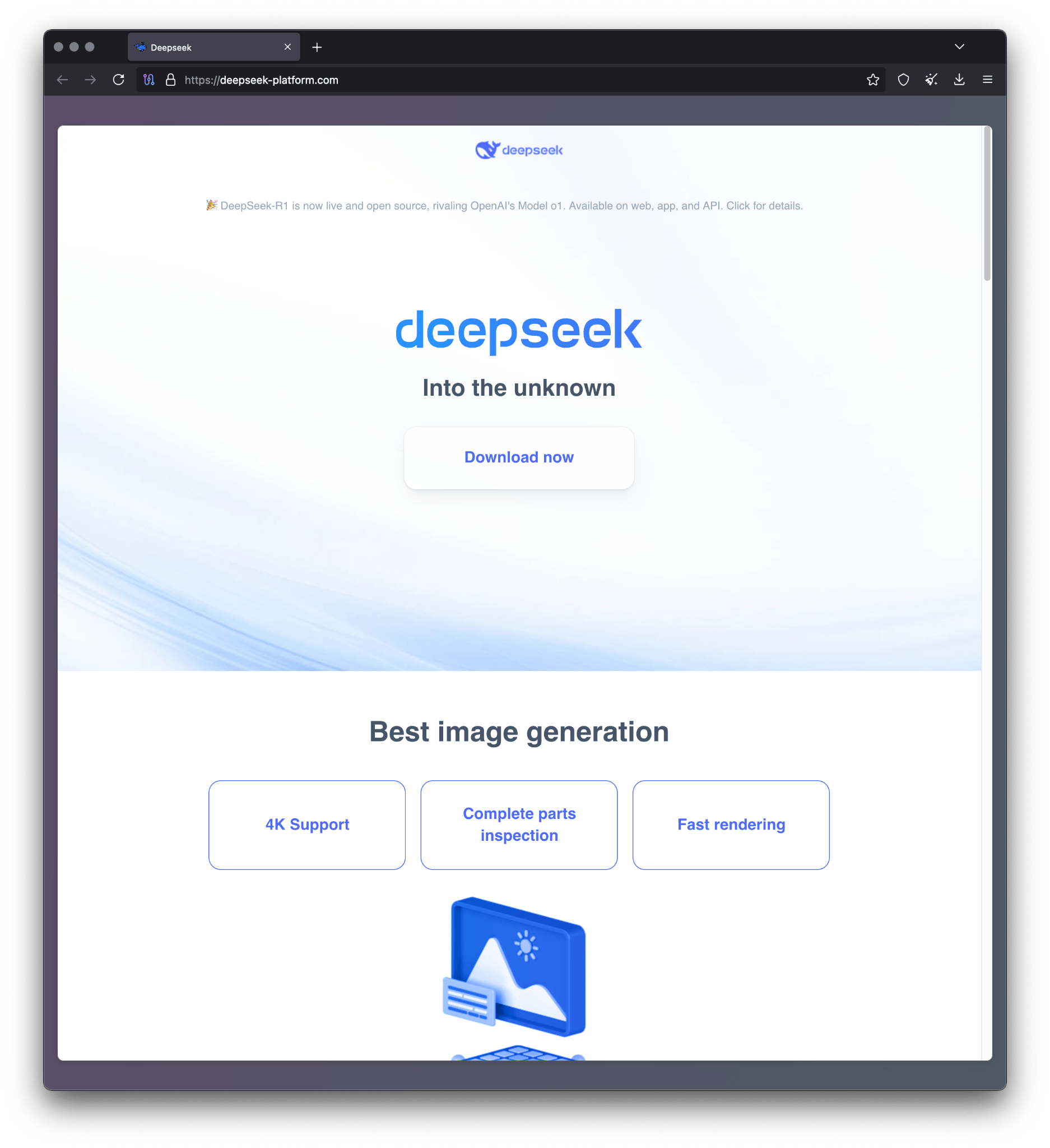
    But lately, threat actors have begun using malvertising to exploit the demand for chatbots. For instance, we have recently discovered a new malicious campaign distributing previously unknown malware through a fake DeepSeek-R1 LLM environment installer. The malware is delivered via a phishing site that masquerades as the official DeepSeek homepage. The website was promoted in the search results via Google Ads. The attacks ultimately aim to install BrowserVenom, an implant that reconfigures all browsing instances to force traffic through a proxy controlled by the threat actors. This enables them to manipulate the victim’s network traffic and collect data.

    Phishing lure

    The infection was launched from a phishing site, located at https[:]//deepseek-platform[.]com. It was spread via malvertising, intentionally placed as the top result when a user searched for “deepseek r1”, thus taking advantage of the model’s popularity. Once the user reaches the site, a check is performed to identify the victim’s operating system. If the user is running Windows, they will be presented with only one active button, “Try now”. We have also seen layouts for other operating systems with slight changes in wording, but all mislead the user into clicking the button.

    Malicious website mimicking DeepSeek

    Clicking this button will take the user to a CAPTCHA anti-bot screen. The code for this screen is obfuscated JavaScript, which performs a series of checks to make sure that the user is not a bot. We found other scripts on the same malicious domain signaling that this is not the first iteration of such campaigns. After successfully solving the CAPTCHA, the user is redirected to the proxy1.php URL path with a “Download now” button. Clicking that results in downloading the malicious installer named AI_Launcher_1.21.exe from the following URL: https://r1deepseek-ai[.]com/gg/cc/AI_Launcher_1.21.exe.

    We examined the source code of both the phishing and distribution websites and discovered comments in Russian related to the websites’ functionality, which suggests that they are developed by Russian-speaking threat actors.

    Malicious installer

    The malicious installer AI_Launcher_1.21.exe is the launcher for the next-stage malware. Once this binary is executed, it opens a window that mimics a Cloudflare CAPTCHA.

    The second fake CAPTCHA

    This is another fake CAPTCHA that is loaded from https[:]//casoredkff[.]pro/captcha. After the checkbox is ticked, the URL is appended with /success, and the user is presented with the following screen, offering the options to download and install Ollama and LM Studio.

    Two options to install abused LLM frameworks

    Clicking either of the “Install” buttons effectively downloads and executes the respective installer, but with a caveat: another function runs concurrently: MLInstaller.Runner.Run(). This function triggers the infectious part of the implant.

    When the MLInstaller.Runner.Run() function is executed in a separate thread on the machine, the infection develops in the following three steps:

    1. First, the malicious function tries to exclude the user’s folder from Windows Defender’s protection by decrypting a buffer using the AES encryption algorithm.

      The AES encryption information is hardcoded in the implant:

      Type AES-256-CBC
      Key 01 02 03 04 05 06 07 08 09 0a 0b 0c 0d 0e 0f 10 11 12 13 14 15 16 17 18 19 1a 1b 1c 1d 1e 1f 20
      IV 01 02 03 04 05 06 07 08 09 0a 0b 0c 0d 0e 0f 10

      The decrypted buffer contains a PowerShell command that performs the exclusion once executed by the malicious function.

      It should be noted that this command needs administrator privileges and will fail in case the user lacks them.

    2. After that, another PowerShell command runs, downloading an executable from a malicious domain whose name is derived with a simple domain generation algorithm (DGA). The downloaded executable is saved as %USERPROFILE%Music1.exe under the user’s profile and then executed.

      At the moment of our research, there was only one domain in existence: app-updater1[.]app. No binary can be downloaded from this domain as of now but we suspect that this might be another malicious implant, such as a backdoor for further access. So far, we have managed to obtain several malicious domain names associated with this threat; they are highlighted in the IoCs section.

    3. Then the MLInstaller.Runner.Run() function locates a hardcoded stage two payload in the class and variable ConfigFiles.load of the malicious installer’s buffer. This executable is decrypted with the same AES algorithm as before in order to be loaded into memory and run.

    Loaded implant: BrowserVenom

    We dubbed the next-stage implant BrowserVenom because it reconfigures all browsing instances to force traffic through a proxy controlled by the threat actors. This enables them to sniff sensitive data and monitor the victim’s browsing activity while decrypting their traffic.

    First, BrowserVenom checks if the current user has administrator rights – exiting if not – and installs a hardcoded certificate created by the threat actor:

    Then the malware adds a hardcoded proxy server address to all currently installed and running browsers. For Chromium-based instances (i.e., Chrome or Microsoft Edge), it adds the proxy-server argument and modifies all existent LNK files, whereas for Gecko-based browsers, such as Mozilla or Tor Browser, the implant modifies the current user’s profile preferences:

    The settings currently utilized by the malware are as follows:

    The variables Host and Port are the ones used as the proxy settings, and the ID and HWID are appended to the browser’s User-Agent, possibly as a way to keep track of the victim’s network traffic.

    Conclusion

    As we have been reporting, DeepSeek has been the perfect lure for attackers to attract new victims. Threat actors’ use of new malicious tooling, such as BrowserVenom, complicates the detection of their activities. This, combined with the use of Google Ads to reach more victims and look more plausible, makes such campaigns even more effective.

    At the time of our research, we detected multiple infections in Brazil, Cuba, Mexico, India, Nepal, South Africa, and Egypt. The nature of the bait and the geographic distribution of attacks indicate that campaigns like this continue to pose a global threat to unsuspecting users.

    To protect against these attacks, users are advised to confirm that the results of their searches are official websites, along with their URLs and certificates, to make sure that the site is the right place to download the legitimate software from. Taking these precautions can help avoid this type of infection.

    Kaspersky products detect this threat as HEUR:Trojan.Win32.Generic and Trojan.Win32.SelfDel.iwcv.

    Indicators of Compromise

    Hashes

    d435a9a303a27c98d4e7afa157ab47de  AI_Launcher_1.21.exe
    dc08e0a005d64cc9e5b2fdd201f97fd6

    Domains and IPs

    MIL OSI Economics

  • MIL-OSI: VERSE token launch surpasses $1B market cap within minutes of going live on Pump.fun

    Source: GlobeNewswire (MIL-OSI)

    Smart wallets push VerseWorld’s governance and utility token to the top ranks moments after launch.

    DUBAI, United Arab Emirates, June 11, 2025 (GLOBE NEWSWIRE) — VerseWorld, the hyper-realistic metaverse fusing real-world culture with immersive digital experiences, has launched its native token, VERSE, on the Solana-based platform Pump.fun. The launch saw a rapid market response: within minutes, VERSE crossed a $1 billion market cap, ranking #1 in SmartMoney purchases by 22:40 Dubai, just 12 minutes after trading began.

    https://x.com/VerseWorld/status/1932142004647202997

    Designed to be more than a meme or hype token, VERSE powers VerseWorld’s broader vision: a cultural platform built on Web3 rails. With a fixed supply of 1 billion tokens, allocating 45% to reward users for participation, interaction, and building the VerseWorld ecosystem, VERSE is the fuel for a decentralized ecosystem of virtual experiences, real-world brand activations, and community governance.

    “Too many metaverses promise immersion and deliver pixels. We’re changing that,” said Mickael Reignier, Co-Founder and CEO of VerseWorld. “VerseWorld is where reality meets imagination, and VERSE is the fuel that powers it all.”

    VerseWorld’s platform already supports branded experiences for clients like Toyota, Lexus, and Dubai Police, and has been covered in Cointelegraph for bringing a hyper-realistic metaverse to the Epic Games Store. The VERSE token enables in-game transactions, staking and governance, creator economy incentives, and discounted marketplace fees, as outlined in its official litepaper.

    Backed by notable investors including Gerard Lopez (Genii Capital, Mangrove Capital) and supported by professional market-maker Selini Capital, the VerseWorld token launch marks a new chapter in its global expansion.

    “Our goal? Build a metaverse people actually use,” added Reignier. “No hype. Real engagement. Real rewards. Real-world impact.”

    About VerseWorld

    VerseWorld is “The Internet of Reality,” a hyper-realistic metaverse platform connecting global communities, creators, and brands through immersive virtual experiences and real-world integrations. VERSE is the native utility token powering transactions, governance, and rewards across the VerseWorld ecosystem.

    Learn more at www.verseworld.com
    Read the litepaper: Click here

    Media contact:
    Mickael Reignier
    CEO & Co-Founder
    mr@verseworld.com

    Disclaimer: This is a paid post and is provided by VerseWorld. The statements, views, and opinions expressed in this content are solely those of the content provider and do not necessarily reflect the views of this media platform or its publisher. We do not endorse, verify, or guarantee the accuracy, completeness, or reliability of any information presented. We do not guarantee any claims, statements, or promises made in this article. This content is for informational purposes only and should not be considered financial, investment, or trading advice.Investing in crypto and mining-related opportunities involves significant risks, including the potential loss of capital. It is possible to lose all your capital. These products may not be suitable for everyone, and you should ensure that you understand the risks involved. Seek independent advice if necessary. Speculate only with funds that you can afford to lose. Readers are strongly encouraged to conduct their own research and consult with a qualified financial advisor before making any investment decisions. However, due to the inherently speculative nature of the blockchain sector—including cryptocurrency, NFTs, and mining—complete accuracy cannot always be guaranteed.Neither the media platform nor the publisher shall be held responsible for any fraudulent activities, misrepresentations, or financial losses arising from the content of this press release. In the event of any legal claims or charges against this article, we accept no liability or responsibility. Globenewswire does not endorse any content on this page.

    Legal Disclaimer: This media platform provides the content of this article on an “as-is” basis, without any warranties or representations of any kind, express or implied. We assume no responsibility for any inaccuracies, errors, or omissions. We do not assume any responsibility or liability for the accuracy, content, images, videos, licenses, completeness, legality, or reliability of the information presented herein. Any concerns, complaints, or copyright issues related to this article should be directed to the content provider mentioned above.

    Photos accompanying this announcement are available at

    https://www.globenewswire.com/NewsRoom/AttachmentNg/db2f2b7e-fb4f-4414-a583-d7ef1bd6e30d

    https://www.globenewswire.com/NewsRoom/AttachmentNg/b5fbf33b-60da-40e6-aca4-dee31e455164

    The MIL Network

  • MIL-OSI United Kingdom: Call 5 of the Digital Transformation Flexible Fund is now open

    Source: Northern Ireland City of Armagh

    Simon Hewitt, Titus Solutions Craigavon.

    The Digital Transformation Flexible Fund (DTFF) has officially opened its fifth funding call, inviting small and micro businesses across the ABC borough to apply for grants ranging from £5,000 to £20,000.

    This initiative aims to support the adoption of advanced digital technologies, enhancing competitiveness and driving innovation.

    Craigavon-based manufacturing firm, Titus Solutions, exemplifies the impact of DTFF. After securing £20,000 funding in a previous call, the company invested in a robotic welder with desktop programming and simulation, significantly enhancing operational efficiency and reducing production times.

    Lord Mayor of Armagh City, Banbridge and Craigavon Borough, Alderman Stephen Moutray, said:

    “We welcome the fifth call of this funding programme that will hopefully aid our local businesses in their digital innovation endeavours. As the world around us is constantly moving forward in terms of digital advancements, it is crucial that the businesses in our borough get the support they need in order to be at the forefront of this transformation. I encourage businesses to find out more and attend one of the briefing sessions either online or in person.”

    Simon Hewitt, Managing Director of Titus Solutions, stated:

    “The DTFF grant was a game-changer for us. Implementing robotics and AI technology streamlined our processes, cut production times, and boosted overall productivity. It’s been instrumental in our growth.”

    Eligible projects must focus on transformative technologies, including artificial intelligence, machine learning, process automation, big data analytics, immersive technologies, and the Internet of Things. The fund covers up to 70% of project costs, with applicants providing the remaining 30%.

    Expressions of Interest for Call 5 close at 12 noon on Friday 11 July 2025. ABC Council and DTFF will host a series of pre-application briefing sessions which will provide detailed information on eligibility criteria, application processes, and insights into successful digital transformation projects just like Titus Solutions. Dates and registration details are available on the DTFF website: dtff.co.uk

    Delivered by all 11 local councils under the Full Fibre Northern Ireland Consortium (FFNI) and supported by Invest NI, DTFF is part-funded by the NI Executive, UK Government, Department of Agriculture, Environment and Rural Affairs (DAERA), and local authorities.

    MIL OSI United Kingdom

  • MIL-OSI: Bitcoin Solaris Enters Phase 7 of Presale With 233% Launch Price Confirmed

    Source: GlobeNewswire (MIL-OSI)

    TALLINN, Estonia, June 11, 2025 (GLOBE NEWSWIRE) — Bitcoin Solaris (BTC-S), the high-speed, dual-consensus blockchain project, has officially entered Phase 7 of its presale. The token is now available for $7, with the next price increase to $8 just around the corner. With a confirmed launch price of $20 on major exchanges, early buyers are already positioned for a 233% return before market trading even begins.

    Why Bitcoin Solaris Is Getting All the Buzz

    Bitcoin Solaris isn’t trying to replace Bitcoin—it’s designed to evolve it. Instead of just replicating what came before, BTC-S uses a cutting-edge dual-consensus architecture that combines Bitcoin’s Proof-of-Work (PoW) security with the lightning-fast speed and efficiency of Delegated Proof-of-Stake (DPoS). This structure allows Bitcoin Solaris to achieve over 100,000 transactions per second (TPS) with 2-second finality, making it one of the fastest and most scalable blockchains to date.

    From secure payments to enterprise integrations, from smart contracts to tokenized real estate, this ecosystem is engineered to deliver massive real-world value while keeping fees low and accessibility high.

    Deep Tech for a Modern Crypto Economy

    The reason BTC-S isn’t just hype is its tech.

    • Smart contracts are written in Rust and offer full compatibility with Solana tooling.
    • Validator rotation happens every 24 hours with strict performance rules and slashing penalties for bad actors.
    • Security includes resistance to 51% attacks, Byzantine fault tolerance, and optional zero-knowledge proofs (ZKPs) for privacy.

    And most importantly, all smart contracts have been fully audited by Cyberscope and Freshcoins, giving investors peace of mind.

    The Presale Phase That’s Turning Heads

    Bitcoin Solaris is now in Phase 7 of its presale, with the token priced at $7 and set to rise to $8 in the next phase. With a confirmed launch price of $20, early buyers are already positioned for a 233% guaranteed gain, even before post-launch market momentum kicks in.

    With over $3.8 million raised and more than 11,000 unique users already joined, this is quickly becoming one of the shortest and most explosive presales in crypto history. The presale is limited to just 90 days, ending July 31, 2025, and momentum is only increasing.

    Buyers in this phase also receive a 9% bonus, making now the perfect moment to secure maximum upside before the next price jump.

    The Future of DeFi Doesn’t Run on Hype—It Runs on BTC-S

    Let’s Talk Wealth: How Bitcoin Solaris Can Make You Rich

    Bitcoin Solaris was designed to create opportunities for anyone, whether you’re a miner, a DeFi user, or just holding tokens.

    Here’s how:

    • Dual rewards from both the PoW base layer and DPoS validators mean multiple passive income streams.
    • Mobile-first architecture opens mining access to everyday users, eliminating the need for expensive rigs.
    • Token scarcity—with a cap of 21 million—mirrors Bitcoin’s model, maximizing long-term upside.
    • Staking incentives reward holders with compounding yields and governance power.

    And because you must hold BTC-S to participate in mining, the system creates a natural buy-and-hold pressure that reduces dumping and supports sustainable growth.

    Tokenomics Designed for Growth

    BTC-S is more than just deflationary—it’s intelligently structured:

    • Total supply: 21 million (same as Bitcoin)
    • 66.6% allocated to mining, making it a long-term, community-run token
    • 20% for presale, keeping early funding tight
    • 13.4% for liquidity and ecosystem growth, ensuring a healthy post-launch market.

    The design ensures there are no whales dumping tokens, no inflationary pressures, and no short-term manipulation.

    The Referral Program That Rewards Everyone

    During the presale, Bitcoin Solaris also offers a dual-sided referral program:

    • Referrers earn 5% in BTC-S for every successful invite.
    • New users receive an extra 5% bonus on their token purchase.

    Unlike other projects, this program rewards both parties equally and automatically, encouraging organic growth and deeper community engagement.

    Influencers and Experts Are Talking

    There’s been a surge of crypto influencers covering Bitcoin Solaris, and one of the most insightful breakdowns came from Ben Crypto. The review highlights BTC-S’s smart tokenomics, real-world use cases, and advanced architecture—all reasons why many believe it’s the best early-stage crypto of 2025.

    Final Thoughts

    Bitcoin Solaris is not just another altcoin trying to ride the Bitcoin name—it’s a well-engineered, heavily audited ecosystem built for modern use. With a high-speed blockchain, intelligent economic design, and true mining accessibility, it’s turning heads across the industry.

    If you missed Bitcoin’s legendary run, this is your second chance to catch the rocket before it lifts off. And with the final hours of the current presale phase ticking down, the window is closing fast.

    Get Started:

    Website: https://www.bitcoinsolaris.com/
    Telegram: https://t.me/Bitcoinsolaris
    X (formerly Twitter): https://x.com/BitcoinSolaris

    Media Contact

    Xander Levine
    press@bitcoinsolaris.com

    Press Kit: Available upon request

    Disclaimer: This is a paid post and is provided by Bitcoin Solaris. The statements, views, and opinions expressed in this content are solely those of the content provider and do not necessarily reflect the views of this media platform or its publisher. We do not endorse, verify, or guarantee the accuracy, completeness, or reliability of any information presented. We do not guarantee any claims, statements, or promises made in this article. This content is for informational purposes only and should not be considered financial, investment, or trading advice. Investing in crypto and mining-related opportunities involves significant risks, including the potential loss of capital. It is possible to lose all your capital. These products may not be suitable for everyone, and you should ensure that you understand the risks involved. Seek independent advice if necessary. Speculate only with funds that you can afford to lose. Readers are strongly encouraged to conduct their own research and consult with a qualified financial advisor before making any investment decisions. However, due to the inherently speculative nature of the blockchain sector—including cryptocurrency, NFTs, and mining—complete accuracy cannot always be guaranteed. Neither the media platform nor the publisher shall be held responsible for any fraudulent activities, misrepresentations, or financial losses arising from the content of this press release. In the event of any legal claims or charges against this article, we accept no liability or responsibility. Globenewswire does not endorse any content on this page.

    Legal Disclaimer: This media platform provides the content of this article on an “as-is” basis, without any warranties or representations of any kind, express or implied. We assume no responsibility for any inaccuracies, errors, or omissions. We do not assume any responsibility or liability for the accuracy, content, images, videos, licenses, completeness, legality, or reliability of the information presented herein. Any concerns, complaints, or copyright issues related to this article should be directed to the content provider mentioned above.

    Photos accompanying this announcement are available at:

    https://www.globenewswire.com/NewsRoom/AttachmentNg/ace724f3-e3ff-4f29-bbdc-934bcf1dae6e

    https://www.globenewswire.com/NewsRoom/AttachmentNg/334b8acd-b0e4-42e6-a679-9353a3dd38d8

    https://www.globenewswire.com/NewsRoom/AttachmentNg/94d43a74-7a76-478d-af2e-f10a8ebd8653

    https://www.globenewswire.com/NewsRoom/AttachmentNg/53487868-86c1-4da3-af65-0336ad883d1f

    The MIL Network

  • MIL-OSI Africa: Artificial Intelligence (AI) to Bolster Oil Recovery as Africa Maximizes Production at Ageing Fields

    Africa’s mature oilfields are experiencing a renaissance and artificial intelligence (AI) is at the heart of this transformation. In an era defined by innovation and sustainability, enhanced oil recovery (EOR) technologies – powered by AI – are breathing new life into declining reservoirs. From predictive analytics to machine learning algorithms, AI is not just a tool; it is a catalyst for maximizing output, extending field life and improving operational efficiency. At the forefront of this conversation is the upcoming African Energy Week (AEW): Invest in African Energies 2025 – taking place September 29 to October 3 in Cape Town. During the event, energy leaders will converge to explore the role of digital transformation in advancing EOR across Africa.

    From Data to Big Barrels

    In 2025, the global market for AI in the oil and gas industry is estimated at $3.54 billion, set to rise to $6.4 billion by 2030. This is largely due to a rise in AI adoption by major operators. Examples include Baker Hughes and Repsol pooling resources to bring AI processes and workflows into oil and gas projects. Repsol has several developments underway in Libya, Algeria and Morocco and strives to bolster production across these markets. SLB inaugurated its Africa Performance Center in Luanda in 2025, which will support oil operations by offering access to digital solutions such as AI. SLB has supported several billion-dollar oil projects in Angola, with investments in almost every other region in Africa. 

    The power of AI in EOR comes down to predictive modeling. Traditional EOR relies heavily on limited data, with simplified reservoir models often impacting results. However, through AI, companies are able to analyze large datasets to deliver more accurate predictions of oil recovery. Another key benefit of AI in EOR is reservoir management. By analyzing geological and production data, companies can better-understand reservoir features, therefore supporting recovery techniques. Machine-learning also offers significant opportunities for EOR, specifically through its ability to recognize patterns, handle datasets and make accurate predictions. The application of machine-learning also enables reservoir performance forecasting, supporting decision-making by allowing companies to predict future production. 

    Policy Creates In-Roads for AI Deployment

    As Africa advances toward digital transformation, policy reform has become a vital enabler of AI adoption across the oil industry. By integrating digital solutions and targets into regulatory frameworks, countries can support investments in AI and machine learning while accelerating research and development. Various countries are streamlining policy to support EOR at legacy assets. Angola, for example, implemented its Incremental Production Initiative in 2024 which offers tax incentives to encourage reinvestments in mature oilfields. Energy major ExxonMobil made the first discovery – the Likembe-01 well – as part of the initiative in 2024, demonstrating the role policy plays in unlocking incremental resources. The African Union Commission also declared AI as a strategic priority for the continent in May 2025, citing the role machine-learning plays in transforming the continent’s development trajectory. The declaration is expected to create in-roads for technology companies, introducing new opportunities for oil operators to maximize recovery and efficiency.  

    AEW 2025: Where Innovation Meets Investment

    AEW: Invest in African Energies 2025 – the continent’s premier event for the energy sector – will host dedicated sessions on digital transformation, EOR and AI in exploration. A series of panel discussions and technical workshops will explore the new chapter of AI-driven oil production in Africa. AEW: Invest in African Energies 2025 will be the space where policy, capital and technology converge to define this next chapter.

    “Africa’s oil and gas assets hold immense value and AI is the key to unlocking resources efficiently and sustainably. In addition to support exploration efforts, AI will breathe new life into Africa’s ageing oilfields, extending field life, maximizing value and driving smarter, low-carbon production,” states NJ Ayuk, Executive Chairman, African Energy Chamber.

    Distributed by APO Group on behalf of African Energy Chamber.

    About AEW: Invest in African Energies
    AEW: Invest in African Energies is the platform of choice for project operators, financiers, technology providers and government, and has emerged as the official place to sign deals in African energy. Visit http://www.AECWeek.com for more information about this exciting event.

    MIL OSI Africa

  • MIL-OSI Asia-Pac: SFST’s speech at Hong Kong Association Membership Luncheon in London, United Kingdom (English only) (with photos)

    Source: Hong Kong Government special administrative region

    SFST’s speech at Hong Kong Association Membership Luncheon in London, United Kingdom (English only)  
    Lord Mayor (696th Lord Mayor of the City of London, Mr Alderman Alastair King), Sir Douglas (Committee Member of the Hong Kong Association, Chairman of Aberdeen Group, Sir Douglas Flint), distinguished guests, esteemed members of the Hong Kong Association, ladies and gentlemen,
     
         Good afternoon. It is a profound privilege to address you today at this distinguished luncheon hosted by the Hong Kong Association in London. I must say, you are a crowd too difficult to please because you know Hong Kong too well. This organisation’s mission is to champion the enduring business and trading relationship between Hong Kong and the UK which resonates deeply with the Government’s goal of fostering economic collaboration, innovation, and mutual prosperity. To further the efforts, I am here to showcase our city’s unparalleled strengths as a global financial hub and to explore the vast potential for deepening financial co-operation between Hong Kong and the UK. Our shared visions and complementary expertise position us well to forge a partnership that drives transformative growth in an increasingly challenging and also uncertain global economy.
     
         If you may recall, for those people who came two years ago for a similar occasion where I spoke, I tried to group my speech in five alphabet letters, ABCDE. A is about Asia, B is about business as usual, C is about connectivity, D is about digitalisation whereas E is about ESG (environmental, social and governance). These are the five elements at the time I drafted the speech that something Hong Kong could offer to this part of the world. So I am thinking, to this group which is very knowledgeable about Hong Kong, what should I say and how I should structure this speech? Of course I don’t want to get to the next alphabet letter after E, that is why I would stay at E and come with 3Es which are actually the pillars that define Hong Kong’s strategic vision as a premier international financial centre: 1) Extending our financial value chain across equities, fixed income, currencies, and commodities. For those in the banking or financial world, you know what I mean. It’s about EFICC; 2) Embracing new finance through fintech and green finance; and 3) Enhancing offerings for Chinese companies going global through Hong Kong and international firms accessing the Mainland market. These pillars reflect our dynamic approach to navigating global economic and geopolitical challenges, seizing emerging opportunities, and fostering collaboration with partners like the UK. Let me elaborate on each pillar, highlighting our recent achievements and the opportunities they present for strengthening Hong Kong-UK ties.
     
    Extending our financial value chain
     
         Hong Kong’s position as a global financial hub is built on its ability to offer a diversified, resilient, and innovative financial ecosystem. By extending our financial value chain across equities, fixed income, currencies, and commodities which can be grouped as EFICC, we are creating a robust platform that serves both regional and international markets, fostering opportunities for collaboration with global partners, including the UK.
     
    Equities: a vibrant and forward-looking market
     
         Hong Kong’s equity market has undergone a remarkable transformation over the past decade, driven by bold structural reforms and a commitment to capturing global economic trends. The Hang Seng Index, which is a key barometer of our market’s performance, has demonstrated resilience amid global uncertainties. By May 30, our stock market capitalisation has increased by 24 per cent year on year to over US$5.2 trillion. This growth was propelled, I must say, by a number of key moments this year, including of course the DeepSeek moment when people really recalibrate the value that Chinese investment carry and at the same time also the “victory day” moment when people are seeing the uncertainty in other parts of the world which actually present opportunities to Hong Kong and London. The average daily turnover for the first five months of this year stood at US$31 billion in our market, an increase of 1.2 times over the past year, signaling sustained investor confidence and market liquidity.
     
         Apart from the market performance, we are also trying to reform our capital market to make it more instrumental in positioning Hong Kong as a global hub for new economy and technology companies. Back in 2018, we already introduced the “weighted voting rights” regime, enabling companies with dual-class share structures to list in Hong Kong. As I know, London Stock Exchange is also contemplating something similar to reform your stock market. This reform in Hong Kong attracted technology giants and paved the way for a new era of innovation-driven listings. Simultaneously, we opened our market to pre-revenue biotech firms, transforming Hong Kong into one of the world’s leading fundraising hubs for biotechnology. As a result, the proportion of new economy companies in our stock market has surged from 1.3 per cent in 2018 to approximately 14 per cent by April 2025, with their market capitalisation share rising from 2.8 per cent to about 28 per cent.
     
         Building on this momentum, we introduced the “18C” listing regime in 2023 for specialist technology companies, followed by a dedicated technology enterprises channel launched last month. These initiatives are designed to accelerate the listing of enterprises in the “hard technology” space, enabling them to raise capital in Hong Kong and expand their international presence. These reforms have not only reshaped the structure of our stock market but also aligned it with global economic trends, positioning Hong Kong as a vital partner for UK firms seeking exposure to Asia’s innovation-driven growth.
     
         Moreover, Hong Kong’s capital markets have benefited from the return of Chinese concept stocks, driven by geopolitical developments and Mainland China’s technological advancements. This trend has elevated the weight of technology stocks in our market, further enhancing its attractiveness to global investors. For example, before I came, we welcomed the listing of CATL (Contemporary Amperex Technology Co Limited) which is a major lithium-ion battery manufacturing company serving the world for electric vehicles. For UK financial institutions, Hong Kong offers a gateway to invest in Asia’s burgeoning tech sector, leveraging our deep liquidity and robust regulatory framework.
     
    Connectivity and stability
     
         Apart from fundraising, it’s about our strengthened role as a gateway for international investors accessing Mainland China and for Mainland investors diversifying globally. Our “Connect” schemes – Stock Connect, Bond Connect, Wealth Management Connect, and Swap Connect – have facilitated seamless cross-border capital flows. These initiatives have seen significant growth in transaction volumes, product diversity, and risk management capabilities, enhancing both the “quantity” and “quality” of financial connectivity, covering the broad financial value chain across equities, fixed income and currencies.
     
         Stability is also a cornerstone of our financial system, as demonstrated by the performance of the Hong Kong dollar recently. In the first five months of 2025, the Hong Kong dollar largely traded within the strong-side convertibility undertaking range, signifying a robust demand, partly because a lot of money coming to Hong Kong to buy our IPOs (initial public offerings) which are in Hong Kong dollars, and at the same time it is now the season when the listed companies need Hong Kong dollars to give out dividends. So with this background, what we see is operations by our banking regulator where now the banking system aggregate balances rising to US$22 billion by May 30, 2025, a substantial increase from US$5.7 billion at the end of last year. Total bank deposits grew by over 4 per cent in the first four months of 2025, with Hong Kong dollar deposits rising by 4.4 per cent, reflecting strong capital inflows into our banking system. So you have been hearing a lot about capital flight from Hong Kong to others, all these numbers are testaments to how wrong those perceptions are. This stability underscores our role as a trusted financial hub, like that of London, offering a secure environment for UK investors and businesses.
     
         Amid global economic uncertainties, including trade protectionism and unilateral policies, RMB (Renminbi) is gaining prominence as a global transaction and reserve currency. Its share in global payments rose from 2 per cent in 2020 to 4 per cent by the end of 2024, ranking fourth globally, while its share in trade financing increased from 2 per cent to 6 per cent. As the world’s leading offshore RMB hub, Hong Kong is seizing this opportunity by enhancing RMB-denominated investment products and risk management tools. Our plan to integrate RMB-denominated stock trading into Southbound Stock Connect will further support RMB internationalisation in a gradual and prudent manner, creating opportunities for UK financial institutions to engage with RMB-based products and services.
     
    Commodities: pioneering a new ecosystem with LME integration
     
         In the commodities sector, Hong Kong is capitalising on the global surge in non-ferrous metals trading, driven by the transition to new energy technologies. In 2024, the London Metal Exchange (LME) recorded trading volumes of 178 million lots, a 20 per cent year-on-year increase, with significant growth in new-energy metals like nickel and cobalt. These metals are critical to industrial transformation and technological advancement, and China remains a pivotal force, with non-ferrous metals trade exceeding US$368 billion in 2024, up 11 per cent from the previous year.
     
         Recognising this potential, our Chief Executive outlined a vision in his Policy Address to create a commodity trading ecosystem in Hong Kong, encompassing warehousing, distribution, trading, testing, certification, insurance, and financial services. A landmark achievement in this regard is our integration into the LME’s global warehouse network in January this year. By bringing storage facilities closer to Mainland China’s industrial heartlands and consumption centres, we are strengthening our role as a central platform for the metals industry. Within months since January this year when we are recognised as a delivery port for the LME contracts, seven warehouses have already been approved, and their operations will commence as early as in July 2025.
     
         This initiative not only enhances Hong Kong’s commodities infrastructure but also creates significant opportunities for UK firms, given the LME’s London-based heritage. The UK’s expertise in commodities trading and Hong Kong’s proximity to Asia’s industrial markets make our partnership a natural fit. By collaborating on warehousing, trading, and related services, we can jointly tap into the growing demand for new-energy metals, supporting global industrial transformation and sustainable development.
     
         By extending our financial value chain across equities, fixed income, currencies, and commodities, Hong Kong is reinforcing its position as a diversified financial hub. We invite UK businesses to leverage our platform to access Asia’s dynamic markets, fostering mutual growth and collaboration in these critical sectors.
     
    Embracing new finance: fintech and green finance
     
         The second pillar of our strategy is embracing new finance, particularly in fintech and green finance, to position Hong Kong at the forefront of financial innovation and sustainability. These areas align closely with the UK’s developments in digital finance and sustainable investments, creating fertile ground for partnership.
     
    Fintech: pioneering digital assets and stablecoin regulation
     
         Hong Kong’s robust regulatory framework, business-friendly environment, and strategic location make it an ideal hub for fintech innovation. My bureau, FSTB (Financial Services and the Treasury Bureau), in collaboration with financial regulators and industry stakeholders, is pursuing a multipronged strategy to foster a vibrant fintech ecosystem. This includes enhancing financial infrastructures, nurturing talent, strengthening industry connections in Mainland China and overseas, and creating a conducive environment for fintech innovation.
     
         This is my second day here in London and I am hearing a lot about digital assets (DAs). Just days before I embarked on this trip, our Legislative Council has passed the Stablecoins legislation in Hong Kong and it will be enacted on August 1. After that, we will issue a second policy statement about promoting Hong Kong as the digital asset ecosystem.
     
         Looking ahead, we will continue to be a leader in adopting emerging technologies. A 2023 survey revealed that 38 per cent of Hong Kong’s financial institutions adopted generative AI, surpassing the global average of 26 per cent. In October last year, we issued a policy statement on the responsible use of AI in finance, followed by practical guidelines, sandbox schemes, and industry seminars to support institutions in adopting AI responsibly. These initiatives position Hong Kong as a hub for fintech innovation, complementing the UK’s advancements in areas like blockchain and AI-driven financial services.
     
    Green finance: driving sustainable development
     
         Moving on to green finance, Hong Kong is committed to mobilising cross-border investments to address climate and sustainability challenges, aligning with global efforts to achieve net zero. Last year, Hong Kong arranged US$43 billion in green and sustainable bonds, capturing 45 per cent of the Asian market and ranking first in the region for seven consecutive years. By March this year, our security regulator authorised around 220 ESG funds, managing US$140 billion in assets, an 80 per cent increase over three years.
     
         Last week we have just issued a new round of Government green bonds and infrastructure bonds, totally around US$3.5 billion, denominated in four currencies, namely HKD (Hong Kong dollars), RMB, USD (US dollars) and EUR (euro). The offering attracted participation from a wide spectrum of investors from more than 30 markets across Asia, Europe, Middle East, and the Americas, with total orders amounting around US$30 billion equivalent, representing an over-subscription of almost nine times. The proceeds from green bond issuance will fund local Government green works projects, and set benchmarks for the market encouraging private-sector participation.
     
         To align with global standards, we launched the Roadmap on Sustainability Disclosure in December last year, providing a clear path for large publicly accountable entities to adopt the International Financial Reporting Standards – Sustainability Disclosure Standards (ISSB Standards) by 2028. This positions Hong Kong among the first jurisdictions to align with global sustainability reporting standards, enhancing transparency and comparability. The roadmap not only reflects our commitment to the global green transition but also offers clarity and guidance to market participants.
     
         On the funding support side, the Green and Sustainable Finance Grant Scheme, which was extended to 2027, subsidises issuance costs for bonds and loans, including transition financing, encouraging industries across the Greater Bay Area and Belt and Road economies to leverage Hong Kong’s platform for low-carbon transitions. So for many of you who are working for business financial institutions or companies, do take this message home that we are subsidising for people who are issuing green bonds and loans in Hong Kong.
     
         These efforts create significant opportunities for UK firms to collaborate with Hong Kong on green finance initiatives, from ESG funds to green technology solutions, leveraging our shared commitment to sustainability and innovation. The UK’s commitment in green finance, combined with Hong Kong’s strategic position in Asia, can drive impactful partnerships in sustainable investment and technology.
     
    Enhancing offerings for global and Mainland businesses
     
         The third pillar, enhancing offerings, underscores Hong Kong’s role as a bridge for Chinese companies going global and international firms accessing Mainland China, supported by policies that facilitate cross-border mobility and business expansion.
     
    Supporting Chinese companies going global
     
         As Mainland China accelerates its economic opening, Chinese firms are intensifying their global expansion, optimising supply chains and market presence to address geopolitical risks and tap into international markets. Hong Kong is uniquely positioned to support this “going out” strategy, offering financing, supply chain management, and professional services under the “one country, two systems” framework.
     
         Hong Kong’s efforts to strengthen ties with emerging markets further enhance our appeal. In October last year, we facilitated the listing of two Hong Kong-focused exchange-traded funds on the Saudi Exchange, attracting Middle Eastern capital to our markets. The two Saudi-listed ETFs have a combined size of over US$1.9 billion. They are the two largest ETFs listed and are amongst the top traded ETFs on Saudi Stock Exchange. This initiative demonstrates our commitment to connecting traditional and emerging markets, offering UK firms a platform to diversify their investments across Asia and beyond.
     
         Hong Kong’s professional services, for example the Accounting sector, are well-positioned and experienced to meet the needs of Mainland firms going global. The Hong Kong Institute of Certified Public Accountants has earlier compiled a list of firms specialising in supporting global expansion of Chinese companies, and has recently expanded the list from 60 to over 80 firms, connecting Mainland enterprises with international markets for business expansion. Moreover, Hong Kong’s network of 52 Comprehensive Double Taxation Agreements with other tax jurisdictions, with plans for further expansion, provides tax clarity for businesses, enhancing Hong Kong’s appeal as a commercial and investment hub.
     
         UK firms can partner with Hong Kong to support Chinese companies’ international ventures, leveraging our expertise in financing, legal services, and market access. For example, UK financial institutions can collaborate with Hong Kong-based firms to provide advisory services, underwriting, and risk management solutions for Chinese enterprises expanding into Europe and beyond.
     
    Facilitating international access to the Mainland
     
         Hong Kong is equally committed to helping international talents, including those from the UK, access Mainland China’s vast market. A facilitating policy introduced in July last year allows non-Chinese Hong Kong permanent residents to obtain a card???type document with five-year validity. This card enables self-service clearance at Mainland control points without going through manual channels, eliminating the need for arrival cards and significantly enhancing clearance efficiency. This measure, implemented under the “one country, two systems” framework, facilitates business, travel, and family visits, reinforcing Hong Kong’s role as a gateway to the Mainland.
     
         Hong Kong’s professional services, with deep knowledge of Mainland business culture and international expertise, provide comprehensive support for UK firms navigating China’s market. From legal and accounting services to supply chain management, Hong Kong offers a trusted platform for UK companies to establish and grow their presence in Asia.
     
    Hong Kong-UK financial co-operation
     
         The complementary strengths between the two markets of Hong Kong and UK create a strong foundation for collaboration. The integration of Hong Kong into the LME’s warehouse network opens new avenues for UK firms to engage with Asia’s commodities markets, particularly in new-energy metals critical to the global energy transition. Our leadership in green finance aligns with the UK’s expertise in sustainable investments, creating opportunities for joint ventures in ESG funds, carbon trading, and green fintech. In fintech, Hong Kong’s progressive DA regulations complement the UK’s advancements in digital finance, paving the way for collaborative innovation in areas like blockchain, AI, and stablecoins.
     
         By leveraging Hong Kong’s strengths in extending our financial value chain, embracing new finance, and enhancing global and Mainland connectivity, we invite UK businesses to partner with us in tapping Asia’s growth opportunities. Our shared commitment to innovation, sustainability, and global connectivity positions us to build a future of mutual prosperity.
     
    Conclusion
     
         Ladies and gentlemen, Hong Kong stands at the forefront of global finance, driven by our commitment to the 3Es: Extending our financial value chain across equities, fixed income, currencies, and commodities; Embracing fintech and green finance; and Enhancing opportunities for Chinese and international businesses. Our unique position under “one country, two systems,” robust regulatory framework, and vibrant markets make Hong Kong the ideal partner for the UK in navigating Asia’s dynamic markets.
     
         I express my heartfelt gratitude to the Hong Kong Association for hosting this luncheon and for your unwavering commitment to strengthening Hong Kong-UK ties. Let us seize this opportunity to deepen our financial partnership, fostering innovation, sustainability, and prosperity for our shared future. Together, we can shape a world of opportunity, leveraging Hong Kong’s strengths and the UK’s global leadership to drive transformative growth.
     
         Thank you.
    Issued at HKT 16:31

    NNNN
    MIL OSI Asia Pacific News

  • MIL-OSI Russia: Polytechnic presented its initiatives to the rectors of BRICS countries at forums in Brazil

    Translation. Region: Russian Federal

    Source: Peter the Great St Petersburg Polytechnic University – Peter the Great St Petersburg Polytechnic University –

    Rio de Janeiro hosted large-scale events — the second forum of university rectors from Russia, Brazil and Belarus, as well as the second forum of university rectors from the BRICS countries. The events were organized by the Federal University of Rio de Janeiro with the support of national rectors’ communities, including the Russian Union of Rectors. They became a powerful platform for strengthening academic ties and promoting joint initiatives. The forums were attended by more than 50 representatives of universities from Russia and Belarus, delegations from Iran, India, China, South Africa, Ethiopia, Indonesia and more than 60 universities from Brazil.

    At the section on educational cooperation, Deputy Minister of Science and Higher Education of the Russian Federation Konstantin Mogilevsky emphasized the unique role of BRICS in the modern world: In the conditions of international turbulence, it is education and science that are becoming the most important tools for finding joint answers to global challenges. The BRICS association is one of the few international platforms where interaction is built on the principles of mutual respect and equality, where there are no main ones, where everyone is equal and is committed to working together for the sake of a common future. We see that this approach is of interest and response to many countries. The creation of a ranking of BRICS universities is especially relevant in the conditions of political commitment of the headquarters of international rating agencies. The new system for assessing the quality of education is in great demand.

    The Deputy Minister spoke in detail about the dynamic expansion of the association (the accession of new members: Egypt, Iran, the UAE, Saudi Arabia, Ethiopia, Indonesia) and the priorities of the educational agenda. This is the development of the BRICS Network University, recognition of qualifications, support for talented youth and the creation of its own BRICS university ranking.

    The key sections and plenary session were held at the Museum of Tomorrow. SPbPU was represented by a delegation consisting of Vladimir Shchepinin, Director of the Institute of Industrial Management, Economics and Trade; Ekaterina Belyaevskaya, Head of the Department of International Interuniversity Cooperation; and Nikita Lukashevich and Olga Ergunova, associate professors at the Graduate School of Management and Management. Vladimir Shchepinin spoke at one of the sessions, presenting the Polytechnic University as a key player in the scientific and educational space of Russia in the field of technological development. He drew the attention of the rectors’ community to the potential of SPbPU in solving the problems of sustainable development of the BRICS countries.

    At the thematic session “Artificial Intelligence and Education in the BRICS Countries”, Olga Ergunova presented a report “AI Optimization of Human Resource Management in Smart Cities”, based on the results of a large-scale scientific project supported by the Russian Science Foundation (grant No. 25-28-01469). She described in detail the neural network model developed under the auspices of the RSF for forecasting and managing labor markets in the BRICS megacities (Shanghai, Bangalore, Moscow, Sao Paulo).

    Olga Ergunova drew the attention of those gathered to a successful example of comprehensive cooperation between the BRICS countries — the international competition for young researchers “SMART CITY 2030: Sustainable Development Management of BRICS Cities”. The event was first held in 2024 in pilot mode and generated considerable interest. In 2025, the co-organizers of the competition are SPbPU, the Russian Institute of Tsinghua University (China), Lovely Professional University (India) and the Federal University of Rio de Janeiro (Brazil). The Rectors’ Forum provided an opportunity to announce the expansion of the competition and invite new representatives of the BRICS countries to participate.

    The SPbPU delegation held talks with existing partner universities in Brazil (these are nine leading universities in the country), and also met with new promising educational institutions and agencies. Among them are the Federal Agency for Technological Education, the Secretariat for Supervision and Development in Higher Education. Both agencies operate under the Ministry of Education of Brazil.

    Polytechnic University signed cooperation agreements with the Federal University of Fluminense and the Federal Rural University of Rio de Janeiro.

    During working meetings and negotiations with rectors and representatives of university delegations, projects in the field of joint research, academic mobility, joint educational programs of double degrees and the organization of summer schools were discussed.

    In the context of changing global educational landscapes, Brazilian universities are becoming key centers for ensuring the scientific and technological sovereignty of the BRICS countries. Their competencies in the field of sustainable development, green economy, bioeconomy, agribusiness, artificial intelligence and other areas, supplemented by Russian fundamental science, form a unique ecosystem of cooperation, its integration into the BRICS educational space through the mechanisms of the BRICS Network University. They allow the creation of new formats of cooperation that combine academic mobility with applied research in areas that are strategic for the countries, noted Vladimir Shchepinin.

    A pleasant surprise was the delegation’s meeting with a 1988 Polytechnic graduate, Electo Eduardo Silva Lora. He is currently a professor and holds the post of head of the Scientific Institute at the Federal University of Itajuba, a leading university in the field of electric power and electrical engineering. Electo Silva Lora spoke excellent Russian and recalled his teachers, professors at the Polytechnic University, with great warmth. He expressed a desire to renew scientific and academic ties with his alma mater and is already interacting with colleagues from the Institute of Power Engineering.

    In addition, Olga Ergunova visited the leading business school of Latin America — FGV EBAPE (Getulio Vargas Foundation), holder of the prestigious “Triple Crown” of accreditations (AACSB, AMBA, EQUIS). She held business negotiations with the director-dean of the school, Professor Flavio Carvalho de Vasconcelos and the head of the international department of Yuna Fontoura.

    Representatives of the school expressed interest in cooperation with SPbPU. During the negotiations, specific steps were outlined: organizing academic exchanges, joint research in the field of innovation management, technological development and sustainable production.

    For FGV EBAPE, it is always valuable to establish connections with leading universities in the world, such as SPbPU. We are interested in developing academic mobility and joint research initiatives, especially in areas related to technology and innovation, – emphasized Flavio Vasconcelos.

    Universities in Brazil represent a huge potential for partnership. Of course, everyone understands the difficulties and cost of logistics between our continents, but even this does not become an obstacle for such innovative projects as, for example, the Smart Cities competition. A number of government agencies support the mobility of Brazilian students, and these opportunities should be used. Brazil has created the strongest scientific centers and technology hubs in the field of research into renewable energy, artificial intelligence, agricultural and food technologies, oil and gas. Colleagues are interested in joint publications, the development of postgraduate programs, international grants for joint research. There is a lot of work to do to turn today’s agreements into real projects with the participation of the Polytechnic University, – Ekaterina Belyaevskaya summed up.

    Please note: This information is raw content directly from the source of the information. It is exactly what the source states and does not reflect the position of MIL-OSI or its clients.

    MIL OSI Russia News

  • MIL-OSI: Mattermost Names James Mullins as Vice President of Sales for EMEA and APAC

    Source: GlobeNewswire (MIL-OSI)

    PALO ALTO, Calif., June 11, 2025 (GLOBE NEWSWIRE) — Mattermost, Inc., the trusted leader in secure, real-time collaboration and workflow solutions for defense, intelligence, security, and critical infrastructure, today announced the appointment of James Mullins as Vice President of Sales for Europe, Middle East, Africa (EMEA) and Asia Pacific (APAC) regions. Mullins brings more than three decades of experience in technology sales leadership, with a proven track record of driving global sales growth and developing strategic market initiatives.

    “James’ extensive experience in scaling sales organizations and his deep understanding of international markets make him the ideal leader to expand our presence across EMEA and APAC,” said Dave Reardon, CRO at Mattermost. “His expertise in enterprise sales and proven ability to drive growth will be invaluable as we continue to accelerate our global expansion and help more organizations enhance their secure collaboration capabilities.”

    Prior to joining Mattermost, Mullins led the business development function at Ripjar and KYC360, where he successfully implemented sales strategies that drove company growth.

    Throughout his career, he has held senior sales leadership positions where he has built and led high-performing global sales teams from startup to scale-up phases.

    “I’m thrilled to join Mattermost at such an exciting time in the company’s journey,” said Mullins. “The demand for secure, flexible collaboration solutions continues to grow exponentially, particularly among technical teams and organizations with complex security and compliance requirements. I look forward to working with the Mattermost team to expand our global footprint and deliver exceptional value to customers across EMEA and APAC.”

    Mullins has successfully sold into multiple vertical markets including Financial Services, Insurance, Telecommunications, Government, and Oil & Gas. His expertise in driving both sales and market development strategies has consistently delivered strong business results throughout his 30-year career in technology sales.

    In his new role, Mullins will focus on accelerating Mattermost’s growth strategy across EMEA and APAC regions, expanding the company’s enterprise customer base, and strengthening strategic partnerships to enhance market presence.

    About Mattermost

    Mattermost is the Intelligent Mission Environment that delivers secure chat operations and collaborative workflows for mission-critical work in defense, government, and critical infrastructure. Trusted by the U.S. Department of Defense and Fortune 500s, our open core platform powers focused, adaptable, secure, resilient operations across the most demanding environments. The platform supports Mission Operations, DevSecOps, and Cyber Defense with secure messaging, file sharing, audio calling, screen sharing, workflow automation, and AI assistance—available in self-hosted and on-demand deployments from strategic partners. Built on an open source platform shaped by 4,000+ contributors, Mattermost is co-developed with the world’s top security experts to meet the most demanding operational needs. Learn more at mattermost.com.

    Attachment

    The MIL Network

  • MIL-OSI: Heilind Asia Pacific Gear Up for Fastener Expo Shanghai 2025

    Source: GlobeNewswire (MIL-OSI)

    SHANGHAI, June 11, 2025 (GLOBE NEWSWIRE) — Heilind Electronics is one of the world’s leading distributors for interconnect, electromechanical, fastener and sensor products. Heilind Asia Pacific, headquartered in Hong Kong and established in December 2012, taking place from June 17 to 19 at the National Exhibition and Convention Center (Shanghai) and will be showcasing a broad portfolio of advanced fastening products & solutions, designed to meet the evolving needs of industries such as automotive, industrial automation, energy, and consumer electronics.

    As part of our ongoing commitment to bringing top-tier interconnect and fastening innovations to Asia’s growing industrial market, join Heilind at Booth #1E510 in Hall 1.1, Heilind Asia Pacific is looking forward to engaging with engineers, procurement professionals, and partners across the supply chain. Technical specialists will be on-site to provide live demonstrations and application consultations.

    Event Details:

    Booth 1E510 Hall 1.1– Heilind Asia Pacific

    June 17–19, 2025

    National Exhibition and Convention Center (Shanghai)

    About Heilind Electronics
    Heilind Electronics is one of the world’s leading distributors for interconnect, electromechanical, and sensor products. As the industry’s preeminent distributor, Heilind stocks the largest inventory of connector products in North America. We are Heilind franchised for over 150 of the industry’s leading manufacturers and offer products in over 25 component categories including connectors, relays, sensors, switches, thermal management and circuit protection products, terminal blocks, antennas, wire and cable, wiring accessories, insulation and identification products. Heilind has locations throughout the U.S., Canada, Mexico, Brazil, Singapore, Hong Kong, and China.

    Heilind Asia Pacific (www.heilindasia.com) commenced operations in Dec 2012. Besides being headquartered in Hong Kong, where it also has a distribution center and a value-added center, Heilind Asia now has 24 locations & 5 warehouses throughout Asia. Our industry leading service offering to customers in the Asia Pacific is the result of a commitment to the belief of “Distribution As It Should Be.”

    A photo accompanying this announcement is available at https://www.globenewswire.com/NewsRoom/AttachmentNg/90b27639-34ee-4c22-a54e-5d1dbdc242de

    The MIL Network

  • MIL-OSI USA: Pallone Pushes for Stronger Consumer Protections from Robocalls, Robotexts

    Source: United States House of Representatives – Congressman Frank Pallone (6th District of New Jersey)

    Warns that Republicans’ reconciliation bill, AI loopholes are undermining fight against scams

    WASHINGTON, DC — Congressman Frank Pallone, Jr. (NJ-06), top Democrat on the House Energy and Commerce Committee, warned today that New Jersey residents remain vulnerable to scams perpetrated through robocalls and robotexts despite progress in passing tough federal protections against robocalls.

    At an Energy and Commerce subcommittee hearing, Pallone called for stronger laws to combat the evolving tactics scammers now use, including artificial intelligence (AI) and spoofing. He also slammed Republican efforts to defund key consumer protection agencies that enforce robocall and robotext laws.

    “New Jerseyans know all too well how relentless and dangerous these robocalls and robotexts have become,” Pallone said. “They target seniors, small businesses, and families across our state – trying to steal personal information and hard-earned money. I’ve led this fight in Congress for years, and it’s clear we need to do more in the face of AI.”

    Pallone authored the landmark TRACED Act, signed into law in 2019, which strengthened the Federal Communications Commission’s (FCC) authority to crack down on illegal robocalls. It also required phone carriers to implement call authentication technology and expanded enforcement tools.

    But despite that progress, scammers are adapting fast. Americans received more than 52 billion robocalls in 2024—nearly 200 calls per adult—and robotext scams are rapidly increasing, targeting consumers with fraudulent links and fake messages.

    “In New Jersey, seniors are particularly at risk from these scams – phony Medicare calls, texts claiming to be from grandchildren in distress, or fake law enforcement threats. It’s infuriating, and we have to stay ahead of the scammers,” Pallone said.

    Pallone is pushing to update the TRACED Act to cover robotexts, impose additional penalties against robocalls and texts that use AI to trick consumers, and ensure consumers can access robocall-blocking technology at no extra cost. But he warned that Republican efforts to slash funding for the FCC and Federal Trade Commission (FTC) threaten to roll back enforcement – right as AI-powered scams surge.

    He also criticized House Republicans for supporting a 10-year moratorium on state enforcement of state AI laws, which would block adoption of innovative efforts by New Jersey and other states to combat illegal robocalls and robotexts.

    “We can’t allow Big Tech loopholes and budget cuts by Republicans and the Trump Administration to undermine the fight against scams. New Jerseyans deserve real protection and I’m going to keep leading this fight,” Pallone said.

    MIL OSI USA News

  • MIL-OSI: CREDIT AGRICOLE FINANCEMENT DE L’HABITAT SFH : EARLY REPURCHASE OF ISIN FR001400JLZ4

    Source: GlobeNewswire (MIL-OSI)

    Montrouge, June 11, 2025

    Crédit Agricole Financement de l’Habitat SFH ANNOUNCES EARLY REPURCHASE OF

    EUR 3,250,000,000 “obligations de financement de l’habitat” Fixed Rate Notes issued on July 28, 2023 and due December 15, 2025 (ISIN: FR001400JLZ4)*

    Crédit Agricole Financement de l’Habitat SFH (the “Issuer”) announces today the early repurchase (the « Repurchase ») with effect on June 16, 2025 (the « Repurchase Date ») of all of its outstanding EUR 3,250,000,000 “obligations de financement de l’habitat” Fixed Rate Notes issued on July 28, 2023 and due December 15, 2025 (ISIN: FR001400JLZ4) (the « Notes ») pursuant to the Terms and Conditions of the Notes (the “Terms and Conditions”) included in the prospectus dated July 20, 2023, which was granted the visa n°23-326 by the Autorité des marchés financiers on July 20, 2023 (the “Prospectus”) at the market value determined today thereof, together with any accrued interest thereon (the “Repurchase Amount”).

    The holders of the Notes formally accepted the Repurchase of the Notes at these conditions.

    For further information on Crédit Agricole S.A., please see Crédit Agricole S.A.’s website: https://www.credit-agricole.com/en/finance

    DISCLAIMER

    This press release does not constitute an offer to buy or the solicitation of an offer to sell the Notes in the United States of America, Canada, Australia or Japan or in any other jurisdiction. The distribution of this press release in certain jurisdictions may be restricted by law. Persons into whose possession this announcement comes are required to inform themselves about, and to observe, any such restrictions.

    No communication or information relating to the redemption of the Notes may be distributed to the public in a country where a registration obligation or an approval is required. No action has been or will be taken in any country where such action would be required. The redemption of the Notes may be subject to specific legal and regulatory restrictions in certain jurisdictions; Crédit Agricole S.A. accepts no liability in connection with a breach by any person of such restrictions.

    This press release is an advertisement; and none of this press release, any notice or any other document or material made public and/or delivered, or which may be made public and/or delivered to the holders of the Notes in connection with the redemption of the Notes is or is intended to be a prospectus for the purposes of Regulation (EU) 2017/1129 of the European Parliament and of the Council dated 14 June 2017 (as amended, the “Prospectus Regulation”). No prospectus will be published in connection with the redemption of the Notes for the purposes of the Prospectus Regulation.

    This press release does not, and shall not, in any circumstances, constitute an offer to the public of Notes by Crédit Agricole S.A. nor an invitation to the public in connection with any offer in any jurisdiction, including France.

    * The ISIN number is included solely for the convenience of the holders of the Notes. No representation is being made as to the correctness or accuracy of the ISIN number either as printed on the Notes or as contained herein and the holder may rely only on the identification numbers printed on its Note.

    CRÉDIT AGRICOLE S.A. PRESS CONTACT

    Alexandre Barat        + 33 1 57 72 12 19        
    alexandre.barat@credit-agricole-sa.fr
    Olivier Tassain        + 33 1 43 23 25 41        olivier.tassain@credit-agricole-sa.fr

    Find our press release on: www.credit-agricole.com – www.creditagricole.info

    Attachment

    The MIL Network

  • MIL-Evening Report: Malaria has returned to the Torres Strait. What does this mean for mainland Australia?

    Source: The Conversation (Au and NZ) – By Cameron Webb, Clinical Associate Professor and Principal Hospital Scientist, University of Sydney

    Aspect Drones/Shutterstock

    Malaria is one of the deadliest diseases spread by mosquitoes. Each year, hundreds of millions of people worldwide are infected and half a million people die from the disease.

    While mainland Australia was declared malaria-free in 1981, from time to time travellers return to Australia with an infection.

    Infections from local mosquitoes are incredibly rare. However, last week two cases of locally acquired malaria were reported in the Torres Strait.

    So what does this mean for local communities? And is this a risk for mainland Australia?

    What is malaria?

    Unlike other mosquito-borne disease, malaria is caused by protozoan parasites, not viruses. These parasites belong to the Plasmodium genus. While five of these parasites are considered a human health concern, Plasmodium falciparum poses the most serious threat.

    Symptoms can be mild and include fever, chills and headache. But sometimes people develop severe symptoms, such as fatigue, confusion, seizures and difficulty breathing.

    Without appropriate medical care, the disease can be fatal. Those most at risk of life-threatening illness include infants, children under five years, pregnant women and patients with HIV and AIDS.

    How does it spread?

    Malaria parasites are spread by the bite of a mosquito carrying the malaria parasite.

    Not all mosquitoes can carry the parasite. The group of mosquitoes responsible for most malaria transmission is called Anopheles. Aedes and Culex mosquitoes, which are typically associated with the spread of viruses, don’t transmit malaria to people.

    The Anopheles group of mosquitoes play an important role in transmitting malaria parasites.
    Cameron Webb (NSW Health Pathology), CC BY-NC-ND

    While there are medications available to prevent malaria, and these are routinely recommended to travellers, this is not a sustainable approach for communities within regions at risk. The cost of medications, as well as the risk parasites may develop resistance to medications over time, are barriers for routine use in high risk countries.

    Alternative strategies include using insecticide-treated bed nets and controlling mosquitoes by spraying insecticide on and around homes. Early diagnosis and treatment of those suspected to have an infection is also crucial.

    ‘Imported’ versus ‘locally acquired’ infections

    There is an important distinction between “imported” and “locally acquired” cases of malaria.

    “Imported” cases mean the person has been infected overseas and returned to Australia, where they’ve been diagnosed and treated. These cases appear in official statistics but are not the result of local mosquito bites.

    “Locally acquired” cases are where a person is infected without any overseas travel. These cases often result from the parasites first introduced into Australia by infected travellers. The travellers are then bitten by local mosquitoes that go on to bite and spread the pathogens to people who haven’t travelled.

    The last locally acquired malaria outbreak in mainland Australia occurred in 2002, when ten people were infected in Far North Queensland.

    When this happens, it indicates local mosquitoes are carrying the malaria parasites and there is a significant risk further infections have occurred (but are not yet diagnosed) or may be diagnosed in the near future. Mosquito control or other initiatives are required to prevent larger outbreaks.

    In the case of the Torres Strait, there is also the risk infected mosquitoes are transported, either by wind or boats, from Papua New Guinea.

    So, what’s happening in the Torres Strait?

    Queensland Health is currently investigating two recent cases of locally acquired malaria on Saibai Island.

    But cases of locally acquired malaria aren’t unusual in the Torres Strait. They’re often suspected to be linked to movement of people into the islands from PNG, a country that reports more than a million suspected cases of malaria each year.

    Previous locally acquired malaria cases in the Torres Strait were reported in 2023. Before that, a single case was reported in 2013 and eight cases in 2011.

    The tropical climate of the Torres Strait and presence of Anopheles mosquitoes means conditions are right for local spread once the parasites are introduced, either through infected mosquitoes or people.


    Read more:
    Torres Strait Islanders face more than their fair share of health impacts from climate change


    Could malaria spread to mainland Australia?

    Since the 1980s, there have only been a small number of cases reported on mainland Australia. The majority are in travellers returning to Australia who were infected overseas.

    Historically, malaria cases were reported in many parts of the country, especially in the 1940s, including suburbs around Sydney when soldiers infected overseas returned to Australia.

    The mosquitoes capable of spreading the parasites then are still present today. While the most important malaria mosquito in Australia, Anopheles faurati, is limited to northern regions of coastal Australia, Anopheles annulipes is widespread across much of the country.

    But just because the mosquitoes are there, it doesn’t mean there will be an outbreak of malaria.

    The parasite needs to be introduced and it needs to be warm enough for it to complete its life cycle in local mosquitoes. The cooler it is, the less likely that is to happen, even if suitable mosquitoes are present.

    The parasites also face additional challenges. Infected people need to be bitten by local Anopheles mosquitoes, not just any mosquitoes. And with modern health-care systems in Australia, untreated sick people are less likely to be exposed to mosquito bites.

    Malaria is one of the mosquito-borne pathogens considered at risk of increasing as a result of climate change. But there are many other factors at play that will determine future outbreak risk in mainland Australia, especially outside the tropical north of the country, such as a changing climate and seasonal changes in numbers and types of mosquitoes.

    How to stay safe

    The most important way local communities and visitors to the Torres Strait can stay safe is to avoid mosquito bites.

    Cover up when possible with long-sleeved shirts, long pants and covered shoes and apply an insect repellent.

    Insect screens, whether on buildings or in the form of bed nets will also provide protection overnight.


    Read more:
    Mozzies biting? Here’s how to choose a repellent (and how to use it for the best protection)


    Cameron Webb and the Department of Medical Entomology, NSW Health Pathology and University of Sydney, have been engaged by a wide range of insect repellent and insecticide manufacturers to provide testing of products and provide expert advice on medically important arthropods, including mosquitoes. Cameron has also received funding from local, state and federal agencies to undertake research into various aspects of mosquito and mosquito-borne disease management.

    ref. Malaria has returned to the Torres Strait. What does this mean for mainland Australia? – https://theconversation.com/malaria-has-returned-to-the-torres-strait-what-does-this-mean-for-mainland-australia-258289

    MIL OSI AnalysisEveningReport.nz

  • MIL-OSI USA: SPC Jun 11, 2025 0600 UTC Day 2 Convective Outlook

    Source: US National Oceanic and Atmospheric Administration

     For best viewing experience, please enable browser JavaScript support.

    Jun 11, 2025 0600 UTC Day 2 Convective Outlook

    Updated: Wed Jun 11 05:57:09 UTC 2025 (Print Version |   |  )

    Probabilistic to Categorical Outlook Conversion Table

     Forecast Discussion

    SPC AC 110557

    Day 2 Convective Outlook
    NWS Storm Prediction Center Norman OK
    1257 AM CDT Wed Jun 11 2025

    Valid 121200Z – 131200Z

    …THERE IS A MARGINAL RISK OF SEVERE THUNDERSTORMS OVER PARTS OF
    THE NORTHERN PLAINS AND TEXAS…

    …SUMMARY…
    Widely scattered strong to severe storms are expected Thursday
    across parts of the central to northern Plains and Upper Midwest.
    Isolated strong to severe storms may also occur over parts of Texas.

    …Synopsis…
    The stronger flow aloft will remain over northern portions of the
    CONUS on Thursday, with a low-amplitude wave moving across the
    northern Plains. South of there, a weak upper low will move from TX
    toward the lower to middle MS Valley late.

    At the surface, a boundary will stretch roughly from SD eastward to
    the Mid Atlantic, with a large area of mid to upper 60s F across
    much of the plains and Midwest. A weak is forecast over southwest
    NE, with an inverted trough extending northeastward toward southern
    MN.

    …Northern Plains…
    Early day rain/thunderstorms will shift north across eastern SD and
    southern MN during the day in a zone of warm advection, with air
    mass recovery to the southwest across NE and western KS/eastern CO.
    Strong heating and southeast surface winds will yield storms moving
    off the Front Range, with locally strong gusts or marginal hail.
    Robust convection will form within the surface trough over NE,
    extending into southeast SD/western IA/southwest MN as well, with
    more of a variety of storms expected. Both damaging winds and hail
    are expected. Shear will be marginal but an MCS cannot be ruled out
    overnight.

    …Much of southern/central/eastern TX…
    Substantial moisture and instability will again develop with 70s F
    dewpoints and cool temperatures aloft. Clusters of storms are likely
    to be ongoing roughly along or east of I-35 much of the day, and
    areas of strong wind gusts may occur. West of there, stronger
    heating will occur over southwest TX. Shear will be weak but
    multicellular convection capable of marginal hail or localized
    downbursts may occur.

    ..Jewell.. 06/11/2025

    CLICK TO GET WUUS02 PTSDY2 PRODUCT

    NOTE: THE NEXT DAY 2 OUTLOOK IS SCHEDULED BY 1730Z

    Top/Latest Day 1 Outlook/Today’s Outlooks/Forecast Products/Home

    MIL OSI USA News

  • MIL-OSI Africa: Philippines and Angola Explore Tourism Cooperation in First Bilateral Business Forum


    Download logo

    The Philippine Embassy in Lisbon, together with the PH-Angola  Chamber of Commerce and Industry (CCIAF), and in coordination with the Philippine  Department of Tourism (DOT), Asian Institute of Management (AIM), Philippine  Chamber of Commerce and Industry (PCCI), Angola’s Ministry of Tourism, and AIPEX,  successfully held the First Philippines-Angola Business Forum on Sustainable Tourism on 30 May 2025 via virtual platform. 

    The Forum was held at the Philippine Honorary Consulate General’s Office in  Dipanda, Angola, under the leadership of Honorary Consul General Etienne Brechet,  with Honorary Consul Megan Brechet-Amamou as Forum host. 

    With the theme “Sustainable Tourism: A Pathway to Economic and Cultural  Development,” the Forum brought together government officials, private sector  representatives, and tourism stakeholders from both countries to explore opportunities  for bilateral cooperation, tourism development, and sustainable investment, with  particular focus on promoting Namibe Province as an emerging tourism destination. 

    The Philippine side shared its experiences in tourism policy development, post pandemic recovery efforts, sustainable tourism strategies, and private sector engagement. Presentations covered the Philippines’ legal and institutional  frameworks, ecotourism strategies, tourism infrastructure investments, and  approaches to ensuring that tourism development preserves cultural heritage and  ecological integrity. 

    Angola’s delegation, led by Angola’s Ministry of Tourism and CCIAF, presented the tourism potential of Namibe province, identifying opportunities in eco- and adventure  tourism, resort development, and cultural tourism, and expressed keen interest in  building business partnerships with Philippine stakeholders. 

    The Angolan side also conveyed their utmost appreciation for the comprehensive  presentations provided by the Philippine speakers and expressed a strong desire to  learn from the Philippines’ expertise in sustainable tourism development. 

    The Forum concluded with mutual interest in pursuing reciprocal business missions, tourism training exchanges, and joint promotional efforts to advance sustainable  tourism cooperation between the Philippines and Angola.

    Distributed by APO Group on behalf of Department of Foreign Affairs, Republic of the Philippines.

    MIL OSI Africa

  • MIL-OSI Russia: Argentina’s Supreme Court Upholds 6-Year Sentence of Ex-President

    Translation. Region: Russian Federal

    Source: People’s Republic of China in Russian – People’s Republic of China in Russian –

    Source: People’s Republic of China – State Council News

    BUENOS AIRES, June 11 (Xinhua) — Argentina’s Supreme Court on Tuesday upheld a six-year prison sentence against former President Cristina Fernandez de Kirchner for irregularities in public works contracts during her time in power.

    The country’s highest court rejected an appeal filed by Fernandez de Kirchner’s lawyers against lower court decisions upholding both the prison term and the lifetime ban on holding public office.

    The ruling was based on the so-called “Vialidad case,” which investigated the awarding of 51 road construction contracts in the southern province of Santa Cruz to companies owned by businessman Lázaro Báez during the government of Néstor Kirchner (2003-2007) and his widow, C. Fernández de Kirchner (2007-2015).

    Fernandez de Kirchner has repeatedly denied her guilt and called the trial a politically motivated prosecution. –0–

    MIL OSI Russia News

  • MIL-OSI USA: Rep. Lauren Underwood Delivers Remarks at Military Construction, Veterans Affairs, and Related Agencies Markup to Highlight How Republican Funding Bill Undermines Veterans’ Benefits and Care

    Source: United States House of Representatives – Congresswoman Lauren Underwood (IL-14)

    WASHINGTON—During today’s House Appropriations full committee markup of the 2026 Military Construction, Veterans Affairs, and Related Agencies funding bill, Rep. Lauren Underwood (IL-14) delivered the following remarks: 

    “Mr. Chairman, I strongly oppose the Fiscal Year 2026 Military Construction, Veterans Affairs, and Related Agencies Appropriations bill we are considering today. 

    Our veterans are heroes who have given so much to our country. Their sacrifices can never be fully repaid, but the least we can do is to provide them with high-quality healthcare and other benefits they are entitled to. 

    When they come home, they deserve to know that the country they fought for is going to deliver on its promises. 

    And today, we have the opportunity to keep those promises—but unfortunately, my colleagues across the aisle have chosen to join the Trump Administration in turning their backs on veterans.  

    To start, this bill takes a page right out of the Project 2025 playbook by wasting billions of taxpayer dollars to privatize veterans’ medical care—even though this approach will only lead to higher costs, longer wait times, and more barriers to care.  

    So while this Committee could be investing in vital, VA-based care that is consistently preferred by veterans and outperforms private community care, House Republicans have written a bill that will raise costs AND lower the quality of veterans’ care. This is unacceptable.  

    If that wasn’t bad enough, let’s talk about the PACT Act.  

    I was proud to support this historic, bipartisan expansion of health care and benefits for veterans exposed to toxic substances like burn pits and Agent Orange.  

    Since its passage, the VA has delivered new PACT Act-related disability benefits to more than 1.4 million veterans and over 14,000 survivors of veterans who died of a toxic exposure-related illness.  

    The PACT Act was a promise: if you put your life on the line for this country, we will take care of you. 

    But this bill breaks that promise by failing to provide guaranteed advance funding for the PACT Act’s Toxic Exposure Fund.  Advance funding provides the certainty the VA needs to plan for and deliver consistent high-quality care for our veterans who were subjected to toxic exposures.  

    And it doesn’t stop there. This bill is packed with the same cruel, performative policy riders we see year after year. As a nurse, I believe health care is a human right—including the full range of reproductive health care services. But this bill blocks the VA from providing abortions or even abortion counseling.  

    It would force many of our veterans—like countless women across this country since the disastrous Dobbs decision—to wait till they are on their deathbeds to receive essential health care. It’s extreme, it’s deadly, and it’s anti-veteran. 

    The bill also underfunds military construction by $904 million, delaying critical infrastructure needs that are vital to our military readiness. That hurts recruitment, worsens the quality of life for servicemembers and their families, and undermines our national security.  

    But perhaps most alarming – this bill FAILS to stop the Trump Administration’s dangerous, unconstitutional effort to dismantle the Department of Veterans Affairs.  

    So far, the Trump Administration has illegally fired thousands of VA staff that support critical services like processing claims benefits and keeping the Veterans Crisis Line running, and they have cancelled more than 500 contracts.  These cuts have interrupted veteran services and threatened the future of critical research from cancer treatments to suicide prevention.   

    And this is just the beginning.  

    Donald Trump’s VA Secretary has said publicly that the Administration’s goal is to reduce the agency’s staff by 15 percent –that’s 80,000 fewer professionals working to keep our promises to those who have served this country and many future generations of veterans left behind.  

    Already I have heard from veterans in my District about the distress caused by these impending cuts. At my most recent town hall, one veteran who has sought mental health care at the VA since the 1970 shared his concerns about the future of his care in midst of these impending cuts.  

    Another constituent of mine reached out via email and shared that “veterans that use the center for mental health issues are having anxiety attacks over the issues at the VA.” This is the real cost of the Administration’s decisions.  

    And instead of standing up for our veterans, my Republican colleagues have written a bill that rubber stamps the Administration’s illegal and cruel acts.  

    For all these reasons and more, I cannot support this bill.  

    Our veterans deserve better. They deserve a Congress that honors their service—not just with words, but with action.  

    They deserve a fully funded VA, access to comprehensive health care—including reproductive care—and a government that keeps its promises.  

    I ask my colleagues across the aisle to do the right thing, stand up for veterans, and reject this misguided bill.” 

    ###

    MIL OSI USA News

  • MIL-OSI: Bitget CEO Gracy Chen Featured in Coindesk’s Top 50 Women in Web3 and AI

    Source: GlobeNewswire (MIL-OSI)

    VICTORIA, Seychelles, June 11, 2025 (GLOBE NEWSWIRE) — Bitget, the leading cryptocurrency exchange and Web3 company is excited to share that Gracy Chen, CEO of Bitget, has been featured in CoinDesk’s 2025 list of the Top 50 Women in Web3 and AI, an esteemed recognition that celebrates influential leaders shaping the future of digital finance and technology. The annual list accumulates leaders across blockchain, crypto, and artificial intelligence who are advancing innovation and inclusion in emerging tech sectors.

    Among the top ten honorees, Chen stands alongside industry luminaries such as Daniela Amodei of Anthropic, Anima Anandkumar of Caltech, Teana Baker‑Taylor of Venice.ai, MIT’s Regina Barzilay, Hedera’s Betsabe Botaitis, Société Générale’s Stéphanie Cabossioras, Trust Wallet’s Eowyn Chen, BlackRock’s Samara Cohen, Coinbase’s Emilie Choi, and Delphine Forma from Solidus Labs along with forty other exceptional women.

    Compiled through a rigorous and inclusive process, the list was curated by CoinDesk’s editorial team in consultation with a diverse panel of women leaders from organizations including Google, Spotify, and the Association of Women in Crypto. Over 300 nominations from around the world were evaluated, with finalists chosen for their innovation, influence, and relevance in shaping Web3 and AI’s next chapter.

    Chen stands out not only as the sole woman CEO among the top 10 global crypto exchanges, but also as the leader behind Bitget’s global growth. Since taking over the role of CEO in May 2024, she has steered the platform through a phase of accelerated growth. Under her leadership, Bitget has grown its user base from 20 million to over 120 million users globally, placing it firmly among the top three exchanges by trading volume worldwide.

    Her tenure has been marked by a strategic shift that broadened Bitget’s offerings well beyond derivatives. Today, the platform features world-class capabilities in spot trading, a thriving Launchpad and Launchpool ecosystem, AI-powered copy trading, asset management tools, and a widely adopted self-custody wallet through Bitget Wallet. Chen also plays an active role in expanding institutional relationships and securing high-impact partnerships that deepen Bitget’s footprint across key markets.

    Outside of product and business development, Chen has made social responsibility a strong pillar of her leadership agenda at Bitget. She leads a $10 million Blockchain4Her (B4H) initiative, which was started to address gender equity in the blockchain industry. The initiative focuses on supporting women builders, developers, and entrepreneurs through education, funding, mentorship, and access to the global Web3 ecosystem. As a delegate to the UN Women CSW conference, Chen also brings critical Web3 perspectives to global discussions on gender and technology. Her background spans over a decade of experience in investment, entrepreneurship, and tech leadership.

    Gracy Chen’s inclusion in CoinDesk’s Top 50 Women in Web3 and AI reflects her accomplishments in scaling Bitget into a multi-dimensional Web3 platform, and her growing influence in shaping a more inclusive future for the crypto industry.

    About Bitget

    Established in 2018, Bitget is the world’s leading cryptocurrency exchange and Web3 company. Serving over 120 million users in 150+ countries and regions, the Bitget exchange is committed to helping users trade smarter with its pioneering copy trading feature and other trading solutions, while offering real-time access to Bitcoin price, Ethereum price, and other cryptocurrency prices. Formerly known as BitKeep, Bitget Wallet is a leading non-custodial crypto wallet supporting 130+ blockchains and millions of tokens. It offers multi-chain trading, staking, payments, and direct access to 20,000+ DApps, with advanced swaps and market insights built into a single platform. Bitget is at the forefront of driving crypto adoption through strategic partnerships, such as its role as the Official Crypto Partner of the World’s Top Football League, LALIGA, in EASTERN, SEA and LATAM markets, as well as a global partner of Turkish National athletes Buse Tosun Çavuşoğlu (Wrestling world champion), Samet Gümüş (Boxing gold medalist) and İlkin Aydın (Volleyball national team), to inspire the global community to embrace the future of cryptocurrency.

    For more information, visit: Website | Twitter | Telegram | LinkedIn | Discord | Bitget Wallet

    For media inquiries, please contact: media@bitget.com

    Risk Warning: Digital asset prices are subject to fluctuation and may experience significant volatility. Investors are advised to only allocate funds they can afford to lose. The value of any investment may be impacted, and there is a possibility that financial objectives may not be met, nor the principal investment recovered. Independent financial advice should always be sought, and personal financial experience and standing carefully considered. Past performance is not a reliable indicator of future results. Bitget accepts no liability for any potential losses incurred. Nothing contained herein should be construed as financial advice. For further information, please refer to our Terms of Use.

    A photo accompanying this announcement is available at https://www.globenewswire.com/NewsRoom/AttachmentNg/ab3a5db6-f6a0-4390-aaf9-6c59a2705c6a

    The MIL Network

  • MIL-OSI Asia-Pac: LCQ1: On-street parking spaces

    Source: Hong Kong Government special administrative region

         â€‹Following is a question by Dr the Hon Hoey Simon Lee and a reply by the Secretary for Transport and Logistics, Ms Mable Chan, in the Legislative Council today (June 11):

    Question:

         Many members of the public have relayed that under the circumstances of a lack of parking spaces, some businesses are occupying on-street parking spaces in various districts on a long-term basis or blocking them with objects in order to use such parking spaces for commercial activities. There are views that such practices defeat the original purpose of installing parking meters to prevent prolonged parking and occupation of road space by vehicles, violate the principle of fair use of public resources, and adversely affect motorists’ convenience when going out. In this connection, will the Government inform this Council:

    (1) of the measures taken by the Government in the past three years to combat the illegal long-term occupation of on-street parking spaces, and the relevant enforcement situation;

    (2) as there are views pointing out that the long-term occupation of on-street parking spaces or their blockage with objects by businesses has existed in various districts for many years, what specific measures the Government has in place to step up efforts in combatting such practices; and

    (3) as it is learnt that at present, some Mainland cities have implemented number plate recognition systems by installing sensors to identify vehicles in parking spaces to assist with enforcement, whether the authorities will consider introducing similar systems or other innovative technological devices at on-street parking spaces to assist law enforcement agencies in combatting the illegal occupation of on-street parking spaces, including long-term occupation, blockage with objects and holding of commercial activities?

    Reply:

    President,

    It is the Government’s policy to centre on public transport, and the Government encourages the public to make good use of the public transport services as far as possible, so as to avoid aggravating the burden on road traffic resulting from excessive private cars (PCs). In response to the parking demand for both PCs and commercial vehicles, over the past years, the Government has been actively pursuing a host of short-term and medium-to-long-term measures, to increase the supply of parking spaces where circumstances permit. Over the past three years, the number of metered parking spaces (metered spaces) has increased by more than 2 300. Having consulted the Transport Department (TD) and the Hong Kong Police Force (HKPF), a consolidated reply in response to the questions raised by Dr the Hon Hoey Simon Lee is as follows:

    (1) and (2) The Government has all along been combatting the illegal occupation of metered spaces, deterring fare evasion and other forms of illegal use, to enhance turnover and ensure these spaces meet short-term parking needs. The HKPF conducts inspections and takes enforcement actions against unpaid parking, and maintains close co-ordination with relevant departments, such as the TD, at the district level for ongoing monitoring. Since 2021, the new-generation parking meter system, equipped with sensors, can detect real-time occupancy and enable the TD to identify unpaid metered spaces through its backend computer system. The TD shares this information with the HKPF via a dedicated application to facilitate enforcement. In terms of actual operation, the meter operator engaged by the TD provides information of unpaid but occupied metered spaces detected by the meters’ sensors to the HKPF for follow-up, and dispatches personnel to regularly patrol parking meters in various districts. If any unlawful occupation of metered spaces is observed, the contractor will report the situation to relevant departments (for example, the HKPF, the Lands Department and the Food and Environmental Hygiene Department) for enforcement. Currently, the contractor conducts daily inspections, and refers an average of about 120 000 cases per year to the HKPF for non-payment of parking fees, and the number of referrals concerning parking spaces occupied by non-vehicle items to the HKPF and other relevant departments has risen over the past three years to over 200 cases. The TD also refers public complaints to the appropriate authorities for action. Additionally, the HKPF continues its public awareness and education efforts. Between 2021 and 2024, the number of metered spaces increased by over 10 per cent, while revenue from metered parking fees rose by more than 40 per cent, suggesting improved compliance with paid parking regulations.

    Regarding enforcement against other forms of illegal occupation, section 4A of the Summary Offences Ordinance stipulates that anyone who leaves objects in a public place – such as pallets/shop goods to reserve spaces – without reasonable excuse, causing obstruction, inconvenience, or danger to others or vehicles, is liable to a Level 4 fine ($25,000) or three months’ imprisonment.

    (3) As mentioned above, the new generation parking meter system is equipped with sensors to detect the usage status of parking spaces in real time. The purpose of collecting information is to provide motorists with locations of vacant on-street parking spaces in real time, and does not have the function of identifying number plate numbers.

    Having said that, this information could assist the HKPF and the TD in identifying cases where metered spaces are occupied without payment, enabling targeted enforcement actions by the HKPF. The departments will continue to draw on experiences from other places and advancements in relevant technologies, actively exploring the adoption of new technologies to enhance the management and operational efficiency of metered spaces. The TD plans to conduct a two-month pilot scheme in the fourth quarter of 2025, adopting artificial intelligence sensors in targeted areas with greater demand for metered spaces and higher rates of illegal occupation of parking spaces. Depending on the success of the trial, we will expand the coverage of the scheme. Regarding number plate recognition systems, the TD remains open-minded and will assess their reliability alongside the cost-effectiveness of upgrading the meter system’s hardware and software holistically to determine their suitability for application in Hong Kong.

    Thank you, President.

    MIL OSI Asia Pacific News

  • MIL-OSI USA: June 10th, 2025 VIDEO: Heinrich Joins Press Conference Blasting Republicans’ ‘Big Beautiful Betrayal’ for Raising Energy Prices

    US Senate News:

    Source: United States Senator for New Mexico Martin Heinrich
    WASHINGTON — Today, U.S. Senators Martin Heinrich (D-N.M.), Ranking Member of the Senate Energy and Natural Resources Committee, joined Senate Minority Leader Chuck Schumer (D-N.Y.), Brian Schatz (D-Hawaii), and Tina Smith (D-Minn.) in a press conference on how Trump and Republicans’ reconciliation bill will raise energy costs for working families, all to pay for tax handouts for their billionaire donors.

    VIDEO: U.S. Senator Martin Heinrich (D-N.M.) hosts a press conference blasting Trump and Republicans’ reconciliation bill for raising energy costs, June 10, 2025.
    Heinrich’s remarks as delivered are below:
    As Senator Schatz said, the conundrum we’re in with electricity right now is that we haven’t been in this supply demand space since air conditioners became a widely available technology.
    That was the last time we saw the kind of growth in demand that we’re experiencing right now. On the supply side, the place we find ourselves in right now is one where, if you want to order a combined cycle of natural gas turbine, if you ordered it yesterday, you’re going to get it in 2030 or 2031.
    If you want to build a new API, 1000 Nuclear Generating Station, as the President has said he does, it’s going to take you 5 to 10 years to actually build that.
    If you want to do the geothermal stuff that’s taking off in Utah, to some extent in New Mexico, that’s scaling slow: It’s going to be 5 to 10 years before that stuff is at scale.
    So if you look at this incredibly increased demand from artificial intelligence, from electrification, from the surge we’ve seen in manufacturing, and you look at the supply that’s coming onto the grid in 2024 and what’s coming on in 2025 well over 90% of that is actually renewables plus storage.
    And that’s the case because it’s the cheapest, fastest to permit and fastest to build.
    So if you start throttling back 90% of your supply at a time when demand is going through the roof, what’s the impact of that?
    And I’m here to tell you, the impact is electricity bills are going up.
    They are going up all across the country.
    And Republicans are going to own that because there is no world in which we throttle supply like they are doing right now, especially with this reconciliation bill, but in 5 or 10 other different ways as well, and you don’t see those electric bills go through the roof.
    IRA tax credits are the biggest piece of that but it’s not the only one.
    They basically eviscerated the agencies that finance or permit many of these things.
    They said they wanted to build nuclear.
    The only nuclear that’s been built in the last 30 years is what we just saw happen in Georgia, and that happened because the loan program office — where they’ve lost half the staff and defunded it in the president’s budget.
    If you want to produce oil and gas, you need somebody at the Bureau of Land Management who can actually pick up the phone about a permit.
    They have chased people out of the Bureau of Land Management.
    You add that to the kind of permitting abuse that we’ve seen with Empire Wind, a fully permitted multi-gigawatt project, and then you throw in some steel and aluminum tariffs just to make the natural gas projects that are in the books even more expensive.
    This is a perfect storm of higher electricity rates, and if they pass this reconciliation bill without changes, they’re going to own every bit of it.

    MIL OSI USA News

  • Amit Shah reviews flood management preparedness ahead of monsoon

    Source: Government of India

    Source: Government of India (4)

    Union Home Minister and Minister of Cooperation Amit Shah chaired a high-level meeting in New Delhi on Tuesday to review the country’s flood preparedness ahead of the monsoon. The meeting focused on long-term flood mitigation strategies, the status of measures taken since last year’s review, and the use of technology for effective flood management.
     
    The Home Minister reviewed the adoption of new technologies by various agencies involved in flood management and called for their expanded use. He stressed the need for wider application of space technology by central agencies for flood control and water management.
     
    Shah reiterated that under the leadership of Prime Minister Narendra Modi, disaster management in India is being driven with a zero-casualty approach. He directed the National Disaster Management Authority (NDMA) to coordinate with State and District Disaster Management Authorities for effective dissemination of early warning alerts. He urged all States and Union Territories to implement NDMA advisories in a timely manner and asked NDMA and the National Disaster Response Force (NDRF) to ensure close coordination with the states for efficient flood response.
     
    The Home Minister acknowledged the efforts of the Central Water Commission (CWC) and India Meteorological Department (IMD) in extending the time window for issuing flood forecasts and advisories. He called for further improvements in forecast accuracy and underlined the need for flood monitoring centres of the CWC to align with national requirements and international standards. He asked the Ministry of Jal Shakti, NDMA, and the National Remote Sensing Centre (NRSC) to monitor glacial lakes and take timely action in case of any outburst.
     
    The Home Minister appreciated the efforts of the Central Water Commission (CWC) and India Meteorological Department (IMD) in extending the flood forecasting window from 3 to 7 days. He said, “The flood monitoring centres of the CWC must be aligned with our national requirements and developed to meet international standards.” He asked the Ministry of Jal Shakti, NDMA, and National Remote Sensing Centre (NRSC) to closely monitor glacial lakes and act swiftly in case of any breach or outburst.
     
    He stressed the importance of road infrastructure in flood-prone areas and asked the Ministry of Road Transport and Highways (MoRTH) and the National Highways Authority of India (NHAI) to work with state authorities. “Drainage systems should be an integral part of highway designs to prevent waterlogging and road damage during heavy rains,” he said.
     
    On ecological measures, the Home Minister called for increasing forest cover along the Narmada River basin. He said, “If successful, this model can be implemented in other river basins as well. It will help revive river ecosystems, reduce soil erosion, and address declining rainfall.”
     
    The meeting also discussed the recurring problem of urban flooding. Shah directed central agencies to take proactive steps for flood control in cities and prepare comprehensive flood management plans for large urban areas. He noted the role of wetlands and said, “Rejuvenation of wetlands and afforestation are essential to deal with heavy rainfall in short durations during monsoon.” He also asked the Ministry of Jal Shakti to improve the condition of wetlands in the Brahmaputra basin, which he said would also support economic and tourism activities.
     
    The Home Minister suggested that agencies such as the National Dam Safety Authority (NDSA), IMD, NRSC and others organise a conference bringing together experts to discuss floods and related technologies. “In 2014, India was far behind in the field of meteorology. Today, under the leadership of Prime Minister Modi, we are on par with developed countries. Now we must aim to be number one,” he added.
     
    Departments including IMD and CWC presented detailed updates on the measures taken since last year’s flood review. Ministries and departments briefed the Home Minister on their preparedness for the current monsoon and their future plans. Shah expressed satisfaction with the preparations and called for collaborative development of software systems to manage extreme weather conditions.
     
    He said, “All departments must work together to build systems that can respond effectively to climate-related challenges and protect lives and infrastructure.”
     
     
  • MIL-OSI Australia: First of five new trade missions jets off

    Source: Australian Attorney General’s Agencies

    Every day Aussie businesses exports some of the world’s best agricultural, industrial and technological products to every corner of the globe. With one in three Australian jobs supported by trade, the Albanese Labor Government has been working to strengthen our existing trading relationships and develop new ones internationally.

    In uncertain times in global trade, diversification of our trading relationships has never been more important. That’s why in April, Labor committed to five business and investment missions to priority markets, as well as $50 million to create additional opportunities for local businesses.

    This week, the first of these trade missions will travel to the United Kingdom to help Australian businesses discover new opportunities and accelerate our ongoing trade diversification efforts.

    The first mission brings together representatives from 20 of Australia’s leading healthcare and MedTech companies. They will visit the United Kingdom to take part in London Tech Week 2025 and NHS ConfedExpo 2025 in Manchester.

    It comes as Australia and the United Kingdom mark the two-year anniversary of the implementation of the Australia-UK Free Trade Agreement, which is delivering outstanding results for Australian business.

    For example, Australian beef and veal exports to the UK were worth A$97.8 million in 2024, which is more than double that of the previous year (2023), and around eight times what they were worth in 2022.

    The UK has so much more to offer Australian exporters, and this business mission focused on health and medical technology will help unlock more jobs, more growth, and more certainty for our business.

    Australia ranks 5th globally for healthcare innovation and we’re home to around 700 biotech and MedTech companies. Our world class healthcare and MedTech companies are already making a difference in the UK, including across flu vaccines, pandemic preparedness, and cancer care.

    Australian and UK companies are also increasingly collaborating in critical technology sectors including quantum, cyber and AI.

    To assist export ready Australian tech businesses expand into the UK market, Australia, through Austrade, will be launching a new London Landing Pad program later this month.

    I wish the Australian businesses all the best and look forward to successful outcomes.

    MIL OSI News

  • MIL-OSI Africa: Press Conference Remarks by HE Prime Minister and Minister of Foreign Affairs on the Sidelines of the Second Edition of the Qatar-UK Strategic Dialogue

    Source: Government of Iran


    In the Name of God, the Most Gracious, the Most Merciful

    May God’s peace, mercy, and blessings be upon you,

    First, I would like to extend a warm welcome to my friend, Mr. David Lammy, the Foreign Secretary of the friendly United Kingdom, in Doha to convene the Second Qatari-UK Strategic Dialogue.

    Your Excellency, since the convening of the first Strategic Dialogue, the Qatari-British partnership has witnessed intensive efforts to deepen cooperation across various levels, where the visit of His Highness the Amir of the State to London last December represented a historic milestone in the progress of relations between our two friendly nations, during which we reaffirmed our commitment to strengthening the strong and historic bilateral partnership between the two countries.

    The launch of the Second Strategic Dialogue today, under the theme “Partners for the Future”, represents another milestone in advancing the partnership between the State of Qatar and the United Kingdom. It also reaffirms our ongoing commitment to further strengthening cooperation across various sectors, including economy, trade, investment, defense, security, and collaboration in counter-terrorism efforts.

    Under the framework of our strategic dialogue, 8 joint working groups are convening today to develop practical steps towards achieving the shared aspirations of both countries.

    We are pleased to witness the launch of a working group in the field of technology, science, and innovation, as well as a working group in the field of health, reflecting the prospects available to advance the current cooperation between the State of Qatar and the United Kingdom in the areas of modern technology, artificial intelligence, and future opportunities, including their role in supporting healthcare applications and health data.

    The prosperous future is a motto we all stand behind. Undoubtedly, the State of Qatar and the United Kingdom share a vital and thriving economic, trade, and investment partnership, which stands as a landmark we take pride in within our strategic collaboration.

    The State of Qatar invests over 40 billion pounds sterling in the British economy, contributing to job creation, fostering growth and prosperity in the United Kingdom, while generating returns for the Qatari sovereign wealth fund to secure the future of upcoming generations in Qatar. The volume of trade exchange between the two countries exceeded 1.6 billion pounds sterling in the year 2024.

    The State of Qatar continues to play a pivotal role among major global investors in the United Kingdom, being the primary partner of leading British companies. We regard the United Kingdom as one of our most significant investment partners, with a proven track record of success in key investment areas.

    Our investments also contribute to supporting the growth of the British economy and its projects, increasing employment opportunities, fostering innovation, and promoting economic development in our two friendly nations, particularly in the fields of science, technology, sustainability, climate change adaptation, and digital advancement.

    Your Excellency, this partnership is a strong testament to the shared commitment to creating prosperity and a bright future for our two friendly peoples.

    Despite the distances that separate us, there is undoubtedly something unique about the relationship between our two friendly nations.

    Whether it pertains to the thousands of Qatari students who have benefited from education in British schools, colleges, and universities, or the tens of thousands of British citizens in Qatar who work alongside us to achieve our national goals and aspirations, goodwill and dynamism remain at the core of this relationship.

    Our joint efforts to expand this cooperation, particularly in the fields of education, culture, heritage, sports, health, research, and innovation—including genomics—have reaffirmed this bond, alongside our well-established traditions of cultural partnerships.

    Your Excellency, our partnership has become more significant than ever in light of the major risks and the ongoing and escalating tensions that threaten international security. In strengthening this partnership and within the framework of our strategic dialogue today, we announce the signing of a Letter of Intent for cooperation in the fields of peace, reconciliation, and conflict resolution, which will enhance technical collaboration with a view to developing capacities in this domain, and supporting our international efforts to promote peace.

    We also convened the inaugural Qatar-UK Development Taskforce to build upon joint efforts in addressing humanitarian challenges, global health, and fostering joint development initiatives, in light of doubling the Co-Funding Initiative for Financing Development Cooperation to $100 million.

    We will work on exploring joint programs in priority areas, including but not limited to: the Gaza Strip, Sudan, Syria, Yemen, Somalia, and Bangladesh.

    However, the risks today are higher than ever before. The escalation, aggression, and ongoing Israeli siege on the occupied Palestinian territories and the Gaza Strip, along with the continued politicization of humanitarian aid, targeting of humanitarian workers, and the use of hunger as a tool for collective punishment, place our entire region on the brink of catastrophe.

    This represents a challenge to our humanity, and leaving it unaccounted for is an open invitation to those who may be tempted to employ such inhumane methods to impose political will upon any nation striving for its freedom.

    We hereby affirm our unwavering commitment to working towards de-escalation of tensions, urging Israel to cease obstructing the entry of humanitarian aid, and tirelessly supporting all efforts aimed at resolving disputes through dialogue and negotiation.

    Today, Your Excellency, we witness positive developments in Syria, represented by the reconstruction of a state devastated by war, and opportunities for peace supported by negotiations between the United States and the Islamic Republic of Iran mediated by Oman. Furthermore, not to mention the ongoing negotiations concerning peace in Ukraine, alongside other international efforts aimed at realizing humanity’s aspiration for a just and lasting peace for our peoples.

    We remain committed to supporting these efforts as we witness other crises with escalating humanitarian repercussions, foremost among them being the sisterly nations of Sudan and Yemen.

    Our objective is to realize our shared vision of peace and prosperity for our peoples and to strengthen our future partnership towards progress.

    I would like to extend my gratitude to you and the working teams for all the efforts exerted to ensure the success of this Second Strategic Dialogue. We look forward to reviewing these developments during the upcoming strategic dialogue.

    Thank you.

    MIL OSI Africa

  • MIL-OSI Russia: NSU took 7th place in the ranking of the best universities in Russia in terms of salaries of IT specialists

    Translation. Region: Russian Federal

    Source: Novosibirsk State University – Novosibirsk State University –

    Portal Superjob published a rating of the best Russian universities by the salary level of IT specialists who graduated from the university in 2019-2024. Novosibirsk State University took 7th place, it comes right after the universities of Moscow and St. Petersburg. Two more universities are in the same position – Kazan Federal University and National University of Science and Technology “MISIS”. The average income of NSU graduates working in the IT sector was 230 thousand rubles, an increase of 30 thousand rubles compared to last year.

    At NSU, the IT direction is one of the key ones: for example, if you look at the distribution of budget places based on the results of the 2024 admission campaign, more than 20% are in IT. NSU has a specialized Faculty of Information Technology, which turns 25 this year, at the same time IT is represented in almost all faculties and in all institutes. The Mechanics and Mathematics Faculty has a program in systems programming, the Physics Faculty has a program in physical informatics, and the Humanities Institute has a program in fundamental and applied linguistics.

    Machine learning and artificial intelligence have also been actively developing at NSU in recent years. At the end of April this year, the university won a government grant to train top IT specialists and is launching a new bachelor’s degree program in Applied Artificial Intelligence from September 2025. It will be developed in cooperation with industrial partners Rostelecom and Innotech (T1). The pilot enrollment will be 150 students. Grant support will allow students to study for free and receive scholarships from partner companies.


    About the rating methodology

    The rating was prepared by the SuperJob research center based on an analysis of the average salaries of graduates of Russian universities graduating in 2019–2024. The source of information is the SuperJob resume database (more than 30 million resumes) and other open sources. The data collection period is 2 months before the rating release date. The sample for each university participating in the rating is at least 70 resumes of graduates of specialized faculties of the specified graduation years, excluding resumes of interns, junior specialists, and applicants with less than 1 year of work experience in their specialty. Resumes for positions in the fields of development, information security, software testing, DevOps, analytics, data research, Machine Learning, Data engineering, etc. are considered.


    Please note: This information is raw content directly from the source of the information. It is exactly what the source states and does not reflect the position of MIL-OSI or its clients.

    MIL OSI Russia News

  • MIL-OSI Global: Do you talk to AI when you’re feeling down? Here’s where chatbots get their therapy advice

    Source: The Conversation – Global Perspectives – By Centaine Snoswell, Senior Research Fellow, Centre for Health Services Research, The University of Queensland

    Pexels/Mikoto

    As more and more people spend time chatting with artificial intelligence (AI) chatbots such as ChatGPT, the topic of mental health has naturally emerged. Some people have positive experiences that make AI seem like a low-cost therapist.

    But AIs aren’t therapists. They’re smart and engaging, but they don’t think like humans. ChatGPT and other generative AI models are like your phone’s auto-complete text feature on steroids. They have learned to converse by reading text scraped from the internet.

    When someone asks a question (called a prompt) such as “how can I stay calm during a stressful work meeting?” the AI forms a response by randomly choosing words that are as close as possible to the data it saw during training. This happens so fast, with responses that are so relevant, it can feel like talking to a person.

    But these models aren’t people. And they definitely are not trained mental health professionals who work under professional guidelines, adhere to a code of ethics, or hold professional registration.

    Where does it learn to talk about this stuff?

    When you prompt an AI system such as ChatGPT, it draws information from three main sources to respond:

    1. background knowledge it memorised during training
    2. external information sources
    3. information you previously provided.

    1. Background knowledge

    To develop an AI language model, the developers teach the model by having it read vast quantities of data in a process called “training”.

    Where does this information come from? Broadly speaking, anything that can be publicly scraped from the internet. This can include everything from academic papers, eBooks, reports, free news articles, through to blogs, YouTube transcripts, or comments from discussion forums such as Reddit.

    Are these sources reliable places to find mental health advice? Sometimes.
    Are they always in your best interest and filtered through a scientific evidence based approach? Not always. The information is also captured at a single point in time when the AI is built, so may be out-of-date.

    A lot of detail also needs to be discarded to squish it into the AI’s “memory”. This is part of why AI models are prone to hallucination and getting details wrong.

    2. External information sources

    The AI developers might connect the chatbot itself with external tools, or knowledge sources, such as Google for searches or a curated database.

    When you ask Microsoft’s Bing Copilot a question and you see numbered references in the answer, this indicates the AI has relied on an external search to get updated information in addition to what is stored in its memory.

    Meanwhile, some dedicated mental health chatbots are able to access therapy guides and materials to help direct conversations along helpful lines.

    3. Information previously provided

    AI platforms also have access to information you have previously supplied in conversations, or when signing up to the platform.

    When you register for the companion AI platform Replika, for example, it learns your name, pronouns, age, preferred companion appearance and gender, IP address and location, the kind of device you are using, and more (as well as your credit card details).

    On many chatbot platforms, anything you’ve ever said to an AI companion might be stored away for future reference. All of these details can be dredged up and referenced when an AI responds.

    And we know these AI systems are like friends who affirm what you say (a problem known as sycophancy) and steer conversation back to interests you have already discussed. This is unlike a professional therapist who can draw from training and experience to help challenge or redirect your thinking where needed.

    What about specific apps for mental health?

    Most people would be familiar with the big models such as OpenAI’s ChatGPT, Google’s Gemini, or Microsofts’ Copilot. These are general purpose models. They are not limited to specific topics or trained to answer any specific questions.

    But developers can make specialised AIs that are trained to discuss specific topics, like mental health, such as Woebot and Wysa.

    Some studies show these mental health specific chatbots might be able to reduce users’ anxiety and depression symptoms. Or that they can improve therapy techniques such as journalling, by providing guidance. There is also some evidence that AI-therapy and professional therapy deliver some equivalent mental health outcomes in the short term.

    However, these studies have all examined short-term use. We do not yet know what impacts excessive or long-term chatbot use has on mental health. Many studies also exclude participants who are suicidal or who have a severe psychotic disorder. And many studies are funded by the developers of the same chatbots, so the research may be biased.

    Researchers are also identifying potential harms and mental health risks. The companion chat platform Character.ai, for example, has been implicated in ongoing legal case over a user suicide.

    This evidence all suggests AI chatbots may be an option to fill gaps where there is a shortage in mental health professionals, assist with referrals, or at least provide interim support between appointments or to support people on waitlists.

    Bottom line

    At this stage, it’s hard to say whether AI chatbots are reliable and safe enough to use as a stand-alone therapy option.

    More research is needed to identify if certain types of users are more at risk of the harms that AI chatbots might bring.

    It’s also unclear if we need to be worried about emotional dependence, unhealthy attachment, worsening loneliness, or intensive use.

    AI chatbots may be a useful place to start when you’re having a bad day and just need a chat. But when the bad days continue to happen, it’s time to talk to a professional as well.

    Aaron J. Snoswell previously received research project funding from OpenAI in 2024-2025 to develop new evaluation frameworks for measuring moral competence in AI agents.

    Laura Neil receives funding through the Australian government Research Training Program Scholarship.

    Centaine Snoswell does not work for, consult, own shares in or receive funding from any company or organisation that would benefit from this article, and has disclosed no relevant affiliations beyond their academic appointment.

    ref. Do you talk to AI when you’re feeling down? Here’s where chatbots get their therapy advice – https://theconversation.com/do-you-talk-to-ai-when-youre-feeling-down-heres-where-chatbots-get-their-therapy-advice-257732

    MIL OSI – Global Reports

  • MIL-OSI China: China set to build future workforce with new tech-centric college majors

    Source: People’s Republic of China – State Council News

    With the grueling college entrance exams behind them, over 13 million Chinese students will begin exploring university options this year, amid an expanding array of tech-focused study programs.

    As China’s economy shifts toward high-tech manufacturing and services, new courses are part and parcel of its latest push to ensure the future workforce is equipped with the skills needed to support sustained growth and global competitiveness in an increasingly technology-driven world.

    The Ministry of Education has announced the addition of 29 new undergraduate majors across the country’s universities, many of them aligned with its strategic priorities in emerging sectors including artificial intelligence, carbon neutrality and low-altitude economy.

    One of the new majors is carbon neutrality science and engineering, with graduates likely to support the country’s ambitious climate goals of fulfilling its pledge to peak carbon emissions before 2030 and achieve carbon neutrality before 2060.

    The low-carbon program at University of Science and Technology Beijing, known for its steel programs, will integrate materials science with metallurgy to facilitate the transition of smoke-heavy traditional industries like steel.

    Institutions including Beihang University have designed programs that target China’s burgeoning drone and urban air mobility sectors, which hold trillion-yuan (about 140 billion U.S. dollars) market potential.

    Engineering disciplines like integrated circuits, marine technology, industrial software, intelligent molecular engineering, biomass, and medical device and equipment have also begun enrolling students, closely aligning with China’s national industrial development objectives.

    To drive digital transformation across consumer industries, China is also planning to cultivate next-generation professionals through new disciplines including intelligent emergency management, smart cities and intelligent imaging art.

    “China is essentially predicting what talent it will need five years from now,” explained Xiong Bingqi, an education researcher. “These new majors consider three key factors: national strategic development, technological advancement and social needs.”

    More than 500 universities now offer AI-related majors or have launched dedicated schools related to the field. Tsinghua University and Renmin University of China included AI into their 2025 enrollment expansion plans.

    However, some AI programs are affiliated with computer science colleges and lack faculty experienced in AI practice and application.

    Zhaopin.com data shows that in the month after the 2025 Spring Festival, AI instructor job postings doubled year-on-year, revealing a severe shortage of AI teaching staff.

    Xiong likened some superficial rebranding of existing programs with “smart” or “digital,” to “putting on a new coat without changing the essence.”

    This year, Beijing Normal University will launch a new major in AI education to address the shortage of AI teaching professionals.

    China’s education authorities have also approved 23 vocational undergraduate institutions, with programs focused technical workforce training for emerging industries, with practical training required to account for 50 percent of total class hours.

    Two vocational undergraduate institutions in Anhui, an eastern Chinese province, have set up majors in fields like new energy and intelligent connected vehicles, with a professional alignment rate to regional industries exceeding 90 percent.

    China wants vocational undergraduate enrollment to reach at least 10 percent of all higher vocational education admissions by 2025. 

    MIL OSI China News

  • MIL-OSI Video: EveningReport A View from Afar – A New Arms Race: Deterrence and De-Escalation Are They Still Valid Concepts?

    Source: EveningReport.nz (Video Podcasts)

    In this episode of A View from Afar political scientist and former Pentagon Analyst, Paul G. Buchanan and journalist Selwyn Manning discuss, debate, and assess whether deterrence is still a valid concept in international relations.

    Paul and Selwyn assess whether deterrence has failed in Syria, Ukraine, the Middle East, and failed to stop an intensification of threat in the South China Sea.

    And they consider the questions:

    Is nuclear deterrence dead in the water?

    Backgrounder: Overnight, the New York Times released details of a secret new nuclear deterrence plan that has been advanced in secret by the Biden Administration.

    Biden’s Nuke Plan is designed to ensure the USA stays ahead of an arms race, and a supposed coordination of nuclear weapons technologies being developed by China, North Korea and Russia.

    New questions arise.

    Does a new-generation arms race, led by the United States, based on advanced nuclear weaponry, made more fearsome due to a rapid advance of artificial intelligence-assisted decision-making and target-selection, mixed with hybrid warfare, cause aggressive nations to rethink the consequences should they preemptively initiate conflict?

    And what about the majority of the world, what about small states, small powers, that seek stability and security via multilateralism or a constellation of like-minded nations – how does deterrence impact on their decision-making?

    Do alliances, led by global powers, that rely on deterring adversaries through development of superior weaponry and technology, offer small states more risks than benefits?

    Specifically, is it preferable for many small states to focus on de-escalation and cooperative security rather than bind themselves to collective security agreements that are focused on deterring adversaries?

    And, the big question: How do we as member states in a world where bipolarity and conflict is intensifying, ensure de-escalation occurs without reaching a tipping-point that we cannot return from?

    Is cooperative security, and mutually agreed to weapons and technological controls, the way toward restoring an uneasy peace in the world?

    Live Audience: Remember, if you are joining us live via the social media platforms, feel free to comment as we can include your comments and questions in this programme.

    https://www.youtube.com/watch?v=LCRSVkaEFTk

    MIL OSI Video