Category: Asia Pacific

  • MIL-OSI Security: Defense News: CNO Press Briefing: Atlantic Council

    Source: United States Navy

    GENERAL JAMES L. JONES: Good morning, everybody. And welcome to today’s event with Chief of Naval Operations Admiral Lisa Franchetti—chief of naval operations of the world’s finest Navy, I might add—to discuss her 2024 Navigation Plan for America’s Warfighting [Navy].

    My name is Jim Jones, and I serve as executive chairman emeritus here at the Atlantic Council and as chairman of the Scowcroft Center. So, on behalf of the Scowcroft Center and the Atlantic Council, as well as its Forward Defense Program, I would like to welcome you to this exciting fourth installment of our 2024 Commander Series.

    As we all know, since its origin the United States has relied on her Navy to maintain global maritime dominance, ensuring freedom of navigation, the ability to project US power across the globe and played a critical role in the nation’s strategic deterrent capabilities. As we continue into this era of strategic competition with peer or near-peer adversaries, potential adversaries, namely China and Russia, and the threat landscape evolves, the Navy faces many challenges, and its capabilities are stretched across the world.

    The Navy, and I might add the Marine Corps—you’re not going to get away with a commandant introducing you without mentioning the Marine Corps—but the Navy and her Marines must be ready for the possibility of war in the near future. But beyond that, it will need to continue to enhance its long-term advantage to deter future aggression and ensure a major contribution to global stability. A critical component in the effectiveness of this strategy will be leveraging technological innovation to maintain a ready and modern force. The Navy will need to invest in newer platforms, newer weapon systems, and embrace robotic and autonomous systems as well.

    The key advantage that the United States holds over its adversaries is the strong alliance network the US maintains. The Navy must continue to strengthen these relationships, to enhance collective security, deter adversarial aggression by improving interoperability with joint and allied forces. With so many threats looming on the not-so-distant horizon, it is also imperative that the Navy has a forward-thinking strategic vision that leverages all the advantages the United States holds, and enables the readiness to respond in competition, crisis, and conflict if necessary.

    And so today, we’re extremely fortunate to be joined by the 33rd Chief of Naval Operations Admiral Lisa Franchetti, who will discuss her recently published Navigation Plan for America’s Warfighting Navy. This is her strategic guidance for the US fleet during her tenure. A native of Pittsford, New York, Admiral Franchetti is a graduate of the Medill School of Journalism and was commissioned through Northwestern University NROTC program in 1985. She earned her Surface Warfare qualification on the USS Shenandoah, went on to command at all levels, including Naval Reserve, Central Point, Oregon, USS Ross, Destroyer Squadron 21, US Naval Forces Korea, Carrier Strike Group 9 and 15, the US Sixth Fleet in Italy, and Striking and Support Forces NATO in Portugal.

    In addition to command, she has worked across the Navy and the joint force with emphasis on strategy, international engagement, and interagency collaboration, serving as the director Strategy, Plans, and Policy, J-5, and most recently as the vice chief of naval operations. As chief of naval operations, Admiral Franchetti is responsible for the command, use of resources, and operational efficiency of the naval operating forces and the Navy’s shore activities assigned by the secretary of the navy.

    Admiral Franchetti, we look forward to hearing from you today, and we’re very grateful for your presence here. After the admiral’s keynote remarks, she will be joined by Dan Lamothe for a moderated discussion. Dan has held a long career as a journalist and has written extensively about the armed forces for more than fifteen years. Since 2014, he has been covering the United States military and the Pentagon for The Washington Post. Dan, thank you very much for joining us today.

    I would also like to thank everyone attending this conversation with the admiral, whether in person or virtually. [Convenings] such [as] these are integral to the Atlantic Council’s [Scowcroft] Center for Strategy and Security, which works to develop sustainable, nonpartisan strategies to address the most important security challenges facing the United States and her allies and partners. Consistent with that mission, Forward Defense generates ideas and connects stakeholders in the defense ecosystem to promote an enduring military advantage for the United States, her allies, and partners. Its work identifies the defense strategies, capabilities, and resources of the United States needed to deter and, if necessary, prevail in any future conflict.

    I would like to extend a special thanks to Saab Corporation and Michael Anderson, who, unfortunately, couldn’t be here today but is usually in attendance. Saab and the Atlantic Council launched the Commander Series back in 2009. The vision was to establish a flagship speakers forum for senior military and defense leaders to discuss the most important security challenges, both now and in the future. Over the years, the program has become one of the Council’s main institutions. And we’re thankful to Saab for their continued support and collaborations. Before I turn it over to Admiral Franchetti for her keynote remarks, I’d like to remind everybody that this event is public and on the record. Thank you all for joining the Atlantic Council for what I know will be a captivating conversation.

    Admiral Franchetti, without any further ado, the floor is yours. Welcome.

    LISA FRANCHETTI: Well, thank you, General Jones, for your kind introduction and warm welcome. And I also want to thank the Atlantic Council for letting me be part of the Commander Series. It’s an incredible opportunity. And I’m very excited to have the opportunity to speak with all of you today.

    So, as General Jones just mentioned, I recently released my Navigation Plan for America’s Warfighting Navy, which is my overarching strategic guidance to the Navy to make our nation’s fleet more ready for potential conflict with the PRC by 2027, while also enhancing our Navy’s long-term warfighting advantage. But before I talk a little bit more about that, I want to talk about the why—the why behind the NAVPLAN, and what your navy is doing all around the world to protect our nation’s security and prosperity, to deter any would-be adversary, and to always be ready to fight and win decisively, if called to do so.

    As you all know, our Navy—our nation is and always has been a maritime nation. Seventy percent of our planet is made up of water. Eighty percent of the world’s population lives within two hundred kilometers of the coastline. Ninety percent of the global economy moves by sea. And 95 percent of international communications and about ten trillion dollars of financial transactions transit via undersea fiber optic cables every single day. In the United States alone, seaborn trade carries more tonnage in value than any other mode of transportation each year, generating about $5.4 trillion annually and supporting thirty-one million American jobs. And when our access to the sea is impacted, so too is our economy, our national security, and really our way of life.

    And I could think about a lot of different examples over the past years that demonstrate that intimate connection. Just think back to the impacts of COVID-19, the grounding of the Ever Given in the Suez Canal, and now Houthi attacks in the Red Sea, and even the port strikes on the east and west coast—gulf coast just a few weeks ago. It’s really clear that the seas are the lifeblood of our nation. And since the days of the Revolutionary War, as General Jones pointed out, our Navy and our Marine Corps team has protected and guaranteed our access to that sea. And on Sunday, we just celebrated our 249th birthday.

    I think the events of this year and the actions taken by your Navy-Marine Corps team in the Indo-Pacific, in the Mediterranean, in the Red Sea, and beyond really underscore the enduring importance of American naval power throughout our nation’s history. With an average of about 110 ships and seventy thousand sailors and Marines deployed on any given day, the Navy-Marine Corps team is operating forward, defending our homeland, and keeping open the sea lines of communication that fuel our economy. In the Indo-Pacific right now, the USS George Washington Carrier Strike Group and the America Amphibious Readiness Group, with the 31st MEU embarked, are working alongside allies and partners to sustain a free and open regional order and enhance our collective interoperability.

    In the Baltic, the Atlantic, the high north, and the Mediterranean, our navies continue to work alongside NATO and other partner navies to defend NATO and to support Ukraine as they defend their country and their democracy, to further deter Russian aggression, and to ensure that Russia’s continued unjustified and horrific invasion of the sovereign nation of Ukraine is a strategic failure. And in the eastern Mediterranean, the Red Sea, the western Indian Ocean, our naval forces—including aircraft carrier strike groups, amphibious readiness groups, submarines and multiple destroyers—working alongside allies and partners, are containing the Israel-Hamas conflict, deterring others, especially Iran and its proxies, from escalating hostilities into regional war, and continuing to support Israel’s defense.

    Over the last few weeks, more American destroyers—the Bulkeley, the Frank E. PetersenMichael Murphy, and the Cole—have joined about a dozen other naval assets over the last year in knocking down Iranian and Houthi-launched ballistic missiles, cruise missiles, and drones in defense of the rules-based international order, in defense of innocent civilian mariners, and in defense of Israel. The ability of our forces to seamlessly operate in any theater speaks to the value our Navy has provided to our nation for the last 249 years.

    We operate in a unique domain. It’s a domain that knows no boundaries. It’s a domain that transcends lines that are drawn on a map, and one in which the Navy provides agile, flexible options and decision space to our nation’s leaders every single day. I could not be more proud of that Navy team. It’s the active and reserve sailors. It’s our civilians. And it’s our families. There’s no other Navy in the world that can operate at this scale. No other Navy in the world can train, deploy, and sustain such a lethal, globally deployed, combat credible force at the pace, the scale, and the tempo that we do.

    And while all that we have achieved these past 249 years has filled me with confidence, I know that we cannot take our foot off the gas, because there’s no doubt that our nation is at an inflection point in history. We are facing a changing and challenging security environment, a changing character of war, and real challenges in ship, submarine, aircraft, construction and maintenance, munitions production, recruiting, and infrastructure maintenance. All while acknowledging the industrial and budgetary constraints complicating our efforts to address these challenges.

    I’ve already talked a little bit about the security environment, but I want to expand on how that’s changed a little bit more. As we are seeing, the rules-based international order that we have upheld, protected, and defended for over three-quarters of a century is under threat, in every ocean. The People’s Republic of China is our pacing challenge and presents a complex, multi-domain and multi-axis threat. I am eyes wide open that the challenge posed by the PRC to our Navy goes well beyond just the size of the PLAN fleet.

    It includes gray zone and economic campaigns, expansion of dual-use infrastructure like airfields and ports, and dual-use forces like the Chinese maritime militia, and a growing nuclear arsenal. It’s backed by a massive defense industrial base, which is on a wartime footing and includes the world’s largest shipbuilding capacity. The growing capabilities, capacity, and reach of the PRC military, along with its increasingly aggressive behavior in the East and South China Seas, underscore what Chairman Xi has told his forces, that they should be ready for war by 2027.

    The PRC is not our only competitor. Russia continues to be an acute threat. Iran, a stabling actor in the Middle East. And we are seeing increasing alignment of these competitors, the PRC, Russia, Iran, North Korea, violent extremist organizations, and globally sponsored terrorist organizations like Hamas, Hezbollah, the Houthis, ISIS-K, and more. In addition to this dynamic security environment, we’re also facing a changing character of war, with advancements in battlefield innovation and cheaper, more accessible technology available to state and nonstate actors alike. We’re all learning a great deal from Russia’s invasion of Ukraine and the continued Houthi ballistic missile, cruise missile, and drone attacks in the Red Sea.

    To get after all these challenges, I would love to have the resources and the industrial base capacity to just expand the size of our force overnight. And I acknowledge the need for a larger, more lethal force. But it’s no secret to any of you that we are facing financial and industrial headwinds at getting, what I like to call, more players on the field. Our budget falls short of the 3 to 5 percent increase above inflation needed to support the Navy’s growth. And we’ve had continuing resolutions for fourteen of the past fifteen years, which stifle our momentum and slow any progress in delivering the warfighting capability and capacity needed to meet the needs of today and tomorrow.

    And while we’re investing significant resources to address our industrial base challenges, change will not happen overnight. We cannot manifest a bigger Navy—a bigger traditional Navy in just a few short years. So as I came into this position, I took all of this in—the changing security environment, the changing character of war, and our own challenges—and that is what provided the context that framed my Navigation Plan. It’s a plan that lays out where we need to go to make our Navy more ready for potential conflict anytime and anywhere. As the CNO who will be at the helm into 2027, I am compelled to do more, and do more faster, to ensure that our Navy is more ready. I can’t stand still as we work to secure long-term investments for our force.

    And so my Navigation Plan essentially parks these known challenges in a box. I’m still going to work on them, but they’re not the only thing I’m going to think about. And it helps me set a course to make strategic gains in the fastest time possible with the resources I can influence. It builds on America’s Warfighting Navy, a document that I released in January that lays out my priorities of warfighting, warfighters, and the foundation that supports them. And the NAVPLAN continues where my predecessor’s 2022 NAVPLAN left off. It lays out my plan to raise our fleet’s baseline level of readiness and put more players on the field—platforms that are ready with the requisite capabilities, weapons, and sustainment, and people that are ready with the right mindset, skills, tools, and training.

    And it does that really in two ways. First, by implementing what I call Project 33, seven key areas in which we need to accelerate, areas where I will invest my personal time and resources and put my thumb on the scale to urgently move the needle, with 2027 as our North Star. And second, by expanding the Navy’s contribution to the joint warfighting ecosystem. This is all about building enduring warfighting advantage by investing in key capabilities and creating the layered effects that the Navy can contribute across all domains, to those of the joint force and those of our allies and partners. This is fundamental to my vision of how we will deter and, if necessary, fight and win our future wars.

    So, going back to the first I’d like to briefly just touch on these seven equally important Project 33 targets, as they align to my priorities of warfighting, warfighters, and the foundation that supports them.

    Under warfighting, my first target is readying our platforms.

    The second target is operationalizing robotic and autonomous systems.

    My third target is fighting from the Maritime Operations Center. That’s our command and control nerve center and it will help synchronize how we deliver effects as a Navy and as a broader joint and combined force.

    Under the warfighters’ bucket, my fourth target is recruiting and retaining talented people.

    My fifth target is delivering the quality of service that our sailors and their families deserve.

    My sixth target is investing in warfighter competency, making our live virtual constructive training as reliable, realistic, and as relevant as possible.

    And finally in the foundation bucket, my seventh target is restoring the critical infrastructure that generates, sustains, and postures our force to fight, prioritizing the Pacific theater.

    Together, these seven targets—really, stretch goals—they represent my plan to make strategic gains in the fastest time possible with the resources I can influence. I know that moving out with purpose and urgency on these targets will deter the PRC and any other potential adversary, and make us even more ready to fight and win decisively should that deterrence fail.

    I’d like to end with just a few comments about the joint warfighting ecosystem I mentioned before because my Navigation Plan is critical to expanding our Navy’s contribution to it. I know that our Navy will never fight alone, so we are laser-focused on developing and integrating key Navy capabilities with those of our joint teammates and of our allies and partners, because it’s the aggregate effects that we deliver collectively that will matter.

    The joint warfighting ecosystem is all about pooling and creating those aggregate effects. It’s a system in which a capability enables and then is enabled by each of its participants. It’s on display in the Middle East right now, and I know it’s one that Admiral Paparo will leverage in the Indo-Pacific.

    Achieving these objectives in my Navigation Plan is an all-hands-on-deck effort where everyone has a role to play—industry, Congress, academia, our joint teammates, our allies and partners, and of course our sailors and our civilians. So I would like to thank all of you here for your interest in our Navy, and I would like to thank you for all that you have done to support our Navy team and will continue to do in the future to support America’s warfighting Navy.

    I have a clock in my office that tells me that there are 807 days left until 1 January 2027. There is no time to waste, and your Navy is ready to get after it. Thank you very much, and I look forward to discussion today. Thank you.

    Dan.

    DAN LAMOTHE: All right. Good morning, everyone.

    LISA FRANCHETTI: Good morning.

    DAN LAMOTHE: Thank you for your time today, ma’am.

    You just spent several minutes articulating your plan. I know you must have spent a lot of time planning that. This town often sees plans that run into headwinds, run into real-life events. Can you walk us through a bit what you think you can do to make this plan durable, make this happen, kind of clear-eyed, noting the headwinds, the budgetary constraints, and other things like that?

    LISA FRANCHETTI: Yeah. Well, thank you. And again, thanks for the chance to talk a little bit about the plan today.

    You know, I think this plan is a little bit different from some of the plans that we have had in the past, and I worked to make sure that it would be durable and it would stick. And I really spent about the last year working on this plan alongside all of our four-star commanders, our fleet commanders, our type commanders to really get after what are the things that we need to do and what we do we need to do to think, act, and operate differently to stay ahead of the challenges that we have with the resources that we can influence right now.

    And so when you look at the plan, it’s very focused—I would say it’s different in a few ways from previous plans.

    First, it’s focused on 2027. It’s focused on the PRC. So I’ve set my priorities, my sight. It’s narrowly focused on getting after those challenges.

    The other thing is that it really builds on Navigation Plan 2022, in which we had about eighteen different areas which we were really focused on and a lot of structure was put in place with single accountable individuals to drive progress in each one of those areas. I took a look, I took a fix, and I said, all right, here’s where we are based on NAVPLAN 2022, and here are seven areas where I think we can really put our foot on the gas and accelerate our progress in those to be real gamechangers in what we need to be able to do in the future.

    I think the last thing I would say what’s different about it is that it does have this single accountable individual responsible for each one of the targets that we’re trying to get after. And what we’ve found through our perform-to-plan and naval sustainment systems, processes have been put in place, if you have a stretch goal, a single accountable individual, and a cadence of accountability, that drives success.

    And the Navigation Plan will change my focus. It changes where I go, what I visit, what reports I get, what meetings I go to. And so my personal attention will be on these Project 33 goals as well as building the capabilities I talk about as the key capabilities for warfighting advantage that will get us where we need to be in the future.

    DAN LAMOTHE: OK. One of your stated goals is boosting surge readiness to 80 percent. I know talking to a lot of analysts in this town, they raise concerns whether real-life events, physics, other things would really challenge this. And I know you’ve raised previously the aircraft as a kind of parallel. Do you see 80 percent as aspirational, achievable, both? And I guess, how do you put your foot on the gas with that?

    LISA FRANCHETTI: Thanks. This is one of the most important—all seven are equally important, but you know, I’ve long said that we need to get more players on the field. There’s a lot of ways to do that. You know, one is to buy new ones. One is to get them in and out of maintenance on time, which is—that’s why I put this goal in here. One is to use what you have differently.

    I am focused on this, because the aviation example is really illustrative of what we know we can achieve. So in 2018, Secretary Mattis challenged our aviation community to get F/A-18 readiness up from 50 percent readiness/availability to 80 percent. And over the process of these—the last couple of years, and now six years on, we’ve been able to sustain 80 percent readiness in the F/A-18s because of the processes that we put in place, data-driven, daily drumbeats of accountability to make sure that we understood what the readiness was, what the barriers were to achieving that readiness, and moving forward.

    They’ve been able to scale that now through other type model series, and we’ve expanded it to the submarine force and also the surface force. So it’s a stretch goal, but I am committed and the team is committed to going after that stretch goal. So we are putting all those—we have, actually, all those processes in place now, and I’m really looking forward to that.

    I will just give another example, a metric in surface that might be useful. So, you know, on-time completion of maintenance availabilities is really important. So if you think back in 2022 we had about 27 percent completion on time, 2023 we moved it up into the 30 percents, and this year we’ll be up to 67 percent. So we put in a lot of procedures to be able to plan maintenance availabilities early in a surface, a submarine, and aviation, making sure we understand what parts we need, having available pool of parts, investing in those parts so they can be there on time; planning our stuff—maintenance availabilities at least six months ahead of time and locking them in to let industry know what’s coming and also get those parts on order. Those are some of the things we’re doing.

    So these are stretch goals, but I am confident that we’re going to work hard to get after them. And if we don’t make exactly 80 percent, we’re going to be farther along the road than we would be if I hadn’t set such an ambitious goal.

    DAN LAMOTHE: OK.

    LISA FRANCHETTI: And I will say all the communities are locked hands on these goals, so we are all committed to working together to get after them.

    DAN LAMOTHE: A lot of discussions about the future of the Navy tend to focus on ship numbers. I heard in your comments there you kind of addressed that head on. To what do you—what degree do you consider that construct limiting, and to what degree do you consider that construct necessary? You know, I—there’s a pragmatic aspect to this, but numbers are numbers, and I’m sure that’s something that you get an earful on a lot as well.

    LISA FRANCHETTI: Certainly. Well, I fully acknowledge that we need a larger, more lethal Navy. You know, we have multiple assessments that say that we need to have a larger Navy, and I really want to work closely, you know, with Congress, with industry to be able to deliver that Navy that we need. And that’s a really important thing.

    But the size of the Navy is not the only thing that matters. I think if you look at that future warfighting ecosystem, it’s really about the effects you can deliver with that Navy from a widely dispersed, disaggregated force integrated with all of the other forces of our joint force, whether it’s cyber, space, Air Force, Army, Marines. You can definitely envision a different type of warfighting environment where all of those effects are layered together, and that is really how we’re going to beat any adversary.

    So, to me, it’s both. We need to focus on getting the fleet that we need with the capabilities we need, but we also need to understand how we’re going to better integrate them with the joint force and alongside our allies and partners. And really, how do we build that interoperability from the ground up with allies and partners through both weapons systems but also exercises, and make sure that we can really plug and play, plug and fight any time that we need to be able to do that?

    DAN LAMOTHE: OK. Thank you.

    Let’s talk some current ops and maybe tie it back to the plan a bit. The Navy’s been extremely busy in the Red Sea and other parts of the Middle East over the last year. You know, I think a lot of us are tracking ship movements and things like that on a level that, you know, is not always common. What is the service learning as a result as seemingly almost daily sailors are knocking, you know, munitions out of the sky? And how long do you think the service can keep this up? It seems to me that there would be concern as this stretches on on magazine depth and also on just, you know, as you’re trying to pivot elsewhere this seemingly doesn’t go away.

    LISA FRANCHETTI: Well, first, I couldn’t be more proud of our Navy and Marine Corps team that’s out there. As I said earlier, you know, from day one we’ve been there to deter further escalation. And you know, I’m very proud of all of our ships—working alongside allies and partners, I would add—there in the Red Sea and in the—in the Indian Ocean to really uphold that rules-based international order.

    I think we’re learning a lot by being in the Red Sea. First, the value of allies and partners. And again, all of these exercises and training that we do all around the world, that’s enabled us to work together to get after this challenge.

    I would say a few other things. First, that our sailors are confident in their weapons system. And that’s really a testament to the development of these weapons systems over the last many years, but also to the training, the certification, all of the work we do to get our sailors, our ships, our aircraft, everything ready to go before they head into harm’s way. And our systems have performed as designed. So, again, it’s a real testament to the designers, the engineers, and now our people who are able to employ them effectively.

    I think the other thing that we’re learning is that we’ve been able to observe all of the different engagements, everything that the Houthis have used, all of their Iranian-supplied weapons systems, and we’ve been able to look at their tactics that they’re using. We’ve been able to use data and extract that information from our weapons systems, bring that back here to the US in a matter of hours. And getting that to our engineers; to our warfighting development centers where they develop tactics, techniques, and procedures; this has been really a gamechangers because then all the experts can work together, understand what’s going on. As tactics evolve, then we can introduce different tactics, adjustments to radars, whatever it is we need to do to be able to get after that.

    I’ll just give a small example. When I was out visiting one of our ships, I got to promote a fire controlman second class to first class. And he was a technician who worked with a gun weapons system, and he had an idea about how he could make the gun more effective against Houthi threats. And he wrote up his idea, he sent it back to the technical authorities, they validated it, and they put it out the rest of the fleet because it was a better way to use the gun and more effective. And so we got to put technology into the hands of a warfighter; we got him to think about how to think, act, and operate differently; and he was really a pioneer in innovating there on the battlefield.

    I always like to say in Ukraine they innovate on the battlefield every single day. They take what they have and they use it differently. We need to be able to do the same. So I think that’s another lesson that we’ve learned there.

    DAN LAMOTHE: OK.

    LISA FRANCHETTI: And to your last point about, you know, are we concerned about our sustainability to be there, of course, our job is to be there, and that is what we train our people to do. So I’m very proud to be able to do that mission. And we’re continuing to work, again, to invest in the munitions as I talk about the foundation—munitions, bases, infrastructure—all those things we need to generate and sustain the force, committed to getting after that.

    DAN LAMOTHE: All right.

    And I think we have just time for one more question. We’ve seen the Abraham Lincoln Strike Group extended. We’ve seen the Marine Expeditionary Unit extended along with the ARG. As we see this extend, you know, it occurs to me we don’t necessarily have a follow-on ARG new behind it. To what degree are you concerned about being able to sustain the tempo out there?

    LISA FRANCHETTI: Well, as you know, we train, deploy, and certify all of our forces to be able to meet the requirements that are set forth, you know, by the secretary. We’re a globally deployed force, and I think that’s one of the greatest things about the flexibility of our Navy. We can generate the forces, we can send them where they need to go, and allow the secretary to be able to move them between the different theaters to get after the missions that we have. So I’m confident in our ability to do that.

    I am very focused on readiness for all of our ships. You know, when you think about in the big picture what are my priorities, first, Columbia, our number-one acquisition priority. But after that, readiness, capability, and then capacity. I’m really focused on readiness and getting after all of these maintenance challenges that have caused some of the delays in the past, whether it’s in our amphibious force or in any one of our platforms. So, again, that’s how we’re going to get after this. And that’s why that’s a key part of our Navigation Plan.

    DAN LAMOTHE: OK. Thank you all for your time today. I’d ask you to remain seated so that the admiral can depart for another meeting.

    LISA FRANCHETTI: Thank you very much.

    DAN LAMOTHE: All right.

    LISA FRANCHETTI: Thank you.

    DAN LAMOTHE: Thank you.

    LISA FRANCHETTI: Oh, thanks. That was fun.

    DAN LAMOTHE: Thank you.

    MIL Security OSI

  • MIL-OSI Global: Madagascar’s mysterious Teniky rock architecture: study suggests a link to ancient Persia

    Source: The Conversation – Africa – By Guido Schreurs, Professor in Geology, University of Bern

    In the heart of Isalo National Park in central-southern Madagascar, at least 200km from the sea in any direction, is a remote valley with a mysterious past. This place, Teniky, can only be reached on foot, by hiking through a mountainous region dissected by steep canyons.

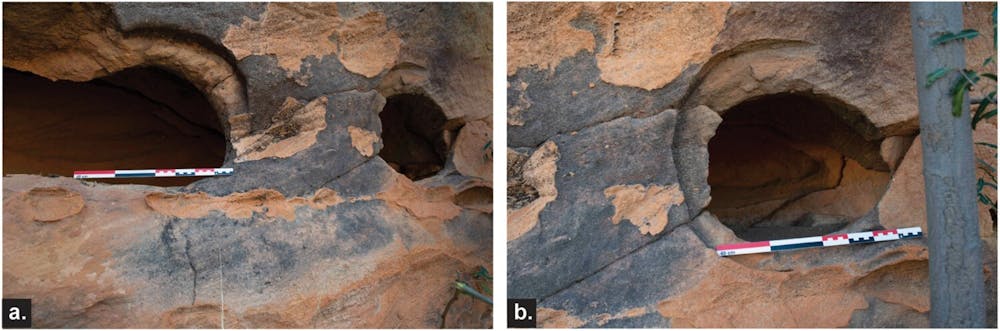
    Part of the Teniky site has been known for well over 100 years, as we know from names and dates scratched on the rocks there. Various visitors in the 1950s and 1960s with an interest in archaeology described an amphitheatre-shaped location with man-made terraces, a rock shelter with neatly constructed sandstone walls, a chamber cut into the rock with pillars and benches, and a large number of niches cut in the steep cliffs. Recesses are still visible around some of the niches, suggesting that they could be closed off by a wooden or stone slab.

    Among the suggested interpretations were that these structures had been made by shipwrecked Portuguese sailors, or Arabs, or even Phoenicians.

    No similar rock-cut architecture is known anywhere else in Madagascar or on the east African coast, 400km away.

    And until recently, no detailed archaeological studies had ever been carried out at Teniky.

    Madagascar’s past is still the subject of considerable debate. Situated in the south-western Indian Ocean, it is one of the last big islands to have been settled by humans. Genetic studies have identified the people of Madagascar as having come mainly from Africa and from Southeast Asia. Archaeology suggests that the first settlers arrived about 1,500 to 1,000 years ago. The earliest settlements studied have been located along the coast, close to river estuaries.

    Our archaeological study of Teniky, however, points to a new possibility: a former Persian presence in southern Madagascar about 1,000 years ago.

    What we found at Teniky

    Our study of high-resolution satellite images revealed the Teniky site was much larger than previously known. It showed there were more terraces and stone walls on a hill 2km to the west. This led us to take a closer look, hoping to get a better sense of who had lived there and when.

    During field prospecting on this hill we discovered niches, cut in the walls of a rock shelter, that had not been described before.

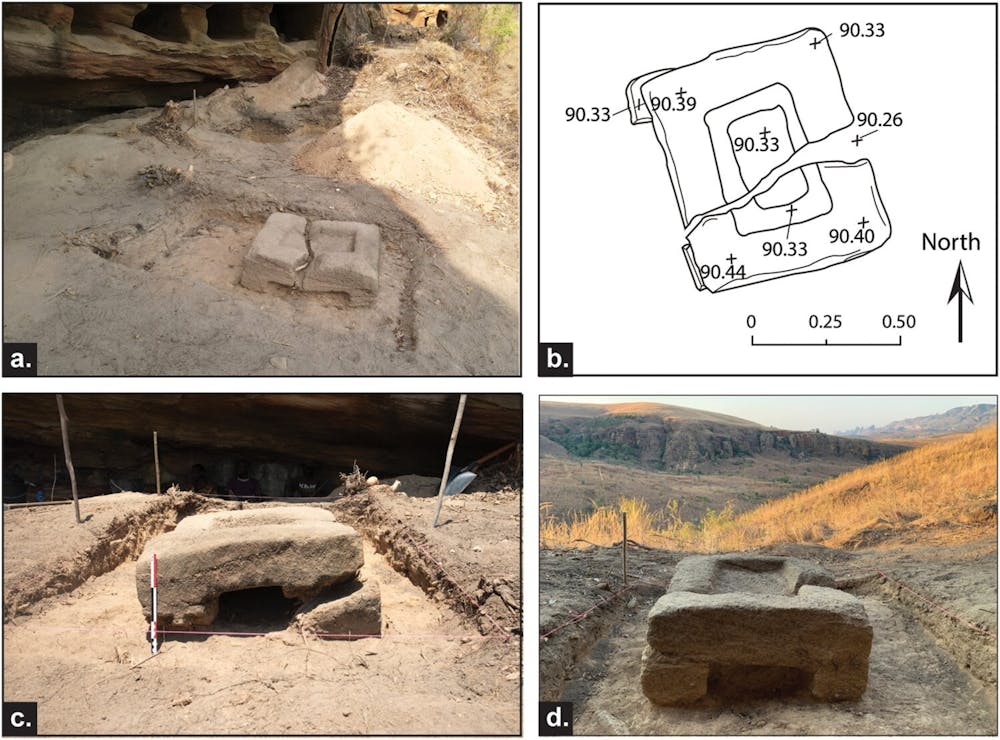
    Excavations at this rock shelter revealed more archaeological structures, including carved sandstone walls and a large stone basin.

    Radiocarbon dating of charcoal samples from the site dated to the late 10th to mid-12th centuries AD. Pieces of ceramic items of southeast Asian and Chinese origin found there have been dated by a specialist to the 11th to 14th centuries AD.

    We also found sandstone quarries from which the stones used to build the walls at the rock shelters were extracted. And we found more stone basins on terraces.

    The terraces cover a total area of about 30 hectares, indicating that Teniky must have been a fair-sized settlement. Water is available all year round in the valley below, where people might have been able to plant crops, fish for eels or even keep cattle.

    Considering the dimensions, location and character of the rock-cut structures at Teniky, we think the niches and chambers served a ritual purpose.

    Who were the people who lived at Teniky?

    There is no other archaeological site like Teniky in Madagascar. So, the question arises as to what group of people settled there, far inland, and carved the niches and chambers in the cliff walls about 1,000 years ago. The presence of imported ceramics indicates that they took part in the Indian Ocean trade networks at the time but doesn’t tell us where they came from.

    We think the answer may lie in the style of the rock-cut niches.

    Rock architecture at Teniky, Madagascar. Courtesy Guido Schreurs.

    They are similar to rock niches of the first millennium or earlier in Iran (formerly Persia). Archaeologists have interpreted those as belonging to Zoroastrian communities, which used them as part of their funeral rites.

    Zoroastrianism was the dominant state religion of the Persian Sasanian Empire (224-656 AD). After the conquest of the Sasanian Empire by the Arabs in the mid-seventh century AD, Islam was imposed.

    Zoroastrian funeral rites do not allow direct burial in the ground, so as not to pollute the earth. Instead, dead bodies are left in places of exposure not touching the ground. Once the flesh has decomposed or been removed by animals, the bone remains are dried and placed in bone receptacles (ossuaries).

    We tentatively interpret the rock-cut architecture at Teniky as having been made by a community with Zoroastrian origins.

    The larger rock-cut niches might have been the places where the bodies of the dead were exposed, and the smaller niches with recesses might have served as ossuaries, closed off by a slab to protect the bones from the rain and thus to prevent them from polluting the earth.

    The stone basins at Teniky show stylistic similarities with those used in Zoroastrian ritual ceremonies to hold water or fire, both agents of ritual purity.

    Zoroastrians abroad

    There are few accounts of Madagascar written at the turn of the first and second millennia AD. Buzurg Ibn Shahriyar, a tenth-century Persian sailor and writer, collected stories from sailors in port towns on the Persian Gulf which suggest that Persian contacts with Madagascar may have existed then. The name Madagascar did not exist at that time but names like “Wak-wak” or “Qumr”/“Komr” may have referred to the island.


    Read more:
    Madagascar cave art hints at ancient connections between Africa and Asia


    Historical documents, archaeological excavations and genetic studies indicate that Zoroastrians left Iran and settled in western India in the late eighth century AD.

    Did they settle on the island of Madagascar too? If the rock-cut architecture and associated stone basins at Teniky are the work of a community with Zoroastrian origins, this would strongly point to a former Persian presence in southern Madagascar about 1,000 years ago.

    Many questions remain. We hope future studies will answer some of them.

    The authors do not work for, consult, own shares in or receive funding from any company or organisation that would benefit from this article, and have disclosed no relevant affiliations beyond their academic appointment.

    ref. Madagascar’s mysterious Teniky rock architecture: study suggests a link to ancient Persia – https://theconversation.com/madagascars-mysterious-teniky-rock-architecture-study-suggests-a-link-to-ancient-persia-240725

    MIL OSI – Global Reports

  • MIL-OSI: Newest Micetro release unifies network infrastructure management with support for Cisco Meraki

    Source: GlobeNewswire (MIL-OSI)

    TORONTO, Oct. 17, 2024 (GLOBE NEWSWIRE) — BlueCat Networks, a leading provider of core services for network infrastructure management, automation, and security, announced the latest release of Micetro, its industry-recognized DNS, DHCP, and IP address management orchestration solution. This release offers organizations with Cisco Meraki deployments a powerful new way to manage and monitor DHCP within their SD-WAN environments.

    DNS, DHCP, and IP address management (collectively known as DDI) are the cornerstones of network modernization. Together, they ensure that users can access network resources and applications from anywhere and on any device–whether on premises or from any cloud.

    This release extends Micetro’s capabilities by seamlessly consuming and managing DHCP configurations from Meraki devices. This integration provides agnostic and centralized DHCP orchestration and visibility across the cloud, corporate networks, and remote offices enabled by SD-WAN. By orchestrating DHCP configurations from Meraki, organizations get improved visibility into their IP space. It also provides network teams with even more granular role-based access controls. This helps network teams deliver and scale Meraki DHCP across branch locations.

    “Micetro helps organizations improve transparency with a single source of truth, enhances security, and automates core network services, reducing network conflicts and outages,” said Scott Fulton, Chief Product and Technology Officer at BlueCat. “We’re seeking to expand our cloud-connected networking support across additional platforms and to support enterprises looking to reap the benefits of network modernization.”

    Micetro is available for deployment in any on premises, hybrid, or multicloud network environment. Its intuitive user interface and API make it easy for IT teams to manage and automate their network infrastructure operations. This release also features extended language support, a crucial function for global organizations with diverse linguistic needs.

    Visit our website to learn more about Micetro’s unified DDI orchestration.

    About BlueCat 

    BlueCat provides core services and solutions that help our customers, and their teams, deliver change-ready networks. With BlueCat, organizations can build reliable, secure, and agile mission-critical networks that can support network modernization initiatives such as cloud adoption, SD-WAN, SASE and automation of key network provisioning and administration tasks. BlueCat’s growing portfolio includes services and solutions for automated and unified DDI management, network security, multi-cloud management, network observability, performance management and health. BlueCat’s DDI management platform was recognized as a market leader and outperformer in GigaOm’s 2024 Radar reports. The company is headquartered in Toronto and New York and has additional offices in Germany, Iceland, Japan, Singapore, Serbia, and the United Kingdom. Learn more at bluecat.com. 

    The MIL Network

  • MIL-OSI: Emerging Markets in Africa and Asia Downloaded Bitget Wallet More Than Major Centralized Exchanges

    Source: GlobeNewswire (MIL-OSI)

    VICTORIA, Seychelles, Oct. 17, 2024 (GLOBE NEWSWIRE) — Bitget Wallet, the leading Web3 non-custodial wallet, has surpassed 40 million users, doubling its user base in just six months. The wallet also climbed to the second spot in global crypto app downloads for September, with nearly 6 million downloads in that month alone, closing in on Binance. This explosive growth is largely contributed by emerging markets, where Bitget Wallet’s user base has skyrocketed. Notably, Bitget Wallet’s user growth rate in Africa reached 413% and South Asia saw a 126% increase. These regions are turning to decentralized wallets as vital tools for financial independence and easy access to crypto services, often filling gaps left by centralized financial systems.

    In countries like Nigeria, where Bitget Wallet’s user growth rate hit 468% in Q3 2024, rising inflation and weakening currencies have led to increased adoption of decentralized wallets as secure, reliable financial tools. According to Bloomberg, the local naira currency has lost about 70% of its value since May 2023. As a result, people are seeking alternatives to preserve their wealth and participate in stable financial systems. Bitget Wallet serves this need, offering easy access to crypto assets and rewards with all-rounded trading and earning features, making it No. 1 on the App Store in Nigeria in June 2024.

    In Southeast Asia, Play-to-Earn (P2E) games once dominated the blockchain gaming landscape, attracting a young, tech-savvy audience. However, the trend has evolved towards Tap-to-Earn (T2E) games within Telegram ecosystem. T2E games are more accessible, requiring no separate app downloads or upfront NFT investments. Their simplicity, combined with Telegram’s referral system, has facilitated easy onboarding of new users, making Telegram a fertile ground for blockchain gaming.

    In Q3 2024, Bitget Wallet experienced a surge in user growth, particularly in the Philippines and Vietnam, with growth rates of 102% and 73%, respectively. This spike is attributed to the T2E trend, where users earn money by engaging with Telegram mini-games. The shift from P2E to T2E highlights a broader trend towards more integrated blockchain ecosystems, showcasing how gaming apps and social interactions are driving cryptocurrency adoption among younger generations.

    With its remarkable growth, Bitget Wallet aims to be the ultimate gateway for the next billion users to Web3, bringing together the best and latest opportunities in one seamless app. “We believe Web3 offers unprecedented potential for financial freedom, security through self-custody, and a more equitable future. Our mission is to make Web3 easy and accessible for everyone. We’re committed to bringing financial inclusion to regions where centralized financial systems fall short and giving people seamless tools to participate in a global decentralized economy,” said Alvin Kan, COO at Bitget Wallet.

    India’s crypto users are increasingly seeking decentralized financial tools amidst ongoing security concerns and regulatory uncertainty around centralized exchanges. Bitget Wallet has capitalized on this trend, recording 191% user growth in India during Q3 2024. The rise is attributed to its ability to cater to these needs by offering enhanced security features such as keyless MPC wallet, which removes the need for private keys and provides a more user-friendly experience. Additionally, Bitget Wallet’s integration with Telegram Tap-to-Earn mini-games, has made it easier for Indian users to engage with Web3.

    For similar reasons, European users are increasingly opting for decentralized wallets as alternatives to centralized exchanges. Countries like France, Germany, and the UK, where Bitget Wallet saw 286%, 115% and 94% user growth in Q3 respectively, are leading this trend. Users in these regions are drawn to Bitget Wallet’s all-in-one platform, which allows them to manage, trade, and explore decentralized apps extensively and securely. As wallets continue to evolve, they are emerging as essential entry points to Web3 for users across Europe.

    To get started with Bitget Wallet, please visit here.

    About Bitget Wallet

    Bitget Wallet stands as one of the world’s leading non-custodial Web3 wallets and decentralized ecosystem platform. With the Bitget Onchain Layer, the wallet is well-poised to develop a burgeoning DeFi ecosystem through co-creation and strategic incubation. Aside from a powerful Swap function, Bitget Wallet also offers multi-chain asset management, smart money insights, a native Launchpad, Inscriptions Center, and an Earning Center. Supporting over 100 major blockchains, 500,000+ tokens, and a wide array of DApps, Bitget Wallet is your top wallet for asset discovery and Web3 exploration.

    For more information, visit: Website | Twitter | Telegram | Discord

    A photo accompanying this announcement is available at https://www.globenewswire.com/NewsRoom/AttachmentNg/5b2fe99a-7041-4e45-9de8-d37cb4be97c4

    The MIL Network

  • MIL-OSI Africa: Madagascar’s mysterious Teniky rock architecture: study suggests a link to ancient Persia

    Source: The Conversation – Africa – By Guido Schreurs, Professor in Geology, University of Bern

    In the heart of Isalo National Park in central-southern Madagascar, at least 200km from the sea in any direction, is a remote valley with a mysterious past. This place, Teniky, can only be reached on foot, by hiking through a mountainous region dissected by steep canyons.

    Isalo area. Guido Schreurs, Author provided (no reuse)

    Part of the Teniky site has been known for well over 100 years, as we know from names and dates scratched on the rocks there. Various visitors in the 1950s and 1960s with an interest in archaeology described an amphitheatre-shaped location with man-made terraces, a rock shelter with neatly constructed sandstone walls, a chamber cut into the rock with pillars and benches, and a large number of niches cut in the steep cliffs. Recesses are still visible around some of the niches, suggesting that they could be closed off by a wooden or stone slab.

    Among the suggested interpretations were that these structures had been made by shipwrecked Portuguese sailors, or Arabs, or even Phoenicians.

    Teniky. Guido Schreurs, Author provided (no reuse)

    No similar rock-cut architecture is known anywhere else in Madagascar or on the east African coast, 400km away.

    And until recently, no detailed archaeological studies had ever been carried out at Teniky.

    Madagascar’s past is still the subject of considerable debate. Situated in the south-western Indian Ocean, it is one of the last big islands to have been settled by humans. Genetic studies have identified the people of Madagascar as having come mainly from Africa and from Southeast Asia. Archaeology suggests that the first settlers arrived about 1,500 to 1,000 years ago. The earliest settlements studied have been located along the coast, close to river estuaries.

    Our archaeological study of Teniky, however, points to a new possibility: a former Persian presence in southern Madagascar about 1,000 years ago.

    What we found at Teniky

    Our study of high-resolution satellite images revealed the Teniky site was much larger than previously known. It showed there were more terraces and stone walls on a hill 2km to the west. This led us to take a closer look, hoping to get a better sense of who had lived there and when.

    During field prospecting on this hill we discovered niches, cut in the walls of a rock shelter, that had not been described before.

    Excavations at this rock shelter revealed more archaeological structures, including carved sandstone walls and a large stone basin.

    Radiocarbon dating of charcoal samples from the site dated to the late 10th to mid-12th centuries AD. Pieces of ceramic items of southeast Asian and Chinese origin found there have been dated by a specialist to the 11th to 14th centuries AD.

    We also found sandstone quarries from which the stones used to build the walls at the rock shelters were extracted. And we found more stone basins on terraces.

    The terraces cover a total area of about 30 hectares, indicating that Teniky must have been a fair-sized settlement. Water is available all year round in the valley below, where people might have been able to plant crops, fish for eels or even keep cattle.

    Considering the dimensions, location and character of the rock-cut structures at Teniky, we think the niches and chambers served a ritual purpose.

    Teniky. Raphael Kunz, Author provided (no reuse)

    Who were the people who lived at Teniky?

    There is no other archaeological site like Teniky in Madagascar. So, the question arises as to what group of people settled there, far inland, and carved the niches and chambers in the cliff walls about 1,000 years ago. The presence of imported ceramics indicates that they took part in the Indian Ocean trade networks at the time but doesn’t tell us where they came from.

    We think the answer may lie in the style of the rock-cut niches.

    Rock architecture at Teniky, Madagascar. Courtesy Guido Schreurs.

    They are similar to rock niches of the first millennium or earlier in Iran (formerly Persia). Archaeologists have interpreted those as belonging to Zoroastrian communities, which used them as part of their funeral rites.

    Zoroastrianism was the dominant state religion of the Persian Sasanian Empire (224-656 AD). After the conquest of the Sasanian Empire by the Arabs in the mid-seventh century AD, Islam was imposed.

    Zoroastrian funeral rites do not allow direct burial in the ground, so as not to pollute the earth. Instead, dead bodies are left in places of exposure not touching the ground. Once the flesh has decomposed or been removed by animals, the bone remains are dried and placed in bone receptacles (ossuaries).

    We tentatively interpret the rock-cut architecture at Teniky as having been made by a community with Zoroastrian origins.

    Circular niches with a recess around the opening. Guido Schreurs, Author provided (no reuse)

    The larger rock-cut niches might have been the places where the bodies of the dead were exposed, and the smaller niches with recesses might have served as ossuaries, closed off by a slab to protect the bones from the rain and thus to prevent them from polluting the earth.

    Basin in front of niches. Guido Schreurs, Author provided (no reuse)

    The stone basins at Teniky show stylistic similarities with those used in Zoroastrian ritual ceremonies to hold water or fire, both agents of ritual purity.

    Zoroastrians abroad

    There are few accounts of Madagascar written at the turn of the first and second millennia AD. Buzurg Ibn Shahriyar, a tenth-century Persian sailor and writer, collected stories from sailors in port towns on the Persian Gulf which suggest that Persian contacts with Madagascar may have existed then. The name Madagascar did not exist at that time but names like “Wak-wak” or “Qumr”/“Komr” may have referred to the island.


    Read more: Madagascar cave art hints at ancient connections between Africa and Asia


    Historical documents, archaeological excavations and genetic studies indicate that Zoroastrians left Iran and settled in western India in the late eighth century AD.

    Did they settle on the island of Madagascar too? If the rock-cut architecture and associated stone basins at Teniky are the work of a community with Zoroastrian origins, this would strongly point to a former Persian presence in southern Madagascar about 1,000 years ago.

    Many questions remain. We hope future studies will answer some of them.

    – Madagascar’s mysterious Teniky rock architecture: study suggests a link to ancient Persia
    https://theconversation.com/madagascars-mysterious-teniky-rock-architecture-study-suggests-a-link-to-ancient-persia-240725

    MIL OSI Africa

  • MIL-OSI Asia-Pac: Lo Chung-mau meets Hainan officials

    Source: Hong Kong Information Services

    Secretary for Health Prof Lo Chung-mau met a delegation led by Hainan Vice Governor Xie Jing today to introduce the initiatives on developing Hong Kong into an international health and medical innovation hub as set out in the 2024 Policy Address.
     
    At the meeting, Prof Lo updated the delegation on the latest development of Hong Kong’s healthcare policy, including initiatives put forward in the Policy Address, including complementing technological innovation with institutional innovation through expediting the reform of the approval mechanism for drugs and medical devices, and strengthening research and development and translation of biomedical technology.
     
    The Hong Kong Special Administrative Region Government will support the innovation and application of advanced biomedical technology, with a view to attracting the world’s top-notch biomedical enterprises and research organisations to set up operations in Hong Kong, Prof Lo stressed.
     
    Additionally, the progress of hospital accreditation of public hospitals in the Hong Kong SAR through the adoption of “China’s International Hospital Accreditation Standards (2021 Version)” was discussed during the meeting.
     
    Prof Lo pointed out that the Hong Kong SAR Government will continue to actively promote the adoption of the accreditation standards by more public hospitals, including extending the adoption of the standards to two to three more public hospitals in addition to Pamela Youde Nethersole Eastern Hospital and Prince of Wales Hospital.
     
    The participation of public hospitals in the accreditation programme can serve as a demonstration to the international community the national hospital accreditation standards, with Hong Kong acting as a gateway to facilitate the national standards to go global, he highlighted.
     
    In this connection, both parties also explored ways to further encourage more hospitals in the two places to pursue accreditation so as to amplify the impact of the standards.
     
    “Looking ahead, we will remain committed to fostering cross-boundary medical co-operation so as to propel the important national strategy of ‘Healthy China’ through concerted contributions,” the health chief added.

    MIL OSI Asia Pacific News

  • MIL-OSI Global: Aquaculture could harm animal welfare or protect it, depending on what species the farms raise

    Source: The Conversation – USA – By Becca Franks, Assistant Professor of Environmental Studies, New York University

    Raising salmon in a tank at an aquaculture farm in Dubai. Giuseppe Cacace/AFP via Getty Images

    The global aquaculture industry has tripled in size since the year 2000, with producers raising a mind-boggling diversity of species, from seaweeds and clams to carp, salmon and cuttlefish. Many of these creatures are undomesticated and lead complex and highly social lives in the wild.

    The rapid growth in aquaculture means that billions of individual aquatic animals are now being farmed without basic information that could help ensure even minimal welfare standards. Our newly published study shows that these welfare risks are not uniform: Aquaculture is likely to have severe effects on welfare for some species, but negligible impacts on others.

    Whenever humans manage animals on a large scale, welfare becomes a concern. As experts on aquatic animals and their welfare, we believe that taking proactive measures to shape the aquaculture industry’s growth will be critical for its long-term success.

    A cuttlefish tackles a challenge originally designed for human children, demonstrating cephalopods’ complex cognitive processes.

    Complex aquatic lives

    In a wide-ranging review of the existing science, we identified seven risk factors in fish and other sea creatures that would be challenging or impractical to accommodate in captivity. They include 1) migratory behavior, 2) solitary social structures, 3) long life spans, 4) carnivorous feeding habits, 5) cannibalism, 6) living at depths of 165 feet (50 meters) or more, and 7) elaborate courtship or involved parental care.

    We researched these characteristics for each of the more than 400 species currently farmed in aquaculture. Our analysis found that many species of fishes, reptiles and amphibians are likely to suffer in aquaculture because they won’t be able to engage in their natural behaviors in farmed conditions. The same is true for crustaceans such as lobsters and for cephalopods such as cuttlefish.

    In contrast, aquatic plants and other invertebrates such as oysters would experience fewer differences between their life in the wild versus in a tank, pond or other aquaculture production system.

    We also found that species most at risk are among the most expensive on the market but contribute the least to global production. By shifting toward species whose behaviors and life habits are more compatible with aquaculture, the industry could minimize animal welfare risk while also keeping prices down and production quantities high. In other words, protecting aquatic animal welfare is compatible with producing affordable, nutritious food.

    Animal welfare in the water

    Research shows that many aquatic animals are intelligent, emotional, curious, highly social and have strong preferences. Like land animals, they can suffer if their needs aren’t met.

    Consider, for example, the bumphead parrotfish (Bolbometopon muricatum), which is currently farmed in aquaculture. Bumpheads live up to 40 years and travel several kilometers each day in large foraging troops, searching for live coral. On full moons, they come together in the hundreds to spawn and engage in ritual head-bumping contests between the males, like an aquatic version of bison.

    Divers observe a feeding school of bumphead (also referred to as humphead) parrotfish on Australia’s Great Barrier Reef.

    It would be very difficult and expensive to accommodate this species’ long life span, large range, complex foraging behavior and dynamic social relationships in the highly restrictive and monotonous environments of aquaculture.

    We also found examples of invertebrate animals with similarly elaborate ways of life. One example is the red swamp crayfish (Procambarus clarkii), a comparatively small crustacean that builds elaborate tunnel and chamber systems underground. Females care attentively for their tiny offspring, fanning, cleaning and feeding juveniles for up to four months after they hatch.

    In contrast, plant species farmed in aquaculture, such as seaweeds and water spinach (Ipomoea aquatica), are nutritious, protein-rich foods that can be raised without posing direct animal welfare concerns.

    In 2021 alone, 56 species were farmed for the first time. By identifying species that may naturally adapt better to life in captivity, aquaculture producers and policymakers can steer their industry toward a more humane future.

    This approach is already finding support in the U.S., where Washington and California have banned octopus farming. The states acted partly in response to research showing that octopuses are intelligent, curious, social animals that can solve problems and recognize individual people – qualities that are incompatible with being raised en masse for food.

    More research is needed to understand the lives and behaviors of other sea creatures that are currently farmed or targeted for production in the future. Most of these species remain understudied and mysterious, which makes it hard to make informed decisions about whether they are suitable for farming.

    Better data could contribute to aquaculture policy, while also boosting public appreciation for the diversity and intricacy of life on a planet that is 70% aquatic.

    Becca Franks receives funding from TinyBeam Foundation and Open Philanthropy.

    Chiawen Chiang does not work for, consult, own shares in or receive funding from any company or organization that would benefit from this article, and has disclosed no relevant affiliations beyond their academic appointment.

    ref. Aquaculture could harm animal welfare or protect it, depending on what species the farms raise – https://theconversation.com/aquaculture-could-harm-animal-welfare-or-protect-it-depending-on-what-species-the-farms-raise-240771

    MIL OSI – Global Reports

  • MIL-OSI USA: Visit By the Indian Enquiry Committee to the United States of America

    Source: United States Department of State (4)

    Office of the Spokesperson

    An Indian Enquiry Committee that was established to investigate activities of certain organized criminals is actively investigating the individual who was identified last year in the Department of Justice’s indictment as an Indian government employee who directed a foiled plot to assassinate a U.S. citizen in New York City. The Enquiry Committee will be traveling to Washington, D.C. on October 15th, as part of their ongoing investigations to discuss the case, including information they have obtained, and to receive an update from U.S. authorities regarding the U.S. case that is proceeding. Additionally, India has informed the United States they are continuing their efforts to investigate other linkages of the former government employee and will determine follow up steps, as necessary.

    MIL OSI USA News

  • MIL-OSI USA: U.S. Department of State Hosts Quad Fellows in Washington, D.C.

    Source: United States Department of State (4)

    Office of the Spokesperson

    The U.S. Department of State hosted 50 promising young scholars from Australia, India, Japan, the United States, and Southeast Asia at the second Quad Fellowship Summit in Washington, D.C. on October 7. Launched in 2021, the Quad Fellowship welcomed its second cohort of fellows, and this is the first year it includes scholars from Southeast Asia. Quad Fellows receive a stipend to pursue graduate degrees in STEM fields at U.S. universities.

    The Fellowship, which is administered by the Institute for International Education, is part of a broader Quad commitment to harness emerging technologies for the benefit of people across the Indo-Pacific, and utilize these technologies to facilitate economic prosperity, openness, and connectivity.

    Quad Fellows met with private sector and U.S. government representatives to discuss scientific and technological developments in the Indo-Pacific. Quad Fellows also engaged with science and technology specialists working in the U.S. government to explore leveraging STEM research to deliver tangible benefits to the Indo Pacific region. For press inquiries, please contact the Bureau of East Asian and Pacific Affairs at EAP-Press@state.gov and the Bureau of South and Central Asian Affairs at SCA-Press@state.gov.

    MIL OSI USA News

  • MIL-OSI USA: Secretary Blinken’s Meeting with the C5+1 during UNGA 79 

    Source: United States Department of State (4)

    Office of the Spokesperson

    The below is attributable to Spokesperson Matthew Miller:

    Secretary of State Antony Blinken met with foreign ministers and representatives from the Republic of Kazakhstan, the Kyrgyz Republic, the Republic of Tajikistan, Turkmenistan, and the Republic of Uzbekistan today under the auspices of the C5+1 platform during the 79th annual session of the UN General Assembly.

    Reflecting on the commitments made by U.S. and Central Asian leaders during the inaugural C5+1 Presidential Summit on September 19, 2023, the Secretary acknowledged significant steps taken since that landmark occasion in furtherance of the Summit’s New York Declaration, including the C5+1 Critical Minerals Dialogue launch, the inaugural B5+1 Forum in support of U.S.-Central Asian business partnership, and the first C5+1 Special Session on Disability Rights on the margins of the UN Conference of States Parties to the Convention on the Rights of Persons with Disabilities (CRPD) at the United Nations.

    Participants discussed steps toward enhanced regional security cooperation in pursuance of a shared vision for a peaceful Central Asia. The Secretary underscored the importance of upholding the United Nations Charter and its principles, including with respect to human rights, and C5+1 partnership that is grounded in respect for the independence, sovereignty, and territorial integrity of all states.

    Secretary Blinken noted that the year 2025 will mark ten years of enduring U.S.-Central Asian collaboration through the C5+1 platform. In the spirit of cooperation that has come to define the C5+1, the Secretary emphasized U.S. commitment to pursuing regional solutions to global challenges in partnership with the Republic of Kazakhstan, the Kyrgyz Republic, the Republic of Tajikistan, Turkmenistan, and the Republic of Uzbekistan.

    MIL OSI USA News

  • MIL-OSI USA: Secretary Antony J. Blinken at a C5+1 Meeting

    Source: United States Department of State (4)

    Antony J. Blinken, Secretary of State

    New York City, New York

    Palace Hotel

    SECRETARY BLINKEN: Well, good morning, everyone. And I’m so pleased to – excuse me – welcome all of our friends and partners from Central Asia for this C5+1 meeting today. As I’ve been saying, it’s Friday. We’ve all made it to the end of the High-Level Week.

    But I’m so pleased that we were all able to find the time to come together. The United States is a steadfast supporter of the independence, the sovereignty, the territorial integrity of Kazakhstan, Kyrgyzstan, Turkmenistan, Tajikistan, Uzbekistan.

    And we are also steadfast in our partnership. We’ve done very good work through the C5+1, and, of course, a highlight was a meeting among our leaders with President Biden.

    But we’ve been delivering on the C5+1’s vision of regional solutions to global challenges. The engagement among all of us enhances sustainable economic growth. It strengthens energy and climate resilience and security.

    Next year, 2025, will mark ten years since we launched the C5+1, and the United States, for its part, looks very much forward to celebrating this enduring partnership, but not just celebrating it, continuing to grow it, to strengthen it.

    And today’s a very good opportunity to take stock of what we’ve been able to achieve but also to keep us focused on the future and all that we can do together. Thank you.

    MIL OSI USA News

  • MIL-OSI Security: U.S. Army Garrison Okinawa Firefighters Host Joint Water Rescue Training Event

    Source: United States INDO PACIFIC COMMAND

    U.S. Army Garrison Okinawa Torii Station firefighters stationed at Naha Military Port conducted a joint water rescue training exercise alongside the Naha City Fire Department and the Japanese Coast Guard on Oct. 10, at Naha Military Port, Okinawa, Japan.

    This marked the first time the three agencies collaborated in such a capacity. The primary goal of the training was to strengthen coordination between the agencies, familiarize the teams with each other’s capabilities, and enhance preparedness for potential large-scale rescue operations.

    “Torii is a small fire department with limited capabilities,” said Matthew B. Spreitzer, Chief of Fire and Emergency Services for USAG Okinawa. “In the case of a medium or large fire/rescue emergency, we would need to rely heavily upon our host national partners for additional resources and equipment during emergencies that reach beyond our capabilities.”

    While Torii Station provides essential emergency services, Spreitzer emphasized that collaboration with Japanese counterparts is critical to ensuring comprehensive protection for the local community.

    Spreitzer noted the importance of working closely with the Naha City Fire Department and the Japanese Coast Guard not only builds trust but also enhances the overall effectiveness of rescue operations.

    “We greatly appreciate the local Japanese emergency responders’ willingness and dedication,” said Spreitzer. “Their support helps our department provide lifesaving emergency capabilities for our Soldiers, civilians, and MLC employees.”

    He also thanked the local partners for their contribution to the success of the USAG Okinawa’s mission.

    “Without our partners, our community would not have the level of protection they all deserve,” he said. “Torii’s mission capability would not be able to be met. We wholeheartedly thank all our local emergency responders for their unwavering support.”

    MIL Security OSI

  • MIL-OSI Canada: HMCS Ottawa departs for the Indo-Pacific region on Operations HORIZON and NEON

    Source: Government of Canada News

    News release

    October 16, 2024 – Esquimalt, B.C. – National Defence / Canadian Armed Forces

    Today, the crew of His Majesty’s Canadian Ship (HMCS) Ottawa bid farewell to their families and loved ones at a departure ceremony held at His Majesty’s Canadian Dockyard Esquimalt, British Columbia.

    HMCS Ottawa will sail across the Pacific Ocean while deployed on Operations HORIZON and NEON. Operation HORIZON is Canada’s forward-presence mission to the Indo-Pacific region to promote peace, stability, and the rules-based international order. Operation NEON is Canada’s contribution to a coordinated multinational effort to support the implementation of United Nations sanctions imposed against North Korea.

    During this deployment HMCS Ottawa will maintain Canada’s naval presence in the Indo-Pacific, demonstrating the nation’s contribution to regional peace and stability, and commitment to international security. The crew of HMCS Ottawa will showcase the Royal Canadian Navy’s (RCN) operational capabilities while working alongside international allies and partner navies during military training exercises; highlighting Canada’s commitment to international collaboration and fostering military and diplomatic partnerships.

    Quotes

    “The departure of His Majesty’s Canadian Ship (HMCS) Ottawa, the second ship from the West Coast to deploy on Operation HORIZON this year, represents the culmination of thousands of hours of collective effort and dedication from the ship’s company and supporting staff ashore. This deployment to the Indo-Pacific region will see the ship and its crew sail with our allies and partners in the region and take on critical tasks and missions. I know that they are up to the challenge. Fair winds and following seas to HMCS Ottawa, I wish you all a safe and successful mission.”

    Rear-Admiral Christopher Robinson, Commander Maritime Forces Pacific

    “For those serving onboard, today’s departure is months in the making. Ottawa’s crew has worked hard to get our ship ready for Operations HORIZON and NEON where we will represent Canada and the Royal Canadian Navy well throughout our mission across the Indo-Pacific. This deployment would not be possible without the incredible support of our families, who serve with us, and without them we would not have been able to get to this moment.”

    Commander Adriano Lozer, Commanding Officer HMCS Ottawa

    Quick facts

    • As part of the Indo-Pacific Strategy, the RCN is committed to working alongside regional allies and partners to promote a stable, secure, and prosperous Indo-Pacific.

    • The series of UN sanctions, adopted between 2006 and 2017, aim to pressure North Korea to abandon its weapons of mass destruction programs and respond to North Korean nuclear weapon tests and ballistic missile launches.

    • HMCS Ottawa, a Halifax-class Canadian Patrol Frigate, has a crew of approximately 240 members comprised of RCN sailors and Royal Canadian Air Force aviators.

    • One CH-148 Cyclone helicopter detachment is embarked onboard HMCS Ottawa. This helicopter detachment specializes in anti-submarine warfare, maritime surveillance, and search and rescue operations.

    Associated links

    Contacts

    Maritime Forces Pacific Public Affairs
    Phone: 250-363-5789 or 250-888-6775
    Email: ESQPACIFICNAVYPUBLICAFFAIRS@forces.gc.ca

    MIL OSI Canada News

  • MIL-OSI New Zealand: Niger

    Source: New Zealand Ministry of Foreign Affairs and Trade – Safe Travel

    • Reviewed: 17 October 2024, 08:02 NZDT
    • Still current at: 17 October 2024

    Related news features

    If you are planning international travel at this time, please read our COVID-19 related travel advice here, alongside our destination specific travel advice below.

    Do not travel to Niger due to the threat of terrorism and kidnapping, the presence of armed militants and the unpredictable security situation (level 4 of 4).

    Niger

    Terrorism
    There is a high threat from terrorism in Niger. Terrorist groups are active across Niger, particularly, in the western, northwestern and southeastern parts of the country, Since 2013, there have been a number of retaliatory attacks against the Niger government for its participation in regional interventions in Mali and Nigeria to repel armed rebels.

    The Nigerian-based terrorist group Boko Haram has a strong presence in neighbouring areas of northern Nigeria and has conducted cross-border attacks in Niger, near the Nigerian border, particularly in the Diffa region. State of Emergencies and curfews may be in place in regions of concern. Comply with any instructions issued by local authorities.  

    Terrorist attacks could occur at any time and may be directed at locations known to be frequented by expatriates and foreign travellers, as well as security forces and premises associated with the Government of Niger. The security situation across the Sahel continues to deteriorate, and regions previously considered to be less at risk may now be subject to terrorism and related security threats.

    New Zealanders are advised to be security conscious at all times, particularly in public areas. We recommend monitoring media reports and local information sources for possible threats to your safety and security.

    Kidnapping
    There is a high threat of kidnapping against foreigners in Niger, including in the capital Niamey. The risk increases substantially outside Niamey, in the north of the country and in border areas. Terrorist groups active in Niger have been known to specifically target foreigners. In October 2020, a US citizen was kidnapped in the village of Massalata in southern Niger, about 10km from the border with Nigeria. In the past, foreigners have been kidnapped from their vehicles, homes and places of work.

    Violent Crime
    Crime levels in Niger are high, and foreigners are frequently targeted. Muggings are common in Niamey around the Gawaye Hotel, the National Museum, Kennedy Bridge and the Petit Marché, particularly at night. New Zealanders are advised not to walk alone or after dark in these areas. Other common types of crime include home invasions, carjackings assault and theft.

    Armed bandits operate throughout eastern and southern Niger, the border area with Nigeria south of Zinder, and large parts of northern Niger are off-limits to tourists.

    Petty crime such as pickpocketing and bag snatching occurs in Niamey and  throughout Niger. You should take steps to secure your personal belongings and avoid wearing or displaying valuables such as mobile devices and jewellery or leaving them visible in vehicles.

    Local Travel
    New Zealanders who decide to travel outside Niamey should ensure they put in place appropriate personal security protection measures, and take official warnings seriously. We recommend travelling in convoy of at least two vehicles, with a local guide and only during daylight hours. Attacks have occurred on the Agadez-Arlit, Agedez-Tahoua, and Tillabéry-Niamey roads and within the city of Zinder. You should prepare well in advance and ensure all vehicles are fully equipped with essential supplies, including a satellite phone. 

    We advise against the use of public transport in Niger. There have been incidents of armed robbery resulting in deaths on buses in Niger. Taxis are often under-maintained and dangerous and should be avoided. It is recommended that you hire a private car with a driver. Lock car doors and keep windows shut at all times.

    Local authorities are sensitive about foreigners travelling out of Tahoua to the east or north of Niger. If you travel in the Agadez region without obtaining prior authorisation, you risk arrest or deportation.

    Civil Unrest
    Niger frequently experiences protests and demonstrations, usually near government buildings and university campuses, some of which have turned violent in the past. Mobile phone and internet access may be disrupted during civil unrest.

    Since the military takeover in July 2023, there has been political instability in Niger. New Zealanders in Niger should remain vigilant and monitor the media for further information.

    New Zealanders are advised to follow any advice issued by the local authorities, including curfews, and avoid all demonstrations, protests and rallies as they have the potential to turn violent with little warning.

    Landmines
    There is a danger from unexploded landmines in some parts of Niger, including in Niamey and in the northern region of Agadez. We recommend you remain on well-used roads and paths.

    Scams
    Commercial and internet fraud is a common problem in many African countries. New Zealanders in Niger should be wary of any offers that seem too good to be true, as they may be a scam. For further information see our advice on Internet Fraud and International Scams.

    General Travel Advice
    As there is no New Zealand diplomatic presence in Niger, the ability of the government to provide consular assistance to New Zealand citizens is severely limited.

    We offer advice to New Zealanders about contingency planning that travellers to Niger should consider.

    New Zealanders are advised to respect religious and social traditions in Niger to avoid offending local sensitivities.

    Photography of public buildings and military facilities is prohibited, and could result in detention. If in doubt, don’t take a picture.

    Medical facilities are limited and of poor quality, including in the capital Niamey. New Zealanders travelling or living in Niger should have a comprehensive travel insurance policy in place that includes provision for medical evacuation by air.

    New Zealanders in Niger are strongly encouraged to register their details with the Ministry of Foreign Affairs and Trade.


    Travel tips

    See our regional advice for Africa

    MIL OSI New Zealand News

  • MIL-OSI Banking: Japan boosts African Development Fund with JPY 51.67 billion concessional loan

    Source: African Development Bank Group

    The African Development Bank Group and the Japan International Cooperation Agency (JICA) have signed a landmark 51.67 billion Japanese yen (US$421 million) concessional donor loan (CDL) agreement towards the African Development Fund.

    The loan, pledged by the Japanese government at the 16th general replenishment of the resources of the African Development Fund in December 2022, will support much-needed development in Africa’s least developed and fragile countries. The country is a top donor to the African Development Fund, having contributed the largest loans to the 14th, 15th and 16th replenishments of the Fund.

    Present at the signing ceremony on Tuesday 15 October, Deputy Vice Minister Daiho Fujii of the Finance Ministry expressed optimism that Japan’s concessional donor loan, together with grant contributions, would support African countries to address various challenges relating to climate change, lack of infrastructure, fragility, regional integration, private sector development, and debt management and transparency.

    “Through fruitful discussions, we reaffirmed that the African Development Fund has been playing a significant role in supporting low-income countries in Africa through its concessional loans and grants. We commit to working together toward a successful ADF-17 replenishment discussion next year,” Fujii said.

    Japan and other donor countries met in Cotonou last week to review the progress made against operational priorities and policy commitments at the midpoint of the ADF-16 period that ran from 2023 to 2025. Fujii congratulated the African Development Bank Group on the successful mid-term review of the 16th cycle of ADF.

    African Development Bank Group President Dr Akinwumi Adesina, who is marking his fifth visit to the Asian nation, commended Japan’s government for its unwavering support.  He expressed the Bank Group’s appreciation for Japan’s broader partnership, particularly through JICA’s Enhanced Private Sector Assistance for Africa initiative – an innovative multi-component framework for resource mobilisation and development.

    Adesina said:  “We wouldn’t have had a successful ADF-16 replenishment without Japan’s continued support for concessional donor lending.  It is important to sign these agreements, but it is the lives we touch that matter.  We deliver what we promise. We keep our word”.

    He highlighted the significant impact of projects completed under the African Development Fund. “This year alone, 500,000 people have been connected to electricity, one million provided with water and sanitation, 2.5 million to improved transport, and 2.7 million to health services.”

    In her speech, JICA Executive Senior Vice President Katsura Miyazaki described the signing ceremony as symbolic.

    She said: “African countries are facing multiple crises. Rising energy and food prices, supply chain disruptions, and worsening debt sustainability are having a serious impact on African countries. The African Development Fund is critical to addressing these challenges.

    Japan’s journey with the African Development Fund

    The African Development Fund (ADF), the concessional lending window of the Bank Group was established in 1972 and became operational in 1974.

    Japan joined the Fund in June 1973 and has contributed to all its replenishments, significantly increasing its contributions over time.

    Over the past 50 years, the ADF has played a pivotal role in providing concessional resources and knowledge services to low-income African countries, consistently demonstrating clear value for money. The ADF delivers transformative ideas and catalytic financing to these countries, including those in fragile situations. As a major source of financing, the ADF’s operations are efficient and deliver a strong development impact, cementing its reputation as a trusted and strategic partner for its stakeholders.

    Japan’s critical role in supporting the ADF was underscored by its extension of the largest concessional donor loan contributions to both ADF-15 and ADF-16, as well as the largest bridge loan provided to ADF-14. The Mid-Term Review (MTR) of ADF-16, successfully concluded in Cotonou in October 2024, highlighted several key achievements.

    Click here for photos.

    MIL OSI Global Banks

  • MIL-OSI Asia-Pac: CBDT is actively implementing special Campaign 4.0

    Source: Government of India (2)

    CBDT is actively implementing special Campaign 4.0

    Cleanliness campaigns carried out at about 700 sites, space of about 1,00,000 sq. ft freed up

    Special initiatives like Waste to Wealth, Indoor Plantation, health camps for Safai Mitras, freeing up space for gymnasium among others taken up

    Posted On: 16 OCT 2024 6:51PM by PIB Delhi

    The Central Board of Direct Taxes (CBDT), in collaboration with the field units of the Income Tax Department, is actively implementing Special Campaign 4.0. This initiative aims at maintaining clean workplaces and surroundings, disposing of scrap, freeing up office spaces, reducing the backlog of public grievances, etc.

    The Special Campaign 4.0 began with a preparatory phase from September 15 to September 30, 2024, during which targets for the campaign’s implementation were established. The implementation phase started on October 2, 2024, and will run until October 31, 2024. Throughout this phase, the CBDT is closely tracking daily progress to meet the campaign’s goals. As part of the monitoring efforts, the Nodal Officer from CBDT has been in regular contact with Nodal Officers from various regions across India.

    The first 15 days of the Special Campaign 4.0 has seen enthusiastic participation from the officers and officials of the Department. During this period, various activities undertaken in offices spread across India have resulted in the following :

    • Cleanliness campaigns carried out at about 700 sites.
    • Weeding out of about 1,00,000 redundant files.
    • Disposal of scrap material resulting in earning revenue of more than Rs. 9,80,000/-
    • Freeing up space of about 1,00,000 sq. ft.
    • Resolution of more than 16,000 public grievances during this period.


    Further, Progress of the campaign is being monitored on a daily basis and data is uploaded on the SCPDM portal hosted by DARPG.

                                      BEFORE

                                 AFTER

    Inspection of the records rooms in the Income Tax Department by the Nodal Officer, CBDT


    CBDT is also using social media to conduct outreach with public and highlight its efforts under the Swachhata campaigns. More than 300 Tweets have been posted/reposted on X (Formerly known as Twitter) by the official social media handles of the Income Tax Department, regional handles of Principal Chief Commissioner regions and the National Academy of Direct Taxes (NADT), to promote awareness for Swachhata campaigns. The campaign has also been amplified on other social media platforms of the Department.

    Some of the best practices regarding the same-


    1. Waste to Wealth Initiative –

    Art work created by recycling of scrap metals and it depicts an aquarium. This art piece is installed for public display at Aayakar Bhawan Dakshin, Kolkata


    Waste to Wealth – Art work created by recycling of scrap metals and it depicts an aquarium. This art piece is installed for public display at Aayakar Bhawan Dakshin, Kolkata


    1. Indoor plantation carried out by National Faceless Assessment Center (NaFAC) to manage limited availability of open spaces for plantation.


    1. Shredding of over 8000 kg of records and files by Director General of Income Tax (Inv.), Delhi and conversion of the same to recycled products


    1. Conversion of a hall full of obsolete files into an office gymnasium by Pr. CCIT, North East Region

    A review of the progress of Special Campaign 4.0 was also carried out by Sh. V. Srinivas, Secretary, DARPG on 11.10.2024 in the office of Director General of Income Tax (Investigation), Delhi, wherein he appreciated some initiatives such as reduced use of paper by strict implementation of double side printing; use of refilled cartridges; recycling of shredded records and files into stationery; reuse of digital devices by reformatting, etc. and also suggested dissemination of these best practices across all offices of the Income Tax Department.


    The CBDT and its field offices actively participated in the “Swachhta Hi Seva” (SHS) campaign in 2024. Key initiatives included the Swachhata Pledge, a nationwide tree plantation drive, medical camps for Safai Mitras, and cultural activities like nukkad nataks to promote cleanliness.


    Ek Ped Maa ke Naam plantation drive led by Sh. Ravi Agrawal, Chairman CBDT


    Clean-up of public places

    1. On Gandhi Jayanti, the Lok Nayak Setu underpass, once neglected and filled with debris, was transformed through the efforts of the Pr. CCIT Delhi’s office under the leadership of Sh. Ravi Agrawal, Chairman, CBDT. Now clean and accessible, it provides a safe passage for pedestrians, especially children on their way to school.


    1. Cleanliness Campaign in Mumbai led by Sh. Prabodh Seth, Member (Admin.), CBDT


    CBDT has entered the 3rd week of special campaign 4.0 and is aiming to excel in various areas while innovating and adopting best practices. The momentum of initial phase will continue to be amplified further.

    *****

    NB/KMN

    (Release ID: 2065528) Visitor Counter : 61

    MIL OSI Asia Pacific News

  • MIL-OSI Asia-Pac: Special Campaign 4.0 Reaches Midway: Ministry Achieves 100% Cleanliness Targets at 14,559 Sites, Makes Significant Progress in Disposal of Pending Matters

    Source: Government of India (2)

    Special Campaign 4.0 Reaches Midway: Ministry Achieves 100% Cleanliness Targets at 14,559 Sites, Makes Significant Progress in Disposal of Pending Matters

    MoRT&H is organizing Special Campaign 4.0 for disposal of Pending Matters and Cleanliness from 2nd to 31st October, 2024

    Posted On: 16 OCT 2024 6:58PM by PIB Delhi

    Special Campaign 4.0 for disposal of pending matters and cleanliness has reached midway. Campaign is being carried out by MoRTH and its agencies vigorously to achieve the identified targets under various parameters during the Campaign period. Ministry has achieved 100% targets in cleanliness activities, at 14559 sites.  The sites include offices, construction camps/sites, NH stretches, Toll Plazas, Wayside amenities, Road side Dhabas, Bust Stops etc.  41% of pending MP references (583), 85% of pending public grievances (986), 56% of Public Grievance Appeals (211) have been disposed of so far.

    Nodal Officer of the Campaign in the MoRTH is reviewing progress of the Campaign regularly and personally taking up the matter with the concerned Senior Officers for disposal of pending references.

    In order to have larger outreach, the various activities of the Campaign have also been disseminated through various Social Media Platforms such as X (Twitter), Instagram & Facebook.

    *****

    NKK/GS/AK


    (Release ID: 2065530) Visitor Counter : 49

    MIL OSI Asia Pacific News

  • MIL-OSI Asia-Pac: Leaders from 120 Member Countries to attend the Seventh Session of the International Solar Alliance Assembly in New Delhi

    Source: Government of India (2)

    Leaders from 120 Member Countries to attend the Seventh Session of the International Solar Alliance Assembly in New Delhi  

    ISA has evolved into a key platform for global solar cooperation, now encompassing 120 Member & Signatory Countries : Union Minister Pralhad Joshi

    Seventh Session of ISA will held in New Delhi from from 3rd to 6th November 2024

    Posted On: 16 OCT 2024 7:01PM by PIB Delhi

    The curtain raiser for the Seventh Session of the International Solar Alliance (ISA) Assembly was hosted today in New Delhi. Representatives from 60 countries participated in the event. 

    The assembly will be presided over by Shri Pralhad Joshi, Union Minister of New and Renewable Energy. The Seventh Session of the ISA Assembly is set to be a truly global event. Ministers, missions, and delegates from 120 Member and Signatory Countries, along with partner organisations and stakeholders, will come together to focus on initiatives to improve energy access, security, and transition.

    Shri Pralhad Joshi, Union Minister of New and Renewable Energy & President of the ISA Assembly, addressed the august gathering, stating, “ISA has evolved into a key platform for global solar cooperation, now encompassing 120 Member & Signatory Countries. This growing commitment demonstrates solar energy’s significant role in addressing our shared energy access challenges and the adverse effects of climate change. The progress made by ISA’s Member Countries in adopting solar energy is remarkable. Solar energy, available year-round and in abundance in some of our Member Countries, holds the potential to be the game-changer in the theatre of global climate action. Its attributes of being clean, reliable, free and easily accessible to all make it central to achieving universal energy access. Our efforts through the ISA focus on expanding solar infrastructure, creating green jobs, supporting livelihoods, and mitigating climate impacts.”


    Under the presidency of the Republic of India and co-presidency of the Republic of France, the seventh session of the International Solar Alliance Assembly will be held at Bharat Mandapam, New Delhi, India, from 03 November to 06 November 2024. Ministers, mission heads, and senior government officials from 120 Member and Signatory Countries, prospective countries, partner organisations, the private sector, and key stakeholders will participate.


    Shri Ajay Yadav, Joint Secretary, MNRE, Government of India, in his opening remarks, noted, “Global solar deployment presents its challenges: investments, infrastructure, and indigenisation. Countering these challenges demands targeted efforts to support the sector’s expansion. Further highlighting ISA’s role and substantial contributions, he said, “To address these challenges through various programmes, initiatives, and collaborations with governments, private enterprises, and international organisations and by working with its Member Countries, ISA creates opportunities to diversify global supply chains and boost solar energy demand, contributing to manufacturing capacity growth.” Elaborating on the focused efforts, he added, We proudly count 120 among our Member & Signatory Countries, with 102 ratifying the ISA Framework Agreement, showcasing our growing global influence. With the firm support of Member Countries, ISA has successfully launched initiatives to accelerate solar adoption, foster innovation, and enhance capacity-building efforts.”

    Dr Ajay Mathur, Director General of the International Solar Alliance, said, “The International Solar Alliance stands at the forefront of global efforts to achieve the Sustainable Development Goals, particularly SDGs 7 & 13 on affordable and clean energy and climate action respectively. The International Solar Alliance is a force for change. It harmonises and aggregates demand for solar finance, technologies, innovation, research and development, and capacity building. This initiative is more than just a coalition; it is a revolutionary movement reshaping our energy landscape and our planet’s future. Adding further, he said, “As we approach the mark to last five years to realise the goals defined by the 2030 Agenda, this session of the ISA Assembly is an important nudge to accelerate our actions and raise our ambitions. All stakeholders must make this decade count in favour of climate action. Our work at the ISA directly supports the implementation of the Paris Agreement and contributes to the broader UN framework for sustainable development. ISA is working with Member Countries to help shape conducive policies to bring in investments in solar energy, a sustainable pipeline of solar-powered projects, and help build skills to sustain solar projects in the long term.”

    At this assembly, the fulcrum of the discussions will be the means and modes that will be adopted to accelerate solar deployment across Member Countries, especially in regions with limited energy access.  Additionally, updates on the following ISA’s flagship initiatives for entrepreneurs, skill enhancement and capacity building, mobilising finance, and advocacy for solar as energy as a choice will be presented:

    • SolarX Startup Challenge, launched by ISA in collaboration with Invest India in 2022, at COP27 in Egypt, the challenge aims to foster entrepreneurship by supporting scalable and replicable solar energy business models in ISA’s Member Countries.
    • The STAR-C initiative, launched in 2022 by ISA, UNIDO, and the Ministry of Europe and Foreign Affairs, France, aims to build capacity and align skills with national training needs. It enhances quality infrastructure and standards for photovoltaic and solar thermal products to drive economic growth and job creation.
    • Global Solar Facility: launched in 2022, enhances solar investments in underserved regions, particularly Africa, using tools like the Solar Payment Guarantee Fund and Solar Insurance Fund.
    • The First International Solar Festival, launched in September 2024, brought together corporates, academia, youth, community leaders, and other stakeholders to exchange ideas, promoting creativity and international cooperation for a future driven by solar energy.


    The Assembly’s seventh session will be followed by a day-long series of sessions styled as a ‘High-Level Conference on New Technologies for Clean Energy Transition’ on 5 November 2024 hosted in collaboration with the Ministry of New & Renewable Energy, the Government of India, the Asian Development Bank, and the International Solar Energy Society. The conference’s third edition will be attended by the ministerial delegations of the ISA Member Countries, policymakers, subject matter experts, and industry leaders. Through its deliberations, the Conference aims to inspire real-world change and make significant strides toward achieving global climate goals by fostering collaboration, sparking innovation, and sharing knowledge by focusing on promoting solar energy to cut carbon emissions, find ways to expand energy access and boost economic growth. The Conference will also witness the release of the third edition of ISA’s World Solar Reports on Technology, Finance, and Markets.

    The Assembly proceedings will conclude on 6 November 2024 with a visit to a farm site on the outskirts of New Delhi showcasing the practical implementation of agrivoltaic systems. The site in Najafgarh is maintained by the India Agrivoltaics Alliance, an initiative of the National Solar Energy Federation of India (NSEFI), along with like-minded organisations dedicated to advancing the concept of agrivoltaics in India, which involves the simultaneous use of land for both agriculture and solar energy generation.

    ABOUT THE ISA ASSEMBLY

    The Assembly is the apex decision-making body of ISA, representing each Member Country. This body makes decisions concerning the implementation of the ISA’s Framework Agreement and coordinated actions to be taken to achieve its objective. The Assembly meets annually at the ministerial level at the ISA’s seat. It assesses the aggregate effect of the programmes and other activities in terms of deployment of solar energy, performance, reliability, cost and scale of finance. 120 countries are signatories to the ISA Framework Agreement, of which 102 countries have submitted the necessary instruments of ratification to become full members of the ISA. The Republic of India holds the office of the President of the ISA Assembly, with the Government of the French Republic as the co-president.

    The Seventh Session of the ISA Assembly will deliberate on initiatives of ISA that impact energy access, security, and transitions with a focus on:

    • Empowering Member Countries to adopt solar energy as the energy source of choice
    • Make energy access universal by supporting solar entrepreneurs to scale up local solutions
    • Mobilise finance to speed up solar deployment

    ABOUT THE INTERNATIONAL SOLAR ALLIANCE

    The International Solar Alliance is an international organisation with 120 Member & Signatory Countries. It works with governments to improve energy access and security worldwide and promote solar power as a sustainable way to transition to a carbon-neutral future.

    ISA’s mission is to unlock US$ 1 trillion of investments in solar by 2030 while reducing the cost of the technology and its financing. It promotes the use of solar energy in the agriculture, health, transport and power generation sectors. ISA Member Countries are driving change by enacting policies and regulations, sharing best practices, agreeing on common standards, and mobilising investments. Through this work, ISA has identified and designed and tested new business models for solar projects; supported governments to make their energy legislation and policies solar-friendly through Ease of Doing Solar analytics and advisory; pooled demand for solar technology from different countries, and drove down costs; improved access to finance by reducing the risks and making the sector more attractive to private investment; increased access to solar training, data and insights for solar engineers and energy policymakers.

    ISA was formed at the 21st Conference of Parties (COP21) to the United Nations Framework Convention on Climate Change (UNFCCC) held in Paris in 2015 and is partnering with multilateral development banks (MDBs), development financial institutions (DFIs), private and public sector organisations, civil society, and other international institutions to deploy cost-effective and transformational energy solutions powered by the sun, especially in the least Developed Countries (LDCs) and the Small Island Developing States (SIDS).

    ********

    Navin Sreejith


    (Release ID: 2065532) Visitor Counter : 30

    MIL OSI Asia Pacific News

  • MIL-OSI Asia-Pac: Department of Fisheries Undertakes Activities as part of Special Campaign 4.0

    Source: Government of India (2)

    Department of Fisheries Undertakes Activities as part of Special Campaign 4.0

    Efforts Focused on Cleanliness and Timely Disposal of Public Grievances

    Posted On: 16 OCT 2024 7:09PM by PIB Delhi

    New Delhi, 16th October 2024 : The Department of Fisheries, under the Ministry of Fisheries, Animal Husbandry & Dairying, is actively participating in Special Campaign 4.0, initiated by DARPG, Government of India to promote cleanliness, efficiency and the timely disposal of public grievances and pending references. The campaign, being held from 2nd October to 31st October 2024, focuses on key areas such as cleanliness drives, office space management and  swift resolution of VIP references.

    As part of the Special Campaign 4.0, intensive cleanliness campaigns are being organized across all field offices and O/o Department of Fisheries, located in Krishi Bhawan and Chanderlok Building in New Delhi. These initiatives focus on decluttering workspaces, ensuring hygienic conditions and creating a productive work environment. The cleanliness drive includes the removal of obsolete files, unused furniture, and electronic waste, contributing to better utilization of office space. A record number of 2447 physical files were reviewed and out of which 1383 have been weeded out.  Around 250 efiles have been reviewed and 58 files have been closed. A committee has been formed at the Department level to dispose off the identified  scrap materials .

    Special focus is being given on resolving all pending public grievances related to Department of Fisheries. The Department is also expediting the disposal of VIP references and pending Parliamentary Assurances. Shri Sagar Mehra, Joint Secretary and Ms.Neetu Prasad, Joint Secretary are overseeing the Campaign progress with regular reviews and follow-ups to ensure full compliance with the campaign’s objectives.

    To further promote the goals of Special Campaign 4.0, the Department has been conducting internal awareness programs for its staff. With the proactive participation of all employees, it aims to  successfully achieve the campaign’s objective by 31st October 2024.

    ****

    AA

    (Release ID: 2065538) Visitor Counter : 76

    MIL OSI Asia Pacific News

  • MIL-OSI Asia-Pac: Text of the Vice President’s address at the foundation stone laying ceremony of the Meghalaya Skill and Innovation Hub in Mawdiangdiang (Excerpts)

    Source: Government of India (2)

    Posted On: 16 OCT 2024 7:10PM by PIB Delhi

    Very good afternoon to all of you. 

    After landing in Meghalaya my spirits are high. I am having a heavenly feeling, you all are blessed to be living here. 

    Let me assure you all, the Honourable Governor pointed out, the demographic composition of the state is very soothing wholesome and is a perfect recipe for success, the teenage youth, the mid-level youth, the mature youth.

    What I saw here and much of it is already in progress, I can visualise that the days of this state are for the better and role model for other similar states. My congratulations to you and your team for being very thoughtful, futuristic and taking into consideration our contemporaneous needs and requirements.

    It was a delightful moment for the entire country when we had Madam Droupadi Murmu as our President, the first tribal woman to occupy such a high office. I must share my joy that we have amongst us a bureaucrat, Idashisha Nongrang, the first woman DGP of Meghalaya and the first tribal lady from Meghalaya to be DGP. These twin credentials define changing profile of India’s growth trajectory. As Chairman, Rajya Sabha I was in the chair when reservation was made for one-third women to be in the Lok Sabha and state legislatures.

    Distinguished bureaucrats and most importantly, boys and girls at the outset let me extend an invitation to two categories. I will request the Honourable Chief Minister that in batches I would invite students to be my guests at new building of Parliament.

    This is an ongoing exercise and I get energised, enthused, motivated, and inspired when I interact with them in Rajya Sabha Secretariat. I can assure you, you will have a lifetime experience to see the new building of Parliament. In the face of COVID, the building came into being in less than 30 months with old infrastructure. Depicting our civilisational depth of 5,000 years and I am sure the batches will start coming from November. I will recruit an officer to coordinate with the Office of the Chief Secretary to make things smooth. 

    I also take the opportunity and that I have done with some other states in the Northeast to invite their legislators to be my guests and I am sure here also, the Honourable Chief Minister, Leader of the House, and keeping in mind that his father was a very illustrious speaker of the Lok Sabha, he himself has been in that theatre so has been the Honourable Governor.  A visit by legislators to the Indian Parliament will make all the difference. It will add value to their work pattern. 

    The subject of skilling is indeed of contemporary relevance and in that context it was my delightful moment to be associated with two significant programmes and presence for the third one. Laying the foundation stone for the Meghalaya Skill and Innovation Hub is not a small step. It will bring about big change. I am sure it will come into being functionally quite soon, unfolding of the infrastructure reveals that its size is going to be gigantic and will attract attention beyond the state but human resource involvement would also give a cutting edge. 

    I would particularly request the Honourable Minister for Skilling Government of India, Shri Jayant Chaudhary to have deliberations with the Honourable Chief Minister and the team. He is a dynamic minister with independent charge and has already revealed his mind by two very important articles. So, the kind of passion I saw in the Chief Minister, the mission mode in which he reflected, the execution for which he is known, I am sure this is going to be a real boon to the youth because these are the times where skilling is no longer a quality, it is our need, it is our daily need. 

    It was equally delightful to launch CM Business Catalyst: Student B-Plan challenge. That was amazing. I was a student of physics not of chemistry but I learned over the years that a catalyst is something very important. You have to catalyse the change, you have to bring about the change you believe in. Someone has to take that step and that step was taken by visionary Prime Minister Narendra Modi ten years back. No one is more informed than I am about the situation of the country in 1989 when I was a member of parliament and a minister.

    How shaky weaver on economy, how fragile was our foreign exchange balance and what was mood of the nation. Prime Minister, thoughtfully by visionary steps has uplifted the mood of the nation to one of hope and possibility. An ecosystem is in place now where every young boy and girl can look for a larger basket of opportunities. Must beyond, just getting into government service. The innovation which is our obvious forte, and skilling for which we have to be a global source centre. Now the programme has taken a structured method but even without it, our health workers have contributed so massively outside the country. Particularly our girls, they have earned laurels for the entire country.

    When I went to the Middle East and when I got accolades and what has come in several countries of the Middle East that infrastructure they stand out in the world for that, the underline backdrop of human resource is Indian genius, Indian skilled human resource.

    When Prime Minister Modi could get the entire world on the same page, with the United Nations declaring in the shortest time with the largest support of nations ‘International Yoga Day.’ The Prime Minister made a statement that we will have yoga instructors in every part of the globe. Yoga has become a science, yoga has become an industry, yoga has been associated with fitness and yoga has been associated with our civilisation depth. Because the greatest knowledge platform for health the Honourable Minister is aware of it, our Vedas ‘Atharvaveda’ you will find it.

    Boys and girls, this day indeed is a unique day and this makes my maiden visit to the state of Meghalaya very very special. It shall ever be etched in my memory. Honourable Chief Minister has been very kind, he has already extended invitation for a second visit. I remember when as president of the bar, I invited one of the persons, “Are you free for dinner today?” I was president of the bar and the great lawyer, who is no more, Ram Jethmalani, he said, “Think for a second time, Mr. Dhankhar.” I was young. I had the good fortune to be a member of parliament alongside him. He said, “I am in the habit of accepting good invitations for dinner.” But they say in the United States, there is nothing like a free lunch so, I accept the invitation with two caveats. I will entertain at least one group of students  boys and girls, and one group of legislators before I visit state of Meghalaya and this should happen in 2024. 

    Skill development has to be understood. It is not something we are discovering or innovating. We would need a plumber, we would need an electrician, we would need a driver, we would need a carpenter, we will need someone who can deal with our computer. We will need them, they’re already there. Skill means it gets the best out of you, skill is optimal exploitation of the talent of a person in that specified field and that gives the human resource a qualitative cutting edge. 

    Focus on this aspect by the Prime Minister has been laboured on and has consistently reflected on this and a big change has come.

    One, there’s a dedicated ministry. 

    Two, there is an allocation of 60,000 crores over a period of five years, where five lakh youth will be given such kind of internship. 

    Now, when we think of it, we have to get it closer to the requirement. Villages and semi-urban towns must be hub of skill centres of a kind, you can have them graded for some, you need a higher level of urbanisation because of human resource requirements. But this will be a great game changer and this skill for the state of Meghalaya can bring about wonders, incremental growth in your trajectory, a big economic upsurge related to tourism, for instance. Nature has bountifully gifted you. So soothing, this whole is air-conditioned by nature. Just imagine, elsewhere we have a tough time.

    So tourism by itself is sustaining the economy of several countries. You have to exploit it fully by having very talented skilled people in the shape of human resources. Every tourist carries memorable moments of professionalism, excellence because the rest of the things nature has given you. The engine of your economy can be driven singularly and on all cylinders by tourism. I was happy to note when I was interacting with the Honourable Chief Minister that he has a plan. The plan is in execution but these days, while I advise every young boy and girl to be patient, I want the 15% category to which the Chief Minister belongs to be impatient. To be functional 24×7 because if we shape their future, if we shape their career, if we keep them away from stress and tension, if we keep them away from the fear of failure, we will be contributing hugely to the growth of the nation and therefore, this has to be done.

    Skilling by itself is capacity building, I have seen for myself, we don’t take the first step, we fear it, we fear it thinking it is difficult. Let me tell you, there is no step which our youth cannot take. All are equal, You must be guided by your attitude and aptitude. Therein, if you get an idea in your mind, please don’t make your mind a parking place, your mind is meant to be a crucible of innovation. Try it, don’t fear failure because failures are just not there. 

    There are people who will always say the glass is half empty, don’t listen to them. Listen to those who say the glass is half full. Chandrayaan-2, I witnessed as the governor state of West Bengal, after midnight around 2 AM, Chandrayaan-2 was very close to the lunar surface but did not reach. Some took it as a failure. Chandrayaan-3 has demonstrated the success of Chandrayaan-3 giving Bharat the status of being the only country in the world to have landed its spacecraft at that part of the moon. It was majorly because of Chandrayaan-2.

    Skilling is fine, growth of the economy is fine but there has to be another spirit and the spirit of nationalism. North-East is a very important part of the country culturally, ethnically, historically and economically. In the 90s, a great step was taken ‘Look East’ but Prime Minister Modi gave it a cutting edge. He frog-leaped into larger space by indicating ‘Look East act East’ and that act East has resulted in communication getting exponential connectivity being there, interaction taking place, airports number being doubled, and most of it being in the pipeline also. It’s a great place but challenging in several ways also when it comes to infrastructure development. 

    One thing is for sure North-East is on the radar of the nation’s development. North-East is a significant contributor to India’s unity economic progress, cultural essence and it is because of this policy of the present government that when I attended ASEAN for the first time as Vice President, there was a keen interest in several countries of that region and it was fructifying. When I talked about the impact we are having, I can tell you things are in the right frame but some of us out of ignorance or being ill-informed do not appreciate what a nation is. 

    A nation is not divisible as to who has how many roads, how many dams, how many airports. We are one whole, this is our identity. It’s an identity that has survived in spite of the nation having been assaulted from outside on a number of occasions in the last several hundred years. Therefore, boys and girls, the mantle is on you. The onus is on you. Be informed. 

    Thanks to technological advancement, thanks to disruptive technologies, everyone now has a right of expression. An expression which earlier was captive of newspapers, TV channels expression otherwise could not find a way in the public domain. Suddenly we find we can ourselves be the epicentre of expression but can we afford to be loose cannons, ignoring our basic commitment to our nation? Can we allow on public platforms free fall of information that has no factual foundation? Let me come to the state of the nation today. The entire world is in admiration of Bharat, its economy, its prosperity, its innovation, its human resource, its creativity.

    They can’t believe that a nation of 1.4 billion people has internet connectivity virtually in every village, electricity in every house. The day is not far when every house will have tap water. These are big things but these big-ticket accomplishments are a ground reality. Therefore, boys and girls, you are much luckier than us. You are really lucky to be living in a land that is known as Bharat. Which other country can rival in our cultural wealth? No other country. Which country can claim to be a repository of knowledge, wisdom as our Bharat? 

    I therefore beseech our young friends that when we are destined to be a developed nation in 2047, you are the most vital contributors. You are the most significant stakeholders, you are drivers of that engine and I have no doubt this engine will not fail. 

    Look around, if there is heaven,it is in india. If there is heavenly spirit, it is in Meghalaya. Boys and girls, I am leaving this place with full confidence, with certainty that Bharat that is on the rise at the moment and the rise is unstoppable. This rise no one can impede, I am optimistic because I see your potential. I can read your intent, I know you will exploit all your energy to make this nation great. Make yourself a worthy citizen and make your families and teachers ever proud. I am indeed privileged to be part of this unique program.

    Thank you so much.

    ****

    JK/SM

    (Release ID: 2065539) Visitor Counter : 79

    MIL OSI Asia Pacific News

  • MIL-OSI Asia-Pac: 7th Meeting of National Commission for Minorities for the year 2024-25

    Source: Government of India (2)

    Posted On: 16 OCT 2024 7:15PM by PIB Delhi

    The 7th Meeting of the National Commission for Minorities for the year 2024-25 was held on 16.10.2024 under the Chairmanship of Sh. Iqbal Singh Lalpura, Chairman. Smt. Neelam Shami Rao, Secretary, and other members of the National Commission for Minorities were present. The Commission considered the Tour Reports of the Chairman and each of the Members and directed actions on the Recommendations after deliberations.

    ***

    SS/PRK

    (Release ID: 2065540) Visitor Counter : 60

    MIL OSI Asia Pacific News

  • MIL-OSI Asia-Pac: Celebrating World Food Day 2024 with Ayurveda Aahar for a Healthy and Sustainable Future

    Source: Government of India

    Celebrating World Food Day 2024 with Ayurveda Aahar for a Healthy and Sustainable Future

    Ayurveda Aahar helps maintaining a balanced body and mind: Shri Pratap Rao Jhadhav

    Posted On: 16 OCT 2024 7:35PM by PIB Delhi

    On October 16th, 2024, as the world marks World Food Day with the theme “Right to Food for a Better Life and Future,” the Ministry of Ayush is dedicated to supporting the United Nations’ Sustainable Development Goal 2 (SDG-2), aiming to eradicate hunger and enhance food security. The Ministry of Ayush is making all efforts in promoting a healthier, disease-free and sustainable world through the power of Ayurveda Aahar.

    Marking the significance of World Food Day, the Union Minister of State for Ayush (I/C) Shri Pratap Rao Jhadhav said, “On World Food Day, let’s remember that Ayurveda’s approach to food goes beyond mere sustenance – it aims to nourish the body, bring peace to the mind, and satisfy the soul, reconnecting us to our roots and guiding us to live in harmony with nature. Let us acknowledge the significance of Ayurveda Aahar, which sees food as more than just a source of energy, but as a crucial element in maintaining a balanced body and mind. This day serves as a reminder of how a proper diet can impact not only personal health but also global food security and sustainable development, in alignment with Ayurvedic principles.”

    Ayurveda provides cost-effective, sustainable and nutritious dietary solutions to combat the malnutrition crisis, as well as sustainability of food issue, affecting many regions globally. According to Ayurvedic principles – food is best medicine, thereby advising the consumers to partake right food in right manner, and nutritious enough to have a healthy life. While underlining the developments around Ayurveda Aahar, Vaidya Rajesh Kotecha, Secretary, Ministry of Ayush informed, “The Food Safety and Standards Authority of India (FSSAI), has notified Ayurveda Aahar regulations through a Gazette notification in 2021. Following this development, we have observed renewed interest from diverse stakeholder groups, including the industry, in the concept of Ayurveda Aahar and this is revolutionizing the sector.” 

    The Indian Thali has garnered global attention for its significant impact on nutrition and sustainability, as recognized by the WWF Living Planet Report. This traditional plant-based diet, centered on grains, pulses, lentils, and vegetables, has credited with reducing natural resource usage and greenhouse gas emissions compared to animal-based diets. According to the report, if the world adopts India’s consumption patterns, only 0.84 of an earth will be in need by 2050 to sustain global food production.

    Elaborating on the strength and potential of Ayurveda Aahar, Professor National Institute of Ayurveda (NIA) Jaipur, Anupam Srivastava said, “Ministry of Ayush’s innovative approach towards the concept of Ayurveda Aahar, is perfectly aligned with the Sustainable Development Goal-2 (SDG-2) that concerns hunger, food security, nutrition, and sustainability.”

    Based on this principle, the Ministry of Ayush has introduced the “Ayush Dietary Advisory for Kuposhan Mukt Bharat” to enhance nutritional outcomes, especially for children, pregnant women, and lactating mothers. In partnership with the Ministry of Women and Child Development, is taking significant strides toward realizing a Nourished India by endorsing an Ayush-based diet and lifestyle. The Ayush Dietary Advisory seeks to enhance the nutritional well-being of at-risk populations by integrating Ayurvedic dietary principles into daily meals, presenting a distinctive and efficient approach to malnutrition. This aligns with the national mission to eradicate malnutrition and promote the health of future generations.

    The Ministry of Ayush highlights how blending traditional wisdom with modern science can provide effective solutions for tackling global hunger and improving health outcomes for everyone through continuous efforts.

    As we celebrate World Food Day 2024, the Ministry of Ayush reaffirms its commitment to promoting a disease-free world through the principles of Ayurveda Aahar, emphasizing natural nutrition, prevention, and wellness. By adopting Ayush dietary practices, we can move towards a world where food is a powerful tool for health and longevity. Through collaborative efforts within India and internationally, the Ministry of Ayush continues to advance its mission of improving nutritional outcomes, and creating a brighter, healthier future for all.

    This acknowledgment positions India as a leader in sustainable food practices, demonstrating how local traditions can address environmental challenges while promoting overall health.

    ****

    MV/AKS

    (Release ID: 2065545) Visitor Counter : 6

    MIL OSI Asia Pacific News

  • MIL-OSI Asia-Pac: First-ever International conference – Advancements of Research & Global Opportunities for Holistic Ayurveda – AROHA-2024 to start tomorrow in Delhi

    Source: Government of India

    Posted On: 16 OCT 2024 7:36PM by PIB Delhi

    All India Institute of Ayurveda, New Delhi is organising its first-ever International conference – Advancements of Research & Global Opportunities for Holistic Ayurveda – AROHA-2024 starting tomorrow from Thursday 17th October to 19th October 2024. This distinguished event will feature in-person and virtual participation, offering an unparalleled opportunity for participants. The discourse will be centered on the theme ” Advancements in Research and Global Opportunities for Holistic Ayurveda” in this global event.

    The event will be inaugurated by Dr. Justice Dhananjaya Yeshwant Chandrachud, Hon’ble Chief Justice of India. He will be joined by esteemed guests, including Shri Prataprao Jadhav, Hon’ble Minister of State (Independent Charge) for the Ministry of Ayush and Health & Family Welfare; Vaidya Rajesh Kotecha, Secretary, Ministry of Ayush; and Dr. Shyama Kuruvilla, Director (ad interim) of the Global Traditional Medicine Centre, WHO, Jamnagar, Gujarat. Additionally, Lt. Gen. Madhuri Kanitkar, Vice Chancellor, Maharashtra University of Health Sciences (MUHS); Padma Bhushan Prof. Shiv Kumar Sarin, Director, ILBS; and Dr. Devendra Triguna will also grace the event.

    “AROHA-2024 will align with AIIA’s vision of positioning Ayurveda as a key pillar of global health and wellness. The conference will bring together scholars, industry leaders, and Ayurveda experts from Japan, Colombia, Australia, Germany, Sri Lanka, and Argentina will participate to explore the integration of traditional Ayurvedic wisdom with modern scientific advancements.” AIIA director Prof. (Dr.) Tanuja Nesari said.

    The conference agenda covers a wide range of topics, including Ayurveda, ethnomedicine, quality control, standardization, diagnosis, drug delivery, evidence-based understanding, and globalization. Experienced experts will share practical and  theoretical knowledge on Ayurvedic practices.

    The conference features three-day workshops and 16 scientific sessions, with over 400 research papers to be presented. The All India Institute of Ayurveda has a global presence in over 17 countries through academic and scientific collaborations with prominent organizations like the London School of Hygiene and Tropical Medicine, FIGZ Germany, AIST Japan, Western Sydney University Australia, UHN Canada, and national institutions like IGIB, AIIMS, CSIR, IIT, etc.

    ****

    MV/AKS

    (Release ID: 2065547) Visitor Counter : 76

    MIL OSI Asia Pacific News

  • MIL-OSI Asia-Pac: Net Direct Tax Collections increase by 206.95% from Rs. 6,38,596 crores in F.Y. 2013-14 to Rs. 19,60,166 crores in F.Y. 2023-24

    Source: Government of India

    Net Direct Tax Collections increase by 206.95% from Rs. 6,38,596 crores in F.Y. 2013-14 to Rs. 19,60,166 crores in F.Y. 2023-24

    Gross Direct Tax Collections increase by over 224.06% in F.Y. 2023-24, reaching a figure of Rs. 23,38,421 crores from Gross Direct Tax Collections of Rs. 7,21,604 crores in F.Y. 2013-14

    Total number of ITRs filed in FY 2023-24 stand at 8.61 crores showing an increase of 126.58% as compared to total number of ITRs of 3.80 crores filed in FY 2013-14

    Posted On: 16 OCT 2024 7:44PM by PIB Delhi

    Central Board of Direct Taxes (CBDT) has been releasing key statistics relating to Direct Tax collections and administration in public domain from time to time. In continuation of its efforts to place more and more information in public domain, the CBDT has further released Time-Series data as updated up to F.Y. 2023-24. The key highlights of some of these statistics are as under: –

    1. Net Direct Tax Collections have increased by 206.95% from Rs. 6,38,596 crores in F.Y. 2013-14 to Rs. 19,60,166 crores in F.Y. 2023-24.
    2. Gross Direct Tax Collections have increased by over 224.06% in F.Y. 2023-24, reaching a figure of Rs. 23,38,421 crores from Gross Direct Tax Collections of Rs. 7,21,604 crores in F.Y. 2013-14.
    3. Direct Tax to GDP ratio has increased from 5.62% in F.Y. 2013-14 to 6.64% in F.Y. 2023-24.
    4. The Cost of collection has decreased from 0.57% of total collection in the F.Y 2013-14 to 0.44% of total collection in the F.Y. 2023-24.
    5. The total number of ITRs filed in FY 2023-24 stands at 8.61 crores showing an increase by 126.58% as compared to total number of ITRs of 3.80 crores filed in FY 2013-14.

    The availability of the Time-Series data in public domain will be useful for academicians, research scholars, economists and the public at large in studying long-term trends of various indices of the effectiveness and efficiency of Direct Tax administration in India. This time series data is available at http://www.incometaxindia.gov.in.  

    *****

    NB/KMN

    (Release ID: 2065555) Visitor Counter : 46

    MIL OSI Asia Pacific News

  • MIL-OSI Asia-Pac: IFSC’s First Finance Company for Power & Infrastructure lending i.e. PFC Infra Finance IFSC Limited to commence operations – Receives approval from IFSCA

    Source: Government of India (2)

    Posted On: 16 OCT 2024 7:50PM by PIB Delhi


    PFC Infra Finance IFSC Limited (PIFIL), a wholly owned subsidiary of Power Finance Corporation Limited (PFC), has received approval from International Financial Services Centres Authority (IFSCA) to commence business as a Finance Company in IFSC  GIFT City Gujarat.

    PIFIL, part of India’s largest non-banking financial company (NBFC) group, will be the first finance company in IFSC dedicated to power and infrastructure lending. PFC Infra Finance IFSC Limited aims to provide lending in India and in other countries in foreign currency, catering to both government and private players. The establishment of PIFIL will position PFC as a global brand and contribute to strengthening India’s position as a global financial hub.

    Shri. K. Rajaraman, Chairperson IFSCA, congratulated PFC for being the first government NBFC for receiving the Certificate of Registration (CoR) as a Finance Company for its IFSC subsidiary – PFC Infra Finance IFSC Ltd, for undertaking lending business. Shri. Rajaraman emphasised the need for fulfilling the gap for financing renewables towards Net Zero achievement and was positive about the role in which PFC Infra Finance IFSC Limited can contribute to achieving the goal.

    The CoR was handed over by Shri K. Rajaraman, Chairperson, IFSCA to Smt. Parminder Chopra, Chairperson PFC & PFC Infra Finance IFSC Limited.

    Smt. Parminder Chopra, Chairperson PFC & PFC Infra Finance IFSC Limited stated that “We are proud to be the first finance company in the IFSC focused on infrastructure including power sector lending. As we commence operations, funding for energy transition will be a key focus, aligning with India’s strong push towards clean energy sources. We bring a wealth of experience from our successful track record in India’s power sector and we are confident that our presence will contribute significantly to the growth and success of the IFSC.”

    ****

    JN/ SK

    (Release ID: 2065558) Visitor Counter : 72

    MIL OSI Asia Pacific News

  • MIL-OSI Asia-Pac: Union Minister Sh Jyotiraditya M Scindia Inaugurates International 6G Symposium

    Source: Government of India (2)

    Union Minister Sh Jyotiraditya M Scindia Inaugurates International 6G Symposium

    Bharat 6G Alliance Expands Global Collaboration with Key MoUs Signed at the Symposium

    “Bharat 6G Alliance will play a constructive role in the standards-making process for 6G.”: Sh  Scindia

    Posted On: 16 OCT 2024 7:52PM by PIB Delhi

    Shri Jyotiraditya M. Scindia, Hon’ble Minister of Communications and Development of North Eastern Region, inaugurated the International 6G Symposium today at the sidelines of ITU-WTSA24 and IMC 24.

    Addressing the inaugural event, Minister Scindia highlighted the transformative potential of 6G, emphasizing its role in driving economic growth and technological innovation. “As 6G standards evolve, the shift towards software-centric technology presents a significant opportunity for India, with our large pool of engineering and software talent” he said.

    Sh Scindia also added that, “Bharat 6G Alliance will play a constructive role in the standards-making process for 6G and 10% of 6G Patents will come from India.”

    While talking about India’s growing image of becoming a Vishwa Bandhu, Minister Scindia shared that, “As the Voice of the Global South, India will continue to advocate for technology that is inclusive and affordable for all.”

    The event, organized by the Bharat 6G Alliance, marks a crucial milestone in India’s journey towards global leadership in 6G technology. The Bharat 6G Alliance is a collaborative initiative of Indian industry, academia, national research institutions and standards organizations. It brings together various stakeholders to foster innovation, standardization, and research in the field of 6G telecommunications and to contribute to global 6G standards through bodies like the ITU and 3GPP (Third Generation Partnership Project).

    Highlighting India’s immense potential in the 6G landscape Shri Scindia reiterated India’s ambition to lead the global 6G ecosystem through the Bharat 6G Alliance. “While we actively contributed to the global 5G landscape, our aspiration now is to lead the world in 6G development, with strong international collaboration,” he added.

    The symposium began with a welcome address by Mr. N. G. Subramaniam (NGS), Chair of the Bharat 6G Alliance, Chairperson of Tata Elxsi, and Chairperson of Tejas Networks. “India is actively collaborating with industry, academia, and original equipment manufacturers (OEMs) to shape the future, one that empowers people on a large scale,” said Mr. Subramaniam.


    Dr. Neeraj Mittal, Secretary Telecom, delivered the keynote address, stressing the importance of developing 6G infrastructure to position India as a global frontrunner in telecommunications. He emphasized the need for India to build robust 6G infrastructure and foster public-private partnerships to maintain a leading position in the global telecommunications sector. “Developing a skilled workforce and collaborating with global academic institutions will be critical as we implement 6G over the next 6-8 years,” he said.

    The Bharat 6G Alliance(B6GA) signed various Memoranda of Understanding (MoUs) with global collaborators, NGMN Alliance (Next Generation Mobile Network Alliance), 5G ACIA (5G Alliance for Connected Industries and Automation), Germany, UKI-FIN (UK- India Future Networks Initiative) & UK TIN (UK Telecom Innovations Networks), 6G Forum (South Korea), 6G Brasil (Brazil). B6GA has already forged alliance with NextG Alliance of ATIS USA, 6G Smart Networks and Services Industry Association (6G IA), European Council and 6G Flagship- Oulu University.

    B6GA has constituted 7 working groups deliberating specific areas of 6G, including spectrum, device technologies, use cases, standards, green and sustainability, RAN and core networks, AI and sensing, and security. Today’s event saw the release of reports by working groups on Applications, Spectrum, 6G Use Cases & Revenue Streams and Green & Sustainability.

    Earlier in the day, Sh Scindia had a breakfast meeting with CEO’s & leaders of prominent telecom companies including BSNL, C-DOT, Bharti Airtel, Reliance Jio, AMD, HFCL, Cisco Qualcomm India, GSMA and Viasat. The Minister urged industry leaders to deliberate on issues related to Data Centres and Home BB/FFTH, AI/Gen AI, TMZ, Spamming, Responsible Behaviour, Social Inclusion and Sustainability with a key objective to form actionable points to take India into the next level of telecommunications.

    In addition, a workshop was separately held with the academicians of 5G Use Case Labs by National Communications Academy, Department of Telecommunication, Ghaziabad and was attended by over 100 participants from premier 100 academic institutions, across the country. Deliberations were held on applications and development of new use cases for 5G in industries, healthcare, smart grids, agriculture & education sectors, etc. and the possible network transformation with emerging technologies, etc.

    The workshop also focussed to disseminate information about the global standards development by ITU and opportunities for the Academicians to participate in ITU Standardization activities. The workshop chaired by Deb Kumar Chakrabarti, DG NCA and panellists included Prof Rohit Budhiraja (IIT Kanpur), Prof Chandra Murthy (IISc), Prof Sunil Jha(IIT D), Prof Dinesh Bharadia (University of California, San Diego), Mr. Thomas Basikola(ITU),Niels Koenig(FIPT, Germany), Mr Bharat Bhatia, CEO, IAFI. Speakers from DoT, RJIO, Niral Networks, Rebaca Technologies and other premier Academic Institutes, Telecom Service Providers & Industries from India and abroad and International Telecommunication Union also participated.

    These discussions and developments are part of the side events of the ongoing WTSA 24 & IMC-24 being held in New Delhi. The event marks the beginning of a new chapter in India’s digital journey, reinforcing the country’s commitment to becoming a global leader in advanced communication technologies.

    About WTSA 2024:

    WTSA 2024, organized by the International Telecommunication Union (ITU), serves as a platform for the development and implementation of global telecommunications standards, uniting regulators, industry leaders, and policymakers to shape the future of communications worldwide.

    <><><>


    <><><>

    SB/DP/ARJ

    (Release ID: 2065561) Visitor Counter : 79

    MIL OSI Asia Pacific News

  • MIL-OSI Asia-Pac: India Commits to Ethical AI with New EoI initiative

    Source: Government of India (2)

    India Commits to Ethical AI with New EoI initiative

    Empowering Society Through AI: IndiaAI mission selects 8 projects to enhance ethical AI development across diverse themes

    Top Indian institutions to make AI wise through bias mitigation, Machine Unlearning & making AI Ethical & ensure privacy

    Posted On: 16 OCT 2024 8:14PM by PIB Delhi

    The IndiaAI Mission has selected eight Responsible AI Projects against the Expression of Interest (EoI) floated under the Safe and Trusted AI Pillar of the IndiaAI Mission. Recognizing the need for adequate guardrails to advance the responsible development, deployment, and adoption of AI, the selected Responsible AI projects include the development of indigenous tools and frameworks, and establishing guidelines for ethical, transparent, and trustworthy AI technologies.

    Promoting responsible AI through 8 strategic projects

    As AI continues to permeate various sectors of society, India is committed to invest in agile mechanisms for developing indigenous governance tools, frameworks, and guidelines that are based on Indian datasets and reflect its unique challenges, opportunities, and datasets. To support this vision, IndiaAI has issued an Expression of Interest (EoI) to promote responsible AI projects across a range of critical themes. These include Machine Unlearning, Synthetic Data Generation, AI Bias Mitigation, Ethical AI Frameworks, Privacy-Enhancing Tools, Explainable AI, AI Governance Testing, and Algorithm Auditing Tools.

    More than 2000 proposals were received from reputed Academic Institutions, Start-ups, Research Organisations & Civil Society. A multi-stakeholder committee was created to provide technical expertise for the evaluation of the proposals, resulting in the selection of 8 projects across various themes.

    The details of the Selected Projects are given below:-


    S.No.


    Name of the Theme


    Name of the Selected Project


    Title of the Project

    1.  

    Machine Unlearning

    Indian Institute of Technology, Jodhpur

    Machine Unlearning in Generative Foundation Models

    1.  

    Synthetic Data Generation

    Indian Institute of Technology, Roorkee

    Design and Development of Method for Generating Synthetic Data for Mitigating Bias in Datasets; and Framework for Mitigating Bias in Machine Learning Pipeline for Responsible AI

    1.  

    AI Bias Mitigation Strategy

    National Institute of Technology Raipur

    Development of Responsible Artificial Intelligence for Bias Mitigation in Health Care Systems

    1.  

    Explainable AI Framework

    Defence Institute of Advanced Technology (DIAT), Pune in partnership with Mindgraph Technology Pvt. Ltd.

    Enabling Explainable and Privacy Preserving AI for Security

    1.  

    Privacy Enhancing Strategy

    Indian Institute of Technology, Delhi in partnership with Indian Institute of Technology, Dharwad, Indraprastha Institute of Information Technology, Delhi and Telecommunication Engineering Center (TEC)

    Robust Privacy-Preserving Machine Learning Models

    1.  

    AI Ethical Certification Framework

    Indraprastha Institute of Information Technology, Delhi in partnership with Telecommunication Engineering Center (TEC)

    Nishpaksh: Tools for assessing fairness of AI model

    1.  

    AI Algorithm Auditing Tool

    Civic Data Labs

    ParakhAI – An open-source framework and toolkit for Participatory Algorithmic Auditing

    1.  

    AI Governance Testing Framework

    Amrita Vishwa Vidyapeetham in partnership with Telecommunication Engineering Center (TEC)

    Track-LLM, Transparency, Risk Assessment, Context & Knowledge for Large Language Models

    Advancing India’s leadership in AI through the IndiaAI Mission

    This initiative aligns with the Government of India’s vision of leveraging AI for inclusive growth. IndiaAI, an IBD (Independent Business Division) under the Digital India Corporation (DIC) of the Ministry of Electronics and IT (MeitY), is the implementation agency of the IndiaAI Mission, which aims to democratize AI’s benefits across all strata of society, bolster India’s global leadership in AI, foster technological self-reliance, and ensure ethical and responsible use of AI.

    *******

    Dharmendra Tewari/Kshitij Singha

    (Release ID: 2065579) Visitor Counter : 40

    MIL OSI Asia Pacific News

  • MIL-OSI Asia-Pac: Signing of memorandum of understanding between Ministry of Rural Development and LEAD at Krea University

    Source: Government of India

    Posted On: 16 OCT 2024 8:22PM by PIB Delhi

     A MoU was signed between Ministry of Rural Development, Govt. of India, (MoRD) and LEAD at Krea University today at New Delhi with the objective of leveraging existing repository of knowledge for benefit of Deendayal Antyodaya Yojana-National Rural Livelihoods Mission (DAY-NRLM) and contribute and co-create new inventory of knowledge products.

    During this engagement, DAY-NRLM and LEAD will focus on creating knowledge pool and utilizing existing and new datasets to generate data-driven insights for evidence-based policymaking. The knowledge products would also enable discovering innovative solutions to empower rural communities by conducting primary and secondary research to understand programme outcomes and improve implementation practices.

    DAY-NRLM under MoRD and LEAD team will jointly work on research design and planning exploring areas of existing knowledge gaps or new areas of research for benefit of the larger programme, identify and involve stakeholders for enhanced capabilities formalizing a ‘Research and Knowledge Coalition’ and developing a knowledge dissemination strategy leveraging NRLM’s communication channels to reach different stakeholder audience and policymakers.

    ***

    SS

    (Release ID: 2065583) Visitor Counter : 70

    MIL OSI Asia Pacific News

  • MIL-OSI Asia-Pac: ECI conducts day long session to brief the Central Observers to be deployed for State assembly elections and bye-elections

    Source: Government of India (2)

    ECI conducts day long session to brief the Central Observers to be deployed for State assembly elections and bye-elections

    EC asks Observers to review basic facilities & queue management at polling stations for ease of voting

    Posted On: 16 OCT 2024 9:50PM by PIB Delhi

    The Election Commission of India today organised a briefing for General, Police and Expenditure Observers to be deployed in Jharkhand, Maharashtra and constituencies where bye-elections were announced on October 15, 2024. Over 625 senior officers drawn from IAS, IPS as well as officers from Indian Revenue Service and few other Central Services attended the briefing meeting, organised today at Vigyan Bhawan, New Delhi. Election Commissioners Shri Gyanesh Kumar and Dr. Sukhbir Singh Sandhu personally briefed the observers on their critical and important role in their allotted constituencies.

    Reminding the observers of their crucial role, EC Shri Gyanesh Kumar in his address urged Observers to focus on various aspects for the smooth conduct of the elections including processes, infrastructure and perception. He emphasised that Observers, as the eyes and ears of the Commission, should familiarise themselves with the election processes and observe their transparent implementation in letter and spirit. He called upon the Observers to oversee and review the infrastructure arrangements at polling stations including Assured Minimum Facilities and queue management. He also cautioned the Observers about the menace of false narratives attempting to vitiate the election process for a swift response from district teams to counter any misinformation.

    In his address, EC Dr. Sukhbir Singh Sandhu exhorted the Observers to be absolutely thorough in their role and use their vast experience to serve as a guide to the officials conducting the elections. Dr. Sandhu stated that visibility, accessibility, and responsiveness are critical for the Observers to fulfil their role successfully. He also advised the Observers to personally visit Vulnerable Polling Stations for inspection. He directed the Observers to review the Assured Minimum Facilities (AMF) at every Polling Station.

    All Observers were briefed about the crucial insights so as to sensitise them regarding the Commission’s various new initiatives and directions. The following was emphasised during the briefing session:

    1. Observers were strictly directed to remain accessible to all parties, candidates and voters for timely redressal of their grievances. Any complaints in this regard shall be viewed seriously by the Commission.
    2. Observers details like mobile/ landline numbers/ email addresses/ places of stay etc. to be widely publicised on CEO/ District websites; through electronic/ print media and the same must be circulated among Candidates/ recognised political parties by DEOs/ ROs on the day of arrival of Observers in their respective Constituencies.
    3. Observers should visit polling stations and ensure availability of Assured Minimum Facilities at all polling stations. For the convenience of voters, especially in urban areas, proper queue management to be ensured on polling day along with the facility of benches.
    4. Observers to oversee proper demarcation of 200 mts area from the polling station premises for setting up of desks by the political parties on the poll day.
    5. Observers were also directed to observe the meetings of Candidates/ political parties being convened by DEOs/ ROs and see that their grievances are properly listened to and acted upon.
    6. As the eyes and ears of the Commission on the ground, the Observers were asked to exercise constant vigilance with utmost sincerity. As a guide, the Observers will have to understand each and every instruction and process clearly.
    7. For all purposes, the Observers will provide direct inputs to the Commission from the field as an interface with the election machinery, the candidates, political parties, and electors.
    8. Observers were directed to ensure that the Acts, rules, procedures, instructions, and guidelines related to elections are strictly and impartially complied with by all concerned.

    During the day-long briefing sessions, the officers were given comprehensive and thorough inputs about the various aspects of election management by the Senior Deputy Election Commissioner, DECs and DGs of ECI. Detailed thematic presentations were made on Election planning, Observer’s roles and responsibilities, electoral roll issues, enforcement of Model Code of Conduct, election expenditure monitoring, legal provisions, EVM/VVPAT management, media engagement and the wide array of activities undertaken for voter facilitation under the Commission’s flagship SVEEP (Systematic Voter’s Education and Electoral Participation) programme.

    The Observers were also acquainted with the various IT initiatives and mobile applications of the Commission for voter facilitation as well as effective and efficient management of election processes on the field. The Observers were directed to go through updated and comprehensive manuals, handbooks, compendium of instructions, Do’s and Don’ts on all thematics concerning election management to facilitate their work. The same are available on the ECI website in ebook and searchable format for easy access to any instructions and guidelines.

    Background

    The Commission deploys Observers under Section 20B of the Representation of the People Act,1951 and plenary powers of the Constitution. The Observers are entrusted with the crucial responsibility of observance of the election process, the fairness, impartiality and credibility which forms the bedrock of our democratic polity. The Commission puts a great deal of faith in its General, Police and Expenditure Observers and the role of such Observers in ensuring free and fair Elections is of utmost importance for the Commission. These Central Observers not only help the Commission in fulfilling its constitutional mandate of conducting free, fair, transparent and inclusive elections but also to enhance the voter awareness and participation in election. These Observers are known for being the eyes and ears of the Commission.

    ***************

    PK/RP

    (Release ID: 2065617) Visitor Counter : 54

    MIL OSI Asia Pacific News

  • MIL-Evening Report: Why do I have hay fever? I didn’t have it as a child

    Source: The Conversation (Au and NZ) – By Janet Davies, Respiratory Allergy Stream Co-chair, National Allergy Centre of Excellence; Professor and Head, Allergy Research Group, Queensland University of Technology

    Dragana Gordic/Shutterstock

    Hay fever (or allergic rhinitis) is a long-term inflammatory condition that’s incredibly common. It affects about one-quarter of Australians.

    Symptoms vary but can include sneezing, itchy eyes and a runny or blocked nose. Hay fever can also contribute to sinus and ear infections, snoring, poor sleep and asthma, as well as lower performance at school or work.

    But many people didn’t have hay fever as a child, and only develop symptoms as a teenager or adult.

    Here’s how a combination of genetics, hormones and the environment can lead to people developing hay fever later in life.

    Remind me, what is hay fever?

    Hay fever is caused by the nose, eyes and throat coming into contact with a substance to which a person is allergic, known as an allergen.

    Common sources of outside allergens include airborne grass, weed or tree pollen, and mould spores. Pollen allergens can be carried indoors on clothes, and through open windows and doors.

    Depending on where you live, you may be exposed to a range of pollen types across the pollen season, but grass pollen is the most common trigger of hay fever. In some regions the grass pollen season can extend from spring well into summer and autumn.

    How does hay fever start?

    Hay fever symptoms most commonly start in adolescence or young adulthood. One study found 7% of children aged six had hay fever, but that grew to 44% of adults aged 24.

    Before anyone has hay fever symptoms, their immune system has already been “sensitised” to specific allergens, often allergens of grass pollen. Exposure to these allergens means their immune system has made a particular type of antibody (known as IgE) against them.

    During repeated or prolonged exposure to an allergen source such as pollen, a person’s immune system may start to respond to another part of the same allergen, or another allergen within the pollen. Over time, these new allergic sensitisations can lead to development of hay fever and possibly other conditions, such as allergic asthma.

    Grass pollen is the most common trigger of hay fever.
    winyuu/Shutterstock

    Why do some people only develop hay fever as an adult?

    1. Environmental factors

    Some people develop hay fever as an adult simply because they’ve had more time to become sensitised to specific allergens.

    Migration or moving to a new location can also change someone’s risk of developing hay fever. This may be due to exposure to different pollens, climate and weather, green space and/or air quality factors.

    A number of studies show people who have migrated from low- and middle-income countries to higher-income countries may be at a higher risk of developing hay fever. This may due to local environmental conditions influencing expression of genes that regulate the immune system.

    2. Hormonal factors

    Hormonal changes at puberty may also help drive the onset of hay fever. This may relate to sex hormones, such as oestrogen and progesterone, affecting histamine levels, immune regulation, and the response of cells in the lining of the nose and lower airways.

    3. Genetic factors

    Our genes underpin our risk of hay fever, and whether this and other related allergic disease persists.

    For instance, babies with the skin condition eczema (known as atopic dermatitis) have a three times greater risk of developing hay fever (and asthma) later in life.

    Having a food allergy in childhood is also a risk factor for developing hay fever later in life. In the case of a peanut allergy, that risk is more than 2.5 times greater.

    What are the best options for treatment?

    Depending on where you live, avoiding allergen exposures can be difficult. But pollen count forecasts, if available, can be useful. These can help you decide whether it’s best to stay inside to reduce your pollen exposure, or to take preventative medications.

    You may also find alerts on thunderstorm asthma, where pollens combine with specific weather conditions to trigger breathing difficulties.

    If you have mild, occasional hay fever symptoms, you can take non-drowsy antihistamines, which you can buy at the pharmacy.

    However, for more severe or persistent symptoms, intranasal steroid sprays, or an intranasal spray containing a steroid with antihistamine, are the most effective treatments. However, it is important to use these regularly and correctly.

    Allergen immunotherapy, also known as desensitisation, is an effective treatment for people with severe hay fever symptoms that can reduce the need for medication and avoiding allergens.

    However, it involves a longer treatment course (about three years), usually with the supervision of an allergy or immunology specialist.

    When should people see their doctor?

    It is important to treat hay fever, because symptoms can significantly affect a person’s quality of life. A GP can:

    • recommend treatments for hay fever and can guide you to use them correctly

    • organise blood tests to confirm which allergen sensitisations (if any) are present, and whether these correlate with your symptoms

    • screen for asthma, which commonly exists with hay fever, and may require other treatments

    • arrange referrals to allergy or immunology specialists, if needed, for other tests, such as allergen skin prick testing, or to consider allergen immunotherapy if symptoms are severe.


    More information about hay fever is available from the Australasian Society of Clinical Immunology and Allergy and Allergy & Anaphylaxis Australia.

    Janet Davies receives funding from the ARC, NHMRC, Department of Health and Ageing, and MRFF. She has conducted research on diagnostics in collaboration with Abionic SA, Switzerland, supported by the National Foundation for Medical Research Innovation with co-contribution from Abionic. Her research has been supported by in-kind services or materials from Sullivan Nicolaides Pathology (Queensland), Abacus Dx (Australia), Stallergenes (France), Stallergenes Greer (Australia), Swisens (Switzerland), Kenelec (Australia), and ThermoFisher (Sweden), as well as cash or in-kind contributions from Partner Organisations for the NHMRC AusPollen Partnership Project GNT1116107, Australasian Society Clinical Immunology Allergy, Asthma Australia; Stallergenes Australia; Bureau Meteorology, Commonwealth Scientific Industrial Research Organisation, Federal Office of Climate and Meteorology Switzerland. QUT owns patents relevant to grass pollen allergy diagnosis (US PTO 14/311944 issued, AU2008/316301 issued) for which Janet Davies is an inventor. She is the Executive Lead, Repository and Discovery Pillar, and Co-Chair Respiratory Allergy Stream for the National Allergy Centre of Excellence.

    Unrelated to this article, Joy Lee has received funding from the Centre of Research Excellence in Treatable Traits in Asthma, Sanofi, Fondazione Menarini and GSK. This funding support was solely used for presenting at educational meetings in asthma and travel grants to attend international meetings and conferences in asthma and allergic diseases. She has been on advisory boards for Tezepelumab (Astra Zeneca). She is affiliated with the National Allergy Centre of Excellence as the co-chair of the Respiratory Allergy Leadership Group.

    ref. Why do I have hay fever? I didn’t have it as a child – https://theconversation.com/why-do-i-have-hay-fever-i-didnt-have-it-as-a-child-239409

    MIL OSI AnalysisEveningReport.nz