Category: Asia Pacific

  • MIL-OSI Asia-Pac: Union Minister of State Sh. Jitendra Singh emphasizes collaboration and innovation as key drivers of India’s climate action

    Source: Government of India

    Union Minister of State Sh. Jitendra Singh emphasizes collaboration and innovation as key drivers of India’s climate action

    National Action Plan on Climate Change quintessential to India’s climate strategy and adaptation efforts:- Dr. Jitendra Singh

    Dr. Singh urges citizens for collective efforts in climate fight, encourages simple daily steps towards sustainability

    Posted On: 16 OCT 2024 6:46PM by PIB Delhi

    Union Minister of State (Independent Charge) for Science & Technology, Dr. Jitendra Singh has said that there is an urgent need for decisive action to combat climate change, a challenge that is no longer a distant threat but an immediate reality affecting lives, economies, and the future of the planet. He was addressing the Times Now Global Sustainability Alliance’s 6th edition of the SDG Summit 2024 in New Delhi today. The theme for the address was Game Changing India’s Science Based Targets for Climate Change.

    Recognizing India’s responsibility as one of the world’s fastest-growing economies, Dr. Singh reaffirmed the country’s commitment to balancing sustainable development with global climate change mitigation efforts. He highlighted the importance of science-based targets, which, in alignment with the goals of the Paris Agreement, aim to limit global warming to well below 2 degrees Celsius, with aspirations to restrict it to 1.5 degrees.

    He outlined India’s key climate targets, which include:

    A reduction of 33-35% in greenhouse gas emissions intensity by 2030, using 2005 levels as a baseline.

    A commitment to increasing non-fossil fuel energy capacity to 500 GW.

    An ambitious goal to achieve net-zero emissions by 2070.

    The Minister of State underscored the importance of collaboration in achieving these targets, urging stronger partnerships between government, industry, academia, and civil society. He highlighted that innovation will be central to India’s strategy, whether through advancements in renewable energy, sustainable agriculture, or green technologies. The government is committed to supporting research and development to drive these innovations under Prime Minister Narendra Modi’s leadership.


    Dr. Singh pointed to the robust policy framework established by the Government of India to guide climate action, with the National Action Plan on Climate Change (NAPCC) playing a pivotal role. The NAPCC, launched in 2008, comprises eight key missions that address various aspects of climate adaptation and mitigation:

    1. National Solar Mission: Aims to promote solar energy technologies and achieve 100 GW of solar power capacity by 2022.

    2. National Wind Energy Mission: Focuses on expanding wind energy capacity and encouraging innovation in wind technology.

    3. National Mission for Energy Efficiency: Seeks to enhance energy efficiency through programs such as the Perform, Achieve and Trade (PAT) scheme.

    4. National Mission on Sustainable Habitat: Aims to promote energy efficiency in buildings, urban planning, and waste management.

    5. National Water Mission: Focuses on water conservation and equitable distribution, addressing the impacts of climate change on water resources.

    6. National Mission for Sustaining the Himalayan Ecosystem: Works to protect the fragile Himalayan ecosystem through research and monitoring.

    7. National Mission on Agricultural Adaptation: Aims to build resilience in agriculture by promoting sustainable practices and crop diversification.

    8. National Mission on Green India: Seeks to increase forest cover, restore degraded ecosystems, and enhance ecosystem services.

    Moreover, He emphasized that India has developed various sector-specific strategies to strengthen its climate goals. These goals include:

    Energy Sector: Investments in renewable energy sources like solar, wind, and biomass, alongside the implementation of smart grids and energy storage.

    Transportation: Promotion of electric vehicles (EVs) and enhancement of public transportation systems.

    Agriculture: Focus on climate-resilient crops, improved irrigation, and sustainable farming practices.

    Urban Development: Encouragement of sustainable urban planning, green building practices, and waste management initiatives.

    Water Resources: Promotion of water conservation, rainwater harvesting, and enhanced river basin management.

    Disaster Management: Strengthening resilience against climate-induced disasters through improved early warning systems and community preparedness.

    Dr. Singh urged every citizen to actively participate in the fight against climate change, emphasizing that simple changes in daily life can have a significant impact. He stressed the importance of fostering a culture of sustainability and urged all stakeholders to collaborate towards a resilient and sustainable future.

    He congratulated the organisers and wished success to the event.

    *****

    NKK/GS


    (Release ID: 2065522) Visitor Counter : 23

    MIL OSI Asia Pacific News

  • MIL-OSI Asia-Pac: Repayment of ‘6.18% GS 2024’

    Source: Government of India (2)

    Posted On: 16 OCT 2024 6:53PM by PIB Delhi

    The outstanding balance of ‘6.18% GS 2024 is repayable at par on November 04, 2024. No interest will accrue thereon from the said date. In the event of a holiday being declared on repayment day by any State Government under the Negotiable Instruments Act, 1881, the Loan/s will be repaid by the paying offices in that State on the previous working day.

    As per sub-regulations 24(2) and 24(3) of Government Securities Regulations, 2007 payment of maturity proceeds to the registered holder of Government Security held in the form of Subsidiary General Ledger or Constituent Subsidiary General Ledger account or Stock Certificate, shall be made by a pay order incorporating the relevant particulars of his bank account or by credit to the account of the holder in any bank having facility of receipt of funds through electronic means. For the purpose of making payment in respect of the securities, the original subscriber or the subsequent holders of such Government Securities, shall submit the relevant particulars of their bank account well in advance.

     However, in the absence of relevant particulars of bank account / mandate for receipt of funds through electronic means, to facilitate repayment of the loan on the due date, holders may tender the securities, duly discharged, at the Public Debt Offices, Treasuries/Sub-Treasuries and branches of State Bank of India (at which they are enfaced / registered for payment of interest) 20 days in advance of the due date for repayment.

    The details of the procedure for receiving the discharge value may be obtained from any of the aforesaid paying offices.

    *****

    NB/KMN

    (Release ID: 2065526) Visitor Counter : 74

    Read this release in: Hindi

    MIL OSI Asia Pacific News

  • MIL-OSI Asia-Pac: TCIL celebrates 46th Foundation Day on 15th Oct 2024

    Source: Government of India (2)

    Posted On: 16 OCT 2024 6:49PM by PIB Delhi

    Telecommunications Consultants India Limited (TCIL), a leading public sector undertaking, celebrated its 46th Foundation Day at a glittering function organized at SCOPE Convention Center, New Delhi on 15th October 2024, which was well attended by esteemed dignitaries from the industry, TCIL’s Ex- CMDs/Directors and employees.


    The celebration commenced with a traditional lamp lighting ceremony, followed by recitation of Ganesh Vandana. An audio video film encapsulating TCIL’s journey from building communication infrastructure in remote regions to becoming a pioneer in modern telecommunications across over 80 countries was rolled out.

    Shri Sanjeev Kumar, Chairman & Managing Director TCIL, delivered the keynote address, expressing his gratitude to the employees for their unwavering commitment and contributions to the company’s success. In a special presentation, Shri Kumar highlighted TCIL’s remarkable journey since its inception in 1978. He emphasized TCIL’s strategic alignment with the government’s ‘Make in India’ vision and its ambitious plans to expand its services globally. TCIL’s impressive financial performance including a cumulative dividend of Rs. 4,055.69 crore paid to the government was also acknowledged.


    Shri A.S Bansal, Ex- CMD TCIL addressed the gathering & shared his experience on how decision for making investment in BHL was taken and how TCIL Bhawan was constructed.

    Shri Surajit Mandol, Director (Finance), shared TCIL’s robust financial position, noting that the company achieved operating revenue of Rs 2,557.94 crore in 2023-24, surpassing the DPE target. He highlighted the impressive growth in revenue and operating margin over the past four years.

    Shri D. Porpathasekaran, Director (Technical), underscored TCIL’s diversification and its execution of projects in the fields of telecommunications

    and information technology both domestically and internationally. He mentioned the company’s ongoing projects in Saudi Arabia, Kuwait, Oman, Mauritius, Nepal, and several African countries.


    Shri Arun Kumar Chaubey, Director (Projects), emphasized on developing in- house expertise for solution designing in the key focus areas of technology like Data Centre, Cybersecurity, Digital Transformation and Telecom.

    Other notable highlights of the event included addresses by Shri Pramod Kumar Choudhary, Chief Vigilance Officer and Shri Rohit Vaswani, Independent Director.

    The winners of the “Annual Awards” for the FY 2023-24 instituted for recognition of contribution by the Best Business Units/Individuals were felicitated on this occasion.

    A souvenir commemorating TCIL’s contribution to India’s Digital Infrastructure dreams was released in collaboration with Elets Technomedia Pvt Ltd, media Partner for this event. The updated version of TCIL’s HR Manual was also released on this occasion. A melodious cultural performance was arranged on this day.

    The event concluded with a vote of thanks by Dr. Ravi Gupta, Founder-CEO of Elets Techno media Pvt Ltd.

    *******

    SB/DP/ARJ

    (Release ID: 2065524) Visitor Counter : 87

    MIL OSI Asia Pacific News

  • MIL-OSI Asia-Pac: Union Home Minister and Minister of Cooperation, Shri Amit Shah hails the decision of Union Cabinet

    Source: Government of India (2)

    Union Home Minister and Minister of Cooperation, Shri Amit Shah hails the decision of Union Cabinet

    Home Minister and Minister of Cooperation expresses gratitude towards Prime Minister Shri Narendra Modi for taking historic decisions

    Union Cabinet approves the Pandit Deendayal Upadhyay Multi-Tracking Project in Varanasi at a cost of ₹2,642 crore, which includes the construction of a rail and road bridge over the Ganges River

    Prime Minister Shri Narendra Modi ji is dedicated to farmer welfare and under his leadership, the Union Cabinet today approved an increase in the MSP for Rabi crops for the 2025-26 season

    The MSP for rapeseed and mustard has seen the largest increase of ₹300 per quintal, while there has been a historic increase of ₹275 per quintal for lentil (Masur)

    These increased MSPs will enhance farmers’ incomes, making our farmers even more prosperous

    During the festive season, the Cabinet announced an additional 3% increase in Dearness Allowance (DA) for central government employees and Dearness Relief (DR) for pensioners

    Posted On: 16 OCT 2024 6:56PM by PIB Delhi

    Union Home Minister and Minister of Cooperation Shri Amit Shah hailed the decisions taken by the Union Cabinet today. In a series of posts on the X platform, Shri Amit Shah expressed gratitude towards Prime Minister Shri Narendra Modi for taking historic decisions.

    Shri Amit Shah said that under the leadership of Prime Minister Shri Narendra Modi, the Union Cabinet has approved the Varanasi-Pandit Deendayal Upadhyay Multi-Tracking Project at a cost of ₹2,642 crore, which includes the construction of a rail and road bridge over the Ganges River. This project will expand the railway network by 30 kilometers. Union Home Minister said, he is grateful to Prime Minister Modi Ji for continuously promoting connectivity in the country.

    Union Home Minister and Minister of Cooperation said, Prime Minister Shri Narendra Modi ji is dedicated to farmer welfare and under his leadership, the Union Cabinet today approved an increase in the MSP for Rabi crops for the 2025-26 season. The MSP for rapeseed and mustard has seen the largest increase of ₹300 per quintal, while there has been a historic increase of ₹275 per quintal for lentil (Masur). These increased MSPs will enhance farmers’ incomes, making our farmers even more prosperous.  Gratitude towards Modi Ji for addressing every concern of the farmers.

    Shri Amit Shah said, during the festive season, under the leadership of Prime Minister Modi, the Cabinet today announced an additional 3% increase in Dearness Allowance (DA) for central government employees and Dearness Relief (DR) for pensioners. This decision will benefit 49.18 lakh central government employees and 64.89 lakh pensioners. Heartfelt gratitude towards Prime Minister Shri Narendra Modi for this special gift.

    ***

    RK/VV/RR/PS

    (Release ID: 2065529) Visitor Counter : 54

    Read this release in: Hindi

    MIL OSI Asia Pacific News

  • MIL-OSI Asia-Pac: North-East is on the radar of nation’s development, asserts Vice-President

    Source: Government of India (2)

    North-East is on the radar of nation’s development, asserts Vice-President

    North-East is significant contributor to unity, economic progress and cultural essence of the nation, notes VP

    If there is heaven it is in India, if there is heavenly spirit, it is in Meghalaya, remarks VP

    Look East and Act East Policy resulted in exponential growth in the region, says VP

    Freefall of information that has no factual foundation can not be allowed on public platforms, emphasises VP

    We can not afford to be loose cannons, ignoring our basic commitment to our nation -VP

    Posted On: 16 OCT 2024 7:02PM by PIB Delhi

    The Vice-President, Shri JagdeepDhankhar, today remarked, “North-East is on the radar of nation’s development.” He emphasized that the North-East is significant contributor to unity, economic progress and cultural essence of the nation. Acknowledging the North-East as a very important part of our country, Shri Dhankhar lauded the Look East and Act East Policy which have resulted in exponential growth in communication, connectivity and development of airports in the region.

    Expressing concern over ignorance and ill-informed narratives, the Vice-President questioned if freefall of information that has no factual foundation be allowed on public platforms. He further asked if we could afford to be loose cannons, ignoring our basic commitment to our nation. He upheld that Bharat is on the rise and it is indivisible and stressed on the youth being informed. Shri Dhankhar further exhorted the youth by calling them the most vital contributors and significant stakeholders in India’s march to being a developed nation by 2047.

    Addressing the gathering at the foundation stone laying ceremony of Meghalaya Skill and Innovation Hub At Shillongtoday, the Vice-President highlighted that skill is neither discovered nor innovated, it is in fact the optimal exploitation of talent of a person in that specified field which gives the human resource a qualitative cutting-edge. He underscored that skilling is no longer a quality, it is our need.

    The Vice-President also highlighted the formation of a dedicated Ministry of Skill Development and Entrepreneurship and allocation of 60,000 crores towards internship of 5 lakh young individuals over a period of five years, adding that villages and semi-urban towns must be hub of skill centres.

    On his experience in Meghalaya, the Vice-President said, “If there is heaven it is in India, if there is heavenly spirit, it is in Meghalaya.” He asserted that the engine of Meghalaya’s economy could be driven by tourism alone. He further added that nature has bountifully gifted Meghalaya and urged them to exploit it fully by having very talented skilled people in the shape of human resource.

    Shri C.H. Vijayashankar, Governor of Meghalaya, Shri Conrad K Sangma, Chief Minister of Meghalaya, Dr. Mazel AmpareenLyngdoh, Cabinet Minister, Shri Donald Phillips Wahlang, Chief Secretary to the Govt. of Meghalaya and other dignitaries were also present on the occasion.

    ****

    JK/SM

    (Release ID: 2065533) Visitor Counter : 24

    MIL OSI Asia Pacific News

  • MIL-OSI New Zealand: Release: Bipartisan agreement on outdated marriage law

    Source: New Zealand Labour Party

    Changes to outdated relationships legislation has passed its third reading giving family violence survivors the power to quickly dissolve abusive marriages.

    “The Family Proceedings (Dissolution for Family Violence) Amendment Bill updates our marriage laws to remove the requirement to wait two years for a divorce in cases of family violence,” Dr Deborah Russell said.

    “This is an important step towards helping people with violent partners to leave their relationships and removes a source of power that abusers can retain over their victims even after separation.”

    The Member’s Bill was first introduced by former Labour MP Angie Warren-Clark, with Deborah Russell now seeing the legalisation through the House.

    “I think this is an important milestone for all parties. It shows we can work together when it’s clear there is an issue that we can solve together – putting politics aside for the betterment of New Zealanders’ safety.

    “This Bill also highlights the need for a much more thorough review of our divorce law so that it fits with modern realities. Our current law dates to 1980, and more than forty years later we have a very different way of forming and dissolving relationships,” Deborah Russell said.


    Stay in the loop by signing up to our mailing list and following us on FacebookInstagram, and X.

    MIL OSI New Zealand News

  • MIL-OSI United Nations: Experts of the Committee on the Elimination of Discrimination against Women Commend Canada’s Childcare Programme, Ask about Women’s Representation on Boards of Private Sector Companies and Gender-Based Violence against Indigenous Women

    Source: United Nations – Geneva

    The Committee on the Elimination of Discrimination against Women today concluded its consideration of the tenth periodic report of Canada, with Committee Experts praising Canada’s childcare programme, and raising questions about the lack of representation of women on the boards of private sector companies and gender-based violence against indigenous women by extractive industry workers.

    One Committee Expert said the State’s childcare programme was very effective in increasing women’s labour participation.  However, the Expert noted that there were shortages in places and staff in some childcare centres.  How was the Government addressing this?

    Another Committee Expert asked if there were mandatory reporting mechanisms for gender representation in large private organizations, where women occupied just one-fifth of board positions.  Just six per cent of management roles were held by women of colour.  How was the Government addressing these issues?

    A Committee Expert noted an increased level of gender-based violence against indigenous women caused by influxes of male extractive industry workers in indigenous communities.  How was the State party ensuring that the free, prior and informed consent of indigenous women was sought regarding extractive activities?

    Introducing the report, Gail Mitchell, Assistant Deputy Minister, Departmental Programmes and Operations, Department of Women and Gender Equality of Canada and head of the delegation, said that in 2018, Canada implemented several measures that strengthened its national machinery to advance women’s equality, including the establishment of the Department for Women and Gender Equality Canada.  The Canadian Gender Budgeting Act of 2018 incorporated gender-responsive budgeting into legislation.

    In the 2021 federal budget, the delegation reported, the Government had devoted 9.2 billion Canadian dollars into ongoing investment in early learning and childcare.  This funding promoted access, affordability and inclusion in childcare.  Fees had already been reduced by around 50 per cent on average across the country. Work was ongoing to address shortcomings in places and staff.

    On women’s representation in the private sector, the delegation said that in 2024, legal amendments were made to require private employers to disclose statistics on the representation of women and equity-deserving groups.  The Canadian Apprenticeship Strategy was supporting women to obtain careers in fields that were traditionally male dominated.

    The Government had developed a plan of action to address violence related to the influx of extractive industry workers in indigenous communities, the delegation said. It provided funding for training for workers on respecting women’s rights, activities to identify risks, and capacity building activities to prepare communities for the arrival of workers. This work had also been expanded to the shipping industry.

    In closing remarks, Ms. Mitchell said the dialogue had been rich, with important contributions from Committee Experts and civil society. The Committee had asked many questions that the State party would do its best to follow up on.

    Marion Bethel, Committee Rapporteur and Acting Chair, in her concluding remarks, said that the dialogue had provided insight on the situation of women and girls in Canada.  The Committee would develop recommendations that would aim to strengthen implementation of the Convention for the benefit of all women and girls in the State.

    The delegation of Canada consisted of representatives from the Department of Justice; Department of Women and Gender Equality; Federal Secretariat on Early Learning and Child Care Employment and Social Development; Department of Public Safety; Statistics Canada; Department of Environment and Climate Change; Department of Global Affairs; Department of Canadian Heritage; Department of Crown-Indigenous Relations and Northern Affairs; Quebec Ministry of International Relations and la Francophonie; and the Permanent Mission of Canada to the United Nations Office at Geneva.

    The Committee will issue concluding observations on the report of Canada at the end of its eighty-ninth session on 25 October.  All documents relating to the Committee’s work, including reports submitted by States parties, can be found on the session’s webpage.  Meeting summary releases can be found here.  The webcast of the Committee’s public meetings can be accessed via the UN Web TV webpage.

    The Committee will next meet in public at 10 a.m. on Thursday, 17 October to consider the ninth periodic report of Japan (CEDAW/C/JPN/9).

    Report

    The Committee has before it the tenth periodic report of Canada (CEDAW/C/CAN/10).

    Presentation of Report

    GAIL MITCHELL, Assistant Deputy Minister, Departmental Programmes and Operations, Department of Women and Gender Equality of Canada and head of the delegation, said that since its last appearance before the Committee, Canada had made progress in advancing gender equality, but recognised that there was still work to be done.  Canada remained committed to eliminating all forms of discrimination against women and girls.  The State was advancing key priorities regarding respect for the rights of indigenous women and girls, the elimination of gender-based violence, and the empowerment of women and gender-diverse people in the economy and leadership. Canada was also deeply committed to accelerating reconciliation and renewing its relationship with First Nations, Inuit and Métis peoples.

    Following a 2016 recommendation from the Committee, Canada’s federal, provincial and territorial governments endorsed a ten-year National Action Plan to End Gender-Based Violence in 2022.  Combined funding from federal, provincial and territorial governments to address and prevent gender-based violence was more than one billion Canadian dollars over four years, starting in 2022-2023.  This funding contributed to measures such as building capacity to prevent violence through educational resources and other prevention initiatives.  The first annual report on implementation of this funding would be published this year.

    In 2018, Canada implemented several measures that strengthened its national machinery to advance women’s equality, including the establishment of the Department for Women and Gender Equality Canada.  The Canadian Gender Budgeting Act of 2018 incorporated gender-responsive budgeting into legislation and required the Government to consider the impact of policies on all Canadians, particularly women and marginalised groups.  The Gender Results Framework, the Government’s vision for gender equality, was also put in place.

    In 2021, Canada passed the United Nations Declaration on the Rights of Indigenous Peoples Act to advance the implementation of the Declaration, and in 2023, the State released a detailed action plan to implement the Act.  This action plan included 181 measures to advance transformative change and reconciliation with indigenous peoples over the next five years, including measures to address violence against indigenous women, girls and gender-diverse people.  Following a recommendation from the Committee, the State established an independent national inquiry into missing and murdered indigenous women and girls, and in response to the inquiry’s findings, a national action plan was launched. The Federal Government had also developed an indigenous justice strategy and made investments to provide safe spaces and transitional housing for indigenous women, children and gender-diverse people experiencing and fleeing violence.

    In 2017, Parliament adopted a bill that added “gender identity or expression” to the list of prohibited grounds of discrimination in the Canadian Human Rights Act and to the list of characteristics of identifiable groups protected from hate propaganda in the Criminal Code.  In 2022, the first “Federal 2SLGBTQI+ Action Plan” was launched.  It aimed to advance rights and equality for this community, prioritising community work and establishing a Partnership Committee between this community and the Government.  Canada had also developed the Gender, Diversity and Inclusion Statistics Hub, and invested 170 million dollars in 2021 in advancing the Disaggregated Data Action Plan.  Data collection on sex and gender at birth had been standardised.

    Since 2019, the Government had also launched two anti-racism strategies that represented an investment of over 200 million dollars.  Last month, Canada’s Action Plan on Combatting Hate was also unveiled. It provided more support to victims of hate and at-risk communities, investing 273.6 million dollars over six years. 

    In 2021, the Government made investments up to 30 billion dollars over five years to build a Canada-wide early learning and childcare system with provinces, territories, and indigenous partners.  Over 750,000 children were already benefitting from the system; eight provinces and territories were delivering regulated childcare for an average of 10 dollars or less.  In 2023, Canada’s labour force participation rate among core-aged mothers with young children was at a record 79.7 per cent, nearly four percentage points higher than pre-pandemic levels, and the overall labour force participation rate of women aged 25 to 54 reached an all-time high of 85.5 per cent. 

    The women entrepreneurship strategy aimed to increase women-owned businesses’ access to the financing, networks, and expertise they needed to start up, scale up, and access new markets.  In January 2023, Canada ratified the International Labour Organization Violence and Harassment Convention, which came into force in January 2024.

    Canada had been pursuing a feminist foreign policy since 2016 through the Feminist International Assistance Policy; the Trade Diversification Strategy, with its inclusive approach to trade; and the National Action Plan on Women, Peace and Security.  Canada ranked as a top Organization for Economic Co-operation and Development bilateral donor for the share of aid supporting gender equality for the past five years.  It continued to rank among the top donors investing in women’s rights organizations and ending violence against women and girls, as well as in sexual and reproductive health and rights.

    Questions by a Committee Expert 

    DAPHNA HACKER, Committee Expert and Rapporteur for Canada, said Canada had made many efforts to address gender equality, including the commendable federal strategy for gender equality.  Canada had closed 76.5 per cent of the gender gap.  There had been an almost overwhelming number of reforms aiming to promote gender equality over the reporting period.  How did the State party ensure that the substantial funds invested and the various programmes created to promote gender equality were effective?  Did the State party have plans to improve disaggregated data on gender, ethnicity, race and other characteristics? 

    The current framework for responding to treaty body recommendations reportedly did not engage sufficiently with civil society.  How would the framework be improved?  There had been few programmes targeting men and promoting positive masculinity.  What was the State party doing to address masculinised stereotypes and to encourage men to take up care roles?

    Responses by the Delegation

    The delegation said the national action plan to end gender-based violence included multi-level actions to engage men and boys, including educational programmes.  The federal “It’s Not Just” campaign aimed to raise men and boys’ awareness about various forms of violence, including technology-assisted violence.

    For years, Statistics Canada had collected statistics through the national census.  In 2021, data on gender was collected in the census for the first time. A disaggregated data action plan was also launched in 2021, which aimed to improve data on marginalised groups. There were plans to add questions on gender identity and ethnicity in future surveys.  Funding was also being provided to regional partners to improve their disaggregated data.

    In Quebec, childcare aimed to develop the potential of children and support women’s labour participation. Daily costs for childcare users were around 10 dollars, thanks to Government subsidies.  This had helped to increase the regional employment rate to over 90 per cent.

    The federal body providing follow-up to recommendations from United Nations human rights mechanisms planned to launch more formalised and frequent engagement with indigenous peoples and other stakeholders regarding the implementation of these recommendations. A national database tracking the implementation of these recommendations was being piloted.  Women and Gender Equality Canada was working to implement the Committee’s recommendations and reported on efforts to promote gender equality annually.

    Questions by Committee Experts 

    DAPHNA HACKER, Committee Expert and Rapporteur for Canada, asked if there was a protocol for integrating inputs from civil society into policy planning and if there was media coverage of the Government’s interaction with stakeholders.

    Another Committee Expert said the childcare programme was very effective in increasing women’s labour participation, but there were shortages in places and staff in some childcare centres.  How was the Government addressing this?

    Responses by the Delegation

    The delegation said the Government engaged broadly with civil society when conducting surveys.  Depending on the topic, there was more or less engagement with the media.

    In the 2021 federal budget, the Government had devoted 9.2 billion dollars into ongoing investment into early learning and childcare.  This funding promoted access, affordability and inclusion in childcare.  A national advisory council on early learning was also established.  The Government aimed to create 22,000 new places in childcare by 2026.  Fees had already been reduced by around 50 per cent on average across the country.  Work was ongoing to address shortcomings in places and staff, and the Government was monitoring the situation in collaboration with civil society.

    Questions by Committee Experts 

    One Committee Expert asked how the work of Canada’s various bodies promoting gender equality was coordinated? Did these bodies have a sufficient budget and a national presence?  What communication did they have with women’s organizations?

    Another Committee Expert noted the State party’s efforts to achieve gender equality.  Significant challenges remained, however.  Marginalised women continued to experience significant barriers to public participation.  In 2024, temporary special measures were issued to increase women’s representation in politics and science, technology, engineering and maths fields.  Were these measures effective?  Was their implementation being independently reviewed? How had the State party modernised the Employment Equity Act?  How did the State party ensure that temporary special measures were inclusive of marginalised women?

    The Committee appreciated the State party’s ratification of the United Nations Declaration on the Rights of Indigenous Peoples.  To what extent were indigenous peoples involved in deciding their future?

    DAPHNA HACKER, Committee Expert and Rapporteur for Canada, said that the Gender-Based Analysis Plus Initiative reportedly remained insufficient.  Were there plans to improve it?  What were the barriers to engaging with civil society?

    Responses by the Delegation

    The delegation said the Gender Results Framework included key actions to end gender-based violence, reduce poverty and promote gender equality.  It was underpinned by data collection.  The Government was engaging regularly with stakeholders, including civil society organizations, which it supported with funding to implement projects as part of the framework.

    Over 30 per cent of representatives in Canada’s Government were women.  Women held prominent positions in the Government, including Deputy Prime Minister.  The Supreme Court had five women judges and four male judges.  Around 47 per cent of judges in the judiciary were women, and women represented 47 per cent of Canada’s heads of missions in its foreign service.

    A taskforce had been set up to review the Employment Equity Act, which had produced a report with recommendations to modernise the Act in 2023.  The recommendations included measures to make terminology and definitions in the Act more inclusive.  Consultations were currently being held on proposed revisions.

    The Government had several mechanisms to engage with indigenous partners.  There were legally established mechanisms for engagement with these partners on specific topics, such as missing and murdered indigenous women and girls.  The Government had met with over 100 civil society organizations to discuss this topic. There were multiple sources of funding for building indigenous capacity.

    The Government had been working with various stakeholders to strengthen the Gender-Based Analysis Plus Initiative. Engagement with civil society on different issues was ongoing at all levels of Government; the Government was working to address gaps in this engagement.

    Questions by Committee Experts 

    One Committee Expert said Canada had implemented several positive measures to address gender-based violence. However, the media continued to portray women in stereotyped manners.  Was the State party considering mechanisms for holding media accountable for harmful stereotypes?  There had been an alarming increase in hate speech against indigenous and lesbian, gay, bisexual, transgender and intersex persons.  There was also reportedly a culture of misogyny within the mounted police. Were there plans to address these issues? 

    Women continued to experience intimate partner violence at rates three times higher than men.  Did the State party plan to expand the Criminal Code’s definition of domestic violence to include psychological abuse and coercive control?  What measures were in place to ensure that survivors received effective remedies? The national action plan on missing and murdered indigenous women and girls was commendable, but more than 50 per cent of the plan’s measures were yet to be fully implemented.  How would the Government speed up these efforts? How would the Government tackle the continued practice of female genital cutting and ensure that medical practitioners were aware of regulations concerning free, prior and informed consent?

    Another Committee Expert said that between 2018 and 2022, the majority of trafficking victims in Canada were young women.  Disaggregated data on trafficking for all regions of Canada was still not available. In some regions, police did not have sufficient resources to address trafficking.  How did the national action plan on trafficking address these challenges? How did the Government ensure compensation for victims, including by seizing traffickers’ assets? 

    Legislation from 2014 prohibited the purchase of sex and defined prostitution as a form of exploitation. The act was in line with the Committee’s general recommendation 36.  The Government needed to continue with the implementation of the act.  What had been done to protect women in prostitution and ensure that marginalised women had means of obtaining livelihood other than prostitution?

    Responses by the Delegation

    The delegation said Canada had implemented initiatives to make it easier for women to participate in the workforce, including measures supporting access to childcare, parental benefits, and legislation ensuring equal pay for equal work.  The Media Code prevented the broadcasting of material that was stigmatising on the basis of gender.  Data collected under the Gender Equality Framework included indicators on efforts to address gender stereotypes.

    Several institutional reforms had been made to the Royal Canadian Mounted Police, including the establishment of a harassment resolution body.  Work was underway to ensure a safe workplace for employees.  The police had also taken steps to enhance the Gender-Based Analysis Plus Initiative.

    Hate crimes had increased dramatically over the past few years, disproportionately targeting marginalised groups.  The Government had launched an anti-hate action plan recently, which aimed to empower communities to identify and prevent violence, promote a sense of trust within communities, provide support for victims of hate-motivated crimes, and improve the availability of data on hate crimes.

    Canada was committed to addressing gaps in the Criminal Code related to gender-based violence.  The Government supported a bill proposing the creation of a new offence of coercive control.  The bill was currently before the Senate and would facilitate investigation and prosecution of the offence.  The Government had implemented reforms to the Criminal Code to better protect women and girls from gender-based violence.  Victims and survivors of crime now had the right to information and to seek restitution.  Canada had also made funding available to support victims to access the justice system. Free legal advice was provided to survivors of sexual assault.

    The Government of Quebec had made considerable efforts to address gender-based violence.  In 2021, it established a specialised tribunal for gender-based violence and established training for members of the judiciary on the subject.  An electronic bracelet was used to ensure that perpetrators of violence could not approach their victims.

    Annual reports were being produced on the implementation of the federal pathway on missing and murdered indigenous women and girls.  Most of the goals of the pathway were being advanced and two of them had been completed. A ministerial representative had engaged with over 600 civil society organizations and with governments on the proposal to establish an indigenous rights ombudsperson, and consideration of this proposal was ongoing.

    Canada’s foreign assistance included measures to address sexual and gender-based violence and harmful practices such as female genital mutilation and cutting.  Informed consent policies were administered at the local level.

    The national strategy to combat human trafficking was funded by an investment of over 52 million dollars over five years.  Federal and provincial tables were in place to assess the implementation of the plan. A national awareness raising campaign on trafficking was also in place.  The Government was working on the next iteration of the strategy, which would be informed by recent evaluations and consultations with domestic and international stakeholders, including victims.

    Canada was very concerned about the safety of persons engaged in the sex trade.  New offences were added in 2019 that criminalised the procurement of others to provide sexual services.  The Government continued to protect persons who provided sexual services, providing them with services suited to their diverse needs.  It was providing funding to prevent gender-based violence against women in the sex trade and to end stigmatisation of these women.  Canada’s model aimed to reduce demand for the sex trade while ensuring protection for women involved in sex work. 

    Questions by Committee Experts 

    A Committee Expert said the most recent federal budget did not commit specific funding to improve indigenous women’s safety; would this be addressed?  There was a lack of research on femicide, which was not recognised as a distinct crime.  Were there plans to do this?

    DAPHNA HACKER, Committee Expert and Rapporteur for Canada, asked if the Government ensured that persons who fled domestic violence and gender-based violence had access to shelter. How many journalists and media workers had been trained related to gender stereotyping?  Had there been a decline in gender stereotyping in the media?

    Another Committee Expert said the Education Act referenced online bullying, but more than four in five students had reported experiencing online violence.  How was the State party responding to this growing pandemic?

    Responses by the Delegation

    The delegation said the Justice Victims Fund provided support for victims of gender-based violence and domestic violence.  The national action plan to end gender-based violence provided funding to over 100 indigenous groups.

    There was no single definition of femicide in domestic legislation, but the conduct that it referred to was covered by the Criminal Code, which took into account aggravating factors, including evidence that the crime was motivated by hate related to gender. Gender-related homicide offenders received longer sentences overall than other homicide offenders.  The rate of gender-related homicides had generally declined since 2001.  A disproportionate percentage of victims were indigenous.

    Nova Scotia provided assistance to victims fleeing violent family situations.  Funding was provided for nine transition houses, crisis lines and housing support payments. 

    Questions by Committee Experts 

    A Committee Expert commended the State party for its strong representation of women in its foreign service, with women making up 53 per cent of this service.  However, women’s representation in other areas remained a concern.  Were there mandatory reporting mechanisms for large private organizations, where women occupied just one-fifth of board positions?  Were there policies for increasing women’s representation in politics? Just six per cent of management roles were held by women of colour.  How was the Government addressing these issues?

    What progress had been made to adopt draft legislation on hate speech?  Would the State party consider adopting legislation that allowed for the removal of online hate speech against women?

    Another Committee Expert congratulated Canada on its numerous legislative reforms and investments related to nationality rights for indigenous women, and its extensive efforts to overcome the legacy of the colonial period.  When would the State’s additional report on the Optional Protocol be submitted?  How had State investments helped to better protect indigenous women and girls from violence and address the root causes of this violence?

    How was the Government working to inform indigenous women and girls on their rights to nationality and indigenous status?  How many indigenous women and girls had benefitted from legal reforms related to this? What measures were in place to eliminate discrimination against women in their ability to transfer indigenous status? How accessible and affordable was the registration process?

    Responses by the Delegation

    The delegation said that in 2024, legal amendments were made to require financial institutions and other private employers to disclose statistics on the representation of women and equity-deserving groups.

    The Online Harms Act was currently in its second reading.  This was a priority bill for the Government.  The bill included a duty for social media services to remove sexualised content involving children, and would amend the Human Rights Act to recognise online hate speech as a human rights violation, allowing individuals to file complaints with the Human Rights Commission related to online hate speech.

    The Government hoped to draft a report on the implementation of the murdered and missing indigenous women and girls action plan by December this year.  Indigenous services had launched a collaborative project to assess the second-generation cut-off for indigenous status.  The Government was engaging regularly with indigenous persons who were affected by this cut-off.

    Questions by Committee Experts 

    DAPHNA HACKER, Committee Expert and Rapporteur for Canada, asked about efforts to promote the representation of indigenous women in all areas of public life.  What funding was provided to indigenous organizations? 

    Another Committee Expert praised the ambition of the State party’s third women, peace and security action plan. How was the State party addressing lethal autonomous weapons systems from the perspective of the women, peace and security agenda?  Canada had commendably joined other States to launch action in the International Court of Justice against the Taliban for restricting access to education for women and girls in Afghanistan.  What measures would the State party take to promote gender parity in educational programmes on artificial intelligence?  How would indigenous knowledge be included in policies related to data sovereignty?

    There was a crisis-level gap in education outcomes between indigenous and non-indigenous children; how was this being addressed?  How was the State party supporting access to education for indigenous girls?  There were calls to revise textbooks to strengthen education on indigenous heritage, culture and knowledge.  How would the State party respond to these calls?

    Responses by the Delegation

    The delegation said Canada was considering amendments to the Elections Act that would require political parties to make diversity regulations public.  The Forum of Ministers on the Status of Women had discussed the importance of supporting women politicians.  The Canadian Apprenticeship Strategy was supporting women to obtain careers in fields that were traditionally male dominated.

    Canada had been actively engaged in discussions at the United Nations considering lethal autonomous weapons systems. States needed to consider algorithmic bias against women in these systems.

    Canada did not recognise the Taliban as a legitimate Government.  It had formally warned the Taliban about its treatment of women and girls.  The Government had offered to resolve this issue through dialogue but would take legal action if necessary.

    There had been a significant increase in Government engagement with partners representing indigenous two spirit, lesbian, gay, bisexual, transgender and intersex peoples.  Canada recognised the impacts of historical sex-based inequities in the registration of indigenous women.  Reparations related to this were currently not being considered.

    The 2021 budget included measures on indigenous data strategies.  There were plans to transfer digital data assets on indigenous peoples to indigenous communities, and efforts were ongoing to advance indigenous data sovereignty.

    Education in Canada was administered by provinces and territories, which had made varied degrees of progress in educational outcomes for indigenous peoples.

    Questions by Committee Experts 

    DAPHNA HACKER, Committee Expert and Rapporteur for Canada, asked about steps taken to encourage men to become teachers.  Was gender equity mainstreamed in schools?  Was the Federal Government holding provinces to account regarding the quality of education they were providing?  What steps had been taken to prevent discrimination of refugee mothers in the provision of places in childcare?

    Another Committee Expert asked about the percentage of indigenous women in academic faculties and the support provided to indigenous women in academia.

    One Committee Expert said there was a 17 per cent difference in annual earnings between women and men employed full-time.  What achievements had the Pay Equity Act made, including for marginalised women? Were there plans to extend the Act to provincially regulated workplaces?  Women spent more time doing unpaid work than men.  What measures were in place to address the care burden and support women to find employment in non-traditional fields? 

    How was Canada addressing employment challenges for indigenous women and women with disabilities?  Was the State party working to ratify International Labour Organization Convention 189 and the International Convention on the Protection of the Rights of All Migrant Workers and Members of their Families? How had reporting of workplace harassment incidents changed since the ratification of International Labour Organization Convention 190?

    Responses by the Delegation

    The delegation said Canada was committed to reducing the gender pay gap and had implemented many measures toward this aim.  The Pay Equity Act sought to provide equal pay for work of equal value.  It required employers with more than 100 employees to publicise data on pay levels for male and female employees.  The Government was also encouraging more men to take paternity leave to support mothers to return to the workplace.  It was further supporting civil society’s work to advance women’s economic participation.  Provincial governments had their own legislation on pay equity.  The amount of time women spent on unpaid work was decreasing. Canadian men contributed more to unpaid work than the Organization for Economic Co-operation and Development average.

    Questions by Committee Experts 

    A Committee Expert asked whether progress to address the gender pay gap differed between provinces.

    DAPHNA HACKER, Committee Expert and Rapporteur for Canada, asked how the State party planned to address the care deficit.  How many fathers took paternity leave and for how many weeks on average?  Were there still employer-specific work permits?

    Another Committee Expert asked about workplace segregation and how it contributed to the pay gap. 

    Responses by the Delegation

    The delegation said the pay gap was closing across all provinces.

    The care benefit helped Canadian families to provide care for loved ones.  Measures had been taken to help caregivers to balance their responsibilities and to promote more equitable sharing of care responsibilities between men and women.  Around 1.7 billion dollars had been invested in expanding the recruitment of caregivers to alleviate the burden of unpaid care.

    Questions by Committee Experts 

    A Committee Expert said the United Nations Committee against Torture had called on Canada to implement legislation on free, prior and informed consent related to sterilisation procedures.  Was this being done?  Indigenous women continued to distrust State-sponsored health care facilities and geographic and financial barriers to health care remained for indigenous communities.  How was the State party addressing this?  Was the State’s legislation on health data gender sensitive?  How was the State party promoting access to menstrual products domestically and abroad?

    DAPHNA HACKER, Committee Expert and Rapporteur for Canada, asked about safeguards to support the right to life for women with disabilities who applied for medical assistance in dying. Did the State party plan to expand health coverage for asylum seekers?  How did the State party ensure that health policies that supported access to health for trans women did not threaten safe spaces for cis women?

    Another Committee Expert said Canada’s support of Israeli military forces had indirectly facilitated various violations of the rights of women and children in Gaza.  How did Canada regulate domestic corporations whose actions were contributing to human rights violations in Gaza?  Would the State party stop providing arms to Israel?

    One Committee Expert asked whether migrant women and girls had access to safe abortions in Canada.  What steps had been taken to end forced and involuntary sterilisation of women with disabilities?

    Responses by the Delegation

    The delegation said the Criminal Code stipulated that any procedures performed without the consent of the patient constituted aggravated assault.  The Government was working to address harms caused by forced sterilisation procedures to indigenous women.

    Canada had invested large sums in addressing anti-indigenous racism within the health care system. Indigenous women and girls had the right to access high-quality health care no matter where they lived.  The Federal Government was working with provinces and territories to improve the quality of health care for indigenous women and girls.  It had expanded support for indigenous midwives and prenatal and postpartum care for indigenous mothers, and was funding grassroots organizations that provided culturally safe health services for indigenous peoples.

    In 2023, the Government launched an initiative with a civil society organization to support access to menstrual products.  It planned to expand this initiative in future.

    Canada supported the right to choose regarding abortions.  No one should be forced to carry an unwanted baby.  Federal and provincial governments were providing health care providers with training to ensure access to safe abortions.  Safe abortion medication had been approved for use.

    There was ongoing debate about circumstances in which medical assistance in dying should be available.  For medical assistance in dying requests where there was no immediate risk of death, patients needed to be informed to alternative treatments such as palliative care.  Assessments needed to be carried out for at least 90 days.  A report on this topic would soon be published.

    Canada had one of the strongest export control regimes in the world.  All exports were assessed against arms trade regulations.  Trade of arms was not permitted if there were suspicions that they would be used in human rights violations.  Since January this year, no arms exports to Israel had been permitted.

    Questions by Committee Experts 

    A Committee Expert said that Canada had implemented several initiatives to address poverty and homelessness. Women often survived on lower incomes, and marginalised women in particular experienced greater levels of income inequality.  How was the State party developing a mechanism to eliminate housing insecurity among women in Canada?  What measures were in place to raise social assistance rates for women and girls? Would disability benefits be raised so women with disabilities could get out of poverty?  Had the Government considered the unpaid care work of women in its analysis of gross domestic product?

    There was an increased level of gender-based violence against indigenous women caused by influxes of male extractive industry workers in indigenous communities.  How was the State party ensuring that the free, prior and informed consent of indigenous women was sought regarding extractive activities?

    Canada reportedly engaged in indirect military exports to Israeli operations in Gaza by transferring arms to the United States.  How was it ensuring that arms exports to the United States were not transferred to Israel?

    Another Committee Expert asked about actions being taken by the Government to ensure that disappearances and murders of indigenous women no longer occurred.  Around 42 per cent of imprisoned women in Canada were indigenous, and this population continued to grow.  What were the causes of this phenomenon?

    What was the Government doing to overcome barriers that women with disabilities faced in employment?  What programmes had the State party implemented to support migrant women?

    Responses by the Delegation

    The delegation said Canada was committed to poverty reduction.  It had launched a poverty reduction strategy in 2018 that established a poverty line. A national advisory council on poverty publicly reported annually on progress toward reaching poverty reduction targets.  The child benefit had been introduced to support families with children under 18 years of age.  Public pensions had helped to reduce poverty amongst senior women.  Employment insurance provided three types of benefits for workers who needed to provide care to critically ill or injured family members.

    Through the National Housing Act and its 2024 “Reaching Homes” strategy, the Government had provided a wide variety of housing supports and services.  There were projects established under the strategy for women leaving domestic violence and for women with disabilities.

    The Government had developed a plan of action to address violence related to the influx of extractive industry workers in indigenous communities.  It provided funding for training for workers on respecting women’s rights, activities to identify risks, and capacity building activities to prepare communities for the arrival of workers.  This work had also been expanded to the shipping industry.

    Canada was providing access to non-judicial dispute resolution and remedy mechanisms related to alleged human rights violations occurring in the context of business activities.  Canadian companies involved in this procedure were expected to participate in good faith; they could be denied trade permits if they did not.

    Compensation was not currently being offered to families of persons who had gone missing or been murdered, but mental health support was being provided.

    Questions by a Committee Expert 

    DAPHNA HACKER, Committee Expert and Rapporteur for Canada, said cuts in legal aid had affected women’s access to justice.  How was the State party addressing this issue?  How was it supporting female prisoners to access justice?  What training was provided to members of the judiciary on responding to domestic violence and respecting children’s rights in custody decisions?  Were remedies provided to women and children whose rights were harmed by custody decisions?

    Responses by the Delegation

    The delegation said the Federal Government had increased funding in 2024 for criminal and immigration legal aid, which was expected to increase access to justice in these fields.  A number of provinces had also implemented measures that had improved access to civil legal aid.

    The Government continued to study the effects of family law legislation.  Changes to the Divorce Act ensured that the best interests of the child were the key consideration in custody matters.  Judges had access to contemporary training on intimate partner violence and family violence.

    Concluding Remarks 

    GAIL MITCHELL, Assistant Deputy Minister, Departmental Programmes and Operations, Department of Women and Gender Equality of Canada and head of the delegation, said the dialogue had been rich, with important contributions from Committee Experts and civil society. The Committee had asked many questions that the delegation would do its best to follow up on.

    MARION BETHEL, Committee Rapporteur and Acting Chair, said that the dialogue had provided insight on the situation of women and girls in Canada.  The Committee would develop recommendations that would aim to strengthen the implementation of the Convention for the benefit of all women and girls in the State.


    Produced by the United Nations Information Service in Geneva for use of the media; 
    not an official record. English and French versions of our releases are different as they are the product of two separate coverage teams that work independently.

    MIL OSI United Nations News

  • MIL-Evening Report: New research shows most space rocks crashing into Earth come from a single source

    Source: The Conversation (Au and NZ) – By Trevor Ireland, Professor, School of the Environment, The University of Queensland

    Makarov Konstantin/Shutterstock

    The sight of a fireball streaking across the sky brings wonder and excitement to children and adults alike. It’s a reminder that Earth is part of a much larger and incredibly dynamic system.

    Each year, roughly 17,000 of these fireballs not only enter Earth’s atmosphere, but survive the perilous journey to the surface. This gives scientists a valuable chance to study these rocky visitors from outer space.

    Scientists know that while some of these these meteorites come from the Moon and Mars, the majority come from asteroids. But two separate studies published in Nature today have gone a step further. The research was led by Miroslav Brož from Charles University in the Czech Republic, and Michaël Marsset from the European Southern Observatory in Chile.

    The papers trace the origin of most meteorites to just a handful of asteroid breakup events – and possibly even individual asteroids. In turn, they build our understanding of the events that shaped the history of the Earth – and the entire solar system.

    What is a meteorite?

    Only when a fireball reaches Earth’s surface is it called a meteorite. They are commonly designated as three types: stony meteorites, iron meteorites, and stony-iron meteorites.

    Stony meteorites come in two types.

    The most common are the chondrites, which have round objects inside that appear to have formed as melt droplets. These comprise 85% of all meteorites found on Earth.

    Most are known as “ordinary chondrites”. They are then divided into three broad classes – H, L and LL – based on the iron content of the meteorites and the distribution of iron and magnesium in the major minerals olivine and pyroxene. These silicate minerals are the mineral building blocks of our solar system and are common on Earth, being present in basalt.

    “Carbonaceous chondrites” are a distinct group. They contain high amounts of water in clay minerals, and organic materials such as amino acids. Chondrites have never been melted and are direct samples of the dust that originally formed the solar system.

    The less common of the two types of stony meteorites are the so-called “achondrites”. These do not have the distinctive round particles of chondrites, because they experienced melting on planetary bodies.

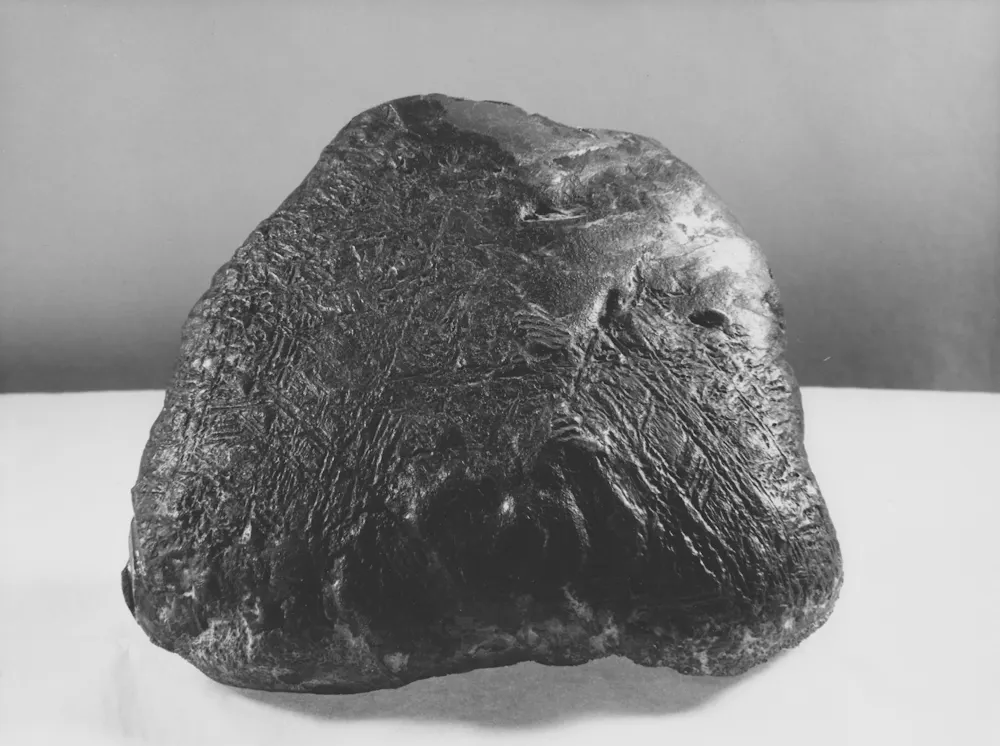
    An iron-nickel meteorite found near Fort Stockton, Texas, in 1952.
    JPL/Smithsonian Institution

    The asteroid belt

    Asteroids are the primary sources of meteorites.

    Most asteroids reside in a dense belt between Mars and Jupiter. The asteroid belt itself consists of millions of asteroids swept around and marshalled by the gravitational force of Jupiter.

    The interactions with Jupiter can perturb asteroid orbits and cause collisions. This results in debris, which can aggregate into rubble pile asteroids. These then take on lives of their own.

    It is asteroids of this type which the recent Hayabusa and Osiris-REx missions visited and returned samples from. These missions established the connection between distinct asteroid types and the meteorites that fall to Earth.

    S-class asteroids (akin to stony meteorites) are found on the inner regions of the belt, while C-class carbonaceous asteroids (akin to carbonaceous chondrites) are more commonly found in the outer regions of the belt.

    But, as the two Nature studies show, we can relate a specific meteorite type to its specific source asteroid in the main belt.

    Artist’s graphic of the asteroid belt between Mars and Jupiter.
    NASA/McREL

    One family of asteroids

    The two new studies place the sources of ordinary chondrite types into specific asteroid families – and most likely specific asteroids. This work requires painstaking back-tracking of meteoroid trajectories, observations of individual asteroids, and detailed modelling of the orbital evolution of parent bodies.

    The study led by Miroslav Brož reports that ordinary chondrites originate from collisions between asteroids larger than 30 kilometres in diameter that occurred less than 30 million years ago.

    The Koronis and Massalia asteroid families provide appropriate body sizes and are in a position that leads to material falling to Earth, based on detailed computer modelling. Of these families, asteroids Koronis and Karin are likely the dominant sources of H chondrites. Massalia (L) and Flora (LL) families are by far the main sources of L- and LL-like meteorites.

    The study led by Michaël Marsset further documents the origin of L chondrite meteorites from Massalia.

    It compiled spectroscopic data – that is, characteristic light intensities which can be fingerprints of different molecules – of asteroids in the belt between Mars and Jupiter. This showed that the composition of L chondrite meteorites on Earth is very similar to that of the Massalia family of asteroids.

    The scientists then used computer modelling to show an asteroid collision that occurred roughly 470 million years ago formed the Massalia family. Serendipitously, this collision also resulted in abundant fossil meteorites in Ordovician limestones in Sweden.

    In determining the source asteroid body, these reports provide the foundations for missions to visit the asteroids responsible for the most common outerspace visitors to Earth. In understanding these source asteroids, we can view the events that shaped our planetary system.

    Trevor Ireland receives funding from the Australian Research Council for research into the samples returned by the Hayabusa and Osiris-REx missions. He is a past President of the Meteoritical Society, the international organisation responsible for classification and cataloguing meteorites.

    ref. New research shows most space rocks crashing into Earth come from a single source – https://theconversation.com/new-research-shows-most-space-rocks-crashing-into-earth-come-from-a-single-source-241455

    MIL OSI AnalysisEveningReport.nz

  • MIL-OSI Video: Colombia: Progress and Challenges in the Peace Agreement -Security Council Briefing | United Nations

    Source: United Nations (Video News)

    The Head of the United Nations Verification Mission in Colombia (UNVMIC), Carlos Ruiz Massieu, today (15 Oct) told the Security Council that “historic progress has been made” in the implementation of the peace agreement, “but much remains to be done.” He welcomed the rapid response plan, or “Plan de Choque” being developed by the Minister of the Interior and other stakeholders.

    The plan, Ruiz Massieu said, “is a new instrument that should serve to energize implementation.”

    The UNVMIC Chief said, “we remain encouraged by the Government’s commitment to advancing the rural reform chapter of the Agreement – provisions that have a transformative potential, attacking structural causes of the conflict, but which had lagged in their implementation in previous years.”

    He said that as a result, “more land is being distributed and formalized for those in need, bringing the promised benefits of peace to landless peasants and those dispossessed of it during the conflict.”

    Ruiz Massieu said, “in some territories, signatories to the Agreement and social leaders continue to be the target of violence, pressure and threats from armed actors fighting for territorial control and strategic routes linked to illicit economies.”

    He noted that since the beginning of the reintegration process, five former territorial areas for training and reintegration (TATRs) have had to be relocated for these reasons

    Ruiz Massieu said, “the difficult situation in some areas continues to impact the lives of communities that are caught in the crossfire and subjected to condemnable phenomena such as the recruitment of minors, displacement and confinement.”

    Colombia’s Foreign Minister Luis Gilberto Murillo for his part said, “with the firm commitment to fulfil what has been agreed and to territorialize peace, we have developed a new strategic framework for peace, where effective and comprehensive compliance with the 2016 agreement becomes an inescapable requirement, unavoidable for the sustainability of strategic proposals surrounding territorial transformation.”

    On women’s participation in negotiation and peacebuilding, he said it was “not only is a question of justice, but it is crucial to ensure stronger and more durable agreements.”

    For this reason, he continued, “the Colombian government has formulated and is implementing a feminist foreign policy linked to the precepts of the women, peace and security agenda. Included in Security Council Resolution 1325”

    Outside the Council, Switzerland’s representative Riccarda Christiana Chanda read a statement on behalf of Ecuador, France, Guyana, Japan, Malta, the Republic of Korea, Sierra Leone, Slovenia, Switzerland, the United Kingdom, and the United States on Women Peace and Security.

    Chanda said, “during a visit of the Security Council to Colombia in February of this year, we were able to engage meaningfully with former combatants, victim representatives, women’s organizations, indigenous and Afro-Colombian communities to discuss the progress made and remaining obstacles in the comprehensive implementation of the peace agreement. And what we have witnessed over and over again, was the urgent call for improved security guarantees, equitable land distribution, and the successful social, political, and economic reintegration of former combatants as well as the crucial implementation of gender provisions and the ethnic chapter of the Peace Agreement.”

    UNVMIC was established by the UN Security Council pursuant to resolution 2366 (2017), adopted unanimously on 10 July 2017. The resolution followed a joint request for UN support from the Government of Colombia and the then Revolutionary Armed Forces of Colombia–People’s Army (FARC-EP).

    https://www.youtube.com/watch?v=iaI6rgXNDS4

    MIL OSI Video

  • MIL-Evening Report: A new book reveals much of Trump’s success is based on a myth he is a self-made billionaire

    Source: The Conversation (Au and NZ) – By John Hawkins, Senior Lecturer, Canberra School of Politics, Economics and Society, University of Canberra

    Lucky Loser tells the story of Donald Trump’s less-than-stellar business career and how he was able to misrepresent it as a success.

    It is written by New York Times investigative journalists, Russ Buettner and Susanne Craig. Both have won Pulitzer Prizes for earlier analyses of Trump. Another badge of honour is Trump sued them – and lost.

    They are by no means the first writers to expose the Potemkin village that is Trump’s business empire. A telling insider account came from Trump’s niece, psychologist Mary Trump, who revealed the creator of Donald’s fortune was his father Fred.


    Lucky Loser: How Donald Trump Squandered His Father’s Fortune and Created the Illusion of Success – Russ Buettner and Susanne Craig (Bodley Head)


    Setting things straight

    However, at more than 500 pages, including more than 40
    pages of notes on sources, this new book is the most comprehensive rendering. It is detailed, clearly written and has been well-reviewed in the financial press and by economic historian Brad de Long.

    The authors aim to draw on financial statements and interviews to “set straight Donald Trump’s chaotic onslaught of untruths and misdirection”.

    A large part of the Trump mythology is the lie that he is a self-made billionaire. In the presidential debate with Hillary Clinton, Trump sought to downplay the contribution of his father, saying “my father gave me a very small loan”. The book reveals his father’s contribution, in today’s money, was around half a billion US dollars.

    Trump’s first piece of luck was being born the son of hard-working, cautious and competent residential property developer Fred Trump, the son of a German immigrant. His second was that Fred’s eldest son did not have the ruthless drive to become Fred’s successor, and Fred did not consider his daughters as potential successors. So despite some characteristics that were the antithesis of his father, Donald became his heir.

    The book describes Fred’s career in some detail. The first hundred pages are mostly about him. Once Fred stepped back, Trump diversified his father’s company to form what the authors term

    an eclectic conglomerate untethered from any core competency.

    Another piece of luck was been chosen to star in the reality television series The Apprentice, from which he made a lot of money, including from licensing deals, for the small amount of time he spent on it.

    The producers of this series have a lot to answer for, as they wanted to present their star as the astute businessman they knew him not to be. As they said, it was “not a documentary”. But it enormously and misleadingly raised Trump’s profile.

    Wins followed by losses

    The authors describe how some of Trump’s ventures, such as the development of Trump Tower, went well as the Manhattan property market boomed. He also profited from some “greenmailing” (buying shares in a company with the stated or implied intention of taking it over and then selling the shares at a higher price), facilitated by exaggerated accounts in the media of his wealth.

    But Trump used up much of the proceeds of his few successes covering his losses on a range of his other business ventures.

    Among his notable failures was Trump University, where he paid A$37 million to settle lawsuits for fraud. Many other property projects, Scottish golf courses, Trump Ice bottled water and Trump Mortgage, never turned a profit. And the punters were not the only ones losing money in Trump casinos.

    While he has fought to keep them secret, what has emerged from Trump’s tax returns are a series of huge losses.

    A conundrum not really addressed in the book is why so many bankers were willing to lend to him.


    Read more:
    What would a second Trump presidency mean for the global economy?


    The book concentrates on Trump’s career before the 2016 election, when the flawed US electoral system turned his almost 3 million vote loss on the popular vote into a win in the electoral college. As president, he disregarded conflicts of interest. As the authors note, parties wanting to influence the president could funnel money to him by booking blocks of rooms at his hotel.

    After 81 million Americans voted to fire him in 2020, Trump’s businesses again performed poorly.

    Trump’s current wealth is estimated by Forbes at A$5.7 billion (less than it was a decade ago). But about half of this is from his majority stake in Truth Social, promoted as a right-wing alternative to Twitter. (Now, it could be said, an even more right-wing forum than X.) It has tiny and falling revenues and makes large losses. If Trump loses the election, its value will probably soon be close to zero. It is regarded as a “meme stock”.

    Buettner and Craig conclude Trump “would have been better off betting on the sharemarket than on himself”. Analysis cited in The Economist in 2018 concluded that had Trump just put the money from his father into a sharemarket index fund he would have had A$2.9 billion in 2018. Given subsequent rises in the US stockmarket that would have grown to around A$5.9 billion by now, more than most estimates of his wealth.

    Forbes reached a similar conclusion, as did De Long and US political commentator Professor Robert Reich. The self-described business genius destroyed rather than created value.

    A poor tycoon and a poor president

    This business record of mismanaging an inheritance is reflected in Trump’s economic performance as president. He inherited the world’s largest economy from Obama. By the end of his term it was more than 10% smaller than China’s economy. Historians rank him one of the worst performing presidents on economic management (and much else). The public gave him the lowest approval ratings during his presidential term.

    Trump has indeed been a “lucky loser”. But if this deeply flawed man is returned to the presidency, the world will be an unlucky loser.


    Read more:
    From mass deportations to huge tariff hikes, here’s what Trump’s economic program would do to the US and Australia


    John Hawkins does not work for, consult, own shares in or receive funding from any company or organisation that would benefit from this article, and has disclosed no relevant affiliations beyond their academic appointment.

    ref. A new book reveals much of Trump’s success is based on a myth he is a self-made billionaire – https://theconversation.com/a-new-book-reveals-much-of-trumps-success-is-based-on-a-myth-he-is-a-self-made-billionaire-240648

    MIL OSI AnalysisEveningReport.nz

  • MIL-OSI New Zealand: DOC Northland readies for a busy summer

    Source: Department of Conservation

    Date:  17 October 2024

    Many sites are already booked out over the peak Christmas and New Year period, but there are still opportunities for those looking to explore Northland’s natural beauty over the upcoming summer period.

    DOC campsites offer affordable holiday options in pristine settings, and staff work hard to ensure campers can enjoy the summer season with minimal disruptions, says Bronwyn Bauer Hunt, Operations Manager Te Pēwhairangi (Bay of Islands).

    “Northland’s DOC campsites have always been a favourite for summer holidaymakers, offering unique experiences from coastal views to tranquil bush settings. We encourage people to plan ahead and book early where possible, especially during peak times and be aware of the rules in place to protect these special places.”

    “Our islands have special biodiversity values and are home to threatened plant and animal species, some of which only exist in a few places. Wildfire can be devastating to these native ecosystems and we are very concerned about the threat of pest seaweed Caulerpa,” says Bronwyn.

    Background information

    Important information for campers and day trippers

    • Fires: Visitors are reminded not to light fires on any of the islands due to the significant risk to local wildlife and ecosystems.
    • Biosecurity: It’s vital to follow biosecurity rules to protect these fragile environments—clean your gear and check for pests before visiting. It is illegal to fish or anchor a vessel in the defined controlled area of Te Rāwhiti Inlet to help control the spread of Caulerpa.
    • Marine Mammal Sanctuary Bay of Islands: Please respect the sanctuary rules and avoid entering designated safe zones to protect dolphins and other marine life.
    • Dogs: Dogs are not permitted at DOC campsites and areas to prevent disturbance or harm to native wildlife.

    Northland campsite availability for summer 2024/2025:

    While some campsites are booked solid through the busy holiday period, others still have availability for those seeking an adventure later in the summer.

    • Uretiti Campsite—50% availability from Christmas onwards, with more space opening up after the peak holiday period.
    • Trounson Kauri Park and Puketi campsites—plenty of availability through December and January.
    • Puriri, Waikahoa, Urupukapuka Island Campsites—fully booked until mid-January, with availability after that.
    • Otamure Campsite—booked out until the end of January, with some availability from February onwards.

    Some campsites do not need to be booked and operate on a first-come, first-served basis.

    How to camp responsibly:

    • Be prepared—check the latest information on weather, travel conditions, wildlife, walking tracks, and the gear you’ll need before heading out.
    • Respect nature—use biodegradable products, and keep your washing away from rivers, lakes, and the ocean to protect local ecosystems. Most camps have a pack in pack out policy.
    • Check campsite rules—understand where to pitch your tent and whether there are fire restrictions before lighting any outdoor fires.
    • Plan for waste—not all campsites have waste disposal, so campers should take rubbish with them when leaving.
    • Book early—secure your spot at a DOC campsite by booking in advance, especially during peak periods.

    “A lot of these islands are also pest free so checking your boat for any rodent stowaways and other unwanted pests is vital. Dogs are not permitted on islands managed by DOC as they disturb or threaten wildlife.’’

    There is a total fire ban on conservation islands in Northland. Anyone who lights an unauthorised fire could face up to two years’ imprisonment or a fine of up to $200,000, plus the costs of the damage and putting out the fire.

    Contact

    For media enquiries contact:

    Email: media@doc.govt.nz

    MIL OSI New Zealand News

  • MIL-OSI New Zealand: Brunei Darussalam

    Source: New Zealand Ministry of Foreign Affairs and Trade – Safe Travel

    • Reviewed: 18 November 2022, 09:26 NZDT
    • Still current at: 17 October 2024

    Related news features

    If you are planning international travel at this time, please read our COVID-19 related travel advice here, alongside our destination specific travel advice below.

    Exercise increased caution in Brunei Darussalam (level 2 of 4).

    Brunei Darussalam

    Crime
    Petty crime such as theft and burglary can occur in Brunei Darussalam. We advise New Zealanders to be alert to their surroundings at all times and take steps to safeguard and secure their personal belongings.

    Civil unrest
    Civil unrest is extremely rare in Brunei Darussalam, but protests and demonstrations could have the potential to result in violence. We advise monitoring local media and following any instructions from local authorities.

    General travel advice
    New Zealanders in Brunei Darussalam are strongly advised to familiarise themselves with and observe local laws and customs, which can be very different to New Zealand. This includes in relation to alcohol and tobacco, and public expression of political views.

    Brunei Darussalam has a dual legal system with both civil law and syariah (sharia) law. Both laws include provisions for corporal and capital punishments. Penalties for possession, use or trafficking of illegal drugs are severe and can include the death penalty, physical punishment, and lengthy imprisonment.

    Further information about the Syariah Penal Code can be found on Brunei Darussalam’s Attorney General’s Chambers website. A non-exhaustive list of illegal activities under syariah law includes blasphemy, sodomy, and adultery. Syariah law applies to Muslims, non-Muslims, and foreigners.

    New Zealanders are advised to respect religious, social and cultural traditions in Brunei Darussalam to avoid offending local sensitivities (including around members of the Royal Family and during religious occasions). Modesty and discretion should be exercised in both dress and behaviour.

    New Zealanders travelling or living in Brunei Darussalam should have a comprehensive travel insurance policy in place that includes provision for medical evacuation by air.

    New Zealanders in Brunei Darussalam are encouraged to register their details with the Ministry of Foreign Affairs and Trade.


    The New Zealand High Commission Kuala Lumpur, Malaysia is accredited to Brunei Darussalam

    Street Address Level 21, Menara IMC, 8 Jalan Sultan Ismail, Kuala Lumpur 50250 Telephone +60 3 2078 2533 Fax +60 3 2078 0387 Email klinfo@mfat.govt.nz Web Site http://www.mfat.govt.nz/malaysia Hours Mon-Fri 0830am to 1230 hrs (reception); Mon-Thurs 0800-1630 hrs, Fri 0800-1600 hrs (telephone enquiries and pre-arranged appointments)

    See our regional advice for South East Asia

    MIL OSI New Zealand News

  • MIL-OSI Economics: Members explore ways of boosting developing economies’ integration into global trade

    Source: WTO

    Headline: Members explore ways of boosting developing economies’ integration into global trade

    This was the first meeting of the Committee’s negotiating session since the 13th WTO Ministerial Conference (MC13), at which ministers adopted a Declaration on Special and Differential Treatment that seeks to ensure that developing economies — including LDCs — receive timely training and technical assistance to help them implement standards or technical regulations. The Declaration also provides guidance for members to continue working towards enhancing the implementation of special and differential treatments in the Agreement on the Application of Sanitary and Phytosanitary Measures and the Agreement on Technical Barriers to Trade, and instructs them to report on any progress by December 2024. The Declaration also instructs WTO members to continue to work on improving the application of special and differential treatment provisions, and to report on progress to the General Council before the 14th WTO Ministerial Conference (MC14).
    There are currently three facilitators working with members on the Agreement-specific proposals on special and differential treatment tabled by the G90 group, covering sanitary and phytosanitary measures and technical barriers to trade, technology transfer for LDCs and trade-related investment measures, respectively.
    On sanitary and phytosanitary measures (SPS) and technical barriers to trade (TBT), the facilitator from Singapore updated the Committee on recent informal discussions. Members explored synergies between the work in the Special Session and in the two Committees respectively overseeing these issues. The chairpersons of the SPS and TBT Committees — Cecilia Risolo from Argentina and Daniela García from Ecuador, respectively — provided updates on their work to fulfil the MC13 mandate for a precise, effective and operational implementation of special and differential treatment provisions of the SPS and TBT Agreements.
    The facilitators for technology transfer to LDCs (Saint Vincent and the Grenadines) and for trade-related investment measures (Brazil) also provided updates on their consultations to advance the work in their respective areas.
    The three facilitators suggested holding thematic sessions with a view to achieving a shared understanding of the challenges faced by developing economies, including LDCs, and the solutions suggested by the G90. Members are considering these suggestions.
    Ambassador Kadra Ahmed Hassan of Djibouti, Chair of the Committee on Trade and Development in Special Session, encouraged the facilitators to continue engaging with members. “If we are to deliver on development at MC14, we need to keep moving forward,” she said.
    Developing economies and LDCsreceive special and differential treatment provisions according to over 150 provisions of the WTO agreements. These include access to technical assistance activities and longer transition periods to implement agreements and decisions. The negotiations taking place in the Special Session of the Committee on Trade and Development are mandated by Paragraph 44 of the 2001 Doha Ministerial Declaration.
    More information on special and differential treatment is available here.

    Share

    MIL OSI Economics

  • MIL-OSI USA: The Marshall Star for October 16, 2024

    Source: NASA

    NASA’s Europa Clipper has embarked on its long voyage to Jupiter, where it will investigate Europa, a moon with an enormous subsurface ocean that may have conditions to support life. The spacecraft launched at 11:06 a.m. CDT on Oct. 14 aboard a SpaceX Falcon Heavy rocket from Launch Pad 39A at NASA’s Kennedy Space Center.

    The largest spacecraft NASA ever built for a mission headed to another planet, Europa Clipper also is the first NASA mission dedicated to studying an ocean world beyond Earth. The spacecraft will travel 1.8 billion miles on a trajectory that will leverage the power of gravity assists, first to Mars in four months and then back to Earth for another gravity assist flyby in 2026. After it begins orbiting Jupiter in April 2030, the spacecraft will fly past Europa 49 times.
    “Congratulations to our Europa Clipper team for beginning the first journey to an ocean world beyond Earth,” said NASA Administrator Bill Nelson. “NASA leads the world in exploration and discovery, and the Europa Clipper mission is no different. By exploring the unknown, Europa Clipper will help us better understand whether there is the potential for life not just within our solar system, but among the billions of moons and planets beyond our Sun.”
    Approximately five minutes after liftoff, the rocket’s second stage fired up and the payload fairing, or the rocket’s nose cone, opened to reveal Europa Clipper. About an hour after launch, the spacecraft separated from the rocket. Ground controllers received a signal soon after, and two-way communication was established at 12:13 p.m. with NASA’s Deep Space Network facility in Canberra, Australia. Mission teams celebrated as initial telemetry reports showed Europa Clipper is in good health and operating as expected.
    “We could not be more excited for the incredible and unprecedented science NASA’s Europa Clipper mission will deliver in the generations to come,” said Nicky Fox, associate administrator, Science Mission Directorate at NASA Headquarters. “Everything in NASA science is interconnected, and Europa Clipper’s scientific discoveries will build upon the legacy that our other missions exploring Jupiter – including Juno, Galileo, and Voyager – created in our search for habitable worlds beyond our home planet.”
    The main goal of the mission is to determine whether Europa has conditions that could support life. Europa is about the size of our own Moon, but its interior is different. Information from NASA’s Galileo mission in the 1990s showed strong evidence that under Europa’s ice lies an enormous, salty ocean with more water than all of Earth’s oceans combined. Scientists also have found evidence that Europa may host organic compounds and energy sources under its surface.
    If the mission determines Europa is habitable, it may mean there are more habitable worlds in our solar system and beyond than imagined.
    “We’re ecstatic to send Europa Clipper on its way to explore a potentially habitable ocean world, thanks to our colleagues and partners who’ve worked so hard to get us to this day,” said Laurie Leshin, director, NASA’s Jet Propulsion Laboratory (JPL). “Europa Clipper will undoubtedly deliver mind-blowing science. While always bittersweet to send something we’ve labored over for years off on its long journey, we know this remarkable team and spacecraft will expand our knowledge of our solar system and inspire future exploration.”
    In 2031, the spacecraft will begin conducting its science-dedicated flybys of Europa. Coming as close as 16 miles to the surface, Europa Clipper is equipped with nine science instruments and a gravity experiment, including an ice-penetrating radar, cameras, and a thermal instrument to look for areas of warmer ice and any recent eruptions of water. As the most sophisticated suite of science instruments NASA has ever sent to Jupiter, they will work in concert to learn more about the moon’s icy shell, thin atmosphere, and deep interior.
    To power those instruments in the faint sunlight that reaches Jupiter, Europa Clipper also carries the largest solar arrays NASA has ever used for an interplanetary mission. With arrays extended, the spacecraft spans 100 feet from end to end. With propellant loaded, it weighs about 13,000 pounds.
    In all, more than 4,000 people have contributed to Europa Clipper mission since it was formally approved in 2015.
    “As Europa Clipper embarks on its journey, I’ll be thinking about the countless hours of dedication, innovation, and teamwork that made this moment possible,” said Jordan Evans, project manager, JPL. “This launch isn’t just the next chapter in our exploration of the solar system; it’s a leap toward uncovering the mysteries of another ocean world, driven by our shared curiosity and continued search to answer the question, ‘are we alone?’”
    Europa Clipper’s three main science objectives are to determine the thickness of the moon’s icy shell and its interactions with the ocean below, to investigate its composition, and to characterize its geology. The mission’s detailed exploration of Europa will help scientists better understand the astrobiological potential for habitable worlds beyond our planet.
    Managed by Caltech in Pasadena, California, JPL leads the development of the Europa Clipper mission in partnership with the Johns Hopkins Applied Physics Laboratory (APL) in Laurel, Maryland, for NASA’s Science Mission Directorate. The main spacecraft body was designed by APL in collaboration with JPL and NASA’s Goddard Space Flight Center, Marshall Space Flight Center, and Langley Research Center. The Planetary Missions Program Office at Marshall executes program management of the Europa Clipper mission.
    NASA’s Launch Services Program, based at NASA Kennedy, managed the launch service for the Europa Clipper spacecraft.
    › Back to Top

    [embedded content]

    Get ready, get set, and let’s go take a look back at NASA’s 2024 Human Exploration Rover Challenge! Watch as talented student teams from around the world gather in Huntsville for the 30th annual competition to push the boundaries of innovation and engineering. These student teams piloted their human-powered rovers over simulated lunar and Martian terrain for a chance at winning an award during this Artemis student challenge. From jaw-dropping triumphs to unexpected setbacks, this year’s competition was a thrilling ride from start to finish. Buckle up and enjoy the ride as you witness the future of space exploration unfold!
    The challenge is managed by NASA’s Southeast Regional Office of STEM Engagement at the agency’s Marshall Space Flight Center. Learn more about the challenge.
    › Back to Top

    NASA’s Chandra X-ray Observatory and other telescopes have identified a supermassive black hole that has torn apart one star and is now using that stellar wreckage to pummel another star or smaller black hole, as described in our latest press release. This research helps connect two cosmic mysteries and provides information about the environment around some of the bigger types of black holes.

    This artist’s illustration shows a disk of material (red, orange, and yellow) that was created after a supermassive black hole (depicted on the right) tore apart a star through intense tidal forces. Over the course of a few years, this disk expanded outward until it intersected with another object – either a star or a small black hole – that is also in orbit around the giant black hole. Each time this object crashes into the disk, it sends out a burst of X-rays detected by Chandra. The inset shows Chandra data (purple) and an optical image of the source from Pan-STARRS (red, green, and blue).
    In 2019, an optical telescope in California noticed a burst of light that astronomers later categorized as a “tidal disruption event”, or TDE. These are cases where black holes tear stars apart if they get too close through their powerful tidal forces. Astronomers gave this TDE the name of AT2019qiz.
    Meanwhile, scientists were also tracking instances of another type of cosmic phenomena occasionally observed across the Universe. These were brief and regular bursts of X-rays that were near supermassive black holes. Astronomers named these events “quasi-periodic eruptions,” or QPEs.
    This latest study gives scientists evidence that TDEs and QPEs are likely connected. The researchers think that QPEs arise when an object smashes into the disk left behind after the TDE. While there may be other explanations, the authors of the study propose this is the source of at least some QPEs.
    In 2023, astronomers used both Chandra and Hubble to simultaneously study the debris left behind after the tidal disruption had ended. The Chandra data were obtained during three different observations, each separated by about 4 to 5 hours. The total exposure of about 14 hours of Chandra time revealed only a weak signal in the first and last chunk, but a very strong signal in the middle observation.
    From there, the researchers used NASA’s Neutron Star Interior Composition Explorer (NICER) to look frequently at AT2019qiz for repeated X-ray bursts. The NICER data showed that AT2019qiz erupts roughly every 48 hours. Observations from NASA’s Neil Gehrels Swift Observatory and India’s AstroSat telescope cemented the finding.
    The ultraviolet data from Hubble, obtained at the same time as the Chandra observations, allowed the scientists to determine the size of the disk around the supermassive black hole. They found that the disk had become large enough that if any object was orbiting the black hole and took about a week or less to complete an orbit, it would collide with the disk and cause eruptions.
    This result has implications for searching for more quasi-periodic eruptions associated with tidal disruptions. Finding more of these would allow astronomers to measure the prevalence and distances of objects in close orbits around supermassive black holes. Some of these may be excellent targets for the planned future gravitational wave observatories.
    The paper describing these results appears in the Oct. 9 issue of the journal Nature. The first author of the paper is Matt Nicholl of Queen’s University Belfast in Ireland.
    NASA’s Marshall Space Flight Center manages the Chandra program. The Smithsonian Astrophysical Observatory’s Chandra X-ray Center controls science operations from Cambridge, Massachusetts, and flight operations from Burlington, Massachusetts.
    › Back to Top

    The study of X-ray emission from astronomical objects reveals secrets about the universe at the largest and smallest spatial scales. Celestial X-rays are produced by black holes consuming nearby stars, emitted by the million-degree gas that traces the structure between galaxies, and can be used to predict whether stars may be able to host planets hospitable to life. X-ray observations have shown that most of the visible matter in the universe exists as hot gas between galaxies and have conclusively demonstrated that the presence of “dark matter” is needed to explain galaxy cluster dynamics, that dark matter dominates the mass of galaxy clusters, and that it governs the expansion of the cosmos.

    X-ray observations also enable us to probe mysteries of the universe on the smallest scales. X-ray observations of compact objects such as white dwarfs, neutron stars, and black holes allow us to use the universe as a physics laboratory to study conditions that are orders of magnitude more extreme in terms of density, pressure, temperature, and magnetic field strength than anything that can be produced on Earth. In this astrophysical laboratory, researchers expect to reveal new physics at the subatomic scale by conducting investigations such as probing the neutron star equation of state and testing quantum electrodynamics with observations of neutron star atmospheres.
    At NASA’s Marshall Space Flight Center, a team of scientists and engineers is building, testing, and flying innovative optics that bring the universe’s X-ray mysteries into sharper focus.
    Unlike optical telescopes that create images by reflecting or refracting light at near-90-degree angles (normal incidence), focusing X-ray optics must be designed to reflect light at very small angles (grazing incidence). At normal incidence, X-rays are either absorbed by the surface of a mirror or penetrate it entirely. However, at grazing angles of incidence, X-rays reflect very efficiently due to an effect called total external reflection. In grazing incidence, X-rays reflect off the surface of a mirror like rocks skipping on the surface of a pond.
    A classic design for astronomical grazing incidence optics is the Wolter-I prescription, which consists of two reflecting surfaces, a parabola and hyperbola (see figure below). This optical prescription is revolved around the optical axis to produce a full-shell mirror (i.e., the mirror spans the full circumference) that resembles a gently tapered cone. To increase the light collecting area, multiple mirror shells with incrementally larger diameters and a common focus are fabricated and nested concentrically to comprise a mirror module assembly (MMA).
    Focusing optics are critical to studying the X-ray universe because, in contrast to other optical systems like collimators or coded masks, they produce high signal-to-noise images with low background noise. Two key metrics that characterize the performance of X-ray optics are angular resolution, which is the ability of an optical system to discriminate between closely spaced objects, and effective area, which is the light collecting area of the telescope, typically quoted in units of cm2. Angular resolution is typically measured as the half-power diameter (HPD) of a focused spot in units of arcseconds. The HPD encircles half of the incident photons in a focused spot and measures the sharpness of the final image; a smaller number is better. 

    Marshall has been building and flying lightweight, full-shell, focusing X-ray optics for over three decades, always meeting or exceeding angular resolution and effective area requirements. Marshall utilizes an electroformed nickel replication technique to make these thin full-shell X-ray optics from nickel alloy.
    X-ray optics development at Marshall began in the early 1990s with the fabrication of optics to support NASA’s Advanced X-ray Astrophysics Facility (AXAF-S) and then continued via the Constellation-X technology development programs. In 2001, Marshall launched a balloon payload that included two modules each with three mirrors, which produced the first focused hard X-ray images of an astrophysical source by imaging Cygnus X-1, GRS 1915, and the Crab Nebula. This initial effort resulted in several follow-up missions over the next 12 years and became known as the High Energy Replicated Optics (HERO) balloon program.
    In 2012, the first of four sounding rocket flights of the Focusing Optics X-ray Solar Imager (FOXSI) flew with Marshall optics onboard, producing the first focused images of the Sun at energies greater than 5 keV. In 2019 the Astronomical Roentgen Telescope X-ray Concentrator (ART-XC) instrument on the Spectr-Roentgen-Gamma Mission launched with seven Marshall-fabricated X-ray MMAs, each containing 28 mirror shells. ART-XC is currently mapping the sky in the 4-30 keV hard X-ray energy range, studying exotic objects like neutron stars in our own galaxy as well as active galactic nuclei, which are spread across the visible universe. In 2021, the Imaging X-ray Polarimetry Explorer (IXPE), flew and is now performing extraordinary science with a Marshall-led team using three, 24-shell MMAs that were fabricated and calibrated in-house.
    Most recently, in 2024, the fourth FOXSI sounding rocket campaign launched with a high-resolution Marshall MMA. The optics achieved 9.5 arcsecond HPD angular resolution during pre-flight test with an expected 7 arcsecond HPD in gravity-free flight, making this the highest angular resolution flight observation made with a nickel-replicated X-ray optic. Currently Marshall is fabricating an MMA for the Rocket Experiment Demonstration of a Soft X-ray (REDSoX) polarimeter, a sounding rocket mission that will fly a novel soft X-ray polarimeter instrument to observe active galactic nuclei. The REDSoX MMA optic will be 444 mm in diameter, which will make it the largest MMA ever produced by MSFC and the second largest replicated nickel X-ray optic in the world.
    The ultimate performance of an X-ray optic is determined by errors in the shape, position, and roughness of the optical surface. To push the performance of X-ray optics toward even higher angular resolution and achieve more ambitious science goals, Marshall is currently engaged in a fundamental research and development effort to improve all aspects of full-shell optics fabrication.

    Given that these optics are made with the electroformed nickel replication technique, the fabrication process begins with creation of a replication master, called the mandrel, which is a negative of the desired optical surface. First, the mandrel is figured and polished to specification, then a thin layer of nickel alloy is electroformed onto the mandrel surface. Next, the nickel alloy layer is removed to produce a replicated optical shell, and finally the thin shell is attached to a stiff holding structure for use.
    Each step in this process imparts some degree of error into the final replicated shell. Research and development efforts at Marshall are currently concentrating on reducing distortion induced during the electroforming metal deposition and release steps. Electroforming-induced distortion is caused by material stress built into the electroformed material as it deposits onto the mandrel. Decreasing release-induced distortion is a matter of reducing adhesion strength between the shell and mandrel, increasing strength of the shell material to prevent yielding, and reducing point defects in the release layer.
    Additionally, verifying the performance of these advanced optics requires world-class test facilities. The basic premise of testing an optic designed for X-ray astrophysics is to place a small, bright X-ray source far away from the optic. If the angular size of the source, as viewed from the optic, is smaller than the angular resolution of the optic, the source is effectively simulating X-ray starlight. Due to the absorption of X-rays by air, the entire test facility light path must be placed inside a vacuum chamber.
    At the center, a group of scientists and engineers operate the Marshall 100-meter X-ray beamline, a world-class end-to-end test facility for flight and laboratory X-ray optics, instruments, and telescopes. As per the name, it consists of a 100-meter-long vacuum tube with an 8-meter-long, 3-meter-diameter instrument chamber and a variety of X-ray sources ranging from 0.25 – 114 keV. Across the street sits the X-Ray and Cryogenic Facility (XRCF), a 527-meter-long beamline with an 18-meter-long, 6-meter-diameter instrument chamber. These facilities are available for the scientific community to use and highlight the comprehensive optics development and test capability that Marshall is known for.
    Within the X-ray astrophysics community there exist a variety of angular resolution and effective area needs for focusing optics. Given its storied history in X-ray optics, Marshall is uniquely poised to fulfill requirements for large or small, medium- or high-angular-resolution X-ray optics. To help guide technology development, the astrophysics community convenes once per decade to produce a decadal survey. The need for high-angular-resolution and high-throughput X-ray optics is strongly endorsed by the National Academies of Sciences, Engineering, and Medicine report, Pathways to Discovery in Astronomy and Astrophysics for the 2020s.In pursuit of this goal, Marshall is continuing to advance the state of the art in full-shell optics. This work will enable the extraordinary mysteries of the X-ray universe to be revealed.
    › Back to Top

    NASA’s Hubble Space Telescope and New Horizons spacecraft simultaneously set their sights on Uranus recently, allowing scientists to make a direct comparison of the planet from two very different viewpoints. The results inform future plans to study like types of planets around other stars.

    Astronomers used Uranus as a proxy for similar planets beyond our solar system, known as exoplanets, comparing high-resolution images from Hubble to the more-distant view from New Horizons. This combined perspective will help scientists learn more about what to expect while imaging planets around other stars with future telescopes.
    “While we expected Uranus to appear differently in each filter of the observations, we found that Uranus was actually dimmer than predicted in the New Horizons data taken from a different viewpoint,” said lead author Samantha Hasler of the Massachusetts Institute of Technology in Cambridge and New Horizons science team collaborator.
    Direct imaging of exoplanets is a key technique for learning about their potential habitability, and offers new clues to the origin and formation of our own solar system. Astronomers use both direct imaging and spectroscopy to collect light from the observed planet and compare its brightness at different wavelengths. However, imaging exoplanets is a notoriously difficult process because they’re so far away. Their images are mere pinpoints and so are not as detailed as the close-up views that we have of worlds orbiting our Sun. Researchers can also only directly image exoplanets at “partial phases,” when only a portion of the planet is illuminated by their star as seen from Earth.
    Uranus was an ideal target as a test for understanding future distant observations of exoplanets by other telescopes for a few reasons. First, many known exoplanets are also gas giants similar in nature. Also, at the time of the observations, New Horizons was on the far side of Uranus, 6.5 billion miles away, allowing its twilight crescent to be studied – something that cannot be done from Earth. At that distance, the New Horizons view of the planet was just several pixels in its color camera, called the Multispectral Visible Imaging Camera.
    On the other hand, Hubble, with its high resolution, and in its low-Earth orbit 1.7 billion miles away from Uranus, was able to see atmospheric features such as clouds and storms on the day side of the gaseous world.
    “Uranus appears as just a small dot on the New Horizons observations, similar to the dots seen of directly imaged exoplanets from observatories like Webb or ground-based observatories,” Hasler said. “Hubble provides context for what the atmosphere is doing when it was observed with New Horizons.”
    The gas giant planets in our solar system have dynamic and variable atmospheres with changing cloud cover. How common is this among exoplanets? By knowing the details of what the clouds on Uranus looked like from Hubble, researchers can verify what is interpreted from the New Horizons data. In the case of Uranus, both Hubble and New Horizons saw that the brightness did not vary as the planet rotated, which indicates that the cloud features were not changing with the planet’s rotation.

    However, the importance of the detection by New Horizons has to do with how the planet reflects light at a different phase than what Hubble, or other observatories on or near Earth, can see. New Horizons showed that exoplanets may be dimmer than predicted at partial and high phase angles, and that the atmosphere reflects light differently at partial phase.
    NASA has two major upcoming observatories in the works to advance studies of exoplanet atmospheres and potential habitability.
    “These landmark New Horizons studies of Uranus from a vantage point unobservable by any other means add to the mission’s treasure trove of new scientific knowledge, and have, like many other datasets obtained in the mission, yielded surprising new insights into the worlds of our solar system,” added New Horizons principal investigator Alan Stern of the Southwest Research Institute.
    NASA’s upcoming Nancy Grace Roman Space Telescope, set to launch by 2027, will use a coronagraph to block out a star’s light to directly see gas giant exoplanets. NASA’s Habitable Worlds Observatory, in an early planning phase, will be the first telescope designed specifically to search for atmospheric biosignatures on Earth-sized, rocky planets orbiting other stars.
    “Studying how known benchmarks like Uranus appear in distant imaging can help us have more robust expectations when preparing for these future missions,” concluded Hasler. “And that will be critical to our success.”
    Launched in January 2006, New Horizons made the historic flyby of Pluto and its moons in July 2015, before giving humankind its first close-up look at one of these planetary building block and Kuiper Belt object, Arrokoth, in January 2019. New Horizons is now in its second extended mission, studying distant Kuiper Belt objects, characterizing the outer heliosphere of the Sun, and making important astrophysical observations from its unmatched vantage point in distant regions of the solar system.
    The Hubble Space Telescope has been operating for over three decades and continues to make ground-breaking discoveries that shape our fundamental understanding of the universe. Hubble is a project of international cooperation between NASA and ESA (European Space Agency). NASA’s Goddard Space Flight Center manages the telescope and mission operations. Lockheed Martin Space, based in Denver, Colorado, also supports mission operations at Goddard. The Space Telescope Science Institute in Baltimore, Maryland, which is operated by the Association of Universities for Research in Astronomy, conducts Hubble science operations for NASA.
    The Johns Hopkins Applied Physics Laboratory (APL) in Laurel, Maryland, built and operates the New Horizons spacecraft and manages the mission for NASA’s Science Mission Directorate. Southwest Research Institute, based in San Antonio and Boulder, Colorado, directs the mission via Principal Investigator Alan Stern and leads the science team, payload operations and encounter science planning. New Horizons is part of NASA’s New Frontiers program, managed by NASA’s Marshall Space Flight Center.
    › Back to Top

    Four International Space Station crew members continue waiting for their departure date as mission managers monitor weather conditions off the coast of Florida. The rest of the Expedition 72 crew stayed focused Oct. 14 on space biology and lab maintenance aboard the orbital outpost.

    NASA and SpaceX mission managers are watching unfavorable weather conditions off the Florida coast right now for the splashdown of the SpaceX Crew-8 mission with NASA astronauts Matthew Dominick, Mike Barratt, and Jeanette Epps, and Roscosmos cosmonaut Alexander Grebenkin. The homebound quartet spent Oct. 14 mostly relaxing while also continuing departure preps. Mission teams are currently targeting Dragon Endeavour’s undocking for no earlier than 2:05 a.m. CDT on Oct. 18. The Crew-8 foursome is in the seventh month of their space research mission that began on March 3.
    The other seven orbital residents will stay aboard the orbital outpost until early 2025. NASA astronaut Don Pettit is scheduled to return to Earth first in February with Roscosmos cosmonauts Alexey Ovchinin and Ivan Vagner aboard the Soyuz MS-26 crew ship. Next, station Commander Suni Williams and flight engineer Butch Wilmore are targeted to return home aboard SpaceX Dragon Freedom with SpaceX Crew-9 Commander Nick Hague, all three NASA astronauts, and Roscosmos cosmonaut Aleksandr Gorbunov.
    Williams had a light duty day Oct. 14 disassembling life support gear before working out for a cardio fitness study. Wilmore installed a new oxygen recharge tank and began transferring oxygen into tanks located in the Quest airlock. Hague collected his blood and saliva samples for incubation and cold stowage to learn how microgravity affects cellular immunity. Pettit also had a light duty day servicing biology hardware including the Cell Biology Experiment Facility, a research incubator with an artificial gravity generator, and the BioLab, which supports observations of microbes, cells, tissue cultures and more.
    The Huntsville Operations Support Center (HOSC) at NASA’s Marshall Space Flight Center provides engineering and mission operations support for the space station, the CCP, and Artemis missions, as well as science and technology demonstration missions. The Payload Operations Integration Center within HOSC operates, plans, and coordinates the science experiments onboard the space station 365 days a year, 24 hours a day.
    The first flight of Sierra Space’s Dream Chaser to the space station is now scheduled for no earlier than May 2025 to allow for completion of spacecraft testing. Dream Chaser, which will launch atop a ULA (United Launch Alliance) Vulcan rocket and later glide to a runway landing at NASA’s Kennedy Space Center, will carry cargo to the orbiting laboratory and stay on board for approximately 45 days on its first mission.
    Learn more about station activities by following the space station blog.
    › Back to Top

    MIL OSI USA News

  • MIL-OSI: PDF Solutions to Report Third Quarter Fiscal 2024 Financial Results on November 7, 2024

    Source: GlobeNewswire (MIL-OSI)

    SANTA CLARA, Calif., Oct. 16, 2024 (GLOBE NEWSWIRE) — PDF Solutions, Inc. (Nasdaq: PDFS), a leading provider of comprehensive data solutions for the semiconductor ecosystem, announced that it will release Third quarter fiscal 2024 financial results after the market close on Thursday, November 7, 2024. John Kibarian, CEO, and Adnan Raza, CFO, will host a live teleconference on Thursday, November 7, 2024, beginning at 2:00 p.m. Pacific Time / 5:00 p.m. Eastern Time to discuss the results.

    To participate on the live call, analysts and investors should pre-register at: https://register.vevent.com/register/BI1b05df01d9534a648d4fd2cd753be31c

    Registrants will receive dial-in information and a unique passcode to access the call. We encourage participants to dial-in into the call ten minutes ahead of scheduled time.

    The teleconference will also be webcast simultaneously on the Company’s website at https://ir.pdf.com/webcasts. A replay of the conference call webcast will be available after the call on the Company’s investor relations website.

    About PDF Solutions
    PDF Solutions (Nasdaq: PDFS) provides comprehensive data solutions designed to empower organizations across the semiconductor and electronics industry ecosystems to improve the yield and quality of their products and operational efficiency for increased profitability. The Company’s products and services are used by Fortune 500 companies across the semiconductor ecosystem to achieve smart manufacturing goals by connecting and controlling equipment, collecting data generated during manufacturing and test operations, and performing advanced analytics and machine learning to enable profitable, high-volume manufacturing.

    Founded in 1991, PDF Solutions is headquartered in Santa Clara, California, with operations across North America, Europe, and Asia. The Company (directly or through one or more subsidiaries) is an active member of SEMI, INEMI, TPCA, IPC, the OPC Foundation, and DMDII. For the latest news and information about PDF Solutions or to find office locations, visit https://www.pdf.com/.

    PDF Solutions and the PDF Solutions logo are trademarks or registered trademarks of PDF Solutions, Inc. or its subsidiaries.

    Company Contacts

    Adnan Raza
    Chief Financial Officer
    (408) 516-0237
    adnan.raza@pdf.com

    Sonia Segovia
    Investor Relations
    (408) 938-6491
    sonia.segovia@pdf.com

    The MIL Network

  • MIL-OSI Translation: 16/10/2024 Euro bond pricing – detailed information

    MIL ASI Translation. Region: Polish/Europe –

    Fuente: Gobierno de Polonia en poleco.

    In reference to the announcement on the valuation made on October 15 of 7-year and 15-year benchmark bonds denominated in euro with maturities of October 22, 2031 and October 22, 2039, respectively, the Ministry of Finance presents additional information on the structure of purchasers. The structure of bond purchasers was diversified. The buyers of 7-year bonds were investors from: Great Britain and Ireland (24%), Germany and Austria (17%), Benelux countries (11%), France (8%), Scandinavian countries (8%), Asia (8%), Southern Europe (7%), Central and Eastern Europe (excluding Poland) (4%), Poland (3%), United States (3%), Switzerland (2%) and other countries (5%). The entity structure of investors of 7-year bonds included: investment funds (47%), banks (22%), central banks and public institutions (18%), hedge funds (9%), insurance institutions and pension funds (3%) and other financial institutions (1%). The buyers of 15-year bonds were investors from: Germany and Austria (27%), Great Britain and Ireland (25%), Southern Europe (14%), France (9%), Central and Eastern Europe (excluding Poland) (6%), Poland (5%), Scandinavian countries (4%), Switzerland (4%), Benelux countries (2%) and others (4%). The entity structure of investors of 15-year bonds included: investment funds (58%), banks (15%), insurance institutions and pension funds (13%), hedge funds (12%), central banks and public institutions (1%) and other financial institutions (1%).

    MILES AXIS

    EDITOR’S NOTE: This article is a translation. Apologies should the grammar and/or sentence structure not be perfect.

    MIL Translation OSI

  • MIL-OSI USA: California expands access to traditional healing for substance use treatment

    Source: US State of California 2

    Oct 16, 2024

    What you need to know: California is expanding access to culturally-based substance use disorder (SUD) treatment services. Today marks the first time Medi-Cal will cover traditional health care practices that are deeply rooted in cultural practices and have been shown to improve health outcomes, particularly for individuals with SUDs. 

    Sacramento, California – Governor Gavin Newsom announced today that California is expanding access to culturally-based substance use disorder (SUD) treatment services.  

    After years of working toward this milestone, today marks the first time Medi-Cal will cover traditional health care practices in use since time immemorial. These are deeply rooted in cultural practices and have been shown to improve health outcomes, particularly for individuals with SUDs.

    Native Americans continue to be disproportionately impacted by the opioid epidemic, with higher overdose death rates than other racial and ethnic groups in the United States.

    As the home of the largest population of Native Americans in the country, California is committed to helping heal the historical wounds inflicted on tribes – including the glaring health disparities we see between Native communities and other groups. Like many of the issues that plague successive generations of Native people, those inequities can be traced back to the historical atrocities the U.S. inflicted on tribes across the country. By supporting greater access to traditional medicine and healing, we are taking another step toward a healthier, brighter future.

    Governor Gavin Newsom

    “Native American communities have long faced barriers to accessing traditional medicines and healing resources in this State,” said Tribal Affairs Secretary Christina Snider-Ashtari. “Support for these critical practices will again allow the rich and diverse Native populations who have lived here since time immemorial – along with those who now call California home – to access time-honored and tested methods to bolster wellness in Native families, communities, and tribal nations.”

    Traditional healers and natural helpers

    The Centers for Medicare & Medicaid Services’ (CMS) approval for California, alongside Arizona, New Mexico, and Oregon, allows two new categories of interventions to be covered by Medi-Cal, as developed by the state in partnership with tribal partners:  

    • The first, provided by traditional healers, includes music therapy (i.e., traditional music, songs, dancing, and drumming) and spiritual interventions (i.e., ceremonies, rituals, and herbal remedies). A traditional healer is any person currently recognized as a spiritual leader with at least two years of experience practicing in a setting recognized by a Native American tribe and who is contracted or employed by an Indian Health Care Provider (IHCP).
    • The second, provided through natural helpers, includes navigational support, psychological skill building, self-management, and trauma support. A natural helper is a health advisor who delivers health, recovery, and social supports in the context of tribal cultures. Natural helpers can be spiritual leaders, elected officials, or paraprofessionals who are trusted members of a Native American tribe.

    This marks a significant milestone in the state’s ongoing efforts to recognize the valuable contributions of traditional healing practices within the health care system. Traditional healing services have been trusted and tested methods of care for Native Americans for generations. They are deeply rooted in cultural practices and have been shown to improve health outcomes, particularly for individuals with SUDs.

    Studies have demonstrated that these culturally centered approaches can enhance engagement and recovery outcomes, making them an essential component of holistic care for Native communities. Additionally, the state recognizes that tribal communities understand themselves best – and that each tribe has different needs, traditions, and histories – so each participating IHCP will create its own process to identify and credential its own traditional healers and natural helpers.

    “CMS’ approval is first and foremost the fulfillment of the efforts of our tribal leader and Urban Indian Organization partners whose vision and steadfast advocacy made this a priority,” said State Medicaid Director Tyler Sadwith. “I am immensely proud that California tribal and Urban Indian communities now have access to culturally based traditional healing practices through Medi-Cal, marking a historic step toward health equity and honoring the rich traditions of our diverse Native communities.”

    “It is vital that we honor our traditional ways of healing and understand they are as important and valuable as Western medicine,” said Kiana Maillet, licensed therapist and owner of Hiichido Licensed Clinical Social Worker Professional Corporation. “Traditional healing is deeply engrained in our blood memory, our cultures, and our communities. Without it, we are missing a piece of who we are. As we continue to regain access to traditional ways – ways that our ancestors were punished for in the past – we move forward with healing from historical traumas and improving the health of our future generations.”

    Starting January 1, 2025, IHCPs can request Medi-Cal reimbursement for Traditional Healer and Natural Helper Services provided to residents of qualifying counties. In the coming months, the state will consult with tribes and tribal partners to develop guidance.

    Bigger picture

    In 2019, Governor Newsom apologized on behalf of the State of California to California Native American peoples, and announced the creation of the California Truth and Healing Council. Through collaborative and consultative work of the Council, the Governor’s Office of Tribal Affairs, and tribes across the state, a number of policies and programs have been developed so that the state can better address historical injustices and support tribes and tribal work in everything from health to climate. 

    Medi-Cal coverage for traditional healer and natural helper services strengthens the longstanding investments the state has made to expand SUD prevention, treatment, recovery, and harm reduction resources for California tribal and Urban Indian communities through the Tribal MAT Project

    This work also builds on the state’s broader efforts to address the opioid crisis and overdose epidemic, which is outlined in the Governor’s Master Plan for Tackling the Fentanyl and Opioid Crisis and on opioids.ca.gov, a one-stop tool for Californians seeking resources for prevention and treatment, as well as information on how California is working to hold Big Pharma and drug traffickers accountable in this crisis. More information on the state’s efforts can be found here.

    Press Releases, Recent News

    Recent news

    News What you need to know: As leaders in Republican-led states continue to block reproductive freedoms, refuse to fund summer meal programs for kids, and fail to implement early childhood education, Governor Newsom signed a new package of legislation  — building on…

    News What you need to know: A $3.5 million federal grant will fund cleanup efforts at the recently expanded San Gabriel Mountains National Monument to improve access to the site and enhance water quality on the East Fork of the San Gabriel River, a key Southern…

    News What you need to know: The state today broke ground on a project that expands ongoing restoration work at the Salton Sea to improve conditions for wildlife and surrounding communities. Most recently, $175 million in federal funding was made available to…

    MIL OSI USA News

  • MIL-OSI USA: Twelve Additional North Carolina Counties Eligible for FEMA Individual Assistance

    Source: US Federal Emergency Management Agency 2

    strong>RALEIGH, N.C. – Homeowners and renters in Cabarrus, Cherokee, Forsyth, Graham, Iredell, Lee, Nash, Rowan, Stanly, Surry, Union and Yadkin counties who had uninsured damage or losses caused by Tropical Storm Helene are now eligible to apply for FEMA disaster assistance.

    FEMA may be able to help with serious needs, displacement, temporary lodging, basic home repair costs, personal property loss or other disaster-caused needs. Previously, Alexander, Alleghany, Ashe, Avery, Buncombe, Burke, Caldwell, Catawba, Clay, Cleveland, Gaston, Haywood, Henderson, Jackson, Lincoln, Macon, Madison, McDowell, Mecklenburg, Mitchell, Polk, Rutherford, Swain, Transylvania, Watauga, Wilkes and Yancey counties and the Eastern Band of Cherokee Indians were authorized for assistance to households.

    The quickest way to apply is to go online to DisasterAssistance.gov. You can also apply using the FEMA App for mobile devices or calling toll-free 800-621-3362. The telephone line is open every day and help is available in most languages. If you use a relay service, such as Video Relay Service (VRS), captioned telephone or other service, give FEMA your number for that service. To view an accessible video on how to apply visit Three Ways to Apply for FEMA Disaster Assistance – YouTube. 

    What You’ll Need When You Apply

    • A current phone number where you can be contacted.
    • Your address at the time of the disaster and the address where you are now staying.
    • Your Social Security number.
    • A general list of damage and losses.
    • Banking information if you choose direct deposit.
    • If insured, the policy number or the agent and/or the company name.

    If you have homeowners, renters’ or flood insurance, you should file a claim as soon as possible. FEMA cannot duplicate benefits for losses covered by insurance. If your policy does not cover all your disaster expenses, you may be eligible for federal assistance.

    For the latest information about North Carolina recovery, visit Hurricane Helene | NC DPS or fema.gov/disaster/4827. Follow FEMA on X at x.com/femaregion4 or on Facebook at facebook.com/fema.

    MIL OSI USA News

  • MIL-OSI USA: Iranian Cyber Actors’ Brute Force and Credential Access Activity Compromises Critical Infrastructure Organizations

    News In Brief – Source: US Computer Emergency Readiness Team

    Summary

    The Federal Bureau of Investigation (FBI), the Cybersecurity and Infrastructure Security Agency (CISA), the National Security Agency (NSA), the Communications Security Establishment Canada (CSE), the Australian Federal Police (AFP), and Australian Signals Directorate’s Australian Cyber Security Centre (ASD’s ACSC) are releasing this joint Cybersecurity Advisory to warn network defenders of Iranian cyber actors’ use of brute force and other techniques to compromise organizations across multiple critical infrastructure sectors, including the healthcare and public health (HPH), government, information technology, engineering, and energy sectors. The actors likely aim to obtain credentials and information describing the victim’s network that can then be sold to enable access to cybercriminals.

    Since October 2023, Iranian actors have used brute force, such as password spraying, and multifactor authentication (MFA) ‘push bombing’ to compromise user accounts and obtain access to organizations. The actors frequently modified MFA registrations, enabling persistent access. The actors performed discovery on the compromised networks to obtain additional credentials and identify other information that could be used to gain additional points of access. The authoring agencies assess the Iranian actors sell this information on cybercriminal forums to actors who may use the information to conduct additional malicious activity.

    This advisory provides the actors’ tactics, techniques, and procedures (TTPs) and indicators of compromise (IOCs). The information is derived from FBI engagements with entities impacted by this malicious activity.

    The authoring agencies recommend critical infrastructure organizations follow the guidance provided in the Mitigations section. At a minimum, organizations should ensure all accounts use strong passwords and register a second form of authentication.

    Download the PDF version of this report:

    For a downloadable list of IOCs, see:

    Technical Details

    Note: This advisory uses the MITRE ATT&CK® for Enterprise framework, version 15. See the MITRE ATT&CK Tactics and Techniques section in Appendix A for a table of the actors’ activity mapped to MITRE ATT&CK tactics and techniques.

    Overview of Activity

    The actors likely conduct reconnaissance operations to gather victim identity [T1589] information. Once obtained, the actors gain persistent access to victim networks frequently via brute force [T1110]. After gaining access, the actors use a variety of techniques to further gather credentials, escalate privileges, and gain information about the entity’s systems and network. The actors also move laterally and download information that could assist other actors with access and exploitation.

    Initial Access and Persistence

    The actors use valid user and group email accounts [T1078], frequently obtained via brute force such as password spraying [T1110.003] although other times via unknown methods, to obtain initial access to Microsoft 365, Azure [T1078.004], and Citrix systems [T1133]. In some cases where push notification-based MFA was enabled, the actors send MFA requests to legitimate users seeking acceptance of the request. This technique—bombarding users with mobile phone push notifications until the user either approves the request by accident or stops the notifications— is known as “MFA fatigue” or “push bombing” [T1621].

    Once the threat actors gain access to an account, they frequently register their devices with MFA to protect their access to the environment via the valid account:

    • In two confirmed compromises, the actors leveraged a compromised user’s open registration for MFA [T1556.006] to register the actor’s own device [T1098.005] to access the environment.
    • In another confirmed compromise, the actors used a self-service password reset (SSPR) tool associated with a public facing Active Directory Federation Service (ADFS) to reset the accounts with expired passwords [T1484.002] and then registered MFA through Okta for compromised accounts without MFA already enabled [T1556] [T1556.006].

    The actors frequently conduct their activity using a virtual private network (VPN) service [T1572]. Several of the IP addresses in the actors’ malicious activity originate from exit nodes tied to the Private Internet Access VPN service.

    Lateral Movement

    The actors use Remote Desktop Protocol (RDP) for lateral movement [T1021.001]. In one instance, the actors used Microsoft Word to open PowerShell to launch the RDP binary mstsc.exe [T1202].

    Credential Access

    The actors likely use open-source tools and methodologies to gather more credentials. The actors performed Kerberos Service Principal Name (SPN) enumeration of several service accounts and received Kerberos tickets [T1558.003]. In one instance, the actors used the Active Directory (AD) Microsoft Graph Application Program Interface (API) PowerShell application likely to perform a directory dump of all AD accounts. Also, the actors imported the tool [T1105] DomainPasswordSpray.ps1, which is openly available on GitHub [T1588.002], likely to conduct password spraying. The actors also used the command Cmdkey /list, likely to display usernames and credentials [T1555].

    Privilege Escalation

    In one instance, the actors attempted impersonation of the domain controller, likely by exploiting Microsoft’s Netlogon (also known as ”Zerologon”) privilege escalation vulnerability (CVE-2020-1472) [T1068].

    Discovery

    The actors leverage living off the land (LOTL) to gain knowledge about the target systems and internal networks. The actors used the following Windows command-line tools to gather information about domain controllers [T1018], trusted domains [T1482], lists of domain administrators, and enterprise administrators [T1087.002] [T1069.002] [T1069.003]:

    • Nltest /dclist
    • Nltest /domain_trusts
    • Nltest /domain_trusts/all_trusts
    • Net group “Enterprise admins” /domain
    • Net group “Domain admins” /domain

    Next, the actors used the following Lightweight Directory Access Protocol (LDAP) query in PowerShell [T1059.001]to search the AD for computer display names, operating systems, descriptions, and distinguished names [T1082].

                                               $i=0
                                               $D= [System.DirectoryServices.ActiveDirectory.Domain]::GetCurrentDomain()
                                               $L='LDAP://' . $D
                                               $D = [ADSI]$L
                                               $Date = $((Get-Date).AddDays(-90).ToFileTime())
                                               $str = '(&(objectcategory=computer)(operatingSystem=*serv*)(|(lastlogon>='+$Date+')(lastlogontimestamp>='+$Date+')))'
                                               $s = [adsisearcher]$str
                                               $s.searchRoot = $L.$D.distinguishedName
                                               $s.PropertiesToLoad.Add('cn') > $Null
                                               $s.PropertiesToLoad.Add('operatingsystem') > $Null
                                               $s.PropertiesToLoad.Add('description') > $Null
                                               $s.PropertiesToLoad.Add('distinguishedName') > $Null
                                               Foreach ($CA in $s.FindAll()) {
                                                             Write-Host $CA.Properties.Item('cn')
                                                             $CA.Properties.Item('operatingsystem')
                                                             $CA. Properties.Item('description')
                                                             $CA.Properties.Item('distinguishedName')
                                                             $i++
                                               }
                                               Write-host Total servers: $i

    Command and Control

    On one occasion, using msedge.exe, the actors likely made outbound connections to Cobalt Strike Beacon command and control (C2) infrastructure [T1071.001].

    Exfiltration and Collection

    In a couple instances, while logged in to victim accounts, the actors downloaded files related to gaining remote access to the organization and to the organization’s inventory [T1005], likely exfiltrating the files to further persist in the victim network or to sell the information online.

    Detection

    To detect brute force activity, the authoring agencies recommend reviewing authentication logs for system and application login failures of valid accounts and looking for multiple, failed authentication attempts across all accounts.

    To detect the use of compromised credentials in combination with virtual infrastructure, the authoring agencies recommend the following steps:

    • Look for “impossible logins,” such as suspicious logins with changing usernames, user agent strings, and IP address combinations or logins where IP addresses do not align to the user’s expected geographic location.
    • Look for one IP used for multiple accounts, excluding expected logins.
    • Look for “impossible travel.” Impossible travel occurs when a user logs in from multiple IP addresses with significant geographic distance (i.e., a person could not realistically travel between the geographic locations of the two IP addresses during the period between the logins). Note: Implementing this detection opportunity can result in false positives if legitimate users apply VPN solutions before connecting into networks.
    • Look for MFA registrations with MFA in unexpected locales or from unfamiliar devices.
    • Look for processes and program execution command-line arguments that may indicate credential dumping, especially attempts to access or copy the ntds.dit file from a domain controller.
    • Look for suspicious privileged account use after resetting passwords or applying user account mitigations.
    • Look for unusual activity in typically dormant accounts.
    • Look for unusual user agent strings, such as strings not typically associated with normal user activity, which may indicate bot activity.

    Mitigations

    The authoring agencies recommend organizations implement the mitigations below to improve organizations’ cybersecurity posture based on the actors’ TTPs described in this advisory. These mitigations align with the Cross-Sector Cybersecurity Performance Goals (CPGs) developed by CISA. The CPGs, which are organized to align to the National Institute of Standards and Technology (NIST) Cybersecurity Framework, are a subset of cybersecurity practices, aimed at meaningfully reducing risks to both critical infrastructure operations and the American people. These voluntary CPGs strive to help small- and medium-sized organizations kick-start their cybersecurity efforts by prioritizing investment in a limited number of essential actions with high-impact security outcomes. Visit CISA’s Cross-Sector Cybersecurity Performance Goals for more information on the CPGs, including additional recommended baseline protections.

    • Review IT helpdesk password management related to initial passwords, password resets for user lockouts, and shared accounts. IT helpdesk password procedures may not align to company policy for user verification or password strength, creating a security gap. Avoid common passwords (e.g. “Spring2024” or “Password123!”).
    • Disable user accounts and access to organizational resources for departing staff [CPG 2.D]. Disabling accounts can minimize system exposure, removing options actors can leverage for entry into the system. Similarly, create new user accounts as close as possible to an employee’s start date.
    • Implement phishing-resistant MFA [CPG 2.H]. See CISA’s resources Phishing-Resistant Multifactor Authentication and More than a Password for additional information on strengthening user credentials.
    • Continuously review MFA settings to ensure coverage over all active, internet-facing protocols to ensure no exploitable services are exposed [CPG 2.W].
    • Provide basic cybersecurity training to users [CPG 2.I] covering concepts such as:
      • Detecting unsuccessful login attempts [CPG 2.G].
      • Having users deny MFA requests they have not generated.
      • Ensuring users with MFA-enabled accounts have MFA set up appropriately.
    • Ensure password policies align with the latest NIST Digital Identity Guidelines.
      • Meeting the minimum password strength [CPG 2.B] by creating a password using 8-64 nonstandard characters and long passphrases, when possible.
    • Disable the use of RC4 for Kerberos authentication.

    These mitigations apply to critical infrastructure entities across sectors.

    The authoring agencies also recommend software manufacturers incorporate secure by design principles and tactics into their software development practices to protect their customers against actors using compromised credentials, thereby strengthening the security posture of their customers.  For more information on secure by design, see CISA’s Secure by Design webpage and joint guide.

    Validate Security Controls

    In addition to applying mitigations, the authoring agencies recommend exercising, testing, and validating organization security programs against the threat behaviors mapped to the MITRE ATT&CK for Enterprise framework in this advisory. The authoring agencies recommend testing your existing security controls inventory to assess how they perform against the ATT&CK techniques described in this advisory.

    To get started:

    1. Select an ATT&CK technique described in this advisory (see Table 1 to Table 12).
    2. Align your security technologies against the technique.
    3. Test your technologies against the technique.
    4. Analyze your detection and prevention technologies’ performance.
    5. Repeat the process for all security technologies to obtain a set of comprehensive performance data.
    6. Tune your security program, including people, processes, and technologies, based on the data generated by this process.

    The authoring agencies recommend continually testing your security program, at scale, in a production environment to ensure optimal performance against the MITRE ATT&CK techniques identified in this advisory.

    Contact Information

    Organizations are encouraged to report suspicious or criminal activity related to information in this advisory to:

    • CISA via CISA’s 24/7 Operations Center [report@cisa.gov or 1-844-Say-CISA (1-844-729-2472)] or your local FBI field office. When available, please include the following information regarding the incident: date, time, and location of the incident; type of activity; number of people affected; type of equipment used for the activity; the name of the submitting company or organization; and a designated point of contact.
    • For NSA cybersecurity guidance inquiries, contact CybersecurityReports@nsa.gov.

    Disclaimer

    The information in this report is being provided “as is” for informational purposes only. The authoring agencies do not endorse any commercial entity, product, company, or service, including any entities, products, or services linked within this document. Any reference to specific commercial entities, products, processes, or services by service mark, trademark, manufacturer, or otherwise, does not constitute or imply endorsement, recommendation, or favoring by the authoring agencies.

    Intrusion events connected to this Iranian group may also include a different set of cyber actors–likely the third-party actors who purchased access from the Iranian group via cybercriminal forums or other channels. As a result, some TTPs and IOCs noted in this advisory may be tied to these third-party actors, not the Iranian actors. The TTPs and IOCs are in the advisory to provide recipients the most complete picture of malicious activity that may be observed on compromised networks. However, exercise caution if formulating attribution assessments based solely on matching TTPs and IOCs.

    Version History

    October 16, 2024: Initial version.

    Appendix A: MITRE ATT&CK Tactics and Techniques

    See Tables 1–12 for all referenced actors’ tactics and techniques in this advisory. For assistance with mapping malicious cyber activity to the MITRE ATT&CK framework, see CISA and MITRE ATT&CK’s Best Practices for MITRE ATT&CK Mapping and CISA’s Decider Tool.

    Table 1: Reconnaissance
    Technique Title  ID Use
    Gather Victim Identity Information T1589 The actors likely gathered victim information.
    Table 2: Resource Development
    Technique Title  ID Use
    Obtain Capabilities: Tool T1588.002 The actors obtained a password spray tool through an open-source repository.
    Table 3: Initial Access
    Technique Title ID Use
    Valid Accounts T1078 The actors used password spraying to obtain valid user and group email account credentials, allowing them access to the network.
    Valid Accounts: Cloud Accounts T1078.004 The actors used accounts hosted on Microsoft 365, Azure, and Okta cloud environments as additional methods for initial access.
    External Remote Services T1133 The actors exploited Citrix systems’ external-facing remote services as another method for gaining initial access to the system.
    Table 4: Execution
    Technique Title  ID Use
    Command and Scripting Interpreter: PowerShell T1059.001 The actors used PowerShell commands to maintain and expand access.
    Table 5: Persistence
    Technique Title ID Use
    Account Manipulation: Device Registration T1098.005 The actors used PowerShell commands to maintain and expand access.
    Modify Authentication Process T1556 The actors used a public facing Active Directory Federation Service (ADFS) domain to reset the passwords of expired accounts.
    Modify Authentication Process: Multi-Factor Authentication T1556.006 The actors used an MFA bypass method, such as Multi-Factor Authentication Request Generation, providing the ability to modify or completely disable MFA defenses.
    Table 6: Privilege Escalation
    Technique Title ID Use
    Exploitation for Privilege Escalation T1068 The actors attempted impersonation of the domain controller likely by exploiting CVE-2020-1472, Microsoft’s Netlogon Privilege Escalation vulnerability.
    Domain or Tenant Policy Modification: Trust Modification T1484.002 The actors leveraged a public-facing ADFS password reset tool to reactivate inactive accounts, allowing the actor to authenticate and enroll their devices as any user in the AD managed by the victim tenant.
    Table 7: Defense Evasion
    Technique Title ID Use
    Indirect Command Execution T1202 The actors attempted impersonation of the Domain Controller likely by exploiting CVE-2020-1472, Microsoft’s Netlogon Privilege Escalation vulnerability.
    Table 8: Credential Access
    Technique Title ID Use
    Brute Force: Password Spraying T1110.003 The actors targeted applications, including Single Sign-on (SSO) Microsoft Office 365, using brute force password sprays and imported the tool DomainPasswordSpray.ps1.
    Credentials from Password Stores T1555 The actors used the command Cmdkey /list likely to display usernames and credentials.
    Steal or Forge Kerberos Tickets: Kerberoasting T1558.003 The actors performed Kerberos Service Principal Name (SPN) enumeration of several service accounts and received Rivest Cipher 4 (RC4) tickets.
    Multi-Factor Authentication Request Generation T1621 The actors sent MFA requests to legitimate users.
    Table 9: Discovery
    Technique Title ID Use
    Remote System Discovery T1018 The actors used LOTL to return information about domain controllers.
    Permission Groups Discovery: Domain Groups T1069.002 The actors used LOTL to return lists of domain administrators and enterprise administrators.
    Permission Groups Discovery: Cloud Groups T1069.003 The actors used LOTL to return lists of domain administrators and enterprise administrators.
    System Information Discovery  T1082 The actors were able to query the AD to discover display names, operating systems, descriptions, and distinguished names from the computer.
    Account Discovery: Domain Account T1087.002 The actors used LOTL to return lists of domain administrators and enterprise administrators.
    Domain Trust Discovery T1482 The actors used LOTL to return information about trusted domains.
    Table 10: Lateral Movement
    Technique Title  ID Use
    Remote Services: Remote Desktop Protocol T1021.001 The actors used Microsoft Word to open PowerShell to launch RDP binary mstsc.exe.
    Table 11: Collection
    Technique Title ID Use
    Data from Local System T1005 The actors downloaded files related to remote access methods and the organization’s inventory.
    Table 12: Command and Control
    Technique Title ID Use
    Application Layer Protocol: Web Protocols T1071.001 The actors used msedge.exe to make outbound connections likely to Cobalt Strike Beacon C2 infrastructure.
    Ingress Tool Transfer T1105 The actors imported a tool from GitHub and used it to conduct password spraying.
    Protocol Tunneling T1572 The actors frequently conduct targeting using a virtual private network (VPN).

    Appendix B: Indicators of Compromise

    See Tables 13 to 15 for IOCs obtained from FBI investigations.

    Table 13: Malicious Files Associated with Iranian Cyber Actors
    Hash Description
    1F96D15B26416B2C7043EE7172357AF3AFBB002A Associated with malicious activity.
    3D3CDF7CFC881678FEBCAFB26AE423FE5AA4EFEC Associated with malicious activity.

    Disclaimer: The authoring organizations recommend network defenders investigate or vet IP addresses prior to taking action, such as blocking, as many cyber actors are known to change IP addresses, sometimes daily, and some IP addresses may host valid domains. Many of the IP addresses provided below are assessed VPN nodes and as such are not exclusive to the Iranian actors’ use. The authoring organizations do not recommend blocking these IP addresses based solely on their inclusion in this JCSA. The authoring organizations recommend using the below IP addresses to search for previous activity the actors may have conducted against networks. If positive hits for these IP addresses are identified, the authoring organizations recommend making an independent determination if the observed activity aligns with the TTPs outlined in the JCSA. The timeframes included in the table reflect the timeframe the actors likely used the IPs.

    Table 14: Network Indicators
    IP Address Date Range
    95.181.234.12 01/30/2024 to 02/07/2024
    95.181.234.25 01/30/2024 to 02/07/2024
    173.239.232.20 10/06/2023 to 12/19/2023
    172.98.71.191 10/15/2023 to 11/27/2023
    102.129.235.127 10/21/2023 to 10/22/2023
    188.126.94.60 10/22/2023 to 01/12/2024
    149.40.50.45 10/26/2023
    181.214.166.59 10/26/2023
    212.102.39.212 10/26/2023
    149.57.16.134 10/26/2023 to 10/27/2023
    149.57.16.137 10/26/2023 to 10/27/2023
    102.129.235.186 10/29/2023 to 11/08/2023
    46.246.8.138 10/31/2023 to 01/26/2024
    149.57.16.160 11/08/2023
    149.57.16.37 11/08/2023
    46.246.8.137 11/17/2023 to 01/25/2024
    212.102.57.29 11/19/2023 to 01/17/2024
    46.246.8.82 11/22/2023 to 01/28/2024
    95.181.234.15 11/26/2023 to 02/07/2024
    45.88.97.225 11/27/2023 to 02/11/2024
    84.239.45.17 12/04/2023 to 12/07/2023
    46.246.8.104 12/07/2023 to 02/07/2024
    37.46.113.206 12/07/2023
    46.246.3.186 12/07/2023 to 12/09/2023
    46.246.8.141 12/07/2023 to 02/10/2024
    46.246.8.17 12/09/2023 to 01/09/2024
    37.19.197.182 12/15/2023
    154.16.192.38 12/25/2023 to 01/24/2024
    102.165.16.127 12/27/2023 to 01/28/2024
    46.246.8.47 12/29/2023 to 01/29/2024
    46.246.3.225 12/30/2023 to 02/06/2024
    46.246.3.226 12/31/2023 to 02/03/2024
    46.246.3.240 12/31/2023 to 02/06/2024
    191.101.217.10 01/05/2024
    102.129.153.182 01/08/2024
    46.246.3.196 01/08/2024
    102.129.152.60 01/09/2024
    156.146.60.74 01/10/2024
    191.96.227.113 01/10/2024
    191.96.227.122 01/10/2024
    181.214.166.132 01/11/2024
    188.126.94.57 01/11/2024 to 01/13/2024
    154.6.13.144 01/13/2024 to 01/24/2024
    154.6.13.151 01/13/2024 to 01/28/2024
    188.126.94.166 01/15/2024
    89.149.38.204 01/18/2024
    46.246.8.67 01/20/2024
    46.246.8.53 01/22/2024
    154.16.192.37 01/24/2024
    191.96.150.14 01/24/2024
    191.96.150.96 01/24/2024
    46.246.8.10 01/24/2024
    84.239.25.13 01/24/2024
    154.6.13.139 01/26/2024
    191.96.106.33 01/26/2024
    191.96.227.159 01/26/2024
    149.57.16.150 01/27/2024
    191.96.150.21 01/27/2024
    46.246.8.84 01/27/2024
    95.181.235.8 01/27/2024
    191.96.227.102 01/27/2024 to 01/28/2024
    46.246.122.185 01/28/2024
    146.70.102.3 01/29/2024 to 01/30/2024
    46.246.3.233 01/30/2024 to 02/15/2024
    46.246.3.239 01/30/2024 to 02/15/2024
    188.126.89.35 02/03/2024
    46.246.3.223 02/03/2024
    46.246.3.245 02/05/2024 to 02/06/2024
    191.96.150.50 02/09/2024
    Table 15: Devices
    Device Type Description
    Samsung Galaxy A71 (SM-A715F) Registered with MFA
    Samsung SM-G998B Registered with MFA
    Samsung SM-M205F Registered with MFA

    MIL OSI USA News

  • MIL-OSI USA: Department of Labor cites Kumho Tire Georgia $271K in penalties, finds 15 safety violations in wake of 57-year-old worker’s fatal injury

    Source: US Department of Labor

    MACON, GA – Federal safety inspectors found a Macon tire manufacturing facility with a history of safety and health violations could have prevented the fatal injuries sustained by a 57-year-old maintenance worker in April 2024. 

    The U.S. Department of Labor’s Occupational Safety and Health Administration investigated the fatal incident at Kumho Tire Georgia Inc., which occurred on April 10, 2024, when a worker was fatally injured after the machine they were working on unexpectedly started. 

    OSHA cited Kumho Tire Georgia after an investigation found the company bypassed safety procedures meant to prevent machinery from accidentally starting during maintenance. The company relied on basic on/off controls and sensors instead of following proper safety measures. As a result, the company was cited for one repeat, 12 serious, and two other-than-serious violations. The company was also cited for repeatedly failing to train authorized employees to safely perform servicing and maintenance activities.

    “Kumho Tire Georgia has repeatedly failed to protect its employees, and this time that negligence resulted in a preventable tragedy,” said OSHA Area Director Joshua Turner in Atlanta. “Every year, thousands of these incidents occur, causing serious and sometimes fatal injuries. There is no excuse for endangering the lives of the employees who keep their operations running.”

    The agency found the employer’s facility lacked sufficient machine guarding, designed to protect workers from caught-in hazards. Investigators also found missing guardrails and uncovered holes, leaving workers exposed to fall hazards. Kumho Tire Georgia Inc. faces a total of $271,930 in penalties.

    Kumho Tire Georgia has a substantial history of non-compliance with safety and health requirements. Since 2015, the facility has been inspected nine times, resulting in 52 violations. 

    Located in Macon, Kumho Tire Georgia is a Chinese and Korean-owned tire manufacturer that employs approximately 560 workers from both Korea and the U.S. The facility has been in operation in the U.S. since 2016. 

    The employer has 15 business days from receipt of the citations and penalties to comply, request an informal conference with OSHA’s area director, or contest the findings before the independent Occupational Safety and Health Review Commission.

    Learn more about OSHA.

    MIL OSI USA News

  • MIL-OSI Canada: Tribunal Continues Finding—Carbon steel welded pipe from Pakistan, Philippines, Türkiye and Vietnam

    Source: Government of Canada News

    The Canadian International Trade Tribunal today continued its finding made on February 15, 2019, in inquiry NQ-2018-003, concerning the dumping of carbon steel welded pipe from the Islamic Republic of Pakistan, the Republic of the Philippines, the Republic of Türkiye (excluding those goods exported by Erbosan Erciyas Boru Sanayii ve Ticaret A.S.) and the Socialist Republic of Vietnam.

    Ottawa, Ontario, October 16, 2024—The Canadian International Trade Tribunal today continued its finding made on February 15, 2019, in inquiry NQ-2018-003, concerning the dumping of carbon steel welded pipe from the Islamic Republic of Pakistan, the Republic of the Philippines, the Republic of Türkiye (excluding those goods exported by Erbosan Erciyas Boru Sanayii ve Ticaret A.S.) and the Socialist Republic of Vietnam.

    The Tribunal found that the expiry of the finding was likely to result in injury. As such, the Tribunal continued its finding. The Canada Border Services Agency will therefore continue to impose anti-dumping duties on this product.

    The Tribunal is an independent quasi-judicial body that reports to Parliament through the Minister of Finance. It hears cases on dumped and subsidized imports, safeguard complaints, complaints about federal government procurement and appeals of customs and excise tax rulings. When requested by the federal government, the Tribunal also provides advice on other economic, trade and tariff matters.

    MIL OSI Canada News

  • MIL-OSI New Zealand: Health – New factsheet a reminder that healthier environments reduce cancer

    Source: Alcohol Healthwatch

    Newly released factsheet titled Ka Hua Mai Te Mate Pukupuku I Te Inu Waipiro – Alcohol Causes Cancer by the Royal Society Te Apārangi is a reminder that, like tobacco and asbestos, alcohol causes cancer.
    Although the link between alcohol and cancer has been known for over 100 years and 4 in 5 New Zealanders drink alcohol, only 1 in 5 of us are aware that alcohol can cause cancer.
    The factsheet also talks about how our environment can be improved to reduce alcohol-related cancers. This includes increasing the price of alcohol, reducing the availability of alcohol, and restricting its marketing.
    “Drinking patterns are highly influenced by our environment,” says Alcohol Healthwatch Health Promotion Advisor Sarah Sneyd. “Alcohol is freely available on street corners and through a click of a button on your phone, it’s cheaper today than it ever has been before, and there is so much advertising that we even see alcohol billboards outside primary schools. There is enormous pressure to drink, and unfortunately every drink increases the risk of seven different types of cancer.”
    Sneyd welcomes the report with hopes that it helps raise awareness of the links between alcohol and cancer, and how we can reduce the cancer burden.
    “With increased environmental protections in our communities, not only will alcohol-related cancers decrease, we will also see fewer drink-driving accidents, less family violence, fewer children maltreated, and less violent crime. Everything we care about will start to improve.”

    MIL OSI New Zealand News

  • MIL-OSI New Zealand: Arts – NEW ZEALAND-CANADIAN JAZZ TRUMPETER LEX FRENCH UNVEILS HIS NEW ALBUM

    Source: Eric Alper

    NEW ZEALAND-CANADIAN JAZZ TRUMPETER LEX FRENCH UNVEILS HIS NEW ALBUM: IN THE WORLD’S FIRST SUMMER. OUT NOW VIA JUSTIN TIME/NETTWERK

    LISTEN HERE: https://lexfrench.ffm.to/intheworldsfirstsummer 

    October 4, 2024 – Today, New Zealand-Canadian jazz trumpeter Lex French is proud to release his debut album, In the World’s First Summer, out now via Justin Time/Nettwerk. Traces of Miles Davis can be heard throughout the eight-song release, as French cites the seminal jazz trumpeter among his many inspirations. He also takes cues from poetry and paintings that add to the album’s artful nature. Listen to In the World’s First Summer on all digital retailers (here https://lexfrench.ffm.to/intheworldsfirstsummer )

    Lex explains in his own words: “In the World’s First Summer is a setting of James K. Baxter’s poem On the Death of Her Body, while Colour Grid is inspired by Paul Klee’s painting New Harmony. Falling Up was a tune that floated around in my head for about 5 years before I figured out how to write it down and keep the spirit of the song intact.  A number of the other pieces–Nana, Going Home, V’la L’bon Vent–are arrangements of folk songs from different traditions, while Huancavelica is a new composition inspired by such a tune. My arrangements of these songs are attempts to make sense of this music that reaches through time, and still manages to tell our stories. Bye Bye Blackbird brings us back to Miles and the end of his first quintet with John Coltrane… check out the version on Live from the Olympia and you’ll see the first glimmerings of his second quintet off in the distance, the same glimmering light that reached through time from 1967 to 1999, grabbed hold of me and never let go.”

    LISTEN & SHARE LEX FRENCH’S ‘IN THE WORLD’S FIRST SUMMER’ HERE:

    https://lexfrench.ffm.to/intheworldsfirstsummer

    ‘In the World’s First Summer’ marks the debut recording of New Zealand-Canadian jazz trumpet player Lex French on the Justin Time label.  Hailed by Radio Canada jazz critic Stanley Pean as “an extraordinary trumpeter”, he is fast becoming a bright star on the Canadian jazz scene, and is a highly in-demand composer and arranger.

    This project takes inspiration from Miles Davis’s seminal second quintet in its approach, a group that has influenced so many musicians over the last 50 years. “When I was about 16 years old, in 1998 or ’99, I bought a copy of Miles Davis’1967 album, Miles Smiles,” says French, “and was immediately captivated. Ever since that first listen, I’ve wanted to lead a group that followed in the footsteps of Miles’s seminal second quintet. His quintet was a band that prioritised communication and improvisation, embraced lush and open harmonic soundscapes, and above all, placed the spirit of spontaneity at the center of everything. In order to play with such spontaneity and open lines of communication, it is important that each musician in the group is an exceptional musician in their own right. François Bourassa (piano), Morgan Moore (bass), and Jim Doxas (drums) are all improvising musicians of the highest order who can bring their individual and personal approaches to the music but also function as members of the group in order to create a whole that is great than the sum of its parts.”

    Track List:

    1. Colour Grid

    2. Bye Bye Blackbird

    3. Falling Up

    4. Lullaby (Nana)

    5. Huancavelica

    6. In the World’s First Summer

    7. Going Home

    8. V’la l’bon Vent.

    CONNECT WITH LEX FRENCH:  https://lexfrenchmusic.com/

    MIL OSI New Zealand News

  • MIL-OSI New Zealand: Pest plant species the focus for new phase of Mautohe Cathedral Cove work

    Source: Department of Conservation

    Date:  17 October 2024

     “We want this special place to be in great shape for visitors when it reopens,” says DOC’s Hauraki-Waikato-Taranaki Regional Director Tinaka Mearns.

    “Alongside cyclone damage, the area is also under threat from introduced pest plants That stand to undermine the area’s unique beauty and native biodiversity.”

    Globally recognised for its idyllic small beach and famous rock arch, Mautohe Cathedral Cove has been a marine-only experience since February 2023, when extreme weather events triggered landslides which significantly damaged the track and resulted in its closure.

    The involvement of the Predator Free Hauraki Coromandel Community Trust (PFHCCT) in the Mautohe Cathedral Cove work programme is a great boost for the project, says Ms Mearns.

    “They’ve done some excellent work removing pest plant and tidying up vegetation across the reserve during the last few weeks,” she says. “It’s been hard physical work and we’ve been impressed by the results.

    “Involving an organisation like this trust to contribute to walking access reinstatement supports the local community and helps us build a partnership with a recognised conservation contributor in the area.”

    Jude Hooson, CEO of PFHCCT says the Trust’s members recognise the importance of Mautohe Cathedral Cove – and the significance of opening it up to the public – and are thrilled to be working alongside DOC and Ngāti Hei.

    “We’re really delighted to be part of the collaborative effort. In many ways this is an extension of the recovery support our Field Support Team has already provided to groups across the peninsula,” she says.

    “In addition to helping to open up the main walkway, this is also an opportunity to remove problematic pest plants as a first step towards enhancing the native biodiversity of this very special place.”

    Meanwhile, visitors to the site continue to be an issue for staff and contractors working to reinstate the track.

    Members of the public accessing the track while it is closed are compromising the delivery of the work required to fully reopen it and are entering an active and hazardous worksite.

    DOC staff and contractors turn away dozens of visitors every day.

    Background information

    The walking track to Mautohe Cathedral Cove was closed in February 2023 after it sustained significant damage during Cyclone Gabrielle. In July, funding of a work programme to reinstate walking access to the cove’s famous beach was announced by Conservation Minister Tama Potaka.

    Contact

    For media enquiries contact:

    Email: media@doc.govt.nz

    MIL OSI New Zealand News

  • MIL-OSI New Zealand: ACT urges a response to Tikanga Māori in legal education

    Source: ACT Party

    As the Council of Legal Education seeks to implement compulsory Tikanga Māori courses for all law students, ACT Tertiary Education spokesperson Dr Parmjeet Parmar is calling for a response.

    “This week Gary Judd KC appeared before Parliament’s Regulations Review Committee to share concerns on the planned tikanga courses. He warned MPs that if Parliament does not act against the proposals, we will essentially be giving the green light to political activism from the unelected judiciary.

    “While ACT does not have an MP on the Committee, we agree with the concerns raised by Gary Judd KC and I am writing to the Committee urging that it takes the steps available to it to see that the planned regulation disallowed.

    “Attempts to make tikanga courses compulsory for all law students, along with a wider push to infuse every part of our legal system with tikanga, enables judicial activism. It is not the role of the judiciary to make law. That is the role of Parliament.

    “Lawyers ought to understand the law and its principles. Instead, they are now being asked to understand the principles of a culture, and to incorporate them into law. Such cultural principles are inherently contested and subject to evolution and mixing. We do not ask that law students study the culture held by any other particular ethnic group in New Zealand, and rightly so.

    “ACT is also concerned at these regulations’ implications for the rights and academic freedoms of law students seeking to forge their own understanding of the law and to test ideas at law school, which should be an environment of open debate.

    “Ultimately, elevating the importance of customary beliefs relative to laws passed by our elected Parliament erodes our democracy.”

    MIL OSI New Zealand News

  • MIL-OSI New Zealand: Inflation milestone marks the beginning of real hope

    Source: ACT Party

    Responding to today’s confirmation that inflation has reduced to 2.2%, well within the official target range, ACT Leader David Seymour says:

    “Annual inflation at last year’s election was 5.6% – and now it’s cut in half, and then some.

    “This news is the beginning of real hope for Kiwis who’ve persevered through a cost-of-living crisis. We’ve turned the corner on interest rates, and now we’re returning to normalcy on inflation.

    “While today’s inflation milestone is tremendous, price growth is still near the top of the target range and New Zealanders are still holding out for real relief. To turn hope into real prosperity the Government must keep saving, creating room for further interest rate cuts.

    “We need to be ever vigilant of the inflation monster that Labour so recklessly let off the leash, so ACT will continue to push for the cancellation of spending programmes that do not generate real value for New Zealand.

    “Of course, in the long run, reining in wasteful government spending means we do right by the Kiwis who pay the bills, letting them keep more of what they earn while paying down debt for future generations.”

    MIL OSI New Zealand News

  • MIL-OSI New Zealand: Public health service’s food truck tantrum is ridiculous

    Source: ACT Party

    The following is a statement from Southland-based MP and ACT Health spokesperson Todd Stephenson:

    I love food trucks. They bring life, commerce, and tasty treats to our towns.

    But in Invercargill, joyless food fascists are trying to crack down.

    The city council asked for feedback from locals on food truck locations. Instead, they got a scolding from the National Public Health Service.

    These taxpayer-funded busybodies complained that Invercargill’s food trucks serve meals that ‘tend to be processed, high in fat, and in some cases sugar’.

    Heaven forbid someone burning calories on a worksite might want to buy a bacon buttie or a donut.

    The bureaucrats told the council it should use licencing fees to push food trucks into offering healthy food options. That’s just ridiculous. The council needs to maintain pipes and roads, not hire compliance officers sticking their beaks into food truck menus.

    The health service goes on to whinge that food trucks ‘operate in locations where there are few or no other food options’.

    In other words, if it weren’t for food trucks, some parts of town would have no food options at all. So why would we impose new rules that make it harder to open a food truck?

    The NPHS needs to butt out. No-one is forced to buy nachos or a curry.

    The good news is Invercargill City Council told the NPHS where to stick it, saying that so long as the food is safe, health concerns won’t be considered.

    Meanwhile, with the Government looking to find savings, a new target may have presented itself.

    MIL OSI New Zealand News

  • MIL-OSI New Zealand: Marine Ecology – Clever sleuthing unmasks mystery ocean creature – NIWA

    Source: NIWA

    A mystery animal has been identified as a species never documented in New Zealand waters.
    Thousands of specimens were collected during NIWA’s three-week Ocean Census voyage to the unexplored Bounty Trough earlier this year, done as part of a 10-year planetary census to discover life in our ocean.
    Amongst the brilliant selection of fish and invertebrates collected from 3,500m deep, an unusual specimen stumped the experts. NIWA marine biologist and voyage leader Sadie Mills says she and her colleagues resulted to calling it ‘The Thing’. 
    “It looked kind of like a sea star, but we thought it could also be a sea anemone or octocoral. We had several world-leading experts onboard and none of us could place it, and initial DNA sequencing resulted in no close relationship with any known organism. So, it became known as ‘The Thing’,” said Sadie.
    However, after further DNA sequencing, Sadie’s team got a positive result – a 98.9% match to Oligotrema lyra – an abyssal ascidian, or sea squirt. Identification was then morphologically confirmed by taxonomic expert, Dr Mike Page. 
    “It’s amazing that genetics could help us solve the mystery. We actually had two specimens, but it turned out they were both only parts of the whole creature, which is what threw us because we weren’t seeing the full picture. Our resident ascidian expert Mike thinks part of the body was buried in the sediment, and what we collected were the siphons that they use to feed and filter water, which protruded above the sand,” said Sadie.
    While this species is already known to science, it is the first time it has been documented in New Zealand waters and expands our knowledge on the huge diversity of species that fall under our protection. 
    Ascidians are common in New Zealand’s coastal waters and in the deeper waters on our continental shelf. They are amongst the more colourful marine invertebrates that inhabit our coasts, harbours, and oceans.
    When disturbed, sea squirts contract their siphons, expelling streams of water-hence their name. 
    The Ocean Census is a global alliance to accelerate the discovery and protection of life in the ocean founded by The Nippon Foundation and UK ocean exploration foundation Nekton, and endorsed as a Programme of the UN Ocean Decade.  

    MIL OSI New Zealand News

  • MIL-OSI New Zealand: Universities – New innovation and entrepreneurial co-working hub hosted at Victoria University

    Source: Te Herenga Waka—Victoria University of Wellington
     
    A new co-working space has opened that will see innovative local businesses based at Te Herenga Waka—Victoria University of Wellington.
     
    The shared work space is called Taiawa Wellington Tech Hub and is in Rutherford House on the University’s Pipitea campus. A range of high-growth, innovative companies have moved in to the 51-desk space—tenants include climate tech businesses Cogo and CarbonInvoice, botanical prescription drug developer Evithé Bio, and scientific literature review assistant Litmaps.
     
    Taiawa was launched in early June, with tenant businesses officially welcomed to the new space at an event attended by Wellington mayor Tory Whanau along with leaders from the University and the business and entrepreneurial community.
     
    Professor Stephen Cummings, co-director of the University’s innovation space The Atom—Te Kahu o Te Ao, says Taiawa is an exciting development. “It will allow us to better work with Wellington’s entrepreneurial ecosystem and create opportunities for sharing ideas between innovative businesses and our staff and students,” he explains.  
     
    “It comes from a recognition that Rutherford House is the ideal place in the perfect location to host a co-working space like this. Opening up our buildings to the City in this way can create great synergies and value, not just for our students and researchers, but for Wellington’s business community.”
     
    The initiative is a collaboration with WellingtonNZ, the regional economic development agency. Rebekah Campbell, who leads the Technology Sector Group at WellingtonNZ, says the need for a space for co-working, tech sector education and community events became evident when devising a strategy to grow the region’s economy.
     
    “Wellington has a lot of individually successful tech companies, but even though it’s a compact city, we can do a lot better at promoting collaboration and skill-sharing. Wellington needs its tech sector to thrive, and our mission is to create 30,000 new high-value jobs in the next decade,” she says.
     
    “We looked at other cities that have successfully accelerated the growth of their tech sectors, and a key component of every strategy is the creation of a central place where companies can work together, learn from each other and create a shared culture of ambition and collaboration. The kinds of hubs that were most successful were centred around universities.”
     
    Atom co-director Dr Jesse Pirini says the concept of hosting a co-working space at Te Herenga Waka is “the culmination of years of engagement with the entrepreneurial community through The Atom, and hosting events such as Slush’D and TedX”. “So when the opportunity arose to work with WellingtonNZ, we leapt at it. It’s great to be able to collaborate with them on this unique partnership.”
     
    One of the tenants in Taiawa Wellington Tech Hub is Cogo, which partners with large companies to help businesses and consumers measure and improve their carbon impact. CEO Ben Gleisner, who is a Te Herenga Waka alumnus, describes the new space as a “win-win-win” for all parties.
     
    “It will provide unparalleled opportunities for the companies, the wider tech industry, and for business school students that they can’t get at other institutions in Aotearoa—there is the potential to collaborate on research, internships or dedicated projects. Ultimately, as we are supported to grow, there will hopefully be real jobs for students too.”
     
    University Vice Chancellor Nic Smith says it’s vital that universities are front and centre in supporting the wider science, technology and innovation sector. “The development of this hub is a vote of confidence in Wellington’s business community, especially in the face of bad news stories around public sector lay offs. We believe in the technology and innovation industry, and we’re delighted to have the chance to foster its growth.”
     
    About the name
     
    The name Taiawa is a combination of two words, tai (ocean) and awa (river), which reflects the collaborative elements of entities from different sources combining together to operate a shared space, support innovative ideas and create a safe space for creativity. Taiawa is the name of a type of pipi found at low tide just below the surface of a sandy harbour flat—the act of collecting pipi as a community, intergenerational activity signifies the collaboration that will take place in the tech hub, and the interaction between companies, staff and students. The name was endorsed by Kura Moeahu, Rangatira of Te Āti Awa and Taranaki.

    MIL OSI New Zealand News

  • MIL-OSI New Zealand: Business Central – Outstanding contributions to Wellington honoured at the 2024 Wellington Address

    Source: Business Central

    The contributions of some of Wellington’s most prominent businesspeople were celebrated last night at the 2024 Wellington Address, hosted at Pipitea Marae.
    The event recognised the mahi and relentless energy of three individuals and one business who have made outstanding contributions to our city. They are people who inspire others and help Wellington’s business community prosper and thrive.
    The Address was jointly hosted Wellington Chamber of Commerce, Te Awe Māori Business Network and the Wellington Pasifika Business Network, together known as the Power of Three.
    More than 240 people attended last night’s sold-out event, where Prime Minister Christopher Luxon and Deputy Prime Minister Winston Peters addressed honourees and guests.
    The gala dinner was headlined by the Wellington Address, an ode to the city and a vision for its future. This year’s Address was delivered by John-Daniel Trask of tech company Raygun, who highlighted the importance of innovation, contribution and the role of business in the city’s success.
    The event was made possible with the help of our sponsors and partners, including Mercury IT, Pōneke Bakery and principal sponsor 2degrees.
    “These awards are a celebration of the very best of our business community – hard work, dedication, innovation and a commitment to improving our city,” said Wellington Chamber of Commerce CEO Simon Arcus.
    “This year’s honourees all embody that spirit. We all better off for their work, and I extend my thanks to all the honourees. At times like these, it’s a powerful reminder of Wellington’s character and its potential in years to come,” he said.
    The honourees for the 2024 Wellington Address were:
    Nominated by the Wellington Chamber of Commerce, sponsored by Mercury IT
    Brian McGuinness
    Nominated by Te Awe Māori Business Network, sponsored by Pōneke Bakery
    Doug Hauraki
    Nominated by the Wellington Pasifika Business Network
    Adrian Orr
    Company award, sponsored by 2degrees
    The Wellington Company – Erskine Restoration
    “The Wellington Chamber is delighted to recognise Brian McGuinness as an honouree of the 2024 Wellington Address,” said Simon Arcus.
    “With over 50 years of commitment to the family business, LT McGuinness, Brian has shown exceptional leadership and made enduring contributions to the Wellington urban landscape. An award for Brian is, in a very real sense, a recognition of the contribution of the McGuiness family.
    “The Wellington Address serves to recognise those who serve us beyond the call of their professional duty. We are humbled to be recognising such an outstanding contribution from more than 50 years of dedication to the capital; nobody else has literally built a legacy on Wellington’s footprint quite like Brian McGuinness,” Arcus said.
    More information on the outstanding contributions of last night’s honourees is available below.
    Brian McGuinness: With over 50 years of commitment to the family-founded construction company, LT McGuinness, Brian has shown exceptional leadership and made enduring contributions to the Wellington urban landscape.
    Brian’s dedication to building excellence, his ability to develop long-standing local relationships, and his commitment to his word have contributed to the success of many of Wellington’s iconic buildings.
    Doug Hauraki: Generations of Māori students, public servants and business owners will be delighted to know Doug Hauraki is this year’s Te Awe Wellington Māori Business Network honouree.
    In bestowing this honour on Doug, Te Awe acknowledges his more than 55 years of service to Māori in both the private and public sectors and his lifelong devotion to better education and employment opportunities for Māori and Pasifika people.
    Adrian Orr: The Wellington Pasifika Business Network us proud to recognise Adrian Orr as the Pasifika honouree for this year’s Wellington Address. The award celebrates Adrian’s 40 years of outstanding service to the banking and financial services sector, most recently as Governor of the Reserve Bank of New Zealand and its role of ensuring the stability of our financial system.
    Of Cook Island and Irish descent, Adrian has been a trailblazer in his chosen profession, with a strong intergenerational view of economic and social issues and solutions.
    The Wellington Company – Erskine Restoration:
    After undertaking a painstaking 23-year journey to develop a hilly, heritage-listed site in Island Bay, The Wellington Company delivered a premium medium-density housing development which restored and retained a unique part of our architectural history.
    Many others would have shied away from the challenge of restoring the Category-1 listed Erskine Chapel. The 1929 landmark had been neglected, vandalised and red-stickered for many years, as well as being subject to a lengthy legal challenge, despite the desire to protect it. But rather than walking away from the project, The Wellington Company took the step many would not, privately funding the vast bulk of the $7 million restoration and strengthening project to preserve it for generations to come.
    Note:
    The Power of Three is a joint agreement between the Wellington Chamber of Commerce, the Wellington Pasifika Business Network, and Te Awe Māori Business Network. The three business membership organisations share knowledge, services and cultural expertise to help grow businesses in the Wellington region.

    MIL OSI New Zealand News