Category: Asia Pacific

  • MIL-OSI Canada: Refocusing acute care funding in Alberta

    [. This grant has grown by $3.4 billion since 2018-19, and although Alberta performed about 20,000 more surgeries this past year than at that time, this is not good enough. Albertans deserve surgical wait times that don’t just marginally improve but meet the medically recommended wait times for every single patient.

    With Acute Care Alberta now fully operational, Alberta’s government is implementing reforms to acute care funding through a patient-focused funding (PFF) model, also known as activity-based funding, which pays hospitals based on the services they provide.

    “The current global budgeting model has no incentives to increase volume, no accountability and no cost predictability for taxpayers. By switching to an activity-based funding model, our health care system will have built-in incentives to increase volume with high quality, cost predictability for taxpayers and accountability for all providers. This approach will increase transparency, lower wait times and attract more surgeons – helping deliver better health care for all Albertans, when and where they need it.”

    Danielle Smith, Premier

    Activity-based funding is based on the number and type of patients treated and the complexity of their care, incentivizing efficiency and ensuring that funding is tied to the actual care provided to patients. This funding model improves transparency, ensuring care is delivered at the right time and place as multiple organizations begin providing health services across the province.

    “Exploring innovative ways to allocate funding within our health care system will ensure that Albertans receive the care they need, when they need it most. I am excited to see how this new approach will enhance the delivery of health care in Alberta.”

    Adriana LaGrange, Minister of Health

    Patient-focused, or activity-based, funding has been successfully implemented in Australia and many European nations, including Sweden and Norway, to address wait times and access to health care services, and is currently used in both British Columbia and Ontario in various ways.

    “It is clear that we need a new approach to manage the costs of delivering health care while ensuring Albertans receive the care they expect and deserve. Patient-focused funding will bring greater accountability to how health care dollars are being spent while also providing an incentive for quality care.”

    Dr. Chris Eagle, interim president and CEO, Acute Care Alberta

    This transition is part of Acute Care Alberta’s mandate to oversee and arrange for the delivery of acute care services such as surgeries, a role that was historically performed by AHS. With Alberta’s government funding more surgeries than ever, setting a record with 304,595 surgeries completed in 2023-24 and with 310,000 surgeries expected to have been completed in 2024-25, it is crucial that funding models evolve to keep pace with the growing demand and complexity of services.

    “With AHS transitioning to a hospital-based services provider, it’s time we are bold and begin to explore how to make our health care system more efficient and manage the cost of care on a per patient basis. The transition to a PFF model will align funding with patient care needs, based on actual service demand and patient needs, reflecting the communities they serve.”

    Andre Tremblay, interim president and CEO, AHS

    “Covenant Health welcomes a patient-focused approach to acute care funding that drives efficiency, accountability and performance while delivering the highest quality of care and services for all Albertans. As a trusted acute care provider, this model better aligns funding with outcomes and supports our unwavering commitment to patients.”

    Patrick Dumelie, CEO, Covenant Health

    “Patient-focused hospital financing ties funding to activity. Hospitals are paid for the services they deliver. Efficiency may improve and surgical wait times may decrease. Further, hospital managers may be more accountable towards hospital spending patterns. These features ensure that patients receive quality care of the highest value.”

    Dr. Glen Sumner, clinical associate professor, University of Calgary

    Leadership at Alberta Health and Acute Care Alberta will review relevant research and the experience of other jurisdictions, engage stakeholders and define and customize patient-focused funding in the Alberta context. This working group will also identify and run a pilot to determine where and how this approach can best be applied and implemented this fiscal year.

    Final recommendations will be provided to the minister of health later this year, with implementation of patient-focused funding for select procedures across the system in 2026.

    Multimedia

    • Watch the news conference
    • Patient-Focused Funding

    MIL OSI Canada News

  • MIL-OSI Australia: Funding boost for new Canberra Convention and Entertainment Centre

    Source: Northern Territory Police and Fire Services

    The 2024-25 ACT Budget includes funding for the planning and development of a new Canberra Convention and Entertainment Centre.

    The ACT Government will provide funding in the 2024-25 ACT Budget to continue the planning and development of a new Canberra Convention and Entertainment Centre.

    The centre will form part of an events and entertainment precinct proposed for the south-east section of the CBD that includes the current convention centre site and the Canberra Olympic Pool site.

    Master-planning for the new precinct will see concept designs developed for an integrated convention and entertainment centre for live music, events and performances.

    The ACT Government will invest in site investigations and concept design options for the replacement of the ageing Canberra Olympic Pool to provide aquatic facilities for the city’s growing population in Commonwealth Park.

    The ACT Government will continue to work with the Australian Government under the National Capital Investment Framework and through the Urban Precincts and Partnerships Program to progress infrastructure projects such as the Convention and Entertainment Centre.

    As Canberra’s population nears half a million people, this project is important for the local tourism and business sector, ensuring Canberra is a more attractive tour option for live music and entertainment.

    Bruce Sports, Health, and Education Precinct update

    Further funding will be provided in the 2024-25 ACT Budget to progress development of the Bruce Sports, Health, and Education Precinct.

    The ACT Government intends to partner with the Commonwealth Government to develop a mixed-use urban renewal precinct, which will include housing, commercial, hospitality and retail opportunities to support sport, health and education infrastructure projects.

    Through the 2024-25 Budget, the Government will also progress planning for the new Northside Hospital, a renewed CIT campus and a new stadium.

    This work will complement the Commonwealth Government’s AIS precinct renewal announced in the recent Federal Budget.

    The Government will consider options for the development, including the optimal delivery model and the declaration of an urban renewal site.

    This declaration will help coordinate ACT Government Directorates and agencies to work together on the precinct planning.


    Get ACT news and events delivered straight to your inbox, sign up to our email newsletter:


    MIL OSI News

  • MIL-OSI Australia: New Integrated Energy Plan to help electrify Canberra

    Source: Northern Territory Police and Fire Services

    The plan sets out the next stage of work for the Territory’s transition to an all-electric city over the next 20 years.

    The ACT Government is releasing new Integrated Energy Plan (IEP) as part of its investment in an all-electric, zero-emissions future for Canberra.

    The plan includes a range of Government commitments to support Canberrans through the transition to cheaper, cleaner energy.

    The Integrated Energy Plan 2024–2030 sets out the next stage of work for the Territory’s transition to an all-electric city over the next 20 years.

    It builds on the ACT’s success in reaching 100 percent renewable electricity in 2020.

    It aims to ensure all Canberrans benefit from the transition, not just those most able to afford the necessary changes involved.

    Energy bill savings

    As well as being the cheapest, most effective pathway to net-zero emissions for the ACT, electrification can also bring significant energy bill savings.

    A household that swaps gas cooking, heating and hot water for efficient electric appliances can save around $735 per year – or even more with the addition of solar.

    The Sustainable Housing Scheme

    Households needing support to make such changes can take advantage of the Sustainable Household Scheme.

    Almost 20,000 households – 10 per cent of Canberra’s households – have accessed the scheme, which supports people with loans to electrify their homes and forms of transport. Those who have accessed loans to date have already saved an estimated $43 million on their energy bills.

    Equipping community and public housing

    The ACT Government will electrify all feasible community and public housing properties in the ACT by the end of 2030.

    This work has already started, and will continue to be a priority, along with continued energy efficiency improvements to properties.

    Further support for low-income homeowners

    A new Community Partnership Electrification Program will be delivered over two years, to support vulnerable and low-income homeowners.

    This will cover upfront costs of energy efficiency upgrades and electrification, for approximately 350 low-income households.

    Assistance for apartment owners

    The Integrated Energy Plan will also support apartment residents, who may face extra challenges in electrification.

    A new Retrofit Readiness program will offer free advice and electrification planning for those living in multi-unit buildings, such as apartments.

    To help reduce obstacles for apartment residents, the IEP will also deliver strata reform work to identify and resolve regulatory barriers to electrification upgrades in multi-unit buildings.

    Upskilling a workforce

    An appropriately skilled workforce is crucial to supporting the energy transition.

    The IEP will also target training subsidies to priority trades that support the energy transition. It will also increase subsidies for the Certificate III in Electrotechnology Technician.

    Canberra Institute of Technology (CIT) will host Australia’s first TAFE Centre of Excellence, focusing on electric vehicles.

    ACT Infrastructure Plan updates

    The ACT Government is also updating the ACT Infrastructure Plan, outlining future investments in climate action, energy and environment infrastructure for Canberra’s future.

    This plan outlines how the Government will provide energy infrastructure to support greater electricity usage, the electrification of Government assets as well as water and natural environment protection.

    Both the IEP and updated Infrastructure Plan continue the ACT Government’s commitment to transition to net-zero emissions by 2045.

    Find out more

    Learn more about the ACT’s Pathway to Electrification and read the first Integrated Energy Plan on the Everyday Climate Choices website.

    To read the ACT Infrastructure Plan refresh for climate action, energy and environment infrastructure, visit the Built for CBR website.


    Get ACT news and events delivered straight to your inbox, sign up to our email newsletter:


    MIL OSI News

  • MIL-OSI Australia: Canberra’s best coffees (as voted by you)

    Source: Northern Territory Police and Fire Services

    Working in the city and in need of a coffee in between meetings? ARC is a beautiful light-filled shop and focuses on local produce and great coffees.

    Barrio, Braddon

    A small and humble café serving delicious food and superb specialty coffee! If you’re looking for the perfect spot to stop off and enjoy a morning coffee before work, then Barrio is your café. You can even take home their roasted beans or homemade hot sauce!

    Kopiku is an Indonesian style café located at the O’Connor shops. Blending Asian and Australian influences together why not try this unique place and try out the coffee. You can also grab some Nasi Goreng, Mee Goreng and much more.

    Doubleshot, Deakin

    Looking for coffee and a healthy menu? Doubleshot Deakin offer a relaxing experience coupled with a guilt free menu.

    Curio Press, Lake Burley Griffin

    The perfect finish line for those running or walking around the lake. Sit back and enjoy the view, Curio is located next to Blundells Cottage, nestled among the mature, shady trees.

    Early Edition, Kingston

    Want vintage charm meets modern flavour? Try Early Editions range of coffees and organic lattes. Grab a quick coffee or relax and enjoy the weekend with your friends.

    Silo Bakery, Kingston

    Looking for a bakery that offers some of Canberra’s best pastries, artisanal bread, and tarts? You need to check out Silo. Renowned for its high-quality food and excellent service, Silo is a popular choice among locals. Stop by for a coffee and a tart, and don’t forget your loaf of bread for the week!

    East Row Specialty Coffee, Canberra City

    Enjoy Ona coffee and Instagram-worthy food at East Row. Visit their stylish, industrial café for a meal and coffee before work or during lunch. They’re open 7 days and also offer catering.

    The Pialligo Bakesmith, Pialligo

    Looking for a place to sit outdoors with views of lush trees and gardens? The Bakesmith, owned by the former owner of Le Bon Melange, is the ideal spot to enjoy coffee and a delicious French pastry.

    Bedst Coffee, Canberra City

    Coffee with a Nordic twist? Try Bedst light, bright roasted coffees. They specialise in coffees from the Nordic region but also showcase coffee from all over the world. A worthwhile trip to check out this niche and popular offering.

    Need a coffee on the go? Flatheads not only serves up delicious fish and chips, but also a yummy Will & Co coffee.

    Clay Coffee, Turner

    Grab a coffee, bring your dog and hang out with friends in the small but inviting outdoor area. A popular spot for locals on weekends serving Redbrick coffee.

    DOP is a small but mighty coffee shop serving up authentic Italian Street food and artisan coffee. It’s hole in the wall vibe is hard to miss with the lines of people waiting for a cup of their morning brew!

    Superfine Café, Canberra Central

    Start your morning feeling superfine! Grab a coffee and specialty toastie on the way to work. Superfine is a popular morning spot known for its friendly staff and good coffee.

    Café by day, function space by night, Deakin & Me is a local fave and beloved by all. Grab a coffee and choose a sandwich from the selection in the deli cabinet.

    In Canberra’s industrial area and needing a pick-me-up? Pellegrino’s Café is the perfect spot to grab a toastie and takeaway.

    Not only does the Cupping Room roast award winning lattes, but they also have a cookbook! Last year this Canberra local café won the Best Flat White in the Wotif awards, so it’s worth trying out.

    Good Neighbour, Kingston

    Living or working in Kingston and want a great coffee, or an even greater strawberry matcha? Good Neighbour offers delicious baked goods and a huge range of iced matcha’s.

    B-side is home to a mix of European comfort foods, tasty coffees, and wines for the night. Wander down Lonsdale Street with which a cup of this European coffee blend.

    Ona Coffee House, Fyshwick

    Get your award-winning coffee straight from the source. The Ona Coffee House offers those in Fyshwick specialty coffee and a fresh, seasonal menu for breakfast and lunch.

    Sonoma Bakery, Braddon

    Want amazing specialty coffees, artisan sourdough, and pastries crafted to perfection? Sonoma is worth getting in early for. Enjoy their range of baked goods and coffees.

    After a cosy warm pub vibe for your morning coffee? Edgar’s Inn has an awarding winning outdoor beer garden and beautiful scenery to enjoy.

    Super Sweet, Braddon

    Enjoy a coffee and some delicious cake at Super Sweet. Their selection of foods is mouthwatering.

    Want a rainbow salad bagel with your coffee? Nicky’s has you covered! You can also grab a French toast tiramisu which is made with their Redbrick coffee.

    Gungahlin

    Escape to France without leaving Canberra! This French patisserie will serve you up a cup of coffee alongside a French treat.

    Serving up a house cold brew and many more delicious coffee choices this isn’t one to miss.

    This hole in the wall café is proud to deliver local and quality ingredients within their great coffee.

    After a café that loves to experiment with flavours and try out new coffee styles? The Usual is always adding new and exciting things to its specials, think Caramello cold brews, Taro lattes and so much more.

    Woden, Weston Creek and Molonglo

    In Woden for the day and need to grab a coffee? Happy Hub café will serve up great coffee and meals with a smile.

    On the outskirts of Canberra and need a local comfortable café? Check out Pitch Black Café for a great community vibe.

    Village Café, Warramanga

    Village Café offers a good cuppa with a friendly smile. They make in-house jams, and their menu includes produce from their kitchen garden. Come for fresh, good-quality food and coffee.

    Space Kitchen, Phillip

    Looking for the perfect cup of coffee and a sweet treat? Find Space Kitchen in the Woden precinct nestled amongst office buildings. A busy café offering breakfast and lunch and a range of specialty cakes and sweet treats.

    Tuggeranong

    MIL OSI News

  • MIL-OSI Australia: New recycling facility and community infrastructure upgrades

    Source: Northern Territory Police and Fire Services

    Eight new mowers will be added to the city’s mowing teams.

    The ACT Government is investing in essential city services to support new recycling infrastructure and Canberra’s growing horticultural maintenance needs.

    The ACT and Australian Governments will jointly fund the construction of a new recycling facility for Canberra.

    It will be built on the same Hume site that was extensively damaged by fire in December 2022, as well as on the adjoining block.

    The facility will feature new technology to expand capacity to sort and process glass, plastic, paper and cardboard.

    This will increase resource recovery by:

    • creating higher-quality recycled products
    • reducing the amount of waste ending up in landfill.

    Funding will allow work to begin, with a contract expected to be awarded in mid‑2024.

    New community infrastructure and maintenance

    The 2024-25 ACT Budget will support new and upgraded community facilities and infrastructure across the city.

    The investment will deliver new toilets at Evatt Shops and Ruth Park Playground in Coombs, an upgraded toilet at Mawson Shops, and support the delivery of a new toilet near Bizant Street in Amaroo as part of the Yerrabi Pond Upgrade.

    Budget funding will drive renewal of the city’s playgrounds and skateparks, including safety improvement works, mulch and rubber soft fall top ups, and a program of regular audits and inspections.

    The Government will respond to community feedback regarding resources at ACT libraries. There will be new portable phone chargers and more power boards and charging stations, in addition to improving building security.

    Other initiatives include funding for:

    • master planning of upgrades to the Mugga Lane and Hume Resource Management Centres
    • upgrades to dams
    • further security upgrades.

    Funding will allow work to begin, with a contract expected to be awarded in mid‑2024.

    FOGO pilot expanded

    Canberra’s Food Organics and Garden Organics (FOGO) pilot program will be expanded.

    This will generate useful information on how households in different types of multi-unit developments use the service.

    The pilot currently services 5,300 households in Belconnen, Bruce, Cook and Macquarie.

    An additional 1,150 units will be added, increasing the pilot by more than 20 per cent.

    Mowing and horticulture maintenance

    The combination of unpredictable weather and a growing city have increased demands on those taking care of Canberra’s grass, trees, weeds and gardens.

    Through this Budget a temporarily expanded city maintenance crew will become permanent.

    The expansion aimed to respond to short-term pressures resulting from weather conditions. With these pressures continuing, the Government is reinforcing resources in the city’s mowing, in-house traffic management and tree management teams.

    Ten full-time positions and eight new mowers will be added to the city’s mowing teams.

    In the low season, mowing crews will help with horticultural work across the city, including weeding, road edging and maintenance.

    The Budget will also fund the continuation of a 10-person in-house traffic management crew. This crew provides traffic management control for Canberra’s mowing, litter picking, weed control and tree maintenance teams.

    Their work has helped increase the safety of roadside workers. It has also helped reduce inconvenience for both workers and road and path users during maintenance activities.

    The ACT Government has exceeded its target of planting 54,000 trees across the ACT from 2021 to 2024.

    Forecasts predict over 60,000 new trees will be added to the city’s tree canopy during this period.

    Staff will continue to be funded to care for Canberra’s trees and continue planting more trees in an increasingly sophisticated way, drawing from Connecting Nature Connecting People initiative and other research and insights.

    Budget investment over four years will continue support for volunteer park care groups to nurture and restore local parks and nature reserves, with a particular focus on weed management in the first year.


    Get ACT news and events delivered straight to your inbox, sign up to our email newsletter:


    MIL OSI News

  • MIL-OSI Australia: Growing tourism, trade and business

    Source: Northern Territory Police and Fire Services

    Making it cheaper and easier to fly into Canberra is a priority. Photo courtesy VisitCanberra

    Budget funding will help build Canberra’s international business and trade connections and grow the city’s visitor economy.

    This will continue to diversify the economy through the local tourism industry.

    It will create more local jobs and make it easier for international visitors to come to Canberra.

    More affordable air travel

    One priority is making it easier and cheaper to fly into Canberra.

    The Government will continue to invest in the Aviation Stimulus Fund to attract more direct domestic and international flights to and from the city.

    Investments made through this fund in 2023 gave the ACT economy a significant boost.

    Driving growth in international markets

    The Government is committed to bringing more leisure visitors to Canberra.

    Enhanced marketing, trade links and continued representation in Singapore, South-east Asia and India will help facilitate this.

    The United States is currently the ACT’s strongest international visitor market. This makes it a key growth market for many Canberra businesses.

    Building on last year’s trade mission, Budget investment will target in-market activity to provide growth opportunities in the US for the ACT’s tourism, trade and business sectors.

    Funding will also help promote Canberra tourism in China.

    The 2024–25 Budget will support the many Canberra‑based businesses with existing connections to these international markets, as well as those first entering them.

    Quality events in Canberra

    Canberra continues to attract quality international events.

    Budget funding will bring the British and Irish Lions Tour to Canberra on 9 July 2025, to play the ACT Brumbies.

    The British and Irish Lions Tour is the biggest rugby event outside of the Rugby World Cup.

    Improved signage

    Funding will improve signage around Canberra, including:

    • in ACT’s parks and nature reserves – a key drawcard for tourism
    • entrance signage along the Barton Highway – to improve the experience for those arriving in Canberra
    • wayfinding and other signage for major events like Floriade and the Enlighten Festival.

    Recognising Canberra

    The ACT Government will continue to sponsor the Canberra Region Tourism Awards.

    These allow the local tourism sector to be recognised nationally and elevate Canberra as a tourist destination.

    The Brand Canberra program will also be supported to continue promoting the city as a great place to live work and study.

    All these initiatives will continue to build Canberra’s profile as a tourism, trade and business destination.


    Get ACT news and events delivered straight to your inbox, sign up to our email newsletter:


    MIL OSI News

  • MIL-OSI Australia: Strengthening literacy and numeracy education in ACT public schools

    Source: Northern Territory Police and Fire Services

    All ACT public school students will have access to consistent, high-quality literacy and numeracy education.

    The ACT Government is working towards a consistent approach across the public school system.

    From 2025, it will start implementing all eight recommendations of the Final Report of the Literacy and Numeracy Education Expert Panel.

    The Panel’s overarching message was that to achieve equity and excellence in education, ACT public schools need a system-wide approach to teaching and learning.

    The 2024–25 ACT Budget will support this with funding to implement all recommendations.

    A new suite of system-wide literacy and numeracy initiatives – called Strong Foundations – will ensure all students at ACT public schools have access to consistent, high-quality literacy and numeracy education.

    Under Strong Foundations, Canberra families will have access to:

    • evidence-informed and consistent teaching practices in every classroom
    • common assessments, including a year 1 phonics test
    • advice and resources for parents, to support their children with literacy and numeracy
    • multitiered systems of support for students in every public school.

    Centralised support for teachers

    Strong Foundations will offer more system support, to help reduce teachers’ workloads.

    It will also allow school staff to collaborate and move between ACT public schools, without needing to learn new systems and ways of working.

    Teachers can also access additional teaching resources, such as lesson planning support.

    More resources and equipment

    From the start of 2025, each public school classroom from kindergarten to year 2 will receive additional funding for system-approved literacy and numeracy teaching materials and equipment.

    This will include decodable readers and maths resources.

    The full four-year implementation plan for Strong Foundations will be shared with community later this year.

    As part of this four-year plan, the Expert Panel will be invited to undertake an annual independent review of implementation.

    It will report directly on progress to the Minister for Education and Youth Affairs.

    Strong Foundations focuses on supporting students up to year 10.

    Support for college students

    From 2025 the Board of Senior Secondary Studies (BSSS) will introduce new Bridging Literacy and Bridging Numeracy courses to support students in years 11 and 12.

    These courses are designed to support students who need additional targeted support. They will help them work towards the minimum standards of the Australian Core Skills Framework level 3 by the end of their schooling studies.


    Get ACT news and events delivered straight to your inbox, sign up to our email newsletter:


    MIL OSI News

  • MIL-OSI: Forløb af ordinær generalforsamling i Investeringsforeningen Nordea Invest

    Source: GlobeNewswire (MIL-OSI)

    Investeringsforeningen Nordea Invest har i dag den 7. april 2025 afholdt ordinær generalforsamling.

    Bestyrelsens beretning for det forløbne år blev taget til efterretning og årsrapporten for 2024, herunder udbytter, blev godkendt. Endvidere blev bestyrelsesmedlemmernes honorar for 2025 godkendt.

    Forslaget fremsat af bestyrelsen om fusion af afdeling European Small Cap Stars KL (ophørende) ind i afdeling European Stars KL (fortsættende), jf. dagsordenens bilag 4.a blev godkendt.

    Forslaget om fusion af afdeling Japan Enhanced KL og afdeling Global Enhanced KL blev tilbagetrukket af bestyrelsen.

    På generalforsamlingen blev  Per Skovsted, direktør Kim Balle og direktør Astrid Simonsen Joos genvalgt til bestyrelsen.

    Bestyrelsen konstituerede sig efterfølgende med Marianne Philip som formand, Per Skovsted som næstformand og med Claus Schønemann Juhl, Astrid Simonsens Joos og Kim Balle som medlemmer.

    Herudover blev PricewaterhouseCoopers Statsautoriseret Revisionspartnerselskab genvalgt som foreningens revisionsselskab.

    Med venlig hilsen

    Investeringsforeningen Nordea Invest

    The MIL Network

  • MIL-OSI USA News: Everyday Americans Support President Trump’s Trade Action

    Source: The White House

    President Donald J. Trump is finally doing what politicians have refused to do for decades — fighting back against the one-sided war waged on American workers. As he puts into action his bold plan to reverse the decades of globalization that has decimated our industrial base, President Trump is putting the Forgotten Men and Women of America first.

    There’s a reason groups like the United Auto Workers, the Steel Manufacturers Association, the National Cattlemen’s Beef Association, the Southern Shrimp Alliance, and the National Council of Textile Organizations have all praised President Trump’s policy.

    Across the country, everyday Americans, small business owners, and industry leaders are supporting President Trump’s plan:

    Illinois cattle farmer Alan Adams: “We’ve struggled with tariffs my whole adult life in the cattle business, so we were happy last week to hear the president last week mentioned that beef was one of the things he wanted to have tariffs lowered. And so some of the European countries and Australia have been difficult for us to sell beef in — and so they get to sell beef into our country, and we’re happy to have them compete against us, but we’d like the same chance to sell the great taste of American beef to them.”

    Fourth-generation Louisiana shrimp producer Acy Cooper: “We’ve been suffering for over 20 years … this country can’t feed itself, this country can’t sustain its own way of life. If we get into a war with China, one of our big importers … how are we going to feed the people of this country? … It has to come [from] within this country.”

    Retired auto worker Brian Pannebecker: “To see those plants close, one after another, and just sit idle and then fall into disrepair and collapse, they become abandoned buildings… I’m glad to see Donald Trump finally standing up saying he’s going to do something about it.”

    Guardian Bikes CEO Brian Riley: “[President Trump’s trade agenda] is a welcome departure from a trade and economic policy that prioritized offshoring production and cheap consumption.”

    Paddock Chevrolet, Inc., CEO Duane Paddock: “Whether President Trump was a Democrat or Republican, I have to have faith in my president and that’s what I choose to do … It’s a great opportunity for people to get back with manufacturing and have an opportunity to have a great middle-class life and increase their compensation over the course of time.”

    MIL OSI USA News

  • MIL-OSI NGOs: Myanmar earthquake: Working to meet the biggest needs News Apr 04, 2025

    Source: Doctors Without Borders –

    We’re getting ready for what seems will be a long and intense emergency.

    The health care system has been severely impacted at multiple levels, with secondary care being particularly affected. Hospitals, including operating theaters, are non-functional—not only for emergency surgeries but also for essential procedures like C-sections. MSF teams are prioritizing efforts to provide immediate relief by strengthening secondary health care services.

    At the same time, primary health care remains crucial in this context, so that the patients with diabetes or hypertension can continue their care. We are also worried about the psychological toll on the affected communities, many of whom are experiencing stress and acute trauma following the earthquake and ongoing aftershocks. To help build resilience, our teams are actively providing psychological first aid training as an integral part of the emergency response.

    A key priority for MSF in Myanmar is community engagement—working closely with local efforts to ensure a meaningful and lasting impact on the health and well-being of those affected. Our goal is to strengthen existing capacities, particularly through the dedication of local communities and our local staff, who have been at the forefront of MSF’s response since day one. 

    MIL OSI NGO

  • MIL-OSI Australia: Funding boost to tackle domestic, family and sexual violence

    Source: Northern Territory Police and Fire Services

    Funding in the 2024-25 ACT Budget will address domestic, family and sexual violence, including coercive control.

    The ACT Government is taking further steps to prevent and respond to domestic, family and sexual violence.

    Funding in the 2024-25 ACT Budget will address domestic, family and sexual violence, including coercive control.

    Throughout the ACT and Australia, incidents of domestic violence continue to increase. Frontline services must be well-equipped to respond.

    This Budget includes a coercive control package, to increase understanding and improve responses to this type of domestic violence.

    The package will provide training to frontline agencies, such as ACT Policing and the Courts, on identifying and responding to coercive control.

    It will also provide for a public education campaign informed by specialist coercive control expertise.

    Alongside this investment, a significant funding boost will be provided to frontline response services. These services do vital work to keep women and families safe.

    The Domestic Violence Crisis Service, Canberra Rape Crisis Centre, YWCA, Beryl Women Inc, and Women’s Health Matters will all receive funding boosts.

    As first points of support for many people experiencing domestic, family and sexual violence, crisis services, refuges and specialist services for men are all vital to address the immediate impact of domestic and family violence and keeping people safe.

    This Budget also prioritises behaviour change for perpetrators. Funding for EveryMan will expand their violence prevention programs.


    Get ACT news and events delivered straight to your inbox, sign up to our email newsletter:


    MIL OSI News

  • MIL-OSI Australia: Work to start on Athllon Drive upgrades

    Source: Northern Territory Police and Fire Services

    Part of the road, between Sulwood Drive and Drakeford Drive in Tuggeranong, will be duplicated.

    Work to duplicate part of Athllon Drive in Tuggeranong is set to start in the coming months.

    The ACT Government will invest in the project through the 2024–25 ACT Budget, as part of a 50:50 funding agreement with the Australian Government.

    The project will see the duplication of 2.4 kilometres of Athllon Drive between Sulwood Drive and Drakeford Drive in Tuggeranong.

    The work to begin in the coming months will include:

    • relocating overhead electricity cables
    • water and sewer works
    • new walking and cycling path connections
    • path widening
    • new lighting.

    The first work on the northern section of the duplication will also commence in the coming year.

    This will include the construction of a widened intersection at Shea Street in Phillip to support access to the future Woden Bus Depot.

    About Athllon Drive

    Athllon Drive extends south from Woden, through Mawson and Wanniassa to Tuggeranong.

    Two rapid bus routes, cyclists and nearly 2,000 vehicles currently use this road every hour during peak periods.

    The duplication project will improve safety for motorists, walkers and cyclists, and result in a smoother, safer and faster journey between Tuggeranong and Woden.

    Budget invests in roads across Canberra

    This year’s Budget will maintain and upgrade the ACT’s road network over the coming years.

    This will include investment to start planning on new and upgraded roads, through a 50:50 partnership with the Australian Government, following commitments in the recent Federal Budget.

    Included in this is the future Molonglo Parkway-Drive Connector. The road will provide access between the future Molonglo Town Centre and the Tuggeranong Parkway.

    Design will also commence on future road improvements in Gungahlin. This includes possible road widening and intersection upgrades, following the finalisation of the Gungahlin Transport Plan later this year.

    The Budget commits additional funding to complete the Beltana Road upgrade in Pialligo and the Gundaroo Drive duplication in Belconnen in the coming financial year.

    In addition to these new road projects, this Budget continues to invest in road maintenance. This includes:

    • creating four new full-time positions in the City Services in-house line-marking crew, to renew faded road and path line-marking
    • carrying out critical bridge upgrades and improvements to traffic signals
    • renewal of Canberra’s green road signs, the Diddams Close boat ramp in Belconnen and the Parkes Way tunnel through Acton.

    Road pavement maintenance and rehabilitation will also remain a focus, thanks to investment from the Australian Government through the Roads to Recovery program.

    Funding to improve active travel

    Budget funding will be used to establish a new path replacement crew.

    This includes an additional 10 full-time positions plus new equipment to replace old or hazardous sections of concrete paths.

    This insourced crew will be able to respond to cracked, broken and lifted paths more quickly.

    They will also be able to make small-scale age-friendly improvements, such as building new ramps, kerbs and missing sections of paths.

    Over the next year, budget funding will be used to construct missing path links and connections across the city.

    This is in response to community feedback on gaps in the path network.

    New lighting will be installed to improve visibility and safety, prioritising areas identified by women and vulnerable users as requiring improvement.

    Funds will be invested in major works to renew the Emu Bank foreshore as part of the next stage of the Lake Ginninderra path upgrade.

    These works will include:

    • completely reconstructing the ageing lake retaining wall
    • replacing the pavers which present ongoing trip hazards
    • widening the path along the foreshore to create a safer, more pleasant environment.

    New funding will also be provided to undertake planning and design on segments of the future walking and cycling network identified in the Active Travel Plan, released earlier this year.


    Get ACT news and events delivered straight to your inbox, sign up to our email newsletter:


    MIL OSI News

  • MIL-OSI: Banco Santander Chile: First Quarter 2025 Analyst and Investor Webcast / Conference Call

    Source: GlobeNewswire (MIL-OSI)

    SANTIAGO, Chile, April 07, 2025 (GLOBE NEWSWIRE) — You are cordially invited to participate in Banco Santander Chile’s (NYSE: BSAC) conference call-webcast on Thursday, May 8, 2025, at 10.00 AM (EST time) where we will discuss 1Q 2025 financial results. The Bank’s Officers participating in the conference call are: Patricia Pérez, CFO, Cristian Vicuña, Chief Strategy Officer & Head of IR and Andrés Sansone, Chief Economist. A question and answer session will follow the presentation.

    The Management Commentary report will be published on April 30, 2025, before the market opens. The quiet period begins on April 15.

    To participate, the webcast presentation can be viewed at: https://mm.closir.com/slides?id=720987

    Or please dial in using any of the below numbers:
    United Kingdom+44 203 984 9844
    USA +1 718 866 4614
    Austria +43 720 022981
    Brazil +556120171549
    Canada +1 587 855 1318
    Chile +56228401484
    Czech Republic +420 910 880101
    Estonia +372 609 4102
    Finland +35 8753 26 4477
    France +33 1758 50 878
    Germany +49 30 25 555 323
    Hong Kong +852 3001 6551
    Mexico +52 55 1168 9973
    Peru +51 1 7060950
    Poland +48 22 124 49 59
    Russia +7 495 283 98 58
    Singapore +65 3138 6816
    South Africa +27872500455
    South Korea +82 70 4732 5006
    Sweden +46 10 551 30 20
    Turkey +90 850 390 7512
    Ukraine +380 89 324 0624

    Participant Passcode: 720987
    Please dial in approximately 10 minutes prior to the starting time of the conference.

    If you have any questions, please contact Cristian Vicuña at Banco Santander Chile at Cristian.vicuna@santander.cl, Rowena Lambert at Rowena.lambert@santander.cl or Claudia Villalon at Claudia.villalon@santander.cl

    CONTACT INFORMATION

    Cristian Vicuña
    Investor Relations
    Banco Santander Chile
    Bandera 140, Floor 20
    Santiago, Chile
    Email: irelations@santander.cl
    Website: www.santander.cl

    Banco Santander Chile is one of the companies with the highest risk classifications in Latin America with an A2 rating from Moody’s, A- from Standard and Poor’s, A+ from Japan Credit Rating Agency, AA- from HR Ratings and A from KBRA. All our ratings as of the date of this report have a Stable Outlook.

    As of December 31, 2024, the Bank has total assets of $68,458,933 million (US$68,865 million), total gross loans (including loans to banks) at amortized cost of $41,323,844 million (US$41,569 million), total deposits of $31,359,234 million (US$31,545 million) and shareholders’ equity of $4,292,440 million (US$4,318 million). The BIS capital ratio was 17.1%, with a core capital ratio of 10.5%. As of December 31, 2024, Santander Chile employs 8,757 people and has 236 branches throughout Chile.

    The MIL Network

  • MIL-OSI USA: Colorado Disability Opportunity Office to Award 23 Organizations $2 Million in Funding for Disability Application Assistance

    Source: US State of Colorado

    DENVER — The Colorado Disability Funding Committee (CDFC), now housed in the recently established Colorado Disability Opportunity Office (CDOO) within the Colorado Department of Labor and Employment (CDLE), will be awarding $2 million in grant funding for disability application assistance. Grantees across the state were selected for their work in helping individuals and families complete their applications for Supplemental Security Income (SSI), Social Security Disability Insurance (SSDI), long-term Medicaid, appeals, tax filing assistance, property tax rebates, rent and heat assistance, earned income, state tax credits, and other benefit applications. T

    he committee received requests for over $8.4 million in grant funding from a widely diverse group of 61 organizations that specialize in services for individuals with specific disabilities, underserved demographic communities, and diverse geographical areas across Colorado. The Governor-appointed members of the CDFC report that this assessment and award-granting process was the most competitive and difficult one to date. 

    “Every Coloradan deserves access to the resources and opportunities they need to thrive and are eligible to receive, but applying for these benefits can be challenging. The overwhelming response to this grant program shows just how critical these services are for individuals with disabilities across our state,” said Lt. Governor Dianne Primavera. “Through this funding, we are empowering organizations that are helping individuals and families with disabilities navigate complex application processes and access essential benefits. I am grateful for the work of the Colorado Disability Opportunity Office and the Colorado Disability Funding Committee in advancing equity and opportunity for the disability community.” 

    “With more than 61 applications for this round of funding, and requests for well over the available $2 million, the CDFC had difficult decisions to make,” said CDOO Director, Danny Combs. “It’s clear there is a huge need to offer further support to individuals with disabilities, and CDOO is committed to doing all we can to provide more pathways to opportunity for all Colorado’s disability community. ” 

    23 Non-profit organizations and county human services agencies from all corners of the state have been selected to receive funds. The grantees CDOO intends to award are listed below. 

    In the Denver metro area and along the Front Range: 

    • Atlantis Community, Inc.
    • The Denver Indian Center Inc.
    • El Grupo Vida, Inc.
    • Work Options for Women
    • Easter Seals Colorado La Raza Services, Inc.
    • The Center for People with Disabilities
    • The Arc of Larimer County Disabled Resource Services
    • The Mental Health Care Center of Denver
    • Deaf Overcoming Violence through Empowerment (DOVE)
    • The Rocky Mountain MS Center
    • The Aurora Comprehensive Community Mental Health Center, Inc.
    • The Ensight Skills Center, Inc.
    • The Center for Legal Advocacy

     In Colorado Springs, Pueblo, and some of Southeast Colorado: 

    • The Resource Exchange, Inc. 

    In rural and underserved areas: 

    • Community Connections, Inc.
    • The Northwest Colorado Center for Independence Connections for Independent Living
    • The Center for Independence, Inc.
    • Archuleta County Department of Human Services
    • Montrose County Department of Human Services
    • Morgan County Department of Human Services 

    CDOO’s most recent New and Innovative grant application recently closed after receiving 191 applications and more than $15 million in grant requests for ideas that will improve the independence and quality of life for Coloradans experiencing a disability. The CDFC has just begun analysis and hopes to make recommendations and award decisions by the end of April. CDOO expects to open a third round of grant funding later this summer. 

    About The Colorado Disability Funding Committee (CDFC) 

    The Colorado Disability Funding Committee is made up of 13 Governor-appointed members, with the requirement that at least seven members must identify as living with a disability or have first-hand experience working with someone who does. Members oversee the distribution of grant funds which are used to invest in new and innovative initiatives working to increase the quality of life and independence of Coloradans with disabilities, and to assist Coloradans with disabilities apply for programs such as Social Security Disability Insurance and Medicaid. 

    About The Colorado Disability Opportunity Office (CDOO) 

    Established by HB24-1360 in 2024, the Colorado Disability Opportunity Office (CDOO) is the point of contact for state agencies, private sector organizations, and the public to advance the integration and inclusion of the disability community. CDOO sits at the intersection of policy development and implementation, and HB 24-1360 ensures that CDOO leadership continues to advise the Governor and his team on disability policy, ensure cross-agency collaboration, and provide funding through the CDFC to disability organizations and businesses. ###

    MIL OSI USA News

  • MIL-OSI Global: Peru is losing its battle against organised crime

    Source: The Conversation – UK – By Amalendu Misra, Professor of International Politics, Lancaster University

    The president of Peru, Dina Boluarte, declared a state of emergency in the capital city, Lima, on March 18. The decree, which came amid a wave of violence, gives the police and military full control of the security situation there for a period of 30 days.

    Peru is no stranger to emergencies of this kind. Only last year, in September 2024, Boluarte’s government declared a 60-day state of emergency in 12 districts of the capital. The rationale for declaring the emergency now, as in the past, remains the same: to address the threat posed by criminal gangs.

    The latest emergency was prompted by the brazen killing of Paul Flores, the popular 39-year-old lead singer of a Peruvian band called Armonia 10. Flores was shot dead by assailants who attacked a bus he was riding in with bandmates and attempted to extort money from them as they left a concert.

    Peru has seen a spate of killings, violent extortion and attacks on public places in recent months. According to the Peruvian police, there were 459 killings across the country between January 1 and March 16, and over 1,900 reports of extortion in January alone.

    Many Peruvians point to the fact that the extortion and homicide racket may be far more severe than official statistics suggest. Plenty of those affected by criminality do not report their misfortune for fears of reprisal by criminal gangs.

    On March 21, a few days after the state of emergency in Lima was declared, Peru’s Congress voted to remove the interior minister, Juan José Santiváñez, from office. In a post on X, they said Santiváñez must take responsibility for his “inability to address the wave of citizen insecurity the country is facing”.

    Peru serves as a hotspot for sexual slavery, illegal organ trafficking and labour exploitation. In addition, it is also the second-largest producer of cocaine in the world.

    Over 95,000 hectares of land was dedicated to coca cultivation in the country in 2023 – an 18% increase from the figure recorded in 2021. This expansion has been driven primarily by cultivation in Peru’s indigenous territories and protected areas. Indigenous territories now account for 20% of all the coca cultivated in Peru.

    These lucrative operations are led by local crime organisations, often working in collusion with corrupt public officials and foreign partners. According to Organized Crime Index, these criminal networks include police officers and migration officials who work at control points on the borders and facilitate illegal activities.

    The logistics of Peru’s cocaine trade are often also managed by Serbian, Mexican and Colombian mafias. From Peru, cocaine goes through Mexico for the US market and Brazil for the European market. Some shipments are sent directly to Oceania and Japan.

    Criminal governance

    Peru’s perpetual political instability, weak criminal justice system and the poor presence of the state in its outlying territories allow various criminal groups to engage in their nefarious trade.

    Two former Peruvian presidents have faced corruption charges. One of them, Alejandro Toledo, was sentenced to 20 years in jail for corruption in 2024. The authorities accused Toledo of accepting US$35 million (£27 million) in bribes from Brazilian construction giant Odebrecht to allow the company to build a highway in Peru.

    Another controversial former president, Alberto Fujimori, had been in prison for 16 years for human rights abuses and corruption after being extradited from Chile in 2007. He was released in 2023 on humanitarian grounds and died the following year.

    Meanwhile, prosecutors in Peru are seeking a 34-year sentence for ex-president Pedro Castillo, who was removed from office and arrested after his attempt to dissolve Congress in late 2022 and rule by decree. Castillo has described his trial as “politicised” and has refused legal counsel provided by the judicial system.

    So many former Peruvian presidents have been accused of crimes that the country has designated a small jail on the outskirts of Lima specifically to house them. As Colombia-based journalist John Otis put it in a radio interview in 2023, the Barbadillo prison not only serves as a symbol of corruption, but also a testimony to political dysfunction in the country.

    The spread of economic activities operating outside the law, such as illegal gold mining, has emboldened organised crime in Peru. Instances of politicians and criminals working together to line their pockets are not uncommon.

    A good example is César Álvarez, the governor of the resource-rich Áncash region of western Peru. Nicknamed “the beast” by the citizens of the province because of his reputation for political violence, Álvarez allegedly operated with impunity by asserting his control through an elaborate network of government institutions and criminal organisations.

    According to an indictment by Peru’s public prosecutor’s office, Álvarez extorted, threatened and ordered the assassination of political adversaries while in office between 2007 and 2014. Álvarez, who has consistently denied any wrongdoing, was sentenced to eight years and three months in prison in 2019.

    When the government in Lima last declared an emergency in parts of the capital in 2024, the country’s federation of business associations stated: “We live under siege from organised crime which has taken control of the country in the alarming absence of the state”.

    This statement appears prophetic. Peru, it appears, is losing the battle against organised crime.

    Amalendu Misra is a recipient of Nuffield Foundation and British Academy Fellowships.

    ref. Peru is losing its battle against organised crime – https://theconversation.com/peru-is-losing-its-battle-against-organised-crime-252349

    MIL OSI – Global Reports

  • MIL-OSI Global: At a pivotal meeting, the world is set to decide how to cut shipping emissions

    Source: The Conversation – UK – By Simon Bullock, Research Associate, Shipping and Climate Change, University of Manchester

    GreenOak / shutterstock

    You’re probably reading this article on a device assembled in Asia, using materials shipped there from all around the world. After it was made, your phone or laptop most likely travelled to your country on a huge ship powered by one of the world’s largest diesel engines, one of thousands plying the world’s oceans. All this maritime activity adds up: international shipping burns over 200 million tonnes of fossil fuels a year.

    The sector is trying to clean up its act. Its 2023 global climate strategy set a “strive” ambition of 30% cuts in greenhouse gas emissions by 2030, relative to 2008 emissions and 80% by 2040. That’s close to a level of ambition that can deliver on the Paris climate agreement, but this target urgently needs policies to make it happen. This is also urgent: 2030 is only five years away.

    The technology to deliver a rapid transition exists. Wind propulsion technology – yes, sails – can be fitted to existing ships, and much of the sector could soon switch to zero-emission fuels if they were seen as a good investment.

    That said, the transition needs to be fast and will be costly. This raises questions about who is to foot the bill.

    That’s the backdrop for a pivotal meeting this week in London at the International Maritime Organization (IMO). The IMO is the United Nations’ agency, made up of 175 nation states, charged with coordinating a response on shipping’s climate pollution. At this meeting, nations will take a series of decisions which will have a profound impact on whether the sector makes a rapid transition away from fossil fuels, or if it continues to limp along on its current high-carbon course.

    There are two crucial and interlinked decisions to be taken, and at the moment the proposals range from strong to exceptionally weak. Outcomes could go either way.

    Improving efficiency

    The efficiency of shipping hasn’t got much attention, even though it’s an important part of reducing emissions. One key policy is the Carbon Intensity Indicator, which measures how much carbon is emitted per tonne of cargo for every mile travelled. The IMO’s current strategy requires improving this efficiency by 40% by 2030, compared to 2008 levels.

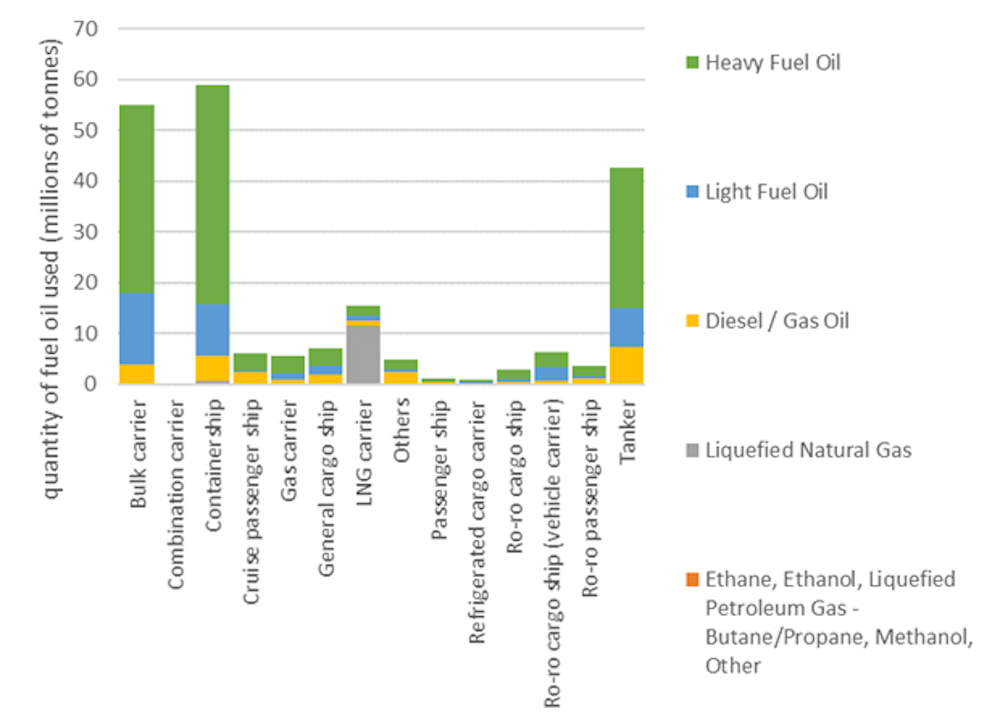
    Annual fuel oil consumption (by ship type):

    How different fuels were used by different ship types (2023 data).
    IMO Future Fuels, CC BY-NC-SA

    But here’s the problem: global demand for shipping is expected to grow by around 60% in that same time. So even with a 40% efficiency boost, total emissions from shipping could stay the same – or even go up – because so much more cargo will be moved.

    Despite this, many countries haven’t updated their policies to reflect this growing demand or to align with the IMO’s updated “30% cuts by 2030” target.

    Some countries, including Palau – a Pacific island nation vulnerable to climate change – and the UK, have pushed for stronger action. But there remains a long way to go before the world agrees on an ambitious path forward.

    Green energy

    The more hotly debated issue is around a fiendishly complicated set of “mid-term measures”. A key part of this is creating a “global fuel standard” – essentially, targets for how much “zero emission” (or “green”) fuel ships must use and by when.

    These rules would come with penalties or costs for using polluting fuels, which would effectively put a price on greenhouse gas emissions. Experts have long agreed that putting a price on shipping pollution is the most effective way to encourage cleaner and more efficient practices. But despite nearly 20 years of discussions, countries still haven’t agreed how to do this.

    Decisions are further complicated by wrangles over how to fairly distribute the revenues from these penalties.

    Who should get the revenues from shipping pollution?
    Uncle_Dave / shutterstock

    The good news is that the world is less than a week away from a decision which will put a price on shipping pollution in some form. The bad news is that proposals on the table could easily deliver a weak, uncertain price signal which doesn’t push the industry to invest in more green solutions. And the fuel standard itself might fall short of the ambitious climate targets set in 2023.

    Until now, talks on improving shipping efficiency and on pricing polluting fuels have happened separately. A big task at the IMO summit in London is to integrate the two into one coordinated plan.

    From a climate perspective, these policies should be judged by whether they will work together to cut shipping emissions by 30% by 2030 (the IMO’s current target).

    As things stand, that outcome is still possible – but is now an uphill battle. Agreement this week is crucial and countries will show their true colours. If they can’t agree to agree more ambitious policies it will undermine the IMO’s ability to regulate shipping emissions.

    Historically, the IMO tends to take its biggest decisions in the last hours of Thursday in week-long negotiations. Both ambitious and more cautious countries have a lot on the line, as the measure adopted will be legally binding for all of them.

    A positive result depends on whether powerful groups such as the European Union line up to support ambitious measures, as as proposed by African, Caribbean, Central American and Pacific countries as well as the UK.

    Although countries have agreed on climate targets for shipping, some still refuse to support the policies needed to actually phase out fossil fuels fast enough. That stance much change. If done right, IMO negotiations this week could be a turning point – not just for shipping, but for renewable energy and climate action worldwide.


    Don’t have time to read about climate change as much as you’d like?

    Get a weekly roundup in your inbox instead. Every Wednesday, The Conversation’s environment editor writes Imagine, a short email that goes a little deeper into just one climate issue. Join the 40,000+ readers who’ve subscribed so far.


    Simon Bullock is a member of the Institute of Marine Engineering, Science and Technology

    Christiaan De Beukelaer receives funding from the ClimateWorks Foundation.

    Tristan Smith owns shares in UMAS International, that working alongside UCL Energy Institute, provides advisory services on the subject of maritime decarbonisation. My research group is recipient of research funding from UKRI, Climateworks Foundation and Quadratue Climate Foundation. I am on the advisory board of the Global Maritime Forum, and the Strategy Board of the Getting to Zero Coalition – not for profit structures that work across governments and industry stakeholders on maritime decarbonisation.

    ref. At a pivotal meeting, the world is set to decide how to cut shipping emissions – https://theconversation.com/at-a-pivotal-meeting-the-world-is-set-to-decide-how-to-cut-shipping-emissions-253462

    MIL OSI – Global Reports

  • MIL-OSI Global: Drinking pee to improve health is an ancient practice – but the risks outweigh the evidence

    Source: The Conversation – UK – By Dipa Kamdar, Senior Lecturer in Pharmacy Practice, Kingston University

    KK_face/Shutterstock

    TV star Ben Grylls says he does it for survival – and teaches his reality show contestants to do the same. Mexican boxer Juan Manuel Márquez practised this therapy to train for his 2009 fight with Floyd Mayweather Jr (he lost). Former Indian prime minister Morarji Desai claimed a daily glass of the stuff was a remedy for many diseases and contributed to his longevity.

    What is the therapy these celebrities practice? Urophagia, also known as urine therapy, is the practice of drinking urine.

    Whether the urine is your own, someone else’s or even obtained from an animal, people have been drinking pee as medicine for thousands of years. Most claims about urine therapy are based on anecdotes or ancient texts with no robust scientific evidence to support the benefits of urine therapy. There is evidence to show that drinking urine has a number of health risks, however,

    In Indian Ayurvedic medicine, urine was used to treat asthma, allergies, indigestion, wrinkles and even cancer. The Roman poet Catullus believed urine helped to whiten teeth – possibly due to its ammonia content.

    As a rudimentary test for diabetes, doctors used to taste urine to check how sweet it was. Now, of course, we have urine test strips to check for glucose in the urine.

    In 1945, British naturopath John W. Armstrong published a book called “The Water of Life: A Treatise on Urine Therapy.” He claimed that drinking one’s own urine and massaging it into the skin could cure major illnesses.

    Historically, drinking pee to treat illnesses may have made sense because of a lack of medical alternatives. But, as the urine-sipping celebrities above show, the practice is still followed today.

    There are reported cases of using urine for home remedies to treat seizures in children in Nigeria. The China Urine Therapy Association claims that drinking and washing with urine can cure constipation and skin sores.

    Waste not, want not?

    Urine is made by the body to get rid of waste. It is mostly made up of water (about 95%) and several waste products, including urea (2%), which is made by the liver after breaking down proteins in the body, creatinine, which is left over from energy-releasing processes in the muscles, and salts. If urine is just waste, how could drinking it be beneficial?

    The kidneys act as regulators – not just to get rid of any toxins but to remove anything that it doesn’t need. For example, excess vitamins that aren’t needed by the body are found in urine.

    Drinking urine means these vitamins and minerals are getting recycled instead of being wasted – this also goes for other hormones, proteins and antibodies that can be found in urine. However, the amounts of these substances in a glass of urine are unlikely to be enough to be beneficial and a vitamin supplement may be more effective.

    Some advocates of urine therapy believe it can help prevent allergic reactions and control autoimmune conditions. The antibodies in the urine are supposed to make the immune system stronger.

    Other modern uses also include cleansing and detoxification – some people have claimed that continually drinking recycled urine leads to cleaner urine and blood by removing toxins and leading to better overall health.

    However, there’s no scientific evidence to support any of these claims.

    Some social media influencers claim that urine has healing properties and drinking or applying it to the skin can help skin conditions such as acne and infections. As mentioned, urine does contain urea, which is often added to skin care products as a moisturiser. But the concentration of urea in urine is unlikely to be high enough to have this effect.

    Urine also contains dehydroepiandrosterone, a steroid hormone produced by the body that declines with age, which has been marketed as an anti-ageing ingredient – but there isn’t enough data to demonstrate its efficacy.

    Risky business

    Some advocates of urine therapy believe that urine is sterile. However, research has found that urine naturally contains low levels of bacteria and research shows that bacteria can further contaminate the urine when it leaves the body. Drinking urine, then, can introduce bacteria and toxins into the gut and potentially cause further illness like stomach infections.

    Urine becomes more concentrated when it comes out again – the kidneys may have to work harder to filter out the excess, putting extra strain on them. The kidneys need water to process these salts.

    Drinking urine means you have to pee out more water than you get from it, which speeds up dehydration – it’s similar to drinking seawater. Some drugs, such as penicillin antibiotics or heart medicines, are also excreted in the urine – by drinking urine, it can cause toxic levels of these drugs to build up in the body.

    Mainstream medical communities do not endorse urine therapy as it lacks scientific evidence. Small amounts of urine drinking are unlikely to be harmful. But for tangible health benefits, other therapies with scientific evidence may be the way to go.

    Dipa Kamdar does not work for, consult, own shares in or receive funding from any company or organisation that would benefit from this article, and has disclosed no relevant affiliations beyond their academic appointment.

    ref. Drinking pee to improve health is an ancient practice – but the risks outweigh the evidence – https://theconversation.com/drinking-pee-to-improve-health-is-an-ancient-practice-but-the-risks-outweigh-the-evidence-253353

    MIL OSI – Global Reports

  • MIL-OSI USA: Governor Stein Announces Council On Student Safety & Well-Being

    Source: US State of North Carolina

    Headline: Governor Stein Announces Council On Student Safety & Well-Being

    Governor Stein Announces Council On Student Safety & Well-Being
    lsaito

    Raleigh, NC

    Today at Moore Square Magnet Middle School, Governor Josh Stein announced his Advisory Council on Student Safety and Well-Being, co-chaired by Senate Democratic Leader Sydney Batch, Deputy Secretary William “Billy” Lassiter of the Department of Public Safety, and 2024 North Carolina Teacher of the Year Heather Smith. 

    “North Carolina’s children are our future, and it is crucial that they grow and learn in a safe environment that sets them on the right trajectory to thrive,” said Governor Josh Stein. “I am proud to establish this council of educators, mental health professionals, and law enforcement to identify ways to better keep our classrooms safe and our children healthy.”

    “Ensuring the safety of our students is not up for debate — it’s a fundamental responsibility of our state government,” said Democratic Leader Sydney Batch. “Every child in North Carolina deserves the freedom to learn in a secure, supportive environment. I’m proud to co-chair this council and committed to advancing real, enforceable policies that keep our kids safe and our schools strong — and I’m ready to work with anyone willing to get that important work done.”

    “Student and school staff security and wellbeing is an essential part of public safety,” said Deputy Secretary of Public Safety William L. Lassiter, who oversees the Division of Juvenile Justice and Delinquency Prevention. “We must use the tools at our disposal to upgrade the physical infrastructure of our schools and train our school staff how to recognize and respond to the early warning signs that can lead to public safety threats. We know our students must feel safe and have a healthy mental well-being to achieve academically. Working together, we can keep our students and our schools safe.” 

    “What I’ve seen in my classroom is that if students don’t feel safe, if they are not supported, it’s so much harder for them to learn,” said Teacher of the Year Heather Smith. “Our commitment to giving students the best starts with looking out for their safety and well-being, and I am eager to jump into this work.”

    Governor Stein’s advisory council will work across state agencies and with both state and local leaders to propose and implement policies and solutions that will improve student safety and wellbeing. It will advance recommendations, provide guidance to state agencies, work with local communities, and share best practices. The council’s first priority will be working with the General Assembly to support school systems in implementing policies that will make classrooms cell phone-free.  

    Click here to read Governor Stein’s executive order establishing the Council on Student Safety & Well-Being.

    The members of the Advisory Council are as follows:

    • Senate Democratic Leader Sydney Batch (co-chair)
    • William L. Lassiter, Deputy Secretary for the Division of Juvenile Justice and Delinquency Prevention, Department of Public Safety (co-chair)
    • Heather Smith, 2024 Burroughs Wellcome Fund North Carolina Teacher of the Year (co-chair)
    • Senator David W. Craven, Jr.
    • Representative Brian Biggs
    • Representative Lindsey Prather
    • Alan Duncan, Vice-Chair of the State Board of Education
    • Bettina Umstead, Board of Education Member, Durham Public Schools
    • Sharon Bell, Deputy Director, Division of Child and Family Wellbeing, North Carolina Department of Health and Human Services
    • Natalia Botella, Director, Public Protection Section, North Carolina Department of Justice
    • Dr. Ellen Essick, Section Chief for NC Healthy Schools, Department of Public Instruction
    • Karen Fairley, Executive Director of Center for Safer Schools, A Division of the State Bureau of Investigation
    • Anne Goldberg, School Counselor, Alamance-Burlington School System
    • Tara Hardy, School Social Worker, Craven County Schools
    • Roger “Chip” Hawley, Director of The North Carolina State Bureau of Investigation
    • Emma Hodson, In-House Counsel, Pitt County Schools
    • Kristie Howell, Chief Court Counselor-District 8, Division of Juvenile Justice and Delinquency Prevention, North Carolina Department of Public Safety
    • Melissa Lassen, BSN, RN, NCSN, Lead School Nurse, Chatham County Schools
    • Mark McHugh, Director of Safety, Charlotte-Mecklenburg Schools
    • Dr. Shaneeka Moore-Brown, President, North Carolina Parent Teacher Association
    • Asia Prince, Director of Court Programs, North Carolina Administrative Offices of the Courts
    • Deputy Rhyne Rankins, School Resource Officer, Iredell County Sheriff’s Office
    • Dr. Paul Smokowski, Executive Director, North Carolina Youth Violence Prevention Center
    • Beckie Spears, Principal, Wilkesboro Elementary School & 2024 Wells Fargo North Carolina Principal of the Year
    • Mary Katherine Stiles, M.A./S.S.P., School Psychologist, Cumberland County Schools
    • Justice Warren, Assistant Legal Counsel, North Carolina School Boards Association
    • Julie Cecelia Werry, Scholar Advisor, Morehead-Cain Foundation
    • Dr. Freddie Williamson, Superintendent of Public Schools of Robeson County 
    Apr 7, 2025

    MIL OSI USA News

  • MIL-OSI United Kingdom: Joint statement at the 58th Session of the UN Commission on Population and Development

    Source: United Kingdom – Executive Government & Departments

    Press release

    Joint statement at the 58th Session of the UN Commission on Population and Development

    Joint statement on the 58th Session of the UN Commission on Population and Development delivered by Sierra Leone on Monday 7 April 2025, on behalf of Albania, Andorra, Armenia, Australia, Austria, Belgium, Bosnia and Herzegovina, Brazil, Bulgaria, Cabo Verde, Cambodia, Chile, Colombia, Costa Rica, Croatia, Cyprus, Czechia, Democratic Republic of the Congo, Denmark, Dominican Republic, Estonia, Eswatini, Finland, France, Georgia, Germany, Greece, Guinea, Honduras, Iceland, Ireland, Israel, Italy, Japan, Latvia, Lebanon, Lesotho, Liberia, Liechtenstein, Lithuania, Luxembourg, Malta, Mexico, Monaco, Mongolia, Montenegro, Morocco, Nepal, Netherlands, New Zealand, North Macedonia, Norway, Panama, Papua New Guinea, Peru, Poland, Portugal, Republic of Korea, Republic of Moldova, Romania, Samoa, San Marino, Serbia, Sierra Leone, Slovakia, Slovenia, South Africa, Spain, Sweden, Switzerland, Thailand, Timor-Leste, Tunisia, Tuvalu, Ukraine, Uruguay, Zambia and the United Kingdom.

    We are making this collective statement to emphasise the urgent need for action to achieve Sustainable Development Goal (SDG) 3. Health is a human right and a foundation of sustainable development, driving economic growth, social cohesion, and individual dignity.

    Over the past decades, significant progress has been made in many areas of health. We have seen a reduction in maternal and child mortality, expanded access to modern contraceptive methods as well as maternal and newborn medicines and commodities, improvements in adolescent health and education, addressing sexually transmitted diseases including HIV, and a decline in child and early forced marriages. These achievements give us hope for a healthier future.

    However, significant challenges persist, and the urgent need for equal access to health services and opportunities for healthy lives remains out of reach for many.

    Health inequalities stemming from complex, interrelated factors such as economic disparities, social exclusion, significant financial hardship, discrimination, and unequal access to resources, has a profound impact on individuals and communities. These inequalities manifest in poor health outcomes, lower life expectancy, reduced household income, and weaker national economic growth potential. Income inequality exacerbates vulnerabilities, limiting access to health services in low-income countries and disadvantaged communities. Social disparities rooted in gender, race, age, class, religion, and ethnicity perpetuate stigma, violence, and adverse health determinants.

    Economic disparities within and among countries remain significant, impacting the lives of many individuals. Far too many people are unable to access essential health services or are forced to forgo care due to unaffordability. Rising out-of-pocket health costs are pushing millions into poverty, hindering the realisation of Universal Health Coverage. Conflicts and climate change are straining health systems and the health workforce, contributing to stagnating maternal mortality rates, growing mental health challenges, and the inability of health systems to cope with the rise of non-communicable diseases.

    Equitable, inclusive, and resilient health systems are essential to ensure healthy lives and promote well-being. It is imperative to prioritize universally accessible, quality, and comprehensive primary healthcare services. Sexual and reproductive health and reproductive rights must enable individuals to make free and informed decisions about their health and their lives. Addressing the social determinants of health – such as poverty, malnutrition, education, water and sanitation, and gender inequality – is critical for achieving inclusive economic growth that strengthens and benefits all of society.

    The health and well-being of adolescents and youth also demands greater attention – they require better access to health services, education, and information that enable them to make informed decisions about their lives.

    Investing in health, particularly sexual and reproductive health, is not just a matter of well-being, but also a powerful driver of economic growth. UNFPA estimates that allocating an additional $79 billion by 2030 to expand maternal health and family planning services could yield $660 billion in economic benefits by 2050—preventing 400 million unplanned pregnancies, 1 million maternal deaths, 6 million stillbirths, and 4 million newborn deaths, while also enhancing workforce participation and economic productivity (UNFPA, 2022). Similarly, closing the women’s health gap more broadly could further accelerate economic progress, with the World Economic Forum projecting a potential boost of at least $1 trillion annually to the global economy by 2040.

    Greater investments in health infrastructure, workforce capacity, and innovative solutions like digital health can improve service delivery and expand access to services. Strengthening and expanding the global health workforce is at the heart of this. We must address health workforce shortages, ensure equitable distribution, enhance training and pay attention to sustainable retention strategies.

    It is vital that we, as policymakers, health organizations, and civil society, address disparities within and among countries, ensuring that people in vulnerable situations, including women, children, older persons, migrants, people with disabilities, and those in extreme poverty, have access to quality, comprehensive health services without financial hardship and discrimination. Our role in promoting responsive health systems that cater to the unique needs of at-risk individuals are key to sustainable and inclusive progress.

    A healthier population is central to achieving the 2030 Agenda for Sustainable Development. The ICPD’s Programme of Action has guided countries toward inclusive, equitable policies advancing health and gender equality. By strengthening health systems and addressing inequalities, we can work toward a world where all people can live healthy, productive and fulfilling lives.

    Updates to this page

    Published 7 April 2025

    MIL OSI United Kingdom

  • MIL-OSI United Kingdom: AUKUS partnership strengthened with Prime Minister appointing new Special Representative

    Source: United Kingdom – Executive Government & Departments 3

    News story

    AUKUS partnership strengthened with Prime Minister appointing new Special Representative

    Sir Stephen Lovegrove appointed as the Prime Minister’s Special Representative on AUKUS.

    Britain will maximise the benefits of AUKUS and unlock more opportunities across the historic partnership, following the Prime Minister appointing Sir Stephen Lovegrove as his Special Representative on AUKUS today. 

    AUKUS is a landmark security and defence partnership between the UK and two of its oldest and closest partners, Australia and the United States. It will enable Australia to field a fleet of nuclear-powered submarines in the Indo Pacific; strengthen the defence industrial bases of both the UK and the US; and accelerate the development and deployment of cutting-edge technologies by all three countries. The AUKUS submarine programme is set to generate 7,000 additional British jobs, supporting the government’s Plan for Change to kickstart economic growth. 

    Sir Stephen will support the Defence Secretary and the National Security Adviser to drive the AUKUS programme forward. He brings a wealth of experience, having served as National Security Adviser at the time of the AUKUS announcement in 2021, the Prime Minister’s Defence Industrial Adviser, and as the Permanent Secretary at the Ministry of Defence.      

    Last year, the Prime Minister and Defence Secretary commissioned Sir Stephen to conduct a Review of the UK’s progress against its core commitments under AUKUS, identifying barriers to success, and setting out recommendations on how to unlock further areas of opportunity, both nationally and with the US and Australia.  Sir Stephen presented his findings to the Prime Minister and Defence Secretary earlier this year. His report will be shared with US and Australian partners and a public version released in due course. 

    Defence Secretary, John Healey said:

    AUKUS is a historic partnership which reinforces peace and stability across the Euro-Atlantic and Indo-Pacific, and will also provide thousands of highly skilled jobs and investment in communities across the UK.  It shows how defence can be an engine for growth across our three nations while keeping us secure at home, and strong abroad.

    Sir Stephen is fully committed to ensuring the UK plays a leading role within AUKUS and holds widely respected national security experience.  

    I am very grateful to him for taking up this appointment and look forward to working closely with him and our partners in the US and Australia as we take the AUKUS partnership to new heights.

    Prime Minister’s Special Representative on AUKUS, Sir Stephen Lovegrove, said:

    When the AUKUS partnership was announced in 2021 it was regarded, rightly, as the most significant capability collaboration since the Mutual Defence Agreement of 1958.  

    Since then, the strategic relevance of AUKUS has only increased. It is a uniquely powerful partnership which will develop and deliver cutting-edge capabilities, help to revitalise Britain’s defence industrial base and provide sustained employment for thousands of people across the UK, US and Australia. 

    I am delighted to accept the role as the Prime Minister’s Special Representative on AUKUS and I look forward to starting work immediately to help maximise the potential of this vital partnership.

    Sir Stephen will begin his role as Special Representative tomorrow. He is travelling to Washington DC this week to present his Review findings to the US government and will then travel to Canberra to share findings with the Australian government after the conclusion of the Australian federal election.    

    The AUKUS partnership is supporting more unified defence and industrial collaboration, better information and technology sharing and greater resilience. The development of SSN-AUKUS and new cutting-edge military technologies under AUKUS Pillar’s One and Two will help grow the UK’s industrial base and improve the enabling environment. It represents a multi-billion-pound investment into UK industry, supporting thousands of new British jobs.

    Updates to this page

    Published 7 April 2025

    MIL OSI United Kingdom

  • MIL-OSI Australia: Canberra’s first food strategy gets green light in ACT Budget

    Source: Northern Territory Police and Fire Services

    The new plan will help support and grow the territory’s local food production sector.

    The ACT Government is investing $455,000 towards the implementation of the Canberra Region Local Food Strategy.

    Part of the 2024–25 ACT Budget, this funding will help grow Canberra’s local food production sector.

    The ACT is the first Australian state or territory to launch a plan to support and grow its local food system.

    Funding for the first year of the Strategy’s implementation will deliver a Local Food Chain Infrastructure Study.

    The study will explore opportunities to support small-medium sized local food producers in Canberra and the surrounding region who struggle to compete with larger commercial providers.

    The study will focus on areas of food packaging, distribution, storage and networking. It will build on data from the Agriculture and Food in the ACT Study, currently underway.

    It will also aim to reduce barriers for getting local food produce into local marketplaces and grocery stores.

    Shaped by community feedback, the strategy will ultimately strengthen Canberrans’ access to healthy, affordable food.

    Funding has also been provided to examine opportunities for using suitable ACT Government land to support local food production, and to help educate the community on how to grow food in the ACT.

    The Canberra Region Local Food Strategy is available on the ACT Environment website.


    Get ACT news and events delivered straight to your inbox, sign up to our email newsletter:


    MIL OSI News

  • MIL-OSI Australia: Access Canberra supports people with hidden disabilities

    Source: Northern Territory Police and Fire Services

    All Access Canberra Service Centre staff have received Hidden Disabilities Sunflower training.

    Staff at Access Canberra Service Centres strive to help customers feel seen, supported and understood.

    To help ensure this, Access Canberra is now a member of the Hidden Disabilities Sunflower initiative.

    This aims to ensure Canberrans living with non-visible disabilities are better supported when visiting service centres.

    Not all disabilities, conditions or chronic illnesses can be seen. The Hidden Disability Sunflower initiative encourages inclusivity, acceptance and understanding.

    Hidden disabilities may be:

    • neurological
    • cognitive and neurodevelopmental
    • physical
    • visual
    • auditory.

    This also includes respiratory conditions, rare diseases and chronic conditions like diabetes or chronic pain.

    The Hidden Disabilities Sunflower initiative

    The global Hidden Disabilities Sunflower initiative gives people a tool to share that they have a hidden disability – if they wish to do so.

    They can opt to wear a sunflower lanyard or pin. This visual cue shows they might need extra help, understanding or time, without them having to ask.

    All Access Canberra Service Centre staff have received Hidden Disabilities Sunflower training.

    They also have their own sunflower supporter pins.

    This shows customers with hidden disabilities that they have the awareness and training to support them when carrying out government transactions.

    “By joining the Sunflower Initiative it’s another way for Access Canberra to show that ‘we see you, we value you and we want to service you in way that best works for you,’” Service Centre Operations Manager Paige Ryan said.

    Staff now have a greater understanding of the types of disabilities and/or conditions people experience and how common these are in our community.

    “This training also helps encourage our staff to continue to challenge our way of thinking when it comes to how we offer our help, support and guidance to those we service,” Paige said.

    More support for Canberrans with neurodiversity

    There will be a quiet hour each Wednesday at Access Canberra Service Centres.*

    From 10am to 11am, service centre staff will help to facilitate a calmer, less stimulating space for customers to complete their transactions.

    Where possible, service centres will have music turned down and mobile phones on silent.

    “The aim is to create a less stimulating environment for one hour each week, which will help provide a more inclusive offering to our community,” Paige said.

    The Australian Bureau of Statistics estimates that 30-40 per cent of the Australian population is neurodiverse.

    *The Dickson service centre, which is appointment-only, will not offer the weekly quiet hour.

    Hidden Disabilities Sunflower lanyards and pins are available on the Hidden Disabilities Sunflower website.

    Find Access Canberra Service Centre locations.

    From 10am to 11am on Wednesday, service centre staff will help to facilitate a Quiet Hour at most service centres.


    Get ACT news and events delivered straight to your inbox, sign up to our email newsletter:


    MIL OSI News

  • MIL-OSI USA: Study: How Coral Reefs Shielded Hawaiian Coastlines Against 2018 Hurricanes

    Source: US Geological Survey

    Hurricanes bring powerful waves and storm surges that can erode shorelines and threaten coastal communities. But a new study by USGS and partners details how Hawaii’s coral reefs acted as natural barriers during two successive tropical cyclones that impacted Hawai’i in 2018, reducing wave energy and protecting coastlines.

    MIL OSI USA News

  • MIL-OSI USA: SBA Offers Disaster Relief to Illinois Businesses, Nonprofits and Residents Affected by South Terrace Apartment Fire

    Source: United States Small Business Administration

    WASHINGTON – In response to an Administrative disaster declaration issued April 2, the U.S. Small Business Administration (SBA) announced the availability of low interest federal disaster loans for Illinois businesses, nonprofits and residents affected by the South Terrace Apartment fire occurring on Feb. 22.  

    The disaster declaration covers Cook County, which is eligible for both Physical damage loans and Economic Injury Disaster Loans (EIDLs) from the SBA. EIDLs are also available to eligible small businesses and private nonprofit (PNP) organizations in the adjacent counties of DuPage, Kane, Lake, McHenry and Will in Illinois, as well as Lake County in Indiana. 

    Businesses and nonprofits are eligible to apply for business physical disaster loans and may borrow up to $2 million to repair or replace disaster-damaged or destroyed real estate, machinery and equipment, inventory, and other business assets.    

    Homeowners and renters are eligible to apply for home and personal property loans and may borrow up to $100,000 to replace or repair personal property, such as clothing, furniture, cars, and appliances. Homeowners may apply for up to $500,000 to replace or repair their primary residence.    

    Businesses and homeowners may also be eligible for a loan increase of up to 20% of their physical damages, as verified by the SBA, for mitigation purposes.  

    EIDLs are for working capital needs caused by the disaster and are available even if the small business or PNP did not suffer any physical damage. They may be used to pay fixed debts, payroll, accounts payable, and other bills not paid due to the disaster. 

    Interest rates are as low as 4% for small businesses, 3.625% for PNPs, and 2.750% for homeowners and renters, with terms up to 30 years. Interest does not begin to accrue, and payments are not due, until 12 months from the date of the first loan disbursement. The SBA sets loan amounts and terms based on each applicant’s financial condition. 

    Beginning Monday, April 7, 2025, SBA customer service representatives will be on hand at the Disaster Loan Outreach Center (DLOC) in Cook County to answer questions about SBA’s disaster loan program, explain the application process and help individuals complete their application. Walk-ins are accepted, but you can schedule an in-person appointment in advance at appointment.sba.gov.  

    The DLOC hours of operation are listed below: 

    Disaster Loan Outreach Center (DLOC) 
    Cook County 

    Justice Village Hall 

    7800 S Archer Road 

    Justice, Illinois 60458 

    Opening:  Monday, April 7, 10 a.m. to 5 p.m. 

    Hours: Monday – Friday – 8:00 a.m. to 5 p.m. 

    Saturday – 10 a.m. to 2 p.m. 

    Closed: Sunday  

    Permanently Closing: Saturday, April 19, 2 p.m. 

    “SBA’s Disaster Loan Outreach Centers (DLOCs) have consistently proven their value to business owners and homeowners following a disaster,” said Chris Stallings, associate administrator of the Office of Disaster Recovery and Resilience at the SBA. “Homeowners and Business owners can visit the DLOC to meet face-to-face with specialists who will guide them through the disaster loan application process and connect them with resources to support their recovery.” 

    Disaster survivors should not wait to settle with their insurance company before applying for a disaster loan. If a survivor does not know how much of their loss will be covered by insurance or other sources, SBA can make a low-interest disaster loan for the total loss up to its loan limits, provided the borrower agrees to use insurance proceeds to reduce or repay the loan. 

    To apply online, visit sba.gov/disaster. Applicants may also call SBA’s Customer Service Center at (800) 659-2955 or email disastercustomerservice@sba.gov for more information on SBA disaster assistance. For people who are deaf, hard of hearing, or have a speech disability, please dial 7-1-1 to access telecommunications relay services.  

    The filing deadline to return applications for physical property damage is June 2, 2025. The deadline to return economic injury applications is January 2, 2026. 

    ### 

    About the U.S. Small Business Administration 

    The U.S. Small Business Administration helps power the American dream of business ownership. As the only go-to resource and voice for small businesses backed by the strength of the federal government, the SBA empowers entrepreneurs and small business owners with the resources and support they need to start, grow or expand their businesses, or recover from a declared disaster. It delivers services through an extensive network of SBA field offices and partnerships with public and private organizations. To learn more, visit www.sba.gov. 

    MIL OSI USA News

  • MIL-OSI: Sunation Energy Announces Closing of Second and Final Tranche of Registered Direct Offering Generating Gross Proceeds of $5 Million

    Source: GlobeNewswire (MIL-OSI)

    RONKONKOMA, N.Y., April 07, 2025 (GLOBE NEWSWIRE) — SUNation Energy, Inc. (“SUNation” or the “Company”) (Nasdaq: SUNE), a leading provider of sustainable solar energy and backup power solutions for households, businesses, and municipalities, today announced the second and final closing of its previously announced securities purchase agreement with certain institutional investors for the purchase and sale of 4,347,826 shares of the Company’s common stock (or common stock equivalents in lieu thereof), Series A warrants to purchase up to an aggregate 17,391,306 shares of the Company’s common stock and Series B warrants to purchase up to an aggregate 17,391,306 shares of the Company’s common stock at an effective purchase price of $1.15 per share (or common stock equivalents in lieu thereof) and associated warrants in a registered direct offering (the “offering”) priced at-the-market under Nasdaq rules, for gross proceeds of $5 million.

    Together with the approximately $15.0 million in gross proceeds from the previously announced first tranche closing completed on February 27, 2025, the Company raised approximately $20.0 million in aggregate gross proceeds from the offering before deducting placement agent fees and other offering expenses payable by the Company.

    “The completion of this offering marks an important milestone for SUNation and its shareholders,” said Scott Maskin, Chief Executive Officer. “We applied a portion of the proceeds from the first tranche of the offering to repay in full $9.4 million in senior and junior secured loans, which materially improved our balance sheet, stabilized our operations, and enhanced our cash flow. The closing of this second tranche provides us with greater financial flexibility to continue to pay down contractual obligations, invest in the future of SUNation and pursue our long-term growth objectives, including strategic acquisitions of regionally strong solar companies across the United States. We continue to meet head-on the challenges that face our industry and remain confident in the opportunities that lie ahead.”  

    The Company intends to use the net proceeds from the offering to fund its operations, including for working capital, potential strategic transactions, payment of certain debt obligations, and for other general corporate purposes. 

    Roth Capital Partners acted as the exclusive placement agent for the registered direct offering.

    The securities in the offering described above are being offered by the Company pursuant to a “shelf” registration statement on Form S-3 (File No. 333-267066) previously filed with the Securities and Exchange Commission (the “SEC”) and declared effective by the SEC on September 2, 2022 and an additional registration statement on Form S-3MEF filed pursuant to Rule 462(b) with the SEC, which became automatically effective on April 7, 2025. The offering is being made only by means of a prospectus, including a prospectus supplement, forming a part of the effective registration statement, relating to the offering that will be filed with the SEC. Electronic copies of the final prospectus supplement and accompanying prospectus may be obtained, when available, on the SEC’s website at http://www.sec.gov or by contacting Roth Capital Partners at 888 San Clemente Drive, Newport Beach CA 92660, by email at rothecm@roth.com.

    This press release shall not constitute an offer to sell or a solicitation of an offer to buy these securities, nor shall there be any sale of these securities in any state or other jurisdiction in which such offer, solicitation or sale would be unlawful prior to the registration or qualification under the securities laws of any such state or other jurisdiction.

    About SUNation Energy, Inc.

    SUNation Energy, Inc. is focused on growing leading local and regional solar, storage, and energy services companies nationwide. Our vision is to power the energy transition through grass-roots growth of solar electricity paired with battery storage. Our portfolio of brands (SUNation, Hawaii Energy Connection, E-Gear) provide homeowners and businesses of all sizes with an end-to-end product offering spanning solar, battery storage, and grid services. SUNation Energy, Inc.’s largest markets include New York, Florida, and Hawaii, and the company operates in three (3) states.

    Forward Looking Statements 

    Our prospects here at SUNation Energy Inc. are subject to uncertainties and risks. This news release contains forward-looking statements within the meaning of the Private Securities Litigation Reform Act of 1995, Section 27A of the Securities Act of 1933 and Section 21E of the Securities Act of 1934. The Company intends that such forward-looking statements be subject to the safe harbor provided by the foregoing Sections. These forward-looking statements are based largely on the expectations or forecasts of future events, can be affected by inaccurate assumptions, and are subject to various business risks and known and unknown uncertainties, a number of which are beyond the control of management. Therefore, actual results could differ materially from the forward-looking statements contained in this presentation. The Company cannot predict or determine after the fact what factors would cause actual results to differ materially from those indicated by the forward-looking statements or other statements. The reader should consider statements that include the words “believes”, “expects”, “anticipates”, “intends”, “estimates”, “plans”, “projects”, “should”, or other expressions that are predictions of or indicate future events or trends, to be uncertain and forward-looking. We caution readers not to place undue reliance upon any such forward-looking statements. The Company does not undertake to publicly update or revise forward-looking statements, whether because of new information, future events or otherwise. Additional information respecting factors that could materially affect the Company and its operations are contained in the Company’s filings with the SEC which can be found on the SEC’s website at www.sec.gov.

    Contacts:
    Scott Maskin
    Chief Executive Officer
    +1 (631) 823-7131
    smaskin@sunation.com

    SUNation Energy Investor Relations
    IR@sunation.com

    The MIL Network

  • MIL-OSI Asia-Pac: Chinese Culture Festival announced

    Source: Hong Kong Information Services

    The second edition of the Chinese Culture Festival (CCF) will be held from June to September, with various performances and activities being presented for the public to experience traditional Chinese fine culture.


    The festival’s opening show is a dance production. “Dongpo: Life in Poems” is directed by the internationally acclaimed choreographer and visual artist Shen Wei, and blends modern dance with poetry, traditional Chinese painting, calligraphy, seal engraving and guqin music to delicately deconstruct the poetic works of Su Dongpo, a literary master during the Song dynasty.


    A core part of the CCF, this year’s Chinese Opera Festival (COF) features six quality productions covering Peking opera, Yuediao opera, Qinqiang opera, Yue opera, Cantonese opera and Kunqu opera.


    The COF this year features classic plays inspired by the “Romance of the Three Kingdoms”, one of the four great classic novels of Chinese literature. There will also be a dance drama highlighting the resilient spirit and sentiments of the famous Song dynasty poetess, Li Qingzhao, and her contributions to China’s literary inheritance from a contemporary perspective.


    In another production, the Jiangsu Centre for the Performing Arts will present the original Chinese dance drama “A Dream of Red Mansions”, the plot of which concerns a love triangle between Jia Baoyu, Lin Daiyu and Xue Baochai. The production restructures the traditional storylines from the perspective of the 12 Beauties of Jinling.


    This year’s CCF also features a “Tea Culture” series curated by Hong Kong’s Ambassador for Cultural Promotion, the internationally renowned composer and conductor Tan Dun.


    The City in Focus of this year’s CCF is Xi’an. Relevant shows include the classic opera “Zhou Ren on the Way Home”, a exhibition showcasing Xi’an’s invaluable archaeological relics, and a production of the ballet “Swan Lake” by the Xi’an Acrobatic Troupe.


    Call 2268 7321, 2268 7323 or 2268 7325 for enquiries.

    MIL OSI Asia Pacific News

  • MIL-OSI Australia: Investing more in Canberra’s nurses and midwives

    Source: Northern Territory Police and Fire Services

    Budget funding will be allocated to recruit more than 137 new full-time equivalent nurses and midwives

    The ACT Government is continuing to invest in the nursing and midwifery workforce to support staff safety and wellbeing and improve patient care.

    More than $86 million will be allocated in the 2024–25 ACT Budget to recruit more than 137 new full-time equivalent nurses and midwives.

    Nurse-to-patient ratios

    The ACT Government is committed to ensuring safe nurse and midwife to patient ratios – something the Australian Nursing and Midwifery Federation has advocated for on behalf of its ACT members.

    These are being implemented in a phased approach, with this investment supporting the Government’s commitment to implementing phase two of Mandated Minimum Nurse/Midwife-to-patient ratios.

    Nurse and midwife to patient ratios are mandated minimum staffing levels.

    These are necessary to support safe nursing and midwifery care and improve working conditions for nurses and midwives.

    The implementation of phase two will see both minimum staffing levels on each ward and additional team leaders or support nurses and midwives.

    This will ensure there are even more nurses and midwives across frontline hospital services and an appropriate skill mix on each shift to provide the best possible care for patients, including women and babies in maternity services.

    In 2022, the ACT Government delivered the first phase of nurse-to-patient ratios across general medical and general surgical medical wards and acute aged care and mental health. This occurred through an investment of $50 million through the 2021–22 Budget.

    Phase two ratios will be implemented across Canberra’s public hospitals and Clare Holland House, including:

    • maternity services
    • neonatal intensive care unit and special care nurseries
    • critical care, including intensive care units and emergency departments
    • perioperative areas
    • subacute mental health units
    • cancer services
    • rehabilitation units
    • palliative care services.

    By including ratios across maternity services, including postnatal wards, the ACT will be the second jurisdiction in Australia to implement ratios that count the baby in the ratio as part of minimum staffing levels.

    Further support for nurses and midwives

    This investment follows the more than $21 million allocated in the mid-year Budget Review to support other elements of the proposed ACT Public Sector Nursing and Midwifery Enterprise Agreement, which is currently being considered by public health system nurses and midwives.

    This includes a $2000 education and development boost, an annual $750 professional development allowance, an increase in pay, and a comprehensive review of rostering in nursing and midwifery to improve work patterns and health and wellbeing.

    This will help to ensure Canberra has a health workforce that is highly skilled and supported, to continue to deliver great care to the community.

    The ACT Government will continue to invest in the nursing and midwifery workforce to ensure staff are supported to deliver the best care to the Canberra community.


    Get ACT news and events delivered straight to your inbox, sign up to our email newsletter:


    MIL OSI News

  • MIL-OSI: AI tutoring startup SigIQ.ai emerges from stealth with $9.5M to democratize elite education

    Source: GlobeNewswire (MIL-OSI)

    Berkeley, April 07, 2025 (GLOBE NEWSWIRE) — When SigIQ.ai’s AI tutor took India’s notoriously difficult UPSC civil service exam last June, it didn’t just pass – it achieved the highest score in the exam’s history, beating 1.3 million human candidates in under 7 minutes. Today, the Berkeley-based startup emerges from 18 months of stealth with $9.5 million funding to transform education through personalized AI tutoring that delivers elite-level instruction at the cost of computation, not hundreds of dollars per hour.

    The seed round was co-led by House Fund and GSV Ventures, with participation from Duolingo, General Catalyst India (Venture Highway), Peak XV Partners (formerly Sequoia India), Calibrate Ventures and angel investors, such as Andy Konwinski (Co-founder, Perplexity), Christian Storm (Co-founder & CTO, Turnitin), Prof. Trevor Darrell (Berkeley AI Research, UC Berkeley), Prof. Jitendra Malik (Berkeley AI Research, UC Berkeley), Prof. Srini Devadas (MIT), Prof. Sharad Malik (Princeton) and others. This investment will accelerate hiring top talent, enhancing AI models, and scaling platforms to educational systems worldwide.

    SigIQ.ai founders: Professor Kurt Keutzer and Dr. Karttikeya Mangalam. 

    SigIQ.ai’s technology directly addresses “Bloom’s Two-Sigma Problem” – the research finding that students receiving one-on-one tutoring perform two standard deviations better than those in traditional classrooms. This educational disparity has persisted for decades, with personalized tutoring remaining a luxury reserved for the privileged few. The company’s revolutionary approach shifts the cost of personalization from human labor to AI computation, making world-class instruction accessible at unprecedented scale.

    “We’re at a pivotal moment in education where modern GenAI can provide a personal 1:1 tutor to every student and reduce the cost of one-on-one learning from hundreds of dollars an hour to the cost of computation,” said Dr. Karttikeya Mangalam, CEO and co-founder of SigIQ.ai, a UC Berkeley AI PhD mentored by computer vision pioneer Prof. Jitendra Malik. “We’ve started by first creating a tutor that itself can ace the very exam students are preparing for. This is a necessary step to ensure accuracy and quality in teaching delivered. And will set a new benchmark in personalized education, making the highest-quality education accessible to everyone, regardless of geography or socioeconomic status, at a fraction of the traditional cost.”

    The company was founded in July 2023 by Dr. Karttikeya Mangalam and Professor Kurt Keutzer, a distinguished Professor in the Berkeley AI Research (BAIR) Lab who has published six books, over 250 refereed papers, and helped launch twelve startups. SigIQ.ai’s origin reflects its mission. Growing up in Muzaffarpur, Bihar – a region where educational opportunities are limited – Mangalam experienced firsthand the stark divide between small-town India and elite Western academic institutions. After completing his education at IIT Kanpur and then at UC Berkeley, he founded SigIQ.ai to democratize access to world-class education globally.

    SigIQ.ai latest product is EverTutor.ai, designed for GRE preparation in the US market, has already gained more than 10,000 users in just 3 of launch.

    In just 18 months, SigIQ.ai has launched two products with remarkable traction. PadhAI, focused on UPSC exam preparation in India, has attracted over 200,000 learners in just six months. On June 16, 2024, moments after the actual 2-hour UPSC Prelims exam had finished, PadhAI’s AI tutor solved the entire paper in a live demonstration in under 7 minutes at The Leela in Delhi. It achieved a score of 175/200 – not just the highest score in 2024, but the highest score ever achieved in UPSC prelims history, far exceeding the typical qualifying score of 100/200. This historic achievement was covered by over 70 news outlets across India, including The Hindu and The Times of India.

    The company’s newer offering, EverTutor.ai, designed for GRE preparation in the US market, has already gained more than 10,000 users since launching three months ago.

    Inside SigIQ.ai’s EverTutor product designed to support GRE preparation. 

    “SigIQ.ai isn’t just a regular EdTech startup — they’ve built an AI system that publicly demonstrated its ability to outperform both humans and leading commercial AI models on one of the world’s most challenging exams. This redefines what’s possible in personalized education,” said Jeremy Fiance, Managing Director of The House Fund.

    What differentiates SigIQ.ai from other educational AI tools is its approach to personalization. Unlike basic conversational AI that offers scripted or limited interactivity, SigIQ’s systems are highly interactive, responsive to follow-up questions, and capable of personalized instruction and feedback – not just chat. As a result, this technology replicates the behavior of a real tutor. Students using the platform report a 30-40% increase in effective study hours while improving performance by 18% in the first month, with over 75% feeling more confident tackling difficult topics within just three weeks.

    Looking ahead, SigIQ.ai plans to expand its reach with EverTutor, supporting more GRE takers in the upcoming spring and fall. The company will be present at ASU+GSV to demonstrate the newest developments in both platforms. Beyond standardized tests, SigIQ.ai envisions a future where their technology transforms education broadly, creating a new era where high-quality learning isn’t limited by geography, language, or economic status. Ultimately, the team is set on proving that elite education doesn’t have to be scarce – it can and must be universal.

    Ends 

    Media images can be found here

    About SigIQ.ai
    Founded in 2023 by Dr. Karttikeya Mangalam, SigIQ.ai builds AI-powered learning tools that deliver personalized education at scale. With offices in Berkeley and Gurgaon, the company’s flagship products PadhAI and EverTutor.ai serve hundreds of thousands of students globally. Recognized across India for its feat of achieving the top score on the UPSC 2024 live, SigIQ.ai is poised to transform the future of education.

    The MIL Network

  • MIL-OSI: BexBack Launches 100x Leverage Crypto Futures Trading with Double Deposit Bonus and $50 Welcome Bonus – No KYC Required

    Source: GlobeNewswire (MIL-OSI)

    SINGAPORE, April 07, 2025 (GLOBE NEWSWIRE) — In the past 24 hours, most major cryptocurrencies have plunged more than 10%, with Bitcoin briefly falling below $75,000. The sharp sell-off was triggered by President Trump’s new tariff war, sparking panic across global markets. Analysts are warning: the bear market may have officially arrived.

    In a bear market, smart investors know that simply holding spot assets is not enough. 100x leverage futures trading has become the preferred strategy to profit from both market rises and falls. BexBack Exchange is leading the way, empowering traders with the tools and bonuses needed to succeed.

    To help traders capture these new opportunities, BexBack is offering:

    • 100x Leverage: Trade up or down with maximum flexibility.
    • Double Deposit Bonus: Get 100% bonus on every deposit over 0.001 BTC or 100 USDT.
    • $50 Welcome Bonus: Complete your first trade and receive a $50 USDT bonus — usable for trading and loss protection (not withdrawable).
    • No KYC Required: Start trading immediately with no identity verification.

    Bonus Details

    • 100% Deposit Bonus:
      • The bonus itself cannot be withdrawn directly.
      • However, profits generated using the bonus can be freely withdrawn.
      • The bonus can also serve as extra margin, reducing the risk of liquidation.
    • $50 Welcome Bonus:
      • Acts as loss protection for trading.
      • It is not directly withdrawable but can be fully used for trading activities.

    Why Choose 100x Leverage Futures Trading Now?

    • Profit From Falling Markets: Short and earn even in a bear market.
    • Amplify Profits With Less Capital: Trade large positions with minimal investment.
    • Efficient Capital Management: Free up funds for broader strategies.
    • Flexible Leverage Options: Choose from 25x, 50x, 75x, or 100x.
    • Easy Global Access: Trade anytime via web and mobile.

    About BexBack

    BexBack is a premier cryptocurrency derivatives platform offering 100x leverage on BTC, ETH, XRP, ADA, SOL, and more than 50 other major cryptocurrencies. Headquartered in Singapore with offices in Hong Kong, Japan, the United States, the United Kingdom, and Argentina, BexBack holds a U.S. MSB (Money Services Business) license and has earned the trust of over 500,000 traders worldwide.

    • No deposit fees
    • Cold wallet fund protection
    • 24/7 multilingual customer support
    • Demo account with 10 BTC and 100,000 USDT for practice

    Register Today — Dominate the New Crypto Cycle!

    Don’t just survive the bear market — profit from it. Sign up on BexBack now, double your deposit, claim your $50 welcome bonus for trading protection, and enjoy 100x leverage with no KYC required!

    Website: www.bexback.com

    Contact: business@bexback.com

    Contact:
    Amanda
    business@bexback.com

    Disclaimer: This content is provided by BexBack. The statements, views, and opinions expressed in this content are solely those of the content provider and do not necessarily reflect the views of this media platform or its publisher. We do not endorse, verify, or guarantee the accuracy, completeness, or reliability of any information presented. This content is for informational purposes only and should not be considered financial, investment, or trading advice. Investing in crypto and mining related opportunities involves significant risks, including the potential loss of capital. Readers are strongly encouraged to conduct their own research and consult with a qualified financial advisor before making any investment decisions. However, due to the inherently speculative nature of the blockchain sector–including cryptocurrency, NFTs, and mining–complete accuracy cannot always be guaranteed. Neither the media platform nor the publisher shall be held responsible for any fraudulent activities, misrepresentations, or financial losses arising from the content of this press release.Speculate only with funds that you can afford to lose.Neither the media platform nor the publisher shall be held responsible for any fraudulent activities, misrepresentations, or financial losses arising from the content of this press release. In the event of any legal claims or charges against this article, we accept no liability or responsibility.

    Legal Disclaimer: This media platform provides the content of this article on an “as-is” basis, without any warranties or representations of any kind, express or implied. We do not assume any responsibility or liability for the accuracy, content, images, videos, licenses, completeness, legality, or reliability of the information presented herein. Any concerns, complaints, or copyright issues related to this article should be directed to the content provider mentioned above.

    Photos accompanying this announcement are available at:

    https://www.globenewswire.com/NewsRoom/AttachmentNg/ee0aebfe-90c4-4cd2-a708-74385492ed4d

    https://www.globenewswire.com/NewsRoom/AttachmentNg/8f9d764c-0923-4c8f-86e1-cdae727da08a

    https://www.globenewswire.com/NewsRoom/AttachmentNg/d39264e2-48e9-4d9d-8d59-c689c2149150

    https://www.globenewswire.com/NewsRoom/AttachmentNg/76b552a8-2e93-4fe6-915e-d416a5808878

    The MIL Network

  • MIL-OSI Australia: Knocking down barriers in building and construction

    Source: Northern Territory Police and Fire Services

    Philippa and Amelia on site at the Australian War Memorial.

    Calwell High School student Amelia Kolano has always been inspired by her building certifier dad.

    She knew she wanted to follow in his footsteps, and now, thanks to her school’s involvement in a groundbreaking program, the year 10 student has sampled a career in construction.

    The Understanding Building and Construction Program (UBCP) is designed to remove barriers preventing young women and gender-diverse students from safely, equitably and fully participating in the building and construction industry.

    The program does this through targeted, careers-focused learning in schools, to help students discover this career pathway.

    A rewarding work experience placement

    As part of the program, Amelia completed a week’s work experience with commercial construction company Kane Constructions.

    There, she was mentored by ACT Operations Manager Philippa Seldon.

    Amelia says the experience – and Philippa’s guidance – has filled her with knowledge and confidence.

    “Before, I didn’t know about all the opportunities in the industry. I thought it would be very difficult to get into the industry as a woman,” she said.

    “Just from watching and observing I have been able to absorb a lot of information. Even little things such as the names of construction tools, how they are used and the different jobs and roles involved in a project, such as site manager.

    “Everyone was friendly, supportive, and happy to answer my questions. It’s really good and they are engaging and supportive of seeing more women working with each other, advocating for equality.”

    Clarifying a path forward

    Philippa was keen to facilitate Amelia’s introduction to a construction career.

    “Women make up more than 50 per cent of our population and to include women in construction brings diversity of thought, it brings diversity of approach to situations. It positively influences our culture,” she said.

    Amelia feels the experience has helped her work out her next steps.

    “I did start off with wanting to become a building certifier because of my dad, but I’ve realised I want to be more hands-on, onsite, building and creating and productive in this way,” she said.

    “I’m really wanting to do more work experience in carpentry, and then do an ASbA in carpentry. I want to start my Cert III in building and construction as soon as possible, next year (year 11). My aim is by end of year 12 to have all my certificates and qualifications completed to start working in the industry full time.”

    Advocating for women in construction

    Alongside Philippa, the company’s ACT General Manager Joanne Farrell is a champion for women in the industry.

    Joanne is the founder and Director of not-for-profit Build Like a Girl, the 2024 ACT Australian of the Year and the 2024 ACT Woman of the Year.

    She regularly assists with programs, initiatives and services aimed at improving the participation rate of women in trades, which is currently just 2 per cent.

    The Understanding Building and Construction Program

    The ACT Government is committed to a target of 10 per cent female employment in the ACT construction industry, with the UBCP an important part of this.

    Calwell High School began offering the curriculum-based UBCP in 2022 as part of a pilot program.

    This was developed in a partnership between the ACT Government and the National Association of Women in Construction (NAWIC), and partly funded by a National Careers Institute (NCI) Partnership Grant.

    The 2024 program is offered at four ACT public schools:

    • Calwell High School
    • Harrison Public School
    • Mount Stromlo High School
    • Melba-Copland Secondary School.

    Increasing women’s participation in the construction industry and other traditionally male-dominated industries is a key focus of the ACT Women’s Plan 2016–26.

    It also aligns with the Future of Education Strategy in partnering with industry to bring real-life learning into the classroom and take learning into the broader community.

    Learn more about the Understanding Building and Construction Program.


    Get ACT news and events delivered straight to your inbox, sign up to our email newsletter:


    MIL OSI News