Category: Asia

  • MIL-OSI Asia-Pac: Appointments to Advisory Committee on Mental Health announced

    Source: Hong Kong Government special administrative region

    Appointments to Advisory Committee on Mental Health announced
    Appointments to Advisory Committee on Mental Health announced
    *************************************************************

         The Government announced today (March 1) the reappointment of two incumbent members of the Advisory Committee on Mental Health, who were appointed through the Member Self-recommendation Scheme for Youth earlier.                The two reappointed members are Miss Angel Chan Hoi-yi and Mr Ikey Cheung Ho-yuen. Their appointments will take effect from March 1, 2025, to November 30, 2027.                Established in December 2017, the Advisory Committee on Mental Health advises the Government on mental health policies, including the adoption of a more integrated and comprehensive approach to tackle various issues related to mental health in Hong Kong. It assists the Government in formulating policies, strategies and measures related to mental health, while following up on and monitoring the implementation of the recommendations of the Mental Health Review Report, with a view to enhancing mental health services in Hong Kong.                The membership list of the Advisory Committee on Mental Health is set out on the webpage of the Health Bureau: www.healthbureau.gov.hk/en/committees/acmh/membership.html.

     
    Ends/Saturday, March 1, 2025Issued at HKT 11:00

    NNNN

    MIL OSI Asia Pacific News

  • MIL-OSI Asia-Pac: Singapore ETO holds first Chinese New Year dinner in Vietnam to promote closer relationship (with photos)

    Source: Hong Kong Government special administrative region

    Singapore ETO holds first Chinese New Year dinner in Vietnam to promote closer relationship (with photos)
    Singapore ETO holds first Chinese New Year dinner in Vietnam to promote closer relationship (with photos)
    ******************************************************************************************

         The Hong Kong Economic and Trade Office in Singapore (Singapore ETO) hosted the first Chinese New Year dinner in Vietnam at Ho Chi Minh City (HCMC) yesterday (February 28), taking the opportunity to celebrate the new year and the Singapore ETO’s 30th anniversary with the rapidly growing Vietnamese partners and counterparts.           Jointly organised with the Hong Kong Business Association Vietnam (HKBAV), the dinner welcomed about 200 guests, including the Consul General of the People’s Republic of China in HCMC, Mr Wei Huaxiang; the Deputy Director-General of the Department of Foreign Affairs in HCMC, Mr Tran Xuan Thuy; the Deputy Chief of Office of the People’s Committee of District 1 of HCMC, Mr Mac Hong Linh; the Chairman of the HKBAV, Mr Michael Chiu; the Director of Indochina of the Hong Kong Trade Development Council, Ms Tina Phan; and representatives from government and business sectors, chambers of commerce, Hong Kong communities in Vietnam, etc.           Speaking at the dinner, the Director of the Singapore ETO, Mr Owin Fung, recapped the multi-front work and achievements of Hong Kong and Vietnam collaboration efforts. Last summer, the Chief Executive, Mr John Lee, met with the then Vietnam President and the present General Secretary of the Communist Party of the Vietnam Central Committee, Mr To Lam, during his official visit to Hanoi and HCMC with a Hong Kong Special Administrative Region delegation. Meanwhile, the Permanent Deputy Prime Minister of Vietnam, Mr Nguyen Hoa Binh, visited Hong Kong last September to attend the Belt and Road Summit.           On business and trade relations, Mr Fung mentioned that Vietnam had become Hong Kong’s sixth-largest merchandise trading partner in 2024, with a total trade volume increasing by 26 per cent from 2023. With regard to foreign direct investment (FDI), Hong Kong investors have had a keen interest in the Vietnamese market for years. On an accumulated basis, Hong Kong is one of Vietnam’s top five largest FDI investors in areas such as manufacturing, real estate, retail, logistics, infrastructure, etc. In addition to other positive developments, as in tourism and education, the relations of the two places could reach a new level in the imminent future.           During the dinner, the Singapore ETO also introduced to guests the grand opening of Kai Tak Sports Park, the largest sports infrastructure project in Hong Kong history, in the evening of March 1. The cultural performances presented including lion dance, playing of Chinese and Vietnamese songs by a live band using traditional music instruments, and jamming of Cantonese and Vietnamese songs by a local singer.           Mr Fung concluded that Hong Kong has unique advantages under the “one country, two systems” arrangement, serving as a gateway between Mainland China and global markets, with the Greater Bay Area (GBA) as a key focus for collaboration. The Singapore ETO, celebrating its 30th anniversary, will continue to relentlessly enhance bilateral relations and provide help to enterprises and businesses to enter and expand in Hong Kong and take a proactive role to help enterprises and businesses in Hong Kong and the GBA go abroad. Vietnam and the Association of Southeast Asian Nations will certainly be a priority destination.

     
    Ends/Saturday, March 1, 2025Issued at HKT 10:50

    NNNN

    MIL OSI Asia Pacific News

  • MIL-OSI Asia-Pac: English rendering of PM’s speech at ‘Jahan-e-Khusro 2025’ programme in Delhi

    Source: Government of India

    Posted On: 28 FEB 2025 10:10PM by PIB Delhi

    Dr. Karan Singh Ji, Muzaffar Ali Ji, Meera Ali Ji, other dignitaries, ladies and gentlemen present in the programme! 

    It is very natural to be happy after coming to Jahan-e-Khusrau today. The spring that Hazrat Amir Khusrau was crazy about, that spring is not only present in the season here in Delhi today, but is also present in the atmosphere of Jahan-e- Khusrau. In the words of Hazrat Khusrau-

    (Mustard is blooming in the entire forest, Mango tree is blooming, Tesu is blooming, cuckoo is singing from branch to branch…)

    The atmosphere here is indeed something like this. Before coming to the gathering, I had the opportunity to visit the market (Tah Bazaar). After that, I also exchanged greetings with some friends in Bagh-e-Firdaus. Now, Nazar-e-Krishna and the various events that took place, amidst the inconveniences the mike has its own strength for the artist, but even after that, whatever they tried to present with the help of nature, they too might have been a little disappointed. Those who had come to enjoy this event may have been disappointed. But sometimes such occasions leave us with a lesson in life. I believe that today’s occasion will also leave us with a lesson.

    Friends, 

    Such occasions are important for the country’s art and culture, they also provide solace. This series of Jahan-e- Khusrau is completing 25 years. The fact that this event has made a place in the minds of people in these 25 years is in itself its biggest success. I congratulate Dr. Karan Singh Ji, my friend Muzaffar Ali Ji, sister Meera Ali Ji and other associates for this. I wish the Rumi Foundation and all of you the very best of luck for this bouquet of Jahan-e-Khusrau to keep blooming like this. The holy month of Ramadan is also about to begin. I wish Ramadan Mubarak to all of you and all the countrymen. Today I have come to Sunder Nursery, so it is quite natural for me to remember His Highness Prince Karim Aga Khan. His contribution in decorating and beautifying Sunder Nursery has become a boon for millions of art lovers.

    Friends, 

    Sarkhej Roza has been a major center of Sufi tradition in Gujarat. At one point of time, its condition had deteriorated due to the blows of time. When I was the Chief Minister, a lot of work was done on its restoration and very few people would know that there was a time when Krishna Utsav was celebrated with great pomp and show in Sarkhej Roza and it was made in large quantities and even today we were all immersed in the colour of Krishna devotion here. I also used to participate in the annual Sufi music programme held in Sarkhej Roza on an average. Sufi music is a shared heritage that we all have lived together. We all have grown up like this. Now the presentation of Nazar-e-Krishna here also reflects our shared heritage.

    Friends, 

    There is a different fragrance in this event of Jahan-e-Khusrau. This fragrance is of the soil of Hindustan. That Hindustan which Hazrat Amir Khusrau compared to heaven. Our Hindustan is that garden of heaven, where every colour of culture has flourished. There is something special in the nature of the soil here. Perhaps that is why when the Sufi tradition came to India, it also felt as if it had become connected with its own land. Here, the spiritual talks of Baba Farid gave peace to the hearts. The gatherings of Hazrat Nizamuddin lit the lamps of love. The words of Hazrat Amir Khusrau strung new pearls and the result that came out was expressed in these famous lines of Hazrat Khusrau.

    (The birds of the forest have gone mad, Sanware played such a beautiful flute, the tune of each string is unique, All the branches of the forest are dancing.)

    The Sufi tradition created a distinct identity for itself in India. Sufi saints did not limit themselves to mosques or khanqahs, they read the letters of the Holy Quran and also listened to the Vedas. They added the sweetness of devotional songs to the sound of the Azan and hence what the Upanishads called एकं सत् विप्रा बहुधा वदन्ति (Ekam Sat Vipra Bahudha Vadanti) in Sanskrit, Hazrat Nizamuddin Auliya said the same thing by singing Sufi songs like हर कौम रास्त राहे, दीने व किब्‍ला गाहे (Har Qaum Raast Rahe, Deen-e-Kibla Gahe). Different language, style and words but the message is the same. I am happy that today Jahan-e-Khusrau has become a modern identity of the same tradition.

    Friends, 

    The civilization and culture of any country gets its voice from its songs and music. It gets its expression through art. Hazrat Khusrau used to say that there is a hypnotism in this music of India, such a hypnotism that the deer in the forest used to forget the fear of their life and become still. Sufi music came as a different flow in this ocean of Indian music and it became a beautiful wave of the ocean. When those ancient streams of Sufi music and classical music joined each other, we got to hear a new sound of love and devotion. This is what we found in Hazrat Khusrau’s Qawwali. This is where we found Baba Farid’s couplets. Bulleh Shah’s voice, Mir’s songs, here we found Kabir, Rahim and Raskhan. These saints and Aulias gave a new dimension to devotion. Whether you read Surdas or Rahim and Raskhan or you listen to Hazrat Khusrau with your eyes closed, when you go deep, you reach the same place. This place is the height of spiritual love where human restrictions are broken and the union of man and God is felt. You see, our Raskhan was a Muslim, but he was a Hari devotee. Raskhan also says- प्रेम हरी को रूप है, त्यों हरि प्रेम स्वरूप। एक होई द्वै यों लसैं, ज्यौं सूरज अरु धूप॥ That is, both love and Hari are the same form, like the sun and the sunshine and Hazrat Khusrau also had this feeling. He had written खुसरो दरिया प्रेम का, सो उलटी वा की धार। जो उतरा सो डूब गया, जो डूबा सो पार।। That is, only by immersing in love, the barriers of discrimination are crossed. We have also felt the same in the grand presentation that took place here.

    Friends, 

    The Sufi tradition has not only bridged the spiritual distances between humans, but has also reduced the distances in the world. I remember when I went to the Parliament of Afghanistan in 2015, I remembered Rumi there in very emotional words. Eight centuries ago, Rumi was born in the Balkh province there. I would definitely like to repeat a Hindi translation of Rumi’s writings here because these words are equally relevant even today. Rumi had said, give importance to words, not to voice, because flowers are born in rain, not in storm. I remember one more thing of his, if I say it in local words, it means, I am neither from the east nor from the west, neither I came from the sea nor I came from the land, there is no place for me, there is none, I do not belong to any place, that is, I am everywhere. This thought, this philosophy is not different from our spirit of Vasudhaiva Kutumbakam. These thoughts give me strength when I represent India in different countries of the world. I remember, when I went to Iran, during the joint press conference I recited a couplet of Mirza Ghalib there

    That is, when we wake up, we see the distance between Kashi and Kashan is only half a step. Indeed, in today’s world, where war is causing such a great loss to humanity, this message can be very useful.

    Friends, 

    Hazrat Amir Khusrau is called ‘Tuti-e-Hind’. The songs he sang in praise of India, in love for India, the description of the greatness and charm of Hindustan is found in his book Nuh-Sipihr. Hazrat Khusrau described India as greater than all the big countries of the world of that time. He called Sanskrit the best language in the world. He considered the sages of India to be greater than the great scholars. How did the knowledge of zero, mathematics, science and philosophy in India reach the rest of the world? How did Indian mathematics reach Arabia and became known as Hindsa there? Hazrat Khusrau not only mentions it in his books, but is also proud of it. If we are familiar with our past today when so much was destroyed during the long period of slavery, then the writings of Hazrat Khusrau have a big role in it.

    Friends, 

    We have to keep enriching this heritage. I am satisfied that the efforts like Jahan-e-Khusrau are fulfilling this responsibility very well and doing this work continuously for 25 years is not a small feat. I congratulate my friend very much. I once again congratulate all of you for organising this event. Despite some difficulties, I got some opportunity to enjoy this function, for this I express my heartfelt gratitude to my friend. Thank you very much! Thank you very much!

    DISCLAIMER: This is the approximate translation of PM’s speech. Original speech was delivered

    MIL OSI Asia Pacific News

  • MIL-OSI China: Chinese EV brands lead sales in Israel

    Source: China State Council Information Office

    Chinese automaker BYD topped electric car sales in Israel in the first two months of 2025, according to figures issued by the Israel Vehicle Importers Association on Sunday.

    BYD, currently offering four electric models in Israel, sold 2,386 units in January-February. Last year, The Chinese EV giant ranked first in Israel car sales with 16,690 units sold.

    Xpeng Motor, another Chinese EV manufacturer, took the second place, selling 1,592 units of the three models it offers in the country.

    Coming third was the Chinese-owned automaker Lynk & Co, which sold 1,075 units in the same period.

    Chinese brands made up 86.6 percent of Israel’s electric car sales in January-February, with 9,530 units sold in total, as shown by the data.

    Chinese brands also dominated Israel’s imported passenger car sales, which also include gasoline vehicles, with 17,959 units sold in the two months, followed by those of South Korea and Japan.

    MIL OSI China News

  • MIL-OSI China: Chinese firms to increase investment in responsible AI

    Source: China State Council Information Office

    Chinese companies plan to invest more in responsible artificial intelligence measures as the responsible development and use of data and AI becomes a critical enabler for organizations to gain a competitive edge through innovation, according to a report released by global consultancy Accenture.

    About 47 percent of Chinese companies see responsible AI as a strategic tool for AI-related revenue growth, the report said. Responsible AI refers to taking intentional actions to design, deploy and use AI to create value and build trust by protecting against the potential risks of AI.

    Only 31 percent of Chinese companies are currently investing more than 20 percent of their AI budget on responsible AI measures. However, 83 percent of Chinese companies plan to allocate more than 20 percent of their AI budget toward such measures in the next two years, the report said.

    Companies across the Asia-Pacific are accelerating AI adoption to drive productivity and revenue growth, and 9 out of 10 organizations plan to use agentic AI models in the next three years.

    However, organizations are yet to operationalize the responsible AI capabilities that are needed to scale AI and realize its full potential, and only 1 percent of organizations report being prepared for the risks related to compliance, privacy and data among other AI risks.

    While overall, more Asian companies are on the right path in terms of both organizational maturity and operational maturity (20 percent) but in China, the companies on right path are fewer (13 percent).

    More efforts are needed to establish AI governance and principles, conduct AI risk assessments, enable systemic responsible AI testing, as well as implement ongoing monitoring and compliance, Accenture said.

    “As businesses across the Asia-Pacific region deal with change and disruption, they recognize that success lies in embracing flexibility and finding new sources of efficiency and growth by using technology,” said Ryoji Sekido, CEO of Accenture Asia Oceania, adding they have increased their investments in AI, but the majority are finding it difficult to extract the right value from this investment.

    “To effectively scale AI, particularly generative and agentic AI, businesses need to invest in building trust among their people and their customers, ensure they have the right data foundation, and operationalize responsible AI. That’s the only way of creating long term, sustainable value,” Sekido said.

    MIL OSI China News

  • MIL-OSI China: Cambodian king, mother travel to China for regular health checkups

    Source: China State Council Information Office

    Cambodian King Norodom Sihamoni and his mother, former Queen Norodom Monineath Sihanouk, left here on Monday for Beijing, the capital of China, for a routine medical checkup and treatment.

    At the Phnom Penh International Airport, the royal family was seen off by Cambodian Prime Minister Hun Manet and Chinese Ambassador to Cambodia Wang Wenbin as well as other dignitaries.

    In a royal message to the compatriots, Sihamoni, 71, said his trip to Beijing was to have a medical checkup.

    “During my absence, Samdech Techo Hun Sen, president of the Senate, will assume the title of the acting head of state of the Kingdom of Cambodia,” he said.

    The king has his health checked by Chinese doctors twice a year, with his last medical trip to China taking place in August 2024.

    MIL OSI China News

  • MIL-OSI Economics: Result of the Daily Variable Rate Repo (VRR) auction held on March 03, 2025

    Source: Reserve Bank of India

    Tenor 1-day
    Notified Amount (in ₹ crore) 25,000
    Total amount of bids received (in ₹ crore) 16,557
    Amount allotted (in ₹ crore) 16,557
    Cut off Rate (%) 6.26
    Weighted Average Rate (%) 6.27
    Partial Allotment Percentage of bids received at cut off rate (%) N.A.

    Ajit Prasad          
    Deputy General Manager
    (Communications)    

    Press Release: 2024-2025/2287

    MIL OSI Economics

  • MIL-Evening Report: Cyclone Alfred is expected to hit southeast Queensland – the first in 50 years to strike so far south

    Source: The Conversation (Au and NZ) – By Steve Turton, Adjunct Professor of Environmental Geography, CQUniversity Australia

    If you’re in southeast Queensland, brace yourself.

    Tropical Cyclone Alfred is expected to cross the southeast Queensland coast late this Thursday as a Category 2 storm. The last tropical cyclone to make landfall in the region was ex-Tropical Cyclone Zoe in 1974, half a century ago.

    Category 2 cyclones produce winds at levels considered damaging at best, destructive at worst – typically gusting as high as 164 kilometres per hour. It can cause minor damage to houses and significant damage to signs, trees and caravans. Power failures are common, while small boats can break moorings. Significant beach erosion is likely on the Sunshine Coast and Gold Coast.

    Cyclone Alfred formed nine days ago in the Coral Sea, 900 kilometres north east of Cairns, then headed out to sea. Then it tracked south, reaching severe Category 4 status east of Mackay. In recent days, the storm weakened further as it meandered into the cooler waters of the southern Coral Sea. The cyclone seemed set to peter out, far offshore.

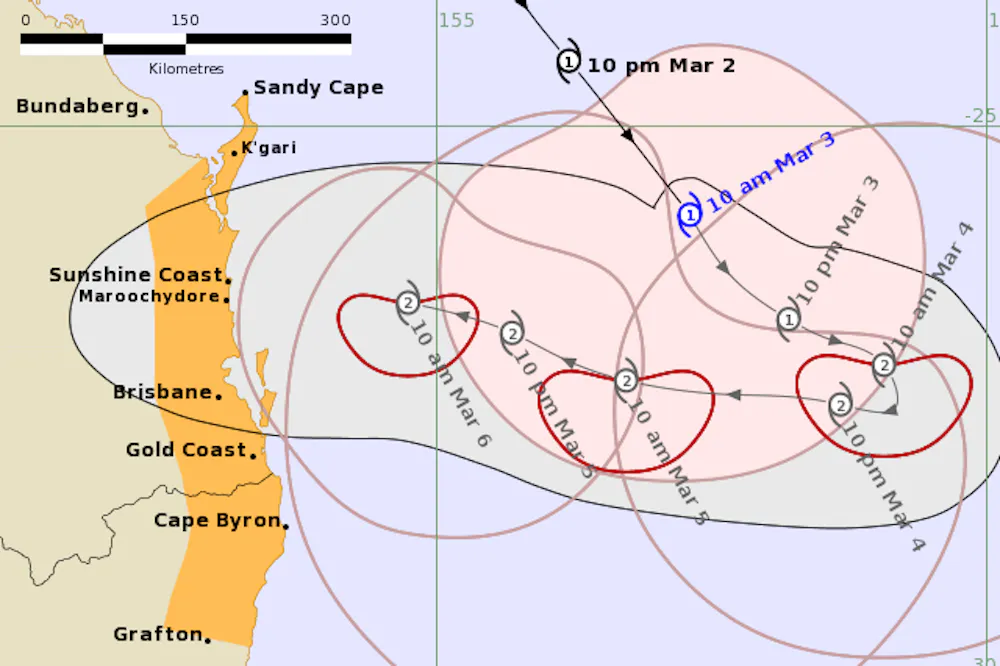
    No longer. The latest forecasts show the storm sharply changing direction and making a beeline for heavily populated areas of southeast Queensland.

    Its erratic path is not unexpected. Cyclones forming over the Coral Sea have the most unpredictable paths in the world, frustrating coastal Queensland residents, fishers, tourist operators and meteorologists themselves.

    Alfred is a typically unpredictable Coral Sea cyclone. But unusually, it has maintained its cyclonic structure and intensity much further south, into subtropical latitudes.

    Issued Monday March 3rd, this map shows the forecast path of Cyclone Alfred this week.
    Bureau of Meteorology, CC BY-NC-ND

    Cyclones, typhoons and hurricanes explained

    Cyclones, hurricanes and typhoons are different names for the same intense, horizontally rotating tropical storms. They occur in seven tropical ocean basins, above and below the equator.

    These storms need atmospheric heat. They only form over seas warmer than 27°C, where evaporation rates are high. They don’t occur in the cooler South Atlantic basin, and only rarely in the southeast Pacific, during strong El Niño events when sea surface temperatures are warmer.

    The northwest Pacific – off eastern Asia and the Philippines – experiences the most frequent and intense tropical storms (known there as typhoons).

    Australia averages about 13 cyclones a year. Most won’t make landfall and only a few are severe. The world’s hardest hit nation is China, where six cyclones make landfall annually.

    This map shows the aggregated paths of the world’s tropical cyclone over the 150 years to 2006. Note: this map uses the Saffir-Simpson scale in measuring wind speeds, which differs slightly to the Australian scale.
    NASA, CC BY-NC-ND

    In the north Pacific and north Atlantic, cyclones typically follow predictable tracks. They move westwards, steered by sub-tropical high pressure sytems to their north.

    Cyclone paths are also fairly predictable off the northwest coast of Australia. They typically form over the Timor Sea and drift southwest before shifting south and crossing the coast. Some are severe, as we saw with Category 5 Cyclone Zelia last month.

    By contrast, Coral Sea cyclones such as Alfred are much harder to predict.

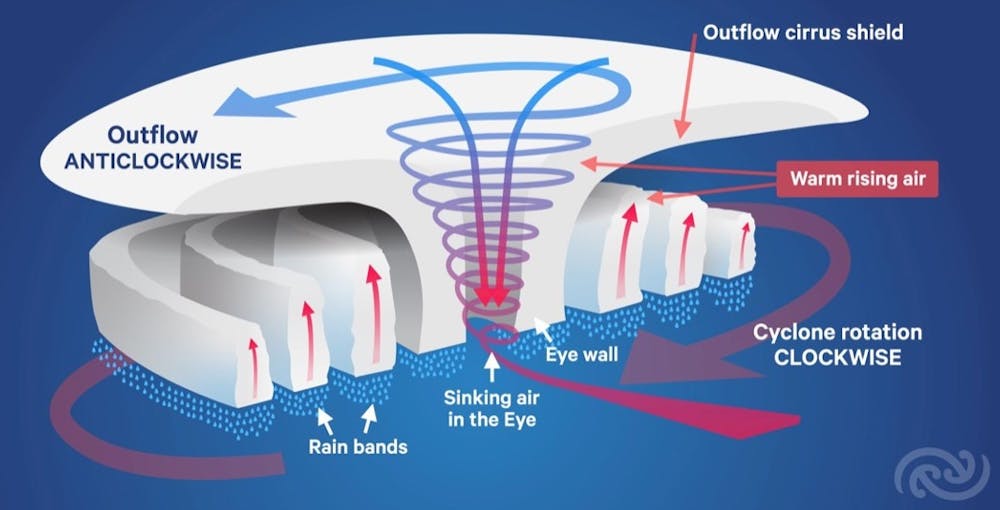
    In the southern hemisphere, cyclones spin clockwise. This figure shows how cyclones form around a low pressure system over warm seawater. Depending on their intensity, tropical cyclones are steered by dominant winds in the lower, middle and upper layers of the atmosphere.
    Metservice New Zealand, CC BY-NC-ND

    How cyclones are steered

    Strong winds are the main force steering cyclones, determining direction and forward speed.

    Severe tropical cyclones (categories 3–5) are characterised by deep convection currents, which form the famous eye at the centre of the storm, as well as feeder rainbands converging into their centre. Severe systems are generally steered by winds in the middle to upper levels.

    By contrast, weaker cyclones (categories 1–2) are much shallower and often have little or no convection around their centre. They tend to be steered by winds in the lower to middle levels. At present, Cyclone Alfred looks to remain relatively weak.

    Wind speed and direction can differ markedly in different levels of the atmosphere. Winds can also change direction at the same level. These competing influences are what lies behind the erratic paths of our cyclones.

    Cyclones forming in the Coral Sea are more likely to be pushed in different directions by different winds and weather systems than their equivalents in other ocean basins. This is what makes them so hard to predict.

    In our region, cyclones are largely steered by two high pressure systems.

    The first pushes cyclones east, and the second steers them west. If both are present and roughly equal in strength, they can hold a cyclone near-stationary. We saw this with Cyclone Alfred for most of the last week.

    Slow-moving tropical cyclones such as Alfred are more likely to wander, while faster-moving cyclones such as Severe Cyclone Yasi follow a stronger steering pattern and more predictable paths.

    Quite often, cyclones travel south and east out to sea. There, they quietly die in a large area of ocean colloquially known as the cyclone graveyard, southeast of Brisbane. These cyclones are steered by different weather systems – upper troughs, cold masses of air from the Southern Ocean.

    Cyclone Alfred was initially steered east by a near equatorial ridge to its northeast, then became stuck between this high pressure ridge and a sub-tropical ridge to its southwest. This is why it meandered very slowly south and built up strength to become severe.

    An upper trough then pushed it southeast over the weekend. This week, it’s likely to turn sharply westward towards land, propelled by a high pressure ridge to the south.

    Landfall – but where?

    After meandering around the Coral Sea for more than a week, Cyclone Alfred’s forecast track now seems more certain.

    The system is expected to intensify from a Category 1 to 2 tomorrow as it moves over warmer waters and draws in more moisture-laden air. This should see it maintain near Category 2 status until landfall. After it hits, it should rapidly weaken to a tropical low over southern Queensland into the weekend.

    Alfred will bring a lot of rain, making flooded rivers and flash flooding likely. The Bureau of Meteorology has issued a flood watch for catchments all the way from Maryborough to the Northern Rivers area of New South Wales. These communities should prepare now.

    Cyclone Alfred has a large area of gales, so will affect a wide swathe of coastline from K’gari (Fraser Island) to Byron Bay. Storm-force winds will cover a 100km wide area, mostly concentrated on its southern flank as it approaches and crosses the coast.

    In the longer term, Alfred’s remnants will likely be captured by an approaching upper trough and taken back offshore, where it will die in the cyclone graveyard – gone, but not likely to be forgotten.

    Steve Turton has previously received funding from the Australian Government.

    ref. Cyclone Alfred is expected to hit southeast Queensland – the first in 50 years to strike so far south – https://theconversation.com/cyclone-alfred-is-expected-to-hit-southeast-queensland-the-first-in-50-years-to-strike-so-far-south-251241

    MIL OSI AnalysisEveningReport.nz

  • MIL-OSI Australia: Allens advises Zenith on $1.9 billion refinancing

    Source: Allens Insights

    Allens has advised Zenith Energy on its $1.9 billion refinancing and increase to its existing bank debt facilities, providing more than $1 billion in growth capital to support the development of new projects.

    The refinancing, backed by a syndicate of 14 Australian and international lenders, provides growth funding to support Zenith’s financial capacity as it expands its role in delivering renewable and hybrid power solutions. A portion of the transaction includes green loan facilities structured under Zenith’s Green Finance Framework, aligning with the Asia Pacific Loan Market Association’s Green Loan Principles.

    ‘We congratulate Zenith and the financiers on this significant transaction, which supports Zenith’s ability to capitalise on the opportunities of the energy transition. This refinancing highlights the strong market confidence in Zenith’s strategy and the role it plays in enabling decarbonisation in the resources sector. We are very pleased to continue our long standing relation with Zenith and to be able to support it into the future,’ said partner Rod Aldus.

    Allens legal team

    Banking & Finance

    Rod Aldus (Partner), Michael Ryan (Partner), Tania Joppich (Senior Associate), Bronte Barber (Lawyer)

    MIL OSI News

  • MIL-OSI Asia-Pac: Director General David Cheng-Wei Wu Submitted an Article to The Daily Telegraph on Chinese Navy’s Incursion to Australian Waters

    Source: Republic Of China Taiwan 2

    《Why is China sending ships our way? Just ask Taiwan》
    Cheng-Wei Wu, Director General of the Taipel Economic and Cultural Office In Sydney
    The surprise visit of three Chinese warships just 150 nautical miles east of Sydney serves as a wake-up call, bringing up distant memories of World War II when Australia, a country “girt by sea”, was exposed to threat of an authoritarian power’s navy suddenly appearing in the nation’s waters.
    Yet for some time Australian opinion leaders have debated the nature of the China threat.
    But the simple fact is, last week Chinese warships conducted live-fire drills in Australia’s exclusive economic zone (EEZ) for the very first time, and from afar. And at least 49 commercial flights flying over the Tasman Sea between Australia and New Zealand were forced to change course, after receiving a short-notice verbal warning broadcast from the Chinese warships.
    Australia’s Defence Minister Richard Marles stated that China did not follow the best practice of giving 12 to 24 hours’ prior notice and the Australian government has expressed concern to the Chinese government.
    There has plenty of analysis in the past few days on the purpose to rationalise China’s flagrant military moves. It is worth noting that a comment published by Chinese Communist Party’s mouthpiece, the Global Times, stated that: “The People’s Liberation Army is expected to host more such far seas voyages … Some countries may have not yet adapted to seeing the PLA Navy’s normal voyages”.
    Coming from Taiwan, a neighbouring country which faces China’s military harassment and economic coercion on a regular basis, I want to share observations that China is trying to create its “new normal” now in Australia’s front yard with the grey zone tactics, just as they have done in the Taiwan Strait.
    We have seen an uptick of frequency of PLA aircraft’s incursions into our ADIZ (Air Defence Identification Zone) from 960 sorties in 2021 to 3074 sorties in 2024.
    China does this to protest the world’s engagement with Taiwan and to cast a shadow over our elections.
    On this score, it is sure that China knows about Australia’s upcoming federal election and calculated it was “worthwhile” sending a fleet to make an impression.
    China would also like to test the determination of our democratic allies in the Indo-Pacific region, particularly as Donald Trump recalibrates US foreign policy.
    The development of international relations may have its own course. Nevertheless, there are still some rules in world politics which have been verified throughout the pain and history.
    “Like-minded countries must band together”, should be the one to help
    stand up against aggression and authoritarian expansionism.
    When Australia faces the Chinese military bully and intimidation, do not forget the rules we learned, and all democracies would be united by your side, including Taiwan.

    MIL OSI Asia Pacific News

  • MIL-OSI Economics: Money Market Operations as on February 28, 2025

    Source: Reserve Bank of India


    (Amount in ₹ crore, Rate in Per cent)

      Volume
    (One Leg)
    Weighted
    Average Rate
    Range
    A. Overnight Segment (I+II+III+IV) 6,261.85 6.33 5.25-6.80
         I. Call Money 1,111.65 6.18 5.25-6.40
         II. Triparty Repo 3,591.00 6.34 5.85-6.80
         III. Market Repo 0.00
         IV. Repo in Corporate Bond 1,559.20 6.41 6.40-6.45
    B. Term Segment      
         I. Notice Money** 17,236.23 6.38 5.15-6.65
         II. Term Money@@ 654.00 6.15-8.10
         III. Triparty Repo 3,64,113.35 6.28 6.10-6.80
         IV. Market Repo 1,50,239.19 6.30 6.00-7.31
         V. Repo in Corporate Bond 0.00
      Auction Date Tenor (Days) Maturity Date Amount Current Rate /
    Cut off Rate
    C. Liquidity Adjustment Facility (LAF), Marginal Standing Facility (MSF) & Standing Deposit Facility (SDF)
    I. Today’s Operations
    1. Fixed Rate          
    2. Variable Rate&          
      (I) Main Operation          
         (a) Repo          
         (b) Reverse Repo          
      (II) Fine Tuning Operations          
         (a) Repo Fri, 28/02/2025 3 Mon, 03/03/2025 16,258.00 6.26
         (b) Reverse Repo          
      (III) Long Term Operations^          
         (a) Repo          
         (b) Reverse Repo          
    3. MSF# Fri, 28/02/2025 1 Sat, 01/03/2025 8,103.00 6.50
      Fri, 28/02/2025 2 Sun, 02/03/2025 0.00 6.50
      Fri, 28/02/2025 3 Mon, 03/03/2025 840.00 6.50
    4. SDFΔ# Fri, 28/02/2025 1 Sat, 01/03/2025 88,267.00 6.00
      Fri, 28/02/2025 2 Sun, 02/03/2025 0.00 6.00
      Fri, 28/02/2025 3 Mon, 03/03/2025 8,971.00 6.00
    5. Net liquidity injected from today’s operations [injection (+)/absorption (-)]*       -72,037.00  
    II. Outstanding Operations
    1. Fixed Rate          
    2. Variable Rate&          
      (I) Main Operation          
         (a) Repo Fri, 21/02/2025 14 Fri, 07/03/2025 41,046.00 6.26
         (b) Reverse Repo          
      (II) Fine Tuning Operations          
         (a) Repo          
         (b) Reverse Repo          
      (III) Long Term Operations^          
         (a) Repo Fri, 21/02/2025 45 Mon, 07/04/2025 57,951.00 6.26
      Fri, 14/02/2025 49 Fri, 04/04/2025 75,003.00 6.28
      Fri, 07/02/2025 56 Fri, 04/04/2025 50,010.00 6.31
         (b) Reverse Repo          
    3. MSF#          
    4. SDFΔ#          
    D. Standing Liquidity Facility (SLF) Availed from RBI$       9,095.71  
    E. Net liquidity injected from outstanding operations [injection (+)/absorption (-)]*     2,33,105.71  
    F. Net liquidity injected (outstanding including today’s operations) [injection (+)/absorption (-)]*     1,61,068.71  
    G. Cash Reserves Position of Scheduled Commercial Banks
         (i) Cash balances with RBI as on February 28, 2025 9,33,991.34  
         (ii) Average daily cash reserve requirement for the fortnight ending March 07, 2025 9,22,740.00  
    H. Government of India Surplus Cash Balance Reckoned for Auction as on¥ February 28, 2025 16,258.00  
    I. Net durable liquidity [surplus (+)/deficit (-)] as on February 07, 2025 -1,973.00  
    @ Based on Reserve Bank of India (RBI) / Clearing Corporation of India Limited (CCIL).
    – Not Applicable / No Transaction.
    ** Relates to uncollateralized transactions of 2 to 14 days tenor.
    @@ Relates to uncollateralized transactions of 15 days to one year tenor.
    $ Includes refinance facilities extended by RBI.
    & As per the Press Release No. 2019-2020/1900 dated February 06, 2020.
    Δ As per the Press Release No. 2022-2023/41 dated April 08, 2022.
    * Net liquidity is calculated as Repo+MSF+SLF-Reverse Repo-SDF.
    ¥ As per the Press Release No. 2014-2015/1971 dated March 19, 2015.
    # As per the Press Release No. 2023-2024/1548 dated December 27, 2023.
    ^ As per the Press Release No. 2024-2025/2013 dated January 27, 2025, Press Release No. 2024-2025/2138 dated February 12, 2025, and Press Release No. 2024-2025/2209 dated February 20, 2025.
    Ajit Prasad          
    Deputy General Manager
    (Communications)    
    Press Release: 2024-2025/2286

    MIL OSI Economics

  • MIL-OSI Economics: Call for nominations for ASEAN Prize 2025 opens

    Source: ASEAN

    JAKARTA, 3 March 2025 – ASEAN officially announces the call for nominations for the ASEAN Prize 2025, today. Recognised as the region’s premier award, the ASEAN Prize honours outstanding individuals and organisations across ASEAN for their exemplary contributions and significant accomplishments, towards fostering the building of an inclusive and outward looking ASEAN Community.
     
     
    Currently in its eighth edition, the recipient of ASEAN Prize 2025 will be presented with a prestigious trophy at the 47th ASEAN Summit under Malaysia’s Chairmanship, along with a monetary award of US$20,000, in partnership with the Temasek Foundation of Singapore.
     
     
    Eligible ASEAN individuals and organisation are invited to file the application for the ASEAN Prize Submissions must be made through the National Focal Points of the respective ASEAN Member State from 3 March to 16 May 2025. Applicants are required to submit a completed ASEAN Prize 2025 nomination form, providing comprehensive details and highlighting the nominee’s future initiatives. 
     
    Applicants are encouraged to elaborate and detail their achievements that fall under the following actions:
     
    Outstanding collaboration between ASEAN Member States (AMSs);
    Outstanding collaboration between ASEAN and the world;
    Outstanding people-to-people engagement among AMSs;
    Outstanding economic integration and promotion of standards between AMSs;
    Other outstanding contributions to ASEAN Community Building;
    Applications must be accompanied by supporting documents that substantiate the nominee’s concrete contributions and achievements for the regional development. A character reference accompanying the supporting documents highlighting the nominee’s eligibility would be valuable addition. On the important note, the ASEAN Prize will not consider self-nominations and posthumous submissions.
    The Judging Committee Meeting for ASEAN Prize, chaired by Secretary-General of ASEAN Dr. Kao Kim Hourn, will convene round of intensive assessments to select this year’s recipient. The panel of judges for ASEAN Prize 2025 comprises of both former and current Secretaries-General of ASEAN.
    Since its inauguration in 2018, a total of four individuals and three organisations have been awarded with the ASEAN Prize. Last year, the ASEAN Youth Organization (AYO), a regional youth set-up based in Indonesia, was selected as the ASEAN Prize Recipient following their influential and impactful contributions to fostering cross-cultural collaborations and promoting ASEAN identity among the region’s youth. Their determination and efforts have significantly contributed to further regional community engagement, especially among ASEAN youths, and  strengthened the building of the ASEAN Community.
     
    Under Lao PDR Chairmanship, Prime Minister of the Lao PDR Sonexay Siphandone conferred the ASEAN Prize trophy to ASEAN Youth Organization during the opening ceremony of the 44th and 45th ASEAN Summit last October in Vientiane.
     
    The ASEAN Prize serves as a testament to the region’s resolute commitment to celebrate and honor the significant efforts of the individuals and organisations who have made steadfast contributions to the development of a resilient ASEAN Community, demonstrating concrete efforts in fostering regional integration, all the while forging an inclusive and stronger ASEAN identity.
    ###


    Details on the nomination and eligibility for ASEAN Prize 2025
    Nomination calls start on 3 March 2025
    The nominee must be an ASEAN citizen or an ASEAN-based organisation.
    The nominee shall submit valid/verifiable documents and highlight his/her achievement and influence on ASEAN since the launch of the ASEAN Community on 31 December 2015.
    The nominee should also share future initiatives detailing how the cited work will continue after winning the Prize.
    All nominations must be submitted to the ASEAN National Focal Point by 16 May 2025 at 5 PM, GMT+7 (Jakarta time).
    Please submit nominations to your respective National Focal Point listed below. The ASEAN Prize 2025 nomination form can be downloaded from https://asean.org/nomination-form/.
     
    ASEAN Member States
    National Focal Points for the ASEAN Prize
    Brunei Darussalam
    ASEAN-Brunei Darussalam National Secretariat Ministry of Foreign Affairs of Brunei Darussalam. Email : dept.ofasean@mfa.gov.bn
    Cambodia
    General Department of ASEAN Ministry of Foreign Affairs and International Cooperation Email: mfaic.asean@mfaic.gov.kh
    Indonesia
    Directorate of ASEAN Social and Cultural Cooperation Ministry of Foreign Affairs Email: dit.ksba@kemlu.go.id; direktoratkfa@gmail.com
    Lao PDR
    ASEAN Political-Security Community Division Lao National ASEAN Secretariat Email: aseanlaos@gmail.com
    Malaysia
    ASEAN-Malaysia National Secretariat Email: myasean@kln.gov.my
    Myanmar
    Socio-cultural Division, ASEAN-Myanmar National Secretariat, Ministry of Foreign Affairs Email: dgasean@gmail.com; amns.mofa@gmail.com
    Philippines
    ASEAN Socio-Cultural Community Division ASEAN-Philippines National Secretariat Tel.: 8344431, 8344470; Fax: 8321667 Email: asean@dfa.gov.ph
    Singapore
    ASEAN-Singapore National Secretariat Email: Mfa_asean_singapore@mfa.gov.sg
    Thailand
    Department of ASEAN Affairs, Ministry of Foreign Affairs ASEAN-Thailand National Secretariat Email: mfa1202@mfa.go.th
    Viet Nam
    ASEAN-Viet Nam National Secretariat Email: asean.mfa@mofa.gov.vn; asean.mfa.vn@gmail.com
     
    The Association of Southeast Asian Nations (ASEAN) was established on 8 August 1967 and constitutes ten Member States: Brunei Darussalam, Cambodia, Indonesia, Lao PDR, Malaysia, Myanmar, Philippines, Singapore, Thailand, and Viet Nam. On 31 December 2015, the ASEAN Community was formally established. The ASEAN Secretariat is based in Jakarta, Indonesia.
     
    Temasek Foundation supports a diverse range of programmes that uplift lives and communities in Singapore and beyond. Temasek Foundation’s programmes, made possible through philanthropic endowments gifted by Temasek, strive towards achieving positive outcomes for individuals and communities now, and for generations to come.
    Collectively, Temasek Foundation’s programmes strengthen social resilience, foster international exchange and regional capabilities, advance science,and protect the planet. For more information, visit www.temasekfoundation.org.sg.

    MIL OSI Economics

  • MIL-OSI China: Legacy carved in stone

    Source: China State Council Information Office 3

    The recent Chongqing premiere of For an Eternal Homeland — Dazu Rock Carvers’ Legacy has been hailed by the audiences and critics as a spectacle that brings the ancient figures of the Dazu Rock Carvings, a UNESCO World Heritage Site, to life.

    Through a blend of artistry and narrative, this dance drama has been recognized by many as a successful reimagining and revitalization that allows the historical treasure to shine anew.

    Zhang Yaqi, artistic director of the dance drama, says that the collaboration between the municipality of Chongqing and the China Oriental Performing Arts Group, a national performing arts institution, was developed over a two-year period and pays tribute to Dazu’s stone carvers.

    The performance is themed on celebrating the ancient philosophical vision of an ideal society: renjian xiaoman; tianxia dazu, (literally “small satisfaction in human life; grand prosperity and abundance in the world”).

    The Dazu Rock Carvings include the 144 grottoes, 50,000 statues and 100,000 inscriptions found in Chongqing’s Dazu district.

    Begun during the early Tang Dynasty (618-907) and reaching its peak during the Song Dynasty (960-1279), these extensive carvings amalgamate Confucian, Buddhist and Taoist sculptures.

    The UNESCO designation was awarded in 1999. Along with the Mogao Caves in Gansu province, the Longmen Grottoes in Henan province, and the Yungang Grottoes in Shanxi province — all similarly designated — the Dazu Rock Carvings are considered an essential part of the history of cave art in China.

    The 10-chapter, 100-minute dance drama is the tale of a young refugee named Xiao Fu. Fleeing to Dazu during the Southern Song Dynasty (1127-1279), he seeks sanctuary among local rock carvers, embracing their simple joys and aspirations for a brighter tomorrow. However, when a rockslide occurs, he pledges to immortalize the names of his departed family members by carving them on the cliffs, ensuring their memory lasts forever.

    “The stage presentation was challenging, with a deep sense of reverence. We drew inspiration from the details of the carvings, capturing their lifelike appearances,” Zhang says.

    She adds that every aspect, from characters and costumes to design, movements and props, was created to reflect the poetic essence of these portrayals of everyday rural life.

    For instance, figures such as the flute-playing woman, the chicken-raising woman, the cattle herder, and the woman wine seller, as well as Graceful Guanyin (Avalokitesvara, or the Goddess of Mercy), Water-moon Guanyin, and the Buddhist monk Zhigong (418-514) are brought to life in the drama.

    The 40 performers, 18 women and 22 men, radiate an ancient charm that encapsulates the aesthetics of the Song Dynasty, according to Zhang, who adds that the production included some core members of the team behind another hit, Poetic Dance: The Journey of a Legendary Landscape Painting.

    A large mirror onstage was used as a backdrop, according to Gao Guangjian, the drama’s visual director and set designer.

    A variety of multimedia techniques was used to create a distinct realm, enabling the exploration of the dynamic interplay between reality and faith.

    “The Dazu Rock Carvings are a priceless treasure, and belong to humanity,” says Li Fangyin, former director of Dazu Rock Carvings Research Institute.

    “Their deep content, such as philosophical ideas, humanistic principles, values and morals, helped us to further tap their worth through creative efforts,” Li adds.

    Since the 18th National Congress of the Communist Party of China in 2012, the country has increasingly focused on the conservation and use of cultural heritage and grotto temples.

    According to Li, more than 30 protection projects have been carried out at the Dazu Rock Carvings over the past two decades, resulting in marked progress on the protection, research, and use of the site.

    The Qianshou Guanyin (Thousand-hand Avalokitesvara) statue, carved during the Southern Song Dynasty, is a treasure of Baoding Mountain, one of the sites part of Dazu. In June 2015, after an 8-year national project to conserve its stone relics, aided by technology, salvage efforts were completed. That year, the Art Museum of Dazu Rock Carvings was opened.

    After 16 years of surveys and research by experts at the research institute, Dazu Shike Quanji (A Collection of Dazu Rock Carvings) was published by Chongqing Publishing Group in 2019, the first Chinese archaeological report about large grotto temple sites.

    In recent years, several international academic symposiums have been held in Chongqing and Ziyang, Sichuan province, to integrate cultural tourism and preservation.

    Last August, the first International Forum on Cave Temple Conservation kicked off in Dazu. Experts from countries, including Norway, the United Kingdom, Japan, Pakistan, Iran, Afghanistan and Nepal, convened to share insights and address common challenges in the global conservation of grotto temples.

    Chongqing’s Dazu and Ziyang city in Sichuan are known for their stone carvings — 150,000 in all — among which the Anyue Grottoes in Ziyang’s Anyue county have been included in the provisional list of UNESCO’s World Cultural Heritage Sites.

    The Sichuan-Chongqing Grotto Protection and Research Center has been established and has organized 20 international forums and academic exchange studies in Dazu. It is also responsible for publishing the academic journal Cave Temple Research and Conservation.

    “The fusion of traditional art and modern technology has led to many changes,” Li says, citing the example of Black Myth: Wukong.

    The game’s production team explored the Dazu Rock Carvings three years ago, and set many scenes in the hit game there.

    After its three-day premiere from Feb. 21 to 23 in Chongqing, the drama will travel to 10 more cities, including Chengdu, Hangzhou in Zhejiang province, Nanchang in Jiangxi province, Shenzhen in Guangdong province, Fuzhou and Xiamen in Fujian province, as well as Changsha in Hunan province. A total of 100 performances are planned for the year.

    MIL OSI China News

  • MIL-OSI China: China plays major role in global climate affairs

    Source: China State Council Information Office 2

    China is a critical force in the global energy transition and its involvement in international climate talks is essential, the head of the United Nations’ climate science panel said on Saturday.
    Jim Skea, chair of the Intergovernmental Panel on Climate Change, made the remarks ahead of the release of its findings from its 62nd plenary session, which concluded on Saturday in Hangzhou, Zhejiang province.
    Skea emphasized China’s leading role in deploying renewable energy, noting it has the world’s highest levels of solar and wind energy.
    “Without China’s participation, global efforts would be much less effective,” Skea said, highlighting the country’s importance in discussions under the UN Framework Convention on Climate Change and the Paris Agreement.
    The weeklong session focused on outlining reports for the IPCC’s seventh assessment cycle, covering the physical science of climate change, its impacts, adaptation, vulnerability and mitigation, as well as greenhouse gas inventories.
    The Hangzhou meeting stressed the importance of integrating climate action with economic growth and improved quality of life.
    “The idea of improving people’s well-being and quality of life is not opposed to taking climate change action. They actually go together,” Skea said.
    He praised China’s advancements in climate monitoring technologies, including early warning systems and meteorological satellites, which are crucial for tracking climate conditions, greenhouse gas emissions and socioeconomic changes, particularly in developing nations.
    Xiong Shaoyuan, deputy head of China’s delegation, said the nation will collaborate with other countries to build early warning platforms and share its experiences in meteorological services.
    Established in 1988, the IPCC provides scientific information to governments on climate change. For its current cycle, the IPCC will focus on climate change in urban areas and carbon dioxide removal technologies, including carbon capture, utilization and storage. The first meeting on urban climate change will be held from March 10 to 14 in Osaka, Japan, Skea said.

    MIL OSI China News

  • MIL-OSI China: Companies expand footprint overseas

    Source: China State Council Information Office

    Cargo ships carrying steel products are heading toward African ports from Zhangjiagang Port in East China’s Jiangsu province, and canned beans from Yancheng, Jiangsu, are reaching the dining tables of Middle Eastern families, as local Chinese enterprises continue to expand their businesses overseas, according to Nanjing Customs.

    Chinese companies nationwide, not just enterprises in Jiangsu, are revving up their efforts to expand their footprint overseas and strengthen international cooperation.

    In the two weeks following the Spring Festival holiday, the China Council for the Promotion of International Trade said it arranged for eight groups of Chinese entrepreneurs to travel abroad for economic and trade activities.

    Representatives from more than 200 companies visited Kazakhstan, Germany, South Africa, Egypt, Ethiopia, Qatar, Saudi Arabia and the United Arab Emirates, the Beijing-based council said on Friday.

    “During the visits, the willingness of foreign companies to cooperate with China exceeded our expectations, and 33 cooperation intent agreements were reached, covering sectors such as finance, energy, infrastructure, automobile manufacturing and the digital economy,” said Yang Fan, a spokeswoman for the CCPIT.

    “This has fully demonstrated the strong desire and broad prospects for pragmatic cooperation between Chinese and foreign business communities,” she said.

    The more difficult the times, the more determined the global business community is to work together and achieve win-win cooperation, Yang said, noting that this is the greatest certainty that balances many uncertain factors in global economic growth.

    Unilateralism and protectionism can’t interfere with the main theme of economic globalization, she added.

    In mid-February, a delegation of Chinese entrepreneurs visited Kazakhstan and achieved better-than-expected results. During the two-day visit, representatives of enterprises from China and Kazakhstan signed eight cooperation agreements, including an energy strategic cooperation agreement and an agricultural products import and export agreement.

    The visit was aimed at deepening trade, investment and industrial and supply chain cooperation between China and Kazakhstan and further consolidating the permanent comprehensive strategic partnership between the two countries, the CCPIT said.

    Chinese entrepreneurs were also warmly welcomed in other countries, and Chinese and foreign business communities engaged in enthusiastic talks.

    In South Africa, the country’s Deputy President Paul Mashatile met with a Chinese business delegation in person, while in Germany, the management teams of major multinational corporations, such as Mercedes-Benz, BMW and Bosch, held in-depth talks with Chinese entrepreneurs, Yang said.

    In the UAE, officials from government departments and major business associations actively engaged in dialogues with Chinese entrepreneurs, she added.

    In the past few years, Chinese enterprises have shown strong willingness to promote industrial and supply chain cooperation with their foreign counterparts.

    Last year, the CCPIT organized a total of 2,249 business groups to visit 102 countries and regions, which means on average six Chinese delegations went abroad for business talks each day.

    Jiangsu Kanghui New Material Technology Co, an affiliate of Hengli Group, which focuses on the full production chain in oil refining, petrochemicals, polyester new materials and textiles, is a leading company in producing wide polyester films. A variety of polyester film products have rolled off its production line for exports.

    In particular, the company has been actively expanding its business in emerging markets such as the Association of Southeast Asian Nations, according to Nanjing Customs.

    “Last year, our products exported to ASEAN countries enjoyed preferential tariffs and received an exemption of 8.47 million yuan ($1.16 million), thanks to the China-ASEAN free trade agreement,” said Zhang Liping, director of imports and exports at Jiangsu Kanghui New Material Technology.

    “With preferential tariffs, our products have become more competitive in overseas markets. In 2024, the company’s export value in the ASEAN market reached $24 million,” Zhang added.

    MIL OSI China News

  • MIL-OSI Australia: We must not risk going backwards on racism

    Source: Australian Human Rights Commission

    Nearly every day, my phone buzzes with messages of distress: community leaders, faith groups, families and individuals from all walks of life, each carrying the weight of racism’s impact.

    A mother fearful for her child’s safety calls after yet another racial slur at school. A faith leader grapples with hate targeting their congregation. A teacher gets in touch because they confront racism daily.

    The stories are different, but the pain is the same – frustration, exhaustion, asking what can be done. The hard-fought progress that we have made towards equality is being challenged before our eyes and we cannot risk going backwards.

    Bearing witness to what many others do not see, and supporting those affected, is a responsibility I do not take lightly. I cannot do it alone, however. Everyone has a role to play.

    Last week, a Jewish doctor emailed me asking how we can stop anti-Semitism after the confronting video of two nurses in Bankstown saying they would kill Israeli patients. The tone in his email was urgent. He was concerned for the safety of Jewish healthcare workers and patients.

    In his email, he focused on the need for education and building an understanding of racism, but I could feel his frustration.

    In the weeks prior, a Muslim woman sent me messages about white supremacists letterboxing in Adelaide. She sent me screenshots of the abhorrent leaflets and asked what I could do to get police to take the matter more seriously. Again, frustration.

    The weeks before that, it was messages from members of the Indian community, sending me videos of racism towards Indian fans at the cricket. Bewildered, they also asked me what could be done.

    Each reflect a system failure that enables racism: a health system where staff and patients feel unsafe; a justice system that is focused on criminalising offences after the harm is done, rather than early community-led prevention; a sporting sector that cannot protect victims of racism.

    The thing about systems is that they can be fixed, when we know how to diagnose the problem.

    For those who are unfamiliar with racism, it is easier to imagine its more overt forms. People are familiar with the racist uncle you see once a year, or the one racist person at work whom your colleagues tolerate because they’re part of the furniture.

    The reason why it’s easy to imagine this form of racism is because it is easy to separate ourselves from it. We tell ourselves we do not do that and we move on.

    For those who are familiar with systemic racism, we know that it is everywhere. Many of the examples I hear sit with me long afterwards.

    One was of a Palestinian child whose picture of a Palestinian flag was thrown in the bin by their teacher. Another was of an African-born mother whose son was told that he could not walk onstage to accept his first ever academic award because his hairstyle didn’t conform to school standards.

    When his mother raised it with the all-white school executive and administration, she was dismissed and told rules must be upheld. She was persistent, however, and produced photos of white kids with much longer hair who were allowed onstage. Eventually, the school conceded it was wrong, but the damage had been done.

    At no point in this story is there name-calling or the hurling of abuse. The school claimed it was applying the rules equally to everyone. Yet it is another example of the pervasive nature of systemic racism and the way it operates.

    African hair did not fit the school rules, and without the courage and resilience of an African mother nothing would have happened. The burden to challenge racism falls too greatly on its victims.

    Late last year I launched the Australian Human Rights Commission’s National Anti-Racism Framework. The framework comes at a time when race is on the front page of our newspapers every other day. Anti-Semitism, anti-Arab racism, anti-Palestinian racism and Islamophobia are on the rise, with disgusting displays of hate and racist violence becoming more frequent across communities.

    In this climate, I cannot think of a more pressing need for a national approach to ending racism. Solutions to systemic racism are in everyone’s best interest. A society where everyone can flourish benefits us all.

    Systemic racism is like cancer. The tumours can be removed, but the cancer will keep making us sick until we confront its source.

    It is an illness that began 237 years ago. As Stan Grant wrote, “Racism isn’t killing the Australian dream. The Australian dream was founded on racism.”

    When I meet with First Nations communities, one of the common threads among the conversations is that colonisation is not just a date in history but an ongoing reality. It has impacted every institution and informed every dominant way of thinking since 1788.

    So, when we talk about systemic racism in Australia, we are talking about systems that have been built to advance the interests of colonising white settlers. These systems don’t consider or protect the interests of First Nations people and others who experience racism.

    Our education system is built for white knowledge and our workplaces elevate white people into leadership by default. This is not just a mere inconvenience for people who experience racism – these systems cause harm to communities, so that those who benefit can thrive.

    We only need look at the over-imprisonment and harm experienced by First Nations people within our legal system for an example of the systemic bias baked into our society.

    To say, then, that it can be disheartening when my bid to call out systemic racism falls flat is an understatement.

    Recently I’ve even been asked why I’m so focused on race when we’re facing serious levels of economic and class inequality, which can also impact white people. For those who feel the harms of racism, however, these issues are deeply intertwined.

    Migrant workers of colour have become even more vulnerable to exploitation in order to keep their jobs. Worse, economic inequality is exploited by racist rhetoric that blames migration for what are far more complex and deeply entrenched problems.

    When migrants are blamed, too often the only signal as to whether someone is a migrant is the colour of their skin. Race compounds the inequality experienced in hard times and is vital to consider when we chart the way forward.

    The commission’s National Anti-Racism Framework has 63 recommendations for eliminating racism. They span government, education, healthcare, justice, workplaces and the media.

    The framework calls for a hard look at the composite parts of our nation. We need to examine the insidious way in which racism has made its nest in almost every facet of Australian life. Then we need to deploy our tools: law reform, new policies, relevant training and whatever else is needed to dismantle racism at its roots.

    In education, this means making the need for anti-racist education explicit in curriculums from early childhood through to our tertiary institutions. In healthcare, this means partnerships and shared decision-making with at-risk communities, so that those who are most harmed by racism in our healthcare system have a stronger, louder voice.

    Online, it means better regulation of racist hate. It means a more coordinated anti-racist approach to collecting data on racism.

    Across sectors, we have also outlined the need to deepen our understanding of how racism continues to be upheld, with a mandate to prevent and eliminate these vicious cycles. We’ve highlighted that listening to and valuing the leadership of First Nations people is essential to this work.

    We are at a critical juncture where race and racism need to go from “too hard” to actionable, durable solutions. The longer we leave things to fester, the more severe the outcome. It is our collective responsibility to act now and do more.

    Racism is estimated to cost the Australian economy $37 billion each year. It would cost a fraction of that to implement the recommendations put forward in the National Anti-Racism Framework.

    It is not good enough to expect those who are most affected by racism to be responsible for calling out and addressing racism in their schools, at work and in the community at large. We need a more preventive, systemic response.

    Many people came forward as we developed the framework to share the ways racism has diminished them, and to offer their solutions for change. We all deserve to live without fear and with dignity.

    Our next step in the journey must be one that results in a fairer and more equitable society that allows us all to be our whole selves. A united commitment will lay the foundations for a safer future where everyone can thrive free from the damaging impacts of racism.

    We need our leaders in politics, civil society and business to be brave. They’ve been handed a road map. It’s time for the rubber to hit the road.

    This article was first published in the print edition of The Saturday Paper on March 1, 2025 as “How to fight racism”.

    MIL OSI News

  • MIL-OSI China: Chinese coastal city showcases charm at Philadelphia Flower Show

    Source: China State Council Information Office 3

    Qingdao, a coastal city in east China’s Shandong Province, unveiled its charm at the 196th Philadelphia Flower Show on Saturday, becoming the third consecutive Chinese city on display at the prestigious horticultural event.

    On the theme of “Qingdao, a City Full of Charm and Vitality,” The city’s 70-square-meter exhibition garden blends Qingdao’s coastal beauty with Chinese horticultural traditions.

    Throughout the flower show, the Qingdao pavilion will host daily live demonstrations of its intangible cultural heritage, including puppet shows of Laixi, tea ceremonies of Laoshan, Peking opera, traditional incense making and folk paper-cutting art.

    In addition to the exhibition garden, Qingdao also held an event on Saturday to promote its culture and tourism.

    “By strengthening exchanges, deepening our cultural ties and expanding areas of mutual interest, we can build lasting bonds of friendship. China’s door is always open, and we warmly welcome more people-to-people exchanges,” said Chinese Consul General in New York Chen Li in an address.

    Qingdao marks the presence of a Chinese city at the Philadelphia Flower Show for a third consecutive year following southwest China’s Chengdu in 2023 and central China’s Zhengzhou in 2024.

    The Philadelphia Flower Show is one of the largest and most influential horticulture events in the United States. On the theme of “Gardens of Tomorrow,” the 2025 edition kicked off on Saturday, focusing on imaginative design and limitless inspiration to showcase the future of horticulture.

    MIL OSI China News

  • MIL-OSI China: Hong Kong accelerates integration into national development

    Source: China State Council Information Office

    The Second Agreement Concerning Amendment to the Mainland and Hong Kong Closer Economic Partnership Arrangement (CEPA) Agreement on Trade in Services (agreement II) was implemented on Saturday, allowing Hong Kong to accelerate its integration into the overall national development.

    The agreement II further opens up the services market of the Chinese mainland to Hong Kong, enabling Hong Kong businesses and professionals to enter the mainland market with more preferential treatments.

    This move was welcomed by various sectors in Hong Kong, and the industry is looking forward to making good use of the Central Government’s policies to support Hong Kong and promote high-quality economic development, further integrating into the national development.

    The agreement II introduces new liberalization measures across a number of service sectors where Hong Kong enjoys competitive advantages, such as financial services, construction and related engineering services, testing and certification, telecommunications, motion pictures, television and tourism services.

    The liberalization measures take various forms, including removing or relaxing restrictions on equity shareholding and business scope in the establishment of enterprises; relaxing qualification requirements for Hong Kong professionals providing services; and easing restrictions on Hong Kong’s exports of services to the mainland market.

    Most of the liberalization measures apply to the whole mainland, while some of them are designated for pilot implementation in the nine Pearl River Delta municipalities in the Guangdong-Hong Kong-Macao Greater Bay Area.

    Paul Chan, financial secretary of the Hong Kong Special Administrative Region (HKSAR) government, said earlier that according to the agreement II, the restriction for the mainland branches of Hong Kong banks to conduct bank card business will be lifted starting from March, which will facilitate them in expanding their businesses in the mainland.

    Tommy Tam, chairman of the Travel Industry Council of Hong Kong, said that the new measures are expected to attract more foreign tourists to enter Hong Kong to explore the city and travel further to the mainland. The industry is preparing to promote these arrangements and believes that the demand from ASEAN (the Association of Southeast Asian Nations) tourists is relatively large.

    Law Society of Hong Kong President Roden Tong Man-lung said that this is very good news for the entire Hong Kong legal sector. The legal industry hoped to seize the opportunity to expand their business.

    By the end of last year, the cumulative customs duty concessions under CEPA had exceeded 10.2 billion yuan (about 1.39 billion U.S. dollars). Last year, the total trade in goods between the mainland and Hong Kong exceeded 4.8 trillion Hong Kong dollars (about 613.92 billion U.S. dollars), more than three times the amount before the implementation of CEPA, with an average annual growth rate of 5.6 percent.

    The number of sectors in which the mainland has fully or partially opened up to Hong Kong’s service industry has increased to 153, accounting for 96 percent of all 160 service trade sectors.

    The agreement II also brings along institutional innovation and collaboration enhancements. It includes the addition of “allowing Hong Kong-invested enterprises to adopt Hong Kong law” and “allowing Hong Kong-invested enterprises to choose for arbitration to be seated in Hong Kong” as facilitation measures for Hong Kong investors; and removal of the period requirement on Hong Kong service suppliers to engage in substantive business operations in Hong Kong for three years in most service sectors.

    Paul Lam, secretary for justice of the HKSAR government, said on the social media that qualified Hong Kong-invested enterprises can choose to use Hong Kong law as the governing law for their contracts. He encouraged the business community to take full advantage of this new opportunity.

    Jonathan Choi, a member of the National Committee of the Chinese People’s Political Consultative Conference and chairman of the Chinese General Chamber of Commerce of Hong Kong, recently pointed out that the agreement II covers multiple important system innovations, not only providing convenience for Hong Kong businesses entering the mainland market, but also offering broader legal service options for investors in the Guangdong-Hong Kong-Macao Greater Bay Area.

    It encourages more foreign investors to use Hong Kong as a springboard to invest in the Greater Bay Area, further consolidating Hong Kong’s role as a “super-connector” and “super value-adder”, Choi said.

    The mainland and Hong Kong signed CEPA in 2003. CEPA has now been upgraded to a comprehensive and modern free trade agreement and has brought significant economic benefits to Hong Kong.

    Since the implementation of CEPA, all products manufactured in Hong Kong that meet CEPA’s rules of origin can enjoy zero-tariff benefits when exported to the mainland. In addition, in terms of trade in services, the mainland and Hong Kong have essentially achieved trade liberalization.

    John Lee, chief executive of the HKSAR, mentioned on multiple occasions that the agreement II creates more favorable conditions for Hong Kong enterprises and professionals to enter the mainland market. He encouraged Hong Kong and global enterprises to make full use of the new preferential treatments under CEPA, to explore the continuous opportunities in the mainland market.

    On Feb. 19, the HKSAR government and the country’s Ministry of Commerce co-organized a forum on the agreement II to familiarize business sectors with the content and implementation arrangements of the relevant measures.

    Over 350 people, including representatives from local and foreign chambers of commerce, consulates, major trade associations and professional sectors, participated in the forum.

    Fan Shijie, director of the Department of Taiwan, Hong Kong and Macao Affairs under the Ministry of Commerce, said that through CEPA, the Central Government aims to strengthen open cooperation, supporting Hong Kong and global investors in their efforts to enter the mainland via Hong Kong.

    The Central Government also supports more Hong Kong enterprises in participating in major exhibitions such as the China International Import Expo, the Canton Fair, and the China International Fair for Trade in Services, providing matchmaking services for Hong Kong businesses to tap into the mainland market and share development opportunities, Fan added.

    MIL OSI China News

  • MIL-OSI Australia: ASEAN-Australia Centre grants and BRIDGE School Partnerships

    Source: Australian Government – Minister of Foreign Affairs

    I am pleased to announce the recipients of the ASEAN-Australia Centre’s 2024-25 grants program and the 38 schools selected for the BRIDGE school partnership program.

    The Centre’s initiatives support the implementation of Invested: Australia’s Southeast Asia Economic Strategy to 2040, through practical action that increases Australia’s business, cultural and community connections with the ASEAN Member States and Timor-Leste.

    The Centre is funding grants across three priority areas – creative industry exchanges, business and education initiatives and practical research to strengthen shared understanding and connection between Australia and Southeast Asia.

    Successful grant recipients will be listed on GrantConnect, and include:

    • support for young women entrepreneurs from Australia and ASEAN countries to scale-up their start-ups through business and investment connections
    • a visiting fellowship for ASEAN business and community leaders to share trends and opportunities with Australian businesses and communities
    • exchanges for Southeast Asian and Australian music industry professionals to enhance two-way trade
    • a football diplomacy program for women’s football administrators and players to strengthen cultural, professional and sporting connections in the lead up to Australia hosting the AFC Women’s Asian Cup in 2026; and
    • an initiative to enhance the supply of premium Australian horticultural produce to Southeast Asia and introduce the region’s next generation of chefs to the sustainability, traceability and quality of Australian produce.

    I also congratulate the 38 exceptional primary and secondary schools from Australia and Southeast Asia selected for the ASEAN-Australia BRIDGE School Partnerships Program – providing structured learning opportunities and building cross-cultural connections between educators and more than 300 students.

    These schools join a prestigious network of more than 1,200 schools that have participated in BRIDGE across the Indo-Pacific region since 2008.

    I look forward to seeing the enduring friendships that will emerge from the expanded program.

    MIL OSI News

  • MIL-OSI China: Hong Kong accelerates integration into national development as CEPA enters new stage

    Source: People’s Republic of China – State Council News

    Hong Kong accelerates integration into national development as CEPA enters new stage

    HONG KONG, March 2 — The Second Agreement Concerning Amendment to the Mainland and Hong Kong Closer Economic Partnership Arrangement (CEPA) Agreement on Trade in Services (agreement II) was implemented on Saturday, allowing Hong Kong to accelerate its integration into the overall national development.

    The agreement II further opens up the services market of the Chinese mainland to Hong Kong, enabling Hong Kong businesses and professionals to enter the mainland market with more preferential treatments.

    This move was welcomed by various sectors in Hong Kong, and the industry is looking forward to making good use of the Central Government’s policies to support Hong Kong and promote high-quality economic development, further integrating into the national development.

    The agreement II introduces new liberalization measures across a number of service sectors where Hong Kong enjoys competitive advantages, such as financial services, construction and related engineering services, testing and certification, telecommunications, motion pictures, television and tourism services.

    The liberalization measures take various forms, including removing or relaxing restrictions on equity shareholding and business scope in the establishment of enterprises; relaxing qualification requirements for Hong Kong professionals providing services; and easing restrictions on Hong Kong’s exports of services to the mainland market.

    Most of the liberalization measures apply to the whole mainland, while some of them are designated for pilot implementation in the nine Pearl River Delta municipalities in the Guangdong-Hong Kong-Macao Greater Bay Area.

    Paul Chan, financial secretary of the Hong Kong Special Administrative Region (HKSAR) government, said earlier that according to the agreement II, the restriction for the mainland branches of Hong Kong banks to conduct bank card business will be lifted starting from March, which will facilitate them in expanding their businesses in the mainland.

    Tommy Tam, chairman of the Travel Industry Council of Hong Kong, said that the new measures are expected to attract more foreign tourists to enter Hong Kong to explore the city and travel further to the mainland. The industry is preparing to promote these arrangements and believes that the demand from ASEAN (the Association of Southeast Asian Nations) tourists is relatively large.

    Law Society of Hong Kong President Roden Tong Man-lung said that this is very good news for the entire Hong Kong legal sector. The legal industry hoped to seize the opportunity to expand their business.

    By the end of last year, the cumulative customs duty concessions under CEPA had exceeded 10.2 billion yuan (about 1.39 billion U.S. dollars). Last year, the total trade in goods between the mainland and Hong Kong exceeded 4.8 trillion Hong Kong dollars (about 613.92 billion U.S. dollars), more than three times the amount before the implementation of CEPA, with an average annual growth rate of 5.6 percent.

    The number of sectors in which the mainland has fully or partially opened up to Hong Kong’s service industry has increased to 153, accounting for 96 percent of all 160 service trade sectors.

    The agreement II also brings along institutional innovation and collaboration enhancements. It includes the addition of “allowing Hong Kong-invested enterprises to adopt Hong Kong law” and “allowing Hong Kong-invested enterprises to choose for arbitration to be seated in Hong Kong” as facilitation measures for Hong Kong investors; and removal of the period requirement on Hong Kong service suppliers to engage in substantive business operations in Hong Kong for three years in most service sectors.

    Paul Lam, secretary for justice of the HKSAR government, said on the social media that qualified Hong Kong-invested enterprises can choose to use Hong Kong law as the governing law for their contracts. He encouraged the business community to take full advantage of this new opportunity.

    Jonathan Choi, a member of the National Committee of the Chinese People’s Political Consultative Conference and chairman of the Chinese General Chamber of Commerce of Hong Kong, recently pointed out that the agreement II covers multiple important system innovations, not only providing convenience for Hong Kong businesses entering the mainland market, but also offering broader legal service options for investors in the Guangdong-Hong Kong-Macao Greater Bay Area.

    It encourages more foreign investors to use Hong Kong as a springboard to invest in the Greater Bay Area, further consolidating Hong Kong’s role as a “super-connector” and “super value-adder”, Choi said.

    The mainland and Hong Kong signed CEPA in 2003. CEPA has now been upgraded to a comprehensive and modern free trade agreement and has brought significant economic benefits to Hong Kong.

    Since the implementation of CEPA, all products manufactured in Hong Kong that meet CEPA’s rules of origin can enjoy zero-tariff benefits when exported to the mainland. In addition, in terms of trade in services, the mainland and Hong Kong have essentially achieved trade liberalization.

    John Lee, chief executive of the HKSAR, mentioned on multiple occasions that the agreement II creates more favorable conditions for Hong Kong enterprises and professionals to enter the mainland market. He encouraged Hong Kong and global enterprises to make full use of the new preferential treatments under CEPA, to explore the continuous opportunities in the mainland market.

    On Feb. 19, the HKSAR government and the country’s Ministry of Commerce co-organized a forum on the agreement II to familiarize business sectors with the content and implementation arrangements of the relevant measures.

    Over 350 people, including representatives from local and foreign chambers of commerce, consulates, major trade associations and professional sectors, participated in the forum.

    Fan Shijie, director of the Department of Taiwan, Hong Kong and Macao Affairs under the Ministry of Commerce, said that through CEPA, the Central Government aims to strengthen open cooperation, supporting Hong Kong and global investors in their efforts to enter the mainland via Hong Kong.

    The Central Government also supports more Hong Kong enterprises in participating in major exhibitions such as the China International Import Expo, the Canton Fair, and the China International Fair for Trade in Services, providing matchmaking services for Hong Kong businesses to tap into the mainland market and share development opportunities, Fan added.

    MIL OSI China News

  • MIL-OSI: Apollo Names Shimpei Kanzaki as Japan Global Wealth Head

    Source: GlobeNewswire (MIL-OSI)

    TOKYO, March 02, 2025 (GLOBE NEWSWIRE) — Apollo (NYSE: APO) today announced it has hired Shimpei Kanzaki as a Managing Director and Head of Japan Global Wealth. Kanzaki brings more than 20 years’ experience in alternative investments, private markets and the wealth management industry, and will report to Edward Moon, Partner and Head of Asia Pacific Global Wealth for Apollo.

    Moon said, “We are pleased to welcome Shimpei, who brings to Apollo significant industry experience and a proven track record of business building in the Japan wealth market. Following our successful expansion in Hong Kong and Singapore, we look forward to growing in Japan, expanding our product suite and partnering with Japanese distributors across wealth channels.”

    Apollo Partner and Chief Client and Product Development Officer Stephanie Drescher added, “Japan is a key growth market for Apollo, where we see our disciplined investment philosophy and strong focus on investor alignment resonate with clients. With Shimpei’s appointment, we are thrilled to grow our Wealth presence in Japan to help more clients access private market strategies and the potential excess return and diversification benefits we seek to provide.”

    Shimpei Kanzaki, Managing Director and Head of Japan Global Wealth at Apollo, said: “Apollo has a strong reputation as a leading alternative asset manager with an established track record originating investment-grade, yield-oriented assets. I am excited to join the firm to introduce our tailored solutions to Japanese investors by building strong partnerships with the leading distributors in Japan.”

    Prior to joining Apollo, Kanzaki was a Director at KKR and head of its wealth solutions business in Japan, after joining in 2022. Previously, he led the hedge funds product specialist team at UBS and held senior roles at Credit Suisse, Mirabaud, and Man Group, specializing in hedge fund strategies, portfolio management, and business development.

    About Apollo

    Apollo is a high-growth, global alternative asset manager. In our asset management business, we seek to provide our clients excess return at every point along the risk-reward spectrum from investment grade credit to private equity. For more than three decades, our investing expertise across our fully integrated platform has served the financial return needs of our clients and provided businesses with innovative capital solutions for growth. Through Athene, our retirement services business, we specialize in helping clients achieve financial security by providing a suite of retirement savings products and acting as a solutions provider to institutions. Our patient, creative, and knowledgeable approach to investing aligns our clients, businesses we invest in, our employees, and the communities we impact, to expand opportunity and achieve positive outcomes. As of December 31, 2024, Apollo had approximately $751 billion of assets under management. To learn more, please visit www.apollo.com.

    Investor and Media Relations Contacts

    For investors please contact:
    Noah Gunn
    Global Head of Investor Relations
    Apollo Global Management, Inc.
    212-822-0540
    IR@apollo.com 

    For media inquiries please contact:
    Joanna Rose
    Global Head of Corporate Communications
    Apollo Global Management, Inc.
    212-822-0491
    Communications@apollo.com 

    The MIL Network

  • MIL-OSI New Zealand: Health – Virtual care, real impact: ProCare funding provides Kiwis with summer healthcare support

    Source: ProCare

    This summer, health didn’t have to go on hold for hundreds of patients, thanks to funding from ProCare to provide subsidised virtual GP appointments via CareHQ. This funding ensured that patients within the ProCare Network could access the care they needed, even as general practices and their hardworking staff took a well-deserved break after another demanding year. Virtual appointments bridged the gap during the holiday period, meaning patients could continue to connect with trusted medical professionals from the comfort of their homes, or holiday spots.

    Between Monday 16 December and Sunday 9 February, CareHQ saw hundreds of patients through the ProCare Christmas funding programme, helping with concerns from viral upper respiratory tract infections, right through to gastroenteritis, or UTIs.

    Bindi Norwell, Group Chief Executive at ProCare says: “Our network of practices has been telling us that funding, and workforce, have been two big areas of concern this year. This funding initiative has offered crucial support for both patients and general practices. By supporting virtual consultations through CareHQ, we’ve helped alleviate pressure on in-person clinics, ensuring they could take a well-earned break after another demanding year.

    “At the same time, we’ve helped provide patients with an affordable, accessible way to get the care they need, whether they’re at home or holidaying across New Zealand. This flexibility has been a win for all involved, supporting the health of our communities while also looking out for the wellbeing of our hardworking primary care teams,” continues Norwell.

    “We’re under no illusion, that 2025 is going to continue to put pressure on practices, as government funding increases have been minimal and not enough to cover inflation, let alone increased costs to running a practice. This means that practices will continue to grapple with workforce shortages and need support with overflow and afterhours to keep up with high levels of patient demand moving forward, an issue for which we will continue to look for solutions,” concludes Norwell.

    Brett Butler, General Manager of CareHQ says: “Our team of highly qualified GPs and nurses were an exceptional resource over the Christmas break, demonstrating how virtual healthcare can be a vital support solution now and into the future. At CareHQ we are pleased to be able to offer this overflow and afterhours service throughout the year, including public holidays, keeping Kiwis healthy. Our care with patients, and flow through of consultation notes back to the practice ensure a smooth continuity of care, while also making sure individuals can be flexible with the type of care they need and when they need it.”

    Notes:

    About CareHQ

    CareHQ is a virtual consultation service that provides New Zealanders with a convenient and easy to use telehealth consultations with specialist General Practitioners (GP), there for when they can’t see their regular GP or need support after-hours. CareHQ has delivered more than 100,000 consults to New Zealanders to date and continues to grow every day.

    CareHQ is made possible by a partnership between Southern Cross Health Insurance and ProCare however CareHQ exists as an independent service from both these organisations.

    Collectively Southern Cross Health Insurance and ProCare already care for and are trusted by more than one million New Zealanders:

    Southern Cross has more than 920,000 members
    ProCare supports 143 general practices across Tāmaki Makaurau, covering almost 700,000 enrolled patients.

    About ProCare

    ProCare is a leading healthcare provider that aims to deliver the most progressive, pro-active and equitable health and wellbeing services in Aotearoa. We do this through our clinical support services, mental health and wellness services, virtual/tele health, mobile health, smoking cessation and by taking a population health and equity approach to our mahi. As New Zealand’s largest Primary Health Organisation, we represent a network of general practice teams and healthcare professionals who provide care to nearly 700,000 patients across Auckland. These practices serve the largest Pacific and South Asian populations enrolled in general practice and the largest Māori population in Tāmaki Makaurau. For more information go to www.procare.co.nz

    MIL OSI New Zealand News

  • MIL-OSI Australia: Sydney to host global superannuation summit

    Source: New South Wales Ministerial News

    Published: 3 March 2025

    Released by: Treasurer


    Treasurer Daniel Mookhey will host global superannuation leaders in Sydney in the second half of this year, following the success of an inaugural gathering of the Australian sector in the US last week.

    The Sydney Superannuation Summit will build on the NSW capital’s steadily growing position as the financial hub of the Asia Pacific.

    Last week’s landmark Australian Superannuation International Summit, hosted by US Ambassador Kevin Rudd in Washington and New York, brought together Australia’s biggest funds to showcase their potential on the world stage.

    Together the Australian funds invest $631.6 billion into the US economy.

    Financial leaders addressing the summit included US Treasury Secretary Scott Bessent and Australian Treasurer Jim Chalmers.

    NSW Treasury Corp chief executive David Deverall told the gathering how Sydney’s status as the financial services hub of the Asia Pacific had evolved.

    Mr Deverall said Sydney’s economic strength was underpinned by a strong investment pipeline, a large skilled workforce and advanced digital infrastructure.

    He said that Sydney is home to the country’s biggest banks, and that it dominates Australia’s venture capital and private equity activity in Australia.

    Nearly 60 per cent of Australian venture capital is in NSW. Mr Deverall told the summit Sydney’s advanced digital infrastructure and willingness to embrace innovation had made it an attractive place for businesses to start and grow.

    Sydney produces half of Australia’s business “unicorns”, or those valued above USD$1 billion, and almost three quarters of those on the way to reaching that threshold. 

    It is a world leader in research output per capita, a strength which plays into its financial and tech workforce and is reflected in a steady supply of qualified graduates from its universities.

    It is ranked fourth in the world as the most popular investment destination for foreign investors, after Dubai, London and Singapore, according to Investment Monitor.

    Australian superannuation funds manage a total $4 trillion in assets.

    Treasurer Daniel Mookhey said:

    “The Sydney Superannuation Summit will leverage our strength as the financial hub of the Asia Pacific.

    “Half of Australia’s businesses unicorns were born right here in NSW.  They’ve been able to grow because of the high value we place on innovation and technological development.

    “Sydney ranks in the top five of the most popular investment destinations around the world.  Our Summit is an opportunity to harness that momentum.”

    MIL OSI News

  • MIL-Evening Report: Submarine cables keep the world connected. They can also help us study climate change

    Source: The Conversation (Au and NZ) – By Cynthia Mehboob, PhD Scholar in Department of International Relations, Australian National University

    Gail Johnson/Shutterstock

    Last month tech giant Meta announced plans to build the world’s longest submarine communication cable.

    Known as Project Waterworth, the 50,000-kilometre cable would link five continents. Meta says it would improve connectivity and technological development in countries including the United States, India and Brazil.

    Improving global connectivity has been the main purpose of submarine cables since the first one was laid across the Atlantic Ocean in 1858.

    Globally, there are currently around 1.4 million kilometres of these garden hose-sized, plastic-wrapped cables. The optical fibres inside can transmit data at speeds of up to 300 terabits per second.

    But submarine cables can do far more than just enhance telecommunications. In fact, a recent conference I attended in London highlighted how a relatively new generation of cables can also be used to keep us safe from threats such as climate change and natural disasters.

    Multipurpose cables

    SMART – short for Scientific Monitoring and Reliable Telecommunications – cables are designed for environmental monitoring. They are a joint initiative by the International Telecommunications Union, the World Meteorological Organization and UNESCO’s Intergovernmental Oceanographic Commission.

    The Transatlantic submarine cable, connecting British North America to Ireland, was laid in 1858.
    Rod Allday, CC BY-SA

    These cables are equipped with sensors that measure vital environmental data in the ocean. This data includes seismic activity, temperature fluctuations and pressure changes. It can be used to improve early-warning systems for tsunamis and earthquakes as well as tracking changes in the climate.

    OFS – short for optical fibre sensing – cables are aimed at protecting critical infrastructure. They use the fibre within to detect vibrations surrounding the cable. This allows cable operators to identify potential disruptions from fishing activity, ship anchors and other physical disturbances.

    A handful of countries, including France and Portugal, are actively investing in these cables. The European Commission is also supporting SMART cable projects within broader infrastructure strategies.

    A slow uptake

    The topic of sensing cables comes up at conferences, thanks to industry professionals who work on it pro bono. But the technology isn’t widely adopted by the broader industry and governments. For example, SMART cables have been around since 2010, but there are only two projects in development.

    The reasons for this slow uptake boil down to three major concerns, as discussed at the conference.

    1. Outdated regulation

    The legal framework governing undersea cables is outdated.

    While the United Nations Convention on the Law of the Sea regulates international waters, it doesn’t address cables equipped with environmental sensors.

    This legal ambiguity introduces additional complexities to already lengthy and complex processes for obtaining permits when sensing technologies are integrated into cables.

    2. No clear business model

    Industry executives question the financial feasibility of sensing cables. For example, during the conference in London, several industry executives suggested adding sensors raises costs by approximately 15%, with no clear revenue return.

    Unlike data traffic, environmental data doesn’t directly generate income. Unless governments intervene with funding, tax incentives or expedited permits, cable operators have little incentive to absorb these added costs and complexities.

    3. Security risks

    At the subsea cable conference in London, several industry insiders also warned embedding sensors in cables could create new security risks.

    Some governments might view sensing-equipped cables as surveillance tools rather than neutral scientific infrastructure.

    There is also concern such cables could become attractive targets for malicious actors.

    Large ships are used to deploy and repair submarine cables in the ocean.
    Korn Srirawan/Shutterstock

    A need for more ocean data

    But there are good reasons for more countries and industry to invest in SMART cables.

    For example, information on ocean depth, seabed composition and temperature fluctuations is valuable. A wide array of industries, from shipping and offshore energy to fisheries and insurance, could leverage this data to enhance their operations and mitigate risks.

    Scientists have also pointed out that in order to better understand climate change, we need more and better data about what’s happening in the ocean.

    Current subsea cable regulatory hurdles make investing in sensing technology challenging. But if regulation is updated, projects such as Meta’s Waterworth Project could more easily integrate sensors.

    With experts suggesting the Waterworth Project be viewed as multiple cables instead of one, sensors could just be deployed on less geopolitically sensitive cable branches.

    They could facilitate the creation of an open-access, publicly funded database for ocean observation data. Such a platform could consolidate real-time data from sensing cables, satellites and marine sensors. This would provide a transparent, shared resource for scientists, policymakers and industries alike.

    Of course, deploying sensing technology may not be feasible in volatile regions such as the Baltic or South China seas.

    But there is potential in areas especially vulnerable to climate change, such as the Pacific. Here, scientific data could be harnessed to model oceanic changes and explore solutions to rising sea levels and extreme weather patterns.

    Data collected from submarine cables can help us better understand the effects of climate change on the ocean.
    somavarapu madhavi/Shutterstock

    A path forward

    Portugal demonstrates a path forward for SMART cables. Despite the regulatory challenges, it is actively investing in SMART cables in order to improve climate data.

    Other governments can learn from this if they wish to fulfil their moral duty to invest in infrastructure that serves as a public good.

    The idea of embedding sensors in cables may not be the perfect climate change fix. But it’s a step toward understanding the ocean’s invisible rhythms – a small but necessary gesture to stop pretending our planet’s breakdown will fix itself.

    Cynthia Mehboob does not work for, consult, own shares in or receive funding from any company or organisation that would benefit from this article, and has disclosed no relevant affiliations beyond their academic appointment.

    ref. Submarine cables keep the world connected. They can also help us study climate change – https://theconversation.com/submarine-cables-keep-the-world-connected-they-can-also-help-us-study-climate-change-251046

    MIL OSI AnalysisEveningReport.nz

  • MIL-OSI Asia-Pac: Triathlon test event staged

    Source: Hong Kong Information Services

    A test event for the 15th National Games Triathlon was staged at Central Harbourfront and Victoria Harbour yesterday and today.

    Around 110 athletes from the Mainland, Macau and Hong Kong participated in the two-day event.

    In the first-ever mixed relay event held in Hong Kong, the Hong Kong team claimed the bronze medal.

    Head of the National Games Coordination Office (Hong Kong) Yeung Tak-keung said the race route, ending at the Central Harboufont Event Space, was varied.

    The athletes ran past a number of Hong Kong landmarks, including the Convention & Exhibition Centre, the Central Government Offices, the Legislative Council Complex, and the Observation Wheel.

    The cycling route was between Golden Bauhinia Square and the International Finance Centre, taking in the dramatic backdrop of Central and Victoria Harbour.

    A stand for spectators was in place at the Central Harbourfront Event Space, giving audience members a close view of participants crossing the finish line.

    The event tested various operations and procedures, race arrangements, venue setup, information systems, security, medical services, accommodation, hospitality, food and beverage services, transportation, contingency plans, and more.

    Mr Yeung said the office will review the event procedures and other details with relevant organisations and government departments with a view to preparing for official events due to be held at the end of this year.

    MIL OSI Asia Pacific News

  • MIL-Evening Report: Hamas accuses Israel of ‘blackmail’ over aid, demands end of US support for Netanyahu

    Asia Pacific Report

    The Palestinian resistance group Hamas has accused Israel of “blackmail” over aid and urged the US government to act more like a neutral mediator in the ceasefire process.

    “We call on the US administration to stop its bias and alignment with the fascist plans of the war criminal Netanyahu, which target our people and their existence on their land,” Hamas said in a statement.

    “We affirm that all projects and plans that bypass our people and their established rights on their land, self-determination, and liberation from occupation are destined for failure and defeat.

    “We reaffirm our commitment to implementing the signed agreement in its three stages, and we have repeatedly announced our readiness to start negotiations on the second stage of the agreement,” it said.

    Al Jazeera Arabic reports that Israel sought a dramatic change to the terms of the ceasefire agreement with a demand that Hamas release five living captives and 10 bodies of dead captives in exchange for Palestinian prisoners and increased aid to the Gaza Strip.

    It also sought to extend the first phase of the ceasefire by a week.

    Hamas informed the mediators that it rejected the Israeli proposal and considered it a violation of what was agreed upon in the ceasefire.

    Israel suspends humanitarian aid
    In response, Israel suspended the entry of humanitarian aid until further notice and Hamas claimed Tel Aviv “bears responsibility” for the fate of the 59 Israelis still held in the Gaza Strip.

    Reports said Israeli attacks in Gaza on Sunday have killed at least four people and injured five people, according to medical sources.

    “The occupation [Israel] bears responsibility for the consequences of its decision on the population of the Strip and for the fate of its prisoners,” Hamas spokesman Hazem Qassem said in a statement.

    Hamas denounces blackmail headline on Al Jazeera news. Image: AJ screenshot APR

    Under the agreed ceasefire, the second phase of the truce was intended to see the release of the remaining captives, the full withdrawal of Israeli troops from Gaza and a final end to the war.

    However, the talks on how to carry out the second phase never began, and Israel said all its captives must be returned for fighting to stop.

    In an interview with Al Jazeera, an analyst said that although the fragile ceasefire seemed on the brink of collapse, it was unlikely that US President Donald Trump would allow it to fail.

    “I think the larger picture here is Trump is not interested in the resumption of war,” said Sami al-Arian, professor of public affairs at Istanbul Zaim University.

    “He has a very long agenda domestically and internationally and if it is going to be dragged by Netanyahu and his fascist partners into another war of genocide with no strategic end, he knows this is going to be a no-win for him.

    “And for one thing, Trump hates to lose.”

    No game plan
    In another interview, Israeli political commentator Ori Goldberg told Al Jazeera that Prime Minister Benjamin Netanyahu was caught between seeing the Gaza ceasefire through and resorting to a costly all-out war that may prove unpopular at home.

    “I’m not sure Netanyahu has a game plan,” Goldberg said.

    “The reason he hasn’t made a decision is because . . . Israel is not equipped to go to war right now. Resilience is at an all-time low. Resources are at an all-time low.”

    War crimes . . . a poster at a New Zealand pro-Palestinian rally in Auckland on Saturday. Image: Asia Pacific Report

    In December, the UN agency for Palestinian refugees reported that more than 19,000 children had been hospitalised for acute malnutrition in four months.

    In the first full year of the war — ending in October 2024 — 37 children died from malnutrition or dehydration.

    Last September 21, The International Criminal Court (ICC) said there was reason to believe Israel was using “starvation as a method of warfare” when it issued arrest warrants for Netanyahu and former Defence Minister Yoav Gallant.

    United Nations Secretary-General Antonio Guterres said all efforts must be made to prevent a return to hostilities, which would be catastrophic.

    He urged all parties to exercise maximum restraint and find a way forward on the next phase.

    Guterres also called for an urgent de-escalation of the violence in the occupied West Bank.

    Almost 50,000 Palestinians have been killed in the Israeli war on Gaza since 7 October 2023.

    New Zealand protesters warn against a “nuclear winter” in a pro-Palestinian rally in Auckland on Saturday. Image: Asia Pacific Report

    MIL OSI AnalysisEveningReport.nz

  • MIL-OSI Asia-Pac: Security chief leads study tour

    Source: Hong Kong Information Services

    Secretary for Security Tang Ping-keung today led members of the Security Bureau Youth Uniformed Group Leaders Forum on a Greater Bay Area study tour in Macau, in completion of a three-day, two-night exploration of national history, culture and development.

    Mr Tang led members in visiting the Macao Light Rapid Transit East Line South Section. They learned about the project’s development and toured the campus of the Academy of Public Security Forces.

    The youngsters also visited the Macao Customs Fleet and were briefed on customs duties and maritime rescue operations. They also explored various sites of historic and architectural interest.

    Mr Tang listened to the participants’ interim reports on their thematic projects. He said that the participation of students from Shenzhen University in the forum’s last term and of youths from Macau in the current term has given young people in Hong Kong, Shenzhen and Macau the opportunity to collaborate closely.

    He praised the potential of members from the three places, highlighting that three members from Shenzhen University were recently awarded the Good Citizen Award by the Hong Kong Police Force for their bravery in saving a life in Hong Kong. He also mentioned that seven members from Hong Kong were awarded stars given to Chinese college students for self-improvement.

    The group of 72 – comprising the leaders forum and its partners from Shenzhen University and the youth groups of Macau’s public security forces – began its study tour in Foshan on Friday and continued to Macau yesterday.

    During their stay in Foshan, the group visited the Shunde drone command and dispatch centre to learn about how the district has optimised urban management through the introduction of drones and the consolidation of collected data.

    They also visited an intelligent manufacturing technology park, an innovation and research and development centre, and a manufacturing enterprise to learn about the development of high-tech industries on the Mainland and how various industries apply technology to improve production processes.

    The young people also explored the Foshan Ancestral Temple to sample the local traditional culture.

    MIL OSI Asia Pacific News

  • MIL-OSI Europe: Angelus of the Eighth Sunday of Ordinary Time

    Source: The Holy See

    The following is the text prepared by the Holy Father Francis for the Angelus of this Eighth Sunday of Ordinary Time:

    Text prepared by the Holy Father
    Dear brothers and sisters,
    In this Sunday’s Gospel (Lk 6:39-45), Jesus makes us reflect on two of the five senses: sight and taste.
    With regard to sight, He asks us to train our eyes to observe the world well and to judge our neighbour with charity. He says: “Remove the wooden beam from your eye first; then you will see clearly to remove the splinter in your brother’s eye” (v. 42). Only with this gaze of care, not condemnation, can fraternal correction be a virtue. Because if it is not fraternal, it is not correction!
    With regard to taste, Jesus reminds us that “every tree is known by its own fruit” (v. 44). And the fruits that come from man are, for example, his words, which ripen on his lips, since “for from the fullness of the heart the mouth speaks” (v. 45). Rotten fruits are violent, false, vulgar words; good ones are the just and honest words that give flavour to our dialogues.
    And so we can ask ourselves: how do I look at other people, who are my brothers and sisters? And how do I feel looked at by others? Do my words have a good flavour, or are they imbued with bitterness and vanity?
    Sisters and brothers, I am still sending you these thoughts from the hospital, where as you know I have been for several days, accompanied by doctors and healthcare professionals, whom I thank for the attention with which they are taking care of me. I feel in my heart the “blessing” that is hidden within frailty, because it is precisely in these moments that we learn even more to trust in the Lord; at the same time, I thank God for giving me the opportunity to share in body and spirit the condition of so many sick and suffering people.
    I would like to thank you for the prayers, which rise up to the Lord from the hearts of so many faithful from many parts of the world: I feel all your affection and closeness and, at this particular time, I feel as if I am “carried” and supported by all God’s people. Thank you all!
    I pray for you too. And I pray above all for peace. From here, war appears even more absurd. Let us pray for tormented Ukraine, Palestine, Israel, Lebanon, Myanmar, Sudan and Kivu.
    Let us entrust ourselves confidently to Mary, our Mother. Happy Sunday, and arrivederci.

    MIL OSI Europe News

  • MIL-OSI USA News: Immediate Expansion of American Timber Production

    Source: The White House

    class=”has-text-align-left”>By the authority vested in me as President by the Constitution and the laws of the United States of America, it is hereby ordered:

    Section 1.  Purpose.  The production of timber, lumber, paper, bioenergy, and other wood products (timber production) is critical to our Nation’s well-being.  Timber production is essential for crucial human activities like construction and energy production.  Furthermore, as recent disasters demonstrate, forest management and wildfire risk reduction projects can save American lives and communities.

    The United States has an abundance of timber resources that are more than adequate to meet our domestic timber production needs, but heavy-handed Federal policies have prevented full utilization of these resources and made us reliant on foreign producers.  Our inability to fully exploit our domestic timber supply has impeded the creation of jobs and prosperity, contributed to wildfire disasters, degraded fish and wildlife habitats, increased the cost of construction and energy, and threatened our economic security.  These onerous Federal policies have forced our Nation to rely upon imported lumber, thus exporting jobs and prosperity and compromising our self-reliance.  It is vital that we reverse these policies and increase domestic timber production to protect our national and economic security.

    Sec2.  Directives to the Secretary of the Interior and the Secretary of Agriculture

    (a)  Within 30 days of the date of this order, the Secretary of the Interior and the Secretary of Agriculture, through the Director of the Bureau of Land Management (BLM) and the Chief of the United States Forest Service (USFS), respectively, shall each issue new or updated guidance regarding tools to facilitate increased timber production and sound forest management, reduce time to deliver timber, and decrease timber supply uncertainty, such as the Good Neighbor Authority described in 16 U.S.C. 2113a, stewardship contracting pursuant to 16 U.S.C. 6591c, and agreements or contracts with Indian tribes under the Tribal Forest Protection Act as contemplated by 25 U.S.C. 3115a.  The Secretary of the Interior and the Secretary of Agriculture shall also each submit to the Director of the Office of Management and Budget any legislative proposals that would expand authorities to improve timber production and sound forest management.
         

    (b)  Within 60 days of the date of this order, the Secretary of the Interior, through the Director of the United States Fish and Wildlife Service (FWS), and the Secretary of Commerce, through the Assistant Administrator for Fisheries, shall complete a strategy on USFS and BLM forest management projects under section 7 of the Endangered Species Act (ESA) (16 U.S.C. 1536) to improve the speed of approving forestry projects.  The Secretary of the Interior, through the Director of the FWS, shall also examine any applicable existing authorities that would permit executive departments and agencies (agencies) to delegate consultation requirements under section 7 of the ESA to other agencies and, if necessary, provide a legislative proposal to ensure consultation is streamlined.
         

    (c)  Within 90 days of the date of this order, the Secretary of the Interior and the Secretary of Agriculture shall together submit to the President, through the Assistant to the President for Economic Policy, a plan that sets a target for the annual amount of timber per year to be offered for sale over the next 4 years from Federal lands managed by the BLM and the USFS, measured in millions of board feet.
         

    (d)  Within 120 days of the date of this order, the Secretary of the Interior, through the Directors of the FWS and the BLM, and the Secretary of Agriculture, through the Chief of the USFS, shall complete the Whitebark Pine Rangewide Programmatic Consultation under section 7 of the ESA.
         

    (e)  Within 180 days of the date of this order, the Secretary of the Interior and the Secretary of Agriculture shall consider and, if appropriate and consistent with applicable law, adopt categorical exclusions administratively established by other agencies to comply with the National Environmental Policy Act and reduce unnecessarily lengthy processes and associated costs related to administrative approvals for timber production, forest management, and wildfire risk reduction treatments.
         

    (f)  Within 280 days of the date of this order, the Secretary of the Interior shall consider and, if appropriate and consistent with applicable law, establish a new categorical exclusion for timber thinning and re-establish a categorical exclusion for timber salvage activities.  

    Sec3.  Streamlined Permitting.  All relevant agencies shall eliminate, to the maximum extent permissible by law, all undue delays within their respective permitting processes related to timber production.  Additionally, all relevant agencies shall take all necessary and appropriate steps consistent with applicable law to suspend, revise, or rescind all existing regulations, orders, guidance documents, policies, settlements, consent orders, and other agency actions that impose an undue burden on timber production.

    Sec4.  Endangered Species Committee.  (a)  Agencies are directed to use, to the maximum extent permissible under applicable law, the ESA regulations on consultations in emergencies to facilitate the Nation’s timber production.  The Secretary of the Interior, as Chairman of the Endangered Species Committee, shall ensure a prompt and efficient review of all submissions to such committee, to include identification of any legal deficiencies, in order to ensure the timely consideration of exemption applications and, where possible, to resolve such applications before the deadlines set by the ESA.  

    (b)  Federal members of the Endangered Species Committee, or their designees, shall coordinate to develop and submit a report to the President, through the Assistant to the President for Economic Policy, that identifies obstacles to domestic timber production infrastructure specifically deriving from implementation of the ESA and recommends procedural, regulatory, and interagency improvements.

    (c)  The Secretary of the Interior shall ensure that the Director of the FWS, or the Director’s authorized representative, is available to consult promptly with agencies and to take other appropriate action concerning the applicability of the ESA’s emergency regulations.  The Secretary of Commerce shall ensure that the Assistant Administrator for Fisheries, or the Assistant Administrator’s authorized representative, is available for such consultation and to take such other action as may assist in applying the ESA’s emergency regulations.

    Sec5.  General Provisions.  (a)  Nothing in this order shall be construed to impair or otherwise affect:

    (i)   the authority granted by law to an executive department or agency, or the head thereof; or

    (ii)  the functions of the Director of the Office of Management and Budget relating to budgetary, administrative, or legislative proposals.

    (b)  This order shall be implemented consistent with applicable law and subject to the availability of appropriations.

    (c)  This order is not intended to, and does not, create any right or benefit, substantive or procedural, enforceable at law or in equity by any party against the United States, its departments, agencies, or entities, its officers, employees, or agents, or any other person.

    THE WHITE HOUSE
        March 1, 2025.

    MIL OSI USA News