Category: Australia

  • MIL-OSI USA: Congressman Krishnamoorthi Testifies Before Senate Judiciary Committee on the Role PBMs Play in Driving Prescription Drug Costs and Independent Pharmacy Closings

    Source: United States House of Representatives – Congressman Raja Krishnamoorthi (8th District of Illinois)

    CHICAGO – Today, Congressman Raja Krishnamoorthi (D-IL) testified before the U.S. Senate Committee on the Judiciary during a field hearing in Chicago on lowering prescription drug costs for Americans. Chaired by Senate Judiciary Committee Chairman Dick Durbin (D-IL), the hearing included several members of the Illinois Congressional Delegation along with state and local leaders discussing how stronger industry oversight, fairer market competition, and increased cooperation between the government and health care sector can make prescription drugs more affordable for patients. During his testimony, Congressman Krishnamoorthi highlighted how Pharmacy Benefit Managers (PBMs) act as middlemen between patients and drug companies, driving up prices and squeezing out local and independent pharmacies.

    “Pharmacy Benefit Managers (PBMs) are raising drug costs for Americans and shutting down countless independent pharmacies,” Congressman Krishnamoorthi said. “The egregious business practices of PBMs harm patients and make it more difficult for our constituents to access the medications they need. I will continue to do everything in my power to pass much-needed PBM reform legislation. I want to thank Senator Durbin for his leadership in holding today’s hearing and all my colleagues who participated for their shared commitment to lowering prescription drug costs for all Americans.”

    In recent years, PBMs have tightened their grip on the prescription drug market, positioning themselves as middlemen between drug companies and patients. This position allows them to negotiate drug prices that maximize their profits and drive up medication costs for Americans. PBMs also undermine local and independent pharmacies by imposing clawbacks and direct and indirect remuneration (DIR) fees, specifically targeting the roughly 20 percent of pharmacies not owned by a PBM. These practices have left 73 percent of Illinois counties in a pharmacy desert, forcing patients to travel farther for essential medication. In 2024 alone, over 2,000 local and independent pharmacies across the U.S. have closed due to these pressures. 

    Congressman Krishnamoorthi has been a leader in fighting against PBMs during his time in Congress, including introducing the bipartisan Pharmacist Audit and Compensation Transparency (PhACT) Act this month that would direct the Department of Health and Human Services (HHS) to investigate PBMs and make recommendations to increase transparency and fairness that benefit patients. Congressman Krishnamoorthi has also introduced several other bipartisan pieces of legislation aimed at reigning in the power of PBMs, such as the PBM Sunshine and Accountability Act and the Neighborhood Options for Patients Buying Medicines (NO PBMs) Act. Both of these bills would establish new public reporting requirements and increase transparency into how PBMs set prices.

    The Congressman’s full testimony is available here.

    MIL OSI USA News

  • MIL-OSI USA: Cole Leads National Security Trip to Middle East

    Source: United States House of Representatives – Congressman Tom Cole (OK-04)

    FOR IMMEDIATE RELEASE | CONTACTOlivia Porcaro 202-225-6165

    Washington, D.C. – Amid rising threats and instability, House Appropriations Chairman Tom Cole (R-OK) led a bipartisan delegation to the Middle East in support of strengthening America’s defense and reinforcing partnerships with allies. Cole and his colleagues met with heads of state and other leaders from Egypt, Jordan, Saudi Arabia, and Israel to enhance their tactical understanding of ongoing conflicts caused by Iran’s proxies and discuss mutual objectives to achieve peace and security in the region.

    Cole was joined by House Appropriations Ranking Member Rosa DeLauro (D-CT) and Representatives John Rutherford (R-FL), Ed Case (D-HI), and Mark Alford (R-MO).

    During visits with Egyptian President Abdel Fattah El-Sisi, King of Jordan Abdullah II bin Al-Hussein, and Saudi officials, the U.S. lawmakers held productive, high-level meetings on reinforcing strategic alliances, the importance of increased regional cooperation, and our shared commitments to supporting global security and the safety of our citizens.

    Diplomacy is crucial to protecting American interests around the world, and the deepening of our engagement and security partnerships through these visits is a key element to that objective. The group agreed to unite to bolster peace and security during this difficult time.

    In Israel, Congressman Cole and the rest of the group reiterated the unbreakable bond the United States shares with our friend and ally. While meeting with Israeli Prime Minister Benjamin Netanyahu, Defense Minister Yoav Gallant, and Foreign Minister Israel Katz, the Members received briefings on military operations, continued efforts to rescue hostages, including American citizens, and the malign activities of Hamas, Hezbollah, and other Iranian-regime proxies. Just over a year after the deadliest attack on the Jewish people since the Holocaust, the Members concluded their time in Israel with a visit to Mount Herzl to honor the tremendous stories of heroism and tragedy. On behalf of the U.S. House of Representatives, they laid a wreath at the cemetery in solemn remembrance of those lost.

    Their final stop of the trip was to visit with officers and crew of a U.S. warship doing dangerous and heroic work in the eastern Mediterranean. These outstanding sailors defend our country and allies and make all Americans proud every day.

    ###

    MIL OSI USA News

  • MIL-OSI: WhiteBIT Surpasses 5 Million Users, Strengthening Its Leadership in Europe’s Crypto Market

    Source: GlobeNewswire (MIL-OSI)

    VILNIUS, Lithuania, Oct. 30, 2024 (GLOBE NEWSWIRE) — As WhiteBIT approaches its 6th anniversary in November, the exchange continues to reinforce its role as a prominent player in Europe’s cryptocurrency sector, driven by a focus on user experience, security, and strategic partnerships. 

    WhiteBIT, one of Europe’s largest centralized crypto exchanges, is proud to announce it has reached a major milestone, exceeding 5 million users. In the past year, WhiteBIT added over 1 million new users, more than doubling its user base since 2022. The platform’s trading volume exceeded $1 trillion across spot and futures markets, and its B2B services now support over 1,000 business clients. This growth reflects the increasing trust in WhiteBIT as a secure platform for digital asset trading among investors. 

    “Our mission from the start has been to make cryptocurrency accessible, secure, and trusted across Europe and beyond. Hitting 5 million users is more than just a number—it’s a validation of our efforts. We keep focusing on continuous innovation and fostering trust in the digital economy,” comments Volodymyr Nosov, CEO of WhiteBIT.

    Growth Fueled by Strategic Partnerships

    Partnerships have been a cornerstone of WhiteBIT’s growth strategy. Collaborations with major football clubs and organizations, such as FC Barcelona, FC Trabzonspor, and the Ukrainian national football team, as well as FACEIT in e-sports have bolstered its brand presence. Moreover, WhiteBIT has established an alliance with Georgia’s Hash Bank.

    For its institutional clients, WhiteBIT has partnered with Fireblocks, a leader in digital asset management, which strengthens its services for businesses looking to expand in the crypto space.

    Expanding Ecosystem and Technological Advancements

    WhiteBIT has also made strategic advancements in blockchain technology, unveiling its rebranded blockchain, Whitechain, which has already processed 50 million transactions and facilitated 25,000 NFTs. Additionally, WhitePool, the exchange’s Bitcoin mining pool, has ranked among the top 15 mining pools worldwide and is now one of the largest mining pool backed by a centralized exchange.

    Global Expansion and Commitment to Security

    WhiteBIT has been rapidly expanding its presence beyond Europe, establishing offices in Australia, Georgia, the UK, and Turkey. With a team of over 1,100 professionals globally, WhiteBIT is steadily growing its international footprint while staying rooted in its Ukrainian origins.

    In its growth, security remains a top priority for WhiteBIT. According to cer.live, the exchange consistently ranks among the top five most secure platforms. Its robust security protocols, including WAF firewalls, strict AML policies, and mandatory KYC procedures, recently earned WhiteBIT the Hacken Security Award 2024 at TOKEN2049 in Singapore.

    WhiteBIT continues to lead in blockchain innovation, fostering technological progress and championing the global cryptocurrency community. As the exchange grows, WhiteBIT empowers users and businesses to embrace digital assets while bridging the gap between traditional finance and the evolving world of cryptocurrency.

    About WhiteBIT

    WhiteBIT, established in 2018, is one of the largest centralized crypto exchanges in Europe. It offers over 600+ trading pairs, 300+ digital assets, and supports 9 national currencies. WhiteBIT is an official partner of the Ukrainian national football team, FC Barcelona, FC Trabzonspor, and FACEIT. The exchange is dedicated to advancing blockchain technology and ensuring compliance with regulatory standards in all jurisdictions where it operates.

    Users can visit:

    Twitter | FaceBook | Instagram | YouTube | LinkedIn | Telegram | Discord | Medium

    Contact

    WhiteBit

    pr@whitebit.com

    The MIL Network

  • MIL-OSI USA: A remarkable fossil assemblage gets a new interpretation

    Source: US Government research organizations

    A team of paleontologists recently discovered that an ancient seascape known for its diverse assemblage of exceptionally preserved fossils represents an unexpected oceanic setting, placing the fossils in an environmental context that is dramatically different from other fossil assemblages of the Cambrian age. The team published their findings in the journal, ScienceAdvances.

    Credit: Robert R. Gaines, Pomona College

    The giant trilobite Redlichida rex in outcrop of the Emu Bay Shale.

    The team explored the Emu Bay Shale, exposed across a sea cliff in South Australia, and found its strata — the layers of material settled over time — were deposited in an energetic fan river delta at the edge of a tectonically active rift basin, which forms as two continents move apart from each other. These unique features mean gravel and cobbles were catastrophically deposited into the ocean by debris flows that originated on land.

    “It’s not where you would expect to see delicate, soft-bodied creatures preserved,” Robert Gaines, a professor at Pomona College, said. “The shale’s unique setting hosted a diverse ecosystem with extraordinary fossil preservation, and now we know that the environmental setting exerted a strong influence on the structure of this early animal community.”

    These findings help to explain why the bottom-dwelling fauna was dominated by endemic species, likely inhabiting niche habitats, while swimming species that were unaffected by conditions on the seafloor include cosmopolitan forms seen elsewhere during the same time, like Anomalocaris — a large predator with acute vision and big claws. Emu Bay Shale fossils are associated with the Cambrian Explosion, which marked a massive jump in animal evolution over 500 million years ago that led to all the major animal groupings we have today.

    The Emu Bay Shale and its more studied counterpart, the Burgess Shale in the Canadian Rocky Mountains, are Cambrian Lagerstätten, a German term noting well-preserved organic remains in a rock layer.

    Credit: Robert R. Gaines, Pomona College

    Exposure of the Emu Bay Shale on Kangaroo Island.

    Before these findings, the research community debated whether the Emu Bay Shale represented a shallow or deep environment. The rift basin promoted the short-lived development of deep-water conditions regionally. Specific features associated with the fan river delta, like murky sediment-rich water, helped explain the lack of certain species, like sponges, which are frequently found in the Burgess Shale.

    “At Emu Bay, we see a smorgasbord of sedimentary structure; it told us something different is happening there,” Gaines said.

    MIL OSI USA News

  • MIL-OSI United Kingdom: National recognition for Council support to people seeking sanctuary

    Source: Scotland – City of Perth

    The formal recognition of the Council’s support for the sanctuary-seeking population follows a comprehensive evaluation by UK City of Sanctuary.  

    Perth and Kinross has been a place of sanctuary for people for many years, and since at least the outbreak of World War I in 1914 when a group of Belgian refugees came to Perth. In more recent times, people of all ages from countries around the world, including the Ukraine, Syria and Afghanistan, have received vital help and multi-agency support for positive integration and resettlement within the community. 

    Leader of Perth and Kinross Council, Councillor Grant Laing said: “Our vision is for Perth and Kinross as a place where ‘everyone can live well free from poverty and inequalities’. For refugees and people seeking asylum this can be a challenge, however we will continue to work creatively across our services and with our public sector and community partners to make the area as safe and welcoming as possible.” 

    Equalities Lead, Councillor Peter Barrett said: “Our sanctuary seeking population have come from wide-ranging and difficult circumstances in their own countries from war to persecution. This national recognition of what we have done to make a difference to their lives, from families to unaccompanied children and young people, is something we all warmly welcome at the Council and the link with the UK City of Sanctuary organisation also opens up new avenues of support, advice and good practice we can access for the benefit of those most in need.” 

    MIL OSI United Kingdom

  • MIL-OSI USA: SPC Tornado Watch 694

    Source: US National Oceanic and Atmospheric Administration

    Note:  The expiration time in the watch graphic is amended if the watch is replaced, cancelled or extended.Note: Click for Watch Status Reports.
    SEL4

    URGENT – IMMEDIATE BROADCAST REQUESTED
    Tornado Watch Number 694
    NWS Storm Prediction Center Norman OK
    205 PM CDT Wed Oct 30 2024

    The NWS Storm Prediction Center has issued a

    * Tornado Watch for portions of
    South-Central Kansas
    Western into Central/North-Central Oklahoma

    * Effective this Wednesday afternoon and evening from 205 PM
    until 900 PM CDT.

    * Primary threats include…
    A few tornadoes likely with a couple intense tornadoes possible
    Scattered damaging winds likely with isolated significant gusts
    to 75 mph possible
    Scattered large hail and isolated very large hail events to 2.5
    inches in diameter possible

    SUMMARY…Developing supercells will pose a threat for large to very
    large hail initially (up to 1.5-2.5 inches in diameter). Later this
    afternoon into the evening, the threat for a few tornadoes will
    increase. A strong tornado or two appears possible, especially early
    this evening. Scattered severe/damaging winds will also become a
    concern later this evening as thunderstorms eventually form into a
    line.

    The tornado watch area is approximately along and 55 statute miles
    east and west of a line from 35 miles northeast of Hutchinson KS to
    35 miles east of Clinton OK. For a complete depiction of the watch
    see the associated watch outline update (WOUS64 KWNS WOU4).

    PRECAUTIONARY/PREPAREDNESS ACTIONS…

    REMEMBER…A Tornado Watch means conditions are favorable for
    tornadoes and severe thunderstorms in and close to the watch
    area. Persons in these areas should be on the lookout for
    threatening weather conditions and listen for later statements
    and possible warnings.

    &&

    OTHER WATCH INFORMATION…CONTINUE…WW 693…

    AVIATION…Tornadoes and a few severe thunderstorms with hail
    surface and aloft to 2.5 inches. Extreme turbulence and surface wind
    gusts to 65 knots. A few cumulonimbi with maximum tops to 500. Mean
    storm motion vector 24035.

    …Gleason

    SEL4

    URGENT – IMMEDIATE BROADCAST REQUESTED
    Tornado Watch Number 694
    NWS Storm Prediction Center Norman OK
    205 PM CDT Wed Oct 30 2024

    The NWS Storm Prediction Center has issued a

    * Tornado Watch for portions of
    South-Central Kansas
    Western into Central/North-Central Oklahoma

    * Effective this Wednesday afternoon and evening from 205 PM
    until 900 PM CDT.

    * Primary threats include…
    A few tornadoes likely with a couple intense tornadoes possible
    Scattered damaging winds likely with isolated significant gusts
    to 75 mph possible
    Scattered large hail and isolated very large hail events to 2.5
    inches in diameter possible

    SUMMARY…Developing supercells will pose a threat for large to very
    large hail initially (up to 1.5-2.5 inches in diameter). Later this
    afternoon into the evening, the threat for a few tornadoes will
    increase. A strong tornado or two appears possible, especially early
    this evening. Scattered severe/damaging winds will also become a
    concern later this evening as thunderstorms eventually form into a
    line.

    The tornado watch area is approximately along and 55 statute miles
    east and west of a line from 35 miles northeast of Hutchinson KS to
    35 miles east of Clinton OK. For a complete depiction of the watch
    see the associated watch outline update (WOUS64 KWNS WOU4).

    PRECAUTIONARY/PREPAREDNESS ACTIONS…

    REMEMBER…A Tornado Watch means conditions are favorable for
    tornadoes and severe thunderstorms in and close to the watch
    area. Persons in these areas should be on the lookout for
    threatening weather conditions and listen for later statements
    and possible warnings.

    &&

    OTHER WATCH INFORMATION…CONTINUE…WW 693…

    AVIATION…Tornadoes and a few severe thunderstorms with hail
    surface and aloft to 2.5 inches. Extreme turbulence and surface wind
    gusts to 65 knots. A few cumulonimbi with maximum tops to 500. Mean
    storm motion vector 24035.

    …Gleason

    Note: The Aviation Watch (SAW) product is an approximation to the watch area. The actual watch is depicted by the shaded areas.
    SAW4
    WW 694 TORNADO KS OK 301905Z – 310200Z
    AXIS..55 STATUTE MILES EAST AND WEST OF LINE..
    35NE HUT/HUTCHINSON KS/ – 35E CSM/CLINTON OK/
    ..AVIATION COORDS.. 50NM E/W /32SSE SLN – 48W OKC/
    HAIL SURFACE AND ALOFT..2.5 INCHES. WIND GUSTS..65 KNOTS.
    MAX TOPS TO 500. MEAN STORM MOTION VECTOR 24035.

    LAT…LON 38419640 35329760 35329955 38419843

    THIS IS AN APPROXIMATION TO THE WATCH AREA. FOR A
    COMPLETE DEPICTION OF THE WATCH SEE WOUS64 KWNS
    FOR WOU4.

    Watch 694 Status Report Message has not been issued yet.

    Note:  Click for Complete Product Text.Tornadoes

    Probability of 2 or more tornadoes

    Mod (60%)

    Probability of 1 or more strong (EF2-EF5) tornadoes

    Mod (40%)

    Wind

    Probability of 10 or more severe wind events

    Mod (60%)

    Probability of 1 or more wind events > 65 knots

    Mod (30%)

    Hail

    Probability of 10 or more severe hail events

    Mod (50%)

    Probability of 1 or more hailstones > 2 inches

    Mod (40%)

    Combined Severe Hail/Wind

    Probability of 6 or more combined severe hail/wind events

    High (90%)

    For each watch, probabilities for particular events inside the watch (listed above in each table) are determined by the issuing forecaster. The “Low” category contains probability values ranging from less than 2% to 20% (EF2-EF5 tornadoes), less than 5% to 20% (all other probabilities), “Moderate” from 30% to 60%, and “High” from 70% to greater than 95%. High values are bolded and lighter in color to provide awareness of an increased threat for a particular event.

    MIL OSI USA News

  • MIL-OSI USA: FEMA Officials Meet Local Officials as Helene, Milton Recovery Progresses

    Source: US Federal Emergency Management Agency

    Headline: FEMA Officials Meet Local Officials as Helene, Milton Recovery Progresses

    FEMA Officials Meet Local Officials as Helene, Milton Recovery Progresses

    WASHINGTON – More than a month after Helene made landfall, FEMA officials remain on the ground coordinating with local officials in affected states to help guide their recovery.   Visits included Victoria Salinas, Senior Official Performing the Duties of Deputy Administrator, meeting with officials over several days in North Carolina and Florida. There Salinas and other FEMA officials discussed how the communities were progressing in their recovery and surveyed the effectiveness of modern building codes in minimizing storm-related damage.FEMA has approved more than $1.3 billion in direct assistance to Hurricanes Helene and Milton survivors. These funds help survivors with housing repairs, personal property replacement and other essential recovery efforts. Additionally, over $1.1 billion has been approved for debris removal and emergency protective measures, which are necessary to save lives, protect public health and prevent further damage to public and private property. More than 1,400 FEMA Disaster Survivor Assistance team members are in affected neighborhoods across affected states helping survivors apply for assistance and connecting them with additional state, local, federal and voluntary agency resources. Also, FEMA now has 76 Disaster Recovery Centers open throughout the hurricane affected communities. Center locations can be found at FEMA.gov/DRC. Centers can provide survivors in-person help with their applications and answer questions they have about available resources to help with their recovery.The U.S. Army Corps of Engineers announced Operation Blue Roof which is a free service to homeowners for 25 counties in Florida impacted by Hurricane Milton. Residents can sign-up at www.blueroof.gov or by calling 888-ROOF-BLU (888-766-3258).  The sign-up period deadline is Nov. 5.FEMA encourages Helene and Milton survivors to apply for disaster assistance online as this remains the quickest way to start your recovery. Individuals can apply for federal assistance by: Applying online at disasterassistance.govUsing the FEMA AppCalling 800-621-3362, Staffed daily from 7 a.m.-10 p.m. local timeVisiting a Disaster Recovery Center to talk with FEMA and state agency officials and apply for assistancePresident Joseph R. Biden has approved major disaster declarations in six states–Florida, Georgia North Carolina, South Carolina, Tennessee and Virginia–affected by Helene. He has also approved a major disaster declaration for Florida following Hurricane Milton.These photos highlight response and recovery efforts across states affected by hurricanes Helene and Milton. 

    SWANNANOA, North Carolina – FEMA sets up a mobile Disaster Recovery Center in an affected North Carolina community. Helene survivors in Swannanoa and nearby areas can visit this center to apply for federal disaster assistance and ask questions about available state and federal resources for their recovery. 

    SAVANNAH, Georgia – FEMA staff and FEMA Corps members help survivors of Hurricane Helene at the Disaster Recovery Center in Savannah.

    CORTEZ, Florida – Victoria Salinas, FEMA Senior Official Performing the Duties of Deputy Administrator, and other FEMA personnel join Manatee County officials in the Hunters Point Neighborhood in Cortez. There they spoke with an owner of a property development to talk about how building codes helped the community following the recent hurricanes. 

    COLLETSVILLE, North Carolina – Victoria Salinas, FEMA Senior Official Performing the Duties of Deputy Administrator, surveys the flood damage from Wilson Creek along Brown Mountain Road with members of the Collettsville Fire Department. Salinas also talked with the owners of the Brown Mountain Resort as they shared their story of surviving the flood from Hurricane Helene. 

    FEMA’s Disaster Recovery Toolkit provides graphics, social media copy and sample text in multiple languages. In addition, FEMA has set up a rumor control web page to reduce confusion about its role in the Helene and Milton response and recovery. 
    annie.bond
    Wed, 10/30/2024 – 17:58

    MIL OSI USA News

  • MIL-Evening Report: The Moogai could have been a powerful Indigenous horror film – but gets flattened by its own weight

    Source: The Conversation (Au and NZ) – By Ali Alizadeh, Senior Lecturer in Literary Studies and Creative Writing, Monash University

    Elise Lockwood

    Isn’t raising one’s child supposed to be full of joy and laughter? Apparently not, according to the horror genre.

    Consider Mary Shelley’s Frankenstein (1818), one of the earliest and most famous horror novels ever written. It follows a father-like character who creates a child-like progeny, and the former’s failure to love the latter turns the nameless creature into a “monster” in more ways than one.

    Australia is a noteworthy contributor to the sub-genre of parental horror. The Babadook (2014), Relic (2020) and Lake Mungo (2008) are just some Aussie horror films that feature terrified (or terrifying) mums and dads.

    The first half of Jon Bell’s The Moogai made me think it could be in the running for the title of Ultimate Aussie Horror Flick. It is a certifiably Australian horror film. It is also one of very few Indigenous-directed horror films, alongside Tracey Moffatt’s 1993 experimental triptych beDevil.

    Bell’s past credits include work in horror’s sister genre, sci-fi, including for co-writing the script of the acclaimed TV series Cleverman. As with this show, his directorial debut feature fuses a figure from Indigenous spiritual traditions with the modern genre conventions.

    The Moogai is a bad spirit from Indigenous lore that is known to steal children.
    Elise Lockwood

    Being followed by a bad spirit

    The titular figure at the centre of The Moogai is a “bad spirit” from Indigenous lore – “something akin to the boogie man,” Bell said in an interview.

    We first encounter the Moogai – or at least become aware of his ominous presence – in the film’s introductory sequence which recalls the trauma of the forced removals of the Stolen Generations.

    In these scenes, set in 1970, an Indigenous girl runs into a cave in a rural setting to hide from government agents. She and the audience soon realise something very threatening already resides in the cave.

    We hear some heavy breathing, a growl, the girl’s scream and then … cut to 2024, to a posh corporate function in the city, where a bottle of champagne is being uncorked. It’s a terrifically startling cut, and Bell’s incisive use of montage throughout the film is just one facet of his skills as a highly visual filmmaker.

    In one of the most wonderfully disturbing scenes, the protagonist Sarah (Shari Sebbens), not long after having given birth to her second child, cracks open an egg in the kitchen to make breakfast. Inside is a bloody chicken embryo. Unsettled, Sarah throws the egg’s contents in the kitchen sink, but the glistening embryo is alive; it opens its beak and pecks at her fingers.

    This scene of fertility gore succinctly and excellently conveys the film’s central source of horror. Sarah, a successful corporate lawyer, has a Lazarus moment while giving birth. During a brief otherworldly sojourn, the Moogai enters her life to do what the Moogai apparently are known to do: steal children.

    Soon, Sarah’s petrified daughter Chloe (Jahdeana Mary) is mumbling about having seen “that man with the long arms”. Sarah’s estranged biological mother, Ruth (played by a forceful and fascinating Tessa Rose), counsels Chloe: “you look out for that Moogai, baby girl.”

    Shari Sebbens plays the main character, Sarah.
    Elise Lockwood

    Bloodless and thematically heavy

    There’s a clear allegorical, or perhaps metaphorical, association between the demonic entity in The Moogai and the lurid racial policies of Australian governments with regards to the Indigenous. At the same time, the film is careful not to overstate or oversimplify its figurative qualities.

    Sarah is, to be sure, an Indigenous woman fearing for the safety of her children, but she’s not a simple or stereotypical victim. She’s proudly bourgeois, supremely self-important and unabashedly horrible towards those who earn less money than her, including the long-suffering Ruth.

    The Moogai is as much about class – and the horror wealthy folk have of things not always going their way – as it is about maternity, Indigeneity, mental illness and intergenerational conflict.

    It is perhaps due to the these hefty topics that the film starts to become, as it were, somewhat weighty in its second half. While it maintains a degree of dread and includes a few scary moments, its interest in horror recedes. There are, much to my sadness, no scenes of blood and gore – not even when the minor character Ray Boy (Clarence Ryan) is primed to get mauled by the Moogai.

    The Moogai touches on a range of weighty topics from Indigeneity to intergenerational conflict.
    Elise Lockwood

    A toned-down approach to horror

    The final confrontation between the three generations of women and their ghostly tormentor strikes me as something from a fantasy or superhero movie. It seems, for whatever reason, the filmmakers decided to tone down the horror and opt for a restrained offering with an exceedingly positive and heart-warming ending.

    This is a shame, really. If The Moogai had embraced the genre’s darker, more shocking aesthetics, it could have easily earned its place not only alongside recent Australian instant classics such as Talk to Me (2022), but also the year’s best horror films such as The Substance. But it has ultimately settled for a fairly bloodless tale of parental paranoia and cultural dissociation.

    I’m confident viewers who appreciate serious movies with serious themes would approve of the film’s second half. But would these folk deign to see anything that resembles “horror” to begin with?

    Here’s hoping the indisputably talented Jon Bell will continue to work in the genre – and engage with it more wholeheartedly in the future.

    Bell’s directorial debut falls short of embracing the darker side of the horror genre.
    Elise Lockwood

    The Moogai is out in cinemas from October 31.

    Ali Alizadeh does not work for, consult, own shares in or receive funding from any company or organisation that would benefit from this article, and has disclosed no relevant affiliations beyond their academic appointment.

    ref. The Moogai could have been a powerful Indigenous horror film – but gets flattened by its own weight – https://theconversation.com/the-moogai-could-have-been-a-powerful-indigenous-horror-film-but-gets-flattened-by-its-own-weight-241250

    MIL OSI AnalysisEveningReport.nz

  • MIL-OSI Asia-Pac: US lawmakers condemned

    Source: Hong Kong Information Services

    The Hong Kong Special Administrative Region Government today again strongly condemned the US lawmakers requesting a review of a number of Hong Kong SAR Government officials, judges and prosecutors in a list of “sanctions” in an attempt to intimidate the Hong Kong SAR personnel concerned who safeguard national security as well as the unfounded and biased remarks which deliberately misled the public and smeared the Hong Kong National Security Law (NSL).

    In a statement, the Hong Kong SAR Government said it is the constitutional duty of the Hong Kong SAR to safeguard national security. In accordance with international law and international practice based on the Charter of the United Nations, safeguarding national security is an inherent right of all sovereign states.

    It pointed out that many common law jurisdictions, including western countries such as the US, the UK, Canada, Australia and New Zealand as well as Singapore, have enacted multiple pieces of legislation to safeguard national security. Turning a blind eye to the fact and making exaggerated remarks, the US politicians have demonstrated typical political hegemony and hypocrisy with double standards.

    The statement elaborated that the implementation of the NSL in the past four years has enabled the livelihood and economic activities of the Hong Kong community at large to swiftly resume as normal and the business environment to be restored and improved continuously.

    It noted that in the Economic Freedom of the World 2024 Annual Report, Hong Kong ranks as the world’s freest economy among 165 economies. In the World Competitiveness Yearbook 2024, Hong Kong’s ranking improved by two places to fifth globally.

    However, those US politicians insist on turning a blind eye to all these facts and even clamour for “sanctions” against the Hong Kong SAR personnel who dutifully safeguard national security. The Hong Kong SAR Government strongly condemned their political grandstanding rife with ill intentions, which have been seen through by all.

    The statement also pointed out that the Hong Kong SAR despises any “sanctions” and shall never be intimidated. It shall continue to resolutely discharge the responsibility of safeguarding national security.

    The Hong Kong SAR Government strongly urged the US politicians concerned to discern facts from fallacies, and immediately stop acting against international law and basic norms of international relations and interfering in Hong Kong matters, which are purely China’s internal affairs.

    Additionally, it said the Hong Kong SAR’s judicial system has always been highly regarded by international communities. Any attempt by any country, organisation, or individual to interfere with the judicial proceedings in the Hong Kong SAR by means of political power is a reprehensible act undermining the Hong Kong SAR’s rule of law.

    It highlighted that making any statement with the intent to interfere with or obstruct the course of justice, or engaging in conduct with the same intent, is very likely to constitute the offence of criminal contempt of court or the offence of perverting the course of justice.

    The Hong Kong SAR Government reiterated the Hong Kong SAR steadfastly safeguards national sovereignty, security and development interests, and fully and faithfully lives up to this top priority of the “one country, two systems” principle.

    The Hong Kong SAR Government will, as always, resolutely, fully and faithfully implement the NSL, the Safeguarding National Security Ordinance and other relevant laws safeguarding national security in the Hong Kong SAR, to effectively prevent, suppress and impose punishment for acts and activities endangering national security in accordance with the law, whilst upholding the rights and freedoms of Hong Kong people in accordance with the law, so as to ensure the steadfast and successful implementation of the principle of “one country, two systems,” it added.

    MIL OSI Asia Pacific News

  • MIL-OSI Economics: WTO members review safeguard actions during latest committee meeting

    Source: WTO

    Headline: WTO members review safeguard actions during latest committee meeting

    Japan and Australia took the floor to stress that safeguards are emergency measures, and members taking safeguard actions must ensure that they comply with the relevant rules.
    Review of legislative notifications
    The legislative notifications from Cabo Verde and the Solomon Islands were tabled at the meeting. Both members notified that they did not currently have regulations or administrative procedures relating to safeguard measures. The Committee also continued the review of legislative notifications from Liberia and from Ghana.
    Specific notifications of safeguard actions
    Notifications of various safeguard actions from the following members were reviewed by the Committee: the European Union (1 investigation); Ghana (1 investigation); India (1 investigation); Indonesia (8 investigations); Madagascar (3 investigations); the Philippines (1 investigation); South Africa (1 investigation); Türkiye (4 investigations); Ukraine (1 investigation), the United Kingdom (1 investigation); and the United States (2 investigations).
    Six members took the floor in respect to the European Union’s update of the status of its safeguard measure on certain steel products. One member referred to its proposal to suspend substantially equivalent concessions against European Union imports in reaction to the European Union’s measure.
    Five members took the floor to comment on the latest status of the United Kingdom’s safeguard measure on certain steel products, with several members recalling that the UK applies this measure having “transitioned” it from the EU following its departure from the European Union.
    Japan expressed concerns about two specific safeguards: Viet Nam’s safeguard measure on “certain semi-finished and finished products of alloy and non-alloy steel” and Indonesia’s safeguard measure on “articles of apparel and clothing accessories”.
    Indonesia’s request regarding Türkiye’s proposed suspension of concessions against its exports
    On 11 July 2024, Indonesia submitted, pursuant to Article 13.1 (e) of the Safeguards Agreement, a request in relation to Türkiye’s proposal to suspend substantially equivalent concessions or other obligations against imports from Indonesia. Türkiye had proposed the suspension of concessions in response to Indonesia’s safeguard measure on carpets and other textile floor coverings.
    Article 13.1 (e) of the Safeguards Agreement stipulates, as one of the functions of the Committee, to “review … whether proposals to suspend concessions or other obligations are ‘substantially equivalent’, and report as appropriate to the Council for Trade in Goods”. The Chair explained how he intends to move forward on this matter. Several members took the floor to describe their views, including with respect to the relevant period to use for the purpose of determining the value of the substantially equivalent concessions.
    Discussion Group regarding safeguard proceedings
    A member, on behalf of 13 other members, explained that a meeting of an informal discussion group regarding safeguard proceedings would take place after the Committee meeting. While it was not part of the Committee meeting, the discussion was open to all members. The idea behind this discussion group was to provide a broader perspective than in formal Committee meetings where members review particular notifications, and to focus more on each other’s experiences and to learn from each other.
    Creation of online portal for submission of safeguard notifications
    Under “Other Business”, the Chair provided an update regarding the creation by the WTO Secretariat of an online portal for the submission of safeguard notifications. The Chair reported that a prototype was now ready for delegations to test.
    Next meeting
    The next meeting of the Committee on Safeguards is scheduled for the week of 28 April 2025.
    Background
    Under the WTO rules, a member may apply measures to imports of a product temporarily (take “safeguard” actions) through higher tariffs or other measures if it determines through an investigation that increased imports of a product are causing or threatening to cause serious injury to its domestic industry. Unlike anti-dumping duties, safeguard measures cover imports from all sources, although imports from developing country members with a small share of imports are exempted through special and differential treatment provisions.
    More background on safeguards is available here.

    Share

    MIL OSI Economics

  • MIL-Evening Report: What are Veblen and Giffen goods?

    Source: The Conversation (Au and NZ) – By María Yanotti, Lecturer of Economics and Finance Tasmanian School of Business & Economics, University of Tasmania

    photo-lime/Shutterstock

    This article is part of The Conversation’s “Business Basics” series where we ask experts to discuss key concepts in business, economics and finance.


    In economics, goods and services can be classified in different ways. You might be surprised to realise you already knew this, even without knowing their classification names.

    Most goods and services are what we call normal goods. Normal goods are those that you purchase more of as your income increases.

    For example, you might put healthier and more nutritious food in your trolley, buy more shoes and clothes, or spend more on outings at restaurants and events.

    Normal goods still abide to what’s called the law of demand, which might feel like common sense: as the price of something goes up, the quantity of or frequency with which it is demanded will fall.

    But there are some categories that violate our intuitions around supply and demand. And they do so for very different reasons. Meet Veblen and Giffen goods, the products that “break the rules”.


    Read more:
    What’s inflation – and how exactly do we measure it?


    Needs and wants

    Normal goods can be further divided into two types: necessity goods and luxury goods.

    Most groceries are an example of necessity goods.
    No Revisions/Unsplash

    Broadly speaking, necessity goods are all those things we require for everyday life – food, housing, electricity and so on.

    Luxury goods, on the other hand, are the those things we don’t necessarily need but are nice to have. Luxury houses, fancier cars, more expensive clothes and so on.

    We become more able to afford luxury goods as we earn more. But as a result, they are also the first things we tend to cut when our income tightens.

    For most of these products, something called the “law of demand” applies. That is, if their price increases, people buy less of them than they did before. Demand for them shrinks.

    However, some types of good defy this “natural” principle.

    Symbols of status and wealth

    The first type are Veblen goods, named after American economist Thorstein Veblen. Sometimes they’re also called “snob” goods.

    When these goods go up in price, demand for them actually increases.

    Clear examples of Veblen goods are some forms of art, high-end designer clothes, exclusive cars and watches. The more expensive the good is, the more exclusive it is, and the more the consumers (who are attracted to it) want to purchase it.

    It all centres on signalling status. Being seen to be able to purchase them can indicate someone has exquisite taste, or lots of money to spend.

    Most times, Veblen goods are an example of what economists call “positional” goods. These are goods that are valued according to how they are distributed among people, and who exactly has them.

    The satisfaction of purchasing a Veblen good comes from the sense of having it and being able to show it off, not necessarily from how useful it is.

    The value of Veblen goods is driven by their artificial scarcity – they’re deliberately hard for people to acquire.
    Andrea Natali/Unsplash

    Inferior goods

    On the opposite side of normal goods are inferior goods. As our income increases, we tend to consume less of these goods.

    Think, for example, of two-minute noodles or the bus service.

    As your income increases, you may be able to afford more nutritious and healthier food and stop consuming cheaper food. You may be able to purchase a car or a bike and stop using public transport.

    But within inferior goods, one rare kind offers another exception to the law of demand – Giffen goods.

    Why does a rise in price cause demand to go up? Because for people on limited incomes, this limits their ability to buy substitutes.

    Take examples such as wheat, rice, potatoes, or bread. If the price of any of these goes up, a consumer on low income may have less to spend on higher quality goods like meat and fresh vegetables, increasing their demand for the inferior good.


    Read more:
    What is competition, and why is it so important for prices?


    María Yanotti receives funding from AHURI. She is affiliated with the Economic Society of Australia, and the Women in Economics Network.

    ref. What are Veblen and Giffen goods? – https://theconversation.com/what-are-veblen-and-giffen-goods-241799

    MIL OSI AnalysisEveningReport.nz

  • MIL-Evening Report: How do children learn good manners?

    Source: The Conversation (Au and NZ) – By Sophia Waters, Senior Lecturer in Writing, University of New England

    Pexels/Anna Shvets

    Ensuring kids have manners is a perennial preoccupation for parents and caregivers.

    How, then, do you teach good manners to children?

    Modelling good manners around the home and in your own interaction with others is obviously crucial.

    But there’s a clear uniting theme when it comes to manners in Australia: in Australian English, good manners centre on honouring personal autonomy, egalitarianism and not appearing to tell people what to do.

    Which manners matter most in Australia?

    Some of the most important manners in Australian English are behavioural edicts that focus on particular speech acts: greeting, requesting, thanking and apologising.

    These speech acts have a set of words associated with them:

    • hello
    • hi
    • may I please…?
    • could I please…?
    • thank you
    • ta
    • sorry
    • excuse me.

    Good manners make people feel comfortable in social situations by adding predictability and reassurance.

    They can act as signposts in interactions. Anglo cultures place a lot of weight on egalitarianism, personal autonomy and ensuring we don’t tell people what to do.

    If you want to get someone to do something for you – pass you a pen, for example – you frame the request as a question to signal that you’re not telling them what to do.

    You’ll also add one of the main characters in Anglo politeness: the magic word, “please”.

    This framing recognises you don’t expect or demand compliance. You’re acknowledging the other person as an autonomous individual who can do what they want.

    If the person does the thing you’ve asked, the next step is to say “thank you” to recognise the other person’s autonomy. You’re acknowledging they didn’t have to help just because you asked.

    ‘Say ta!’
    DGLimages/Shutterstock

    The heavy hitters

    The words “please” and “thank you” are such heavy hitters in Australian English good manners, they’re two of the words that language learners and migrants learn first.

    They can help soften the impact of your words. Think, for example, of the difference between “no” and “no, thank you”.

    Of course, there are times when “no” is a full sentence. But what if someone offered you a cup of tea and you replied “no” without its concomitant “thank you” to soften your rejection and acknowledge this offer didn’t have to be made? Don’t be surprised if they think you sound a bit rude.

    The other big players in Australian English good manners are “sorry” and “excuse me”. Much like in British English, the Australian “sorry” means many things.

    These can preface an intrusion on someone’s personal space, like before squeezing past someone in the cinema, or on someone’s speaking turn.

    Interrupting or talking over someone else is often heavily frowned on in Australian English because it is often interpreted as disregarding what the other person has to say.

    But in some cultures, such as French, this conversational style is actively encouraged. And some languages and cultures have different conventions around what good manners look like around strangers versus with family.

    Good manners involve saying certain words in predictable contexts.

    But knowing what these are and when to use them demonstrates a deeper cultural awareness of what behaviours are valued.

    Talking over someone else is often heavily frowned on in Australian English.
    MDV Edwards/Shutterstock

    How do children learn manners?

    As part of my research, I’ve analysed parenting forum posts about “good manners”. Some believe good manners should be effortless; one parent said:

    Good manners shouldn’t be something that a child has to think about […] teach them correctly at home from day one, manners become an integral part of the way they view things.

    Another forum user posited good modelling was the key, saying:

    the parent has to lead by example, rather than forcing a child to say one or the other.

    One study, which involved analysis of more than 20 hours of videorecorded family dinner interactions collected in Italy, found mealtimes are also sites where parents control their children’s conduct “through the micro-politics of good manners.”

    By participating in mealtime interactions, children witness and have the chance to acquire the specific cultural principles governing bodily conduct at the table, such as ‘sitting properly’, ‘eating with cutlery’, and ‘chewing with mouth closed’.

    Yet, they are also socialised to a foundational principle of human sociality: one’s own behavior must be self-monitored according to the perspective of the generalised Other.

    In Australian English, that means regulating your behaviour to make sure you don’t do something that could be seen as “rude”. As I argued in a 2012 paper:

    While child socialisation in Anglo culture involves heavy discouragement of rudeness, French does not have a direct equivalent feature […] French children are taught ça ne se fait pas, ‘that is not done’. Where the French proscribe the behaviours outright, the Anglos […] appeal to the image one has of oneself in interpersonal interactions.

    In Anglo English, the penalties for breaches could be other people’s disapproval and hurting their feelings.

    Good manners form part of the bedrock for human sociality.
    Shutterstock

    Why are good manners important?

    Good manners affect our interactions with others and help us build positive relationships.

    Fourteenth century English bishop and educator, William of Wykeham, declared that “manners maketh the man”.

    John Hopkins University Professor Pier Forni called them a “precious life-improvement tool.”

    The “Good Manners” chart, based on a set of rules devised by the Children’s National guild of Courtesy in UK primary schools in 1889, was issued to Queensland primary schools until the 1960s.

    It tells kids to remember the golden rule to “always do to others as you would wish them to do to you if you were in their place.”

    Good manners form part of the bedrock for human sociality. Childhood is when we give kids foundational training on interacting with others and help them learn how to be a culturally competent member of a society.

    Sophia Waters does not work for, consult, own shares in or receive funding from any company or organisation that would benefit from this article, and has disclosed no relevant affiliations beyond their academic appointment.

    ref. How do children learn good manners? – https://theconversation.com/how-do-children-learn-good-manners-237133

    MIL OSI AnalysisEveningReport.nz

  • MIL-Evening Report: State of the Climate 2024: Australia is enduring harsher fire seasons, more ocean heatwaves and sea-level rise

    Source: The Conversation (Au and NZ) – By Neil Sims, Senior Research Scientist, CSIRO

    ArliftAtoz2205, Shutterstock

    Worldwide, greenhouse gas emissions are still increasing, and temperatures are rising across land and sea.

    But what is climate change doing to Australia, the driest inhabited continent? The latest CSIRO and Bureau of Meteorology State of the Climate Report report highlights that Australia’s climate is continuing to warm.

    Extreme fire weather is increasing. Sea levels are rising. Marine heatwaves are becoming more intense and frequent. And oceans are getting more acidic. All of these come with serious consequences for Australia’s environment and communities.

    Australia’s land is already 1.5°C hotter

    On land, Australia has warmed by an average of 1.51°C since 1910. Our oceans have heated up by 1.08°C on average since 1900.

    This doesn’t mean we’ve breached the Paris Agreement goal of holding climate change to 1.5°C or less, because this goal is based on the long-term average of both land and ocean temperatures. But Australia’s land and seas are now at record levels of heat.

    Globally, 2023 was the hottest year on record – so far. But Australia’s warmest recorded year was 2019.

    Why the difference? Between 2020 and early 2023, three consecutive La Niña events have kept Australia wetter and cooler than during most of the past decade, leading to fewer heat extremes than in 2019. Even so, these years were still warmer than most years before 2000.

    As Australia keeps warming, extreme heat events will become more frequent and more extreme. Extreme heatwaves cause more deaths in Australia than any other natural hazard , peaking at 830 heat-related deaths during Australia’s hottest year in 2019.


    More heat waves, longer fire seasons

    Australia is notoriously fire prone. But fires differ hugely, from low-intensity grassfires through to enormous bushfires that consume forests. When extreme fire weather arrives – hot, dry and windy – small fires can turn large very quickly.

    Extreme fire weather is more frequent and more intense than in previous decades. Hotter conditions dry out grass and leaf litter, producing more fuel for fire. This has led to larger and more frequent forest fires, especially in the southeast of Australia over the past 30 years. Dangerous fire weather will be more common in the future, and the fire seasons will continue to lengthen.

    In extreme fire years such as the Black Summer of 2019-20, when large areas of Australia’s east coast burned, carbon dioxide emissions from bushfires and prescribed burns can actually outweigh Australia’s total emissions that year. However, these emissions are offset in large part when trees and shrubs regrow.

    Drier in the south, wetter in the north

    Climate change is driving a major divergence in where rain falls in Australia.

    In northern Australia, average wet-season rainfall is now about 20% higher than 30 years ago.

    But in southwestern Australia, rainfall in the cooler, growing-season months has declined 16%, and in the southeast by 9% in recent decades.

    More rain in these regions now falls in heavy, short-lived rainfall events.

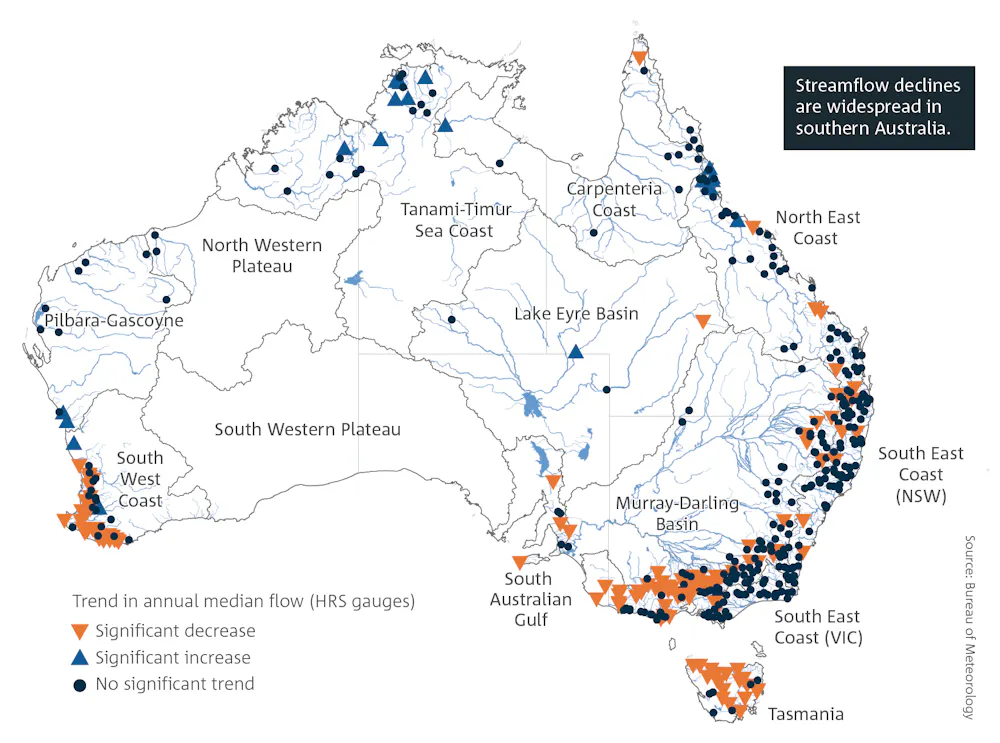
    These changes are also reflected in our rivers, with significantly lower flows for about one third of the gauges in the south. Australia-wide, only 4% of our river gauges are measuring increased flows, and almost all of these are in the north.

    Flows are declining in most rivers in Australia’s south due in part to reduced rainfall, while most rivers in the north are seeing increased flows linked to higher rainfall. This map shows trends in annual median streamflow from available river gauge data in the 1970−2023 period.
    CSIRO/Bureau of Meteorology, CC BY-NC-ND

    Hotter oceans, rising seas

    Almost all (90%) of the extra heat trapped by greenhouse gases has gone into the oceans. Oceans are getting rapidly hotter. This matters because ocean heat strongly influences weather patterns in Australia.

    Australia’s oceans are warming faster than the global average. But the oceans off south-east Australia and the Tasman Sea are a particular hotspot and are now warming at twice the global average.

    As the seas warm, they expand. This thermal expansion is one of the main contributors to rising sea levels. Around Australia, sea levels have risen 22 centimetres since 1900 – with half of that since 1970.

    More emissions equals more heat

    Avoiding the worst damage from climate change is conceptually simple and unequivocal: rapidly reduce greenhouse gases in the atmosphere will help Australia meet its net zero 2050 target.

    Tasmania’s northwest tip has some of the cleanest air in the world, which is why it was chosen to host the Kennaook/Cape Grim Baseline Air Pollution Station. For 48 years, this station has been recording concentrations of greenhouse gases. The picture it captures is stark.

    Carbon dioxide (CO₂) concentrations are now about 51% higher than pre-industrial levels, while concentrations of methane and nitrous oxide, both strong greenhouse gases, continue to increase. Their rate of atmospheric accumulation has rapidly increased in recent years even as some regions and some sources have begun to see emissions slow or even decline, such as reduced CO₂ emissions from land clearing, globally and in Australia.

    Global CO₂ emissions from fossil fuel use have been increasing since the beginning of the Industrial Revolution, and increased by 1.1% from 2022 to 2023, reaching the highest annual level ever recorded.

    The warming has led to an increase in the frequency of extreme heat events over land and in the oceans.
    Leah-Anne Thompson, Shutterstock

    Australia’s carbon contribution

    This year, the State of the Climate report for the first time quantifies Australia’s major human and natural carbon sources and sinks and how they contribute to global CO₂ levels.

    It shows the average annual carbon content embedded in Australia’s fossil fuel exports between 2010 and 2019 (1,055 megatonnes) was more than double the average annual national carbon emissions over the same period (455 Mt). However, the emissions of these carbon exports are accounted in the countries where the fossil fuels are used.

    It also demonstrates the importance of maintaining the integrity of our natural land ecosystems. Ecosystems are Australia’s most important carbon sinks, but their effectiveness as sinks depends on factors including the future evolution of the climate and how it will affect rainfall and wildfire regimes.

    Australia’s Carbon Budget 2010-2019. A product of the National Environmental Science Program – Climate Systems Hub; and a contribution to the Global Carbon Project – Regional Carbon Cycle Assessment and Processes-2.
    Source: NESP-2

    What lies ahead for Australia?

    Australia’s warming is expected to continue, which will lead to more extreme heat events, lower rainfall in some regions, and longer droughts.

    We can expect to see more intense rainfall events, even in regions where average rainfall falls or stays the same.

    Sudden intense rains make flooding more likely, especially in urban areas where concrete and tarmac prevent the ground from soaking up excess water and in low-lying coastal areas where rising sea levels amplify damage from other climate hazards.

    Climate change is already here. Through multiple lines of data and evidence, we have tracked what it is doing to make Australia hotter, more prone to floods and fires, and cutting river flows in the south where most of us live.

    If warming continues, these trends will get worse over time. Understanding these changes and the impacts to Australia will help manage climate risk, now and in the decades to come.

    Blair Trewin, Senior Research Scientist at the Bureau of Meteorology, contributed to this article

    Pep Canadell receives funding from the National Environmental Science Program – Climate Systems Hub

    Neil Sims does not work for, consult, own shares in or receive funding from any company or organisation that would benefit from this article, and has disclosed no relevant affiliations beyond their academic appointment.

    ref. State of the Climate 2024: Australia is enduring harsher fire seasons, more ocean heatwaves and sea-level rise – https://theconversation.com/state-of-the-climate-2024-australia-is-enduring-harsher-fire-seasons-more-ocean-heatwaves-and-sea-level-rise-242191

    MIL OSI AnalysisEveningReport.nz

  • MIL-Evening Report: Earth’s climate will keep changing long after humanity hits net-zero emissions. Our research shows why

    Source: The Conversation (Au and NZ) – By Andrew King, Senior Lecturer in Climate Science, The University of Melbourne

    Shutterstock

    The world is striving to reach net-zero emissions as we try to ward off dangerous global warming. But will getting to net-zero actually avert climate instability, as many assume?

    Our new study examined that question. Alarmingly, we found reaching net-zero in the next few decades will not bring an immediate end to the global heating problem. Earth’s climate will change for many centuries to come.

    And this continuing climate change will not be evenly spread. Australia would keep warming more than almost any other land area. For example if net-zero emissions are reached by 2060, the Australian city of Melbourne is still predicted to warm by 1°C after that point.

    But that’s not to say the world shouldn’t push to reach net-zero emissions as quickly as possible. The sooner we get there, the less damaging change the planet will experience in the long run.

    New research examines if climate change will stop once the world reaches net-zero emissions.
    Shutterstock

    Reaching net-zero is vital

    Global greenhouse gas emissions hit record highs in 2023. At the same time, Earth experienced its hottest year.

    Analysis suggests emissions may peak in the next couple of years then start to fall. But as long as emissions remain substantial, the planet will keep warming.

    Most of the world’s nations, including Australia, have signed up to the Paris climate agreement. The deal aims to keep global warming well below 2°C, and requires major emitters to reach net-zero as soon as possible. Australia, along with many other nations, is aiming to reach the goal by 2050.

    Getting to net-zero essentially means nations must reduce human-caused greenhouse gas emissions as much as possible, and compensate for remaining emissions by removing greenhouse gases from the atmosphere elsewhere. Methods for doing this include planting additional vegetation to draw down and store carbon, or using technology to suck carbon out of the air.

    Getting to net-zero is widely considered the point at which global warming will stop. But is that assumption correct? And does it mean warming would stop everywhere across the planet? Our research sought to find out.

    Centuries of change

    Computer models simulating Earth’s climate under different scenarios are an important tool for climate scientists. Our research used a model known as the Australian Community Climate and Earth System Simulator.

    Such models are like lab experiments for climate scientists to test ideas. Models are fed with information about greenhouse gas emissions. They then use equations to predict how those emissions would affect the movement of air and the ocean, and the transfer of carbon and heat, across Earth over time.

    We wanted to see what would happen once the world hit net-zero carbon dioxide at various points in time, and maintained it for 1,000 years.

    We ran seven simulations from different start points in the 21st century, at five-year increments from 2030 to 2060. These staggered simulations allowed us to measure the effect of various delays in reaching net-zero.

    We found Earth’s climate would continue to evolve under all simulations, even if net-zero emissions was maintained for 1,000 years. But importantly, the later net-zero is reached, the larger the climate changes Earth would experience.

    Warming oceans and melting ice

    Earth’s average temperature across land and sea is the main indicator of climate change. So we looked at that first.

    We found this temperature would continue to rise slowly under net-zero emissions – albeit at a much slower rate than we see today. Most warming would take place on the ocean surface; average temperature on land would only change a little.

    We also looked at temperatures below the ocean surface. There, the ocean would warm strongly even under net-zero emissions – and this continues for many centuries. This is because seawater absorbs a lot of energy before warming up, which means some ocean warming is inevitable even after emissions fall.

    Over the last few decades of high greenhouse gas emissions, sea ice extent fell in the Arctic – and more recently, around Antarctica. Under net-zero emissions, we anticipate Arctic sea ice extent would stabilise but not recover.

    In contrast, Antarctic sea ice extent is projected to fall under net-zero emissions for many centuries. This is associated with continued slow warming of the Southern Ocean around Antarctica.

    Importantly, we found long-term impacts on the climate worsen the later we reach net-zero emissions. Even just a five-year delay would affect on the projected climate 1,000 years later.

    Delaying net-zero by five years results in a higher global average surface temperature, a much warmer ocean and reduced sea ice extent for many centuries.

    Australia’s evolving climate

    The effect on the climate of reaching net-zero emissions differs across the world.

    For example, Australia is close to the Southern Ocean, which is projected to continue warming for many centuries even under net-zero emissions. This warming to Australia’s south means even under a net-zero emissions pathway, we expect the continent to continue to warm more than almost all other land areas on Earth.

    For example, the models predict Melbourne would experience 1°C of warming over centuries if net-zero was reached in 2060.

    Spell out GMST (global mean surface temperature?) in chart? Is listed as global average in caption??

    Net-zero would also lead to changes in rainfall in Australia. Winter rainfall across the continent would increase – a trend in contrast to drying currently underway in parts of Australia, particularly in the southwest and southeast.

    Knowns and unknowns

    There is much more to discover about how the climate might behave under net-zero.

    But our analysis provides some clues about what climate changes to expect if humanity struggles to achieve large-scale “net-negative” emissions – that is, removing carbon from the atmosphere at a greater rate than it is emitted.

    Experiments with more models will help improve scientists’ understanding of climate change beyond net-zero emissions. These simulations may include scenarios in which carbon removal methods are so successful, Earth actually cools and some climate changes are reversed.

    Despite the unknowns, one thing is very clear: there is a pressing need to push for net-zero emissions as fast as possible.

    Andrew King receives funding from the ARC Centre of Excellence for 21st Century Weather and the National Environmental Science Program.

    Tilo Ziehn receives funding from the ARC Centre of Excellence for 21st Century Weather and the National Environmental Science Program.

    ref. Earth’s climate will keep changing long after humanity hits net-zero emissions. Our research shows why – https://theconversation.com/earths-climate-will-keep-changing-long-after-humanity-hits-net-zero-emissions-our-research-shows-why-241692

    MIL OSI AnalysisEveningReport.nz

  • MIL-Evening Report: 215 million hectares of forest – an area bigger than Mexico – could grow back by itself, if we can just leave it alone

    Source: The Conversation (Au and NZ) – By Brooke Williams, Research Fellow, School of Biology & Environmental Science, Queensland University of Technology

    Gustavo Frazao/Shutterstock

    About 215 million hectares of land – an area bigger than Mexico – could be reforested naturally and without costly manual planting, our new research shows.

    This would allow us to offset around 23.4 gigatonnes of global carbon emissions over the next three decades. That’s about 50 years worth of Australia’s carbon emissions (assuming 2023 emission rates continue).

    Extensive and effective forest restoration is crucial to mitigating climate change and conserving biodiversity.

    It’s vital we find cost-effective ways to get and keep more trees in the ground. One way to do this is just to let forests grow back by themselves. However, this isn’t possible in all deforested lands, as certain environmental conditions are needed for this approach to work.

    Our research identified land where this approach had strong potential.

    Allowing forests to grow back naturally in deforested areas, such as this degraded land in Brazil, could be more cost-effective than manual reforestation projects.
    Author provided

    The benefits of natural regeneration

    Globally, 65% of original tropical forest extent has been lost to make way for human development such as agriculture, roads, and urbanisation. Deforestation has contributed to climate change and biodiversity loss.

    We’ve also lost a worrying amount of what researchers call “ecosystem services”, meaning the benefits people derive from nature, such as clean water.

    Forest restoration is an important strategy for reversing the damage.

    Our paper, published in the journal Nature, looked at where natural regeneration is likely to be successful due to the surrounding environmental conditions.

    Natural regeneration is important because it is sometimes better than manual tree planting, which includes the costs of saplings, manual labour, fertilisation and maintenance.

    Using manual techniques in degraded landscapes can be expensive. It can also be less effective in terms of native biodiversity recovery and keeping water systems functioning well.

    Natural regeneration is a less costly alternative. That means allowing forests to grow back on their own or with carefully planned human intervention.

    For example, natural reforestation may cost between $US12 and $3,880 per hectare. By contrast, active regeneration methods in the tropics would cost between $105 and $25,830 per hectare.

    Natural regeneration restoration methods often have better long-term success and biodiversity outcomes than full manual tree-planting.

    Studies have found that biodiversity “success” – meaning richer biodiversity and more species – can be up to 56% higher when natural regeneration approaches were used (rather than manual planting projects).

    It’s vital we find cost-effective ways to get and keep more trees in the ground.
    Richard Whitcombe/Shutterstock

    Where might natural reforestation projects succeed?

    Until now, it’s not always been clear how to predict areas where natural regeneration is most likely to occur. That’s made it hard to do large-scale natural regeneration projects.

    Our research addresses this gap. We identified the best areas to roll out natural approaches in the tropics.

    We focused on tropical forested regions because they are particularly important.

    Their biodiversity is unparalleled and they provide vast economic, cultural, and recreational services to people.

    They also grow much faster than other forest types, and many large tropical forests have already been cleared and degraded.

    Factors that make a forest likely to regenerate naturally include:

    • the amount of surrounding forest
    • distance to existing forest and
    • soil organic carbon content

    This suggests areas with higher levels of landscape degradation and intensive land uses would be less likely to regenerate naturally.

    We found suitable environmental conditions for natural regeneration occur across:

    • 98 million hectares in the Neotropics (which includes many areas in South and Central America)

    • 90 million hectares in the Indomalayan tropics (which includes many areas in Southeast Asia, Malaysia, and India)

    • 25.5 million hectares in the continent of Africa

    Up to 52% of this natural regeneration could occur in just five countries: Brazil, Indonesia, China, Mexico, and Colombia.

    This suggests these countries would be excellent candidates for large scale natural regeneration projects.

    We also found that 29 other countries have at least one million hectares each that could be naturally reforested.

    We identified 400,000 hectares of deforested lands with potential for natural forest regeneration in the Australian tropics.

    Fixing forests will also improve biodiversity.
    Martin Prochazkacz/Shutterstock

    The world has committed to fixing forests

    The world has committed to ambitious forest restoration targets in order to substantially increase the area of forest ecosystems by 2050.

    These commitments include the Bonn Challenge, which aims to restore 350 million hectares by 2030.

    Another is Target 2 of the recently adopted Global Biodiversity Framework, which calls for 30% of the area of degraded ecosystems to be restored by 2030.

    Achieving these targets, especially for nations with emerging economies, will not be possible using active restoration techniques alone. This due to cost and feasibility constraints.

    To assist with this global task, we have made our dataset publicly available and free to use.

    Local communities at the centre

    Encouraging natural regeneration remains a major challenge, particularly on privately held and communally managed land because it can mean reduced land available for other uses.

    Providing local people with training and support to grow, harvest and market products sourced from naturally regenerating forests is also crucial. This could help keep young naturally regenerating forests standing and growing.

    This income could supplement or replace payments landowners and local people currently receive to look after land and prevent it from being deforested. Payment-based approaches are not always sustainable in the long term.

    Currently, many forests are controlled and managed by central or national governments. Giving local and Indigenous communities control over their forests would help encourage restoration that meets local needs.

    However, this requires appropriate technical support and monitoring.

    Importantly, our analysis does not define where restoration activities should or should not occur. We only show where natural forest regeneration is possible or more likely to succeed.

    We echo calls to ensure restoration occurs as equitably as possible, and foregrounds the needs of local people.

    Forest restoration should be as equitable as possible, and foreground the needs of local people.
    WNDR Worlds/Shutterstock

    Let’s give it a chance

    Natural forest regeneration presents an opportunity to restore vast areas of forest cheaply and effectively. It can help mitigate the effects of climate change and help countries meet their emissions reduction targets.

    Other benefits include conserving biodiversity, regulating water resources, reducing erosion, and making ecosystems more resilient.

    Recognising the massive regeneration capacity of tropical forests is key.

    It’s also crucial it occurs alongside protecting intact forests, and reducing deforestation.

    Robin Chazdon is the global co-director of the Assisted Natural Regeneration Alliance. She is a senior fellow with the World Resources Institute’s Global Restoration Initiative.

    Brooke Williams does not work for, consult, own shares in or receive funding from any company or organisation that would benefit from this article, and has disclosed no relevant affiliations beyond their academic appointment.

    ref. 215 million hectares of forest – an area bigger than Mexico – could grow back by itself, if we can just leave it alone – https://theconversation.com/215-million-hectares-of-forest-an-area-bigger-than-mexico-could-grow-back-by-itself-if-we-can-just-leave-it-alone-236696

    MIL OSI AnalysisEveningReport.nz

  • MIL-Evening Report: The UN warns famine is likely in Gaza. What do malnutrition and hunger do to the body?

    Source: The Conversation (Au and NZ) – By Clare Dix, Lecturer In Nutrition & Dietetics, University of the Sunshine Coast

    Anas-Mohammed/Shutterstock

    The risk of famine looms in Gaza. International monitors warn more than 90% of the population face acute food insecurity, meaning their inability to eat enough food puts them in immediate danger of starvation. The number experiencing “catastrophic” hunger is set to double in the coming months.

    Israel has been accused of deliberately blocking humanitarian aid, including food. In September, deliveries of food and aid to Gaza fell to their lowest in seven months after Israel introduced new customs rules.


    Read more:
    Gaza: weaponisation of food has been used in conflicts for centuries – but it hasn’t always resulted in victory


    The World Health Organization has repeatedly warned about the consequences of hunger and food insecurity in the region, including the impact on rising infection rates and increased child mortality.

    The scale of this humanitarian crisis could be overwhelming, as extreme hunger threatens to engulf an entire population – nearly half of which are children.

    What does hunger mean for people’s health – especially children – at the individual level? And will survivors be able to recover from the damage?

    Who is most at risk?

    Food shortages mean people not only eat less overall but can miss out on essential nutrients.

    This can lead to severe acute malnutrition. In children, this means measurable negative effects on bodily functions and growth, including weight and muscle loss.

    Some people will experience the effects of starvation more rapidly. Those most at risk have low stores of energy and protein, and/or higher nutritional needs for growth and development. They include the elderly, infants, children, and women who are pregnant or breastfeeding.

    Childhood nutrition is critical

    From a nutritional viewpoint, the first 1,000 days of life are a critical window for growth and development.

    During this time, the microbiome (the bacteria that live in our digestive system) develops and is influenced by external factors such as diet, and exposure to microbes and pollutants, which shape how the body and immune system function.

    Severe acute malnutrition has several short-term impacts. Malnourished children have reduced immunity, meaning they are less able to fight infections – such as E.coli – partly due to changes to their microbiome. This makes them more vulnerable to contaminated food and water.

    Bacterial infection is a leading cause of death for children with severe acute malnutrition.

    Israel has destroyed around two-thirds of Gaza’s water systems, according to UNICEF, forcing children to drink unsafe water and increasing their exposure to sewage and waterborne diseases.


    Read more:
    Polio in Gaza: what does this mean for the region and the world?


    Long-term impacts of malnutrition

    The effects of malnutrition and starvation during childhood continue into adulthood. Those who survive have a higher risk of developing chronic diseases, including diabetes, high blood pressure and metabolic syndrome (a cluster of conditions that can increase your risk for heart disease and stroke).

    Damage to the gut lining can also cause long-term inflammation. This may make it harder to absorb nutrients, increase the risk of bacterial imbalances, and stop the pancreas and liver working properly.

    Muscle loss and changes in electrolytes can also impact the heart, increasing the risk of arrhythmia (irregular heartbeat).

    What about the brain?

    Malnutrition can harm brain development in children. It can reduce brain size and slow growth, potentially impairing function and memory.

    Impacts on how the brain develops could affect cognition, behaviour and reduce academic achievement.

    More research is needed to understand how malnutrition during childhood affects mental health. But studies suggest it may be linked to personality disorders, attention deficits, lower self-esteem and reduced quality of life.

    For children in Gaza, these harms will likely be compounded by trauma and displacement.

    Impact during pregnancy

    Malnutrition can also affect the health of unborn babies. Famine and food shortages in Gaza mean pregnant women are not getting enough folate, iron, vitamin B12 and iodine. These nutrients are crucial to ensure their baby’s healthy delivery and reduce long-term health impacts.

    Nutritional deficiencies for the mother during pregnancy can increase the baby’s risk of clinical obesity, type 2 diabetes and metabolic syndrome.

    Although less well-studied, there is also evidence a father’s diet, health, sperm quantity and quality can have similar health impacts on their offspring.

    How is severe acute malnutrition treated?

    Severely malnourished people need nutritional rehabilitation. This involves slowly increasing nutrient intake – by around 25% above normal requirements – and eating high-quality, protein-rich foods, essential fatty acids, vitamins and minerals.

    During the initial treatment phase children may need to be hospitalised. One concern is refeeding syndrome, a condition where sudden availability of glucose can cause rapid changes in electrolytes. In extreme cases, this can cause heart failure. Researchers are also investigating how to restore the microbiome of malnourished children.

    But access to adequate treatment is not assured, given the widespread damage to Gaza’s hospital system.

    Unfortunately successful treatment doesn’t guarantee survival. Lasting impacts of severe acute malnutrition are linked to high rates of disease and early death, even after treatment. Studies suggest up to 10.4% of children successfully treated in hospitals do not survive 12 months after they’re discharged.

    The devastating social and food conditions in Gaza are unimaginable to those of us living in other parts of the world. With no end in sight, the impact of food insecurity and lack of humanitarian aid can only lead to an escalation of the rates of malnutrition and diseases in those most vulnerable.

    The long-term consequences for Palestinians will be felt for generations to come.

    Clare Dix has received funding from the Australian Department of Health and Aged Care.

    Helen Truby receives funding from the Commonwealth Department of Health and Ageing, the MRFF, the NHMRC and various philanthropic agencies.

    ref. The UN warns famine is likely in Gaza. What do malnutrition and hunger do to the body? – https://theconversation.com/the-un-warns-famine-is-likely-in-gaza-what-do-malnutrition-and-hunger-do-to-the-body-241682

    MIL OSI AnalysisEveningReport.nz

  • MIL-Evening Report: How light can shift your mood and mental health

    Source: The Conversation (Au and NZ) – By Jacob Crouse, Research Fellow in Youth Mental Health, Brain and Mind Centre, University of Sydney

    llaszlo/Shutterstock

    This is the next article in our ‘Light and health’ series, where we look at how light affects our physical and mental health in sometimes surprising ways. Read other articles in the series.


    It’s spring and you’ve probably noticed a change in when the Sun rises and sets. But have you also noticed a change in your mood?

    We’ve known for a while that light plays a role in our wellbeing. Many of us tend to feel more positive when spring returns.

    But for others, big changes in light, such as at the start of spring, can be tough. And for many, bright light at night can be a problem. Here’s what’s going on.

    An ancient rhythm of light and mood

    In an earlier article in our series, we learned that light shining on the back of the eye sends “timing signals” to the brain and the master clock of the circadian system. This clock coordinates our daily (circadian) rhythms.

    “Clock genes” also regulate circadian rhythms. These genes control the timing of when many other genes turn on and off during the 24-hour, light-dark cycle.

    But how is this all linked with our mood and mental health?

    Circadian rhythms can be disrupted. This can happen if there are problems with how the body clock develops or functions, or if someone is routinely exposed to bright light at night.

    When circadian disruption happens, it increases the risk of certain mental disorders. These include bipolar disorder and atypical depression (a type of depression when someone is extra sleepy and has problems with their energy and metabolism).

    Light on the brain

    Light may also affect circuits in the brain that control mood, as animal studies show.

    There’s evidence this happens in humans. A brain-imaging study showed exposure to bright light in the daytime while inside the scanner changed the activity of a brain region involved in mood and alertness.

    Another brain-imaging study found a link between daily exposure to sunlight and how the neurotransmitter (or chemical messenger) serotonin binds to receptors in the brain. We see alterations in serotonin binding in several mental disorders, including depression.

    Our mood can lift in sunlight for a number of reasons, related to our genes, brain and hormones.
    New Africa/Shutterstock

    What happens when the seasons change?

    Light can also affect mood and mental health as the seasons change. During autumn and winter, symptoms such as low mood and fatigue can develop. But often, once spring and summer come round, these symptoms go away. This is called “seasonality” or, when severe, “seasonal affective disorder”.

    What is less well known is that for other people, the change to spring and summer (when there is more light) can also come with a change in mood and mental health. Some people experience increases in energy and the drive to be active. This is positive for some but can be seriously destabilising for others. This too is an example of seasonality.

    Most people aren’t very seasonal. But for those who are, seasonality has a genetic component. Relatives of people with seasonal affective disorder are more likely to also experience seasonality.

    Seasonality is also more common in conditions such as bipolar disorder. For many people with such conditions, the shift into shorter day-lengths during winter can trigger a depressive episode.

    Counterintuitively, the longer day-lengths in spring and summer can also destabilise people with bipolar disorder into an “activated” state where energy and activity are in overdrive, and symptoms are harder to manage. So, seasonality can be serious.

    Alexis Hutcheon, who experiences seasonality and helped write this article, told us:

    […] the season change is like preparing for battle – I never know what’s coming, and I rarely come out unscathed. I’ve experienced both hypomanic and depressive episodes triggered by the season change, but regardless of whether I’m on the ‘up’ or the ‘down’, the one constant is that I can’t sleep. To manage, I try to stick to a strict routine, tweak medication, maximise my exposure to light, and always stay tuned in to those subtle shifts in mood. It’s a time of heightened awareness and trying to stay one step ahead.

    So what’s going on in the brain?

    One explanation for what’s going on in the brain when mental health fluctuates with the change in seasons relates to the neurotransmitters serotonin and dopamine.

    Serotonin helps regulate mood and is the target of many antidepressants. There is some evidence of seasonal changes in serotonin levels, potentially being lower in winter.

    Dopamine is a neurotransmitter involved in reward, motivation and movement, and is also a target of some antidepressants. Levels of dopamine may also change with the seasons.

    But the neuroscience of seasonality is a developing area and more research is needed to know what’s going on in the brain.

    How about bright light at night?

    We know exposure to bright light at night (for instance, if someone is up all night) can disturb someone’s circadian rhythms.

    This type of circadian rhythm disturbance is associated with higher rates of symptoms including self-harm, depressive and anxiety symptoms, and lower wellbeing. It is also associated with higher rates of mental disorders, such as major depression, bipolar disorder, psychotic disorders and post-traumatic stress disorder (or PTSD).

    Why is this? Bright light at night confuses and destabilises the body clock. It disrupts the rhythmic regulation of mood, cognition, appetite, metabolism and many other mental processes.

    But people differ hugely in their sensitivity to light. While still a hypothesis, people who are most sensitive to light may be the most vulnerable to body clock disturbances caused by bright light at night, which then leads to a higher risk of mental health problems.

    Bright light at night disrupts your body clock, putting you at greater risk of mental health issues.
    Ollyy/Shutterstock

    Where to from here?

    Learning about light will help people better manage their mental health conditions.

    By encouraging people to better align their lives to the light-dark cycle (to stabilise their body clock) we may also help prevent conditions such as depression and bipolar disorder emerging in the first place.

    Healthy light behaviours – avoiding light at night and seeking light during the day – are good for everyone. But they might be especially helpful for people at risk of mental health problems. These include people with a family history of mental health problems or people who are night owls (late sleepers and late risers), who are more at risk of body clock disturbances.


    Alexis Hutcheon has lived experience of a mental health condition and helped write this article.

    If this article has raised issues for you, or if you’re concerned about someone you know, call Lifeline on 13 11 14.

    Jacob Crouse receives funding from Wellcome Trust and National Health and Medical Research Council.

    Professor Hickie is a Professor of Psychiatry and the Co-Director of Health and Policy, Brain and
    Mind Centre, University of Sydney. He has led major public health and health service development
    in Australia, particularly focusing on early intervention for young people with depression, suicidal
    thoughts and behaviours and complex mood disorders. He is active in the development through
    codesign, implementation and continuous evaluation of new health information and personal
    monitoring technologies to drive highly-personalised and measurement-based care. He holds a 3.2%
    equity share in Innowell Pty Ltd that is focused on digital transformation of mental health services.

    Emiliana Tonini does not work for, consult, own shares in or receive funding from any company or organisation that would benefit from this article, and has disclosed no relevant affiliations beyond their academic appointment.

    ref. How light can shift your mood and mental health – https://theconversation.com/how-light-can-shift-your-mood-and-mental-health-231282

    MIL OSI AnalysisEveningReport.nz

  • MIL-Evening Report: Collisions between planes and birds follow seasonal patterns and overlap with breeding and migration – new research

    Source: The Conversation (Au and NZ) – By Tirth Vaishnav, PhD Candidate in Ecology and Biodiversity, Te Herenga Waka — Victoria University of Wellington

    Getty Images

    Bird strikes with aircraft pose a serious threat to human safety. The problem dates back to the early days of aviation, with the first death of a pilot recorded in 1912 when an aircraft crashed into the sea after striking a gull.

    Since then, 795 lives have been lost to collisions between aircraft and birds, not to mention the countless bird fatalities.

    As aircraft get faster, quieter, larger and more numerous, the risk of serious accidents increases accordingly. Every year, the aviation industry incurs damages worth billions of dollars.

    To mitigate this problem, airports around the world implement wildlife hazard management, including dispersing flocks away from the runway, tracking local bird movements and managing potential food sources such as landfills and farms near the aerodrome.

    In our recent study, we zoomed out from the local airport and examined seasonal and hemispheric trends in bird strikes.

    We found they peak in late summer and autumn in both hemispheres, but the annual distribution differs between the northern and southern hemispheres. Seasonal trends in bird strikes were seemingly influenced by avian breeding and migration patterns.

    Airports deploy noise barriers and reflective walls to keep birds away from the runway.
    Getty Images

    Seasonal patterns

    To assess seasonal patterns in bird strikes, we gathered information for individual airports from existing literature and online sources. Our dataset includes 122 airports in 16 countries and five continents.

    For each hemisphere, we determined the time of year with the overall highest number of bird strikes and the spread of strikes through the year.

    We found that bird strikes peaked in late August in the northern hemisphere and in early April in the southern hemisphere. Strikes were relatively more seasonal in the north, while they had a greater annual spread in the south.

    For instance, strikes in New York or Oslo in the northern hemisphere were considerably higher in August compared to other times of the year, while in Wellington or Durban in the southern hemisphere, strikes occurred more consistently throughout the year.

    Birds strikes are more seasonal in the northern hemisphere and more distributed across the year in the southern hemisphere.
    Author provided, CC BY-SA

    Bird strikes peaked in the autumn season in each hemisphere. Autumn is generally when young birds fledge and take to the skies. There may be two explanations for why bird strikes are higher during this time of year.

    1. For young birds, avoiding foreign objects in the flight path may be a learned behaviour. This would result in juveniles being struck at a higher rate.

    2. The greater number of birds in the air during autumn due to the influx of fledglings may result in more strikes, with adults and juveniles being struck at random.

    Links to bird migration

    Seasonal peaks in bird strikes were more pronounced in the north compared to the south. Approximately 80% of the southern hemisphere’s surface is water and the solar energy absorbed by the oceans leads to a more stable thermal regime.

    Conversely, the surface of the northern hemisphere is mostly land, leading to greater fluctuations in temperature. Birds migrate in response to these environmental factors and this influences global avian distributions and abundances.

    The intensity of migration is, therefore, much stronger in the northern hemisphere compared to the southern hemisphere, where local bird abundances are more stable seasonally.

    Our findings bridge a gap between aviation safety and macroecology. Airport authorities can use this information in several ways.

    • Wildlife officers can optimise their bird strike mitigation efforts by allocating more resources in the autumn months, particularly in northern regions.

    • Management plans for “problem” species such as gulls are often adapted from existing plans for similar species at other airports. Information on patterns in bird strikes may help in customising these plans to local bird behaviour.

    • Bird strikes are a global issue, so better standardisation in reporting bird strike statistics could improve our ability to analyse them at a global scale.

    Finally, with climate change altering the seasonal timing of cyclical events, such as avian breeding seasons and migration patterns, it may be crucial to forecast the impact of these changes on the seasonal trends in bird strikes.

    To some degree, bird strikes may be inevitable. But with the cooperation of aviation authorities, scientists and policy makers, we may be able to minimise their frequency and intensity.

    Tirth Vaishnav does not work for, consult, own shares in or receive funding from any company or organisation that would benefit from this article, and has disclosed no relevant affiliations beyond their academic appointment.

    ref. Collisions between planes and birds follow seasonal patterns and overlap with breeding and migration – new research – https://theconversation.com/collisions-between-planes-and-birds-follow-seasonal-patterns-and-overlap-with-breeding-and-migration-new-research-241238

    MIL OSI AnalysisEveningReport.nz

  • MIL-OSI Australia: Albanese Government invests $100 million in pedestrian and cycleways

    Source: Australian Ministers for Regional Development

    Pedestrians and cyclists across the country will have safer and better connected travel options thanks to the Albanese Government’s $100 million Active Transport Fund, which opens for applications today. 

    The fund contributes to three long-term aims of our Government: improving road safety, encouraging Australians to live heather lives, and offering better options for Australians to contribute to our net zero vision. 

    The Active Transport Fund will contribute up to $5 million per project to construct new or upgrade existing bicycle and walking paths, and is open to all state and territory governments and Local Government Authorities. 

    We’ve heard Australians calls for more sustainable and lower cost travel options to get to school, work and local services. We also know that Australians want safer and more accessible pathways to better connect communities.

    We’re answering those calls, developing this fund to enable states, territories and local governments to deliver projects that will support liveable and healthy communities. 

    Applications will be assessed on merit basis and must meet at least one of the focus areas of the program: improving road safety for cyclists and pedestrians, reducing transport emissions, and supporting active and liveable communities. Applications close on 13 January 2025. 

    I encourage individuals to get involved and speak to their local or state government about pedestrian or cycle paths they’d like to see, and I encourage any interested state, territory or local governments to apply. 

    I look forward to announcing the successful projects in future, and building more liveable, connected communities for all Australians.

    For more information, including the funding guidelines, visit infrastructure.gov.au/atf

    MIL OSI News

  • MIL-OSI Australia: Housing boost for Victoria

    Source: Australian Ministers for Regional Development

    The Albanese Government is unlocking more homes in Victoria through funding the critical infrastructure that allows housing to be built more quickly.

    The Australian Government is providing more than $248 million to fast-track 3,781 dwellings across the State through the $1.5 billion Housing Support Program.

    Funding will be used on enabling infrastructure works across the state such as roads, sewage and water, as well as supporting access to social housing and increasing housing supply. 

    $4.5 million is being provided to deliver a signalised intersection and left turn lane access from Burwood Highway, Knoxfield. This will pave the way for around 400 new dwellings and increase access to the area.

    More than $88 million is being made available for social housing and enabling infrastructure across regional Victoria. At least 10 per cent of funding is directed towards First Nations’ housing outcomes, consistent with the Victorian Government’s commitment under the Big Housing Build.

    The Housing Support programs provides funding that increases housing supply by funding the infrastructure and amenities needed for new housing development, as well as improvements in building planning capability.

    It’s part of the Albanese Government’s $32 billion Homes for Australia Plan to meet the ambitious national target of building 1.2 million new, well-located homes over the next 5 years.

    Quotes attributable to Federal Minister for Infrastructure, Transport, Regional Development and Local Government Catherine King:

    “We have a $32 billion plan which is already building more homes, helping people buy homes, massively increasing rent assistance, and getting more social and affordable homes into the system.

    “We are turbocharging works to get housing sites ready more quickly so the building can begin to get people into their new homes sooner.

    “Together with the Victorian Government we’re delivering new homes close to jobs, schools, transport.”

    Quote attributable to Victorian Minister for Planning Sonia Kilkenny:

    “After a decade of neglect from the former Liberal National government, we welcome having a partner in Canberra that’s serious about delivering more infrastructure and more homes in Victoria.”

    Quote attributable to Victorian Minister for Housing Harriet Shing:

    “Our partnership with the Federal Government is an essential part of delivering more and better homes for Victorians through the first round of the Housing Support Program. We know that there is more to do all over Australia to address the housing shortage, and we are determined to use Commonwealth funding to ensure that all Victorians have access to safe, secure, and modern homes that they are proud to call their own.”

    MIL OSI News

  • MIL-OSI: FormFactor, Inc. Reports 2024 Third Quarter Results

    Source: GlobeNewswire (MIL-OSI)

    Record Quarterly Revenue, Profitability at the Top End of the Outlook Range;
    Sees Reduced Demand for Foundry and Logic in Q4, Partially Offset by Continued Strength in DRAM

    LIVERMORE, Calif., Oct. 30, 2024 (GLOBE NEWSWIRE) — FormFactor, Inc. (Nasdaq: FORM) today announced its financial results for the third quarter of fiscal 2024 ended September 28, 2024. Quarterly revenues were $207.9 million, a company record and an increase of 5.3% compared to $197.5 million in the second quarter of fiscal 2024, and an increase of 21.2% from $171.6 million in the third quarter of fiscal 2023.

    • Record revenue in the third quarter exceeded outlook range and non-GAAP EPS was at the top end of the range.
    • Strong DDR5 demand produced third consecutive record-setting quarter of DRAM probe-card revenue.
    • FormFactor’s diversification strategy enabled participation in expanding investments in generative AI and data center applications.

    “We are proud to have posted our all-time revenue record in the third quarter,” said Mike Slessor, CEO of FormFactor, Inc. “This performance was driven by continued strength in our DRAM probe-card business, layered on top of moderate growth in our Foundry & Logic and Systems businesses.”

    Third Quarter and Fiscal 2024 Highlights

    On a GAAP basis, net income for the third quarter of fiscal 2024 was $18.7 million, or $0.24 per fully-diluted share, compared to net income for the second quarter of fiscal 2024 of $19.4 million, or $0.25 per fully-diluted share, and net income for the third quarter of fiscal 2023 of $4.4 million, or $0.06 per fully-diluted share. Gross margin for the third quarter of 2024 was 40.7%, compared with 44.0% in the second quarter of 2024, and 40.4% in the third quarter of 2023.

    On a non-GAAP basis, net income for the third quarter of fiscal 2024 was $27.2 million, or $0.35 per fully-diluted share, compared to net income for the second quarter of fiscal 2024 of $27.3 million, or $0.35 per fully-diluted share, and net income for the third quarter of fiscal 2023 of $17.3 million, or $0.22 per fully-diluted share. On a non-GAAP basis, gross margin for the third quarter of 2024 was 42.2%, compared with 45.3% in the second quarter of 2024, and 41.9% in the third quarter of 2023.

    A reconciliation of GAAP to non-GAAP measures is provided in the schedules included below.

    GAAP net cash provided by operating activities for the third quarter of fiscal 2024 was $26.7 million, compared to $21.9 million for the second quarter of fiscal 2024, and $20.6 million for the third quarter of fiscal 2023. Free cash flow for the third quarter of fiscal 2024 was $20.0 million, compared to free cash flow for the second quarter of fiscal 2024 of $14.2 million, and free cash flow for the third quarter of 2023 of $16.9 million. A reconciliation of net cash provided by operating activities to non-GAAP free cash flow is provided in the schedules included below.

    Outlook

    Dr. Slessor added, “We continue to experience record levels of DRAM probe card demand, with contributions from both DDR5 and High Bandwidth Memory applications. This, combined with slightly higher Systems Segment revenue, is helping to partially offset the forecasted reduction in Foundry & Logic probe-card demand.”

    For the fourth quarter ending December 28, 2024, FormFactor is providing the following outlook*:

      GAAP   Reconciling Items**   Non-GAAP
    Revenue $190 million +/- $5 million     $190 million +/- $5 million
    Gross Margin 40% +/- 1.5%   $3 million   41% +/- 1.5%
    Net income per diluted share $0.16 +/- $0.04   $0.13   $0.29 +/- $0.04
    *This outlook assumes consistent foreign currency rates.
    **Reconciling items are stock-based compensation, amortization of intangible assets and fixed asset fair value adjustments due to acquisitions, and restructuring charges, net of applicable income tax impacts.
       

    We posted our revenue breakdown by geographic region, by market segment and with customers with greater than 10% of total revenue on the Investor Relations section of our website at www.formfactor.com. We will conduct a conference call at 1:25 p.m. PT, or 4:25 p.m. ET, today.

    The public is invited to listen to a live webcast of FormFactor’s conference call on the Investor Relations section of our website at www.formfactor.com. A telephone replay of the conference call will be available approximately two hours after the conclusion of the call. The replay will be available on the Investor Relations section of our website, www.formfactor.com.

    Use of Non-GAAP Financial Information:

    To supplement our condensed consolidated financial results prepared under generally accepted accounting principles, or GAAP, we disclose certain non-GAAP measures of non-GAAP net income, non-GAAP net income per basic and diluted share, non-GAAP gross profit, non-GAAP gross margin, non-GAAP operating expenses, non-GAAP operating income and free cash flow, that are adjusted from the nearest GAAP financial measure to exclude certain costs, expenses, gains and losses. Reconciliations of the adjustments to GAAP results for the three and nine months ended September 28, 2024, and for outlook provided before, as well as for the comparable periods of fiscal 2023, are provided below, and on the Investor Relations section of our website at www.formfactor.com. Information regarding the ways in which management uses non-GAAP financial information to evaluate its business, management’s reasons for using this non-GAAP financial information, and limitations associated with the use of non-GAAP financial information, is included under “About our Non-GAAP Financial Measures” following the tables below.

    About FormFactor:

    FormFactor, Inc. (NASDAQ: FORM), is a leading provider of essential test and measurement technologies along the full semiconductor product life cycle – from characterization, modeling, reliability, and design de-bug, to qualification and production test. Semiconductor companies rely upon FormFactor’s products and services to accelerate profitability by optimizing device performance and advancing yield knowledge. The Company serves customers through its network of facilities in Asia, Europe, and North America. For more information, visit the Company’s website at www.formfactor.com.

    Forward-looking Statements:

    This press release contains forward-looking statements within the meaning of the “safe harbor” provisions of the federal securities laws, including with respect to the Company’s future financial and operating results, and the Company’s plans, strategies and objectives for future operations. These statements are based on management’s current expectations and beliefs as of the date of this release, and are subject to a number of risks and uncertainties, many of which are beyond the Company’s control, that could cause actual results to differ materially from those described in the forward-looking statements. These forward-looking statements include, but are not limited to, statements regarding future financial and operating results, including under the heading “Outlook” above, customer demand, conditions in the semiconductor industry, and other statements regarding the Company’s business. Forward-looking statements may contain words such as “may,” “might,” “will,” “expect,” “plan,” “anticipate,” “forecast,” and “continue,” the negative or plural of these words and similar expressions, and include the assumptions that underlie such statements. The following factors, among others, could cause actual results to differ materially from those described in the forward-looking statements: changes in demand for the Company’s products; customer-specific demand; market opportunity; anticipated industry trends; the availability, benefits, and speed of customer acceptance or implementation of new products and technologies; manufacturing, processing, and design capacity, goals, expansion, volumes, and progress; difficulties or delays in research and development; industry seasonality; risks to the Company’s realization of benefits from acquisitions, investments in capacity and investments in new electronic data systems and information technology; reliance on customers or third parties (including suppliers); changes in macro-economic environments; events affecting global and regional economic and market conditions and stability such as military conflicts, political volatility, infectious diseases and pandemics, and similar factors, operating separately or in combination; and other factors, including those set forth in the Company’s most current annual report on Form 10-K, quarterly reports on Form 10-Q and other filings by the Company with the U.S. Securities and Exchange Commission. In addition, there are varying barriers to international trade, including restrictive trade and export regulations such as the US-China restrictions, dynamic tariffs, trade disputes between the U.S. and other countries, and national security developments or tensions, that may substantially restrict or condition our sales to or in certain countries, increase the cost of doing business internationally, and disrupt our supply chain. No assurances can be given that any of the events anticipated by the forward-looking statements within this press release will transpire or occur, or if any of them do so, what impact they will have on the results of operations or financial condition of the Company. Unless required by law, the Company is under no obligation (and expressly disclaims any such obligation) to update or revise its forward-looking statements whether as a result of new information, future events, or otherwise.

    FORMFACTOR, INC. 
    CONDENSED CONSOLIDATED STATEMENTS OF INCOME
    (In thousands, except per share amounts)
    (Unaudited)

      Three Months Ended   Nine Months Ended
      September 28,
    2024
      June 29,
    2024
      September 30,
    2023
      September 28,
    2024
      September 30,
    2023
    Revenues $ 207,917     $ 197,474     $ 171,575     $ 574,116     $ 494,939  
    Cost of revenues   123,212       110,574       102,290       339,773       304,293  
    Gross profit   84,705       86,900       69,285       234,343       190,646  
    Operating expenses:                  
    Research and development   31,243       31,564       31,014       91,434       87,599  
    Selling, general and administrative   35,607       37,874       35,564       106,560       101,561  
    Total operating expenses   66,850       69,438       66,578       197,994       189,160  
    Gain on sale of business         310             20,581        
    Operating income   17,855       17,772       2,707       56,930       1,486  
    Interest income, net   3,650       3,415       1,662       10,221       4,420  
    Other income (expense), net   (558 )     360       788       322       1,261  
    Income before income taxes   20,947       21,547       5,157       67,473       7,167  
    Provision for income taxes   2,211       2,155       786       7,564       626  
    Net income $ 18,736     $ 19,392     $ 4,371     $ 59,909     $ 6,541  
    Net income per share:                  
    Basic $ 0.24     $ 0.25     $ 0.06     $ 0.77     $ 0.08  
    Diluted $ 0.24     $ 0.25     $ 0.06     $ 0.76     $ 0.08  
    Weighted-average number of shares used in per share calculations:                
    Basic   77,406       77,235       77,571       77,364       77,265  
    Diluted   78,439       78,717       78,412       78,495       77,860  
    FORMFACTOR, INC.
    NON-GAAP FINANCIAL MEASURE RECONCILIATIONS
    (In thousands, except per share amounts)
    (Unaudited)
     
      Three Months Ended   Nine Months Ended
      September 28,
    2024
      June 29,
    2024
      September 30,
    2023
      September 28,
    2024
      September 30,
    2023
    GAAP Gross Profit $ 84,705     $ 86,900     $ 69,285     $ 234,343     $ 190,646  
    Adjustments:                  
    Amortization of intangibles, inventory and fixed asset fair value adjustments due to acquisitions, and other   530       584       1,118       1,661       3,580  
    Stock-based compensation   1,934       1,932       1,376       5,794       4,801  
    Restructuring charges   524                   607       357  
    Non-GAAP Gross Profit $ 87,693     $ 89,416     $ 71,779     $ 242,405     $ 199,384  
                       
    GAAP Gross Margin   40.7 %     44.0 %     40.4 %     40.8 %     38.5 %
    Adjustments:                  
    Amortization of intangibles, inventory and fixed asset fair value adjustments due to acquisitions, and other   0.3 %     0.3 %     0.7 %     0.3 %     0.7 %
    Stock-based compensation   0.9 %     1.0 %     0.8 %     1.0 %     1.0 %
    Restructuring charges   0.3 %     %     %     0.1 %     0.1 %
    Non-GAAP Gross Margin   42.2 %     45.3 %     41.9 %     42.2 %     40.3 %
                       
    GAAP operating expenses $ 66,850     $ 69,438     $ 66,578     $ 197,994     $ 189,160  
    Adjustments:                  
    Amortization of intangibles and other   (240 )     (240 )     (466 )     (720 )     (3,563 )
    Stock-based compensation   (7,002 )     (8,277 )     (9,463 )     (23,756 )     (24,532 )
    Restructuring charges   (249 )                 (249 )     (1,183 )
    Costs related to sale of business   (13 )     (43 )     (2,139 )     (702 )     (2,139 )
    Non-GAAP operating expenses $ 59,346     $ 60,878     $ 54,510     $ 172,567     $ 157,743  
                       
    GAAP operating income $ 17,855     $ 17,772     $ 2,707     $ 56,930     $ 1,486  
    Adjustments:                  
    Amortization of intangibles, inventory and fixed asset fair value adjustments due to acquisitions, and other   770       824       1,584       2,381       7,143  
    Stock-based compensation   8,936       10,209       10,839       29,550       29,333  
    Restructuring charges   773                   856       1,540  
    Gain on sale of business and related costs   13       (267 )     2,139       (19,879 )     2,139  
    Non-GAAP operating income $ 28,347     $ 28,538     $ 17,269     $ 69,838     $ 41,641  
    FORMFACTOR, INC. 
    NON-GAAP FINANCIAL MEASURE RECONCILIATIONS
    (In thousands, except per share amounts)
    (Unaudited)
     
      Three Months Ended   Nine Months Ended
      September 28,
    2024
      June 29,
    2024
      September 30,
    2023
      September 28,
    2024
      September 30,
    2023
    GAAP net income $ 18,736     $ 19,392     $ 4,371     $ 59,909     $ 6,541  
    Adjustments:                  
    Amortization of intangibles, inventory and fixed asset fair value adjustments due to acquisitions, and other   770       824       1,584       2,381       7,143  
    Stock-based compensation   8,936       10,209       10,839       29,550       29,333  
    Restructuring charges   773                   856       1,540  
    Gain on sale of business and related costs   13       (267 )     2,139       (19,879 )     2,139  
    Income tax effect of non-GAAP adjustments   (2,002 )     (2,835 )     (1,617 )     (3,924 )     (5,650 )
    Non-GAAP net income $ 27,226     $ 27,323     $ 17,316     $ 68,893     $ 41,046  
                       
    GAAP net income per share:                  
    Basic $ 0.24     $ 0.25     $ 0.06     $ 0.77     $ 0.08  
    Diluted $ 0.24     $ 0.25     $ 0.06     $ 0.76     $ 0.08  
                       
    Non-GAAP net income per share:                  
    Basic $ 0.35     $ 0.35     $ 0.22     $ 0.89     $ 0.53  
    Diluted $ 0.35     $ 0.35     $ 0.22     $ 0.88     $ 0.53  
    FORMFACTOR, INC. 
    CONDENSED CONSOLIDATED STATEMENTS OF CASH FLOWS
    (In thousands)
    (Unaudited)
     
      Nine Months Ended
      September 28,
    2024
      September 30,
    2023
    Cash flows from operating activities:      
    Net income $ 59,909     $ 6,541  
    Selected adjustments to reconcile net income to net cash provided by operating activities:      
    Depreciation   22,197       22,880  
    Amortization   1,920       6,043  
    Stock-based compensation expense   29,550       29,333  
    Provision for excess and obsolete inventories   10,052       12,566  
    Gain on sale of business   (20,581 )      
    Other activity impacting operating cash flows   (21,426 )     (22,011 )
    Net cash provided by operating activities   81,621       55,352  
    Cash flows from investing activities:      
    Acquisition of property, plant and equipment   (30,773 )     (46,094 )
    Proceeds from sale of business   21,585        
    Purchases of marketable securities, net   (15,464 )     (3,900 )
    Purchase of promissory note receivable   (1,500 )      
    Net cash used in investing activities   (26,152 )     (49,994 )
    Cash flows from financing activities:      
    Purchase of common stock through stock repurchase program   (37,211 )      
    Proceeds from issuances of common stock   9,748       8,822  
    Principal repayments on term loans   (803 )     (781 )
    Tax withholdings related to net share settlements of equity awards   (17,990 )     (9,349 )
    Net cash used financing activities   (46,256 )     (1,308 )
    Effect of exchange rate changes on cash, cash equivalents and restricted cash   3       (3,324 )
    Net increase in cash, cash equivalents and restricted cash   9,216       726  
    Cash, cash equivalents and restricted cash, beginning of period   181,273       112,982  
    Cash, cash equivalents and restricted cash, end of period $ 190,489     $ 113,708  
    FORMFACTOR, INC. 
    RECONCILIATION OF CASH PROVIDED BY OPERATING ACTIVITIES TO NON-GAAP FREE CASH FLOW
    (In thousands)
    (Unaudited)
     
      Three Months Ended   Nine Months Ended
      September 28,
    2024
      June 29,
    2024
      September 30,
    2023
      September 28,
    2024
      September 30,
    2023
    Net cash provided by operating activities $ 26,731     $ 21,878     $ 20,571     $ 81,621     $ 55,352  
    Adjustments:                  
    Sale of business related payments in working capital   2,134       630       2,139       2,811       2,139  
    Cash paid for interest   97       101       105       298       317  
    Capital expenditures   (8,939 )     (8,398 )     (5,917 )     (30,773 )     (46,094 )
    Free cash flow $ 20,023     $ 14,211     $ 16,898     $ 53,957     $ 11,714  
    FORMFACTOR, INC.
    CONDENSED CONSOLIDATED BALANCE SHEETS
    (In thousands)
    (Unaudited) 
     
      September 28,
    2024
      June 29,
    2024
      December 30,
    2023
    ASSETS          
    Current assets:          
    Cash and cash equivalents $ 184,506     $ 195,914     $ 177,812  
    Marketable securities   169,961       161,710       150,507  
    Accounts receivable, net of allowance for credit losses   116,866       113,277       102,957  
    Inventories, net   105,374       114,814       111,685  
    Restricted cash   3,773       5,939       1,152  
    Prepaid expenses and other current assets   34,302       28,964       29,667  
    Total current assets   614,782       620,618       573,780  
    Restricted cash   2,210       2,098       2,309  
    Operating lease, right-of-use-assets   25,034       26,650       30,519  
    Property, plant and equipment, net of accumulated depreciation   204,108       204,102       204,399  
    Goodwill   200,137       199,548       201,090  
    Intangibles, net   11,017       11,657       12,938  
    Deferred tax assets   92,826       88,841       78,964  
    Other assets   3,669       2,751       2,795  
    Total assets $ 1,153,783     $ 1,156,265     $ 1,106,794  
               
    LIABILITIES AND STOCKHOLDERS’ EQUITY          
    Current liabilities:          
    Accounts payable $ 52,086     $ 62,235     $ 63,857  
    Accrued liabilities   46,508       49,523       41,037  
    Current portion of term loan, net of unamortized issuance costs   1,098       1,090       1,075  
    Deferred revenue   20,972       17,953       16,704  
    Operating lease liabilities   8,512       8,240       8,422  
    Total current liabilities   129,176       139,041       131,095  
    Term loan, less current portion, net of unamortized issuance costs   12,488       12,765       13,314  
    Long-term operating lease liabilities   19,731       21,441       25,334  
    Deferred grant   18,000       18,000       18,000  
    Other liabilities   19,378       17,102       10,247  
    Total liabilities   198,773       208,349       197,990  
               
    Stockholders’ equity:          
    Common stock   77       77       77  
    Additional paid-in capital   845,466       863,283       861,448  
    Accumulated other comprehensive loss   (1,773 )     (7,948 )     (4,052 )
    Accumulated income   111,240       92,504       51,331  
    Total stockholders’ equity   955,010       947,916       908,804  
    Total liabilities and stockholders’ equity $ 1,153,783     $ 1,156,265     $ 1,106,794  
     

    About our Non-GAAP Financial Measures:

    We believe that the presentation of non-GAAP net income, non-GAAP net income per basic and diluted share, non-GAAP gross profit, non-GAAP gross margin, non-GAAP operating expenses, non-GAAP operating income and free cash flow provides supplemental information that is important to understanding financial and business trends and other factors relating to our financial condition and results of operations. Non-GAAP net income, non-GAAP net income per basic and diluted share, non-GAAP gross profit, non-GAAP gross margin, non-GAAP operating expenses, and non-GAAP operating income are among the primary indicators used by management as a basis for planning and forecasting future periods, and by management and our board of directors to determine whether our operating performance has met certain targets and thresholds. Management uses non-GAAP net income, non-GAAP net income per basic and diluted share, non-GAAP gross profit, non-GAAP gross margin, non-GAAP operating expenses, and non-GAAP operating income when evaluating operating performance because it believes that the exclusion of the items indicated herein, for which the amounts or timing may vary significantly depending upon our activities and other factors, facilitates comparability of our operating performance from period to period. We use free cash flow to conduct and evaluate our business as an additional way of viewing our liquidity that, when viewed with our GAAP results, provides a more complete understanding of factors and trends affecting our cash flows. Many investors also prefer to track free cash flow, as opposed to only GAAP earnings. Free cash flow has limitations due to the fact that it does not represent the residual cash flow available for discretionary expenditures, and therefore it is important to view free cash flow as a complement to our entire consolidated statements of cash flows. We have chosen to provide this non-GAAP information to investors so they can analyze our operating results closer to the way that management does, and use this information in their assessment of our business and the valuation of our Company. We compute non-GAAP net income, non-GAAP net income per basic and diluted share, non-GAAP gross profit, non-GAAP gross margin, non-GAAP operating expenses, and non-GAAP operating income, by adjusting GAAP net income, GAAP net income per basic and diluted share, GAAP gross profit, GAAP gross margin, GAAP operating expenses, and GAAP operating income to remove the impact of certain items and the tax effect, if applicable, of those adjustments. These non-GAAP measures are not in accordance with, or an alternative to, GAAP, and may be materially different from other non-GAAP measures, including similarly titled non-GAAP measures used by other companies. The presentation of this additional information should not be considered in isolation from, as a substitute for, or superior to, net income, net income per basic and diluted share, gross profit, gross margin, operating expenses, or operating income in accordance with GAAP. Non-GAAP financial measures have limitations in that they do not reflect certain items that may have a material impact upon our reported financial results. We may expect to continue to incur expenses of a nature similar to the non-GAAP adjustments described above, and exclusion of these items from our non-GAAP net income, non-GAAP net income per basic and diluted share, non-GAAP gross profit, non-GAAP gross margin, non-GAAP operating expenses, and non-GAAP operating income should not be construed as an inference that these costs are unusual, infrequent or non-recurring. For more information on the non-GAAP adjustments, please see the table captioned “Non-GAAP Financial Measure Reconciliations” and “Reconciliation of Cash Provided by Operating Activities to non-GAAP Free Cash Flow” included in this press release.

    Source: FormFactor, Inc.
    FORM-F

    Investor Contact:
    Stan Finkelstein
    Investor Relations
    (925) 290-4321
    ir@formfactor.com

    The MIL Network

  • MIL-OSI: AMSC Reports Second Quarter Fiscal Year 2024 Financial Results and Provides Business Outlook

    Source: GlobeNewswire (MIL-OSI)

    Financial Highlights:

    • Reported Second Quarter Net Income of Nearly $5 Million
    • Generated Nearly $13 Million of Operating Cash Flow During the Quarter
    • Increased Revenue by 60% Year Over Year to Above $54 Million

    Company to host conference call tomorrow, October 31, at 10:00 am ET 

    AYER, Mass., Oct. 30, 2024 (GLOBE NEWSWIRE) — AMSC (Nasdaq: AMSC), a leading system provider of megawatt-scale power resiliency solutions that orchestrate the rhythm and harmony of power on the grid™ and protect and expand the capability and resiliency of our Navy’s fleet, today reported financial results for its second quarter of fiscal year 2024 ended September 30, 2024. The second quarter results include results from NWL, Inc. beginning as of the acquisition date, August 1, 2024.

    Revenues for the second quarter of fiscal 2024 were $54.5 million compared with $34.0 million for the same period of fiscal 2023. The year-over-year increase was primarily driven by the acquisition of NWL, Inc., increased shipments of new energy power systems and electrical control system shipments, versus the year ago period. 

    AMSC’s net income for the second quarter of fiscal 2024 was $4.9 million, or $0.13 per share, compared to a net loss of $2.5 million, or $0.09 per share, for the same period of fiscal 2023. The Company’s non-GAAP net income for the second quarter of fiscal 2024 was $10.0 million, or $0.27 per share, compared with a non-GAAP net income of less than $0.1 million, or $0.00 per share, in the same period of fiscal 2023. Please refer to the financial table below for a reconciliation of GAAP to non-GAAP results.

    Cash, cash equivalents, and restricted cash on September 30, 2024, totaled $74.8 million, compared with $95.5 million at June 30, 2024.

    “AMSC delivered fiscal second quarter net income of nearly $5 million and grew revenue by 60% when compared to the same period last year,” said Daniel P. McGahn, Chairman, President and CEO, AMSC. “During the second quarter of fiscal 2024 we booked nearly $60 million of new orders, with new energy power systems orders coming in stronger than previously demonstrated. We ended the quarter with over $200 million in 12-month backlog and over $300 million in total backlog. We are very excited for the second half of the fiscal year and remain focused on our execution as well as improving the resiliency of the power grid.”

    Business Outlook
    For the third quarter ending December 31, 2024, AMSC expects that its revenues will be in the range of $55.0 million to $60.0 million. The Company’s net loss for the third quarter of fiscal 2024 is expected not to exceed $1.0 million, or $0.03 per share. The Company’s non-GAAP net income (as defined below) is expected to exceed $2 million, or $0.05 per share.

    Conference Call Reminder
    In conjunction with this announcement, AMSC management will participate in a conference call with investors beginning at 10:00 a.m. Eastern Time on Thursday, October 31, 2024, to discuss the Company’s financial results and business outlook. Those who wish to listen to the live or archived conference call webcast should visit the “Investors” section of the Company’s website at https://ir.amsc.com. The live call can be accessed by dialing 1-844-481-2802 or 1-412-317-0675 and asking to join the AMSC call. A replay of the call may be accessed 2 hours following the call by dialing 1-877-344-7529 and using conference passcode 5836897.

    About AMSC (Nasdaq: AMSC)
    AMSC generates the ideas, technologies and solutions that meet the world’s demand for smarter, cleaner … better energy™. Through its Gridtec™ Solutions, AMSC provides the engineering planning services and advanced grid systems that optimize network reliability, efficiency and performance.  Through its Marinetec™ Solutions, AMSC provides ship protection systems and is developing propulsion and power management solutions designed to help fleets increase system efficiencies, enhance power quality and boost operational safety.  Through its Windtec® Solutions, AMSC provides wind turbine electronic controls and systems, designs and engineering services that reduce the cost of wind energy. The Company’s solutions are enhancing the performance and reliability of power networks, increasing the operational safety of navy fleets, and powering gigawatts of renewable energy globally. Founded in 1987, AMSC is headquartered near Boston, Massachusetts with operations in Asia, Australia, Europe and North America. For more information, please visit www.amsc.com.

    AMSC, American Superconductor, D-VAR, D-VAR VVO, Gridtec, Marinetec, Windtec, Neeltran, NEPSI, Smarter, Cleaner … Better Energy, and Orchestrate the Rhythm and Harmony of Power on the Grid are trademarks or registered trademarks of American Superconductor Corporation. All other brand names, product names, trademarks or service marks belong to their respective holders.

    Forward-Looking Statements

    This press release contains forward-looking statements within the meaning of Section 21E of the Securities Exchange Act of 1934, as amended (the “Exchange Act”). Any statements in this release regarding execution of our goals and strategies; backlog; expectations regarding the second half of fiscal 2024; our expected GAAP and non-GAAP financial results for the quarter ending December 31, 2024; and other statements containing the words “believes,” “anticipates,” “plans,” “expects,” “will” and similar expressions, constitute forward-looking statements within the meaning of the Private Securities Litigation Reform Act of 1995. Such forward-looking statements represent management’s current expectations and are inherently uncertain. There are a number of important factors that could materially impact the value of our common stock or cause actual results to differ materially from those indicated by such forward-looking statements. These important factors include, but are not limited to: We have a history of operating losses, which may continue in the future. Our operating results may fluctuate significantly from quarter to quarter and may fall below expectations in any particular fiscal quarter; We have a history of negative operating cash flows, and we may require additional financing in the future, which may not be available to us; Our technology and products could infringe intellectual property rights of others, which may require costly litigation and, if we are not successful, could cause us to pay substantial damages and disrupt our business; Changes in exchange rates could adversely affect our results of operations; We may be required to issue performance bonds or provide letters of credit, which restricts our ability to access any cash used as collateral for the bonds or letters of credit; If we fail to maintain proper and effective internal control over financial reporting, our ability to produce accurate and timely financial statements could be impaired and may lead investors and other users to lose confidence in our financial data; We may not realize all of the sales expected from our backlog of orders and contracts; Our contracts with the U.S. government are subject to audit, modification or termination by the U.S. government and include certain other provisions in favor of the government. The continued funding of such contracts remains subject to annual congressional appropriation, which, if not approved, could reduce our revenue and lower or eliminate our profit; Changes in U.S. government defense spending could negatively impact our financial position, results of operations, liquidity and overall business; Pandemics, epidemics or other public health crises may adversely impact our business, financial condition and results of operations; We rely upon third-party suppliers for the components and subassemblies of many of our Grid and Wind products, making us vulnerable to supply shortages and price fluctuations, which could harm our business; Uncertainty surrounding our prospects and financial condition may have an adverse effect on our customer and supplier relationship; Our success is dependent upon attracting and retaining qualified personnel and our inability to do so could significantly damage our business and prospects; A significant portion of our Wind segment revenues are derived from a single customer. If this customer’s business is negatively affected, it could adversely impact our business; Our success in addressing the wind energy market is dependent on the manufacturers that license our designs; Our business and operations would be adversely impacted in the event of a failure or security breach of our or any critical third parties’ information technology infrastructure and networks; We may acquire additional complementary businesses or technologies, which may require us to incur substantial costs for which we may never realize the anticipated benefits; Failure to comply with evolving data privacy and data protection laws and regulations or to otherwise protect personal data, may adversely impact our business and financial results; Many of our revenue opportunities are dependent upon subcontractors and other business collaborators; If we fail to implement our business strategy successfully, our financial performance could be harmed; Problems with product quality or product performance may cause us to incur warranty expenses and may damage our market reputation and prevent us from achieving increased sales and market share; Many of our customers outside of the United States may be either directly or indirectly related to governmental entities, and we could be adversely affected by violations of the United States Foreign Corrupt Practices Act and similar worldwide anti-bribery laws outside the United States; We have had limited success marketing and selling our superconductor products and system-level solutions, and our failure to more broadly market and sell our products and solutions could lower our revenue and cash flow; We or third parties on whom we depend may be adversely affected by natural disasters, including events resulting from climate change, and our business continuity and disaster recovery plans may not adequately protect us or our value chain from such events; Adverse changes in domestic and global economic conditions could adversely affect our operating results; Our international operations are subject to risks that we do not face in the United States, which could have an adverse effect on our operating results; Our products face competition, which could limit our ability to acquire or retain customers; We have operations in, and depend on sales in, emerging markets, including India, and global conditions could negatively affect our operating results or limit our ability to expand our operations outside of these markets. Changes in India’s political, social, regulatory and economic environment may affect our financial performance; Our success depends upon the commercial adoption of the REG system, which is currently limited, and a widespread commercial market for our products may not develop; Industry consolidation could result in more powerful competitors and fewer customers; Increasing focus and scrutiny on environmental sustainability and social initiatives could increase our costs, and inaction could harm our reputation and adversely impact our financial results; Growth of the wind energy market depends largely on the availability and size of government subsidies, economic incentives and legislative programs designed to support the growth of wind energy: Lower prices for other energy sources may reduce the demand for wind energy development, which could have a material adverse effect on our ability to grow our Wind business; We may be unable to adequately prevent disclosure of trade secrets and other proprietary information; Our patents may not provide meaningful or long-term protection for our technology, which could result in us losing some or all of our market position; There are a number of technological challenges that must be successfully addressed before our superconductor products can gain widespread commercial acceptance, and our inability to address such technological challenges could adversely affect our ability to acquire customers for our products; Third parties have or may acquire patents that cover the materials, processes and technologies we use or may use in the future to manufacture our Amperium products, and our success depends on our ability to license such patents or other proprietary rights; Our common stock has experienced, and may continue to experience, market price and volume fluctuations, which may prevent our stockholders from selling our common stock at a profit and could lead to costly litigation against us that could divert our management’s attention; Unfavorable results of legal proceedings could have a material adverse effect on our business, operating results and financial condition; and the other important factors discussed under the caption “Risk Factors” in Part 1. Item 1A of our Form 10-K for the fiscal year ended March 31, 2024, and our other reports filed with the SEC. These important factors, among others, could cause actual results to differ materially from those indicated by forward-looking statements made herein and presented elsewhere by management from time to time. Any such forward-looking statements represent management’s estimates as of the date of this press release. While we may elect to update such forward-looking statements at some point in the future, we disclaim any obligation to do so, even if subsequent events cause our views to change. These forward-looking statements should not be relied upon as representing our views as of any date subsequent to the date of this press release.

    UNAUDITED CONDENSED CONSOLIDATED STATEMENTS OF OPERATIONS
    (In thousands, except per share data)
     
        Three Months Ended     Six Months Ended  
        September 30,     September 30,  
        2024     2023     2024     2023  
    Revenues                                
    Grid   $ 46,936     $ 28,515     $ 79,272     $ 54,251  
    Wind     7,535       5,489       15,489       10,007  
    Total revenues     54,471       34,004       94,761       64,258  
                                     
    Cost of revenues     38,858       25,418       66,923       49,390  
                                     
    Gross margin     15,613       8,586       27,838       14,868  
                                     
    Operating expenses:                                
    Research and development     2,646       1,641       4,931       3,493  
    Selling, general and administrative     10,525       7,946       19,423       15,815  
    Amortization of acquisition-related intangibles     433       538       845       1,076  
    Change in fair value of contingent consideration     2,762       850       6,682       2,200  
    Restructuring           (20 )           (14 )
    Total operating expenses     16,366       10,955       31,881       22,570  
                                     
    Operating loss     (753 )     (2,369 )     (4,043 )     (7,702 )
                                     
    Interest income, net     979       194       2,099       368  
    Other expense, net     (329 )     (204 )     (489 )     (321 )
    Loss before income tax expense (benefit)     (103 )     (2,379 )     (2,433 )     (7,655 )
                                     
    Income tax (benefit) expense     (4,990 )     106       (4,796 )     228  
                                     
    Net income (loss)   $ 4,887     $ (2,485 )   $ 2,363     $ (7,883 )
                                     
    Net income (loss) per common share                                
    Basic   $ 0.13     $ (0.09 )   $ 0.07     $ (0.28 )
    Diluted   $ 0.13     $ (0.09 )   $ 0.06     $ (0.28 )
                                     
    Weighted average number of common shares outstanding                                
    Basic     36,952       28,828       36,317       28,545  
    Diluted     37,499       28,828       36,951       28,545  
    UNAUDITED CONDENSED CONSOLIDATED BALANCE SHEETS
    (In thousands, except per share data)
     
        September 30, 2024     March 31, 2024  
    ASSETS                
    Current assets:                
    Cash and cash equivalents   $ 72,131     $ 90,522  
    Accounts receivable, net     40,059       26,325  
    Inventory, net     70,880       41,857  
    Prepaid expenses and other current assets     10,806       7,295  
    Restricted cash     1,201       468  
    Total current assets     195,077       166,467  
                     
    Property, plant and equipment, net     38,765       10,861  
    Intangibles, net     7,329       6,369  
    Right-of-use assets     3,744       2,557  
    Goodwill     48,950       43,471  
    Restricted cash     1,454       1,290  
    Deferred tax assets     1,201       1,119  
    Equity-method investments     1,245        
    Other assets     683       637  
    Total assets   $ 298,448     $ 232,771  
                     
    LIABILITIES AND STOCKHOLDERS’ EQUITY                
                     
    Current liabilities:                
    Accounts payable and accrued expenses   $ 25,158     $ 24,235  
    Lease liability, current portion     555       716  
    Debt, current portion           25  
    Contingent consideration           3,100  
    Deferred tax liabilities, current portion     16        
    Deferred revenue, current portion     69,356       50,732  
    Total current liabilities     95,085       78,808  
                     
    Deferred revenue, long term portion     11,915       7,097  
    Lease liability, long term portion     2,814       1,968  
    Deferred tax liabilities     1,591       300  
    Other liabilities     28       27  
    Total liabilities     111,433       88,200  
                     
    Stockholders’ equity:                
    Common stock     398       373  
    Additional paid-in capital     1,253,168       1,212,913  
    Treasury stock     (3,765 )     (3,639 )
    Accumulated other comprehensive income     1,509       1,582  
    Accumulated deficit     (1,064,295 )     (1,066,658 )
    Total stockholders’ equity     187,015       144,571  
    Total liabilities and stockholders’ equity   $ 298,448     $ 232,771  
    UNAUDITED CONDENSED CONSOLIDATED STATEMENTS OF CASH FLOWS
    (In thousands)
     
        Six Months Ended September 30,  
        2024     2023  
    Cash flows from operating activities:                
                     
    Net income (loss)   $ 2,363     $ (7,883 )
    Adjustments to reconcile net income (loss) to net cash provided by (used in) operations:                
    Depreciation and amortization     2,395       2,234  
    Stock-based compensation expense     2,072       2,468  
    Provision for excess and obsolete inventory     780       1,070  
    Amortization of operating lease right-of-use assets     546       122  
    Deferred income taxes     (5,165 )      
    Change in fair value of contingent consideration     6,682       2,200  
    Other non-cash items     (15 )     273  
    Changes in operating asset and liability accounts:                
    Accounts receivable     2,538       3,152  
    Inventory     (6,672 )     (11,935 )
    Prepaid expenses and other assets     (2,082 )     8,015  
    Operating leases     (1,048 )     (123 )
    Accounts payable and accrued expenses     (4,455 )     (9,399 )
    Deferred revenue     18,182       8,458  
    Net cash provided by (used in) operating activities     16,121       (1,348 )
                     
    Cash flows from investing activities:                
    Purchases of property, plant and equipment     (852 )     (430 )
    Cash paid to settle contingent consideration liabilities     (3,278 )      
    Cash paid for acquisition, net of cash acquired     (29,577 )      
    Change in other assets     218       (10 )
    Net cash used in investing activities     (33,489 )     (440 )
                     
    Cash flows from financing activities:                
    Repurchase of treasury stock     (126 )      
    Repayment of debt     (25 )     (33 )
    Cash paid related to registration of common stock shares     (148 )      
    Proceeds from exercise of employee stock options and ESPP     157       136  
    Net cash (used in) provided by financing activities     (142 )     103  
                     
    Effect of exchange rate changes on cash     16       (10 )
                     
    Net decrease in cash, cash equivalents and restricted cash     (17,494 )     (1,695 )
    Cash, cash equivalents and restricted cash at beginning of period     92,280       25,675  
    Cash, cash equivalents and restricted cash at end of period   $ 74,786     $ 23,980  
    RECONCILIATION OF GAAP NET INCOME (LOSS) TO NON-GAAP NET INCOME (LOSS)
    (In thousands, except per share data)
     
        Three Months Ended
    September 30,
        Six Months Ended
    September 30,
     
        2024     2023     2024     2023  
    Net income (loss)   $ 4,887     $ (2,485 )   $ 2,363     $ (7,883 )
    Stock-based compensation     843       1,111       2,072       2,468  
    Acquisition costs     850             1,080        
    Amortization of acquisition-related intangibles     608       538       1,020       1,082  
    Change in fair value of contingent consideration     2,762       850       6,682       2,200  
    Non-GAAP net income (loss)   $ 9,950     $ 14     $ 13,217     $ (2,133 )
                                     
    Non-GAAP net income (loss) per share – basic   $ 0.27     $     $ 0.36     $ (0.07 )
    Non-GAAP net income (loss) per share – diluted   $ 0.27     $     $ 0.36     $ (0.07 )
    Weighted average shares outstanding – basic     36,952       28,828       36,317       28,545  
    Weighted average shares outstanding – diluted     37,499       28,828       36,951       28,545  
    Reconciliation of Forecast GAAP Net Loss to Non-GAAP Net Income
    (In millions, except per share data)

        Three Months Ending  
        December 31, 2024  
    Net loss   $ (1.0 )
    Stock-based compensation     2.3  
    Amortization of acquisition-related intangibles     0.7  
    Non-GAAP net income   $ 2.0  
    Non-GAAP net income per share   $ 0.05  
    Shares outstanding     38.5  


    Note: Non-GAAP net income (loss) is defined by the Company as net loss before; stock-based compensation; amortization of acquisition-related intangibles; acquisition costs; change in fair value of contingent consideration, other non-cash or unusual charges, and the tax effect of adjustments calculated at the relevant rate for our non-GAAP metric. The Company believes non-GAAP net income (loss) and non-GAAP net income (loss) per share assist management and investors in comparing the Company’s performance across reporting periods on a consistent basis by excluding these non-cash, non-recurring or other charges that it does not believe are indicative of its core operating performance. Actual GAAP and non-GAAP net loss for the fiscal quarter ending December 31, 2024, including the above adjustments, may differ materially from those forecasted in the table above. Generally, a non-GAAP financial measure is a numerical measure of a company’s performance, financial position or cash flow that either excludes or includes amounts that are not normally excluded or included in the most directly comparable measure calculated and presented in accordance with GAAP. The non-GAAP measure included in this release, however, should be considered in addition to, and not as a substitute for or superior to, operating income or other measures of financial performance prepared in accordance with GAAP. A reconciliation of GAAP to non-GAAP net loss is set forth in the table above.

    AMSC Contacts
    Investor Relations Contact:
    LHA Investor Relations
    Carolyn Capaccio
    (212) 838-3777
    amscIR@lhai.com

    Public Relations Contact:
    RooneyPartners
    Joe Luongo
    (914) 906-5903

    AMSC Director, Communications:
    Nicol Golez
    978-399-8344
    Nicol.Golez@amsc.com

    The MIL Network

  • MIL-OSI: Trupanion Reports Third Quarter 2024 Results

    Source: GlobeNewswire (MIL-OSI)

    SEATTLE, Oct. 30, 2024 (GLOBE NEWSWIRE) — Trupanion, Inc. (Nasdaq: TRUP), a leading provider of medical insurance for cats and dogs, today announced financial results for the third quarter ended September 30, 2024.

    “Q3 was a very strong financial quarter for the company, combining consistent revenue growth with a 66% year-over-year increase in subscription discretionary profit,” said Margi Tooth, Chief Executive Officer and President of Trupanion. “This outperformance was driven by aligning the cost of veterinary care with member pricing, resulting in the achievement of our target value proposition of 71%. Trupanion is solving a bigger problem today than ever before, and after generating $30 million in free cash flow over the past 12 months, we are well positioned to reach even more pets in this globally underpenetrated market.”

    Third Quarter 2024 Financial and Business Highlights

    • Total revenue was $327.5 million, an increase of 15% compared to the third quarter of 2023.
    • Total enrolled pets (including pets from our other business segment) was 1,688,903 at September 30, 2024, a decrease of 1% over September 30, 2023.
    • Subscription business revenue was $219.0 million, an increase of 20% compared to the third quarter of 2023.
    • Subscription enrolled pets was 1,032,042 at September 30, 2024, an increase of 6% over September 30, 2023.
    • Net income was $1.4 million, or $0.03 per basic and diluted share, compared to a net loss of $(4.0) million, or $(0.10) per basic and diluted share, in the third quarter of 2023.
    • Adjusted EBITDA was $14.5 million, compared to adjusted EBITDA of $6.1 million in the third quarter of 2023.
    • Operating cash flow was $15.3 million and free cash flow was $13.4 million in the third quarter of 2024. This compared to operating cash flow of $11.4 million and free cash flow of $7.0 million in the third quarter of 2023.

    First Nine Months 2024 Financial and Business Highlights

    • Total revenue was $948.4 million, an increase of 17% compared to the first nine months of 2023.
    • Subscription business revenue was $628.7 million, an increase of 21% compared to the first nine months of 2023.
    • Net loss was $(11.3) million, or $(0.27) per basic and diluted share, compared to a net loss of $(42.5) million, or $(1.03) per basic and diluted share, in the first nine months of 2023.
    • Adjusted EBITDA was $26.7 million, compared to adjusted EBITDA of $(2.1) million in the first nine months of 2023.
    • Operating cash flow was $24.6 million and free cash flow was $16.7 million in the first nine months of 2024. This compared to operating cash flow of $1.1 million and free cash flow of $(13.2) million in the first nine months of 2023.
    • At September 30, 2024, the Company held $293.1 million in cash and short-term investments, including $36.4 million held outside the insurance entities, with an additional $15 million available under its credit facility.
    • The Company maintained $274.6 million of capital surplus at its insurance subsidiaries. This was $139.9 million more than the estimated risk-based capital requirement of $134.7 million.

    Conference Call
    Trupanion’s management will host a conference call today to review its third quarter 2024 results. The call is scheduled to begin shortly after 1:30 p.m. PT/ 4:30 p.m. ET. A live webcast will be accessible through the Investor Relations section of Trupanion’s website at https://investors.trupanion.com/ and will be archived online for 3 months upon completion of the conference call. Participants can access the conference call by dialing 1-877-300-8521 (United States) or 1-412-317-6026 (International). A telephonic replay of the call will also be available after the completion of the call, by dialing 1-844-512-2921 (United States) or 1-412-317-6671 (International) and entering the replay pin number: 10192561.

    About Trupanion
    Trupanion is a leader in medical insurance for cats and dogs throughout the United States, Canada, Continental Europe, Australia, and Puerto Rico with over 1,000,000 pets enrolled. For over two decades, Trupanion has given pet owners peace of mind so they can focus on their pet’s recovery, not financial stress. Trupanion is committed to providing pet owners with the highest value in pet medical insurance with unlimited payouts for the life of their pets. With its patented process, Trupanion is the only North American provider with the technology to pay veterinarians directly in seconds at the time of checkout. Trupanion is listed on NASDAQ under the symbol “TRUP”. The company was founded in 2000 and is headquartered in Seattle, WA. Trupanion policies are issued, in the United States, by its wholly-owned insurance entity American Pet Insurance Company and, in Canada, by Accelerant Insurance Company of Canada. Trupanion Australia is a partnership between Trupanion and Hollard Insurance Company. Policies are sold and administered by Trupanion Managers USA, Inc. (CA license No. 0G22803, NPN 9588590). For more information, please visit trupanion.com.

    Forward-Looking Statements
    This press release contains forward-looking statements within the meaning of Section 27A of the Securities Act of 1933 and Section 21E of the Securities Exchange Act of 1934 relating to, among other things, expectations, plans, prospects and financial results for Trupanion, including, but not limited to, its expectations regarding its ability to continue to grow its enrollments and revenue, and otherwise execute its business plan. These forward-looking statements are based upon the current expectations and beliefs of Trupanion’s management as of the date of this press release, and are subject to certain risks and uncertainties that could cause actual results to differ materially from those described in the forward-looking statements. All forward-looking statements made in this press release are based on information available to Trupanion as of the date hereof, and Trupanion has no obligation to update these forward-looking statements.

    In particular, the following factors, among others, could cause results to differ materially from those expressed or implied by such forward-looking statements: the ability to achieve or maintain profitability and/or appropriate levels of cash flow in future periods; the ability to keep growing our membership base and revenue; the accuracy of assumptions used in determining appropriate member acquisition expenditures; the severity and frequency of claims; the ability to maintain high retention rates; the accuracy of assumptions used in pricing medical plan subscriptions and the ability to accurately estimate the impact of new products or offerings on claims frequency; actual claims expense exceeding estimates; regulatory and other constraints on the ability to institute, or the decision to otherwise delay, pricing modifications in response to changes in actual or estimated claims expense; the effectiveness and statutory or regulatory compliance of our Territory Partner model and of our Territory Partners, veterinarians and other third parties in recommending medical plan subscriptions to potential members; the ability to retain existing Territory Partners and increase the number of Territory Partners and active hospitals; compliance by us and those referring us members with laws and regulations that apply to our business, including the sale of a pet medical plan; the ability to maintain the security of our data; fluctuations in the Canadian currency exchange rate; the ability to protect our proprietary and member information; the ability to maintain our culture and team; the ability to maintain the requisite amount of risk-based capital; our ability to implement and maintain effective controls, including to remediate material weaknesses in internal controls over financial reporting; the ability to protect and enforce Trupanion’s intellectual property rights; the ability to successfully implement our alliance with Aflac; the ability to continue key contractual relationships with third parties; third-party claims including litigation and regulatory actions; the ability to recognize benefits from investments in new solutions and enhancements to Trupanion’s technology platform and website; our ability to retain key personnel; and deliberations and determinations by the Trupanion board based on the future performance of the company or otherwise.

    For a detailed discussion of these and other cautionary statements, please refer to the risk factors discussed in filings with the Securities and Exchange Commission (SEC), including but not limited to, Trupanion’s Annual Report on Form 10-K for the year ended December 31, 2023 and any subsequently filed reports on Forms 10-Q, 10-K and 8-K. All documents are available through the SEC’s Electronic Data Gathering Analysis and Retrieval system at https://www.sec.gov or the Investor Relations section of Trupanion’s website at https://investors.trupanion.com.

    Non-GAAP Financial Measures
    Trupanion’s stated results may include certain non-GAAP financial measures. These non-GAAP financial measures may not provide information that is directly comparable to that provided by other companies in its industry as other companies in its industry may calculate or use non-GAAP financial measures differently. In addition, there are limitations in using non-GAAP financial measures because the non-GAAP financial measures are not prepared in accordance with GAAP, may be different from non-GAAP financial measures used by other companies and exclude expenses that may have a material impact on Trupanion’s reported financial results. The presentation and utilization of non-GAAP financial measures is not meant to be considered in isolation or as a substitute for the directly comparable financial measures prepared in accordance with GAAP. Trupanion urges its investors to review the reconciliation of its non-GAAP financial measures to the most directly comparable GAAP financial measures in its consolidated financial statements, and not to rely on any single financial or operating measure to evaluate its business. These reconciliations are included below and on Trupanion’s Investor Relations website.

    Because of varying available valuation methodologies, subjective assumptions and the variety of equity instruments that can impact a company’s non-cash expenses, Trupanion believes that providing various non-GAAP financial measures that exclude stock-based compensation expense and depreciation and amortization expense allows for more meaningful comparisons between its operating results from period to period. Trupanion offsets new pet acquisition expense with sign-up fee revenue in the calculation of net acquisition cost because it collects sign-up fee revenue from new members at the time of enrollment and considers it to be an offset to a portion of Trupanion’s new pet acquisition expense. Trupanion believes this allows it to calculate and present financial measures in a consistent manner across periods. Trupanion’s management believes that the non-GAAP financial measures and the related financial measures derived from them are important tools for financial and operational decision-making and for evaluating operating results over different periods of time.

    Trupanion, Inc.
    Condensed Consolidated Statements of Operations
    (in thousands, except share data)
      Three Months Ended
    September 30,
      Nine Months Ended
    September 30,
        2024       2023       2024       2023  
      (unaudited)
    Revenue:              
    Subscription business $ 218,986     $ 182,906     $ 628,738     $ 521,369  
    Other business   108,470       102,947       319,639       291,379  
    Total revenue   327,456       285,853       948,377       812,748  
    Cost of revenue:              
    Subscription business(1)   177,365       157,444       525,237       455,055  
    Other business   100,712       93,176       297,265       266,741  
    Total cost of revenue(2)   278,077       250,620       822,502       721,796  
    Operating expenses:              
    Technology and development(1)   7,933       5,302       23,083       15,434  
    General and administrative(1)   16,977       12,664       46,903       46,817  
    New pet acquisition expense(1)   18,308       17,772       53,025       60,183  
    Depreciation and amortization   4,381       2,990       12,542       9,445  
    Total operating expenses   47,599       38,728       135,553       131,879  
    Gain (loss) from investment in joint venture   (34 )     4       (184 )     (140 )
    Operating income (loss)   1,746       (3,491 )     (9,862 )     (41,067 )
    Interest expense   3,820       3,053       11,071       8,380  
    Other income, net   (3,538 )     (2,465 )     (9,601 )     (6,445 )
    Income (loss) before income taxes   1,464       (4,079 )     (11,332 )     (43,002 )
    Income tax expense (benefit)   39       (43 )     (43 )     (472 )
    Net income (loss) $ 1,425     $ (4,036 )   $ (11,289 )   $ (42,530 )
                   
    Net income (loss) per share:              
    Basic $ 0.03     $ (0.10 )   $ (0.27 )   $ (1.03 )
    Diluted $ 0.03     $ (0.10 )   $ (0.27 )   $ (1.03 )
    Weighted average shares of common stock outstanding:              
    Basic   42,233,903       41,536,575       42,076,998       41,344,195  
    Diluted   42,822,505       41,536,575       42,076,998       41,344,195  
                   
    (1)Includes stock-based compensation expense as follows: Three Months Ended
    September 30,
      Nine Months Ended
    September 30,
     
        2024       2023       2024       2023  
    Cost of revenue $ 1,401     $ 1,176     $ 4,186     $ 3,801  
    Technology and development   1,259       650       3,774       1,985  
    General and administrative   4,125       3,281       11,435       14,448  
    New pet acquisition expense   1,555       1,785       5,743       5,626  
    Total stock-based compensation expense $ 8,340     $ 6,892     $ 25,138     $ 25,860  
                   
    (2)The breakout of cost of revenue between veterinary invoice expense and other cost of revenue is as follows:
      Three Months Ended
    September 30,
      Nine Months Ended
    September 30,
        2024       2023       2024       2023  
    Veterinary invoice expense $ 238,814     $ 212,441     $ 703,485     $ 613,316  
    Other cost of revenue   39,263       38,179       119,017       108,480  
    Total cost of revenue $ 278,077     $ 250,620     $ 822,502     $ 721,796  
    Trupanion, Inc.
    Condensed Consolidated Balance Sheets
    (in thousands, except share data)
      September 30, 2024   December 31, 2023
      (unaudited)    
    Assets      
    Current assets:      
    Cash and cash equivalents $ 137,477     $ 147,501  
    Short-term investments   155,580       129,667  
    Accounts and other receivables, net of allowance for doubtful accounts of $1,015 at September 30, 2024 and $1,085 at December 31, 2023   289,823       267,899  
    Prepaid expenses and other assets   16,692       17,022  
    Total current assets   599,572       562,089  
    Restricted cash   23,394       22,963  
    Long-term investments   14,215       12,866  
    Property, equipment and internal-use software, net   102,862       103,650  
    Intangible assets, net   14,888       18,745  
    Other long-term assets   16,004       18,922  
    Goodwill   45,183       43,713  
    Total assets $ 816,118     $ 782,948  
    Liabilities and stockholders’ equity      
    Current liabilities:      
    Accounts payable $ 10,136     $ 10,505  
    Accrued liabilities and other current liabilities   33,461       34,052  
    Reserve for veterinary invoices   56,668       63,238  
    Deferred revenue   260,238       235,329  
    Long-term debt – current portion   1,350       1,350  
    Total current liabilities   361,853       344,474  
    Long-term debt   127,548       127,580  
    Deferred tax liabilities   2,166       2,685  
    Other liabilities   4,376       4,487  
    Total liabilities   495,943       479,226  
    Stockholders’ equity:      
    Common stock: $0.00001 par value per share, 100,000,000 shares authorized; 43,368,881 and 42,340,695 issued and outstanding at September 30, 2024; 42,887,052 and 41,858,866 shares issued and outstanding at December 31, 2023          
    Preferred stock: $0.00001 par value per share, 10,000,000 shares authorized; no shares issued and outstanding          
    Additional paid-in capital   561,010       536,108  
    Accumulated other comprehensive income (loss)   3,243       403  
    Accumulated deficit   (227,544 )     (216,255 )
    Treasury stock, at cost: 1,028,186 shares at September 30, 2024 and December 31, 2023   (16,534 )     (16,534 )
    Total stockholders’ equity   320,175       303,722  
    Total liabilities and stockholders’ equity $ 816,118     $ 782,948  
    Trupanion, Inc.
    Condensed Consolidated Statements of Cash Flows
    (in thousands)
      Three Months Ended
    September 30,
      Nine Months Ended
    September 30,
        2024       2023       2024       2023  
      (unaudited)
    Operating activities              
    Net income (loss) $ 1,425     $ (4,036 )   $ (11,289 )   $ (42,530 )
    Adjustments to reconcile net loss to cash provided by (used in) operating activities:              
    Depreciation and amortization   4,381       2,990       12,542       9,445  
    Stock-based compensation expense   8,341       6,892       25,138       25,860  
    Other, net   (136 )     (549 )     (453 )     (1,134 )
    Changes in operating assets and liabilities:              
    Accounts and other receivables   (3,794 )     (12,409 )     (22,020 )     (45,593 )
    Prepaid expenses and other assets   101       452       2,398       (2,761 )
    Accounts payable, accrued liabilities, and other liabilities   1,377       2,632       (350 )     (3,832 )
    Reserve for veterinary invoices   (3,934 )     5,258       (6,469 )     17,697  
    Deferred revenue   7,535       10,168       25,088       43,979  
    Net cash provided by (used in) operating activities   15,296       11,398       24,585       1,131  
    Investing activities              
    Purchases of investment securities   (26,125 )     (29,458 )     (107,375 )     (109,389 )
    Maturities and sales of investment securities   26,089       29,713       81,767       147,365  
    Purchases of property, equipment, and internal-use software   (1,914 )     (4,391 )     (7,858 )     (14,310 )
    Other   490       837       1,552       1,420  
    Net cash provided by (used in) investing activities   (1,460 )     (3,299 )     (31,914 )     25,086  
    Financing activities              
    Proceeds from debt financing, net of financing fees         24,972             60,102  
    Proceeds from exercise of stock options   258       628       729       1,281  
    Shares withheld to satisfy tax withholding   (802 )     (272 )     (1,390 )     (1,296 )
    Repayments of debt financing   (338 )     (338 )     (1,013 )     (1,380 )
    Other financing   (157 )     (150 )     (609 )     (150 )
    Net cash provided by (used in) financing activities   (1,039 )     24,840       (2,283 )     58,557  
    Effect of foreign exchange rate changes on cash, cash equivalents, and restricted cash, net   481       (906 )     19       (830 )
    Net change in cash, cash equivalents, and restricted cash   13,278       32,033       (9,593 )     83,944  
    Cash, cash equivalents, and restricted cash at beginning of period   147,593       136,548       170,464       84,637  
    Cash, cash equivalents, and restricted cash at end of period $ 160,871     $ 168,581     $ 160,871     $ 168,581  
    The following tables set forth our key operating metrics.
                                   
      Nine Months Ended
    September 30,
                           
        2024       2023                          
    Total Business:                              
    Total pets enrolled (at period end)   1,688,903       1,712,177                          
    Subscription Business:                              
    Total subscription pets enrolled (at period end)   1,032,042       969,322                          
    Monthly average revenue per pet $ 71.94     $ 64.63                          
    Lifetime value of a pet, including fixed expenses $ 493     $ 428                          
    Average pet acquisition cost (PAC) $ 227     $ 232                          
    Average monthly retention   98.29 %     98.55 %                        
                                   
                                   
      Three Months Ended
      Sep. 30, 2024   Jun. 30, 2024   Mar. 31, 2024   Dec. 31, 2023   Sep. 30, 2023   Jun. 30, 2023   Mar. 31, 2023   Dec. 31, 2022
    Total Business:                              
    Total pets enrolled (at period end)   1,688,903       1,699,643       1,708,017       1,714,473       1,712,177       1,679,659       1,616,865       1,537,573  
    Subscription Business:                              
    Total subscription pets enrolled (at period end)   1,032,042       1,020,934       1,006,168       991,426       969,322       943,958       906,369       869,862  
    Monthly average revenue per pet $ 74.27     $ 71.72     $ 69.79     $ 67.07     $ 65.82     $ 64.41     $ 63.58     $ 63.11  
    Lifetime value of a pet, including fixed expenses $ 493     $ 450     $ 428     $ 419     $ 428     $ 470     $ 541     $ 641  
    Average pet acquisition cost (PAC) $ 243     $ 231     $ 207     $ 217     $ 212     $ 236     $ 247     $ 283  
    Average monthly retention   98.29 %     98.34 %     98.41 %     98.49 %     98.55 %     98.61 %     98.65 %     98.69 %
    The following table reflects the reconciliation of cash provided by operating activities to free cash flow (in thousands):
                   
      Three Months Ended
    September 30,
      Nine Months Ended
    September 30,
        2024       2023       2024       2023  
    Net cash provided by operating activities $ 15,296     $ 11,398     $ 24,585     $ 1,131  
    Purchases of property, equipment, and internal-use software   (1,914 )     (4,391 )     (7,858 )     (14,310 )
    Free cash flow $ 13,382     $ 7,007     $ 16,727     $ (13,179 )
    The following table reflects the reconciliation between GAAP and non-GAAP measures (in thousands except percentages):
        Three Months Ended
    September 30,
      Nine Months Ended
    September 30,
          2024       2023       2024       2023  
    Veterinary invoice expense   $ 238,814     $ 212,441     $ 703,485     $ 613,316  
    Less:                
    Stock-based compensation expense(1)     (830 )     (870 )     (2,535 )     (2,565 )
    Other business cost of paying veterinary invoices(4)     (82,507 )     (72,694 )     (239,342 )     (210,286 )
    Subscription cost of paying veterinary invoices (non-GAAP)   $ 155,477     $ 138,877     $ 461,608     $ 400,465  
    % of subscription revenue     71.0 %     75.9 %     73.4 %     76.8 %
                     
    Other cost of revenue   $ 39,263     $ 38,179     $ 119,017     $ 108,480  
    Less:                
    Stock-based compensation expense(1)     (536 )     (282 )     (1,479 )     (1,158 )
    Other business variable expenses(4)     (18,126 )     (20,482 )     (57,713 )     (56,455 )
    Subscription variable expenses (non-GAAP)   $ 20,601     $ 17,415     $ 59,825     $ 50,867  
    % of subscription revenue     9.4 %     9.5 %     9.5 %     9.8 %
                     
    Technology and development expense   $ 7,933     $ 5,302     $ 23,083     $ 15,434  
    General and administrative expense     16,977       12,664       46,903       46,817  
    Less:                
    Stock-based compensation expense(1)     (5,258 )     (3,754 )     (14,465 )     (16,072 )
    Non-recurring transaction or restructuring expenses(2)           (8 )           (4,175 )
    Development expenses(3)     (1,474 )     (1,594 )     (4,307 )     (3,417 )
    Fixed expenses (non-GAAP)   $ 18,178     $ 12,610     $ 51,214     $ 38,587  
    % of total revenue     5.6 %     4.4 %     5.4 %     4.7 %
                     
    New pet acquisition expense   $ 18,308     $ 17,772     $ 53,025     $ 60,183  
    Less:                
    Stock-based compensation expense(1)     (1,503 )     (1,679 )     (5,426 )     (5,433 )
    Other business pet acquisition expense(4)     (8 )     (10 )     (31 )     (123 )
    Subscription acquisition cost (non-GAAP)   $ 16,797     $ 16,083     $ 47,568     $ 54,627  
    % of subscription revenue     7.7 %     8.8 %     7.6 %     10.5 %
                     
    (1) Trupanion employees may elect to take restricted stock units in lieu of cash payment for their bonuses. We account for such expense as stock-based compensation according to GAAP, but we do not include it in any non-GAAP adjustments. Stock-based compensation associated with bonuses was approximately $0.2 million and $1.3 million for the three and nine months ended September 30, 2024, respectively.
    (2) Consists of business acquisition transaction expenses, severance and legal costs due to certain executive departures, and a $3.8 million non-recurring settlement of accounts receivable in the first quarter of 2023 related to uncollected premiums in connection with the transition of underwriting a third-party business to other insurers.
    (3) Consists of costs related to product exploration and development that are pre-revenue and historically have been insignificant.
    (4) Excludes the portion of stock-based compensation expense attributable to the other business segment.
    The following table reflects the reconciliation of GAAP measures to non-GAAP measures (in thousands, except percentages):
      Three Months Ended
    September 30,
      Nine Months Ended
    September 30,
        2024       2023       2024       2023  
    Operating income (loss) $ 1,746     $ (3,491 )   $ (9,862 )   $ (41,067 )
    Non-GAAP expense adjustments              
    Acquisition cost   16,805       16,093       47,599       54,750  
    Stock-based compensation expense(1)   8,127       6,585       23,905       25,228  
    Development expenses(3)   1,474       1,594       4,307       3,417  
    Depreciation and amortization   4,381       2,990       12,542       9,445  
    Non-recurring transaction or restructuring expenses(2)         8             4,175  
    Gain (loss) from investment in joint venture   (34 )     4       (184 )     (140 )
    Total adjusted operating income (non-GAAP) $ 32,567     $ 23,775     $ 78,675     $ 56,088  
                   
    Subscription Business:              
    Subscription operating income (loss) $ 3,824     $ (5,709 )   $ (4,109 )   $ (37,294 )
    Non-GAAP expense adjustments              
    Acquisition cost   16,797       16,083       47,568       54,627  
    Stock-based compensation expense(1)   6,215       4,996       18,723       19,229  
    Development expenses(3)   986       1,257       2,855       2,439  
    Depreciation and amortization   2,929       1,913       8,315       6,060  
    Non-recurring transaction or restructuring expenses(2)         5             223  
    Subscription adjusted operating income (non-GAAP) $ 30,751     $ 18,545     $ 73,352     $ 45,284  
                   
    Other Business:      
    Other business operating income (loss) $ (2,044 )   $ 2,214     $ (5,569 )   $ (3,633 )
    Non-GAAP expense adjustments              
    Acquisition cost   8       10       31       123  
    Stock-based compensation expense(1)   1,912       1,589       5,182       5,999  
    Development expenses(3)   488       337       1,452       978  
    Depreciation and amortization   1,452       1,077       4,227       3,385  
    Non-recurring transaction or restructuring expenses(2)         3             3,952  
    Other business adjusted operating income (non-GAAP) $ 1,816     $ 5,230     $ 5,323     $ 10,804  
                   
    (1) Trupanion employees may elect to take restricted stock units in lieu of cash payment for their bonuses. We account for such expense as stock-based compensation in accordance with GAAP, but we do not include it in any non-GAAP adjustments. Stock-based compensation associated with bonuses was approximately $0.2 million and $1.3 million for the three and nine months ended September 30, 2024, respectively.
    (2) Consists of business acquisition transaction expenses, severance and legal costs due to certain executive departures, and a $3.8 million non-recurring settlement of accounts receivable in the first quarter of 2023 related to uncollected premiums in connection with the transition of underwriting a third-party business to other insurers.
    (3) Consists of costs related to product exploration and development that are pre-revenue and historically have been insignificant.
    The following table reflects the reconciliation of GAAP measures to non-GAAP measures (in thousands, except percentages):
      Three Months Ended
    September 30,
      Nine Months Ended
    September 30,
       
        2024       2023       2024       2023  
    Subscription revenue $ 218,986     $ 182,906     $ 628,738     $ 521,369  
    Subscription cost of paying veterinary invoices   155,477       138,877       461,608       400,465  
    Subscription variable expenses   20,601       17,415       59,825       50,867  
    Subscription fixed expenses*   12,157       8,069       33,953       24,753  
    Subscription adjusted operating income (non-GAAP) $ 30,751     $ 18,545     $ 73,352     $ 45,284  
    Other business revenue   108,470       102,947     $ 319,639     $ 291,379  
    Other business cost of paying veterinary invoices   82,507       72,694       239,342       210,286  
    Other business variable expenses   18,126       20,482       57,713       56,455  
    Other business fixed expenses*   6,021       4,541       17,261       13,834  
    Other business adjusted operating income (non-GAAP) $ 1,816     $ 5,230     $ 5,323     $ 10,804  
    Revenue   327,456       285,853     $ 948,377     $ 812,748  
    Cost of paying veterinary invoices   237,984       211,571       700,950       610,751  
    Variable expenses   38,727       37,897       117,538       107,322  
    Fixed expenses*   18,178       12,610       51,214       38,587  
    Total business adjusted operating income (non-GAAP) $ 32,567     $ 23,775     $ 78,675     $ 56,088  
                   
    As a percentage of revenue: Three Months Ended
    September 30,
      Nine Months Ended
    September 30,
        2024       2023       2024       2023  
    Subscription revenue   100.0 %     100.0 %     100.0 %     100.0 %
    Subscription cost of paying veterinary invoices   71.0 %     75.9 %     73.4 %     76.8 %
    Subscription variable expenses   9.4 %     9.5 %     9.5 %     9.8 %
    Subscription fixed expenses*   5.6 %     4.4 %     5.4 %     4.7 %
    Subscription adjusted operating income (non-GAAP)   14.0 %     10.1 %     11.7 %     8.7 %
                   
    Other business revenue   100.0 %     100.0 %     100.0 %     100.0 %
    Other business cost of paying veterinary invoices   76.1 %     70.6 %     74.9 %     72.2 %
    Other business variable expenses   16.7 %     19.9 %     18.1 %     19.4 %
    Other business fixed expenses*   5.6 %     4.4 %     5.4 %     4.7 %
    Other business adjusted operating income (non-GAAP)   1.7 %     5.1 %     1.7 %     3.7 %
                   
    Revenue   100.0 %     100.0 %     100.0 %     100.0 %
    Cost of paying veterinary invoices   72.7 %     74.0 %     73.9 %     75.1 %
    Variable expenses   11.8 %     13.3 %     12.4 %     13.2 %
    Fixed expenses*   5.6 %     4.4 %     5.4 %     4.7 %
    Total business adjusted operating income (non-GAAP)   9.9 %     8.3 %     8.3 %     6.9 %
                   
    *Fixed expenses represent shared services that support both our subscription and other business segments and, as such, are generally allocated to each segment pro-rata based on revenues.
     

    Adjusted operating income is a non-GAAP financial measure that adjusts operating income (loss) to remove the effect of acquisition cost, development expenses, non-recurring transaction or restructuring expenses, and gain (loss) from investment in joint venture. Non-cash items, such as stock-based compensation expense and depreciation and amortization, are also excluded. Acquisition cost, development expenses, gain (loss) from investment in joint venture, stock-based compensation expense, and depreciation and amortization are expected to remain recurring expenses for the foreseeable future, but are excluded from this metric to measure scale in other areas of the business. Management believes acquisition costs primarily represent the cost to acquire new subscribers and are driven by the amount of growth we choose to pursue based primarily on the amount of our adjusted operating income period over period. Accordingly, this measure is not indicative of our core operating income performance. We also exclude development expenses, gain (loss) from investment in joint venture, stock-based compensation expense, and depreciation and amortization because some investors may not view those items as reflective of our core operating income performance.

    Management uses adjusted operating income and the margin on adjusted operating income to understand the effects of scale in its non-acquisition cost and development expenses and to plan future advertising expenditures, which are designed to acquire new pets. Management uses this measure as a principal way of understanding the operating performance of its business exclusive of acquisition cost and new product exploration and development initiatives. Management believes disclosure of this metric provides investors with the same data that the Company employs in assessing its overall operations and that disclosure of this measure may provide useful information regarding the efficiency of our utilization of revenues, return on advertising dollars in the form of new subscribers and future use of available cash to support the continued growth of our business.

    The following tables reflect the reconciliation of adjusted EBITDA to net income (loss) (in thousands):
                                   
      Nine Months Ended
    September 30,
                           
        2024       2023                          
    Net loss $ (11,289 )   $ (42,530 )                        
    Excluding:                              
    Stock-based compensation expense   23,906       25,228                          
    Depreciation and amortization expense   12,542       9,445                          
    Interest income   (9,412 )     (6,169 )                        
    Interest expense   11,071       8,380                          
    Other non-operating expenses                                  
    Income tax benefit   (43 )     (472 )                        
    Non-recurring transaction or restructuring expenses         4,175                          
    (Gain) loss from equity method investment   (33 )     (110 )                        
    Adjusted EBITDA $ 26,742     $ (2,053 )                        
                                   
      Three Months Ended
      Sep. 30, 2024   Jun. 30, 2024   Mar. 31, 2024   Dec. 31, 2023   Sep. 30, 2023   Jun. 30, 2023   Mar. 31, 2023   Dec. 31, 2022
    Net income (loss) $ 1,425     $ (5,862 )   $ (6,852 )   $ (2,163 )   $ (4,036 )   $ (13,714 )   $ (24,780 )   $ (9,285 )
    Excluding:                              
    Stock-based compensation expense   8,127       8,381       7,398       6,636       6,585       6,503       12,140       8,412  
    Depreciation and amortization expense   4,381       4,376       3,785       3,029       2,990       3,253       3,202       2,897  
    Interest income   (3,232 )     (3,135 )     (3,045 )     (2,842 )     (2,389 )     (2,051 )     (1,729 )     (1,614 )
    Interest expense   3,820       3,655       3,596       3,697       3,053       2,940       2,387       1,587  
    Other non-operating expenses                                          
    Income tax expense (benefit)   39       (44 )     (38 )     130       (43 )     (238 )     (191 )     (15 )
    Non-recurring transaction or restructuring expenses                       8       65       4,102       193  
    (Gain) loss from equity method investment   (33 )                   (110 )                  
    Adjusted EBITDA $ 14,527     $ 7,371     $ 4,844     $ 8,487     $ 6,058     $ (3,242 )   $ (4,869 )   $ 2,175  
     

    Contacts:

    Investors:
    Laura Bainbridge, Senior Vice President, Corporate Communications
    Gil Melchior, Director, Investor Relations
    Investor.Relations@trupanion.com

    A photo accompanying this announcement is available at https://www.globenewswire.com/NewsRoom/AttachmentNg/214fb96d-127a-4bf6-af8e-cc7b9498e1ec

    The MIL Network

  • MIL-OSI: Apollo Commercial Real Estate Finance, Inc. Reports Third Quarter 2024 Results

    Source: GlobeNewswire (MIL-OSI)

    NEW YORK, Oct. 30, 2024 (GLOBE NEWSWIRE) — Apollo Commercial Real Estate Finance, Inc. (the “Company” or “ARI”) (NYSE:ARI) today reported results for the quarter ended September 30, 2024.

    Net loss attributable to common stockholders per diluted share of common stock was ($0.69) for the quarter ended September 30, 2024. Distributable Earnings (a non-GAAP financial measure defined below) and Distributable Earnings prior to net realized loss on investments per share of common stock was ($0.59) and $0.31 for the quarter ended September 30, 2024, respectively.

    Massachusetts Healthcare
    In March 2022, ARI and other Apollo-managed entities co-originated a 55% loan-to-cost first mortgage loan secured by eight hospitals in Massachusetts. ARI’s pro-rata interest in the commercial mortgage loan represented 41.2% of the original whole loan amount. The loan was made in connection with the capitalization of a joint venture between two parties and eight property owner subsidiaries of the joint venture (the “Borrowers”) to own the hospitals which were leased to Steward Health Care (“Steward”), who served as operator. ARI and other Apollo-managed entities (“Apollo Co-Lenders”) did not lend to Steward and do not have any involvement in Steward’s operation of the hospitals or performance under the lease.

    During the three months ended September 30, 2024, ARI ceased accruing interest on its loan and debt service payments received in July through September 2024 reduced the carrying value of the loan. During the three months ended September 30, 2024, ARI recorded a $127.5 million Specific CECL Allowance which was written-off on resolution of the loan during the same period. On September 4, 2024, ARI and Apollo Co-Lenders, through a joint venture, acquired title to one of the eight hospitals that previously secured the loan. On September 26, 2024, the hospital was taken by eminent domain by the Commonwealth of Massachusetts (the “Commonwealth”). In conjunction with this taking, ARI recorded a realized loss representing the difference between ARI’s allocation of the amount to be paid by the Commonwealth for the taking and ARI’s allocation of the loan related to the underlying property. ARI and Apollo Co-Lenders have challenged the Commonwealth’s taking of the hospital by eminent domain in Massachusetts court. If the challenge is not successful, ARI and Apollo Co-Lenders intend to further challenge the valuation of the hospital from which the amount to be paid by the Commonwealth was determined. If successful, ARI and other Apollo Co-Lenders may receive additional recovery of realized losses. The amount to be paid by the Commonwealth is $21.9 million ($9.0 million attributable to ARI), while the 2024 tax assessed value of the hospital was $200.8 million. On September 30, 2024, the guarantors made a guaranty payment on the loan and Borrowers transferred the deeds of the remaining seven hospitals into escrow, thereby releasing the Borrowers from their obligation under the loan agreement. Accordingly, ARI wrote-off the remaining Specific CECL Allowance and recorded a realized loss representing the difference between the loan’s remaining amortized cost basis and the allocation of the fair value of the seven remaining hospitals, less costs to sell, per the executed purchase and sale agreements and appraised values, where applicable, of the properties underlying the deeds in escrow. In aggregate, ARI recorded a $127.5 million realized loss within net realized loss on investments in its September 30, 2024 condensed consolidated statement of operations, and all Specific CECL Allowances related to ARI’s loan were written off.

    As of September 30, 2024, ARI recorded $159.7 million in other assets on its condensed consolidated balance sheet consisting of an equity method interest in the joint venture with other Apollo-managed entities and an interest in the property deeds in escrow. ARI did not hold title to the underlying properties as of September 30, 2024.

    Subsequently, on October 1, 2024, five of the seven hospitals were sold to third parties, and the proceeds were allocated among ARI and other Apollo Co-Lenders based on its pro-rata interests in the commercial mortgage loan.

    ARI issued a detailed presentation of the Company’s quarter ended September 30, 2024 results, which can be viewed at www.apollocref.com.

    Conference Call and Webcast
    The Company will hold a conference call to review third quarter results on October 31, 2024 at 9am ET. To register for the call, please use the following link:

    https://register.vevent.com/register/BIa37467c5213342ac9459168840830682

    After you register, you will receive a dial-in number and unique pin. The Company will also post a link in the Stockholders’ section on ARI’s website for a live webcast. For those unable to listen to the live call or webcast, there will be a webcast replay link posted in the Stockholders’ section on ARI’s website approximately two hours after the call.

    Distributable Earnings
    “Distributable Earnings,” a non-GAAP financial measure, is defined as net income available to common stockholders, computed in accordance with GAAP, adjusted for (i) equity-based compensation expense (a portion of which may become cash-based upon final vesting and settlement of awards should the holder elect net share settlement to satisfy income tax withholding), (ii) any unrealized gains or losses or other non-cash items (including depreciation and amortization related to real estate owned) included in net income available to common stockholders, (iii) unrealized income from unconsolidated joint ventures, (iv) foreign currency gains (losses), other than (a) realized gains/(losses) related to interest income, and (b) forward point gains/(losses) realized on the Company’s foreign currency hedges, and (v) provision for loan losses.

    As a REIT, U.S. federal income tax law generally requires the Company to distribute annually at least 90% of its REIT taxable income, without regard to the deduction for dividends paid and excluding net capital gains, and that the Company pay tax at regular corporate rates to the extent that it annually distributes less than 100% of its net taxable income. Given these requirements and the Company’s belief that dividends are generally one of the principal reasons shareholders invest in a REIT, the Company generally intends over time to pay dividends to its stockholders in an amount equal to its net taxable income, if and to the extent authorized by the Company’s board of directors. Distributable Earnings is a key factor considered by the Company’s board of directors in setting the dividend and as such the Company believes Distributable Earnings is useful to investors.

    During the nine months ended September 30, 2024, the Company recorded in the consolidated statement of operations realized losses on the sale of a commercial mortgage loan secured by a hotel in Honolulu, Hawaii, and the extinguishment of a commercial mortgage loan secured by a portfolio of eight hospitals in Massachusetts.

    The Company believes it is useful to its investors to also present Distributable Earnings prior to net realized loss on investments and realized gain on extinguishment of debt, in applicable periods, to reflect its operating results because (i) the Company’s operating results are primarily comprised of earning interest income on its investments net of borrowing and administrative costs, which comprise the Company’s ongoing operations and (ii) it has been a useful factor related to the Company’s dividend per share because it is one of the considerations when a dividend is determined. The Company believes that its investors use Distributable Earnings and Distributable Earnings prior to net realized loss on investments and realized gain on extinguishment of debt, or a comparable supplemental performance measure, to evaluate and compare the performance of the Company and its peers.

    A significant limitation associated with Distributable Earnings as a measure of the Company’s financial performance over any period is that it excludes unrealized gains (losses) from investments. In addition, the Company’s presentation of Distributable Earnings may not be comparable to similarly titled measures of other companies, that use different calculations. As a result, Distributable Earnings should not be considered as a substitute for the Company’s GAAP net income as a measure of its financial performance or any measure of its liquidity under GAAP. Distributable Earnings are reduced for realized losses on loans which include losses that management believes are near certain to be realized.

    A reconciliation of Distributable Earnings to GAAP net income (loss) available to common stockholders is included in the detailed presentation of the Company’s quarter ended September 30, 2024 results, which can be viewed at www.apollocref.com.

    About Apollo Commercial Real Estate Finance, Inc.
    Apollo Commercial Real Estate Finance, Inc. (NYSE: ARI) is a real estate investment trust that primarily originates, acquires, invests in and manages performing commercial first mortgage loans, subordinate financings and other commercial real estate-related debt investments. The Company is externally managed and advised by ACREFI Management, LLC, a Delaware limited liability company and an indirect subsidiary of Apollo Global Management, Inc., a high-growth, global alternative asset manager with approximately $696 billion of assets under management at June 30, 2024.

    Additional information can be found on the Company’s website at www.apollocref.com.

    Forward-Looking Statements
    Certain statements contained in this press release constitute forward-looking statements as such term is defined in Section 27A of the Securities Act of 1933, as amended, and Section 21E of the Securities Exchange Act of 1934, as amended, and such statements are intended to be covered by the safe harbor provided by the same. Forward-looking statements are subject to substantial risks and uncertainties, many of which are difficult to predict and are generally beyond the Company’s control. These forward-looking statements include information about possible or assumed future results of the Company’s business, financial condition, liquidity, results of operations, plans and objectives. When used in this release, the words believe, expect, anticipate, estimate, plan, continue, intend, should, may or similar expressions, are intended to identify forward-looking statements. Statements regarding the following subjects, among others, may be forward-looking: higher interest rates and inflation; market trends in the Company’s industry, real estate values, the debt securities markets or the general economy; the timing and amounts of expected future fundings of unfunded commitments; the return on equity; the yield on investments; the ability to borrow to finance assets; the Company’s ability to deploy the proceeds of its capital raises or acquire its target assets; and risks associated with investing in real estate assets, including changes in business conditions and the general economy. For a further list and description of such risks and uncertainties, see the reports filed by the Company with the Securities and Exchange Commission. The forward-looking statements, and other risks, uncertainties and factors are based on the Company’s beliefs, assumptions and expectations of its future performance, taking into account all information currently available to the Company. Forward-looking statements are not predictions of future events. The Company disclaims any intention or obligation to update or revise any forward-looking statements, whether as a result of new information, future events or otherwise, except as required by law.

    CONTACT: Hilary Ginsberg
    Investor Relations
    (212) 822-0767

    The MIL Network

  • MIL-OSI: Transocean Ltd. Reports Third Quarter 2024 Results

    Source: GlobeNewswire (MIL-OSI)

      Three months ended           Three months ended      
      September 30,    June 30,      sequential   September 30,       year-over-year
      2024   2024   change   2023   change
    (In millions, except per share amounts, percentages and backlog)                                    
    Contract drilling revenues $ 948       $ 861       $ 87       $ 713       $ 235  
    Adjusted contract drilling revenues $ 948       $ 861       $ 87       $ 721       $ 227  
    Revenue efficiency (1)   94.5   %       96.9   %               95.4   %        
    Operating and maintenance expense $ 563       $ 534       $ 29       $ 524       $ 39  
    Net loss attributable to controlling interest $ (494 )     $ (123 )     $ (371 )     $ (220 )     $ (274 )
    Diluted loss per share $ (0.58 )     $ (0.15 )     $ (0.43 )     $ (0.28 )     $ (0.30 )
                                         
    Adjusted EBITDA $ 342       $ 284       $ 58       $ 162       $ 180  
    Adjusted EBITDA margin   36.0   %       33.0   %               22.5   %        
    Adjusted net income (loss) $ 64       $ (123 )     $ 187       $ (280 )     $ 344  
    Adjusted diluted earnings (loss) per share $       $ (0.15 )     $ 0.15       $ (0.36 )     $ 0.36  
                                         
                                         
    Backlog as of the October 2024 Fleet Status Report $ 9.3   billion                         

    STEINHAUSEN, Switzerland, Oct. 30, 2024 (GLOBE NEWSWIRE) — Transocean Ltd. (NYSE: RIG) today reported a net loss attributable to controlling interest of $494 million, $0.58 per diluted share, for the three months ended September 30, 2024.

    Third quarter results included net unfavorable items of $558 million or $0.58 per diluted share as follows:

    • $617 million, $0.64 per diluted share, loss on impairment of assets, net of tax.

    Partially offset by:

    • $21 million , $0.02 per diluted share, gain on retirement of debt; and
    • $38 million, $0.04 per diluted share, discrete tax items, net.

    After consideration of these net unfavorable items, third quarter 2024 adjusted net income was $64 million.

    Contract drilling revenues for the three months ended September 30, 2024, increased sequentially by $87 million to $948 million, primarily due to increased rig utilization, increased dayrates for two rigs, higher reimbursement revenues and a full quarter of revenues from the newbuild ultra-deepwater drillship Deepwater Aquila, partially offset by lower revenue efficiency across the fleet.

    Operating and maintenance expense was $563 million, compared with $534 million in the prior quarter. The sequential increase was the result of increased fleet activity, including a full quarter of operations from Deepwater Aquila, partially offset by reduced operating costs related to Transocean Norge following the acquisition of Orion Holdings (Cayman) Limited in June 2024.

    General and administrative expense was $47 million, down from $59 million in the second quarter. The decrease was primarily due to reduced costs associated with the early retirement of certain personnel and lower professional fees.

    Interest expense net of capitalized amounts was $154 million, compared to $143 million in the prior quarter, excluding the favorable adjustment of $74 million and $69 million in the third and second quarter, respectively, for the fair value of the bifurcated exchange feature related to the 4.625% exchangeable bonds. Interest income was $11 million, compared to $14 million in the prior quarter.

    The Effective Tax Rate(2) was 6.0%, down from 474.5% in the prior quarter. The decrease was primarily due to rig impairments, rig sales and other ordinary movement in income before tax. The Effective Tax Rate excluding discrete items was 22.5% compared to 416.3% in the previous quarter.

    Cash provided by operating activities was $194 million during the third quarter of 2024, representing an increase of $61 million compared to the prior quarter. The sequential increase was primarily due to increased operating activities, improved cash collected from customers and timing of payments to suppliers, partially offset by higher interest payments.

    Third quarter 2024 capital expenditures of $58 million were primarily associated with Deepwater Aquila. This compares with $84 million in the prior quarter.

    “As illustrated by the nearly $1.3 billion in backlog booked in the third quarter, including the recent award for Deepwater Conqueror, the demand for our fleet of high specification ultra-deepwater and harsh environment rigs remains strong,” said Chief Executive Officer, Jeremy Thigpen. “With these most recent awards, more than 97% of Transocean’s active fleet is contracted in 2025, once again demonstrating that our customers clearly recognize Transocean’s unique capabilities – our rigs, crews and superior operational performance – add value to their programs.”

    Thigpen concluded, “With approximately $9.3 billion in backlog, and clear visibility to future demand, we will remain focused on delivering safe, reliable and efficient operations for our customers and continue to maximize cash generation to improve our balance sheet, as we did in the third quarter with $136 million of free cash flow.”

    Non-GAAP Financial Measures
    We present our operating results in accordance with accounting principles generally accepted in the U.S. (“U.S. GAAP”). We believe certain financial measures, such as Adjusted Contract Drilling Revenues, EBITDA, Adjusted EBITDA and Adjusted Net Income, which are non-GAAP measures, provide users of our financial statements with supplemental information that may be useful in evaluating our operating performance. We believe that such non-GAAP measures, when read in conjunction with our operating results presented under U.S. GAAP, can be used to better assess our performance from period to period and relative to performance of other companies in our industry, without regard to financing methods, historical cost basis or capital structure. Such non-GAAP measures should be considered as a supplement to, and not as a substitute for, financial measures prepared in accordance with U.S. GAAP.

    All non-GAAP measure reconciliations to the most comparative U.S. GAAP measures are displayed in quantitative schedules on the company’s website at: www.deepwater.com.

    About Transocean

    Transocean is a leading international provider of offshore contract drilling services for oil and gas wells. The company specializes in technically demanding sectors of the global offshore drilling business with a particular focus on ultra-deepwater and harsh environment drilling services, and operates the highest specification floating offshore drilling fleet in the world.

    Transocean owns or has partial ownership interests in and operates a fleet of 34 mobile offshore drilling units, consisting of 26 ultra-deepwater floaters and eight harsh environment floaters.

    For more information about Transocean, please visit: www.deepwater.com

    Conference Call Information

    Transocean will conduct a teleconference starting at 9 a.m. EDT, 2 p.m. CET, on Thursday, October 31, 2024, to discuss the results. To participate, dial +1 785-424-1226 and refer to conference code 827284 approximately 15 minutes prior to the scheduled start time.

    The teleconference will be simulcast in a listen-only mode at: www.deepwater.com, by selecting Investors, News, and Webcasts. Supplemental materials that may be referenced during the teleconference will be available at: www.deepwater.com, by selecting Investors, Financial Reports.

    A replay of the conference call will be available after 12 p.m. EDT, 5 p.m. CET, on Thursday, October 31, 2024. The replay, which will be archived for approximately 30 days, can be accessed at +1 402-220-9184, passcode 827284. The replay will also be available on the company’s website.

    Forward-Looking Statements

    The statements described herein that are not historical facts are forward-looking statements within the meaning of Section 27A of the Securities Act of 1933, as amended, and Section 21E of the Securities Exchange Act of 1934, as amended. These statements could contain words such as “possible,” “intend,” “will,” “if,” “expect,” or other similar expressions. Forward-looking statements are based on management’s current expectations and assumptions, and are subject to inherent uncertainties, risks and changes in circumstances that are difficult to predict. As a result, actual results could differ materially from those indicated in these forward-looking statements. Factors that could cause actual results to differ materially include, but are not limited to, estimated duration of customer contracts, contract dayrate amounts, future contract commencement dates and locations, planned shipyard projects and other out-of-service time, sales of drilling units, timing of the company’s newbuild deliveries, operating hazards and delays, risks associated with international operations, actions by customers and other third parties, the fluctuation of current and future prices of oil and gas, the global and regional supply and demand for oil and gas, the intention to scrap certain drilling rigs, the success of our business following prior acquisitions, the effects of the spread of and mitigation efforts by governments, businesses and individuals related to contagious illnesses, and other factors, including those and other risks discussed in the company’s most recent Annual Report on Form 10-K for the year ended December 31, 2023, and in the company’s other filings with the SEC, which are available free of charge on the SEC’s website at: www.sec.gov. Should one or more of these risks or uncertainties materialize (or the other consequences of such a development worsen), or should underlying assumptions prove incorrect, actual results may vary materially from those indicated or expressed or implied by such forward-looking statements. All subsequent written and oral forward-looking statements attributable to the company or to persons acting on our behalf are expressly qualified in their entirety by reference to these risks and uncertainties. You should not place undue reliance on forward-looking statements. Each forward-looking statement speaks only as of the date of the particular statement, and we undertake no obligation to publicly update or revise any forward-looking statements to reflect events or circumstances that occur, or which we become aware of, after the date hereof, except as otherwise may be required by law. All non-GAAP financial measure reconciliations to the most comparative GAAP measure are displayed in quantitative schedules on the company’s website at: www.deepwater.com.

    This press release, or referenced documents, do not constitute an offer to sell, or a solicitation of an offer to buy, any securities, and do not constitute an offering prospectus within the meaning of the Swiss Financial Services Act (“FinSA”) or advertising within the meaning of the FinSA. Investors must rely on their own evaluation of Transocean and its securities, including the merits and risks involved. Nothing contained herein is, or shall be relied on as, a promise or representation as to the future performance of Transocean.

    Notes

    (1) Revenue efficiency is defined as actual operating revenues, excluding revenues for contract terminations and reimbursements, for the measurement period divided by the maximum revenue calculated for the measurement period, expressed as a percentage. Maximum revenue is defined as the greatest amount of contract drilling revenues the drilling unit could earn for the measurement period, excluding revenues for incentive provisions, reimbursements and contract terminations. See the accompanying schedule entitled “Revenue Efficiency.”
    (2) Effective Tax Rate is defined as income tax expense or benefit divided by income or loss before income taxes. See the accompanying schedule entitled “Supplemental Effective Tax Rate Analysis.”

    Analyst Contact:
    Alison Johnson
    +1 713-232-7214

    Media Contact:
    Pam Easton
    +1 713-232-7647

    TRANSOCEAN LTD. AND SUBSIDIARIES
    CONDENSED CONSOLIDATED STATEMENTS OF OPERATIONS
    (In millions, except per share data)
    (Unaudited)
      Three months ended   Nine months ended
      September 30,    September 30, 
      2024       2023       2024       2023  
                           
    Contract drilling revenues $ 948     $ 713     $ 2,572     $ 2,091  
                           
    Costs and expenses                      
    Operating and maintenance   563       524       1,620       1,417  
    Depreciation and amortization   190       192       559       560  
    General and administrative   47       44       158       137  
        800       760       2,337       2,114  
                           
    Loss on impairment of assets   (629 )     (5 )     (772 )     (58 )
    Loss on disposal of assets, net   (4 )     (3 )     (10 )     (173 )
    Operating loss   (485 )     (55 )     (547 )     (254 )
                           
    Other income (expense), net                      
    Interest income   11       12       40       42  
    Interest expense, net of amounts capitalized   (80 )     (232 )     (271 )     (649 )
    Gain (loss) on retirement of debt   21             161       (32 )
    Other, net   8       12       32       35  
        (40 )     (208 )     (38 )     (604 )
    Loss before income tax benefit   (525 )     (263 )     (585 )     (858 )
    Income tax benefit   (31 )     (43 )     (66 )     (8 )
                           
    Net loss   (494 )     (220 )     (519 )     (850 )
    Net income attributable to noncontrolling interest                      
    Net loss attributable to controlling interest $ (494 )   $ (220 )   $ (519 )   $ (850 )
                           
    Loss per share                      
    Basic $ (0.56 )   $ (0.28 )   $ (0.62 )   $ (1.13 )
    Diluted $ (0.58 )   $ (0.28 )   $ (0.65 )   $ (1.13 )
                           
    Weighted-average shares outstanding                      
    Basic   879       774       840       755  
    Diluted   954       774       915       755  
    TRANSOCEAN LTD. AND SUBSIDIARIES
    CONDENSED CONSOLIDATED BALANCE SHEETS
    (In millions, except share data)
    (Unaudited)
      September 30,    December 31,
      2024       2023  
    Assets          
    Cash and cash equivalents $ 435     $ 762  
    Accounts receivable, net of allowance of $2 at September 30, 2024 and December 31, 2023   594       512  
    Materials and supplies, net of allowance of $176 and $198 at September 30, 2024 and December 31, 2023, respectively   425       426  
    Assets held for sale   345       49  
    Restricted cash and cash equivalents   365       233  
    Other current assets   179       144  
    Total current assets   2,343       2,126  
               
    Property and equipment   22,412       23,875  
    Less accumulated depreciation   (6,424 )     (6,934 )
    Property and equipment, net   15,988       16,941  
    Contract intangible assets         4  
    Deferred tax assets, net   165       44  
    Other assets   1,014       1,139  
    Total assets $ 19,510     $ 20,254  
               
    Liabilities and equity          
    Accounts payable $ 255     $ 323  
    Accrued income taxes   13       23  
    Debt due within one year   457       370  
    Other current liabilities   706       681  
    Total current liabilities   1,431       1,397  
               
    Long-term debt   6,503       7,043  
    Deferred tax liabilities, net   570       540  
    Other long-term liabilities   778       858  
    Total long-term liabilities   7,851       8,441  
               
    Commitments and contingencies          
               
    Shares, $0.10 par value, 1,057,879,029 authorized, 141,262,093 conditionally authorized, 940,828,901 issued          
    and 875,803,595 outstanding at September 30, 2024, and CHF 0.10 par value, 1,021,294,549 authorized,          
    142,362,093 conditionally authorized, 843,715,858 issued and 809,030,846 outstanding at December 31, 2023   87       81  
    Additional paid-in capital   14,871       14,544  
    Accumulated deficit   (4,552 )     (4,033 )
    Accumulated other comprehensive loss   (179 )     (177 )
    Total controlling interest shareholders’ equity   10,227       10,415  
    Noncontrolling interest   1       1  
    Total equity   10,228       10,416  
    Total liabilities and equity $ 19,510     $ 20,254  
    TRANSOCEAN LTD. AND SUBSIDIARIES
    CONDENSED CONSOLIDATED STATEMENTS OF CASH FLOWS
    (In millions)
    (Unaudited)
      Nine months ended
      September 30, 
      2024        2023  
    Cash flows from operating activities          
    Net loss $ (519 )   $ (850 )
    Adjustments to reconcile to net cash provided by operating activities:          
    Amortization of contract intangible asset   4       45  
    Depreciation and amortization   559       560  
    Share-based compensation expense   38       30  
    Loss on impairment of assets   772       58  
    Loss on impairment of investment in unconsolidated affiliate   5        
    Loss on disposal of assets, net   10       173  
    Fair value adjustment to bifurcated compound exchange feature   (153 )     272  
    Amortization of debt-related balances, net   39       38  
    (Gain) loss on retirement of debt   (161 )     32  
    Deferred income tax expense (benefit)   (91 )     1  
    Other, net   (6 )     21  
    Changes in deferred revenues, net   98       40  
    Changes in deferred costs, net   (26 )     (125 )
    Changes in other operating assets and liabilities, net   (328 )     (229 )
    Net cash provided by operating activities   241       66  
               
    Cash flows from investing activities          
    Capital expenditures   (225 )     (207 )
    Investment in loans to unconsolidated affiliates   (3 )     (3 )
    Investment in equity of unconsolidated affiliate         (10 )
    Proceeds from disposal of assets, net of costs to sell   99       10  
    Cash acquired in acquisition of unconsolidated affiliates   5       7  
    Net cash used in investing activities   (124 )     (203 )
               
    Cash flows from financing activities          
    Repayments of debt   (2,073 )     (1,707 )
    Proceeds from issuance of debt, net of issue costs   1,767       1,664  
    Other, net   (6 )     (3 )
    Net cash used in financing activities   (312 )     (46 )
               
    Net decrease in unrestricted and restricted cash and cash equivalents   (195 )     (183 )
    Unrestricted and restricted cash and cash equivalents, beginning of period   995       991  
    Unrestricted and restricted cash and cash equivalents, end of period $ 800     $ 808  
    TRANSOCEAN LTD. AND SUBSIDIARIES
    FLEET OPERATING STATISTICS
                     
                     
      Three months ended
      September 30,    June 30,   September 30, 
    Contract Drilling Revenues (in millions) 2024    2024    2023
    Ultra-deepwater floaters $ 668   $ 606   $ 516
    Harsh environment floaters   280     255     197
    Total contract drilling revenues $ 948   $ 861   $ 713
      Three months ended
      September 30,    June 30,   September 30, 
    Average Daily Revenue (1) 2024    2024    2023
    Ultra-deepwater floaters $ 426,700   $ 433,900   $ 406,500
    Harsh environment floaters   464,900     449,600     357,400
    Total fleet average daily revenue $ 436,800   $ 438,300   $ 391,300
      Three months ended
      September 30,     June 30,    September 30, 
    Utilization (2) 2024   2024   2023
    Ultra-deepwater floaters 60.7 %   53.5 %   45.0 %
    Harsh environment floaters 75.0 %   73.0 %   63.0 %
    Total fleet average rig utilization 63.9 %   57.8 %   49.4 %
      Three months ended
      September 30,    June 30,   September 30, 
    Revenue Efficiency (3) 2024    2024    2023
    Ultra-deepwater floaters 92.5 %   96.5 %   94.3 %
    Harsh environment floaters 100.1 %   98.1 %   98.1 %
    Total fleet average revenue efficiency 94.5 %   96.9 %   95.4 %
                     
                     
    (1) Average daily revenue is defined as operating revenues, excluding revenues for contract terminations, reimbursements and contract intangible amortization, earned per operating day. An operating day is defined as a day for which a rig is contracted to earn a dayrate during the firm contract period after operations commence.
                     
    (2) Rig utilization is defined as the total number of operating days divided by the total number of rig calendar days in the measurement period, expressed as a percentage.
                     
    (3) Revenue efficiency is defined as actual operating revenues, excluding revenues for contract terminations and reimbursements, for the measurement period divided by the maximum revenue calculated for the measurement period, expressed as a percentage. Maximum revenue is defined as the greatest amount of contract drilling revenues the drilling unit could earn for the measurement period, excluding revenues for incentive provisions, reimbursements and contract terminations.
    TRANSOCEAN LTD. AND SUBSIDIARIES
    NON-GAAP FINANCIAL MEASURES AND RECONCILIATIONS
    ADJUSTED NET INCOME (LOSS) AND ADJUSTED DILUTED EARNINGS (LOSS) PER SHARE
    (in millions, except per share data)
                                 
                                 
      YTD   QTD   YTD   QTD   YTD
      09/30/24   09/30/24   06/30/24   06/30/24    03/31/24
    Adjusted Net Income (Loss)                            
    Net income (loss) attributable to controlling interest, as reported $ (519 )   $ (494 )   $ (25 )   $ (123 )   $ 98  
    Loss on impairment of assets, net of tax   755       617       138       138        
    Loss on impairment of investment in unconsolidated affiliates   5             5       4       1  
    Gain on retirement of debt   (161 )     (21 )     (140 )     (140 )      
    Discrete tax items   (161 )     (38 )     (123 )     (2 )     (121 )
    Net income (loss), as adjusted $ (81 )   $ 64     $ (145 )   $ (123 )   $ (22 )
                                 
    Adjusted Diluted Earnings (Loss) Per Share:                            
    Diluted earnings (loss) per share, as reported $ (0.65 )   $ (0.58 )   $ (0.03 )   $ (0.15 )   $ 0.11  
    Loss on impairment of assets, net of tax   0.82       0.64       0.17       0.17        
    Loss on impairment of investment in unconsolidated affiliates   0.01                          
    Gain on retirement of debt   (0.18 )     (0.02 )     (0.17 )     (0.17 )      
    Discrete tax items   (0.18 )     (0.04 )     (0.15 )           (0.14 )
    Diluted earnings (loss) per share, as adjusted $ (0.18 )   $     $ (0.18 )   $ (0.15 )   $ (0.03 )
      YTD   QTD   YTD   QTD   YTD   QTD   YTD
      12/31/23     12/31/23    09/30/23     09/30/23    06/30/23    06/30/23    03/31/23
    Adjusted Net Loss                                        
    Net loss attributable to controlling interest, as reported $ (954 )   $ (104 )   $ (850 )   $ (220 )   $ (630 )   $ (165 )   $ (465 )
    Loss on impairment of assets   57       (1 )     58       5       53       53        
    Loss on disposal of assets, net   169             169             169             169  
    Loss on impairment of investment in unconsolidated affiliate   5       5                                
    Loss on conversion of debt to equity   27       24       3             3       3        
    (Gain) loss on retirement of debt   31       (1 )     32             32             32  
    Discrete tax items   (74 )     3       (77 )     (65 )     (12 )     (1 )     (11 )
    Net loss, as adjusted $ (739 )   $ (74 )   $ (665 )   $ (280 )   $ (385 )   $ (110 )   $ (275 )
                                             
    Adjusted Diluted Loss Per Share:                                        
    Diluted loss per share, as reported $ (1.24 )   $ (0.13 )   $ (1.13 )   $ (0.28 )   $ (0.85 )   $ (0.22 )   $ (0.64 )
    Loss on impairment of assets   0.07             0.08       0.01       0.07       0.07        
    Loss on disposal of assets, net   0.22             0.23             0.23             0.23  
    Loss on impairment of investment in unconsolidated affiliate   0.01       0.01                                
    Loss on conversion of debt to equity   0.04       0.03                                
    (Gain) loss on retirement of debt   0.04             0.04             0.04             0.04  
    Discrete tax items   (0.10 )           (0.10 )     (0.09 )     (0.01 )           (0.01 )
    Diluted loss per share, as adjusted $ (0.96 )   $ (0.09 )   $ (0.88 )   $ (0.36 )   $ (0.52 )   $ (0.15 )   $ (0.38 )
    TRANSOCEAN LTD. AND SUBSIDIARIES  
    NON-GAAP FINANCIAL MEASURES AND RECONCILIATIONS  
    ADJUSTED CONTRACT DRILLING REVENUES  
    EARNINGS BEFORE INTEREST, TAXES, DEPRECIATION AND AMORTIZATION AND RELATED MARGINS  
    (in millions, except percentages)  
                                   
                                   
      YTD   QTD   YTD   QTD   YTD  
      09/30/24   09/30/24   06/30/24   06/30/24   03/31/24  
                                   
    Contract drilling revenues $ 2,572     $ 948     $ 1,624     $ 861     $ 763    
    Contract intangible asset amortization   4             4             4    
    Adjusted Contract Drilling Revenues $ 2,576     $ 948     $ 1,628     $ 861     $ 767    
                                   
    Net income (loss) $ (519 )   $ (494 )   $ (25 )   $ (123 )   $ 98    
    Interest expense, net of interest income   231       69       162       60       102    
    Income tax expense (benefit)   (66 )     (31 )     (35 )     156       (191 )  
    Depreciation and amortization   559       190       369       184       185    
    Contract intangible asset amortization   4             4             4    
    EBITDA   209       (266 )     475       277       198    
                                   
    Loss on impairment of assets   772       629       143       143          
    Loss on impairment of investment in unconsolidated affiliates   5             5       4       1    
    Gain on retirement of debt   (161 )     (21 )     (140 )     (140 )        
    Adjusted EBITDA $ 825     $ 342     $ 483     $ 284     $ 199    
                                   
                                   
    Profit (loss) margin   (20.2 ) %   (52.0 ) %   (1.5 ) %   (14.3 ) %   12.9   %
    EBITDA margin   8.1   %   (28.1 ) %   29.2   %   32.2   %   25.8   %
    Adjusted EBITDA margin   32.0   %   36.0   %   29.7   %   33.0   %   26.0   %
      YTD   QTD   YTD   QTD   YTD   QTD   YTD  
      12/31/23    12/31/23    09/30/23    09/30/23    06/30/23    06/30/23    03/31/23  
                                               
    Contract drilling revenues $ 2,832     $ 741     $ 2,091     $ 713     $ 1,378     $ 729     $ 649    
    Contract intangible asset amortization   52       7       45       8       37       19       18    
    Adjusted Contract Drilling Revenues $ 2,884     $ 748     $ 2,136     $ 721     $ 1,415     $ 748     $ 667    
                                               
    Net loss $ (954 )   $ (104 )   $ (850 )   $ (220 )   $ (630 )   $ (165 )   $ (465 )  
    Interest expense, net of interest income   594       (13 )     607       220       387       157       230    
    Income tax expense (benefit)   13       21       (8 )     (43 )     35       (16 )     51    
    Depreciation and amortization   744       184       560       192       368       186       182    
    Contract intangible asset amortization   52       7       45       8       37       19       18    
    EBITDA   449       95       354       157       197       181       16    
                                               
    Loss on impairment of assets   57       (1 )     58       5       53       53          
    Loss on disposal of assets, net   169             169             169             169    
    Loss on impairment of investment in unconsolidated affiliate   5       5                                  
    Loss on conversion of debt to equity   27       24       3             3       3          
    (Gain) loss on retirement of debt   31       (1 )     32             32             32    
    Adjusted EBITDA $ 738     $ 122     $ 616     $ 162     $ 454     $ 237     $ 217    
                                               
                                               
    Loss margin   (33.7 ) %   (14.0 ) %   (40.7 ) %   (30.9 ) %   (45.7 ) %   (22.6 ) %   (71.6 ) %
    EBITDA margin   15.6   %   12.7   %   16.6   %   21.8   %   13.9   %   24.2   %   2.4   %
    Adjusted EBITDA margin   25.6   %   16.3   %   28.9   %   22.5   %   32.1   %   31.7   %   32.5   %
    TRANSOCEAN LTD. AND SUBSIDIARIES  
    SUPPLEMENTAL EFFECTIVE TAX RATE ANALYSIS  
    (in millions, except tax rates)  
                                   
                                   
      Three months ended   Nine months ended  
      September 30,       June 30,      September 30,    September 30,    September 30,   
      2024        2024        2023        2024        2023    
                                   
    Income (loss) before income taxes $ (525 )   $ 33     $ (263 )   $ (585 )   $ (858 )  
    Loss on impairment of assets   629       143       5       772       58    
    Loss on disposal of assets, net                           169    
    Loss on impairment of investment in unconsolidated affiliates         4             5          
    Loss on conversion of debt to equity                           3    
    (Gain) loss on retirement of debt   (21 )     (140 )           (161 )     32    
    Adjusted income (loss) before income taxes $ 83     $ 40     $ (258 )   $ 31     $ (596 )  
                                   
                                   
    Income tax expense (benefit) $ (31 )   $ 156     $ (43 )   $ (66 )   $ (8 )  
    Loss on impairment of assets   12       5             17          
    Loss on disposal of assets, net                              
    Loss on impairment of investment in unconsolidated affiliates                              
    Loss on conversion of debt to equity                              
    (Gain) loss on retirement of debt                              
    Changes in estimates (1)   38       2       65       161       77    
    Adjusted income tax expense (benefit) (2) $ 19     $ 163     $ 22     $ 112     $ 69    
                                   
    Effective Tax Rate (3)   6.0   %   474.5   %   16.3     11.3   %   0.9   %
                                   
    Effective Tax Rate, excluding discrete items (4)   22.5   %   416.3   %   (8.7 ) %   364.0   %   (11.7 ) %
                                   
                                   
    (1) Our estimates change as we file tax returns, settle disputes with tax authorities, or become aware of changes in laws and other events that have an effect on our (a) deferred taxes, (b) valuation allowances on deferred taxes and (c) other tax liabilities.  
                                   
    (2) The three months ended September 30, 2024 included $283 million of additional tax benefit, reflecting the cumulative effect of a decrease in the annual effective tax rate from the previous quarter estimate.  
                                   
    (3) Our effective tax rate is calculated as income tax expense or benefit divided by income or loss before income taxes.  
                                   
    (4) Our effective tax rate, excluding discrete items, is calculated as income tax expense or benefit, excluding various discrete items (such as changes in estimates and tax on items excluded from income before income taxes), divided by income or loss before income taxes, excluding gains and losses on sales and similar items pursuant to the accounting standards for income taxes related to estimating the annual effective tax rate.  
    Transocean Ltd. and subsidiaries
    Non-GAAP Financial Measures and Reconciliations
    Free Cash Flow and Levered Free Cash Flow
    (in millions)
                                             
                                             
                  YTD   QTD   YTD   QTD   YTD
                  09/30/24   09/30/24   06/30/24   06/30/24   03/31/24
                                             
    Cash provided by (used in) operating activities             $ 241     $ 194     $ 47     $ 133     $ (86 )
    Capital expenditures               (225 )     (58 )     (167 )     (84 )     (83 )
    Free Cash Flow               16       136       (120 )     49       (169 )
    Debt repayments               (2,073 )     (258 )     (1,815 )     (1,664 )     (151 )
    Debt repayments, paid from debt proceeds               1,748       99       1,649       1,649        
    Levered Free Cash Flow             $ (309 )   $ (23 )   $ (286 )   $ 34     $ (320 )


      YTD   QTD   YTD   QTD   YTD   QTD   YTD
      12/31/23   12/31/23   09/30/23   09/30/23   06/30/23   06/30/23   03/31/23
                                             
    Cash provided by (used in) operating activities $ 164     $ 98     $ 66     $ (44 )   $ 110     $ 157     $ (47 )
    Capital expenditures   (427 )     (220 )     (207 )     (50 )     (157 )     (76 )     (81 )
    Free Cash Flow   (263 )     (122 )     (141 )     (94 )     (47 )     81       (128 )
    Debt repayments   (1,717 )     (10 )     (1,707 )     (139 )     (1,568 )     (4 )     (1,564 )
    Debt repayments, paid from debt proceeds   1,156             1,156             1,156             1,156  
    Levered Free Cash Flow $ (824 )   $ (132 )   $ (692 )   $ (233 )   $ (459 )   $ 77     $ (536 )


      YTD   QTD   YTD   QTD   YTD   QTD   YTD
      12/31/22   12/31/22   09/30/22   09/30/22   06/30/22   06/30/22   03/31/22
                                             
    Cash provided by (used in) operating activities $ 448     $ 178     $ 270     $ 230     $ 40     $ 41     $ (1 )
    Capital expenditures   (717 )     (409 )     (308 )     (87 )     (221 )     (115 )     (106 )
    Free Cash Flow   (269 )     (231 )     (38 )     143       (181 )     (74 )     (107 )
    Debt repayments   (554 )     (101 )     (453 )     (196 )     (257 )     (92 )     (165 )
    Debt repayments, paid from debt proceeds                                        
    Levered Free Cash Flow $ (823 )   $ (332 )   $ (491 )   $ (53 )   $ (438 )   $ (166 )   $ (272 )

    The MIL Network

  • MIL-OSI: Altair Announces Third Quarter 2024 Financial Results

    Source: GlobeNewswire (MIL-OSI)

    TROY, Mich., Oct. 30, 2024 (GLOBE NEWSWIRE) — Altair (Nasdaq: ALTR), today released its financial results for the third quarter and nine months ended September 30, 2024.

    Immediately prior to the dissemination of this press release, Altair issued a press release announcing that it has entered into a merger agreement with a subsidiary of Siemens pursuant to which Altair will be acquired and stockholders of Altair will receive cash merger consideration as more fully described in that press release.

    Third Quarter 2024 Financial Results

    • Software revenue was $138.7 million compared to $119.1 million for the third quarter of 2023, an increase of 16.5% in reported currency and 16.2% in constant currency
    • Total revenue was $151.5 million compared to $134.0 million for the third quarter of 2023, an increase of 13.0% in reported currency and 12.8% in constant currency
    • Net income was $1.8 million compared to a net loss of $(4.4) million for the third quarter of 2023, an improvement in earnings of $6.2 million. Net income per share, diluted was $0.02 based on 88.4 million diluted weighted average common shares outstanding, compared to net loss per share, diluted of $(0.05) for the third quarter of 2023, based on 80.4 million diluted weighted average common shares outstanding. Net income margin was 1.2% compared to net loss margin of (3.3)% for the third quarter of 2023
    • Non-GAAP net income was $21.2 million, compared to non-GAAP net income of $12.7 million for the third quarter of 2023, an increase of $8.5 million. Non-GAAP net income per share, diluted was $0.24 based on 88.4 million non-GAAP diluted common shares outstanding, compared to non-GAAP net income per share, diluted of $0.15 for the third quarter of 2023, based on 85.3 million non-GAAP diluted common shares outstanding
    • Adjusted EBITDA was $25.7 million compared to $15.5 million for the third quarter of 2023, an increase of 66.3% Adjusted EBITDA margin was 17.0% compared to 11.5% for the third quarter of 2023
    • Cash provided by operating activities was $14.5 million, compared to $16.4 million for the third quarter of 2023
    • Free cash flow was $9.8 million, compared to $14.7 million for the third quarter of 2023.

    Conference Call Information

    In light of the proposed transaction with Siemens, Altair is suspending quarterly financial results conference calls and its quarterly and annual guidance.

    Non-GAAP Financial Measures

    This press release contains the following non-GAAP financial measures: Non-GAAP Net Income, Non-GAAP Net Income Per Share, Billings, Adjusted EBITDA, Free Cash Flow, Non-GAAP Gross Profit and Non-GAAP Operating Expense.

    Altair believes that these non-GAAP measures of financial results provide useful information to management and investors regarding certain financial and business trends relating to its financial condition and results of operations. The Company’s management uses these non-GAAP measures to compare the Company’s performance to that of prior periods for trend analysis, for purposes of determining executive and senior management incentive compensation and for budgeting and planning purposes. The Company also believes that the use of these non-GAAP financial measures provides an additional tool for investors to use in evaluating ongoing operating results and trends and in comparing the Company’s financial measures with other software companies, many of which present similar non-GAAP financial measures to investors.

    Non-GAAP net income excludes stock-based compensation, amortization of intangible assets related to acquisitions, asset impairment charges, non-cash interest expense, other special items as identified by management and described elsewhere in this press release, and the impact of non-GAAP tax rate to income tax expense, which approximates our tax rate excluding discrete items and other specific events that can fluctuate from period to period.

    Non-GAAP diluted common shares is calculated using the treasury stock method to calculate the effect of dilutive securities, stock options, restricted stock units and employee stock purchase plan shares and using the if-converted method to calculate the effect of convertible instruments. This is the same methodology that is used when calculating GAAP diluted shares. However, the determination of whether the shares are dilutive or antidilutive is made independently on a GAAP and non-GAAP net income (loss) basis and therefore the number of diluted shares outstanding for GAAP and non-GAAP may be different.

    Billings consists of total revenue plus the change in deferred revenue, excluding deferred revenue from acquisitions.

    Adjusted EBITDA represents net income adjusted for income tax expense, interest expense, interest income and other, depreciation and amortization, stock-based compensation expense, asset impairment charges and other special items as identified by management and described elsewhere in this press release.

    Free cash flow consists of cash flow from operations less capital expenditures.

    Non-GAAP gross profit represents gross profit adjusted for stock-based compensation expense and other special items as identified by management and described elsewhere in this press release.

    Non-GAAP operating expense represents operating expense excluding stock-based compensation expense, amortization, asset impairment charges and other special items as identified by management and described elsewhere in this press release.

    Company management does not consider these non-GAAP measures in isolation or as an alternative to financial measures determined in accordance with GAAP. The principal limitation of these non-GAAP financial measures is that they exclude significant expenses and income that are required by GAAP to be recorded in the Company’s financial statements. In addition, they are subject to inherent limitations as they reflect the exercise of judgment by management about which expenses and income are excluded or included in determining these non-GAAP financial measures. Altair urges investors to review the reconciliation of its non-GAAP financial measures to the comparable GAAP financial measures, which it includes in press releases announcing quarterly financial results, including this press release, and not to rely on any single financial measure to evaluate the Company’s business.

    Reconciliation tables of the most comparable GAAP financial measures to the non-GAAP financial measures used in this press release are included with the financial tables at the end of this release.

    About Altair

    Altair is a global leader in computational intelligence that provides software and cloud solutions in simulation, high-performance computing (HPC), data analytics and AI. Altair enables organizations across all industries to compete more effectively and drive smarter decisions in an increasingly connected world – all while creating a greener, more sustainable future. To learn more, please visit https://www.altair.com.

    Important Information and Where to Find It

    This communication relates to a proposed transaction between Altair and Siemens Industry Software Inc. (“Parent”). In connection with this proposed transaction, Altair will file a Current Report on Form 8-K with further information regarding the terms and conditions contained in the definitive transaction agreements and a proxy statement on Schedule 14A or other documents with the United States Securities and Exchange Commission (the “SEC”). This communication is not a substitute for any proxy statement or other document that Altair may file with the SEC in connection with the proposed transaction. INVESTORS AND SECURITY HOLDERS OF ALTAIR ARE URGED TO READ THE PROXY STATEMENT, INCLUDING THE DOCUMENTS INCORPORATED BY REFERENCE INTO THE PROXY STATEMENT, AND OTHER DOCUMENTS THAT MAY BE FILED WITH THE SEC CAREFULLY AND IN THEIR ENTIRETY IF AND WHEN THEY BECOME AVAILABLE BECAUSE THEY WILL CONTAIN IMPORTANT INFORMATION. The definitive proxy statement, when available, will be mailed to stockholders of Altair as applicable. Investors and security holders will be able to obtain free copies of these documents, when available, and other documents filed with the SEC by Altair through the website maintained by the SEC at http://www.sec.gov. Copies of the documents filed with the SEC by Altair will be available free of charge on Altair’s internet website at https://investor.altair.com or by contacting Altair’s primary investor relations contact by email at ir@altair.com or by phone at (248) 614-2400.

    Participants in Solicitation

    Altair, Parent, Siemens AG, their respective directors and certain of their respective executive officers may be considered participants in the solicitation of proxies in connection with the proposed transaction. Information about the directors and executive officers of Altair, their ownership of Altair common shares, and Altair’s transactions with related persons is set forth in its Annual Report on Form 10-K for the fiscal year ended December 31, 2023, which was filed with the SEC on February 22, 2024 (and which is available at https://www.sec.gov/ix?doc=/Archives/edgar/data/0001701732/000095017024018804/altr-20231231.htm), in its proxy statement on Schedule 14A for its 2024 Annual Meeting of Stockholders in the sections entitled “Corporate Governance Matters,” “Security Ownership of Certain Beneficial Owners and Management” and “Transactions with Related Persons”, which was filed with the SEC on April 5, 2024 (and which is available at https://www.sec.gov/ix?doc=/Archives/edgar/data/0001701732/000119312524087903/d722499ddef14a.htm), certain of its Quarterly Reports on Form 10-Q and certain of its Current Reports on Form 8-K.

    These documents can be obtained free of charge from the sources indicated above. Additional information regarding the participants in the proxy solicitations and a description of their direct and indirect interests, by security holdings or otherwise, will be contained in the proxy statement and other relevant materials to be filed with the SEC when they become available.

    No Offer or Solicitation

    This communication is for informational purposes only and is not intended to and shall not constitute an offer to buy or sell or the solicitation of an offer to buy or sell any securities, or a solicitation of any vote or approval, nor shall there be any sale of securities in any jurisdiction in which such offer, solicitation or sale would be unlawful prior to registration or qualification under the securities laws of any such jurisdiction.

    Forward-Looking Statements

    This communication contains “forward-looking statements” within the Private Securities Litigation Reform Act of 1995. Any statements contained in this communication that are not statements of historical fact, including statements regarding the proposed transaction, including the expected timing and closing of the proposed transaction; Altair’s ability to consummate the proposed transaction; the expected benefits of the proposed transaction and other considerations taken into account by the Altair Board of Directors in approving the proposed transaction; the amounts to be received by stockholders and expectations for Altair prior to and following the closing of the proposed transaction, may be deemed to be forward-looking statements. All such forward-looking statements are intended to provide management’s current expectations for the future of Altair based on current expectations and assumptions relating to Altair’s business, the economy and other future conditions. Forward-looking statements generally can be identified through the use of words such as “believes,” “anticipates,” “may,” “should,” “will,” “plans,” “projects,” “expects,” “expectations,” “estimates,” “forecasts,” “predicts,” “targets,” “prospects,” “strategy,” “signs,” and other words of similar meaning in connection with the discussion of future performance, plans, actions or events. Because forward-looking statements relate to the future, they are subject to inherent risks, uncertainties and changes in circumstances that are difficult to predict. Such risks and uncertainties include, among others: (i) the timing to consummate the proposed transaction, (ii) the risk that a condition of closing of the proposed transaction may not be satisfied or that the closing of the proposed transaction might otherwise not occur, (iii) the risk that a regulatory approval that may be required for the proposed transaction is not obtained or is obtained subject to conditions that are not anticipated, (iv) the diversion of management time on transaction-related issues, (v) risks related to disruption of management time from ongoing business operations due to the proposed transaction, (vi) the risk that any announcements relating to the proposed transaction could have adverse effects on the market price of the common stock of Altair, (vii) the risk that the proposed transaction and its announcement could have an adverse effect on the ability of Altair to retain customers and retain and hire key personnel and maintain relationships with its suppliers and customers, (viii) the occurrence of any event, change or other circumstance or condition that could give rise to the termination of the Merger Agreement, dated October 30, 2024, with Siemens (the “Merger Agreement”), including in circumstances requiring Altair to pay a termination fee, (ix) the risk that competing offers will be made; (x) unexpected costs, charges or expenses resulting from the merger, (xi) potential litigation relating to the merger that could be instituted against the parties to the Merger Agreement or their respective directors, managers or officers, including the effects of any outcomes related thereto, (xii) worldwide economic or political changes that affect the markets that Altair’s businesses serve which could have an effect on demand for Altair’s products and impact Altair’s profitability and (xiii) disruptions in the global credit and financial markets, including diminished liquidity and credit availability, changes in international trade agreements, including tariffs and trade restrictions, cyber-security vulnerabilities, foreign currency volatility, swings in consumer confidence and spending, raw material pricing and supply issues, retention of key employees, increases in fuel prices, and outcomes of legal proceedings, claims and investigations. Accordingly, actual results may differ materially from those contemplated by these forward-looking statements. Investors, therefore, are cautioned against relying on any of these forward-looking statements. They are neither statements of historical fact nor guarantees or assurances of future performance. Additional information regarding the factors that may cause actual results to differ materially from these forward-looking statements is available in Altair’s filings with the SEC, including the risks and uncertainties identified in Part I, Item 1A – Risk Factors of Altair’s Annual Report on Form 10-K for the year ended December 31, 2023 and in Altair’s other filings with the SEC. The list of factors is not intended to be exhaustive.

    These forward-looking statements speak only as of the date of this communication, and Altair does not assume any obligation to update or revise any forward-looking statement made in this communication or that may from time to time be made by or on behalf of Altair.

    Media Relations
    Altair
    Jennifer Ristic
    216-849-3109
    jristic@altair.com

    Investor Relations
    Altair
    Stephen Palmtag
    669-328-9111
    spalmtag@altair.com

    ALTAIR ENGINEERING INC. AND SUBSIDIARIES
    CONSOLIDATED BALANCE SHEETS
     
       
      September 30, 2024     December 31, 2023    
    (In thousands) (Unaudited)            
    ASSETS                
    CURRENT ASSETS:                
    Cash and cash equivalents $ 513,371     $ 467,459    
    Accounts receivable, net   121,345       190,461    
    Income tax receivable   20,794       16,650    
    Prepaid expenses and other current assets   31,489       26,053    
      Total current assets   686,999       700,623    
    Property and equipment, net   40,908       39,803    
    Operating lease right of use assets   31,856       30,759    
    Goodwill   476,209       458,125    
    Other intangible assets, net   84,904       83,550    
    Deferred tax assets   9,661       9,955    
    Other long-term assets   47,331       40,678    
    TOTAL ASSETS $ 1,377,868     $ 1,363,493    
    LIABILITIES AND STOCKHOLDERS’ EQUITY                
    CURRENT LIABILITIES:                
    Accounts payable $ 3,607     $ 8,995    
    Accrued compensation and benefits   43,497       45,081    
    Current portion of operating lease liabilities   8,212       8,825    
    Other accrued expenses and current liabilities   40,267       48,398    
    Deferred revenue   114,525       131,356    
    Current portion of convertible senior notes, net         81,455    
      Total current liabilities   210,108       324,110    
    Convertible senior notes, net   226,812       225,929    
    Operating lease liabilities, net of current portion   24,484       22,625    
    Deferred revenue, non-current   26,310       32,347    
    Other long-term liabilities   53,254       47,151    
    TOTAL LIABILITIES   540,968       652,162    
    Commitments and contingencies                
    STOCKHOLDERS’ EQUITY:                
    Preferred stock ($0.0001 par value), authorized 45,000 shares, none issued and outstanding            
    Common stock ($0.0001 par value)                
    Class A common stock, authorized 513,797 shares, issued and outstanding 59,518
      and 55,240 shares as of September 30, 2024, and December 31, 2023, respectively
      5       5    
    Class B common stock, authorized 41,203 shares, issued and outstanding 25,432
      and 26,814 shares as of September 30, 2024, and December 31, 2023, respectively
      3       3    
    Additional paid-in capital   971,835       864,135    
    Accumulated deficit   (117,324 )     (130,503 )  
    Accumulated other comprehensive loss   (17,619 )     (22,309 )  
    TOTAL STOCKHOLDERS’ EQUITY   836,900       711,331    
    TOTAL LIABILITIES AND STOCKHOLDERS’ EQUITY $ 1,377,868     $ 1,363,493    
       
    ALTAIR ENGINEERING INC. AND SUBSIDIARIES
    CONSOLIDATED STATEMENTS OF OPERATIONS
    (Unaudited)
     
       
      Three Months Ended
    September 30,
        Nine Months Ended
    September 30,
       
    (in thousands, except per share data) 2024     2023     2024     2023    
    Revenue                                
    License $ 92,939     $ 79,825     $ 303,345     $ 279,972    
    Maintenance and other services   45,733       39,252       129,179       114,069    
    Total software   138,672       119,077       432,524       394,041    
    Engineering services and other   12,778       14,926       40,633       47,157    
    Total revenue   151,450       134,003       473,157       441,198    
    Cost of revenue                                
    License   2,795       3,083       10,437       11,888    
    Maintenance and other services   16,045       13,689       46,410       41,754    
    Total software *   18,840       16,772       56,847       53,642    
    Engineering services and other   11,175       12,314       34,577       38,976    
    Total cost of revenue   30,015       29,086       91,424       92,618    
    Gross profit   121,435       104,917       381,733       348,580    
    Operating expenses:                                
    Research and development *   56,111       51,598       164,014       160,126    
    Sales and marketing *   45,559       44,069       136,468       132,543    
    General and administrative *   17,500       17,218       54,555       53,791    
    Amortization of intangible assets   9,246       7,704       24,313       23,143    
    Other operating (income) expense, net   (2,669 )     (4,408 )     (4,337 )     1,324    
    Total operating expenses   125,747       116,181       375,013       370,927    
    Operating (loss) income   (4,312 )     (11,264 )     6,720       (22,347 )  
    Interest expense   1,317       1,529       4,497       4,583    
    Other income, net   (10,758 )     (1,890 )     (20,465 )     (9,698 )  
    Income (loss) before income taxes   5,129       (10,903 )     22,688       (17,232 )  
    Income tax expense (benefit)   3,350       (6,541 )     9,509       11,369    
    Net income (loss) $ 1,779     $ (4,362 )   $ 13,179     $ (28,601 )  
    Earnings (loss) per share, basic                                
    Earnings (loss) per share $ 0.02     $ (0.05 )   $ 0.16     $ (0.36 )  
    Weighted average shares   84,835       80,431       83,680       80,204    
    Earnings (loss) per share, diluted                                
    Earnings (loss) per share $ 0.02     $ (0.05 )   $ 0.15     $ (0.36 )  
    Weighted average shares   88,425       80,431       87,854       80,204    
       

    *        Amounts include stock-based compensation expense as follows (in thousands):

      (Unaudited)    
      Three Months Ended
    September 30,
        Nine Months Ended
    September 30,
       
    (in thousands) 2024     2023     2024     2023    
    Cost of revenue – software $ 2,131     $ 2,468     $ 6,230     $ 7,792    
    Research and development   6,378       7,824       19,356       26,510    
    Sales and marketing   5,176       6,933       14,675       22,105    
    General and administrative   3,671       3,301       10,449       10,016    
    Total stock-based compensation expense $ 17,356     $ 20,526     $ 50,710     $ 66,423    
       
    ALTAIR ENGINEERING INC. AND SUBSIDIARIES
    CONSOLIDATED STATEMENTS OF CASH FLOW
    (Unaudited)
     
       
      Nine Months Ended
    September 30,
       
    (In thousands) 2024     2023    
    OPERATING ACTIVITIES:                
    Net income (loss) $ 13,179     $ (28,601 )  
    Adjustments to reconcile net income (loss) to net cash provided by operating activities:                
     Depreciation and amortization   31,120       29,271    
     Stock-based compensation expense   50,710       66,423    
     Deferred income taxes   (114 )     2,178    
     Loss on mark-to-market adjustment of contingent consideration   189       4,494    
     Other, net   1,520       1,385    
    Changes in assets and liabilities:                
     Accounts receivable, net   72,916       47,226    
     Prepaid expenses and other current assets   (7,895 )     959    
     Other long-term assets   408       (1,491 )  
     Accounts payable   (5,416 )     (5,494 )  
     Accrued compensation and benefits   (1,977 )     (2,726 )  
     Other accrued expenses and current liabilities   (12,261 )     (4,526 )  
     Deferred revenue   (25,825 )     (3,442 )  
          Net cash provided by operating activities   116,554       105,656    
    INVESTING ACTIVITIES:                
    Payments for acquisition of businesses, net of cash acquired   (25,575 )     (3,235 )  
    Capital expenditures   (9,739 )     (7,882 )  
    Other investing activities, net   (5,036 )     (2,452 )  
          Net cash used in investing activities   (40,350 )     (13,569 )  
    FINANCING ACTIVITIES:                
    Settlement of convertible senior notes   (81,729 )        
    Proceeds from the exercise of common stock options   43,721       25,526    
    Proceeds from employee stock purchase plan contributions   7,112       5,772    
    Payments for repurchase and retirement of common stock         (6,255 )  
    Other financing activities         (73 )  
          Net cash (used in) provided by financing activities   (30,896 )     24,970    
    Effect of exchange rate changes on cash, cash equivalents and restricted cash   554       (2,599 )  
    Net increase in cash, cash equivalents and restricted cash   45,862       114,458    
    Cash, cash equivalents and restricted cash at beginning of year   467,576       316,958    
    Cash, cash equivalents and restricted cash at end of period $ 513,438     $ 431,416    
       

    Change in Presentation of Revenue and Cost of Revenue

    Effective in the first quarter of 2024, the Company changed the presentation of revenue and cost of revenue in its Consolidated Statements of Operations to combine the financial statement line items (“FSLIs”) labeled “Software related services”, “Client engineering services” and “Other” into one FSLI labeled “Engineering services and other”. The change in presentation has been applied retrospectively and does not affect the software revenue, total revenue, software cost of revenue or total cost of revenue amounts previously reported or have any effect on segment reporting.

    Financial Results

    The following table provides a reconciliation of Non-GAAP net income and Non-GAAP net income per share – diluted, to net income (loss) and net income (loss) per share – diluted, the most comparable GAAP financial measures:

        (Unaudited)    
        Three Months Ended
    September 30,
        Nine Months Ended
    September 30,
       
    (in thousands, except per share amounts) 2024     2023     2024     2023    
    Net income (loss) $ 1,779     $ (4,362 )   $ 13,179     $ (28,601 )  
    Stock-based compensation expense   17,356       20,526       50,710       66,423    
    Amortization of intangible assets   9,246       7,704       24,313       23,143    
    Non-cash interest expense   310       469       1,204       1,399    
    Impact of non-GAAP tax rate (1)   (3,721 )     (10,997 )     (14,564 )     (8,897 )  
    Special adjustments and other (2)   (3,756 )     (658 )     (2,622 )     4,212    
      Non-GAAP net income $ 21,214     $ 12,682     $ 72,220     $ 57,679    
                                       
    Net income (loss) per share, diluted $ 0.02     $ (0.05 )   $ 0.15     $ (0.36 )  
    Non-GAAP net income per share, diluted $ 0.24     $ 0.15     $ 0.82     $ 0.68    
                                       
    GAAP diluted shares outstanding   88,425       80,431       87,854       80,204    
    Non-GAAP diluted shares outstanding   88,425       85,347       87,854       84,857    
                                       
    (1) For the three and nine months ended September 30, 2024, the Company used a non-GAAP effective tax rate of 25%. For the three and nine months ended September 30, 2023, the Company used a non-GAAP effective tax rate of 26%.  
    (2) The three months ended September 30, 2024, includes $3.8 million of currency gains on acquisition-related intercompany loans. The three months ended September 30, 2023, includes a $3.5 million gain from the mark-to-market adjustment of contingent consideration associated with the World Programming acquisition and $2.8 million of currency losses on acquisition-related intercompany loans. The nine months ended September 30, 2024, includes $2.8 million of currency gains on acquisition-related intercompany loans, and a $0.2 million loss from the mark-to-market adjustment of contingent consideration associated with the World Programming acquisition. The nine months ended September 30, 2023, includes a $4.5 million loss from the mark-to-market adjustment of contingent consideration associated with the World Programming acquisition and $0.3 million of currency gains on acquisition-related intercompany loans.  
         

    The following table provides a reconciliation of Adjusted EBITDA to net income (loss), the most comparable GAAP financial measure:

        (Unaudited)    
        Three Months Ended
    September 30,
        Nine Months Ended
    September 30,
       
    (in thousands) 2024     2023     2024     2023    
    Net income (loss) $ 1,779     $ (4,362 )   $ 13,179     $ (28,601 )  
    Income tax (benefit) expense   3,350       (6,541 )     9,509       11,369    
    Stock-based compensation expense   17,356       20,526       50,710       66,423    
    Interest expense   1,317       1,529       4,497       4,583    
    Depreciation and amortization   11,563       9,783       31,120       29,271    
    Special adjustments, interest income and other (1)   (9,660 )     (5,481 )     (20,144 )     (7,480 )  
      Adjusted EBITDA $ 25,705     $ 15,454     $ 88,871     $ 75,565    
         
    (1) The three months ended September 30, 2024, includes $5.9 million of interest income and $3.8 million of currency gains on acquisition-related intercompany loans. The three months ended September 30, 2023, includes $4.8 million of interest income, a $3.5 million gain from the mark-to-market adjustment of contingent consideration associated with the World Programming acquisition, and $2.8 million currency losses on acquisition-related intercompany loans. The nine months ended September 30, 2024, includes $17.5 million of interest income, $2.8 million of currency gains on acquisition-related intercompany loans, and a $0.2 million loss from the mark-to-market adjustment of contingent consideration associated with the World Programming acquisition. The nine months ended September 30, 2023, includes $11.7 million of interest income, a $4.5 million loss from the mark-to-market adjustment of contingent consideration associated with the World Programming acquisition, and $0.3 million currency gains on acquisition-related intercompany loans.  
         

    The following table provides a reconciliation of Free Cash Flow to net cash provided by operating activities, the most comparable GAAP financial measure:

      (Unaudited)    
      Three Months Ended
    September 30,
        Nine Months Ended
    September 30,
       
    (in thousands) 2024     2023     2024     2023    
    Net cash provided by operating activities $ 14,547     $ 16,427     $ 116,554     $ 105,656    
    Capital expenditures   (4,735 )     (1,698 )     (9,739 )     (7,882 )  
    Free cash flow $ 9,812     $ 14,729     $ 106,815     $ 97,774    
       

    The following table provides a reconciliation of Non-GAAP gross profit to gross profit, the most comparable GAAP financial measure, and a comparison of Non-GAAP gross margin (Non-GAAP gross profit as a percentage of total revenue) to gross margin (gross profit as a percentage of total revenue), the most comparable GAAP financial measure:

      (Unaudited)    
      Three Months Ended
    September 30,
        Nine Months Ended
    September 30,
       
    (in thousands) 2024     2023     2024     2023    
    Gross profit $ 121,435     $ 104,917     $ 381,733     $ 348,580    
    Stock-based compensation expense   2,131       2,468       6,230       7,792    
    Non-GAAP gross profit $ 123,566     $ 107,385     $ 387,963     $ 356,372    
                                     
    Gross profit margin   80.2 %     78.3 %     80.7 %     79.0 %  
    Non-GAAP gross margin   81.6 %     80.1 %     82.0 %     80.8 %  
       

    The following table provides a reconciliation of Non-GAAP operating expense to Total operating expense, the most comparable GAAP financial measure:

      (Unaudited)    
      Three Months Ended
    September 30,
        Nine Months Ended
    September 30,
       
    (in thousands) 2024     2023     2024     2023    
    Total operating expense $ 125,747     $ 116,181     $ 375,013     $ 370,927    
    Stock-based compensation expense   (15,225 )     (18,058 )     (44,480 )     (58,631 )  
    Amortization   (9,246 )     (7,704 )     (24,313 )     (23,143 )  
    Loss on mark-to-market adjustment of
         contingent consideration
            3,493       (189 )     (4,494 )  
    Non-GAAP operating expense $ 101,276     $ 93,912     $ 306,031     $ 284,659    
       

    The following table provides the calculation of non-GAAP diluted common shares and non-GAAP net income per share, diluted:

        Three Months Ended
    September 30,
        Nine Months Ended
    September 30,
       
        2024     2023     2024     2023    
    Numerator:                                
      Non-GAAP net income $ 21,214     $ 12,682     $ 72,220     $ 57,679    
      Interest expense related to convertible notes, net of tax (1)                        
      Numerator for non-GAAP diluted income per share $ 21,214     $ 12,682     $ 72,220     $ 57,679    
    Denominator:                                
      Weighted average shares outstanding, basic   84,835       80,431       83,680       80,204    
      Effect of dilutive shares   3,590       4,916       4,174       4,653    
      Non-GAAP diluted shares outstanding   88,425       85,347       87,854       84,857    
    Non-GAAP net income per share, diluted $ 0.24     $ 0.15     $ 0.82     $ 0.68    
                                       
    (1) Interest expense related to the convertible notes has been excluded from the numerator for non-GAAP diluted earnings per share because its effect would have been anti-dilutive.                 
       

    The following table provides a reconciliation of Billings to revenue, the most comparable GAAP financial measure:

      (Unaudited)    
      Three Months Ended
    September 30,
        Nine Months Ended
    September 30,
       
    (in thousands) 2024     2023     2024     2023    
    Revenue $ 151,450     $ 134,003     $ 473,157     $ 441,198    
    Ending deferred revenue   140,835       138,933       140,835       138,933    
    Beginning deferred revenue   (152,184 )     (148,547 )     (163,703 )     (144,460 )  
    Deferred revenue acquired   (253 )           (1,825 )        
    Billings $ 139,848     $ 124,389     $ 448,464     $ 435,671    
       

    The following table provides Software revenue, Total revenue, Billings and Adjusted EBITDA on a constant currency basis:

      (Unaudited)    
      Three Months Ended
    September 30, 2024
        Three Months Ended
    September 30, 2023
        Increase/
    (Decrease) %
       
    (in thousands) As reported     Currency
    changes
        As adjusted for
    constant
    currency
        As reported     As reported     As adjusted for
    constant
    currency
       
    Software revenue $ 138.7     $ (0.3 )   $ 138.4     $ 119.1       16.5 %     16.2 %  
    Total revenue $ 151.5     $ (0.4 )   $ 151.1     $ 134.0       13.0 %     12.8 %  
    Billings $ 139.8     $ (0.1 )   $ 139.7     $ 124.4       12.4 %     12.3 %  
    Adjusted EBITDA $ 25.7     $ (0.1 )   $ 25.6     $ 15.5       66.3 %     65.5 %  
       
     
      Nine Months Ended
    September 30, 2024
        Nine Months Ended
    September 30, 2023
        Increase/
    (Decrease) %
       
    (in thousands) As reported     Currency
    changes
        As adjusted for
    constant
    currency
        As reported     As reported     As adjusted for
    constant
    currency
       
    Software revenue $ 432.5     $ 4.4     $ 436.9     $ 394.0       9.8 %     10.9 %  
    Total revenue $ 473.2     $ 4.6     $ 477.8     $ 441.2       7.2 %     8.3 %  
    Billings $ 448.5     $ 4.5     $ 453.0     $ 435.7       2.9 %     4.0 %  
    Adjusted EBITDA $ 88.9     $ 3.3     $ 92.2     $ 75.6       17.6 %     22.0 %  

    The MIL Network

  • MIL-OSI: North American Construction Group Ltd. Announces Results for the Third Quarter Ended September 30, 2024

    Source: GlobeNewswire (MIL-OSI)

    ACHESON, Alberta, Oct. 30, 2024 (GLOBE NEWSWIRE) — North American Construction Group Ltd. (“NACG”) (TSX:NOA.TO/NYSE:NOA) today announced results for the third quarter ended September 30, 2024. Unless otherwise indicated, financial figures are expressed in Canadian dollars and compared to the prior period ended September 30, 2023.

    Third Quarter 2024 Highlights:

    • Combined revenue of $367.2 million compared favorably to $274.8 million in the same period last year, is a third quarter record, and reflected the best operational quarter to date from the Australian fleet of the MacKellar Group which was acquired on October 1, 2023.
    • Reported revenue of $286.9 million, compared to $196.9 million in the same period last year, was primarily driven by strong equipment utilization of 84% in Australia but was also supported by the Canadian heavy equipment fleet which posted an increase from 2024 Q2.
    • Our net share of revenue from equity consolidated joint ventures was $80.3 million in 2024 Q3 and compared to $77.9 million in the same period last year as the increases at the Fargo project in the current quarter were offset by gold mine project scopes in Northern Ontario completed in the prior quarter.
    • Adjusted EBITDA of $106.4 million and margin of 29.0% compared favorably to the prior period operating metrics of $59.4 million and 21.6%, respectively, as revenue increases resulted in higher gross EBITDA with margin improvements driven by effective operations in Australia and Canada.
    • Combined gross profit of $80.4 million and margin of 21.9% compares favorably to the 13.8% posted in the same period last year as both diversification efforts and effective operations during steady and consistent months contributed to improved margins in the quarter.
    • Cash flows generated from operating activities of $48.2 million was higher than the $37.5 million generated in the prior period as higher cash generation from the strong EBITDA was offset by the temporary impact of changes to working capital in the quarter.
    • Free cash flow generated in the quarter was $10.8 million. Free cash flow prior to working capital changes and increases in capital work in progress was over $55 million resulting from strong revenues and margins offset by our routine capital maintenance programs.
    • Net debt was $882.5 million at September 30, 2024, an increase of $159.1 million from December 31, 2023, as year-to-date free cash flow usage and growth asset purchases required debt financing. The cash-related interest rate was 6.5% driven by Bank of Canada posted rates and corresponding equipment financing rates.
    • On October 29, 2024, the Board of Directors declared a regular quarterly dividend of twelve cents which represents a 20% increase from the previous rate of ten cents per quarter.
    • Additional highlights include: i) in August, signed a $375 million five-year contract for fully maintained equipment fleet in Queensland; ii) in September, surpassed the 50% completion mark at the Fargo-Moorhead flood diversion project, iii) in October, completed delivery to site of twenty-five haul trucks from Canada to Australia; iv) commenced go-live activities for the Company’s ERP system in Australia phased integration ongoing through early November and iv) extended the credit facility agreement through to October 2027.

    Joe Lambert, President and CEO, stated, “I would like to thank our operations team for their safe and efficient performance this quarter. The quarterly records set in Australia demonstrate both growth and operational excellence. The recent five-year contract award and the 25 trucks delivered from Fort McMurray have pushed this region to higher than 50% of our overall business and are further indicators of what will be an exciting 2025. In the oil sands region, we are in discussions with producers and expect to secure meaningful contracts in the near term, reaffirming strong client relationships and supporting our targets for next year.”

    Consolidated Financial Highlights

        Three months ended   Nine months ended
        September 30,   September 30,
    (dollars in thousands, except per share amounts)   2024   2023(iv)   2024   2023(iv)
    Revenue   $ 286,857     $ 196,881     $ 860,197     $ 636,398  
    Total combined revenue(i)     367,155       274,757       1,042,591       875,666  
                     
    Gross profit     65,098       26,518       168,057       89,213  
    Gross profit margin(i)     22.7 %     13.5 %     19.5 %     14.0 %
                     
    Combined gross profit(i)     80,415       38,004       205,229       130,181  
    Combined gross profit margin(i)(ii)     21.9 %     13.8 %     19.7 %     14.9 %
                     
    Operating income     53,805       14,344       130,786       50,386  
                     
    Adjusted EBITDA(i)(iii)     106,384       59,371       286,516       195,827  
    Adjusted EBITDA margin(i)(iii)     29.0 %     21.6 %     27.5 %     22.4 %
                     
    Net income     13,901       11,387       39,277       45,495  
    Adjusted net earnings(i)     31,253       14,295       72,961       52,060  
                     
    Cash provided by operating activities     48,184       37,512       119,063       109,521  
    Cash provided by operating activities prior to change in working capital(i)     79,838       41,666       222,641       134,646  
                     
    Free cash flow(i)     10,785       8,940       (32,518 )     (21,817 )
                     
    Purchase of PPE     61,812       39,295       203,772       114,210  
    Sustaining capital additions(i)     21,127       42,290       118,317       127,792  
    Growth capital additions(i)     21,437       1,727       60,987       4,475  
                     
    Basic net income per share   $ 0.52     $ 0.43     $ 1.47     $ 1.72  
    Adjusted EPS(i)   $ 1.17     $ 0.54     $ 2.73     $ 1.96  

    (i)See “Non-GAAP Financial Measures”.
    (ii)Combined gross profit margin is calculated using combined gross profit over total combined revenue.
    (iii)Adjusted EBITDA margin is calculated using adjusted EBITDA over total combined revenue.
    (iv)The prior year amounts are adjusted to reflect a change in accounting policy. See “Change in significant accounting policy – Basis of presentation”.

        Three months ended   Nine months ended
        September 30,   September 30,
    (dollars in thousands)   2024   2023   2024   2023
    Consolidated Statements of Cash Flows                
    Cash provided by operating activities   $ 48,184     $ 37,512     $ 119,063     $ 109,521  
    Cash used in investing activities     (60,221 )     (26,970 )     (198,919 )     (107,123 )
    Effect of exchange rate on changes in cash     1,385       (1,100 )     508       (1,462 )
    Add back of growth and non-cash items included in the above figures:                
    Growth capital additions(i)(ii)     21,437       1,727       60,987       4,475  
    Capital additions financed by leases(i)           (2,229 )     (14,157 )     (27,228 )
    Free cash flow(i)   $ 10,785     $ 8,940     $ (32,518 )   $ (21,817 )

    (i)See “Non-GAAP Financial Measures”.
    (ii)Included above in Cash used in investing activities.

    Declaration of Quarterly Dividend

    On October 29, 2024, the NACG Board of Directors declared a regular quarterly dividend (the “Dividend”) of twelve Canadian cents ($0.12) per common share, payable to common shareholders of record at the close of business on November 27, 2024. The Dividend will be paid on January 3, 2025, and is an eligible dividend for Canadian income tax purposes.

    Financial Results for the Three Months Ended September 30, 2024

    Revenue for 2024 Q3 of $286.9 million represented an increase of approximately $90.0 million (or 46%) from 2023 Q3. The increase is primarily due to the inclusion of results from the MacKellar Group (“MacKellar”) following our acquisition on October 1, 2023.

    The Heavy Equipment – Australia segment showed strong performance, driven by MacKellar’s Q3 results generated from stable operating conditions during the quarter. Equipment utilization of the MacKellar fleet for the quarter of 84% was similar to 2024 Q2 but generated higher revenue as growth assets commissioned late in the second quarter in Western Australia and Queensland provided full quarter contributions. The month of July was particularly strong with utilization being above the target of 85% while August and September averaged 82%. DGI Trading Pty Ltd. (“DGI”) posted lower revenue in the quarter due to timing of large component sales but continues to benefit from international demand for low-cost used components and major parts required by heavy equipment fleets in the mining industry.

    The Heavy Equipment – Canada segment posted a decline in revenue compared to the prior year as equipment utilization was 51% for the quarter in comparison to 56% in 2023 Q3. Quarter over quarter, the decrease in revenue represented a 23% decrease and was primarily driven by changes in work scopes at the Fort Hills and Syncrude mines offset by increases in operating hours at the Millennium mine. Additionally, the prior year’s quarter benefited from higher utilization rates from NACG assets being operated at the gold mine in northern Ontario, a project that concluded in 2023 Q3. When comparing to 2024 Q2, top-line revenue achieved in the quarter was 8% higher on consistent operating conditions from July to September as well as increased work scopes at the Millennium mine.

    Combined revenue of $367.2 million represented a $92.4 million (or 34%) increase from 2023 Q3. Our share of revenue generated in 2024 Q3 by joint ventures and affiliates was $80.3 million, compared to $77.9 million in 2023 Q3. The Fargo-Moorhead flood diversion project, which completed another strong operational quarter, posted a 32% increase from scopes completed in the prior quarter and surpassed the 50% completion mark during the quarter. Mostly offsetting this variance was the completion of the gold mine project in northern Ontario which occurred in 2023 Q3.

    Combined gross profit and margin of $80.4 million and 21.9% compares favorably to the $38.0 million and 13.8% posted in the prior quarter and was the compilation of strong operations across all business lines. In particular, consistent weather conditions in Australia resulted in productive operations and a 24.6% gross margin over the three months. In Canada, heavy equipment operations posted a 19.4% margin as operations stabilized from the first half of the year. The joint ventures posted a 19.1% margin, up from 14.7% in the prior quarter, as Nuna returned to profitable operations. The increases in margin were offset slightly within the Fargo joint ventures as additional costs were recognized in the quarter primarily related to project cost escalation.

    Adjusted EBITDA and the associated margin of $106.4 million and 29.0% exceeded our 2023 Q3 results of $59.4 million and 21.6%, respectively. As mentioned above and despite lower revenue in the oil sands region, effective and efficient operation of the heavy equipment fleets in Australia and Canada generated a strong EBITDA margin. EBITDA margin for this quarter was more consistent with the first quarter and is reflective of the underlying consistent business of our heavy equipment fleets.

    Depreciation of our Canadian and Australian heavy equipment fleets was 13.4% of revenue in the quarter. Depreciation as a percentage of revenue was 16.4% for the Heavy Equipment – Canada fleet which is higher than our historical average as increased customer demand for heavy equipment rentals has changed the revenue profile. The Heavy Equipment – Australia fleet, which averaged approximately 11.7% of revenue reflected both productive operations in the quarter as well as the depreciation of fair market values allocated upon purchase. On a combined basis, depreciation averaged 12.1% of combined revenue in the quarter as the lower capital intensity in Fargo and Nuna joint ventures modestly reduced the ratio.

    General and administrative expenses (excluding stock-based compensation) were $9.6 million, or 3.4% of revenue, compared to $6.9 million, or 3.5% of revenue in 2023 Q3. The increase in expenses reflects the acquisition of the MacKellar Group. Cash related interest expense for the quarter was $14.2 million at an average cost of debt of 6.5%, compared to $7.8 million at an average cost of debt of 7.1% in 2023 Q3, as rates posted by the Bank of Canada directly impact our Credit Facility and have a delayed impact on the rates for secured equipment-backed financing. Total interest expense was $15.0 million in the quarter, compared to $8.1 million in 2023 Q3 based on the debt financing incurred upon acquisition of the MacKellar Group on October 1, 2023.

    Adjusted earnings per share (“EPS”) of $1.17 on adjusted net earnings of $31.3 million was up 117% from the prior year figure of $0.54, consistent with the adjusted EBIT performance which was up 144% quarter over quarter. As mentioned above, the step-changes in interest from the MacKellar acquisition offset EBIT performance with the effective income tax rates being comparable for both quarters. Weighted-average common shares for the third quarters of 2024 and 2023 were relatively stable at 26,823,124 and 26,700,303, respectively, net of shares classified as treasury shares.

    For the quarter, free cash flow generation was $10.8 million, driven primarily by adjusted EBITDA of $106.4 million. After accounting for sustaining capital additions of $21.1 million, cash interest expense of $14.2 million, and cash taxes paid of $9.3 million, the positive cash flow generation reached $61.8 million. However, changes in working capital and increases in capital work in progress deferred approximately $45 million of cash flow to future quarters, and the accumulation of distributable profits in our joint ventures negatively impacted cash flow by $10 million. Sustaining capital expenditures were focused on routine maintenance of heavy equipment fleets in Australia and Canada, with Canadian expenditures being lower than previous periods due to reduced operating hours and a disciplined approach in preparation for winter work scopes.

    2024 Strategic Focus Areas

    • Safety – now on an international basis, maintain our uncompromising commitment to health and safety while elevating the standard of excellence in the field;
    • Execution – enhance equipment availability in Canada and Australia through in-house fleet maintenance, reliability programs, technical improvements, and management systems;
    • Operational excellence – with a specific focus on Nuna Group of Companies, put into action practical and experienced-based protocols to ensure predictable high-quality project execution;
    • Integration – implement ERP and best practices at MacKellar, including identification of opportunities to better utilize our capital and equipment in Australia;
    • Diversification – pursue diversification of customers and resources through strategic partnerships, industry expertise and investment in Indigenous joint ventures; and
    • Sustainability – further develop and deliver into our environmental, social, and governance targets as disclosed and committed to in our annual reporting.

    Liquidity

    Our current liquidity positions us well moving forward to fund organic growth and the required correlated working capital investments. Including equipment financing availability and factoring in the amended Credit Facility agreement, total available capital liquidity of $173.1 million includes total liquidity of $135.7 million and $20.0 million of unused finance lease borrowing availability as at September 30, 2024. Liquidity is primarily provided by the terms of our $485.7 million credit facility which allows for funds availability based on a trailing twelve-month EBITDA as defined in the agreement.

        September 30,
    2024
      December 31,
    2023
    Cash   $ 77,670     $ 88,614  
    Credit Facility borrowing limit     485,700       478,022  
    Credit Facility drawn     (395,700 )     (317,488 )
    Letters of credit outstanding     (32,011 )     (31,272 )
    Cash liquidity(i)   $ 135,659     $ 217,876  
    Finance lease borrowing limit     350,000       350,000  
    Other debt borrowing limit     20,000       20,000  
    Equipment financing drawn     (267,544 )     (220,466 )
    Guarantees provided to joint ventures     (65,008 )     (74,831 )
    Total capital liquidity(i)   $ 173,107     $ 292,579  

    (i)See “Non-GAAP Financial Measures”.


    NACG’s Outlook for 2024

    The following table provides projected key measures for 2024. These measures are predicated on contracts currently in place, including expected renewals, and the heavy equipment fleet that we own and operate.

    Key measures   2024
    Combined revenue(i)   $1.4 – $1.5B
    Adjusted EBITDA(i)   $395 – $415M
    Sustaining capital(i)   $150 – $170M
    Adjusted EPS(i)   $3.95 – $4.15
    Free cash flow(i)   $100 – $120M
         
    Capital allocation    
    Growth spending(i)   $85 – $95M
    Net debt leverage(i)   Targeting 2.1x

    (i)See “Non-GAAP Financial Measures”.


    Conference Call and Webcast

    Management will hold a conference call and webcast to discuss our financial results for the quarter ended September 30, 2024, tomorrow, Thursday, October 31, 2024, at 7:00 am Mountain Time (9:00 am Eastern Time).

    The call can be accessed by dialing:
              Toll free: 1-800-717-1738
              Conference ID: 86919

    A replay will be available through November 29, 2024, by dialing:
              Toll Free: 1-888-660-6264
              Conference ID: 86919
              Playback Passcode: 86919

    The 2024 Q3 earnings presentation for the webcast will be available for download on the company’s website at www.nacg.ca/presentations/

    The live presentation and webcast can be accessed at:

    https://onlinexperiences.com/scripts/Server.nxp?LASCmd=AI:4;F:QS!10100&ShowUUID=71BDBAD7-6AC1-4CF9-9CFF-5BBCBBDEF924

    A replay will be available until November 29, 2024, using the link provided.

    Basis of Presentation

    We have prepared our consolidated financial statements in conformity with accounting principles generally accepted in the United States (“US GAAP”). Unless otherwise specified, all dollar amounts discussed are in Canadian dollars. Please see the Management’s Discussion and Analysis (“MD&A”) for the quarter ended September 30, 2024, for further detail on the matters discussed in this release. In addition to the MD&A, please reference the dedicated 2024 Q3 Results Presentation for more information on our results and projections which can be found on our website under Investors – Presentations.

    Change in significant accounting policy – Basis of presentation

    During the first quarter of 2024, we changed our accounting policy for the elimination of our proportionate share of profit from downstream sales to affiliates and joint ventures to record through equity earnings in affiliates and joint ventures on the Consolidated Statements of Operations and Comprehensive Income. Prior to this change, we eliminated our proportionate share of profit on downstream sales to affiliates and joint ventures through revenue and cost of sales. The change in accounting policy simplifies the presentation for downstream profit eliminations and has no cumulative impact on retained earnings. We have accounted for the change retrospectively in accordance with the requirements of US GAAP Accounting Standards Codification (“ASC”) 250 by restating the comparative period. For details of retrospective changes, refer to note 16 in the Financial Statements.

    Forward-Looking Information

    The information provided in this release contains forward-looking statements. Forward-looking statements include statements preceded by, followed by or that include the words “anticipate”, “believe”, “expect”, “should” or similar expressions and include all information provided under the above heading “NACG’s Outlook”.

    The material factors or assumptions used to develop the above forward-looking statements and the risks and uncertainties to which such forward-looking statements are subject, are highlighted in the MD&A for the three and nine months ended September 30, 2024. Actual results could differ materially from those contemplated by such forward-looking statements because of any number of factors and uncertainties, many of which are beyond NACG’s control. Undue reliance should not be placed upon forward-looking statements and NACG undertakes no obligation, other than those required by applicable law, to update or revise those statements. For more complete information about NACG, please read our disclosure documents filed with the SEC and the CSA. These free documents can be obtained by visiting EDGAR on the SEC website at www.sec.gov or on the CSA website at www.sedarplus.com.

    Non-GAAP Financial Measures

    This press release presents certain non-GAAP financial measures because management believes that they may be useful to investors in analyzing our business performance, leverage and liquidity. The non-GAAP financial measures we present include “adjusted EBIT”, “adjusted EBITDA”, “adjusted EBITDA margin”, “adjusted EPS”, “adjusted net earnings”, “capital additions”, “capital work in progress”, “cash provided by operating activities prior to change in working capital”, “combined gross profit”, “combined gross profit margin”, “equity investment EBIT”, “free cash flow”, “general and administrative expenses (excluding stock-based compensation)”, “gross profit margin”, “growth capital”, “margin”, “net debt”, “sustaining capital”, “total capital liquidity”, “total combined revenue”, and “total debt”. A non-GAAP financial measure is defined by relevant regulatory authorities as a numerical measure of an issuer’s historical or future financial performance, financial position or cash flow that is not specified, defined or determined under the issuer’s GAAP and that is not presented in an issuer’s financial statements. These non-GAAP measures do not have any standardized meaning and therefore are unlikely to be comparable to similar measures presented by other companies. They should not be considered in isolation or as a substitute for measures of performance prepared in accordance with GAAP. Each non-GAAP financial measure used in this press release is defined and reconciled to its most directly comparable GAAP measure in the “Non-GAAP Financial Measures” section of our Management’s Discussion and Analysis filed concurrently with this press release.

    Reconciliation of total reported revenue to total combined revenue

        Three months ended   Nine months ended
        September 30,   September 30,
    (dollars in thousands)     2024   2023(ii)     2024   2023(ii)
    Revenue from wholly-owned entities per financial statements   $ 286,857     $ 196,881     $ 860,197     $ 636,398  
    Share of revenue from investments in affiliates and joint ventures     144,574       168,667       382,789       516,637  
    Elimination of joint venture subcontract revenue     (64,276 )     (90,791 )     (200,395 )     (277,369 )
    Total combined revenue(i)   $ 367,155     $ 274,757     $ 1,042,591     $ 875,666  

    (i)See “Non-GAAP Financial Measures”.
    (ii)The prior year amounts are adjusted to reflect a change in accounting policy. See “Change in significant accounting policy – Basis of presentation”.


    Reconciliation of reported gross profit to combined gross profit

        Three months ended   Nine months ended
        September 30,   September 30,
    (dollars in thousands)     2024
      2023(ii)     2024
      2023(ii)
    Gross profit from wholly-owned entities per financial statements   $ 65,098     $ 26,518     $ 168,057     $ 89,213  
    Share of gross profit from investments in affiliates and joint ventures     15,317       11,486       37,172       40,968  
    Combined gross profit(i)   $ 80,415     $ 38,004     $ 205,229     $ 130,181  

    (i)See “Non-GAAP Financial Measures”.
    (ii)The prior year amounts are adjusted to reflect a change in accounting policy. See “Change in significant accounting policy – Basis of presentation”.


    Reconciliation of net income to adjusted net earnings, adjusted EBIT, and adjusted EBITDA

        Three months ended   Nine months ended
        September 30,   September 30,
    (dollars in thousands)     2024     2023     2024     2023
    Net income   $ 13,901     $ 11,387     $ 39,277     $ 45,495  
    Adjustments:                
    Loss (gain) on disposal of property, plant and equipment     348       (311 )     641       189  
    Write-down on assets held for sale                 4,181        
    Stock-based compensation (benefit) expense     1,332       5,583       3,081       16,324  
    Change in fair value of contingent obligation from adjustments to estimates     17,727             26,585        
    Restructuring costs                 4,517        
    Acquisition costs           1,161             1,161  
    Loss on equity investment customer bankruptcy claim settlement                       759  
    Loss (gain) on derivative financial instruments     572       (2,618 )     845       (6,979 )
    Net unrealized loss (gain) on derivative financial instruments included in equity earnings in affiliates and joint ventures     1,836       572       2,806       (649 )
    Tax effect of the above items     (4,463 )     (1,479 )     (8,972 )     (4,240 )
    Adjusted net earnings(i)     31,253       14,295       72,961       52,060  
    Adjustments:                
    Tax effect of the above items     4,463       1,479       8,972       4,240  
    Increase in fair value of contingent obligation from interest accretion expense     4,262             12,360        
    Interest expense, net     15,003       8,119       44,939       22,941  
    Income tax expense     6,768       1,733       16,325       11,892  
    Equity earnings in affiliates and joint ventures(iii)     (4,428 )     (4,277 )     (9,545 )     (22,963 )
    Equity investment EBIT(i)(iii)     4,365       3,983       7,152       23,307  
    Adjusted EBIT(i)     61,686       25,332       153,164       91,477  
    Adjustments:                
    Depreciation and amortization     38,662       28,884       122,844       90,239  
    Write-down on assets held for sale                 (4,181 )      
    Equity investment depreciation and amortization(i)     6,036       5,155       14,689       14,111  
    Adjusted EBITDA(i)   $ 106,384     $ 59,371     $ 286,516     $ 195,827  
    Adjusted EBITDA margin(i)(ii)     29.0 %     21.6 %     27.5 %     22.4 %

    (i)See “Non-GAAP Financial Measures”.
    (ii)Adjusted EBITDA margin is calculated using adjusted EBITDA over total combined revenue.
    (iii)The prior year amounts are adjusted to reflect a change in presentation. See “Accounting Estimates, Pronouncements and Measures”.


    Reconciliation of equity earnings in affiliates and joint ventures to equity investment EBIT

        Three months ended   Nine months ended
        September 30,   September 30,
    (dollars in thousands)     2024   2023(ii)     2024   2023(ii)
    Equity earnings in affiliates and joint ventures   $ 4,428     $ 4,277     $ 9,545     $ 22,963  
    Adjustments:                
    Interest (income) expense, net     (618 )     (742 )     (1,337 )     (915 )
    Income tax expense     738       448       (698 )     1,294  
    Loss (gain) on disposal of property, plant and equipment     (183 )           (358 )     (35 )
    Equity investment EBIT(i)   $ 4,365     $ 3,983     $ 7,152     $ 23,307  

    (i)See “Non-GAAP Financial Measures”.
    (ii)The prior year amounts are adjusted to reflect a change in accounting policy. See “Change in significant accounting policy – Basis of presentation”.


    About the Company

    North American Construction Group Ltd. is a premier provider of heavy civil construction and mining services in Canada, the U.S. and Australia. For 70 years, NACG has provided services to the mining, resource and infrastructure construction markets.

    For further information contact:

    Jason Veenstra
    Chief Financial Officer
    North American Construction Group Ltd.
    (780) 960-7171
    IR@nacg.ca
    www.nacg.ca

    Interim Consolidated Balance Sheets

    (Expressed in thousands of Canadian Dollars)
    (Unaudited) 

        September 30,
    2024
      December 31,
    2023
    Assets        
    Current assets        
    Cash   $ 77,670     $ 88,614  
    Accounts receivable     158,179       97,855  
    Contract assets     16,128       35,027  
    Inventories     77,150       64,962  
    Prepaid expenses and deposits     8,477       7,402  
    Assets held for sale     7,355       1,340  
          344,959       295,200  
    Property, plant and equipment, net of accumulated depreciation of $474,655 (December 31, 2023 – $423,345)     1,235,447       1,142,946  
    Operating lease right-of-use assets     13,404       12,782  
    Investments in affiliates and joint ventures     85,192       81,435  
    Other assets     5,082       7,144  
    Intangible assets     10,052       6,971  
    Total assets   $ 1,694,136     $ 1,546,478  
    Liabilities and shareholders’ equity        
    Current liabilities        
    Accounts payable   $ 123,110     $ 146,190  
    Accrued liabilities     47,724       72,225  
    Contract liabilities     300       59  
    Current portion of long-term debt     94,485       81,306  
    Current portion of contingent obligations     37,601       22,501  
    Current portion of operating lease liabilities     1,852       1,742  
          305,072       324,023  
    Long-term debt     723,487       611,313  
    Contingent obligations     101,752       93,356  
    Operating lease liabilities     12,010       11,307  
    Other long-term obligations     41,768       41,001  
    Deferred tax liabilities     118,133       108,824  
          1,302,222       1,189,824  
    Shareholders’ equity        
    Common shares (authorized – unlimited number of voting common shares; issued and outstanding – September 30, 2024 – 27,827,282 (December 31, 2023 – 27,827,282))     229,455       229,455  
    Treasury shares (September 30, 2024 – 996,435 (December 31, 2023 – 1,090,187))     (15,809 )     (16,165 )
    Additional paid-in capital     22,524       20,739  
    Retained earnings     154,398       123,032  
    Accumulated other comprehensive income (loss)     1,346       (407 )
    Shareholders’ equity     391,914       356,654  
    Total liabilities and shareholders’ equity   $ 1,694,136     $ 1,546,478  

    Interim Consolidated Statements of Operations and
    Comprehensive Income

    (Expressed in thousands of Canadian Dollars, except per share amounts)
    (Unaudited) 

        Three months ended   Nine months ended
        September 30,   September 30,
          2024   2023(i)     2024   2023(i)
    Revenue   $ 286,857     $ 196,881     $ 860,197     $ 636,398  
    Cost of sales     183,405       141,771       570,222       457,856  
    Depreciation     38,354       28,592       121,918       89,329  
    Gross profit     65,098       26,518       168,057       89,213  
    General and administrative expenses     10,945       12,485       36,630       38,638  
    Loss (gain) on disposal of property, plant and equipment     348       (311 )     641       189  
    Operating income     53,805       14,344       130,786       50,386  
    Equity earnings in affiliates and joint ventures     (4,428 )     (4,277 )     (9,545 )     (22,963 )
    Interest expense, net     15,003       8,119       44,939       22,941  
    Change in fair value of contingent obligations     21,989             38,945        
    Loss (gain) on derivative financial instruments     572       (2,618 )     845       (6,979 )
    Income before income taxes     20,669       13,120       55,602       57,387  
    Current income tax expense     2,238       1,495       5,003       3,198  
    Deferred income tax expense     4,530       238       11,322       8,694  
    Net income   $ 13,901     $ 11,387     $ 39,277     $ 45,495  
    Other comprehensive income                
    Unrealized foreign currency translation (gain) loss     (1,115 )     1,100       (1,753 )     1,462  
    Comprehensive income   $ 15,016     $ 10,287     $ 41,030     $ 44,033  
    Per share information                
    Basic net income per share   $ 0.52     $ 0.43     $ 1.47     $ 1.72  
    Diluted net income per share   $ 0.47     $ 0.39     $ 1.32     $ 1.51  

    (i)The prior year amounts are adjusted to reflect a change in accounting policy. See “Accounting Estimates, Pronouncements and Measures”.

    The MIL Network

  • MIL-OSI: North American Construction Group Ltd. Announces Normal Course Issuer Bid

    Source: GlobeNewswire (MIL-OSI)

    ACHESON, Alberta, Oct. 30, 2024 (GLOBE NEWSWIRE) — North American Construction Group Ltd. (“NACG” or “the Company”) (TSX:NOA/NYSE:NOA) today announced that it intends to commence a normal course issuer bid (the “NCIB”) to purchase, for cancellation, up to 2,087,577 common shares in the capital of the Company (“Common Shares”), which represents approximately 10% of the public float (as defined in the TSX Company Manual) and approximately 7.5% of the issued and outstanding Common Shares as of October 24, 2024. As at October 24, 2024, the Company had 27,827,282 Common Shares issued and outstanding.

    Purchases of Common Shares under the NCIB may be made through the facilities of the Toronto Stock Exchange (“TSX”), the New York Stock Exchange (“NYSE”) and alternative trading systems in Canada and the United States by means of open market transactions or by such other means as may be permitted under applicable securities laws. Under the NCIB, and in order to comply with applicable securities laws, the Company will purchase a maximum of 1,391,364 Common Shares (or approximately 5% of the issued and outstanding voting common shares) on the NYSE and alternative trading systems.

    The Company believes that the current market price of its Common Shares does not fully reflect their underlying value and that current market conditions provide opportunities for the Company to acquire Common Shares at attractive prices. In the Company’s view, a repurchase of Common Shares would be an effective use of its cash resources and would be in the best interests of the Company and its shareholders. The Company believes that it would both enhance liquidity for shareholders seeking to sell and provide an increase in the proportionate interests of shareholders wishing to maintain their positions.

    The NCIB is expected to commence on or about November 4, 2024 and will terminate no later than November 3, 2025. All purchases of Common Shares will be made in compliance with applicable TSX and NYSE rules. The average daily trading volume of the Common Shares on the TSX for the six calendar months preceding October 1, 2024 is 62,910 Common Shares. In accordance with the TSX rules and subject to the exemption for block purchases, a maximum daily repurchase of 25% of this average may be made, representing 15,727 Common Shares. The price per Common Share will be based on the market price of such shares at the time of purchase in accordance with regulatory requirements.

    About NACG
    NACG is one of Canada and Australia’s largest providers of heavy construction and mining services. For over 70 years, NACG has provided services to mining, resource, and infrastructure construction markets.  

    Jason Veenstra, CPA, CA
    Chief Financial Officer
    P: 780.960.7171
    E: ir@nacg.ca

    The information provided in this release contains forward-looking statements. Forward-looking statements include statements preceded by, followed by or that include the words “expected”, “estimated” or similar expressions, including the anticipated revenues and backlog to be generated by the contract. The material factors or assumptions used to develop the above forward-looking statements and the risks and uncertainties to which such forward-looking statements are subject are highlighted in the Company’s MD&A for the year ended December 31, 2023 and quarter ending September 30, 2024. Actual results could differ materially from those contemplated by such forward-looking statements because of any number of factors and uncertainties, many of which are beyond NACG’s control. For more complete information about NACG, please read our disclosure documents filed with the SEC and the CSA. These free documents can be obtained by visiting EDGAR on the SEC website at www.sec.gov or on the CSA website at www.sedarplus.com.

    The MIL Network

  • MIL-OSI USA: Kishida’s legacy: Scandals and compromise at home, global respect for security and diplomacy – AP

    Source: United States Institute of Peace

    TOKYO (AP) — Japanese Prime Minister Fumio Kishida will step down Tuesday, handing over leadership to his successor Shigeru Ishiba,…

    TOKYO (AP) — Japanese Prime Minister Fumio Kishida will step down Tuesday, handing over leadership to his successor Shigeru Ishiba, who is expected to formally take office later in the day. He says he plans to call a snap election for Oct. 27.

    Kishida’s popularity ratings were precarious during most of his three-year term due to damaging corruption scandals that eventually led him to bow out.

    At home, Kishida was seen as a leader without a vision who compromised with powerful conservative nationalists within the ruling Liberal Democratic Party to stay in power. But he has won respect outside Japan, especially from the United States, for pushing bold changes in Japanese defense and security policies and for standing tougher against Russia and China.

    Here is a lookback at Kishida’s leadership and his legacy:

    Distress at home

    After taking office in October 2021, Kishida made a number of major decisions, such as reversing Japan’s nuclear energy phase-out and pursuing a rapid military buildup. But he avoided controversial social issues related to gender and sexual diversity. As head of a smaller faction in the ruling party, his top priority appeared to be keeping a stable grip on power by avoiding clashes with members of the Liberal Democrats’ powerful conservative group, led by the late Prime Minister Shinzo Abe.

    Abe’s assassination in July 2022 and subsequent major corruption scandals linked to Abe’s faction members left constantly in damage control mode, as his support ratings tumbled. Kishida himself narrowly escaped an explosives attack during a speech at a fishing port in western Japan’s Wakayama in April, 2023.

    Investigations into Abe’s assassination led to revelations of the Liberal Democrats’ decades-long links to South Korea’s Unification Church. That was followed by a more damaging corruption scandal involving more than 80 LDP lawmakers, again mostly in Abe’s faction, involving illegal slush funds.

    Several lawmakers, their aides and accountants were indicted in that scandal.

    Kishida led internal probes and moved to reform and tighten political funding laws, but opposition lawmakers and voters viewed the measures as inadequate.

    Public outrage over the slush funds scandal has caused the LDP to lose a few local elections this year and lawmakers within the party called for a fresh face to shake off the scandals in order to win the next national election.

    Kishida ends his term as a kingmaker who could remain influential behind the scenes after he helped lift Ishiba to a come-from-behind victory in the party’s vote on Friday against staunch conservative Sanae Takaichi.

    Stronger defense

    Kishida, who long served as foreign minister under Abe, has won respect for his national security and foreign policies that significantly deepened ties with the United States and other partners such as Australia, the U.K., South Korea and the Philippines, while elevating the country’s international profile.

    In December 2022, Kishida’s government adopted a security and defense strategy involving a rapid buildup of Japan’s military power to acquire a “counter-strike” capability with long-range cruise missiles, a major break from Japan’s post-World War II self-defense-only principle.

    Kishida’s government set a five-year goal to double Japan’s military spending to nearly 2% of GDP, eventually to about 10 trillion yen ($70 billion), making it the world’s third biggest spender after the United States and China. But it’s unclear how Japan will fund that spending and balance it against other urgent needs such as coping with the country’s shrinking population.

    In December, Kishida substantially eased Japan’s weapons export rules, allowing licensing of Japanese-made PAC-3 missile interceptors to the United States and future foreign sales of fighter jets that Japan is developing with the U.K. and Italy.

    Kishida quickly joined other G7 countries in sanctioning Russia and supporting Ukraine. He has repeatedly said “Ukraine today may be East Asia tomorrow,” comparing the Russian invasion of Ukraine to China’s growing assertiveness in the Asia-Pacific region. He has worked on strengthening economic and security cooperation in the region.

    “Although Kishida’s successes on foreign affairs were overshadowed by domestic political scandals involving his Liberal Democratic Party, as well as lackluster economic growth, he oversaw increases in Japan’s reputation and popularity in the region and globally, as well as the institutionalization of related partnership gains,” Mirna Galic, a senior policy analyst at the U.S. Institute of Peace, wrote in a recent article.

    Better ties with South Korea

    One of Kishida’s diplomatic successes was Japan’s improved ties with South Korea, especially in regional security and in ties with their mutual ally, the United Sates, due to shared concerns about China and North Korea.

    Kishida, under pressure from Washington and with support from South Korean President Yoon Suk Yeol, helped mend ties between the two Asian neighbors that have suffered over Japan’s colonial-era legacy of colonialism and atrocities. Stable relations are key to the U.S.-led united front in the Pacific.

    In April, Kishida made a state visit to Washington and spoke to Congress, stressing Japan’s determination to stand by America as a global partner. In 2023, President Joe Biden invited him to a trilateral summit at Camp David with Yoon where they agreed to strengthen their trilateral security framework.

    When Kishida announced in August his plans to step down, Biden lauded Kishida’s leadership, saying he had helped take the U.S.-Japan alliance “to new heights.”

    “Guided by unflinching courage and moral clarity, Prime Minister Kishida has transformed Japan’s role in the world,” Biden said in a statement. Kishida’s “courageous leadership will be remembered on both sides of the Pacific for decades to come,” he said.

    Kishida also recently helped work out a deal with Beijing to lift a Chinese ban on imports of Japanese seafood that Beijing imposed due to Japan’s release of treated radioactive wastewater into the Pacific from its wrecked Fukushima Daiichi nuclear power plant. Tensions over China’s military activity near Japanese water and airspace persist.

    He also deepened ties with Southeast Asian countries, the Pacific Island nations as well as so-called Global South developing countries.

    G7 Hiroshima and nuclear disarmament

    Kishida represents a constituency in Hiroshima and hosting a summit of the Group of Seven wealthy nations in the city in May 2023 was a highlight of his time in office aligned with his career goal of working toward a world free of nuclear weapons.

    However, the G7 summit statement on nuclear disarmament defended the possession of nuclear weapons as a deterrence, disappointing and angering survivors of the U.S. 1945 atomic bomb attack.

    Kishida says he adheres to Japan’s principles of not developing, possessing or allowing the deployment of nuclear weapons in its territory. Ishiba, a former defense minister, has advocated deepening a discussion among regional partners about the U.S. nuclear deterrence strategy.

    “New Capitalism” never took off

    Kishida espoused a “new capitalism” economic strategy calling for more equitable distribution of national wealth, an alternative to Abe’s heavy government spending and hyper-easy monetary policy. Neither policy has managed to get flagging growth back on track.

    Kishida’s defense and childcare policies would require big spending and the wage hikes he supported failed to keep pace with price increases.

    Government moves to try to reverse Japan’s falling birth rate involved mostly childcare allowances for married couples and didn’t address the problems of the growing number of young Japanese reluctant to marry and start families due to bleak job prospects, the high cost of living and a corporate culture that is unfriendly to working mothers.

    Copyright © 2024 The Associated Press. All rights reserved. This material may not be published, broadcast, written or redistributed.

    MIL OSI USA News

  • MIL-OSI USA: News 10/30/2024 Blackburn, Cornyn, GOP Colleagues Introduce Bill to Stop Biden-Harris Amnesty Program

    US Senate News:

    Source: United States Senator Marsha Blackburn (R-Tenn)
    NASHVILLE, Tenn. – U.S. Senators Marsha Blackburn (R-Tenn.), John Cornyn (R-Texas), and 12 of their colleagues introduced the Visa Integrity Preservation Act, which would close a loophole in current law that the Biden-Harris administration exploited in a June 2024 executive action to grant amnesty to illegal immigrants who entered the United States without inspection or overstayed a visa:
    “Since day one in office, the Biden-Harris administration has made it crystal clear that they support an open border and providing mass amnesty to illegal immigrants through unlawful catch-and-release programs,” said Senator Blackburn. “Our Visa Integrity Preservation Act would stop the Biden-Harris administration from devaluing U.S. citizenship and making illegal immigration legal.” 
    “For almost four years, the Biden-Harris administration has waived their magic amnesty wand to create unlawful programs that allow any and every person to enter and stay in the U.S. – legally or not,” said Senator Cornyn. “By strengthening the laws already on the books, our legislation would root out this massive pull factor while also preserving the integrity of our employment-based nonimmigrant visa program, and I’m grateful to my colleagues for their support.”

    BACKGROUND:

    Under current immigration law, illegal immigrants who overstay their visas cannot reenter the United States for up to 10 years if they leave, and those who illegally enter the U.S. are not allowed to reenter at all. Federal law also requires that temporary visa applicants interview abroad at a U.S. consulate before they can receive their visas, so illegal immigrants are not eligible to regularize their status using the temporary visa programs.  The law does allow the U.S. Secretary of State to waive the consular interview requirement, but only on a case-by-case basis where in the national interest of the United States or in emergency situations.
    In June 2024, the Biden-Harris administration announced a new initiative to grant amnesty to over half a million illegal immigrants, including spouses of American citizens. As part of that initiative, President Biden and Vice President Harris waived the consular interview requirement for nonimmigrant visas, enabling immigrants who have illegally entered the U.S. or overstayed a visa to obtain temporary work visas. The Biden-Harris administration’s waiving of this policy encroaches on Congress’s authority and threatens to transform nonimmigrant visa programs into a tool to provide amnesty to illegal immigrants.

    VISA INTEGRITY PRESERVATION ACT:

    The Visa Integrity Preservation Act would amend the Immigration and Nationality Act to clarify that immigrants who have entered the U.S. illegally or overstayed a visa for more than 180 days are not eligible for a waiver of the in-person consular interview requirement and would instead be required under all circumstances to depart the U.S. for an interview before they could receive a nonimmigrant visa. Under existing law, they are barred from reentering the U.S. upon presenting for inspection at a Port of Entry.

    CO-SPONSORS:

    This legislation is also co-sponsored by Ted Cruz (R-Texas), Thom Tillis (R-N.C.), Jim Risch (R-Idaho), Mike Crapo (R-Idaho), Ted Budd (R-N.C.), Dan Sullivan (R-Alaska), Steve Daines (R-Mont.), Katie Britt (R-Ala.), Bill Hagerty (R-Tenn.), Pete Ricketts (R-Neb.), James Lankford (R-Okla.), and Tommy Tuberville (R-Ala.). 

    MIL OSI USA News