Category: Aviation

  • MIL-OSI USA: UConn Graduates the Next Generation of the Health Care Workforce

    Source: US State of Connecticut

    On May 12, UConn Health’s 54th Commencement graduated its Class of 2025, adding 113 physicians, 51 dentists, and 94 scientists and public health experts to the health care workforce of Connecticut and our nation.

    UConn Health Commencement 2025 on May 12.

    UConn Health is proudly the longstanding number one producer of Connecticut’s health care workforce. In fact, since 1972 it has produced 4,297 physicians, 2,044 dentists, and nearly 800 scientists and public health experts.

    The hundreds of new graduates of UConn Health’s three schools—the School of Medicine, School of Dental Medicine, and the UConn Graduate School—received their diplomas in the Jorgenson Center for the Performing Arts at UConn Storrs.

    The health professions graduates were inspired by the very special Commencement speaker’s address by Connecticut’s number one public health official, the Connecticut Department of Public Health (DPH) Commissioner Manisha Juthani.

    The Commissioner shared with the graduates how, “Today, you join a profession that has the privilege of being present for life’s most profound moments—births and deaths, diagnoses and recoveries, breakthroughs and setbacks. Treat that privilege with the reverence it deserves.”

    The Commissioner added, “You’ve been trained at UConn Health to be more than just technically proficient practitioners or researchers. You’ve been trained to be healers, scientists, and advocates who see the whole person, the whole community. Remember the patient whose pain you relieved, the research breakthrough that expanded knowledge, the community health initiative that improved lives.”

    Commissioner Juthani concluded, “In your faces today, I see the future of health care in Connecticut and beyond!”

    Radenka Maric, president of UConn, also addressed the graduating class. “Going forward you are going to be a healer.”

    She reminded the hundreds of new UConn made physicians and scientists to always remember to “give back” and concluded “congratulations, go Huskies!”

    UConn Health’s 54th Commencement graduates.
    UConn Health’s 54th Commencement
    UConn Health’s 54th Commencement graduates.
    UConn Health’s 54th Commencement.
    Photo May 12 2025, 12 21 14 PM
    UConn Health’s 54th Commencement.
    UConn Health’s 54th Commencement.
    Photo May 12 2025, 12 20 36 PM
    UConn Health’s 54th Commencement.
    UConn Health’s 54th Commencement.
    Photo May 12 2025, 12 18 40 PM
    UConn Health’s 54th Commencement.
    UConn Health’s 54th Commencement.
    UConn Health’s 54th Commencement.
    UConn Health’s 54th Commencement.
    Medical school grads at UConn Health’s 54th Commencement.
    UConn Health’s 54th Commencement.
    Medical school grads at UConn Health’s 54th Commencement.
    Dental grads celebrating at UConn Health’s 54th Commencement.
    UConn Health’s 54th Commencement.
    Dental grads celebrating at UConn Health’s 54th Commencement.
    UConn Health’s 54th Commencement.
    UConn Health’s 54th Commencement.
    UConn Health’s 54th Commencement.
    Graduates at UConn Health’s 54th Commencement.
    Photo May 12 2025, 12 15 13 PM
    Graduates at UConn Health’s 54th Commencement.
    UConn Health’s 54th Commencement.
    UConn Health’s 54th Commencement.
    Masters of Public Health celebrating at UConn Health’s 54th Commencement.
    Dental school graduates at UConn Health’s 54th Commencement.
    UConn Health’s 54th Commencement.
    Dental school graduates at UConn Health’s 54th Commencement.
    UConn Health’s 54th Commencement.
    UConn Health’s 54th Commencement.
    Master of Public Health graduates at UConn Health’s 54th Commencement.
    UConn Health’s 54th Commencement.
    UConn Health’s 54th Commencement.
    UConn Health’s 54th Commencement.
    Medical school graduates at UConn Health’s 54th Commencement.
    UConn Health’s 54th Commencement.
    Medical school graduates at UConn Health’s 54th Commencement.
    Dental School graduates at UConn Health’s 54th Commencement.
    Conn Health’s 54th Commencement.
    Dental School graduates at UConn Health’s 54th Commencement.
    UConn Health’s 54th Commencement.
    UConn Health’s 54th Commencement.
    UConn Health’s 54th Commencement.
    UConn Health’s 54th Commencement.
    UConn Health’s 54th Commencement.
    UConn Health’s 54th Commencement.
    UConn Health 54th Commencement
    UConn Health 54th Commencement
    UConn Health 54th Commencement
    UConn Health 54th Commencement
    UConn Health 54th Commencement
    UConn Health 54th Commencement
    At UConn Health 54th Commencement medical school graduates, now new doctors, celebrate on May 12, 2025.
    Photo May 12 2025, 11 04 04 AM
    At UConn Health 54th Commencement medical school graduates, now new doctors, celebrate on May 12, 2025.
    Photo May 12 2025, 11 53 25 AM
    UConn Health’s 54th Commencement.
    UConn Health’s 54th Commencement.
    Kennedy Arie Drake received her Ph.D. in biomedical science at UConn Health’s 54th Commencement.

    The Deans of the three Schools also spoke at Commencement.

    In her remarks Leslie Shor, Ph.D., vice provost for Graduate Education and dean of the UConn Graduate School shared, “To all our graduates of the Graduate School – way to go! This is a commencement and commencement means beginning. You are just getting started! Congratulations to all the graduates.”

    “Your class has done exceedingly well, with UConn experiencing its largest medical Match Day ever, with 60 percent of you matching to your No. 1 residency program choice, and 81 percent of you matching to one of your top three,” shared medical school dean Dr. Bruce T. Liang while addressing the School of Medicine’s Class of 2025. “I know you will carry your unique and triumphant medical educational experience as a badge of honor with you forever. And you also get to carry with you the great pride and prestige of being a UConn-trained doctor, bringing cutting-edge medicine and community service to others in their greatest time of need, and always with the UConn touch of empathy, kindness, and compassion. That’s what it means to be a UConn doctor.”

    Class of 2025’s late Dr. Dustin Moore was remembered at UConn Health’s 54th Commencement and will be remembered by the School of Medicine always.

    In addition, Dean Liang led a moment of silence to remember Dr. Dustin Moore of the Class of 2025 who recently passed away, asking his fellow graduates to always remember him “for his compassion, kindness and unwavering courage as he fought even as his dreams were cut short.” Also, heartwarmingly when Dr. Dustin Moore’s name was called aloud as a Class of 2025 graduate the audience gave him a standing ovation.

    Dr. Steven Lepowsky, dean of the School of Dental Medicine, delivered his address to the School’s Class of 2025: “You have accomplished much during your time with us. You have distinguished yourselves through academic achievement and by your commitment to service.”

    Lepowsky added, “You have inspired us with your empathy, your compassion, and your talents. I congratulate you on all of your remarkable achievements, but I challenge you to continue to strive for excellence in all that you do – for that is truly the hallmark of a UConn grad.”

    “I am immensely proud of our graduate students who have worked very hard to earn their degrees. To this bright and accomplished group, I extend my warmest congratulations and best wishes as they take the next steps in their careers,” shares Barbara E. Kream, Ph.D., associate dean of The Graduate School with her Class of 2025 graduate students.

    “We cannot wait to see what you do next Class of 2025! Go Huskies!” concluded Dean Liang.

    Student Speakers Shine at Commencement

    Three outstanding graduates were selected by their peers to speak at graduation.

    “To my family—Mom, Dad—thank you. I know it wasn’t easy to come to America, to start from scratch. Being a first-generation American-born child and student wasn’t always easy, but your sacrifices made this day possible. Every overnight shift, every white coat ceremony, every anatomy exam—I carried you with me. This degree is not just mine—it belongs to you. To my aunts, uncles, siblings, cousins, and grandparents—this is for you, too. We made it,” exclaimed Dr. Daniella Dennis, UConn School of Medicine Commencement student speaker who will be staying at UConn for emergency medicine residency training. She grew up in nearby New Britain, Conn. Her parents immigrated to America from Jamaica in the late 1990s. Her mother was a Certified Nursing Assistant which introduced her to the medical field. Before UConn medical school she was an EMT and a patient care technician during the COVID-19 pandemic. She is the proud first-generation college graduate and first doctor in her family.

    Dennis said, “Now we’re stepping into our next chapter—our new careers as physicians. Class of 2025, congratulations. We made it. I love you all. Let’s go make the world a little better—one patient at a time.”

    “It’s an absolute honor to be standing here today representing the Graduate School,” shared Commencement student speaker and Class of 2025 graduate Kristina Delgado, Ph.D. who earned her Ph.D. in Biomedical Science. “If you had told me years ago that I’d be standing here today, giving a commencement speech, I probably would’ve laughed—and laughed hard. Growing up on a farm in South America, I never imagined I’d become a Ph.D. Then again, I never could’ve imagined myself at 18, a U.S. Navy sailor launching jets off an aircraft carrier, or four years later as a laboratory scientist working with tier-one infectious agents.”

    “Let’s be bold!” Delgado added, “We chose these paths—medicine, dentistry, public health, and biomedical research—because we care. We are driven by a desire to help, to heal, to discover, and to improve lives. That shared purpose is what unites us. And now, with our degrees in hand, it’s time to turn the passion that brought us here into action. It is our time! Keep growing. Keep showing up. Keep making a difference because the world needs what we bring. From this moment on, it is our turn.”

    The dental school’s Commencement student speaker was Dr. Kristina Dubois who earned her DMD degree. She has always been captivated by people’s smiles and guided by a deep sense of empathy and a passion for helping others, so she naturally gravitated toward a career in dental medicine. She is a dental assistant turned dentist.

    “Each patient who enters our practices brings their stories, hopes, and fears. Whether it’s the comforting smile we share with a nervous child or the patience and empathy we extend to an anxious adult, we must approach every interaction with compassion and understanding, even when our patients lie about how often they floss. But let’s be honest, don’t we all,” said Dubois.

    She concluded, “My fellow graduates, as we embark on our professional journeys, I encourage each of you to carry this message with you. Throughout each patient encounter, remember that your words, touch, and empathy leave a lasting impact. We are not merely practitioners of dentistry; we are healers and caregivers. Let’s never reduce our work to procedures and paperwork. Let’s choose to be the kind of doctors who make our patient’s feel seen, heard, and safe.”


    Watch the replay of the livestream of UConn Health’s 54th Commencement. 
    MIL OSI USA News

  • MIL-OSI Global: How the weather got ‘stuck’ over the UK – and produced an unusually dry and warm spring

    Source: The Conversation – UK – By Simon H. Lee, Lecturer in Atmospheric Science, University of St Andrews

    Wildfires have ignited in forests and on moorland across the UK in recent months. LSP EM/Shutterstock

    A “blocking” weather system lingering high above the UK has produced one of the driest, warmest and brightest starts to spring on record.

    April 2025 was the sunniest since records began in 1910. This followed the third-sunniest March, and both months saw temperatures well above average nationwide. On May 1, the temperature reached 29.3°C in Kew Gardens in London – a new record for the date.

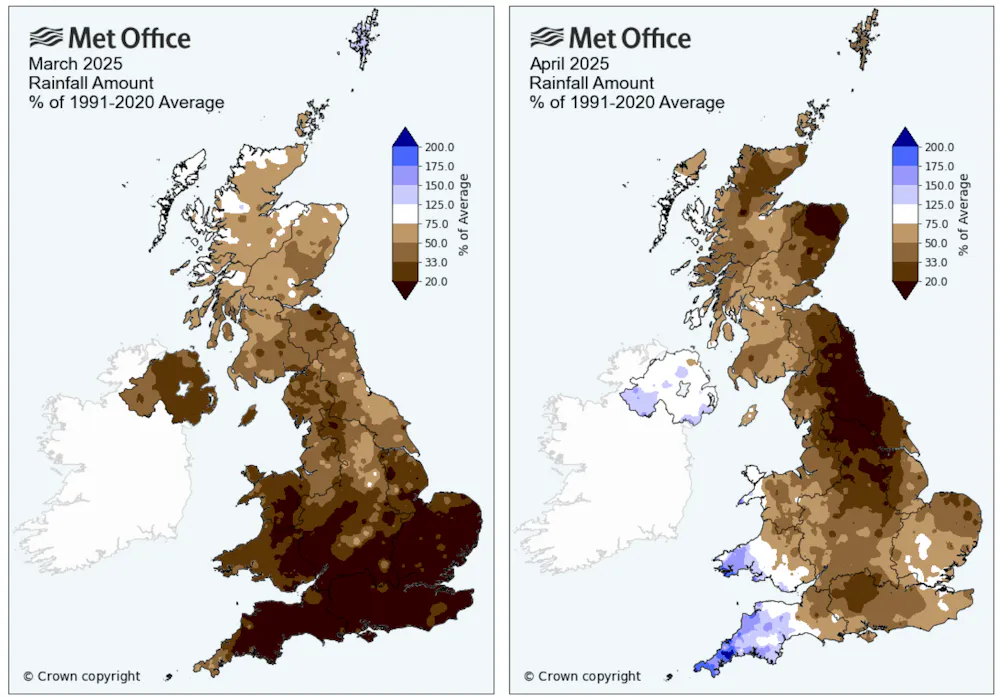
    Meteorologists are warning of the potential for a summer drought, as the UK has seen roughly half its usual amount of rainfall for March and April. While farmers fret about this year’s harvest, some water companies are urging customers to help reservoir levels recover by limiting water use.

    Meanwhile, wildfires have engulfed forest and moorland in areas of Scotland, Wales and England.

    Most of the UK has experienced a record-dry spring so far.
    Met Office

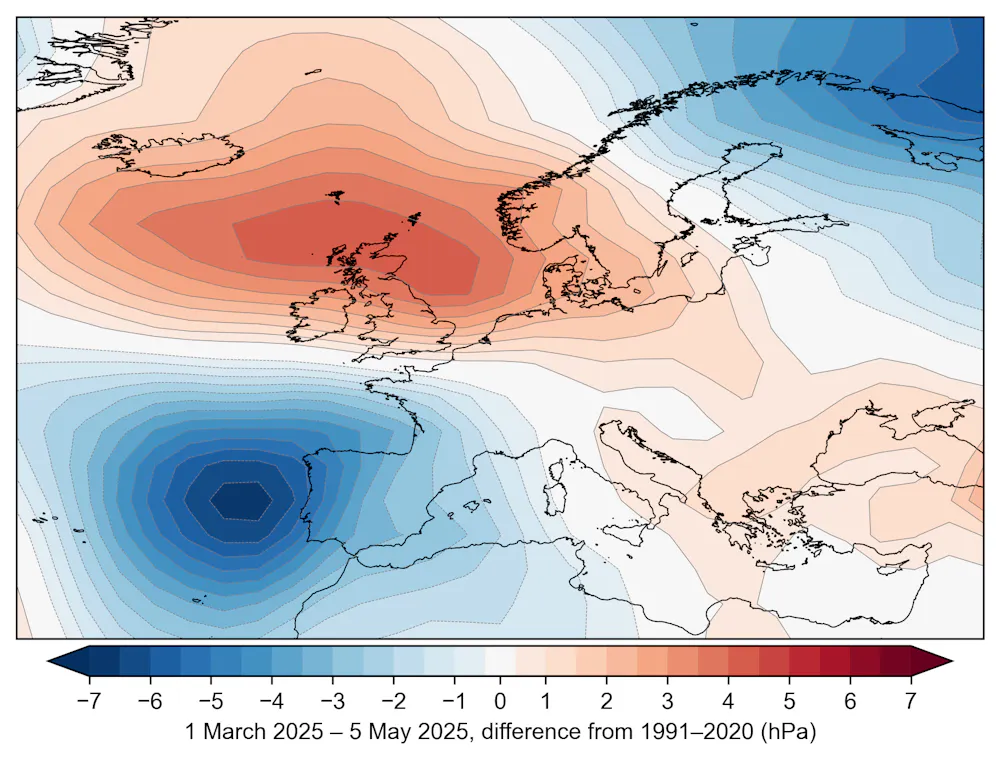
    For several weeks, a stubborn area of high pressure over the UK has diverted the usual flow of mild, moist air from the North Atlantic like a boulder in a river. This is known as a blocking weather system.

    Within it, air descends, warms and dries, which is why this weather pattern tends to be linked to heatwaves and drought. Blocking is usually persistent, making it seem like the weather is stuck.

    Here’s how climate change may have played a role in setting up this unusual spring.


    Get your news from actual experts, straight to your inbox. Sign up to our daily newsletter to receive all The Conversation UK’s latest coverage of news and research, from politics and business to the arts and sciences. Join The Conversation for free today.


    The human fingerprint

    The warming climate means that unusually warm weather is occurring more often and becoming more intense. At the same time, we can expect more periods of both severe drought and extreme rainfall. Sudden changes from drought to deluge, termed “weather whiplash”, are due to the intensification of the water cycle in a warmer atmosphere that can hold more water vapour.

    However, certain weather patterns are necessary to produce extreme weather. More blocking events in future could increase the chance of heatwaves or drought. But are blocking weather patterns becoming more common?

    It’s difficult to determine how weather patterns will change as a result of the rising concentration of greenhouse gases in the atmosphere, which is predominantly caused by the burning of fossil fuels.

    Part of the difficulty arises from the fact that weather patterns vary year to year. Several years in a row with more blocking events than usual could make it seem like blocking is increasing due to climate change, but it could simply be down to chance.

    As a result, it is difficult to detect the fingerprint of human activity from weather observations alone. For example, blocking weather patterns over Greenland during summer have happened more often in recent decades, which can enhance the melting of the ice sheet. But it isn’t clear that this trend is the result of human-induced climate change.

    Climate models do suggest future changes in the occurrence of blocking, however. These computer simulations, consisting of equations that describe the fundamental physics of the atmosphere, are the main tool scientists use to perform experiments that parse how the climate will behave in future.

    The blocking system is visible in the area of high pressure over Britain and Ireland.
    National Centers for Environmental Prediction/National Center for Atmospheric Research/NOAA Physical Sciences Laboratory, CC BY

    When scientists run climate model simulations with increased greenhouse gas concentrations the results consistently show a decrease in blocking events. But blocking generally happens more often in real life than model simulations, which reduces the confidence scientists have in future projections.

    Keeping track of the jet stream

    The movement of weather systems in Earth’s mid-latitudes – including over the UK – is linked to the jet stream, which is a fast-flowing river of air driven by the contrast in temperature between the poles and mid-latitudes.

    Some researchers have suggested that, because the Arctic is warming faster than the tropics, the jet stream may weaken and become more “wavy”, increasing the occurrence of blocking events, contrary to what most climate models show.

    Outside of the scientific community, this idea has become popular. However, the hypothesis remains controversial among scientists, and observational evidence has weakened in recent years.

    In fact, tens of kilometres above the Earth’s surface, near commercial aircraft cruising altitudes, the opposite trends are occurring: the temperature difference between the Arctic and mid-latitudes is increasing, acting to increase the strength of the jet stream.

    There are considerable challenges with understanding how climate change is affecting the large-scale atmospheric patterns which drive the weather we experience. These include large natural variability and imperfect climate models. Models mostly suggest a decline in blocking events with climate change, though this remains relatively uncertain compared with other aspects of the science.

    Overall, we can be confident that climate change is bringing warmer conditions in all seasons. Scientists also have strong evidence to suggest that drought conditions will become more common. These changes are already affecting food production, energy generation and water availability and these impacts will continue to worsen with climate change.


    Don’t have time to read about climate change as much as you’d like?

    Get a weekly roundup in your inbox instead. Every Wednesday, The Conversation’s environment editor writes Imagine, a short email that goes a little deeper into just one climate issue. Join the 45,000+ readers who’ve subscribed so far.


    Simon H. Lee has received funding from the Natural Environment Research Council and the National Science Foundation.

    Matthew Patterson receives funding from the Natural Environment Research Council in the UK via the the National Centre for Atmospheric Science.

    ref. How the weather got ‘stuck’ over the UK – and produced an unusually dry and warm spring – https://theconversation.com/how-the-weather-got-stuck-over-the-uk-and-produced-an-unusually-dry-and-warm-spring-255987

    MIL OSI – Global Reports

  • MIL-OSI USA: Media Alert: Low-level flights to image geology over parts of New England

    Source: US Geological Survey

    The survey is part of USGS Earth Mapping Resources Initiative, a partnership with the geological surveys of Connecticut, Massachusetts, New Hampshire, Rhode Island and Vermont as well as other states.

    “Increasing knowledge of New England’s geologic framework will help with national priorities, like sourcing critical minerals, and regional concerns – like mapping pyrrhotite to minimize its use in local infrastructure,” said Jamey Jones, science coordinator for the USGS Earth Mapping Resources Initiative. 

    Pyrrhotite, a mineral found in bedrock under certain parts of Connecticut and Massachusetts, can cause long-term structural weakness in construction when used in cement.

    The survey is being coordinated by the U.S. Geological Survey as part of a larger, nationwide effort to provide data and images that expand the fundamental knowledge of geology across the nation. The data collected will be made freely available to the public once complete. 

    During the survey, which will be conducted in spring to fall 2025, instruments on the airplane will measure variations in the Earth’s magnetic field and natural, low-level radiation created by different rock types beneath vegetation and up to several miles below the surface. This information will help researchers develop geologic maps of resources and hazards in three dimensions. 

    The aircraft will be equipped with an elongated “boom” that extends either in front of or behind the main cabin that houses sensors. These scientific instruments are completely passive with no emissions that pose a risk to humans, animals, or plant life. No photography or video data will be collected. 

    The aircraft will be flown by experienced pilots who are specially trained and approved for low-level flying. These pilots work with the FAA to ensure flights are safe and in accordance with U.S. law. The surveys will be conducted during daylight hours only. 

    The aircraft will fly along pre-planned fight paths relatively low to the ground at about 300 feet (100 meters) above the surface in some areas. The ground clearance will be increased to 1,000 feet (300+ meters) over populated areas and will comply with Federal Aviation Administration (FAA) regulations. 

    Funding by the Infrastructure Investment and Jobs Act has facilitated coverage of such a large area. 

    Flights will cover areas within the following counties: 

    Connecticut: Fairfield, Hartford, Litchfield, Middlesex, New Haven, New London, Tolland, Windham. Massachusetts: Berkshire, Franklin, Hampden, Hampshire, Middlesex, Worcester. New Hampshire: Cheshire, Hillsborough. Rhode Island: Kent, Providence, Washington. Vermont: Bennington, Windham, as well as Fisher’s Island, New York

    MIL OSI USA News

  • MIL-OSI Asia-Pac: Remarks by CE at media session in Doha (with photo/video)

    Source: Hong Kong Government special administrative region

    Remarks by CE at media session in Doha (with photo/video) 
    Chief Executive: I will now turn to our English-speaking friends in the media.
     
    This marks my second duty visit to the Middle East since taking office. Our delegation comprises over 50 professionals and leaders of enterprises from Hong Kong plus Mainland China. The composition of the delegation demonstrates Hong Kong’s unique role as a “super connector” and “super value-adder” under the principle of “one country, two systems”. Hong Kong is dedicated to capitalising on its connectivity with both Mainland China and the world, collaborating and synergising with economies and enterprises that are eager to pursue high-quality development with us.
     
    I have set out three major goals for our visit to the Middle East this time. First, to strengthen government-to-government relations; second, to explore new areas of co-operation; third, to make friends and expand our network.
     
    Yesterday, I had the honour of meeting His Highness the Amir of the State of Qatar, followed by a meeting with the Prime Minister and Minister of Foreign Affairs. We also visited the Qatar Investment Authority. I introduced to them Hong Kong’s latest developments in finance, professional services, and innovation and technology. We agreed to deepen collaboration across sectors between Hong Kong and Qatar.
     
    We have also expanded our business networks. During this visit, we have achieved 35 MOUs and agreements spanning trade, investment, technology, legal co-operation, financial markets and so on.
     
    In addition to Hong Kong-Qatar co-operation, two agreements were reached between enterprises from Mainland China and Qatar, supporting the development of financial services and advanced manufacturing.
     
    A tripartite agreement among organisations from Hong Kong, Mainland China and Qatar was also reached, focusing on fintech collaboration, showcasing Hong Kong’s bridging role between different economies.
     
    The delegation has first-hand insights from the visit. The delegation visited the Qatar Foundation to learn about its R&D, education and community projects, and visited Lusail City to better understand the smart infrastructure in Qatar’s second-largest city.
     
    Later today, I will visit an autonomous vehicle project at the airport — a project designed by a Mainland Chinese tech firm with its international headquarters in Hong Kong, and first piloted in the Hong Kong International Airport. This exemplifies our role as a launchpad for global innovation.
     
    Tonight, we will depart for Kuwait and will announce the outcome of our duty visit later.
     
    Reporter: Thank you honourable sir. I wanted to ask you if you could you give a rough figure of the value of the 35 memorandums of understanding (MOUs) that have been signed today? And if you can go into a little bit more about the sectors whereby Qatar and Hong Kong can both benefit from each other? For example, you mentioned earlier technology in autonomous vehicles manufactured by Yutong.
     
    Chief Executive: There are 35 agreements signed within two days. I think that is quite a record. I am very glad that delegate members, plus our counterparts in Qatar, both have been very active and supportive in developing co-operation, collaboration and networking, and I see them really spending their time exchanging contact details and also exchanging ideas on how they can develop the relationship. The 35 co-operation agreements cover areas including economic co-operation, investment, technology, legal co-operation, finance, banking and also capital arrangement. If you want to look at the 35 areas of co-operation, I think if you look at the fullest, then you will see the focus areas of co-operation.
     
    The result of these 35 agreements will have to be judged by those who will then continue their work. What a visit led by the Chief Executive will achieve, and can achieve, is opening the doors first with governments, so that the delegates, business players and entrepreneurs can then continue the liaison to open more doors, windows and opportunities. It is up to them to work hard, and this is something I will be demanding – for them to work hard. But if you look at my last visit to the Middle East, which was about two years ago, after we signed a number of MOUs, we have seen companies producing hydrogen buses for a country in the Middle East. We have seen, for example, on the stock exchange side, stock exchanges exchanging agreements for dual listing. We also see professionals set up their offices in the countries that I visited in the Middle East last time, and they have been receiving work orders and doing their services. I expect the delegates to continue these liaisons amongst themselves. But I am glad to inform you that the amount of enthusiasm is very strong. I will say that there will be more exchanges between not just governments, but in the private sector, chambers, businessmen and associations. And I will see not just exchanges between themselves, but also their participation in some of the events organised in Hong Kong, including both conferences, a lot of match-making deals, etc. I am very positive that the momentum will continue.
     
    (Please also refer to the Chinese portion of the remarks.)
    Issued at HKT 23:58

    NNNN

    MIL OSI Asia Pacific News

  • MIL-OSI Asia-Pac: CE leads delegation to continue visit to Qatar

    Source: Hong Kong Government special administrative region

    CE leads delegation to continue visit to Qatar 
    In the morning, Mr Lee met with the Minister of Labour of Qatar, Dr Ali bin Saeed bin Samikh Al Marri, to discuss plans on enhancing talent exchanges between Hong Kong and Qatar, with a view to promoting cultural exchanges and communication between the two places. Noting that Hong Kong is home to five of the world’s top 100 universities and is actively developing into an international hub for post-secondary education, Mr Lee highlighted that Hong Kong offers a Belt and Road Scholarship to encourage students from Belt and Road countries or regions to pursue post-secondary studies in the city. This initiative aims to attract more outstanding non-local students and talent to Hong Kong. He welcomed more young people of Qatar to study and develop their careers in Hong Kong.
     
    After that, Mr Lee and the delegation attended a roundtable meeting with representatives of the Qatari Businessmen Association and the Qatar Chamber of Commerce and Industry respectively. Highlighting Hong Kong’s robust legal system, resilient financial system and simple and low tax regime, Mr Lee welcomed Qatari enterprises to capitalise on Hong Kong’s advantages in connecting with both the Mainland and the world under the “one country, two systems” principle. Qatari enterprises can also leverage Hong Kong’s high-quality financial, logistics and professional services, as well as its bridging roles to assist enterprises in going global and attracting external investment, tapping into business opportunities on the Mainland market.
     
    In the afternoon, Mr Lee attended a business luncheon co-hosted by the Hong Kong Economic and Trade Office in Dubai and the Hong Kong Trade Development Council. Addressing the luncheon, Mr Lee introduced Hong Kong’s development opportunities and business advantages to over 300 local political and business representatives. Noting that the Middle East is a key region under the Belt and Road Initiative, Mr Lee said this marks his second visit to the Middle East since taking office, and that he was very pleased to see the continuous strengthening of ties and co-operation between Hong Kong and the region. Pointing out that Qatar is Hong Kong’s third-largest trading partner in the Middle East region, Mr Lee announced that Hong Kong and Qatar had substantially concluded negotiations on the Investment Promotion and Protection Agreement, and would begin discussions on mutual recognition arrangements for their respective Authorized Economic Operator Programmes, creating a more favourable environment for flows of capital and goods. He also announced a new arrangement allowing Hong Kong Special Administrative Region passport holders to visit Qatar visa-free for up to 30 days. He said he looks forward to further deepening co-operation with Qatar in such areas as economy and trade, tourism, and culture. He said that Hong Kong and Mainland enterprises complement each other’s strengths, and that Hong Kong will continue to play its bridging role to serve enterprises in going global and attracting external investment, with a view to deepening international exchanges and co-operation. Hong Kong and Qatar can jointly seize the significant development opportunities brought by the Guangdong-Hong Kong-Macao Greater Bay Area and the Belt and Road Initiative.
     
    During the luncheon, government departments, enterprises, and institutions from Hong Kong, the Mainland and Qatar exchanged and announced 35 MOUs and co-operation agreements covering economic co-operation, investment, technology, legal collaboration, as well as finance, banking, and capital market development. In addition to the co-operation between Hong Kong and Qatar, two agreements were signed directly between Mainland and Qatari enterprises to foster co-operation in financial services and high-end manufacturing. Furthermore, a tripartite agreement was signed among Hong Kong, the Mainland, and Qatar to strengthen co-operation in fintech, covering Web3 and AI, leveraging the respective technological strengths of each region for mutual development.
     
    Afterwards, Mr Lee visited Hamad International Airport in Doha to learn about the operation and effectiveness of its autonomous vehicle pilot project and to examine the application of autonomous buses. The pilot project, which had participation by a Chinese enterprise, UISEE, set a precedent for applying autonomous driving technology at airports in the Middle East region. UISEE is one of the leading companies in autonomous driving technology on the Mainland, having established its international headquarters in Hong Kong as a springboard to expand its business globally. The company collaborated with Hong Kong International Airport on autonomous vehicle projects to enhance the safety and operational efficiency of airport logistics, drawing on the successful experiences to promote the technology to the international market. Hamad International Airport, which is the latest pilot site of UISEE, demonstrated the co-operation among Mainland China, Hong Kong, and Qatar.
     
    Mr Lee and the delegation will depart for Kuwait tonight.
     
    Issued at HKT 23:58

    NNNN

    MIL OSI Asia Pacific News

  • MIL-OSI USA: ICYMI: Rep. Pfluger’s ACES Act Passed the House

    Source: United States House of Representatives – Congressman August Pfluger (TX-11)

    The passage of Rep. Pfluger’s legislation was celebrated by several veteran organizations and advocacy groups, who released the following statements:

    Vince Alcazar, COL, USAF, ret., MACH Coalition Founder & Director, said, “The Military Aviator Coalition for Health (MACH) celebrates the passage of H.R. 530, the Aviator Cancer Examination Study (ACES) Act. With three major Department of Defense studies in the last four confirming and quantifying significantly elevated cancer rates among U.S. military flyers, the ACES Act goes the next step. This bill would ask the National Academy of Sciences, Engineering, and Medicine to apply their extensive Veteran health study capacity to determine what in the operating environments of military aviation is likely causing cancer. This study is essential. Without the ACES Act, military medicine will have no practical way of mitigating risk, and Veteran flyers will have no basis to correlate their service to potential cancer. This day was five years in the making. We recognize and praise the leadership of Congressman August Pfluger in leading this bill through three Congresses to today. Congressman Pfluger is an amazing champion of this work.”

    Jose Ramos, Vice President of Government and Community Relations, Wounded Warrior Project, said, “Wounded Warrior Project is grateful to Rep. Pfluger and his fellow Members of Congress for passing the ACES Act in the House of Representatives by an overwhelming majority. This legislation represents a critical step toward safeguarding the long-term health and well-being of military aviators and support personnel. These groups are routinely exposed to unique occupational hazards, and collaborative research across the federal government will help inform cancer prevention and veteran health strategies.We urge the Senate to take up this legislation as soon as possible.”

    Rye Barcott, Co-Founder & CEO of With Honor Action, said, “With Honor Action congratulates Reps. August Pfluger and Jimmy Panetta in securing House passage of the ACES Act—comprehensive legislation that will advance research into potential links between aviator service and increased cancer rates,” said Rye Barcott, Co-Founder & CEO of With Honor Action. “As members of the For Country Caucus, Reps. Pfluger and Panetta built strong bipartisan support among their fellow veteran lawmakers that led to a full caucus endorsement. We look forward to seeing this critical legislation become law.”

    Theo Lawson, Assistant Director, Legislative Programs, Fleet Reserve Association, said, “The Fleet Reserve Association (FRA) wholeheartedly celebrates the passage of the ACES Act in the House and extends our sincere congratulations to Congressman August Pfluger, his staff, and the bill’s cosponsors for their incredible dedication in advancing this vital legislation. Understanding cancer is the first step to defeating it, and this bill brings us closer to uncovering the critical links between aircrew service and cancer risks. Their leadership ensures our sea service aviators and all aircrew members are better equipped to identify and combat this silent enemy. We look forward to continuing the fight alongside them until the ACES Act becomes law–honoring the sacrifices of our servicemembers and safeguarding future generations.”

    Mario Marquez, Executive Director of Government Affairs, The American Legion, said, “On behalf of the 1.5 million veterans nationwide, The American Legion proudly supports the ACES Act. Research is critical to our understanding of the impacts of toxic exposures, from Agent Orange to harmful chemicals on aircraft. We applaud Representative Pfluger for prioritizing this critical issue and thank the House of Representatives for passing the ACES Act with resounding support. The American Legion urges the Senate to vote on this bill and continue to invest in research surrounding the impacts of toxic exposures.”

    MIL OSI USA News

  • MIL-OSI USA: Duckworth Statement on DOT Secretary Duffy’s Plan to Modernize Our Aging Air Traffic Control System

    US Senate News:

    Source: United States Senator for Illinois Tammy Duckworth

    May 08, 2025

    [WASHINGTON, D.C.] – Today, U.S. Senator Tammy Duckworth (D-IL)—a member of the U.S. Senate Committee on Commerce, Science and Transportation (CST) and Ranking Member of the CST Aviation Subcommittee—issued the following statement after Department of Transportation (DOT) Secretary Sean Duffy announced his new plan to modernize our nation’s air traffic control system:

    “For years, I’ve sounded the alarm that we must modernize our air traffic control system in order to safeguard the flying public. After the deadly DCA crash, multiple near-misses and a terrifying equipment failure impacting Newark, it is encouraging that Secretary Duffy and the Trump Administration recognize how urgent this matter is and are calling for new funding to upgrade our nation’s aging air traffic control technology and facilities.

    “While this may be a positive development, we shouldn’t forget that these are the same officials who just months ago indiscriminately fired hundreds of FAA workers who helped keep our civilian aviation system safe. If America wants to remain the gold standard in aviation safety, we need smart investments—not canceled investments and funding cuts. I look forward to reviewing the details of the Trump Administration’s plan with my colleagues on the Commerce committee so we can ensure our air traffic controllers have the support and equipment they need to keep passengers and crew safe.”

    For years, Duckworth has been sounding the alarm that we must make these critical aviation safety investments immediately to prevent all-too-often near-misses from becoming catastrophic tragedies. Last Congress, Duckworth chaired two CST Aviation Subcommittee hearings—one last December and the other a year prior—to address our aviation industry’s chilling surge in near-deadly close calls and underscore the urgent need to improve air traffic control systems to protect the flying public.

    Last year, Duckworth helped author the landmark bipartisan FAA reauthorization that was signed into law to extend the FAA’s funding and authorities through Fiscal Year 2028. The reauthorization included several of her provisions to improve consumer safety, expand the aviation workforce and enhance protections for travelers with disabilities.

    -30-


    MIL OSI USA News

  • MIL-OSI Europe: ICAO Council: Russian Federation responsible for downing of flight MH17

    Source: Government of the Netherlands

    The Council of the International Civil Aviation Organization (ICAO Council) has concluded Monday that the Russian Federation is responsible for the downing of Flight MH17 and has thus violated the Convention on International Civil Aviation, known as the Chicago Convention. The ICAO Council rendered this decision in a case initiated by the Netherlands and Australia in 2022 against the Russian Federation over the downing of Flight MH17 on 17 July 2014. The Council has found in favour of the Netherlands and Australia.

    Foreign minister Caspar Veldkamp: ‘I am pleased with this decision by the ICAO Council, first and foremost because of what it means for the next of kin of the victims of the downing of Flight MH17. It cannot take away their grief and pain, but the decision is an important step towards establishing the truth and achieving justice and accountability for all victims of Flight MH17, and their families and loved ones. This decision also sends a clear message to the international community: states cannot violate international law with impunity.’

    In the coming weeks the ICAO Council will consider what form of reparation is in order. In that context the Netherlands and Australia are requesting that the ICAO Council order the Russian Federation to enter into negotiations with the Netherlands and Australia, and that the Council facilitate this process. The latter is important in order to ensure that the negotiations are conducted in good faith and according to specific timelines, and that they will yield actual results.

    ICAO is a specialised agency of the United Nations with 193 member states. Under the Chicago Convention these states may not use weapons against civil aircraft in flight. It is for the ICAO Council to decide whether countries have violated the Convention. 

    The decision was reached on Monday by a vote among the members of the ICAO Council. A large majority of the Council members voted in favour of the Netherlands’ and Australia’s position.

    MIL OSI Europe News

  • MIL-OSI Global: Trump heads to the Gulf aiming to bolster trade ties – but side talks on Tehran, Gaza could drive a wedge between US and Israel

    Source: The Conversation – Global Perspectives – By Asher Kaufman, Professor of History and Peace Studies, University of Notre Dame

    President Donald Trump and Saudi Arabia’s Crown Prince Mohammed Bin Salman attend the G20 Summit in Japan in 2019. Eliot Blondet/AFP via Getty Images

    President Donald Trump will sit down with the Saudi crown prince and Emirati and Qatari leaders on May 14, 2025, in what is being heavily touted as a high-stakes summit. Not invited, and watching warily, will be Israeli Prime Minister Benjamin Netanyahu.

    Like many other members of his right-wing coalition, Netanyahu appeared delighted at the election of Trump as U.S. president in November, believing that the Republican’s Middle East policies would undoubtedly favor Israeli interests and be coordinated closely with Netanyahu himself.

    But it hasn’t quite played out that way. Of course, Washington remains – certainly in official communications – Israel’s strongest global ally and chief supplier of arms. But Trump is promoting a Middle East policy that is, at times, distinctly at odds with the interests of Netanyahu and his government.

    In fact, in pushing for an Iran nuclear deal – a surprise reversal from Trump’s first administration – Trump is undermining long-held Netanyahu positions. Such is the level of alarm in Israeli right-wing circles that rumors have been circulating of Trump announcing unilateral U.S. support for a Palestinian state ahead of the Riyadh visit – something that would represent a clear departure for Washington.

    As a historian of Israel and the broader Middle East, I recognize that in key ways Trump’s agenda in Riyadh represents a continuation of the U.S. policies, notably in pursuing security relationships with Arab Gulf monarchies – something Israel has long accepted if not openly supported. But in the process, the trip could also put significant daylight between Trump and Netanyahu.

    Trump’s official agenda

    The four-day trip to the Gulf, Trump’s first policy-driven foreign visit since being elected president, is on the surface more about developing economic and security ties between the U.S. and traditional allies in the Persian Gulf.

    Trump is expected to cement trade deals worth tens of billions of dollars between the U.S. and Arab Gulf States, including unprecedented arms purchases, Gulf investments in the U.S. and even the floated Qatari gift of a palatial 747 intended for use as Air Force One.

    There is also the possibility of a security alliance between the U.S. and Saudi Arabia.

    So far, so good for Israel’s government. Prior to the Oct. 7 attacks, Israel was already in the process of forging closer ties to the Gulf states, with deals and diplomatic relations established with the United Arab Emirates and Bahrain through the Abraham Accords that the Trump administration itself facilitated in September 2020. A potential normalization of ties with Saudi Arabia was also in the offing.

    Dealing with Tehran

    But central to the agenda this week in Riyadh will be issues where Trump and Netanyahu are increasingly not on the same page. And that starts with Iran.

    While the country won’t be represented, Iran will feature heavily at Trump’s summit, as it coincides with the U.S. administration’s ongoing diplomatic talks with Tehran over its nuclear program. Those negotiations have now concluded four rounds. And despite clear challenges, American and Iranian delegations continue to project optimism about the possibility of reaching a deal.

    The approach marks a change of course for Trump, who in 2018 abandoned a similar deal to the one he is now largely looking to forge. It also suggests the U.S. is currently opposed to the idea of direct armed confrontation with Iran, against Netanayhu’s clear preference.

    Diplomacy with Tehran is also favored by Gulf states as a way of containing Iran’s nuclear ambitions. Even Saudi Arabia – Tehran’s long-term regional rival that, like Israel, opposed the Obama-era Iran nuclear diplomacy – is increasingly looking for a more cautious engagement with Iran. In April, the Saudi defense minister visited Tehran ahead of the recent U.S.-Iranian negotiations.

    Netanyahu has built his political career on the looming threat from a nuclearized Iran and the necessity to nip this threat in the bud. He unsuccessfully tried to undermine President Barack Obama’s initial efforts to reach an agreement with Iran – resulting in 2015’s Iran nuclear deal. But Netanyahu had more luck with Obama’s successor, helping convince Trump to withdraw from the agreement in 2018.

    So Trump’s about-turn on Iran talks has irked Netanyahu – not only because it happened, but because it happened so publicly. In April, the U.S. president called Netanyahu to the White House and openly embarrassed him by stating that Washington is pursuing diplomatic negotiations with Tehran.

    Split over Yemen

    A clear indication of the potential tension between the Trump administration and the Israeli government can be seen in the ongoing skirmishes involving the U.S., Israel and the Houthis in Yemen.

    After the Houthis fired a missile at the Tel Aviv airport on May 4 – leading to its closure and the cancellation of multiple international flights – Israel struck back, devastating an airport and other facilities in Yemen’s capital.

    But just a few hours after the Israeli attack, Trump announced that the U.S. would not strike the Houthis anymore, as they had “surrendered” to his demands and agreed not to block passage of U.S. ships in the Red Sea.

    It became clear that Israel was not involved in this new understanding between the U.S. and the Houthis. Trump’s statement was also notable in its timing, and could be taken as an effort to calm the region in preparation of his trip to Saudi Arabia. The fact that it might help smooth talks with Iran too – Tehran being the Houthis’ main sponsor – was likely a factor as well.

    Timing is also relevant in Israel’s latest attack on Yemeni ports. They took place on May 11 – the eve of Trump setting off for his visit to Saudi Arabia. In so doing, Netanyahu may be sending a signal not only to the Houthis but also to the U.S. and Iran. Continuing to attack the Houthis might make nuclear talks more difficult.

    Bibi’s political survival-first approach

    Critical observers of Netanyahu have long argued that he prioritizes continued war in Gaza over regional calm for the sake of holding together his far-right coalition, members of which desire full control of the Gaza Strip and de-facto annexation of the West Bank.

    Israel’s Prime Minister Benjamin Netanyahu warns of the Iran nuclear threat at the United Nations in 2012.
    Mario Tama/Getty Images

    This, many political commentators have argued, is the main reason why Netanyahu backed off from the last stage of the ceasefire agreement with Hamas in March – something which would have required the withdrawal of the Israeli army from the Gaza Strip.

    Since the collapse of the ceasefire, Israel’s army has mobilized in preparation for a renewed Gaza assault, scheduled to start after the end of Trump’s trip to the Gulf.

    With members of the Netanayhu government openly supporting the permanent occupation of the strip and declaring that bringing back the remaining Israeli hostages is no longer a top priority, it seems clear to me that deescalation is not on Netanyahu’s agenda.

    Trump himself has noted recently both the alarming state of the hostages and the grave humanitarian crisis in Gaza. Now, in addition to the release of Israeli-American hostage Edan Alexander, the U.S. is also engaged in negotiations with Hamas over ceasefire and aid – ignoring Netanyahu in the process.

    The bottom dollar

    Current U.S. policy in the region may all be serving a greater aim for Trump: to secure billions of dollars of Gulf money for the American economy and, some have said, himself. But to achieve that requires a stable Middle East, and continued war in Gaza and Iran inching closer to nuclear capabilities might disrupt that goal.

    Of course, a diplomatic agreement over Tehran’s nuclear plans is still some way off. And Trump’s foreign policy is notably prone to abrupt turns. But whether guided by a dealmaker’s instincts to pursue trade and economic deals with wealthy Gulf states, or by a genuine – and related – desire to stabilize the region, his administration is increasingly pursuing policies that go against the interests of the current Israeli government.

    Asher Kaufman does not work for, consult, own shares in or receive funding from any company or organization that would benefit from this article, and has disclosed no relevant affiliations beyond their academic appointment.

    ref. Trump heads to the Gulf aiming to bolster trade ties – but side talks on Tehran, Gaza could drive a wedge between US and Israel – https://theconversation.com/trump-heads-to-the-gulf-aiming-to-bolster-trade-ties-but-side-talks-on-tehran-gaza-could-drive-a-wedge-between-us-and-israel-256371

    MIL OSI – Global Reports

  • MIL-OSI USA: TRANSCOM Reveals 30+ Missions to Guantanamo Bay, Costing Over $20 Million since January 2025, In Break from Precedent

    US Senate News:

    Source: United States Senator for Massachusetts – Elizabeth Warren

    May 12, 2025

    Text of QFR Response (PDF)

    Washington, D.C. – Today, U.S. Senator Elizabeth Warren released responses she received from the United States Transportation Command (TRANSCOM), one of the commands of the Department of Defense (DoD), regarding its role in sending passengers and cargo to the U.S. Naval Station Guantanamo Bay.

    The responses from TRANSCOM revealed:

    • “USTRANSCOM conducted 31 military and contract airlift missions to the U.S. Naval Station Guantanamo Bay between January 20, 2025, and March 25, 2025. These missions transported 715 passengers and 1016.9 short tons of cargo.”

    • “As of 08 April, USTRANSCOM has flown a total of 46 flights on military aircraft in support of migrant deportation flights. The flights total 802.5 hours at an average cost of $26,277 per flight hour.”

    • Over just a couple of months, Atlas Air, Delta, Omni Air, United Airlines, and Sun Country made over $1.6 million just from flying to Guantanamo Bay to assist migrant operations.

    • “In anticipation of U.S. presence and increased capacity at U.S. Naval Station Guantanamo Bay,” DoD has increased the number of flights to the Naval Station.

    “Every American should be outraged by Donald Trump wasting military resources to pay for his political stunts that do not make us safer,” said Senator Warren. “U.S. servicemembers did not sign up for this abuse of power.”

    MIL OSI USA News

  • MIL-OSI Global: Governments shouldn’t chase growth at all costs. The harms of over tourism show why

    Source: The Conversation – UK – By Ilaria Pappalepore, Reader in Tourism and Events, University of Westminster

    Amsterdam hit its self-imposed limit of 20 million overnight stays in 2023. 4kclips/Shutterstock

    In the controversial case of expansion at Heathrow airport, the UK government insists that the benefits of economic growth outweigh the environmental and wellbeing costs. But what if focusing on prosperity is a shortsighted approach? The debate about a third runway, placed in the context of exponential growth in travel and tourism, makes the impact on people and the environment clear to see.

    Tourism accounts for an estimated 8% of global CO2 emissions, and emissions related to tourism will continue to grow despite technological advances. The Heathrow expansion, for example, has been shown to be incompatible with net-zero requirements.

    Meanwhile, many tourism destinations are struggling to cope with growing numbers of visitors. Residents have protested at the impact of overtourism on their quality of life, with harms including overcrowding, loss of amenities for residents and a skewed property market.

    London’s airport development plans (expansion is also mooted at Gatwick and Luton) aim to inject investment into a range of sectors beyond tourism. However, our research suggests that aligning tourism with other sectors and better cooperation of decision-making at different levels of government could lead to increased wellbeing, a healthier environment and greater benefits to the local economy.

    This provides options to rethink what tourism could look like when the focus is not just economic growth.

    It should be possible to look at new models that take a holistic approach to tourism development. This means putting the wellbeing of the community and the environment first. Falling under the umbrella term of “post-growth”, there are various approaches that all rethink the role of economic growth. They advocate prioritising human wellbeing within planetary boundaries.

    “Degrowth” argues that limiting growth is essential for a sustainable future. On the other hand, “doughnut economics” and regenerative approaches are more agnostic about economic growth. They argue that human prosperity and wellbeing should be prioritised regardless of whether GDP is going up or down.

    In the context of tourism and travel, these approaches provide a different perspective on the role of the sector and what it can bring to a place, beyond economic growth.

    They also go further than most strategies being implemented in popular tourist cities to prioritise residents’ wellbeing, quality of life, and lower-carbon travel.

    Taking the heat off tourist hotspots

    As part of a net-zero emission pledge, and in an attempt to curb overtourism and the frustration of locals, some cities across Europe are enforcing restrictions on cruise ships. And Greece is applying a climate resilience tax on top of the tourism tax on all overnight stays.

    One of the cities that has done the most to curb tourism is Amsterdam. After the start of the COVID pandemic, it adopted a citizen initiative to cap tourism at 20 million overnight stays per year.

    This number was reached in 2023, and the city has put forward a wide range of measures since then. These include a tourist tax rate of 12.5%, strict rules on short-term rentals, limits on visitor numbers at large attractions and reducing the number of cruises. The city has also strengthened its environmental regulations.

    Copenhagen, on the other hand, chooses not to restrict tourism. Rather, it now rewards visitors who engage in climate-friendly actions, with the “CopenPay” pilot project. Visitors who choose to cycle, use public transport or participate in volunteering are eligible for discounts or free access to 24 attractions.

    Visitors to Greece pay a climate charge as well as a tourist tax.
    ecstk22/Shutterstock

    While these initiatives are laudable, there are two reasons why they don’t go far enough.

    The first is that the majority of the measures are based on financial disincentives, such as charging entrance fees to destinations and taxing the most polluting transport. They rest on the assumption that we do not need to address the underlying pursuit of growth that led to this unsustainability.

    Likewise, arguments in favour of green growth are based on technological advances, such as sustainable aviation fuel (SAF). This underpins claims that air travel can continue to grow. However, both within and beyond the travel sector, it has been argued that green growth is a myth.


    Read more:
    There isn’t enough ‘sustainable’ aviation fuel to make a dent in our emissions – and there won’t be for years


    In the long run, these measures do not cut the ever-growing number of travellers. Nor do they effectively address climate issues.

    Second, cities need support from higher levels of government if they want to encourage travel that is more environmentally friendly and contributes to the wellbeing of residents. In the case of Amsterdam, the ongoing expansion of Schiphol airport can be linked to overtourism, as well as noise and air pollution.

    City leaders want to cut the maximum number of flights. But they cannot do much as long as economic growth is the focus of the Dutch government’s plans.

    This highlights the deep complexities of controlling visitor numbers. And it also suggests that the economic benefits that come with the growth of London’s airports may come with societal and environmental costs. These will be felt by London and its residents, and cannot be solved with local policies.

    Rather than going further and faster with growth, when it comes to travel and tourism we may need to go “closer by and slower”.

    That might mean placing greater emphasis on promoting destinations to nearby markets, investment in low-carbon travel options and regenerative tourism activities. A post-growth approach should ensure that the economic benefits do not outweigh long-term ecological and societal growth. After all, these are the things we all need for a resilient society.

    The authors do not work for, consult, own shares in or receive funding from any company or organisation that would benefit from this article, and have disclosed no relevant affiliations beyond their academic appointment.

    ref. Governments shouldn’t chase growth at all costs. The harms of over tourism show why – https://theconversation.com/governments-shouldnt-chase-growth-at-all-costs-the-harms-of-over-tourism-show-why-255038

    MIL OSI – Global Reports

  • MIL-OSI Asia-Pac: RoboPaint Master Competition held

    Source: Hong Kong Information Services

    The Housing Bureau organised the “Construction Robots for Housing – RoboPaint Master Competition x Arena of Construction Robots” today to promote the adoption of industry technologies and advance public housing developments into a new era of smart construction.


    Speaking at the opening ceremony, Secretary for Housing Winnie Ho said that the application of construction robots not only boosts productivity and quality but also creates a safer and healthier working environment for frontline workers.


    “This advancement elevates the technological standards and professional image of the industry, making it more appealing to young professionals.”


    Ms Ho cited a recent case of a public housing project which demonstrates that collaborative painting robot systems can enhance the efficiency of indoor painting works by over 50% and improve works quality.


    In a public housing project with a standard floor comprising 24 units, traditional methods require eight skilled workers for wall finishing, while only two operators are needed when using a robotics system, she added.


    A jury panel comprising Ms Ho and representatives from the Institution of Engineers, the Institute of Architects, the Construction Industry Council and industry experts evaluated the entries in the RoboPaint Master Competition.


    The results of the competition revealed that Bright Dream (HK) Construction Technology and Weibuild Technology HK won the Grand Award. While Fangshi Technology Company and Fulltime Robotics Company earned First Runner-up, HONGKONG DAFANG AI CO. secured Second Runner-up.


    The judging criteria encompassed technical performance, efficiency and productivity, quality of painting and safety.


    In addition to displaying an autonomous small unmanned aircraft for scanning, the event also showcased six types of robots with potential applications in public housing construction. They included a rebar-tying robot, a floor-tiling robot, a steel frame-cutting robot, a six-metre tall three-in-one wall-painting robot, and a concrete internal wall-grinding robot.


    The bureau explained that it plans to host a series of events as part of its Housing•I&T initiative. While today’s event is the first highlight of the initiative, the other events will include a housing construction robot design competition for secondary school students in September and an international summit in November, aimed at fostering the development of a construction technology market.

    MIL OSI Asia Pacific News

  • MIL-OSI: Gilat Expands and Adds to its ESA Antenna Portfolio with a Successful Test Flight of ESR-2030Ku on Eutelsat OneWeb Low Earth Orbit (LEO) Network

    Source: GlobeNewswire (MIL-OSI)

    PETAH TIKVA, Israel, May 12, 2025 (GLOBE NEWSWIRE) — Gilat Satellite Networks Ltd. (NASDAQ: GILT, TASE: GILT), a worldwide leader in satellite networking technology, solutions and services, announced today the successful completion of a series of test flights featuring its ESR-2030Ku electronically steered antenna (ESA). Conducted in collaboration with Gogo, which will be the exclusive distributor of the antenna for the business aviation and defense markets, the tests demonstrated outstanding performance of the ESA on the OneWeb Low Earth Orbit (LEO) network.

    The ESR-2030Ku—designed for mobility and engineered for efficiency—delivered full-duplex connectivity with throughput of 195 Mbps downlink and 32 Mbps uplink. The terminal remained stable and reliable throughout the tests, even in demanding performance scenarios.

    “We are extremely pleased with the results of these flight tests,” said Hagay Katz, Chief Product and Marketing Officer at Gilat. “With the superior performance of the ESR-2030Ku, we are expanding our portfolio of market-leading electronically steered antennas, which now includes both the ESR-2030Ku and the Stellar Blu Sidewinder. This achievement positions Gilat to capitalize on the fast-growing, multi-billion-dollar market for LEO-based ESA solutions in the Defense and In-Flight Connectivity sectors.”

    The ESR-2030Ku is a unique compact and low-power full-duplex aero ESA built for the OneWeb network. Production hardware delivery to support customer STCs is expected later in 2025.

    About Gilat

    Gilat Satellite Networks Ltd. (NASDAQ: GILT, TASE: GILT) is a leading global provider of satellite-based broadband communications. With over 35 years of experience, we develop and deliver deep technology solutions for satellite, ground, and new space connectivity, offering next-generation solutions and services for critical connectivity across commercial and defense applications. We believe in the right of all people to be connected and are united in our resolution to provide communication solutions to all reaches of the world.

    Together with our wholly owned subsidiaries—Gilat Wavestream, Gilat DataPath, and Gilat Stellar Blu—we offer integrated, high-value solutions supporting multi-orbit constellations, Very High Throughput Satellites (VHTS), and Software-Defined Satellites (SDS) via our Commercial and Defense Divisions. Our comprehensive portfolio is comprised of a cloud-based platform and modems; high-performance satellite terminals; advanced Satellite On-the-Move (SOTM) antennas and ESAs; highly efficient, high-power Solid State Power Amplifiers (SSPA) and Block Upconverters (BUC) and includes integrated ground systems for commercial and defense markets, field services, network management software, and cybersecurity services.

    Gilat’s products and tailored solutions support multiple applications including government and defense, IFC and mobility, broadband access, cellular backhaul, enterprise, aerospace, broadcast, and critical infrastructure clients all while meeting the most stringent service level requirements. For more information, please visit: http://www.gilat.com

    Certain statements made herein that are not historical are forward-looking within the meaning of the Private Securities Litigation Reform Act of 1995. The words “estimate”, “project”, “intend”, “expect”, “believe” and similar expressions are intended to identify forward-looking statements. These forward-looking statements involve known and unknown risks and uncertainties. Many factors could cause the actual results, performance or achievements of Gilat to be materially different from any future results, performance or achievements that may be expressed or implied by such forward-looking statements, including, among others, changes in general economic and business conditions, inability to maintain market acceptance to Gilat’s products, inability to timely develop and introduce new technologies, products and applications, rapid changes in the market for Gilat’s products, loss of market share and pressure on prices resulting from competition, introduction of competing products by other companies, inability to manage growth and expansion, loss of key OEM partners, inability to attract and retain qualified personnel, inability to protect the Company’s proprietary technology and risks associated with Gilat’s international operations and its location in Israel, including those related to the terrorist attacks by Hamas, and the hostilities between Israel and Hamas and Israel and Hezbollah. For additional information regarding these and other risks and uncertainties associated with Gilat’s business, reference is made to Gilat’s reports filed from time to time with the Securities and Exchange Commission. We undertake no obligation to update or revise any forward-looking statements for any reason.

    Contact:

    Gilat Satellite Networks
    Hagay Katz, Chief Product and Marketing Officer
    hagayk@gilat.com

    Alliance Advisors:

    GilatIR@allianceadvisors.com
    Phone: +1 212 838 3777

    The MIL Network

  • MIL-OSI Asia-Pac: HB organises Construction Robots for Housing – RoboPaint Master Competition x Arena of Construction Robots to advance applications of construction technologies

    Source: Hong Kong Government special administrative region

         The Housing Bureau (HB) organised the Construction Robots for Housing – RoboPaint Master Competition x Arena of Construction Robots today (May 12) to promote the adoption of industry technologies and advance public housing developments into a new era of smart construction.
     
         To expedite the speed and efficiency of increasing the public housing supply and address the challenge of an ageing workforce and construction manpower shortages, the HB and the Hong Kong Housing Authority (HKHA) are leveraging innovative construction technologies to boost productivity and improve safety. As part of the Housing•I&T initiative, the HB will host a series of events, including today’s robotics competition, a housing construction robot design competition for secondary school students in September, and an international summit in November aimed at fostering the development of a construction technology market. The Construction Robots for Housing – RoboPaint Master Competition x Arena of Construction Robots is the first highlight of this initiative. The event provides the industry with a platform to test and demonstrate their technological products, allowing participants to fully explore and maximise the development potential of innovative construction technologies.
     
         A Mainland robotics company has already partnered with the Hong Kong University of Science and Technology to establish a joint research institute for a few years to promote and strengthen co-operation between the university and industry in the development of robotics technology. The HKHA anticipates that the use of robotics will gradually become more prevalent, and has thus incorporated requirements for such use in its tender documents. By leveraging the stable and substantial volume of public housing projects and diverse application areas, the HKHA aims to attract Mainland robotics companies to progressively deploy their technologies in public housing initiatives. Acting as a “super connector” and a “super value-adder”, the HKHA actively seeks and validates tailored robotics solutions that meet industry needs while promoting successful cases to the sector. As a result, several robotics companies subsequently have decided to expand their business operations in Hong Kong, using it as a springboard to enter markets in Singapore, the Middle East and Europe. It is believed that the establishment of more innovation and technology (I&T) enterprises in Hong Kong will further drive the vibrant development of the city’s I&T ecosystem.
     
         At the event’s opening ceremony, the Secretary for Housing, Ms Winnie Ho, said, “According to the indicators for specific tasks as in the Chief Executive’s 2024 Policy Address on construction robots, the HKHA will specify in tender documents the construction processes where robots can be employed to enhance site safety and construction efficiency. The highlight of today’s event is the painting robots participating in the Construction Robots for Housing – RoboPaint Master Competition. The application of construction robots not only boosts productivity and quality but also creates a safer and healthier working environment for frontline workers. This advancement elevates the technological standards and professional image of the industry, making it more appealing to young professionals. A recent case of a public housing project demonstrates that collaborative painting robot systems can enhance the efficiency of indoor painting works by over 50 per cent and improve works quality. For instance, in a public housing project with a standard floor comprising 24 units, traditional methods require eight skilled workers for wall finishing, while only two operators are needed when using a robotics system.”
     
         In addition to contractual requirements, the HKHA will continue to expand the scope of subsidies available for contractors adopting construction robots through the Government’s Construction Innovation and Technology Fund. This two-pronged strategy will encourage the industry to widely adopt innovative technologies and establish a new “human-machine collaborative housing construction model”.
     
         The robots participating in today’s Construction Robots for Housing – RoboPaint Master Competition were evaluated by a jury panel, comprising Ms Ho and representatives from the Hong Kong Institution of Engineers, the Hong Kong Institute of Architects, the Construction Industry Council and industry experts. The judging criteria encompassed technical performance, efficiency and productivity, quality of painting and safety.
     
        The results of the Construction Robots for Housing – RoboPaint Master Competition are as follows:
    Grand Award: Bright Dream (HK) Construction Technology Limited, Weibuild Technology HK Limited
    1st Runner-up: Fangshi Technology Company Limited, Fulltime Robotics Company Limited
    2nd Runner-up: HONGKONG DAFANG AI CO., LIMITED
     
         The Construction Robots for Housing – Arena of Construction Robots showcased six types of robots with potential applications in public housing construction. These included a rebar-tying robot, a floor-tiling robot, a steel frame-cutting robot, a six-metre tall three-in-one wall-painting robot, a concrete internal wall-grinding robot and an autonomous small unmanned aircraft for scanning. Live demonstrations of these robots provided contractors with insights into the latest developments in innovative construction technologies, encouraging broader industry adoption and further advancing the sector’s development.
     
         Currently, construction robotics systems have been implemented in over 20 public housing development projects, with an additional 30 projects expected to follow by 2027.

    MIL OSI Asia Pacific News

  • MIL-OSI USA: Rep. LaMalfa Introduces Forest Protection and Wildland Firefighter Safety Act

    Source: United States House of Representatives – Congressman Doug LaMalfa 1st District of California

    Washington, D.C.—Today, Congressman Doug LaMalfa (R-Richvale), along with Reps. Jimmy Panetta (D-CA) and Jeff Hurd (R-CO), introduced H.R. 3300, the Forest Protection and Wildland Firefighter Safety Act of 2025, to ensure aerial fire retardant remains available for wildfire suppression efforts without being tied up in Clean Water Act permitting delays. The bill clarifies that federal, state, local, and tribal firefighting agencies do not need a National Pollutant Discharge Elimination System (NPDES) permit to use fire retardant from aircraft when responding to wildfires. 

    Congressman LaMalfa was joined by eight bipartisan members of Congress in co-sponsoring this legislation: Reps. David Valadao (R-CA), Young Kim (R-CA), Ken Calvert (R-CA), Darrell Issa (R-CA), Tom McClintock (R-CA), Vince Fong (R-CA), Adam Gray (D-CA), and Jim Costa (D-CA). Senator Cynthia Lummis (R-WY) also introduced a companion bill in the Senate. 

    “Fire retardant is one of the most effective tools we have to stop wildfires from turning into disasters—especially in the West,” said Rep. LaMalfa. “Trying to ban its use during fire season isn’t just ridiculous, it’s dangerous. These extremist environmental groups are more worried about trace amounts of retardant than the real damage caused by out-of-control fires. Entire forests, homes, wildlife, and human lives are at stake. The smoke alone from one major wildfire can choke the air for hundreds of miles. We should be focused on stopping fires early, not tying firefighters’ hands with red tape.” 

    “In Wyoming and across the west, we understand all too well the devastating toll wildfires take on our communities,” said Senator Lummis (R-WY). “Without timely access to fire retardant, lives and homes are at risk. In an emergency, we cannot afford to let bureaucracy slow down our response, and this legislation ensures firefighters have the tools they need to protect lives, property, and public lands.”

    “With nearly 9 million acres burned nationwide in 2024, the threat of wildfire is only growing,” said Rep. Panetta (CA-19).  “This bipartisan legislation would make clear that fire retardant must remain a critical part of our wildfire response strategy.  Protecting our homes, our forests, and those on the front lines keeping us safe remains our top priority.”

    “Catastrophic wildfires have swept across the West over the past decade, devastating communities, public lands, and wildlife habitats,” said Rep. Hurd (CO-03). “This bipartisan legislation ensures the Forest Service has the critical tools and resources it needs, free from bureaucratic red tape, to protect lives, and I’m proud to stand with my Western colleagues to deliver real support to those on the front lines.” 

    “We know that regulatory ‘green tape’ blocks our firefighters from battling deadly blazes once they start, as well as preventing the wildfires we know will occur. Even though my home state of California faces the devastating threat of wildfires every year, bureaucrats in Washington and Sacramento continue to handcuff our heroes. That’s why I’m proud to sponsor the Forest Protection and Wildland Firefighter Safety Act, which will streamline the essential aerial suppression efforts of our wildland firefighters as they take on and take down our nation’s wildfires,” said Rep. Issa (CA-48).

    “California suffers from thousands of wildfires each year, and taking fire retardant away from the U.S. Forest Service is reckless,” said Rep. Valadao (CA-22). “This bipartisan bill ensures the heroes fighting wildfires have every tool at their disposal to minimize damage to our forests, homes, and businesses. I’m proud to join my Western colleagues to prioritize safety and common sense over extreme environmental policies.”

    “We need all hands on deck and all the tools in our arsenal during a wildfire,” said Rep. Kim (CA-40). “Fire retardant has proven to be safe and effective for containing and mitigating wildfires, and I’m proud to join Reps. LaMalfa and Panetta to ensure its continued use. As the representative of many wildfire-prone areas, including in the canyon communities of Orange County, I will keep fighting to support commonsense policies to protect our communities.” 

    “The bipartisan Forest Protection and Wildland Firefighter Safety Act will ensure our most critical wildfire suppression tool, fire retardant, is available to protect our communities when we need it most,” said Rep. Calvert (CA-41). “I thank Rep. LaMalfa for introducing this important bill.”

    “Communities across California have been devastated by increasingly destructive wildfires,” said Rep. Gray (CA-13). “In order to protect Californians, firefighters must be able to use every tool available to them. This bipartisan, commonsense bill that will empower them to do just that.”

    “As climate change fuels more intense and frequent wildfires across California, we must act to protect our communities and those who risk their lives on the frontlines. This legislation strengthens our wildfire response, invests in prevention, and gives firefighters the support they need to do their jobs safely. This is about protecting lives, livelihoods, and the land we all depend on,” said Rep. Costa (CA-21).

    “This bill will improve wildfire response by streamlining fire suppression efforts and will eliminate the bureaucratic red tape that hinders firefighters on the front lines,” said Rep. Vince Fong (CA-20). “As catastrophic megafires become increasingly common in California, firefighters must have timely access to every available tool without being delayed by cumbersome environmental waiver processes.”

    “With California wildfires on the rise, it’s commonsense to allow firefighters expedient access to critical resources” said Rep. McClintock (CA-05). “I’m proud to join my colleagues in co-sponsoring the Forest Protection and Wildland Firefighter Safety Act to cut bureaucratic red tape and fight fires more efficiently.”  

    Background 

    In 2022, an environmental group sued the Forest Service over its use of aerial fire retardant, arguing it should be regulated under the Clean Water Act. A federal court ruled in 2023 that the Forest Service must obtain a NPDES permit from the EPA, but declined to issue an injunction that would have halted the use of retardant during fire season. The permitting process is expected to take years, and if future litigation results in a successful injunction, firefighters could be forced to ground aircraft or fly them with only water—putting lives, forests, and property at serious risk.

    The Forest Service has made clear in testimony that aerial retardant is a critical part of its integrated wildfire strategy and that current operations already prohibit discharge into waterways or buffer zones. Over the past decade, less than 1% of fire retardant drops have affected waterways.

    The bill builds on existing exemptions in the Clean Water Act for fire control activities and ensures continued use of fire retardants that are approved and listed on the Forest Service’s Qualified Products List.

    Congressman Doug LaMalfa is Chairman of the Congressional Western Caucus and a lifelong farmer representing California’s First Congressional District, including Butte, Colusa, Glenn, Lassen, Modoc, Shasta, Siskiyou, Sutter, Tehama and Yuba Counties.

    ###

    MIL OSI USA News

  • MIL-OSI USA: What They’re Saying: LaMalfa Introduces Forest Protection and Wildland Firefighter Safety Act

    Source: United States House of Representatives – Congressman Doug LaMalfa 1st District of California

    Washington, D.C.—Yesterday, Congressman Doug LaMalfa (R-Richvale) introduced H.R. 3300, the Forest Protection and Wildland Firefighter Safety Act of 2025, to ensure aerial fire retardant remains available for wildfire suppression efforts without being tied up in Clean Water Act permitting delays. The bipartisan bill clarifies that federal, state, local, and tribal firefighting agencies do not need a National Pollutant Discharge Elimination System (NPDES) permit to use fire retardant from aircraft when responding to wildfires. The bill, introduced alongside Reps. Panetta (D-CA) and Hurd (R-CO), has already earned strong support from local leaders, here’s what they’re saying:

    Travis Joseph, President/CEO, American Forest Resource Council: “The Forest Protection and Wildland Firefighter Safety Act gives wildland firefighters the tools they need to protect lives, communities, and forests from catastrophic wildfire. It will prevent unnecessary litigation that could block the aerial use of fire retardants—one of the most effective tools we have to slow the spread of fast-moving fires. This commonsense bill, paired with proactive, science-based forest management, is essential to confronting our nation’s growing wildfire and smoke crisis. With another dangerous fire season approaching, Congress must act swiftly to pass the Forest Protection and Wildland Firefighter Safety Act. We cannot afford to let our forests burn while proven suppression and management tools are tied up in red tape.”

    Matt Dias, President and CEO, Calforests: “Maintaining healthy forests supports the economy in Northern California and beyond and safeguards communities at risk from catastrophic wildfire, but prevention is not enough. Fire retardants have played an integral role in stopping some of the most devastating wildfires in recent history, and the Forest Protection and Wildland Firefighter Safety Act will ensure our wildland firefighters continue to have access to this critical firefighting tool. I urge Congress to pass the Forest Protection and Wildland Firefighter Safety Act to safeguard aerial fire retardants, which is ultimately a decision to prioritize lives, land, businesses, and forested environments.”

    Tod Kimmelshue, Chair Butte County Board of Supervisors: “Butte County knows first-hand the destruction that wildfire can bring to our communities. It’s essential that fire fighters have the ability to use fire retardant to protect lives and communities.”

    Chris Edwards, President, Oregon Forest Industries Council: “Oregon is home to some of the most productive forests in the world, but the severe wildfire seasons in recent years have made it clear that many of these landscapes are increasingly vulnerable and at risk. In order to maintain this treasured resource for recreation, for key species habitat, and for the production of renewable building materials, the agencies that are responsible for keeping our communities and forests safe during wildfire season must have every tool in the toolbelt available for use. The Forest Protection and Wildland Firefighter Safety Act is a perfect example of commonsense legislation that will facilitate the timely and effective use of one of the most essential suppression tools available to us. We urge Congress to take quick and decisive action in passing this Act.”

    Doug Teeter, Butte County Supervisor: “The health, welfare, and economic prosperity of the residents of Butte County, along with many other rural communities, are uniquely reliant on—and impacted by—the Forest Service’s wildfire suppression efforts, which is why I am urging Congress to pass the Forest Protection and Wildland Firefighter Safety Act to allow the Forest Service to continue deploying aerial fire retardants.”

    Paul Petersen, Executive Director of the United Aerial Firefighters Association (UAFA): “UAFA is deeply troubled by efforts to restrict the use of aerially applied fire retardant through legal challenges. At a time when wildfires are expanding rapidly into the Wildland-Urban Interface where communities are at greater risk, fire retardant is a proven, essential tool in assisting wildland firefighters in their fight to contain, control and defeat wildfire. The tools that slow or stop the spread of wildfire are critical to protecting lives and property. As this lawsuit threatens to continue into its third year, UAFA strongly supports Congressman LaMalfa and Senator Lummis’ legislation, the Forest Protection and Wildland Firefighter Safety Act of 2025, which allows the federal, states, and tribal governments to continue the use of aerially applied fire retardants.”

    Bill Connelly, Rural County Representatives of California, Butte County Representative: “Aerial fire retardant is one of the most effective wildfire suppression tools in our firefighting arsenal. Its swift application can stop a wildfire from becoming catastrophic — saving lives, property, and landscapes. The Forest Protection and Wildland Firefighter Safety Act will safeguard this critical tool for firefighting agencies, ultimately protecting our families, businesses, and communities.”

    Greg Bolin, Town of Paradise, California: “No one knows the damage that wildfires can cause more so than communities like mine. We lost our town to one of the biggest fires in California history, so securing access to aerial fire retardants for wildfire suppression is a very personal issue for us. Our brave firefighters need every tool in the toolbox to protect human lives and property against wildfires, and the Forest Protection and Wildland Firefighter Safety Act would significantly move the needle in that effort.”

    Congressman Doug LaMalfa is Chairman of the Congressional Western Caucus and a lifelong farmer representing California’s First Congressional District, including Butte, Colusa, Glenn, Lassen, Modoc, Shasta, Siskiyou, Sutter, Tehama and Yuba Counties.

    ###

    MIL OSI USA News

  • MIL-OSI USA: Thompson Announces Federal Grants to Improve Local Airports Across Mississippi’s Second Congressional District

    Source: United States House of Representatives – Representative Bennie G Thompson (D-MS)

    May 8, 2025

    BOLTON, MS – Congressman Bennie G. Thompson (D-MS) today announced that the U.S. Department of Transportation has awarded more than $2.4 million in federal funds to support airport improvement projects in communities across Mississippi’s Second Congressional District. The grants, awarded through the Federal Aviation Administration’s (FAA) FY25 Airport Infrastructure Grant (AIG) program, will fund critical upgrades to improve safety, efficiency, and operations at six local airports.

    “These grants are meaningful investments in our district’s infrastructure,” said Congressman Thompson. “They help ensure our local airports can continue serving travelers, businesses, and emergency responders effectively while supporting jobs and economic growth right here at home.”

    The following airports will receive FAA funding:

    • Indianola Municipal Airport $448,310
      Rehabilitates 5,000 feet of the existing access road to extend its useful life.
      (Applicant: City of Indianola)
    •  
    • Vicksburg Municipal Airport $76,000
      Replaces an aging emergency generator to ensure reliable airport power and prevent outages.
      (Applicant: City of Vicksburg)
    •  
    • John Bell Williams Airport  $855,000
      Constructs three new 3,900 sq. ft. box hangars for aircraft storage to generate airport revenue and support self-sufficiency.
      (Applicant: Hinds Community College-Raymond)
    •  
    • Greenville Mid-Delta Airport $380,000
      Installs new cured-in-place pipes to improve structural integrity and bring the airport up to code.
      (Applicant: City of Greenville)
    •  
    • Cleveland Municipal Airport $282,000
      Supports Phase 3 construction of a 12,000 sq. ft. aircraft hangar and reimburses work completed in June 2024.
      (Applicant: City of Cleveland)
    •  
    • Yazoo County Airport  – $409,450
      Reconstructs sod shoulders on Runway 17/35 to improve drainage and meet federal safety grading standards.
      (Applicant: County of Yazoo)

    MIL OSI USA News

  • MIL-OSI Australia: King to serve as Federal Resources Minister and Minister for Northern Australia

    Source: Australian Civil Aviation Safety Authority

    I am honoured to be reappointed Federal Minister for Resources and Minister for Northern Australia as part of a re-elected Albanese Labor Government.

    I am looking forward to implementing the Government’s election policies and to delivering for the people of Australia.

    Strengthening our resources industry is a key priority of this Government as a part of its Future Made in Australia agenda.

    The implementation of the Future Gas Strategy and the Critical Minerals Strategy is vital for the nation’s productivity agenda.

    The development of our critical minerals and rare earths sector is central to Australia’s national economic, trade and security interests.

    The creation of a Critical Minerals Strategic Reserve, combined with Production Tax Credits and the expansion of the Critical Minerals Facility will support Australia’s economy and boost our resilience in a time of global uncertainty. 

    A strong north means a strong Australia, and the Albanese Labor Government is working to make Northern Australia even stronger.

    The Government’s plan for Northern Australia through work such as its continued support for the Northern Australia Infrastructure Facility will create jobs, build infrastructure and support communities. 

    I look forward to working with Special Envoy Luke Gosling to ensure the north grows and prospers.

    I am thrilled to be given the opportunity to work with Senator Anthony Chisholm as Assistant Minister for Resources and Senator Nita Green as Assistant Minister for Northern Australia.  

    Our resources industry is the engine room of the economy, but it is also increasingly important for our sovereignty and our national security.

    Critical minerals and rare earths are essential for our defence industry and will be needed by our security partners, particularly as part of AUKUS.

    The Albanese Labor Government will work to ensure that all Australians benefit from the resources that are essential to our national interest.

    MIL OSI News

  • MIL-OSI USA: Kadena AB demonstrates readiness

    Source: United States Air Force

    Headline: Kadena AB demonstrates readiness

    In a demonstration of combat readiness and regional deterrence, the 18th Wing conducted a large-scale elephant walk, May 6, at Kadena Air Base, assembling one of the most diverse formations of U.S. military aircraft in the Indo-Pacific.

    MIL OSI USA News

  • India’s “New Resolve”: “Operation Sindoor” and New BrahMos Facility signal strategic strength

    Source: Government of India

    Source: Government of India (4)

    Defence Minister Rajnath Singh on Sunday hailed Operation Sindoor as a powerful symbol of the nation’s political, social, and strategic resolve during the virtual inauguration of the BrahMos Integration and Testing Facility Centre in Lucknow, Uttar Pradesh. The operation, aimed at dismantling terrorist infrastructure in Pakistan and Pakistan-occupied Kashmir (PoK), underscored India’s zero-tolerance policy against terrorism, with the minister asserting that “even the land across the border is not safe for terrorists and their masters.”

    Speaking on National Technology Day, Shri Rajnath Singh described Operation Sindoor as a testament to the Indian Armed Forces’ capability and determination to deliver justice to families affected by anti-India terrorist activities. He referenced previous actions, including surgical strikes post-Uri, air strikes after the Pulwama attack, and multiple strikes following the recent Pahalgam attack, to highlight India’s proactive stance under Prime Minister Narendra Modi’s leadership. “This New India will take effective action against terrorism on both sides of the border,” he emphasized.

    The minister detailed how the operation targeted terrorist infrastructure while sparing innocent civilians, in contrast to Pakistan’s attacks on civilian areas, including temples, gurudwaras, and churches in India. The Indian Armed Forces, displaying both valor and restraint, struck multiple Pakistani military bases, with actions reaching as far as Rawalpindi, the location of Pakistan’s military headquarters.

    The newly inaugurated BrahMos facility, a 200-acre complex costing approximately Rs 300 crore, marks a significant step toward India’s self-reliance in defence manufacturing. Shri Rajnath Singh described the centre as a cornerstone of the Aatmanirbharta initiative, expected to generate around 500 direct and 1,000 indirect jobs while fostering skill development and industrialization in the region. The facility, part of the Uttar Pradesh Defence Industrial Corridor (UPDIC), will handle the integration of booster subassemblies, avionics, propellant, and ramjet engines for the BrahMos supersonic cruise missile, widely regarded as one of the world’s fastest.

    “BrahMos is not just a missile; it is a message of deterrence to adversaries and a commitment to safeguarding India’s borders,” the minister said, noting its role as a confluence of Indian and Russian defence technologies. He also invoked former President Dr. APJ Abdul Kalam’s words: “In this world, fear has no place, only strength respects strength,” underscoring India’s growing global stature.

    The facility’s launch aligns with the Modi government’s Make-in-India, Make-for-the-World vision, aiming to position India as a key player in the global defence market, which saw expenditures of $2,718 billion in 2024, according to the Stockholm International Peace Research Institute. The UPDIC has already attracted Rs 4,000 crore in investments, with 180 MoUs signed for a proposed Rs 34,000 crore, covering sectors like aircraft manufacturing, drones, ammunition, and small arms.

    Uttar Pradesh Chief Minister Yogi Adityanath, speaking at the event, praised the facility as a boost to the Make-in-India initiative and a step toward making Lucknow a defence manufacturing hub. He echoed the minister’s sentiments on Operation Sindoor, calling it a clear message that India will not tolerate terrorism. The Chief Minister highlighted ongoing projects across the UPDIC’s six nodes, involving both public and private sectors.

    The BrahMos Aerospace initiative also includes training programs, with 36 trainees selected to operate the facility, five of whom were felicitated during the inauguration. The event was attended by Deputy Chief Ministers Keshav Prasad Maurya and Brijesh Pathak, DRDO Chairman Dr. Samir V Kamat, and other senior officials.

  • India-Pak conflict affects 11 pc of daily domestic air traffic: Industry data

    Source: Government of India

    Source: Government of India (4)

    As tensions flare up between India and Pakistan, at least 11 per cent of the daily domestic air traffic has been affected following the shutdown of 24 airports in the country, data showed on Friday.

    According to industry data, average daily domestic flights dropped from 3,265 in April to 2,907 (as of May 8).

    Nearly 670 airline routes will be affected over May 9-10. This includes 334 incoming and 336 outgoing flights across the 24 airports that have been shut, according to FlightRadar24 data.

    Airports in Srinagar, Chandigarh, Amritsar, Jammu and Leh account for the most affected routes. Other impacted airports include Patiala, Bhuntar, Pathankot, Bikaner, Jaisalmer, Mundra, Keshod and Rajkot.

    As per industry data, arrivals are also delayed across cities including Delhi, Mumbai, Bengaluru, Hyderabad, Kolkata and Chennai. Departures from these airports face higher disruption, according to FlightRadar24 data.

    Meanwhile, the Indira Gandhi International Airport in Delhi remained open and operational on Friday.

    “Delhi Airport operations remain normal. Some flights are impacted due to changing airspace conditions and heightened security. Please check with your airlines for the latest updates,” said the Delhi International Airport Ltd (DIAL) in a post on X.

    “We are working closely with all stakeholders to minimise any inconvenience,” DIAL added.

    Low-cost carrier IndiGo, which is facing up to 500 flight cancellations, said in an X post “Your safety is paramount and we are here to help you travel with ease”.

    The grounding of civil flights is impacting connectivity in northern and western India, and travellers have been urged to check with airlines before heading to the airport.

    The Bureau of Civil Aviation Security (BCAS) has advised all airlines and airports in the country to strengthen security measures.

    “Due to an order from the Bureau of Civil Aviation Security regarding enhanced security measures at airports, passengers across the country are encouraged to allow extra time for check-in and boarding. Check-in will close 75 minutes before departure,” said Air India said.

    On the other hand, international traffic remains largely stable, with daily flights dipping marginally from 616 to 604, according to FlightRadar24 data.

    (IANS)

  • Delhi airport resumes normal operations after heavy rains lash national capital

    Source: Government of India

    Source: Government of India (4)

    Flight operations at Delhi’s Indira Gandhi International Airport have returned to normal after being disrupted earlier in the day due to heavy rain and thunderstorms, according to an official advisory issued Friday.

    “Following the advisory issued by the India Meteorological Department this morning, we confirm that the airport is operating normally,” the airport said in a statement. “While some flights have been impacted by the adverse weather, our on-ground teams are working closely with all stakeholders to ensure a seamless and efficient passenger experience.”

    Although a few flight delays and diversions continue to affect schedules, the airport confirmed that normal operations have largely resumed. Passengers are advised to remain in contact with their respective airlines for the latest updates.

    Earlier in the day, three Delhi-bound flights were diverted—one to Ahmedabad and two to Jaipur—due to inclement weather. Several other flights faced delays, airport sources said.

    Heavy rainfall early Friday led to waterlogging and traffic snarls across parts of Delhi. In a previous update, airport authorities acknowledged the impact of the weather and reiterated their efforts to support affected travelers.

    “Due to thunderstorms and adverse weather in Delhi, some flights have been affected. Our on-ground teams are actively coordinating with all relevant parties to ensure passenger convenience,” the earlier statement read.

    The India Meteorological Department has issued a weather alert for the Delhi-NCR region, advising residents to exercise caution and prioritize safety.

    (With ANI inputs)

  • Pakistan Army lost 35-40 personnel in Indian strikes, DGMO says in special briefing

    Source: Government of India

    Source: Government of India (4)

    The Pakistan Army lost close to 35-40 personnel between May 7 and 10, when India launched retaliatory counterstrikes in response to its aggression, Director General of Military Operations (DGMO) Lt Gen Rajiv Ghai said during a special press briefing on Sunday.

    He also stated that Operation Sindoor was conceptualised with a clear military aim—to punish the perpetrators and planners of terror and to destroy their infrastructure.

    “Our aim on May 7 was to target terrorists and their infrastructure, not any other infrastructure—especially not Pakistani civilian or military establishments—and we achieved this with precision. However, on the evening of May 7, we were subjected to a wave of Pakistani unmanned aerial vehicles (UAVs) and small drones, which targeted both our civilian and military areas. They were successfully intercepted. While three drones managed to land, they caused minimal damage,” the DGMO said.

    “On the night of May 8-9, they (Pakistan) flew drones and aircraft into our airspace across the borders and made largely unsuccessful attempts to target numerous military installations. Violations along the LoC by Pakistan also resumed, leading to fierce engagements,” he added.

    Air Marshal A.K. Bharti said that India struck Pakistani airbases, command centres, military infrastructure, and air defence systems across the entire Western Front in a coordinated and calibrated manner.

    “The bases we struck include Chaklala, Rafiqui, and Rahim Yar Khan—sending a clear message that aggression will not be tolerated. This was followed by strikes at Sargodha, Bhulari, and Jacobabad,” he said.

    He emphasized that the objective was not to count casualties but to neutralise terror targets.

    “Our aim was not to inflict casualties, but if there have been any, it is for them to assess. Our job is to hit the target, not to count the body bags,” he added.

    IANS

  • MIL-OSI USA: Díaz-Balart Presents Commemorative Resolution Celebrating the 100th Anniversary of the City of Hialeah

    Source: United States House of Representatives – Congressman Mario Diaz-Balart (25th District of FLORIDA)

    Read the full resolution here or below.

    “Commemorating the 100th anniversary of the city of Hialeah, Florida.

    Whereas the city of Hialeah was incorporated in 1925 with a population of 1,500 and now has over 236,000 residents;

    Whereas the city’s name comes from the Seminole phrase “Haiyakpo Hili”, meaning “high prairie”;

    Whereas Hialeah was founded by Glenn Curtiss, an aviation pioneer, and James Bright, a cattleman;

    Whereas, in 1925, the Hialeah Park Racetrack, nicknamed “The Grand Dame”, opened and hosted notable figures, including Winston Churchill;

    Whereas, in 1937, Amelia Earhart announced her intent to fly around the world at the former location of the Miami Municipal Airport, and after supervising extensive repairs to her airplane, she took off from Hialeah on June 1;

    Whereas, in 1943, Hialeah became a booming manufacturing center for the war effort, producing crucial items from uniforms to airplane parts;

    Whereas, in 1961, Rene Sedanos opened a small bodega in East Hialeah called “Sedanos”, which later expanded to serve communities across the State of Florida and has 34 store locations today;

    Whereas, in 1972, the Cao family opened the original Vicky Bakery in East Hialeah, becoming a staple in the community;

    Whereas, in 1973, the band KC and the Sunshine Band was formed in a small studio in East Hialeah, led by Hialeah native, Harry Wayne Casey, and became 1 of the most successful pop and disco bands of the 70s and 80s with 5 top number 1 hits and selling over 100,000,000 records worldwide;

    Whereas, in 1974, Bernard Cap was founded in Hialeah and remains a leading manufacturer of quality uniform headwear, apparel, and accessories for over 50 years, supplying United States and foreign military forces, service academies, airlines, police, security, and other organizations;

    Whereas, in 1984, Gus Machado took over an old car dealership on 49th Street in Hialeah, and later became the largest Hispanic-owned Ford dealership in the State of Florida;

    Whereas the city of Hialeah is home to hard-working families striving each day for their American dream;

    Whereas the Hialeah community is a unique blend of nationalities and cultures;

    Whereas Hialeah has historically been home to thousands of Cuban exiles, who were forced into exile by the brutal dictatorship on the island;

    Whereas, in 1993, the Honorable Lincoln Diaz-Balart was sworn in as a Member of the 103rd Congress and became the first Cuban American to represent Hialeah in the United States House of Representatives;

    Whereas the Honorable Lincoln Diaz-Balart represented Hialeah until he retired from the United States House of Representatives in 2011, and was later succeeded by his brother, the Honorable Mario Diaz-Balart, who proudly represents Hialeah today;

    Whereas, today, the city holds the rank of Florida’s 5th largest city and the 6th largest municipality;

    Whereas 95 percent of the population identifies as Hispanic/Latino, one of the highest percentages of Hispanic residents in the country;

    Whereas approximately 84.1 percent of Hialeah’s residents are of Cuban descent, the highest proportion in the United States;

    Whereas the city is known for its industrial strength, contributing to Florida’s overall economic vitality;

    Whereas the city is one of the largest employers in Miami-Dade County; and

    Whereas the city of Hialeah contributes to Florida’s economy, culture, and history through its diverse and vibrant community: Now, therefore, be it

    Resolved, That the House of Representatives–

    (1) congratulates the city of Hialeah on the occasion of its 100th anniversary;

    (2) recognizes and appreciates the significant economic and cultural impact of the city of Hialeah on the South Florida region and the United States as a whole; and

    (3) commends and honors the people of Hialeah for their unique and significant contributions to the prosperity, culture, and history of the United States.”

    ###

    MIL OSI USA News

  • MIL-Evening Report: As Donald Trump cuts funding to Antarctica, will the US be forced off the icy continent?

    Source: The Conversation (Au and NZ) – By Lynda Goldsworthy, Research Associate, Institute for Marine and Antarctic Studies, University of Tasmania

    Mozgova/Shutterstock

    President Donald Trump has begun eroding the United States presence in Antarctica by announcing deep funding cuts to his nation’s science and logistics on the icy continent.

    The Trump administration has significantly reduced funding for both Antarctica’s largest research and logistics station, McMurdo, and the National Science Foundation which funds US research in Antarctica.

    More cuts are foreshadowed. If carried through, US science and overall presence in Antarctica will be seriously diminished – at a time when China is significantly expanding its presence there.

    Since 1958, the US has been a leader in both Antarctic diplomacy and science. Shrinking its Antarctic presence will diminish US capacity to influence the region’s future.

    Why the US matters in Antarctica

    The US has historically focused its Antarctic influence in three key areas:

    1. Keeping Antarctica free from military conflict

    The US has built considerable Antarctic geopolitical influence since the late 1950s. Under President Dwight D. Eisenhower, it initiated (and later hosted) negotiations that led to the development of the 1959 Antarctic Treaty.

    It was also key to establishing the fundamental principles of the treaty, such as using the Antarctic region only for peaceful purposes, and prohibiting military activities and nuclear weapons testing.

    2. Governing Antarctica together

    The US was influential in developing the international legal system that governs human activities in the Antarctic region.

    In the 1970s, expanding unregulated fishing in the Southern Ocean led to serious concerns about the effects on krill-eating species – especially the recovery of severely depleted whale populations.

    The US joined other Antarctic Treaty nations to champion the Convention on the Conservation of Antarctic Marine Living Resources (CAMLR), signed in 1980. It prioritises conservation of Southern Ocean ecosystems and all species, over maximum fish harvesting.

    The US also contributed to the 1991 Protocol on Environmental Protection. Among other measures it prohibits mining and designates Antarctica as “a natural reserve, devoted to peace and science”.

    3. Scientific research and collaboration

    The US operates three year‑round Antarctic research stations: Palmer, Amundsen-Scott and McMurdo.

    McMurdo is Antarctica’s largest research station. Amundsen-Scott is located at the South Pole, the geographic centre of Antarctica, and the point at which all Antarctic territorial claims meet. The South Pole station is thus important symbolically and strategically, as well as for science.

    The US has the largest number of Antarctic scientists of any nation in the continent.

    US scientific work has been at the forefront of understanding Antarctica’s role in the global climate system, and how climate change will shape the future of the planet. It has also played a major role in Southern Ocean ecosystem and fisheries research.

    This research has underpinned important policies. For example, US input into models to predict and manage sustainable krill yields has been pivotal in regulating the krill fishery, and ensuring it doesn’t harm penguin, seal and whale populations.

    The US has also been a staunch supporter of a comprehensive network of marine protected areas in the Southern Ocean. The Ross Sea Region Marine Protected Area proposed by the US and New Zealand is the largest in the world.

    A broad ripple effect

    The US influence in Antarctica extends beyond the list above. For example, the US has a significant Antarctic-based space program. And US citizens make up most Antarctic tourists, and the US plays a significant role in regulating tourism there.

    The full extent of the Trump administration’s cuts is still to play out. But clearly, if they proceed as signalled, the cuts will be a major blow not to just US interests in Antarctica, but those of many other countries.

    The US has the best-resourced logistics network in Antarctica. Its air transport, shipping and scientific field support has traditionally been shared by other countries. New Zealand, for instance, is closely tied with the US in resupply of food and fuel, and uses US air and sea logistics for many operations to the Ross Sea region.

    And joint research programs with the US will be affected by reduced funding in Antarctica directly, and elsewhere.

    For example, reported cuts to the climate programs of NASA and the National Oceanic and Atmospheric Administration (NOAA) may hamper satellite coverage of the Antarctic and Southern Ocean. This would affect Australian scientists collecting data on ocean temperature, sea-ice state and other metrics used in climate research and weather forecasting.

    Worrying times ahead

    China has signalled its intention to be a key geopolitical player in Antarctica and has greatly expanded its Antarctic presence in recent years.

    China has five Antarctic research stations. Its sixth summer station is due for completion in 2027. China also operates two icebreaker ships, helicopters and a fixed-wing aircraft in Antarctica and is building new, large krill trawlers.

    Both China and Russia, are increasingly active in their opposition to environmental initiatives such as marine protected areas.

    A smaller US presence creates greater opportunities for others to shape Antarctica’s geopolitics. This includes pressure to erode decades-long protection of the Antarctic environment, a push for more intensive fish and krill harvesting, and potentially reopening debate on mining in the region.

    Lynda Goldsworthy and Tony Press co-authored the chapter Power at the Bottom of the World in the new book Antarctica and the Earth System.

    A smaller US presence creates opportunities for others to shape Antarctica’s geopolitics.
    Oleksandr Matsibura/Shutterstock

    Lynda Goldsworthy, research associate with IMAS, UTAS, undertakes occasional contract work with the Deep Sea Conservation, is a member of AFMA’s SouthMac advisory group ) and of CSIRO National Benefit Advisory Committee.

    Tony Press receives funding from the Australia-Japan Foundation (Department of .Foreign Affairs and Trade)

    ref. As Donald Trump cuts funding to Antarctica, will the US be forced off the icy continent? – https://theconversation.com/as-donald-trump-cuts-funding-to-antarctica-will-the-us-be-forced-off-the-icy-continent-254786

    MIL OSI AnalysisEveningReport.nz

  • MIL-OSI Global: As Donald Trump cuts funding to Antarctica, will the US be forced off the icy continent?

    Source: The Conversation – Global Perspectives – By Lynda Goldsworthy, Research Associate, Institute for Marine and Antarctic Studies, University of Tasmania

    Mozgova/Shutterstock

    President Donald Trump has begun eroding the United States presence in Antarctica by announcing deep funding cuts to his nation’s science and logistics on the icy continent.

    The Trump administration has significantly reduced funding for both Antarctica’s largest research and logistics station, McMurdo, and the National Science Foundation which funds US research in Antarctica.

    More cuts are foreshadowed. If carried through, US science and overall presence in Antarctica will be seriously diminished – at a time when China is significantly expanding its presence there.

    Since 1958, the US has been a leader in both Antarctic diplomacy and science. Shrinking its Antarctic presence will diminish US capacity to influence the region’s future.

    Why the US matters in Antarctica

    The US has historically focused its Antarctic influence in three key areas:

    1. Keeping Antarctica free from military conflict

    The US has built considerable Antarctic geopolitical influence since the late 1950s. Under President Dwight D. Eisenhower, it initiated (and later hosted) negotiations that led to the development of the 1959 Antarctic Treaty.

    It was also key to establishing the fundamental principles of the treaty, such as using the Antarctic region only for peaceful purposes, and prohibiting military activities and nuclear weapons testing.

    2. Governing Antarctica together

    The US was influential in developing the international legal system that governs human activities in the Antarctic region.

    In the 1970s, expanding unregulated fishing in the Southern Ocean led to serious concerns about the effects on krill-eating species – especially the recovery of severely depleted whale populations.

    The US joined other Antarctic Treaty nations to champion the Convention on the Conservation of Antarctic Marine Living Resources (CAMLR), signed in 1980. It prioritises conservation of Southern Ocean ecosystems and all species, over maximum fish harvesting.

    The US also contributed to the 1991 Protocol on Environmental Protection. Among other measures it prohibits mining and designates Antarctica as “a natural reserve, devoted to peace and science”.

    3. Scientific research and collaboration

    The US operates three year‑round Antarctic research stations: Palmer, Amundsen-Scott and McMurdo.

    McMurdo is Antarctica’s largest research station. Amundsen-Scott is located at the South Pole, the geographic centre of Antarctica, and the point at which all Antarctic territorial claims meet. The South Pole station is thus important symbolically and strategically, as well as for science.

    The US has the largest number of Antarctic scientists of any nation in the continent.

    US scientific work has been at the forefront of understanding Antarctica’s role in the global climate system, and how climate change will shape the future of the planet. It has also played a major role in Southern Ocean ecosystem and fisheries research.

    This research has underpinned important policies. For example, US input into models to predict and manage sustainable krill yields has been pivotal in regulating the krill fishery, and ensuring it doesn’t harm penguin, seal and whale populations.

    The US has also been a staunch supporter of a comprehensive network of marine protected areas in the Southern Ocean. The Ross Sea Region Marine Protected Area proposed by the US and New Zealand is the largest in the world.

    A broad ripple effect

    The US influence in Antarctica extends beyond the list above. For example, the US has a significant Antarctic-based space program. And US citizens make up most Antarctic tourists, and the US plays a significant role in regulating tourism there.

    The full extent of the Trump administration’s cuts is still to play out. But clearly, if they proceed as signalled, the cuts will be a major blow not to just US interests in Antarctica, but those of many other countries.

    The US has the best-resourced logistics network in Antarctica. Its air transport, shipping and scientific field support has traditionally been shared by other countries. New Zealand, for instance, is closely tied with the US in resupply of food and fuel, and uses US air and sea logistics for many operations to the Ross Sea region.

    And joint research programs with the US will be affected by reduced funding in Antarctica directly, and elsewhere.

    For example, reported cuts to the climate programs of NASA and the National Oceanic and Atmospheric Administration (NOAA) may hamper satellite coverage of the Antarctic and Southern Ocean. This would affect Australian scientists collecting data on ocean temperature, sea-ice state and other metrics used in climate research and weather forecasting.

    Worrying times ahead

    China has signalled its intention to be a key geopolitical player in Antarctica and has greatly expanded its Antarctic presence in recent years.

    China has five Antarctic research stations. Its sixth summer station is due for completion in 2027. China also operates two icebreaker ships, helicopters and a fixed-wing aircraft in Antarctica and is building new, large krill trawlers.

    Both China and Russia, are increasingly active in their opposition to environmental initiatives such as marine protected areas.

    A smaller US presence creates greater opportunities for others to shape Antarctica’s geopolitics. This includes pressure to erode decades-long protection of the Antarctic environment, a push for more intensive fish and krill harvesting, and potentially reopening debate on mining in the region.

    Lynda Goldsworthy and Tony Press co-authored the chapter Power at the Bottom of the World in the new book Antarctica and the Earth System.

    A smaller US presence creates opportunities for others to shape Antarctica’s geopolitics.
    Oleksandr Matsibura/Shutterstock

    Lynda Goldsworthy, research associate with IMAS, UTAS, undertakes occasional contract work with the Deep Sea Conservation, is a member of AFMA’s SouthMac advisory group ) and of CSIRO National Benefit Advisory Committee.

    Tony Press receives funding from the Australia-Japan Foundation (Department of .Foreign Affairs and Trade)

    ref. As Donald Trump cuts funding to Antarctica, will the US be forced off the icy continent? – https://theconversation.com/as-donald-trump-cuts-funding-to-antarctica-will-the-us-be-forced-off-the-icy-continent-254786

    MIL OSI – Global Reports

  • Karachi was in line of fire during Operation Sindoor: Indian Navy

    Source: Government of India

    Source: Government of India (2)

    he Indian Navy on Sunday revealed its active role in Operation Sindoor, emphasizing that Karachi and other key Pakistani military assets were in the line of fire during India’s coordinated military response to the Pahalgam terror attack.

    Speaking at a joint briefing with senior commanders from the Army and Air Force, Vice Admiral A.N. Pramod, Director General of Naval Operations, said that the Navy’s deployment in the Arabian Sea during the operation effectively forced the Pakistan Navy to remain confined to its harbours or operate only near its coastline.

    He said that the Indian Navy was fully prepared within 96 hours of the April 22 attack to execute strikes on Pakistan’s military infrastructure. He added that naval forces were “ready to target locations at sea and on land, including Karachi Port,” but were awaiting government orders.

    Pramod added the Navy rapidly mobilised warships, submarines, and aircraft into full combat readiness following the Pahalgam attack.

    The deployment, he said, reinforced India’s commitment to national security and its ability to respond decisively to emerging threats. Multiple weapon drills were conducted in the Arabian Sea to validate combat preparedness and enhance strike precision. Pakistan’s naval forces, meanwhile, were restricted to defensive positions near the coast and were under close surveillance.

    “The Indian response throughout the operation was measured and calibrated, with all branches of the military operating in sync to ensure an effective counter-strike,” he added.

    Pramod noted that the Navy’s maritime superiority, along with the coordinated efforts of the Army and Air Force, played a key role in compelling Pakistan to seek a ceasefire. Despite the cessation of hostilities, the Navy remains vigilant and ready to act against any future threats from Pakistan or its proxies.

    Lieutenant General Rajiv Ghai, Director General of Military Operations, reiterated that Pakistan had been warned against any further violations, which would be met with a strong and immediate response.

    Air Marshal A.K. Bharti detailed the precision airstrikes that targeted Pakistani military installations, underlining India’s commitment to avoiding civilian casualties while delivering a strategic response.

    IANS

  • MIL-Evening Report: India-Pakistan ceasefire shouldn’t disguise fact that norms have changed in South Asia, making future de-escalation much harder

    Source: The Conversation (Au and NZ) – By Farah N. Jan, Senior Lecturer in International Relations, University of Pennsylvania

    A member of the Indian Border Security Force stands guard near the India-Pakistan border. Narinder Nanu/AFP via Getty Images

    India and Pakistan have seen the scenario play out before: a terror attack in which Indians are killed leads to a succession of escalatory tit-fot-tat measures that put South Asia on the brink of all-out war. And then there is a de-escalation.

    The broad contours of that pattern have played out in the most recent crisis, with the latest step being the announcement of a ceasefire on May 10, 2025.

    But in another important way, the flare-up – which began on April 22 with a deadly attack in Indian-controlled Kashmir, in which 26 people were killed – represents significant departures from the past. It involved direct missile exchanges targeting sites inside both territories and the use of advanced missile systems and drones by the two nuclear rivals for the first time.

    As a scholar of nuclear rivalries, especially between India and Pakistan, I have long been concerned that the erosion of international sovereignty norms, diminished U.S. interest and influence in the region and the stockpiling of advanced military and digital technologies have significantly raised the risk of rapid and uncontrolled escalation in the event of a trigger in South Asia.

    These changes have coincided with domestic political shifts in both countries. The pro-Hindu nationalism of Indian Prime Minister Narendra Modi’s government has heightened communal tensions in the country. Meanwhile Pakistan’s powerful army chief, Gen. Syed Asim Munir, has embraced the “two-nation theory,” which holds that Pakistan is a homeland for the subcontinent’s Muslims and India for Hindus.

    Newspapers with front page articles on the India-Pakistan conflict are displayed on May 8, 2025.
    Narinder Nanu/AFP via Getty Images

    This religious framing was even seen in the naming of the two countries’ military operations. For India, it is “Operation Sindoor” – a reference to the red vermilion used by married Hindu women, and a provocative nod to the widows of the Kashmir attack. Pakistan called its counter-operation “Bunyan-un-Marsoos” – an Arabic phrase from the Quran meaning “a solid structure.”

    The role of Washington

    The India-Pakistan rivalry has cost tens of thousands of lives across multiple wars in 1947-48, 1965 and 1971. But since the late 1990s, whenever India and Pakistan approached the brink of war, a familiar de-escalation playbook unfolded: intense diplomacy, often led by the United States, would help defuse tensions.

    In 1999, President Bill Clinton’s direct mediation ended the Kargil conflict – a limited war triggered by Pakistani forces crossing the Line of Control into Indian-administered Kashmir – by pressing Pakistan for a withdrawal.

    Similarly, after the 2001 attack inside the Indian Parliament by terrorists allegedly linked to Pakistan-based groups Lashkar-e-Taiba and Jaish-e-Mohammed, U.S. Deputy Secretary of State Richard Armitage engaged in intense shuttle diplomacy between Islamabad and New Delhi, averting war.

    And after the 2008 Mumbai attacks, which saw 166 people killed by terrorists linked to Lashkar-e-Taiba, rapid and high-level American diplomatic involvement helped restrain India’s response and reduced the risk of an escalating conflict.

    As recently as 2019, during the Balakot crisis – which followed a suicide bombing in Pulwama, Kashmir, that killed 40 Indian security personnel – it was American diplomatic pressure that helped contain hostilities. Former Secretary of State Mike Pompeo later wrote in his memoirs, “I do not think the world properly knows just how close the India-Pakistan rivalry came to spilling over into a nuclear conflagration in February 2019.”

    A diplomatic void?

    Washington as peacemaker made sense: It had influence and a vested interest.

    During the Cold War, the U.S. formed a close alliance with Pakistan to counter India’s links with the Soviet Union. And after the 9/11 terror attacks, the U.S. poured tens of billions of dollars in military assistance into Pakistan as a frontline partner in the “war on terror.”

    Simultaneously, beginning in the early 2000s, the U.S. began cultivating India as a strategic partner.

    A stable Pakistan was a crucial partner in the U.S. war in Afghanistan; a friendly India was a strategic counterbalance to China. And this gave the U.S. both the motivation and credibility to act as an effective mediator during moments of India-Pakistan crisis.

    Today, however, America’s diplomatic attention has shifted significantly away from South Asia. The process began with the end of the Cold War, but accelerated dramatically after the U.S. withdrawal from Afghanistan in 2021. More recently, the wars in Ukraine and the Middle East have consumed Washington’s diplomatic efforts.

    Since President Donald Trump took office in January 2025, the U.S. has not appointed an ambassador in New Delhi or Islamabad, nor confirmed an assistant secretary of state for South and Central Asian Affairs – factors that must have hampered any mediating role for the United States.

    And while Trump said the May 10 ceasefire followed a “long night of talks mediated by the United States,” statements from India and Pakistan appeared to downplay U.S. involvement, focusing instead on the direct bilateral nature of negotiations.

    Should it transpire that Washington’s role as a mediator between Pakistan and India has been diminished, it is not immediately obvious who, if anyone, will fill the void. China, which has been trying to cultivate a role of mediator elsewhere, is not seen as a neutral mediator due to its close alliance with Pakistan and past border conflicts with India. Other regional powers like Iran and Saudi Arabia tried to step in during the latest crisis, but both lack the power clout of the U.S. or China.

    This absence of external mediation is not, of course, a problem in itself. Historically, foreign interference – particularly U.S. support for Pakistan during the Cold War – often complicated dynamics in South Asia by creating military imbalances and reinforcing hardline positions. But the past has shown external pressure – especially from Washington – can be effective.

    Breaking the norms

    The recent escalation unfolded against the backdrop of another dynamic: the erosion of international norms since the end of the Cold War and accelerating after 2001.

    America’s “war on terror” fundamentally challenged international legal frameworks through practices such as preemptive strikes against sovereign states, targeted drone killings and the “enhanced interrogation techniques” of detainees that many legal scholars classify as torture.

    More recently, Israel’s operations in Gaza, Lebanon and Syria have drawn widespread criticism for violations of international humanitarian law – but have resulted in limited consequences.

    Security forces patrol the street near the Wuyan area of Pampore in south Kashmir on May 7, 2025.
    Faisal Khan/Anadolu via Getty Images

    In short, geopolitical norms have been ebbed away and military actions that were once deemed red lines are crossed with little accountability.

    For India and Pakistan, this environment creates both opportunity and risk. Both can point to behaviors elsewhere to justify assertive actions that they have undertaken that, in previous years, would have been deemed a step too far – such as attacks on places of worship and sovereignty violations.

    Multi-domain warfare

    But what truly distinguished the latest crisis from those of the past is, I believe, its multi-domain nature. The conflict is no longer confined to conventional military exchanges along the line of control – as it was for the first five decades of the Kashmir question.

    Both countries largely respected the line of control as a de facto boundary for military operations until the 2019 crisis. Since then, there has been a dangerous progression: first to cross-border airstrikes into each other’s territories, and now to a conflict that spans conventional military, cyber and information spheres simultaneously.

    Reports indicate Chinese-made Pakistani J-10 fighter jets shot down multiple Indian aircraft, including advanced French Rafale jets. This confrontation between Chinese and Western weapons represents not just a bilateral conflict but a proxy test of rival global military technologies – adding another layer of great-power competition to the crisis.

    In addition, the use of loitering drones designed to attack radar systems represents a significant escalation in the technological sophistication of cross-border attacks compared to years past.

    The conflict has also expanded dramatically into the cyber domain. Pakistani hackers, claiming to be the “Pakistan Cyber Force,” report breaching several Indian defense institutions, potentially compromising personnel data and login credentials.

    Simultaneously, social media and a new right-wing media in India have become a critical battlefront. Ultranationalist voices in India incited violence against Muslims and Kashmiris; in Pakistan, anti-India rhetoric similarly intensified online.

    Cooler voices prevailing … for now

    These shifts have created multiple escalation pathways that traditional crisis management approaches weren’t designed to address.

    Particularly concerning is the nuclear dimension. Pakistan’s nuclear doctrine is that it will use nuclear weapons if its existence is threatened, and it has developed short-range tactical nuclear weapons intended to counter Indian conventional advantages. Meanwhile, India has informally dialed back its historic no-first-use stance, creating ambiguity about its operational doctrine.

    Thankfully, as the ceasefire announcement indicates, mediating voices appear to have prevailed this time around. But eroding norms, diminished great power diplomacy and the advent of multi-domain warfare, I argue, made this latest flare-up a dangerous turning point.

    What happens next will tell us much about how nuclear rivals manage, or fail to manage, the spiral of conflict in this dangerous new landscape.

    Farah N. Jan does not work for, consult, own shares in or receive funding from any company or organization that would benefit from this article, and has disclosed no relevant affiliations beyond their academic appointment.

    ref. India-Pakistan ceasefire shouldn’t disguise fact that norms have changed in South Asia, making future de-escalation much harder – https://theconversation.com/india-pakistan-ceasefire-shouldnt-disguise-fact-that-norms-have-changed-in-south-asia-making-future-de-escalation-much-harder-256285

    MIL OSI AnalysisEveningReport.nz

  • MIL-OSI Australia: Antarctic ice cores returned to Australia

    Source: Australian Criminal Intelligence Commission

    The first 150 metres of a planned 3000 metre-long Antarctic ice core has been safely returned to Australia after a successful drilling season for the Million Year Ice Core (MYIC).
    The ice core, in one metre-lengths, contains a record of the past 4000 years of climate history.
    The core was drilled at a deep field camp at Dome C North, about 1200 km “up the hill” from Australia’s Casey research station.
    It’s just the start of an ambitious Australian Antarctic Program drilling effort to extract the world’s oldest, continuous ice core record of up to two million years.
    MYIC science lead, Dr Joel Pedro, said the full-length ice core is expected to extend the current ice core climate record well beyond 1.2 million years, and help solve a climate mystery.
    “About one million years ago the cycle of ice ages shifted from a regular 41,000 year glacial-interglacial cycle, to a cycle every 100,000 years,” Dr Pedro said.
    “An ice core record of over one million years can help us answer why that shift in the climate state occurred, and that will provide really important information to test models and better predict climate in the future.”

    After a few years of weather and Covid-related delays to drilling, Dr Pedro said the science team, alongside a supporting tractor-traverse team, were relieved to achieve everything they had hoped for this season, thanks to a joint, multi-skilled, team effort.
    “Our number one priority was to progress the pilot drilling for the MYIC borehole, but to do that we first had to set up the drill shelter,” Dr Pedro said.
    “We joined forces with the traverse team and were able to get the shelter constructed in 10 days – half the time we expected – and our drill built and tested in parallel.
    “Then we split in to two shifts to run the drill 16 hours a day, with the traverse team joining us in drilling and core processing.
     “After so much effort by so many people, and so much planning and time, it was a very special moment for me to pull out that first ice core – to the point that I had a tear in my eye.”
    Independent living
    Traverse Field Leader, Chris Gallagher, led a team of mechanics, electricians, a carpenter and a doctor, that towed equipment and supplies to the drill site.
    Using snow-groomers, and tractors towing sleds carrying 600 tonnes of gear, the team travelled 18 days through blizzards and heavy snow, via a route established last year.
    Once at Dome C North they set up the scientists’ accommodation modules, ready for their arrival by air.
    “Over the next few years the traverse will bring up the rest of the inland station so that it can operate independently of the traverse’s ‘sustainability train’,” Mr Gallagher said.
    Drill skills
    The traverse team were as keen to start drilling ice as the scientists, and put their skills to use.
    “Setting up the drill tent was quite complicated, with underground trenches and cabling that had to be installed, including the drill trench itself, which was six metres deep,” Mr Gallagher said.
    “Our diesel mechanics used their skills with chainsaws, battery drills, dumpy levels and other construction techniques, to help our carpenter build the tent, and then the scientists helped finish it off.
    “Once the drilling started, the mechanics assisted the drill engineers to help ensure the drill kept running properly, and other traverse team members took core measurements and wrapped and packed the cores.
    “It was fascinating.”
    Boring anxiety
    The science team drilled to 150 metres and then progressively widened the borehole from 130 mm wide at the bottom, to 260 mm wide at the top, using a series of ‘reaming’ attachments.
    Next season the widest part the borehole will be fitted with a fibreglass bore casing.
    This will seal off the porous ice near the surface and allow drill fluid to be added to prevent the borehole closing under pressure, as they drill deeper.
    It was a nail-biting time for Dr Pedro.
    “We had to go back down the borehole three times to expand it, so we effectively drilled about 520 metres,” he said.
    “Every time you put something down the borehole there’s a chance it will get stuck, and there are a number of boreholes in Antarctica that have had reamers or drills stuck in them, and they’ve had to move and start again.
    “When we got the last reamer out, I quickly shut the trap door on the hole and I knew we were safe.”
    The ice core sections were then loaded into an insulated box for transport back to Casey on the traverse and back to Australia on a C17 aircraft.
    The team will begin analysing the cores in coming months. This includes measuring water isotopes for temperature, and greenhouse gases such as methane and carbon dioxide trapped in air bubbles in the ice, which reflect changes in climate over time. They’ll also look for impurities that provide information on storms, sea-ice processes and volcanic activity.
    Next season
    Dr Pedro said the science team is now well set up for the 2025-26 drilling season.
    “A lot of the work will involve setting up our bigger drill that can get to 3000 metres,” he said.
    “We’ll add the bore casing and drill fluid handling system and the aim is to drill to 400 metres. After that the target is to drill 1000 metres per year, which will put us on track to reach bedrock by 2029.”
    Mr Gallagher said it had been a remarkable season of achievements.
    “Thanks to our highly motivated and skilled teams the inland station is well established and the drill tents are up and ready to go,” he said.
    Read more about the MYIC project in this season’s Drilling Diary and our special feature Secrets of the Ice.
    This content was last updated 9 hours ago on 12 May 2025.

    MIL OSI News

  • MIL-OSI Asia-Pac: Hong Kong Customs seizes suspected cocaine worth over $1.1 million at airport (with photo)

    Source: Hong Kong Government special administrative region

    Hong Kong Customs seizes suspected cocaine worth over $1.1 million at airport (with photo) 
    A 30-year-old male passenger arrived in Hong Kong from Entebbe, Uganda via Addis Ababa, Ethiopia yesterday. During customs clearance, Customs officers found the batch of suspected cocaine concealed in 7 pieces of cardboard inside his check-in suitcase. The man was subsequently arrested.
     
    After an investigation, the arrested person has been charged with one count of trafficking in a dangerous drug. The case will be brought up at the West Kowloon Magistrates’ Courts tomorrow (May 12).
     
    Following the increasing number of visitors to Hong Kong, Customs will continue to apply a risk assessment approach and focus on selecting passengers from high-risk regions for clearance to combat transnational drug trafficking activities.
     
    Under the Dangerous Drugs Ordinance, trafficking in a dangerous drug is a serious offence. The maximum penalty upon conviction is a fine of $5 million and life imprisonment.
     
    Members of the public may report any suspected drug trafficking activities to Customs’ 24-hour hotline 182 8080 or its dedicated crime-reporting email account (crimereport@customs.gov.hkIssued at HKT 19:42

    NNNN

    MIL OSI Asia Pacific News