Category: Canada

  • MIL-OSI Canada: Competitive compensation for resident physicians

    Source: Government of Canada regional news

    [embedded content]

    Alberta’s government, in partnership with Alberta Health Services (AHS), the University of Alberta, University of Calgary and the Professional Association of Resident Physicians of Alberta has reached a four-year agreement that provides competitive and fair-market compensation for physicians in training.

    The negotiated agreement provides wage increases of three per cent in each of the first two years, and two per cent in each of the last two years. It also includes market adjustments that put Alberta on par with other western Canadian medical schools.

    Ensuring resident physicians receive competitive, fair-market compensation while they train and provide services across the province will help stabilize and strengthen acute health care today while bringing medical students and ultimately more physicians to the province to support the province’s future health needs.

    “Alberta’s government is grateful for all the hard work resident physicians put in as they complete their training. We are pleased to see that a new agreement has been reached and look forward to more physicians calling Alberta home.”

    Adriana LaGrange, Minister of Health

    “We are extremely grateful to all of our resident physicians, who play a vital role in caring for Albertans and supporting our front-line physicians and health care teams. This agreement will help us recruit medical students and encourage them to practise in this province.”

    Athana Mentzelopoulos, president and CEO, AHS

    Rural and Remote Family Medicine Resident Physician Bursary Pilot Program

    The agreement builds on actions Alberta’s government is taking to make the province a more attractive place for medical students and resident physicians to study and practise. On Oct. 3, Alberta’s government announced measures to improve health care in rural and remote communities through the new Rural and Remote Family Medicine Resident Physician Bursary Pilot Program. The bursary program is part of the province’s Rural Health Action Plan.

    The pilot program will provide up to $8 million annually for the next two years to medical students in their final year of an undergraduate medical program when they are matched with a family medicine residency program at the University of Alberta or University of Calgary, or to residents currently completing a family medicine residency at either university regardless of their year of study. In return, bursary recipients will commit to delivering comprehensive patient care in eligible communities for three years after completing their residency. 

    “With this agreement, Alberta strengthens its position as an attractive destination for resident physicians across Canada. By enhancing compensation, training and working conditions, we ensure Alberta recruits and retains the brightest medical talent to serve our communities and shape the future of health care.”

    Dr. Pauwlina Cyca, president, Professional Association of Resident Physicians of Alberta (PARA)

    “The University of Alberta is pleased collaborations with our partners have resulted in an agreement that reflects the critical impact resident physicians make in our health care system so all Albertans receive the care they need.” 

    Brenda Hemmelgarn, dean and vice-provost, College of Health Sciences, and dean, faculty of medicine & dentistry, University of Alberta

    “Remuneration, respect, retention and recruitment of rural generalists are key to elevating rural hospitals to becoming rural centres of excellence. With this agreement and bursary pilot program, the Alberta government is recognizing rural health as being different, requiring separate and unique solutions for our communities that are mutually beneficial in enhancing the health of rural Albertans.”

    Dr. Rithesh Ram, president, section of rural medicine, Alberta Medical Association

    Quick facts

    • Resident physicians have graduated medical school but are completing post-graduate training in a residency program to obtain their licence to practise. With residency programs requiring an additional two to seven years of post-graduate training, most resident physicians spend more than 10 years training to become fully licensed physicians and surgeons.
    • The Professional Association of Resident Physicians of Alberta represents more than 1,660 resident physicians in Alberta.
    • The current agreement between AHS, the University of Alberta, University of Calgary and the association ended on June 30, 2024.
    • The resident physician agreement is funded by Alberta Health through a grant to AHS and the universities.

    Related information

    • Postgraduate medical education (AHS)

    Related news

    • Improving health care in rural and remote Alberta (Oct. 3, 2024)

    Multimedia

    • Watch the news conference

    MIL OSI Canada News

  • MIL-OSI Security: Thompson — Update – Thompson RCMP investigating reports of gunshots at two locations

    Source: Royal Canadian Mounted Police

    As the investigation into the gunshots continues by Thompson RCMP, investigators have determined while Tyrell Porter is still wanted in relation to a previous shooting in Thompson, he was not involved in the shootings on September 28, 2024.

    A surveillance photo of the male believed to have fled the scene has been obtained, and police are asking for the public’s help in identifying the individual in the photo. Investigators believe the suspect may be in Winnipeg.

    If you have information related to this investigation, please call Thompson RCMP at 204-677-6909 Crime Stoppers anonymously at 1-800-222-8477, or secure tip online at http://www.manitobacrimestoppers.com.


    On September 28, 2024, at approximately 7:00 pm Thompson RCMP responded to a call of gunshots outside a residence on Duke Place.

    Officers responded immediately and, upon arrival, discovered a residence with a bullet hole through the window. The lone occupant of the residence was not injured.

    Witnesses reported seeing a male run from the area, and officers began a search for the suspect.

    At approximately 7:50 pm, officers responded to a second report of gunshots in the area of Brandon Crescent. Officers responded and began extensive patrols.

    At approximately 7:50 pm, officers responded to a second report of gunshots in the area of Brandon Crescent. Officers responded and began extensive patrols.

    Thompson RCMP believe these two shootings were targeted, and are linked to an on-going investigation involving 21-year-old Tyrell Porter who is WANTED for multiple firearms offences from a previous shooting.

    Porter may still be in the Thompson area. He is considered armed and dangerous. If seen, please call Thompson RCMP at 204-677-6909 Crime Stoppers anonymously at 1-800-222-8477, or secure tip online at http://www.manitobacrimestoppers.com if you have any information on his location. Do not approach.
    The investigation continues.

    MIL Security OSI

  • MIL-OSI Security: Portage la Prairie — Update – Portage la Prairie RCMP looking for missing girl

    Source: Royal Canadian Mounted Police

    Kenzie Demach has been safely located. The RCMP thanks the public and the media for their assistance.


    On September 30, 2024, at approximately 11:25 am, Portage la Prairie RCMP received a report of a missing 14-year-old female from Long Plain First Nation. Kenzie Demach is believed to be in Portage la Prairie. Police and family are concerned for Kenzie’s well-being.

    Kenzie is described as 5’6″ tall, 100 pounds, with black, shoulder-length hair and brown eyes.

    If you have information, please call Portage la Prairie RCMP at 204-857-4445, Crime Stoppers anonymously at 1-800-222-8477, or secure tip online at http://www.manitobacrimestoppers.com.

    MIL Security OSI

  • MIL-OSI Security: Emerson — Manitoban arrested for human smuggling at Canada/US border near Emerson

    Source: Royal Canadian Mounted Police

    On September 28, 2024, at approximately 10:35 pm, officers from the RCMP Federal Policing Northwest Region’s Integrated Border Enforcement Team (IBET) in Manitoba, working with counterparts from the United States Border Patrol, became aware of a border incursion happening approximately seven kilometres east of Emerson, Manitoba, near Road 18 East.

    Officers from IBET, Morris, Emerson, and St. Pierre-Jolys RCMP Detachments attended immediately and patrolled the area. An SUV was located in the general location. Officers were able to observe numerous people in the vehicle as well as luggage. A traffic stop was conducted, and officers were able to determine that human smuggling was taking place.

    Six people were arrested under the Customs Act and the driver was arrested for human smuggling. All were transported to the Emerson RCMP Detachment.

    Of the people arrested under the Customs Act, one male was from the Republic of Sudan, two males and one female were from the Republic of Chad, one male was from Mauritania, and one male was identified as a Permanent Resident of Canada. The subjects are all adults ranging in age from 30 to 53 years old.

    Semere Haile, 42, from Winnipeg, was arrested and charged with human smuggling contrary to section 117 of the Immigration and Refugee Protection Act. He was released at the direction of Public Prosecution Service of Canada on several conditions and attended Winnipeg Provincial Court on October 7, 2024.

    The six people arrested under the Customs Act were all handed over to the Canada Border Services Agency for processing.

    “Crossing the Canada and United States border between the ports of entry is not only an illegal act, but a dangerous one,” said Sergeant Lance Goldau, head of IBET in Manitoba. “For everyone’s safety, we continue to work closely with our United States counterparts to stop incursions at the border.”

    MIL Security OSI

  • MIL-OSI Canada: Supporting Critical Minerals Development in Northern Ontario 

    Source: Government of Canada News

    News release

    October 9, 2024                                         Sudbury, Ontario                       Natural Resources Canada

    The Government of Canada is working to seize the generational opportunity presented by critical minerals while ensuring that Indigenous Peoples and communities share in those benefits. Canada is well positioned to be a global leader and first-class producer of a wide variety of critical minerals that are essential to power the clean economy — including nickel and copper — and, in turn, create good jobs and support economic opportunities across critical mineral value chains — from mining to processing, manufacturing and recycling.

    Today, the Honourable Jonathan Wilkinson, Canada’s Minister of Energy and Natural Resources, announced funding to support the further development of critical minerals in Sudbury and the surrounding region.

    Minister Wilkinson announced up to $8.4 million in conditionally approved funding provided through the Critical Minerals Infrastructure Fund (CMIF), pending final due diligence from Natural Resources Canada, for five critical mineral infrastructure development projects in the Sudbury and Timmins regions. This investment would include:

    • Up to $6.8 million for the Crawford Nickel Sulphide Project to inform the mine’s electrification and connection to the Ontario electricity grid. This includes:
      • Up to $2.4 million for Transmission Infrastructure Partnerships 1 Limited to advance a transmission line connecting the Crawford Nickel Sulphide Project to the Ontario power grid.
      • Up to $4.4 million for Canada Nickel Company Ltd. to conduct studies to inform the Crawford Nickel Sulphide Project’s electrification plan. When in production, the Project is expected to create over 1,500 high-paying jobs, according to Canada Nickel, and its electrification will reduce greenhouse gas emissions by 60 percent compared with diesel-powered operations. 
    • Up to $1.6 million for Magna Mining Inc. to support pre-construction activities to help power the Shakespeare and Crean Hill mines with clean electricity and connect the Shakespeare mine to the Ontario highway system. These mines will produce nickel and copper and help meet demand for these critical minerals as demand for use in clean technologies increases. The Crean Hill project is restarting an existing mine to meet this demand.

    Also, with $2.7 million from Natural Resources Canada, Giyak Mishkawzid Shkagmikwe Inc. (GMS) and Taighwenini Technical Services Corporation (TTS), the economic development corporations of Atikameksheng Anishnawbek and Wahnapitae First Nation respectively, will purchase two production mining drills. These drills will be leased out to support First Nations training opportunities, wealth generation and participation in the clean economy. This purchase will help Indigenous partners participate in the revitalization at Vale’s Stobie mine, which is a nearly $1-billion joint project of Vale, Thiess, United Steel Workers and local First Nations, to produce more nickel and copper. The historic Stobie Pit, which ceased operations in 2017 after 100 years, will be restarted to continue providing good jobs for the people of Sudbury, and production is expected to ramp up in the coming years.

    Minister Wilkinson made the announcement while visiting the Vale Stobie mine site in Sudbury. The Minister was in Sudbury to participate in the Conference of Mining Regions and Cities hosted by the Organisation for Economic Cooperation and Development.

    Critical minerals are essential components in products used for clean energy technologies such as electric vehicles, electrical transmission lines and batteries. Canada’s mining sector provides many of the building blocks of clean technologies, including nickel and copper, needed to fight climate change and build a clean economy.

    Across the country, clean energy solutions are providing enormous economic opportunity for Canada. The critical mineral sector is already highly valuable to our economy. In 2022, the minerals and metals sector directly employed 420,000 people and contributed $109 billion of Canada’s total gross domestic product (GDP). Since 2020, automotive and battery manufacturers have announced investments of over $40 billion in electric vehicle production and the battery supply chain. With government support and with demand for critical minerals expected to double by 2024, these sectors will only grow. Today’s investments in mining and critical minerals will help deliver jobs and economic opportunities for Northern Ontario, along with Indigenous partners and communities.  

    Quotes

    “Today’s investments are about fostering Northern Ontario’s mining expertise to create more jobs and drive economic growth.  It is our priority that Indigenous partners have a part to play in the development of natural resources on our way to a clean energy future. The mining industry is one of the top employers for Indigenous communities across Canada, and we want to continue to encourage collaboration between mining and Indigenous communities.”

    The Honourable Jonathan Wilkinson

    Minister of Energy and Natural Resources

    “Canada is a mining nation and a leader in sustainable resource management. In Northern Ontario, particularly in Nickel Belt, our strong environmental, social and governance standards will be crucial as demand for critical minerals rises. By partnering with Indigenous communities and local mining partners, we ensure responsible sourcing of essential materials while protecting our planet and economy.”

    Marc G. Serré, MP for Nickel Belt, Parliamentary Secretary to the Minister of Energy and Natural Resources and Parliamentary Secretary to the Minister of Official Languages

    “Investing in critical minerals in Northern Ontario is vital for both our economic prosperity and future sustainability. Investing in our Indigenous communities is also fundamental to ensuring economic reconciliation. Northern Ontario has the key ingredients and partners to transition to a clean economy, and we know the right support is needed. These investments demonstrate our government’s commitment to supporting Indigenous communities and the mining and mining supply industry.” 

    Viviane Lapointe

    Member of Parliament, Sudbury

    “With our traditional territories spanning one of Canada’s key mining basins, it is critical that we take an active role in local mining activities. By owning and renting these drills, our communities will reap significant benefits, both economically and through the creation of meaningful employment opportunities.”

    Craig Nootchtai

    Gimaa (Chief), Atikameksheng Anishnawbek.

    “This marks the beginning of an exciting new venture for us. I believe this is a great example of how we, as First Nation communities, can support mining on our traditional territories when it is carried out in a way that respects and strengthens Indigenous Peoples, as well as our culture and history.”

    Larry Roque

    Chief, Wahnapitae First Nation

    “Canada Nickel is pleased to receive this contribution from the Government of Canada for the development of our clean energy infrastructure. With the CMIF’s support and meaningful Indigenous partnerships, Canada Nickel can integrate low-carbon grid power as we advance our Crawford Nickel Sulphide Project toward construction. Our flagship Project, anticipated to be Canada’s largest nickel mine, is expected to contribute a significant amount of nickel, cobalt and chromium to advance the Canadian Critical Minerals Strategy. Together, we are contributing to a future where resource development aligns with environmental stewardship and reconciliation.”

    Mark Selby

    CEO, Canada Nickel Company

    “These proposed investments from the Critical Minerals Infrastructure Fund will make a significant contribution toward the success of Magna Mining’s Crean Hill and Shakespeare Projects in Sudbury. We expect that these projects will benefit many stakeholders in the Sudbury region over the coming years, including the Indigenous communities and Indigenous-owned businesses that will play key roles in the development of these mines. We look forward to continued collaboration with the Government of Canada as we bring multiple new critical mineral mines into production in Sudbury.”

    Paul Fowler

    Senior Vice President, Magna Mining Inc.

    Quick facts

    • Stainless steel is the largest end use for nickel, accounting for just under two-thirds of total consumption. Nickel is used as an alloying agent in the manufacture of both metal products that contain iron and those that do not. It is also used in electroplating, in which a thin layer of nickel is coated onto a metal object as a decorative feature or to provide resistance to corrosion and wear. While nickel is well known as a component in the manufacture of nickel-cadmium batteries, an important evolving use is in production of lithium-ion batteries for EVs.

    • In 2022, Canada produced 143,266 tonnes of nickel in concentrate. Ontario produced 50 percent of Canada’s mined nickel.

    • Ontario-based Electra Battery Materials is developing a cobalt and nickel sulfate production plant and a lithium-ion battery recycling plant north of Toronto.

    • The mining industry is the top private-sector industrial employer for Indigenous people in Canada.

    • Canada has developed its own critical minerals strategy with the aim of advancing the development of these resources and related value chains to drive the transition to a low-carbon economy and support advanced technology and manufacturing.

    • The Canadian Critical Minerals Strategy addresses five core objectives:

      o   supporting economic growth, competitiveness and job creation;

      o   promoting climate action and strong environmental management;

      o   enhancing global security and partnerships with allies;

      o   advancing reconciliation with Indigenous peoples; and

      o   fostering diverse and inclusive workforces and communities.

    • Canada’s whole-of-government approach to critical mineral development is collaborative, forward-looking, iterative, adaptive and long-term. The initiatives presented in the Strategy will be implemented and refined in collaboration with provincial, territorial, Indigenous, industry and other Canadian and international partners.

    • Budget 2022 allocated $100 million over five years starting in 2022–23, to renew and expand the Indigenous Partnerships Office (IPO) and the INRP Program to make it a national natural resource sector-wide program.

    • At least $25 million of the $80 million in INRP contribution funding is to be dedicated to early engagement and Indigenous communities’ capacity building to support their participation in the Critical Minerals Strategy.

    • The CMIF is a key program under the Strategy to support enabling clean energy and transportation infrastructure projects necessary to increase Canada’s supply of responsibly sourced critical minerals.

    • The CMIF supports strategic priorities such as decarbonizing industrial mining operations, strengthening supply chains through transportation infrastructure and advancing economic reconciliation by supporting the participation of Indigenous Peoples in infrastructure and critical minerals projects.

    • In addition, the federal government is helping to develop Canada’s abundant critical minerals through NRCan’s Regional Energy and Resource Tables. These regional tables are joint partnerships with individual provinces and territories — in collaboration with Indigenous partners and with the input of key stakeholders — to identify and accelerate shared economic priorities for a low-carbon future in the energy and resource sectors.

    Related products

    Associated links

    Contacts

    Natural Resources Canada
    Media Relations
    343-292-6100
    media@nrcan-rncan.gc.ca

    Cindy Caturao
    Press Secretary
    Office of the Minister of Energy and Natural Resources
    613-795-5638
    cindy.caturao@nrcan-rncan.gc.ca

    Follow us on LinkedIn

    MIL OSI Canada News

  • MIL-OSI Global: Despite progress on poverty, Mexico’s first female president inherits a shaky economy

    Source: The Conversation – UK – By Nicolas Forsans, Professor of Management and Co-director of the Centre for Latin American & Caribbean Studies, University of Essex

    shutterstock Octavio Hoyos/Shutterstock

    Mexico’s first female president, leftwing academic and climate scientist Claudia Sheinbaum, has set out her agenda. She pledged to maintain the social policies of her mentor and predecessor, the widely popular former president Andrés Manuel López Obrador (commonly known by his initials, AMLO).

    She promised a transition to green energy, and set out the need for new infrastructure in railways, ports and airports. Sheinbaum inherits a US$1.79 trillion (£1.4 trillion) economy closely integrated to that of the US – in fact, Mexico has the second-largest economy in Latin America. It is also the most populous Spanish-speaking country in the world with 128 million people.

    But Sheinbaum also inherits Mexico’s largest budget deficit since the 1980s.

    Despite social policies that have seen 9.5 million Mexicans lifted from poverty during AMLO’s six-year term, 36% of Mexicans are still poor and 7% live in extreme poverty. Access to health services remains problematic, and has worsened for those living in deprivation.

    Gross domestic product per capita, a measure of wealth, actually fell during the previous administration, which means the “average” Mexican is worse off now than at the start of AMLO’s presidency. And next year, the central bank estimates GDP will grow by only 1.2%, which will inevitably constrain Sheinbaum in her early years in office.

    While campaigning, she promised to continue the social and political policies of her predecessor. Now in office, she will not only grapple with the country’s security situation but also navigate serious economic and fiscal challenges.


    Read more:
    As Mexico’s new president takes office, a renewed battle to contain cartel violence begins


    In 2018, AMLO took office in a relatively stable fiscal environment. His predecessor, Enrique Peña Nieto, had implemented significant reforms early in his term aimed at reducing reliance on oil revenues and energy subsidies.

    Nieto also sought to strengthen the country’s two stabilisation funds. The Oil Revenue Stabilisation Fund is aimed at protecting Mexico’s budget from fluctuations in oil revenues. Meanwhile, the Budget Income Stabilisation Fund seeks to stabilise budget revenues from non-oil sources, such as taxes.

    These funds have been crucial for maintaining economic stability given the volatility of commodity prices, especially since oil has historically been a key contributor to Mexico’s public finances. However, under AMLO’s administration, both funds were used to plug gaps, leaving them depleted and raising concerns about the country’s ability to weather economic downturns. The country has not balanced its books since 2007.

    High energy subsidies introduced in 2019 are putting a strain on public finances. Driven by a commitment by AMLO to shield consumers from rising international oil prices, subsidies increased as a result of the COVID pandemic in 2020, and again in 2022 amid the war in Ukraine.

    The recent rise in social spending to fund universal state pensions, social programmes and debt servicing has created considerable strain, pushing the deficit close to 6% of GDP. Mexico’s debt-to-GDP ratio is 50% this year, up from its 2018 level.

    The tax issue

    In most countries, tax revenues are used to fund social investment. But Mexico’s ability to raise taxes has been extremely limited – tax revenues amount to just 17% of the country’s GDP, below the Latin American average of 22%, and well below that of countries in the Organisation for Economic Co-operation and Development (OECD) at 34%.

    Mexico has a large informal economy, with many workers and businesses not registered with tax authorities. Corruption, inefficiencies in tax administration and lack of trust in government institutions have led to low tax compliance, while efforts to increase taxes on the wealthy have met political resistance.

    Mexico has high levels of income inequality, and the wealthiest segments of society contribute relatively little to the overall tax revenue. Instead, the country had historically relied on oil revenues – which have declined – to fund public services and investment.

    AMLO had launched popular social programmes aimed at reducing poverty and inequalities. Now Sheinbaum has promised increased social spending while maintaining “fiscal responsibility” and not reforming tax (at least in her early presidency). That promise seems unrealistic. Without a change of approach, a fiscal crisis looms.

    However, she is expected to be a more pragmatic president than her predecessor. In part because she is less ideology-driven, but also because she won’t have a choice. If she wants to boost the economy and keep reducing poverty, she will need to attract foreign investment and encourage the private sector to play a much bigger role.

    Infrastructure will be a key focus, not least to ensure Mexico can benefit from the process of “near-shoring” – the relocation by multinationals of key processes away from Asia closer to the US market in order to minimise supply chain disruptions.

    Mexico stands to gain from the current desire by many companies to operate closer to the USA. As a result of the US-Mexico-Canada Agreement (USMCA), and its predecessor Nafta (North American Free Trade Agreement), Mexico enjoys tariff-free trade with its northern neighbours.

    But the country has not fully benefited from those opportunities. It lacks a consolidated investment promotion strategy and needs to produce more energy, ensuring it is from cleaner sources.

    It’s expected that Sheinbaum will continue government efforts to lift disadvantaged Mexicans out of poverty.

    Companies keen to invest in Mexico need access to low-emission hydrocarbons, as well as renewable energy. But AMLO viewed oil as a key part of Mexico’s sovereignty, eradicating previous reforms that had opened up the energy sector to private companies and preventing private investment in renewable energy. Instead, public finances were used to prop up ailing state-owned oil monopoly Pemex and national electricity company CFE.

    Given the fiscal challenges Sheinbaum inherits, Mexicans can expect the private sector to play a much greater role in infrastructure investment and in making the green energy transition a reality.

    As mayor of Mexico City, she championed public-private partnerships (PPP) while promoting solar energy. But to entice factories from Asia, she will also have to weaken the grip of the criminal organisations which are believed to control as much as a third of Mexico.

    During her tenure as mayor she halved the number of murders in the capital. But attempting to replicate this success throughout the country will be no small undertaking.

    Nicolas Forsans does not work for, consult, own shares in or receive funding from any company or organisation that would benefit from this article, and has disclosed no relevant affiliations beyond their academic appointment.

    ref. Despite progress on poverty, Mexico’s first female president inherits a shaky economy – https://theconversation.com/despite-progress-on-poverty-mexicos-first-female-president-inherits-a-shaky-economy-240136

    MIL OSI – Global Reports

  • MIL-OSI Canada: Indigenous Natural Resource Partnerships Program

    Source: Government of Canada News

    The Indigenous Natural Resource Partnerships (INRP) program aims to increase the economic participation of Indigenous communities and organizations in the development of natural resource projects that will increasingly be needed in the clean economy.

    Background

    The Indigenous Natural Resource Partnerships (INRP) program aims to increase the economic participation of Indigenous communities and organizations in the development of natural resource projects that will increasingly be needed in the clean economy.

    INRP has $80 million in contributions funding for projects that:

    • increase the capacity of Indigenous communities to engage in, benefit from, actively participate in and/or capitalize on economic development opportunities in the natural resource sectors; and
    • increase the investment and/or collaboration between Indigenous Peoples and other natural resource development stakeholders, including governments, industry and non-governmental organizations.

    Giyak Mishkawzid Shkagmikwe Inc (GMS)

    Natural Resources Canada will provide $2.7 million to Giyak Mishkawzid Shkagmikwe Inc. (GMS) to help purchase two production mining drills. GMS will lease these drills to Aki-eh Dibinwewziwin Limited Partnership (ADLP), a joint venture among Atikameksheng Anishnawbek, Wahnapitae First Nation and Technica Mining to extract nickel and copper at the Vale Mine in Sudbury.

    The investment of $2.7 million through INRP will allow GMS and its joint venture partners to purchase two production mining drills, enabling them to secure a three-year drilling contract at Vale’s Stobie Open Pit Project. The project will be a significant revenue-generating opportunity for both Atikameksheng Anishnawbek and Wahnapitae First Nation.

    In July 2024, Vale signed an agreement for Stobie Open Pit Mining Project with mining services company Theiss, United Steelworkers and two Indigenous businesses: Z’Gamok Construction LP (ZCLP), owned by Sagamok First Nation, and Aki-eh Dibinwewziwin Limited Partnership (ADLP), operated in partnership with Atikameksheng Anishnawbek, Wahnapitae First Nation and Technica Mining. 

    The $205-million Stobie Open-Pit Mining Project is a short-term extension of the historic Stobie Pit, which ceased operations in 2017 after over 100 years of operations. The Stobie project is the first phase of Vale’s C$945 million plans to revitalize the copper complex in Sudbury. The project will produce nickel and copper, with an initial production target of 300,000 tonnes of nickel and copper ramping up to 1.5 million tonnes annually by 2025 and continuing until 2027 or 2028. Pre-feasibility studies are currently being conducted for the project, which if advanced is expected to begin operating in 2025. 

    Critical Minerals Infrastructure Fund

    The Critical Minerals Infrastructure Fund (CMIF) is Natural Resources Canada’s flagship program under the Canadian Critical Minerals Strategy — to support enabling clean energy and transportation infrastructure projects necessary to increase Canada’s supply of responsibly sourced critical minerals, and the development of domestic and global value chains for the green and digital economy. 

    With the launch of the Strategy in December 2022, the Government of Canada signalled the need for strategic investments in clean energy and transportation infrastructure to realize Canada’s critical mineral potential. To contribute to the implementation of the Strategy, Budget 2022 proposed up to $1.5 billion, until 2030, for infrastructure investments to support expanded sustainable critical mineral production and unlock critical mineral rich regions.

    Canada Nickel Company Ltd. and Transmission Infrastructure Partnerships 1 Limited are planning two pre-development projects related to the Crawford Nickel project in Timmins, Ontario:

    Canada Nickel Company Ltd.

    • Canada Nickel Company Ltd. is planning to conduct studies to inform the Crawford Nickel Sulphide Project’s electrification plan and related grid connection infrastructure. Pending final due diligence, Natural Resources Canada has conditionally approved an investment of up to $4.4 million under the CMIF for this project. 

    Magna Mining Inc. is planning three pre-development projects related to the Shakespeare and Crean Hill mine projects near Sudbury, Ontario:

    • to complete pre-construction milestones to advance a six-kilometre transmission line to connect its Shakespeare mine to the Ontario grid. This work will include identifying the most suitable option for a Hydro One grid power connection to support the proposed nickel-copper mine.
    • to complete pre-construction milestones to advance the upgrade of an existing 30-kilometre forest access road for its Shakespeare mine.
    • to conduct a pre-feasibility study and engagement activities and to acquire permits and regulatory approvals for a connection to the Ontario power grid for its Crean Hill project. The Crean Hill project is restarting an existing mine to help meet demand for copper and nickel as demand for use in clean technologies increases.
    • Pending final due diligence, Natural Resources Canada has conditionally approved these investments to Magna Mining Inc. for a total of up to $1.6 million under the CMIF. 

    MIL OSI Canada News

  • MIL-OSI Canada: Government of Canada renews historic funding for Indigenous health research from coast to coast to coast

    Source: Government of Canada News

    News release

    Investments will support self-determination of Indigenous Peoples in health research

    October 9, 2024 — Ottawa, Ontario — Canadian Institutes of Health Research

    Today, the Honourable Mark Holland, Minister of Health, announced an investment of $37.6 million over five years, through the Canadian Institutes of Health Research, for the renewal of the Network Environments for Indigenous Health Research (NEIHR).

    Across the country, NEIHRs bring together researchers, Indigenous leaders and community members to support community-based and scientifically excellent health research grounded in Indigenous ways of knowing. These networks work to address significant health disparities and train and mentor the next generation of First Nations, Inuit and Métis health researchers. Simply put, this investment is supporting health researchers who are studying ways of improving Indigenous health.

    This continued investment supports the nine established NEIHR Centres in their vital work, assists the NEIHR National Coordinating Centre, and will also expand the program into the Yukon—meaning this important program is now operating in every region of the country.

    Quotes

    “Supporting Indigenous health research and improving Indigenous health is a priority for our Government. By engaging Indigenous communities, Indigenous and non-Indigenous researchers, and many groups and organizations, the NEIHRs are supporting a national research agenda that benefits not just Indigenous Peoples, but all health research in Canada.”

    The Honourable Mark Holland
    Minister of Health

    “Since its launch in 2018, the NEIHR Program has been focused on the unique health needs of First Nations, Inuit, and Métis in Canada. The program creates supportive research environments for community-based research that is driven by Indigenous communities and grounded in Indigenous ways of understanding, also providing the space to grow and adapt with evolving needs.”

    The Honourable Patty Hajdu
    Minister of Indigenous Services and Minister responsible for the Federal Economic Development Agency for Northern Ontario

    “Research involving Indigenous Peoples is always a priority at CIHR. With a total investment of $107.8 million for the Network Environments for Indigenous Health Research, CIHR looks forward to continuing its partnership with Indigenous health researchers and communities across the country.”

    Dr. Tammy Clifford, Acting President
    Canadian Institutes of Health Research

    “The NEIHR centres are independent, Indigenous-led networks that provide supportive research environments for Indigenous health research driven by, and grounded in, Indigenous communities in Canada. This funding renewal means we can continue to support our community partners, our researchers, and our trainees in addressing complex issues in community and with community.”

    Dr. Robert Henry, Co-Lead
    NEIHR National Coordinating Centre

    “This is a big day for Indigenous health research in Canada. All 9 NEIHR Centres have guaranteed funding for five more years, funds have been designated to develop the new Yukon NEIHR Centre, and there’s a stronger focus on training the next generation of Indigenous health researchers. This is the type of support that I had as a NEIHR funded student and the type of support that we need to improve the health and well-being of Indigenous Peoples.”

    Dr. Chelsea Gabel, Scientific Director
    CIHR Institute of Indigenous Peoples’ Health

    Quick facts

    • The Network Environments for Indigenous Health Research (NEIHR) initiative was developed to strengthen Indigenous research capacity, training and mentoring, and support Indigenous community-based health research that reflects the priorities and values of Indigenous Peoples. The NEIHR program is now active in all regions of Canada.

    • Today’s announcement of $37.6 million over five years from the Canadian Institutes of Health Research represents the next phase of the agency’s 2018 investment of $100.8M, the single largest investment ever made in Indigenous health research in Canada, which established NEIHR networks across the country. With a planned final phase of funding arriving in 2029, the total investment by the end of the program is expected to be close to $108 million. 

    • Through the NEIHR initiative, CIHR is supporting hundreds of Indigenous researchers and trainees, and significant Indigenous health research projects across the country.

    • CIHR is committed to advancing Indigenous self-determination in health research and embedding Indigenous ways of knowing, learning and doing in our research programs.

    Associated links

    Contacts

    Matthew Kronberg
    Press Secretary
    Office of the Honourable Mark Holland
    Minister of Health
    343-552-5654
    matthew.kronberg@hc-sc.gc.ca

    Media Relations
    Canadian Institutes of Health Research
    mediarelations@cihr-irsc.gc.ca

    At the Canadian Institutes of Health Research (CIHR) we know that research has the power to change lives. As Canada’s health research investment agency, we collaborate with partners and researchers to support the discoveries and innovations that improve our health and strengthen our health care system.

    MIL OSI Canada News

  • MIL-OSI Security: Esgenoôpetitj First Nation — Missing 28-year-old man

    Source: Royal Canadian Mounted Police

    The Neguac RCMP is asking for the public’s help to locate a missing 28-year-old man from Esgenoôpetitj, N.B.

    Tomasz Isaac Dedam was last seen on October 9, 2024, at approximately 5 a.m., near Barlow Court in Esgenoôpetitj. He was reported missing to police the same day. Police have followed up on several leads to try and locate him, but have so far been unsuccessful. Police and his family are concerned for his wellbeing.

    Tomasz Isaac Dedam is described as being approximately five feet seven inches (170 centimetres) tall, and weighing approximately 121 pounds (55 kilograms). He has brown eyes, brown hair, and some facial hair. He was last wearing a black shirt, black pants, and carrying a black backpack.

    Anyone with information on his whereabouts is asked to contact the Neguac RCMP at 506-776-3000.

    MIL Security OSI

  • MIL-OSI: TC Energy announces pricing of cash tender offers for certain Canadian-dollar denominated debt securities

    Source: GlobeNewswire (MIL-OSI)

    NOT FOR DISTRIBUTION IN THE UNITED STATES OR TO U.S. NEWSWIRE SERVICES (SEE “OFFER AND DISTRIBUTION RESTRICTIONS” BELOW).

    CALGARY, Alberta, Oct. 09, 2024 (GLOBE NEWSWIRE) — News Release – TC Energy Corporation (TSX, NYSE: TRP) (“TC Energy”) today announced that TransCanada PipeLines Limited (the “Company”), a wholly-owned subsidiary of TC Energy, has released the pricing terms of its previously announced separate offers (the “Offers”) to purchase for cash up to C$575,000,000 in aggregate principal amount of its 4.180% Senior Notes due 2048 (the “2048 Notes”) and its 3.390% Senior Notes due 2028 (the “2028 Notes”, and together with the 2048 Notes, the “Notes”).

    The Offers

    The Offers were made upon the terms and subject to the conditions set forth in the Offer to Purchase dated Oct. 1, 2024 relating to the Notes (the “Offer to Purchase”). Capitalized terms used but not defined in this news release have the meanings given to them in the Offer to Purchase.

    The table below sets out the aggregate principal amount of 2048 Notes accepted for purchase, the Offer Yield and the Total Consideration in respect of the 2048 Notes validly tendered and accepted for purchase pursuant to the Offer for such Notes. The Company has not accepted for purchase any of the 2028 Notes tendered into the Offer for such Notes.

    Title of Notes(1) Principal
    Amount 
    Outstanding
    CUSIP / ISIN
    Nos.
    (1)
    Reference 
    Security
    Bloomberg 
    Reference
    Page
    Offer
    Yield
    Fixed
    Spread
    (Basis
    Points)
    Total
    Consideration
    (2)
    Principal
    Amount
    Accepted
    (3)
    4.180% Senior Notes due 2048 C$1,100,000,000 89353ZCC0 / CA89353ZCC01 CAN 2 ¾ 12/01/55 FIT CAN0-50 4.970% 160 C$890.60 C$575,000,000
                     
    (1) No representation is made by TC Energy or the Company as to the correctness or accuracy of the CUSIP number or ISIN listed in this news release or printed on the 2048 Notes. They are provided solely for convenience.
       
    (2) Per C$1,000 principal amount of 2048 Notes validly tendered, and not validly withdrawn, at or prior to the Expiration Date and accepted for purchase; excludes the Accrued Coupon Payment.
       
    (3) Rounded figure of aggregate principal amount. The actual aggregate principal amount of 2048 Notes accepted for purchase may be adjusted for rounding due to proration.
       

    Settlement

    Payment of Total Consideration for 2048 Notes accepted for purchase will be made by the Company on the Settlement Date, which is expected to occur on Oct. 15, 2024. In addition to the Total Consideration, Holders whose 2048 Notes are accepted for purchase will receive a cash payment equal to the Accrued Coupon Payment, representing accrued and unpaid interest on such 2048 Notes from and including the immediately preceding interest payment date for such 2048 Notes to, but excluding, the Settlement Date. Holders whose 2048 Notes are accepted for purchase will lose all rights as Holder of the tendered 2048 Notes and interest will cease to accrue on the Settlement Date for all 2048 Notes accepted in the Offers.

    Following consummation of the Offers, any 2048 Notes that are purchased in the Offers will be retired and cancelled and no longer remain outstanding. All Notes not accepted for purchase by the Company or not purchased due to proration will be returned without cost to the tendering Holders.

    Upon completion of the Offers, there will be approximately C$525,000,000 aggregate principal amount of the 2048 Notes outstanding.

    The Offers are subject to the satisfaction of certain conditions as described in the Offer to Purchase. The Company reserves the right, subject to applicable law, to waive any and all conditions to any Offer. If any of the conditions is not satisfied, the Company is not obligated to accept for payment, purchase or pay for, and may delay the acceptance for payment of, any tendered Notes, in each event subject to applicable laws, and may terminate or alter any or all of the Offers.

    Deutsche Bank Securities Inc. (“Deutsche Bank”), J.P. Morgan Securities Canada Inc. (“JPM”), Morgan Stanley Canada Limited (“MS”) and RBC Dominion Securities Inc. (“RBC”) are acting as the dealer managers (the “Dealer Managers”) for the Offers. Questions regarding the terms and conditions for the Offers or for copies of the Offer to Purchase should be directed to JPM at 1.403.532.2126, MS at 1.416.943.8400 or RBC at 1.877.381.2099 (toll-free) or 1.416.842.6311 (collect). Deutsche Bank is not registered as a dealer in any Canadian jurisdiction and, accordingly, neither it nor any of its affiliates will, directly or indirectly, advertise, solicit, facilitate, negotiate, effect or take any other act in furtherance of any purchase or tender of Notes in connection with the Offers and any such solicitation, advertisement or other act with respect to the Offers will be conducted by JPM, MS and RBC. You may also contact your broker, dealer, commercial bank, trust company or other nominee for assistance concerning the Offers.

    TSX Trust Company is acting as the Tender Agent for the Offers.

    If the Company terminates any Offer with respect to one or more series of Notes, it will give prompt notice to the Tender Agent, and all Notes tendered pursuant to such terminated Offer will be returned promptly to the tendering Holders thereof. With effect from such termination, any Notes blocked in CDS will be released.

    Offer and Distribution Restrictions

    The Offers were made solely pursuant to the Offer to Purchase. This news release does not constitute a solicitation of an offer to buy any securities in the United States. No Offer constitutes an offer or an invitation by, or on behalf of, TC Energy, the Company or the Dealer Managers (i) to participate in the Offers in the United States; (ii) to, or for the account or benefit of, any “U.S. person” (as such term is defined in Regulation S of the U.S. Securities Act of 1933, as amended); or (iii) to participate in the Offers in any jurisdiction in which it is unlawful to make such an offer or solicitation in such jurisdiction, and such persons are not eligible to participate in or tender any securities pursuant to the Offers. No action has been or will be taken in the United States or any other jurisdiction that would permit the possession, circulation or distribution of this news release, the Offer to Purchase or any other offering material or advertisements in connection with the Offers to (i) any person in the United States; (ii) any U.S. person; (iii) anyone in any other jurisdiction in which such offer or solicitation is not authorized; or (iv) any person to whom it is unlawful to make such offer or solicitation. Accordingly, neither this news release, the Offer to Purchase nor any other offering material or advertisements in connection with the Offers may be distributed or published, in or from the United States or any such other jurisdiction (except in compliance with any applicable rules or regulations of such other jurisdiction). Tenders will not be accepted from any holder located or resident in the United States.

    In any jurisdiction in which the securities laws require the Offers to be made by a licensed broker or dealer, the Offers will be deemed to have been made on behalf of the Company by the Dealer Managers or one or more registered brokers or dealers that are licensed under the laws of such jurisdiction.

    This news release is for informational purposes only. This news release is not an offer to purchase or a solicitation of an offer to sell any Notes or any other securities of TC Energy, the Company or any of their subsidiaries.

    Forward-Looking Statements

    This news release contains certain forward-looking information and forward-looking statements as defined in applicable securities laws (collectively referred to as “forward-looking statements”). Forward-looking statements include: statements regarding the terms and timing for completion of the Offers, including the acceptance for purchase of any Notes validly tendered and the expected Settlement Date thereof; and the satisfaction or waiver of certain conditions of the Offers.

    Forward-looking statements involve known and unknown risks, uncertainties and other factors, which may cause the actual results, performance or achievements of TC Energy to be materially different from any future results, performance or achievements expressed or implied by the forward-looking statements. Factors that may cause actual results to vary include, but are not limited to, conditions in financial markets, investor response to the Offers, and other risk factors as detailed from time to time in TC Energy’s reports filed with Canadian securities administrators and the U.S. Securities and Exchange Commission.

    Readers are cautioned against unduly relying on forward-looking statements. Forward-looking statements are made as of the date of the relevant document and, except as required by law, TC Energy undertakes no obligation to update publicly or otherwise revise any forward-looking statements, whether as a result of new information or future events or otherwise.

    About TC Energy

    We’re a team of 7,000+ energy problem solvers working to safely move, generate and store the energy North America relies on. Today, we’re delivering solutions to the world’s toughest energy challenges – from innovating to deliver the natural gas that feeds LNG to global markets, to working to reduce emissions from our assets, to partnering with our neighbours, customers and governments to build the energy system of the future. It’s all part of how we continue to deliver sustainable returns for our investors and create value for communities.

    TC Energy’s common shares trade on the Toronto (TSX) and New York (NYSE) stock exchanges under the symbol TRP. To learn more, visit us at TCEnergy.com.

    -30-

    Media Inquiries:
    Media Relations
    media@tcenergy.com
    403-920-7859 or 800-608-7859

    Investor & Analyst Inquiries:
    Gavin Wylie / Hunter Mau
    investor_relations@tcenergy.com
    403-920-7911 or 800-361-6522

    PDF available: http://ml.globenewswire.com/Resource/Download/d4cb9afa-ed66-422d-ae22-57edf08c84fa

    The MIL Network

  • MIL-OSI Security: Upper Keswick — RCMP investigate shooting incident

    Source: Royal Canadian Mounted Police

    The Keswick RCMP is investigating a shooting incident in Upper Keswick, N.B.

    On October 9, 2024, at approximately 12:40 a.m., members of the Keswick RCMP responded to a report of a man that had been shot outside a residence on Route 104 in Upper Keswick.

    A man was later located suffering from a gunshot wound. He was transported to hospital with what were believed to be non-life-threatening injuries.

    Early in the investigation, it was determined that this was an isolated incident. The individuals involved were known to each other and a firearm was discharged following a disturbance. The incident did not meet the criteria for an Alert Ready.

    Police are currently looking for 20-year-old Austin Fox as part of the investigation.

    “The RCMP is committed to ensuring the safety of the communities we serve,” says Sgt. André Lauzon with the Keswick detachment. “If you have any information regarding this incident, please come forward.”

    Anyone who has video footage, witnessed the shooting, or has information that could help further the investigation is asked to call the Keswick RCMP at 506-357-4300. Information can also be provided anonymously through Crime Stoppers at 1-800-222-TIPS (8477), by downloading the secure P3 Mobile App, or by Secure Web Tips at http://www.crimenb.ca.

    Police remain in the area as part of the ongoing investigation.

    MIL Security OSI

  • MIL-OSI Security: Baddeck Inlet — RCMP investigates fatal collision

    Source: Royal Canadian Mounted Police

    Victoria County District RCMP is investigating a fatal collision that occurred in Baddeck Inlet.

    On October 7, at approximately 6:10 p.m., Victoria County District RCMP, fire services, EHS, and the Nova Scotia Department of Public Works responded to a report of a collision near the 8000 block of Hwy. 105. Officers learned that two vehicles had collided on the road before coming to rest in the ditch. Both vehicles, a Western Star tractor trailer and a Hyundai Tucson, sustained significant damage.

    The driver and passenger in the Hyundai, a 45-year-old man and a 49-year-old woman both of British Columbia, were pronounced deceased on scene.

    The driver of the tractor trailer did not report physical injuries.

    An RCMP collision reconstructionist attended the scene and the investigation is ongoing.

    Hwy. 105 was closed for several hours but has since reopened.

    Any witnesses who have not yet spoken to police or anyone who may have dashcam or surveillance footage that shows this incident are asked to contact Victoria County District RCMP at 902-295-2350.

    Our thoughts are with the victims’ loved ones at this difficult time.

    MIL Security OSI

  • MIL-OSI Security: RM of Riverdale — Blue Hills RCMP respond to fatal collision

    Source: Royal Canadian Mounted Police

    On October 8, 2024, at approximately 5:15 pm, Blue Hills RCMP received a report of a vehicle and motorcycle collision on Highway 250, approximately 10 kilometres north of Highway 1, between Road 62 North and Road 64 North in the RM of Riverdale.

    When officers arrived, the driver of the motorcycle, a 48-year-old male from Brandon had been pronounced deceased.

    Initial investigation has determined that an SUV was travelling northbound on Highway 250 when it crossed the centre line at a curve in the road and struck the southbound motorcycle.

    The 37-year-old female driver of the SUV, from Souris was the only occupant of the SUV. She was transported to hospital with non-life threatening injuries and has since been released.

    The female was wearing a seatbelt and alcohol does not appear to be a factor in the collision.

    A RCMP Forensic Collision Reconstructionist is assisting with the ongoing investigation.

    MIL Security OSI

  • MIL-OSI Canada: Canada Invests in Critical Minerals Sector at the Organisation for Economic Co-operation and Development Conference on Mining in Sudbury

    Source: Government of Canada News (2)

    the Honourable Jonathan Wilkinson, Minister of Energy and Natural Resources, announced over $5.1 million in funding for 16 projects in the critical minerals sector, as part of the Canadian Critical Minerals Strategy (CCMS), to position Canada as the reliable supplier of choice the world is looking for.

    October 9, 2024         Sudbury, Ontario                     Natural Resources Canada

    Critical minerals are not just the building blocks of clean technology like solar panels and electric vehicle batteries — they are a key ingredient for creating middle-class jobs and growing a strong, globally competitive Canadian economy. As demand for critical minerals around the world continues to surge with the increased adoption of clean technologies, Canadian workers and businesses have a generational opportunity to be global leaders and suppliers of critical minerals.

    Today, the Honourable Jonathan Wilkinson, Minister of Energy and Natural Resources, announced over $5.1 million in funding for 16 projects in the critical minerals sector, as part of the Canadian Critical Minerals Strategy (CCMS), to position Canada as the reliable supplier of choice the world is looking for. This funding is provided through two key programs to increase the supply of responsibly sourced critical minerals and support the development of domestic and global value chains for the green and digital economy. This investment includes:

    ·        Critical Minerals Geoscience Data Initiative (CMGD): over $4.1 million is provided to support 10 projects to enhance access to important data and generate new insights on the geological potential of critical mineral sources.

    ·        Global Partnerships Initiative (GPI): close to $1 million is provided to support six projects that will reinforce Canada’s growing number of bilateral commitments and engagements in the critical minerals space. 

    Across Canada, clean energy solutions are providing enormous economic opportunity. The critical minerals sector is already highly valuable to the Canadian economy. In 2022, the minerals and metals sector directly employed 420,000 people and contributed $109 billion to Canada’s total gross domestic product (GDP). Since 2020, automotive and battery manufacturers have announced investments of over $40 billion in electric vehicle production and the battery supply chain. With government support and demand for critical minerals expected to double by 2024, these sectors will only grow. Today’s investments will help deliver jobs and economic opportunities for communities and businesses across the country. 

    • Budget 2022 provided $3.8 billion over eight years to implement the Canadian Critical Minerals Strategy. The funding covers a range of industrial activities, from geoscience and exploration to mineral processing, manufacturing and recycling applications.

    • The Canadian Critical Minerals Strategy is part of Canada’s strengthened climate plan, 2030 Emissions Reduction Plan: Clean Air, Strong Economy, which advances Canada’s goals of reducing greenhouse gas emissions by 40 to 45 percent below 2005 levels by 2030 and reaching net-zero emissions by 2050.

    • Funding for these projects comes from the $79.2 million in Budget 2021 allocated to the CMGD initiative to enhance the quality and availability of data and digital technologies to accelerate the responsible development of Canadian critical minerals resources and the $70 million allocated for the GPI in Budget 2022 to advance Canada’s global leadership on critical minerals under Canada’s Critical Minerals Strategy. 

    • The CMGD initiative includes $10 million in contribution funding for the provinces and territories to enhance access to important data and generate new insights on the geological potential of critical mineral sources. By harnessing the power of geoscience and data, we will pave the way for the responsible growth of industries that rely on these minerals, from technology and energy to defence and infrastructure. 

    • Through multilateral engagements, Canada is pursuing collective action on critical minerals to support the global transition to green energy and more-resilient supply chains. Canada currently produces 60 minerals and metals at 200 mines and 6,500 sand, gravel and stone quarries across the country.

    • Canada is home to almost half of the world’s publicly listed mining and mineral exploration companies, with a presence in more than 100 countries and a combined market capitalization of $520 billion.

    Cindy Caturao
    Press Secretary
    Office of the Minister of Energy and Natural Resources
    613-795-5638
    cindy.caturao@nrcan-rncan.gc.ca

    MIL OSI Canada News

  • MIL-OSI Canada: Amendments to the Clean Energy Act introduced

    Source: Government of Canada regional news

    On Monday, October 7, the Government of Yukon introduced revised draft amendments to the Clean Energy Act in the Yukon Legislative Assembly that will legislate an intensity-based greenhouse gas emissions reduction target – or mining intensity target – of 45 per cent by 2035 for placer and quartz mining and the post-production and abandoned mine sectors.

    MIL OSI Canada News

  • MIL-OSI Canada: Amendments to the Land Titles Act, 2015, have been introduced

    Source: Government of Canada regional news

    Today, the Government of Yukon introduced the Act of 2024 to Amend the Land Titles Act, 2015  in the Yukon Legislative Assembly.

    The proposed amendments to the Land Titles Act, 2015, will provide a legal framework for registration and enforcement of statutory covenants by the Government of Yukon to ensure that affordable housing developments remain affordable over the long term.

    MIL OSI Canada News

  • MIL-OSI Canada: Canada announces $15 million in additional assistance for Lebanon and matching of donations to Canadian Red Cross and Humanitarian Coalition

    Source: Government of Canada News

    News release

    October 9, 2024 – Ottawa, Ontario – Global Affairs Canada

    Today, the Honourable Ahmed Hussen, Minister of International Development, accompanied by members of parliament and humanitarian partners, announced that Canada will provide an additional $15 million in funding for humanitarian assistance to address urgent needs of civilians in Lebanon.

    This funding will help trusted and experienced Canadian and international organizations provide food, water, emergency health care, protection services and other life-saving assistance.

    The Minister also announced that Canada will allocate up to $6 million in donations made to the Canadian Red Cross’ Lebanon Humanitarian Needs Appeal and the Humanitarian Coalition’s Lebanon Emergency Appeal. Every donation made by individuals to these organizations from September 24 to November 3, 2024, will be matched to a maximum of $3 million for each appeal.

    The funding Canada will provide to the Canadian Red Cross and the Humanitarian Coalition has been allocated from the $10 million in humanitarian assistance funding announced by Minister Hussen on September 28, 2024. The remaining $4 million will be allocated equally between the Office of the United Nations High Commissioner for Refugees and the World Food Programme.

    Working with the Canadian Red Cross, Canada will also send relief items from its stockpiles to help the humanitarian response efforts in Lebanon, including 5,000 blankets and 1,000 hygiene kits.

    Canada remains steadfast in its call for a cessation of hostilities and the need for compliance with international humanitarian law. The safety and well-being of civilians, including humanitarian workers, must be a top priority.

    Quotes

    “The critical and immediate needs of people affected by the conflict becomes clearer with each day that goes by. This is why we are teaming up with Canadians, working together to support our partners on the ground as they provide urgent, life-saving assistance to those most impacted by this humanitarian crisis.”

    – Ahmed Hussen, Minister of International Development

    “Canada is deeply alarmed by the rapid escalation of the crisis in Lebanon. We are mobilizing to ensure that Canada is there to bring much-needed assistance to the Lebanese people.”

    – Mélanie Joly, Minister of Foreign Affairs

    “Canada continues to be a strong partner to people facing crises like what we’re seeing unfolding in Lebanon. We will continue to work with humanitarian partners to make sure this funding reaches those who are suffering.”

    – Anita Vandenbeld, Parliamentary Secretary to the Minister of International Development

    “The conflict is taking a terrible toll on people in Lebanon, and it is critical that those who need life-saving assistance receive it as soon as possible. Canada is stepping up to provide urgent relief efforts and will continue to call for the protection of civilians.”

    – Fayçal El-Khoury, Member of Parliament for Laval-Les Îles, Quebec

    “In recent years, Lebanon has endured significant hardships, and throughout these challenging times, Canada has consistently offered its support. This time is no different, and the funding announced today will go toward those who need it the most.”

    – Lena Metlege Diab, Member of Parliament for Halifax West, Nova Scotia

    Quick facts

    • The funding announced today brings Canada’s total amount of humanitarian assistance funding announced for Lebanon in 2024 to more than $56 million.

    • The Canadian Red Cross will allocate its funding to support the Red Cross and Red Crescent Movement’s response to the humanitarian crisis in Lebanon.

    • The Humanitarian Coalition will disburse its funding among its members—12 of Canada’s leading humanitarian organizations—based on criteria such as capacity and presence in the affected region.

    • Canada provides its funding for humanitarian assistance based on need and through experienced and trusted humanitarian organizations that have the necessary operational capacity on the ground to respond.

    Related products

    Associated links

    Contacts

    Olivia Batten
    Press Secretary
    Office of the Minister of International Development
    Olivia.Batten@international.gc.ca

    Media Relations Office
    Global Affairs Canada
    media@international.gc.ca
    Follow us on X (Twitter): @CanadaDev
    Like us on Facebook: Canada’s international development – Global Affairs Canada
    Follow us on Instagram: @canadadev

    MIL OSI Canada News

  • MIL-OSI Canada: Statement from Minister of Tourism and Culture John Streicker on improving Yukon’s aviation sector and boosting tourism

    Source: Government of Canada regional news

    Minister of Tourism and Culture John Streicker has issued the following statement:

    “The past several years have certainly brought unique challenges to our territory’s aviation industry, yet it has continued to rise to the occasion. Throughout it all, Yukon aviation has kept us connected with the rest of the country, enriching our way of life and supporting our economy through tourism, business and travel.

    MIL OSI Canada News

  • MIL-OSI Global: Going off grid is a financial win for some, but it’s a threat for poorer families and the environment

    Source: The Conversation – Canada – By Joshua M. Pearce, John M. Thompson Chair in Information Technology and Innovation and Professor, Western University

    How would you like to never have another electric bill? Advances in technology have made it possible for some consumers to disconnect from the power grid — a move that was once only available to the ultra-wealthy who could afford the associated costs, or survivalists willing to trade convenience for freedom. This is no longer the case.

    A recent study I coauthored with energy researcher Seyyed Ali Sadat reveals that the balance of economics has shifted and now many families may be better off financially by cutting ties to the grid. However, this might not be a good thing for everyone.

    How did we get here?

    Back in the 2000s, solar was costly. The solar industry’s goal was to push the cost of solar panels below $3 per watt because that would produce solar electricity at a low enough cost to be economically competitive without subsidies. Over the year, the cost of solar plummeted.

    By 2011, we showed for the first time in both the United States and Canada that the levelized cost of solar electricity had reached grid parity. This means people could have a net-metered, grid-connected solar system and pay the same for electricity as the grid costs.

    Your utility meter would spin backward during the day as you amassed solar electric credits, then spin forward at night when you used grid electricity. If you sized your solar correctly, you would never pay an electric bill.

    When I moved to Michigan in 2011, I installed solar, earning a return on investment of more than 10 per cent. Many other faculty members at Michigan Tech did the same, and our area was the first to hit Michigan’s arbitrarily mandated one per cent distributed generation limit.

    Solar costs kept dropping, and ten years later, I collaborated with an engineer from Sweden — where nearly every house has a heat pump — to show that solar costs were so low they could effectively subsidize heat pumps into profitability in both northern Michigan and Ontario. Although the return on investment was modest — only a few per cent — it was enough to make solar-powered heating more viable than natural gas.

    Concern among electric utilities

    Today, more heat pumps are sold that normal furnaces in the U.S., but Canada is still warming up to them. The price of solar modules has since dropped well below $1 per watt.

    This shift caused concern among some electric companies; under their traditional business models, every new solar customer reduces their profit. Forward-thinking companies embraced solar and funded it for their customers. Some even rented their customers’ roofs for solar panel use.

    Many electric companies, however, took a different path by trying to weaken net metering. Some manipulated the rate structure by increasing unavoidable charges for customers while decreasing the electric rate, making net-metered solar systems less appealing for customers. As off-grid systems are now more affordable, this strategy could push customers away.

    Solar costs continued to drop and are now the lowest cost power in history. The costs of electric batteries also plummeted by over 50 per cent just last year.

    Grid defection is a real option

    Grid-tied residential solar systems currently dominate the market, primarily due to historical net metering. As utility rate structures shift away from real net metering, increase unavoidable fees or restrict grid access, solar consumers are finding that going off-grid is becoming more economically viable.

    Our recent study shows that grid defection is economically advantageous for many families because of these rate structure changes.

    Consider a typical family in San Diego, for example. After an initial investment of $20,000 on the off-grid system (solar, diesel generator and batteries), they could pay 45 per cent less for electricity than if they remained connected to the grid.

    The system would pay for itself in just six years, and even with a battery replacement, they would break even again in year eight. Over the lifespan of the system, these families could save over $40,000 in electricity costs.

    Since our analysis using data from one year ago, battery costs have dropped even further, increasing the return on investment. Locations that were previously on the borderline of economic viability are now clear opportunities for grid defection.

    These trends, coupled with increasing grid electricity costs and decreases in both solar and battery costs, have made economic grid defection a salient issue.

    But this also raises concerns about potential “utility death spirals,” where as more customers leave the grid to save money, the ones who are left face higher electricity costs, prompting even more to leave until the utility is bankrupt.

    Stay on the grid

    This trend raises two major concerns. First, those who can’t afford to leave the grid — often the poorest households — will end up paying the most for left-over fossil fuel electricity from the grid. Leaving the grid requires a hefty up-front cost, and not everyone can afford it.

    Second, our research shows that the diesel generators used as back up for off-grid solar and battery systems will cause significant pollution — even more than the grid in some locations.

    Our results show that regulators must consider mass economic grid defection of PV-diesel generator-battery systems as a very real possibility in the near future. To prevent utility death spirals and increased carbon emissions, it’s imperative we have rate structures that encourage solar producers to remain on the grid.

    The worst thing regulators can do is allow the electric utilities to increase unavoidable costs for their short-term profits. This can backfire, as utilities will lose customers entirely in the long run. With solar and battery costs continuing to decline, this problem is only becoming more urgent.

    Joshua M. Pearce has received funding for research from the Natural Sciences and Engineering Research Council of Canada, the Canada Foundation for Innovation, Mitacs, the U.S. Department of Energy and the Advanced Research Projects Agency-Energy, U.S. Department of Defense, The Defense Advanced Research Projects Agency, and the National Science Foundation. His past and present consulting work and research is funded by the United Nations, the National Academies of Science, Engineering and Medicine, and many companies in the energy and solar photovoltaic fields. He does not directly work for any solar manufacturer and has no direct conflicts of interests.

    ref. Going off grid is a financial win for some, but it’s a threat for poorer families and the environment – https://theconversation.com/going-off-grid-is-a-financial-win-for-some-but-its-a-threat-for-poorer-families-and-the-environment-240615

    MIL OSI – Global Reports

  • MIL-OSI Global: Seasonal change can affect people’s moods — and their moral values

    Source: The Conversation – Canada – By Ian Hohm, PhD student, Psychology, University of British Columbia

    Changing seasons aren’t only about changes in the weather, but also many additional changes in the rhythms and patterns of our lives. (Shutterstock)

    Moral values are the principles that guide a person’s perceptions of good and bad, and right and wrong. They shape our prejudices, political ideologies and many other consequential attitudes and actions.

    It’s tempting to assume that a person’s moral values are stable across time and circumstances, and to some extent they are — but not entirely. Moral values are malleable and can sometimes change depending on the specific thoughts, feelings and motivations that arise in different situations.

    Our research examined whether moral values might change with the seasons, too.

    Changing values

    Seasons are characterized not just by changes in the weather, but also by many additional changes in our surroundings and the rhythms of our lives. These may include spring cleaning, spending more time with family in summer, back-to-school shopping in the autumn or preparing for winter holidays.

    Consequently, changes in the seasons lead to changes in the things that people think, feel and do. Most people know that seasonal changes in the weather have effects on people’s moods, but that’s just the tip of the iceberg. Psychological research has revealed seasonal effects on attention and memory, generosity, colour preferences and many other things.

    Research shows that colour preferences can change with the season.
    (Shutterstock)

    And so, in our recent research, we investigated whether there might also be seasonal cycles in the moral values that people endorse.

    We examined five core principles that previous research has identified as fundamental moral values. Two of these principles — don’t hurt other people and treat all people fairly — pertain to individual rights and are referred to as “individualizing” values.

    Three other principles — be loyal to one’s group, respect authority and maintain group traditions — promote group cohesion and are referred to as “binding” values.

    Most people endorse all these values, but people differ in the extent to which they prioritize them, and these priorities have important implications. People who prioritize individualizing values are more politically liberal, whereas people who prioritize binding values are more conservative, more punitive and express stronger prejudices against out-groups.

    Seasonal cycles

    Do the seasons affect the extent to which people endorse these core moral values? To find out, we obtained data from YourMorals, a research website that uses online survey methods to assess people’s self-reported endorsement of all five of these core moral values.

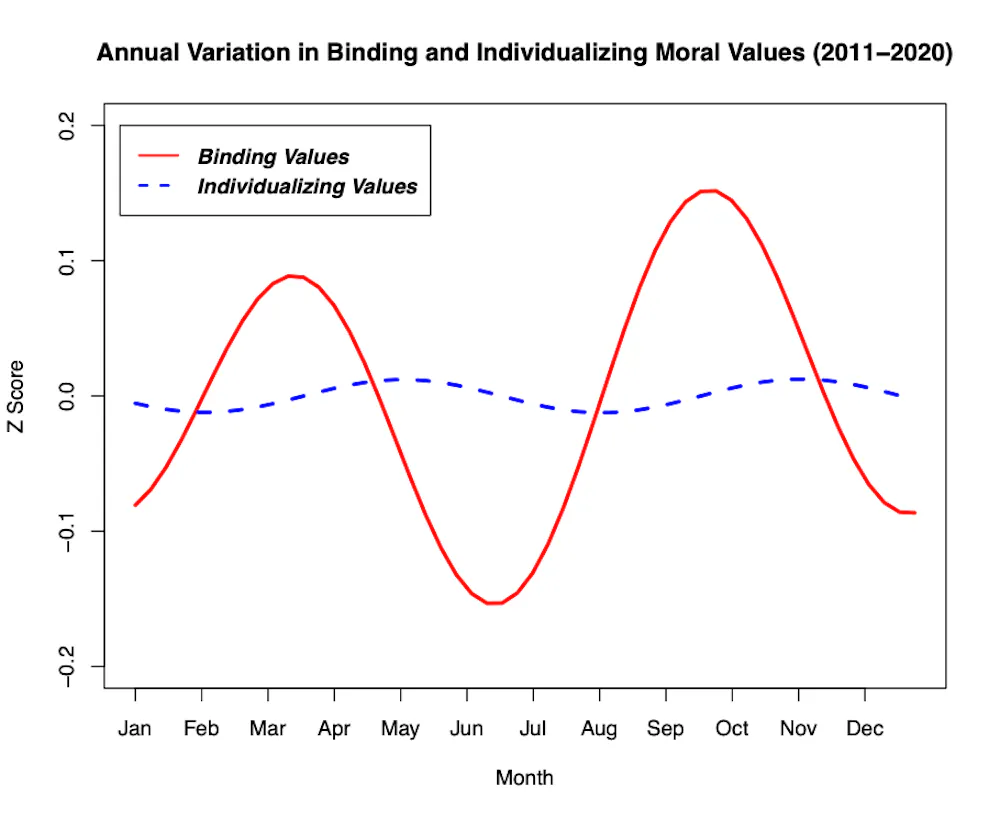
    Our analyses focused on the values reported by 232,975 respondents in the United States across a decade (2011-20) of data. The results revealed no apparent seasonal cycle in Americans’ endorsement of individualizing values, but there was clear and consistent seasonal cycle in Americans’ endorsement of all three binding moral values.

    This seasonal cycle was bimodal, with two peaks and two valleys each year: Americans endorsed binding moral values (valuing loyalty, authority and group traditions) most strongly in the spring and autumn, and least strongly in midsummer and midwinter. This bimodal seasonal cycle in binding moral values showed up again and again in the data, year after year.

    A graph depicting Americans’ endorsement of binding and individualizing moral values.
    (I. Hohm and M. Schaller), CC BY

    This seasonal cycle in binding moral values wasn’t unique to the U.S. either. Additional analyses on data from Canada and Australia revealed similar patterns: Canadians and Australians also endorsed binding moral values most strongly in the spring and autumn, and least strongly in midsummer and midwinter.

    Anxiety patterns

    What might explain this seasonal cycle in people’s endorsement of binding moral values? One possibility is that it has something to do with the perception of threat, which encourages people to close ranks within a group. Previous research has linked this to increased endorsement of binding moral values.

    To test this idea, we analyzed data on an emotion associated with threat perception: anxiety. Results revealed that Americans’ self-reported anxiety showed the same bimodal seasonal cycle, and so did 10 years of data on Americans’ Google searches for anxiety-related words. This seasonal cycle in anxiety helps to explain the seasonal cycle in binding values.

    Anxiety tends to change with the seasons, decreasing in summer and midwinter.
    (Shutterstock)

    This explanation raises a new question: what might explain the seasonal cycle in anxiety? Although we can only speculate, our analyses on moral values revealed an intriguing clue. The summertime dip in Americans’ endorsement of binding moral values was bigger in places with more extreme seasonal changes in the temperature. There was no such effect on the size of the midwinter dip.

    Perhaps something similar might be going on with anxiety: maybe that summertime decrease is the result of pleasant weather, whereas the midwinter decrease is more of a holiday effect.

    Double-edged sword

    Regardless of the cause, seasonal cycles in binding moral values could have consequences that affect people’s lives, for better or worse. Binding moral values promote cohesion, conformity and co-operation within groups, which can be beneficial, especially when coping with crises.

    The implication is that groups might cope better with crises that emerge in the spring and autumn, compared to those that occur in the summer and winter.

    But binding moral values also promote distrust of people who fail to adhere to group norms and traditions. The implication is that there may also be seasonal cycles in prejudices against immigrants, racial minorities, LGBTQ+ individuals and anybody else who is perceived to be different.

    People who more strongly endorse binding moral values are also more punitive, so there could be seasonal effects on judicial decision-making in the millions of legal cases that occur every year.

    And given the link between binding moral values and conservative attitudes, there are potential implications for politics. One intriguing possibility: the timing of political elections (whether they are scheduled for summer or autumn, for instance) might have some subtle effect on some votes — which, for an election that is especially tight, might even influence its outcome.

    Mark Schaller receives funding from the Social Sciences and Humanities Research Council of Canada.

    Ian Hohm does not work for, consult, own shares in or receive funding from any company or organisation that would benefit from this article, and has disclosed no relevant affiliations beyond their academic appointment.

    ref. Seasonal change can affect people’s moods — and their moral values – https://theconversation.com/seasonal-change-can-affect-peoples-moods-and-their-moral-values-236626

    MIL OSI – Global Reports

  • MIL-OSI Canada: Government of Canada commits to purchase carbon dioxide removal services to green government operations and achieve net-zero emissions

    Source: Government of Canada News (2)

    News release

    October 9, 2024 – Ottawa, Ontario – Treasury Board of Canada Secretariat

    Today at the Carbon Removal Canada’s “Procuring with Purpose: Canada’s Opportunity to Shape the Carbon Removal Market” report launch event, the Honourable Anita Anand, President of the Treasury Board and Minister of Transport, announced the Government of Canada’s commitment to purchase carbon dioxide removal (CDR) services as part of the Greening Government Strategy. The federal government will purchase at least $10 million in carbon removal services between now and 2030 to help reach its goal of net-zero emissions in Government operations by 2050.

    The Greening Government Strategy commits the federal government to reducing its operational emissions to as close to zero as possible and then balance out any remaining emissions with an equivalent amount of carbon dioxide removal. To redouble these efforts, Minister Anand also announced the Government’s intention to work with public and private leaders to advance the development and responsible deployment of carbon dioxide removal solutions in Canada.

    This investment will enable the Government to lower its emissions, while supporting the development of these critical technologies and markets so they are available when we need them the most.

    With climate change being one of the greatest global challenges of our time, the Government of Canada is leading by example by reducing greenhouse gas emissions and fostering a low-carbon, climate-resilient and clean-growth economy.

    Quotes

    “Today, we are taking another step to demonstrate our government’s leadership in greening Government operations and fighting climate change. In addition to lowering our emissions, we are adopting carbon removal solutions to ensure we reach our goal to be net-zero emissions by 2050. By working together and innovating, we are building a greener, cleaner future for all generations.”

    –        The Honourable Anita Anand, President of the Treasury Board and Minister of Transport

    Quick facts

    • Carbon dioxide removal refers to human activities that remove carbon dioxide from the atmosphere (for example, direct air capture, enhanced carbon mineralization) and durably store it in natural reservoirs or in products. 

    • The Greening Government Strategy, under the responsibility of the Centre for Greening Government at Treasury Board Secretariat is a set of commitments that apply to all core government departments, agencies and Crown corporations, and support the Government of Canada’s commitment for net-zero emissions by 2050.

    • The purchases in carbon removal services will be made through TBS’ Low-Carbon Fuel Procurement Program (LCFPP), an eight-year, $134.9 million initiative to reduce emissions from federal air and marine operations. This investment follows the Budget 2024 decision to expand the LCFPP to include the procurement of carbon dioxide removal services in addition to low-carbon intensity fuels.  

    • Through the LCFPP, the Government of Canada will work with public and private sector leaders to use their purchasing power to advance the development and responsible deployment of CDR solutions in Canada.

    • As stated in Canada’s Carbon Management Strategy, Canada needs to scale up solutions that permanently remove emissions from the atmosphere, since some residual emissions are likely to remain despite aggressive mitigation efforts, including in agriculture, aviation, and shipping. The removal of CO2 from the atmosphere is also the only way to directly address historical emissions, which have accumulated in the atmosphere over centuries of industrial activity and continue to contribute to global temperature rise.

    Associated links

    Contacts

    Myah Tomasi
    Press Secretary
    Office of the President of the Treasury Board
    myah.tomasi@tbs-sct.gc.ca
    343-543-7210

    Media Relations
    Treasury Board of Canada Secretariat
    Telephone: 613-369-9400
    Toll-free: 1-855-TBS-9-SCT (1-855-827-9728)
    Email: media@tbs-sct.gc.ca

    Stay connected
    X: @TBS_Canada
    Facebook: https://www.facebook.com/TBSCanada
    LinkedIn: https://www.linkedin.com/company/tbs-sct/

    MIL OSI Canada News

  • MIL-OSI Canada: Seizure of contraband and unauthorized items at Mission Institution – medium-security unit

    Source: Government of Canada News

    On October 5, 2024, as a result of the vigilance of staff members, a package containing contraband and unauthorized items was seized in the medium-security unit at Mission Institution.

    October 9, 2024 – Mission, British Columbia – Correctional Service Canada

    On October 5, 2024, as a result of the vigilance of staff members, a package containing contraband and unauthorized items was seized in the medium-security unit at Mission Institution.

    The contraband and unauthorized items seized included 816 grams of crystal methamphetamine, four SD cards, two charging cables, and one charging block. The total estimated institutional value of these seizures is $575,500.

    The police have been notified and the institution is investigating.

    CSC is heightening measures to prevent contraband from entering its institutions in order to help ensure a safe and secure environment for everyone. CSC also works in partnership with the police to take action against those who attempt to introduce contraband into correctional institutions.

    CSC has also set up a telephone tip line for all federal institutions so that it may receive additional information about activities relating to security at CSC institutions. These activities may be related to drug use or trafficking that may threaten the safety and security of visitors, inmates, and staff members working at CSC institutions.

    The toll-free number, 1‑866‑780‑3784, helps ensure that the information shared is protected and that callers remain anonymous.

    Reina Linares
    Assistant Warden Management Services
    Mission Institution
    604-820-5856

    MIL OSI Canada News

  • MIL-OSI Canada: Minister Wilkinson to Participate in Clean Energy–Related Engagements in Toronto

    Source: Government of Canada News

    The Minister of Energy and Natural Resources, the Honourable Jonathan Wilkinson, will be participating in a fireside chat with the Toronto Regional Board of Trade.

    TORONTO — The Minister of Energy and Natural Resources, the Honourable Jonathan Wilkinson, will be participating in a fireside chat with the Toronto Regional Board of Trade.

    Date: October 10, 2024

    Time: 9:30 a.m. ET         

    Later that day, Minister Wilkinson and Julie Dabrusin, Parliamentary Secretary to the Minister of Environment and Climate Change and Parliamentary Secretary to the Minister of Energy and Natural Resources, will make a clean energy announcement. A media availability will follow.

    Date: October 10, 2024

    Time: 2 p.m. ET

    All accredited media are asked to pre-register for the afternoon announcement by emailing media@nrcan-rncan.gc.ca. A dial-in line is available for media and will be provided upon registration.  

    MIL OSI Canada News

  • MIL-OSI Canada: Message from the Minister of Health and the Minister of Mental Health and Addictions and Associate Minister of Health – Breast Cancer Awareness Month, October 2024

    Source: Government of Canada News

    Statement

    October 9, 2024 | Ottawa, Ontario | Public Health Agency of Canada

    October is Breast Cancer Awareness Month, a period when we come together to support and honor those impacted by this disease.

    Breast cancer is one of the most common forms of cancer and the second leading cause of cancer-related death among womenFootnote * living in Canada. One in eight women is expected to be diagnosed with breast cancer in their lifetime.

    Raising awareness of breast cancer screening, which aims to detect cancer at an earlier, more treatable stage, is crucial for the Government of Canada. We are dedicated to advancing women’s health through comprehensive breast cancer screening and prevention efforts. We are also taking action by collaborating with partners and stakeholders to address identified gaps in breast cancer research.

    The Canadian Institutes of Health Research has invested almost $140 million over the past five years to advance breast cancer research in Canada. Through more than 500 grants and awards, these investments are supporting cutting-edge research to prevent, detect, and treat breast cancer more effectively.

    For example, researchers from Sunnybrook Hospital Research Institute are using artificial intelligence to develop more personalized breast cancer screening strategies; a team from the University of Saskatchewan is developing new techniques that combine radiation therapy and the body’s immune system to target breast cancer; and a project led by McGill researchers is examining how to prevent breast cancer from spreading to surrounding tissues. With support from the Government of Canada, the Canadian Partnership Against Cancer is refining its OncoSim-Breast microsimulation model, a tool used in the development of more effective breast cancer prevention and treatment policies.

    The Public Health Agency of Canada (PHAC) is working closely with Statistics Canada to conduct analyses of national cancer trends. They are looking at differences in breast cancer rates based on where people live, their age and ethnicity, and how advanced it is when people are diagnosed. Statistics Canada is also examining data on access to, and participation in, breast cancer screening by mammography to fill identified data gaps. These initiatives will enhance our understanding of the current state of breast cancer in Canada.

    Breast cancer touches the lives of so many, either through a personal diagnosis or that of a loved one. We strongly believe that nobody should have to face this alone. If you or a loved one is having difficulty coping with a cancer diagnosis, there are many ways you can seek support. Visit Canada.ca/mental-health or visit the Canadian Cancer Society’s community services locator, which helps cancer patients, caregivers and healthcare providers find the services they need to feel supported.

    Let’s empower everyone to make informed health care decisions, supported by the best available science and evidence.

    Reference

    Footnote *

    Cisgendered women and other adults assigned female at birth, such as transgender men and nonbinary people

    Return to footnote * referrer

    Contact

    Matthew Kronberg
    Press Secretary
    Office of the Honourable Mark Holland
    Minister of Health
    343-552-5654

    Yuval Daniel
    Director of Communications
    Office of the Honourable Ya’ara Saks
    Minister of Mental Health and Addictions and Associate Minister of Health
    819-360-6927

    Media Relations
    Health Canada
    613-957-2983
    media@hc-sc.gc.ca

    MIL OSI Canada News

  • MIL-OSI Security: Beaver Bank — RCMP charges man following attempted arson in Beaver Bank

    Source: Royal Canadian Mounted Police

    RCMP Halifax Regional Detachment has charged a man with multiple offences following an arson attempt in Beaver Bank.

    On October 3, at approximately 12:15 p.m., RCMP Halifax Regional Detachment responded to a report of attempted arson on Sherri Ln. RCMP officers learned that a man had thrown a light incendiary device in proximity of a home. The fire did not damage the residence.

    With the help of the public, investigators identified Shawn Michael Deschenes, 51, of Beaver Bank, as the person responsible for the incident. Deschenes and the occupants of the home are known to each other.

    On October 7, at the request of investigators, Deschenes attended the Lower Sackville RCMP detachment where he was safely arrested. Later that day, RCMP officers executed a search warrant at his residence, seized a cell phone and observed evidence of flammable material.

    Deschenes has been charged with:

    • Arson
    • Possession of Incendiary Material
    • Possession of a Weapon for a Dangerous Purpose

    He appeared in Dartmouth Provincial Court and was remanded into custody. He will return in court today.

    The investigation remains ongoing.

    File # 24-135801

    MIL Security OSI

  • MIL-OSI Security: Moncton  — 61-year-old man sentenced in connection with child pornography investigation

    Source: Royal Canadian Mounted Police

    A 61-year-old man from Moncton, N.B., has been sentenced in connection with an investigation into child pornography.

    The investigation, led by the New Brunswick RCMP’s Internet Child Exploitation (ICE) Unit, began in April 2022, following information received from the RCMP’s National Child Exploitation Crime Centre.

    On November 8, 2022, members of the RCMP ICE Unit, the Codiac Regional RCMP and the RCMP’s Digital Forensic Services, executed a search warrant at a residence on Atlantic Avenue in Moncton. A man was arrested at the scene, and police seized several electronic devices. He was later released on conditions, pending a future court appearance.

    On February 2, 2023, 61-year-old George Humphrey Lawrence appeared in Moncton Provincial Court and was charged with possession of child pornography and transmitting child pornography.

    On August 8, 2024, George Humphrey Lawrence, appeared in Moncton Provincial Court and plead guilty to all charges.

    On October 3, 2024, George Humphrey Lawrence was sentenced to three years in prison. He was also ordered to register with the National Sex Offender Registry for 20 years and to provide a DNA sample.

    Following his release from prison, he will have to abide by conditions set out by the court, including not communicating with anyone under the age of 16, and to not attend any place that someone under the age of 16 is known to be for a period of 20 years.

    The New Brunswick RCMP’s Internet Child Exploitation Unit includes members from the Saint John Police Force and the Kennebecasis Regional Police Force.

    If you are a victim, or have any information related to similar crimes, please contact your local police. If you have information that may assist an investigation and would like to remain anonymous, please contact Crime Stoppers at 1-800-222-TIPS (8477), by downloading the secure P3 Mobile App, or by Secure Web Tips at http://www.crimenb.ca.

    The investigation is ongoing.

    MIL Security OSI

  • MIL-OSI Canada: Manitoba Government Introduces Legislation That Would Make it Harder to Purchase Machetes and Other Long-Blade Weapons

    Source: Government of Canada regional news

    Manitoba Government Introduces Legislation That Would Make it Harder to Purchase Machetes and Other Long-Blade Weapons

    – – –
    Proposed Legislation Aims to Improve Public Safety by Regulating Retail Sale of Machetes, Knives, Swords: Wiebe


    The Manitoba government is introducing legislation that would regulate the retail sale of long-bladed weapons, including machetes, knives and swords, Justice Minister Matt Wiebe announced today. 

    “Our government is committed to getting tough on crime and this new legislation would help keep our communities safer by restricting access to weapons such as machetes, knives and swords,” said Wiebe. “We’ve heard loud and clear: the purchase of these weapons needs to be restricted. We’re pleased to be moving forward to take real action to make our streets safer.” 

    Bill 39, the long-bladed weapon control act, aims to limit the supply of long-bladed weapons to individuals with dangerous intentions by:

    • requiring retailers to securely store long-bladed weapons in a way that prevents the public from accessing them without assistance;
    • prohibiting the retail sale of long-bladed weapons to minors under 18;
    • requiring purchasers to provide photo identification; and
    • requiring retailers to retain records, including purchaser information and transaction details, for a minimum of two years.

    “Manitoba has seen significant success in deterring crime through regulating the retail sale of products targeted for criminal purposes,” said Wiebe. “Access controls, age restrictions and identification and record-keeping requirements have proven effective at combatting crime. Our government is expanding this approach to address long-bladed weapon violence in the province.” 

    The bill defines long-bladed weapons as having a metal blade at least 30 centimetres in length. The minister noted the definition could be expanded through regulation to include certain features or characteristics, in response to emerging community safety needs. 

    “Ensuring the safety and well-being of our AMC member nations is paramount. I want to recognize and applaud the efforts of the minister of justice to address the concerns put forth by First Nations leadership with this long blade weapons control act,” said Acting Grand Chief Betsy Kennedy, Assembly of Manitoba Chiefs (AMC). “The AMC looks forward to continue being a part of this conversation and to work with Manitoba to draft a regulatory framework that prioritizes the protection of First Nation citizens in Manitoba.”

    The legislation would also apply to online retailers shipping long-bladed weapons to Manitoba addresses, added Wiebe.

    “The Manitoba Association of Chiefs of Police strongly supports provincial legislation that restricts the purchase of long-bladed machetes or knives by those who are acquiring with the intent to use for an unlawful or violent purpose,” said Scot Halley, president, Manitoba Association of Chiefs of Police. “Edged weapon and machete attacks have dramatically increased in the last number of years, the consequences of which can cause significant life-altering injuries or sometimes be fatal. This legislation is another tool to assist law enforcement in keeping these weapons out of the hands of the gang and criminal elements.” 

    If passed through the legislature, the bill would take effect on proclamation and be accompanied by regulations that would include additional long-bladed weapon features and characteristics, as well as exemptions where necessary, noted Wiebe. The minister added the province plans to consult retail businesses, law enforcement and Indigenous leadership to develop the regulations in the coming months. 

    – 30 –

    MIL OSI Canada News

  • MIL-Evening Report: Our new study shows life expectancy is stagnating for Australians under 50

    Source: The Conversation (Au and NZ) – By Sergey Timonin, Research Fellow in Demography, School of Demography, Australian National University

    Global life expectancy has increased dramatically over the past century, with Australia among the best performing countries.

    But during the last two decades, some high-income countries have reported stagnation or even declining life expectancy, particularly the United States and the United Kingdom.

    Could this indicate a broader decline in health advancements in English-speaking countries? Our new study compared life expectancy between English-speaking countries and against other high-income countries.

    We found Australians born between 1930 and 1969 continue to do exceptionally well for life expectancy. But the picture for those under 50 is not so rosy – life expectancy is stagnating for that younger group.

    Why measure life expectancy?

    Life expectancy is a valuable and widely used measure to examine health trends and patterns over time and compare different places or population groups.

    It estimates the average number of years a person would be expected to live. This is calculated using the mortality – or death rates – across different age groups within a specific period. When death rates fall, life expectancy rises, and vice versa.

    Life expectancy can tell a story about a population’s overall health.
    Christian Wiediger/Shutterstock

    Not only does life expectancy tell us about mortality in a population, it is indirectly a measure of overall population health. Most leading causes of death in high-income countries are chronic diseases. These typically affect the health of a person for multiple years before their death.

    Stagnations or reversals in life expectancy can be warning signs of both longstanding and emerging health problems.

    Nobel Prize-winning economist Amartya Sen has also pointed to mortality as a key indicator of economic success and failure. This makes it a powerful tool for researchers and policymakers.

    Thanks to a long and largely standardised tradition of collecting mortality statistics across high-income countries, researchers are able to carry out in-depth, comparative studies. This can help uncover how specific causes of death have contributed to the changes in life expectancy.

    What we did

    In our study, we analysed mortality trends and patterns in a broader group of English-speaking countries and compared them with other high-income countries. English-speaking countries have shown similarities in recent mortality trends and their causes, such as patterns of drug overdose and obesity prevalence.

    Our analysis focuses on six high-income English-speaking countries: Australia, Canada, Ireland, New Zealand, the UK and US. We compared them with the average in 14 other high-income, low-mortality countries from Western Europe (such as France and Norway), plus Japan. This was the “comparison group”.

    We used data from 1970 onwards from well-established, comprehensive sources of high-quality mortality data: the Human Mortality Database and World Health Organization Mortality Database.

    For each English-speaking country and the comparison group, we estimated:

    • life expectancy at birth
    • partial life expectancy between ages 0 and 50 years
    • remaining life expectancy at age 50
    • average length of life.

    Looking at average length of life helps to compare the mortality of the birth cohorts (people born in the same calendar year) as they age. This measure is the closest way to estimate how long people in different populations actually live, and can be used to assess the differences in survival between populations.

    First we looked at how age and causes of death were contributing to a gap between English-speaking countries and the comparison group. Then we compared the average length of life of different birth cohorts.

    What we found

    In the pre-COVID period, both men and women in Australia had a higher life expectancy at birth, compared to the non-English speaking comparison group (the average between those 14 countries). This was also true for men in Ireland, New Zealand and Canada. In the UK and US, however, life expectancy at birth was lower for both men and women, compared to the non-English speaking group.

    But the most striking finding was the difference in mortality for those under 50 in English-speaking versus non-English speaking countries.

    Relatively high death rates for those under 50 dragged the overall life expectancy at birth down for each English-speaking country, including Australia. Suicides and drug or alcohol-related deaths were the main reason for these trends.

    But over age 50, Australia performs exceptionally well in life expectancy for both men and women. Australians born in the 1930s-60s are likely to live longer than those in the non-English speaking comparison group and all other English-speaking countries. But Australians born in the 1970s onwards had lower life expectancy than the comparison group.

    This means overall, life expectancy at birth in Australia is higher than the average for the non-English group. But when you break it down by age, the results show a clear distinction in life expectancy according to when you were born.

    For example, in 2017-19 , male life expectancy between ages 0 and 50 years was 0.3 years lower in Australia compared to the average for the non-English group, while remaining life expectancy at age 50 was 1.45 years higher.

    What this means

    Our study shows a worrying trend for people born from the 1970s onwards. This is true in all English-speaking countries, even before accounting for the negative impacts of the COVID pandemic in places like the UK and US.

    In Australia, the results point to significant generational differences in life expectancy compared to other high-income countries. If the relatively high mortality rates of Australians born from the 1970s onwards continue into the future, then the gains in Australian life expectancy will likely slow. Our status as having one of the highest life expectancies of any country will diminish.

    Our research aimed to examine trends and potential causes of stagnating life expectancy, rather than make policy recommendations.

    But the results suggest real improvement could come through measures that reduce inequality and structural disadvantages that lead to poor health outcomes, such as improving access to education and security of employment and housing, supporting mental health and drug-related safety, and addressing diseases like obesity and diabetes.

    Sergey Timonin receives funding from the Australian Research Council (DP210100401).

    Tim Adair receives funding from the Australian Research Council.

    ref. Our new study shows life expectancy is stagnating for Australians under 50 – https://theconversation.com/our-new-study-shows-life-expectancy-is-stagnating-for-australians-under-50-240790

    MIL OSI AnalysisEveningReport.nz

  • MIL-OSI Canada: Federal government invests in flood mitigation for the Raisin River

    Source: Government of Canada News

    News release

    Cornwall, Ontario October 9, 2024 — Flood mitigation measures are being put in place to reduce the likelihood, frequency, and severity of flooding to residents and businesses located on the south branch of the Raisin River in Cornwall, after an investment of $783,360 from the federal government.

    A new culvert will significantly decrease the likelihood of flooding from the south branch of the river. This will reduce sewer overflows and the risk of wastewater moving into storm water systems. Once upgraded, the culvert will have an increased life span and reduced maintenance requirements.

    This project aligns with the 2022 City of Cornwall Climate Change Action Plan.

    Making adaptation investments now not only keeps Canadians safe but also has major economy-wide benefits later. Every dollar that is invested in adapting and preparing for climate-related disasters can return as much as $13 to $15 in benefits.

    Quotes

    “As we deal with the growing impacts of climate change, we need to work with communities to keep them safe from potential natural disasters. A new culvert for the south branch of the Raisin River will do just that for the residents and business of Cornwall.”

    The Honourable Sean Fraser, Minister of Housing, Infrastructure and Communities

    “We appreciate the support of the federal government in the replacement of our culvert located on McConnell Avenue. This project not only enhances the safety and resilience of our community but also underscores a shared commitment to proactive disaster preparedness and sustainable development.”

    Justin Towndale, Mayor of Cornwall

    Quick facts

    • The federal government is investing $783,360 in this project through the Disaster Mitigation and Adaptation Fund (DMAF).

    • The DMAF program supports projects that include new construction of public infrastructure or the modification or reinforcement of existing public infrastructure that helps communities withstand natural disasters and climate-related risks.

    • Eligible recipients include municipalities, local governments, provinces and territories, public sector bodies, Indigenous organizations, not-for-profit, and for-profit organizations in partnership with other eligible applicants outside the private sector. Projects must have a minimum of $1 million in total eligible costs to be considered eligible.

    • Since 2018, the federal government has committed over $3 billion to the Disaster Mitigation and Adaptation Fund. Part of this commitment is $489.1 million in funding from the Adaptation Action Plan, which was released in November 2022 alongside Canada’s National Adaptation Strategy: Building Resilient Communities and a Strong Economy. Overall, the National Adaptation Strategy commits $1.6 billion in new federal funding to help address both immediate and future climate risks to Canadian communities.

    Associated links

    Contacts

    For more information (media only), please contact:

    Sofia Ouslis
    Communications Advisor
    Office of the Minister of Housing, Infrastructure and Communities
    Sofia.ouslis@infc.gc.ca

    Media Relations
    Housing, Infrastructure and Communities Canada
    613-960-9251
    Toll free: 1-877-250-7154
    Email: media-medias@infc.gc.ca
    Follow us on XFacebookInstagram and LinkedIn
    Web: Housing, Infrastructure and Communities Canada

    City of Cornwall
    communications@cornwall.ca

    MIL OSI Canada News

  • MIL-OSI: Andrew Cardno, CTO of Quick Custom Intelligence, Receives Prestigious Lifetime Achievement Award from Gaming & Leisure

    Source: GlobeNewswire (MIL-OSI)

    SAN DIEGO, Oct. 09, 2024 (GLOBE NEWSWIRE) — Quick Custom Intelligence (QCI) is proud to announce that its Chief Technology Officer, Andrew Cardno, has been honored with the prestigious Lifetime Achievement Award by Gaming & Leisure, in recognition of his exceptional contributions to the gaming and hospitality industries over the course of his career.

    Andrew Cardno, a seasoned technology leader with over 25 years of experience, has been at the forefront of driving technological advancements in gaming analytics, artificial intelligence, and business intelligence systems. His innovative work has transformed the way gaming operators leverage data to improve decision-making, optimize operations, and enhance the customer experience.

    “It is an incredible honor to receive this recognition from Gaming & Leisure. I have dedicated much of my career to pushing the boundaries of what’s possible with data and technology in the gaming industry, and this award reflects the collective effort of my team at QCI and our partners across the sector,” said Andrew Cardno, CTO of Quick Custom Intelligence.

    Jeannie Caruso, CEO of Gaming & Leisure, praised Cardno’s impact across industries, stating, “Andrew is a rare and amazing human. The terms innovative and disruptive have been incredibly over-used, however, Andrew is the type of genius that actually brings innovative, disruptive and broad solutions to not only our industry, but many industries. He’s often sought after by vendors and properties alike for counsel on complex challenges they face. His passion extends beyond the walls of business to a role he’s devoted many years to as a Science Olympiad Coach to pass his incredible gift on to middle and high schoolers who compete in a broad range of science-related challenges. The world needs more Andrews, and it was my great honor to present him with the Lifetime Achievement Award this year, while still knowing he’ll bring boundless innovation to us far past this award.”

    The Lifetime Achievement Award is awarded annually by Gaming & Leisure to individuals who have made substantial and lasting contributions to the gaming, hospitality, and entertainment industries. Cardno’s career is highlighted by a series of innovations, including the development of cutting-edge solutions that have enabled gaming operators to better understand their customers and optimize business strategies.

    With this award, Andrew Cardno joins an elite group of industry pioneers whose work has had a profound and enduring impact on the gaming industry.

    About Quick Custom Intelligence (QCI)

    Quick Custom Intelligence (QCI) is the pioneer behind the QCI Player, an artificial general intelligence platform that seamlessly integrates player development, marketing, and gaming operations with real-time tools designed for the gaming and hospitality industries. Our advanced, highly configurable software is deployed in over 250 casino resorts across North America, Australia, New Zealand, Canada, Latin America, and The Bahamas. The QCI Player, managing over $35 billion in annual gross gaming revenue, serves as a best-in-class solution for on-premises, hybrid, or cloud-based operations, enabling coordinated activities across all aspects of gaming and hospitality. QCI’s data-driven, AGI-powered software facilitates swift, informed decision-making, vital in the ever-changing casino industry, optimizing resources, crafting effective marketing campaigns, and enhancing customer loyalty. QCI was co-founded by Dr. Ralph Thomas and Mr. Andrew Cardno and is headquartered in San Diego, with additional offices in Las Vegas, St. Louis, Dallas, and Tulsa. For more information, contact us at http://www.quickcustomintelligence.com.

    About Andrew Cardno

    Andrew Cardno is a distinguished figure in the field of artificial intelligence and data plumbing, with over two decades of experience leading private Ph.D. and master’s level research teams. His expertise has made significant contributions to data tooling, including groundbreaking innovations like the deep zoom image format, now a cornerstone in many mapping tools. Andrew’s leadership has earned him two Smithsonian Laureates and garnered 40 industry awards, including three pivotal gaming industry transformation awards. Co-founding Quick Custom Intelligence with Dr. Ralph Thomas, Andrew holds over 150 patent applications and has made a profound impact across various industries, from telecommunications and retail to the medical sector. He is also a prolific author, contributing to over 100 industry publications and co-authoring eleven influential books with Dr. Thomas. Andrew advocates for community and diversity and has made a significant impact on over 100 Native American Tribal Resorts, reflecting his expansive and inclusive professional endeavors.

    About Gaming & Leisure

    Gaming & Leisure® (G&L) is an organization dedicated to the betterment of the gaming and hospitality industry. G&L provides influential insights, best practices and brings together leading operators and the business partners who serve them, to collaborate and shape the landscape of operations each year. For over 20 years the annual G&L Roundtable seeks to initiate meaningful change in our industry by the very people who can foster that change. The G&L Forum is a North American leadership congress on innovation, AI and cybersecurity serving as a guide post for the industry. The G&L Community’s greatest asset continues to be its dedicated leadership representing a vast majority of domestic gaming and hospitality spend, and the new terrain they carve for us all to lead well. Visit http://www.mygamingandleisure.com.

    Contact:
    Laure Kay, Quick Custom Intelligence
    Phone: 858-349-8354

    The MIL Network