NewzIntel.com

    • Checkout Page
    • Contact Us
    • Default Redirect Page
    • Frontpage
    • Home-2
    • Home-3
    • Lost Password
    • Member Login
    • Member LogOut
    • Member TOS Page
    • My Account
    • NewzIntel Alert Control-Panel
    • NewzIntel Latest Reports
    • Post Views Counter
    • Privacy Policy
    • Public Individual Page
    • Register
    • Subscription Plan
    • Thank You Page

Category: Canada

  • MIL-OSI Europe: Queen Máxima welcomes partners of world leaders in Rotterdam

    Source: Government of the Netherlands

    Enlarge image

    A partner programme is a fixed feature of NATO summits. The Ministry of Foreign Affairs asked the municipality of Rotterdam to organise this programme.

    Depot of Museum Boijmans Van Beuningen

    Mayor Carola Schouten welcomed the guests at the Depot of Museum Boijmans Van Beuningen, where they received a tour of the building. They also visited the exhibition The stories we tell, with an explanation from artist Susanna Inglada.

    Enlarge image

    Boat tour of Rotterdam

    This was followed by a boat tour of the port of Rotterdam on board the Royal Spido ship the Prinses Amalia. From the water the guests saw iconic landmarks such as the Euromast tower, the SS Rotterdam and the Erasmus Bridge.

    The partners of various world leaders participated in the programme:

    • Ms L. Rama, Albania
    • Ms D. Fox Carney, Canada
    • Mr M.B. Tengberg, Denmark
    • Ms E. Oras, Estonia
    • Ms S.E. Innes-Stubb, Finland
    • Ms B. Macron, France
    • Ms S. Musić Milanović, Croatia
    • Ms D. Nausėdienė, Lithuania
    • Ms M. Frieden-Droogleever Fortuyn, Luxembourg
    • Her Excellency A. Kornhauser-Duda, Poland
    • Her Excellency E. Erdoğan, Türkiye
    • Her Excellency B.P. Kristersson Ed, Sweden

    You can find more photos on the Flickr page of the Ministry of Foreign Affairs.

    MIL OSI Europe News –

    June 26, 2025
  • MIL-OSI Global: Checking in on New England fisheries 25 Years after ‘The Perfect Storm’ hit movie theaters

    Source: The Conversation – USA – By Stephanie Otts, Director of National Sea Grant Law Center, University of Mississippi

    Filming ‘The Perfect Storm’ in Gloucester Harbor, Mass.
    The Salem News Historic Photograph Collection, Salem State University Archives and Special Collections, CC BY

    Twenty-five years ago, “The Perfect Storm” roared into movie theaters. The disaster flick, starring George Clooney and Mark Wahlberg, was a riveting, fictionalized account of commercial swordfishing in New England and a crew who went down in a violent storm.

    The anniversary of the film’s release, on June 30, 2000, provides an opportunity to reflect on the real-life changes to New England’s commercial fishing industry.

    Fishing was once more open to all

    In the true story behind the movie, six men lost their lives in late October 1991 when the commercial swordfishing vessel Andrea Gail disappeared in a fierce storm in the North Atlantic as it was headed home to Gloucester, Massachusetts.

    At the time, and until very recently, almost all commercial fisheries were open access, meaning there were no restrictions on who could fish.

    There were permit requirements and regulations about where, when and how you could fish, but anyone with the means to purchase a boat and associated permits, gear, bait and fuel could enter the fishery. Eight regional councils established under a 1976 federal law to manage fisheries around the U.S. determined how many fish could be harvested prior to the start of each fishing season.

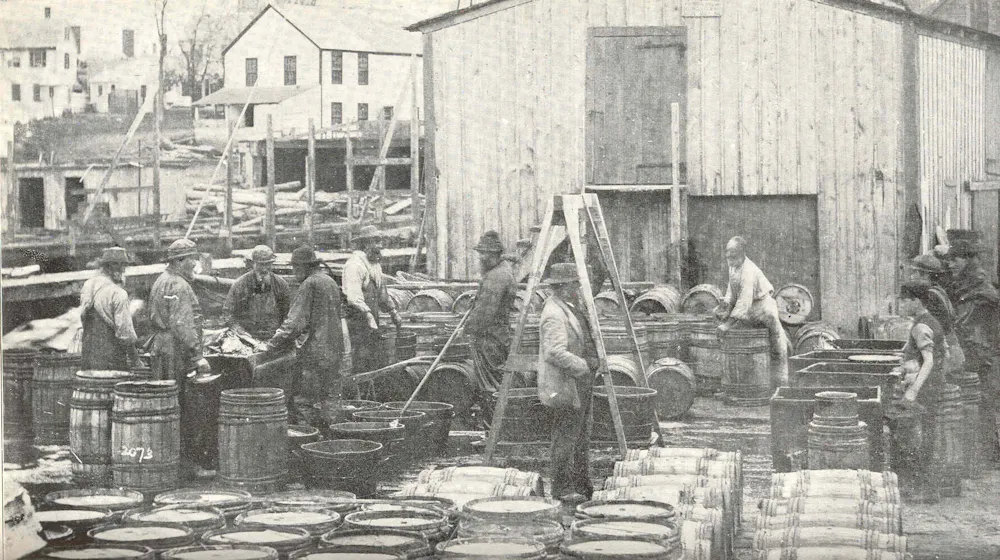
    Fishing has been an integral part of coastal New England culture since its towns were established. In this 1899 photo, a New England community weighs and packs mackerel.
    Charles Stevenson/Freshwater and Marine Image Bank

    Fishing started when the season opened and continued until the catch limit was reached. In some fisheries, this resulted in a “race to the fish” or a “derby,” where vessels competed aggressively to harvest the available catch in short amounts of time. The limit could be reached in a single day, as happened in the Pacific halibut fishery in the late 1980s.

    By the 1990s, however, open access systems were coming under increased criticism from economists as concerns about overfishing rose.

    The fish catch peaked in New England in 1987 and would remain far above what the fish population could sustain for two more decades. Years of overfishing led to the collapse of fish stocks, including North Atlantic cod in 1992 and Pacific sardine in 2015.

    As populations declined, managers responded by cutting catch limits to allow more fish to survive and reproduce. Fishing seasons were shortened, as it took less time for the fleets to harvest the allowed catch. It became increasingly hard for fishermen to catch enough fish to earn a living.

    Saving fisheries changed the industry

    In the early 2000s, as these economic and environmental challenges grew, fisheries managers started limiting access. Instead of allowing anyone to fish, only vessels or individuals meeting certain eligibility requirements would have the right to fish.

    The most common method of limiting access in the U.S. is through limited entry permits, initially awarded to individuals or vessels based on previous participation or success in the fishery. Another approach is to assign individual harvest quotas or “catch shares” to permit holders, limiting how much each boat can bring in.

    In 2007, Congress amended the 1976 Magnuson-Stevens Fishery Conservation and Management Act to promote the use of limited access programs in U.S. fisheries.

    Ships in the fleet out of New Bedford, Mass.
    Henry Zbyszynski/Flickr, CC BY

    Today, limited access is common, and there are positive signs that the management change is helping achieve the law’s environmental goal of preventing overfishing. Since 2000, the populations of 50 major fishing stocks have been rebuilt, meaning they have recovered to a level that can once again support fishing.

    I’ve been following the changes as a lawyer focused on ocean and coastal issues, and I see much work still to be done.

    Forty fish stocks are currently being managed under rebuilding plans that limit catch to allow the stock to grow, including Atlantic cod, which has struggled to recover due to a complex combination of factors, including climatic changes.

    The lingering effect on communities today

    While many fish stocks have recovered, the effort came at an economic cost to many individual fishermen. The limited-access Northeast groundfish fishery, which includes Atlantic cod, haddock and flounder, shed nearly 800 crew positions between 2007 and 2015.

    The loss of jobs and revenue from fishing impacts individual family income and relationships, strains other businesses in fishing communities, and affects those communities’ overall identity and resilience, as illustrated by a recent economic snapshot of the Alaska seafood industry.

    When original limited-access permit holders leave the business – for economic, personal or other reasons – their permits are either terminated or sold to other eligible permit holders, leading to fewer active vessels in the fleet. As a result, the number of vessels fishing for groundfish has declined from 719 in 2007 to 194 in 2023, meaning fewer jobs.

    A fisherman unloads a portion of his catch for the day of 300 pounds of groundfish, including flounder, in January 2006 in Gloucester, Mass.
    AP Photo/Lisa Poole

    Because of their scarcity, limited-access permits can cost upward of US$500,000, which is often beyond the financial means of a small businesses or a young person seeking to enter the industry. The high prices may also lead retiring fishermen to sell their permits, as opposed to passing them along with the vessels to the next generation.

    These economic forces have significantly altered the fishing industry, leading to more corporate and investor ownership, rather than the family-owned operations that were more common in the Andrea Gail’s time.

    Similar to the experience of small family farms, fishing captains and crews are being pushed into corporate arrangements that reduce their autonomy and revenues.

    Consolidation can threaten the future of entire fleets, as New Bedford, Massachusetts, saw when Blue Harvest Fisheries, backed by a private equity firm, bought up vessels and other assets and then declared bankruptcy a few years later, leaving a smaller fleet and some local business and fishermen unpaid for their work. A company with local connections bought eight vessels from Blue Harvest along with 48 state and federal permits the company held.

    New challenges and unchanging risks

    While there are signs of recovery for New England’s fisheries, challenges continue.

    Warming water temperatures have shifted the distribution of some species, affecting where and when fish are harvested. For example, lobsters have moved north toward Canada. When vessels need to travel farther to find fish, that increases fuel and supply costs and time away from home.

    Fisheries managers will need to continue to adapt to keep New England’s fisheries healthy and productive.

    One thing that, unfortunately, hasn’t changed is the dangerous nature of the occupation. Between 2000 and 2019, 414 fishermen died in 245 disasters.

    Stephanie Otts receives funding from the NOAA National Sea Grant College Program through the U.S. Department of Commerce. Previous support for fisheries management legal research provided by The Nature Conservancy.

    – ref. Checking in on New England fisheries 25 Years after ‘The Perfect Storm’ hit movie theaters – https://theconversation.com/checking-in-on-new-england-fisheries-25-years-after-the-perfect-storm-hit-movie-theaters-255076

    MIL OSI – Global Reports –

    June 26, 2025
  • MIL-OSI Canada: Landlords and property managers: agreeing with competitors on rental prices is illegal

    Source: Government of Canada News (2)

    June 25, 2025 – GATINEAU (Québec), Competition Bureau

    The Competition Bureau is aware that some landlords and property managers may be engaging with their competitors, including through discussion groups on social media. 

    While some discussions between competitors may be justified, others could be illegal. Landlords and property managers must understand the difference between conversations that are harmless and conversations that they should steer clear from.

    Agreements between landlords to “make the most of the booming rental housing market” or “find ways to ensure that all players benefit from the strong demand equally” raise concerns under the law and could be illegal.

    It is illegal for competitors to agree about:

    • Rental prices, including any increases or surcharges.
    • The terms of their leases, including amenities and services.
    • Restricting the housing supply by artificially reducing the availability of rental units.

    Engaging in illegal agreements with competitors, such as price-fixing, market allocation, restricting supply, or wage-fixing and no-poaching agreements, is a criminal offence under the Competition Act, with potential prison sentences of up to 14 years and hefty fines at the discretion of the court.

    Landlords and property managers can stay on the right side of the law by: 

    • Deciding on their own prices, price increases, surcharges and the terms of leases.
    • Explaining and negotiating the terms of leases with their tenants only.

    The Bureau encourages the reporting of any suspicious activity through the Bureau’s Information Centre and online form. Those who believe that the company they work for has entered into an illegal agreement with its competitors can provide information anonymously through the Bureau’s Whistleblowing Initiative. Parties that engaged in anticompetitive activity can also come forward to seek immunity or leniency in return for their cooperation with the Bureau’s investigations.

    MIL OSI Canada News –

    June 26, 2025
  • MIL-OSI Canada: Prime Minister Carney meets with Prime Minister of New Zealand Christopher Luxon

    Source: Government of Canada – Prime Minister

    Today, the Prime Minister, Mark Carney, met with the Prime Minister of New Zealand, Christopher Luxon, on the margins of the North Atlantic Treaty Organization (NATO) Summit in The Hague, the Netherlands.

    The leaders discussed strengthening collaboration between the NATO Alliance and its Indo-Pacific partners to address shared challenges.

    Prime Minister Carney shared Canada’s plan to rebuild, rearm, and reinvest in the Canadian Armed Forces – meeting the NATO 2 per cent target this year and accelerating defence investments in the years ahead. The leaders explored opportunities to deepen collaboration through Canada’s new defence procurement strategy and New Zealand’s Defence Capability Plan.

    They reaffirmed their shared commitment to global security and their support for a just and lasting peace in Ukraine.

    Prime Minister Carney spoke about efforts in Canada to make housing more affordable and remove barriers to internal trade. The leaders also discussed deepening trade and commercial ties between Canada and New Zealand, including through the CPTPP.

    The prime ministers agreed to remain in close contact.

    Associated Link

    MIL OSI Canada News –

    June 26, 2025
  • MIL-OSI: DIAGNOS Welcomes Veteran Optometrist Dr. Barry A. Ginsberg to its Scientific Advisory Board for the United States

    Source: GlobeNewswire (MIL-OSI)

    BROSSARD, Quebec, June 25, 2025 (GLOBE NEWSWIRE) — Diagnos Inc. (“DIAGNOS” or the “Corporation”) (TSX Venture: ADK, OTCQB: DGNOF, FWB: 4D4A), a pioneer in early detection of critical health issues using advanced technology based on Artificial Intelligence (AI), is thrilled to announce that Dr. Barry A. Ginsberg, O.D. has joined the Corporation’s Advisory Board.

    Mr. Weiner will team up with Dr. Tomas J. Philipson, former vice chairman and acting chairman of the White House Council of Economic Advisers and Mr. Ed Weiner, a seasoned entrepreneur, to provide valuable insights to DIAGNOS about the US optical market.

    Dr. Ginsberg brings more than three decades of practice across corporate, retail and private-practice settings, giving him a ground-level view of how new technologies gain traction in high-volume optometry environments. He has repeatedly identified and launched innovative products and services that increased revenue per visit and improved patient retention for leading optical chains. This commercial experience, combined with his expertise in advanced contact-lens fitting and ocular-disease management, will help DIAGNOS refine its go-to-market strategy and demonstrate the tangible ROI of AI-driven screening to investors and practitioners alike.

    Dr. Ginsberg earned a B.A. in Chemistry with a minor in Economics from Yeshiva University, followed by a B.S. and Doctor of Optometry from the Pennsylvania College of Optometry. His training included an externship at the Feinbloom Low Vision Center in Philadelphia, where he focused on age-related macular degeneration, and another at the Goldschleger Eye Institute in Tel Hashomer Hospital, Israel, where he concentrated on glaucoma and other ocular diseases.

    President and CEO André Larente noted that Dr. Ginsberg’s “ability to translate clinical value into business outcomes makes him an ideal partner as we expand CARA into the wider optical marketplace.” Mr. Larente added, “DIAGNOS has built an AI platform to analyze retina images, these images are taken by thousands of optometrists worldwide. According to recent VisionWatch data, the US saw approximately 111 million routine eye exams and 60 million medical eye exams in 2020. DIAGNOS, along with its partners can address this growing market”.

    DIAGNOS recently opened its US office in south Florida to support its US prospects and clients.

    About DIAGNOS
    DIAGNOS is a publicly traded Canadian corporation dedicated to early detection of critical eye-related health problems. By leveraging Artificial Intelligence, DIAGNOS aims to provide more information to healthcare clinicians to enhance diagnostic accuracy, streamline workflows, and improve patient outcomes on a global scale.

    Additional information is available at www.diagnos.com and www.sedarplus.com.

    This news release contains forward-looking information. There can be no assurance that forward-looking information will prove to be accurate, as actual results and future events could differ materially from those anticipated in these statements. DIAGNOS disclaims any intention or obligation to publicly update or revise any forward-looking information, whether as a result of new information, future events or otherwise. The forward-looking information contained in this news release is expressly qualified by this cautionary statement.

    Neither the TSX Venture Exchange nor its Regulation Services Provider (as that term is defined in the policies of the TSX Venture Exchange) accepts responsibility for the adequacy or accuracy of this release.

    The MIL Network –

    June 26, 2025
  • MIL-OSI Global: How high-latitude peat and forest fires could shape the future of Earth’s climate

    Source: The Conversation – France – By Apostolos Voulgarakis, AXA Chair in Wildfires and Climate Director, Laboratory of Atmospheric Environment & Climate Change, Technical University of Crete

    Understanding how wildfires influence our planet’s climate is a daunting challenge. Although fire occurs nearly everywhere on Earth and has always been present, it is still one of the least understood components of the Earth system. Recently, unprecedented fire activity has been observed in boreal (northern) and Arctic regions, which has drawn the scientific community’s attention to areas whose role in the future of our planet remains a mystery. Climate change likely has a major role in this alarming trend. However, high-latitude wildfires are not just a symptom of climate change; they are an accelerating force that could shape the future of our climate in ways that we are currently incapable of predicting.


    A weekly e-mail in English featuring expertise from scholars and researchers. It provides an introduction to the diversity of research coming out of the continent and considers some of the key issues facing European countries. Get the newsletter!


    The rising threat of northern fires

    As global temperatures rise, wildfires are advancing further north and reaching into the Arctic. Canada, Alaska, Siberia, Scandinavia and even Greenland, all in northern high-latitude regions, have recently experienced some of the most intense and prolonged wildfire seasons on record. With climate change occurring more rapidly in these areas, the future of northern fires appears even grimmer.

    Apart from typical forest fires that consume surface vegetation, many high-latitude fires burn through peat, the dense, carbon-rich layers of partially decayed organic material. Despite covering only 3% of the terrestrial surface, peatlands are one of the world’s most important carbon storage environments, containing around 25% of the carbon existing in the Earth’s soils.

    Climate warming, which is even faster at high northern latitudes due to polar amplification – the phenomenon of greater climate change near the poles compared to the rest of the hemisphere or globe – is increasing the vulnerability of these ecosystems to fire, with potentially severe implications for the global climate. When peatlands ignite, they release massive amounts of “fossil carbon” that have been locked away for centuries or even millennia. The largest and most persistent fires on Earth, peat fires can smoulder for extended periods, are difficult to extinguish and can continue burning underground throughout the winter, only to reignite on the surface in spring. They have recently been described as “zombie” fires.

    Warmer and drier conditions driven by climate change, apart from making boreal forests more flammable, are expected to intensify and increase the frequency of peat fires, potentially transforming peatlands from carbon sinks into net sources of greenhouse gas emissions. Such a shift could trigger a feedback loop, meaning that a warming climate will cause more carbon emissions, which in turn will accelerate climate change.

    Air pollution and weather patterns

    Wildfires release large quantities of smoke particles (aerosols) into the atmosphere, contributing significantly to both local and widespread air quality degradation. These particles are harmful to human health and can cause serious respiratory and cardiovascular problems, while prolonged exposure may lead to smoke-induced stress, hospitalizations and increased mortality. Wildfires can also cause mental health strains associated with evacuations, loss of homes, livelihoods and lives.


    À lire aussi :
    Wildfire smoke can harm your brain, not just your lungs


    Beyond their long-term effects on climate, wildfire emissions can also influence weather patterns in more short-term ways via their impacts on atmospheric pollution levels. Smoke particles interact with sunlight and cloud formation processes, subsequently affecting temperatures, wind patterns and rainfall.

    For example, our recent study on the large-scale atmospheric impacts of the 2023 Canadian wildfires, which we presented at the European Geosciences Union general assembly this spring, demonstrated that wildfire aerosols led to a surface air temperature decrease that expanded to the entire northern hemisphere. The cooling was particularly pronounced over Canada (up to -5.5°C in August), where the emissions were located, but was also significant over remote areas such as Eastern Europe and even Siberia (up to around -2.5°C in July). The average hemispheric temperature anomaly we calculated (close to -1°C) highlights the potential for large regional emissions from wildfires to perturb weather conditions for weeks across a whole hemisphere, with profound implications for forecasting. Unreliable weather forecasts can disrupt daily activities and pose risks to public safety, especially during extreme events such as heatwaves or storms. They also have serious consequences for industries such as farming, fishing and transport, where planning depends heavily on accurate, timely predictions.

    Peat fires and the climate puzzle

    While incorporating peatland fire feedbacks into Earth System Models (ESMs) is essential for accurate climate projections, most existing models lack a representation of peat fires. Understanding the smouldering behaviour of organic soils when they burn, their ignition probability, and how these processes can be represented at a global scale is of utmost importance. Recent research efforts are focusing on bridging this knowledge gap. For example, at the Technical University of Crete, we are collaborating with the Hazelab research group at Imperial College London and the Leverhulme Centre for Wildfires, Environment and Society to perform field research and cutting-edge experiments) on peat smouldering, with the aim of shedding light on the complex mechanisms of peat fires.

    Integrating these lab results into ESMs will enable game-changing fire emission modelling, which holds potential for groundbreaking outcomes when it comes to our skill level for predicting the future of the Earth’s climate. By quantifying how the present-day atmosphere is influenced by fire emissions from boreal forests and peatlands, we can enhance the quality of projections of global temperature rise. This integration will also sharpen forecasts of regional climate impacts driven by fire-related aerosols, such as changes in rainfall patterns or accelerated Arctic ice melt.

    Tackling the challenge of northern fires

    Undoubtedly, we have entered an era of more frequent megafires – wildfires of extreme size, intensity, duration or impacts – with catastrophic consequences. Recent megafire events at boreal and Arctic regions unveil the dramatic change in wildfire patterns in northern high latitudes, which is a matter that demands urgent attention and action.

    As the planet continues to warm, high-latitude fires are expected to help shape the future of our planet. Massive wildfire events, such as those in Canada in 2023, not only burned millions of hectares but also forced hundreds of thousands of people to evacuate their homes. Unprecedented amounts of smoke blanketed parts of North America in hazardous air, prompting school closures and health warnings, and obliging citizens to remain indoors for days. Events like this reflect a growing trend. They underscore why advancing research to better understand and predict the dynamics of northern peat and forest fires, and to mitigate their climate impacts, is not only a scientific imperative but also a moral responsibility.


    Created in 2007 to help accelerate and share scientific knowledge on key societal issues, the Axa Research Fund has supported nearly 700 projects around the world conducted by researchers in 38 countries. To learn more, visit the website of the Axa Research Fund or follow @AXAResearchFund on X.

    Dimitra Tarasi has received funding from the AXA Chair in Wildfires and Climate, the Leverhulme Centre for Wildfires, Environment and Society and the A.G. Leventis Foundation Educational Grants.

    Apostolos Voulgarakis ne travaille pas, ne conseille pas, ne possède pas de parts, ne reçoit pas de fonds d’une organisation qui pourrait tirer profit de cet article, et n’a déclaré aucune autre affiliation que son organisme de recherche.

    – ref. How high-latitude peat and forest fires could shape the future of Earth’s climate – https://theconversation.com/how-high-latitude-peat-and-forest-fires-could-shape-the-future-of-earths-climate-258721

    MIL OSI – Global Reports –

    June 26, 2025
  • MIL-OSI Global: How high-latitude peat and forest fires could shape the future of Earth’s climate

    Source: The Conversation – France – By Apostolos Voulgarakis, AXA Chair in Wildfires and Climate Director, Laboratory of Atmospheric Environment & Climate Change, Technical University of Crete

    Understanding how wildfires influence our planet’s climate is a daunting challenge. Although fire occurs nearly everywhere on Earth and has always been present, it is still one of the least understood components of the Earth system. Recently, unprecedented fire activity has been observed in boreal (northern) and Arctic regions, which has drawn the scientific community’s attention to areas whose role in the future of our planet remains a mystery. Climate change likely has a major role in this alarming trend. However, high-latitude wildfires are not just a symptom of climate change; they are an accelerating force that could shape the future of our climate in ways that we are currently incapable of predicting.


    A weekly e-mail in English featuring expertise from scholars and researchers. It provides an introduction to the diversity of research coming out of the continent and considers some of the key issues facing European countries. Get the newsletter!


    The rising threat of northern fires

    As global temperatures rise, wildfires are advancing further north and reaching into the Arctic. Canada, Alaska, Siberia, Scandinavia and even Greenland, all in northern high-latitude regions, have recently experienced some of the most intense and prolonged wildfire seasons on record. With climate change occurring more rapidly in these areas, the future of northern fires appears even grimmer.

    Apart from typical forest fires that consume surface vegetation, many high-latitude fires burn through peat, the dense, carbon-rich layers of partially decayed organic material. Despite covering only 3% of the terrestrial surface, peatlands are one of the world’s most important carbon storage environments, containing around 25% of the carbon existing in the Earth’s soils.

    Climate warming, which is even faster at high northern latitudes due to polar amplification – the phenomenon of greater climate change near the poles compared to the rest of the hemisphere or globe – is increasing the vulnerability of these ecosystems to fire, with potentially severe implications for the global climate. When peatlands ignite, they release massive amounts of “fossil carbon” that have been locked away for centuries or even millennia. The largest and most persistent fires on Earth, peat fires can smoulder for extended periods, are difficult to extinguish and can continue burning underground throughout the winter, only to reignite on the surface in spring. They have recently been described as “zombie” fires.

    Warmer and drier conditions driven by climate change, apart from making boreal forests more flammable, are expected to intensify and increase the frequency of peat fires, potentially transforming peatlands from carbon sinks into net sources of greenhouse gas emissions. Such a shift could trigger a feedback loop, meaning that a warming climate will cause more carbon emissions, which in turn will accelerate climate change.

    Air pollution and weather patterns

    Wildfires release large quantities of smoke particles (aerosols) into the atmosphere, contributing significantly to both local and widespread air quality degradation. These particles are harmful to human health and can cause serious respiratory and cardiovascular problems, while prolonged exposure may lead to smoke-induced stress, hospitalizations and increased mortality. Wildfires can also cause mental health strains associated with evacuations, loss of homes, livelihoods and lives.


    À lire aussi :
    Wildfire smoke can harm your brain, not just your lungs


    Beyond their long-term effects on climate, wildfire emissions can also influence weather patterns in more short-term ways via their impacts on atmospheric pollution levels. Smoke particles interact with sunlight and cloud formation processes, subsequently affecting temperatures, wind patterns and rainfall.

    For example, our recent study on the large-scale atmospheric impacts of the 2023 Canadian wildfires, which we presented at the European Geosciences Union general assembly this spring, demonstrated that wildfire aerosols led to a surface air temperature decrease that expanded to the entire northern hemisphere. The cooling was particularly pronounced over Canada (up to -5.5°C in August), where the emissions were located, but was also significant over remote areas such as Eastern Europe and even Siberia (up to around -2.5°C in July). The average hemispheric temperature anomaly we calculated (close to -1°C) highlights the potential for large regional emissions from wildfires to perturb weather conditions for weeks across a whole hemisphere, with profound implications for forecasting. Unreliable weather forecasts can disrupt daily activities and pose risks to public safety, especially during extreme events such as heatwaves or storms. They also have serious consequences for industries such as farming, fishing and transport, where planning depends heavily on accurate, timely predictions.

    Peat fires and the climate puzzle

    While incorporating peatland fire feedbacks into Earth System Models (ESMs) is essential for accurate climate projections, most existing models lack a representation of peat fires. Understanding the smouldering behaviour of organic soils when they burn, their ignition probability, and how these processes can be represented at a global scale is of utmost importance. Recent research efforts are focusing on bridging this knowledge gap. For example, at the Technical University of Crete, we are collaborating with the Hazelab research group at Imperial College London and the Leverhulme Centre for Wildfires, Environment and Society to perform field research and cutting-edge experiments) on peat smouldering, with the aim of shedding light on the complex mechanisms of peat fires.

    Integrating these lab results into ESMs will enable game-changing fire emission modelling, which holds potential for groundbreaking outcomes when it comes to our skill level for predicting the future of the Earth’s climate. By quantifying how the present-day atmosphere is influenced by fire emissions from boreal forests and peatlands, we can enhance the quality of projections of global temperature rise. This integration will also sharpen forecasts of regional climate impacts driven by fire-related aerosols, such as changes in rainfall patterns or accelerated Arctic ice melt.

    Tackling the challenge of northern fires

    Undoubtedly, we have entered an era of more frequent megafires – wildfires of extreme size, intensity, duration or impacts – with catastrophic consequences. Recent megafire events at boreal and Arctic regions unveil the dramatic change in wildfire patterns in northern high latitudes, which is a matter that demands urgent attention and action.

    As the planet continues to warm, high-latitude fires are expected to help shape the future of our planet. Massive wildfire events, such as those in Canada in 2023, not only burned millions of hectares but also forced hundreds of thousands of people to evacuate their homes. Unprecedented amounts of smoke blanketed parts of North America in hazardous air, prompting school closures and health warnings, and obliging citizens to remain indoors for days. Events like this reflect a growing trend. They underscore why advancing research to better understand and predict the dynamics of northern peat and forest fires, and to mitigate their climate impacts, is not only a scientific imperative but also a moral responsibility.


    Created in 2007 to help accelerate and share scientific knowledge on key societal issues, the Axa Research Fund has supported nearly 700 projects around the world conducted by researchers in 38 countries. To learn more, visit the website of the Axa Research Fund or follow @AXAResearchFund on X.

    Dimitra Tarasi has received funding from the AXA Chair in Wildfires and Climate, the Leverhulme Centre for Wildfires, Environment and Society and the A.G. Leventis Foundation Educational Grants.

    Apostolos Voulgarakis ne travaille pas, ne conseille pas, ne possède pas de parts, ne reçoit pas de fonds d’une organisation qui pourrait tirer profit de cet article, et n’a déclaré aucune autre affiliation que son organisme de recherche.

    – ref. How high-latitude peat and forest fires could shape the future of Earth’s climate – https://theconversation.com/how-high-latitude-peat-and-forest-fires-could-shape-the-future-of-earths-climate-258721

    MIL OSI – Global Reports –

    June 26, 2025
  • MIL-OSI Canada: Canada joins new NATO Defence Investment Pledge

    Source: Government of Canada – Prime Minister

    The world is increasingly dangerous and divided, with the rules-based international system under unprecedented pressure and global conflict becoming more frequent and volatile. To meet this moment, Canada and its Allies are building their defence capabilities to strengthen our collective security.

    Today, the Prime Minister, Mark Carney, announced that Canada and its North Atlantic Treaty Organization (NATO) Allies have agreed to a new Defence Investment Pledge of investing 5 per cent of annual GDP by 2035 to ensure our individual and collective security. The commitment aligns with Canada’s own strategic defence and security goals.

    As part of this 5 per cent pledge, Canada will invest 3.5 per cent of GDP for core military capabilities, expanding on our recent investments. That means further investments in our Canadian Armed Forces, modernizing our military equipment and technology, building up Canada’s defence industries, and diversifying our defence partnerships. An additional 1.5 per cent of GDP will be dedicated to investments in critical defence and security-related expenditure, such as new airports, ports, telecommunication, emergency preparedness systems, and other dual-use investments which serve defence as well as civilian readiness. Importantly, the progress of this pledge will be reviewed in 2029 to ensure Allies’ expenditures align with the global security landscape.

    At the Summit, Canada and its Allies reaffirmed their support for Ukraine and the leaders agreed on the imperative for a just and lasting peace. Canada’s contributions to Ukraine’s defence and its defence industries, including Canada’s $2 billion in military assistance announced last week at the 2025 G7 Leaders’ Summit in Kananaskis, Alberta, are included in our NATO contributions, as the security of Ukraine is critical to our collective security.

    Quotes

    “The world is increasingly dangerous and divided. Canada must strengthen our defence to better protect our sovereignty, our interests, and our Allies. These investments won’t just build our military capacity – they will build our industries and create good, high-paying jobs at home. If we want a more secure world, we need a stronger Canada.”

    “Canada is a proud founding member of the Alliance. In an increasingly unstable and unpredictable world, we are making the critical investments needed to keep Canadians safe, support our Armed Forces, and strengthen our role in Europe and on the world stage. The renewed Defence Investment Pledge to invest 5 per cent of GDP by 2035 reaffirms Canada’s strong commitment to our security, to our sovereignty, and to NATO.”

    Related Product

    Associated Link

    MIL OSI Canada News –

    June 26, 2025
  • MIL-OSI Canada: The Hague Summit Declaration

    Source: Government of Canada – Prime Minister

    1. We, the Heads of State and Government of the North Atlantic Alliance, have gathered in The Hague to reaffirm our commitment to NATO, the strongest Alliance in history, and to the transatlantic bond. We reaffirm our ironclad commitment to collective defence as enshrined in Article 5 of the Washington Treaty – that an attack on one is an attack on all. We remain united and steadfast in our resolve to protect our one billion citizens, defend the Alliance, and safeguard our freedom and democracy. 
       
    2. United in the face of profound security threats and challenges, in particular the long-term threat posed by Russia to Euro-Atlantic security and the persistent threat of terrorism, Allies commit to invest 5% of GDP annually on core defence requirements as well as defence-and security-related spending by 2035 to ensure our individual and collective obligations, in accordance with Article 3 of the Washington Treaty. Our investments will ensure we have the forces, capabilities, resources, infrastructure, warfighting readiness, and resilience needed to deter and defend in line with our three core tasks of deterrence and defence, crisis prevention and management, and cooperative security. 
       
    3. Allies agree that this 5% commitment will comprise two essential categories of defence investment. Allies will allocate at least 3.5% of GDP annually based on the agreed definition of NATO defence expenditure by 2035 to resource core defence requirements, and to meet the NATO Capability Targets. Allies agree to submit annual plans showing a credible, incremental path to reach this goal. And Allies will account for up to 1.5% of GDP annually to inter alia protect our critical infrastructure, defend our networks, ensure our civil preparedness and resilience, unleash innovation, and strengthen our defence industrial base. The trajectory and balance of spending under this plan will be reviewed in 2029, in light of the strategic environment and updated Capability Targets. Allies reaffirm their enduring sovereign commitments to provide support to Ukraine, whose security contributes to ours, and, to this end, will include direct contributions towards Ukraine’s defence and its defence industry when calculating Allies’ defence spending. 
       
    4. We reaffirm our shared commitment to rapidly expand transatlantic defence industrial cooperation and to harness emerging technology and the spirit of innovation to advance our collective security. We will work to eliminate defence trade barriers among Allies and will leverage our partnerships to promote defence industrial cooperation. 
       
    5. We express our appreciation for the generous hospitality extended to us by the Kingdom of the Netherlands. We look forward to our next meeting in Türkiye in 2026 followed by a meeting in Albania. 

    MIL OSI Canada News –

    June 26, 2025
  • MIL-OSI Asia-Pac: CHP investigates two epidemiologically linked measles infection cases

    Source: Hong Kong Government special administrative region

    CHP investigates two epidemiologically linked measles infection cases 
    The two cases are family members living together. The first case involves a six-month-old baby boy. He presented with fever on June 21, and developed cough, runny nose and skin rash the following day. He was brought to the Accident and Emergency Department of Kwong Wah Hospital on June 23 and was admitted for treatment. His respiratory specimen sample tested positive for the measles virus upon nucleic acid testing.

    During contact tracing, the CHP found that the boy’s 29-year-old father also presented symptoms of measles, including fever and cough, on June 20 and developed skin rash on June 23. The CHP arranged the patient to attend the Accident and Emergency Department of Kwong Wah Hospital for isolation and testing on June 24. His respiratory specimen sample tested positive for the measles virus upon nucleic acid testing. 
    An epidemiological investigation revealed that the baby boy has not yet reach the age to receive the first dose of the measles vaccine, while his father was uncertain whether he had received measles vaccination. One of their household contacts also presented relevant symptoms earlier and has recovered now. Testing is being arranged for this household contact.
     
    The CHP continues to investigate the cases to identify potential sources of infection and high-risk exposure. Initial investigation revealed that no epidemiological linkages have been established between these two cases and other confirmed cases previously recorded in Hong Kong. 
    The number of measles cases in some overseas countries remains at a high level this year. The outbreaks in North America (including the United States and Canada), Europe and neighbouring areas (including Vietnam, Cambodia and the Philippines) are ongoing due to the relatively low vaccination rate. Furthermore, an increasing number of measles cases have also been recorded in Japan and Australia this year. For those who plan to travel to measles-endemic areas, they should check their vaccination records and medical history as early as possible. If they have not been diagnosed with measles through laboratory tests and have never received two doses of measles vaccine or are not sure if they have received a measles vaccine, they should consult a doctor at least two weeks prior to their trip for vaccination.
    ???
    Besides being vaccinated against measles, members of the public should take the following measures to prevent infection:
     For more information on measles, the public may visit the CHP’s measles thematic pageIssued at HKT 20:37

    NNNN

    CategoriesMIL-OSI

    MIL OSI Asia Pacific News –

    June 26, 2025
  • MIL-OSI Canada: Parliamentary Secretary Fortier to participate in General Assembly of Organization of American States

    Source: Government of Canada News (2)

    June 24, 2025 – Ottawa, Ontario – Global Affairs Canada

    The Honourable Anita Anand, Minister of Foreign Affairs, today announced that the Honourable Mona Fortier, Parliamentary Secretary to the Minister of Foreign Affairs, will attend the 55th Regular Session of the General Assembly of the Organization of American States (OAS) in Saint John’s, Antigua and Barbuda, from June 25 to 27, 2025.

    During the session, Parliamentary Secretary Fortier will deliver Canada’s national statement. She will also engage in discussions with heads of delegations to emphasize the value of regional collaboration on key priorities such as safeguarding democratic institutions; upholding human rights; advancing health, including mental health; and promoting gender equality, inclusion and diversity.

    Parliamentary Secretary Fortier will advance Canada’s ongoing contributions to international efforts to address the humanitarian and security challenges in Haiti. She will also highlight the deteriorating human rights situations and democratic backsliding in Venezuela and Nicaragua. 

    MIL OSI Canada News –

    June 26, 2025
  • MIL-OSI United Kingdom: Plans for UK to become sustainable finance capital of the world

    Source: United Kingdom – Government Statements

    Press release

    Plans for UK to become sustainable finance capital of the world

    Energy Secretary Ed Miliband outlines plans to support banks and large companies in developing climate transition plans.

    • Government welcomes views on supporting banks and large companies to set out their climate transition plans  
    • Energy Secretary announces plans will “help unlock billions in clean energy investment” and grow the economy  
    • delivers on commitment to make the UK the “sustainable finance capital of the world” as part of the Plan for Change

    To help “unlock billions in clean energy investment”, the Energy Secretary Ed Miliband has today outlined plans to support banks and large companies in developing climate transition plans when addressing the Climate and Innovation Forum as part of London Climate Action Week (25 June).  

    The UK is consistently ranked first in the world for sustainable finance, and 70% of FTSE 100 companies have already voluntarily developed many of the key elements of a transition plan. Widespread transition planning will help provide long-term certainty and clarity to help scale the sustainable finance industry as part of our modern industrial policy. 

    The government’s clean energy superpower mission is already delivering economic growth, with net zero sectors growing 3 times faster than the overall economy last year, according to CBI Economics. Since July, over £40 billion of private investment has also been announced into the UK’s clean energy industries – creating good jobs for working people and driving long-term growth.  

    As part of the government’s Plan for Change, the government wants to help stimulate billions of pounds a year of private investment to deliver the government’s clean energy superpower mission and make the UK the “sustainable finance capital of the world”.  

    To support this growth, the government will take forward recommendations from last year’s Transition Finance Market Review to consult on transition plan requirements in order to catalyse the growing transition finance market. The design of any future transition plan requirements will be aligned with the Prime Minister’s commitment to reduce regulatory compliance costs by 25%. 

    Energy Secretary Ed Miliband said: 

    This government is determined to make the UK the sustainable finance capital of the world as we seize the huge economic opportunities provided by clean energy. 

    Through our clean energy superpower mission and industrial strategy, we can win this global race and accelerate investment into these sectors – growing the economy, turbocharging the transition to net zero and delivering on our Plan for Change. 

    Our plans will transform our leading financial services sector into a global hub for green investment.

    Minister for Competition and Markets Justin Madders said:  

    We want to work with businesses to develop a “common sense” sustainable reporting framework that is transparent, clear and proportionate for those investing in the UK. 

    These measures will enhance competition in the sustainability assurance sector, helping to deliver on our Plan for Change and kickstart economic growth.

    Rt Hon Lord Alok Sharma KCMG, Chair of the UK Transition Finance Council said: 

    A clear message from the Transition Finance Market Review was that high quality disclosure and information are vital for investors and a pre-condition to a flourishing sustainable and transition finance market.  

    I therefore very much welcome the government taking forward recommendations from the Review to consult on corporate transition plan requirements.  

    The UK can become the pre-eminent global financial centre for raising transition finance, but this is a time-limited opportunity, and that is why it will be vital to move quickly from consultation to implementation.

    The government is publishing 3 consultations on: 

    • how to take forward the government’s commitment on transition planning to support the market to invest in sectors that will deliver the clean energy superpower mission
    • new UK Sustainability Reporting Standards to provide clear, comparable information for investors on sustainability related financial risks and opportunities to enable them to make informed investment decisions
    • the development of a voluntary registration regime for the providers of assurance of sustainability reporting, supporting growth in this important sector

    Transition planning means businesses set out a roadmap that outlines how they intend to adapt and transform their operations, strategies, and business models to align with their climate goals. 

    This is a vital part of the government’s commitment to secure Britain’s position as the sustainable finance capital of the world and will help businesses and investors seize the opportunities from the clean energy transition.  

    A recent survey of financial institutions conducted by South Pole found that 84% of UK-based financial institutions find companies with transition plans more attractive to invest in. 

    Supporting British industry and creating good, skilled jobs up and up down the country is core to the government’s industrial strategy and plan to grow the economy, ensuring businesses can take advantage of the transition to new low carbon technologies as they reduce their emissions. This will allow UK industry to remain competitive globally and support the millions of manufacturing jobs in regions across the UK – as well as future-proofing existing sectors, and increasing economic resilience to climate impacts. 

    Alistair Phillips-Davies, Chief Executive at SSE plc said: 

    SSE has long been a firm supporter of credible, transparent transition planning. As an early adopter of climate transition plans, we’ve seen first-hand how they can build investor confidence and accelerate progress toward net zero. 

    We welcome the UK Government’s ambition to become the sustainable finance capital of the world and fully support the work of the Transition Plan Taskforce and the Transition Finance Market Review. 

    As the UK’s clean energy champion, we want to see the UK remain the best place in the world to attract transition finance and deliver the investment needed for a just and ambitious energy transition.

    Rachel Solomon Williams, Executive Director of the Aldersgate Group, said: 

    The Aldersgate Group welcomes today’s announcement as a significant step forward in creating a first-in-class green regulatory framework. 

    Using the feedback from these consultations to develop clear financial guardrails will help strengthen the transparency, interoperability, and credibility of climate-related financial disclosures. This is essential to support the measures in the government’s Modern Industrial Strategy, unlocking private sector investment in the UK’s low carbon economy.  

    We are particularly pleased to see the consultation on how best to take forward the government’s commitment on transition planning. Climate transition plans are a vital tool to help real economy companies integrate climate into strategic and operational decision-making, while also enabling financial institutions to align capital allocation, stewardship, and risk management with the transition to net zero.

    James Alexander, CEO of UK Sustainable Investment and Finance Association (UKSIF), said:  

    We welcome the government’s commitment to bringing forward the consultation on climate transition plans for banks and large companies. These are essential for enhancing growth and global competitiveness as the UK and other countries decarbonise.  

    Further dialogue between the government and industry on the UK Sustainability Reporting Standards is also very encouraging. We look forward to ministers taking forward these commitments, which will help future-proof our economy over the coming years.

    Heather McKay, Programme Lead, UK Sustainable and Resilient Finance at E3G, said:  

    The delivery of the government’s growth mission relies on ensuring Britain is a world-class destination for green and transition finance.  

    The clean economy is our ticket to a high-growth future, and credible transition plans – as part of a future-fit regulatory regime – are fundamental to unlocking the investment required to seize this opportunity.  

    The release of this highly anticipated consultation package is a welcome step towards turning this vision into reality.

    Claudine Blamey, Chief Sustainability Officer at Aviva, said:  

    We welcome this consultation as an important next step in understanding how transition planning is rolled out across the UK economy, helping businesses understand the steps needed to transition, supporting a greener, more prosperous future.

    Andrew Ninian, Director for Stewardship, Risk and Tax at the Investment Association, said:  

    We want the UK to remain at the forefront of sustainable finance. Ensuring that reporting standards are focused on the issues that impact the financial performance of companies is vital to achieve this.  

    Transition planning should enable investors to understand how climate risks and opportunities affect a company’s value and how they are adapting their business strategy to reduce their climate impact, in order to provide a sustainable future and grow the UK economy.  

    International comparability is also key, and with companies already preparing for reporting in line with ISSB, endorsing the standards will allow investors in UK companies to fully understand their long-term sustainability risks and simplify reporting expectations in the UK and globally.

    Ian Bhullar, Director, Sustainability Policy, UK Finance said: 

    The financial services industry backs proportionate, internationally aligned sustainability reporting. Many firms have already published transition plans and use their customers’ plans to make low-carbon financing decisions.  

    Better reporting by a range of companies will provide information that lenders and investors can use to increase green finance flows. UK Finance welcomes these consultations and will work with government to ensure they support growth in the UK economy.

    Faith Ward, Chief RI Officer, Brunel Pension Partnership said: 

    I hugely welcome the HMG announcements today. Having been deeply involved in supporting the International Sustainability Standards Board and Transition Plan Taskforce, I am delighted to see the UK take this vital step to regain its leadership role as global centre for green finance. 

    Investors want to allocate capital to growing businesses that are taking action to address climate and sustainability risks – and that are looking to business opportunities so that they deliver financially over the long term. They need globally consistent reporting on climate and sustainability actions, alongside critical insights into corporate plans for the transition.

    Bruno Gardner, Head of Climate Change and Nature, Phoenix Group said: 

    As a long-term investor, policy developments that provide greater certainty around the net zero transition enhance the UK’s role as the leading centre of sustainable finance.  

    Transition plans are critical to helping investors like Phoenix Group manage the risks of climate change and direct capital towards companies that are best equipped to navigate the transition to net zero, ensuring the best outcomes for our customers.  

    We welcome all three consultations and the government’s engagement with the private sector, which is a significant step towards giving investors greater policy certainty and enabling us to being net-zero by 2050.

    Notes to editors   

    DESNZ analysis of Bloomberg New Energy Finance (BNEF) data showed that global investment into low carbon sectors amounted to £1.6 trillion in 2024, with total investment in UK low carbon sectors representing 1.8% of GDP, the second highest share within the G7.

    Share this page

    The following links open in a new tab

    • Share on Facebook (opens in new tab)
    • Share on Twitter (opens in new tab)

    Updates to this page

    Published 25 June 2025

    MIL OSI United Kingdom –

    June 26, 2025
  • MIL-OSI Economics: Samsung Wallet Adds Digital Key Compatibility for Mercedes-Benz

    Source: Samsung

    Samsung Electronics Co., Ltd, today announced that Samsung Wallet will support digital key compatibility for Mercedes-Benz vehicles starting in July 2025. With this new integration, Galaxy users1 can now experience a more seamless way to lock, unlock and start their Mercedes-Benz2 vehicle from their smartphone.
    “We’re excited to bring Mercedes-Benz drivers the incredible convenience that comes with Samsung Digital Key access,” said Woncheol Chai, EVP and Head of Digital Wallet Team, Mobile eXperience Business at Samsung Electronics. “Our collaboration with Mercedes-Benz advances our vision of providing effortless access to tech-enabled experiences across the Galaxy ecosystem.”
    “Bringing convenience and luxury to our customers is our top priority as we strive to bring them the best vehicle experience possible,” said Stefan Blossey, Director of Body-/Comfort-E/E, UX Components at Mercedes-Benz AG. “Samsung Digital Key allows Mercedes-Benz to continue offering our customers convenient access and connectivity to their vehicles.”

    Samsung Wallet is a versatile platform that allows Galaxy users to organize digital keys, payment methods, identification cards, and more — all in one secure and easy-to-use application. Launched in June 2022, and backed by defense-grade security from Samsung Knox, Samsung Wallet smoothly integrates across the broader Galaxy ecosystem to offer powerful connectivity and fortified protection for users in their everyday lives.
    With the addition of the Mercedes-Benz Digital Key on Samsung Wallet, users can experience a new level of convenience at their fingertips. Once inside the vehicle, Samsung’s Digital Key enables drivers to start their vehicle without using their physical key or even removing their smartphone from their pocket. Users can also securely share the digital key with friends or family, through an easy-to-use interface that lets owners grant or disable access as needed.

    The integration of the Mercedes-Benz Digital Key in Samsung Wallet is also backed by Samsung’s commitment to providing a safe, secure and reliable mobile experience for users. Digital keys are securely embedded within the device, meeting rigorous EAL6+3 security standards for protection against unauthorized access. By utilizing Ultra-Wideband (UWB) technologies, a standardized communication protocol set by the Car Connectivity Consortium, the digital key provides precise functionality, significantly reducing the risk of unwanted attempts to access the vehicle.
    If a device containing the digital key in Samsung Wallet is misplaced or stolen, users can log in to the SmartThings Find service to remotely lock or delete the device, securing access to the digital key and further safeguarding their vehicle. With biometric or PIN-based user authentication requirements, Samsung Wallet helps to protect vehicles by keeping access private and secure.4
    Availability
    Digital Key functionality for select Mercedes-Benz vehicles will roll out starting July 2025 in select regions5 worldwide. Users can register their Digital Key through the Mercedes Me application.

    Mercedes-Benz AG at a glance
    Mercedes‑Benz AG is part of the Mercedes‑Benz Group AG with a total of around 175,000 employees worldwide and is responsible for the global business of Mercedes‑Benz Cars and Mercedes‑Benz Vans. Ola Källenius is Chairman of the Board of Management of Mercedes‑Benz AG. The company focuses on the development, production and sales of passenger cars, vans and vehicle-related services. Furthermore, the company aspires to be the leader in the fields of electric mobility and vehicle software. The product portfolio comprises the Mercedes‑Benz brand with Mercedes‑AMG, Mercedes‑Maybach and G‑Class with their all-electric models as well as products of the smart brand. Mercedes‑Benz AG is one of the world’s largest manufacturers of high-end passenger cars. In 2024 it sold around 2,4 million passenger cars and vans. In its two business segments, Mercedes‑Benz AG is continually expanding its worldwide production network with more than 30 production sites on four continents, while gearing itself to meet the requirements of electric mobility. At the same time, the company is constructing and extending its global battery production network on three continents. As sustainability is the guiding principle of the Mercedes‑Benz strategy and for the company itself, this means creating lasting value for all stakeholders: for customers, employees, investors, business partners and society as a whole. The basis for this is the sustainable business strategy of the Mercedes‑Benz Group. The company thus takes responsibility for the economic, ecological and social effects of its business activities and looks at the entire value chain.
    1 Samsung Wallet Digital Key support is available on select devices, including: Galaxy S21 Ultra/S21+, S22 Ultra/S22+, S23 Ultra/S23+, S24 Ultra/S24+, S25 Ultra/S25+, S25 Edge, Note20 Ultra, Z Fold2, Z Fold3, Z Fold4, Z Fold5, Z Fold6, Z Fold Special Edition.
    2 Mercedes-Benz vehicles supporting Digital Car Key differ per region, in the US these include: E-Class Sedan W214, E-Class Wagon S214, Mercedes-Maybach EQS SUV Z296, EQS Sedan V297, EQS SUV X296, EQE Sedan V295, EQE SUV X294, S-Class Sedan W223, S-Class Sedan Long V223, Mercedes-Maybach S-Class Z223, Mercedes-AMG GT Coupé C192, Mercedes-AMG SL R232, Mercedes-Maybach SL Z232, C-Class Saloon W206, C-Class Estate S206, GLC SUV X254, GLC Coupé C254. For the full breakdown per region, please visit https://moba.i.mercedes-benz.com/baix/cars/dck-compatibility/landingpage/index.html.
    3 Evaluation Assurance Level6+, for which a product must be evaluated for specific protection against side-channel attacks or other advanced attack vectors, plus additional, more extensive testing and verification of the product’s security functions.
    4 Requires compatible device, SmartThings and Samsung account.
    5 Available regions include: Abu Dhabi, Australia, Austria, Belgium, Bulgaria, Canada, Croatia, Cyprus, Czech Republic, Denmark, Dubai, Estonia, Finland, France, Germany, Greece, Hungary, India, Ireland, Italy, Latvia, Lithuania, Luxembourg, Malaysia, Mexico, Netherlands, New Zealand, Norway, Poland, Portugal, Romania, Singapore, Slovakia, Slovenia, South Africa, South Korea, Spain, Sweden, Switzerland, Taiwan, Thailand, United Kingdom and USA.

    MIL OSI Economics –

    June 26, 2025
  • MIL-OSI Economics: Samsung Wallet Adds Digital Key Compatibility for Mercedes-Benz

    Source: Samsung

    Samsung Electronics Co., Ltd, today announced that Samsung Wallet will support digital key compatibility for Mercedes-Benz vehicles starting in July 2025. With this new integration, Galaxy users1 can now experience a more seamless way to lock, unlock and start their Mercedes-Benz2 vehicle from their smartphone.
    “We’re excited to bring Mercedes-Benz drivers the incredible convenience that comes with Samsung Digital Key access,” said Woncheol Chai, EVP and Head of Digital Wallet Team, Mobile eXperience Business at Samsung Electronics. “Our collaboration with Mercedes-Benz advances our vision of providing effortless access to tech-enabled experiences across the Galaxy ecosystem.”
    “Bringing convenience and luxury to our customers is our top priority as we strive to bring them the best vehicle experience possible,” said Stefan Blossey, Director of Body-/Comfort-E/E, UX Components at Mercedes-Benz AG. “Samsung Digital Key allows Mercedes-Benz to continue offering our customers convenient access and connectivity to their vehicles.”

    Samsung Wallet is a versatile platform that allows Galaxy users to organize digital keys, payment methods, identification cards, and more — all in one secure and easy-to-use application. Launched in June 2022, and backed by defense-grade security from Samsung Knox, Samsung Wallet smoothly integrates across the broader Galaxy ecosystem to offer powerful connectivity and fortified protection for users in their everyday lives.
    With the addition of the Mercedes-Benz Digital Key on Samsung Wallet, users can experience a new level of convenience at their fingertips. Once inside the vehicle, Samsung’s Digital Key enables drivers to start their vehicle without using their physical key or even removing their smartphone from their pocket. Users can also securely share the digital key with friends or family, through an easy-to-use interface that lets owners grant or disable access as needed.

    The integration of the Mercedes-Benz Digital Key in Samsung Wallet is also backed by Samsung’s commitment to providing a safe, secure and reliable mobile experience for users. Digital keys are securely embedded within the device, meeting rigorous EAL6+3 security standards for protection against unauthorized access. By utilizing Ultra-Wideband (UWB) technologies, a standardized communication protocol set by the Car Connectivity Consortium, the digital key provides precise functionality, significantly reducing the risk of unwanted attempts to access the vehicle.
    If a device containing the digital key in Samsung Wallet is misplaced or stolen, users can log in to the SmartThings Find service to remotely lock or delete the device, securing access to the digital key and further safeguarding their vehicle. With biometric or PIN-based user authentication requirements, Samsung Wallet helps to protect vehicles by keeping access private and secure.4
    Availability
    Digital Key functionality for select Mercedes-Benz vehicles will roll out starting July 2025 in select regions5 worldwide. Users can register their Digital Key through the Mercedes Me application.

    Mercedes-Benz AG at a glance
    Mercedes‑Benz AG is part of the Mercedes‑Benz Group AG with a total of around 175,000 employees worldwide and is responsible for the global business of Mercedes‑Benz Cars and Mercedes‑Benz Vans. Ola Källenius is Chairman of the Board of Management of Mercedes‑Benz AG. The company focuses on the development, production and sales of passenger cars, vans and vehicle-related services. Furthermore, the company aspires to be the leader in the fields of electric mobility and vehicle software. The product portfolio comprises the Mercedes‑Benz brand with Mercedes‑AMG, Mercedes‑Maybach and G‑Class with their all-electric models as well as products of the smart brand. Mercedes‑Benz AG is one of the world’s largest manufacturers of high-end passenger cars. In 2024 it sold around 2,4 million passenger cars and vans. In its two business segments, Mercedes‑Benz AG is continually expanding its worldwide production network with more than 30 production sites on four continents, while gearing itself to meet the requirements of electric mobility. At the same time, the company is constructing and extending its global battery production network on three continents. As sustainability is the guiding principle of the Mercedes‑Benz strategy and for the company itself, this means creating lasting value for all stakeholders: for customers, employees, investors, business partners and society as a whole. The basis for this is the sustainable business strategy of the Mercedes‑Benz Group. The company thus takes responsibility for the economic, ecological and social effects of its business activities and looks at the entire value chain.
    1 Samsung Wallet Digital Key support is available on select devices, including: Galaxy S21 Ultra/S21+, S22 Ultra/S22+, S23 Ultra/S23+, S24 Ultra/S24+, S25 Ultra/S25+, S25 Edge, Note20 Ultra, Z Fold2, Z Fold3, Z Fold4, Z Fold5, Z Fold6, Z Fold Special Edition.
    2 Mercedes-Benz vehicles supporting Digital Car Key differ per region, in the US these include: E-Class Sedan W214, E-Class Wagon S214, Mercedes-Maybach EQS SUV Z296, EQS Sedan V297, EQS SUV X296, EQE Sedan V295, EQE SUV X294, S-Class Sedan W223, S-Class Sedan Long V223, Mercedes-Maybach S-Class Z223, Mercedes-AMG GT Coupé C192, Mercedes-AMG SL R232, Mercedes-Maybach SL Z232, C-Class Saloon W206, C-Class Estate S206, GLC SUV X254, GLC Coupé C254. For the full breakdown per region, please visit https://moba.i.mercedes-benz.com/baix/cars/dck-compatibility/landingpage/index.html.
    3 Evaluation Assurance Level6+, for which a product must be evaluated for specific protection against side-channel attacks or other advanced attack vectors, plus additional, more extensive testing and verification of the product’s security functions.
    4 Requires compatible device, SmartThings and Samsung account.
    5 Available regions include: Abu Dhabi, Australia, Austria, Belgium, Bulgaria, Canada, Croatia, Cyprus, Czech Republic, Denmark, Dubai, Estonia, Finland, France, Germany, Greece, Hungary, India, Ireland, Italy, Latvia, Lithuania, Luxembourg, Malaysia, Mexico, Netherlands, New Zealand, Norway, Poland, Portugal, Romania, Singapore, Slovakia, Slovenia, South Africa, South Korea, Spain, Sweden, Switzerland, Taiwan, Thailand, United Kingdom and USA.

    MIL OSI Economics –

    June 26, 2025
  • MIL-OSI: YieldMax® ETFs Announces Distributions on ULTY, CONY, AMDY, LFGY, YMAX, and Others

    Source: GlobeNewswire (MIL-OSI)

    CHICAGO and MILWAUKEE and NEW YORK, June 25, 2025 (GLOBE NEWSWIRE) — YieldMax® today announced distributions for the YieldMax® Weekly Payers and Group C ETFs listed in the table below.

    ETF
    Ticker
    1
    ETF Name Distribution
    Frequency
    Distribution
    per Share
    Distribution
    Rate
    2,4
    30-Day
    SEC Yield3
    ROC5 Ex-Date &
    Record
    Date
    Payment
    Date
    CHPY YieldMax® Semiconductor
    Portfolio Option Income ETF
    Weekly $0.3767 35.95%   0.38%   96.83%   6/26/25 6/27/25
    GPTY YieldMax® AI & Tech Portfolio
    Option Income ETF
    Weekly $0.3140 34.48%   0.00%   100.00%   6/26/25 6/27/25
    LFGY YieldMax® Crypto Industry &
    Tech Portfolio Option Income
    ETF
    Weekly $0.4836 63.08%   0.00%   100.00%   6/26/25 6/27/25
    QDTY YieldMax® Nasdaq 100 0DTE
    Covered Call ETF
    Weekly $0.1188 14.23%   0.00%   100.00%   6/26/25 6/27/25
    RDTY YieldMax® R2000 0DTE
    Covered Call ETF
    Weekly $0.2035 22.95%   0.89%   100.00%   6/26/25 6/27/25
    SDTY YieldMax® S&P 500 0DTE
    Covered Call ETF
    Weekly $0.1151 13.52%   0.00%   100.00%   6/26/25 6/27/25
    ULTY YieldMax® Ultra Option
    Income Strategy ETF
    Weekly $0.0923 76.38%   0.00%   100.00%   6/26/25 6/27/25
    YMAG YieldMax® Magnificent 7 Fund
    of Option Income ETFs
    Weekly $0.1574 53.77%   66.50%   94.21%   6/26/25 6/27/25
    YMAX YieldMax® Universe Fund of
    Option Income ETFs
    Weekly $0.1548 59.01%   88.53%   94.96%   6/26/25 6/27/25
    ABNY YieldMax® ABNB Option
    Income Strategy ETF
    Every 4
    weeks
    $0.3232 35.66%   2.97%   92.90%   6/26/25 6/27/25
    AMDY YieldMax® AMD Option
    Income Strategy ETF
    Every 4
    weeks
    $0.4629 71.65%   3.09%   96.14%   6/26/25 6/27/25
    CONY YieldMax® COIN Option
    Income Strategy ETF
    Every 4
    weeks
    $0.5354 73.35%   3.53%   96.71%   6/26/25 6/27/25
    CVNY YieldMax® CVNA Option
    Income Strategy ETF
    Every 4
    weeks
    $1.7084 51.44%   2.81%   96.68%   6/26/25 6/27/25
    FIAT YieldMax® Short COIN Option
    Income Strategy ETF
    Every 4
    weeks
    $0.1536 54.32%   2.93%   92.85%   6/26/25 6/27/25
    HOOY YieldMax® HOOD Option
    Income Strategy ETF
    Every 4
    weeks
    $6.5030 –   –   99.92%   6/26/25 6/27/25
    MSFO YieldMax® MSFT Option
    Income Strategy ETF
    Every 4
    weeks
    $0.4848 34.76%   3.13%   92.03%   6/26/25 6/27/25
    NFLY YieldMax® NFLX Option
    Income Strategy ETF
    Every 4
    weeks
    $0.4303 29.37%   2.98%   90.80%   6/26/25 6/27/25
    PYPY YieldMax® PYPL Option
    Income Strategy ETF
    Every 4
    weeks
    $0.3297 33.10%   3.41%   92.95%   6/26/25 6/27/25
    Weekly Payers & Group D ETFs scheduled for next week: CHPY GPTY LFGY QDTY RDTY SDTY ULTY YMAG YMAX AIYY AMZY APLY DISO MSTY SMCY WNTR XYZY YQQQ

    Standardized Performance and Fund details can be obtained by clicking the ETF Ticker in the table above or by visiting us at www.yieldmaxetfs.com

    Performance data quoted represents past performance and is no guarantee of future results. Investment return and principal value of an investment will fluctuate so that an investor’s shares, when sold or redeemed, may be worth more or less than their original cost and current performance may be lower or higher than the performance quoted above. Performance current to the most recent month-end can be obtained by calling (866) 864-3968.

    Note: DIPS, FIAT, CRSH, YQQQ and WNTR are hereinafter referred to as the “Short ETFs.”

    Distributions are not guaranteed. The Distribution Rate and 30-Day SEC Yield are not indicative of future distributions, if any, on the ETFs. In particular, future distributions on any ETF may differ significantly from its Distribution Rate or 30-Day SEC Yield. You are not guaranteed a distribution under the ETFs. Distributions for the ETFs (if any) are variable and may vary significantly from period to period and may be zero. Accordingly, the Distribution Rate and 30-Day SEC Yield will change over time, and such change may be significant.

    Investors in the Funds will not have rights to receive dividends or other distributions with respect to the underlying reference asset(s).

    1All YieldMax® ETFs shown in the table above (except YMAX, YMAG, FEAT, FIVY and ULTY) have a gross expense ratio of 0.99%. YMAX, FEAT have a Management Fee of 0.29% and Acquired Fund Fees and Expenses of 0.99% for a gross expense ratio of 1.28%. YMAG has a management fee of 0.29% and Acquired Fund Fees and Expenses of 0.83% for a gross expense ratio of 1.12%. FIVY has a Management Fee of 0.29% and Acquired Fund Fees and Expenses of 0.59% for a gross expense ratio of 0.88%. “Acquired Fund Fees and Expenses” are indirect fees and expenses that the Fund incurs from investing in the shares of other investment companies, namely other YieldMax® ETFs. ULTY has a gross expense ratio of 1.40%, and a net expense ratio after the fee waiver of 1.30%. The Advisor has agreed to a fee waiver of 0.10% through at least February 28, 2026. 
    2The Distribution Rate shown is as of close on June 24, 2025. The Distribution Rate is the annual distribution rate an investor would receive if the most recent distribution, which includes option income, remained the same going forward. The Distribution Rate is calculated by annualizing an ETF’s Distribution per Share and dividing such annualized amount by the ETF’s most recent NAV. The Distribution Rate represents a single distribution from the ETF and does not represent`t its total return. Distributions may also include a combination of ordinary dividends, capital gain, and return of investor capital, which may decrease an ETF’s NAV and trading price over time. As a result, an investor may suffer significant losses to their investment. These Distribution Rates may be caused by unusually favorable market conditions and may not be sustainable. Such conditions may not continue to exist and there should be no expectation that this performance may be repeated in the future. 
    3The 30-Day SEC Yield represents net investment income, which excludes option income, earned by such ETF over the 30-Day period ended May 31, 2025, expressed as an annual percentage rate based on such ETF’s share price at the end of the 30-Day period. 
    4 Each ETF’s strategy (except those of the Short ETFs) will cap potential gains if its reference asset’s shares increase in value, yet subjects an investor to all potential losses if the reference asset’s shares decrease in value. Such potential losses may not be offset by income received by the ETF. Each Short ETF’s strategy will cap potential gains if its reference asset decreases in value, yet subjects an investor to all potential losses if the reference asset increases in value. Such potential losses may not be offset by income received by the ETF. 
    5ROC refers to Return of Capital. The ROC percentage indicates how much the distribution reflects an investor’s initial investment. The figures shown for each Fund in the table above are estimates and may later be determined to be taxable net investment income, short-term gains, long-term gains (to the extent permitted by law), or return of capital. Actual amounts and sources for tax reporting will depend upon the Fund’s investment activities during the remainder of the fiscal year and may be subject to changes based on tax regulations. Your broker will send you a Form 1099-DIV for the calendar year to tell you how to report these distributions for federal income tax purposes.

    Each Fund has a limited operating history and while each Fund’s objective is to provide current income, there is no guarantee the Fund will make a distribution. Distributions are likely to vary greatly in amount.

    Important Information

    This material must be preceded or accompanied by the prospectus. For all prospectuses, click here.

    Tidal Financial Group is the adviser for all YieldMax® ETFs.

    THE FUND, TRUST, AND ADVISER ARE NOT AFFILIATED WITH ANY UNDERLYING REFERENCE ASSET.

    Risk Disclosures (applicable to all YieldMax ETFs referenced above, except the Short ETFs)

    YMAX, YMAG, FEAT and FIVY generally invest in other YieldMax® ETFs. As such, these Funds are subject to the risks listed in this section, which apply to all the YieldMax® ETFs they may hold from time to time.

    Investing involves risk. Principal loss is possible.

    Referenced Index Risk. The Fund invests in options contracts that are based on the value of the Index (or the Index ETFs). This subjects the Fund to certain of the same risks as if it owned shares of companies that comprised the Index or an ETF that tracks the Index, even though it does not.

    Indirect Investment Risk. The Index is not affiliated with the Trust, the Fund, the Adviser, or their respective affiliates and is not involved with this offering in any way. Investors in the Fund will not have the right to receive dividends or other distributions or any other rights with respect to the companies that comprise the Index but will be subject to declines in the performance of the Index.

    Russell 2000 Index Risks. The Index, which consists of small-cap U.S. companies, is particularly susceptible to economic changes, as these firms often have less financial resilience than larger companies. Market volatility can disproportionately affect these smaller businesses, leading to significant price swings. Additionally, these companies are often more exposed to specific industry risks and have less diverse revenue streams. They can also be more vulnerable to changes in domestic regulatory or policy environments.

    Call Writing Strategy Risk. The path dependency (i.e., the continued use) of the Fund’s call writing strategy will impact the extent that the Fund participates in the positive price returns of the underlying reference asset and, in turn, the Fund’s returns, both during the term of the sold call options and over longer periods.

    Counterparty Risk. The Fund is subject to counterparty risk by virtue of its investments in options contracts. Transactions in some types of derivatives, including options, are required to be centrally cleared (“cleared derivatives”). In a transaction involving cleared derivatives, the Fund’s counterparty is a clearing house rather than a bank or broker. Since the Fund is not a member of clearing houses and only members of a clearing house (“clearing members”) can participate directly in the clearing house, the Fund will hold cleared derivatives through accounts at clearing members.

    Derivatives Risk. Derivatives are financial instruments that derive value from the underlying reference asset or assets, such as stocks, bonds, or funds (including ETFs), interest rates or indexes. The Fund’s investments in derivatives may pose risks in addition to, and greater than, those associated with directly investing in securities or other ordinary investments, including risk related to the market, imperfect correlation with underlying investments or the Fund’s other portfolio holdings, higher price volatility, lack of availability, counterparty risk, liquidity, valuation and legal restrictions.

    Options Contracts. The use of options contracts involves investment strategies and risks different from those associated with ordinary portfolio securities transactions. The prices of options are volatile and are influenced by, among other things, actual and anticipated changes in the value of the underlying instrument, including the anticipated volatility, which are affected by fiscal and monetary policies and by national and international political, changes in the actual or implied volatility or the reference asset, the time remaining until the expiration of the option contract and economic events.

    Distribution Risk. As part of the Fund’s investment objective, the Fund seeks to provide current income. There is no assurance that the Fund will make a distribution in any given period. If the Fund does make distributions, the amounts of such distributions will likely vary greatly from one distribution to the next.

    High Portfolio Turnover Risk. The Fund may actively and frequently trade all or a significant portion of the Fund’s holdings. A high portfolio turnover rate increases transaction costs, which may increase the Fund’s expenses.

    Liquidity Risk. Some securities held by the Fund, including options contracts, may be difficult to sell or be illiquid, particularly during times of market turmoil.

    Non-Diversification Risk. Because the Fund is “non-diversified,” it may invest a greater percentage of its assets in the securities of a single issuer or a smaller number of issuers than if it was a diversified fund.

    New Fund Risk. The Fund is a recently organized management investment company with no operating history. As a result, prospective investors do not have a track record or history on which to base their investment decisions.

    Price Participation Risk. The Fund employs an investment strategy that includes the sale of call option contracts, which limits the degree to which the Fund will participate in increases in value experienced by the underlying reference asset over the Call Period.

    Single Issuer Risk. Issuer-specific attributes may cause an investment in the Fund to be more volatile than a traditional pooled investment which diversifies risk or the market generally. The value of the Fund, which focuses on an individual security (ARKK, TSLA, AAPL, NVDA, AMZN, META, GOOGL, NFLX, COIN, MSFT, DIS, XOM, JPM, AMD, PYPL, SQ, MRNA, AI, MSTR, Bitcoin ETP, GDX®, SNOW, ABNB, BABA, TSM, SMCI, PLTR, MARA, CVNA, HOOD, BRK.B), may be more volatile than a traditional pooled investment or the market as a whole and may perform differently from the value of a traditional pooled investment or the market as a whole.

    Inflation Risk. Inflation risk is the risk that the value of assets or income from investments will be less in the future as inflation decreases the value of money. As inflation increases, the present value of the Fund’s assets and distributions, if any, may decline.

    Indirect Investment Risk. The Index is not affiliated with the Trust, the Fund, the Adviser, or their respective affiliates and is not involved with this offering in any way.

    Risk Disclosures (applicable only to GPTY)

    Artificial Intelligence Risk. Issuers engaged in artificial intelligence typically have high research and capital expenditures and, as a result, their profitability can vary widely, if they are profitable at all. The space in which they are engaged is highly competitive and issuers’ products and services may become obsolete very quickly. These companies are heavily dependent on intellectual property rights and may be adversely affected by loss or impairment of those rights. The issuers are also subject to legal, regulatory, and political changes that may have a large impact on their profitability. A failure in an issuer’s product or even questions about the safety of the product could be devastating to the issuer, especially if it is the marquee product of the issuer. It can be difficult to accurately capture what qualifies as an artificial intelligence company.

    Technology Sector Risk. The Fund will invest substantially in companies in the information technology sector, and therefore the performance of the Fund could be negatively impacted by events affecting this sector. Market or economic factors impacting technology companies and companies that rely heavily on technological advances could have a significant effect on the value of the Fund’s investments. The value of stocks of information technology companies and companies that rely heavily on technology is particularly vulnerable to rapid changes in technology product cycles, rapid product obsolescence, government regulation and competition, both domestically and internationally, including competition from foreign competitors with lower production costs. Stocks of information technology companies and companies that rely heavily on technology, especially those of smaller, less-seasoned companies, tend to be more volatile than the overall market. Information technology companies are heavily dependent on patent and intellectual property rights, the loss or impairment of which may adversely affect profitability.

    Risk Disclosure (applicable only to MARO)

    Digital Assets Risk: The Fund does not invest directly in Bitcoin or any other digital assets. The Fund does not invest directly in derivatives that track the performance of Bitcoin or any other digital assets. The Fund does not invest in or seek direct exposure to the current “spot” or cash price of Bitcoin. Investors seeking direct exposure to the price of Bitcoin should consider an investment other than the Fund. Digital assets like Bitcoin, designed as mediums of exchange, are still an emerging asset class. They operate independently of any central authority or government backing and are subject to regulatory changes and extreme price volatility.

    Risk Disclosures (applicable only to BABO and TSMY)

    Currency Risk: Indirect exposure to foreign currencies subjects the Fund to the risk that currencies will decline in value relative to the U.S. dollar. Currency rates in foreign countries may fluctuate significantly over short periods of time for a number of reasons, including changes in interest rates and the imposition of currency controls or other political developments in the U.S. or abroad.

    Depositary Receipts Risk: The securities underlying BABO and TSMY are American Depositary Receipts (“ADRs”). Investment in ADRs may be less liquid than the underlying shares in their primary trading market.

    Foreign Market and Trading Risk: The trading markets for many foreign securities are not as active as U.S. markets and may have less governmental regulation and oversight.

    Foreign Securities Risk: Investments in securities of non-U.S. issuers involve certain risks that may not be present with investments in securities of U.S. issuers, such as risk of loss due to foreign currency fluctuations or to political or economic instability, as well as varying regulatory requirements applicable to investments in non-U.S. issuers. There may be less information publicly available about a non-U.S. issuer than a U.S. issuer. Non-U.S. issuers may also be subject to different regulatory, accounting, auditing, financial reporting, and investor protection standards than U.S. issuers.

    Risk Disclosures (applicable only to GDXY)

    Risk of Investing in Foreign Securities. The Fund is exposed indirectly to the securities of foreign issuers selected by GDX®’s investment adviser, which subjects the Fund to the risks associated with such companies. Investments in the securities of foreign issuers involve risks beyond those associated with investments in U.S. securities.

    Risk of Investing in Gold and Silver Mining Companies. The Fund is exposed indirectly to gold and silver mining companies selected by GDX®’s investment adviser, which subjects the Fund to the risks associated with such companies.

    The Fund invests in options contracts based on the value of the VanEck Gold Miners ETF (GDX®), which subjects the Fund to some of the same risks as if it owned GDX®, as well as the risks associated with Canadian, Australian and Emerging Market Issuers, and Small-and Medium-Capitalization companies.

    Risk Disclosures (applicable only to YBIT)

    YBIT does not invest directly in Bitcoin or any other digital assets. YBIT does not invest directly in derivatives that track the performance of Bitcoin or any other digital assets. YBIT does not invest in or seek direct exposure to the current “spot” or cash price of Bitcoin. Investors seeking direct exposure to the price of Bitcoin should consider an investment other than YBIT.

    Bitcoin Investment Risk: The Fund’s indirect investment in Bitcoin, through holdings in one or more Underlying ETPs, exposes it to the unique risks of this emerging innovation. Bitcoin’s price is highly volatile, and its market is influenced by the changing Bitcoin network, fluctuating acceptance levels, and unpredictable usage trends.

    Digital Assets Risk: Digital assets like Bitcoin, designed as mediums of exchange, are still an emerging asset class. They operate independently of any central authority or government backing and are subject to regulatory changes and extreme price volatility. Potentially No 1940 Act Protections. As of the date of this Prospectus, there is only a single eligible Underlying ETP, and it is an investment company subject to the 1940 Act.

    Bitcoin ETP Risk: The Fund invests in options contracts that are based on the value of the Bitcoin ETP. This subjects the Fund to certain of the same risks as if it owned shares of the Bitcoin ETP, even though it does not. Bitcoin ETPs are subject, but not limited, to significant risk and heightened volatility. An investor in a Bitcoin ETP may lose their entire investment. Bitcoin ETPs are not suitable for all investors. In addition, not all Bitcoin ETPs are registered under the Investment Company Act of 1940. Those Bitcoin ETPs that are not registered under such statute are therefore not subject to the same regulations as exchange traded products that are so registered.

    Risk Disclosures (applicable only to the Short ETFs)

    Investing involves risk. Principal loss is possible.

    Price Appreciation Risk. As part of the Fund’s synthetic covered put strategy, the Fund purchases and sells call and put option contracts that are based on the value of the underlying reference asset. This strategy subjects the Fund to certain of the same risks as if it shorted the underlying reference asset, even though it does not. By virtue of the Fund’s indirect inverse exposure to changes in the value of the underlying reference asset, the Fund is subject to the risk that the value of the underlying reference asset increases. If the value of the underlying reference asset increases, the Fund will likely lose value and, as a result, the Fund may suffer significant losses.

    Put Writing Strategy Risk. The path dependency (i.e., the continued use) of the Fund’s put writing (selling) strategy will impact the extent that the Fund participates in decreases in the value of the underlying reference asset and, in turn, the Fund’s returns, both during the term of the sold put options and over longer periods.

    Purchased OTM Call Options Risk. The Fund’s strategy is subject to potential losses if the underlying reference asset increases in value, which may not be offset by the purchase of out-of-the-money (OTM) call options. The Fund purchases OTM calls to seek to manage (cap) the Fund’s potential losses from the Fund’s short exposure to the underlying reference asset if it appreciates significantly in value. However, the OTM call options will cap the Fund’s losses only to the extent that the value of the underlying reference asset increases to a level that is at or above the strike level of the purchased OTM call options. Any increase in the value of the underlying reference asset to a level that is below the strike level of the purchased OTM call options will result in a corresponding loss for the Fund. For example, if the OTM call options have a strike level that is approximately 100% above the then-current value of the underlying reference asset at the time of the call option purchase, and the value of the underlying reference asset increases by at least 100% during the term of the purchased OTM call options, the Fund will lose all its value. Since the Fund bears the costs of purchasing the OTM calls, such costs will decrease the Fund’s value and/or any income otherwise generated by the Fund’s investment strategy.

    Counterparty Risk. The Fund is subject to counterparty risk by virtue of its investments in options contracts. Transactions in some types of derivatives, including options, are required to be centrally cleared (“cleared derivatives”). In a transaction involving cleared derivatives, the Fund’s counterparty is a clearing house rather than a bank or broker. Since the Fund is not a member of clearing houses and only members of a clearing house (“clearing members”) can participate directly in the clearing house, the Fund will hold cleared derivatives through accounts at clearing members.

    Derivatives Risk. Derivatives are financial instruments that derive value from the underlying reference asset or assets, such as stocks, bonds, or funds (including ETFs), interest rates or indexes. The Fund’s investments in derivatives may pose risks in addition to, and greater than, those associated with directly investing in securities or other ordinary investments, including risk related to the market, imperfect correlation with underlying investments or the Fund’s other portfolio holdings, higher price volatility, lack of availability, counterparty risk, liquidity, valuation and legal restrictions.

    Options Contracts. The use of options contracts involves investment strategies and risks different from those associated with ordinary portfolio securities transactions. The prices of options are volatile and are influenced by, among other things, actual and anticipated changes in the value of the underlying reference asset, including the anticipated volatility, which are affected by fiscal and monetary policies and by national and international political, changes in the actual or implied volatility or the reference asset, the time remaining until the expiration of the option contract and economic events.

    Distribution Risk. As part of the Fund’s investment objective, the Fund seeks to provide current income. There is no assurance that the Fund will make a distribution in any given period. If the Fund does make distributions, the amounts of such distributions will likely vary greatly from one distribution to the next.

    High Portfolio Turnover Risk. The Fund may actively and frequently trade all or a significant portion of the Fund’s holdings.

    Liquidity Risk. Some securities held by the Fund, including options contracts, may be difficult to sell or be illiquid, particularly during times of market turmoil.

    Non-Diversification Risk. Because the Fund is “non-diversified,” it may invest a greater percentage of its assets in the securities of a single issuer or a smaller number of issuers than if it was a diversified fund.

    New Fund Risk. The Fund is a recently organized management investment company with no operating history. As a result, prospective investors do not have a track record or history on which to base their investment decisions.

    Price Participation Risk. The Fund employs an investment strategy that includes the sale of put option contracts, which limits the degree to which the Fund will participate in decreases in value experienced by the underlying reference asset over the Put Period.

    Single Issuer Risk. Issuer-specific attributes may cause an investment in the Fund to be more volatile than a traditional pooled investment which diversifies risk or the market generally. The value of the Fund, for any Fund that focuses on an individual security (e.g., TSLA, COIN, NVDA, MSTR), may be more volatile than a traditional pooled investment or the market as a whole and may perform differently from the value of a traditional pooled investment or the market as a whole. Inflation Risk. Inflation risk is the risk that the value of assets or income from investments will be less in the future as inflation decreases the value of money. As inflation increases, the present value of the Fund’s assets and distributions, if any, may decline.

    Risk Disclosures (applicable only to CHPY)

    Semiconductor Industry Risk. Semiconductor companies may face intense competition, both domestically and internationally, and such competition may have an adverse effect on their profit margins. Semiconductor companies may have limited product lines, markets, financial resources or personnel. Semiconductor companies’ supply chain and operations are dependent on the availability of materials that meet exacting standards and the use of third parties to provide components and services.

    The products of semiconductor companies may face obsolescence due to rapid technological developments and frequent new product introduction, unpredictable changes in growth rates and competition for the services of qualified personnel. Capital equipment expenditures could be substantial, and equipment generally suffers from rapid obsolescence. Companies in the semiconductor industry are heavily dependent on patent and intellectual property rights. The loss or impairment of these rights would adversely affect the profitability of these companies.

    Risk Disclosures (applicable only to YQQQ)

    Index Overview. The Nasdaq 100 Index is a benchmark index that includes 100 of the largest non-financial companies listed on the Nasdaq Stock Market, based on market capitalization.

    Index Level Appreciation Risk. As part of the Fund’s synthetic covered put strategy, the Fund purchases and sells call and put option contracts that are based on the Index level. This strategy subjects the Fund to certain of the same risks as if it shorted the Index, even though it does not. By virtue of the Fund’s indirect inverse exposure to changes in the Index level, the Fund is subject to the risk that the Index level increases. If the Index level increases, the Fund will likely lose value and, as a result, the Fund may suffer significant losses. The Fund may also be subject to the following risks: innovation and technological advancement; strong market presence of Index constituent companies; adaptability to global market trends; and resilience and recovery potential.

    Index Level Participation Risk. The Fund employs an investment strategy that includes the sale of put option contracts, which limits the degree to which the Fund will benefit from decreases in the Index level experienced over the Put Period. This means that if the Index level experiences a decrease in value below the strike level of the sold put options during a Put Period, the Fund will likely not experience that increase to the same extent and any Fund gains may significantly differ from the level of the Index losses over the Put Period. Additionally, because the Fund is limited in the degree to which it will participate in decreases in value experienced by the Index level over each Put Period, but has significant negative exposure to any increases in value experienced by the Index level over the Put Period, the NAV of the Fund may decrease over any given period. The Fund’s NAV is dependent on the value of each options portfolio, which is based principally upon the inverse of the performance of the Index level. The Fund’s ability to benefit from the Index level decreases will depend on prevailing market conditions, especially market volatility, at the time the Fund enters into the sold put option contracts and will vary from Put Period to Put Period. The value of the options contracts is affected by changes in the value and dividend rates of component companies that comprise the Index, changes in interest rates, changes in the actual or perceived volatility of the Index and the remaining time to the options’ expiration, as well as trading conditions in the options market. As the Index level changes and time moves towards the expiration of each Put Period, the value of the options contracts, and therefore the Fund’s NAV, will change. However, it is not expected for the Fund’s NAV to directly inversely correlate on a day-to-day basis with the returns of the Index level. The amount of time remaining until the options contract’s expiration date affects the impact that the value of the options contracts has on the Fund’s NAV, which may not be in full effect until the expiration date of the Fund’s options contracts. Therefore, while changes in the Index level will result in changes to the Fund’s NAV, the Fund generally anticipates that the rate of change in the Fund’s NAV will be different than the inverse of the changes experienced by the Index level.

    YieldMax® ETFs are distributed by Foreside Fund Services, LLC. Foreside is not affiliated with Tidal Financial Group, or YieldMax® ETFs.

    © 2025 YieldMax® ETFs

    The MIL Network –

    June 25, 2025
  • MIL-OSI: YieldMax® ETFs Announces Distributions on ULTY, CONY, AMDY, LFGY, YMAX, and Others

    Source: GlobeNewswire (MIL-OSI)

    CHICAGO and MILWAUKEE and NEW YORK, June 25, 2025 (GLOBE NEWSWIRE) — YieldMax® today announced distributions for the YieldMax® Weekly Payers and Group C ETFs listed in the table below.

    ETF
    Ticker
    1
    ETF Name Distribution
    Frequency
    Distribution
    per Share
    Distribution
    Rate
    2,4
    30-Day
    SEC Yield3
    ROC5 Ex-Date &
    Record
    Date
    Payment
    Date
    CHPY YieldMax® Semiconductor
    Portfolio Option Income ETF
    Weekly $0.3767 35.95%   0.38%   96.83%   6/26/25 6/27/25
    GPTY YieldMax® AI & Tech Portfolio
    Option Income ETF
    Weekly $0.3140 34.48%   0.00%   100.00%   6/26/25 6/27/25
    LFGY YieldMax® Crypto Industry &
    Tech Portfolio Option Income
    ETF
    Weekly $0.4836 63.08%   0.00%   100.00%   6/26/25 6/27/25
    QDTY YieldMax® Nasdaq 100 0DTE
    Covered Call ETF
    Weekly $0.1188 14.23%   0.00%   100.00%   6/26/25 6/27/25
    RDTY YieldMax® R2000 0DTE
    Covered Call ETF
    Weekly $0.2035 22.95%   0.89%   100.00%   6/26/25 6/27/25
    SDTY YieldMax® S&P 500 0DTE
    Covered Call ETF
    Weekly $0.1151 13.52%   0.00%   100.00%   6/26/25 6/27/25
    ULTY YieldMax® Ultra Option
    Income Strategy ETF
    Weekly $0.0923 76.38%   0.00%   100.00%   6/26/25 6/27/25
    YMAG YieldMax® Magnificent 7 Fund
    of Option Income ETFs
    Weekly $0.1574 53.77%   66.50%   94.21%   6/26/25 6/27/25
    YMAX YieldMax® Universe Fund of
    Option Income ETFs
    Weekly $0.1548 59.01%   88.53%   94.96%   6/26/25 6/27/25
    ABNY YieldMax® ABNB Option
    Income Strategy ETF
    Every 4
    weeks
    $0.3232 35.66%   2.97%   92.90%   6/26/25 6/27/25
    AMDY YieldMax® AMD Option
    Income Strategy ETF
    Every 4
    weeks
    $0.4629 71.65%   3.09%   96.14%   6/26/25 6/27/25
    CONY YieldMax® COIN Option
    Income Strategy ETF
    Every 4
    weeks
    $0.5354 73.35%   3.53%   96.71%   6/26/25 6/27/25
    CVNY YieldMax® CVNA Option
    Income Strategy ETF
    Every 4
    weeks
    $1.7084 51.44%   2.81%   96.68%   6/26/25 6/27/25
    FIAT YieldMax® Short COIN Option
    Income Strategy ETF
    Every 4
    weeks
    $0.1536 54.32%   2.93%   92.85%   6/26/25 6/27/25
    HOOY YieldMax® HOOD Option
    Income Strategy ETF
    Every 4
    weeks
    $6.5030 –   –   99.92%   6/26/25 6/27/25
    MSFO YieldMax® MSFT Option
    Income Strategy ETF
    Every 4
    weeks
    $0.4848 34.76%   3.13%   92.03%   6/26/25 6/27/25
    NFLY YieldMax® NFLX Option
    Income Strategy ETF
    Every 4
    weeks
    $0.4303 29.37%   2.98%   90.80%   6/26/25 6/27/25
    PYPY YieldMax® PYPL Option
    Income Strategy ETF
    Every 4
    weeks
    $0.3297 33.10%   3.41%   92.95%   6/26/25 6/27/25
    Weekly Payers & Group D ETFs scheduled for next week: CHPY GPTY LFGY QDTY RDTY SDTY ULTY YMAG YMAX AIYY AMZY APLY DISO MSTY SMCY WNTR XYZY YQQQ

    Standardized Performance and Fund details can be obtained by clicking the ETF Ticker in the table above or by visiting us at www.yieldmaxetfs.com

    Performance data quoted represents past performance and is no guarantee of future results. Investment return and principal value of an investment will fluctuate so that an investor’s shares, when sold or redeemed, may be worth more or less than their original cost and current performance may be lower or higher than the performance quoted above. Performance current to the most recent month-end can be obtained by calling (866) 864-3968.

    Note: DIPS, FIAT, CRSH, YQQQ and WNTR are hereinafter referred to as the “Short ETFs.”

    Distributions are not guaranteed. The Distribution Rate and 30-Day SEC Yield are not indicative of future distributions, if any, on the ETFs. In particular, future distributions on any ETF may differ significantly from its Distribution Rate or 30-Day SEC Yield. You are not guaranteed a distribution under the ETFs. Distributions for the ETFs (if any) are variable and may vary significantly from period to period and may be zero. Accordingly, the Distribution Rate and 30-Day SEC Yield will change over time, and such change may be significant.

    Investors in the Funds will not have rights to receive dividends or other distributions with respect to the underlying reference asset(s).

    1All YieldMax® ETFs shown in the table above (except YMAX, YMAG, FEAT, FIVY and ULTY) have a gross expense ratio of 0.99%. YMAX, FEAT have a Management Fee of 0.29% and Acquired Fund Fees and Expenses of 0.99% for a gross expense ratio of 1.28%. YMAG has a management fee of 0.29% and Acquired Fund Fees and Expenses of 0.83% for a gross expense ratio of 1.12%. FIVY has a Management Fee of 0.29% and Acquired Fund Fees and Expenses of 0.59% for a gross expense ratio of 0.88%. “Acquired Fund Fees and Expenses” are indirect fees and expenses that the Fund incurs from investing in the shares of other investment companies, namely other YieldMax® ETFs. ULTY has a gross expense ratio of 1.40%, and a net expense ratio after the fee waiver of 1.30%. The Advisor has agreed to a fee waiver of 0.10% through at least February 28, 2026. 
    2The Distribution Rate shown is as of close on June 24, 2025. The Distribution Rate is the annual distribution rate an investor would receive if the most recent distribution, which includes option income, remained the same going forward. The Distribution Rate is calculated by annualizing an ETF’s Distribution per Share and dividing such annualized amount by the ETF’s most recent NAV. The Distribution Rate represents a single distribution from the ETF and does not represent`t its total return. Distributions may also include a combination of ordinary dividends, capital gain, and return of investor capital, which may decrease an ETF’s NAV and trading price over time. As a result, an investor may suffer significant losses to their investment. These Distribution Rates may be caused by unusually favorable market conditions and may not be sustainable. Such conditions may not continue to exist and there should be no expectation that this performance may be repeated in the future. 
    3The 30-Day SEC Yield represents net investment income, which excludes option income, earned by such ETF over the 30-Day period ended May 31, 2025, expressed as an annual percentage rate based on such ETF’s share price at the end of the 30-Day period. 
    4 Each ETF’s strategy (except those of the Short ETFs) will cap potential gains if its reference asset’s shares increase in value, yet subjects an investor to all potential losses if the reference asset’s shares decrease in value. Such potential losses may not be offset by income received by the ETF. Each Short ETF’s strategy will cap potential gains if its reference asset decreases in value, yet subjects an investor to all potential losses if the reference asset increases in value. Such potential losses may not be offset by income received by the ETF. 
    5ROC refers to Return of Capital. The ROC percentage indicates how much the distribution reflects an investor’s initial investment. The figures shown for each Fund in the table above are estimates and may later be determined to be taxable net investment income, short-term gains, long-term gains (to the extent permitted by law), or return of capital. Actual amounts and sources for tax reporting will depend upon the Fund’s investment activities during the remainder of the fiscal year and may be subject to changes based on tax regulations. Your broker will send you a Form 1099-DIV for the calendar year to tell you how to report these distributions for federal income tax purposes.

    Each Fund has a limited operating history and while each Fund’s objective is to provide current income, there is no guarantee the Fund will make a distribution. Distributions are likely to vary greatly in amount.

    Important Information

    This material must be preceded or accompanied by the prospectus. For all prospectuses, click here.

    Tidal Financial Group is the adviser for all YieldMax® ETFs.

    THE FUND, TRUST, AND ADVISER ARE NOT AFFILIATED WITH ANY UNDERLYING REFERENCE ASSET.

    Risk Disclosures (applicable to all YieldMax ETFs referenced above, except the Short ETFs)

    YMAX, YMAG, FEAT and FIVY generally invest in other YieldMax® ETFs. As such, these Funds are subject to the risks listed in this section, which apply to all the YieldMax® ETFs they may hold from time to time.

    Investing involves risk. Principal loss is possible.

    Referenced Index Risk. The Fund invests in options contracts that are based on the value of the Index (or the Index ETFs). This subjects the Fund to certain of the same risks as if it owned shares of companies that comprised the Index or an ETF that tracks the Index, even though it does not.

    Indirect Investment Risk. The Index is not affiliated with the Trust, the Fund, the Adviser, or their respective affiliates and is not involved with this offering in any way. Investors in the Fund will not have the right to receive dividends or other distributions or any other rights with respect to the companies that comprise the Index but will be subject to declines in the performance of the Index.

    Russell 2000 Index Risks. The Index, which consists of small-cap U.S. companies, is particularly susceptible to economic changes, as these firms often have less financial resilience than larger companies. Market volatility can disproportionately affect these smaller businesses, leading to significant price swings. Additionally, these companies are often more exposed to specific industry risks and have less diverse revenue streams. They can also be more vulnerable to changes in domestic regulatory or policy environments.

    Call Writing Strategy Risk. The path dependency (i.e., the continued use) of the Fund’s call writing strategy will impact the extent that the Fund participates in the positive price returns of the underlying reference asset and, in turn, the Fund’s returns, both during the term of the sold call options and over longer periods.

    Counterparty Risk. The Fund is subject to counterparty risk by virtue of its investments in options contracts. Transactions in some types of derivatives, including options, are required to be centrally cleared (“cleared derivatives”). In a transaction involving cleared derivatives, the Fund’s counterparty is a clearing house rather than a bank or broker. Since the Fund is not a member of clearing houses and only members of a clearing house (“clearing members”) can participate directly in the clearing house, the Fund will hold cleared derivatives through accounts at clearing members.

    Derivatives Risk. Derivatives are financial instruments that derive value from the underlying reference asset or assets, such as stocks, bonds, or funds (including ETFs), interest rates or indexes. The Fund’s investments in derivatives may pose risks in addition to, and greater than, those associated with directly investing in securities or other ordinary investments, including risk related to the market, imperfect correlation with underlying investments or the Fund’s other portfolio holdings, higher price volatility, lack of availability, counterparty risk, liquidity, valuation and legal restrictions.

    Options Contracts. The use of options contracts involves investment strategies and risks different from those associated with ordinary portfolio securities transactions. The prices of options are volatile and are influenced by, among other things, actual and anticipated changes in the value of the underlying instrument, including the anticipated volatility, which are affected by fiscal and monetary policies and by national and international political, changes in the actual or implied volatility or the reference asset, the time remaining until the expiration of the option contract and economic events.

    Distribution Risk. As part of the Fund’s investment objective, the Fund seeks to provide current income. There is no assurance that the Fund will make a distribution in any given period. If the Fund does make distributions, the amounts of such distributions will likely vary greatly from one distribution to the next.

    High Portfolio Turnover Risk. The Fund may actively and frequently trade all or a significant portion of the Fund’s holdings. A high portfolio turnover rate increases transaction costs, which may increase the Fund’s expenses.

    Liquidity Risk. Some securities held by the Fund, including options contracts, may be difficult to sell or be illiquid, particularly during times of market turmoil.

    Non-Diversification Risk. Because the Fund is “non-diversified,” it may invest a greater percentage of its assets in the securities of a single issuer or a smaller number of issuers than if it was a diversified fund.

    New Fund Risk. The Fund is a recently organized management investment company with no operating history. As a result, prospective investors do not have a track record or history on which to base their investment decisions.

    Price Participation Risk. The Fund employs an investment strategy that includes the sale of call option contracts, which limits the degree to which the Fund will participate in increases in value experienced by the underlying reference asset over the Call Period.

    Single Issuer Risk. Issuer-specific attributes may cause an investment in the Fund to be more volatile than a traditional pooled investment which diversifies risk or the market generally. The value of the Fund, which focuses on an individual security (ARKK, TSLA, AAPL, NVDA, AMZN, META, GOOGL, NFLX, COIN, MSFT, DIS, XOM, JPM, AMD, PYPL, SQ, MRNA, AI, MSTR, Bitcoin ETP, GDX®, SNOW, ABNB, BABA, TSM, SMCI, PLTR, MARA, CVNA, HOOD, BRK.B), may be more volatile than a traditional pooled investment or the market as a whole and may perform differently from the value of a traditional pooled investment or the market as a whole.

    Inflation Risk. Inflation risk is the risk that the value of assets or income from investments will be less in the future as inflation decreases the value of money. As inflation increases, the present value of the Fund’s assets and distributions, if any, may decline.

    Indirect Investment Risk. The Index is not affiliated with the Trust, the Fund, the Adviser, or their respective affiliates and is not involved with this offering in any way.

    Risk Disclosures (applicable only to GPTY)

    Artificial Intelligence Risk. Issuers engaged in artificial intelligence typically have high research and capital expenditures and, as a result, their profitability can vary widely, if they are profitable at all. The space in which they are engaged is highly competitive and issuers’ products and services may become obsolete very quickly. These companies are heavily dependent on intellectual property rights and may be adversely affected by loss or impairment of those rights. The issuers are also subject to legal, regulatory, and political changes that may have a large impact on their profitability. A failure in an issuer’s product or even questions about the safety of the product could be devastating to the issuer, especially if it is the marquee product of the issuer. It can be difficult to accurately capture what qualifies as an artificial intelligence company.

    Technology Sector Risk. The Fund will invest substantially in companies in the information technology sector, and therefore the performance of the Fund could be negatively impacted by events affecting this sector. Market or economic factors impacting technology companies and companies that rely heavily on technological advances could have a significant effect on the value of the Fund’s investments. The value of stocks of information technology companies and companies that rely heavily on technology is particularly vulnerable to rapid changes in technology product cycles, rapid product obsolescence, government regulation and competition, both domestically and internationally, including competition from foreign competitors with lower production costs. Stocks of information technology companies and companies that rely heavily on technology, especially those of smaller, less-seasoned companies, tend to be more volatile than the overall market. Information technology companies are heavily dependent on patent and intellectual property rights, the loss or impairment of which may adversely affect profitability.

    Risk Disclosure (applicable only to MARO)

    Digital Assets Risk: The Fund does not invest directly in Bitcoin or any other digital assets. The Fund does not invest directly in derivatives that track the performance of Bitcoin or any other digital assets. The Fund does not invest in or seek direct exposure to the current “spot” or cash price of Bitcoin. Investors seeking direct exposure to the price of Bitcoin should consider an investment other than the Fund. Digital assets like Bitcoin, designed as mediums of exchange, are still an emerging asset class. They operate independently of any central authority or government backing and are subject to regulatory changes and extreme price volatility.

    Risk Disclosures (applicable only to BABO and TSMY)

    Currency Risk: Indirect exposure to foreign currencies subjects the Fund to the risk that currencies will decline in value relative to the U.S. dollar. Currency rates in foreign countries may fluctuate significantly over short periods of time for a number of reasons, including changes in interest rates and the imposition of currency controls or other political developments in the U.S. or abroad.

    Depositary Receipts Risk: The securities underlying BABO and TSMY are American Depositary Receipts (“ADRs”). Investment in ADRs may be less liquid than the underlying shares in their primary trading market.

    Foreign Market and Trading Risk: The trading markets for many foreign securities are not as active as U.S. markets and may have less governmental regulation and oversight.

    Foreign Securities Risk: Investments in securities of non-U.S. issuers involve certain risks that may not be present with investments in securities of U.S. issuers, such as risk of loss due to foreign currency fluctuations or to political or economic instability, as well as varying regulatory requirements applicable to investments in non-U.S. issuers. There may be less information publicly available about a non-U.S. issuer than a U.S. issuer. Non-U.S. issuers may also be subject to different regulatory, accounting, auditing, financial reporting, and investor protection standards than U.S. issuers.

    Risk Disclosures (applicable only to GDXY)

    Risk of Investing in Foreign Securities. The Fund is exposed indirectly to the securities of foreign issuers selected by GDX®’s investment adviser, which subjects the Fund to the risks associated with such companies. Investments in the securities of foreign issuers involve risks beyond those associated with investments in U.S. securities.

    Risk of Investing in Gold and Silver Mining Companies. The Fund is exposed indirectly to gold and silver mining companies selected by GDX®’s investment adviser, which subjects the Fund to the risks associated with such companies.

    The Fund invests in options contracts based on the value of the VanEck Gold Miners ETF (GDX®), which subjects the Fund to some of the same risks as if it owned GDX®, as well as the risks associated with Canadian, Australian and Emerging Market Issuers, and Small-and Medium-Capitalization companies.

    Risk Disclosures (applicable only to YBIT)

    YBIT does not invest directly in Bitcoin or any other digital assets. YBIT does not invest directly in derivatives that track the performance of Bitcoin or any other digital assets. YBIT does not invest in or seek direct exposure to the current “spot” or cash price of Bitcoin. Investors seeking direct exposure to the price of Bitcoin should consider an investment other than YBIT.

    Bitcoin Investment Risk: The Fund’s indirect investment in Bitcoin, through holdings in one or more Underlying ETPs, exposes it to the unique risks of this emerging innovation. Bitcoin’s price is highly volatile, and its market is influenced by the changing Bitcoin network, fluctuating acceptance levels, and unpredictable usage trends.

    Digital Assets Risk: Digital assets like Bitcoin, designed as mediums of exchange, are still an emerging asset class. They operate independently of any central authority or government backing and are subject to regulatory changes and extreme price volatility. Potentially No 1940 Act Protections. As of the date of this Prospectus, there is only a single eligible Underlying ETP, and it is an investment company subject to the 1940 Act.

    Bitcoin ETP Risk: The Fund invests in options contracts that are based on the value of the Bitcoin ETP. This subjects the Fund to certain of the same risks as if it owned shares of the Bitcoin ETP, even though it does not. Bitcoin ETPs are subject, but not limited, to significant risk and heightened volatility. An investor in a Bitcoin ETP may lose their entire investment. Bitcoin ETPs are not suitable for all investors. In addition, not all Bitcoin ETPs are registered under the Investment Company Act of 1940. Those Bitcoin ETPs that are not registered under such statute are therefore not subject to the same regulations as exchange traded products that are so registered.

    Risk Disclosures (applicable only to the Short ETFs)

    Investing involves risk. Principal loss is possible.

    Price Appreciation Risk. As part of the Fund’s synthetic covered put strategy, the Fund purchases and sells call and put option contracts that are based on the value of the underlying reference asset. This strategy subjects the Fund to certain of the same risks as if it shorted the underlying reference asset, even though it does not. By virtue of the Fund’s indirect inverse exposure to changes in the value of the underlying reference asset, the Fund is subject to the risk that the value of the underlying reference asset increases. If the value of the underlying reference asset increases, the Fund will likely lose value and, as a result, the Fund may suffer significant losses.

    Put Writing Strategy Risk. The path dependency (i.e., the continued use) of the Fund’s put writing (selling) strategy will impact the extent that the Fund participates in decreases in the value of the underlying reference asset and, in turn, the Fund’s returns, both during the term of the sold put options and over longer periods.

    Purchased OTM Call Options Risk. The Fund’s strategy is subject to potential losses if the underlying reference asset increases in value, which may not be offset by the purchase of out-of-the-money (OTM) call options. The Fund purchases OTM calls to seek to manage (cap) the Fund’s potential losses from the Fund’s short exposure to the underlying reference asset if it appreciates significantly in value. However, the OTM call options will cap the Fund’s losses only to the extent that the value of the underlying reference asset increases to a level that is at or above the strike level of the purchased OTM call options. Any increase in the value of the underlying reference asset to a level that is below the strike level of the purchased OTM call options will result in a corresponding loss for the Fund. For example, if the OTM call options have a strike level that is approximately 100% above the then-current value of the underlying reference asset at the time of the call option purchase, and the value of the underlying reference asset increases by at least 100% during the term of the purchased OTM call options, the Fund will lose all its value. Since the Fund bears the costs of purchasing the OTM calls, such costs will decrease the Fund’s value and/or any income otherwise generated by the Fund’s investment strategy.

    Counterparty Risk. The Fund is subject to counterparty risk by virtue of its investments in options contracts. Transactions in some types of derivatives, including options, are required to be centrally cleared (“cleared derivatives”). In a transaction involving cleared derivatives, the Fund’s counterparty is a clearing house rather than a bank or broker. Since the Fund is not a member of clearing houses and only members of a clearing house (“clearing members”) can participate directly in the clearing house, the Fund will hold cleared derivatives through accounts at clearing members.

    Derivatives Risk. Derivatives are financial instruments that derive value from the underlying reference asset or assets, such as stocks, bonds, or funds (including ETFs), interest rates or indexes. The Fund’s investments in derivatives may pose risks in addition to, and greater than, those associated with directly investing in securities or other ordinary investments, including risk related to the market, imperfect correlation with underlying investments or the Fund’s other portfolio holdings, higher price volatility, lack of availability, counterparty risk, liquidity, valuation and legal restrictions.

    Options Contracts. The use of options contracts involves investment strategies and risks different from those associated with ordinary portfolio securities transactions. The prices of options are volatile and are influenced by, among other things, actual and anticipated changes in the value of the underlying reference asset, including the anticipated volatility, which are affected by fiscal and monetary policies and by national and international political, changes in the actual or implied volatility or the reference asset, the time remaining until the expiration of the option contract and economic events.

    Distribution Risk. As part of the Fund’s investment objective, the Fund seeks to provide current income. There is no assurance that the Fund will make a distribution in any given period. If the Fund does make distributions, the amounts of such distributions will likely vary greatly from one distribution to the next.

    High Portfolio Turnover Risk. The Fund may actively and frequently trade all or a significant portion of the Fund’s holdings.

    Liquidity Risk. Some securities held by the Fund, including options contracts, may be difficult to sell or be illiquid, particularly during times of market turmoil.

    Non-Diversification Risk. Because the Fund is “non-diversified,” it may invest a greater percentage of its assets in the securities of a single issuer or a smaller number of issuers than if it was a diversified fund.

    New Fund Risk. The Fund is a recently organized management investment company with no operating history. As a result, prospective investors do not have a track record or history on which to base their investment decisions.

    Price Participation Risk. The Fund employs an investment strategy that includes the sale of put option contracts, which limits the degree to which the Fund will participate in decreases in value experienced by the underlying reference asset over the Put Period.

    Single Issuer Risk. Issuer-specific attributes may cause an investment in the Fund to be more volatile than a traditional pooled investment which diversifies risk or the market generally. The value of the Fund, for any Fund that focuses on an individual security (e.g., TSLA, COIN, NVDA, MSTR), may be more volatile than a traditional pooled investment or the market as a whole and may perform differently from the value of a traditional pooled investment or the market as a whole. Inflation Risk. Inflation risk is the risk that the value of assets or income from investments will be less in the future as inflation decreases the value of money. As inflation increases, the present value of the Fund’s assets and distributions, if any, may decline.

    Risk Disclosures (applicable only to CHPY)

    Semiconductor Industry Risk. Semiconductor companies may face intense competition, both domestically and internationally, and such competition may have an adverse effect on their profit margins. Semiconductor companies may have limited product lines, markets, financial resources or personnel. Semiconductor companies’ supply chain and operations are dependent on the availability of materials that meet exacting standards and the use of third parties to provide components and services.

    The products of semiconductor companies may face obsolescence due to rapid technological developments and frequent new product introduction, unpredictable changes in growth rates and competition for the services of qualified personnel. Capital equipment expenditures could be substantial, and equipment generally suffers from rapid obsolescence. Companies in the semiconductor industry are heavily dependent on patent and intellectual property rights. The loss or impairment of these rights would adversely affect the profitability of these companies.

    Risk Disclosures (applicable only to YQQQ)

    Index Overview. The Nasdaq 100 Index is a benchmark index that includes 100 of the largest non-financial companies listed on the Nasdaq Stock Market, based on market capitalization.

    Index Level Appreciation Risk. As part of the Fund’s synthetic covered put strategy, the Fund purchases and sells call and put option contracts that are based on the Index level. This strategy subjects the Fund to certain of the same risks as if it shorted the Index, even though it does not. By virtue of the Fund’s indirect inverse exposure to changes in the Index level, the Fund is subject to the risk that the Index level increases. If the Index level increases, the Fund will likely lose value and, as a result, the Fund may suffer significant losses. The Fund may also be subject to the following risks: innovation and technological advancement; strong market presence of Index constituent companies; adaptability to global market trends; and resilience and recovery potential.

    Index Level Participation Risk. The Fund employs an investment strategy that includes the sale of put option contracts, which limits the degree to which the Fund will benefit from decreases in the Index level experienced over the Put Period. This means that if the Index level experiences a decrease in value below the strike level of the sold put options during a Put Period, the Fund will likely not experience that increase to the same extent and any Fund gains may significantly differ from the level of the Index losses over the Put Period. Additionally, because the Fund is limited in the degree to which it will participate in decreases in value experienced by the Index level over each Put Period, but has significant negative exposure to any increases in value experienced by the Index level over the Put Period, the NAV of the Fund may decrease over any given period. The Fund’s NAV is dependent on the value of each options portfolio, which is based principally upon the inverse of the performance of the Index level. The Fund’s ability to benefit from the Index level decreases will depend on prevailing market conditions, especially market volatility, at the time the Fund enters into the sold put option contracts and will vary from Put Period to Put Period. The value of the options contracts is affected by changes in the value and dividend rates of component companies that comprise the Index, changes in interest rates, changes in the actual or perceived volatility of the Index and the remaining time to the options’ expiration, as well as trading conditions in the options market. As the Index level changes and time moves towards the expiration of each Put Period, the value of the options contracts, and therefore the Fund’s NAV, will change. However, it is not expected for the Fund’s NAV to directly inversely correlate on a day-to-day basis with the returns of the Index level. The amount of time remaining until the options contract’s expiration date affects the impact that the value of the options contracts has on the Fund’s NAV, which may not be in full effect until the expiration date of the Fund’s options contracts. Therefore, while changes in the Index level will result in changes to the Fund’s NAV, the Fund generally anticipates that the rate of change in the Fund’s NAV will be different than the inverse of the changes experienced by the Index level.

    YieldMax® ETFs are distributed by Foreside Fund Services, LLC. Foreside is not affiliated with Tidal Financial Group, or YieldMax® ETFs.

    © 2025 YieldMax® ETFs

    The MIL Network –

    June 25, 2025
  • MIL-OSI: Boralex recognized as Best Corporate Citizen in Canada by Corporate Knights

    Source: GlobeNewswire (MIL-OSI)

    MONTREAL, June 25, 2025 (GLOBE NEWSWIRE) — Boralex inc. (“Boralex” or the “Company”) (TSX: BLX) is proud to announce that it has been named the top company in Corporate Knights’ annual ‘Best 50 Corporate Citizens’ ranking in Canada. This ranking recognizes companies that demonstrate outstanding leadership and commitment to sustainable development. This achievement highlights the importance Boralex places on corporate responsibility, which lies at the core of its business strategy.

    ‘‘Boralex’s approach is based on a clear vision: to contribute to a renewable energy future, while ensuring a safe, inclusive and responsible work environment and committing to a net-zero trajectory by 2050. This vision is reiterated in the Company’s 2030 Strategy, unveiled last week. Receiving this recognition from Corporate Knights encourages us to continue our efforts in this direction, particularly in a context where climate risk remains one of the main business risks on a global scale’’, said Patrick Decostre, President and Chief Executive Officer of Boralex.

    ‘‘This ranking represents a collective achievement, the result of sustained collaboration with all our stakeholders. It reflects our teams’ unwavering commitment to embedding social responsibility at the core of our strategic decisions, as well as the invaluable support of our host communities, clients, partners, and investors. We also commend the performance of the other companies featured in this ranking and their commitments to building a more sustainable shared future,’’ added Mihaela Stefanov, Senior Vice President, Enterprise Risk Management and Corporate Social Responsibility of Boralex.

    Corporate Knights evaluates the annual performance of nearly 350 Canadian companies on 33 key global performance indicators. The full Corporate Knights methodology is available on their website, and all Boralex data used in the evaluation is available on the Corporate Knights platform. Among other things, Boralex excelled in the following indicators (year 2023):

    • Sustainable revenue
    • Sustainable investment
    • Existence of a sustainability pay link mechanism
    • GHG Productivity
    • Gender diversity on board of directors

    Boralex unveiled its most recent Corporate Social Responsibility (CSR) Report last February. Among the highlights for the year, the Company reviewed its talent acquisition process for inclusive recruitment, won the ‘Workforce Development’ award at Nergica’s Reconnaissance renewable energy gala for its wind maintenance training program for Innus and obtained approval of its greenhouse gas emission reduction targets from the Science-based Target Initiative (SBTi). More details on Boralex’s CSR strategy are available on its website.

    About Boralex

    At Boralex, we have been providing affordable renewable energy accessible to everyone for over 30 years. As a leader in the Canadian market and France’s largest independent producer of onshore wind power, we also have facilities in the United States and development projects in the United Kingdom. Over the past five years, our installed capacity has increased by more than 50% to 3.2 GW. We are developing a portfolio of projects in development and construction of more than 8 GW in wind, solar and storage projects, guided by our values and our corporate social responsibility (CSR) approach. Through profitable and sustainable growth, Boralex is actively participating in the fight against global warming. Thanks to our fearlessness, discipline, expertise and diversity, we continue to be an industry leader. Boralex’s shares are listed on the Toronto Stock Exchange under the ticker symbol BLX.

    For more information, visit boralex.com or sedarplus.com. Follow us on Facebook, LinkedIn and Instagram.

    For more information

    MEDIA INVESTOR RELATIONS
    Camille Laventure
    Senior Advisor, Public Affairs and External Communications

    Boralex Inc.

    438 883-8580
    camille.laventure@boralex.com

    Stéphane Milot
    Vice President, Investor Relations and Financial Planning and Analysis

    Boralex Inc.

    514 213-1045
    stephane.milot@boralex.com


    Source: Boralex inc.        

    The MIL Network –

    June 25, 2025
  • MIL-OSI: AGF Management Limited Declares Second Quarter 2025 Dividend

    Source: GlobeNewswire (MIL-OSI)

    TORONTO, June 25, 2025 (GLOBE NEWSWIRE) — On June 24, 2025, the Board of Directors of AGF Management Limited declared a dividend of 12.5 cents per share on both the Class B Non-Voting shares and the Class A Voting common shares of the company. This dividend will be payable on July 17, 2025 to shareholders of record on July 3, 2025.

    About AGF Management Limited

    Founded in 1957, AGF Management Limited (AGF) is an independent and globally diverse asset management firm. Our companies deliver excellence in investing in the public and private markets through three business lines: AGF Investments, AGF Capital Partners and AGF Private Wealth.

    AGF brings a disciplined approach, focused on incorporating sound, responsible and sustainable corporate practices. The firm’s collective investment expertise, driven by its fundamental, quantitative and private investing capabilities, extends globally to a wide range of clients, from financial advisors and their clients to high-net worth and institutional investors including pension plans, corporate plans, sovereign wealth funds, endowments and foundations.

    Headquartered in Toronto, Canada, AGF has investment operations and client servicing teams on the ground in North America and Europe. With over $53 billion in total assets under management and fee-earning assets, AGF serves more than 815,000 investors. AGF trades on the Toronto Stock Exchange under the symbol AGF.B.

    AGF Management Limited shareholders, analysts and media, please contact:

    Nick Smerek
    VP, Financial Planning & Analysis
    416-865-4337, InvestorRelations@agf.com

    The MIL Network –

    June 25, 2025
  • MIL-OSI: AGF Management Limited Reports Second Quarter 2025 Financial Results

    Source: GlobeNewswire (MIL-OSI)

    TORONTO, June 25, 2025 (GLOBE NEWSWIRE) —

    • Reported quarterly adjusted diluted earnings per share of $0.39
    • Total assets under management and fee-earning assets of $53.5 billion
    • Declared quarterly dividend per share to 12.5 cents

    AGF Management Limited (AGF or the Company) (TSX: AGF.B) today announced financial results for the second quarter ended May 31, 2025.

    AGF reported total assets under management and fee-earning assets1 of $53.5 billion compared to $53.8 billion as at February 28, 2025 and $47.8 billion as at May 31, 2024.

    “We remain focused and continue to deliver despite ongoing economic and political uncertainty, supported by a long-term perspective that has enabled us to stay resilient and strategically positioned for sustained growth across our three business lines,” said Kevin McCreadie, Chief Executive Officer and Chief Investment Officer, AGF. “As we look to the second half of the year, we are confident that our disciplined approach will allow us to respond to market shifts, deliver consistent results and drive long-term success.”

    AGF’s mutual fund gross sales were $1,148 million for the quarter compared to $1,568 million in the previous quarter and $934 million in the prior year quarter. Retail mutual fund2 net sales were $65 million compared to $342 million in the previous quarter and net redemptions of $112 million in the prior year quarter.

    “Through a challenging environment, we experienced our fourth consecutive quarter of positive retail mutual fund and mutual fund net sales outpacing the industry,” said Judy Goldring, President and Head of Global Distribution, AGF. “These results and our recent Wealth Professional Award for Mutual Fund Provider of the Year are a testament to our evolving and innovative product lineup as well as our dedication to delivering exceptional value to our clients.”

    1 Fee-earning assets represents assets in which AGF has carried interest ownership and earns recurring fees but does not have ownership interest in the managers.
    2 Retail mutual fund net sales (redemptions) are calculated as reported mutual fund net sales (redemption) less non-recurring institutional net sales (redemptions) in excess of $5 million invested in our mutual funds.
       

    Financial and Key Business Highlights:

    • Adjusted EBITDA3 for the three months ended May 31, 2025 was $39.5 million, compared to $47.9 million for the three months ended February 28, 2025 and $37.0 million for the comparative prior year period.
    • Net management, advisory and administration fees3 for the three months ended May 31, 2025 was $83.8 million, compared to $85.2 million for the three months ended February 28, 2025 and $81.2 million for the comparative prior year period.
    • Adjusted revenue from AGF Capital Partners3 for the three months ended May 31, 2025 was $14.6 million, compared to $23.6 million for the three months ended February 28, 2025 and $12.0 million for the comparative prior year period. Revenue from AGF Capital Partners can be variable quarter to quarter and can be impacted by fair value adjustments, timing of monetizations and cash distributions as well as performance fees and carried interest.
    • Adjusted selling, general and administrative costs3 for the three months ended May 31, 2025 was $59.5 million, compared to $63.6 million for the three months ended February 28, 2025 and $60.0 million for the comparative prior year period. The decrease in adjusted SG&A from prior quarter is driven by lower performance-based compensation, timing of expenses and market environment.
    • Adjusted net income attributable to equity owners3 for the three months ended May 31, 2025 was $26.0 million ($0.39 adjusted diluted EPS), compared to $32.1 million ($0.48 adjusted diluted EPS) for the three months ended February 28, 2025 and $23.6 million ($0.35 adjusted diluted EPS) for the comparative prior year period.
    • At the 2025 Wealth Professional Awards, AGF was named Mutual Fund Provider of the Year. The firm was also honoured as an Excellence Awardee in the Employer of Choice category.
    • In May, AGF Investments Inc. announced proposed changes to the investment objectives of AGF Short-Term Income Class and AGF Global Sustainable Growth Equity Fund, subject to securityholder approval at special meetings to be held on or about June 26, 2025.
    • This quarter, AGF Investments Inc announced lower management and administration fees and risk ratings for certain funds. These changes build on the firm’s commitment to continually reviewing its product line-up to ensure its offerings are responsive to market trends and competitively priced.
                                 
      Three months ended Six months ended
        May 31,     Feb. 28,     May 31,     May 31,     May 31,
    (in millions of Canadian dollars, except per share data)   2025     2025     2024     2025     2024
                                 
    Revenues                            
    Management, advisory and administration fees $ 119.5   $ 122.8   $ 116.4   $ 242.3   $ 225.0
    Trailing commissions and investment advisory fees   (35.7)     (37.6)     (35.2)     (73.3)     (68.9)
    Net management, advisory and administration fees3 $ 83.8   $ 85.2   $ 81.2   $ 169.0   $ 156.1
    Deferred sales charges   1.0     1.2     1.9     2.2     3.9
    Adjusted revenue from AGF Capital Partners3   14.6     23.6     12.0     38.2     36.4
    Other revenue (loss)3   (0.4)     1.5     1.9     1.1     3.6
    Total adjusted net revenue3   99.0     111.5     97.0     210.5     200.0
                                 
    Selling, general and administrative   62.8     67.8     68.2     130.6     126.1
    Adjusted selling, general and administrative3   59.5     63.6     60.0     123.1     113.5
                                 
    EBITDA3   36.2     44.2     26.6     80.4     71.7
    Adjusted EBITDA3   39.5     47.9     37.0     87.4     86.5
                                 
    Net income – equity owners of the Company   24.3     30.9     18.1     55.2     48.6
    Adjusted net income – equity owners of the Company3   26.0     32.1     23.6     58.1     57.3
                                 
    Diluted earnings per share   0.36     0.46     0.27     0.82     0.73
                                 
    Adjusted diluted earnings per share3   0.39     0.48     0.35     0.87     0.86
                                 
    Free cash flow3   24.0     31.6     23.7     55.6     44.9
                                 
    Dividends per share   0.125     0.115     0.110     0.365     0.225
                                 
                                 
      Three months ended
        May 31,     Feb. 28,     Nov. 30,     Aug. 31,     May 31,
    (in millions of Canadian dollars)   2025     2025     2024     2024     2024
                                 
    Mutual fund assets under management (AUM)4 $ 30,975   $ 31,167   $ 30,662   $ 28,104   $ 26,961
    ETFs and SMA AUM   2,771     2,913     2,537     2,128     1,800
    Segregated accounts and sub-advisory AUM   6,448     6,529     6,977     6,430     6,313
    Total AGF Investments AUM   40,194     40,609     40,176     36,662     35,074
    AGF Private Wealth AUM   8,568     8,623     8,567     8,186     8,026
    AGF Capital Partners AUM   2,600     2,468     2,752     2,774     2,663
    Total AUM $ 51,362   $ 51,700   $ 51,495   $ 47,622   $ 45,763
    AGF Capital Partners fee-earning assets5   2,112     2,142     2,111     2,080     2,081
    Total AUM and fee-earning assets5 $ 53,474   $ 53,842   $ 53,606   $ 49,702   $ 47,844
                                 
    Mutual fund net sales (redemptions)4   18     258     5     14     (112)
    Retail mutual fund net sales (redemptions)2   65     342     14     19     (112)
    Average daily mutual fund AUM4   29,770     30,853     29,173     27,542     26,604
    3 Net management, advisory and administration fees, adjusted revenue from AGF Capital Partners, total net revenue, adjusted selling, general and administrative, EBITDA, adjusted EBITDA, adjusted net income, adjusted diluted earnings per share and free cash flow are not standardized measures prescribed by IFRS. The Company utilizes non-IFRS measures to assess our overall performance and facilitate a comparison of quarterly and full-year results from period to period. They allow us to assess our investment management business without the impact of non-operational items. These non-IFRS measures may not be comparable with similar measures presented by other companies. These non-IFRS measures and reconciliations to IFRS, where necessary, are included in the Management’s Discussion and Analysis available at www.agf.com.
    4 Mutual fund AUM includes retail AUM and institutional client AUM invested in customized series offered within mutual funds.
    5 Fee-earning assets represents assets in which AGF has carried interest ownership and earns recurring fees but does not have ownership interest in the managers.
       

    For further information and detailed financial statements for the second quarter ended May 31, 2025, including Management’s Discussion and Analysis, which contains discussions of non-IFRS measures, please refer to AGF’s website at www.agf.com under ‘About AGF’ and ‘Investor Relations’ and at www.sedarplus.com.

    Conference Call

    AGF will host a conference call to review its earnings results today at 11 a.m. ET.

    The live audio webcast with supporting materials will be available in the Investor Relations section of AGF’s website at www.agf.com or at https://edge.media-server.com/mmc/p/m4th2gij. Alternatively, the call can be accessed over the phone by registering here or in the Investor Relations section of AGF’s website at www.agf.com, to receive the dial-in numbers and unique PIN.

    A complete archive of this discussion along with supporting materials will be available at the same webcast address within 24 hours of the end of the conference call.

    About AGF Management Limited

    Founded in 1957, AGF Management Limited (AGF) is an independent and globally diverse asset management firm. Our companies deliver excellence in investing in the public and private markets through three business lines: AGF Investments, AGF Capital Partners and AGF Private Wealth.

    AGF brings a disciplined approach, focused on incorporating sound, responsible and sustainable corporate practices. The firm’s collective investment expertise, driven by its fundamental, quantitative and private investing capabilities, extends globally to a wide range of clients, from financial advisors and their clients to high-net worth and institutional investors including pension plans, corporate plans, sovereign wealth funds, endowments and foundations.

    Headquartered in Toronto, Canada, AGF has investment operations and client servicing teams on the ground in North America and Europe. With over $53 billion in total assets under management and fee-earning assets, AGF serves more than 815,000 investors. AGF trades on the Toronto Stock Exchange under the symbol AGF.B.

    About AGF Investments

    AGF Investments is a group of wholly owned subsidiaries of AGF Management Limited, a Canadian reporting issuer. The subsidiaries included in AGF Investments are AGF Investments Inc. (AGFI), AGF Investments America Inc. (AGFA), AGF Investments LLC (AGFUS) and AGF International Advisors Company Limited (AGFIA). The term AGF Investments may refer to one or more of these subsidiaries or to all of them jointly. This term is used for convenience and does not precisely describe any of the separate companies, each of which manages its own affairs. AGF Investments entities only provide investment advisory services or offers investment funds in the jurisdiction where such firm and/or product is registered or authorized to provide such services.

    About AGF Capital Partners

    AGF Capital Partners is AGF’s multi-boutique alternatives business with Affiliate Managers across both private assets and alternative strategies across both private assets and alternative strategies. Clients benefit from the specialized investment expertise of Affiliate Managers1 combined with the organizational support and breadth of resources of AGF Management Limited (AGF). With over 18 years average experience, AGF Capital Partners Affiliate Managers including, Kensington Capital Partners Limited, New Holland Capital, LLC and AGF SAF Private Credit, manage approximately C$13.7 billion* in alternative AUM and fee earning assets on behalf of institutional and retail clients. Affiliate Manager AUM may not be consolidated into AGF Management Limited’s reported AUM.

    *U.S. AUM converted FX rate at May 31, 2025 (1.38)

    1 The term ‘Affiliate Manager’ refers to any partner regardless of relationship structures or revenue sharing agreements. The form of AGF’s structured partnership interests in Affiliate Managers differs from Affiliate Manager to Affiliate Manager. The structure of the relationship with a particular Affiliate Manager, or the revenue that AGF agrees to share in, may change. Affiliate Managers only provide investment advisory services or offer products in the jurisdiction where such firm, individuals and/or product is registered or authorized to provide such services.

    Commissions, trailing commissions, management fees and expenses all may be associated with investment fund investments. Please read the prospectus before investing. Investment funds are not guaranteed, their values change frequently, and past performance may not be repeated.

    AGF Management Limited shareholders, analysts and media, please contact:

    Nick Smerek
    VP, Financial Planning & Analysis
    416-865-4337, InvestorRelations@agf.com

    Caution Regarding Forward-Looking Statements

    This press release includes forward-looking statements about the Company, including its business operations, strategy and expected financial performance and condition. Forward-looking statements include statements that are predictive in nature, depend upon or refer to future events or conditions, or include words such as ‘expects,’ ‘estimates,’ ‘anticipates,’ ‘intends,’ ‘plans,’ ‘believes’ or negative versions thereof and similar expressions, or future or conditional verbs such as ‘may,’ ‘will,’ ‘should,’ ‘would’ and ‘could.’ In addition, any statement that may be made concerning future financial performance (including income, revenues, earnings or growth rates), ongoing business strategies or prospects, fund performance, and possible future action on our part, is also a forward-looking statement. Forward-looking statements are based on certain factors and assumptions, including expected growth, results of operations, business prospects, business performance and opportunities. While we consider these factors and assumptions to be reasonable based on information currently available, they may prove to be incorrect. Forward-looking statements are based on current expectations and projections about future events and are inherently subject to, among other things, risks, uncertainties and assumptions about our operations, economic factors and the financial services industry generally. They are not guarantees of future performance, and actual events and results could differ materially from those expressed or implied by forward-looking statements made by us due to, but not limited to, important risk factors such as level of assets under our management, volume of sales and redemptions of our investment products, performance of our investment funds and of our investment managers and advisors, client-driven asset allocation decisions, pipeline, competitive fee levels for investment management products and administration, and competitive dealer compensation levels and cost efficiency in our investment management operations, as well as general economic, political and market factors in North America and internationally, interest and foreign exchange rates, global equity and capital markets, business competition, taxation, changes in government regulations, unexpected judicial or regulatory proceedings, technological changes, cybersecurity, the possible effects of war or terrorist activities, outbreaks of disease or illness that affect local, national or international economies, natural disasters and disruptions to public infrastructure, such as transportation, communications, power or water supply or other catastrophic events, and our ability to complete strategic transactions and integrate acquisitions, and attract and retain key personnel. We caution that the foregoing list is not exhaustive. The reader is cautioned to consider these and other factors carefully and not place undue reliance on forward-looking statements. Other than specifically required by applicable laws, we are under no obligation (and expressly disclaim any such obligation) to update or alter the forward-looking statements, whether as a result of new information, future events or otherwise. For a more complete discussion of the risk factors that may impact actual results, please refer to the ‘Risk Factors and Management of Risk’ section of the 2024 Annual MD&A.

    The MIL Network –

    June 25, 2025
  • MIL-OSI Canada: Prime Minister Carney meets with Prime Minister of Estonia Kristen Michal

    Source: Government of Canada – Prime Minister

    Today, the Prime Minister, Mark Carney, met with the Prime Minister of Estonia, Kristen Michal, on the margins of the North Atlantic Treaty Organization (NATO) Summit in The Hague, the Netherlands.

    The prime ministers underscored the strong and dynamic relationship between Canada and Estonia. They discussed opportunities to strengthen shared priorities – including in commerce, defence, and energy – and to bolster co-operation on critical minerals.

    The two leaders underscored their steadfast support for Ukraine and agreed on the imperative of achieving a just and lasting peace.

    Prime Minister Carney outlined Canada’s plan to rebuild, rearm, and reinvest in the Canadian Armed Forces – meeting the NATO 2 per cent target this year and accelerating defence investments in the years ahead.

    Prime Minister Carney and Prime Minister Michal agreed to remain in close contact.

    Associated Link

    MIL OSI Canada News –

    June 25, 2025
  • MIL-OSI: Oxford Economics Acquires Alpine Macro, Montreal-based Global Investment Research Firm

    Source: GlobeNewswire (MIL-OSI)

    LONDON and MONTREAL, June 25, 2025 (GLOBE NEWSWIRE) — Oxford Economics, the leading independent global forecasting and economics consultancy, has acquired a majority stake in Alpine Macro, a prominent global investment research firm based in Montreal, Quebec, Canada.

    Founded in 2017, Alpine Macro provides forward-looking financial market forecasts and investment strategy to institutional clients across more than 60 countries. The firm is widely recognized for its provocative financial market insights, bold investment ideas, and out-of-consensus forecasts.

    “The acquisition brings together Oxford Economics’ world class macroeconomic analysis with Alpine Macro’s deep financial market expertise, allowing us to deliver even more comprehensive and well-rounded advice, not only to our existing clients but also to a broader spectrum of asset managers, hedge funds, investment banks, and pension funds,” said Adrian Cooper, Chief Executive Officer of Oxford Economics.

    “This strategic acquisition will accelerate Oxford Economics’ global expansion and strengthen our service offering. It builds on our proven track record of robust global modelling, extensive country and industry knowledge, and accurate economic forecasting,” Cooper added.

    “I am thrilled that Alpine Macro is joining forces with Oxford Economics, a firm renowned for its high-quality macroeconomic and market research,” said Arun Kumar, Chief Executive Officer of Alpine Macro.

    “This transaction will enable us to dramatically deepen our research capabilities, enrich our client experience and deliver cutting-edge research via an AI enabled platform. Together we become the largest, most comprehensive privately held independent research firm in the world,” added Kumar.

    “Oxford Economics sets the gold standard in global macroeconomic research, and Alpine Macro has always aspired to become the gold standard in top-down investment strategy,” said Chen Zhao, Chief Global Strategist and founder of Alpine Macro. “Tapping into Oxford Economics’ depth, breadth, and analytical rigor in macro research, Alpine Macro will achieve that goal sooner.”

    Blake, Cassels & Graydon provided legal counsel to Oxford Economics. Raymond James served as exclusive financial advisor and Fasken Martineau DuMoulin provided legal counsel to Alpine Macro. Financial terms of the transaction were not disclosed.

    About Oxford Economics: Founded in 1981 as a commercial initiative with Oxford University’s business college, Oxford Economics began by providing economic forecasting and modelling services to UK companies and financial institutions expanding internationally. Today, we are one of the world’s leading independent global advisory firms, delivering high-quality forecasts, reports, and analytical tools covering over 200 countries, 100 industries, and 7,000 cities and regions. Our best-in-class economic and industry models give us a unique ability to anticipate market trends and evaluate their economic, social, and business impacts.

    For media inquiries please contact:

    Julio C. Urdaneta
    Global Head of Media Relations, Oxford Economics.
    Email: jurdaneta@oxfordeconomics.com
    Phone: +1.646.503.3069
    www.oxfordeconomics.com

    The MIL Network –

    June 25, 2025
  • MIL-OSI: Oxford Economics Acquires Alpine Macro, Montreal-based Global Investment Research Firm

    Source: GlobeNewswire (MIL-OSI)

    LONDON and MONTREAL, June 25, 2025 (GLOBE NEWSWIRE) — Oxford Economics, the leading independent global forecasting and economics consultancy, has acquired a majority stake in Alpine Macro, a prominent global investment research firm based in Montreal, Quebec, Canada.

    Founded in 2017, Alpine Macro provides forward-looking financial market forecasts and investment strategy to institutional clients across more than 60 countries. The firm is widely recognized for its provocative financial market insights, bold investment ideas, and out-of-consensus forecasts.

    “The acquisition brings together Oxford Economics’ world class macroeconomic analysis with Alpine Macro’s deep financial market expertise, allowing us to deliver even more comprehensive and well-rounded advice, not only to our existing clients but also to a broader spectrum of asset managers, hedge funds, investment banks, and pension funds,” said Adrian Cooper, Chief Executive Officer of Oxford Economics.

    “This strategic acquisition will accelerate Oxford Economics’ global expansion and strengthen our service offering. It builds on our proven track record of robust global modelling, extensive country and industry knowledge, and accurate economic forecasting,” Cooper added.

    “I am thrilled that Alpine Macro is joining forces with Oxford Economics, a firm renowned for its high-quality macroeconomic and market research,” said Arun Kumar, Chief Executive Officer of Alpine Macro.

    “This transaction will enable us to dramatically deepen our research capabilities, enrich our client experience and deliver cutting-edge research via an AI enabled platform. Together we become the largest, most comprehensive privately held independent research firm in the world,” added Kumar.

    “Oxford Economics sets the gold standard in global macroeconomic research, and Alpine Macro has always aspired to become the gold standard in top-down investment strategy,” said Chen Zhao, Chief Global Strategist and founder of Alpine Macro. “Tapping into Oxford Economics’ depth, breadth, and analytical rigor in macro research, Alpine Macro will achieve that goal sooner.”

    Blake, Cassels & Graydon provided legal counsel to Oxford Economics. Raymond James served as exclusive financial advisor and Fasken Martineau DuMoulin provided legal counsel to Alpine Macro. Financial terms of the transaction were not disclosed.

    About Oxford Economics: Founded in 1981 as a commercial initiative with Oxford University’s business college, Oxford Economics began by providing economic forecasting and modelling services to UK companies and financial institutions expanding internationally. Today, we are one of the world’s leading independent global advisory firms, delivering high-quality forecasts, reports, and analytical tools covering over 200 countries, 100 industries, and 7,000 cities and regions. Our best-in-class economic and industry models give us a unique ability to anticipate market trends and evaluate their economic, social, and business impacts.

    For media inquiries please contact:

    Julio C. Urdaneta
    Global Head of Media Relations, Oxford Economics.
    Email: jurdaneta@oxfordeconomics.com
    Phone: +1.646.503.3069
    www.oxfordeconomics.com

    The MIL Network –

    June 25, 2025
  • MIL-Evening Report: Keith Rankin Analysis – Palestine Israel: Implementing a One-State Solution

    Analysis by Keith Rankin.

    Keith Rankin, trained as an economic historian, is a retired lecturer in Economics and Statistics. He lives in Auckland, New Zealand.

    It’s time that the nations of the world (or at least the influential western nations) accept the reality that all the lands that constituted 1920-1948 Mandatory Palestine should be formally recognised as a single nation-state; ideally called Palestine Israel or Israel-Palestine, but more realistically called Israel.

    In other words, the never-viable notion of a two-nation-state division of ‘Israel’ (https://en.wikipedia.org/wiki/Eretz_Israel) should be dropped as a viable solution in favour of the promotion of a liberal bicultural (or multicultural) nation-state. The role model for change could be South Africa.

    Jewish and Non-Jewish intellectuals (such as Hans Kohn, Shlomo Sand and Yanis Varoufakis) – on the political left – have been arguing for this ‘one-state-solution’ for over 100 years. It’s just that their voices have always been deamplified by those on the political centre and the political right. (On the centre, we think of people like Joe Biden, Keir Starmer, and their predecessors. On the right, we may consider former Israeli Prime Minister Yitzhak Shamir, a leader in the 1940s of the openly fascist Lehi, yet a moderate by today’s Israeli political standards.)

    Shlomo Sand outlines the history of the arguments for a single ‘binational’ state in his 2024 book Israel-Palestine: Federation or Apartheid? His vision, which is not quite what I favour, emphasises binationalism (https://en.wikipedia.org/wiki/binationalism), and looks towards these successful liberal examples of bi- or multi- nationalism: Canada, Belgium, Switzerland.

    The better framing of this approach, I believe, is biculturalism; though even that is not problem-free, because it is an exclusive concept. What I think would work best for Palestine Israel is also the same as what would work best for Aotearoa New Zealand: multiculturalism with a bicultural (treaty) emphasis. (Ireland could have become something similar, as in Irish rugby; but it went down a failed two-state path, and experienced two substantial civil wars last century.) The ideal is for Palestine Israel to become a liberal democracy in which all people born within its borders become citizens with equal citizenship rights; a nation state which commits to both the domestic and international norms of liberal democracy.

    (In a bicultural nation-state, the principal divider is religion; normally people’s religious loyalties are discrete, meaning that being, say, a Muslim or Jew or Christian is mutually exclusive. The word ‘national’ is increasingly used in the 21st century as it was in the 19th century; to refer to a ‘people’ or a ‘race’ rather than to relate to a territory defined by its borders and its sovereign institutions. Ethnicity – the better word is ‘ancestry – is not a discrete concept such as ‘religion’; individual people have multiple ancestries, and should not be required to identify as one over another.)

    How can this be achieved?

    First, we should note that the status quo in Eretz Israel is at least as unacceptable as Apartheid South Africa was to our world of mostly ‘internationally-civilised’ nation-states. (An internationally civilised state is one that accepts agreed norms in the ways that it relates to other nation states, meaning that it does not indulge in offensive hard-power geopolitics – such as ‘gunboat diplomacy’; and it practises cultural equality. Terrorism is understood as criminality. Such a state does not have to be a ‘democracy’ in the Westminster or American sense; but it should meet open liberal standards in the ways it treats its resident denizens – non-citizens – and it should subscribe to international treaties on matters such as climate sustainability and nuclear energy and election authenticity.)

    Second, this desired outcome will not come about by force. The community of liberal nations should simply recognise Eretz Israel as a nation state, based ideally on the prior borders of Mandatory Palestine.

    While there should be no demands, such a new nation-state would be risking discriminatory sanctions if it abuses liberal norms; in particular if it implements laws (including civil-marriage laws) that discriminate on the basis of sex, religion, or ancestry. Again, the obvious model is Apartheid South Africa, and the ways that South Africa was excluded from international sport so long as it implemented laws which discriminated on the basis of ethnicity. (Palestinians and many Israelis have Levantine ethnicity. Many Israelis have European, African or Asian co-ethnicity; that non-indigeneity should never be held against them. Nor should the indigeneity of the Palestinians.)

    In recognising Eretz Israel as Israel-Palestine (or even just under the name ‘Israel’), a Levantine nation state, Israel’s nuclear status should be addressed and normalised. (Likewise, India and Pakistan should be pressured to join the ‘nuclear club’. One of the most problematic regional asymmetries at present is the advanced nuclear-status of Israel versus the embryonic nuclear status of Iran; Israel at present hides behind its non-membership of the Treaty on the Non-Proliferation of Nuclear Weapons to make it seem that Iran is a bigger nuclear threat to the world than Israel is.)

    Recognition of Eretz Israel as a sovereign nation state, under any name, should come with overt expectations of democracy, amnesty, truth, reconciliation, and press freedom. There should be no formal or informal mechanism of ‘settling scores’, no matter how reprehensible anyone’s past or present behaviour has been. Truth trumps vengeance cloaked as ‘accountability’.

    Lebanon was an initially successful, but now largely failed, version of a similar attempt at creating a tolerant multicultural nation state in the Levant. Lebanon’s main problem was its belligerent southern neighbour. Israel-Palestine would not have Israel as a neighbour.

    Abandon the naïve two-state solution.

    There is no way a Palestinian nation-state can be viable. At the very best it could become like a mini-Pakistan or mini-Bangladesh; and even that would take decades. (And the last Israeli prime minister to formalise a two-state future – Yitzhak Rabin – was assassinated in 1995, having achieved a Nobel Peace Prize in 1994.) The two-state-solution agenda seems to be more about deescalating sufficiently for the Palestine issue to disappear from its media prominence; and not at all about ending a forever war which began in 1948.

    The present forever war – now in its hottest phase – followed a brutal war for Israeli-Jewish independence and non-Jewish expulsion waged by fascist and non-fascist ‘non-state actors’ from 1939 to 1948 against the British ‘protectors’. That, in turn, followed a prior Palestinian insurrection against the British and the settlers from 1936-1939 (though overshadowed in the international media by the Spanish Civil War), which in its turn followed the 1929 Palestine riots. That’s 96 years of escalating forever violence.

    In Summary

    Recognise a new expanded state, with or without a new name, but with certain (unenforceable, but well-publicised) expectations. This expectation should be a multi-cultural Levantine sovereign state, embracing adherents of the three Abrahamic faiths (as well as people of other religions, or no religion, as citizens; people born in Israel or Palestine, and documented immigrants): Levantine Jews, Levantine Muslims, Levantine Christians, plus others. All Israelis. And all Palestinians.

    *******

    Keith Rankin (keith at rankin dot nz), trained as an economic historian, is a retired lecturer in Economics and Statistics. He lives in Auckland, New Zealand.

    MIL OSI Analysis – EveningReport.nz –

    June 25, 2025
  • MIL-Evening Report: Keith Rankin Analysis – Palestine Israel: Implementing a One-State Solution

    Analysis by Keith Rankin.

    Keith Rankin, trained as an economic historian, is a retired lecturer in Economics and Statistics. He lives in Auckland, New Zealand.

    It’s time that the nations of the world (or at least the influential western nations) accept the reality that all the lands that constituted 1920-1948 Mandatory Palestine should be formally recognised as a single nation-state; ideally called Palestine Israel or Israel-Palestine, but more realistically called Israel.

    In other words, the never-viable notion of a two-nation-state division of ‘Israel’ (https://en.wikipedia.org/wiki/Eretz_Israel) should be dropped as a viable solution in favour of the promotion of a liberal bicultural (or multicultural) nation-state. The role model for change could be South Africa.

    Jewish and Non-Jewish intellectuals (such as Hans Kohn, Shlomo Sand and Yanis Varoufakis) – on the political left – have been arguing for this ‘one-state-solution’ for over 100 years. It’s just that their voices have always been deamplified by those on the political centre and the political right. (On the centre, we think of people like Joe Biden, Keir Starmer, and their predecessors. On the right, we may consider former Israeli Prime Minister Yitzhak Shamir, a leader in the 1940s of the openly fascist Lehi, yet a moderate by today’s Israeli political standards.)

    Shlomo Sand outlines the history of the arguments for a single ‘binational’ state in his 2024 book Israel-Palestine: Federation or Apartheid? His vision, which is not quite what I favour, emphasises binationalism (https://en.wikipedia.org/wiki/binationalism), and looks towards these successful liberal examples of bi- or multi- nationalism: Canada, Belgium, Switzerland.

    The better framing of this approach, I believe, is biculturalism; though even that is not problem-free, because it is an exclusive concept. What I think would work best for Palestine Israel is also the same as what would work best for Aotearoa New Zealand: multiculturalism with a bicultural (treaty) emphasis. (Ireland could have become something similar, as in Irish rugby; but it went down a failed two-state path, and experienced two substantial civil wars last century.) The ideal is for Palestine Israel to become a liberal democracy in which all people born within its borders become citizens with equal citizenship rights; a nation state which commits to both the domestic and international norms of liberal democracy.

    (In a bicultural nation-state, the principal divider is religion; normally people’s religious loyalties are discrete, meaning that being, say, a Muslim or Jew or Christian is mutually exclusive. The word ‘national’ is increasingly used in the 21st century as it was in the 19th century; to refer to a ‘people’ or a ‘race’ rather than to relate to a territory defined by its borders and its sovereign institutions. Ethnicity – the better word is ‘ancestry – is not a discrete concept such as ‘religion’; individual people have multiple ancestries, and should not be required to identify as one over another.)

    How can this be achieved?

    First, we should note that the status quo in Eretz Israel is at least as unacceptable as Apartheid South Africa was to our world of mostly ‘internationally-civilised’ nation-states. (An internationally civilised state is one that accepts agreed norms in the ways that it relates to other nation states, meaning that it does not indulge in offensive hard-power geopolitics – such as ‘gunboat diplomacy’; and it practises cultural equality. Terrorism is understood as criminality. Such a state does not have to be a ‘democracy’ in the Westminster or American sense; but it should meet open liberal standards in the ways it treats its resident denizens – non-citizens – and it should subscribe to international treaties on matters such as climate sustainability and nuclear energy and election authenticity.)

    Second, this desired outcome will not come about by force. The community of liberal nations should simply recognise Eretz Israel as a nation state, based ideally on the prior borders of Mandatory Palestine.

    While there should be no demands, such a new nation-state would be risking discriminatory sanctions if it abuses liberal norms; in particular if it implements laws (including civil-marriage laws) that discriminate on the basis of sex, religion, or ancestry. Again, the obvious model is Apartheid South Africa, and the ways that South Africa was excluded from international sport so long as it implemented laws which discriminated on the basis of ethnicity. (Palestinians and many Israelis have Levantine ethnicity. Many Israelis have European, African or Asian co-ethnicity; that non-indigeneity should never be held against them. Nor should the indigeneity of the Palestinians.)

    In recognising Eretz Israel as Israel-Palestine (or even just under the name ‘Israel’), a Levantine nation state, Israel’s nuclear status should be addressed and normalised. (Likewise, India and Pakistan should be pressured to join the ‘nuclear club’. One of the most problematic regional asymmetries at present is the advanced nuclear-status of Israel versus the embryonic nuclear status of Iran; Israel at present hides behind its non-membership of the Treaty on the Non-Proliferation of Nuclear Weapons to make it seem that Iran is a bigger nuclear threat to the world than Israel is.)

    Recognition of Eretz Israel as a sovereign nation state, under any name, should come with overt expectations of democracy, amnesty, truth, reconciliation, and press freedom. There should be no formal or informal mechanism of ‘settling scores’, no matter how reprehensible anyone’s past or present behaviour has been. Truth trumps vengeance cloaked as ‘accountability’.

    Lebanon was an initially successful, but now largely failed, version of a similar attempt at creating a tolerant multicultural nation state in the Levant. Lebanon’s main problem was its belligerent southern neighbour. Israel-Palestine would not have Israel as a neighbour.

    Abandon the naïve two-state solution.

    There is no way a Palestinian nation-state can be viable. At the very best it could become like a mini-Pakistan or mini-Bangladesh; and even that would take decades. (And the last Israeli prime minister to formalise a two-state future – Yitzhak Rabin – was assassinated in 1995, having achieved a Nobel Peace Prize in 1994.) The two-state-solution agenda seems to be more about deescalating sufficiently for the Palestine issue to disappear from its media prominence; and not at all about ending a forever war which began in 1948.

    The present forever war – now in its hottest phase – followed a brutal war for Israeli-Jewish independence and non-Jewish expulsion waged by fascist and non-fascist ‘non-state actors’ from 1939 to 1948 against the British ‘protectors’. That, in turn, followed a prior Palestinian insurrection against the British and the settlers from 1936-1939 (though overshadowed in the international media by the Spanish Civil War), which in its turn followed the 1929 Palestine riots. That’s 96 years of escalating forever violence.

    In Summary

    Recognise a new expanded state, with or without a new name, but with certain (unenforceable, but well-publicised) expectations. This expectation should be a multi-cultural Levantine sovereign state, embracing adherents of the three Abrahamic faiths (as well as people of other religions, or no religion, as citizens; people born in Israel or Palestine, and documented immigrants): Levantine Jews, Levantine Muslims, Levantine Christians, plus others. All Israelis. And all Palestinians.

    *******

    Keith Rankin (keith at rankin dot nz), trained as an economic historian, is a retired lecturer in Economics and Statistics. He lives in Auckland, New Zealand.

    MIL OSI Analysis – EveningReport.nz –

    June 25, 2025
  • MIL-OSI Global: Drone footage captured orcas crafting tools out of kelp – and using them for grooming

    Source: The Conversation – Global Perspectives – By Vanessa Pirotta, Postdoctoral Researcher and Wildlife Scientist, Macquarie University

    Sara Jenkins/500px/Getty

    The more we learn about orcas, the more remarkable they are. These giant dolphins are the ocean’s true apex predator, preying on great white sharks and other lesser predators.

    They’re very intelligent and highly social. Their clans are matrilineal, centred around a older matriarch who teaches her clan her own vocalisations. Not only this, but the species is one of only six known to experience menopause, pointing to the social importance of older females after their reproductive years. Different orca groups have fashion trends, such as one pod who returned to wearing salmon as a hat, decades after it went out of vogue.

    But for all their intelligence, one thing has been less clear. Can orcas actually make tools, as humans, chimps and other primates do? In research out today by United States and British researchers, we have an answer: yes.

    Using drones, researchers watched as resident pods in the Salish Sea broke off the ends of bull kelp stalks and rolled them between their bodies. This, the researchers say, is likely to be a grooming practice – the first tool-assisted grooming seen in marine animals.

    This video shows whales using kelp tools in what appears to be social grooming behaviour. Credit: Center for Whale Research.

    Self kelp: why would orcas make tools?

    Tool use and tool making have been well documented in land-based species. But it’s less common among marine species. This could be partly due to the challenge of observing them.

    This field of research expands what we know these animals are capable of. Not only are orcas spending time making kelp into a grooming tool, but they’re doing it socially – two orcas have to work together to rub the kelp against their bodies.

    To make the tool, the orcas use their teeth to grab a stalk of kelp by its “stipe” – the long, narrow part near the seaweed’s holdfast, where it tethers to the rock. They use their teeth, motion of their body and the drag of the kelp to break off a piece of this narrow stipe.

    Next, they approach a social partner, flip the length of the kelp onto their rostrum (their snout-like projection) and press their head and the kelp against their partner’s flank. The two orcas use their fins and flukes to trap the kelp while rolling it between their bodies. During this contact, the orcas would roll and twist their bodies – often in an exaggerated S-shaped posture. A similar posture has been seen among orcas in other groups, who adopt it when rubbing themselves on sand or pebbles.

    Why do it? The researchers suggest this practise may be social skin-maintenance. Bottlenose dolphin mothers are known to remove dead skin from their calves using flippers, while tool-assisted grooming of a partner has been seen in primates, but infrequently and usually in captivity.

    Orcas across different social groups, ages and genders were seen doing this. But they were more likely to groom close relatives or those of similar age. There was some evidence suggesting whales with skin conditions were more likely to do the kelp-based grooming.

    Humpback whales are known to wear kelp in a practice known as “kelping”. But this study covers a different behaviour, which the authors dub “allokelping” (kelping others).

    A surprise from well-studied pods

    Interestingly, this new discovery comes from some of the most well-studied and famous orcas in the world – a group known as the southern resident killer whales. If you were a child of the 90s, you would have seen them in the opening scene of Free Willy, the movie which set me on my path to study cetaceans.

    These orcas consist of three pods known as J, K and L pods. Each live in the Salish Sea in the Pacific Northwest on the border of Canada and the US.

    Researchers fly drones over these resident pods most days and have access to almost 50 years of observations. But this is the first time the tool-making behaviour has been seen.

    Unfortunately, these pods are critically endangered. They’re threatened by sound pollution from shipping, polluted water, vessel strike and loss of their main food source – Chinook salmon.

    A pod of killer whales off Vancouver, Canada.
    Vanessa Pirotta, CC BY-NC-ND

    Orcas are smart

    In one sense, the findings are not a surprise, given the intelligence of these animals.

    In the Antarctic, orcas catch seals by making waves to wash them off ice floes. Before European colonisation, orcas and First Nations groups near Eden hunted whales together.

    They can mimic human speech, while different groups have their own dialects. These animals are awe-inspiring – and sometimes baffling, as when a pod began biting or attacking boats off the Iberian peninsula.

    While orcas are often called “killer whales”, they’re not whales. They’re the biggest species of dolphin, growing up to nine metres long. They’re found across all the world’s oceans.

    Within the species, there’s a surprising amount of diversity. Scientists group orcas into different ecotypes – populations adapted to local conditions. Different orca groups can differ substantially, from size to prey to habits. For instance, transient orcas cover huge distances seeking larger prey, while resident orcas stick close to areas with lots of fish.

    Not just a fluke

    Because orcas differ so much, we don’t know whether other pods have discovered or taught these behaviours.

    But what this research does point to is that tool making may be more common among marine mammals than we expected. No hands – no problem.

    Vanessa Pirotta does not work for, consult, own shares in or receive funding from any company or organisation that would benefit from this article, and has disclosed no relevant affiliations beyond their academic appointment.

    – ref. Drone footage captured orcas crafting tools out of kelp – and using them for grooming – https://theconversation.com/drone-footage-captured-orcas-crafting-tools-out-of-kelp-and-using-them-for-grooming-259372

    MIL OSI – Global Reports –

    June 25, 2025
  • MIL-OSI Global: The war won’t end Iran’s nuclear program – it will drive it underground, following North Korea’s model

    Source: The Conversation – Global Perspectives – By Anthony Burke, Professor of Environmental Politics & International Relations, UNSW Sydney

    The United States’ and Israel’s strikes on Iran are concerning, and not just for the questionable legal justifications provided by both governments.

    Even if their attacks cause severe damage to Iran’s nuclear facilities, this will only harden Iran’s resolve to acquire a bomb.

    And if Iran follows through on its threat to pull out of the Treaty on the Nonproliferation of Nuclear Weapons (NPT), this will gravely damage the global nuclear nonproliferation regime.

    In a decade of international security crises, this could be the most serious. Is there still time to prevent this from happening?

    A successful but vulnerable treaty

    In May 2015, I attended the five-yearly review conference of the NPT. Delegates debated a draft outcome for weeks, and then, not for the first time, went home with nothing. Delegates from the US, United Kingdom and Canada blocked the final outcome to prevent words being added that would call for Israel to attend a disarmament conference.

    Russia did the same in 2022 in protest at language on its illegal occupation of the Zaporizhzhia nuclear power station in Ukraine.

    Now, in the latest challenge to the NPT, Israel and the US have bombed Iran’s nuclear complexes to ostensibly enforce a treaty neither one respects.

    When the treaty was adopted in 1968, it allowed the five nuclear-armed states at the time – the US, Soviet Union, France, UK and China – to join if they committed not to pass weapons or material to other states, and to disarm themselves.

    All other members had to pledge never to acquire nuclear weapons. Newer nuclear powers were not permitted to join unless they gave up their weapons.

    Israel declined to join, as it had developed its own undeclared nuclear arsenal by the late 1960s. India, Pakistan and South Sudan have also never signed; North Korea was a member but withdrew in 2003. Only South Sudan does not have nuclear weapons today.

    To make the obligations enforceable and strengthen safeguards against the diversion of nuclear material to non-nuclear weapons states, members were later required to sign the IAEA Additional Protocol. This gave the International Atomic Energy Agency (IAEA) wide powers to inspect a state’s nuclear facilities and detect violations.

    It was the IAEA that first blew the whistle on Iran’s concerning uranium enrichment activity in 2003. Just before Israel’s attacks this month, the organisation also reported Iran was in breach of its obligations under the NPT for the first time in two decades.

    The NPT is arguably the world’s most universal, important and successful security treaty, but it is also paradoxically vulnerable.

    The treaty’s underlying consensus has been damaged by the failure of the five nuclear-weapon states to disarm as required, and by the failure to prevent North Korea from developing a now formidable nuclear arsenal.

    North Korea withdrew from the treaty in 2003, tested a weapon in 2006, and now may have up to 50 warheads.

    Iran could be next.

    How things can deteriorate from here

    Iran argues Israel’s attacks have undermined the credibility of the IAEA, given Israel used the IAEA’s new report on Iran as a pretext for its strikes, taking the matter out of the hands of the UN Security Council.

    For its part, the IAEA has maintained a principled position and criticised both the US and Israeli strikes.

    Iran has retaliated with its own missile strikes against both Israel and a US base in Qatar. In addition, it wasted no time announcing it would withdraw from the NPT.

    On June 23, an Iranian parliament committee also approved a bill that would fully suspend Iran’s cooperation with the IAEA, including allowing inspections and submitting reports to the organisation.

    Iran’s envoy to the IAEA, Reza Najafi, said the US strikes:

    […] delivered a fundamental and irreparable blow to the international non-proliferation regime conclusively demonstrating that the existing NPT framework has been rendered ineffective.

    Even if Israel and the US consider their bombing campaign successful, it has almost certainly renewed the Iranians’ resolve to build a weapon. The strikes may only delay an Iranian bomb by a few years.

    Iran will have two paths to do so. The slower path would be to reconstitute its enrichment activity and obtain nuclear implosion designs, which create extremely devastating weapons, from Russia or North Korea.

    Alternatively, Russia could send Iran some of its weapons. This should be a real concern given Moscow’s cascade of withdrawals from critical arms control agreements over the last decade.

    An Iranian bomb could then trigger NPT withdrawals by other regional states, especially Saudi Arabia, who suddenly face a new threat to their security.

    Why Iran might now pursue a bomb

    Iran’s support for Hamas, Hezbollah and Syria’s Assad regime certainly shows it is a dangerous international actor. Iranian leaders have also long used alarming rhetoric about Israel’s destruction.

    However repugnant the words, Israeli and US conservatives have misjudged Iran’s motives in seeking nuclear weapons.

    Israel fears an Iranian bomb would be an existential threat to its survival, given Iran’s promises to destroy it. But this neglects the fact that Israel already possesses a potent (if undeclared) nuclear deterrent capability.

    Israeli anxieties about an Iranian bomb should not be dismissed. But other analysts (myself included) see Iran’s desire for nuclear weapons capability more as a way to establish deterrence to prevent future military attacks from Israel and the US to protect their regime.

    Iranians were shaken by Iraq’s invasion in 1980 and then again by the US-led removal of Iraqi dictator Saddam Hussein in 2003. This war with Israel and the US will shake them even more.

    Last week, I felt that if the Israeli bombing ceased, a new diplomatic effort to bring Iran into compliance with the IAEA and persuade it to abandon its program might have a chance.

    However, the US strikes may have buried that possibility for decades. And by then, the damage to the nonproliferation regime could be irreversible.

    Anthony Burke received funding from the UK’s Economic and Social Research Council for a project on global nuclear governance (2014–17).

    – ref. The war won’t end Iran’s nuclear program – it will drive it underground, following North Korea’s model – https://theconversation.com/the-war-wont-end-irans-nuclear-program-it-will-drive-it-underground-following-north-koreas-model-259281

    MIL OSI – Global Reports –

    June 25, 2025
  • MIL-OSI Canada: Wednesday, June 25, 2025

    Source: Government of Canada – Prime Minister

    Note: All times local

    The Hague, the Netherlands

    7:30 a.m. The Prime Minister will meet with the Prime Minister of New Zealand, Christopher Luxon.

    Note for media:

    9:20 a.m. The Prime Minister will meet with the Prime Minister of Estonia, Kristen Michal.

    Note for media:

    10:00 a.m. The Prime Minister will attend an official greeting by the Secretary General of the North Atlantic Treaty Organization (NATO), Mark Rutte, and the Prime Minister of the Netherlands, Dick Schoof.

    Note for media:

    10:20 a.m. The Prime Minister will participate in an official family photo.

    Note for media:

    10:30 a.m. The Prime Minister will participate in the meeting of the North Atlantic Council. 

    Note for media:

    1:10 p.m. The Prime Minister will meet with the Prime Minister of Greece, Kyriakos Mitsotakis.

    Note for media:

    1:30 p.m. The Prime Minister will meet with the President of Finland, Alexander Stubb.

    Note for media:

    2:30 p.m. The Prime Minister will hold a media availability.

    Note for media:

    • Open coverage

    7:15 p.m. The Prime Minister will depart for Amsterdam, the Netherlands. 

    Closed to media

    Amsterdam, the Netherlands

    8:00 p.m. The Prime Minister will arrive in Amsterdam, the Netherlands.

    8:20 p.m. The Prime Minister will depart from Amsterdam, the Netherlands. 

     Closed to media

    National Capital Region, Canada

    9:50 p.m. The Prime Minister will arrive in Ottawa, Ontario. 

    Closed to media

    MIL OSI Canada News –

    June 25, 2025
  • MIL-OSI: Faircourt Asset Management Inc. Announces June Distribution

    Source: GlobeNewswire (MIL-OSI)

    Toronto, June 24, 2025 (GLOBE NEWSWIRE) — Faircourt Asset Management Inc., as Manager of the Faircourt Fund (CBOE:FGX), is pleased to announce the monthly distribution payable on the Shares of the below listed Fund.

    Faircourt Funds Trading Symbol Distribution Amount (per share/unit) Ex-Dividend Date Record Date Payable Date
    Faircourt Gold Income Corp. FGX $0.024 June 30, 2025 June 30, 2025 July 15, 2025

    Faircourt Asset Management Inc. is the Investment Advisor for Faircourt Gold Income Corp.

    This press release is not for distribution in the United States or over United States wire services.

    For further information on the Faircourt Funds, please visit www.faircourtassetmgt.com or
    please contact 1-800-831-0304.

    You will usually pay brokerage fees to your dealer if you purchase or sell Shares of the Fund on the CBOE Canada Exchange or other alternative Canadian trading system (an “exchange”). If the Shares are purchased or sold on an exchange, investors may pay more than the current net asset value when buying Shares of the Fund and may receive less than the current net asset value when selling them.

    There are ongoing fees and expenses associated with owning units of an investment fund. An investment fund must prepare disclosure documents that contain key information about the fund. You can find more detailed information about the fund in the public filings available at www.sedar.com. Investment funds are not guaranteed, their values change frequently and past performance may not be repeated.

    The MIL Network –

    June 25, 2025
  • MIL-OSI: Faircourt Asset Management Inc. Announces June Distribution

    Source: GlobeNewswire (MIL-OSI)

    Toronto, June 24, 2025 (GLOBE NEWSWIRE) — Faircourt Asset Management Inc., as Manager of the Faircourt Fund (CBOE:FGX), is pleased to announce the monthly distribution payable on the Shares of the below listed Fund.

    Faircourt Funds Trading Symbol Distribution Amount (per share/unit) Ex-Dividend Date Record Date Payable Date
    Faircourt Gold Income Corp. FGX $0.024 June 30, 2025 June 30, 2025 July 15, 2025

    Faircourt Asset Management Inc. is the Investment Advisor for Faircourt Gold Income Corp.

    This press release is not for distribution in the United States or over United States wire services.

    For further information on the Faircourt Funds, please visit www.faircourtassetmgt.com or
    please contact 1-800-831-0304.

    You will usually pay brokerage fees to your dealer if you purchase or sell Shares of the Fund on the CBOE Canada Exchange or other alternative Canadian trading system (an “exchange”). If the Shares are purchased or sold on an exchange, investors may pay more than the current net asset value when buying Shares of the Fund and may receive less than the current net asset value when selling them.

    There are ongoing fees and expenses associated with owning units of an investment fund. An investment fund must prepare disclosure documents that contain key information about the fund. You can find more detailed information about the fund in the public filings available at www.sedar.com. Investment funds are not guaranteed, their values change frequently and past performance may not be repeated.

    The MIL Network –

    June 25, 2025
  • MIL-OSI: FLINT Announces Voting Results from Shareholders’ Meeting

    Source: GlobeNewswire (MIL-OSI)

    CALGARY, Alberta, June 24, 2025 (GLOBE NEWSWIRE) — FLINT Corp. (“FLINT”) (TSX: FLNT) is pleased to announce that all matters presented for approval at its annual meeting (the “Meeting”) of holders of common shares (“Common Shares”) held earlier today were approved. A total of 24,877,170 Common Shares, representing approximately 22.62% of the issued and outstanding Common Shares, were represented at the Meeting.

    All of the nominees listed in FLINT’s management information circular dated May 9, 2025 were elected as directors of FLINT to hold office until the next annual meeting of shareholders or until their successors are elected or appointed. The results of the vote were:

        Votes For   Votes Withheld
    Nominee   #   %   #   %
    Barry Card   23,866,574   96.98   744,347   3.02
    H. Fraser Clarke   23,866,574   96.98   744,347   3.02
    Katrisha Gibson   23,867,798   96.98   743,123   3.02
    Karl Johannson   23,413,621   95.14   1,197,300   4.86
    Dean T. MacDonald   23,866,574   96.98   744,347   3.02
    Sean D. McMaster   23,866,574   96.98   744,347   3.02

    Ernst & Young LLP was appointed as FLINT’s auditor until the next annual meeting of shareholders, and the directors were authorized to fix their remuneration. The result of the vote was:

    Votes For   Votes Withheld
    #   %   #   %
    24,800,533   99.69   76,536   0.31


    About FLINT Corp.

    With a legacy of excellence and experience stretching back more than 100 years, FLINT provides solutions for the Energy and Industrial markets including: Oil & Gas, (upstream, midstream and downstream), Petrochemical, Mining, Power, Agriculture, Forestry, Infrastructure and Water Treatment. With offices strategically located across Canada and a dedicated workforce, we provide maintenance, turnaround, construction, wear technology and environmental services that help our customers bring their resources to our world. For more information about FLINT, please visit www.flintcorp.com or contact:

    The MIL Network –

    June 25, 2025
←Previous Page
1 … 61 62 63 64 65 … 410
Next Page→
NewzIntel.com

NewzIntel.com

MIL Open Source Intelligence

  • Blog
  • About
  • FAQs
  • Authors
  • Events
  • Shop
  • Patterns
  • Themes

Twenty Twenty-Five

Designed with WordPress