Category: Canada

  • MIL-OSI Security: Canning — RCMP seeking information to identify a person involved in sexual assault against a youth

    Source: Royal Canadian Mounted Police

    Kings District RCMP is seeking information from the public to identify a person involved in a sexual assault against a youth victim in Canning.

    On June 6, at approximately 3:40 p.m., RCMP officers responded to a report of a sexual assault that occurred on a walking trail between Northeast Kings Education Centre and the Glooscap District Arena.

    Responding officers learned that approximately 10 minutes prior, a male assaulted then sexually assaulted a youth victim who was walking to the arena from the school.

    A search of the area, assisted by RCMP Police Dog Services, was not successful in locating the suspect.

    At this time, the male, who approached the victim from behind, is believed to be a youth. He is described as white, 5-foot-5 and heavy build. At time of the incident, he was wearing a ski mask, a red shirt and winter gloves.

    “I want to assure everyone in our communities that this investigation is a top priority for us. We have engaged various specialized units to assist our committed local investigators”, says S/Sgt. Ed Nugent, King District RCMP. “We encourage anyone who may have information about the incident to contact us. You can also provide information anonymously through Crime Stoppers.”

    Kings District RCMP: 902-679-5555

    Nova Scotia Crime Stoppers: toll-free, 1-800-222-TIPS (8477), www.crimestoppers.ns.ca, or the P3 Tips app.

    If you have experienced sexual violence, you are not alone. The elimination of gender-based and sexual violence continues to be a priority for the Nova Scotia RCMP, and the RCMP employs a trauma-informed approach. Survivor support is available and you can contact us and discuss an incident before deciding to further participate in the investigation and court process.

    File: 2025-784797

    MIL Security OSI

  • MIL-OSI Canada: Death of an inmate from Stony Mountain Institution

    Source: Government of Canada News

    June 9, 2025 – Stony Mountain, Winnipeg – Correctional Service Canada

    On June 7, 2025, Gordon Kornelson, an inmate from Stony Mountain Institution, died while in our custody of apparent natural causes.

    At the time of death, the inmate was 80 years old and had been serving a sentence of four years since May 5, 2025.

    The inmate’s next of kin have been notified.

    As in all cases involving the death of an inmate, the Correctional Service of Canada (CSC) will review the circumstances. CSC policy requires that the police and the coroner be notified.

    MIL OSI Canada News

  • MIL-OSI Canada: Premier’s Response to Prime Minister Carney’s Defence Announcement

    Source: Government of Canada regional news

    NOTE: The following is a statement from Premier Tim Houston.

    Our government welcomes Prime Minister Carney’s commitment to invest in Canada’s armed forces. This will better protect our country.

    Nova Scotia is ready to step up to help protect Canada while creating good-paying jobs through manufacturing, technology and the development of the critical minerals and raw materials needed to rebuild our military right here.

    We have a proud history of military service, with the most military members per capita across Canada.

    Our province is home to a significant portion of Canada’s military assets, including the country’s most populated military base, CFB Halifax, the regional office of NATO’s Defence Innovation Accelerator for the North Atlantic (DIANA), and the Canadian Coast Guard College in Westmount.

    I look forward to hearing from Prime Minister Carney details for Nova Scotia’s involvement in Canada’s renewed focus on defence.


    MIL OSI Canada News

  • MIL-OSI Global: The food affordability crisis is one reason governments need to step up for school food

    Source: The Conversation – Canada – By Tina Moffat, Professor, Department of Anthropology, McMaster University

    Despite the hard work and dedication of hundreds of local grassroots organizations across the country to deliver student nutrition programs, there are, too often, not enough funds to purchase the food to meet student needs.

    As described in a study of elementary school parents’ and teachers’ perspectives on school food in southern Ontario, in the city of Hamilton and Peel Region, far too many school food programs cannot adequately meet existing nutritional needs of hungry students. Some teachers described how students, as young as four years old, come to school without enough nutritious food to fuel them through the day.

    As a researcher who examines biological and cultural determinants of human nutrition and food security, I conducted this study with academic colleagues in partnership with the Coalition for Healthy School Food.

    Fortunately, in 2024 the government of Canada announced a new National School Food Program and policy. As of March 10, 2025, the federal government has made school food agreements with all provinces and territories.

    This is an opportunity to reinvent school food across Canada and to catch up to other G7 countries that have long-running traditions of school food programs.

    Perspectives on school food programs

    In our study we asked parents through an online survey and focus group discussions in Hamilton and Peel Region to tell us what they envision for a future national school food program.

    Eighty-three per cent of the respondents were women; respondents self-identfied as South Asian (eight per cent), Black (five per cent), Indigenous (four per cent), Middle Eastern (four per cent), Southeast Asian (three per cent), Latino (three per cent), East Asian (three per cent) and white (70 per cent).

    Forty-three per cent of households were classified as experiencing some level of food insecurity, with 41 per cent having an annual household income of less than $69,999.

    Ninety-six per cent of survey respondents said they want their child to participate in a school food program, and 77 per cent said they would be willing to pay some amount for it. In parent focus groups, and teacher interviews, participants cited such benefits as:

    • Improving the nutritional quality of what students eat;
    • Reducing the consumption of highly processed foods;
    • Improving behaviour, learning, mental health and energy levels;
    • And connections to curriculum like nutrition and food literacy education.

    Participants saw affordability as one of the major barriers to an accessible program. Suggestions for funding models ranged from universal free programs to government-funded programs subsidized by optional parent contributions, and corporate donor funding.


    Read more:
    School gardens and kitchens could grow with Ontario’s proposed food literacy act


    Most parents and teachers were adamant that programs be universally accessible with nutritious and diverse food options for all students regardless of ability to pay.

    Severely underfunded provinces

    Federal funding of $79 million flowed to the provinces and programs in the first year of the government’s National School Food Program, but those funds were quickly used up.

    As noted by the Coalition for Healthy School Food, not all provinces are contributing in the same way towards school food programs to date.

    In Saskatchewan and Ontario, school food is severely underfunded relative to other provinces and territories. Saskatchewan and Ontario’s per capita investments are four times lower than the national median of 63 cents per student per day: Nova Scotia contributes $3.30 whereas Saskatchewan and Ontario are at the bottom of the pack at three and nine cents per student per day respectively. That’s based on an annual average of 190 school days per year across Canada.

    Without significant funding increases from those provincial governments, none of the hopes and dreams for a National School Food Program in Saskatchewan and Ontario will come to fruition.

    Challenges and opportunities ahead

    While the need for more funding is paramount, there are also logistical issues to tackle. Without commercial-grade kitchens in elementary schools, some survey respondents suggested centralized food preparation models by upgrading existing neighbourhood or high school infrastructure, from which meals could be distributed to local schools.


    Read more:
    What needs to happen next for Canada to have a successful school food program


    Others were in favour of contracting local food businesses as providers. A few parents raised the concern that school boards might contract large food conglomerates, resulting in a situation where corporate profit compromises food quality.

    Teachers voiced the need for adequate staffing and volunteer support so as not to unduly burden school staff. Some parents and teachers felt strongly about minimizing packaging waste. As one teacher stated:

    “I would be concerned about the environmental impact, going from trying to conserve and be mindful of what we use, like reusable containers, to a disposable model … I think it would send a poor message to kids who we’re asking to protect their environment.”

    The topic of how much time students have to eat arose frequently in discussions. In Ontario, many schools at the elementary level adhere to a two-break or balanced day model, where students have a “nutrition break” in the morning with recess, and another in early afternoon (instead of two short recesses and a mid-day window for lunch/recess). This may be a reason why parents and some teachers say that kids don’t have enough time to eat.

    Diversity and inclusion

    In addition to logistical operations and accessibility, parents and teachers voiced the need to consider social and cultural diversity and inclusion. They noted the diversity of student dietary requirements and preferences — from food allergies/intolerances and cultural and religious foods to concerns about what respondents referred to as their “picky eaters.”

    Teachers pointed out that halal and/or vegetarian foods must be made available. The oversight of food safety and offering a diversity of healthy food choices was mentioned repeatedly by parents.

    Meals and ingredients could be posted in weekly or monthly menus — like they are in in France, for example — to ensure students and their families are aware of what is being served.

    Programs engaged with students, community

    There was enthusiasm for exposing kids to culturally diverse menu options that would make students from all backgrounds feel included and welcome.

    While some parents were concerned that their kids might not eat foods they’re unfamiliar with, others thought it would be great to expose them to new foods that they might eat at school even if they wouldn’t at home.

    Some parents were excited about the prospect of community involvement, including volunteers but also students in food prep, distribution and cleanup. Beyond the school community, some proposed fostering partnerships with local farms, community gardens and local food providers.

    In sum, participants voiced the need for flexible programs that could be tailored to specific school, family and community needs — with clear communication with all families and school staff about the school food programs’ goals and operations.

    Much more work to do

    We have a tremendous need and opportunity in Canada to strengthen our food system and food security with the National School Food Program.

    We have just begun this project with the commitment of some federal, provincial and municipal funding, but there is much more work to do in developing school food programs in each part of the country.

    The continued food affordability crisis and the threat of tariffs by the United States make it clear how important these programs are.

    No matter how these programs end up evolving, parents and teachers in Hamilton and Peel Region have clearly voiced their desire for equity — school food program accessibility, regardless of family income. They also want to see food offerings meeting students’ diverse dietary requirements, and the inclusion of student, family, educator and local community partners.

    Tina Moffat receives funding from SSHRC.

    ref. The food affordability crisis is one reason governments need to step up for school food – https://theconversation.com/the-food-affordability-crisis-is-one-reason-governments-need-to-step-up-for-school-food-257868

    MIL OSI – Global Reports

  • MIL-OSI Canada: Nominations open: recognizing infrastructure excellence

    Source: Government of Canada regional news (2)

    MIL OSI Canada News

  • MIL-OSI Canada: Government of Canada officials to hold a media availability regarding Canada’s summer seasonal weather outlook

    Source: Government of Canada News

    Gatineau, Quebec – June 9, 2025 Media representatives are advised that officials from Environment and Climate Change Canada and Health Canada will hold a media availability to discuss Canada’s summer seasonal weather outlook.

    The media availability will be held via Zoom. Following the briefing, media will have the opportunity to ask questions to Environment and Climate Change Canada and Health Canada experts. This availability is for attribution and may be recorded.

    Event: Media availability (bilingual)
    Date: Tuesday, June 10, 2025
    Time: 1:00 p.m. (EDT)
    Location: Via Zoom

    To join the media availability, please follow the Zoom link.

    Notes to media:

    • Please note this event will be the primary opportunity for media representatives to connect with experts on this topic.
    • When joining the media availability on Zoom, media representatives interested in asking a question are asked to change their screen names to include their full name and media outlet. Unidentified participants will not be called upon.
    • Media representatives can adjust the video layout of their screen for broadcast purposes. To do so, please follow these instructions.

    MIL OSI Canada News

  • MIL-OSI Global: Wildfire smoke can harm your brain, not just your lungs

    Source: The Conversation – Canada – By Dr Bhavini Gohel, Clinical Associate Professor, Cumming School of Medicine, University of Calgary

    Wildfires are already burning in parts of Canada, and as they do, many communities are already facing the familiar thick haze as smoke drifts in.

    Smoke from wildfires has already led Environment Canada to issue air quality warnings for much of Ontario. In Toronto, smoke led to the city briefly having the worst air quality in the world.

    Anyone who has experienced wildfire smoke knows how it can leave you with a scratchy throat, stinging eyes and impact your lungs. However, smoke can also affect your brain. Tiny airborne pollutants found in smoke have been linked to increased risk of stroke, dementia and flare-ups in neurological diseases like multiple sclerosis (MS).

    These effects can disproportionately impact older adults, people with disabilities, Indigenous Peoples and those living in low-income communities. This isn’t just about climate. It’s about equity, and health systems need to catch up.

    Canada’s 2023 wildfire season was the worst on record, and as climate change worsens wildfires, it may be a sign of what’s to come.

    Animation of Canada’s 2023 wildfire season by cartographer Peter Atwood, using NASA data to show the daily spread of fires and smoke across the country. (Peter Atwood)

    A direct path to the brain

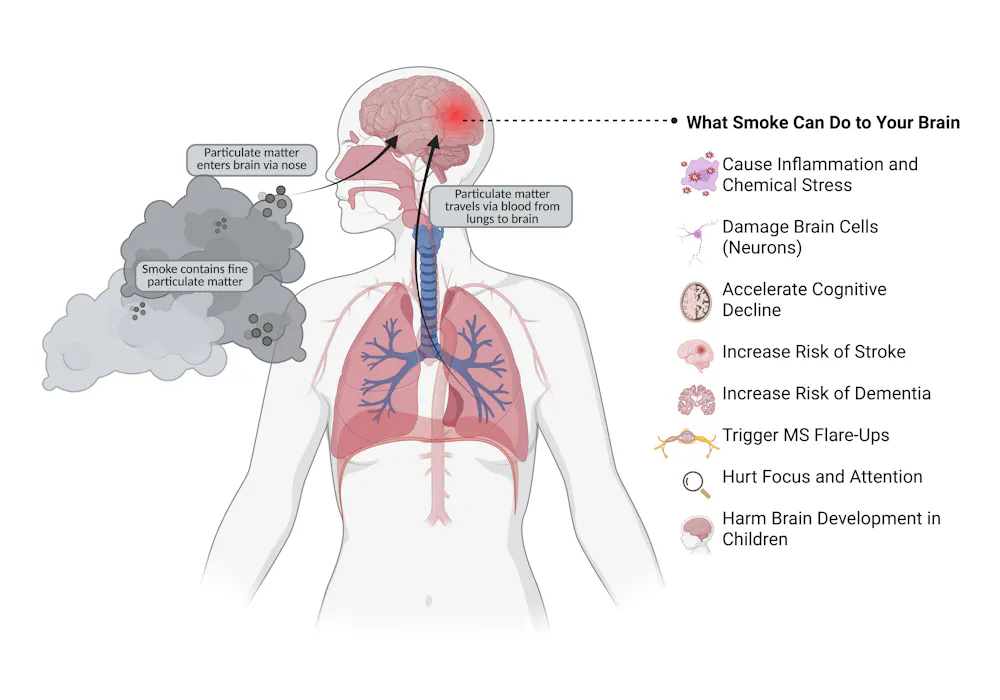
    Alongside harmful gases and heavy metals, wildfire smoke contains fine particulate matter, also known as PM2.5. These tiny particles can travel deep into your lungs, slip into your bloodstream and even reach your brain. Some even bypass the lungs entirely, entering the brain directly through the nose.

    After entering the brain, these toxins can cause inflammation and stress, damage nerve cells and even accelerate cognitive decline. Studies have linked exposure to air pollution to an increased risk of stroke and dementia. Even short-term spikes in smoke exposure, like those during wildfires, lead to a surge in emergency visits for strokes, especially among people over 65.

    A 2022 experiment had thousands of adults participate in an online attention task under smoky conditions. It found that just a three-hour spike in fine particulate matter, typical of a heavy smoke episode, led to measurably worse attention scores. This fits other evidence that breathing smoke makes people mentally foggy, forgetful or fatigued.

    Fine particulate matter in wildfire smoke can reach the brain via the lungs or nose, causing inflammation, neuronal damage, and raising the risk of stroke, dementia, cognitive decline, and MS flare-ups.
    (Muskaan Muse Laroyia)

    Wildfire smoke, dementia and MS

    In 2024, a study found that chronic exposure to wildfire-related air pollution significantly increased the likelihood of someone being diagnosed with dementia. The risk was most pronounced in low-income communities, where people often have less access to clean air, health care and protective measures.

    For people already living with neurological conditions like MS or Parkinson’s disease, the stakes are even higher. Exposure to fine particulate pollution has been linked with increased hospital admissions for MS relapses, particularly in young patients. Other research points to worsening symptoms of epilepsy and cognitive decline under extreme heat and polluted air conditions.

    Despite these mounting risks, neurological health considerations have been largely absent from wildfire preparedness initiatives and public health responses. That needs to change.

    If you want to stay informed about local smoke exposure, tools like AQmap can help you track PM2.5 levels in real time across Canada.

    Some more impacted than others

    Some face far greater risk from wildfire smoke than others, including older adults, those with pre-existing health conditions, people with lower socio-economic status, Indigenous populations, people residing in remote areas and children. This is a health equity issue as much as a medical one.

    Each of these groups faces unique and compounding challenges during smoke events. For example, older adults are more vulnerable to the cardiovascular and neurological effects of smoke. They also face greater barriers to accessing filtered environments.

    People with disabilities or chronic illnesses, including those with neurological conditions, often can’t relocate during smoke events and may rely on power-dependent medical devices that can fail during climate emergencies.

    Low-income families are more likely to live in housing without proper air filtration or cooling. These same communities often face higher baseline rates of neurological disease.

    Indigenous communities, more than 80 per cent of which are located near fire-prone areas, face recurring displacement, interruptions to care and disproportionate exposure to smoke each summer.

    Children and adolescents are particularly susceptible to the harmful neurological effects of wildfires. Because their brains are still developing and they breathe more air per body weight than adults, children are especially vulnerable to harmful pollutants.

    Studies have linked early-life exposure to fine particulate matter with an increased risk of neuro-developmental disorders, lower cognitive function and structural brain changes.

    These populations aren’t just more exposed, they also have fewer resources to respond.

    Rethinking Canada’s health systems

    Recognizing these inequities, we are developing a climate-health equity framework for Canada, with a specific focus on neurological health. Our interdisciplinary team is asking: how can we build health systems that protect vulnerable brains during climate emergencies?

    Health-care workers in Alberta Health Services have designed the Climate-Resilient Acute Care Clinical Operations Framework. This framework supports hospitals in becoming both greener and more resilient, ensuring care can continue during wildfires, floods and extreme heat events.

    Importantly, it also centres the needs of equity-deserving populations, integrating climate adaptation into emergency care, supply chains, staffing and patient communication.

    What needs to change?

    1. Public awareness must expand beyond respiratory health. Neurological effects of smoke should be included in public health messaging, especially for high-risk groups.

    2. Health systems must be climate-ready, with clean air shelters, evacuation protocols and services tailored to meet the needs of neurological patients.

    3. Communities need support, from funding for air filtration to co-ordinated outreach during smoke events. Indigenous-led fire stewardship and community health initiatives should be part of national planning. Supporting Indigenous-led fire stewardship not only strengthens wildfire response but also respects Indigenous sovereignty and traditional ecological knowledge.

    4. Clinicians must be empowered to address climate-related health risks. Training in environmental health, including its impact on the brain, is increasingly essential.

    Wildfire season is back, and with it, an urgent need to protect more than just our lungs. The science is clear: breathing smoky air affects our minds, especially for those already facing health and social vulnerabilities.

    Climate change is a brain health issue. Building a healthier, more equitable future requires us to treat it that way, starting now.

    Dr Bhavini Gohel works for the Canadian Coalition for Green Healthcare.

    Muskaan Muse Laroyia does not work for, consult, own shares in or receive funding from any company or organisation that would benefit from this article, and has disclosed no relevant affiliations beyond their academic appointment.

    ref. Wildfire smoke can harm your brain, not just your lungs – https://theconversation.com/wildfire-smoke-can-harm-your-brain-not-just-your-lungs-258052

    MIL OSI – Global Reports

  • MIL-OSI Canada: The answer to global energy security

    Alberta’s energy industry contributes billions of dollars to Alberta’s economy and plays a vital role in the global responsible energy supply.

    Premier Danielle Smith, Minister of Energy and Minerals Brian Jean, and other government officials will attend the Global Energy Show from June 10 to 12 to welcome international delegates and promote Alberta’s responsible energy development. Their participation will focus on strengthening Alberta’s position as a trusted energy partner, advancing investment opportunities, and highlighting the province’s role in reducing global energy poverty through secure, sustainable supply.

    With current geopolitical challenges, Alberta’s role in energy security has never been more important for Canada’s stability and that of our trading partners, particularly in North America and Asia.

    “Alberta’s energy industry has been built from the ground up by innovative minds who saw opportunity where others see challenges – and they continue to do so today. Thanks to this ingenuity, Alberta has risen in the global ranks as an energy powerhouse with an equally strong environmental record. With global demand for energy security at an all-time high, Alberta stands ready to provide the solutions our partners need.”

    Danielle Smith, Premier

    “The world needs reliable, responsible and affordable energy from a producer they can trust. Alberta’s vast resources are positioned to meet long-term energy demand and will be key in obtaining North American and global energy security and helping defeat energy poverty. We intend to showcase this to attendees from all over the world at this year’s Global Energy Show.”

    Brian Jean, Minister of Energy and Minerals

    While at the Global Energy Show, Premier Smith and Minister Jean will meet with international officials and business leaders to promote Alberta’s energy sector and vast resource base. Their discussions will focus on strengthening Alberta’s position as a reliable resource partner, identifying new opportunities to meet evolving energy needs, and reducing global reliance on energy from conflict zones.

    “As Canada’s largest international energy gathering, the event will address critical issues including energy security, affordability, access and investment. With delegates from over 100 countries, Calgary will highlight Canada’s leadership in shaping the future of energy at home and globally.”

    Nick Samain, Senior Vice President at dmg events

    The conference is an annual event in Calgary, the heart of Canada’s energy sector, and will take place at the BMO Centre with numerous panels, keynote speakers and opportunities for delegates to network.

    Related information

    • Global Energy Show

    MIL OSI Canada News

  • MIL-OSI Canada: Saskatchewan Advances Initiative for Primary Care Nurse Practitioners to Provide Publicly Funded Health Services

    Source: Government of Canada regional news

    Released on June 9, 2025

    The Government of Saskatchewan is asking for an expression of interest (EOI) from Nurse Practitioners (NPs) who want to deliver publicly funded primary care services.

    This initiative will allow NPs to work to their full scope of practice, promote collaborative, team-based care, and increase access to primary care services for patients. 

    “We are committed to ensuring that every Saskatchewan resident has access to a primary care provider by 2028,” Health Minister Jeremy Cockrill said. “This new initiative creates more opportunities for Nurse Practitioners throughout the health system and improves access to primary care services across our province.”

    The expression of interest opens today. NPs who would like to be considered for this initiative should fill out the EOI by July 6 at midnight. 

    The Government of Saskatchewan announced plans in 2024 to develop a funding model that allows NPs to deliver publicly funded primary care services, such as health assessments, treating common illnesses and injuries and chronic disease management. This is the first step in the plan.

    After EOIs are submitted, invitations to apply will be sent out in late July. Successful applicants will enter a contract developed by the Ministry of Health and will function as independent contractors.

    The Ministry of Health will work with the Saskatchewan Association of Nurse Practitioners (SANP) to implement this initiative.

    “We are excited to see this project come to fruition, as it allows Nurse Practitioners to work both individually, and alongside primary care physicians and allied health professionals,” SANP President Michelle O’Keefe said. “We appreciate the efforts by the Ministry of Health to provide Nurse Practitioners access to an innovative funding model that promotes team-based care.”

    Information sessions on this project will be held virtually on June 17 and 19, 2025. For more information on these sessions, this project or to fill out an EOI please visit: saskatchewan.ca.

    -30-

    For more information, contact:

    Media Inquiry Line
    Health
    Regina
    Phone: 306-787-4083
    Email: media@health.gov.sk.ca

    MIL OSI Canada News

  • MIL-OSI Canada: CRTC takes action to support local news across Canada

    Source: Government of Canada News (2)

    June 9, 2025—Gatineau—Canadian Radio-television and Telecommunications Commission (CRTC)

    The CRTC is taking another step forward to implement the modernized Broadcasting Act (the Act) by helping independent Canadian television stations access more funding from the Independent Local News Fund (ILNF).

    The Act requires the CRTC to modernize Canada’s broadcasting framework and ensure that online streaming services make meaningful contributions to Canadian and Indigenous content. As part of this work, the CRTC launched a consultation to review how the ILNF can better support local news. The CRTC received a number of comments on the public record, including from broadcasters, community stations, and other groups.

    Based on the public record, today’s decision confirms the eligibility criteria for television stations to access more funding from the ILNF, continues to ensure fair distribution of funding, and supports the distribution of local news by requiring ILNF recipients to make it available online.

    This decision follows a number of actions the CRTC has taken to implement the modernized Act. To find out more, check out the CRTC’s regulatory plan.

    Quick facts

    • The CRTC is an independent quasi-judicial tribunal that regulates the Canadian communications sector in the public interest. The CRTC holds public consultations on telecommunications and broadcasting matters and makes decisions based on the public record.
    • The CRTC is fulfilling the mandate given to it by Parliament to modernize Canada’s broadcasting framework. To date, the CRTC has launched 15 public consultations to implement the modernized Act.
    • Today’s decision also confirms that since Corus Entertainment Inc. is an independent broadcaster, its 15 Global stations are eligible to receive funding from the ILNF.  

    Associated links

    MIL OSI Canada News

  • MIL-OSI Canada: Competition Bureau sues DoorDash for allegedly advertising misleading prices and discounts

    Source: Government of Canada News (2)

    June 9, 2025 – GATINEAU, QC – Competition Bureau

    The Competition Bureau is taking legal action against DoorDash Inc., and its subsidiary DoorDash Technologies Canada Inc., for promoting their online delivery services at a lower price than what consumers actually have to pay.

    A Bureau investigation found that consumers were unable to purchase food and other items at the advertised price on DoorDash’s websites and mobile applications due to the addition of mandatory fees at checkout. This practice is commonly known as drip pricing and is deceptive because consumers are not presented with an attainable price upfront.

    DoorDash charges consumers numerous mandatory fees to deliver orders made online, including service fees, delivery fees, expanded range fees, small order fees and regulatory response fees. As a result, consumers end up paying higher prices or receiving lower discounts than advertised. The company has been engaging in the alleged conduct for close to a decade, acquiring nearly $1 billion in mandatory fees from consumers.

    The Bureau also alleges that the way certain fees are represented on the company’s platform give the impression that they are taxes, where, in reality, they are charges imposed at DoorDash’s discretion.

    Today, the Bureau filed an application with the Competition Tribunal seeking, among other things, for DoorDash to: 

    • stop the deceptive price and discount advertising;
    • stop portraying fees as taxes;
    • pay a penalty; and
    • issue restitution to affected consumers who purchased food and other items through DoorDash’s platform.

    MIL OSI Canada News

  • MIL-OSI Canada: Canada’s new government is rebuilding, rearming, and reinvesting in the Canadian Armed Forces

    Source: Government of Canada – Prime Minister

    In an increasingly dangerous and divided world, Canada must be prepared – to defend our people and our values, to secure our sovereignty, and to protect our Allies. We must be prepared to lead and to shape a more stable and prosperous world. This entails government recognizing our new realities and investing in the measures required to meet this moment.

    Today, the Prime Minister, Mark Carney, announced that Canada’s new government is rebuilding, rearming, and reinvesting in the Canadian Armed Forces.

    With this increase, Canada will achieve NATO’s 2 per cent target this year – half a decade ahead of schedule – and further accelerate our investments in years to follow, consistent with our security imperatives. The investment for 2025-26 will be over $9 billion.

    Measures in this plan include:

    • Better pay for Canadian Armed Forces, improved recruitment and retention, and investments to support operational readiness, fleet maintenance, security, and infrastructure requirements.
    • New aircraft, armed vehicles, and ammunition, as well as support for projects currently underway.
    • Developing new drones and sensors to monitor the seafloor and the Arctic.
    • Repairing and maintaining existing ships, aircraft, and other assets.
    • More health care funding and staff for Armed Forces personnel.
    • Expanding the reach, security mandate, and abilities of the Canadian Coast Guard and integrating it into our NATO defence capabilities – to better secure our sovereignty and expand maritime surveillance.
    • Bolstering Canada’s defence industrial capacity.
    • Building capacity in artificial intelligence, cyber, quantum, and space.
    • Modern and secure digital infrastructure.

    The plan will support key capabilities, including:

    • Arctic Over-the-Horizon Radar
    • Joint Counter-Drone Program
    • Joint Support Ships
    • Long-range precision strike capability
    • Increased domestic ammunition production
    • Additional logistics utility vehicles, light utility vehicles, and armoured vehicles

    This government will also undertake efforts to support veterans, including modernizing the benefits system so veterans get supports sooner, streamlining military trade credentials in the civilian sectors, and improving health services for women veterans.

    Canada requires these capabilities to uphold and assert its sovereignty and ensure our defence never becomes dependent on others again. As we strengthen the Canadian Armed Forces, we will also build up Canadian industry, driving innovation and creating good careers for Canadian workers and new opportunities for Canadian businesses. Now more than ever, we need to defend our sovereignty and safeguard Canada’s people and interests.

    Quotes

    “In an increasingly dangerous and divided world, Canada must assert its sovereignty. We will rapidly procure new equipment and technology, build our defence industrial capacity, and meet our NATO defence commitment this year. Canada will seize this opportunity with urgency and determination.”

    “For generations, Canadians have served our country with honour, and today, we renew our promise to stand behind them. We are equipping our Armed Forces with the capabilities and support they need to protect Canadians and uphold our commitments around the world. This historic investment will strengthen our sovereignty and invest in the Canadian economy – growing a world-class defence industry that fuels innovation and job creation.”

    Related Product

    MIL OSI Canada News

  • MIL-OSI Canada: Vicky Eatrides to the Banff World Media Festival

    Source: Government of Canada News

    “From Pitch to Production: Building Canada’s broadcasting framework of the future”

    Banff, Alberta
    June 9, 2025

    Vicky Eatrides, Chairperson and Chief Executive Officer
    Canadian Radio-television and Telecommunications Commission (CRTC)

    Check against delivery

    Introduction

    Good morning, everyone, and thank you, Rod, for the warm welcome.

    Before I begin my remarks, I would like to acknowledge that we are gathered on the traditional territory of the Treaty 7 First Nations, including the Stoney and Siksika First Nations. Let us thank these communities and pay tribute to their Elders.

    Thank you for inviting me to speak with you. I am happy to be joined by CRTC colleagues, including Joanne Levy, our Commissioner for Manitoba and Saskatchewan, and Scott Shortliffe, our Vice-President of Broadcasting. It is also nice to see so many familiar faces in the room.

    It is a pleasure to be back here with you in beautiful Banff. As you may remember, last time we were here together, I pitched a project.

    The project was about how we help build the broadcasting system of the future. A system that is strong and healthy, and that features a multitude of voices creating original content for broadcast on radio, TV and streaming services.

    As Canadian actor and filmmaker Dan Levy once said:“ The amazing part about the Canadian identity is that it’s so rich and so diverse. You are getting stories that are representing so many different types of people, and so many ways of life.” Well, that sentiment captures the spirit of this project — one focused on unity through diversity and drawing on each other’s strengths to build a framework that lasts.

    Last time I pitched it, we were in the development stage. Since then, we have moved past pre-production and the project is in full swing. We have been co-producing this project with many of you, and though we are not yet ready to reveal the final cut, we are making progress.

    Everyone in this room knows what pre-production is like — things start off gradually, then suddenly everything is happening all at once. The next thing you know, you are deep in production and working toward a release date. That is what it has been like for our project. We first had to put the pieces in place — like getting a script written and setting shooting locations — and now we are full tilt into filming.

    So, in the brief time we have this morning, let me take you back to the storylines for our project. Then let us touch on the steps we have taken so far in production, and end on how diverse perspectives are bringing our project to life.

    Storylines for our project

    So let us go back to the storylines.

    As you know, the CRTC is an independent quasi-judicial tribunal that regulates the Canadian communications sector in the public interest. We hold public consultations on telecommunications and broadcasting matters, and we make decisions based on the public record.

    On the broadcasting side, Parliament gave us new responsibilities when it adopted the Online Streaming Act, and we have been making significant progress.

    Modernizing the decades-old regulatory framework has been no small task. We knew that the changes would be substantial and complex and could not be done overnight.

    So we got to work quickly, sketching out our storylines.

    One of these storylines is about ensuring high-quality Canadian content. This includes news, drama, comedies, documentaries, and other types of programming. So that Canadians can easily find, watch, and listen to the diverse content they have told us they want.

    Another storyline is about a sustainable broadcasting system. And what do we mean by sustainable? We mean a system that is financially resilient and capable of adapting to technological advancements and changing market dynamics. A system in which broadcasters contribute in the most effective and appropriate way for their business models. And a system that promotes fair competition, diversity and innovation.

    We also have a storyline that, while perhaps less prominent, plays an important role in the overall narrative. This one is about clear and predictable rules. Because having a transparent framework ensures fairness and consistency in the regulatory environment.

    And once the storylines were settled, we moved quickly toward production.

    Steps taken in production

    All of the actions we have taken so far have been shaped through broad consultations and have been based on a robust public record.

    One example is our consultation on base contributions. The goal was to explore whether we should set base contributions for online streaming services, and if so, how much they should contribute and who should benefit from the contributions.

    From the outset, the industry told us that decisions with the most impact needed to be made quickly, so we took action. That consultation included over 360 submissions and a three-week public hearing, where we heard from more than 120 groups and individuals. As you know, the resulting decision is directing an estimated $200 million annually into the Canadian broadcasting system, targeting areas of immediate need.

    That decision was a key first step in establishing that online streaming services must contribute to the Canadian broadcasting system. It laid the groundwork for clear rules and determined how each player could best support the system’s success as a whole.

    We have continued to move quickly to build on this momentum.

    In our work so far to modernize the broadcasting framework, we have launched 15 public consultations, and we are in the middle of an ambitious series of public hearings to help us make decisions.

    And one of those broadcasting decisions was released just this morning. It is a decision that supports local TV news across Canada.

    As you know, we established in base contributions that online streaming services should contribute toward news because of the vital role it plays in the system. Today’s decision recognizes how important news broadcasters are in keeping Canadians informed and involved in their communities.

    Diverse perspectives bringing our project to life

    And more action is coming. Action that is based on meaningful engagement with groups and individuals, including many of you.

    Less than two weeks ago, we concluded a major hearing on the definition of Canadian content for TV and online streaming services, and on supporting the creation and distribution of Canadian and Indigenous content. The level of engagement spoke volumes: we received 480 written submissions, and we heard from 78 groups during our public hearing.

    While our main focus was on the definition of Canadian content, we discussed topics like the role of programs of national interest and the use of artificial intelligence. And we heard a wide range of perspectives.

    We heard broad recognition for the importance of defining Canadian content and for how vital storytelling is to our culture. The definition matters because it is tied to what is broadcast, what is supported by funding, and therefore, what gets greenlit and aired. This decision will influence and shape the stories that are told in the future. 

    We heard that we should maintain what is working well in the broadcasting system.

    And we heard a call for continued quick action and clarity.

    While we just wrapped up this hearing, we have another one starting in the coming days, where we will be turning our minds to the market dynamics within the Canadian broadcasting system. And in September, we will be holding a hearing on what Canadian content means for audio services.

    We will issue key decisions on these matters starting this fall. Once the policy decisions are in place, we will move quickly to set conditions of service for the major players — those shaping and benefiting most from Canada’s broadcasting system. These conditions will bring certainty regarding Canadian programming investments while ensuring the system continues to support Canadian talent, stories, and culture.

    Building the broadcasting framework of the future involves the perspectives of many to get it right — from traditional broadcasters to producers, to Canadians, public interest groups, online streaming services, and more. Every voice can help shape what comes next.

    Conclusion

    On that positive note, let me leave you with this.

    Our project is in full swing. Together, we are continuing to make progress.

    We are helping build the broadcasting system of the future. A strong and vibrant system. One that supports the diversity and richness of the Canadian identity.

    Everyone has a role to play in bringing this project to life. So let us keep moving together quickly through production.

    Because our project is about more than a regulatory framework. It is about a system that inspires, connects, and reflects all Canadians. For today, for tomorrow, and for generations to come.

    Thank you.

    MIL OSI Canada News

  • MIL-OSI Canada: Government of Canada supports scale up of Vars windows and doors manufacturer

    Source: Government of Canada News (2)

    Local business receives funding to commercialize new product line

    June 9, 2025 – Vars, Ontario                       

    Strengthening Canada’s manufacturing sector unlocks new opportunities, enhances domestic production and creates skilled jobs in the region. The Government of Canada is committed to supporting businesses that drive sustainable growth and innovation, all while helping to build a strong economy that works for everyone.

    Today, on behalf of the Honourable Evan Solomon, Minister of Artificial Intelligence and Digital Innovation and Minister responsible for the Federal Economic Development Agency for Southern Ontario (FedDev Ontario), Giovanna Mingarelli, Member of Parliament for Prescott–Russell–Cumberland, participated in the groundbreaking for the new 104,000-square foot Nordik Windows Inc. (Nordik) facility.    

    At the celebration, MP Mingarelli announced a Government of Canada investment of $1 million to support Nordik to acquire and install advanced equipment to commercialize a new product line of hurricane-resistant, energy-efficient windows for export into new markets. The new line, which will increase production, will also use recycled materials to help divert waste from landfills.

    This investment underscores the Government of Canada’s ongoing commitment to supporting our businesses as they foster sustainable, homegrown innovation while contributing to the growth of southern Ontario and Canada’s economy.  

    MIL OSI Canada News

  • MIL-OSI Canada: Canadian launches mission to combat illegal fishing and protect marine ecosystems in the Indo-Pacific

    Source: Government of Canada News (2)

    June 9, 2025

    Ottawa, ON – Globally, illegal, unreported, and unregulated (IUU) fishing is a major contributor to declining fish stocks and the destruction of marine habitats. IUU fishing also undermines the livelihoods of legitimate fish harvesters and impacts food security in vulnerable coastal communities, affecting millions of people.

    Today, Fisheries and Oceans Canada (DFO) launched its third annual high seas patrol to deter IUU fishing in the high seas of the North Pacific, including near the Aleutian Island chain, focusing on migratory routes for key species like Pacific salmon.

    The mission, known as Operation North Pacific Guard (Op. NPG), is led by DFO fishery officers and supported by the Canadian Coast Guard and the Royal Canadian Mounted Police to protect fish stocks under Canada’s Pacific Salmon Strategy Initiative and Canada’s Indo-Pacific Strategy. As a Pacific nation, Canada is committed to deepening its engagement and its role across the Indo-Pacific region as an active and reliable partner.

    Fishery officers and support personnel will patrol over 15,000 km while onboard the Canadian Coast Guard vessel, the CCGS Sir Wilfrid Laurier, a high endurance, multi-purpose vessel that is also a light icebreaker, and is biofuel capable. The expert crew will conduct high seas boardings and inspection operations under international law to ensure compliance with regulations and to detect IUU fishing.

    During this mission, Canada’s CCGS Sir Wilfrid Laurier will make a special port visit during Expo 2025 in Osaka,  Japan, where members of the public can visit the vessel and learn about Canada’s role in fighting IUU.

    In addition to monitoring and enforcement by sea, Canada is conducting daily aerial surveillance this summer out of Hokkaido, Japan. Air patrols conducted by DFO fishery officers will monitor fishing vessels and support partner countries to ensure compliance with international law. Canada’s air surveillance program has previously identified significant conservation concerns related to shark finning and illegal marine mammal harvest, including the harpooning of dolphins, and pollution events that threaten the marine environment. Continued monitoring for these activities will allow Canada to hold non-compliant vessels accountable.

    As a Pacific nation, Canada recognizes that the Indo-Pacific region will play a significant and profound role in Canada’s future. Every issue that matters to Canadians—national security, economic prosperity, respect for international law and human rights, democratic values, public health, protecting our environment—will be shaped by the relationships that Canada, along with its partners, have with countries throughout the Indo-Pacific.  

    MIL OSI Canada News

  • MIL-OSI: CarGurus Launches AI-Powered Car Shopping Experience

    Source: GlobeNewswire (MIL-OSI)

    Intelligent search integration unlocks a more personalized and intuitive experience for drivers to discover their best deal with greater confidence

    BOSTON, June 09, 2025 (GLOBE NEWSWIRE) — CarGurus (Nasdaq: CARG), the No. 1 visited digital auto platform for shopping, buying, and selling new and used vehicles1, today announced the release of its AI-powered search experience. This innovation delivers a more personalized and intuitive car shopping experience, embedded directly into the CarGurus website. Buyers can now harness conversational search, paired with expert auto intelligence and real-time vehicle data, to research, compare, and shop the largest selection of new and used cars in the U.S.2

    “For nearly two decades, CarGurus has supported drivers through one of the biggest purchase decisions of their lives. This update aims to advance that mission even further, enabling them to shop in ways that weren’t possible before by having an open dialogue right on our site,” said Ben Kasdon, Vice President, Product at CarGurus. “No matter what phase of the journey they’re in, shoppers can now search on their own terms to uncover their best match more efficiently and with greater confidence. Early pilot users have shown strong engagement, with AI search users spending more time on site compared to typical site traffic.”

    The AI-powered shopping experience allows consumers to use conversational language to find the best options for their needs, compare models, and refine listing results based on their location and preferences. The experience is designed to help buyers at any stage of their journey, from early research to final selection. As a shopper’s search journey evolves, they can also revisit their unique URL to continue the conversation.

    Shoppers can discover their ideal car using intuitive prompts, such as the following examples:

    • “I have three kids under 3. Help me find a car with high safety and reliability ratings.”
    • “Show me the best cars with plenty of space for tall drivers.”
    • “Show me reliable SUVs with blind spot monitoring under $30,000.”
    • “Compare the best all-wheel drive vehicles for any terrain.”

    This release is the latest chapter in CarGurus’ long history of leveraging AI and machine learning to bring more trust, transparency, and efficiency to car buying and selling. AI and machine learning underpin the platform’s vehicle recommendation engine, its Instant Market Value tool, and on-site merchandising. For dealers, CarGurus provides actionable insights and predictive analytics that enable more informed decision-making across workflows, from pricing and merchandising to inventory acquisition.

    To see the AI shopping experience in action, visit: www.cargurus.com/discover or watch a demo here: https://cargur.us/1dB1cP.

    About CarGurus, Inc.

    CarGurus (Nasdaq: CARG) is a multinational, online automotive platform for buying and selling vehicles that is building upon its industry-leading listings marketplace with both digital retail solutions and the CarOffer online wholesale platform. The CarGurus platform gives consumers the confidence to purchase and/or sell a vehicle either online or in-person, and it gives dealerships the power to accurately price, effectively market, instantly acquire, and quickly sell vehicles, all with a nationwide reach. The company uses proprietary technology, search algorithms, and data analytics to bring trust, transparency, and competitive pricing to the automotive shopping experience. CarGurus is the most visited automotive shopping site in the U.S. 1

    CarGurus also operates online marketplaces under the CarGurus brand in Canada and the U.K. In the U.S. and the U.K., CarGurus also operates the Autolist and PistonHeads online marketplaces, respectively, as independent brands.

    To learn more about CarGurus, visit www.cargurus.com, and for more information about CarOffer, visit www.caroffer.com.

    CarGurus® is a registered trademark of CarGurus, Inc., and CarOffer® is a registered trademark of CarOffer, LLC. All other product names, trademarks and registered trademarks are the property of their respective owners.

    1Similarweb: Traffic Report [Cars.com, Autotrader, TrueCar, CARFAX Listings (defined as CARFAX Total visits minus Vehicle History Reports traffic)], Q1 2025, U.S.
    2Compared to Autotrader.com, Cars.com, TrueCar.com (YipitData as of December 31, 2024), and CarFax (Joreca as of December 31, 2024)

    Media Contact:
    Maggie Meluzio
    Director, Public Relations & External Communications
    pr@cargurus.com

    Investor Contact:
    Kirndeep Singh
    Vice President, Head of Investor Relations
    investors@cargurus.com

    A video accompanying this announcement is available at https://www.globenewswire.com/NewsRoom/AttachmentNg/de81b41e-d38e-4f9b-8aa7-09e4fe2655d7

    The MIL Network

  • MIL-OSI: Maxim Group LLC Expands Equity Sales and Trading with Strategic Hires Erik Killough and Ryan Loader

    Source: GlobeNewswire (MIL-OSI)

    NEW YORK, June 09, 2025 (GLOBE NEWSWIRE) — Maxim Group LLC, a leading full-service investment banking, securities, and wealth management firm, is pleased to announce the continued expansion of its Equity Sales and Trading division with the addition of two seasoned professionals, Erik Killough and Ryan Loader. This strategic growth also includes a broadening of institutional services through the firm’s Connecticut and Boston branch offices.

    Erik Killough brings 28 years of experience in equity trading, including 23 years specializing in Asia-Pacific markets during live trading hours. His knowledge of international market dynamics brings enhanced execution capabilities to clients with global investment strategies. Prior to joining Maxim, Mr. Killough served as Vice President at Guzman & Company. His extensive career also includes senior positions at GMO, The Boston Company, and Standish, Ayer & Wood. 

    Ryan Loader brings 25 years of sales and trading experience, featuring a strong background in industrial sector equities and a robust track record of servicing institutional investors across the U.S. and Canada. In addition to developing his hedge fund relationships within the U.S., Ryan will expand the firm’s reach north of the border, bringing Maxim’s full suite of broker-dealer services to Canadian institutions and corporate clients. Prior to joining Maxim, Mr. Loader served as Director of Global Equity Sales & Trading at Scotia Capital (USA) Inc.

    “We are thrilled to welcome Erik and Ryan to our team as Maxim’s equity trading platform continues to expand,” said Michael A. Cerussi, Head of Institutional Sales and Trading at Maxim Group. “Erik brings a wealth of experience in global markets, while Ryan offers extensive cross-border institutional reach. Together they enhance our pool of talent and will open new avenues to business opportunities, bolstering Maxim’s offerings for current and future clients across diverse regions and markets.”

    About Maxim Group LLC
    Maxim Group LLC is a full-service investment banking, securities and wealth management firm headquartered in New York. The independent and employee-owned firm provides a full array of financial services including investment banking; private wealth management; and global institutional equity, fixed-income and derivatives sales & trading, equity research and prime brokerage services. Maxim Group LLC is a registered broker-dealer with the U.S. Securities and Exchange Commission (SEC) and the Municipal Securities Rulemaking Board (MSRB) and is a member of FINRA SIPC, and NASDAQ. To learn more about Maxim Group LLC, visit maximgrp.com.

    The MIL Network

  • MIL-OSI: Enserva hosts discussion with Alberta Premier Danielle Smith and Saskatchewan Premier Scott Moe to discuss North American energy security

    Source: GlobeNewswire (MIL-OSI)

    CALGARY, Alberta, June 09, 2025 (GLOBE NEWSWIRE) —

    PHOTO OP: Photo opportunities with Premier Danielle Smith, Premier Scott Moe and Gurpreet Lail, CEO, Enserva.
       
    WHAT: Media are invited to attend an energy leadership event hosted by Enserva, featuring a joint conversation with the Honourable Danielle Smith, Premier of Alberta and the Honourable Scott Moe, Premier of Saskatchewan to discuss the provinces’ roles in advancing Canadian energy growth and long-term economic security.
       
      Drawing on conversations from the recent First Ministers’ Meeting and ongoing national energy policy discussions, the event will address how Alberta and Saskatchewan are working to align their policy and infrastructure agendas with national interests—including LNG development, egress solutions, trade diversification, and energy security.
       
      Gurpreet Lail, President & CEO, Enserva, will host a fireside chat with the premiers outlining their provinces’ commitments to growing energy production in the Western Canada Sedimentary Basin (WCSB).
       
      This candid conversation will highlight how collaboration with federal and provincial governments can support Canadian and North American energy security in a time of political and market uncertainty.
       
    WHO: Gurpreet Lail, President & CEO of Enserva
      Honourable Scott Moe, Premier of Saskatchewan
      Honourable Danielle Smith, Premier of Alberta
       
    WHEN: Monday, June 16, 2025
      11:15 a.m. Media registration opens
      12:20 p.m. to 1:30 p.m. Presentation
       
    WHERE: Exhibition Hall E, Telus Convention Centre
      136 8 Ave SE
      Calgary, AB
      T2P 0K6
       
    RSVP: Media are asked to RSVP no later than Thursday, June 12, 2025
       

    Media RSVP Contact:
    Shauna MacDonald
    Brookline Public Relations, Inc. 
    403-585-4570; smacdonald@brooklinepr.com

    The MIL Network

  • MIL-OSI Global: Ghana’s older people feel left behind and ignored: how to care for them better

    Source: The Conversation – Africa – By Andrew Kweku Conduah, PhD Candidate, University of Ghana

    Ghana’s national agenda often focuses on the country’s large number of young people. In fact a less noticed demographic transformation is reshaping society: the country’s older population is growing rapidly. According to Ghana Statistical Service estimates,
    people aged 60 and above are projected to make up over 12% of the total population by 2050, more than doubling the 2021 estimate of 6.8%.

    And more of these older adults are ageing alone.

    That’s because of Ghana’s transition from extended to nuclear family systems, coupled with rural–urban and international migration. Traditionally, older Ghanaians aged within multi-generational households, with care provided by children and extended family. But today, migration patterns have intensified, with over 50% of the population living in urban areas, leaving many elders behind in rural communities or isolated in city slums.

    I recently conducted a study across six Ghanaian communities (urban and rural). Drawing from 52 interviews, I explored the emotional, social and economic implications of ageing alone.

    The participants in the study echoed a common theme: the erosion of intergenerational family structures, leaving the elderly socially and emotionally isolated.

    As a 73-year-old widow participant who lives in a city put it:

    My daughter is in Canada. My son lives in Kumasi, but he rarely visits. I live alone, and if I fall sick, I just wait. Sometimes, I pray someone will notice.

    Such stories are no longer anecdotal outliers. Nationally representative data from the Ghana Living Standards Survey and WHO SAGE Ghana Wave 2 also reveal an uptick in solitary living among older adults, particularly widowed women and those without formal pensions. Over 22% of older respondents in urban Ghana reported living alone, a sharp contrast to previous decades, where co-residence with adult children was the norm. Many older Ghanaians don’t have reliable caregivers.

    As a PhD candidate in population studies at the University of Ghana, I focus on health-related quality of life among older adults. This article draws from my doctoral fieldwork in urban and rural Ghana, using qualitative interviews to uncover the lived realities of ageing alone.

    The study highlights a gap in Ghana’s ageing policies: they overlook solitary elders who live without daily family support.

    The paper calls for integrated social protection for older adults living alone. That would include subsidised healthcare, community outreach services, emergency care networks, and community-based mental health interventions.

    What old people had to say

    Focus group discussions revealed that older adults struggle with emotional loneliness, financial anxiety and health system constraints. Despite the presence of pension associations, many older adults feel forgotten. Spiritual activities and reading offer moments of solace, but limited National Health Insurance Scheme coverage, rising living costs, and declining family support deepen the hardship.

    Focus groups revealed that older women were particularly vulnerable due to widowhood, land insecurity and declining support from children. Men, while respected, felt idle and underutilised. Participants spoke of finding strength in farming, faith and fellowship, but felt forgotten in national development planning.

    Ghana’s National Ageing Policy (2010) promises integrated care, but older adults, especially women, are slipping into the cracks of urban anonymity.

    Ageing here is not just biological, it is physical, psychological and economic. My broader research affirms that the majority of older adults in Ghana worked in the informal sector. They therefore have no access to formal pensions or post-retirement income security.

    Participants in my most recent research shared how they felt:

    I was a seamstress all my life. Now my eyes are failing. No pension, no money. I survive on cassava and prayer. – 66-year-old retired woman

    Ageing in Ghana is like walking into a forest — you disappear quietly. No one sees you. — 69-year-old woman

    This statement underscores the gendered experience of ageing, where women often face greater economic and emotional vulnerability due to widowhood, longer life expectancy, and social neglect.

    We are not dying yet. We want to matter again. – 70-year-old man

    We have houses, but not homes anymore. – 75-year-old man

    What next

    The implications of this neglect are staggering. According to the World Health Organization, loneliness and social isolation among the elderly are associated with a 50% increased risk of dementia, depression and premature death. In Ghana, there are added challenges of inaccessible health facilities and cultural stigma about ageing. Yet most people aren’t talking about it.

    Ghana introduced the National Ageing Policy in 2010 to promote the health, security and participation of older people in national development. But many elderly people still live without affordable healthcare, age-friendly infrastructure or a regular income.

    What Ghana needs now is not another grand policy document. It needs practical, community-rooted and state-supported action.

    Decentralised community geriatric care: Train district-level health volunteers in geriatric care, and equip them with basic tools to support older people in their homes.

    Pension and informal sector integration: Extend Ghana’s pension framework to informal sector workers.

    Public awareness campaigns: Reframe ageing in national media not as decline but as contribution, highlighting elder wisdom, resilience, and ongoing social relevance.

    Urban planning for ageing: Incorporate age-friendly elements like ramps, benches, toilets and signage into development plans.

    None of this is charity. It is a strategic investment. In 2021, Ghana spent less than 0.5% of its national health budget on elderly-specific care. That is fiscally short-sighted. Healthier, engaged older adults reduce family burdens, boost social capital, and can even contribute economically by training and mentoring others.

    In the communities I visited, I encountered grassroots interventions worth scaling up: church youth groups providing weekly food support, pensioners’ associations checking in on members, and intergenerational community storytelling sessions that rebuild emotional bonds.

    In Ghana’s Akan tradition, elders are considered living libraries. Their absence from the communal space is not just a social loss, it is a cultural erasure.

    If the elderly are neglected, anyone may wake up on the wrong side of the demographic line one day, wondering if they too will be forgotten.

    Andrew Kweku Conduah does not work for, consult, own shares in or receive funding from any company or organisation that would benefit from this article, and has disclosed no relevant affiliations beyond their academic appointment.

    ref. Ghana’s older people feel left behind and ignored: how to care for them better – https://theconversation.com/ghanas-older-people-feel-left-behind-and-ignored-how-to-care-for-them-better-257951

    MIL OSI – Global Reports

  • MIL-OSI USA: Air Quality Alert Issued for the Southwest Coast of Maine Amid Canadian Wildfires

    Source: US State of Maine

    June 9, 2025

    CONTACT:

    Ground-level particle pollution concentrations are expected to be in the ‘Unhealthy for Sensitive Groups’ (USG) level according to the Maine Department of Environmental Protection.

    Sunday, USG levels of particle pollution were recorded in the Southwest Coastal area. This morning, levels continue in the USG range. While levels may drop during the day, another plume of wildfire smoke is expected to move in from the east. This is a portion of the plume from the western Canadian wildfires that broke off over Newfoundland and Labrador. It has now moved south of Nova Scotia. Easterly winds are expected to push this plume toward the Maine & New Hampshire coast with the leading edge reaching the shoreline this afternoon.

    Currently, smoke is expected to move out on Tuesday. DEP will continue to monitor the situation and update Tuesdays forecast this afternoon.

    Smoke may return in the coming days as wildfires continue to burn across Canada.

    At elevated levels of particle pollution, children, the elderly, and individuals suffering from respiratory or heart diseases such as asthma, bronchitis, or COPD can experience reduced lung function and irritation. In addition, healthy adults who exert themselves outdoors may also notice these health effects. Affected individuals may notice symptoms such as coughing, shortness of breath, throat irritation, and/or experience mild chest pain.

    Some actions you can take to protect your health during periods of elevated particle pollution levels include:

    • Avoid strenuous outdoor activity
    • Close windows and circulate indoor air with a fan or air conditioner
    • If you have asthma, keep your quick-relief medications and action plan handy

    Additional health information may be found on the following websites:

    In addition to those in a sensitive group, others who are responsible for the welfare of people impacted by poor air quality are urged to use one of the listed tools to follow the Air Quality Forecast:

    For more information go to Maine DEPs air quality web site.

    For additional information, contact: David R. Madore, Deputy Commissioner david.madore@maine.gov

    MIL OSI USA News

  • MIL-OSI: Westland Insurance acquires British Columbia-based Dave Dale Insurance Agencies Ltd.

    Source: GlobeNewswire (MIL-OSI)

    Surrey, BC/Territories of the Coast Salish (Kwantlen, Katzie, Semiahmoo, Tsawwassen First Nations), June 09, 2025 (GLOBE NEWSWIRE) — Westland Insurance, one of Canada’s largest insurance brokerages, today announced that it has acquired Dave Dale Insurance Agencies Ltd., effective June 1. This strategic acquisition is a part of Westland’s ongoing expansion across Canada, reinforcing the organization’s commitment to providing insurance solutions that meet the diverse needs of clients within their communities.  

    Dave Dale Insurance, a trusted provider of quality insurance services, proudly celebrates over 50 years of dedicated service to the Grand Forks community. The team of professional advisors provides a wide range of insurance services – including risk management solutions for automobile, residential, small business, and travel insurance – while also serving as the community’s driver licensing centre. 

    “We’re very pleased to welcome Dave Dale Insurance to the Westland team and growth story,” says Jamie Lyons, Westland’s President & CEO. “As we expand our network of insurers across Canada, we’re always looking to partner with organizations that have an excellent track-record of serving their communities. Dave Dale Insurance has not only provided personalized insurance solutions to the Great Forks community since 1967 but has also invested in impact with their support of local organizations. Their outlook strongly aligns with Westland’s commitment to being an authentic and invested community member and we’re very excited to have them on board.” 

    Westland continues to invest in and grow its business in Canada, both organically and through strategic acquisitions.  

    – 30 –   

    About Westland Insurance Group   

    Westland Insurance Group is one of the largest and fastest-growing independent insurance brokers in Canada. Trading over $4 billion of premium, Westland continues to expand coast to coast. Westland’s brokers provide expertise and advisory-based services across commercial, personal, employee benefits, farm, and specialty insurance segments. The company’s mission is to protect individuals, businesses, and communities across Canada with trusted advice and tailored insurance solutions. As a Canadian-based company, Westland is proud to support local communities, Canadian jobs, and a strong economy. For more information, please visit westlandinsurance.ca.

    The MIL Network

  • MIL-Evening Report: Albanese says the government’s focus on delivering commitments is essential to reinforce faith in democracy

    Source: The Conversation (Au and NZ) – By Michelle Grattan, Professorial Fellow, University of Canberra

    Prime Minister Anthony Albanese says his second term government is “focused on delivery” of its commitments, declaring this is important not only for the economy but also for Australians’ faith in our democracy.

    In a speech to the National Press Club on Tuesday, partially released ahead of delivery, Albanese warns that the present era of global uncertainty reaches beyond just economic uncertainty.

    “It is the more corrosive proposition that politics and government and democratic institutions, including a free media, are incapable of meeting the demands of this moment.

    “Some simply dismiss such sentiment. Others cynically seek to harvest it. Our responsibility is to disprove it.

    “To recognise that some of this frustration is drawn from people’s real experience with government – be it failures of service delivery, or falling through the cracks of a particular system.

    “And to counter this, we have to offer the practical and positive alternative.To prove that a good, focused, reforming Labor government can make a real difference to people’s lives.”

    Albanese’s speech comes ahead of his departure later this week for the G7 summit in Canada, where he is expected to meet US President Donald Trump on the sidelines.

    Their talks are set to cover, in particular, the Albanese government’s bid for relief from the Trump tariffs and the president’s desire for Australia to significantly boost its spending on defence.

    Australia is subject to both the general US 10% tariff and the separate tariff on steel and aluminium, which the president has just increased to 50%.

    Australia will put on the table a proposal for arrangements on access to our critical minerals and rare earths, that will favour the US. The government has also been examining a way to give access to US beef, which currently faces an effective ban on biosecurity grounds.

    Albanese has stressed that any change would not compromise Australian biosecurity.

    The Trump administration has flagged it would like to see Australia boost defence spending to 3.5% of GDP. Albanese has said Australia makes its own defence decisions and that spending should be based on capability needs rather than a set percentage.

    Albanese’s stress, in his speech, on “delivery” of commitments is partly to manage expectations in the wake of the government’s massive majority.

    The unexpected election result has led to some pressures on the government to use its position to undertake a more radical agenda than the one it put at the election.

    Albanese says: “Our government’s vision and ambition for Australia’s future was never dependent on the size of our majority.

    “But you can only build for that future vision if you build confidence that you can deliver on urgent necessities.

    “How you do that is important too – ensuring that the actions of today, anticipate and create conditions for further reform tomorrow.”

    He says the government’s second-term agenda has been shaped by Australians’ lives, priorities and values.

    “It is the mission and the measure of a Labor government to give those enduring ideals of fairness, aspiration and opportunity renewed and deeper meaning, for more Australians.

    “To deliver reforms that hold no-one back – and drive progress that leaves no-one behind.

    “This is no small task. It demands we aim high and requires us to build big.”

    He points to the government’s promised big investment in Medicare as well as its commitments on housing and the energy transition.

    “Our vision is for a society that is a microcosm for the world – where all are respected and valued and our diversity is recognised as a strength.

    “Where our international relationships in the fastest growing region of the world in human history benefit us, but also provide a platform for us to play a stabilising global role in uncertain times.”

    Michelle Grattan does not work for, consult, own shares in or receive funding from any company or organisation that would benefit from this article, and has disclosed no relevant affiliations beyond their academic appointment.

    ref. Albanese says the government’s focus on delivering commitments is essential to reinforce faith in democracy – https://theconversation.com/albanese-says-the-governments-focus-on-delivering-commitments-is-essential-to-reinforce-faith-in-democracy-257331

    MIL OSI AnalysisEveningReport.nz

  • MIL-OSI Canada: Statement by Minister Rechie Valdez to Mark Canada’s Pride Season 2025 

    Source: Government of Canada News

    June 9, 2025 – Ottawa, ON — Women and Gender Equality Canada    

    Today, the Honourable Rechie Valdez, Minister for Women and Gender Equality and Secretary of State (Small Business and Tourism), made the following statement to mark Pride Season 2025:

    “Pride Season is a time to celebrate the strength, diversity, and resilience of 2SLGBTQI+ communities in Canada and around the world. It is also a reminder that, as hate speech and discrimination continue, the fight for equality, safety, and human rights is far from over.

    When Canada supports 2SLGBTQI+ communities through inclusive policies and opportunities, everyone benefits. More people are empowered to fully participate in the workforce, become business owners, drive innovation and contribute to thriving communities. The result is a stronger, more competitive country – where poverty is reduced, health outcomes improve, and no one is left behind.

    The Government of Canada is removing barriers still faced by 2SLGBTQI+ communities — from safe access to gender-affirming care to opportunities in entrepreneurship and skilled trades. Through the Federal 2SLGBTQI+ Action Plan and Canada’s Action Plan on Combatting Hate, we’re funding solutions that improve safety, support mental health, and strengthen community resilience.

    That includes a $25 million federal investment in Canada’s first-ever 2SLGBTQI+ Entrepreneurship Program — launched in partnership with the Canadian 2SLGBTQI+ Chamber of Commerce.

    Pride is both a celebration and a call to action – and the Government will continue to stand with 2SLGBTQI+ communities to build a safer, more inclusive, and more equitable Canada for all.

    Happy Pride, Canada.’’

    MIL OSI Canada News

  • MIL-OSI Global: If people stopped having babies, how long would it be before humans were all gone?

    Source: The Conversation – USA – By Michael A. Little, Distinguished Professor Emeritus of Anthropology, Binghamton University, State University of New York

    When the population plunges, it can get pretty lonely. Sean Gallup/Getty Images

    Curious Kids is a series for children of all ages. If you have a question you’d like an expert to answer, send it to CuriousKidsUS@theconversation.com.


    If people stopped having babies, how long would it be before humans were all gone? – Jeffrey


    Very few people live beyond a century. So, if no one had babies anymore, there would probably be no humans left on Earth within 100 years. But first, the population would shrink as older folks died and no one was being born.

    Even if all births were to suddenly cease, this decline would start slowly.

    Eventually there would not be enough young people coming of age to do essential work, causing societies throughout the world to quickly fall apart. Some of these breakdowns would be in humanity’s ability to produce food, provide health care and do everything else we all rely on.

    Food would become scarce even though there would be fewer people to feed.

    As an anthropology professor who has spent his career studying human behavior, biology and cultures, I readily admit that this would not be a pretty picture. Eventually, civilization would crumble. It’s likely that there would not be many people left within 70 or 80 years, rather than 100, due to shortages of food, clean water, prescription drugs and everything else that you can easily buy today and need to survive.

    Sudden change could follow a catastrophe

    To be sure, an abrupt halt in births is highly unlikely unless there’s a global catastrophe. Here’s one potential scenario, which writer Kurt Vonnegut explored in his novel “Galapagos”: A highly contagious disease could render all people of reproductive age infertile – meaning that no one would be capable of having babies anymore.

    Another possibility might be a nuclear war that no one survives – a topic that’s been explored in many scary movies and books.

    A lot of these works are science fiction involving a lot of space travel. Others seek to predict a less fanciful Earth-bound future where people can no longer reproduce easily, causing collective despair and the loss of personal freedom for those who are capable of having babies.

    Two of my favorite books along these lines are “The Handmaid’s Tale,” by Canadian writer Margaret Atwood, and “The Children of Men,” by British writer P.D. James. They are dystopian stories, meaning that they take place in an unpleasant future with a great deal of human suffering and disorder. And both have become the basis of television series and movies.

    In the 1960s and 1970s, many people also worried that there would be too many people on Earth, which would cause different kinds of catastrophes. Those scenarios also became the focus of dystopian books and movies.

    ‘The Last Man on Earth’ is an American postapocalyptic comedy television series about what might happen after a deadly virus wipes out most of the people in the world.

    Heading toward 10 billion people

    To be sure, the number of people in the world is still growing, even though the pace of that growth has slowed down. Experts who study population changes predict that the total will peak at 10 billion in the 2080s, up from 8 billion today and 4 billion in 1974.

    The U.S. population currently stands at 342 million. That’s about 200 million more people than were here when I was born in the 1930s. This is a lot of people, but both worldwide and in the U.S. these numbers could gradually fall if more people die than are born.

    About 3.6 million babies were born in the U.S. in 2024, down from 4.1 million in 2004.
    Meanwhile, about 3.3 million people died in 2022, up from 2.4 million 20 years earlier.

    One thing that will be important as these patterns change is whether there’s a manageable balance between young people and older people. That’s because the young often are the engine of society. They tend to be the ones to implement new ideas and produce everything we use.

    Also, many older people need help from younger people with basic activities, like cooking and getting dressed. And a wide range of jobs are more appropriate for people under 65 rather than those who have reached the typical age for retirement.

    Declining birth rates

    In many countries, women are having fewer children throughout their reproductive lives than used to be the case. That reduction is the most stark in several countries, including India and South Korea.

    The declines in birth rates occurring today are largely caused by people choosing not to have any children or as many as their parents did. That kind of population decline can be kept manageable through immigration from other countries, but cultural and political concerns often stop that from happening.

    At the same time, many men are becoming less able to father children due to fertility problems. If that situation gets much worse, it could contribute to a steep decline in population.

    Neanderthals went extinct

    Our species, Homo sapiens, has been around for at least 200,000 years. That’s a long time, but like all animals on Earth we are at risk of becoming extinct.

    Consider what happened to the Neanderthals, a close relative of Homo sapiens. They first appeared at least 400,000 years ago. Our modern human ancestors overlapped for a while with the Neanderthals, who gradually declined to become extinct about 40,000 years ago.

    Some scientists have found evidence that modern humans were more successful at reproducing our numbers than the Neanderthal people. This occurred when Homo sapiens became more successful at providing food for their families and also having more babies than the Neanderthals.

    If humans were to go extinct, it could open up opportunities for other animals to flourish on Earth. On the other hand, it would be sad for humans to go away because we would lose all of the great achievements people have made, including in the arts and science.

    In my view, we need to take certain steps to ensure that we have a long future on our own planet. These include controlling climate change and avoiding wars. Also, we need to appreciate the fact that having a wide array of animals and plants makes the planet healthy for all creatures, including our own species.


    Hello, curious kids! Do you have a question you’d like an expert to answer? Ask an adult to send your question to CuriousKidsUS@theconversation.com. Please tell us your name, age and the city where you live.

    And since curiosity has no age limit – adults, let us know what you’re wondering, too. We won’t be able to answer every question, but we will do our best.

    Michael A. Little does not work for, consult, own shares in or receive funding from any company or organization that would benefit from this article, and has disclosed no relevant affiliations beyond their academic appointment.

    ref. If people stopped having babies, how long would it be before humans were all gone? – https://theconversation.com/if-people-stopped-having-babies-how-long-would-it-be-before-humans-were-all-gone-255811

    MIL OSI – Global Reports

  • MIL-OSI Canada: Multi-national naval exercise to take place off the coast of Nova Scotia

    Source: Government of Canada News (2)

    June 9, 2025 – Ottawa, ON – National Defence / Canadian Armed Forces

    Exercise CUTLASS FURY 2025 (Ex CF25) will take place from June 9 to 18, 2025 off the coast of Halifax, Nova Scotia. This strategic initiative will bring together a diverse array of military forces from across Canada and around the world to enhance collective defence capabilities, strengthen maritime security, and foster international cooperation.

    Ex CF25, led by Canada, will feature the Canadian Atlantic Fleet alongside joint elements of the Canadian Armed Forces (CAF), and Allied Forces from the United States, the United Kingdom, and Denmark. The focus will be on anti-submarine warfare and air-maritime integration, aiming to refine warfighting skills and improving interoperability among participating forces.

    This exercise underscores Canada’s commitment to global security and its role as a reliable defence partner on the international stage. By participating in Ex CF25, Canada and its allies will demonstrate their readiness to address complex security challenges collaboratively, promoting stability and peace worldwide.

    MIL OSI Canada News

  • MIL-OSI: Mizuho Wins 2025 Global Markets Choice Awards for Best in CLOs and Best in Equity Research

    Source: GlobeNewswire (MIL-OSI)

    NEW YORK, June 09, 2025 (GLOBE NEWSWIRE) — Mizuho Americas today announced it won 2025 Global Markets Choice Awards for Best in CLOs (Collateralized Loan Obligations) and Best in Equity Research.

    Launched in 2022, Mizuho Americas’ CLO team has rapidly emerged as a leading force in the CLO market. In just two years, the team recently achieved a top five ranking in broadly syndicated CLO new issue by volume and stands as a leading foreign bank in the space. The platform successfully arranged 37 deals in 2024 and another 24 in 2025 year-to-date, earning recognition from both CLO managers and investors for its consistently strong execution. Mizuho’s unique connection with clients in Japan – one of the most prominent investor regions for CLO AAA – has further distinguished the team, making this award a testament to our growing impact and innovation in the market.

    “This recognition reflects the outstanding efforts of our team, whose dedication and expertise have been central to our momentum in the CLO market,” said Tom Hartnett, Head of Fixed Income Division. “Our commitment to the strategy, combined with deep connectivity between the Americas and Japan continues to set us apart and deliver exceptional value to clients across both regions.”

    In addition, Mizuho Americas Equity Research was honored for advancements in its equity research. Their research expansion has been critical to the success of Mizuho’s Equity and Banking franchises.

    “Winning the Markets Choice award for Best in Equity Research underscores our US and Japanese alpha-generating ideas and differentiated research for our investor and corporate clients,” said Darlene Pasquill, Head of Equity Division, Mizuho Americas. “We are grateful for the advancements Bill Featherson has made elevating our US Equity Research product this past year since joining Mizuho following his tenure leading Credit Suisse’s Equity Research team.”

    The award ceremony was held last night at the Central Park Boathouse in New York City.

    About Mizuho

    Mizuho Financial Group, Inc. is one of the largest financial institutions in the world as measured by total assets of ~$2 trillion, according to S&P Global 2024. Mizuho’s 65,000 employees worldwide offer comprehensive financial services to clients in 36 countries and 850 offices throughout the Americas, EMEA, and Asia.

    Mizuho Americas is a leading Corporate and Investment Bank (CIB) that provides a full spectrum of client-driven solutions across strategic advisory, capital markets, corporate banking, and fixed income and equities sales & trading to corporate, government, and institutional clients in the US, Canada, and Latin America. Through its acquisition of Greenhill, Mizuho enhanced its M&A, restructuring, and private capital advisory capabilities across the Americas, Europe, and Asia. Mizuho Americas employs approximately 4,000 professionals. For more information visit www.mizuhoamericas.com.Mizuho Financial Group, Inc. is the 15th largest bank in the world as measured by total assets of ~$2 trillion, according to S&P Global 2022. Mizuho’s 60,000 employees worldwide offer comprehensive financial services to clients in 36 countries and 800 offices throughout the Americas, EMEA, and Asia.

    For inquiries, please contact:

    Jim Gorman
    Executive Director, Media Relations, Mizuho Americas
    +1-212-282-3867
    jim.gorman@mizuhogroup.com

    The MIL Network

  • MIL-OSI United Kingdom: International medical technology company praises council support

    Source: City of York

    An international medical technology company which has made York its UK base has praised the business support available in the city.

    Icentia, which was founded in Quebec City, Canada, in 2012, provides wearable ECG (electrocardiogram) devices which monitor the wearer’s heartbeat and can help diagnose irregular cardiac rhythms, in turn helping medical professionals detect and treat cardiac disease early and effectively.

    After being worn for between 24 hours and 14 days, patients return the monitor by post to the Icentia’s offices, in Monks Cross, where a team of Cardiac Physiologists analyse the readings and provide summary reports directly to clinicians.

    Through providing easy to use, discreet devices, the company aims to improve patient experience by reducing the number of hospital appointments required, facilitating faster clinical decisions and reducing waiting times for treatment.

    According to the firm’s UK Managing Director, Darren Macfarlane, the decision over the whereabouts of Icentia’s British HQ was an easy one:

    “In many ways the question for us wasn’t so much ‘Why York?’ as ‘Why not York?’

    “Why wouldn’t we want to situate our business in a city with a fantastic quality of life, a highly skilled workforce and great transport links to the rest of the country?”

    The city’s highly skilled workforce has been of particular benefit to the company, as Darren explained:

    “It’s been wonderful to be able to tap into the talent pool offered by the University of York and York St John University. We’ve had several members of staff come to work for us after graduating, and others who have worked part-time with us while studying in relevant fields, who then progressed to working with us full-time on graduation.”

    Darren and his team have been supported by the council’s Economic Growth Team from the very start of the company’s UK venture, being helped to get established in York and then supported to grow from then on.

    Christine Hogan, an Inward Investment Manager, helped connect Darren to essential regional and local business networks and helping them to identify potential office premises, with the business finally settling in, first at York Science Park in Heslington, then more recently making the move to Monk’s Cross as the business grew.

    Once established in York, Darren worked with Louise Saw, one of the council’s Business Growth Managers, who has provided ongoing advice and guidance, including making introductions to key contacts, signposting to funding sources and programmes like Green Economy, which has helped Icentia develop a bespoke Carbon Reduction Plan to reduce their emissions and make cost savings.

    Darren said:

    “The really great thing about the business support offered by City of York Council is that it’s totally flexible and tailor-made for your specific needs as a business.

    “We’ve received different support at different times across our seven years’ operating so far from York and that’s been really valuable to us as we’ve faced evolving business challenges, from finding office space, navigating the complexities of Brexit, to expanding the business and starting to export our products to Europe.”

    Cllr Pete Kilbane, Executive Member for Economy and Culture at City of York Council, said:

    “The work Icentia are doing is vital and making a real difference to thousands of patients across the world every year, including here in the UK, and it’s fantastic that this life-changing work is taking place right here in York.

    “We’re delighted that we’ve been able to support Icentia at every step along the way, from ensuring that they could set up their York HQ with ease, to connecting them to the funding, talent and networks that they need to thrive and expand.

    “Because no two businesses are the same, the support we offer is tailored to the specific needs and challenges of your business, and changes as your business grows.”

    The council’s Economic Growth team have a wealth of local knowledge, and can help you identify premises and advise on funding, workforce development and much more.

    For free, impartial business support, get in touch at economicgrowth@york.gov.uk to start a conversation with our team.

    MIL OSI United Kingdom

  • MIL-OSI: LeddarTech Enters into Further Amendments to Credit Facility and Bridge Financing Offer and Announces the Return to Work of Certain Employees Following Furlough

    Source: GlobeNewswire (MIL-OSI)

    QUEBEC CITY, Canada, June 09, 2025 (GLOBE NEWSWIRE) — LeddarTech® Holdings Inc. (“LeddarTech” or the “Company”) (Nasdaq: LDTC), an automotive software company that provides patented disruptive AI-powered low-level sensor fusion and perception software technology, LeddarVision™, today announced that it has entered into:

    • an eighteenth amending agreement (the “Eighteenth Amending Agreement”) with Fédération des caisses Desjardins du Québec (“Desjardins”) with respect to the amended and restated financing offer dated as of April 5, 2023 (the “Desjardins Credit Facility”), pursuant to which Desjardins has agreed to, among other things, temporarily postpone certain payments of interest and fees until January 31, 2026, subject to acceptable cash flow projected payments; and
    • a sixth amending agreement (the “Sixth Amending Agreement”) with the initial bridge lenders, certain members of management and the board of directors and FS Investment Management (collectively, the “Bridge Lenders”) with respect to the bridge financing offer dated as of August 16, 2024 (the “Bridge Financing Offer”) pursuant to which the Bridge Lenders have agreed to, among other things, extend the maturity of the bridge loan to January 31, 2026.

    The Sixth Amending Agreement to the Bridge Financing Offer also provides for a new bridge to equity term loan by FS Investment Management in the amount of up to US$2,000,000 for the purposes of providing LeddarTech with the cash necessary to complete one or more equity investments or commercial transactions involving LeddarTech and its technology.

    There is no certainty that LeddarTech will be able to raise additional funds or complete any commercial transaction and there can be no assurance that LeddarTech will be successful in pursuing and implementing any such alternatives, nor any assurance as to the outcome or timing of any such alternatives.

    The foregoing descriptions of the Eighteenth Amending Agreement and the Sixth Amending Agreement do not purport to be complete and are qualified in their entirety by reference to such amendments, copies of which will be filed under LeddarTech’s SEDAR+ and EDGAR profiles at www.sedarplus.ca and www.sec.gov, respectively.

    The term loan by FS Investment Management described above constitutes a “related-party transaction” within the meaning of Regulation 61-101 respecting Protection of Minority Security Holders in Special Transactions (“Regulation 61-101”) as FS Investment Management is a related party of the Company under Regulation 61-101. The Company is relying on exemptions from the formal valuation requirements of Regulation 61-101 pursuant to section 5.5(a) and the minority shareholder approval requirements of Regulation 61-101 pursuant to section 5.7(1)(a) in respect of such related party’s participation as the fair market value of the transaction, insofar as it involves interested parties, does not exceed 25% of the Company’s market capitalization.

    Return to Work of Certain Employees Following the Previously Announced Furlough

    LeddarTech also announced a return to work, beginning on June 4th, of certain employees that had been affected by the previously announced workforce reduction. The employees that have resumed their functions are supporting various ongoing commercial activities. LeddarTech plans to progressively call back more of its employees that were furloughed in order to support such commercial activities. There can be no assurance as to the timing of such decision nor that such additional employees will be called back in the near term or at all.

    About LeddarTech

    A global software company founded in 2007 and headquartered in Quebec City with additional R&D centers in Montreal and Tel Aviv, Israel, LeddarTech develops and provides comprehensive AI-based low-level sensor fusion and perception software solutions that enable the deployment of ADAS, autonomous driving (AD) and parking applications. LeddarTech’s automotive-grade software applies advanced AI and computer vision algorithms to generate accurate 3D models of the environment to achieve better decision making and safer navigation. This high-performance, scalable, cost-effective technology is available to OEMs and Tier 1-2 suppliers to efficiently implement automotive and off-road vehicle ADAS solutions.

    LeddarTech is responsible for several remote-sensing innovations, with over 190 patent applications (112 granted) that enhance ADAS, AD and parking capabilities. Better awareness around the vehicle is critical in making global mobility safer, more efficient, sustainable and affordable: this is what drives LeddarTech to seek to become the most widely adopted sensor fusion and perception software solution.

    Additional information about LeddarTech is accessible at www.leddartech.com and on LinkedIn, Twitter (X), Facebook and YouTube.

    Forward-Looking Statements

    Certain statements contained in this Press Release may be considered forward-looking statements within the meaning of the U.S. Private Securities Litigation Reform Act of 1995, Section 27A of the Securities Act of 1933, as amended, and Section 21E of the Securities Exchange Act of 1934, as amended (which forward-looking statements also include forward-looking statements and forward-looking information within the meaning of applicable Canadian securities laws), including, but not limited to, statements relating to LeddarTech’s anticipated strategy, future operations, prospects, objectives and financial projections and other financial metrics, its plans to call back employees who have been laid off as well as expectations regarding the anticipated performance, adoption and commercialization of its products. Forward-looking statements generally include statements that are predictive in nature and depend upon or refer to future events or conditions, and include words such as “may,” “will,” “should,” “would,” “expect,” “anticipate,” “plan,” “likely,” “believe,” “estimate,” “project,” “intend” and other similar expressions among others. Statements that are not historical facts are forward-looking statements. Forward-looking statements are based on current beliefs and assumptions that are subject to risks and uncertainties and are not guarantees of future performance. Actual results could differ materially from those contained in any forward-looking statement as a result of various factors, including, without limitation: (i) our ability to continue to maintain compliance with Nasdaq continued listing standards following our transfer to the Nasdaq Capital Market, (ii) our ability to timely access sufficient capital and financing on favorable terms or at all; (iii) our ability to maintain compliance with our debt covenants, including our ability to enter into any forbearance agreements, waivers or amendments with, or obtain other relief from, our lenders as needed; (iv) discussions regarding potential alternatives relating to refinancing, recapitalization or any commercial or other suitable transaction; (v) our ability to execute on our business model, achieve design wins and generate meaningful revenue; (vi) our ability to successfully commercialize our product offering at scale, whether through the collaboration agreement with Texas Instruments, a collaboration with a Tier 2 supplier or otherwise; (vii) changes in our strategy, future operations, financial position, estimated revenues and losses, projected costs and plans; (viii) changes in general economic and/or industry-specific conditions; (ix) our ability to retain, attract and hire key personnel; (x) potential adverse changes to relationships with our customers, employees, suppliers or other parties; (xi) legislative, regulatory and economic developments; (xii) the outcome of any known and unknown litigation and regulatory proceedings; (xiii) unpredictability and severity of catastrophic events, including, but not limited to, acts of terrorism, outbreak of war or hostilities and any epidemic, pandemic or disease outbreak, as well as management’s response to any of the aforementioned factors; and (xiv) other risk factors as detailed from time to time in LeddarTech’s reports filed with the U.S. Securities and Exchange Commission (the “SEC”), including the risk factors contained in LeddarTech’s Form 20-F filed with the SEC. The foregoing list of important factors is not exhaustive. Except as required by applicable law, LeddarTech does not undertake any obligation to revise or update any forward-looking statement, or to make any other forward-looking statements, whether as a result of new information, future events or otherwise.

    Contact:
    Chris Stewart, Chief Financial Officer, LeddarTech Holdings Inc.
    Tel.: +1-514-427-0858, chris.stewart@leddartech.com

    Leddar, LeddarTech, LeddarVision, LeddarSP, VAYADrive, VayaVision and related logos are trademarks or registered trademarks of LeddarTech Holdings Inc. and its subsidiaries. All other brands, product names and marks are or may be trademarks or registered trademarks used to identify products or services of their respective owners.

    LeddarTech Holdings Inc. is a public company listed on the Nasdaq under the ticker symbol “LDTC.”

    The MIL Network

  • MIL-OSI: Flow Capital Announces a US$5.0 Million Loan to a Tech-Enabled Hospitality Provider

    Source: GlobeNewswire (MIL-OSI)

    TORONTO, ON, June 09, 2025 (GLOBE NEWSWIRE) — Flow Capital Corp. (TSXV:FW) (“Flow Capital” or the “Company”) is pleased to announce the successful closing of a US$5.0 million secured loan investment in a leading US-based hospitality management company and technology platform.

    The investment is part of a broader US$50 million senior secured unitranche loan transaction with a consortium of lenders led by Beedie Investments Ltd. (“Beedie Capital”), which is also the administrative and collateral agent.

    This transaction underscores Flow Capital’s continued momentum as a preferred partner for both high-growth companies across North America and leading institutional capital providers in the space.

    Technology companies seeking covenant-light, founder-friendly growth capital are invited to apply for funding directly at www.flowcap.com/get-funding.

     About Beedie Capital

    Beedie Capital is a multi-strategy direct investment platform that manages the alternative investments for Beedie, one of the largest private companies in Western Canada. It deploys capital using a flexible, evergreen mandate, and applies a highly agnostic approach to the duration, structure and size of its investments. Beedie Capital combines the strategic capabilities of an institutional investment platform with the flexibility and entrepreneurial mindset of a privately owned business.

    Beedie Capital invests in any sector, with a core focus on Technology, Tech-enabled Services, and Metals and Mining, and seeks to grow its invested capital alongside the enterprise value of its investments.

    For further information on Beedie Capital, please visit www.beediecapital.com.

     About Flow Capital 

    Flow Capital Corp. is a publicly listed provider of flexible growth capital and alternative debt solutions dedicated to supporting high-growth companies. Since its inception in 2018, the company has provided financing to businesses in the US, the UK, and Canada, helping them achieve accelerated growth without the dilutive impact of equity financing or the complexities of traditional bank loans. Flow Capital focuses on revenue-generating, VC-backed, and founder-owned companies seeking $2 to $10 million in capital to drive their continued expansion.

    Learn more at www.flowcap.com.

     For further information, please contact:

     Flow Capital Corp.

    Alex Baluta
    Chief Executive Officer
    alex@flowcap.com

    47 Colborne Street, Suite 303,
    Toronto, Ontario M5E 1P8

     Forward-Looking Information and Statements

    Certain statements herein may be “forward-looking” statements that involve known and unknown risks, uncertainties and other factors that may cause the actual results, performance or achievements of Flow or the industry to be materially different from any future results, performance or achievements expressed or implied by such forward-looking statements. Forward looking statements involve significant risks and uncertainties, should not be read as guarantees of future performance or results, and will not necessarily be accurate indications of whether such results will be achieved. A number of factors could cause actual results to vary significantly from the results discussed in the forward-looking statements. These forward-looking statements reflect current assumptions and expectations regarding future events and operating performance and are made as of the date hereof and Flow assumes no obligation, except as required by law, to update any forward-looking statements to reflect new events or circumstances.

    The MIL Network

  • MIL-OSI USA: Canadian Wildfire Smoke to Impact Maine’s Air Quality on June 7 & 8

    Source: US State of Maine

    June 7, 2025

    CONTACT:

    Ground-level particle pollution concentrations are expected to continue in the ‘Unhealthy for Sensitive Groups’ (USG) level according to the Maine Department of Environmental Protection (DEP).

    Smoke from Canadian wildfires continues to move into the Northern Maine region with hourly monitored values of particle pollution in the USG range for the remainder of Saturday. With light winds forecasted, these higher values are expected to linger throughout the day. The remainder of Maine is projected to remain in the Moderate range. Meanwhile, ozone is expected to reach the Moderate range for the Southwest and Mid-Coastal regions and Good for the remainder of the state.

    On Sunday, weather conditions are expected to remain consistent, and currently, air quality forecasters are not expecting wildfire smoke to move out of the Maine area. The Northern & Western Mountains regions are expected to be in the USG range. While the remainder of the state is expected to remain in the Moderate range for particle pollution since smoke can be slow to clean out. Ozone is expected to be in the Good range statewide.

    On Monday easterly winds may push smoke westward and out of Maine. However, another plume may move down from Labrador and could impact Maine. Currently the forecast is Moderate statewide for particle pollution. The public is urged to check the DEP website later in the day as the forecast is expected to be revised late Sunday afternoon.

    At elevated levels of particle pollution, children, the elderly, and individuals suffering from respiratory or heart diseases such as asthma, bronchitis, or COPD can experience reduced lung function and irritation. In addition, healthy adults who exert themselves outdoors may also notice these health effects. Affected individuals may notice symptoms such as coughing, shortness of breath, throat irritation, and/or experience mild chest pain.

    Some actions you can take to protect your health during periods of elevated particle pollution levels include:

    • Avoid strenuous outdoor activity
    • Close windows and circulate indoor air with a fan or air conditioner
    • If you have asthma, keep your quick-relief medications and action plan handy

    Additional health information may be found on the following websites:

    In addition to those in a sensitive group, others who are responsible for the welfare of people impacted by poor air quality are urged to use one of the listed tools to follow the Air Quality Forecast:

    For more information go to Maine DEPs air quality web site.

    For additional information, contact: David R. Madore, Deputy Commissioner david.madore@maine.gov

    MIL OSI USA News