London’s largest inner city forest has been planted just metres from the A40 Westway in Westbourne Green. The 426 new trees- known as a micro forest- will help to mitigate the effect of climate change by boosting biodiversity and reducing air and noise pollution in the local area.
The project, a partnership between Westminster City Council, Ruth Wilmott Associates, and Creating Tomorrows Forests, sees nine different species of native trees including blackthorn, field maple, and crab apple introduced to the Westbourne Green Open Space in the central London’s biggest micro forest. The sapling trees were specifically chosen for their qualities in absorbing air pollution particulates, reducing noise, and adding to the area’s biodiversity by providing shelter, pollen, nectar, and fruit for local wildlife. Funding for the project has been provided through partnership with businesses working to provide community and environmental initiatives.
Micro forests follow the Miyawaki Method, developed by Japanese biologist Akira Miyawaki, where saplings are densely planted to encourage ten times more rapid growth. Research suggests this method results in 18 times higher biodiversity than more widely spaced plantations as the faster growth rates accelerate the establishment of the micro forests.
The council is aiming to plant a further 5000 more saplings in six micro forests new trees in the area, bringing Westminster’s total tree population to over 24,000. The new woodland area is part of the local authority’s broader environmental strategy to improve air quality and increase green space.
Local primary schools are getting involved in the project, with children helping to name the new micro forest and sowing a wildflower meadow. Additional funding through the Rewild London Fund will provide materials to build animal boxes giving local children and their families the opportunity to learn about wildlife and get involved in conservation first hand.
More information about Westminster City Council’s fairer environment strategy can be found on the council’s website. Creating Tomorrow’s Forests are also looking for businesses to get in touch to learn more about the project and funding.
Councillor Ryan Jude, Cabinet Member for Climate Action, Ecology and Culture said:
Not many people would think that a micro forest could be so central, but I’m thrilled that we are adding central London’s biggest plantation of trees to Westbourne Green. This is a huge step forward in mitigating climate change and helping our city become net zero by 2040.”
“Westminster is home to some of London’s best green spaces so increasing biodiversity and plant life across the city underlines how serious we are improving biodiversity, protecting communities from harmful emissions and teaching younger residents about the value of nature.”
Jack Gordon, a local resident to Westbourne Green added:
Community based projects are the lifeblood of any close community and this is such an important way to help green the local area.”
“More needs to be done understand how important trees and how they help mitigate the excesses of climate change and this can benefit us in so many different ways.”
Elisabeth Boivin, Managing Director at Creating Tomorrow’s Forests said:
We are delighted to be involved in this innovative project that will bring such direct benefits to residents around Westbourne Green Open Space, funded by our partnerships with businesses such as Wilmott Dixon and Ecologi. It will be fantastic to show how planting trees has such a positive impact on the local environment, and it is great to have this opportunity to educate people on the advantages of increasing biodiversity in our urban green spaces. We cannot wait to see how the micro forests grow and develop over time.”
With the acquisition of a central Preston property, Preston City Council is launching a night service.
The aim of the service is to work with rough sleepers in taking steps to get them off the streets and into accommodation, whilst offering them safety, support and advice to help them gain independence.
Supported by MEAM (Making Every Adult Matter) a consultation was carried out over a six-month period, by Preston City Council’s Housing Advice Services and Rough Sleeper Initiative team (RSI).
Led by Preston City Council’s Service User Involvement Worker, a small peer group made up of frontline workers and service users, gave feedback on what a nighttime provision could offer.
The most common answer from service users when asked what was needed was ‘more beds’.
Preston City Council is committed to delivering this, especially for vulnerable, homeless women, whose numbers are growing, and who need gender specific accommodation alongside trauma-informed help and recovery.
Based on the feedback, the night service, which plans to open its doors in March 2025, will comprise of cubicles for up to 14 people, and allocate places based on referrals from the Outreach Team working with our partners.
The plans around increasing accommodation options for rough sleepers will see a focus on trauma informed recovery and breaking the cycle. Preston City Council will build on the successes of the Rough Sleeper Initiative Outreach
The team who have worked relentlessly for positive change on challenging cases. From the Target Priority Group identified in 2021, 90% are now in accommodation.
Alongside recovery models, Preston City Council will be addressing ways to aid prevention due to an increase in single homeless applications, and to avoid them becoming entrenched rough sleepers.
Working with partner agencies to offer support around mental health, drugs and alcohol addiction in a supportive and inclusive environment, service users will also be able to partake in activities and support groups, helping them take positive steps towards gaining independence.
Councillor Nweeda Khan, Cabinet Member for Communities and Social Justice at Preston City Council said:
Preston City Council firmly believes that any individual sleeping on the streets in our city is unacceptable, and we stand committed to getting people off the streets and into secure and safe accommodation. National challenges around homelessness and housing have risen dramatically in recent years and we work hard with our community partners to stem the tide of increasing numbers of homelessness in Preston.
We thank all our partners who time to take part in the research that was carried out.
Currently there is limited emergency accommodation in the city and the Council have made opening a new Night Shelter Service a priority project, supported as part of a wider package, by the limited funding it has available, to tackle the problem.
The Night Service will also provide longer term help and solutions through gender specific pathways, to more permanent housing and work with clients to break the cycle of an ‘on the street lifestyle.
The Council continues to explore all avenues for additional funding to support homelessness and rough sleeping.
An agreement has now been reached with the Foxton Centre, a charity that supports vulnerable communities in Preston. The Council will continue to support the Foxton Day Centre which is, according to data from the Foxton Centre, is used mainly for food during the breakfast session, some showers and some laundry.
John Parkinson, Chair of the Trustees at the Foxton Centre said:
We welcome PCC investment in a night shelter in the city. This adds to the range of facilities provided in Preston to support rough sleepers and address the growing problem of homelessness.
The agreement between PCC and The Foxton to continue to invest in the Foxton Day Centre and create a steering group to coordinate and build on the range of partnerships is a positive step forward. This will enable the further development of joined up services including medical, mental health, addiction and legal support which are currently in place at the Day Centre.
Multi-agency coordination between statutory and voluntary sector providers is the most effective way to use the resources needed to support rough sleepers.
As well as nighttime support, Preston’s Severe Weather Emergency Protocol (SWEP), was activated in early January and has seen 44 people assisted during its operation, 10 have moved on for a variety of reasons and 34 of those currently in accommodation will be allocated support workers.
SWEP is a good practice requirement offered by Preston City Council Housing and Homelessnes Services to ensure that people sleeping rough are not at risk of harm during extreme cold or severe weather.
Drop-in Sessions
Preston City Council is holding a series of drop-in sessions at the Town Hall between 4 – 8pm, in collaboration with MEAM for local businesses, answering questions and offering more information about the night service.
Follow-up workshops are being offered for those interested in being involved or discussing ways in working together with the Council and MEAM.
Temperatures were above average over much of the globe, but much below average over the United States, Greenland and far eastern Russia.
Eurasian snow cover extent and Arctic sea ice extent both ranked second lowest on record for January.
Global tropical cyclone activity was slightly below average with five named storms, three of which occurred in the Indian Ocean.
Temperature
The January global surface temperature was 2.39°F (1.33°C) above the 20th-century average of 53.6°F (12.0°C) and 0.05°F (0.03°C) above the previous record set last year, making last month the warmest January on record. According to NCEI’s Global Annual Temperature Outlook, there is a 7% chance that 2025 will rank as the warmest year on record.
The new January global record is particularly notable for having occurred during a La Niña episode, the cold phase of El Niño Southern Oscillation (ENSO). Global temperatures tend to be cooler during periods of ENSO-neutral conditions and even cooler during La Niña. According to NOAA’s Climate Prediction Center’s January 9 ENSO Diagnostic Discussion, La Niña conditions emerged in December 2024 and are expected to persist through February–April 2025 (59% chance), with a transition to ENSO-neutral likely during March–May 2025 (60% chance).
January temperatures were above average across much of the global land surface, particularly over Alaska, much of western Canada and most of central Eurasia. The United States, Greenland, far eastern Russia and parts of southern Africa and Antarctica were colder than average. Overall it was the warmest January on record over global land areas. Sea surface temperatures were above average over most areas, while much of the central and eastern tropical Pacific was below average (consistent with La Niña), as were parts of the southeast Pacific, western North Atlantic and the northwestern Indian Oceans. The global ocean was the second warmest on record for January.
Snow Cover
The Northern Hemisphere snow cover extent in January was the fourth lowest on record. While snow cover over North America and Greenland was slightly above average (by 80,000 square miles), Eurasia ranked second lowest on record (940,000 square miles below average). Areas of below-average snow cover stretched across most of Europe southeastward into central Asia.
Sea Ice
Global sea ice extent was the seventh smallest in the 47-year record at 6.89 million square miles, which was 1.17 million square miles below the 1991–2020 average. Arctic sea ice extent was below average (by 330,000 square miles), ranking second lowest on record, and Antarctic extent was slightly below average (by 130,000 square miles).
Tropical Cyclones
Five named storms occurred across the globe in January, which was below the average of seven. Three named storms formed in the southwestern Indian Ocean, the most impactful being Intense Tropical Cyclone Dikeledi, which made landfall on Madagascar and Mozambique, bringing high winds and heavy rains to the affected regions.
For a more complete summary of climate conditions and events, see our January 2025 Global Climate Report or explore our Climate at a Glance Global Time Series.
A Concluding Statement describes the preliminary findings of IMF staff at the end of an official staff visit (or ‘mission’), in most cases to a member country. Missions are undertaken as part of regular (usually annual) consultations under Article IV of the IMF’s Articles of Agreement, in the context of a request to use IMF resources (borrow from the IMF), as part of discussions of staff monitored programs, or as part of other staff monitoring of economic developments.
The authorities have consented to the publication of this statement. The views expressed in this statement are those of the IMF staff and do not necessarily represent the views of the IMF’s Executive Board. Based on the preliminary findings of this mission, staff will prepare a report that, subject to management approval, will be presented to the IMF Executive Board for discussion and decision.
Washington, DC:
The Eastern Caribbean Currency Union (ECCU) has been providing a strong anchor for macroeconomic stability in a shock-prone region, demonstrated most recently by Hurricane Beryl with its devastating impact on Grenada and Saint Vincent and the Grenadines. The recovery from successive external shocks has been strong, driven by a rebound in tourism, with ECCU economies expected to converge to modest pre-pandemic average growth rates over the medium term. To effectively manage downside risks while supporting long-term inclusive growth and the continued robustness of the quasi-currency board, policies should aim to address supply-side bottlenecks, build resilient fiscal frameworks to support fiscal sustainability, and continue to enhance financial system resilience and intermediation. Greater leveraging of synergies in regional data collection and processing could help strengthen data provision and thereby evidence-based policymaking.
The ECCU has achieved a strong rebound from successive adverse shocks. A strong tourism season and continued infrastructure investments supported robust growth in 2024. Inflation has moderated in tune with global trends from a post-pandemic peak of more than 9 percent to less than 2 percent. Nevertheless, public debt remains high and generally well above the regional 2035 debt ceiling of 60 percent of GDP. Meanwhile, Citizenship-by-Investment (CBI) revenues have shown signs of slowing amidst heightened international scrutiny and regulatory tightening. The financial system remains stable, partly due to a prolonged period of cautious bank lending. Despite persistently elevated current account deficits, the ECCB’s reserve position has remained stable and currency backing ratio high, supporting confidence in the currency union.
Going forward, GDP growth is set to moderate, and risks remain mostly on the downside. As most parts of the region approach full tourism capacity, average growth in the region is expected to slow from 6½ percent in 2021-24 to around 2½ percent in the medium term amid weak productivity growth and investment, a shrinking labor force, and reduced fiscal space. Moreover, given the region’s long-standing vulnerabilities of high dependence on energy imports, exposure to natural disasters (NDs), persistently high public debt, and some economies’ heavy reliance on uncertain CBI revenues, the outlook is subject to significant downside risks.
Addressing Supply-Side Bottlenecks to Enhance Growth
The ECCU economies have exhibited a trend slowdown in growth due to structural factors. Supporting strong, resilient, and inclusive growth is key to reducing fiscal and external imbalances and raising living standards. An updated growth accounting analysis finds that potential growth has dropped in recent decades, reflecting declines across all components of growth, notably total factor productivity (TFP). These trends reflect a series of persistent structural impediments to economic efficiency, such as impediments to credit growth, burdensome administrative and licensing processes, and labor force skills gaps and mismatches. Recurring NDs also impair productive infrastructure and hinder human capital formation, placing additional limits on TFP growth. Against this backdrop, the regional “Big Push” effort that calls for a doubling of ECCU GDP in the coming decade is a welcome aspirational initiative, both in sensitizing the membership to key growth impediments and in helping to build a regional consensus on a roadmap for reform.
A multipronged and coordinated set of policies that build on ongoing efforts is recommended to alleviate major structural impediments to growth. Improving labor market outcomes requires a renewed effort to attune human capital to economic needs and development priorities. This involves expanding vocational training and modernizing education systems, supplemented by policies to alleviate youth and gender employment gaps, such as active labor market policies and greater access to child and elderly care. Enhancing efficient and resilient capital investment could be supported by coordinated regional efforts to accelerate the green energy transition (GET), safeguard and optimize the CBI funding model, and strengthen disaster preparedness of the capital stock. Regional mechanisms such as the ECCB’s Renewable Energy Infrastructure Investment Facility (REIIF) hold potential to scale up countries’ access to finance that can be usefully supported through regional frameworks to pool procurement and harmonize modern regulatory standards. Last year’s regional agreement to buttress the integrity of CBI regimes through enhanced regulatory, information exchange, and pricing frameworks is a welcome step to safeguard critical investment inflows. The planned regional CBI regulator provides an opportunity to address gaps in institutional reporting and strengthen accountability frameworks to ensure the productive allocation of all CBI inflows. Fallout from Hurricane Beryl highlights a potential role for common building standards across the region and the importance of prioritizing resilient infrastructure investment. Finally, policies to enhance the business environment—such as by digitalizing key services, streamlining cumbersome licensing and administrative processes, and improving financial intermediation—are essential to boost productivity and growth potential.
Building Resilient Fiscal Frameworks to Support Fiscal Sustainability and Inclusive Growth
The regional priority remains to rebuild fiscal buffers, reduce public debt levels consistent with the regional debt anchor, and improve fiscal resilience to shocks. Fiscal resilience is essential for macro stability and continuing to protect the quasi-currency board. The region’s high vulnerability to recurring NDs, coupled with periodic procyclical fiscal policies, are key drivers of the ECCU’s ongoing fiscal sustainability challenges. With 2035 only a decade away, sizable efforts are needed in some countries to achieve the regional debt target. Fiscal space is also needed to guard against risks and finance social spending and growth- and resilience-enhancing investment.
This calls for a region-wide establishment of robust national fiscal resilience strategies and frameworks. Strong national medium-term fiscal frameworks (MTFFs), that incorporate well-designed country-specific fiscal rules, supported by specific fiscal measures and plans and strong fiscal institutions, will help instill prudence and create policy space. While many ECCU members have continued to upgrade their MTFFs, there is a need to enhance effective operational frameworks and underpinning fiscal policy and contingency plans that link fiscal operations with longer-term objectives. In addition, comprehensive ex-ante resilience strategies to enable resilient investment and adequate insurance against NDs would support debt sustainability and resilient growth. Integrating green budget tagging and a pipeline of projects into MTFFs will help anchor sustainable multi-year climate resilient investment plans and unlock global concessional financing. Expediting efforts to adopt a disaster risk financing strategy with self-insurance, contingent debt financing plans, and risk transfer arrangements will support liquidity for relief and reconstruction while safeguarding public finances. The relevant authorities should also consider frameworks with clear provisions for use of CBI revenue to avoid budget overreliance on these revenues given their potential volatility and to complement efforts with buffer and resilience building.
Regional coordination and oversight of these efforts would help reinforce fiscal discipline and the credibility of the regional debt ceiling. To ensure the success of regional fiscal policy coordination, a strong governance framework to provide independent macroeconomic and budgetary projections and transparently assess fiscal plans, the implementation of fiscal rules, and fiscal sustainability would be beneficial. These efforts could be supported by national and/or regional independent fiscal oversight entities. International experience suggests that these entities have played an increasingly significant role in strengthening fiscal frameworks. A helpful first step could be to operationalize regular ECCB Monetary Council peer reviews of members’ fiscal strategies and progress toward the regional debt target.
Safeguarding Financial Stability and Supporting Private Investment
Banks’ legacy balance sheet weaknesses warrant continued policy focus. Close monitoring of agreed timelines and action plans for all extensions of implementing regional provisioning standards is important, and timely interventions should be made where necessary. Transitioning from reserve-based regulatory loan loss allowances to loss-bearing provisions would ensure appropriate recording and treatment of banks’ capital positions. Streamlining costly foreclosure and collateral sale processes and strengthening the capacity of the Eastern Caribbean Asset Management Company would support impaired asset disposal. Risks from rising overseas investments and some banks’ elevated local sovereign exposures warrant close monitoring.
Stepped-up regional coordination would help mitigate non-bank financial system vulnerabilities. The continued rapid expansion of credit unions warrants strengthening provisioning standards, monitoring of forbearance measures, and enhancing supervisory capacity, including through greater sharing of best practices. The planned common minimum regulatory standards for non-bank financial institutions (NBFIs) under the recently endorsed Eastern Caribbean Financial Standards Board (ECFSB) represent an important opportunity to establish a more level regulatory playing field between credit unions and banks. More centralized NBFI supervision would support more efficient and effective region-wide financial stability monitoring and is more acutely needed for consolidated oversight of pan-ECCU insurance companies. The ECCU’s high dependence on global property reinsurance makes it vulnerable to the evolving reassessment of climate liability risks. The risk of more sustained hardening of the reinsurance market could worsen existing underinsurance by driving up costs and reducing capacity. Strengthening monitoring of reinsurance coverage, including through more targeted data collection, would support policy preparedness to manage these risks and narrow protection gaps.
A more systematic approach is needed to strengthen financial intermediation and private investment. Slow bank lending growth, particularly in business credit, has long limited growth-supporting investment. Notwithstanding some recovery in construction and real estate credit, much of the high system liquidity is invested overseas and the unmet credit demand has partly fueled growth of the more risk-tolerant credit unions. The region has taken important steps to address credit access constraints through the ongoing rollout of the Credit Bureau and more demand-tailored products under the Eastern Caribbean Partial Credit Guarantee Corporation. Closer coordination of these regional initiatives and national MSME development policies would support development of regional best practices in enhancing small businesses’ bankability. This would also allow more efficient scaling up of active outreach programs to foster business formalization. Competing lending programs under national development banks should closely consider their risk-bearing capacity. Strengthening the collateral infrastructure through modernized foreclosure and insolvency frameworks, development of market-based real estate indices, and reviewing any policy impediments to secondary property market liquidity can help derisk local lending opportunities and reduce credit costs. The potential credit pricing distortions from the minimum savings rate should be reviewed alongside the ongoing efforts to encourage regional retail investment and capital market development.
Strengthening of AML/CFT frameworks remains crucial amidst the scrutiny of CBI programs and thin correspondent banking relationships. This includes completing the long-pending designation of the ECCB as the AML/CFT supervisor for banks and centralization of AML/CFT regulatory standards under the ECFSB.
Strengthening data provision
Greater leveraging of synergies in regional data collection and processing could help address persistent resource and capacity gaps. Regional data provision has some shortcomings that somewhat hamper surveillance. While continued IMF/CARTAC technical assistance has proven valuable in improving data timeliness and quality, progress is often impeded by persistent staffing shortages and high turnover. A regional framework with centralization of data compilation and analysis could limit processing overlaps, enhance cross-country comparability, and better leverage the limited staffing resources.
The IMF team thanks the authorities and private sector counterparts for their warm hospitality and insightful and constructive discussions.
ATLANTA – Governor Brian P. Kemp today announced his appointment of Josh Lamb as director of the Georgia Emergency Management and Homeland Security Agency (GEMA/HS). Lamb will fill the role following the departure of previous director Chris Stallings.
“I’m honored to welcome Lt. Col. Lamb to GEMA and thank him for stepping into this important leadership role that is critical to the safety and recovery of Georgia’s communities, especially as we continue to rebuild from Hurricane Helene and other storms,” said Governor Brian Kemp. “I know Lt. Col. Lamb is committed to that mission and will provide the leadership necessary to ensure our state is prepared to respond to disaster and proactively keep Georgians safe. Marty, the girls, and I also want to thank Mike Smith for his service during this recent transitional period and for his continued leadership as GEMA Chief of Staff.”
Lieutenant Colonel Josh Lamb serves as the Department of Public Safety’s Assistant Commissioner, overseeing several key areas, including the Office of Professional Standards, the Human Resources Division, the Public Information Office, the Office of Public Safety Support, and Legislative Affairs. He was appointed to his role as Assistant Commissioner on October 1, 2023, having previously served as the Director of Administrative Services.
Lt. Col. Lamb began his law enforcement career in 1996 as a special agent with the Tri-Circuit Drug Task Force after graduating from Georgia Southern University with a bachelor’s degree in justice studies. In 1998, he joined the Georgia State Patrol and graduated from the 74th Trooper School. He has held various positions throughout his career, including corporal at Post 11 Hinesville, sergeant at Post 45 Statesboro, sergeant first class at Post 45 Statesboro, Post 16 Helena, and Post 18 Reidsville. He also dedicated eight years as a State of Georgia SWAT team member. In addition, he served as a lieutenant in the Planning and Research Unit, where he developed departmental policies, organized special events such as the 2018 National College Championship Game and Super Bowl LIII, and worked on legislative matters, including the distracted driving law. His roles have included director of training, SWAT team commander, executive officer to the deputy commissioner, chief of staff, and director of administrative services.
Lt. Col. Lamb earned a master’s degree in public administration from Columbus State University and attended the 259th Session of the FBI National Academy, where he was one of only two individuals from Georgia ever chosen to represent his session as class spokesperson. He also served as an FBI executive fellow and has taught nationally. He graduated from the Georgia Association of Chiefs of Police Chief Executive Training Course. He recently served as the head of delegation for the 31st Georgia Law Enforcement Delegation to Israel.
Lt. Col. Lamb and his wife, Alison, have two daughters, Kenley and Karson.
Source: The Conversation – Africa – By Andrew Phiri, Associate Professor of Economics, Nelson Mandela University
Coal fired power stations produce 85% of South Africa’s electricity, making the country the biggest producer of harmful greenhouse-gas emissions in Africa. To move away from coal and meet its commitment to reaching net zero emissions by 2050, South Africa needs to dramatically increase production of renewable energy. New research by economics associate professor Andrew Phiri looked at the relationship between renewable and non-renewable energy consumption and GDP growth in South Africa to find out which energy source is most compatible with economic development.
Non-renewables, renewables and economic growth: what’s there to know?
We set out to discover whether renewable energy in South Africa, such as wind or solar power, supports sustainable economic growth. We also wanted to find out if renewables can replace non-renewable energy as a source and enabler of economic growth.
Together with student Tsepiso Sesoai, I did research comparing the impact of renewable and non-renewable energy on economic growth in South Africa.
South Africa currently faces a dual challenge when it comes to energy. It is heavily dependent on non-renewable energy (coal), which also worsens global warming and speeds up climate change. But it desperately needs to grow the economy at a faster rate, given very high unemployment, poverty and inequality.
It’s therefore important to find out whether South Africa would be able to make a smooth transition from non-renewable energy to cleaner energy, and grow the economy at the same time.
Past studies have looked into the role of energy in South Africa’s economic growth, but their methods have provided only limited information about whether South Africa can make a smooth transition from dirty to clean energy.
To get a deeper understanding, we conducted a modelling exercise. We used an analytical tool called “continuous complex wavelets” to see how renewable and non-renewable energy influences growth over time.
Our model shows that an increased supply and higher consumption of non-renewable energy causes long-term economic growth over 10-15 year cycles. Renewables, at best, have short-term growth effects over six months to one year.
After 2000, there was a very sharp increase of almost 25% in the use of renewable energy throughout the decade. According to our model, this sharp increase was enough to have an impact on economic growth over the short term but not over the long term.
This is because South African energy regulators have not adopted strong enough measures for renewable energy to enable long-term growth. They have not funded the mass rollout of renewable energy, or connected renewables to the national grid. We found that renewables can only sustain growth over six to 12 month cycles whereas policymakers work towards longer cycles such as the 2030 and 2050 sustainable development goals.
Economic growth and coal consumption: what did you find?
In 2003, the government started taking climate change seriously with the release of the White Paper on Renewable Energy. The government started intentionally trying to increase the use of renewable energy while decreasing the use of dirty energy, such as coal. Before this, South Africa’s economic growth was heavily driven by coal consumption.
The transition to renewable energy had begun. But coal-fired power, while declining, remained the main source of electricity.
In 2019 carbon taxes were formally introduced. This resulted in a further slowdown in consumption of non-renewable energy. The COVID-19 pandemic in 2020 and 2021 coincided with severe power cuts. These two events combined caused a general slowdown in non-renewable and renewable energy use, and in economic growth.
At this point, the drop in coal consumption was actively dragging down the economy. This in turn reduced society’s income, as measured by the gross national product. And because incomes were constrained, fewer private households purchased renewable energy systems. People didn’t spend on solar panels.
What do your findings mean?
Our research suggests that relying on non-renewable energy, like coal, won’t lead to long-term growth for South Africa. This is because non-renewables are not a reliable source of energy, as shown by loadshedding.
Our research further suggests that renewable energy policies, subsidies and programmes made some positive short-term impacts on economic growth, measured as gross domestic product.
Overall, our findings highlight that policymakers have treated renewables as a “nice-to-have” gesture for humanity, instead of a key driver of long-term economic growth.
This has led to weak policies, poor regulation, and under-investment in renewable energy. These have held the sector back from making a bigger contribution to economic growth.
For example, the government has not taken renewables seriously enough to include them in the power grid. This has largely limited the use of renewable energy to private homes and businesses. Coal-fired electricity from the country’s power utility, Eskom, is still cheaper for households than leaving the grid and purchasing their own renewable energy infrastructure (solar energy systems). The government has not funded the infrastructure needed to unlock South Africa’s vast renewable energy potential.
The planet is at a critical state with global warming. The government should urgently set up policies and actions to overcome the barriers to using renewable energy. Only then will renewable energy have a permanent, positive influence on economic growth.
South Africa has huge potential in renewables like solar, wind and biomass, thanks to its diverse geography. Yet, when people think about moving away from coal, they worry about job losses in the coal industry. But historically, energy transitions have never been instant. African countries that embraced the change early on reaped the benefits. They became more industrialised and prosperous.
The South African government must act now if it wants to use renewable energy to drive future economic growth and stay ahead in the global shift to clean energy. Climate change affects us deeply. But it also presents a chance for Africa to leap ahead technologically.
– Sustainable economic growth in South Africa will come from renewables, not coal: what our model shows – https://theconversation.com/sustainable-economic-growth-in-south-africa-will-come-from-renewables-not-coal-what-our-model-shows-239339
Coal fired power stations produce 85% of South Africa’s electricity, making the country the biggest producer of harmful greenhouse-gas emissions in Africa. To move away from coal and meet its commitment to reaching net zero emissions by 2050, South Africa needs to dramatically increase production of renewable energy. New research by economics associate professor Andrew Phiri looked at the relationship between renewable and non-renewable energy consumption and GDP growth in South Africa to find out which energy source is most compatible with economic development.
Non-renewables, renewables and economic growth: what’s there to know?
We set out to discover whether renewable energy in South Africa, such as wind or solar power, supports sustainable economic growth. We also wanted to find out if renewables can replace non-renewable energy as a source and enabler of economic growth.
Together with student Tsepiso Sesoai, I did research comparing the impact of renewable and non-renewable energy on economic growth in South Africa.
South Africa currently faces a dual challenge when it comes to energy. It is heavily dependent on non-renewable energy (coal), which also worsens global warming and speeds up climate change. But it desperately needs to grow the economy at a faster rate, given very high unemployment, poverty and inequality.
It’s therefore important to find out whether South Africa would be able to make a smooth transition from non-renewable energy to cleaner energy, and grow the economy at the same time.
Past studies have looked into the role of energy in South Africa’s economic growth, but their methods have provided only limited information about whether South Africa can make a smooth transition from dirty to clean energy.
To get a deeper understanding, we conducted a modelling exercise. We used an analytical tool called “continuous complex wavelets” to see how renewable and non-renewable energy influences growth over time.
Our model shows that an increased supply and higher consumption of non-renewable energy causes long-term economic growth over 10-15 year cycles. Renewables, at best, have short-term growth effects over six months to one year.
After 2000, there was a very sharp increase of almost 25% in the use of renewable energy throughout the decade. According to our model, this sharp increase was enough to have an impact on economic growth over the short term but not over the long term.
This is because South African energy regulators have not adopted strong enough measures for renewable energy to enable long-term growth. They have not funded the mass rollout of renewable energy, or connected renewables to the national grid. We found that renewables can only sustain growth over six to 12 month cycles whereas policymakers work towards longer cycles such as the 2030 and 2050 sustainable development goals.
Economic growth and coal consumption: what did you find?
In 2003, the government started taking climate change seriously with the release of the White Paper on Renewable Energy. The government started intentionally trying to increase the use of renewable energy while decreasing the use of dirty energy, such as coal. Before this, South Africa’s economic growth was heavily driven by coal consumption.
The transition to renewable energy had begun. But coal-fired power, while declining, remained the main source of electricity.
In 2019 carbon taxes were formally introduced. This resulted in a further slowdown in consumption of non-renewable energy. The COVID-19 pandemic in 2020 and 2021 coincided with severe power cuts. These two events combined caused a general slowdown in non-renewable and renewable energy use, and in economic growth.
At this point, the drop in coal consumption was actively dragging down the economy. This in turn reduced society’s income, as measured by the gross national product. And because incomes were constrained, fewer private households purchased renewable energy systems. People didn’t spend on solar panels.
What do your findings mean?
Our research suggests that relying on non-renewable energy, like coal, won’t lead to long-term growth for South Africa. This is because non-renewables are not a reliable source of energy, as shown by loadshedding.
Our research further suggests that renewable energy policies, subsidies and programmes made some positive short-term impacts on economic growth, measured as gross domestic product.
Overall, our findings highlight that policymakers have treated renewables as a “nice-to-have” gesture for humanity, instead of a key driver of long-term economic growth.
This has led to weak policies, poor regulation, and under-investment in renewable energy. These have held the sector back from making a bigger contribution to economic growth.
For example, the government has not taken renewables seriously enough to include them in the power grid. This has largely limited the use of renewable energy to private homes and businesses. Coal-fired electricity from the country’s power utility, Eskom, is still cheaper for households than leaving the grid and purchasing their own renewable energy infrastructure (solar energy systems). The government has not funded the infrastructure needed to unlock South Africa’s vast renewable energy potential.
The planet is at a critical state with global warming. The government should urgently set up policies and actions to overcome the barriers to using renewable energy. Only then will renewable energy have a permanent, positive influence on economic growth.
South Africa has huge potential in renewables like solar, wind and biomass, thanks to its diverse geography. Yet, when people think about moving away from coal, they worry about job losses in the coal industry. But historically, energy transitions have never been instant. African countries that embraced the change early on reaped the benefits. They became more industrialised and prosperous.
The South African government must act now if it wants to use renewable energy to drive future economic growth and stay ahead in the global shift to clean energy. Climate change affects us deeply. But it also presents a chance for Africa to leap ahead technologically.
Andrew Phiri does not work for, consult, own shares in or receive funding from any company or organisation that would benefit from this article, and has disclosed no relevant affiliations beyond their academic appointment.
What causes debris flows, sometimes called mudflows, and why are they so common and dangerous after a fire? I am a geologist whose research focuses on pyrogeomorphology, which is how fire affects the land. Here’s what we know.
How debris flows begin
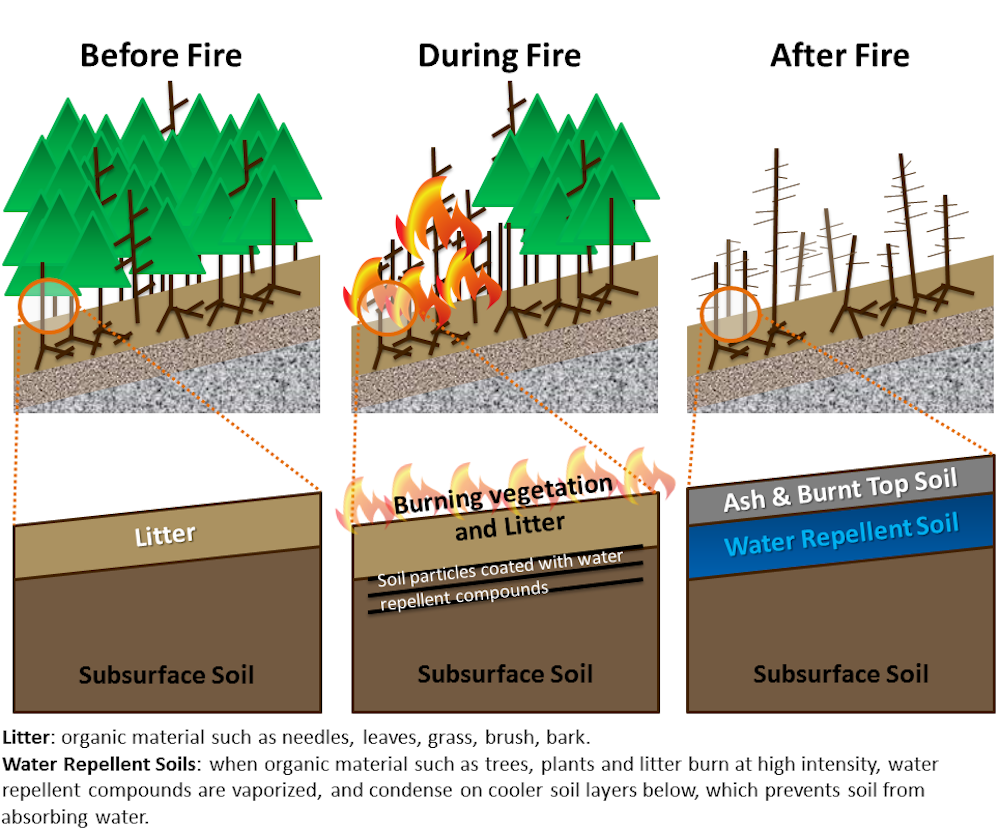
When severe fires burn hillslopes, the high heat from the fires, sometimes exceeding 1,000 degrees Fahrenheit (538 degrees Celsius), completely destroys trees, shrubs, grass and structures, leaving behind a moonscape of gray ash. Not only that, the heat of the fire actually burns and damages the soil, creating a water-repellent, or hydrophobic, layer.
What once was a vegetated hillslope, with leaves and trees to intercept rain and spongy soils to absorb water, is transformed into a barren landscape covered with ash, and burned soil where water cannot soak in.
When rain does fall on a burned area like this, water mixes with the ash, rocks and sediment to form a slurry. This slurry of debris then pours downhill in small gullies called rills, which then converge to form bigger and bigger rills, creating a torrent of sediment, water and debris rushing downhill. All this debris and water can transform small streams and usually dry gullies into a danger zone.
Because the concentration of sediment is so high, especially when there is a large amount of ash and clay, debris flows behave more like a slurry of wet cement than a normal stream. This fluid can pick up and move large boulders, cars, trees and other debris rapidly downhill.
In January 2018, a few weeks after the Thomas fire burned through the hills above Montecito, a storm triggered debris flows that killed 23 people and damaged at least 400 homes.
Fire and debris flow scientists with the U.S. Geological Survey use these variables to create models to predict the likelihood and possible hazards from postfire debris flows. They are already developing maps to help residents, emergency managers and city officials prepare and predict postfire debris flows in 2025 burn areas in Los Angeles.
The U.S. Geological Survey modeled debris flow risks after the Palisades Fire near Los Angeles. The map shows some of the highest-risk areas if hit by 15 minutes of rain falling at just under 1 inch (24 millimeters) per hour. USGS
Some of the triggers of debris flows are literally part of the landscape.
For example, the slope angle in a watershed and the amount of clay in the soil are important. Watersheds with gentle slopes – generally less than about 23 degrees – and a lack of clay and silt-sized particles are unlikely to produce debris flows.
Other key factors that contribute to postfire debris flows relate to the proportion of the watershed that is severely burned and the intensity and duration of the rainstorm event.
Early important research in the field of pyrogeomorphology demonstrated that while large, intense storms are more likely to cause large, intense debris flows, even small rainstorms can produce debris flows in burned areas.
Debris flows are becoming more common
A whopping 21.8 million Americans live within 3 miles of where a fire burned during the past two decades, and that population more than doubled from 2000 to 2019. A recent study from central and northern California indicates that nearly all the observed increases in area burned by wildfires in recent decades are due to human-caused climate change.
The warming climate is also increasing the likelihood of more extreme downpours. The amount of moisture the atmosphere can hold increases by about 7% per degree Celsius of warming, leading to more intense downpours, particularly from ocean storms. In California, scientists project increases in rainfall intensity of 18% will result in an overall 110% increase in the probability of major debris flows.
Jon Frye, of Santa Barbara Public Works, shows what happened in the January 2018 Montecito debris flow and why the risks to downslope communities would continue for several years. Source: County of Santa Barbara, 2018.
Studies using models of fire, climate and erosion rates estimate that the amount of sediment flowing downhill after fires will increase by more than 10% in nine out of every 10 watersheds in the western U.S.
Even without rain, debris on fire-damaged slopes can be unstable. A small slide in Pacific Palisades shortly after a fire burned through the area split a home in two. A phenomenon called “dry ravel” is a dominant form of hillslope erosion following wildfires in chaparral environments in Southern California
Preparing for debris flow risks
Research on charcoal pieces from ancient debris flows has shown fires and erosion have shaped Earth’s landscape for at least thousands of years. However, the rising risk of wildfires near populated areas and the potential for increasingly intense downpours mean a greater risk of damaging and potentially deadly debris flows.
As their populations expand, community planners need to be aware of those risks and prepare.
This article, originally published Jan. 23, 2025, has been updated with a flash flood watch issued.
Jen Pierce receives funding from the National Science Foundation and is the chair of the Quaternary Geology and Geomorphology division of the Geological Society of America.
Check against delivery.
Ladies and gentlemen,
I’m glad to join you today at the “Gesellschaftshaus Palmengarten”. Its history goes back to the 19th century. It was the “Gründerzeit” or “founders’ period” – an era of strong economic expansion in Germany – when this building was constructed. And when Germany was developed as an industrial location. Developed by people, men and women, lead by curiosity, innovation, and a desire to achieve.
We have to cast our minds back a few years to see times of growth, real innovation and increasing productivity in Europe.
1 The role of the financial industry
In the 2010s Germany had a period of solid growth that some called “the golden decade”.
Today, however, we see a need for growth and increasing productivity. Hence, our competitiveness is at stake. Not only in Germany, but also in other parts of Europe. And this comes at a time, when we are facing numerous major challenges:
Consider the significant geopolitical uncertainties of our time – which make a rethink necessary in many respects. Also consider the digitalisation of large parts of our economy, incl. disruptive AI. And think about the climate-related need for an ecological transformation.
Financing all of this requires a substantial amount of capital.
This is where the financial industry comes in: The financial industry can act as an enabler of growth in the real economy. Growth that is so much needed right now.
Looking forward, the financial industry could translate growth potential into real growth in many fields – digitalisation, AI, clean tech, pharma, biotech any many more.
In sum, there are huge business opportunities for Germany and the EU. And we need the Financial industry to take advantage of the business opportunities.
But let us not forget that innovation happens in many places – at start-ups but also at well established companies. We need to make sure that a variety of funding sources are available to support our real economies.
We need a specific financial ecosystem that enables young, innovative companies to flourish. Be it VC, PE, etc. We need established capital markets. Above all, we need a strong and healthy banking sector that supplies our economy with sufficient credit.
That means: We need both traditional loans and venture capital. In any case, all the pockets of the financial industry provide the basis for a growing economy. It’s also the basis for the ecological transformation.
The German Council of Experts on Climate Change published [a week ago] new figures on the investment needs estimated for the transition towards net-zero economic activity. Those investment needs range between 135 and 255 billion euro – each year for Germany alone.[1] That’s a lot.
Let’s now have a closer look at the digitalization including AI.
2 Artificial intelligence: innovation and competitiveness
The term artificial intelligence (AI) was coined in the middle of the 20th century. But it was the release of ChatGPT in November 2022 that marked a breakthrough. For the first time it became possible to use an AI system without detailed technical knowledge.
Nowadays almost anyone can use AI. The importance of responsible AI practices on the increase – as highlighted in the latest Declaration by the G20.[2]
There are important questions – to which, to be honest, there are no simple answers:
Are the opportunities and risks of AI balanced?
Does AI lead to a global fragmentation, to a new barrier between those who use AI and those who don’t?
Does AI, as a general-purpose technology, help us better manage economic challenges?[3]
One example of the latter point: Many societies are lacking skilled labour due to demographic change. Here, the use of AI could provide a solution by increasing efficiency or substituting human services. AI can also help drive innovation.
AI enables both incremental and disruptive innovation across all parts of society:
by facilitating faster decision-making
optimizing existing processes,
or by collecting, processing and using huge amounts of data.
It fosters creativity, supports scientific breakthroughs, and unlocks opportunities for entirely new industries and business models – a potential, albeit disruptive, growth engine.
Nevertheless, human creativity is still a key driver of innovation. In 2023, individuals or SMEs filed almost one in four patent applications in Europe.[4]
Today, we are at a crucial stage: With international competition on the one side and technical and intellectual skills on the other. AI models from the United States are well-known and often considered state of the art. China in particular has recently come up with new and apparently very efficient language models. However, the discussion about the background is not yet complete.
In Europe, we have to do our utmost to keep up with the pace. An important initiative recently came from France: In Paris the “EU AI Champions Initiative”, a high-level summit, was held at the beginning of this week.
President Macron mentioned a funding volume of roundabout € 109 billion for AI in France. This approach is very encouraging for other EU member states. By comparison: US-President Trump has mentioned USD 500 billion for his “Stargate” plan in the US.
Despite these substantial investments, there is no guarantee of success. On the other hand, we must not allow ourselves to be deterred by possible failures. One example is the French AI chatbot LUCIE, which has been taken offline after giving some weird answers. I am sure France will take this as a chance to try even harder.
The narrative with all kind of innovation is: Accept failure to grow. The pioneers of the “Gründerzeit” – which I mentioned earlier – knew this only too well.
We need this kind of courage to embrace a “culture of trial and error”. It provides an important impetus to do things better. On the other hand, we have to ensure that new technology does not cause severe damage. Especially because AI is a relatively new technology with unknown potential and consequences for the entire society.
Risks can arise for the financial system, but much further afield as well. Imagine, risk management or investment advice would be provided mainly by AI. Would this mean that investment recommendations are becoming more and more similar? Would we have concentration of risks? And what consequences would this have for financial stability?[5]
Even more far-reaching questions concern our society.
The core question is: What does AI mean for our democracies, for our constitutions, for our fundamental rights? Specifically, we need to ask ourselves: Where is AI beneficial and where do we need clear rules.
In other words: What are the basic rules for using this technology?
It is therefore necessary to find a compromise between having the courage to innovate – and clear rules.
3 Strengthening the financial industry
Regardless of how we deal with AI, we have to return to the issue of financing its development. As indicated earlier, the financial industry, as an enabler, has an important role to play.
Given the challenges of our time I mentioned earlier, it is vital to strengthen the European financial industry.
Let me highlight only two measures:
First, we need to get started on improving start-up funding. In 2024, more than 2,700 innovative start-ups were founded in Germany, the second-highest count after the record year of 2021. There is no shortage of innovative concepts and entrepreneurship per se, but implementation is lacking.
Further completing the European capital markets union (CMU) is essential in this respect – promoting the development of the VC and private equity market as well as exit options for start-ups. The European Commission’s “Competitiveness Compass”, published recently, 29 January 2025, is a good start.
Second, we need to leverage digital technologies to create efficient, integrated and resilient European financial markets. The digital CMU could be a game changer in this respect.
Let me make it perfectly clear: Europe is a leader in this field.
We at the Bundesbank are engaged in several initiatives. And we have a prominent role to play in the development of a central bank digital currency (wholesale CBDC).
4 Conclusion
Ladies and gentlemen, let me sum up: And I can be very brief, but still to the point.
The European Financial industry has to become an enabler of growth. Our Financial industry is key to ensure that the European economy stays competitive.
Thank you very much.
SINGAPORE, Feb. 12, 2025 (GLOBE NEWSWIRE) — Uni-Fuels Holdings Limited (NASDAQ: UFG), (“Uni-Fuels” or the “Company”), a global provider of marine fuel solutions headquartered in Singapore, today announced that the Company’s wholly owned subsidiary, Uni-Fuels Pte Ltd (“Uni-Fuels Singapore”), has received both ISCC EU and ISCC PLUS certifications from the International Sustainability and Carbon Certification (ISCC), a globally recognized independent multi-stakeholder initiative and leading certification system supporting sustainable, fully traceable, deforestation-free and climate-friendly supply chains. These certifications highlight the Company’s commitment to sustainability and compliance with European Union (EU) regulations aimed at reducing greenhouse gas (GHG) emissions in the maritime industry.
The ISCC certifications ensure that the biofuels traded by Uni-Fuels Singapore meet the requirements of the EU’s Renewable Energy Directive (RED II), including the provision of Proof of Sustainability (PoS). This important documentation ensures biofuels are sustainably sourced and produced, enabling full traceability from feedstock to final product.
As the maritime sector moves toward greater decarbonization, it is essential for biofuel suppliers to demonstrate compliance with regulatory standards, including the EU Emissions Trading System (EU ETS) and FuelEU Maritime. PoS documentation ensures biofuels can be counted toward emissions reduction targets, as opposed to being treated as fossil fuels.
Uni-Fuels Vice President, Operations Tan Guan Kai commented, “Achieving ISCC certifications demonstrates our commitment to supporting the global transition to cleaner fuels. With Proof of Sustainability documentation, we provide our customers with the assurance that the biofuels they rely on are responsibly produced and fully compliant with evolving regulations.”
The PoS framework, combined with the ISCC EU and ISCC PLUS certifications, ensures customers that the biofuels they use are responsibly sourced, traceable, and produced with sustainability in mind. These certifications provide both regulatory compliance and enhanced transparency, helping to build trust in the biofuel market.
About Uni-Fuels Holdings Limited
Uni-Fuels is a fast-growing global provider of marine fuel solutions, helping shipping companies optimize fuel procurement across all markets and time zones. Founded in 2021, Uni-Fuels has evolved from modest beginnings into a dynamic, forward-thinking company. Backed by a passionate team and a growing presence across multiple locations, it has forged trusted partnerships with customers, supporting them in achieving their operational objectives with confidence, from shore to shore.
This press release contains “forward-looking statements” within the meaning of the “safe harbor” provisions of the Private Securities Litigation Reform Act of 1995, including statements regarding the completion and timing of closing of the offering and the intended use of the proceeds. You can identify forward-looking statements by the fact that they do not relate strictly to historical or current facts. These statements may include words such as “anticipate”, “estimate”, “expect”, “project”, “plan”, “intend”, “believe”, “may”, “will”, “should”, “can have”, “likely” and other words and terms of similar meaning. Forward-looking statements represent Uni-Fuels’ current expectations regarding future events and are subject to known and unknown risks and uncertainties that could cause actual results to differ materially from those implied by the forward-looking statements. These statements are subject to uncertainties and risks including, but not limited to, the uncertainties related to market conditions and the completion of the initial public offering on the anticipated terms or at all, and other factors discussed in the “Risk Factors” section of the registration statement filed with the SEC. For these reasons, among others, investors are cautioned not to place undue reliance upon any forward-looking statements in this press release. Additional factors are discussed in the Company’s filings with the SEC, which are available for review at www.sec.gov. The Company undertakes no obligation to publicly revise these forward-looking statements to reflect events or circumstances that arise after the date hereof.
HOUSTON and NEW YORK, Feb. 12, 2025 (GLOBE NEWSWIRE) — Apollo (NYSE:APO), today announced that funds managed by Apollo affiliates (the “Apollo Funds”) have acquired a majority interest in Bold Production Services, LLC (“Bold” or the “Company”), a provider of production-linked, contracted natural gas treatment solutions that enable the downstream use of natural gas, while reducing excess emissions and waste through proprietary equipment design.
Founded in 2013, Bold’s fleet of 700+ owned assets, including dehydration units, H2S treating units and total flow coolers, serves a blue-chip customer base across the Permian and Eagle Ford basins. The investment from the Apollo Funds will support Bold’s continued growth as natural gas demand is expected to accelerate over the next decade, driven by secular trends associated with the industrial renaissance such as demand for power generation, LNG exports, data centers and other emerging natural gas applications. The Company will continue to be headquartered in Houston, Texas and led by Glen Wind, Chief Executive Officer, along with his team including Blake Maywald, President, Tim Burkett, Chief Financial Officer and Austin Traweek, Chief Operating Officer.
Glen Wind, CEO of Bold, commented, “We are excited to work with Apollo in our efforts to continue serving our customers seeking reliable gas treatment solutions that help improve operational efficiency. Producers value high performance, scalable treatment services, and Bold remains committed to delivering best-in-class solutions that drive safer, cleaner operations with improved production yields and lower emissions. We look forward to building on our momentum alongside Apollo in the years ahead. We would like to acknowledge and thank the OFS Energy Fund team for their involvement and support in helping us reach this point.”
Scott Browning, Partner at Apollo, said, “Bold has built a robust platform providing essential gas treatment solutions, with significant growth potential supported by strong customer relationships and attractive expansion opportunities. We are excited to partner with Glen, Blake and the rest of the Bold team in a market where we see the opportunity for significant investment given favorable secular tailwinds. Apollo brings deep expertise in the natural gas value chain and a proven track record supporting the growth of energy-related services that help to fuel the industrial renaissance.”
Over the past five years, Apollo-managed funds and affiliates have committed, deployed, or arranged approximately $58 billioni into climate and energy transition-related investments, supporting companies and projects across clean energy and infrastructure.
Vinson & Elkins LLP served as legal counsel to the Apollo Funds. Piper Sandler & Co. acted as financial advisor to Bold, and Troutman Pepper Locke, LLP served as Bold’s legal counsel. Bank OZK supported the transaction through a new credit facility.
About Bold Production Services, LLC
Bold Production Services, LLC is an oil & gas infrastructure resource company providing contract services in the treating and removal of impurities found in natural gas, oil, and water. Bold has grown its asset base to include production and treating equipment, as well as a non-triazine based H2S chemical scavenger. To learn more, please visit www.bps-llc.com.
About Apollo Global Management, Inc.
Apollo is a high-growth, global alternative asset manager. In our asset management business, we seek to provide our clients excess return at every point along the risk-reward spectrum from investment grade to private equity with a focus on three investing strategies: yield, hybrid, and equity. For more than three decades, our investing expertise across our fully integrated platform has served the financial return needs of our clients and provided businesses with innovative capital solutions for growth. Through Athene, our retirement services business, we specialize in helping clients achieve financial security by providing a suite of retirement savings products and acting as a solutions provider to institutions. Our patient, creative, and knowledgeable approach to investing aligns our clients, businesses we invest in, our employees, and the communities we impact, to expand opportunity and achieve positive outcomes. As of December 31, 2024, Apollo had approximately $751 billion of assets under management. To learn more, please visit www.apollo.com.
Contact Information
Noah Gunn Global Head of Investor Relations Apollo Global Management, Inc. (212) 822-0540 IR@apollo.com
Joanna Rose Global Head of Corporate Communications Apollo Global Management, Inc. (212) 822-0491 Communications@apollo.com
___________________________
i As of December 31, 2024. The firmwide targets (the “Targets”) to deploy, commit, or arrange capital commensurate with Apollo’s proprietary Climate and Transition Investment Framework (the “CTIF”), are (1) $50 billion by 2027 and (2) more than $100 billion by 2030 The CTIF, which is subject to change at any time without notice, sets forth certain activities classified by Apollo as sustainable economic activities (“SEAs”), and the methodologies used to calculate contribution towards the Targets. Only investments determined to be currently contributing to an SEA in accordance with the CTIF are counted toward the Targets. Under the CTIF, Apollo uses different calculation methodologies for different types of investments in equity, debt and real estate. For additional details on the CTIF, please refer to our website here: https://www.apollo.com/strategies/asset-management/real-assets/sustainable-investing-platform.
What you need to know: Across all of state government, highly-specialized personnel and response equipment are on the ground working to protect communities statewide from storm impacts.
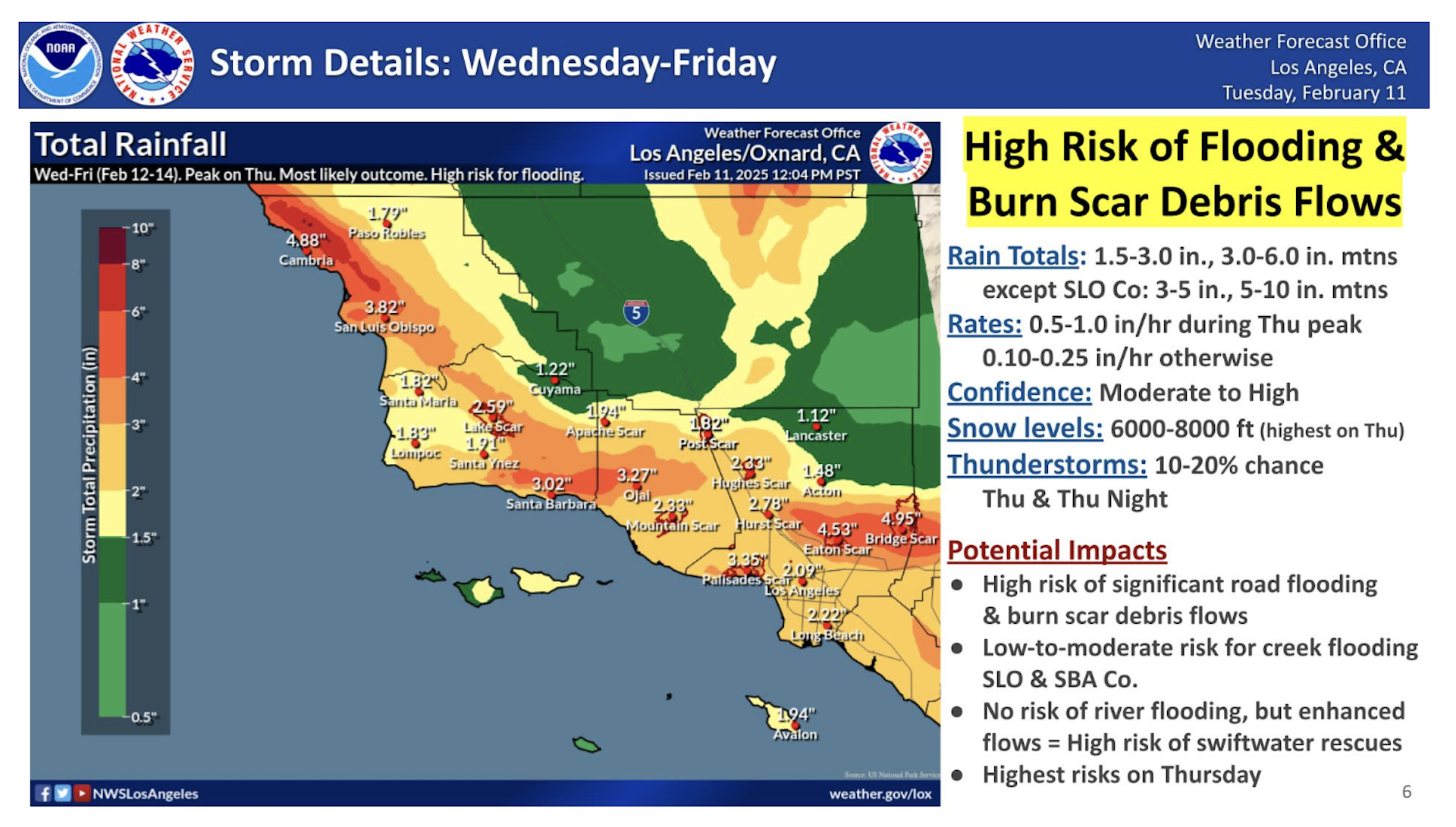
Los Angeles, California – With another significant winter storm system expected to reach California later this week, work continues statewide to ensure communities impacted by recent wildfires – including the firestorms in Los Angeles – are protected.
To prepare for this storm, Governor Gavin Newsom is directing a whole-of-government response to bolster local resources.
In Altadena today, Governor Newsom and First Partner Jennifer Siebel Newsom surveyed ongoing work by state crews to prepare the Eaton Fire burn scar area ahead of rain.
At Governor Newsom’s direction, the state has installed emergency protection materials to contain burn scar debris from the Eaton and Palisades fires from entering creeks, rivers, and other bodies of water. The state is coordinating locally requested materials such as K-rails (concrete barriers) to divert debris flow and has completed debris basin clean-up activities over the last month to mitigate potential impacts in vulnerable areas.
California has been in a constant state of readiness preparing for extreme winter weather. Crews have been on the ground for weeks working to secure areas against possible mudslides and debris flows. If you’re in the storm’s path, please remain vigilant and follow all guidance of local authorities.
Governor Gavin Newsom
California is monitoring storm impacts, in particular to burn scar areas that pose the threat of mudslides and debris flows. According to the National Weather Service, this storm system will bring far-reaching impacts across the state, including risks of urban flooding and burn scar impacts in Southern California, high winds and heavy snow.
State actions to protect communities include:
319,000 sandbags and 5,600 super sacks have been deployed to Southern California locations through the Department of Water Resources (DWR).
242 total CAL FIRE engines are deployed throughout the state to rapidly respond, including 109 engines CAL FIRE Southern Region and 133 engines CAL FIRE Northern Region.
Cal OES has prepositioned flood fighting and debris flow resources and more than 400 personnel in 8 counties, including Colusa, Fresno, Los Angeles, Orange, Glenn, Tulare, Ventura and Santa Barbara. In total the state is deploying through the Fire and Rescue Mutual Aid System the following:
48 fire engines
8 dozers
5 helicopters
8 dispatchers
6 hand crews
8 swiftwater rescue teams
3 local Incident Management Teams
1 Regional Task Force
2 excavators
2 loaders
5 heavy rescue teams
Nearly 120 miles of emergency protection materials, including straw wattle, compost sock and silt fencing, have been installed through the California Conservation Corps to contain burn scar debris from entering creeks, rivers and other bodies of water.
30 watershed protection specialists have been deployed to burn scar areas.
Caltrans is placing erosion-control devices, including wattles, to limit mudflows. Caltrans is mobilizing crew members to monitor for rocks and other debris falling from burned slopes on the Pacific Coast Highway and Topanga Canyon Boulevard.
14 geologists are deployed to study and map burn scars of the Palisades, Eaton and Kenneth fires. The California Geological Survey is using this information to determine where debris flow could occur and where to install mitigation. The department also coordinated aerial flights over the scars to gather LiDAR data to further study burn areas for possible debris flow.
70 soldiers and heavy engineering equipment through the California National Guard are deployed in the area to support debris removal efforts.
The California Department of Social Services is coordinating with local partners on shelters and warming centers to serve impacted communities.
The California Department of Public Health is supporting licensed healthcare facilities.
These early actions add on to the work the state has done in recent weeks to protect California communities and boost the state’s water supply. On January 31, the Governor signed an executive order to direct state agencies to direct additional water storage by maximizing excess water from winter storms.
Residents in affected areas are urged to stay informed about potential debris flow risks, especially during storms, and to follow guidance from local emergency officials. For resources and information specific to the Los Angeles firestorms, visit CA.gov/LAfires.
Preparing for upcoming weather
On Thursday, rainfall rates could approach 1” per hour near thunderstorms. In addition, there’s anticipated heavy mountain snow, with levels dropping to 2,000-3,000 feet across the north and down to 6,500 feet in the far south. Parts of the state will see wind gusts of 35-55 mph in Central and Southern California.
The incoming storm could bring an increased risk of power outages, flooding in small streams and low-lying areas, and debris, rocks and mudslides on roadways.
Residents are encouraged to not drive through flooded roadways, prepare in advance for power outages and reduce injury risks from falling limbs and trees by staying inside during high wind events.
Residents are urged to stay informed and listen to local authorities about actions they should take including evacuation orders or safety recommendations. In burn scar areas, officials recommend preparing for possible sudden debris flows by having a go-bag packed and knowing evacuation routes.
For more information on winter storm preparedness visit ready.ca.gov.
Recent news
Feb 11, 2025
News What you need to know: Governor Gavin Newsom issued an executive order today ordering the state to ensure that childcare providers impacted by the recent wildfires in Los Angeles are aware of their potential eligibility for Disaster Unemployment Assistance and…
Feb 11, 2025
News What you need to know: The fastest large-scale debris removal in modern state history began today in Altadena and the Pacific Palisades, in roughly half the time it took to start similar operations after the devastating 2018 Woolsey Fire. LOS ANGELES – Governor…
Feb 10, 2025
News What you need to know: The state continues to upgrade CA.gov/LAfires to provide more resources and information for firestorm survivors. LOS ANGELES – Governor Gavin Newsom today announced new efforts to provide accountability with ongoing Los Angeles firestorm…
Q4 Revenue of $78.1million, GAAP Operating Income of $12.8million and Adjusted EBITDA of $12.1million
2024Revenue of $305.4million, GAAP Operating Income of $27.7million anda 25-yearRecordAdjusted EBITDA of $42.2million
Expects 2025 Revenues to increase by36%-50%
Announces New Reporting Segments
PETAH TIKVA, Israel, Feb. 12, 2025 (GLOBE NEWSWIRE) — Gilat Satellite Networks Ltd. (NASDAQ: GILT, TASE: GILT), a worldwide leader in satellite networking technology, solutions and services, today reported its unaudited results for the fourth quarter and full year ended December 31, 2024.
Fourth Quarter 2024Financial Highlights
Revenue of $78.1 million, up 3% compared with $75.6 million in Q4 2023;
GAAP operating income of $12.8 million, compared with $2.9 million in Q4 2023;
Non-GAAP operating income of $9.7 million, compared with $6.1 million in Q4 2023;
GAAP net income of $11.8 million, or $0.21 per diluted share, compared with $3.4 million, or $0.06 per diluted share, in Q4 2023;
Non-GAAP netincome of $8.5 million, or $0.15 per diluted share, compared with $6.5 million, or $0.11 per diluted share, in Q4 2023;
Adjusted EBITDA of $12.1 million, up 30% compared with $9.4 million in Q4 2023.
Full year 2024Financial Highlights
Revenue of $305.4 million, up 15% compared with $266.1 million in 2023;
GAAP operating income of $27.7 million, compared with $28.1 million in 2023;
Non-GAAP operating income of $31.9 million, up 35% compared with $23.5 million in 2023;
GAAP net income of $24.8 million, or $0.44 per diluted share, compared with $23.5 million, or $0.41 per diluted share in 2023;
Non-GAAP net income of $28.2 million, or $0.49 per diluted share, compared with $19.9 million, or $0.35 per diluted share 2023;
Adjusted EBITDA was $42.2 million, up 16% compared with adjusted EBITDA of $36.4 million in 2023.
2025 Guidance
Management’s financial guidance for 2025 is for revenues of between $415 to $455 million, and Adjusted EBITDA is expected to be between $47 to $53 million1.
Adi Sfadia, Gilat’s CEO, commented, “Gilat delivered strong results with profitability of Adjusted EBITDA of $12.1 million for the fourth quarter and $42.2 million for the entire year. These results alongside our strong generation of cash flow underscore the strength and resilience of our core business model, demonstrating both operating leverage and the positive impact of our current product revenue mix.”
“During the fourth quarter our Defense and In-Flight Connectivity business continued to experience strong momentum with increased orders and awards. The Defense segment, with a focus on the US DoD, represents a significant growth opportunity for Gilat. We are pleased with our progress in expanding opportunities to serve the specialized needs of government and military customers with our innovative satellite solutions,” Mr. Sfadia continued. “With the closing of the Stellar Blu acquisition, our Commercial business is poised for significant growth as we establish our leadership in the expanding Electronically Steerable Antenna (ESA) market. Our portfolio of IFC GEO, LEO and multi-orbit solutions will be instrumental in capitalizing on increasing demand for inflight connectivity by airlines and passengers.”
Mr. Sfadia concluded, “Looking ahead into 2025, given the significant potential we see in the defense market and our view of this as a strategic growth engine, we plan to increase our investment in R&D, Sales and Marketing of the Defense Segment. We believe that this targeted increase will allow us to take advantage of the opportunities we see quicker and more decisively to ensure a long term growth in this market. Coupled with our recent acquisitions and positioning in the Satcom market, Gilat has the resource base to scale the IFC and Defense businesses and our track record of profitable, cash generating growth, provides a strong foundation for Gilat’s continued success.”
Commencing January 1, 2025, the company has implemented a new organizational structure and reportable segments. The new organizational structure and segment reporting are designed to better target the diverse and attractive end markets the company serves and to provide investors with greater insight into Gilat’s business lines and strategic growth opportunities. The company will report financial results based on the following three divisions: Gilat Defense, Gilat Commercial and Gilat Peru.
Gilat Defense Division: provides secure, rapid-deployment solutions for military organizations, government agencies, and defense integrators, with a strong focus on the U.S. Department of Defense resulting from our strategic acquisition of DataPath Inc. By integrating technologies from Gilat, Gilat DataPath, and Gilat Wavestream, the division delivers resilient battlefield connectivity with multiple layers of communication redundancy for high availability.
Gilat Commercial Division: provides advanced broadband satellite communication networks for IFC, Enterprise and Cellular Backhaul, supporting HTS, VHTS, and NGSO constellations with turnkey solutions for service providers, satellite operators, and enterprises. Our acquisition of Stellar Blu serves as the cornerstone of this division, strengthening our position in the IFC market and enabling us to provide cutting-edge connectivity solutions that meet the demands of passengers, airlines, and service providers worldwide.
Gilat Peru Division: specializes in end-to-end telco solutions, including the operation and implementation of large-scale network projects. With expertise in terrestrial fiber optic, wireless, and satellite networks, Gilat Peru provides technology integration, managed networks and services, connectivity solutions, and reliable internet and voice access across the region.
Gilat has prepared unaudited illustrations of the company’s financial reports for Fiscal Years 2023 and 2024 to reflect the company’s results based on the new segment reporting, which can be found in the IR section on Gilat’swebsite. For additional information about Gilat’s new divisional structure, please click here: Link
Key Recent Announcements
Gilat Secures Over $18 Million Orders Addressing Demand for In-Flight Connectivity Solutions
Gilat Receives $9 Million in Orders for Multi-Orbit SkyEdge Platforms
Gilat Completes Acquisition of Stellar Blu Solutions LLC
Gilat and Hispasat Provided Immediate Satellite Communication to Support Disaster Recovery Efforts After Hurricane Helene
Gilat Receives Over $3 Million in Orders to Support LEO Constellations
Gilat Awarded Over $5 Million in orders to Support Critical Connectivity for Defense Forces
Gilat Receives $4M in Orders for Advanced Portable Terminals from Global Defense Customers
Conference Call Details
Gilat’s Management will discuss its fourth quarter and full year 2024 results and business achievements and participate in a question-and-answer session:
The webcast will also be archived for a period of 30 days on the Company’s website and through the link above.
Non-GAAP Measures
The attached summary unaudited financial statements were prepared in accordance with U.S. Generally Accepted Accounting Principles (GAAP). To supplement the consolidated financial statements presented in accordance with GAAP, the Company presents non-GAAP presentations of gross profit, operating expenses, operating income, income before taxes on income, net income, Adjusted EBITDA, and earnings per share. The adjustments to the Company’s GAAP results are made with the intent of providing both management and investors with a more complete understanding of the Company’s underlying operational results, trends, and performance. Non-GAAP financial measures mainly exclude, if and when applicable, the effect of stock-based compensation expenses, amortization of purchased intangibles, lease incentive amortization, other non-recurring expenses, other integration expenses, other operating expenses (income), net, and income tax effect on the relevant adjustments.
Adjusted EBITDA is presented to compare the Company’s performance to that of prior periods and evaluate the Company’s financial and operating results on a consistent basis from period to period. The Company also believes this measure, when viewed in combination with the Company’s financial results prepared in accordance with GAAP, provides useful information to investors to evaluate ongoing operating results and trends. Adjusted EBITDA, however, should not be considered as an alternative to operating income or net income for the period and may not be indicative of the historic operating results of the Company; nor is it meant to be predictive of potential future results. Adjusted EBITDA is not a measure of financial performance under GAAP and may not be comparable to other similarly titled measures for other companies. Reconciliation between the Company’s net income and adjusted EBITDA is presented in the attached summary financial statements.
Non-GAAP presentations of gross profit, operating expenses, operating income, income before taxes on income, net income, adjusted EBITDA and earnings per share should not be considered in isolation or as a substitute for any of the consolidated statements of operations prepared in accordance with GAAP, or as an indication of Gilat’s operating performance or liquidity.
About Gilat
Gilat Satellite Networks Ltd. (NASDAQ: GILT, TASE: GILT) is a leading global provider of satellite-based broadband communications. With over 35 years of experience, we develop and deliver deep technology solutions for satellite, ground, and new space connectivity, offering next-generation solutions and services for critical connectivity across commercial and defense applications. We believe in the right of all people to be connected and are united in our resolution to provide communication solutions to all reaches of the world.
Together with our wholly-owned subsidiaries—Gilat Wavestream, Gilat DataPath, and Gilat Stellar Blu—we offer integrated, high-value solutions supporting multi-orbit constellations, Very High Throughput Satellites (VHTS), and Software-Defined Satellites (SDS) via our Commercial and Defense Divisions. Our comprehensive portfolio is comprised of a cloud-based platform and modems; high-performance satellite terminals; advanced Satellite On-the-Move (SOTM) antennas and ESAs; highly efficient, high-power Solid State Power Amplifiers (SSPA) and Block Upconverters (BUC) and includes integrated ground systems for commercial and defense markets, field services, network management software, and cybersecurity services.
Gilat’s products and tailored solutions support multiple applications including government and defense, IFC and mobility, broadband access, cellular backhaul, enterprise, aerospace, broadcast, and critical infrastructure clients all while meeting the most stringent service level requirements. For more information, please visit: http://www.gilat.com
Certain statements made herein that are not historical are forward-looking within the meaning of the Private Securities Litigation Reform Act of 1995. The words “estimate”, “project”, “intend”, “expect”, “believe” and similar expressions are intended to identify forward-looking statements. These forward-looking statements involve known and unknown risks and uncertainties. Many factors could cause the actual results, performance or achievements of Gilat to be materially different from any future results, performance or achievements that may be expressed or implied by such forward-looking statements, including, among others, changes in general economic and business conditions, inability to maintain market acceptance to Gilat’s products, inability to timely develop and introduce new technologies, products and applications, rapid changes in the market for Gilat’s products, loss of market share and pressure on prices resulting from competition, introduction of competing products by other companies, inability to manage growth and expansion, loss of key OEM partners, inability to attract and retain qualified personnel, inability to protect the Company’s proprietary technology and risks associated with Gilat’s international operations and its location in Israel, including those related to the terrorist attacks by Hamas, and the hostilities between Israel and Hamas and Israel and Hezbollah. For additional information regarding these and other risks and uncertainties associated with Gilat’s business, reference is made to Gilat’s reports filed from time to time with the Securities and Exchange Commission. We undertake no obligation to update or revise any forward-looking statements for any reason.
_________________ 1 We do not provide forward-looking guidance on a GAAP basis because we are unable to reasonably provide forward-looking guidance for certain financial data, such as amortization of purchased intangibles and earnout-based expenses related to recent acquisitions. As a result, we are not able to provide a reconciliation of GAAP to non-GAAP financial measures for forward-looking data without unreasonable effort.
GILAT SATELLITE NETWORKS LTD.
CONSOLIDATED STATEMENTS OF INCOME
U.S. dollars in thousands (except share and per share data)
Twelve months ended
Three months ended
December 31,
December 31,
2024
2023
2024
2023
Unaudited
Audited
Unaudited
Revenues
$
305,448
$
266,090
$
78,128
$
75,612
Cost of revenues
192,117
161,145
47,107
46,692
Gross profit
113,331
104,945
31,021
28,920
Research and development expenses, net
38,136
41,173
10,108
11,624
Selling and marketing expenses
27,381
25,243
6,657
7,119
General and administrative expenses
26,868
19,215
6,192
6,312
Other operating expenses (income), net
(6,751
)
(8,771
)
(4,706
)
986
Total operating expenses
85,634
76,860
18,251
26,041
Operating income
27,697
28,085
12,770
2,879
Financial income, net
1,504
109
63
1,196
Income before taxes on income
29,201
28,194
12,833
4,075
Taxes on income
(4,352
)
(4,690
)
(1,069
)
(628
)
Net income
$
24,849
$
23,504
$
11,764
$
3,447
Earnings per share (basic and diluted)
$
0.44
$
0.41
$
0.21
$
0.06
Weighted average number of shares used in
computing earnings per share
Basic
57,016,920
56,668,999
57,017,032
56,820,774
Diluted
57,016,920
56,672,537
57,017,032
56,820,774
GILAT SATELLITE NETWORKS LTD.
RECONCILIATION BETWEEN GAAP AND NON-GAAP CONSOLIDATED STATEMENTS OF INCOME
FOR COMPARATIVE PURPOSES
U.S. dollars in thousands (except share and per share data)
Three months ended
Three months ended
December 31, 2024
December 31, 2023
GAAP
Adjustments (*)
Non-GAAP
GAAP
Adjustments (*)
Non-GAAP
Unaudited
Unaudited
Gross profit
$
31,021
$
575
$
31,596
$
28,920
$
617
$
29,537
Operating expenses
18,251
3,680
21,931
26,041
(2,615
)
23,426
Operating income
12,770
(3,105
)
9,665
2,879
3,232
6,111
Income before taxes on income
12,833
(3,105
)
9,728
4,075
3,232
7,307
Net income
$
11,764
$
(3,252
)
$
8,512
$
3,447
$
3,097
$
6,544
Basic earnings per share
$
0.21
$
(0.06
)
$
0.15
$
0.06
$
0.06
$
0.12
Diluted earnings per share
$
0.21
$
(0.06
)
$
0.15
$
0.06
$
0.05
$
0.11
Weighted average number of shares used in
computing earnings per share
Basic
57,017,032
57,017,032
56,820,774
56,820,774
Diluted
57,017,032
57,024,316
56,820,774
56,987,939
(*)
Adjustments reflect the effect of stock-based compensation expenses as per ASC 718, amortization of purchased intangibles, other operating income (expenses), net,other integration expenses and income tax effect on such adjustments which is calculated using the relevant effective tax rate.
Three months ended
Three months ended
December 31, 2024
December 31, 2023
Unaudited
Unaudited
GAAP net income
$
11,764
$
3,447
Gross profit
Stock-based compensation expenses
133
129
Amortization of purchased intangibles
389
448
Other integration expenses
53
40
575
617
Operating expenses
Stock-based compensation expenses
653
796
Stock-based compensation expenses related to business combination
140
662
Amortization of purchased intangibles
216
162
Other operating income (expenses), net and other integration expenses
(4,689
)
995
(3,680
)
2,615
Taxes on income
(147
)
(135
)
Non-GAAP net income
$
8,512
$
6,544
GILAT SATELLITE NETWORKS LTD.
RECONCILIATION BETWEEN GAAP AND NON-GAAP CONSOLIDATED STATEMENTS OF INCOME
FOR COMPARATIVE PURPOSES
U.S. dollars in thousands (except share and per share data)
Twelve months ended
Twelve months ended
December 31, 2024
December 31, 2023
GAAP
Adjustments (*)
Non-GAAP
GAAP
Adjustments (*)
Non-GAAP
Unaudited
Audited
Unaudited
Gross profit
$
113,331
$
3,673
$
117,004
$
104,945
$
895
$
105,840
Operating expenses
85,634
(500
)
85,134
76,860
5,434
82,294
Operating income
27,697
4,173
31,870
28,085
(4,539
)
23,546
Income before taxes on income
29,201
4,173
33,374
28,194
(4,539
)
23,655
Net income
$
24,849
$
3,376
$
28,225
$
23,504
$
(3,597
)
$
19,907
Basic earnings per share
$
0.44
$
0.06
$
0.50
$
0.41
$
(0.06
)
$
0.35
Diluted earnings per share
$
0.44
$
0.05
$
0.49
$
0.41
$
(0.06
)
$
0.35
Weighted average number of shares used in
computing earnings per share
Basic
57,016,920
57,016,920
56,668,999
56,668,999
Diluted
57,016,920
57,041,778
56,672,537
56,784,601
(*)
Adjustments reflect the effect of stock-based compensation expenses as per ASC 718, amortization of purchased intangibles, other operating income, net, other non-recurring expenses, other integration expenses and income tax effect on such adjustments which is calculated using the relevant effective tax rate.
Twelve months ended
Twelve months ended
December 31, 2024
December 31, 2023
Unaudited
Unaudited
GAAP net income
$
24,849
$
23,504
Gross profit
Stock-based compensation expenses
518
407
Amortization of purchased intangibles
2,412
448
Other non-recurring expenses
466
–
Other integration expenses
277
40
3,673
895
Operating expenses
Stock-based compensation expenses
2,771
2,354
Stock-based compensation expenses related to business combination
3,437
662
Amortization of purchased intangibles
988
312
Other operating income, net and other integration expenses
(6,696
)
(8,762
)
500
(5,434
)
Taxes on income
(797
)
942
Non-GAAP net income
$
28,225
$
19,907
GILAT SATELLITE NETWORKS LTD.
SUPPLEMENTAL INFORMATION
U.S. dollars in thousands
ADJUSTED EBITDA:
Twelve months ended
Three months ended
December 31,
December 31,
2024
2023
2024
2023
Unaudited
Unaudited
GAAP net income
$
24,849
$
23,504
$
11,764
$
3,447
Adjustments:
Financial income, net
(1,504
)
(109
)
(63
)
(1,196
)
Taxes on income
4,352
4,690
1,069
628
Stock-based compensation expenses
3,289
2,761
786
925
Stock-based compensation expenses related to business combination
3,437
662
140
662
Depreciation and amortization (*)
13,777
13,627
3,068
3,862
Other operating expenses (income), net
(6,751
)
(8,771
)
(4,706
)
986
Other non-recurring expenses
466
–
–
–
Other integration expenses
332
49
70
49
Adjusted EBITDA
$
42,247
$
36,413
$
12,128
$
9,363
(*) Including amortization of lease incentive
SEGMENT REVENUES:
Twelve months ended
Three months ended
December 31,
December 31,
2024
2023
2024
2023
Unaudited
Audited
Unaudited
Satellite Networks
$
198,174
$
168,527
$
49,064
$
53,517
Integrated Solutions
54,925
46,133
17,257
9,503
Network Infrastructure and Services
52,349
51,430
11,807
12,592
Total revenues
$
305,448
$
266,090
$
78,128
$
75,612
GILAT SATELLITE NETWORKS LTD.
CONSOLIDATED BALANCE SHEETS
U.S. dollars in thousands
December 31,
December 31,
2024
2023
Unaudited
Audited
ASSETS
CURRENT ASSETS:
Cash and cash equivalents
$
119,384
$
103,961
Restricted cash
853
736
Trade receivables, net
53,554
44,725
Contract assets
20,987
28,327
Inventories
38,890
38,525
Other current assets
21,963
24,299
Total current assets
255,631
240,573
LONG-TERM ASSETS:
Restricted cash
12
54
Long-term contract assets
8,146
9,283
Severance pay funds
5,966
5,737
Deferred taxes
11,896
11,484
Operating lease right-of-use assets
6,556
5,105
Other long-term assets
5,288
9,544
Total long-term assets
37,864
41,207
PROPERTY AND EQUIPMENT, NET
70,834
74,315
INTANGIBLE ASSETS, NET
12,925
16,051
GOODWILL
52,494
54,740
TOTAL ASSETS
$
429,748
$
426,886
GILAT SATELLITE NETWORKS LTD.
CONSOLIDATED BALANCE SHEETS (Cont.)
U.S. dollars in thousands (except share data)
December 31,
December 31,
2024
2023
Unaudited
Audited
LIABILITIES AND SHAREHOLDERS’ EQUITY
CURRENT LIABILITIES:
Short-term debt
$
–
$
7,453
Trade payables
17,107
13,873
Accrued expenses
45,368
51,906
Advances from customers and deferred revenues
18,587
34,495
Operating lease liabilities
2,557
2,426
Other current liabilities
17,817
16,431
Total current liabilities
101,436
126,584
LONG-TERM LIABILITIES:
Long-term loan
2,000
2,000
Accrued severance pay
6,677
6,537
Long-term advances from customers and deferred revenues
580
1,139
Operating lease liabilities
4,014
3,022
Other long-term liabilities
10,606
12,916
Total long-term liabilities
23,877
25,614
SHAREHOLDERS’ EQUITY:
Share capital – ordinary shares of NIS 0.2 par value
2,733
2,733
Additional paid-in capital
943,294
937,591
Accumulated other comprehensive loss
(6,120
)
(5,315
)
Accumulated deficit
(635,472
)
(660,321
)
Total shareholders’ equity
304,435
274,688
TOTAL LIABILITIES AND SHAREHOLDERS’ EQUITY
$
429,748
$
426,886
GILAT SATELLITE NETWORKS LTD.
CONSOLIDATED STATEMENTS OF CASH FLOWS
U.S. dollars in thousands
Twelve months ended
Three months ended
December 31,
December 31,
2024
2023
2024
2023
Unaudited
Audited
Unaudited
Cash flows from operating activities:
Net income
$
24,849
$
23,504
$
11,764
$
3,447
Adjustments required to reconcile net income to net cash provided by operating activities:
Depreciation and amortization
13,554
13,402
3,012
3,805
Capital gain from sale of property
–
(2,084
)
–
–
Stock-based compensation *)
6,726
3,423
926
1,587
Accrued severance pay, net
(89
)
167
(72
)
12
Deferred taxes, net
1,834
2,662
298
(1,203
)
Decrease (increase) in trade receivables, net
(9,347
)
13,448
(2,328
)
9,561
Decrease (increase) in contract assets
8,519
(1,694
)
11,506
(7,804
)
Decrease (increase) in other assets and other adjustments (including
short-term, long-term and effect of exchange rate changes on cash and cash equivalents)
11,661
(351
)
8,590
(3,949
)
Decrease (increase) in inventories, net
(1,928
)
(2,387
)
544
3,798
Increase (decrease) in trade payables
3,196
(7,635
)
(1,884
)
(2,314
)
Increase (decrease) in accrued expenses
(5,906
)
735
(8,581
)
3,517
Increase (decrease) in advances from customers and deferred revenues
(16,390
)
803
(4,228
)
(1,843
)
Increase (decrease) in other liabilities
(5,010
)
(12,049
)
(3,265
)
1,343
Net cash provided by operating activities
31,669
31,944
16,282
9,957
Cash flows from investing activities:
Purchase of property and equipment
(6,610
)
(10,746
)
(2,515
)
(2,090
)
Acquisitions of subsidiary, net of cash acquired
–
(4,107
)
–
(4,107
)
Receipts from sale of property
–
2,168
–
–
Net cash used in investing activities
(6,610
)
(12,685
)
(2,515
)
(6,197
)
Cash flows from financing activities:
Repayment of credit facility, net
(7,453
)
(1,590
)
–
(1,590
)
Repayments of short-term debts
(7,836
)
–
(3,793
)
–
Proceeds from short-term debts
7,836
–
1,066
–
Costs associated with entering into a long-term debt
(654
)
–
(654
)
–
Net cash used in financing activities
(8,107
)
(1,590
)
(3,381
)
(1,590
)
Effect of exchange rate changes on cash, cash equivalents and restricted cash
(1,454
)
(63
)
(896
)
2,288
Increase in cash, cash equivalents and restricted cash
15,498
17,606
9,490
4,458
Cash, cash equivalents and restricted cash at the beginning of the period
104,751
87,145
110,759
100,293
Cash, cash equivalents and restricted cash at the end of the period
$
120,249
$
104,751
$
120,249
$
104,751
*)
Stock-based compensation including expenses related to business combination in the amounts of $3,437 and $662 for the twelve months ended December 31, 2024 and 2023, respectively.
Stock-based compensation including expenses related to business combination in the amounts of $140 and $662 for the three months ended December 31, 2024 and 2023, respectively.
Source: United Kingdom – Executive Government & Departments
This joint statement was released following the meeting between UK Energy Secretary, Ed Miliband and India’s Minister of Power, Manohar Lal.
The Fourth India-UK Energy Dialogue, co-chaired by Shri Manohar Lal, Union Minister of Power, India and Mr Ed Miliband, Secretary for Energy Security and Net Zero for United Kingdom, was held in, New Delhi on Monday 10th February, 2025.
The dialogue focused on reviewing progress made in the energy sectors of both nations, including power and renewable energy, and reaffirming the commitment to a sustainable, resilient, and inclusive energy future. including across the breadth of sectors represented. They expressed satisfaction over the progress made to support green and sustainable growth, alongside accelerating the clean energy transition and ensuring energy security. The Ministers underscored the importance of ensuring that the energy transition and economic growth proceed together, while maintaining affordable and clean energy access for all.
The Ministers underscored the importance of ensuring energy security and sustainable development and emphasised expanding the cooperation in the areas of power distribution, sector reforms, industrial energy efficiency and de-carbonisation, and electric mobility while exploring new opportunities in the emerging fields such as energy storage, green data centres, and offshore wind, with an increased focus on MSMEs.
The Ministers were pleased to announce the launch of Phase-2 of the India-UK bilateral Accelerating Smart Power & Renewable Energy in India programme. This phase will aim to provide technical support for ensuring round the clock power supply, expanding renewable energy initiatives, and accelerating industrial energy efficiency and de-carbonisation, in collaboration with the Ministry of Power (MOP) and Ministry of New and Renewable Energy (MNRE).
The Ministers were pleased to observe the bilateral collaboration between the two sides to promote growth and jobs, through technical assistance cooperation and investment. They also discussed the progress of trade missions focusing on offshore wind and green hydrogen, as well as the cooperation between the UK’s Energy Systems Catapult and India’s Power Trading Corporation.
Recognising the shared ambition for advancing offshore wind development, the Ministers announced the establishment of a UK-India Offshore Wind Taskforce, which will focus on advancing offshore wind ecosystem development, supply chains, and financing models in both countries. Mr Miliband commended India’s ambitious initiatives in the renewable energy sector and shown a strong interest in gaining insights from India’s experience in implementing the Solar Rooftop Programme (PM – Surya Ghar Muft Bijli Yojna).
The Ministers agreed on the importance of power market regulations in driving the energy transition and ensuring greater energy security and access. To support this, they announced the continuation of the Power Sector Reforms programme under the UK Partnering for Accelerating Climate Change (UKPACT). Additionally, a new taskforce has been proposed between the UK’s Office of Gas and Electricity Markets and India’s Central Electricity Regulatory Commission to support renewable energy integration and grid transformation in India.
Both Ministers emphasised the ongoing value of the India-UK Energy Dialogue in advancing mutual energy transition goals, ensuring energy access, and building secure and sustainable clean energy supply chains while aligning these efforts with economic growth.
The Ministers expressed their intention to further strengthen their collaboration through the Comprehensive Strategic Partnership and looked forward to the fifth UK-India Energy Dialogue in 2026. The dialogue concluded with the launch of the ‘Best Practices Compendium of Industrial Energy Efficiency/Decarbonisation’ and a ‘Pathways for Energy Efficiency and Decarbonisation in the Indian Aluminium Sector’.
PM Surya Ghar: Muft Bijli Yojana Turns One Powering India’s Solar Revolution
Posted On: 12 FEB 2025 12:48PM by PIB Delhi
Introduction
On February 13, 2025, the PM Surya Ghar: Muft Bijli Yojana (PMSGMBY)will mark its first anniversary, celebrating a year of empowering households with affordable solar energy and accelerating India’s transition to a sustainable future. Launched by Prime Minister Narendra Modi on February 13, 2024, this groundbreaking initiative aims to provide free electricity to households by facilitating the installation of rooftop solar panels. The PMSGMBY, the world’s largest domestic rooftop solar initiative, is reshaping India’s energy landscape with a bold vision to supply solar power to one crore households by March 2027.
As of January 27, 2025, the scheme has already benefitted 8.46 lakh households through rooftop solar installations. The rapid adoption of solar energy is evident in the tenfold increase in monthly installation rates, which now stand at around 70,000 installations per month, significantly surpassing pre-scheme levels. The scheme offers a subsidy of up to 40%, making renewable energy more affordable and accessible. So far, ₹4,308.66 crore has been disbursed as Central Financial Assistance (CFA) to 5.54 lakh residential consumers, with an average subsidy of ₹77,800 per household. Additionally, an estimated 45% of the beneficiaries are now receiving zero electricity bills, depending on their solar power generation and consumption patterns.
Top 5 stateswith the highest number of households benefiting under the PM Surya Ghar: Muft Bijli Yojana.
Key Benefits
The PM Surya Ghar: Muft Bijli Yojana offers several significant benefits to participating households:
Free Electricity for Households:The scheme provides households with free electricity through the installation of subsidized rooftop solar panels, significantly reducing their energy costs.
Reduced Electricity Costs for the Government:By promoting the widespread use of solar power, the scheme is expected to save the government an estimated ₹75,000 crore annually in electricity costs.
Increased Use of Renewable Energy:The scheme encourages the adoption of renewable energy sources, contributing to a more sustainable and environmentally friendly energy mix in India.
Reduced Carbon Emissions:The transition to solar energy under this scheme will help lower carbon emissions, supporting India’s commitment to reducing its carbon footprint.
Subsidy Details
The subsidy provided under the scheme varies based on the household’s average monthly electricity consumption and the corresponding suitable rooftop solar plant capacity:
Average Monthly Electricity Consumption (units)
Suitable Rooftop Solar Plant Capacity
Subsidy Support
0-150
1-2 kW
₹ 30,000/- to ₹ 60,000/-
150-300
2-3 kW
₹ 60,000/- to ₹ 78,000/-
> 300
Above 3 kW
₹ 78,000/-
Subsidy Application and Vendor Selection:Households can apply for the subsidy through theNational Portal, where they can also select a suitable vendor for installing rooftop solar. The National Portal will assist in decision-making by providing information on appropriate system sizes, a benefits calculator, vendor ratings, and other relevant details. With all credentials are entered correctly on the National Portal, the average time taken in processing the CFA is around 15 days after redemption request made by the consumer.
Collateral-Free Loans:Households will have access to collateral-free, low-interest loans at around 7% interest for the installation of residential rooftop solar (RTS) systems up to 3 kW.
Eligibility
Application Process
The application process involves following nine specific steps to ensure a smooth and efficient submission and approval of solar panel installation.
Impact
The PM Surya Ghar: Muft Bijli Yojana is expected to have far-reaching outcomes, both for individual households and the nation as a whole:
Household Savings and Income Generation:Households will benefit from significant savings on their electricity bills. Additionally, they will have the opportunity to earn extra income by selling surplus power generated by their rooftop solar systems to DISCOMs. For instance, a 3-kW system can generate over 300 units per month on average, providing a reliable source of energy and potential revenue.
Expansion of Solar Capacity:The scheme is projected to add 30 GW of solar capacity through rooftop installations in the residential sector, significantly contributing to India’s renewable energy goals.
Environmental Benefits:Over the 25-year lifetime of these rooftop systems, it is estimated that the scheme will generate 1000 BUs of electricity while reducing CO2 emissions by 720 million tonnes, making a substantial positive impact on the environment.
Job Creation:The scheme is also expected to create approximately 17 lakh direct jobs across various sectors, including manufacturing, logistics, supply chain, sales, installation, operations and maintenance (O&M), and other services, thereby boosting employment and economic growth in the country.
Model Solar Village
Under the “Model Solar Village” component of the scheme, the focus is on establishing one Model Solar Village per district throughout India. This initiative aims to promote solar energy adoption and empower village communities to achieve energy self-reliance. An allocation of ₹800 crore has been designated for this component, with ₹1 crore provided to each selected Model Solar Village.
To qualify as a candidate village, it must be a revenue village with a population of over 5,000 (or 2,000 in special category states). Villages are selected through a competitive process, evaluated on their overall distributed renewable energy (RE) capacity six months after being identified by the District Level Committee (DLC).
The village in each district with the highest RE capacity will receive a central financial assistance grant of ₹1 crore. The State/UT Renewable Energy Development Agency, under the supervision of the DLC, will oversee the implementation, ensuring these model villages successfully transition to solar energy and set a benchmark for others across the country.
Conclusion
In conclusion, the PM Surya Ghar: Muft Bijli Yojana is set to significantly reshape India’s energy landscape by empowering millions of households with solar power. By March 2025, installations are expected to exceed 10 lakh, doubling to 20 lakh by October 2025, reaching 40 lakh by March 2026, and ultimately achieving the ambitious one crore target by March 2027. This transformative initiative is set to save the government ₹75,000 crores annually in electricity costs, reinforcing India’s leadership in clean energy innovation. Through substantial subsidies, accessible financing options, and a focus on renewable energy, the initiative will not only provide free electricity to households but also contribute to significant savings for the government, reduced carbon emissions, and job creation.
The Model Solar Village initiative further supports rural areas in becoming energy self-reliant, underscoring the government’s commitment to sustainable development. This ambitious programme sets India on a path toward a greener, more energy-efficient future, reinforcing its leadership in renewable energy.
Kuwait City, 12 February 2025 – Extreme heat is no longer a distant threat – it is a present reality. Across the Arab region, temperatures are reaching record highs, with some areas exceeding 50°C in recent years. Heatwaves, once described as the “silent killer,” are growing in intensity, duration, and frequency, posing severe risks to human health, economies, and ecosystems.
At the Sixth Arab Regional Platform for Disaster Risk Reduction, a special session on extreme heat shed light on the urgency of this escalating crisis and the actions needed to strengthen resilience. The discussion aligned with the United Nations Secretary-General’s Call to Action on Extreme Heat, which urges global efforts to protect vulnerable populations, safeguard workers, enhance economic and societal resilience, and accelerate climate action.
Climate projections paint a concerning picture for the Arab region. By 2041-2060, many areas will experience over 100 days per year where temperatures exceed 40°C, with some reaching 175 days annually. Coastal cities, where most of the region’s population resides, are particularly vulnerable, as the urban heat island effect compounds the crisis. Rising temperatures are a public health issue and a major challenge for food security, water resources, and economic stability.
Extreme heat events are already taking a toll on livelihoods. Outdoor workers, such as those in construction and agriculture, face heightened risks of heat-related illnesses, while agricultural productivity declines due to drought, crop failures, and desertification. Even marine ecosystems are feeling the impact, with coral bleaching and declining oxygen levels in the Red Sea and Arabian Sea.
The special session emphasized that while heatwaves are intensifying, they do not have to lead to catastrophe. Proactive planning, effective governance, and public awareness can help reduce risks and protect lives. Key approaches discussed included:
Improving heatwave forecasting and early warning systems to ensure communities receive timely alerts and can take protective measures.
Strengthening heat governance frameworks by recognizing heatwaves as disasters in national and local policies, enabling more effective responses.
Developing heat action plans tailored to cities and regions, integrating measures such as cooling centers, heat-adaptive infrastructure, and public awareness campaigns.
Ensuring cross-sectoral coordination, particularly between disaster risk management agencies and health services, to improve response strategies and preparedness.
The session also underscored the need for greater investment in climate adaptation, particularly in solutions that cool urban environments, such as increasing green spaces and rethinking city planning to reduce heat absorption.
A call for collective action
As temperatures continue to rise, addressing extreme heat must become a priority for policymakers, scientists, and communities alike. The discussions at the Sixth Arab Regional Platform for DRR highlighted that while the challenge is immense, solutions exist – and with the right investments and policies, the region can become more heat-resilient.
Extreme heat is a climate issue, a development challenge, a health emergency, and a humanitarian concern. Strengthening resilience will require bold action, innovation, and collaboration at all levels. As the world races to limit global temperature rise to 1.5°C, the Arab region’s approach to extreme heat will be a crucial test of its ability to adapt to a rapidly changing climate.
This webinar aims to address the critical role of private sector resilience in disaster recovery, highlighting the economic and social impacts of disasters on business operations. The session will explore lessons from past disasters, the links between climate change and operational resilience, and public-private collaboration in building resilience. Through expert insights and interactive discussions, it will highlight practical strategies for disaster adaptation and recovery, featuring contributions from key resilience networks. The discussion will also initiate dialogue on principles for private sector engagement in Disaster Risk Management (DRM) and emergency response, assessing their business case and gathering stakeholder feedback. Participants will gain actionable insights to strengthen organizational resilience and contribute to shaping emerging guidelines for private sector involvement in DRM.
This webinar is co-organized by the Corporate Chief Resilience Officers (CCRO) Network, ARISE Private Sector Alliance for Disaster Resilient Societies, Asian Disaster Preparedness Center (ADPC), and the United Nations Office for Disaster Risk Reduction (UNDRR).
Background
Disasters disrupt communities and private sector operations, which form the backbone of economies and livelihoods. With businesses accounting for 70-80% of economic activity in most countries, their resilience is vital for recovery and stability. However, disasters often expose weaknesses in operational readiness, leading to financial losses, supply chain disruptions and prolonged recovery periods, affecting both businesses and national economies.
Recent events such as Hurricane Katrina, the 2011 Great East Japan Earthquake, and the COVID-19 pandemic have demonstrated the severe impact disasters can have on private sector continuity. Climate change further intensifies these risks, with rising sea levels, extreme weather and resource scarcity threatening business sustainability, particularly in vulnerable regions. Strengthening private sector preparedness is essential to mitigate these cascading effects and ensure resilient recovery.
Objectives
This webinar will serve as a precursor to the technical session at the World Resilient Recovery Conference (WRRC), focusing on enhancing the operational readiness of private sector actors for resilient recovery. It will explore key challenges and data gaps related to private sector resilience, including operational continuity, financial preparedness, climate change impacts, and public-private collaboration. It will identify good practices for business resilience, outline potential strategies to address these challenges, and highlight areas for further discussion at the WRRC Technical Session. The session will also emphasize enhanced collaboration between businesses, governments, NGOs, and financial institutions to foster resilience and drive sustainable recovery efforts.
The session further aims to:
To synthesize good practices in operational readiness across diverse business scales, from large corporations to MSMEs, drawing on case studies and lessons learned from past events.
To discuss a framework for climate-resilient business operations, examining the unique challenges posed by increasingly frequent and severe climate-driven disasters.
To forge consensus on a standardized framework for declaring public-private partnerships in disaster resilience, identifying concrete opportunities to enhance collaboration in preparedness and recovery efforts in alignment with Sendai Framework Priority 4.
At the invitation of the President of the French Republic, H.E. Mr. Emmanuel Macron, the Prime Minister of India, Shri Narendra Modi, paid a visit to France on 10-12 February 2025. On 10 and 11 February 2025, France and India co-chaired the Artificial Intelligence Action Summit, gathering Heads of State and Government, leaders of international organizations, small and large enterprises, representatives of academia, non-governmental organizations, artists and members of civil society, in order to build on the important milestones reached during the Bletchley Park (November 2023) and Seoul (May 2024) summits. They underlined their commitment to take concrete actions to ensure that the global AI sector can drive beneficial social, economic and environmental outcomes in the public interest. Prime Minister Modi congratulated President Macron on France’s successful organization of AI Action Summit. France welcomed India’s hosting of the next AI Summit.
This was Prime Minister Modi’s sixth visit to France, and follows President Macron’s visit to India in January 2024 as the Chief Guest for the 75th Republic Day of India. Prime Minister Modi and President Macron held bilateral discussions on the entire gamut of the exceptionally strong and multifaceted bilateral cooperation and on global and regional matters. Both leaders also went to Marseille where President Macron hosted a private dinner for Prime Minister Modi, reflecting the excellent relationship between the two leaders. They jointly inaugurated India’s Consulate General in Marseille. They also visited the International Thermonuclear Experimental Reactor facility.
President Macron and Prime Minister Modi reaffirmed their shared vision for bilateral cooperation and international partnership, outlined in the Joint Statement issued following President Macron’s State Visit to India in January 2024 and in the Horizon 2047 Roadmap published during the visit of Prime Minister Modi to France in July 2023 as the Chief Guest of the Bastille Day Celebrations on the occasion of the 25th anniversary of the Strategic Partnership. They commended the progress achieved in their bilateral cooperation and committed to accelerating it further across its three pillars.
The two leaders reiterated their call for reformed and effective multilateralism to sustain an equitable and peaceful international order, address pressing global challenges and prepare the world for emerging developments, including in the technological and economic domains. The two leaders stressed, in particular, the urgent need for the reform of the United Nations Security Council and agreed to coordinate closely in multilateral fora, including on UNSC matters. France reiterated its firm support for India’s permanent membership of the UNSC. The two leaders agreed to strengthen conversations on regulation of use of the veto in case of mass atrocities. They held extensive discussions on long-term global challenges and current international developments and agreed to intensify their global and regional engagement, including through multilateral initiatives and institutions.
Acknowledging the paramount importance of advancing scientific knowledge, research and innovation, and recalling the long and enduring engagement between India and France in those areas, President Macron and Prime Minister Modi announced the grand inauguration of the India-France Year of Innovation in New Delhi in March 2026 by launching its Logo.
Partnership for Security and Sovereignty
Recalling the deep and longstanding defence cooperation between France and India as part of the Strategic Partnership, President Macron and Prime Minister Modi welcomed the continuation of the cooperation of air and maritime assets in line with the ambitious Defence Industrial Roadmap agreed in 2024. Both leaders commended progress in collaboration in construction of Scorpene submarines in India, including indigenization, and in particular the work carried out with a view to the integration of DRDO developed Air Independent Propulsion (AIP) into P75-Scorpene submarines and the analyses conducted regarding the possible integration of the Integrated Combat System (ICS) into the future P75-AS submarines. Both leaders welcomed the commissioning of the sixth and final submarine of the P75 Scorpene-class project, INS Vaghsheer, on 15 January 2025.Both sides welcomed the ongoing discussions in missiles, helicopter engines and jet engines. They also welcomed the excellent cooperation between the relevant entities in the Safran group and their Indian counterparts. Prime Minister Modi also invited the French Army to take a closer look at the Pinaka MBLR, emphasizing that an acquisition of this system by France would be another milestone in Indo-French defence ties. In addition, President Macron welcomed the decision to include India as an observer to the Eurodrone MALE programme managed by OCCAR, which is another step forward in the growing strength of our partnership in defence equipment programmes.
Both leaders appreciated the regular conduct of military exercises in all domains including maritime exercises and joint patrolling by maritime patrol aircraft. They noted the recent visit of the French Carrier Strike Group Charles De Gaulle to India in January 2025, followed by the Indian Navy’s participation in the French multinational exercise La Perouse, and the future conduct of the Varuna exercise in March 2025.
They welcomed the launch of FRIND-X (France-India Defence Startup Excellence) in Paris on 5-6 December 2024, involving the DGA and the Defence Innovation Agency, in line with the vision enshrined in HORIZON 2047 and the India-France Defence Industrial Roadmap. This collaborative platform brings together key stakeholders across both defence ecosystems, including defence startups, investors, incubators, accelerators, and academia, fostering a new era of defence innovation and partnership.
In order to deepen the research and development partnerships in defence, both leaders stressed on the early launch of an R&D framework through a Technical Arrangement for cooperation in defence technologies between DGA and DRDO. Inaddition, both leaders welcomed the ongoing discussions between L’Office National d’Etudes et de Recherches Aérospatiales (ONERA) and Defence Research and Development Organisation (DRDO) to identify technologies for R&D partnerships. Further, India welcomes the participation of Indian students, alongside French students, in the challenge on distributed intelligencelaunched recently by Interdisciplinary Center for Defence and Security from the Institut Polytechnique de Parisand encourages organizing of more joint challenges in the future to evoke the interest of students in defence.
Both leaders had a detailed conversation on international issues, including on the Middle-East and the war in Ukraine. They agreed to pursue their efforts to coordinate and remain closely engaged on a regular basis.
The two leaders recalled the launch of the India-Middle East-Europe Corridor (IMEC) on the margins of the G20 Summit in Delhi in September 2023 and agreed to work together more closely on implementing the initiative. Both leaders stressed the importance of IMEC to foster connectivity, sustainable growth trajectories and access to clean energy across these regions. In this regard, they acknowledged the strategic location of Marseille in the Mediterranean Sea.
They underlined the key importance of strengthening EU-India relations, in view of the upcoming India-EU summit at the earliest possible in New Delhi.
They appreciated the growing cooperation in trilateral format with Australia and with the United Arab Emirates. They commended the joint military exercises that took place between France, India and the United Arab Emirates, as well as the participation of India, France and Australia in each others’ multilateral military exercises. At the invitation of the United Arab Emirates and India, France joined the Mangrove Alliance for Climate. They directed their concerned officials to work together with officials from the Governments of United Arab Emirates and Australia, towards identifying concrete projects of trilateral cooperation in the field of economy, innovation, health, renewable energy, education, culture, and the maritime domain, including under the IPOI and IORA as identified during the focal points meeting held virtually last year for both the trilateral dialogues.
The two leaders underlined their common commitment to a free, open, inclusive, secure and peaceful Indo-Pacific region.
They reiterated their desire to continue to deepen bilateral cooperation in the space sector. Taking note of the substantial contribution of the first two sessions of the India-France Strategic Space Dialogue to furthering this objective, they agreed to hold its third session in 2025. They commended the strength of the partnership between CNES and ISRO and supported the development of collaborations and synergies between their space industries.
The two leaders reaffirmed their unequivocal condemnation of terrorism in all its forms and manifestations, including cross-border terrorism. They called for the disruption of terrorism financing networks and safe havens. They further agreed that no country should provide safe haven to those who finance, plan, support, or commit terrorist acts. The leaders also called for concerted action against all terrorists, including through designations of individuals affiliated with groups that are listed by the UN Security Council 1267 Sanctions Committee. The two sides emphasized the importance of upholding international standards on anti-money laundering and combating the financing of terrorism, consistent with Financial Action Task Force recommendations. Both countries reiterated their commitment to work together in FATF, No Money For Terror (NMFT) and other multilateral platforms.
They commended the cooperation between the National Security Guard (NSG) of India and the Groupe d’Intervention de la Gendarmerie Nationale (GIGN) for agency-level cooperation in the field of counter-terrorism. The two leaders welcomed the outcomes of the counter-terrorism dialogue held in April 2024, reflecting the growing India – France counter-terrorism and intelligence cooperation. The two leaders also looked forward to the successful organization of Milipol 2025 in New Delhi.
They welcomed the ongoing discussions to create a comprehensive framework for an enhanced bilateral cooperation in the civil aviation sector, which are at advanced stages.
Prime Minister Modi and President Macron launched an India-France Roadmap on Artificial Intelligence (AI), rooted in the philosophical convergence in their approaches focusing on the development of safe, open, secure and trustworthy artificial intelligence. They welcomed the inclusion of Indian startups at the French Startup Incubator Station F. They also welcomed the expanded possibilities for using India’s real-time payment system – Unified Payments Interface (UPI) – in France. The two leaders reiterated the strategic significance of cyberspace and their wish to strengthen their coordination at the United Nations regarding the application of international law and the implementation of the framework for responsible State behaviour in cyberspace, as well as the need to address issues arising from the proliferation of malicious cyber tools and practices. They looked forward to the next India-France Strategic Cybersecurity and Cyberdiplomacy Dialogues to be held in 2025.
Partnership for the Planet
Prime Minister Modi and President Macron stressed that nuclear energy is an essential part of the energy mix for strengthening energy security and transitioning towards a low-carbon economy. Both leaders acknowledged the India-France civil nuclear ties and efforts in cooperation on the peaceful uses of nuclear energy, notably in relation with the Jaitapur Nuclear Power Plant Project. They welcomed the first meeting of the Special Task Force on Civil Nuclear Energy, and welcomed the signing of a letter of intent on Small Modular Reactor (SMR) and Advanced Modular Reactor (AMR) and the Implementing Agreement between India’s GCNEP, DAE and France’s INSTN, CEA for cooperation in training and education of nuclear professionals.
The two leaders reaffirmed their countries’ commitment to jointly address the environmental crises and challenges including climate change and promoting sustainable lifestyles. The leaders welcomed the renewal of bilateral cooperation in the field of environment between the Ministries of Environment. Both leaders reiterated their commitment to the principles established by the Paris Pact for People and the Planet for reform of the international financing system towards supporting vulnerable countries in addressing both the eradication of poverty and the preservation of the planet. Both leaders affirmed the significance of United Nations Oceans Conference (UNOC-3) as an important milestone in international efforts towards conservation and sustainable use of oceans. In the context of upcoming UNOC-3 to be held in Nice in June 2025, France and India recognize the importance of the Agreement on the Conservation and Sustainable Use of Marine Biological Diversity Beyond Areas of Natural Jurisdiction (BBNJ Agreement), as one of the pillars of inclusive and holistic international ocean governance. Having already signed the treaty, they called for its entry into force at the earliest. Prime Minister Modi offered India’s support to France for UNOC-3 in June 2025.
They lauded the launching of the India-France Indo-Pacific Triangular Development Cooperation, aiming to support climate- and SDG-focused projects from third countries in the Indo-Pacific region. The two leaders welcome the partnership between Proparco and the concerned Indian microfinance institutions for an equity agreement of 13 million Euros in the areas of financial inclusion and women empowerment. They also commended the strong and fruitful cooperation within the framework of the Franco Indian presidency of the Coalition for Disaster Resilient Infrastructure and the International Solar Alliance.
Noting the record level of bilateral trade in 2024, they acknowledged that there is vast untapped potential for trade and investment between the two countries. Both leaders highlighted the need to maintain strong confidence for companies investing in France and in India. They commended the numerous economic cooperation projects announced in 2024 in the field of urban development. They recalled the participation of India as guest of honor of the 7th Choose France Summit in Versailles in May 2024. The two leaders were delighted with the organization of the bilateral CEOs Forum in November 2024 and February 2025.
The two leaders expressed their satisfaction with the unprecedented momentum initiated for cooperation between the two Ministries of Health, with the first mission in Paris of India’s Ministry for Health and Family Welfare last January. Digital health, anti-microbial resistance and exchange of health professionals have been identified as the main priorities for bilateral cooperation in 2025. The two leaders welcomed the signature of a Letter of Intent between PariSante Campus and the C-CAMP (Centre for Molecular Platforms), and the creation of the Indo-French Life Sciences Sister Innovation Hub.
Partnership for the People
Recalling the ambition underpinning the Letter of Intent signed on the occasion of Prime Minister Modi’s visit to France in July 2023, President Macron and Prime Minister Modi welcomed the signature of the Agreement between the National Museum in Delhi and France Muséums Développement in December 2024. This agreement paves the way for further collaboration as well as broader museum cooperation including training of Indian professionals. France offered to continue consultations on its participation in the development of the National Maritime Heritage Complex.
To celebrate the 60th Anniversary of the signing of the first cultural agreement between India and France in 1966, both sides agreed to undertake multiple cultural exchanges and programs in the context of the Year of Innovation 2026 which is a cross-sectoral initiative that includes culture.
Prime Minister Modi congratulated President Macron on the successful organization of the Paris Olympics and Paralympics 2024 and thanked President Macron’s willingness to share France’s experience and expertise regarding the organization and securing of major international sporting events in the context of India’s bid to host the Olympics and Paralympics Games in 2036.
Both Leaders welcomed the launch of a regional edition of the Raisina Dialogue focusing on Mediterranean issues in Marseille in 2025, to foster high-level dialogue involving representatives of governments, industry leaders, experts on trade and connectivity issues and other relevant stakeholders with an aim to enhance trade and connectivity between the Mediterranean and the Indo-Pacific regions.
Both leaders welcomed the successful launch in September 2024 of the International Classes Scheme under which Indian students are taught French as a foreign language, and methodology and academic contents in highly reputed French universities in France during one academic year, before entering their chosen curricula in France. It will create conducive conditions to increase student mobility and meet the target of 30,000 Indian students in France by 2030. In that regard, they welcomed the rising number of Indian students in France, with 2025 figures expected to reach an unprecedented 10,000.
Both leaders also welcomed the operationalization of the Young Professionals Scheme (YPS) under India-France Migration and Mobility Partnership Agreement (MMPA) which will facilitate two way mobility of youth and professionals, further strengthening the bonds of friendship between people of India and France. Moreover, both leaders stressed on early conclusion of the Memorandum of Understanding to foster cooperation in the fields of skill development, vocational education and training which will create opportunities for both countries to strengthen cooperation in this field.
To foster their dynamic and comprehensive Strategic Partnership, both countries committed to constantly deepen their long-term cooperation following the ambitions expressed in the bilateral Horizon 2047 Roadmap.
India France Declaration on Artificial Intelligence (AI)
Technology & Innovation, S&T
2.
Launch of the Logo for the India-France Year of Innovation 2026
Technology & Innovation, S&T
3.
Letter of Intent between Department of Science and Technology (DST), Government of India and Institut National de Recherche en Informatique et en Automatique (INRIA) France to establish the Indo-French Center for the Digital Sciences
Technology & Innovation, S&T
4.
Agreement for hosting 10 Indian Startups at the French Start-up incubator Station F
Technology & Innovation, S&T
5.
Declaration of Intent on establishment of partnership on Advanced Modular Reactors and Small Modular Reactors
Civil Nuclear Energy
6.
Renewal of MoU between Department of Atomic Energy (DAE), India and Commissariat à l’Energie Atomique et aux Energies Alternatives of France (CAE), France concerning cooperation with Global Center for Nuclear Energy Partnership (GCNEP)
Civil Nuclear Energy
7.
Implementing Agreement between DAE of India and CEA of France concerning cooperation between GCNEP India and Institute for Nuclear Science and Technology (INSTN) France
Civil Nuclear Energy
8.
Join Declaration of Intent on Triangular Development Cooperation
Indo-Pacific/ Sustainable Development
9.
Joint Inauguration of India’s Consulate in Marseille
Culture/ People-to-People
10.
Declaration of Intent between The Ministry for the Ecological Transition, Biodiversity, Forests, Marine Affairs and Fisheries and The Ministry of Environment, Forest and Climate Change in the Field of Environment.
In a special gesture reflecting the personal rapport between the two leaders, Prime Minister Shri Narendra Modi and President Emmanuel Macron flew together from Paris to Marseille in the French Presidential Aircraft yesterday. They held discussions on the full spectrum of bilateral relations and key global and regional issues. This was followed by delegation level talks after arrival in Marseille. The leaders reaffirmed their strong commitment to the India-France Strategic Partnership, which has steadily evolved into a multifaceted relationship over the past 25 years.
The talks covered all aspects of the India-France strategic partnership. The two leaders reviewed cooperation in the strategic areas of Defence, Civil Nuclear Energy and Space. They also discussed ways to strengthen collaboration in the fields of Technology and Innovation. This area of partnership assumes greater salience in the backdrop of the just concluded AI Action Summit and the upcoming India-France Year of Innovation in 2026. The leaders also called for enhancing trade and investment ties and in this regard welcomed the report of the 14th India- France CEOs Forum.
Prime Minister and President Macron expressed satisfaction at the ongoing collaboration in the fields of health, culture, tourism, education and people-to-people ties. They committed to further deepen engagement in the Indo-Pacific and in global forums and initiatives.
A Joint Statement outlining the way forward for India- France ties was adopted after the talks. Ten outcomes in the areas of Technology and Innovation, Civil Nuclear Energy, Triangular Cooperation, Environment, Culture and People to People relations were also finalized (list attached).
President Macron hosted a dinner in honour of Prime Minister in the coastal town of Cassis, near Marseille. Prime Minister invited President Macron to visit India.
List of Outcomes: Visit of the Prime Minister to France (10-12 February 2025)
S. No.
MoUs/ Agreements/ Amendments
Areas
1.
India France Declaration on Artificial Intelligence (AI)
Technology & Innovation, S&T
2.
Launch of the Logo for the India-France Year of Innovation 2026
Technology & Innovation, S&T
3.
Letter of Intent between Department of Science and Technology (DST), Government of India and Institut National de Recherche en Informatique et en Automatique (INRIA) France to establish the Indo-French Center for the Digital Sciences
Technology & Innovation, S&T
4.
Agreement for hosting 10 Indian Startups at the French Start-up incubator Station F
Technology & Innovation, S&T
5.
Declaration of Intent on establishment of partnership on Advanced Modular Reactors and Small Modular Reactors
Civil Nuclear Energy
6.
Renewal of MoU between Department of Atomic Energy (DAE), India and Commissariat à l’Energie Atomique et aux Energies Alternatives of France (CAE), France concerning cooperation with Global Center for Nuclear Energy Partnership (GCNEP)
Civil Nuclear Energy
7.
Implementing Agreement between DAE of India and CEA of France concerning cooperation between GCNEP India and Institute for Nuclear Science and Technology (INSTN) France
Civil Nuclear Energy
8.
Join Declaration of Intent on Triangular Development Cooperation
Indo-Pacific/ Sustainable Development
9.
Joint Inauguration of India’s Consulate in Marseille
Culture/ People-to-People
10.
Declaration of Intent between The Ministry for the Ecological Transition, Biodiversity, Forests, Marine Affairs and Fisheries and The Ministry of Environment, Forest and Climate Change in the Field of Environment.
India France Declaration on Artificial Intelligence (AI)
Technology & Innovation, S&T
2.
Launch of the Logo for the India-France Year of Innovation 2026
Technology & Innovation, S&T
3.
Letter of Intent between Department of Science and Technology (DST), Government of India and Institut National de Recherche en Informatique et en Automatique (INRIA) France to establish the Indo-French Center for the Digital Sciences
Technology & Innovation, S&T
4.
Agreement for hosting 10 Indian Startups at the French Start-up incubator Station F
Technology & Innovation, S&T
5.
Declaration of Intent on establishment of partnership on Advanced Modular Reactors and Small Modular Reactors
Civil Nuclear Energy
6.
Renewal of MoU between Department of Atomic Energy (DAE), India and Commissariat à l’Energie Atomique et aux Energies Alternatives of France (CAE), France concerning cooperation with Global Center for Nuclear Energy Partnership (GCNEP)
Civil Nuclear Energy
7.
Implementing Agreement between DAE of India and CEA of France concerning cooperation between GCNEP India and Institute for Nuclear Science and Technology (INSTN) France
Civil Nuclear Energy
8.
Join Declaration of Intent on Triangular Development Cooperation
Indo-Pacific/ Sustainable Development
9.
Joint Inauguration of India’s Consulate in Marseille
Culture/ People-to-People
10.
Declaration of Intent between The Ministry for the Ecological Transition, Biodiversity, Forests, Marine Affairs and Fisheries and The Ministry of Environment, Forest and Climate Change in the Field of Environment.
Jersey Met has confirmed the average annual temperature for 2024 was 12.94°C making it the seventh-warmest year on record.
The average annual temperature takes an average of all days throughout the year, including night-time minimum temperatures and daily maximum temperatures. Official temperatures have been recorded at the Maison St Louis Observatory since 1894.
Head of Meteorology for Jersey Met, Paul Aked, said: “The daily maximum temperatures for 2024 were on average 0.32°C higher than the long-term average, however the nighttime minimums were 0.81°C above the long-term average. It is in this detail, you can see the impacts warmer nights are having, contributing to the overall annual temperature being the seventh warmest on record.
“Along with temperature rise, for every degree our atmosphere warms, the atmosphere can hold 7% more moisture, adding to the wetter weather. As a result, we should be prepared for the potential to see more extreme weather events as our temperature rises.”
Minister for the Environment, Deputy Steve Luce, said: “I thank Jersey Met for providing us this crucial information, which comes just after an announcement by the World Meteorological Organisation last week that January 2025 was the hottest January ever recorded, globally.
“The trends we are witnessing have a huge impact on everyone. With increasing temperatures are associated impacts on biodiversity, food security, and sea levels – which as an island is greatly concerning. This year, I will continue to encourage Islanders to reduce their carbon footprint through the policies in our Carbon Neutral Roadmap. We must ensure Jersey remains on a pathway to net zero by 2050, in line with the internationally recognised targets of the Paris Agreement.”
As a result of the 2024 temperature, another dark red stripe will be added to the Jersey Climate Stripes at the Waterfront. Using colour, the stripes show how the Island’s climate is warming over time, and act as a visual climate change reminder. Once the new stripe has been added, there will be a total of 131 stripes – each representing a year from 1894 through to 2024.
Source: Nauru Economic and Climate Resilience Citizenship Program
The chief executive of the Nauru Economic and Climate Resilience Citizenship Program has echoed calls by Pacific Islands Forum Secretary General Baron Waqa for private finance to play a greater role in supporting Small Island Developing States (SIDS).
Edward Clark said SG Waqa’s comments, made at the 2025 OECD Conference on Private Finance for Sustainable Development last week where he pointed out that “Capital flows have reached unprecedented levels, yet far too little is reaching SIDS”, should be a wake-up call for vulnerable nations.
In his address Mr Waqa said climate-conscious investors should be “willing to look beyond traditional financial metrics.”
Mr Clark said Pacific Islands and other vulnerable island nations should no longer view themselves as passive recipients of climate funding, but think differently in their approach to climate resilience.
“Climate vulnerable countries must be viewed as the new incubators for climate innovation.
“We have both a need and a right to be prosperous in the face of a global climate emergency, and there is an urgent need to ensure we disproportionately benefit from climate innovation.
He labelled Nauru’s new citizenship program and Niue’s Ocean Wide Trust as examples of “innovative, cost-effective solutions to address these challenges.
“Our citizenship program is a way of opening Nauru to the world and enabling citizenship in a nation actively working towards climate resilience.
“It’s for those who want to support Nauru’s sustainable development initiatives.”
Pointing to Nauru’s ambitious ‘Higher Ground Initiative’ that will see the relocation of 90 per cent of the country’s population to the ‘topside’ of the island, pioneering an entirely new community, Mr Clark said the nation was “the world’s smallest republic with the world’s biggest climate resilience vision.”
“This is a monumental task and one well beyond the normal financial capability of Nauru.”
Mr Clark, who has a background in compliance and financial crime investigation, said Nauru’s program adheres to Financial Action Task Force standards and undergoes the strictest and most thorough due diligence procedures.
“Only individuals of the highest calibre who can participate in shaping Nauru’s future will be accepted.”
This program is about joining a community dedicated to pioneering solutions for global challenges, and is an example of the bold and transformative action vulnerable nations must take to survive.”
The United States shares the pathologies of all dying empires with their mixture of buffoonery, rampant corruption, military fiascos, economic collapse and savage state repression.
ANALYSIS: By Chris Hedges
The billionaires, Christian fascists, grifters, psychopaths, imbeciles, narcissists and deviants who have seized control of Congress, the White House and the courts, are cannibalising the machinery of state. These self-inflicted wounds, characteristic of all late empires, will cripple and destroy the tentacles of power. And then, like a house of cards, the empire will collapse.
Blinded by hubris, unable to fathom the empire’s diminishing power, the mandarins in the Trump administration have retreated into a fantasy world where hard and unpleasant facts no longer intrude. They sputter incoherent absurdities while they usurp the Constitution and replace diplomacy, multilateralism and politics with threats and loyalty oaths.
Agencies and departments, created and funded by acts of Congress, are going up in smoke.
The rulers of all late empires, including the Roman emperors Caligula and Nero or Charles I, the last Habsburg ruler, are as incoherent as the Mad Hatter, uttering nonsensical remarks, posing unanswerable riddles and reciting word salads of inanities. They, like Donald Trump, are a reflection of the moral, intellectual and physical rot that plague a diseased society. Cartoon: Mr Fish/The Chris Hedges Report
They are removing government reports and data on climate change and withdrawing from the Paris Climate Agreement,. They are pulling out of the World Health Organisation.
They are sanctioning officials who work at the International Criminal Court — which issued arrest warrants for Israeli Prime Minister Benjamin Netanyahu and former defence minister Yoav Gallant over war crimes in Gaza.
They suggested Canada become the 51st state. They have formed a task force to “eradicate anti-Christian bias.” They call for the annexation of Greenland and the seizure of the Panama Canal.
They propose the construction of luxury resorts on the coast of a depopulated Gaza under US control which, if it takes place, would bring down the Arab regimes propped up by the US.
Uttering nonsensical remarks The rulers of all late empires, including the Roman emperors Caligula and Nero or Charles I, the last Habsburg ruler, are as incoherent as the Mad Hatter, uttering nonsensical remarks, posing unanswerable riddles and reciting word salads of inanities. They, like Donald Trump, are a reflection of the moral, intellectual and physical rot that plague a diseased society.
These Christian fascists, who define the core ideology of the Trump administration, are unapologetic about their hatred for pluralistic, secular democracies. They seek, as they exhaustively detail in numerous “Christian” books and documents such as the Heritage Foundation’s Project 2025, to deform the judiciary and legislative branches of government, along with the media and academia, into appendages to a “Christianised” state led by a divinely anointed leader.
They openly admire Nazi apologists such as Rousas John Rushdoony, a supporter of eugenics who argues that education and social welfare should be handed over to the churches and Biblical law must replace the secular legal code, and Nazi party theorists such as Carl Schmitt.
They are avowed racists, misogynists and homophobes. They embrace bizarre conspiracy theories from the white replacement theory to a shadowy monster they call “the woke.” Suffice it to say, they are not grounded in a reality based universe.
Christian fascists come out of a theocratic sect called Dominionism. This sect teaches that American Christians have been mandated to make America a Christian state and an agent of God. Political and intellectual opponents of this militant Biblicalism are condemned as agents of Satan.
“Under Christian dominion, America will no longer be a sinful and fallen nation but one in which the 10 Commandments form the basis of our legal system, creationism and ‘Christian values’ form the basis of our educational system, and the media and the government proclaim the Good News to one and all,” I noted in my book.
“Labour unions, civil-rights laws and public schools will be abolished. Women will be removed from the workforce to stay at home, and all those deemed insufficiently Christian will be denied citizenship. Aside from its proselytising mandate, the federal government will be reduced to the protection of property rights and ‘homeland’ security.”
Chris Hedges talks to Marc Lamont Hill on Up Front on why “democracy doesn’t exist in the United States” today. Video: Al Jazeera
Comforting to most Americans The Christian fascists and their billionaire funders, I noted, “speak in terms and phrases that are familiar and comforting to most Americans, but they no longer use words to mean what they meant in the past.”
They commit logocide, killing old definitions and replacing them with new ones. Words — including truth, wisdom, death, liberty, life and love — are deconstructed and assigned diametrically opposed meanings.Life and death, for example, mean life in Christ or death to Christ, a signal of belief of unbelief. Wisdom refers to the level of commitment and obedience to the doctrine.
Liberty is not about freedom, but the liberty that comes from following Jesus Christ and being liberated from the dictates of secularism. Love is twisted to mean an unquestioned obedience to those, such as Trump, who claim to speak and act for God.As the death spiral accelerates, phantom enemies, domestic and foreign, will be blamed for the demise, persecuted and slated for obliteration.
Once the wreckage is complete, ensuring the immiseration of the citizenry, a breakdown in public services and engendering an inchoate rage, only the blunt instrument of state violence will remain. A lot of people will suffer, especially as the climate crisis inflicts with greater and greater intensity its lethal retribution.
The near-collapse of our constitutional system of checks and balances took place long before the arrival of Trump. Trump’s return to power represents the death rattle of the Pax Americana. The day is not far off when, like the Roman Senate in 27 BC, Congress will take its last significant vote and surrender power to a dictator. The Democratic Party, whose strategy seems to be to do nothing and hope Trump implodes, have already acquiesced to the inevitable.
The question is not whether we go down, but how many millions of innocents we will take with us. Given the industrial violence our empire wields, it could be a lot, especially if those in charge decide to reach for the nukes.
Foreign aid is not benevolent. It is weaponised to maintain primacy over the United Nations and remove governments the empire deems hostile. Those nations in the UN and other multilateral organisations who vote the way the empire demands, who surrender their sovereignty to global corporations and the US military, receive assistance. Those who don’t do not.
Foreign aid builds infrastructure projects so corporations can operate global sweatshops and extract resources. It funds “democracy promotion” and “judicial reform” that thwart the aspirations of political leaders and governments that seek to remain independent from the grip of the empire.
USAID, for example, paid for a “political party reform project” that was designed “as a counterweight” to the “radical” Movement Toward Socialism (Movimiento al Socialismo) and sought to prevent socialists like Evo Morales from being elected in Bolivia. It then funded organisations and initiatives, including training programmes so Bolivian youth could be taught the American business practices, once Morales assumed the presidency, to weaken his hold on power.
Kennard in his book, The Racket: A Rogue Reporter vs The American Empire, documents how US institutions such as the National Endowment for Democracy, the World Bank, the International Monetary Fund, the Inter-American Development Bank, USAID and the Drug Enforcement Administration, work in tandem with the Pentagon and Central Intelligence Agency to subjugate and oppress the Global South.
Client states that receive aid must break unions, impose austerity measures, keep wages low and maintain puppet governments. The heavily funded aid programmes, designed to bring down Morales, eventually led the Bolivian president to throw USAID out of the country.
The lie peddled to the public is that this aid benefits both the needy overseas and us at home. But the inequality these programmes facilitate abroad replicates the inequality imposed domestically. The wealth extracted from the Global South is not equitably distributed. It ends up in the hands of the billionaire class, often stashed in overseas bank accounts to avoid taxation.
Our US tax dollars, meanwhile, disproportionately funds the military, which is the iron fist that sustains the system of exploitation. The 30 million Americans who were victims of mass layoffs and deindustrialisation lost their jobs to workers in sweatshops overseas. As Kennard notes, both home and abroad, it is a vast “transfer of wealth from the poor to the rich globally and domestically”.
Legitimises theft at home “The same people that devise the myths about what we do abroad have also built up a similar ideological system that legitimises theft at home; theft from the poorest, by the richest,” he writes. “The poor and working people of Harlem have more in common with the poor and working people of Haiti than they do with their elites, but this has to be obscured for the racket to work.”
Foreign aid maintains sweatshops or “special economic zones” in countries such as Haiti, where workers toil for pennies an hour and often in unsafe conditions for global corporations.
“One of the facets of special economic zones, and one of the incentives for corporations in the US, is that special economic zones have even less regulations than the national state on how you can treat labour and taxes and customs,” Kennard told me in an interview.
“You open these sweatshops in the special economic zones. You pay the workers a pittance. You get all the resources out without having to pay customs or tax. The state in Mexico or Haiti or wherever it is, where they’re offshoring this production, doesn’t benefit at all. That’s by design. The coffers of the state are always the ones that never get increased. It’s the corporations that benefit.”
These same US institutions and mechanisms of control, Kennard writes in his book, were employed to sabotage the electoral campaign of Jeremy Corbyn, a fierce critic of the US empire, for prime minister in Britain.
The US disbursed nearly $72 billion in foreign aid in fiscal year 2023. It funded clean water initiatives, HIV/Aids treatments, energy security and anti-corruption work. In 2024, it provided 42 percent of all humanitarian aid tracked by the United Nations.
Humanitarian aid, often described as “soft power,” is designed to mask the theft of resources in the Global South by US corporations, the expansion of the footprint of the US military, the rigid control of foreign governments, the devastation caused by fossil fuel extraction, the systemic abuse of workers in global sweatshops and the poisoning of child labourers in places like the Congo, where they are used to mine lithium.
The demise of American power I doubt Musk and his army of young minions in the Department of Government Efficiency (DOGE) — which isn’t an official department within the federal government — have any idea about how the organisations they are destroying work, why they exist or what it will mean for the demise of American power.
The seizure of government personnel records and classified material, the effort to terminate hundreds of millions of dollars worth of government contracts — mostly those which relate to Diversity, Equity and Inclusion (DEI), the offers of buyouts to “drain the swamp” including a buyout offer to the entire workforce of the Central Intelligence Agency — now temporarily blocked by a judge — the firing of 17 or 18 inspectors generals and federal prosecutors, the halting of government funding and grants, sees them cannibalise the leviathan they worship.
They plan to dismantle the Environmental Protection Agency, the Department of Education and the US Postal Service, part of the internal machinery of the empire. The more dysfunctional the state becomes, the more it creates a business opportunity for predatory corporations and private equity firms. These billionaires will make a fortune “harvesting” the remains of the empire. But they are ultimately slaying the beast that created American wealth and power.
Once the dollar is no longer the world’s reserve currency, something the dismantling of the empire guarantees, the US will be unable to pay for its huge deficits by selling Treasury bonds. The American economy will fall into a devastating depression. This will trigger a breakdown of civil society, soaring prices, especially for imported products, stagnant wages and high unemployment rates.
The funding of at least 750 overseas military bases and our bloated military will become impossible to sustain. The empire will instantly contract. It will become a shadow of itself. Hypernationalism, fueled by an inchoate rage and widespread despair, will morph into a hate-filled American fascism.
Despite the aura of omnipotence empires often project, most are surprisingly fragile, lacking the inherent strength of even a modest nation-state. Indeed, a glance at their history should remind us that the greatest of them are susceptible to collapse from diverse causes, with fiscal pressures usually a prime factor. For the better part of two centuries, the security and prosperity of the homeland has been the main objective for most stable states, making foreign or imperial adventures an expendable option, usually allocated no more than 5 percent of the domestic budget. Without the financing that arises almost organically inside a sovereign nation, empires are famously predatory in their relentless hunt for plunder or profit — witness the Atlantic slave trade, Belgium’s rubber lust in the Congo, British India’s opium commerce, the Third Reich’s rape of Europe, or the Soviet exploitation of Eastern Europe.
When revenues shrink or collapse, McCoy points out, “empires become brittle.”
“So delicate is their ecology of power that, when things start to go truly wrong, empires regularly unravel with unholy speed: just a year for Portugal, two years for the Soviet Union, eight years for France, 11 years for the Ottomans, 17 for Great Britain, and, in all likelihood, just 27 years for the United States, counting from the crucial year 2003 [when the US invaded Iraq],” he writes.
The array of tools used for global dominance — wholesale surveillance, the evisceration of civil liberties, including due process, torture, militarised police, the massive prison system, militarised drones and satellites — will be employed against a restive and enraged population.
The devouring of the carcass of the empire to feed the outsized greed and egos of these scavengers presages a new dark age.
Source: United Kingdom – Executive Government & Departments
Environment Agency publication captures latest research about natural flood management to help understand what works best where
Nature can play a major role in improving the nation’s resilience to flooding and coastal erosion, updated research from the Environment Agency underlines.
Informed by significant scientific research including more than 700 papers, the directory summarises the latest evidence for 17 natural flood management (NFM) measures relating to river and floodplain, woodland, run-off, and coast and estuary management.
NFM protects, restores and emulates the natural functions of rivers, floodplains, catchments and the coast to reduce flooding and coastal erosion. It takes many different forms and can be implemented in urban and rural areas, on rivers, and on estuaries and coasts.
The directory shows the wide variety in the benefits of the different measures.
Among the findings, catchment woodland is shown not only to help reduce flood risk but also to provide benefits for soil, biodiversity and water quality, alongside access to nature.
The review showed catchment woodland can reduce the height of flood water, with the greatest reductions during smaller events. One study in Cumbria suggested the flow of flood water was slowed by 14-50% in woodland compared to pasture.
The latest science also showcases the significant wider benefits of saltmarsh and mudflat restoration, including their ability to store large amounts of carbon, helping to mitigate climate change. They can also filter sediments and nutrients, improving water quality.
Managed realignment at Steart Marshes in Somerset created 250 hectares of saltmarsh. A recent study showed the marsh was storing 36.6 tonnes of carbon per hectare per year following restoration, a number which compares favourably with woodland.
For the first time, the updated directory includes emerging evidence for three new measures, highlighting the potential flood risk reduction and wider benefits of coastal reefs, submerged aquatic vegetation, and beavers. There is still more to learn about these measures, including understanding what the best depth for oysters to grow and develop while also effectively reducing wave energy is.
The new Working with Natural Processes directory demonstrates that the evidence for NFM has grown significantly, building confidence in the flood risk reduction and wider benefits.
The directory provides a new evidence baseline for NFM, helping to inform future investment decisions and support the selection of measures on the ground.
Julie Foley, Environment Agency Director of Flood Risk Strategy and National Adaptation, said:
With climate change increasing the threats of flooding and coastal erosion, we must work together with nature to boost resilience across the country.
That’s why the Environment Agency is mainstreaming the use of natural flood management alongside the use of traditional engineered defences.
Our £25 million Natural Flood Management Programme was shaped by the Working with Natural Processes Evidence Directory. Through this fund we are testing our approaches to future investment and the delivery of natural flood management.
New evidence also demonstrates the benefits of combining multiple NFM measures. The five-year Littlestock Brook trial on the River Evenlode in Oxfordshire tested several measures at the same time, including putting in woody dams, creating 230m of new water courses, and planting 14.4 hectares of new woodland. Results from the trial show reductions in the height of flood waters of up to 55.2% across all the storms analysed.
Research suggests the Evenlode project will help remove 8,199 tonnes net of carbon dioxide to the atmosphere, attributed to creating the woodland and agroforestry.
The Salmons Brook NFM project in Enfield, north London, combined planting 200 hectares of woodland with reducing the width of the channel by 75% and installing 46 bunds in a rural catchment. Modelling found that, during a once-in-a-25-year storm, the combination could reduce flood flows by half and peak water levels by 10-30cm in the urban areas downstream, with the effectiveness expected to increase with the woodland’s maturity.
Kathryn Brown, The Wildlife Trusts Director of Climate Change and Evidence, said:
Getting the best evidence to support our collective efforts to build resilience is critically important.
I’m delighted to see the latest science on natural flood management coming together in one place through the Environment Agency’s Evidence Directory, with a focus on co-benefits – and to see new recognition of the role beavers can play in natural flood management.
This well-used directory has been pivotal in supporting NFM work across the country, including through The Wildlife Trusts.
Meeting on Thursday with non-governmental entities in Baku for the COP29 climate talks, UN Secretary-General António Guterres highlighted the crucial role that cities, regions, businesses and financial institutions must play in driving the worldwide effort towards reaching net-zero emissions by mid-century.
“We need a massive global effort to steer our world onto a path to safety; you are out in the front…helping consumers, investors and regulators understand what credible net-zero looks like,” said the Secretary-General.
As violent weather inflicts human tragedy and economic destruction worldwide and with efforts to limit the rise in global temperature to 1.5 degrees Celsius slipping away, Mr. Guterres convened the high-level meeting of non-State actors to spotlight their actions and strategies since 2022, in line with key recommendations issued in a report he launched at COP27 in Shram-el-Sheikh.
‘The path to safety’
The report, Integrity Matters, set out 10 recommendations that serve as a “how-to” guide for credible, accountable net-zero pledges. They detail what non-State actors need to consider at each stage of their progress towards achieving net-zero ambitions and tackling the climate crisis.
Put simply, net zero refers to the balance between the amount of greenhouse gas produced and the amount that is removed from the atmosphere. Reaching this goal requires cooperation between businesses and financial institutions, and other entities working alongside governments.
UNFCCC/Kiara Worth
UN Secretary-General António Guterres pictured onscreen at the COP29 High-Level event: Implementation of the report “Integrity Matters” by the High-level Expert Group on the Net-Zero Emissions Commitments of Non-State Entities (HLEG).
‘Fast-track, not backtrack’
On Thursday, the Secretary-General thanked the non-State actors for taking the lead in the global efforts towards the net-zero goal, but said: “Now, we need others to follow.”
He first urged all non-State actors to create robust, accountable transition plans by COP30 next year. The plans must be consistent with limiting global temperature rise to 1.5C, and chart a course to net zero by 2050, through milestones in 2025, 2030, 2035, and beyond.
“They must chart a course to fossil fuel phase-out – based in the science. They must disclose policies on lobbying and policy engagement. And they must commit to deep decarbonization across the entire value chain,” said Mr. Guterres
He also stressed that all such plans must not rely on dubious offsets, including for so-called Scope 3 emissions, or indirect emissions, such as those produced by purchased goods and services, business travel or waste disposal.
“Now is the time to fast-track, not backtrack; the time for ambition and transparency. Not greenwashing,” he stated.
Work together with governments
Mr. Guterres called for moving from voluntary pledges to mandatory rules. “The future of humanity is at stake. Action cannot be optional. Disclosing credible transition plans, that align with 1.5 degrees must be mandatory for corporates and financial institutions.”
The UN chief also urged businesses, financial institutions, cities, regions and more, to work with governments on their national climate action plans, or NDCs, due by COP30.
“Help governments ensure that they provide policy and regulatory certainty on a 1.5[C]-aligned future. We must make sure that governments facilitate the work of other actors in this regard, and not that they complicate the work of other actors in compliance with the 1.5[C] aligned future,” said the UN chief.
Later in the day, Mr. Guterres is expected to meet with a group of climate scientists and civil society actors, including young climate activists.
Want to know more? Check out our special events page, where you can find all our coverage of COP29, including stories and videos, explainers and our newsletter.
Leaders in technology and the environment at COP29 in Baku endorsed on Saturday a declaration pledging to use digital technologies to accelerate climate action while reducing the carbon and pollution footprints of tech manufacturing and tackling the growing problem of e-waste.
On the first-ever ‘Digitalisation Day’ for a UN climate conference, the COP29 Declaration on Green Digital Action received endorsements from more than 1,000 governments, companies, civil society organizations, international and regional organizations, and other stakeholders.
Pluses and minuses
According to the UN International Telecommunications Union (ITU), which organized today’s digital focused events at COP29, digital technologies can be key tools to accelerate achievement of the 2030 Agenda for Sustainable Development, as they play a key role for climate monitoring, early warning systems, and overall climate adaptation and mitigation.
Indeed, such technologies such as artificial intelligence (AI) and big data can play a central role in optimizing energy consumption of our digital world. For example, by harnessing AI algorithms, data centers can optimize energy efficiency, streamline operations, and reduce their carbon footprint, ITU says.
However, as the use of digital products and services grows, so does the amount of energy and water used, and e-waste produced.
Growing levels of digitization demand more energy, which raises greenhouse gas emissions. AI programmes need servers that run around the clock. These servers and the data centres that house them use a lot of electricity. In addition, even more energy is required to cool the data centers.
These and other issues were debated at a high-level COP29 roundtable on digitization for climate action.
Unlocking digital technology for climate action
The COP29 Declaration on Green Digital Action recognises the importance of digital technologies to mitigate and adapt to climate change. The objectives in the declaration underscore how digital innovations can reduce greenhouse gas emissions and provide life-saving tools to inform and warn communities.
“This milestone moment for Green Digital Action at COP29 should propel us forward with the shared belief that we can and must reduce the environmental footprint of digital technologies while leveraging their undeniable potential to tackle the climate crisis,” said ITU Secretary-General Doreen Bogdan-Martin.
“Let’s keep building our green digital momentum all the way to COP30, and with it, a more sustainable digital future for generations to come,” she said.
UNFCCC/Kamran Guliyev
On the first-ever Digitalisation Dayfor a UN climate conference, COP29 in Baku held a roundtable Green Digital Action. Pictured onscreen is ITU Secretary-General Doreen Bogdan-Martin.
Want to know more? Check out our special events page, where you can find all our coverage of COP29, including stories and videos, explainers and our newsletter.
Rich nations pledged to contribute at least $300 billion annually to the global fight against climate change as UN climate talks came to a contentious end early Sunday morning in Baku. Developing nations who had sought over $1 trillion in assistance called the agreement “insulting” and argued it did not give them the vital resources they required to truly address the complexities of the climate crisis.
After two weeks of intense negotiations, delegates at COP29, formally the 29th Conference of Parties to the UN Framework Convention on Climate Change (UNFCCC), agreed to provide this funding annually, with an overall climate financing target to reach “at least $1.3 trillion by 2035”.
Soundcloud
Countries also agreed on the rules for a UN-backed global carbon market. This market will facilitate the trading of carbon credits, incentivizing countries to reduce emissions and invest in climate-friendly projects.
These were among the big-ticket issues decided upon as the summit, underway since 11 November in the enormous Baku Stadium in the Azerbaijan capital, ran into double overtime.
Other steps forward at COP29 included:
This summit had been dubbed the ‘climate finance COP’, and representatives from all countries were seeking to establish a new, higher climate finance goal.
The target, or new collective quantified goal (NCQG), will replace the existing $100 billion goal that is due to expire in 2025.
In the closing days at COP29, negotiating teams from the developed and developing worlds were deadlocked over a final deal, with reports that representatives for least developed countries and the Alliance of Small Island States (AOIS) had walked out of the talks.
But he continued, this agreement provides a base on which to build and added: It must be honoured in full and on time. Commitments must quickly become cash. All countries must come together to ensure the top-end of this new goal is met.”
For many vulnerable nations, it represents a glimmer of hope—but only if commitments translate into swift action. “Commitments must quickly become cash,” the Secretary-General stressed, urging all countries to work together to meet the upper end of the new financial goal.
Beyond finance, COP29 built on previous gains in emissions reduction targets, the acceleration of the energy transition, and a long-sought agreement on carbon markets. These achievements come despite an “uncertain and divided geopolitical landscape,” which threatened to derail negotiations.
The UN chief commended negotiators for finding common ground, noting, “You have shown that multilateralism – centred on the Paris Agreement – can find a path through the most difficult issues.”
‘An insurance policy for humanity’
UN Climate Change Executive Secretary Simon Stiell described the new finance goal agreed at COP29 as “an insurance policy for humanity.”
“This deal will keep the clean energy boom growing and protect billions of lives. It will help all countries to share in the huge benefits of bold climate action: more jobs, stronger growth, cheaper and cleaner energy for all. But like any insurance policy – it only works – if the premiums are paid in full, and on time.”
He acknowledged that no country got everything they wanted, and that the world leaves Baku with a mountain of work to do. “So, this is no time for victory laps. We need to set our sights and redouble our efforts on the road to Belém,” in the eastern Amazonian region of Brazil, which is set to host COP30 next year.
‘Weak, insulting deal’
While some delegations applauded the deal, many from the developing world, including Bolivia and Nigeria, expressed their deep disappointment at what they argued was an “insultingly low” financing target and that the agreed text failed to significantly build on an agreement last year at COP28 in Dubai calling for nations to “transition away from fossil fuels”.
India’s representative strongly denounced the new goal, calling it a “paltry sum” and emphasizing, “We seek a much higher ambition from the developed countries [and the amount agreed] does not inspire trust that we will come out of this grave problem of climate change.”
A representative from a group of small island nations said: “After this COP29 ends, we cannot just sail off into the sunset. We are literally sinking,” and the conference outcome highlighted “what a very different boat our vulnerable countries are in, compared to the developed countries”.
UNFCCC/Kiara Worth
Civil society actors at COP29 in Baku, Azerbaijan, advocate for climate financing initiatives.
Sierra Leone’s representative said African nations were disappointed in the outcome, which “signals a lack of goodwill by developed countries.” Indeed, the $300 billion deal was “less than a quarter of what science shows is needed and barely enough to forestall a climate catastrophe”.
Striking a different tone, a representative from the delegation of the European Union said the new climate finance goal would “simply will bring much, much more private money on the table, and that is what we need. And with these funds, we are confident we will reach the 1.3 trillion objective.”
Want to know more? Check out our special events page, where you can find all our coverage of COP29, including stories and videos, explainers and our newsletter.
The latest round of UN climate negotiations, COP29, opened this past Monday in Baku, Azerbaijan, following a year that broke multiple extreme heat records and saw widespread climate-driven chaos – from wildfires to destructive floods and hurricanes – hit nearly every corner of the world. A major increase in financial commitments to assist vulnerable countries in mitigating and adapting to climate impacts is the main goal of this year’s conference, which has been dubbed the “climate finance COP.”
Can countries agree on a new climate finance target?
The UN’s main climate science body, the Intergovernmental Panel on Climate Change (IPCC), has issued increasingly dire warnings about the accelerating pace of global warming. To limit temperature rise to 1.5°C above pre-industrial levels, substantial investments are needed in clean energy technologies, infrastructure, and adaptation measures.
Developing countries, particularly small island nations and least developed countries, are disproportionately vulnerable to climate impacts like sea level rise, extreme weather events, and droughts. They require significant financial support to build resilience, transition to low-carbon economies, and compensate for loss and damage.
Round-the-clock negotiations in Baku on the always thorny topic of money are reportedly moving slowly. Delegates from developing nations are calling for more and faster progress on new funding for loss and damage and accelerated clean energy goals.
Simon Stiell, Executive Secretary of the UN Framework Convention on Climate Change (UNFCCC), which convenes the annual COP meetings, had a message for G20 leaders early on Saturday before they hopped on their planes for Rio de Janeiro:
“Climate finance progress outside of [the UNFCCC process] is equally crucial, and the G20’s role is mission-critical…the global climate crisis should beorder of business Number One, in Rio next week. The [G20] Summit must send crystal clear global signals. That more grant and concessional finance will be available; that further reform of multilateral development banks is a top priority, and G20 governments – as their shareholders and taskmasters – will keep pushing for more reforms.”
Finally, the UN climate chief said that “in turbulent times and a fracturing world, G20 leaders must signal loud and clear that international cooperation is still the best and only chance humanity has to survive global heating. There is no other way.”
Earlier in the week, Mr. Stiell gave a stark assessment of the stakes: Worsening climate change and the socioeconomic damage it inflicts mean “billions of people simply cannot afford for their government to leave COP29 without a global climate finance goal.”
“So, for leaders here and back in capitals – make it clear that you expect a strong set of outcomes. Tell your negotiators – skip the posturing – and move directly to finding common ground,” he said.
In his opening remarks on Tuesday to the World Leaders Climate Action Summit, UN Secretary-General António Guterres said that 2024 has been “a masterclass in climate destruction.” He emphasized the critical role of climate finance in addressing the crisis: “The world must pay up, or humanity will pay the price…climate finance is not charity, it’s an investment. Climate action is not optional, it’s an imperative.”
Mr. Stiell later echoed this sentiment: “Let’s dispense with the idea that climate finance is charity. An ambitious new climate finance goal is entirely in the self-interest of every single nation, including the largest and wealthiest.”
Beyond the $100 billion pledge
In 2009 at the 15th Conference of UNFCCC Parties (COP15) in Copenhagen, developed countries committed to mobilizing $100 billion per year in climate finance by 2020. While this target was finally met in 2022, it has been criticized as insufficient and delayed.
At COP29, negotiators are aiming to set a new, more ambitious target for climate finance. Developing countries are pushing for a significantly higher figure, potentially in the trillions of dollars per year. However, discussions on the exact amount and the modalities for delivering the funds remain contentious.
An early breakthrough on carbon
A significant breakthrough on the opening day at COP29 was the adoption of Article 6 of the Paris Agreement, paving the way for a UN-backed global carbon market. This market will facilitate the trading of carbon credits, incentivizing countries to reduce emissions and invest in climate-friendly projects.
James Grabert, head of the Mitigation Division at UN Climate Change, the shorthand by which the UNFCCC secretariat is known, said that this historic agreement will provide countries with a “valuable tool” to meet their climate targets and drive sustainable development.
With COP29 coming on the heels of presidential polls in the United States, impact of a new US Administration on global climate action has been on the minds of many in the corridors of Baku Centre.
At a press conference, President Hilda Heine of the Marshall Islands and Ireland’s Environment Minister Eamon Ryan stressed that despite worries about a US withdrawal from the Paris Agreement, the combat against climate change is a global effort that requires global cooperation towards a better economy for all. The two leaders also cited the ongoing progress by states and cities as reasons for hope.
UNFCCC/Kiara Worth
Around the clock negotiations are underway at COP29 in Baku, Azerbaijan, on a new global climate finance deal.
A just transition, not a ‘stampede of greed’
Before heading to the G20 summit in Brazil, Mr. Guterres held several climate-related meetings, including one on critical minerals essential for renewable energy technologies like solar panels, wind turbines, and electric vehicles.
These minerals, such as copper, lithium, nickel, cobalt, and rare earth elements, are crucial for the transition away from fossil fuels, with demand expected to triple by 2030.
Many of these minerals are found in Africa, which could benefit financially. However, there’s concern about a “resource curse,” where countries where these resources are located don’t benefit.
Mr. Guterres emphasized managing demand without triggering a “stampede of greed” that exploits and crushes the poor but instead ensures local communities benefit.
Dario Liguti from the UN Economic Commission for Europe (UNECE) also highlighted the need for “sustainable exploitation of these minerals”, especially in emerging markets, to protect the environment and support local communities. In April, the UN chief formed a High-Level Panel to ensure countries and communities with these resources benefit the most.
Young people around the world are increasingly demanding climate action and climate justice. They are calling on governments and businesses to take bold steps to reduce emissions, protect vulnerable communities, and create a sustainable future for all.
After meeting with youth representatives and climate advocates at COP29, the Secretary-General posted on social media that he understood their frustrations: “You have every right to be angry. I am angry too…because we are on the verge of the climate abyss, and I don’t see enough urgency or political will to address the emergency.”
Basmallah Rawash, a Climate Activist with Care About Climate, said, “We are not the ones that are supposed to carry the burden of mitigation. We are not the ones who have caused this, but we are the ones that will carry the burden of the biggest struggle at the moment.”
The decisions made in Baku will have far-reaching consequences for generations to come. It is imperative that negotiators reach an ambitious agreement that delivers the finance needed to build a resilient and low-carbon future for all.
Stay tuned to UN News! Our team in Baku will be following the action through the end of next week.
Want to know more? Check out our special events page, where you can find all our coverage of COP29, including stories and videos, explainers and our newsletter.
As negotiations over how to tackle climate change head into their fifth day in Baku, UN Secretary-General António Guterres has expressed solidarity with young climate advocates at COP29, who told him they are frustrated by the lack of political action on the crisis.
“You have every right to be angry. I am angry too,” the UN chief posted on social media on Thursday following his meeting with youth representatives and young environmental activists. “I am angry because we are on the verge of the climate abyss, and I don’t see enough urgency or political will to address the emergency.”
While the opening days of this year’s COP have featured the expected speeches, report launches and expert interventions, today’s youth roundtable was something different.
Organized by the Youth Advisory Group and YOUNGO – the official youth community of the UN Framework Convention on Climate Change (UNFCCC) – the discussion was a candid departure from the usual formalities of the UN Secretary-General’s usual schedule.
Opting out of traditional speeches, young eco-activists from across the globe chose to present their visions on tackling climate change, engage in frank discussions about challenges they encounter, and even to solicit advice from the UN chief on how to take significant steps towards preventing a climate catastrophe.
An everyday reality
The participants spoke of their dreams and fears, proposing concrete steps to make the world more sustainable and secure for future generations. For many, climate issues are not abstract concepts but everyday realities they are determined to face head on.
“We discussed the role of youth in sustainable development and the fight against climate change. The fact that Mr. Guterres listens to young people’s opinions and values their ideas is very important to me,” said Aysel Azizova, a young environmental activist from Azerbaijan, who told UN News afterward that her meeting with the Secretary-General “was very productive and inspiring”.
“This dialogue helped me and my colleagues better understand the causes of climate change and potential solutions. He gave us practical advice,” Ms. Azizova said.
She said that during the discussion, she had suggested measures to stimulate investment in green technologies and tackle resource limitations, especially for developing countries. “Mr. Guterres kindly addressed my question and explained all the details,” she added.
Youth are central to climate action
Lamin Jawo, an 18-year-old child rights activist from the Gambia, shared his reflections with UN News: “I took two important points from his speech, one was about youth involvement. The voices of young people, especially marginalized groups like children and people with disabilities, are essential in climate action.”
The perspective of young people should be integral to climate initiatives, he said, and added: “The second point concerns climate finance. The Secretary-General mentioned that funding is available, so I want to say that it should be accessible to all nations, especially the most vulnerable to climate change.”
UN Secretary-General António Guterres meets with young climate and environmental activists at COP29 in Baku, Azerbaijan.
Urban resilience, indigenous knowledge
Architect and urban planner HY William Chan, who is also the youngest-ever Lord Mayoral City Councilor from Sydney, Australia, also spoke with UN News, highlighting the role of cities on the front lines of climate change.
“The UN Secretary-General’s remarks resonated with me, particularly since Australia has a deep Indigenous history that emphasizes a harmonious relationship with the environment,” he said.
“The Secretary-General also emphasized the need for global reform, which our generation has long called for,” Mr. Chan added. “Current governance systems are failing us, especially the vulnerable communities and developing nations on the front lines of the climate emergency. He reinforced the need for a more equitable approach to development and financing – one that ensures resources and policies are accessible and responsive to the most affected communities, including small island states, particularly in my backyard, the Pacific.”
According to Mr. Chan, young people should be decision-makers, not just participants in the process. He emphasized that the Mr. Guterres’ words serve as a powerful reminder of the collective moral responsibility to pursue systemic change for the sake of future generations.
UN Video | ‘You Can Count On Me’ UN Secretary-General Tells Youth Climate Activists at COP29
‘I count on you, you can count on me’
In a follow-up message to young people, the UN chief urged: “I ask you to be even more determined and imaginative in keeping up the pressure for climate action. We need a strong youth movement – now more than ever.”
The UN Secretary-General reaffirmed his commitment to supporting young climate advocates, calling the climate crisis “the most important battle of our time” and insisting, “we must win.”
“I count on you, and you can count on me,” he concluded.
Want to know more? Check out our special events page, where you can find all our coverage of COP29, including stories and videos, explainers and our newsletter.