Category: Climate Change

  • MIL-OSI USA: Emergency Measures to Provide Water Resources in California and Improve Disaster Response in Certain Areas

    US Senate News:

    Source: The White House
    By the authority vested in me as President by the Constitution and the laws of the United States of America, it is hereby ordered:
    Section 1.  Policy.  For weeks, residents of the Los Angeles area have watched raging fires consume their homes, belongings, beloved pets, and childhood memories.  Almost immediately, firefighters were unable to fight the blaze due to dry hydrants, empty reservoirs, and inadequate water infrastructure.  Today, at least 28 people have lost their lives and thousands more have lost everything else, with some damage estimates calculating hundreds of billions of dollars in damage.
    This tragedy affects the entire Nation, so it is in the Nation’s interest to ensure that California has what it needs to prevent and fight these fires and others in the future.  Therefore, it is the policy of the United States to provide Southern California with necessary water resources, notwithstanding actively harmful State or local policies.  And it is the policy of the United States to assist Americans in disaster areas through responsive policies that more effectively empower them to rebuild and regain their livelihoods.
    Sec. 2.  Overriding Disastrous California Policies.  (a)  The Secretary of Defense, the Attorney General, the Secretary of Homeland Security, the Secretary of Commerce, the Secretary of the Interior, and the Secretary of Agriculture shall expeditiously take all measures, consistent with all applicable authorities, to ensure adequate water resources in Southern California.  Each shall report to me within 15 days on all authorities, including emergency authorities, available to ensure, require, maintain, or use infrastructure necessary to fight and prevent massive wildfires in Southern California. 
    (b)  In particular, the Secretary of the Interior and the Secretary of Commerce shall immediately take actions to override existing activities that unduly burden efforts to maximize water deliveries.  The Secretary of the Interior and the Secretary of Commerce shall consider actions including those consistent with the “No Action Alternative” in the Final Environmental Impact Statement issued November 15, 2024, by the Bureau of Reclamation on Long-term Operation of the Central Valley Project and State Water Project.
    (c)  The Secretary of the Interior, including through the Bureau of Reclamation, shall utilize his discretion to operate the CVP to deliver more water and produce additional hydropower, including by increasing storage and conveyance, and jointly operating federal and state facilities, to high-need communities, notwithstanding any contrary State or local laws.  The Bureau of Reclamation shall take all available measures to ensure that State agencies — including the California Department of Water Resources — do not interfere with the Bureau of Reclamation’s operation of the project to maximize water delivery to high-need communities or otherwise, including but not limited to the issuance of a new Record of Decision maximizing water deliveries and consistent with the 2020 Record of Decision.
    (d)  In accordance with section 6 of the Executive Order of January 20, 2025 (Declaring a National Energy Emergency), the Secretary of the Interior, through the Bureau of Reclamation, and in accordance with section 1536 of title 16 United States Code, shall expedite action related to any exemption under the Endangered Species Act of 1973 (ESA), 16 U.S.C. 1531 et seq., for the Long-Term Operation of the CVP and the State Water Project for all applicable threatened and endangered species.
    (e)  The Secretary of the Interior shall promptly review, revise, or rescind any regulations or procedures specific to implementation of section 1536 of title 16 United States Code, as needed and consistent with applicable law, to conform with the plain meaning of the statute.
    (f)  The Secretary of the Interior and the Secretary of Commerce shall identify all ongoing or potential major water-supply and storage projects within the State of California for which they have joint responsibility under the ESA or individual responsibilities under the National Environmental Policy Act of 1969 (NEPA), 42 U.S.C. 4321 et seq.
    (g)  For each such project identified under subsection (f), the Secretary of the Interior and the Secretary of Commerce shall each designate one federal official to coordinate each agency’s respective NEPA and ESA compliance responsibilities. Within 30 days from the date of this order, each designated official shall identify any regulatory hurdles that unduly burden each respective water project, identify any recent changes in state or Federal law that may impact such projects from a regulatory perspective (including Public Law 118-5), and shall develop a proposed plan, for review by the Secretaries, to appropriately suspend, revise, or rescind any regulations or procedures that unduly burden such projects and are not necessary to protect the public interest or otherwise comply with the law.  In so doing, each designated federal official will coordinate and share all appropriate information that will enable improved efficiencies.  For the purposes of this order, “unduly burden” means to unnecessarily obstruct, delay, curtail, impede or otherwise impose significant costs on the permitting, utilization, transmission, delivery, or supply of water resources and water infrastructure.
    Sec. 3.  Ending the Subsidization of California’s Mismanagement.  (a) The Director of the Office of Management and Budget (OMB) shall review all Federal programs, projects, and activities for all relevant agencies that impact land management, water availability, water supply, water storage and delivery, water infrastructure, and disaster preparedness and response.
    (b)  Within 30 days of the date of this order, to ensure that State and local jurisdictions promote sensible land management practices and reliable water supply for all Americans, the Secretary of the Interior, the Secretary of Agriculture, and the Secretary of Commerce shall jointly report to the President, through the Assistant to the President for Domestic Policy and Assistant to the President for Economic Policy, regarding California State and local policies or practices inconsistent with sound disaster prevention and response.
    (c)  The Director of OMB, in consultation with the Assistant to the President for Domestic Policy and Assistant to the President for Economic Policy, shall recommend appropriate action to the President, regarding:
    (i)   any lack of compliance by California with the terms of existing Federal grants, contracts, or other financial assistance to States or localities; and
    (ii)  beneficial additional terms that may be added with respect to any future Federal programs, projects, or activities to ensure sound disaster prevention and response.
    Sec. 4.  Additional Actions to Help Los Angeles Families.  (a)  Housing Displaced Families.  The Secretary of Housing and Urban Development and the Secretary of Homeland Security, through the Administrator of FEMA, shall expeditiously provide an Integrated Federal Housing Strategy and Implementation Plan to the Director of OMB and the Assistant to the President for National Security Affairs that expedites options for housing relief to survivors displaced by wildfires in California. 
    (b)  Expediting Waste Removal.  Within 5 days from the date of this order, to accelerate the rebuilding of areas devastated by the recent Los Angeles wildfires, the Secretary of Defense, the Secretary of Homeland Security, through the Administrator of FEMA, and the Administrator of the Environmental Protection Agency shall develop and execute a plan to expedite the bulk removal of contaminated and general debris.
    (c)  Effectively Using Grants to Improve Fire Preparedness.  The Secretary of Homeland Security, through the Administrator of FEMA, shall immediately implement a plan to enable the timely and appropriate use of Federal preparedness grants for the City of Los Angeles.  As of the date of this order, the city has yet to use the majority of its $213 million allotment that has accrued since fiscal year 2021.  These Federal preparedness grants shall not be used to support illegal aliens.  The Attorney General, in coordination with the FEMA Administrator, shall investigate the misuse of these grants by the City of Los Angeles and take appropriate action to address such misuse.
    Sec. 5.  Additional Actions to Help North Carolina Families.  (a)  Clearing Roads.  To accelerate rebuilding and community recovery, the Secretary of Transportation, the Secretary of Homeland Security, acting through the Administrator of FEMA, and the Administrator of the Small Business Administration shall immediately take all necessary and appropriate measures, including through direct assistance, loans, and other available means, to expedite roadway clearance or rebuilding, including the section of Interstate 40 in North Carolina that remains closed, and the repair or rebuilding of roads and bridges on private property in areas of North Carolina affected by Hurricane Helene.
    (b)  Housing Displaced Families.  The Secretary of Housing and Urban Development and the Secretary of Homeland Security, through the Administrator of the Federal Emergency Management Agency, shall immediately provide an Integrated Federal Housing Strategy and Implementation Plan to the Director of the Office of Management and Budget and the Assistant to the President for National Security Affairs that expedites options for housing relief to survivors displaced by Hurricane Helene.
    Sec. 6. General Provisions.  (a)  Nothing in this order shall be construed to impair or otherwise affect:
    (i)   the authority granted by law to an executive department or agency, or the head thereof; or
    (ii)  the functions of the Director of the Office of Management and Budget relating to budgetary, administrative, or legislative proposals.
    (b)  This order shall be implemented consistent with applicable law and subject to the availability of appropriations.
    (c)  This order is not intended to, and does not, create any right or benefit, substantive or procedural, enforceable at law or in equity by any party against the United States, its departments, agencies, or entities, its officers, employees, or agents, or any other person.
    THE WHITE HOUSE,
        January 24, 2025.

    MIL OSI USA News

  • MIL-OSI Economics: International Day of Clean Energy January 26th: African Development Bank promotes women’s empowerment through sustainable energy business development

    Source: African Development Bank Group

    When Grace Akingurwaruh signed up to become a seller of coal-efficient, improved-cooking stoves, she had no idea that she’d be successful enough to purchase her first smartphone – a godsend which enables her to remain in regular contact with her customers and get new business.

    Akingurwaruh is a farmer in Hoima, Uganda, a four-hour bus ride from the capital Kampala. The 40-year-old says she was looking for ways to increase her monthly income when a neighbor told her about an African Development Bank-financed training program promoting clean energy businesses like selling stoves that retain heat longer than traditional stoves or open fires.

    They taught us how to make business, so when we finished the training, I started advertising…At times I can have customers that want to buy five or more stoves to put in their shops. So, I [give them] a discount. That’s why I have managed to sell more than my colleagues,” Akingurwaruh said of how she applied the knowledge she learned in the Green Energy for Women and Youth Resilience project.

    Financed by the Bank’s Africa Climate Change Fund, the programming was organized by civil society organizations AVSI Foundation and CIDR Pamiga in Uganda.

    Akingurwaruh says her roughly 22 percent commission on sales of coal-efficient stoves enabled her to not only buy a smartphone but also a goat – another source of income and nutrition for her family. She is now working as a senior agent for the same company she was linked to through the project and oversees a team of 5 youth agents. She not only sells directly to customers but also earns commissions from the sales generated by the agents she supervises.

    Akingurwaruh is one of more than 2,300 people considered sales agents and retailers and participants in the Green Energy for Women and Youth Resilience project. AVSI Foundation says 75% of these beneficiaries are women and young girls aged 18 or above and that the initiative through its sales training and outreach also provided clean cooking technologies and renewable energy solutions for lighting to more than 55,000 new customers.

    “By connecting civil society organizations like AVSI Foundation to funding opportunities within the Bank, we have delivered sustainable energy solutions that have transformed lives in Uganda. This collaboration has led to the empowerment of communities, enabling businesses to thrive and households to access clean, reliable power,” said Dr. Martha Phiri, the Bank’s Acting Director of the Gender, Women and Civil Society Department.

    About 250 kilometers north of Hoima in the city of Aura, training graduate Gloria Dunia sources coal-efficient stoves from a massive container, then carries them to her roadside stand to sell to passersby.

    “I have been trained on customer service and entrepreneurship, and this has greatly helped me,” Dunia said.

    Overall, the project supported communities in 14 districts across Uganda and 16 counties in Kenya on how to transition to low-carbon development and to scale up climate finance across through the promotion of jobs from micro, medium and small enterprises in the sustainable energy sector.

    The Africa Climate Change Fund also noted the project strengthens the financial service provider capacity to deliver sustainable energy finance as well as improve availability and accessibility of energy products for communities.

    Maria Ossola, the project coordinator with the AVSI Foundation, said that the project permitted them to discover the key role that entrepreneurs and the private sector plays in promoting clean energy.

    “Through the Green Energy for Women and Youth Resilience project, we gained invaluable knowledge about the critical importance of private sector partnerships in achieving universal access to clean energy. We invite like-minded companies and financial institutions to join us in advancing this mission,” said Ossola.

    Clean cooking is one of the African Development Bank Group’s priority areas. In May 2024, the Bank pledged $2 billion over 10 years towards clean cooking solutions in Africa – a move towards saving the lives of 600,000 mainly women and children estimated who die each year from the effects of secondary smoke from partial combustion of biomass, fuel wood and charcoal.

    The Bank is also a key organizer of The Mission 300 Africa Energy Summit, scheduled for 27 and 28 January in Dar es Salaam, Tanzania. It will bring together cross-sector leaders, decision makers in the public and private sector sharing a passion for boosting access to electricity to more homes and businesses across Africa.

    The Government of Tanzania is hosting the event in partnership with the African Union, the African Development Bank Group, and the World Bank Group. At this two-day summit, government officials, business leaders, funders, and community organizations will chart a path towards Mission 300’s ambitious goal of bringing power to 300 millions Africans by 2030.

    MIL OSI Economics

  • MIL-OSI United Kingdom: Storm recovery operation continues

    Source: Scottish Government

    Considerable progress made but impacts continue.

    Considerable progress has been made to restore services following Storm Éowyn but some impacts are set to continue, a meeting of the Scottish Government’s Resilience Room (SGORR) chaired by the First Minister has heard.

    Extensive work by utility companies, national agencies and local authorities has continued at pace over the weekend to respond to the significant damage caused by the storm.

    More than 265,000 customers have had their electricity restored since Friday, with the road, ferry and aviation networks resuming a near normal service.

    The scale, extent and severity of the storm has made the recovery operation a significant challenge, with issues remaining on the power and rail networks.

    There are around 16,000 properties without electricity, with utility companies continuing to provide support to affected customers.

    The rail network is recovering from multiple, major issues particularly in the Central Belt. Network Rail are working to repair the damage, with lines opening when safe to do so, enabling ScotRail to run services as soon as they are able.

    While most schools are expected to reopen following the weekend, damage to some buildings will mean at least 20 will remain closed until repairs are made.

    First Minister John Swinney said:  

    “I want to thank those working in the public, private and third sector who continue to work tirelessly in difficult conditions to get Scotland fully back on its feet following this extremely serious storm.

    “I also appreciate the continued patience of the public while this work continues, and encourage them to take extra care and look out for each other, particularly those who are supporting vulnerable neighbours and family members.

    “The severity of the damage caused by this major event has had a considerable impact across a wide area of the country. While every effort has been made over the weekend to fully restore services, unfortunately it is clear some disruption can continue to be expected.

    “Utility companies are doing all they can to return power to the remaining affected properties as soon as possible. They continue to provide support to customers, including ensuring provisions are in place for the most vulnerable.

    “Network Rail has been dealing with more than 500 incidents, including significant treefall, and some routes are still affected, particularly in the Central Belt. I understand that every possible resource is being used to ensure services are up and running as soon as possible.

    “I would therefore urge rail commuters to plan their journeys ahead. The latest information can be found on Network Rail and ScotRail social media accounts and websites.

    “While most schools will reopen, a small number are expected to be closed so buildings can be made safe. I expect Local Authorities to be giving advance warning to parents, pupils and staff, where this is necessary.”

    Background 

    SGoRR was attended by Transport Secretary Fiona Hyslop, Justice and Home Affairs Secretary Angela Contance, Cabinet Secretary for Health and Social Care Neil Gray, Education Secretary Jenny Gilruth, Rural Affairs and Islands Secretary Mairi Gougeon, Acting Net Zero and Energy Secretary Gillian Martin, Cabinet Secretary for Constitution, External Affairs Culture Angus Robertson and Minister for Agriculture and Connectivity Jim Fairlie. They were joined by representatives from the Met Office, Police Scotland, Transport Scotland, SEPA, transport and utilities companies and resilience partners.

    The latest Met Office weather warnings are available on the Met Office website. 

    Flood alerts are issued by the Scottish Environmental Protection Agency and can be viewed on their website. 

    Advice on preparing for severe weather can be found on the Ready Scotland website.

    Follow Traffic Scotland for the most up-to-date information on the trunk roads throughout the warning periods, via their website, social media channels and radio broadcasts. Updates on ScotRail services and road conditions are available online. 

    To report a power cut or damage to electricity power lines or substations call the SP Networks national Freephone number 105. More information on what to do during a storm can also be found on the SP Energy Website.

    During a power cut firefighters can be called to fires started by candles or portable heaters. For advice on how to stay safe during a power cut visit the Scottish Fire and Rescue Website.   

    MIL OSI United Kingdom

  • MIL-Evening Report: 3 reasons to fear humanity won’t reach net-zero emissions – and 4 reasons we might just do it

    Source: The Conversation (Au and NZ) – By Nick Rowley, Honorary Associate Professor, The Crawford School of Public Policy, Australian National University

    UNIKYLUCKK/Shutterstock

    Within hours of taking office last week, President Donald Trump made good on his pledges to wind back the United States’ climate action – including withdrawing the US from the Paris Agreement.

    This political show comes barely a week after 2024 was revealed as the world’s hottest year and following the catastrophic Los Angeles fires. The fires directly killed 20 people; potentially many more will die from toxic smoke and other after-effects.

    The science is clear: achieving net-zero emissions by 2050 is humanity’s only hope of achieving some measure of climate security. It’s time to think deeply on our chances of getting there.

    Here, I outline a few reasons for pessimism, and for hope.

    Reasons for pessimism

    1. The data doesn’t lie

    The landmark Paris Agreement, signed by 196 nations in 2015, aimed to limit global temperature rise to well below 2°C above pre-industrial levels while pursuing efforts to limit it to 1.5°C. Achieving that requires reaching net-zero emissions by mid-century.

    Yet nearly a decade after the agreement, global emissions continue to rise. The Global Carbon Budget estimates a record-high 37.4 billion tonnes of CO₂ was emitted last year.

    And 2024 was not just the hottest year on record – it was the first year to exceed the 1.5°C temperature threshold.

    It’s not too late to change trajectory. But sadly, the data show the bathtub is fast filling, and the tap is still running hard.

    2. Renewable energy rollout is too slow

    Renewable energy deployment is increasing and the price is falling. But it’s not happening fast enough.

    According to the International Energy Agency, clean energy investment must more than double this decade if the net-zero goal is to be reached by 2050. In particular, clean energy investment in developing countries must increase significantly.

    Richer nations – which are largely responsible for the stock of emissions in the atmosphere driving the climate problem – are failing to help developing countries make the clean energy shift. At the COP29 climate talks in Baku last year, developed nations agreed to give only US$300 billion (A$474 billion) a year in climate finance to developing countries by 2035. It is nowhere near enough.

    Richer nations have not provided the funds the developing world needs to make the clean energy shift.
    PradeepGaurs/Shutterstock

    3. The net-zero smokescreen

    Net-zero emissions is not the same as zero emissions. It allows some industries to keep polluting, if equivalent emissions are removed from the atmosphere elsewhere to keep the balance at zero.

    This means nations that are purportedly committed to the net-zero goal can continue with business as usual, or worse.

    In 2023, for example, then-British Prime Minister Rishi Sunak announced 100 new oil and gas licences in the North Sea, saying it was “entirely consistent” with his government’s net-zero goal. The same logic has allowed Australia’s environment minister, Tanya Plibersek, to approve new coal mines.

    Both decisions came from governments that have pledged commitment to reaching net-zero – yet both are clearly making the goal harder to achieve.

    These are just a few of the reasons to feel pessimistic about getting to net-zero – there are many more.

    Barriers exist to extracting the critical minerals needed in low-emissions technology. Differences in human relationships to nature means we will never reach full agreement on how to respond to environmental risk. And globally, there is rising mistrust in international agreements and institutions.

    But it’s not all doom and gloom. Here’s why.

    Reasons for hope

    1. Renewable energy is cheap

    Renewable energy has become the cheapest form of new electricity in history. The technologies are now less expensive than coal and gas in most major countries.

    The International Energy Agency projects global renewable capacity will increase by more than 5,520 gigawatts between 2024 and 2030. This is 2.6 times more than the deployment over the six years to 2023.

    The growth in rooftop solar is expected to more than triple, as equipment costs decline and social acceptance increases.

    Renewable energy has become the [cheapest form of new electricity in history.
    Quality Stock Arts/Shutterstock

    2. Commitments to net-zero are many

    Global support for the net-zero goal is significant. According to Net Zero Tracker, 147 of 198 countries have set a net-zero target. Some 1,176 of the 2,000 largest publicly traded companies by revenue have also adopted it.

    Without seeing the plans, numbers, laws, regulations and investments required to achieve these ambitions, one should be sceptical – but not cynical.

    3. Tech innovation and climate response are in lock-step

    Twenty-five years ago, smartphones did not exist, email was new and we “surfed” a new thing called the worldwide web with a slow dial-up modem.

    Similarly, our technologies will look very different 25 years from now – and many developments will ultimately help deliver the net-zero goal.

    Smart electricity grids, for example, use digital technologies, sensors and software to precisely meet the demand of electricity users – making the system more efficient and reducing carbon emissions.

    The European Union, United States and China are all investing vast sums to support their development.

    Already, we can use smart meters to monitor electricity generation from our roofs to our cars and home batteries. This allows zero-emissions electricity to both be used and sold back to the grid.

    Tech innovation is not confined to the electricity sector. As Australia’s Climate Change Authority has stated, technology offers pathways to reduce emissions across the economy – in transport, agriculture, industry and more.

    We already have the means to monitor electricity generation and use at home.
    aslysun/Shutterstock

    4. Human talent and capacity

    Many of humanity’s best minds are now focused on reducing climate risk.

    Climate change mitigation is attracting remarkable professionals in roles unimaginable 25 years ago – from engineers developing breakthrough renewable technologies to financial experts designing green investment products, policy specialists crafting new regulations, and climate scientists refining our understanding of climate risk.

    And among much of the public, global support for climate action is strong.

    No time for despair

    The fact that humans caused climate change is an enabling truth: we also have the capacity to make decisions to address the problem.

    Our choices today will make a difference. It will be a bumpy road – but to achieve some measure of climate security, net-zero is a goal we must achieve.

    Nick Rowley does not work for, consult, own shares in or receive funding from any company or organisation that would benefit from this article, and has disclosed no relevant affiliations beyond their academic appointment.

    ref. 3 reasons to fear humanity won’t reach net-zero emissions – and 4 reasons we might just do it – https://theconversation.com/3-reasons-to-fear-humanity-wont-reach-net-zero-emissions-and-4-reasons-we-might-just-do-it-247992

    MIL OSI AnalysisEveningReport.nz

  • MIL-Evening Report: Wanting to ‘return to normal’ after a disaster is understandable, but often problematic

    Source: The Conversation (Au and NZ) – By Anthony Richardson, Senior Lecturer and Deputy Director, Te Puna Ako Centre for Tertiary Teaching and Learning, University of Waikato

    Media coverage of the recent fires in Los Angeles showed the heartbreaking damage in Pacific Palisades and elsewhere across Los Angeles County. People lost not only their houses but also the thriving communities of which they had been part.

    What was quickly apparent was the desire to rebuild. People often want their lives to bounce back from every crisis or disaster and to recreate what they have lost.

    And this points to a broader issue that emerges after many natural disasters. People want to rebuild and return to normal when, in the face of an increasingly volatile climate, the best option may be to adapt and change.

    There is a tension between a common understanding of personal resilience and the resilience of complex adaptive systems such as cities. People have a psychological and social need for stability and permanence, but all complex systems are resilient only because they adapt when forced to.

    In New Zealand, the same tension emerged in the aftermath of Cyclone Gabrielle. Ahead of the second anniversary of the devastating cyclone – and as Northland is battered, yet again, by severe weather and flooding – New Zealanders need to ask how we can balance our personal resilience and need for stability while also acknowledging the need for a managed retreat.

    The long history of fires in Los Angeles

    In his essay The Case for Letting Malibu Burn, writer Mike Davis outlines how fire is an inescapable part of Los Angeles history and how after each fire the city has always been rebuilt.

    Davis’ work focuses on Los Angeles but raises important questions about the future of all communities facing increasing risks from climate change.

    The repeated rebuilds in Los Angeles have created an expectation that the city will be rebuilt after every fire.

    But the city also has unique physical features that make such fires inescapable: the combination of the Santa Ana winds blowing from the desert with chaparral vegetation growing in the steep and dry canyons.

    Fire has always been a natural part of the cycle of regeneration in this landscape. What has changed is the encroachment of human dwellings at the foot of these hills and canyons, and into them. Between 1990 and 2020, nearly 45% of the homes built in California were placed in these high fire risk areas.

    Climate change is also making both localised rain events and droughts in the Los Angeles environs more extreme, creating larger and then drier fuel loads.

    From a systems perspective, a managed retreat from the areas of worst fire risk makes sense. The resilience of cities requires them to be adaptive.

    Yet adaptation in Los Angeles is largely not happening. After previous fires, rebuilding has generally occurred within six years and with minimal to no change in building design or placement. People have found comfort in the idea of “bouncing back” like a rubber ball.

    Pricing in the risk

    There is one group within this complex system which is actually adapting in the face of increasing climate change – in Los Angeles and elsewhere, including in New Zealand.

    Home insurers have drastically raised premiums in Los Angeles, or removed cover entirely from many homeowners, to cover ever-growing losses. The insurance bill for these recent fires is predicted to be US$30 billion and the frequency and cost of such climate disasters is increasing.

    Together, the 2023 Auckland Anniversary floods and Cyclone Gabrielle cost insurers more than NZ$3.5 billion. The cost of insurance in New Zealand rose by 14% in 2024, significantly outpacing general consumer price inflation.

    In system terms, increased insurance premiums represent some of the adaptive capacity of a community that insists on rebuilding in the face of increasing risks.

    In economic terms, you can also think of insurance premiums as a market signal which is pricing the ever-increasing risk of disaster into the cost of living in such fire or flood zones.

    Accepting risk or accepting change in NZ

    The approaching second anniversary of Cyclone Gabrielle and the ongoing debate over managed retreat demonstrates the same tension in Aotearoa New Zealand between increasing climate risks and our very human need to rebuild and restore what we have lost.

    City and regional councils are facing questions about whether to build (or rebuild) in high-risk areas.

    But with two thirds of our population living in flood risk areas and both flood risks and insurance costs increasing, how many times can New Zealand rebuild in these risky areas?

    In the end, we need to remember that a crucial, and sometimes overlooked, element of psychological resilience is acceptance of change.

    In a world of accelerating climate change and related disasters this is increasingly the more realistic response.

    Anthony Richardson does not work for, consult, own shares in or receive funding from any company or organisation that would benefit from this article, and has disclosed no relevant affiliations beyond their academic appointment.

    ref. Wanting to ‘return to normal’ after a disaster is understandable, but often problematic – https://theconversation.com/wanting-to-return-to-normal-after-a-disaster-is-understandable-but-often-problematic-247884

    MIL OSI AnalysisEveningReport.nz

  • MIL-OSI Global: LA gets rain, but also risk of flooding and debris flows from wildfire burn scars – a geologist explains the threat

    Source: The Conversation – USA – By Jen Pierce, Professor of Geosciences, Boise State University

    A debris flow channel in a severely burned watershed in Idaho. Amirhossein Montazeri/Boise State University, CC BY-ND

    While firefighters work to extinguish the Los Angeles-area wildfires, city officials and emergency managers are also worried about what could come next.

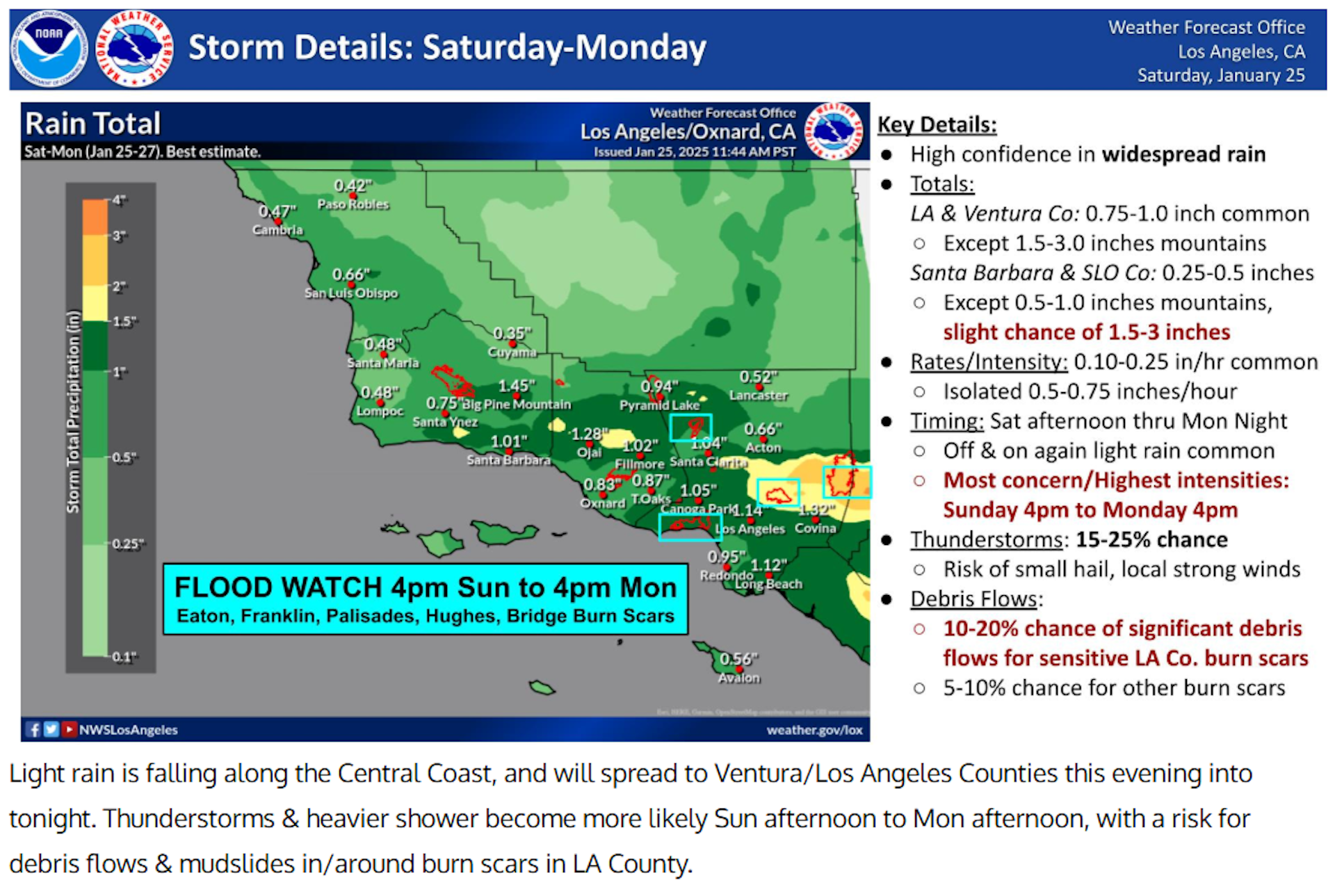
    Light rain began falling on Jan. 25, 2025, helping firefighters who have been battling fires for nearly three weeks, but rain can also trigger dangerous floods and debris flows on burned hillslopes. The National Weather Service issued a flood watch for the burned areas through Jan. 27.

    Debris flows can move with the speed of a freight train, picking up or destroying anything in their path. They can move tons of sediment during a single storm, as Montecito, just up the coast from Los Angeles, saw in 2018.

    What causes these debris flows, sometimes called mudflows, and why are they so common and dangerous after a fire? I am a geologist whose research focuses on pyrogeomorphology, which is how fire affects the land. Here’s what we know.

    How debris flows begin

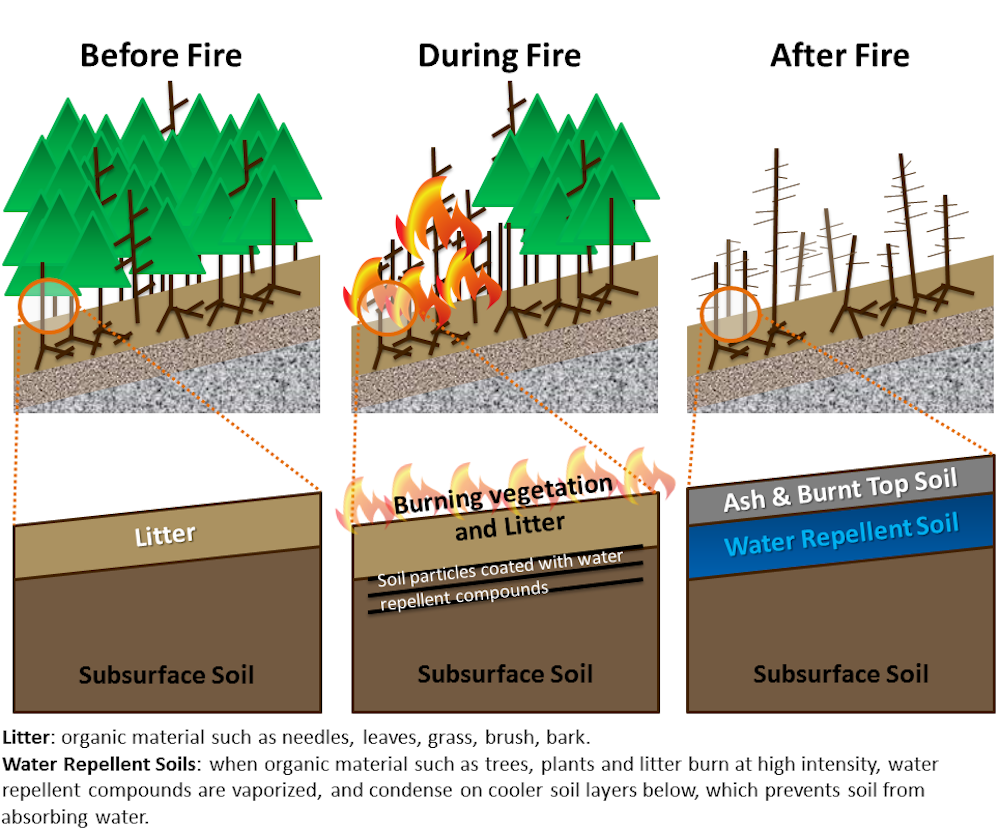
    When severe fires burn hillslopes, the high heat from the fires, sometimes exceeding 1,000 degrees Fahrenheit (538 degrees Celsius), completely destroys trees, shrubs, grass and structures, leaving behind a moonscape of gray ash. Not only that, the heat of the fire actually burns and damages the soil, creating a water-repellent, or hydrophobic, layer.

    What once was a vegetated hillslope, with leaves and trees to intercept rain and spongy soils to absorb water, is transformed into a barren landscape covered with ash, and burned soil where water cannot soak in.

    Illustrations show how fire can change the soil and landscape.
    National Weather Service

    When rain does fall on a burned area like this, water mixes with the ash, rocks and sediment to form a slurry. This slurry of debris then pours downhill in small gullies called rills, which then converge to form bigger and bigger rills, creating a torrent of sediment, water and debris rushing downhill. All this debris and water can transform small streams and usually dry gullies into a danger zone.

    Because the concentration of sediment is so high, especially when there is a large amount of ash and clay, debris flows behave more like a slurry of wet cement than a normal stream. This fluid can pick up and move large boulders, cars, trees and other debris rapidly downhill.

    A firefighter walks through knee-deep mud while checking for victims after a debris flow hit Montecito, Calif., in January 2018.
    Wally Skalij/Los Angeles Times via Getty Images

    In January 2018, a few weeks after the Thomas fire burned through the hills above Montecito, a storm triggered debris flows that killed 23 people and damaged at least 400 homes.

    What controls size and timing of debris flows

    The geography of the land, burn severity, storm intensity and soil characteristics all play important roles in if, when and where debris flows occur.

    Fire and debris flow scientists with the U.S. Geological Survey use these variables to create models to predict the likelihood and possible hazards from postfire debris flows. They are already developing maps to help residents, emergency managers and city officials prepare and predict postfire debris flows in 2025 burn areas in Los Angeles.

    The U.S. Geological Survey modeled debris flow risks after the Palisades Fire near Los Angeles. The map shows some of the highest-risk areas if hit by 15 minutes of rain falling at just under 1 inch (24 millimeters) per hour.
    USGS

    Some of the triggers of debris flows are literally part of the landscape.

    For example, the slope angle in a watershed and the amount of clay in the soil are important. Watersheds with gentle slopes – generally less than about 23 degrees – and a lack of clay and silt-sized particles are unlikely to produce debris flows.

    Other key factors that contribute to postfire debris flows relate to the proportion of the watershed that is severely burned and the intensity and duration of the rainstorm event.

    Early important research in the field of pyrogeomorphology demonstrated that while large, intense storms are more likely to cause large, intense debris flows, even small rainstorms can produce debris flows in burned areas.

    Debris flows are becoming more common

    A whopping 21.8 million Americans live within 3 miles of where a fire burned during the past two decades, and that population more than doubled from 2000 to 2019. A recent study from central and northern California indicates that nearly all the observed increases in area burned by wildfires in recent decades are due to human-caused climate change.

    The warming climate is also increasing the likelihood of more extreme downpours. The amount of moisture the atmosphere can hold increases by about 7% per degree Celsius of warming, leading to more intense downpours, particularly from ocean storms. In California, scientists project increases in rainfall intensity of 18% will result in an overall 110% increase in the probability of major debris flows.

    Jon Frye, of Santa Barbara Public Works, shows what happened in the January 2018 Montecito debris flow and why the risks to downslope communities would continue for several years. Source: County of Santa Barbara, 2018.

    Studies using models of fire, climate and erosion rates estimate that the amount of sediment flowing downhill after fires will increase by more than 10% in nine out of every 10 watersheds in the western U.S.

    Even without rain, debris on fire-damaged slopes can be unstable. A small slide in Pacific Palisades shortly after a fire burned through the area split a home in two. A phenomenon called “dry ravel” is a dominant form of hillslope erosion following wildfires in chaparral environments in Southern California

    Preparing for debris flow risks

    Research on charcoal pieces from ancient debris flows has shown fires and erosion have shaped Earth’s landscape for at least thousands of years. However, the rising risk of wildfires near populated areas and the potential for increasingly intense downpours mean a greater risk of damaging and potentially deadly debris flows.

    As their populations expand, community planners need to be aware of those risks and prepare.

    This article, originally published Jan. 23, 2025, has been updated with rainfall in Los Angeles.

    Jen Pierce receives funding from the National Science Foundation and is the chair of the Quaternary Geology and Geomorphology division of the Geological Society of America.

    ref. LA gets rain, but also risk of flooding and debris flows from wildfire burn scars – a geologist explains the threat – https://theconversation.com/la-gets-rain-but-also-risk-of-flooding-and-debris-flows-from-wildfire-burn-scars-a-geologist-explains-the-threat-247770

    MIL OSI – Global Reports

  • MIL-OSI Global: Rain falling on wildfire burn scars can trigger deadly debris flows – a geologist explains how

    Source: The Conversation – USA – By Jen Pierce, Professor of Geosciences, Boise State University

    A debris flow channel in a severely burned watershed in Idaho. Amirhossein Montazeri/Boise State University, CC BY-ND

    While firefighters work to extinguish the Los Angeles-area wildfires, city officials and emergency managers are also worried about what could come next.

    Light rain began falling on Jan. 25, 2025, helping firefighters who have been battling fires for nearly three weeks, but rain can also trigger dangerous floods and debris flows on burned hillslopes. The National Weather Service issued a flood watch for the burned areas through Jan. 27.

    Debris flows can move with the speed of a freight train, picking up or destroying anything in their path. They can move tons of sediment during a single storm, as Montecito, just up the coast from Los Angeles, saw in 2018.

    What causes these debris flows, sometimes called mudflows, and why are they so common and dangerous after a fire? I am a geologist whose research focuses on pyrogeomorphology, which is how fire affects the land. Here’s what we know.

    How debris flows begin

    When severe fires burn hillslopes, the high heat from the fires, sometimes exceeding 1,000 degrees Fahrenheit (538 degrees Celsius), completely destroys trees, shrubs, grass and structures, leaving behind a moonscape of gray ash. Not only that, the heat of the fire actually burns and damages the soil, creating a water-repellent, or hydrophobic, layer.

    What once was a vegetated hillslope, with leaves and trees to intercept rain and spongy soils to absorb water, is transformed into a barren landscape covered with ash, and burned soil where water cannot soak in.

    Illustrations show how fire can change the soil and landscape.
    National Weather Service

    When rain does fall on a burned area like this, water mixes with the ash, rocks and sediment to form a slurry. This slurry of debris then pours downhill in small gullies called rills, which then converge to form bigger and bigger rills, creating a torrent of sediment, water and debris rushing downhill. All this debris and water can transform small streams and usually dry gullies into a danger zone.

    Because the concentration of sediment is so high, especially when there is a large amount of ash and clay, debris flows behave more like a slurry of wet cement than a normal stream. This fluid can pick up and move large boulders, cars, trees and other debris rapidly downhill.

    A firefighter walks through knee-deep mud while checking for victims after a debris flow hit Montecito, Calif., in January 2018.
    Wally Skalij/Los Angeles Times via Getty Images

    In January 2018, a few weeks after the Thomas fire burned through the hills above Montecito, a storm triggered debris flows that killed 23 people and damaged at least 400 homes.

    What controls size and timing of debris flows

    The geography of the land, burn severity, storm intensity and soil characteristics all play important roles in if, when and where debris flows occur.

    Fire and debris flow scientists with the U.S. Geological Survey use these variables to create models to predict the likelihood and possible hazards from postfire debris flows. They are already developing maps to help residents, emergency managers and city officials prepare and predict postfire debris flows in 2025 burn areas in Los Angeles.

    The U.S. Geological Survey modeled debris flow risks after the Palisades Fire near Los Angeles. The map shows some of the highest-risk areas if hit by 15 minutes of rain falling at just under 1 inch (24 millimeters) per hour.
    USGS

    Some of the triggers of debris flows are literally part of the landscape.

    For example, the slope angle in a watershed and the amount of clay in the soil are important. Watersheds with gentle slopes – generally less than about 23 degrees – and a lack of clay and silt-sized particles are unlikely to produce debris flows.

    Other key factors that contribute to postfire debris flows relate to the proportion of the watershed that is severely burned and the intensity and duration of the rainstorm event.

    Early important research in the field of pyrogeomorphology demonstrated that while large, intense storms are more likely to cause large, intense debris flows, even small rainstorms can produce debris flows in burned areas.

    Debris flows are becoming more common

    A whopping 21.8 million Americans live within 3 miles of where a fire burned during the past two decades, and that population more than doubled from 2000 to 2019. A recent study from central and northern California indicates that nearly all the observed increases in area burned by wildfires in recent decades are due to human-caused climate change.

    The warming climate is also increasing the likelihood of more extreme downpours. The amount of moisture the atmosphere can hold increases by about 7% per degree Celsius of warming, leading to more intense downpours, particularly from ocean storms. In California, scientists project increases in rainfall intensity of 18% will result in an overall 110% increase in the probability of major debris flows.

    Jon Frye, of Santa Barbara Public Works, shows what happened in the January 2018 Montecito debris flow and why the risks to downslope communities would continue for several years. Source: County of Santa Barbara, 2018.

    Studies using models of fire, climate and erosion rates estimate that the amount of sediment flowing downhill after fires will increase by more than 10% in nine out of every 10 watersheds in the western U.S.

    Even without rain, debris on fire-damaged slopes can be unstable. A small slide in Pacific Palisades shortly after a fire burned through the area split a home in two. A phenomenon called “dry ravel” is a dominant form of hillslope erosion following wildfires in chaparral environments in Southern California

    Preparing for debris flow risks

    Research on charcoal pieces from ancient debris flows has shown fires and erosion have shaped Earth’s landscape for at least thousands of years. However, the rising risk of wildfires near populated areas and the potential for increasingly intense downpours mean a greater risk of damaging and potentially deadly debris flows.

    As their populations expand, community planners need to be aware of those risks and prepare.

    This article, originally published Jan. 23, 2025, has been updated with rainfall in Los Angeles.

    Jen Pierce receives funding from the National Science Foundation and is the chair of the Quaternary Geology and Geomorphology division of the Geological Society of America.

    ref. Rain falling on wildfire burn scars can trigger deadly debris flows – a geologist explains how – https://theconversation.com/rain-falling-on-wildfire-burn-scars-can-trigger-deadly-debris-flows-a-geologist-explains-how-247770

    MIL OSI – Global Reports

  • MIL-OSI Australia: Emissions reduction plan

    Source: Australian Department of Revenue

    Accountable Authority sign off

    The Australian Taxation Office (ATO) recognises it has a role to play in addressing climate change by implementing the Government’s Net Zero in Government Operations Strategy. We understand that our operations affect climate change, and we are committed to leading by example in the transition towards a low-carbon future.

    This Emissions Reduction Plan builds upon our agency’s previous targets and action plans to minimise our carbon footprint and contribute to the nation’s broader climate goals.

    Our plan reflects our commitment to transparency, accountability, and continuous improvement in our environmental performance.

    As the Commissioner of Taxation, I am the Accountable Authority for the Australian Taxation Office listed entity, which is comprised of the ATO, the Tax Practitioner’s Board and the Australian Charities and Not-for-profits Commission (the ACNC), including the ACNC Advisory Board.

    Through this plan, we pledge to:

    • substantially reduce our greenhouse gas emissions
    • improve energy efficiency across our operations
    • transition to renewable energy sources
    • promote sustainable practices in our operations
    • foster a culture of environmental responsibility among our staff.

    ‘The ATO is committed to achieving net zero emissions by 2030. Together, we can create a more sustainable future for our nation and contribute to the global fight against climate change.’

    Rob Heferen
    Commissioner of Taxation
    Registrar of the Australian Business Register, Australian Business Registry Services, and
    Register of Foreign Ownership of Australian Assets.

    Acknowledgement of Country

    We acknowledge the Traditional Owners and Custodians of Country throughout Australia and their continuing connection to land, waters and community. We pay our respects to them, their cultures, and Elders past and present.

    We recognise the unique relationship Aboriginal and Torres Strait Islander people have to Country, culture, and community, and the important role this plays in us all walking together as Australians.

    MIL OSI News

  • MIL-OSI: Institute for Catastrophic Loss Reduction formally opens Winnipeg Climate Resilience Centre

    Source: GlobeNewswire (MIL-OSI)

    WINNIPEG, Manitoba, Nov. 05, 2024 (GLOBE NEWSWIRE) — The Institute for Catastrophic Loss Reduction (ICLR) is very pleased to announce the formal launch of its Climate Resilience Centre in downtown Winnipeg. The centre was made possible through generous contributions from Wawanesa, including the provision of office space in the company’s former executive office at 191 Broadway and operating funds.

    “ICLR is thrilled to partner with Wawanesa on this trailblazing facility,” said Paul Kovacs, Executive Director of the Institute for Catastrophic Loss Reduction. “After this year’s horrendous series of storm and wildfire-related losses that have led to a record $8 billion in insurance claims, it has never been more clear that all facets of Canadian society must work together to foster resilience to extremes. In the context of making Canadian homes, both existing and new, stronger against nature’s extremes, we know what features need to be added. The new ICLR Climate Resilience Centre in Winnipeg allows attendees to see these features in action.”

    “As Canada’s leading property and casualty mutual insurer, we see firsthand the devastating impact of severe weather across the country,” said Jeff Goy, President & CEO of Wawanesa. “Driven by our commitment to building stronger, more resilient communities, Wawanesa is proud to support the Institute for Catastrophic Loss Reduction’s new Climate Resilience Centre in our former executive office in Winnipeg. This facility will serve as a critical resource in equipping Canadians with the knowledge to better protect themselves against the growing threats of climate change, helping them to reduce their risk of loss.”

    The Climate Resilience Centre will serve as a destination for various stakeholders, such as insurers, reinsurers, brokers, home builders, building code officials and others to come together and learn about best practices and the issues involved in becoming more climate resilient. This includes:

    • Developing programming with national reach, distributing information to various stakeholders that is relevant to climate risks across the country.
    • Free attendance, allowing groups to book the premises for education sessions, host events and to collaborate in person.
    • Multimedia and other hands-on displays highlighting practical strategies for property loss mitigation developed by ICLR and sponsored by Wawanesa. The displays will be able to travel to communities for education events to address hazards such as basement flooding/sewer backup, wildfire, overland flooding, extreme wind, and hail.
    • A dedicated space sponsored by Wawanesa that will encourage attendees to come together to share knowledge and learn.

    Tours of the ICLR Climate Resilience Centre can be booked, and inquiries about borrowing the displays can be made by visiting www.iclr.org/climatecentre/.

    About The Institute for Catastrophic Loss Reduction (ICLR)
    Canada’s leading disaster research institute, the Institute for Catastrophic Loss Reduction (ICLR), was established by the insurance industry in 1997 as an independent, not-for-profit research and outreach institute to champion disaster resilience in Canada. ICLR is an international centre of excellence affiliated with Western University, London, Ontario. The Institute develops and champions evidence-based disaster safety solutions that can be implemented by homeowners, businesses and governments to enhance their disaster resilience. Visit www.iclr.org for more information.

    About The Wawanesa Mutual Insurance Company
    The Wawanesa Mutual Insurance Company, founded in 1896, is one of Canada’s largest mutual insurers, with over $3.5 billion in annual revenue and assets of $10 billion. Wawanesa Mutual, with its National Headquarters in Winnipeg, is the parent company of Wawanesa Life, which provides life insurance products and services throughout Canada, and Western Financial Group, which distributes personal and business insurance across Canada. Wawanesa proudly serves more than 1.7 million members in Canada. The company actively gives back to organizations that strengthen communities, donating more than $3.5 million annually to charitable organizations, including over $2 million annually in support of people on the front lines of climate change. Learn more at wawanesa.com.

    For more information:
    Michel Rosset
    Manager, Corporate Communications & Media Relations
    The Wawanesa Mutual Insurance Company
    media@wawanesa.com

    Photos accompanying this announcement are available at

    https://www.globenewswire.com/NewsRoom/AttachmentNg/2b304c1a-bceb-4c48-81ab-b15fbf482fd5

    https://www.globenewswire.com/NewsRoom/AttachmentNg/df5d68f1-6b5a-4a3e-aef0-b2630d979275

    https://www.globenewswire.com/NewsRoom/AttachmentNg/ec5a4ca6-49a7-425f-a354-f6b7a926aa64

    The MIL Network

  • MIL-OSI: Weatherford Announces Contract Awards with Kuwait Oil Company and NOC in Qatar

    Source: GlobeNewswire (MIL-OSI)

    HOUSTON, Nov. 05, 2024 (GLOBE NEWSWIRE) — Weatherford International plc (NASDAQ: WFRD) (“Weatherford” or the “Company”) today announced two contracts in the Middle East, with Kuwait Oil Company (“KOC”) and a National Oil Company (“NOC”) in Qatar.

    KOC awarded Weatherford a Managed Pressure Drilling (“MPD”) services contract, focusing on improving operational efficiency, enhancing safety, accelerating well-delivery timelines, and reducing costs by deploying Weatherford’s innovative Victus™ Intelligent MPD system. Known for its automation and precision, Victus™ enables safer and faster drilling by providing precise pressure control and real-time data integration to optimize well conditions in complex drilling environments. This advanced technology is set to support KOC’s goals for enhanced safety, speed, and cost efficiency in well delivery.

    In addition, Weatherford has secured a five-year contract with an NOC in Qatar to provide fishing and drilling tools, with a five-year extension option. This contract highlights Weatherford’s commitment to supporting the NOC’s operational resilience by offering advanced fishing and drilling solutions. These tools, combined with Weatherford’s technical expertise, will assist the operator in overcoming challenging fishing scenarios, ensuring continuity and efficiency in their drilling operations.

    Girish Saligram, President and Chief Executive Officer of Weatherford, commented, “Weatherford is honored to partner with both KOC and an NOC in Qatar. These agreements underscore our commitment to delivering cutting-edge technologies and dependable service, reinforcing our position as a trusted partner in the Middle East and supporting regional operators in achieving their enhanced safety, efficiency, and resilience goals.”

    About Weatherford

    Weatherford delivers innovative energy services that integrate proven technologies with advanced digitalization to create sustainable offerings for maximized value and return on investment. Our world-class experts partner with customers to optimize their resources and realize the full potential of their assets. Operators choose us for strategic solutions that add efficiency, flexibility, and responsibility to any energy operation. The Company conducts business in approximately 75 countries and has approximately 19,000 team members representing more than 110 nationalities and 330 operating locations. Visit weatherford.com for more information and connect with us on social media.

    For Media:
    Kelley Hughes
    Corporate Communications
    Media@weatherford.com

    The MIL Network

  • MIL-OSI Global: No, America’s battery plant boom isn’t going bust – construction is on track for the biggest factories, with thousands of jobs planned

    Source: The Conversation – USA – By James Morton Turner, Professor of Environmental Studies, Wellesley College

    Workers install battery packs in a BMW X5 in South Carolina. A new battery plant under construction nearby will supply BMW factories. BMW

    The United States is in the midst of the biggest boom in clean energy manufacturing investments in history, spurred by laws like the bipartisan Infrastructure Investment and Jobs Act and the Inflation Reduction Act.

    These laws have leveraged billions of dollars in government support to drive private sector investments in clean energy supply chains across the country.

    For several years, one of us, Jay Turner, and his students at Wellesley College have been tracking clean energy investments in the U.S. and sharing the data at The Big Green Machine website. That research shows that companies have announced 225 projects, totaling US$127 billion in investment, and more than 131,000 new jobs since the Inflation Reduction Act became law in 2022.

    You may have seen news stories that said these projects are at risk of failure or significant delays. In August 2024, the Financial Times reported that 40% of more than 100 projects it evaluated were delayed. These included battery manufacturing, renewable energy projects and metals and hydrogen projects, as well as semiconductor manufacturing plants. More recently, The Information, which covers the technology industry, warned that 1 in 4 companies were walking away from government-supported grants for battery investments.

    Workers assemble battery packs for electric vehicles in Spartanburg, S.C. New battery plants in the state will help move the supply chain closer to U.S. EV factories.
    BMW

    We checked up on all 23 battery cell factories announced or expanded since the Inflation Reduction Act was signed – almost all of them gigafactories, which are designed to produce over 1 gigawatt-hour of battery cell capacity. These factories have some of the largest employment potential of any project supported by the act.

    We wanted to find out if the boom in U.S.-based clean energy manufacturing is about to go bust. What we have learned is mostly reassuring.

    The biggest battery factories are on track

    While the exact investment totals are challenging to pin down, our research shows that planned capital expenditures add up to $52 billion, which would support 490 gigawatt-hours of battery manufacturing capacity per year – enough to put roughly 5 million new electric vehicles on the road.

    While not all 23 companies have announced their hiring plans, these facilities are expected to support nearly 30,000 new jobs, with projects mostly in the U.S. Southeast, Midwest and Southwest.

    We wanted to know if these projects are on track or experiencing delays or problems.

    To do that, we first reached out to local and state economic development agencies. In many instances, local and state tax incentives are supporting these projects. Where possible, we sought to confirm the project’s status through public data or formal announcements. In other instances, we looked for news stories to see if there is evidence of construction or hiring.

    Of the 23 projects, our research shows that 13 appear to be on track, with total planned capital investments in excess of $40 billion and nearly 352 gigawatt-hours per year of capacity. Importantly, these include most of the biggest projects with the largest investments and projected production.

    By our count, 77% of the total planned capital investment, 79% of the proposed jobs and 72% of the planned battery production are on track, which means that a project is likely to happen, roughly on time, and generally with their expected level of investment and employment.

    Three projects are on the bubble. These have shown progress but experienced delays in construction or financing.

    Five others show deeper signs of distress. We don’t yet have enough information to draw a conclusion on two projects.

    An example of a project that is on track is Envision AESC’s battery factory in Florence, South Carolina. Its scale has been expanded twice since it was first announced in December 2022. It is now a $3 billion investment intended to manufacture 30 gigawatt-hours of batteries annually to supply BMW’s factory in Woodruff, South Carolina.

    In early October 2024, South Carolina Secretary of Commerce Harry Lightsey conducted a tour of the Envision site and posted a video. Construction on the plant started in February 2024, and 850 workers are working six days a week to finish the 1.4 million-square-foot facility by August 2025. Once it goes into full production, the project is expected to employ 2,700 people.

    2024 election could end or accelerate the boom

    But a lot hinges on what happens in the upcoming elections.

    Our data suggests the real risk that these projects and projects like them face isn’t slow demand for electric vehicles, as some people have suggested – in fact, demand continues to climb. Nor is it local opposition, which has slowed only a few projects.

    The biggest risk is policy change. Many of these projects are counting on Advanced Manufacturing Tax Credits authorized by the Inflation Reduction Act through 2032.

    On the campaign trail, Republicans up and down the ticket are promising to repeal key Biden-led legislation, including the Inflation Reduction Act, which includes grant funding and loans to support clean energy as well as tax incentives to support domestic manufacturing.

    While full repeal of the act may be unlikely, an administration hostile to clean energy could divert its unspent funds to other purposes, slow the pace of grants or loans by slow-walking project approvals, or find other ways to make the tax incentives harder to get. While our research has focused on the battery industry, this concern extends to investments in wind and solar power too.

    So, is the big boom in U.S.-based clean energy manufacturing about to go bust? Our data is optimistic, but the politics is uncertain.

    Joshua Busby receives funding from the U.S. Department of Defense. He is affiliated with the Center for Climate and Security and the Chicago Council on Global Affairs.

    James Morton Turner and Nathan Jensen do not work for, consult, own shares in or receive funding from any company or organization that would benefit from this article, and have disclosed no relevant affiliations beyond their academic appointment.

    ref. No, America’s battery plant boom isn’t going bust – construction is on track for the biggest factories, with thousands of jobs planned – https://theconversation.com/no-americas-battery-plant-boom-isnt-going-bust-construction-is-on-track-for-the-biggest-factories-with-thousands-of-jobs-planned-242567

    MIL OSI – Global Reports

  • MIL-OSI New Zealand: Efficiencies found to deliver two further NIWE recovery projects

    Source: New Zealand Government

    Upgrades to Nesbitt’s Dip on State Highway 2 (SH2) and Rototahe on State Highway 35 (SH35) will go ahead as a result of improved efficiencies in the Government’s North Island Weather Event recovery programme, Transport Minister Simeon Brown says.

    “Regions in the North Island suffered extensive and devastating damage from Cyclone Gabrielle and the 2023 Auckland Anniversary Floods. As part of Budget 2024, our Government committed $609.25 million for state highway recovery to restore roads back to their previous condition, and in July I announced that $250 million of this would be allocated to the East Coast.

    “Work to remedy flooding at SH2 Nesbitt’s Dip and SH35 Rototahe was listed but would only advance into delivery if efficiencies in the programme were found. I’m pleased that with a strong focus on achieving value for money and improving efficiency across the recovery programme, these two important projects can now proceed within existing funding.

    “These two sections of highway that connect communities on the East Coast have been closed many times due to flooding, most recently at the end of June. These closures create safety risks for emergency services responding to emergencies, and cause significant disruption for communities, businesses, and the flow of freight and goods.

    “To enable people and freight to get where they want to go quickly and safely, crews will raise the height of SH2 Nesbitt’s Dip and SH35 Rototahe above the flood level and improve drainage at both sites. By addressing the root causes of flooding and road closures, NZTA will provide a safer and more reliable route for the region.

    “Our Government is committed to ensuring our state highway corridors impacted by the NIWE are returned to the standard that Kiwis need and expect. I look forward to these works progressing and being completed.”

    MIL OSI New Zealand News

  • MIL-OSI USA: President Joseph R. Biden, Jr. Approves Major Disaster Declaration for the Seminole Tribe of  Florida

    US Senate News:

    Source: The White House
    Today, President Joseph R. Biden, Jr. declared that a major disaster exists for the Seminole Tribe of Florida and ordered Federal aid to supplement the Tribal Nation’s efforts in the areas affected by Hurricane Milton beginning on October 5, 2024, and continuing.
    The President’s action makes Federal funding available to affected individuals of the Seminole Tribe of Florida.
    Assistance can include grants for temporary housing and home repairs, low-cost loans to cover uninsured property losses, and other programs to help individuals and business owners recover from the effects of the disaster.
    Federal funding is also available to the Seminole Tribe of Florida and certain private nonprofit organizations on a cost-sharing basis for emergency work and the repair or replacement of facilities damaged by Hurricane Milton.  For a period of 90 days of the Tribal Nation’s choosing within the first 120 days from the start of the incident period, assistance for debris removal and emergency protective measures, including direct Federal assistance, under the Public Assistance program is authorized at 100 percent of the total eligible costs.
    Lastly, Federal funding is available on a cost-sharing basis for hazard mitigation measures for the Seminole Tribe of Florida.
    Ms. Leda M. Khoury of the Federal Emergency Management Agency (FEMA) has been appointed to coordinate Federal recovery operations in the affected areas. 
    Additional designations may be made at a later date if requested by the Tribal Nation and warranted by the results of further damage assessments.
    Residents and business owners who sustained losses in the designated areas can begin applying for assistance at www.DisasterAssistance.gov, or by calling 800-621-FEMA (3362), or by using the FEMA App. Anyone using a relay service, such as video relay service (VRS), captioned telephone service or others, can give FEMA the number for that service. 
    FOR FURTHER INFORMATION MEDIA SHOULD CONTACT THE FEMA NEWS DESK AT (202) 646-3272 OR FEMA-NEWS-DESK@FEMA.DHS.GOV.

    MIL OSI USA News

  • MIL-OSI China: Global climate crisis requires cooperation, not geopolitics

    Source: China State Council Information Office

    Participants pose for a group photo during the sixth Friends of the Paris Agreement High-Level Dialogue in Paris, France, on Oct. 28, 2024. [Photo/The European Climate Foundation]

    Climate change knows no borders and demands a coordinated global response. The 2015 Paris Agreement was a landmark achievement in multilateral climate governance, with countries pledging collective action to mitigate carbon emissions.

    However, geopolitical tensions increasingly complicate the path to unified global climate action. Some nations are undermining international trust through protectionist policies and trade barriers driven by self-interest.

    Amid this backdrop, the recent sixth Friends of the Paris Agreement High-Level Dialogue, held in Paris on Oct. 28-29, offered a platform to reflect on the progress and challenges of global climate cooperation.

    In an exclusive interview with China.org.cn, Jiang Feng, a researcher at Shanghai International Studies University and chairman of the Shanghai Academy of Global Governance & Area Studies, emphasized that combating climate change requires international collaboration rather than divisive geopolitics. 

    He emphasized the need for stronger China-Europe cooperation, warning that recent countervailing duties on Chinese electric vehicles (EVs) could undermine global efforts to reduce emissions.

    Jiang noted that the Paris Agreement established ambitious, binding targets for global carbon emissions reduction, reflecting a consensus on the urgency of climate action. China, instrumental in shaping and committing to the Paris goals, has made notable progress and received widespread recognition. However, not all countries are showing the same level of commitment; some engage in more rhetoric than action and politicize the transfer of technology.

    Participants at the Paris meeting expressed concerns about the possible negative impact of the upcoming U.S. election on global emissions reduction efforts.

    A key takeaway from the dialogue was the need to broaden the focus of climate measures beyond just emissions reduction targets. Jiang stressed that technological innovation, biodiversity preservation and energy structure transformation should also be prioritized.

    “The Paris Agreement represents a shift – a need for humanity to transition from fossil fuels to renewable energy,” he stated, calling it a historic opportunity for sustainable development.

    Such a transition requires countries to rethink their development philosophies and models to address the core issues of climate change. Jiang pointed to China’s investment in renewable energy as a key example. With strong policies, substantial investments, and technological innovation, China has fueled significant growth in renewables, supporting its economy while also aiding the global energy transition and emissions reduction.

    Jiang also highlighted the ambitious goals set by the European Union and some member states in their fight against climate change. For example, Aachen in Germany and RWTH Aachen University aim for carbon neutrality by 2030 – 15 years ahead of Germany’s national target. Jiang noted that this and other examples show a strong awareness among several countries in addressing climate change, bringing together governments, universities, businesses, and civil society.

    Yet, despite significant achievements, many challenges remain, particularly in the transfer of green technology. “Many innovative technologies are not being fully utilized due to rising geopolitics and trade protectionism, which politicize and instrumentalize the transfer of essential technologies and products globally,” Jiang lamented.

    The EU’s recent five-year imposition of countervailing duties on Chinese EVs illustrates this dilemma. Jiang stated that some countries have maliciously labeled China’s success in the photovoltaic and electric vehicle sectors as “overcapacity.” While the measure aims to give European manufacturers a “window” to strengthen their industries, experts fear it creates unnecessary barriers to technology exchange. Given that European industries require China’s advanced EV technology, such measures may ultimately hinder both Europe’s and global progress toward renewable energy. Instead of imposing trade restrictions, Jiang urged nations to create a supportive and collaborative environment for green technology transfer.

    During the dialogue, Chinese representatives met with experts from the International Energy Agency and European institutions to discuss enhancing mutual understanding and cooperation.

    Jiang emphasized the importance of China-Europe collaboration, suggesting that as key global players, they should jointly plan technology research, development, and transfer projects for third parties or other regions, making these technologies more market-oriented and industrialized.

    “This can not only aid third-party countries and regions but also open up new opportunities for China-Europe collaboration, creating growth drivers for their relationship,” he explained.

    MIL OSI China News

  • MIL-OSI USA: Child Care Assistance Is Available for South Carolinians Affected by Hurricane Helene

    Source: US Federal Emergency Management Agency

    Headline: Child Care Assistance Is Available for South Carolinians Affected by Hurricane Helene

    Child Care Assistance Is Available for South Carolinians Affected by Hurricane Helene

    South Carolinians affected by Hurricane Helene may be eligible for FEMA Child Care Assistance even if they did not have property damage.FEMA may award payment for Child Care Assistance under its Other Needs Assistance program to those with disaster-caused child care expenses following Hurricane Helene. Residents in Abbeville, Aiken, Allendale, Anderson, Bamberg, Barnwell, Beaufort, Cherokee, Chester, Edgefield, Fairfield, Greenville, Greenwood, Hampton, Jasper, Kershaw, Laurens, Lexington, McCormick, Newberry, Oconee, Orangeburg, Pickens, Richland, Saluda, Spartanburg, Union and York counties and the Catawba Indian Nation are eligible to apply.Child Care Assistance covers standard child care service fees and/or personal assistance services for children with a disability, as defined by federal law.Assistance may be available for up to eight weeks per child or household, up to a maximum of $150 per child.Eligibility CriteriaFEMA Child Care Assistance addresses disaster-related expenses for eligible households with children aged 13 and under and/or households with children with a disability up to age 21, who need assistance with activities of daily living such as eating, bathing, dressing, toileting, transferring (walking) and continence, and more.Eligibility begins on the date of the incident period for the declared disaster and continues through the end of the 18-month period of assistance unless the time is extended.Child care registration fees and health inventory fees are eligible expenses for applicants who require a new child care service provider.A registration fee is a one-time fee when registering an eligible child with an authorized child care provider.A health inventory fee is a medical office fee for processing required medical paperwork as part of the registration process.To qualify for Child Care Assistance, the general conditions must be met for FEMA Individual Assistance eligibility, and the applicant must have necessary expenses (child care facility damaged or inoperable) caused by the disaster. In addition to meeting the general conditions of eligibility as a direct result of the disaster, households must have a disaster-caused increase in financial burden for child care.The applicant’s gross household income has decreased; orThe applicant’s child care expenses have increased.Households must certify they cannot utilize child care services provided by any other source to qualify for Child Care Assistance. Households must submit documents showing a disaster-caused need for Child Care Assistance and amount of eligible expenses.Documents RequiredPre- and post-disaster gross household income documentation.Pre-disaster receipts, contract, or signed letter from the child care provider for child care expenses.Post-disaster receipts or estimates for child care fees, registration, and/or health inventory fees.A post-disaster child care provider’s license and post-disaster child care contract or agreement.Individualized Educational Plan (IEP), 504 plan, or a medical professional’s statement, if applicable, to verify disability for children up to age 21 who need assistance.A signed, written statement from the applicant.Limitations and ExclusionsIf a child is a member of multiple households, FEMA will only award Child Care Assistance to the primary custodial parent or guardian responsible for child care costs.FEMA will not help with any of the following:Fees for extra-curricular activities, educational services and additional services.Fees not related to the day-to-day child care services provided to the eligible child.Fuel expenses related to transporting the child to and from the child care provider.Medical care or services.Recreational camps or clubs.Households who did not have child care expenses pre-disaster but have incurred or will incur child care expenses because of the disaster may also be eligible, but must meet additional eligibility requirements.For additional information, contact the FEMA Helpline at 800-621-3362 or visit a Disaster Recovery Center. To find a center near you, visit fema.gov/drc.It is not necessary to go to a center to apply for FEMA assistance. Homeowners and renters in designated counties can go online to DisasterAssistance.gov, call 800-621-3362 or use the FEMA mobile app to apply. If you use a relay service, such as video relay, captioned telephone or other service, give FEMA your number for that service. For a video with American Sign Language, voiceover and open captions about how to apply for FEMA assistance, select this link.FEMA programs are accessible to survivors with disabilities and others with access and functional needs.
    kwei.nwaogu
    Wed, 11/06/2024 – 03:28

    MIL OSI USA News

  • MIL-Evening Report: Only 25% of older Queenslanders are aware of the risks heatwaves put on their health – new study

    Source: The Conversation (Au and NZ) – By Mehak Oberai, Senior Research Assistant, Ethos Project, School of Medicine and Dentistry, Griffith University

    Los Muertos Crew/Pexels

    Parts of Australia are currently facing extreme heat, with high temperatures set to continue over the coming days.

    Though it’s unclear exactly what the upcoming summer will bring, climate change means Australian summers are getting hotter. Even this year in August we saw temperatures around 40°C in parts of the country.

    Heatwaves aren’t just uncomfortable – they can be deadly. Health emergencies related to extreme heat place significant strain on our health-care systems, with data showing increased ambulance callouts and hospital presentations during these periods.

    Although heatwaves can affect everyone, older adults are particularly at risk. But our new research has found older Queenslanders don’t necessarily believe heat poses a risk to their health. And this affects how they respond to emergency warnings.

    Older people and the heat

    Ageing brings physiological changes, including reduced ability to regulate body temperature, which can put older people at increased risk of issues such as heat exhaustion and heat stroke.

    Heat exposure can also worsen the symptoms of existing conditions, such as heart disease, lung disease or kidney disease, which are more common in older people.

    The risk is even more pronounced for older people who live in poor quality housing, are economically disadvantaged, or are socially isolated.

    A report from the Australian Institute of Health and Welfare shows that, of 2,150 hospitalisations due to extreme heat between 2019 and 2022, 37% were among people aged 65 and older (who make up around 16% of the population).

    So there’s an urgent need to prioritise the health of older Australians as the country braces for more intense and prolonged heatwaves in the future.

    When the weather is hot, older people are at greater risk of health complications.
    Kleber Cordeiro/Shutterstock

    Early warning systems

    As we’ve learned more about the risks of heatwaves, there’s been an increased focus on developing population-based early warning systems. These systems play a crucial role in encouraging people to adopt heat-protective behaviours such as staying hydrated, avoiding strenuous physical activity when temperatures are high, and wearing loose or light clothing.

    Queensland is one of the world’s most vulnerable regions to heatwaves. Since 2015, heatwave warnings have been part of the state’s heatwave subplan, which sets out strategies for managing and mitigating the impacts of extreme heat events.

    These warnings involve alerts about upcoming high temperatures, and advice on staying cool. They come as notifications through the Bureau of Meterology’s weather app or via media outlets or social media. However, it’s not clear whether these warnings are reaching those most at risk.

    As part of a broader project on extreme heat and older people, we surveyed 547 Queenslanders aged 65 and over to understand their perceptions of heat risks and to determine if heatwave warnings were reaching them.

    We also wanted to know what factors influence how they receive and respond to these warnings, with a view to understanding how we can improve heatwave warnings for this group.

    What we found

    Only 25% of respondents were aware of the potential consequences of heatwaves on their health. The majority of participants (80%) perceived themselves to be at lower risk compared to others of their age group. This aligns with previous heat-health research which has similarly found older adults often don’t perceive heat as a personal risk.

    While most of the sample (87%) reported having one or more chronic health conditions, 30% were unaware having a chronic health condition increased their vulnerability to heatwaves.

    Several cultural and personal factors may explain why older people don’t think heat poses a danger to them. In Australia, heat is typically seen as a normal and even positive part of life. Heat risk messages are often less urgent than warnings for other natural disasters.

    Previous research has also shown older people tend not to think heat poses a risk to their health.
    Miguel AF/Shutterstock

    We also found nearly half of respondents had not heard a heatwave warning. Of those who had, roughly half took actions to keep themselves cool.

    What stood out from our analysis was that participants’ awareness and actions in response to heatwave warnings were significantly influenced by their knowledge and perceptions of heat risks. Factors such as age, gender and education were not so important.

    Respondents who believed they were at risk were almost twice as likely to hear the warnings, and 3.6 times more likely to take heat protective actions.

    This aligns with other research that highlights the correlation between heat-health risk perception and the efficacy of heatwave warnings.

    One limitation of our research is that we conducted the survey in 2022 during and following a La Nina period, where temperatures are usually lower. So there may have been fewer heatwave warnings throughout the season, potentially reducing participants’ perceptions of heat health risks.

    What needs to change?

    With another hot summer likely ahead, we need to rethink how we communicate about heatwaves. These are more than just hot days. We need to recognise heatwaves as a serious health risk, especially for older people, and effectively communicate that risk to the public.

    This might include using primary health-care professionals such as GPs, nurses and pharmacists to share heat-health information with older patients and their family members, or developing personalised heat action plans for the summer period.

    Text message alerts from the Bureau of Meteorology, along with app notifications, could be a good idea considering some older adults may not have a smartphone or be open to using apps.

    To improve heatwave communication, we also need to explore the barriers and facilitators to heat protective behaviours. This includes considering structural factors (such as housing design), environmental factors (for example, access to shade and cool refuges), individual factors (such as financial constraints or health conditions) and social factors (such as access to family and community support).

    Strengthening communication around heatwaves and health will not only protect individual wellbeing but enhance community resilience as extreme heat continues to affect our lives.

    Mehak Oberai is a Senior Research Assistant working on Ethos project and is also a member of the AAG (Australian Association of Gerontology) Student & Early Career Working Group.

    Ella Jackman is a PhD Candidate at Griffith University and a Research Assistant for the Queensland Heat Health Community of Practice (QHHCoP) and the Ethos Project.

    Shannon Rutherford co-leads the Climate Action Beacon Griffith University funded, Queensland Heat Health Community of Practice and receives funding from Wellcome and NEMA. She is an affiliate member of the HEAL network

    Steven Baker and Zhiwei Xu do not work for, consult, own shares in or receive funding from any company or organisation that would benefit from this article, and have disclosed no relevant affiliations beyond their academic appointment.

    ref. Only 25% of older Queenslanders are aware of the risks heatwaves put on their health – new study – https://theconversation.com/only-25-of-older-queenslanders-are-aware-of-the-risks-heatwaves-put-on-their-health-new-study-238875

    MIL OSI AnalysisEveningReport.nz

  • MIL-OSI Global: Extreme weather has already cost vulnerable island nations US$141 billion – and 38% is attributable to climate change

    Source: The Conversation – UK – By Emily Wilkinson, Principal Research Fellow, ODI

    Multiverse / shutterstock

    Two years ago, when the curtain fell on the COP27 summit in Sharm El Sheikh, Egypt, developing nations on the frontline of climate change had something meaningful to celebrate.

    The creation of a new fund for responding to loss and damage was agreed after a hard-fought diplomatic effort, spearheaded by a group of small island developing states (sometimes known as the Sids). The fund would provide much needed support for climate-vulnerable nations faced with a spiralling human and financial toll from sea-level rise, extreme temperatures, droughts, wildfires, and intensifying floods and storms.

    Yet two years on, the world’s wealthiest nations – also the largest carbon emitters – are still dragging their feet. They’ve not followed up their pledges with anywhere near the finance required.

    Some nations, particularly the 39 Sids, which include places like Barbados, Grenada, Fiji and Vanuatu, are uniquely vulnerable to climate change and are already paying the price.

    Sky-high ocean temperatures created the conditions for Hurricane Beryl to develop in July this year, as the earliest-forming Category 5 hurricane on record in the Caribbean. As oceans warm up, climate science tells us that this rapid intensification is becoming more common.

    Fijians run for shelter as a cyclone approaches.
    ChameleonsEye / shutterstock

    The island nation of Fiji, best known as a tropical paradise, has experienced a frightening series of storms over recent years, linked to climate change. Cyclone Winston in 2016, one of the most intense on record, caused widespread flooding and lead to the loss of 44 lives.

    This episode reduced Fiji’s GDP growth by 1.4 percentage points. According to the Asian Development Bank, ongoing losses from climate change could reach 4% of Fiji’s annual GDP by 2100, as higher temperatures and more extreme weather hold back growth.

    This isn’t an isolated problem. Tropical cyclones and hurricanes have long battered small islands, but what is new is how often the most extreme storms and floods are happening, as well as our improved ability to measure their economic effects.

    Direct and indirect impacts

    Our latest research looked at extreme weather events affecting 35 small island developing nations. We first collected information about the direct consequences of these extreme weather events: the damaged homes, the injured people, and the bridges that must be rebuilt.

    We then looked at how these events have affected GDP growth and public finances. These changes are not felt immediately, but rather as the economy stalls, tourism dries up, and expensive recovery plans inhibit spending in other areas.

    In all, from 2000 to 2020, these direct and indirect impacts may have cost small island states a total of US$141 billion. That works out to around US$2,000 per person on average, although this figure underplays just how bad things can get in some places. Hurricane Maria in 2017 caused damage to the Caribbean island of Dominica worth more than double its entire GDP. That amounted to around US$20,000 per person, overnight. Almost a decade later, the country is still struggling with one of the largest debt burdens on earth at over 150% of GDP.

    Dominica’s lush forests were badly damaged by Hurricane Maria.
    Derek D Galon / shutterstock

    Of these huge aggregate losses across all the small island development states, around 38% are attributable to climate change. That’s according to calculations we made based on “extreme event attribution” studies, which estimate the degree to which greenhouse gas emissions influenced extreme weather events.

    What is clear is that small island economies are among the worst affected by severe weather. These island states have three to five times more climate-related loss and damage than other states, as a percentage of government revenues. That’s true even for wealthier small island states, like the Bahamas and Barbados, where loss and damage is four times greater than other high-income countries. For all small island nations, the economic impacts will increase, with “attributable” losses from extreme weather reaching US$75 billion by 2050 if global temperatures hit 2°C above pre-industrial levels.

    Our research helps us to see how far short the richer nations driving climate change are falling in their efforts to both curb emissions and to compensate the nations harmed by their failure to prevent climate change.

    Developed countries need to pay up

    One of the key discussions at the forthcoming COP29 climate summit in Baku, Azerbaijan, will be the “new collective quantified goal”. This is the technical name to describe how much money wealthy countries will need to contribute to help vulnerable nations to mitigate and adapt to climate change.

    That overall goal must also include a target to finance small islands and other vulnerable countries, with billions more needed per year in the new loss and damage fund. Given the extent of actual and likely losses, nothing less than ambition on the scale of a “modern Marshall Plan” for these states will do.

    In addition to this extra financing, the fund will need to work effectively to support the most climate vulnerable nations and populations when severe weather occurs. This can be done in a few ways.

    The fund could create a budget support mechanism that can help small island states and other vulnerable countries deal with loss of income and the negative effects on growth. It could make sure loss and damage funds can be released quickly, and ensure support is channelled to those who need it the most. It could also make more concessional finance available for recovery, especially for the most adversely affected sectors like agriculture and tourism.

    The world has a troubling history of missing self-imposed targets on climate finance and emissions reduction. But the stakes are ever higher now, and any target for loss and damage finance will need to be sufficient to deal with the challenges posed already by climate change, and in the years to come.

    Emily Wilkinson receives funding from the UK Foreign Commonwealth and Development Office

    Ilan Noy, Matt Bishop, and Vikrant Panwar do not work for, consult, own shares in or receive funding from any company or organisation that would benefit from this article, and have disclosed no relevant affiliations beyond their academic appointment.

    ref. Extreme weather has already cost vulnerable island nations US$141 billion – and 38% is attributable to climate change – https://theconversation.com/extreme-weather-has-already-cost-vulnerable-island-nations-us-141-billion-and-38-is-attributable-to-climate-change-242640

    MIL OSI – Global Reports

  • MIL-Evening Report: The extreme floods which devastated Spain are hitting more often. Is Australia ready for the next one?

    Source: The Conversation (Au and NZ) – By Conrad Wasko, ARC DECRA Fellow in Hydrology, University of Sydney

    Spain is still reeling from recent floods in the Valencia region. In some areas, a year’s worth of rain fell in a single day. Sudden torrents raced through towns and cities. Over 200 people are dead. Rapid analysis suggests daily rainfall extremes in this region and season have become twice as common over the last 75 years and become 12% more intense.

    The World Meteorological Organisation has pointed out that climate change is steadily increasing the risk of extreme floods like these. Warmer air can hold more water vapour, about 7% more per degree Celsius of warming. More moisture generally leads to more intense rainfall, and therefore more extreme floods.

    The physics of how temperature influences the atmosphere’s capacity to hold moisture has been known for close to 200 years. But we’ve learned something worrying more recently. When water vapour condenses to form rain droplets, it releases heat which can fuel stronger convection and boost updrafts of air currents in storms. This means the intensity of extreme rainfall could increase not just 7% per degree of warming, but over twice that rate.

    Last week, CSIRO and the Australian Bureau of Meteorology released their biennial report on the State of the Climate, which found “heavy short-term rainfall events are becoming more intense”. Australia, the report states, has already warmed 1.5°C since national records began in 1910. In recent years, extreme rains have triggered devastating floods in New South Wales and Queensland.

    The question now is – are we prepared for these more damaging floods? This year, Australia updated the climate change section of Australia’s flood design guidance. But while this will help ensure that future infrastructure is better able to weather extreme floods, our current bridges, roads and stormwater drains have not been built to weather these increases in extreme rainfall. Similarly, our flood planning levels – used to determine where houses, offices, hospitals and so forth can be built – have generally not factored in the reality of the threat.

    More floods and more extreme

    Many of us would have learned about the water cycle in school. Water evaporates from seas and lakes before falling as rain and filling lakes and rivers, which eventually makes it back to the sea.

    Unfortunately, climate change is making this cycle more intense, as detailed in a recent Intergovernmental Panel on Climate Change report. Rain is more likely to fall in intense short-duration bursts which are more likely to trigger floods.

    This year alone, we have seen disastrous and deadly floods from extreme storms across the Americas, Asia and Europe. Scientific analysis has showed these floods were more severe due to human-caused climate change.

    Australia is not immune. The devastating northern New South Wales floods of 2022 took 24 lives and ravaged towns such as Lismore. These floods are the most expensive natural disaster to date in Australia, costing A$5.65 billion in damages.

    How do you prepare for worse floods?

    When urban planners set flood planning levels, or engineers begin designing a new bridge or rail line, they have to take floods into account. To do so, they will inevitably reach for the local bible, Australia’s flood design guidance.

    Before 2024, this document allowed for a 5% increase in rainfall intensity per degree of global warming, and generally applied it only to infrastructure intended for a very long lifespan. This clashed with most scientific studies on the topic both globally and in Australia, which showed much greater increases, and that these increases are already being witnessed.

    To provide better flood guidance, we and our colleagues undertook a comprehensive review of over 300 scientific papers covering climate change in Australia and extreme rainfall.

    The review proved we had been underestimating the threat of extreme rains and subsequent floods. Rain events over a 24-hour period leading to flooding are likely to increase at 8% per degree of warming, not 5%. Hourly rainfall extremes are likely increasing even faster, at 15% per degree.

    Worse, these are just the central estimates. The wide range of plausible values suggests some rain events could eclipse these. For daily or longer extreme rains, the range is 2–15%. For hourly or shorter periods, that figure is 7–28% for hourly or shorter duration.

    Over the month of February in 2022, the Lismore region had about 600–800 mm of rain – much more than a normal February, which might see closer to 150 mm on average. These floods took place with just 1.1°C of warming since the pre-industrial period. On our current path, it’s possible the world could warm another 1.5°C or more by the end of this century. If this happens, these rainfall totals could be substantially higher and more likely to cause even worse flood impacts.

    These new figures have now been included in the August update of Australia’s flood design guidance. This is good news. It means future decisions on infrastructure and planning can now be well informed by the latest science on how climate change influences flood risk.

    Over time, this will ensure essential infrastructure can be built to endure worse floods. It will affect the design and construction of everything from local stormwater drains to levees, bridges, culverts and dam spillways.

    Preparing for extreme floods is complex. Pictured: water spilling out from a manhole during Spain’s floods.
    Fernando Astasio Avila/Shutterstock

    Local councils can use it to set the height of floor levels for property development. State and federal decision-makers can use it in planning for responses to flood emergencies.

    Does it mean we can avoid disastrous floods like those in Spain and Lismore? Yes and no. We now have the knowledge and tools to adapt to the increased risk levels already arriving. Yet implementing this will be challenging. In many cases, it will require retrofitting or redesigning existing infrastructure to withstand more intense flooding.

    Climate change is no longer something we can file under “problem for the future”. It’s here already. The flood risks we face today are already substantially worse than 25 years ago, and will continue to worsen. We must accelerate how we plan for extreme, rapid rainfall creating catastrophic floods like those in Spain.

    Conrad Wasko receives funding from The University of Sydney and the Australian Research Council. Conrad has previously received funding from the Department of Climate Change, Energy, the Environment and Water.

    Andrew Dowdy receives funding from University of Melbourne, including through the Centre of Excellence for Climate Extremes and the Melbourne Energy Institute.

    Seth Westra is a Professor of Hydrology and Climate Risk at the University of Adelaide, Director of Research for the One Basin Cooperative Research Centre, and Chair of the Systems Cooperative. Seth receives funding from state and federal governments support decision making under hydrological or climatic uncertainty.

    ref. The extreme floods which devastated Spain are hitting more often. Is Australia ready for the next one? – https://theconversation.com/the-extreme-floods-which-devastated-spain-are-hitting-more-often-is-australia-ready-for-the-next-one-242686

    MIL OSI AnalysisEveningReport.nz

  • MIL-Evening Report: US elections: Cook Islands group warns of climate crisis pushback if Trump wins

    By Losirene Lacanivalu of the Cook Islands News

    The leading Cook Islands environmental lobby group says that if Donald Trump wins the United States elections — and he seemed to be on target to succeed as results were rolling in tonight — he will push back on climate change negotiations made since he was last in office.

    As voters in the US cast their votes on who would be the next president, Trump or US Vice-President Kamala Harris, the question for most Pacific Islands countries is what this will mean for them?

    “If Trump wins, it will push back on any progress that has been made in the climate change negotiations since he was last in office,” said Te Ipukarea Society’s Kelvin Passfield.

    “It won’t be good for the Pacific Islands in terms of US support for climate change. We have not heard too much on Kamala Harris’s climate policy, but she would have to be better than Trump.”

    The current President Joe Biden and his administration made some efforts to connect with Pacific leaders.

    Massey University’s Centre for Defence and Security Studies senior lecturer Dr Anna Powles said a potential win for Harris could be the fulfilment of the many “promises” made to the Pacific for climate financing, uplifting economies of the Pacific and bolstering defence security.

    Dr Powles said Pacific leaders want Harris to deliver on the Pacific Partnership Strategy, the outcomes of the two Pacific Islands-US summits in 2022 and 2023, and the many diplomatic visits undertaken during President Biden’s presidency.

    Diplomatic relationships
    The Biden administration recognised Cook Islands and Niue as sovereign and independent states and established diplomatic relationships with them.

    The Biden-Harris government had pledged to boost funding to the Green Climate Fund by US$3 billion at COP28 in the United Arab Emirates.

    Harris has said in the past that climate change is an existential threat and has also promised to “tackle the climate crisis with bold action, build a clean energy economy, advance environmental justice, and increase resilience to climate disasters”.

    Dr Powles said that delivery needed to be the focus.

    She said the US Elections would no doubt have an impact on small island nations facing climate change and intensified geopolitics.

    Dr Powles said it came as “no surprise” that countries such as New Zealand and Australia had increasingly aligned with the US, as the Biden administration had been leveraging strategic partnerships with Australia, New Zealand, and Japan since 2018.

    She said a return to Trump’s leadership could derail ongoing efforts to build security architecture in the Pacific.

    Pull back from Pacific
    There are also views that Trump would pull back from the Pacific and focus on internal matters, directly impacting his nation.

    For Trump, there is no mention of the climate crisis in his platform or Agenda47.

    This is in line with the former president’s past actions, such as withdrawing from the Paris Climate Agreement in 2019, citing “unfair economic burdens” placed on American workers and businesses.

    Trump has maintained his position that the climate crisis is “one of the great scams of all time”.

    Republished with permission from the Cook Islands News and RNZ Pacific.

    MIL OSI AnalysisEveningReport.nz

  • MIL-OSI China: Climate change poses substantial health risks, report finds

    Source: China State Council Information Office 2

    Cai Wenjia, a professor at Tsinghua University’s Department of Earth System Science and director of the Lancet Countdown Asia Center, speaks during the launch of the 2024 China Lancet Countdown report at Tsinghua University in Beijing, Nov. 5, 2024. [Photo courtesy of Lancet Countdown Asia Center]
    The worsening climate is increasingly endangering public health and threatening economic and social systems that underpin people’s well-being, according to a report released Tuesday.
    The 2024 China report of the Lancet Countdown on health and climate change, published by the Lancet Countdown Asia Center in Beijing, marks the fifth such assessment. The study monitors climate change health risks in China through 2023, along with the country’s adaptation and mitigation efforts.
    The report found that the health impacts of rising temperatures have been substantial. China faced extreme hot and dry weather conditions in 2023, with record-high temperatures and the second-lowest precipitation since 2012. These conditions led to a 309% surge in heatwave-related deaths, a 24% rise in lost work hours and diminished opportunities for outdoor activities.
    “The health risks of climate change are not in the far future. They’re imminent threats in front of us,” said Cai Wenjia, professor at Tsinghua University’s Department of Earth System Science and director of Lancet Countdown Asia Center.
    “Although already dangerous, recent health risks might be just a glimpse of even worse ones to come,” Cai said.
    The report projects that by the 2060s, annual average heatwave-related mortality, heat-related labor productivity losses and wildfire-related deaths will increase 183%-275% and 28%-37%, respectively, compared with 1986-2005 averages. Additionally, the annual excess risk of dengue fever incidence is expected to rise by 15.3%-15.5% from 2013-2019 levels.
    “It is another wake-up call that the climate crisis is the health crisis,” said Martin Taylor, WHO representative to China. He noted that dealing with climate-related health risks may become the new normal.
    Given unprecedented climate challenges, the report pointed out that China had taken considerable steps by 2023 to integrate health concerns into climate change discourse, particularly emphasizing the need for renewable energy in promoting a fair transition. “This shift promises not only environmental and economic benefits, but also public health benefits,” the report stated.
    The report outlined China’s specific initiatives in addressing climate change. The country established the “1+N policy framework” to realize its goals of peaking carbon emissions before 2030 and reaching carbon neutrality before 2060. Moreover, it has released the National Climate Change Adaptation Strategy 2035 and the National Climate Change Health Adaptation Action Plan (2024-2030) to combat climate-related health risks and enhance public health protection.
    Regarding carbon emission reduction, China represented more than half of the global increase in renewable energy capacity in 2023. This increase pushed the country’s total renewable capacity to surpass coal power installations for the first time.
    “This effort has significantly accelerated global initiatives made at the Conference of the Parties 28 (COP 28), which is to triple renewable energy capacity by 2030 and reduce fossil fuel dependence,” Cai said. 

    MIL OSI China News

  • MIL-Evening Report: Black balls on Sydney beaches are likely ‘fatbergs’ showing traces of human faeces, methamphetamine and PFAS: new analysis

    Source: The Conversation (Au and NZ) – By Jon Beves, Associate Professor of Chemistry, UNSW Sydney

    Jon Beves, CC BY

    The mysterious black balls that washed up on Sydney’s beaches in mid-October were likely lumps of “fatberg” containing traces of human faeces, methamphetamine and PFAS, according to a new detailed analysis of their composition.

    Initial reports suggested the ominous lumps were probably tar balls from an oil spill. However, analysis with a barrage of scientific tests has revealed a more complicated picture.

    The mysterious black balls

    On October 16, the first reports emerged from Coogee Beach in Sydney’s east. Lifeguards reported numerous black spheres on the sand that appeared at first glance to be tar-like.

    Similar sightings were soon reported at nearby Bondi, Bronte, Tamarama and Maroubra beaches, prompting immediate closures and cleanup efforts. Authorities initially feared these could be toxic “tar balls”, leading to health advisories and public warnings.

    Preliminary testing by Randwick Council was consistent with tar balls made up of oil and debris.

    Oil – or something more disgusting?

    We set out to find out exactly what the black balls were made of and where they came from. We ran a wide range of tests and analyses with colleagues from UNSW in collaboration with the Mark Wainwright Analytical Centre and the the environmental forensics arm of the federal Department of Climate Change, Environment, Energy and Water (DCCEEW). We also collaborated with the NSW Environment Protection Authority (EPA), and Randwick Council.

    Initial testing, based primarily on results from a technique called solid-state nuclear magnetic resonance spectroscopy, suggested the material resembled unrefined oil. However, further testing indicated a different, more disgusting, composition.

    A cross section of one of the balls, showing its sandy coating and surface, some fibres, and the core.
    Jake Ireland, CC BY

    Analysing the elements involved revealed the black goop was mostly carbon. Radiocarbon dating then showed only about 30% of the carbon had a fossil origin, suggesting fossil fuels were not the major component of the balls.

    We also identified significant levels of calcium, and much smaller amounts of various metals. Spectroscopic tests showed signatures in the black balls matching fats, oils and greasy molecules often found in soap scum, cooking oil and food sources. This pointed to human waste.

    PFAS, drugs and signs of faeces

    The next step was to see if we could dissolve the substance in organic solvents. Only about one-third to one-half of the mass dissolved this way.

    We were able to take a closer look at the dissolved part using a technique called mass spectrometry, which identifies molecules by their weight and electric charge. This revealed molecules found in vehicle-grade fuels as well as organic molecules such as fatty acids and glycerides.

    We also identified industrial perfluoroalkyl substances (PFAS or “forever chemicals”), steroidal compounds such as norgestrel, antihypertensive medications such as losartan, pesticides, and veterinary drugs. This is consistent with contamination from sewage and industrial runoff.

    The crushed up interior of one ball, ready for testing.
    Jon Beves, CC BY

    There were also signs of human faecal waste, including a cholesterol byproduct called epicoprostanol and residues of recreational drugs including tetrahydrocannabinol (also known as THC, a compound found in the cannabis plant) and methamphetamine. This is consistent with contributions from domestic waste.

    Analysing the part of the mass that we couldn’t dissolve proved more challenging. Here we tried solid-state nuclear magnetic resonance and a method called Fourier transform infrared spectroscopy, which uses infrared light to detect chemicals. The results suggested the presence of fats, but they were not definitive.

    Were the blobs lumps of fatberg?

    So what does all this mean? The high levels of fats, oils, greasy molecules and calcium, along with the low solubility, are consistent with a “fatberg”: a congealed mass of fats, oils and greasy molecules that can accumulate in sewage.

    The detection of markers of human fecal matter, medication and recreational drugs suggest the origin may be sewage or other urban effluent. However, while the composition of these black balls suggests they may be similar to fatbergs, we cannot definitively confirm their exact origin.

    The black ball incident does highlight the broader issue of pollution along Sydney’s coastline.

    Recent reports indicate about 28% of monitored swimming sites in New South Wales are prone to pollution. Many receive poor water quality ratings, especially after rain. Beaches such as Gymea Bay, Coogee Beach, Malabar Beach, and Frenchmans Bay have been identified as areas of concern, with advisories against swimming due to contamination from human faecal matter.

    Urban waste pollution

    Analysing and understanding urban waste pollution is not an easy task. It requires a multi-disciplinary approach.

    To unravel the complex composition of the blobs, we used carbon-14 dating, mass spectrometry, elemental analysis and microscopy techniques.

    Even after all we did, we cannot yet draw definitive conclusions regarding the primary source of the blobs. This uncertainty reflects the broader challenges faced by scientists and environmental agencies in tracking and addressing pollution in coastal areas.

    This incident underscores the importance of thorough scientific analysis in understanding environmental issues. By continuing to investigate the sources and composition of such pollutants, we can learn more about how urban waste management affects the health of our coasts.


    This research was led by UNSW researchers, including Associate Professor Jon Beves, Dr Tim Barrows, Dr Martin Bucknall, Professor William Alexander Donald, Dr Albert Fahrenbach, Dr Sarah Hancock, Dr Christopher Hansen, Ms Lisa Hua, Dr Martina Lessio, Dr Chris Marjo, Associate Professor Vinh Nguyen, Dr Martin Peeks, Dr Aditya Rawal, Dr Chowdhury Sarowar, Professor Timothy Schmidt, Dr Jake Violi and Dr Helen Wang.

    Jon Beves receives funding from the Australian Research Council and the Australian Renewable Energy Agency. He is affiliated with The Greens.

    William Alexander Donald receives funding from the Australian Research Council, the US National Institutes of Health, iCare Dust Diseases Care, Coal Services NSW Health and Safety Trust, as well as industry-funded research contracts.

    ref. Black balls on Sydney beaches are likely ‘fatbergs’ showing traces of human faeces, methamphetamine and PFAS: new analysis – https://theconversation.com/black-balls-on-sydney-beaches-are-likely-fatbergs-showing-traces-of-human-faeces-methamphetamine-and-pfas-new-analysis-242681

    MIL OSI AnalysisEveningReport.nz

  • MIL-OSI United Nations: Deputy Secretary-General’s remarks to the Member States briefing on the outcomes of the Secretary-General’s Panel on Critical Energy Transition Minerals [as prepared for delivery]

    Source: United Nations secretary general

    Excellencies, 

    Ladies and gentlemen,

    It is a pleasure to join you today. 

    The report from the Secretary-General’s Panel on Critical Energy Transition Minerals was released in September in response to a critical global challenge. The Secretary-General has asked we not only give out information but debrief Member States on this important work.

    We are in the midst of a quiet revolution.
     
    The way we power our economies and societies is changing. 

    Renewables have never been cheaper or more accessible, and the acceleration in their roll-out is staggering but uneven. 

    There is a danger that the clean energy transition could reproduce and amplify inequalities of the past:

    With developing countries – rich in the renewables critical to the transition – banished to the bottom of those value chains, their people are exploited, and their environment in jeopardy as others grow wealthy on their resources. Sounds familiar.

    The Secretary-General established the Panel in response to calls from developing countries for action on this issue.  Lest we repeat history. 

    I thank all the Panel members for their work, particularly the Co-Chairs, Nozipho Joyce Mxakato-Diseko of South Africa, and Ditte Juul Jørgensen of the European Commission. I commend the Panel for breaking new ground and reaching an agreement on many complex and contested issues. 

    I am also grateful to the 17 UN agencies that provided a vast range of technical expertise to the Panel, led by UNEP, UNCTAD and the Secretary-General’s Climate Action Team. 

    The Panel’s report identifies ways governments, industry, and the United Nations can work to embed justice and equity in critical energy transition mineral value chains and ensures that they spur sustainable development, respect people, protect the environment, and power prosperity in resource-rich developing countries.  

    It outlines seven guiding principles that prioritize human rights, environmental protection, and inclusive development while also insisting on responsible trade and investment. This vision is supported by calls for transparency, accountability, and a commitment to multilateral cooperation—safeguarding the rights of resource-rich countries to benefit from their minerals while protecting their communities and ecosystems.

    To bring these principles into action, the report sets out five Actionable Recommendations, such as forming an UN-hosted expert group to lead fair policy dialogue and drive accountability across mineral value chains. It advocates for a global transparency framework, funding mechanisms to address mining’s long-term impacts, and support for small-scale miners as partners in sustainable development. Together, these recommendations aim to empower communities, create accountability, and ensure that clean energy fuels not only our economies but also equitable and resilient growth.

    Following the launch of the report, the Secretary-General asked the Panel and United Nations to socialize its findings with Member States and other stakeholders ahead of COP29 and receive feedback to help inform next steps.

    We are preparing the United Nations system to support the implementation of the Panel’s work –safeguarding and advancing human rights, particularly the rights of Indigenous Peoples, across the critical minerals value chain. 

    UNEP, UNCTAD and the Climate Action Team will lead those efforts in the UN system. Civil society, young people and Indigenous Peoples have a seat at the table.

    At COP29 in Baku later this month, the Secretary-General will convene a leader-level event to mobilize political support and establish a way forward.

    Today, the Panel Co-Chairs, Ditte Juul Jørgensen and Ambassador Diskeko will brief you on the report. 

    We want to hear your feedback on its findings to inform the operationalization of its outcomes. We are particularly keen to hear views on two matters:

    •    First, are the Guiding Principles the right ones? If so, how can we mainstream them into the relevant constituencies?

    •    Second, the Panel developed five Actionable Recommendations to put the Principles into practice. Are these broadly supported, and if so, what is the best approach to operationalize them? What role can Member States, the UN system, and other stakeholders play in moving them forward?

    I very much look forward to hearing from you today. 

    As we work together to ensure we generate prosperity and equality alongside clean power. 

    Thank you.
    ***
     

    MIL OSI United Nations News

  • MIL-OSI Canada: Oil and gas greenhouse gas pollution cap – Backgrounder to CGI Regulations

    Source: Government of Canada News

    Backgrounder

    November 4, 2024

    Context

    The proposed oil and gas greenhouse gas (GHG) pollution cap will incentivize the sector to invest in technically achievable decarbonization to attain significant emission reductions by 2030-2032. The policy will put the sector on a pathway to carbon neutrality by 2050, while enabling it to continue to respond to global demand.

    Oil and gas companies in Canada have proven repeatedly that they can innovate and develop new technologies to produce more competitive oil and gas with less pollution.

    While it continues to be a major supplier to global markets, Canada’s oil and gas sector has the opportunity to reinvest in its own competitiveness ahead of the anticipated future decline in global demand for oil and gas in a low-carbon future. Reinvesting in cleaner oil and gas production ensures that the sector contributes its fair share to GHG reductions in Canada and positions Canada for a stronger future for its workers and economy.

    The oil and gas sector is experiencing record profits within Canada. Coming out of the pandemic, operating profits in the oil and gas sector increased tenfold from $6.6 billion in 2019 to $66.6 billion in 2022. Despite that, there has been limited and declining overall investment in the sector in Canada over the last several years.

    The proposed Regulations would establish a cap-and-trade system that is designed to recognize producers with better emission performance and motivate higher-polluting facilities to reinvest record profits into more pollution-reducing projects.

    The oil and gas sector is a major contributor to Canada’s economy. In 2023, the sector generated $209 billion in gross domestic product (GDP) (PDF) and accounted for 25% of Canada’s exports (valued at $177 billion). It is also a major employer across the country, directly employing 181,800 people in 2023.

    The oil and gas sector is also Canada’s largest source of GHG pollution, responsible for 31% of Canada’s GHG emissions in 2022. Decreasing emissions in the oil and gas sector by introducing a cap on GHG pollution is necessary to ensure that the sector contributes its fair share to Canada’s ongoing efforts to tackle climate change and reach our GHG emission reduction targets and international commitments under the Paris Agreement.

    Strengthening emission performance and carbon management technologies in Canada’s oil and gas sector

    Canada’s oil and gas sector has the potential to be a supplier of choice as the demand for oil and gas for combustion declines in a low-carbon future. This would enable the sector to continue to be a major employer and source of economic activity across Canada, particularly in oil- and gas-producing regions.

    The proposed Regulations put a limit on pollution, not production. The proposed Regulations are carefully designed around what is technically achievable within the sector, while enabling continued production growth in response to global demand. In fact, modelling shows that Canadian oil and gas production is projected to increase 16% between 2019 and the 2030-2032 period with the proposed Regulations in place.

    Major emissions-reduction opportunities are available, and oil and gas producers are already investing in them. Methane is a particularly potent greenhouse gas, and most methane emissions represent a wasted resource because they are from leaks and other unintended sources. Preventing methane emissions is one of the lowest-cost ways to reduce GHG emissions, and the sector’s efforts have resulted in a steady decline in these emissions. New regulations to be finalized later this fall will ensure that the sector continues to cut methane emissions by at least 75% from 2012 levels by 2030. 

    Carbon capture is also going to play an increasingly important role in reducing emissions from oil and gas production, and Canada is well placed to cement its position as a global leader in this critical technology. According to both the Intergovernmental Panel on Climate Change (IPCC) and the International Energy Agency (IEA), there is no credible path to carbon neutrality without carbon management technologies, such as carbon capture and storage, and their deployment must be rapid and immense, scaling up by nearly 200 times by 2050.

    The shift toward a low-carbon economy has created a rush of capital toward carbon management technologies worldwide. In the United States, there are many new carbon capture projects being deployed, with 150 currently under review at the U.S. Environmental Protection Agency.

    Canada has already established itself as a first mover and leader in the global carbon management sector, with some of the world’s first large-scale projects; favourable geology; cutting-edge innovators and start-ups; early investments in research, development, and demonstration; deep technical expertise; a robust policy and regulatory environment at the federal and provincial levels; and active international collaboration. The Government of Canada has launched a suite of policies with a mix of financial supports and regulatory measures to better position Canada’s economy for success.

    Approximately one-sixth of the world’s active large-scale carbon management projects, which use a range of approaches to capture carbon dioxide from point sources or directly from the atmosphere to be reused or durably stored, can be found in Canada, with a growing number in the construction, design and development phase across multiple sectors and regions.

    The continued development and deployment of carbon management technologies to help achieve Canada’s climate objectives will form the basis of a world-leading, multi-billion-dollar carbon management sector in Canada that supports inclusive, high-value employment, significant export opportunities and a more sustainable economy.

    Point-source carbon capture is a leading option for deep emissions reductions from the upstream oil and gas sector. Given the long lifespan of many existing heavy industrial facilities and the value of these industries to the Canadian economy, public-private collaboration is critical to advance strategic, economical, and regionally appropriate decarbonization pathways.

    The GHG oil and gas pollution cap adds to a suite of policy measures, which are designed to shift the oil and gas industry increasingly toward cleaner production through the use of carbon management systems and other technologies, including to reduce methane emissions and to switch to cleaner fuels. Those include other successful regulatory measures, such as federal, provincial, and territorial carbon pricing systems for industry, including Alberta’s TIER system, the federal Output-Based Pricing System, federal and provincial methane regulations, and the Clean Fuel Regulations.

    They also include a wide range of financial supports to support deployment and help develop the innovation ecosystem for carbon reduction technologies in Canada, including:

    • $319 million over 7 years for RD&D to advance the commercial viability of emerging carbon management technologies.
    • Refundable CCUS Investment Tax Credit (ITC), expected to provide $12.5 billion between 2022-2023 and 2034-2035, for eligible projects that enable permanent CO2 storage.
    • The Canada Growth Fund, totalling $15 billion, offers investment tools such as contracts for differences designed to address risk and accelerate private sector investment to grow Canada’s clean economy, including in the carbon management sector.
    • Strategic Innovation Fundwith $8 billion in funding to help companies reduce emissions and grow their business sustainably.
    • The Canada Infrastructure Bank (CIB) invests in CCUS infrastructure projects, including through its Project Acceleration funding for front-end engineering and design (FEED) capital expenditures.

    Increasingly, large-scale carbon capture projects are being built in both the oil and gas sector and other sectors. Recent projects include:

    • Strathcona Resources, an oilsands company with assets in Saskatchewan and Alberta and Canada’s fifth-largest oil producer, is launching a $2 billion project to store up to two million tonnes of CO2 per year, while creating hundreds of new jobs. The project has received support from the Canada Growth Fund.
    • Entropy, an Alberta-based company, is working on a project that will enable emissions reductions of approximately 2.8 million tonnes over 15 years and support more than 1,200 good jobs for Albertans.
    • Shell announced two new projects in Alberta: the Polaris Carbon Capture project and the Atlas Carbon Storage Hub. These projects aim to reduce industrial emissions by transitioning to cleaner technology. The Polaris project will capture approximately 650,000 tonnes of carbon a year while the Atlas project will store the captured carbon from Polaris and potentially other industrial facilities in the future. Once complete in 2028, these projects are expected to generate up to 2,000 jobs for Albertans.
    • The North West Redwater (NWR) Sturgeon Refinery, also operating in the Alberta Industrial Heartland, is the world’s first bitumen refinery built with carbon capture. 
    • The Alberta Carbon Trunk Line (ACTL), which transports captured carbon from facilities for storage in oil fields, will be used by new carbon capture projects throughout the province to transport captured CO2 to final storage sites.  
    • Linde announced an investment of more than $2 billion to build a clean hydrogen facility that will supply Dow’s Path2Zero production complex in Alberta. The facility will capture more than 2 million tonnes of carbon dioxide emissions per year for sequestration.

    Extensive consultation to date on the oil and gas GHG pollution cap

    The Government of Canada has engaged a broad range of partners and stakeholders on the oil and gas GHG pollution cap, including provinces and territories, Indigenous partners, industry, environmental groups, and Canadians. The government has held webinars, convened meetings, and published discussion papers to seek input and feedback. Since November 2021, the government has received over 250 written submissions from organizations, held over 100 meetings, and hosted seven public webinars.  

    The government published a Regulatory Framework to Cap Oil and Gas Sector GHG Emissions in December 2023. This Framework confirmed the government’s intent to implement the oil and gas GHG pollution cap through a new cap-and-trade system, and proposed various regulatory design features, including which subsectors would be covered by the oil and gas GHG pollution cap, the level of the GHG pollution cap, and rules about flexible compliance options.

    The proposed Regulations are carefully designed based on what is technically achievable in the sector, setting a limit on pollution, not production. Technically achievable emissions reductions were estimated based on an assessment of the abatement technologies that could feasibly be deployed within the upstream and LNG activities in the oil and gas sector by 2030-2032, considering the status of available technologies, projected levels of production, the availability of equipment and labour, and timelines for permitting and approvals.

    Estimates of technically achievable reductions included reductions related to compliance with the strengthened methane regulations, installation of carbon capture and storage technology, and electrification. The risk that not all technically achievable reductions would be implemented in time for the first compliance period was also taken into consideration.

    The government has now published proposed Regulations (PDF) to implement the oil and gas GHG pollution cap, and invites input from November 9, 2024, to January 8, 2025. The government will continue to engage with partners and stakeholders in the development of final regulations.

    Key components of the proposed national cap-and-trade system for oil and gas greenhouse gas pollution

    The proposed Oil and Gas Sector Greenhouse Gas Emissions Cap Regulations (proposed Regulations) would establish a national cap-and-trade system that would apply to upstream oil and gas activities including onshore and offshore oil and gas production; oil sands production and upgrading; natural gas production and processing; and the production of LNG.

    The proposed Regulations have been developed under the Canadian Environmental Protection Act, 1999 (CEPA). Since 1988, CEPA has been used to address a wide range of environmental issues, including air pollution, chemicals, plastics and GHG emissions.

    • The cap-and-trade system will freely allocate emissions allowances to facilities covered by the system. At the end of each year, each facility will need to remit to the government one allowance for each tonne of carbon pollution it has emitted. Over time, the government will give out fewer allowances, corresponding to the declining emissions cap.
    • Operators will face an ongoing incentive to reduce their emissions. If an operator does not have enough allowances to cover their emissions, they will be able to buy allowances from other operators that have invested in pollution reduction. Operators can also contribute to a decarbonization program or use GHG offset credits to cover a small portion of their emissions (up to 10% for the decarbonization program and up to 20% for offsets, for a maximum of 20% for both options). The decarbonization program would fund projects that support the reduction of emissions from the sector. The total of all allowances and the overall 20% limit on compliance flexibility creates a legal upper bound on emissions from the sector.
    • The oil and gas GHG pollution cap will limit emissions, not production, and will encourage industry to reinvest into projects that lower pollution while providing flexibility to respond to changes in the global market.  
    • To make sure the oil and gas GHG pollution cap accounts for current activity levels, the proposed Regulations would use data reported by operators for 2026 to set the first oil and gas GHG pollution cap level. The oil and gas GHG pollution cap for the first compliance period, 2030-2032, would be set at 27% below emissions reported for 2026, which is estimated to be equivalent to 35% below 2019 emissions.
    • Using 2026 for reported data means the oil and gas GHG pollution cap would be based on real-world conditions. The final oil and gas GHG pollution cap level would be published before the end of 2027.
    • The proposed Regulations allocate allowances to covered operators using specified distribution rates—defined in allowances per unit of production—for each type of covered activity. Allowances will be distributed before the start of each year (starting in 2029 for 2030, the first compliance year). To ensure that allowances are distributed to the level of the emissions cap for each year, the allowances distributed would be pro-rated across all facilities receiving them.

    The system would be phased in for the first four years (2026-2029). During that period, operators would be required to register and report their emissions and production. Large emitters will start reporting in 2027 for their 2026 emissions and production levels. Reporting for small operators would start in 2029 for their 2028 levels. Operators would need to submit verified annual reports to Environment and Climate Change Canada for their facilities for every calendar year. Reports would be due on June 1 of the following year. The reports would be used to identify which operators will be subject to the pollution cap and have remittance obligations.

    Annual reports would include the GHG emissions attributed to the facility and the production amount by industrial activity. The Quantification Methods for the Oil and Gas Sector Greenhouse Gas Emissions Cap Regulations (the Quantification Methods) would define methods to calculate each source of emissions and would provide certain default values. In addition to the draft regulations, the government is seeking feedback on the Quantification Methods.

    All operators would be required to register and report, but only large operators (producing above an annual threshold of 365,000 barrels of oil equivalent) would have to remit allowances to cover their emissions. Large operators account for approximately 99% of the upstream sector’s emissions. The government would distribute emissions allowances to covered operators annually, before the start of each compliance year. Allowances would be pro-rated across all covered operators’ facilities based on historical production volumes. Allowances would not be able to be used for compliance under other carbon pricing systems, such as the federal Output-Based Pricing System (OBPS). There would be no limits to the number of allowances operators covered under the oil and gas GHG pollution cap could hold, and allowances could be traded among operators.

    Emissions allowances and offsets could be banked for use in a limited number of future years. Decarbonization units would not be tradable or bankable.

    Economic impacts of the proposed Regulations

    Environment and Climate Change Canada undertook an economic cost-benefit analysis of the proposed Regulations. Costs and benefits have been evaluated relative to a baseline that assumes production in the oil and gas sector grows, existing federal and provincial GHG measures remain in place, and the sector achieves the 75% reduction in methane emissions relative to 2012 levels, as a result of the forthcoming oil and gas methane regulations.

    The proposed pollution cap Regulations are estimated to result in net cumulative GHG emission reductions of 13.4 Mt above the baseline of reductions between 2025 and 2030-2032 that will be achieved by existing measures. That incremental reduction is valued at almost $4 billion in avoided global climate change damages. When compared to the costs, modelling showed that the proposed Regulations are estimated to have net benefits of $428 million for Canada.

    Importantly, this multi-million-dollar benefit does not account for a wide range of additional benefits likely to be associated with the proposed Regulations, including:

    • the additional economic activity and jobs associated with post-2032 investments in carbon capture, utilization and storage (CCUS) and other major decarbonization activities;
    • the stimulation of innovation and new low-carbon industries, such as clean hydrogen;
    • the economic and health benefits of reducing air pollution, which will improve the quality of life for many people and reduce the strain on our healthcare systems; and
    • the longer-term competitiveness benefits of a decarbonized Canadian oil and gas sector in a world that continues to take action to fight climate change and adhere to existing international and domestic climate commitments.

    The oil and gas sector directly and indirectly supports a significant workforce, especially in British Columbia, Alberta, Saskatchewan, and Newfoundland and Labrador. Modelling for the 2019 to 2030-2032 period shows that labour expenditure in the sectors covered by the proposed Regulations is expected to grow by 53%, which is only slightly below the 55 % growth in the baseline scenario.

    Additionally, jobs in clean energy will continue to grow. A 2023 Clean Energy Canada report found that Canada will see 700,000 more energy jobs in a carbon-neutral 2050 scenario than we have today. 419,000 of these jobs will be in Alberta, representing three jobs for every individual worker employed in Alberta’s upstream energy sector as of 2022.

    Oil and gas prices correspond to global market demand, and they do not typically reflect the cost of production. As such, the risk of compliance costs passed through from the oil and gas sector to Canadians is very low, and the proposed Regulations are not expected to affect the cost of everyday items such as fuel or groceries.

    Provincial leadership

    British Columbia previously announced it will put in place an oil and gas emissions cap to serve as a backstop to the federal policy. The goal will be to meet BC’s greenhouse gas emission reduction targets and avoid regulatory duplication and administrative burden for the oil and gas sector.

    Alberta, in its Emissions Reduction and Energy Development Plan (2023), communicated its goal to achieve carbon neutrality by 2050 and signalled it would explore options to achieve a 75-80% reduction in methane emissions from conventional oil and gas by 2030. Alberta has had a price on carbon emissions since 2007, making it the first jurisdiction in North America to price carbon. The province’s industrial carbon pricing system, implemented as set out in the Technology Innovation and Emissions Reduction (TIER) Regulation, recycles its proceeds to invest in emissions reduction projects including in the oil and gas sector, such as methane emissions abatement.

    Saskatchewan is a leader in carbon capture and sequestration technology, with several projects aimed at capturing CO2 emissions from oil and gas production. In 2014, the Boundary Dam project became the first power station in the world to successfully use carbon capture and storage technology. The province is also addressing methane emissions, including improving leak detection and repair practices and implementing best practices for gas flaring and venting.

    Newfoundland and Labrador’s offshore oil sector is already one of the lowest-emitting in the country. The newest planned production project—Bay du Nord—was approved with the historic requirement for the project to reach net-zero emissions by 2050. Like all other oil- and gas-producing provinces, NL implements a price on industrial carbon emissions via its provincial output-based pricing system.

    Note on third party reports

    The Government of Canada is aware of third-party reports conducted by Conference Board of Canada, Deloitte and S&P.

    These reports are based on a broad range of assumptions including elements of the previously published Regulatory Framework or, in some cases, other assumptions made by the authors. A common assumption found in the reports was that the oil and gas sector would take limited to no additional action to reduce emissions without the regulations.

    These reports do not reflect an accurate analysis of the current draft regulations. The Government of Canada welcomes continued sharing of analysis to help refine the proposed Regulations.

    MIL OSI Canada News

  • MIL-OSI USA: NASA, Bhutan Conclude Five Years of Teamwork on STEM, Sustainability

    Source: NASA

    NASA and the Kingdom of Bhutan have been actively learning from each other and growing together since 2019. The seeds planted over those years have ripened into improved environmental conservation, community-based natural resource management, and new remote sensing tools.
    Known for its governing philosophy of “gross national happiness,” [Bhutan] has a constitutional mandate to maintain at least 60% forest cover. The government’s goals include achieving nationwide food security by 2030. 
    Bhutan first approached the U.S. State Department to partner on science, technology, engineering, and mathematics (STEM) opportunities for the country, and NASA was invited to help lead these opportunities. In 2019, Bhutan’s King Jigme Khesar Namgyel Wangchuck visited NASA’s Ames Research Center in Silicon Valley, California, and was introduced to several NASA programs.
    NASA’s Earth scientists and research staff from several complementary programs have helped support Bhutan’s goals by providing data resources and training to make satellite data more useful to communities and decision makers. Bhutan now uses NASA satellite data in its national land management decisions and plans to foster more geospatial jobs to help address environmental issues.
    Supporting Bhutan’s Environmental Decision Makers
    Bhutan’s National Land Commission offers tax breaks to farmers to support food security and economic resilience. However, finding and reaching eligible farmers on the ground can be expensive and time consuming, which means small farmers in remote areas can be missed. 
    A team from SERVIR – a joint NASA-U.S. Agency for International Development initiative – worked with Bhutanese experts to create decision-making tools like the Farm Action Toolkit  (FAcT). The tool uses imagery from the NASA-U.S. Geological Survey Landsat satellites to identify and measure the country’s farmland. SERVIR researchers met with agricultural organizations – including Bhutan’s Ministry of Agriculture and Livestock, National Statistics Bureau, and National Center for Organic Agriculture – to adjust the tool for the country’s unique geography and farming practices. The Land Commission now uses FAcT to identify small farms and bring support to more of the country. 
    NASA also develops local capacity to use Earth data through efforts like the Applied Remote Sensing Training Program (ARSET). In early 2024, ARSET staff worked with SERVIR and Druk Holdings and Investments (DHI) to host a workshop with 46 Bhutanese government personnel. Using tailored local case studies, the teams worked to find ways to better manage natural resources, assist land use planning, and monitor disasters. 
    “We look forward to continuing this collaboration, as there are still many areas where NASA’s expertise can significantly impact Bhutan’s development goals,” said Manish Rai, an analyst with DHI who helped coordinate the workshop. “This collaboration is a two-way street. While Bhutan has benefited greatly from NASA’s support, we believe there are also unique insights and experiences that Bhutan can share with NASA, particularly in areas like environmental conservation and community-based natural resource management.” 

    Encouraging Bhutan’s Future Environmental Leaders
    By working with students and educators from primary schools to the university level, Bhutan and NASA have been investing in the country’s future environmental leadership. Supporting educators and “training trainers” have been pillars of this collaboration.
    NASA and Bhutan have worked together to boost the skills of early-career Earth scientists. For example, NASA’s DEVELOP program for undergraduates worked directly with local institutions to create several applied science internships for Bhutanese students studying in the U.S. 
    Tenzin Wangmo, a high school biology teacher in Bhutan, participated in DEVELOP projects focusing on agriculture and water resources. According to Wangmo, the lessons learned from those projects have been helpful in connecting with her students about STEM opportunities and environmental issues. “Most people only think of NASA as going to space, rather than Earth science,” she said. “It was encouraging to my students that there are lots of opportunities for you if you try.”
    NASA is also supporting Bhutan’s future environmental leadership through the GLOBE (Global Learning and Observations to Benefit the Environment) Program. The GLOBE program is a U.S. interagency outreach program that works with teachers to support STEM literacy through hands-on environmental learning. Since 2020, GLOBE has worked through the U.S. State Department and organizations like the Ugyen Wangchuck Institute for Forest Research and Training to support educators at two dozen schools in Bhutan. The program reached more than 650 students with activities like estimating their school’s carbon footprint. 
    This focus on STEM education enables students and professionals to contribute to Bhutan’s specific development goals now and in the future. 
    Sonam Tshering, a student who completed two DEVELOP projects on Bhutanese agriculture while studying at the University of Texas at El Paso, was able to share the value of these efforts at the 2023 United Nations Climate Conference. “By applying satellite data from NASA, we aimed to create actionable insights for our local farmers and our policymakers back in Bhutan,” she said. 
    By Jacob Ramthun and Lena Pranksy, SERVIR Communications Team, and Jonathan O’Brien, ARSET Communications Team
    News Media Contact
    Lane FigueroaMarshall Space Flight Center, Huntsville, Ala.256.544.0034lane.e.figueroa@nasa.gov 

    MIL OSI USA News

  • MIL-OSI USA: $20 Million for Home Resiliency Repairs and Upgrades

    Source: US State of New York

    Governor Kathy Hochul today announced up to $20 million is available for eligible homeowners in flood prone areas to make proactive flood mitigation and energy-efficiency improvements to their homes as part of a new round of funding for the Resilient Retrofits Program. This latest round of funding builds upon the program’s initial $10 million allocation as part of a pilot phase in 2023.

    “We are committed to building resilient communities and ensuring more New Yorkers are protected from extreme weather before it occurs,” Governor Hochul said. “By expanding our successful Resilient Retrofits program, eligible homeowners have access to additional resources that can help keep their families and their homes out of harm’s way.”

    Eligible homeowners earning up to 120 percent of their Area Median Income can apply for up to $50,000, half of which is available as a grant and half as a three percent low-interest loan. Program funds can be used to cover the cost of proactive improvements such as: installing flood vents, a sump pump, or backwater valve/backflow preventer; moving utilities above the flood line; adding insulation; electrifying heating systems; or installing energy efficient appliances or lighting.

    Resilient Retrofits is managed by New York State Homes and Community Renewal’s Office of Resilient Homes and Communities, a permanent office which assumed the portfolio of the Governor’s Office of Storm Recovery in 2022.

    The program has three local program administrators – Home HeadQuarters based in Syracuse, the Center for New York City Neighborhoods based in New York City, and Community Development Corporation of Long Island based in Suffolk County. All program administrators are now accepting applications. Contact information, along with program information, is available on HCR’s website.

    Since Resilient Retrofits launched as a pilot in 2023, more than 200 homeowners have been approved and 60 homes have completed their resiliency upgrades. Applications have been received from homeowners in cities across the State including Syracuse, Buffalo and New York City. The program also served nearly 20 homeowners in the Shinnecock Tribal Nations in the town of Southampton.

    The program complements New York’s efforts to address climate change by achieving economy-wide carbon-neutrality by 2050 and is an example of HCR’s investments in sustainability and resilience including long-term recovery efforts for Hurricane Ida, investing clean energy projects in affordable housing and assisting residents with weatherization of their homes among other initiatives.

    New York State Homes and Community Renewal Commissioner RuthAnne Visnauskas said, “The unpredictability and ferocity of storms caused by climate change requires us to take proactive steps to protect our communities in the face of future serious weather. By expanding this innovative program, we can help hundreds of additional homeowners so they can make the types of improvements that protect their homes for the long-term. We thank Governor Hochul for her holistic approach to preserving the State’s housing stock, strengthening resiliency, mitigating flooding and reducing greenhouse gas emissions in our communities.”

    State Senator Brian Kavanagh said, “I’ve been happy to work closely with Governor Hochul, Commissioner Visnauskas and my colleagues in the Legislature to fund the Resilient Retrofits Program. We need to continue to expand this and other initiatives to ensure that all New Yorkers have access to affordable, safe and sustainable housing, and to take decisive action to mitigate the adverse effects of climate change. Building upon our ongoing energy transition and resiliency work, such as the All-Electric Building Act and the Climate Friendly Homes Fund, this infusion of funds will enable New Yorkers to make critical improvements to reduce flood risk and make their homes more resilient and energy-efficient. I thank Governor Hochul, Commissioner Visnauskas and everyone at HCR involved in implementing this program, my colleagues in the Legislature, the community organizations administering the grants and the participating property owners, for their ongoing commitment to making New York a leader in sustainability. I look forward to working to increase funding for this program in the years to come.”

    Queens Borough President Donovan Richards Jr. said, “Queens knows all too well the devastating impacts that climate change can deal to our communities. From Superstorm Sandy to Hurricane Ida and beyond, Queens residents have had their properties and lives forever altered by flood waters, even in inland neighborhoods. The resilient retrofit program has been a game-changer for residents who want to protect their homes from these dangers. I applaud Governor Hochul for this critical expansion of funding, representing a direct investment in the long-term health of our communities.”

    Home HeadQuarters Founder and CEO Kerry Quaglia said, “Home HeadQuarters is honored to be a part of the New York State Resilient Retrofits Program, a program that delivers vital funding to help homeowners fortify their homes against future flood, rain and climate damage. We know that flooding can happen anytime and anywhere, severely impacting what is often a family’s greatest investment — their home. We are grateful that New York State is responding to our changing climate and helping us support our community’s homeowners.”

    Community Development Long Island President & CEO Gwen O’Shea said, “Long Island ranks among the most vulnerable regions in the country for exposure to the physical and economic risks of climate change; specifically rising sea levels and flooding. CDLI is proud to partner with Governor Hochul and HCR to provide financial support through the Resiliency Retrofit program. These critical funds will allow homeowners to undertake the vital mitigation and sustainability improvements to protect their most precious asset, their home.”

    Center for NYC Neighborhoods CEO and Executive Director Christie Peale said, “We are honored to partner with Governor Hochul and the HCR in advancing the Resilient Retrofits program. This critical funding will empower New York City’s low- and moderate-income homeowners to protect their homes against the impacts of climate change and improve energy efficiency, while supporting community resilience. The Center for NYC Neighborhoods is committed to ensuring that every eligible homeowner has access to these vital resources, strengthening neighborhoods across the City and fostering long-term stability in the face of increasing environmental challenges.”

    New York State’s Nation-Leading Climate Plan
    New York State’s climate agenda calls for an orderly and just transition that creates family-sustaining jobs, continues to foster a green economy across all sectors, and ensures that a minimum of 35 percent, with a goal of 40 percent, of the benefits of clean energy investments are directed to disadvantaged communities. Guided by some of the nation’s most aggressive climate and clean energy initiatives, New York is advancing a suite of efforts — including the New York Cap-and-Invest program (NYCI) and other complementary policies — to reduce greenhouse gas emissions by 40 percent by 2030 and 85 percent by 2050 from 1990 levels.

    New York is also on a path toward a zero-emission electricity sector by 2040, including 70 percent renewable energy generation by 2030 and economy-wide carbon neutrality by mid-century. A cornerstone of this transition is New York’s unprecedented clean energy investments, including more than $28 billion in 61 large-scale renewable and transmission projects across the State, $6.8 billion to reduce building emissions, $3.3 billion to scale up solar, nearly $3 billion for clean transportation initiatives and over $2 billion in NY Green Bank commitments.

    These and other investments are supporting more than 170,000 jobs in New York’s clean energy sector as of 2022 and an over 3,000 percent growth in the distributed solar sector since 2011. To reduce greenhouse gas emissions and improve air quality, New York also adopted zero-emission vehicle regulations, including the requirement for all new passenger cars and light-duty trucks sold in the State to be zero emission by 2035. Partnerships are continuing to advance New York’s climate action with more than 420 registered and more than 150 certified Climate Smart Communities, over 500 Clean Energy Communities and the State’s largest community air monitoring initiative in 10 disadvantaged communities across the State to help target air pollution and combat climate change.

    MIL OSI USA News

  • MIL-OSI USA: Supplemental Disaster Benefits Issued to People Receiving Food and Nutrition Benefits in 23 Counties Impacted by Hurricane Helene

    Source: US State of North Carolina

    Headline: Supplemental Disaster Benefits Issued to People Receiving Food and Nutrition Benefits in 23 Counties Impacted by Hurricane Helene

    Supplemental Disaster Benefits Issued to People Receiving Food and Nutrition Benefits in 23 Counties Impacted by Hurricane Helene
    hejones1

    In response to Hurricane Helene, the North Carolina Department of Health and Human Services is providing one-time disaster supplement benefits to help households already receiving Food and Nutrition Services in 23 counties. This supplemental payment was automatically loaded onto participants’ Electronic Benefit Transfer cards Sunday and are now available for use. There is no action FNS participants need to take to receive the benefit.  The total benefit is more than $16 million that was issued to 68,000 households and 135,000 FNS participants in western North Carolina. The benefit will bring FNS recipients up to the maximum benefit level they can receive for their monthly benefit for one month.

    “We are pulling every lever we can to provide support for people and families impacted by Hurricane Helene,” said NC Health and Human Services Secretary Kody H. Kinsley. “Our commitment to helping communities rebuild and recover from Hurricane Helene includes ensuring no one goes hungry during this challenging time.”

    NCDHHS received federal authority to issue this one-month disaster benefit from the U.S. Department of Agriculture to ensure households receive the same level of support as those newly eligible for Disaster Supplemental Nutrition Assistance Program (D-SNAP) benefits due to the hurricane. If ongoing SNAP households are not already at the maximum benefit level for their household size, these supplements will bring their benefits up to that maximum amount.

    For an individual, the benefit brings them up to a total of $292; for a family of four, the benefit received brings the family up to $975; and for a family of seven, the benefit ensures the family receives $1,536. The benefit total is based on what the household received in September. Individuals and households already receiving the maximum monthly benefit are not eligible for the disaster benefit supplement.

    Individuals and households receiving FNS benefits in the following 23 counties approved by the USDA will receive the one-time benefit: Alexander, Alleghany, Ashe, Avery, Buncombe, Burke, Caldwell, Cleveland, Gaston, Haywood, Henderson, Jackson, Lincoln, Macon, Madison, McDowell, Mitchell, Polk, Rutherford, Transylvania, Watauga, Wilkes, and Yancey counties.

    For more information about disaster supplements and eligibility, please visit www.ncdhhs.gov/fns or contact your local DSS office. For information regarding Hurricane Helene and additional resources and flexibilities in place go to www.ncdhhs.gov/helene or www.ncdps.gov/helene. 

    ###

    In accordance with federal civil rights law and U.S. Department of Agriculture (USDA) civil rights regulations and policies, this institution is prohibited from discriminating on the basis of race, color, national origin, sex (including gender identity and sexual orientation), religious creed, disability, age, political beliefs, or reprisal or retaliation for prior civil rights activity.

    Program information may be made available in languages other than English. Persons with disabilities who require alternative means of communication to obtain program information (e.g., Braille, large print, audiotape, American Sign Language), should contact the agency (state or local) where they applied for benefits. Individuals who are deaf, hard of hearing or have speech disabilities may contact USDA through the Federal Relay Service at (800) 877-8339.

    To file a program discrimination complaint, a Complainant should complete a Form AD-3027, USDA Program Discrimination Complaint Form which can be obtained online at: https://www.usda.gov/sites/default/files/documents/ad-3027.pdf, from any USDA office, by calling (866) 632-9992, or by writing a letter addressed to USDA. The letter must contain the complainant’s name, address, telephone number, and a written description of the alleged discriminatory action in sufficient detail to inform the Assistant Secretary for Civil Rights (ASCR) about the nature and date of an alleged civil rights violation. The completed AD-3027 form or letter must be submitted to:

    1. Mail: 
      Food and Nutrition Service, USDA
      1320 Braddock Place, Room 334
      Alexandria, VA 22314; or
    2. Fax:
      (833) 256-1665 or (202) 690-7442; or
    3. Email:
      FNSCIVILRIGHTSCOMPLAINTS@usda.gov

    This institution is an equal opportunity provider.

    En respuesta al huracán Helene, el Departamento de Salud y Servicios Humanos de Carolina del Norte está proporcionando beneficios suplementarios para desastres para ayudar a los hogares que ya reciben Servicios de Alimentos y Nutrición en 23 condados. Este pago suplementario se cargó automáticamente en las tarjetas de transferencia electrónica de beneficios de los participantes el domingo y ahora está disponible para su uso. No hay ninguna acción que los participantes de Servicios de Alimentos y Nutrición (FNS, por sus siglas en inglés) deban tomar para recibir el beneficio.  El beneficio total es de más de $ 16 millones que se emitió a 68,000 hogares y 135,000 participantes de FNS en el oeste de Carolina del Norte. El beneficio llevará a los beneficiarios de FNS hasta el nivel máximo de beneficio que pueden recibir por su beneficio mensual durante un mes.

    “Estamos haciendo todo lo posible para brindar apoyo a las personas y familias afectadas por el huracán Helene”, dijo el secretario de Salud y Servicios Humanos de Carolina del Norte, Kody H. Kinsley. “Nuestro compromiso de ayudar a las comunidades a reconstruirse y recuperarse del huracán Helene incluye garantizar que nadie pase hambre durante este momento difícil”.

    El Departamento de Salud y Servicios Humanos de Carolina del Norte (NCDHHS, por sus siglas en inglés) recibió la autoridad federal para emitir este beneficio de un mes para desastres por parte del Departamento de Agricultura de los Estados Unidos, para garantizar que los hogares reciban el mismo nivel de apoyo que los recién elegibles para los beneficios del Programa de Asistencia Nutricional Suplementaria para Desastres (D-SNAP, por sus siglas en inglés) debido al huracán. Si los hogares que ya reciben SNAP aún no están en el nivel máximo de beneficios para el tamaño de su hogar, estos suplementos llevarán sus beneficios hasta esa cantidad máxima.

    Para un individuo, el beneficio lo lleva a un total de $ 292 dólares; para una familia de cuatro, el beneficio recibido lleva a la familia hasta $ 975 dólares; y para una familia de siete, el beneficio asegura que la familia reciba $ 1,536 dólares. El total de beneficios se basa en lo que el hogar recibió en septiembre. Las personas y los hogares que ya reciben el beneficio mensual máximo no son elegibles para el suplemento de beneficios por desastre.

    Las personas y los hogares que reciben beneficios del FNS en los siguientes 23 condados aprobados por el la Departamento de Agricultura de los Estados Unidos (USDA, por sus siglas en inglés) recibirán el beneficio único: los condados de Alexander, Alleghany, Ashe, Avery, Buncombe, Burke, Caldwell, Cleveland, Gaston, Haywood, Henderson, Jackson, Lincoln, Macon, Madison, McDowell, Mitchell, Polk, Rutherford, Transylvania, Watauga, Wilkes y Yancey.

    Para obtener más información sobre los suplementos para desastres y los requisitos, visite www.ncdhhs.gov/fns o comuníquese con su oficina local de DSS. Para obtener información sobre el huracán Helene y los recursos y flexibilidades adicionales disponibles, visite www.ncdhhs.gov/helene www.ncdps.gov/helene.

    ###

    De acuerdo con la ley federal de derechos civiles y las regulaciones y políticas de derechos civiles del Departamento de Agricultura de los Estados Unidos (USDA, por sus siglas en inglés), esta institución tiene prohibido discriminar por motivos de raza, color, origen nacional, sexo (incluyendo la identidad de género y la orientación sexual), credo religioso, discapacidad, edad, creencias políticas o represalias o repercusiones por actividades anteriores en defensa de los derechos civiles.

    La información del programa puede estar disponible en otros idiomas además del inglés. Las personas con discapacidades que necesiten medios alternativos de comunicación para obtener información sobre el programa (braille, letra grande, cinta de audio, lenguaje de señas estadounidense, etc.) deben contactar a la agencia estatal o local en la que solicitaron los beneficios. Las personas sordas o con problemas de audición o discapacidades del habla pueden comunicarse con el USDA a través del Servicio de Retransmisión/Relé Federal al (800) 877-8339.

    Para presentar una queja por discriminación, el demandante debe completar un Formulario AD-3027, Formulario de queja de discriminación de programa del USDA, que se puede obtener en línea en: https://www.usda.gov/sites/default/files/documents/ad-3027.pdf, desde cualquier oficina del USDA, llamando al (866) 632-9992 o escribiendo una carta dirigida al USDA. La carta debe contener el nombre, dirección y número de teléfono del demandante, así como una descripción escrita de la supuesta acción discriminatoria con el suficiente detalle para informar al subsecretario de Derechos Civiles (ASCR, por sus siglas en inglés) sobre la naturaleza y la fecha de una supuesta violación de los derechos civiles. El formulario AD-3027 completo o la carta debe enviarse a:

    1. Correo: 
      Food and Nutrition Service, USDA
      1320 Braddock Place, Sala 334
      Alexandria, VA 22314
    2. Fax: 0-0
      (833) 256-1665 o (202) 690-7442
    3. Correo electrónico:
      FNSCIVILRIGHTSCOMPLAINTS@usda.gov

    Esta institución ofrece igualdad de oportunidades. 

    Nov 4, 2024

    MIL OSI USA News

  • MIL-OSI Global: US election: what time do the polls close and when will the results be known? An expert explains

    Source: The Conversation – UK – By Richard Hargy, Visiting Research Fellow in International Studies, Queen’s University Belfast

    paseven / Shutterstock

    In November 2020, when Americans last went to the polls to elect a president, it took four days after voting closed for Joe Biden to be declared the winner.

    This was largely due to razor-thin margins in the crucial battleground states, which resulted in some recounts, as well as large numbers of mail-in ballots that had to be counted after election day. There was the added challenge of this entire process being conducted amid a global pandemic.

    Since then, some states have changed their election laws to speed up the election count. But while it may not take as long this time round, one thing we can be sure of is that a winner will not be known on election night itself.

    When do polls open and close?

    There is no set national time for voting to begin on the morning of November 5. Most states will begin voting at 7am in their local time, with others starting as early as 5am or as late as 10am. Voting will commence at a variety of times in some states, such as New Hampshire, Tennessee and Washington where this is decided by different counties or municipalities.

    Polls close at a range of times across the country, too. Voting will end as early as 6pm US eastern time (11pm GMT) in Indiana and Kentucky, while polls in Hawaii and Alaska, the western-most states, do not close until midnight US eastern time (5am GMT).

    An early indicator of which candidate is performing better will come between 7pm and 8pm eastern time (midnight and 1am GMT), when polls close in the key battleground states of Georgia and North Carolina. Both states are competitive for Kamala Harris and Donald Trump, and if the former is declared the victor in either, then the contest will pivot in her favour.

    The next key moment could occur between 8pm and 9pm eastern time (1am and 2am GMT), when voting ends across the so-called blue wall states of Michigan, Pennsylvania and Wisconsin. However, it is unlikely that a winner will be declared in any of these states straightaway. By 10pm eastern time (3am GMT), polls will have closed in two other critical swing states, Arizona and Nevada.

    When will votes be counted?

    There are several factors that could hinder results being announced in the hours immediately after voting ends. In Arizona, for example, state laws allow voters to drop their completed ballot papers off at the polling station on election day or the day prior – something that not all states do. However, these “late early” ballots cannot be processed until after voting ends.

    Pennsylvania is arguably the most prized swing state that both the Democratic and Republican campaigns are vying for. The state has 19 electoral votes, the most of any battleground state, so the victor will probably win the electoral college (the group of officials that elects the president based on the vote in each state) and thus also the presidency.


    Read more:
    US election: how does the electoral college voting system work?


    But Pennsylvania does not allow election workers to process mail ballots until 7am local time on election day, which could mean the result takes longer than 24 hours after polls close to be made known.

    That said, Alauna Safarpour, an assistant professor at Pennsylvania’s Gettysburg College, does not think the wait will be as long as it was four years ago. Writing for The Conversation on October 29, she said that it was “highly likely” that fewer Pennsylvanians will choose to vote by mail this time around.

    “A smaller proportion of voters opted to vote by mail in the 2022 midterm election than in the 2020 general election, and that trend is likely to continue in 2024”, she says.


    Read more:
    Why Pennsylvania’s election results will take time to count


    Two more crucial states, Michigan and Nevada, have also made changes to the election count since 2020. These states now permit ballot papers to be processed in advance of polling day. On the other hand, the ability of North Carolina to process votes ahead of the election has been made more difficult due to the damage recently caused by Hurricane Helene. This may lead to further delays.

    In Wisconsin, vote counting in two of the state’s biggest counties – Milwaukee and Dane – can also be particularly slow. Milwaukee and Dane counties are both significant urban centres with a combined population of around 1.5 million people. The margin in these counties will be significant to the result in Wisconsin and the presidential race overall.

    What might delay the results?

    There are concerns that certain domestic players could seek to frustrate and delay election results in the critical swing states. In January 2020, for example, a large number of Republicans in Congress objected to results in Pennsylvania and Arizona – states that were both won by Biden.

    And in seven swing states, people falsely claiming to be members of the electoral college attempted to declare Trump as the winner of their state. Their votes were sent to Congress to be counted alongside those of the true electors, with some Congress members arguing that the new slate of electoral votes cast doubts over the official result in certain states. In 2023, a Trump campaign lawyer, Kenneth Chesebro, pleaded guilty in Georgia to his role in subverting the election.

    Norman Eisen, Samara Angel and Clare Boone, who are all fellows at the Brookings Institution thinktank, have provided detailed analysis on how this scenario could be repeated in 2024. They point to nefarious strategies that could be utilised to confuse results by refusing to certify elections at the “county level”.

    For example, three election deniers – Rick Jeffares, Janice Johnston and Janelle King – hold the balance of power in Georgia’s state election board. They have jointly devised new rules that allow vote certification to be paused while investigations are launched into alleged “irregularities”.

    Eisen, Angel and Boone assert that while “these attempts will likely meet the same fate as prior efforts, they could still stoke uncertainty and distrust.” So, given the existence of these threats and the fact that polls show a dead heat, we will probably not know the election’s winner for at least a few days.

    Richard Hargy does not work for, consult, own shares in or receive funding from any company or organisation that would benefit from this article, and has disclosed no relevant affiliations beyond their academic appointment.

    ref. US election: what time do the polls close and when will the results be known? An expert explains – https://theconversation.com/us-election-what-time-do-the-polls-close-and-when-will-the-results-be-known-an-expert-explains-242635

    MIL OSI – Global Reports

  • MIL-OSI USA: Griffith Original Cosponsor of Bills Introduced to Assist Disaster Relief Efforts

    Source: United States House of Representatives – Congressman Morgan Griffith (R-VA)

    U.S. Congressman Morgan Griffith (R-VA) is an original cosponsor of the Disaster Recovery and Resilience Act and the Helene Recovery Support Act.

    The Disaster Recovery and Resilience Act will cut bureaucratic red tape and expedite the mobilization of disaster recovery resources to an area affected by a “major disaster” as declared by the President of the United States.

    The Helene Recovery Support Act will authorize the delivery of $15 billion to provide additional resources for disaster relief and help small businesses in their recovery efforts. Congressman Griffith issued the following statement:

    “Because of the devastation caused by Hurricane Helene, many lives in Virginia’s Ninth District have been impacted. And I am proud to be an original cosponsor to both these critical measures to ensure the necessary resources are in place to assist persons and businesses afflicted by these natural disasters and to prepare our region and the country for future major disasters.”

    BACKGROUND

    On Friday, November 1, U.S. Congressman Virginia Foxx (R-NC) and Congressman Griffith introduced the Disaster Recovery and Resilience Act, while Congressman Foxx, Congressman Griffith and U.S. Congressman Neal Dunn (R-FL) introduced the Helene Recovery Support Act.

    Bill text to the Disaster Recovery and Resilience Act can be found here.

    Bill text to the Helene Recovery Support Act can be found here.

    ###

    MIL OSI USA News

  • MIL-OSI USA: Governor Cooper Issues Executive Order Directing State Agency Surplus Goods to Western North Carolina

    Source: US State of North Carolina

    Headline: Governor Cooper Issues Executive Order Directing State Agency Surplus Goods to Western North Carolina

    Governor Cooper Issues Executive Order Directing State Agency Surplus Goods to Western North Carolina
    mseets

    Last week, Governor Roy Cooper issued an Executive Order directing donations of state surplus goods to Western North Carolina to help counties impacted by Hurricane Helene.

    “Hurricane Helene caused immense damage to property owned by state and local governments, schools and nonprofits,” said Governor Cooper. “This Executive Order helps get them replacement property quickly and efficiently so they can continue with their missions.”

    State agencies, local governments, public school and nonprofits in western North Carolina have lost property due to the storm and many state agencies have surplus property that may be beneficial in aiding recovery. This Executive Order lessens regulations on donations of state surplus property both to governmental entities and to non-profits aiding in recovery to expedite the process and help Western North Carolina recover from this storm.

    The Secretaries of DOA and DIT are authorized to carry out these actions. All agencies, political subdivisions and public-school systems affected by Helene are encouraged to contact the State Surplus Property Agency to identify what inventory is available. This Executive Order is effective immediately and will remain in effect throughout the State of Emergency.

    The North Carolina Council of State unanimously concurred with this Executive Order.

    You can see the Concurrence Record here.

    Read the Executive Order here.

    ###

    Nov 4, 2024

    MIL OSI USA News

  • MIL-OSI: Palomar Holdings, Inc. Reports Third Quarter 2024 Results

    Source: GlobeNewswire (MIL-OSI)

    LA JOLLA, Calif., Nov. 04, 2024 (GLOBE NEWSWIRE) — Palomar Holdings, Inc. (NASDAQ:PLMR) (“Palomar” or “Company”) reported net income of $30.5 million, or $1.15 per diluted share, for the third quarter of 2024 compared to net income of $18.4 million, or $0.73 per diluted share, for the third quarter of 2023. Adjusted net income(1) was $32.4 million, or $1.23 per diluted share, for the third quarter of 2024 as compared to $23.3 million, or $0.92 per diluted share, for the third quarter of 2023.

    Third Quarter 2024 Highlights

    • Gross written premiums increased by 32.2% to $415.0 million compared to $314.0 million in the third quarter of 2023
    • Net income of $30.5 million compared to $18.4 million in the third quarter of 2023
    • Adjusted net income(1) increased 39.3% to $32.4 million compared to $23.3 million in the third quarter of 2023
    • Total loss ratio of 29.7% compared to 18.8% in the third quarter of 2023
    • Catastrophe loss ratio(1) of 9.5% compared to -0.6% in the third quarter of 2023
    • Combined ratio of 80.5% compared to 75.8% in the third quarter of 2023
    • Adjusted combined ratio(1) of 77.1% compared to 70.9%, in the third quarter of 2023
    • Adjusted combined ratio excluding catastrophe losses(1) of 67.6% compared to 71.5%, in the third quarter of 2023
    • Annualized return on equity of 19.7% compared to 17.7% in the third quarter of 2023
    • Annualized adjusted return on equity(1) of 21.0% compared to 22.3% in the third quarter of 2023

    (1) See discussion ofNon-GAAP and Key Performance Indicatorsbelow.

    Mac Armstrong, Chairman and Chief Executive Officer, commented, “I am very pleased with our third quarter results as they clearly demonstrate our successful efforts to deliver consistent earnings and returns. In a quarter that experienced a heightened level of cat activity, we delivered 39% adjusted net income growth, a 77% adjusted combined ratio, and a 21% adjusted ROE. Our results further validate the concerted efforts that we have undertaken to diversify the business, reduce the volatility in our earnings base and profitably grow. We continued to generate robust top line growth achieving 32% gross written premium growth, driven by strength in our Earthquake and Casualty products as well as strong growth from our burgeoning Crop business. Importantly, our same-store(2) premium growth rate was 38%, demonstrating the strong underlying momentum that exists across our portfolio of specialty insurance products.

    Mr. Armstrong continued, “We have numerous energizing opportunities and initiatives associated with our Palomar 2X strategy. To capitalize on them, we successfully raised $116 million in August. A portion of the proceeds will fund our acquisition of First Indemnity of America Insurance Company and our entry into the surety market. We will use the remaining proceeds for organic growth and selected increases in risk participation in product categories including Crop and Earthquake. Our diversification into attractive lines with limited correlation to the P&C cycle such as Crop and Surety will further position Palomar to deliver consistent earnings growth over time.”

    (2) Excludes the impact of lines of business exited or discontinued during the quarter.

    Underwriting Results
    Gross written premiums increased 32.2% to $415.0 million compared to $314.0 million in the third quarter of 2023, while net earned premiums increased 58.1% compared to the prior year’s third quarter. 

    Losses and loss adjustment expenses for the third quarter were $40.3 million, comprised of $27.4 million of attritional losses and $12.9 million of catastrophe losses from Hurricanes Beryl, Debby, and Helene. The loss ratio for the quarter was 29.7%, comprised of an attritional loss ratio of 20.2% and a catastrophe loss ratio(1) of 9.5% compared to a loss ratio of 18.8% during the same period last year comprised of an attritional loss ratio of 19.4% and a catastrophe loss ratio(1) of -0.6%.

    Underwriting income(1) for the third quarter was $26.4 million resulting in a combined ratio of 80.5% compared to underwriting income of $20.7 million resulting in a combined ratio of 75.8% during the same period last year. The Company’s adjusted underwriting income(1) was $31.0 million resulting in an adjusted combined ratio(1) of 77.1% in the third quarter compared to adjusted underwriting income(1) of $25.0 million and an adjusted combined ratio(1) of 70.9% during the same period last year. The Company’s adjusted combined ratio excluding catastrophe losses(1) was 67.6% compared to 71.5% during the same period last year.

    Investment Results
    Net investment income increased by 56.0% to $9.4 million compared to $6.0 million in the prior year’s third quarter. The increase was primarily due to higher yields on invested assets and a higher average balance of investments held during the three months ended September 30, 2024 due to proceeds from our August 2024 secondary offering and cash generated from operations. The weighted average duration of the fixed-maturity investment portfolio, including cash equivalents, was 3.86 years at September 30, 2024. Cash and invested assets totaled $1,017.5 million at September 30, 2024. During the third quarter, the Company recorded $2.7 net realized and unrealized gains related to its investment portfolio as compared to net realized and unrealized losses of $1.4 million during the same period last year.

    Tax Rate
    The effective tax rate for the three months ended September 30, 2024 was 20.8% compared to 24.9% for the three months ended September 30, 2023. For the current quarter, the Company’s income tax rate differed from the statutory rate due primarily to the tax impact of the permanent component of employee stock options.

    Stockholders Equity and Returns
    Stockholders’ equity was $703.3 million at September 30, 2024, compared to $421.3 million at September 30, 2023. For the three months ended September 30, 2024, the Company’s annualized return on equity was 19.7% compared to 17.7% for the same period in the prior year while adjusted return on equity(1) was 21.0% compared to 22.3% for the same period in the prior year. There were no share repurchases during the three months ended September 30, 2024.

    Full Year 2024 Outlook
    For the full year 2024, the Company expects to achieve adjusted net income of $124 million to $128 million. This range includes additional catastrophe losses incurred during the fourth quarter of 2024 of approximately $8 million related to Hurricane Milton. 

    Conference Call
    As previously announced, Palomar will host a conference call Tuesday, November 5, 2024, to discuss its third quarter 2024 results at 12:00 p.m. (Eastern Time). The conference call can be accessed live by dialing 1-877-423-9813 or for international callers, 1-201-689-8573, and requesting to be joined to the Palomar Third Quarter 2024 Earnings Conference Call. A replay will be available starting at 4:00 p.m. (Eastern Time) on November 5, 2024, and can be accessed by dialing 1-844-512-2921, or for international callers, 1-412-317-6671. The passcode for the replay is 13747528. The replay will be available until 11:59 p.m. (Eastern Time) on November 12, 2024.

    Interested investors and other parties may also listen to a simultaneous webcast of the conference call by logging onto the investor relations section of the Company’s website at http://ir.palomarspecialty.com/. The online replay will remain available for a limited time beginning immediately following the call.

    About Palomar Holdings, Inc.
    Palomar Holdings, Inc. is the holding company of subsidiaries Palomar Specialty Insurance Company (“PSIC”), Palomar Specialty Reinsurance Company Bermuda Ltd., Palomar Insurance Agency, Inc.,  Palomar Excess and Surplus Insurance Company (“PESIC”), and Palomar Underwriters Exchange Organization, Inc. Palomar’s consolidated results also include Laulima Reciprocal Exchange, a variable interest entity for which the Company is the primary beneficiary. Palomar is an innovative specialty insurer serving residential and commercial clients in five product categories: Earthquake, Inland Marine and Other Property, Casualty, Fronting, and Crop. Palomar’s insurance subsidiaries, Palomar Specialty Insurance Company, Palomar Specialty Reinsurance Company Bermuda Ltd., and Palomar Excess and Surplus Insurance Company, have a financial strength rating of “A” (Excellent) from A.M. Best. 

    To learn more, visit PLMR.com.

    Non-GAAP and Key Performance Indicators

    Palomar discusses certain key performance indicators, described below, which provide useful information about the Company’s business and the operational factors underlying the Company’s financial performance.

    Underwriting revenue is a non-GAAP financial measure defined as total revenue, excluding net investment income and net realized and unrealized gains and losses on investments. See “Reconciliation of Non-GAAP Financial Measures” for a reconciliation of total revenue calculated in accordance with GAAP to underwriting revenue.

    Underwriting income is a non-GAAP financial measure defined as income before income taxes excluding net investment income, net realized and unrealized gains and losses on investments, and interest expense. See “Reconciliation of Non-GAAP Financial Measures” for a reconciliation of income before income taxes calculated in accordance with GAAP to underwriting income.

    Adjusted net income is a non-GAAP financial measure defined as net income excluding the impact of certain items that may not be indicative of underlying business trends, operating results, or future outlook, net of tax impact. Palomar calculates the tax impact only on adjustments which would be included in calculating the Company’s income tax expense using the estimated tax rate at which the company received a deduction for these adjustments. See “Reconciliation of Non-GAAP Financial Measures” for a reconciliation of net income calculated in accordance with GAAP to adjusted net income.

    Annualized Return on equity is net income expressed on an annualized basis as a percentage of average beginning and ending stockholders’ equity during the period.

    Annualized adjusted return on equity is a non-GAAP financial measure defined as adjusted net income expressed on an annualized basis as a percentage of average beginning and ending stockholders’ equity during the period. See “Reconciliation of Non-GAAP Financial Measures” for a reconciliation of return on equity calculated using unadjusted GAAP numbers to adjusted return on equity.

    Loss ratio, expressed as a percentage, is the ratio of losses and loss adjustment expenses, to net earned premiums.

    Expense ratio, expressed as a percentage, is the ratio of acquisition and other underwriting expenses, net of commission and other income to net earned premiums.

    Combined ratio is defined as the sum of the loss ratio and the expense ratio. A combined ratio under 100% generally indicates an underwriting profit. A combined ratio over 100% generally indicates an underwriting loss.

    Adjusted combined ratio is a non-GAAP financial measure defined as the sum of the loss ratio and the expense ratio calculated excluding the impact of certain items that may not be indicative of underlying business trends, operating results, or future outlook. See “Reconciliation of Non-GAAP Financial Measures” for a reconciliation of combined ratio calculated using unadjusted GAAP numbers to adjusted combined ratio.

    Diluted adjusted earnings per share is a non-GAAP financial measure defined as adjusted net income divided by the weighted-average common shares outstanding for the period, reflecting the dilution which could occur if equity-based awards are converted into common share equivalents as calculated using the treasury stock method. See “Reconciliation of Non-GAAP Financial Measures” for a reconciliation of diluted earnings per share calculated in accordance with GAAP to diluted adjusted earnings per share.

    Catastrophe loss ratio is a non-GAAP financial measure defined as the ratio of catastrophe losses to net earned premiums. See “Reconciliation of Non-GAAP Financial Measures” for a reconciliation of loss ratio calculated using unadjusted GAAP numbers to catastrophe loss ratio.

    Adjusted combined ratio excluding catastrophe losses is a non-GAAP financial measure defined as adjusted combined ratio excluding the impact of catastrophe losses.  See “Reconciliation of Non-GAAP Financial Measures” for a reconciliation of combined ratio calculated using unadjusted GAAP numbers to adjusted combined ratio excluding catastrophe losses.

    Adjusted underwriting income is a non-GAAP financial measure defined as underwriting income excluding the impact of certain items that may not be indicative of underlying business trends, operating results, or future outlook. See “Reconciliation of Non-GAAP Financial Measures” for a reconciliation of income before income taxes calculated in accordance with GAAP to adjusted underwriting income.

    Tangible stockholdersequity is a non-GAAP financial measure defined as stockholders’ equity less goodwill and intangible assets. See “Reconciliation of Non-GAAP Financial Measures” for a reconciliation of stockholders’ equity calculated in accordance with GAAP to tangible stockholders’ equity.

    Safe Harbor Statement
    Palomar cautions you that statements contained in this press release may regard matters that are not historical facts but are forward-looking statements. These statements are based on the company’s current beliefs and expectations. The inclusion of forward-looking statements should not be regarded as a representation by Palomar that any of its plans will be achieved. Actual results may differ from those set forth in this press release due to the risks and uncertainties inherent in the Company’s business. The forward-looking statements are typically, but not always, identified through use of the words “believe,” “expect,” “enable,” “may,” “will,” “could,” “intends,” “estimate,” “anticipate,” “plan,” “predict,” “probable,” “potential,” “possible,” “should,” “continue,” and other words of similar meaning. Actual results could differ materially from the expectations contained in forward-looking statements as a result of several factors, including unexpected expenditures and costs, unexpected results or delays in development and regulatory review, regulatory approval requirements, the frequency and severity of adverse events and competitive conditions. These and other factors that may result in differences are discussed in greater detail in the Company’s filings with the Securities and Exchange Commission. You are cautioned not to place undue reliance on these forward-looking statements, which speak only as of the date hereof, and the Company undertakes no obligation to update such statements to reflect events that occur or circumstances that exist after the date hereof. All forward-looking statements are qualified in their entirety by this cautionary statement, which is made under the safe harbor provisions of the Private Securities Litigation Reform Act of 1995.

    Contact
    Media Inquiries 
    Lindsay Conner 
    1-551-206-6217 
    lconner@plmr.com 

    Investor Relations
    Jamie Lillis
    1-203-428-3223
    investors@plmr.com
    Source: Palomar Holdings, Inc.

    Summary of Operating Results:

    The following tables summarize the Company’s results for the three and nine months ended September 30, 2024 and 2023:

      Three Months Ended
                   
      September 30,
                   
      2024
      2023
      Change
      % Change
      ($ in thousands, except per share data)
    Gross written premiums $ 414,977     $ 313,998     $ 100,979       32.2 %
    Ceded written premiums   (255,267 )     (203,336 )     (51,931 )     25.5 %
    Net written premiums   159,710       110,662       49,048       44.3 %
    Net earned premiums   135,646       85,817       49,829       58.1 %
    Commission and other income   715       465       250       53.8 %
    Total underwriting revenue (1)   136,361       86,282       50,079       58.0 %
    Losses and loss adjustment expenses   40,315       16,139       24,176       149.8 %
    Acquisition expenses, net of ceding commissions and fronting fees   41,469       27,004       14,465       53.6 %
    Other underwriting expenses   28,129       22,390       5,739       25.6 %
    Underwriting income (1)   26,448       20,749       5,699       27.5 %
    Interest expense   (87 )     (867 )     780       (90.0 )%
    Net investment income   9,408       6,029       3,379       56.0 %
    Net realized and unrealized gains (losses) on investments   2,734       (1,376 )     4,110       (298.7 )%
    Income before income taxes   38,503       24,535       13,968       56.9 %
    Income tax expense   8,006       6,103       1,903       31.2 %
    Net income $ 30,497     $ 18,432     $ 12,065       65.5 %
    Adjustments:                              
    Net realized and unrealized (gains) losses on investments   (2,734 )     1,376       (4,110 )     (298.7 )%
    Expenses associated with transactions   84       229       (145 )     (63.3 )%
    Stock-based compensation expense   4,117       3,589       528       14.7 %
    Amortization of intangibles   389       390       (1 )     (0.3 )%
    Tax impact   91       (725 )     816       (112.6 )%
    Adjusted net income (1) $ 32,444     $ 23,291     $ 9,153       39.3 %
    Key Financial and Operating Metrics                              
    Annualized return on equity   19.7 %     17.7 %                
    Annualized adjusted return on equity (1)   21.0 %     22.3 %                
    Loss ratio   29.7 %     18.8 %                
    Expense ratio   50.8 %     57.0 %                
    Combined ratio   80.5 %     75.8 %                
    Adjusted combined ratio (1)   77.1 %     70.9 %                
    Diluted earnings per share $ 1.15     $ 0.73                  
    Diluted adjusted earnings per share (1) $ 1.23     $ 0.92                  
    Catastrophe losses $ 12,924     $ (533 )                
    Catastrophe loss ratio (1)   9.5 %     (0.6 )%                
    Adjusted combined ratio excluding catastrophe losses (1)   67.6 %     71.5 %                
    Adjusted underwriting income (1) $ 31,038     $ 24,957     $ 6,081       24.4 %

    (1)- Indicates Non-GAAP financial measure- see above for definition of Non-GAAP financial measures and see below for reconciliation of Non-GAAP financial measures to their most directly comparable measures prepared in accordance with GAAP.

      Nine Months Ended                
      September 30,                
      2024   2023   Change   % Change
      ($ in thousands, except per share data)  
    Gross written premiums $ 1,168,239     $ 838,406     $ 329,833       39.3 %
    Ceded written premiums   (692,620 )     (542,789 )     (149,831 )     27.6 %
    Net written premiums   475,619       295,617       180,002       60.9 %
    Net earned premiums   365,796       252,164       113,632       45.1 %
    Commission and other income   2,035       1,781       254       14.3 %
    Total underwriting revenue (1)   367,831       253,945       113,886       44.8 %
    Losses and loss adjustment expenses   97,583       54,696       42,887       78.4 %
    Acquisition expenses, net of ceding commissions and fronting fees   109,072       78,740       30,332       38.5 %
    Other underwriting expenses   84,165       63,962       20,203       31.6 %
    Underwriting income (1)   77,011       56,547       20,464       36.2 %
    Interest expense   (1,052 )     (2,952 )     1,900       (64.4 )%
    Net investment income   24,506       16,690       7,816       46.8 %
    Net realized and unrealized gains (losses) on investments   5,768       (103 )     5,871       NM  
    Income before income taxes   106,233       70,182       36,051       51.4 %
    Income tax expense   23,625       16,877       6,748       40.0 %
    Net income $ 82,608     $ 53,305     $ 29,303       55.0 %
    Adjustments:                              
    Net realized and unrealized (gains) losses on investments   (5,768 )     103       (5,871 )     NM  
    Expenses associated with transactions   557       229       328       143.2 %
    Stock-based compensation expense   11,905       10,737       1,168       10.9 %
    Amortization of intangibles   1,168       1,092       76       7.0 %
    Expenses associated with catastrophe bond   2,483       1,640       843       51.4 %
    Tax impact   (734 )     (1,582 )     848       (53.6 )%
    Adjusted net income (1) $ 92,219     $ 65,524     $ 26,695       40.7 %
    Key Financial and Operating Metrics                              
    Annualized return on equity   18.8 %     17.6 %                
    Annualized adjusted return on equity (1)   20.9 %     21.7 %                
    Loss ratio   26.7 %     21.7 %                
    Expense ratio   52.3 %     55.9 %                
    Combined ratio   78.9 %     77.6 %                
    Adjusted combined ratio (1)   74.5 %     72.1 %                
    Diluted earnings per share $ 3.19     $ 2.10                  
    Diluted adjusted earnings per share (1) $ 3.56     $ 2.59                  
    Catastrophe losses $ 19,724     $ 3,432                  
    Catastrophe loss ratio (1)   5.4 %     1.4 %                
    Adjusted combined ratio excluding catastrophe losses (1)   69.2 %     70.8 %                
    Adjusted underwriting income (1) $ 93,124     $ 70,245     $ 22,879       32.6 %
    NM – not meaningful                              

    (1)- Indicates Non-GAAP financial measure- see above for definition of Non-GAAP financial measures and see below for reconciliation of Non-GAAP financial measures to their most directly comparable measures prepared in accordance with GAAP.

    Condensed Consolidated Balance sheets

    Palomar Holdings, Inc. and Subsidiaries
    Condensed Consolidated Balance Sheets (unaudited)
    (in thousands, except shares and par value data)
               
      September 30,   December 31,
      2024   2023
      (Unaudited)        
    Assets              
    Investments:              
    Fixed maturity securities available for sale, at fair value (amortized cost: $896,775 in 2024; $675,130 in 2023) $ 882,980     $ 643,799  
    Equity securities, at fair value (cost: $32,987 in 2024; $43,003 in 2023)   40,196       43,160  
    Equity method investment   2,499       2,617  
    Other investments   5,207        
    Total investments   930,882       689,576  
    Cash and cash equivalents   86,479       51,546  
    Restricted cash   105       306  
    Accrued investment income   7,495       5,282  
    Premiums receivable   326,674       261,972  
    Deferred policy acquisition costs, net of ceding commissions and fronting fees   86,408       60,990  
    Reinsurance recoverable on paid losses and loss adjustment expenses   58,889       32,172  
    Reinsurance recoverable on unpaid losses and loss adjustment expenses   360,164       244,622  
    Ceded unearned premiums   298,509       265,808  
    Prepaid expenses and other assets   104,831       72,941  
    Deferred tax assets, net   4,019       10,119  
    Property and equipment, net   409       373  
    Goodwill and intangible assets, net   11,147       12,315  
    Total assets $ 2,276,011     $ 1,708,022  
    Liabilities and stockholders’ equity              
    Liabilities:              
    Accounts payable and other accrued liabilities $ 75,424     $ 42,376  
    Reserve for losses and loss adjustment expenses   497,438       342,275  
    Unearned premiums   739,623       597,103  
    Ceded premium payable   235,157       181,742  
    Funds held under reinsurance treaty   25,056       13,419  
    Income taxes payable         7,255  
    Borrowings from credit agreements         52,600  
    Total liabilities   1,572,698       1,236,770  
    Stockholders’ equity:              
    Preferred stock, $0.0001 par value, 5,000,000 shares authorized, 0 shares issued and outstanding as of September 30, 2024 and December 31, 2023          
    Common stock, $0.0001 par value, 500,000,000 shares authorized, 26,452,242 and 24,772,987 shares issued and outstanding as of September 30, 2024 and December 31, 2023, respectively   3       3  
    Additional paid-in capital   486,198       350,597  
    Accumulated other comprehensive loss   (10,139 )     (23,991 )
    Retained earnings   227,251       144,643  
    Total stockholders’ equity   703,313       471,252  
    Total liabilities and stockholders’ equity $ 2,276,011     $ 1,708,022  
                   

    Condensed Consolidated Income Statement

    Palomar Holdings, Inc. and Subsidiaries
    Condensed Consolidated Statements of Income and Comprehensive Income (loss) (Unaudited)
    (in thousands, except shares and per share data)
           
      Three Months Ended   Nine Months Ended
      September 30,   September 30,
      2024   2023   2024   2023
    Revenues:                              
    Gross written premiums $ 414,977     $ 313,998     $ 1,168,239     $ 838,406  
    Ceded written premiums   (255,267 )     (203,336 )     (692,620 )     (542,789 )
    Net written premiums   159,710       110,662       475,619       295,617  
    Change in unearned premiums   (24,064 )     (24,845 )     (109,823 )     (43,453 )
    Net earned premiums   135,646       85,817       365,796       252,164  
    Net investment income   9,408       6,029       24,506       16,690  
    Net realized and unrealized gains (losses) on investments   2,734       (1,376 )     5,768       (103 )
    Commission and other income   715       465       2,035       1,781  
    Total revenues   148,503       90,935       398,105       270,532  
    Expenses:                              
    Losses and loss adjustment expenses   40,315       16,139       97,583       54,696  
    Acquisition expenses, net of ceding commissions and fronting fees   41,469       27,004       109,072       78,740  
    Other underwriting expenses   28,129       22,390       84,165       63,962  
    Interest expense   87       867       1,052       2,952  
    Total expenses   110,000       66,400       291,872       200,350  
    Income before income taxes   38,503       24,535       106,233       70,182  
    Income tax expense   8,006       6,103       23,625       16,877  
    Net income $ 30,497     $ 18,432     $ 82,608     $ 53,305  
    Other comprehensive income, net:                              
    Net unrealized gains (losses) on securities available for sale   17,917       (8,494 )     13,852       (6,706 )
    Net comprehensive income $ 48,414     $ 9,938     $ 96,460     $ 46,599  
    Per Share Data:                              
    Basic earnings per share $ 1.18     $ 0.75     $ 3.28     $ 2.15  
    Diluted earnings per share $ 1.15     $ 0.73     $ 3.19     $ 2.10  
                                   
    Weighted-average common shares outstanding:                              
    Basic   25,766,697       24,740,455       25,194,114       24,847,164  
    Diluted   26,479,566       25,244,828       25,877,257       25,340,602  
                                   

    Underwriting Segment Data

    The Company has a single reportable segment and offers specialty insurance products. Gross written premiums (GWP) by product, location and company are presented below:

      Three Months Ended September 30,
                   
      2024
      2023
                   
      ($ in thousands)
                   
          % of
          % of
          %
      Amount
      GWP
      Amount
      GWP
      Change
      Change
    Product (1)                                              
    Earthquake $ 135,329       32.6 %   $ 113,386       36.1 %   $ 21,943       19.4 %
    Fronting   84,945       20.5 %     94,954       30.2 %     (10,009 )     (10.5 )%
    Inland Marine and Other Property   78,734       19.0 %     64,499       20.5 %     14,235       22.1 %
    Crop   59,662       14.4 %     11,627       3.7 %     48,035       NM  
    Casualty   56,307       13.5 %     29,532       9.5 %     26,775       90.7 %
    Total Gross Written Premiums $ 414,977       100.0 %   $ 313,998       100.0 %   $ 100,979       32.2 %
    NM – not meaningful                                              
                                                   
      Nine Months Ended September 30,                
      2024   2023                
      ($ in thousands)
               
          % of       % of        %
      Amount   GWP   Amount   GWP   Change   Change
    Product (1)                                              
    Earthquake $ 376,088       32.2 %   $ 314,810       37.6 %   $ 61,278       19.5 %
    Fronting   275,671       23.6 %     266,433       31.8 %     9,238       3.5 %
    Inland Marine and Other Property   249,147       21.3 %     186,983       22.3 %     62,164       33.2 %
    Casualty   166,762       14.3 %     58,065       6.9 %     108,697       187.2 %
    Crop   100,571       8.6 %     12,115       1.4 %     88,456       NM  
    Total Gross Written Premiums $ 1,168,239       100.0 %   $ 838,406       100.0 %   $ 329,833       39.3 %
    NM – not meaningful                                              

    (1) – Beginning in 2024, the Company has updated the categorization of its products to align with management’s current strategy and view of the business. Prior year amounts have been reclassified for comparability purposes. The recategorization is for presentation purposes only and does not impact overall gross written premiums.

      Three Months Ended September 30,   Nine Months Ended September 30,
      2024   2023   2024   2023
      ($ in thousands)   ($ in thousands)  
          % of       % of       % of       % of
      Amount   GWP   Amount   GWP   Amount   GWP   Amount   GWP
    State                                                              
    California $ 170,265       41.0 %   $ 163,806       52.2 %   $ 510,879       43.7 %   $ 450,752       53.8 %
    Texas   27,019       6.5 %     24,336       7.7 %     96,414       8.3 %     72,777       8.7 %
    Hawaii   23,171       5.6 %     13,490       4.3 %     53,922       4.6 %     35,824       4.3 %
    North Dakota   18,716       4.5 %     2,898       0.9 %     19,893       1.7 %     3,326       0.4 %
    Washington   16,828       4.1 %     17,792       5.7 %     41,893       3.6 %     43,409       5.2 %
    Wisconsin   15,519       3.7 %     1,211       0.4 %     17,374       1.5 %     3,095       0.4 %
    Florida   14,433       3.5 %     11,549       3.7 %     58,153       5.0 %     36,309       4.3 %
    Oregon   8,402       2.0 %     8,536       2.7 %     21,253       1.8 %     21,223       2.5 %
    Other   120,624       29.1 %     70,380       22.4 %     348,458       29.8 %     171,691       20.4 %
    Total Gross Written Premiums $ 414,977       100.0 %   $ 313,998       100.0 %   $ 1,168,239       100.0 %   $ 838,406       100.0 %
                                                                   
      Three Months Ended September 30,   Nine Months Ended September 30,
      2024   2023   2024   2023
      ($ in thousands)   ($ in thousands)
          % of       % of       % of       % of
      Amount   GWP   Amount   GWP   Amount   GWP   Amount   GWP
    Subsidiary                                                              
    PSIC $ 236,624       57.0 %   $ 186,693       59.5 %   $ 652,988       55.9 %   $ 497,216       59.3 %
    PESIC   159,305       38.4 %     127,305       40.5 %     472,909       40.5 %     341,190       40.7 %
    Laulima   19,048       4.6 %           %     42,342       3.6 %           %
    Total Gross Written Premiums $ 414,977       100.0 %   $ 313,998       100.0 %   $ 1,168,239       100.0 %   $ 838,406       100.0 %
                                                                   

    Gross and net earned premiums

    The table below shows the amount of premiums the Company earned on a gross and net basis and the Company’s net earned premiums as a percentage of gross earned premiums for each period presented:

      Three Months Ended                   Nine Months Ended                
      September 30,                   September 30,                
      2024   2023   Change   %
    Change
      2024   2023   Change   %
    Change
      ($ in thousands)     ($ in thousands)  
    Gross earned premiums $ 395,881     $ 271,786     $ 124,095       45.7 %   $ 1,025,716     $ 739,219     $ 286,497       38.8 %
    Ceded earned premiums   (260,235 )     (185,969 )     (74,266 )     39.9 %     (659,920 )     (487,055 )     (172,865 )     35.5 %
    Net earned premiums $ 135,646     $ 85,817     $ 49,829       58.1 %   $ 365,796     $ 252,164     $ 113,632       45.1 %
                                                                   
    Net earned premium ratio   34.3 %     31.6 %                     35.7 %     34.1 %                
                                                                   

    Loss detail

      Three Months Ended                   Nine Months Ended                
      September 30,                   September 30,                
      2024   2023   Change   %
    Change
      2024   2023   Change   %
    Change
      ($ in thousands)   ($ in thousands)
    Catastrophe losses $ 12,924     $ (533 )   $ 13,457       NM     $ 19,724     $ 3,432     $ 16,292       NM  
    Non-catastrophe losses   27,391       16,672       10,719       64.3 %     77,859       51,264       26,595       51.9 %
    Total losses and loss adjustment expenses $ 40,315     $ 16,139     $ 24,176       149.8 %   $ 97,583     $ 54,696     $ 42,887       78.4 %
                                                                   
    Catastrophe loss ratio   9.5 %     (0.6 )%                     5.4 %     1.4 %                
    Non-catastrophe loss ratio   20.2 %     19.4 %                     21.3 %     20.3 %                
    Total loss ratio   29.7 %     18.8 %                     26.7 %     21.7 %                
    NM – not meaningful                                                              
                                                                   

    The following table represents a reconciliation of changes in the ending reserve balances for losses and loss adjustment expenses:

      Three Months Ended September 30,   Nine Months Ended September 30,
      2024   2023   2024   2023
      (in thousands)     (in thousands)  
    Reserve for losses and LAE net of reinsurance recoverables at beginning of period $ 118,761     $ 81,300     $ 97,653     $ 77,520  
    Add: Incurred losses and LAE, net of reinsurance, related to:                              
    Current year   40,536       15,116       100,225       50,954  
    Prior years   (221 )     1,023       (2,642 )     3,742  
    Total incurred   40,315       16,139       97,583       54,696  
    Deduct: Loss and LAE payments, net of reinsurance, related to:                              
    Current year   16,153       6,646       27,909       14,215  
    Prior years   5,649       (1,385 )     30,053       25,823  
    Total payments   21,802       5,261       57,962       40,038  
    Reserve for losses and LAE net of reinsurance recoverables at end of period   137,274       92,178       137,274       92,178  
    Add: Reinsurance recoverables on unpaid losses and LAE at end of period   360,164       232,170       360,164       232,170  
    Reserve for losses and LAE gross of reinsurance recoverables on unpaid losses and LAE at end of period $ 497,438     $ 324,348     $ 497,438     $ 324,348  
                                   

    Reconciliation of Non-GAAP Financial Measures

    For the three and nine months ended September 30, 2024 and 2023, the Non-GAAP financial measures discussed above reconcile to their most comparable GAAP measures as follows:

    Underwriting revenue

      Three Months Ended   Nine Months Ended
      September 30,   September 30,
      2024   2023   2024   2023
      (in thousands)   (in thousands)
    Total revenue $ 148,503     $ 90,935     $ 398,105     $ 270,532  
    Net investment income   (9,408 )     (6,029 )     (24,506 )     (16,690 )
    Net realized and unrealized (gains) losses on investments   (2,734 )     1,376       (5,768 )     103  
    Underwriting revenue $ 136,361     $ 86,282     $ 367,831     $ 253,945  
                                   

    Underwriting income and adjusted underwriting income

      Three Months Ended   Nine Months Ended
      September 30,   September 30,
      2024   2023   2024   2023
      (in thousands)   (in thousands)
    Income before income taxes $ 38,503     $ 24,535     $ 106,233     $ 70,182  
    Net investment income   (9,408 )     (6,029 )     (24,506 )     (16,690 )
    Net realized and unrealized (gains) losses on investments   (2,734 )     1,376       (5,768 )     103  
    Interest expense   87       867       1,052       2,952  
    Underwriting income $ 26,448     $ 20,749     $ 77,011     $ 56,547  
    Expenses associated with transactions   84       229       557       229  
    Stock-based compensation expense   4,117       3,589       11,905       10,737  
    Amortization of intangibles   389       390       1,168       1,092  
    Expenses associated with catastrophe bond               2,483       1,640  
    Adjusted underwriting income $ 31,038     $ 24,957     $ 93,124     $ 70,245  
                                   

    Adjusted net income

      Three Months Ended   Nine Months Ended
      September 30,   September 30,
      2024   2023   2024   2023
      (in thousands)   (in thousands)
    Net income $ 30,497     $ 18,432     $ 82,608     $ 53,305  
    Adjustments:                              
    Net realized and unrealized (gains) losses on investments   (2,734 )     1,376       (5,768 )     103  
    Expenses associated with transactions   84       229       557       229  
    Stock-based compensation expense   4,117       3,589       11,905       10,737  
    Amortization of intangibles   389       390       1,168       1,092  
    Expenses associated with catastrophe bond               2,483       1,640  
    Tax impact   91       (725 )     (734 )     (1,582 )
    Adjusted net income $ 32,444     $ 23,291     $ 92,219     $ 65,524  
                                   

    Annualized adjusted return on equity

      Three Months Ended   Nine Months Ended
      September 30,   September 30,
      2024   2023   2024   2023
      (in thousands)   (in thousands)
                                   
    Annualized adjusted net income $ 129,776     $ 93,164     $ 122,959     $ 87,365  
    Average stockholders’ equity $ 617,959     $ 417,521     $ 587,282     $ 403,044  
    Annualized adjusted return on equity   21.0 %     22.3 %     20.9 %     21.7 %
                                   

    Adjusted combined ratio

      Three Months Ended   Nine Months Ended
      September 30,   September 30,
      2024   2023   2024   2023
      (in thousands)   (in thousands)
    Numerator: Sum of losses and loss adjustment expenses, acquisition expenses, and other underwriting expenses, net of commission and other income $ 109,198     $ 65,068     $ 288,785     $ 195,617  
    Denominator: Net earned premiums $ 135,646     $ 85,817     $ 365,796     $ 252,164  
    Combined ratio   80.5 %     75.8 %     78.9 %     77.6 %
    Adjustments to numerator:                              
    Expenses associated with transactions $ (84 )   $ (229 )   $ (557 )   $ (229 )
    Stock-based compensation expense   (4,117 )     (3,589 )     (11,905 )     (10,737 )
    Amortization of intangibles   (389 )     (390 )     (1,168 )     (1,092 )
    Expenses associated with catastrophe bond               (2,483 )     (1,640 )
    Adjusted combined ratio   77.1 %     70.9 %     74.5 %     72.1 %
                                   

    Diluted adjusted earnings per share

      Three Months Ended   Nine Months Ended
      September 30,   September 30,
      2024   2023   2024   2023
      (in thousands, except per share data)   (in thousands, except per share data)
                                   
    Adjusted net income $ 32,444     $ 23,291     $ 92,219     $ 65,524  
    Weighted-average common shares outstanding, diluted   26,479,566       25,244,828       25,877,257       25,340,602  
    Diluted adjusted earnings per share $ 1.23     $ 0.92     $ 3.56     $ 2.59  
                                   

    Catastrophe loss ratio

      Three Months Ended   Nine Months Ended
      September 30,   September 30,
      2024   2023   2024   2023
      (in thousands)   (in thousands)
    Numerator: Losses and loss adjustment expenses $ 40,315     $ 16,139     $ 97,583     $ 54,696  
    Denominator: Net earned premiums $ 135,646     $ 85,817     $ 365,796     $ 252,164  
    Loss ratio   29.7 %     18.8 %     26.7 %     21.7 %
                                   
    Numerator: Catastrophe losses $ 12,924     $ (533 )   $ 19,724     $ 3,432  
    Denominator: Net earned premiums $ 135,646     $ 85,817     $ 365,796     $ 252,164  
    Catastrophe loss ratio   9.5 %     (0.6 )%     5.4 %     1.4 %
                                   

    Adjusted combined ratio excluding catastrophe losses

      Three Months Ended   Nine Months Ended
      September 30,   September 30,
      2024   2023   2024   2023
      (in thousands)   (in thousands)
    Numerator: Sum of losses and loss adjustment expenses, acquisition expenses, and other underwriting expenses, net of commission and other income $ 109,198     $ 65,068     $ 288,785     $ 195,617  
    Denominator: Net earned premiums $ 135,646     $ 85,817     $ 365,796     $ 252,164  
    Combined ratio   80.5 %     75.8 %     78.9 %     77.6 %
    Adjustments to numerator:                              
    Expenses associated with transactions $ (84 )   $ (229 )   $ (557 )   $ (229 )
    Stock-based compensation expense   (4,117 )     (3,589 )     (11,905 )     (10,737 )
    Amortization of intangibles   (389 )     (390 )     (1,168 )     (1,092 )
    Expenses associated with catastrophe bond               (2,483 )     (1,640 )
    Catastrophe losses   (12,924 )     533       (19,724 )     (3,432 )
    Adjusted combined ratio excluding catastrophe losses   67.6 %     71.5 %     69.2 %     70.8 %
                                   

    Tangible Stockholdersequity

      September 30,   December 31,
      2024   2023
      (in thousands)
    Stockholders’ equity $ 703,313     $ 471,252  
    Goodwill and intangible assets   (11,147 )     (12,315 )
    Tangible stockholders’ equity $ 692,166     $ 458,937  
                   

    The MIL Network