Category: Climate Change

  • MIL-OSI USA: Fischer Strengthens Nuclear Deterrence, Protects Defense Spectrum in FY 2026 NDAA

    US Senate News:

    Source: United States Senator for Nebraska Deb Fischer

    U.S. Senator Deb Fischer (R-Neb.), a senior member of the Senate Armed Services Committee (SASC) and chair of the Strategic Forces Subcommittee, secured key provisions aimed at improving service member quality of life, strengthening America’s nuclear deterrent, and protecting defense spectrum in the Senate’s Fiscal Year (FY) 2026 National Defense Authorization Act (NDAA). The legislation passed out of the committee on Wednesday and now awaits consideration on the Senate floor.

    “During this time of global unrest – where we see Iran edging closer to obtaining a nuclear weapon, China accelerating its military buildup in the Indo-Pacific, and Russia continuing its war against Ukraine – it is more important than ever that we invest in our service members, protect defense spectrum, drive innovation, and strengthen our missile defense systems. I’m proud the FY 2026 NDAA meets this moment with key provisions I pushed for to modernize our nuclear deterrent and strengthen our national defense,” Fischer said.

    Key Provisions Secured by Fischer in the FY 2026 NDAA:

    Taking Care of Our Service Members:

    • Authorizing $19 million above the president’s budget request for the Defense POW/MIA Accounting Agency (DPAA), which has the sacred mission of recovering and identifying the remains of fallen servicemembers from past conflicts.
    • Exploring Public-Private Healthcare Construction: Directs DoD to assess the feasibility of a program modeled after Fischer’s CHIP IN For Veterans Act, enabling local communities to contribute to DoD healthcare facility development.
    • Expanding DPAA Overseas Recovery Tools: Authorizes the DPAA to procure foreign goods and services to support recovery missions abroad.
    • Reforming Facilities Sustainment, Restoration, and Modernization (FSRM): Authorizes FSRM funding for three years instead of one, supporting more responsible and cost-effective execution of complex maintenance and modernization projects.

    Modernizing Our Nuclear Deterrent:

    • Upgrading NNSA Infrastructure: Establishes an annual independent assessment of the National Nuclear Security Administration (NNSA)’s progress toward infrastructure modernization goals outlined in the Enterprise Blueprint.
    • Expanding Combatant Command Innovation Authority: Extends experimentation and prototyping authority to all combatant commands, including U.S. Strategic Command (STRATCOM).
    • Requiring Sentinel Program Progress: Requires the Sentinel intercontinental ballistic missile (ICBM) program to begin being fielded by Sept. 30, 2033.
    • Preserving ICBM Force Structure: Makes permanent the requirement to deploy at least 400 ICBMs across no fewer than 450 launch facilities.
    • Accelerating SLCM Capability: Accelerates the Nuclear Sea-Launch Cruise Missile (SLCM-N) program by two years.
    • Improving Safety of Launch Facilities: Codifies a requirement for deep cleaning of ICBM launch control centers every five years.
    • Accounting for Air and Missile Defense Needs: Includes air and missile defense interceptors in the Department of Defense’s (DoD) unconstrained total munitions requirements list.
    • Sustaining MMIII Operations: Directs a briefing on Air Force Global Strike Command (AFGSC) plans to sustain Minuteman III (MMIII) until Sentinel is emplaced.
    • Creating NNSA Rapid Capabilities Office: Establishes an Office of Rapid Capabilities Development within NNSA to accelerate innovation and deployment.
    • Assessing Heavy Launch Site Viability: Directs a DoD study on the capacity and sustainability of heavy and super heavy launch sites at Cape Canaveral and Vandenberg, and on potential alternative locations.
    • Authorizing over $4 billion in investments to the Sentinel program.
    • Authorizing $186 million for the NNSA to develop the SLCM-N warhead.
    • Authorizing $320 million for Navy to develop the SLCM.

    Protecting Defense Spectrum:

    • Safeguarding the Pentagon’s Spectrum: Prohibits any modifications to DoD systems in key spectrum bands without joint certification from the Secretary of Defense and Chairman of the Joint Chiefs of Staff.
    • Designating STRATCOM as Lead for Spectrum Testing: Designates STRATCOM’s Joint Electromagnetic Spectrum Operations (JEMSO) office as the lead entity for coordinating testing and evaluation of joint employment of Dynamic Spectrum Sharing (DSS) technologies.

    Enhancing Strategic Preparedness:

    • Reviewing NDMS Pilot Implementation: Requires a briefing on the progress of the National Disaster Medical System (NDMS) pilot program, as established in previous NDAAs.
    • Modernizing 557th Weather Wing Capabilities: Directs a report on the 557th Weather Wing’s cloud migration, AI readiness, and infrastructure modernization roadmap.
    • Clarifying Weather Wing Support for the Intelligence Community: Codifies the Weather Wing’s authorities to provide meteorological and environmental services to the Intelligence Community.

    Divesting From Our Adversaries:

    • Blocking CCP-Linked Entertainment Funding: Prohibits funding for entertainment projects with ties to the Chinese Communist Party or government of China.

    MIL OSI USA News

  • MIL-OSI USA: Kaptur, Doggett, & Sorensen Lead Call for Urgent Federal Action After Deadly Texas Flood

    Source: United States House of Representatives – Congresswoman Marcy Kaptur (OH-09)

    Washington, DC — Congresswoman Marcy Kaptur (OH-09) Ranking Member of the House Appropriations Energy and Water Subcommittee, joined by Congressman Lloyd Doggett (TX-37) Dean of the Texas Congressional Delegation, and Congressman Eric Sorensen (IL-17) the only meteorologist serving in Congress, today led a forceful letter to federal agencies calling for immediate action following the catastrophic flash flooding in Kerr County, Texas, that claimed over 100 lives. The letter — sent to President Donald J. Trump, NOAA leadership, and the US Army Corps of Engineers — demands an urgent review of staffing shortages, stalled forecasting improvements, and insufficient flood preparedness that contributed to the disaster.

    The lawmakers point to dangerous gaps in public warning coordination and a 15% reduction in National Weather Service (NWS) staffing since January as critical failures that must be addressed before the next extreme weather event. Accurate weather forecasts are not enough. It is imperative that these warnings are adequately communicated to members of the public and in a way that prompts the appropriate lifesaving action by emergency managers, first responders, and the public at-large.  

    “This flood was not just a natural disaster but a failure of foresight and leadership,” said Congresswoman Marcy Kaptur (OH-09). “A changing climate is rewriting the rules of weather, and our federal agencies must keep pace. The American people deserve a weather warning system that does more than sound the alarm. It must be fully staffed and ready to act to ensure that everyone in harms way receives it. This letter is a demand for accountability, but more importantly, it’s a demand for lives to be protected anywhere severe weather strikes.”

    “As Texans in my state are faced with much pain and uncertainty, we cannot wait to ask the hard questions,” said Congressman Lloyd Doggett (TX-37). “Effective oversight saves lives. That is why we need a full account of the ways in which the Trump administration’s recent actions have undermined the federal response, both before and after this catastrophe. Learning from these failures and recognizing that weather intensification driven by climate change increasingly endangers lives will help prevent more tragedies.”

    “As someone who has reported on dangerous floods for my neighbors as a meteorologist in my local community, I know how critical it is for NWS meteorologists, local media, and emergency management coordinators to work together seamlessly and quickly to share urgent warnings,” said Congressman Eric Sorensen (IL-17). “The deadly toll of the flash floods that hit Texas last week beg the question of what went wrong with the warning systems in place and what more could have been done to prevent this tragedy. The Trump Administration’s cuts to NOAA and the NWS are already having a real impact on the accuracy of our nation’s weather forecasting, creating cause for major concern. That is why I am calling on President Trump, NOAA, and the Army Corps of Engineers to undertake a full-scale investigation into what went wrong and what can be done to prevent catastrophes like this in the future.” 

    This tragedy echoes a troubling national pattern of accelerating flash flood disasters that have claimed lives in recent years: 46 lives in the greater New York City area in September 2021, 45 lives in Kentucky in July 2022, 20 lives in Tennessee in August 2021, and 250 lives across the Southeast in September 2024.  These events are not anomalies — they are harbingers of a climate-disrupted future.

    Kaptur, Doggett, and Sorensen request a response within 30 days and underscore that federal weather services must not be the weak link in the nation’s climate resilience.

    A full copy of the letter can be found by clicking here or reading below: 

    July 11, 2025

    Honorable Donald J. Trump 
    President of the United States
    The White House

    1600 Pennsylvania Ave NW 
    Washington, DC 20500

    Laura Grimm
    Chief of Staff, performing the duties of Undersecretary for Commerce of Oceans and Atmosphere and Administrator, National Oceanic and Atmospheric Administration 
    1401 Constitution Ave NW

    Washington, DC 20230

    Lieutenant General William H. Graham Jr. 
    Commanding General and 56th Chief of Engineers
    U.S. Army Corps of Engineers 

    441 G St NW

    Washington DC, 20314 


    Dear Mr. President, Ms. Grimm, and General Graham:

    We write with deep concern about the recent flooding in Kerr County, Texas, by both the severity of this event and the structural shortcomings at the federal, state, and local levels that contributed to the tragic loss of life. On July 4, 2025, Kerr County was struck by a flash flood of devastating impact. The Guadalupe River rose by more than 20 feet in less than two hours,[1] engulfing homes and campsites, and leaving over a hundred dead in its wake.[2] This tragedy echoes a troubling national pattern of accelerating flash flood disasters that have claimed lives: 46 lives in the greater New York City area in September 2021,[3] 45 lives in Kentucky in July 2022, 20 lives in Tennessee in August 2021, and 250 lives across the Southeast in September 2024.[4]  These events are not anomalies—they are harbingers of a climate-disrupted future.

    Atmospheric scientists have long warned that warmer air holds more water vapor and thus latent energy produces heavier rainfall. In 1989, the Director of NASA’s Goddard Institute for Space Studies, James Hansen, wrote presciently that “the greenhouse effect enhances both ends of the hydrologic cycle…, there is an increased frequency of extreme wet situations, as well as increased drought. Model results are shown to imply that increased greenhouse warming will lead to more intense thunderstorms, that is, deeper thunderstorms with greater rainfall.”[5]

    While the National Weather Service (NWS) forecast may have been accurate, accurate weather forecasts are not enough. It is imperative that these warnings are adequately communicated to members of the public and in a way that prompts the appropriate lifesaving action by emergency managers, first responders, and the public at-large.  We are concerned that there seems to have been a breakdown at this stage starting with the first flash flood watches issued on Thursday afternoon.

    Following a series of catastrophic tornadoes in the spring of 2011 that culminated in the worst tornado in a generation in Joplin, Missouri, NWS acknowledged that accurate forecasts were not enough to protect life and property, and thereby elevated the importance of properly communicating to the public about life-threatening weather events.  As a result, NWS developed the Weather Ready Nation initiative to ensure that Americans knew how to appropriately respond to dangerous weather conditions when alerted by NWS or the private weather enterprise. In support of this effort, Congress codified the position of Warning Coordination Meteorologist in every weather forecast office (WFO) around the country in the 2017 Weather Act.

    While staffing across NWS has long been a bipartisan concern, the staffing reductions mandated by the Department of Government Efficiency has greatly magnified the issue, with NWS losing nearly 15% of its staff nationwide since January.  The forecast accuracy and timeliness during this event in Texas was a testament to the dedication of the local NWS staff who flexed their schedules to ensure adequate coverage during such a high-impact event. That is not a sustainable solution, nor is it reliable enough for the increasing incidence of dangerous weather events.

    In particular, the loss of the Warning Coordination Meteorologist at the San Antonio weather forecast office (WFO) and the reduced number of forecasters put the people of Texas at risk. Lacking a full staff complement requires the team to focus only on issuing the forecasts and warnings. Outreach and coordination, a key responsibility of the Warning Coordination Meteorologist, do not occur. Also, we understand that the funding supporting travel to the community for outreach and coordination, including meeting with emergency managers and elected officials, has been suspended. Having the Warning Coordination Meteorologist position and the vacancies filled may have been critical to saving more lives by connecting with as many local community leaders as possible in the hours between the 1 a.m. NWS warning and 4 a.m. when the most dangerous conditions began impacting residents.[6]  

    Given these concerns, we intend to work quickly to enact the Weather Staffing Improvement Act, which will streamline the hiring of federal weather forecasters. Meanwhile, we request that NWS expedites the backfilling of vacancies at all WFOs and the National Centers for Environmental Prediction. Further, we request that, despite proposed cuts to programs in the fiscal year 2026 budget request, no other reductions in funding or staffing occur without the explicit direction of Congress to programs that support precipitation prediction and decision support or the improvement of those services, including, but not limited to the work of the Office of Oceanic and Atmospheric Research.

    NWS Director Ken Graham has also laid out strategic priorities to transform NWS’ staffing models and organizational effectiveness, known as “Ken’s 10”.[7] We applaud his thoughtful proposals, though we urge NOAA to provide more detailed information for Congress to consider prior to wholesale implementation.  Further, we urge that any adoption and implementation be done in a measured way so as to prevent any failures in the current system during the transition.   

    We ask that your agencies please provide the following information:

    1. Staffing Cuts: Provide a breakdown of NWS staffing levels since 2017 at WFOs and the National Centers for Environmental Protection.  Identify how many WFOs, and for how long each, has lacked each of the following positions over that time: Meteorologist in Charge, a Science Operations Officer, and a Warning Coordination Meteorologist? What performance impacts have resulted?
    2. Communication Gaps: How did the absence of a Warning Coordination Meteorologist and reduced staffing affect warning distribution, communication and coordination in Kerr County and other nearby jurisdictions? What is the standard operating procedure for such a role in such critical weather events?
    3. Precipitation Prediction: Atlas-15 will provide detailed estimates of maximum probable precipitation rates for any location in the U.S., critical information for planning for severe weather events.  Please explain any reasons for the current delays in Atlas-15’s national release.  Are sufficient funds available for the completion of this tool?  Have any funds been redirected away from this purpose?
    4. Status of PPGC: The Precipitation Prediction Grand Challenge (PPGC), an initiative to dramatically improve the accuracy of forecasting when, where, and how much precipitation will occur has been chronically underfunded.  Please provide an update on the current efforts to date and the requirements to make significant progress over the next 5 years.
    5. Adopting Graham’s Priorities: Which of Ken Graham’s ten transformation proposals have been implemented? Provide projected costs and timelines.
    6. Corps Flood Control Improvements: This event also highlights the need for improvements from the U.S. Army Corps of Engineers (Corps) who is tasked with flood control across the country. How has the Corps updated its standard operating procedures to recognize the increased risk of extreme precipitation?  What is the status of the adoption of the Forecast-Informed Reservoir Operations (FIRO) to reduce flooding risk and maximize water availability? What additional research and monitoring is necessary, and on what timeline, to incorporate FIRO into the Corps’ standard procedures?
    7. Interagency Collaboration: What NOAA and Corps coordination mechanisms are in place to improve rural flood-warning infrastructure and emergency preparedness, including hydrology modeling and flood response planning?
    8. Future Preparedness Plan: Describe plans to adapt federal weather services to the growing frequency of extreme precipitation events attributable to climate change.

    Across America, we are entering a perilous new era of extreme precipitation. The science is clear: a warming world means heavier rains, more frequent flash floods, and rising stakes. Failure to learn from this disaster will only exacerbate future risk. Now is the moment to prioritize investments—restoring NOAA staffing and accelerating research and coordinating flood preparedness across the Federal Government. We respectfully ask for your prompt attention and response within 30 days to ensure federal weather infrastructure is not the weak link in our national resilience.  We further request a quick response to the July 8, 2025 letter from Rep. Doggett, the Dean of the Texas Congressional Delegation.


    Sincerely,

    # # #
     

    MIL OSI USA News

  • MIL-OSI USA: SPC Tornado Watch 505 Status Reports

    Source: US National Oceanic and Atmospheric Administration

    Search by city or zip code. Press enter or select the go button to submit request
    Local forecast by”City, St” or “ZIP” 

    SPC on Facebook

    @NWSSPC

    NCEP Quarterly Newsletter

    Home (Classic)SPC Products   All SPC Forecasts   Current Watches   Meso. Discussions   Conv. Outlooks   Tstm. Outlooks   Fire Wx Outlooks     RSS Feeds   E-Mail AlertsWeather Information   Storm Reports   Storm Reports Dev.   NWS Hazards Map   National RADAR   Product Archive   NOAA Weather RadioResearch   Non-op. Products   Forecast Tools   Svr. Tstm. Events   SPC Publications   SPC-NSSL HWTEducation & Outreach   About the SPC   SPC FAQ   About Tornadoes   About Derechos   Video Lecture Series   WCM Page   Enh. Fujita Page   Our History   Public ToursMisc.   StaffContact Us   SPC Feedback

    Watch 505 Status Reports

    Watch 505 Status Message has not been issued yet.

    Top/Watch Issuance Text for Watch 505/All Current Watches/Forecast Products/Home

    Weather Topics:Watches, Mesoscale Discussions, Outlooks, Fire Weather, All Products, Contact Us

    NOAA / National Weather ServiceNational Centers for Environmental PredictionStorm Prediction Center120 David L. Boren Blvd.Norman, OK 73072 U.S.A.spc.feedback@noaa.govPage last modified: July 11, 2025
    DisclaimerInformation QualityHelpGlossary
    Privacy PolicyFreedom of Information Act (FOIA)About UsCareer Opportunities

    MIL OSI USA News

  • MIL-OSI USA: VIDEO: Capito Highlights WV’s Impact to NOAA Operations, Weather Warning System Improvement

    US Senate News:

    Source: United States Senator for West Virginia Shelley Moore Capito

    [embedded content]

    Click here or on the image above to watch Senator Capito’s questions. 

    WASHINGTON, D.C. — This week, U.S. Senator Shelley Moore Capito (R-W.Va.), a member of the U.S. Senate Committee on Commerce, Science, and Transportation, participated in a nominations hearing for Dr. Neil Jacobs to be Under Secretary of Commerce for Oceans and Atmosphere, Taylor Jordan to be an Assistant Secretary of Commerce for Environmental Observation and Prediction, and Harry Kumar to be an Assistant Secretary of Commerce for Legislative and Intergovernmental Affairs. 

    Senator Capito’s questions focused on West Virginia’s contributions to the National Oceanic and Atmospheric Administration (NOAA) operations, as well as nominees’ plans to improve weather warning systems for communities across the country. 

    HIGHLIGHTS:

    ON NOAA’S ENVIRONMENTAL SECURITY COMPUTING CENTER IN FAIRMONT, WEST VIRGINIA: 

    SENATOR CAPITO: “The I-79 tech park in Fairmont is a unique asset for NOAA and the broader adoption of AI. The park houses the supercomputing operation with the high-performance computers named Hera and Raya…what is your institutionalization of AI at NOAA and how would you use these assets that I’ve referenced?” 

    ON IMPROVING WEATHER WARNING SYSTEMS: 

    SENATOR CAPITO: I’d like to pivot to the storms in Texas and weather predicting. Obviously, I live in an area that is prone to rapid flooding like that, but the tragedy we see in Texas is like nothing I’ve seen. It’s unimaginable for many of us. Community engagement, community warning systems, how can that be improved?” 

    DR. JACOBS: Even if you have a perfect forecast, if you can’t get the information to the people, it’s totally useless. So having a way to distribute the watches and warnings, and particularly in regions that don’t have good cell coverage, I think there’s an opportunity to modernize NOAA Weather Radio…Probably an all-of-the-above approach and modernizing these watches and warnings is something that’s going to be a top priority.” 

    MIL OSI USA News

  • MIL-OSI USA: Kaptur, Doggett, & Sorenson Lead Call for Urgent Federal Action After Deadly Texas Flood

    Source: United States House of Representatives – Congresswoman Marcy Kaptur (OH-09)

    Washington, DC — Congresswoman Marcy Kaptur (OH-09), joined by Congressman Lloyd Doggett (TX-37) and Congressman Eric Sorenson (IL-17), today led a forceful letter to federal agencies calling for immediate action following the catastrophic flash flooding in Kerr County, Texas, that claimed over 100 lives. The letter — sent to President Donald J. Trump, NOAA leadership, and the US Army Corps of Engineers — demands an urgent review of staffing shortages, stalled forecasting improvements, and insufficient flood preparedness that contributed to the disaster.

    The lawmakers point to dangerous gaps in public warning coordination and a 15% reduction in National Weather Service (NWS) staffing since January as critical failures that must be addressed before the next extreme weather event. Accurate weather forecasts are not enough. It is imperative that these warnings are adequately communicated to members of the public and in a way that prompts the appropriate lifesaving action by emergency managers, first responders, and the public at-large.  

    “This flood was not just a natural disaster but a failure of foresight and leadership,” said Congresswoman Marcy Kaptur (OH-09). “A changing climate is rewriting the rules of weather, and our federal agencies must keep pace. The American people deserve a weather warning system that does more than sound the alarm. It must be fully staffed and ready to act to ensure that everyone in harms way receives it. This letter is a demand for accountability, but more importantly, it’s a demand for lives to be protected anywhere severe weather strikes.”

    “As Texans in my state are faced with much pain and uncertainty, we cannot wait to ask the hard questions,” said Congressman Lloyd Doggett (TX-37). “Effective oversight saves lives. That is why we need a full account of the ways in which the Trump administration’s recent actions have undermined the federal response, both before and after this catastrophe. Learning from these failures and recognizing that weather intensification driven by climate change increasingly endangers lives will help prevent more tragedies.”

    “As someone who has reported on dangerous floods for my neighbors as a meteorologist in my local community, I know how critical it is for NWS meteorologists, local media, and emergency management coordinators to work together seamlessly and quickly to share urgent warnings,” said Congressman Eric Sorensen (IL-17). “The deadly toll of the flash floods that hit Texas last week beg the question of what went wrong with the warning systems in place and what more could have been done to prevent this tragedy. The Trump Administration’s cuts to NOAA and the NWS are already having a real impact on the accuracy of our nation’s weather forecasting, creating cause for major concern. That is why I am calling on President Trump, NOAA, and the Army Corps of Engineers to undertake a full-scale investigation into what went wrong and what can be done to prevent catastrophes like this in the future.” 

    This tragedy echoes a troubling national pattern of accelerating flash flood disasters that have claimed lives in recent years: 46 lives in the greater New York City area in September 2021, 45 lives in Kentucky in July 2022, 20 lives in Tennessee in August 2021, and 250 lives across the Southeast in September 2024.  These events are not anomalies — they are harbingers of a climate-disrupted future.

    Kaptur, Doggett, and Sorenson request a response within 30 days and underscore that federal weather services must not be the weak link in the nation’s climate resilience.

    A full copy of the letter can be found by clicking here or reading below: 

    July 11, 2025

    Honorable Donald J. Trump 
    President of the United States
    The White House

    1600 Pennsylvania Ave NW 
    Washington, DC 20500

    Laura Grimm
    Chief of Staff, performing the duties of Undersecretary for Commerce of Oceans and Atmosphere and Administrator, National Oceanic and Atmospheric Administration 
    1401 Constitution Ave NW

    Washington, DC 20230

    Lieutenant General William H. Graham Jr. 
    Commanding General and 56th Chief of Engineers
    U.S. Army Corps of Engineers 

    441 G St NW

    Washington DC, 20314 


    Dear Mr. President, Ms. Grimm, and General Graham:

    We write with deep concern about the recent flooding in Kerr County, Texas, by both the severity of this event and the structural shortcomings at the federal, state, and local levels that contributed to the tragic loss of life. On July 4, 2025, Kerr County was struck by a flash flood of devastating impact. The Guadalupe River rose by more than 20 feet in less than two hours,[1] engulfing homes and campsites, and leaving over a hundred dead in its wake.[2] This tragedy echoes a troubling national pattern of accelerating flash flood disasters that have claimed lives: 46 lives in the greater New York City area in September 2021,[3] 45 lives in Kentucky in July 2022, 20 lives in Tennessee in August 2021, and 250 lives across the Southeast in September 2024.[4]  These events are not anomalies—they are harbingers of a climate-disrupted future.

    Atmospheric scientists have long warned that warmer air holds more water vapor and thus latent energy produces heavier rainfall. In 1989, the Director of NASA’s Goddard Institute for Space Studies, James Hansen, wrote presciently that “the greenhouse effect enhances both ends of the hydrologic cycle…, there is an increased frequency of extreme wet situations, as well as increased drought. Model results are shown to imply that increased greenhouse warming will lead to more intense thunderstorms, that is, deeper thunderstorms with greater rainfall.”[5]

    While the National Weather Service (NWS) forecast may have been accurate, accurate weather forecasts are not enough. It is imperative that these warnings are adequately communicated to members of the public and in a way that prompts the appropriate lifesaving action by emergency managers, first responders, and the public at-large.  We are concerned that there seems to have been a breakdown at this stage starting with the first flash flood watches issued on Thursday afternoon.

    Following a series of catastrophic tornadoes in the spring of 2011 that culminated in the worst tornado in a generation in Joplin, Missouri, NWS acknowledged that accurate forecasts were not enough to protect life and property, and thereby elevated the importance of properly communicating to the public about life-threatening weather events.  As a result, NWS developed the Weather Ready Nation initiative to ensure that Americans knew how to appropriately respond to dangerous weather conditions when alerted by NWS or the private weather enterprise. In support of this effort, Congress codified the position of Warning Coordination Meteorologist in every weather forecast office (WFO) around the country in the 2017 Weather Act.

    While staffing across NWS has long been a bipartisan concern, the staffing reductions mandated by the Department of Government Efficiency has greatly magnified the issue, with NWS losing nearly 15% of its staff nationwide since January.  The forecast accuracy and timeliness during this event in Texas was a testament to the dedication of the local NWS staff who flexed their schedules to ensure adequate coverage during such a high-impact event. That is not a sustainable solution, nor is it reliable enough for the increasing incidence of dangerous weather events.

    In particular, the loss of the Warning Coordination Meteorologist at the San Antonio weather forecast office (WFO) and the reduced number of forecasters put the people of Texas at risk. Lacking a full staff complement requires the team to focus only on issuing the forecasts and warnings. Outreach and coordination, a key responsibility of the Warning Coordination Meteorologist, do not occur. Also, we understand that the funding supporting travel to the community for outreach and coordination, including meeting with emergency managers and elected officials, has been suspended. Having the Warning Coordination Meteorologist position and the vacancies filled may have been critical to saving more lives by connecting with as many local community leaders as possible in the hours between the 1 a.m. NWS warning and 4 a.m. when the most dangerous conditions began impacting residents.[6]  

    Given these concerns, we intend to work quickly to enact the Weather Staffing Improvement Act, which will streamline the hiring of federal weather forecasters. Meanwhile, we request that NWS expedites the backfilling of vacancies at all WFOs and the National Centers for Environmental Prediction. Further, we request that, despite proposed cuts to programs in the fiscal year 2026 budget request, no other reductions in funding or staffing occur without the explicit direction of Congress to programs that support precipitation prediction and decision support or the improvement of those services, including, but not limited to the work of the Office of Oceanic and Atmospheric Research.

    NWS Director Ken Graham has also laid out strategic priorities to transform NWS’ staffing models and organizational effectiveness, known as “Ken’s 10”.[7] We applaud his thoughtful proposals, though we urge NOAA to provide more detailed information for Congress to consider prior to wholesale implementation.  Further, we urge that any adoption and implementation be done in a measured way so as to prevent any failures in the current system during the transition.   

    We ask that your agencies please provide the following information:

    1. Staffing Cuts: Provide a breakdown of NWS staffing levels since 2017 at WFOs and the National Centers for Environmental Protection.  Identify how many WFOs, and for how long each, has lacked each of the following positions over that time: Meteorologist in Charge, a Science Operations Officer, and a Warning Coordination Meteorologist? What performance impacts have resulted?
    2. Communication Gaps: How did the absence of a Warning Coordination Meteorologist and reduced staffing affect warning distribution, communication and coordination in Kerr County and other nearby jurisdictions? What is the standard operating procedure for such a role in such critical weather events?
    3. Precipitation Prediction: Atlas-15 will provide detailed estimates of maximum probable precipitation rates for any location in the U.S., critical information for planning for severe weather events.  Please explain any reasons for the current delays in Atlas-15’s national release.  Are sufficient funds available for the completion of this tool?  Have any funds been redirected away from this purpose?
    4. Status of PPGC: The Precipitation Prediction Grand Challenge (PPGC), an initiative to dramatically improve the accuracy of forecasting when, where, and how much precipitation will occur has been chronically underfunded.  Please provide an update on the current efforts to date and the requirements to make significant progress over the next 5 years.
    5. Adopting Graham’s Priorities: Which of Ken Graham’s ten transformation proposals have been implemented? Provide projected costs and timelines.
    6. Corps Flood Control Improvements: This event also highlights the need for improvements from the U.S. Army Corps of Engineers (Corps) who is tasked with flood control across the country. How has the Corps updated its standard operating procedures to recognize the increased risk of extreme precipitation?  What is the status of the adoption of the Forecast-Informed Reservoir Operations (FIRO) to reduce flooding risk and maximize water availability? What additional research and monitoring is necessary, and on what timeline, to incorporate FIRO into the Corps’ standard procedures?
    7. Interagency Collaboration: What NOAA and Corps coordination mechanisms are in place to improve rural flood-warning infrastructure and emergency preparedness, including hydrology modeling and flood response planning?
    8. Future Preparedness Plan: Describe plans to adapt federal weather services to the growing frequency of extreme precipitation events attributable to climate change.

    Across America, we are entering a perilous new era of extreme precipitation. The science is clear: a warming world means heavier rains, more frequent flash floods, and rising stakes. Failure to learn from this disaster will only exacerbate future risk. Now is the moment to prioritize investments—restoring NOAA staffing and accelerating research and coordinating flood preparedness across the Federal Government. We respectfully ask for your prompt attention and response within 30 days to ensure federal weather infrastructure is not the weak link in our national resilience.  We further request a quick response to the July 8, 2025 letter from Rep. Doggett, the Dean of the Texas Congressional Delegation.


    Sincerely,

    # # #
     

    MIL OSI USA News

  • MIL-OSI Europe: Environment – France and the IUCN celebrate 20 years of partnership by signing a new framework agreement (July 11, 2025)

    Source: Republic of France in English
    The Republic of France has issued the following statement:

    In 2025, the French government and the International Union for the Conservation of Nature

    (IUCN) mark 20 years of joint action for nature and sustainable development.

    The celebration of that anniversary on July 8 highlighted the achievements of a historic partnership that since 2005 has played a key role in protecting biodiversity at the global level. The occasion was marked by the signing of a new partnership agreement for 2026-2029, reflecting the two parties’ ongoing commitment to tackle climate and biodiversity challenges. This new partnership will expand global climate and environmental commitments ahead of the World Conservation Congress in Abu Dhabi (from October 9 to 15) and the UN Climate Change Conference (COP30) in Belém, Brazil (from November 10 to 21).

    The signing ceremony was held in Paris. Those present included Thani Mohamed-Soilihi, Minister Delegate for Francophonie and International Partnerships; Barbara Pompili, Ambassador for the Environment; Bertrand Walckenaer, Deputy CEO of the French Development Agency (AFD); and Grethel Aguilar, Director General of the IUCN.

    A network of government and civil society organizations, the IUCN has historically played a key role in preserving protected areas and threatened species. Since 2005, its partnership with France has contributed to large-scale conservation projects generating concrete results for global biodiversity, particularly in Africa and the Mediterranean basin. France and the IUCN spearheaded the development and international promotion of the Global Standard for Nature-based Solutions (NbS), which serves as a guide for public and private stakeholders seeking to ensure the effectiveness of actions to protect and restore natural or modified ecosystems. The Partnership has also worked on ocean conservation through projects in France’s overseas territories and by actively participating in negotiations of the UN Agreement on Marine Biological Diversity of Areas beyond National Jurisdiction (BBNJ). It also prioritizes such crucial challenges to biodiversity as sustainable food and agricultural systems and the interface between science and politics.

    MIL OSI Europe News

  • MIL-OSI Canada: Increasing natural flood and drought protections

    The new funding includes $3.5 million for 20 new projects to help restore and protect watersheds across the province. The new funding will help make Alberta more flood and drought resistant.

    Healthy and resilient watersheds help prevent floods during storms, release water during droughts, and help Alberta’s growing communities and environment thrive. They carry water through rivers, lakes and streams, helping to sustain ecosystems.

    This funding will help one city, two counties and 17 non-profits restore riverbanks and watersheds, stabilize streambanks, and improve the natural movement of water to mitigate floods and droughts.

    “By investing in watersheds, we are improving community protections from future floods and droughts. This funding not only supports landowners, it also results in cleaner water, thriving ecosystems, and a healthier environment for people and wildlife across the province.”

    Rebecca Schulz, Minister of Environment and Protected Areas

    “Our government is proud to fund and support our local partners who play a vital role in restoring wetlands and riparian areas while fostering stewardship to protect Alberta’s water systems for future generations.”

    Grant Hunter, Associate Minister of Water

    The new Watershed Resiliency and Restoration Program funding is investing in important projects across the province, from improving watershed health in the Lesser Slave region to revitalizing the urban banks of Calgary’s Elbow River. In Medicine Hat, students will gain hands-on experience in bioengineering techniques for stabilizing riverbanks, blending restoration with education. Drought resilience efforts will help urban homeowners in Lethbridge manage water more effectively and support landowners in Milk River as they design sustainable irrigation plans.

    Applications are now open for another $3.5 million in funding to support even more watershed resilience and restoration projects. Organizations, non-profits, Indigenous communities, and municipalities can apply until September 15, 2025.

    “Funding from the Watershed Resiliency and Restoration Program will help our residents implement long-term strategies to address drought in Lethbridge. By transitioning to water-wise, drought resilient landscaping, homeowners can put plans in action today that will lead to water conservation success in the future. Environment Lethbridge is thrilled to be able to use this funding to help urban residents achieve their outdoor water conservation goals.”

    Kathleen Sheppard, executive director, Environment Lethbridge Council

    “With funding from the province’s WRRP program, the Lesser Slave Watershed Council maintains capacity to engage with municipal and community partners, educate and inform watershed residents about the importance of resilient riparian areas and wetlands, assess riparian condition on streams in our basin, and work one-on-one with landowners to implement on-the-ground projects that protect or enhance valuable riparian habitat. The program has been essential to the Lesser Slave Watershed Council’s Watershed Resiliency Program since 2016.”

    Meghan Payne, executive director, Lesser Slave Watershed Council

    Quick facts

    • Since 2020, Alberta’s government has invested approximately $50 million through the Watershed Resiliency and Restoration Program.
    • To date, the program has provided 215 grants to 85 organizations that have helped support the restoration, enhancement and conservation of 5,475 hectares of wetlands as well as more than 2,300 hectares of riparian areas covering 320 kilometres of streambank.
    • More than 11,000 Albertans have participated in training workshops funded through the program on natural restoration techniques and other practices that enhance watershed resiliency.

    Related information

    • Watershed Resiliency and Restoration Program
    • List of funded projects

    MIL OSI Canada News

  • MIL-OSI: Welltec Q2 2025 Interim Report and Investor Conference Call Announcement

    Source: GlobeNewswire (MIL-OSI)

    Q2 2025 Interim Report and Investor Conference Call Announcement

    Welltec® will disclose its Q2 2025 Interim Report and will discuss the results during an investor conference call to be held Thursday, August 14th, 2025, at 5 pm CEST.

    The conference call will be available only to current and prospective bond holders, broker dealers, and securities analysts, and can be accessed by dialling in a few minutes before the start and informing the operator that you would like to participate in Welltec’s investor conference call.

    Relevant dial-in details and conference ID can be obtained by contacting Kris Petrov krpetrov@welltec.com and registering for the call. Registration will not be possible once the investor conference has started.

    The Q2 2025 Interim Report will be made available in the “Investor Room” on Welltec’s website at https://www.welltec.com/discover/investors.

    For further information, please contact:
    Kris Petrov, Finance Director
    Cell:  +45 48 14 35 14
    E-mail: krpetrov@welltec.com

    Company Profile:
    Welltec® is a global technology company that develops and provides efficient, hi-tech solutions for the energy industry.
    The company was founded in 1994 and grew rapidly by supplying innovative robotic technology to oil and gas operators. In 2010, Welltec introduced a new business segment focused on the development of Completion products. Commercialization of these products began in 2014, and the company is now a global leader in the field of metal expandable packer technology. Welltec’s cutting-edge products and services are designed to optimize the performance and integrity of a well, in any environment.
    Through advanced engineering and lightweight design, Welltec’s solutions have helped clients increase operational efficiency and reduce carbon footprints in a safe and sustainable way for more than 30 years. Today, Welltec continues to evolve and invest in its technology portfolio with products and services adapted to take on the challenges of New Energy and Climate Technology, including Geothermal and Carbon Capture & Storage projects.

    The MIL Network

  • MIL-OSI Analysis: Why it can be hard to warn people about dangers like floods – communication researchers explain the role of human behavior

    Source: The Conversation – USA – By Keri K. Stephens, Professor & Co-Director, Technology & Information Policy Institute, The University of Texas at Austin

    How emergency alerts convey risks matters. AP Photo/Eric Gay

    Flash floods like the one that swept down the Guadalupe River in Texas on July 4, 2025, can be highly unpredictable. While there are sophisticated flood prediction models and different types of warning systems in some places, effective flood protection requires extensive preparedness and awareness.

    It also requires an understanding of how people receive, interpret and act on risk information and warnings. Technology can be part of the solution, but ultimately people are the critical element in any response.

    As researchers who study emergency communications, we have found that simply providing people with technical information and data is often not enough to effectively communicate the danger and prompt them to act.

    The human element

    One of us, Keri Stephens, has led teams studying flood risk communication. They found that people who have experienced a flood are more aware of the risks. Conversely, groups that have not lived through floods typically don’t understanding various flood risks such as storm surges and flash floods. And while first responders often engage in table-top exercises and drills – very important for their readiness to respond – there are only a few examples of entire communities actively participating in warning drills.

    Messages used to communicate flood risk also matter, but people need to receive them. To that end, Keri’s teams have worked with the Texas Water Development Board to develop resources that help local flood officials sort through and prioritize information about a flood hazard so they can share what is most valuable with their local communities.

    The commonly used “Turn Around Don’t Drown” message, while valuable, may not resonate equally with all groups. Newly developed and tested messages such as “Keep Your Car High and Dry” appeal specifically to young adults who typically feel invincible but don’t want their prized vehicles damaged. While more research is needed, this is an example of progress in understanding an important aspect of flood communication: how recipients of the information make decisions.

    Interviews conducted by researchers often include responses along these lines: “Another flash flood warning. We get these all the time. It’s never about flooding where I am.” This common refrain reveals a fundamental challenge in flood communication. When people hear “flood warning,” they often think of different things, and interpretations can vary depending on a person’s proximity to the flooding event.

    Some people equate flood warnings with streamflow gauges and sensors that monitor water levels – the technical infrastructure that triggers alerts when rivers exceed certain thresholds. Others think of mobile phone alerts, county- or geographic-specific notification systems, or even sirens.

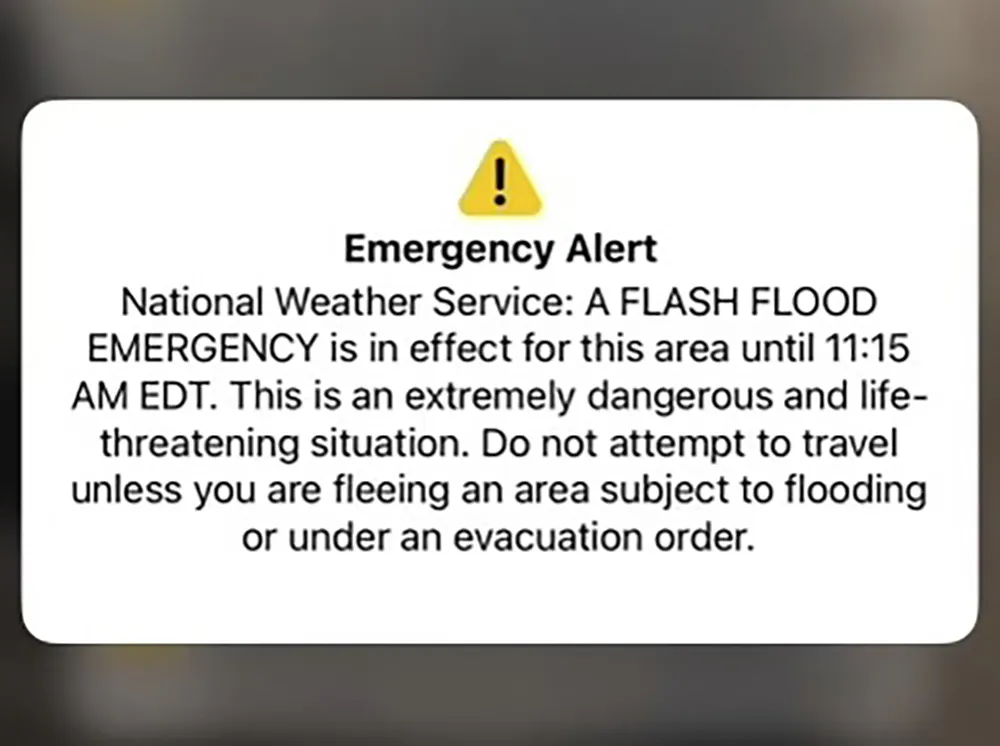
    A typical alert from the National Weather Service.
    AP Photo/Lisa Rathke

    Beyond technologies and digital communication, warnings still come through informal networks in many communities. Emergency managers directly coordinate with and share information with major businesses and organizations, saying, “Hey, John, be sure you have somebody up tonight watching the National Weather Service alerts and rivers.”

    This human-centered approach, similar to neighborhood-level systems we have studied in Japan, can provide direct confirmation that warnings have been received. This is something mass media and mobile systems cannot guarantee, especially during infrastructure failures such as power and cell tower outages.

    Effective messages

    Research shows that effective warning messages need to include five critical components: a clear hazard description, location-specific information, actionable guidance, timing cues and a credible source. The Federal Emergency Management Agency’s integrated public alert and warning system message design dashboard assists authorities in rapidly drafting effective messages.

    This warning system, known as IPAWS, provides nationwide infrastructure for wireless emergency alerts and Emergency Alert System messages. While powerful, IPAWS has limitations − not all emergency managers are trained to use it, and messages may extend beyond intended geographic areas. Also, many older mobile devices lack the latest capabilities, so they may not receive the most complete messages when they are sent.

    Hyperlocal community opt-in systems can complement IPAWS by allowing residents to register for targeted notifications. These systems, which can be run by communities or local agencies, face their own challenges. People must know they exist, be willing to share phone numbers, and remember to update their information. Social media platforms add another communication channel, with emergency managers increasingly using social media to share updates, though these primarily reach only certain demographics, and not everyone checks social media regularly.

    The key is redundancy through multiple communication channels. Research has found that multiple warnings are needed for people to develop a sense of urgency, and the most effective strategy is simple: Tell another person what’s going on. Interpersonal networks help ensure the message is delivered and can prompt actions. As former Natural Hazards Center Director Dennis Mileti observed: The wireless emergency alerts system “is fast. Mama is faster.”

    A Colorado news report explains why emergency alerts have to be tailored for local needs and conditions and use multiple communication channels.

    Warning fatigue

    Professionals from the National Weather Service, FEMA and the Federal Communications Commission, along with researchers, are increasingly concerned about warning fatigue – when people tune out warnings because they receive too many of them.

    However, there is limited empirical data about how and when people experience warning fatigue – or about its impact.

    This creates a double bind: Officials have an obligation to warn people at risk, yet frequent warnings can desensitize recipients. More research is needed to determine the behavioral implications of and differences between warnings that people perceive as irrelevant to their immediate geographic area versus those that genuinely don’t apply to them. This distinction becomes especially critical when people might drive into flooded areas outside their immediate vicinity.

    The key to effective emergency communication is to develop messages that resonate with specific audiences and build community networks that complement technological systems. We are now studying how to do this effectively in the United States and internationally. It’s also important to apply behavioral insights to the design of every level of communication warning systems. And it’s important to remember to test not just the technology but the entire end-to-end system, from threat identification to community response.

    Finally, maintaining true redundancy across multiple communication channels is an important strategy when trying to reach as many people as possible. Technology supports human decision-making, but it doesn’t replace it.

    Keri K. Stephens’ research reported here has been externally funded by the Texas Water Development Board, Texas General Land Office, and the National Science Foundation. Results published are peer-reviewed, and opinions reflect those of the author, not the funder.

    Hamilton Bean has earned research funding from U.S. Department of Homeland Security and the National Oceanic and Atmospheric Administration. Results published are peer-reviewed, and opinions reflect those of the author, not the funder.

    ref. Why it can be hard to warn people about dangers like floods – communication researchers explain the role of human behavior – https://theconversation.com/why-it-can-be-hard-to-warn-people-about-dangers-like-floods-communication-researchers-explain-the-role-of-human-behavior-260780

    MIL OSI Analysis

  • MIL-OSI USA: SBA Relief Still Available to Missouri Small Businesses and Private Nonprofits Affected by Adverse Weather Conditions from

    Source: United States Small Business Administration

    SACRAMENTO, Calif. – The U.S. Small Business Administration (SBA) is reminding eligible small businesses and private nonprofit (PNP) organizations in Missouri counties of the Aug. 11, 2025 deadline to apply for low interest federal disaster loans to offset economic losses caused by the excessive rain and high winds from Hurricane Helene occurring Sept. 28‑29, 2024.

    The disaster declaration covers the Missouri counties of Bollinger, Butler, Cape Girardeau, Carter, Dunklin, Madison, Mississippi, New Madrid, Oregon, Pemiscot, Perry, Ripley, Scott, Stoddard and Wayne, as well as the Arkansas counties of Clay, Craighead, Greene, Mississippi and Randolph, the Illinois counties of Alexander and Union, the Kentucky counties of Ballard, Carlisle, Fulton and Hickman, and the Tennessee counties of Dyer and Lake.

    Under this declaration, SBA’s Economic Injury Disaster Loan (EIDL) program is available to small businesses, small agricultural cooperatives, nurseries, and PNPs impacted by financial losses directly related to the disaster. The SBA is unable to provide disaster loans to agricultural producers, farmers, or ranchers, except for small aquaculture enterprises.

    EIDLs are available for working capital needs caused by the disaster and are available even if the small business or PNP did not suffer any physical damage. The loans may be used to pay fixed debts, payroll, accounts payable and other bills not paid due to the disaster.

    “SBA loans help eligible small businesses and private nonprofits cover operating expenses after a disaster, which is crucial for their recovery,” said Chris Stallings, associate administrator of the Office of Disaster Recovery and Resilience at the SBA. “These loans not only help business owners get back on their feet but also play a key role in sustaining local economies in the aftermath of a disaster.”

    The loan amount can be up to $2 million with interest rates as low as 4% for small businesses and 3.25% for PNPs with terms up to 30 years. Interest does not accrue, and payments are not due until 12 months from the date of the first loan disbursement. The SBA sets loan amounts and terms based on each applicant’s financial condition.

    To apply online, visit sba.gov/disaster. Applicants may also call SBA’s Customer Service Center at (800) 659-2955 or email disastercustomerservice@sba.gov for more information on SBA disaster assistance. For people who are deaf, hard of hearing, or have a speech disability, please dial 7-1-1 to access telecommunications relay services.

    Submit completed loan applications to the SBA no later than Aug. 11.

    ###

    About the U.S. Small Business Administration

    The U.S. Small Business Administration helps power the American dream of business ownership. As the only go-to resource and voice for small businesses backed by the strength of the federal government, the SBA empowers entrepreneurs and small business owners with the resources and support they need to start, grow, expand their businesses, or recover from a declared disaster. It delivers services through an extensive network of SBA field offices and partnerships with public and private organizations. To learn more, visit www.sba.gov.

    MIL OSI USA News

  • MIL-OSI USA: 74 U.S. Representatives Warn Trump Administration To Halt Potentially Illegal Mass Firings Of Federal Workers

    Source: United States House of Representatives – Representative Don Beyer (D-VA)

    Congressman Don Beyer (D-VA) today led 74 U.S. Representatives in pressing the Trump Administration to halt plans to conduct further mass firings of federal workers amid reports that the White House intends to proceed with gutting federal agencies and conducting mass purges of civil servants, including at the State Department, following a recent Supreme Court order.

    They wrote to Office of Management and Budget (OMB) Director Russ Vought:

    “The Supreme Court… did not rule on the legality of these [mass layoff and agency restructuring] plans. The plans themselves are still under active legal review and are still being evaluated at the district and appellate levels for compliance with the law. Continuing forward would show active disregard for the judicial process and the Founders’ checks and balances intent, [and] create chaos if the courts rule these actions unlawful.

    “[R]esuming RIFs and reorganizations is premature and risks irreversible harm to federal employees and to our nation. Career civil servants are not expendable pawns, but actual people whose jobs matter.

    “It would be irresponsible, and risk violating the law, to restart workforce reductions and reorganization without congressional input while legal uncertainty persists. We urge you to take the responsible, measured approach which is to keep any agency reorganization and RIF plans on hold until legal clarity is achieved, which the Supreme Court’s recent announcement has not granted.”

    Beyer previously led a delegation of 60 House Democrats expressing opposition to mass firings of State Department employees, including Foreign Service Officers, to Secretary of State Marco Rubio.

    The letter to Director Vought was U.S. Representatives Don Beyer (CA), Alma Adams (NC), Gabe Amo (RI), Yassamin Ansari (AZ), Becca Balint (VT), Nanette Barragán (CA), Brendan Boyle (PA), Julia Brownley (CA), Nikki Budzinski (IL), Janelle Bynum (IR), Greg Casar (TX), Judy Chu (CA), Steve Cohen (TN), Jason Crow (CO), Danny Davis (IL), Madeleine Dean (PA), Diana DeGette (CO), Suzan DelBene (WA), Mark DeSaulnier (CA), Maxine Dexter (OR), Sarah Elfreth (MD), Adriano Espaillat (NY), John Garamend (CA), Daniel Goldman (NY), Steny Hoyer (MD), Val Hoyle (OR), Jared Huffman (CA), Jonathan Jackson (IL), Marcy Kaptur (OH), Robin Kelly (IL), Timothy Kennedy (NY), Ro Khanna (CA), Raja Krishnamoorthi (IL), Greg Landsman (OH), Rick Larsen (WA), John Larson (CT), Sarah McBride (DE), Jennifer McClellan (VA), Betty McCollum (MI), James McGovern (MA), Kweisi Mfume (MD), Gwen Moore (WI), Jerrold Nadler (NY), Joe Neguse (CO), Johnny Olszewski (MD), Jimmy Panetta (CA), Nancy Pelosi (CA), Brittany Pettersen (CO), Chellie Pingree (ME), Delia Ramirez (IL), Jamie Raskin (MD), Deborah Ross (NC), Andrea Salinas (OR), Linda Sánchez (CA), Mary Gay Scanlon (PA), Jan Schakowsky (IL), Kim Schrier (WA), Bobby Scott (VA), Greg Stanton (AZ), Suhas Subramanyam (VA), Mark Takano (CA), Shri Thanedar (MI), Mike Thompson (CA), Dina Titus (NV), Rashida Tlaib (MI), Jill Tokuda (HI), Paul Tonko (NY), Juan Vargas (CA), Nikema Williams (WA), and Congresswoman Eleanor Homes Norton (DC).

    Full text of the letter follows below and a signed copy is available here.

    ***

    July 11, 2025

    The Honorable Russell Vought
    Director The Office of Management and Budget (OMB)
    725 17th St NW Washington, DC 20503

    Dear Director Vought:

    We ask you to maintain the current pause on reviewing and implementing any agency reorganizations or reductions in force (RIF) actions while litigation surrounding these plans is active and ongoing. OMB should not exceed Congressional authority and undermine the judicial process and should act with caution by pausing any further RIF related actions until the courts have ruled definitively.

    While the Supreme Court’s recent announcement lifted the district court’s injunction on agency reorganization or RIF plans on procedural grounds, it did not rule on the legality of these plans. The plans themselves are still under active legal review and are still being evaluated at the district and appellate levels for compliance with the law. Continuing forward would show active disregard for the judicial process and the Founders’ checks and balances intent, as well as create chaos if the courts rule these actions unlawful.

    Further, resuming RIFs and reorganizations is premature and risks irreversible harm to federal employees and to our nation. Career civil servants are not expendable pawns, but actual people whose jobs matter. It impacts not only the individual who no longer has a salary to keep a roof over their head or food in the mouths of their families, but also important services that Americans depend on to keep them safe. Whether it’s the lab tech who was needed at NIH to help Mr. Schleuter get access to his clinical trial, the National Nuclear Security staff that oversee our country’s nuclear weapons stockpile, or the National Weather Service employees that are needed to protect us from extreme weather events, removing or relocating career civil servants from their jobs has consequences. These patriotic individuals have opted to serve our country within the civil service and deserve respect and the due process of the law. Thousands of federal employees have already been affected by this Administration’s half-baked, rushed restructuring and resuming RIFs will compound disruption, lower morale, and weaken agencies’ capacity to serve the public.

    Additionally, it is imperative that we remind you that Congress passes the laws that create and maintain federal offices and structures the federal bureaucracy as it deems appropriate, as well as appropriates funding to agencies to carry out those missions. It is only within Congressionally delegated authority in statute that the Executive branch has the ability to make restructuring decisions. Exceeding statutory allowance undermines the Loper Bright decision that this very Administration championed. The Courts are best suited to determine whether agency action runs afoul of Congressional commands.

    It would be irresponsible, and risk violating the law, to restart workforce reductions and reorganization without congressional input while legal uncertainty persists. We urge you to take the responsible, measured approach which is to keep any agency reorganization and RIF plans on hold until legal clarity is achieved, which the Supreme Court’s recent announcement has not granted.

    Sincerely,

    MIL OSI USA News

  • MIL-OSI USA: Representatives Sorensen, Moran Introduce Bipartisan Bill to Strengthen Weather Forecasting in Rural America

    Source: United States House of Representatives – Congressman Eric Sorensen (IL-17)

    Congressmen Eric Sorensen (IL-17) and Nathaniel Moran (TX-01) introduced their bipartisan Rural Weather Monitoring Systems Act, which would help strengthen weather forecasting systems in rural America.

    The legislation will require a new study of the nation’s weather monitoring systems to give lawmakers a better picture of the state of our current weather forecasting abilities across the country. This bill is urgently needed amid warnings that weather forecasting at the National Oceanic and Atmospheric Administration (NOAA) and National Weather Service (NWS) have been degraded by understaffing, layoffs, and cuts at the agencies.

    “Having access to accurate and reliable weather forecasting is critically important for everyone, whether you’re a farmer trying to plant your harvest or a family determining if you need to shelter in place for a tornado,” said Congressman Sorensen. “During severe weather season, it is critical that we get an accurate picture of the state of our weather monitoring systems across the country. This bipartisan bill will help us ensure that we’re meeting the needs of my neighbors in rural communities who rely on NOAA and the NWS to get their weather forecasts.”

    “In rural communities like ours, a few minutes’ warning can mean the difference between life and death,” said Congressman Moran. “But too often, our families are left without the tools to see danger coming. Every community—no matter how small—deserves the same protection as anywhere else in America. This bill is about closing the radar gap, so no one in East Texas, or rural America, is left in the dark when it matters most.”

    Congressman Sorensen has been a fierce advocate for protecting and strengthening NOAA and the NWS from cuts. Starting last year, he has been warning about the impact of Project 2025’s plans to dismantle and privatize NOAA and the NWS. As the Department of Government Efficiency began making cuts to the agencies, Congressman Sorensen has been speaking out, introducing legislation, and calling on the Administration to bring a stop to the disastrous cuts. 
     

    MIL OSI USA News

  • MIL-OSI Canada: Statement to Promote the Sustainable Recovery of Ukraine’s Energy Systems Issued by Canada and the European Union Co-chairs of the G7+ Ukraine Energy Coordination Group

    Source: Government of Canada News

    Since the onset of Russia’s full-scale invasion in February 2022, Ukraine’s Integrated Energy System has endured relentless attacks that have destroyed vital infrastructure. Damaged and illegally seized power plants, hydroelectric stations, and nuclear facilities have resulted in a significant loss in power generating capacity. Over the past three years, Russia has inflicted increasing damage on Ukraine’s electricity, gas networks and production facilities, and renewable energy sources. This is consequential to Ukrainians’ basic needs, leaving, time and again, millions without heat, light, or access to essential services, with vulnerable populations disproportionally affected. These attacks also inflict significant environmental impacts on Ukraine, compounding the humanitarian impacts by polluting land, destroying ecosystems and threatening food and water security. There are also wider regional implications, notably on the Republic of Moldova’s energy security. These far-reaching impacts underline the importance of securing a just and lasting peace through negotiations.

    As co-chairs of the G7+ Ukraine Energy Coordination Group, we, the Governments of Canada and the European Union, strongly maintain our position in condemning Russia’s continued, brutal war of aggression against Ukraine and commend the immense resilience of the Ukrainian people and economy. We reaffirm our unwavering support for Ukraine in defending its territorial integrity within its internationally recognised borders and right to exist, and its freedom, sovereignty and independence.

    The co-chairs reaffirm an unwavering commitment to supporting emergency repairs, fast-tracking deployment of distributed generation, physical protection and scaling-up of renewable energy. These efforts are firmly rooted in the idea that an energy system that is more resilient to Russian attacks and guarantees Ukraine’s energy independence will necessarily entail maximising energy efficiency, along with a vast expansion of Ukraine’s renewable electricity generation. This is consistent with commitments made at COP28, as part of the Global Stocktake under the Paris Agreement to transition away from fossil fuels in a just, orderly and equitable manner, tripling global renewable energy capacity, and doubling the global average annual rate of energy efficiency improvements by 2030. These efforts align with the European Union (EU) Clean Energy Package, Ukraine’s National Energy and Climate Plan (NECP), and others noted in the Annex, to advance broader energy transition principles aimed at achieving net-zero by 2050, in line with Ukraine’s EU accession path.

    Since 2022, the G7+ Ukraine Energy Coordination Group has successfully mobilised over 7 billion USD in energy assistance. The Ukraine Energy Support Fund (UESF), operated by the Energy Community Secretariat (ECS), has emerged as an efficient and agile instrument in providing financial support, procuring and delivering necessary equipment, and stabilizing Ukraine’s energy sector since its creation in 2022. The UESF is backed by 1.16 billion EUR in pledges from 33 donors and is playing a vital role in restoring damaged infrastructure, deploying decentralized solutions, and ensuring winter preparedness. We acknowledge the ECS’s vital contribution to these efforts, including emergency aid, legal assistance, market monitoring and green recovery.

    The estimated funding under the UESF needed to cover 2025 priorities in the energy sector – including critical winterisation efforts – amounts to approximately 630 million EUR. To ensure adequate preparation ahead of the winter season 2025/26, these funds are urgently required. We therefore call on the international community to join efforts in mobilising the necessary energy support and support Ukraine’s collaborations with international financial institutions. At the same time, we continue to support Ukraine with immediate energy purchase needs to ensure energy security through the approaching heating season.

    The European Union Civil Protection Mechanism (UCPM) is contributing to some of the most immediate needs in Ukraine’s energy sector and approximately 50% of offers under the UCPM are addressing energy-related needs. Offers have come from 33 countries, the EU’s rescEU reserves, and private and international donations. This energy assistance could support approximately 9 million people in Ukraine. However, a significant gap to cover restoration needs remains. As such, we call on the international community to increase its efforts at pace.

    With recovery costs climbing over 500 billion USD over the next decade, private sector investment will be critical to rebuild Ukraine. We are encouraged to see more public-private dialogue, ongoing work to design effective mechanisms for de-risking of private capital and the continued alignment in regulations and standards, also in view of Ukraine’s future accession to the EU. We further welcome progress in strengthening governance and operational independence of state-owned energy enterprises (SOEs), in line with international best practices, which will be crucial for the energy sector’s financial sustainability, investor confidence, and EU integration.

    Today, on July 11, at the 2025 Ukraine Recovery Conference in Rome, hosted by Italy and Ukraine, the European Union and Canada reaffirm our steadfast commitment to supporting Ukraine in establishing a resilient, decentralized and green energy system, aligned with European standards and climate neutrality objectives, and closely integrated with the EU. We underscore the concrete steps already taken, which include:

    • Launch of the Clean Energy Partnership (CEP) to support the country’s sustainable recovery during the Ukraine Recovery Conference 2023 in London;
    • Reaffirmed commitment to support Ukraine’s energy sector during meetings at the Ukraine Recovery Conference in Berlin in 2024, at COP28 in Dubai and COP29 in Baku; and,
    • Regular Foreign Ministers meetings of this Group, such as an in-person meeting at the margins of the UN General Assembly 2024. 

    We look forward to the discussion and announcement of additional contributions to Ukraine’s energy sector at the 2025 Ukraine Recovery Conference.

    We further welcome Ukraine’s progress on reforms implementation which are contributing to clean energy transition targets, while fostering greater integration with the EU and ensuring compliance with the obligations under the Energy Community Treaty. In that regard, we urge Ukraine to adopt the Electricity Integration Package and NEURC independence law as a matter of utmost priority.

    In a remarkable feat, Ukraine and Continental Europe successfully synchronised their power grids just weeks after the full-scale invasion began. It is paramount to continue on the path of EU reform to enable Ukraine to fully seize the benefits of the European energy market for security and import and export. Developing and extending the energy interconnectors between Ukraine and its neighbours remain essential for achieving these goals.

    We acknowledge the efforts across international organizations to grass-roots efforts that ensured transparency of information and helped share the story of Ukraine’s bravery, challenges and opportunities in energy among world leaders and citizens of our countries. We are grateful for timely, insightful analysis from; EBRD, EIB, World Bank, IFC, UNDP, Dixi-Group, IEA, ECS and IAEA.

    The co-chairs express gratitude to member countries and organizations for their contributions.

    MIL OSI Canada News

  • MIL-OSI Analysis: Berg winds in South Africa: the winter weather pattern that increases wildfire risks

    Source: The Conversation – Africa – By Sheldon Strydom, Senior Lecturer & Head of Department, Department of Geography, Rhodes University

    After a fire. Hendrik van den Berg, via Wikimedia Commons., CC BY

    Winter in some parts of South Africa is a time of low (or no) rainfall and high fire danger. Sheldon Strydom studies the relationship between weather and fire, in particular how Berg winds, also known as mountain flow events, are linked to periods of enhanced fire danger. Mid-July is typically a high risk period. He shares what he has learnt during his research in the midlands of KwaZulu-Natal province in South Africa, close to the country’s largest mountain range, the Drakensberg.

    What are Berg winds and how do they form?

    It’s long been known that mountain winds (“foëhn winds”, “chinook winds” and the like) increase fire danger. There’s case study evidence from around the globe.

    In South Africa, these mountain winds are known as Berg winds. They are generally experienced as warm and dry.

    A mountain wind starts when a mass of air is forced to rise along a windward slope (the side of the mountain that wind is blowing towards). As the mass of air rises it cools. When it reaches the peak of the slope or mountain it descends on the leeward (sheltered) side. As it gets lower, the air gets warmer.

    Berg winds commonly occur in South African winters when high atmospheric pressure systems are situated over the interior of the country and low pressure systems are situated off the coast. (Atmospheric pressure is the pressure of air over the land, and affects the movement of air.)

    Usually, a coastal low pressure system happens a day or two before a cold front. The pressure gradient (difference in pressure that drives wind) between the interior high pressure cell and coastal low pressure cell results in air flowing towards the coast from the interior of the country, down the mountain escarpment. The air reaches coastal areas as a warm, dry wind.

    Why study the relationship between Berg winds and fires?

    Winds can spread fires in the landscape.

    Our study, using data from four sites in the midlands of KwaZulu-Natal, quantified the effect of Berg winds on the microclimate (local weather conditions) and emphasised how these changes influence fire danger.

    The sources of fires in South Africa, as elsewhere, vary. For example, wildfires can be started when prescribed burning, or the planned use of fire, becomes uncontrolled due to changes in weather conditions. Accidental fires and arson are the most common causes of wildfires. Research shows that wildfires and fire disasters are common in areas where prescribed burning is used.

    Prescribed burning, or the planned use of fire, is an important aspect of agricultural management. It promotes the dispersal and germination of seeds from a number of species and also removes ground litter. Prescribed burning is used to manage grasslands and has been linked to decreasing the number of disease-borne vectors such as ticks.

    But if they get out of control, fires pose a threat to farmland and plantations.

    It’s therefore vital to have weather forecasts and monitoring systems that warn of conditions conducive to the development and spread of fires.

    Internationally, fire danger indices or meters are used to monitor conditions. In South Africa, the South African Weather Service and other interested and affected parties currently use the Lowveld fire danger index. The index is calculated using records of air temperature, relative humidity and wind speed and rainfall. These are measured once a day. Daily forecasts are available from the Weather Service and disseminated to local fire protection associations.

    Much research in South Africa has focused on pyrogeography (understanding when and where fires occur) and fire ecology. Little research has been done to quantify the effects of Berg winds on fire danger using available historical hourly meteorological data.

    The midlands of KwaZulu-Natal province serve as a perfect environment to study the effects of Berg winds on the microclimate and fire danger. The area is close to the Drakensberg mountains and experiences frequent fires. It’s also a largely agricultural area.


    Read more:
    Southern Africa’s rangelands do many jobs, from feeding cattle to storing carbon: a review of 60 years of research


    What did you discover?

    The study developed a fuzzy logic system (a mathematical method for handling uncertainty) to identify periods of Berg wind conditions using historical hourly meteorological data in four sites.

    We analysed variables like the air temperature, relative humidity, wind speed, and fire danger at different times of the day and night, before and during Berg winds.

    The analysis revealed the significance of change experienced in the local weather conditions (within 2km) during periods of Berg winds, and how these changes influence fire danger.

    It found that:

    • Berg winds were more common during daytime hours and affected the microclimate most during the day

    • during daytime Berg wind events, air temperatures rose by an average of 5.5°C; humidity fell by an average of 16%; and wind speed increased by an average of 5.2 metres per second

    • daytime Berg wind events significantly elevated fire danger

    • night-time Berg winds, while less common, did still result in significant change in the microclimate

    • at night, fire danger increases when a combination of variables change significantly.

    The fuzzy logic system can be useful in two ways: to quantify the effects of Berg winds on the microclimate and to complement any fire danger monitoring system. It can measure conditions at a higher temporal resolution, such as every 10 minutes, or hour – making it more useful for monitoring near real-time changes in fire danger.

    The system could be valuable for operational use by agencies like the KwaZulu-Natal Provincial Disaster Management Centre, and could be applied in other regions vulnerable to fire risk.

    Sheldon Strydom receives funding from Rhodes University, and the National Research Foundation.

    Michael John Savage has received funding from the NRF.

    ref. Berg winds in South Africa: the winter weather pattern that increases wildfire risks – https://theconversation.com/berg-winds-in-south-africa-the-winter-weather-pattern-that-increases-wildfire-risks-260612

    MIL OSI Analysis

  • MIL-OSI Africa: Berg winds in South Africa: the winter weather pattern that increases wildfire risks

    Source: The Conversation – Africa – By Sheldon Strydom, Senior Lecturer & Head of Department, Department of Geography, Rhodes University

    Winter in some parts of South Africa is a time of low (or no) rainfall and high fire danger. Sheldon Strydom studies the relationship between weather and fire, in particular how Berg winds, also known as mountain flow events, are linked to periods of enhanced fire danger. Mid-July is typically a high risk period. He shares what he has learnt during his research in the midlands of KwaZulu-Natal province in South Africa, close to the country’s largest mountain range, the Drakensberg.

    What are Berg winds and how do they form?

    It’s long been known that mountain winds (“foëhn winds”, “chinook winds” and the like) increase fire danger. There’s case study evidence from around the globe.

    In South Africa, these mountain winds are known as Berg winds. They are generally experienced as warm and dry.

    A mountain wind starts when a mass of air is forced to rise along a windward slope (the side of the mountain that wind is blowing towards). As the mass of air rises it cools. When it reaches the peak of the slope or mountain it descends on the leeward (sheltered) side. As it gets lower, the air gets warmer.

    Berg winds commonly occur in South African winters when high atmospheric pressure systems are situated over the interior of the country and low pressure systems are situated off the coast. (Atmospheric pressure is the pressure of air over the land, and affects the movement of air.)

    Usually, a coastal low pressure system happens a day or two before a cold front. The pressure gradient (difference in pressure that drives wind) between the interior high pressure cell and coastal low pressure cell results in air flowing towards the coast from the interior of the country, down the mountain escarpment. The air reaches coastal areas as a warm, dry wind.

    Why study the relationship between Berg winds and fires?

    Winds can spread fires in the landscape.

    Our study, using data from four sites in the midlands of KwaZulu-Natal, quantified the effect of Berg winds on the microclimate (local weather conditions) and emphasised how these changes influence fire danger.

    The sources of fires in South Africa, as elsewhere, vary. For example, wildfires can be started when prescribed burning, or the planned use of fire, becomes uncontrolled due to changes in weather conditions. Accidental fires and arson are the most common causes of wildfires. Research shows that wildfires and fire disasters are common in areas where prescribed burning is used.

    Prescribed burning, or the planned use of fire, is an important aspect of agricultural management. It promotes the dispersal and germination of seeds from a number of species and also removes ground litter. Prescribed burning is used to manage grasslands and has been linked to decreasing the number of disease-borne vectors such as ticks.

    But if they get out of control, fires pose a threat to farmland and plantations.

    It’s therefore vital to have weather forecasts and monitoring systems that warn of conditions conducive to the development and spread of fires.

    Internationally, fire danger indices or meters are used to monitor conditions. In South Africa, the South African Weather Service and other interested and affected parties currently use the Lowveld fire danger index. The index is calculated using records of air temperature, relative humidity and wind speed and rainfall. These are measured once a day. Daily forecasts are available from the Weather Service and disseminated to local fire protection associations.

    Much research in South Africa has focused on pyrogeography (understanding when and where fires occur) and fire ecology. Little research has been done to quantify the effects of Berg winds on fire danger using available historical hourly meteorological data.

    The midlands of KwaZulu-Natal province serve as a perfect environment to study the effects of Berg winds on the microclimate and fire danger. The area is close to the Drakensberg mountains and experiences frequent fires. It’s also a largely agricultural area.


    Read more: Southern Africa’s rangelands do many jobs, from feeding cattle to storing carbon: a review of 60 years of research


    What did you discover?

    The study developed a fuzzy logic system (a mathematical method for handling uncertainty) to identify periods of Berg wind conditions using historical hourly meteorological data in four sites.

    We analysed variables like the air temperature, relative humidity, wind speed, and fire danger at different times of the day and night, before and during Berg winds.

    The analysis revealed the significance of change experienced in the local weather conditions (within 2km) during periods of Berg winds, and how these changes influence fire danger.

    It found that:

    • Berg winds were more common during daytime hours and affected the microclimate most during the day

    • during daytime Berg wind events, air temperatures rose by an average of 5.5°C; humidity fell by an average of 16%; and wind speed increased by an average of 5.2 metres per second

    • daytime Berg wind events significantly elevated fire danger

    • night-time Berg winds, while less common, did still result in significant change in the microclimate

    • at night, fire danger increases when a combination of variables change significantly.

    The fuzzy logic system can be useful in two ways: to quantify the effects of Berg winds on the microclimate and to complement any fire danger monitoring system. It can measure conditions at a higher temporal resolution, such as every 10 minutes, or hour – making it more useful for monitoring near real-time changes in fire danger.

    The system could be valuable for operational use by agencies like the KwaZulu-Natal Provincial Disaster Management Centre, and could be applied in other regions vulnerable to fire risk.

    – Berg winds in South Africa: the winter weather pattern that increases wildfire risks
    – https://theconversation.com/berg-winds-in-south-africa-the-winter-weather-pattern-that-increases-wildfire-risks-260612

    MIL OSI Africa

  • MIL-OSI Analysis: Spacecraft equipped with a solar sail could deliver earlier warnings of space weather threats to Earth’s technologies

    Source: The Conversation – USA – By Mojtaba Akhavan-Tafti, Associate Research Scientist, University of Michigan

    The SWIFT constellation, shown not to scale in this illustration, will fly farther than its predecessors to improve space weather warning time. Steve Alvey

    The burgeoning space industry and the technologies society increasingly relies on – electric grids, aviation and telecommunications – are all vulnerable to the same threat: space weather.

    Space weather encompasses any variations in the space environment between the Sun and Earth. One common type of space weather event is called an interplanetary coronal mass ejection.

    These ejections are bundles of magnetic fields and particles that originate from the Sun. They can travel at speeds up to 1,242 miles per second (2,000 kilometers per second) and may cause geomagnetic storms.

    They create beautiful aurora displays – like the northern lights you can sometimes see in the skies – but can also disrupt satellite operations, shut down the electric grid and expose astronauts aboard future crewed missions to the Moon and Mars to lethal doses of radiation.

    An animation shows coronal mass ejection erupting from the Sun.

    I’m a heliophysicist and space weather expert, and my team is leading the development of a next-generation satellite constellation called SWIFT, which is designed to predict potentially dangerous space weather events in advance. Our goal is to forecast extreme space weather more accurately and earlier.

    The dangers of space weather

    Commercial interests now make up a big part of space exploration, focusing on space tourism, building satellite networks, and working toward extracting resources from the Moon and nearby asteroids.

    Space is also a critical domain for military operations. Satellites provide essential capabilities for military communication, surveillance, navigation and intelligence.

    As countries such as the U.S. grow to depend on infrastructure in space, extreme space weather events pose a greater threat. Today, space weather threatens up to US$2.7 trillion in assets globally.

    In September 1859, the most powerful recorded space weather event, known as the Carrington event, caused fires in North America and Europe by supercharging telegraph lines. In August 1972, another Carrington-like event nearly struck the astronauts orbiting the Moon. The radiation dose could have been fatal. More recently, in February 2022, SpaceX lost 39 of its 49 newly launched Starlink satellites because of a moderate space weather event.

    Today’s space weather monitors

    Space weather services heavily rely on satellites that monitor the solar wind, which is made up of magnetic field lines and particles coming from the Sun, and communicate their observations back to Earth. Scientists can then compare those observations with historical records to predict space weather and explore how the Earth may respond to the observed changes in the solar wind.

    The Earth’s magnetic field acts as a shield that deflects most solar wind.
    NASA via Wikimedia Commons

    Earth’s magnetic field naturally protects living things and Earth-orbiting satellites from most adverse effects of space weather. However, extreme space weather events may compress – or in some cases, peel back – the Earth’s magnetic shield.

    This process allows solar wind particles to make it into our protected environment – the magnetosphere – exposing satellites and astronauts onboard space stations to harsh conditions.

    Most satellites that continuously monitor Earth-bound space weather orbit relatively close to the planet. Some satellites are positioned in low Earth orbit, about 100 miles (161 kilometers) above Earth’s surface, while others are in geosynchronous orbit, approximately 25,000 miles (40,000 km) away.

    At these distances, the satellites remain within Earth’s protective magnetic shield and can reliably measure the planet’s response to space weather conditions. However, to more directly study incoming solar wind, researchers use additional satellites located farther upstream – hundreds of thousands of miles from Earth.

    The U.S., the European Space Agency and India all operate space weather monitoring satellites positioned around the L1 Lagrange point – nearly 900,000 miles (1,450,000 km) from Earth – where the gravitational forces of the Sun and Earth balance. From this vantage point, space weather monitors can provide up to 40 minutes of advance warning for incoming solar events.

    The Lagrange points are equilibrium points for smaller objects, like the Earth, that orbit around a larger object, like the Sun. The L1 point is between the Earth and the Sun, where the gravitational pulls of the two objects balance out. Since the Sun’s pull is so much stronger than the Earth’s, the point is much closer to Earth.
    Xander89/Wikimedia Commons, CC BY-SA

    Advance warning for space weather

    Increasing the warning time beyond 40 minutes – the current warning time – would help satellite operators, electric grid planners, flight directors, astronauts and Space Force officers better prepare for extreme space weather events.

    For instance, during geomagnetic storms, the atmosphere heats up and expands, increasing drag on satellites in low Earth orbit. With enough advance warning, operators can update their drag calculations to prevent satellites from descending and burning up during these events. With the updated drag calculations, satellite operators could use the satellites’ propulsion systems to maneuver them higher up in orbit.

    Airlines could change their routes to avoid exposing passengers and staff to high radiation doses during geomagnetic storms. And future astronauts on the way to or working on the Moon or Mars, which lack protection from these particles, could be alerted in advance to take cover.

    Aurora lovers would also appreciate having more time to get to their favorite viewing destinations.

    The Space Weather Investigation Frontier

    My team and I have been developing a new space weather satellite constellation, named the Space Weather Investigation Frontier. SWIFT will, for the first time, place a space weather monitor beyond the L1 point, at 1.3 million miles (2.1 million kilometers) from Earth. This distance would allow scientists to inform decision-makers of any Earth-bound space weather events up to nearly 60 minutes before arrival.

    Satellites with traditional chemical and electric propulsion systems cannot maintain an orbit at that location – farther from Earth and closer to the Sun – for long. This is because they would need to continuously burn fuel to counteract the Sun’s gravitational pull.

    To address this issue, our team has spent decades designing and developing a new propulsion system. Our solution is designed to affordably reach a distance that is closer to the Sun than the traditional L1 point, and to operate there reliably for more than a decade by harnessing an abundant and reliable resource – sunlight.

    SWIFT would use a fuelless propulsion system called a solar sail to reach its orbit. A solar sail is a hair-thin reflective surface – simulating a very thin mirror – that spans about a third of a football field. It balances the force of light particles coming from the Sun, which pushes it away, with the Sun’s gravity, which pulls it inward.

    While a sailboat harnesses the lift created by wind flowing over its curved sails to move across water, a solar sail uses the momentum of photons from sunlight, reflected off its large, shiny sail, to propel a spacecraft through space. Both the sailboat and solar sail exploit the transfer of energy from their respective environments to drive motion without relying on traditional propellants.

    A solar sail could enable SWIFT to enter an otherwise unstable sub-L1 orbit without the risk of running out of fuel.

    NASA successfully launched its first solar sail in 2010. This in-space demonstration, named NanoSail-D2, featured a 107-square-foot (10 m2 ) sail and was placed in low Earth orbit. That same year, the Japanese Space Agency launched a larger solar sail mission, IKAROS, which deployed a 2,110 ft2 (196 m2 ) sail in the solar wind and successfully orbited Venus.

    An illustration of the solar sail used on the IKAROS space probe. These sails use light particles as propulsion.
    Andrzej Mirecki, CC BY-SA

    The Planetary Society and NASA followed up by launching two sails in low Earth orbit: LightSail, with an area of 344 ft2 (32 m2 ), and the advanced composite solar sail system, with an area of 860 ft2 (80 m2 ).

    The SWIFT team’s solar sail demonstration mission, Solar Cruiser, will be equipped with a much larger sail – it will have area of 17,793 ft2 (1,653 m2 ) and launch as early as 2029. We successfully deployed a quadrant of the sail on Earth early last year.

    If successful, the Solar Cruiser mission will pave the way for a small satellite constellation that will monitor the solar wind.

    To transport it to space, the team will meticulously fold and tightly pack the sail inside a small canister. The biggest challenge to overcome will be deploying the sail once in space and using it to guide the satellite along its orbital path.

    If successful, Solar Cruiser will pave the way for SWIFT’s constellation of four satellites. The constellation would include one satellite equipped with sail propulsion, set to be placed in an orbit beyond L1, and three smaller satellites with chemical propulsion in orbit at the L1 Lagrange point.

    The satellites will be indefinitely parked at and beyond L1, collecting data in the solar wind without interruption. Each of the four satellites can observe the solar wind from different locations, helping scientists better predict how it may evolve before reaching Earth.

    As modern life depends more on space infrastructure, continuing to invest in space weather prediction can protect both space- and ground-based technologies.

    Mojtaba Akhavan-Tafti receives funding from NASA. He is the Principal Investigator of Space Weather Investigation Frontier (SWIFT).

    ref. Spacecraft equipped with a solar sail could deliver earlier warnings of space weather threats to Earth’s technologies – https://theconversation.com/spacecraft-equipped-with-a-solar-sail-could-deliver-earlier-warnings-of-space-weather-threats-to-earths-technologies-259877

    MIL OSI Analysis

  • MIL-OSI Canada: Government of Canada to make an announcement in Burlington to protect Canada’s fresh water

    Source: Government of Canada News

    Burlington, Ontario – July 14, 2025 Media representatives and others are advised that the Honourable Julie Dabrusin, Minister of Environment and Climate Change, will make an announcement regarding the protection of fresh water in the Great Lakes.  

    Following the announcement, Minister Dabrusin will hold a media availability.

    Event: Announcement and media availability
    Date: Monday, July 14, 2025
    Time: 10:00 a.m. (EST)
    Location: Burlington, Ontario

    The location of the media availability will be confirmed only to accredited media representatives who have registered with the Canada Water Agency’s Media Relations at the following address: media@cwa-aec.gc.ca.

    MIL OSI Canada News

  • MIL-OSI Europe: Text adopted – Deforestation Regulation – list of countries presenting a low or high risk – P10_TA(2025)0149 – Wednesday, 9 July 2025 – Strasbourg

    Source: European Parliament

    The European Parliament,

    –  having regard to Commission Implementing Regulation (EU) 2025/1093 of 22 May 2025 laying down rules for the application of Regulation (EU) 2023/1115 of the European Parliament and of the Council as regards a list of countries that present a low or high risk of producing relevant commodities for which the relevant products do not comply with Article 3, point (a)(1),

    –  having regard to Regulation (EU) 2023/1115 of the European Parliament and of the Council of 31 May 2023 on the making available on the Union market and the export from the Union of certain commodities and products associated with deforestation and forest degradation and repealing Regulation (EU) No 995/2010(2), and in particular Article 29(2) thereof,

    –  having regard to Article 11 of Regulation (EU) No 182/2011 of the European Parliament and of the Council of 16 February 2011 laying down the rules and general principles concerning mechanisms for control by Member States of the Commission’s exercise of implementing powers(3),

    –  having regard to Rule 115(2) and (3) of its Rules of Procedure,

    –  having regard to the motion for a resolution of the Committee on the Environment, Climate and Food Safety,

    –  having regard to the plenary vote of the European Parliament of 14 November 2024 on the Regulation amending Regulation (EU) 2023/1115 as regards provisions relating to the date of application,

    Concerns about data quality and methodological robustness

    A.  whereas the proposed risk categorisation of countries under Regulation (EU) 2023/1115 does not accurately reflect the current realities in the countries concerned, as it is based on outdated data and fails to incorporate all relevant and available risk indicators;

    B.  whereas Commission Implementing Regulation (EU) 2025/1093 does not accurately reflect realities in the countries concerned as it fails to consider key real-world factors, most notably current land-use dynamics and forest degradation; whereas recognising degradation as a risk factor would result in certain Member States being placed in higher risk categories, thereby challenging the assumption that supply chains within the Union are automatically low-risk(4);

    C.  whereas key developments in governance, deforestation trends, and enforcement mechanisms that have occurred since 31 December 2020, which is the cut-off date referred to in Article 2 of Regulation (EU) 2023/1115, are not adequately reflected in the methodology;

    D.  whereas the data relied on for the risk categorisation are primarily derived from the Global Forest Resources Assessment carried out by the Food and Agricultural Organization of the United Nations, with the latest full-cycle country submissions predating 2020, and therefore such data do not adequately or fairly represent the recent national efforts to prevent deforestation, updated land-use policies, real-time satellite monitoring improvements and the latest deforestation trends in several countries(5);

    E.  whereas the methodology for the risk categorisation of countries lacks transparency in relation to how various risk factors are weighted and does not account for regional variability within countries; whereas this raises serious concerns about the fairness and credibility of the classification methodology;

    F.  whereas the methodology for the risk categorisation of countries is flawed because it focuses primarily on aggregate historical deforestation rates and this approach disregards the multidimensional nature of deforestation risk, failing to consider the full scope of indicators set out in Article 29 of Regulation (EU) 2023/1115;

    G.  whereas the approach underlying the current methodology established in Regulation (EU) 2023/1115 does not provide sufficient flexibility to accommodate timely updates, thereby creating significant market uncertainty and potential volatility;

    H.   whereas, without a clearly defined mechanism for regular and transparent reassessment, the classification of countries in risk categories becoming misaligned with evolving conditions, thereby undermining both the effectiveness of Regulation (EU) 2023/1115 and the functioning of global commodity markets;

    I.  whereas the absence of clear pathways for countries to have their risk categorisation changed through demonstrable progress undermines the role of Regulation (EU) 2023/1115 as a positive incentive mechanism and limits its potential to drive sustainable transformation on the ground;

    Analysis of challenges in the first risk category of countries (the ‘category low risk’)

    J.  whereas the criterion of net forest loss between 2015 and 2020, used to determine the category low risk referred to in Article 29(1), point (b), of Regulation (EU) 2023/1115, considers total forest area loss rather than deforestation as narrowly defined under that Regulation, thereby including areas of temporary forest cover change or forest management not associated with land-use conversion, which undermines methodological consistency and legal certainty;

    K.  whereas the methodology for the for the risk categorisation of countries introduces a relative threshold of 0,2 % annual forest area loss, and an absolute threshold of 70 000 hectares of annual forest loss, without providing a clear rationale for those specific values; whereas it is noteworthy that certain high-deforestation countries, such as the United States, fall just below the absolute threshold, raising questions about the objectivity and robustness of the chosen benchmarks;

    L.  whereas the assessment of deforestation risk based on the expansion of cropland areas used for relevant commodities, as defined in Article 2, point (1), of Regulation (EU) 2023/1115, and the scale of livestock and wood production lacks precision; whereas the inclusion of overall wood production as a proxy for deforestation risks is methodologically questionable, as it conflates lawful forestry activities with deforestation driven by land-use change;

    Lack of granularity and context sensitivity

    M.  whereas the current system of having only three risk categories is insufficient to adequately differentiate between countries with vastly different levels of deforestation risk;

    N.  whereas the lack of a nuanced approach could undermine the incentive for more ambitious governments to take further action, as it effectively penalises progress and fails to recognise meaningful efforts to combat deforestation;

    O.  whereas the Commission should address the methodological shortcomings of the current tripartite classification system by considering the introduction of a fourth risk category — ‘negligible risk’ — to reflect the reality that in certain countries or regions, the risk of deforestation or forest degradation is effectively negligible due to robust legal frameworks, low land-use change dynamics and sustainable land management practices;

    P.  whereas the current system risks oversimplifying deforestation risk by granting the status to countries based on outdated data or national averages, which could create a false sense of security and potentially reduce the due diligence obligation for products originating from areas where illegal deforestation persists;

    Q.  whereas, although the current data have shown a localised increase in deforestation in certain regions of the globe, such developments underscore the need for a granular, region-specific monitoring rather than static national risk classifications, which pose a risk of mischaracterising the overall trend and of ignoring regional progress or setbacks;

    R.  whereas credible research and long-term studies, such as ‘Deforestation in the Amazon: Past, Present and Future’(6) published by the Amazon Network of Georeferenced Socio-Environmental Information in 2023, demonstrate the complexity and variability of deforestation dynamics driven by political cycles, enforcement levels, and local socio-economic conditions, and therefore support the need for a more adaptive, context-sensitive approach rather than rigid country benchmarks;

    S.  whereas the current risk classification model fails to account for the volatility of global commodity markets, where price fluctuations, trade dynamics, and demand shifts can rapidly alter deforestation pressures;

    T.  whereas the risk classification should also allow for the creation of a regulated compensation mechanism, applicable exclusively outside of primary or high-biodiversity areas;

    Concerns about fairness, legitimacy and global engagement

    U.  whereas the current country benchmarking system may disincentivise cooperation and data sharing by countries producing relevant commodities, particularly if they perceive the risk categorisation of countries as unfair or politically motivated; whereas fostering mutual trust and engagement requires a fair, evidence-based and collaborative approach that encourages transparency and accountability rather than punitive labelling;

    V.  whereas environmental and civil society organisations from countries producing relevant commodities have raised concerns about the lack of inclusive consultation in the development of the country benchmarking system, highlighting the importance of participatory processes that involve indigenous communities, local stakeholders, and regional authorities;

    1.  Considers that Implementing Regulation (EU) 2025/1093 exceeds the implementing powers provided for in Regulation (EU) 2023/1115;

    2.  Calls on the Commission to repeal Implementing Regulation (EU) 2025/1093;

    3.  Calls on the Commission to revise the country benchmarking system to ensure it is based on up-to-date data, allows for regional differentiation, and includes transparent weighting of risk indicators;

    4.  Urges the Commission to establish clear, time-bound, and transparent procedures for reassessing risk categorisation of countries regularly based on measurable progress and updated scientific data;

    5.  Stresses the importance of engaging with countries producing relevant commodities and stakeholders through inclusive and participatory processes, and of providing support for forest governance reforms and traceability systems;

    6.  Calls for complementary measures, such as forest partnerships, technical assistance, and fair trade incentives, to accompany the benchmarking process and promote sustainable transformation in commodity-producing regions;

    7.  Instructs its President to forward this resolution to the Council and the Commission, and to the governments and parliaments of the Member States.

    (1) OJ L, 2025/1093, 23.5.2025, ELI: http://data.europa.eu/eli/reg_impl/2025/1093/oj.
    (2) OJ L 150, 9.6.2023, p. 206, ELI: http://data.europa.eu/eli/reg/2023/1115/oj.
    (3) OJ L 55, 28.2.2011, p. 13, ELI: http://data.europa.eu/eli/reg/2011/182/oj.
    (4) https://www.eea.europa.eu/publications/how-are-european-forest/how-are-european-forest-ecosystems-doing.
    (5) https://www.fao.org/forest-resources-assessment/en.
    (6) https://infoamazonia.org/wp-content/uploads/2023/03/DEFORESTACION-AMAZONIA-2025_21032023.pdf.

    MIL OSI Europe News

  • MIL-OSI Europe: Written question – Protecting workers from extreme heat in Europe – E-002738/2025

    Source: European Parliament

    Question for written answer  E-002738/2025
    to the Commission
    Rule 144
    Alicia Homs Ginel (S&D)

    Climate change is a reality that endangers the health and lives of workers in Europe. Accidents at work increase by up to 17 % during heatwaves, and heat stress is becoming a danger that can exacerbate previous illnesses and cause sudden deaths.

    When it comes to heat-related deaths in the workplace, Europe is currently witnessing the fastest rate of growth globally: 42 % since 2000, according to the ILO. That is the highest rate in the world.

    It is not enough to rely on companies’ desire to protect workers from the heat. We need decisive action by the EU institutions, including a directive that guarantees safe working conditions during heatwaves. For this, however, we need high-quality and complete data.

    In view of this:

    • 1.What data are currently collected at EU level on heat-related accidents and illnesses in the workplace?
    • 2.Does the Commission consider that the current data collection systems are sufficient to inform policy and legislative responses?
    • 3.What steps will the Commission take to improve the availability and quality of these data at national and European level?

    Submitted: 4.7.2025

    Last updated: 11 July 2025

    MIL OSI Europe News

  • MIL-OSI United Nations: Disaster risk reduction and resilience building: From commitment to action

    Source: UNISDR Disaster Risk Reduction

    Venue

    Third United Nations Conference on Landlocked Developing Countries

    Background 

    Building resilience and disaster risk reduction (DRR) are key enablers to the achievement of sustainable development, particularly in Landlocked Developing Countries (LLDCs). These countries grapple with persistent developmental challenges, while possessing geographies that leave them disproportionately vulnerable to natural hazards. The impacts of climate change, including droughts, heatwaves, wildfires, floods, and melting glaciers, among others, negatively affect people’s livelihoods, access to water and sanitation, agricultural production, infrastructure systems, biodiversity and, ultimately achievement of the Sustainable Development Goals (SDGs).  

    LLDCs are not only impacted by disasters within their own borders, but their supply chains and economies also suffer consequences from disasters in neighboring transit countries. Moreover, desertification and land degradation, dependency on natural resource-based commodities, border closures, rising food and energy costs, and debt burden, as well as socio-economic impacts of the COVID-19 pandemic, all have had a dramatic effect on the resilience of LLDCs. 

    In light of these circumstances, the Programme of Action for LLDCs (2024-2034) highlights as its fourth Priority Area “Enhancing Adaptive Capacity, Strengthening Resilience and Reducing Vulnerability to Climate Change and Disasters”. This emphasis acknowledges the importance of building economies and societies in LLDCs that are resilient to current and emerging disasters, external shocks and the adverse impact of climate change and environmental degradation. To this end, the Programme of Action commits to targeted action on climate adaptation; disaster risk reduction; access to climate change finance; capacity building and technology transfer; resilient infrastructure development; loss and damage; and halting and reversing biodiversity loss. 

    While LLDCs have been making efforts to implement the Sendai Framework for Disaster Risk Reduction 2015-2030, they continue facing numerous resource and capacity challenges that limit the fulfillment of their commitment to DRR. The new Programme of Action for LLDCs seeks to ensure that sufficient domestic, external, public and private resources are mobilized to meet the growing investment and spending needs of LLDCs, while emphasizing the need to build more resilient societies, including through capacity development, technology transfer and international cooperation. 

    Moving forward, LLDCs need enhanced engagement and support from development partners – in the North and South – to complement national and regional efforts towards regionwide resilience. Additional support and improved access are critical to ensure adequate financing for resilient infrastructure projects, including building resilient trade and transport systems and improving capacity for risk management, including though regional integration. Greater efforts are also needed to mobilize stakeholders and to create proactive plans for identifying and addressing future risks. A focus on regional collaboration is not just a means to mitigate risk but an opportunity to improve cooperation and build long-term partnerships with transit countries. 

    Objectives of the side event  

    Against this background, the side event will bring together representatives of LLDC governments, the UN system and partners to discuss the way forward to implement the disaster risk reduction and resilience building commitments and targets outlined in the new Programme of Action. The event will inform the next concrete steps to support the coordinated implementation of the risk reduction and resilience building aspects of the Programme of Action for LLDCs (2024-2034). 

    Discussions will center on the following strategic objectives across the five priority areas of action identified in the new Programme of Action:

    • enabling increased financing, technical assistance, capacity building and transfer of technology, including to avert, minimize and address loss and damage

    • furthering principles for resilient infrastructure, including through cooperation at regional level, and enabling investments from public and private partners

    Speakers will identify good practices as well as policy, capacity and resource gaps that must be addressed to ensure the full implementation of the Programme of Action for LLDCs (2024-2034) in a manner that supports resilient and risk-informed development in the LLDCs. 

    MIL OSI United Nations News

  • MIL-OSI Europe: Highlights – ENVI exchange of views on 2040 climate target proposal – Committee on the Environment, Public Health and Food Safety

    Source: European Parliament

    On 14 July 2025, ENVI will hold an exchange of views on the Commission’s proposal to amend the European Climate Law by setting a 2040 target of 90% net GHG emissions reduction compared to 1990 levels

    On 2 July 2025, the Commission presented a proposal to amend the European Climate Law, introducing an EU 2040 climate target to reduce net GHG emissions by 90% compared to 1990 levels. This target builds on the EU 2030 climate target of at least 55% GHG emissions reduction and sets the pathway to reach climate neutrality by 2050. The proposal introduces the possibility to use flexibilities in how the target can be met, such as the potential use of high-quality international carbon credits from 2036, inclusion of domestic permanent removals in the EU ETS, and cross-sectoral compensation mechanisms. It also outlines enabling conditions to ensure industrial competitiveness, fairness, and technological neutrality. National specificities, simplicity, and cost-effectiveness are to be taken into account. Kurt Vandenberghe, Director General of DG CLIMA, will present the proposal in ENVI on 14 July.

    MIL OSI Europe News

  • MIL-OSI Europe: Spain: EIB and ICF sign €100 million loan to back small businesses’ investments in sustainability and climate change adaptation and mitigation

    Source: European Investment Bank

    EIB

    • This is the first tranche of a total approved loan of €200 million.
    • The loan will expand financing available for small businesses wishing to invest in areas such as renewable energy, energy efficiency, electric vehicles and waste management.
    • The agreement contributes to the EIB’s strategic priorities of climate action and environmental sustainability, as well as support for SMEs and mid-caps.

    The European Investment Bank (EIB) and the Institut Català de Finances (ICF) have signed a €100 million loan to encourage small and medium-sized enterprises (SMEs) to invest in sustainability and climate change adaptation and mitigation. This is the first tranche of a total approved EIB loan of €200 million.

    The agreement means that ICF will be able to expand the range of new financing available to enable SMEs – a key element of the economy – to make investments to speed up their green transition and help create a more sustainable and competitive economy. Projects open for financing will include those related to renewable energy and energy efficiency, investments in electric vehicles, the circular economy or efficient and sustainable waste management.

    EIB Director of Public Sector Lending in the European Union Gilles Badot said: “This loan will make it easier for small and medium companies committed to sustainability and energy efficiency to access new financing. We are very happy to join forces once again with ICF, applying cooperation between public sector financial institutions to promote the green transition of these companies of strategic importance to our economy and to its transition towards a more sustainable model.”

    ICF CEO Vanessa Servera added: “EIB support has enabled us to offer Catalan SMEs better financing conditions so they can implement projects and investments directly helping to meet climate goals and driving competitiveness. Small and medium companies are key to our economy and, for this reason, ICF wants to act as a strategic ally in their transition to a more sustainable and responsible business model.”

    The agreement highlights the commitment of the European Investment Bank Group (EIB Group) to climate action and environmental sustainability and support for small and medium-sized enterprises – strategic priorities set out in the Group’s Strategic Roadmap for 2024-2027.

    Background information

    EIB

    The European Investment Bank (EIB) is the long-term lending institution of the European Union, owned by its Member States. Built around eight core priorities, we finance investments that contribute to EU policy objectives by bolstering climate action and the environment, digitalisation and technological innovation, security and defence, cohesion, agriculture and bioeconomy, social infrastructure, the capital markets union, and a stronger Europe in a more peaceful and prosperous world.

    The EIB Group, which also includes the European Investment Fund (EIF), signed nearly €89 billion in new financing for over 900 high-impact projects in 2024, boosting Europe’s competitiveness and security.

    All projects financed by the EIB Group are in line with the Paris Agreement, as pledged in its Climate Bank Roadmap. Almost 60% of the EIB Group’s annual financing supports projects that contribute directly to climate change mitigation and adaptation, and a healthier environment.

    In Spain, the EIB Group signed new financing worth €12.3 billion for over 100 high-impact projects in 2024, contributing to the country’s green and digital transition, economic growth, competitiveness and better services for its people.

    High-quality, up-to-date photos of the organisation’s headquarters for media use are available here.

    ICF

    ICF has been the public promotional bank in Catalonia for 40 years, and in that period it has financed 37 000 clients for a total of €16 billion. Its main mission is to promote the financing of companies and entities in order to contribute to the growth, innovation and sustainability of the Catalan economy. ICF acts as a complement to the private sector, offering a wide range of financing solutions focused on loans, guarantees and investment in venture capital. Since 2014 it has been a member of the European Association of Public Banks (EAPB), which brings together a large number of the public promotional banks and financial entities operating in Europe.

    MIL OSI Europe News

  • MIL-OSI Africa: SA to host second G20 environment and climate meeting

    Source: Government of South Africa

    South Africa, through the Department of Forestry, Fisheries and the Environment (DFFE), will host the second technical meeting of the Group of 20 (G20) Environment and Climate Sustainability Working Group (ECSWG) next week.

    The meeting will be held from 14-18 18 July 2025, at Kruger National Park (KNP) in Skukuza, Mpumalanga.

    The ECSWG will facilitate high-level discussions on various critical topics, including biodiversity and conservation, climate change, land degradation, desertification and drought, chemicals and waste management, air quality, and ocean and coastal issues.

    According to the department, this meeting will build on the progress made at the first virtual ECSWG meeting held in March and will focus on deepening collaboration within the priorities of the G20 ECSWG.

    READ | G20 Environment and Climate Sustainability Working Group first meeting concluded

    The DFFE is coordinating the ECSWG, ensuring alignment with South Africa’s policy priorities and global sustainability commitments. 

    The key activities focused on promoting global cooperation for environmental sustainability. 

    This includes leading three ECSWG meetings, integrating sustainability discussions within G20 Working Groups, and collaborating with stakeholders and member states to achieve actionable results in climate finance, biodiversity, pollution management, and ocean governance.

    The meeting at the KNP forms part of a series of three ECSWG engagements hosted by South Africa during its G20 Presidency. 
    The meeting will bring together over 250 delegates, including representatives from G20 member states, invited countries, international organisations, government officials, and the media.

    The Minister of Forestry, Fisheries and the Environment, Dr Dion George, will launch G20 legacy projects at the second technical meeting of the ECSWG.

    The launch of the G20 legacy project, Rhino Renaissance Campaign, will demonstrate conservation efforts in fighting wildlife crime. 

    This will include a live demonstration of the dehorning of rhino process to be administered by the world-acclaimed South African National Parks Veterinary Services in the presence of the Minister of Forestry, Fisheries, and the Environment, and a selected group of delegates.   

    The leaders will also embark on the G20 tree planting activity, a symbolic tree planting ceremony of 20 trees, one for each G20 member, outside the Nombolo Mdluli Conference Centre. 

    “This initiative forms part of South Africa’s National Greening Programme, which aims to plant 10 million trees over five years. It is a bold step toward addressing the Presidential imperatives on greening,” the statement read. 

    The leaders will also announce the school essay winners. – SAnews.gov.za

    MIL OSI Africa

  • Heavy Rain to Lash Central and Northwest India; Delhi-NCR to Experience Moderate Showers

    Source: Government of India

    Source: Government of India (4)

    The India Meteorological Department (IMD) on Friday said that heavy to very heavy rainfall is likely to continue over central and adjoining northwest India for the next four to five days, with possibility of very heavy rainfall over southern Uttar Pradesh today, eastern Rajasthan from July 11 to 15, and Madhya Pradesh between July 11 and 14. Uttarakhand is also expected to receive significant rainfall on July 15 and 16.

    Weather forecast for Delhi-NCR

    In the Delhi-NCR region, the weather will remain relatively moderate with intermittent rainfall over the coming days.

    The city’s weather forecast for today indicates generally cloudy skies with light to moderate rain, accompanied by thunderstorms and lightning. Maximum temperatures are expected to range between 31°C and 33°C, marking a departure of 2 to 4°C below the normal. Winds are predicted to blow from the northwest, at speeds below 15 kmph in the afternoon, decreasing to 8–12 kmph from the northeast by evening and night.

    On July 12, the region will experience partly cloudy skies with very light to light rain and occasional thunderstorms. Temperatures are likely to range between 34°C and 36°C during the day and 24°C to 26°C at night. The minimum temperature will be 1 to 3°C below normal, while the maximum temperature will remain near normal. Winds will be from the northwest, starting below 20 kmph in the morning and gradually slowing to under 12 kmph by night.

    July 13 is expected to bring partly cloudy skies with light rain and thunderstorms. Daytime temperatures will hover between 35°C and 37°C, and nighttime temperatures between 25°C and 27°C. The minimum temperature will be slightly below normal, while the maximum will be near normal. Winds will shift from the north in the morning to the southeast by evening, with speeds staying under 15 kmph.

    On July 14, the weather will remain partly cloudy with light rain and thunderstorms. Maximum temperatures will range from 32°C to 34°C, slightly below normal, while minimum temperatures will be near normal, between 23°C and 25°C. Winds will begin from the southeast at less than 15 kmph in the morning, picking up slightly in the afternoon and easing again in the evening from the east.


  • Heavy rainfall likely in MP, southern UP, eastern Rajasthan: IMD

    Source: Government of India

    Source: Government of India (4)

    The India Meteorological Department (IMD) on Friday said that heavy to very heavy rainfall is likely to continue over central and adjoining northwest India for the next four to five days, with possibility of very heavy rainfall over southern Uttar Pradesh today, eastern Rajasthan from July 11 to 15, and Madhya Pradesh between July 11 and 14. Uttarakhand is also expected to receive significant rainfall on July 15 and 16.

    Weather forecast for Delhi-NCR

    In the Delhi-NCR region, the weather will remain relatively moderate with intermittent rainfall over the coming days.

    Today, the sky is expected to remain generally cloudy with light to moderate rain, accompanied by thunderstorms and lightning. Maximum temperatures will range between 31°C and 33°C, which is 2 to 4°C below normal. Winds will predominantly blow from the northwest at speeds below 15 kmph in the afternoon, decreasing to 8–12 kmph from the northeast by evening and night.

    On July 12, the region will experience partly cloudy skies with very light to light rain and occasional thunderstorms. Temperatures are likely to range between 34°C and 36°C during the day and 24°C to 26°C at night. The minimum temperature will be 1 to 3°C below normal, while the maximum temperature will remain near normal. Winds will be from the northwest, starting below 20 kmph in the morning and gradually slowing to under 12 kmph by night.

    July 13 is expected to bring partly cloudy skies with light rain and thunderstorms. Daytime temperatures will hover between 35°C and 37°C, and nighttime temperatures between 25°C and 27°C. The minimum temperature will be slightly below normal, while the maximum will be near normal. Winds will shift from the north in the morning to the southeast by evening, with speeds staying under 15 kmph.

    On July 14, the weather will remain partly cloudy with light rain and thunderstorms. Maximum temperatures will range from 32°C to 34°C, slightly below normal, while minimum temperatures will be near normal, between 23°C and 25°C. Winds will begin from the southeast at less than 15 kmph in the morning, picking up slightly in the afternoon and easing again in the evening from the east.


  • MIL-OSI United Kingdom: Be prepared as agency issues Amber alert for hot weather

    Source: City of Wolverhampton

    It will be in force from 12pm today (Friday 11 July, 2025) until 9am on Tuesday 14 July, 2025, with the warmest weather forecast to climb to over 30C over the next 48 hours.

    The UK Health Security Agency (UKHSA) warns that the hot weather is likely to bring increased pressures on health and social care services, could lead to a possible rise in deaths – particularly among those aged 65 or over or with health conditions – and is a health risk to the wider population.

    Councillor Obaida Ahmed, the City of Wolverhampton Council’s Cabinet Member for Health, Wellbeing and Community, said: “While many people enjoy hot weather, high temperatures such as those forecast over the coming days can be dangerous, especially for people who may be particularly vulnerable such as older people, young children and those with serious illnesses.

    “Everyone can enjoy the sun safely by keeping out of the heat at the hottest time of the day, avoiding sunburn and staying hydrated with plenty of cool, non-alcoholic drinks.

    “Older people and those with long term illnesses are particularly vulnerable to the effects of very hot weather, so I’d urge people to look out for them and keep indoor areas as cool as possible.”

    Top tips for being sun safe include:

    • try to keep out of the sun between 11am to 3pm
    • wear UV sunglasses, preferably wraparound, to reduce UV exposure to the eyes, walk in the shade, apply sunscreen of at least sun protection factor 15 with UVA protection
    • wear light, loose fitting cotton clothes, a hat and light scarf, which will help minimise the risk of sunburn
    • drink plenty of water – and note that sugary, alcoholic and caffeinated drinks can make you more dehydrated
    • look out for others especially vulnerable groups such as the older people, young children and babies and those with serious illnesses
    • never leave anyone in a closed, parked vehicle, especially infants, young children or animals
    • avoid deep water, such as canals and lakes
    • keep bedroom and living space cool by closing the curtains on windows that receive the sun and opening windows at cooler times of the day and overnight. Turn off non-essential lights and electrical items as these generate heat
    • health and social care workers should regularly check on vulnerable patients, share sun safety messages, make sure room temperatures are set below 26°C and ensure patients have access to cold water and ice.

    For more advice, please visit Heatwave: how to cope in hot weather.

    To keep an eye on the weather forecast for Wolverhampton, visit Met Office.

    There are 4 levels of warning deployed by UKHSA – Green, Yellow, Amber and Red – an amber warning means the whole health service is likely to be affected by the hot weather.

    Among examples given by UKHSA are difficulties managing medicines, the ability of the workforce to deliver services and internal temperatures in care settings exceeding the recommended thresholds.

    MIL OSI United Kingdom

  • MIL-OSI USA: SPC Jul 11, 2025 Day 4-8 Severe Weather Outlook

    Source: US National Oceanic and Atmospheric Administration

    Day 4-8 Severe Weather Outlook Issued on Jul 11, 2025

    Updated: Fri Jul 11 08:42:03 UTC 2025

     .

    D4
    Mon, Jul 14, 2025 – Tue, Jul 15, 2025
    D7
    Thu, Jul 17, 2025 – Fri, Jul 18, 2025

    D5
    Tue, Jul 15, 2025 – Wed, Jul 16, 2025
    D8
    Fri, Jul 18, 2025 – Sat, Jul 19, 2025

    D6
    Wed, Jul 16, 2025 – Thu, Jul 17, 2025
    (All days are valid from 12 UTC – 12 UTC the following day)

    Note: A severe weather area depicted in the Day 4-8 period indicates 15%, 30% or higher probability for severe thunderstorms within 25 miles of any point.

    PREDICTABILITY TOO LOW is used to indicate severe storms may be possible based on some model scenarios. However, the location or occurrence of severe storms are in doubt due to: 1) large differences in the deterministic model solutions, 2) large spread in the ensemble guidance, and/or 3) minimal run-to-run continuity.

    POTENTIAL TOO LOW means the threat for a regional area of organized severe storms appears unlikely (i.e., less than 15%) for the forecast day.

     Forecast Discussion

    ZCZC SPCSWOD48 ALL
    ACUS48 KWNS 110840
    SPC AC 110840

    Day 4-8 Convective Outlook
    NWS Storm Prediction Center Norman OK
    0340 AM CDT Fri Jul 11 2025

    Valid 141200Z – 191200Z

    …DISCUSSION…
    A surface cold front across the southern Great Plains early in the
    period will quickly redevelop northward into the northern Plains in
    response to strong lee cyclogenesis across the northern High Plains.
    This cyclogenesis will occur in response to a positive-tilt
    short-wave trough moving through the broadly zonal mid-level flow
    across the northern US.

    This front will move back south during the period as a seasonably
    strong high pressure builds southward into the central US in the
    wake of the aforementioned short-wave trough. Thunderstorms are
    likely to develop in the vicinity of the front/aggregate outflow
    boundary each afternoon as it moves south. However, given the lack
    of significant flow amplification as the mid-level wave crosses the
    northern US, it is likely that thunderstorms will remain displaced
    south of the requisite effective-layer shear needed to promote an
    organized severe threat identifiable at this time range.

    One exception to the idea that storms will be displaced from the
    better shear may take place on Monday/Day-4 across portions of North
    Dakota. Here, low-level moisture will surge northward in response to
    the aforementioned northern High Plains lee cyclogenesis. Steep
    mid-level lapse rates will overspread the northern Great Plains
    during the day, yielding most-unstable CAPE values ranging from 1000
    J/kg to perhaps 3000 J/kg depending on model guidance.

    However, run-to-run inconsistency in the space and time evolution of
    relevant features leads to little confidence in identifying where
    any overlap of thunderstorms, instability, and effective-layer shear
    might support severe thunderstorms. However, if model guidance
    begins to converge on potential scenarios, probabilistic delineation
    may become warranted in subsequent forecasts.

    ..Marsh.. 07/11/2025

    CLICK TO GET WUUS48 PTSD48 PRODUCT

    MIL OSI USA News

  • MIL-OSI USA: SPC – No MDs are in effect as of Fri Jul 11 09:25:02 UTC 2025

    Source: US National Oceanic and Atmospheric Administration

    Current Mesoscale DiscussionsUpdated:  Fri Jul 11 09:34:03 UTC 2025 No Mesoscale Discussions are currently in effect.

    Notice:  The responsibility for Heavy Rain Mesoscale Discussions has been transferred to the Weather Prediction Center (WPC) on April 9, 2013. Click here for the Service Change Notice.
    Archived Convective ProductsTo view convective products for a previous day, type in the date you wish to retrieve (e.g. 20040529 for May 29, 2004). Data available since January 1, 2004.

    MIL OSI USA News

  • MIL-OSI Europe: Minutes – Thursday, 10 July 2025 – Strasbourg – Final edition

    Source: European Parliament 2

    PV-10-2025-07-10

    EN

    EN

    iPlPv_Sit

    Minutes
    Thursday, 10 July 2025 – Strasbourg

    IN THE CHAIR: Christel SCHALDEMOSE
    Vice-President

    1. Opening of the sitting

    The sitting opened at 09:00.


    2. Council positions at first reading (Rule 64)

    – Position of the Council at first reading with a view to the adoption of a Directive of the European Parliament and of the Council amending Directive 2008/98/EC on waste – Adopted by the Council on 23 June 2025 (06978/2/2025 – COM(2025)0388 – C10-0139/2025 – 2023/0234(COD))
    referred to committee responsible: ENVI

    The three-month period available to Parliament under Article 294 of the Treaty on the Functioning of the European Union for it to adopt its position would begin the following day, 11 July 2025.


    3. Post-2027 common agricultural policy (debate)

    Commission statement: Post-2027 common agricultural policy (2025/2791(RSP))

    Christophe Hansen (Member of the Commission) made the statement.

    The following spoke: Herbert Dorfmann, on behalf of the PPE Group, Dario Nardella, on behalf of the S&D Group (the President reminded the speaker of the rules on conduct), Raffaele Stancanelli, on behalf of the PfE Group, Carlo Fidanza, on behalf of the ECR Group, Elsi Katainen, on behalf of the Renew Group, Thomas Waitz, on behalf of the Verts/ALE Group, Luke Ming Flanagan, on behalf of The Left Group, Arno Bausemer, on behalf of the ESN Group, Carmen Crespo Díaz, Cristina Maestre, Mathilde Androuët, Veronika Vrecionová, Barry Cowen, Anna Strolenberg, Arash Saeidi, Sarah Knafo, Katarína Roth Neveďalová, Siegfried Mureşan, André Rodrigues, Mireia Borrás Pabón, who also answered a blue-card question from Ana Miranda Paz, Bert-Jan Ruissen, Asger Christensen, Giuseppe Antoci, David Cormand, Norbert Lins, Camilla Laureti, Gilles Pennelle, Waldemar Buda, Christine Singer, who also answered a blue-card question from Arkadiusz Mularczyk, Cristina Guarda, Konstantinos Arvanitis, Daniel Buda, Vytenis Povilas Andriukaitis, Valérie Deloge, Benoit Cassart, Martin Häusling, Paulo Do Nascimento Cabral, Maria Grapini, Ton Diepeveen, Jacek Ozdoba, Ciaran Mullooly, Pär Holmgren, Péter Magyar, Marko Vešligaj, Barbara Bonte, Michal Wiezik, Jessika Van Leeuwen, Csaba Dömötör and Céline Imart.

    The following spoke under the catch-the-eye procedure: Gabriel Mato, Sebastian Tynkkynen, Ana Miranda Paz, Maria Zacharia, Nina Carberry and Arkadiusz Mularczyk.

    IN THE CHAIR: Pina PICIERNO
    Vice-President

    The following spoke under the catch-the-eye procedure: Francisco José Millán Mon, Maria Walsh, Stefan Köhler and Lefteris Nikolaou-Alavanos.

    The following spoke: Christophe Hansen.

    The debate closed.


    4. European Citizens’ Initiative ‘Cohesion policy for the equality of the regions and sustainability of the regional cultures’ (debate)

    European Citizens’ Initiative ‘Cohesion policy for the equality of the regions and sustainability of the regional cultures’ (2025/2655(RSP)) (Rule 228(8))

    Francesco Ventola and Bogdan Rzońca presented the European Citizens’ Initiative.

    The following spoke: Hadja Lahbib (Member of the Commission).

    The following spoke: Iuliu Winkler, on behalf of the PPE Group, Alex Agius Saliba, on behalf of the S&D Group, Kinga Gál, on behalf of the PfE Group, Antonella Sberna, on behalf of the ECR Group, Raquel García Hermida-Van Der Walle, on behalf of the Renew Group, Vladimir Prebilič, on behalf of the Verts/ALE Group, Siegbert Frank Droese, on behalf of the ESN Group, Gabriella Gerzsenyi, Marcos Ros Sempere, André Rougé, who also answered a blue-card question from Raquel García Hermida-Van Der Walle, Guillaume Peltier, Joachim Streit, Kathleen Funchion, Volker Schnurrbusch, Fidias Panayiotou, Daniel Buda, Hannes Heide, Rody Tolassy, Nora Junco García, Irmhild Boßdorf, who also answered a blue-card question from Arkadiusz Mularczyk, Rosa Estaràs Ferragut, Sabrina Repp, Alexandra Mehnert, Juan Fernando López Aguilar, Loránt Vincze, Isilda Gomes, Łukasz Kohut, Sandra Gómez López, Andi Cristea and Sofie Eriksson.

    The following spoke under the catch-the-eye procedure: Gabriel Mato, Viktória Ferenc, Arkadiusz Mularczyk, Oihane Agirregoitia Martínez, Diana Iovanovici Şoşoacă, Nikolina Brnjac and Sebastian Tynkkynen.

    The following spoke: Hadja Lahbib.

    The debate closed.

    (The sitting was suspended at 11:51.)


    IN THE CHAIR: Roberta METSOLA
    President

    5. Resumption of the sitting

    The sitting resumed at 12:00.

    The President thanked the Members and Parliament’s staff for their work during the first year of the current parliamentary term.


    6. Voting time

    For detailed results of the votes, see also ‘Results of votes’ and ‘Results of roll-call votes’.


    6.1. Motion of censure on the Commission (vote)

    Motion of censure on the Commission B10-0319/2025 (minutes of 10.7.2025, item I) (2025/2140(RSP))

    (Majority of two thirds of the votes cast, constituting a majority of Parliament’s component Members)

    MOTION OF CENSURE (Rule 131)

    Rejected

    (‘Results of votes’, item 1)

    Özlem Demirel, on the admissibility of an amendment concerning one of the items in voting time (the President gave explanations).


    6.2. Case of Ryan Cornelius in Dubai (vote)

    Motions for resolutions RC-B10-0328/2025 (minutes of 10.7.2025, item I), B10-0328/2025, B10-0333/2025, B10-0336/2025, B10-0340/2025 and B10-0341/2025 (minutes of 9.7.2025, item I) (2025/2796(RSP))

    (Majority of the votes cast)

    JOINT MOTION FOR A RESOLUTION

    Adopted (P10_TA(2025)0161)

    (‘Results of votes’, item 2)


    6.3. Arbitrary arrest and torture of Belgian-Portuguese researcher Joseph Figueira Martin in the Central African Republic (vote)

    Motions for resolutions RC-B10-0327/2025 (minutes of 10.7.2025, item I), B10-0323/2025, B10-0327/2025, B10-0334/2025, B10-0339/2025 and B10-0342/2025 (minutes of 9.7.2025, item I) (2025/2797(RSP))

    (Majority of the votes cast)

    JOINT MOTION FOR A RESOLUTION

    Adopted (P10_TA(2025)0162)

    (Motion for a resolution B10-0323/2025 fell.)

    (‘Results of votes’, item 3)


    6.4. Urgent need to protect religious minorities in Syria following the recent terrorist attack on Mar Elias Church in Damascus (vote)

    Motions for resolutions RC-B10-0335/2025 (minutes of 10.7.2025, item I), B10-0325/2025, B10-0335/2025, B10-0338/2025, B10-0343/2025, B10-0344/2025, B10-0345/2025, B10-0346/2025 and B10-0347/2025 (minutes of 9.7.2025, item I) (2025/2798(RSP))

    (Majority of the votes cast)

    JOINT MOTION FOR A RESOLUTION

    Adopted (P10_TA(2025)0163)

    (Motions for resolutions B10-0325/2025, B10-0338/2025 and B10-0343/2025 fell.)

    (‘Results of votes’, item 4)


    6.5. Amending Regulation (EU) 2023/1542 as regards obligations of economic operators concerning battery due diligence policies ***I (vote)

    Report on the proposal for a regulation of the European Parliament and of the Council amending Regulation (EU) 2023/1542 as regards obligations of economic operators concerning battery due diligence policies [COM(2025)0258 – C10-0089/2025 – 2025/0129(COD)] – Committee on the Environment, Climate and Food Safety. Rapporteur: Antonio Decaro (A10-0134/2025)

    (Majority of the votes cast)

    COMMISSION PROPOSAL and AMENDMENTS

    Approved (P10_TA(2025)0164)

    Parliament’s first reading thus closed.

    (‘Results of votes’, item 5)


    6.6. Future of the EU biotechnology and biomanufacturing sector: leveraging research, boosting innovation and enhancing competitiveness (vote)

    Report on the future of the EU biotechnology and biomanufacturing sector: leveraging research, boosting innovation and enhancing competitiveness [2025/2008(INI)] – Committee on Industry, Research and Energy. Rapporteur: Hildegard Bentele (A10-0123/2025)

    (Majority of the votes cast)

    MOTION FOR A RESOLUTION

    Adopted (P10_TA(2025)0165)

    The following had spoken:

    Hildegard Bentele, before the vote, to make a statement pursuant to Rule 165(4).

    (‘Results of votes’, item 6)


    6.7. Tackling China’s critical raw materials export restrictions (vote)

    Motions for resolutions RC-B10-0324/2025/REV1, B10-0324/2025, B10-0326/2025, B10-0329/2025, B10-0330/2025, B10-0331/2025 and B10-0332/2025 (minutes of 10.7.2025, item I) (2025/2800(RSP))

    (Majority of the votes cast)

    JOINT MOTION FOR A RESOLUTION

    Adopted (P10_TA(2025)0166)

    (Motion for a resolution B10-0326/2025 fell.)

    (‘Results of votes’, item 7)

    (The sitting was suspended at 12:18.)


    IN THE CHAIR: Younous OMARJEE
    Vice-President

    7. Resumption of the sitting

    The sitting resumed at 15:00.


    8. Approval of the minutes of the previous sitting

    The minutes of the previous sitting were approved.


    9. Composition of committees and delegations

    The non-attached Members had notified the President of the following decisions changing the composition of the committees and delegations:

    – FEMM Committee: Fernand Kartheiser

    – Delegation to the OACPS-EU Joint Parliamentary Assembly: Fernand Kartheiser

    The decisions took effect as of that day.


    10. Endometriosis: Europe’s wake-up call on the gender health gap (debate)

    Commission statement: Endometriosis: Europe’s wake-up call on the gender health gap (2025/2795(RSP))

    Hadja Lahbib (Member of the Commission) made the statement.

    The following spoke: András Tivadar Kulja, on behalf of the PPE Group, Vytenis Povilas Andriukaitis, on behalf of the S&D Group, Margarita de la Pisa Carrión, on behalf of the PfE Group, Chiara Gemma, on behalf of the ECR Group, Billy Kelleher, on behalf of the Renew Group, Majdouline Sbai, on behalf of the Verts/ALE Group, Catarina Martins, on behalf of The Left Group, Tomasz Froelich, on behalf of the ESN Group, Sirpa Pietikäinen, Evelyn Regner, who also answered a blue-card question from Petras Gražulis, Marie Dauchy, Mariateresa Vivaldini, Tilly Metz, Günther Sidl and Maria Grapini.

    The following spoke: Hadja Lahbib.

    The debate closed.


    11. Oral explanations of votes (Rule 201)


    11.1. Motion of censure on the Commission (B10-0319/2025)
    Cristian Terheş


    11.2. Tackling China’s critical raw materials export restrictions (RC-B10-0324/2025)
    Günther Sidl


    12. Explanations of votes in writing (Rule 201)

    Explanations of votes given in writing would appear on the Members’ pages on Parliament’s website.


    13. Approval of the minutes of the sitting and forwarding of texts adopted

    In accordance with Rule 208(3), the minutes of the sitting would be put to the House for approval at the start of the next sitting.

    With Parliament’s agreement, the texts adopted during the part-session would be forwarded to their respective addressees without delay.


    14. Dates of the next part-session

    The next part-session would be held from 8 September 2025 to 11 September 2025.


    15. Closure of the sitting

    The sitting closed at 15:47.


    16. Adjournment of the session

    The session of the European Parliament was adjourned.

    Alessandro Chiocchetti

    Roberta Metsola

    Secretary-General

    President


    LIST OF DOCUMENTS SERVING AS A BASIS FOR THE DEBATES AND DECISIONS OF PARLIAMENT


    I. Motions for resolutions tabled

    Motion of censure on the Commission

    Motion for a resolution tabled under Rule 131:

    MOTION OF CENSURE ON THE COMMISSION (2025/2140(RSP)) (B10-0319/2025)
    Gheorghe Piperea, Adrian-George Axinia, Claudiu-Richard Târziu, Georgiana Teodorescu, Şerban Dimitrie Sturdza, Fidias Panayiotou, Daniel Obajtek, Ivan David, Patryk Jaki, Zsuzsanna Borvendég, Fernand Kartheiser, Nikolaos Anadiotis, Volker Schnurrbusch, Katarína Roth Neveďalová, Irmhild Boßdorf, Virginie Joron, Ondřej Dostál, Cristian Terheş, Christine Anderson, António Tânger Corrêa, Emmanouil Fragkos, Milan Mazurek, Alexander Jungbluth, Siegbert Frank Droese, Petar Volgin, Rada Laykova, Stanislav Stoyanov, Arno Bausemer, Arkadiusz Mularczyk, Bogdan Rzońca, Milan Uhrík, Mary Khan, Tomasz Froelich, Hans Neuhoff, Alexander Sell, René Aust, Petr Bystron, Jacek Ozdoba, Galato Alexandraki, Kosma Złotowski, Waldemar Buda, Tobiasz Bocheński, Małgorzata Gosiewska, Marlena Maląg, Mariusz Kamiński, Dominik Tarczyński, Anna Zalewska, Jadwiga Wiśniewska, Maciej Wąsik, Michał Dworczyk, Alvise Pérez, Luis-Vicențiu Lazarus, Erik Kaliňák, Judita Laššáková, Waldemar Tomaszewski, Ewa Zajączkowska-Hernik, Jaak Madison, Anja Arndt, Marcin Sypniewski, Markus Buchheit, Filip Turek, Friedrich Pürner, Kateřina Konečná, Ľuboš Blaha, Thierry Mariani, Jan-Peter Warnke, Thomas Geisel, Branislav Ondruš, Diana Iovanovici Şoşoacă, Monika Beňová, Marc Jongen, Nikola Bartůšek, Grzegorz Braun, Sarah Knafo, Petras Gražulis, Piotr Müller, Gerald Hauser

    Case of Ryan Cornelius in Dubai

    Joint motion for a resolution tabled under Rule 150(5) and Rule 136(4):

    on the case of Ryan Cornelius in Dubai (2025/2796(RSP)) (RC-B10-0328/2025)
    (replacing motions for resolutions B10-0328/2025, B10-0333/2025, B10-0336/2025, B10-0340/2025 and B10-0341/2025)
    Sebastião Bugalho, Seán Kelly, Tomáš Zdechovský, Ingeborg Ter Laak, Isabel Wiseler-Lima, Tomas Tobé, Wouter Beke, Davor Ivo Stier, Łukasz Kohut, Mirosława Nykiel, Michał Wawrykiewicz, Inese Vaidere
    on behalf of the PPE Group
    Yannis Maniatis, Francisco Assis, Aodhán Ó Ríordáin
    on behalf of the S&D Group
    Adam Bielan, Sebastian Tynkkynen, Bogdan Rzońca, Arkadiusz Mularczyk, Waldemar Tomaszewski, Marlena Maląg, Joachim Stanisław Brudziński
    on behalf of the ECR Group
    Petras Auštrevičius, Malik Azmani, Dan Barna, Benoit Cassart, Engin Eroglu, Olivier Chastel, Karin Karlsbro, Ilhan Kyuchyuk, Hilde Vautmans, Lucia Yar
    on behalf of the Renew Group
    Villy Søvndal
    on behalf of the Verts/ALE Group

    Arbitrary arrest and torture of Belgian-Portuguese researcher Joseph Figueira Martin in the Central African Republic

    Joint motion for a resolution tabled under Rule 150(5) and Rule 136(4):

    on the arbitrary arrest and torture of Belgian-Portuguese researcher Joseph Figueira Martin in the Central African Republic (2025/2797(RSP)) (RC-B10-0327/2025)
    (replacing motions for resolutions B10-0327/2025, B10-0334/2025, B10-0339/2025 and B10-0342/2025)
    Sebastião Bugalho, Wouter Beke, Ingeborg Ter Laak, Željana Zovko, Isabel Wiseler-Lima, Andrey Kovatchev, Tomas Tobé, Tomáš Zdechovský, Davor Ivo Stier, Łukasz Kohut, Liudas Mažylis, Vangelis Meimarakis, Loránt Vincze, Seán Kelly, Mirosława Nykiel, Michał Wawrykiewicz, Inese Vaidere
    on behalf of the PPE Group
    Yannis Maniatis, Kathleen Van Brempt, Francisco Assis
    on behalf of the S&D Group
    Adam Bielan, Jaak Madison, Alexandr Vondra, Sebastian Tynkkynen, Veronika Vrecionová, Ondřej Krutílek, Michał Dworczyk, Bogdan Rzońca, Arkadiusz Mularczyk, Waldemar Tomaszewski, Małgorzata Gosiewska, Assita Kanko, Marlena Maląg, Joachim Stanisław Brudziński
    on behalf of the ECR Group
    Hilde Vautmans, Oihane Agirregoitia Martínez, Petras Auštrevičius, Malik Azmani, Dan Barna, Benoit Cassart, Olivier Chastel, Engin Eroglu, Svenja Hahn, Karin Karlsbro, Ilhan Kyuchyuk, Nathalie Loiseau, Jan-Christoph Oetjen, Marie-Agnes Strack-Zimmermann, Lucia Yar
    on behalf of the Renew Group
    Saskia Bricmont
    on behalf of the Verts/ALE Group

    Urgent need to protect religious minorities in Syria following the recent terrorist attack on Mar Elias Church in Damascus

    Joint motion for a resolution tabled under Rule 150(5) and Rule 136(4):

    on the urgent need to protect religious minorities in Syria following the recent terrorist attack on Mar Elias Church in Damascus (2025/2798(RSP)) (RC-B10-0335/2025)
    (replacing motions for resolutions B10-0335/2025, B10-0344/2025, B10-0345/2025, B10-0346/2025 and B10-0347/2025)
    Sebastião Bugalho, Ingeborg Ter Laak, David McAllister, François-Xavier Bellamy, Andrzej Halicki, Wouter Beke, Željana Zovko, Isabel Wiseler-Lima, Andrey Kovatchev, Tomas Tobé, Ioan-Rareş Bogdan, Tomáš Zdechovský, Davor Ivo Stier, Sander Smit, Elissavet Vozemberg-Vrionidi, Eleonora Meleti, Vangelis Meimarakis, Georgios Aftias, Dimitris Tsiodras, Emmanouil Kefalogiannis, Antonio López-Istúriz White, Matej Tonin, Massimiliano Salini, Łukasz Kohut, Loránt Vincze, Seán Kelly, Mirosława Nykiel, Michał Wawrykiewicz, Inese Vaidere, Michalis Hadjipantela, Miriam Lexmann
    on behalf of the PPE Group
    Yannis Maniatis, Francisco Assis, Marco Tarquinio, Hana Jalloul Muro, Evin Incir, Nikos Papandreou
    on behalf of the S&D Group
    Adam Bielan, Reinis Pozņaks, Alexandr Vondra, Veronika Vrecionová, Ondřej Krutílek, Guillaume Peltier, Marion Maréchal, Nicolas Bay, Laurence Trochu, Małgorzata Gosiewska, Aurelijus Veryga, Bogdan Rzońca, Arkadiusz Mularczyk, Waldemar Tomaszewski, Assita Kanko, Marlena Maląg, Carlo Fidanza, Alberico Gambino, Joachim Stanisław Brudziński
    on behalf of the ECR Group
    Nathalie Loiseau, Oihane Agirregoitia Martínez, Petras Auštrevičius, Malik Azmani, Dan Barna, Engin Eroglu, Svenja Hahn, Karin Karlsbro, Jan-Christoph Oetjen, Urmas Paet, Marie-Agnes Strack-Zimmermann, Hilde Vautmans, Lucia Yar
    on behalf of the Renew Group
    Hannah Neumann
    on behalf of the Verts/ALE Group
    Nikolas Farantouris

    Tackling China’s critical raw materials export restrictions

    Motions for resolutions tabled under Rule 136(2) to wind up the debate:

    on tackling China’s critical raw materials export restrictions (2025/2800(RSP)) (B10-0324/2025)
    Hildegard Bentele
    on behalf of the PPE Group

    on tackling China’s critical raw materials export restrictions (2025/2800(RSP)) (B10-0326/2025)
    Martin Schirdewan
    on behalf of The Left Group

    on tackling China’s critical raw materials export restrictions (2025/2800(RSP)) (B10-0329/2025)
    Beata Szydło
    on behalf of the ECR Group

    on tackling China’s critical raw materials export restrictions (2025/2800(RSP)) (B10-0330/2025)
    Bart Groothuis, Oihane Agirregoitia Martínez, Petras Auštrevičius, Malik Azmani, Dan Barna, Engin Eroglu, Svenja Hahn, Ľubica Karvašová, Ilhan Kyuchyuk, Marie-Agnes Strack-Zimmermann, Hilde Vautmans, Lucia Yar
    on behalf of the Renew Group

    on tackling China’s critical raw materials export restrictions (2025/2800(RSP)) (B10-0331/2025)
    Ville Niinistö, Michael Bloss, Majdouline Sbai, Maria Ohisalo, Markéta Gregorová, Sara Matthieu
    on behalf of the Verts/ALE Group

    on tackling China’s critical raw materials export restrictions (2025/2800(RSP)) (B10-0332/2025)
    Kathleen Van Brempt
    on behalf of the S&D Group

    Joint motion for a resolution tabled under Rule 136(2) and (4):

    on tackling China’s critical raw materials export restrictions (2025/2800(RSP)) (RC-B10-0324/2025/REV1)
    (replacing motions for resolutions B10-0324/2025, B10-0329/2025, B10-0330/2025, B10-0331/2025 and B10-0332/2025)
    Hildegard Bentele
    on behalf of the PPE Group
    Kathleen Van Brempt
    on behalf of the S&D Group
    Beata Szydło, Mariusz Kamiński
    on behalf of the ECR Group
    Bart Groothuis, Oihane Agirregoitia Martínez, Petras Auštrevičius, Malik Azmani, Dan Barna, Engin Eroglu, Christophe Grudler, Svenja Hahn, Ľubica Karvašová, Michał Kobosko, Ilhan Kyuchyuk, Nathalie Loiseau, Marie-Agnes Strack-Zimmermann, Hilde Vautmans, Marie-Pierre Vedrenne, Lucia Yar
    on behalf of the Renew Group
    Ville Niinistö
    on behalf of the Verts/ALE Group


    II. Petitions

    Petitions Nos 0818-25 to 1048-25 had been entered in the register on 4 July 2025 and had been forwarded to the committee responsible, in accordance with Rule 232(9) and (10).

    The President had, on 4 July 2025, forwarded to the committee responsible, in accordance with Rule 232(15), petitions addressed to Parliament by natural or legal persons who were not citizens of the European Union and who did not reside, or have their registered office, in a Member State.


    III. Documents received

    The following documents had been received:

    1) from other institutions

    – Proposal for a directive of the European Parliament and of the Council amending Directive 2014/45/EU on periodic roadworthiness tests for motor vehicles and their trailers and Directive 2014/47/EU on the technical roadside inspection of the roadworthiness of commercial vehicles circulating in the Union (COM(2025)0180 – C10-0072/2025 – 2025/0097(COD))
    In accordance with Rules 151(1) and 152(1), the President consults the European Economic and Social Committee and the Committee of the Regions on the proposal.
    referred to committee responsible: TRAN

    – Proposal for a directive of the European Parliament and of the Council on the registration documents for vehicles and vehicle registration data recorded in national vehicle registers and repealing Council Directive 1999/37/EC (COM(2025)0179 – C10-0073/2025 – 2025/0096(COD))
    In accordance with Rules 151(1) and 152(1), the President consults the European Economic and Social Committee and the Committee of the Regions on the proposal.
    referred to committee responsible: TRAN
    opinion: IMCO

    – Proposal for a regulation of the European Parliament and of the Council amending Regulation (EU) 2024/1348 as regards the application of the ‘safe third country’ concept (COM(2025)0259 – C10-0088/2025 – 2025/0132(COD))
    referred to committee responsible: LIBE

    – Proposal for a regulation of the European Parliament and of the Council amending Regulations (EU) No 765/2008, (EU) 2016/424, (EU) 2016/425, (EU) 2016/426, (EU) 2023/1230, (EU) 2023/1542 and (EU) 2024/1781 as regards digitalisation and common specifications (COM(2025)0504 – C10-0090/2025 – 2025/0134(COD))
    In accordance with Rule 151(1), the President consults the European Economic and Social Committee on the proposal.
    referred to committee responsible: IMCO
    opinion: ENVI

    – Proposal for a directive of the European Parliament and of the Council amending Directives 2000/14/EC, 2011/65/EU, 2013/53/EU, 2014/29/EU, 2014/30/EU, 2014/31/EU, 2014/32/EU, 2014/33/EU, 2014/34/EU, 2014/35/EU, 2014/53/EU, 2014/68/EU and 2014/90/EU of the European Parliament and of the Council as regards digitalisation and common specifications (COM(2025)0503 – C10-0091/2025 – 2025/0133(COD))
    In accordance with Rule 151(1), the President consults the European Economic and Social Committee on the proposal.
    referred to committee responsible: IMCO
    opinion: ENVI, TRAN

    – Proposal for a regulation of the European Parliament and of the Council amending Regulations (EU) 2016/679, (EU) 2016/1036, (EU) 2016/1037, (EU) 2017/1129, (EU) 2023/1542 and (EU) 2024/573 as regards the extension of certain mitigating measures available for small and medium-sized enterprises to small mid-cap enterprises and further simplification measures (COM(2025)0501 – C10-0092/2025 – 2025/0130(COD))
    In accordance with Rules 151(1) and 152(1), the President consults the European Economic and Social Committee and the Committee of the Regions on the proposal.
    referred to committee responsible: ECON, ENVI, LIBE
    opinion: INTA, ITRE, IMCO

    – Proposal for a directive of the European Parliament and of the Council amending Directives 2009/43/EC and 2009/81/EC, as regards the simplification of intra-EU transfers of defence-related products and the simplification of security and defence procurement (COM(2025)0823 – C10-0120/2025 – 2025/0177(COD))
    In accordance with Rule 151(1), the President consults the European Economic and Social Committee on the proposal.
    referred to committee responsible: SEDE, IMCO
    opinion: ITRE

    – Proposal for a regulation of the European Parliament and of the Council amending Regulations (EC) No 1907/2006, (EC) No 1272/2008, (EU) No 528/2012, (EU) 2019/1021 and (EU) 2021/697 as regards defence readiness and facilitating defence investments and conditions for defence industry (COM(2025)0822 – C10-0121/2025 – 2025/0176(COD))
    In accordance with Rules 151(1) and 152(1), the President consults the European Economic and Social Committee and the Committee of the Regions on the proposal.
    referred to committee responsible: SEDE, ENVI, ITRE
    opinion: IMCO

    2) from Members

    – Mathilde Androuët, Gerolf Annemans, Jordan Bardella, Nikola Bartůšek, Christophe Bay, Barbara Bonte, Paolo Borchia, Mireia Borrás Pabón, Marie-Luce Brasier-Clain, Anna Bryłka, Jorge Buxadé Villalba, Susanna Ceccardi, Anna Maria Cisint, Marie Dauchy, Valérie Deloge, Mélanie Disdier, Csaba Dömötör, Marieke Ehlers, Viktória Ferenc, Anne-Sophie Frigout, Angéline Furet, Jean-Paul Garraud, Catherine Griset, András Gyürk, Enikő Győri, Kinga Gál, Roman Haider, Gerald Hauser, György Hölvényi, Virginie Joron, Ondřej Knotek, Vilis Krištopans, Afroditi Latinopoulou, Fabrice Leggeri, Julien Leonardelli, András László, Thierry Mariani, Jorge Martín Frías, Tiago Moreira de Sá, Aleksandar Nikolic, Philippe Olivier, Gilles Pennelle, Pascale Piera, Pierre Pimpie, Jaroslava Pokorná Jermanová, Julie Rechagneux, Julien Sanchez, Silvia Sardone, Ernő Schaller-Baross, Pál Szekeres, Hermann Tertsch, Pierre-Romain Thionnet, Rody Tolassy, Isabella Tovaglieri, Filip Turek, António Tânger Corrêa, Matthieu Valet, Roberto Vannacci, Alexandre Varaut, Séverine Werbrouck and Margarita de la Pisa Carrión. Motion for a resolution on combating the establishment of transnational Islamist networks in Europe (B10-0279/2025)
    referred to committee responsible: LIBE

    – Zsuzsanna Borvendég, Siegbert Frank Droese, Milan Mazurek, Volker Schnurrbusch and Petar Volgin. Motion for a resolution on the escalation in the Middle East following Israel’s attack on Iran (B10-0301/2025)
    referred to committee responsible: AFET
    opinion: SEDE, LIBE


    IV. Decisions to draw up own-initiative reports

    Decisions to draw up own-initiative reports (Rule 55)

    (Following the Conference of Presidents’ decision of 2 July 2025)

    ECON Committee

    – Competition policy – annual report 2025 (2025/2134(INI))

    – Banking Union – annual report 2025 (2025/2136(INI))

    EMPL Committee

    – Addressing subcontracting chains and the role of intermediaries in order to protect workers’ rights (2025/2133(INI))
    (opinion: IMCO)

    LIBE Committee

    – Situation of fundamental rights in the European Union in 2024 and 2025 (2025/2135(INI))

    – Public access to documents – report covering the years 2022-2024 (2025/2137(INI))

    PETI Committee

    – Activities of the European Ombudsman – annual report 2024 (2025/2138(INI))

    SANT Committee

    – An EU cardiovascular diseases strategy (2025/2132(INI))

    – Europe’s Beating Cancer Plan (2025/2139(INI))

    (Following the Conference of Presidents’ decision of 8 July 2025)

    SEDE Committee

    – European defence readiness 2030: assessment of needs (2025/2142(INI))
    (opinion: BUDG, ECON, ITRE)

    – Tackling barriers to the single market for defence (2025/2143(INI))
    (opinion: ECON, ITRE, IMCO)

    – Flagship European defence projects of common interest (2025/2144(INI))
    (opinion: ITRE, IMCO)

    Decisions to draw up own-initiative reports (Rule 47)

    (Following the Conference of Presidents’ decision of 2 July 2025)

    EMPL Committee

    – Just transition directive in the world of work: ensuring the creation of jobs and revitalising local economies (2025/2131(INL))

    SANT Committee

    – EU rare disease action plan (2025/2130(INL))


    V. Consent procedure

    Reports with a motion for a non-legislative resolution (consent procedure) (Rule 107(2))

    (Following notification by the Conference of Committee Chairs on 2 July 2025)

    INTA Committee

    – Digital Trade Agreement between the European Union and the Republic of Singapore (2025/0009M(NLE) – 2025/0009(NLE))


    ATTENDANCE REGISTER

    Present:

    Aaltola Mika, Abadía Jover Maravillas, Adamowicz Magdalena, Aftias Georgios, Agirregoitia Martínez Oihane, Agius Peter, Agius Saliba Alex, Alexandraki Galato, Allione Grégory, Anadiotis Nikolaos, Anderson Christine, Andersson Li, Andresen Rasmus, Andrews Barry, Andriukaitis Vytenis Povilas, Androuët Mathilde, Angel Marc, Annemans Gerolf, Annunziata Lucia, Antoci Giuseppe, Arias Echeverría Pablo, Arłukowicz Bartosz, Arnaoutoglou Sakis, Arndt Anja, Arvanitis Konstantinos, Asens Llodrà Jaume, Assis Francisco, Attard Daniel, Aubry Manon, Auštrevičius Petras, Axinia Adrian-George, Azmani Malik, Bajada Thomas, Baljeu Jeannette, Ballarín Cereza Laura, Bardella Jordan, Barley Katarina, Barna Dan, Barrena Arza Pernando, Bartulica Stephen Nikola, Bartůšek Nikola, Bausemer Arno, Bay Nicolas, Bay Christophe, Beke Wouter, Beleris Fredis, Bellamy François-Xavier, Benifei Brando, Benjumea Benjumea Isabel, Beňová Monika, Bentele Hildegard, Berendsen Tom, Berger Stefan, Berg Sibylle, Berlato Sergio, Bernhuber Alexander, Biedroń Robert, Bielan Adam, Bischoff Gabriele, Blaha Ľuboš, Blinkevičiūtė Vilija, Blom Rachel, Bloss Michael, Bocheński Tobiasz, Boeselager Damian, Bogdan Ioan-Rareş, Bonaccini Stefano, Bonte Barbara, Borchia Paolo, Borrás Pabón Mireia, Borvendég Zsuzsanna, Borzan Biljana, Bosanac Gordan, Boßdorf Irmhild, Bosse Stine, Botenga Marc, Boyer Gilles, Boylan Lynn, Brandstätter Helmut, Brasier-Clain Marie-Luce, Brejza Krzysztof, Bricmont Saskia, Brnjac Nikolina, Brudziński Joachim Stanisław, Bryłka Anna, Buczek Tomasz, Buda Daniel, Buda Waldemar, Bugalho Sebastião, Buła Andrzej, Bullmann Udo, Buxadé Villalba Jorge, Bystron Petr, Bžoch Jaroslav, Camara Mélissa, Canfin Pascal, Carberry Nina, Carême Damien, Casa David, Caspary Daniel, Cassart Benoit, Castillo Laurent, del Castillo Vera Pilar, Cavazzini Anna, Ceccardi Susanna, Cepeda José, Ceulemans Estelle, Chahim Mohammed, Chaibi Leila, Chastel Olivier, Chinnici Caterina, Christensen Asger, Ciccioli Carlo, Cifrová Ostrihoňová Veronika, Ciriani Alessandro, Cisint Anna Maria, Clausen Per, Cormand David, Corrado Annalisa, Costanzo Vivien, Cotrim De Figueiredo João, Cowen Barry, Cremer Tobias, Crespo Díaz Carmen, Cristea Andi, Crosetto Giovanni, Cunha Paulo, Dahl Henrik, Danielsson Johan, Dauchy Marie, Dávid Dóra, David Ivan, Decaro Antonio, de la Hoz Quintano Raúl, Della Valle Danilo, Deloge Valérie, De Masi Fabio, De Meo Salvatore, Demirel Özlem, Deutsch Tamás, Devaux Valérie, Dibrani Adnan, Diepeveen Ton, Dieringer Elisabeth, Dîncu Vasile, Di Rupo Elio, Disdier Mélanie, Dobrev Klára, Doherty Regina, Doleschal Christian, Dömötör Csaba, Do Nascimento Cabral Paulo, Donazzan Elena, Dorfmann Herbert, Dostalova Klara, Dostál Ondřej, Droese Siegbert Frank, Düpont Lena, Dworczyk Michał, Ecke Matthias, Ehler Christian, Ehlers Marieke, Eriksson Sofie, Erixon Dick, Eroglu Engin, Estaràs Ferragut Rosa, Everding Sebastian, Ezcurra Almansa Alma, Falcă Gheorghe, Falcone Marco, Farantouris Nikolas, Farreng Laurence, Farský Jan, Ferber Markus, Ferenc Viktória, Fernández Jonás, Fidanza Carlo, Fiocchi Pietro, Firmenich Ruth, Fita Claire, Flanagan Luke Ming, Fourlas Loucas, Fourreau Emma, Fragkos Emmanouil, Freund Daniel, Frigout Anne-Sophie, Fritzon Heléne, Froelich Tomasz, Fuglsang Niels, Funchion Kathleen, Furet Angéline, Furore Mario, Gahler Michael, Gál Kinga, Galán Estrella, Gálvez Lina, Gambino Alberico, García Hermida-Van Der Walle Raquel, Garraud Jean-Paul, Gasiuk-Pihowicz Kamila, Geadi Geadis, Gedin Hanna, Geese Alexandra, Geier Jens, Geisel Thomas, Gemma Chiara, Georgiou Giorgos, Gerbrandy Gerben-Jan, Germain Jean-Marc, Gerzsenyi Gabriella, Geuking Niels, Gieseke Jens, Giménez Larraz Borja, Girauta Vidal Juan Carlos, Glavak Sunčana, Glück Andreas, Glucksmann Raphaël, Goerens Charles, Gomart Christophe, Gomes Isilda, Gómez López Sandra, Gonçalves Bruno, Gonçalves Sérgio, González Casares Nicolás, González Pons Esteban, Gosiewska Małgorzata, Gotink Dirk, Gozi Sandro, Grapini Maria, Gražulis Petras, Gregorová Markéta, Grims Branko, Griset Catherine, Gronkiewicz-Waltz Hanna, Groothuis Bart, Grossmann Elisabeth, Grudler Christophe, Guarda Cristina, Guetta Bernard, Guzenina Maria, Győri Enikő, Gyürk András, Hadjipantela Michalis, Hahn Svenja, Haider Roman, Halicki Andrzej, Hansen Niels Flemming, Hassan Rima, Hauser Gerald, Häusling Martin, Hava Mircea-Gheorghe, Heide Hannes, Heinäluoma Eero, Herbst Niclas, Herranz García Esther, Hohlmeier Monika, Hojsík Martin, Holmgren Pär, Homs Ginel Alicia, Humberto Sérgio, Ijabs Ivars, Imart Céline, Incir Evin, Inselvini Paolo, Iovanovici Şoşoacă Diana, Jamet France, Jarubas Adam, Jerković Romana, Jongen Marc, Joński Dariusz, Joron Virginie, Jouvet Pierre, Joveva Irena, Juknevičienė Rasa, Junco García Nora, Jungbluth Alexander, Kabilov Taner, Kalfon François, Kaliňák Erik, Kaljurand Marina, Kalniete Sandra, Kamiński Mariusz, Kanev Radan, Karlsbro Karin, Kartheiser Fernand, Karvašová Ľubica, Katainen Elsi, Kefalogiannis Emmanouil, Kelleher Billy, Keller Fabienne, Kelly Seán, Kemp Martine, Kennes Rudi, Khan Mary, Kircher Sophia, Knafo Sarah, Knotek Ondřej, Kobosko Michał, Köhler Stefan, Kohut Łukasz, Kokalari Arba, Kolář Ondřej, Kollár Kinga, Kols Rihards, Konečná Kateřina, Kopacz Ewa, Körner Moritz, Kountoura Elena, Kovatchev Andrey, Krištopans Vilis, Kruis Sebastian, Krutílek Ondřej, Kubín Tomáš, Kuhnke Alice, Kulja András Tivadar, Kulmuni Katri, Kyllönen Merja, Kyuchyuk Ilhan, Lagodinsky Sergey, Lakos Eszter, Lalucq Aurore, Lange Bernd, Langensiepen Katrin, Laššáková Judita, László András, Latinopoulou Afroditi, Laurent Murielle, Laureti Camilla, Laykova Rada, Lazarov Ilia, Lazarus Luis-Vicențiu, Le Callennec Isabelle, Leggeri Fabrice, Lenaers Jeroen, Leonardelli Julien, Lewandowski Janusz, Lexmann Miriam, Liese Peter, Lins Norbert, Loiseau Nathalie, Løkkegaard Morten, Lopatka Reinhold, López Javi, López-Istúriz White Antonio, Lövin Isabella, Luena César, Łukacijewska Elżbieta Katarzyna, Lupo Giuseppe, McAllister David, Madison Jaak, Maestre Cristina, Magoni Lara, Magyar Péter, Maij Marit, Maląg Marlena, Manda Claudiu, Mandl Lukas, Maniatis Yannis, Mantovani Mario, Maran Pierfrancesco, Marino Ignazio Roberto, Marquardt Erik, Martín Frías Jorge, Martins Catarina, Martusciello Fulvio, Marzà Ibáñez Vicent, Mato Gabriel, Matthieu Sara, Mavrides Costas, Maydell Eva, Mayer Georg, Mazurek Milan, Mažylis Liudas, Mebarek Nora, Mehnert Alexandra, Meimarakis Vangelis, Meleti Eleonora, Mendes Ana Catarina, Mendia Idoia, Mertens Verena, Mesure Marina, Metsola Roberta, Metz Tilly, Mikser Sven, Millán Mon Francisco José, Miranda Paz Ana, Molnár Csaba, Montero Irene, Montserrat Dolors, Morace Carolina, Morano Nadine, Moratti Letizia, Moreira de Sá Tiago, Moreno Sánchez Javier, Moretti Alessandra, Mularczyk Arkadiusz, Müller Piotr, Mullooly Ciaran, Mureşan Siegfried, Muşoiu Ştefan, Nagyová Jana, Nardella Dario, Navarrete Rojas Fernando, Negrescu Victor, Nemec Matjaž, Nerudová Danuše, Nesci Denis, Neuhoff Hans, Neumann Hannah, Niebler Angelika, Niedermayer Luděk, Niinistö Ville, Nikolaou-Alavanos Lefteris, Nikolic Aleksandar, Ní Mhurchú Cynthia, Noichl Maria, Nordqvist Rasmus, Novakov Andrey, Nykiel Mirosława, Obajtek Daniel, Ódor Ľudovít, Oetjen Jan-Christoph, Oliveira João, Olivier Philippe, Omarjee Younous, Ondruš Branislav, Ó Ríordáin Aodhán, Orlando Leoluca, Ozdoba Jacek, Paet Urmas, Pajín Leire, Palmisano Valentina, Panayiotou Fidias, Papadakis Kostas, Pappas Nikos, Pascual de la Parte Nicolás, Patriciello Aldo, Paulus Jutta, Pedro Ana Miguel, Pedulla’ Gaetano, Pellerin-Carlin Thomas, Peltier Guillaume, Penkova Tsvetelina, Pennelle Gilles, Pereira Lídia, Peter-Hansen Kira Marie, Petrov Hristo, Picaro Michele, Picierno Pina, Picula Tonino, Piera Pascale, Pietikäinen Sirpa, Pimpie Pierre, Piperea Gheorghe, de la Pisa Carrión Margarita, Pokorná Jermanová Jaroslava, Polato Daniele, Polfjärd Jessica, Popescu Virgil-Daniel, Pozņaks Reinis, Prebilič Vladimir, Princi Giusi, Protas Jacek, Pürner Friedrich, Rackete Carola, Radev Emil, Radtke Dennis, Rafowicz Emma, Ratas Jüri, Razza Ruggero, Rechagneux Julie, Regner Evelyn, Repp Sabrina, Ressler Karlo, Reuten Thijs, Riba i Giner Diana, Ridel Chloé, Riehl Nela, Rodrigues André, Ros Sempere Marcos, Roth Neveďalová Katarína, Rougé André, Ruissen Bert-Jan, Ruotolo Sandro, Rzońca Bogdan, Saeidi Arash, Salini Massimiliano, Salis Ilaria, Salla Aura, Sánchez Amor Nacho, Sanchez Julien, Sancho Murillo Elena, Saramo Jussi, Sardone Silvia, Šarec Marjan, Satouri Mounir, Saudargas Paulius, Sbai Majdouline, Sberna Antonella, Schaldemose Christel, Schaller-Baross Ernő, Schenk Oliver, Scheuring-Wielgus Joanna, Schieder Andreas, Schilling Lena, Schneider Christine, Schnurrbusch Volker, Schwab Andreas, Scuderi Benedetta, Seekatz Ralf, Sell Alexander, Serrano Sierra Rosa, Sidl Günther, Sienkiewicz Bartłomiej, Simon Sven, Singer Christine, Sinkevičius Virginijus, Sippel Birgit, Sjöstedt Jonas, Śmiszek Krzysztof, Smith Anthony, Smit Sander, Sokol Tomislav, Solier Diego, Solís Pérez Susana, Sommen Liesbet, Sonneborn Martin, Sorel Malika, Sousa Silva Hélder, Søvndal Villy, Staķis Mārtiņš, Stancanelli Raffaele, Ștefănuță Nicolae, Steger Petra, Stier Davor Ivo, Storm Kristoffer, Stöteler Sebastiaan, Stoyanov Stanislav, Strack-Zimmermann Marie-Agnes, Strada Cecilia, Streit Joachim, Strik Tineke, Strolenberg Anna, Sturdza Şerban Dimitrie, Stürgkh Anna, Sypniewski Marcin, Szekeres Pál, Szydło Beata, Tamburrano Dario, Tânger Corrêa António, Tarczyński Dominik, Tarquinio Marco, Tarr Zoltán, Târziu Claudiu-Richard, Tavares Carla, Tegethoff Kai, Temido Marta, Teodorescu Georgiana, Teodorescu Måwe Alice, Terheş Cristian, Ter Laak Ingeborg, Terras Riho, Tertsch Hermann, Thionnet Pierre-Romain, Timgren Beatrice, Tinagli Irene, Tobback Bruno, Tobé Tomas, Tolassy Rody, Tomašič Zala, Tomaszewski Waldemar, Tomc Romana, Tonin Matej, Toom Jana, Topo Raffaele, Torselli Francesco, Tosi Flavio, Toussaint Marie, Tovaglieri Isabella, Toveri Pekka, Tridico Pasquale, Trochu Laurence, Tsiodras Dimitris, Turek Filip, Tynkkynen Sebastian, Uhrík Milan, Vaidere Inese, Valchev Ivaylo, Vălean Adina, Valet Matthieu, Van Brempt Kathleen, Van Brug Anouk, van den Berg Brigitte, Vandendriessche Tom, Van Dijck Kris, Van Lanschot Reinier, Van Leeuwen Jessika, Vannacci Roberto, Van Overtveldt Johan, Van Sparrentak Kim, Varaut Alexandre, Vasconcelos Ana, Vasile-Voiculescu Vlad, Vautmans Hilde, Vedrenne Marie-Pierre, Ventola Francesco, Verheyen Sabine, Veryga Aurelijus, Vešligaj Marko, Vicsek Annamária, Vieira Catarina, Vigenin Kristian, Vincze Loránt, Vind Marianne, Vivaldini Mariateresa, Volgin Petar, von der Schulenburg Michael, Vondra Alexandr, Voss Axel, Vozemberg-Vrionidi Elissavet, Vrecionová Veronika, Vázquez Lázara Adrián, Waitz Thomas, Walsh Maria, Walsmann Marion, Warborn Jörgen, Warnke Jan-Peter, Wąsik Maciej, Wawrykiewicz Michał, Wcisło Marta, Wechsler Andrea, Weimers Charlie, Werbrouck Séverine, Wiesner Emma, Wiezik Michal, Wilmès Sophie, Winkler Iuliu, Winzig Angelika, Wiseler-Lima Isabel, Wiśniewska Jadwiga, Wolters Lara, Yar Lucia, Yon-Courtin Stéphanie, Yoncheva Elena, Zacharia Maria, Zajączkowska-Hernik Ewa, Zalewska Anna, Žalimas Dainius, Zan Alessandro, Zarzalejos Javier, Zdechovský Tomáš, Zdrojewski Bogdan Andrzej, Zijlstra Auke, Zingaretti Nicola, Złotowski Kosma, Zoido Álvarez Juan Ignacio, Zovko Željana, Zver Milan

    Excused:

    Burkhardt Delara, Friis Sigrid, Hazekamp Anja

    MIL OSI Europe News

  • MIL-OSI Europe: Minutes – Thursday, 10 July 2025 – Strasbourg – Final edition

    Source: European Parliament 2

    PV-10-2025-07-10

    EN

    EN

    iPlPv_Sit

    Minutes
    Thursday, 10 July 2025 – Strasbourg

    IN THE CHAIR: Christel SCHALDEMOSE
    Vice-President

    1. Opening of the sitting

    The sitting opened at 09:00.


    2. Council positions at first reading (Rule 64)

    – Position of the Council at first reading with a view to the adoption of a Directive of the European Parliament and of the Council amending Directive 2008/98/EC on waste – Adopted by the Council on 23 June 2025 (06978/2/2025 – COM(2025)0388 – C10-0139/2025 – 2023/0234(COD))
    referred to committee responsible: ENVI

    The three-month period available to Parliament under Article 294 of the Treaty on the Functioning of the European Union for it to adopt its position would begin the following day, 11 July 2025.


    3. Post-2027 common agricultural policy (debate)

    Commission statement: Post-2027 common agricultural policy (2025/2791(RSP))

    Christophe Hansen (Member of the Commission) made the statement.

    The following spoke: Herbert Dorfmann, on behalf of the PPE Group, Dario Nardella, on behalf of the S&D Group (the President reminded the speaker of the rules on conduct), Raffaele Stancanelli, on behalf of the PfE Group, Carlo Fidanza, on behalf of the ECR Group, Elsi Katainen, on behalf of the Renew Group, Thomas Waitz, on behalf of the Verts/ALE Group, Luke Ming Flanagan, on behalf of The Left Group, Arno Bausemer, on behalf of the ESN Group, Carmen Crespo Díaz, Cristina Maestre, Mathilde Androuët, Veronika Vrecionová, Barry Cowen, Anna Strolenberg, Arash Saeidi, Sarah Knafo, Katarína Roth Neveďalová, Siegfried Mureşan, André Rodrigues, Mireia Borrás Pabón, who also answered a blue-card question from Ana Miranda Paz, Bert-Jan Ruissen, Asger Christensen, Giuseppe Antoci, David Cormand, Norbert Lins, Camilla Laureti, Gilles Pennelle, Waldemar Buda, Christine Singer, who also answered a blue-card question from Arkadiusz Mularczyk, Cristina Guarda, Konstantinos Arvanitis, Daniel Buda, Vytenis Povilas Andriukaitis, Valérie Deloge, Benoit Cassart, Martin Häusling, Paulo Do Nascimento Cabral, Maria Grapini, Ton Diepeveen, Jacek Ozdoba, Ciaran Mullooly, Pär Holmgren, Péter Magyar, Marko Vešligaj, Barbara Bonte, Michal Wiezik, Jessika Van Leeuwen, Csaba Dömötör and Céline Imart.

    The following spoke under the catch-the-eye procedure: Gabriel Mato, Sebastian Tynkkynen, Ana Miranda Paz, Maria Zacharia, Nina Carberry and Arkadiusz Mularczyk.

    IN THE CHAIR: Pina PICIERNO
    Vice-President

    The following spoke under the catch-the-eye procedure: Francisco José Millán Mon, Maria Walsh, Stefan Köhler and Lefteris Nikolaou-Alavanos.

    The following spoke: Christophe Hansen.

    The debate closed.


    4. European Citizens’ Initiative ‘Cohesion policy for the equality of the regions and sustainability of the regional cultures’ (debate)

    European Citizens’ Initiative ‘Cohesion policy for the equality of the regions and sustainability of the regional cultures’ (2025/2655(RSP)) (Rule 228(8))

    Francesco Ventola and Bogdan Rzońca presented the European Citizens’ Initiative.

    The following spoke: Hadja Lahbib (Member of the Commission).

    The following spoke: Iuliu Winkler, on behalf of the PPE Group, Alex Agius Saliba, on behalf of the S&D Group, Kinga Gál, on behalf of the PfE Group, Antonella Sberna, on behalf of the ECR Group, Raquel García Hermida-Van Der Walle, on behalf of the Renew Group, Vladimir Prebilič, on behalf of the Verts/ALE Group, Siegbert Frank Droese, on behalf of the ESN Group, Gabriella Gerzsenyi, Marcos Ros Sempere, André Rougé, who also answered a blue-card question from Raquel García Hermida-Van Der Walle, Guillaume Peltier, Joachim Streit, Kathleen Funchion, Volker Schnurrbusch, Fidias Panayiotou, Daniel Buda, Hannes Heide, Rody Tolassy, Nora Junco García, Irmhild Boßdorf, who also answered a blue-card question from Arkadiusz Mularczyk, Rosa Estaràs Ferragut, Sabrina Repp, Alexandra Mehnert, Juan Fernando López Aguilar, Loránt Vincze, Isilda Gomes, Łukasz Kohut, Sandra Gómez López, Andi Cristea and Sofie Eriksson.

    The following spoke under the catch-the-eye procedure: Gabriel Mato, Viktória Ferenc, Arkadiusz Mularczyk, Oihane Agirregoitia Martínez, Diana Iovanovici Şoşoacă, Nikolina Brnjac and Sebastian Tynkkynen.

    The following spoke: Hadja Lahbib.

    The debate closed.

    (The sitting was suspended at 11:51.)


    IN THE CHAIR: Roberta METSOLA
    President

    5. Resumption of the sitting

    The sitting resumed at 12:00.

    The President thanked the Members and Parliament’s staff for their work during the first year of the current parliamentary term.


    6. Voting time

    For detailed results of the votes, see also ‘Results of votes’ and ‘Results of roll-call votes’.


    6.1. Motion of censure on the Commission (vote)

    Motion of censure on the Commission B10-0319/2025 (minutes of 10.7.2025, item I) (2025/2140(RSP))

    (Majority of two thirds of the votes cast, constituting a majority of Parliament’s component Members)

    MOTION OF CENSURE (Rule 131)

    Rejected

    (‘Results of votes’, item 1)

    Özlem Demirel, on the admissibility of an amendment concerning one of the items in voting time (the President gave explanations).


    6.2. Case of Ryan Cornelius in Dubai (vote)

    Motions for resolutions RC-B10-0328/2025 (minutes of 10.7.2025, item I), B10-0328/2025, B10-0333/2025, B10-0336/2025, B10-0340/2025 and B10-0341/2025 (minutes of 9.7.2025, item I) (2025/2796(RSP))

    (Majority of the votes cast)

    JOINT MOTION FOR A RESOLUTION

    Adopted (P10_TA(2025)0161)

    (‘Results of votes’, item 2)


    6.3. Arbitrary arrest and torture of Belgian-Portuguese researcher Joseph Figueira Martin in the Central African Republic (vote)

    Motions for resolutions RC-B10-0327/2025 (minutes of 10.7.2025, item I), B10-0323/2025, B10-0327/2025, B10-0334/2025, B10-0339/2025 and B10-0342/2025 (minutes of 9.7.2025, item I) (2025/2797(RSP))

    (Majority of the votes cast)

    JOINT MOTION FOR A RESOLUTION

    Adopted (P10_TA(2025)0162)

    (Motion for a resolution B10-0323/2025 fell.)

    (‘Results of votes’, item 3)


    6.4. Urgent need to protect religious minorities in Syria following the recent terrorist attack on Mar Elias Church in Damascus (vote)

    Motions for resolutions RC-B10-0335/2025 (minutes of 10.7.2025, item I), B10-0325/2025, B10-0335/2025, B10-0338/2025, B10-0343/2025, B10-0344/2025, B10-0345/2025, B10-0346/2025 and B10-0347/2025 (minutes of 9.7.2025, item I) (2025/2798(RSP))

    (Majority of the votes cast)

    JOINT MOTION FOR A RESOLUTION

    Adopted (P10_TA(2025)0163)

    (Motions for resolutions B10-0325/2025, B10-0338/2025 and B10-0343/2025 fell.)

    (‘Results of votes’, item 4)


    6.5. Amending Regulation (EU) 2023/1542 as regards obligations of economic operators concerning battery due diligence policies ***I (vote)

    Report on the proposal for a regulation of the European Parliament and of the Council amending Regulation (EU) 2023/1542 as regards obligations of economic operators concerning battery due diligence policies [COM(2025)0258 – C10-0089/2025 – 2025/0129(COD)] – Committee on the Environment, Climate and Food Safety. Rapporteur: Antonio Decaro (A10-0134/2025)

    (Majority of the votes cast)

    COMMISSION PROPOSAL and AMENDMENTS

    Approved (P10_TA(2025)0164)

    Parliament’s first reading thus closed.

    (‘Results of votes’, item 5)


    6.6. Future of the EU biotechnology and biomanufacturing sector: leveraging research, boosting innovation and enhancing competitiveness (vote)

    Report on the future of the EU biotechnology and biomanufacturing sector: leveraging research, boosting innovation and enhancing competitiveness [2025/2008(INI)] – Committee on Industry, Research and Energy. Rapporteur: Hildegard Bentele (A10-0123/2025)

    (Majority of the votes cast)

    MOTION FOR A RESOLUTION

    Adopted (P10_TA(2025)0165)

    The following had spoken:

    Hildegard Bentele, before the vote, to make a statement pursuant to Rule 165(4).

    (‘Results of votes’, item 6)


    6.7. Tackling China’s critical raw materials export restrictions (vote)

    Motions for resolutions RC-B10-0324/2025/REV1, B10-0324/2025, B10-0326/2025, B10-0329/2025, B10-0330/2025, B10-0331/2025 and B10-0332/2025 (minutes of 10.7.2025, item I) (2025/2800(RSP))

    (Majority of the votes cast)

    JOINT MOTION FOR A RESOLUTION

    Adopted (P10_TA(2025)0166)

    (Motion for a resolution B10-0326/2025 fell.)

    (‘Results of votes’, item 7)

    (The sitting was suspended at 12:18.)


    IN THE CHAIR: Younous OMARJEE
    Vice-President

    7. Resumption of the sitting

    The sitting resumed at 15:00.


    8. Approval of the minutes of the previous sitting

    The minutes of the previous sitting were approved.


    9. Composition of committees and delegations

    The non-attached Members had notified the President of the following decisions changing the composition of the committees and delegations:

    – FEMM Committee: Fernand Kartheiser

    – Delegation to the OACPS-EU Joint Parliamentary Assembly: Fernand Kartheiser

    The decisions took effect as of that day.


    10. Endometriosis: Europe’s wake-up call on the gender health gap (debate)

    Commission statement: Endometriosis: Europe’s wake-up call on the gender health gap (2025/2795(RSP))

    Hadja Lahbib (Member of the Commission) made the statement.

    The following spoke: András Tivadar Kulja, on behalf of the PPE Group, Vytenis Povilas Andriukaitis, on behalf of the S&D Group, Margarita de la Pisa Carrión, on behalf of the PfE Group, Chiara Gemma, on behalf of the ECR Group, Billy Kelleher, on behalf of the Renew Group, Majdouline Sbai, on behalf of the Verts/ALE Group, Catarina Martins, on behalf of The Left Group, Tomasz Froelich, on behalf of the ESN Group, Sirpa Pietikäinen, Evelyn Regner, who also answered a blue-card question from Petras Gražulis, Marie Dauchy, Mariateresa Vivaldini, Tilly Metz, Günther Sidl and Maria Grapini.

    The following spoke: Hadja Lahbib.

    The debate closed.


    11. Oral explanations of votes (Rule 201)


    11.1. Motion of censure on the Commission (B10-0319/2025)
    Cristian Terheş


    11.2. Tackling China’s critical raw materials export restrictions (RC-B10-0324/2025)
    Günther Sidl


    12. Explanations of votes in writing (Rule 201)

    Explanations of votes given in writing would appear on the Members’ pages on Parliament’s website.


    13. Approval of the minutes of the sitting and forwarding of texts adopted

    In accordance with Rule 208(3), the minutes of the sitting would be put to the House for approval at the start of the next sitting.

    With Parliament’s agreement, the texts adopted during the part-session would be forwarded to their respective addressees without delay.


    14. Dates of the next part-session

    The next part-session would be held from 8 September 2025 to 11 September 2025.


    15. Closure of the sitting

    The sitting closed at 15:47.


    16. Adjournment of the session

    The session of the European Parliament was adjourned.

    Alessandro Chiocchetti

    Roberta Metsola

    Secretary-General

    President


    LIST OF DOCUMENTS SERVING AS A BASIS FOR THE DEBATES AND DECISIONS OF PARLIAMENT


    I. Motions for resolutions tabled

    Motion of censure on the Commission

    Motion for a resolution tabled under Rule 131:

    MOTION OF CENSURE ON THE COMMISSION (2025/2140(RSP)) (B10-0319/2025)
    Gheorghe Piperea, Adrian-George Axinia, Claudiu-Richard Târziu, Georgiana Teodorescu, Şerban Dimitrie Sturdza, Fidias Panayiotou, Daniel Obajtek, Ivan David, Patryk Jaki, Zsuzsanna Borvendég, Fernand Kartheiser, Nikolaos Anadiotis, Volker Schnurrbusch, Katarína Roth Neveďalová, Irmhild Boßdorf, Virginie Joron, Ondřej Dostál, Cristian Terheş, Christine Anderson, António Tânger Corrêa, Emmanouil Fragkos, Milan Mazurek, Alexander Jungbluth, Siegbert Frank Droese, Petar Volgin, Rada Laykova, Stanislav Stoyanov, Arno Bausemer, Arkadiusz Mularczyk, Bogdan Rzońca, Milan Uhrík, Mary Khan, Tomasz Froelich, Hans Neuhoff, Alexander Sell, René Aust, Petr Bystron, Jacek Ozdoba, Galato Alexandraki, Kosma Złotowski, Waldemar Buda, Tobiasz Bocheński, Małgorzata Gosiewska, Marlena Maląg, Mariusz Kamiński, Dominik Tarczyński, Anna Zalewska, Jadwiga Wiśniewska, Maciej Wąsik, Michał Dworczyk, Alvise Pérez, Luis-Vicențiu Lazarus, Erik Kaliňák, Judita Laššáková, Waldemar Tomaszewski, Ewa Zajączkowska-Hernik, Jaak Madison, Anja Arndt, Marcin Sypniewski, Markus Buchheit, Filip Turek, Friedrich Pürner, Kateřina Konečná, Ľuboš Blaha, Thierry Mariani, Jan-Peter Warnke, Thomas Geisel, Branislav Ondruš, Diana Iovanovici Şoşoacă, Monika Beňová, Marc Jongen, Nikola Bartůšek, Grzegorz Braun, Sarah Knafo, Petras Gražulis, Piotr Müller, Gerald Hauser

    Case of Ryan Cornelius in Dubai

    Joint motion for a resolution tabled under Rule 150(5) and Rule 136(4):

    on the case of Ryan Cornelius in Dubai (2025/2796(RSP)) (RC-B10-0328/2025)
    (replacing motions for resolutions B10-0328/2025, B10-0333/2025, B10-0336/2025, B10-0340/2025 and B10-0341/2025)
    Sebastião Bugalho, Seán Kelly, Tomáš Zdechovský, Ingeborg Ter Laak, Isabel Wiseler-Lima, Tomas Tobé, Wouter Beke, Davor Ivo Stier, Łukasz Kohut, Mirosława Nykiel, Michał Wawrykiewicz, Inese Vaidere
    on behalf of the PPE Group
    Yannis Maniatis, Francisco Assis, Aodhán Ó Ríordáin
    on behalf of the S&D Group
    Adam Bielan, Sebastian Tynkkynen, Bogdan Rzońca, Arkadiusz Mularczyk, Waldemar Tomaszewski, Marlena Maląg, Joachim Stanisław Brudziński
    on behalf of the ECR Group
    Petras Auštrevičius, Malik Azmani, Dan Barna, Benoit Cassart, Engin Eroglu, Olivier Chastel, Karin Karlsbro, Ilhan Kyuchyuk, Hilde Vautmans, Lucia Yar
    on behalf of the Renew Group
    Villy Søvndal
    on behalf of the Verts/ALE Group

    Arbitrary arrest and torture of Belgian-Portuguese researcher Joseph Figueira Martin in the Central African Republic

    Joint motion for a resolution tabled under Rule 150(5) and Rule 136(4):

    on the arbitrary arrest and torture of Belgian-Portuguese researcher Joseph Figueira Martin in the Central African Republic (2025/2797(RSP)) (RC-B10-0327/2025)
    (replacing motions for resolutions B10-0327/2025, B10-0334/2025, B10-0339/2025 and B10-0342/2025)
    Sebastião Bugalho, Wouter Beke, Ingeborg Ter Laak, Željana Zovko, Isabel Wiseler-Lima, Andrey Kovatchev, Tomas Tobé, Tomáš Zdechovský, Davor Ivo Stier, Łukasz Kohut, Liudas Mažylis, Vangelis Meimarakis, Loránt Vincze, Seán Kelly, Mirosława Nykiel, Michał Wawrykiewicz, Inese Vaidere
    on behalf of the PPE Group
    Yannis Maniatis, Kathleen Van Brempt, Francisco Assis
    on behalf of the S&D Group
    Adam Bielan, Jaak Madison, Alexandr Vondra, Sebastian Tynkkynen, Veronika Vrecionová, Ondřej Krutílek, Michał Dworczyk, Bogdan Rzońca, Arkadiusz Mularczyk, Waldemar Tomaszewski, Małgorzata Gosiewska, Assita Kanko, Marlena Maląg, Joachim Stanisław Brudziński
    on behalf of the ECR Group
    Hilde Vautmans, Oihane Agirregoitia Martínez, Petras Auštrevičius, Malik Azmani, Dan Barna, Benoit Cassart, Olivier Chastel, Engin Eroglu, Svenja Hahn, Karin Karlsbro, Ilhan Kyuchyuk, Nathalie Loiseau, Jan-Christoph Oetjen, Marie-Agnes Strack-Zimmermann, Lucia Yar
    on behalf of the Renew Group
    Saskia Bricmont
    on behalf of the Verts/ALE Group

    Urgent need to protect religious minorities in Syria following the recent terrorist attack on Mar Elias Church in Damascus

    Joint motion for a resolution tabled under Rule 150(5) and Rule 136(4):

    on the urgent need to protect religious minorities in Syria following the recent terrorist attack on Mar Elias Church in Damascus (2025/2798(RSP)) (RC-B10-0335/2025)
    (replacing motions for resolutions B10-0335/2025, B10-0344/2025, B10-0345/2025, B10-0346/2025 and B10-0347/2025)
    Sebastião Bugalho, Ingeborg Ter Laak, David McAllister, François-Xavier Bellamy, Andrzej Halicki, Wouter Beke, Željana Zovko, Isabel Wiseler-Lima, Andrey Kovatchev, Tomas Tobé, Ioan-Rareş Bogdan, Tomáš Zdechovský, Davor Ivo Stier, Sander Smit, Elissavet Vozemberg-Vrionidi, Eleonora Meleti, Vangelis Meimarakis, Georgios Aftias, Dimitris Tsiodras, Emmanouil Kefalogiannis, Antonio López-Istúriz White, Matej Tonin, Massimiliano Salini, Łukasz Kohut, Loránt Vincze, Seán Kelly, Mirosława Nykiel, Michał Wawrykiewicz, Inese Vaidere, Michalis Hadjipantela, Miriam Lexmann
    on behalf of the PPE Group
    Yannis Maniatis, Francisco Assis, Marco Tarquinio, Hana Jalloul Muro, Evin Incir, Nikos Papandreou
    on behalf of the S&D Group
    Adam Bielan, Reinis Pozņaks, Alexandr Vondra, Veronika Vrecionová, Ondřej Krutílek, Guillaume Peltier, Marion Maréchal, Nicolas Bay, Laurence Trochu, Małgorzata Gosiewska, Aurelijus Veryga, Bogdan Rzońca, Arkadiusz Mularczyk, Waldemar Tomaszewski, Assita Kanko, Marlena Maląg, Carlo Fidanza, Alberico Gambino, Joachim Stanisław Brudziński
    on behalf of the ECR Group
    Nathalie Loiseau, Oihane Agirregoitia Martínez, Petras Auštrevičius, Malik Azmani, Dan Barna, Engin Eroglu, Svenja Hahn, Karin Karlsbro, Jan-Christoph Oetjen, Urmas Paet, Marie-Agnes Strack-Zimmermann, Hilde Vautmans, Lucia Yar
    on behalf of the Renew Group
    Hannah Neumann
    on behalf of the Verts/ALE Group
    Nikolas Farantouris

    Tackling China’s critical raw materials export restrictions

    Motions for resolutions tabled under Rule 136(2) to wind up the debate:

    on tackling China’s critical raw materials export restrictions (2025/2800(RSP)) (B10-0324/2025)
    Hildegard Bentele
    on behalf of the PPE Group

    on tackling China’s critical raw materials export restrictions (2025/2800(RSP)) (B10-0326/2025)
    Martin Schirdewan
    on behalf of The Left Group

    on tackling China’s critical raw materials export restrictions (2025/2800(RSP)) (B10-0329/2025)
    Beata Szydło
    on behalf of the ECR Group

    on tackling China’s critical raw materials export restrictions (2025/2800(RSP)) (B10-0330/2025)
    Bart Groothuis, Oihane Agirregoitia Martínez, Petras Auštrevičius, Malik Azmani, Dan Barna, Engin Eroglu, Svenja Hahn, Ľubica Karvašová, Ilhan Kyuchyuk, Marie-Agnes Strack-Zimmermann, Hilde Vautmans, Lucia Yar
    on behalf of the Renew Group

    on tackling China’s critical raw materials export restrictions (2025/2800(RSP)) (B10-0331/2025)
    Ville Niinistö, Michael Bloss, Majdouline Sbai, Maria Ohisalo, Markéta Gregorová, Sara Matthieu
    on behalf of the Verts/ALE Group

    on tackling China’s critical raw materials export restrictions (2025/2800(RSP)) (B10-0332/2025)
    Kathleen Van Brempt
    on behalf of the S&D Group

    Joint motion for a resolution tabled under Rule 136(2) and (4):

    on tackling China’s critical raw materials export restrictions (2025/2800(RSP)) (RC-B10-0324/2025/REV1)
    (replacing motions for resolutions B10-0324/2025, B10-0329/2025, B10-0330/2025, B10-0331/2025 and B10-0332/2025)
    Hildegard Bentele
    on behalf of the PPE Group
    Kathleen Van Brempt
    on behalf of the S&D Group
    Beata Szydło, Mariusz Kamiński
    on behalf of the ECR Group
    Bart Groothuis, Oihane Agirregoitia Martínez, Petras Auštrevičius, Malik Azmani, Dan Barna, Engin Eroglu, Christophe Grudler, Svenja Hahn, Ľubica Karvašová, Michał Kobosko, Ilhan Kyuchyuk, Nathalie Loiseau, Marie-Agnes Strack-Zimmermann, Hilde Vautmans, Marie-Pierre Vedrenne, Lucia Yar
    on behalf of the Renew Group
    Ville Niinistö
    on behalf of the Verts/ALE Group


    II. Petitions

    Petitions Nos 0818-25 to 1048-25 had been entered in the register on 4 July 2025 and had been forwarded to the committee responsible, in accordance with Rule 232(9) and (10).

    The President had, on 4 July 2025, forwarded to the committee responsible, in accordance with Rule 232(15), petitions addressed to Parliament by natural or legal persons who were not citizens of the European Union and who did not reside, or have their registered office, in a Member State.


    III. Documents received

    The following documents had been received:

    1) from other institutions

    – Proposal for a directive of the European Parliament and of the Council amending Directive 2014/45/EU on periodic roadworthiness tests for motor vehicles and their trailers and Directive 2014/47/EU on the technical roadside inspection of the roadworthiness of commercial vehicles circulating in the Union (COM(2025)0180 – C10-0072/2025 – 2025/0097(COD))
    In accordance with Rules 151(1) and 152(1), the President consults the European Economic and Social Committee and the Committee of the Regions on the proposal.
    referred to committee responsible: TRAN

    – Proposal for a directive of the European Parliament and of the Council on the registration documents for vehicles and vehicle registration data recorded in national vehicle registers and repealing Council Directive 1999/37/EC (COM(2025)0179 – C10-0073/2025 – 2025/0096(COD))
    In accordance with Rules 151(1) and 152(1), the President consults the European Economic and Social Committee and the Committee of the Regions on the proposal.
    referred to committee responsible: TRAN
    opinion: IMCO

    – Proposal for a regulation of the European Parliament and of the Council amending Regulation (EU) 2024/1348 as regards the application of the ‘safe third country’ concept (COM(2025)0259 – C10-0088/2025 – 2025/0132(COD))
    referred to committee responsible: LIBE

    – Proposal for a regulation of the European Parliament and of the Council amending Regulations (EU) No 765/2008, (EU) 2016/424, (EU) 2016/425, (EU) 2016/426, (EU) 2023/1230, (EU) 2023/1542 and (EU) 2024/1781 as regards digitalisation and common specifications (COM(2025)0504 – C10-0090/2025 – 2025/0134(COD))
    In accordance with Rule 151(1), the President consults the European Economic and Social Committee on the proposal.
    referred to committee responsible: IMCO
    opinion: ENVI

    – Proposal for a directive of the European Parliament and of the Council amending Directives 2000/14/EC, 2011/65/EU, 2013/53/EU, 2014/29/EU, 2014/30/EU, 2014/31/EU, 2014/32/EU, 2014/33/EU, 2014/34/EU, 2014/35/EU, 2014/53/EU, 2014/68/EU and 2014/90/EU of the European Parliament and of the Council as regards digitalisation and common specifications (COM(2025)0503 – C10-0091/2025 – 2025/0133(COD))
    In accordance with Rule 151(1), the President consults the European Economic and Social Committee on the proposal.
    referred to committee responsible: IMCO
    opinion: ENVI, TRAN

    – Proposal for a regulation of the European Parliament and of the Council amending Regulations (EU) 2016/679, (EU) 2016/1036, (EU) 2016/1037, (EU) 2017/1129, (EU) 2023/1542 and (EU) 2024/573 as regards the extension of certain mitigating measures available for small and medium-sized enterprises to small mid-cap enterprises and further simplification measures (COM(2025)0501 – C10-0092/2025 – 2025/0130(COD))
    In accordance with Rules 151(1) and 152(1), the President consults the European Economic and Social Committee and the Committee of the Regions on the proposal.
    referred to committee responsible: ECON, ENVI, LIBE
    opinion: INTA, ITRE, IMCO

    – Proposal for a directive of the European Parliament and of the Council amending Directives 2009/43/EC and 2009/81/EC, as regards the simplification of intra-EU transfers of defence-related products and the simplification of security and defence procurement (COM(2025)0823 – C10-0120/2025 – 2025/0177(COD))
    In accordance with Rule 151(1), the President consults the European Economic and Social Committee on the proposal.
    referred to committee responsible: SEDE, IMCO
    opinion: ITRE

    – Proposal for a regulation of the European Parliament and of the Council amending Regulations (EC) No 1907/2006, (EC) No 1272/2008, (EU) No 528/2012, (EU) 2019/1021 and (EU) 2021/697 as regards defence readiness and facilitating defence investments and conditions for defence industry (COM(2025)0822 – C10-0121/2025 – 2025/0176(COD))
    In accordance with Rules 151(1) and 152(1), the President consults the European Economic and Social Committee and the Committee of the Regions on the proposal.
    referred to committee responsible: SEDE, ENVI, ITRE
    opinion: IMCO

    2) from Members

    – Mathilde Androuët, Gerolf Annemans, Jordan Bardella, Nikola Bartůšek, Christophe Bay, Barbara Bonte, Paolo Borchia, Mireia Borrás Pabón, Marie-Luce Brasier-Clain, Anna Bryłka, Jorge Buxadé Villalba, Susanna Ceccardi, Anna Maria Cisint, Marie Dauchy, Valérie Deloge, Mélanie Disdier, Csaba Dömötör, Marieke Ehlers, Viktória Ferenc, Anne-Sophie Frigout, Angéline Furet, Jean-Paul Garraud, Catherine Griset, András Gyürk, Enikő Győri, Kinga Gál, Roman Haider, Gerald Hauser, György Hölvényi, Virginie Joron, Ondřej Knotek, Vilis Krištopans, Afroditi Latinopoulou, Fabrice Leggeri, Julien Leonardelli, András László, Thierry Mariani, Jorge Martín Frías, Tiago Moreira de Sá, Aleksandar Nikolic, Philippe Olivier, Gilles Pennelle, Pascale Piera, Pierre Pimpie, Jaroslava Pokorná Jermanová, Julie Rechagneux, Julien Sanchez, Silvia Sardone, Ernő Schaller-Baross, Pál Szekeres, Hermann Tertsch, Pierre-Romain Thionnet, Rody Tolassy, Isabella Tovaglieri, Filip Turek, António Tânger Corrêa, Matthieu Valet, Roberto Vannacci, Alexandre Varaut, Séverine Werbrouck and Margarita de la Pisa Carrión. Motion for a resolution on combating the establishment of transnational Islamist networks in Europe (B10-0279/2025)
    referred to committee responsible: LIBE

    – Zsuzsanna Borvendég, Siegbert Frank Droese, Milan Mazurek, Volker Schnurrbusch and Petar Volgin. Motion for a resolution on the escalation in the Middle East following Israel’s attack on Iran (B10-0301/2025)
    referred to committee responsible: AFET
    opinion: SEDE, LIBE


    IV. Decisions to draw up own-initiative reports

    Decisions to draw up own-initiative reports (Rule 55)

    (Following the Conference of Presidents’ decision of 2 July 2025)

    ECON Committee

    – Competition policy – annual report 2025 (2025/2134(INI))

    – Banking Union – annual report 2025 (2025/2136(INI))

    EMPL Committee

    – Addressing subcontracting chains and the role of intermediaries in order to protect workers’ rights (2025/2133(INI))
    (opinion: IMCO)

    LIBE Committee

    – Situation of fundamental rights in the European Union in 2024 and 2025 (2025/2135(INI))

    – Public access to documents – report covering the years 2022-2024 (2025/2137(INI))

    PETI Committee

    – Activities of the European Ombudsman – annual report 2024 (2025/2138(INI))

    SANT Committee

    – An EU cardiovascular diseases strategy (2025/2132(INI))

    – Europe’s Beating Cancer Plan (2025/2139(INI))

    (Following the Conference of Presidents’ decision of 8 July 2025)

    SEDE Committee

    – European defence readiness 2030: assessment of needs (2025/2142(INI))
    (opinion: BUDG, ECON, ITRE)

    – Tackling barriers to the single market for defence (2025/2143(INI))
    (opinion: ECON, ITRE, IMCO)

    – Flagship European defence projects of common interest (2025/2144(INI))
    (opinion: ITRE, IMCO)

    Decisions to draw up own-initiative reports (Rule 47)

    (Following the Conference of Presidents’ decision of 2 July 2025)

    EMPL Committee

    – Just transition directive in the world of work: ensuring the creation of jobs and revitalising local economies (2025/2131(INL))

    SANT Committee

    – EU rare disease action plan (2025/2130(INL))


    V. Consent procedure

    Reports with a motion for a non-legislative resolution (consent procedure) (Rule 107(2))

    (Following notification by the Conference of Committee Chairs on 2 July 2025)

    INTA Committee

    – Digital Trade Agreement between the European Union and the Republic of Singapore (2025/0009M(NLE) – 2025/0009(NLE))


    ATTENDANCE REGISTER

    Present:

    Aaltola Mika, Abadía Jover Maravillas, Adamowicz Magdalena, Aftias Georgios, Agirregoitia Martínez Oihane, Agius Peter, Agius Saliba Alex, Alexandraki Galato, Allione Grégory, Anadiotis Nikolaos, Anderson Christine, Andersson Li, Andresen Rasmus, Andrews Barry, Andriukaitis Vytenis Povilas, Androuët Mathilde, Angel Marc, Annemans Gerolf, Annunziata Lucia, Antoci Giuseppe, Arias Echeverría Pablo, Arłukowicz Bartosz, Arnaoutoglou Sakis, Arndt Anja, Arvanitis Konstantinos, Asens Llodrà Jaume, Assis Francisco, Attard Daniel, Aubry Manon, Auštrevičius Petras, Axinia Adrian-George, Azmani Malik, Bajada Thomas, Baljeu Jeannette, Ballarín Cereza Laura, Bardella Jordan, Barley Katarina, Barna Dan, Barrena Arza Pernando, Bartulica Stephen Nikola, Bartůšek Nikola, Bausemer Arno, Bay Nicolas, Bay Christophe, Beke Wouter, Beleris Fredis, Bellamy François-Xavier, Benifei Brando, Benjumea Benjumea Isabel, Beňová Monika, Bentele Hildegard, Berendsen Tom, Berger Stefan, Berg Sibylle, Berlato Sergio, Bernhuber Alexander, Biedroń Robert, Bielan Adam, Bischoff Gabriele, Blaha Ľuboš, Blinkevičiūtė Vilija, Blom Rachel, Bloss Michael, Bocheński Tobiasz, Boeselager Damian, Bogdan Ioan-Rareş, Bonaccini Stefano, Bonte Barbara, Borchia Paolo, Borrás Pabón Mireia, Borvendég Zsuzsanna, Borzan Biljana, Bosanac Gordan, Boßdorf Irmhild, Bosse Stine, Botenga Marc, Boyer Gilles, Boylan Lynn, Brandstätter Helmut, Brasier-Clain Marie-Luce, Brejza Krzysztof, Bricmont Saskia, Brnjac Nikolina, Brudziński Joachim Stanisław, Bryłka Anna, Buczek Tomasz, Buda Daniel, Buda Waldemar, Bugalho Sebastião, Buła Andrzej, Bullmann Udo, Buxadé Villalba Jorge, Bystron Petr, Bžoch Jaroslav, Camara Mélissa, Canfin Pascal, Carberry Nina, Carême Damien, Casa David, Caspary Daniel, Cassart Benoit, Castillo Laurent, del Castillo Vera Pilar, Cavazzini Anna, Ceccardi Susanna, Cepeda José, Ceulemans Estelle, Chahim Mohammed, Chaibi Leila, Chastel Olivier, Chinnici Caterina, Christensen Asger, Ciccioli Carlo, Cifrová Ostrihoňová Veronika, Ciriani Alessandro, Cisint Anna Maria, Clausen Per, Cormand David, Corrado Annalisa, Costanzo Vivien, Cotrim De Figueiredo João, Cowen Barry, Cremer Tobias, Crespo Díaz Carmen, Cristea Andi, Crosetto Giovanni, Cunha Paulo, Dahl Henrik, Danielsson Johan, Dauchy Marie, Dávid Dóra, David Ivan, Decaro Antonio, de la Hoz Quintano Raúl, Della Valle Danilo, Deloge Valérie, De Masi Fabio, De Meo Salvatore, Demirel Özlem, Deutsch Tamás, Devaux Valérie, Dibrani Adnan, Diepeveen Ton, Dieringer Elisabeth, Dîncu Vasile, Di Rupo Elio, Disdier Mélanie, Dobrev Klára, Doherty Regina, Doleschal Christian, Dömötör Csaba, Do Nascimento Cabral Paulo, Donazzan Elena, Dorfmann Herbert, Dostalova Klara, Dostál Ondřej, Droese Siegbert Frank, Düpont Lena, Dworczyk Michał, Ecke Matthias, Ehler Christian, Ehlers Marieke, Eriksson Sofie, Erixon Dick, Eroglu Engin, Estaràs Ferragut Rosa, Everding Sebastian, Ezcurra Almansa Alma, Falcă Gheorghe, Falcone Marco, Farantouris Nikolas, Farreng Laurence, Farský Jan, Ferber Markus, Ferenc Viktória, Fernández Jonás, Fidanza Carlo, Fiocchi Pietro, Firmenich Ruth, Fita Claire, Flanagan Luke Ming, Fourlas Loucas, Fourreau Emma, Fragkos Emmanouil, Freund Daniel, Frigout Anne-Sophie, Fritzon Heléne, Froelich Tomasz, Fuglsang Niels, Funchion Kathleen, Furet Angéline, Furore Mario, Gahler Michael, Gál Kinga, Galán Estrella, Gálvez Lina, Gambino Alberico, García Hermida-Van Der Walle Raquel, Garraud Jean-Paul, Gasiuk-Pihowicz Kamila, Geadi Geadis, Gedin Hanna, Geese Alexandra, Geier Jens, Geisel Thomas, Gemma Chiara, Georgiou Giorgos, Gerbrandy Gerben-Jan, Germain Jean-Marc, Gerzsenyi Gabriella, Geuking Niels, Gieseke Jens, Giménez Larraz Borja, Girauta Vidal Juan Carlos, Glavak Sunčana, Glück Andreas, Glucksmann Raphaël, Goerens Charles, Gomart Christophe, Gomes Isilda, Gómez López Sandra, Gonçalves Bruno, Gonçalves Sérgio, González Casares Nicolás, González Pons Esteban, Gosiewska Małgorzata, Gotink Dirk, Gozi Sandro, Grapini Maria, Gražulis Petras, Gregorová Markéta, Grims Branko, Griset Catherine, Gronkiewicz-Waltz Hanna, Groothuis Bart, Grossmann Elisabeth, Grudler Christophe, Guarda Cristina, Guetta Bernard, Guzenina Maria, Győri Enikő, Gyürk András, Hadjipantela Michalis, Hahn Svenja, Haider Roman, Halicki Andrzej, Hansen Niels Flemming, Hassan Rima, Hauser Gerald, Häusling Martin, Hava Mircea-Gheorghe, Heide Hannes, Heinäluoma Eero, Herbst Niclas, Herranz García Esther, Hohlmeier Monika, Hojsík Martin, Holmgren Pär, Homs Ginel Alicia, Humberto Sérgio, Ijabs Ivars, Imart Céline, Incir Evin, Inselvini Paolo, Iovanovici Şoşoacă Diana, Jamet France, Jarubas Adam, Jerković Romana, Jongen Marc, Joński Dariusz, Joron Virginie, Jouvet Pierre, Joveva Irena, Juknevičienė Rasa, Junco García Nora, Jungbluth Alexander, Kabilov Taner, Kalfon François, Kaliňák Erik, Kaljurand Marina, Kalniete Sandra, Kamiński Mariusz, Kanev Radan, Karlsbro Karin, Kartheiser Fernand, Karvašová Ľubica, Katainen Elsi, Kefalogiannis Emmanouil, Kelleher Billy, Keller Fabienne, Kelly Seán, Kemp Martine, Kennes Rudi, Khan Mary, Kircher Sophia, Knafo Sarah, Knotek Ondřej, Kobosko Michał, Köhler Stefan, Kohut Łukasz, Kokalari Arba, Kolář Ondřej, Kollár Kinga, Kols Rihards, Konečná Kateřina, Kopacz Ewa, Körner Moritz, Kountoura Elena, Kovatchev Andrey, Krištopans Vilis, Kruis Sebastian, Krutílek Ondřej, Kubín Tomáš, Kuhnke Alice, Kulja András Tivadar, Kulmuni Katri, Kyllönen Merja, Kyuchyuk Ilhan, Lagodinsky Sergey, Lakos Eszter, Lalucq Aurore, Lange Bernd, Langensiepen Katrin, Laššáková Judita, László András, Latinopoulou Afroditi, Laurent Murielle, Laureti Camilla, Laykova Rada, Lazarov Ilia, Lazarus Luis-Vicențiu, Le Callennec Isabelle, Leggeri Fabrice, Lenaers Jeroen, Leonardelli Julien, Lewandowski Janusz, Lexmann Miriam, Liese Peter, Lins Norbert, Loiseau Nathalie, Løkkegaard Morten, Lopatka Reinhold, López Javi, López-Istúriz White Antonio, Lövin Isabella, Luena César, Łukacijewska Elżbieta Katarzyna, Lupo Giuseppe, McAllister David, Madison Jaak, Maestre Cristina, Magoni Lara, Magyar Péter, Maij Marit, Maląg Marlena, Manda Claudiu, Mandl Lukas, Maniatis Yannis, Mantovani Mario, Maran Pierfrancesco, Marino Ignazio Roberto, Marquardt Erik, Martín Frías Jorge, Martins Catarina, Martusciello Fulvio, Marzà Ibáñez Vicent, Mato Gabriel, Matthieu Sara, Mavrides Costas, Maydell Eva, Mayer Georg, Mazurek Milan, Mažylis Liudas, Mebarek Nora, Mehnert Alexandra, Meimarakis Vangelis, Meleti Eleonora, Mendes Ana Catarina, Mendia Idoia, Mertens Verena, Mesure Marina, Metsola Roberta, Metz Tilly, Mikser Sven, Millán Mon Francisco José, Miranda Paz Ana, Molnár Csaba, Montero Irene, Montserrat Dolors, Morace Carolina, Morano Nadine, Moratti Letizia, Moreira de Sá Tiago, Moreno Sánchez Javier, Moretti Alessandra, Mularczyk Arkadiusz, Müller Piotr, Mullooly Ciaran, Mureşan Siegfried, Muşoiu Ştefan, Nagyová Jana, Nardella Dario, Navarrete Rojas Fernando, Negrescu Victor, Nemec Matjaž, Nerudová Danuše, Nesci Denis, Neuhoff Hans, Neumann Hannah, Niebler Angelika, Niedermayer Luděk, Niinistö Ville, Nikolaou-Alavanos Lefteris, Nikolic Aleksandar, Ní Mhurchú Cynthia, Noichl Maria, Nordqvist Rasmus, Novakov Andrey, Nykiel Mirosława, Obajtek Daniel, Ódor Ľudovít, Oetjen Jan-Christoph, Oliveira João, Olivier Philippe, Omarjee Younous, Ondruš Branislav, Ó Ríordáin Aodhán, Orlando Leoluca, Ozdoba Jacek, Paet Urmas, Pajín Leire, Palmisano Valentina, Panayiotou Fidias, Papadakis Kostas, Pappas Nikos, Pascual de la Parte Nicolás, Patriciello Aldo, Paulus Jutta, Pedro Ana Miguel, Pedulla’ Gaetano, Pellerin-Carlin Thomas, Peltier Guillaume, Penkova Tsvetelina, Pennelle Gilles, Pereira Lídia, Peter-Hansen Kira Marie, Petrov Hristo, Picaro Michele, Picierno Pina, Picula Tonino, Piera Pascale, Pietikäinen Sirpa, Pimpie Pierre, Piperea Gheorghe, de la Pisa Carrión Margarita, Pokorná Jermanová Jaroslava, Polato Daniele, Polfjärd Jessica, Popescu Virgil-Daniel, Pozņaks Reinis, Prebilič Vladimir, Princi Giusi, Protas Jacek, Pürner Friedrich, Rackete Carola, Radev Emil, Radtke Dennis, Rafowicz Emma, Ratas Jüri, Razza Ruggero, Rechagneux Julie, Regner Evelyn, Repp Sabrina, Ressler Karlo, Reuten Thijs, Riba i Giner Diana, Ridel Chloé, Riehl Nela, Rodrigues André, Ros Sempere Marcos, Roth Neveďalová Katarína, Rougé André, Ruissen Bert-Jan, Ruotolo Sandro, Rzońca Bogdan, Saeidi Arash, Salini Massimiliano, Salis Ilaria, Salla Aura, Sánchez Amor Nacho, Sanchez Julien, Sancho Murillo Elena, Saramo Jussi, Sardone Silvia, Šarec Marjan, Satouri Mounir, Saudargas Paulius, Sbai Majdouline, Sberna Antonella, Schaldemose Christel, Schaller-Baross Ernő, Schenk Oliver, Scheuring-Wielgus Joanna, Schieder Andreas, Schilling Lena, Schneider Christine, Schnurrbusch Volker, Schwab Andreas, Scuderi Benedetta, Seekatz Ralf, Sell Alexander, Serrano Sierra Rosa, Sidl Günther, Sienkiewicz Bartłomiej, Simon Sven, Singer Christine, Sinkevičius Virginijus, Sippel Birgit, Sjöstedt Jonas, Śmiszek Krzysztof, Smith Anthony, Smit Sander, Sokol Tomislav, Solier Diego, Solís Pérez Susana, Sommen Liesbet, Sonneborn Martin, Sorel Malika, Sousa Silva Hélder, Søvndal Villy, Staķis Mārtiņš, Stancanelli Raffaele, Ștefănuță Nicolae, Steger Petra, Stier Davor Ivo, Storm Kristoffer, Stöteler Sebastiaan, Stoyanov Stanislav, Strack-Zimmermann Marie-Agnes, Strada Cecilia, Streit Joachim, Strik Tineke, Strolenberg Anna, Sturdza Şerban Dimitrie, Stürgkh Anna, Sypniewski Marcin, Szekeres Pál, Szydło Beata, Tamburrano Dario, Tânger Corrêa António, Tarczyński Dominik, Tarquinio Marco, Tarr Zoltán, Târziu Claudiu-Richard, Tavares Carla, Tegethoff Kai, Temido Marta, Teodorescu Georgiana, Teodorescu Måwe Alice, Terheş Cristian, Ter Laak Ingeborg, Terras Riho, Tertsch Hermann, Thionnet Pierre-Romain, Timgren Beatrice, Tinagli Irene, Tobback Bruno, Tobé Tomas, Tolassy Rody, Tomašič Zala, Tomaszewski Waldemar, Tomc Romana, Tonin Matej, Toom Jana, Topo Raffaele, Torselli Francesco, Tosi Flavio, Toussaint Marie, Tovaglieri Isabella, Toveri Pekka, Tridico Pasquale, Trochu Laurence, Tsiodras Dimitris, Turek Filip, Tynkkynen Sebastian, Uhrík Milan, Vaidere Inese, Valchev Ivaylo, Vălean Adina, Valet Matthieu, Van Brempt Kathleen, Van Brug Anouk, van den Berg Brigitte, Vandendriessche Tom, Van Dijck Kris, Van Lanschot Reinier, Van Leeuwen Jessika, Vannacci Roberto, Van Overtveldt Johan, Van Sparrentak Kim, Varaut Alexandre, Vasconcelos Ana, Vasile-Voiculescu Vlad, Vautmans Hilde, Vedrenne Marie-Pierre, Ventola Francesco, Verheyen Sabine, Veryga Aurelijus, Vešligaj Marko, Vicsek Annamária, Vieira Catarina, Vigenin Kristian, Vincze Loránt, Vind Marianne, Vivaldini Mariateresa, Volgin Petar, von der Schulenburg Michael, Vondra Alexandr, Voss Axel, Vozemberg-Vrionidi Elissavet, Vrecionová Veronika, Vázquez Lázara Adrián, Waitz Thomas, Walsh Maria, Walsmann Marion, Warborn Jörgen, Warnke Jan-Peter, Wąsik Maciej, Wawrykiewicz Michał, Wcisło Marta, Wechsler Andrea, Weimers Charlie, Werbrouck Séverine, Wiesner Emma, Wiezik Michal, Wilmès Sophie, Winkler Iuliu, Winzig Angelika, Wiseler-Lima Isabel, Wiśniewska Jadwiga, Wolters Lara, Yar Lucia, Yon-Courtin Stéphanie, Yoncheva Elena, Zacharia Maria, Zajączkowska-Hernik Ewa, Zalewska Anna, Žalimas Dainius, Zan Alessandro, Zarzalejos Javier, Zdechovský Tomáš, Zdrojewski Bogdan Andrzej, Zijlstra Auke, Zingaretti Nicola, Złotowski Kosma, Zoido Álvarez Juan Ignacio, Zovko Željana, Zver Milan

    Excused:

    Burkhardt Delara, Friis Sigrid, Hazekamp Anja

    MIL OSI Europe News